Broadacre City

Above: Detail from Spanish architect David Romero's computer-generated model of Frank Lloyd Wright's Broadacre City, complete with an "aerotor" flying car.

To be sure, architect Frank Lloyd Wright was a visionary, creating a uniquely American vernacular that influences architecture and design to this day. That might also true for his Broadacre City concept, which demonstrated how four square miles (10.3 km2) of countryside might be settled by 1,400 families. Wright unveiled this escape to the countryside in the middle of Manhattan.
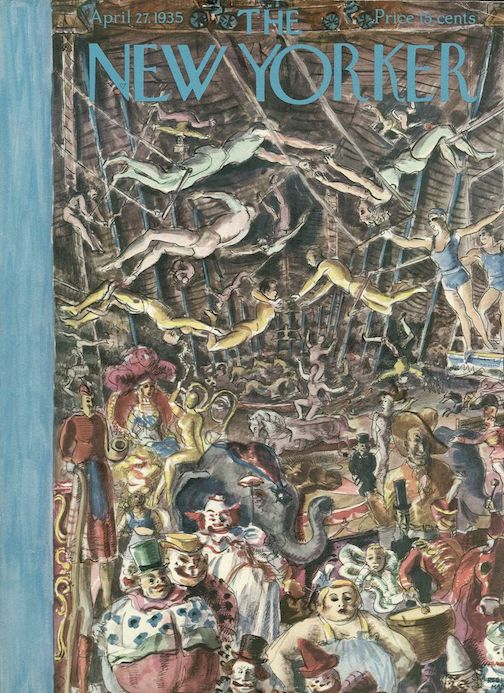
April 27, 1930 cover by Reginald Marsh.

On April 15, 1935, the Industrial Arts Exposition opened at Rockefeller Center, and Wright (1867-1959) was front and center with his audacious proposal to resettle the entire population of the United States onto individual homesteads. Critic Lewis Mumford observed that Wright “carries the tradition of romantic isolation and reunion with the soil” by putting every American family on a minimum of five acres of land.

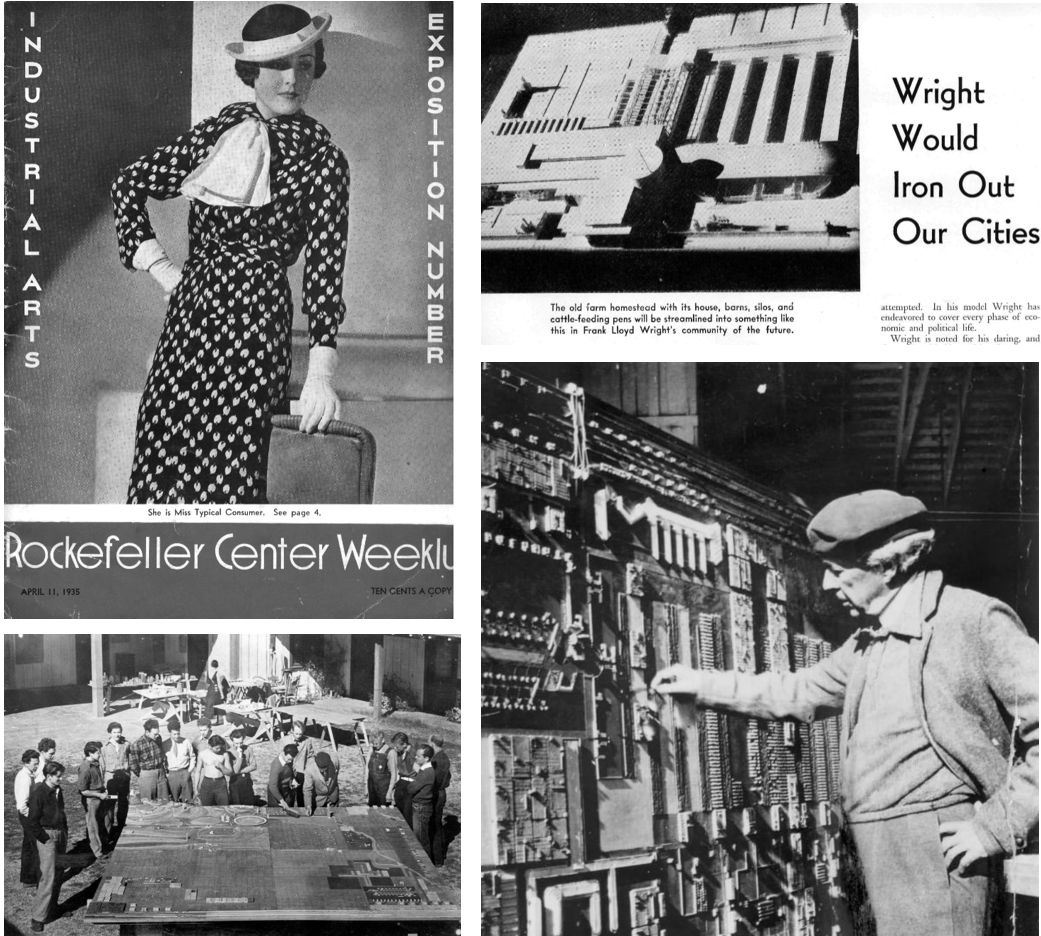
FLAT EARTH…Clockwise, from top left, cover of Rockefeller Center Weekly featuring the Industrial Arts Exposition—the model on the cover is identified as “Miss Typical Consumer”; detail from the magazine depicting a “streamlined farmstead” in Broadacre City; Frank Lloyd Wright examining the Broadacre City model, circa 1935; Wright students who crafted the 12×12-foot model, circa 1935. (digital.hagley.org/franklloydwright.org)

Wright first presented the idea of Broadacre City in his book The Disappearing City in 1932…

ROMANTIC ISOLATION…Broadacre City as depicted in Wright’s 1932 book The Disappearing City. (Wikipedia)

…note how the above drawing is reflected in one of Wright’s last designs, the Marin County Civic Center:

(visitmarin.org)

A detailed 12×12-foot scale model of Broadacre City—crafted by Wright’s student interns at Taliesin, was unveiled at the Industrial Arts Exposition:

GREEN ACRES…The 12×12-foot model (top images) crafted by student interns who worked for Wright at Taliesin is now housed at the Museum of Modern Art (MoMA); bottom right, Wright’s rendering of Broadacre City, and at left, detail from Spanish architect David Romero’s computer-generated model of Broadacre City (more images below). (MoMA/David Romero via Smithsonian)

For the most part Mumford reacted favorably to Wright’s vision, which is no surprise considering that Mumford derided the dehumanizing skyscrapers popping up all over his city (including Rockefeller Center).

Despite his patrician demeanor, Wright envisioned an egalitarian Broadacre City, with every family having access to cars, telephones and other appliances. Power would come from solar and electric energy, and any technological advances would be applied at a local level toward the common good.

VIRTUAL REALITY…In 2018 Spanish architect David Romero created computer-generated models to see what Wright’s unrealized structures might have looked like. At left, cars (based on Wright concepts) in Broadacre City, and an aerial view featuring a tower that bears a strong resemblance to Wright’s 1956 Price Tower in Bartlesville, Oklahoma. Modeling Broadacre took Romero more than eight months to complete—it contains more than one hundred detailed buildings, one hundred ships, two hundred “aerotors” (based on the autogyros of the day), 5,800 cars, and more than 250,000 trees. (David Romero via Smithsonian and openculture.com)

What Mumford (and perhaps Wright) didn’t fully anticipate was the urban sprawl such a vision would help inspire, the suburban and exurban landscape that would lead to a car-dominated world of congested, multi-lane highways and housing developments that continue to encroach on our woodlands and wetlands. And we didn’t get those groovy aerotors either.

(Christoph Gielen, webcolby.edu)

 * * *

Little House on the Avenue

E.B. White, in his “Notes and Comment,” also offered some observations on housing trends, noting the manufactured “Motohome” displayed at Wanamaker’s as well as “America’s Little House,” plopped down at the corner of 39th and Park Avenue.
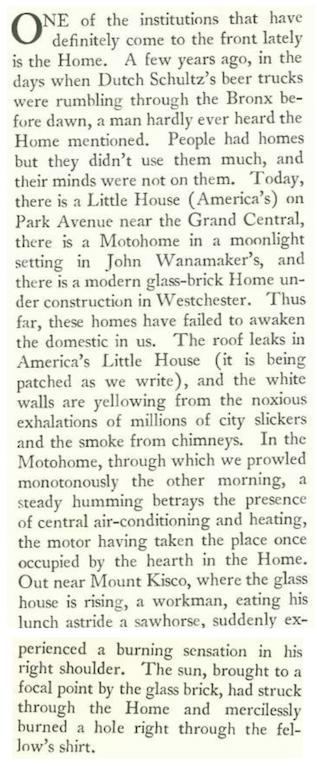
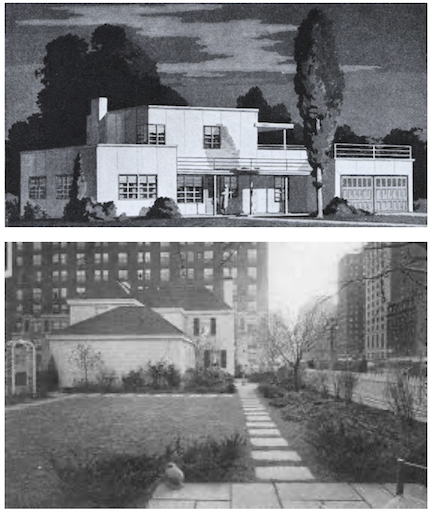
SETTING A STANDARD…Above, the factory-manufactured Motohome (above) was touted as the solution to the nation’s housing shortage. The federal Better Homes in America organization built a model house (“America’s Little House,” below) at 39th and Park Avenue to illustrate how standardized components and methods could make home improvement easier. (Google Books/Johns Hopkins)

* * *

Horsing Around

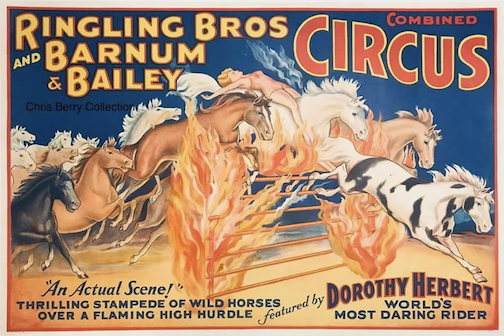
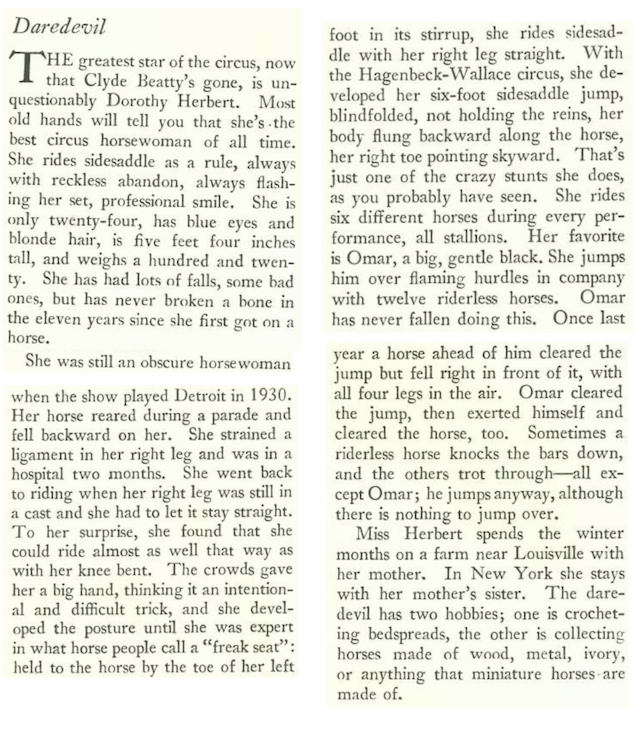
Although known for their nonchalance, New Yorkers could still find some enthusiasm when the circus came to town. “The Talk of the Town” looked in on the star of the circus, Dorothy Herbert (1910-1994), a trick rider with the Ringling Bros. and Barnum & Bailey Circus.
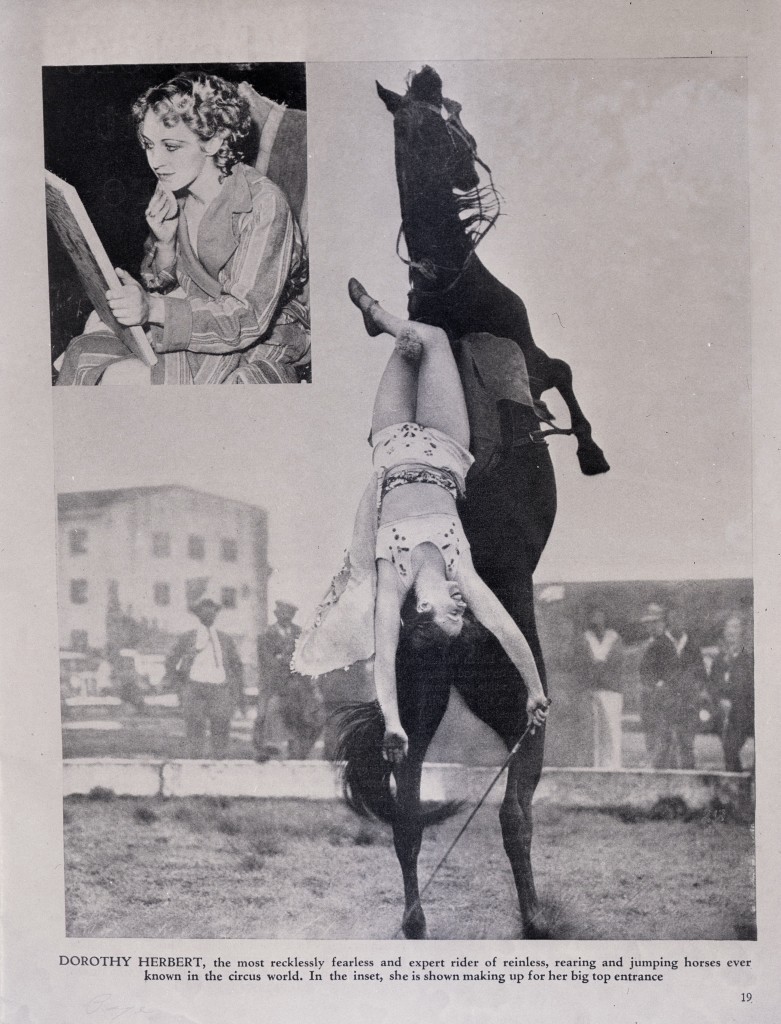
WHOA NELLY…One of Dorothy Herbert’s signature moves was her layback on a rearing horse. Here she demonstrates the move in 1939. (equineink.com)
HOT STUFF…Circus poster touts Herbert’s ride over flaming hurdles in the company of twelve riderless horses. (circushistory.org)

 * * *

Don’t Call Him ‘Tiny’

He was known as “The Little Napoleon of Showmanship,” but there was nothing small about Billy Rose’s accomplishments as an impresario, theatrical showman, composer, lyricist and columnist. Here are excerpts from Alva Johnston’s profile:

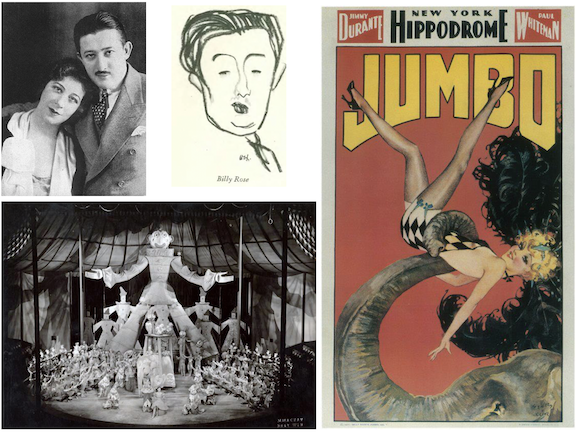
JUMBO-SIZED ENTERTAINMENT…Clockwise, from top left, Billy Rose and his first wife, comedian-actress Fanny Brice; illustration of Rose for the profile; poster announcing Rose’s 1935 stage spectacle Jumbo at the Hippodrome; described as more circus than musical comedy, Jumbo was one of the most expensive theatrical events of the first half of the 20th century. (jacksonupperco.com)

 * * *

On Guard

We shift gears and turn to more sobering events of the 1930s, namely the rise of fascism in Europe. In his column “Of All Things,” Howard Brubaker pondered the possibilities of fascism in his own country…

…meanwhile, Paris correspondent Janet Flanner was finding nothing funny about the uneasy calm among Parisians as war with Germany seemed likely.
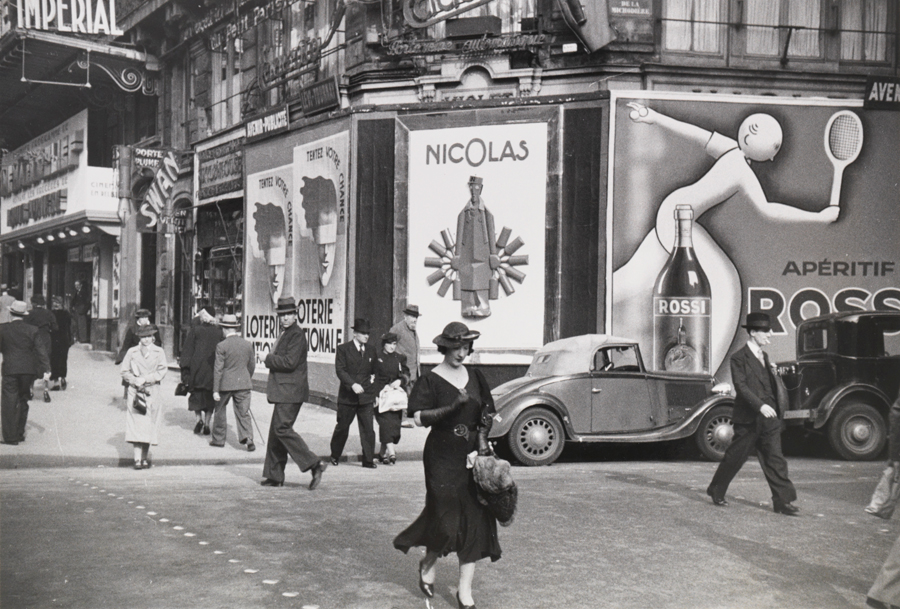
C’EST LA VIE…Janet Flanner found Parisians resigned to whatever fate awaited them in 1935. (unjourdeplusaparis.com)

Flanner also remarked on Leni Riefenstahl’s Nazi propaganda film Triumph des Willens (Triumph of the Will). Flanner’s assessment of this “best recent European pageant” wryly underscored the horrors the film portends.

 * * *

News From An Old Friend

Longtime readers may recall one of my earliest entries on Queen Marie of Romania (1875-1938); the March 14, 1925 edition of The New Yorker (issue #4) found New Yorkers “agog” over her planned 1926 visit to the city. Her comings and goings were followed for a time (she also appeared in a Pond’s Cold Cream ad in the June 6, 1925 issue), but then she abruptly disappeared. Here she is again, courtesy of a glowing book review by Clifton Fadiman. An excerpt:
A PROGRESSIVE THINKER for her time, Marie of Romania was immensely popular in America. Born into the British royal family, she was the last queen of Romania from 1914 to 1927. At left, portrait from 1920; at right, during her 1926 visit to the States, Marie received a headdress from two American Indian tribes. They named her “Morning Star” and “Winyan Kipanpi Win”—“The Woman Who Was Waited For.” (Wikipedia/brilliantstarmagazine.org)

 * * *

From Our Advertisers

Although we’ve seen plenty of ads from prestige automakers such as Packard, it was clear that companies found their sweet spot in lower-priced models that still suggested “prestige”…here’s an example from Cadillac’s budget line LaSalle…

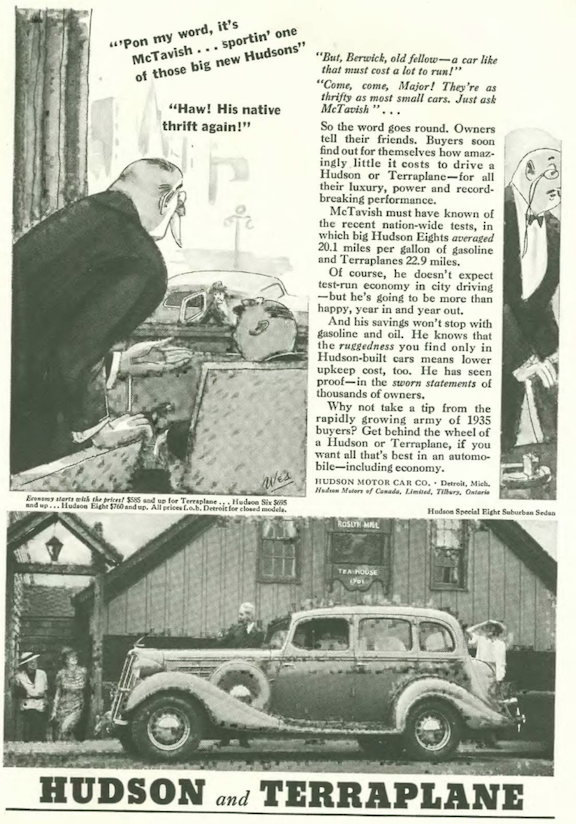
…for less than half the price of a LaSalle you could get behind the wheel of Hudson, its makers suggesting that prestige doesn’t preclude thrift…this ad seems to have been hastily produced–note the right side of ad, with just a slice of some toff squeezed next to the copy…
…this advertisement would only appeal to those who were among the tiny minority who could afford to fly…from 1924 to 1939 this early long-range airline served British Empire routes to South Africa, India, Australia and the Far East…

…for reference, detail below of a Scylla-class airliner used by Imperial Airways…

…and what would the back cover be without a photo of a stylish woman having a smoke?…

…a few advertisers referenced the circus in town to drum up business…

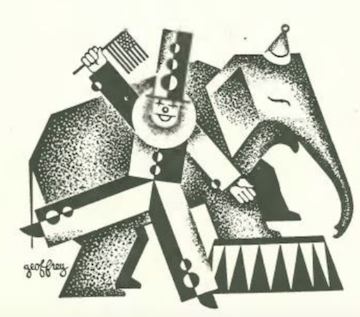
…and we segue to our cartoonists and illustrators, and this circus-themed spot from an illustrator signed “Geoffrey”…
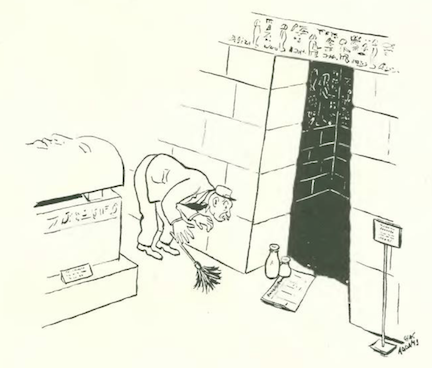
…a more familiar name is found at the bottom of page 4…namely Charles Addams…the milk order outside the tomb hints at things to come…
…Addams again, going from Bacchus to beige…

George Price, and well, you know…

Robert Day was aloft with a speculative builder…

William Steig typecast his Small Fry…

Leonard Dove made a sudden exit…

Gilbert Bundy found one old boy unaffected by spring fever…
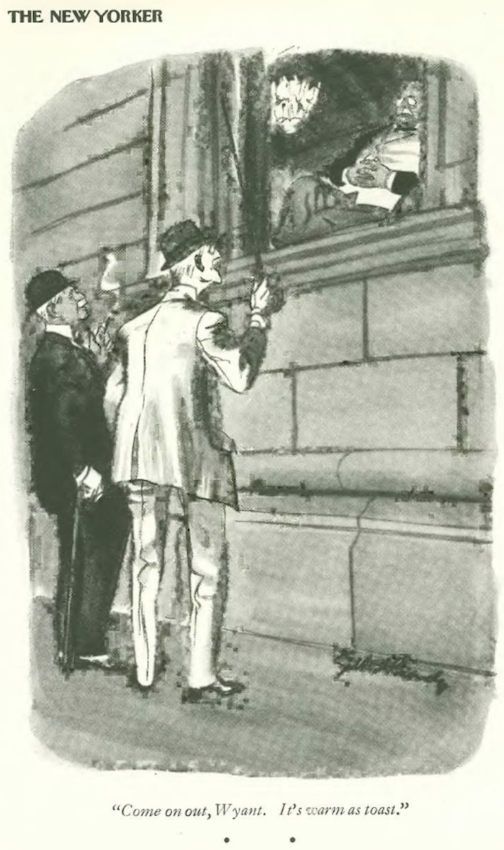
Alain channeled Barbara Shermund to give us this gem…
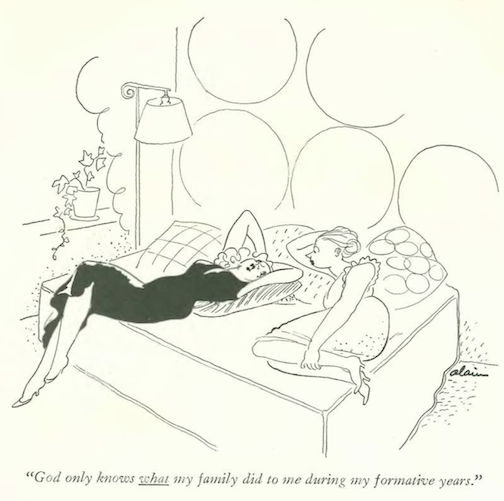
…and we close with a typical day in James Thurber’s world…

Next Time: The Royal Treatment…
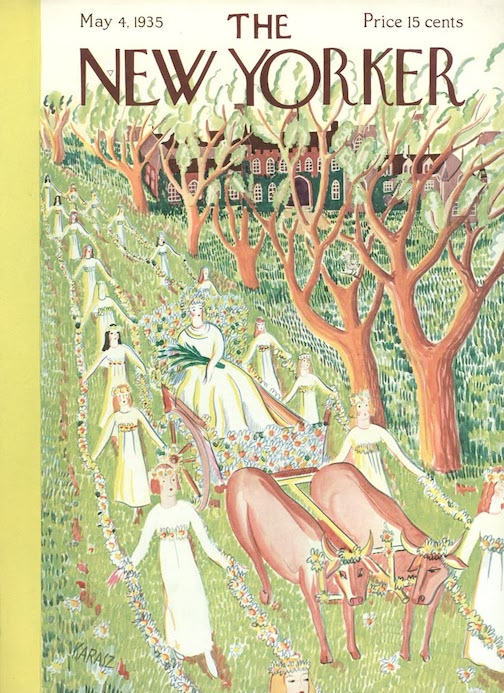



A Tadpole on Wheels

Above: British architect Norman Foster's 2010 recreation of R. Buckminster Fuller's 1933 Dymaxion car. (Wikipedia)

Despite the limitations of 1930s technology, a few architects and designers were hell-bent on building a streamlined future that until then was mostly the stuff of movies and science fiction magazines.

May 5, 1934 cover by Rea Irvin.

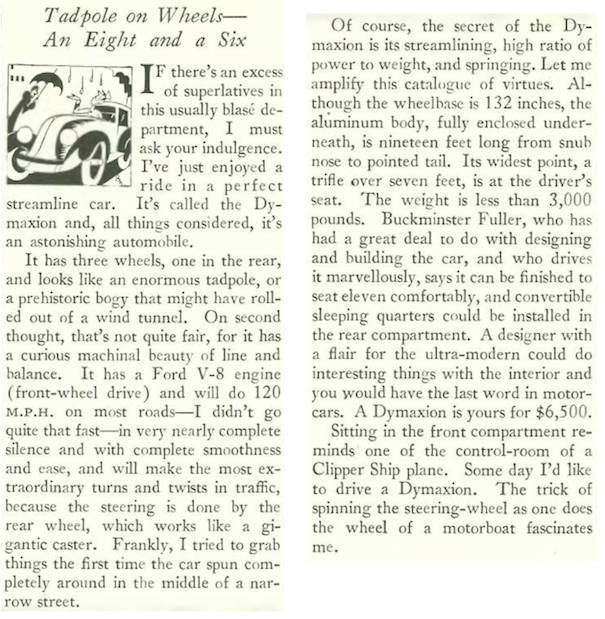
One of them was R. Buckminster Fuller (1895–1983), architect, designer, and futurist probably best known today as the inventor of the geodesic dome (think Disney’s Epcot Center). In the 1930s Fuller was all about a concept he called Dymaxion. Derived from the words dynamic, maximum, and tension, when applied to architecture and design it would supposedly deliver maximum gain from minimal energy input. The writer of the New Yorker article (pseud. “Speed”) was fascinated by the Dymaxion’s motorboat-type steering, no coincidence since Fuller intended to adapt his futuristic car for use on and under the water, as well as in the air.

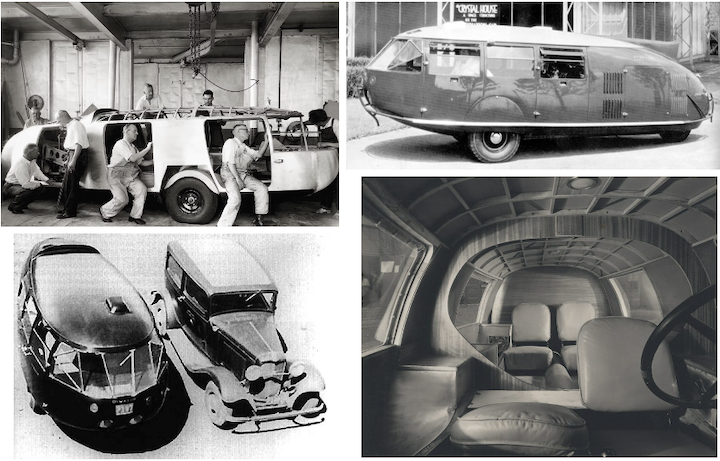
THE SHAPE OF THINGS TO COME…Clockwise, from top left: Workers at a Bridgeport, Conn., plant creating the first of three Dymaxion cars; the Dymaxion at Chicago’s 1933 Century of Progress exposition—the car was involved in a fatal accident at the fair; interior view of the Dymaxion; using the same engine and transmission as a Ford sedan (pictured), the Dymaxion offered three times the interior volume with half the fuel consumption and a 50 percent increase in top speed. (Buckminster Fuller Institute/Poet Architecture)
THINKING WITHOUT THE BOX…In 1927 R. Buckminster Fuller (pictured) developed a Dymaxion House, a “Dwelling Machine” that would be the last word in self-sufficiency. Although the aluminum house was intended to be mass-produced, flat-packaged and shipped throughout the world, the design never made it to market (however its ideas influenced other architects); at right, a Fuller geodesic dome at Disney’s Epcot Center in Florida. (archdaily.com/Wikipedia)

The 1933 Century of Progress exposition in Chicago was supposed to be a major showcase for Fuller, but when professional driver Francis Turner was killed while demonstrating the first prototype of the Dymaxion, the car’s prospects dimmed considerably. According to an article by Stephanie d’Arc Taylor (cnn.com Oct. 30, 2019), during the demonstration a local politician tried to drive his own car close to the Dymaxion—to get a better look—and ended up crashing into the unwieldy prototype, which rolled over, killing the driver and injuring its passengers. “The politician’s car was removed from the fracas before police arrived, so the Dymaxion was blamed for the accident,” writes Taylor, who notes that the rear wheel–powered car, though unconventional, was not necessarily the problem. However, “the thing that made the Fuller death-mobile singularly deadly was the fact it was also steered by the rear wheel, making it hard to control and prone to all kinds of terrifying issues.”

That history did not stop architect Norman Foster from building a replica of the Dymaxion in 2010. Foster worked with Fuller from 1971 to 1983, and considers Fuller a design hero.

GIVING IT ANOTHER GO…Architect Norman Foster with his 2010 recreation of the Dymaxion. To build a new Dymaxion, Foster sent a restorer to the National Automobile Museum in Reno, Nevada (home of the only surviving Dymaxion, Car No. 2), and after thousands of photos and measurements Foster had the car recreated using only materials available in 1933: Foster’s Dymaxion consists of an ash frame sheathed in hand-beaten aluminum, mounted on the chassis of an old 1934 Ford Tudor Sedan. (CNN/The Guardian)

According to Taylor, Foster cleaved so closely to Fuller’s original designs that he refers to his creation as a fourth genuine Dymaxion—not a replica. “The car is such a beautiful object that I very much wanted to own it, to be able to touch as well as contemplate the reality for its delight in the same spirit as a sculpture,” said Foster. “Everything in (the car) was either made in 1934, or recreated using techniques and materials that Bucky would have had access to in that period.”

 * * *

Meanwhile, At The Tracks…

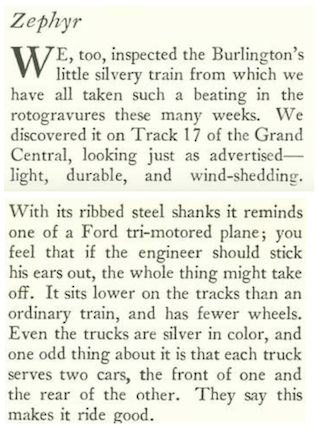
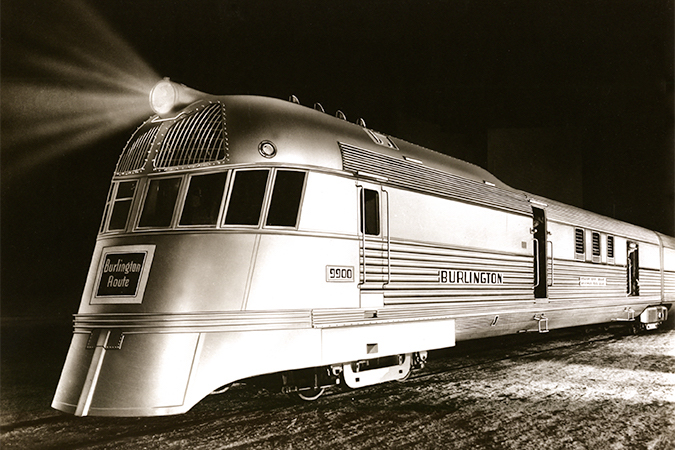
If Fuller’s attempt at the streamlined future was a bit of bust, the Burlington railroad was making a splash with its gleaming new Zephyr. E.B. White reported:

ZOOM ZOOM…The Burlington Zephyr set a speed record for travel between Denver and Chicago when it made a 1,015.4-mile (1,633 km) non-stop “Dawn-to-Dusk” dash in 13 hours 5 minutes at an average speed of almost 78 mph (124 km/h). In one section of the run it reached a speed of 112.5 mph. Following a promotional tour that included New York, it was placed in regular service between Kansas City, Missouri, and Omaha and Lincoln, Nebraska, on November 11, 1934. Other routes would be added later in the Midwest and West. (BNSF)

…we continue with E.B. White, here with some observations regarding Mother’s Day and bank robber/murderer John Dillinger, who had escaped from prison in March 1934 and was on the FBI’s Most Wanted List…
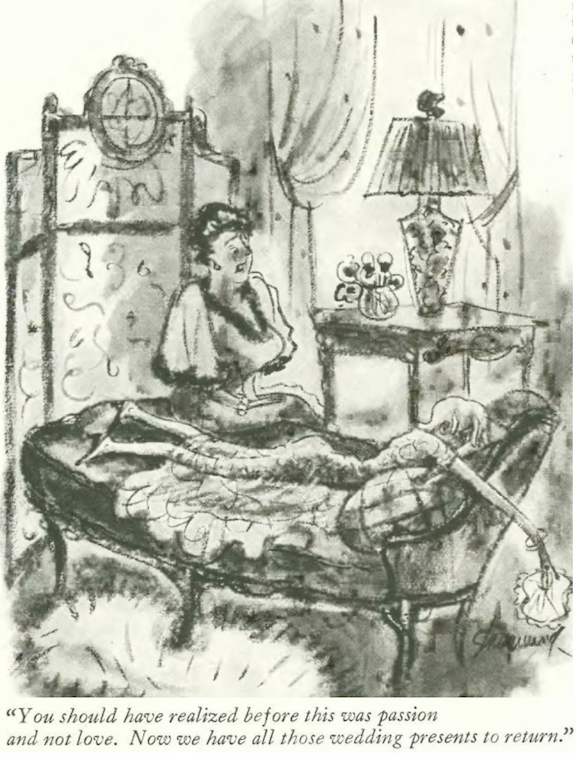
I REMEMBER MAMA…John Dillinger posed with Lake County prosecutor Robert Estill, left, in the jail at Crown Point, Ind. while he awaited his trial for murder in January 1934. Dillinger would escape from the jail in March and would be on the lam until July, when FBI agents would gun him down outside a Chicago movie theatre. (NY Daily News)

…and a last word from White, about an important change at Radio City:

 * * *

Voice In The Wilderness

A combination of newsreel footage, documentary, and reenactment, Cornelius Vanderbilt Jr’s Hitler’s Reign of Terror played to capacity crowds for two weeks in New York City, despite the refusal of the state’s censor to license the film. Disinherited by his parents when he became a newspaper publisher, Vanderbilt was a determined journalist, covertly filming scenes in Nazi Germany and even briefly encountering Adolf Hitler outside the Reichstag, where Vanderbilt yelled to Der Führer, “And what about the Jews, Your Excellency?” (Hitler ignored the question and referred Vanderbilt to one of his lackeys). Unfortunately, Vanderbilt wasn’t much of a filmmaker, and although he warned Americans about the emerging threat in Germany, few took the film, or his warning, seriously, including John Mosher:

UNHEEDED…Audiences flocked to see Cornelius Vanderbilt Jr’s Hitler’s Reign of Terror, but critics dismissed the rather amateurish film—Film Daily scoffed at the film’s prediction that Hitler’s Germany was a future threat to world peace; at right, in the film Vanderbilt confronted “Hitler” in a recreation. (TMDB/Library of Congress)

 * * *

From Our Advertisers

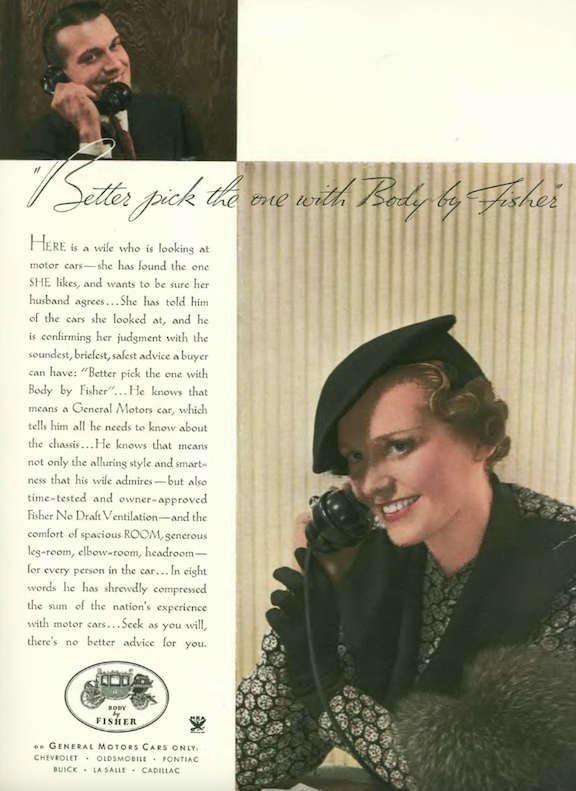
It wouldn’t seat eleven people like a Dymaxion, but a Body by Fisher (coach builder to General Motors) certainly impressed this young woman…but better check with the hubby just in case…

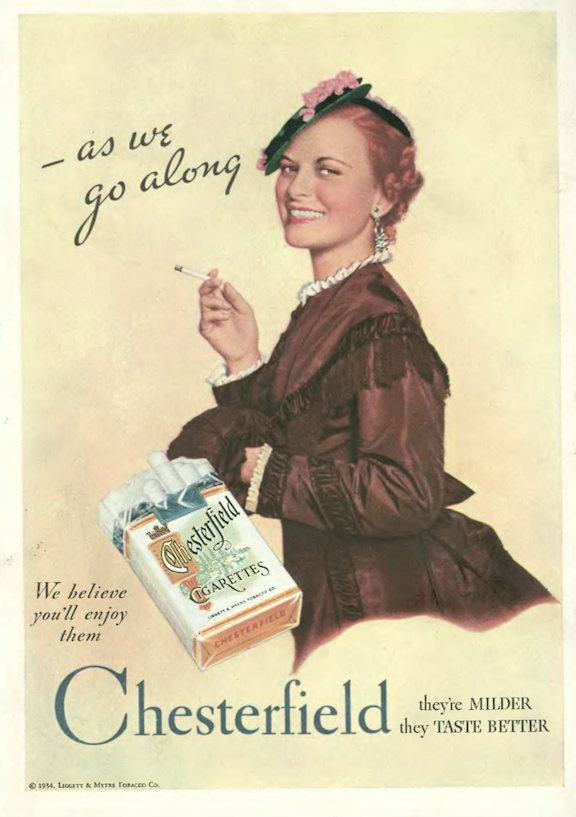
…in this next ad, we find what looks like the same woman, perhaps celebrating her decision with a nice smoke…

…this spot seems out of place in the New Yorker, like it snuck over from Better Homes & Gardens...

…on to our cartoons…with James Thurber’s war of the sexes over, life returned to normal…

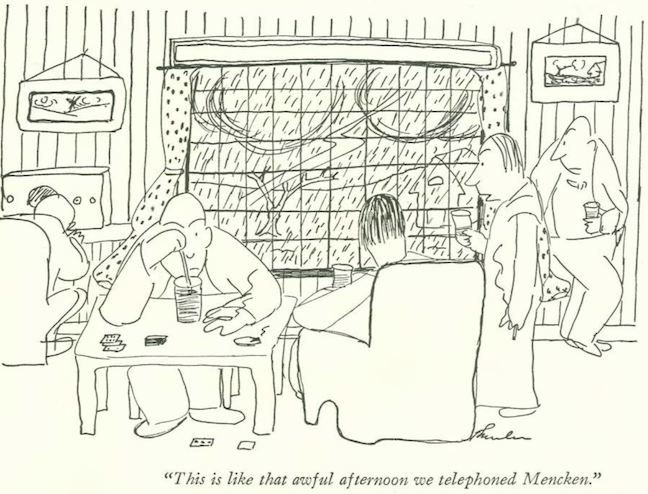
…and both sides shared in the gloom of a rainy afternoon…

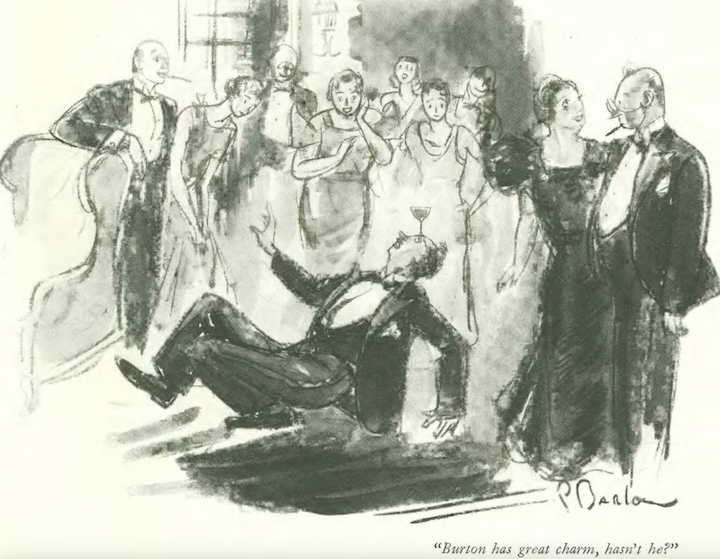
…by contrast, Perry Barlow brightened things up with this life of the party…

…but a good time doesn’t always translate over the airwaves, per George Price

Alain illustrated the consequences of losing one’s nest egg…

Peter Arno didn’t leave any room for dessert…

…and Charles Addams returned, a macabre cast of characters still percolating in his brain…

…on to May 12, 1934…

May 12, 1934 cover by Leonard Dove.

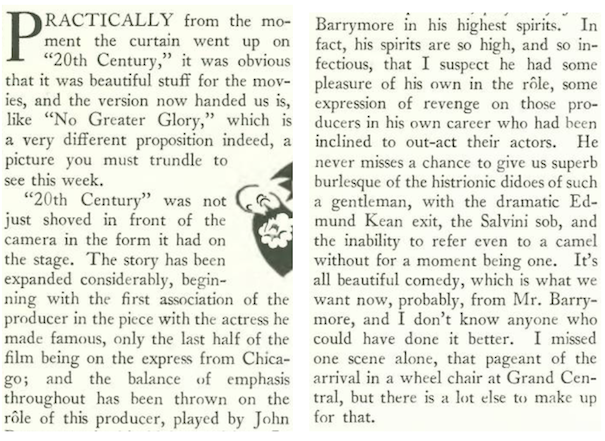
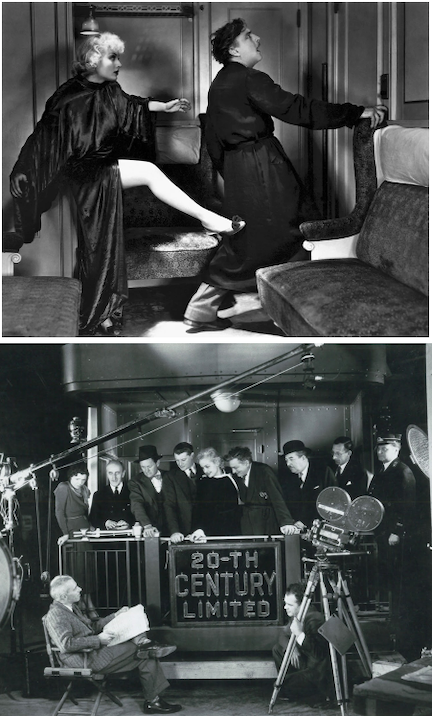
…and back to the movies, this time critic John Mosher found more cheery fare in 20th Century, a pre-Code screwball comedy directed by Howard Hawks and starring John Barrymore and Carole Lombard. Battling alcohol abuse since age 14, Barrymore nevertheless managed to display his rare genius as a comedian and turned in what is considered to be his last great film performance.

GETTING HER KICKS…Top, Carole Lombard delivers a swift one to John Barrymore in the screwball comedy 20th Century. Below, director Howard Hawks with the cast. (greenbriarpictureshows.blogspot.com)

 * * *

Playing the Ponies

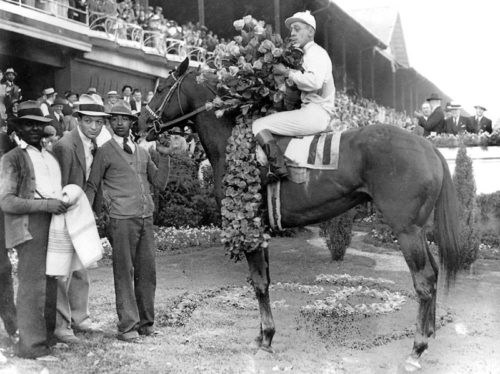
Horse racing correspondent George F. T. Ryall (pseud. “Audax Minor”) considered a losing wager at the Kentucky Derby in his column, “The Race Track.”

A HORSE OF COURSE…Jockey Mack Garner rode Cavalcade to victory at the 1934 Kentucky Derby. (Appanoose County Historical Society)

 * * *

More From Our Advertisers

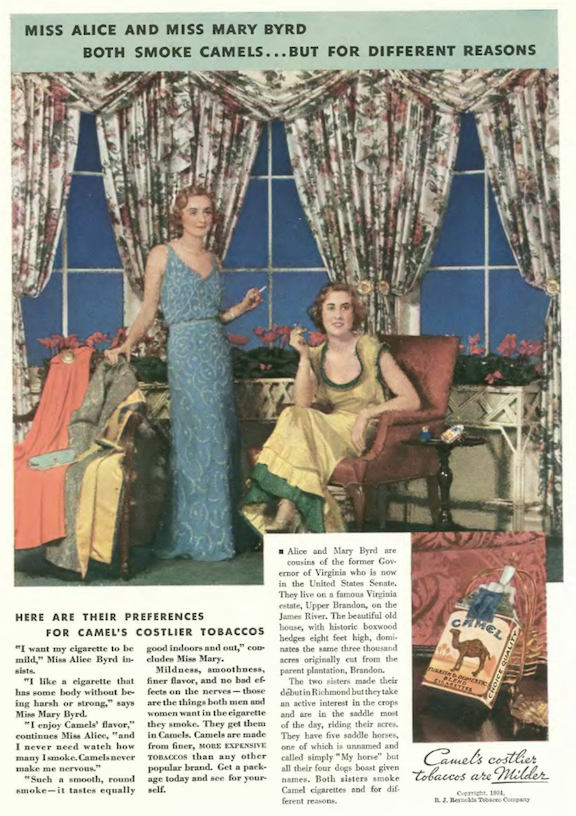
We begin with Camel cigarette endorsers Alice and Mary Byrd, residents of Virginia’s famous Brandon plantation and cousins of Virginia Senator and Governor Harry F. Byrd, known for his fights against the New Deal and his “massive resistance” to federally mandated school desegregation...

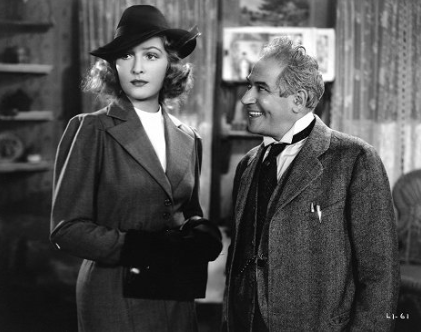
…also to the manor born, Whitney Bourne, a New York deb who would go on to a brief stage and film career that would end when she married her first husband (diplomat Stanton Griffis) in 1939…

AN EYE FOR STYLE…Whitney Bourne in a scene with Solly Ward in 1937’s Flight From Glory. Named in 1933 as one of America’s best dressed women, Bourne was a noted New York socialite, skier, golfer and tennis player as well as an occasional actress.

…we move along from the effervescent Whitney Bourne to the sparkling waters of Perrier…

Gardner Rea followed other New Yorker cartoonists by illustrating an ad for Heinz…

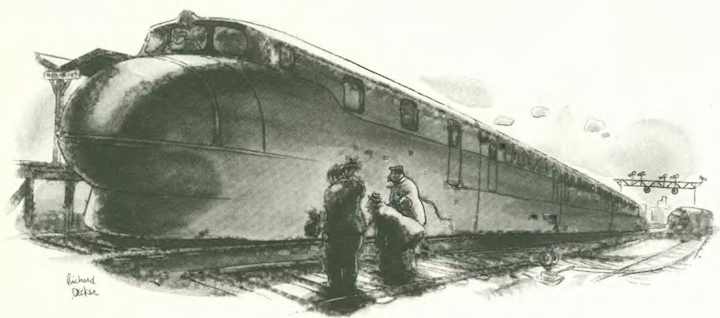
…which brings is to more cartoons, where according to Richard Decker, the move to streamlined trains wasn’t welcomed by everyone…

Carl Rose illustrated this two-page spread with an imagined right-wing response to the recent left-wing May Day parades…

William Steig eavesdropped onto a saucy little conversation…

Barbara Shermund continued her explorations into the trials of the modern woman…

James Thurber was back to his old tricks…

…and we conclude our cartoons with Eli Garson, and a new perspective…

Before I close, a bit of housekeeping. The first issues in 1925 sometimes ended “The Talk of the Town” with…

…but on May 23, 1925, “Talk” signed off with —The New Yorkers. That continued until the March 31, 1934 issue (below), the last time the New Yorker signed off “The Talk of the Town” with —The New Yorkers:

Next Time: Moses Parts a Yacht Club…


She Wore the Pants

It’s hard to fathom that a woman wearing trousers used to cause such a stir, but for international film star Marlene Dietrich it was an opportunity for the publicity that invariably came with defying the norms of fashion and sexuality in 1930s.

July 22, 1933 cover by Constantin Alajalov.

In May 1933 Dietrich was headed to Paris on a steamer, relaxing on the deck in a white pantsuit. Prior to her arrival, the Paris chief of police announced she would be arrested if she showed up in pants. However when Dietrich arrived at the Gare Saint Lazare wearing a man’s suit and overcoat, she stepped off the train, grabbed the chief of police by his arm, and walked him off the platform.

The New Yorker’s Janet Flanner reported on Dietrich’s comings and goings in her regular column “Letter From Paris”…

TAKING PARIS BY STORM…Clockwise, from top left: Marlene Dietrich in Paris, 1933, accompanied by her husband, Rudolf Sieber; Dietrich on the SS Europa, Cherbourg, France, May 1933; Dietrich arriving at the Gare Saint Lazare station, May 20, 1933 (this photo is often paired with an erroneous caption claiming that Dietrich is being arrested by French authorities. On the contrary, she owned them the moment she stepped onto the platform); Dietrich signing autographs in Paris, 1933. (bygonely.com/Smithsonian/Twitter/Pinterest)

 * * *

Bullish On Office Space

Despite the Depression, millions of square feet of office space were being added to the massive Rockefeller Center complex, including the Palazzo d’Italia at 626 Fifth Avenue. “The Talk of the Town” reported:

THE BIG SHORT…Attached to the International Building at its northwest corner, the Palazzo d’Italia was originally planned as a nine-story building, a fact that impressed the fascist Italian leader Benito Mussolini because it beat the six-story height of the French and British Buildings. In the end Benito only got six as well. (Wikipedia/Pinterest)

* * *

Urban Jungle

Astoria Studios in Queens was built in 1920 for Famous Players-Lasky and is still home to New York City’s only studio backlot. In 1933 it served as a tropical setting for The Emperor Jones, featuring Paul Robeson in the title role. “The Talk of the Town” looked in on the movie’s faux jungle:

35TH STREET JUNGLE…Paul Robeson in a scene from The Emperor Jones. (flickr.com)

Loosely based on a Eugene O’Neill play and financed with private money, the film was made outside of the Hollywood studio system and distributed by United Artists.

EMPEROR’S NEW CLOTHES…Brutus Jones (Robeson) schemes with colonial trader Smithers (Dudley Digges) on his plan to become emperor in The Emperor Jones. (moma.org)

 * * *

From Our Advertisers

Yes, it’s advertising so we don’t expect it to be realistic, but I can guarantee no one is going to look like that after a ride to the beach in a rumble seat…also the woman behind the car is either floating or has exceedingly long legs…

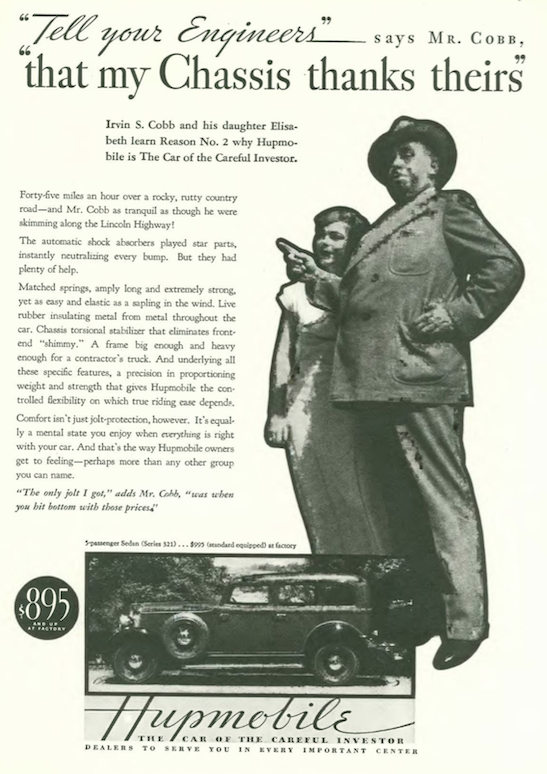
…Hupmobile enlisted humorist Irvin S. Cobb to help boost its sagging sales…

Irvin S. Cobb (1876–1944) wrote for Joseph Pulitzer’s New York World, and was once the highest paid staff reporter in the United States. (carnegiecenterlex.org)

…with the return of legal beer the makers of Budweiser struck a patriotic note in promoting their “King of Bottled Beer” to thirsty New Yorkers…

…the makers of Pabst Blue Ribbon claimed the title of “Best of the Better Beers” with this ad featuring a woman who appeared on the verge of going overboard…

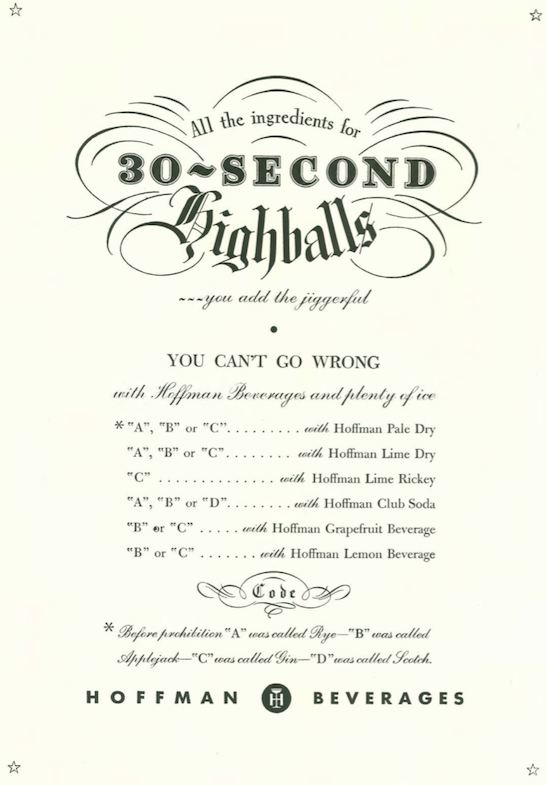
…if beer wasn’t your thing, you could try your hand at mixing a “30-Second Highball” per this Prohibition-themed ad…

…delving into the back pages one finds all sorts of curiosities, including this mail-order “charm school” operated by Margery Wilson

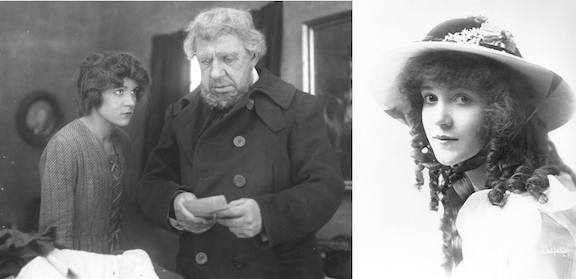
…Wilson (1896–1986) acted in numerous silent pictures (including the 1916 D. W. Griffith epic Intolerance) and in the early 1920s was a writer, director and producer…

Margery Wilson in Eye of the Night (1916). She was among pioneering women filmmakers of the 1920s. (columbia.edu))

…it must have been a hot summer in New York with the abundance of air-conditioner ads…here’s one from Frigidaire for a unit that despite its size (and enormous cost) could cool only one room…

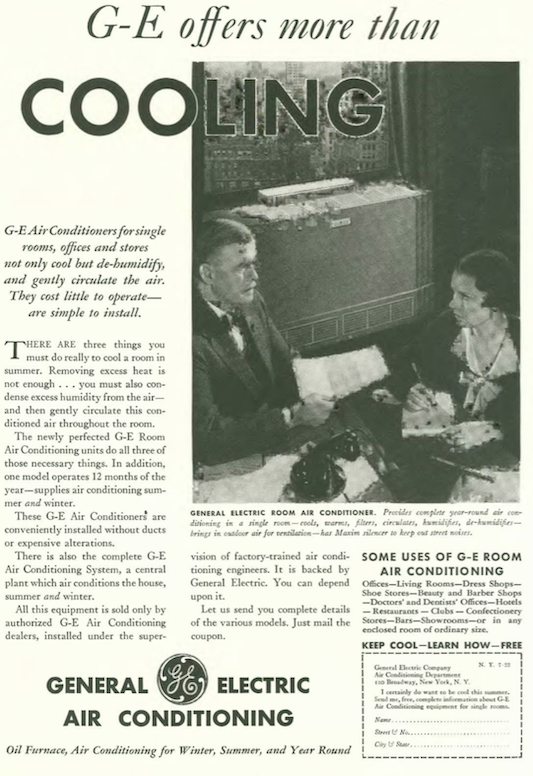
…this next air-conditioner ad from G-E seems poorly conceived…you would think an air-conditioned office would make the boss and his secretary a bit happier than they appear here…maybe they just got the bill from General Electric…

…we begin our cartoons with another pair of sourpusses, courtesy Mary Petty

George Price offered up this bit of art for the opening pages…

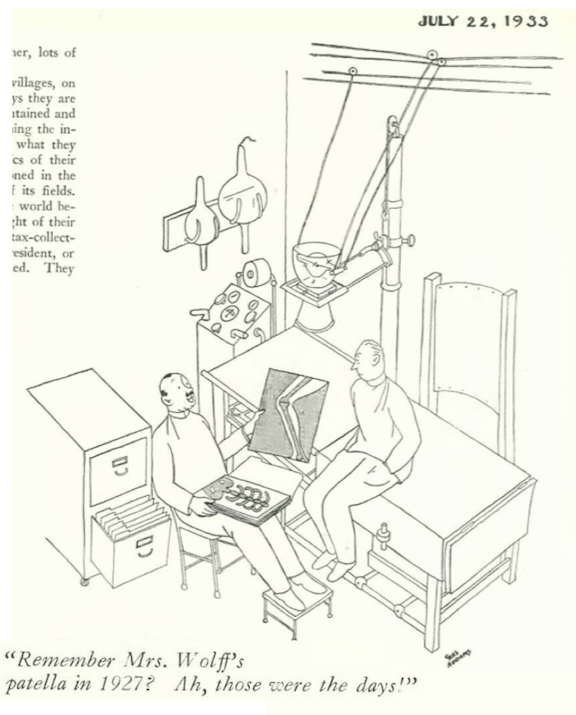
William Steig headed to the country to escape summer in the city…

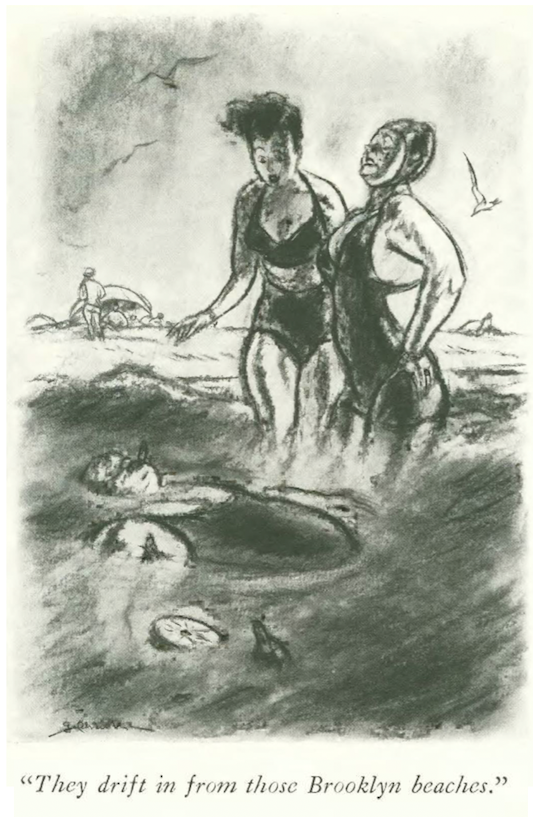
William Crawford Galbraith’s bathers kept cool by examining the flotsam from distant shores…

Charles Addams explored various themes before he launched his “Addams Family” in 1938…

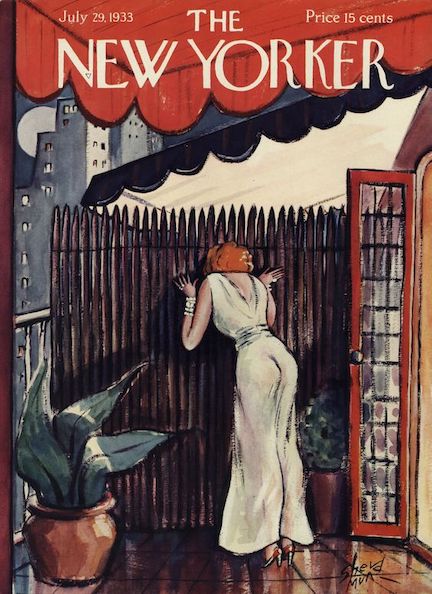
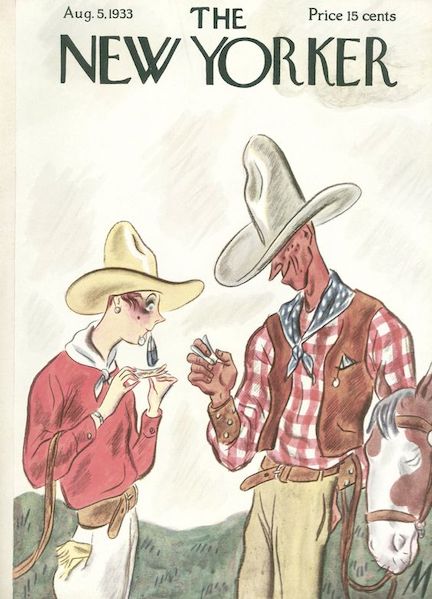
…and we move on to July 29 with a terrific cover by Barbara Shermund

July 29, 1933 cover by Barbara Shermund.

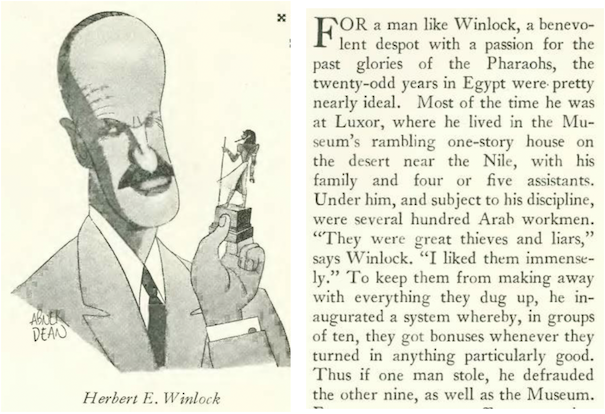
…in this issue Geoffrey T. Hellman penned a profile of Egyptologist Herbert E. Winlock, who made key discoveries about the Middle Kingdom of Egypt and served as director of the Metropolitan Museum from 1932 to 1939, where he was employed his entire career. Excerpt:

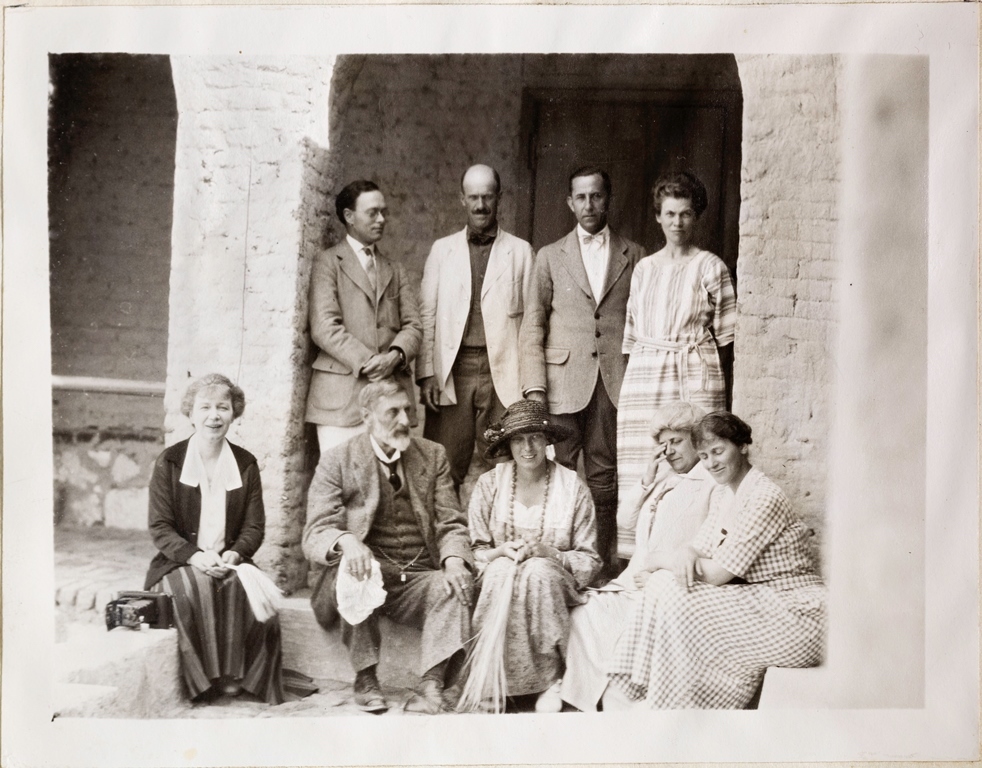
CAN YOU DIG IT…Early 1920s photo of the Metropolitan Museum’s Theban expedition team. Herbert E. Winlock is in the back row, second from left. His wife, Helen Chandler Winlock, is in the front row, far right. (Metropolitan Museum of Art)

 * * *

Chilling With U.S. Grant

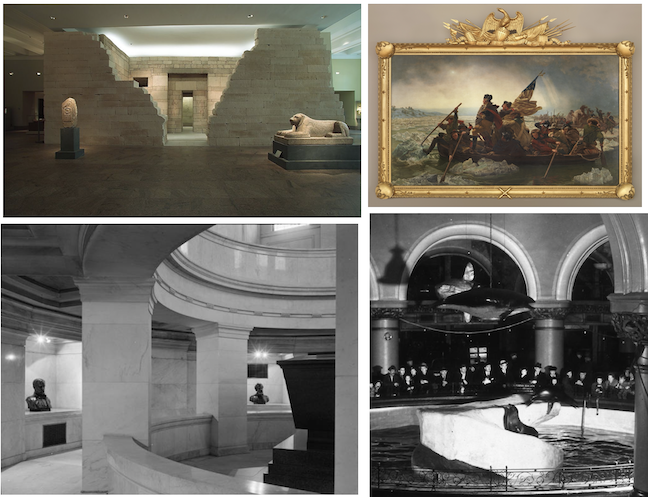
In those days before air-conditioning was widely available or used, “The Talk of the Town” dispatched an investigator to sample indoor temperatures at various public places, finding the coolest spot at Grant’s Tomb:

WHERE THE COOL PEOPLE HANG OUT…Clockwise, from top left: The tomb of Per-neb at the Metropolitan Museum registered a cozy 80 degrees, while in the same museum it was a balmy 84 by Emanuel Leutze’s famed painting Washington Crossing the Delaware; the New York Aquarium in Battery Park was a bit cooler at 79 (pictured is the Sea Lion Pool); while Grant’s Tomb was downright chilly at 70. (Met Museum/Wildlife Conservation Society/grantstomb.org)
 * * *
Node of Gold
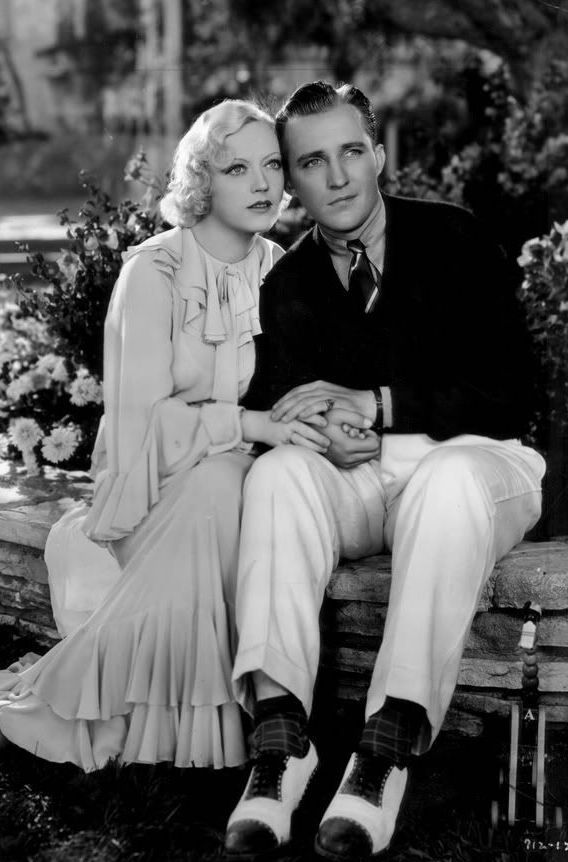
Apparently the famed crooner Bing Crosby had a minor node on one of his vocal cords, and when he consulted a specialist he was advised against removing it, lest he alter his voice in a way that would affect his career. Indeed, the node seemed to add an “appealing timbre” to his signature sound, so Crosby had his voice insured by Lloyd’s of London for $100,000 with a proviso that the node could not be removed. Howard Brubaker made this observation in “Of All Things”…

LUMP IN HIS THROAT…Bing Crosby with Marion Davies in the 1933 film Going Hollywood. (IMDB)

…Brubaker also shared this prescient observation from American astronomer Vesto Slipher

…Slipher (1875–1969) would live long enough to confirm his statement…the first full-disk “true color” picture of the Earth was captured by a U.S. Department of Defense satellite in September 1967:

(USAF/Johns Hopkins University)

 * * *

More From Our Advertisers

This ad was on the inside front cover of the July 29 issue, a rather jarring image following that lovely Barbara Shermund cover…

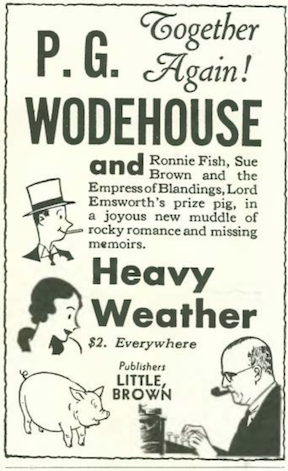
…the hugely popular P.G. Wodehouse was back with more silly antics from the British upper classes…

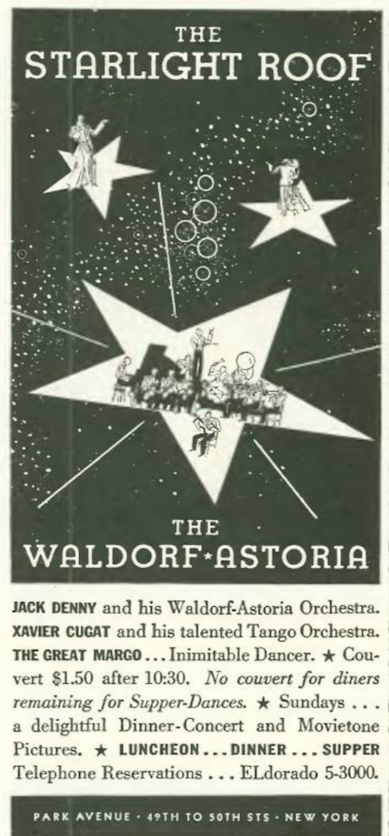
…while some New Yorkers could take a break from their reading and hit the dance floor atop the Waldorf-Astoria…

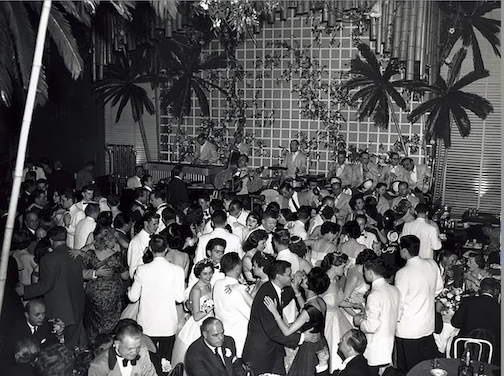
…and tango to the stylings of bandleader Xavier Cugat

Xavier Cugat and band atop the Waldorf-Astoria. (cntraveler.com)

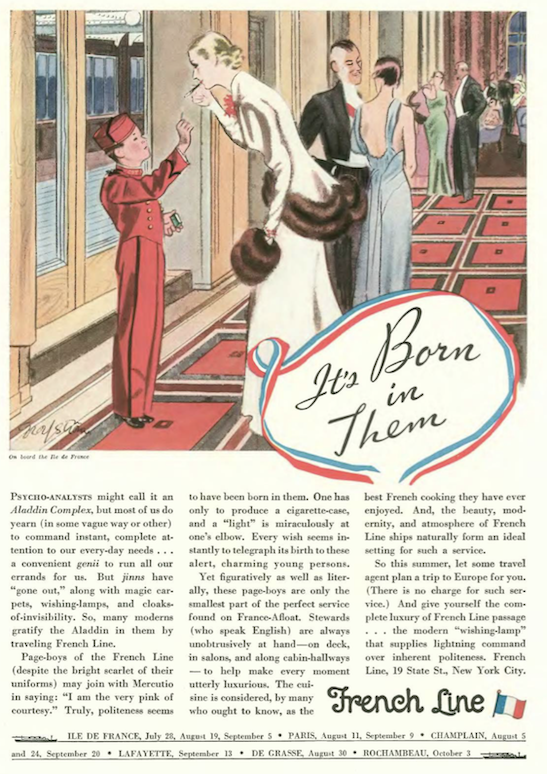
…this ad for the French Line, illustrated by Ruth Sigrid Grafstrom, offered a precious scene of a page-boy lighting a woman’s cigarette, a sight unimaginable today…

…and we close with a cartoon by Gardner Rea, doggone it…

Next Time: The Flying Season…

Not Even Funny

There were a number of people Dorothy Parker couldn’t abide. That included gifted writers who not only eschewed serious literature, but who instead chose to crank out a lot of mass-market trash.

March 18, 1933 cover by William Steig.

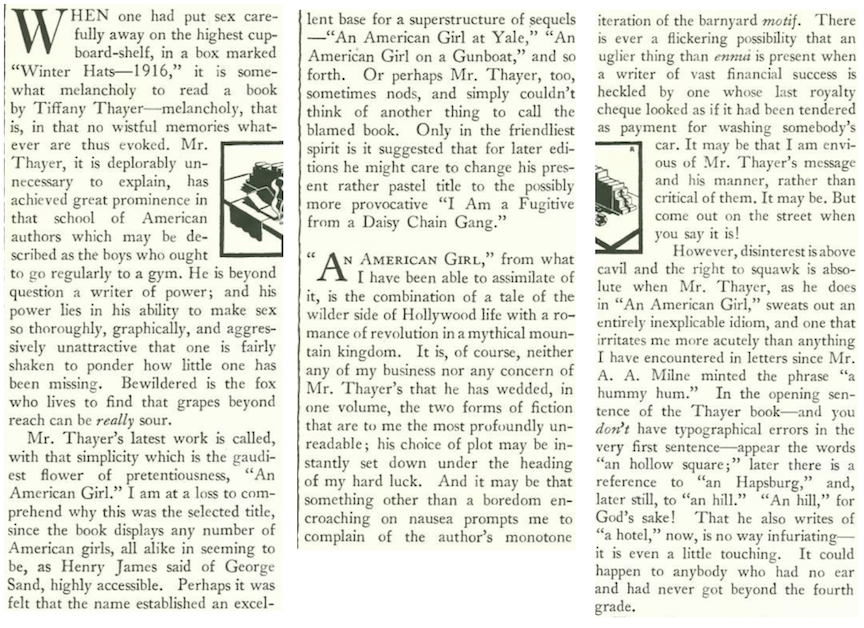
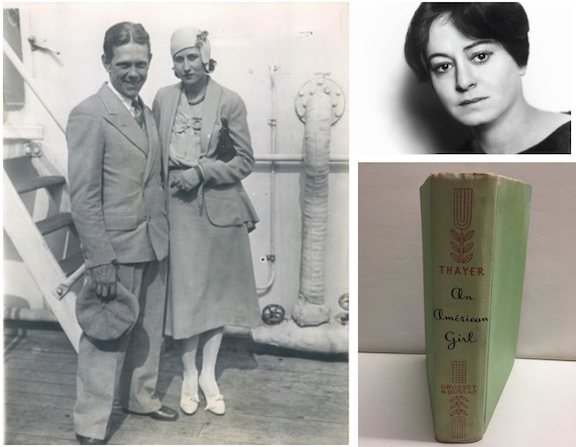
Parker was well acquainted with Tiffany Ellsworth Thayer (1902–1959), and for a time she even associated with the Fortean Society, which Thayer founded in 1931. Inspired by writer Charles Fort, the Forteans promoted the use of scientific methods to evaluate unexplained phenomena such as UFOs, spontaneous human combustion, and other oddities. Parker and fellow New Yorker writers Ben Hecht and Alexander Woollcott were among founding members, doubtless drawn to Fort’s reputation as a skeptic; however one famous skeptic, journalist H.L. Mencken, called Fort’s ideas “Bohemian mush.” It’s hard to say how long Parker stayed connected to the Society, but by 1933 she was fed up with Thayer’s novels, including his latest, An American Girl, which she found to be “the gaudiest flower of pretentiousness.” Here is an excerpt from Parker’s sometime column, “Reading and Writing,” subtitled Not Even Funny…

TIFF WITH TIFFANY…At left, Tiffany Thayer aboard a cruise ship with an unidentified woman, most likely his first wife, a dancer named Tanagra, early 1930s; at right, Dorothy Parker and a first edition of the offending volume. In her review, Parker observed that Taylor “is beyond question a writer of power; and his power lies in his ability to make sex so thoroughly, graphically, and aggressively unattractive that one is fairly shaken to ponder how little one has been missing.” (IMDB/Worthpoint)

Although Thayer founded a society based on scientific reason, his pulp novels were filled with fantasy and prurient imagery. F. Scott Fitzgerald once observed that “curious children nosed at the slime of Mr. Tiffany Thayer in the drug-store libraries.”

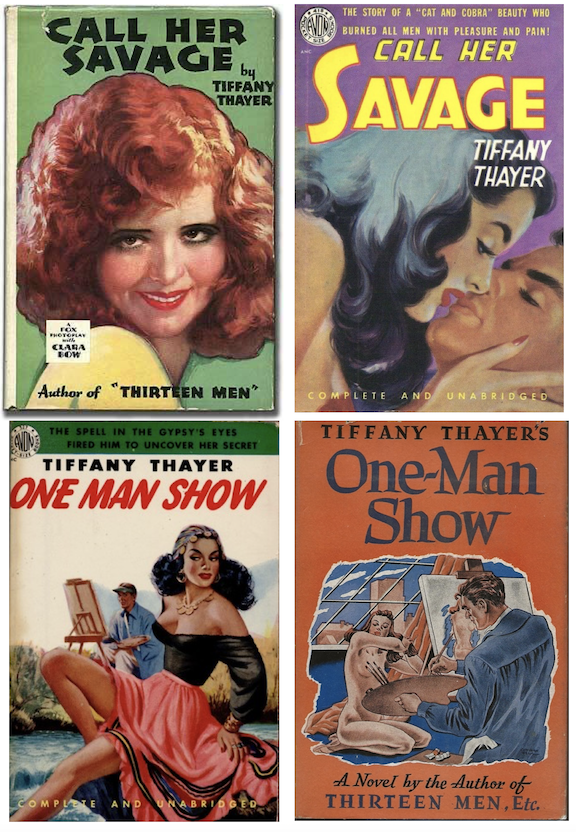
BELIED LETTRES…Clockwise from top left, Thayer’s 1931 novel Call Her Savage was made into a 1932 film starring Clara Bow, here featured on the book’s dustcover; the same novel repackaged in 1952 for the pulp trade; a 1943 edition of Thayer’s One-Man Show, and a 1951 Avon reprint that toned down the nudity but upped the creep factor. (facebook.com/biblio.com)

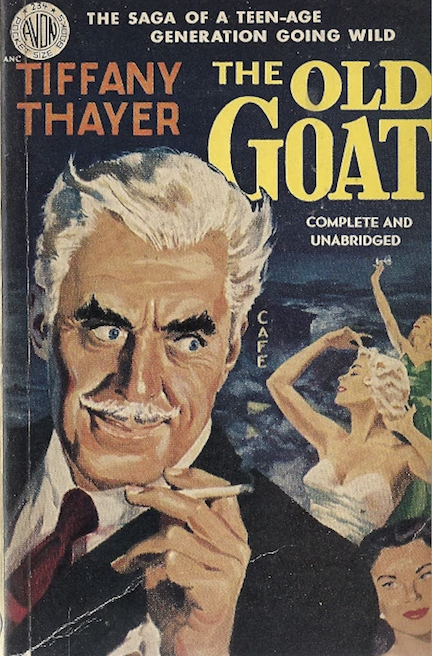
…and speaking of creep factor, check out Avon’s 1950 re-issue of Thayer’s 1937 novel The Old Goat, illustration attributed to Edgar Lyle Justis

(biblio.com)

Artists like Justis must have had a ball doing these illustrations, creating images to lure the unsuspecting into purchasing these old titles. Note how the coked-up old man sports not-so-subtle devil horns.

*  *  *

They Called It a Holiday

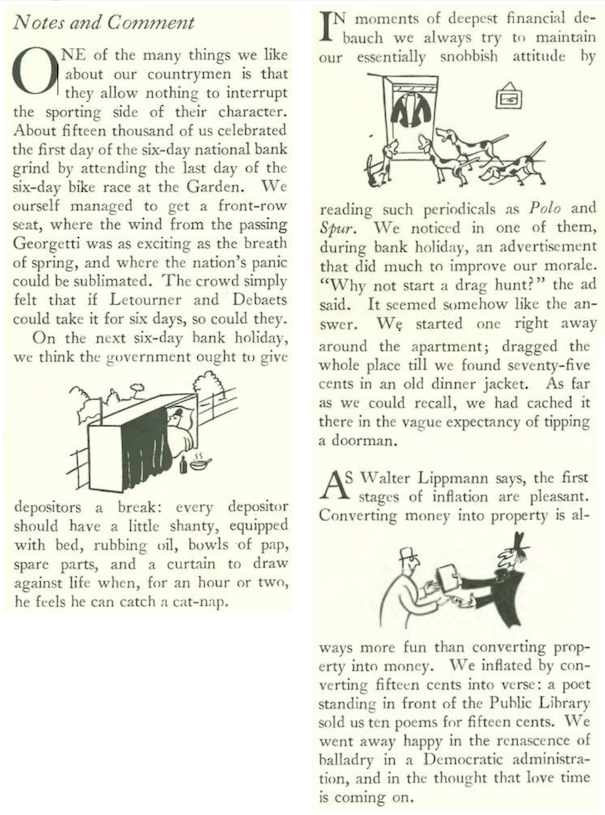
E.B. White, James Thurber (see below) and others in the March 18 issue commented on the national banking “holiday” declared by President Franklin D. Roosevelt in an effort to stabilize America’s banking system and rebuild public confidence. This led to the Glass-Steagall Act, signed three months later by FDR. Some observations in “Notes and Comment” by E.B. White, with the usual great spot illustrations by Otto Soglow

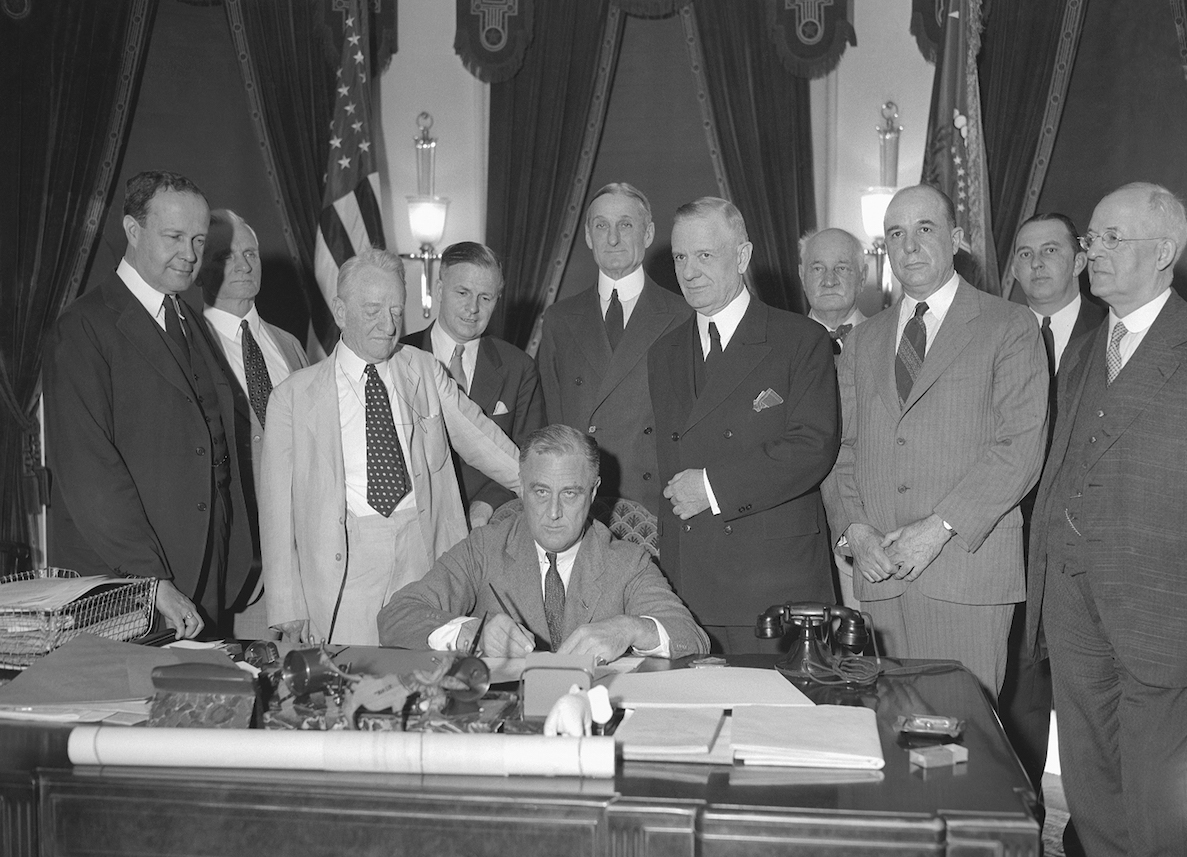
SAY CHEESE!…President Franklin D. Roosevelt signs the Glass-Steagall Act on June 16, 1933, effectively separating commercial banking from investment banking and creating the Federal Deposit Insurance Corporation (FDIC), among other things. (Associated Press)

…meanwhile, Germany’s new chancellor, Adolf Hitler, was busy abolishing civil liberties while pretending to be distressed by the behavior of his brownshirt thugs…an excerpt from Howard Brubaker’s “Of All Things”…

*  *  *

A Familiar Ring

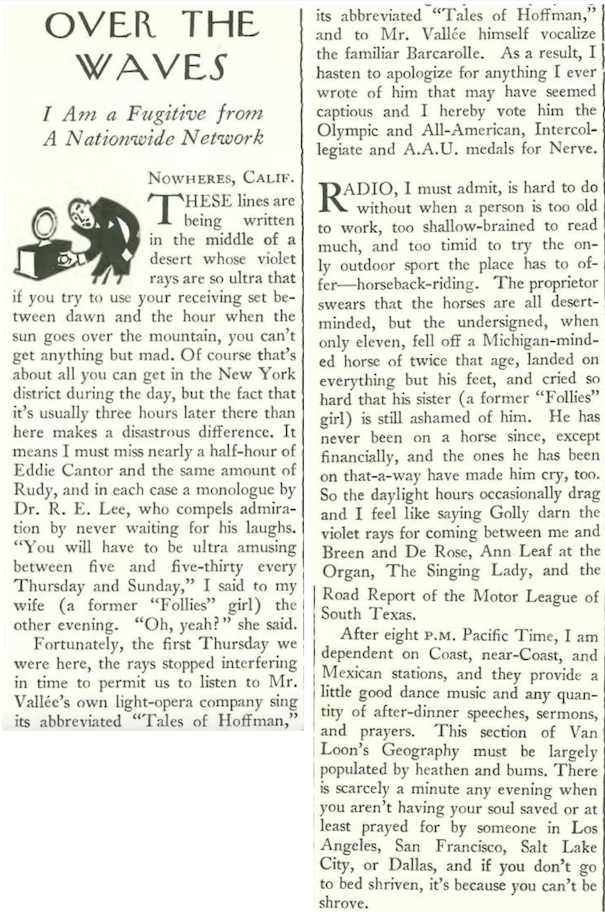
For the second week in a row Ring Lardner lent his wit to The New Yorker’s “Over the Waves,” column, which typically reviewed the latest news and entertainment beamed from the radio tower atop the Empire State Building. Lardner, however, was in California, lamenting the challenges of the time lag. An excerpt:

AND NO WI-FI, EITHER…Ring Lardner (center) detailed the frustrations of listening to New York-based radio entertainers like Eddie Cantor (left) and Rudy Vallée during his stay in California. (Pinterest/The Classic Archives/The New York Times)

 *  *  *

Dance Away Those Blues

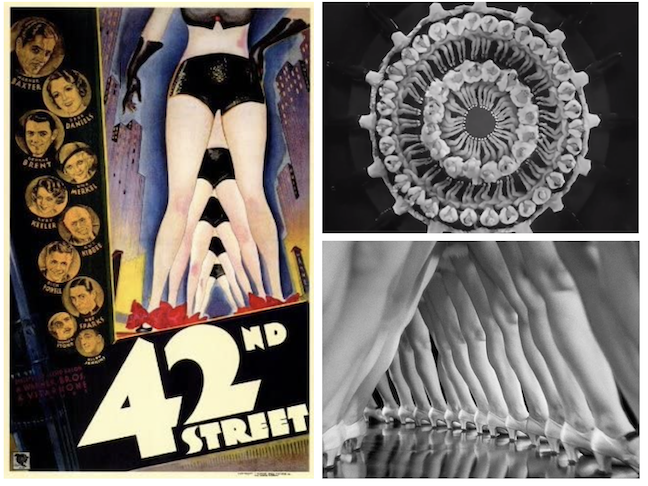
The pre-Code musical 42nd Street received a brief, albeit mostly positive review from critic John Mosher, who along with the producers of the film knew Depression-weary Americans needed such distractions. Nearly 90 years later (April 10, 2020), another New Yorker film critic, Richard Brody, suggested 42nd Street as one of the best films to stream during the Covid-19 pandemic: “Modern musicals start here, and Busby Berkeley’s genius bursts into full flower,” he wrote.

DANCE ‘TIL YOU DROP…Under pressure to produce a hit after losing his lead dancer (Bebe Daniels) to a broken ankle, Broadway musical director Julian Marsh (Warner Baxter, center) mercilessly rehearses her replacement, Peggy Sawyer (Ruby Keeler, in her film debut) before the premiere, vowing “I’ll either have a live leading lady or a dead chorus girl.” Looking on (to the right of Baxter) is Ginger Rogers, who portrayed “Anytime Annie.” (tcm.com)
A LEG UP ON HIS CAREER…42nd Street was a breakthrough film for choreographer Busby Berkeley, who would direct and choreograph a long string of musicals until the 1960s. The film is now considered a classic, preserved in the United States National Film Registry. (IMDB)

…and for trivia buffs, during an opening scene Bebe Daniels is shown reading the February 20, 1932 (anniversary) issue of The New Yorker…

*  *  *

From Our Advertisers

A convertible LaSalle (a downscale Cadillac brand) looks like a great way to enjoy a drive along the beach…let’s hope it has enough acceleration to outrun the tsunami apparently heading its way…

Walter Chrysler continued to dig into his deep pockets for two-page color spreads, including this one that placed his humble DeSoto in St. Moritz, of all places…

…not to be outdone, the folks at Nash found another exotic locale for their budget-priced sedan…Chicago, that is, at the 1933 Century of Progress Exhibition…and for an extra touch of class, we have what appears to be a chauffeur attending to this modest motorcar…

…America’s top luxury car maker, Pierce Arrow — a regular advertiser in The New Yorker — decided a quarter-page ad was sufficient to keep their name before the eyes of the well-heeled…at right, an ad from another back page featured cartoonist Don Herold shilling for the makers of imitation liquor flavors…according to the ad, one bottle, obtainable from your druggist, “flavors a gallon” of whatever forsaken hootch you are consuming…

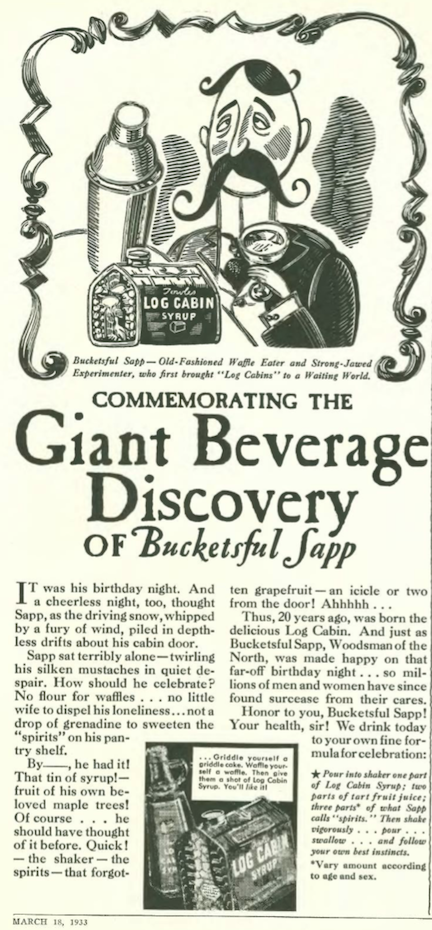
…the folks at Log Cabin relied on the talents of another New Yorker cartoonist, John Held Jr., to make both their product and a signature cocktail a more palatable experience…

…I have to hand it to the folks at Heinz for signing off on an advertisement only a vampire would find appealing…

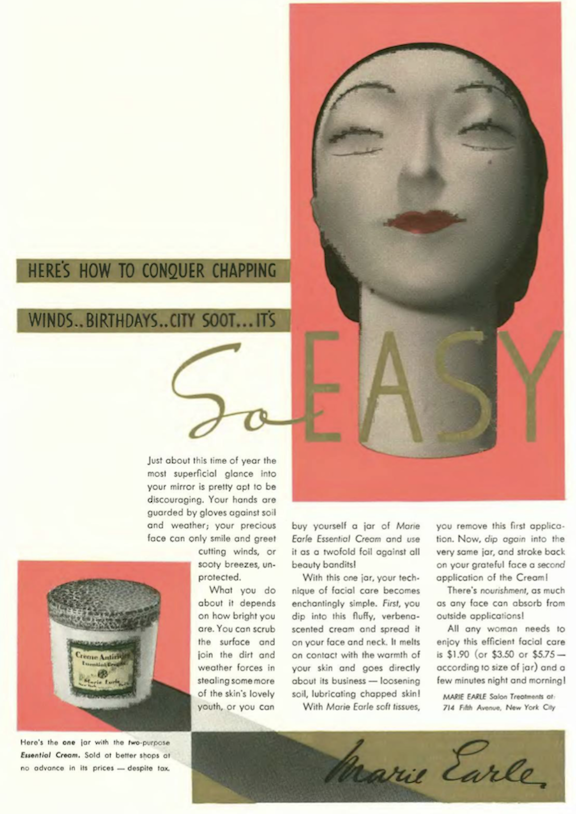
…the purveyors of Marie Earle beauty products rolled out this modern ad to promote their “Essential Cream”…

…while staid Brooks Brothers remained true to form — no flashy colors or advertising jargon — just straight talk about price increases….

…and then there’s the upmarket Fortnum & Mason, appealing to America’s Anglophiles with one of their famed wicker hampers filled with various goodies selected for “charming and greedy people”…

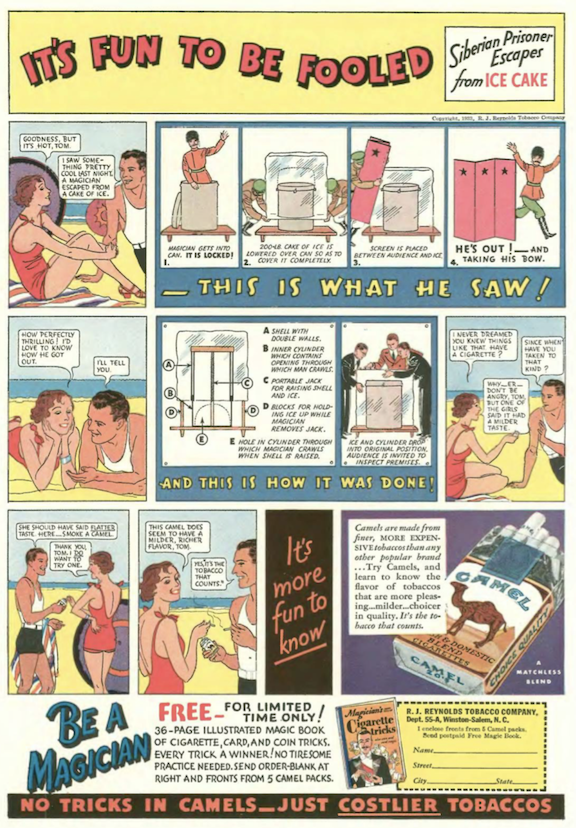
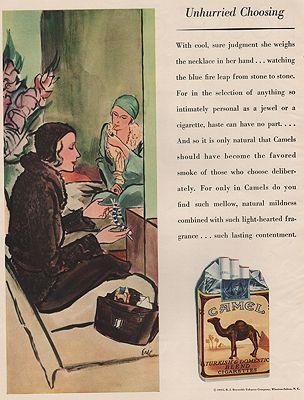
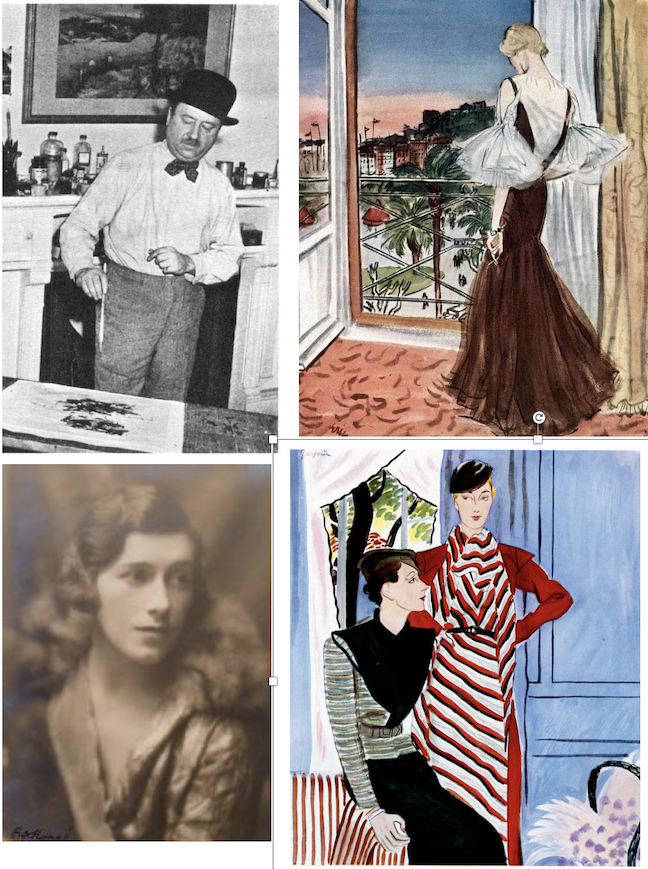
….for several years R.J. Reynolds employed the services of Carl “Eric” Erickson (1891–1958) to illustrate a series of ads featuring classy, disinterested, continental types smoking their Camel brand cigarettes…despite their less-than-exotic name, the makers of Spud menthol cigarettes hired Ruth Sigrid Grafstrom (1905–1986) to create their own smart set of smokers…

…ads that bore a striking resemblance to Erickson’s Camel work (this example from 1931)…

…and for your consideration, works from 1933 by Carl Erickson and Ruth Sigrid Grafstrom…both were noted fashion illustrators…

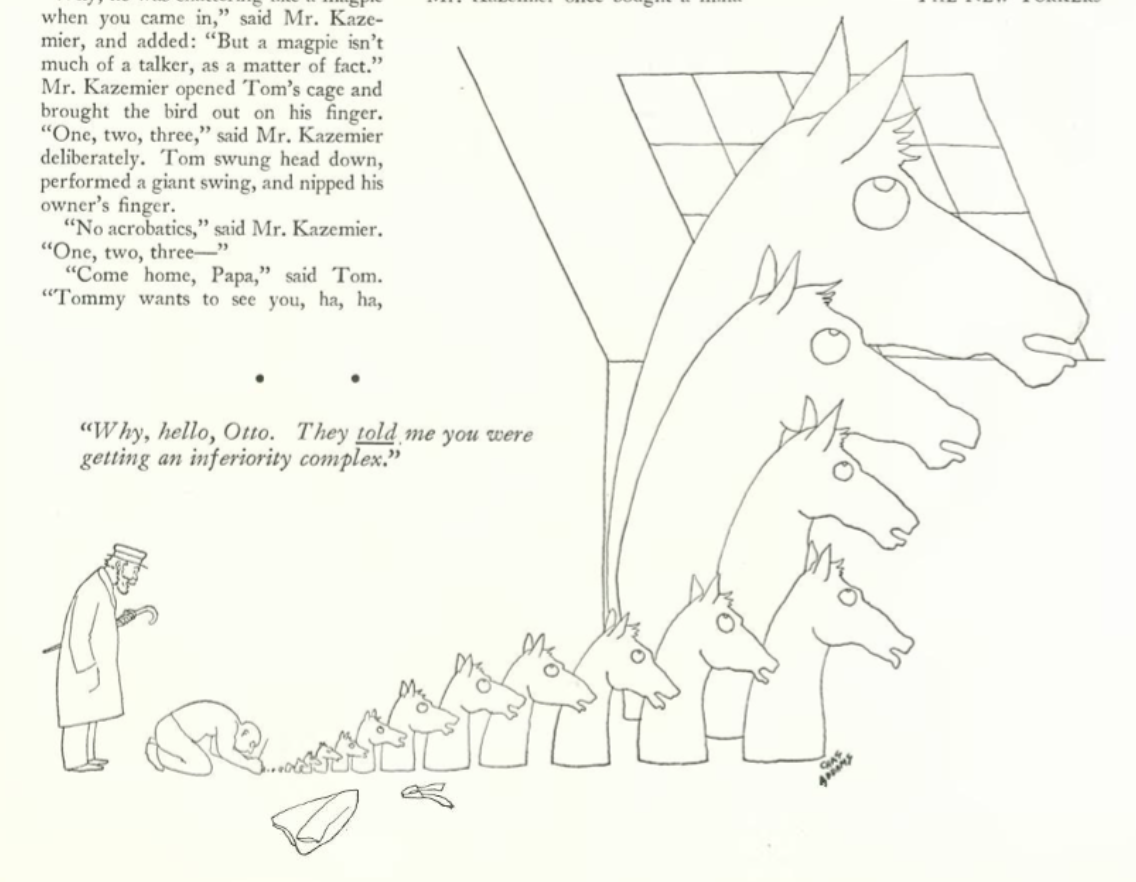
…on to our cartoonists, we begin with Charles Addams, who’d just published his first New Yorker cartoon the previous month, in the Feb. 4, 1933 issue

…that first cartoon was simply signed “Addams”…here he used the familiar “Chas Addams”…a close-up of the signature…

…we continue with a great caricature by Al Frueh to accompany a profile of Rudolf Kommer (as told by Alexander Woollcott)…

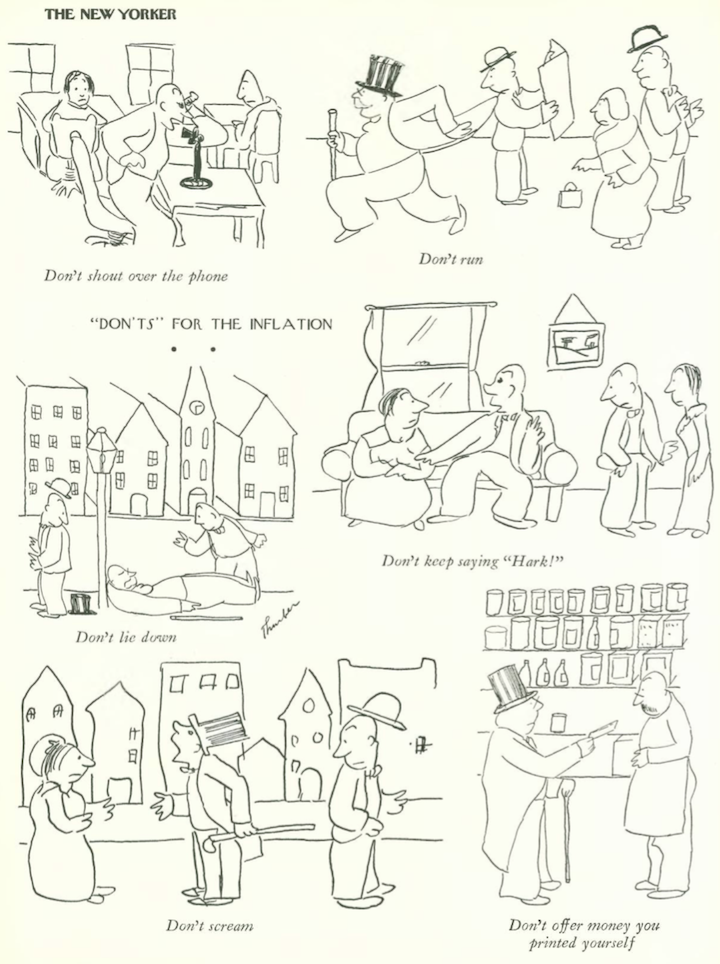
…a delightful full page of bank holiday-themed cartoons by James Thurber

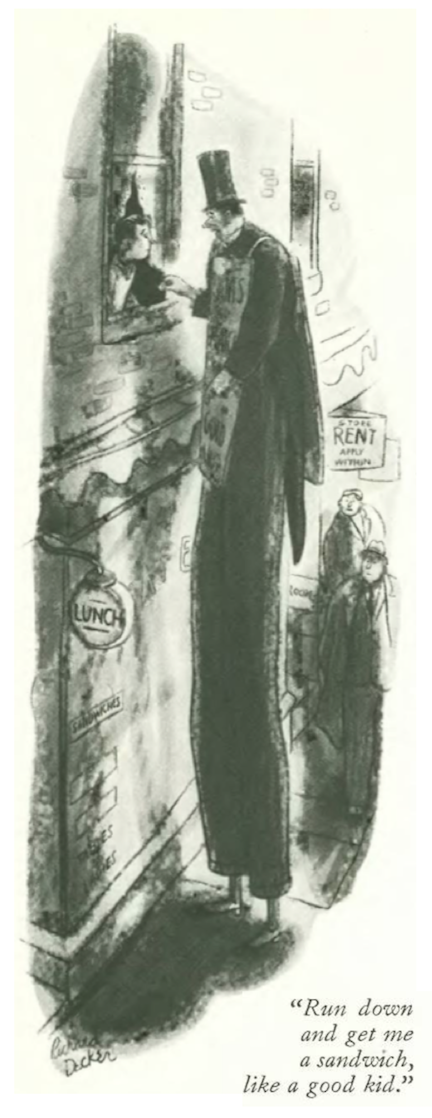
Richard Decker offered up a tall tale…

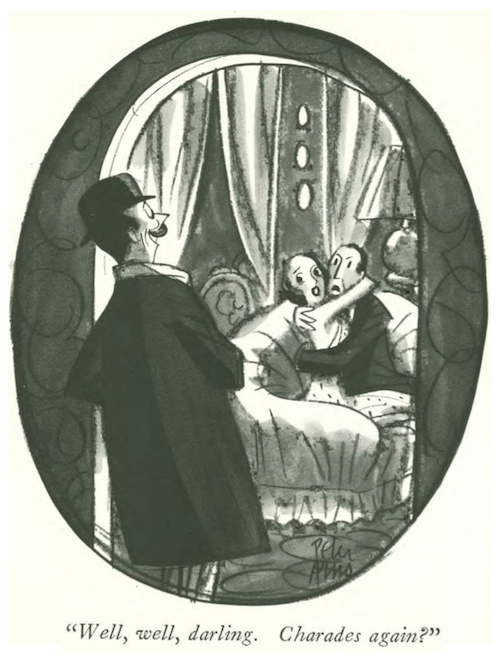
…and we close with Peter Arno, who served up one of his clueless cuckolds…

Next Time: Diary of a Lady…