It was no surprise Dorothy Parker did not think much of society types, especially those afflicted with extreme solipsism.
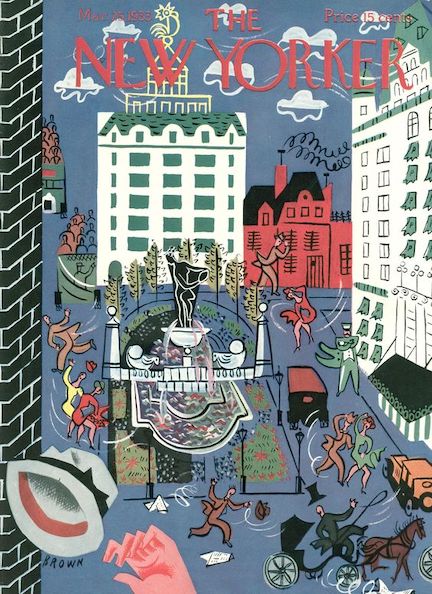
March 25, 1933 cover by Harry Brown.
Parker’s “The Diary of a Lady,” briefly excerpted here, featured entries from a diary of a fictional socialite who constantly bemoaned the minor inconveniences of her shallow existence, oblivious to the world around her.
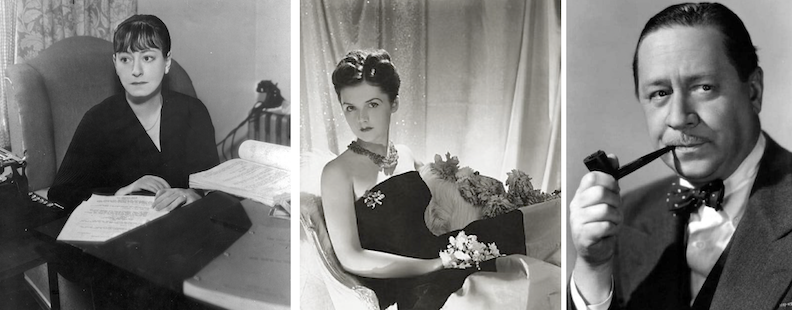
YOU POOR THING…Dorothy Parker (left) took a dim view of the lives of “poor little rich girls” like socialite Brenda Frazier (who had a tempestuous relationship with New Yorker cartoonist Peter Arno); Robert Benchley, on the other hand, took a more jolly view of human absurdity. (britannica.com/Wikipedia/theattic.space)
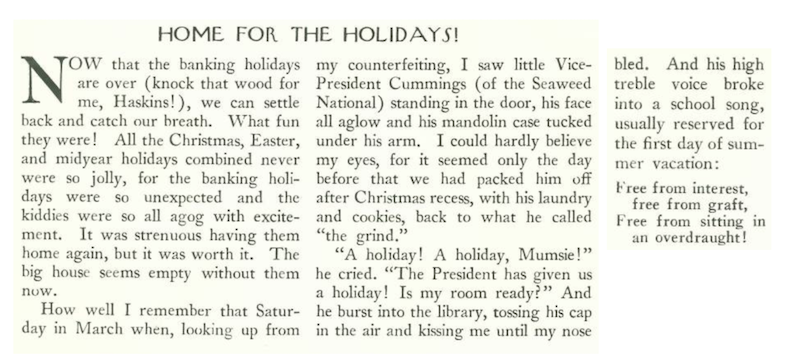
In contrast to Parker, Robert Benchley’s satire was usually more on the silly side, with a lot less bite. Here is an excerpt from “Home for the Holidays” (which immediately followed Parker’s piece in the magazine), in which Benchley describes the festive mood of one family during FDR’s “bank holiday”…
* * *
On the Lighter Side
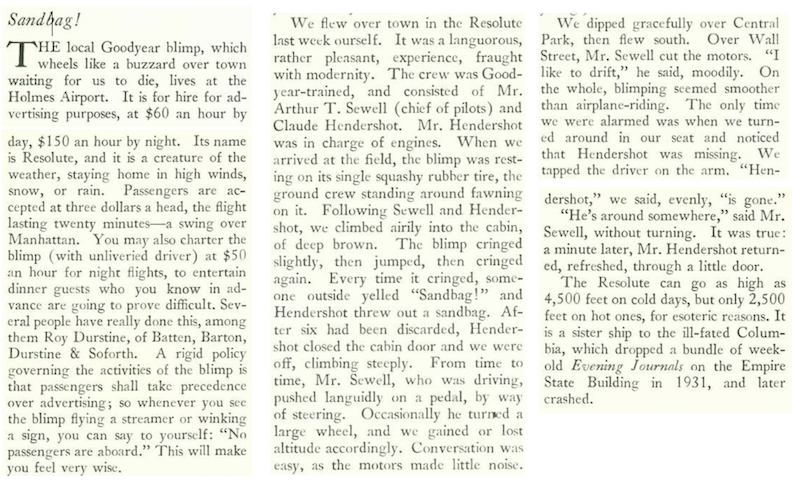
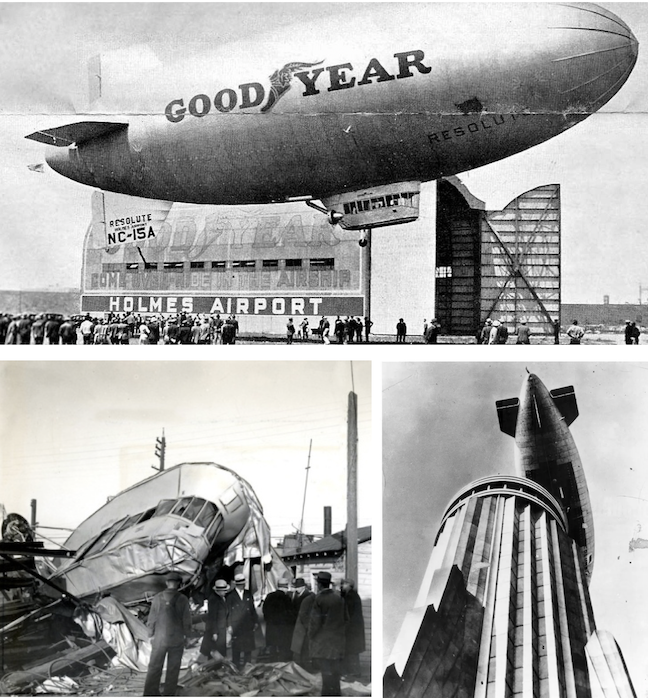
E.B. White was the unofficial aviation correspondent for The New Yorker, ever eager to go aloft in the latest contraption. In this excerpted “Talk of the Town” entry White described his adventures aboard the Goodyear blimp Resolute:
WHAT A GAS…Top photo, the Resolute at its home base, Holmes Airport (in Jackson Heights, L.I.), where E.B. White boarded his flight. As White noted, Resolute was a sister ship to Columbia, famed for dropping off a bundle of newspapers (lowered on a 100-foot-line) at the top of the Empire State Building; bottom photos, Columbia flying over the the mast of the Empire State Building in 1931—seven months later, on Feb. 12, 1932, its wreckage near Flushing Bay. (kathrynsreport.com/New York Times)
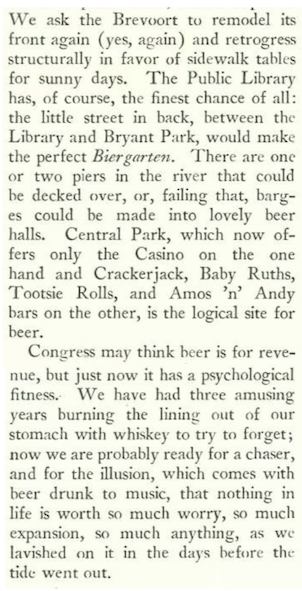
And we turn again to White, this time an excerpt from his “Notes and Comment” celebrating Franklin D. Roosevelt’s planned amendment to the Volstead Act that would allow people to have a legal beer while they waited for the 21st Amendment to be ratified. White had a couple of ideas regarding locations for beer gardens. An excerpt:
BEER THIRTY…E.B. White believed the front of the internationally famous Brevoort Hotel (next to the Mark Twain House at the southeast corner of Fifth Avenue and 9th Street) would be an ideal spot to quaff some suds. Alas, the hotel (and the Twain house) fell to the wrecking ball in 1952, replaced by the Brevoort apartments (right). (MCNY/streetwise.com)
Although the Brevoort idea didn’t pan out, White did get his wish, more or less, for a Bryant Park location, the Bryant Park Grill…
(bryantpark.org)
* * *
Mayor McCarthy
The profile featured Stitch McCarthy, considered one the most flamboyant “street mayors” of the Lower East Side. Writing in Lapham’s Quarterly (Aug. 1, 2018), Laurie Gwen Shapiro describes McCarthy as “a five-foot-tall, cross-eyed Romanian Jew born Samuel Rothberg, always seen with a cigar in his mouth.” What Stitch lacked in height he made up for in toughness, and by his teens was as tough as nails. Shapiro writes: “At night he managed a small-time boxer who once was scheduled to fight a bantamweight named Stitch McCartney in Jersey City. As he later told the story (no doubt over and over), his client fled in fear at the sight of McCartney and the crowd booed. He went in the ring himself, flattened McCartney, and took a version of his opponent’s name for his own.”
The profile was written by Meyer Berger, known as a master of the human interest story. Berger did a short stint at The New Yorker but for most of his career he worked for The New York Times, where he wrote a long-running column, “About New York.” Here is a very brief excerpt of the profile, with a caricature by Al Frueh.
TOUGH AS NAILS was what you became if you wanted to be one of the unofficial mayors of the Lower East Side like Stitch McCarthy, seen here in 1931. According to Laurie Gwen Shapiro, street mayors “were likable fixers who cut through red tape and might settle between fifteen and twenty neighborhood disputes a day.” Photo at left (by Berenice Abbott) is a scene from McCathy’s world—Hester Street, between Allen and Orchard Streets. (New York Public Library/Lapham’s Quarterly)
* * *
From Our Advertisers
I would guess Dorothy Parker would have some problems with this ad, featuring society women shilling for nail polish…
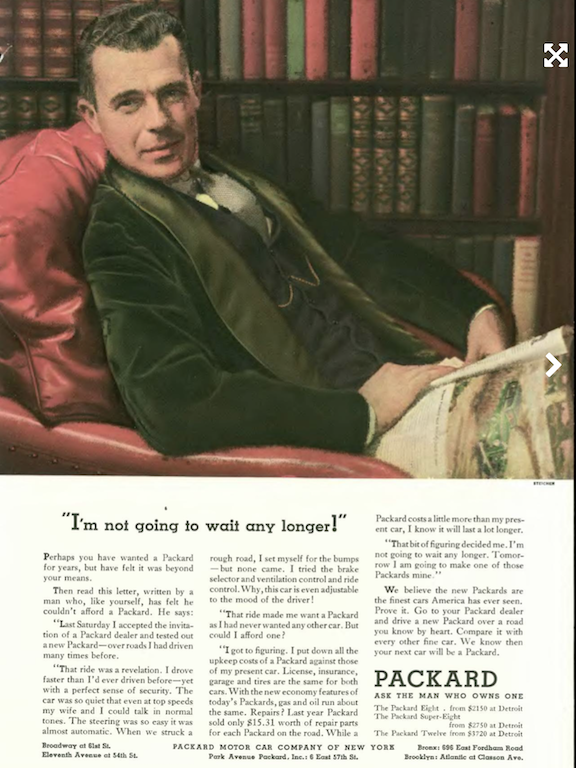
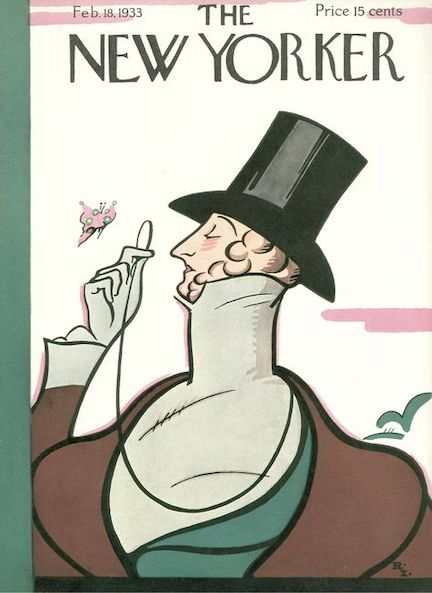
…the folks at Packard went with an ad that showed the ideal customer (seated in a library, clad in smoking jacket), contemplating one of their recent ads (the same one that was featured in the Feb. 18, 1933 issue of The New Yorker…
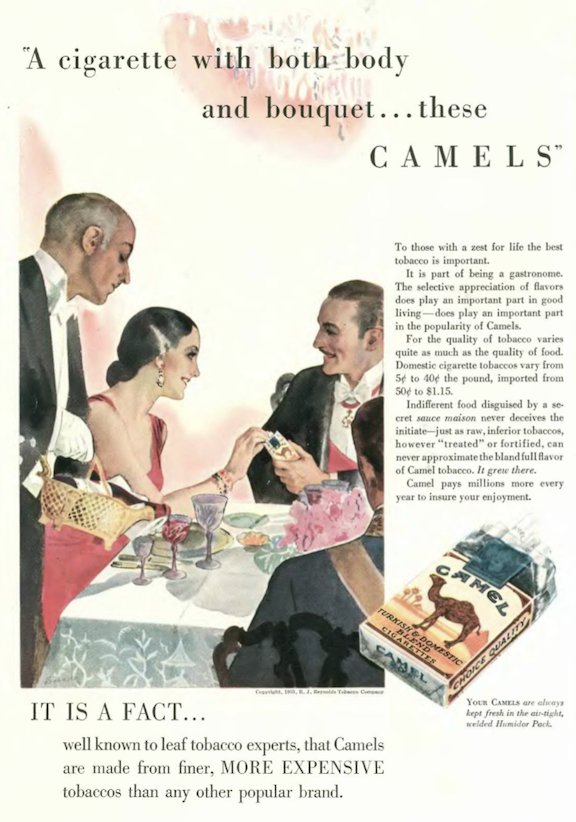
…Camel ads took on a new look thanks to the artistry of Ray Prohaska (1901–1981)…in the early 1930’s you see more use of watercolors in ads for fashion, or in this case, cigarettes…
…and Gardner Rea drew up this scene for the makers of Sanka coffee, the decaf of its day…
…which leads into the work of other New Yorker cartoonists and another master of the line drawing, Gluyas Williams…
…Robert Day offered a bit of understatement…
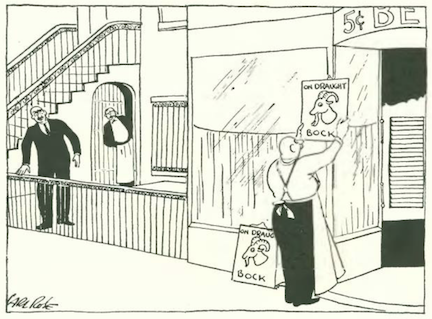
…Carl Rose celebrated the arrival of legal beer…
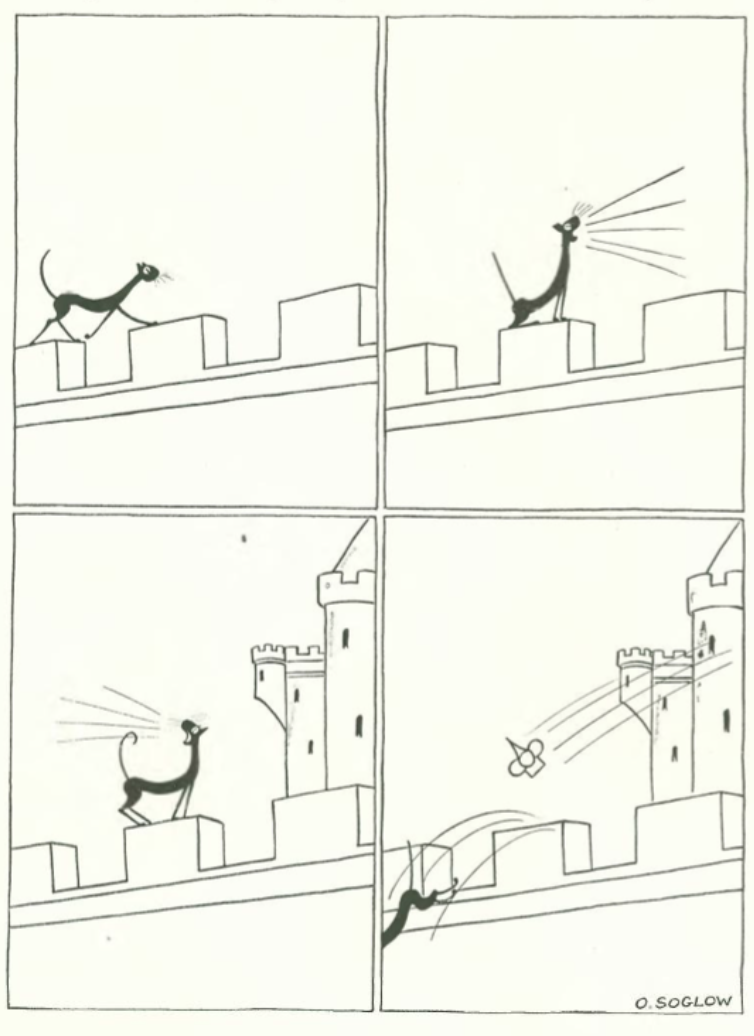
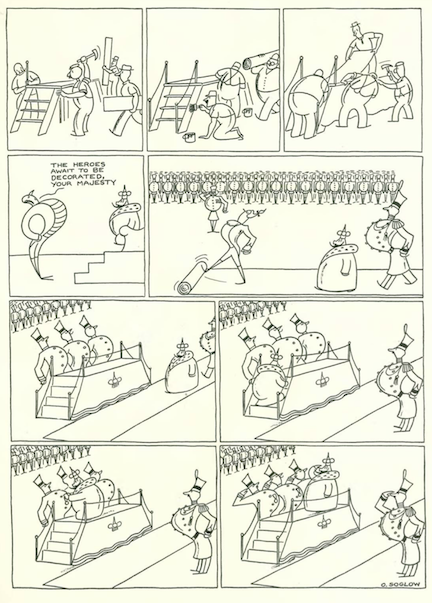
…Otto Soglow showed us how royalty responds to a noisy feline…
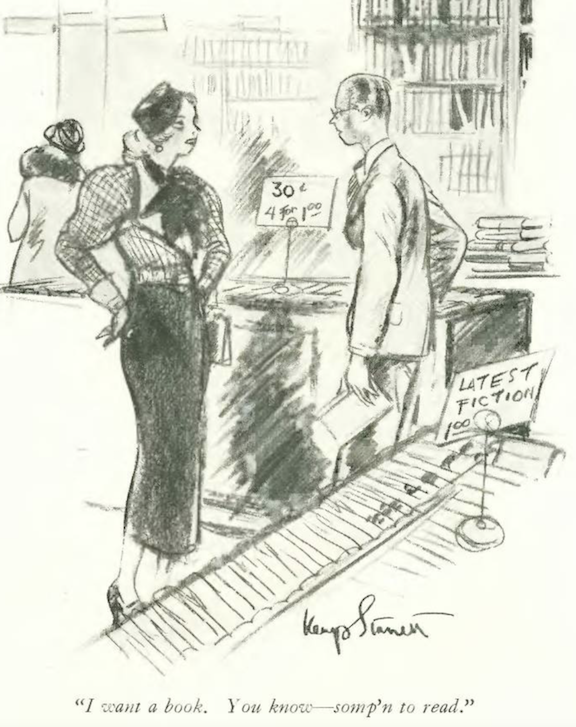
…Kemp Starrett shopped for somp’n to read…
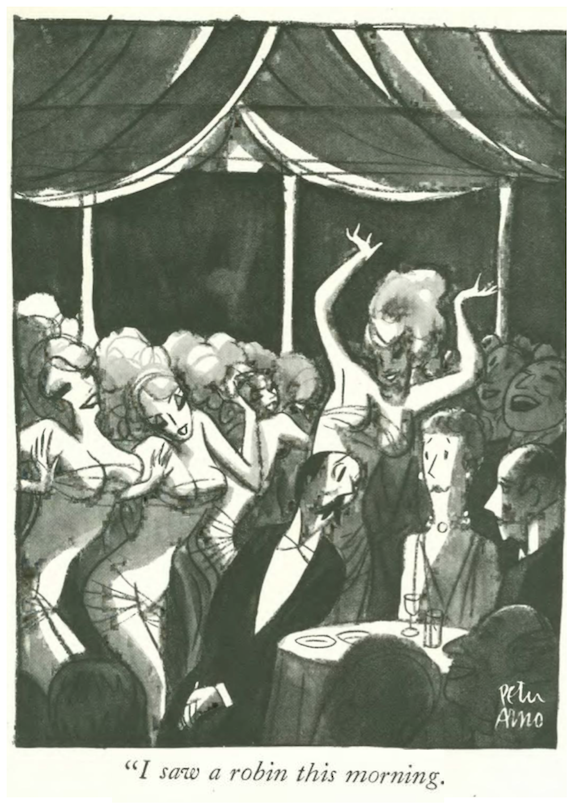
…and we close with Peter Arno, and an ill-timed joke, at least for one woman…
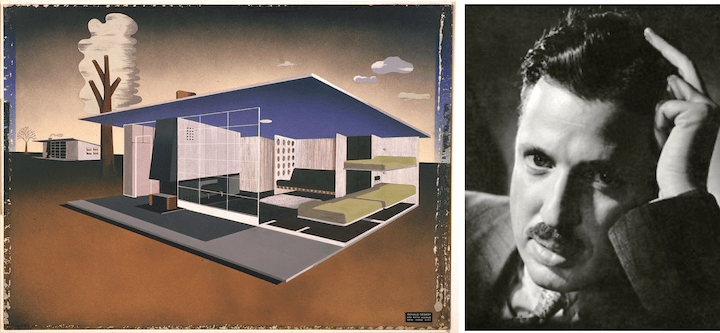
Above, Donald Deskey's Design for a Sportshack, 1940 (Cooper Hewitt)
If you’ve never heard of Donald Deskey, you’ve most likely seen his work.
Feb. 25, 1933 cover by Rea Irvin.
Cultural critic Gilbert Seldes featured Deskey in the Feb. 25 profile (“The Long Road to Roxy” — with illustration by Al Frueh), noting that his subject had come to his profession as an industrial designer in a rather roundabout fashion. Here is a brief excerpt:
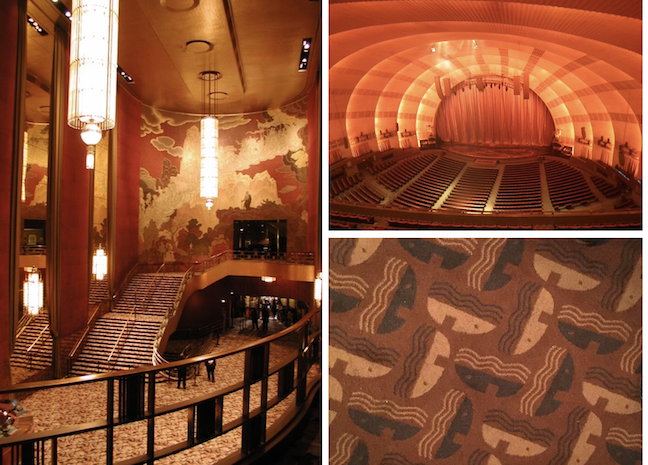
Deskey (1894–1989) was locally known in the late 1920s for his window displays at New York’s Franklin Simon Department Store, but it was his work at Roxy Rothafel’s new Radio City Music Hall that made him a marquee name in the design world. Although known for popularizing the Art Deco style, his interior designs for RCMH were noted for their restraint, signaling a break from the lavish, ornate designs of the city’s earlier performance spaces.
FEAST FOR THE EYES…Donald Deskey designed more than thirty spaces in Radio City Music Hall, including the Grand Foyer (left) and several lounges, each featuring a distinct visual motif. At bottom right, auditorium’s “Singing Woman” carpeting. (archdaily.com/drivingfordeco.com)
Original Deskey creations are highly prized today by collectors and museums…
DESIGN IN MOTION…Clockwise, from top left, Deskey’s “Guest Bedroom for Mrs. John D. Rockefeller, Jr.” (Abby Aldrich Rockefeller), on display at the 1931 American Union of Decorative Artists exhibition; Deskey table lamp, circa 1927; linen panel, circa 1930s; Deskey desk, circa 1930. (brooklynmuseum.org/artic.edu/Pinterest)
…and if that wasn’t enough, Deskey also designed logos for many consumer products in the late 1940s and 1950s…
THE TOTAL PACKAGE…Deskey designed some of the most iconic logos of midcentury America, including, clockwise from top left, Tide laundry detergent (1947); Gleem (1956) and Crest (1955) toothpastes; Cheer laundry detergent (1952); JIF peanut butter (1956) and Joy dishwashing liquid (1950).
* * *
From Our Advertisers
It seems appropriate to follow Mr. Deskey with some words and images from our sponsors, including the folks at Cadillac who continued to hammer home the snob appeal of their motorcar while also giving a nod to those hard times by emphasizing the car’s economy…
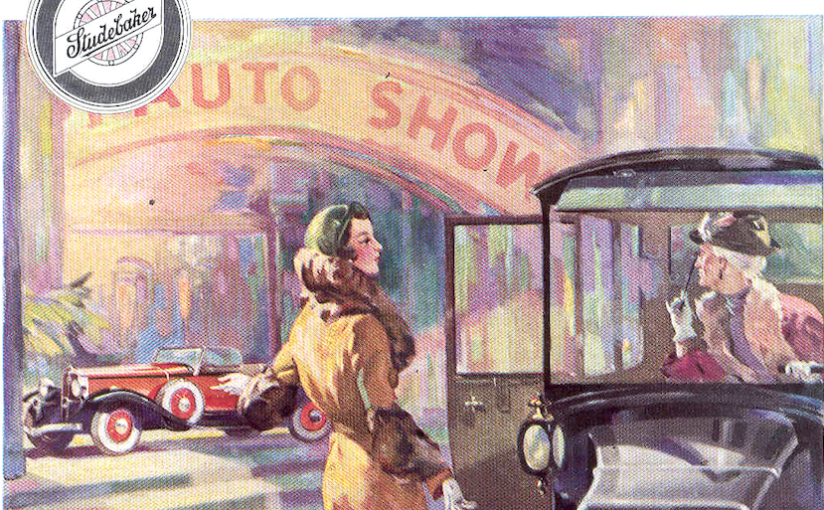
…meanwhile, Studebaker was back with another full page ad—again featuring the admiring giant woman—in a vain attempt to push their fledgling, and unpopular line of Rockne automobiles…
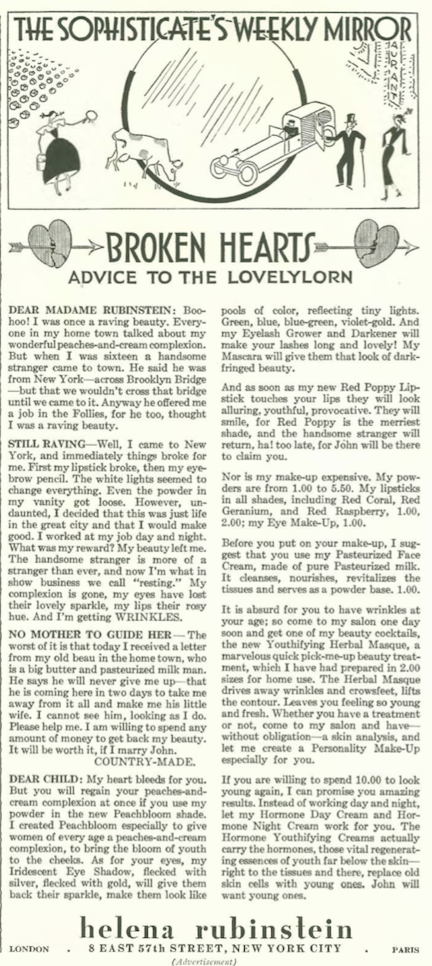
…and Helena Rubenstein continued her series of ads disguised as advice columns…the advice here was to shame women into buying her products…
…after Helena removed your wrinkles you could restore them with GE’s Mazda sunlight lamp…
…Otto Soglow, on the brink of becoming a very wealthy man thanks to his Little King cartoons, continued to lay down some ink on behalf of the makers of Sanka decaf…
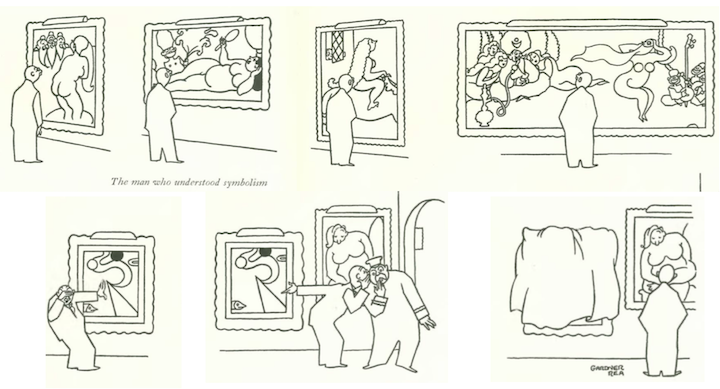
…and we move along to Soglow’s fellow cartoonists, beginning with Gardner Rea and a cartoon sequence spread across pages 24-25…
…here it is again, rearranged for closer inspection…
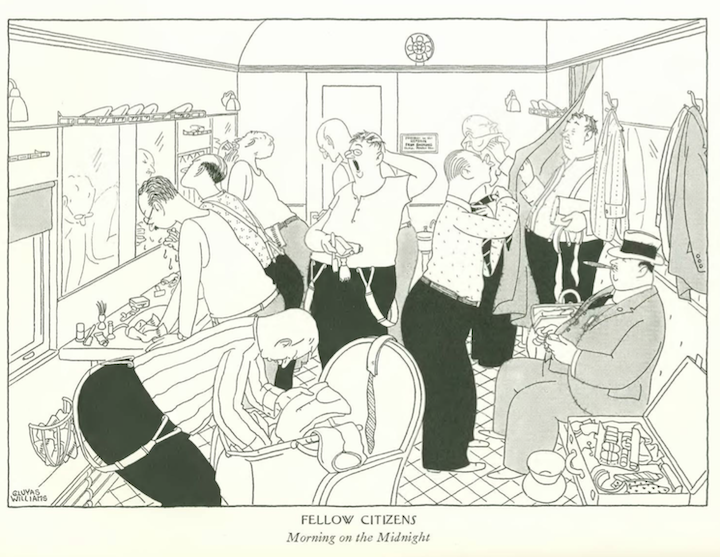
…and we have another terrific “Fellow Citizens” drawing by Gluyas Williams, which originally ran sideways on a full page…
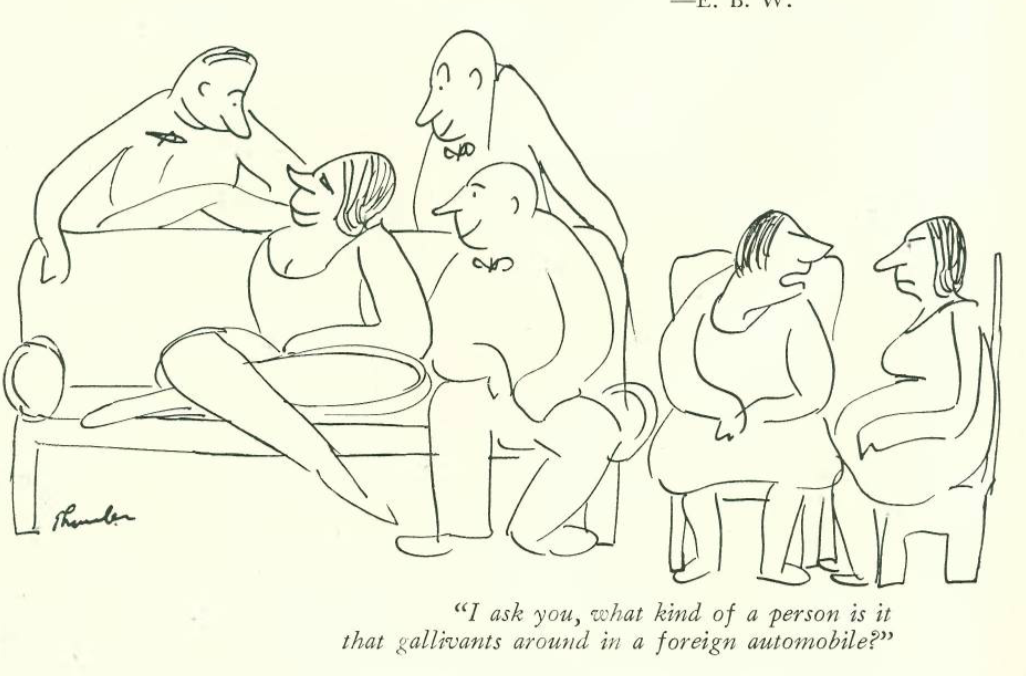
…I like this James Thurber drawing for its utter disregard of scale—but of course (and thankfully) it wouldn’t be a Thurber if he cared about such things…
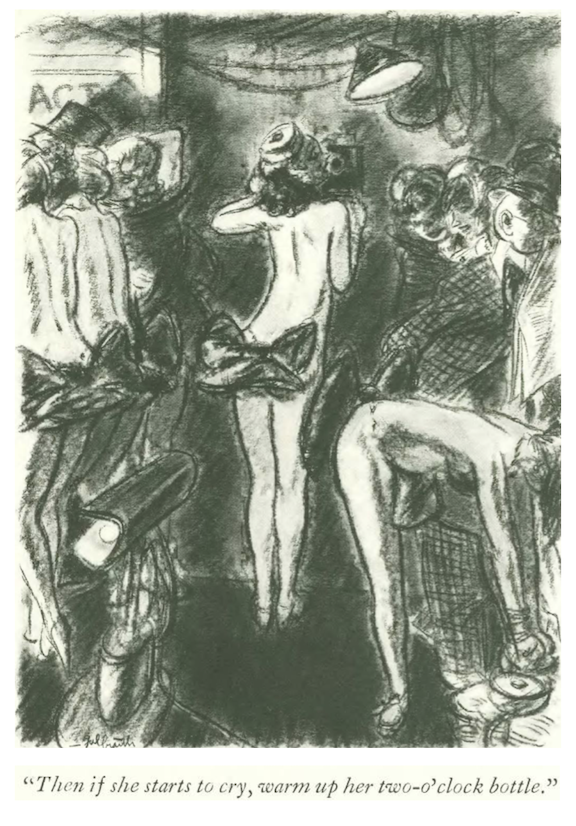
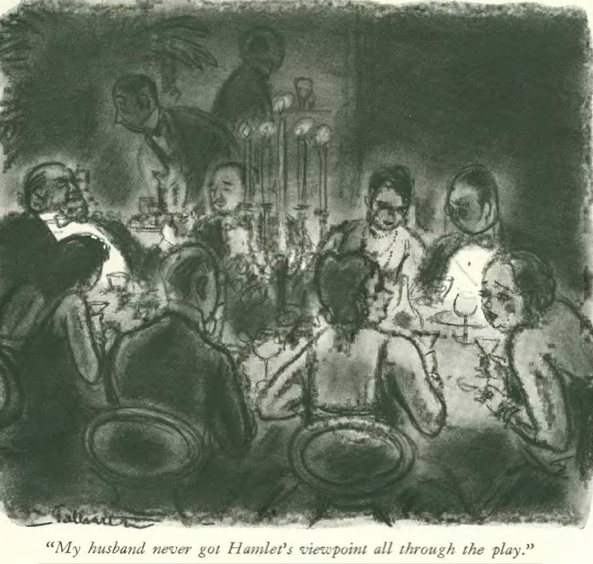
…William Crawford Galbraith was still hung up on showgirls and sirens…
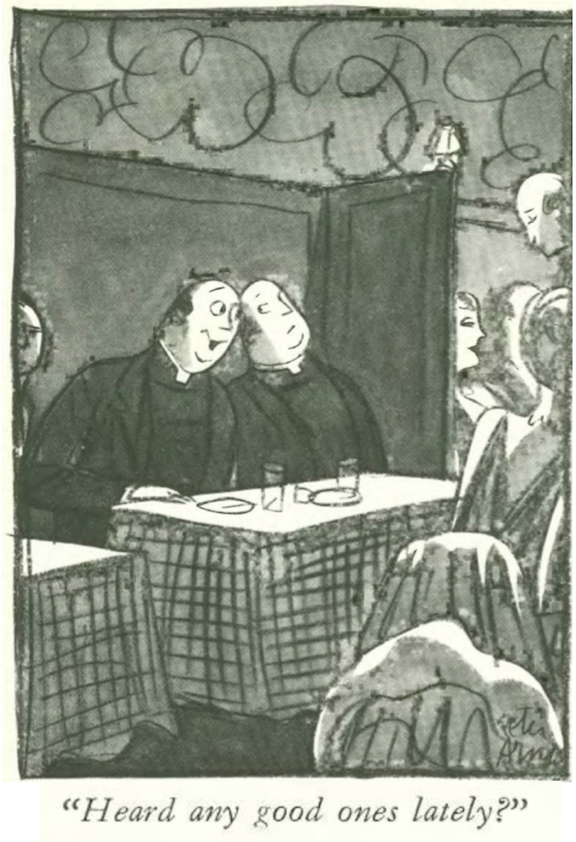
…while Peter Arno explored his spiritual side, as only Arno could…
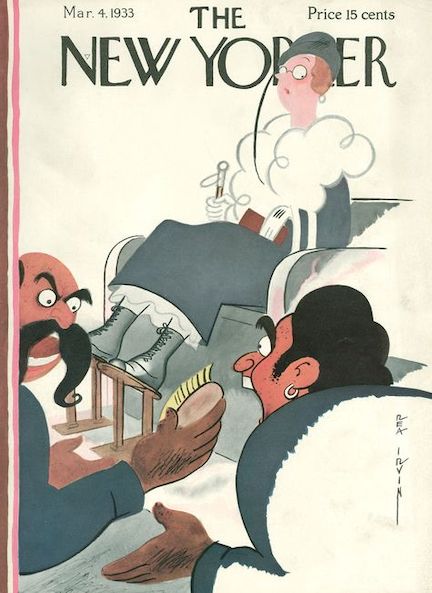
…and we move along to March 4, 1933…
March 4, 1933 cover by Rea Irvin.
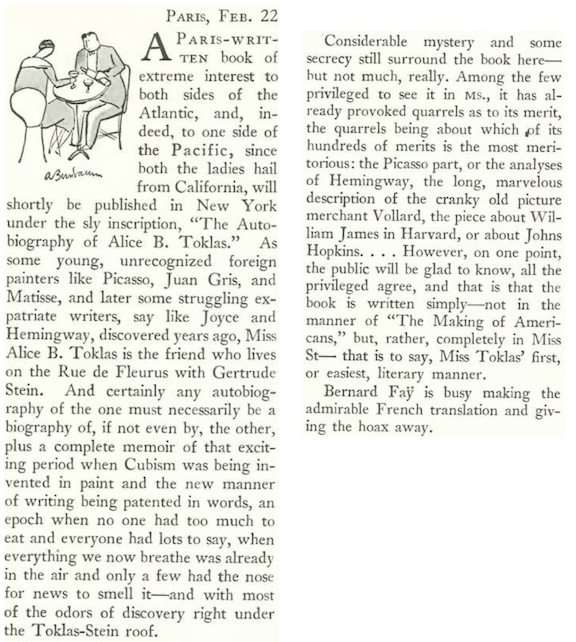
…in which The New Yorker’s Paris correspondent Janet Flanner (“Genêt”) wrote about a new book of “extreme interest to both sides of the Atlantic”…
BOOK OF REVELATION…Alice B. Toklas and Gertrude Stein were well known in the ex-pat community of 1920s Paris, but the publication of the American edition of The Autobiography of Alice B. Toklas (written by Stein) brought them fame in the wider world. Stein claimed she wrote the book — now considered a 20th century classic — in six weeks to amuse herself and to make money. At right, Toklas and Stein at 27 Rue de Fleurus in a portrait by Man Ray, 1922. (Library of Congress)
* * *
Hope Springs Eternal
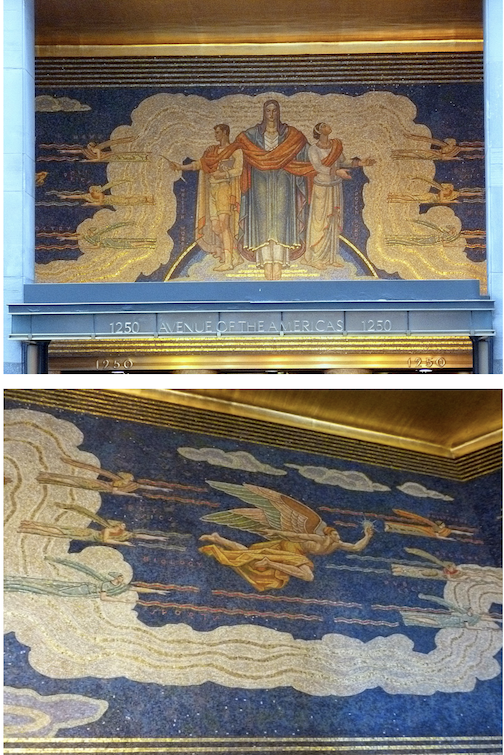
Even in the deepest depths of the Depression signs of hope abounded in works of public art, including a mosaic of one million hand-cut and hand-set glass tiles being prepared for the Sixth Avenue entrance to Rockefeller Center. Intelligence Awakening Mankind, by Barry Faulkner, celebrated the triumph of knowledge over the evil of ignorance. “The Talk of the Town” explained:
GOOD VIBES…Details of Intelligence Awakening Mankind include the central figure of Intelligence (top) sending knowledge into the far corners of the world. (Pinterest)
* * *
From Our Advertisers
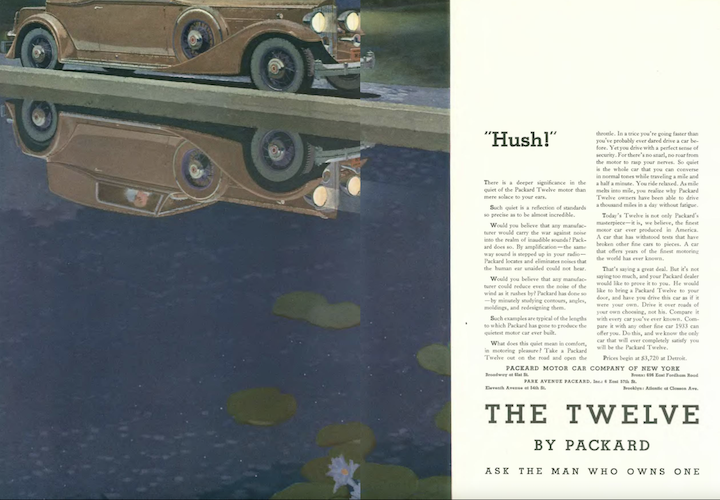
The folks at luxury brand Packard continued to counter their stodgy image with ads that emphasized other qualities including speed, durability, and here, serenity…despite the lengthy text, the ad also suggested modernity, with the sliced-off image and the single word “Hush!” to entice prospective buyers…
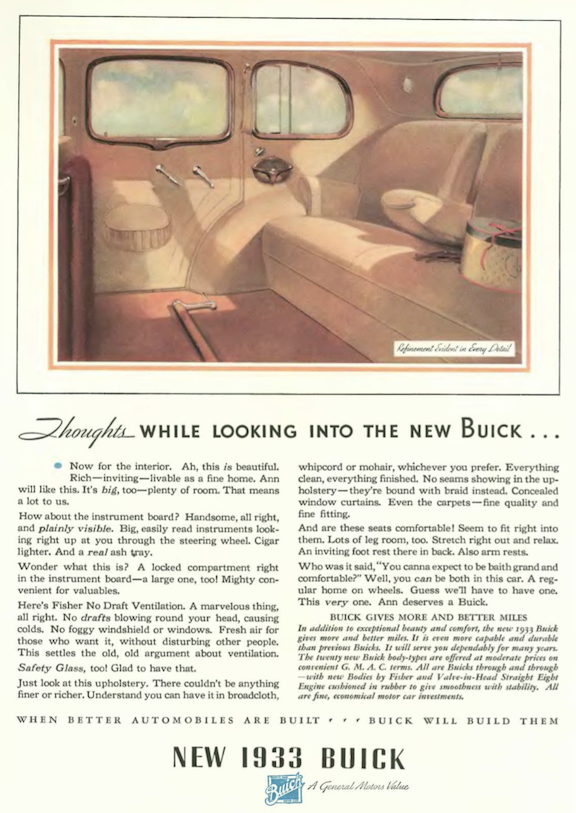
…if you couldn’t afford $3,720 for a 12-cylinder Packard, then you might have considered a Buick, “livable as a fine home” this ad claimed. And look at that back seat — you could comfortably fit three adults and a baby elephant in there…
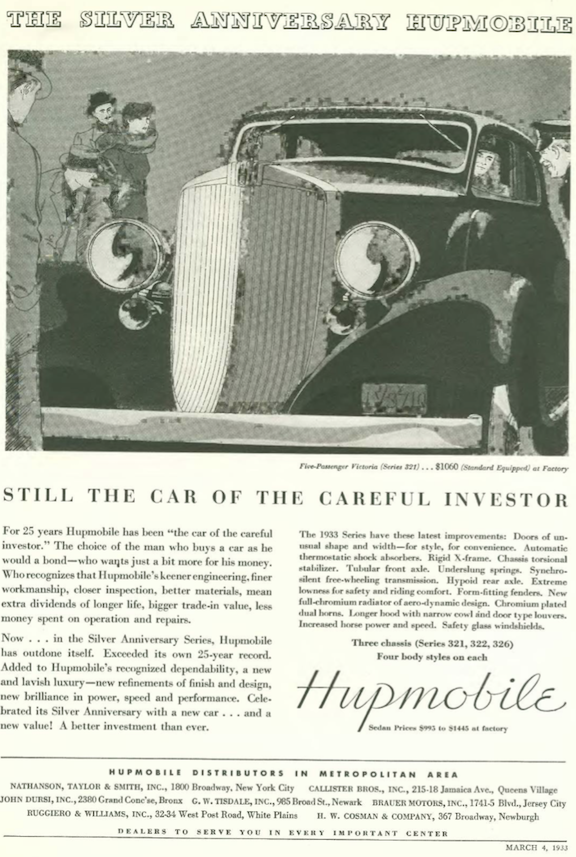
…and then there’s Hupmobile—for the price of a Packard 12 you could have purchased three Hupmobile Victorias (pictured below) with a good chunk of change left over…here the company celebrates its silver anniversary…a couple of odd facts: in 1914 a Minnesota Hupmobile salesman used an unsold vehicle to found Greyhound bus lines…the National Football League also traces its origins to Hupmobile — the league was created in 1920 at a Hupmobile dealership in Canton, Ohio…both Greyhound and the NFL survive Hupmobile, which went belly up in 1939…
…and now we move to the world of fashion, and some cultural appropriation by Lord & Taylor…
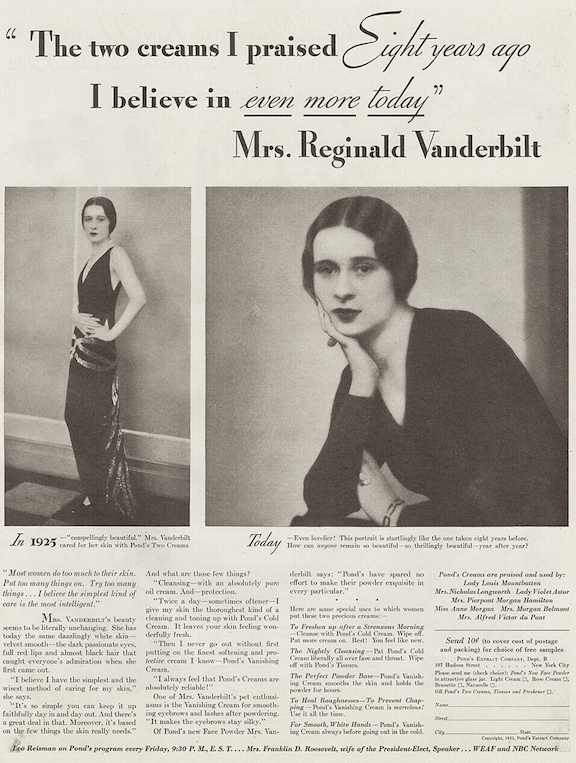
…in 1929 J. Walter Thompson President Stanley Resor observed how people instinctively wanted to be told what to do by authorities they respected. Applying this thinking to the marketing of Pond’s cold cream, Resor’s firm hired famed photographers to create idealized portraits of society women…
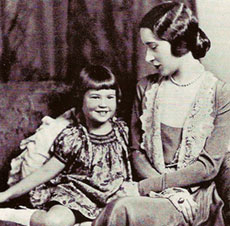
…Writing for Indy Week (July 7, 2010) Amy White observes that a 1933 portrait (above) of Mrs. Reginald Vanderbilt, aka Gloria Mercedes Morgan, reveals patrician eyes as “languid jet pools, her lips full and dark, her finely coiffed hair oiled to ebony perfection. However, a bit of backstory might explain the painful and hollow look Mrs. Vanderbilt can barely suppress. In that same year, she was declared by the courts to be unfit as a parent, and her young daughter was placed under the guardianship of her sister, Gertrude.” That young daughter, Gloria Vanderbilt, would later find fame for her designer jeans, her glittering lifestyle, and as mother of newscaster Anderson Cooper. White concludes, “I wonder if somehow, subconsciously, those consumers saw the pain in the eyes of some of those upper-crust spokeswomen, and it was basic humanness and empathy, as well as desire for wealth and beauty, that won them over”…
Mrs. Reginald Vanderbilt, aka Gloria Mercedes Morgan, and her daughter, “Little Gloria,” in 1928. (Wikipedia)
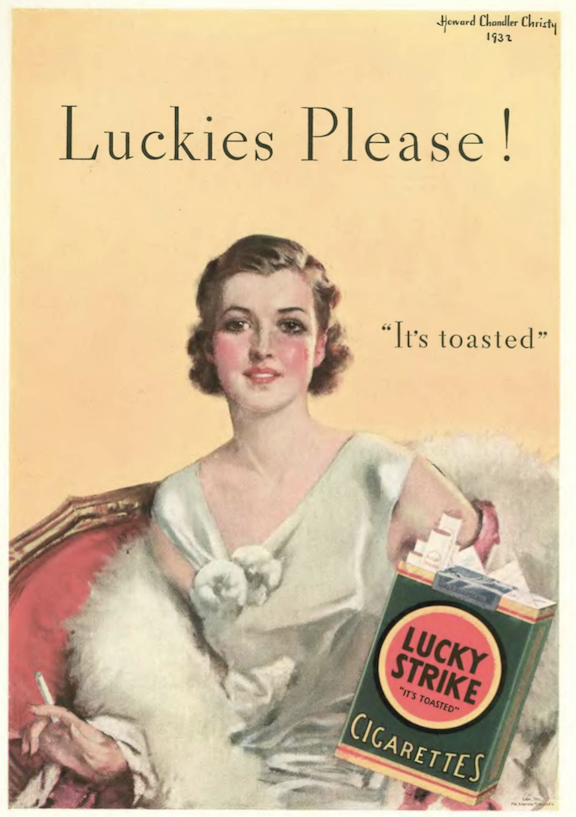
…and we move along to the toasted pleasures of Luckies, and Howard Chandler Christy’s “Christy Girl” looking the picture of health and vitality in this back cover ad…
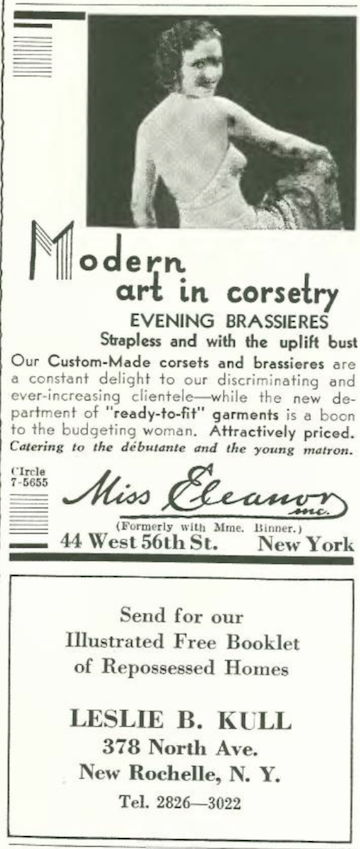
…we make an abrupt switch to the cheaper ads in the magazine’s nether pages…here “Miss Eleanor, formerly with Mme. Binner,” announced her selection of modern corsets for the “debutante and young matron”…and below, in a sign of the times, repossessed homes for sale…
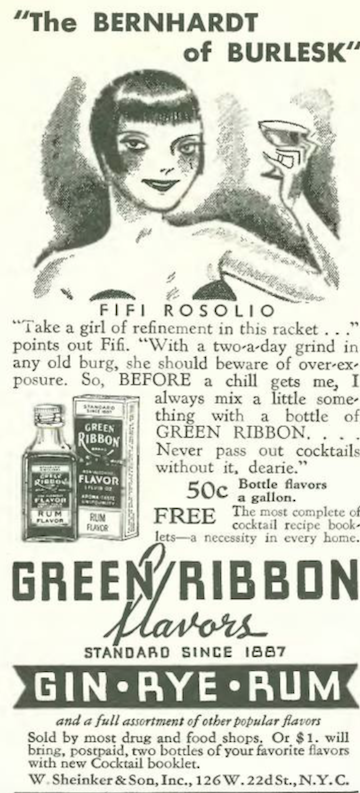
…looks like Fifi had a bit too much of the Green Ribbon-flavored bootleg…
…and if you thought taking probiotics was a new thing…
…the French Line once again featured the art of James Thurber to promote its Mediterranean cruises…
…and Thurber kicks off our cartoons with spot art that headed the “Goings On About Town” section…
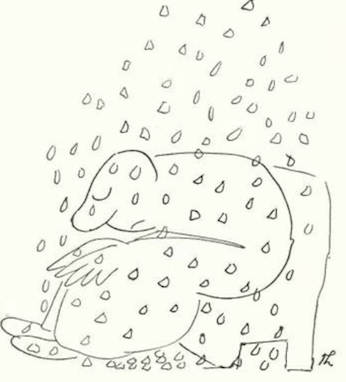
…and this gem with one of Thurber’s beloved dogs…
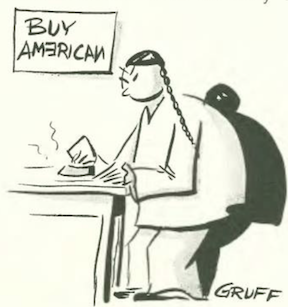
…below is the second New Yorker cartoon by Gruff with the “Buy American” slogan juxtaposed with an ethnic stereotype…I have no idea who this artist is, or if “Gruff” is a pen name — the style looks familiar but I haven’t had any luck chasing this artist down…
…here is the first one from the Feb. 18 issue…
…but we all know Al Frueh, who contributed this delightful bit of art to the theater review section…
…Daniel ‘Alain’ Brustlein gave us an enterprising Frenchman offering peeks at exiled New York Mayor Jimmy Walker sunning on a beach at Cannes…
…and we close with Peter Arno, and the first signs of spring…
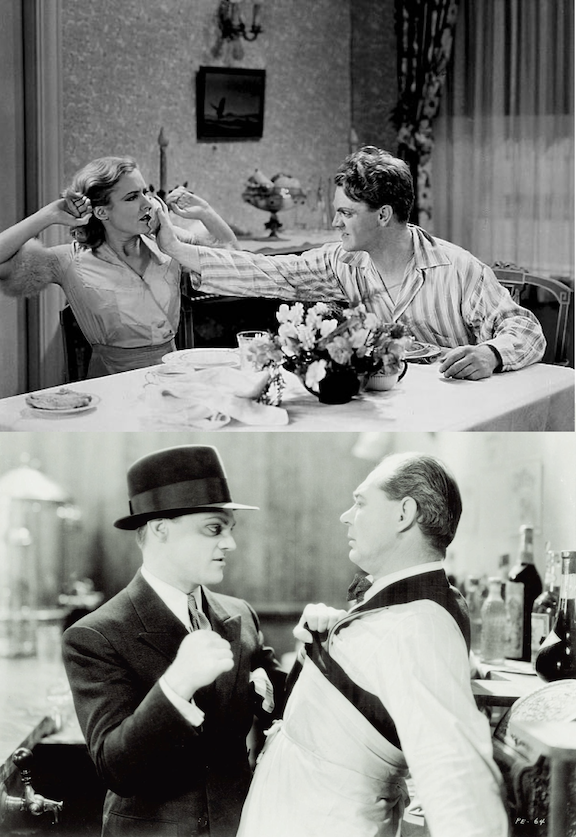
James Cagney began his entertainment career singing and dancing in various vaudeville and Broadway acts, but when he was cast in his first film as a tough guy, the die was cast…at least for one New Yorker critic.
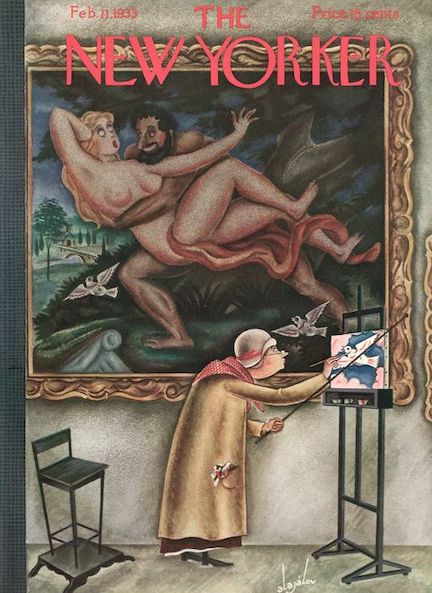
Feb. 11, 1933 cover by Constantin Alajalov.
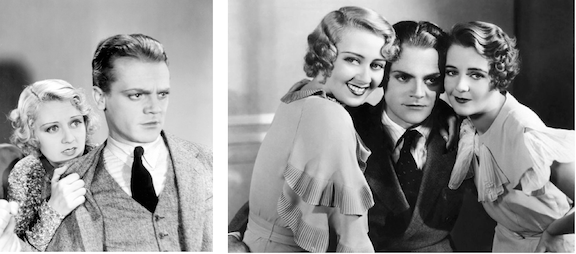
Cagney’s first film role came after he starred along with Joan Blondell in Broadway’s Penny Arcade. However when the play was made into the 1930 movie Sinners’ Holiday, execs at Warner Brothers opted to put Grant Withers and Evalyn Knapp into the lead roles, believing they were destined for stardom; Cagney and Blondell were relegated to supporting parts. As fate often has it, Withers and Knapp ended up in B-movie obscurity, while Cagney and Blondell went on to become two of the biggest stars of the 1930s. The pair would appear in six more films together, including the gangster film The Public Enemy (1931) and the musical Footlight Parade (1933).
TWO-FACED…James Cagney would be paired with Joan Blondell in seven films during the 1930s including the gangster film The Public Enemy (1931, left) and the musical Footlight Parade (1933, also with Ruby Keeler). (IMDB)THE ONE I USED TO KNOW…Top, Cagney mashes a grapefruit half into Mae Clarke’s face in a famous scene from Cagney’s breakthrough film, 1931’s The Public Enemy; below, Cagney gets acquainted with a bartender (Lee Phelps) in The Public Enemy. (IMDB)
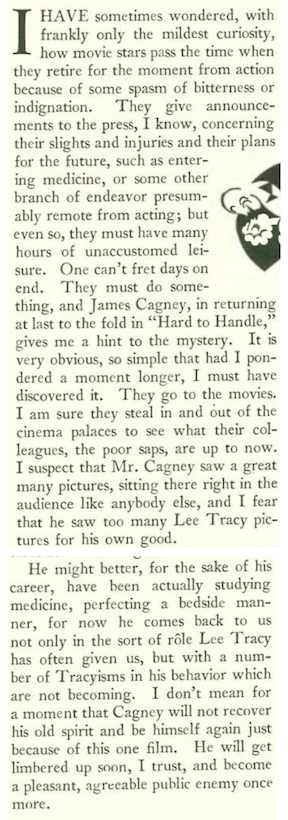
New Yorker film critic John Mosher preferred the tough guy Cagney to the toe-tapping version, and was anticipating Cagney’s return to pictures after a contact dispute with Warner in which he threatened to quit the business and follow his brothers into the medical profession…
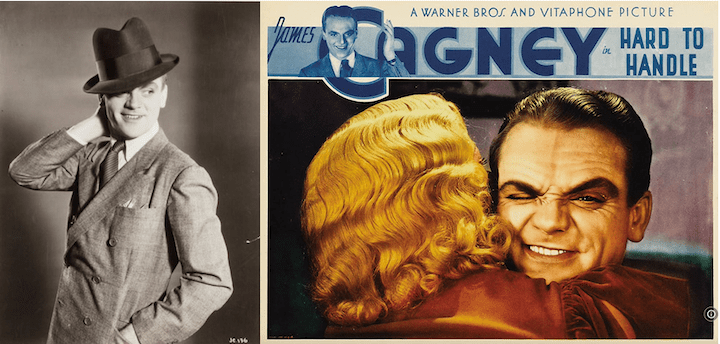
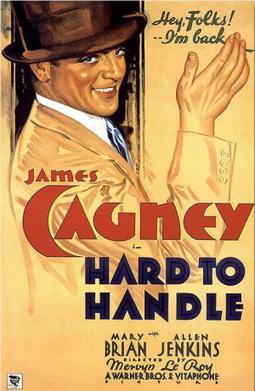
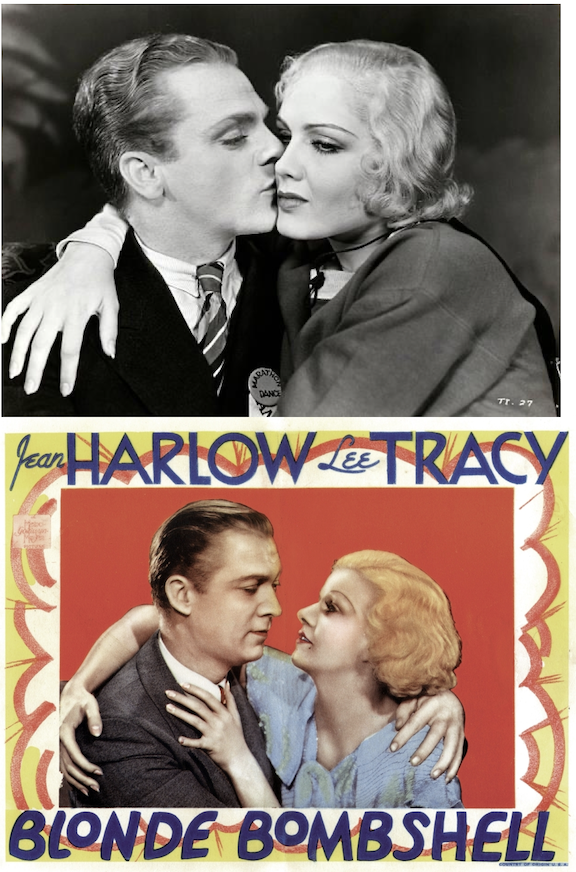
When Cagney finally announced his return in Hard to Handle, Mosher found he had taken on the guise of actor Lee Tracy, who was best known for his comic portrayals of wisecracking salesmen and reporters…
MY SOFTER SIDE…James Cagney and Mae Clark (top) in 1933’s pre-Code comedy Hard to Handle — Cagney played a clowning con artist who organizes a dance marathon. Below, critic John Mosher thought Cagney was channelling the comic actor Lee Tracy, seen here with Jean Harlow in 1933’s Blonde Bombshell. (IMDB)
* * *
Slippery Slope
Located on Lexington between 102nd and 103rd streets, Duffy’s Hill was once famous for being the steepest hill in Manhattan and the scourge of street cars that had to quickly accelerate and decelerate at that point, leading to numerous accidents. An excerpt from “The Talk of the Town”…
LOOK OUT BELOW…Duffy’s hill played merry hell with New York’s streetcars more than a century ago. (New York Social Diary via Facebook)
* * *
Getting High
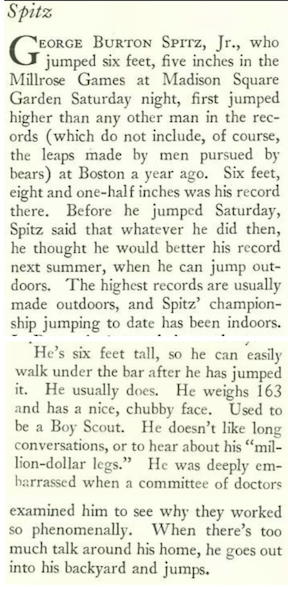
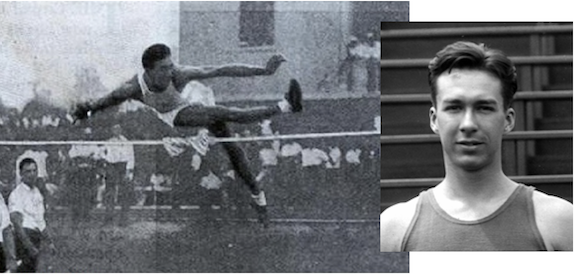
George Spitz Jr was an AAU high jump champion when he participated in the 1932 Summer Olympics in Los Angeles. In 1933 he made a personal best leap of 6 feet, 8¼ inches using scissors-style leap with elements of the Western roll. “The Talk of the Town” marveled at Spitz’s feat, giving him an extra quarter inch for his record leap:
MILLION-DOLLAR LEGS…In 1933 George Spitz Jr made his personal best leap of 6 feet, 8¼ inches using a scissors-style jump with elements of the Western roll. With the introduction of the Fosbury Flop in 1968, today’s men’s record stands at 8 feet, ¼ inches. The current women’s record is 6 feet, 10¼ inches. (Olympedia)
* * *
This Guy Again
As we move into the 1930s we will be seeing more references to Adolf Hitler, who seized power in Germany on January 30, 1933. At this point “The Talk of the Town” wasn’t taking him seriously…
…and neither was Howard Brubaker in his regular column of short quips…
* * *
From Our Advertisers
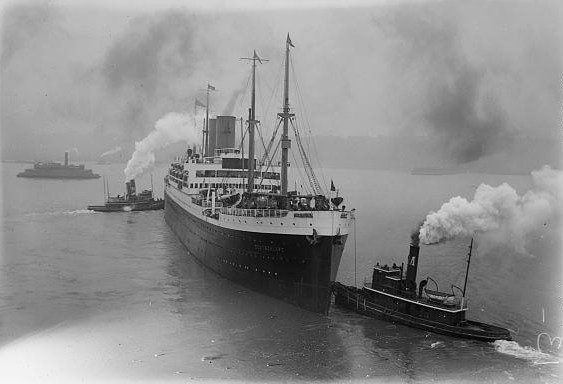
Hitler aside, the German-owned Hamburg-American Line was still serving peaceful purposes when it advertised the comfort of its “stabilized ships” on transatlantic voyages…these sister ships of the Hamburg-American Line were all destroyed during World War II…the SS New York and the SS Deutschland were both sunk by the British RAF in 1945…The SS Albert Ballin and the SS Hamburg sank after hitting Allied mines…
THE BIG BANG…the RAF sent the S.S. Deutschland to the bottom of the Bay of Lübeck on May 3, 1945. (Wikipedia)
…if travel wasn’t your thing, you could escape the winter blahs in the comfort of your home thanks to the GE Mazda Sunlight Lamp…
…and Dad, when you were her age you called these things “horseless carriages”…
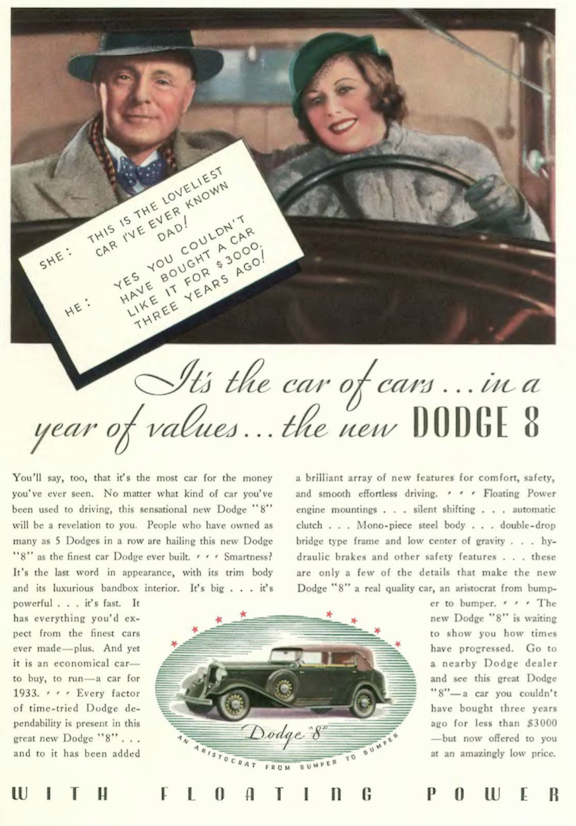
…the folks at luxury carmaker Packard answered the splashy color ad from Cadillac in the Jan. 7 issue…
…with a colorful show-stopper of their own…
…if the Packard was too pricy, you could have checked out this lower-priced Cadillac, marketed as the LaSalle…
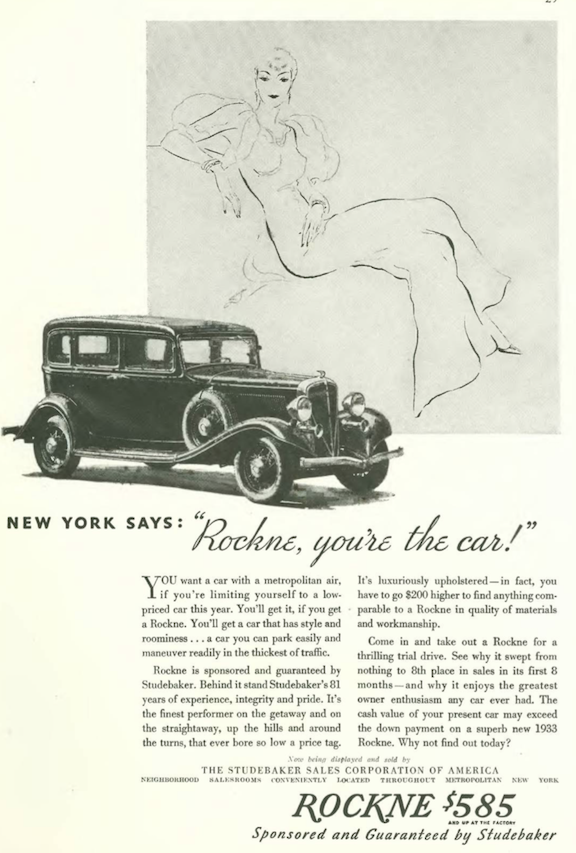
…no, New York did not say “Rockne, you’re the car!”, even if it was juxtaposed with a giant woman…the car was named for famed football coach Knute Rockne, and the Depression was not a good time to promote a new car line…it was produced from 1932 to 1933, when Studebaker pulled the plug and sold the remaining inventory (about 90 cars, packaged in kits) to a Norwegian railroad car manufacturer…
…a couple of posts ago (“Life With Father”) we were accosted by a three-page Camel ad featuring a Q&A stating the facts about its product…here they are back with two more pages of irrefutable evidence…
…what I read in their eyes is that none of them, including the woman, gives a damn about the others…if anything, the fellow at left is checking out the other guy…
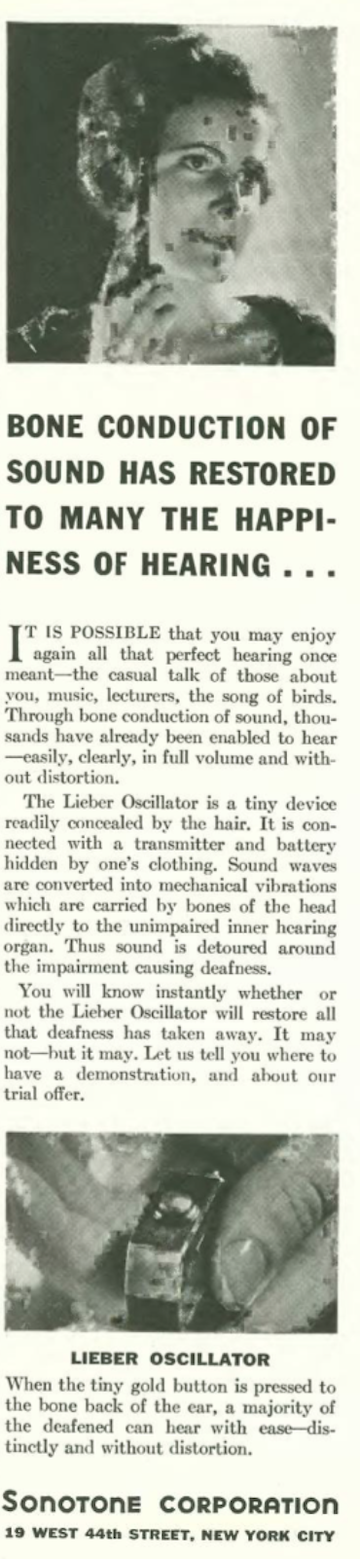
…this ad from Sonotone Corporation promoted a new hearing aid developed by Hugo Lieber…this revolutionary bone conduction receiver enabled the deaf to hear through bones in their head…
…a 1939 Sonotone catalog demonstrated how the hearing aid could be worn inconspicuously…
(abebooks.com)
…on to our cartoonists, Al Frueh illustrated the drama on board Broadway’s Twentieth Century Limited…note vaudevillian William Frawley’s caricature in the bottom right hand corner…although he appeared in more than 100 films, Frawley is best known today for his role as Fred Mertz on TV’s I Love Lucy…
…here’s a great caricature by Rea Irvin of New York’s new mayor John P. O’Brien, using his new broom to sweep away the corruption of the deposed Jimmy Walker and his Tammany Hall cronies…
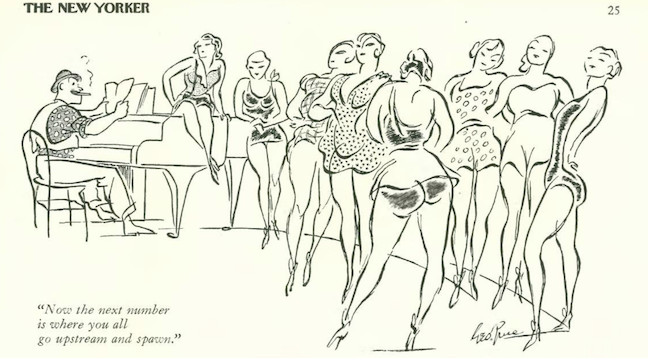
…here’s another early work by George Price, who would be a cartoonist at The New Yorker for nearly six decades…
…and here we have the other Price…Garrett Price gave us a fellow who made some changes in his life à la Paul Gauguin…
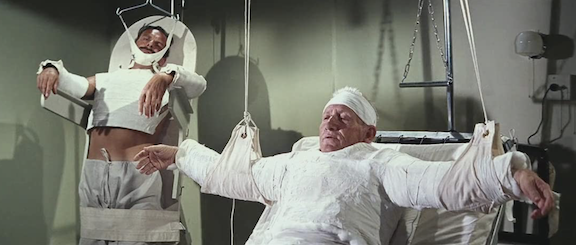
…I like this Perry Barlow cartoon because it reminds me of the patient-in-traction trope commonly seen in comedies of the 1960s and 70s…
…such as this Paul Coker Jr. illustration from the June 1970 issue of MAD magazine…
(MAD Magazine)
…and Terry-Thomas and Spencer Tracy in 1963’s It’s a Mad Mad Mad Mad World…
(IMDB)
…William Steig assured readers there was nothing sweet about his “Small Fry”…
…once again Helen Hokinson offered her impressions of the annual Westminster Kennel Club show at Madison Square Garden…
…Peter Arno’s Lake Placid would never be the same for his mustachioed millionaire “walruses” after the previous year’s Winter Olympic Games…
“Nobody said not to go” was a phrase often used by Emily “Mickey” Hahn when returning from one of her far-flung and often wild adventures.
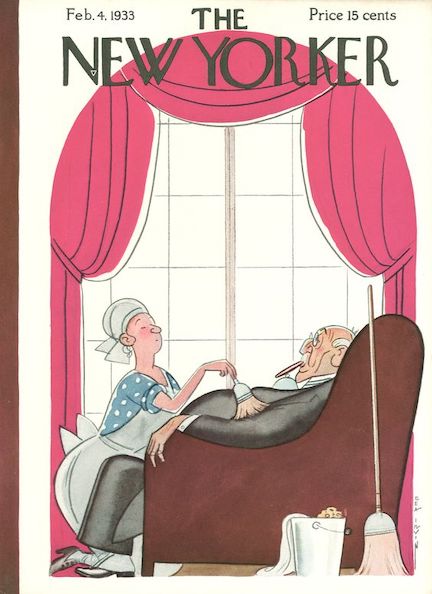
Feb. 4, 1933 cover by Rea Irvin.
And nobody ever told Hahn (1905–1997) what she could write about, and so she wrote, with brio and authority, on a variety of subjects ranging from feminism, diamond mining, and animal behavior to Chinese history and cooking. The author of 54 books, Hahn also penned a number of biographies including those of Leonardo da Vinci, Chiang Kai-shek, and D. H. Lawrence among others. In the Feb. 4 issue Hahn wrote about spending the night at a New York flophouse, not out of necessity but rather to write about the experience. Excerpts:
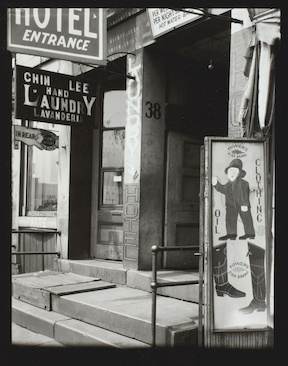
NO RITZ, THIS…Entrance to a flophouse in the Bowery, photo by Walker Evans, 1934.
In the following two excerpts, Hahn described her sleepless night, and her exit from the flophouse the following morning…
More on Emily Hahn, who defied convention from the very start of her adult life: before graduating from the University of Wisconsin in 1926 (the first woman to earn a degree in mining engineering there), she drove across the U.S. in a Model T, dressed a man. She wrote about her experiences in letters to her brother-in-law who, unbeknownst to Hahn, shared them with New Yorker editors. This would lead to a longtime relationship with the magazine, to which she would contribute nearly 200 articles (and one poem) between 1929 and 1996. She would also serve as China correspondent from 1935 to 1943.
In 1930 she traveled to the Belgian Congo, where she lived for two years with a pygmy tribe while working for the Red Cross; she later crossed Central Africa alone on foot. In his 2006 memoir, Let Me Finish, Roger Angell described Hahn as the magazine’s “Belle Geste,” a woman “deeply, almost domestically, at home in the world. Driven by curiosity and energy, she went there and did that, and then wrote about it without fuss.”
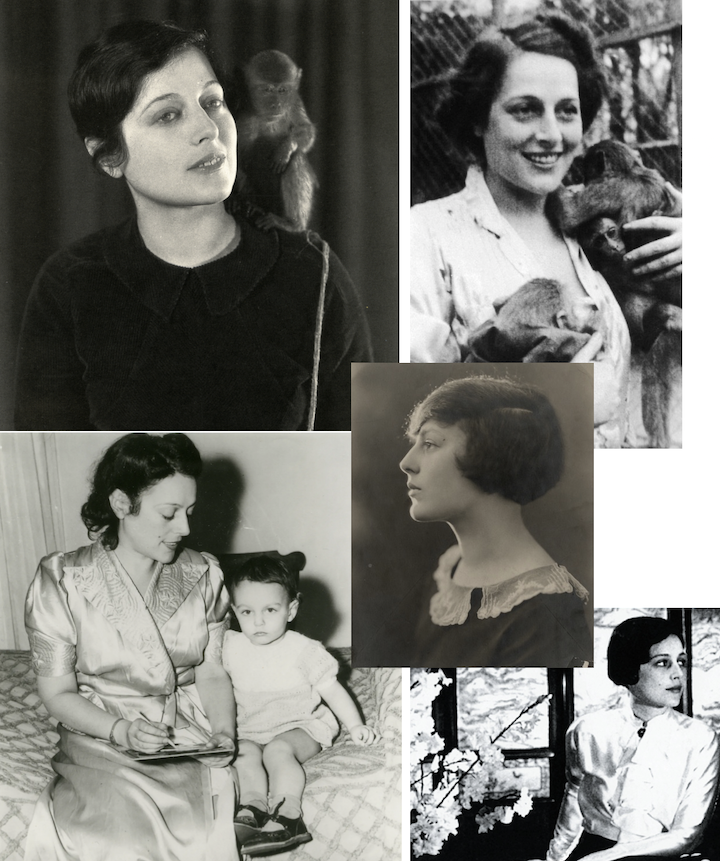
AT HOME IN THE WORLD…Clockwise, from top left, Emily “Mickey” Hahn poses with her pet gibbon, Mr. Mills, in Shanghai, circa 1935; undated photo with more of her furry friends; Hahn as a teenager, circa 1920; cover photo from her 1944 book, China to Me; Hahn in 1944 with her daughter Carola, following their return from occupied China. (Wikipedia/Lilly Library, Indiana U)
* * *
Chief Stooge
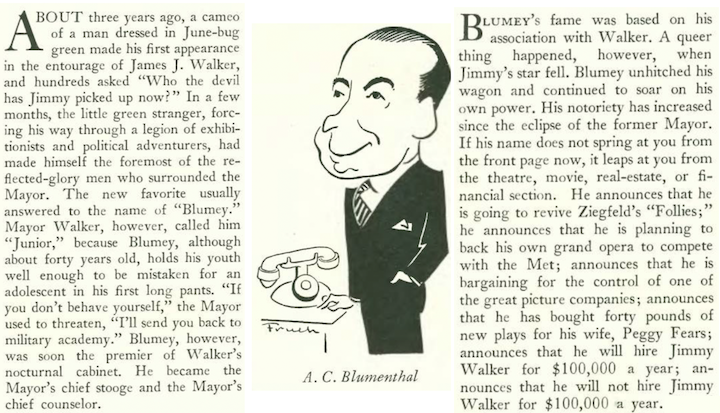
Theatrical promoter Alfred Cleveland Blumenthal (1885–1957) was well-known to New Yorkers in the 1920s and 30s as a speakeasy owner, buddy to Mayor Jimmy Walker and husband to actress Peggy Fears. Although “Blumey” is largely forgotten today, in 1933 he merited a two-part profile by Alva Johnston. Here are excerpts from the opening lines:
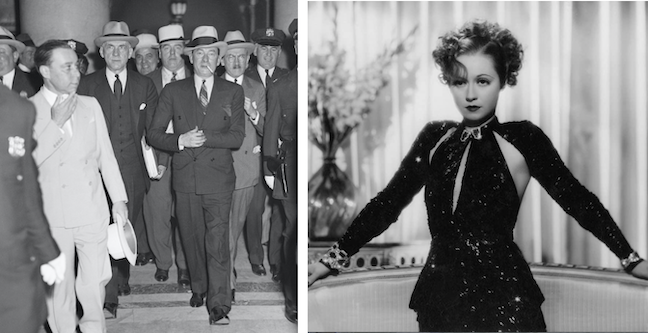
ONLY THE SHADOW KNOWS…A.C. “Blumey” Blumenthal (at left in the light suit) was often seen shadowing Mayor Jimmy Walker in his role as chief counselor and chief stooge. Here the mayor is escorted by Blumey and New York’s finest during corruption hearings in 1931. At right, Blumey’s wife Peggy Fears (1903–1994) in her most notable film role, 1935’s The Lottery Lover. Their tempestuous marriage lasted from 1927 to 1950. (avenuemagazine.com)
* * *
Coward’s Ménage
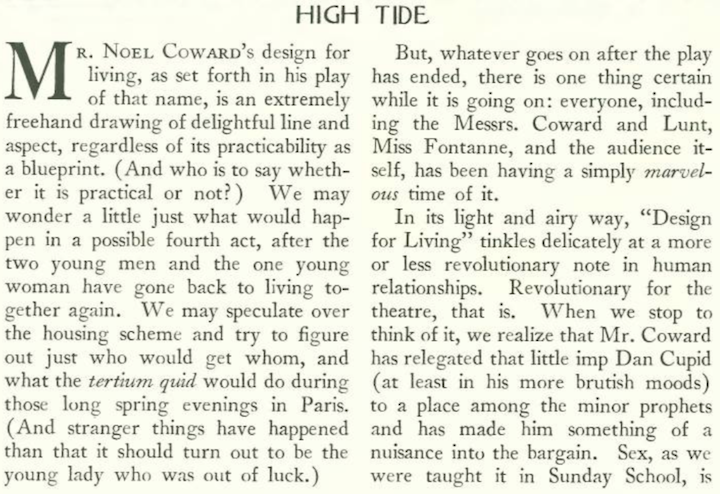
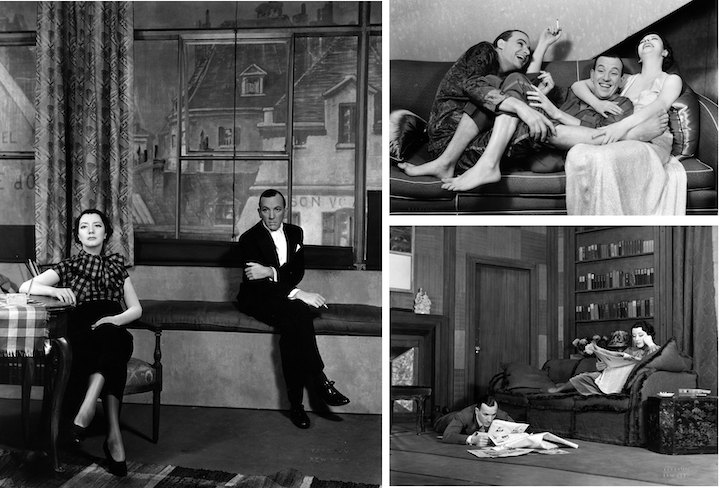
Playwright Noel Coward existed in the orbit of the Algonquin Round Table, so it was doubtless challenging for Robert Benchley to critically review his friend’s work. Fortunately, Benchley found Design For Living mostly to his liking. Note how Benchley subtly refers to the play’s gay subtext, and to the fact that it mirrored the real-life relationships of the play’s trio.
THREE’S COMPANY…A studio in Paris. A penthouse in New York. A flat in London. These were the settings for Noël Coward’s play Design for Living at the Ethel Barrymore Theatre, which starred the wife-husband team Lynn Fontanne and Alfred Lunt and their close friend Coward in a Broadway run of 135 performances from January to May 1933. (Vandamm theatrical photos via wisc.edu)
Benchley did have a few quibbles, but reasoned there was no need to be overly critical when there was such a dearth of quality stage entertainment. Note the great caricatures by Al Frueh (below) that accompanied the review.
Benchley had a different sort of dilemma criticizing Elmer Rice’s earnestly patriotic We, the People, a play about the misfortunes of a working class family in Depression America.
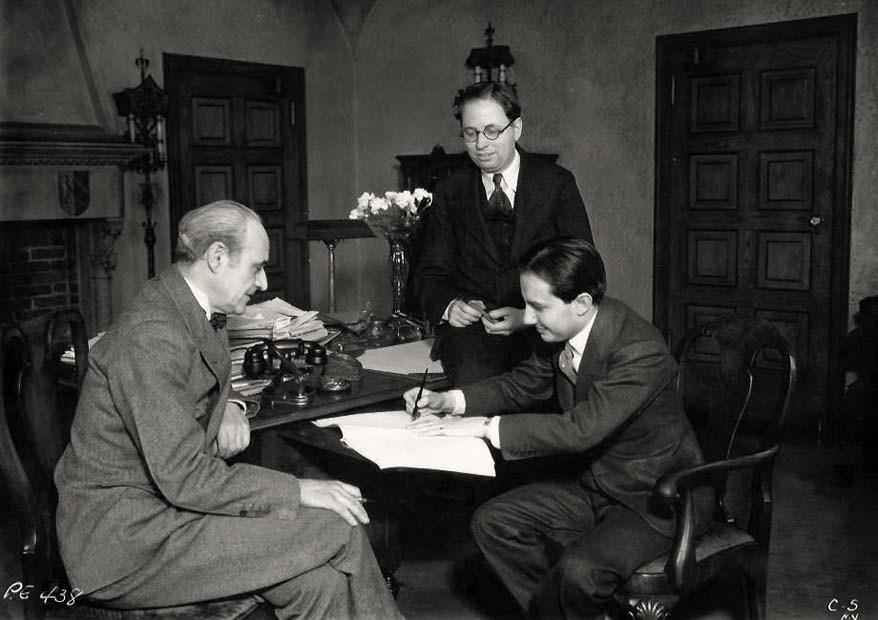
Rice, who won the Pulitzer Prize for Drama in 1929, was an occasional contributor to The New Yorker from 1929 to 1931, including his sci-fi satire on the film industry, Voyage to Purila, which was serialized in eleven installments (with illustrations by Peter Arno) in The New Yorker from Oct. 12 to Dec. 21, 1929.
LET’S MAKE A MOVIE…Elmer Rice (standing) joins theatre producer Joseph P. Bickerton, Jr. (left), and Universal’s Carl Laemmle Jr. to sign a contract for the film version of Rice’s 1931 Broadway play Counsellor at Law. The film proved to a critical success. (Wikipedia)
Meanwhile, film critic John Mosher was trying his best to enjoy the latest Hollywood fare, another Broadway play adapted to the silver screen. Whistling in the Dark…
MURDER MOST AMUSING…The 1933 American pre-Code comedy-mystery film Whistling in the Dark starred Ernest Truex and Una Merkel. (IMDB)
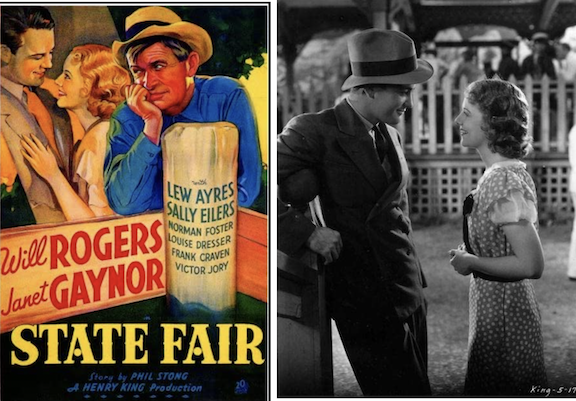
However, Mosher was surprisingly enthused by the rustic charms of Iowa country folk in State Fair…
THE TRIUMPH OF PRIZE PICKLES and other delights awaited viewers of 1933’s State Fair, which gave star billing to Will Rogers and Janet Gaynor. At right, Lew Ayres sweet-talks Gaynor at the fairgrounds. (IMDB)
* * *
Form Follows Function
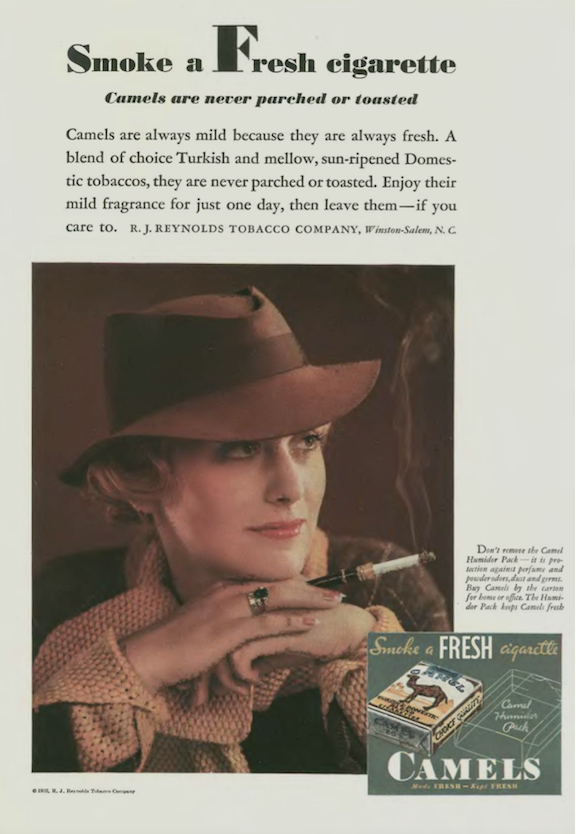
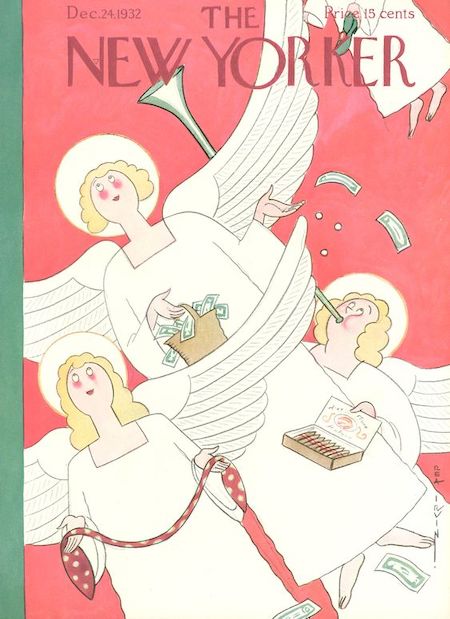
E.B. White paid close attention to all the little details of daily life, including the advertisements that appeared in The New Yorker. In “The Talk of the Town” he wrote about a Camel ad that inspired a sudden fashion trend:
…here is the Dec. 24, 1932 New Yorker ad to which White referred:
* * *
From Our Advertisers
We keep our cigs lit for our first ad, from Lucky Strike, keeping it simple with their familiar slogan…
…this ad from Powers Reproduction shows us the beach caps that were all the rage in the early ’30s…
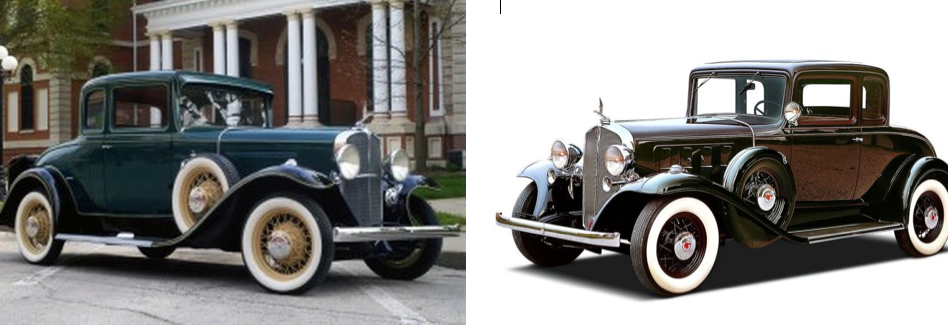
…this may look like an old car to modern eyes, but in 1933 these sweeping curves were la dernière mode in the auto world…
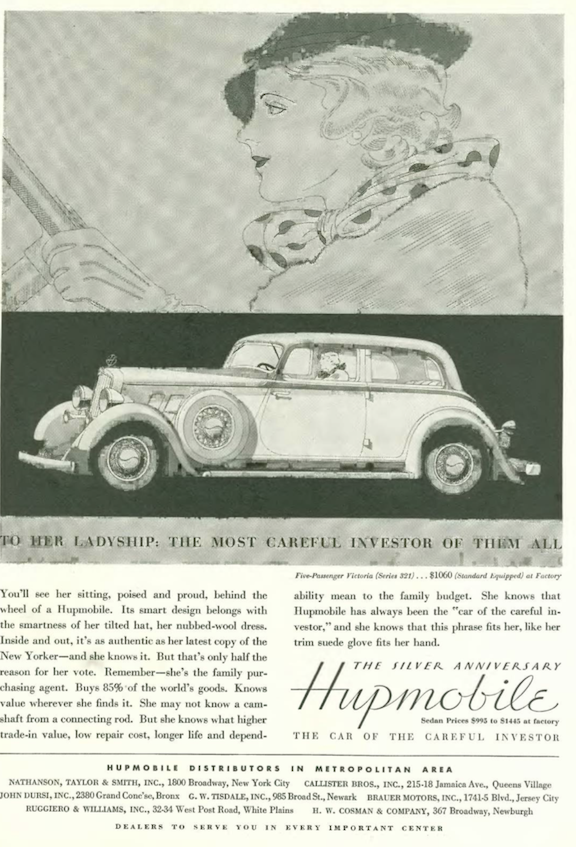
…and then there was Hupmobile, trying its best to stay relevant in the Depression…
…the company folded in 1939, but a few reminders live on…
HUP HUP HOORAY…The 1917 Hupmobile dealership at 25th and Farnam in Omaha, NE, was located along the old Lincoln Highway and is the last preserved Hupmobile dealership in the United States. On the National Register since 2014, it now houses apartments. (Flickr)
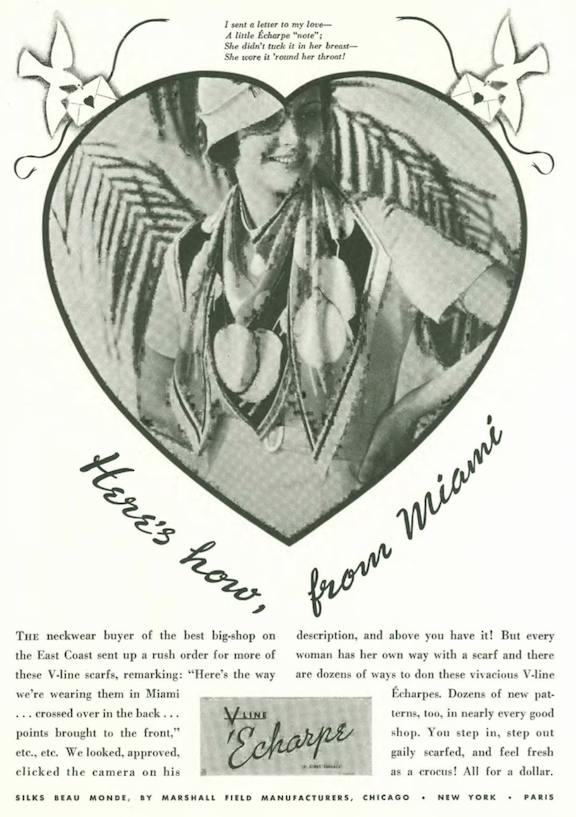
…Valentine’s Day was just around the corner, so time to buy your sweetheart something special, like this scarf that was all the rage among the Miami snowbirds…
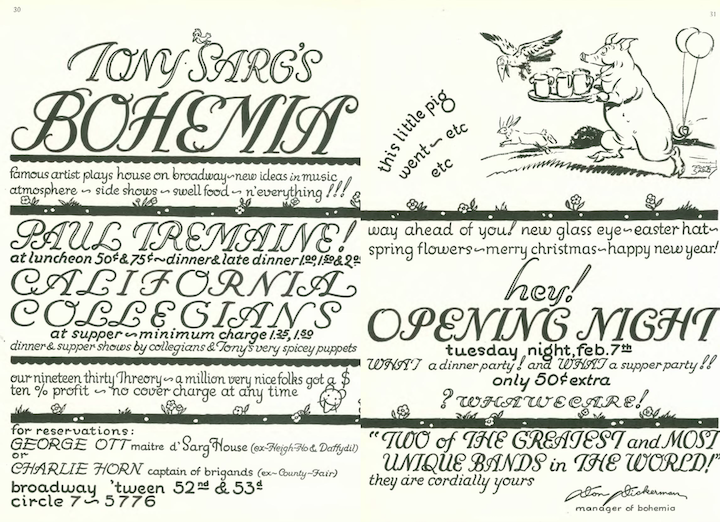
…Greenwich Village restaurateur and personality Don Dickerman took out this two-page ad to trumpet his partnership with puppeteer and illustrator Tony Sarg at the Bohemia restaurant on Broadway…
…the German-American Sarg is also known as the creator, in 1927, of the first giant balloons for Macy’s Thanksgiving Parade…
THE OLD GASBAG…Tony Sarg (upper right hand corner) and assistants painting one of his Macy’s parade balloons. (Fotograms News Photo Service via Pinterest)
…on to our cartoons, and what a big day for The New Yorker…the Feb. 4, 1933 issue featured the first captioned cartoon by Charles Addams…
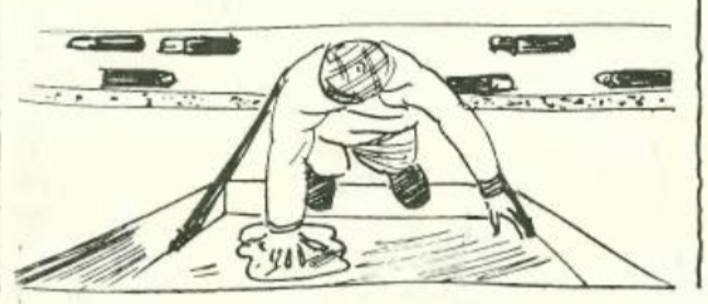
…for the record, Addams’s very first contribution to the magazine was this spot illustration (below) featured on page 65 of the Feb. 6, 1932 issue…
…one of the original contributing artists to The New Yorker,Gardner Rea, continued his skewering of America’s plutocrats…
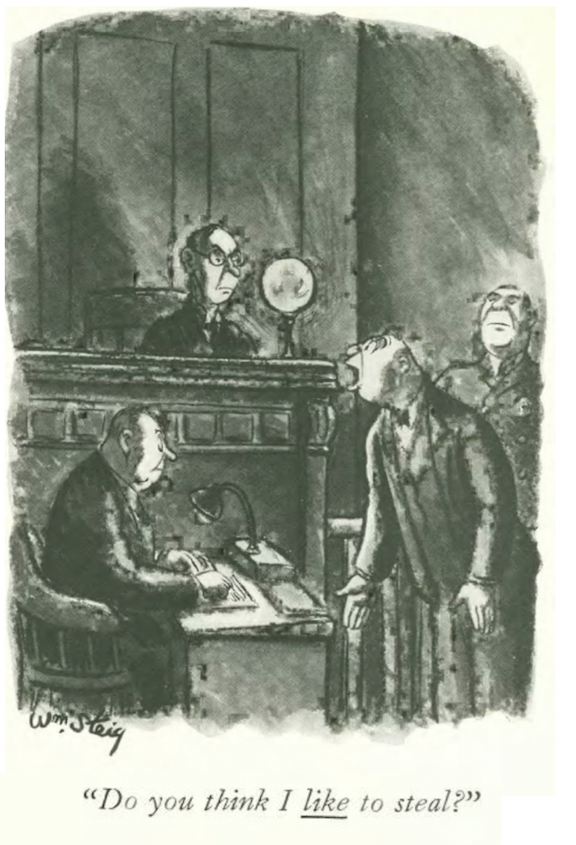
…William Steig took us before the bench to make an honest plea…
…James Thurber gave us another skirmish between the sexes…
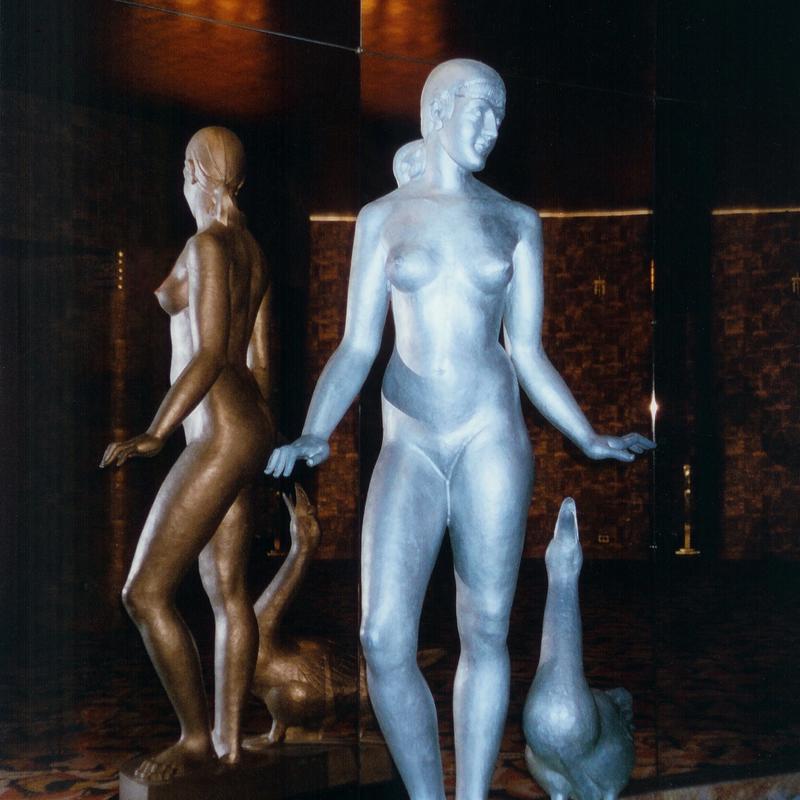
…and recalling my Jan. 12 post (about the Jan. 7, 1933 issue), in which the puritans got their knickers in a bunch over Robert Laurent’sGoose Girl sculpture in the Radio City Music Hall lobby…
…we end with Helen Hokinson, inspired by Laurent’s work…
If you’ve ever come across the byline B.H. Arkwright, you were most likely reading the work of Clarence Day Jr., who in February 1931 began writing for The New Yorker under that pseudonym and also under his given moniker, which in four short years would become a household name.
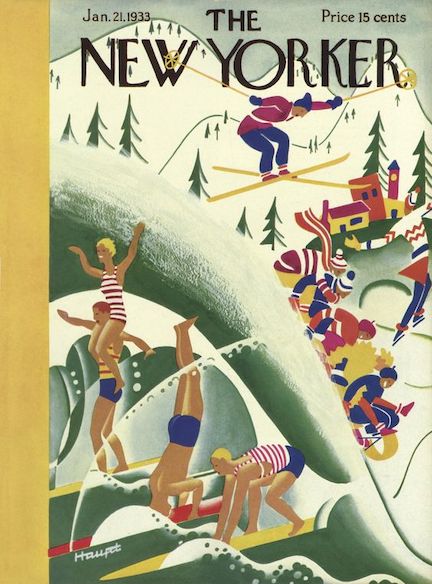
Jan. 21, 1933 cover by Theodore Haupt.
In the Jan. 21, 1933 issue Day would publish his first humorous story in The New Yorker about upper-middle-class family life in the 1890s. A subsequent collection of these stories would be published in 1935 under the title Life with Father. Sadly, Day would die shortly thereafter and wouldn’t witness the enormous cultural impact his stories would have on mid-century America.
Here is an excerpt of Day’s first story about his father, describing an exchange between his parents that would set the tone for the series:
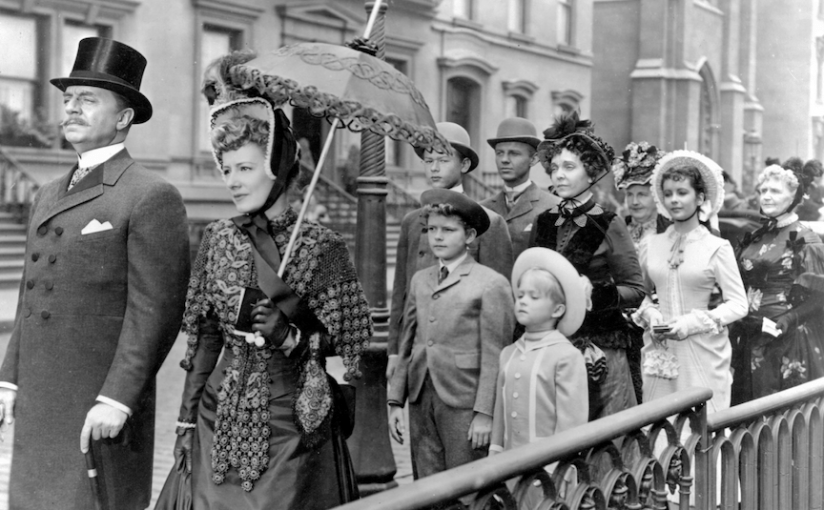
Life with Father was a hit with readers, inspiring a 1939 Broadway production by Howard Lindsay and Russel Crouse that would run for 3,224 performances over 401 weeks—it was, and still is, the longest-running non-musical play on Broadway. The play would be adapted into a 1947 film featuring Irene Dunne and William Powell in the leading roles. The stories even made it to the small screen in a CBS TV series that ran from 1953 to 1955.
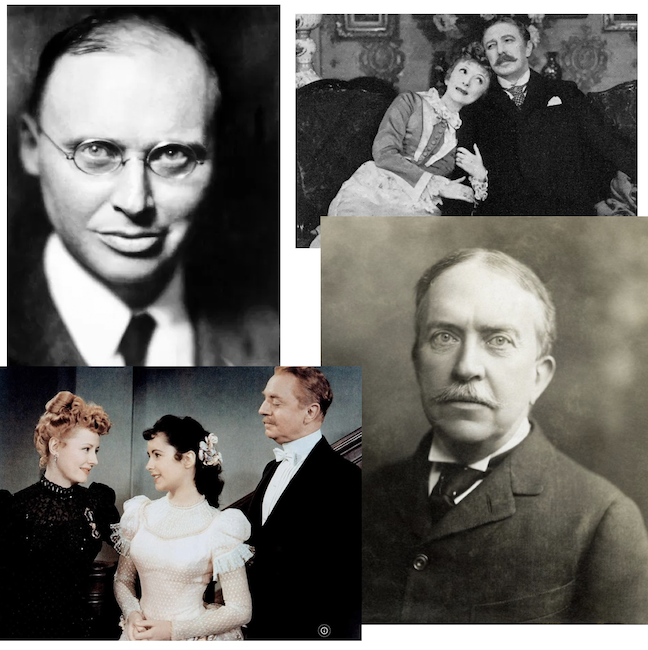
ALL IN THE FAMILY…Clockwise, from top left, Clarence Day, Jr. (1874-1935) in undated photo; Dorothy Stickney and Howard Lindsay in the Broadway production of Life with Father, 1939; Day’s father and inspiration, stockbroker Clarence Day, Sr. (1844-1927); scene from the 1947 feature film Life with Father with Irene Dunne, William Powell, and a 14-year-old Elizabeth Taylor. (britannica.com/theguardian.com/IMDB)
Day was also a cartoonist, contributing satirical cartoons for U.S. suffrage publications in the 1910s and also publishing collections of humorous essays including a Darwinian satire on the origins of human nature, This Simian World (1920), and the rambling, whimsical The Crow’s Nest (1921). Both featured Day’s simplistic cartoons and anthropomorphic tales that anticipated the work of James Thurber later in the decade.
CATTAIL…Self-portrait of Clarence Day rendered as a cat in a selection from The Crow’s Nest (1921). The entire book is available as a free e-book from The Project Gutenberg.
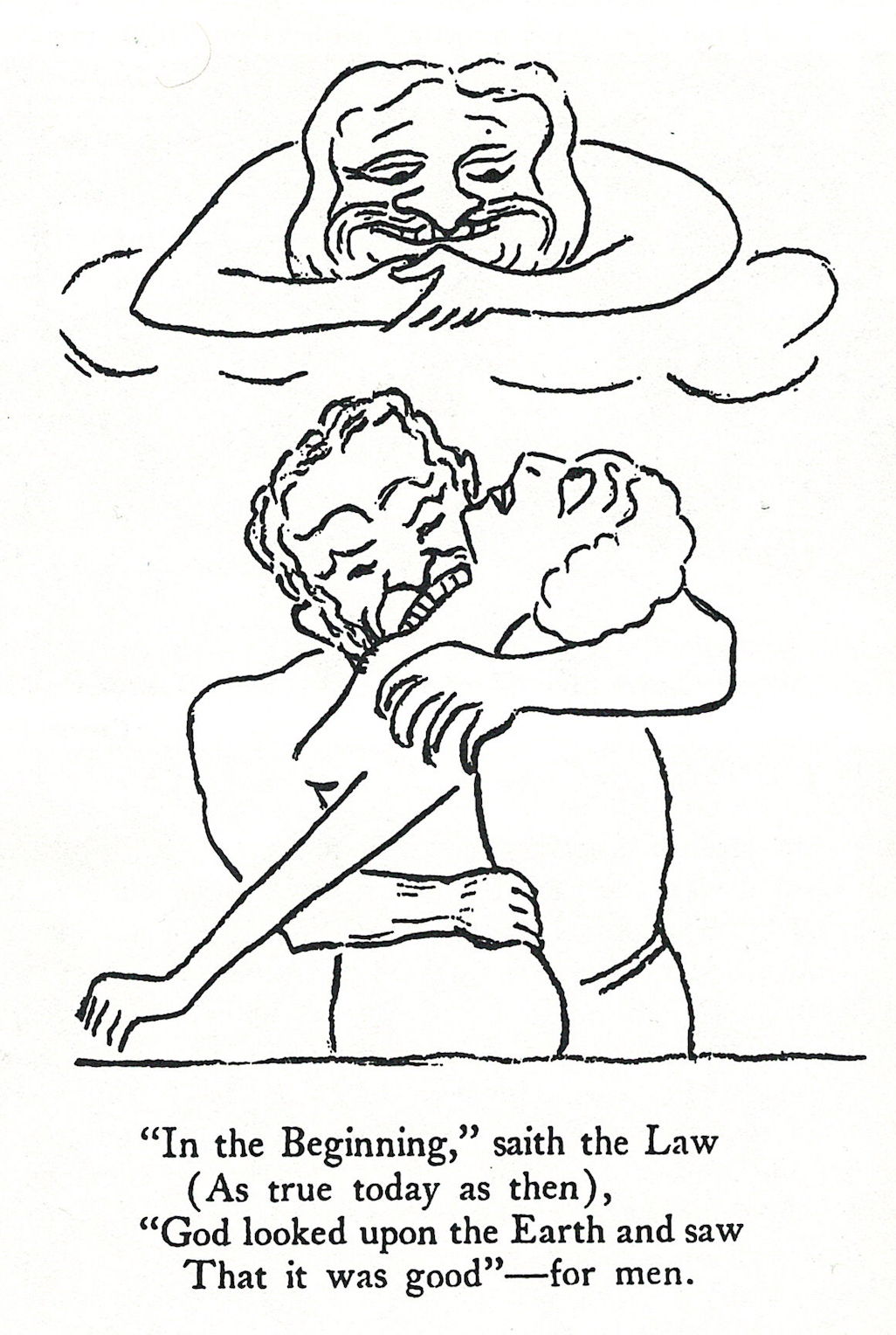
As we know, New Yorker founding editor Harold Ross was a man of contradictions, at once profane and puritanical, the latter on display when it came to one of Day’s cartoon submissions for the magazine. According to Brendan Gill’s memoir Here at The New Yorker, Ross balked at publishing the drawing below because it showed an exposed breast. Either Day or an editor simply removed the nipple (note the broken line in the nipple’s place) and the cartoon was published.
* * *
Big Man’s Big Man
August Gennerich not only served as President Franklin D. Roosevelt’s bodyguard, he was also a close family friend. “The Talk of the Town” featured a lengthy account of the man, an excerpt of which is below:
ON GUARD…Augustus “Gus” Gennerich (1887-1936) was a friend of Franklin and Eleanor Roosevelt’s as well as one of FDR’s most trusted guards. He began his career in 1909 as a NYC policeman and in 1929 was assigned to be then-Governor Roosevelt’s bodyguard in the city. The Roosevelts were heartbroken when Gus died unexpectedly at age 50 from a heart attack. (picryl.com)
* * *
Desert Solitude
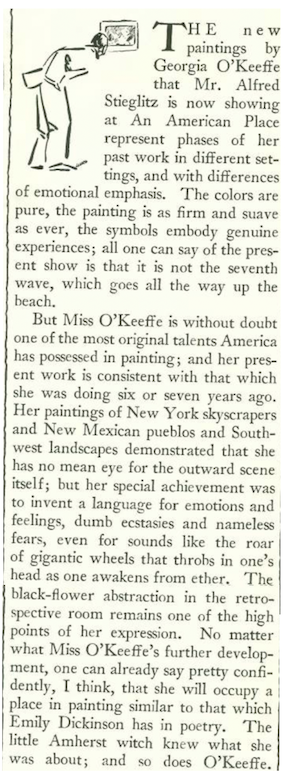
In 1933 Georgia O’Keeffe (1887–1986) was well into her Southwestern phase when her husband Alfred Stieglitz staged a show of her work at his last New York gallery, An American Place. O’Keeffe and Stieglitz lived together in New York until 1929, when O’Keeffe began spending more time in the Southwest—most likely to put some distance between herself and Stieglitz, who was in a long-term affair with photographer and writer Dorothy Norman. After this show opened O’Keeffe would suffer a nervous breakdown (per the above) and not return to painting until 1934. Lewis Mumford visited An American Place and had this to say about O’Keeffe’s work:
ANOTHER AMERICAN PLACE…New Mexican Landscape by Georgia O’Keeffe, 1930. (springfieldmuseums.org)
* * *
The Bookish Type
Modernist American poet and writer Archibald MacLeish (1892–1982) was a man of letters to the letter, serving as the ninth Librarian of Congress (1939-44) and during which time initiated the process of naming U.S. poet laureates. Here he contributes some of his verse to The New Yorker:
DESK JOB…Archibald MacLeish, circa late 1930s. (Library of Congress)
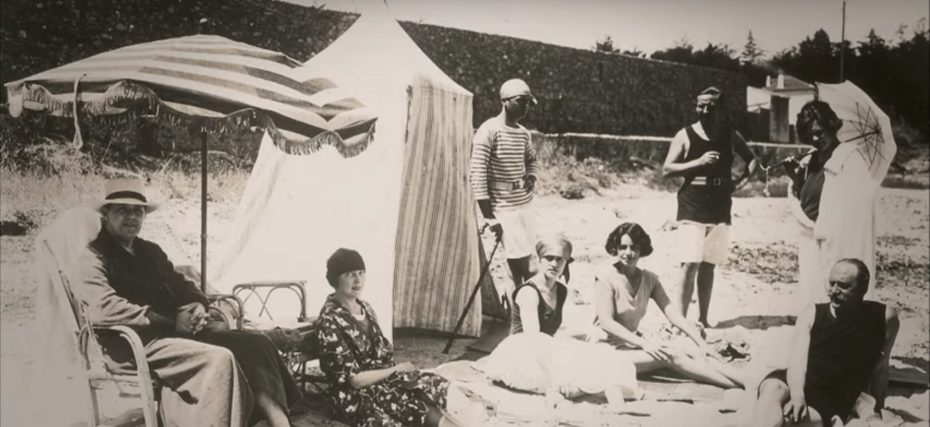
It was no accident that MacLeish contributed to The New Yorker: in addition to being among the literary expatriates in Paris including Gertrude Stein and Ernest Hemingway, MacLeish and his wife, Ada Hitchcock, were part of the Riviera crowd hosted by Gerald and Sara Murphy, which included among other notables John O’Hara, Dorothy Parker, and Robert Benchley.
OVER THERE…Gerald and Sara Murphy hosting friends at a Riviera beach party, circa 1923. Gerald is the man standing in the striped shirt; Sara is at right with a parasol. I believe that is Benchley at the bottom right, and Parker seated at center-right. (Beinecke Library)
* * *
From Our Advertisers
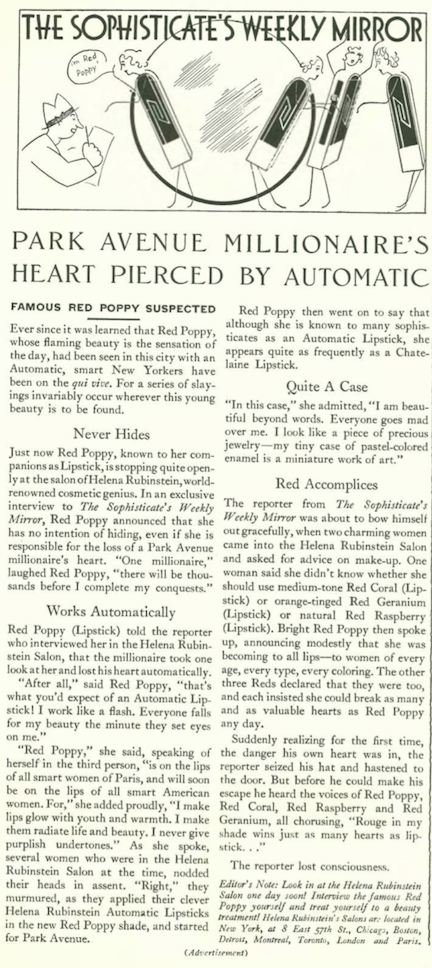
We begin with this ad from Helena Rubinstein that parodies Lois Long’s “Tables for Two” column (Long signed that column as “Lipstick”) and announced a new “Red Poppy” shade…
…on the other hand, the folks at Tangee borrowed from the old Temperance Movement song, TheLips that touch liquor, shall never touch mine, to promote a lipstick guaranteed to snag a sugar daddy like the one illustrated below (recalling Monopoly’s Uncle Pennybags)…
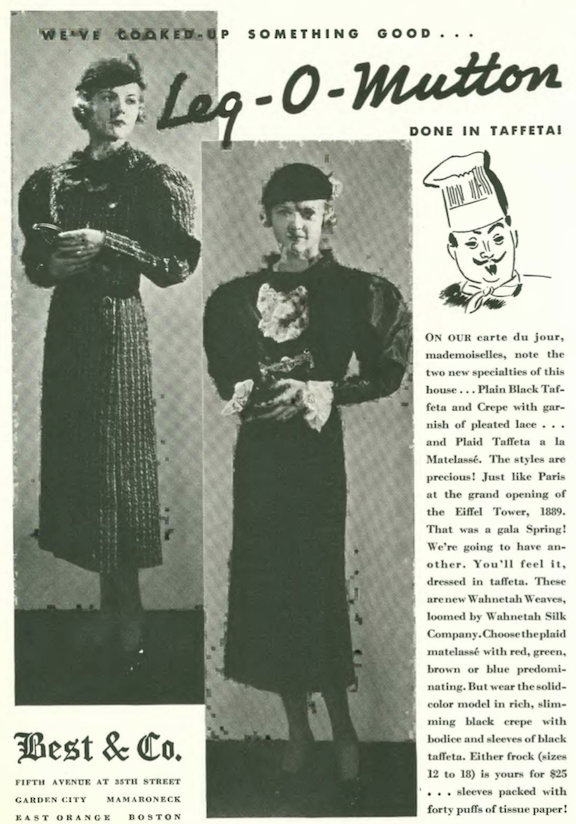
…more advertising weirdness comes our way from the staid Best & Company, its execs somehow persuaded by an ad man to go with this chef motif…
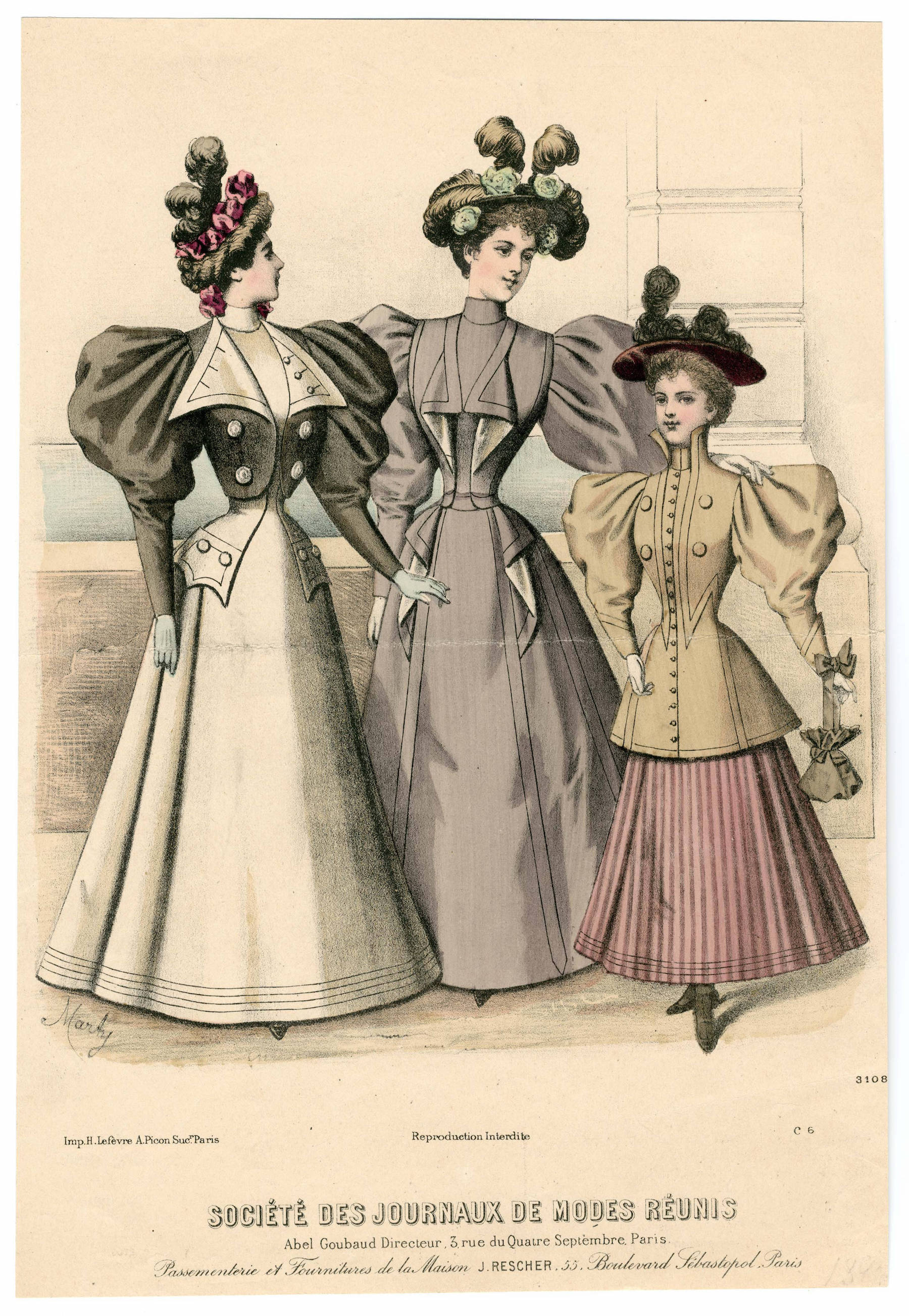
…Leg ‘O Mutton referred to a type of puffy sleeve introduced in 1830s France that had a revival in the late 1880s…
MMMMM, MUTTON…The Leg ‘O Mutton look, circa 1890s. (genealogylady.net)
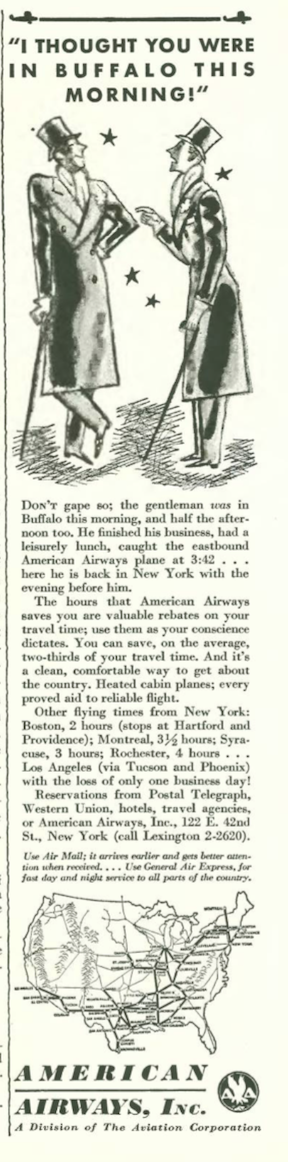
…the National Auto Show moved on and the National Motor Boat and Engine Show took its place at the Grand Central Palace…
…I’m trying to imagine the guy at left stowing his top hat in an overhead bin…
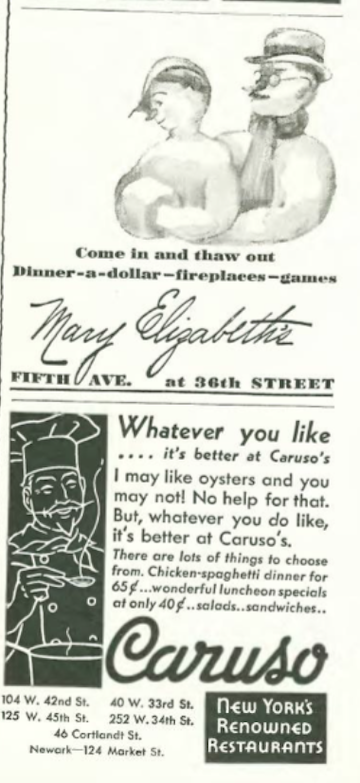
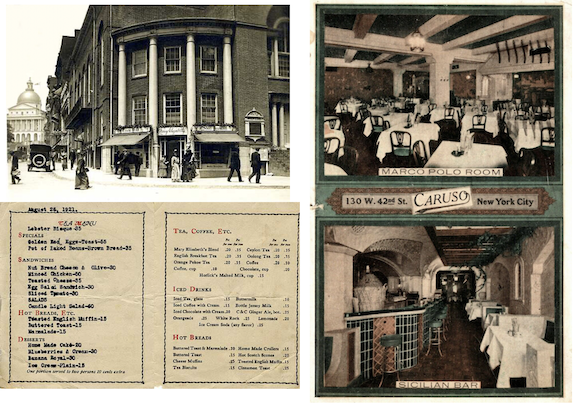
…down on earth folks could enjoy some down-to-earth home cooking at Mary Elizabeth’s, or go some Italian at Caruso’s…
…and for reference…
Top left, Mary Elizabeth’s success on Fifth Avenue led to expansion into Boston; below, a 1921 menu at Mary Elizabeth’s in New York; at right, 1930s postcard advertising Caruso’s on 42nd Street. (restaurant-ingthroughhistory.com)
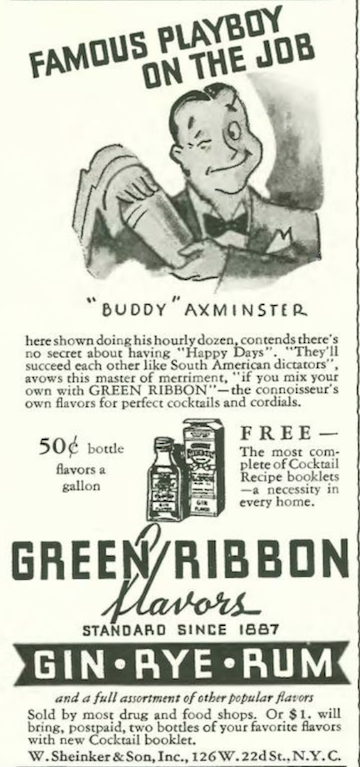
…of course you couldn’t legally drink at those places, so you had to go to a speakeasy or mix your cocktails at home…but this is just sad, ‘ol Buddy here flavoring his bootleg with some Green Ribbon…let’s hope the playboy’s guests aren’t blinded before the night is over…
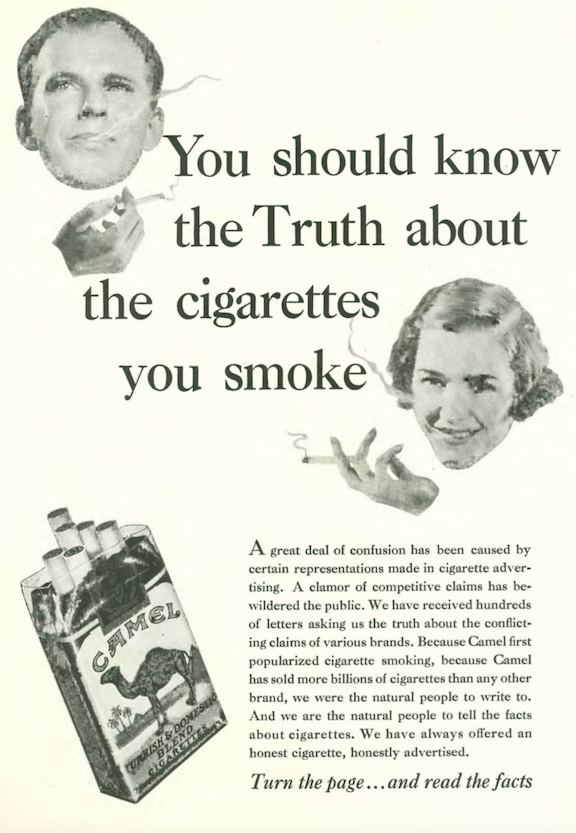
…we all know the tricky ways of the tobacco companies, including this 3-page Q&A from the makers of Camels offering smokers and would-be smokers THE TRUTH and THE FACTS about the cigarettes folks smoke…turns out Camels are the best!…
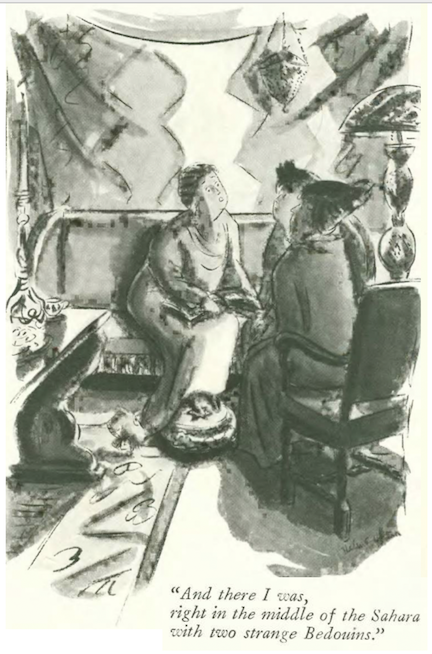
…and now for a bit of fresh air before we turn to our cartoonists…
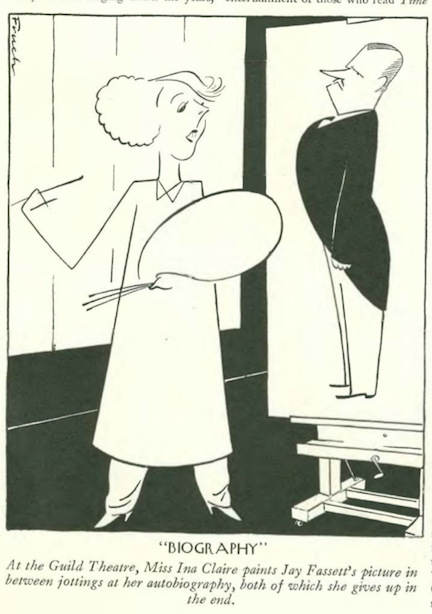
…beginning with Al Frueh and his impressions of a show at the Guild Theatre…
…Peter Arno contributed this illustration across pages 12-13 in “The Talk of the Town” section…
…Helen Hokinson offered up some scandal among the “girls”…
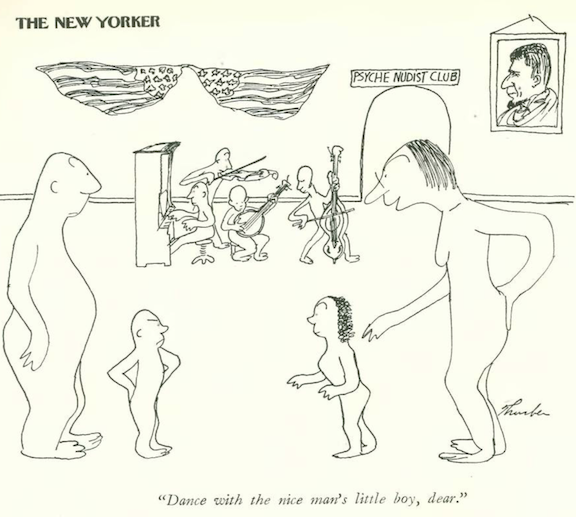
…James Thurber gave us an awkward moment among the tender youth of the unclad world…
…Otto Soglow’s Little King rose to the occasion, as always…
…Daniel Alain’s artist tried his best to make some small talk while at work…
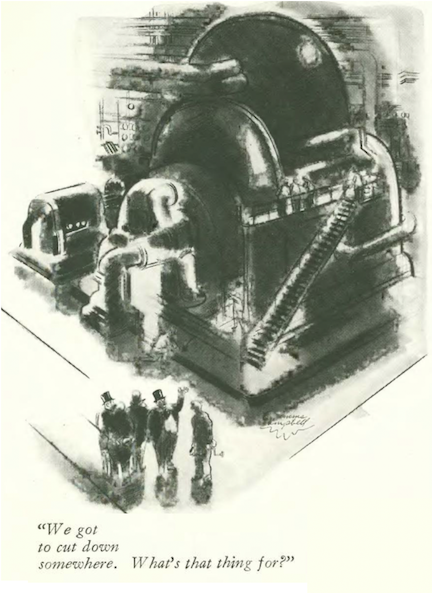
…and we close with E. Simms Campbell, and the yawning gulf between owners and workers…
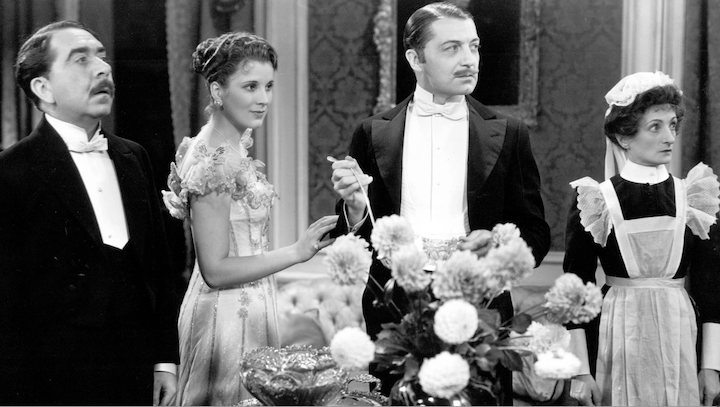
In the span of 112 minutes, the much-anticipated Fox production Cavalcade took movie audiences through the first thirty years of the 20th century.
Jan. 14, 1933 cover by Peter Arno.
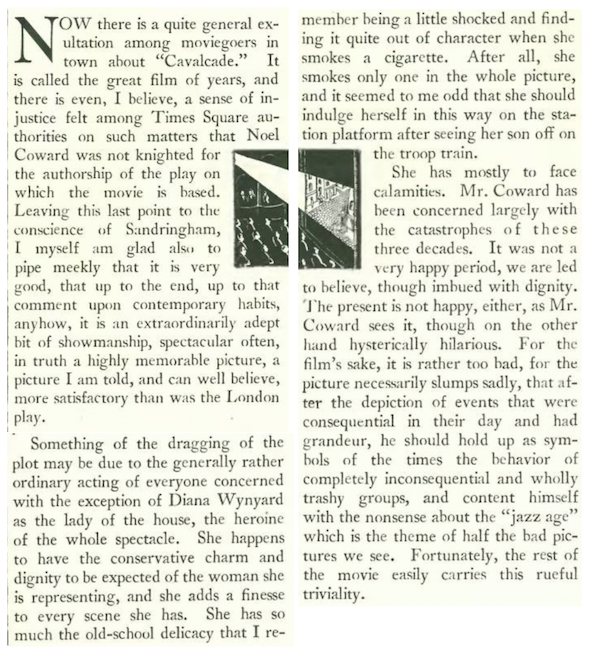
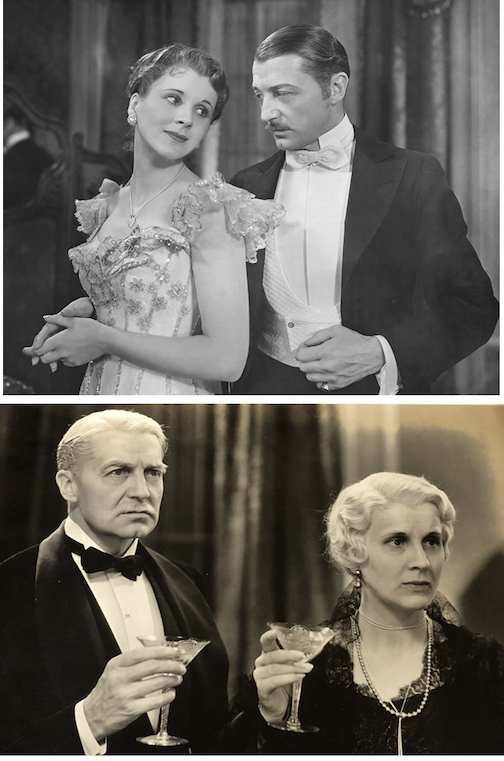
Anticipating Upstairs, Downstairs (1971) and the more recent Downton Abbey, Cavalcade looked at life through the eyes of upper class Londoners—Jane and Robert Marryot, their children and close friends—and the Marryot’s servants. It was a calamitous ride that included both the Boer War and World War I among other historic events. Critic John Mosher thought it a memorable picture despite its mawkishness.
IT’S A SCARY WORLD OUT THERE…This Fox theater card promised audiences epic thrills with a cast of thousands. (IMDB)AGING GRACEFULLY…Diana Wynyard and Clive Brook portrayed upper class Londoners Jane and Robert Marryot through three tumultuous decades in Cavalcade. (IMDB)
In the film, the first decades of the 20th century would claim the lives of both Marryot sons—Joe would perish in World War I, and Edward would make the unfortunate decision to take his bride on a honeymoon cruise…
ONE-WAY TICKET…Edward Marryot (John Warburton) and his childhood sweetheart Edith Harris (Margaret Lindsay) are thrilled to be celebrating their honeymoon on a “big boat.” When the couple walk away from the railing, the opposite side of the life preserver is revealed in a dramatic camera shot.
After World War I the film hastily moved on to the Jazz Age, where the social order was going to hell…
CRY WOLF…A creepy older dude puts the moves on a young blonde (portrayed by Betty Grable in an uncredited role) during a Jazz Age scene of a wild party that included glimpses of flirting gay couples. Cavalcade was one of the first films to use the words “damn” and “hell.” (IMDB)
Cavalcade is considered by some critics to be one of the worst films to receive an Academy Award (it actually won three—Best Picture, Best Director, and Best Art Direction). If you are interested in learning more about Cavalcade or about pre-Code films in general, visit the excellent pre-code.com website.
* * *
Sad Songs
George White was famed for his lavish Scandals revues, especially during the Roaring Twenties—leggy showgirls and wisecracking comedians shared the stage with some of the era’s top singers and dancers. White’s Music Hall Varieties seemed to have all of the same elements as his Scandals, but something seemed amiss to Robert Benchley—an unnamed sadness that he chalked up to those depressing times:
THE SHOW MUST GO ON…Even during the Depression George White did what he could to keep the old Roaring Twenties spark alive. Clockwise from top left: White auditioning dancers for his Scandals;Bert Lahr preparing for a stage show in the 1930s (Lahr’s son, John, would later become a New Yorker drama critic); the Howard Brothers, Eugene and Willie, in 1936; and a young Eleanor Powell ready to do some toe-tapping circa 1932. (PBS/NYPL/Wikipedia)
* * *
Journey of the Mind
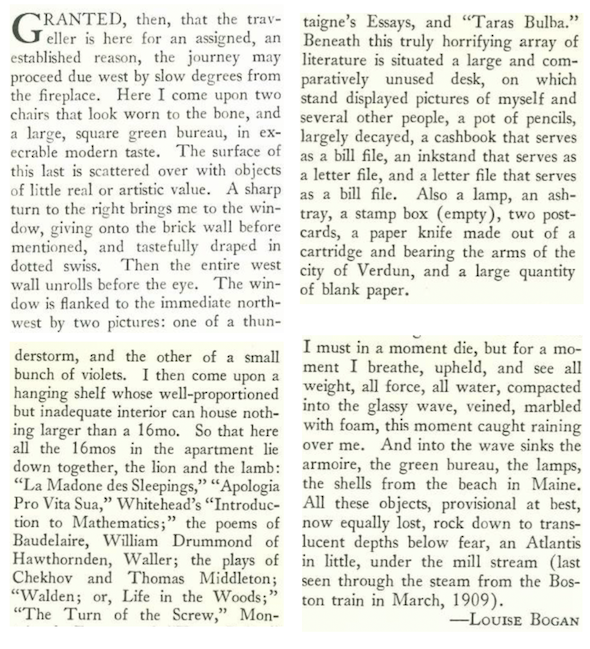
Louise Bogan (1897–1970) was poetry editor at The New Yorker for nearly forty years (1931–1970) and in 1945 was the first woman to be appointed Poet Laureate to the Library of Congress. For the Jan. 14 issue she wrote “Journey Around My Room,” which begins with her recollection of a childhood train ride. Here are some excerpts:
POET LAUREATE…Louise Bogan in 1937. She was poetry editor at The New Yorker for nearly forty years and was named U.S. Poet Laureate in 1945. (Library of Congress)
* * *
Silent Cal Silenced
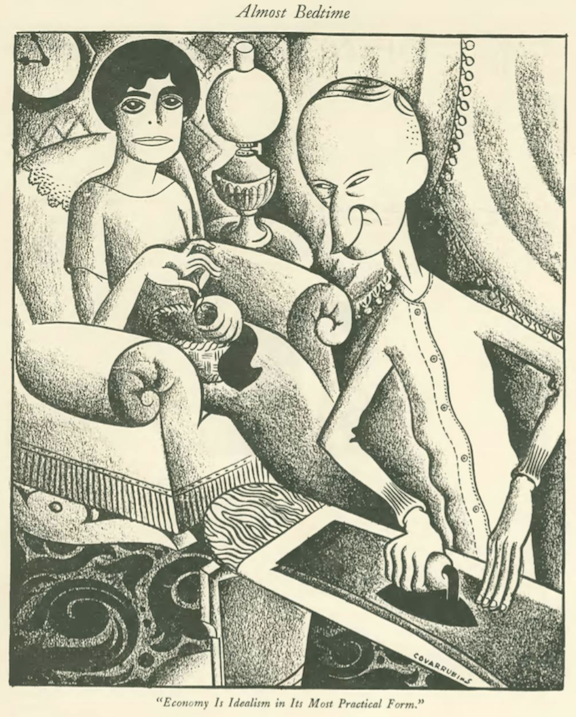
Many folks were surprised by the sudden passing of former U.S. President Calvin Coolidge. He was just sixty years old when he succumbed to coronary thrombosis at his Northampton home, “The Beeches.” During The New Yorker’s first years Coolidge was the butt of many jokes…beginning with this Miguel Covarrubias cartoon in the magazine’s fourth issue (March 14, 1925)…
E.B. White offered this eulogy of sorts…
THRIFTY IDYLL…Calvin and Grace Coolidge outside their newly acquired home, “The Beeches,” Northampton, summer 1930. (Leslie Jones Collection)
…and mused about the state of politics in 1933, proving that some things never change…
Last time we learned Lewis Mumford’s views about the new artwork displayed in the RKO Roxy Theatre and in Radio City Music Hall. In the Jan. 14 issue he turned his attentions to the actual buildings, giving them an average grade and preferring the Music Hall over the Roxy (he disliked the oversized chandelier/electrolier). Mumford was decidedly not a fan of the Rockefeller Center development, evident in his closing lines:
SHOWPLACES…Lewis Mumford gave Radio City Music Hall (top) and the RKO Roxy some muted nods, but found the Roxy’s electrolier distracting.
* * *
Parting Thoughts
Alexander Woollcott shared some final recollections of his visit to Moscow, in which he likens the Russians’ freedom under Josef Stalin to the freedom of a spirited schoolboy who desires to sit in the back of the classroom…
* * *
From Our Advertisers
Bonwit Teller employed some modern typesetting, wryly using the word DULL — offset in large san-serif letters — to draw attention to their “Chardonize” fabric, which was essentially artificial silk…
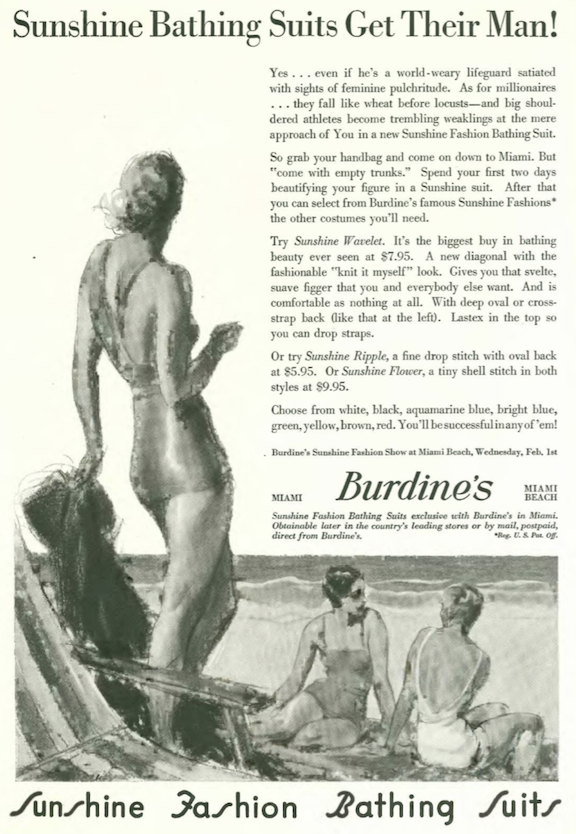
…nothing subtle about this next advertisement…don one of these bathing suits and millionaires will bow before you, or rather, to borrow this ad’s odd metaphor, “fall like wheat before locusts”…
…we get a similar but far more muted pitch from Coty…so does this mean one out of every six desirable bachelors want to be seen with her? Not exactly knocking them down like locusts…
…now here’s a couple of self-assured souls who are neither troubled by hungry locusts nor face powders…they own a Cadillac, and wow, that is really quite the automobile, not like the Caddies you see today that are half-plastic and blend in with the rest of the shapeless blobs we call cars these days…
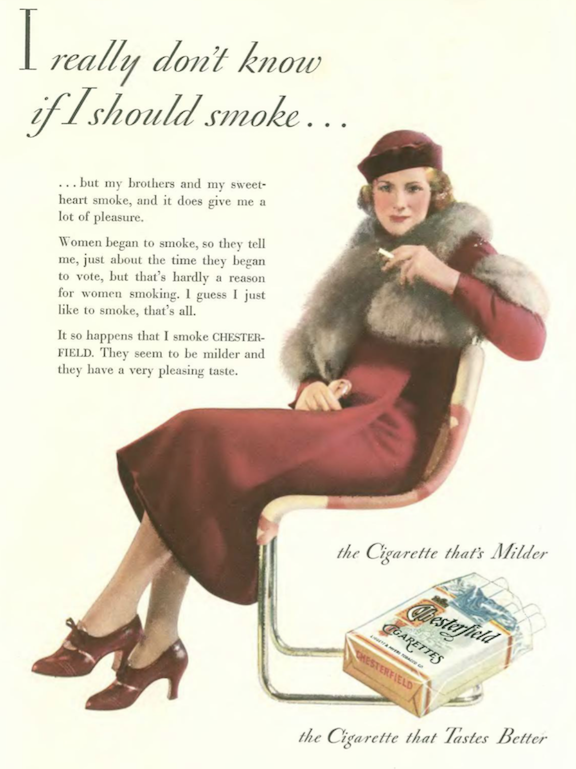
…the folks who pushed Chesterfield cigarettes were back with another ad aimed at their fastest growing demographic…note the sly reference to women’s suffrage…but that’s not why this woman (seated on a modern Breuer chair) smokes; she smokes because it gives her pleasure, and come to think of it, why should men have all the fun?…
…the Cunard Line suggested that you might run into some big-time celebrities on one of their ships, including actress Norma Shearer and banker/arts patron Otto Kahn (bottom of left-land page); or on the opposite page Charlie Chaplin, Douglas Fairbanks and Mary Pickford, Alfred Lunt and Lynn Fontanne among others…
…by contrast, the French Line employed the artistry of James Thurber to entice travelers onto the high seas…
…which gives us a nice segue into our cartoons, beginning with this spot by Thurber referencing the National Auto Show…
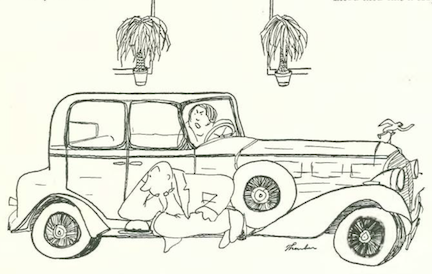
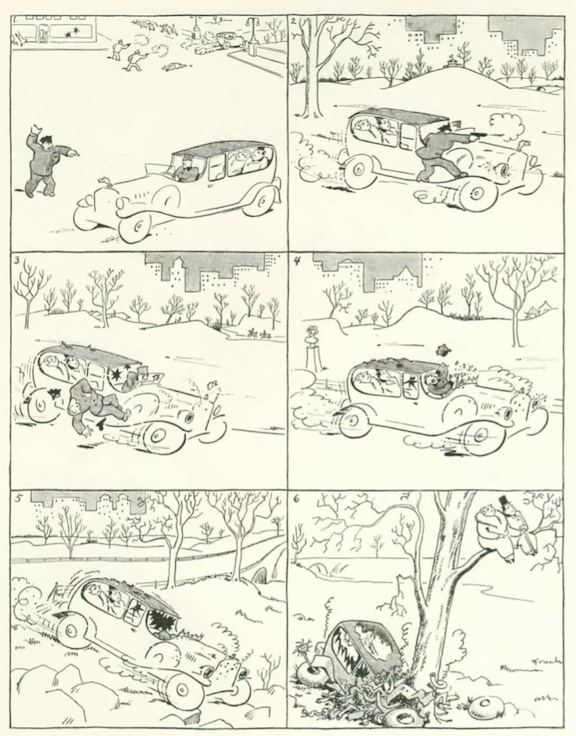
…Al Frueh offered up another of his famed sequential works…
…Gardner Rea with his usual perspective on the absurd…
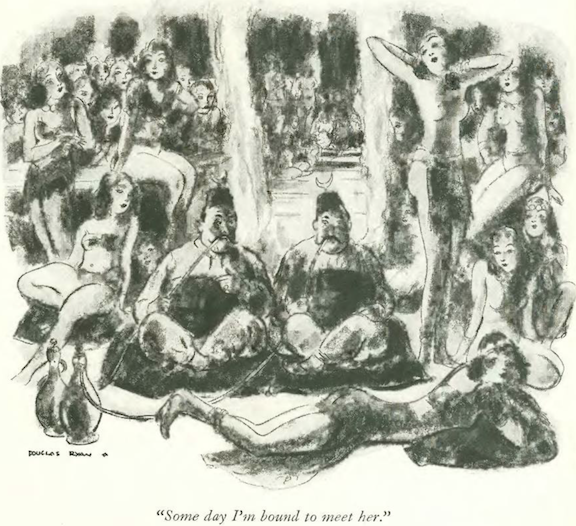
…Douglas Ryan plied the familiar waters of the harem trope…
…and Robert Day showed us that even the smallest consolation can still satisfy…
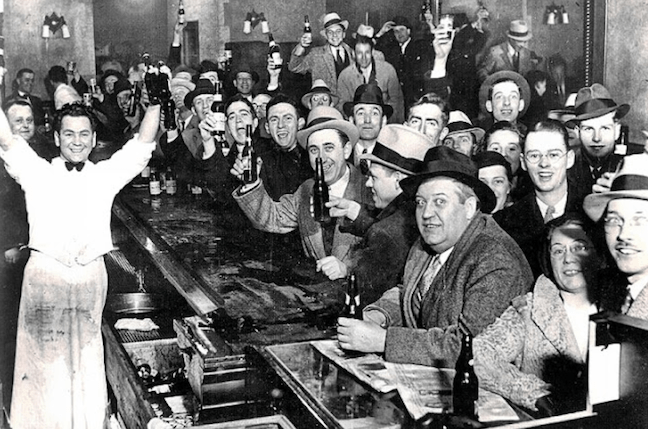
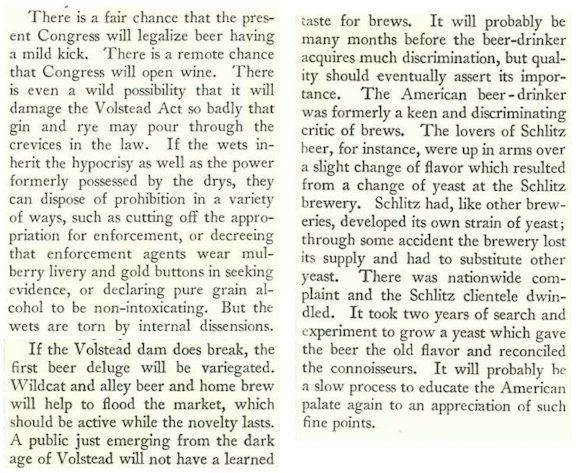
Good cheer was in short supply during the worst year of the Depression, but as 1933 approached many New Yorkers could at least look forward to legal beer in the New Year.
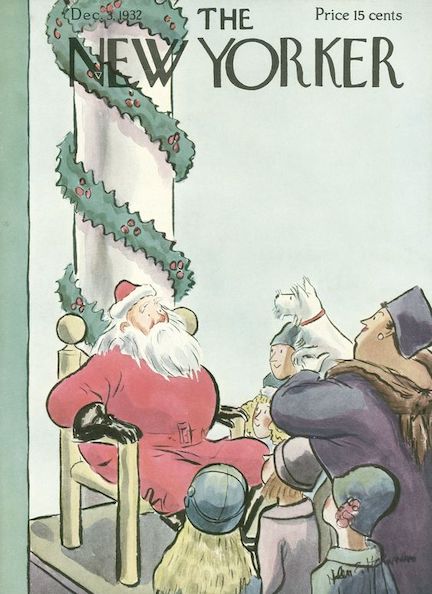
Dec. 3, 1932 cover by Helen Hokinson.
But as with all things political, new rules and regulations would need to be hashed out before the taps could flow, and both brewers and beer drinkers would have to recalibrate a relationship that had been suspended for nearly 13 years. Alva Johnston gave this (excerpted) report in “A Reporter at Large”…
WHILE YOU WERE AWAY…Vaudeville star Rae Samuels holds what was purportedly the last bottle of beer (a Schlitz) distilled before Prohibition went into effect in Chicago on Dec. 29, 1930. The bottle was insured for $25,000. After Prohibition ended in late 1933, Schlitz reappeared with gusto and quickly became the world’s top-selling brewery. (vintag.es)
* * *
National Treasure
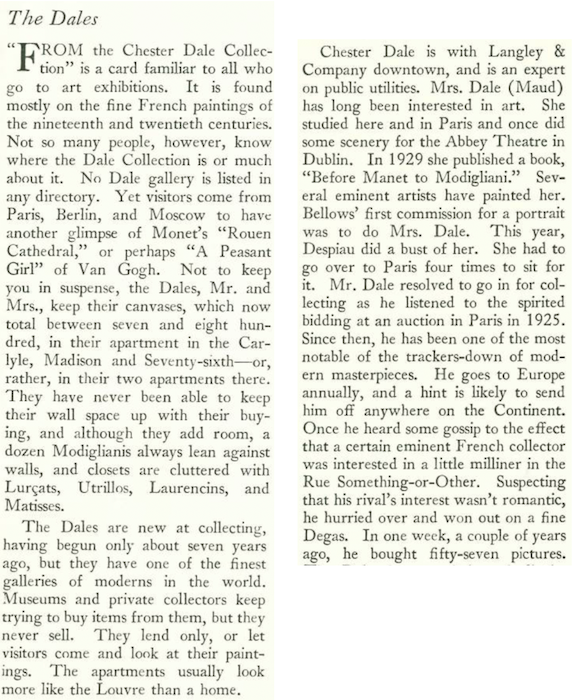
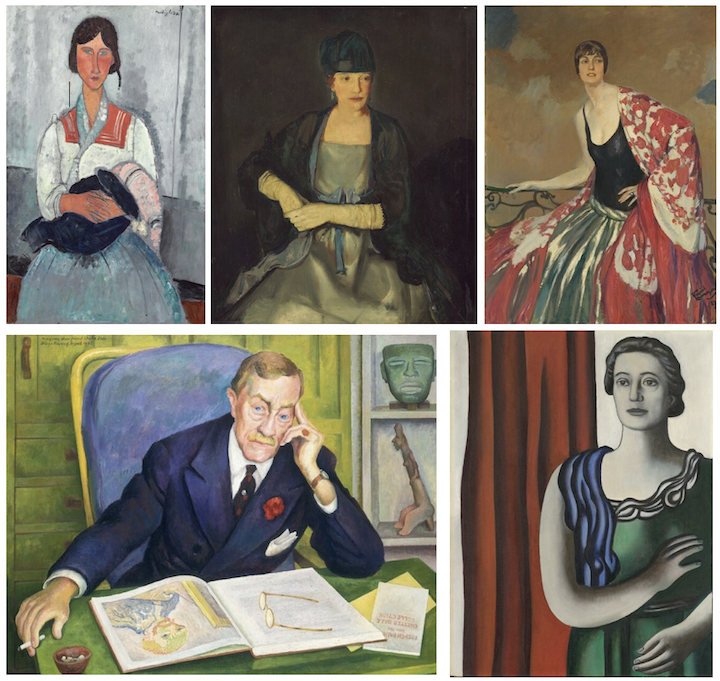
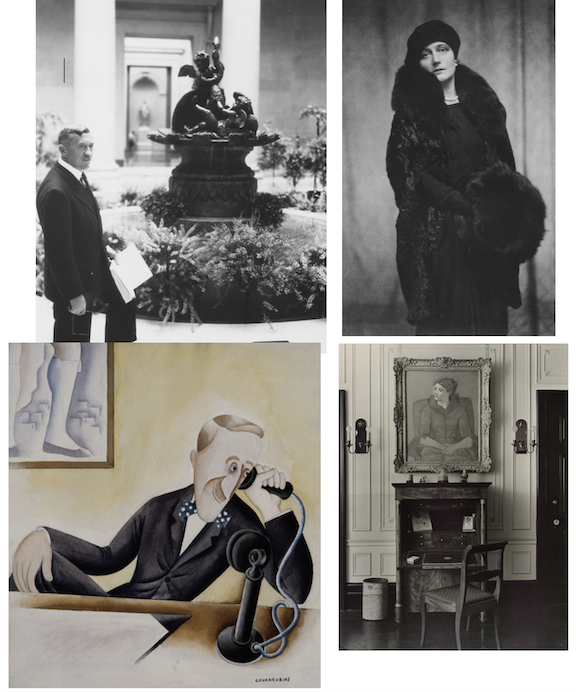
Chester Dale (1883–1962) began his career in finance at age fifteen, working as a runner for the New York Stock Exchange. Just twelve years later he would marry painter and art critic Maud Murray Dale, and together they would amass an art collection that would include significant works by Claude Monet, Paul Cézanne, Amedeo Modigliani, Henri Matisse and Pablo Picasso. In 1932 the Dales were well on their way to building a collection that would eventually end up in the National Gallery of Art in Washington, D.C. “The Talk of the Town” featured the Dales in this except:
WAYS OF SEEING…Maud Dale was a staunch supporter of artist Amedeo Modigliani, whose 1919 painting Gypsy Woman with Baby (top left) was among 21 of his works collected by the Dales. Maud also commissioned a number of her own portraits, including (clockwise, from top center) ones rendered by George Bellows in 1919, by Jean-Gabriel Domergue in 1923, and by Fernand Léger in 1935. At bottom left is a 1945 portrait of Chester Dale by Diego Rivera. (National Gallery of Art)SAINTED PATRONS…Clockwise, from top left, a 1943 photo of Chester Dale in the West Garden Court of the National Gallery of Art, which today holds the Chester Dale Collection of 240 paintings among other items; Maud Dale, c. 1926; Madame Picasso (1923) by Pablo Picasso on view in the Dale residence, c. 1935; a 1926 caricature of Chester by Mexican artist Miguel Covarrubias, a close friend of the Dales and early New Yorker contributor. (National Gallery of Art)
* * *
Smoke Screen
E.B. White noted the historic meeting of outgoing U.S. President Herbert Hoover and his successor, Franklin D. Roosevelt. White speculated on at least one topic of discussion:
DO YOU INHALE?…Outgoing President Herbert Hoover (left) and President-elect Franklin D. Roosevelt on their way to the inauguration ceremonies, 1933. (National Archives)
* * *
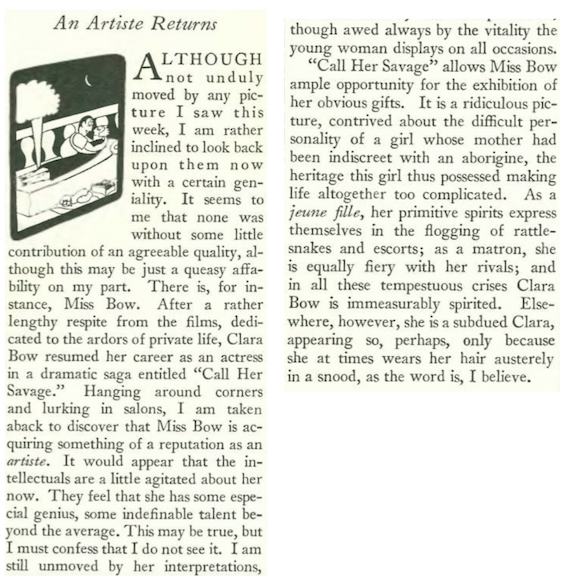
No Longer “It”
Here is how IMDB describes the 1932 pre-Code drama Call Her Savage: “Sexy Texas gal storms her way through life, brawling and boozing until her luck runs out, forcing her to learn the errors of her ways.” The actress who portrayed that “Texas Gal,” Clara Bow, was getting sick of Hollywood and would make just one more film before retiring at age 28. Although in some circles the silent era’s “It Girl” sex symbol was finally beginning to earn some credit as an “artiste,” critic John Mosher was reserving judgment:
WHIP IT GOOD…Clara Bow brawls her way through life in her second-to-last film role, Call Her Savage. (IMDB)
* * *
From Our Advertisers
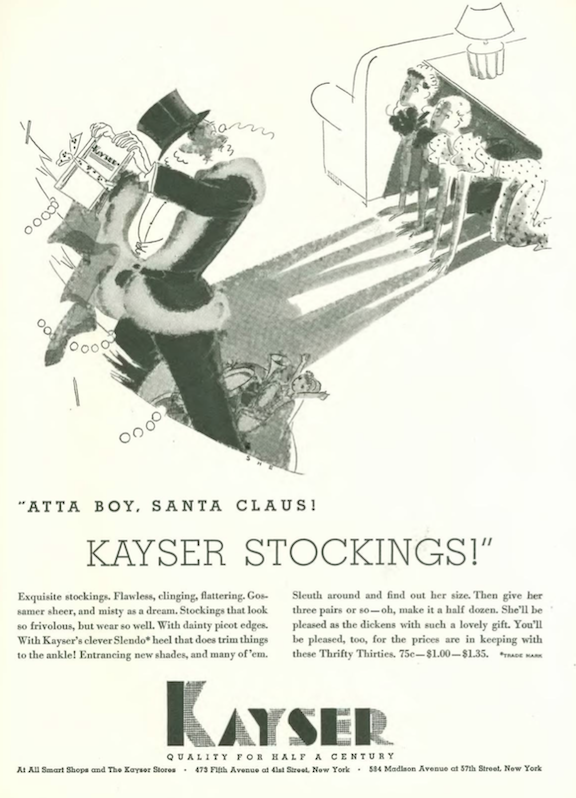
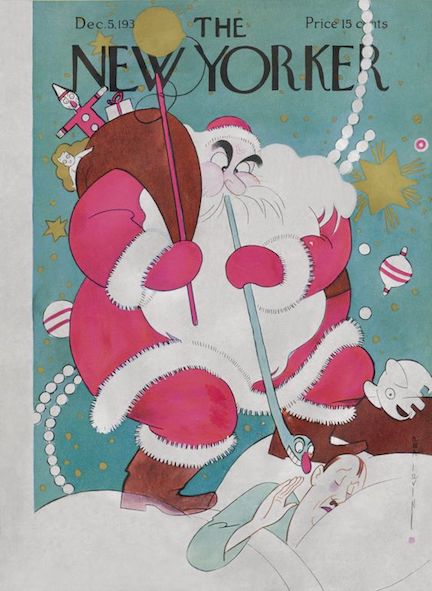
Is this really how the smart set lived in 1932 Manhattan? Here we have an old toff dressed like Santa (in a top hat) sneaking presents onto the Christmas tree…and caught in the act by, I presume, his wife and a chambermaid?…
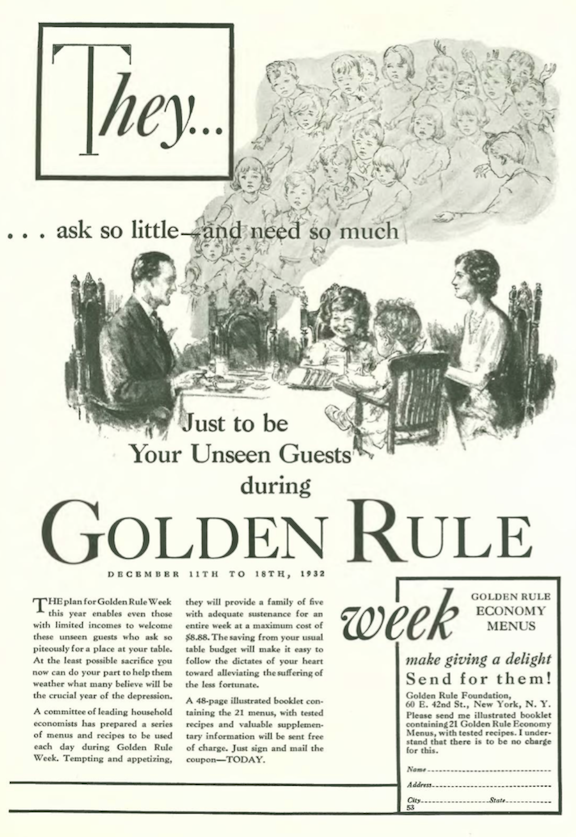
…in sharp contrast, here is an ad from the Golden Rule Foundation, which annually designated the second week in December as “Golden Rule Week”…the foundation raised funds to help needy children throughout the world…
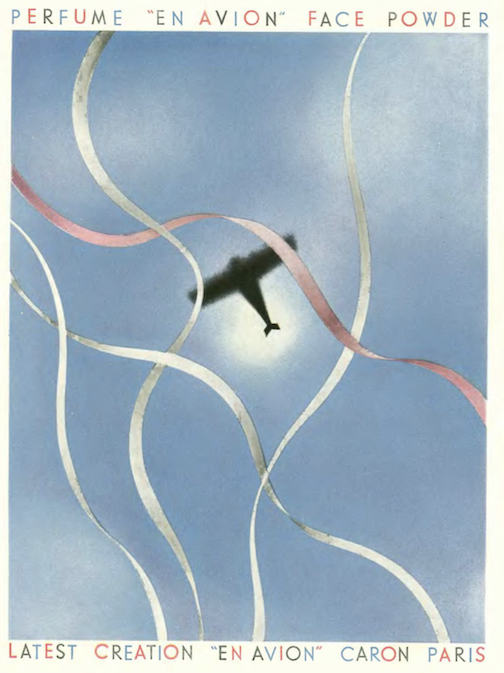
…and here’s a bright, back cover ad from Caron Paris…apparently the face powder industry had been good to them in 1932…
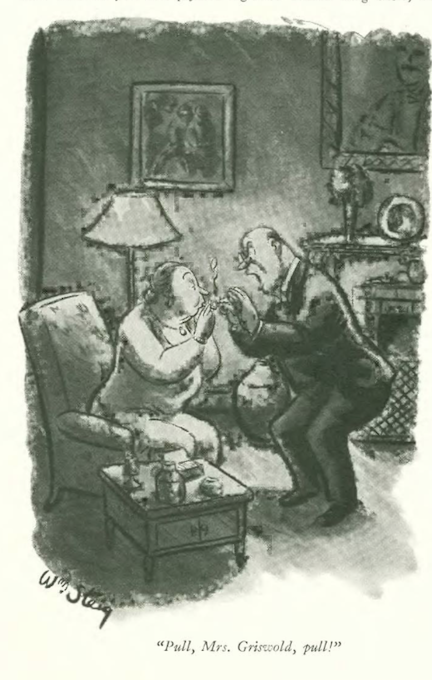
…on to our cartoons, we start with a smoking tutorial from William Steig…
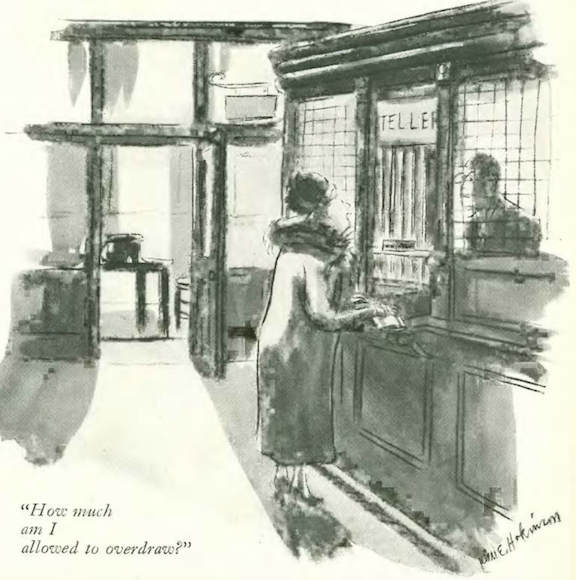
…some sunny optimism from one of Helen Hokinson’s “girls”…
…in this two-pager by Garrett Price, an artist asks his patron: All right then, what was your conception of the Awakening of Intelligence through Literature and Music?…
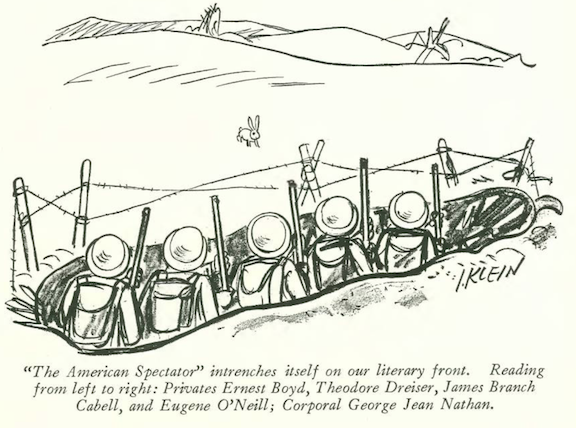
…Isadore Klein dedicated this cartoon to the much-anticipated launch of a new literary magazine, The American Spectator (not to be confused with today’s conservative political publication by the same name) and its illustrious line-up of joint editors…
…Crawford Young’s caption recalled the precocious child in Carl Rose’s 1928 cartoon caption, a collaboration with E.B. White — “I say it’s spinach, and I say the hell with it”…
…and speaking of Carl Rose, this next cartoon by James Thurber has an interesting history…New Yorker cartoonist Michael Maslin explains in this Carl Rose Inkspill bio: In 1932, Rose submitted a drawing captioned, “Touche!” of two fencers, one of whom has just cut off the head of the other. Harold Ross (according to Thurber in The Years With Ross) thinking the Rose version “too bloody” suggested Thurber do the drawing because “Thurber’s people have no blood. You can put their heads back on and they’re as good as new”…
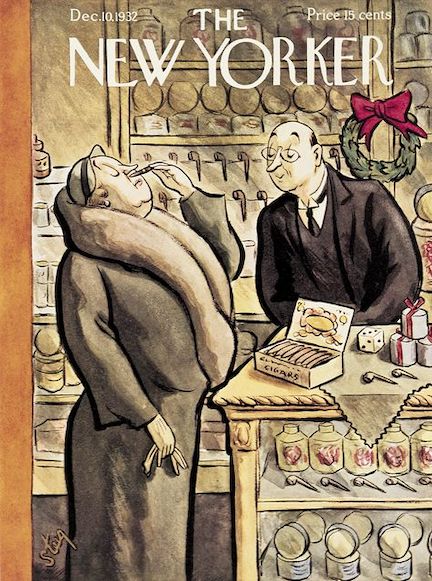
…as we close out December 2021 (which I am dutifully trying to do the same in 1932), we move on to the Dec. 10 issue…
Dec. 10, 1932 cover by William Steig.
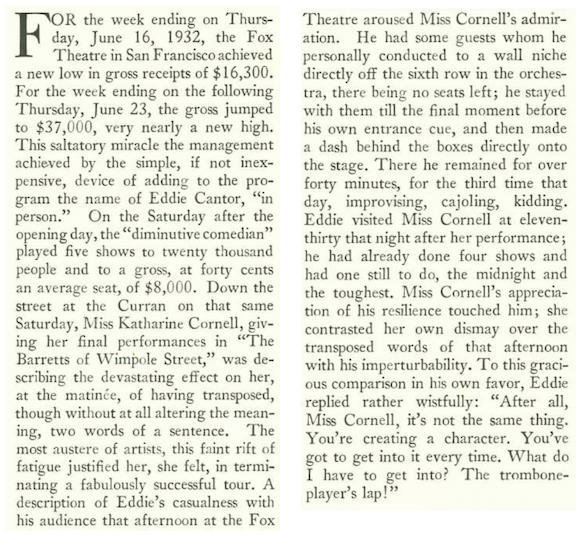
…and Samuel N. Behrman’s profile (titled “Chutspo”) of comedian Eddie Cantor, who made his way from vaudeville and the Ziegfeld Follies to fame on the radio, in film and on early television. Theater great Katherine Cornell certainly appreciated Cantor’s gift for making his routine look easy: Here’s an excerpt:
AH, IT WAS NOTHIN’…Comedian Eddie Cantor was adored by millions of radio listeners as the “Apostle of Pep.” At right, caricature for the profile by Al Frueh. (bizarrela.com)
* * *
Christmess
Lois Long’s “On and Off the Avenue” column was thus titled to reflect the annual challenge of buying that special something for that special someone. Here is the opening paragraph:
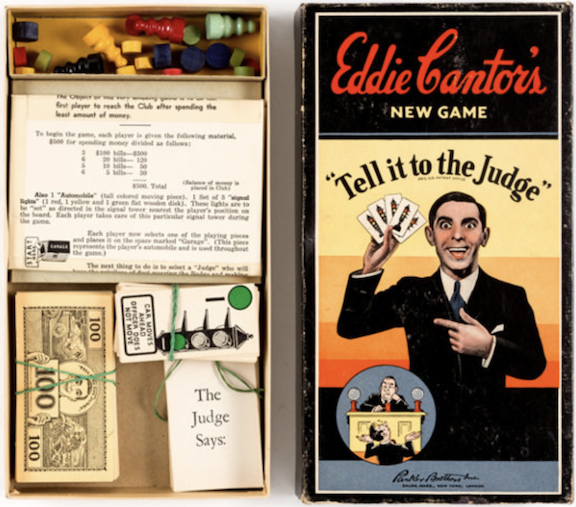
One of the items suggested in Long’s column was a game named for our friend Eddie Cantor called “Tell it to the Judge”…
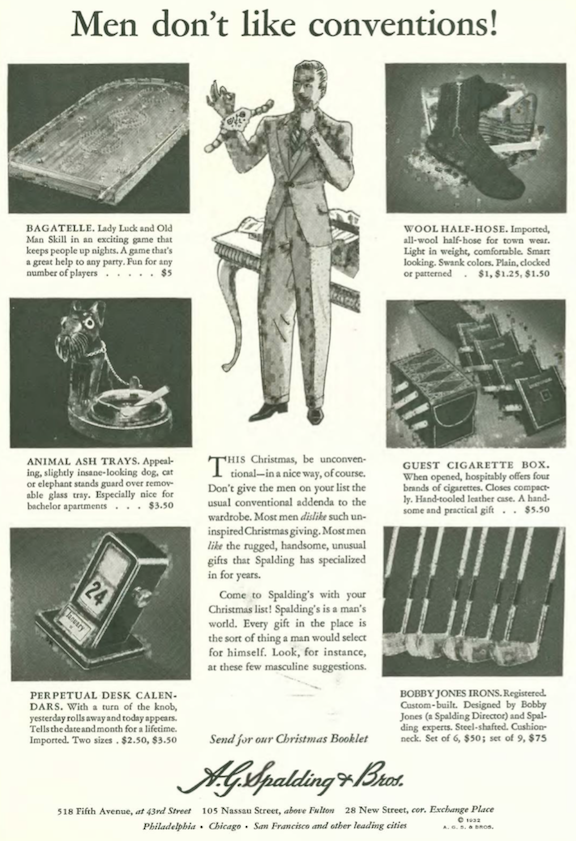
…or you could select one of these gifts from A.G. Spaulding…my grandfather had one of those perpetual desk calendars…I would stave off boredom by endlessly flipping those numbers while the adults conversed in German…
…on to our cartoonists, James Thurber provided this nice bit of art for a two-page spread…
…Kemp Starrett gave us some biscuit (cookie) execs contemplating a new, streamlined design for their product…
…Norman Bel Geddes is perhaps best known for designing the “Futurama” display at the 1939 New York World’s Fair…here is Bel Geddes’ “Cobra Lamp”…
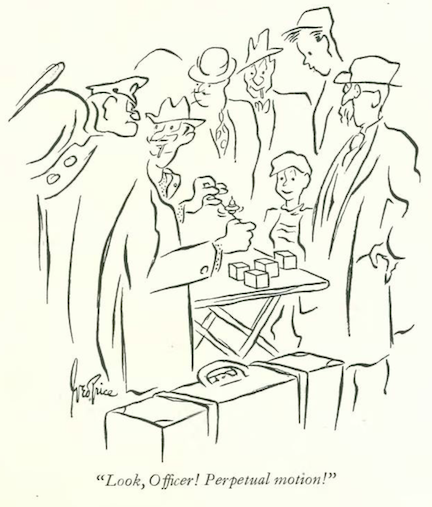
…George Price gave us a fellow peddling more than a simple top…
…and with Peter Arno, the party never ends…
…on to Dec. 17, 1932…
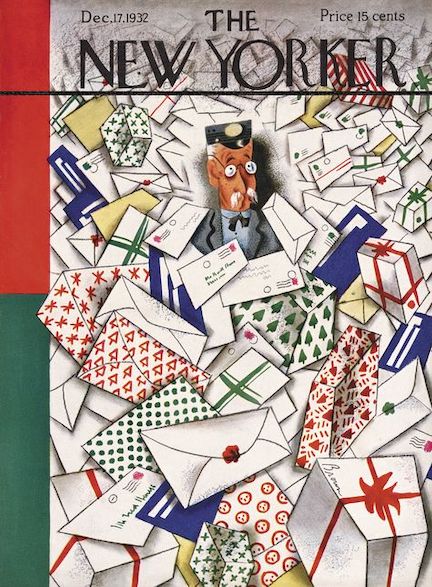
Dec. 17, 1932 cover by Harry Brown.
…and Arno’s ex Lois Long was back with another “Tables for Two,” still feigning the old spinster (see “shawl and slippers” reference in first graf) when in fact she was an attractive, 31-year-old divorcee who apparently still had plenty of fire for late night revelry…
According to the Jeremiah Moss blog Vanishing New York, Long was likely describing 52nd Street between Fifth and Sixth avenues that “began as a row of speakeasies, which turned into jazz clubs that then evolved into burlesque houses.” The speakeasies got their start when the city lifted residential restrictions on the brownstones and businesses moved in, including Tony’s, the Trocadero and later Place Pigalle…
(vanishingnewyork.blogspot.com via NYPL)
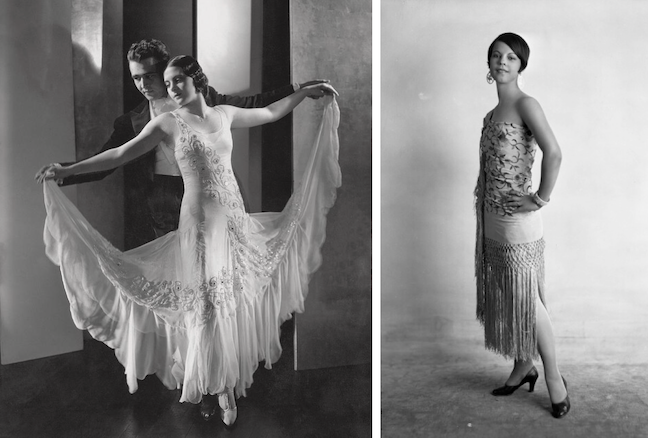
…it was at the new Place Pigalle that Long enjoyed the “knockout” after-midnight show featuring ballroom dancers Frank Veloz and Yolanda Casazza and the diminutive singer Reva Reyes…
AFTER HOURS entertainment at the Place Pigalle included Frank Veloz and Yolanda Casazza (left, in a 1930 portrait by Edward Steichen) and Mexican singer Reva Reyes. (Vanity Fair/El Paso Museum of History)
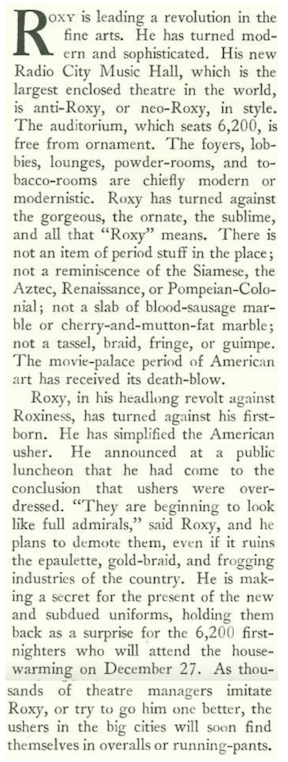
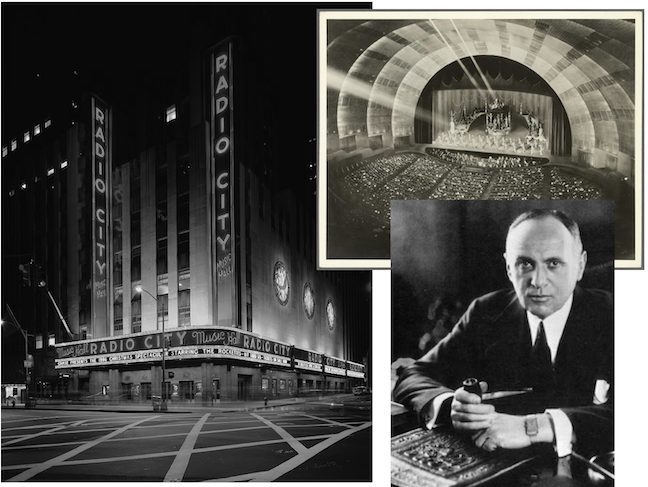
…and there was more entertainment to be had in Midtown with the upcoming opening (Dec. 27, 1932) of Radio City Music Hall, a dream project of Samuel “Roxy” Rothafel. Hugh Blake had the scoop for the New Yorker in the “A Reporter at Large” column…an excerpt:
AIN’T IT GRAND?..of Radio City Music Hall would open its doors on Dec. 27, 1932, fulfilling a dream of theater owner Samuel “Roxy” Rothafel. (nypap.org/Wikipedia/dobywood.com)
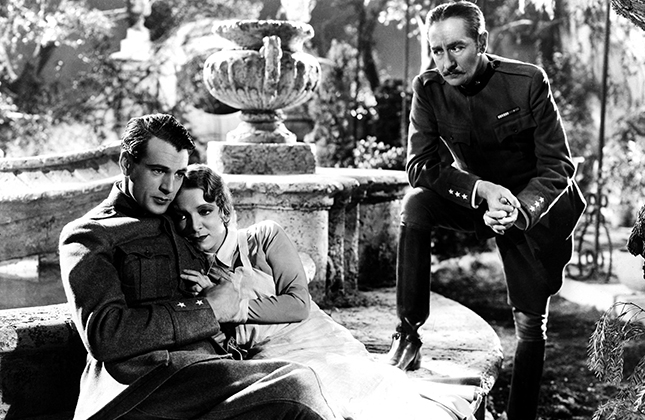
…Radio City Music Hall was built to host stage shows only, but within a year of its opening it was converted into a movie venue…and speaking of movies, we have film critic John Mosher finally finding a movie to his liking, and a novel-to-film adaptation to boot…
FAREWELL TO ALL OF THOSE ARMS…Gary Cooper, Helen Hayes and Adolphe Menjou in Paramount’s A Farewell to Arms, directed by Frank Borzage. The film received Academy Awards for Best Cinematography and Best Sound. (buffalo.edu)
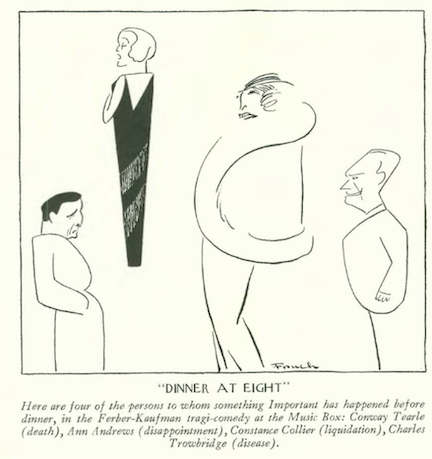
…and back to the stage, Al Frueh lent his artistry to the play Dinner At Eight, which opened October 22, 1932, at the Music Box Theatre, and would close May 6, 1933, after 232 performances. The popular play had revivals in 1933, 1966 and 2002 as well as a George Cukor film adaptation in 1933 with an all-star cast.
* * *
From Our Advertisers
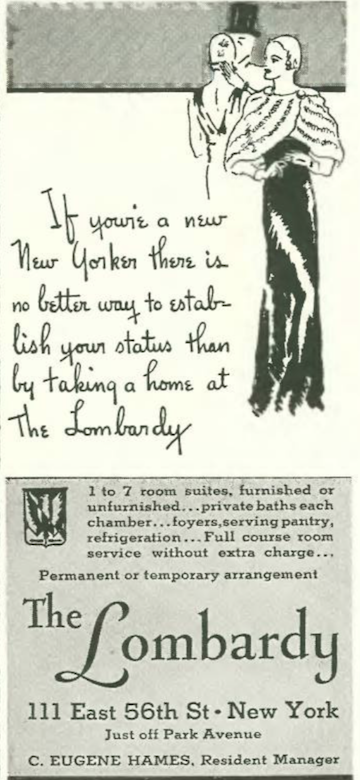
We begin with this helpful advice from the folks at the Lombardy…
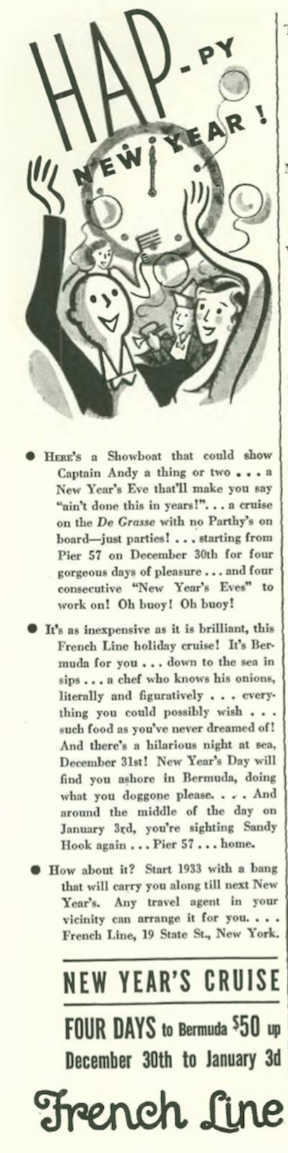
…while we have a much less stuffy invitation from the French Line…
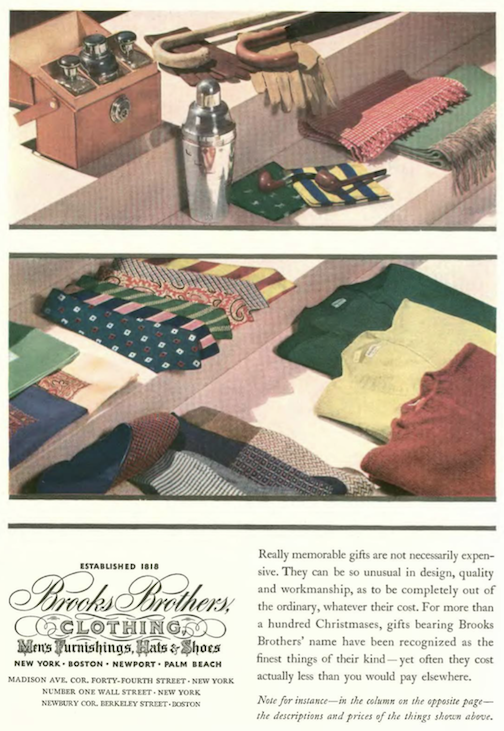
…the usually staid Brooks Brothers sprung for an all-color Christmas ad, featuring items that would suit any aspiring Bertie Wooster…
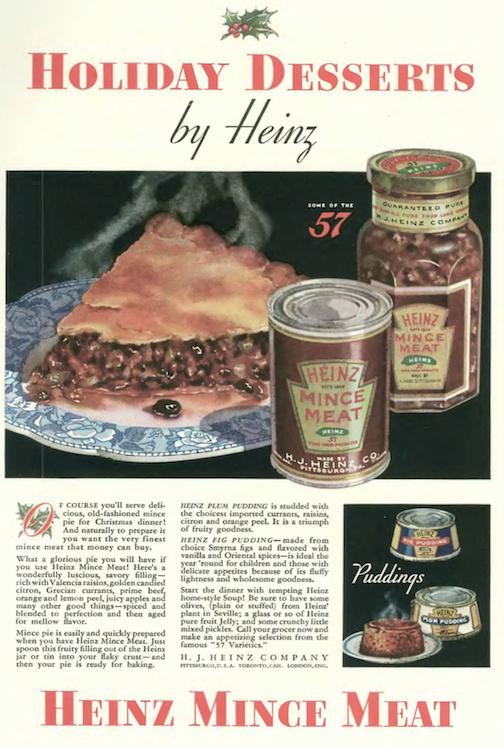
…and what would be the holidays without canned meat…
…and we end with James Thurber, who gets us into the proper mood for the New Year…
Whether or not you could afford a new car in Depression-era New York, you could afford to take your mind off the hard times for a few hours and visit the annual National Automobile Show at Grand Central Palace.
Jan. 16, 1932 cover by S. Liam Dunne.
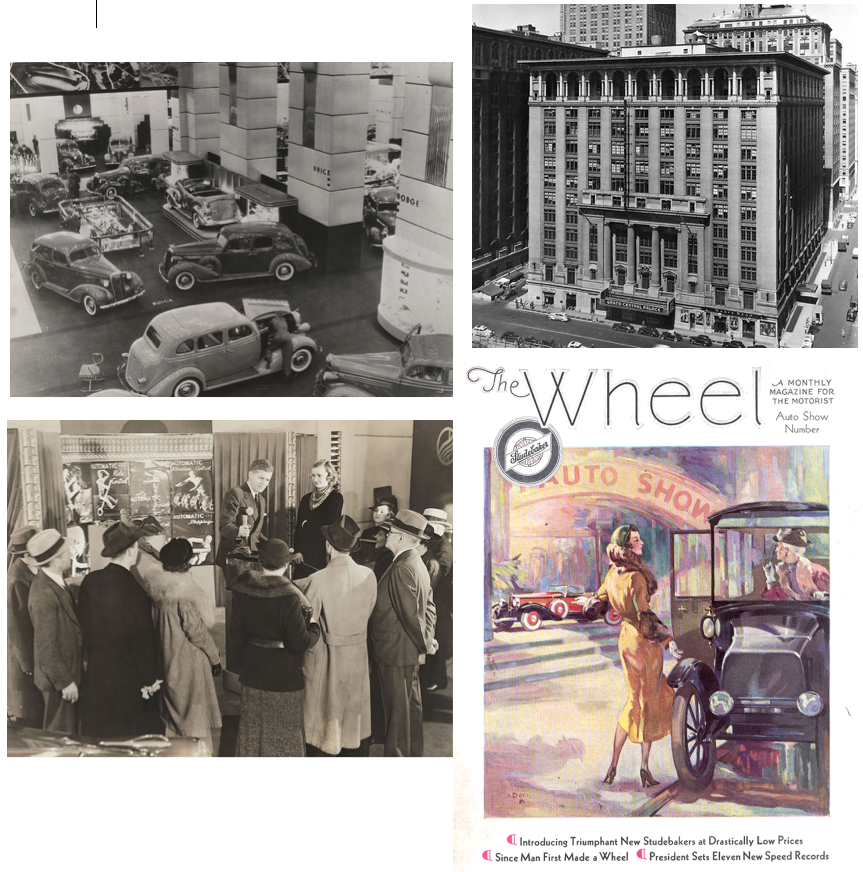
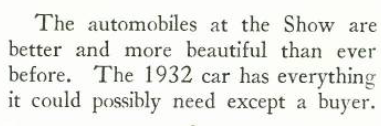
The 1932 exhibition featured many familiar brands, and others that would not survive the decade. Bolstered in part by the largess of General Motors and its downscale LaSalles, Cadillac could offer a pricey edition of the Fleetwood (at $5,542, roughly equivalent to $100K today), but most car makers featured models with reduced prices and/or smaller engines, as well as new technologies and design features they hoped would attract buyers of modest means. Excerpts from The New Yorker’s “Motors” column:
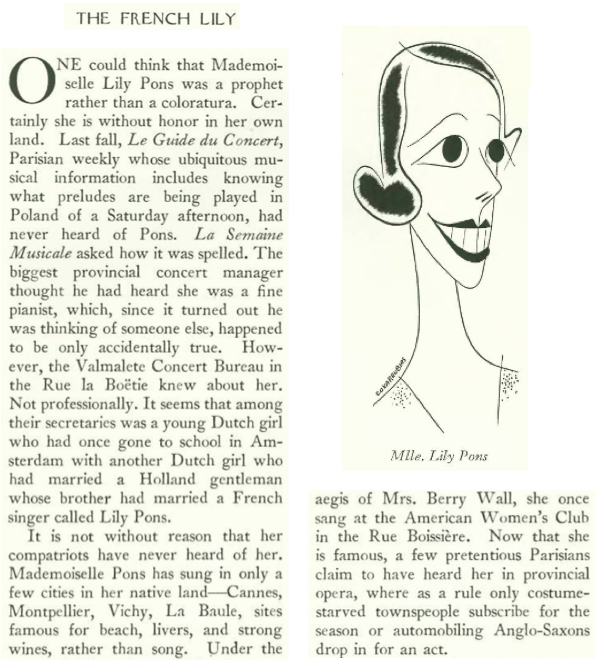
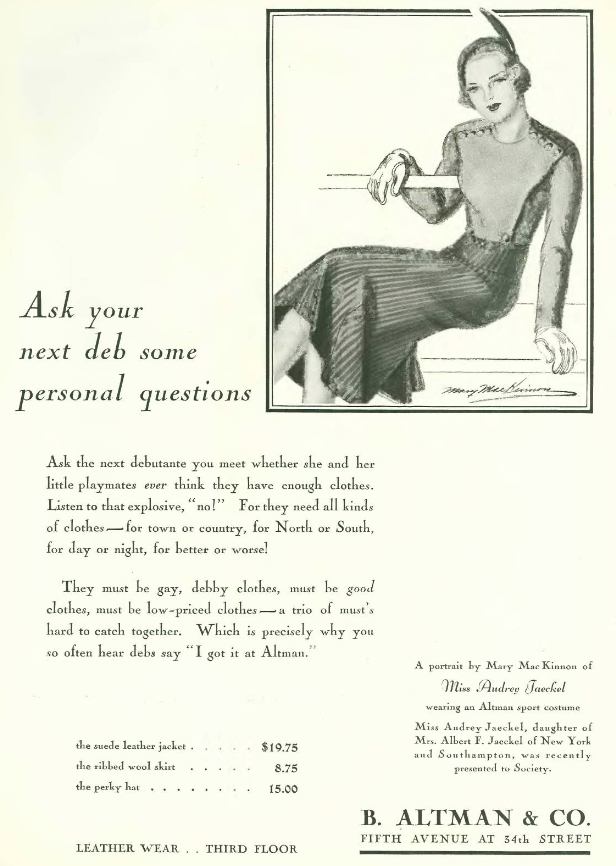
CAN’T TOUCH THIS…The Cadillac V16 Fleetwood sat atop the American car world in 1932. (classicdriver.com)LOOK, BUT DON’T BUY…The New Yorker noted the crowds gathered around the Studebaker –produced “Rockne” at the National Automobile Show. Named for the famed Notre Dame football coach Knute Rockne (who died in a 1931 plane crash), this 1932 model attracted plenty of gawkers at the show but few buyers. It was soon discontinued, and leftover Rocknes were disassembled and sent to Norway, where they were reassembled and sold to Scandinavian buyers. (conceptcarz.com)DOUBLE VISION…The 1932 Oakland Roadster (left) marked the end of the Oakland Motorcar Company, which had been previously acquired by General Motors. That same year Oakland was reborn as the Pontiac division, and the Oakland Roadster was reimagined as the 1932 Pontiac Model 302 (right). (Hemmings/justamericanautomobiles.com)PALACE OF DREAMS…Grand Central Palace (top right) sat at Lexington Ave. between 46th and 47th Streets. A favorite locale for manufacturers to display their latest wares, it was demolished in 1963; at left, images from the 1935 National Automobile Show; bottom right, 1932 copy of The Wheel, produced by Studebaker for distribution at auto shows. (freelibrary.org/chicagology.com)
Whether folks were able to shell out more than $5,000 for a Caddy or a mere $700 for Plymouth, many left the show with nothing more than dreams for better days. Howard Brubaker summed it up thusly in his “Of All Things” column:
* * *
Darling Lily
Coloratura soprano Lily Pons (1898–1976) was not well-known in her native France when she took the Metropolitan Opera stage by storm in 1931—she would become the Met’s principal soprano and, in 1940, an American citizen. The singer was profiled by Janet Flanner in the Jan. 16 issue (caricature by Miguel Covarrubias). Excerpts:
FRENCH TOAST OF THE TOWN…Coloratura soprano Lily Pons was particularly associated with the title roles of Lakmé (pictured above, mid-1930s), and Lucia di Lammermoor. Pons was a principal soprano at New York’s Metropolitan Opera for 30 years, appearing 300 times from 1931 until 1960. (Pinterest/YouTube)
If you have a few minutes, check out Lily Pon’s 1935 performance of “The Bell Song” from the film I Dream Too Much, which co-starred Henry Fonda. Although the sound quality is not the greatest, you can still get a pretty good idea why Met audiences adored her.
* * *
Fantasy Bridge
Satirist Ring Lardner found something rotten in the behavior of robber barons and politicians in the midst of the Depression, so he imagined a bridge game that brought together banker J.P. Morgan (Jr), John D. Rockefeller (then the richest person in America and perhaps the world), Sen. Reed Smoot of the Smoot-Hawley Tariff Act (a catalyst for the Depression), and social worker Jane Addams. Excerpts:
DEAL ME OUT…Ring Lardner addressed the wages of greed through a fantasy bridge game. (Dallas Morning News)
* * *
From Our Advertisers
If you were one of J.P. Morgan’s bankers, you might have considered hopping on a United flight instead of taking the train—within 20 years, airlines would make a serious dent into railroad’s corporate travel business…
…and if you were a successful banker, your daughter or granddaughter might have been an aspiring deb with some very specific needs…
…the Little King also had some specific fashion needs, as Otto Soglow brings us to the cartoon section…
…with the Auto Show in town, Helen Hokinson got her girls into the conversation…
…the “wizard control” they refer to was Buick’s gimmick to attract more women drivers to their product…here’s an ad from the Feb. 6 issue of the New Yorker:
…back to our cartoons with James Thurber, and the “war” that continued to brew between men and women (note artwork on the wall)…
…Al Freuh offered his perspective on meagre predictions for prosperity…
…as did one of William Steig’s precocious children…
…and Helen again with another privileged view of the downtrodden…
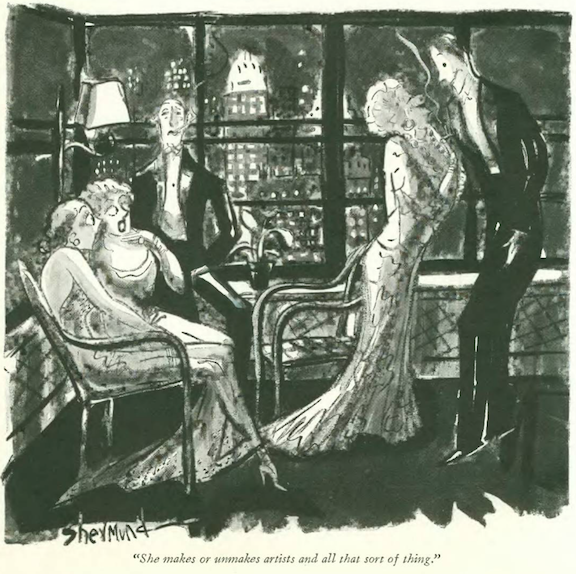
…Barbara Shermund showed us one woman’s interpretation of “belonging”…
…and Denys Wortman gave us one salesman who probably dreamed of some solitary drinking…
…on to our Jan. 23, 1932 issue…
Jan. 23, 1932 cover by Rea Irvin.
…and this item in “The Talk of the Town,” which noted the challenges of publishing a book about Adolf Hitler…
…and a few pages later, we are treated to an E.B. White “song” written for delegates to the Conference for the Reduction and Limitation of Armaments which was being convened in Geneva, Switzerland…
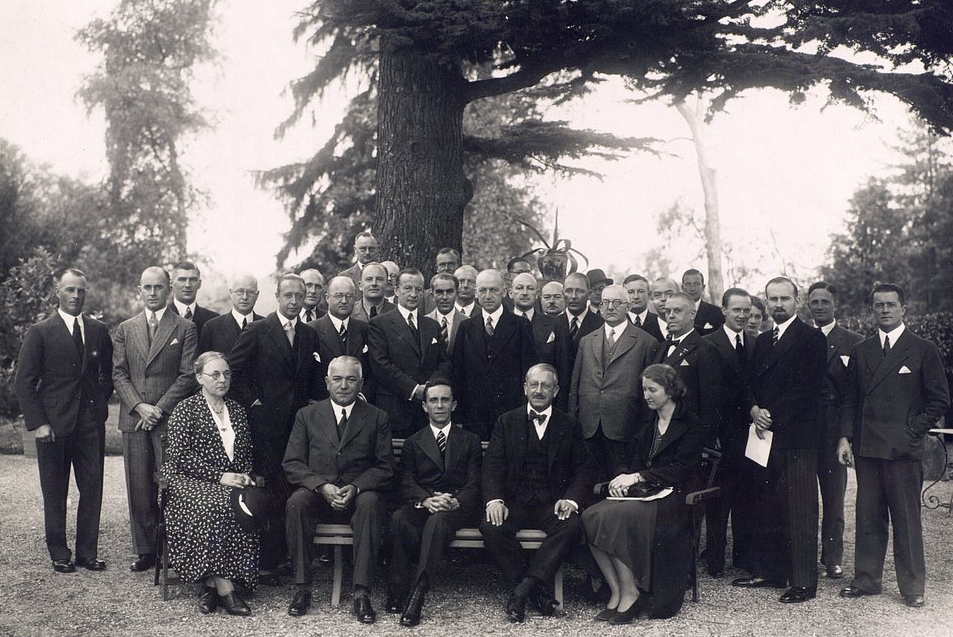
Delegates from sixty countries attended the Geneva conference. They were there to consider the German demand that other nations disarm to the same levels that had been imposed on them by the Treaty of Versailles. The conference deadlocked by the summer, and when it was reconvened in February 1933 Hitler had just assumed power in Germany. By fall 1933 Germany withdrew from both the Disarmament Conference and the League of Nations, and the stage was set for another world war.
Here is a 1933 photo of the delegates to the Disarmament Conference before things went south:
(wdl.org)
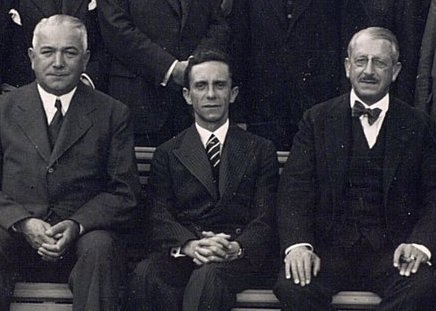
A detail of the photo (below) reveals the identity of the tiny man seated at center: the representative from Germany—Minister of Public Enlightenment and Propaganda Joseph Goebbels. Just twelve years hence Goebbels would find himself trapped with Hitler and Eva Braun in a Berlin bunker as Soviet troops demolished the city above them. Goebbels and his wife, Magda, would poison their six children, and then themselves as the Third Reich crumbled to ashes.
A final note: The delegates weren’t alone in Geneva, as a number of peace organizations sent observers and demonstrators to the conference, many of them women:
APPEALS TO DEAF EARS…Women’s disarmament campaigner in Geneva, c.1932; right, a poster created by Dutch artist Giele Roelofs for the Northern Friends Peace Board and others. (London School of Economics/armingallsides.org.uk)
We’ll give the last word to Howard Brubaker in Jan. 30 “Of All Things” column:
* * *
From Our Advertisers
With the National Automobile Show wrapping up, the Grand Central Palace prepared to welcome exhibitors for the annual Motor Boat Show…
…the woman in this next ad might have been better off in a boat than on the beach…I’m wondering if the artist had any idea that his or her illustration would be used to promote coffee…it’s hard to tell what is going on here…apparently a young woman has almost drowned and is receiving oxygen, or maybe she doesn’t really need it, and the perverted lifeguard and cop just want to ogle the poor beachgoer, who seems bored by the whole predicament…
…there is also something vaguely sexual going on in this ad for Vicks (what is he looking out for in panel four?)…the artist (the cartoon is signed “Len”) seems to be channeling one of Rea Irvin’s series cartoons…
…in the early 20th century it was fashionable to smoke imported luxury Egyptian cigarettes, or counterfeits like Ramses II, produced in the U.S. by the Stephano Brothers…
…the makers of Camel were among the most successful counterfeiters of Egyptian cigarettes — the camel, pyramids and palm tree motifs were no mistake, but by 1932 this established brand (launched in 1913) went less for snob appeal and more for the active, fresh-faced youths whose pink lungs were highly coveted by R.J. Reynolds…
…on to our cartoons, we begin with James Thurber and some more sexual tension…
…Garrett Price found a young hostess eager to to please…
…Perry Barlow introduced us to a young man who (almost) never forgets a face…
…William Crawford Galbraith dined with the uppers, not necessarily known for their literary sophistication…
…Barbara Shermund gave us a proud collector who managed to evade the Puritans in U.S. Customs…
…William Steig showed us pride of a different sort…
…and another by Steig displayed the antics of one of his “Small Fry”…
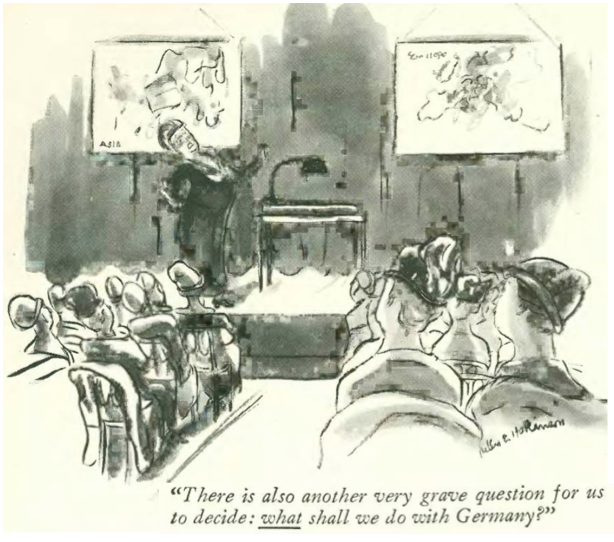
…and we end with Helen Hokinson, who found a local women’s club joining the debate raging far away at the Disarmament Conference in Geneva…
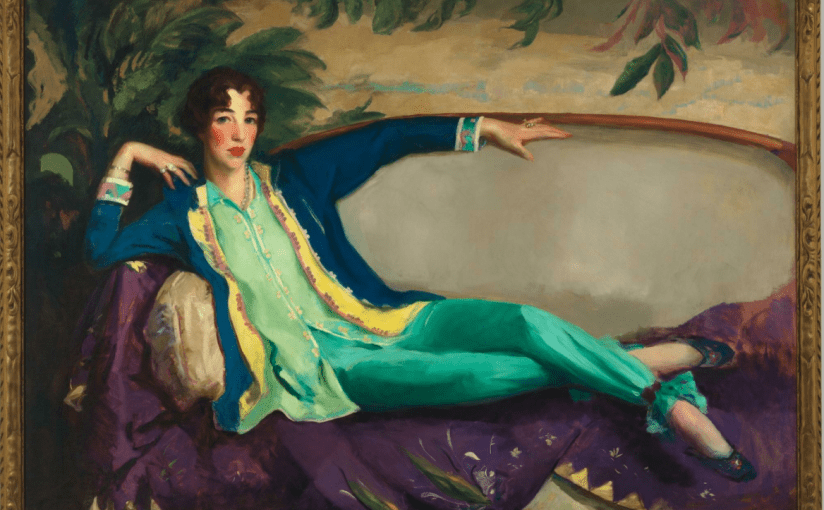
In 1931 Gertrude Vanderbilt Whitney (image above) opened a new art museum in Greenwich Village that would be unlike any other in Manhattan, one that would focus exclusively on American art and artists.
Nov. 28, 1931 cover by Harry Brown.
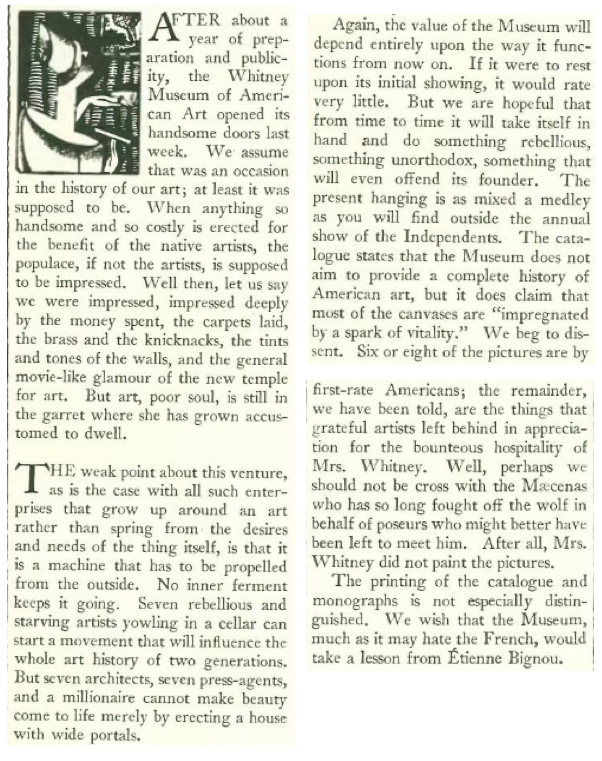
Ninety years ago American painters and sculptors were mostly considered second-rate by critics who had cut their teeth on the Old World’s “Great Masters.” An exception was TheNew Yorker’s first art critic, Murdock Pemberton, who accused such institutions as the Metropolitan Museum of discouraging American art. It is a bit surprising, however, that Pemberton initially gave a cool reception to the opening of the Whitney Museum of American Art, perceiving that its founders were putting the cart before the horse:
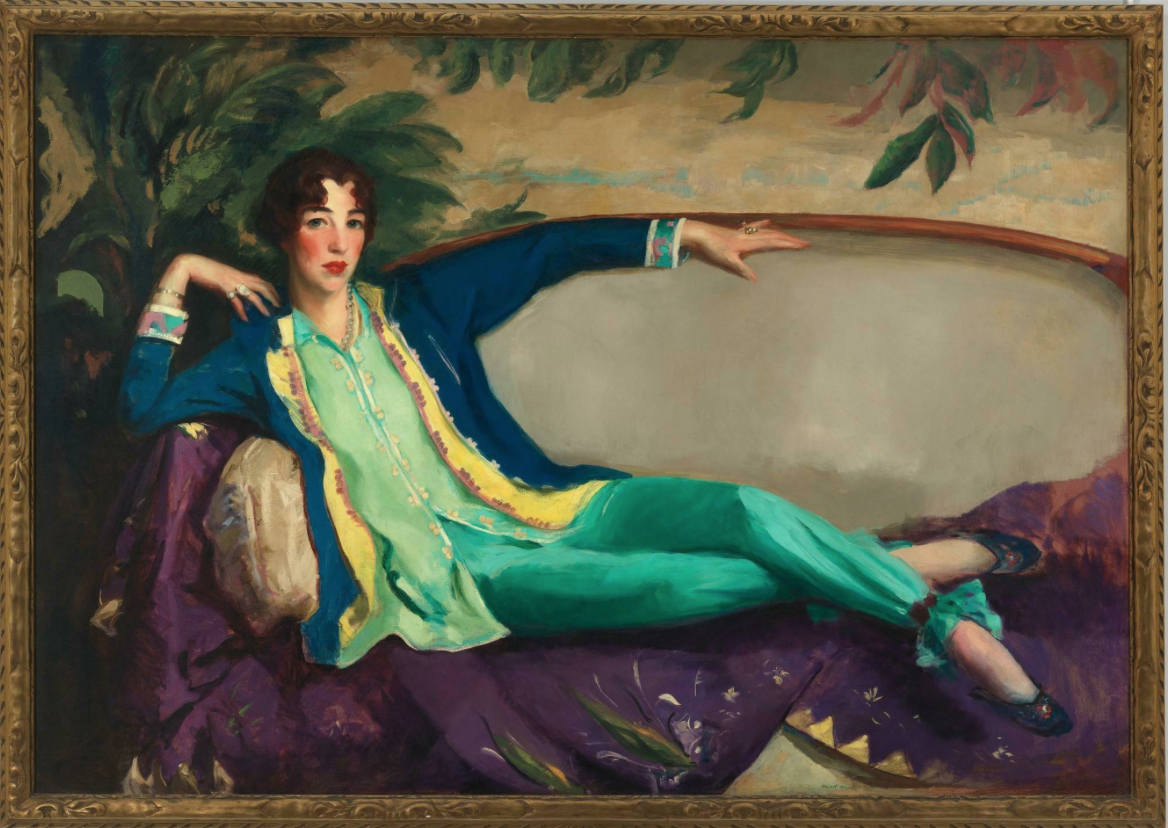
AMERICAN ORIGINAL…The original Whitney Museum of American Art was located at 8–12 West Eighth Street in Greenwich Village. Above, images from a 1937 museum catalog, and (bottom right) a view of the building’s West Eighth Street facade, circa 1940-50. (Whitney Museum/Life magazine)SHE WORE THE PANTS…Robert Henri’s 1916 portrait of Gertrude Vanderbilt Whitney, sculptor and founder of the Whitney Museum. Gertrude’s husband, Harry Payne Whitney, would not allow his wife to hang the portrait in their Fifth Avenue town house because he didn’t want visitors to see his wife “in pants.” Instead, the portrait hung in Gertrude’s West 8th Street studio, which became the first Whitney Museum in 1931. (whitney.org)
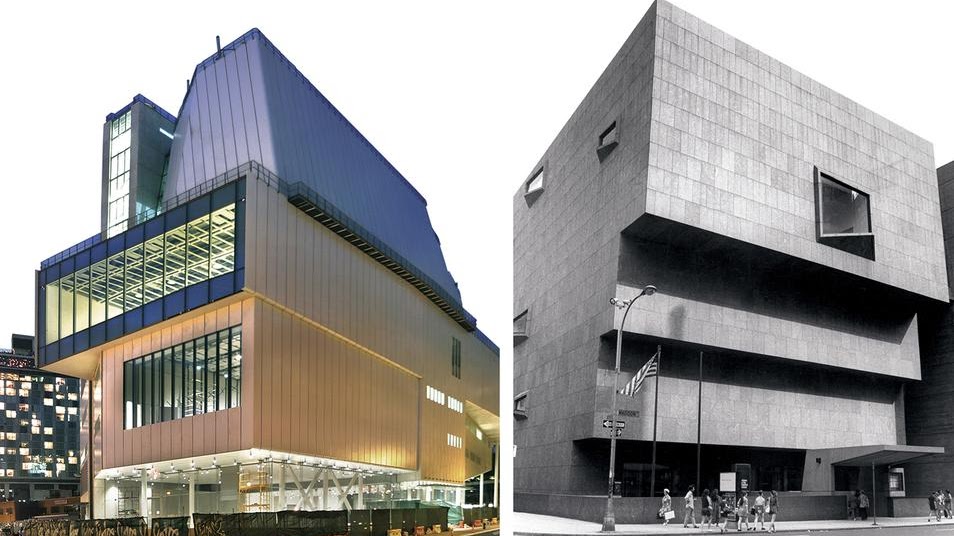
Despite Pemberton’s initial concerns, the Whitney became a beloved New York institution, moving in 1954 from the West Eighth location to a larger space on West 54th, and then to its iconic Marcel Breuer-designed building at Madison and 75th, which opened in 1966. The museum would move again in 2015 to its current location at 99 Gansevoort Street in a building designed by Renzo Piano.
IMPERMANENT COLLECTION…The Whitney would move three times after its 1931 opening, first to West 54th in 1954, then to its iconic Marcel Breuer-designed home at Madison and 75th (opened in 1966), and finally to its current location at 99 Gansevoort Street. (museuminforme.blogspot.com)
* * *
Party Pooper
William Faulkner attracted much attention among literary circles during his extended visit to New York in 1931, however (as reported in “The Talk of the Town”) the author was able to dodge most of it by staying put in his Tudor City apartment.
HOME ALONE…William Faulkner spent most of his time in New York holed up in his Tudor City apartment, where he worked on the manuscript for Light in August. (LA Times/Wikipedia)
* * *
This or That
While we are on the subject of literary giants, here is a poem submitted by E.B. White to the Nov. 28 issue that explored some universal half-truths:
* * *
From Our Advertisers
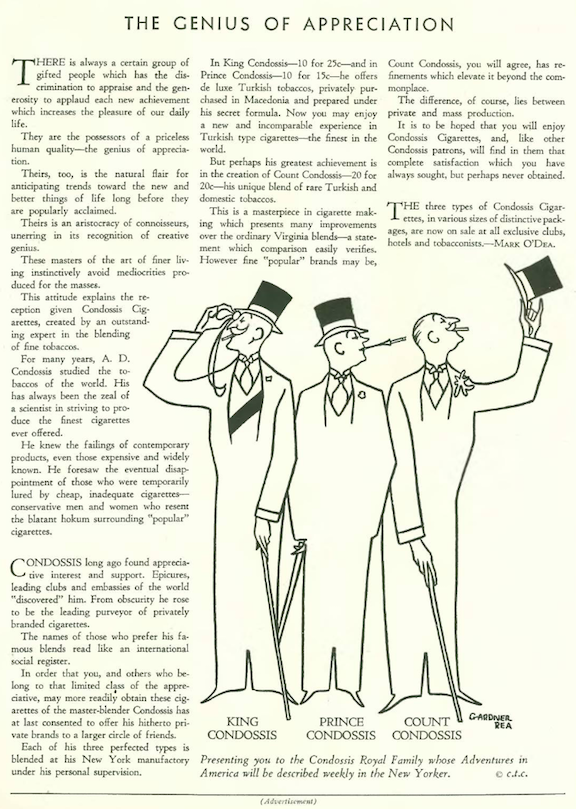
As the market for cigarettes continued to increase, so did the number of new brands launched to take advantage of all those eager young puffers. The makers of Condossis Cigarettes hoped to create some buzz for their new product through a series of ads written by Mark O’Dea and illustrated by The New Yorker’sGardner Rea. Apparently the makers of Condossis believed that a posh backstory would lend a certain élan to their smokes. This seems all for naught—I haven’t found a record of the brand beyond 1938…
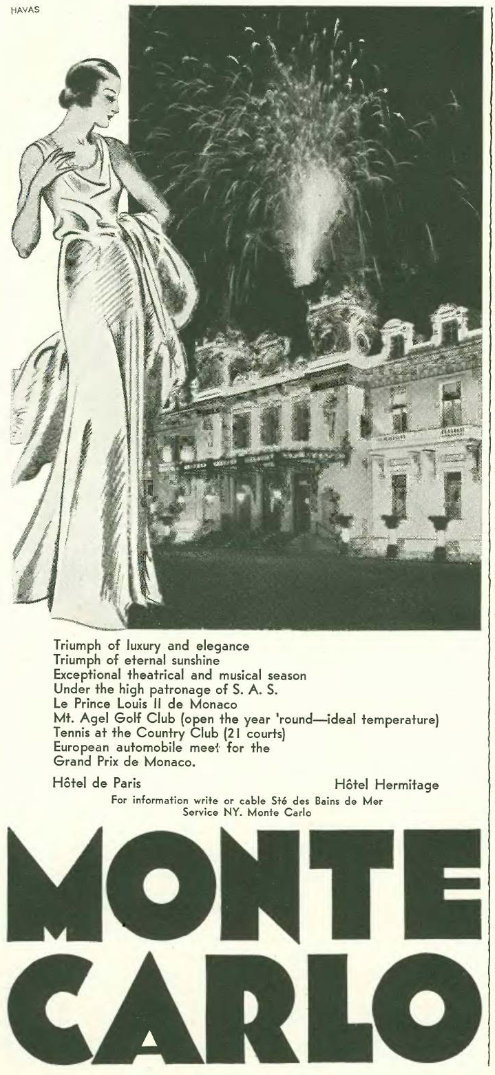
…a few of those posh smokers might have considered heading to Monte Carlo for the holidays, where they could also legally drink and gamble and forget about the jobless masses back home…
…but you needn’t go to Monte Carlo to signal your taste for the finer things, at least that is what B. Altman claimed with their lower-priced French knock-offs (although $95 was still a lot of dough in 1931)…
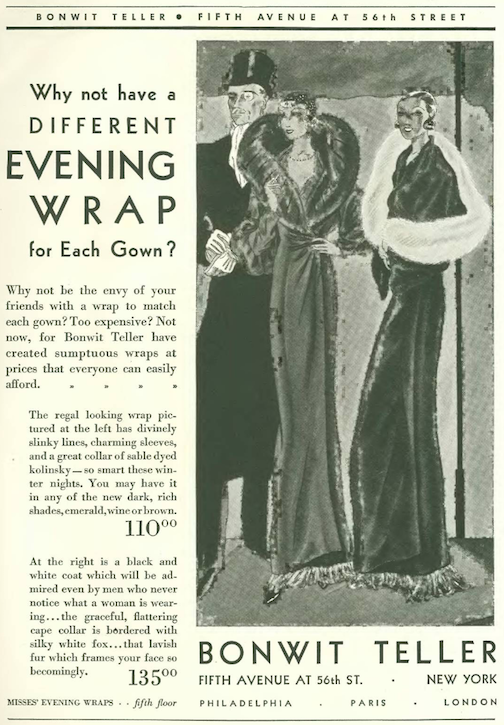
…Bonwit Teller also boasted of its low-priced evening wraps, so affordable that one could consider having a different wrap to complement every gown in one’s wardrobe ($135 in 1931 is roughly equivalent to $2,300 today)…
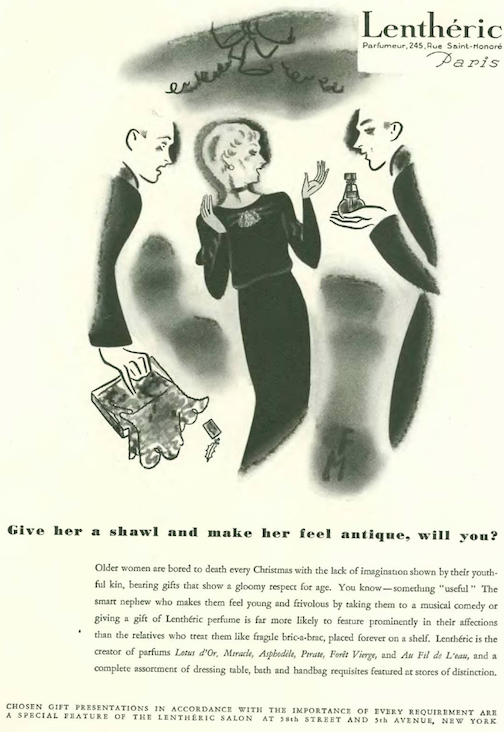
…the makers of Lenthéric perfumes offered the potential for shame and embarrassment if one didn’t choose their product for that special holiday gift…(illustration by Frank McIntosh, who contributes a cartoon in the next issue)…
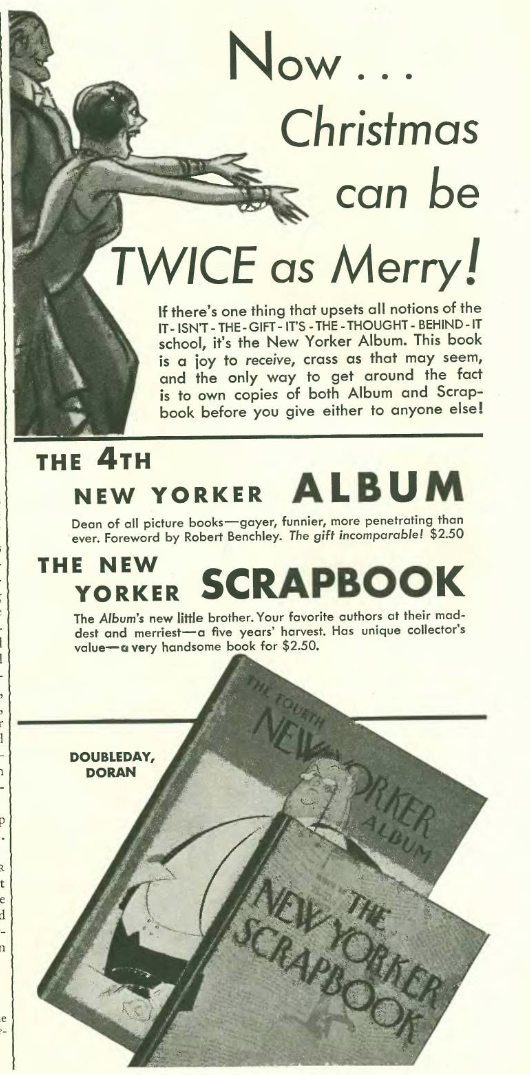
…but perhaps the happiest shopper of all could shell out a mere $2.50 for the latest editions of The Fourth New Yorker Album or The New Yorker Scrapbook (drawings of a delighted couple courtesy Peter Arno)…
…on to our cartoons, we begin with Mary Petty and a tête-à-tête over tea…
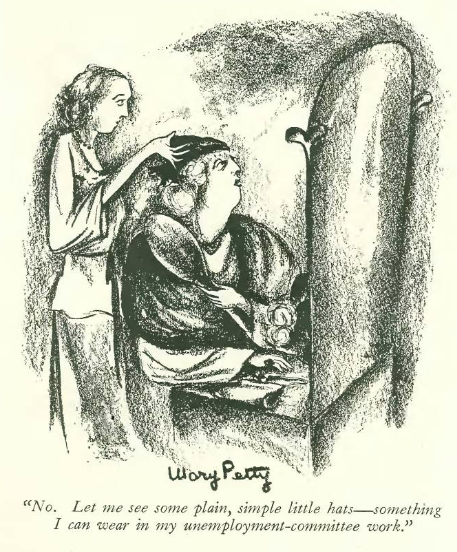
…and Petty again with one woman’s attempt at noblesse oblige…
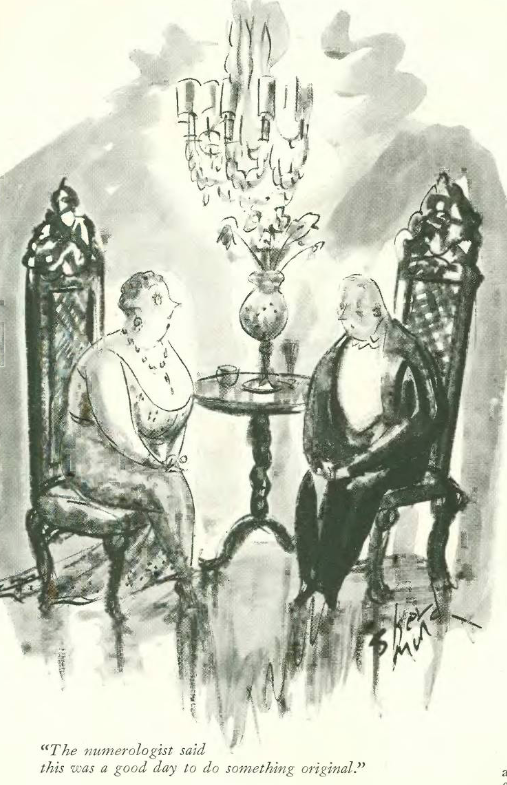
…Barbara Shermund looked in on the very idle rich…
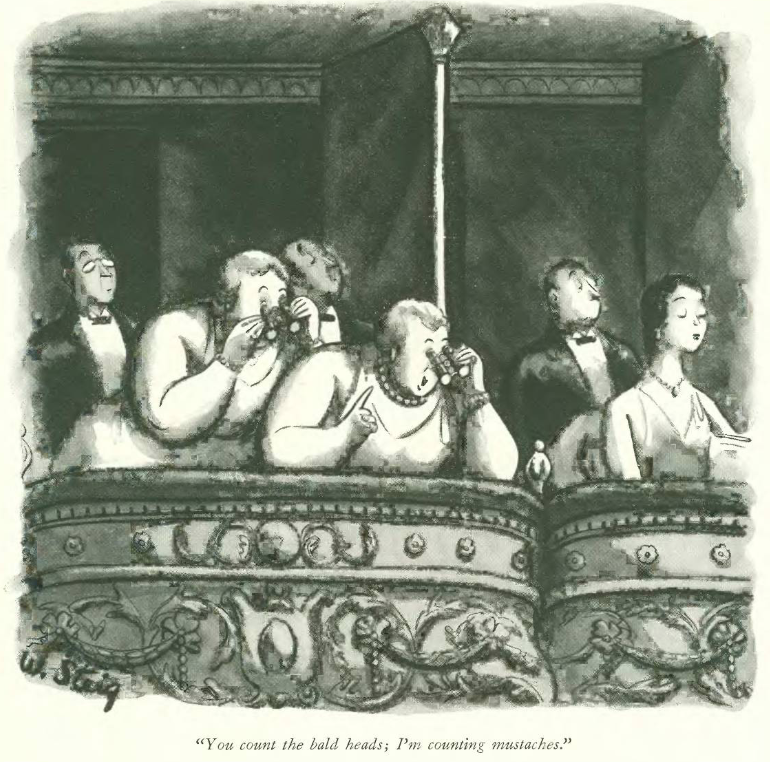
…William Steig spotted a bald-watcher…
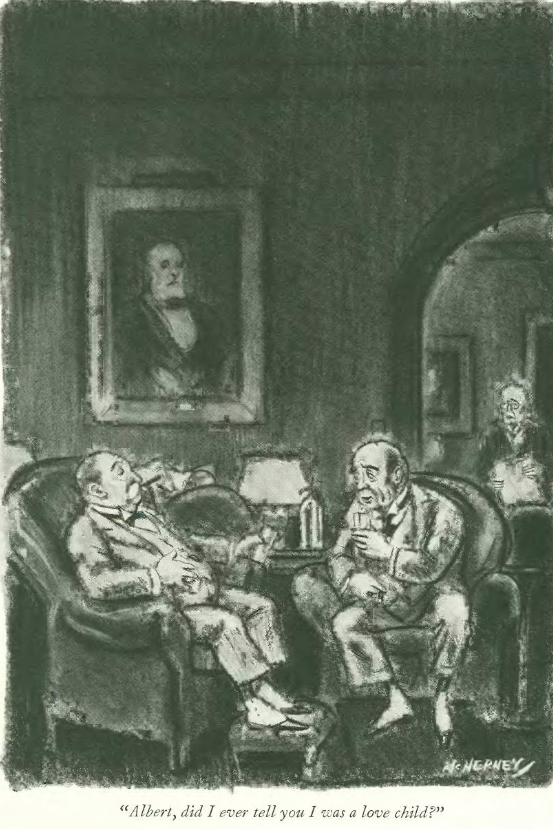
…E. McNerney revealed a secret among siblings…
…and William Crawford Galbraith gave us a backstage glimpse of a Broadway revue…
* * *
On to the Dec. 5 issue…
Dec. 5, 1931 cover by Rea Irvin.
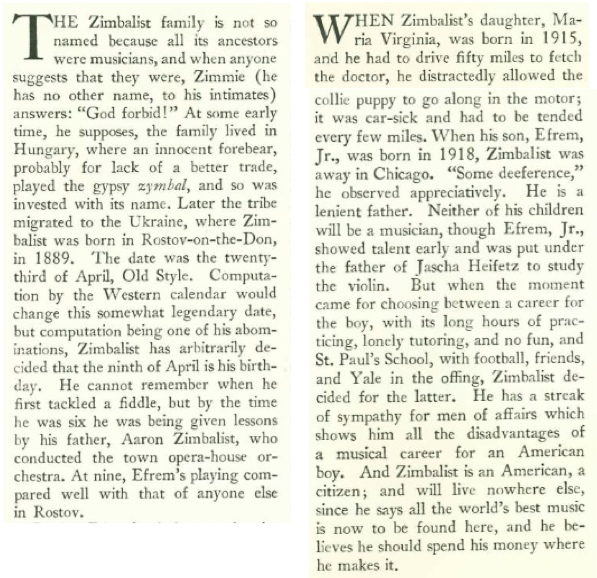
…which featured a profile of renowned violinist and composer Efrem Zimbalist (1889-1985). The son of a Russian conductor, Zimbalist was married to the famous American soprano Alma Gluck…
…and the entertainment gene continued on through the family line, as Zimbalist and Gluck’s son, Efrem Zimbalist Jr., would become a star in Hollywood, as would their granddaughter, Stephanie Zimbalist.
ALL IN THE FAMILY…Famed violinist Efrem Zimbalist and American soprano Alma Gluck (top, left) would pass on their entertainment genes to son Efrem Zimbalist Jr. (known for his starring roles in 77 Sunset Strip and The F.B.I.) and granddaughter Stephanie Zimbalist, who portrayed sleuth Laura Holt in the NBC series Remington Steele. Top right, a “Profile” caricature of Zimbalist by Al Frueh. (Wikipedia/Pinterest)
* * *
From Our Advertisers
Much to the delight of The New Yorker advertising department, the makers of Condossis Cigarettes were back with their second installment of the adventures of the “Condossis Family”…
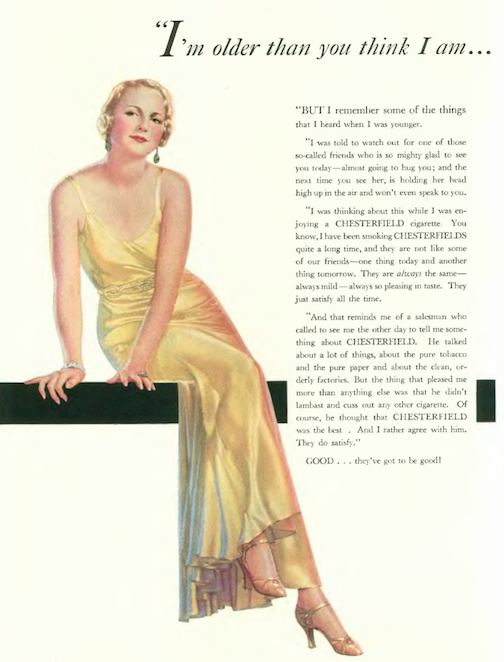
…on the other hand, the well-established Chesterfield brand didn’t have to try quite as hard — offering an attractive woman and some supporting copy that subtly suggested that a woman could credit her fine demeanor to a mere cigarette…
…on to our comics, we have this two-page entry by Rea Irvin…
…a bit of offensive driving, Helen Hokinson-style…
…Carl Rose gave us an unlikely candidate for a chaste role…
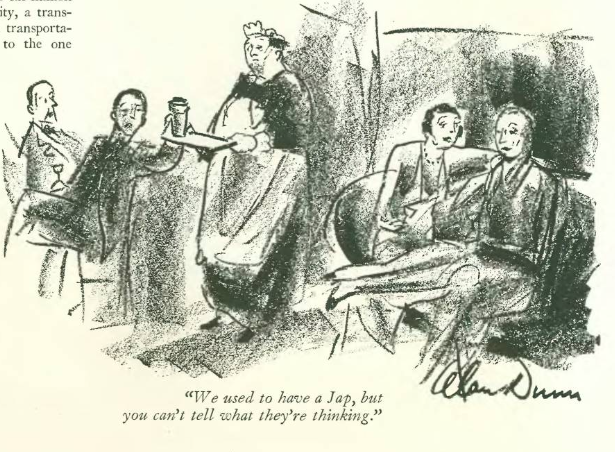
…Alan Dunn’s entry played to the stereotypes of his day…
…Frank McIntosh plied the Sugar Daddy waters to come up with this gem…
…Garrett Price gave us a gift designed to light a man’s fire…
…Barbara Shermund lit a flame of a different sort between a dowager and her latest escort…
…and we end with James Thurber, and one of my all-time favorites…
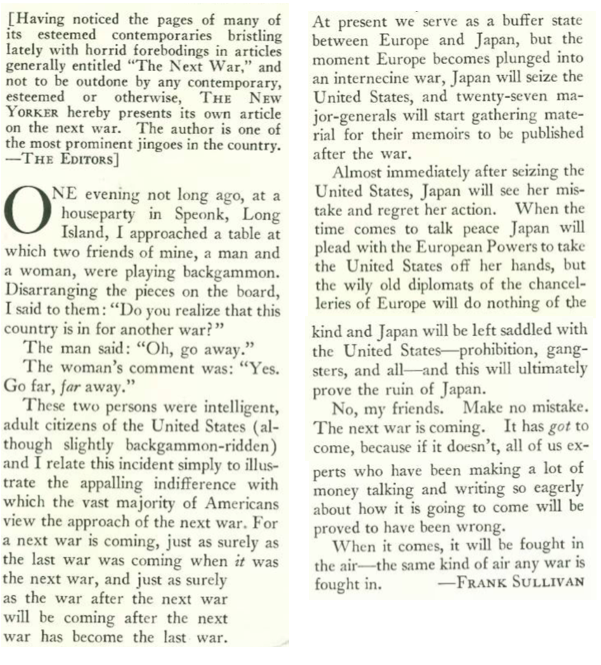
While many Americans partied through the Roaring Twenties, there were a few voices out there, barely audible, that warned of economic collapse and another world war.
Oct. 3, 1931 cover by Helen Hokinson.
The humorist and New Yorker contributor Frank Sullivan was among the few who took notice of the dire predictions (of war, anyway) and turned it into a funny take on how a European war might unfold. Excerpts:
Sullivan’s last line is a wordplay on “air,” and not likely a prediction of the horrible firebombing and V-2 attacks that would devastate Europe in the following decade.
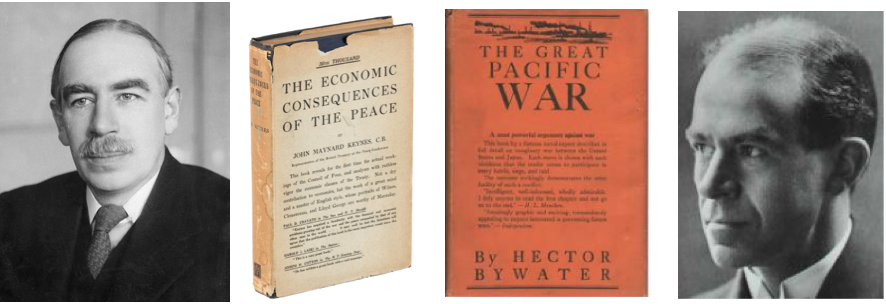
In Sullivan’s day two notable predictions of war came from British economist John Maynard Keynes and British author Hector Charles Bywater. In his 1919 book, The Economic Consequences of the Peace, Keynes warned that “unstable elements,” destroyed during the Great War (WWI), had not been replaced with more stable networks or institutions. Bywater’s prescient 1925 novel, The Great Pacific War, featured a hypothetical future war between Japan and the U.S. that predicted a number of events in World War Two’s Pacific Theatre.
I SEE DEAD PEOPLE…Economist John Maynard Keynes and British author Hector Charles Bywater both didn’t like what they saw coming on the horizon.
There were reasons for Keynes to be concerned. Germany found many ways to subvert restrictions imposed by the Treaty of Versailles, and continued to make technological advances in armaments and air power. Moreover, the Treaty’s humiliating terms and demands for costly reparations would lead to a rise in German nationalism in the midst of mass unemployment and a volatile economy. In just a little over a year Adolf Hitler and his Nazi Party would seize control of the German state.
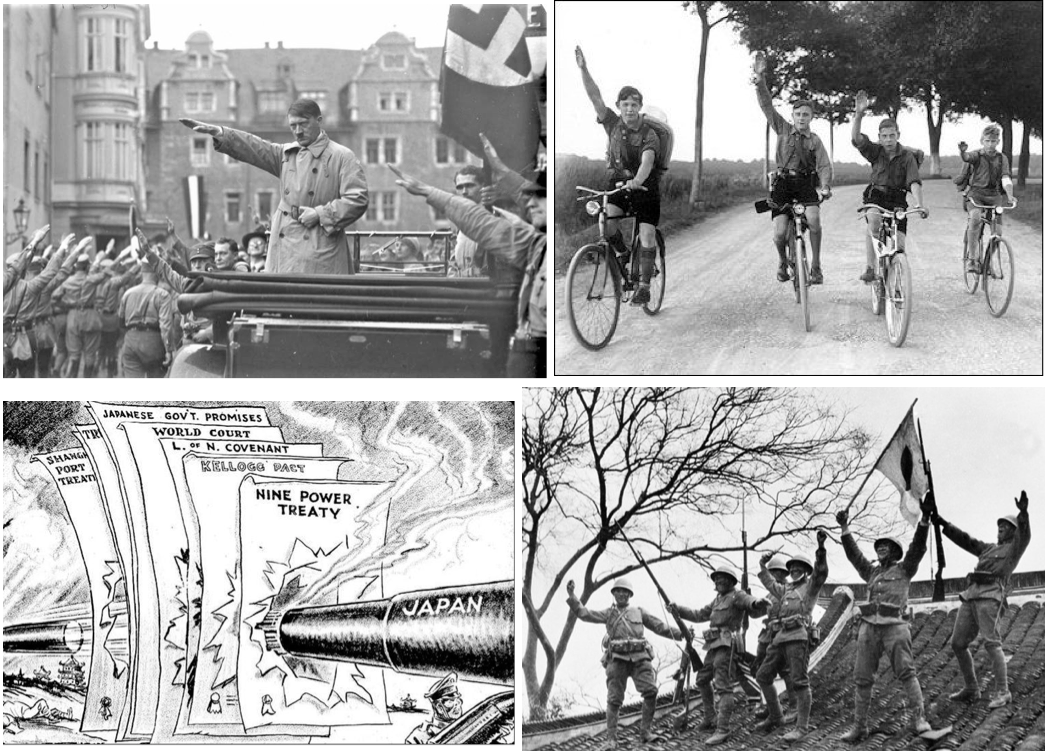
And as Bywater feared, the Japanese invaded Manchuria (under false pretenses) on Sept. 18, 1931, and then ignored orders to withdraw from the League of Nations (which had been established by a covenant included in the Treaty of Versailles). Japanese warlords were emboldened by the ease of this takeover and the toothless response from the international community. This scenario would be replayed by the Nazis when they invaded Czechoslovakia in 1939.
UGH, IT’S THAT GUY…Clockwise, from top left, Adolf Hitler rolls into Weimar as the Nazi Party continued to gain power in 1930; Hitler youth out for a bike ride in 1932; Japanese troops celebrate their easy invasion of Manchuria in September 1931; political cartoon illustrated Japan’s attitude toward international treaties. (Wikipedia/Pinterest)
* * *
The Man Who Would Not Be King
The world that was gradually setting the stage for World War II was also the world of Edward VIII, the Prince of Wales. A renowned womanizer and major disappointment to his father, George V, this heir to the British throne would begin a secret affair with American socialite Wallis Simpson that would later lead to his abdication as king after a reign of just 326 days. In a two-part profile, the New Yorker’s London correspondent Anthony Gibbs could already see that Edward would not be like other monarchs, this lonely “fish out of water” bored with court protocol and finding escape in a bottle of whisky. Excerpts from Part I (caricature by Al Frueh):
HITLER HONEYMOON…Edward VIII abdicated the British throne in December 1936 and married the newly divorced Wallis Simpson in June 1937. Four months later (right) they would pay a visit to Adolf Hitler and his thugs at Hitler’s mountain retreat above Berchtesgaden. Edward was known to be sympathetic to the Nazis, and favored the type of appeasement that would embolden Der Führer to invade Czechoslovakia and much of Europe beginning in 1939. (Pinterest/Wikipedia)
* * *
From Our Advertisers
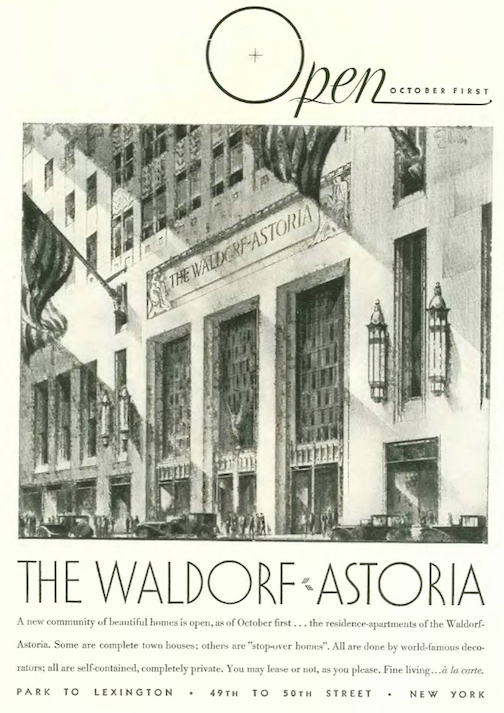
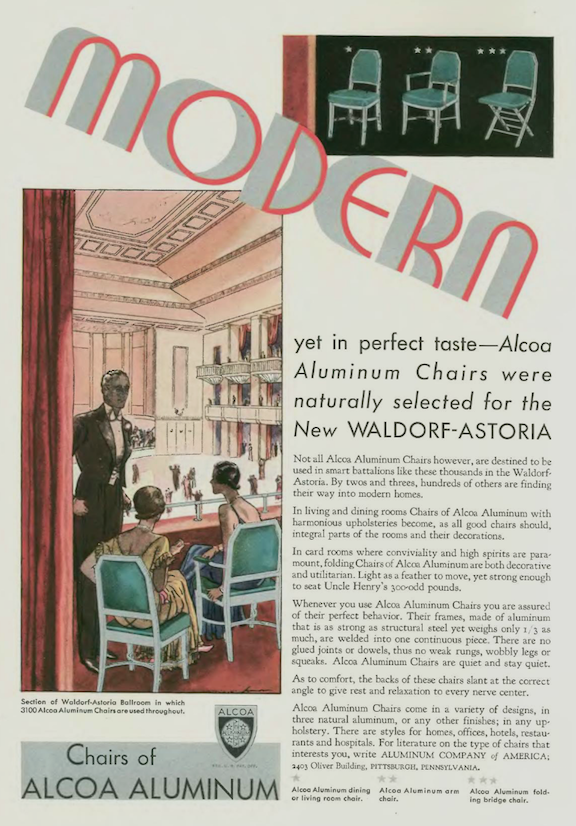
The opening of the new Waldorf-Astoria Hotel on Park Avenue had everyone and their dog getting in on a piece of the action, including manufacturers who hoped to associate their wares with the world’s tallest hotel…we begin with an ad from the hotel’s promoters…
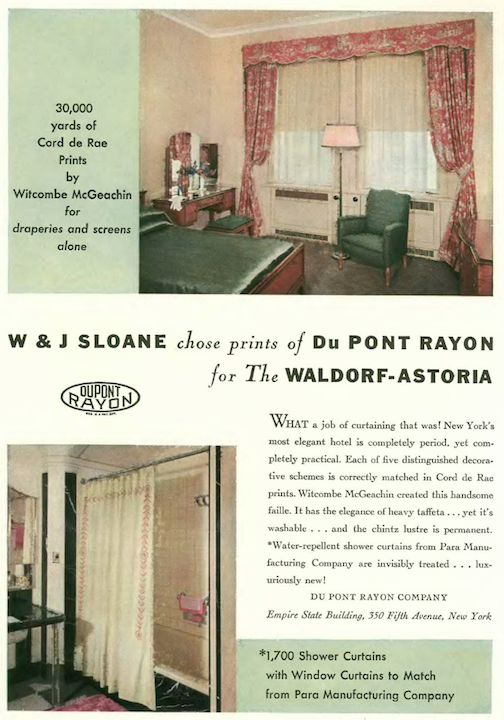
…I surprised to find pedestrian products such as rayon curtains and aluminum chairs associated with the luxury hotel…
…but perhaps the novelty of these things made them “must-haves” associated with modern living in 1931…this ad from the Oct 10 issue…
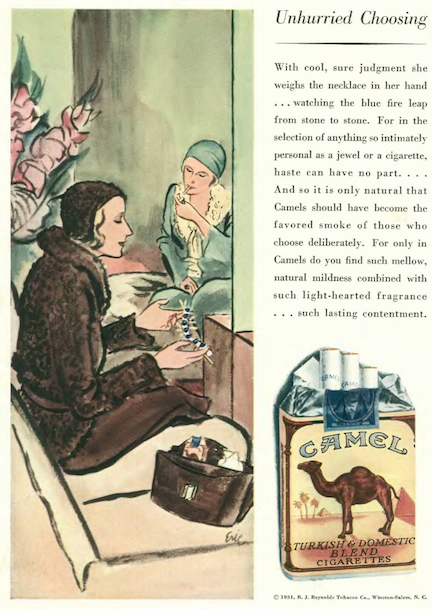
…one habit of modern living was cigarette smoking, and thanks to aggressive advertising droves of women were joining the menfolk in this activity…
…Camels were originally promoted as a woman’s cigarette, and in 1931 R.J. Reynolds shifted their ad style from chic illustrations of disinterested, continental types, such as the one below by Carl Erickson from the March 21, 1931 issue (and imitated by the Spud ad above)…
…to photographs of fresh-faced American women…
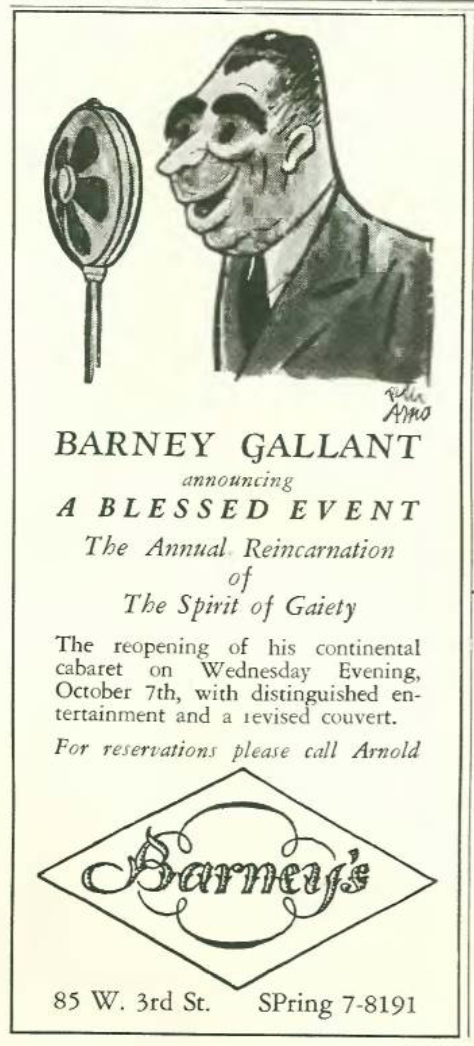
…Barney’s ran this recurring ad (with illustration by Peter Arno) in the back pages of the New Yorker, the latest touting the reopening of Barney Gallant’s “continental cabaret”…
GOOD TIME BARNEY…Barney Gallant was a celebrity and a hero to many New Yorkers for his defiance of Prohibition. At left, actor/writer/producer John Murray Anderson (seated) and Gallant in a photo by Nickolas Muray. At right, illustration by Joseph Golinken of Gallant’s speakeasy Speako de Luxe at 19 Washington Square North. The first New Yorker to be prosecuted under the Volstead Act (serving 30 days in the Tombs), Gallant operated several Bohemian speakeasies in Greenwich Village during the 1920s. Stanley Walker (writing in his 1933 history, The Night Club Era) described the clientele as “youngsters with strange stirrings in their breasts, who had come from remote villages on the prairie; women of social position and money who wanted to do things — all sorts of things — in a bohemian setting; businessmen who had made quick money and wanted to breathe the faintly naughty atmosphere in safety, and ordinary people who got thirsty now and then and wanted to sit down and have a drink.” (Metropolitan Museum/New York Historical Society)
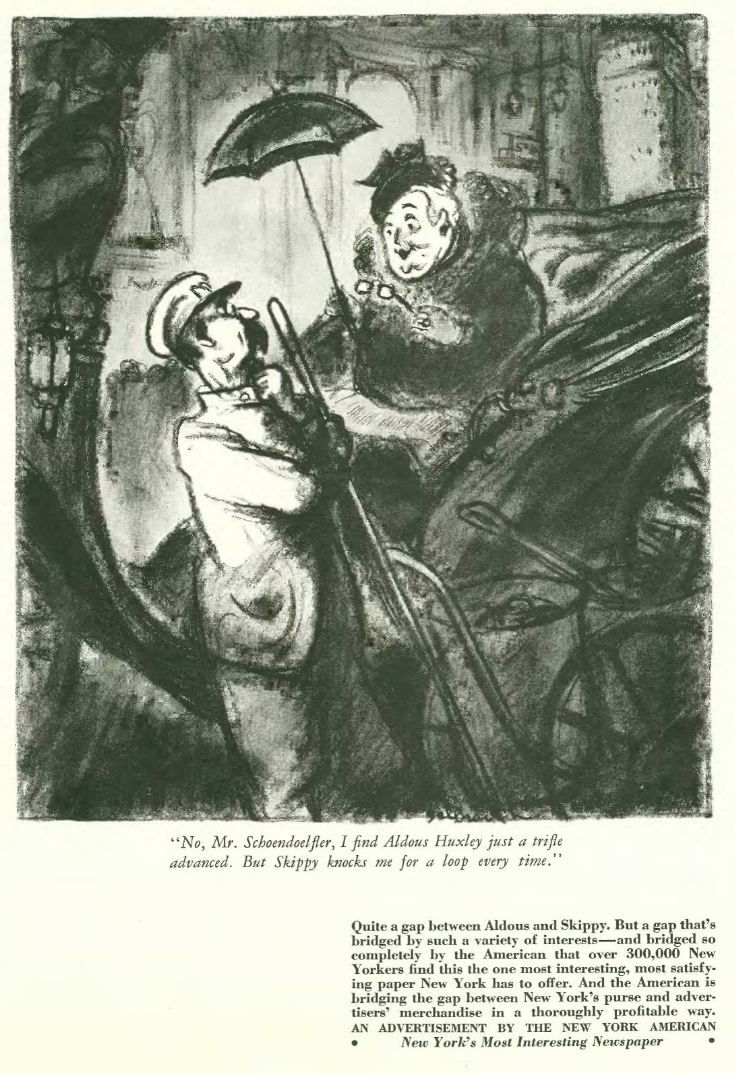
…New Yorker cartoonist William Crawford Galbraith picked up some extra income illustrating this ad for The New York American…
…which segues into our cartoons, beginning with Alan Dunn and the art of the dance,
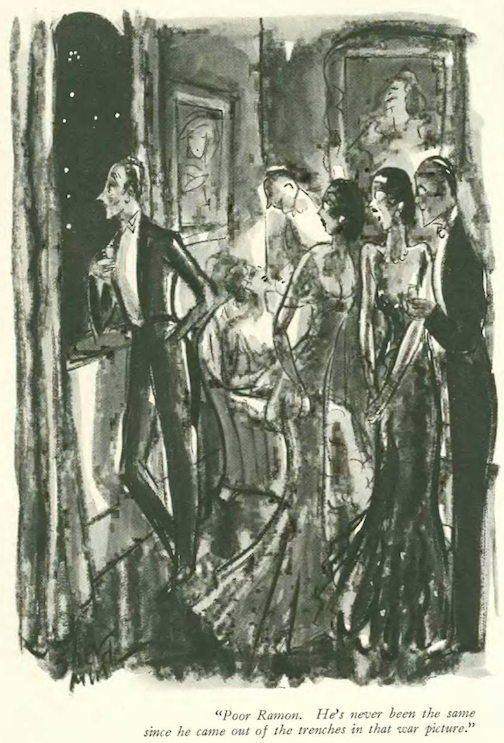
…Barbara Shermund, who showed us that a war (movie) is hell…
…William Steig continued to develop his repertoire of cartoons with precocious children…
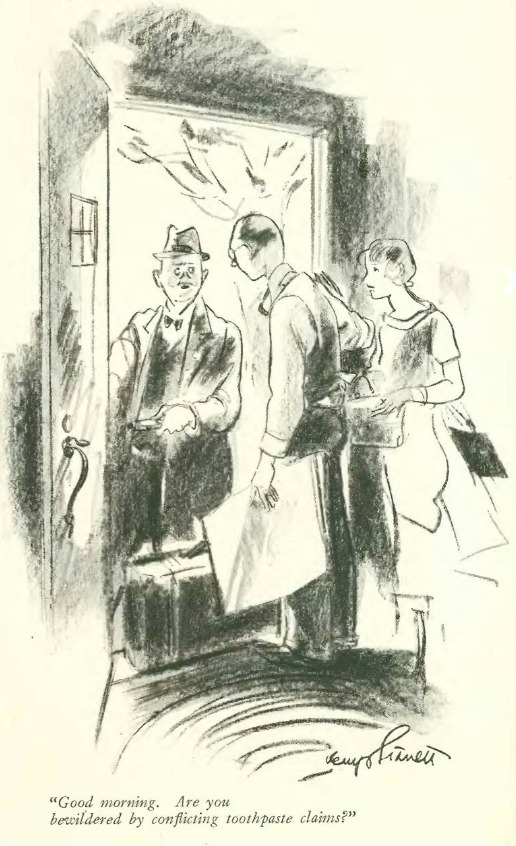
…Kemp Starrett gave us a salesman who put more than his foot in the door…
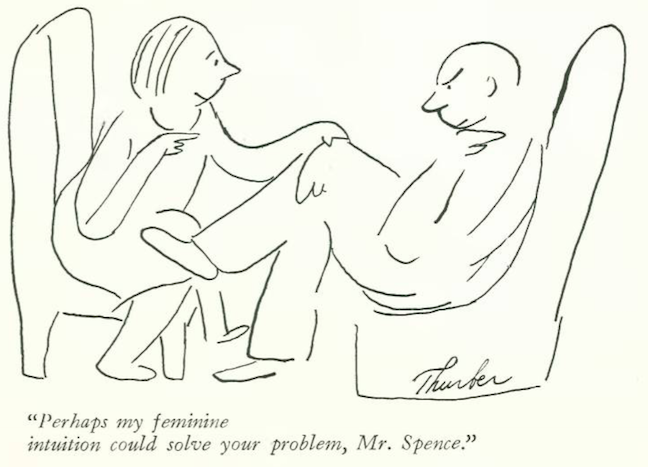
…James Thurber continued his ongoing “dialogue” between the sexes..,
…William Crawford Galbraith again, with his take on “Upstairs, Downstairs”…
…Rea Irvin also exploring the theme in this two-page spread (click to enlarge)…
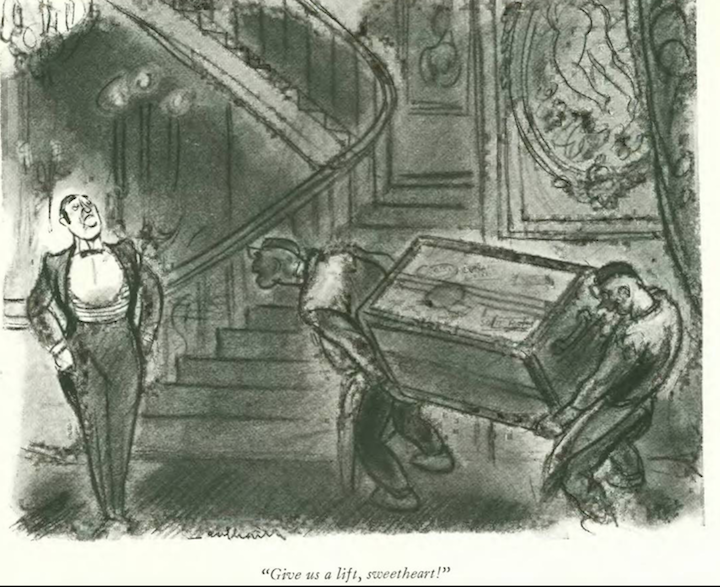
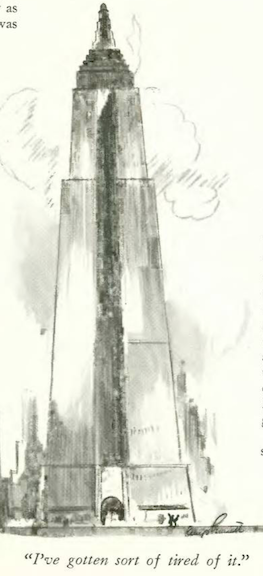
…and we end with another by Kemp Starrett, and the blasé attitude New Yorkers might display before the world’s tallest building…













































































































































 A New Yorker State of Mind