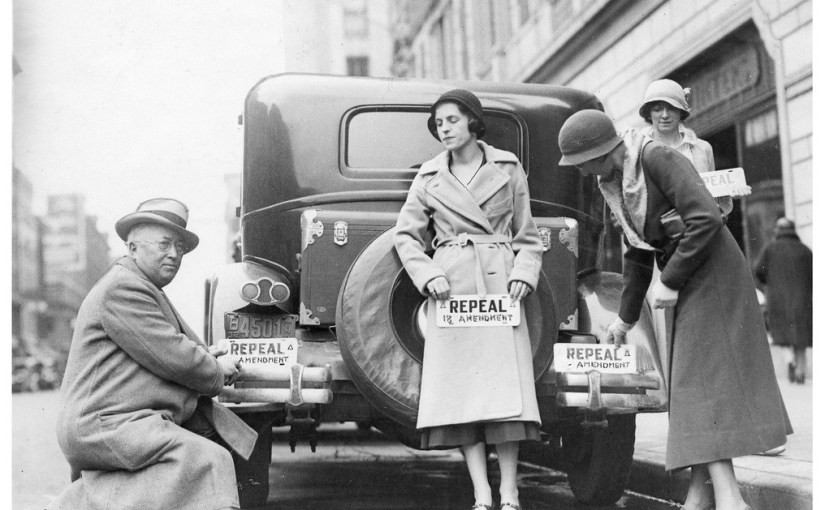
Requiem For the Flapper

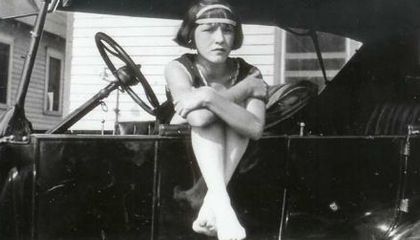
The Vassar-educated Lois Long was an icon of the flapper generation and a reigning voice—witty and smart—of New York nightlife in the Roaring Twenties.

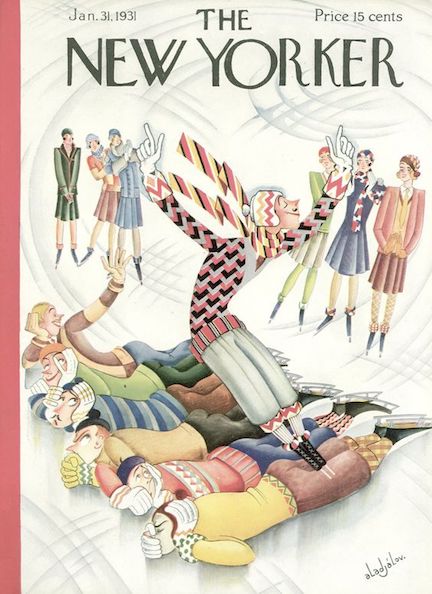
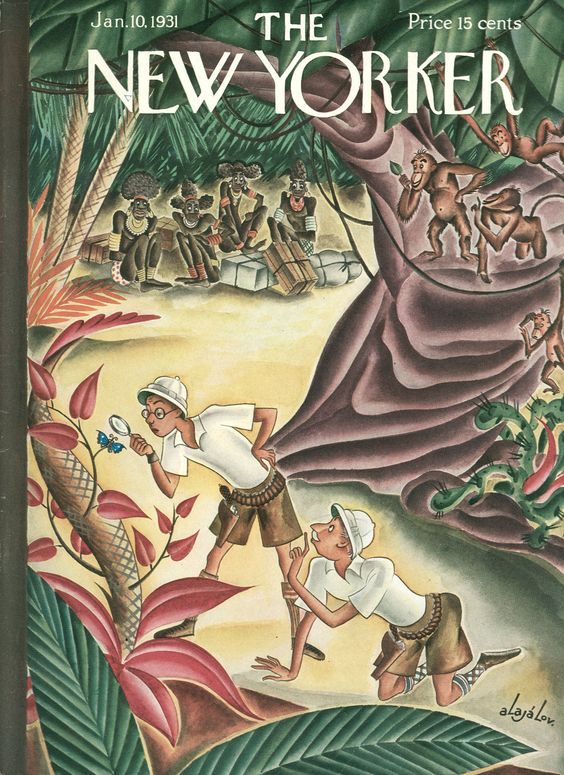
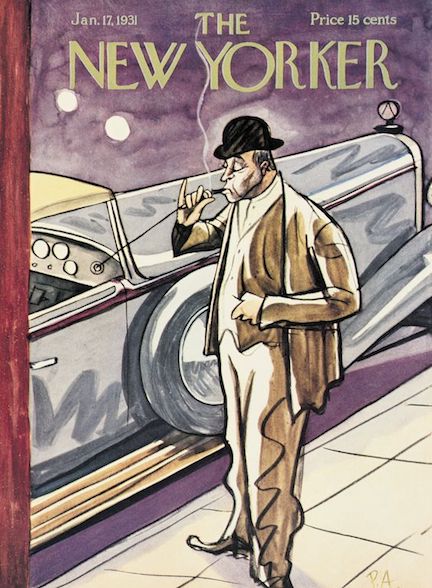
Jan. 10, 1931 cover by Constantin Alajalov.

In one of her early “Tables for Two” columns, the famously hard-partying Long made this request of her New Yorker readers: “Will someone do me a favor a get me home by eleven sometime? And see that nobody gives a party while I am catching up? I do so hate to miss anything.”

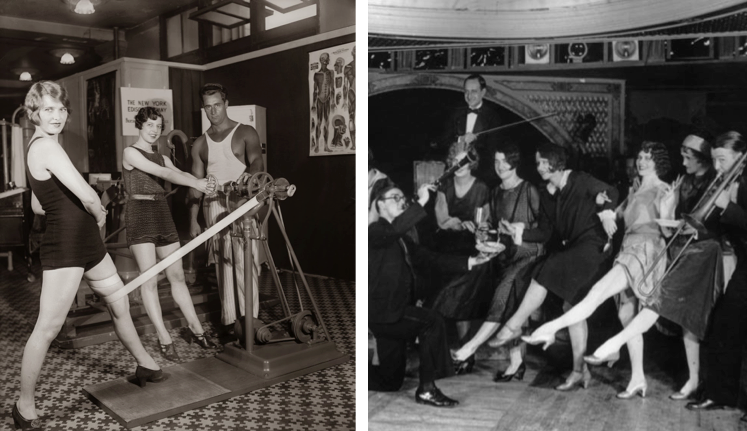
DONT START THE PARTY WITHOUT ME…Carefree days at your neighborhood speakeasy. (Manchester’s Finest)

By the dawn of 1931 few were in the mood for a party, including the 29-year-old Long, who was mother to a toddler and would soon divorce husband and New Yorker cartoonist Peter Arno.

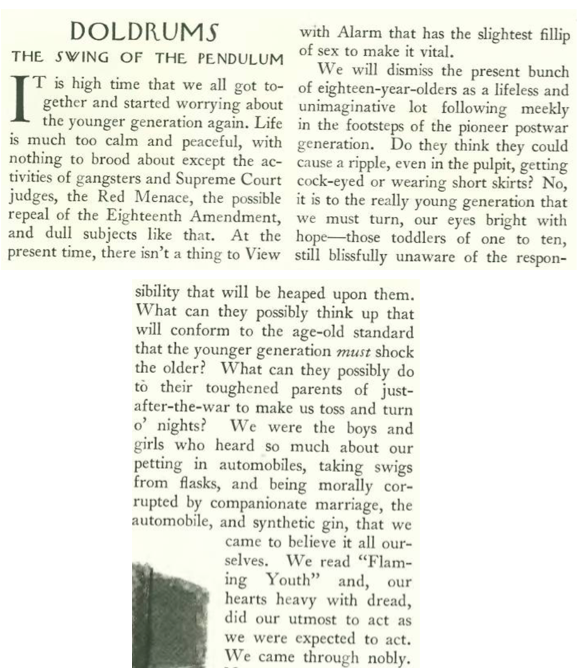
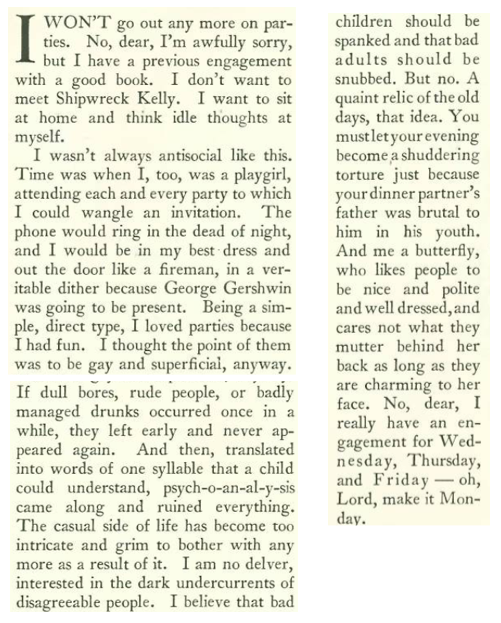
But it wasn’t motherhood or a tempestuous marriage that soured Long on the party scene. Rather, blame fell to the whiny, self-absorbed crowd that had displaced her fun-loving Jazz Age revelers. In the Jan. 10, 1931 issue Long began to assess the decade ahead in a six-part series titled “Doldrums.” The first installment, “Bed of Neuroses,” suggests Long missed the joie de vivre that characterized the previous decade:

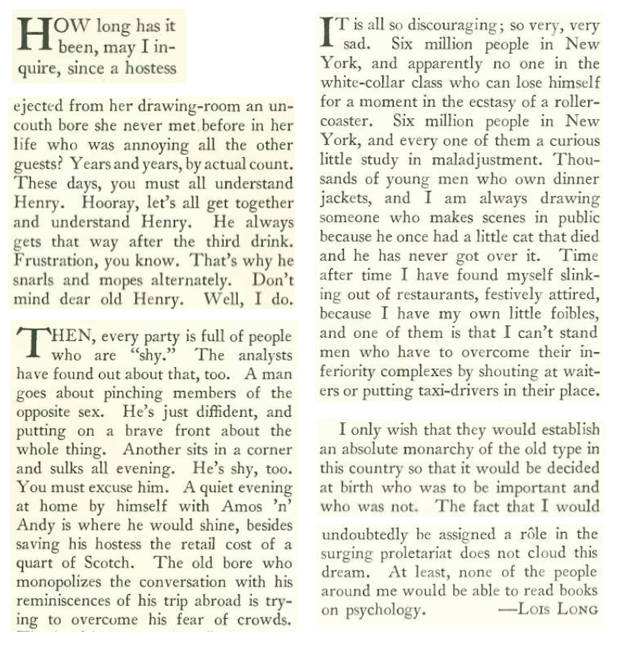
“It is all so discouraging; so very, very, sad. Six million people in New York, and apparently no one in the white-collar class who can lose himself for a moment in the ecstasy of a roller-coaster. Six million people in New York, and every one of them a curious little study in maladjustment. Thousands of young men who own dinner jackets, and I am always drawing someone who makes scenes in public because he once had a little cat that died and he has never got over it.”

With that, Long’s partying days were officially over. Some excerpts from “Bed of Neuroses”…

SALAD DAYS…Clockwise, from top left, Lois Long relaxing on the beach in a image captured from a 1920s home movie; silent film star Charlie Chaplin, Vanity Fair editor Frank Crowninshield, sculptor Helen Sardeau, Lois Long and screenwriter Harry D’Arrast pose in a Coney Island photo booth, 1925; Long with husband Peter Arno and daughter Patricia, 1929; Long at the office in a classic flapper pose, circa 1925. (PBS/Joshua Zeitz/Patricia Long/Wikipedia)

Long recalled the days when one could hold his or her liquor…

There has been a trend among the bright young drinkers toward a glass of sherry before meals instead of cocktails, a bottle of wine during dinner, port with the cheese, a liqueur with the coffee — instead of one highball after another.

…and when one’s personal hang-ups remained personal, and were not subject to tedious public display:

Long’s nightlife column, “Tables for Two” folded a few months after the 1929 stock market crash, but she would continue to make unsigned contributions to the “Comments” and “The Talk of the Town” sections into the 1950s. Her main focus at the magazine, however, would be her fashion column, “On and Off the Avenue,” which she would write until 1968. Upon her death in 1974, New Yorker editor William Shawn remarked that Long “was the first American fashion critic to approach fashion as an art and to criticize women’s clothes with independence, intelligence, humor and literary style.”

 *  *  *

The Age of Giants

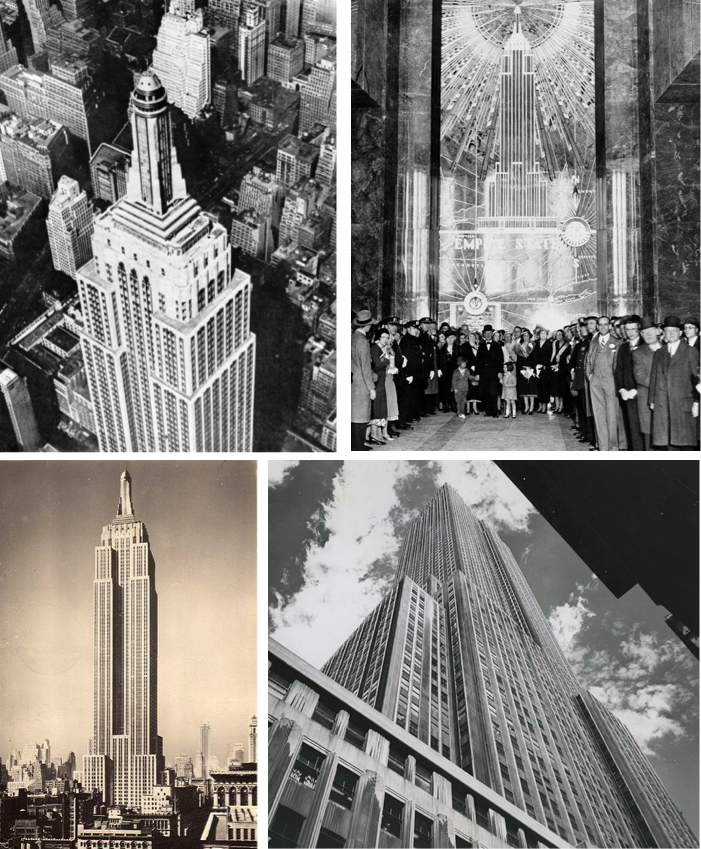
Architecture critic George S. Chappell took in the grandeur of the nearly completed Empire State Building, which rose from the rubble of the old Waldorf-Astoria hotel and perhaps more than any building served as a giant exclamation point for the 20th century metropolis. Chappell did not buy developers’ claims regarding the building’s “mooring mast,” calling it a “silly gesture” that the building would have been better served without. Looking back from our time, however, it is hard to imagine the building without its distinctive spire:

DIZZY HEIGHTS…Completed in 1931, the Empire State Building stood as the world’s tallest until 1970. Clockwise, from top left, New Yorker critic George Chappell viewed the “mooring mast” as a publicity stunt, and believed the building would have been better without it; interior of the building at its grand opening in May 1931; ground-level view of the setbacks Chappell admired; the completed tower in 1931. (lajulak.org/Associated Press/Acme/Pinterest)

Chappell also made note of a neo-Georgian style building designed by Joseph Freedlander for the Museum of the City of New York:

HISTORY’S HOME…The main facade of the Museum of the City of New York facing Fifth Avenue. (Wikipedia)

*  *  *

Ignoble Deeds

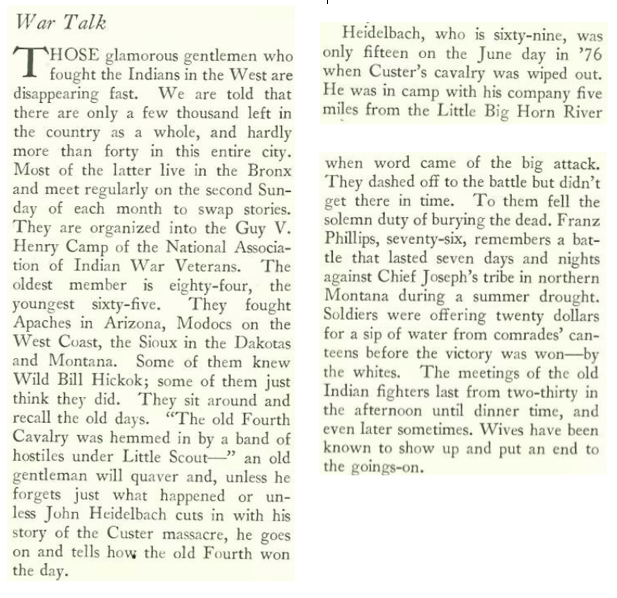
“The Talk of the Town” looked in on some aging veterans of the 19th century “Indian Wars” and found the old coots reminiscing about the massacre of various North American tribes…

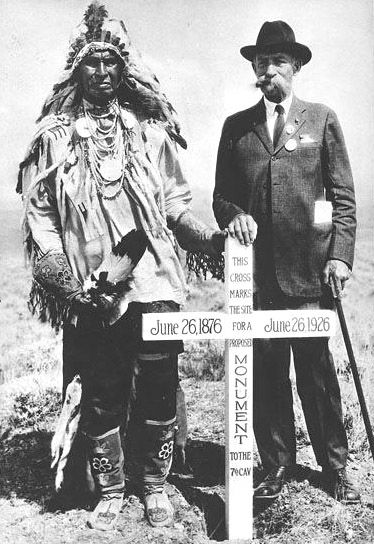
NO HARD FEELINGS?…Crow warrior White Man Runs Him poses with 82-year-old Gen. Edward Settle Godfrey, a survivor of the Battle of Little Bighorn, at the 50th Anniversary of the battle in 1926. (Wikipedia)

 *  *  *

Cheeky

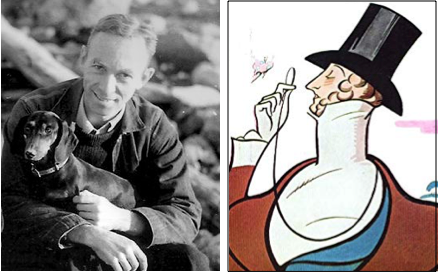
E.B. White assumed the nom de plume “Eustace Tilley” to answer an earnest query letter from Leslie Fulenwider of Famous Features Syndicate. Fulenwider probably didn’t know what he was in for…
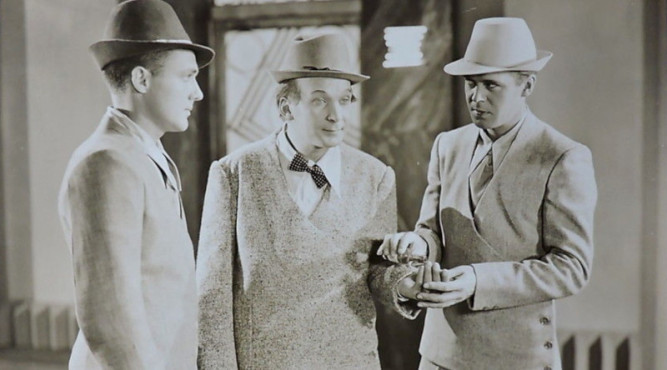
ALTER EGO…E.B. White periodically assumed the role of New Yorker mascot Eustace Tilley in handling magazine correspondence.

 *  *  *

Too Cool for School

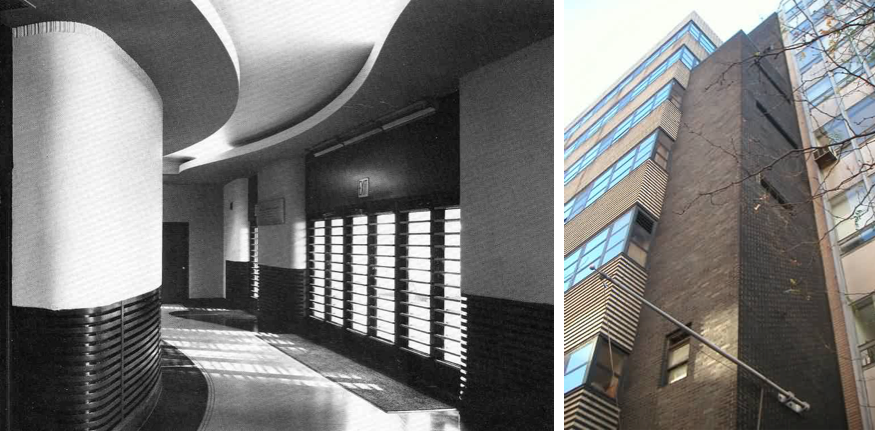
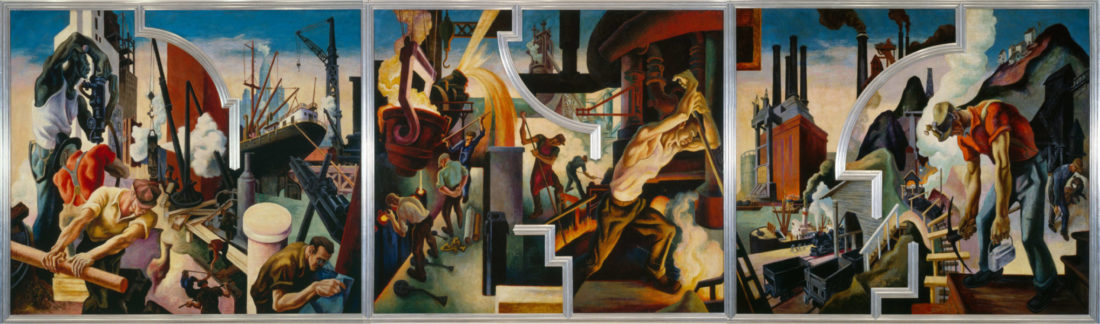
In his weekly art gallery column, Murdock Pemberton noted the New Year’s Day opening of the New School for Social Research in a “timid landmark” designed by Joseph Urban of theatrical design fame. The school’s boardroom featured a series of murals by realist painter Thomas Hart Benton.

NEW LOOK FOR NEW SCHOOL…Joseph Urban’s interpretation of the International Style for the New School for Social Research at 66 West 12th Street.
AMERICAN TABLEAU…Three panels from Thomas Hart Benton’s ten-panel mural, America Today. Originally installed in the New School’s boardroom, it is now housed at the Metropolitan Museum of Art. (charlesmcquillen.com) 

 *  *  *

From Our Advertisers

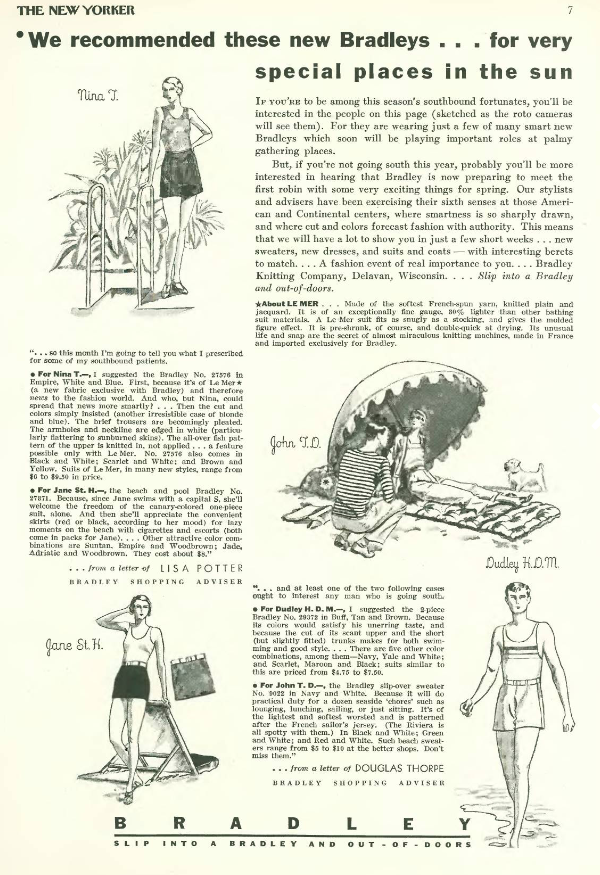
“If you’re to be among this season’s southbound fortunates,” as this ad begins, you’ll want to check out these Bradley bathing suits designed for a variety of privileged personalities…

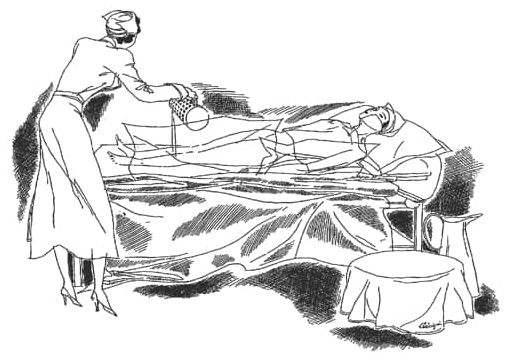
…but before you hit the beach, you might consider an “Ardena Bath”  to take away some of that winter fat…

…this 1932 illustration (below) demonstrates how a full-body, Ardena paraffin wax bath works. An Elizabeth Arden advertisement described the procedure thus: You step into a tub lined with waxed paper. Over you they pour a warm liquid paraffin which slowly hardens until you are encased in a paraffin shell. Your face becomes pink. You are permeated in a sense of well-being. Suddenly, the perspirations bursts from you, for the shell forms a vacuum which causes the pores to open and, consequently, impurities are drawn away…

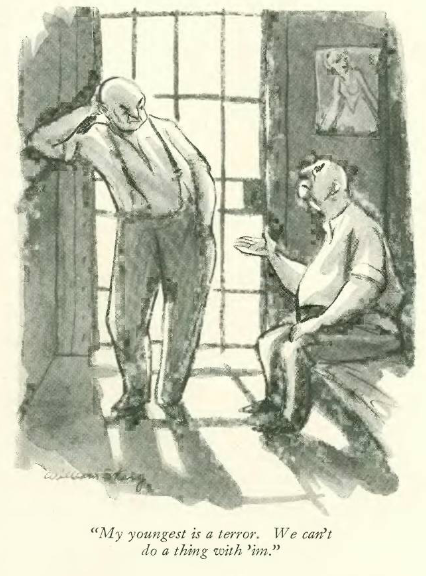
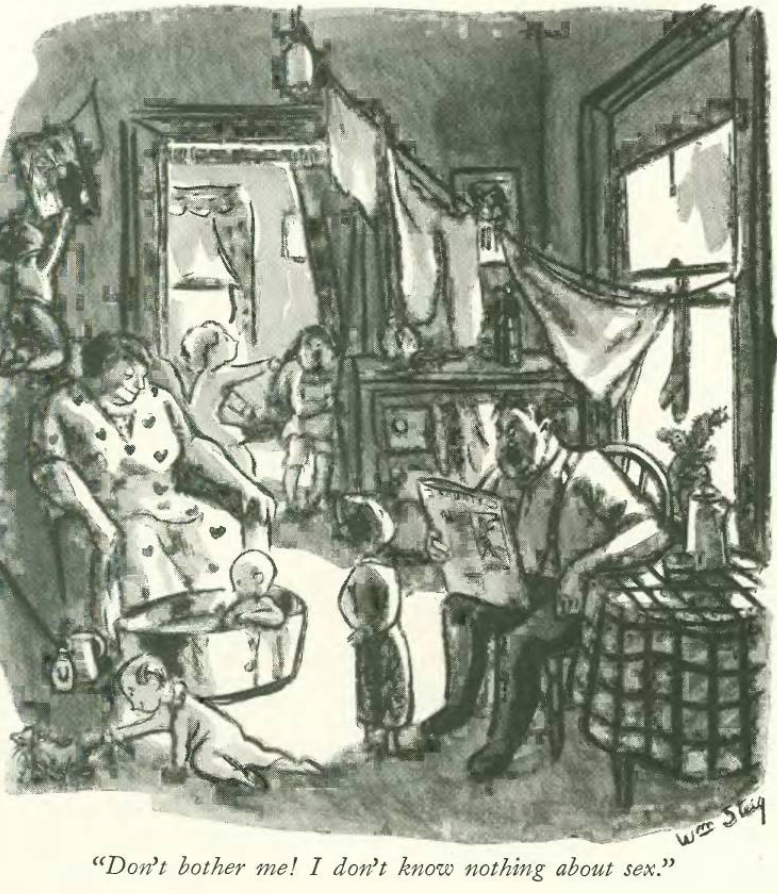
…on to our cartoons, we have two from William Steig, who produced 2,600 drawings and 117 covers for The New Yorker and whose work would span two centuries, delighting both adults and children alike, most notably the picture book Shrek! that would lead to a hugely successful movie series. According to The Numbers: Where Data and the Movie Business Meet, “after the release of Shrek 2 in 2004, Steig became the first sole-creator of an animated movie franchise that went on to generate over $1 billion from theatrical and ancillary markets after only one sequel.”

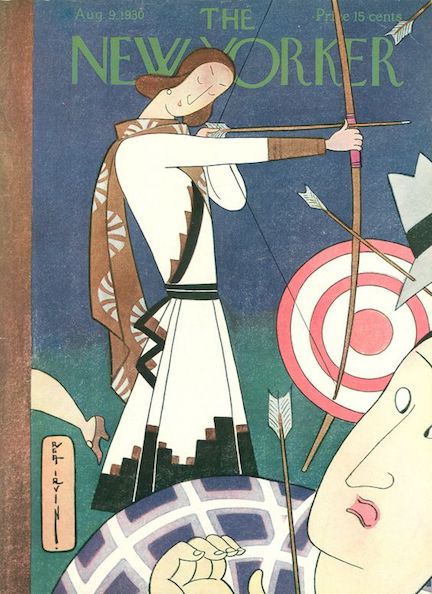
Here is Steig’s first New Yorker cartoon, from the Aug. 9, 1930 issue:

…and back to the Jan. 10, 1931 issue, in which Steig offered these glimpses into city life…

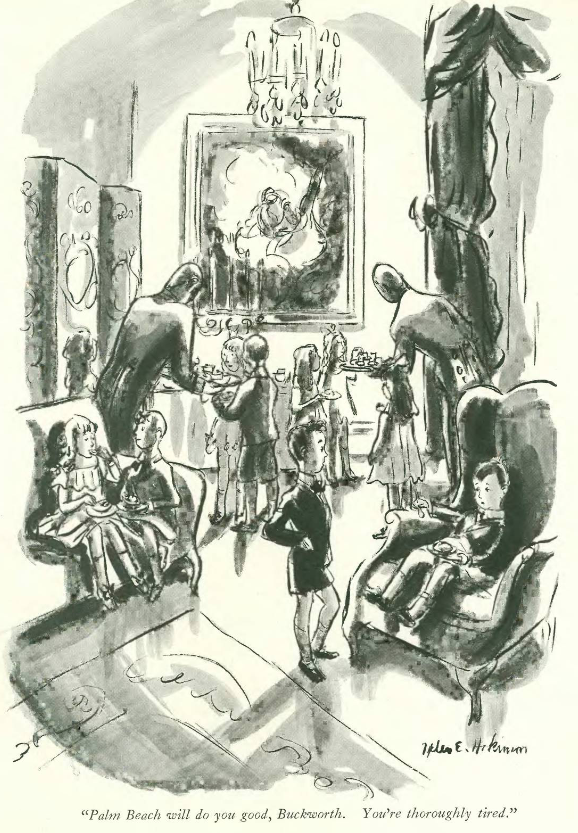
…and then have a look into the posh set from New Yorker stalwart Helen Hokinson

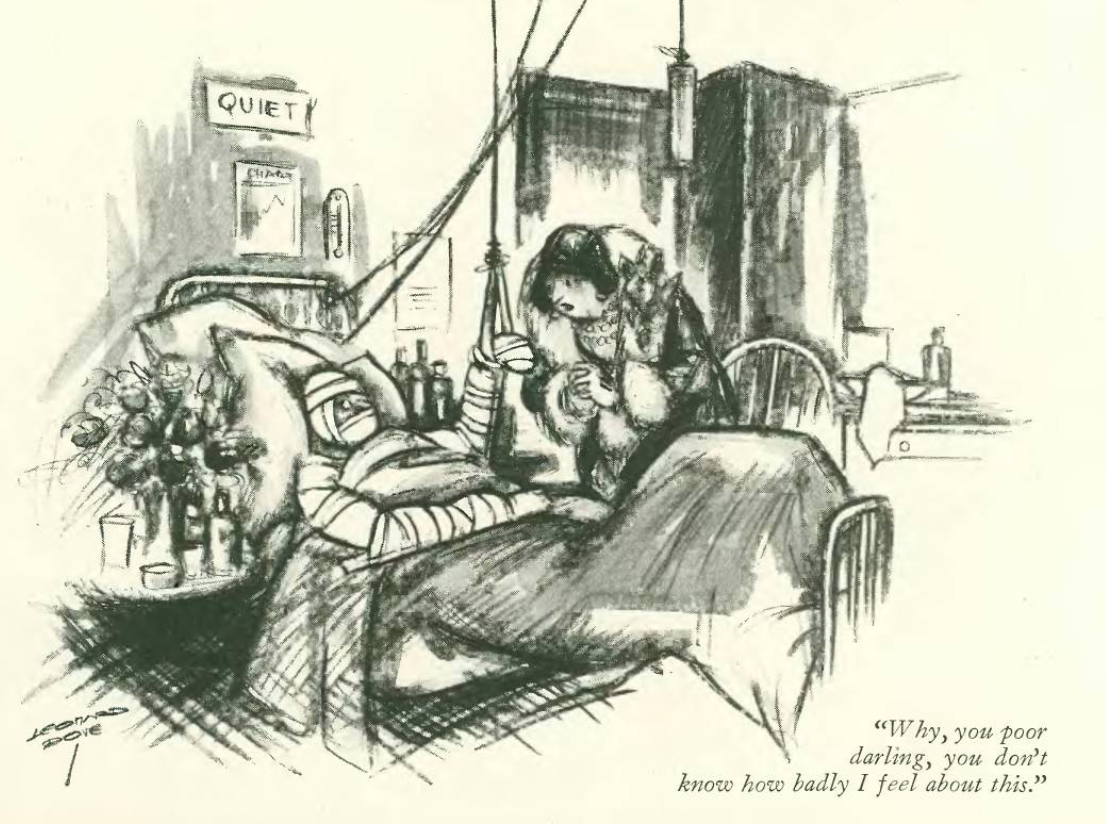
…some bedside manner with Leonard Dove

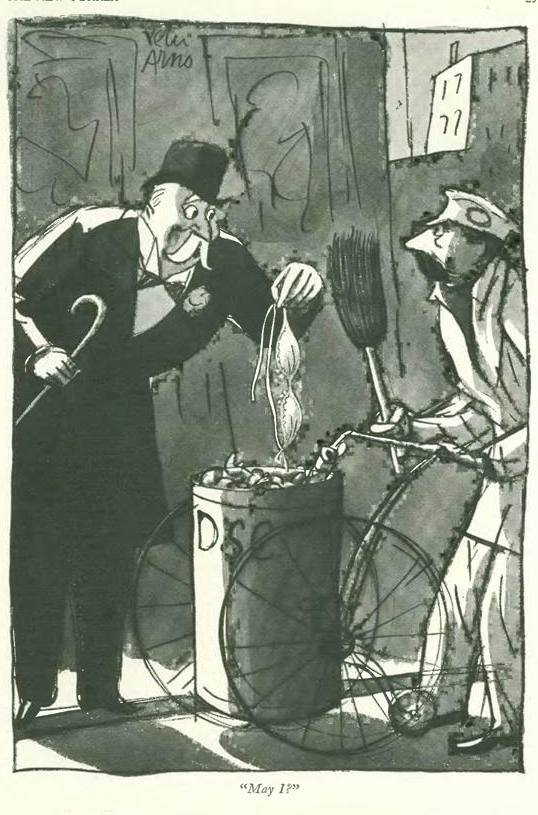
Peter Arno continued to explore the complexities of love…

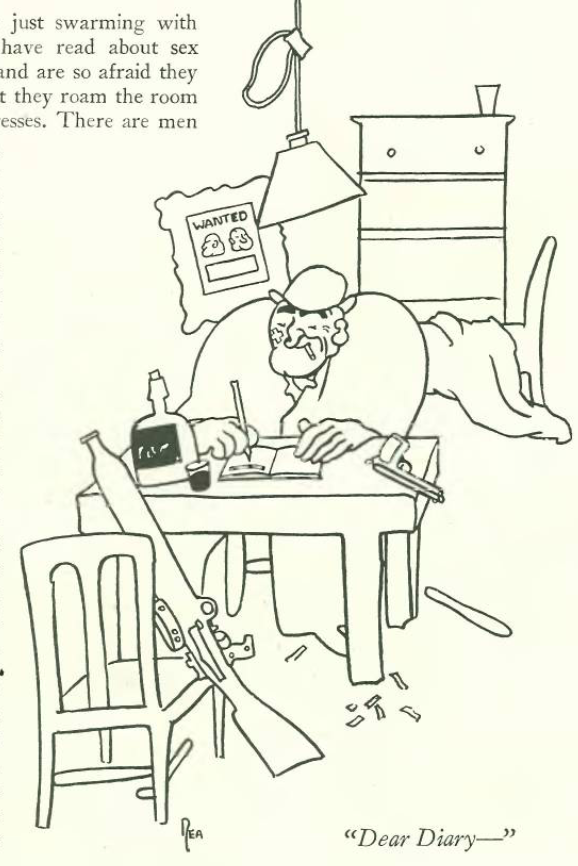
…and Gardner Rea showed us the softer side of a hardened criminal…

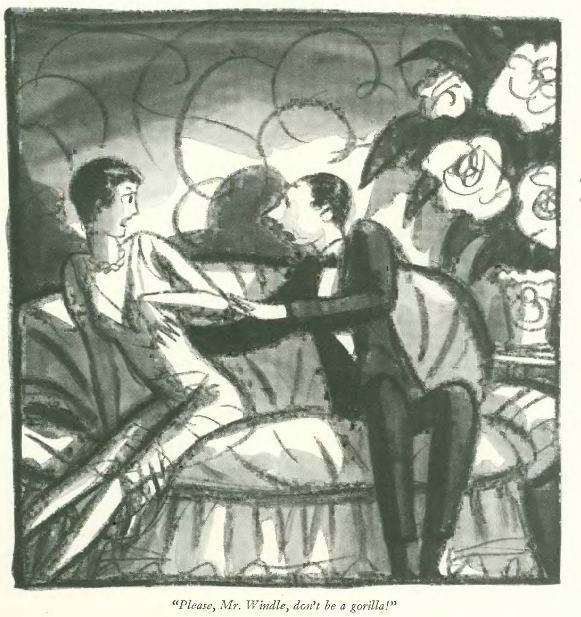
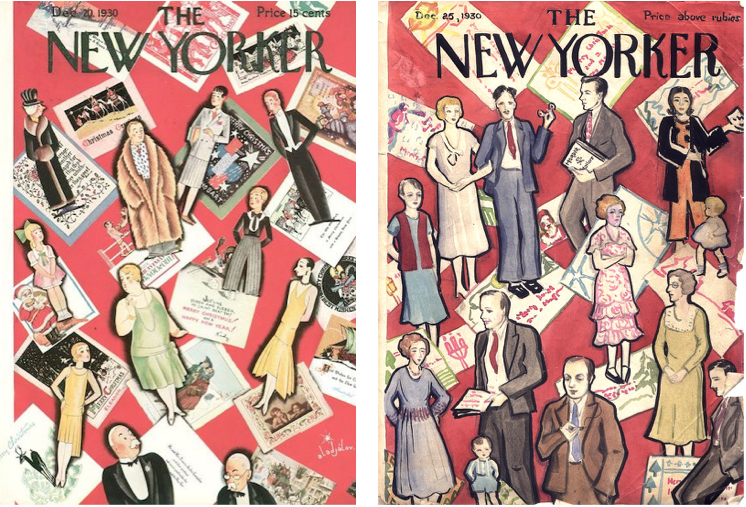
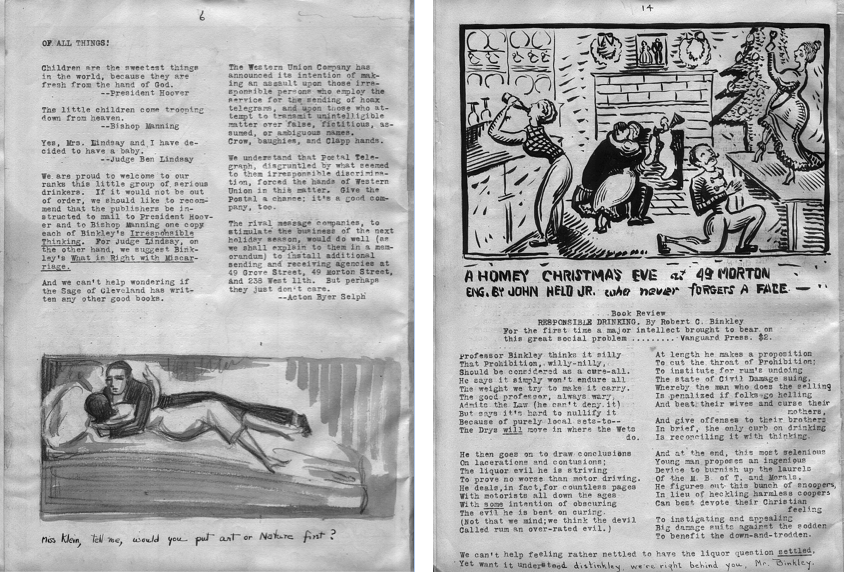
…and before we close I want to bring to your attention to this wonderful New Yorker parody that Peter Binkley recently shared with me. Binkley writes that the Dec. 20, 1930 cover “was the model for a parody issue that friends of my grandparents in the Village made for them when they visited for the holidays. My grandparents had lived in New York for a couple of years but moved away in 1929. They and this group of friends lived in the same building on Morton St., and were fervent New Yorker readers. The parody is interesting, I think, for giving a glimpse of what New Yorker fans below the top-hat-wearing class enjoyed about it at the time.”

Below, left, is the cover of the Dec. 30 issue by Constantin Alajalov, and next to it the terrific parody cover.

…and a couple of the interior pages, with parodies of cartoons by Peter Arno and John Held Jr….

You can check out the full parody issue here.

Next Time: Rise of the Gangster Film…

The Future Was a Silly Place

One of the most expensive movies of 1930 was a sci-fi musical comedy titled Just Imagine, a silly mash-up of great sets, terrible acting, and a vision of the future fifty years hence that was way off the mark.

Nov. 29, 1930 cover by Victor Bobritsky.

Not that the film ever set out to be an accurate prediction of the future. Nevertheless, it is instructive (or, at the least, amusing) to look back on “yesterday’s tomorrows” to understand the American mind in the first year of the Great Depression.

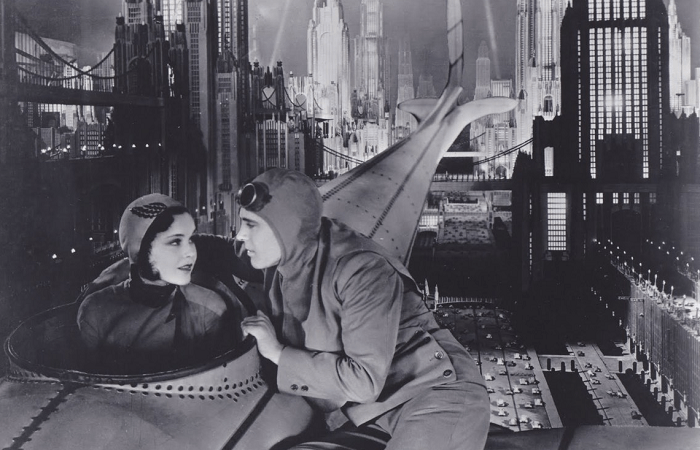
COME FLY WITH ME…Clandestine lovers LN-18 (Maureen O’Sullivan) and J-21 (John Garrick) share a romantic moment high above the streets of 1980 New York City. (scifist.net)

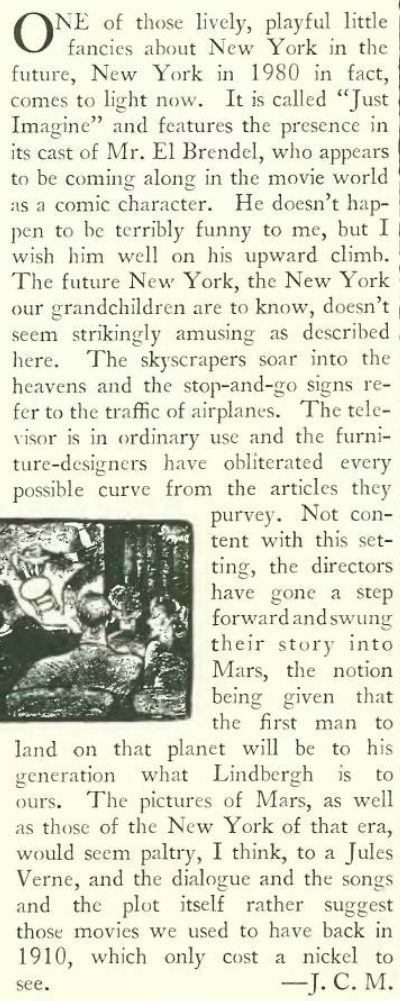
Just Imagine borrowed some of its look from Fritz Lang’s Metropolis (1927), a dystopian vision of the future that reflected the contentious years of Germany’s Weimar Republic. Just Imagine similarly reflected its time and place — the early years of the Depression — Hollywood responding not with gloom and doom but rather with uplifting fare — comedies, musicals, and escapist fantasies (Flash Gordon came along in 1936). The producers of Just Imagine rolled all of it into one film, and The New Yorker’s John Mosher tried to make sense of the mess:

EYE IN THE SKY…In Just Imagine, technology is advanced enough to have a traffic cop floating in the sky, but he still must rely on his arms and mechanical signals to keep the skyways in order. (YouTube clip)

The floating traffic cop is just one example of the film’s attention to set design. The New York skyline, featured in the opening scene, was constructed in a giant hangar at enormous cost…

(IMDB)

In one of the films weirder twists, vaudeville comedian El Brendel is brought back to life with an electric beam…

SMOKED HAM…Vaudeville comedian El Brendel is zapped back to life to provide the world of 1980 with comic relief. Some of the electrical equipment assembled by set designer Kenneth Strickfaden would be seen again in 1931’s Frankenstein. (scifist.net)

…and Brendel (below, center), proceeds to get drunk on booze pills and spew a series of really bad jokes throughout the duration of the film…

WE SHOULD HAVE LEFT HIM DEAD…Frank Albertson, El Brendel and John Garrick in Just Imagine. (scifist.net)
MARS ATTACKS…The film also took audiences to the surface of Mars via a phallus-shaped spaceship that would later be used in Flash Gordon serials. Clockwise, top left, the spaceship blasts off surrounded by a crowd of men in fedoras; aboard the spaceship; landing site on Mars; J-21 (John Garrick) encounters the Martian Queen (Joyzelle Joyner). (YouTube/scifist.net)

The movie flopped at the box office, but producers were able to recoup some of the costs by farming out clips of the futuristic sets, and some of the props, to other sci-fi films of the 1930s including the Flash Gordon and Buck Rogers serials.

 *  *  *

Toys For Tots

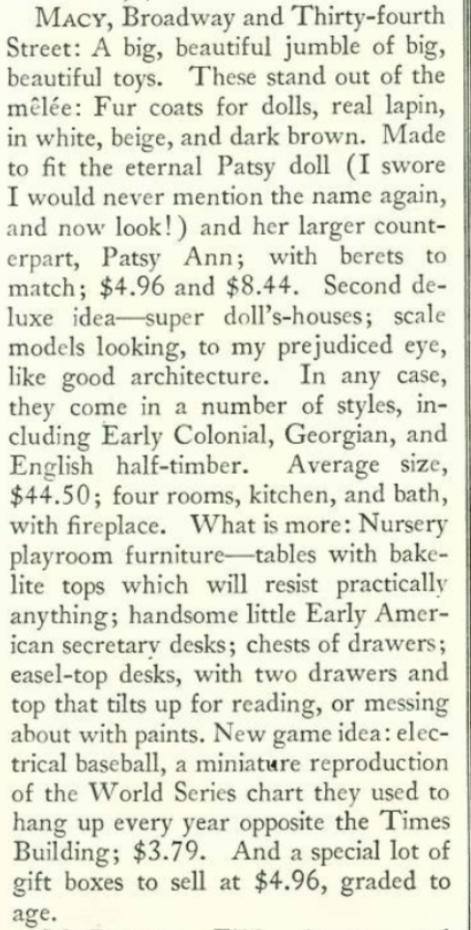
By mid-November The New Yorker’s “On and Off the Avenue” column had lengthened to include ideas for Christmas shoppers. The Nov. 29 issue offered these ideas for children’s toys from Macy’s…

XMAS IS COMING…Patsy Ann dolls in smart berets, and dollhouses in various styles (a 1930 Tudor dollhouse at right) could be had at Macy’s Herald Square flagship store. (Pinterest)

GRRRR…First introduced in 1922, the revival of “Radio Rex” proved popular to the kiddies in 1930. It was the “high tech” toy of its day, the first to respond to voice commands. Rex the dog would spring out of his doghouse at the sound of the word “Rex,” thanks to a sound-sensitive electromagnet. (ctinventor.wordpress.com)

 *  *  *

A Century-old-Problem

Traffic woes have been around almost as long as there have been cars. In an excerpt from “A Reporter at Large,” Morris Markey explained the challenges facing the city’s police department:

IF YOU BUILD IT, THEY WILL COME…Traffic clogs Fifth Avenue near 42nd Street in 1930. (digitalcollections.archives.nysed.gov)

 *  *  *

Speaking of cars, this ad in The New Yorker announced the opening of the annual Automobile Salon at the Commodore Hotel…

…and the magazine was on hand to describe its various wonders. Some excerpts:

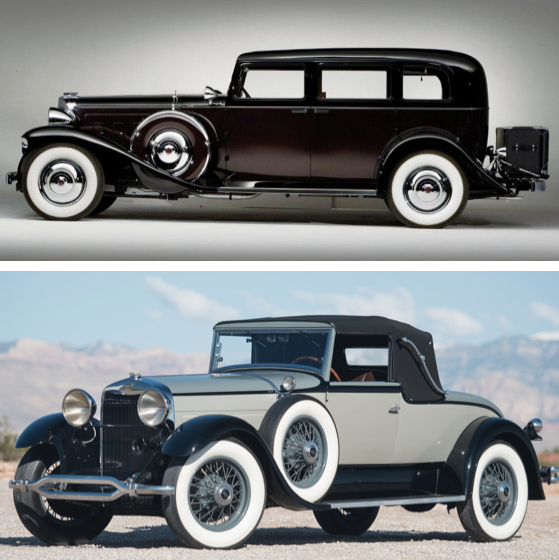
POETRY IN MOTION…Top, the Walter Dorwin Teague-designed Marmon 16-cylinder wowed crowds at the Salon, even if few could afford it. The Great Depression limited the production of the luxury Marmon, and less than 400 were produced. The company abandoned the car business altogether in 1933. Below, the sporty Ford Model L Roadster, designed by Raymond Dietrich. (supercars.net/Sotheby’s)

 *  *  *

Maestro Politician 

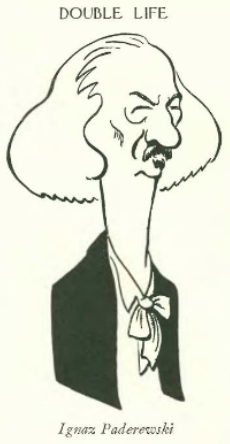
The New Yorker profiled pianist, composer and statesman Ignacy Jan Paderewski (1860-1941). Paderewski served as Poland’s prime minister in 1919, negotiated on behalf of his country at the Treaty of Versailles, and had a 60-year career as a virtuoso pianist. A brief excerpt:

 *  *  *

Not For the Moneychangers

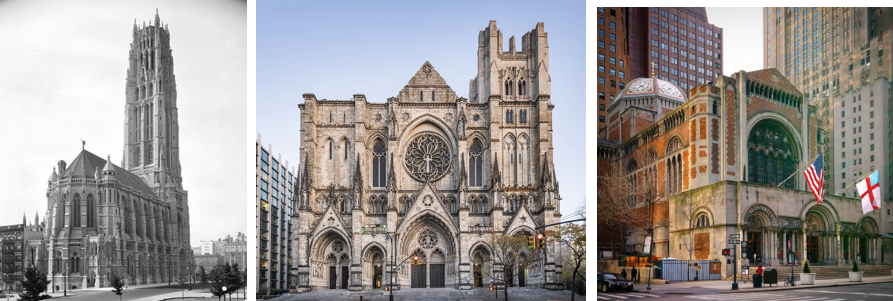
Architecture critic George S. Chappell checked in on the progress of three prominent Manhattan cathedrals in his “Sky Line” column:

LANDMARKS ALL…From left, Riverside Church, the still yet-to-be completed St. John the Divine, and St. Bartholomew’s. (MCNY/masonrymagazine.com/dtjoyce.com)

 *  *  *

The theater review section included this illustration of a new play, Roar China, that opened Oct. 27, 1930 at the Beck Theatre.

The staging of Roar China included this reconstruction of the bow of the H.M.S. Europa on the Beck Theatre stage…

(messynessychic.com)

 *  *  *

From Our Advertisers

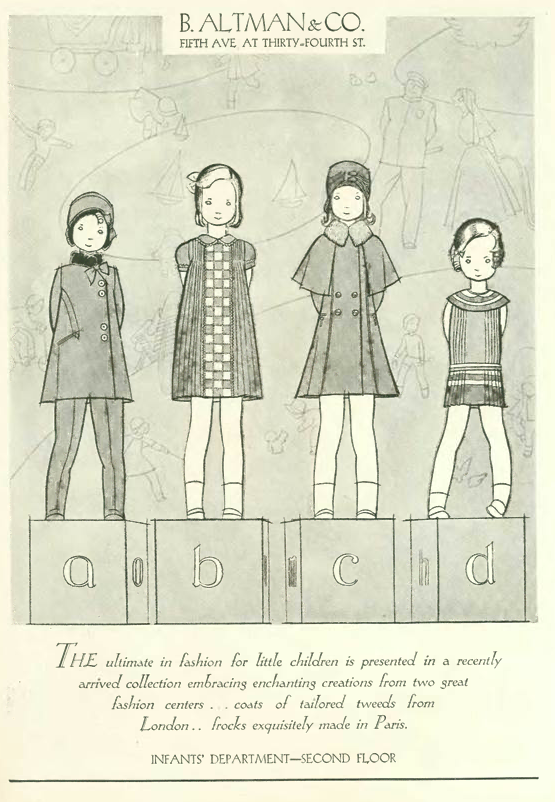
The holiday season was in the air, and retailers were taking various approaches to entice Depression-era shoppers to consider their wares. The ads have a more conservative bent, when compared to late 1920s, and in the case of Wanamaker’s and B. Altman’s, an appeal to simpler times…

…Macy’s, on the other hand, looked to sell rather expensive lighters “to arouse the youthful enthusiasm among veteran smokers”…

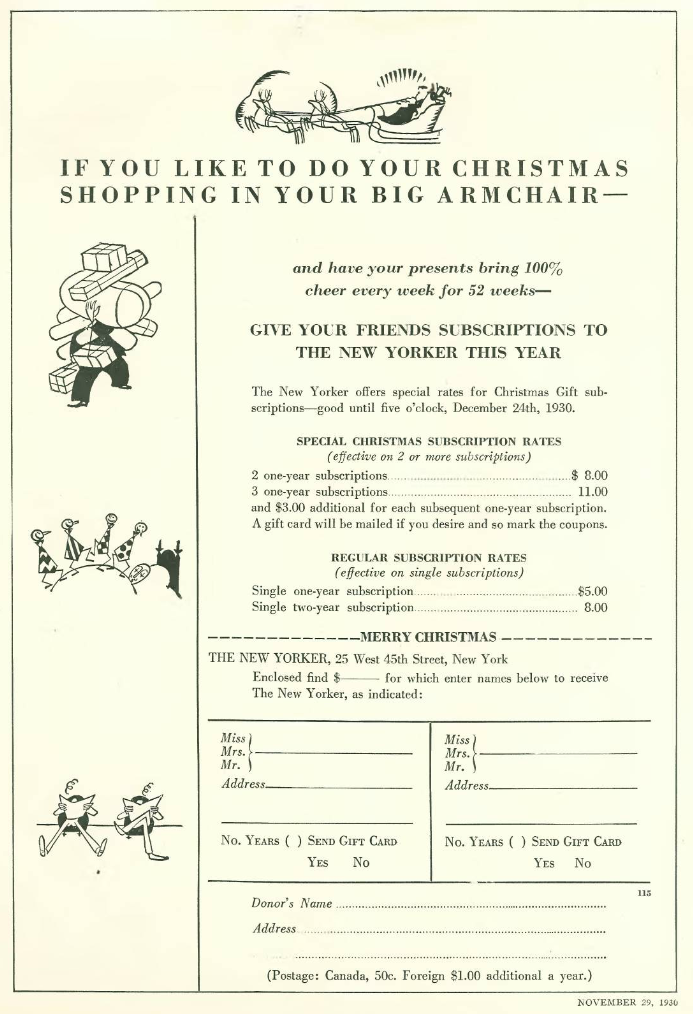
…despite the Depression, New Yorker subscriptions continued to steadily increase — the magazine had nearly 45,000 subscribers in 1930, and by the end of the decade the number would approach 100,000 — below, a house ad designed to entice new subscribers…

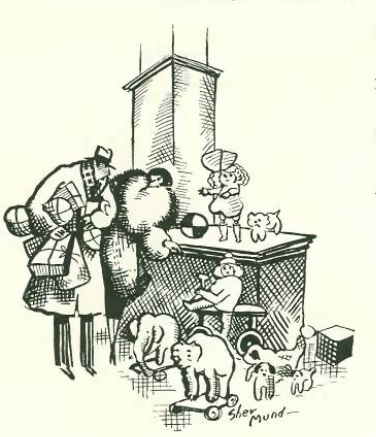
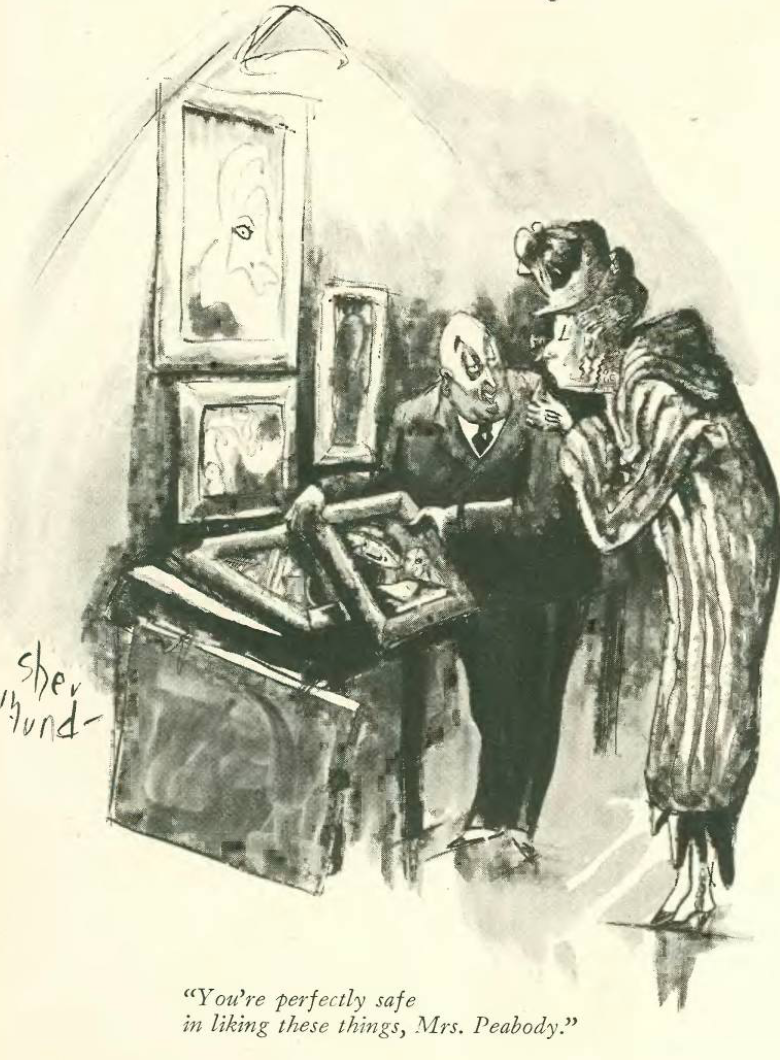
…our cartoons include this holiday spot illustration by Barbara Shermund

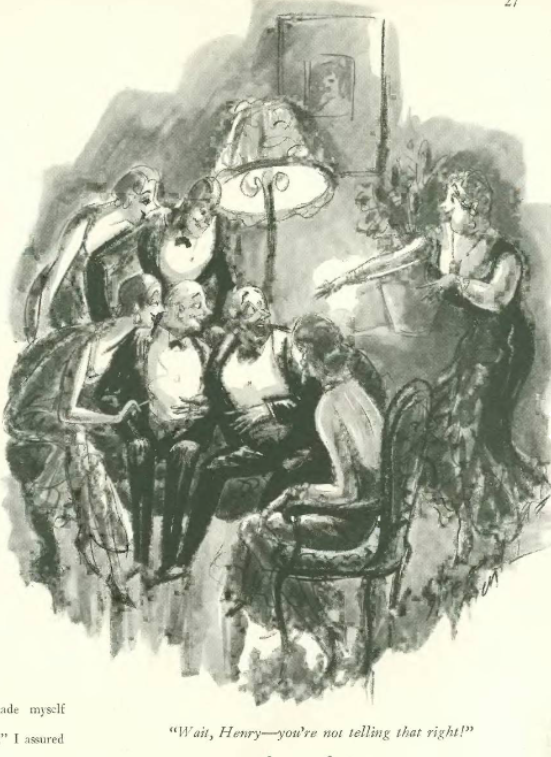
…and another by Shermund of her parlor room crowd…

Otto Soglow amused us with a couple of tots…

Gardner Rea imagined a confrontation between a Macy’s Thanksgiving Day Parade balloon and Italy’s Fascist dictator Benito Mussolini

…the balloon Rea illustrated was “The Captain” from the popular Katzenjammer Kids comic strip. Along with his “family,” the Captain appeared in the parade in 1929 and 1930 (and possibly 1931). They were the first licensed character balloons in the parade’s history…

(The New York Times)

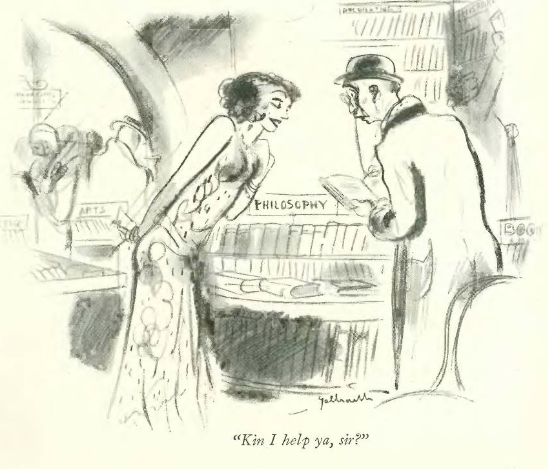
…back to cartoons, book shopping with William Crawford Galbraith

…and some holiday cheer from A.S. Foster

Next Time: Ziegfeld’s Folly…


The High Place

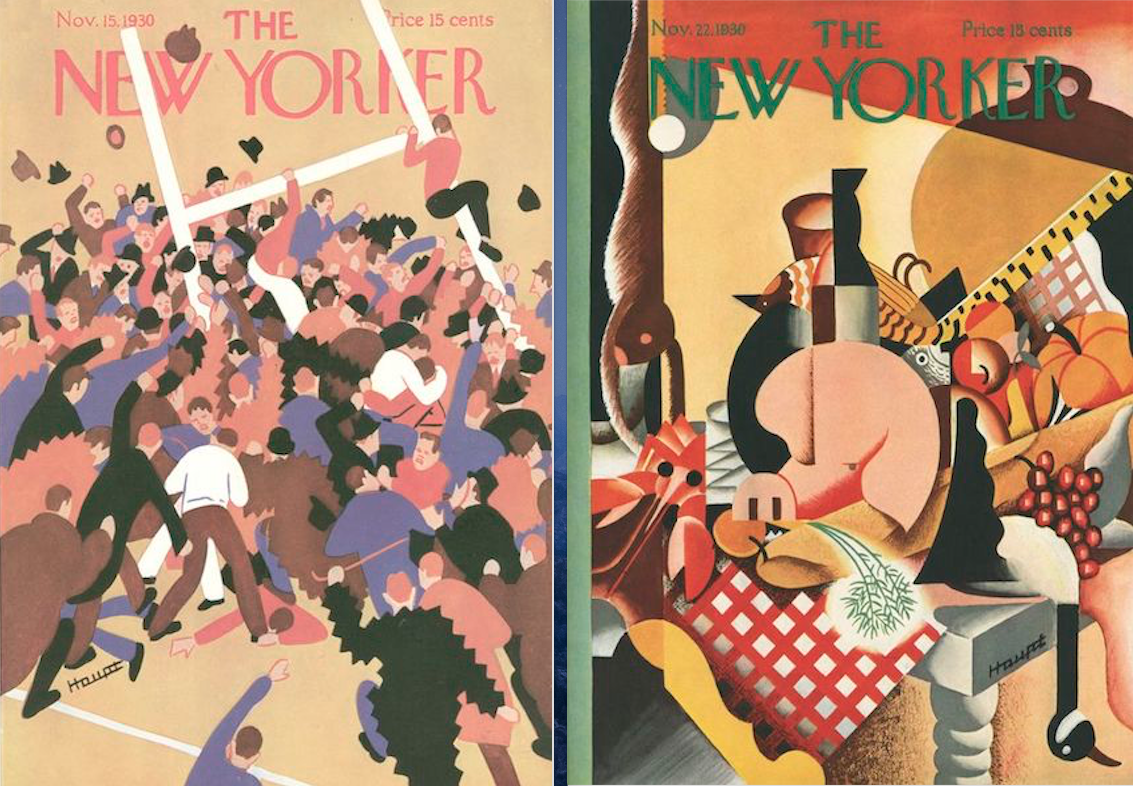
For this installment we look at two issues, Nov. 15 and 22, both featuring covers by Theodore Haupt that celebrated two autumn rituals: football and Thanksgiving.

Let’s begin with the Nov. 22 issue, which climbed to the highest place in Manhattan — no, not the Chrysler Building, but the nearby Empire State Building — with E.B. White admiring the commanding view:

Before the Empire State Building could go up, the old Waldorf-Astoria hotel had to come down. As White observed, the old hotel was built so soundly that it was too costly to deconstruct and salvage. Most of it ended up on the bottom of the ocean.

DOWN IN DAVY JONES’ LOCKER lie the remains of the old Waldorf-Astoria Hotel, which stood for just 36 years before it was razed to make room for the Empire State Building. At right, one of the hotel’s lobbies, and the Grand Ballroom. (nyc-architecture.com/Pinterest)
A LOT OF HOT AIR…Top images: The fabled “mooring mast,” described by E.B. White in his New Yorker brief, as imagined in composite images (old-time Photoshop). In reality, the morning mast never worked; bottom right, a cutaway view of the mast featured in Popular Mechanics; bottom left, New York Times photo from March 22, 1931, announcing the completion of the Empire State Building, just 17 months after the Waldorf-Astoria began coming down. (Keith de Lellis Gallery, rarehistoricalphotos.com/Google Books/The New York Times)
SURVEYING THEIR KINGDOM…Most visitors to the Empire State Building can only go as high as the 86th floor observation deck. However, if you are a VIP like Serena Williams or Taylor Swift, you can get your picture snapped on the 103rd. (Associated Press/Empire State Building/Evan Bindelglass, CBSNewYork)

*  *  *

Sore Winner

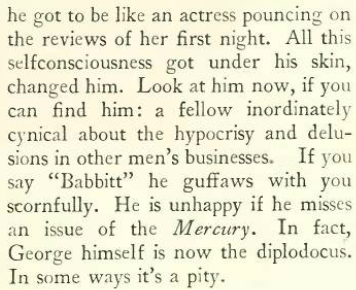
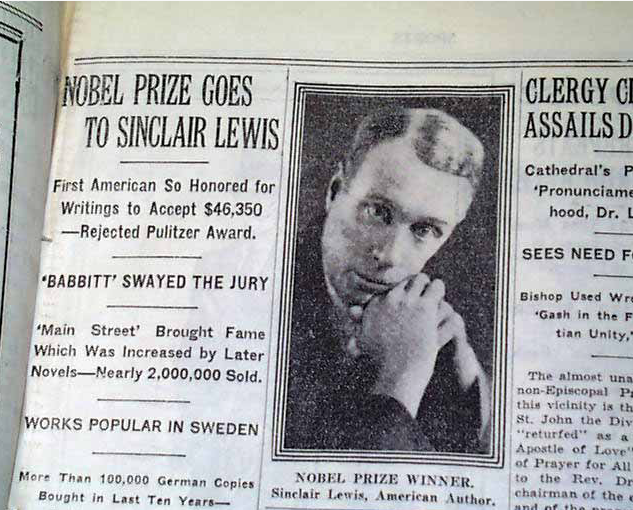
Sinclair Lewis famously declined the Pulitzer Prize for his 1925 novel Arrowsmith, upset that his 1920 novel Main Street had not previously won the prize. But when the Swedish Academy came calling with a Nobel Prize in Literature in 1930, he happily accepted. According to “The Talk of the Town,” this award also seemed a bit tardy, since Lewis’s small town booster archetype, George F. Babbitt, did not fit the dour days of the Great Depression. But it turned out that the 1922 novel Babbitt was ultimately what swayed the Nobel jury:

BOOST FROM A BOOSTER…George F. Babbitt helped make Sinclair Lewis famous, and landed him a Nobel. (NYT, NOVEMBER 6, 1930)

 *  *  *

Not So Sweet

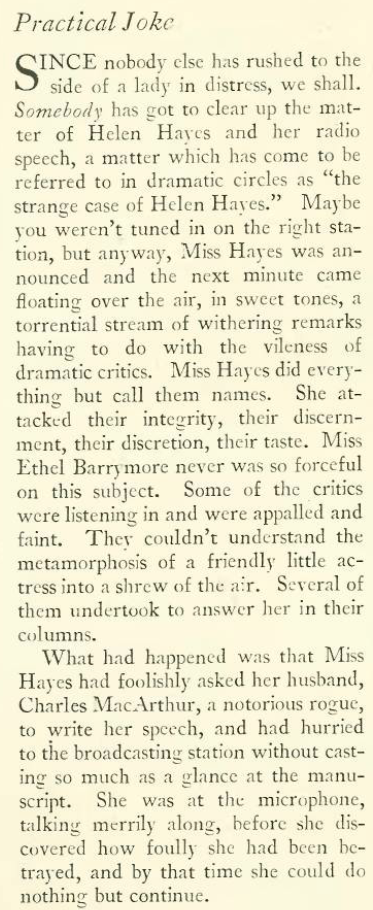
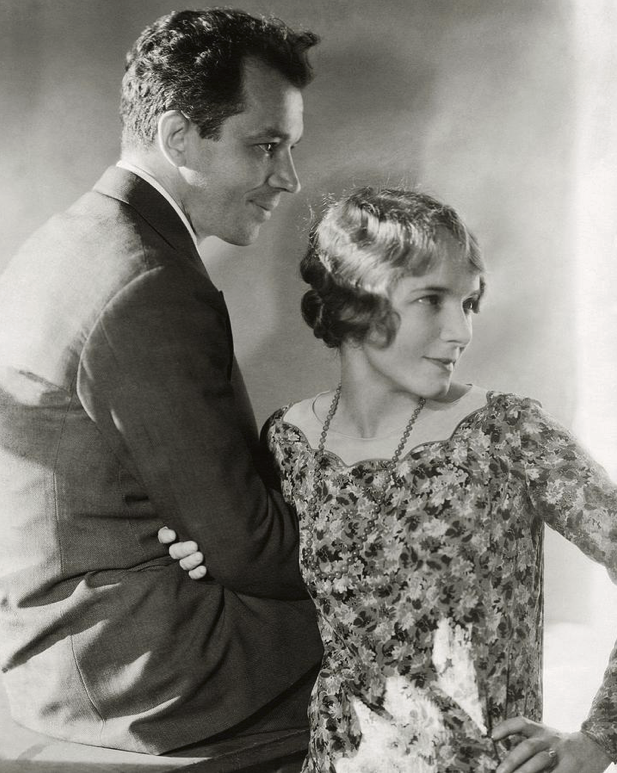
Those of a certain age might remember Helen Hayes as a sweet old lady who appeared on a number of TV shows in the 1970s and 80s, or as the mother in real life of James MacArthur, Disney teen star and later the portrayer of Danny “Book ’em Danno” Williams on the original Hawaii 5-0 TV series. Hayes was married to playwright Charles MacArthur, and “The Talk of the Town” takes it from there…

CREATIVE TYPES…The engaged couple Charles MacArthur and Helen Hayes posed for photographer Edward Steichen for this Jan. 1, 1929 image featured in Vanity Fair magazine. (Condé Nast)

 *  *  *

Ain’t It Grand

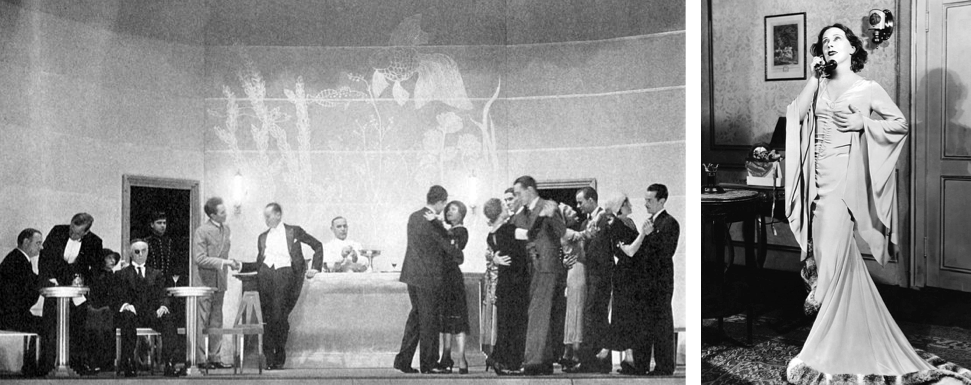
Grand Hotel opened at the National Theatre on Nov. 13, 1930 to strong reviews, including the one below by Robert Benchley that he filed for The New Yorker. The play, adapted from the 1929 novel Menschen im Hotel by Austrian writer Vicki Baum, would prove to be a smash on Broadway and again on the silver screen in a star-studded 1932 film featuring Greta Garbo, John Barrymore, and Joan Crawford.

THE STARS ALIGN…Left, promotional photograph of the original Broadway production of Grand Hotel. At right, Eugenie Leontovich portrayed fading Russian ballerina Grusinskaya in the play. The role would go to Greta Garbo in the 1932 film adaptation. (Theatre Magazine, February 1931/Wikipedia)

…and while we are on the subject of Broadway, the theater review section also featured this Al Frueh illustration promoting a noted production of Twelfth Night at the Maxine Elliott…

Program for the production featuring Jane Cowl. (Playbill)

 *  *  *

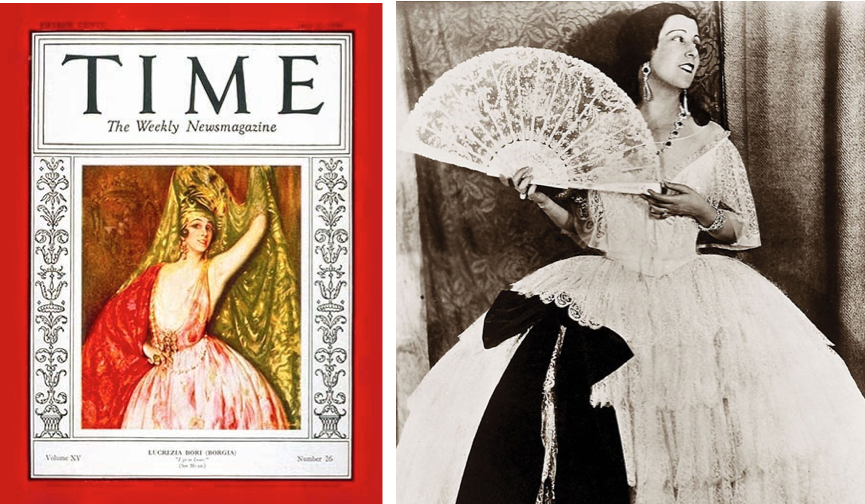
There were also big doings at the Met, where Spanish lyric soprano Lucrezia Bori (1887-1960) wowed audiences with her portrayal of Violetta in La Traviata.

SHE HAD SOME PIPES…right, lyric soprano Lucrezia Bori on the cover of the June 30, 1930 edition of Time magazine. At right, promotional photo of Bori circa 1930. (Time/Wikipedia)

 *  *  *

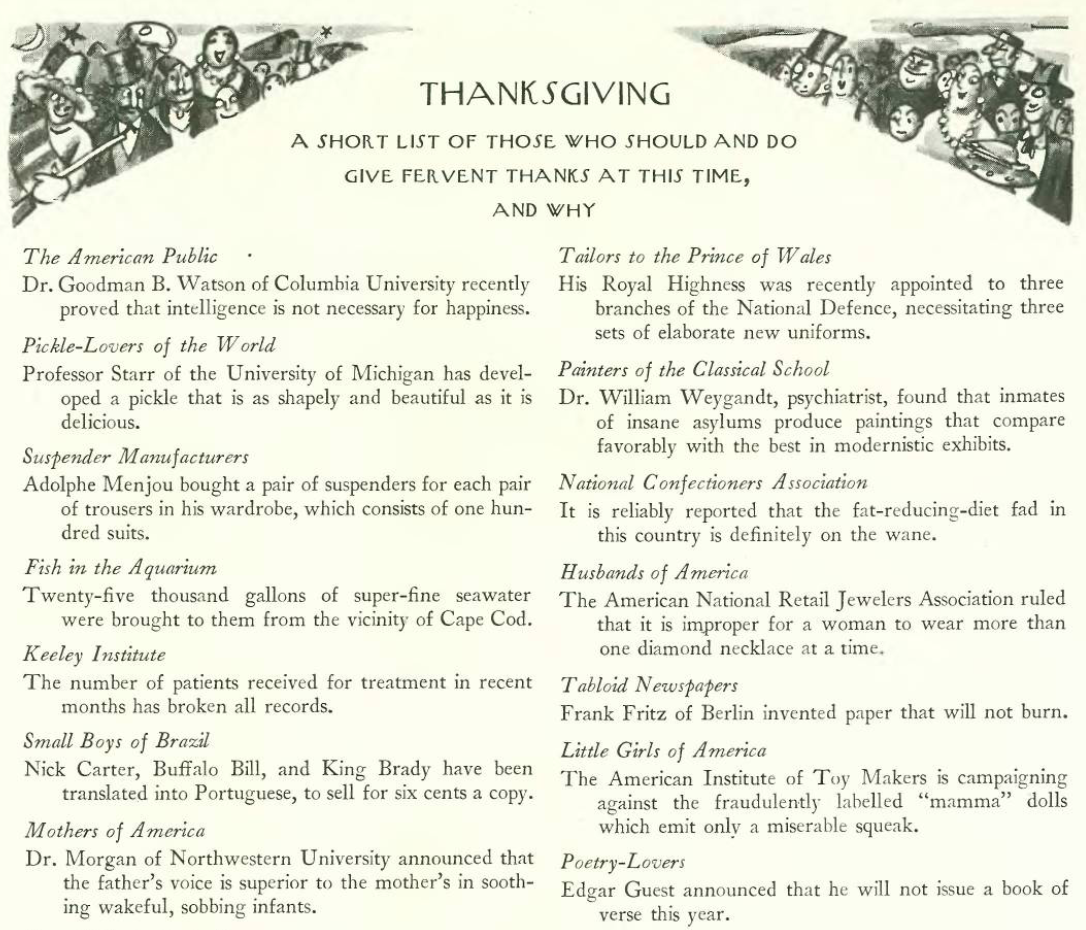
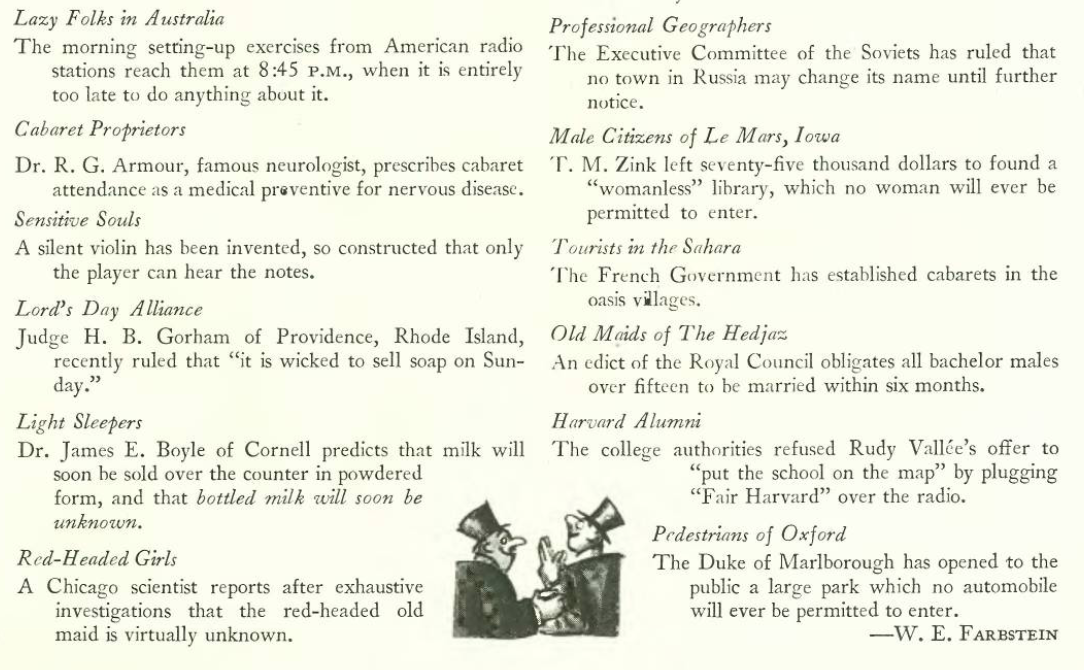
Bounty of Blessings

Humorist W. E. Farbstein gave readers plenty to be thankful for in this tribute to the Thanksgiving holiday…

 *  *  *

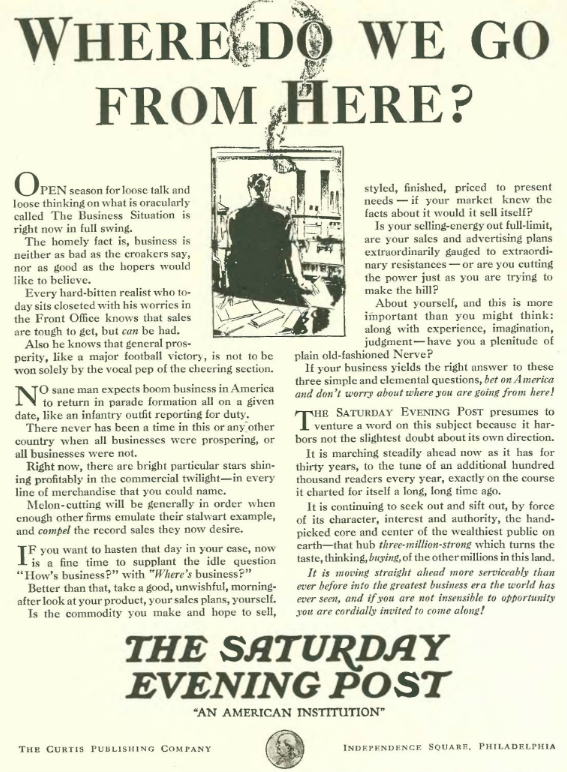
From Our Advertisers

Occasionally advertisements acknowledged the reality of the Great Depression, including this one from The Saturday Evening Post that offered encouraging words to prospective readers…

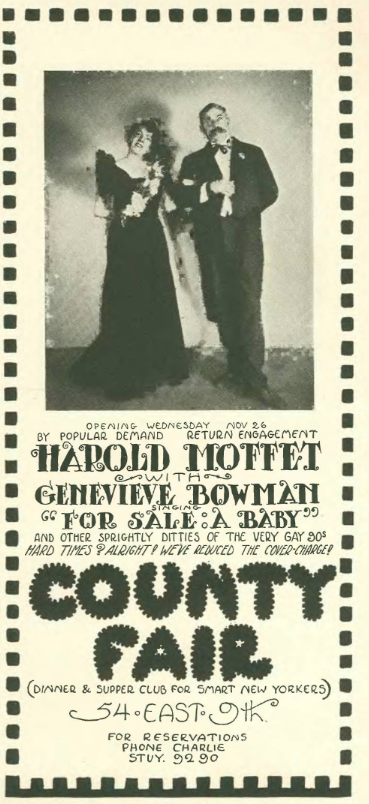
…County Fair, a Greenwich Village country-themed nightclub, offered the diversion of Moffatt and Bowman to take audiences’ minds off of hard times…

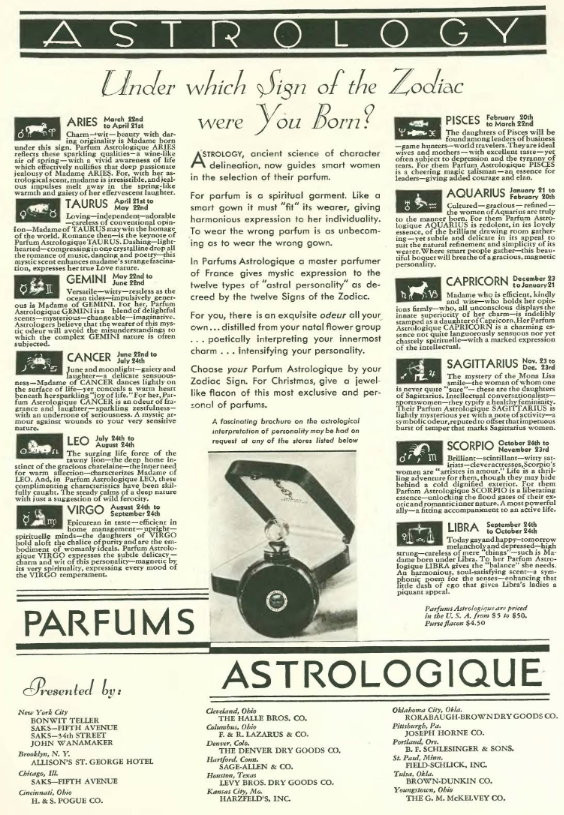
…and for all the supposed sophistication of New Yorker readers, there were still plenty of back page ads offering nostrums laced with superstition…

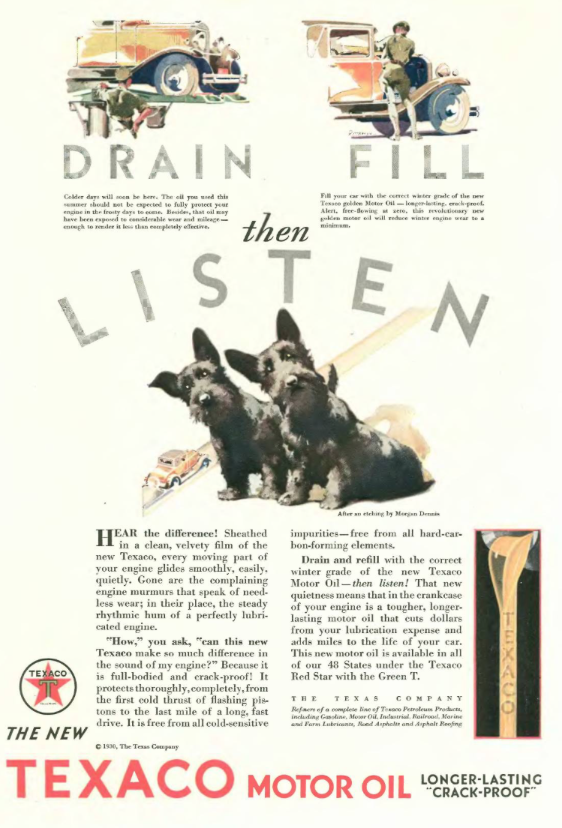
…some of the more colorful, spritely ads from the era were offered up by the producers of Texaco Motor Oil…

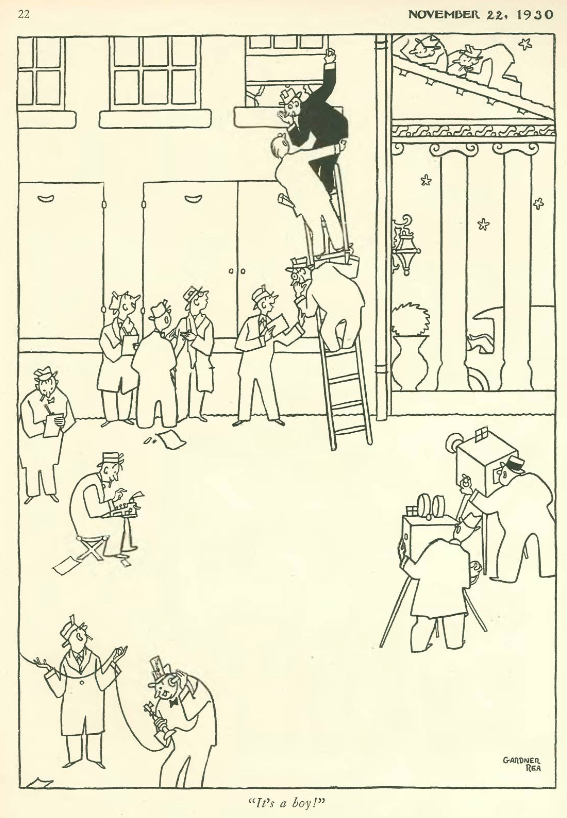
…our cartoons are by Gardner Rea

Barbara Shermund

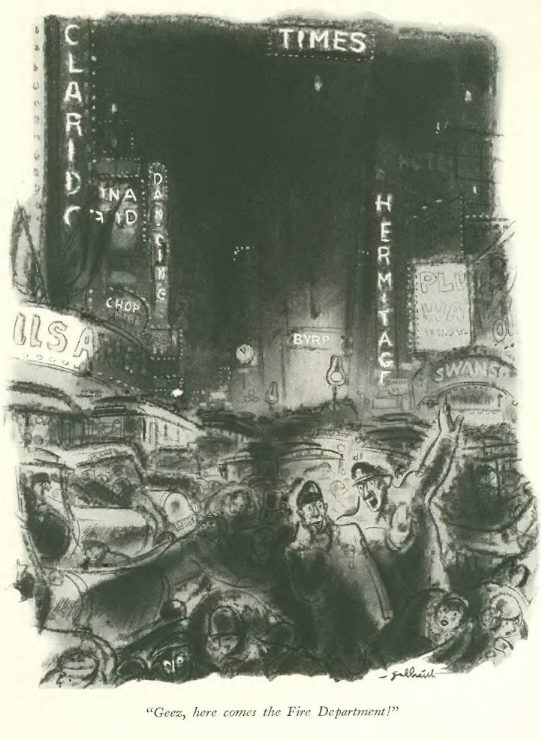
William Crawford Galbraith

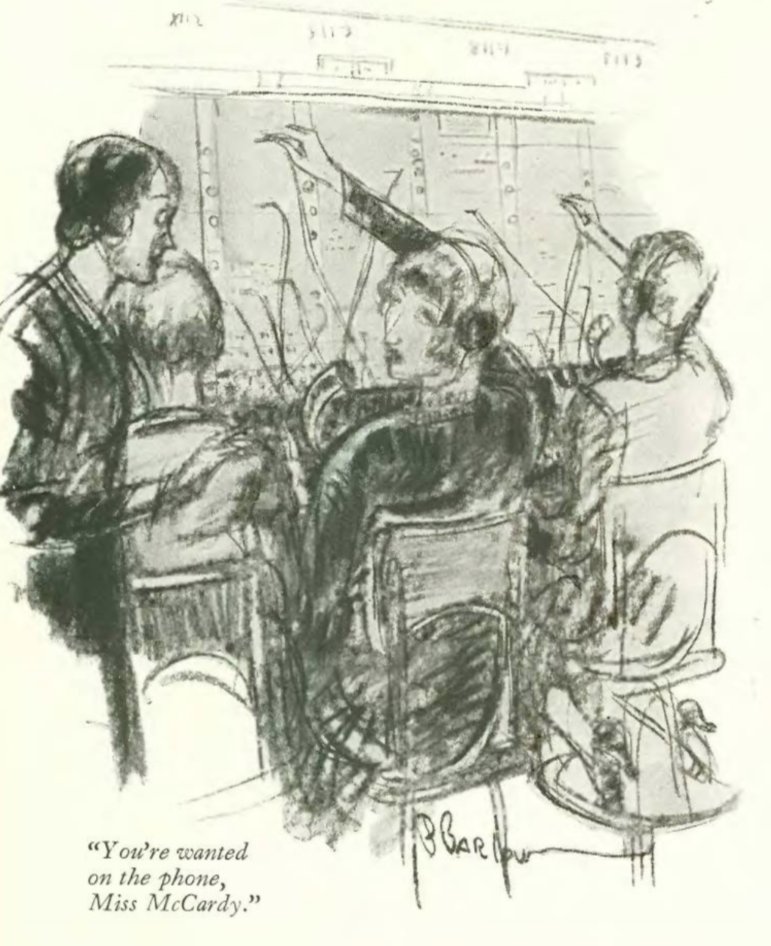
…and Perry Barlow

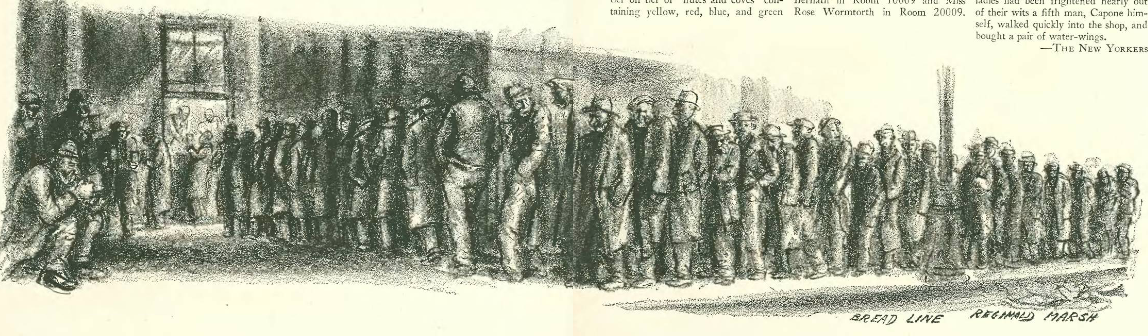
…and for another reminder of reality in the city, this sketch that ran along the bottom of “The Talk of the Town,” by Reginald Marsh

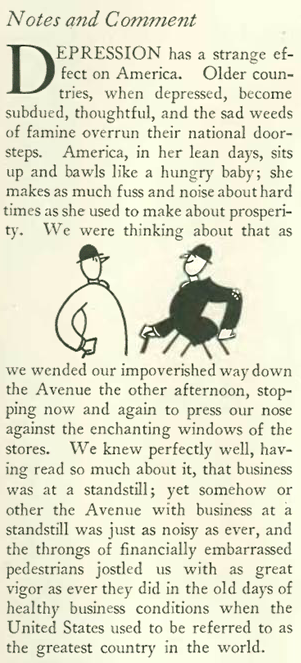
…and now we step back to the Nov. 15 issue, where E.B. White offered a less somber take on the Great Depression…

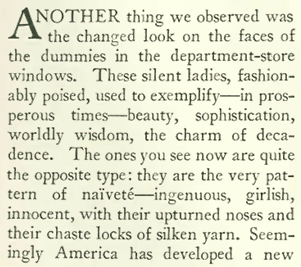
…White also noted a change on the faces of storefront mannequins…

YIN AND YANG…The worldly pose of a Roaring Twenties mannequin, and a more wholesome look for the leaner times in the 1930s. (Pinterest)

 * * *

Playing Telephone

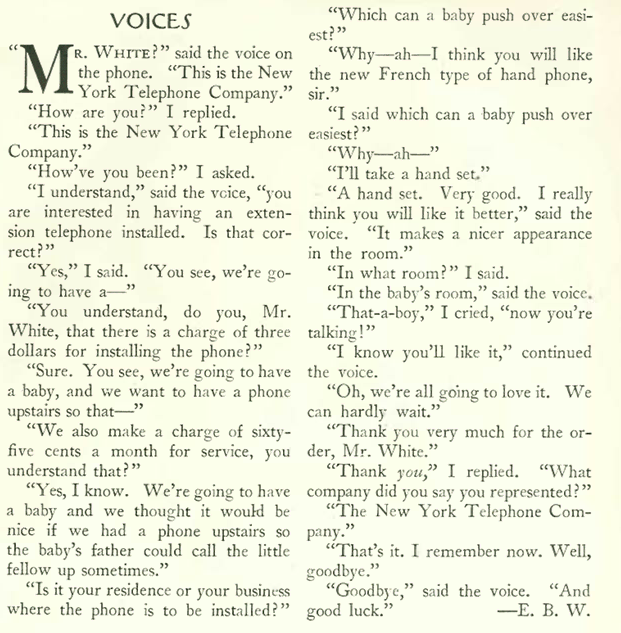
Long, long before cell phones, telephones were heavy stationary devices that required a certain amount of planning before installation, as E.B. White explains:

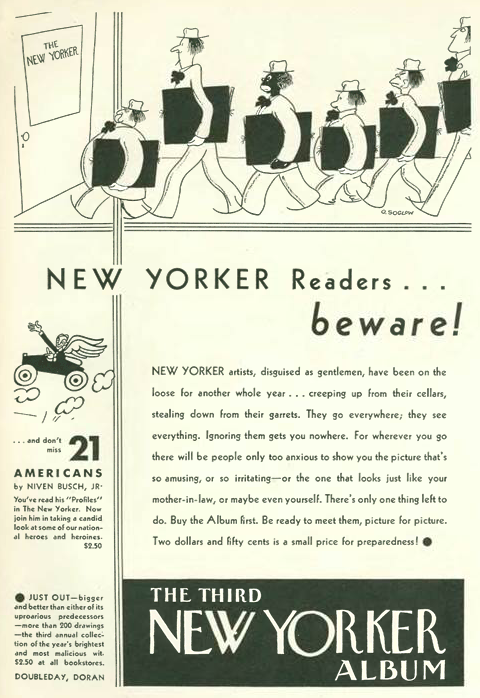
On to our Nov. 15 ads, we have this announcement for The Third New Yorker Album…with illustration by Otto Soglow

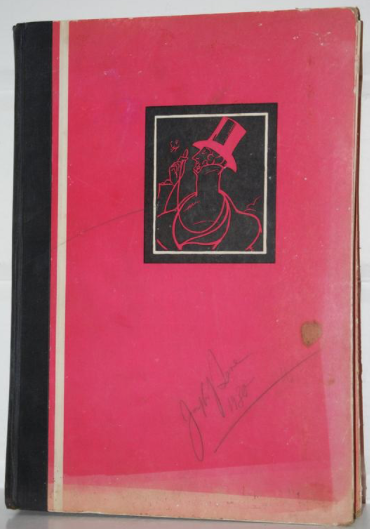
…here is what the album looked like…

…and a couple of inside pages…

(Etsy)

…one of the contributors to the album was Rea Irvin, founding illustrator for The New Yorker, here doing some business with Murad cigarettes…also another Flit insecticide ad by Dr. Seuss

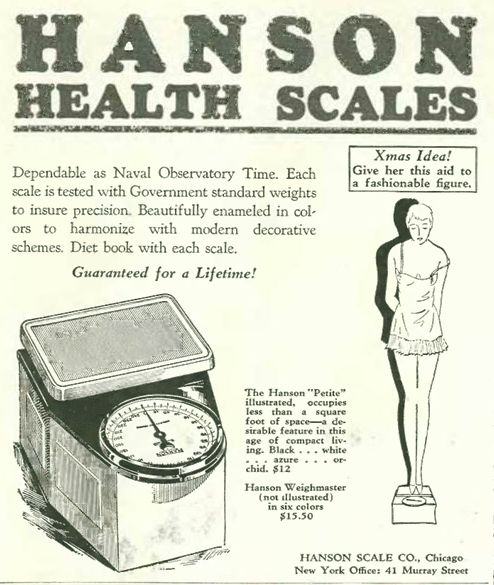
…Christmas ads began appearing in the magazine, including this one for Hanson scales…pity the poor chap (and his wife) who actually thought this might be a suitable present for Christmas, or any occasion for that matter…

…and with Prohibition still in force, advertisers found other uses to promote their products…

…on to our cartoons, Leonard Dove illustrated a couple who didn’t get away with the ruse…

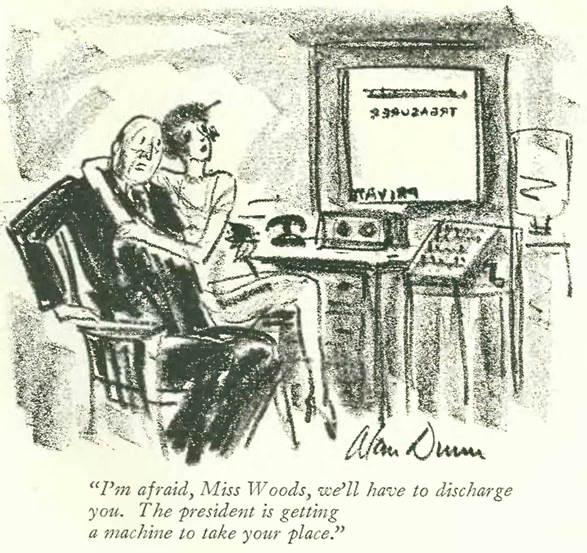
… Alan Dunn depicted what was considered typical office behavior in the 1930s…

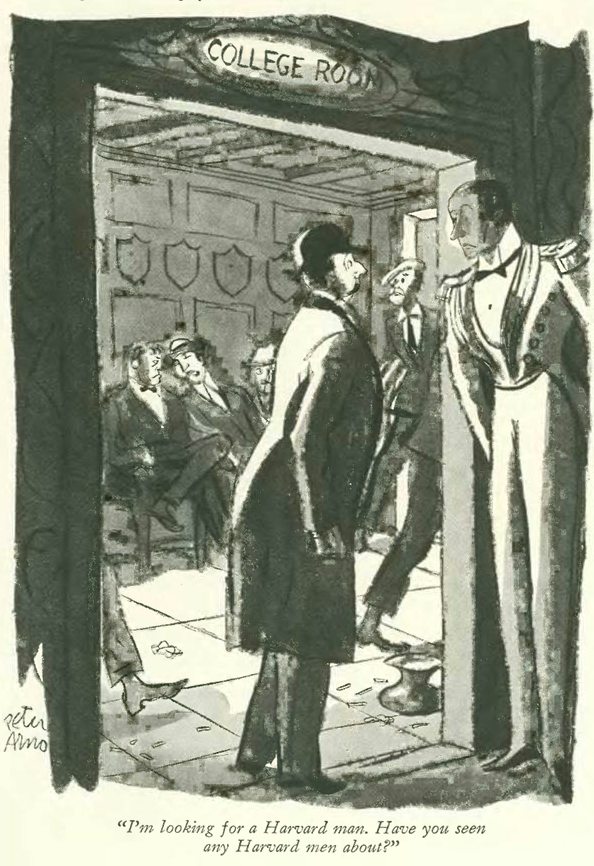
...Peter Arno visited the Harvard Club…

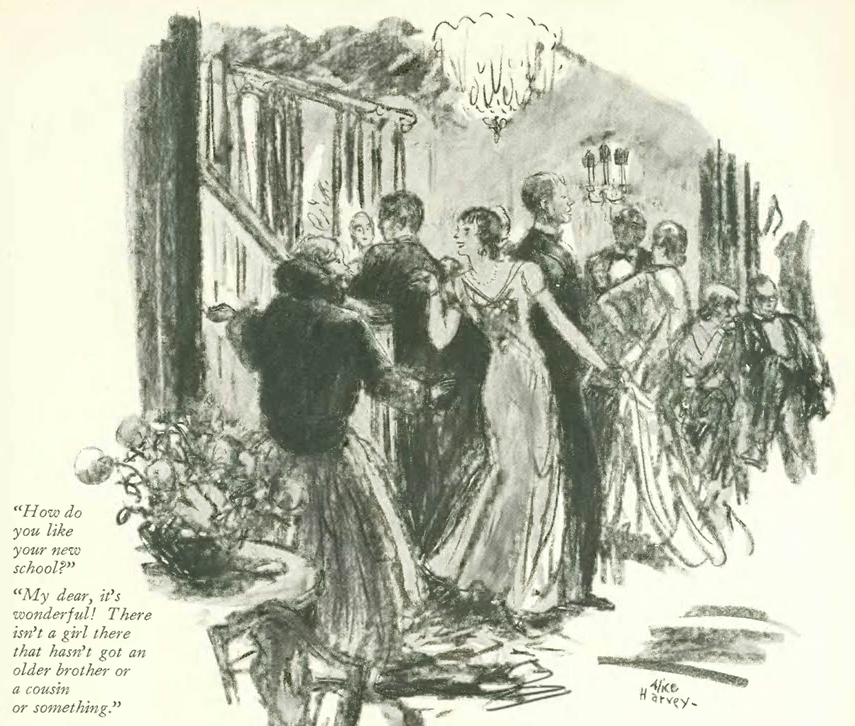
Alice Harvey also explored the college scene…

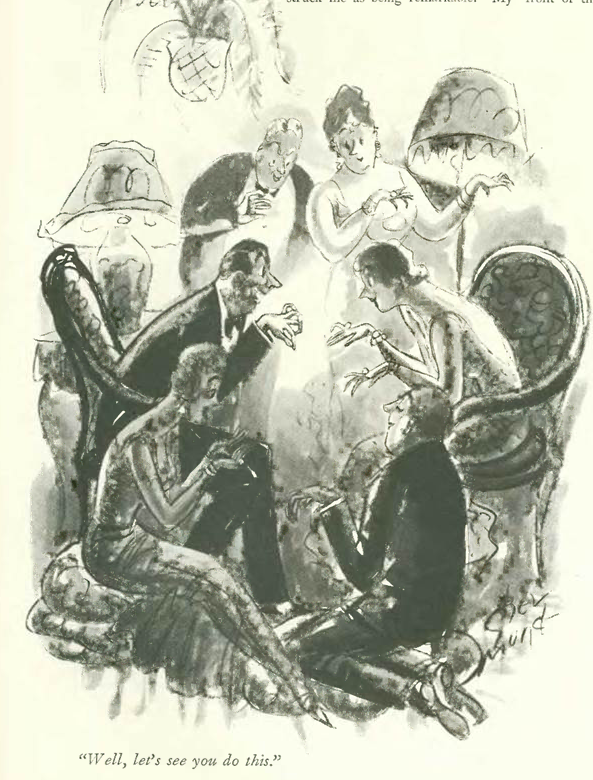
…some parlor games with Barbara Shermund

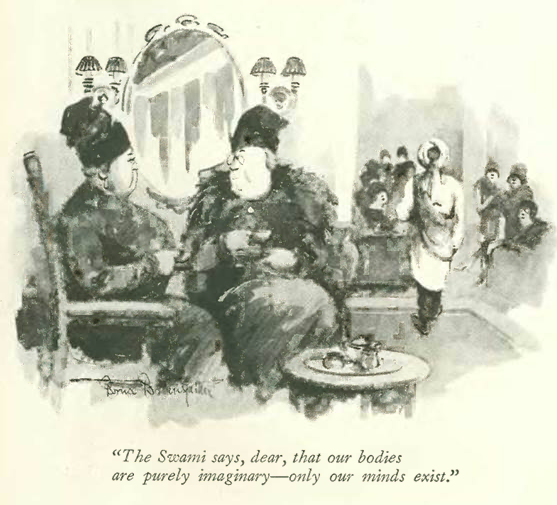
……Bruce Bairnsfather, and some existentialist chat at tea time…

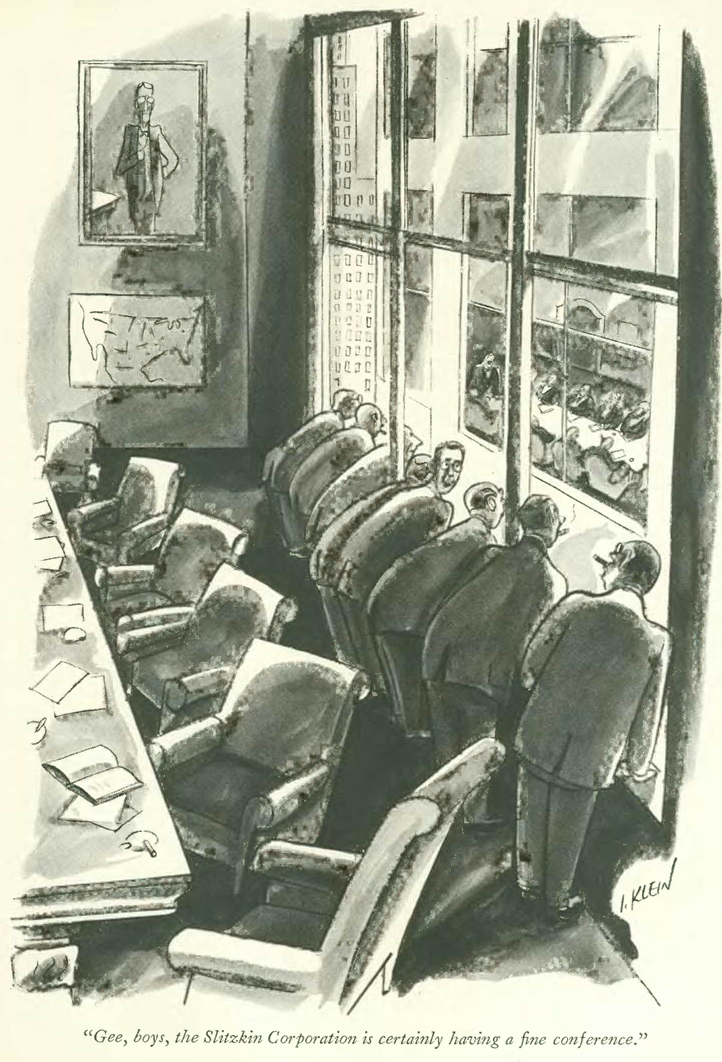
…and we close with Isadore Klein, and the world of corporate competition…

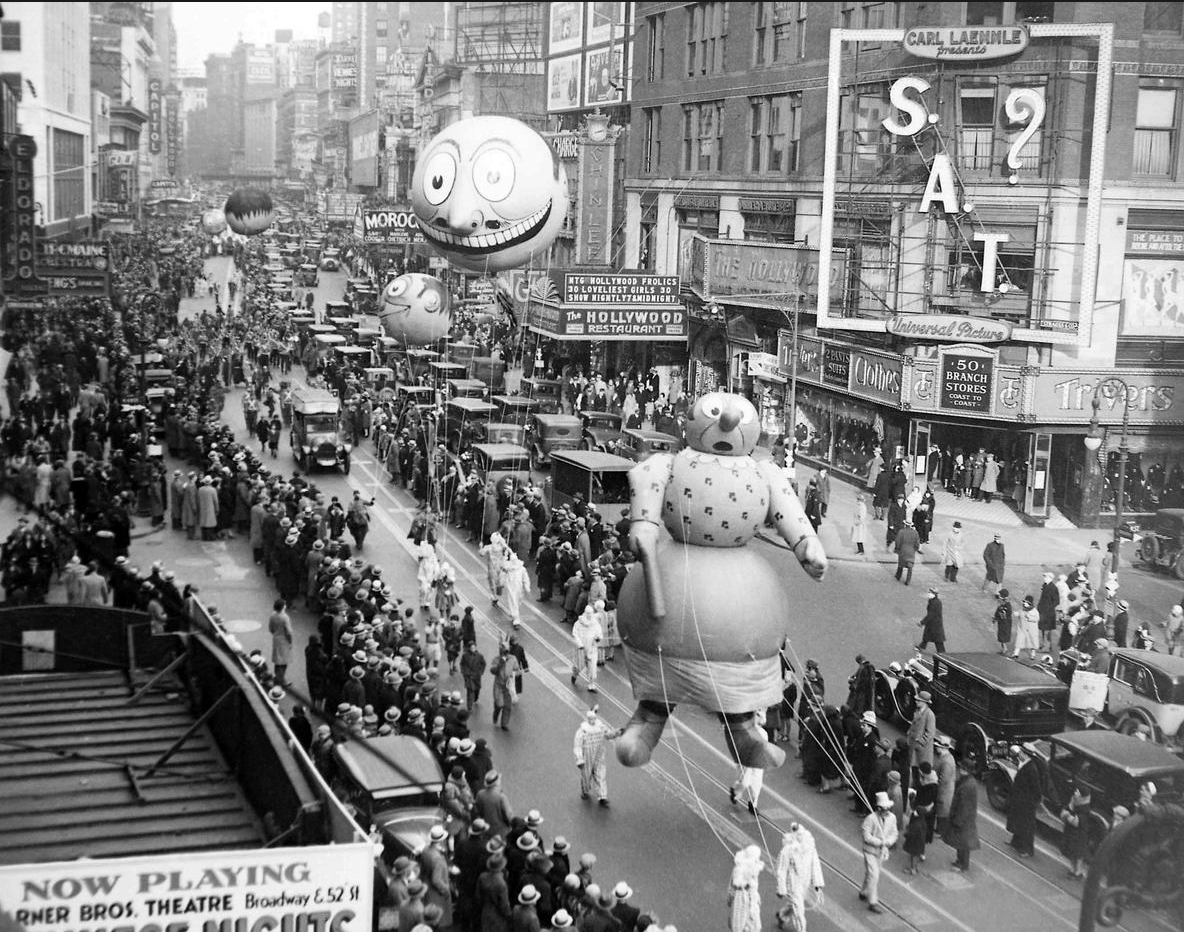
…and a Happy Thanksgiving, from the Macy’s Thanksgiving Parade 89 years ago, Nov. 27, 1930…

(CBS/Associated Press)

Next Time: The Future Was a Silly Place…


Leatherheads

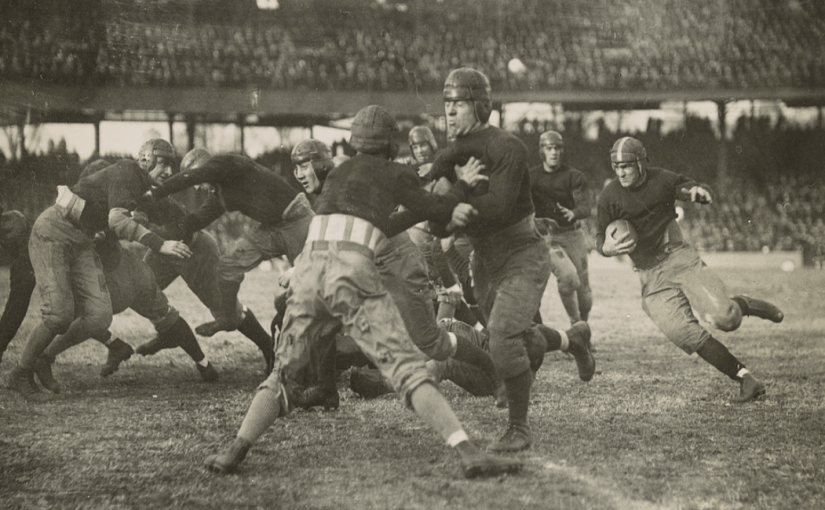
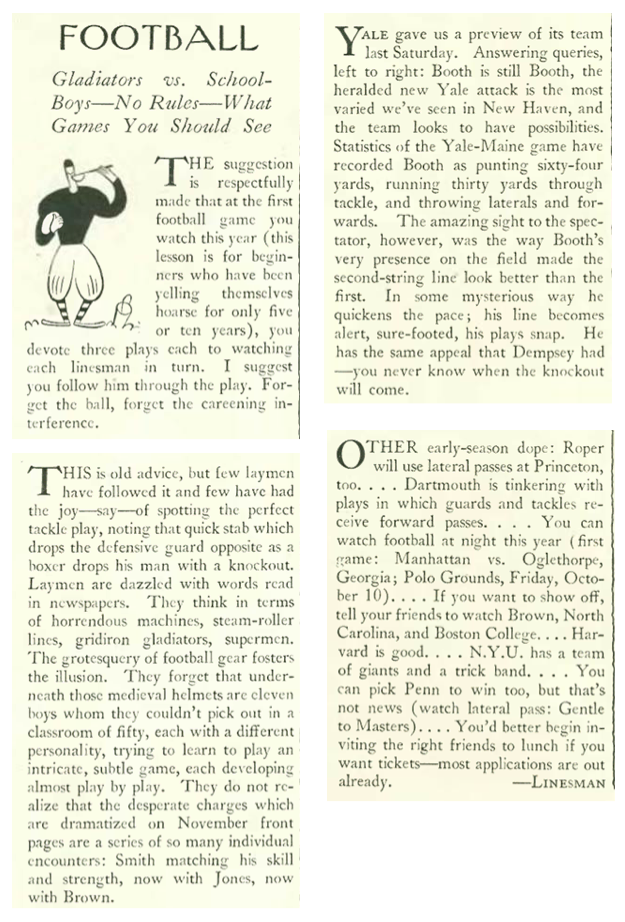
One thing you won’t see in today’s New Yorker magazine is extensive coverage of college football (more likely you’ll see an indictment of the game). In the magazine’s first years, however, that sport was enthusiastically embraced.

Oct. 4, 1930 cover by Rea Irvin.

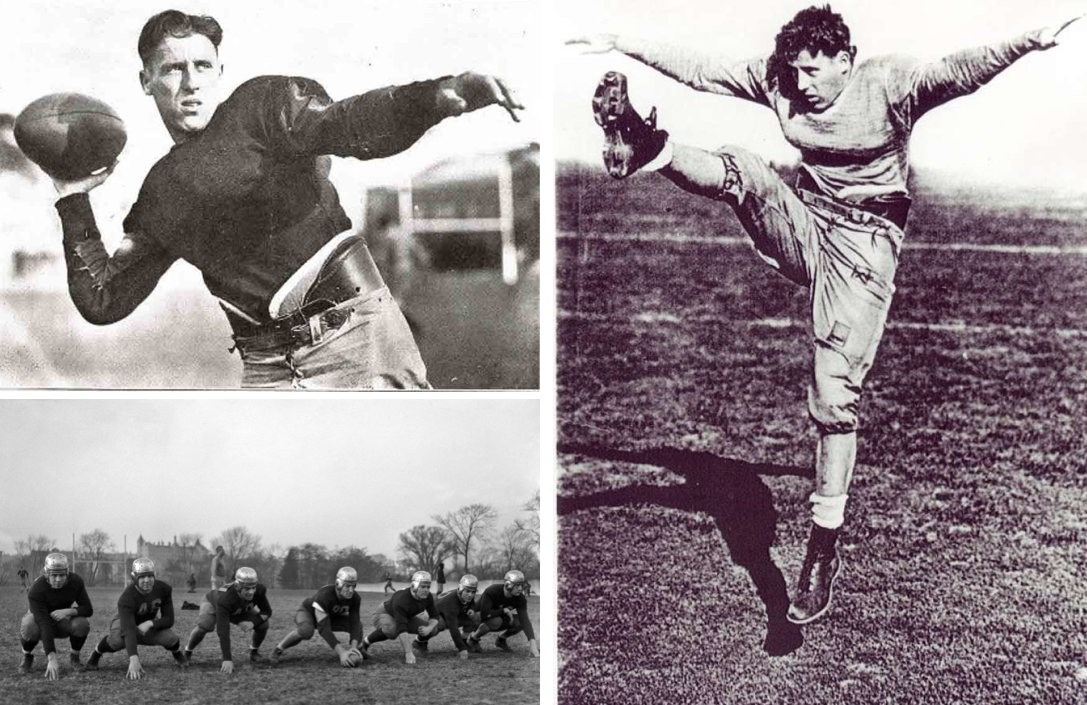
A writer identified by the alias “Linesman” assessed the early season’s prospects, and noted the return of Yale’s Albie Booth (1908–1959) to the field. Booth became famous during the previous season for his spectacular play against Army: Booth led Yale to an upset victory by scoring all of the team’s points (two rushing touchdowns, a 65-yard punt return for a touchdown, and three extra point kicks). Newsreels featuring the game sported the caption, “Booth 21, Army 13.”

GOOD THINGS COME IN SMALL PACKAGES…Top and left, only 5 feet 6 inches tall and 144 pounds, Albie Booth nevertheless could do it all on offense – running, passing, kicking. He was elected to the College Football Hall of Fame in 1966. Bottom, left, Fordham’s famed “Seven Blocks of Granite,” in 1936. In the days before he became a legendary coach, Vince Lombardi  served as one of those seven blocks (he is third from the left). (footballfoundation.org/yaledailynews.com/Associated Press)

 *  *  *

Foul Ball

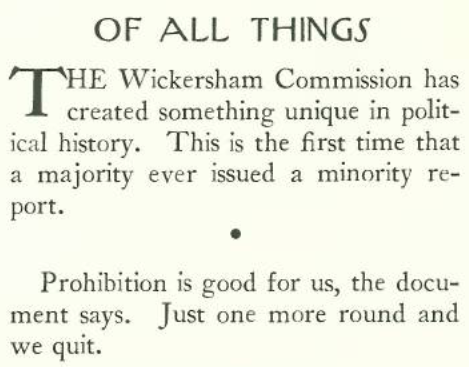
While The New Yorker geared up to cover the college football season (as well as everything from Badminton to yacht racing), it continued to ignore professional baseball, mentioning its existence only in passing, such as this observation shared by Howard Brubaker in “Of All Things”…

Footnote: Simeon Fess (1861-1936) was a Republican Senator from Ohio known as an apologist for a very unpopular Republican Party.

  *  *  *

Not For The Kiddies

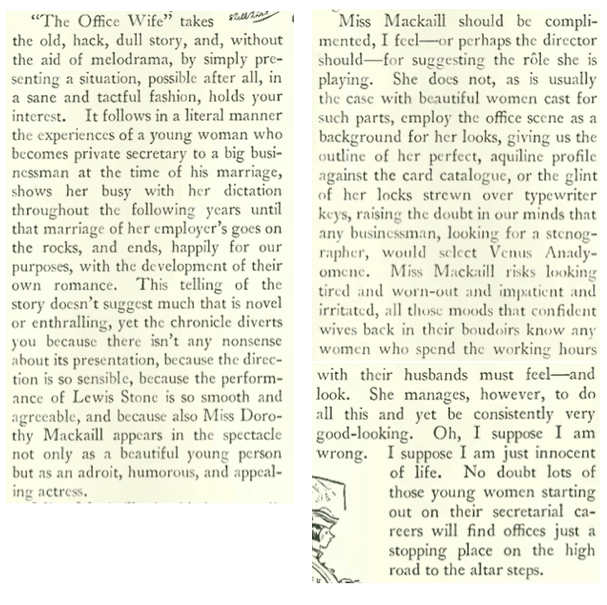
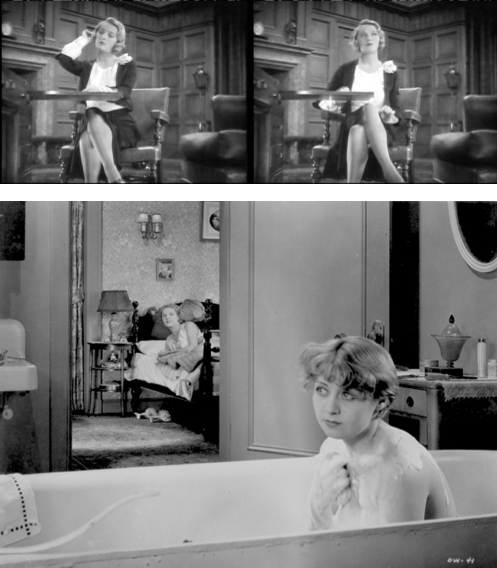
The Office Wife was a romantic drama featuring such “pre-Code” themes as infidelity and workplace hanky-panky. The film was the talking picture debut of Joan Blondell, who would become a big star in the 1930s and enjoy a long career that would include numerous appearances on television through the 1970s. Here are excerpts from John Mosher’s review of the film:

SHE TALKS! SHE BATHES! At top, Anne Murdock (Dorothy Mackaill) practices her charms in The Office Wife. Below, Anne’s younger sister Katherine (Joan Blondell) has a soak in the tub. It would be Blondell’s talking picture debut. (11east14thstreet.com/classicmoviefavorites.com)
SEX SELLS…Warner Brothers played up the salacious aspects of The Office Wife to generate interest among movie theater operators. (Pinterest)

While Joan Blondell was on the verge of a meteoric rise, one of the silent era’s biggest stars and sex symbols, Clara Bow (known as the “It Girl,”) was seeing her popularity wane in the sound era. After Her Wedding Night (reviewed here by Mosher) she would make just four more films before she would retire from the pictures at the ripe age of 28.

DOWN BUT NOT OUT…From left, Richard ‘Skeets’ Gallagher, Ralph Forbes and Clara Bow observe the hijinks of Charles Ruggles in 1930’s Her Wedding Night. Bow’s enormous popularity would quickly wane in the era of talking pictures. (IMDB)

*   *   *

Twin Peaks

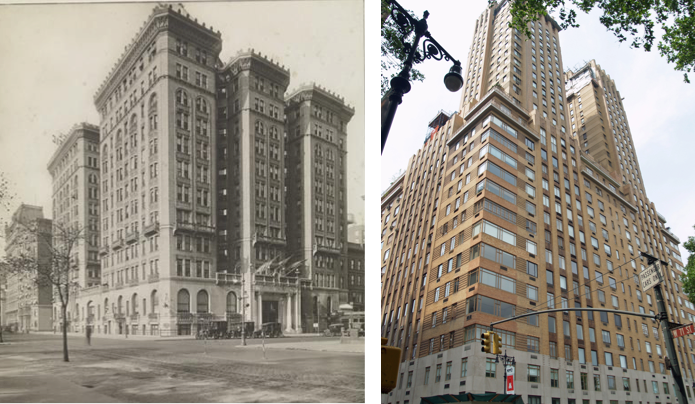
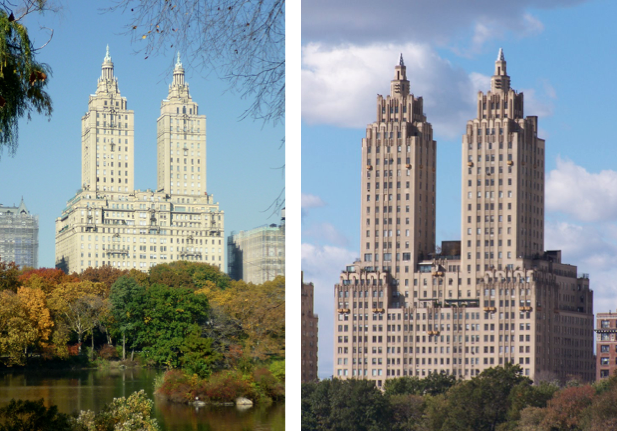
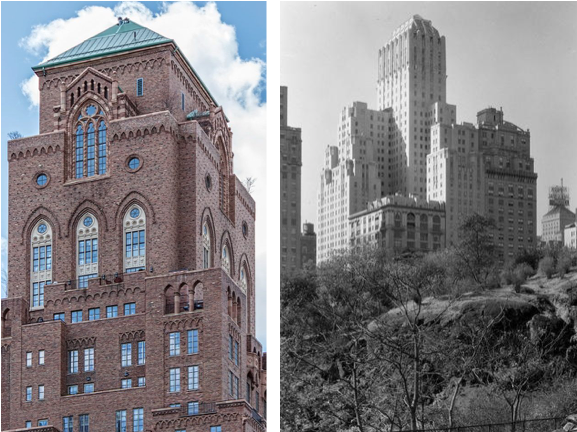
Architecture critic George Chappell chronicled the latest changes to the skyline surrounding Central Park, most notably Emery Roth’s landmark San Remo and El Dorado.

THIS TOWN AIN’T BIG ENOUGH FOR THE TWO OF US…New York’s original Hotel Majestic (left) stood for just 35 years before it was razed to make way for its bigger Art Deco successor, at right. (Pinterest/Wikipedia)
FRATERNAL TWINS…Architect Emery Roth designed both the San Remo at 145 Central Park West (left) and the El Dorado at 300 Central Park West. (Wikipedia/mapio.net)

 *  *  *

From Our Advertisers

“Cultural hotels” of the 1920s and 30s catered to college students as well as young professionals engaged in music or the visual arts. Two of these hotels shared the Barbizon name, and one in particular on East 63rd Street served as a combination charm school and dorm for young women who wanted a safe New York retreat while they pursued school or professional opportunities. For decades it would be home to many celebrities including Candice Bergen, Joan Crawford, Cybill Shepherd, Joan Didion, and Grace Kelly…

CULTURAL SIBLINGS…Opened in 1927, The Barbizon at 140 East 63rd Street (left) served for many decades as a female-only residential hotel, housing many celebrities before they became famous including Candice Bergen, Joan Crawford, Cybill Shepherd, Joan Didion, and Grace Kelly. At right, the Barbizon-Plaza, which opened in May 1930, was noted as the first music-art residence center in the U.S. (newyorkitecture.com/Museum of the City of New York)

…of course not everyone could afford the excitement of life among the rich and famous…some had to settle for lesser thrills…

…on the other hand, these posh tots appeared to be destined for the Barbizon crowd…you can even sense that feeling of entitlement in their vacant little eyes…

…and for something completely different, another weird Flit ad, with Dr. Seuss

…on to our cartoons, another day in the country with Rea Irvin

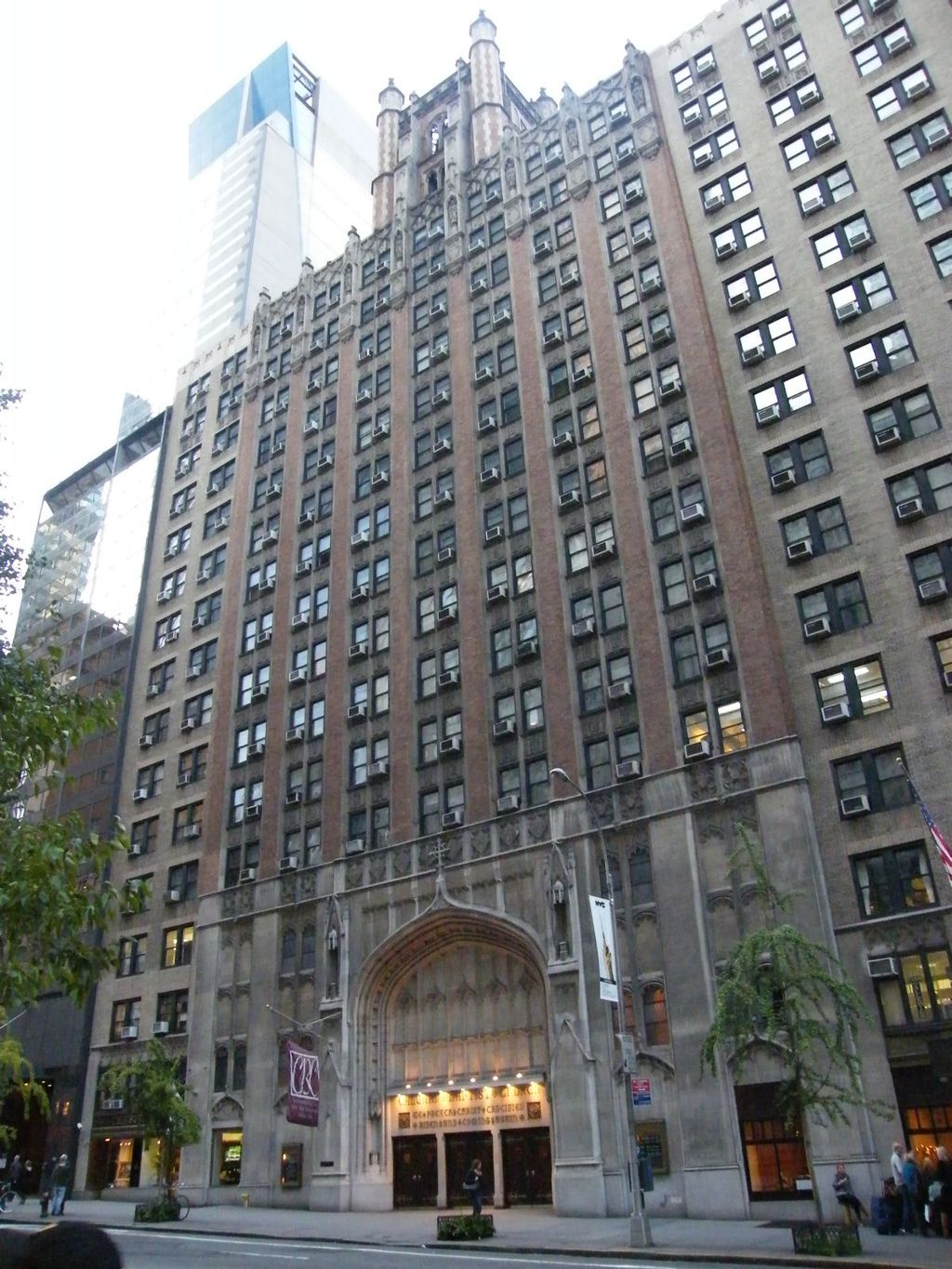
Alan Dunn found a young couple living above one of the city’s “skyscraper churches,” the result of valuable Manhattan church property being developed into a combinations of churches and hi-rise apartments…

…an example of a “skyscraper church” is Calvary Baptist Church at 123 West 57th…

(Wikipedia)

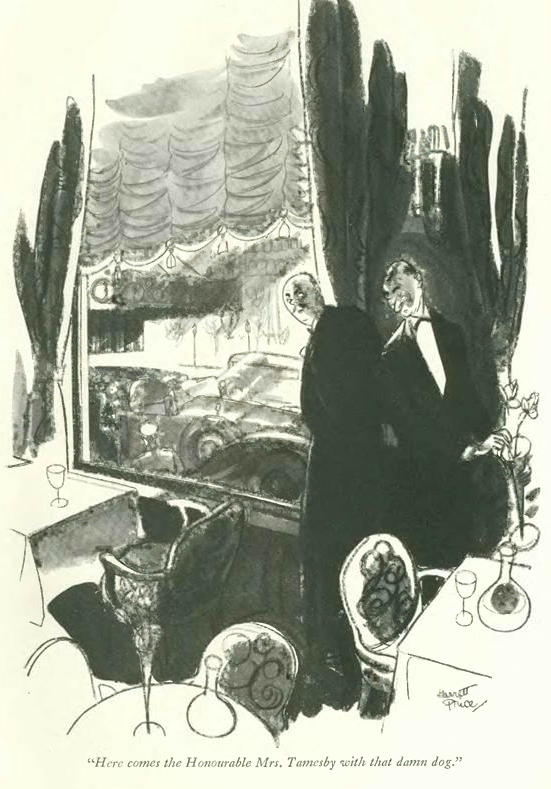
…closer to the street, we have a couple of high society waiters with low opinions of man’s best friend, courtesy Garrett Price

Barbara Shermund looked in on some gossip (paying special attention to the smoking habits of the smart set)…

…and we end with Robert Love’s sole contribution to The New Yorker

Next Time: Will It Play In Peoria?…

Lights, Camera, Action

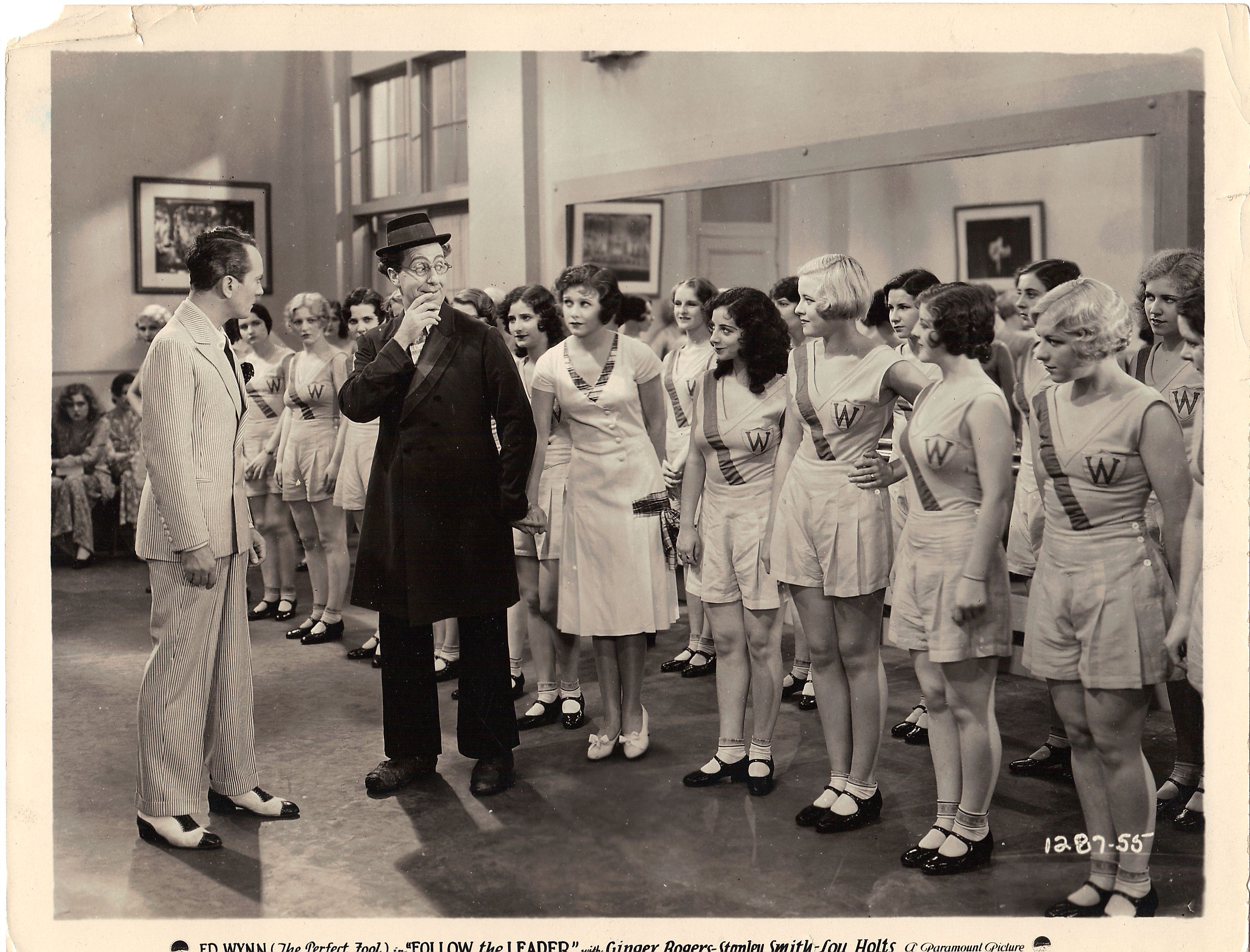
Comedian Ed Wynn began his long acting career on a vaudeville stage in 1903, and beginning in 1914 his giggly voice would delight Broadway crowds flocking to the Ziegfeld Follies. So when he stepped in front of a movie camera for a talking picture, it was something of a sensation.

September 27, 1930 cover by Sue Williams.

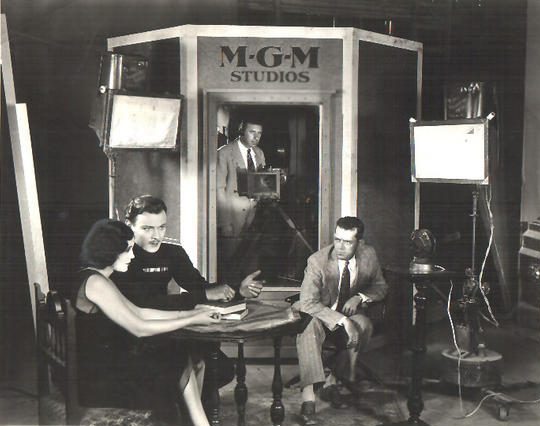
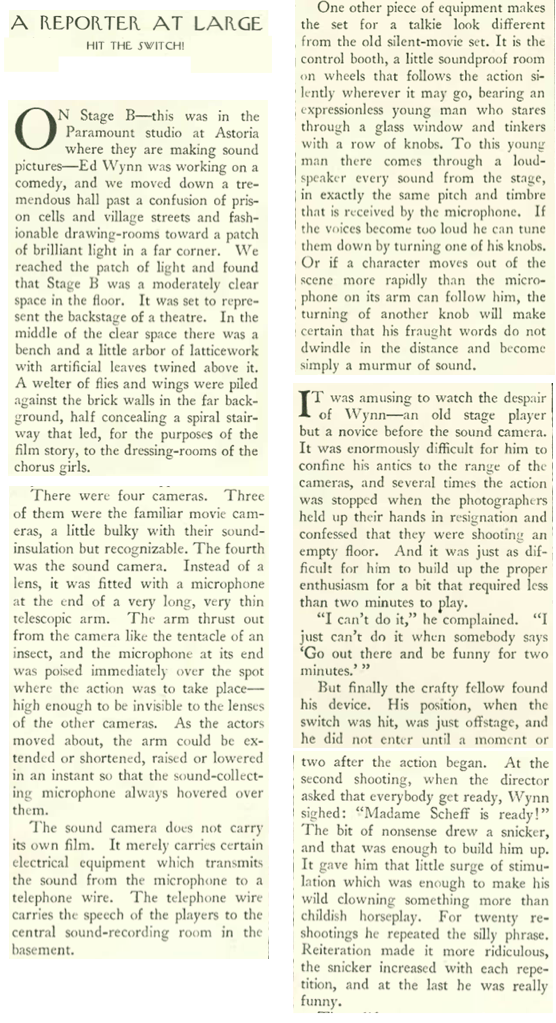
It was not an easy transition for the stage veteran. As you can see from Morris Markey’s account below in “A Reporter at Large,” the early talkies presented all manner of challenges and restrictions for stage actors accustomed to a bit more freedom of movement and expression.

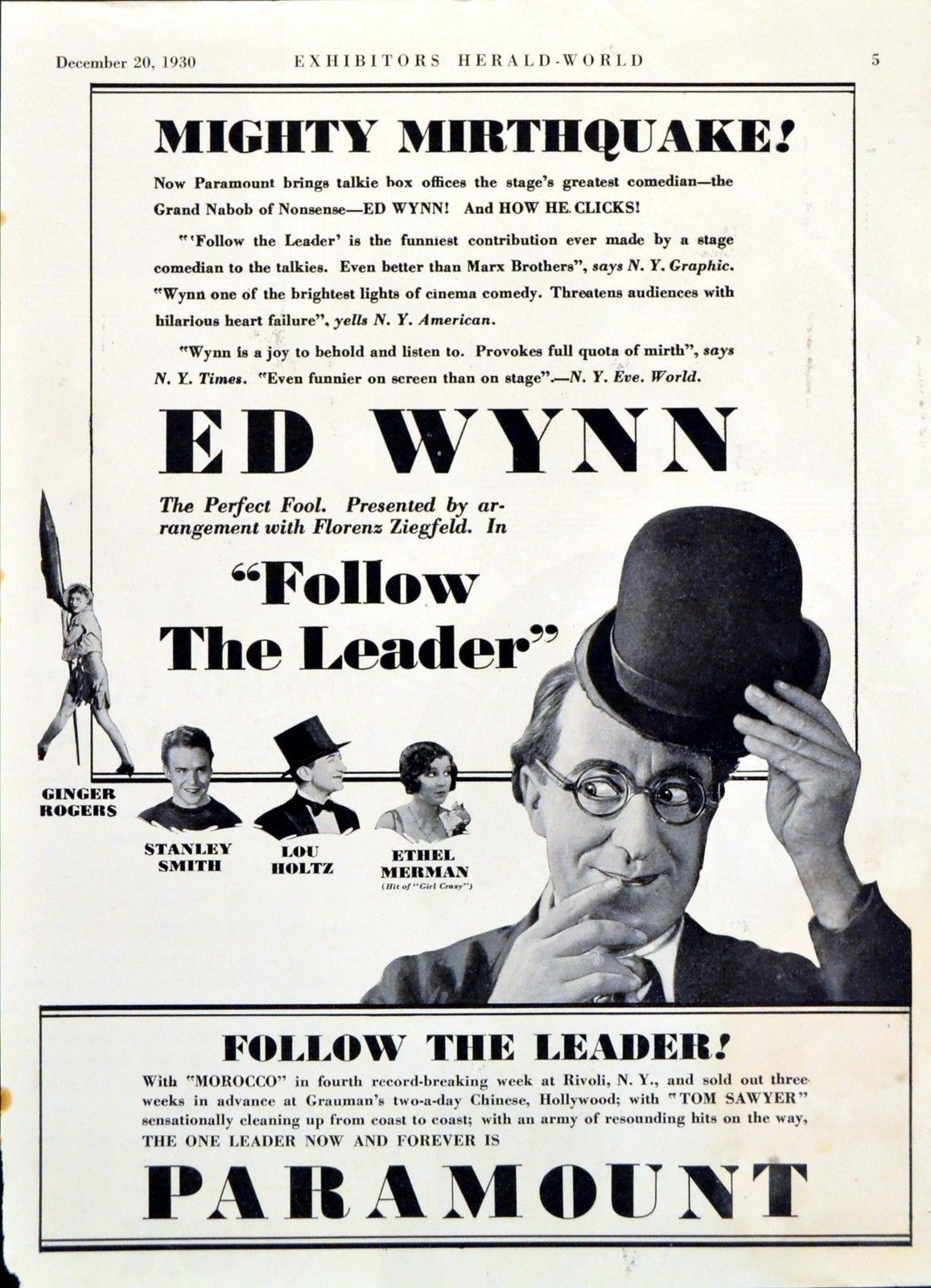
SCANDALOUS BUNCH…Ed Wynn (in hat) portrayed a character he developed on Broadway — “Crickets” — in his film debut Follow the Leader. At left is actor Stanley Smith, and at center, holding Wynn’s hand, is a brunette Ginger Rogers, with chorus girls from George White’s Scandals. (IMDB)

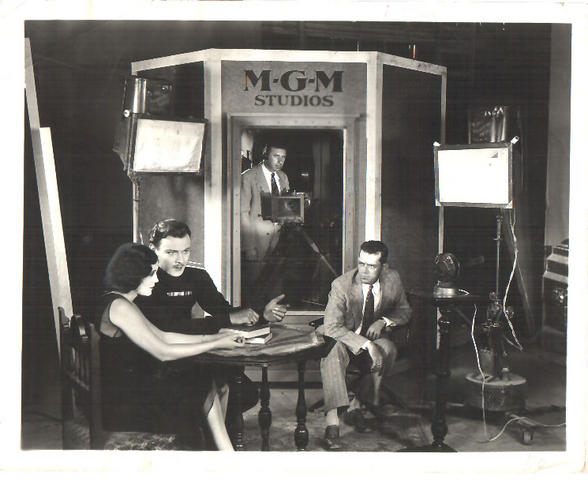
PAY NO ATTENTION TO THE MAN BEHIND THE WINDOW…Noisy cameras were enclosed in soundproof boxes in the early days of the talkies. Above, Woody Van Dyke directs Raquel Torres and Nils Asther in 1930’s The Sea Bat. (nilsasther.blogspot.com)
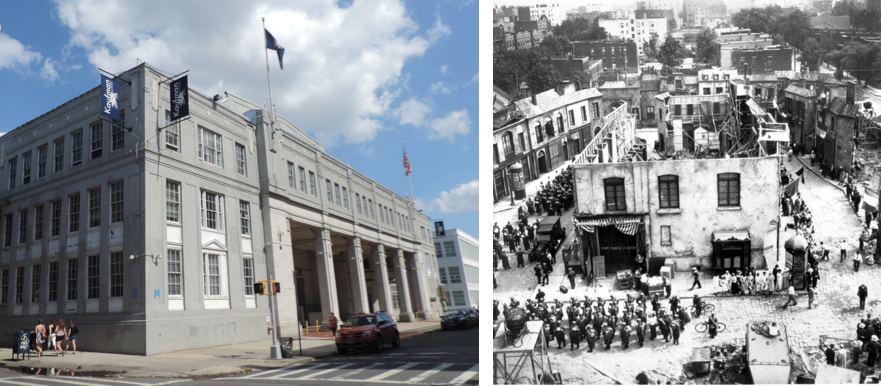
TINSELTOWN IN QUEENS…For his article, Morris Markey visited the set of Follow the Leader at Astoria Studios in Queens. The original studio building, at 35th Avenue, is on the National Register of Historic Places. Although Paramount moved its movie operations to Hollywood in the early 1930s, the studio continued to be used for both film and television productions. At right, a bit of Paris was erected in the midst of Queens for the filming of 1929’s The Gay Lady. (Wikipedia/Kaufman Astoria Studios)
FILM DEBUT…A December 1930 magazine advertisement touting Ed Wynn’s first motion picture. (IMBD)

 *  *  *

False Modesty?

In Morris Markey’s second installment of his profile on Charles Lindbergh, Markey suggested that Lindbergh’s aversion to publicity might be a pose…

NO WI-FI, BUT YOU COULD SMOKE…Top, the posh set take wing with TWA circa 1930; below, passengers prepare to board an American Airways Curtiss Condor II in 1933. (historydaily.org/Sweezey Pictures/Ken Sweezey)

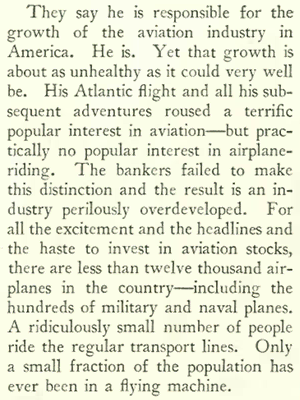
…and also wondered how much credit Lindbergh could take for sparking the aviation industry, given that flying was still an activity reserved for a very few…

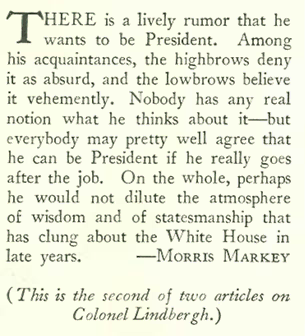
…Markey also noted a “lively rumor” that Lindbergh wanted to be President…

…fortunately Lindbergh did not give truth to the rumor, or fulfill the alternate history created by Philip Roth in his 2004 novel The Plot Against America

HANGIN’ WITH A BAD CROWD…Top, Charles Lindbergh accepts a ceremonial sword from Hermann Göring during a 1936 visit to Nazi Germany; below, right, Lindbergh in Germany, 1937. Philip Roth’s novel imagined Lindbergh’s election to the Presidency in 1940 and its chilling results. (Reddit/The New Yorker/Goodreads)

 *  *  *

Bad Moon Rising

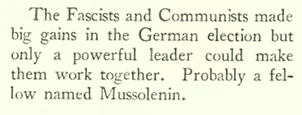
In 1930 few, if anyone, were aware of Lindbergh’s proclivities toward nationalism and antisemitism. And lacking a crystal ball, Markey’s New Yorker colleague, Howard Brubaker, had little reason to be alarmed by the federal elections in Germany, which gave the Nazis the second largest number of seats in the Reichstag. In his “Of All Things” column, Brubaker quipped:

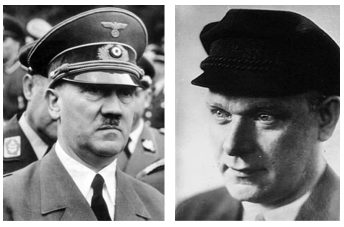
INCOMPATIBLE…As Howard Brubaker noted in “Of All Things,” the fascists led by Adolf Hitler, left, and the communists led by Ernst Thälmann (right) made big gains in the 1930 German elections. After gaining power in 1933, Hitler would arrest Thälmann and later have him shot. (Wikipedia)

*  *  *

Gummed to Death

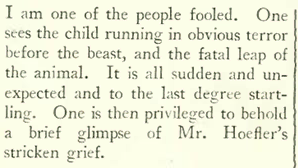
The New Yorker’s John Mosher took in the latest travelogue to exploit and misrepresent life on the African savannah. Africa Speaks included a scene depicting a fatal attack on a “native boy” by a lion —  an attack that was actually staged at a Los Angeles zoo and involved a toothless lion…

STRANGE INDEED…At left, movie poster for Africa Speaks; top right, Pygmy drummers in the film; bottom right, explorer Paul Hoefler getting closer to nature. (IMDB/Wikimedia)

*  *  *

From Our Advertisers

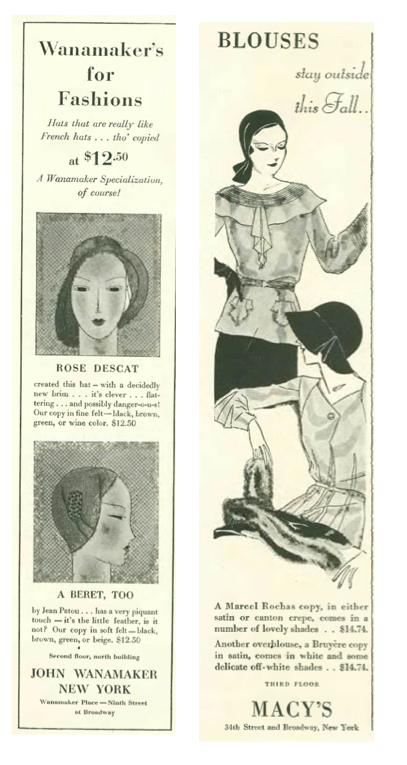
When Paris unveiled is spring and fall fashions, large department stores were always quick to respond with “copies”…

…while the higher end boutiques offered originals to “poor little rich girls”…

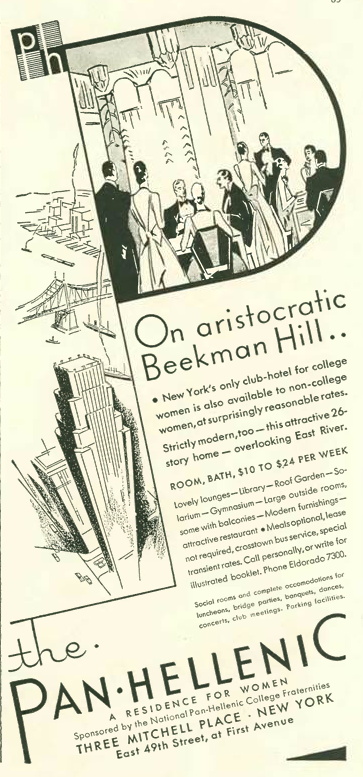
…perhaps some of these “poor little rich girls” socialized at the Panhellenic, a “club-hotel for college women”…

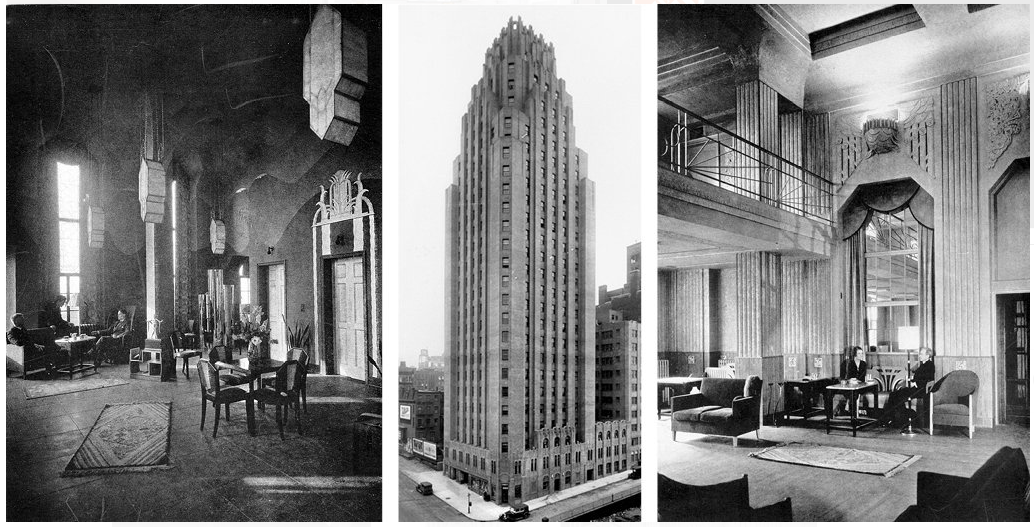
…and here are some views of the Panhellenic House, circa 1929…

Center, The Panhellenic House, at First Avenue and 49th Street; at left, the solarium; at right, a ballroom. (Avery Library/Museum of The City of New York)

…the makers of Old Gold cigarettes had some of the weirdest ads to push their smokes, including this one…

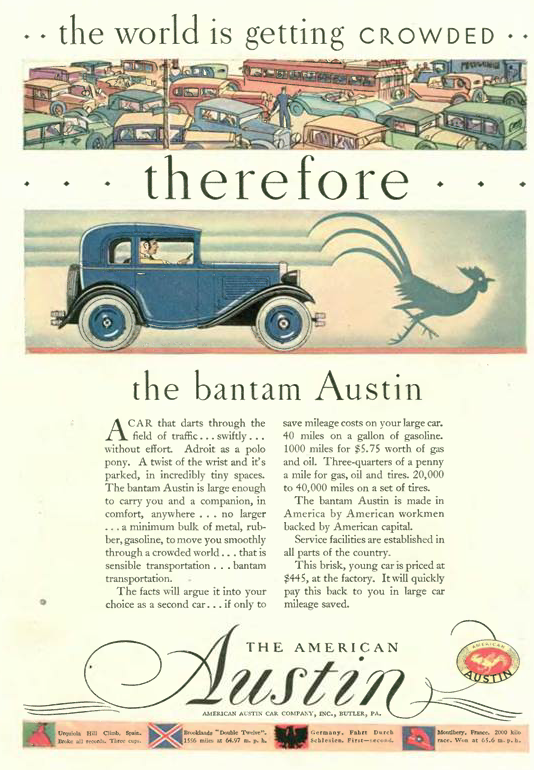
…and one wonders what the world would be like (and especially the U.S.) if car buyers would have favored a more compact version of the motorcar going forward…

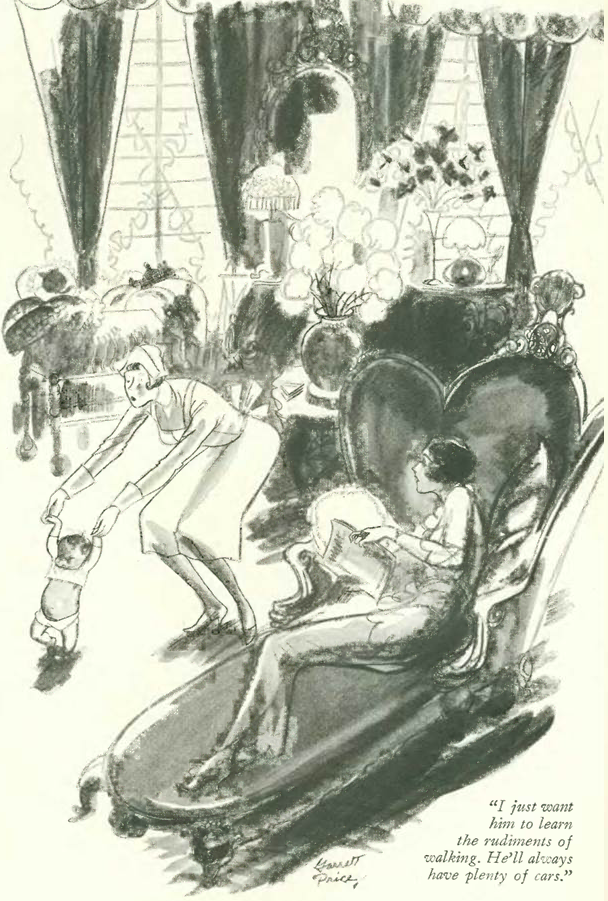
…on to our cartoons…we begin with parenting tips from the posh set, courtesy Garrett Price

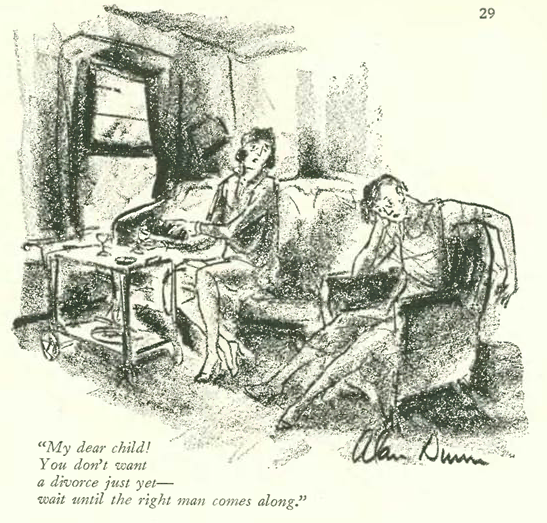
Alan Dunn explored modern matrimony…

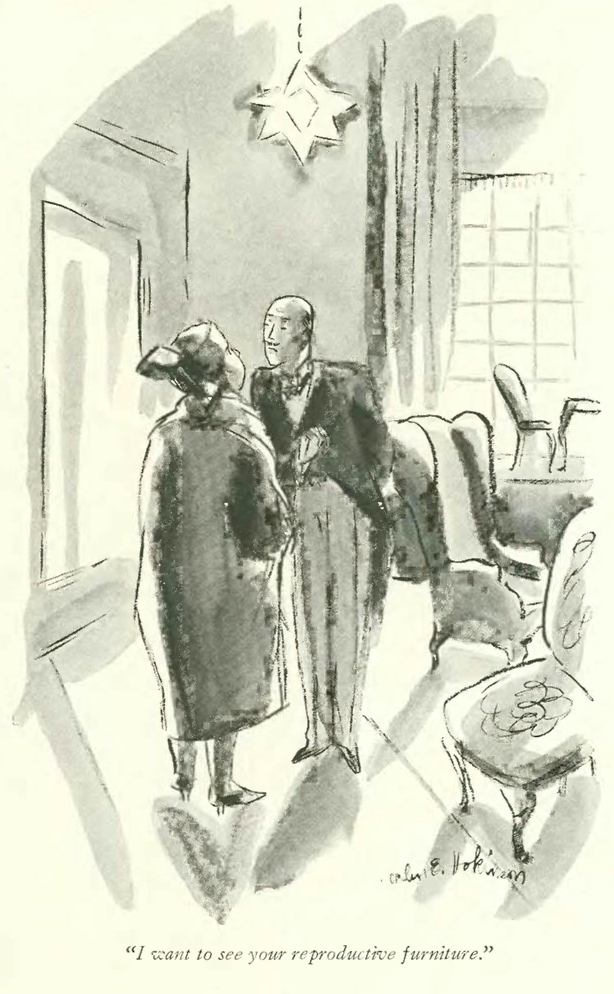
…one of Helen Hokinson’s ladies demonstrated a unique taste in furniture…

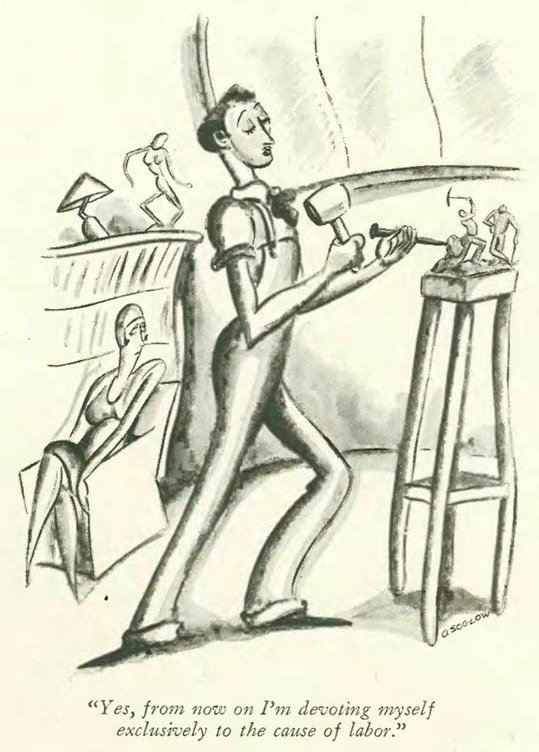
Otto Soglow continued to explore humor in a wavy fashion…

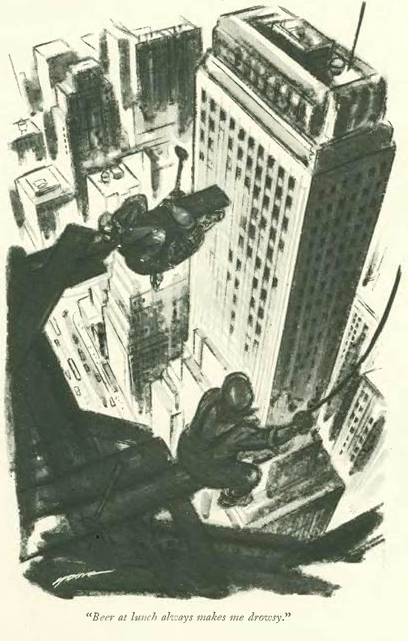
…and we close with this vertiginous view provided by Leonard Dove

Caption: “Beer at lunch always makes me drowsy.”

Next Time: Leatherheads…


The Flying Misanthrope

When Charles Lindbergh returned to New York after his solo, history-making transatlantic flight, he was mobbed by thousands of fans and adored by many millions more. The feeling was not mutual.

Sept. 20, 1930 cover by Theodore Haupt.

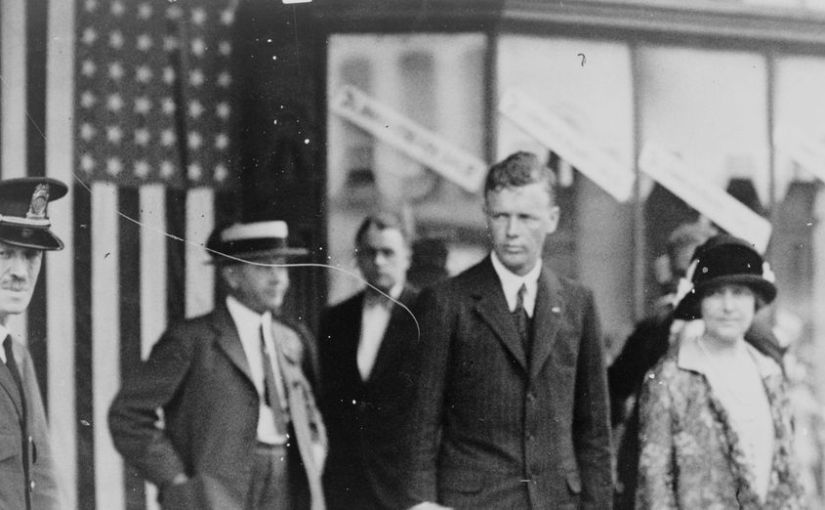
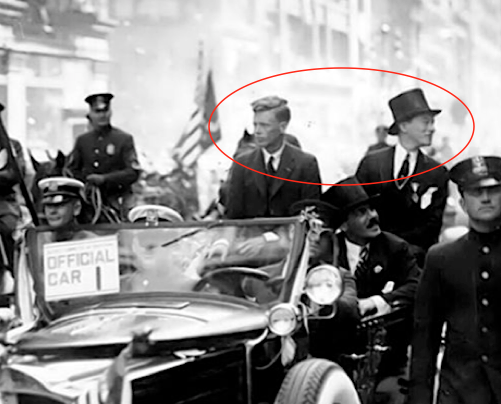
This image from his June 13, 1927 ticker-tape parade says it all, a disinterested, almost hostile-looking Lindbergh contrasted with that crowd-loving dandy, Mayor Jimmy Walker:

Detail of larger photograph. (Associated Press)

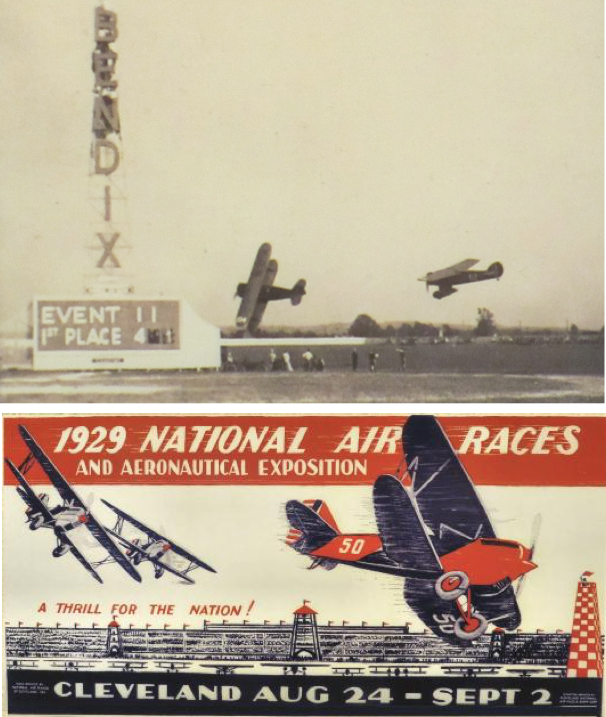
Morris Markey checked in on the famed flyboy three years later in a two-part profile for the New Yorker. Markey observed how Lindbergh had become “sucker-sour,” a phrase that described how someone could suddenly go wild “at the ceaseless procession of staring faces.” I encourage you to read the excerpt below about Lindbergh’s appearance at the 1929 Cleveland Air Races, where in a fit of temper he nearly forced a passenger plane to lose control and crash:

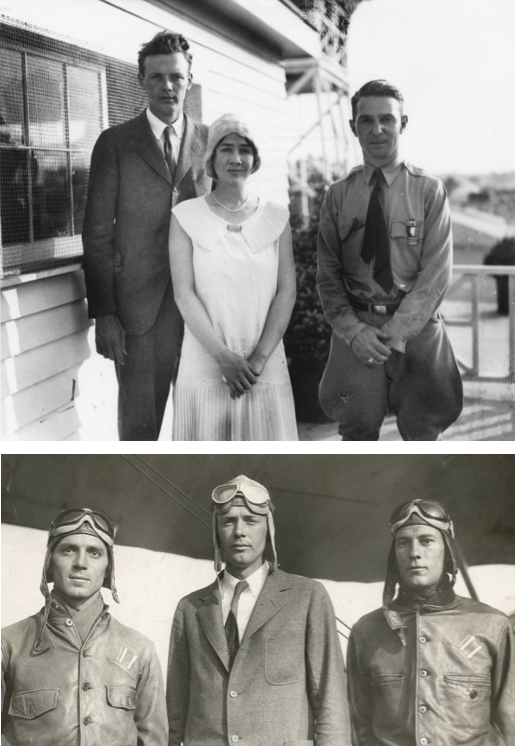
SAY CHEESE…Top photo, Charles and Anne Lindbergh pose with Cliff Henderson at the 1929 Cleveland National Air Races. Henderson was the managing director of the National Air Races and was often described as “the Barnum of aviation.” Below, Lindbergh flanked by Navy flyers Frederick Kivette and Frank O’Beirne at the 1929 air races. (Smithsonian)

Because he was a national hero of nearly saint-like dimensions, newspaper reporters did not dare to report on his antics at the Cleveland Air Races (so far, The New Yorker account is the only one I can find of the incident). Needless to say, he was not popular among members of the fourth estate:

WHAT COULD POSSIBLY GO WRONG?…Fliers raced around a closed course near a crowded grandstand at the 1929 National Air Races in Cleveland. (Western Reserve Historical Society)

 *  *  *

Innocents Abroad

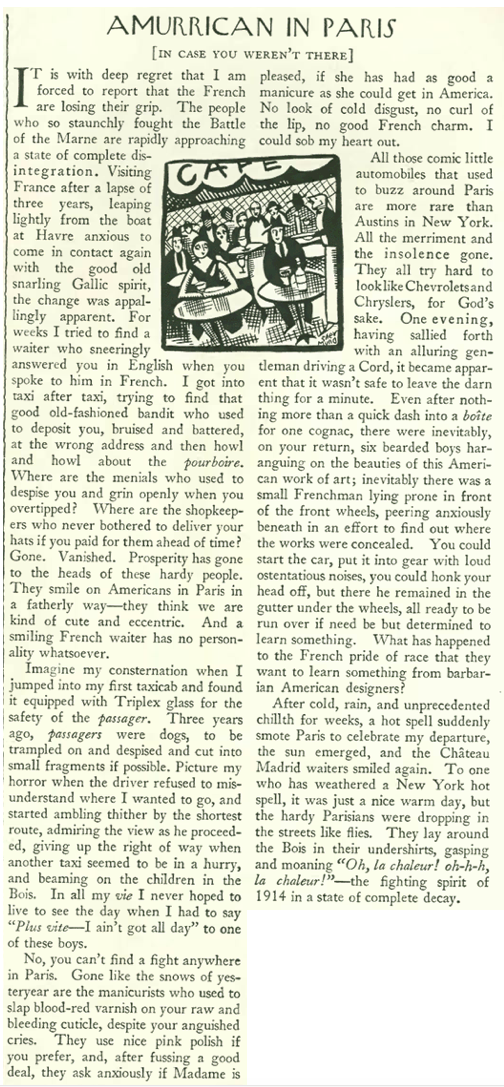
It was a nice surprise to find Lois Long once again writing under her pen name “Lipstick” in this casual piece (excerpted below) on Parisian life. I was also surprised to find the term “Amurrican” in the headline — I always thought it was a more recent derivation of redneck-speak…

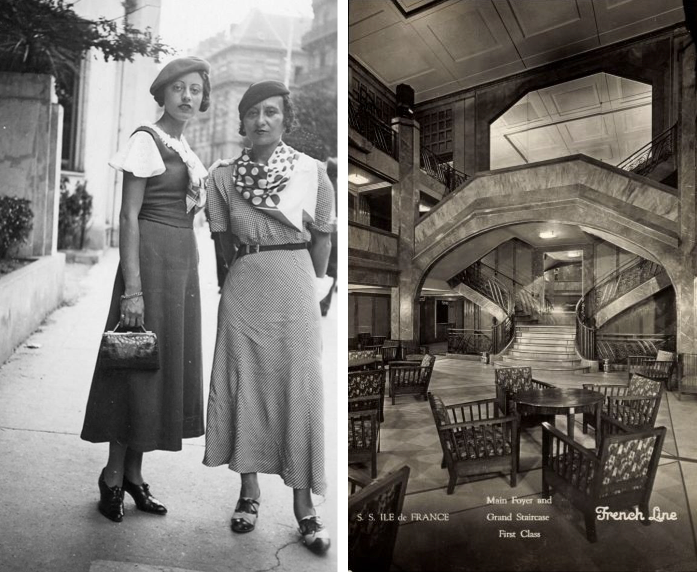
OVER THERE…Left, a fashionable pair on the streets of Paris circa 1930; right, main staircase and grand foyer of the Ile de France. (Pinterest/akpool.co.uk)

 *  *  *

Imbiber in Chief

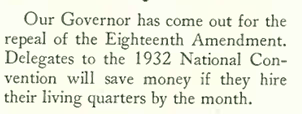
No doubt many a New Yorker enjoyed this bit of news from Howard Brubaker (in his column, “Of All Things”) regarding New York Governor Franklin D. Roosevelt, who later as president would preside over the end of Prohibition.

LEADING BY EXAMPLE…FDR and a gin martini. (Time/Life)

 *  *  *

From Our Advertisers 

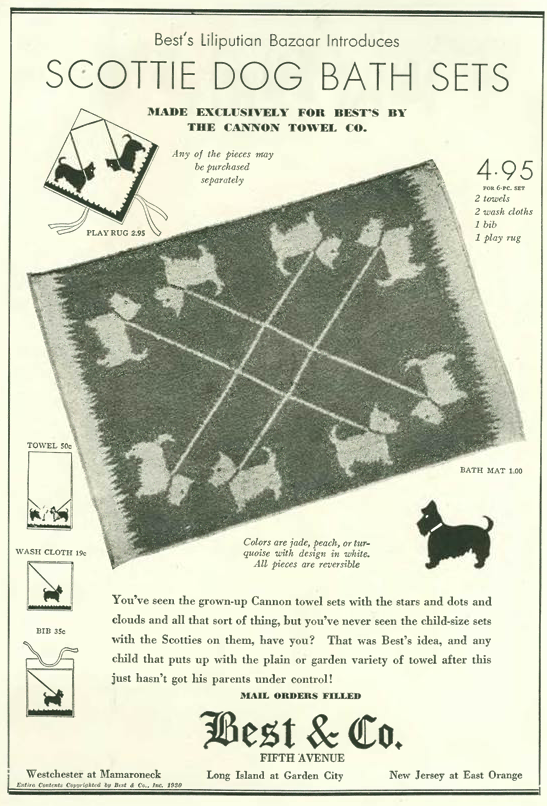
The Scottish Terrier was one of the most popular dog breeds in 1930s America (in addition to martinis, FDR was also fond of Scotties, including his loyal companion Fala), and you could show your love for the breed with bath sets from Best & Company…

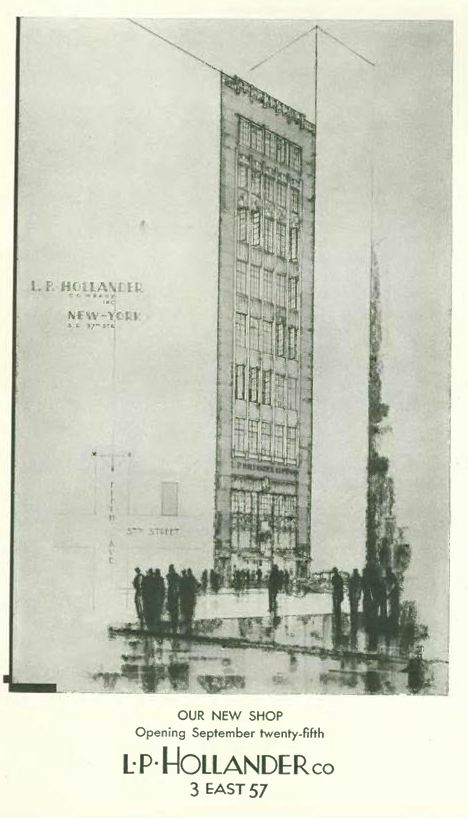
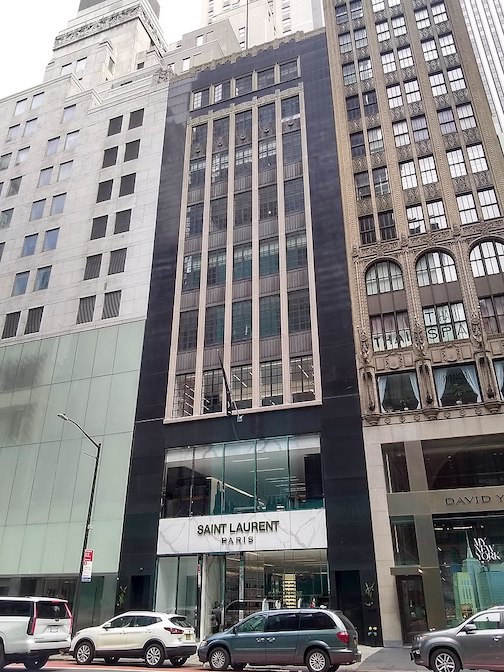
…the handsome L.P. Hollander Company Building (designed by William Lamb) at 3 East 57th began life in 1930 as a women’s fashion boutique…

…and today it serves as the Fifth Avenue home to Yves Saint Laurent…

(Wikipedia)


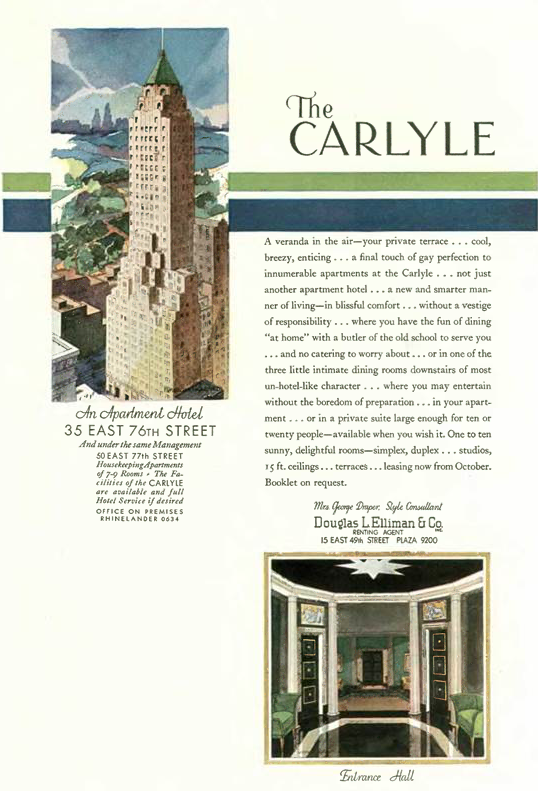
…another exclusive New York destination, the Carlyle, opened as a luxury residential hotel in 1930, only to go into receivership in 1931 thanks to the deepening Depression. In the postwar years it would rise to prominence and become a favorite haunt of the Kennedy family. The Carlyle is also home to the Bemelmans Bar, which is decorated with murals painted by Ludwig Bemelmans depicting his storybook character, Madeline, in Central Park…

…the Carlyle’s cozy Bemelmans Bar…

(TripAdvisor)

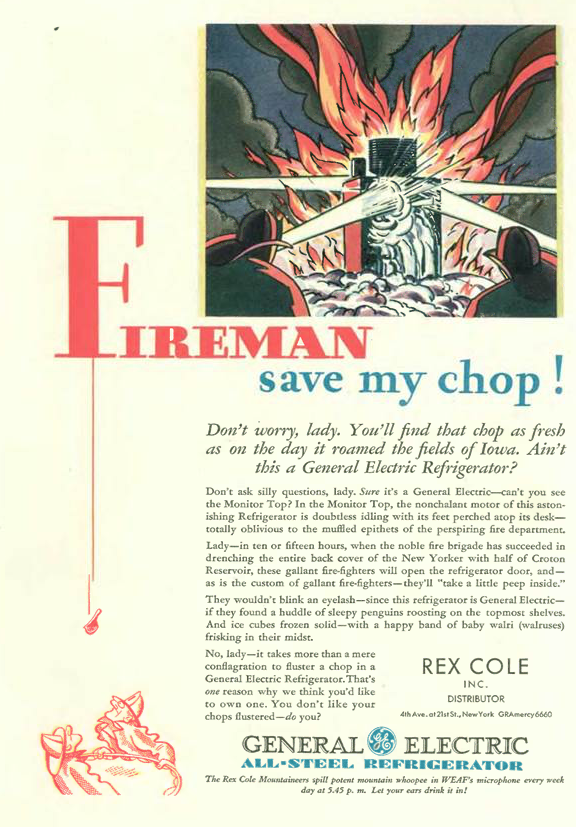
…this next one goes in my terrible ads file…did the makers of this GE refrigerator really want to depict it bursting into flames?…

…it is 1930, and we are at the dawn of the age of plastics, and in this case “Beetleware” tumblers made from an early type of plastic formed from a urea formaldehyde powder developed in England and licensed to American Cyanamid …so bottom’s up!…

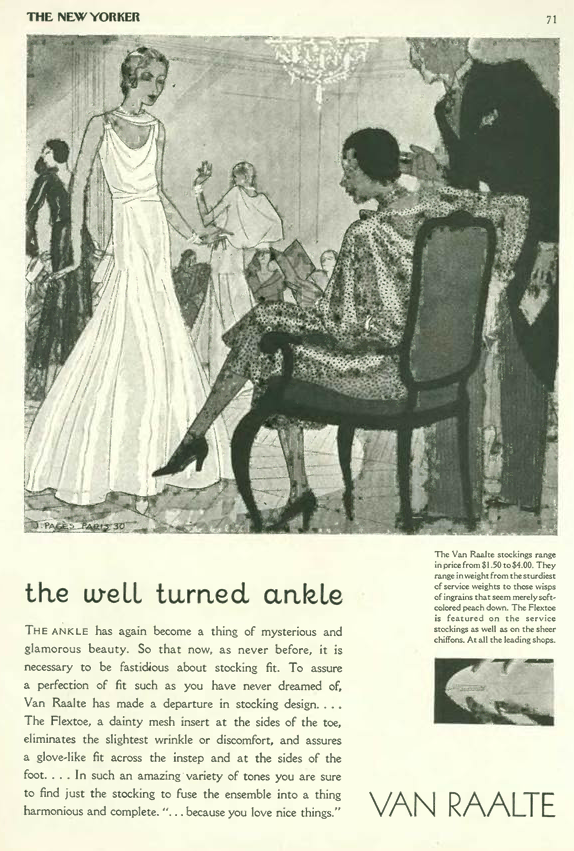
…the makers of Van Raalte stockings hoped to revive the sex appeal of the ankle…

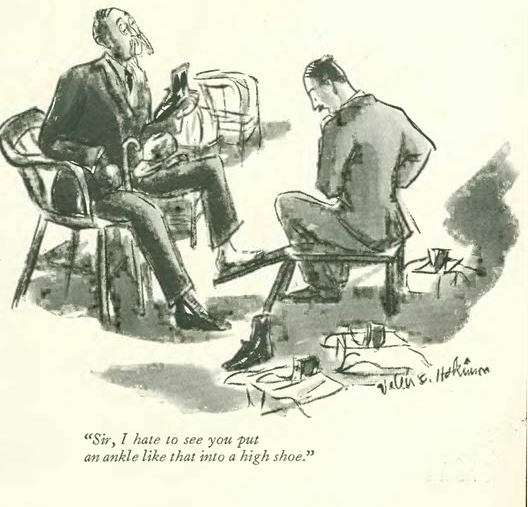
…which provides a good segue to our cartoons, this one by Helen Hokinson, which was actually featured on the page opposite the stocking ad…

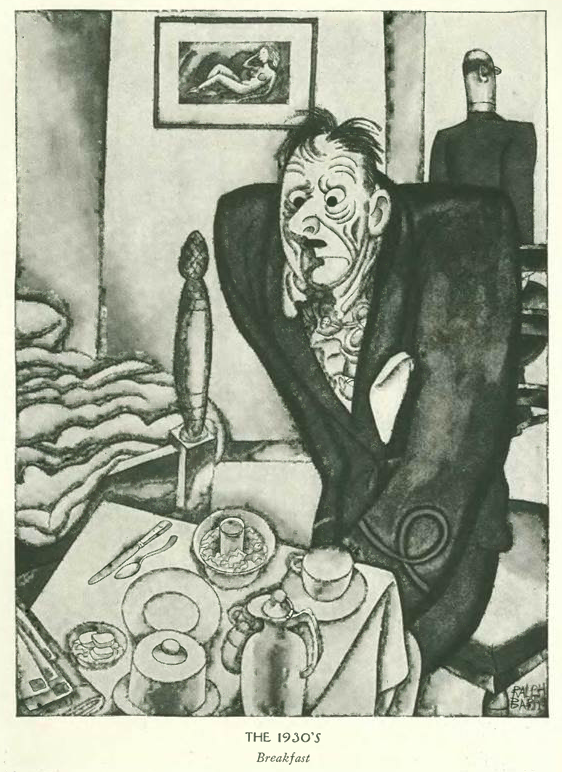
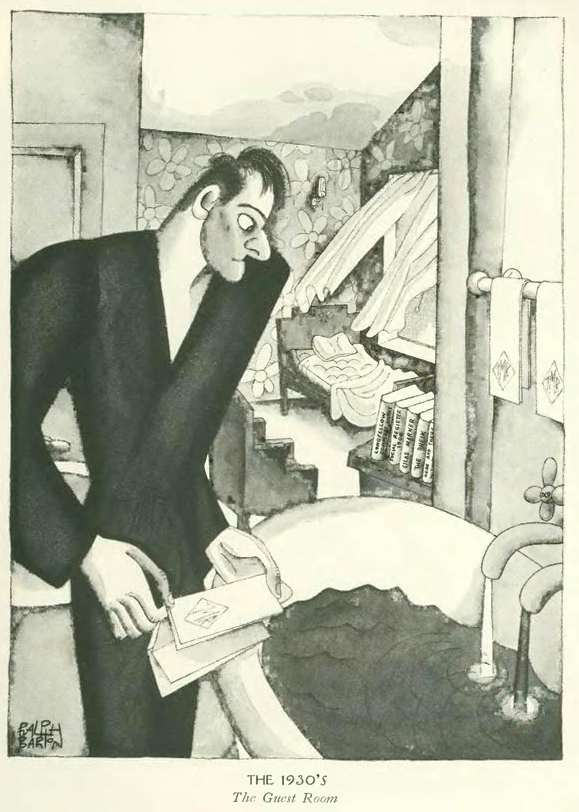
Ralph Barton continued his series on the 1930’s…

Alan Dunn took his work to new heights…

Gardner Rea had fun with the garden club set (English-American S. Parkes Cadman was a pioneer Christian radio broadcaster in the 1920s and 30s)…

…while Peter Arno illustrated this cultural exchange on the streets of New York…

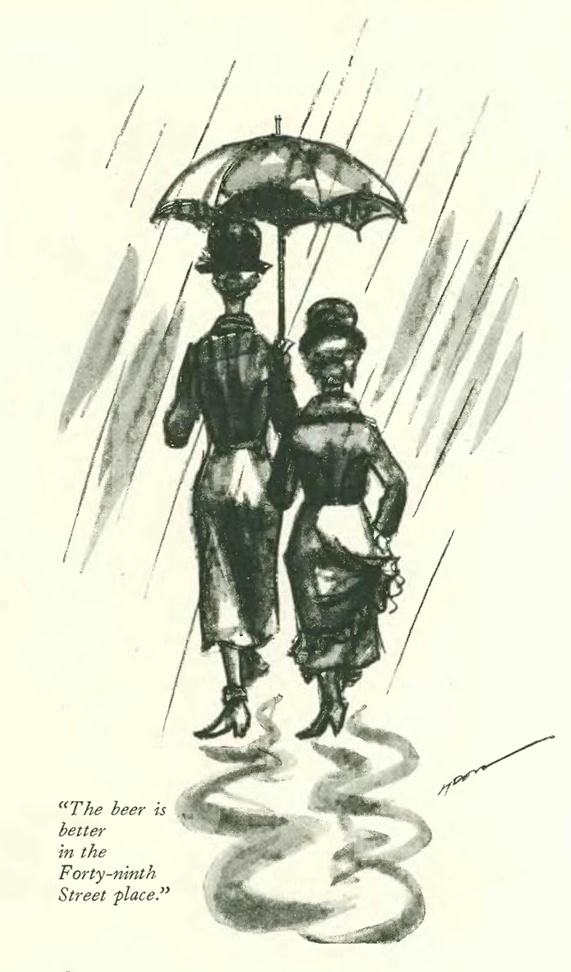
…and we end with Leonard Dove, and a walk in the rain…

Next Time: Lights, Camera, Action…


Marble Halls

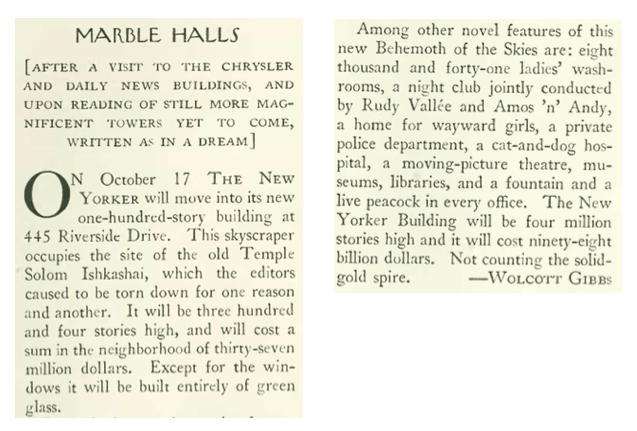
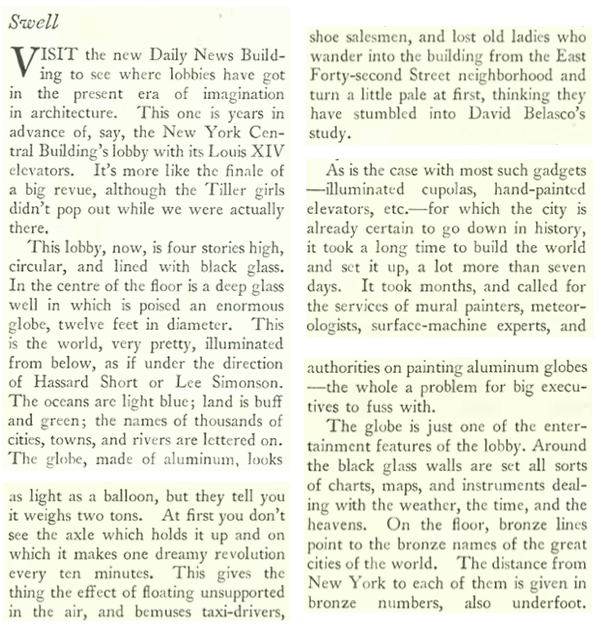
We close out the boiling August of 1930 with Wolcott Gibbs and his fanciful musings regarding the future offices of The New Yorker, inspired by his recent visit to the glitzy new lobby of the New York Daily News Building.

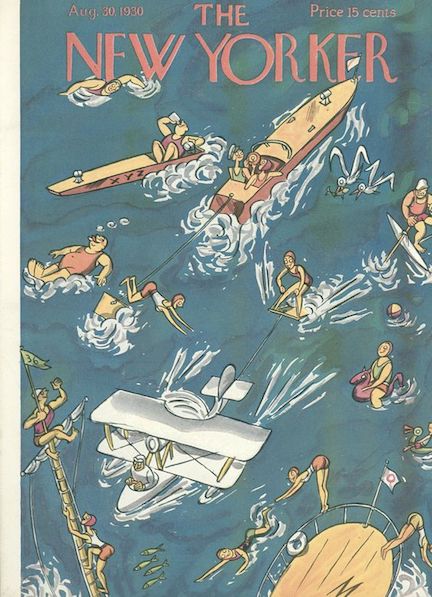
August 30, 1930 cover by Julian De Miskey.

I include a brief excerpt of Gibb’s tongue-in-cheek fantasy of the future, which inadvertently foresees The New Yorker’s current offices (see contrast of old and new above) in the gleaming glass tower now known as One World Trade Center:

THAT WAS THEN…The New Yorker’s first offices were located at 25 West 45th Street, a 16-story building erected in 1913 (it still stands). It’s almost impossible to find images of The New Yorker’s early office spaces, but you can probably get some idea from these photos of another tenant of the building, the Y.M.C.A. Dental School. (Museum of the City of New York/New York Public Library)
THIS IS NOW…Almost in fulfillment of Wolcott Gibbs’ fantasy, The New Yorker today occupies offices in the Condé Nast section (images above) of the 104-story, 1,776 foot One World Trade Center (floors 20 to 44). When The New Yorker moved onto the building’s 38th floor in early 2015 (one floor above Wired), it marked the first time the magazine was located outside of a small area in Midtown. (New York Magazine/interiordesign.net)

 *  *  *

His Bit of Earth

“The Talk of the Town” noted an increasingly rare sight along Fifth Avenue, a private garden created by Thomas Fortune Ryan that in 1930 was occupied by his son Clendenin J Ryan:

DUST TO DUST…Thomas Fortune Ryan demolished the Charles T. Yerkes mansion and its art galleries (before and after photos, top, and image of a gallery, bottom right) to make way for his private flower garden, which is visible in the bottom left hand corner of the image at top right. An apartment building erected in 1937 (bottom left) occupies the site today. (Museum of the City of New York/Alice Lum)

 *  *  *

From Our Advertisers

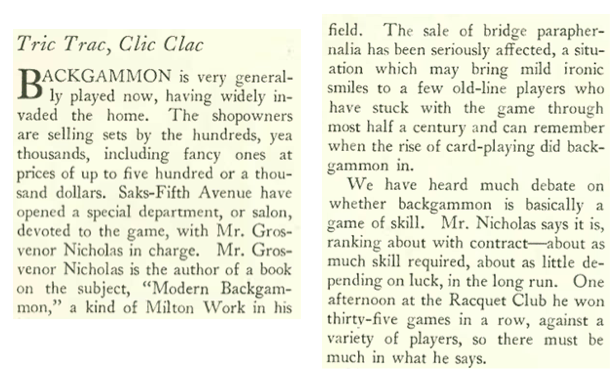
Backgammon became all the rage in the 1930, so much so that one Grosvenor Nicholas, “a famous authority on backgammon,” commanded a fill-page ad from Saks…

…for reference, The New Yorker made note of Nicholas’s visit in the Sept. 6 “Talk of the Town”…

OR WATCH THE YOUTUBE VIDEO…Leila Hattersley, author of 1930s How to play the New Backgammon, teaching at a New York Club (bkgm.com)

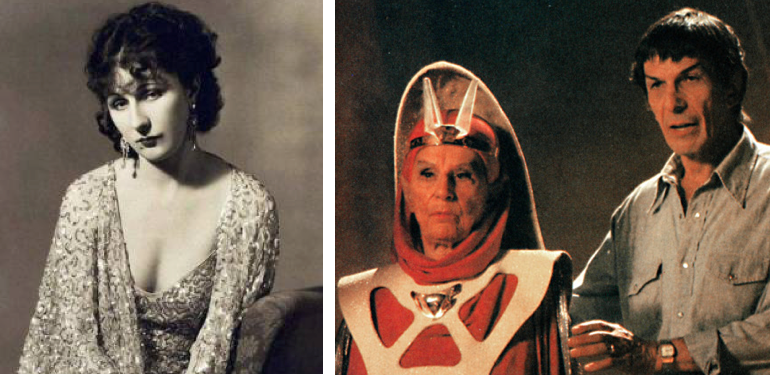
…celebrity endorsements continued to grow in importance in the 1930s, here the famed Australian-born British actress Judith Anderson (1897-1992) marvels at the products manufactured by Angelus…

…Anderson would later be made a “Dame,” and would enjoy a long career and a long life, even appearing in 1984’s Star Trek III: The Search for Spock as the Vulcan High Priestess T’Lar…

VERSATILE…At left, Dame Judith Anderson in 1932. At right, Anderson on the set of 1984’s Star Trek III: The Search for Spock, with actor Leonard Nimoy. (Tumblr)

…this ad for Buick shows a rich gent dismissing his chauffeur, something he would probably have to do permanently as the Depression continued to ruin fortunes…

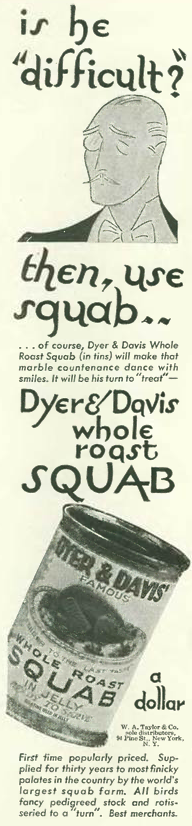
…and perhaps a lost fortune could lead to one being “difficult,” and in that case Dyers & Dyers could sooth the hurt with squab from a can…

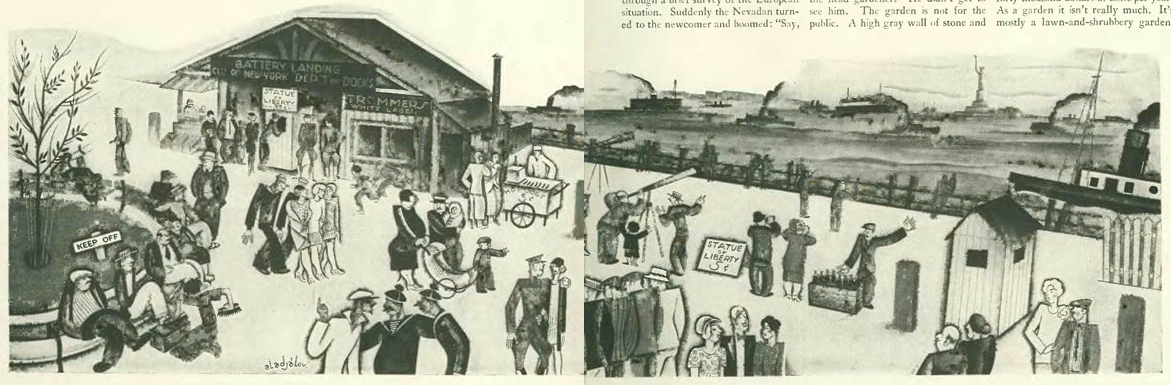
…on to our cartoonists, we have Constantin Alajalov illustrating a scene at the Battery…

Ralph Barton continued his interpretations of a new decade…

…some unfortunate racial humor from Al Frueh

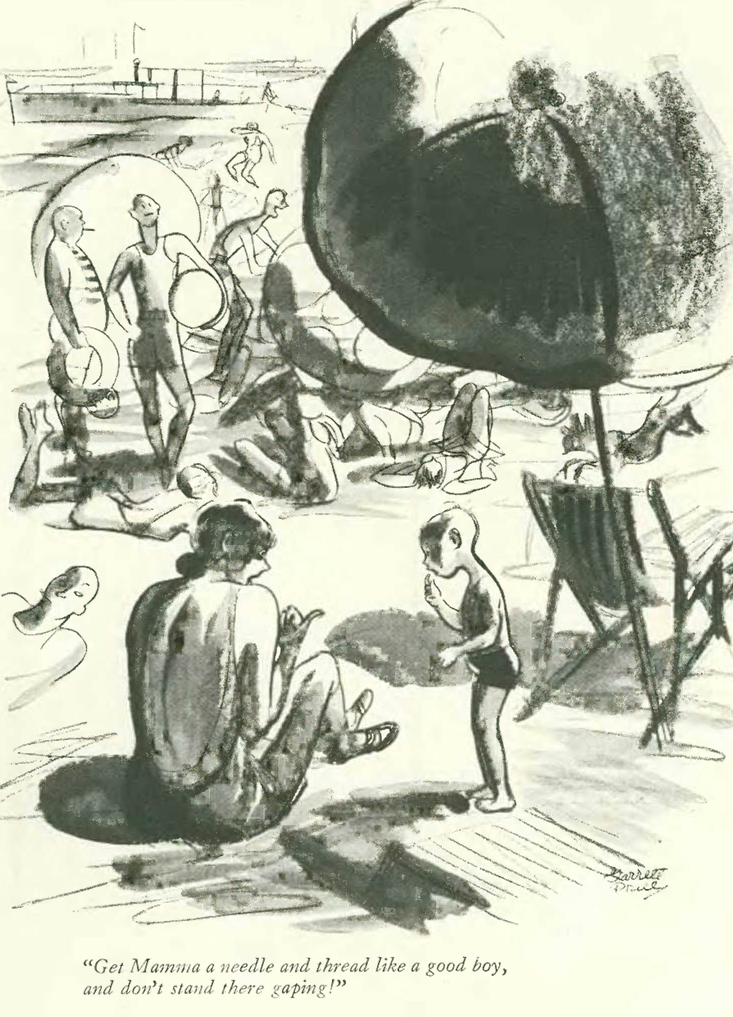
…an indelicate moment at the beach, courtesy Garrett Price

Perry Barlow looked at the challenges of city life…

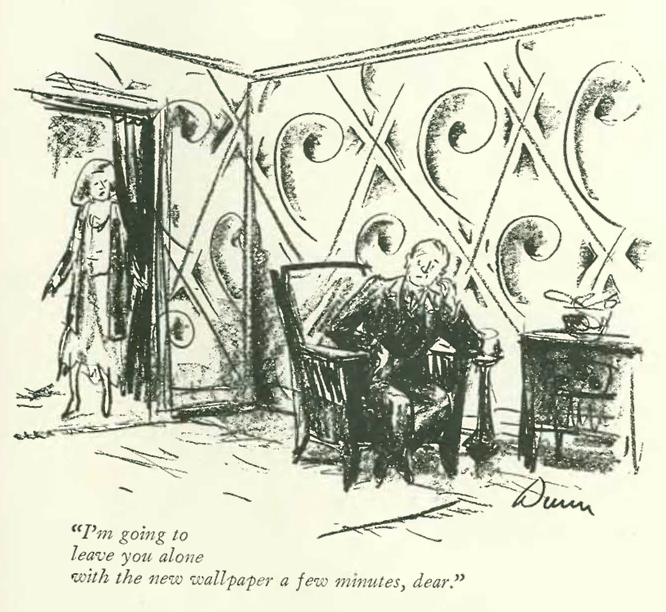
…and Alan Dunn found a man with a case of the moderns…

Next Time: Animal Crackers…

Hell’s Angels

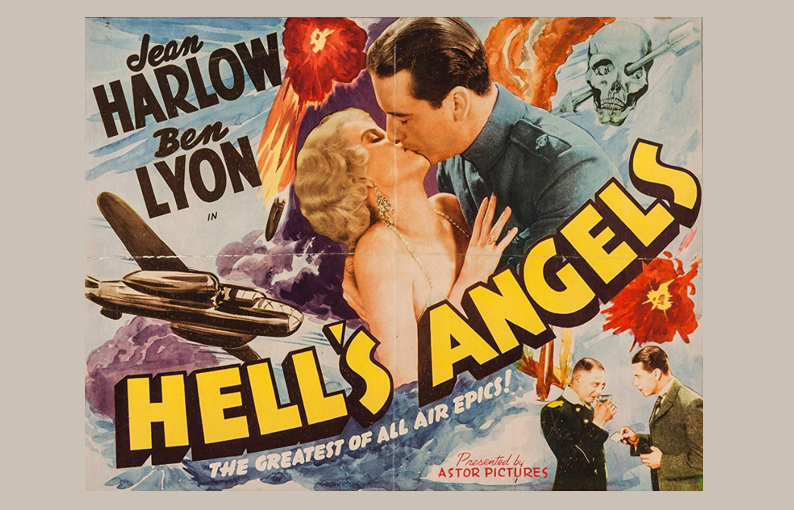
Among the films in 1930 that marked a new era in motion pictures was Howard Hughes’s epic war film Hell’s Angels. 

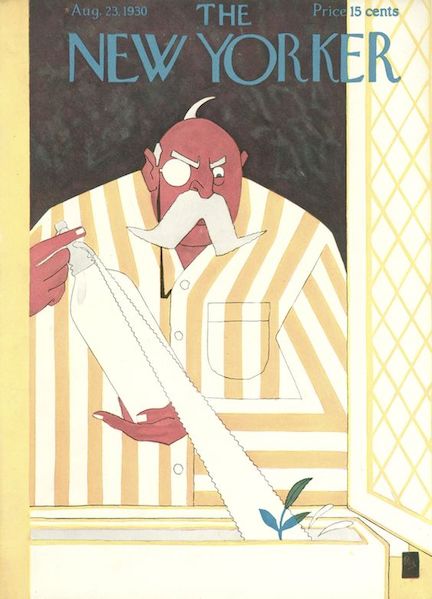
August 23 cover by Gardner Rea.

Originally shot as a silent, Hughes (1905-1976) retooled the film, and over a period of three years (1927-30) poured much of his own money into making what many consider to be Hollywood’s first sound action movie. The film also introduced audiences to 19-year-old Jean Harlow (1911-1937), handpicked by Hughes to replace Norwegian actress Greta Nissen in the lead role (Nissen’s accent posed a problem for the talkies). The film would make Harlow an instant star, propelling her to worldwide fame as the “Platinum Blonde” sex symbol of the 1930s.

Beset by delays due to Hughes’s incessant tinkering, the movie was famously expensive. For example, a total 137 pilots were used in just one flying scene at the end of the film. In addition to monetary costs, the filming also claimed the lives of three pilots and a mechanic, and Hughes himself would fracture his skull during a stunt flying attempt.

PRE-CODE…Before Will Hays imposed his moral code on Hollywood, films in the early thirties were frank with sexual references, as the image at left attests. When Howard Hughes switched the filming of Hell’s Angels to sound, he replaced Norwegian actress Greta Nissen with 19-year-old Jean Harlow (seen with co-star Ben Lyon). Harlow’s first major film appearance would make her an overnight star; at right, Frank Clarke and Roy Wilson flying an S.E.5A (front) and a Fokker D.VII (back, note camera) in the filming of Hell’s Angels. (Wikipedia)

The New Yorker’s John Mosher found the action scenes enticing, but the acting left something to be desired…

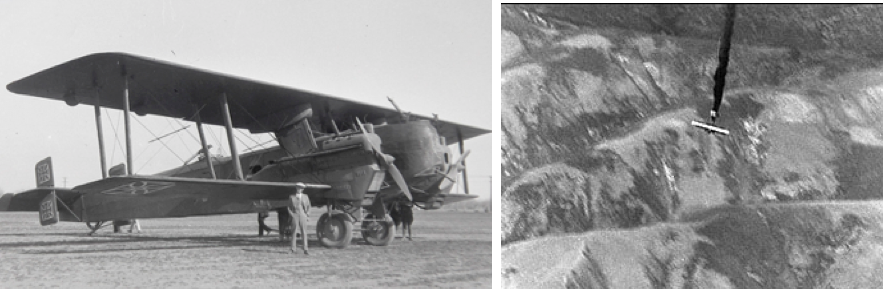
COSTLY VENTURE …This Sikorsky S-29A (left), repainted to represent a German Gotha bomber, would crash into the California hills during filming (right), killing mechanic Phil Jones, who failed to bail out along with the pilot. (Northrop Grumman)
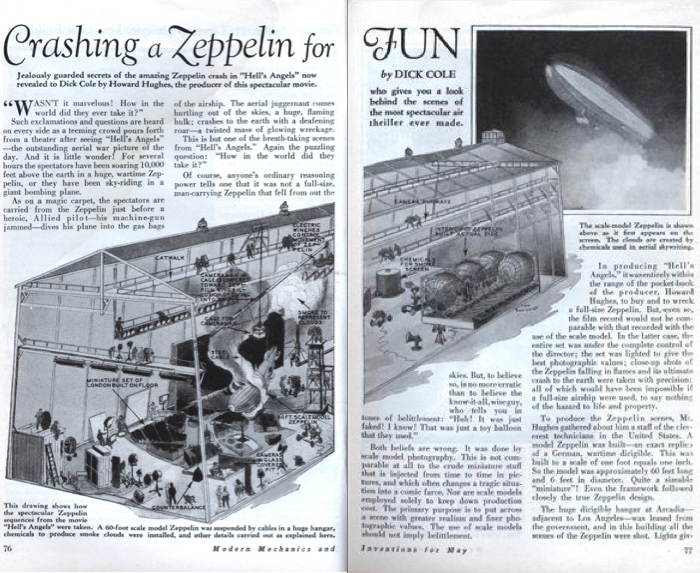
GEE WHIZ…The media often reported on the progress of the film, such as in this May 1930 article in Modern Mechanics and Inventions that detailed a $1 million sequence in which a fighter dives his plane into the top of a Zeppelin, causing it to explode and crash to earth. (Modern Mechanix)

We skip ahead briefly to the Aug. 30 issue, in which “The Talk of Town” featured a mini profile of Howard Hughes and his film. Note how Hughes’s extravagance is described through his frequent use of long-distance telephone calls:

A STAR IS BORN…19-year-old Jean Harlow and Ben Lyon in 1930’s Hell’s Angels. (IMDB/Pinterest)

*  *  *

A Whale of a Movie

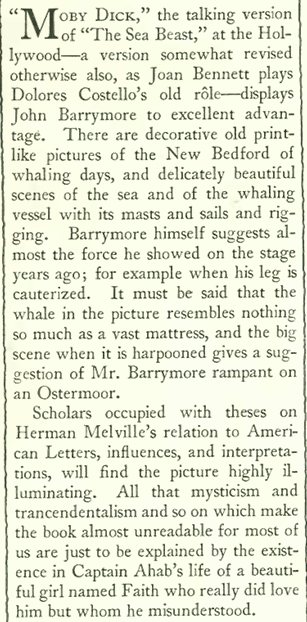
Critic John Mosher also took in a film adaptation of Herman Melville’s Moby Dick, a very loose adaptation that excluded the novel’s central character, Ishmael, and invented a love story for the maniacal Capt. Ahab…

A WHALE OF A STORY…From left, Noble Johnson as Queequeg, John Barrymore as Ahab, and Walter Long as Stubbs in 1930’s Moby Dick. At right, top, the whale puts the hurt on a boat; bottom, Joan Bennett as Faith, a contrived love interest for the old salt. (IMDB)

 *  *  *

Daily Dazzle

“The Talk of the Town” gushed over the lobby of the new Daily News Building, likening it to the glitz of a Broadway revue:

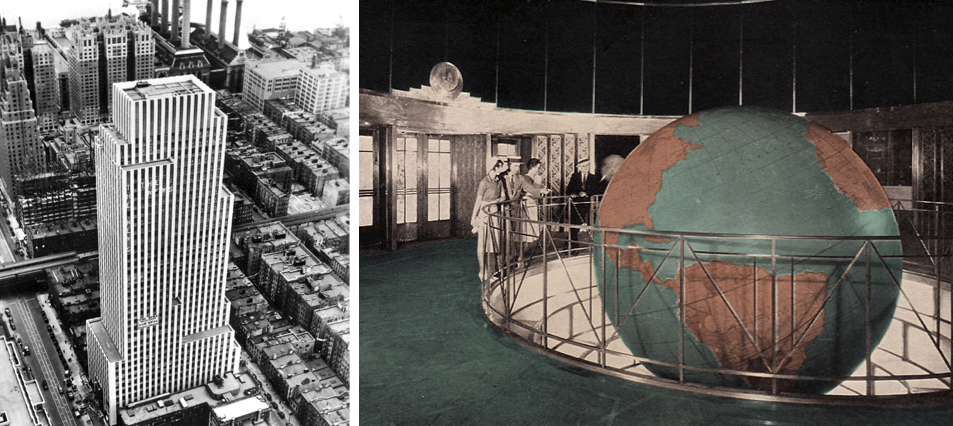
HOME FOR CLARK KENT…The Daily News Building served as the model for the headquarters of the fictional Daily Planet, the building where Superman worked as mild-mannered Clark Kent; at right, an image from 1941 of the lobby, dominated by the world’s largest indoor globe. (Wikipedia/Public Domain)
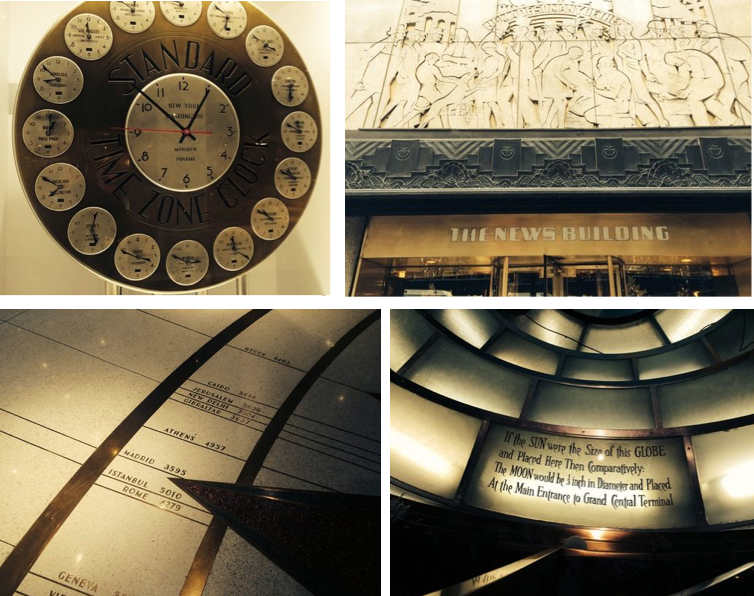
A LOBBY FOR LEARNING…The lobby includes an array of clocks, top left, that give the time in various global destinations. (Luke J. Spencer via atlasobscura.com)

 *  *  *

A Busboy’s Dream

Charles Pierre Casalasco left his life as a busboy in Corsica and studied haute cuisine in Paris before arriving at the shores of Manhattan in the early 1900s. He became a renowned headwaiter who by 1929 garnered enough financial backing from New York’s most powerful families to construct the exclusive Hotel Pierre. Writing under her pseudonym, “Penthouse,” New Yorker columnist Marcia Davenport described the building’s apartments to eager readers:

FUN WHILE IT LASTED…The 41-story, 714-room Hotel Pierre officially opened in October 1930 to great fanfare. The party would be short-lived, as the deepening Depression would force the hotel into bankruptcy just two years later. At right, photo of the Rotunda, before a 2017 remodeling. (New York Public Library)

 *  *  *

So Much For Title IX

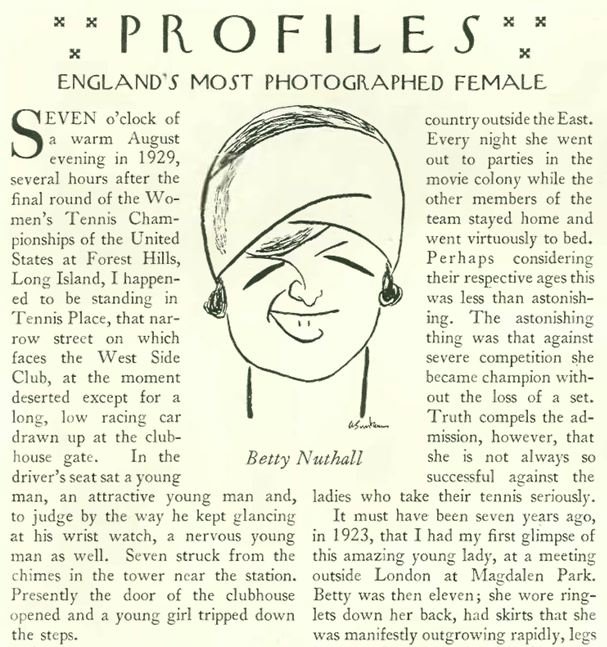
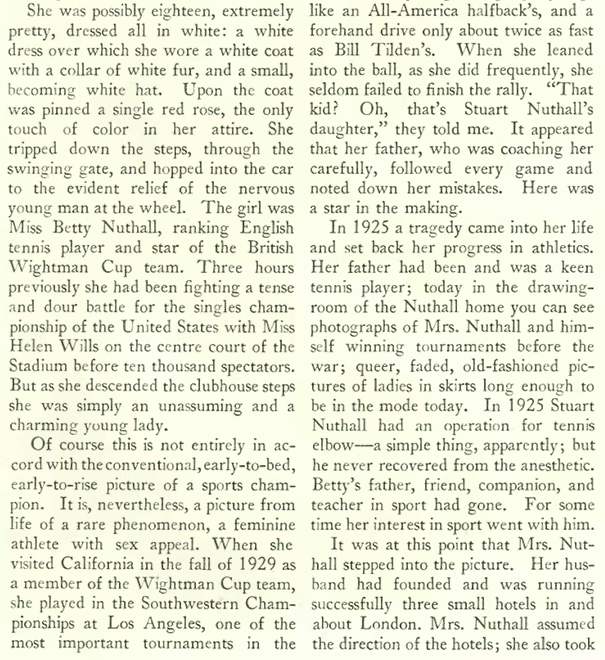
Then as now, women athletes were held to a separate set of standards, not only judged for their athletic abilities, but also for their “sex appeal,” as John Tunis suggests more than a few times in his profile of English tennis champion Betty Nuthall (1911-1983). Excerpts:

HOW’S THAT BACKHAND?…Betty Nuthall greets American tennis star Bill Tilden in September 1930; on the cover of Time after winning the 1930 U.S. Open. (Digital Commonwealth/Time Inc.)

 *  *  *

Free Expression

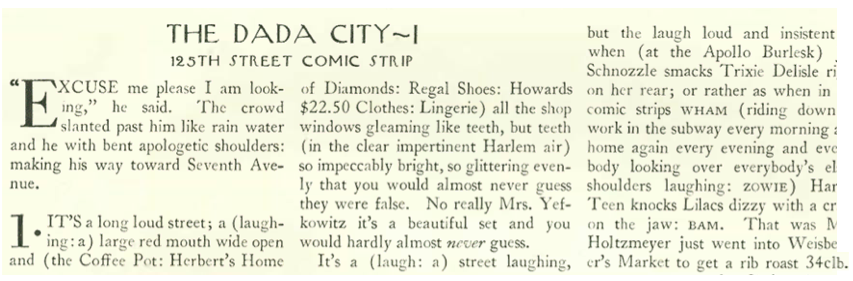
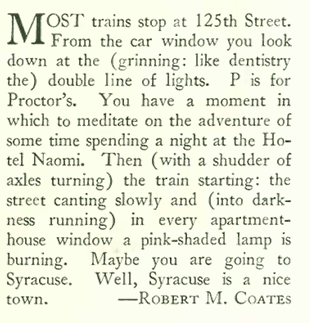
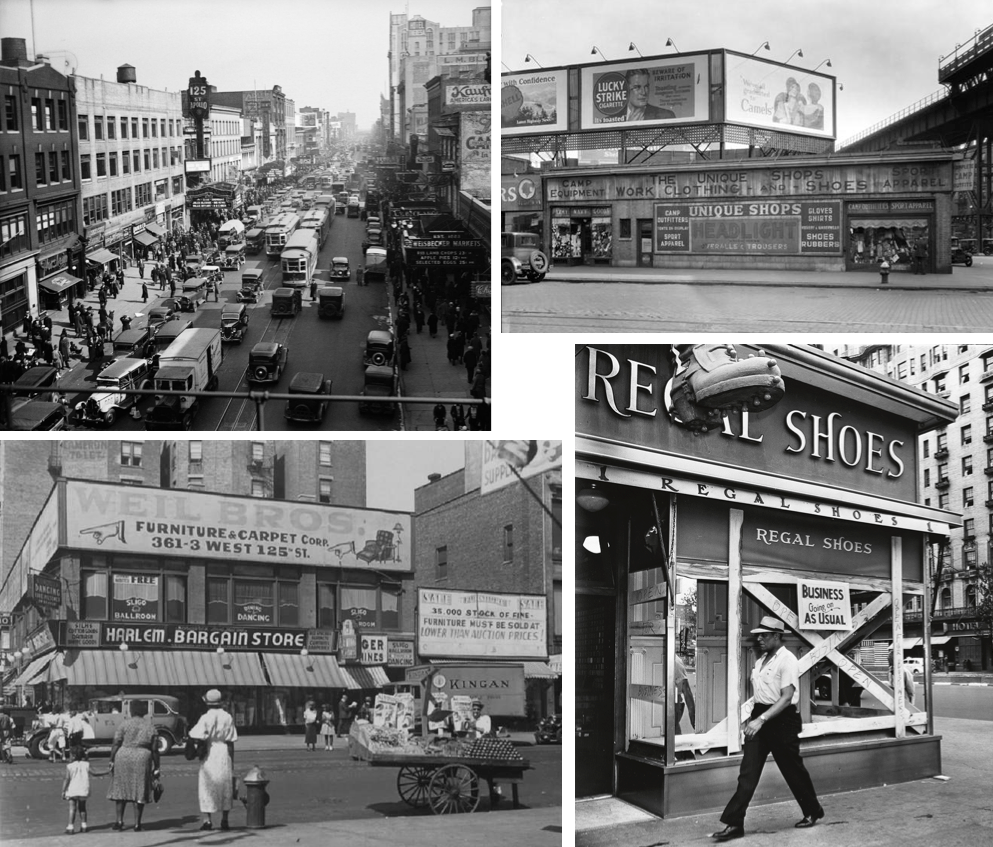
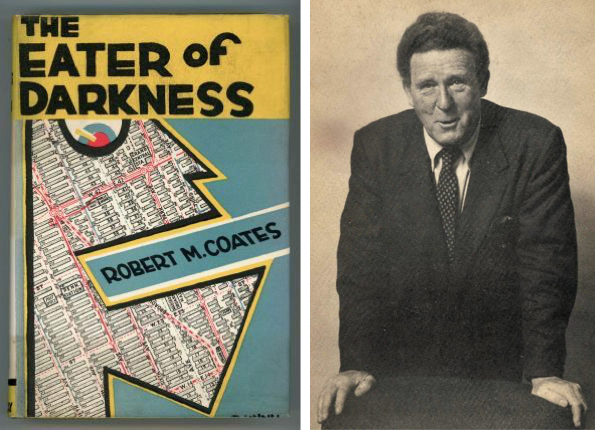
Robert Myron Coates (1897–1973) was a writer of experimental, expressionistic novels who later became a longtime art critic for The New Yorker (he is credited with coining the term “abstract expressionism” in 1946). In the Aug. 23 issue he contributed the first installment of “Dada City,” here describing street life in Harlem. Excerpts:

STREET LIFE…Scenes around Harlem’s 125th Street, clockwise from top left: the Apollo Theatre marquee punctuates a busy street scene in 1935; NW corner of 125th and Broadway, 1930; Regal Shoes storefront, 1940s, photo by Weegee; 125th and St. Nicholas Avenue in 1934. (Skyscraper City/Museum of the City of New York)
AMERICAN ORIGINAL…Robert M. Coates’s The Eater of Darkness (1926) has been called the first surrealist novel in English. (Goodreads)

 *  *  *

From Our Advertisers

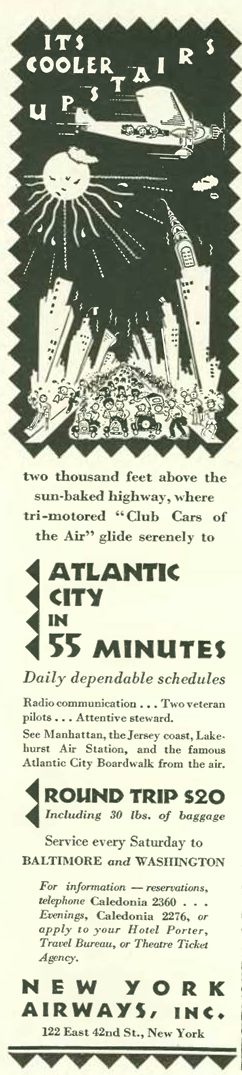
New Yorkers who were still enduring the brutal summer of 1930 could find relief, if they could afford it, on a New York Airways flight…

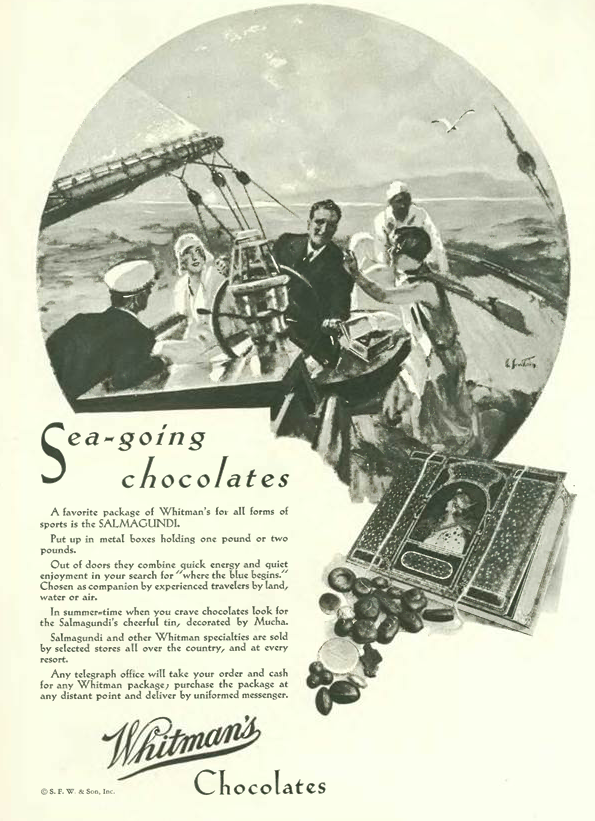
…or if you had the means, you could take your yacht out to sea, like this chap in a coat and tie who calmly steers with one hand while offering a box of chocolates to his guests with the other…

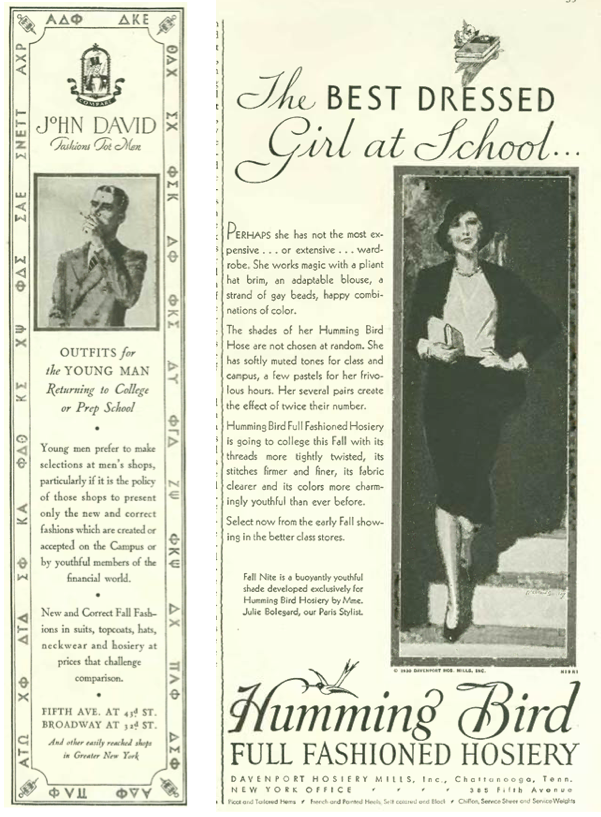
…our sailor wasn’t the only one dressed to nines…here are two ads offering suggestions to young folks returning to college or prep school…

…for comparison, this is how a group of college students at Columbia University dress today…

(Columbia University)

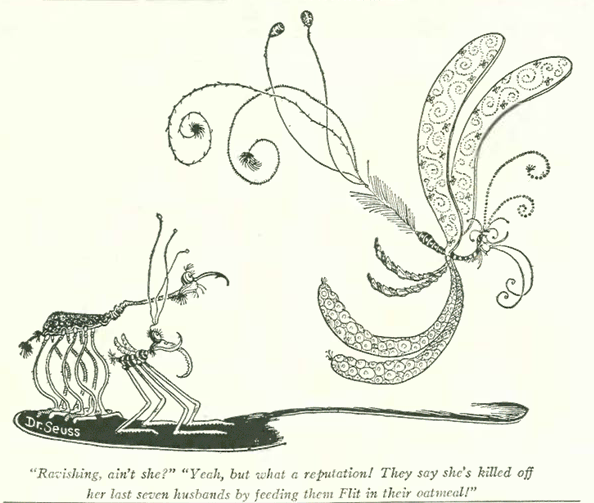
Dr. Seuss continued to crank out drawings on behalf of Flit insecticide…

…and on to cartoons, yet another rerun (the sixth) of this Peter Arno drawing with a new caption (Dorothy Dix was a popular advice columnist)…

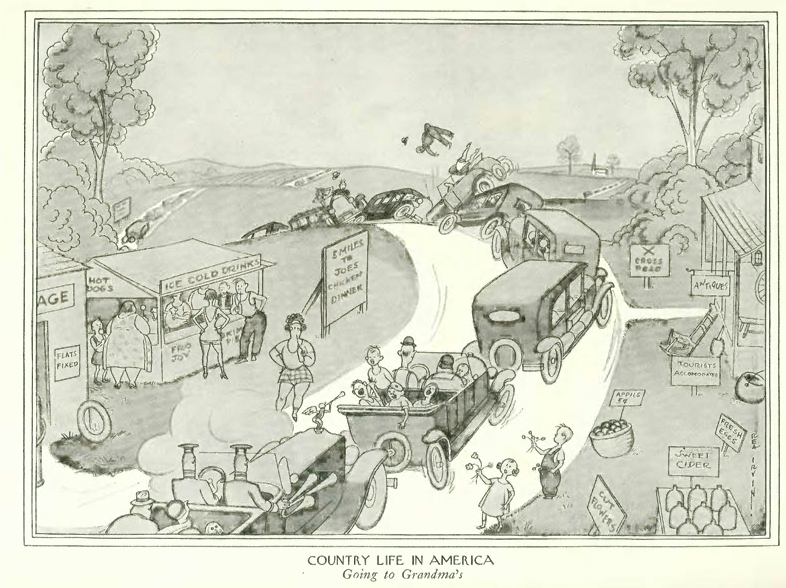
…and another look at country life courtesy Rea Irvin (originally printed sideways on a full page)…

…and another country scene, this time among the toffs, thanks to Garrett Price

…back in the city, some parlor room chatter as depicted by Barbara Shermund

…downtown, Isadore Klein looked at the economic challenges of peep shows…

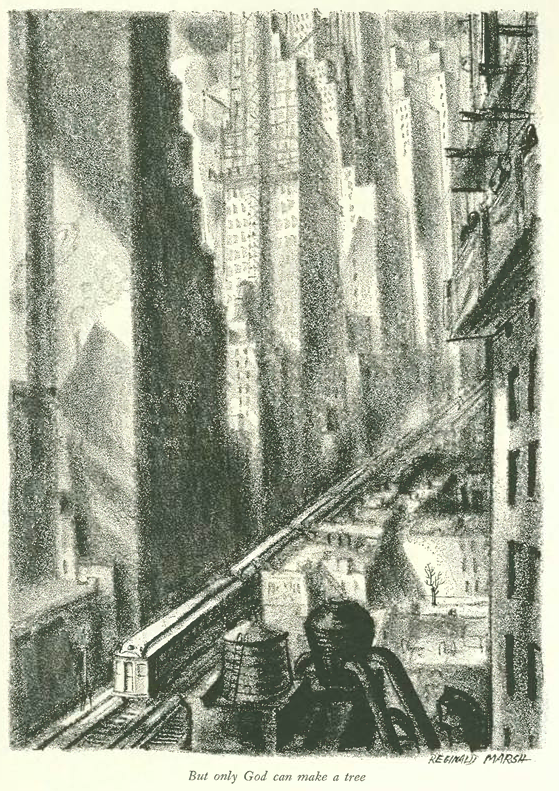
…and we close with this reflection on city life, by Reginald Marsh

Next Time: Marble Halls…

The Drys Are All Wet

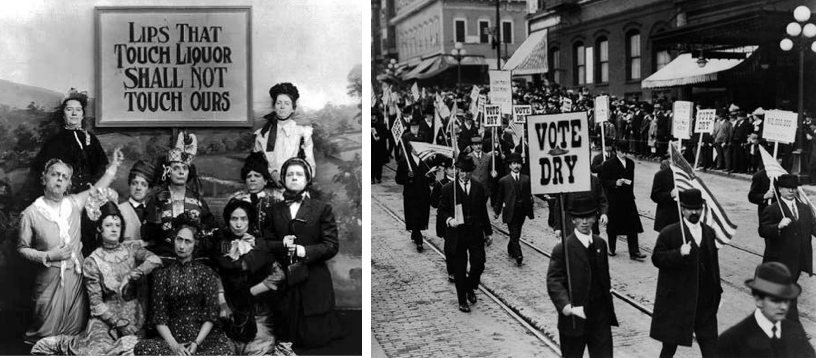
The end of Prohibition was more than three years away, but New Yorkers could already sense that the tide was quickly turning against the “drys” who had succeeded a decade earlier in enacting a nationwide ban on most alcohol production and distribution.

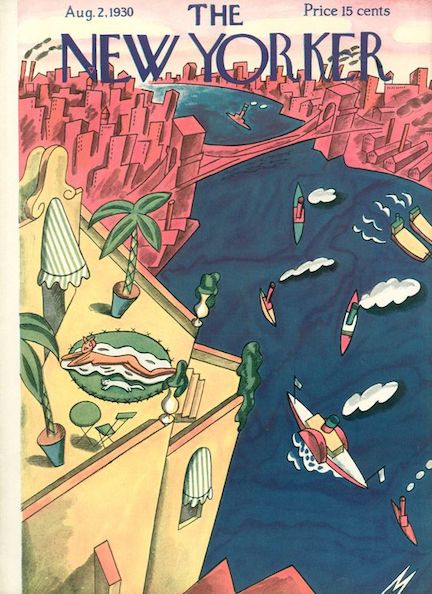
Aug. 2, 1930 cover by Julian De Miskey.

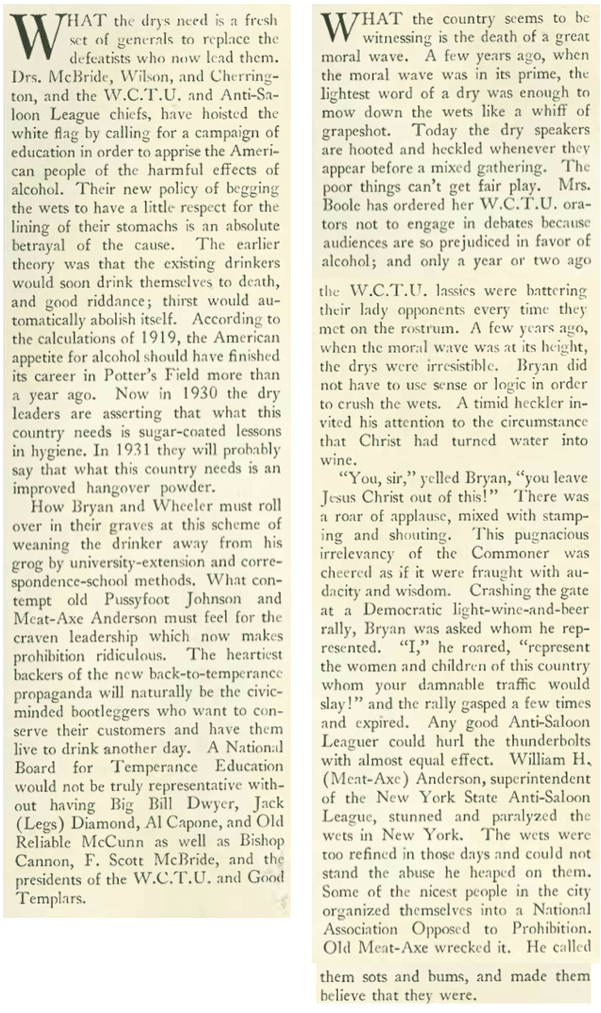
In the Aug. 2 issue Alva Johnston seemed to relish the opportunity to aim some withering fire at the retreating “drys”…

NOT EXACTLY LYSISTRATA…The Woman’s Christian Temperance Union (left) and the Anti-Saloon League were major forces behind a nationwide constitutional ban on the production, importation, transportation and sale of alcoholic beverages in the U.S. (Pinterest/PBS)

Johnston noted how the “wet” forces were even using the Bible to beat down the moral crusaders…

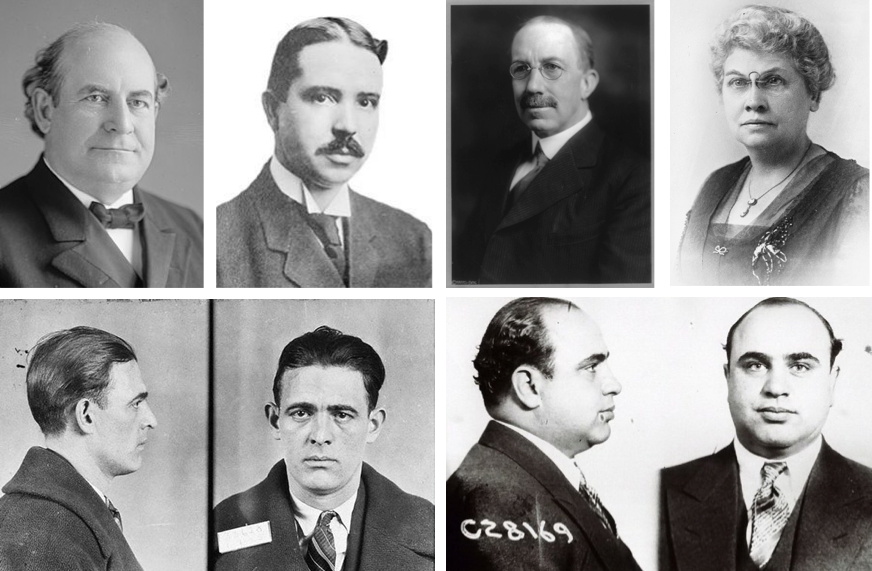
DIDN’T SEE THAT COMING…What began as moral crusade led to the rise of some of America’s most notorious gangsters. Top, left to right, early 20th century temperance supporters included attorney and politician William Jennings Bryan, Anti-Saloon League leaders William “Meat-Axe” Anderson and Wayne Wheeler, and Ella Boole, head of the Woman’s Christian Temperance Union; bottom, left to right, mugshots of Jack “Legs’ Diamond and Al Capone. (Wikipedia/findagrave.com/Flickr)

 *  *  *

Clear as Mud

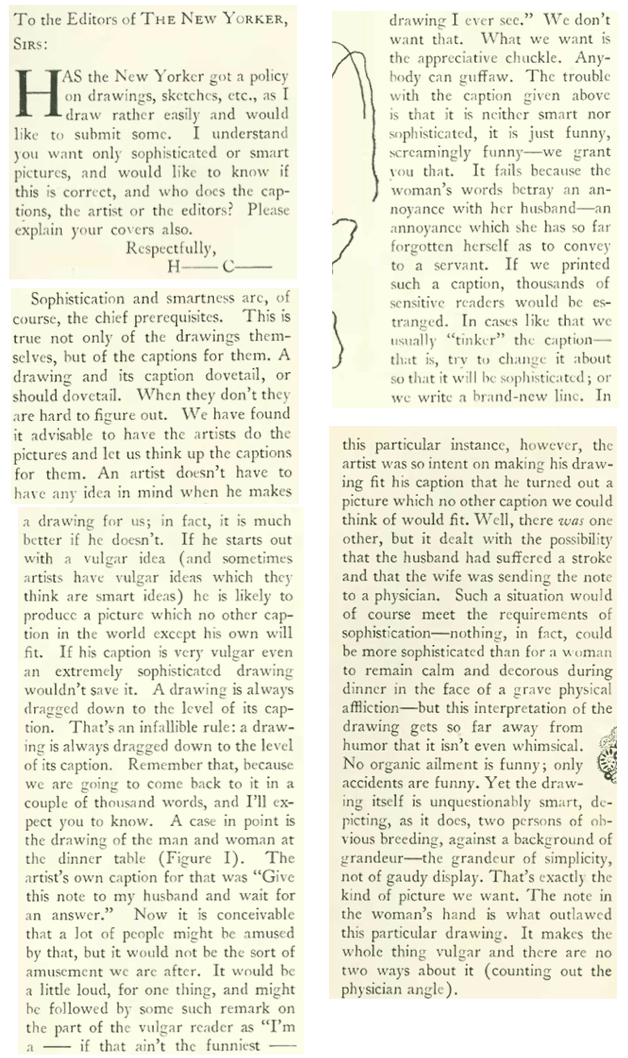
In another installment of “Answers-To-Hard-Questions Department,” James Thurber fielded a question regarding The New Yorker’s policy on drawings and sketches. Here is Thurber, posing as “Wayne Van R. Vermilye”…

*  *  *

Double Standard

In its first years The New Yorker looked down on the subtle and not-so-subtle racism in American life; that is, when it applied to black intellectuals and artists (Dorothy Parker’s “Arrangement in Black and White” in the Sept. 30, 1927 is a prime example). However, in its cartoons and in “Talk of the Town” shorts, working class blacks were almost always depicted as minstrel characters, mammies, pickininnies and the like. In the Aug. 2 book review section, we have an example of the former, more or less…

WITHOUT LAUGHTER…Eslanda Goode Robeson, left, in the avant-garde film Borderline (1929); Langston Hughes photographed by Carl Van Vechten in the 1930s. (columbia.edu/beinecke.library.yale.edu)

 *  *  *

From Our Advertisers

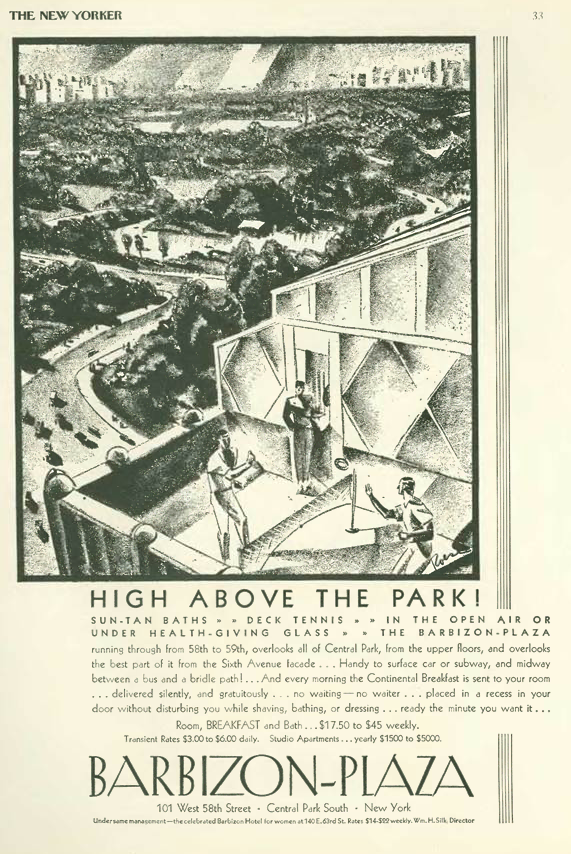
The 38-story Barbizon-Plaza Hotel was designed to appeal to artists and musicians and included soundproof practice rooms, art studios, and two performance halls. Apparently you could also enjoy a game of deck tennis on the rooftop, but one wonders how much damage one could inflict — on a car or person — with a solid rubber ring dropped from a height of nearly 400 feet…

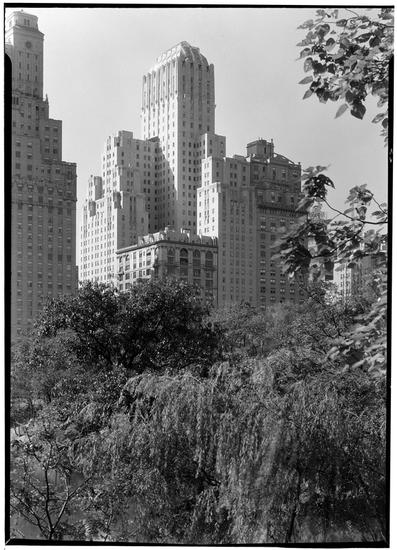
ARTLESS…The Barbizon-Plaza Hotel opened at 106 Central Park South in 1930 with 1,400 ensuite rooms. Designed to appeal to artists and musicians, the Depression put an end to that dream, and the property was foreclosed on in 1933. Donald Trump purchased the building in 1981 with the intent of tearing it down, but eventually converted it into 340 condo units and renamed it the “Trump Parc.” (MCNY)

…Lorillard Tobacco Company, the makers of Old Gold cigarettes, tapped into the popularity of crooner Rudy Vallée to move their product, boasting that like Vallée their cigarette was something of an overnight sensation (residents of Chicago, the ad noted, smoked three million Old Golds every day)…

…on to our cartoons…a couple issues back, I noted how this Peter Arno drawing appeared in three consecutive issues with different captions…here it is again, and the story of the two lovers continues…

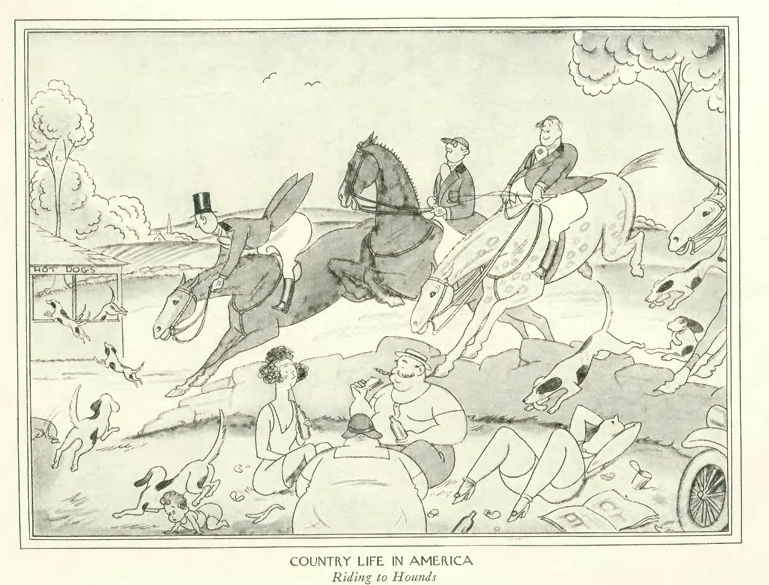
…also continuing were these full-page cartoons (originally displayed sideways) by Rea Irvin…his “Country Life in America,” scenes depicted common folks setting up camp and enjoying other other activities at the expense of country squires…

…and we end with Leonard Dove and a couple of city folk looking for some excitement in the country…

Note: the above cartoon refers to Texas Guinan’s move to country after reigning for a nearly a decade as Manhattan’s “Queen of the Nightclubs.” Facing declining fortunes, in 1929 she took her nightclub act to the quiet village of Valley Stream, New York, located just south of Queens in Nassau County. The venture quickly went bust.

Next Time: The Woes of Mr Monroe…

Aleck and Frank at Taliesin

From the late I.M. Pei to Frank Gehry, America has its share of “starchitects,” but only one architect in the history of the profession could claim to be a true household name: Frank Lloyd Wright. 

July 19, 1930 cover by Peter Arno.

In a profile titled “The Prodigal Father,” Alexander Woollcott wrote about Wright’s “return” to American acceptance after nearly two decades of scandal and tragedy. Woollcott took great pains to defend Wright’s reputation, marred by his extramarital affair with Mamah Cheney, her murder in 1914 along with six others (including her children) at Wright’s Wisconsin home, Taliesin, and his subsequent remarriage, divorce, and remarriage that followed.

GONE BUT NOT FORGOTTEN…Clockwise, from top left, Reginald Marsh illustration for the profile; Frank Lloyd Wright, circa 1930; Tokyo’s Imperial Hotel, completed in 1923. Designed in the Maya Revival Style Wright favored throughout the 1920s, it was damaged by the 1923 Great Tokyo Earthquake just months after opening. It was demolished in 1967, however the iconic central lobby wing and the reflecting pool were disassembled and rebuilt near Nagoya. (Library of Congress/dezeen.com)

Note: Thanks to a reader’s correction (see comments at the bottom), the following has been revised:

Woollcott also wrote of his visit to Taliesin (the third version of the house, after the first two were destroyed by fires). What stands out about this profile is Woollcott’s praise for the architect, a rare hagiography from a man renowned for his savage wit.

MEETING OF THE MINDS…Above and below are photographs from a autumn visit to Taliesin by Alexander Woollcott. From left are Olgivanna Lloyd Wright, Frank Lloyd Wright and Woollcott. Wright invited Woollcott to the estate in the late 1920s: “This note will be witless as usual, but grateful…. Dear Man, why don’t you come up here? Bring any friend up here with you. Both of you can find an admirable place to work here…” (Avery Architectural & Fine Arts Library, Columbia University, New York)

THIRD TIME’S A CHARM…The third version of Taliesin (built in 1925) is the one Woollcott would have visited in the late 1920s. (Wikipedia/Taliesin Preservation)

*  *  *

No Surprise Endings, Please

Although sometimes confused with Alexander Woollcott because of his first name, the timid, taciturn Wolcott Gibbs was a force at The New Yorker in his own right, perhaps even more so as he served the magazine from 1927 to 1958 as a jack-of-all-trades: copy editor, feature writer, theater critic, and overall wordsmith. So when the editors of The Writer’s Digest posed a question regarding The New Yorker’s policy for submissions, it was Gibbs who was tapped to compose a response, which was a particular challenge given the magazine didn’t have a clear set of editorial requirements. So Gibbs conjured up an “Answers-To-Hard-Questions Department,” and signed it “Mr. Winterbottom.” Some excerpts:

IN HIS ELEMENT…Wolcott Gibbs, left, relaxes at the Algonquin Hotel in 1937. At right is his New Yorker colleague Dorothy Parker. (Time)

 *  *  *

Munitions of Bremen

The German Ocean liner SS Bremen was one of the most technologically advanced ocean liners of its day, known for its speed and luxury. Author Eric Hodgins climbed aboard to file a report for the New Yorker, and in the excerpt below marveled at the “mechanical perfection” of the ship’s engine room:

PLOUGHSHARES INTO SWORDS…More than the length of three football fields, the streamlined SS Bremen, launched in 1928, was designed to have a cruising speed of  27.5 knots (50.9 km/h). After a 1941 fire, the ship was largely dismantled, its steel used to manufacture war munitions. (Wikipedia/greatoceanliners.com)

In 1941, while docked in Bremerhaven, a disgruntled crew member set fire to the ship, completely gutting its luxurious interior. During the war the ship was stripped of its steel for use in munitions, and in 1946 what remained was destroyed by explosives.

 *  *  *

From Our Advertisers

In my readings of recent issues I’ve noted numerous references to hot weather, and for good reason. The summer of 1930 would see record high temperatures and diminished rainfall that would usher in the “Dust Bowl” era of the 1930s. The Wallach Brothers adjusted by offering this “Dixie Weave Suit”…

…the hot weather also called for a tall glass of sparkling soda (mixed with your favorite bootleg beverage, of course)…

…smokers could keep cool by puffing on a Spud, the first menthol cigarette…

…or you could stick with your Luckies, endorsed by none other than this generic, genial doctor and some bogus survey…

…on to our cartoons…Isadore Klein showed us a downside of Edison’s invention…

…and Leonard Dove gave us two gentlemen on the skids, a frequent sight in Depression-era New York…

…after a long absence, we see suddenly see a flurry of activity from the pen of Ralph Barton, including this rare sequential cartoon…

…and with the hot summer New Yorkers took to the waters, at Coney Island with Denys Wortman

…and Southampton, with Helen Hokinson

Next Time: For the Byrds…