Jimmy Comes Home

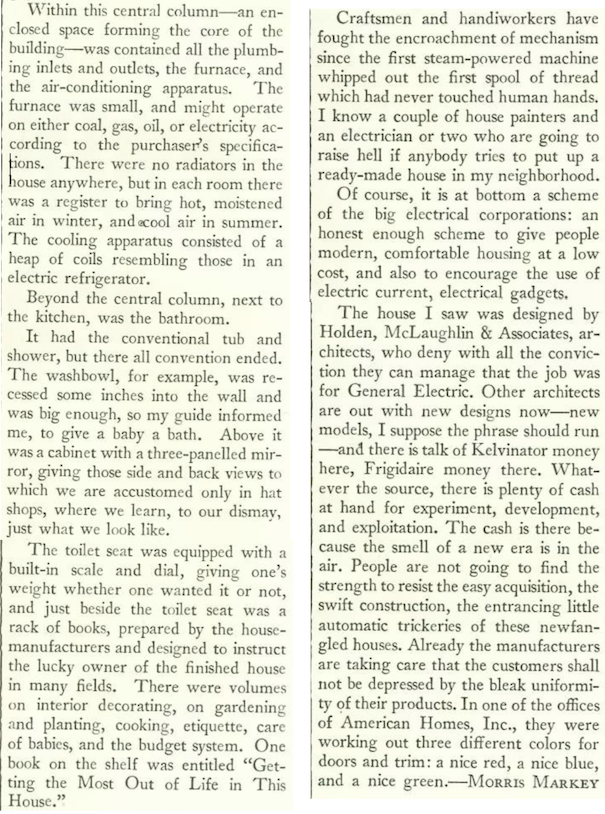
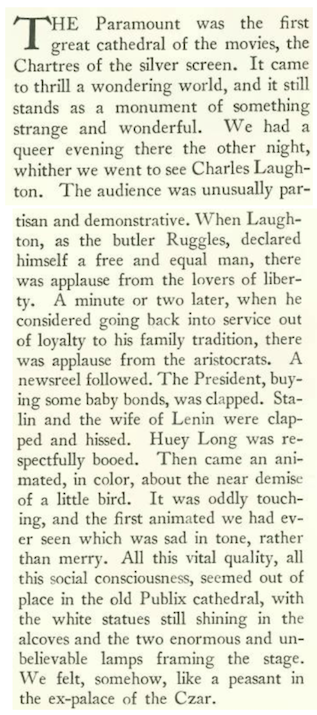
Above: Former New York Mayor Jimmy Walker and wife Betty Compton, aboard the S.S. Manhattan in 1935. (New York Daily News Archive)

The Roaring Twenties and Jimmy Walker seemed made for each other. A dandy with a taste for fine clothes, late-night parties, and Broadway showgirls, the 97th mayor of New York was a darling of the media…until the market crashed; as nest eggs evaporated along with jobs, folks quickly lost their taste for such frivolity.

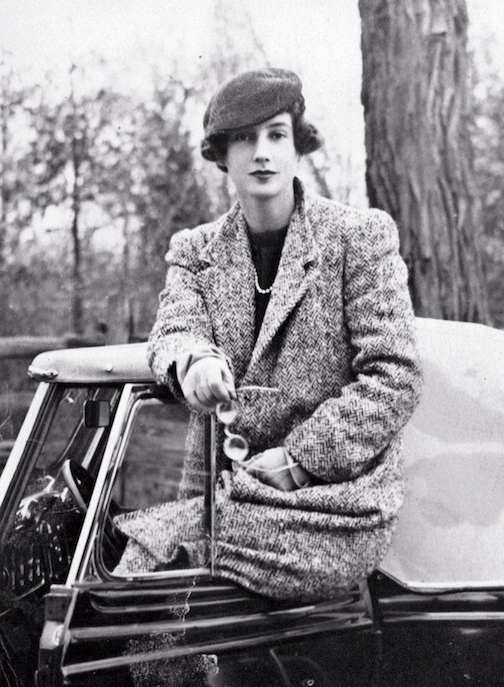
November 9, 1935 cover by Daniel “Alain” Brustlein. This was the first of nine covers Brustlein created for the magazine. An Alsatian-born American artist, cartoonist, illustrator, and author of children’s books, Brustlein (1904–1996) contributed to The New Yorker under the pen name “Alain” from the 1930s through the 1950s.
Daniel “Alain” Brustlein, in an undated photo. During the height of Abstract Expressionism Brustlein became a reputable painter, exhibiting his work in New York and Paris. (derfner.org)

 *

The fall of 1935 marked three years since Walker had left office, and for nearly two of those years the city had been governed by the reformist Mayor Fiorello La Guardia. New Yorkers, it seemed, were ready for a dose of Jimmy when he returned from his European exile, hailed by a throng of media and well-wishers.

Writing for Airmail, longtime New York journalist Sam Roberts observes that the city loved Walker, “a charming hellion, a witty, self-effacing, glib humanist, far more flawed, too, and compassionate than pictured previously, a man elevated and condemned by his own character, created and ultimately consumed by his times. He conjures up the anti-Trump—a dodgy philanderer who governed by making people feel good rather than angry.”

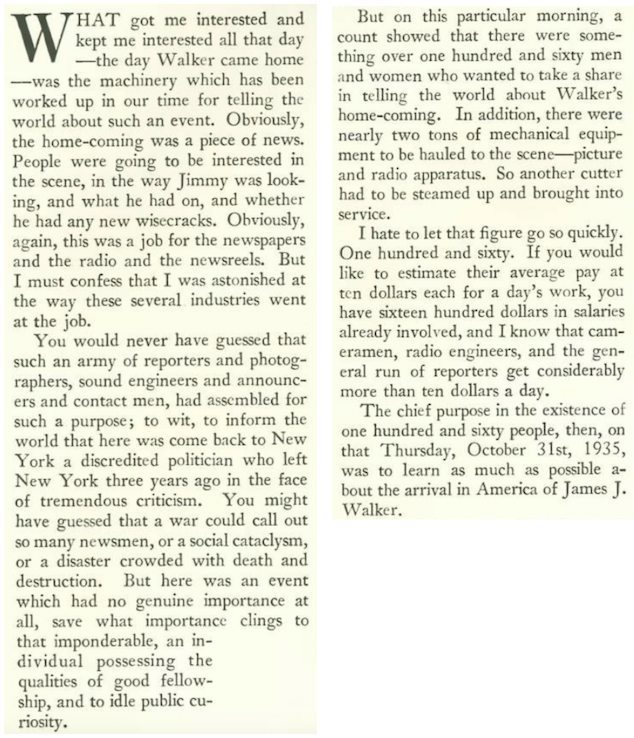
WHERE’S THE PARTY?…Former Mayor Jimmy Walker and his wife, Betty Compton, returned to New York in the fall of 1935 amid tremendous fanfare. The New Yorker’s Morris Markey noted that at least 160 media representatives were on hand for the couple’s arrival. (YouTube)

Walker (1881-1946) fled to Europe in November 1932 amid a bribery scandal that had prompted his resignation. Accompanied by Ziegfeld Follies singer Betty Compton (1906–1944)—whom he would marry in Cannes the following April—they would bounce around the continent until Walker determined that the danger of criminal prosecution had passed.

In his “A Reporter at Large” column, Morris Markey wrote about the media’s reception of the exiled mayor, “an army of reporters and photographers, sound engineers and announcers and contact men”…all assembled to inform the world of the return of a “discredited politician.”

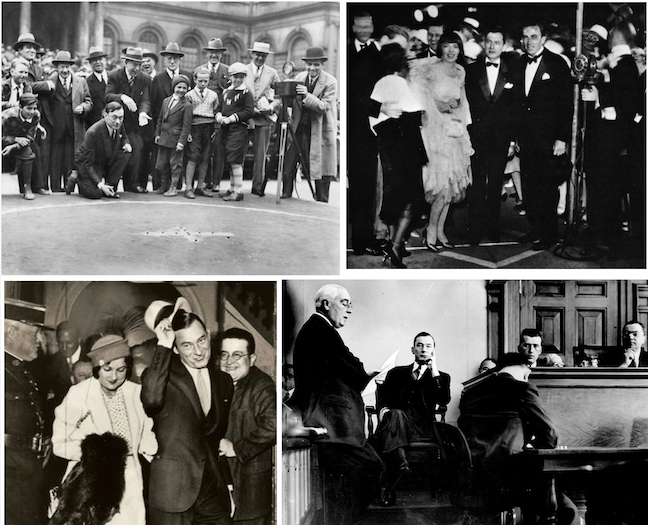
HE GOT AROUND…During his time in office from 1926 to 1932, Mayor Jimmy Walker never seemed to miss a moment in the spotlight. Clockwise, from top left, Walker presided over the first shot in the city’s annual marble tournament on June 3, 1928; with actress Colleen Moore at the 1928 premiere of her latest film, Lilac Time;  testifying on bribery charges before the investigative committee of Judge Samuel Seabury, 1932; with Betty Compton following their 1933 wedding in Cannes. (New York Times/konreioldnewyork.blogspot.com/villagepreservation.org)

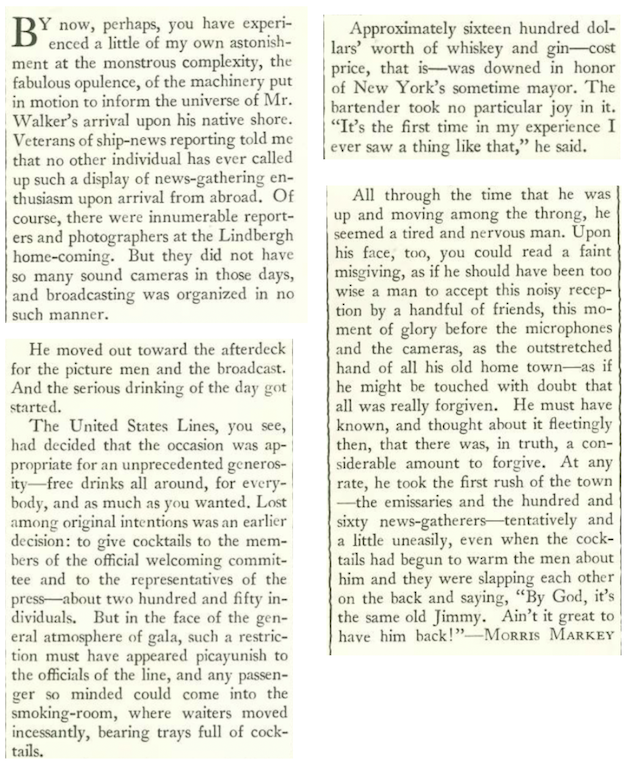
Markey continued to convey his astonishment at “the monstrous complexity, the fabulous opulence, of the machinery put in motion to inform the universe of Mr. Walker’s arrival upon his native shore.” This included a massive cocktail party—hosted by The United States Lines—for more than two hundred press representatives and other officials.

After all the commotion, Walker would settle into a job as head of Majestic Records, adopt two children with Compton, and host his own radio series on WHN, Jimmy Walker’s Opportunity Hour.

Compton would divorce Walker in 1941 and remarry. Becoming ill after the birth of a son, she would die at age 38 in 1944. Walker would die two years later at age 65 of a brain hemorrhage.

CALLING ON THE ROOSEVELTS…Jimmy Walker and Betty Compton at the White House in 1937. It was pressure from FDR that led to Walker’s resignation in 1932. (Wikipedia)

 * * *

High-flying Hooplah

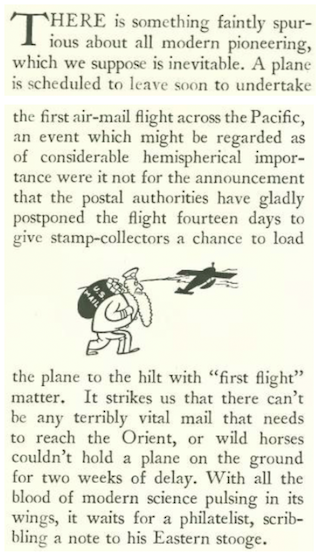
While New Yorkers were going gaga over Walker, folks in the Bay Area were all atwitter over the first air-mail flight across the Pacific, loading a Pan Am Clipper to the gills with all manner of collectables. E.B. White noted:

BELLYFUL…On Nov. 22, 1935, Pan American Airways made aviation history as the China Clipper lifted off from Alameda, beginning the world’s first trans-Pacific airmail service. Captained by Edwin Musick and crewed by famed navigator Fred Noonan, the Martin M-130 opened a new era of long-distance flight across the Pacific. Noonan, who charted many commercial routes across the Pacific, would go missing along with Amelia Earhart during their ill-fated flight in July 1937. (Library of Congress)

* * *

Wise Men From the East

“The Talk of the Town” visited with Soviet satirists Ilya Ilf (1897–1937) and Evgeny Petrov (1903–1942), who were in New York preparing for a ten-week road trip to California and back. On assignment as special correspondents for the newspaper Pravda, they later published a series of illustrated articles, “American Photographs,” as well as a book titled Single-Storied America (the summer 2004 issue of Cabinet Magazine features an account of their journey as well as a number of their photographs).

AMERICA WAS A GAS…Soviet satirists Ilya Ilf (left) and Yevgeni Petrov check out New York before heading into the American heartland on a ten-week road trip, a highlight being the countless full-service gas stations they encountered along the way. After seeing skyscrapers and mountains and other wonders, the pair agreed that the most enduring image was the one at right: “an intersection of two roads and a gasoline station against a (back)ground of wires and advertising signs.” Sadly, Ilf died two years later from tuberculosis; Petrov died in a plane crash in 1942 while working as a war correspondent. (Aleksandra Ilf archive/Cabinet Magazine)

 * * *

A Jumbo Career

Wallace Beery (1885–1949) got his start in the comedy silents of the 1910s and became a star before the sound era made him an even bigger one; by 1932 he was the world’s highest-paid actor. Alva Johnston’s profile (titled “Jumbo”) took a look at Beery’s life and career (illustration by Al Frueh). Excerpts:

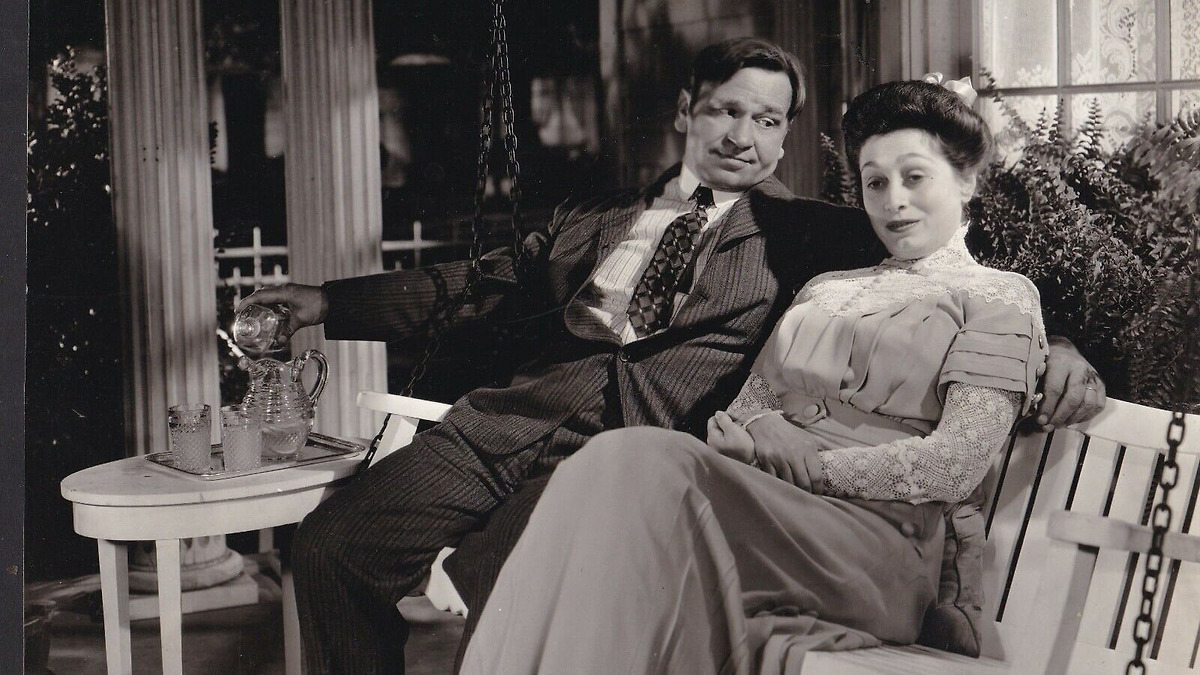
COURTING AND SPARKING…Sid Miller (Wallace Beery) spikes the lemonade as he woos Lily Davis (Aline MacMahon) in a scene from the 1935 film, Ah Wilderness! (letterboxd.com)

 * * *

A View and Corbu

Art and design critic Lewis Mumford was well-known for his hypercritical eye, but occasionally he could be moved to rhapsodize, in this case about the opening of Fort Tryon Park, and particularly about the view it afforded visitors. He reserved his criticism for one of the latest works by Le Corbusier (aka Charles-Édouard Jeanneret), on exhibit at MoMA.

MAGNIFICENT is the word Lewis Mumford used to describe the view from Fort Tryon Park. This scene is taken from Linden Terrace to the west: a barge on the Hudson River and the Hudson Palisades beyond, with the Englewood Cliffs campus of Saint Peter’s University on the top. (Wikipedia)
IRRATIONAL?…Mumford was not pleased with Le Corbusier’s latest work, Le Petite Maison de Weekend (Villa Henfel), which was featured on the cover of the MoMA exhibition catalogue (upper left). Mumford saw the design as a pathetic escape from the architect’s renown rationalism. (MoMA/Fondation Le Corbusier)

* * *

At the Movies

It was a mixed bag at the movies for critic John Mosher, who was delighted by a Soviet take on Gulliver’s Travels, rendered with puppets engaged in a proletarian struggle…

KOMRADE GULLIVER…The Soviet stop motion-animated fantasy film, The New Gulliver, was a communist re-telling of Jonathan Swift’s 1726 novel. The film depicted Lilliput suffering under capitalist inequality and exploitation, with Gulliver enabling a proletarian revolution against the Lilliputian monarchy. (revolutionsnewstand.com)

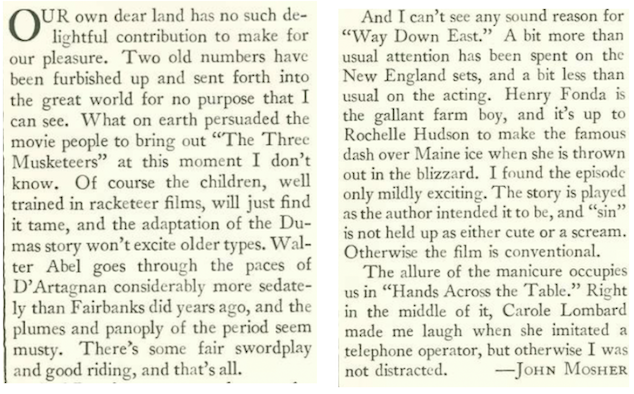
…but Mosher was less than delighted with the latest from Hollywood, including a sedate The Three Musketeers, a “conventional” remake of D.W. Grifffith’s 1920 melodrama Way Down East, and the romcom Hands Across the Table, which the Times called “uproariously funny” but Mosher deemed barely worth a chuckle.

OUTCLASSED BY PUPPETS…John Mosher found the latest from Hollywood underwhelming. Clockwise, from top, Onslow Stevens, Moroni Olsen, and Paul Lukas in The Three Musketeers; Rochelle Hudson and Henry Fonda in Way Down East; Fred MacMurray and Carole Lombard in Hands Across the Table. (mabumbe.com/zeusdvds.com/Wikipedia)

 * * *

From Our Advertisers

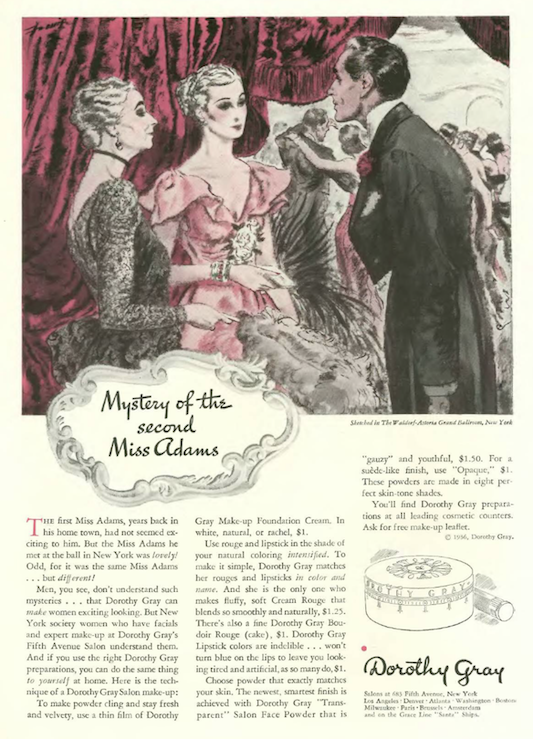
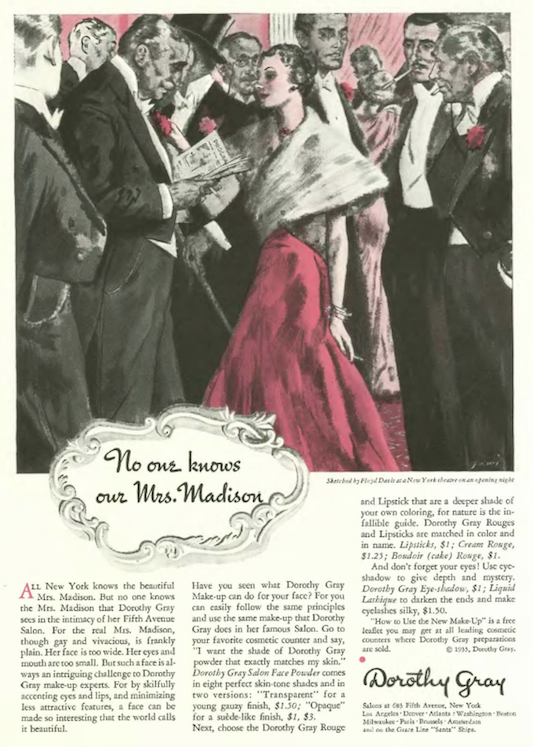
The Dorothy Gray salons didn’t mince words when it came to a woman’s beauty regimen…without their help, claimed this ad, the poor “Mrs. Madison” would be “frankly plain,” with a face too wide and eyes and mouth too small…

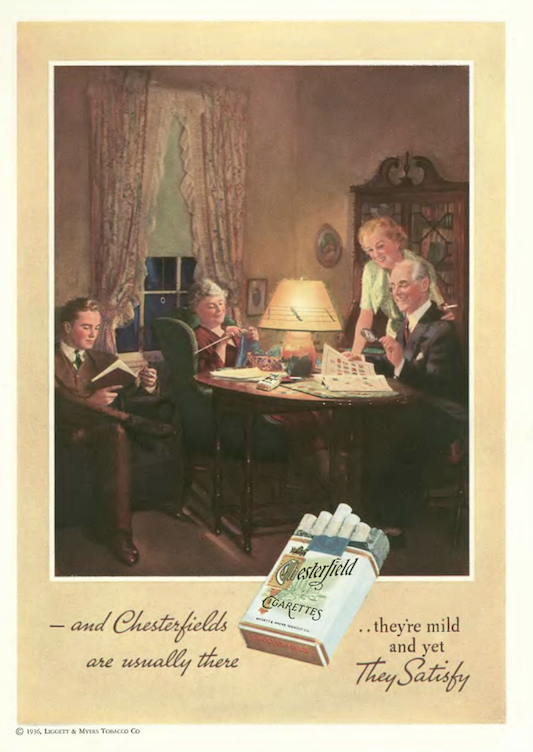
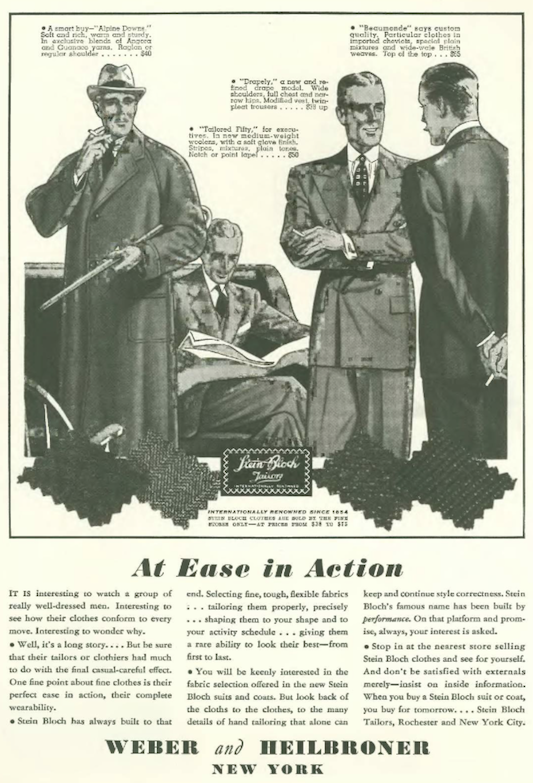
…notable in ads for men’s and women’s clothes were the presence of cigarettes…all three of the men in this spot are having a smoke in their smart attire…

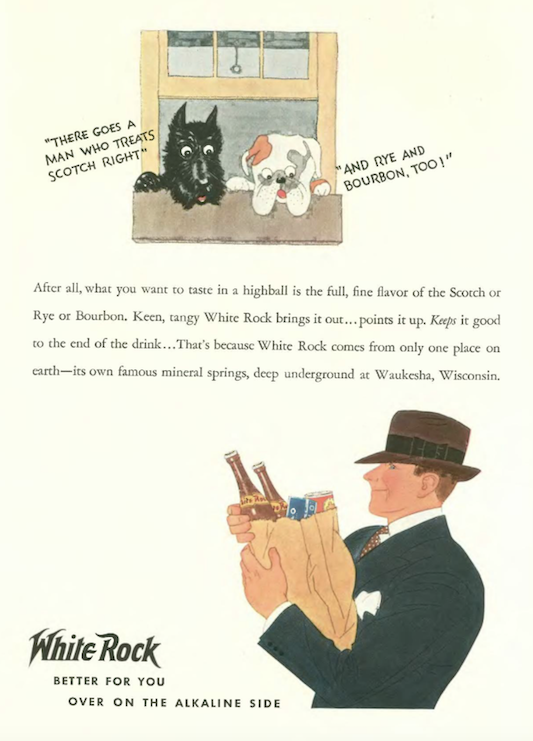
…White Rock gave their logo-bearer Psyche a rest in 1935 with a variety of ads including this one…

…the makers of Bisquit assumed their customers could read the French dialogue, or at least pretend to…

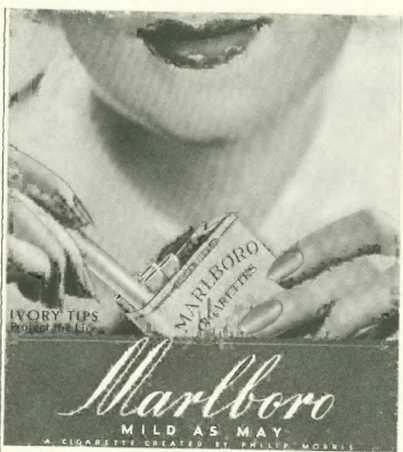
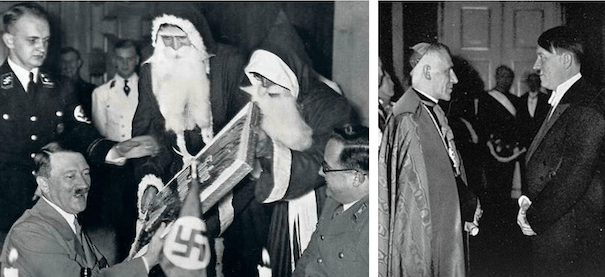
…when we (of a certain age) think of Marlboro we think of the rugged Marlboro Man, but in 1935 the brand was exclusively marketed to women…

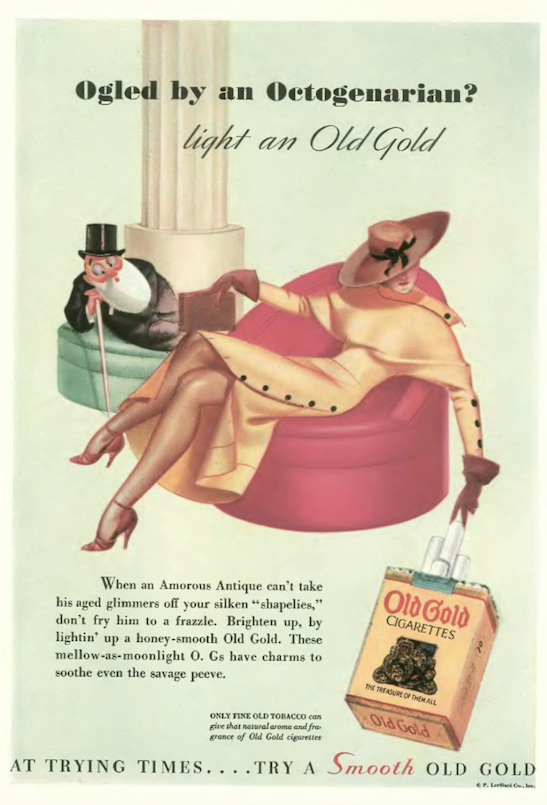
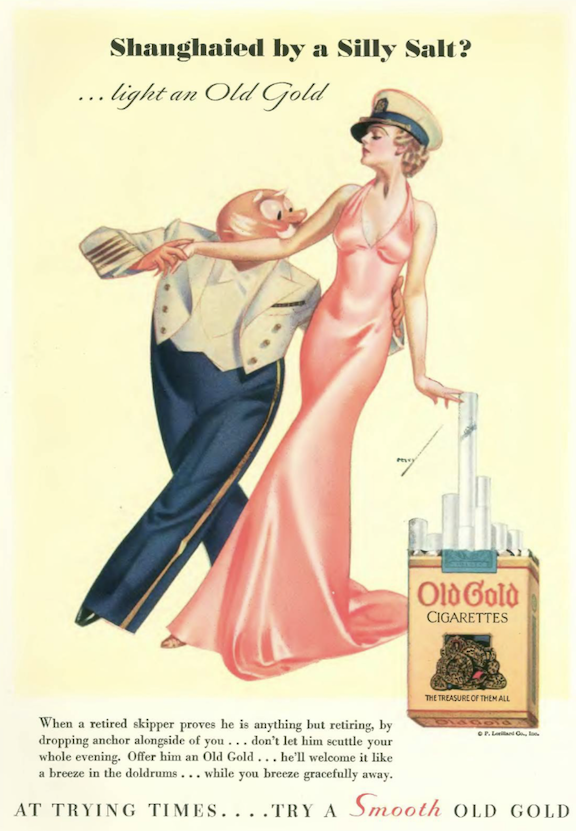
…and who knows what Old Gold’s target was here…definitely women smokers, who were the growth market, but men would take notice of the George Petty pin-up…

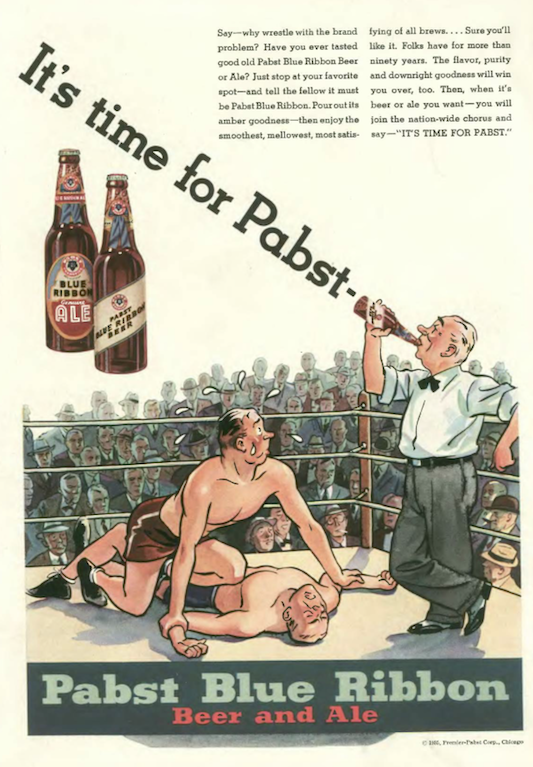
…the makers of Pabst Blue Ribbon Beer, who endured Prohibition by offering products like Pabst-ett cheese spread, were ready to grab a big market share after Repeal…

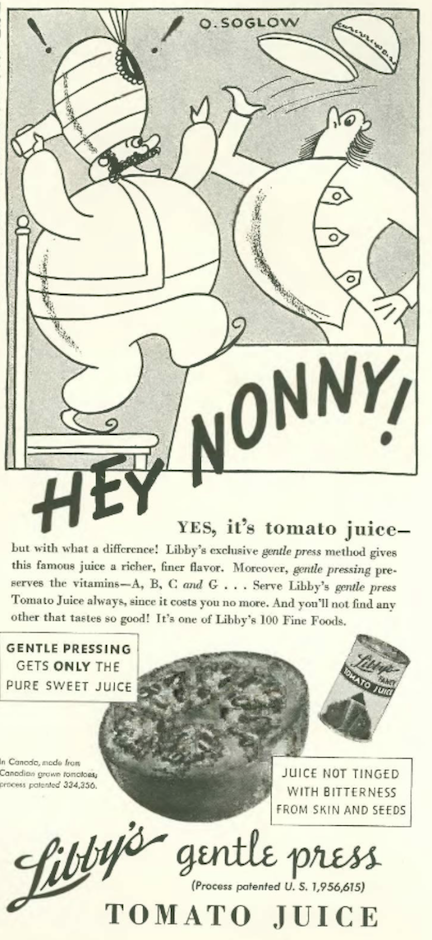
Otto Soglow, still contributing to The New Yorker despite taking his Little King to Hearst, drew up this potentate for a tomato juice spot…

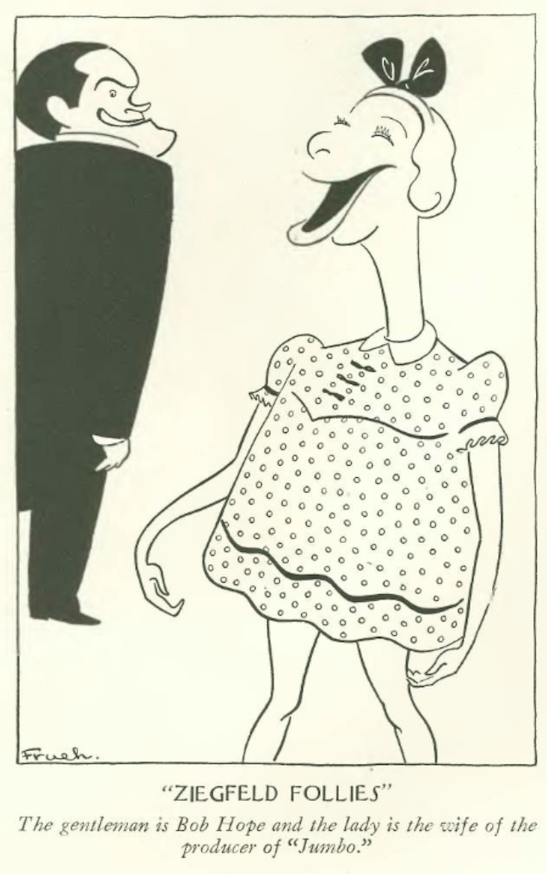
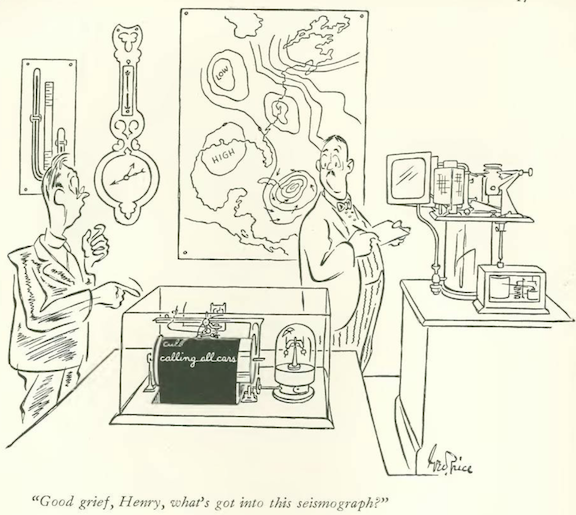
…which segues to our other cartoonists, beginning with Al Frueh and his take on the latest  Broadway hit, Jubilee!

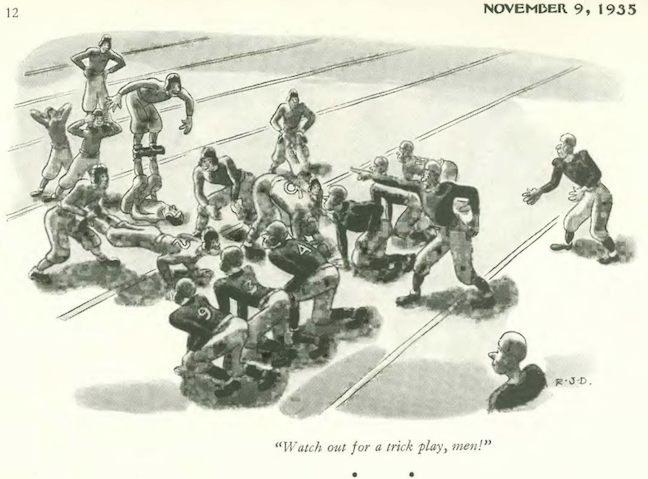
Robert Day saw action on the gridiron…

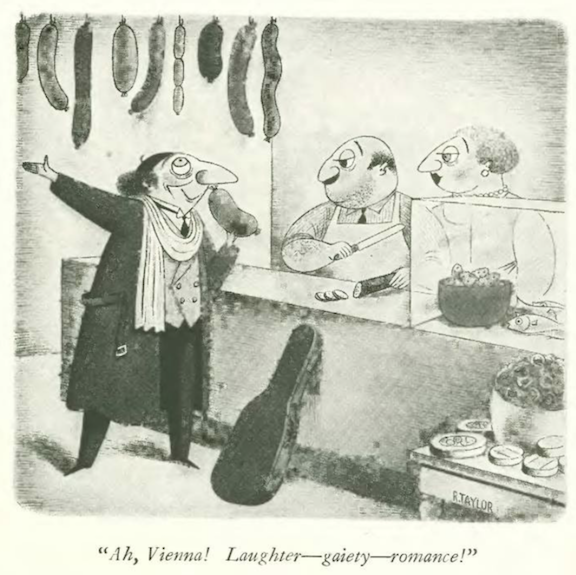
…unless I missed something, this might be Richard Taylor’s first New Yorker cartoon…

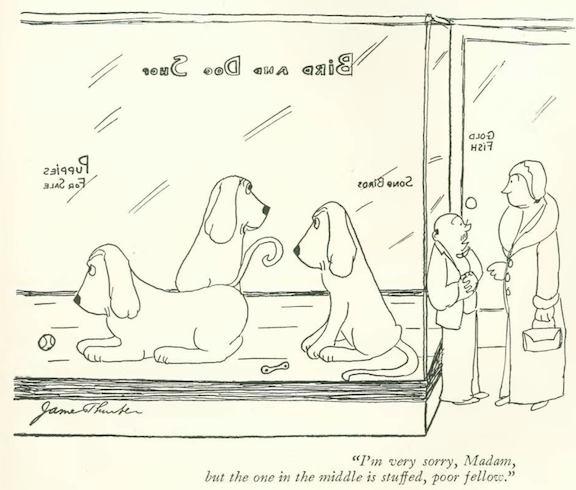
James Thurber put a unique spin on a bowling ball…

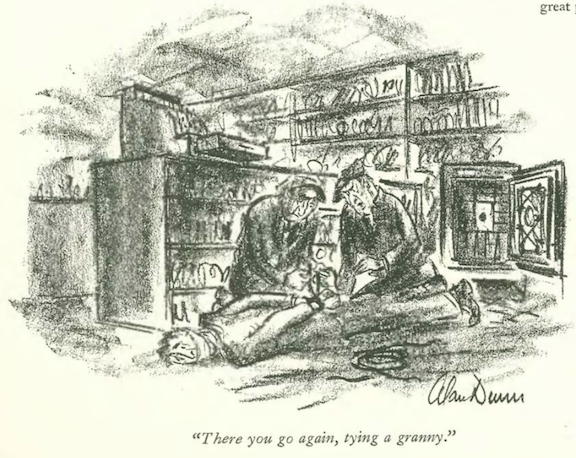
Alan Dunn was all in knots at a crime scene…

…Dunn again, pondering the wonders of a makeover…

Barney Tobey eavesdropped on a Downtown subway…

Fritz Wilkinson looked to return a defective pet…

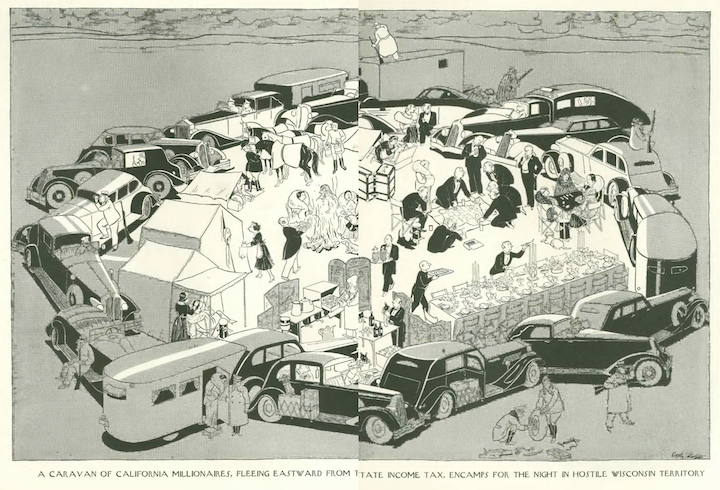
Carl Rose needed two pages to illustrate his epic cartoon (caption added at the bottom for readability)…

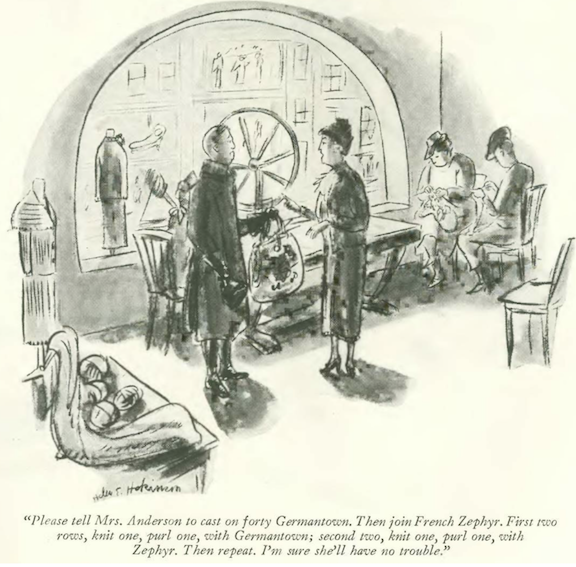
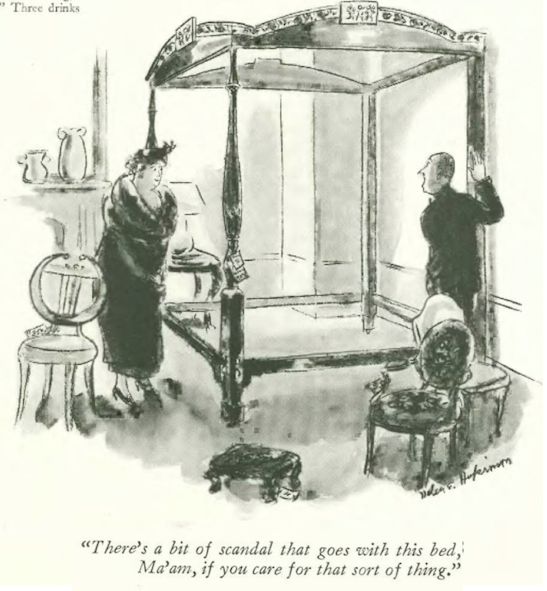
…and we close with Helen Hokinson, and a whiff of scandal…

Next Time: Seeking Decorative People…


A Merry Menagerie

It has been a while since we’ve heard from art and design critic Lewis Mumford, who often cast a censorious eye at the rapidly changing world around him.

October 12, 1935 cover by William Steig. From 1930 until his death in 2003 at age 95, Steig contributed 121 covers and 1,676 drawings to The New Yorker.

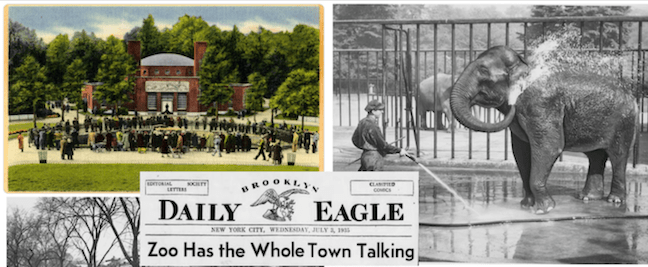
In his column “The Sky Line,” Mumford cast an envious gaze north toward Brooklyn’s Prospect Park Zoo, which he believed had greatly improved upon the recently rebuilt Central Park Zoo.

HE HAD OPINIONS…Lewis Mumford (1895-1990).

Brooklyn’s advantage, according to Mumford, was the superior design of Prospect Park, which offered a better location for a zoo than Central Park. We’ll let Mumford explain in these excerpts:

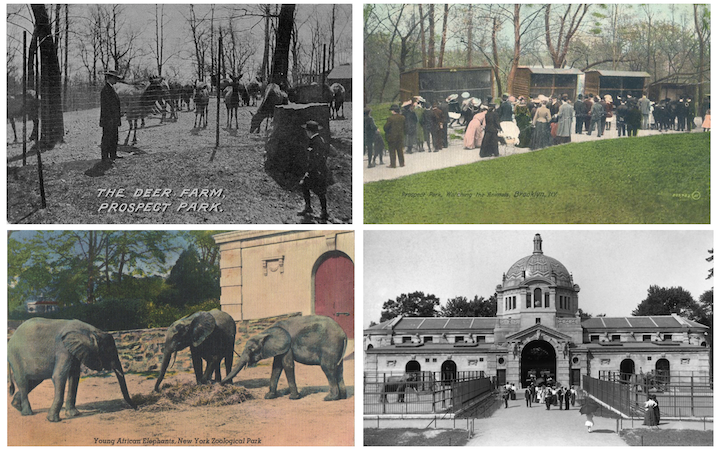
CURIOSITIES, MOSTLY…Clockwise, from top left: Animals were on display at Prospect Park as early as 1866, as seen in this photo of the “Deer Farm”; circa 1900 postcard of Prospect Park’s rather distressing “Menagerie,” which opened around 1890; the park’s Elephant House opened in 1908—modeled after the Hippo Palace at the Antwerp Zoo, the Elephant House also featured rhinoceroses, hippopotamuses, and tapirs; baby elephants (postcard circa 1940s) were a popular attraction until the zoo moved on to smaller creatures in the 1990s. (bklynlibrary.org/untappedcities.com/blog.wcs.org/nycgovparks.org)
LEWIS MUMFORD PRAISED the 1934 plan for the Prospect Park Zoo, designed by architect Aymar Embury II and approved by Parks Commissioner Robert Moses. The zoo was built, in large part, through Civil Works Administration and Works Progress Administration labor and funding. (Brooklyn Public Library)
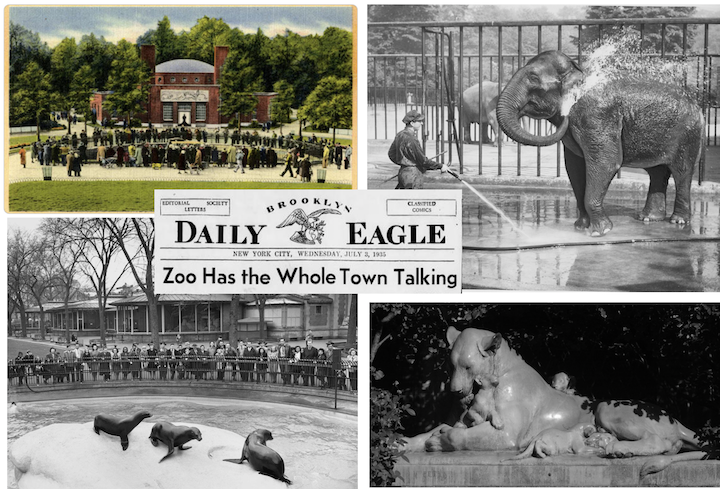
FLATBUSH FAUNA…Clockwise, from top left: Postcard image of Prospect Park Zoo circa 1935; zoo keeper sprays an elephant with a hose, circa 1940; an 1899 bronze sculpture depicting a mother lion nursing her cubs was created by French artist Victor Peter; seal pool, undated photo. (nycgovparks.org/Center for Brooklyn History/Facebook)
CARING OVER CAGES…Prospect Park Zoo today. The zoo closed in 1988 for five-year, $37 million renovation program that, except for the exteriors of the 1930s-era buildings, completely replaced the original zoo. With an emphasis on education and conservation, current exhibits house smaller species rather than elephants, tigers, and lions. (Prospect Park Alliance)

Mumford also looked at the latest developments at Rockefeller Center. As we’ve seen before, he favored smaller-scale developments that were organic and community-focused, and therefore was a strong critic of projects like Rockefeller Center. At its inception he called it a dehumanizing “megamachine,” a product of corporate greed, a “reckless, romantic chaos” that represented the capitalist jungle. Harsh words indeed, so it was something of a surprise to see his approval of the latest piece of the complex—the International Building at 630 Fifth Avenue:

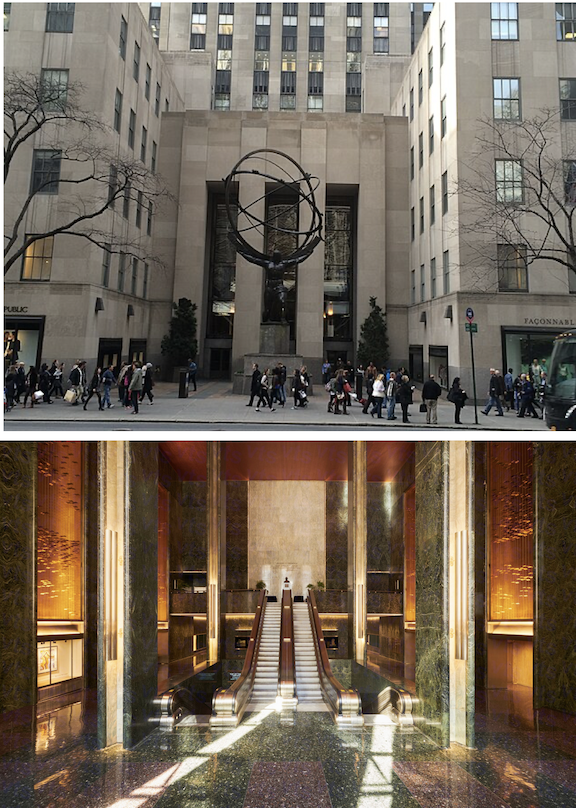
SIMPLE AND CORRECT were the words Lewis Mumford used to describe the interior entrance to 630 Fifth Avenue. (Wikiwand/newyorkoffices.com)

 * * *

Bad Benito

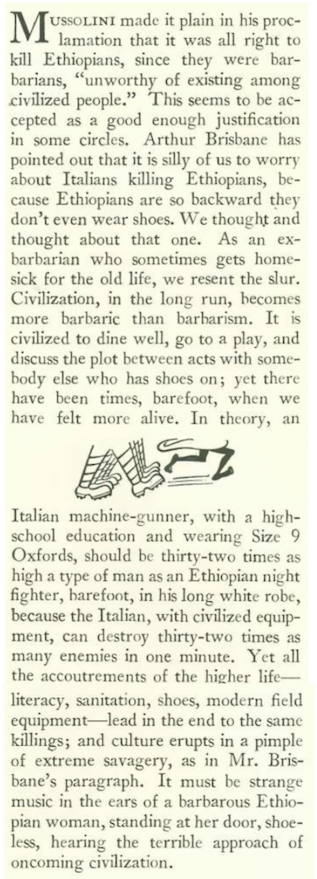
In his “Notes and Comment,” E.B. White had some choice words for the murderous Italian dictator Benito Mussolini and for the newspaper columnist Arthur Brisbane, both unconcerned with the slaughter of “backward” Ethiopians by invading Italian forces:

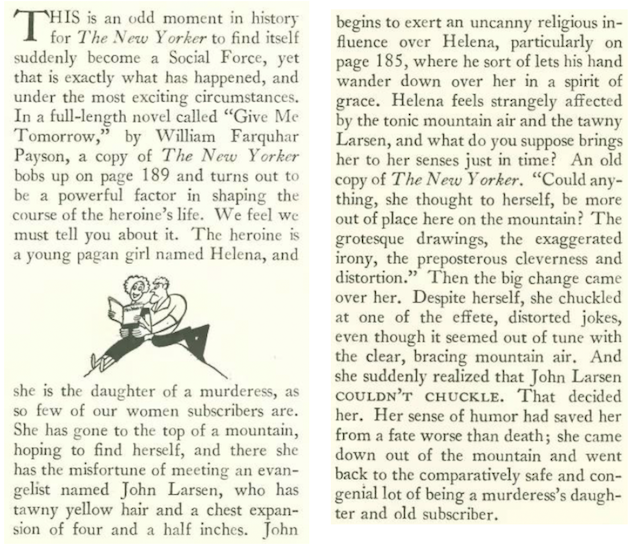
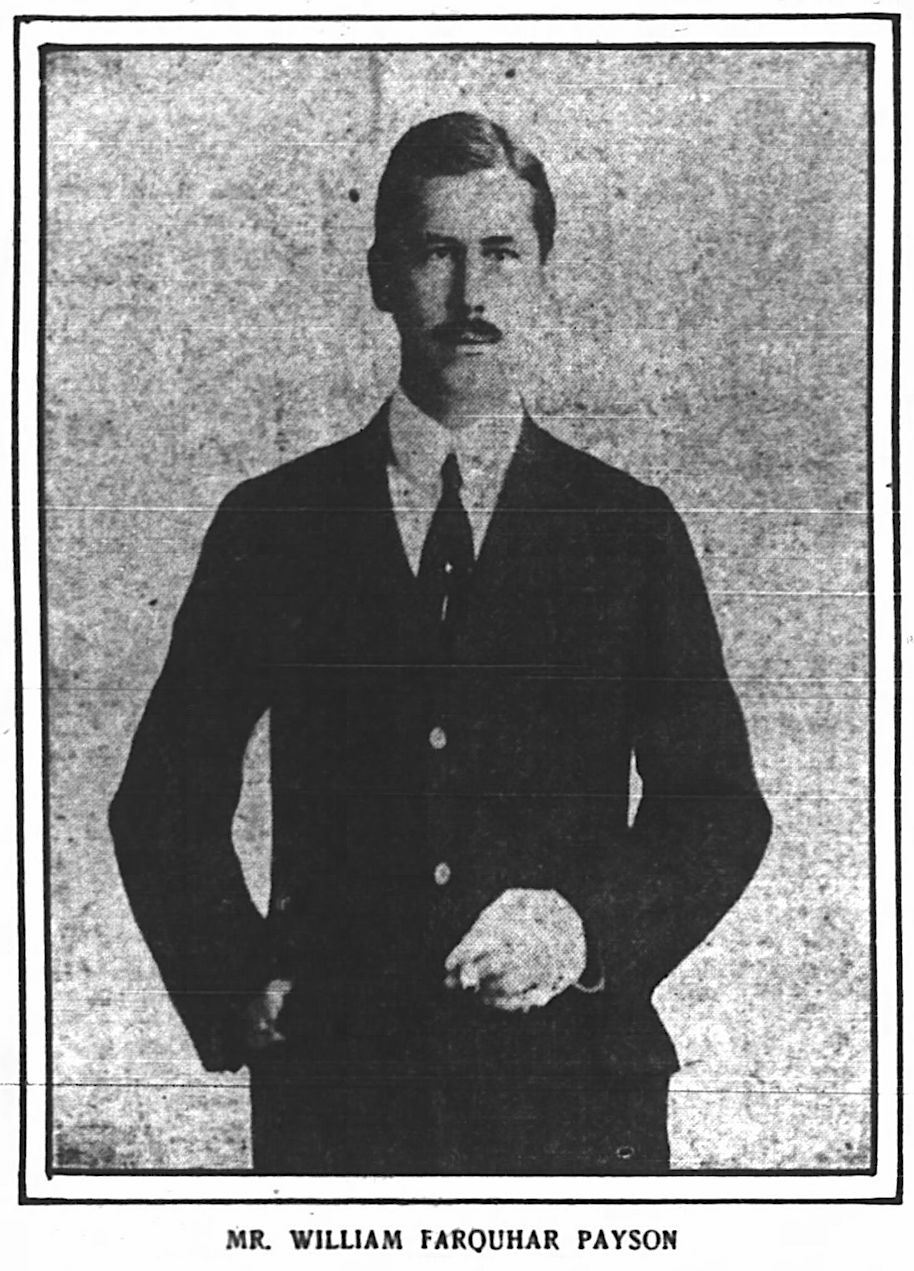
White also noted the role played by The New Yorker in a new novel by William Farquhar Payson (1876–1939) titled Give Me Tomorrow. Apparently the novel credited the magazine’s unique humor for revealing the banality of an evangelist and delivering a young woman from his clutches…

THE NEW YORKER TO THE RESCUE…William Farquhar Payson deployed a copy of the magazine for a pivotal scene in his novel Give Me Tomorrow. (findagrave.com)

 * * *

A Star Is Born

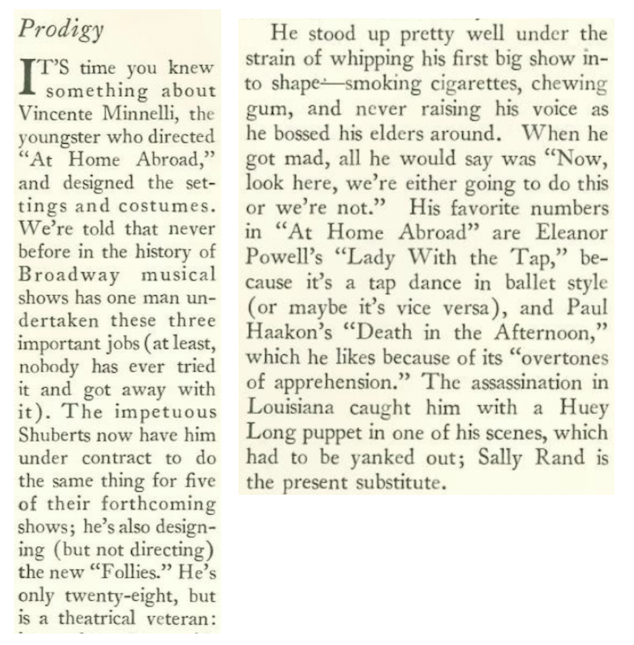
Stage and film director Vincente Minnelli (1903-1986) moved from Chicago to New York in 1931, where he worked as a stage designer for Earl Carroll’s Vanities and costume and set designer for the Ziegfeld Follies before becoming art director at Radio City Music Hall. He got his big break in 1935 when he directed, to critical acclaim, the Broadway musical At Home Abroad. “The Talk of Town” took notice of the rising star (excerpts):

AN EYE FOR DESIGN…Photographer Lusha Nelson photographed Vincente Minnelli at his desk with a miniature stage on Feb. 1, 1936. (James Grissom via threads.com)

 * * *

A Safe Space

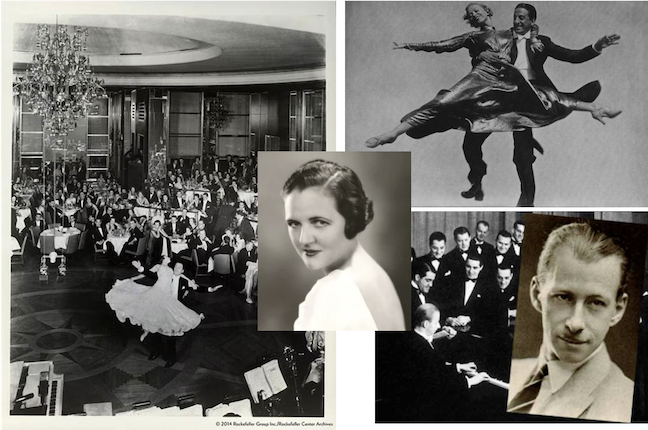
Lois Long had mixed feelings regarding the Rockefeller Center’s Rainbow Room, fearing that it was a tourist magnet but also desiring to take in its sumptuous floor shows. In the first excerpt, Long continued her comment on the heated competition she perceived among nightclub owners.

FEAR FACTOR…The entertainment lineup at Rockefeller Center’s Rainbow Room helped Lois Long overcome her fear of encountering tourists. Clockwise, from left, the Rainbow Room in 1934; Ramon and Renita lit up the dance floor (photo from Nov. 1935 Harper’s Bazaar); Ray Noble and his orchestra provided “all-around beauty”; and (inset) cabaret singer Frances Maddox offered her sophisticated warble to the glittering affair. (Rockefeller Center Archives/Pinterest/Shedd Institute)

 * * *

An Untamed Shrew

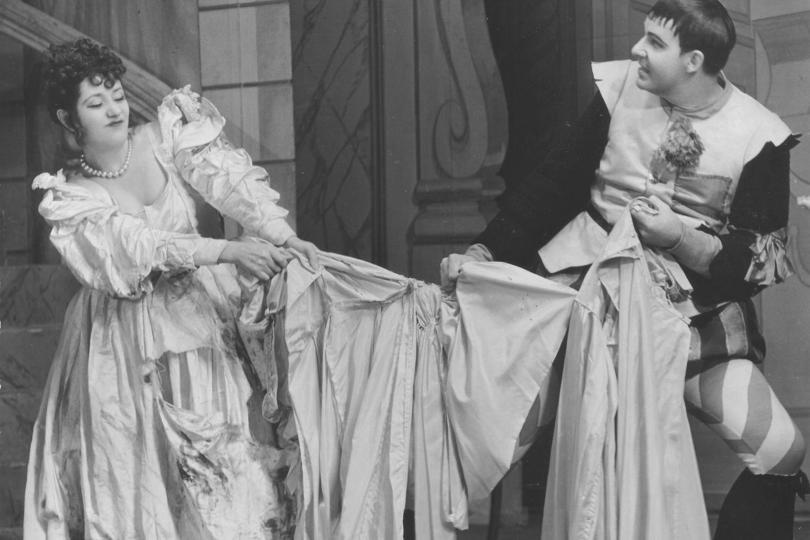
Theatre critic Wolcott Gibbs had a good time watching Alfred Lunt and Lynn Fontanne take on Shakespeare’s The Taming of the Shrew at the Guild Theatre, especially Lunt’s uproarious take on the play.

FUN WITH SHAKESPEARE…Alfred Lunt and Lynn Fontanne matched wits in the Theatre Guild’s presentation of The Taming of the Shrew. (minnesotaplaylist.com)

 * * *

At the Movies

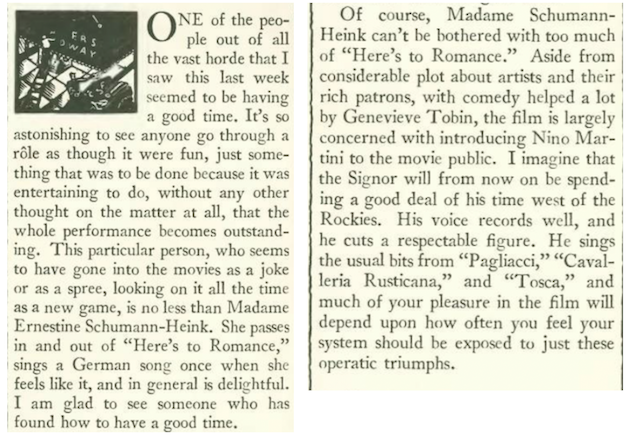
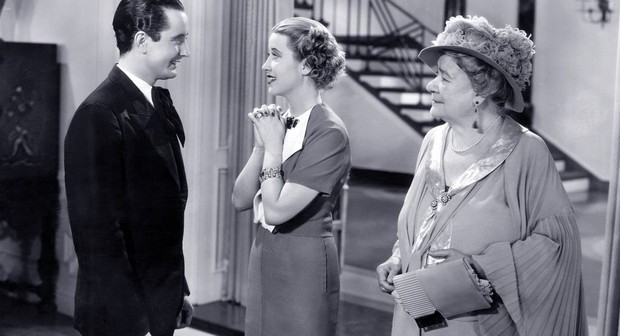
Our film critic John Mosher didn’t have much to say about Here’s To Romance, which seemed contrived to introduce the Italian tenor Nino Martini (1905–1976) to a wider audience. To Mosher, the highlight of the film was the appearance of Ernestine Schumann-Heink (1861–1936), the Austrian-American operatic dramatic contralto, who appeared to be having a good time.

SINGER SANDWICH…Genevieve Tobin (center) stands between tenor Nino Martini and dramatic contralto Ernestine Schumann-Heink in a scene from Here’s to Romance. (rottentomatoes.com)

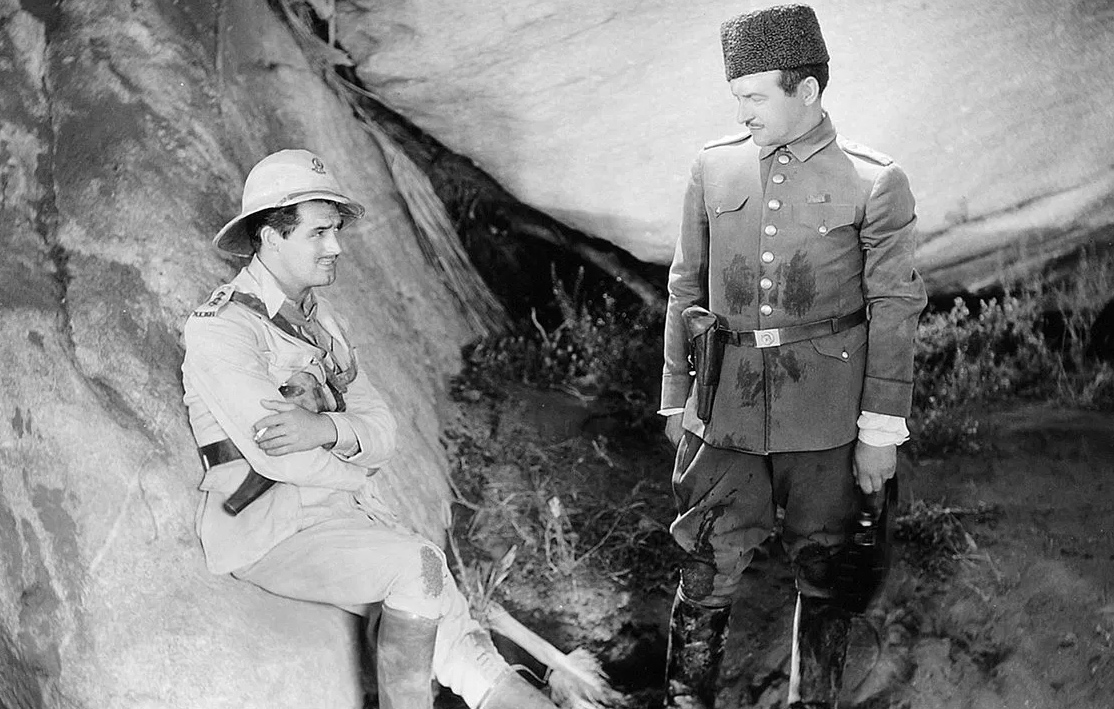
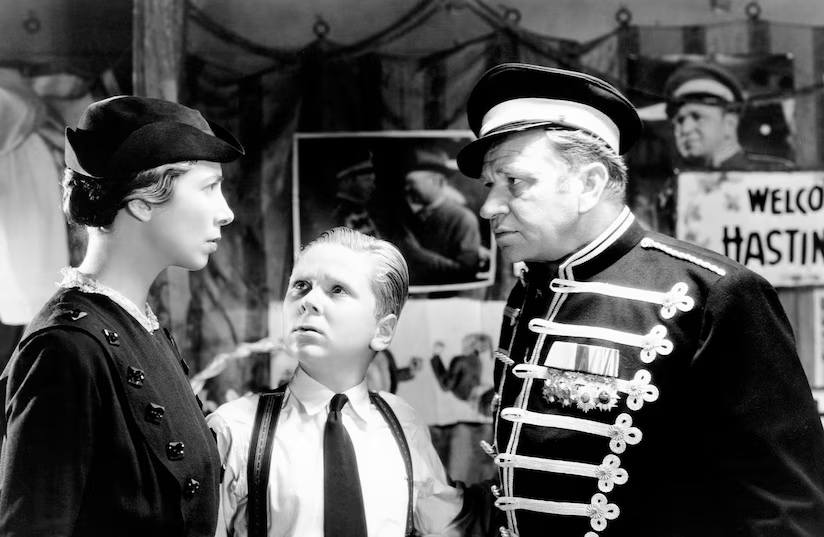
Mosher reviewed two other films that were a bit more dismal: The Last Outpost was a war-themed melodrama starring Cary Grant and Claude Rains; O’Shaughnessy’s Boy featured Wallace Beery as a circus animal trainer who loses his arm as well as his family.

DUELING MUSTACHES…Cary Grant (left) sported a rare mustache in a role opposite Claude Rains in The Last Outpost. (mabumbe.com)
A TOUGH ACT…Sara Haden played a skeptical aunt who sees a one-armed circus animal tamer (Wallace Beery) regain his son (Jackie Cooper) and the confidence he lost along with his wife in O’Shaughnessy’s Boy. (tcm.com)

 * * *

From Our Advertisers

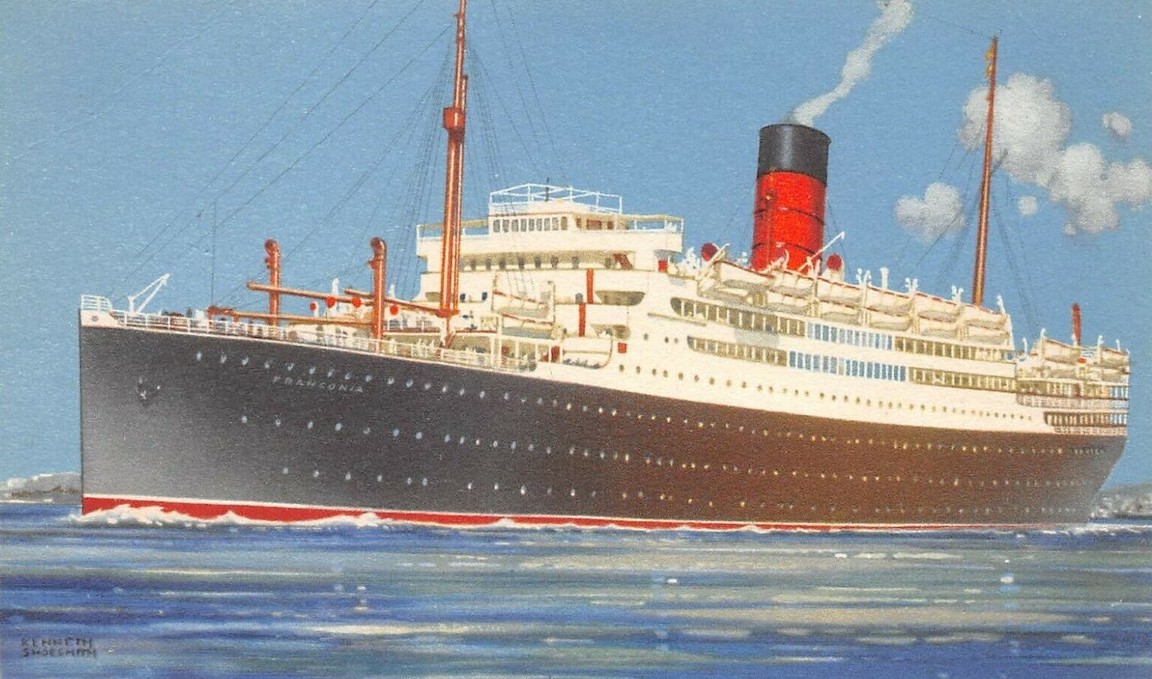
I find these advertisements oddly appealing, because this kind of travel no longer exists. Today there is exactly one ocean liner left in the world—the Queen Mary 2; the cruise ships that rule the 21st century seas are essentially hotel/amusement parks stacked on top of a huge barges…water slides, Vegas-style entertainments, and all-you-can-stuff-into-your-face buffets…

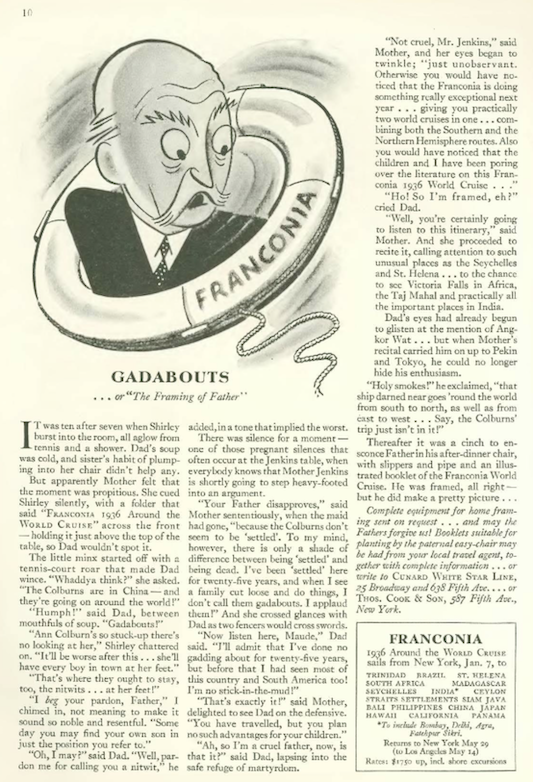
…this curious ad on page 10 mimicked the look of a New Yorker short in the vein of Clarence Day…what it promoted was an around-the-world cruise that would take two-hundred (well-heeled) passengers to more than twenty destinations including Malaysia, Bali and Singapore…

Postcard image of the Franconia. (Pinterest)

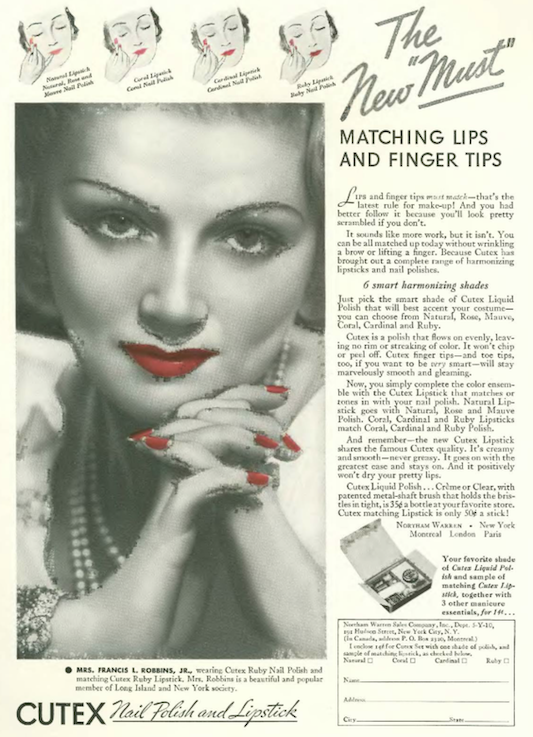
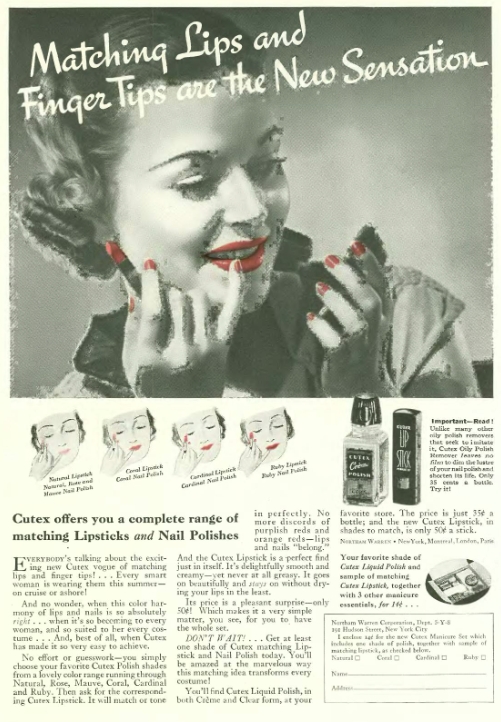
…society women could be counted on to endorse all sorts of things from cigarettes to cold cream…here a “Mrs. Francis L. Robbins, Jr” (I couldn’t find her given name) endorses Cutex nail polish and lipstick…the ad noted that Mrs. Robbins “is a beautiful and popular member of Long Island and New York society”…

…the makers of Spud menthol cigarettes entered the realm of the surreal with a talking cigarette that encouraged chain smoking…

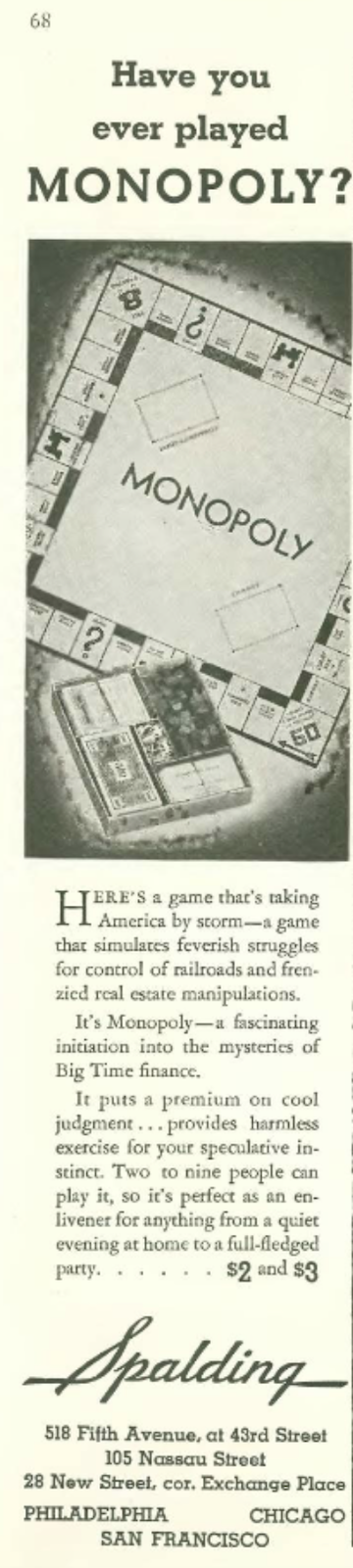
…the board game Monopoly had its origins in The Landlord’s Game, created in 1903 by an anti-monopolist named Lizzie Magie…over the years variants of the game were introduced until Parker Brothers bought the rights from Magie and another inventor and began mass-marketing the game in the fall of 1935…

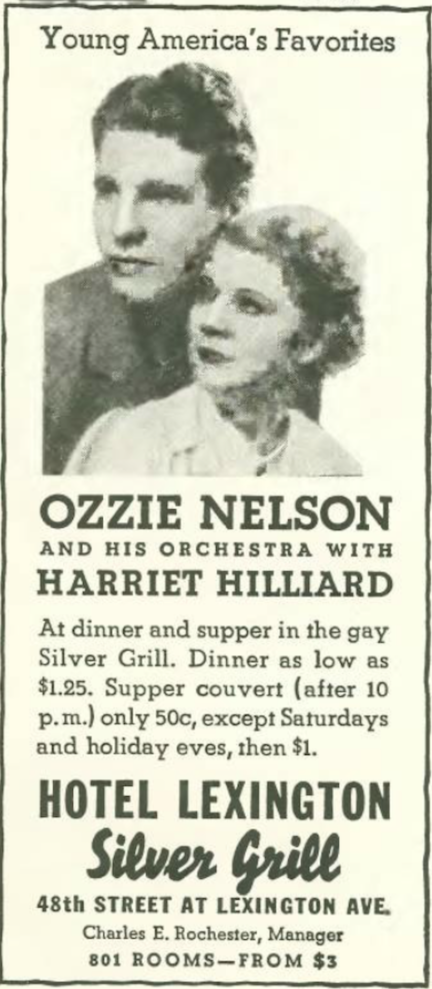
Peggy Lou Snyder was performing in vaudeville when she met the saxophone-playing bandleader Ozzie Nelson in 1932. Nelson hired her to sing with his band (under the name Harriet Hilliard) and then married her three years later…in 1944 the couple would launch a comedy series for radio, The Adventures of Ozzie and Harriet, which made a successful transition to television, appearing on ABC from 1952 to 1966…

…here we have some old-timers offering hunting advice and promoting octane-boosting Ethyl gasoline, which helped prevent engine knock…it also contained the highly toxic additive tetraethyllead, which could cause severe neurological damage, particularly in children…it was completely banned in the U.S. by 1996…

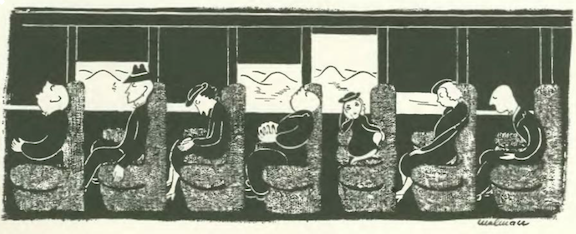
…on to our cartoonists, we start with this delightful spot art by Christina Malman that graced the bottom of the calendar and events page…

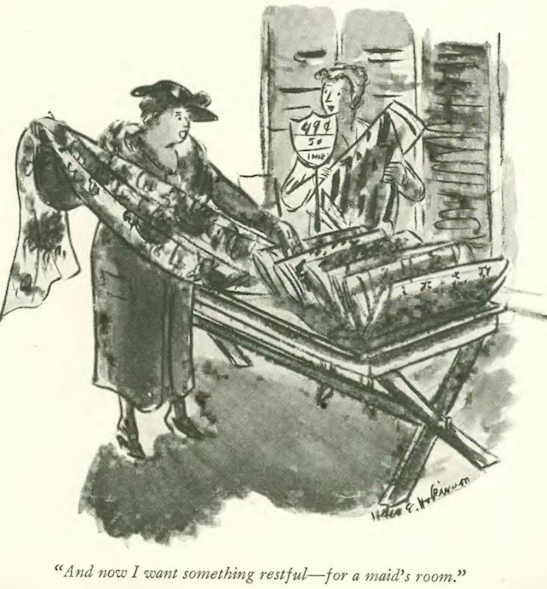
Helen Hokinson appeared twice, first at the vet’s…

…and later shopping for the maid at a department store…

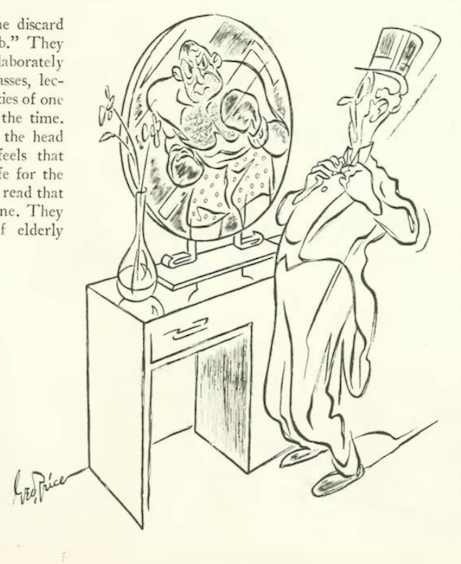
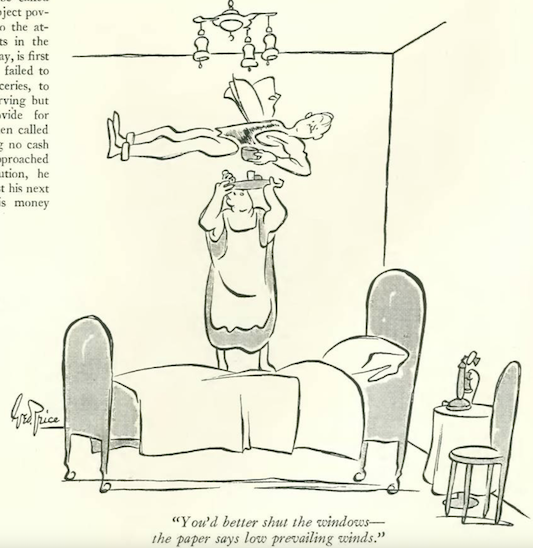
George Price had a surprise in store for this mirror-gazer…

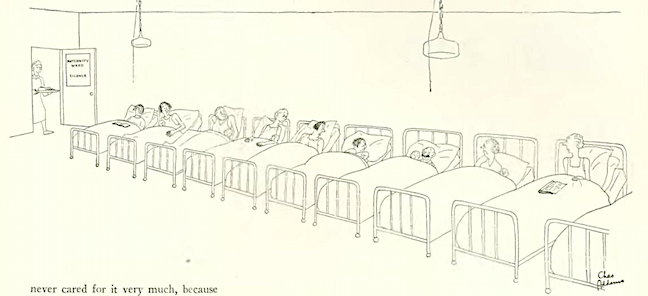
…Charles Addams took the top of page 29 to show us a proud papa in a maternity ward…

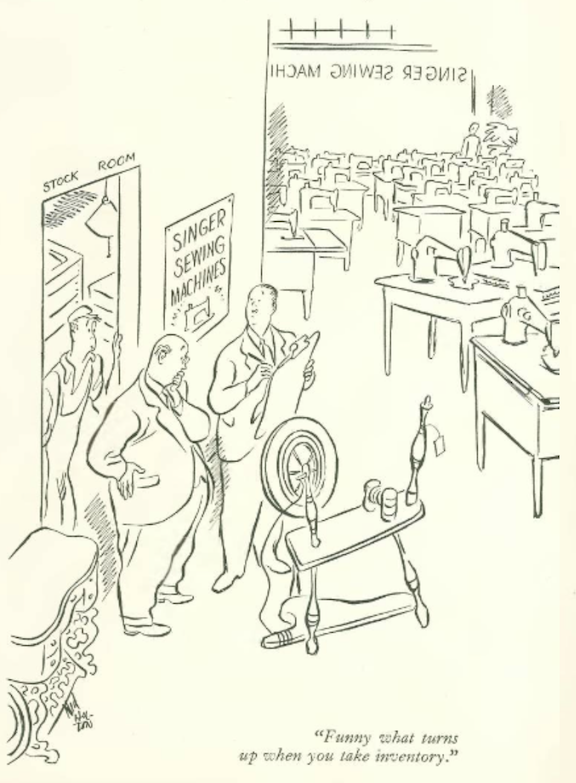
…Ned Hilton uncovered some history at the Singer Building…

…Mary Petty eavesdropped on a tactless toff…

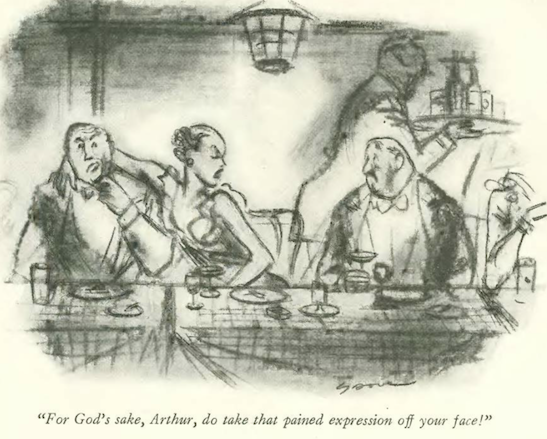
…Leonard Dove showed us that being a sugar daddy wasn’t so sweet…

…and we close with William Steig, one of his “Small Fry” speaking up for the old man…

Next Time: On Catfish Row…


Hays Hokum

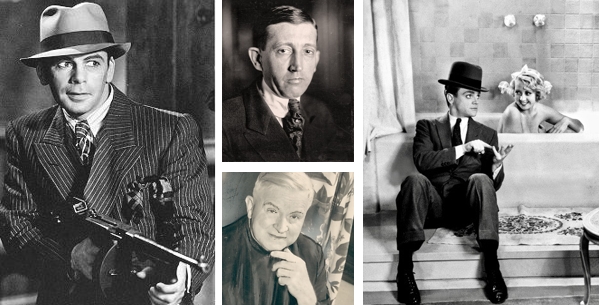
Above: Will Hays (center, top) was the enforcer and Fr. Daniel A. Lord was the author of the Production Code that was rigidly enforced beginning in 1934. They and others were responding to the sex, violence and other forms of "immorality" in such films as 1932's "Scarface" (with Paul Muni, pictured at left) and 1931's "Blonde Crazy" with James Cagney and Joan Blondell. (Wikipedia/cinemasojourns.com)

With the Production Code fully enforced, New Yorker film critic John Mosher found even less to get excited about during his visits to Manhattan’s cinemas.

August 17, 1935 cover by Julian de Miskey. He contributed 62 covers to the magazine, as well as 82 cartoons from 1925 to 1962.

The Motion Picture Production Code—a set of industry guidelines for the self-censorship of content—had been around for awhile, but it was mostly ignored until June 13, 1934, when an amendment to the Code required all films released  to obtain a certificate of approval. Hoping to avoid government censorship and preferring self-regulation, studios adopted the Code.

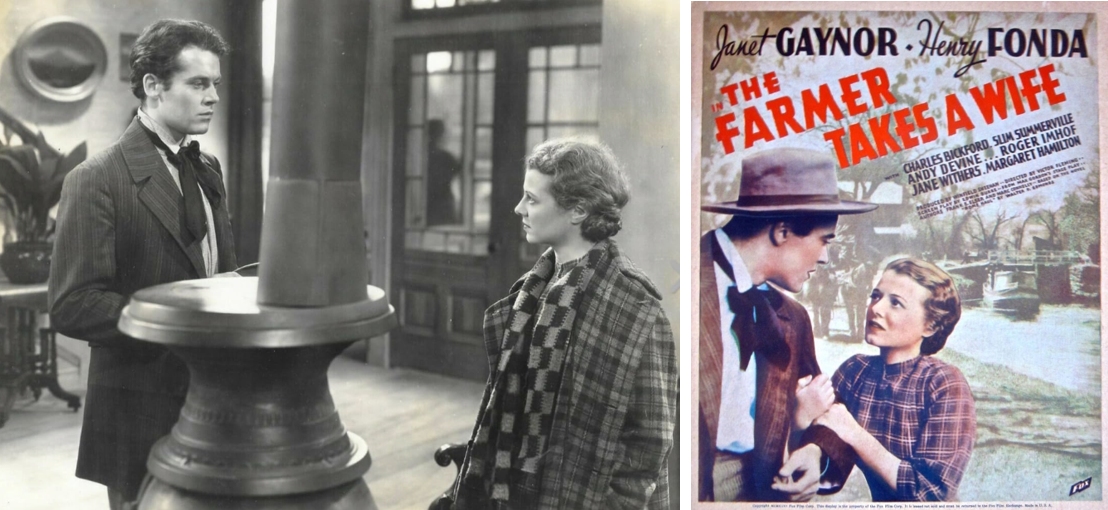
The Code’s effects were felt in such films as The Farmer Takes a Wife, a romantic comedy about a Erie Canal boatman, portrayed by Henry Fonda, who dreams of becoming a farmer (a role reprised by Fonda from the Broadway production of the same name; it was Fonda’s first break in films). Mosher was pleased by Fonda’s performance, but found the film adaptation to be corny and phony, filled with “bastard” dialect and schmaltzy musical numbers. “It is the sort of thing which is okayed by Purity Leagues…” Mosher concluded.

SILVER SCREEN DEBUT…Boatman Dan Harrow (Henry Fonda) woos barge cook Molly Larkins (Janet Gaynor) in a scene from A Farmer Takes a Wife. While it was Fonda’s film debut, Gaynor was an established star known for playing sweet, wholesome characters. One of the few actresses who made a successful transition to sound movies in the late 1920s, Gaynor was the number-one draw at the box office in 1935. (IMDB)
STILL KEEPING IT CLEAN…The Code was still in force when The Farmer Takes a Wife was remade in 1953; however, nineteen years after the Code took effect there was a notable easing of restrictions, as can be seen in the generous display of Betty Grable’s famous gams (seen here with Thelma Ritter). (IMDB/Wikipedia)

To get a clearer idea of what the Code did to the pictures, compare the scene from 1934’s Tarzan and His Mate (left), which was released two months before the Code went into effect, and Tarzan Escapes (right), from 1936.

CLOTHED IN THE CODE…Johnny Weissmuller and Maureen O’Sullivan appeared together in six Tarzan films. In their second outing, 1934’s Tarzan and His Mate, O’Sullivan wore a skimpy halter-top and loincloth (left) and was shown sleeping and swimming in the nude. In their next film, 1936’s Tarzan Escapes (right); Jane is more chastely clad. (mikestakeonthemovies.com/rottentomatoes.com)

 * * *

Noted and Notorious

In his weekly column “Of All Things,” Howard Brubaker offered wry observations on the passing scene, including this latest brief that described the rise and fall of a very unlikely quartet of celebrities.

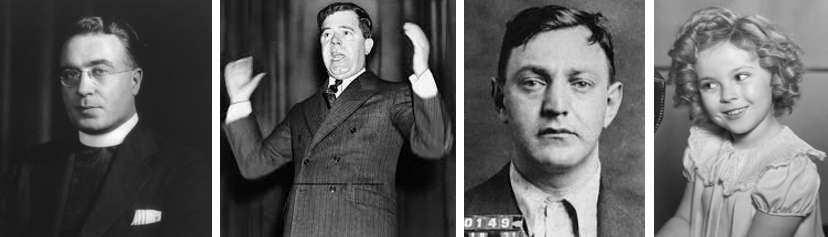
DEMOGOGUES, DUTCH & DIMPLES…(Left to right) Support appeared to be on the wane for radio priest and demagogue Father Charles Coughlin and fellow-fascist Louisiana Sen. Huey Long, while stock was on the rise for mobster Dutch Schultz, who successfully swayed public opinion (while under indictment for tax evasion) by generously donating to various charities. Shirley Temple continued to charm audiences, her films ranking number-one at the box office in 1935 (as well as in 1936, 1937, and 1938). The year 1935 would also be the last for Long and Schultz–both would be assassinated. (Wikipedia)

 * * *

Titlemania

Lacking the strictures of Old World caste systems, Americans have had an anxious relationship with class signifiers. In a land where trade schools become universities overnight and their faculty members refer to one another as “doctor,” there is much confusion and hand-wringing in the honorifics trade. H.L. Mencken examined the proliferation of titles in his country, freely handed out without regard to merit. Excerpts:

 * * *

From Our Advertisers

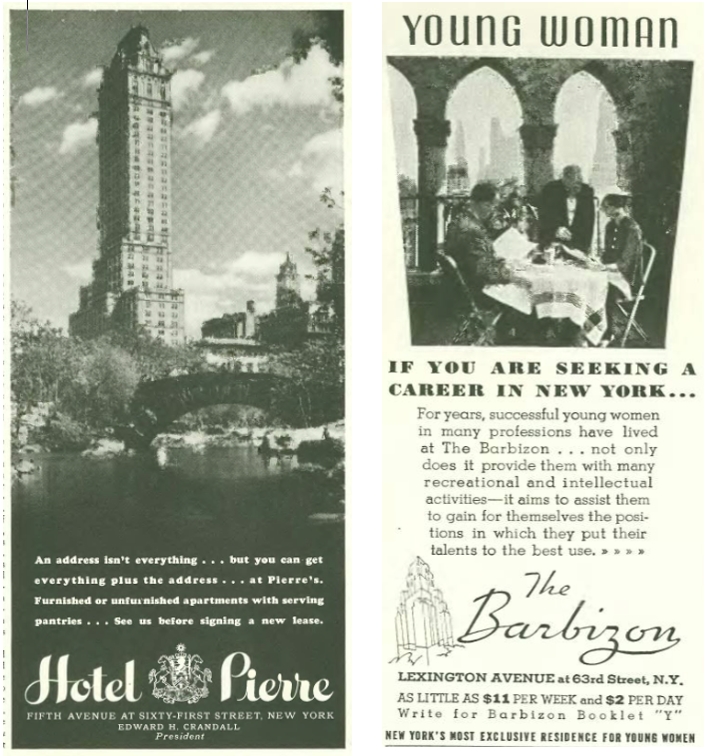
The back of the book was where one could find advertisements for upscale urban living, including these two touting the advantages of the Hotel Pierre and The Barbizon…

…In a joint venture with a group of Wall Street financiers, the former busboy-turned restauranteur Charles Pierre opened the Hotel Pierre in 1930—not the most auspicious time to open a luxury hotel as markets continued to collapse…the Pierre went into bankruptcy in 1932 and was later purchased by oilman J. Paul Getty…the legendary Barbizon Hotel for Women, completed in 1927, was designed as a safe and respectable haven for women seeking to pursue careers in New York, especially in the arts, and would host numerous famous women through the 1970s…

At left, the Barbizon in 1927; right, the Hotel Pierre circa 1930. (loc.gov)

…like the tobacco companies, brewers targeted women as a growth market for a product mostly associated with men…

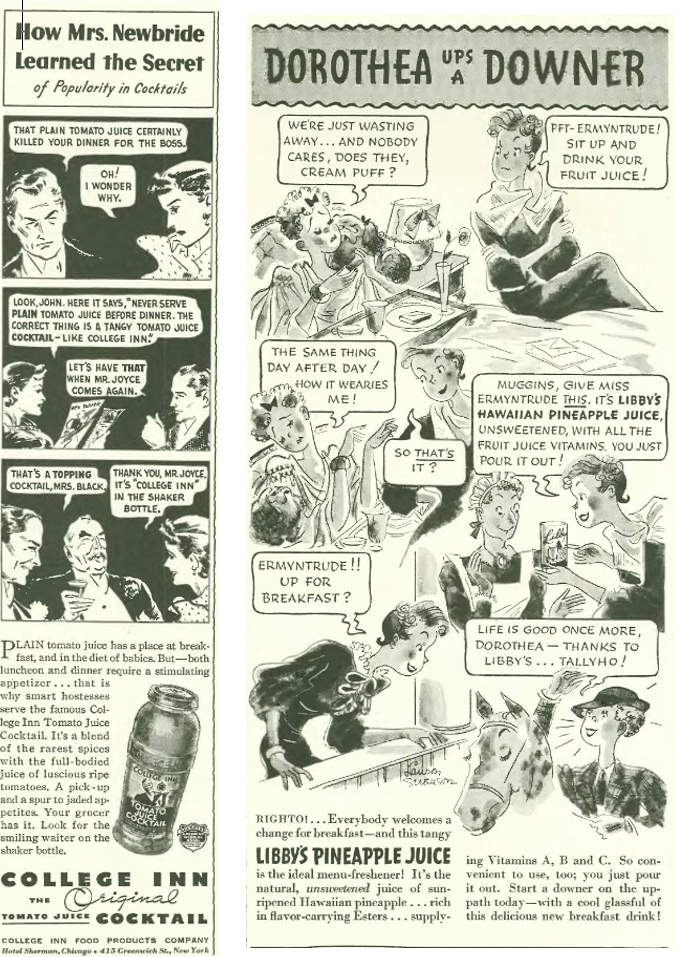
…the makers of juices, meanwhile, created comic strips to promote their products…College Inn still went negative with their ads—recall the violent outbursts of the Duchess…

…here a spiteful husband blames his wife’s choice of tomato juice for his lack of success with the boss…Libby’s, on the other hand, promoted their pineapple juice as a surefire cure for a young woman’s ennui…

…notable in these somewhat thin, late summer issues is the lack of full-color ads…this was on the back inside cover…

…Flit and Dr. Seuss continued to be a weekly presence…

…which brings us to our cartoonists, and a spot drawing by Constantin Alajalov

…also a modest spot by Robert Day, keeping us cool with this polar bear…

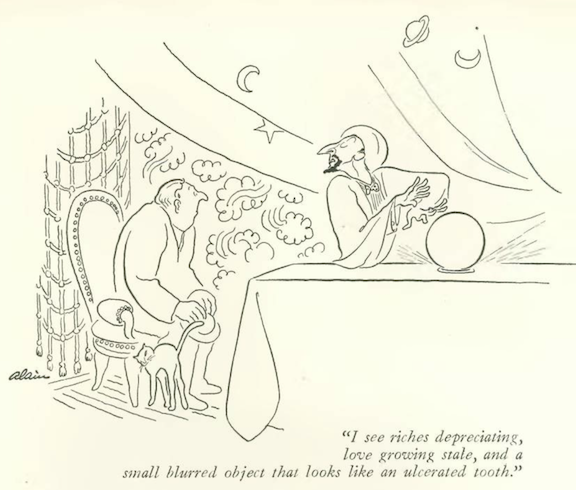
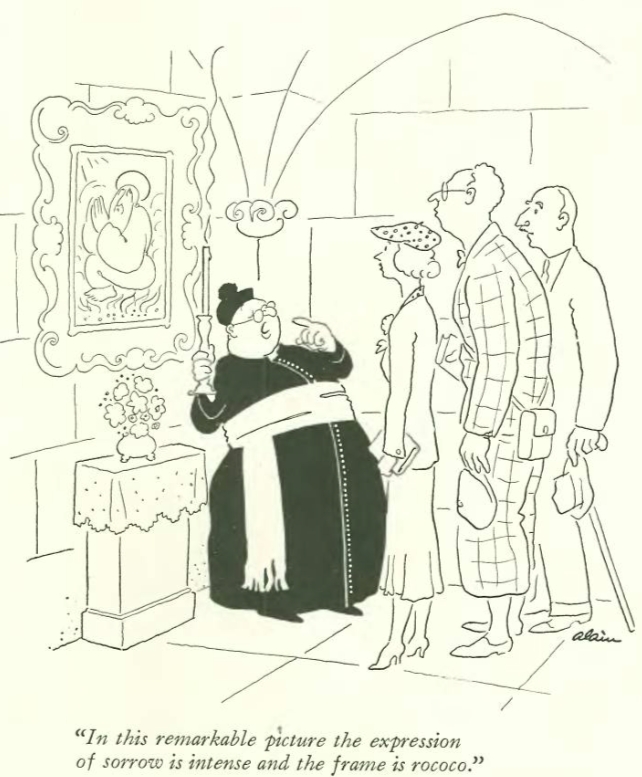
Alain offered a short course in art appreciation…

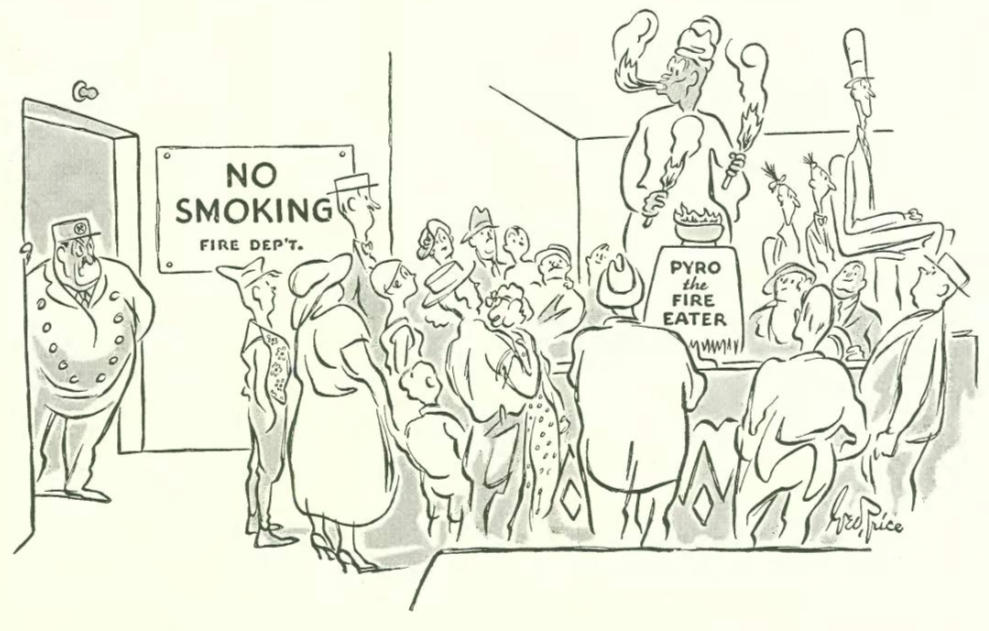
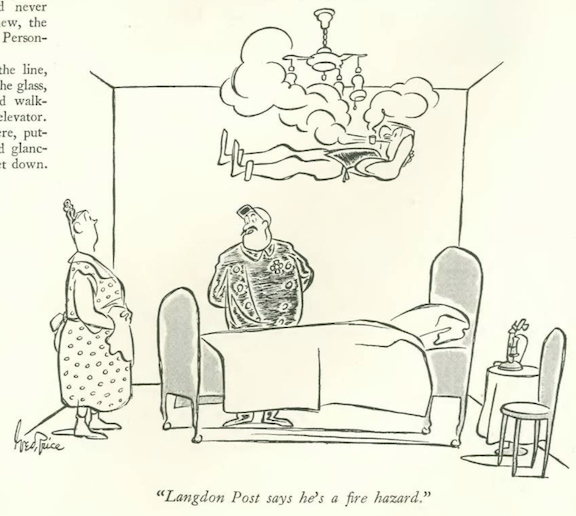
George Price ran afoul of the fire code…

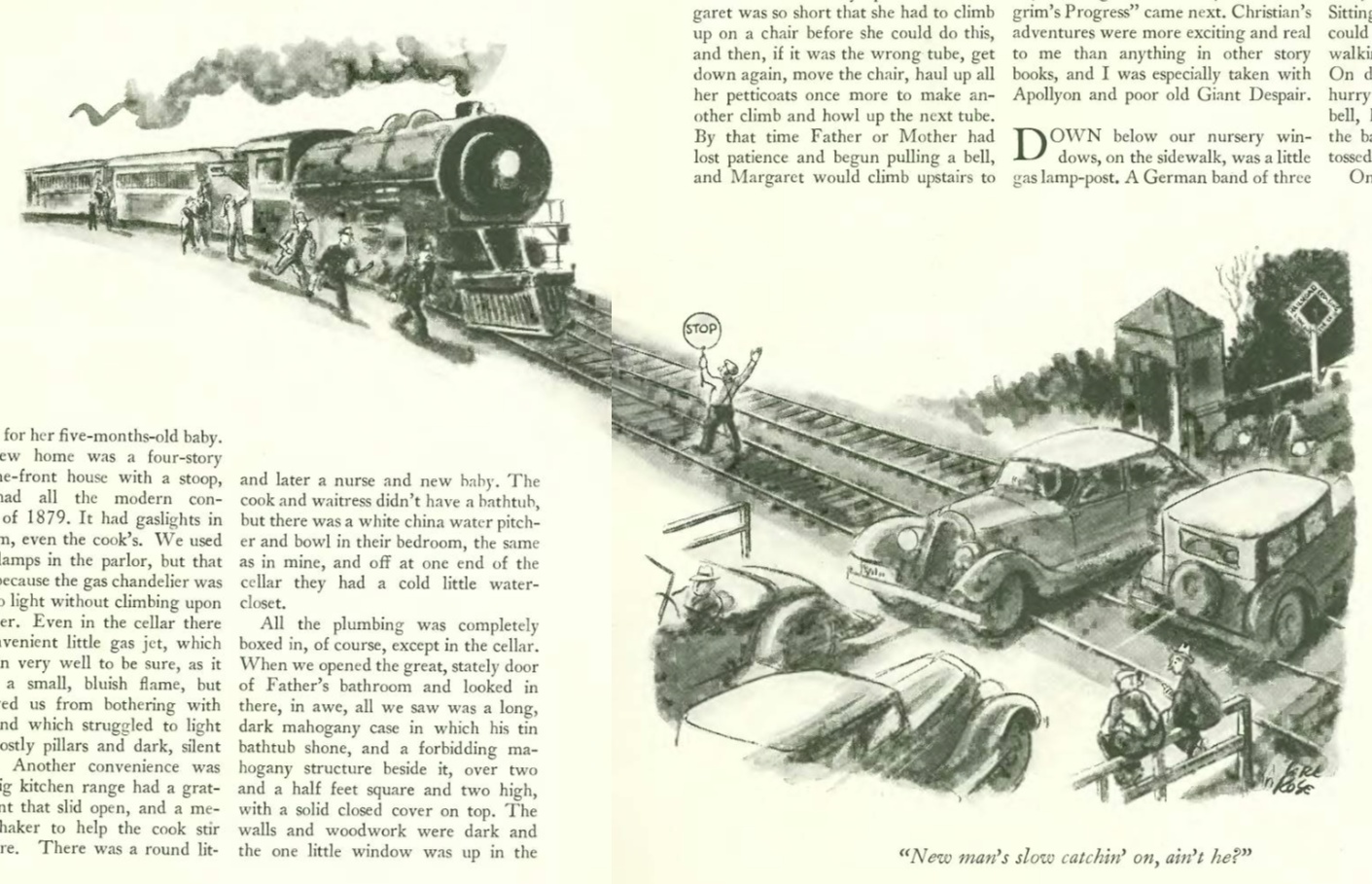
Carl Rose ran his tracks across this two-page spread…

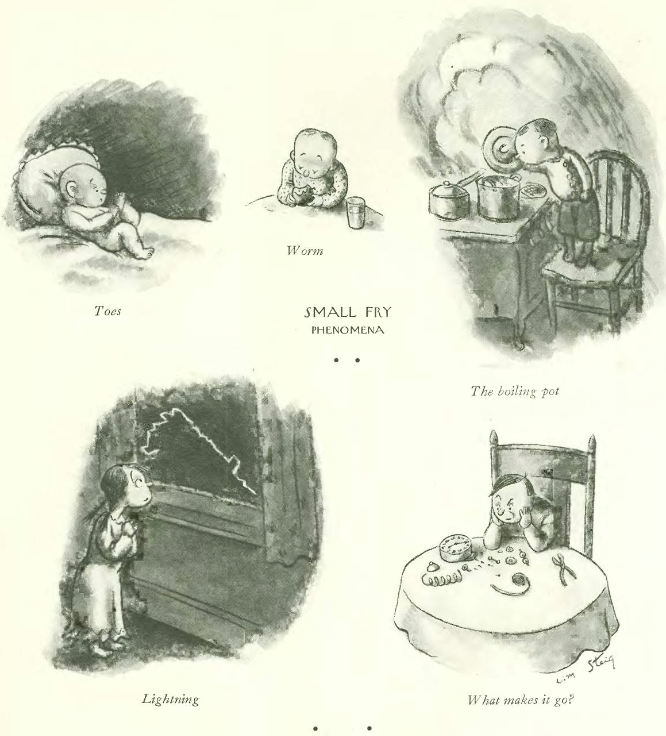
William Steig gave us the small fry’s perspective on the world’s wonders…

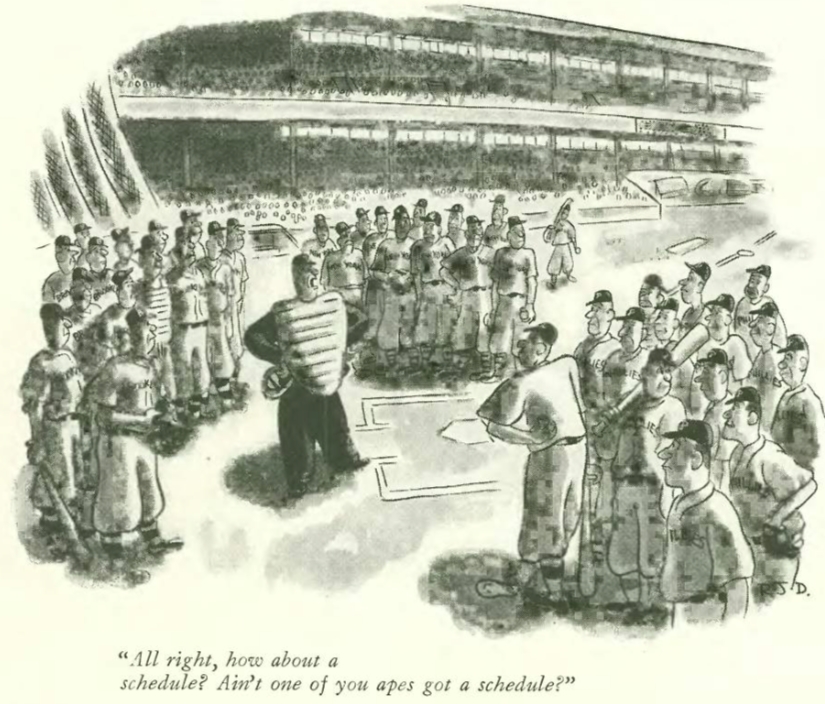
…a rare appearance of baseball in the magazine, thanks to Robert Day...

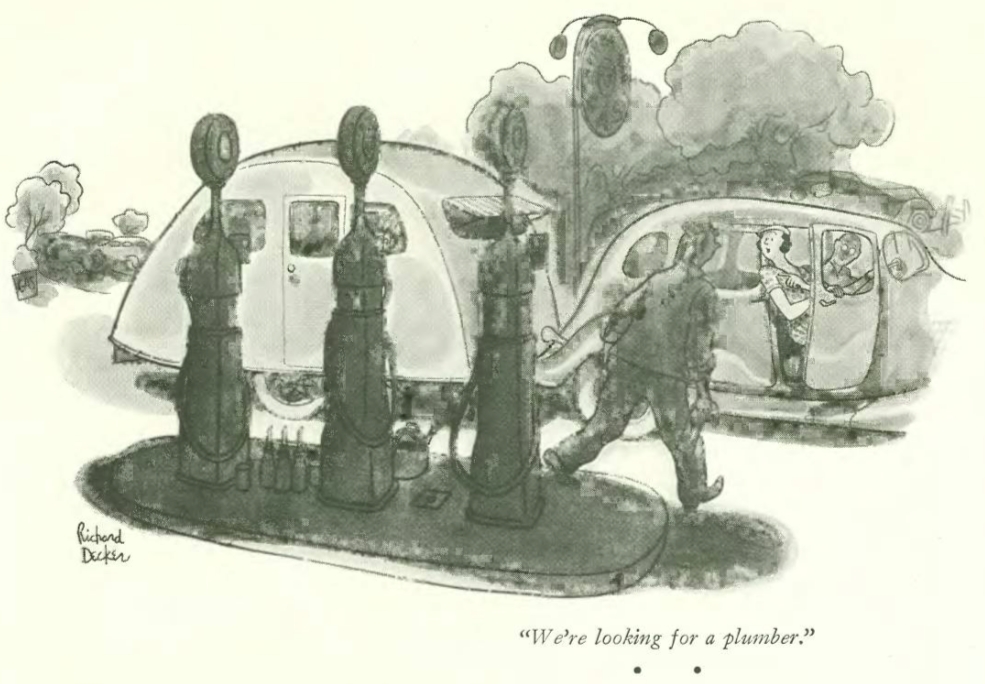
Richard Decker brought a modern world challenge to one filling station…

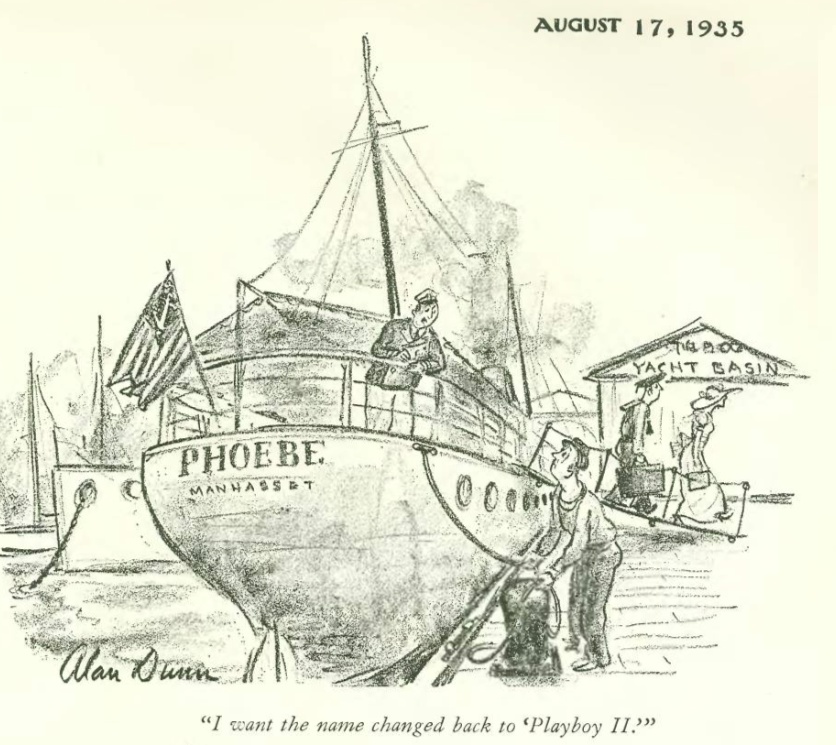
…A sailor’s return to bachelorhood required a new paint job, per Alan Dunn

…and who else but Charles Addams would circle vultures over an amusement park?…

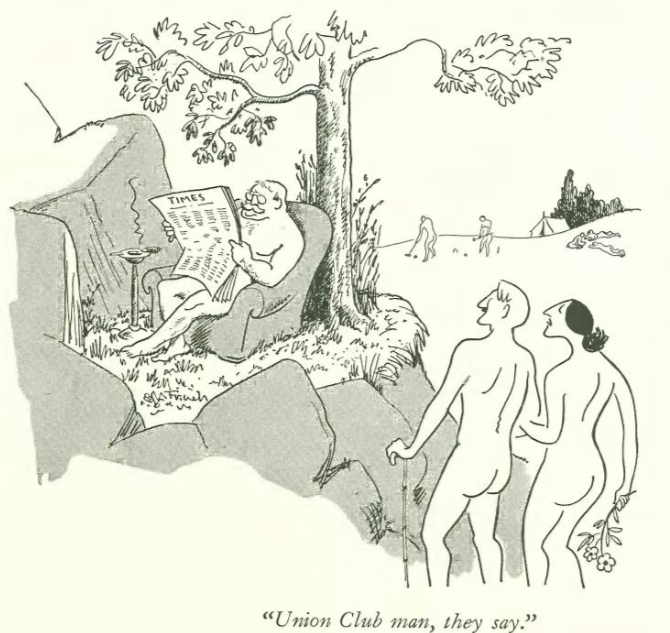
…and we close with Al Frueh, and a Union Club member not concerned with a dress code…

Next Time: The Din and Bustle…


She Who Must Be Obeyed

The 1935 film She was one of those old movies you’d see on television during the 1970s when there were only three or four channels (plus UHF) and local stations would tap into the “B” movie vault to fill airtime. One of those films was She.

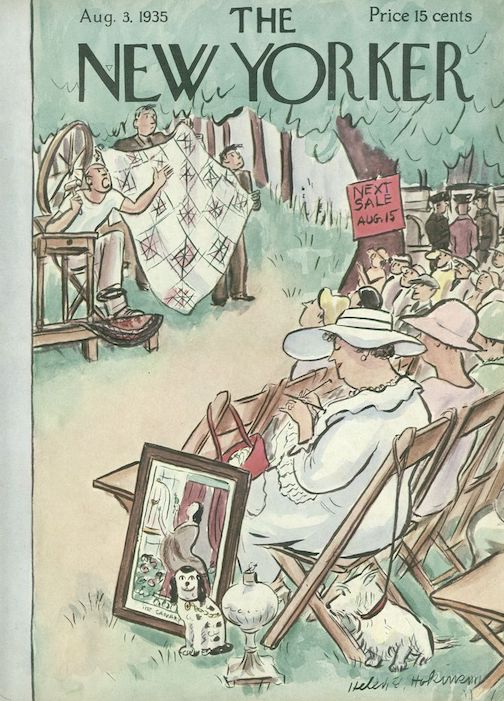
August 3, 1935 cover by Helen Hokinson.

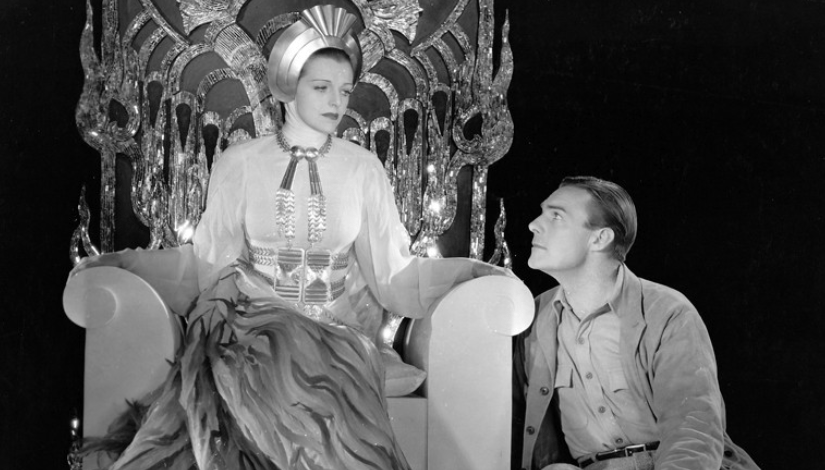
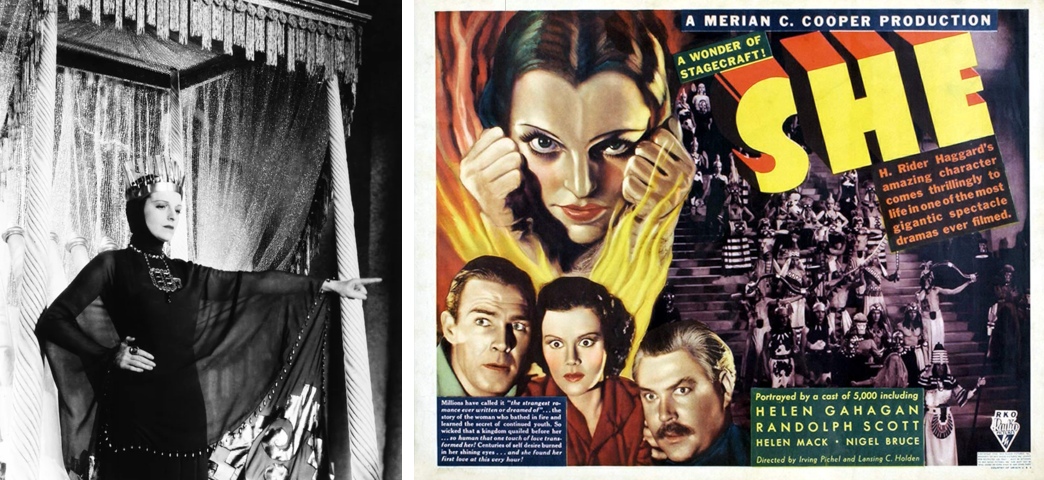
Film critic John Mosher felt a bit sorry for Helen Gahagan, who portrayed “She Who Must Be Obeyed” (aka “She”)—an immortal who ruled an exotic, lost civilization near the Arctic Circle. The challenge for Gahagan was to seem imperious before her co-stars Randolph Scott and Helen Mack, who seemed more suited to the high school hijinks of an Andy Hardy picture. The film was a pretty standard adventure tale, in the mold of producer Marian C. Cooper’s 1933 King Kong, with two explorers falling in love during a perilous journey.

ARCHETYPE…At left, Helen Gahagan as “She” (Who Must Be Obeyed). Her costume possibly inspired the Evil Queen in Disney’s 1937 animated Snow White and the Seven Dwarfs. At right, lobby card that promoted the film. (Scifist.net/Reddit)
WHEN YOU PLAY WITH FIRE…She Who Must Be Obeyed (Helen Gahagan), believing that the explorer Leo Vincey (Randolph Scott) was a reincarnation of his ancestor (whom she loved), and jealous of his girlfriend Tanya (Helen Mack), invites Leo to join her in the eternal flame. Unfortunately, her re-entry into the flame that gave her immortality turned her into a dying, withered crone. (The Nitrate Diva/Scifist.net)

The 1887 H. Rider Haggard novel, She, inspired eponymous silent films in 1908, 1911, 1916, 1917, and 1925. The 1935 film reviewed here received tepid reviews and lost money on its first release, however in a 1949 re-release it fared much better. She was re-made in 1965 with Ursula Andress in the lead role, and again in 1984 in a post-apocalyptic film that had virtually nothing to do with Haggard’s novel.

SHE THROUGH THE YEARS…Clockwise, from top left, “She” (Marguerite Snow) offers a dagger to Leo Vincey (James Cruze) in a 1911 two-reel (24 min.) adaptation; Valeska Suratt as “She” in the 1917 film (now lost); Betty Blythe took the title role in the 1925 production, considered to be the most faithful to the 1887 H. Rider Haggard novel; Sandahl Bergman appeared dressed for a Jazzercise video in the 1984 post-apocalyptic She; and finally, Ursula Andress and John Richardson in the 1965 CinemaScope production of She. (Wikipedia / digitalcollections.lib.washington.edu / cultcelebrities.com / Reddit)

 * * *

Colonial Ambitions

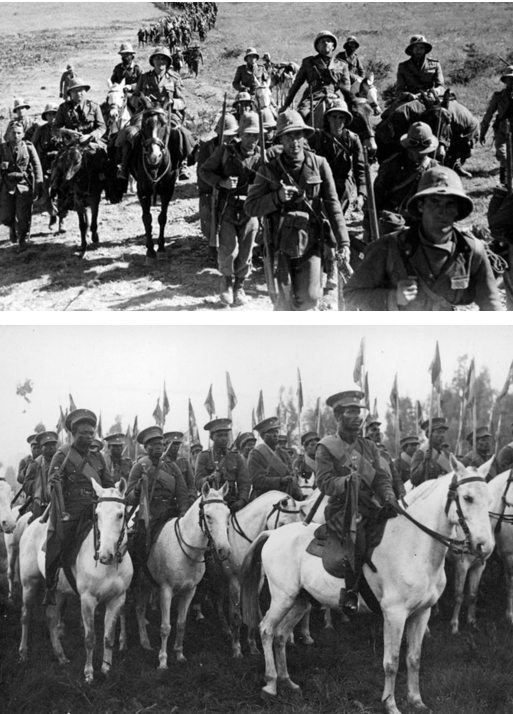
With most of Africa carved up by other European powers (Britain, France, Belgium etc.) in the 19th century, Italy set its sights on Ethiopia, which by the end of the 19th century was the only independent country left on the continent. Ethiopia fought off Italy’s first attempt at conquest in the Battle of Adwa (1896), but with the rise of fascist dictator Benito Mussolini, Italy paid a return visit, this time with heavy artillery and airstrikes that included chemical weapons. E.B. White tried to make sense of this latest invasion in his opening comments.

THOSE GUYS AGAIN…Italy invaded Ethiopia on October 3, 1935, a significant act of aggression in the lead up to World War II. Despite facing a technologically superior Italian army (top) equipped with modern weapons, including tanks, aircraft, and chemical weapons, the Ethiopian forces (bottom photo) mounted a strong resistance. (Wikipedia)

In his weekly column, Howard Brubaker mused on the Italian aggressions and other rumblings of the coming European war.

 * * *

Author, Author

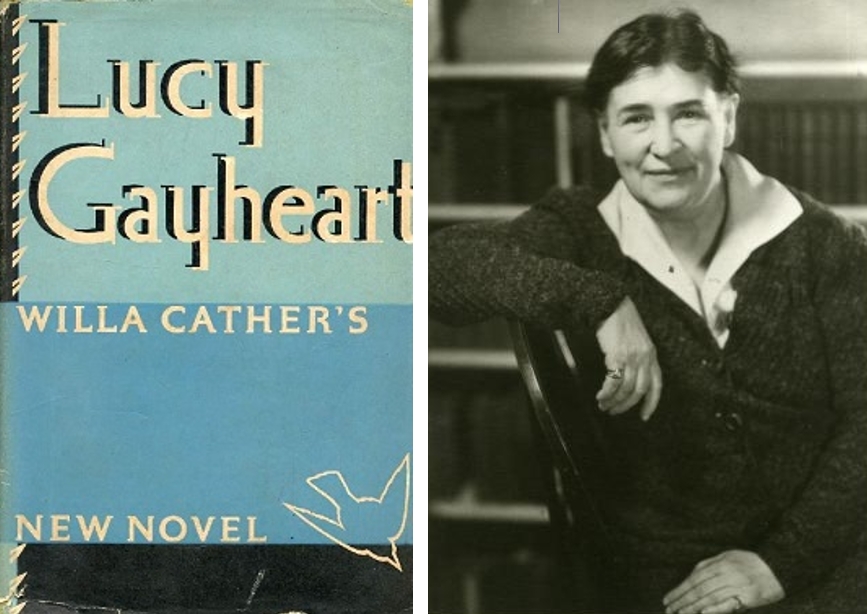
The writer Willa Cather was a favorite of New Yorker critics, including Clifton Fadiman, however her latest novel was a bit too mild for his tastes.

HERE’S LUCY…Clifton Fadiman confessed he was “mortified” to admit that he found Willa Cather’s latest novel a bit too gentle. At right, portrait of Cather on her birthday, December 7, 1936. (willacather.org)

 * * *

From Our Advertisers

We begin with more fearmongering from the folks at Goodyear, who offered weekly reminders of the perils of not choosing their all-weather tires…

…the Liggett and Myers Tobacco Company conjured up this “naughty maiden” to encourage even timid souls to take up the habit…

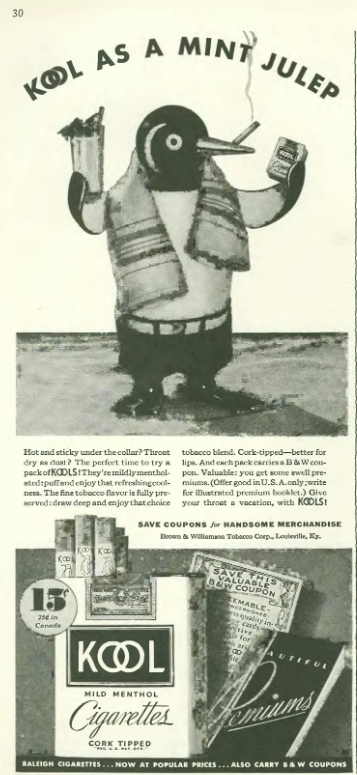
…on the other hand, the makers of the upstart KOOL brand kept it simple with their chain-smoking penguin, who was grabbing ever more market share from rival menthol pusher SPUD…

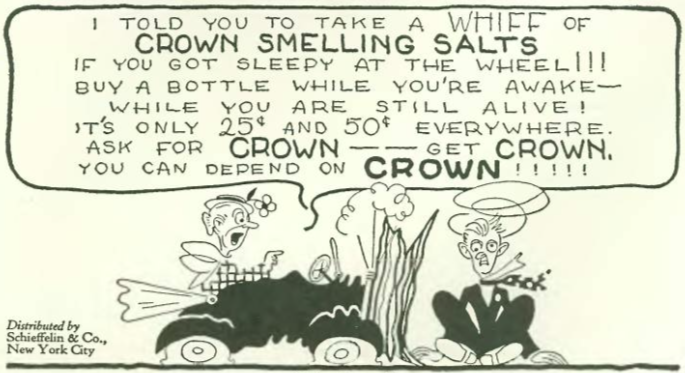
…ads in the back of the book offered up even less sophisticated products, such as Crown Smelling Salts…

…while Dr. Seuss and Norman Z. McLeod continued to make a living with their distinctive illustrations…

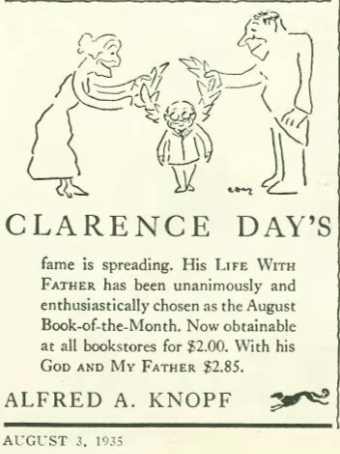
…at the very back of the magazine, this tiny ad from Knopf promoted Clarence Day’s Life With Father, published just months before Day’s death on Dec. 28…

…which brings us to our cartoonists…Constantin Alajalov kicked us off with this happy number…

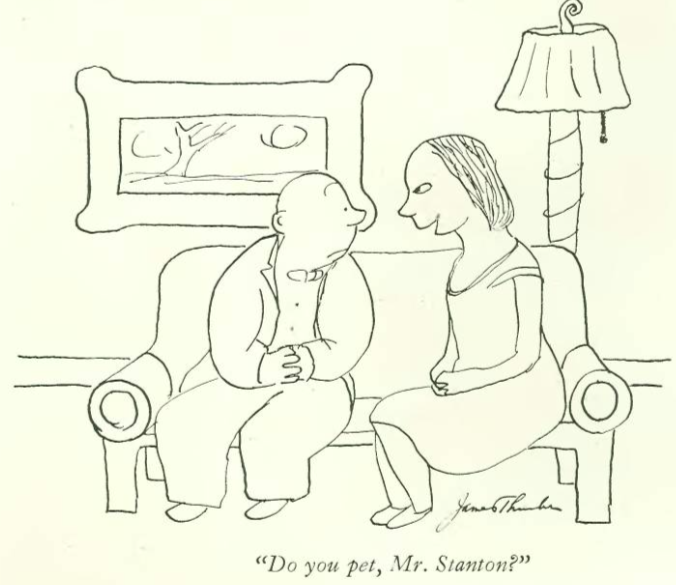
James Thurber found steamy goings on in the parlor…

Charles Addams came down to earth with this pair…

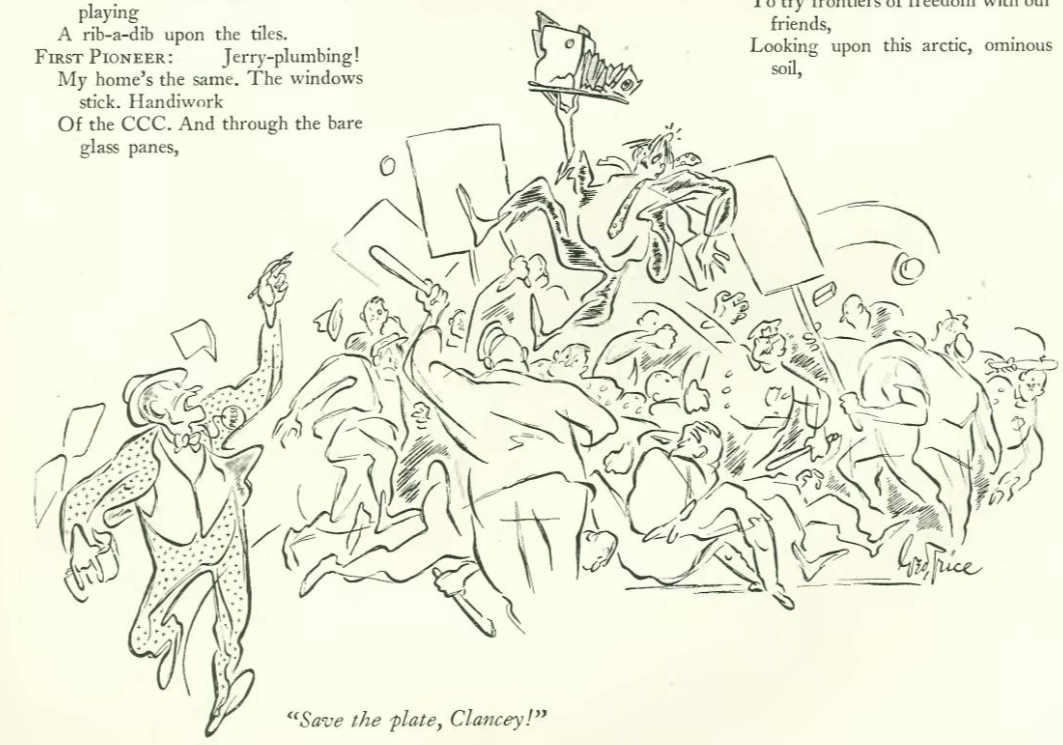
George Price showed us the rough and tumble of news reporting…

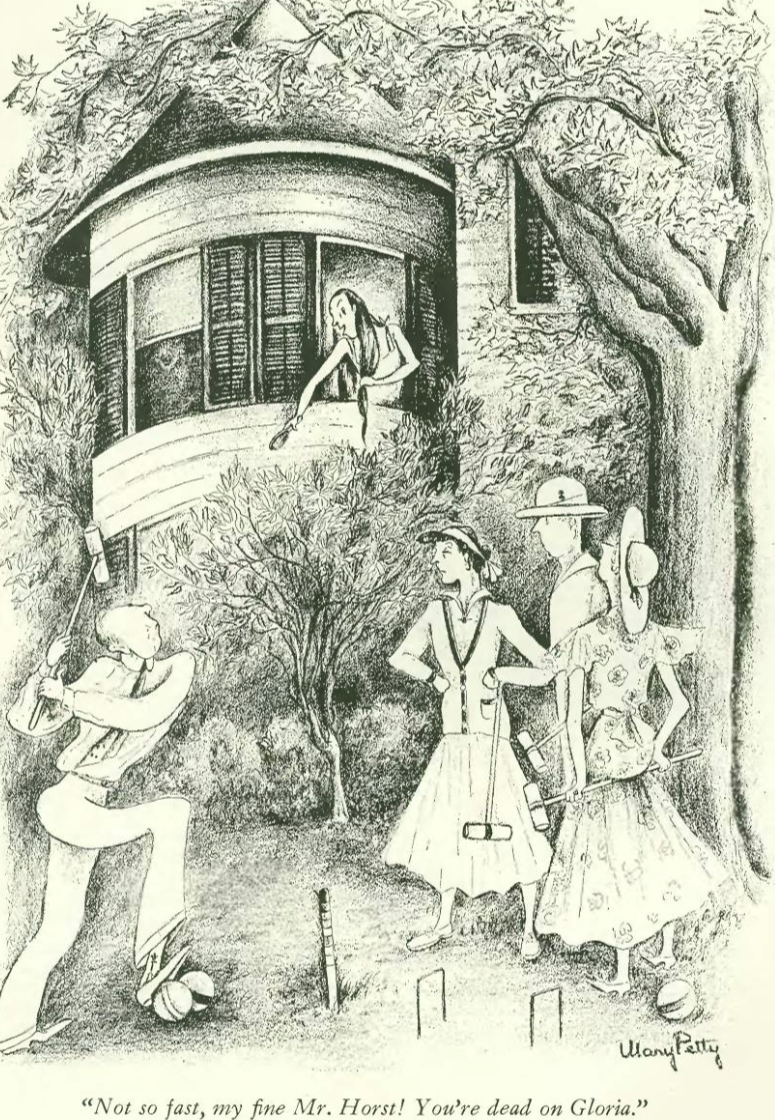
Mary Petty contributed this sumptuous drawing of a croquet match…

Helen Hokinson was in a transcendental mood…

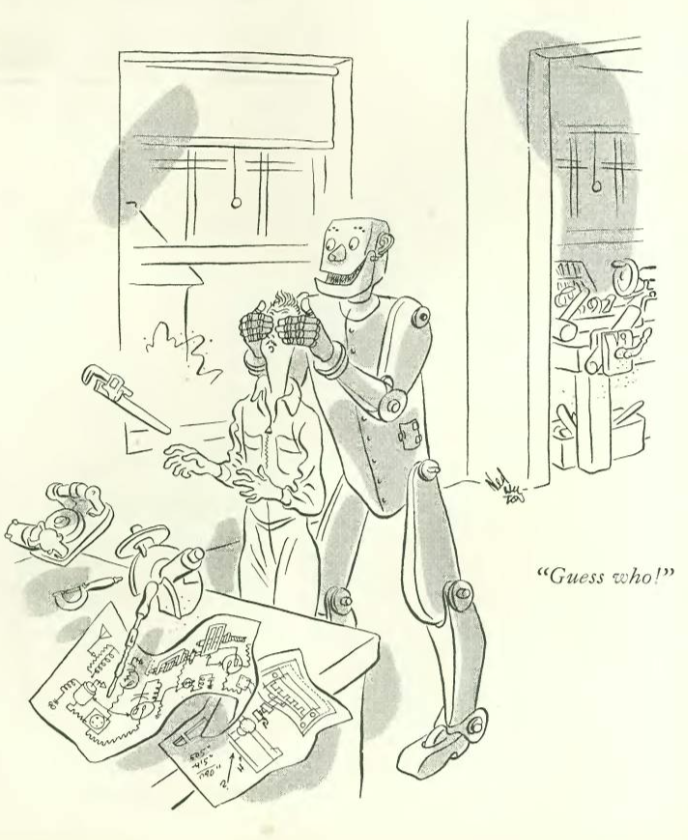
…and Ned Hilton had a big surprise for one garage tinkerer…

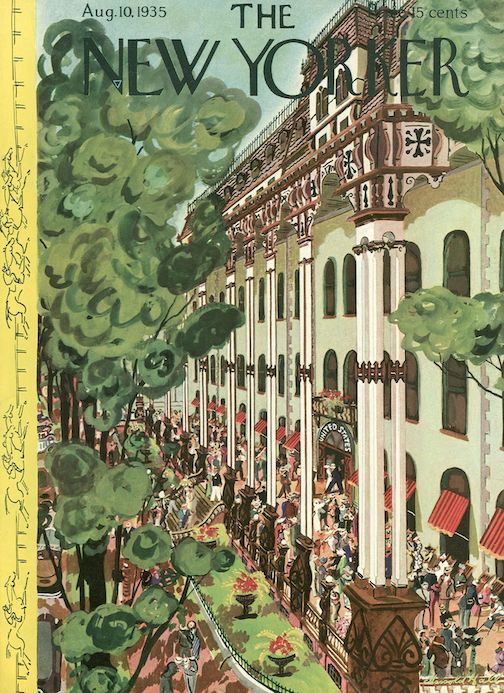
…on to August 10 and a rich summer scene by Arnold Hall:

August 10, 1935 cover by Arnold Hall.

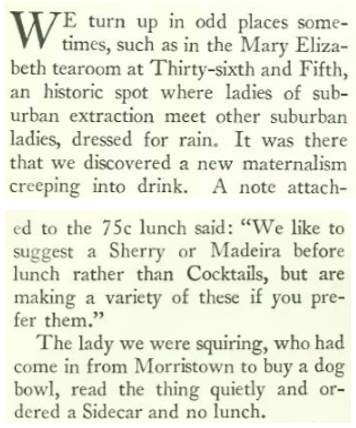
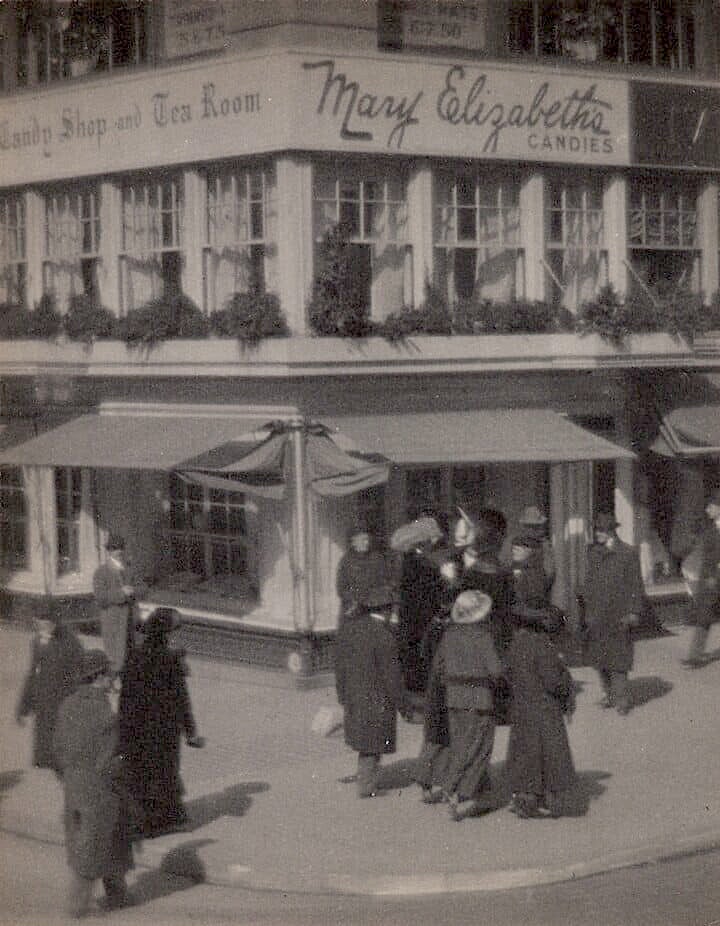
“The Talk of the Town” checked the lunch crowd at Mary Elizabeth’s Tea Room, where some preferred to drink their lunch.

TEA AND SWEETS (and cocktails) were among the offerings at Mary Elizabeth’s Tea Room at 36th and Fifth, seen here circa 1912. (Photo by Karl Struss via Facebook)

 * * *

Comic Relief

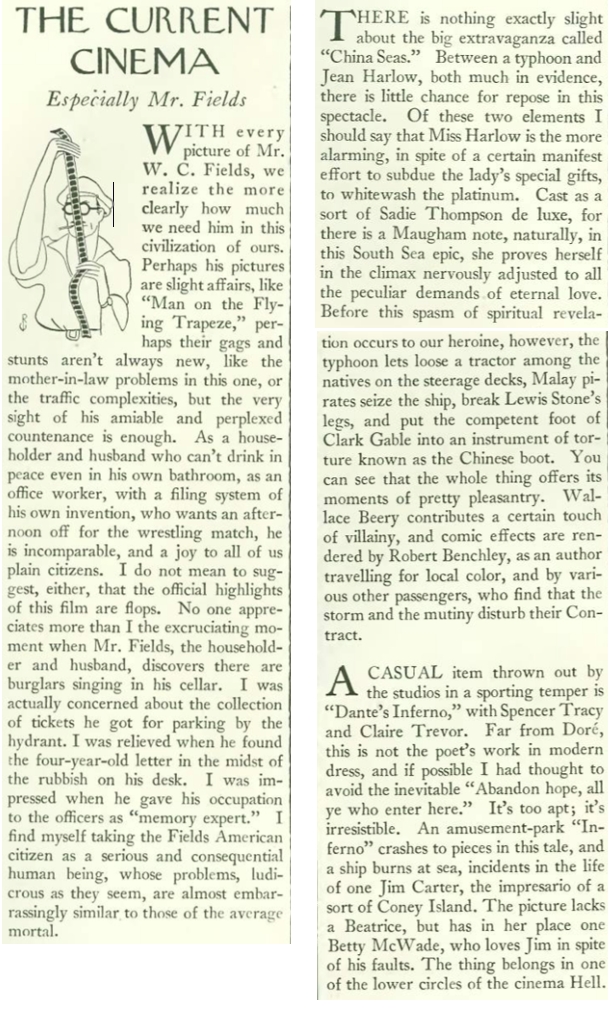
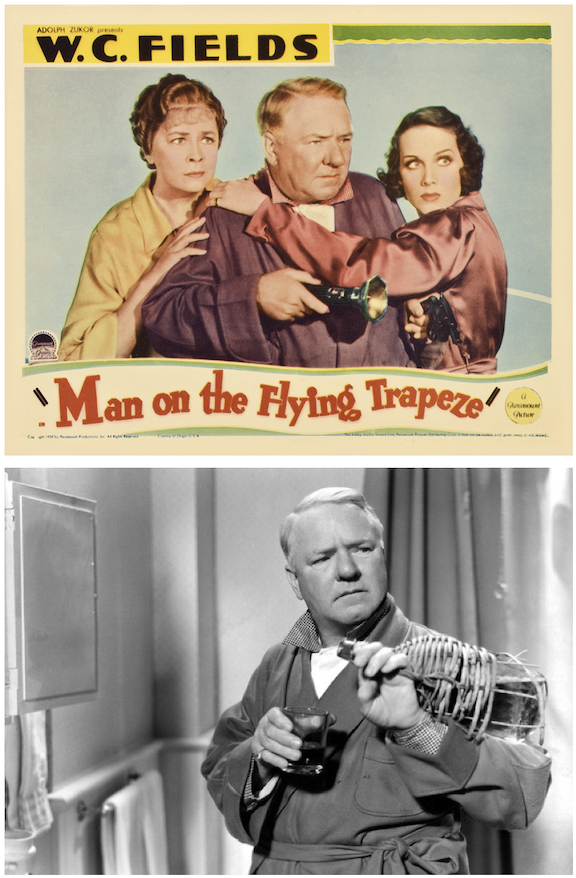
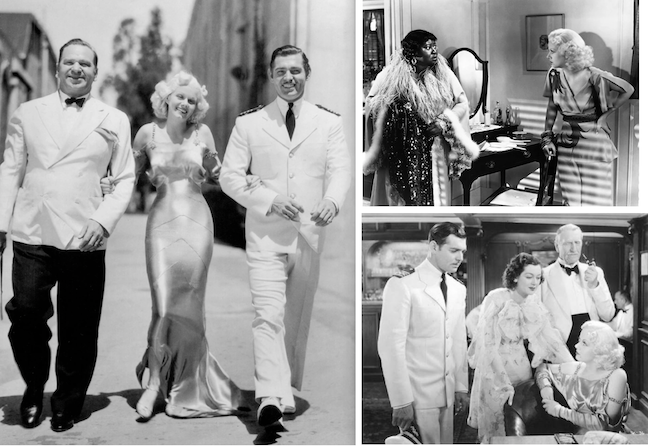
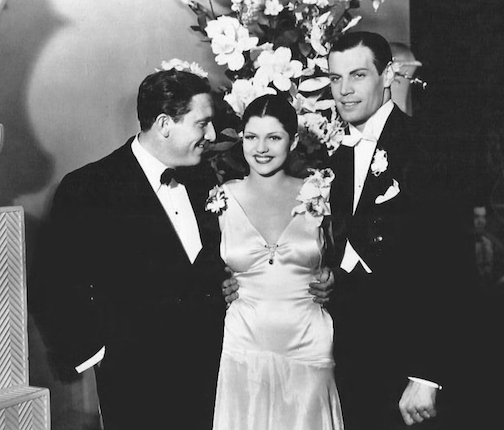
Film critic John Mosher offered an appreciation of W.C. Fields, noting that civilization needed films like Man on the Flying Trapeze during those hard years. Mosher also found some worthy distractions in the Jean Harlow vehicle China Seas, but was prepared to consign Spencer Tracey’s latest offering to the “lower circles of cinema hell.”

ANSWERING HIS NATION’S CALL…W.C. Fields brought joy to millions during the Depression in movies such as Man on the Flying Trapeze. Above, from left, Kathleen Howard, Fields, and Mary Brian. (IMDB/Rotten Tomatoes)
SHORE LEAVE…At left, Wallace Beery, Jean Harlow, and Clark Gable on the set of China Seas; top right, Hattie McDaniel with Harlow in a scene from the film; below, Gable, Rosalind Russell, and C. Aubrey Smith with Harlow in China Seas. (musingsofaclassicfilmaddict.wordpress.com / Pinterest)
FRESH FACE…Cinema newcomer Rita Hayworth was credited as Rita Cansino (she was born Margarita Carmen Cansino) in Dante’s Inferno. Here she is flanked by Spencer Tracy and Gary Leon. Dante’s Inferno was Spencer Tracy’s final film for 20th Century Fox. It was at MGM where his career really took off. (IMDB)

 * * *

All Wet

In his London Letter, Conrad Aiken (pen name Samuel Jeake Jr) examined the priggish ways of England’s seaside resorts.

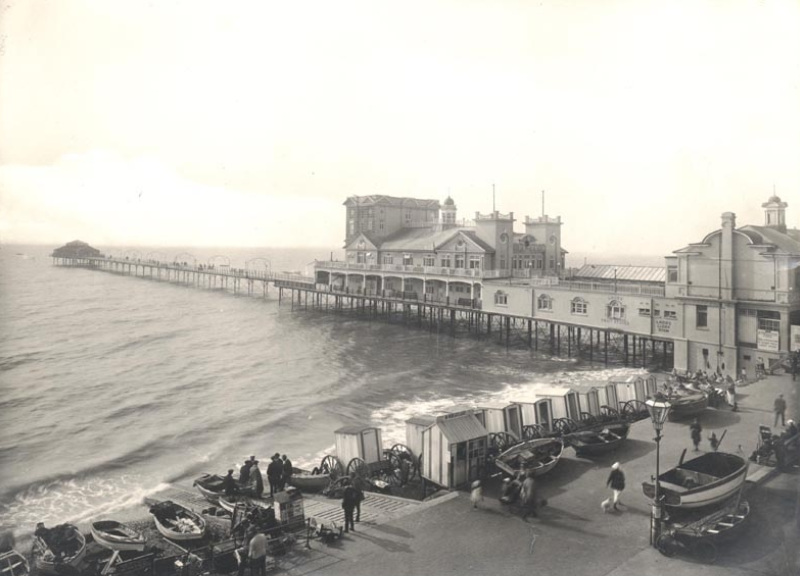
SITE OF SCANDAL…Bathing huts at Bognor Regis, circa 1921. (bognorregistrails.co.uk)

 * * *

Beware the Bachelor

In her “Tables for Two” column, Lois Long examined some of the city’s seasonal escapes for “summer bachelors.”

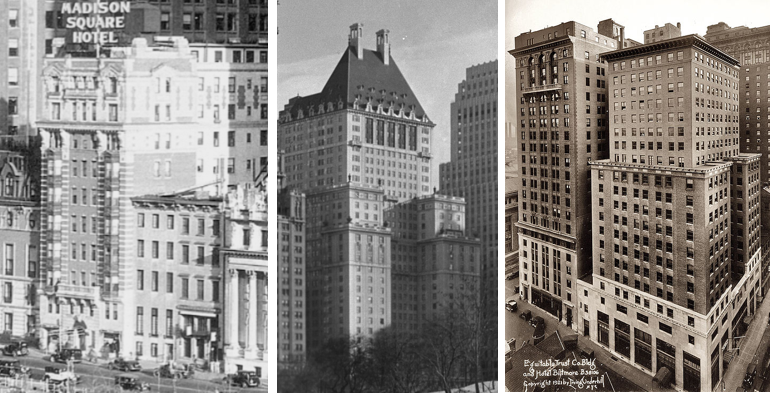
GHOSTS OF THE PAST…Lois Long recommended the air-conditioned lounges of the Madison Square Hotel and the Savoy Plaza (center) or the cooling breezes of the Biltmore roof (right), which featured music by Morton Downey. Sadly, all three of these beautiful buildings have been demolished. (geographicguide.com/Wikipedia)

Other more casual venues recommended by Long included Nick’s Merry-Go-Round…

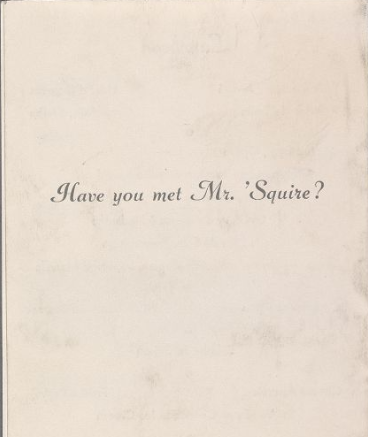
…a menu from Nick’s dated 1937…

(nypl.org)

…and its cryptic back cover…

From Our Advertisers

…speaking of the Biltmore and Morton Downey, we kick off our advertising section…

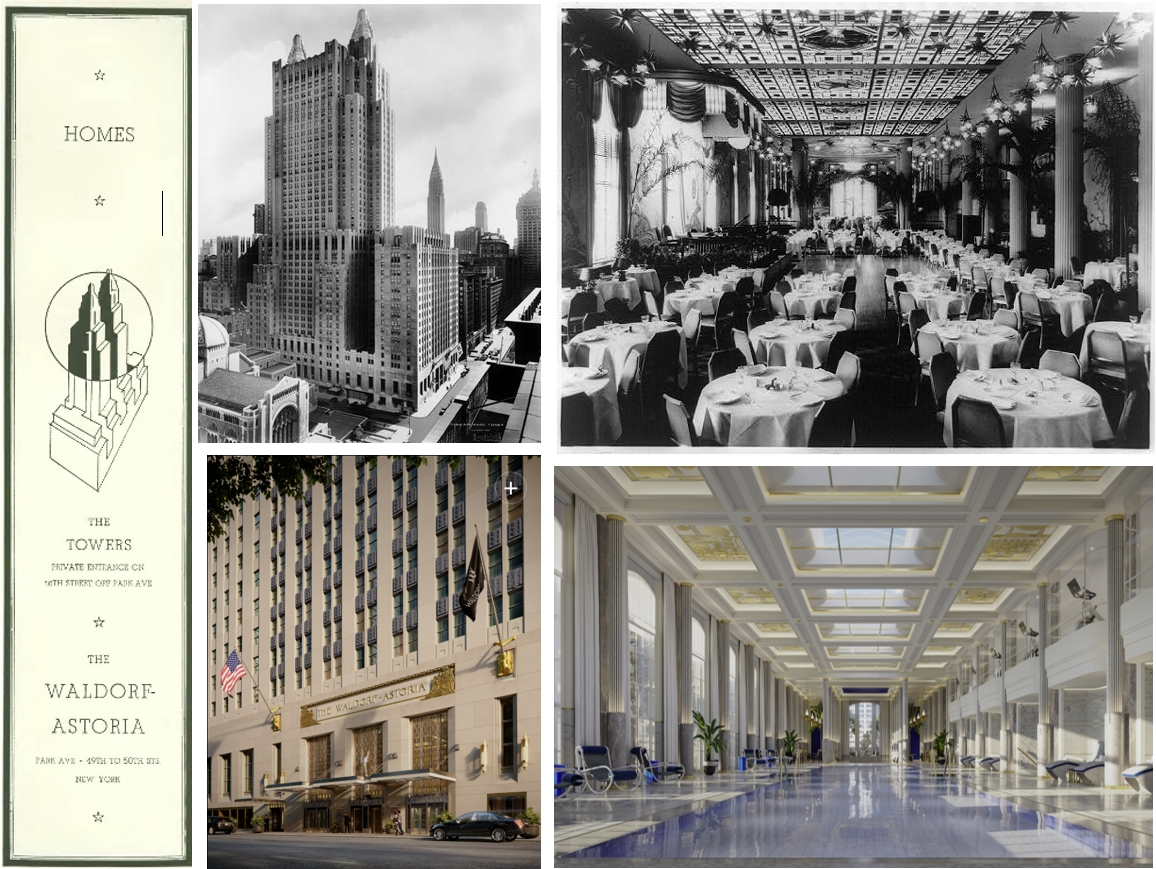
…the ad on the left announced the private residences at the Waldorf-Astoria…

Clockwise, from top left, the Waldorf Astoria circa 1930; the Waldorf’s Starlight Roof in the 1930s; after eight years and billions in restorations and renovations, the hotel has seen many changes including the transformation of the Starlight Roof into a swimming pool. Decades of grime were also cleaned from the building’s exterior. (mcny.org/loc.gov/som.com)

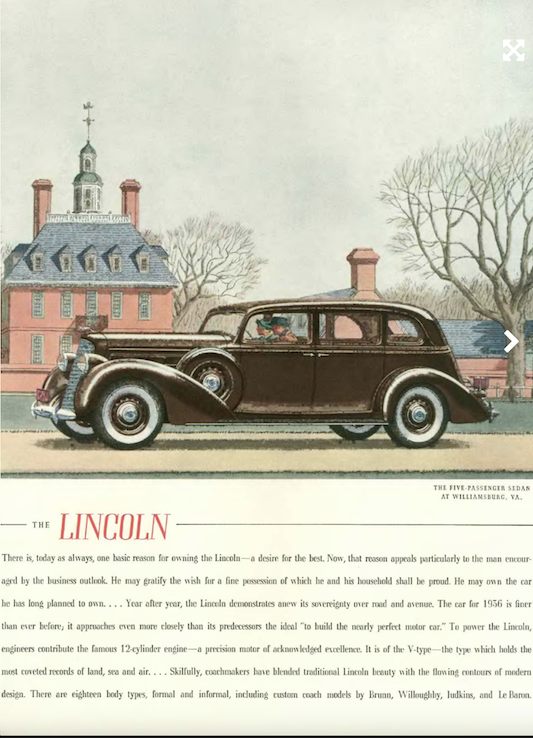
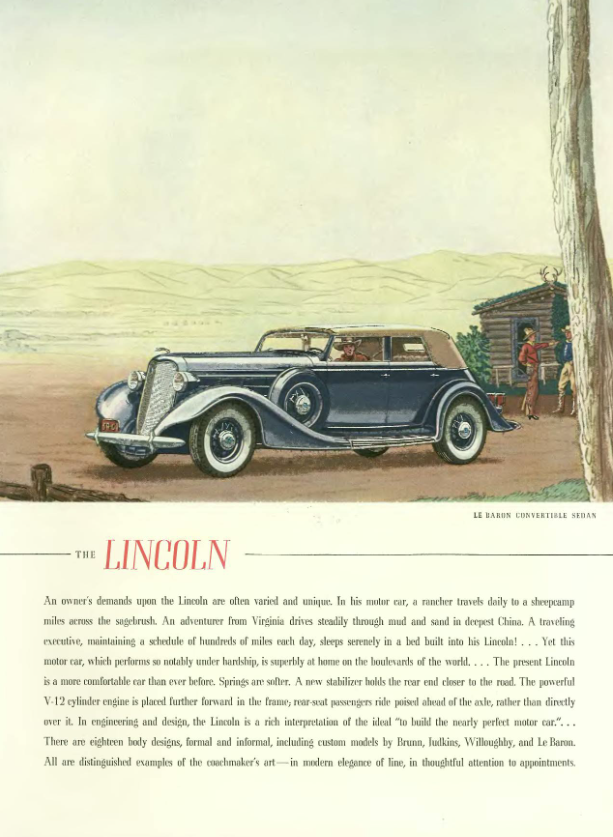
…another ad from the makers of Lincoln suggesting that the market for their luxury auto wasn’t confined to citified execs…

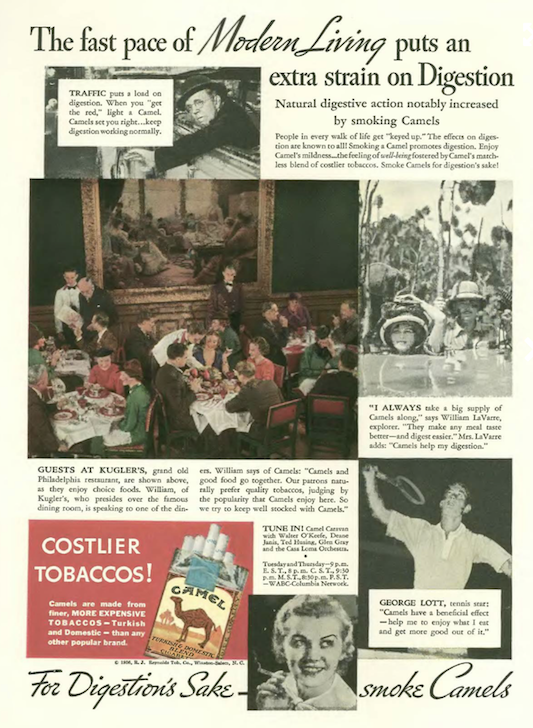
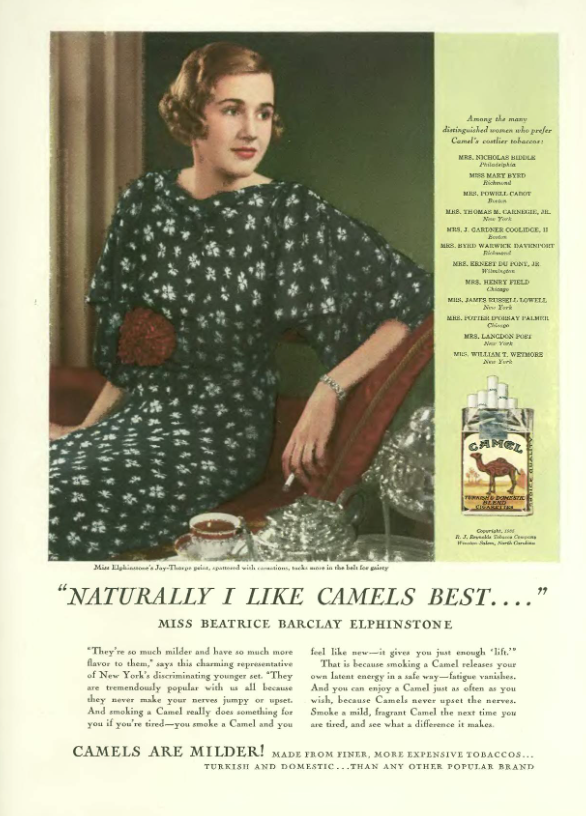
…the Camel folks introduced us to their latest society shill…

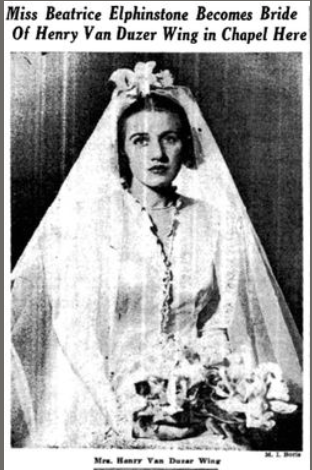
…I didn’t find much about Beatrice Barclay Elphinstone (1916-1977), described in the Camel ad as a “charming representative of New York’s discriminating younger set”…she did make the Times‘ Dec. 10, 1937 society wedding announcements, however…

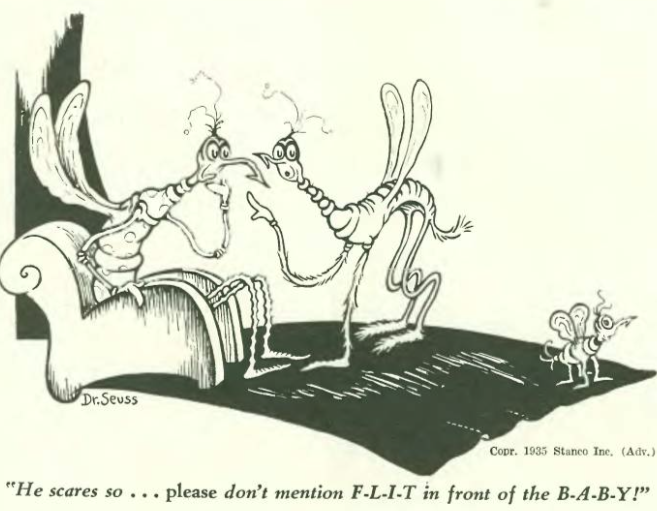
Dr. Seuss was back with another twist on Flit insecticide…

…on to our illustrators and cartoonists, a nice charcoal by Hugo Gellert for a profile titled “Yankee Horse Trader,” written by Arthur C. Bartlett…the harness horse racing legend Walter Cox (1868-1941) was known in New England as “the king of the half-milers”…

James Thurber contributed this cat and dog face-off to the opening pages…

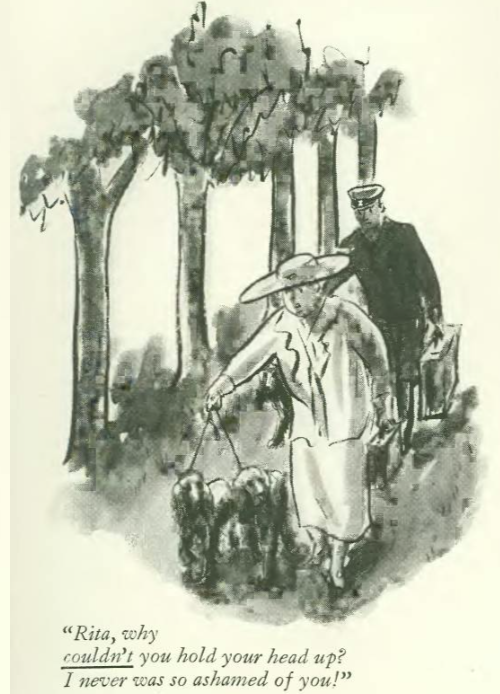
Helen Hokinson offered her perspectives on the summer dog show across pages 16-17…

…and for a closer look…

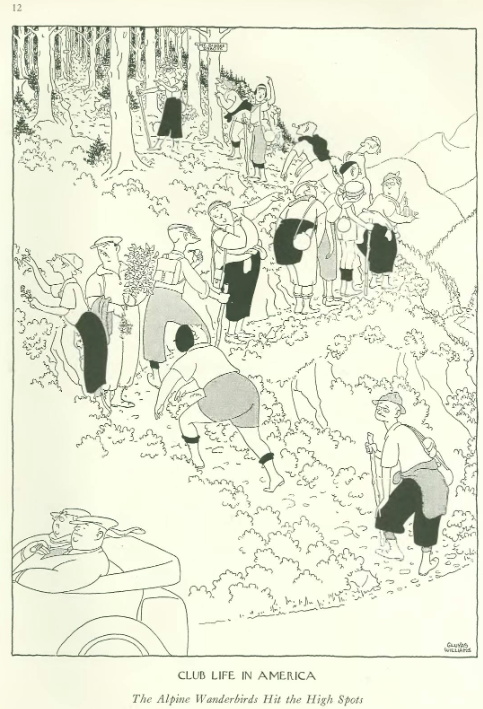
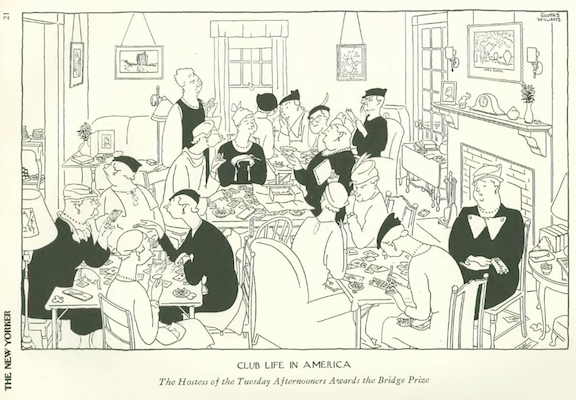
Gluyas Williams went back to nature in his “Club Life” series…

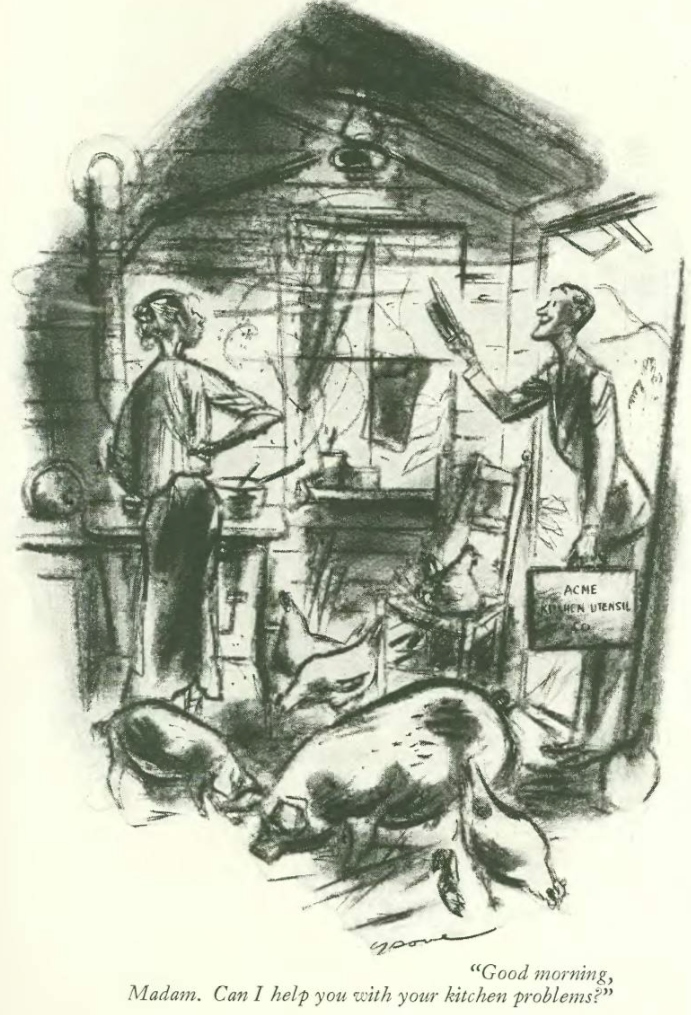
Leonard Dove introduced us to an undaunted salesman…

…in the world of George Price, crime didn’t pay…

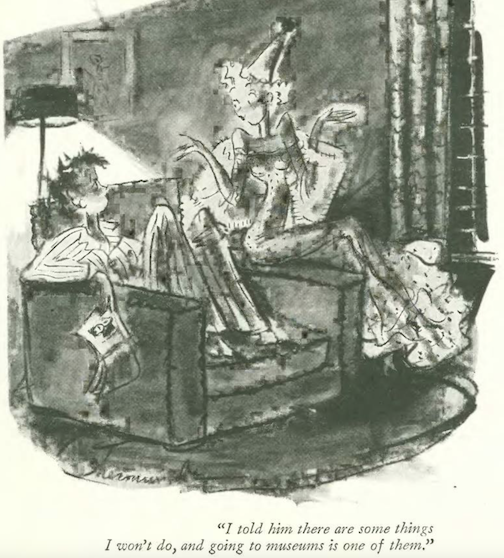
Barbara Shermund gave us a rare glimpse into the secret lives of men…

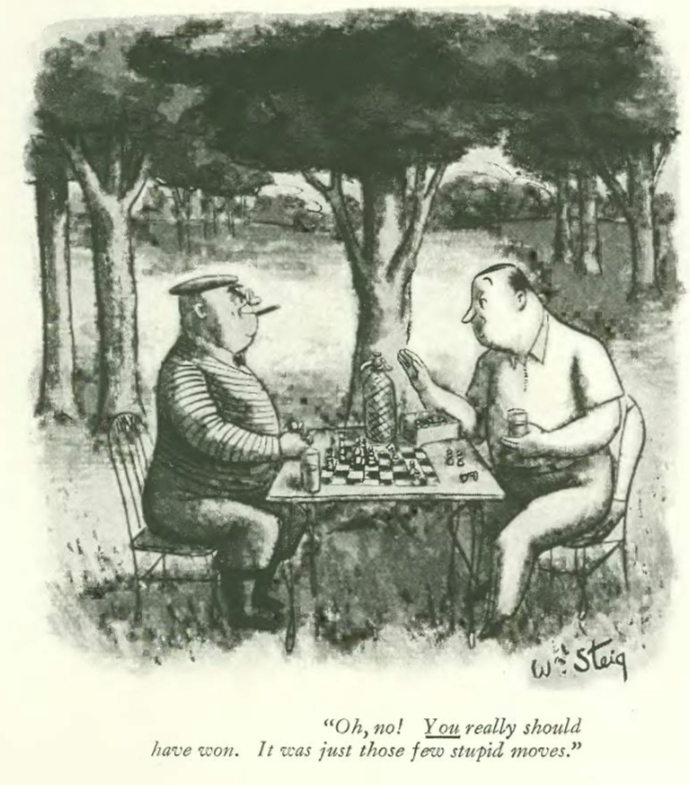
…patronizing words were unwelcome at this chess match, per William Steig

Denys Wortman took us on a family outing…

…and we close with Alain, and a mother of multiples…except words…

Next Time: Hays Hokum…

Broadacre City

Above: Detail from Spanish architect David Romero's computer-generated model of Frank Lloyd Wright's Broadacre City, complete with an "aerotor" flying car.

To be sure, architect Frank Lloyd Wright was a visionary, creating a uniquely American vernacular that influences architecture and design to this day. That might also true for his Broadacre City concept, which demonstrated how four square miles (10.3 km2) of countryside might be settled by 1,400 families. Wright unveiled this escape to the countryside in the middle of Manhattan.

April 27, 1930 cover by Reginald Marsh.

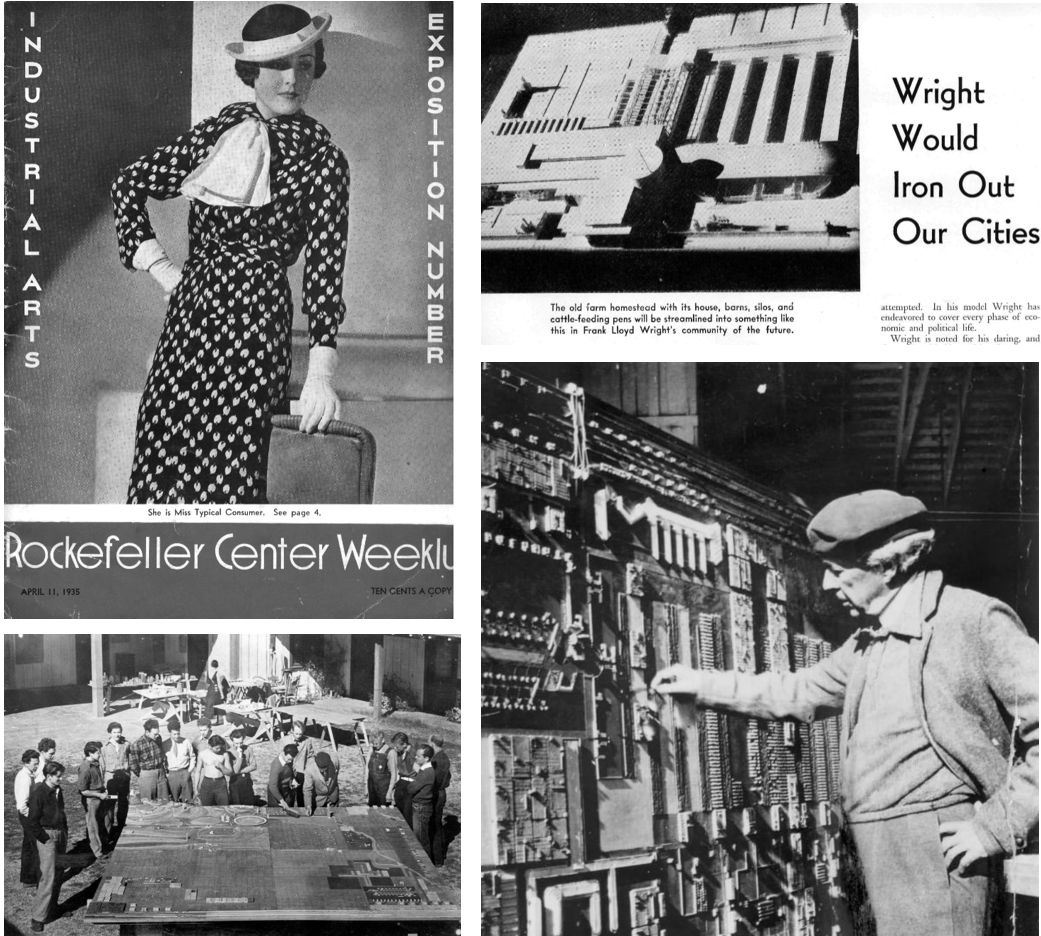
On April 15, 1935, the Industrial Arts Exposition opened at Rockefeller Center, and Wright (1867-1959) was front and center with his audacious proposal to resettle the entire population of the United States onto individual homesteads. Critic Lewis Mumford observed that Wright “carries the tradition of romantic isolation and reunion with the soil” by putting every American family on a minimum of five acres of land.

FLAT EARTH…Clockwise, from top left, cover of Rockefeller Center Weekly featuring the Industrial Arts Exposition—the model on the cover is identified as “Miss Typical Consumer”; detail from the magazine depicting a “streamlined farmstead” in Broadacre City; Frank Lloyd Wright examining the Broadacre City model, circa 1935; Wright students who crafted the 12×12-foot model, circa 1935. (digital.hagley.org/franklloydwright.org)

Wright first presented the idea of Broadacre City in his book The Disappearing City in 1932…

ROMANTIC ISOLATION…Broadacre City as depicted in Wright’s 1932 book The Disappearing City. (Wikipedia)

…note how the above drawing is reflected in one of Wright’s last designs, the Marin County Civic Center:

(visitmarin.org)

A detailed 12×12-foot scale model of Broadacre City—crafted by Wright’s student interns at Taliesin, was unveiled at the Industrial Arts Exposition:

GREEN ACRES…The 12×12-foot model (top images) crafted by student interns who worked for Wright at Taliesin is now housed at the Museum of Modern Art (MoMA); bottom right, Wright’s rendering of Broadacre City, and at left, detail from Spanish architect David Romero’s computer-generated model of Broadacre City (more images below). (MoMA/David Romero via Smithsonian)

For the most part Mumford reacted favorably to Wright’s vision, which is no surprise considering that Mumford derided the dehumanizing skyscrapers popping up all over his city (including Rockefeller Center).

Despite his patrician demeanor, Wright envisioned an egalitarian Broadacre City, with every family having access to cars, telephones and other appliances. Power would come from solar and electric energy, and any technological advances would be applied at a local level toward the common good.

VIRTUAL REALITY…In 2018 Spanish architect David Romero created computer-generated models to see what Wright’s unrealized structures might have looked like. At left, cars (based on Wright concepts) in Broadacre City, and an aerial view featuring a tower that bears a strong resemblance to Wright’s 1956 Price Tower in Bartlesville, Oklahoma. Modeling Broadacre took Romero more than eight months to complete—it contains more than one hundred detailed buildings, one hundred ships, two hundred “aerotors” (based on the autogyros of the day), 5,800 cars, and more than 250,000 trees. (David Romero via Smithsonian and openculture.com)

What Mumford (and perhaps Wright) didn’t fully anticipate was the urban sprawl such a vision would help inspire, the suburban and exurban landscape that would lead to a car-dominated world of congested, multi-lane highways and housing developments that continue to encroach on our woodlands and wetlands. And we didn’t get those groovy aerotors either.

(Christoph Gielen, webcolby.edu)

 * * *

Little House on the Avenue

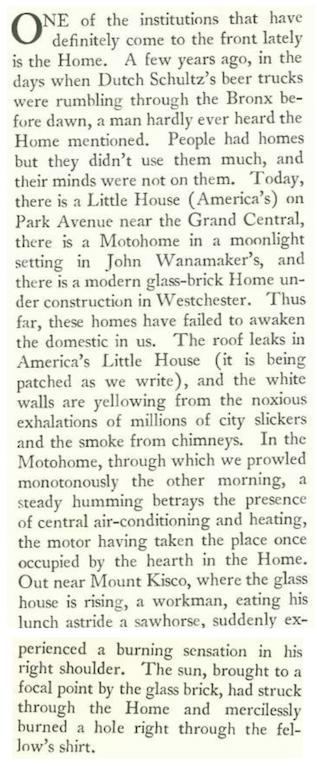
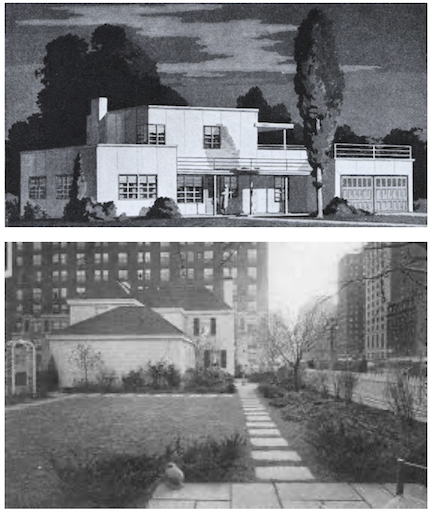
E.B. White, in his “Notes and Comment,” also offered some observations on housing trends, noting the manufactured “Motohome” displayed at Wanamaker’s as well as “America’s Little House,” plopped down at the corner of 39th and Park Avenue.

SETTING A STANDARD…Above, the factory-manufactured Motohome (above) was touted as the solution to the nation’s housing shortage. The federal Better Homes in America organization built a model house (“America’s Little House,” below) at 39th and Park Avenue to illustrate how standardized components and methods could make home improvement easier. (Google Books/Johns Hopkins)

* * *

Horsing Around

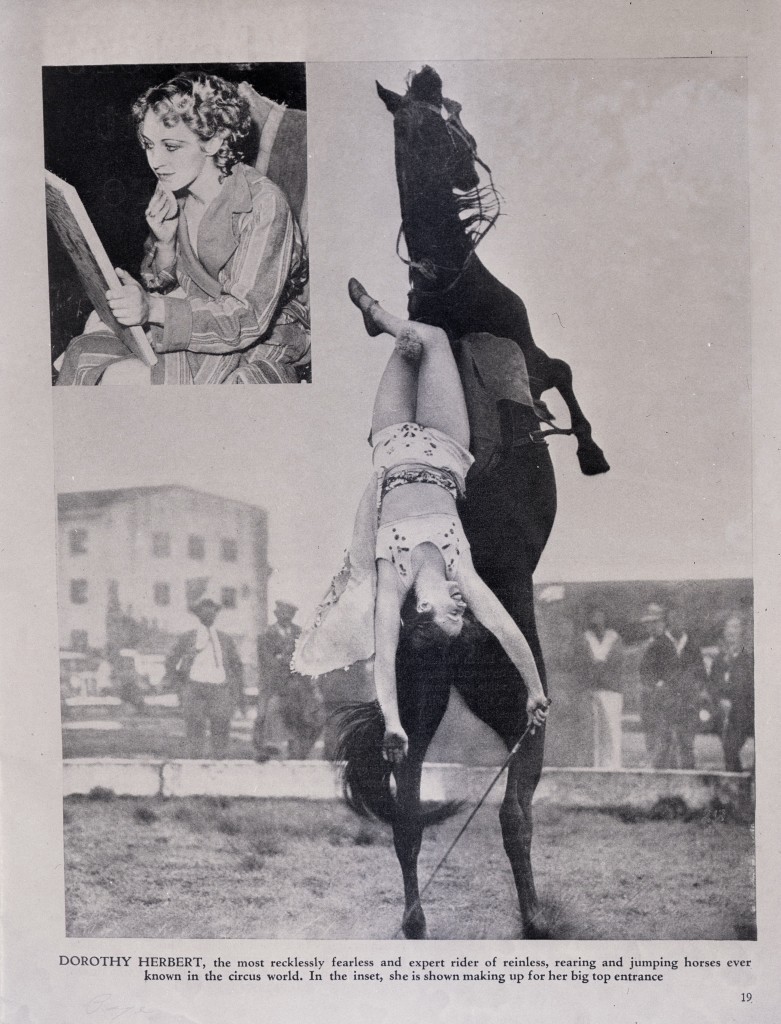
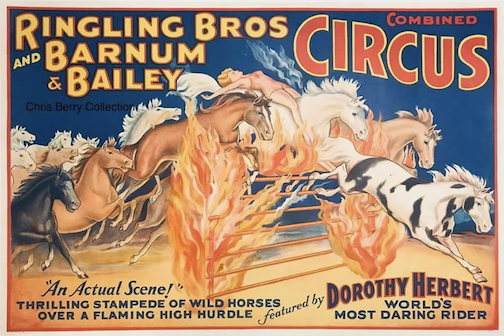
Although known for their nonchalance, New Yorkers could still find some enthusiasm when the circus came to town. “The Talk of the Town” looked in on the star of the circus, Dorothy Herbert (1910-1994), a trick rider with the Ringling Bros. and Barnum & Bailey Circus.

WHOA NELLY…One of Dorothy Herbert’s signature moves was her layback on a rearing horse. Here she demonstrates the move in 1939. (equineink.com)
HOT STUFF…Circus poster touts Herbert’s ride over flaming hurdles in the company of twelve riderless horses. (circushistory.org)

 * * *

Don’t Call Him ‘Tiny’

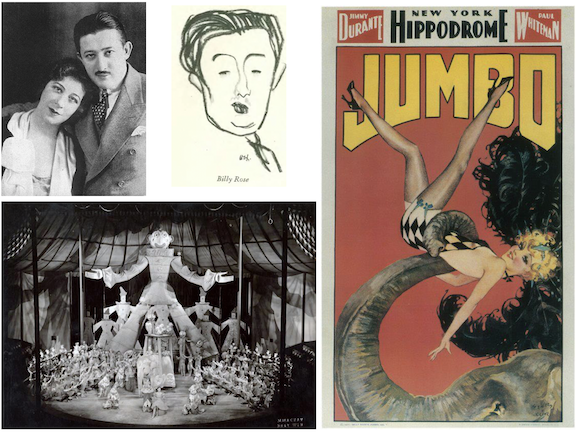
He was known as “The Little Napoleon of Showmanship,” but there was nothing small about Billy Rose’s accomplishments as an impresario, theatrical showman, composer, lyricist and columnist. Here are excerpts from Alva Johnston’s profile:

JUMBO-SIZED ENTERTAINMENT…Clockwise, from top left, Billy Rose and his first wife, comedian-actress Fanny Brice; illustration of Rose for the profile; poster announcing Rose’s 1935 stage spectacle Jumbo at the Hippodrome; described as more circus than musical comedy, Jumbo was one of the most expensive theatrical events of the first half of the 20th century. (jacksonupperco.com)

 * * *

On Guard

We shift gears and turn to more sobering events of the 1930s, namely the rise of fascism in Europe. In his column “Of All Things,” Howard Brubaker pondered the possibilities of fascism in his own country…

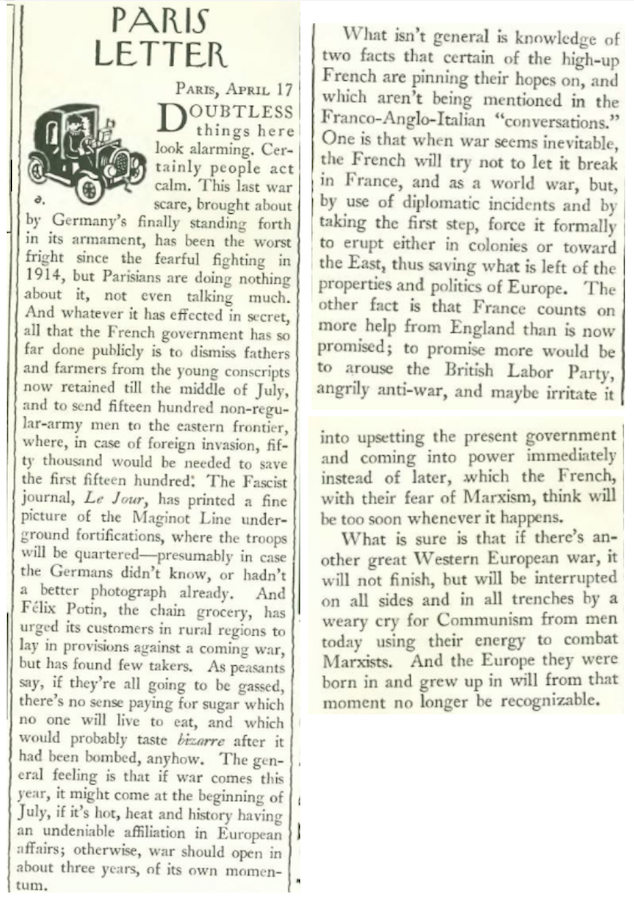
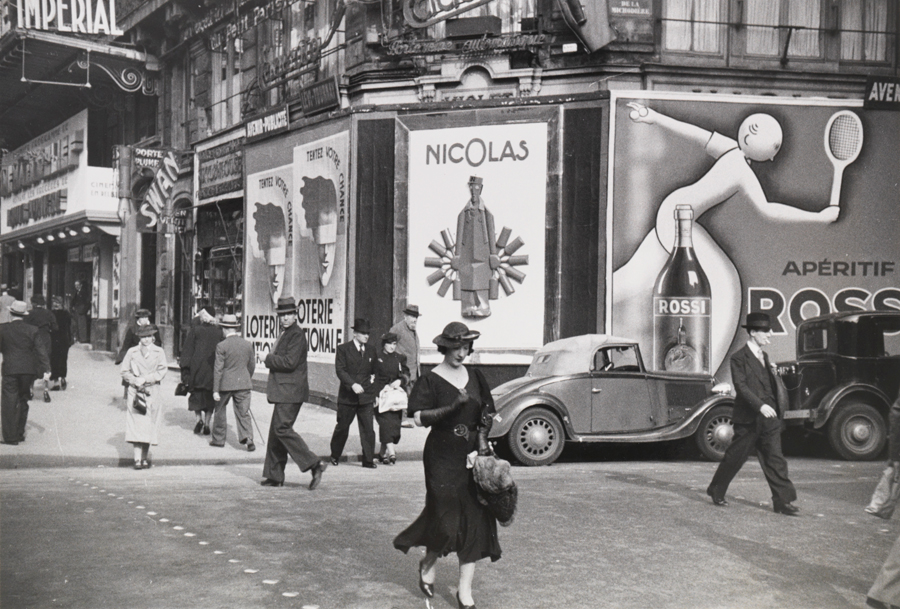
…meanwhile, Paris correspondent Janet Flanner was finding nothing funny about the uneasy calm among Parisians as war with Germany seemed likely.

C’EST LA VIE…Janet Flanner found Parisians resigned to whatever fate awaited them in 1935. (unjourdeplusaparis.com)

Flanner also remarked on Leni Riefenstahl’s Nazi propaganda film Triumph des Willens (Triumph of the Will). Flanner’s assessment of this “best recent European pageant” wryly underscored the horrors the film portends.

 * * *

News From An Old Friend

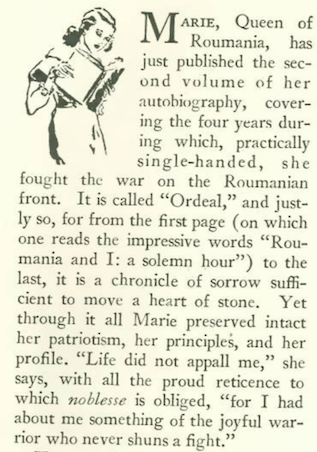
Longtime readers may recall one of my earliest entries on Queen Marie of Romania (1875-1938); the March 14, 1925 edition of The New Yorker (issue #4) found New Yorkers “agog” over her planned 1926 visit to the city. Her comings and goings were followed for a time (she also appeared in a Pond’s Cold Cream ad in the June 6, 1925 issue), but then she abruptly disappeared. Here she is again, courtesy of a glowing book review by Clifton Fadiman. An excerpt:

A PROGRESSIVE THINKER for her time, Marie of Romania was immensely popular in America. Born into the British royal family, she was the last queen of Romania from 1914 to 1927. At left, portrait from 1920; at right, during her 1926 visit to the States, Marie received a headdress from two American Indian tribes. They named her “Morning Star” and “Winyan Kipanpi Win”—“The Woman Who Was Waited For.” (Wikipedia/brilliantstarmagazine.org)

 * * *

From Our Advertisers

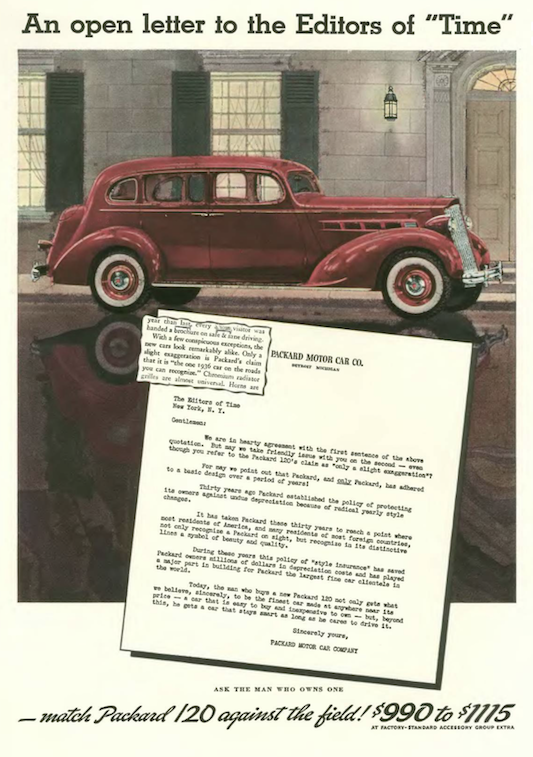
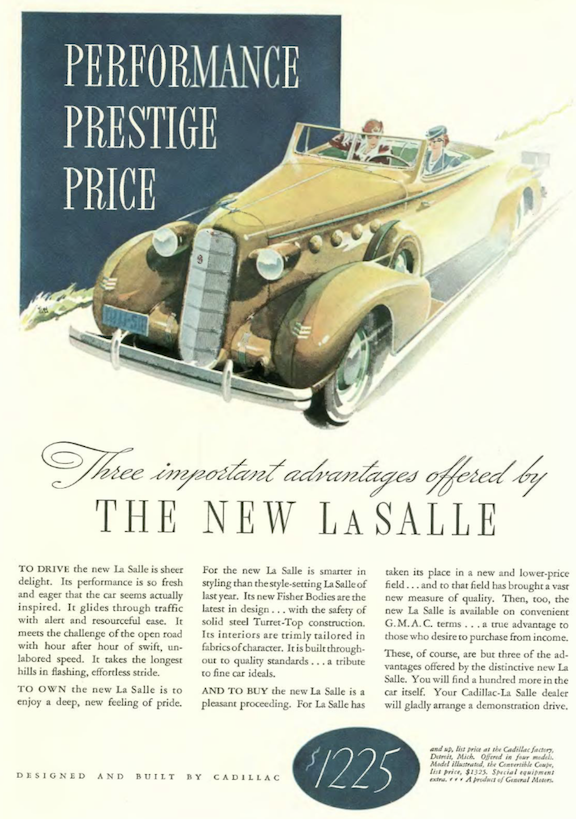
Although we’ve seen plenty of ads from prestige automakers such as Packard, it was clear that companies found their sweet spot in lower-priced models that still suggested “prestige”…here’s an example from Cadillac’s budget line LaSalle…

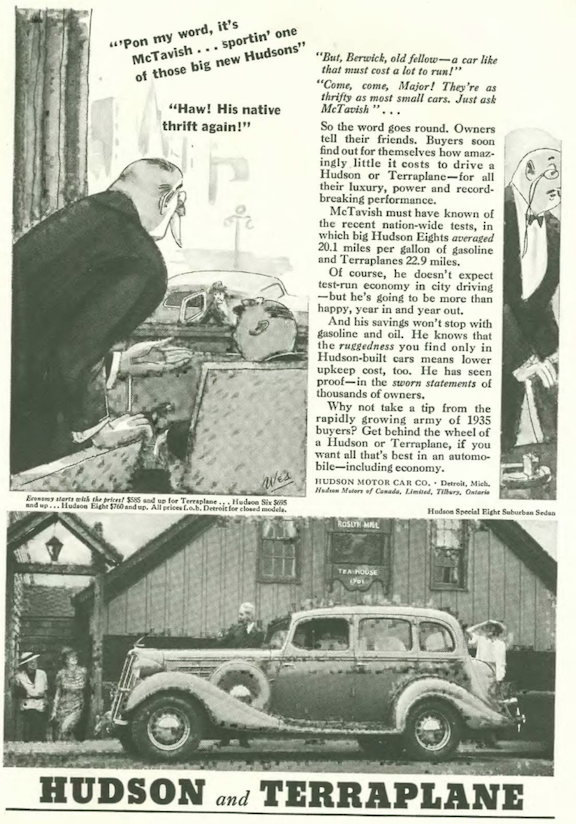
…for less than half the price of a LaSalle you could get behind the wheel of Hudson, its makers suggesting that prestige doesn’t preclude thrift…this ad seems to have been hastily produced–note the right side of ad, with just a slice of some toff squeezed next to the copy…

…this advertisement would only appeal to those who were among the tiny minority who could afford to fly…from 1924 to 1939 this early long-range airline served British Empire routes to South Africa, India, Australia and the Far East…

…for reference, detail below of a Scylla-class airliner used by Imperial Airways…

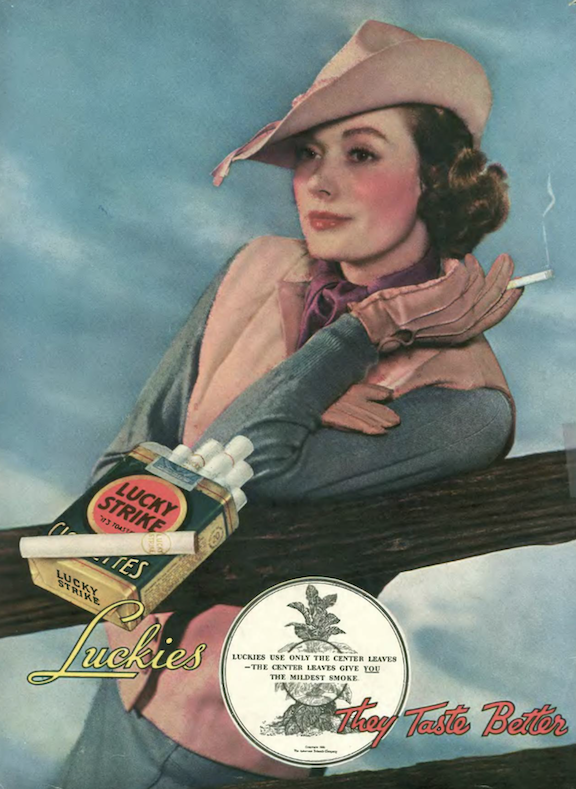
…and what would the back cover be without a photo of a stylish woman having a smoke?…

…a few advertisers referenced the circus in town to drum up business…

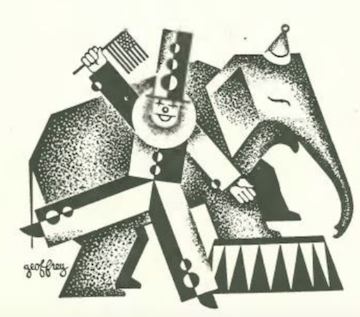
…and we segue to our cartoonists and illustrators, and this circus-themed spot from an illustrator signed “Geoffrey”…

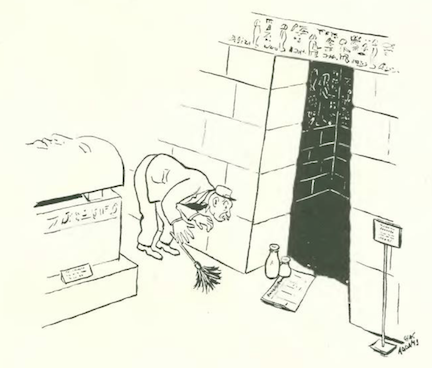
…a more familiar name is found at the bottom of page 4…namely Charles Addams…the milk order outside the tomb hints at things to come…

…Addams again, going from Bacchus to beige…

George Price, and well, you know…

Robert Day was aloft with a speculative builder…

William Steig typecast his Small Fry…

Leonard Dove made a sudden exit…

Gilbert Bundy found one old boy unaffected by spring fever…

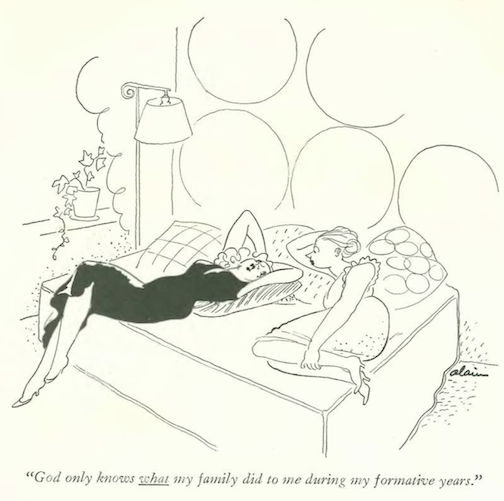
Alain channeled Barbara Shermund to give us this gem…

…and we close with a typical day in James Thurber’s world…

Next Time: The Royal Treatment…


Terse Verse

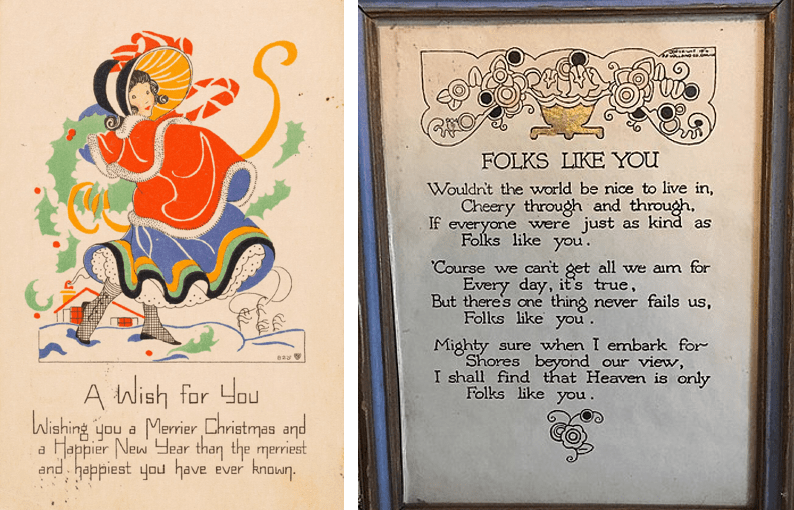
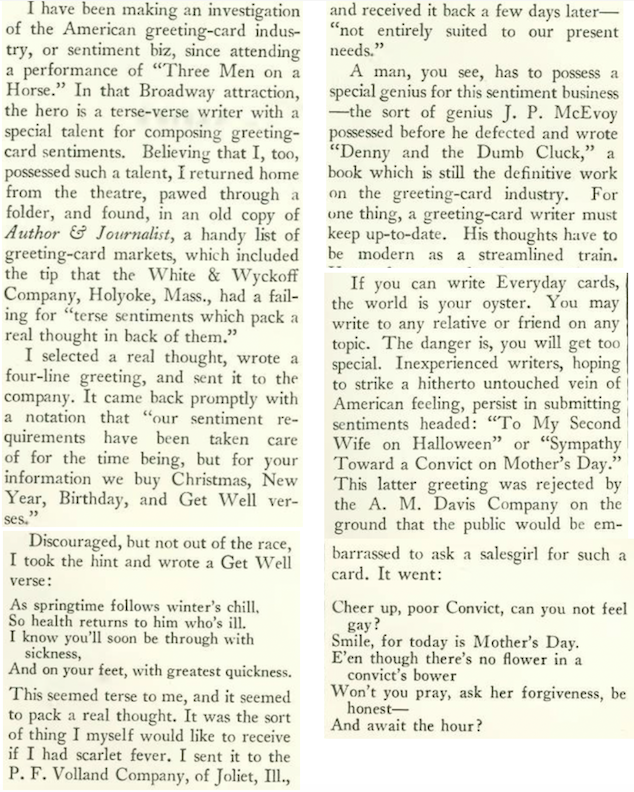
Above: Holiday greeting card circa 1920 (left) and framed poetry (1916) from the P.F. Volland Company, which rejected E.B. White's attempt at a get-well card. (Newberry Library/Wikipedia)

A deep reading of The New Yorker’s back issues can lead a person down some interesting rabbit holes as well as to new insights. For instance, who knew that the greeting card business could lead to murder?

April 20, 1935 cover by William Cotton.

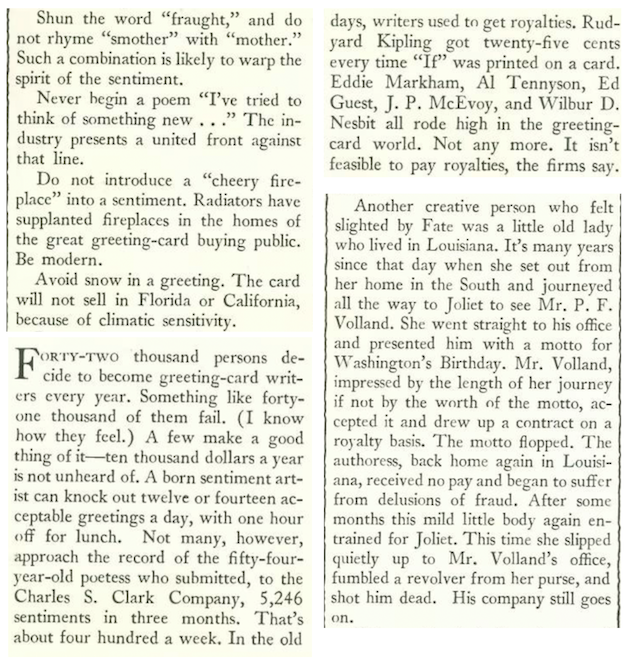
Writing for the occasional feature “Onward And Upward With The Arts,” E.B. White examined the hardboiled world of the “sentiment biz,” a world in which each year 42,000 eager writers elbowed their way into a few hundred positions, and even a smaller number made a decent living at it. To test his own mettle at the craft, White submitted a get-well message to the P. F. Volland Company.

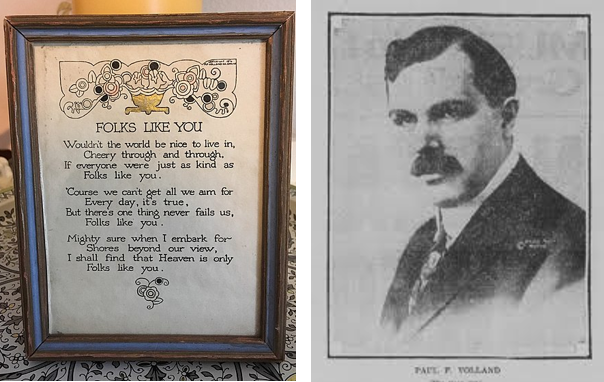
A JOB TO DIE FOR…Paul Frederick Volland (1875-1919) founded his greeting card company in 1908, producing sheet music, children’s books, calendars, cookbooks, and framed poetry such as the example at left, from 1916. On May 5, 1919, Volland was shot and killed in his office by an elderly contributor, Vera Trepagnier, after a dispute about compensation over her miniature of George Washington. The company continued until 1959. (Wikipedia)
HACK RACKET…One of the more illustrious contributors to the Volland Company was J.P. McEvoy (1894-1958). Despite his generous salary, he hated working for Volland. His 1930 novel Denny and the Dumb Cluck satirized the greeting-card business and his experiences with Volland. In an author’s note, McEvoy wrote that “among other minor atrocities I have compiled 47,888 variations of Merry Christmas…” (Wikipedia/Pinterest)

The Volland Company employed scores of artists and writers including L. Frank Baum, Edgar Rice Burroughs, John Held Jr, Ring Lardner, Robert Louis Stevenson, and J.P. McEvoy—a writer little known today, McEvoy was influential in the 1920s and 30s, writing everything from children’s tales (he likely inspired Raggedy Ann) to short stories, novels and comic strips, including the popular Dixie Dugan. He also wrote a hit Broadway play, and several of his stories were turned into movies, including W.C. Fields’ 1934 classic It’s a Gift.

White also offered some “tips” on sentiment writing, suggesting that one avoid rhyming words such as “smother” and “mother”…

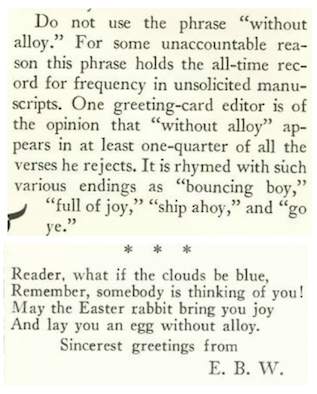
…he also cautioned about the use of certain phrases, and concluded with a cheeky Easter poem of his own…

 * * *

More Thoughts From E.B.W.

White occasionally led off his column with observations on the passing scene, in this case springtime happenings in the city and beyond…

SIGNS OF SPRING…E.B. White looked around for signs of spring and found, among other things, the bicycle drills of the League of American Wheelmen (top left, professional bike racer Vincent Seifred rode for the the Empire City Wheelmen in the 1930s); top right, tiny spring peepers were for sale as pets at Macy’s; the Fifth Avenue Coach Company switched sponsors, from Marlboro to Gulden’s; White noted freshets (spring meltwater) in the hills—image is from New York’s Finger Lakes. (crca.net/paherps.com/aldenjewell-flickr.com/nygeo.org)

 * * *

Star Struck

“The Talk of Town” anticipated the completion of the Hayden Planetarium at the American Museum of Natural History. When it opened in October 1935, it was only the fourth planetarium in the United States. Excerpts:

TO INFINITY AND BEYOND…When the Hayden Planetarium opened in October 1935, it was only the fourth planetarium in the United States. In its first year the planetarium drew more than half a million visitors. Clockwise, from top left, the exterior of the planetarium; inside the 75-foot dome; the Zeiss projector; Copernican Room demonstrated movements in the solar system with model planets following tracks in the ceiling; prize-winning poster from a contest in which more than 3,500 high school students were invited to compete for a chance to have their poster exhibited at the American Museum of Natural History. (© AMNH Library)

 * * *

Broadway Slugfest

The profile by Meyer Berger looked at the life of a “chiseller,” that is, someone who lived day to day by skimming off the labors of others. Today it is mostly done digitally, but in 1935 the mechanical world could be manipulated by a handful of slugs. Excerpts:

 * * *
From Our Advertisers
We begin with an elegant evening, the men in white tie, the women in their finest gowns, all preparing to partake of some canned soup…

…there were many ads with Easter themes to move the merch…

…here’s a detail from an Easter-themed ad for neckties, a retired Colonel, presumably, proudly strutting in the Easter Parade with his crop and monocle as he elbows aside his chauffeur and granddaughter…

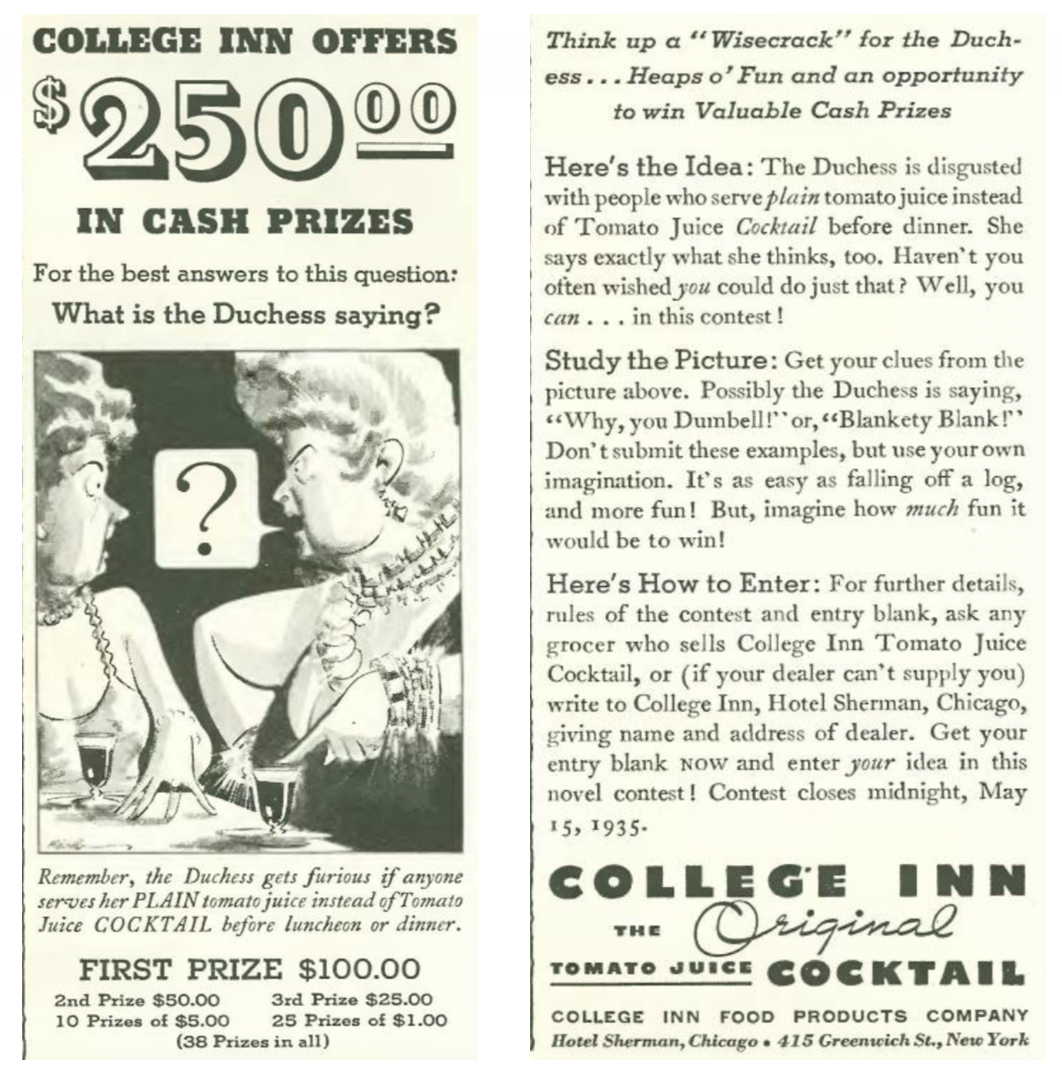
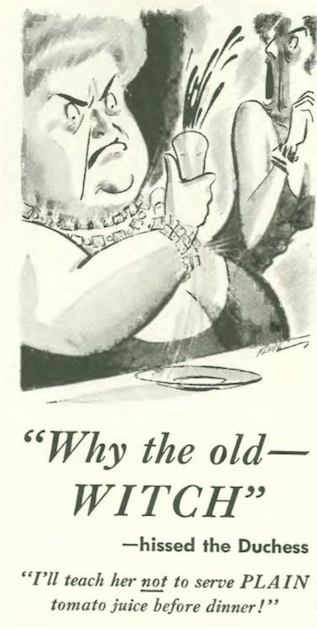
…the Duchess returns, and she’s still pissed about her tomato juice…I wish I could have entered this contest…

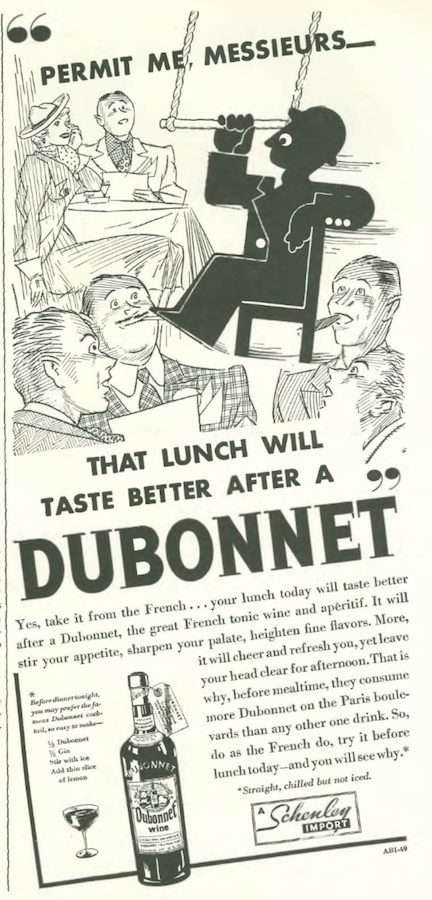
…the Dubonnet mascot, Dubo-Dubon-Dubonnet, made a startling appearance in this ad…the creation of French graphic designer Adolphe Mouron Cassandre, Paul Rand took over the drawing of Dubonnet Man when the liquor came to the United States…
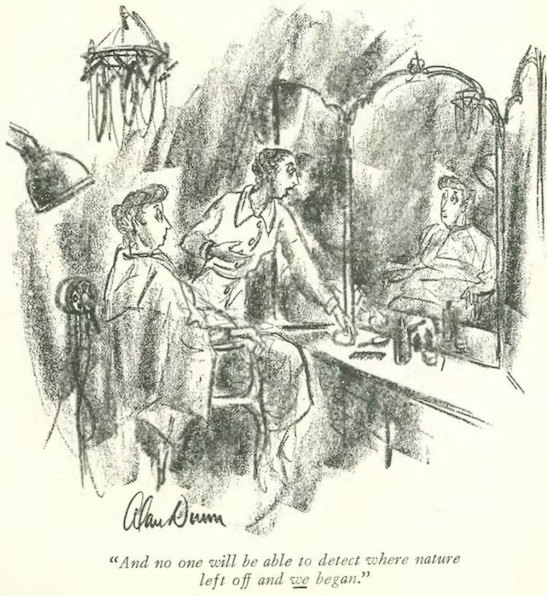
…Old Gold continued its campaign (illustrated by pin-up artist George Petty)  featuring a homely, clueless sugar daddy…

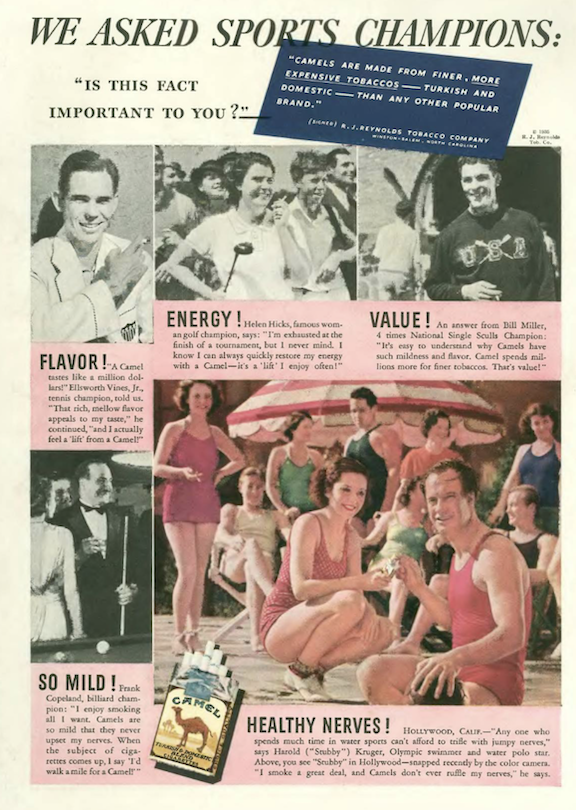
…while Camel turned out another group of “sports champions” who testified to the energizing effects of cigarettes…

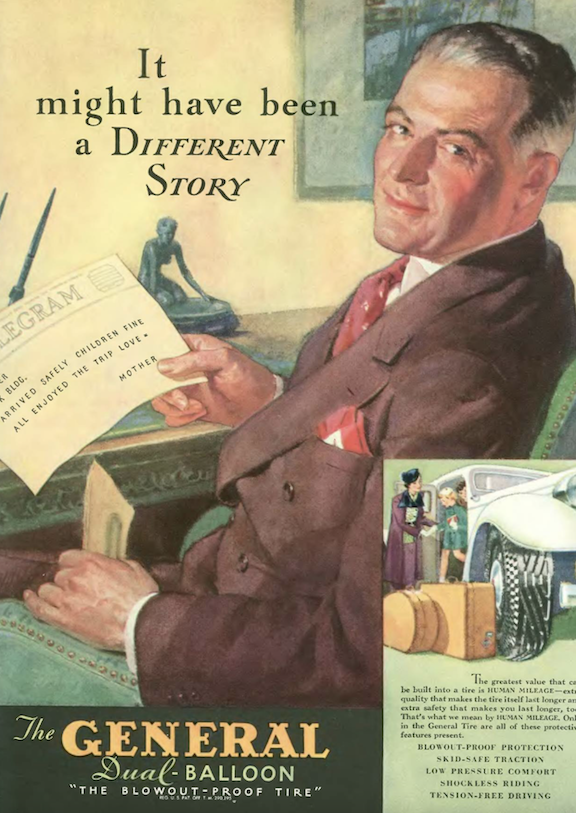
…another grim message from General Tire…this time featuring dear old dad, contemplating a different fate for his wife and children…

…recall the General ad from March 23…

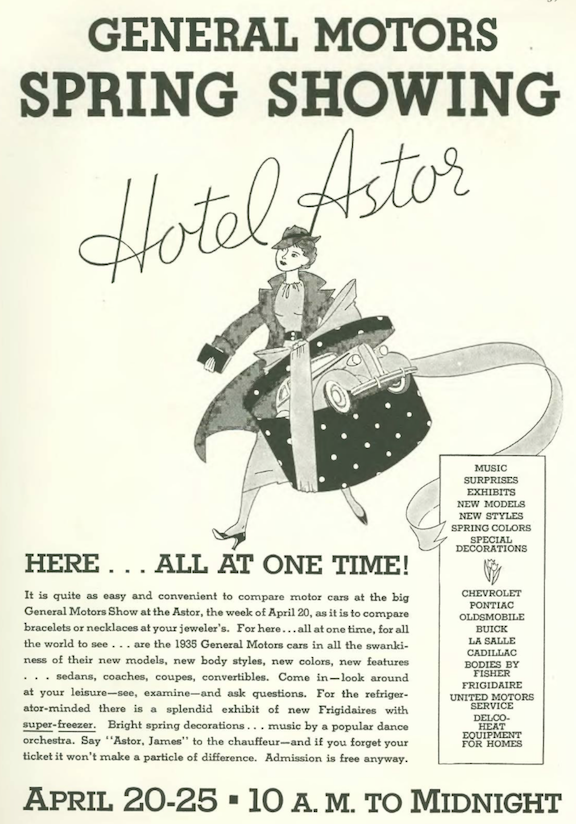
…General Motors was touting its lineup of 1935 models at the Hotel Astor…

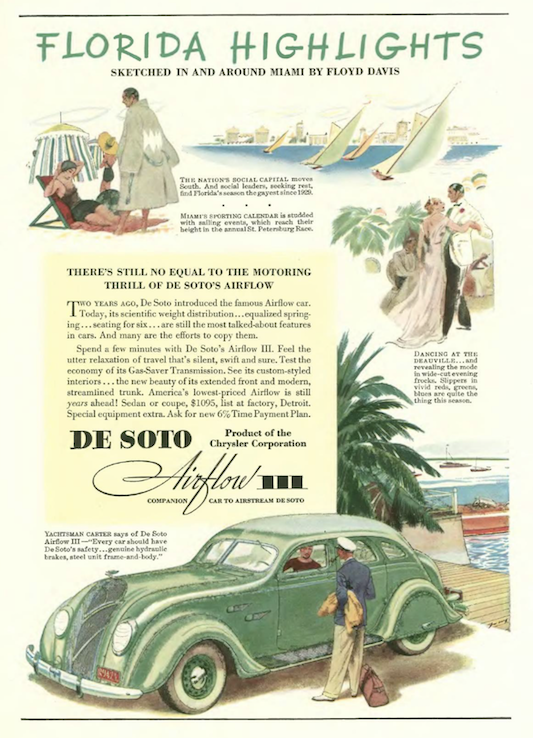
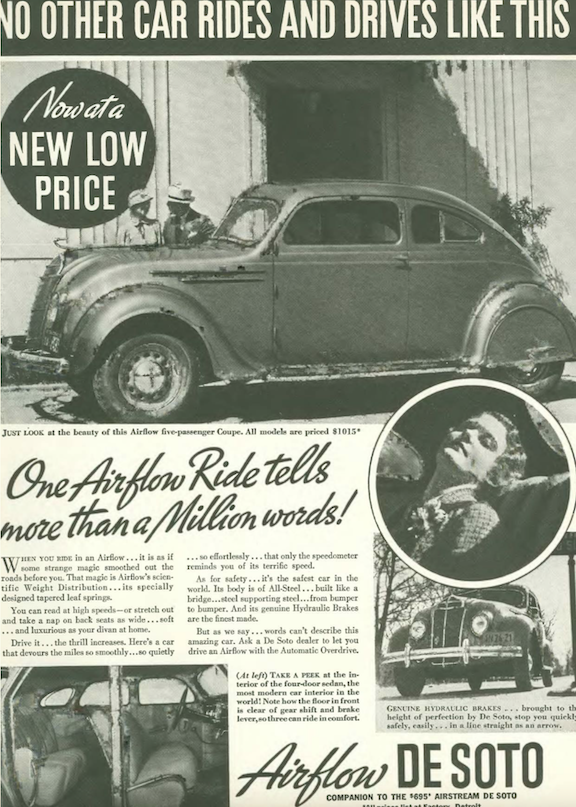
…Chrysler was known as an innovator, introducing radical designs like the Airflow, but consumers weren’t ready for the ultra-streamlined model, even if it did ride so smoothly that one could apparently lose consciousness…
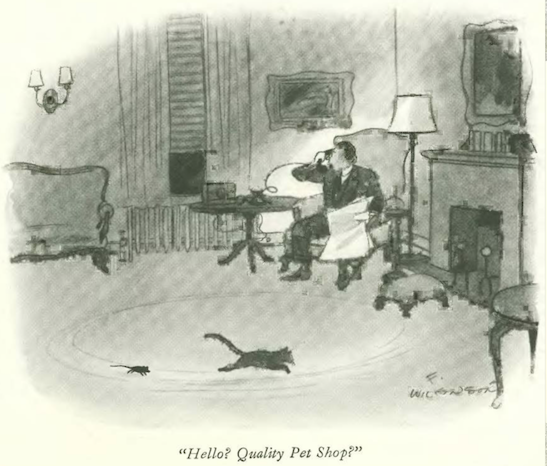
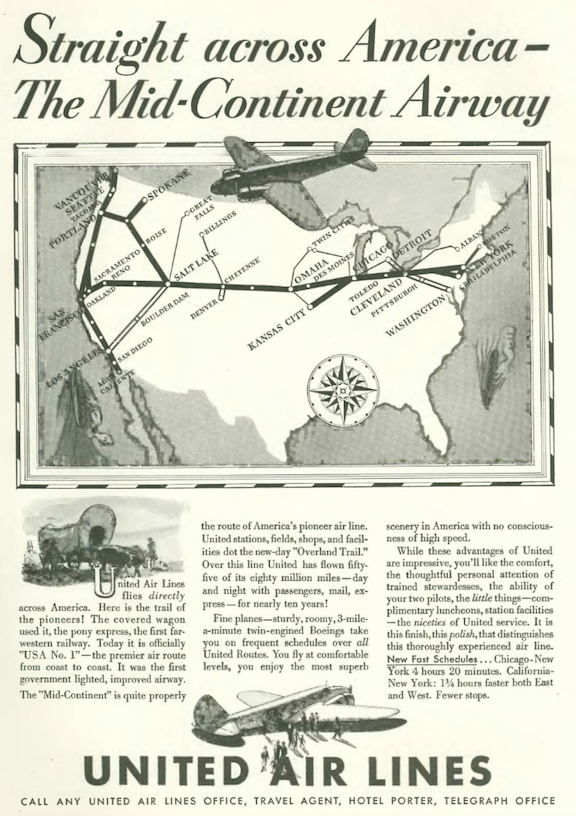
…if a car trip was not your thing, you could fly across America, with a few stops…

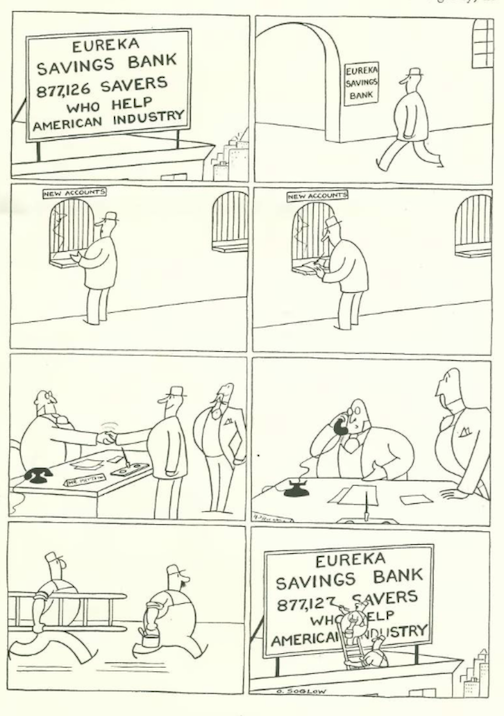
…and we fly into our cartoons, where we keep up to date with Otto Soglow

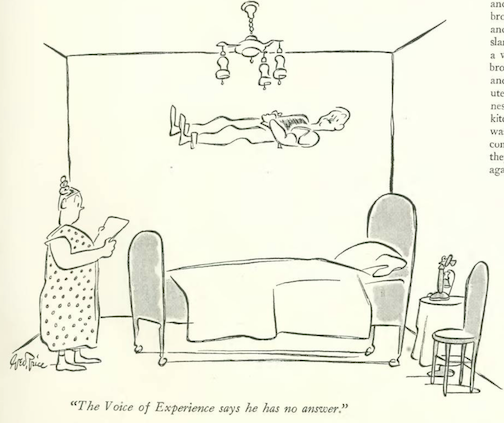
George Price was still up in the air with this fellow…

Gluyas Williams continued to look at club life with this cartoon which originally ran sideways on page 21…

…compliments to the cook, from Syd Hoff

…Walter Lippmann put the scare in this James Thurber subject…

…and we end with Barbara Shermund, and one young woman who won’t be visiting the new planetarium…

Next Time: A Tour of Broadacre City…

Home Sweet Motohome

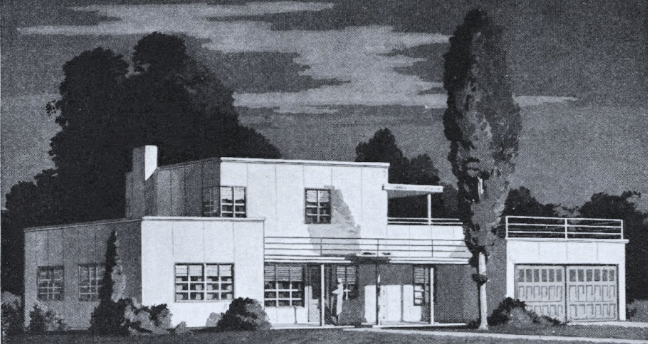
Morris Markey thought he was getting a glimpse of the future when he attended an exhibit of “machines to live in” at New York’s Grand Central Palace.

March 16, 1935 cover by Constantin Alajalov.

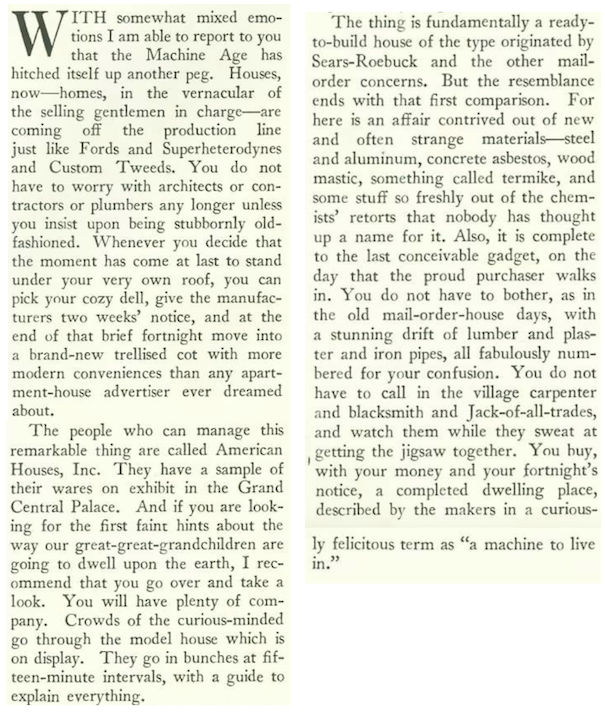
The Great Depression created a housing shortfall in the U.S. of nearly two million units, so many idled architects and builders turned to industrialized housing as a way to boost the building industry. In “A Reporter At Large,” Markey described his encounter with one type of “machine to live in”––the Motohome.

The idea of pre-fab living wasn’t exactly new in 1935, originating in the 1920s with the German Bauhaus school and with notables such as Swiss architect Le Corbusier.

NOT THRILLED WITH FRILLS…Charles-Édouard Jeanneret (1887-1965), better known as Le Corbusier, stated in 1923 that “a house is a living machine.” He believed the world had evolved beyond the need for decorative frills, and that homes and furnishings should reflect their functions. Top left, Corbu’s 1929 Villa Savoye in Poissy, France; at right, his 1947-52 Unité d’habitation de Marseille. (Fondation Le Corbusier/Architectural Digest/Le Corbusier World Heritage)

Markey correctly surmised that the American twist on Le Corbusier’s vision was largely driven by big corporations, and in the case of the Motohome, by General Electric.

GET YOUR MOTO RUNNING…Clockwise, from bottom left, New York’s Grand Central Palace; the Eggiman House in Madison, Wisconsin, a 1936 Motohome listed in the National Register of Historic Places; Long Island Motohome featured on a brochure; Popular Mechanics article on the Motohome. A common wall “core” was prefabricated with all kitchen and bath fixtures, as well as the HVAC system. (Wikipedia/makeitmidcentury.com/books.google.com)

 * * *

Strange and Wonderful

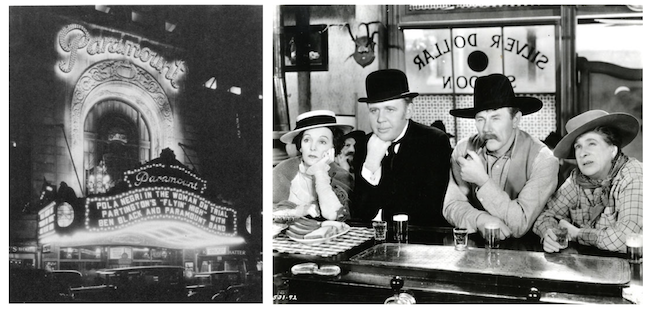
That is how E.B. White described the 3,664-seat Paramount Theatre, which opened on 43rd and Broadway in 1926. After nine years White was still in awe of its palatial trappings. In his “Notes and Comment,” White offered some thoughts after an evening at the movies.

CINEMA GLORY DAYS…E.B. White visited the Paramount Theatre to take in Charles Laughton’s hit film, Ruggles of Red Gap. From left, Zasu Pitts, Laughton, Charles Ruggles and Maude Eburne in Ruggles. (nyc.gov/TCM)
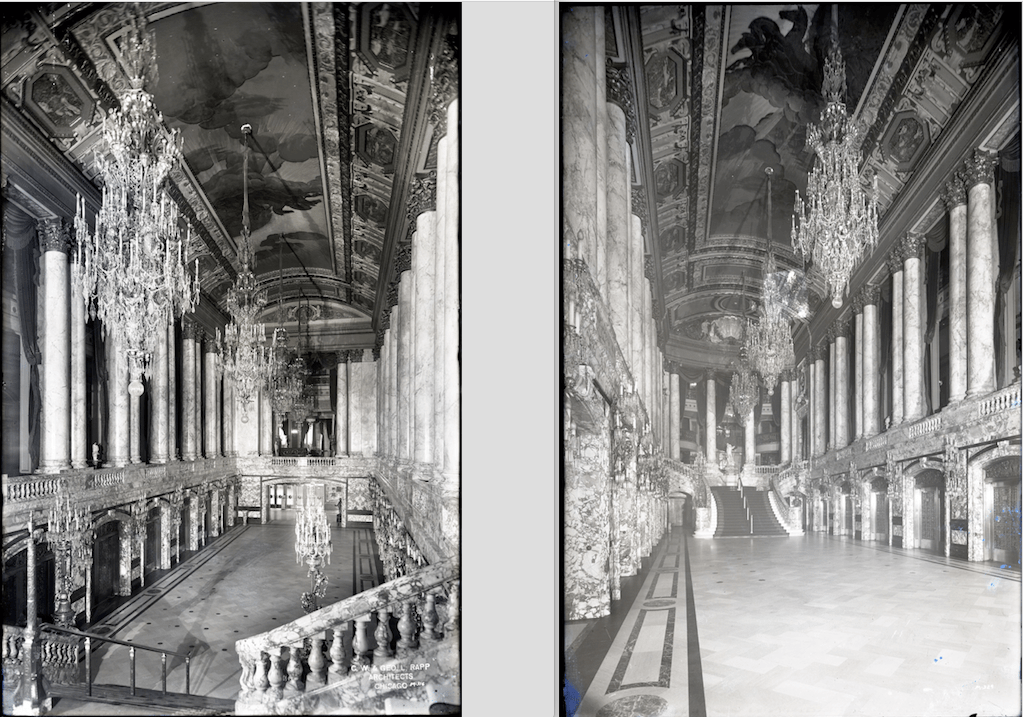
PALACE FOR THE PICTURES…The Paramount Theatre’s Grande Hall featured a 75-foot-long ceiling mural by artist Louis Grell above the Italian marble-lined entrance. In 1966, after a run of the James Bond film Thunderball, the Paramount was closed for good and later gutted and turned into retail and office space. (Louis Grell Foundation)

 * * *

Bad Guys

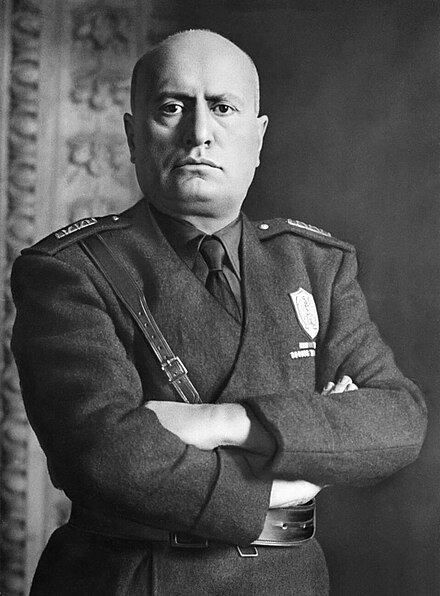
Andrew Mellon’s tax fraud troubles were sandwiched between the woes of a fascist bromance in Howard Brubaker’s “Of All Things”…Mellon would soon be dead, Adolf Hitler would lie his way around the Brits, and Benito Mussolini would struggle to inspire Italian women to produce his “army of tots”…

NOT TONIGHT, WE HAVE A HEADACHE…Little wonder fascist dictator Benito Mussolini couldn’t inspire a baby boom. (Wikipedia)

 * * *

Zoom Zoom

In his “Motors” column, writer “Speed” looked in on Sir Malcolm Campbell (1885-1948), who was attempting to break the 300-mph mark at Daytona in his 2,500-horsepower Blue Bird.

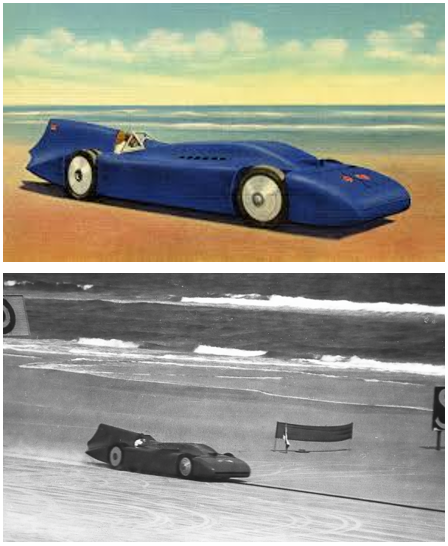
BLUE STREAK…Sir Malcolm Campbell’s bid for a land speed record surpassing 300 mph began at Daytona Beach in March 1935 in his Campbell-Railton Blue Bird, powered by a 2,500 hp supercharged Rolls-Royce V-12. He managed to hit 276 mph (combined runs in each direction), but conditions at the beach (bottom photo) left him short of his goal. He found a smoother, longer run at Utah’s Bonneville Salt Flats in September, where he would average 301.337 mph (484.955 km/h) in two passes to set the new record. (floridamemory.com/oldmachinepress.com)
ONCE IS NOT ENOUGH…Sir Malcolm Campbell MBE was a British racing motorist and motoring journalist. He gained the world speed record on land and on water several times. He was also one of the few land speed record holders of his era to die of natural causes. (Wikipedia)

 * * *

From Our Advertisers

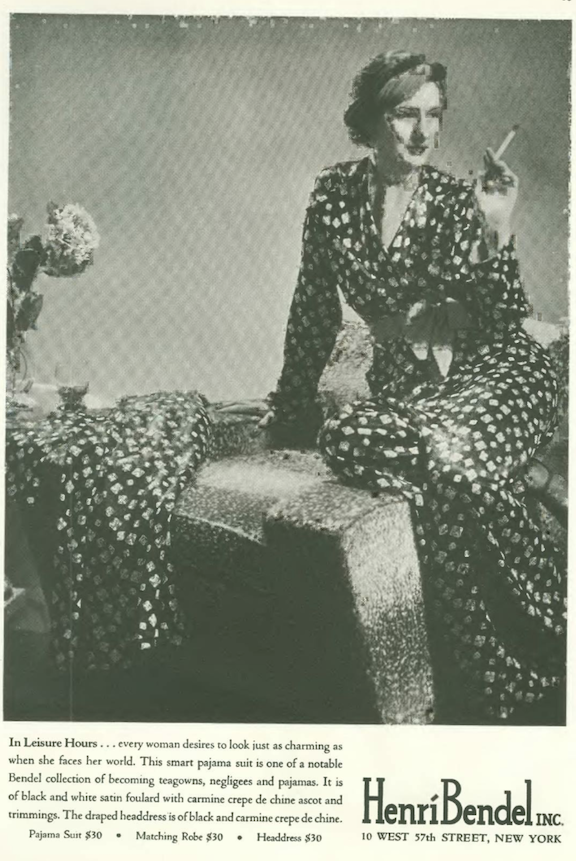
For ninety bucks you could get this swell pajama suit and matching robe (plus headdress) at Henri Bendel, the perfect ensemble for having a leisurely smoke after a day facing the world…For more than 100 years, Henri Bendel’s flagship and only store was located at 10 West 57th Street…it closed in 2018…

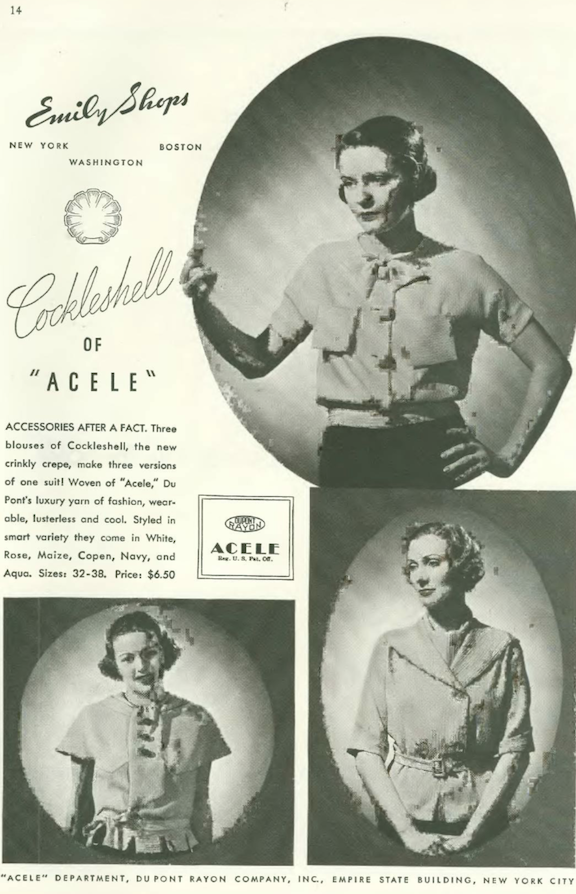
…I doubt the woman in the Bendel ad would have been interested in clothes made with Acele…it was without question that the uppers only wore clothes derived from living things…

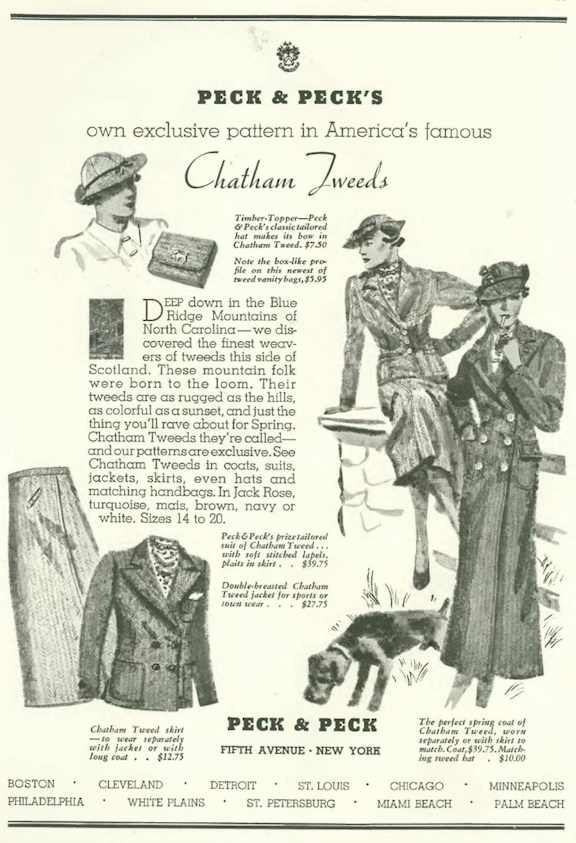
…this Anglophilic Peck & Peck ad is notable for its condescending reference to the “mountain folk” in Appalachia who “were born to loom”…

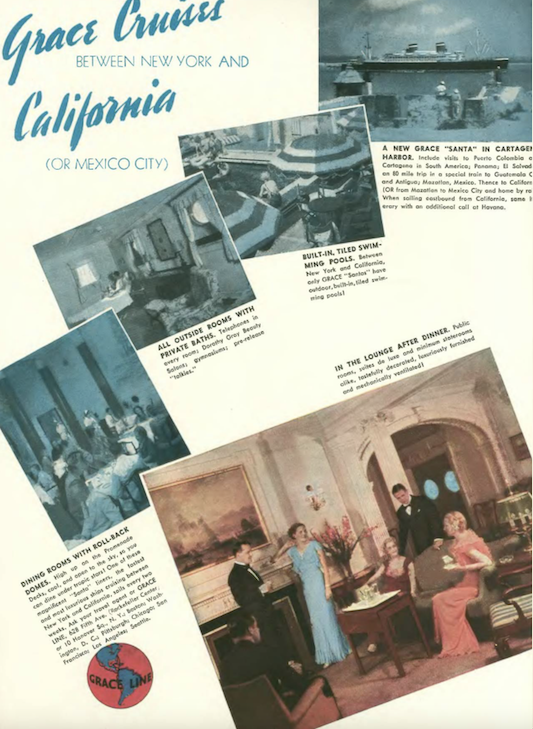
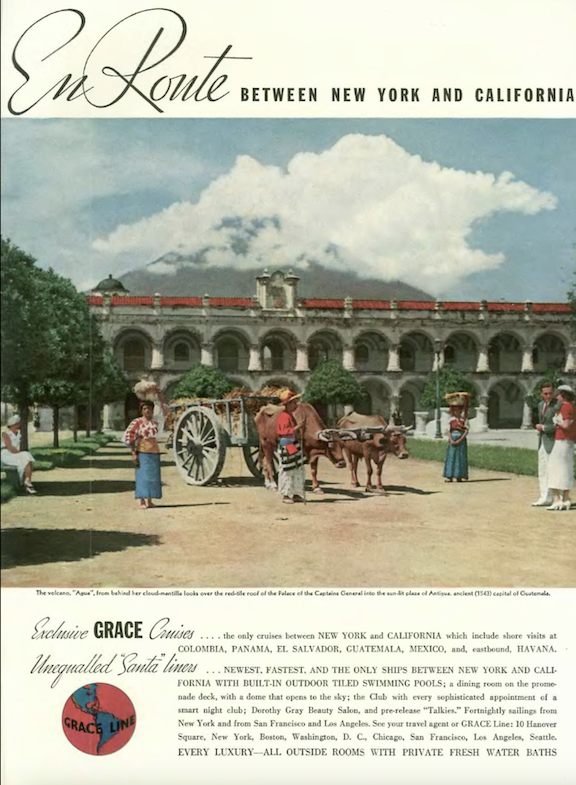
…while we are on the subject, check out this ad for Grace Cruises…this was a common theme in mid-century travel advertising, Westerners dressed in their Sunday best while having a gander at the colorful natives…

…who are just part of the scenery…

…all four of the automobile ads in this issue come from long-gone companies…the luxury carmaker Packard made beautiful, quality cars that outsold Cadillacs up until 1950, but competition from the Big Three (GM, Ford, Chrysler) plus Packard’s decision in 1954 to buy failing Studebaker led to Packard’s demise four years later…

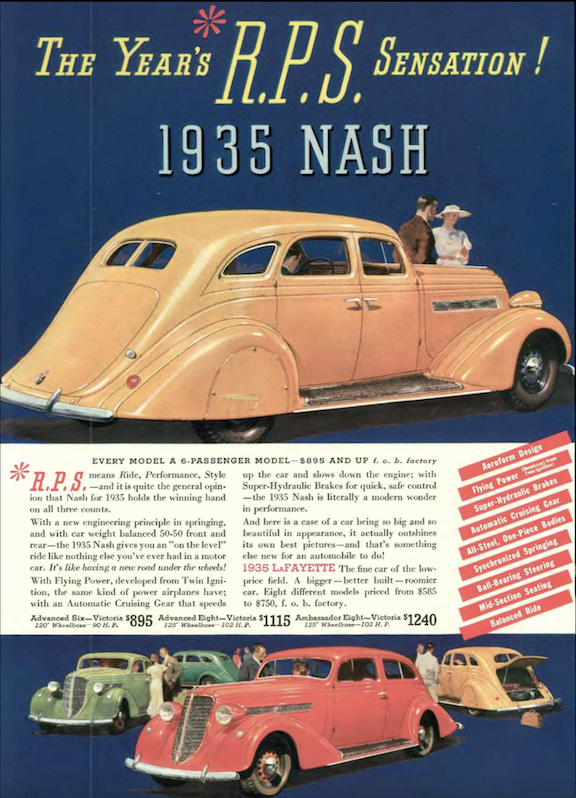
…a more successful merger took place in 1954 between Nash…

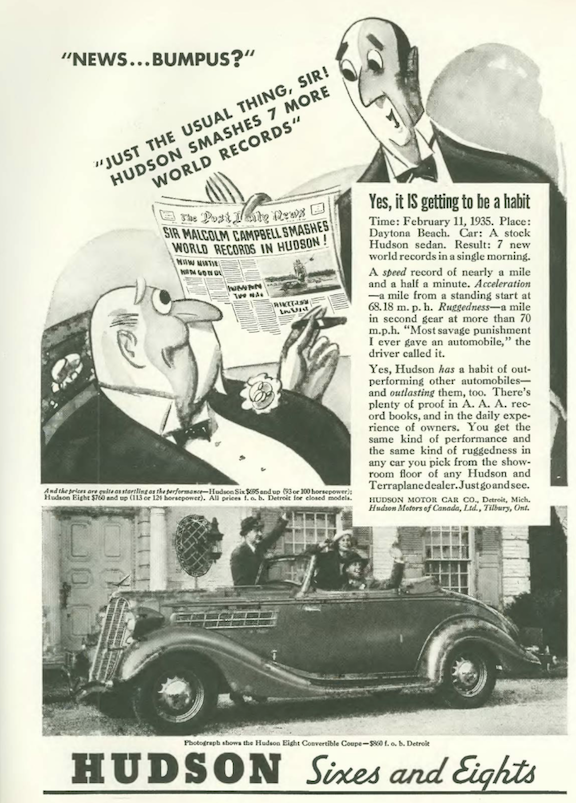
…and Hudson, the two forming the new American Motors Corporation…

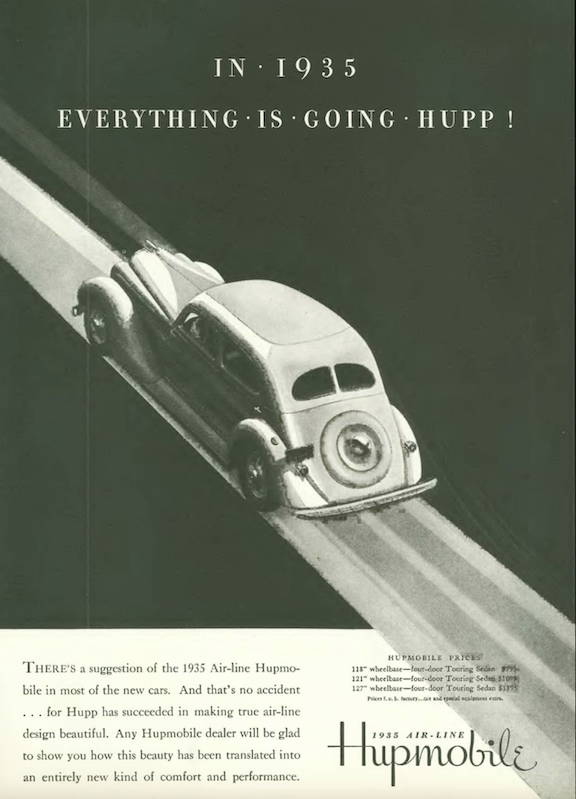
…contrary to this ad’s tagline, everything was actually going down for Hupmobile, which would go out of business in 1939…

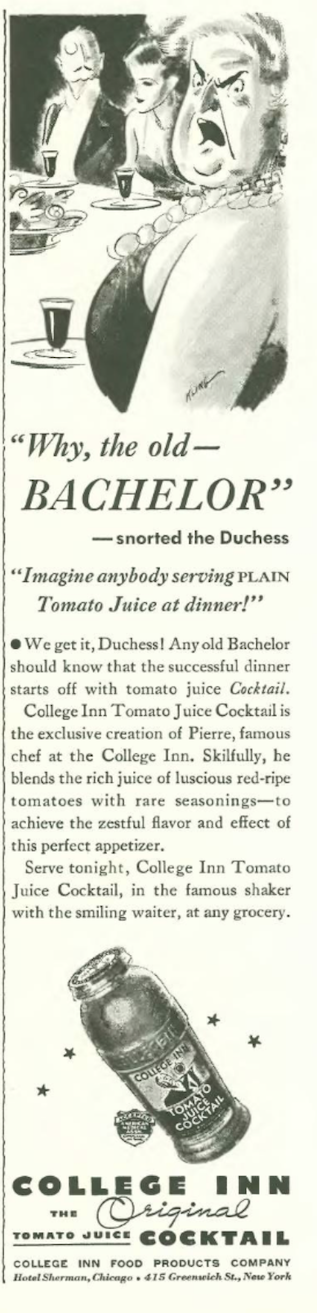
…the makers of College Inn Tomato Juice Cocktail apparently thought an angry old “Duchess” would boost sales…she first appeared in the Feb. 23 issue…

…in the March 16 issue she appears to be psychotic, threatening, “I’ll teach her not to serve PLAIN tomato juice before dinner!” Will she break the glass on the table and lunge at her host (the old WITCH) with a glass shard?…Stay tuned…

…better to calm down and have a Guinness, which, by Jove, was affordable and good for you!…

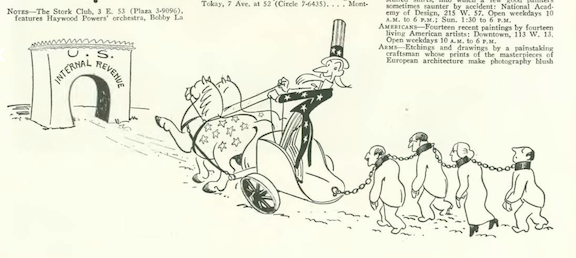
New Yorker cartoons are also good for you, and we begin with Al Frueh and this taxing illustration at the bottom of page 4…

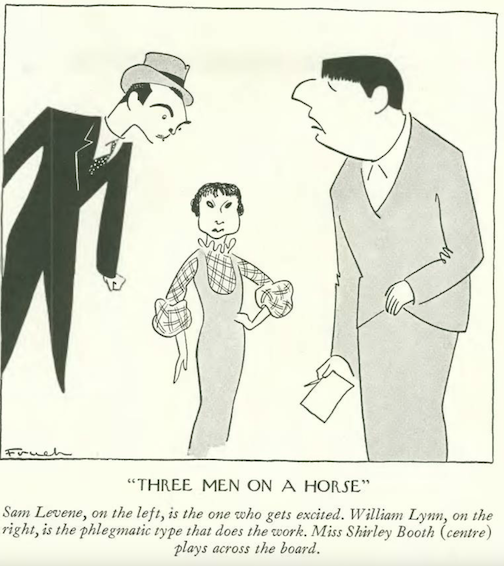
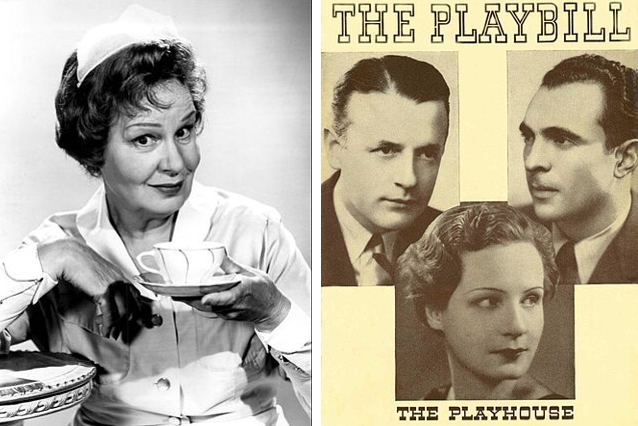
…Frueh again, for the theater review section…in the center is Shirley Booth, known to Baby Boomers as the star of the old TV series Hazel (1961-66)…

…Booth was much more than a sitcom star, achieving the Triple Crown of Acting––an Academy Award, two Primetime Emmy Awards and three Tony Awards…
ACTING CHOPS…Shirley Booth (1898-1992) as Hazel in 1962; on the cover of the 1935 Playbill featuring Three Men on a Horse. (Wikipedia)

…we continue with Daniel ‘Alain’ Brustlein, and a term of endearment from someone well known to the police…
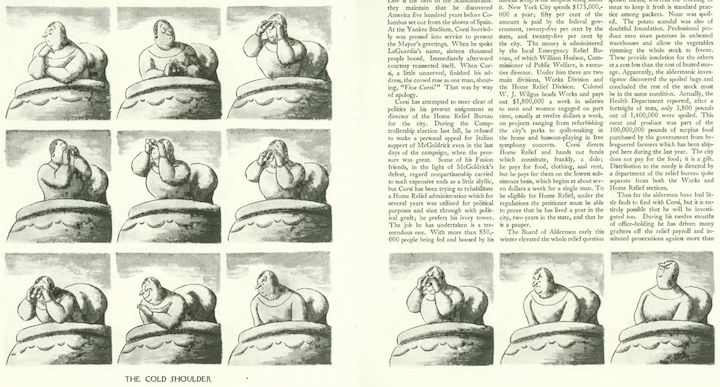
William Steig took up two pages to give one opera patron the cold shoulder…

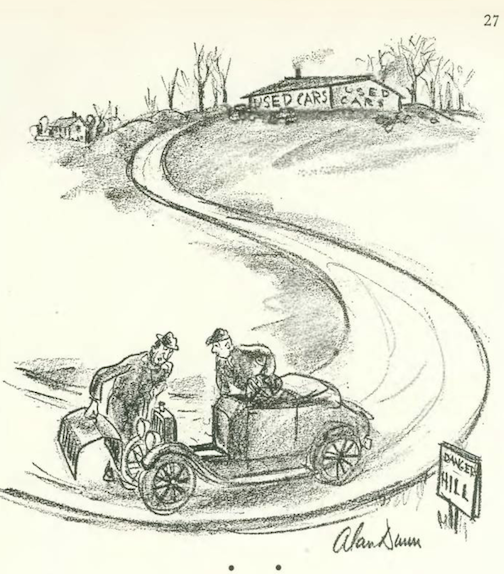
Alan Dunn cautioned against car dealers perched on high hills…

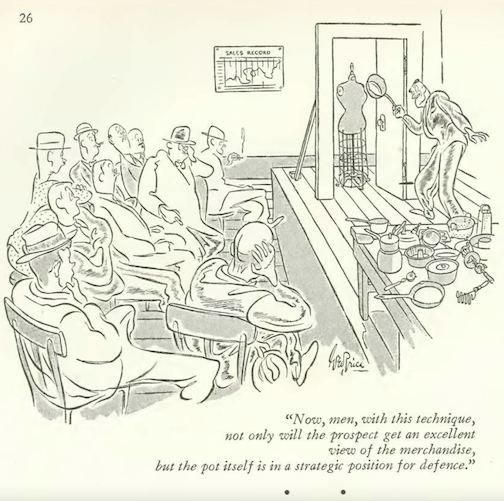
George Price examined the finer points of salesmanship…

Helen Hokinson headed for the high seas…

…and we close with an all-time classic from James Thurber

Next Time: Something Frivolous…

House & Home

The New Yorker’s art and architectural critic Lewis Mumford found much to dislike about urban life, from pretentious ornamentation to the gigantic scale of skyscrapers popping up all over Manhattan. Technology and progress were fine, but when coupled with unbridled capitalism, Mumford believed they created inhuman environments in which the average citizen struggled to survive, let alone thrive.

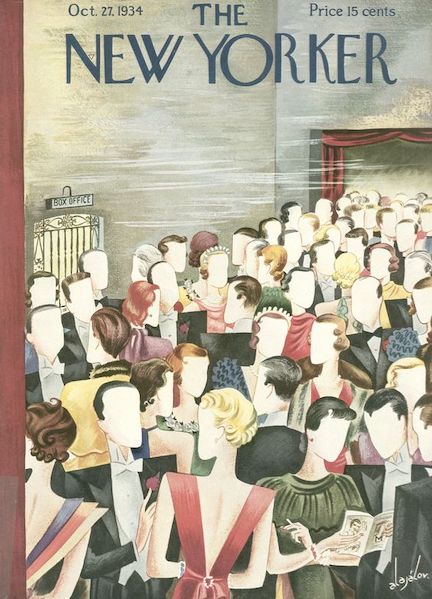
Oct. 27, 1934 cover by Constantin Alajalov.

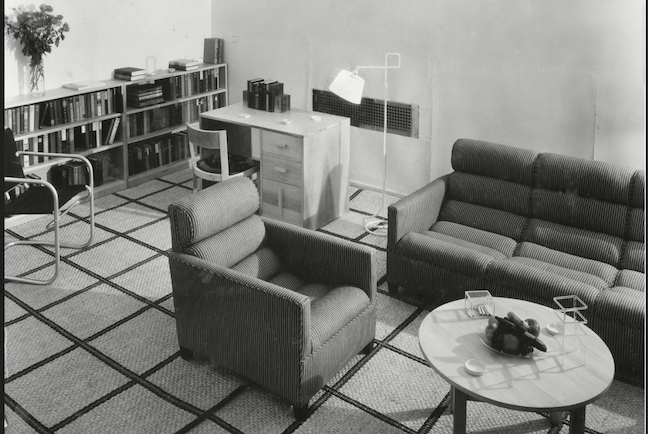
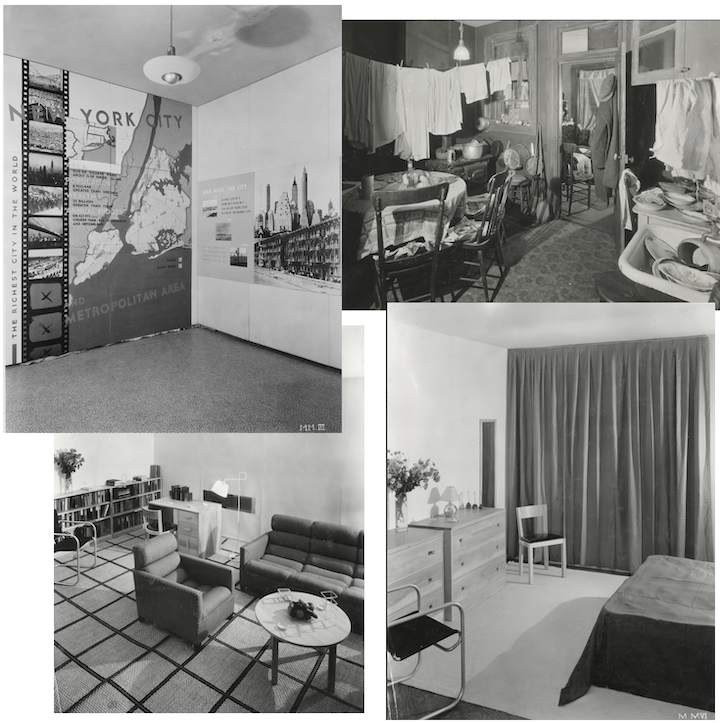
A housing exhibit at the Museum of Modern Art proposed policy and design solutions that addressed housing for the masses in “a human environment,” with European innovations leading the way. The Romanian-born Carol Aronovici (1881-1957), a well-known expert in city planning and public housing, was editor of a companion book to the exhibit, America Can’t Have Housing, in which he included seventeen essays by such experts as architect Walter Gropius, public housing advocate Catherine Bauer, and The New Yorker’s Mumford.

GIVE ME SHELTER…At left, Carol Aronovici’s companion book to the exhibition, with a cover image of the Siemensstadt Housing Development in Berlin, by Walter Gropius; above, excerpts from Lewis Mumford’s essay in the book; below, entrance to the exhibit. (MoMA)

Mumford reviewed the exhibit in his regular column, “The Sky Line.” Excerpts:

BETTER HOMES…Images from the exhibit included the squalor of a tenement (top right) that offered a stark contrast to the clean, modern look inspired by European designers. (MoMA)

 * * *

From Our Advertisers

We once again open the magazine to an odd juxtaposition of canned soup and high fashion…Hormel was pushing their onion soup by linking the product to French nobility (a previous ad featured Napoleon)…at right, illustrator Lyse Darcy created many ads for Guerlain products from the 1930s through the 1950s…

…the Macbeth-Evans Glass Company introduced Americans to a revolution in coffee brewing—the drip method…

…the folks who made Arrow Shirts wanted men to know that its “Thor” model would make them as confident as this man at a business conference…so confident, in fact, that he can appear mildly disinterested as he engages in a game of tic-tac-toe…

…purveyors of high fashion Lord & Taylor offered up a new design twist with this ad rendered in the Courier font…

…Pond’s continued to featured the rich and famous, women who apparently defied age itself with a few dabs of cold cream…the ad featured Alice Erdman, the wife of politician and theater producer Francis Cleveland (President Grover Cleveland’s son) and Long Island society maven Xenia Georgievna of Russia…

BELIEVER…Xenia Georgievna of Russia (1903–1965) was an influential member of New York’s Long Island North Shore society. She is best known for her belief that the imposter Anna Anderson was actually the Grand Duchess Anastasia. (Pinterest)

Newton D. Baker mobilized and presided over the United States Army during World War I, and during the Depression he led a “National Citizens Committee” that he mobilized for human needs…

…this detail from an ad for Webster cigars offered an image of a football game almost unimaginable today…

William Steig offered his cartooning services to the local gas company…

…which segues into more cartoons from the Oct. 27 issue, beginning with this spot from James Thurber

…and a cartoon…

…another in the floating man series by George Price

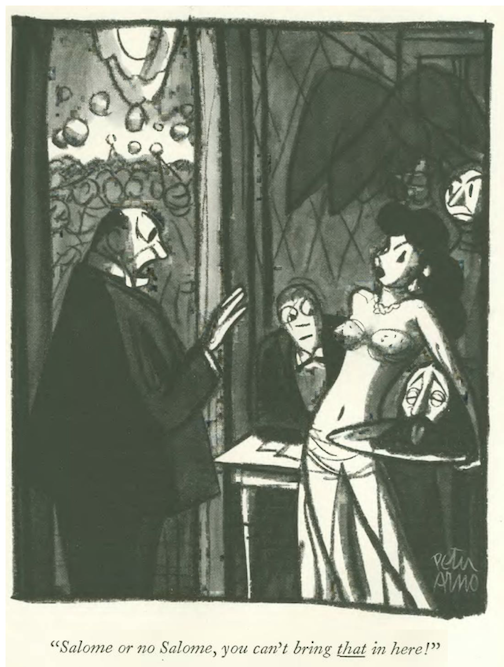
…and one from Peter Arno, with a classic clueless cuckold…

…on to Nov. 3, 1934…

Nov. 3, 1934 cover by Richard Decker.

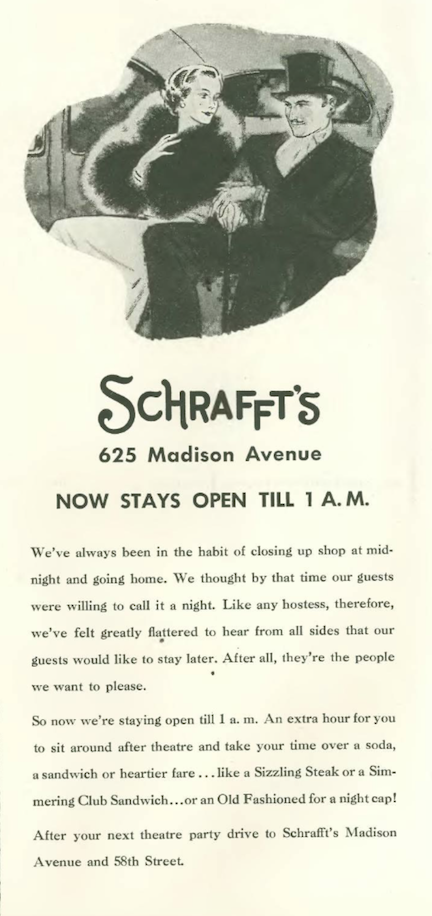
…and straight to the ads, beginning with this one from Schrafft’s, which was a chain of high-volume, moderately priced restaurants in the New York area…despite its affordability, Schrafft’s dining rooms were known for their gentility, an idea conveyed through this ad…

…and here we have another image of a posh couple savoring their downscale dining experience…perhaps they should ask their cook to stop using real turtles…

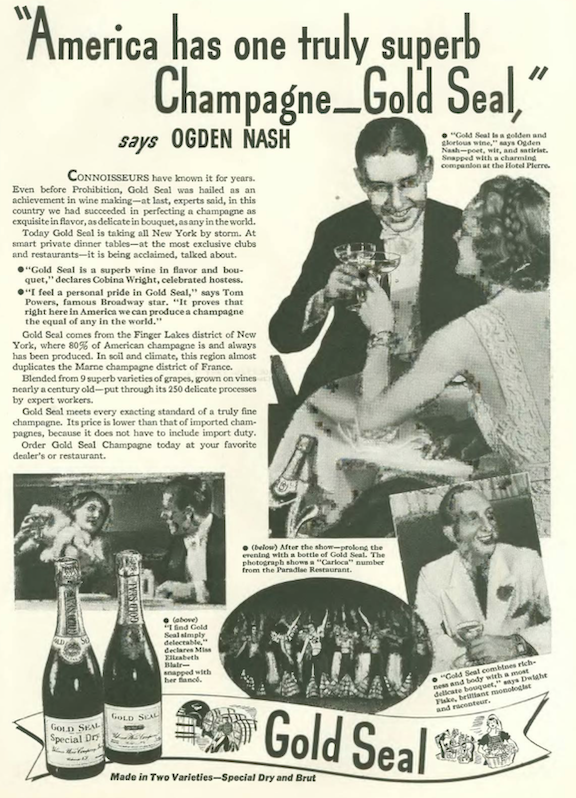
…the makers of Gold Seal “Champagne” lined up poet Ogden Nash to endorse what had to be some pretty awful stuff, even if Dwight Flake, “brilliant monologist and raconteur,” enjoyed its “delicate bouquet”…

…New York debutante Mimi Richardson joined the growing list of distinguished women who preferred puffing on a Camel…

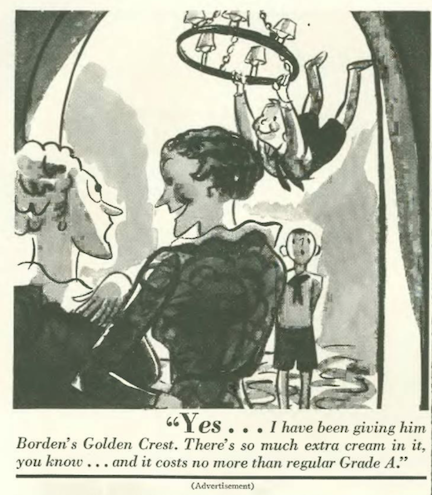
…this back-page ad featured an Arno-esque illustration touting the wonders of Borden’s Golden Crest milk…

…while the real Garrett Price drew up this image for the folks at Heinz…

…which brings us to more cartoons, still up in the air with George Price

Peter Arno gave us a suitor who was no fan of the silents…

…and we close with James Thurber, and some scandalous dish…

Next Time: The Wahoo Boy…

The Age of Giants

Otto Klemperer rehearsing at the Hollywood Bowl in September 1937. (Los Angeles Philharmonic)

The 20th century was an age of big personalities in classical music, among them Otto Klemperer (1885-1973), a German-born protégé of the composer and conductor Gustav Mahler. Klemperer was already an established conductor in opera houses around Germany when the rise of the Nazis prompted the maestro to emigrate with his family in 1933. He was soon appointed chief conductor of the Los Angeles Philharmonic.

Oct. 13, 1934 cover by Rea Irvin.

Klemperer also guest conducted a number of orchestras in the U.S., including the New York Philharmonic, where his larger than life presence caught the attention of “The Talk of the Town.” Excerpts:

MAESTRO…Top left, Otto Klemperer with Czech composer Leoš Janáček in 1927; at right, with Austrian-American classical pianist and composer Artur Schnabel in 1933; bottom photo, with wife Johanna Geisler, son Werner and daughter Lotte in Los Angeles, 1936. (operaplus.cz/Otto Klemperer Film Foundation/ottoklemperer.nl)

Lauded internationally as a great orchestral commander, in 1939 Klemperer would begin experiencing balance issues. After a tumor the size of a small orange was removed from his brain, he would be left partially paralyzed on his right side; bouts of depression and a manic phase would later land him in a mental hospital. However, by 1946 he would recover his health enough to return to conducting in a career that would last until 1971.

The conductor’s daughter, Lotte Klemperer (1923–2003), would serve as her father’s secretary, negotiator and administrator until his death in 1973. Otto’s son, Werner Klemperer (1920–2000), would become a stage, screen and television actor, most notably portraying Colonel Klink in the 1960s comedy Hogan’s Heroes. Although the role would garner Werner two Emmys, his father never fully understood the series or even the concept of a sitcom. Reluctant to pursue a musical career while his father was alive, Werner would later join the Metropolitan Opera Company in the 1970s, appear in Broadway musicals, and serve as a narrator with a number of American symphony orchestras.

TO THEM HE WAS DAD…At left, daughter Lotte Klemperer with her famous father in 1954. She would serve as his caretaker and business partner after her mother’s death in 1956. At right, son Werner Klemperer acted on Broadway and in films before taking on the role of the bumbling Colonel Klink in the 1960s comedy Hogan’s Heroes, which garnered the actor two Emmys. Although Werner Klemperer was musically inclined, he avoided work in music until the death of his father in 1973. (Otto Klemperer Film Foundation/CBS)

 * * *

Vanished in the Haze

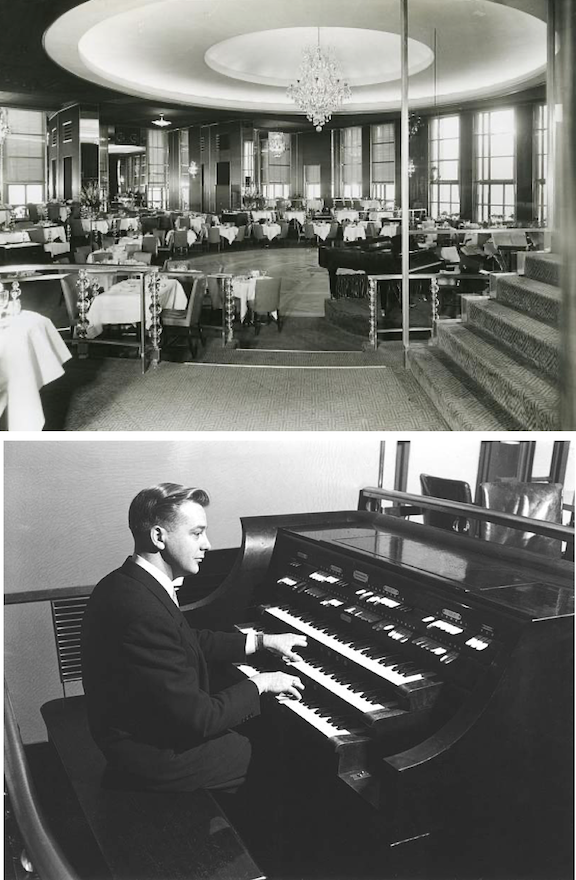
In his “Notes and Comment,” E.B. White lamented what appeared to be the transformation of the familiar night club; high above Manhattan in the Rockefeller Center’s Rainbow Room, the comforting haze of “cigarette smoke, talc, waiter’s venom” had been displaced by air conditioning, and to add to the horror, an organ had been installed that tinged the fox trot “with an odd piety.”

NOWHERE TO HIDE…E.B. White found the lack of haze in the new Rainbow Room disconcerting, not to mention the addition of a Wurlitzer organ, its wonders demonstrated here by organist Ray Bohr in 1934. (Library of Congress/nycago.org)

 * * *

There Oughta Be a Law

While E.B. White was mourning the demise of the smoky nightclub, art and design critic Lewis Mumford continued his tirade against the pretentious and mediocre buildings that were popping up all over the city, including the new Federal Court Building on Centre Street that was, in Mumford’s words, a supreme example of bad design and fake grandeur.

Cass Gilbert's The Federal Courthouse building (United States courthouse) in 1936 (the year of its completion). Located at 40 Centre Street (Foley Square), Manhattan, New York City. In 2001, it was designated as the Thurgood Marshall United States Courthouse.Source: Wurts Brothers Photography Collection at the National Building Museum.
A CRIMINAL CASE…Cass Gilbert’s Federal Courthouse building (United States courthouse) was completed in 1936, two years after Gilbert’s death. In 2001 it was designated as the Thurgood Marshall United States Courthouse. Critic Lewis Mumford called the design, which combined “two unlovely and unrelated forms”…”nothing short of a major crime.” (Wurts Brothers Photography Collection, National Building Museum)

 * * *

Crime of the Century

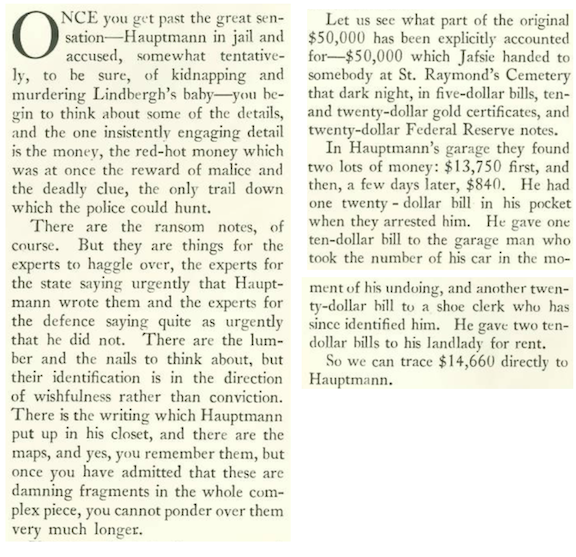
That is what the press called the kidnap and murder of the infant son of Charles Lindbergh and Anne Morrow. In September 1934 a German immigrant carpenter named Bruno Hauptmann was arrested for the crime, and a trial date was set for the following January. In his “A Reporter at Large” column, Morris Markey examined the ransom money trail that led to Hauptmann’s ultimate arrest. Excerpts:

DON’T SAY “CHEESE”…Bruno Hauptmann sits for a mug shot following his arrest for the abduction and murder of the 20-month-old son of Charles Lindbergh and Anne Morrow Lindbergh. (Leslie Jones, Boston Public Library)

 * * *

Should Have Stayed Lost

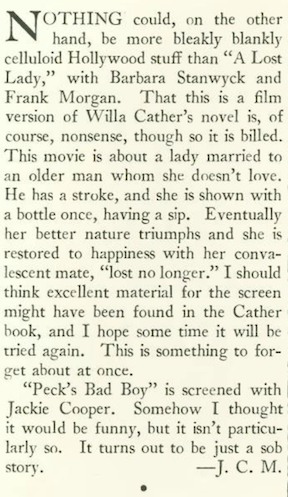
A film version of Willa Cather’s 1923 novel A Lost Lady was first made as a silent by Warner Brothers in 1924 (the film itself is lost) but in 1934 Warner had another go at the novel with a sound version starring starring Barbara Stanwyck, who was emerging as a major star. But Stanwyck’s talents could not overcome a script that critic John Mosher described as bleak, blank nonsense. Cather was so dismayed by the film that she refused to permit another adaptation of any of her novels during her lifetime.

LOST IN TRANSLATION…Barbara Stanwyck and Ricardo Cortez in A Lost Lady (1934). (IMDB)

 * * *

From Our Advertisers

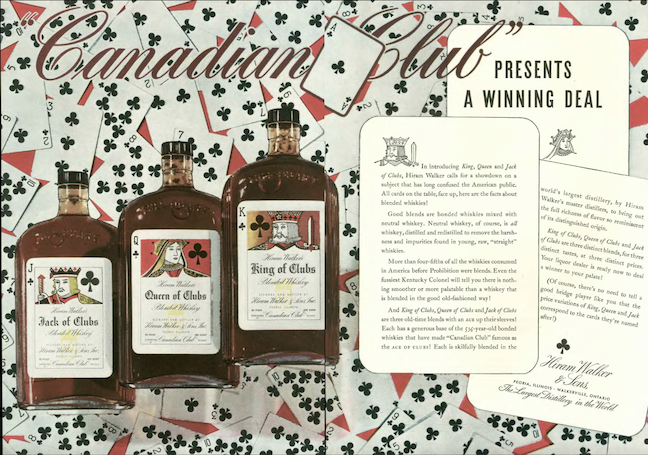
We kick off our sponsors with this two-page center spread from Hiram Walker & Sons, who introduced their new line of playing card-inspired whiskies…

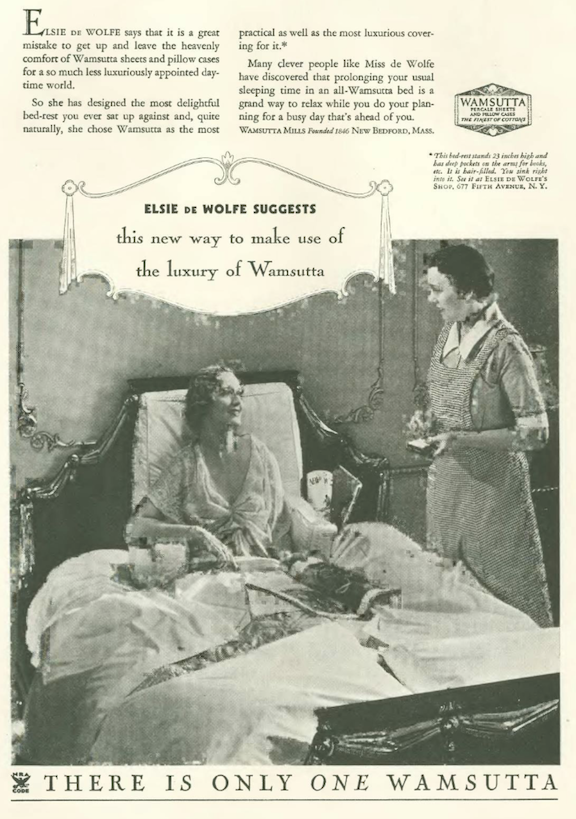
…the New Yorker’s Janet Flanner wrote in 1938 that Elsie de Wolfe invented interior design as a profession, so who was to argue with de Wolfe’s suggestion that the leisure class should linger in bed with the aid of a Wamsutta bed-rest…the small print beneath the logo indicated that the bed-rest was “hair-filled,” which I assume was horse hair, still used today in some luxury brands…

…if de Wolfe was queen of interior designers, then Hattie Carnegie was the “First Lady of Fashion,” or so this ad claimed…

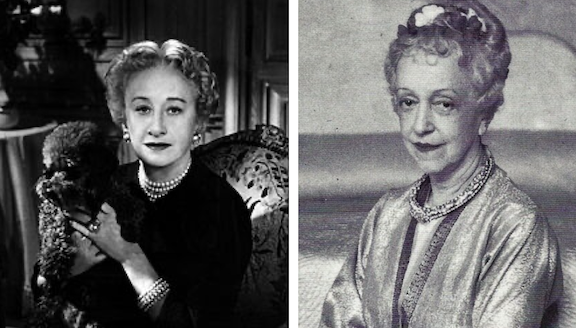
…here are images of the two titans of fashion and good taste…

TASTEMAKERS…At left, Hattie Carnegie aka Henrietta Kanengeiser (1880-1956), and Elsie de Wolfe, aka Lady Mendl (1859–1950). (americacomesalive.com/bureauofinteriors.com)

…and speaking of fashion, here is a llama cloth coat from B. Altman, trimmed in silver raccoon, suitable for Yale football games…based on inflation, that coat today would set you back at least $2,000…

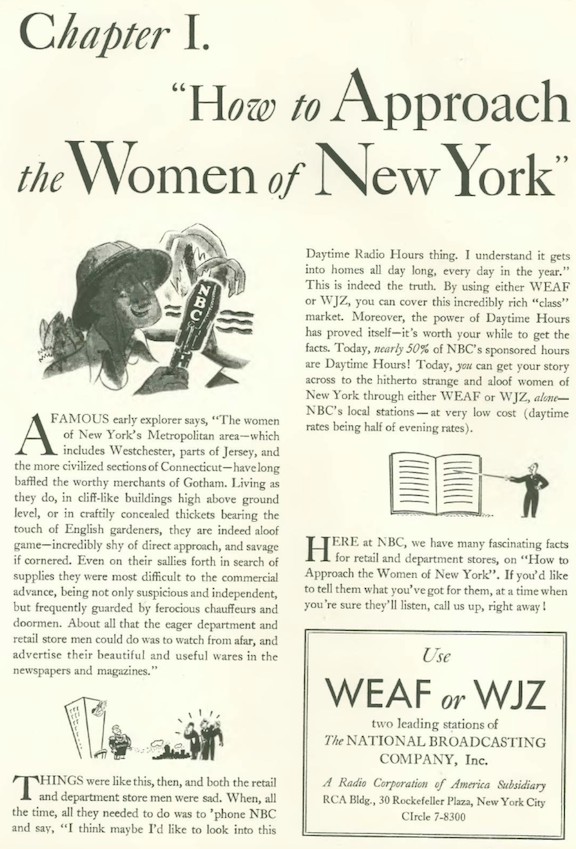
…this condescending ad offered merchants a way to reach the “hitherto strange and aloof women of New York” through daytime advertising…

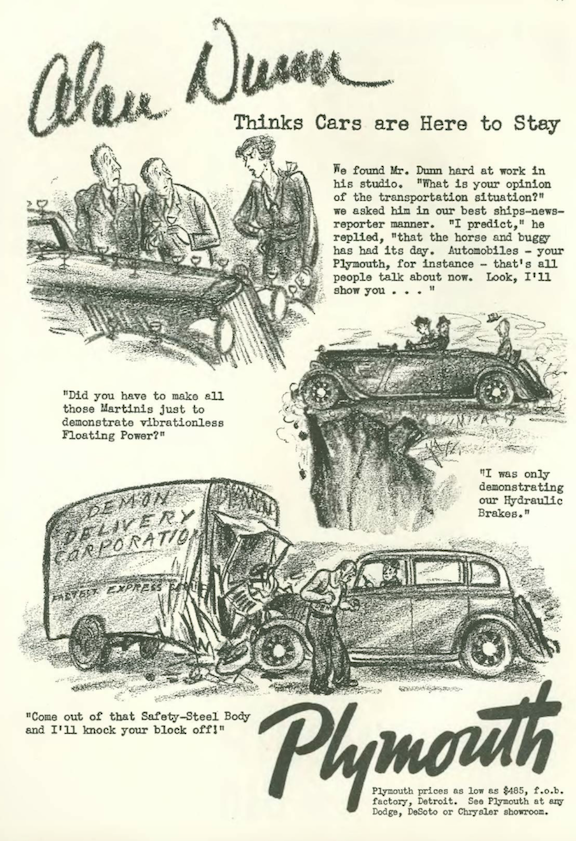
…Plymouth enlisted the talents of Alan Dunn to tout their car’s ride and durability…

…and on to our cartoonists, another from Dunn, a bit of spot art featuring a not so subtle commentary on Lawrence Lee Bazley Angas’s book The Coming American Boom

…and some spot art from Isadore Klein

Miguel Covarrubias contributed to the theater review section…

James Thurber entertained a house guest…

George Price was still up in the air…

Helen Hokinson took a spin with a celebrity look-alike…

…and Barbara Shermund offered another glimpse into the life of a modern woman…

…on to Oct. 20, 1934…

Oct. 20, 1934 cover by Helen Hokinson.

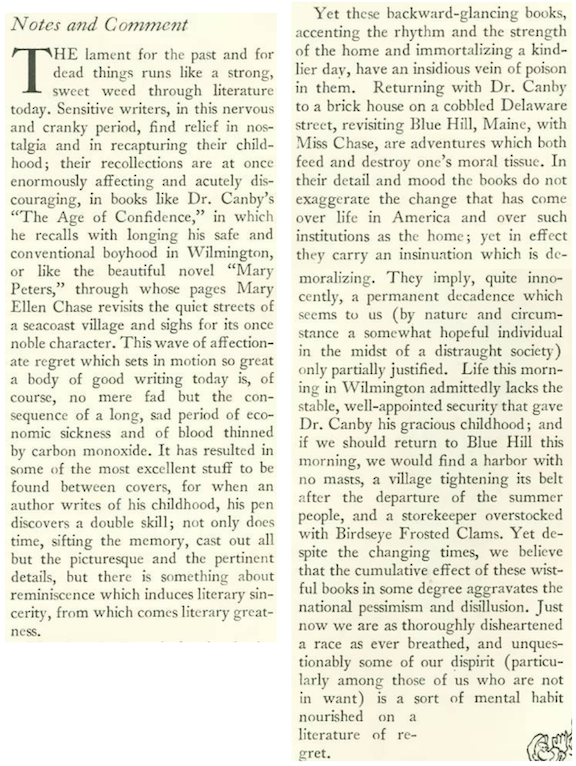
…in which E.B. White offered up a new lament, namely the pervasiveness of nostalgia and sentiment in contemporary literature…

HARKING BACK TO THOSE DAYS OF YORE…E.B. White simply had no stomach for the nostalgic stylings of Mary Ellen Chase (left) or Henry Seidel Canby, seen here on the cover of the May 19, 1924 issue of Time. (U of Maine/Time Inc)

 * * *

Fifty Years Young

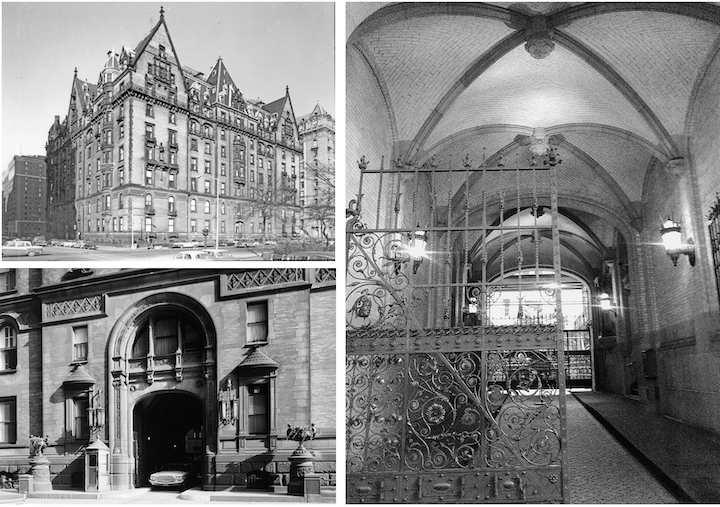
“The Talk of the Town” marked the Dakota’s 50th year at Central Park West, and made note of its loyal and prominent clientele…back in the day it served as a residence for actors such as Lillian Gish, Boris Karloff, and Teresa Wright, and in later years such luminaries as Lauren Bacall, Judy Garland, Rudolf Nureyev, and, of course, John Lennon and Yoko Ono.

THE STORIES IT COULD TELL…At left, the facade and main entrance of the Dakota in the 1960s; at right, inside the main entrance. (Pinterest/Wikipedia)

 * * *

More From Our Advertisers

The Matson-Oceanic Line offered a “millionaire’s idea of a vacation” at an affordable price, and offered this sumptuous image as proof…

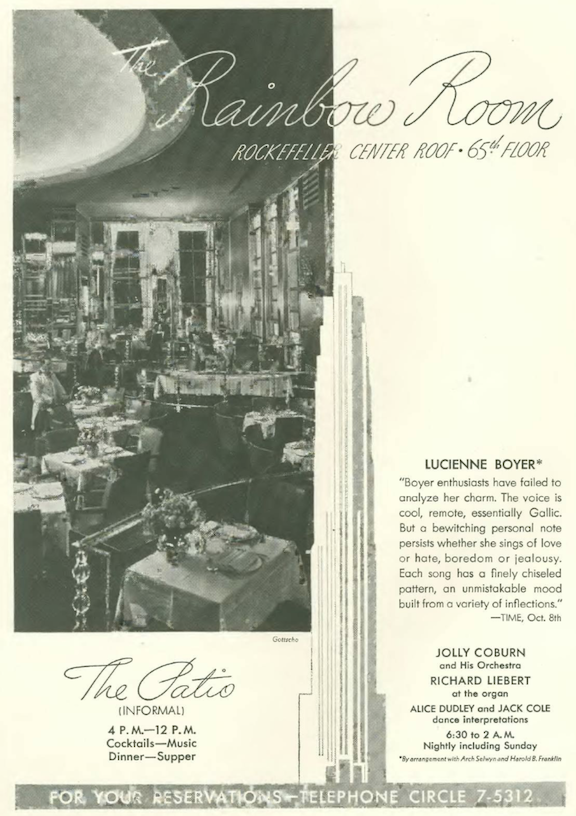
…E.B. White wasn’t crazy about the smokeless dazzle of the Rainbow Room, but it proved to be popular among the city’s elite…

…in case one was concerned about the provenance of one’s mink coat, Saks posted this helpful ad. Their high-end, natural-skin minks were priced at $8,000 (roughly $180,000 today); there was, however, a caveat regarding the cheaper models…

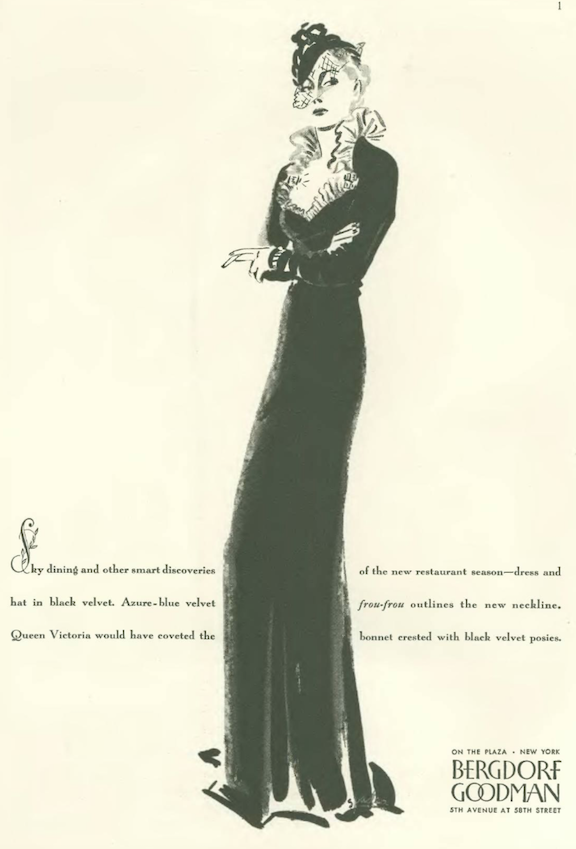
…Bergdorf Goodman offered up another ad featuring an impossibly attenuated model posed with a cigarette, her defiant gaze suggesting her modernity and individualism…

…Plymouth went back to the stable of New Yorker cartoonists, this time featuring the adventures of Helen Hokinson’s “girls”…

…and we segue to the rest of our cartoonists, including this spot by Constantin Alajalov

…and this by George Price

…who also gave us another update on the trials and tribulations of his floating man…

James Thurber occasionally ignored scale in rendering his characters, which didn’t really matter in his strange world…

Jack Markow had some bad news for two sign painters (the caption size is increased for readability)…

…and we close with Peter Arno, and the winner of most original Halloween costume…

…and before I go…this is being posted on Halloween, 2023, so here are a few images from 1934 to get you in the spirit, including a Saturday Evening Post cover, a 1934 party ideas magazine, and a page from Popular Mechanics featuring a smoking robot costume you could make yourself…in the 1930s, Popular Mechanics often featured Halloween party ideas that were downright lethal, usually involving electric shocks, pistols loaded with blanks, that sort of thing.

Happy Halloween!

Next Time: House & Home…

Reel News

Above: Newsreel cameramen perch on boards resting on a windowsill to get a birds-eye view of a passing parade, circa 1930. (Public Domain Image)

We marvel at, and sometimes decry, today’s instantaneous news coverage of wars, disasters and the like, but ninety years ago newsreel crews did a remarkable job of filming and delivering the latest news to thousands of theaters across the U.S. and around the world.

Sept. 22, 1934 cover by Harry Brown.

In his “A Reporter at Large” column, Morris Markey penned a lengthy account of Fox Movietone’s coverage of the SS Morro Castle disaster. En route from Havana to New York City on Sept. 8, 1934, the luxury liner caught fire near the New Jersey coast. Due to the ship’s design and the ineptitude of the crew, the blaze claimed 137 lives. Markey described how newsreel crews—with their bulky cameras and sound equipment—went into action, including a cameraman who “goaded” a pilot into taking him aloft through vicious weather conditions.

GUTS AND INGENUITY took newsreel reporters to places high and low. Clockwise, from top left, title card from a 1935 Fox Movietone newsreel; Jack Lieb goes aloft to get capture newsreel footage in an undated photo—Lieb was a cameraman for Hearst’s News of the Day; a 1930s Fox Movietone camera; the SS Morro Castle ablaze off the New Jersey Coast on Sept. 8, 1934. (Wikipedia/Lieb photo Courtesy of Bette Marshall via unwritten-record.blogs.archives.gov)

Somehow the cameraman aboard the airplane (which was forced down by weather three times) was able to get his footage to the Movietone office by noon, less than seven hours after the office first received word of the disaster. By three o’clock, five thousand feet of film from all sources was being developed.

UP NORTH AND DOWN UNDER…Movietone news had crews stationed around the world, including field staff in Sydney (top, from 1938), and in Toronto, circa 1930. (Nat’l Library of Australia/City of Toronto Archives)

Markey concluded with this observation about the “rugged” and persistent newsreel cameramen:

In the aftermath of the Morro Castle disaster, a scene of enormous tragedy was turned into a tourist attraction…

GAWKERS AND HAWKERS…The charred hulk of the SS Morro Castle came to rest on the shore near the Asbury Park boardwalk, which became a popular spot for souvenir salesmen and photo-ops. Tourists flocked to the site from September 1934 to March 1935, when the ship was finally towed away. Note the postcard (bottom) advertising homemade candy over an image of the charred ship. (ripleys.com/side-o-lamb.com)

Fox Movietone News produced sound newsreels from 1928 to 1963, and in the UK as British Movietone News…here is Movietone footage of the Morro Castle disaster, as presented by British Movietone in 1934:

 * * *

Up In The Old Hotels

Last week “The Talk of the Town” looked in on one of Manhattan’s oldest saloons, McSorley’s. For the Sept. 22 “Talk” the subject was “Oldest Hotels,” two of which, The Cosmopolitan and The Grand, remarkably survive to this day.

HANGING IN THERE…The 1845 Brevoort House hotel at 15 Fifth Avenue (top left) was torn down in 1952, however the 1868 Grand Hotel (right) at 1232–1238 Broadway and the 1845 Cosmopolitan Hotel (below, left) at Chambers Street and West Broadway still stand today. (Museum of the City of New York / Chester Higgins Jr. for The New York Times)

 * * *

The Six-Million Dollar Road

The first roadway designed exclusively for automobile use was likely the Long Island Motor Parkway, privately built by William Kissam Vanderbilt II because he wanted a road suitable for auto racing. He established the Vanderbilt Cup races on local roads in 1904, but after two spectators were killed and many others injured, in 1908 he began building what would become a 45-mile (72 km) toll road from Queens to Lake Ronkonkoma. After two mechanics were killed in a 1910 race, the New York Legislature banned racing on the road, which the state took over in 1938.

ROAD WARRIOR…William Kissam Vanderbilt II (top right) staged his Vanderbilt Cup Races on his private road until a fatal accident put a stop to the fun in 1910; At bottom right, a surviving section of the road today. Most of the road in Queens is a bicycle trail, and other segments still serve as parts of a county road. (nyheritage.org/Wikipedia-Steve Nowotarski/ny1.com)

 * * *

From Our Advertisers

I have nothing against accordion music, despite years of exposure to Lawrence Welk during my youth, but I find it hard to believe that a Park Avenue socialite (identified here as Mrs. René Du Champ Bellinger) would contemplate tormenting her posh friends with a Hohner squeezebox…

Esquire magazine was barely a year old when it posted this ad in The New Yorker…its appeal to men (and their anxieties) keeps it going today…

…it’s interesting how companies in the 19th century and on through the 1950s featured idealized, bird’s eye images of their factories in advertising, doubtless believing that consumers associated size (and smokestacks) with prosperity, and therefore a quality product…

…White Rock, however, has used the image of the Greek goddess Psyche for more than a century to promote the purity of its spring water…

…purity was also the main point of this ad from Daggett & Ramsdell, who hawked their wares to the Park Avenue set…after more than 130 years D&G is still in the beauty business…

…this next ad is almost unbelievable…single rooms starting at $5, double rooms $7, and a whole suite for $10…at the Plaza…okay, $10 is roughly equivalent to $225 today, but half of that could get you a single…

…and yet another unlikely claim from R.J. Reynolds regarding the energizing qualities of their Camel cigarettes…it seems the last thing you would need while climbing a mountain is smoke in your already over-taxed lungs…

…however, let’s give proper due to Georgia Engelhard (1906–1986), who scandalized the mountaineering world by ditching the Victorian climbing skirt in favor of a pair of climbing pants. Engelhard was the first female climber to ascend many of the peaks in the Rockies…

Georgia Engelhard in a 1922 photo attributed to her friend Alfred Stieglitz. (nga.gov)

…it seemed like nearly everyone smoked in the 1930s, even in ads that had nothing to do with tobacco companies (detail)…

…on to our cartoons, we begin with Richard Decker and some retail competition…

George Price drew up a curiosity even Robert Ripley couldn’t believe…

Robert Day examined advances in evolutionary science…

E. Simms Campbell offered up this abbreviated love story…

Peter Arno gave us a director with a god complex…

…and one from Ned Hilton, and a new perspective on flying…

…on to Sept. 29, 1934, with a cover by Arnold Hall, who produced at least twelve covers for The New Yorker between 1933 and 1939…

Sept. 29, 1934 cover by Arnold Hall.

…and we go straight to ads, beginning with this alarming image that greeted readers on the inside cover…why would this prompt anyone to purchase a can of onion soup?…

…the Rainbow Room on the 65th floor of Rockefeller Center opened in 1934, and it quickly became a focal point for the city’s elite…

Above, the dining room at the Rainbow Room, 1934, and below, in 2004. (Library of Congress/Wikipedia)

…Lucky Strike continued its series of ads featuring fashionable women looking smart with their product…

…our cartoons include this spot illustration by Otto Soglow, who did spots for The New Yorker for many years…although Soglow’s Little King moved to the Hearst newspapers, he continued to contribute cartoons to The New Yorker until 1974…

George Price continued to explore life as a levitating man…

…the enforcement of the Hays Code had this teen in a “fix,” per James Thurber

Gluyas Williams continued his exploration of various crises, this time in the music world…

Alan Dunn gave us a glimpse of civilization via the pharaonic sculptures that were emerging on the face of Mt. Rushmore…

…and we close with the wonderful wit of Barbara Shermund

Next Time: Bojangles…