Jimmy Comes Home

Above: Former New York Mayor Jimmy Walker and wife Betty Compton, aboard the S.S. Manhattan in 1935. (New York Daily News Archive)

The Roaring Twenties and Jimmy Walker seemed made for each other. A dandy with a taste for fine clothes, late-night parties, and Broadway showgirls, the 97th mayor of New York was a darling of the media…until the market crashed; as nest eggs evaporated along with jobs, folks quickly lost their taste for such frivolity.


November 9, 1935 cover by Daniel “Alain” Brustlein. This was the first of nine covers Brustlein created for the magazine. An Alsatian-born American artist, cartoonist, illustrator, and author of children’s books, Brustlein (1904–1996) contributed to The New Yorker under the pen name “Alain” from the 1930s through the 1950s.
Daniel “Alain” Brustlein, in an undated photo. During the height of Abstract Expressionism Brustlein became a reputable painter, exhibiting his work in New York and Paris. (derfner.org)

 *

The fall of 1935 marked three years since Walker had left office, and for nearly two of those years the city had been governed by the reformist Mayor Fiorello La Guardia. New Yorkers, it seemed, were ready for a dose of Jimmy when he returned from his European exile, hailed by a throng of media and well-wishers.

Writing for Airmail, longtime New York journalist Sam Roberts observes that the city loved Walker, “a charming hellion, a witty, self-effacing, glib humanist, far more flawed, too, and compassionate than pictured previously, a man elevated and condemned by his own character, created and ultimately consumed by his times. He conjures up the anti-Trump—a dodgy philanderer who governed by making people feel good rather than angry.”

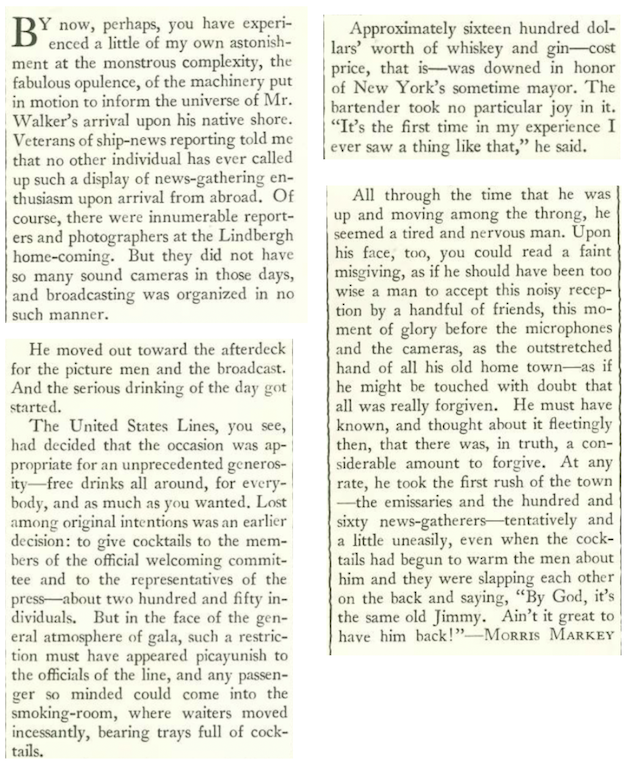
WHERE’S THE PARTY?…Former Mayor Jimmy Walker and his wife, Betty Compton, returned to New York in the fall of 1935 amid tremendous fanfare. The New Yorker’s Morris Markey noted that at least 160 media representatives were on hand for the couple’s arrival. (YouTube)

Walker (1881-1946) fled to Europe in November 1932 amid a bribery scandal that had prompted his resignation. Accompanied by Ziegfeld Follies singer Betty Compton (1906–1944)—whom he would marry in Cannes the following April—they would bounce around the continent until Walker determined that the danger of criminal prosecution had passed.

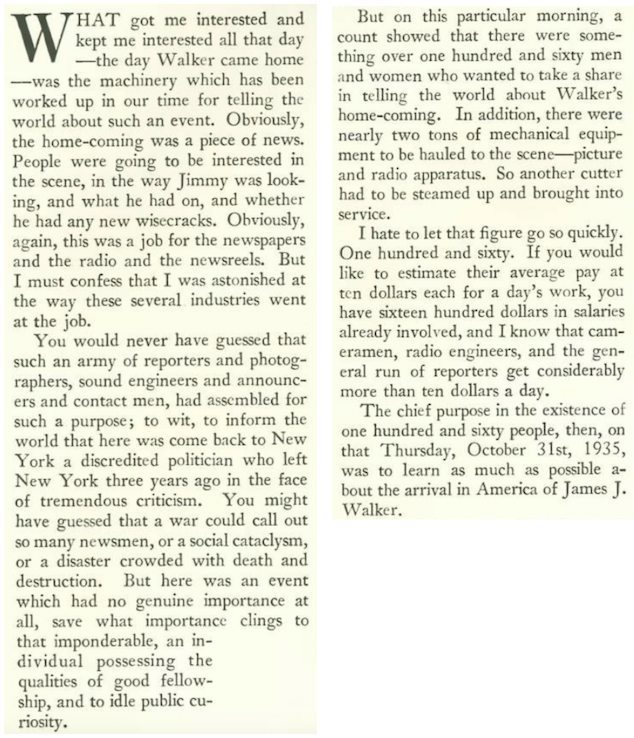
In his “A Reporter at Large” column, Morris Markey wrote about the media’s reception of the exiled mayor, “an army of reporters and photographers, sound engineers and announcers and contact men”…all assembled to inform the world of the return of a “discredited politician.”
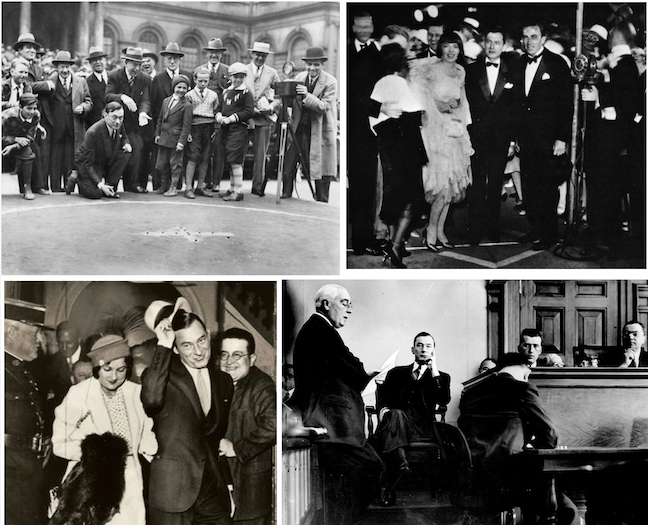
HE GOT AROUND…During his time in office from 1926 to 1932, Mayor Jimmy Walker never seemed to miss a moment in the spotlight. Clockwise, from top left, Walker presided over the first shot in the city’s annual marble tournament on June 3, 1928; with actress Colleen Moore at the 1928 premiere of her latest film, Lilac Time;  testifying on bribery charges before the investigative committee of Judge Samuel Seabury, 1932; with Betty Compton following their 1933 wedding in Cannes. (New York Times/konreioldnewyork.blogspot.com/villagepreservation.org)

Markey continued to convey his astonishment at “the monstrous complexity, the fabulous opulence, of the machinery put in motion to inform the universe of Mr. Walker’s arrival upon his native shore.” This included a massive cocktail party—hosted by The United States Lines—for more than two hundred press representatives and other officials.
After all the commotion, Walker would settle into a job as head of Majestic Records, adopt two children with Compton, and host his own radio series on WHN, Jimmy Walker’s Opportunity Hour.

Compton would divorce Walker in 1941 and remarry. Becoming ill after the birth of a son, she would die at age 38 in 1944. Walker would die two years later at age 65 of a brain hemorrhage.

CALLING ON THE ROOSEVELTS…Jimmy Walker and Betty Compton at the White House in 1937. It was pressure from FDR that led to Walker’s resignation in 1932. (Wikipedia)

 * * *

High-flying Hooplah

While New Yorkers were going gaga over Walker, folks in the Bay Area were all atwitter over the first air-mail flight across the Pacific, loading a Pan Am Clipper to the gills with all manner of collectables. E.B. White noted:
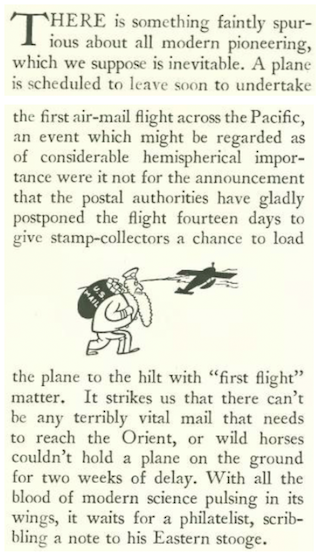
BELLYFUL…On Nov. 22, 1935, Pan American Airways made aviation history as the China Clipper lifted off from Alameda, beginning the world’s first trans-Pacific airmail service. Captained by Edwin Musick and crewed by famed navigator Fred Noonan, the Martin M-130 opened a new era of long-distance flight across the Pacific. Noonan, who charted many commercial routes across the Pacific, would go missing along with Amelia Earhart during their ill-fated flight in July 1937. (Library of Congress)

* * *

Wise Men From the East

“The Talk of the Town” visited with Soviet satirists Ilya Ilf (1897–1937) and Evgeny Petrov (1903–1942), who were in New York preparing for a ten-week road trip to California and back. On assignment as special correspondents for the newspaper Pravda, they later published a series of illustrated articles, “American Photographs,” as well as a book titled Single-Storied America (the summer 2004 issue of Cabinet Magazine features an account of their journey as well as a number of their photographs).
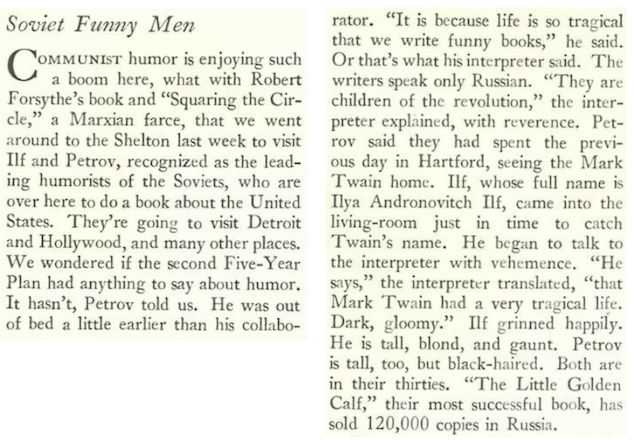
AMERICA WAS A GAS…Soviet satirists Ilya Ilf (left) and Yevgeni Petrov check out New York before heading into the American heartland on a ten-week road trip, a highlight being the countless full-service gas stations they encountered along the way. After seeing skyscrapers and mountains and other wonders, the pair agreed that the most enduring image was the one at right: “an intersection of two roads and a gasoline station against a (back)ground of wires and advertising signs.” Sadly, Ilf died two years later from tuberculosis; Petrov died in a plane crash in 1942 while working as a war correspondent. (Aleksandra Ilf archive/Cabinet Magazine)

 * * *

A Jumbo Career

Wallace Beery (1885–1949) got his start in the comedy silents of the 1910s and became a star before the sound era made him an even bigger one; by 1932 he was the world’s highest-paid actor. Alva Johnston’s profile (titled “Jumbo”) took a look at Beery’s life and career (illustration by Al Frueh). Excerpts:

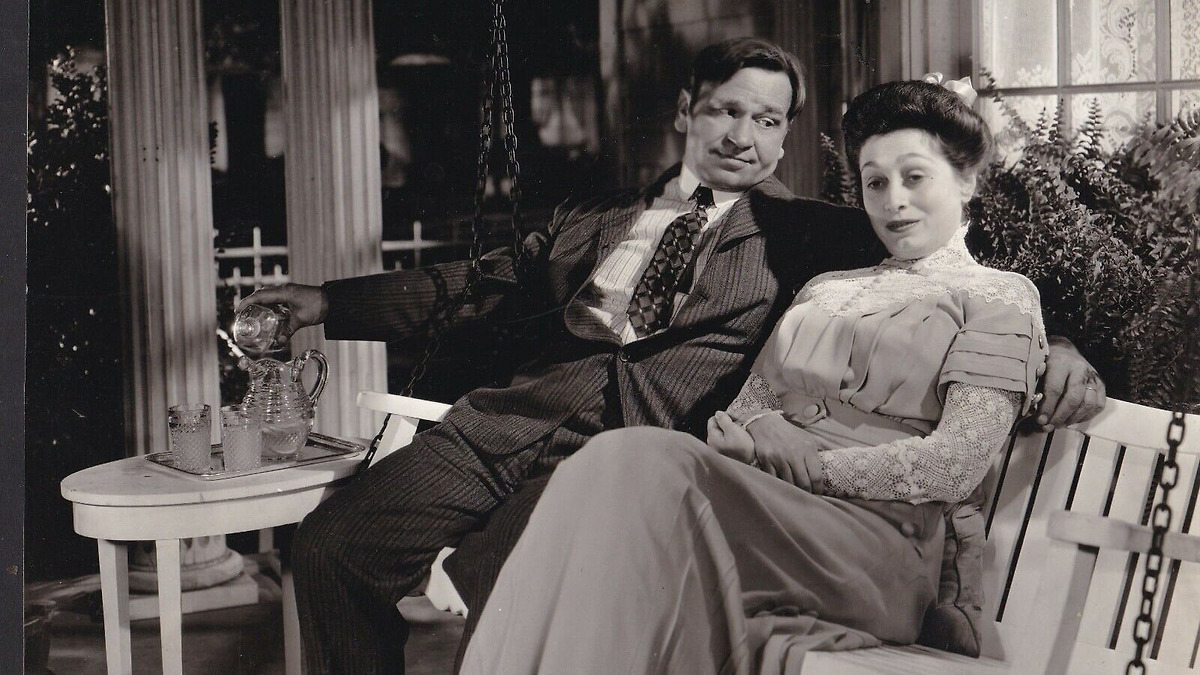
COURTING AND SPARKING…Sid Miller (Wallace Beery) spikes the lemonade as he woos Lily Davis (Aline MacMahon) in a scene from the 1935 film, Ah Wilderness! (letterboxd.com)

 * * *

A View and Corbu

Art and design critic Lewis Mumford was well-known for his hypercritical eye, but occasionally he could be moved to rhapsodize, in this case about the opening of Fort Tryon Park, and particularly about the view it afforded visitors. He reserved his criticism for one of the latest works by Le Corbusier (aka Charles-Édouard Jeanneret), on exhibit at MoMA.
MAGNIFICENT is the word Lewis Mumford used to describe the view from Fort Tryon Park. This scene is taken from Linden Terrace to the west: a barge on the Hudson River and the Hudson Palisades beyond, with the Englewood Cliffs campus of Saint Peter’s University on the top. (Wikipedia)
IRRATIONAL?…Mumford was not pleased with Le Corbusier’s latest work, Le Petite Maison de Weekend (Villa Henfel), which was featured on the cover of the MoMA exhibition catalogue (upper left). Mumford saw the design as a pathetic escape from the architect’s renown rationalism. (MoMA/Fondation Le Corbusier)

* * *

At the Movies

It was a mixed bag at the movies for critic John Mosher, who was delighted by a Soviet take on Gulliver’s Travels, rendered with puppets engaged in a proletarian struggle…
KOMRADE GULLIVER…The Soviet stop motion-animated fantasy film, The New Gulliver, was a communist re-telling of Jonathan Swift’s 1726 novel. The film depicted Lilliput suffering under capitalist inequality and exploitation, with Gulliver enabling a proletarian revolution against the Lilliputian monarchy. (revolutionsnewstand.com)

…but Mosher was less than delighted with the latest from Hollywood, including a sedate The Three Musketeers, a “conventional” remake of D.W. Grifffith’s 1920 melodrama Way Down East, and the romcom Hands Across the Table, which the Times called “uproariously funny” but Mosher deemed barely worth a chuckle.
OUTCLASSED BY PUPPETS…John Mosher found the latest from Hollywood underwhelming. Clockwise, from top, Onslow Stevens, Moroni Olsen, and Paul Lukas in The Three Musketeers; Rochelle Hudson and Henry Fonda in Way Down East; Fred MacMurray and Carole Lombard in Hands Across the Table. (mabumbe.com/zeusdvds.com/Wikipedia)

 * * *

From Our Advertisers

The Dorothy Gray salons didn’t mince words when it came to a woman’s beauty regimen…without their help, claimed this ad, the poor “Mrs. Madison” would be “frankly plain,” with a face too wide and eyes and mouth too small…
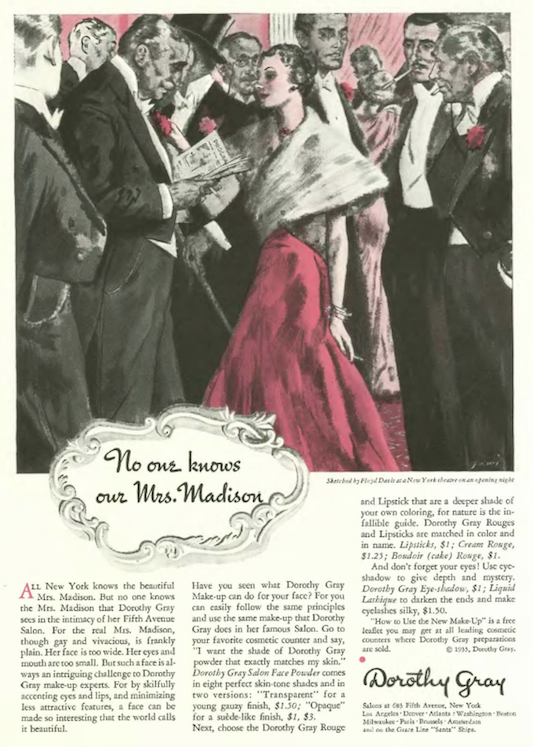
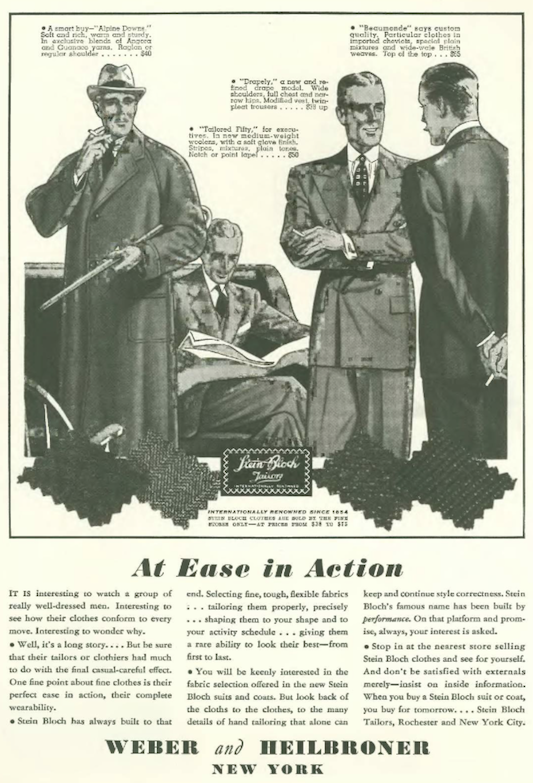
…notable in ads for men’s and women’s clothes were the presence of cigarettes…all three of the men in this spot are having a smoke in their smart attire…
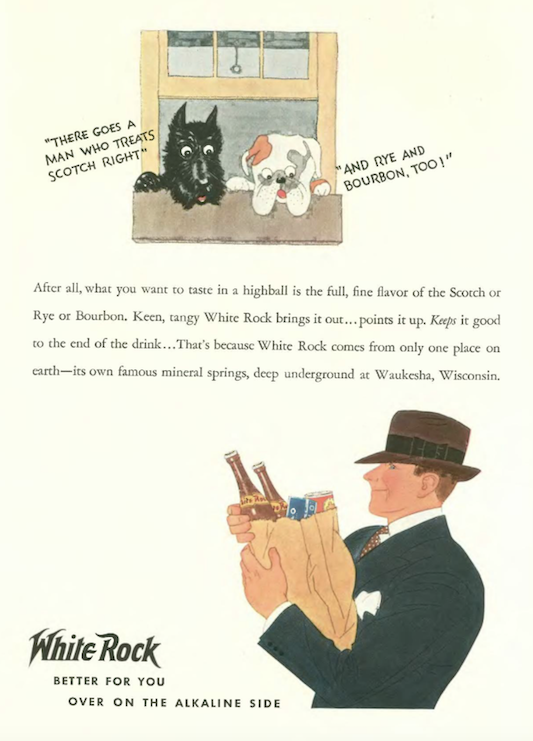
…White Rock gave their logo-bearer Psyche a rest in 1935 with a variety of ads including this one…
…the makers of Bisquit assumed their customers could read the French dialogue, or at least pretend to…

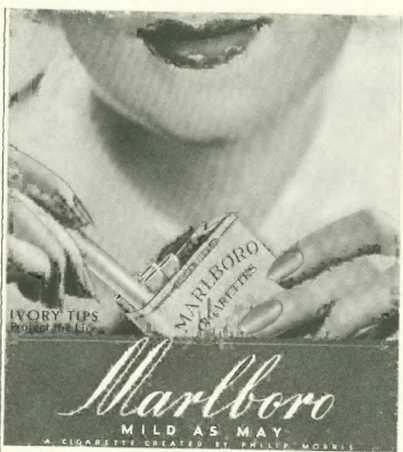
…when we (of a certain age) think of Marlboro we think of the rugged Marlboro Man, but in 1935 the brand was exclusively marketed to women…
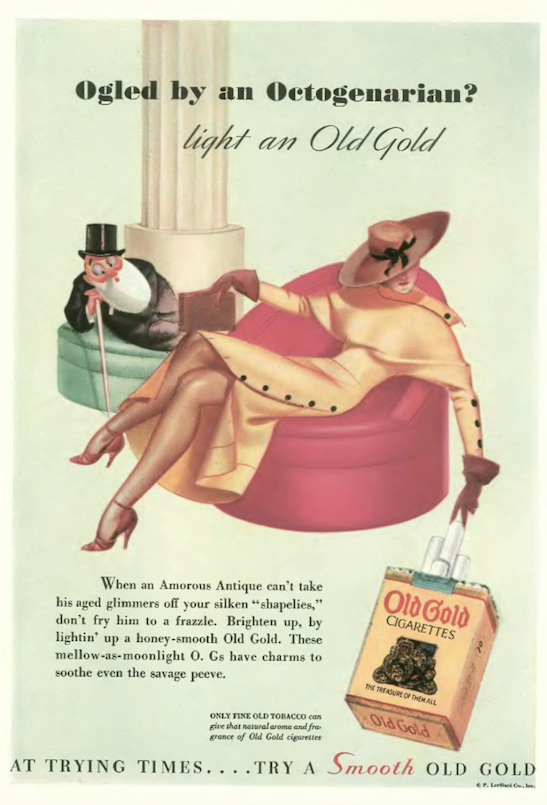
…and who knows what Old Gold’s target was here…definitely women smokers, who were the growth market, but men would take notice of the George Petty pin-up…
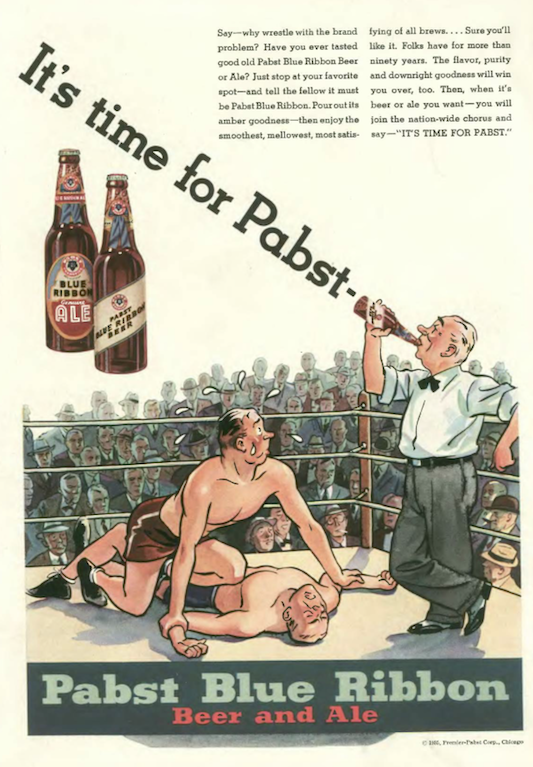
…the makers of Pabst Blue Ribbon Beer, who endured Prohibition by offering products like Pabst-ett cheese spread, were ready to grab a big market share after Repeal…
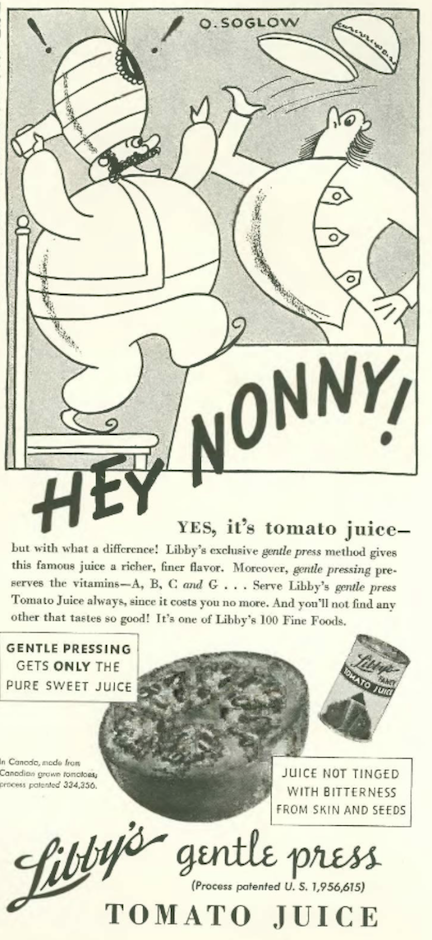
Otto Soglow, still contributing to The New Yorker despite taking his Little King to Hearst, drew up this potentate for a tomato juice spot…
…which segues to our other cartoonists, beginning with Al Frueh and his take on the latest  Broadway hit, Jubilee!

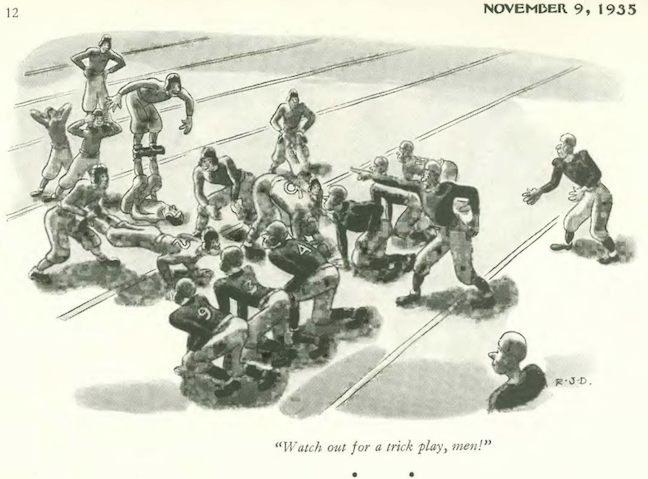
Robert Day saw action on the gridiron…

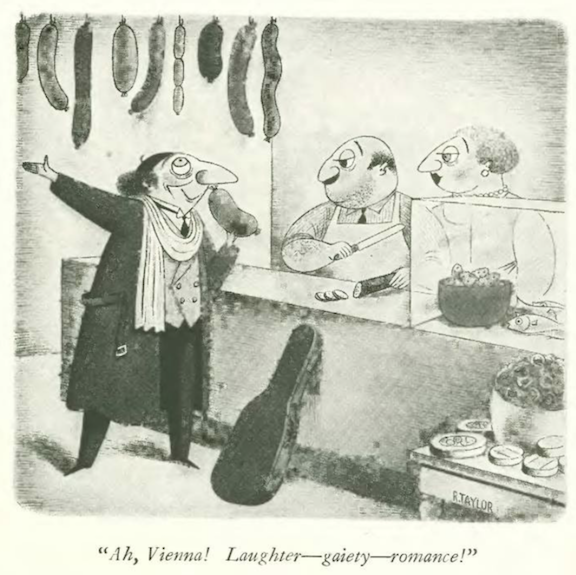
…unless I missed something, this might be Richard Taylor’s first New Yorker cartoon…
James Thurber put a unique spin on a bowling ball…

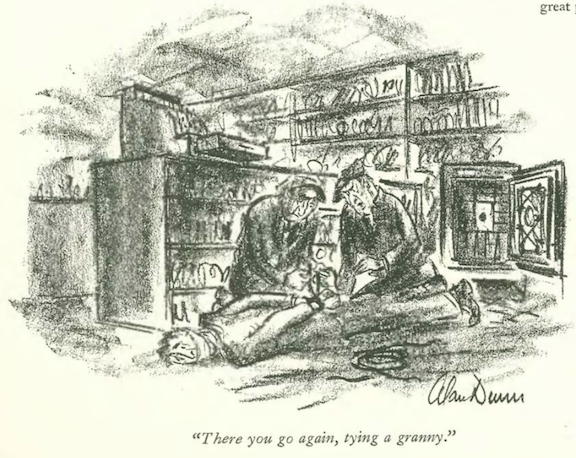
Alan Dunn was all in knots at a crime scene…
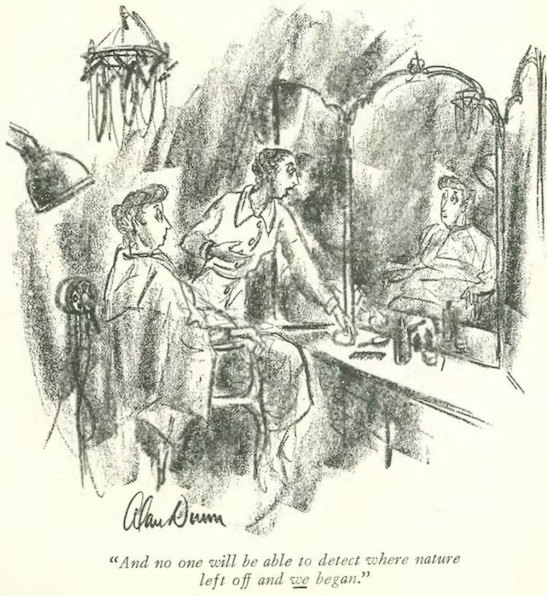
…Dunn again, pondering the wonders of a makeover…
Barney Tobey eavesdropped on a Downtown subway…

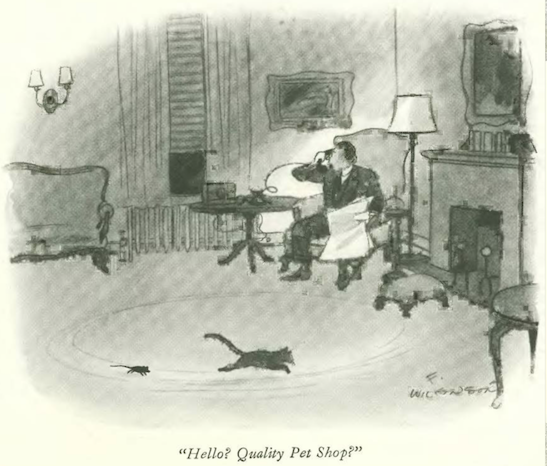
Fritz Wilkinson looked to return a defective pet…
Carl Rose needed two pages to illustrate his epic cartoon (caption added at the bottom for readability)…

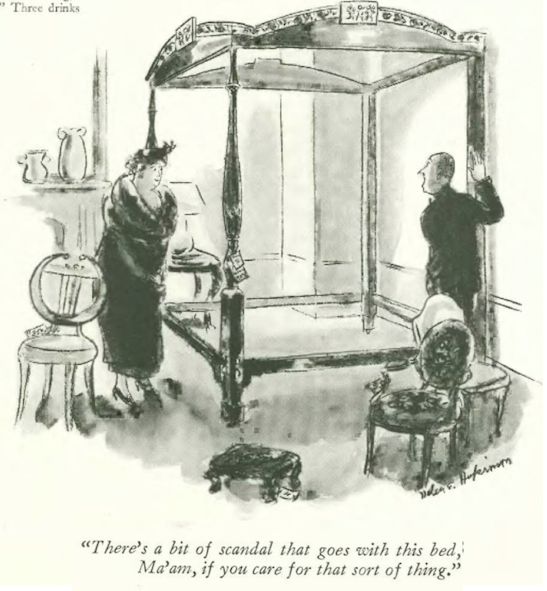
…and we close with Helen Hokinson, and a whiff of scandal…
Next Time: Seeking Decorative People…
 

Model Citizens

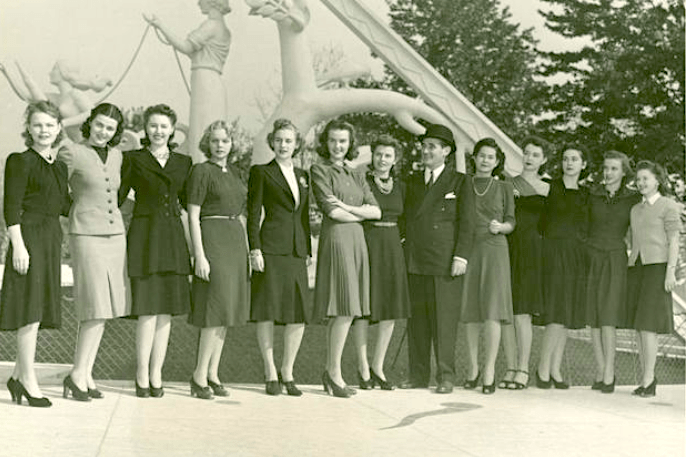
Above: Modeling agency founder John Robert Powers poses with participants of a fashion queen contest at the 1939 New York World's Fair. (NYPL)

John Robert Powers was a household name in the 1930s, founder of one of the world’s first modeling agencies—he supplied countless advertisers with mostly female models, some moving on to Hollywood careers.

April 21, 1934 cover by Abner Dean.

Writing for “A Reporter at Large” under the title “Perfect 36,” frequent New Yorker short story contributor Nancy Hale (1908 –1988) looked into the mysteries behind the fabled “John Powers Book” and its collection of sophisticated models.

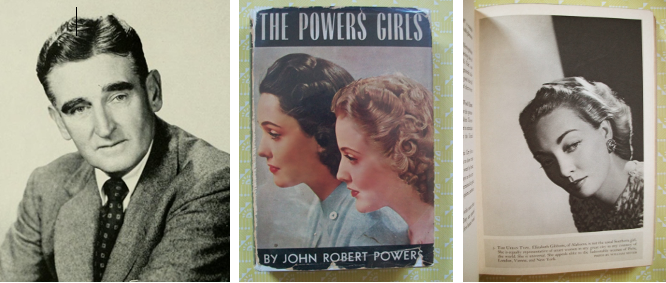
TYPING BOOK…John Robert Powers (1892–1977) wrote a bestselling 1941 book, The Powers Girls, that told “the story of models and modeling and the natural steps by which attractive girls are created,” organizing various models by type; at right, a page from the book featuring Elizabeth ‘Liz’ Gibbons—despite her Alabama roots, she was described by Powers as being “The Urban Type.” (Wikipedia/lastyeargirl.blogspot.com)

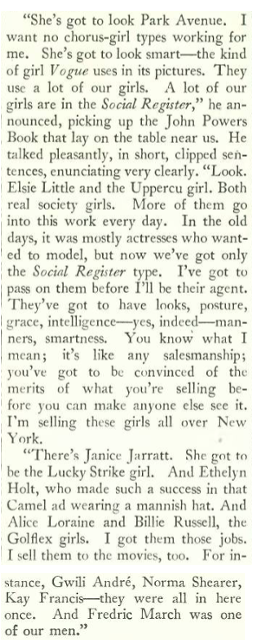
Hale was given a tour by a company representative who described the types of women the Powers company represented, noting the successes of women who landed in major cigarette ads or went on to become Hollywood stars:

SMOKE AND MIRRORS…Clockwise, from top left: Powers model Janice Jarratt (in a 1934 publicity photo from her only film, Kid Millions), who for a time was known as the “Lucky Strike Girl” as well as the “most photographed woman in the world”; Jarratt offering a Lucky to a nervous young man in a 1935 ad; Powers model Ethelyn Holt in a publicity photo for the Billy Rose Theatre; Holt in a 1933 ad for Camel cigarettes. (MGM/NPR/NYPL/propadv.com)

A number of Hollywood stars got their start or were discovered through their work with Powers, who himself was a sometime actor and the subject of a 1943 musical comedy, The Powers Girl.

POWER STARS…Former Powers models turned Hollywood stars included, from left, Norma Shearer, Frederic March and Kay Francis. (TCM/TMDB)

A note about the author, Nancy Hale: A brilliant short story writer, Hale published her first short story in The New Yorker in 1929 (when she was just 21) and would publish more than eighty stories in the magazine through 1969—she holds the record for the most stories in the magazine in a single year, publishing twelve between July 1954 and July 1955. New Yorker editor William Maxwell regarded Hale’s writing technique as “flawless.”

PROLIFIC…Nancy Hale published more than a hundred short stories in her lifetime, ten of which were recipients of an O. Henry Prize. Writer Joanne O’Leary (London Review of Books) notes that Hale also worked for Vogue (where she “pinch-hit as a model”) and became the first female news reporter at the New York Times. Above left, Hale in an undated photo; at right, Hale photographed in 1936 for Harper’s Bazaar. (Nancy Hale Papers, Sophia Smith Collection, Smith College)

* * *

Tat For Tat

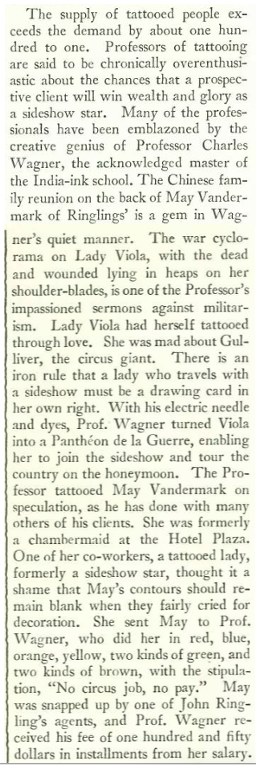
Alva Johnston explored the world of “tattooed people” in his second installment of a three-part profile series titled “Sideshow People”…

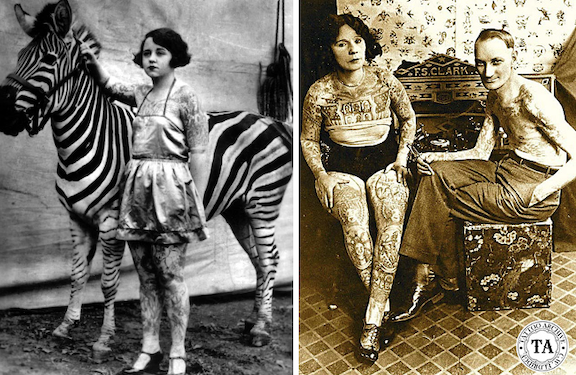
MARKED FOR LIFE…Alva Johnston noted such celebrated tattooed ladies as Mae Vandermark (left, circa 1920s), and Lady Viola, pictured at right with tattoo artist Fred Clark, 1930s. (Vintage Everyday)
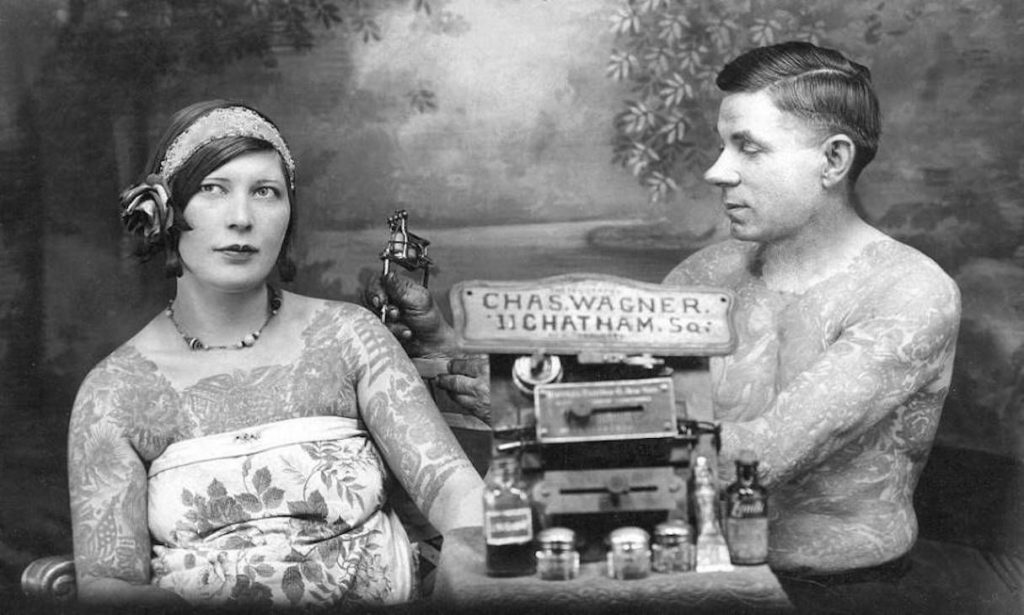
INKSLINGER…Charlie Wagner, a tattoo artist who lived from 1875 to 1953, is considered one of the kings of American tattooing. Practicing his art in New York’s Bowery, he not only developed an influential art style; he invented new machinery that helped spread the art of modern tattooing. (nyctattooshop.com)

 * * *

Bloody Satisfying

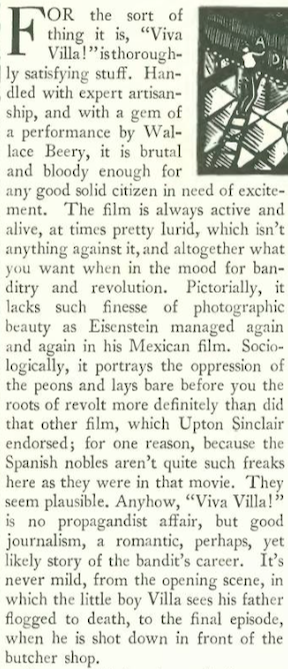
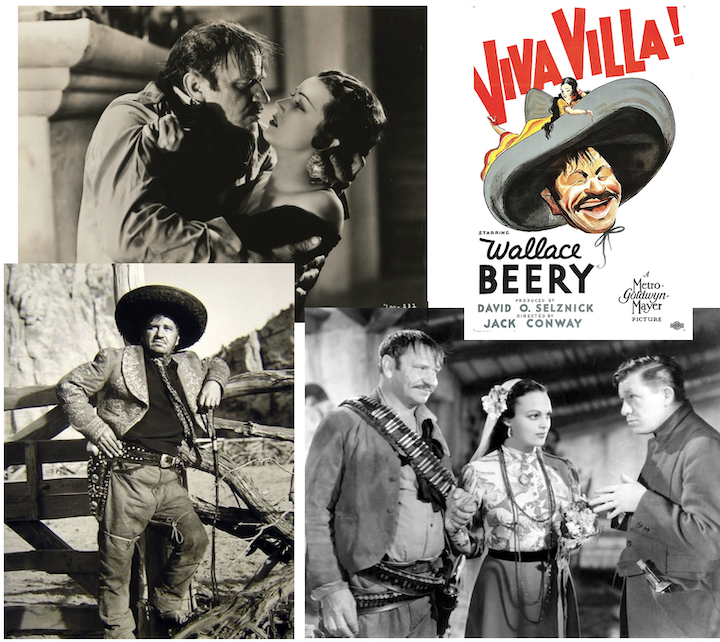
Film critic John Mosher declared David O. Selznick’s production Viva Villa! to be “thoroughly satisfying”—with a screenplay by Ben Hecht and starring actor Wallace Beery as Mexican revolutionary Pancho Villa, the film was considered violent and bloody by 1934 standards.

REVOLUTIONARY…Clockwise, from top left, Pancho Villa (Wallace Beery) finds himself attracted to a benefactor’s sister (Fay Wray); MGM film poster; Beery with Katherine DeMille (who was Cecil B. DeMille’s adopted daughter) and Stuart Erwin; Beery striking a pose on the set of Viva Villa! (IMDB)

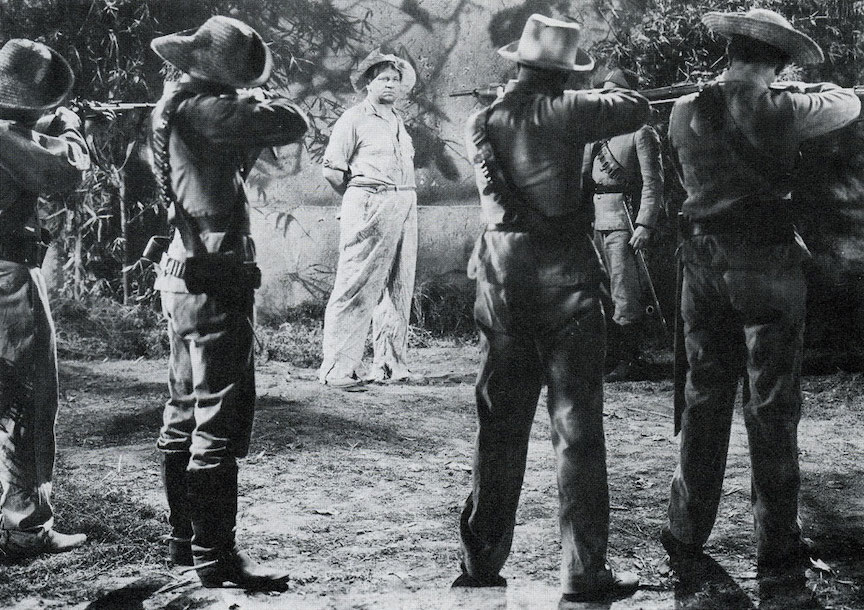
Mosher found some of the film’s violence to be startling. Being one the last Pre-Code films, censors would start clamping down on such scenes in the coming years.

MAKE SURE YOU GET MY GOOD SIDE…Pancho Villa (Wallace Beery) faces a firing squad before receiving a last-minute reprieve in Viva Villa! (IMDB)

 * * *

From Our Advertisers

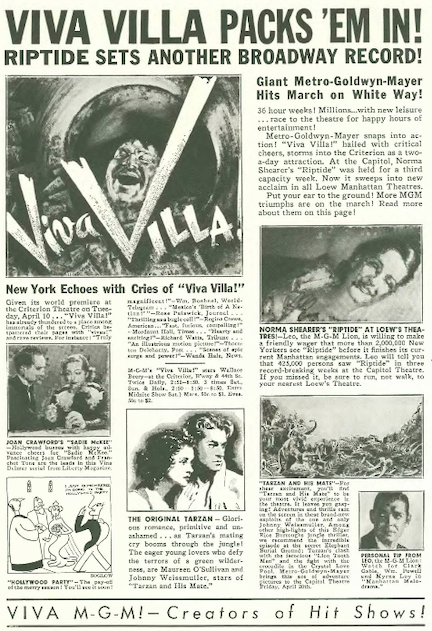
MGM took out a full-page ad to tout the success of Viva Villa and other MGM “hits”…

…note the bottom left hand corner of the MGM ad—a cartoon by Otto Soglow promoting the upcoming film Hollywood Party, a star-studded comedy musical featuring Laurel & Hardy, Jimmy Durante, Lupe Velez and Mickey Mouse

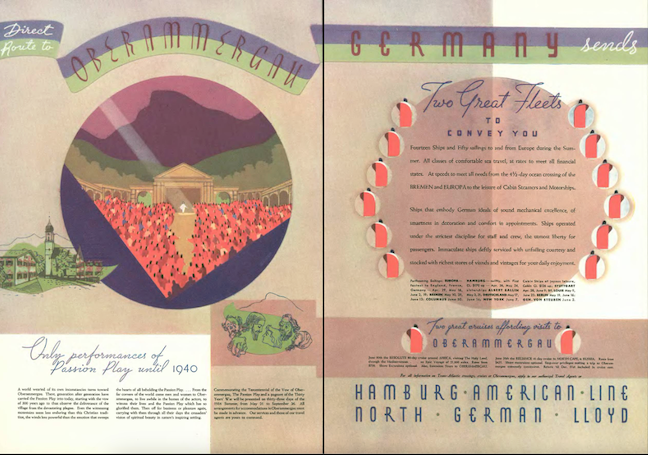
…those looking for a different kind of entertainment could have been enticed by this lavish center-page spread from German ocean liner companies…they were inviting Americans to Oberammergau, Germany to witness the “only performances of the Passion Play until 1940″…the play was usually performed every ten years (years ending in the digit zero) but in 1934 a special performance was supported by the Nazi Party…incidentally, the 1940 play was cancelled due to World War II…

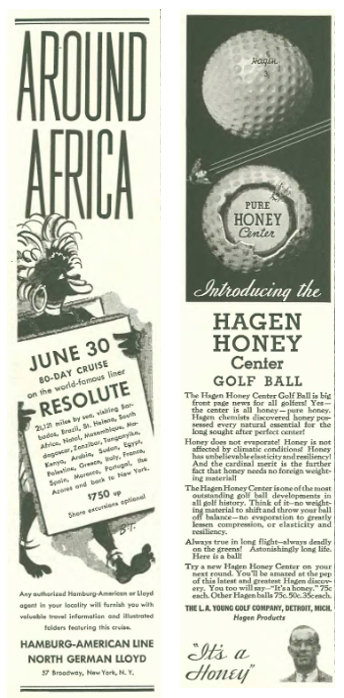
…the same German-American shipping companies also advertised an African cruise…with some racist imagery…

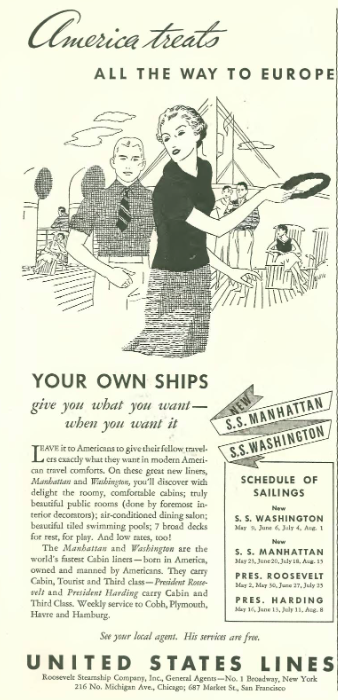
…perhaps you wanted to go to Europe on a ship with fewer Nazis on board…in that case you could grab a berth on a ship with the United States Lines, and hang out with these stiffs…

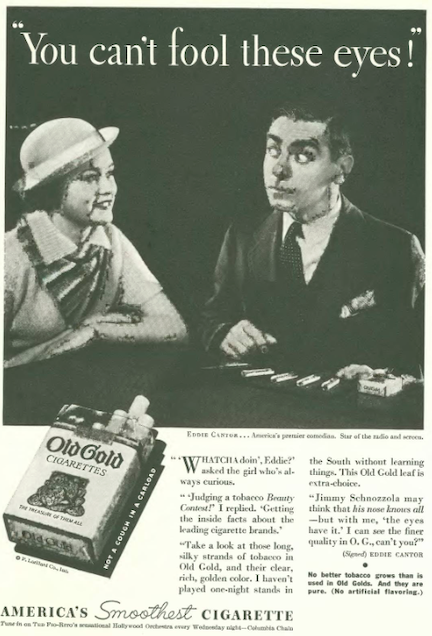
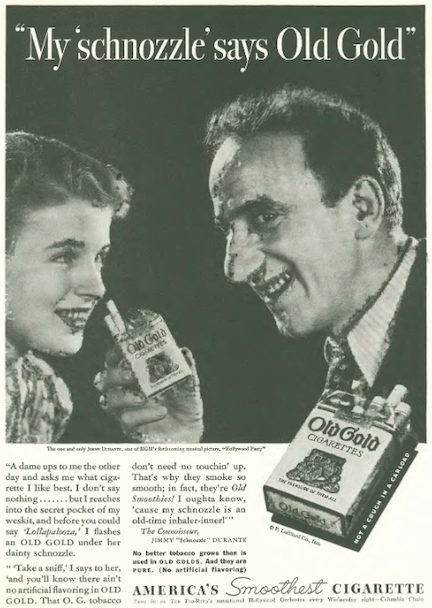
…the makers of Old Gold referenced a previous ad featuring Jimmy Durante with a new spot starring actor/comedian Eddie Cantor…both ads depicted impressionable young women admiring the smoking wisdom of older men…

…for reference, the creepy Durante ad…

…the famous “Call for Philip Morris” advertising campaign began during World War I, but in 1933 Johnny Roventini, a bellhop at the Hotel New Yorker, would become the living symbol of the cigarette brand…

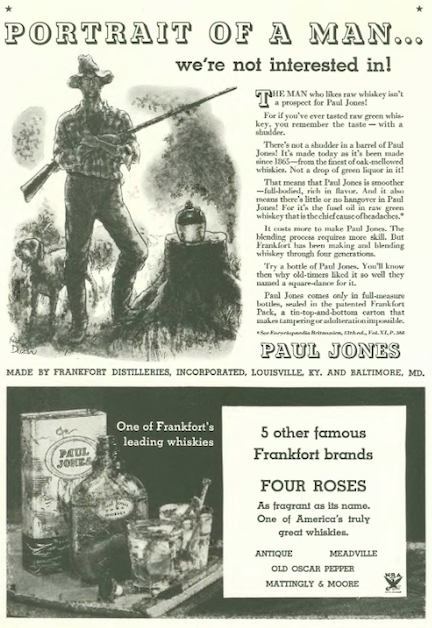
…by contrast, Frankfort Distilleries showed us an image of man who would not represent them, namely Jed Clampett…

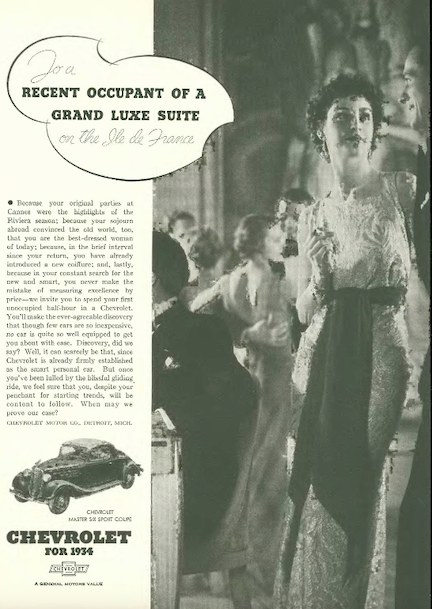
…Chevrolet continued its rebranding campaign, positioning itself as an affordable choice that was nevertheless favored by the posh set…

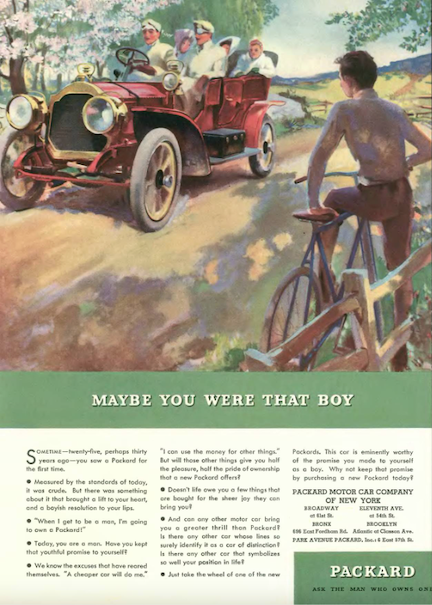
…who would rather be driving a Packard, here appealing to the nostalgic sensibilities of old-timers who had the means to afford one…

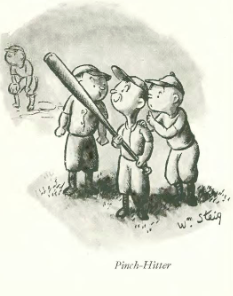
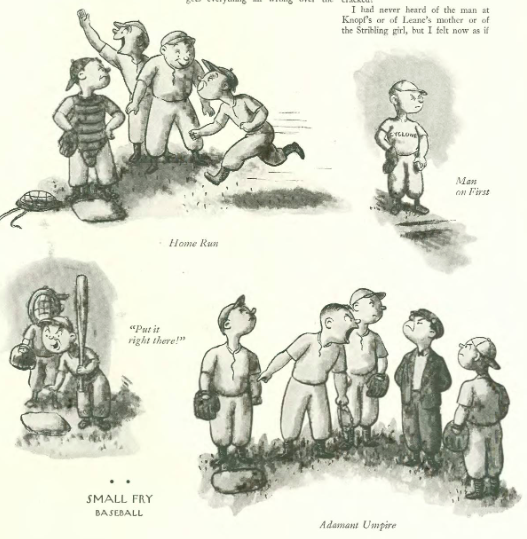
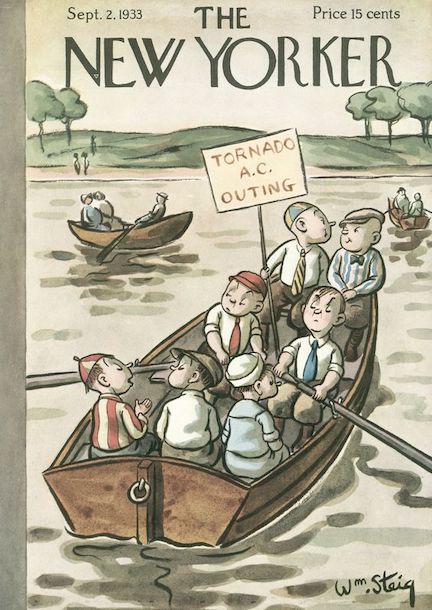
…on to our cartoons, and some “Small Fry” baseball from William Steig

…an unusual captioned cartoon (from George Price) featured in the opening “Goings On About Town” section…

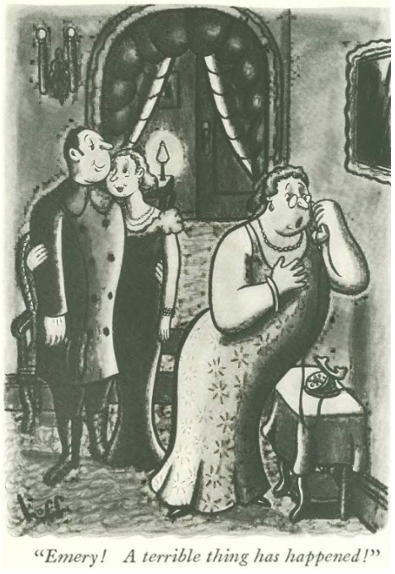
Syd Hoff gave us an alarmed matron confronting the unthinkable…a doorman as a son-in-law…

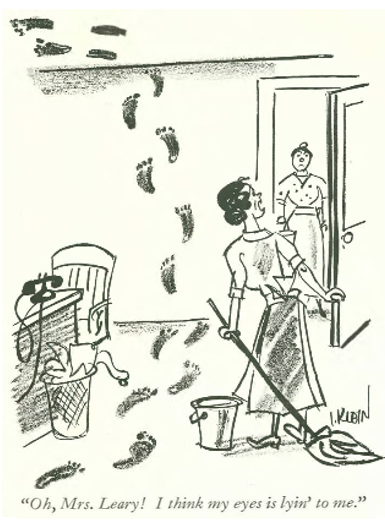
…we haven’t seen Isadore Klein’s work in awhile—understandable, as he was busy in his career as an animator––in 1934 he worked on films for Van Beuren Studios (Rainbow Parade Cartoons) and in 1936 he would move to Disney’s Silly Symphonies

Paul Manship’s Prometheus at Rockefeller Center is iconic today, but when it was installed in 1934 it puzzled more than a few onlookers, including Robert Day

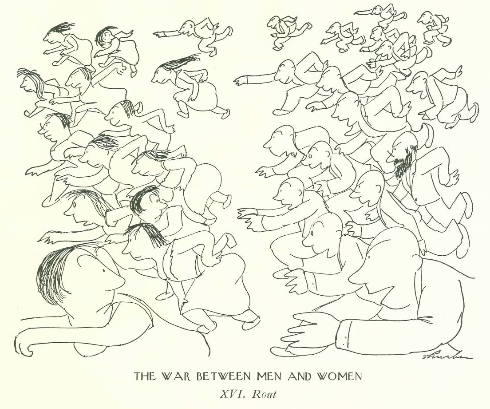
…and we close with James Thurber, and a turn of events in his “war”…

Next Time: Lord of the Apes…

Tugboat Annie

New Yorkers were enduring the dog days of August, and those who couldn’t escape the heat by fleeing to the country or the beach could find cool respite at the movies.

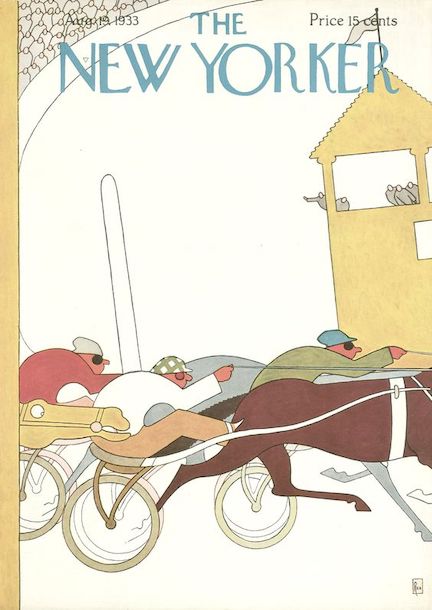
August 19, 1933 cover by Gardner Rea.

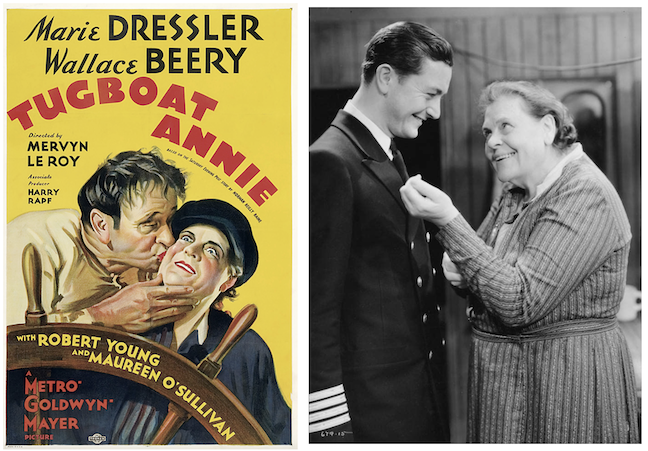
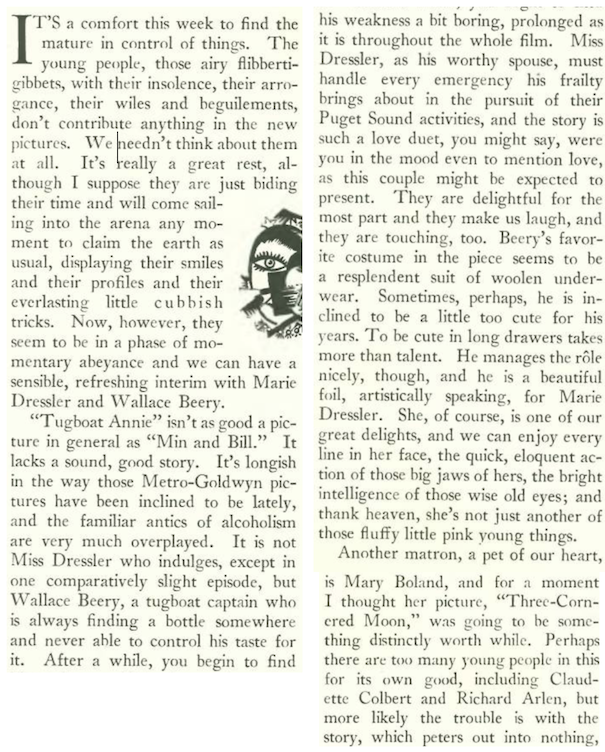
It was doubtless in an air-conditioned theatre where critic John Mosher enjoyed the craft of older actors, in this case Wallace Beery and Marie Dressler in Tugboat Annie. Although the film didn’t quite live up to Beery and Dressler’s 1930 smash hit, Min and Bill, Mosher found Beery to be a “beautiful foil” to Dressler, who thankfully wasn’t just another “fluffy little pink young thing.”

ON GOLDEN POND…Wallace Beery and Marie Dressler portrayed a comically quarrelsome older couple who operate a tugboat in MGM’s Tugboat Annie. It would be one Dressler’s last film roles—she would die the following year; at right, a young Robert Young with Dressler in a scene from the film—Young would go on to television fame playing two beloved characters: the dad in Father Knows Best (1954-60) with fellow film star Jane Wyatt, and the kindly, avuncular doctor on Marcus Welby M.D. (1969–76). (IMDB)

Another seasoned performer Mosher admired was Mary Boland, although her latest film, Three Cornered Moon, was crowded with “too many young people”…

BRAT PACK…Mary Boland (left) with Wallace Ford, Claudette Colbert, and Hardie Albright in Three Cornered Moon (IMDB)

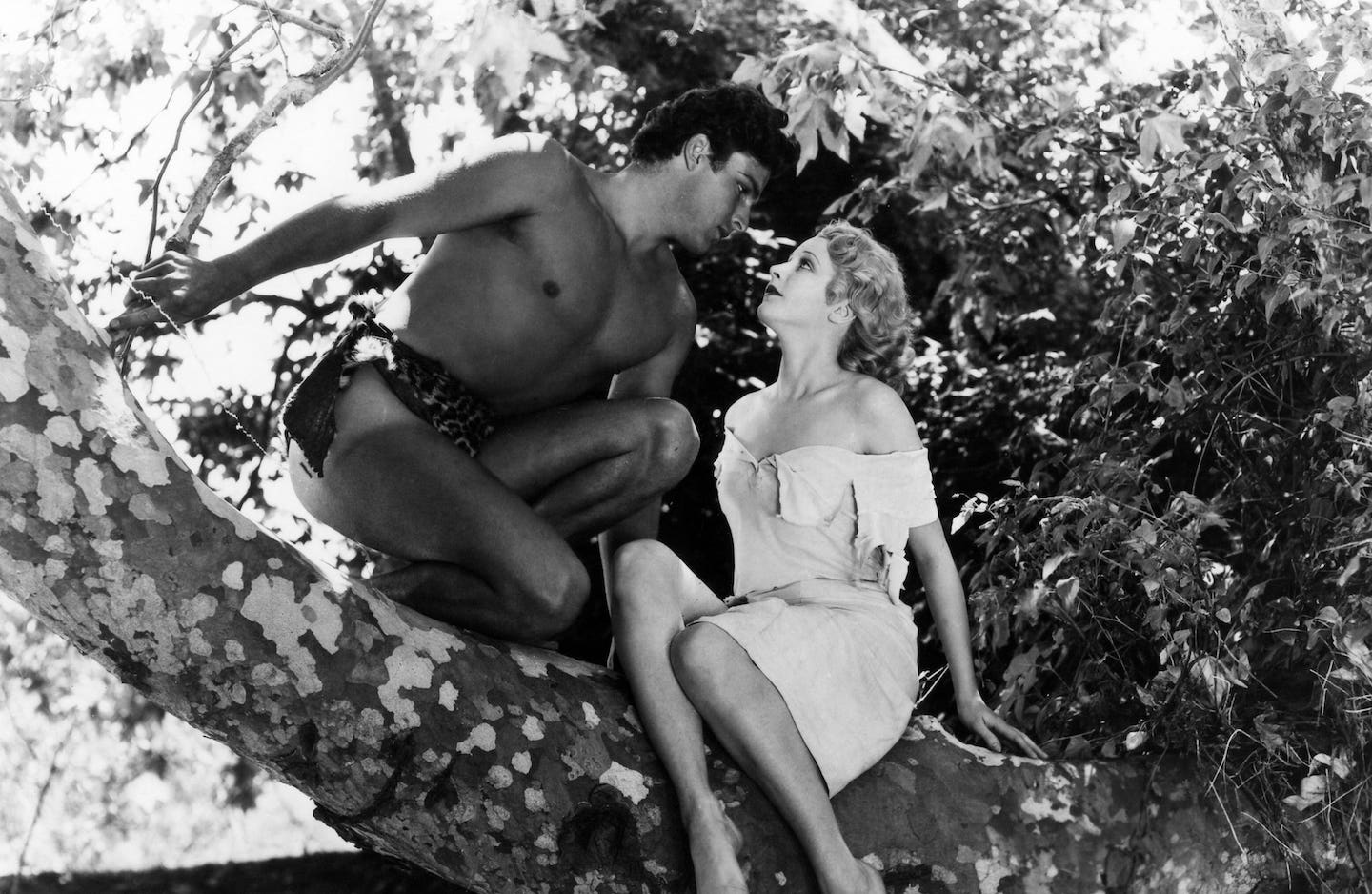
MONKEYING AROUND…A self-described “King of the Serials,” Buster Crabbe’s career included nine sound serials, including Flash Gordon and Buck Rogers (1936-40). In Tarzan the Fearless Crabbe’s sole appearance as Tarzan was played opposite Jacqueline Wells (aka Julie Bishop). The media at the time made hay of a so-called rivalry between Crabbe and Johnny Weissmuller, who defined the Tarzan role in twelve films from 1932 to 1948. Both men were Olympic athletes: Crabbe won the 1932 Olympic 400-meter freestyle swimming championship, while Weissmuller was the undefeated winner of five Olympic gold medals. (IMDB)

 * * *

From Our Advertisers

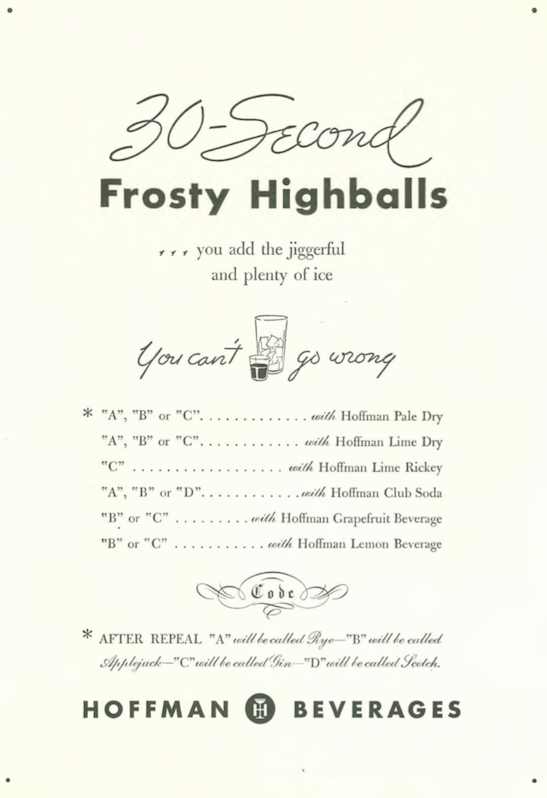
The folks at Hoffman Beverages continued to offer up ways to enjoy an adult refreshment, including a tongue-in-cheek “code” to be used until the repeal of Prohbition…

…with the return of legal (3.2) beer, brewers were aggressively targeting women as a new growth market…

…a selection of one-column ads from the back pages touted imported beers and an old “Pennsylvania Dutch” quaff, intermixed with apartment ads and a women’s deodorant called SHUN…

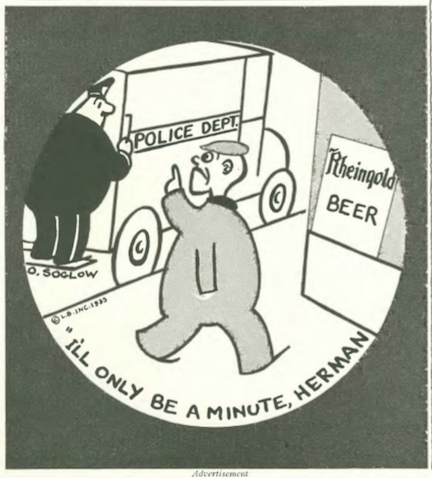
Otto Soglow, who would become rich and famous with his The Little King strip, also did well as an illustrator for various products, including Rheingold beer…

…another way to stay cool was to dine at Longchamps, thanks to their “scientific air-conditioning system”…

…on the subject of keeping cool, back in the day you had to regularly top off the radiator on hot days, and if you added lead to your gasoline you could also get rid of those annoying hot engine knocks…

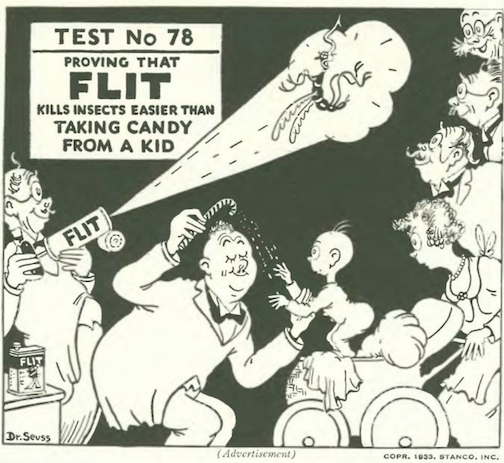
…It would be four years before Dr. Seuss would publish his first children’s book, so he continued to pay the bills with illustrated ads for Flit insecticide…ah the good days when spraying poison above a child’s head seemed perfectly reasonable…

…another one-column ad from the back pages says a lot about how advertisers perceived a New Yorker reader—even dog food demanded snob appeal…

…on to our cartoons we return to Otto Soglow and his take on the old William Tell trope…
Peter Arno delivered some surprising news to dear old mom…
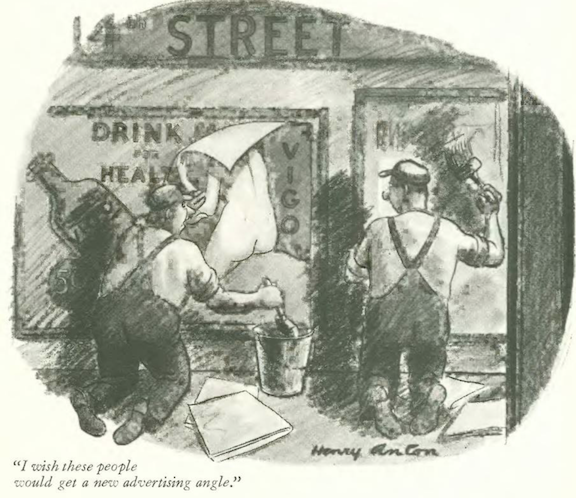
Henry Anton gave us a sign man unconvinced that sex sells…

Gluyas Williams gave us his latest take on “Fellow Citizens” (this originally appeared sideways on p. 17)…

…and Garrett Price shared this observation, from the mouth of babes…

…on to Aug. 26…

Aug. 26, 1933 cover by Perry Barlow.

…where we find Ring Lardner, who since March had been injecting humor into the “Over the Waves” radio column.

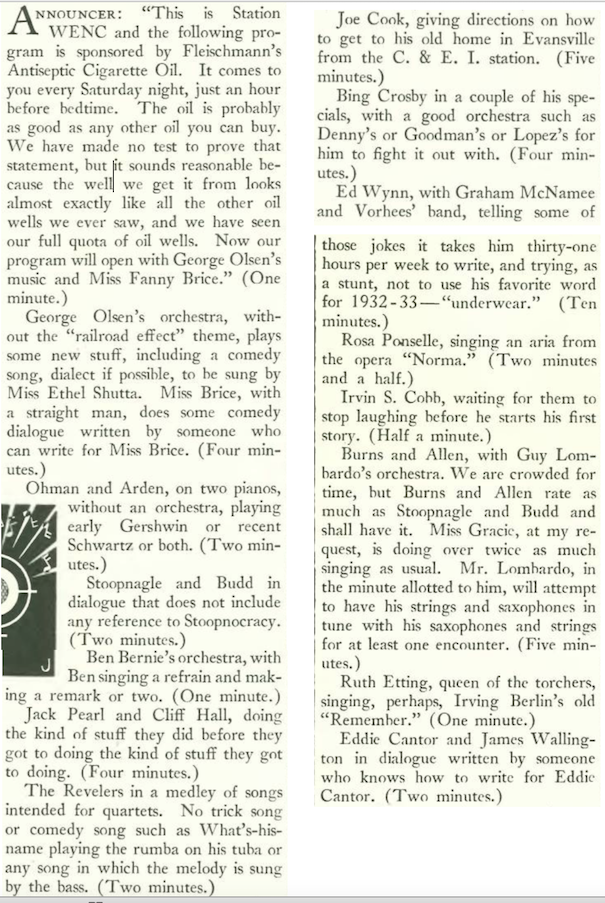
In this installment, Lardner outlined his ideal radio program. An excerpt:

UP TO OLD GAGS?…Ring Lardner gave the comedy duo Jack Pearl (right) and Cliff Hall a generous four minutes in his fantasy radio show—if they did their old routines. (Wikimedia)

Lardner concluded his dream program:

Sadly, Ring Lardner would be gone in less than a month—he died of a heart attack on Sept. 25, 1933, at the tender age of 48.

 * * *

On Second Thought

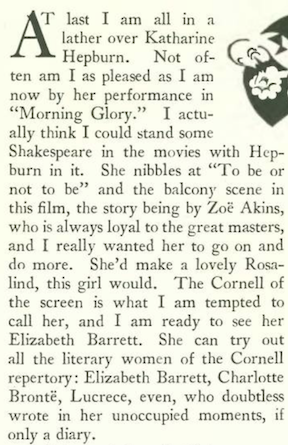
Previously, film critic John Mosher had been lukewarm to the up-and-coming Katharine Hepburn. No more. Her appearance in Morning Glory drew praise from all over, including the Academy, which gave the young star her first Oscar.

A STAR IS BORN…Katharine Hepburn with Douglas Fairbanks Jr. (left) and Adolphe Menjou in Morning Glory (1933). Hepburn would win the Oscar for Best Actress in a Leading Role, the first of four she would receive in that category—a record for any performer. (IMDB)

 * * *

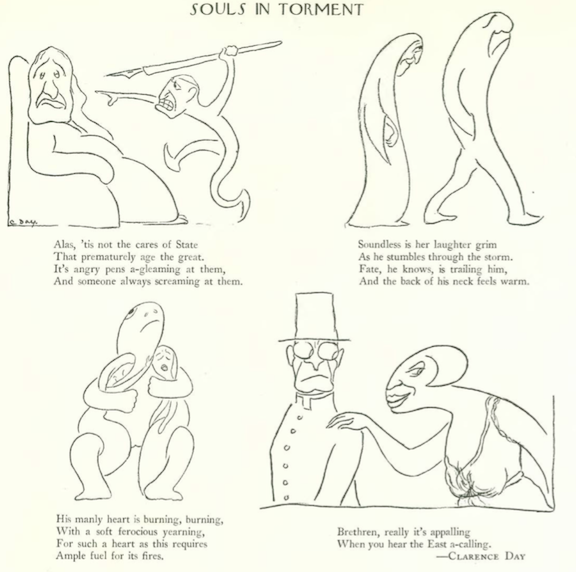
Life With Clarence

Following “The Talk of the Town” section was this illustrated contribution by Clarence Day

 * * *
More From Our Advertisers
While folks were cooling down at the movies Barbara Stanwyck did her best to heat up the screen…

…the frank discussion of sex in Baby Face made it one of the most notorious films of the year and no doubt hastened the implementation of the Hays Code…
LIGHT MY FIRE…Barbara Stanwyck in Baby Face.

…in case anyone had forgotten during Prohibition, Budweiser reminded them who was the king of beers with this inside front cover ad…
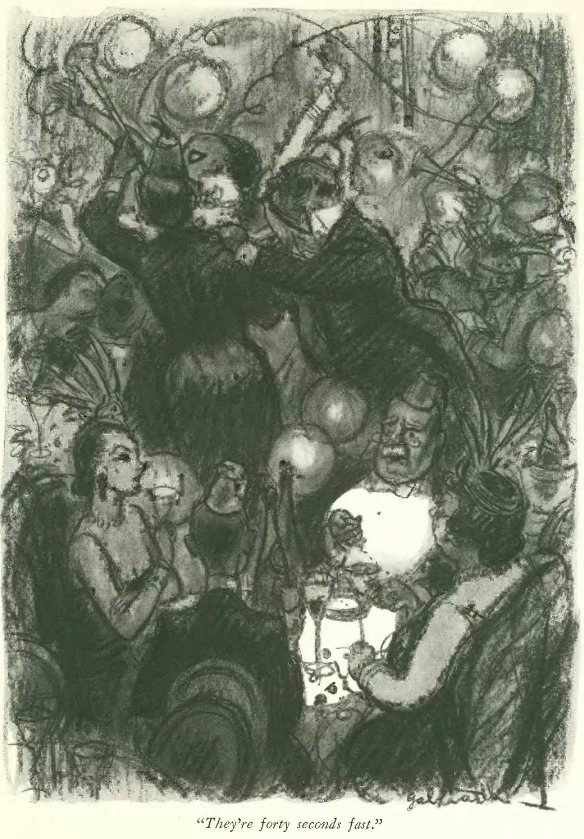
Irvin S. Cobb was back on behalf of Hupmobile, the struggling carmaker hoping that a bit of humor would boost sales…

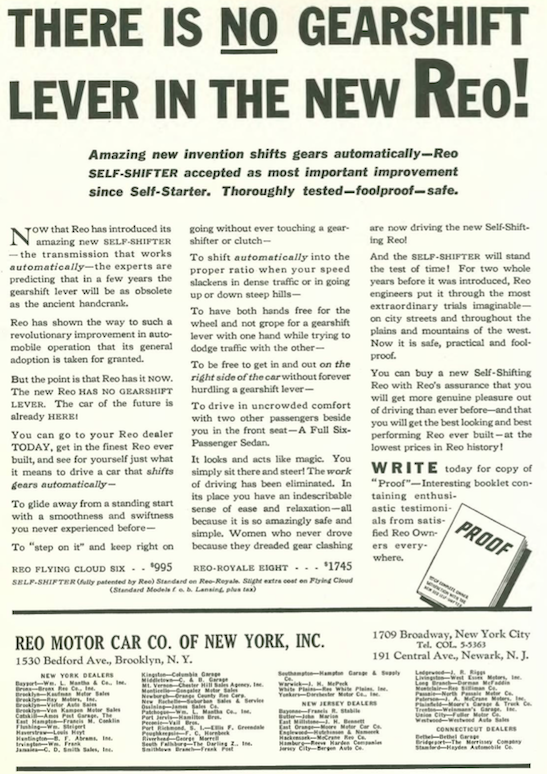
…this ad from Reo not only lacked humor, it lacked the car itself…

…too bad, because the 1933 Reo Royale was a beauty…

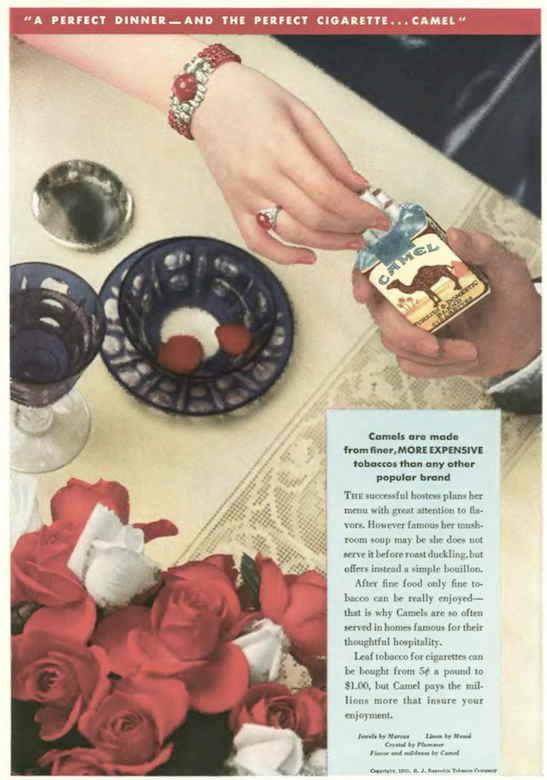
…more color ads from our cigarette manufacturers Camel…

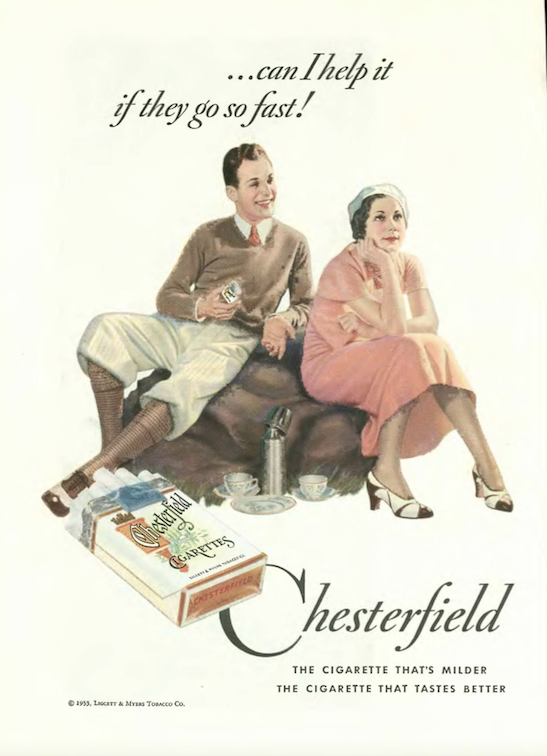
…and Chesterfield…

…why, it’s Barbara Stanwyck again, this time in color, thanks to the folks at Powers Reproduction…

…and Otto Soglow again for Rheingold beer…

…and on to the cartoons, with Soglow’s Little King…

Carl Rose demonstrated the perils of attending theatre in a barn…

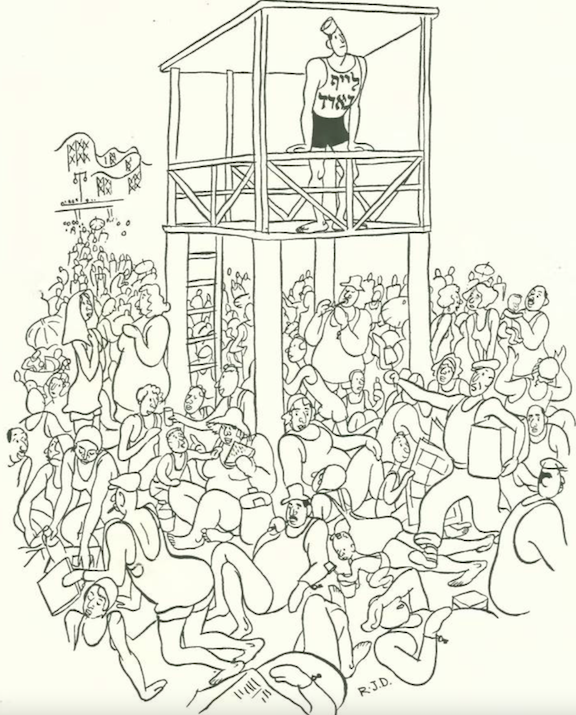
Robert Day found a Hebrew lifeguard at Coney Island…

…and we end with another by Day, with a twist on America’s Pastime and a subtle plug for the National Recovery Administration…

Next Time: The Shape of Things to Come…

Thurber’s Dogs

James Thurber became acquainted with all sorts of dogs throughout his life, and in each he found something to admire. Unlike the men and women who were bound up by silly customs or norms, the dog stood steadfast as a “sound creature in a crazy world.”

Jan. 2, 1932 cover by Rea Irvin.

In the Jan. 2, 1932 issue, Thurber began what would become a decades-long paean to the noble canine—an embodiment of the freedoms conventional man would never attain. An excerpt from “A Preface to Dogs”…

“So why dogs?” Adam Gopnik asked the question under the title, “A Note on Thurber’s Dogs,” in Nov. 1, 2012 issue of The New Yorker. Gopnik explains that for Thurber, the dog represented “the American man in his natural state—a state that, as Thurber saw it, was largely scared out of him by the American woman. When Thurber was writing about dogs, he was writing about men. The virtues that seemed inherent in dogs—peacefulness, courage, and stoical indifference to circumstance—were ones that he felt had been lost by their owners.”

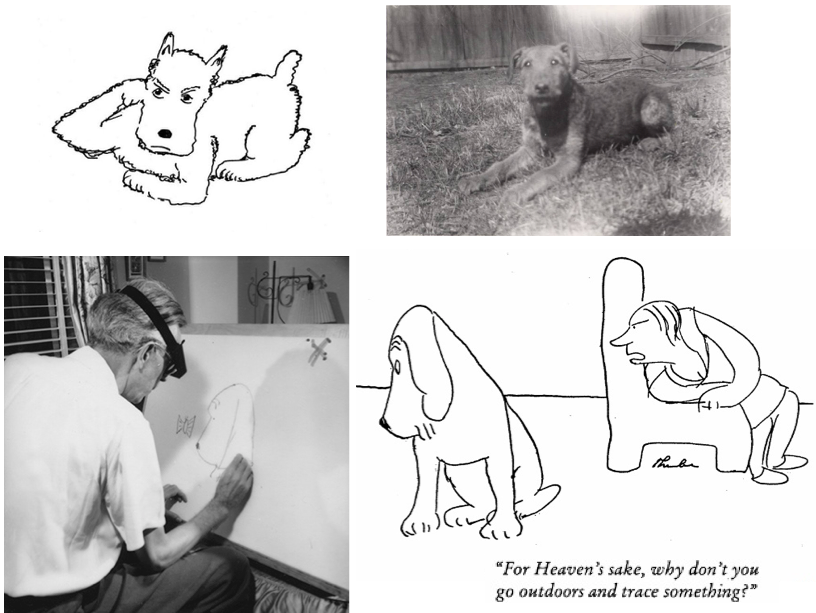
STOICAL INDIFFERENCE…Clockwise, from top left, James Thurber’s illustration of a childhood pet, a terrier named “Muggs” from the story “The Dog That Bit People” (1933); photograph of the real Muggs; dogs appear in many of Thurber’s cartoons as a stoic presence among maladjusted humans; Thurber at work on one of his dogs in an undated photo. (ohiomemory.org/jamesthurber.org)

Here’s one more excerpt that gives us glimpse into a dog’s day, as related by Thurber…

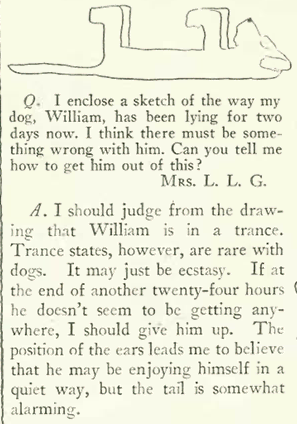
We’ve seen Thurber writing about dogs before, most notably in his spoof on newspaper pet columns titled “Our Pet Department.” Here is an excerpt from his first installment in the series, which appeared in fifth anniversary issue of The New Yorker, Feb. 22, 1930:

A final note: For more on Thurber, check out New Yorker cartoonist Michael Maslin’s Thurber Thursday entries at his terrific Ink Spill website.

 *  *  *

Choo Choo

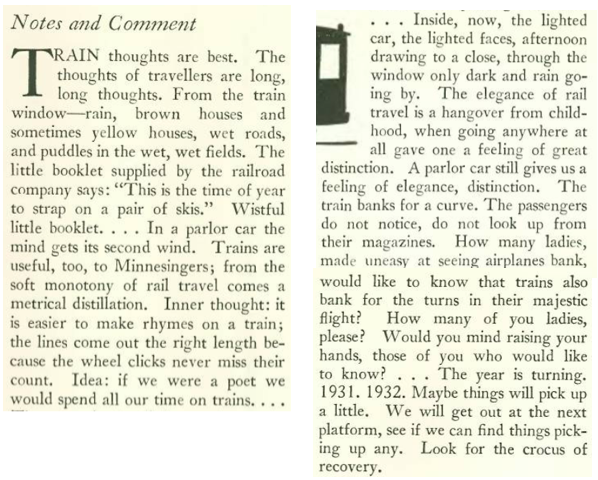
While Thurber’s mind was on dogs, his buddy E.B. White was musing about the joys of train travel, and the hope that awaited journey’s end. Excerpts:

THIS DOES NOT SUCK…Riding on the Great Northern Railroad in 1926. (Pinterest)

 *  *  *

Party Poopers

Journalist Chester T. Crowell contributed the Jan. 2 “A Reporter at Large” column by looking through the thin facade of Prohibition enforcement in New York. He tells of Prohibition agents who visit a roadside tavern for several weeks (and enjoy the beer) before finally raiding the place. Beer kegs are broken up and the door to the bar is padlocked. But all was not lost for the proprietor, who got some business advice from the raiding agents…

KEG PARTY…The New York Daily News featured this photo on June 18, 1931 with this caption: “Tears mingled with strong beer in Newark, N.J. as prohibition agents destroyed the unlawful liquor, some of which was seized in Hoboken raid.” (NY Daily News/Mashable)

*  *  *

No Laughing Matter

As we move through the 1930s we’ll see more signs of the world (war) to come. Reed Johnston had some fun with the messy politics of Weimar Germany, making a parenthetical reference to the “Nazis” of the National Socialist party who would soon take control of the country…

 *  *  *

Upstaged

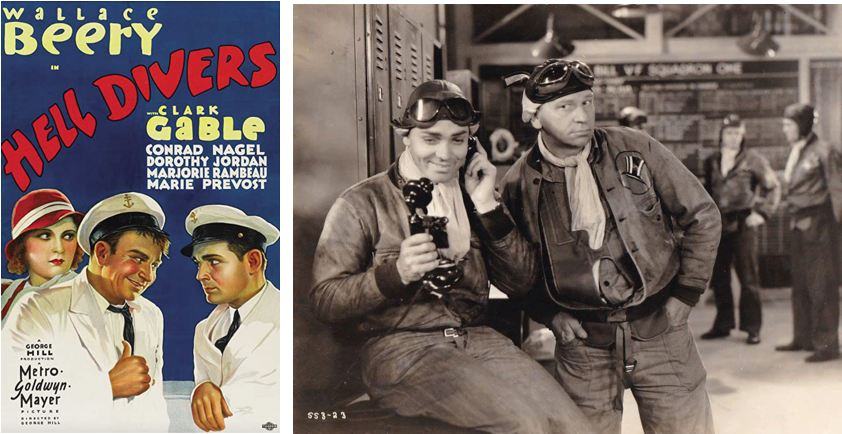
A box office and critical success, Hell Divers is considered Clark Gable’s breakout role, but the real stars were the Curtiss F8C-4 “Helldivers” that were used in filming aerial battle scenes. Critic John Mosher takes it from there…

ART IMITATES LIFE…Wallace Beery and Clark Gable played rivals onscreen and offscreen in Hell Divers. The upstart Gable disliked the veteran actor Beery, a well-known misanthrope whom many actors found difficult to work with. (IMDB)

 *  *  *

Yet More Diego

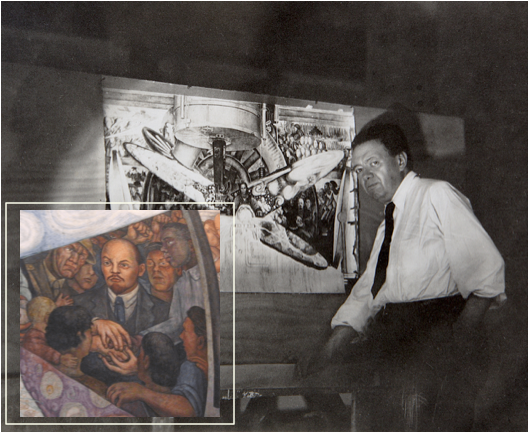
Art critic Murdock Pemberton had more to say about Diego Rivera’s appearance at the Museum of Modern Art, noting that Rivera “has been fortunate to be living in a liberal country (Mexico), where his propaganda could be spread upon the walls of public buildings.” Pemberton correctly surmised that Rivera would “starve” if he tried to paint similar themes in the U.S. (Indeed, in 1933 Rivera would refuse to remove an image of Lenin from a Rockefeller Center mural, and would be asked to leave the country).

I SHALL RETURN…Diego Rivera returned to New York in 1933 on a commission to paint a mural for the new Rockefeller Center. The inclusion of Soviet leader Vladimir Lenin (inset) in the work was not well-received in the Capital of Capitalism. (npr.org/Wikipedia)

 *  *  *

From Our Advertisers

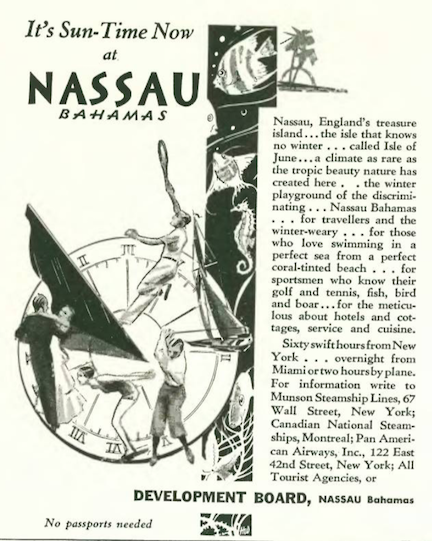
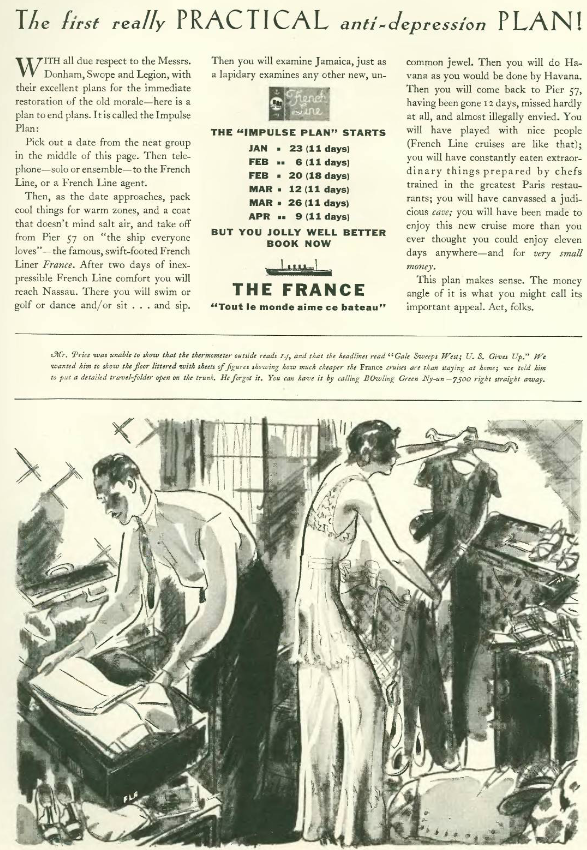
It’s snowing in Manhattan, and you’re tired of slogging though the snow and slush—well, if you didn’t lose your shirt in the stock market, and if you didn’t need to work a steady job, then you could get away from it all and head to the “sunlit paradise” of the West Indies…

…or grab some sun time in Nassau…

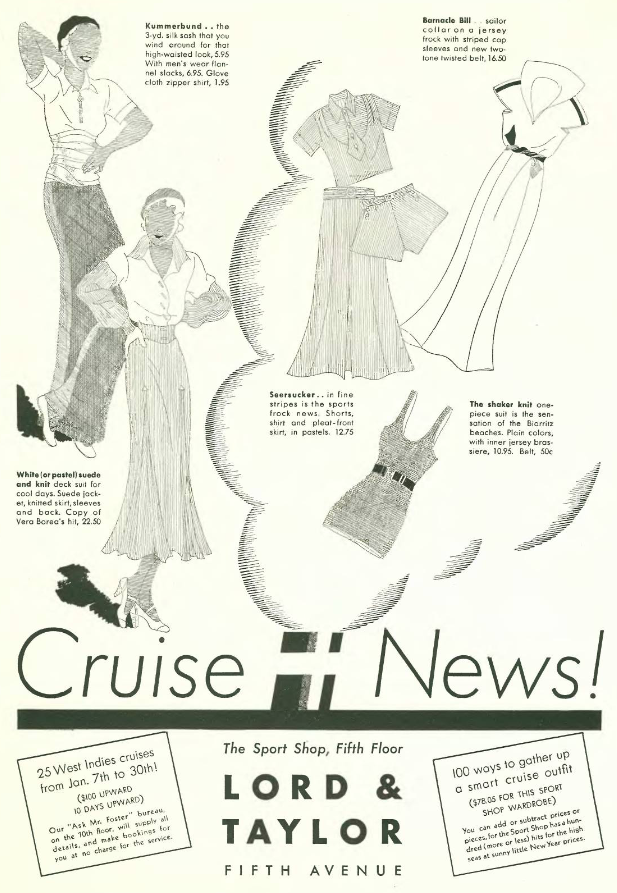
…but before you go, you might want to pick up some warm-weather duds at Lord & Taylor…

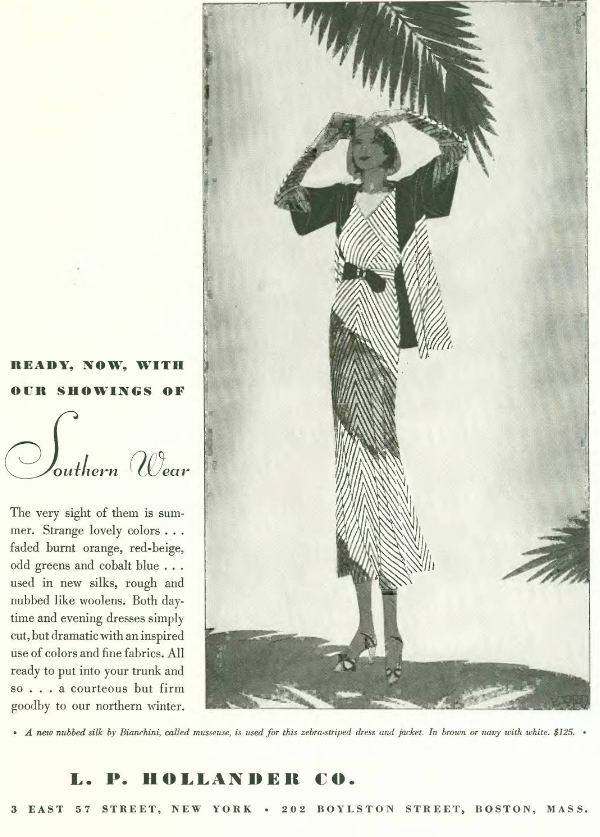
…or at L.P. Hollander on East 57th…

…to ring in the New Year we kick off the cartoons with William Crawford Galbraith

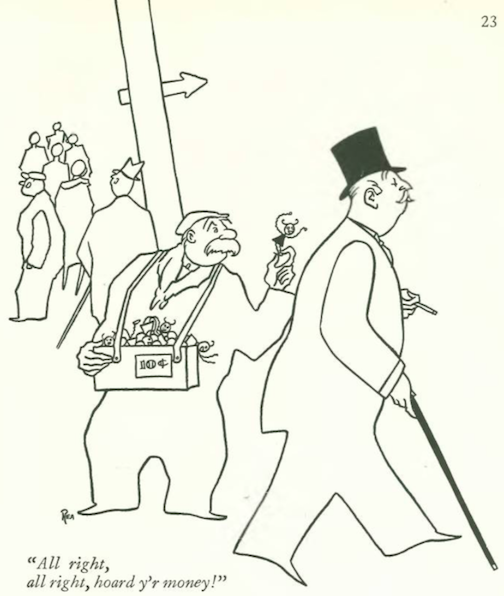
Gardner Rea showed us how old money and no money don’t mix…

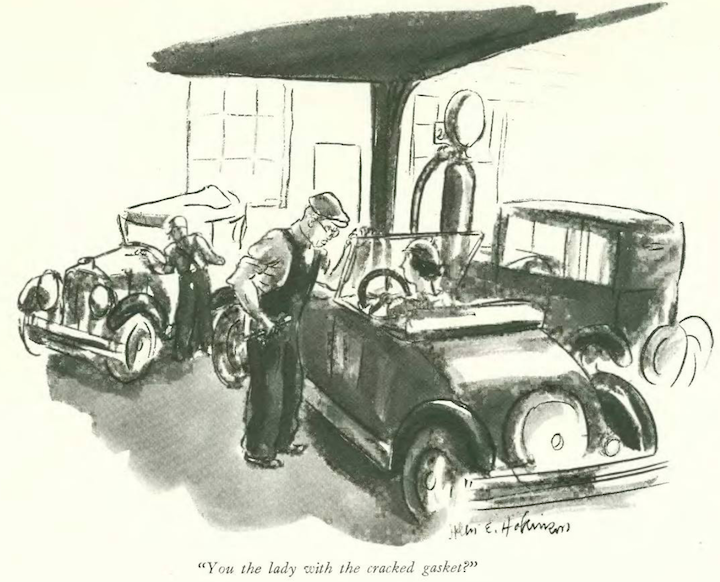
Helen Hokinson gave us a double entendre to go along with car trouble at a service station…

…communication also seemed to be a challenge for this chap in a William Steig cartoon…

…and we end where we began, with the great James Thurber and the looming battle between the sexes…

Next Time: Babylon Berlin…

All That Glitters Is Not Gold

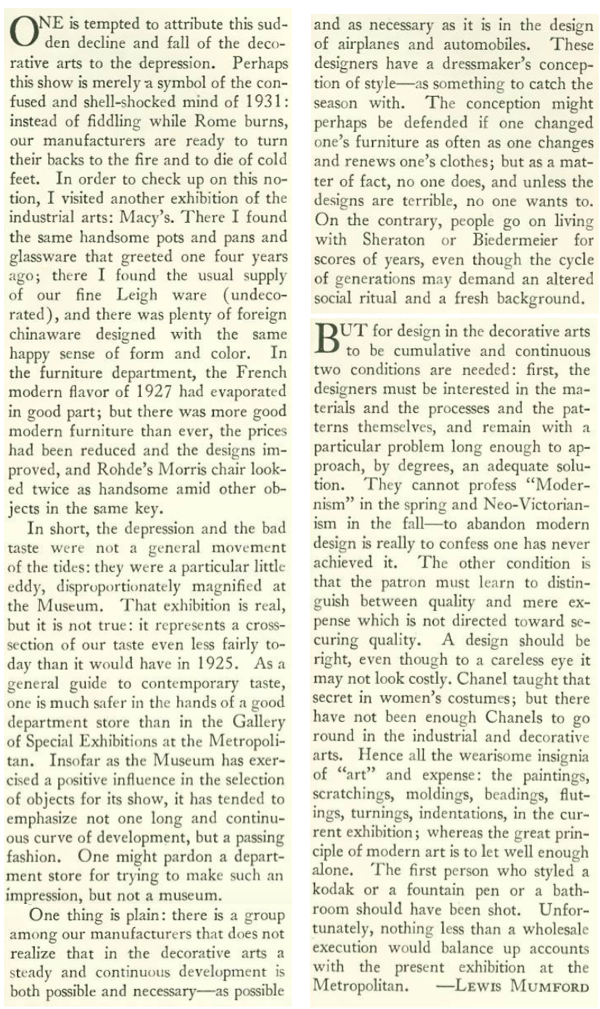
We first encountered critic Lewis Mumford in the June 30, 1931 issue of The New Yorker when he roundly excoriated plans for Rockefeller Center. The Nov. 14 issue once again found him in a surly mood, this time regarding the decorative arts and how they had been poorly displayed at the otherwise esteemed Metropolitan Museum.

Nov. 14, 1931 cover by B.H. Jackson.

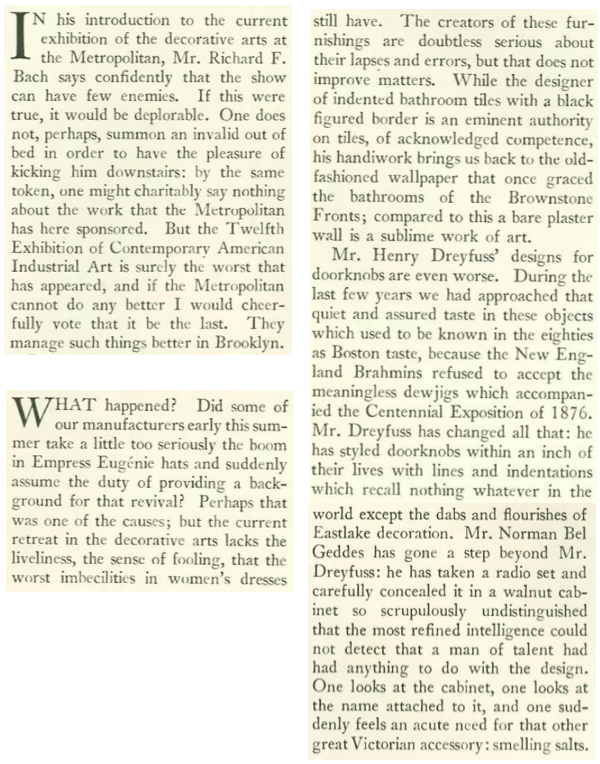
To say that Mumford was displeased with the Met’s decorative arts exhibition would be an understatement:

BED, BATH AND BEYOND…Let’s just say Lewis Mumford probably needed a stiff drink after strolling through the Met’s latest displays of the decorative arts. (Library of Congress)
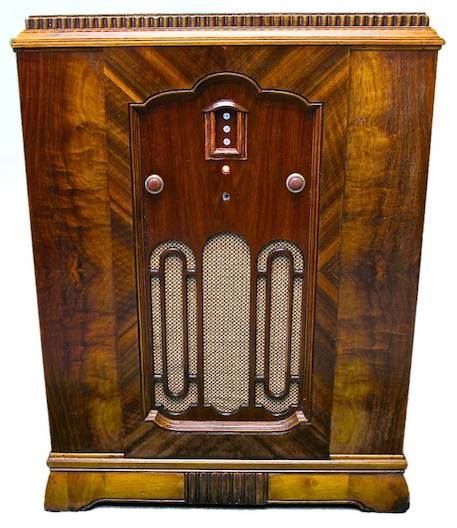
PAST IMPERFECT…Norman Bel Geddes was known for his theatrical, futuristic visions of streamlined everything, but the radio he exhibited at the Met was more Queen Victoria’s speed in Mumford’s view. (Pinterest)

Mumford pondered this sudden decline: was it the Depression, or just a streak of bad taste? And what could be done with the purveyors of bad taste, short of shooting them? Let’s read on…

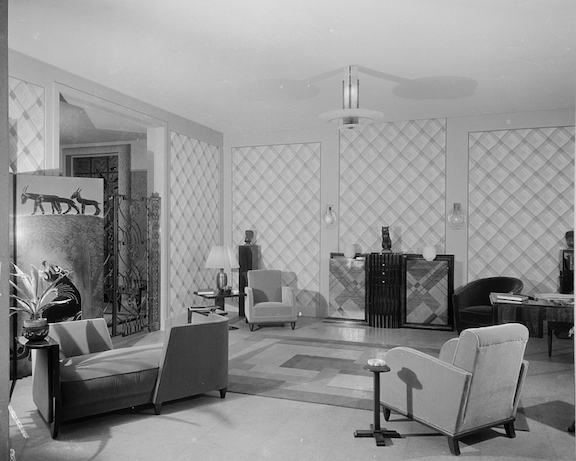
MIRACLE ON 34TH STREET…Mumford suggested that Macy’s International Exposition of Art in Industry in the late 1920’s had more vision than the Met’s 1931 offering. Above, living room furniture designed by Houbert et Petit exhibited in a showroom during the 1928 “International Exposition of Art in Industry” at Macy’s department store. (Library of Congress)
LESS THAN A PRETTY FACE?…The streamlined form of Norman Bel Geddes’ “House of Tomorrow” probably wowed a few readers of Ladies Home Journal in April 1931, but critic Lewis Mumford was likely not among them, as he often criticized Bel Geddes for his theatricality at the expense of good taste and functionality (see first excerpt above). Mumford was especially critical of Bel Geddes’ glorification of the automobile and the highway at the expense of livable cities. (Pinterest)

 *  *  *

Peter, We Have Your Back

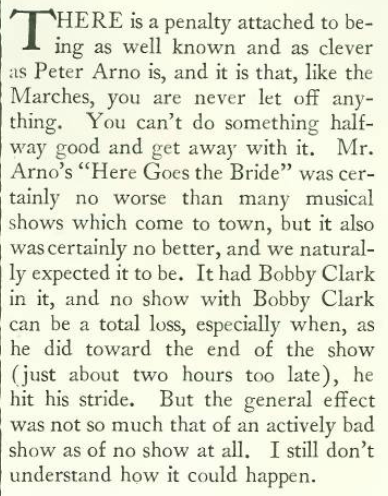
When your colleague has a play made from his book, and it closes after just seven performances, what can you say, especially if you are theater critic for The New Yorker? Well, here is what Robert Benchley did:

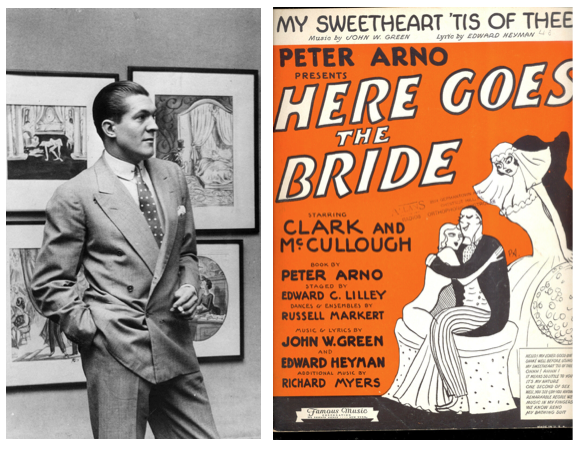
THAT’S SHOW BIZ…Here Goes The Bride, based on a Peter Arno book, closed after just seven performances. However, as a cartoonist, Arno was at the top of his game. (Britannica/Ebay)

 *  *  *

From Our Advertisers

Depression? Who needs it? If you had the means, and didn’t lose your shirt in the 1929 crash, you could get away from it all and book passage to the Bahamas, where you could drink legally, soak up some sun, and forget about those lengthening bread lines you occasionally glanced from the window of your town car…

…well, that bootleg gin was a mind eraser…

Helen Hokinson continued to offer her cartooning skills to the folks at Frigidaire…

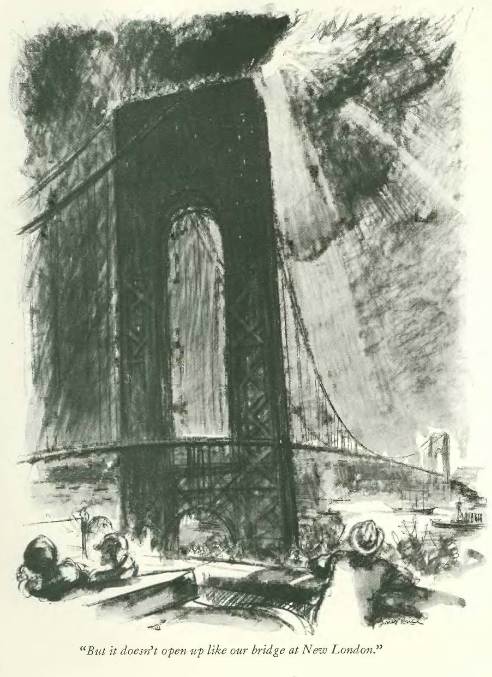
…on to our cartoons, the George Washington Bridge drew the envy of some out-of-towners, as illustrated by Garrett Price

…nearly 90 years ago folks were almost as nuts about college football as they are now, except for Perry Barlow’s lone dowager, who would rather be sitting in her parlor with a cup of tea…

Gardner Rea explored the wonders of heredity…

Otto Soglow’s Little King employed a guard ready for any emergency…

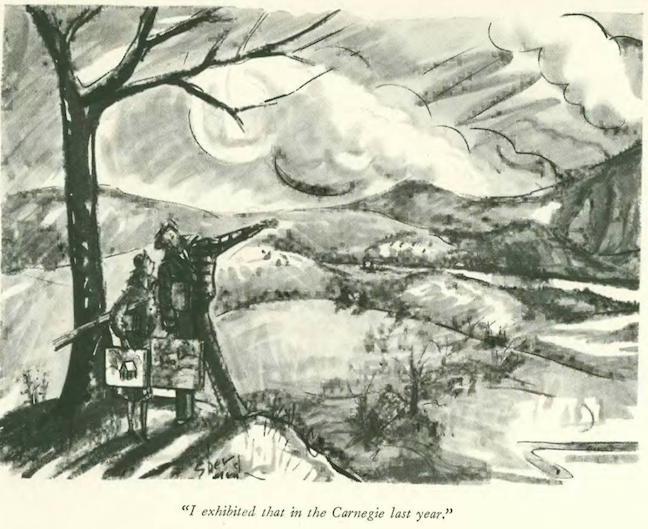
Barbara Shermund gave us an artist with a god complex…

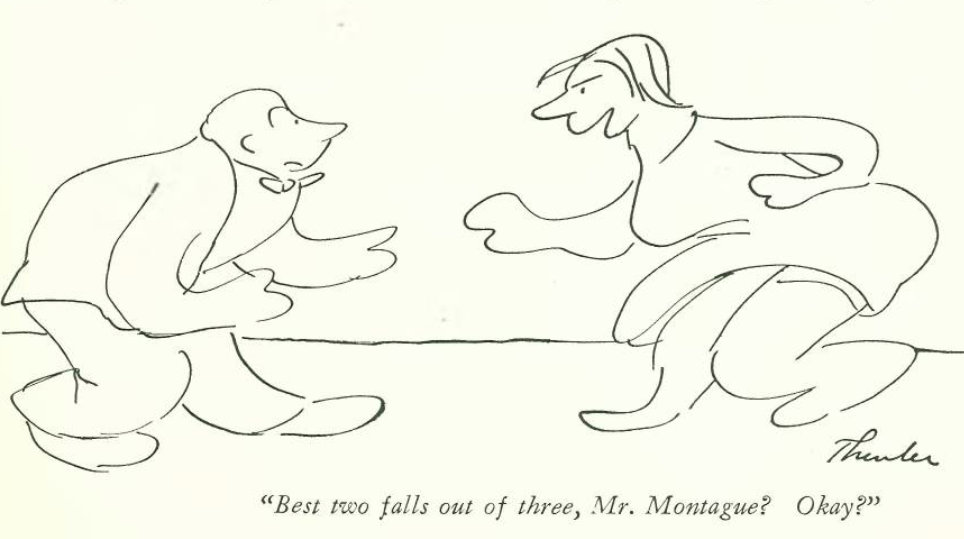
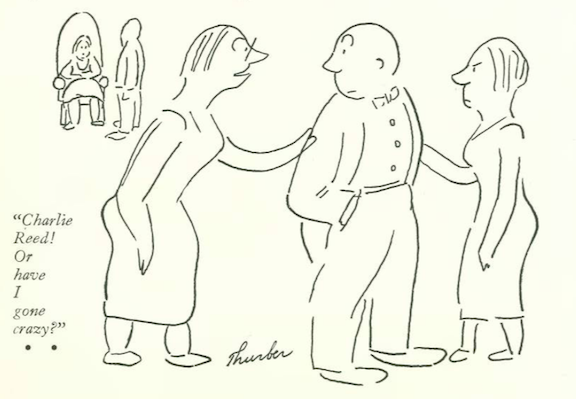
James Thurber continued to probe the nuances of the sexes…

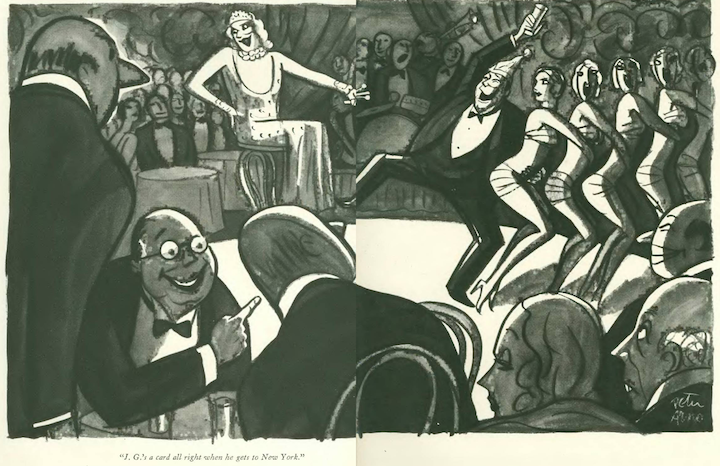
Peter Arno sketched this two-page spread with the caption: J.G’s a card all right when he gets to New York

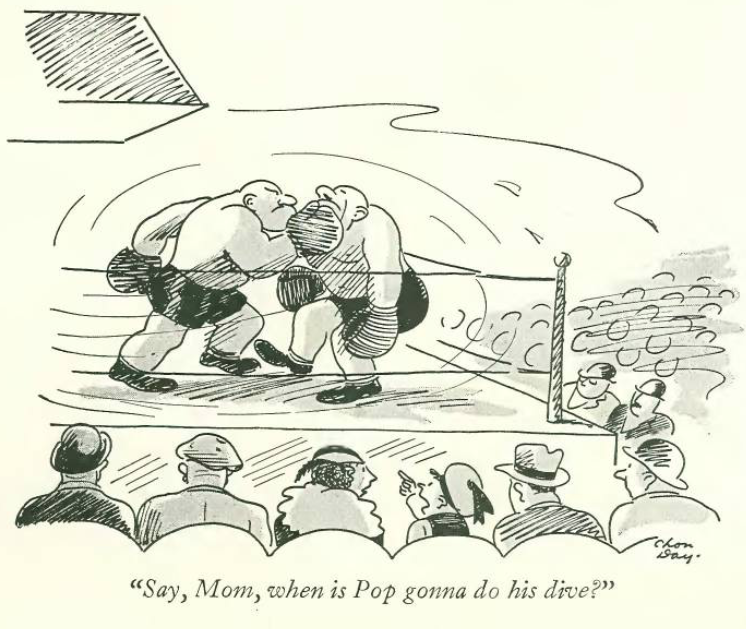
…and from the mouth of babes, we have these observations of the underworld from Chon Day

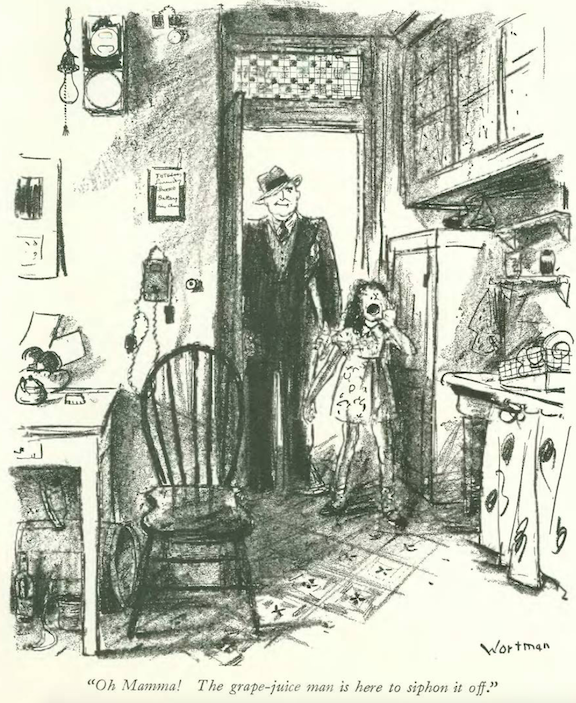
…and Denys Wortman

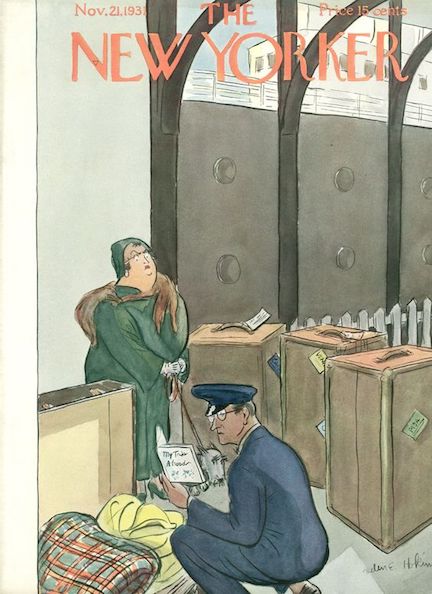
On to the Nov. 21 issue, which featured the last in a series of eleven covers Helen Hokinson contributed to The New Yorker in 1931. The covers featured one of Hokinson’s “Best Girls”—a plump, wealthy, society woman—on an around-the-world cruise, which began with the March 2 issue and ended on Nov. 21 with a stop at the customs office, and a nosy customs officer…

Nov. 21, 1931 cover by Helen Hokinson.

Bread & Circuses

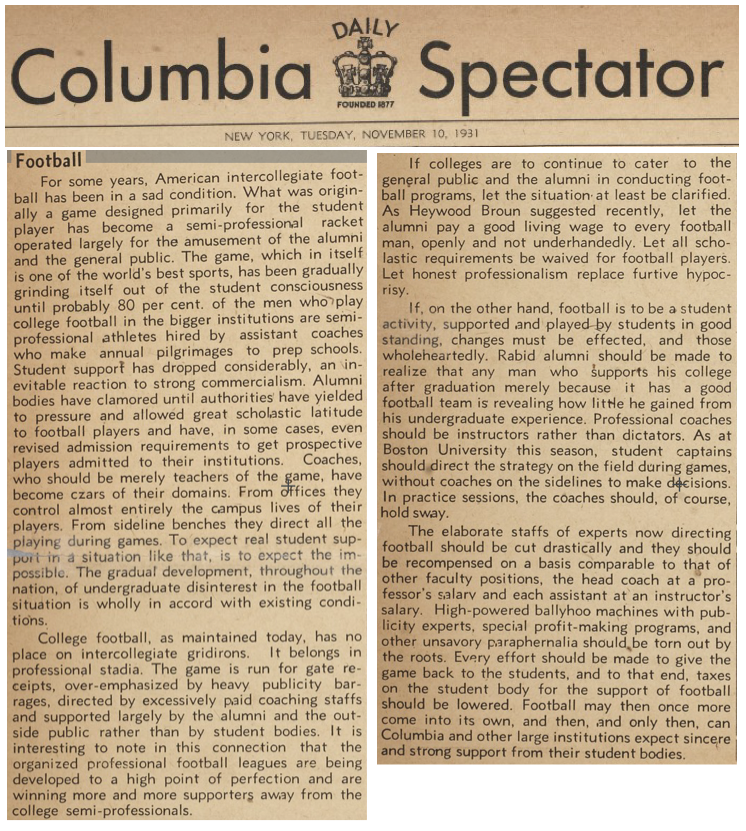
In his “Notes and Comment,” E.B. White reported on a recent editorial in the Columbia Spectator, that university’s student newspaper, which took issue with the professionalization and “furtive hypocrisy” of college football (if only they could see us now). White observed:

In 1931, Columbia was a football power, and the Ivy League was a big-time conference. To the editors of the Spectator, this was not a point of pride, which they made clear in this 89-year-old editorial that could have been written yesterday:

Clippings from Columbia Spectator Archive
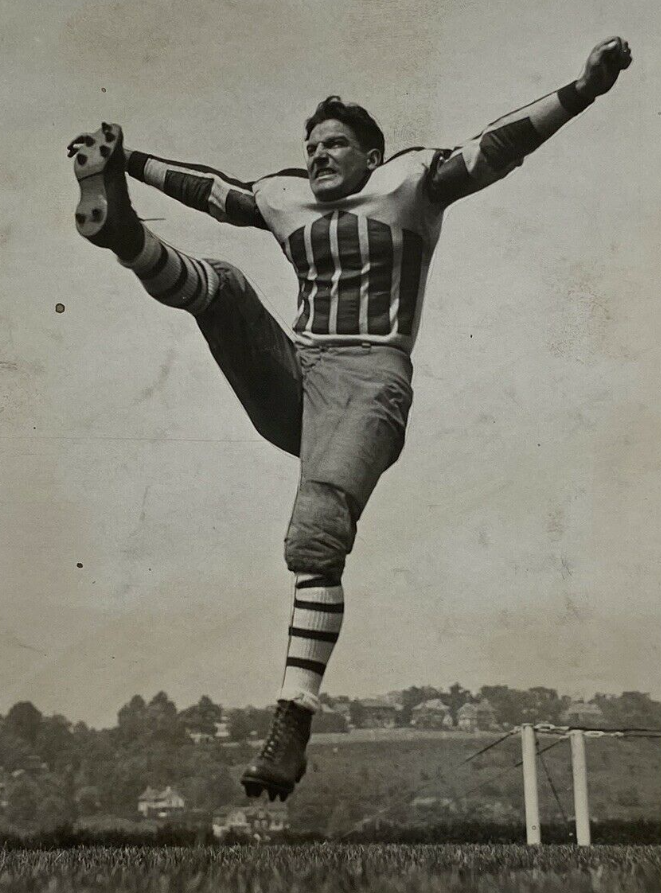
JUST GETTING MY KICKS…1931 press photo of Columbia University football star Ralph Hewitt, who still holds the school record for the longest field goal — a 53-yarder he dropped kicked in a 1930 upset victory over Cornell. Hewitt went on to coach high school sports.

 *  *  *

Sorry, Charlie

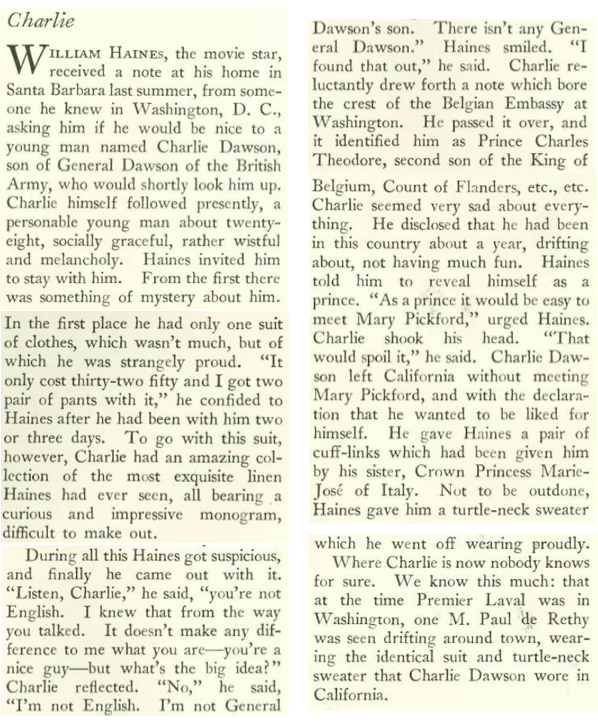
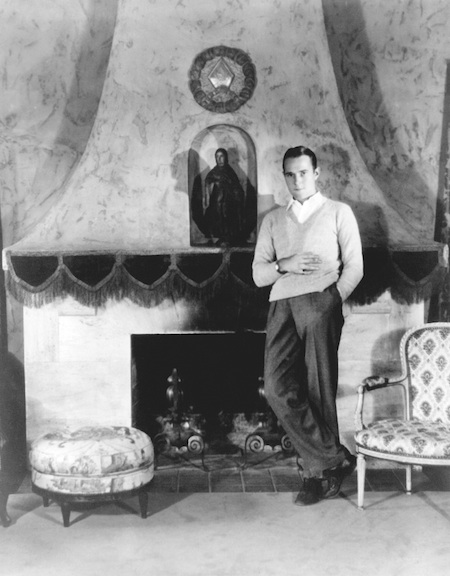
William “Billy” Haines was a top-five box-office star from 1928 to 1932, portraying arrogant but likable characters in a string of pictures that ended abruptly when Haines refused to deny his homosexuality and was cut loose by MGM. “The Talk of the Town” looked in on Haines at his Santa Barbara home, where he entertained a mysterious visitor:

THE INTERIOR LIFE…The actor William Haines in a 1926 publicity shot taken at his Hollywood home. Haines would abandon acting in the 1930s and take up a successful career as an interior designer. (Photofest)

 *  *  *

Coveted Coiffeur

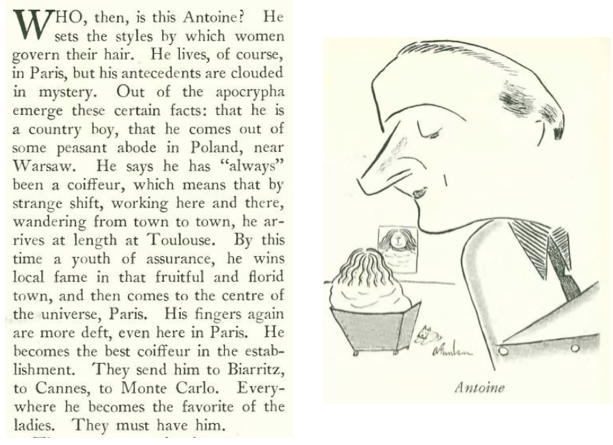
Writer Bessie Breuer wrote an admiring profile of Polish hairdresser Antoine (aka Antoni Cierplikowski), considered the world’s first celebrity hairdresser. The opening paragraph:

A CUT ABOVE…In 1914 famed hairdresser Antoine (aka Antoni Cierplikowski) invented the “shingle cut” (at left, sported by actress Louise Brooks in the 1920s), which was all the rage during the Roaring Twenties. (Pinterest)

 *  *  *

The Look of Relief

In “The Talk of the Town” E.B. White noted that a familiar face was gracing advertisements for President Herbert Hoover’s Unemployment Relief Agency:

I NEVER FORGET A FACE…E.B. White referred to this ad featuring an unnamed woman who had a familiar look about her. (period paper.com)

 *  *  *

More His Style

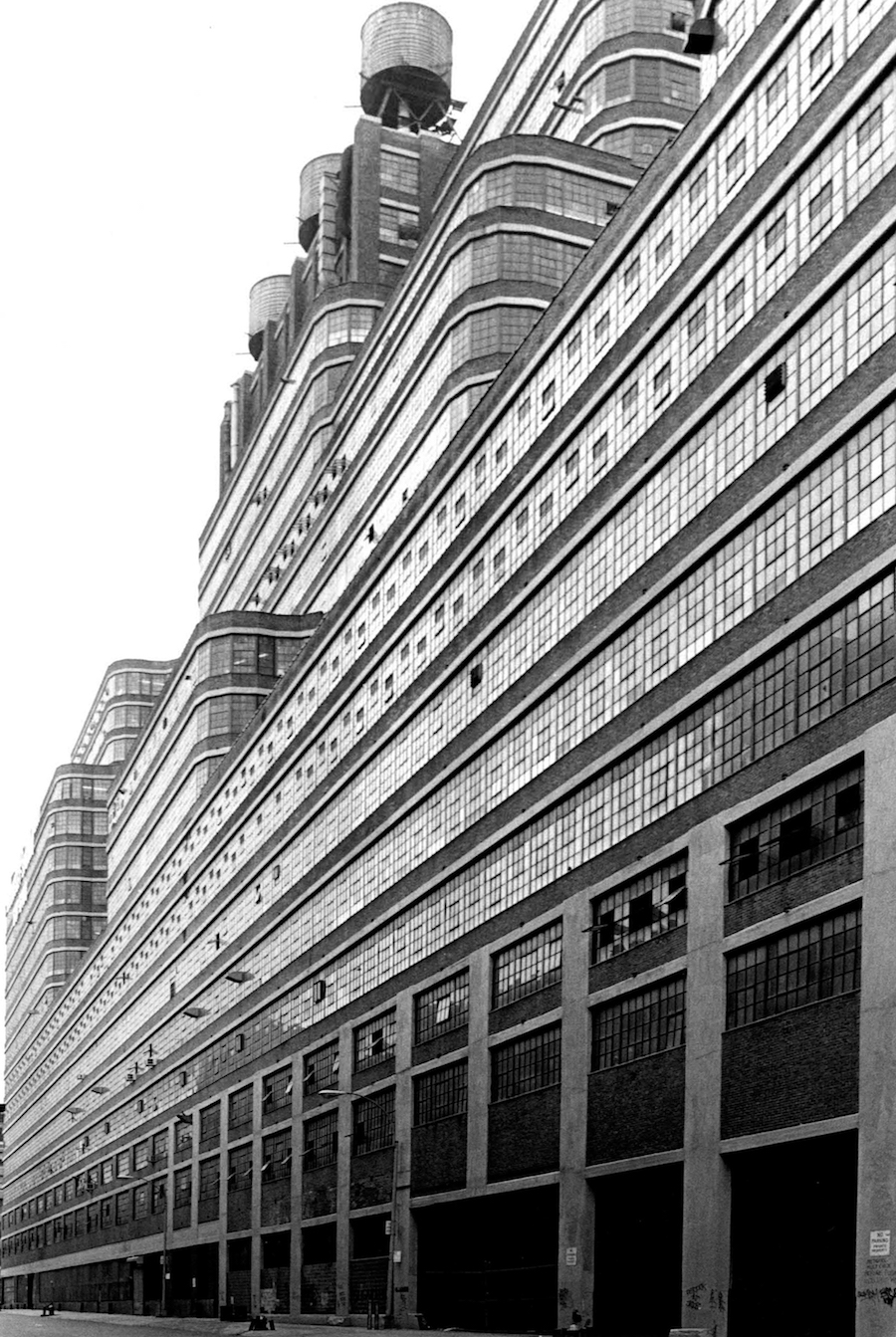
We return again to Lewis Mumford, this time cheered by the sight of the new Starrett-Lehigh Building in Chelsea, designed by Cory & Cory. An excerpt from “The Sky Line” column:

THAT’S MORE LIKE IT…Lewis Mumford praised the striking effect of the Starrett-Lehigh Building’s alternating bands of brick, concrete and steel. (Atlas of Places)

 *  *  *

The Chump

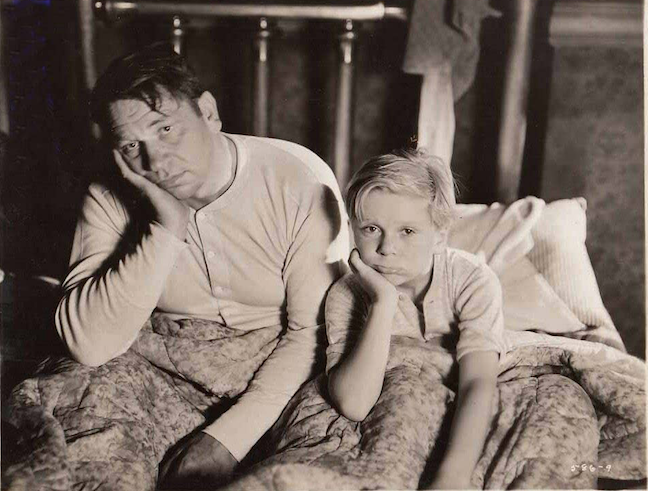
John Mosher was neither moved nor charmed by the appearance of little Jackie Cooper in The Champ, a tearjerker story of an alcoholic ex-boxer (Wallace Beery) struggling to provide for his son. He did, however, appreciate the boy’s ability to carry “on his little shoulders a heavy and tedious and lengthy story.”

BUMMER…John Mosher had little to like about King Vidor’s The Champ, featuring Wallace Beery and Jackie Cooper. Mosher was no doubt a bit dismayed when Beery received an Academy Award for his performance. (IMDB)

 *  *  *

A Wishful Christmas List

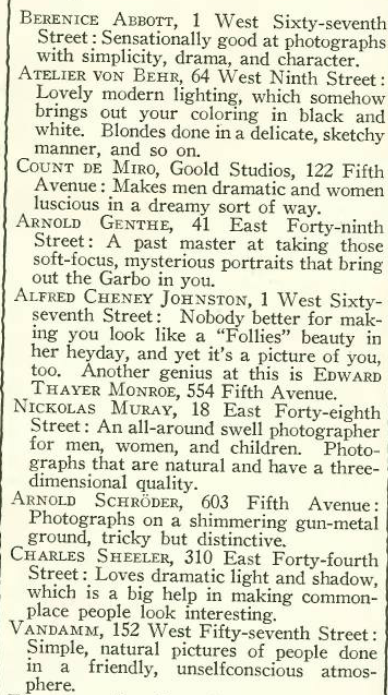
It was that time of the year when the New Yorker began running its lengthy features on possible gifts for Christmas. This excerpt caught my eye for what might have been possible in 1931 — buying a photographic print directly from Berenice Abbott or Nickolas Muray:

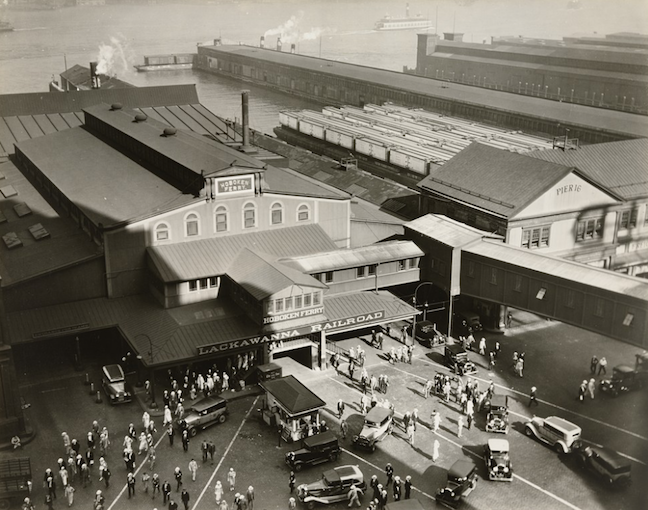
NO LUMP OF COAL, THIS…In 1931 it might have been quite possible to buy this print directly from photographer Berenice Abbott. Barclay Street, Hoboken Ferry 1931, is in MoMA’s photography collection.

*  *  *

From Our Advertisers

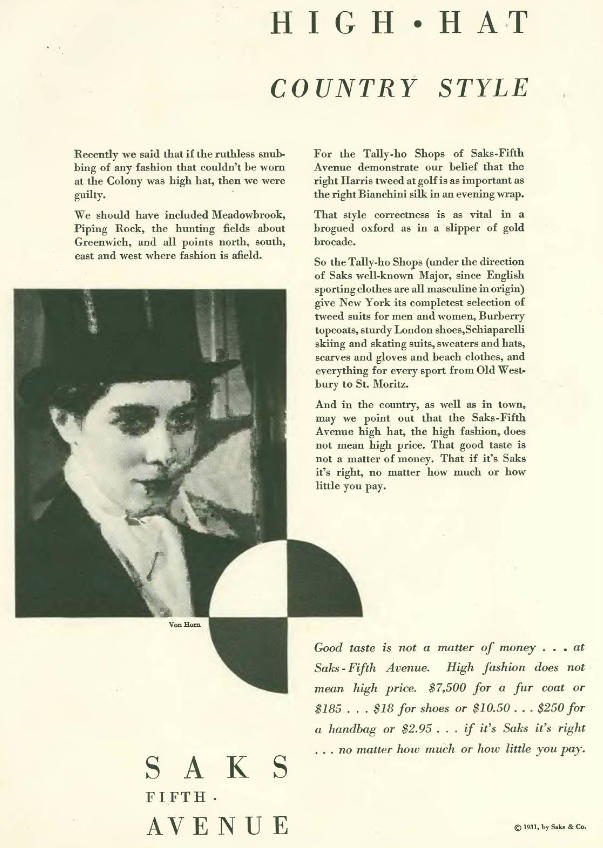
It has been well-established in previous posts that Anglophilia ran rampant among New York’s smart set, and this advertisement from Saks provides everything we need to underscore the point…

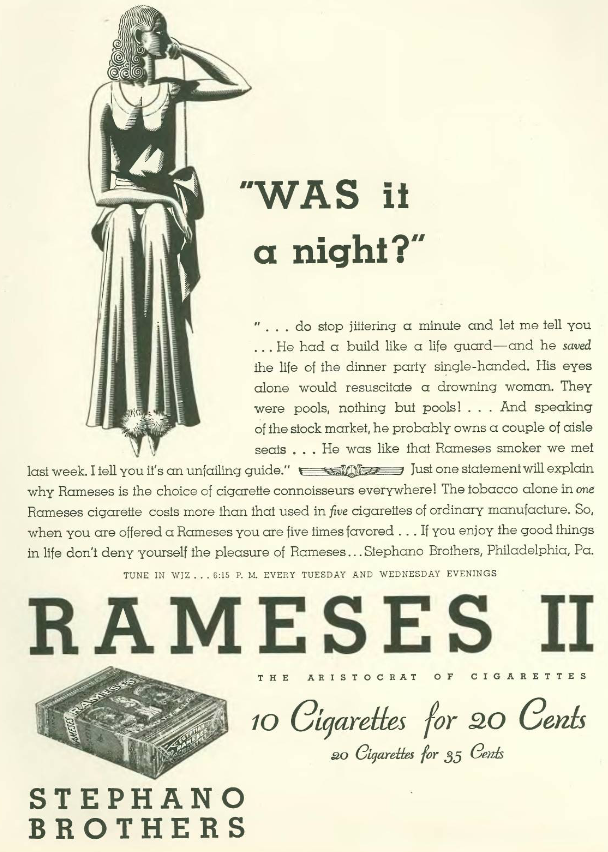
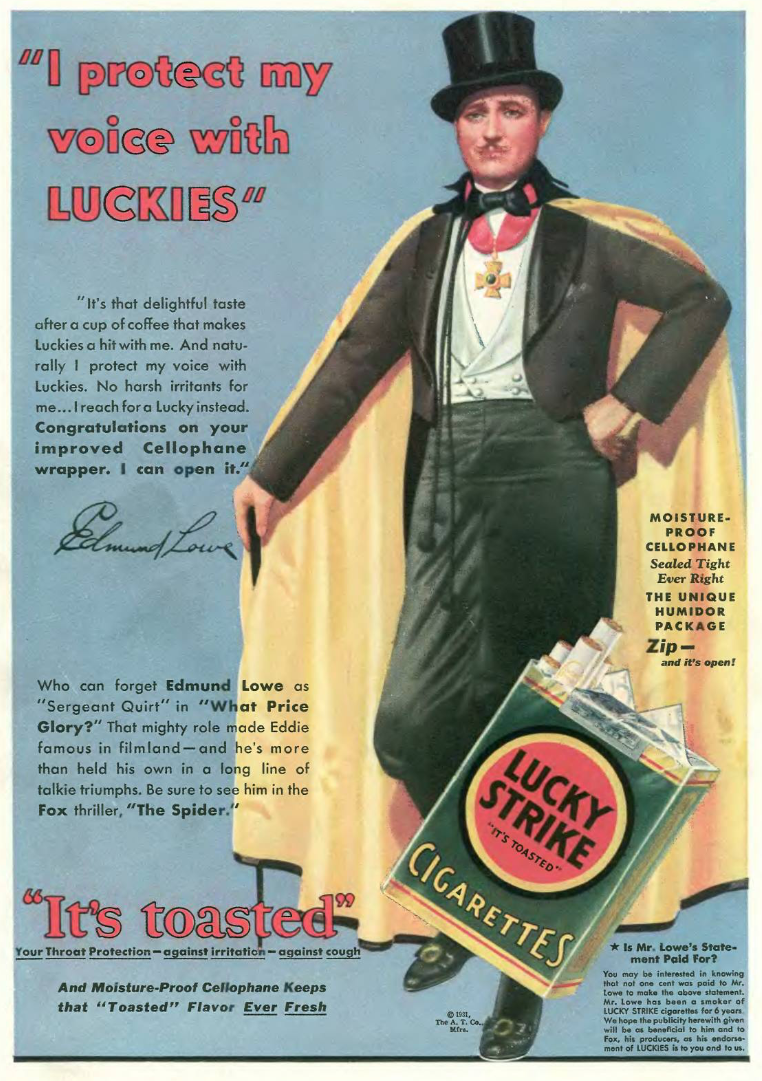
…and the top hat mades another appearance in this spot for Lucky Strike, featuring an endorsement from actor Edmund Lowe...

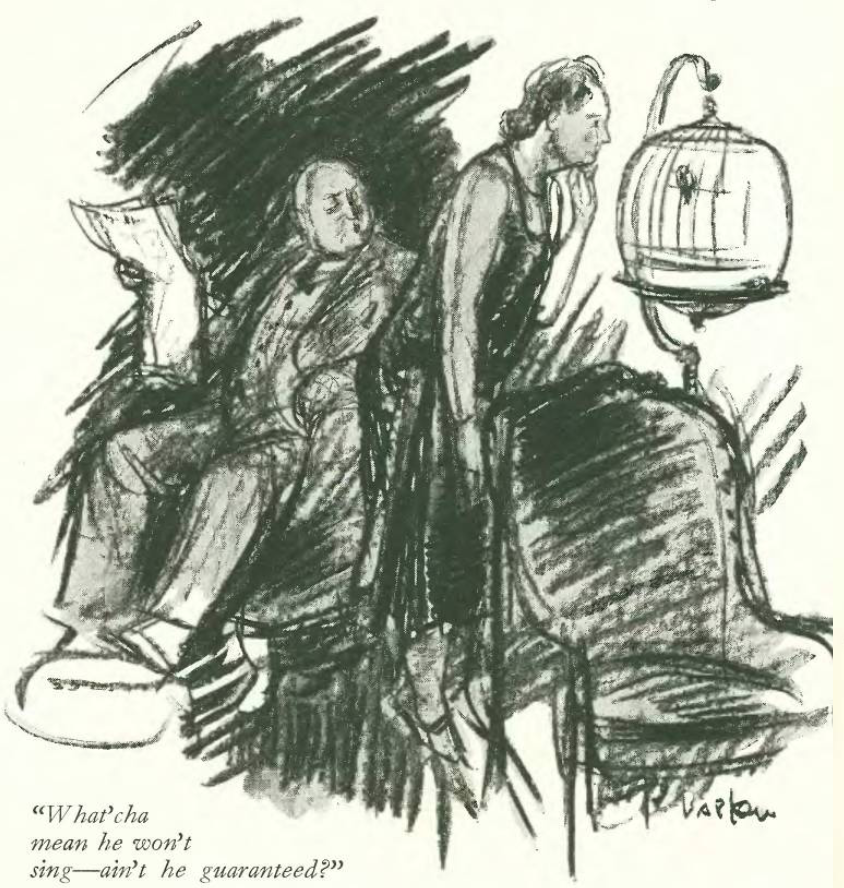
…our cartoons featured a song-less songbird courtesy of Perry Barlow

…and from James Thurber, another creature with little appetite for song, let alone wine and women…

William Steig brought us back to the bleachers with another nonconformist…

Gluyas Williams gave us this sad sack all alone in the crowd…

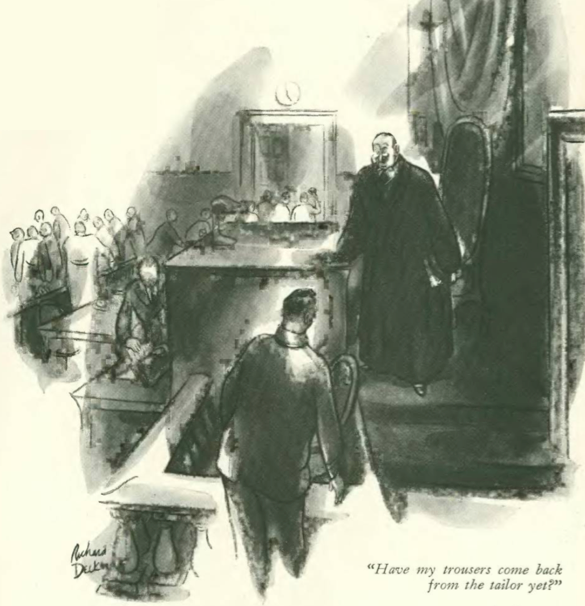
Richard Decker sought to bring order to this court…

…and we end with Carl Rose, and this two-page cartoon illustrating a dicey parking challenge…

Next Time: Yankee Doodles…