We skip ahead to the Oct. 2, 1926 issue to look at one of the big events of that year–the Dempsey-Tunney heavyweight prize fight (I’m not skipping issues…Sept. 25 appears later in this blog).
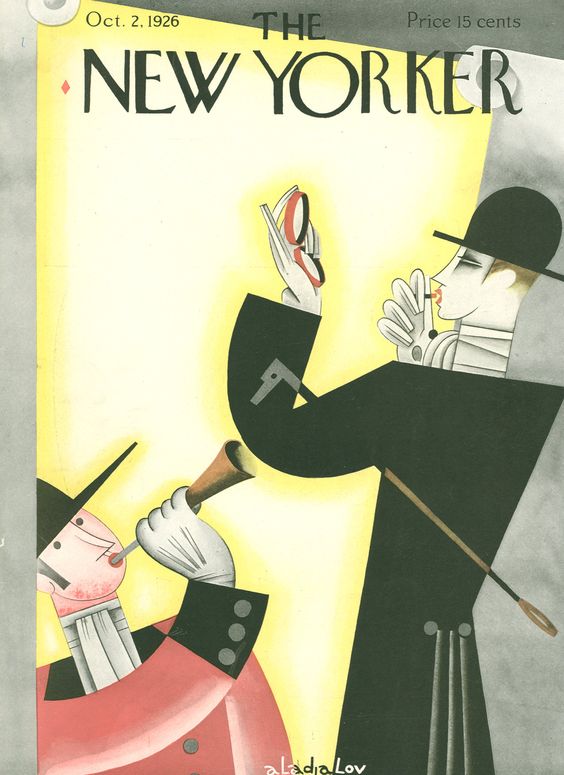
Oct. 2, 1926 – Issue # 85 – Cover by Constantin Alajalov. (Once again, note the ongoing comic reference to androgyny in 20’s fashion)
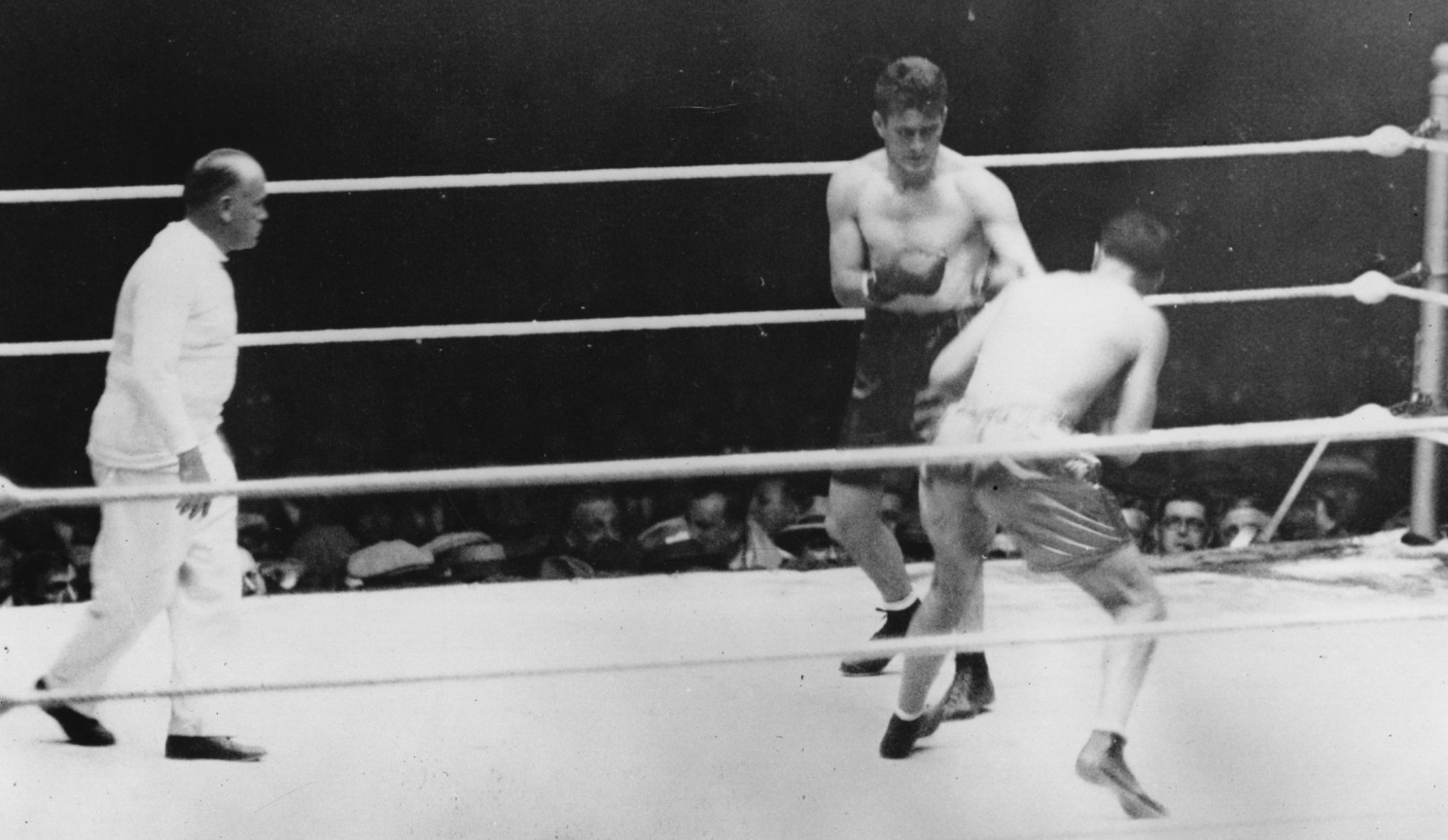
Heavyweight boxing was a big part of the American sports scene in the 1920s, and two giants of the sport, Jack Dempsey and Gene Tunney, dominated the headlines in the late 1920s thanks to much-heralded bouts in Philadelphia in 1926 and a rematch in Chicago the following year (which would include the famous “long count” incident).
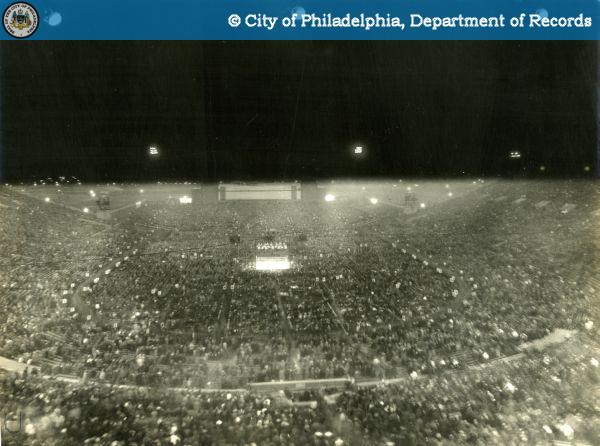
An estimated 135,000 fans packed Sesquicentennial Stadium in Philadelphia for the Dempsey-Tunney bout. (NYTimes)
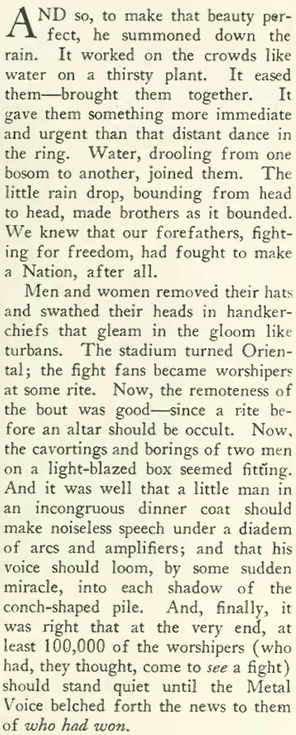
The New Yorker joined in on the hoopla, publishing a lengthy account of the match by Waldo Frank (aka “Search-light”), who trained his jaded eye on the whole affair:
VIEW FROM THE CHEAP SEATS…a rain-soaked throng at the Dempsey-Tunney fight in Philadelphia. (City of Philadelphia)
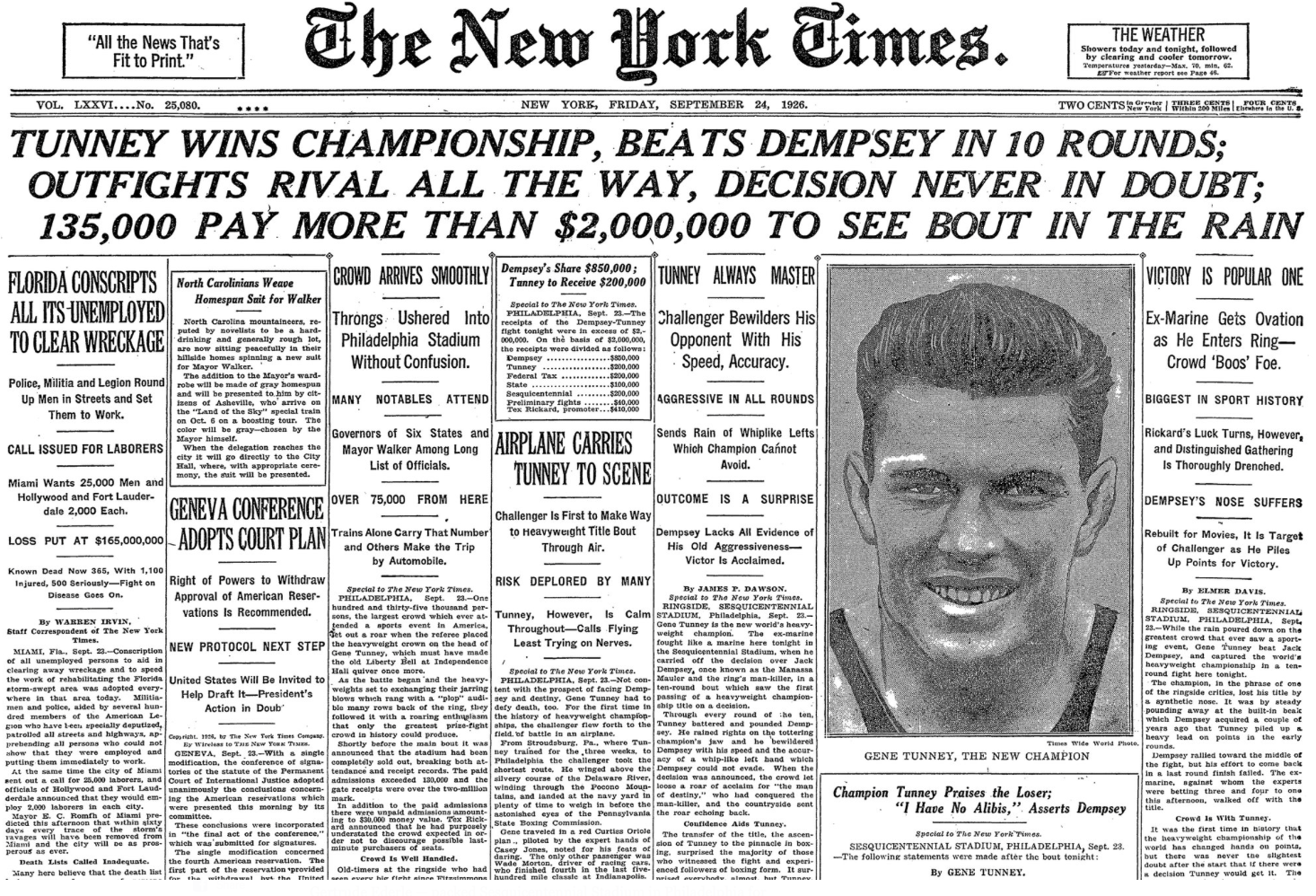
According to the New York Times, the crowd included such notables as Charlie Chaplin, cowboy movie star Tom Mix and the English Channel swimmer Gertrude Ederle.
Coverage of Tunney’s victory by unanimous decision took up three-quarters of the front page of The New York Times, and also filled most of pages 2 through 7. (The New York Times)
But in typical fashion, Waldo was less than dazzled, finding the rain an apt metaphor for a spectacle mostly unseen by those in attendance:
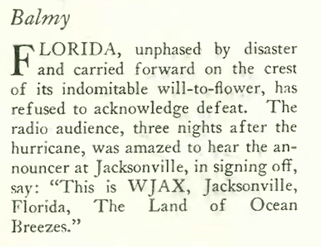
Never one to wallow in tragedy, the magazine made a brief (and oddly droll) reference in “The Talk of the Town” to a hurricane that hit Miami and its environs (it killed 372 people and injured more than 6,000):
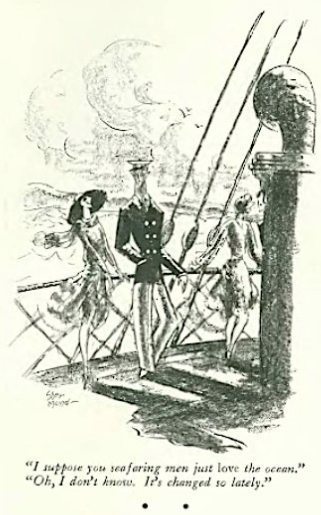
Other items of note in the issue included this examination of country vs. city life by cartoonist Barbara Shermund…
…and this cartoon by Al Frueh commenting on the challenges of Manhattan’s rapidly changing cityscape:
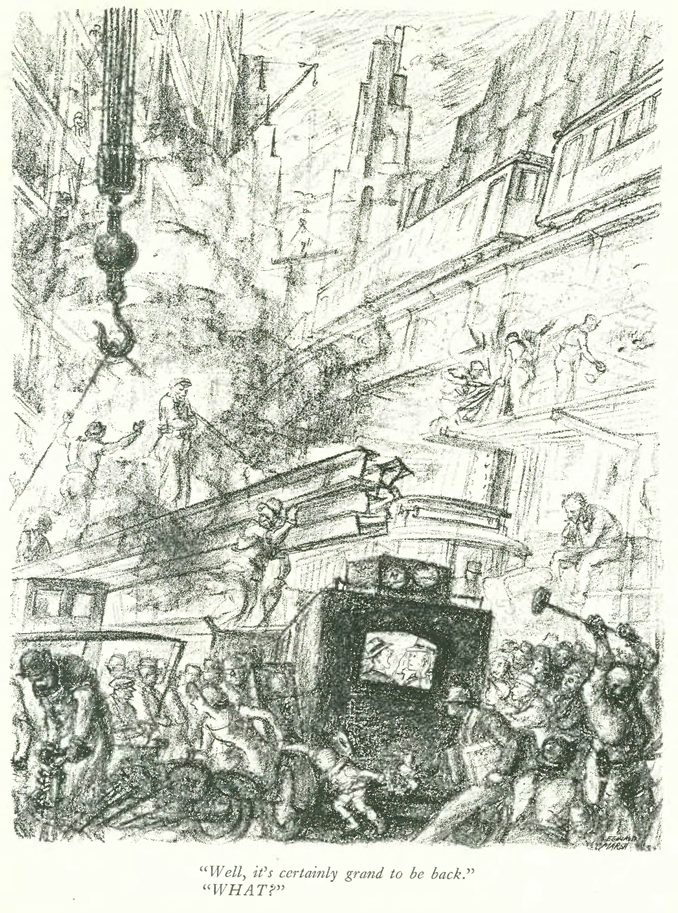
The changing city was also on the mind of Reginald Marsh in this illustration he contributed to the Sept. 25, 1926 issue of the magazine:
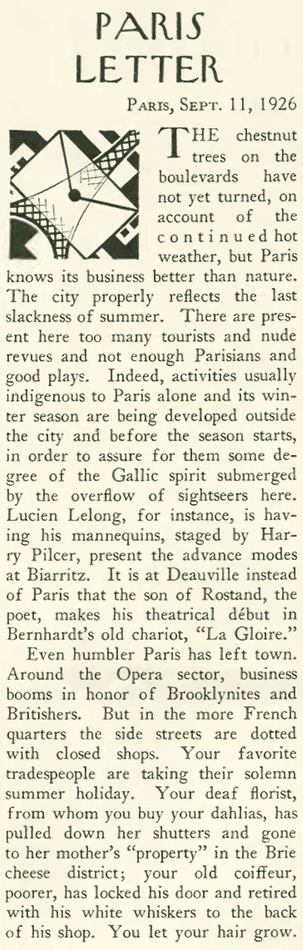
Back to the Sept. 25 issue, which featured an update from Paris correspondent Janet Flanner…
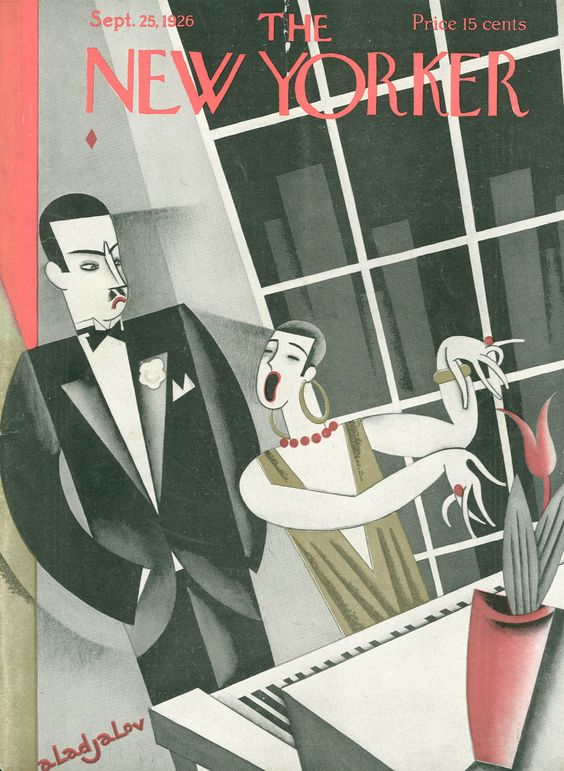
Sept. 25, 1926 – Issue # 84 – Cover by Constantin Alajalov.
…who commented on the large number of American tourists crowding the city just as the locals were fleeing for their long, late summer holidays:
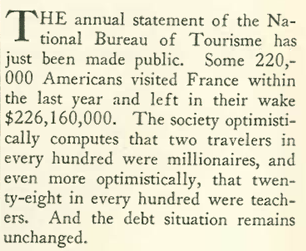
She offered some numbers to back up her observations:
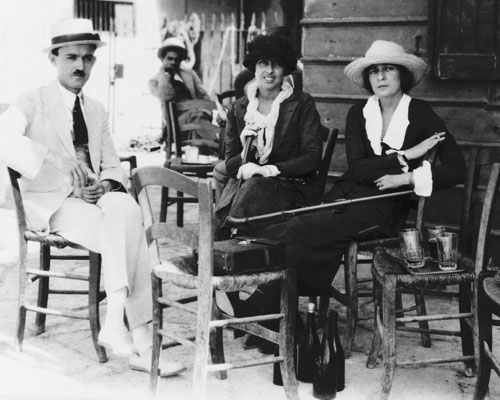
Janet “Genêt” Flanner (right) and longtime companion Solita Solano (center) in Paris, 1921. Solano was a well-known writer and drama critic for the New York Tribune. (Vintage Everyday)
And finally, a cartoon by Rea Irvin exploring the trials of the idle rich:
As much as they affected a refined disinterest in the latest fads, The New Yorker editors were nevertheless impressed by the many electronic innovations in the 1920s consumer market. Although electricity in cities had been around for awhile, inventions to exploit this new resource would come into their own in the Jazz Age with the advent of mass-produced electrical appliances (refrigerators, toasters etc.).
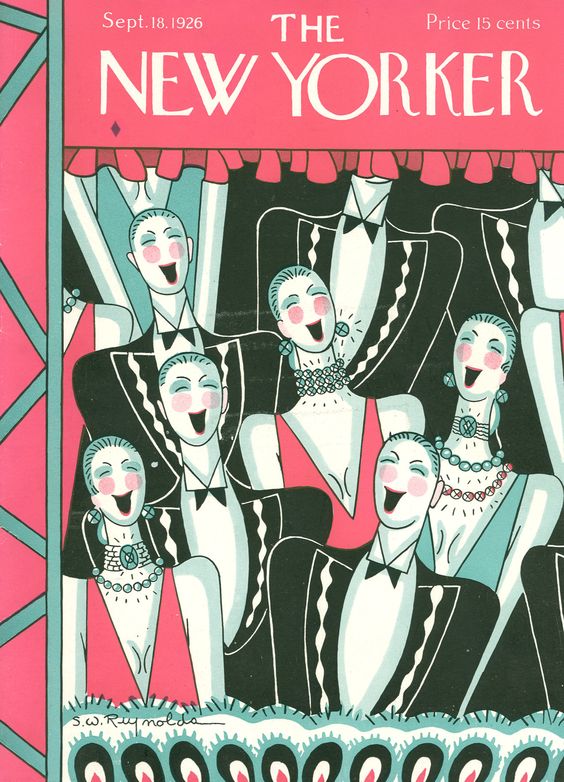
Sept. 18, 1926 cover by Stanley W. Reynolds.
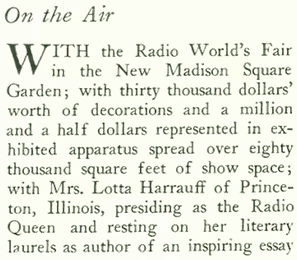
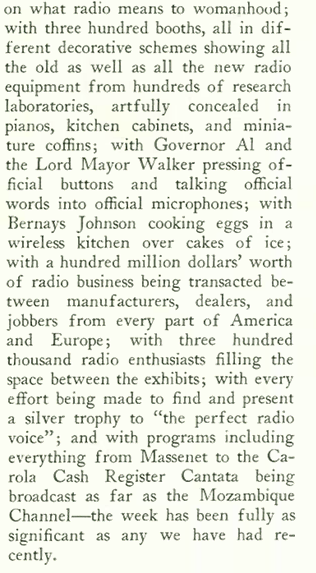
So when the 1926 Radio World’s Fair opened at Madison Square Garden, the magazine was there to report on its many marvels in the Sept. 18 issue:
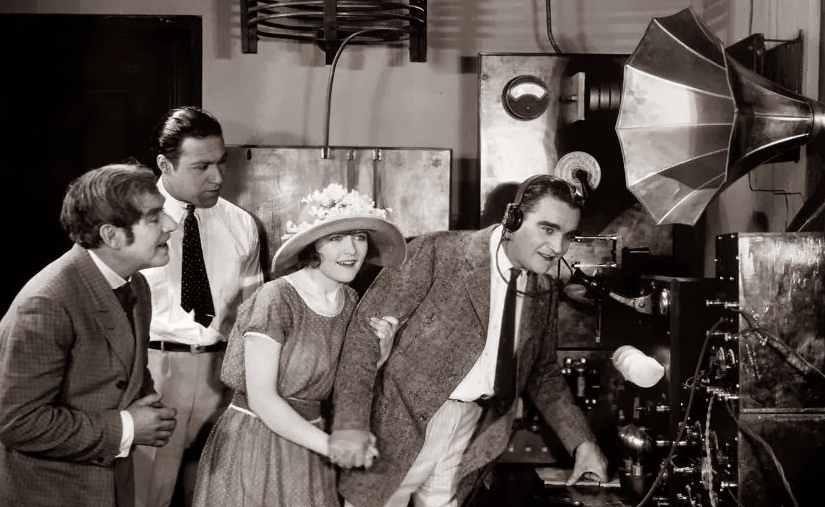
IF ONLY THEY HAD SPOTIFY…Teens tuning in, mid 1920s. (hancockhistoricalmuseum.org)
Although New York’s radio fair was doubtless the largest (akin to today’s annual Consumer Electronics Show), similar fairs were held in other major cities where broadcast radio was taking hold.
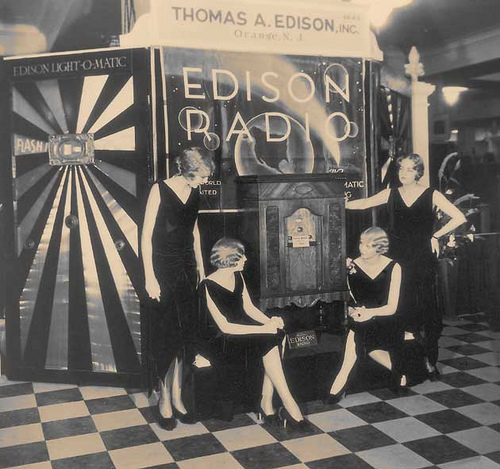
Promotional image for Edison Radio from the 1926 New York Radio World’s Fair. (artdecoblog.com)
…and for comparison, an image from the 2016 Consumer Electronics Show in Las Vegas:
(CES)
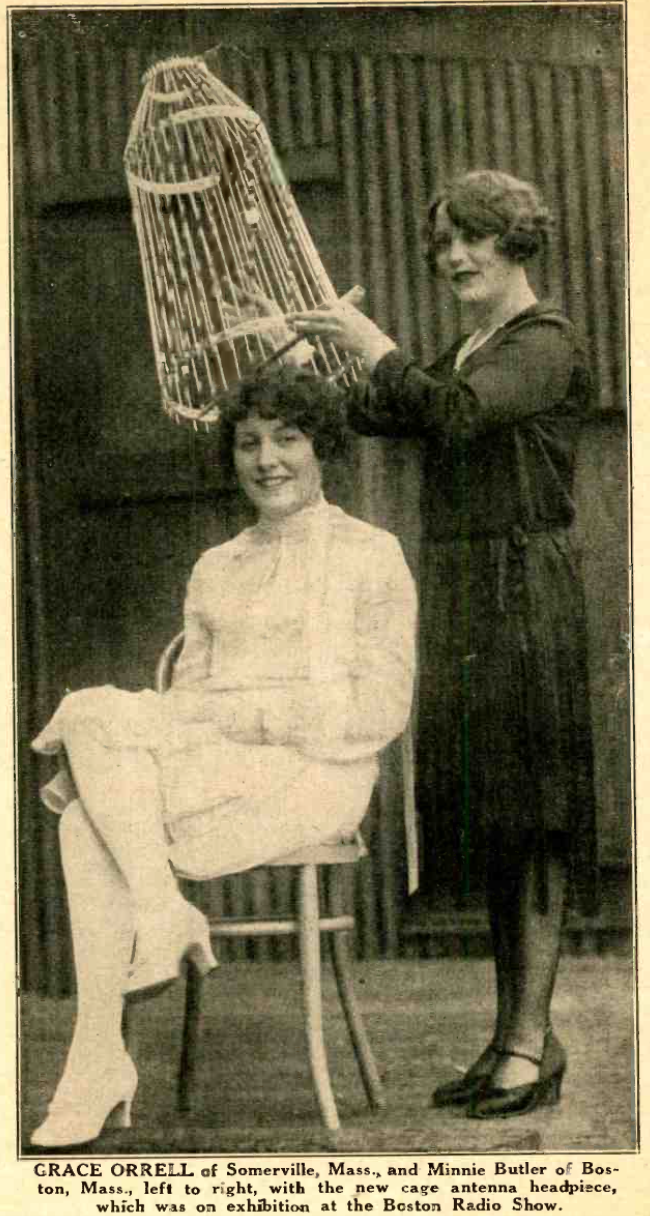
To give you an idea of some of the stranger innovations in the world of 1920s radio, here is an image scanned from the Oct. 16, 1926 issue of Radio World magazine demonstrating the wonders of a wearable cage antenna, apparently through which the wearer could make or receive wireless broadcasts…
…and a detail of an advertisement from the same issue depicting a typical household radio for the time:
Before tuning in for the first time, the radio’s owner needed to string a 100-foot outside aerial. Until 1927, when owners could plug their radios into electric sockets, radios required two types of batteries—a storage battery that required recharging every two weeks and a set of dry-cell batteries that needed to be replaced about every three weeks.
If all this looks crude, remember that in September 1926 broadcast radio was less than six years old. But it was big year for radio, with the National Broadcasting Company (NBC) establishing a network of stations that distributed daily programs. Columbia Broadcasting System (CBS) would establish a rival network in 1928.
In other items, the magazine offered a lengthy profile on tennis legend Bill Tilden, and later in the sports section described his Davis Cup loss to Frenchman René Lacoste.
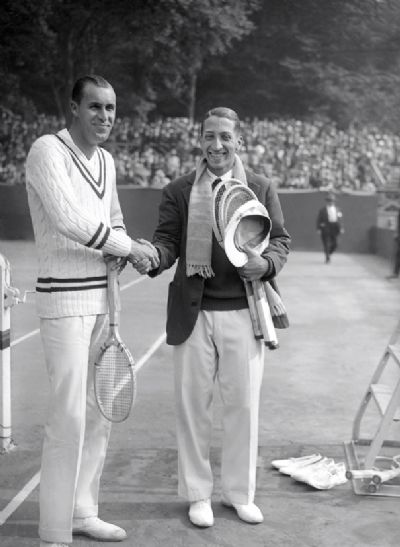
Tennis rivals Bill Tilden and René Lacoste meet in Philadelphia, 1927. (greensleevestoaground.)
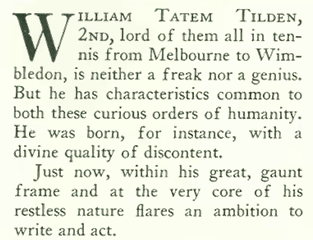
Tilden is often considered one of the greatest tennis players of all time. However, The New Yorker “Profile” described him as a reluctant star with artistic ambitions…
…who distained the life of a sports hero…
Samuel Merwin, referred to above, was a playwright and novelist.
Tilden was the world’s number one player for six years (1920-1925). He won 14 Major singles titles including ten Grand Slams. He also won a record seven US Open titles.
There is a sad footnote to Tilden’s career, however. Twenty years after The New Yorker profile, Tilden would be arrested for soliciting sex from an underage male, an offense he would arrested for again three years later, in 1949. He was subsequently shunned by the tennis and Hollywood world, although old friend Charlie Chaplin allowed Tilden to use his private court for lessons, which helped him financially as he dealt with legal and financial problems.
* * *
Going Going Gone
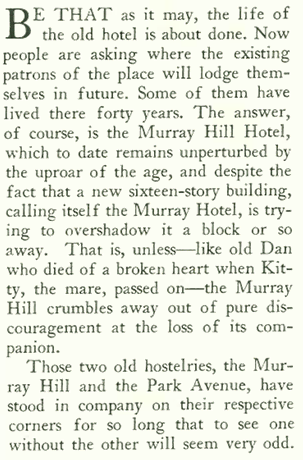
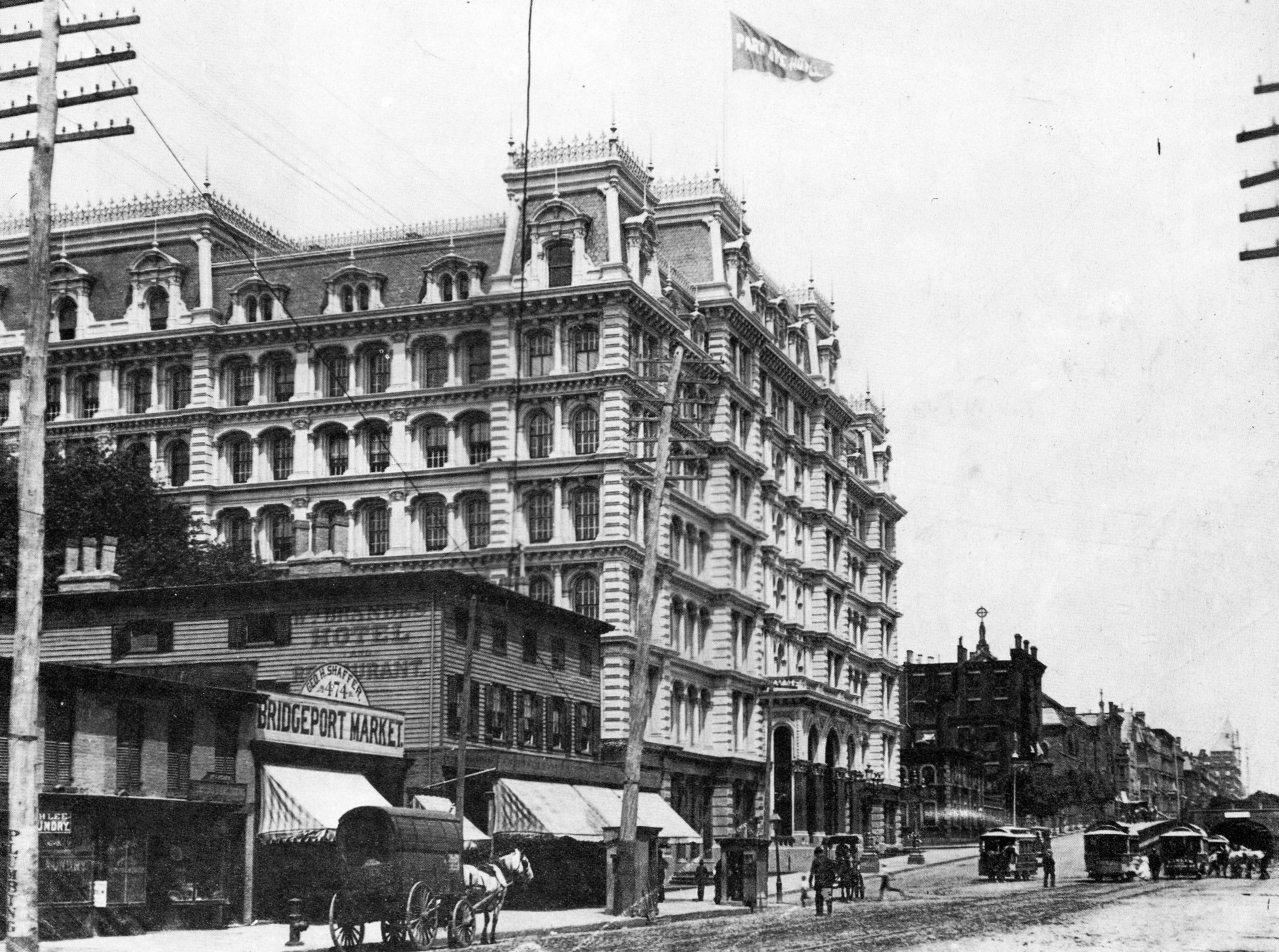
The magazine editors continued to watch the rapidly changing skyline of the city, as beloved old buildings were demolished to make way for new skyscrapers. This time it was the old Park Avenue Hotel:
The editors of “Talk of the Town” fondly recalled the time when the hotel, with its spacious courtyard of flowers and fountains, attracted “almost every dinner party of consequence in New York.”
This photo of the old Park Avenue Hotel was taken in 1890, only two years after Fourth Avenue was renamed Park Avenue. Constructed in 1877, the hotel was originally called Stewart’s Hotel for Working Women, designed to provide safe housing for the influx of single working women pouring into New York City. The name didn’t last long: the hotel was opened in April 1878, closed in May and reopened in June as the Park Avenue Hotel. It was razed in 1927. (Ephemeral New York)
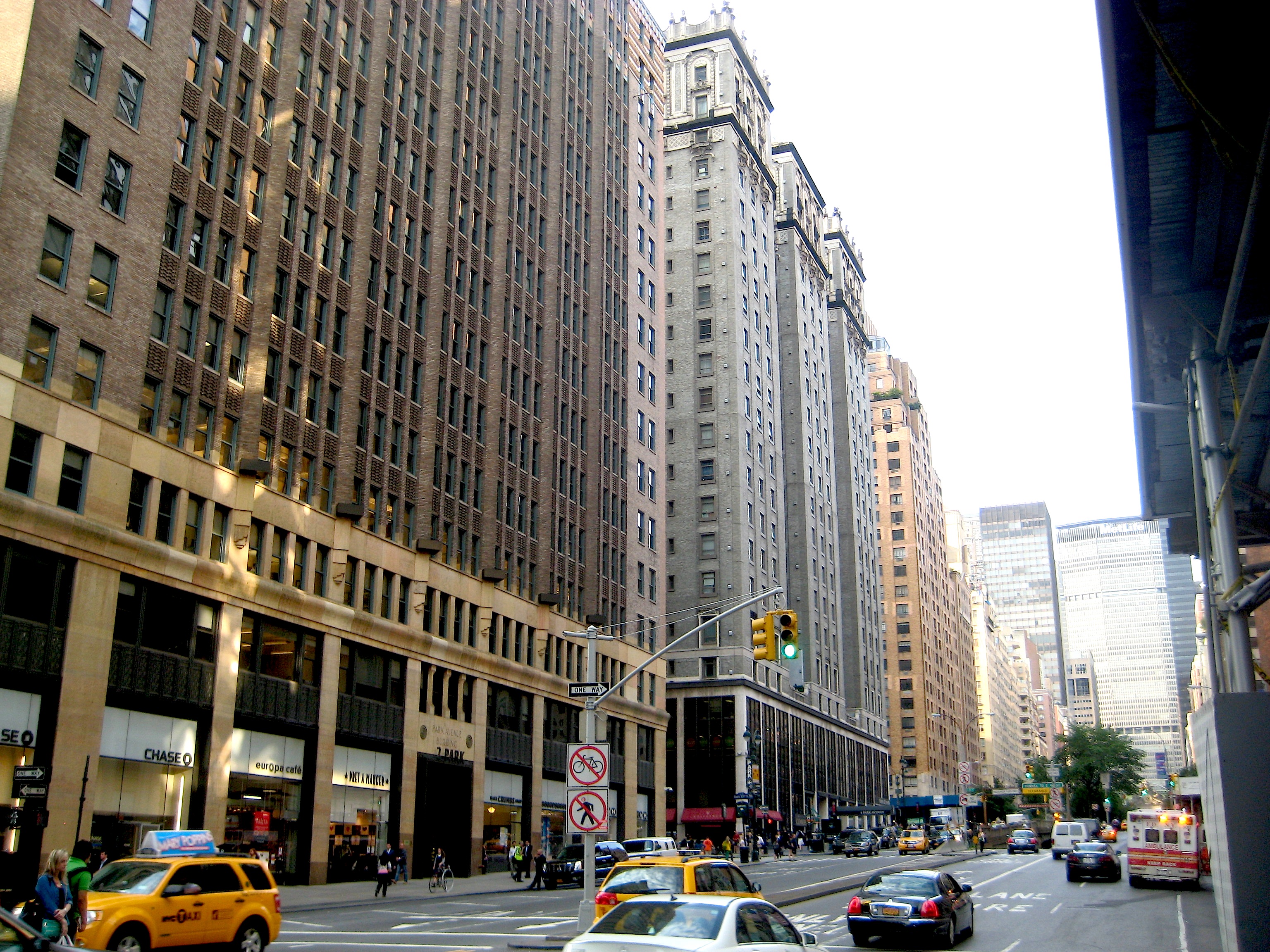
The same site today:
(Ephemeral New York)
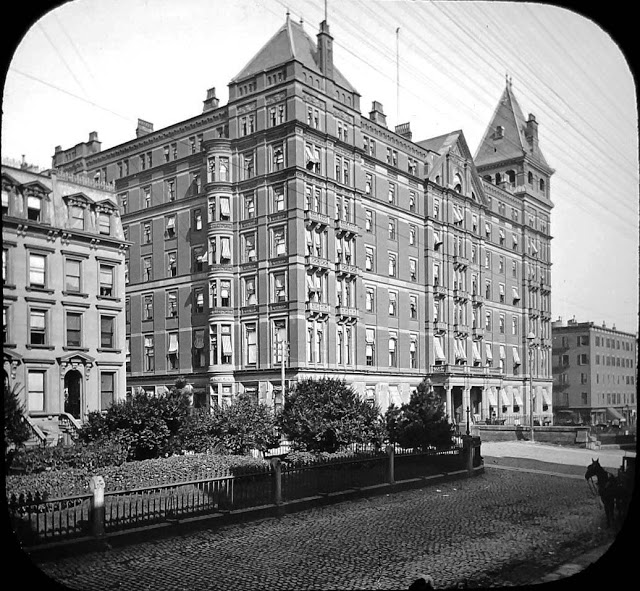
The nearby Murray Hill Hotel mentioned in the article would last another 20 years, falling to the wrecking ball in 1947:
The Murray Hill Hotel, built in 1884, would outlive the Park Avenue Hotel by 20 years, falling to a wrecking ball in 1947. (Library of Congress)
American cinema did little to excite the writers or critics of The New Yorker, who considered European films, and particularly German ones, to be far superior to the glitzy and sentimental fare produced in Hollywood.
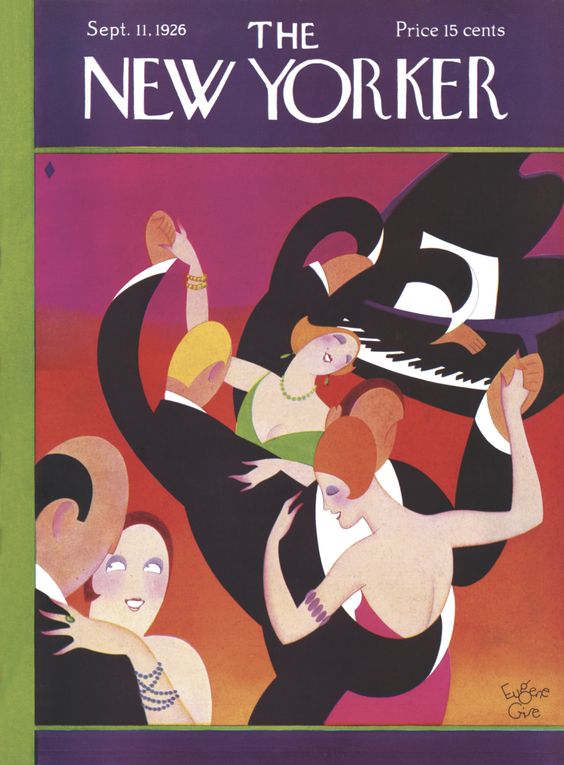
Sept. 11, 1926 cover by Eugene Gise.
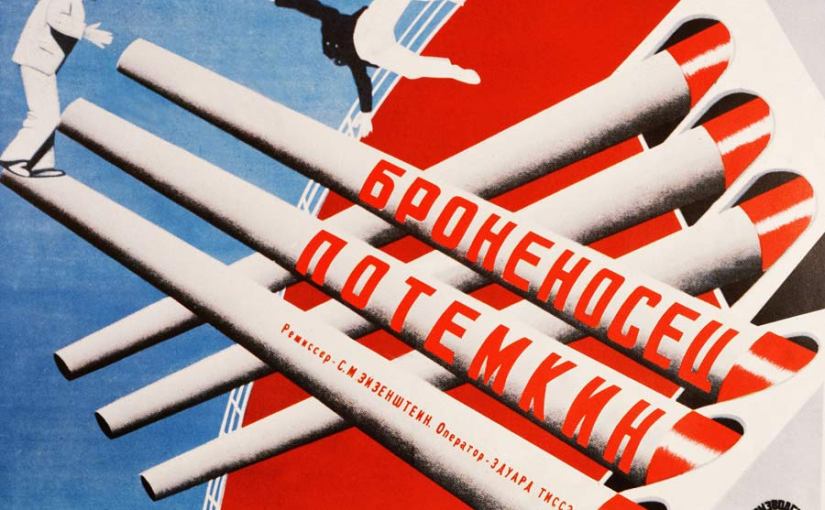
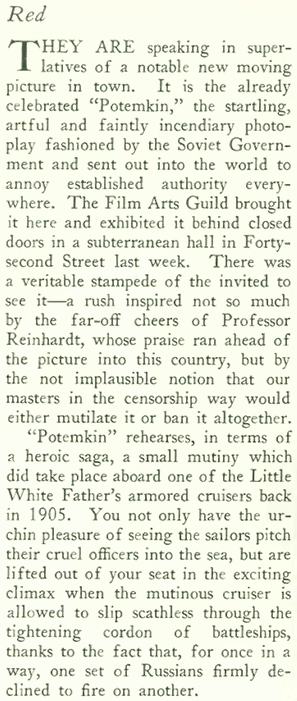
So when it was announced that Russian/Soviet filmmaker Sergei Eisenstein would be releasing Battleship Potemkin in New York City, the magazine’s editors in “The Talk of the Town” expressed both anticipation for the masterpiece as well as worries that American censors would slice the film to bits or even ban it outright.
The magazine’s film critic “OC” also expressed his concerns regarding censors:
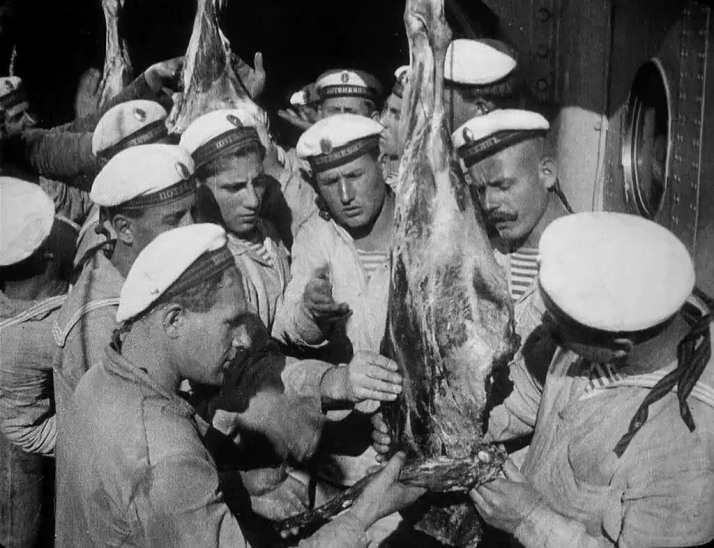
IT’S NOT WHAT’S FOR DINNER…Sailors examine maggot-infested meat in the film Battleship Potemkin. (themoviesnob)
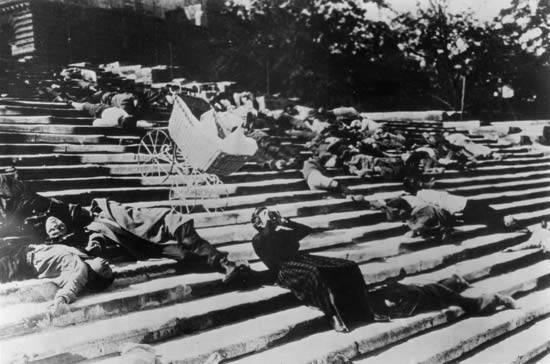
The film was based on an historical event–a mutiny on the battleship Potemkin that occurred after the crew was served rotten meat for dinner. The sailors rebelled, seized the ship, and then attempted to ignite a revolution in their home port of Odessa, which in turn led to a massacre of citizens by Cossack soldiers on the city’s famed Potemkin Stairs.
Mutineers revel in a scene from Battleship Potemkin. (Wall Street Journal)A still from a classic scene in Battleship Potemkin that depicts Odessa citizens being massacred by Cossacks on the city’s famous Potemkin Stairs. The image of the unattended baby carriage tumbling down the staircase has been re-created in a number of films, including Brian De Palma’s 1987 The Untouchables. (Film 4)
The film would ultimately be released in December of 1926. Perhaps more on that in a later post.
The Sept. 11, 1926 issue also noted the passing of famed silent film star Rudolph Valentino, who died at age 31 of peritonitis and other complications. The “Talk” editors suggested that if anything, it was good for newspaper sales:
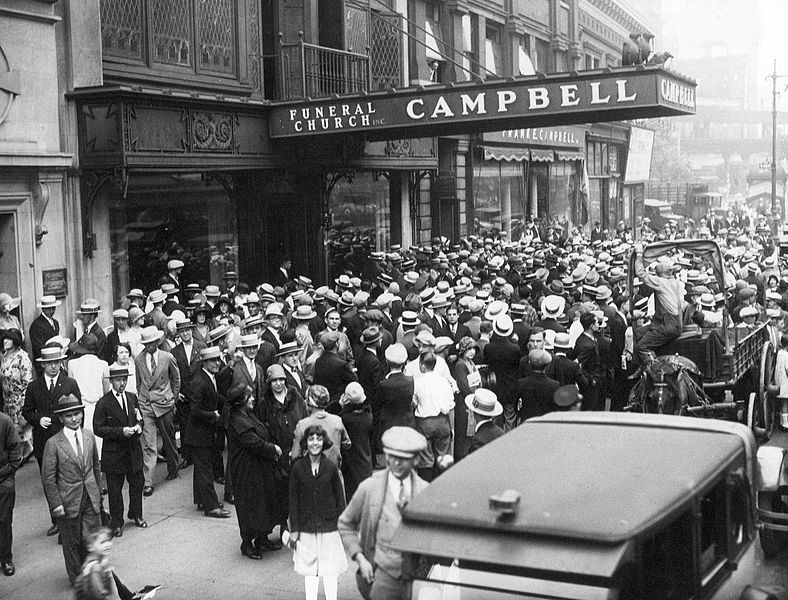
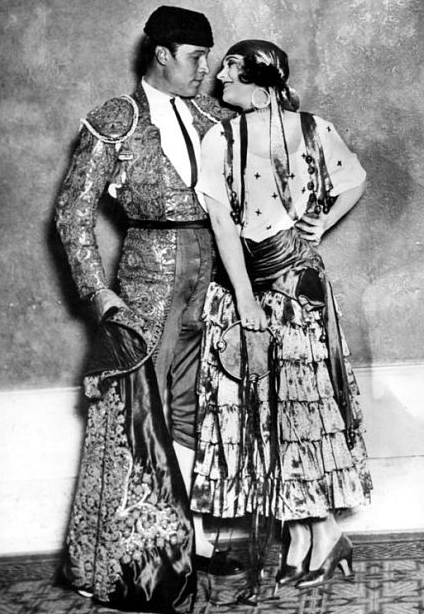
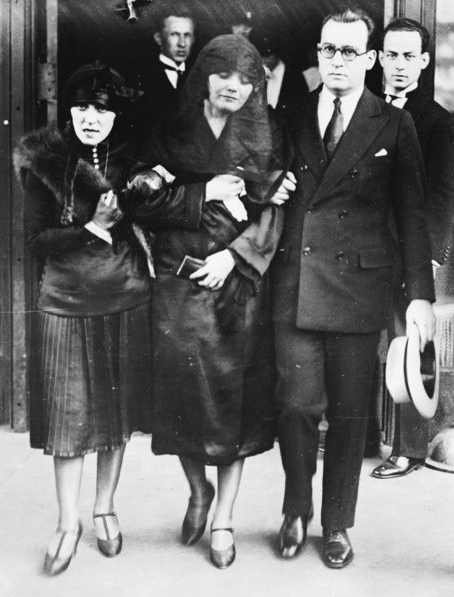
FUNERAL FUN…Rudolph Valentino’s first funeral in New York (the second was in Beverly Hills) drew a huge crowd of in what was described as a “carnival setting”. More than 100,000 fans filed past his open casket at the Frank E. Campbell funeral home. Windows were smashed as fans tried to get in and an all-day riot erupted on August 24. More than a hundred mounted officers and NYPD’s Police Reserve were deployed to restore order. A phalanx of officers would line the streets for the remainder of the viewing. Some media reports claimed the body on display was a wax dummy, and not “The Sheik” himself. (Wikipedia)SWEETHEARTS? Rudolph Valentino and Pola Negri met in early 1926 at a costume party thrown by Marion Davies. Negri claimed she was engaged to be married to the actor at the time of his death. (Wikimedia Commons)DIVA MOMENT…Pola Negri’s grief-stricken performance at Valentino’s New York funeral was considered by most to be over-the-top, even for a famous diva. Supported by a secretary and press agent (photo above), Pola declared to reporters that she and Valentino were secretly engaged to be married. She posed in dramatic fashion for the reporters and then threw herself, weeping and fainting, on Valentino’s open casket. (flickchick1953)
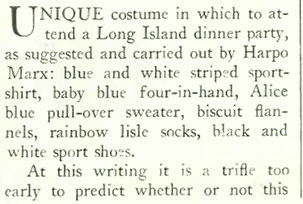
On the lighter side, The New Yorker men’s fashion columnist “Bowler” offered this observation of a new style suggested by Harpo Marx:
Vaudeville star Harpo Marx in 1926. The first Marx Brothers movie was still three years away. (Wikipedia)
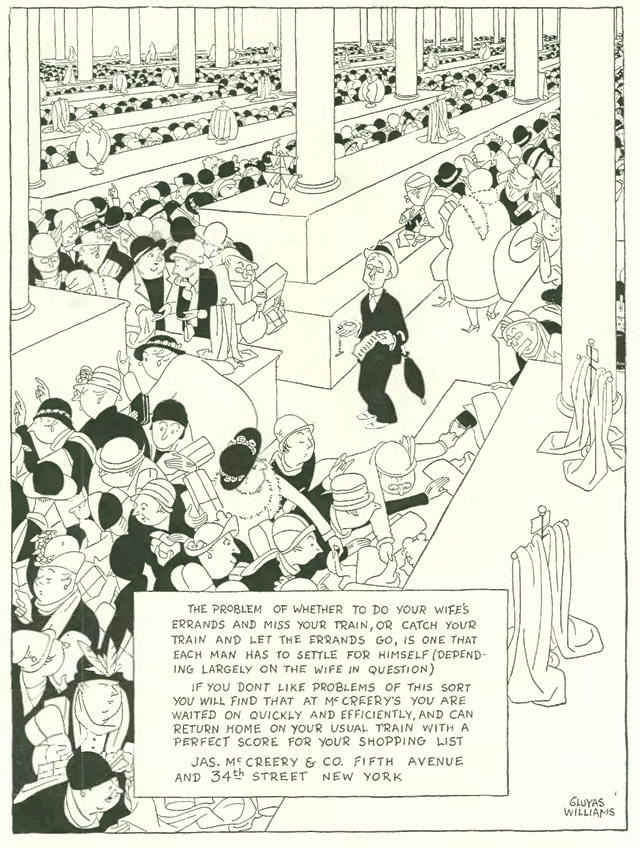
And to close, a couple of advertisements from the Sept. 11 issue…the first is a McCreery & Company ad illustrated by Gluyas Williams. These would become a series, featuring a milquetoast husband facing the daunting task of shopping for his wife, among other challenges…
…and this ad from Park Central Motors, depicting a child who’s all too aware of her standing in society…
Since most of us complain about the sad state of air travel these days, it’s nice to get a little historical perspective on this mode of transportation.
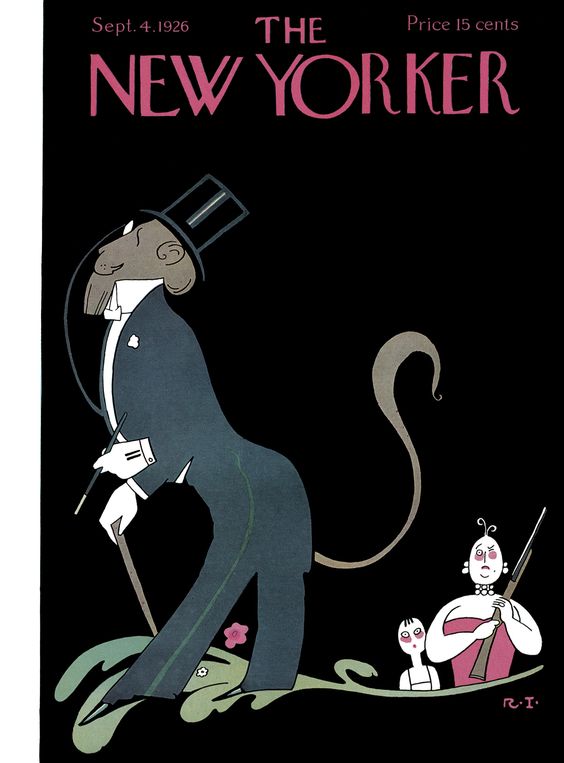
Sept. 4, 1926 cover by Rea Irvin.
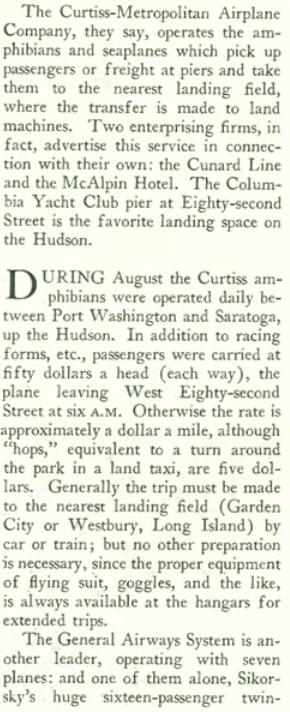
Ninety years ago the editors of The New Yorker were enamored with passenger air service, even though it was only available to those who were wealthy and had the stomach to actually fly in one of these things:
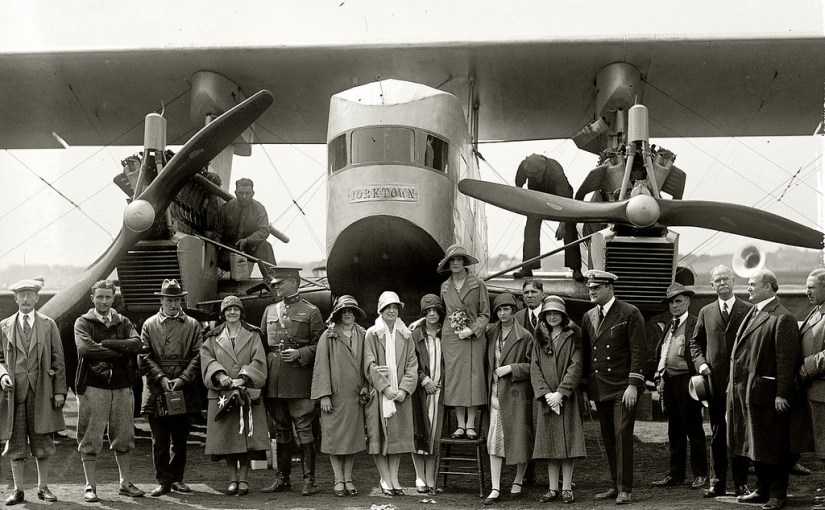
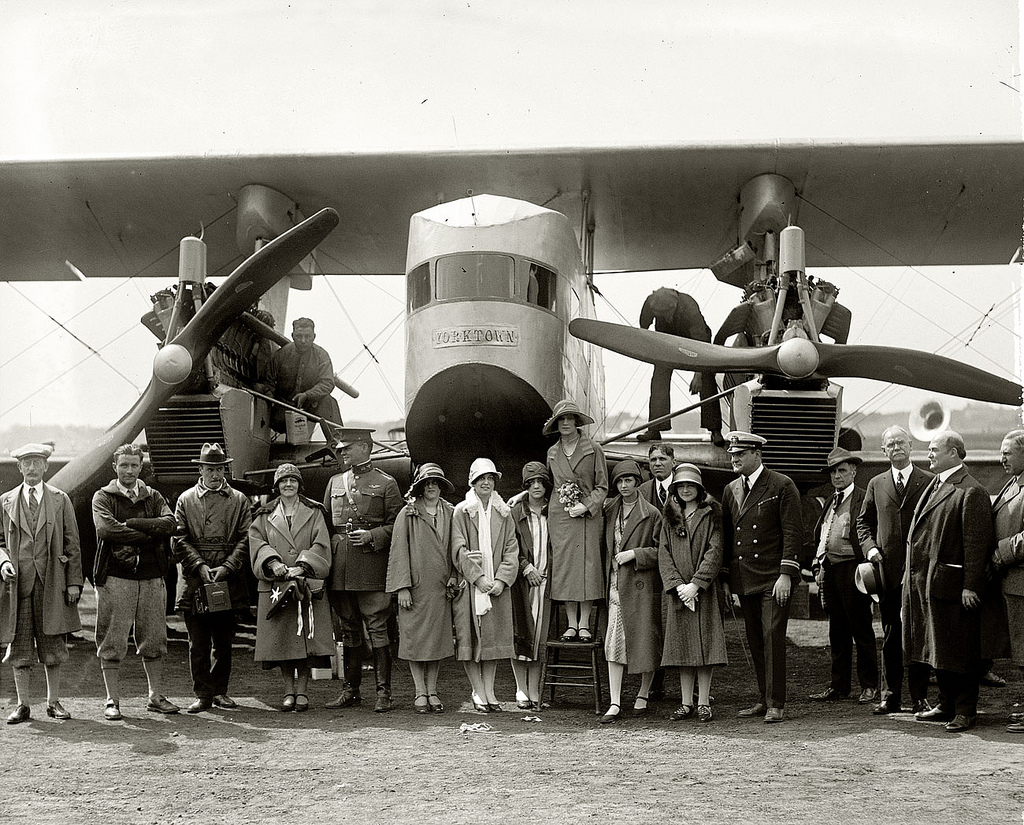
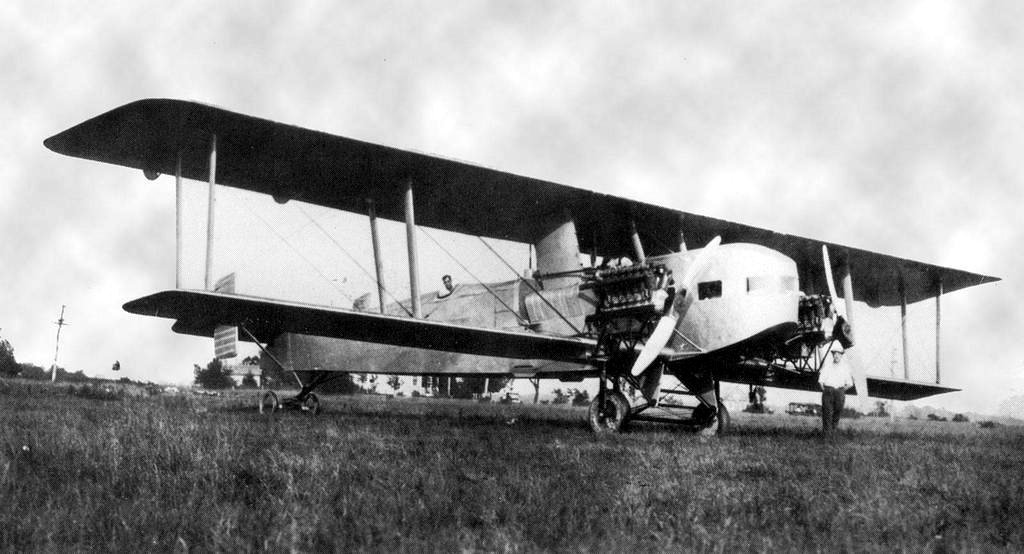
The May 8, 1925 christening of the Sikorsky “Yorktown.” The “huge” plane is referred to in the Sept. 4, 1926 “Talk of the Town.” (Library of Congress)
In the “Talk of the Town” section, The New Yorker editors marveled at the regular air taxi service available to Manhattanites:
The “huge” Yorktown might look crude to a traveler in 2016, but this was advanced stuff considering the Wright Brothers had made their first flight less than 23 years earlier. Planes like the Yorktown looked less like aircraft we know today and more like a trolley car with wings attached. And that window in the front wasn’t for the pilot. He sat up top in the open air:
Side view of the Sikorsky “Yorktown.” Note the pilot seated aft of the wings. (Flickr)
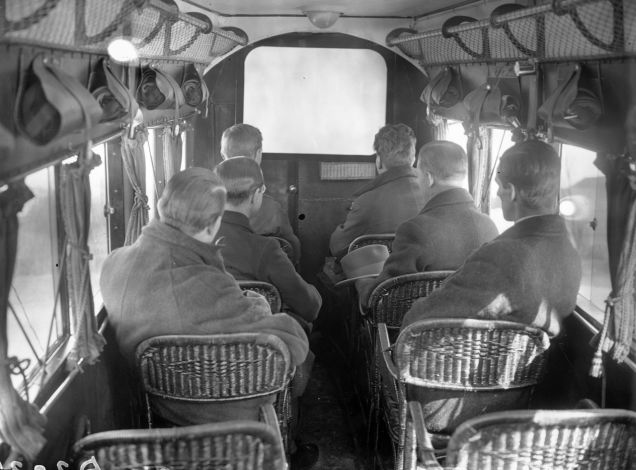
But then again, the interiors of these planes were no picnic, either. Imagine sitting in this while crashing through a storm:
Interior of a Farman Goliath, which would have been similar to the Sikorsky, if not a little nicer. (Historic Wings)Another photo of a 1920s passenger flight. As in the preceding photo, note the wicker chairs. And no leg room. These fellows appear to awaiting the showing of an early in-flight movie. At least movies were silent then, because with giant piston engines flanking the cabin you weren’t going hear anything anyway. (Paleofuture)
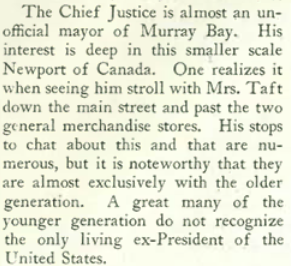
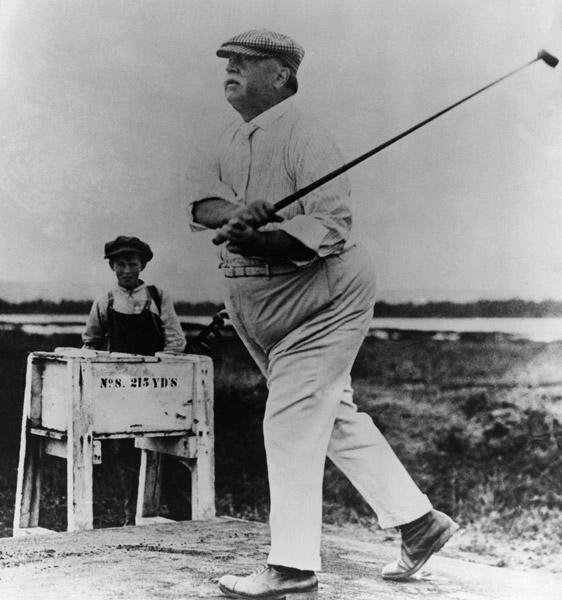
Other items from the Sept. 4, 1926 “Talk” section included a bit about the former president and then Supreme Court Justice William Howard Taft, and his rather ordinary life in Murray Bay. An excerpt:
Ex-President, Supreme Court Justice and avid golfer William Howard Taft follows through on the links in this undated photo (jmarkpowell.com)
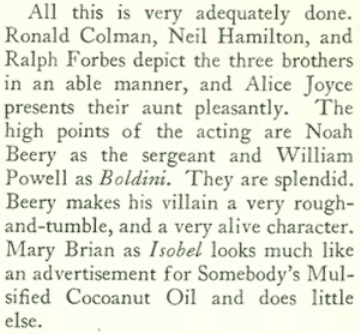
At the movies, The New Yorker gave a lukewarm review of the much-ballyhooed film Beau Geste:
AT LEAST SHE HAD A NICE COMPLEXION…Mary Brian (dubbed “The Sweetest Girl in Pictures”) with Neil Hamilton in Beau Geste, 1926 (classiccinemaimages)
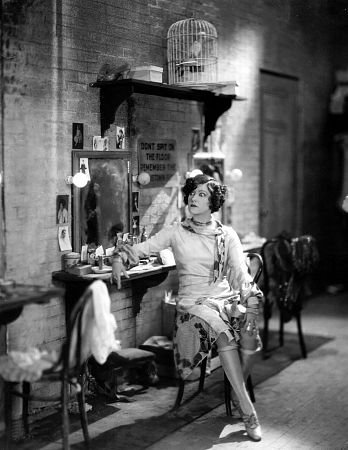
And although Gloria Swanson was one of the biggest stars in the Silent Era, The New Yorker was never a big fan of her films:
Gloria Swanson in Fine Manners, 1926 (IMDB)
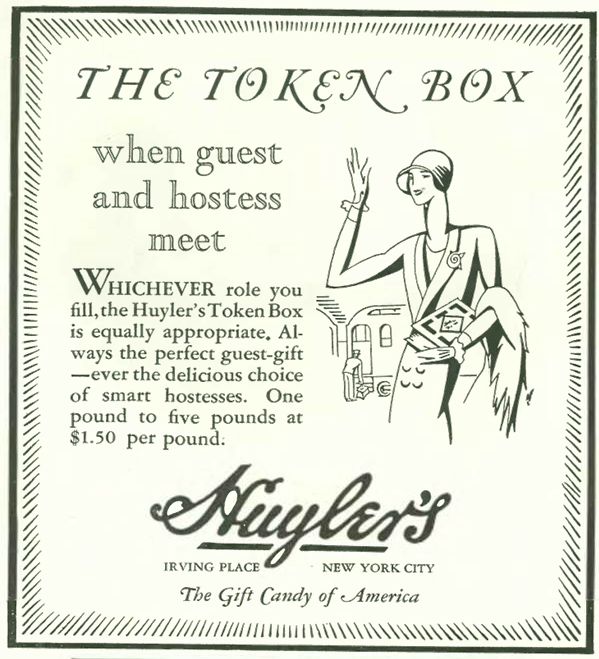
And finally, this advertisement from Houbigant, featuring a drawing of an elegant woman with an impossibly long neck. I wouldn’t want her sitting in front of me at the movies…
Another ad (from the Sept. 11 issue) also depicted this ridiculously giraffe-like neckline:
It’s the dog days of summer, and the editors of The New Yorker are seeking various distractions to take their minds off of the broiling late season heat.
August 21, 1926 cover by H.O. Hofman.
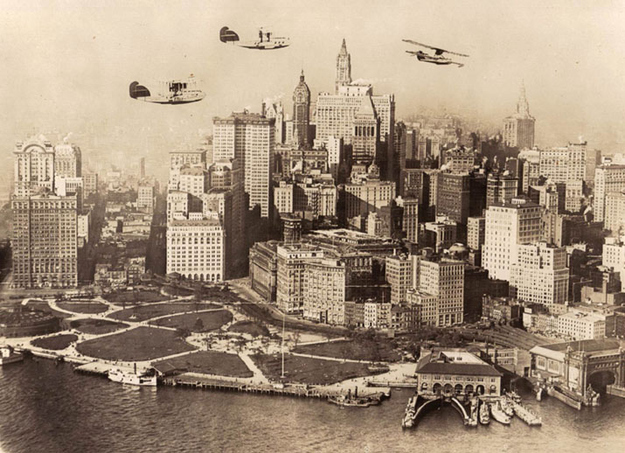
In the Aug. 21, 1926 issue (bearing an appropriate cover image by H.O. Hofman of bathers taking a refreshing dip), “The Talk of the Town” suggested that it was a good time for even the natives to take a boat tour of their beloved island:
Aerial view of Battery Park Wharf in the early 1920s (Buzzfeed)
In the following Aug. 28 issue, the “Talk” editors ducked out of the sun to visit the American Museum of Natural History.
Aug. 28, 1926 cover by H.O. Hofman.
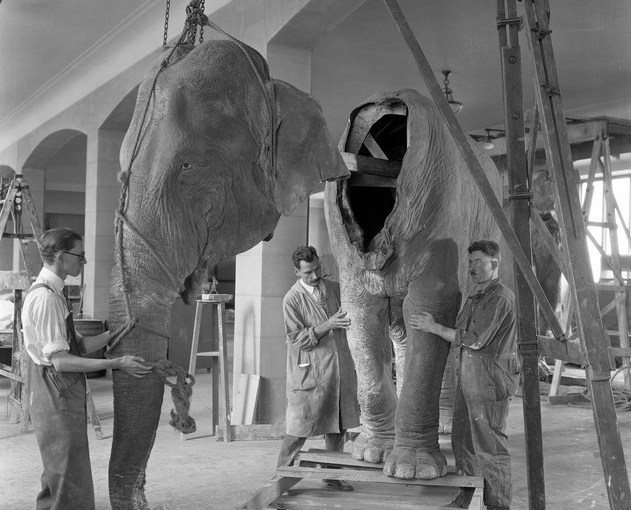
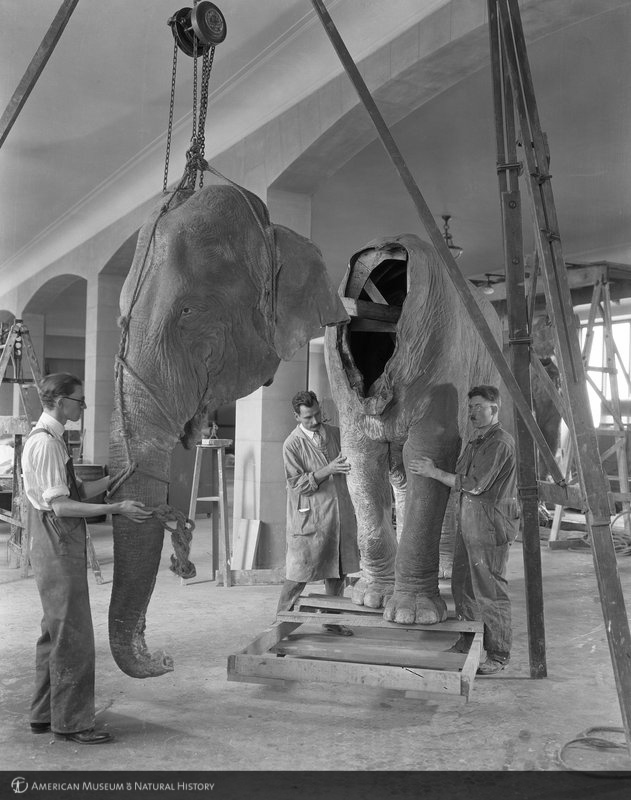
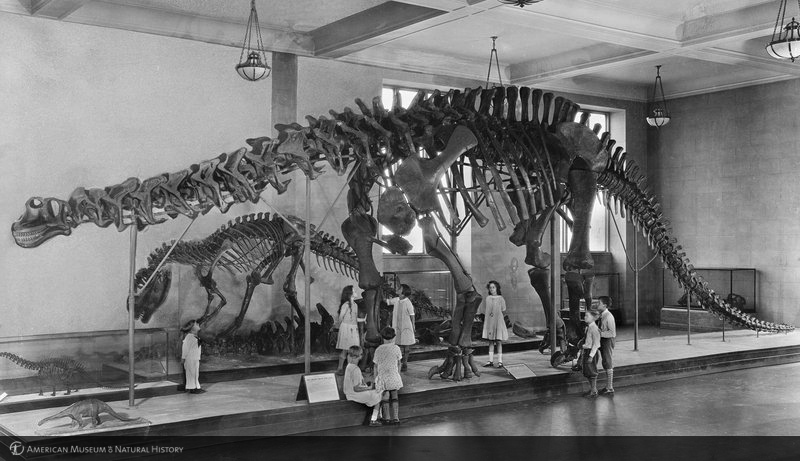
There they found curators busy reorganizing displays of dinosaurs and various stuffed beasts of the wild:
AMNH staff joining head to body of female elephant in Indian Elephant Group, 1926. (AMNH Digital Special Collections)The end result of the 1926 reorganization of displays at the AMNH—children viewing Brontosaurus exhibit in 1927. (AMNH Digital Special Collections)
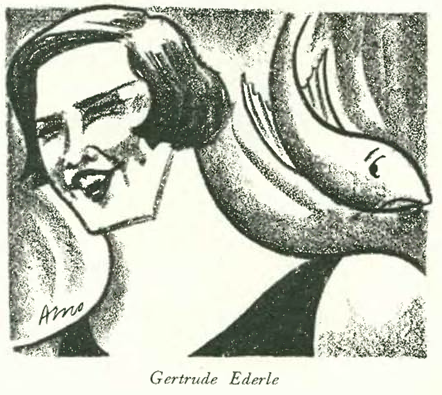
The magazine also profiled New York City native Gertrude Ederle, who became the first woman to swim across the English Channel in August of 1926:
Gertrude Ederle, as rendered by Peter Arno for the “Profile.”
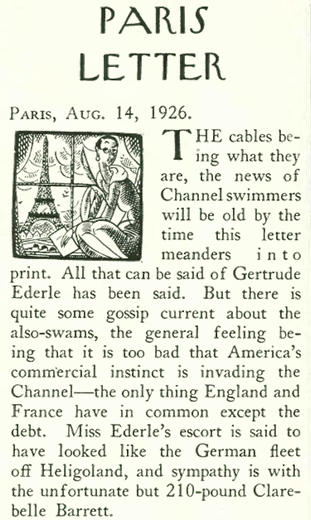
Even Janet Flanner, the magazine’s Paris correspondent, commented on the event, noting Europe’s jealous reaction to an American’s seizing of the record:
Ederle would return home to a ticker tape parade along the Canyon of Heroes in the Financial District, and would also be feted by 5,000 people who turned out on West 65th Street for a block party in her honor.
WHAT FOLKS DID BEFORE TELEVISION…Block party celebrates Gertrude Ederle as “Queen of the Waves.” (Ephemeral New York)
According to the excellent blog Ephemeral New York, Ederle received offers from Hollywood and Broadway and was deluged by marriage proposals. But she returned to a quiet life, moving to Queens and working as a swimming instructor for deaf children–Ederle’s hearing was seriously damaged in the water of the Channel, but otherwise swimming must have been good for her health. She died at age 98 in 2003.
Keeping with the summertime theme, the magazine covered the Gold Cup Regatta, complete with illustrations by Johan Bull:
An early Barbara Shermund cartoon, always a delight…
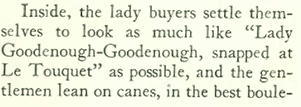
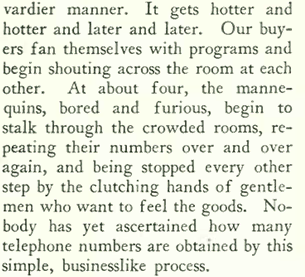
Lois Long took her “On and Off the Avenue” column to Paris, where she cast a jaded eye at the behavior of American buyers of French fashion:
Coco Chanel’s “Little Black Dress” debuted in 1926. (homeecologist.com)
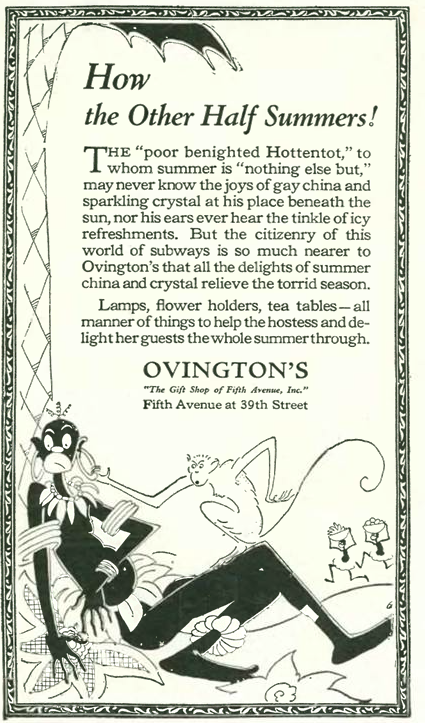
And finally, from the advertising department, this strange ad from Ovington’s, which seemed to be more concerned with promoting racial stereotypes than in selling dinnerware:
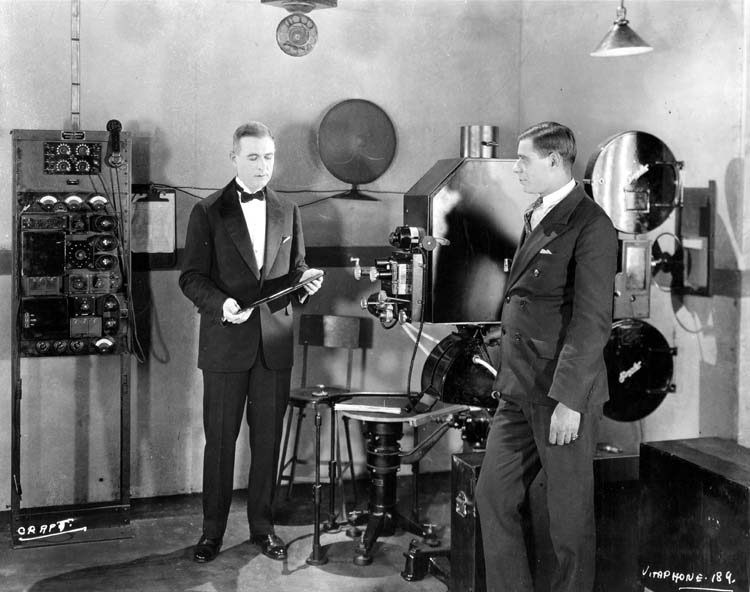
It was 1926 and another marvel of science—talking pictures—was unveiled to audiences at Broadway’s Warners’ Theatre. It was here that the Warner Brothers launched their ‘Vitaphone’ talkies including The Jazz Singer, which would premiere the following year.
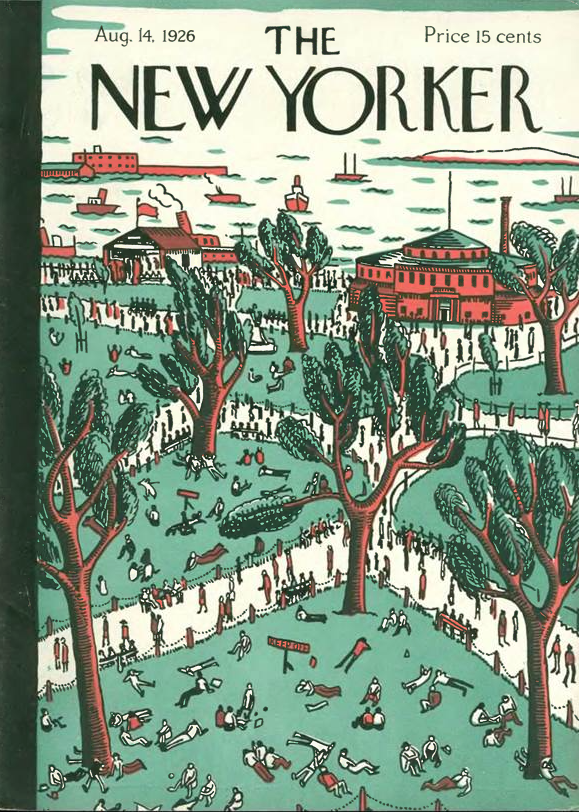
Aug. 14, 1926 cover by Ilonka Karasz.
The Vitaphone soundtrack was not printed on the film itself, but rather recorded separately on phonograph record, the sound synchronized by physically coupling the record turntable to the film projection motor.
A Vitaphone projection setup at a 1926 demonstration. Engineer E. B. Craft is holding a soundtrack disc. The turntable, on a massive tripod base, is at lower center. (University of San Diego History Department)
Don Juan was the first feature-length film to use the Vitaphone system, which was not a continuous soundtrack but rather a sprinkling of sound shorts (the musical score, performed by the New York Philharmonic, and various sound effects) throughout the film. No spoken dialogue was recorded.
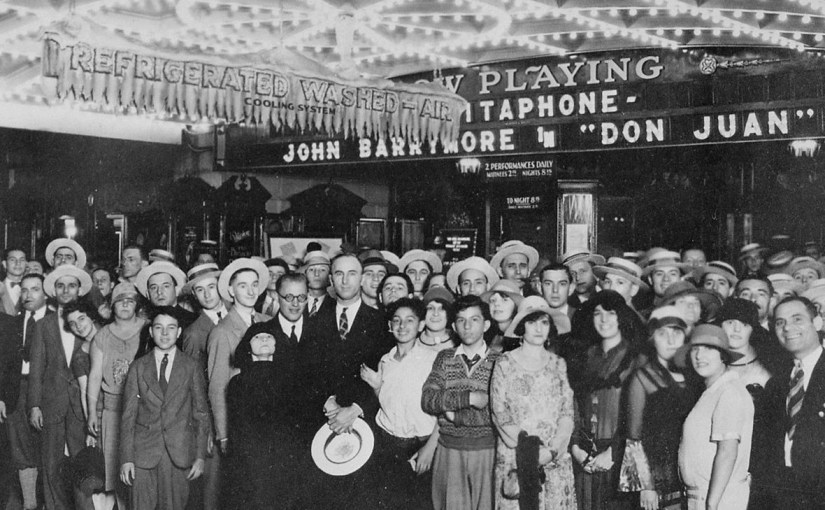
First-nighters pose outside Warners’ Theatre before the premiere of Don Juan, August 6, 1926 (US National Archives)
Produced at a cost of $789,963 (the largest budget of any Warner film up to that point), the film was critically acclaimed and a box-office success. However, and predictably, The New Yorker was not so impressed with Vitaphone…
…or the acting of John Barrymore…
I have to agree with the critic, identified only as O.C., after viewing this TCM clip of the film on YouTube. Lacking a voice, silent actors had to exaggerate emotions onscreen, but Barrymore here is every bit the ham. This screen grab from the clip says it all:
The object of his gaze, Adriana della Varnese (played here by a young Mary Astor), reacts rather dramatically to his advances…can’t say I blame her…(however, the 44-year-old Barrymore and the 20-year-old Astor were having an affair at the time…)
Adriana della Varnese (played here by a young Mary Astor), reacts rather dramatically to Don Juan’s advances.
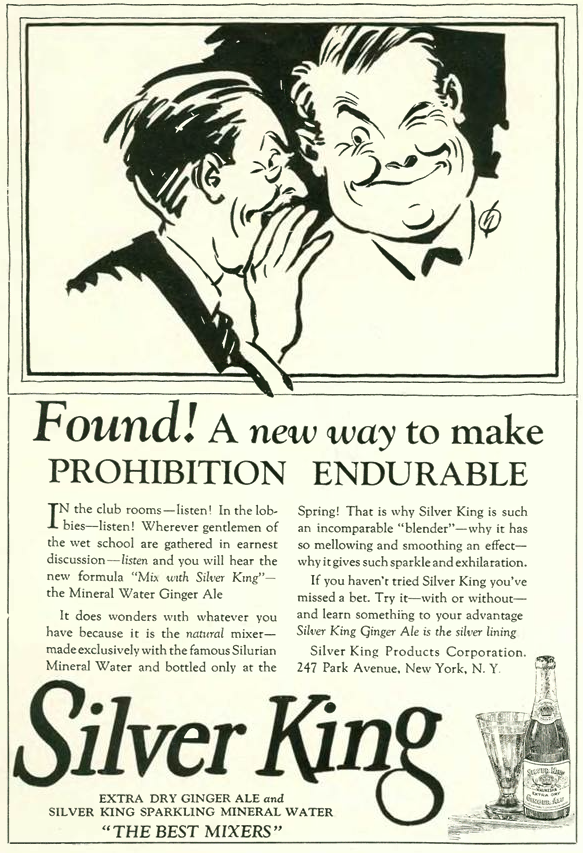
A couple of interesting ads in the Aug. 14, 1926 issue, including this one featuring a couple of sneaky gents who’ve found a solution to life in dry America…
…and this not-too-subtle message from a swanky shop on Fifth Avenue:
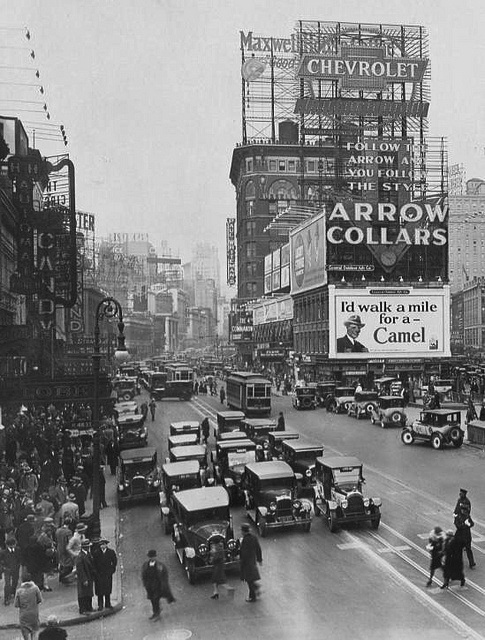
Above: Samuel Herman Gottscho photograph, New York City, Times Square South from 46th Street. General view of “Whiteway” toward Times Building, December 9, 1930. Museum of the City of New York
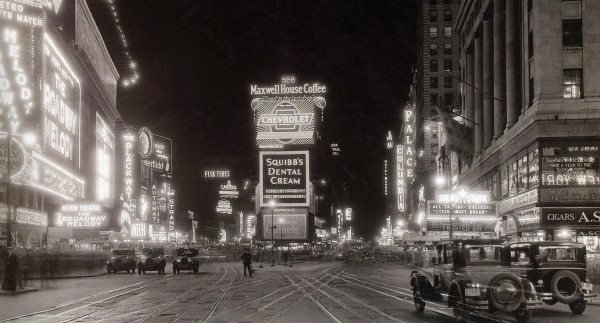
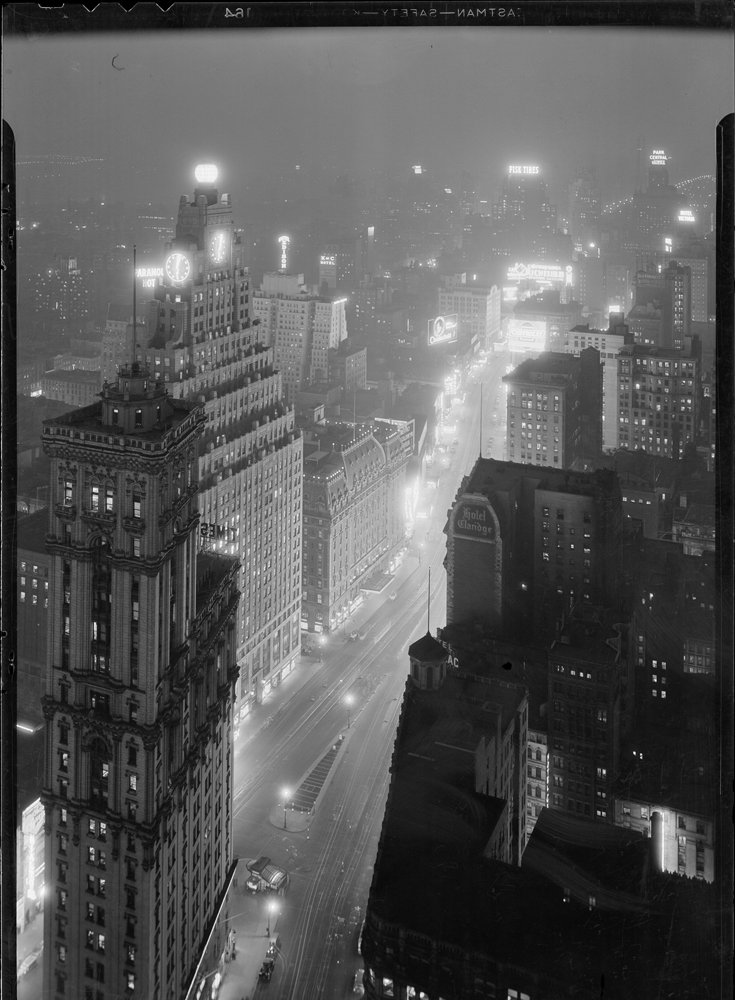
The lights of Broadway dazzled the editors of “The Talk of Town,” who commented on the changing displays that brightened The Great White Way.
Cover of August 7, 1926 issue by Stanley W. Reynolds.
Broadway hit its prime in the 1920s, when many old buildings originally used for housing or commercial interests became more valuable as places to hang brightly lit signs.
Broadway in the 1920s (TimesSquareNYC.org)
The “Talk” editors were more or less impressed by the displays. Despite their garishness, the Broadway lights were also a symbol of the youthful exuberance of Roaring Twenties New York:
Samuel Herman Gottscho photo of Times Square from 41st Story [of the] Continental Building, at night, February 16, 1932. (Museum of the City of New York.)Daytime view of Times Square in the 1920s (Tumblr)
The “Talk” editors sang the praises of the “aortic” Grand Central Station, which they dubbed a place of both dignity and efficiency that sorts a “surprisingly cheerful stream” of travelers with a certain rhythm, set in motion by an impassive gateman:
The main concourse at Grand Central Terminal, 1929. (New York Transit Museum)
The Talk writers also added this lyrical observation of the traveling masses:
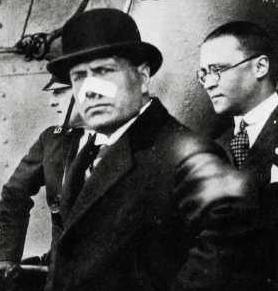
Talk also noted the recent travels of Cornelius Vanderbilt Jr., who was an apparent heir to the Vanderbilt fortune until he shunned high society and was disinherited by his parents for becoming a journalist and newspaper publisher. The Talk segment noted that Vanderbilt had returned from travels in Europe, where among other things until he rubbed elbows the Italian dictator Benito Mussolini and observed the curious habits of people under his fascist rule:
Italian Premier Benito Mussolini (before he started wearing the fascist uniform) leaving for Tripoli on May 13, 1926. His nose was bandaged after an assassination attempt on April 26 by a British woman, Violet Gibson, who shot him with a revolver at close range. She was ruled insane and deported to England (strangehistory.net))
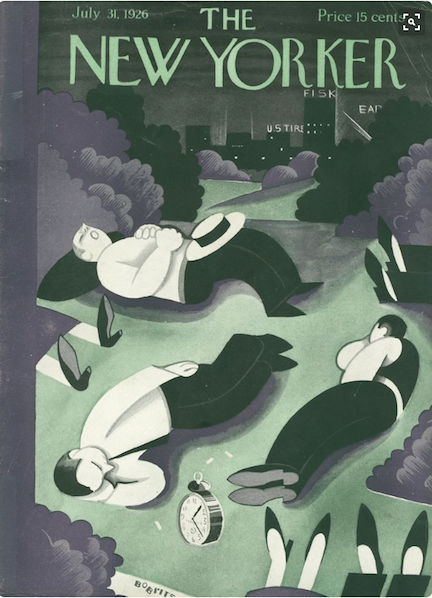
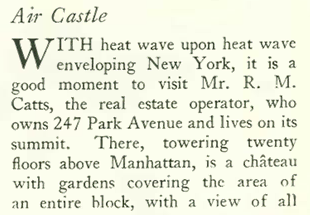
Withering under a July heat wave, The New Yorker editors turned their thoughts to the cooling breezes that could be found blowing across the penthouse garden of real estate developer Robert M. Catts.
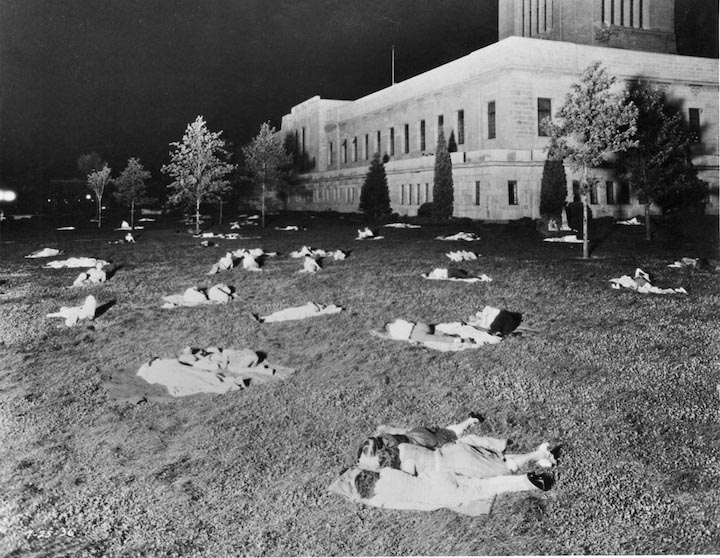
The July 31, 1926 cover by Victor Bobritsky offered its own commentary on the heat wave that gripped the city.In case you were wondering, city folk (especially apartment dwellers) actually did sleep on the ground in the days before air conditioning. This photo was taken on July 25, 1936, on the lawn of the Nebraska State Capitol Building in Lincoln. (Nebraska State Historical Society).
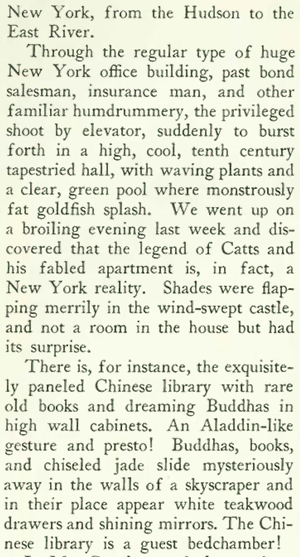
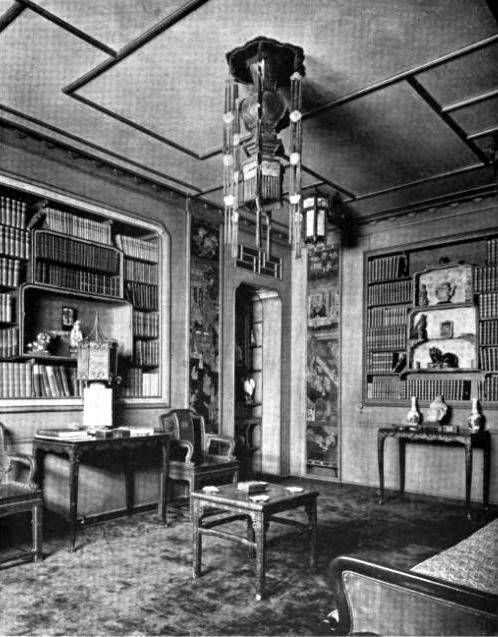
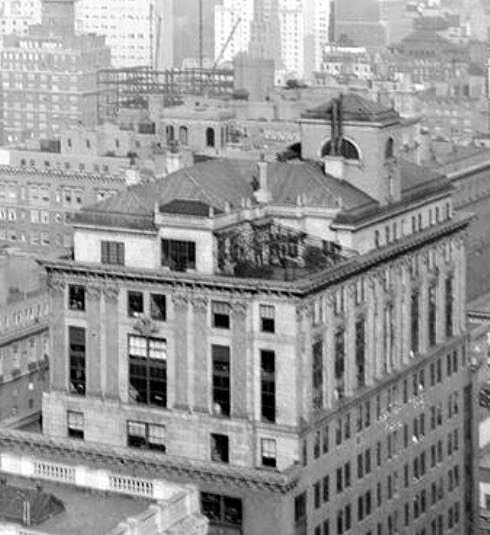
Catts erected the 20-story Park-Lexington office building at 247 Park Avenue in 1922, topping the building with his own penthouse apartment. Located near Grand Central Station, the building was innovative in the way it was built directly over underground railroad tracks leading into the station. The editors of The New Yorker, however, were more impressed by what was on top:
The “Chinese Library” in the apartment of Robert M. Catts atop the Park-Lexington Building. (halfpuddinghalfsauce.blogspot.com)Penthouse apartment of Robert M. Catts atop the Park-Lexington Building. (halfpuddinghalfsauce.blogspot.com)
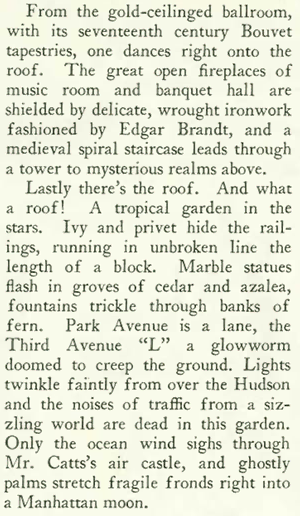
It was the rooftop garden, however, that sent the editors into a swoon:
Before World War II the apartment would have other notable tenants who would succeed Catts, including the violinist Jascha Heifitz. The apartment, and the building beneath it, were demolished in 1963 along with the adjoining Grand Central Palace building, which was replaced in 1967 with 245 Park Avenue:
245 Park Avenue (Wikipedia)
In other news, Arthur Robinson wrote a somewhat sympathetic profile of Babe Ruth, observing that Ruth’s “thousand and one failings are more than offset by his sheer likableness.”
Illustration for the “Profile” by Johan Bull.
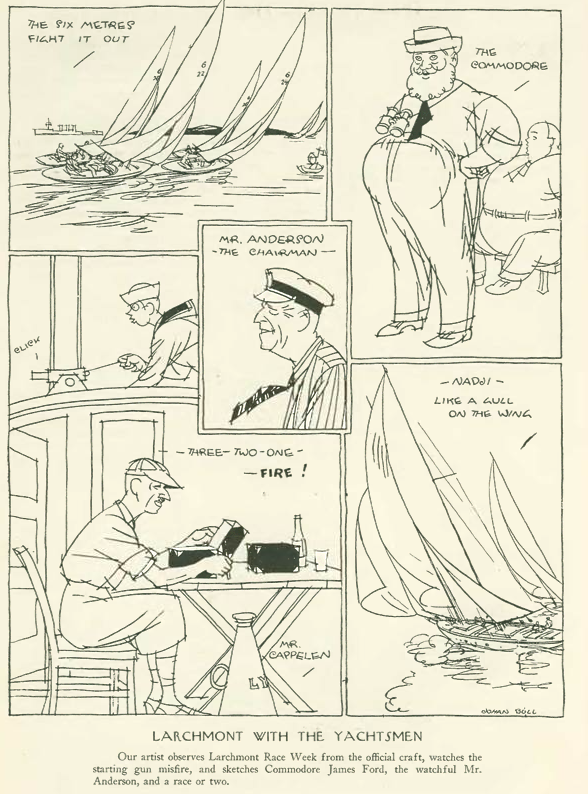
Curiously, the Yankees were having a better year in 1926, but there was scant mention of baseball in the pages of The New Yorker, the magazine preferring to cover classier sports such as golf, polo, tennis and horse racing. Another sport of interest was yacht racing, with Eric Hatch covering the races at Larchmont augmented by Johan Bull’s illustrations:
The magazine continued to have fun with the androgynous fashion trends of the Roaring Twenties. This appears to be an early Barbara Shermund cartoon:
The Roaring Twenties were an age when many social norms were challenged, including gender roles. Stars such as Marlene Dietrich wore men’s clothing, and many women went to work (women in the workplace increased by 25 percent) and they smoked in public.
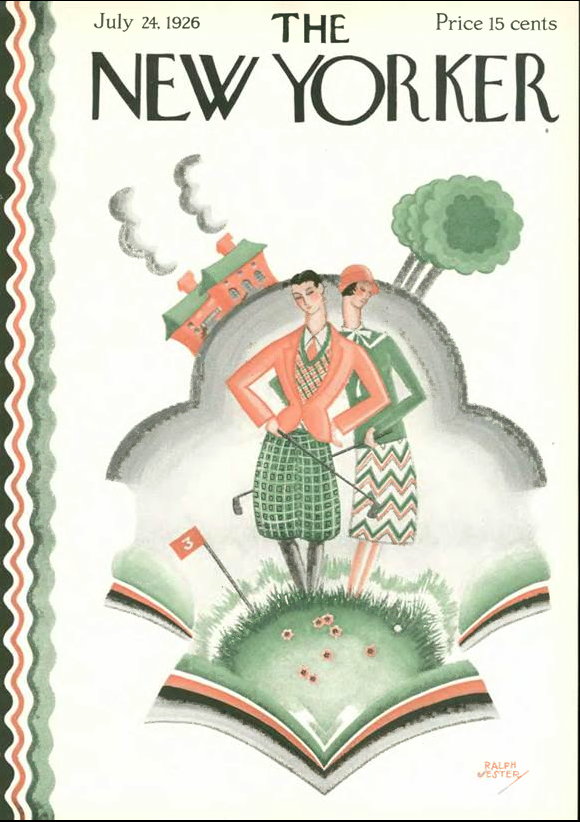
July 24, 1926 cover by Ralph Jester.
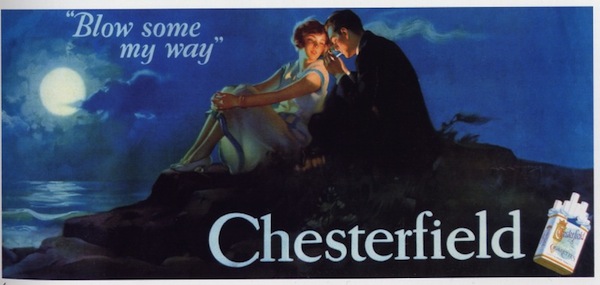
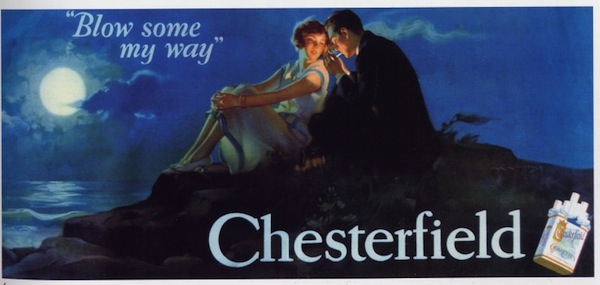
At first smoking in public was associated with the wild behavior of flappers, but thanks to American advertising know-how, things quickly changed. What helped spark that change was this controversial 1926 magazine and billboard advertisement:
Now we call it “second-hand smoke” (History News Network)
Naturally, the editors of “The Talk of the Town” had something to say about all the fuss:
Give dubious credit to Chesterfield for cracking a barrier. And thanks to mass marketing, what was rare and shocking quickly became commonplace. Subsequent cigarette ads featured women who didn’t need a man to blow them any smoke; they were independent, successful and famous:
This is among the earliest cigarette ads to feature endorsements from famous women. In 1927, Lucky Strike began collecting testimonials from female celebrity smokers, ranging from movie stars to celebrities. In this 1928 ad, Amelia Earhart endorses Lucky Strike. (Stanford School of Medicine)
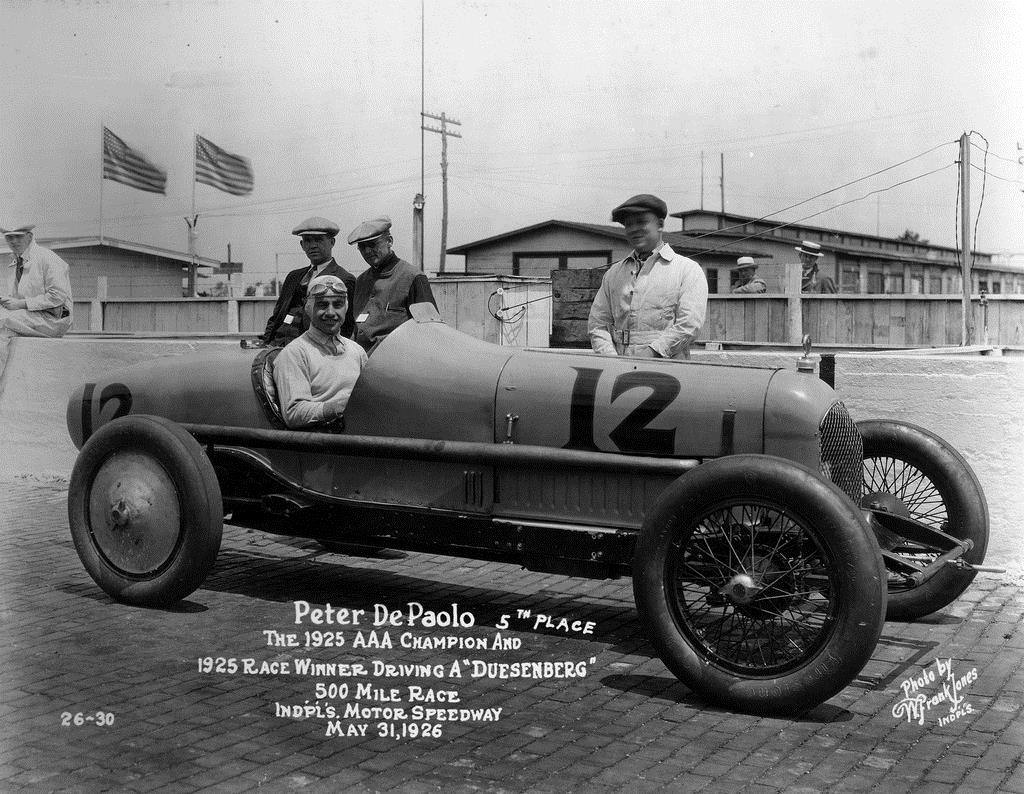
The editors of The New Yorker obviously loved cars and the advertising they attracted, so for the July 24 edition they dispatched a writer and an artist to the motor races at Atlantic City to record the momentous event. However, staff writer Eric Hatch seemed as interested in the attire of the drivers as in the race itself:
According to New Yorker writer Eric Hatch, Peter DePaolo wore a white sweater and bow tie in the Atlantic City race. Here he is seen earlier that year following his victory at the Indianapolis 500. He was the first driver to complete the 500 miles in under five hours, and have an average speed of more than 100 mph. Since 1989, nine Indy races have finished in under three hours. In 2013 Tony Kanaan’s average speed exceeded 187 mph. (flickr/clamshack)
And then there were Dave Lewis’s breeches…
…and the wild stockings worn by the race’s starter, Fred Wagner:
Illustrator Johan Bull offered his own observation about Wagner’s stockings, among other things:
In a separate column in the magazine (simply titled “Motors”) Hatch marveled at the amazing new road to Jamaica (Queens) that featured four lanes, two in each direction, with drivers approaching breakneck speeds near 40 miles per hour:
As for speed, back then a basic car was a far cry from an Indy racer, and strained to do more than 45 mph. Luxury cars could go faster, but the quality of tires, brakes and roads were so poor that anyone exceeding 60 mph would likely blow a tire.
The glories of summertime filled the pages of the July 17, 1926 issue. The cover featured a stylish young couple enjoying a romantic evening on a moonlit lake, while the inside pages were filled with all sorts of outdoor activities ranging from dining and dancing to open air concerts and golf, lots of it.
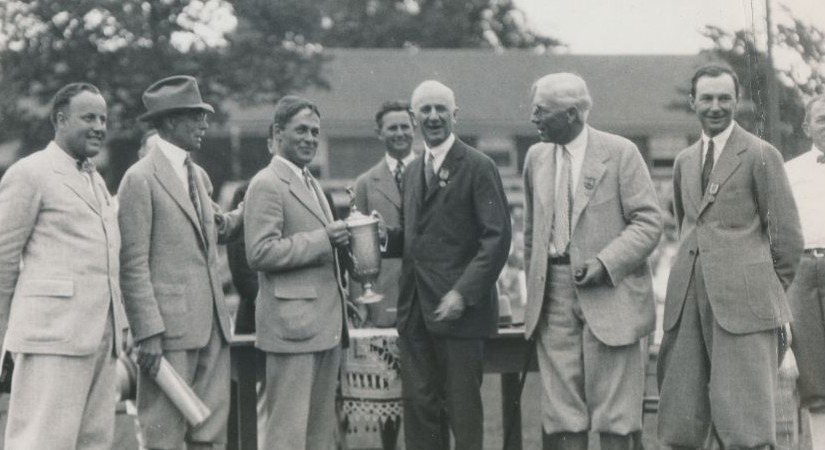
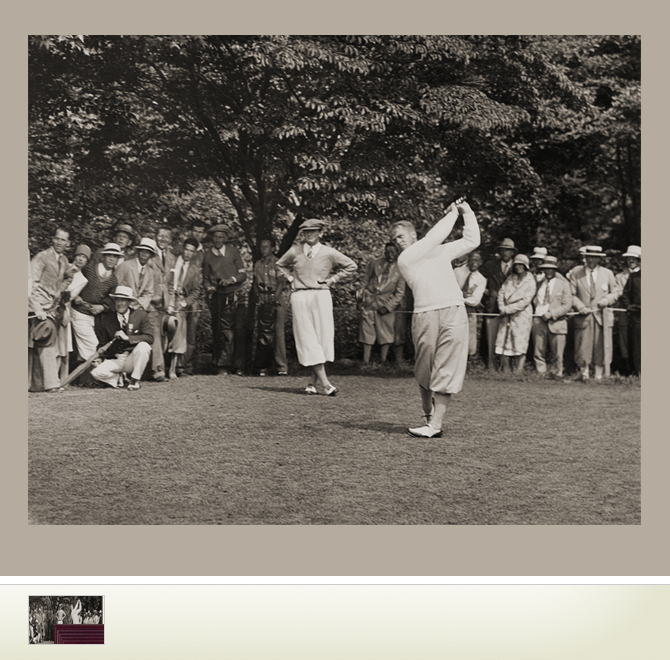
There was a lengthy profile by Herbert Reed on golfing great Bobby Jones, a mere boy of 24 who competed as an amateur but often beat top pros such as Walter Hagen and Gene Sarazen (in a few years Jones would help design the Augusta National Golf Club and co-found the Masters Tournament).
Rending of Bobby Jones for the “Profile” by illustrator Miguel Covarrubias.
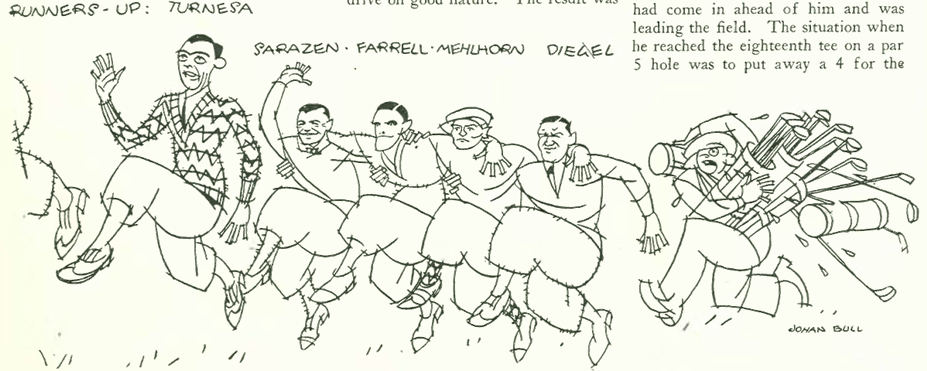
In “Sports of the Week,” Reed wrote about Jones’s second U.S. Open win, in Columbus, Ohio. Johan Bull offered this rendering of the runners-up:
Bobby Jones at the 1926 U.S. Open (golfspast.com)
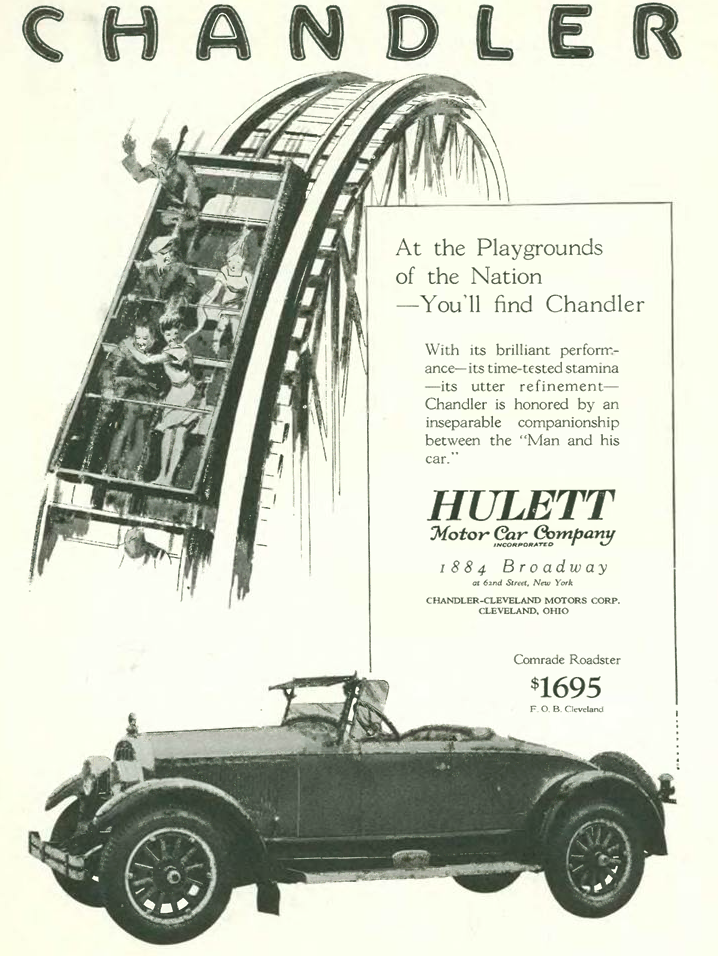
And with the warm weather the tops were open on automobiles for both the rich:
And the not-so-rich:
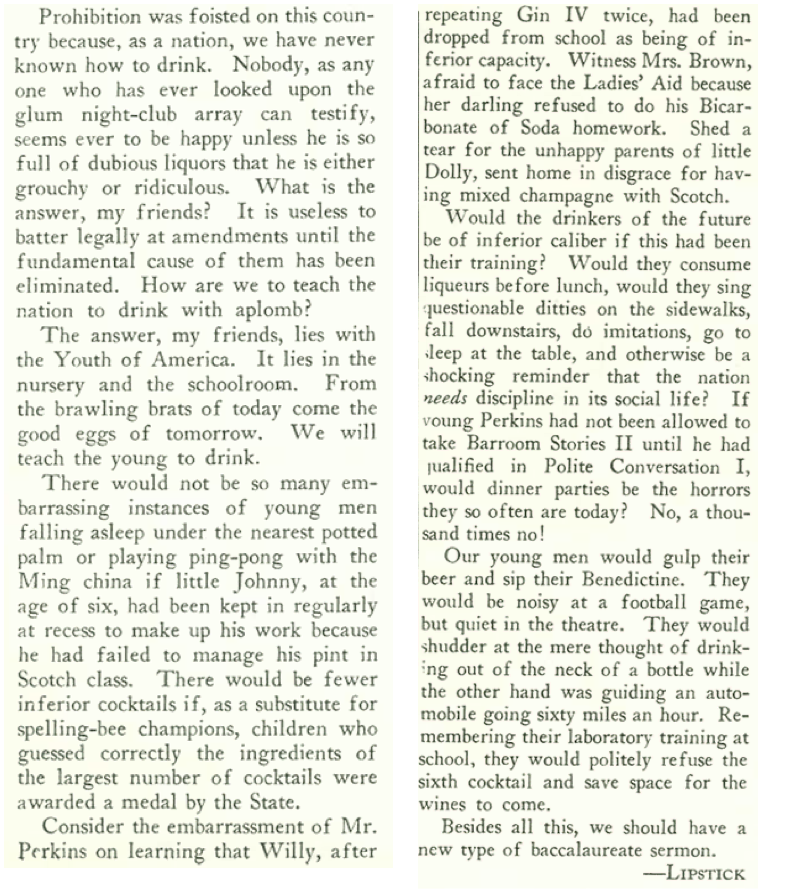
And finally, Lois Long, fed up with reviewing restaurants, fires off a column about the sad state of drinking in America:



















































 A New Yorker State of Mind