Headline News

The news of the day in May 1933 included a visit to the U.S. by Irish playwright George Bernard Shaw, a controversial Diego Rivera mural at Rockefeller Center, the abandonment of the Gold Standard, and the continuing saga of legal beer.

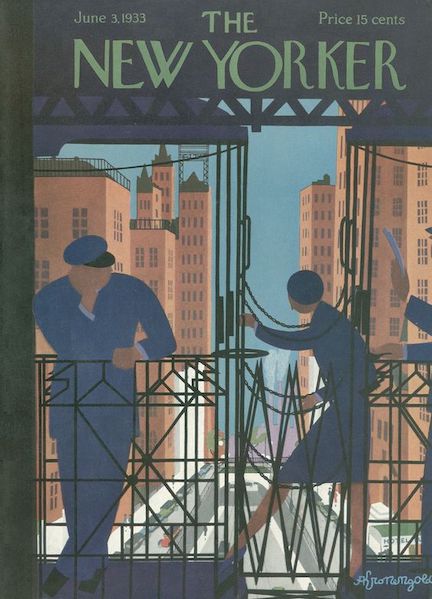
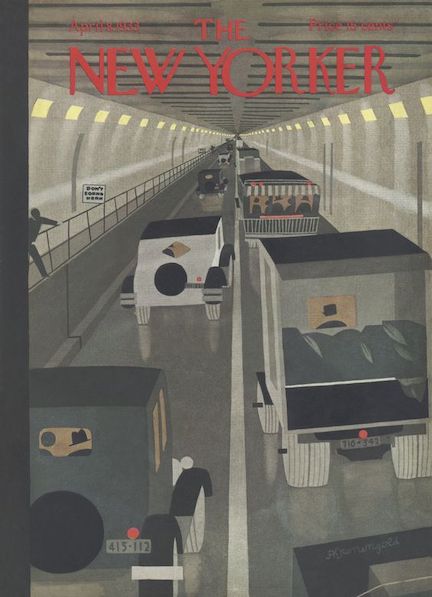
May 13, 1933 cover by Adolph K. Kronengold.

Writing under the pseudonym “Guy Fawkes,” Robert Benchley opined on the state of the print media in “The Wayward Press”…an excerpt:

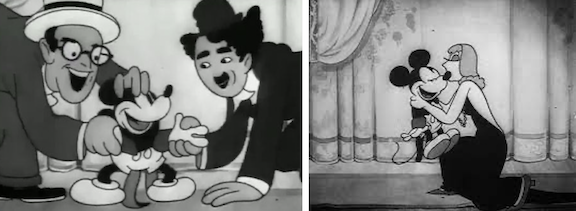
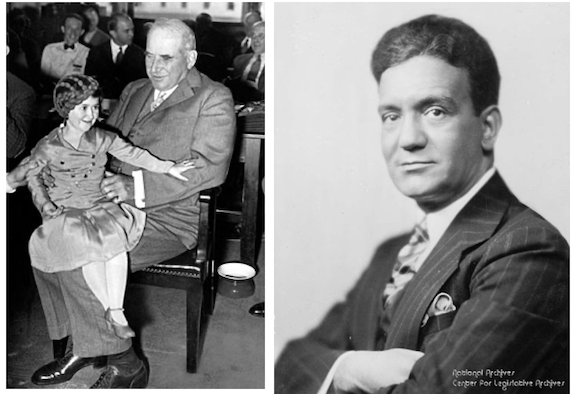
NEWSMAKERS CIRCA 1933 included George Bernard Shaw (left), here being escorted by actors Charlie Chaplin and Marion Davies from a Hollywood luncheon hosted by Davies in March 1933; other headlines touted the return of legal beer and the suspension of the gold standard by the Roosevelt administration—everyone was required to deliver all gold coin, gold bullion and gold certificates owned by them to the Federal Reserve by May 1 for the set price of $20.67 per ounce. Pictured are guards stocking returned gold in New Jersey bank vaults, 1933. (Pinterest/history.com)

 * * *

Selling the Pitch

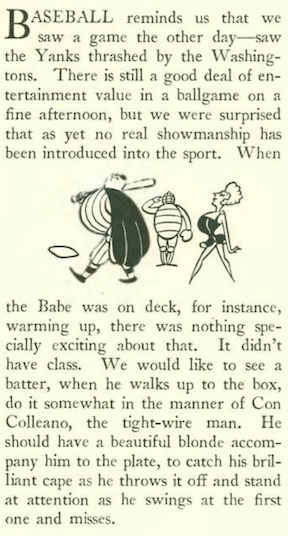
Babe Ruth was something of a freak of nature, becoming the “Sultan of Swat” despite a life of heavy drinking, poor eating habits and erratic attention to training regimens. Nevertheless, as Ruth neared the end of his career at age 38 he could still put on a show. In his “Notes and Comment,” E.B. White was hoping for just that sort of thing:

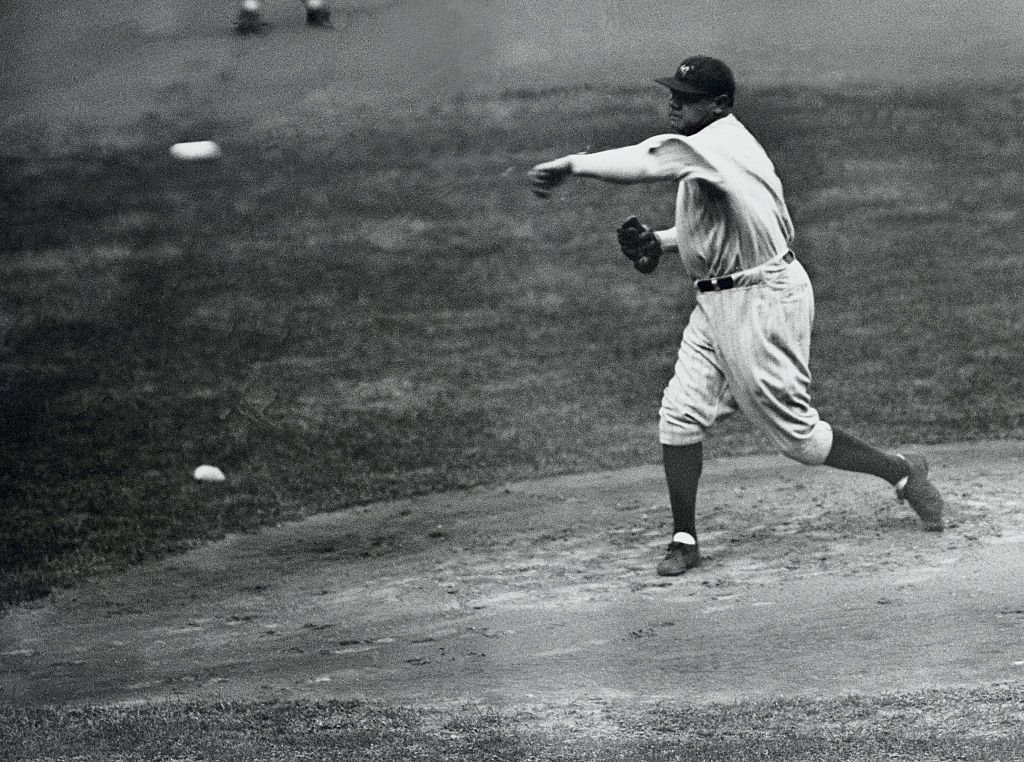
STILL GOT IT…E.B. White would get his wish for some “real showmanship” at the end of the 1933 season, when famed Yankee slugger Babe Ruth—in his 20th year in the majors—volunteered to pitch against the Red Sox in the final game of the season at Yankee Stadium. Not only did Ruth pitch a complete game, he also hit his 34th homer of the season in the Yankees’ 6–5 victory. (ballnine.com)

 * * *

From Our Advertisers

I wonder what it was like to cruise on the Dnieper River for fourteen days through “Colorful Ukrainia” during the Great Famine that Stalin imposed on that land, killing as many as five million people…

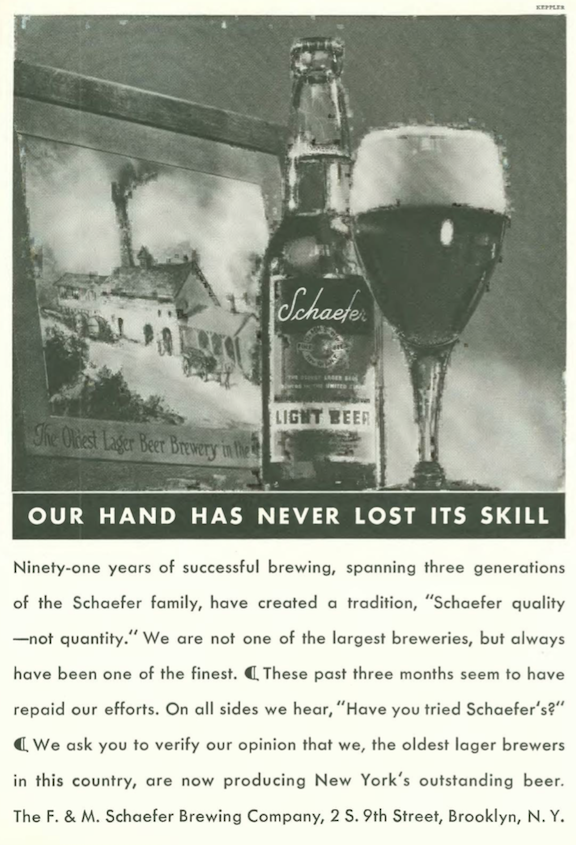
…more ads from the back pages touting various libations including Trommer’s “White Label” beer, a drink made from conch juice called “Konktail,” and an ad illustrated by William Steig promoting “imitation gin and other flavors” made by Red Lion…none of these products exist today…
…however you can still buy canned spaghetti, if that is your thing, but not “Force” breakfast cereal…

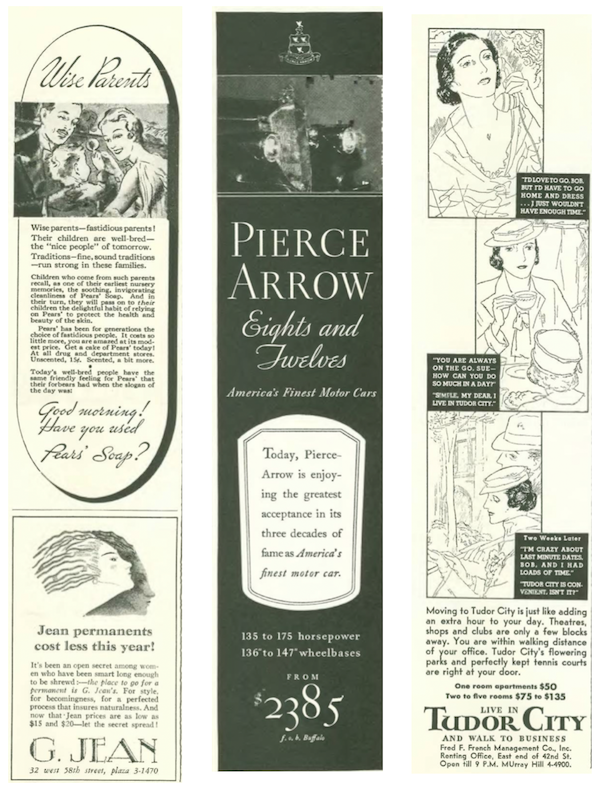
…still more selections from the back pages…on the left, an ad for Pear’s Soap that introduced us to “wise parents” whose children “are well-bred—the ‘nice people’ of tomorrow”…on the right, the lifeless gaze of a woman who pondered how life could be better in Tudor City…and in the middle, an unlikely one-column ad from luxury car maker Pierce Arrow…the automaker was America’s answer to Rolls Royce, but the Depression would take it down by 1938…

…I’m guessing the Velveeta is the mild one…

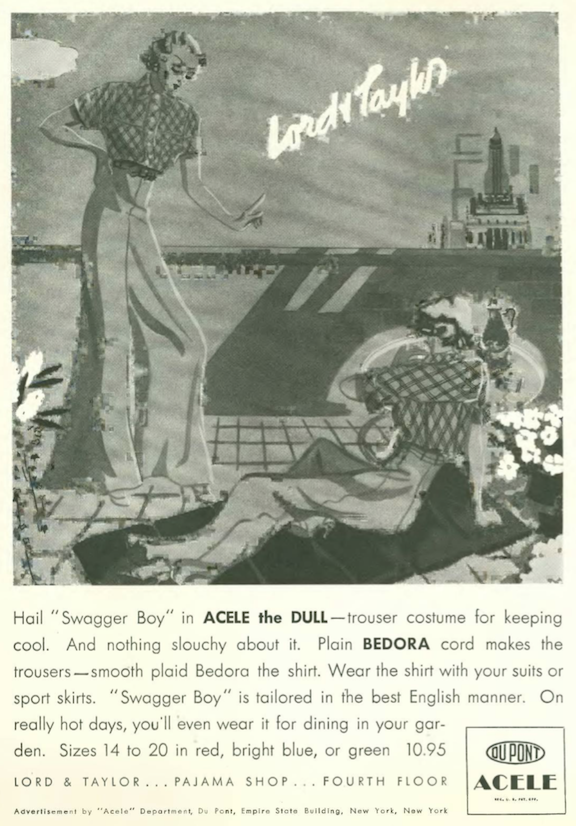
…technology was transforming beachwear, including this “Swagger Boy” outfit spun from Dupont’s latest synthetic, Acele…
…B. Altman, on the other hand, went full-color to promote their exclusive, imported fabric under the trade name Meadowbrook…

…and who ever thought a tire could look so posh, here dominating a gathering of the smart set…

…and look at this swell, sporting top hat and walking stick, but he also knows a good value when it comes to his tires…

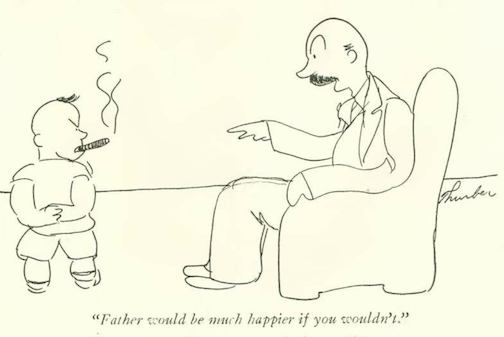
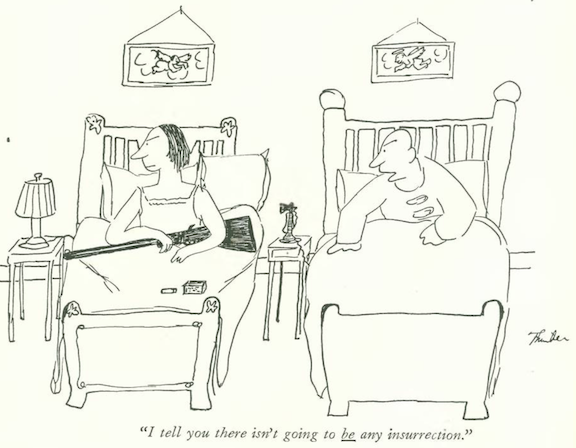
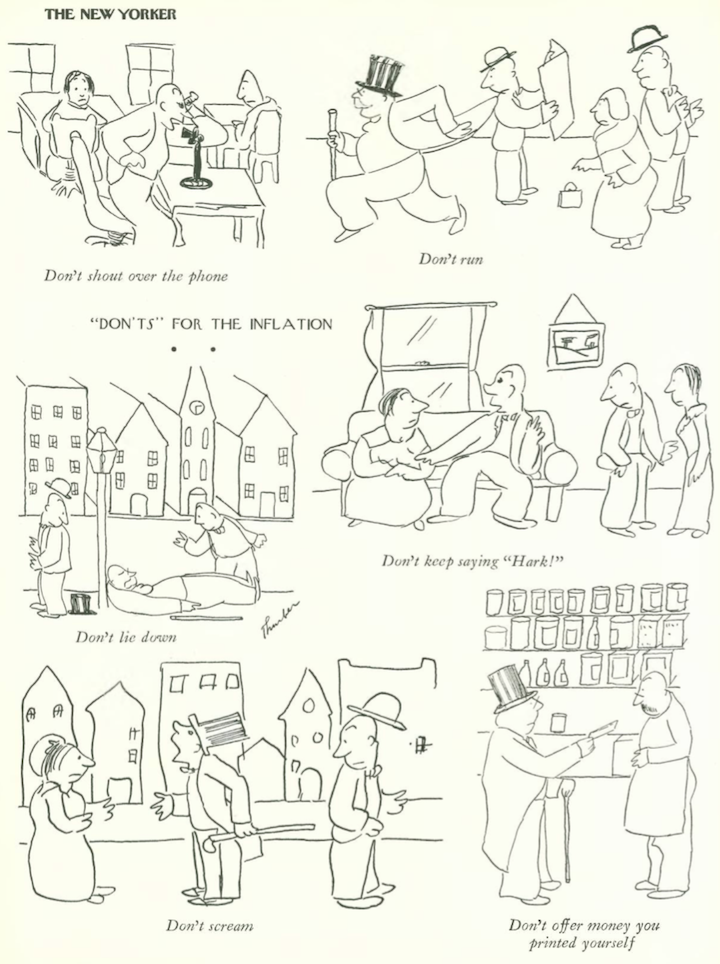
…we move on to our cartoons with James Thurber and a lot of people apparently going nowhere…

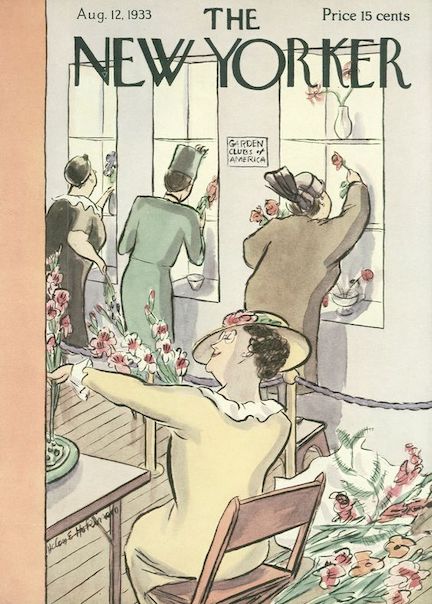
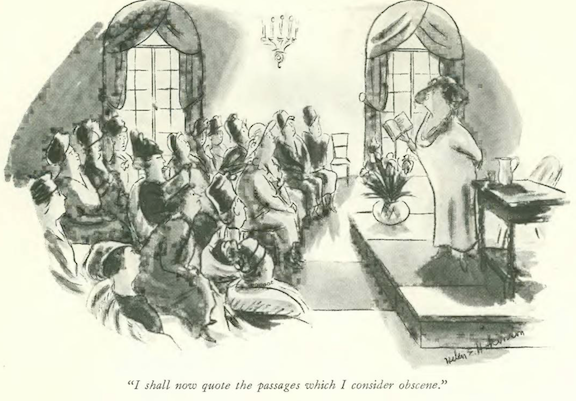
Helen Hokinson’s girls were all ears at the latest club gathering…

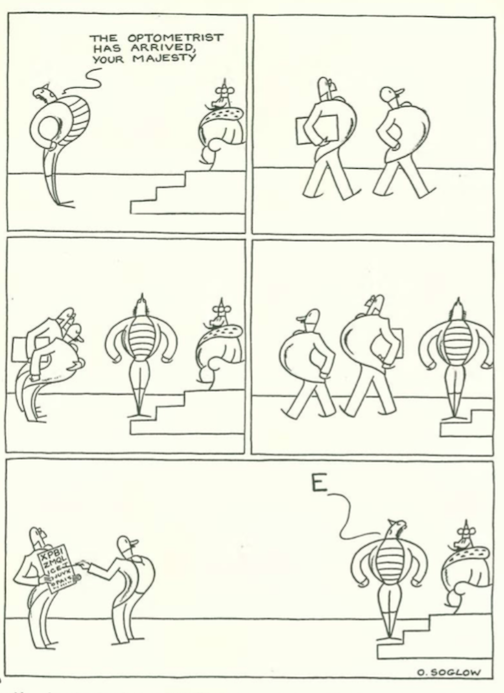
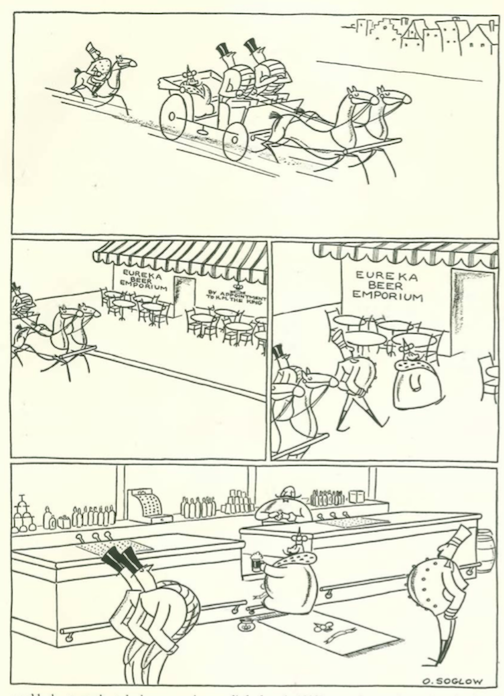
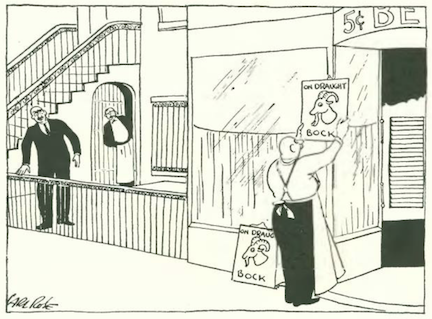
Otto Soglow’s Little King got in on the excitement of legal beer…

…and we continue to the issue of May 20, 1933, with a cover by Arnold Hall, who did at least eight covers for The New Yorker during the 1930s…

May 20, 1933 cover by Arnold Hall.

The big news in this issue was Mexican artist Diego Rivera and his controversial mural at Rockefeller Center. Rivera’s New Yorker profile was written by Geoffrey Hellman (1907–1977), who beginning in 1929 served as the magazine’s principal writer for “The Talk of the Town.” Here’s an excerpt, with illustration by Al Frueh:

What got Rivera in hot water with John D. Rockefeller Jr. and family was a mural that departed somewhat from the artist’s earlier study sketches—Rivera had been hired to depict “man at the crossroads,” looking to the future with uncertainty but also with hope for a better world.

According to a 2014 story by NPR’s Allison Keyes, leftist organizations and various communist groups in New York criticized Rivera for agreeing to work with capitalist paragons like the Rockefellers. In response, Rivera sent assistants to find a picture of Bolshevik leader Vladimir Lenin. “If you want communism, I will paint communism,” he apparently said.

The subsequent inclusion of Lenin in the mural led to protests by the Rockefeller family, the press and the public. Rivera was ultimately asked to leave the country, losing yet another commission for the Chicago World’s Fair. Rivera got paid for his Rockefeller Center mural, but the work itself was demolished.

After returning to Mexico Rivera recreated the mural, adding some vengeful references (see below) to his 1934 work, Man, Controller of the Universe.

Rivera’s wife, Frida Kahlo, had accompanied him to New York, and during their time in the states (1930-34) she produced a number of now-famous paintings. However in 1933 she was not recognized as a serious artist. Indeed when she visited with the Detroit News in 1932, the headline read, “Wife of the Master Mural Painter Gleefully Dabbles in Works of Art.” In the same vein, Hellman perceived Kahlo as nothing more than a pretty helpmeet.

MORE THAN A PRETTY FACE…At left, Diego Rivera and Frida Kahlo attending an art exhibition in New York, 1933; at right, Kahlo and Rivera before the controversial mural at Rockefeller Center. Although an unknown in the art world in 1933, Kahlo would one day eclipse her husband’s fame. (SFGate/Pinterest)
MISCONCEPTION…Clockwise, from top, an early sketch of the Diego Rivera’s mural differed from what he ultimately painted in Rockefeller Center. After the mural was destroyed in 1934, Rivera recreated the work under the title Man, Controller of the Universe, now on display at the Palacio de Bellas Artes in Mexico City. A detail of that work shows Vladimir Lenin holding hands with workers of different races. Below, juxtaposed with the image of Lenin in that painting was another famous face, that of John D. Rockefeller Jr., depicted drinking martinis with a prostitute. Touché!
(Museo Frida Kahlo)

Rivera’s Rockefeller Center mural was eventually replaced in 1937 by American Progress, painted by the Spanish artist José Maria Sert:

(Flickr)

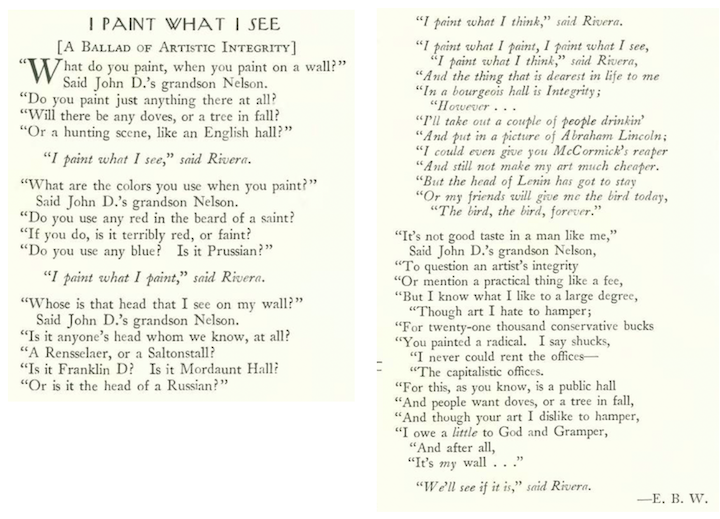
The irony of the Rivera controversy was not lost on E.B. White, who offered this ballad in response:

 * * *

Keep it in Your Pocket

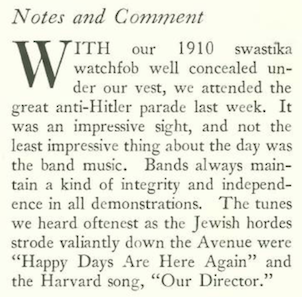
E.B. White again, this time opening his column with thoughts on the anti-Hitler parade that was held in New York.

White refers to his “swastika watchfob”…before the Nazis came to power, the swastika was known to many cultures as a symbol of prosperity and good luck.

IT’S THE REAL THING…In 1925 Coca Cola made a lucky brass watch fob in the shape of a swastika. At that time the swastika was still a symbol of good luck. (Reddit)
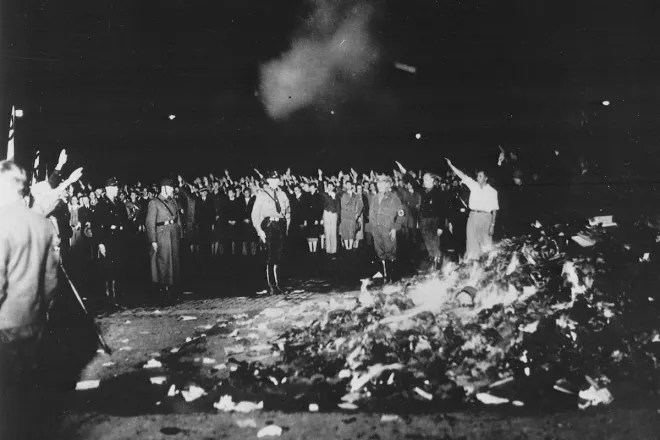
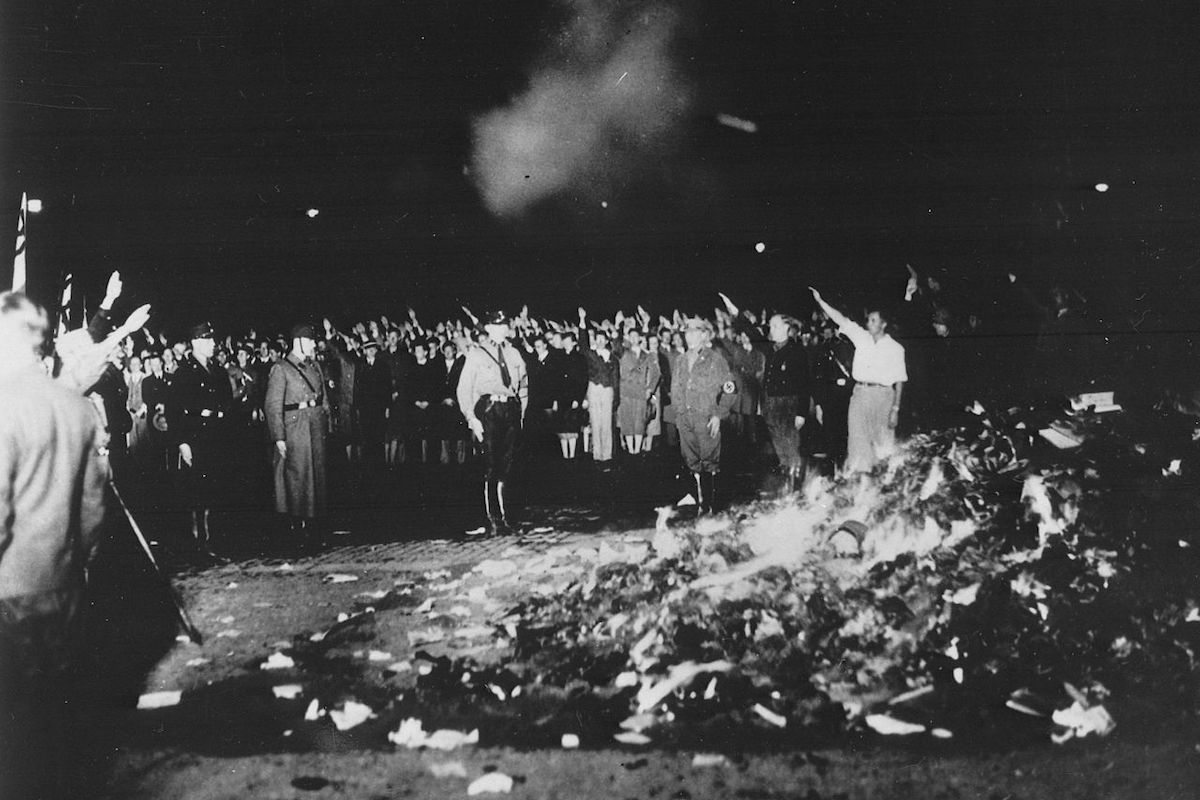
SHOW OF UNITY…Anti-Hitler parade in New York protested the May 10, 1933 book burnings across Nazi Germany. (encyclopedia.ushmm.org)

In his weekly column Howard Brubaker added this observation regarding life in Nazi Germany…

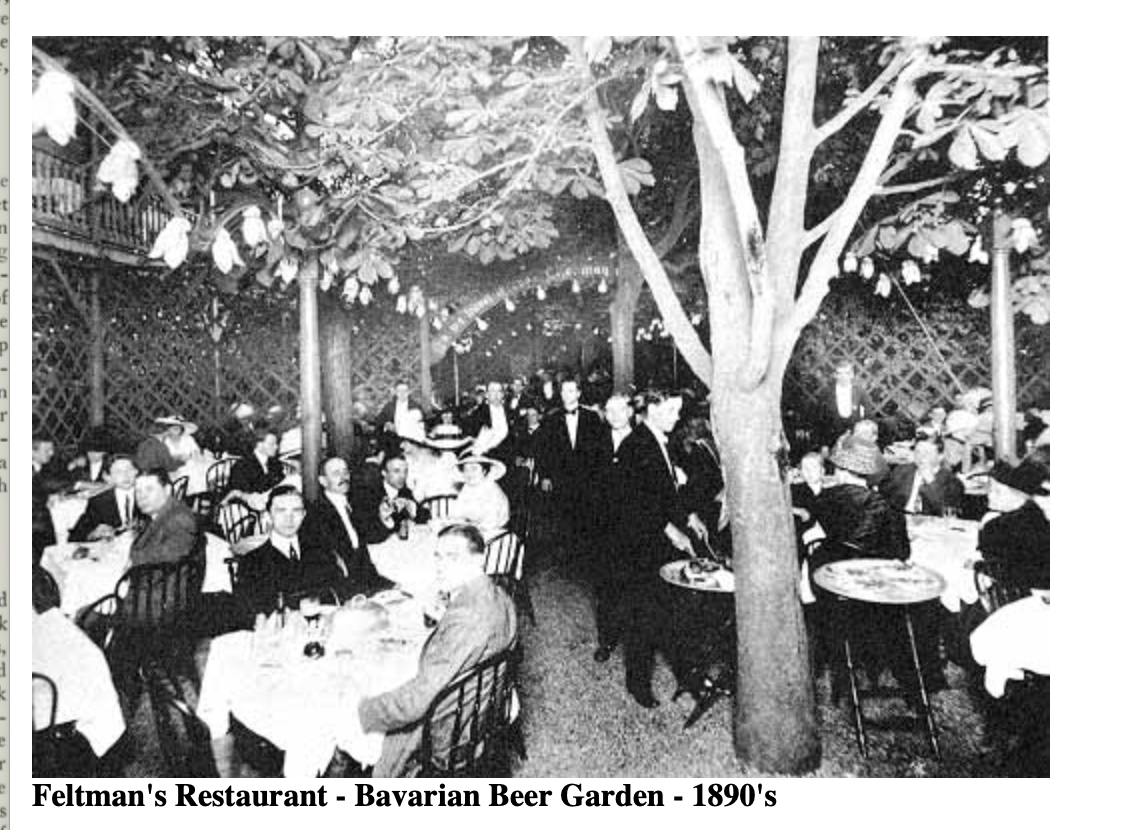
Back home, folks could still enjoy a taste of Germany that wasn’t associated with violence and hate…an excerpt from “The Talk of the Town”…

GEMÜTLICHLüchow’s opened in 1882 when Union Square was still New York’s theater and music hall district, and featured seven dining rooms and a beer garden. The restaurant closed in 1982 and was demolished in 1995 to make way for an NYU dormitory. (Pinterest/MCNY)

 * * *

From Our Advertisers

The architecture profession fell on hard times during the Depression. In 1931 the Architects’ Emergency Committee began promoting the talents of unemployed architects who were willing to work for less than half their ordinary fee, limiting charges to materials, a small amount of cash, and a place to sleep…this is an example of a series of ads that ran in The New Yorker in the spring of 1933…

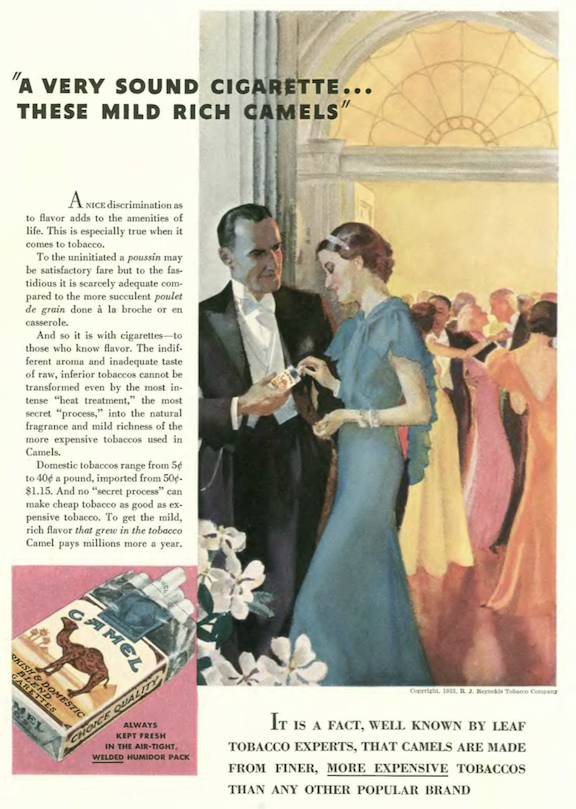
…one profession not feeling the hard times?—the makers of tobacco products, and specifically cigarettes…

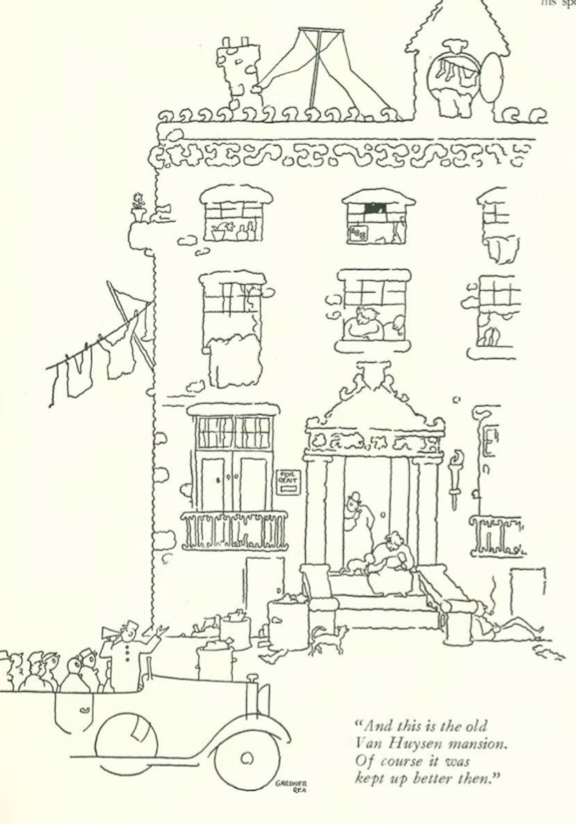
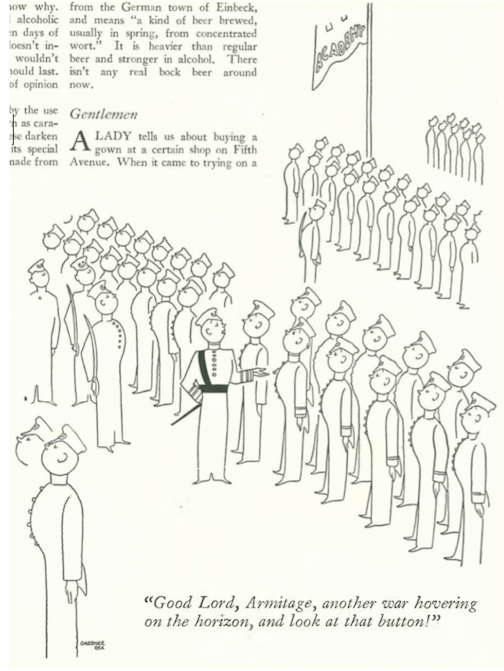
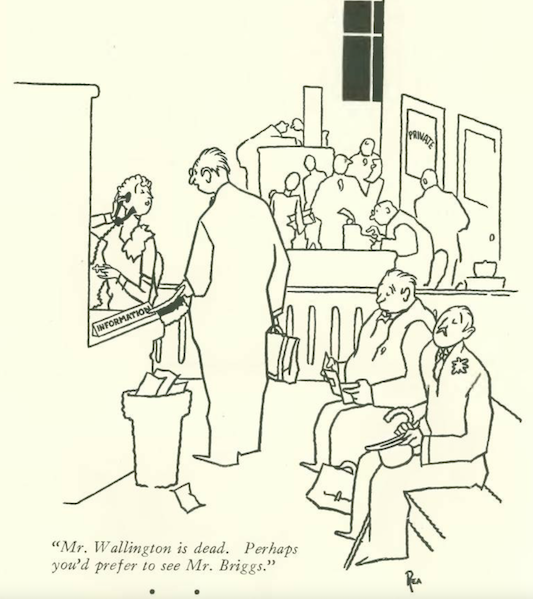
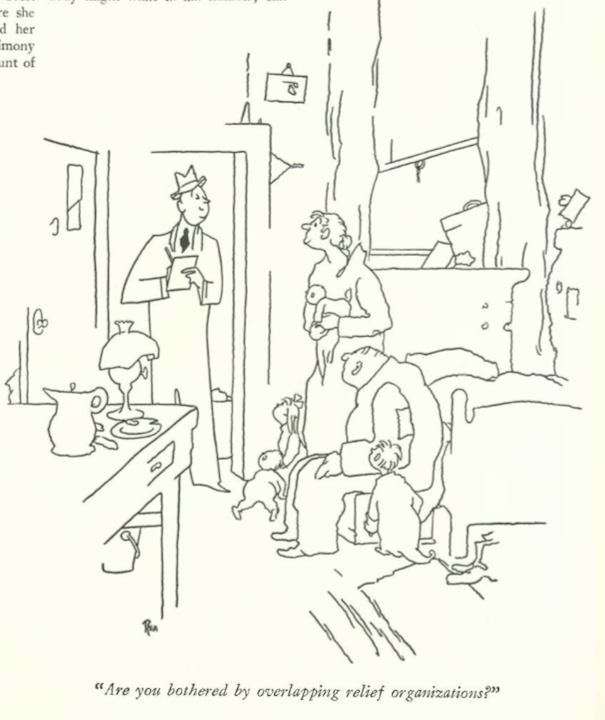
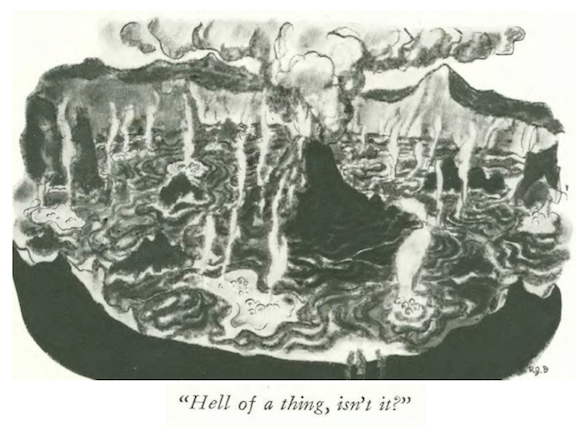
…speaking of hard times, we turn to our cartoons and Gardner Rea

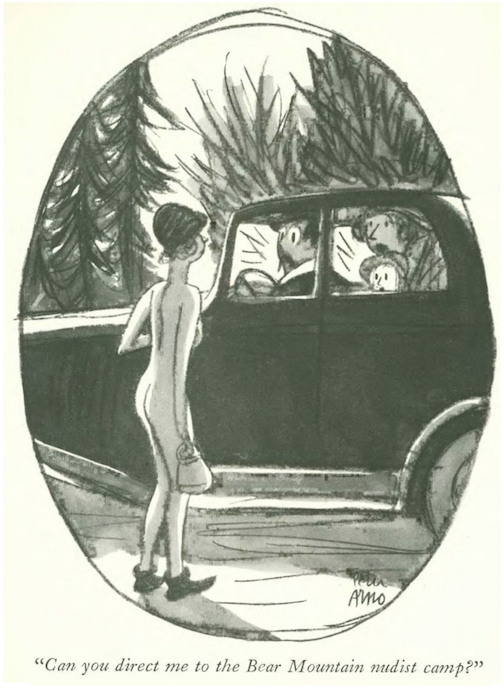
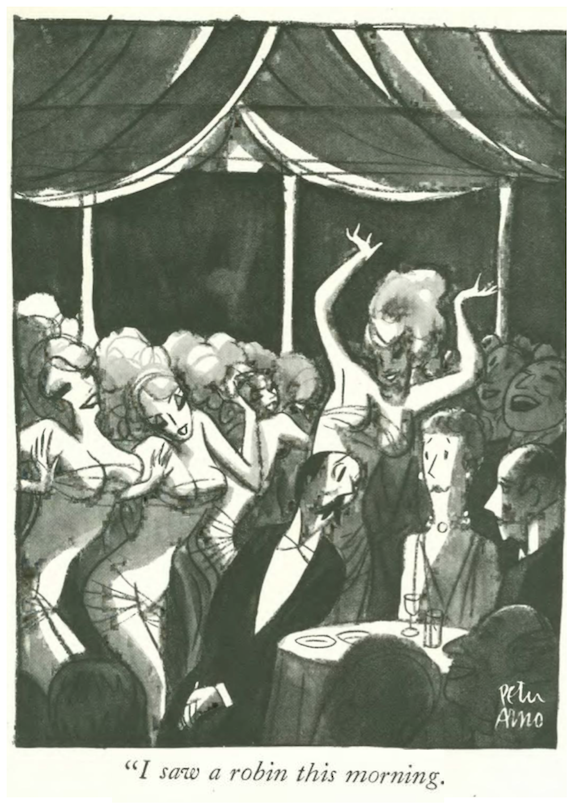
…and we close on a bright note, otherwise known as Peter Arno

Next Time: Rebirth of a Nation?

Not Worth a Dime

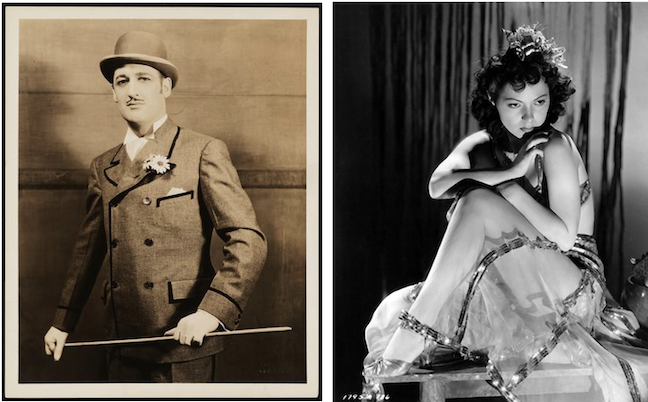
First performed in Berlin in 1928, The Threepenny Opera was Bertolt Brecht’s socialist critique of capitalist society and was a favorite (somewhat ironically) of that city’s bourgeois “smart set.” However when it landed on the Broadway stage in 1933, it famously flopped, and closed after just twelve performances.

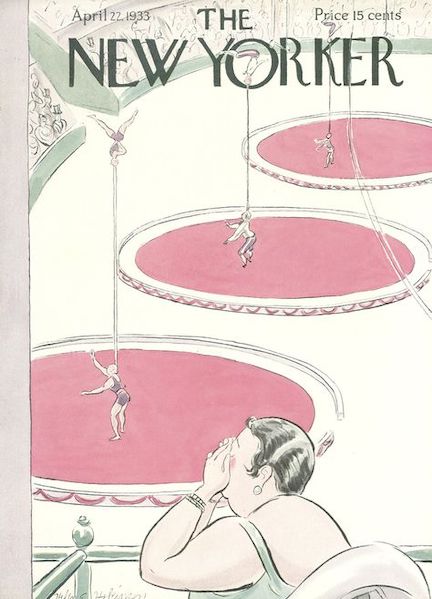
April 22, 1933 cover by Helen Hokinson.

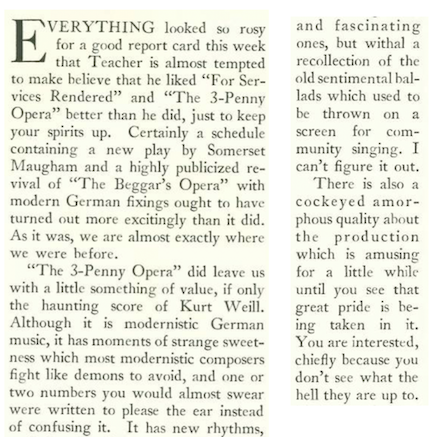
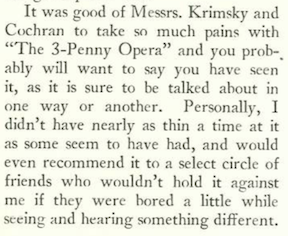
The first American production, adapted by Jerrold Krimsky and Gifford Cochran, opened April 13, 1933, at the Empire Theatre, featuring Robert Chisholm as Macheath (“Mack the Knife”) and Steffi Duna as his lover, Polly. Critic Robert Benchley found value in the play’s “modernistic” music, but seemed puzzled by its enigmatic production, an opinion shared by other contemporary critics.

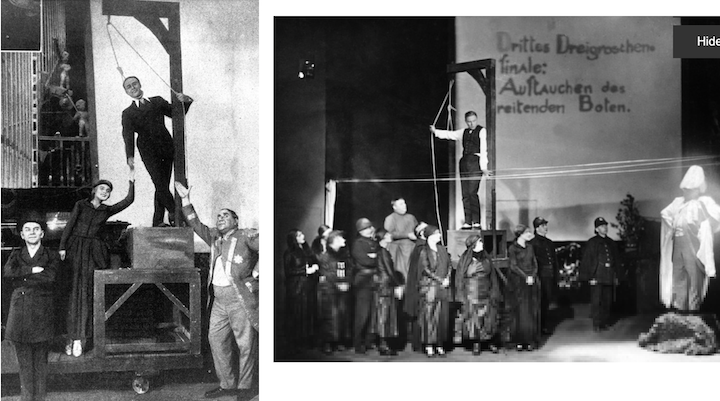
HANGING IN THERE…Scenes from the 1928 Berlin premiere of Bertolt Brecht’s musical, The Threepenny Opera. At left, Macheath (tenor/baritone Harald Paulsen) is spared the noose during the closing act, much to the relief of his lover, Polly (soprano Roma Bahn); at right, in a deus ex machina moment, a messenger arrives at the hanging and announces that Macheath has been pardoned by the queen. (British Library)

Some critics today defend the 1933 American production, noting that the Krimsky–Cochran adaptation was quite faithful to the Brecht original. Perhaps something was lost in translation, or maybe the world in which the play was conceived no longer held much relevance to Depression-era Americans.

THE FINAL CURTAIN fell after just twelve performances of the first American production of The Threepenny Opera at Broadway’s Empire Theatre. The production featured Robert Chisholm as Macheath and Steffi Duna as Polly. (discogs.com/bizzarela.com)

Benchley half-heartedly concluded that the play was probably worth seeing, for no other reason than to experience something different for a change.

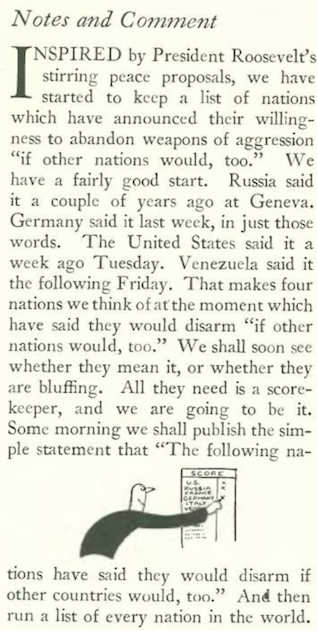
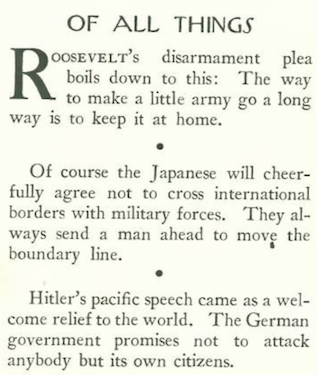
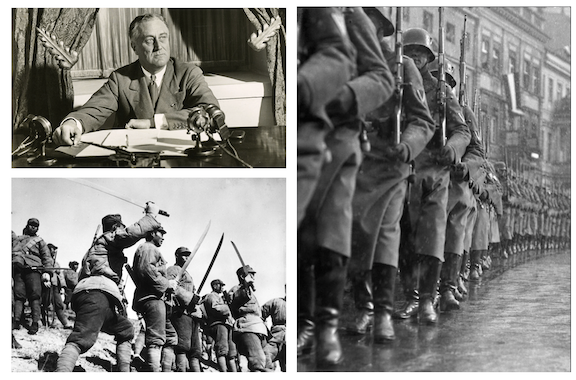
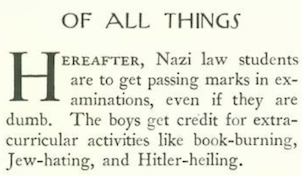
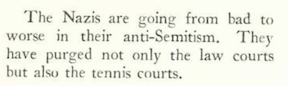
By 1933 the world that had conceived The Threepenny Opera was long gone—Brecht fled Nazi Germany two months before his play opened in New York, fearing persecution for his socialist leanings. Things were quickly going “from bad to worse” under Adolf Hitler’s new regime, as Howard Brubaker observed in his “Of All Things” column:

 * * *

Look Ma, No Net!

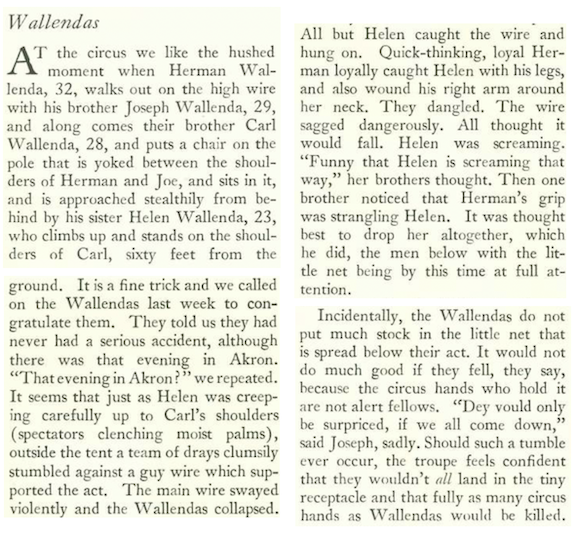
Karl Wallenda (referred to as “Carl” here) was born to an old circus family in Germany in 1905, and by 1922 he would put together a family-style high-wire act (with brother Herman) that would come to be known as “The Flying Wallendas.” They debuted at Madison Square Garden in 1928, notably without their safety net, which had been lost in transit. So they performed without it, much to the acclaim of the adoring crowd. They soon became known for their daring high-wire acts, often performed without safety nets. E.B. White filed this (excerpted) report for “The Talk of the Town.”

In the years that followed Karl developed some of troops’ most startling acts, including the famed seven-person chair pyramid. They performed this incredibly dangerous stunt until their appearance at the Detroit Shrine Circus in January 1962; the wire’s front man, Dieter Schepp, faltered, causing the pyramid to collapse. Schepp, who was Karl’s nephew, was killed, as was Richard Faughnan, Karl’s son-in-law. Karl injured his pelvis, and his adopted son, Mario, was paralyzed from the waist down.

DON’T TRY THIS AT HOME…The Wallenda family practices the seven-person pyramid just prior to the Shrine Circus in Detroit, where the group fell, killing Dieter Schepp (far right, bottom row) and Dick Faughnan (second from left, on bottom). (Sarasota Herald-Tribune)

Karl’s own luck finally ran out on March 22, 1978, on a tightrope between the towers of Condado Plaza Hotel in San Juan, Puerto Rico. High winds, and an improperly secured wire, caused the 73-year-old Wallenda to wobble, and then fall, one hundred feet to the ground. He was dead on arrival at a local hospital.

THE SHOW ENDED for Karl Wallenda on March 22, 1978, on a tightrope between the towers of Condado Plaza Hotel in San Juan, Puerto Rico. The 73-year-old high-wire legend fell one hundred feet to his death. (esquire.com)

 * * *

Safer Entertainments

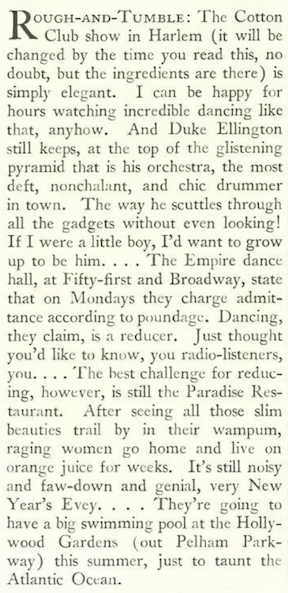
Lois Long continued to file nightlife reports in her “Tables for Two” column, reveling in the sights and sounds (and rhythms) of the Cotton Club’s orchestra, led by Duke Ellington…but the real attraction was Ellington’s unnamed drummer, whom I assume was the great Sonny Greer

JAZZ GREAT Sonny Greer wowed Lois Long and the rest of the crowd at Harlem’s Cotton Club in April 1933. (jazz.fm)

 * * *

From Our Advertisers

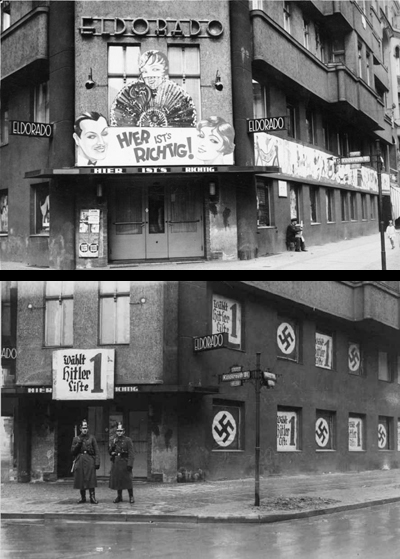
Given the news Howard Brubaker shared earlier in this post, I wouldn’t use the word Gemütlichkeit (basically, warmth and friendliness) to describe the state of things in Nazi Germany…

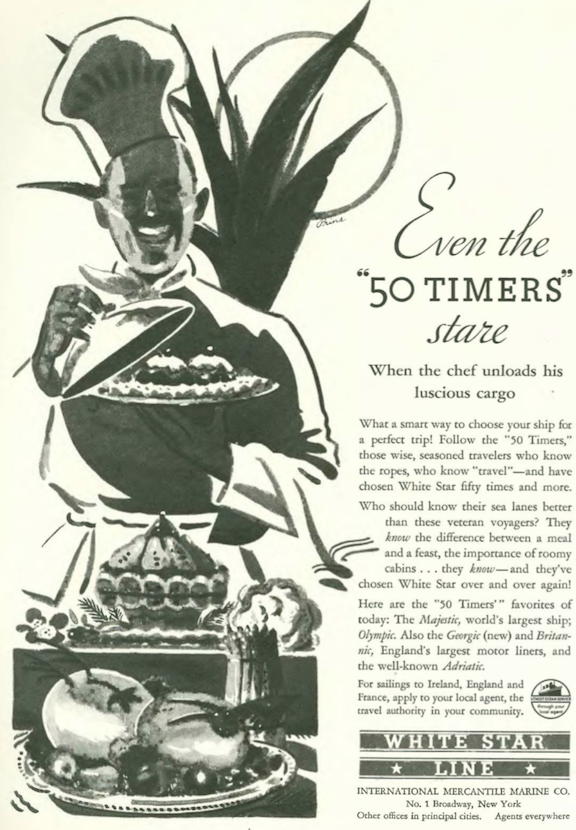
…a better option would be a trip to the British Isles or France on the White Star lines, nicht wahr?…

…RCA’s mascot, Nipper, appeared to contemplating fatherhood in this two-page ad for the company’s new “baby sets”…

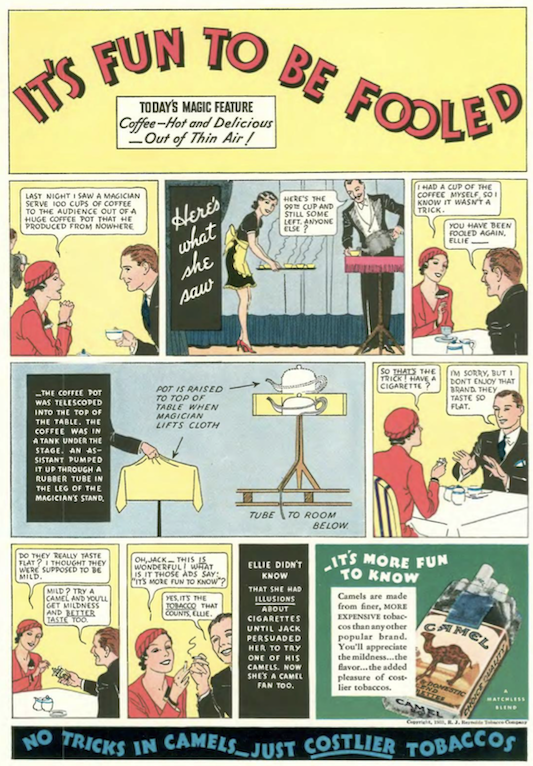
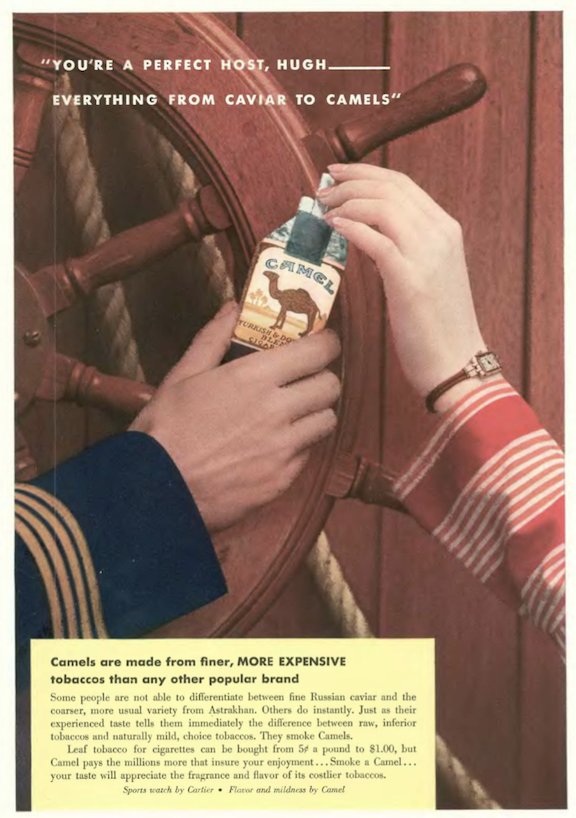
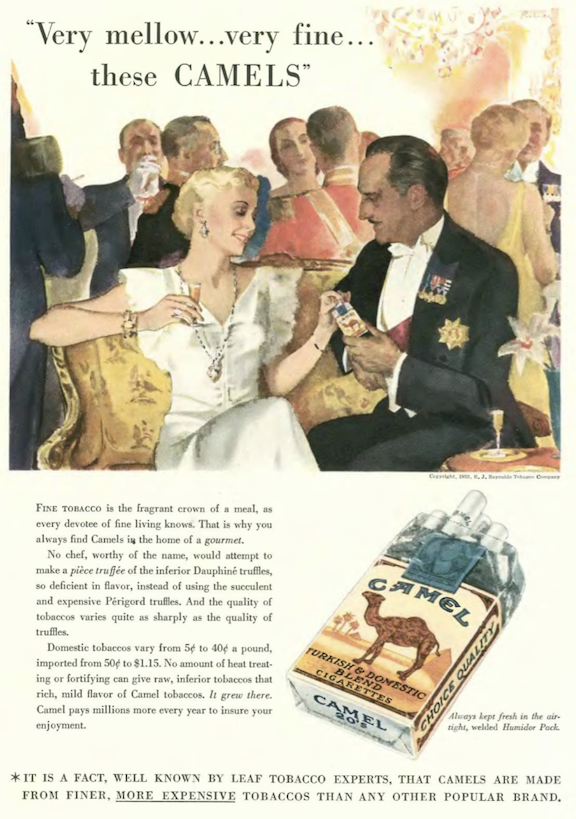
…Camel took a break from its magician-themed “It’s Fun to be Fooled” ads to run another elegant Ray Prohaska-illustrated spot…

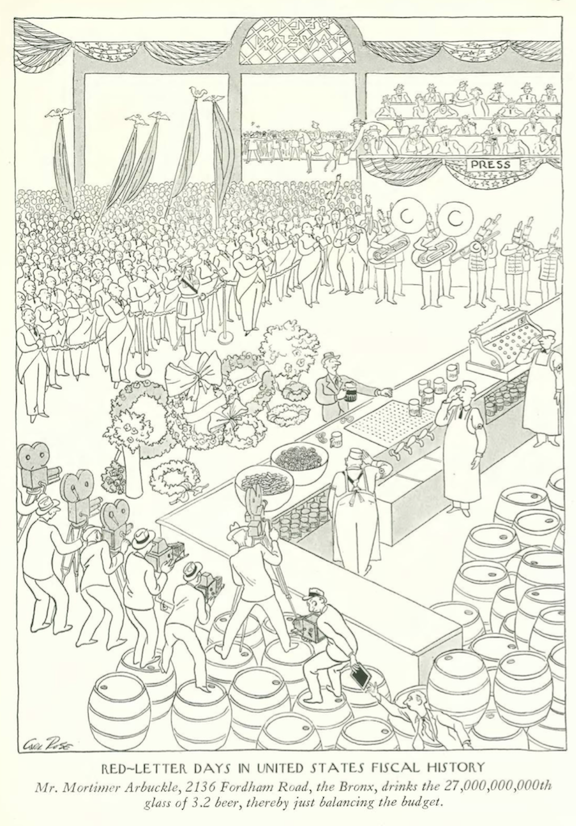
…on to our cartoons, Carl Rose demonstrated the economic benefits of legal beer…

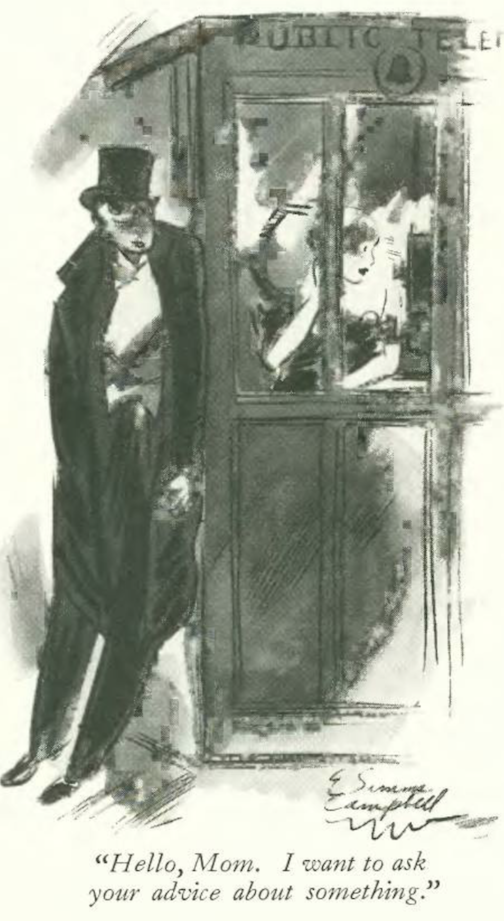
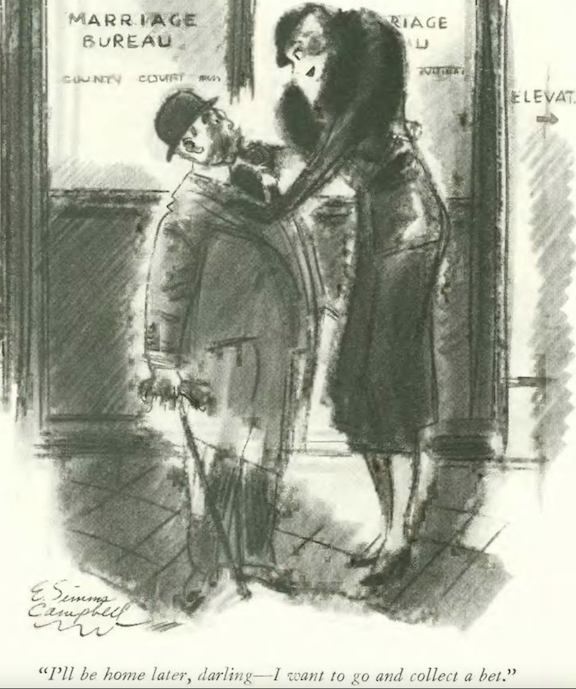
E. Simms Campbell showed us a woman seeking a bit of motherly wisdom…

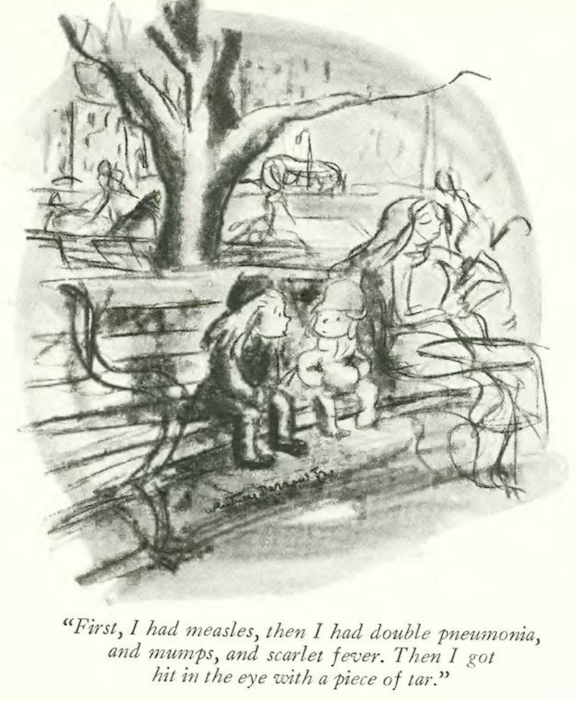
Whitney Darrow Jr (1909–1999), who began his 50-year career at The New Yorker on March 18, 1933, offered this look at childhood’s hard knocks…

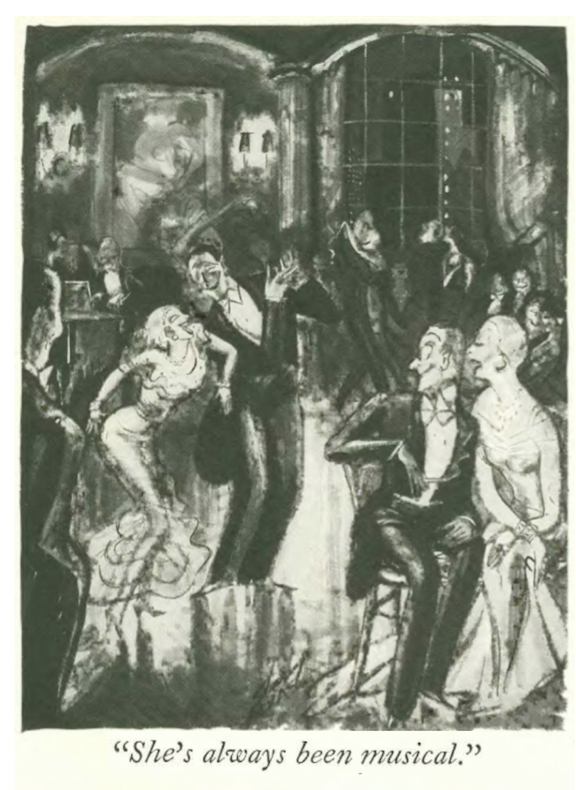
James Thurber drew up an odd encounter at a cocktail party…

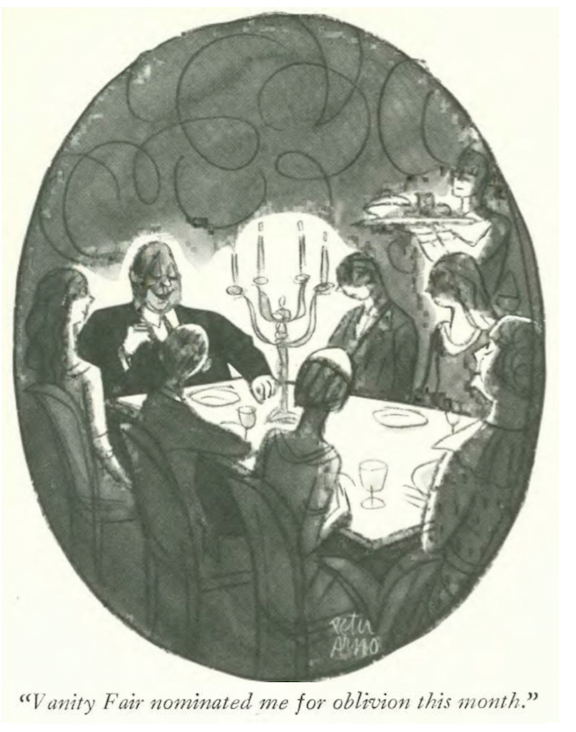
Peter Arno served up a proud patriarch…

…and William Steig explored the perils of somnambulism…

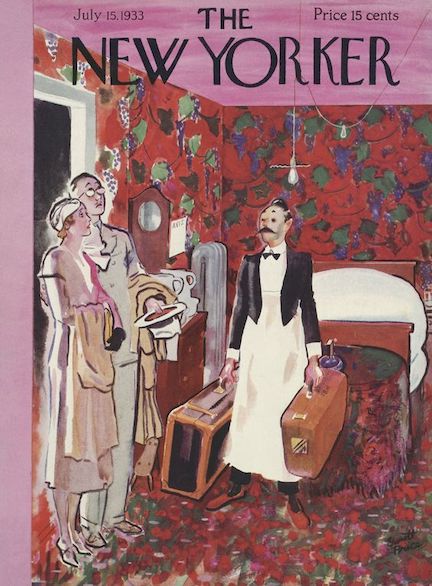
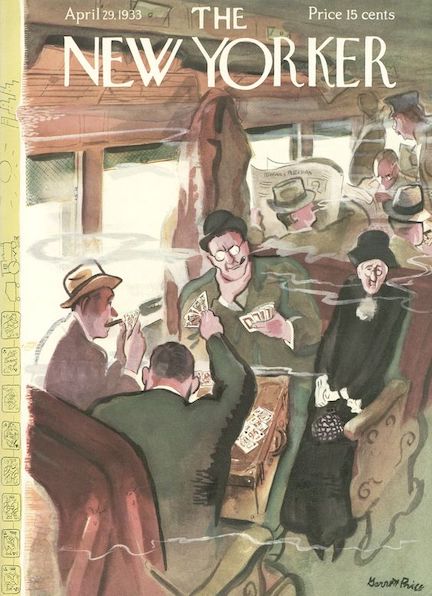
…on to our April 29, 1933 issue with a cover by Garrett Price…although we’ve already seen many cartoons by Price, we haven’t seen many covers (he did two covers in the magazine’s first year, 1925). Price would ultimately produce 100 covers for The New Yorker, in addition to his hundreds of cartoons…

April 29, 1933 cover by Garrett Price. Note the little train illustration along the spine (or strap, as it is called).

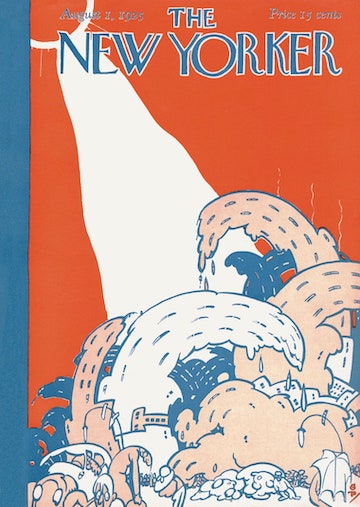
…for the record, here is Price’s first New Yorker cover from Aug. 1, 1925…

…there was more troubling news from Nazi Germany, this time from Paris correspondent Janet Flanner in her “Letter from Paris” column…Flanner would later gain wider fame as a war correspondent…

THUGS…SA members stick a poster to the window of a Jewish store in Berlin on April 1, 1933. The poster is inscribed, “Germans, Defend yourselves, Do not buy from Jews”. (Bundesarchiv, Berlin)

 * * *

From Our Advertisers

Camel followed up its elegant ad from the previous issue with another “Fun to be Fooled” spot, this time presented as a multi-panel comic strip…

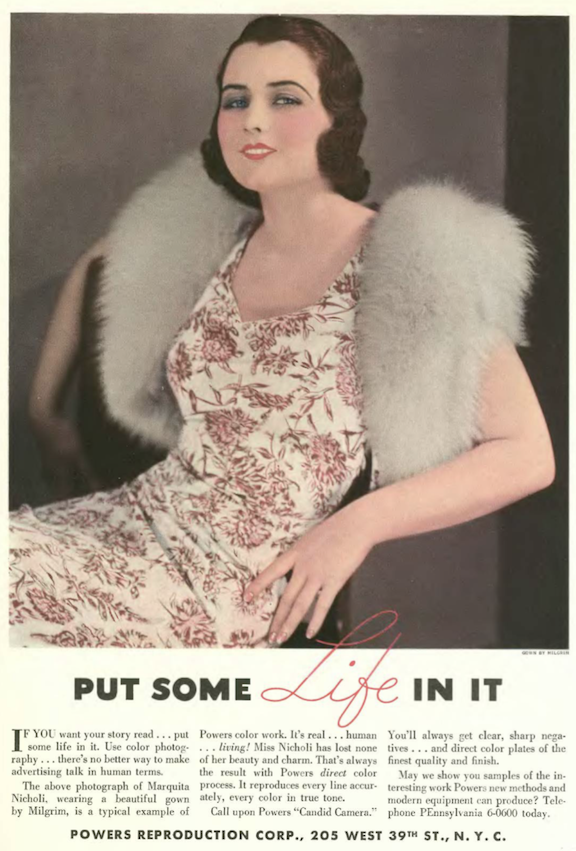
…Powers Reproduction was a frequent advertiser in the early New Yorker, touting the “realism” of their color photography, but in this case the model looked more like a department store mannequin…

Otto Soglow continued to ply a lucrative sideline illustrating ads for Sanka decaf…

…as we segue to our cartoonists, the opening section featuring work by both James Thurber and George Price

Gardner Rea’s snake charmer expressed her belief that all men are created equal…

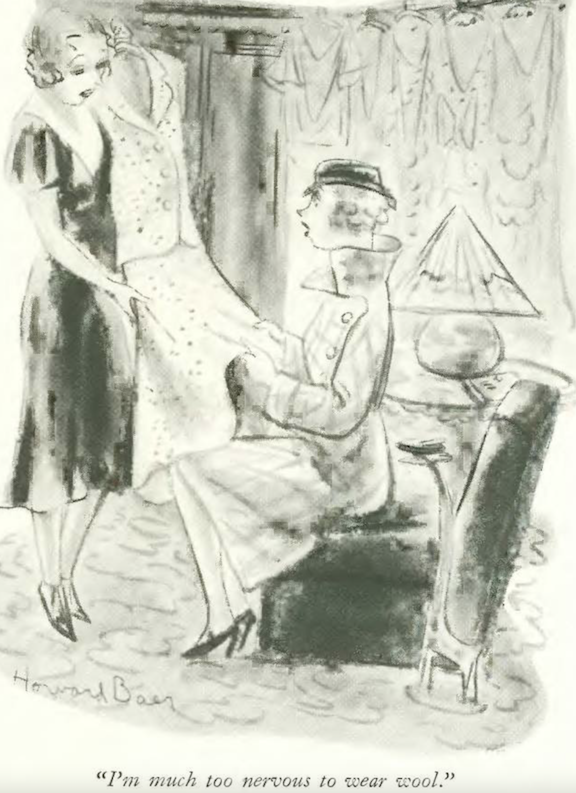
…here is a cartoon by a new artist, Howard Baer, who contributed to The New Yorker between 1933 and 1937…

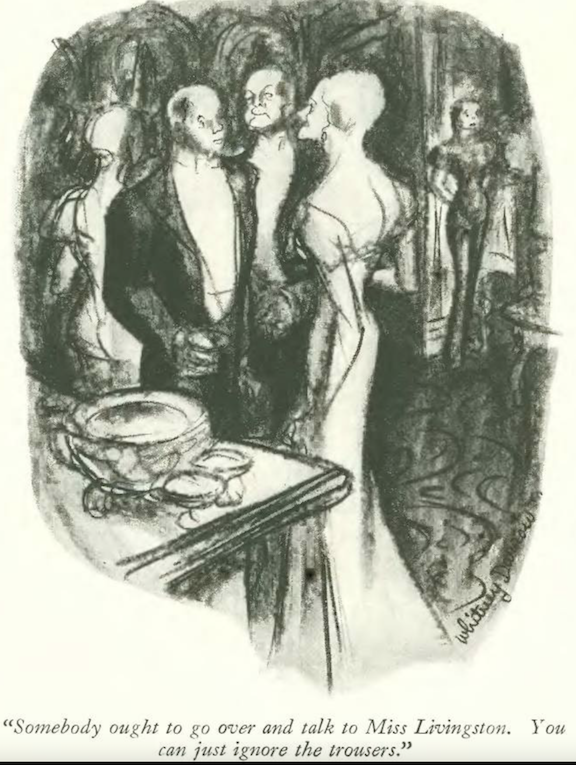
…and another by newcomers Whitney Darrow Jr.

…and E. Simms Campbell

Barbara Shermund continued to rollick with her modern women…

…and we end with the ever-reliable Peter Arno

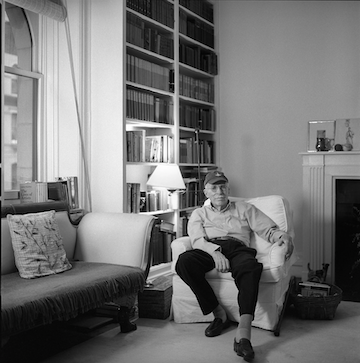
Before we close I want to remember Roger Angell, who died last week at age 101. A literary legend and a great baseball writer to be sure, but also one of the last living links to the first days of The New Yorker. Rest in Peace.

Photo by Brigitte Lacombe, for The New Yorker.

Next Time: Bohemian Rhapsody…


Stormy Bellwether

While legal beer dominated the headlines in the spring of 1933—a little something to cheer about in those depressed times—few seemed to notice the troubles brewing on the other side of the pond.

April 1, 1933 cover by Julian de Miskey.

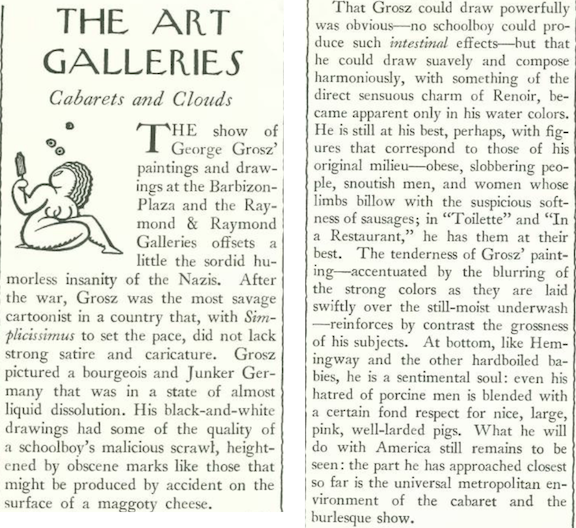
Artist George Grosz (1893–1959) was not among them. A recent self-exile from his native Germany, Grosz had savagely caricatured the perversity of the bourgeois in 1920s Weimar Berlin; through his art he tried to warn fellow Germans of the horrors to come. Critic Lewis Mumford stopped in at the Raymond & Raymond galleries to check out the latest efforts of this Manhattan newcomer:

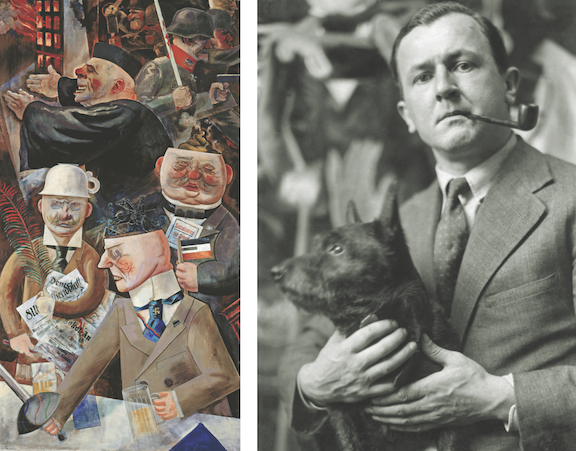
EARLY WARNING SIGNS… George Grosz’s The Pillars of Society (1926) satirized the bourgeois supporters of Fascism in post-war Germany; Grosz with friend, circa 1933. (history net.com)

Although Grosz intended to make a clean break with his past after emigrating to New York in January 1933, his work still reflected his distaste for bourgeois sensibilities…

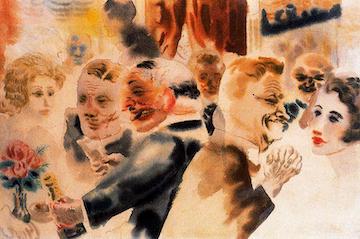
GROSS GROSZ…In a Restaurant (circa 1933) was admired by Mumford for the tenderness of the watercolor wash that contrasted with the “grossness” of its subjects. (artnet.com)
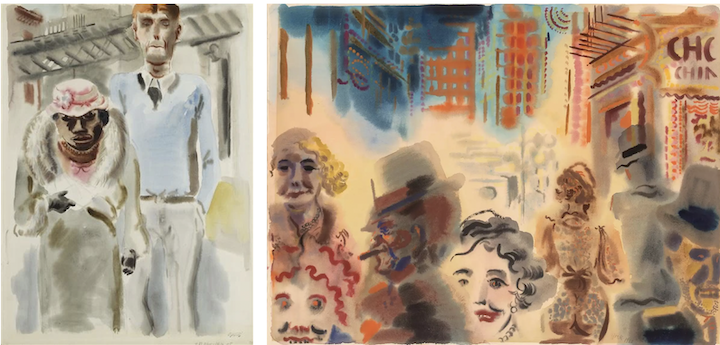
ON THE SIDEWALKS OF NEW YORK…Grosz wanted to make a clean break with his past after emigrating to New York in January 1933, but he still couldn’t help but see the hypocrisy in the faces of bourgeois Manhattanites. At left, Black & White (1933) and at right, Street Scene, Downtown Manhattan (1933). (mutual art.com/artsy.net)

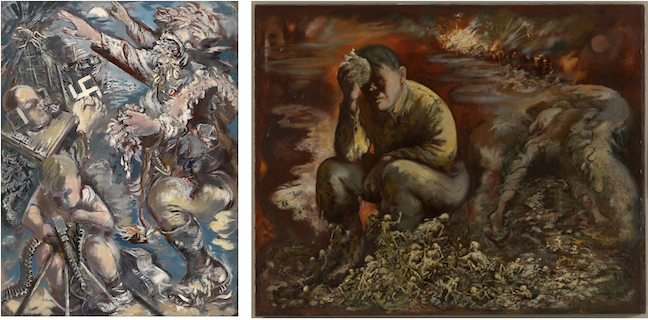
…and when war raged in his homeland, Grosz returned to chronicling the perversity of the Nazi regime…

HORRORS REALIZED…Grosz’s God of War (at left, from 1940) and his 1944 oil on canvas, Cain or Hitler in Hell. (David Nolan New York)

 *  *  *

Bluenose Blues

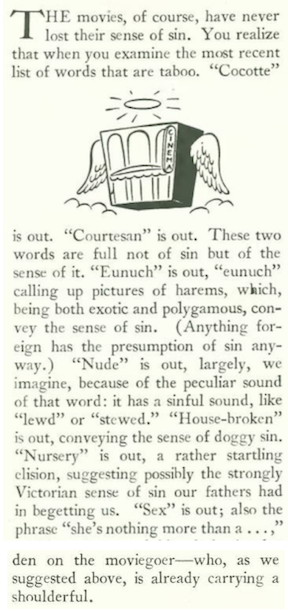
Sadly, we are moving toward the end of the pre-Code era, and as E.B. White explained in “Notes and Comment,” the talkies were about to get a bit less talkative:

AW HECK…Dorothy Mackaill portrayed a secretary-turned-prostitute in the 1931 pre-Code Hollywood film Safe in Hell. The days were numbered for the brief period in Hollywood (roughly 1929–34) when films featured “adult” themes including sexual innuendo, mild profanity, and depictions of drug use, promiscuity and prostitution. (IMDB)

 *  *  *

From Our Advertisers

We begin with the back pages, and the latest in entertainment on Broadway…

…the makers of Cadillacs continued to promote the snob appeal of their 12- and 16-cylinder automobiles…it appears these folks are leaving an Easter service (note the doves), but whatever went on in there, they don’t seem very moved by the spirit…

…and here’s a close-up of the ad’s opening lines that suggested Cadillacs are an ideal complement to the apparel of those strutting their stuff on the Easter Parade…

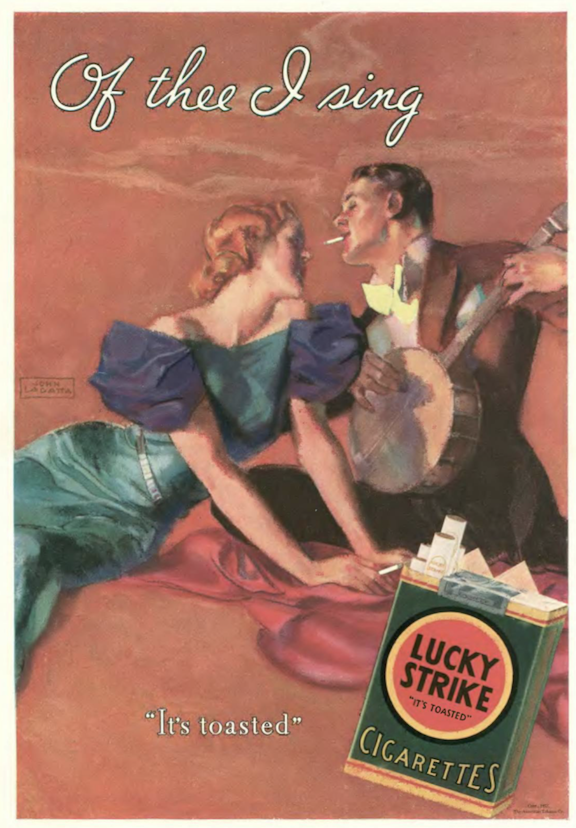
…and here’s a jolly rendering for Lucky Strike by advertising illustrator John LaGatta (1894–1977)…his work was seen in many ads and in magazines during the first half of the 20th century, including twenty-two Saturday Evening Post covers…LaGatta’s style was known for its cool elegance, but I have to say this image is a bit disturbing, given that the banjo player’s cigarette is just inches from the woman’s eyeball…

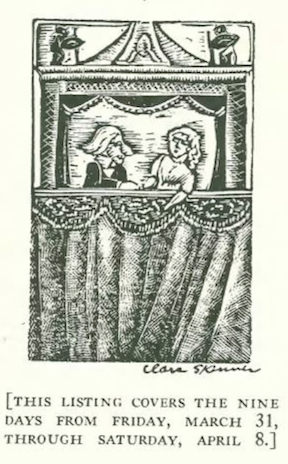
…on to our cartoonists, we have a rare appearance by Clara Skinner (1902–1976), showing us here in the “Goings On About Town” section that John Held Jr wasn’t the only one making woodcuts…

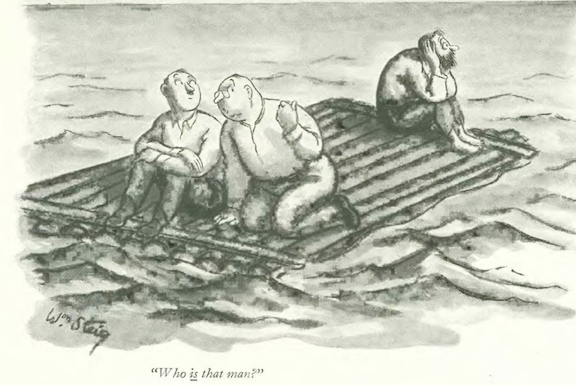
William Steig was lost at sea…

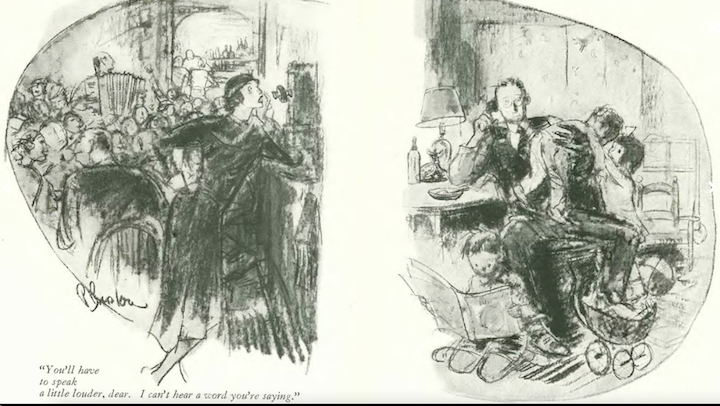
Perry Barlow gave us this split scene (across two pages) of the challenges of mixing domestic and non-domestic life…

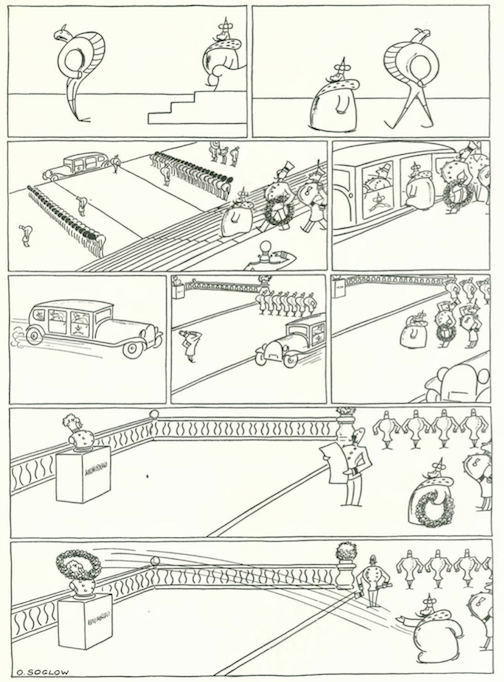
Otto Soglow continued to chronicle the adventures of his popular Little King…

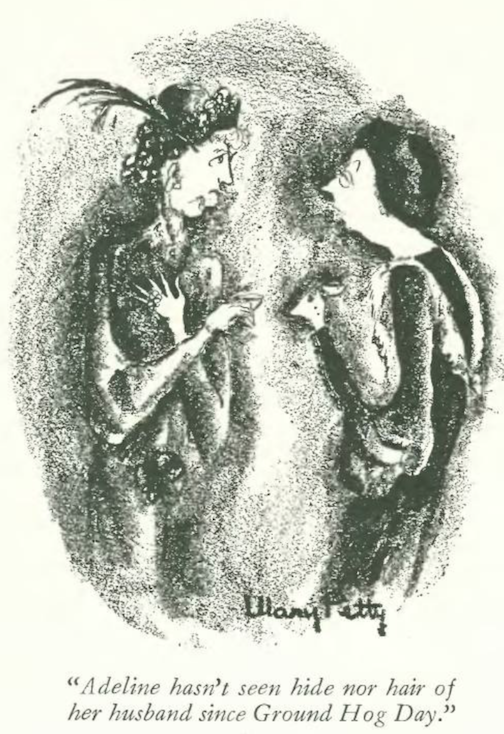
…we haven’t seen Mary Petty in awhile, so here’s a bit of gossip…

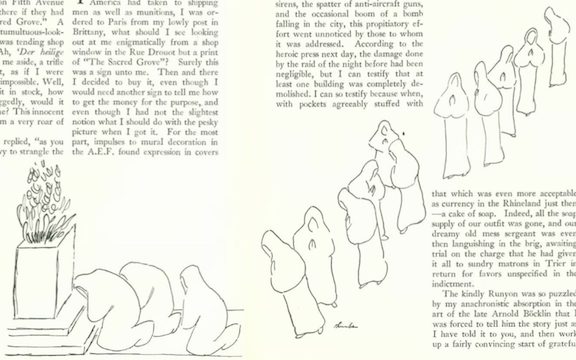
James Thurber used a rare two-page spread of Alexander Woollcott’s “Shouts and Murmurs,” to lay out this unusual illustration…

…and Thurber again, in a more familiar vein…

…we move on April 8, 1933…

April 8, 1933 cover by Adolph K. Kronengold.

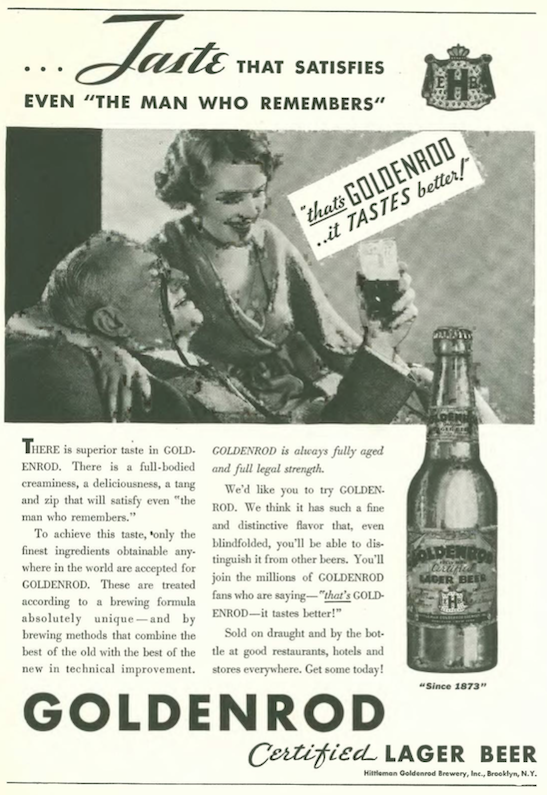
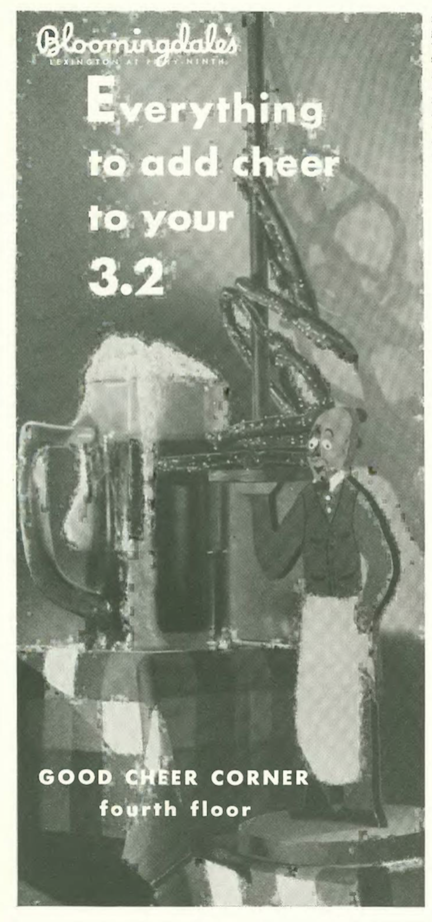
…and go straight to advertisers who were responding to the March 22 signing of the Beer and Wine Revenue Act by Franklin D. Roosevelt…the Congressional action made it permissible to sell beer as long as it was less than 3.2% alcohol…

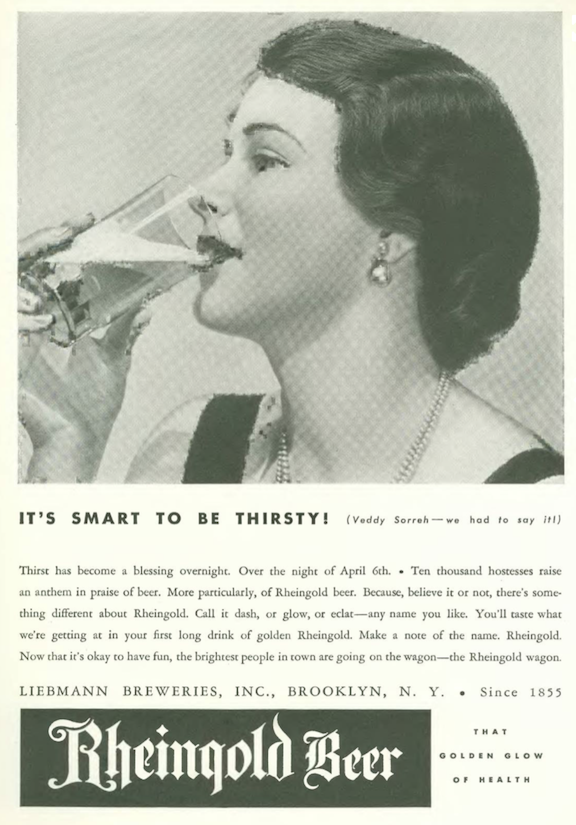
…the makers of Rheingold beer came out of the gates with this ad showing that even elegant women could enjoy this taste of freedom…

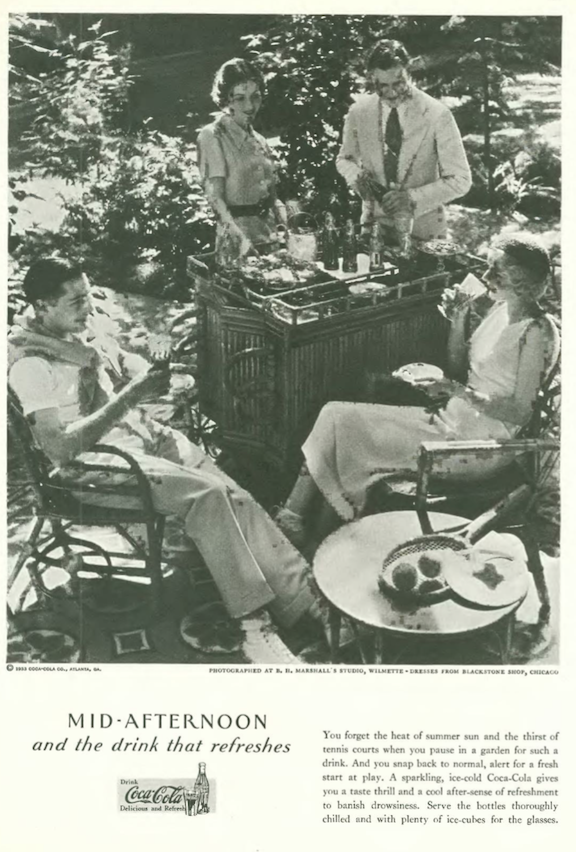
…not completely sure, but I believe this was the first ad for Coca-Cola to appear in The New Yorker

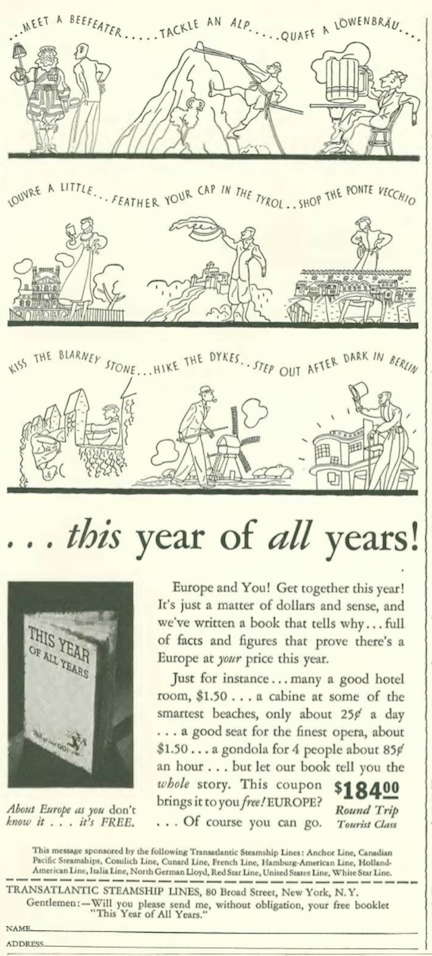
…in those tough times the steamship lines were beginning to realize they needed to appeal to the thrifty as well as the posh…

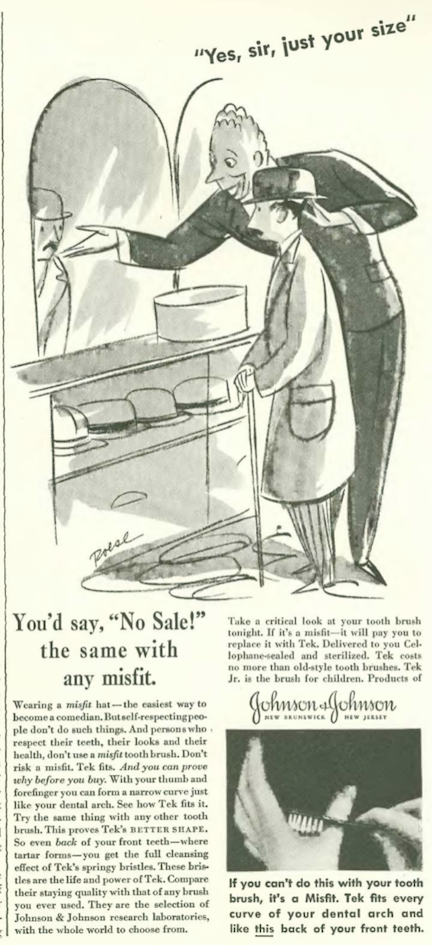
…Illustrator Herbert Roese offered up this Arno-esque gag for Johnson & Joshnson…

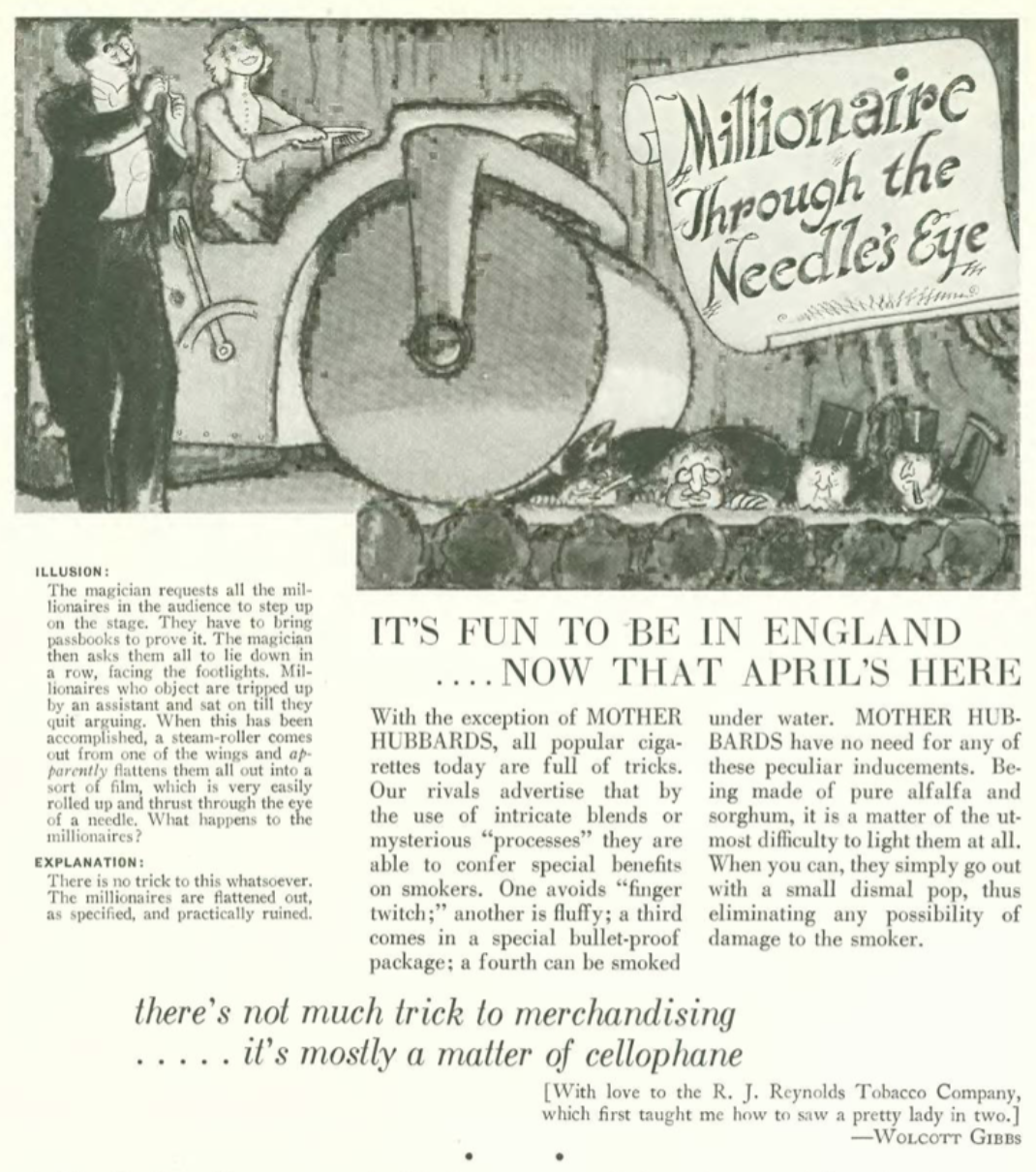
…on to our cartoons, we begin with this Peter Arno spoof of a series of R.J. Reynold’s Camel ads that referenced various magic tricks…

…in the same issue, just 20 pages later (p. 48) appeared one of the actual Camel ads…proof that Harold Ross would never kowtow to the advertising department—with the exception of those yeast ads for his friend and benefactor Raoul Fleischmann, who kept the magazine afloat in the early, lean years…

…we have more James Thurber, who kicked off the April 8 issue…

…and offered more hijinks inside…

William Steig gave us this strip captioned “The Spicy Story” which ran across the bottom of pages 26-27…

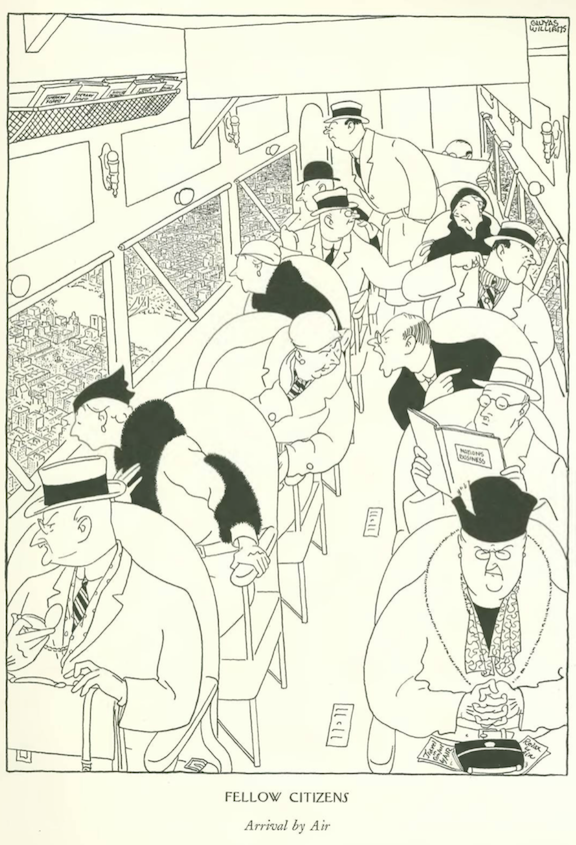
Gluyas Williams continued to hang out with his fellow citizens, this time in the skies above Manhattan…

Daniel ‘Alain’ Brustlein showed us one cabbie’s reaction to the cheap ways of the posh crowd…

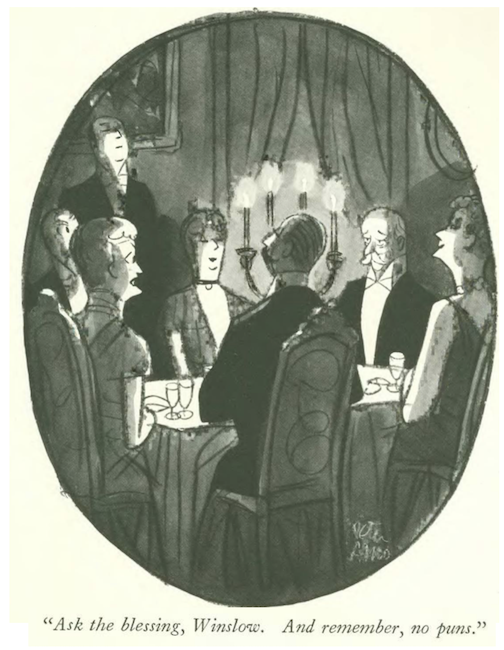
…and we end by saying grace, with Peter Arno

Next Time: Beer Thirty…

Diary of a Lady

It was no surprise Dorothy Parker did not think much of society types, especially those afflicted with extreme solipsism.

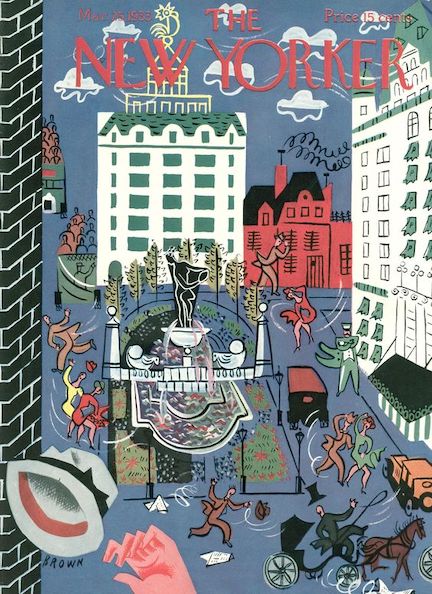
March 25, 1933 cover by Harry Brown.

Parker’s “The Diary of a Lady,” briefly excerpted here, featured entries from a diary of a fictional socialite who constantly bemoaned the minor inconveniences of her shallow existence, oblivious to the world around her.

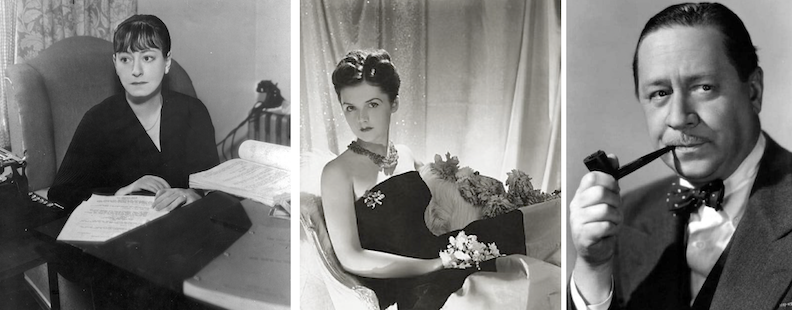
YOU POOR THING…Dorothy Parker (left) took a dim view of the lives of “poor little rich girls” like socialite Brenda Frazier (who had a tempestuous relationship with New Yorker cartoonist Peter Arno); Robert Benchley, on the other hand, took a more jolly view of human absurdity. (britannica.com/Wikipedia/theattic.space)

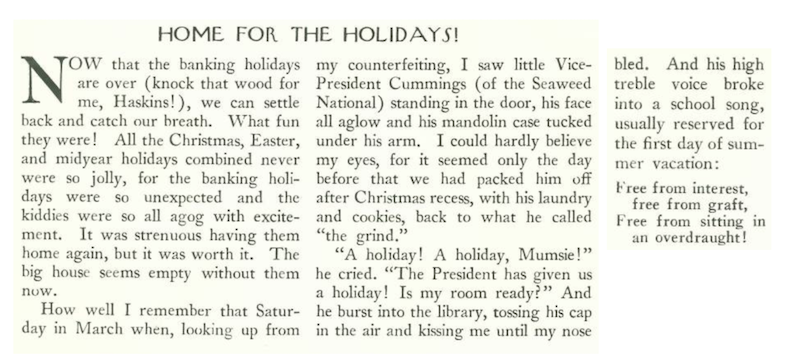
In contrast to Parker, Robert Benchley’s satire was usually more on the silly side, with a lot less bite. Here is an excerpt from “Home for the Holidays” (which immediately followed Parker’s piece in the magazine), in which Benchley describes the festive mood of one family during FDR’s “bank holiday”…

 *  *  *

On the Lighter Side

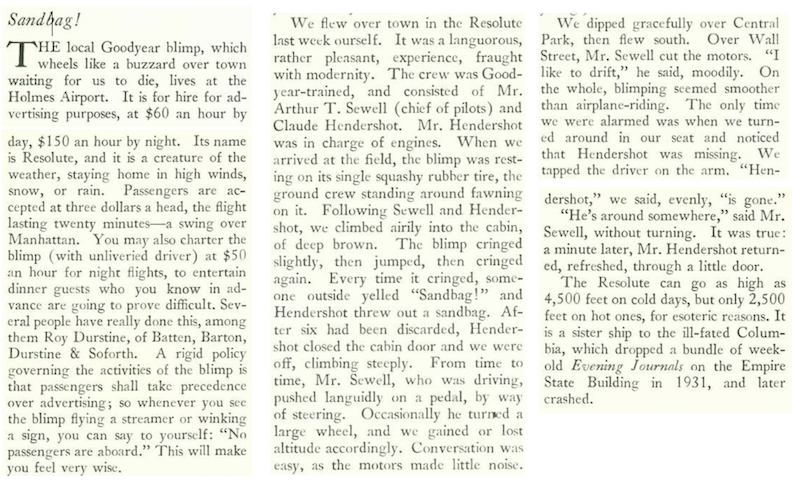
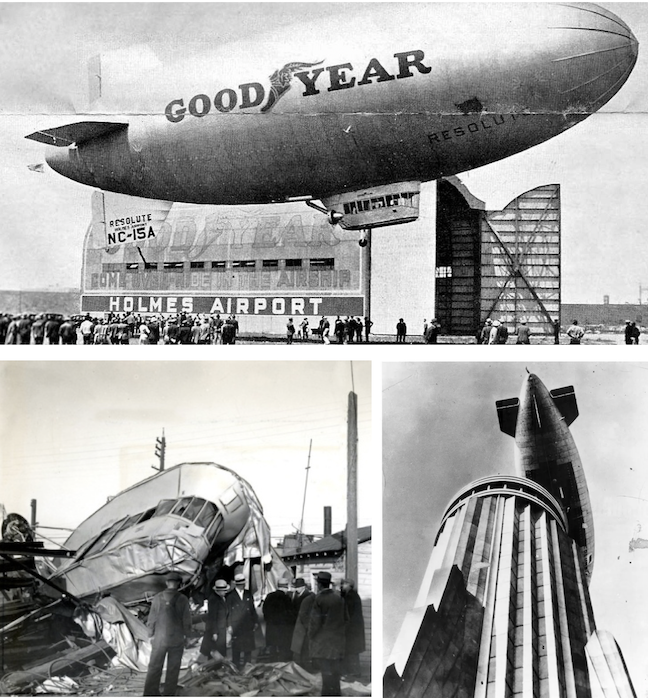
E.B. White was the unofficial aviation correspondent for The New Yorker, ever eager to go aloft in the latest contraption. In this excerpted “Talk of the Town” entry White described his adventures aboard the Goodyear blimp Resolute:

WHAT A GAS…Top photo, the Resolute at its home base, Holmes Airport (in Jackson Heights, L.I.), where E.B. White boarded his flight. As White noted, Resolute was a sister ship to kathrynsreport.com/New York Times)

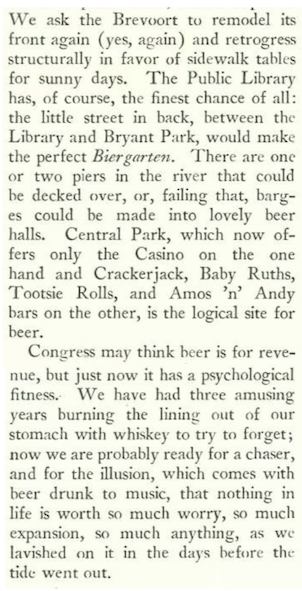
And we turn again to White, this time an excerpt from his “Notes and Comment” celebrating Franklin D. Roosevelt’s planned amendment to the Volstead Act that would allow people to have a legal beer while they waited for the 21st Amendment to be ratified. White had a couple of ideas regarding locations for beer gardens. An excerpt:

BEER THIRTY…E.B. White believed the front of the internationally famous Brevoort Hotel (next to the Mark Twain House at the southeast corner of Fifth Avenue and 9th Street) would be an ideal spot to quaff some suds. Alas, the hotel (and the Twain house) fell to the wrecking ball in 1952, replaced by the Brevoort apartments (right). (MCNY/streetwise.com)

Although the Brevoort idea didn’t pan out, White did get his wish, more or less, for a Bryant Park location, the Bryant Park Grill…

(bryantpark.org)

 *  *  *

Mayor McCarthy

The profile featured Stitch McCarthy, considered one the most flamboyant “street mayors” of the Lower East Side. Writing in Lapham’s Quarterly (Aug. 1, 2018), Laurie Gwen Shapiro describes McCarthy as “a five-foot-tall, cross-eyed Romanian Jew born Samuel Rothberg, always seen with a cigar in his mouth.” What Stitch lacked in height he made up for in toughness, and by his teens was as tough as nails. Shapiro writes: “At night he managed a small-time boxer who once was scheduled to fight a bantamweight named Stitch McCartney in Jersey City. As he later told the story (no doubt over and over), his client fled in fear at the sight of McCartney and the crowd booed. He went in the ring himself, flattened McCartney, and took a version of his opponent’s name for his own.”

The profile was written by Meyer Berger, known as a master of the human interest story. Berger did a short stint at The New Yorker but for most of his career he worked for The New York Times, where he wrote a long-running column, “About New York.” Here is a very brief excerpt of the profile, with a caricature by Al Frueh.

TOUGH AS NAILS was what you became if you wanted to be one of the unofficial mayors of the Lower East Side like Stitch McCarthy, seen here in 1931. According to Laurie Gwen Shapiro, street mayors “were likable fixers who cut through red tape and might settle between fifteen and twenty neighborhood disputes a day.” Photo at left (by Berenice Abbott) is a scene from McCathy’s world—Hester Street, between Allen and Orchard Streets. (New York Public Library/Lapham’s Quarterly)

 *  *  *

From Our Advertisers

I would guess Dorothy Parker would have some problems with this ad, featuring society women shilling for nail polish…

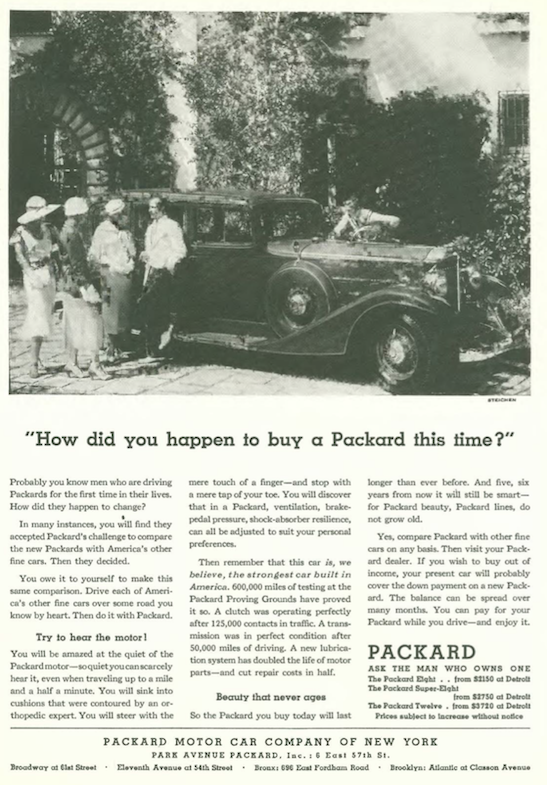
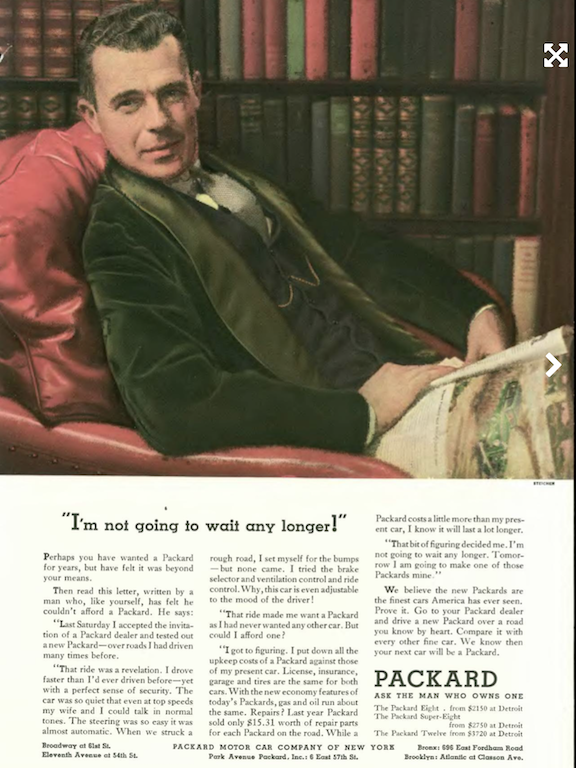
…the folks at Packard went with an ad that showed the ideal customer (seated in a library, clad in smoking jacket), contemplating one of their recent ads (the same one that was featured in the Feb. 18, 1933 issue of The New Yorker

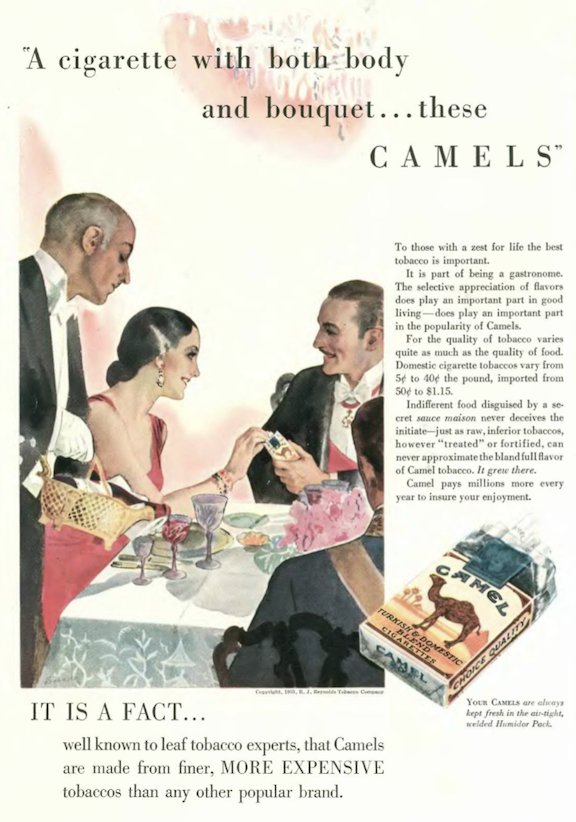
…Camel ads took on a new look thanks to the artistry of Ray Prohaska (1901–1981)…in the early 1930’s you see more use of watercolors in ads for fashion, or in this case, cigarettes…

…and Gardner Rea drew up this scene for the makers of Sanka coffee, the decaf of its day…

…which leads into the work of other New Yorker cartoonists and another master of the line drawing, Gluyas Williams

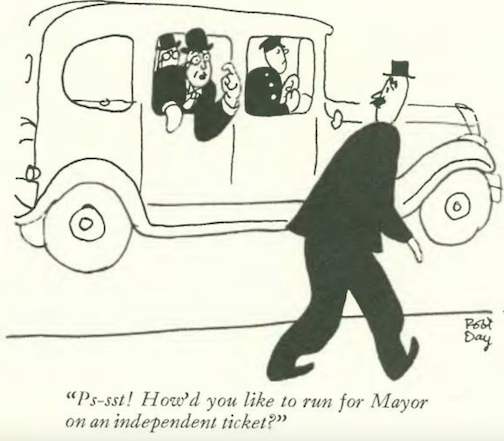
Robert Day offered a bit of understatement…

Carl Rose celebrated the arrival of legal beer…

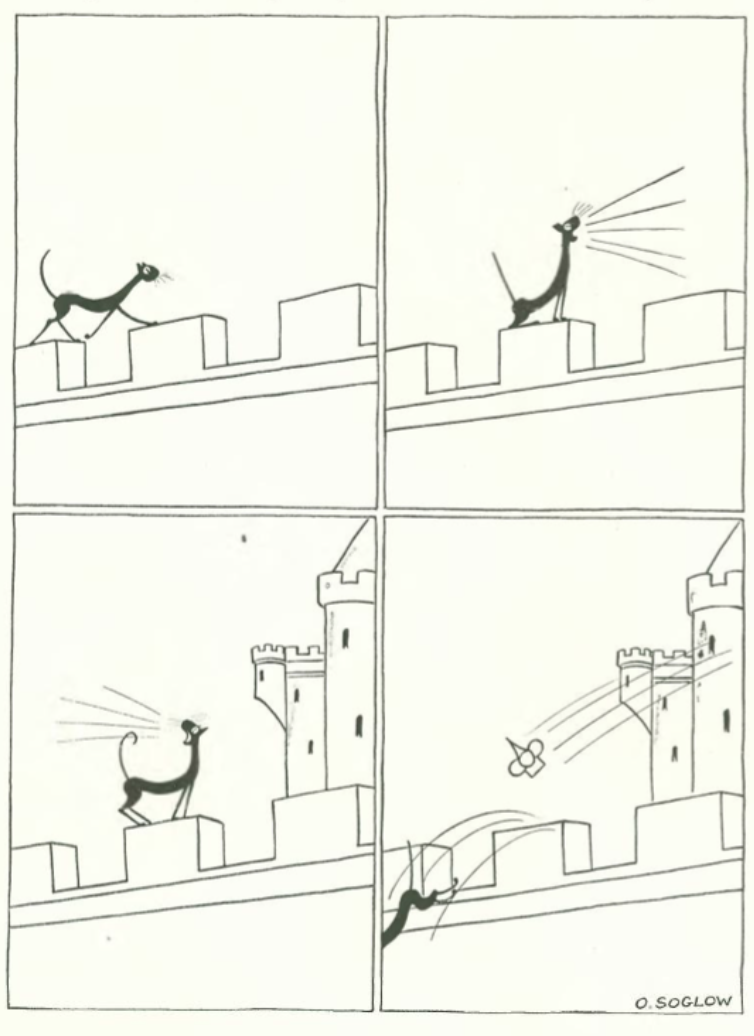
Otto Soglow showed us how royalty responds to a noisy feline…

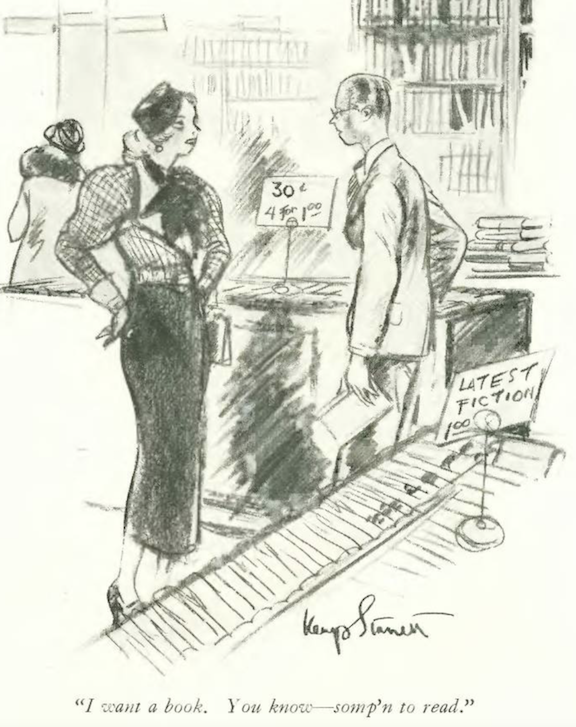
Kemp Starrett shopped for somp’n to read…

…and we close with Peter Arno, and an ill-timed joke, at least for one woman…

Next Time: Stormy Bellwether…

Not Even Funny

There were a number of people Dorothy Parker couldn’t abide. That included gifted writers who not only eschewed serious literature, but who instead chose to crank out a lot of mass-market trash.

March 18, 1933 cover by William Steig.

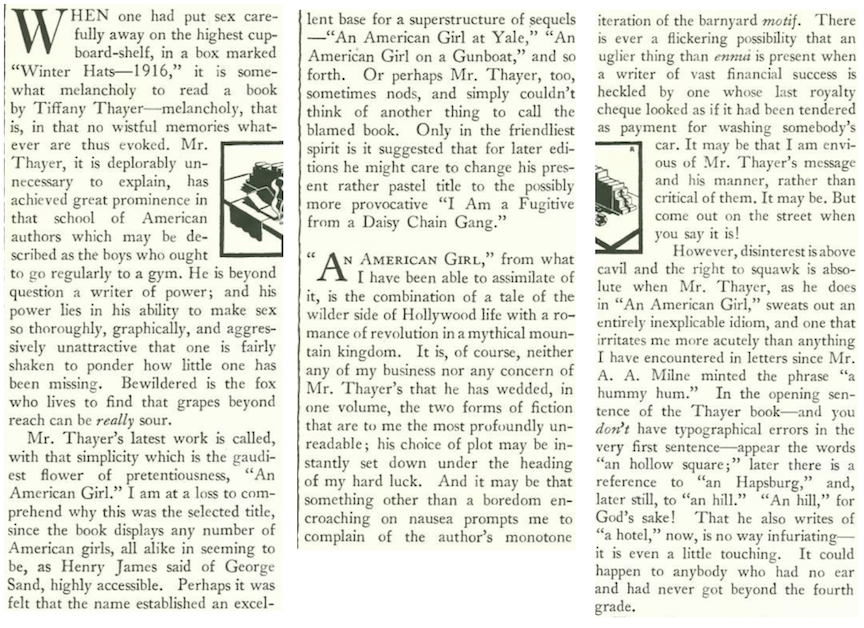
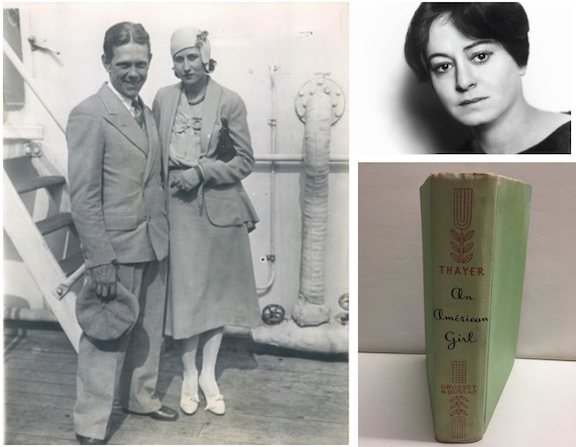
Parker was well acquainted with Tiffany Ellsworth Thayer (1902–1959), and for a time she even associated with the Fortean Society, which Thayer founded in 1931. Inspired by writer Charles Fort, the Forteans promoted the use of scientific methods to evaluate unexplained phenomena such as UFOs, spontaneous human combustion, and other oddities. Parker and fellow New Yorker writers Ben Hecht and Alexander Woollcott were among founding members, doubtless drawn to Fort’s reputation as a skeptic; however one famous skeptic, journalist H.L. Mencken, called Fort’s ideas “Bohemian mush.” It’s hard to say how long Parker stayed connected to the Society, but by 1933 she was fed up with Thayer’s novels, including his latest, An American Girl, which she found to be “the gaudiest flower of pretentiousness.” Here is an excerpt from Parker’s sometime column, “Reading and Writing,” subtitled Not Even Funny…

TIFF WITH TIFFANY…At left, Tiffany Thayer aboard a cruise ship with an unidentified woman, most likely his first wife, a dancer named Tanagra, early 1930s; at right, Dorothy Parker and a first edition of the offending volume. In her review, Parker observed that Taylor “is beyond question a writer of power; and his power lies in his ability to make sex so thoroughly, graphically, and aggressively unattractive that one is fairly shaken to ponder how little one has been missing.” (IMDB/Worthpoint)

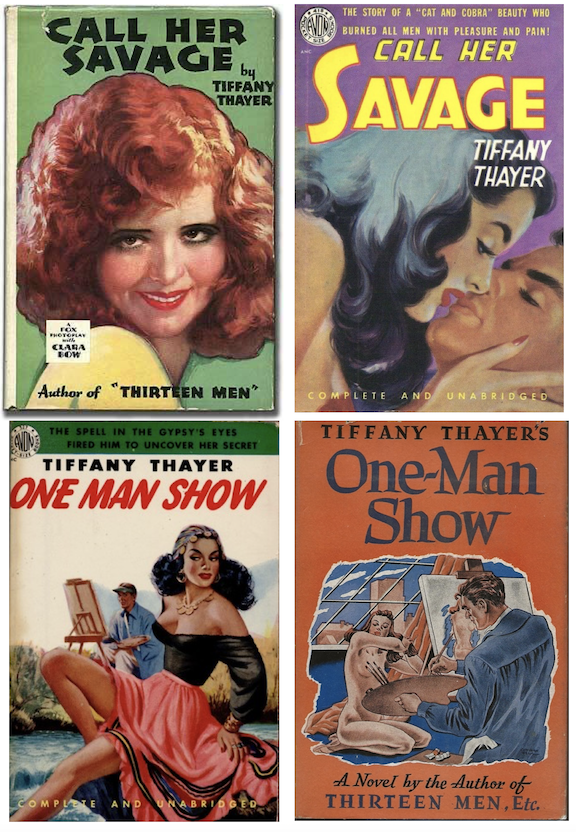
Although Thayer founded a society based on scientific reason, his pulp novels were filled with fantasy and prurient imagery. F. Scott Fitzgerald once observed that “curious children nosed at the slime of Mr. Tiffany Thayer in the drug-store libraries.”

BELIED LETTRES…Clockwise from top left, Thayer’s 1931 novel Call Her Savage was made into a 1932 film starring Clara Bow, here featured on the book’s dustcover; the same novel repackaged in 1952 for the pulp trade; a 1943 edition of Thayer’s One-Man Show, and a 1951 Avon reprint that toned down the nudity but upped the creep factor. (facebook.com/biblio.com)

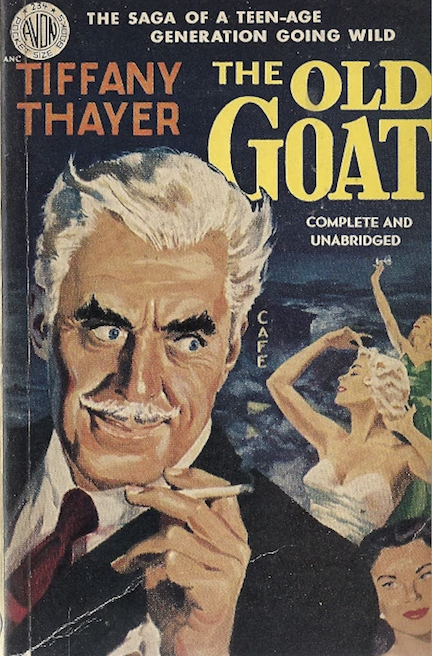
…and speaking of creep factor, check out Avon’s 1950 re-issue of Thayer’s 1937 novel The Old Goat, illustration attributed to Edgar Lyle Justis

(biblio.com)

Artists like Justis must have had a ball doing these illustrations, creating images to lure the unsuspecting into purchasing these old titles. Note how the coked-up old man sports not-so-subtle devil horns.

*  *  *

They Called It a Holiday

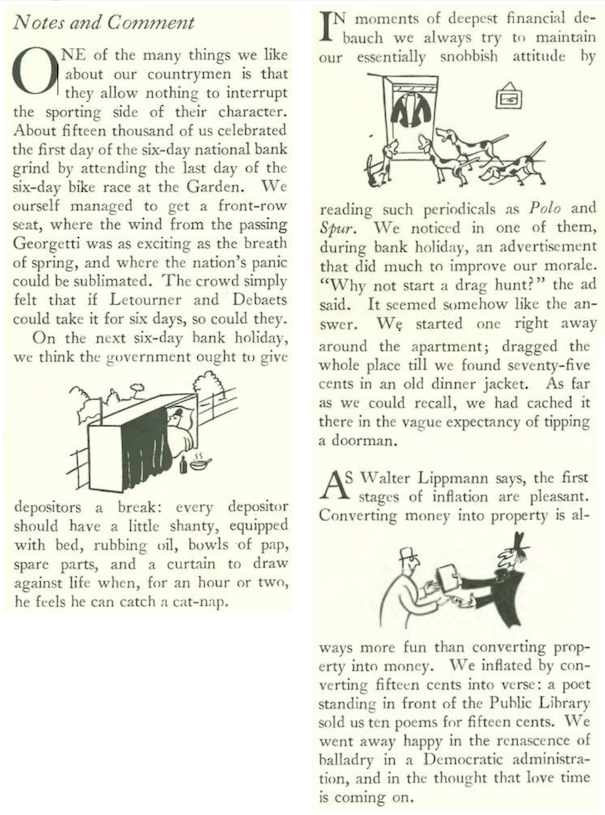
E.B. White, James Thurber (see below) and others in the March 18 issue commented on the national banking “holiday” declared by President Franklin D. Roosevelt in an effort to stabilize America’s banking system and rebuild public confidence. This led to the Glass-Steagall Act, signed three months later by FDR. Some observations in “Notes and Comment” by E.B. White, with the usual great spot illustrations by Otto Soglow

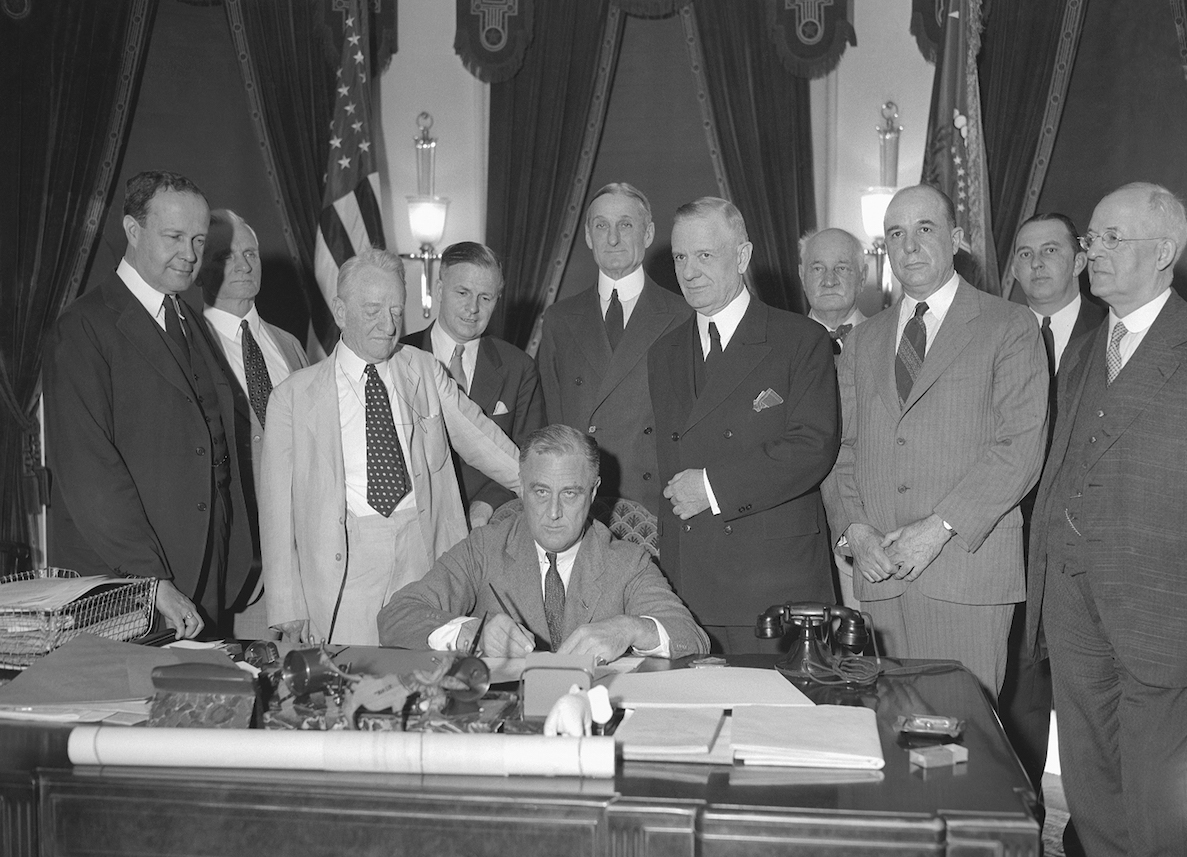
SAY CHEESE!…President Franklin D. Roosevelt signs the Glass-Steagall Act on June 16, 1933, effectively separating commercial banking from investment banking and creating the Federal Deposit Insurance Corporation (FDIC), among other things. (Associated Press)

…meanwhile, Germany’s new chancellor, Adolf Hitler, was busy abolishing civil liberties while pretending to be distressed by the behavior of his brownshirt thugs…an excerpt from Howard Brubaker’s “Of All Things”…

*  *  *

A Familiar Ring

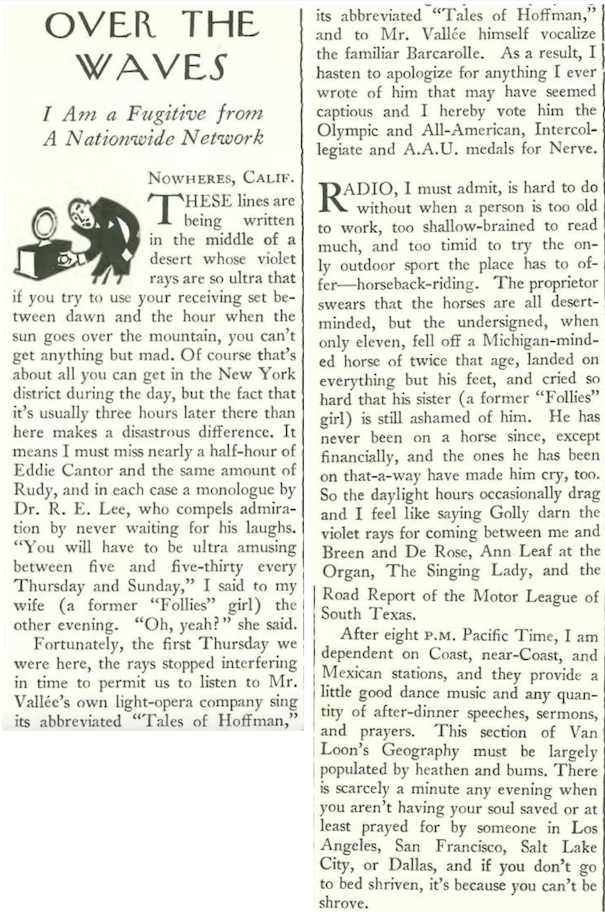
For the second week in a row Ring Lardner lent his wit to The New Yorker’s “Over the Waves,” column, which typically reviewed the latest news and entertainment beamed from the radio tower atop the Empire State Building. Lardner, however, was in California, lamenting the challenges of the time lag. An excerpt:

AND NO WI-FI, EITHER…Ring Lardner (center) detailed the frustrations of listening to New York-based radio entertainers like Eddie Cantor (left) and Rudy Vallée during his stay in California. (Pinterest/The Classic Archives/The New York Times)

 *  *  *

Dance Away Those Blues

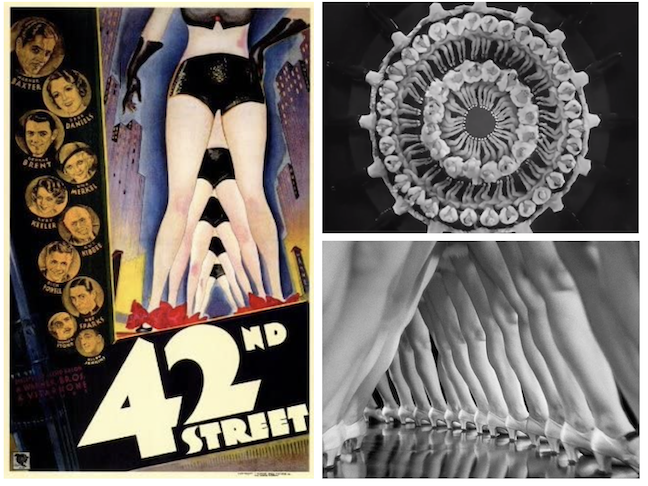
The pre-Code musical 42nd Street received a brief, albeit mostly positive review from critic John Mosher, who along with the producers of the film knew Depression-weary Americans needed such distractions. Nearly 90 years later (April 10, 2020), another New Yorker film critic, Richard Brody, suggested 42nd Street as one of the best films to stream during the Covid-19 pandemic: “Modern musicals start here, and Busby Berkeley’s genius bursts into full flower,” he wrote.

DANCE ‘TIL YOU DROP…Under pressure to produce a hit after losing his lead dancer (Bebe Daniels) to a broken ankle, Broadway musical director Julian Marsh (Warner Baxter, center) mercilessly rehearses her replacement, Peggy Sawyer (Ruby Keeler, in her film debut) before the premiere, vowing “I’ll either have a live leading lady or a dead chorus girl.” Looking on (to the right of Baxter) is Ginger Rogers, who portrayed “Anytime Annie.” (tcm.com)
A LEG UP ON HIS CAREER…42nd Street was a breakthrough film for choreographer Busby Berkeley, who would direct and choreograph a long string of musicals until the 1960s. The film is now considered a classic, preserved in the United States National Film Registry. (IMDB)

…and for trivia buffs, during an opening scene Bebe Daniels is shown reading the February 20, 1932 (anniversary) issue of The New Yorker…

*  *  *

From Our Advertisers

A convertible LaSalle (a downscale Cadillac brand) looks like a great way to enjoy a drive along the beach…let’s hope it has enough acceleration to outrun the tsunami apparently heading its way…

Walter Chrysler continued to dig into his deep pockets for two-page color spreads, including this one that placed his humble DeSoto in St. Moritz, of all places…

…not to be outdone, the folks at Nash found another exotic locale for their budget-priced sedan…Chicago, that is, at the 1933 Century of Progress Exhibition…and for an extra touch of class, we have what appears to be a chauffeur attending to this modest motorcar…

…America’s top luxury car maker, Pierce Arrow — a regular advertiser in The New Yorker — decided a quarter-page ad was sufficient to keep their name before the eyes of the well-heeled…at right, an ad from another back page featured cartoonist Don Herold shilling for the makers of imitation liquor flavors…according to the ad, one bottle, obtainable from your druggist, “flavors a gallon” of whatever forsaken hootch you are consuming…

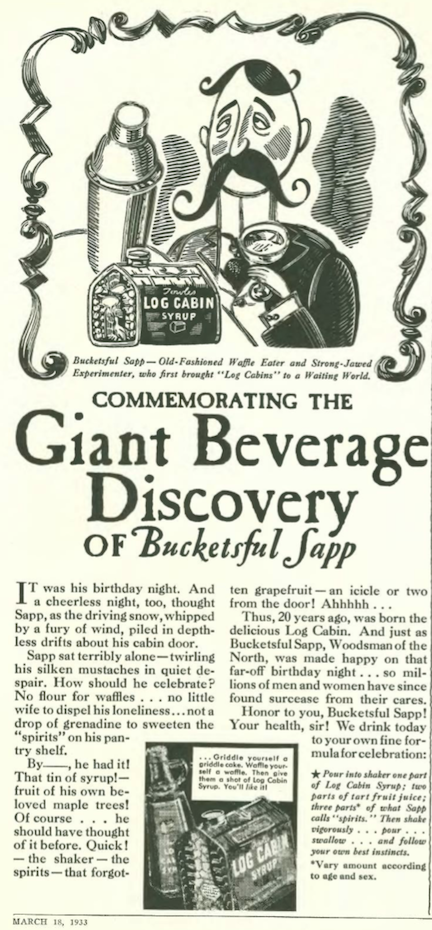
…the folks at Log Cabin relied on the talents of another New Yorker cartoonist, John Held Jr., to make both their product and a signature cocktail a more palatable experience…

…I have to hand it to the folks at Heinz for signing off on an advertisement only a vampire would find appealing…

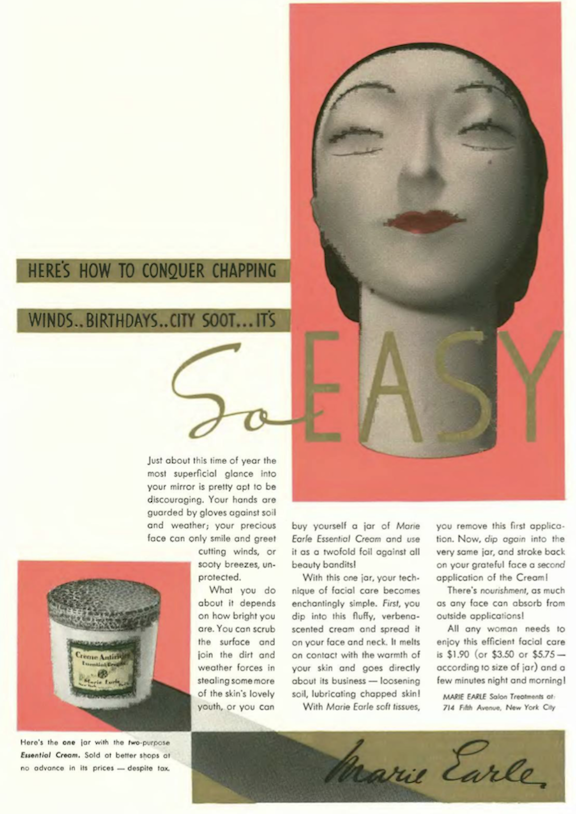
…the purveyors of Marie Earle beauty products rolled out this modern ad to promote their “Essential Cream”…

…while staid Brooks Brothers remained true to form — no flashy colors or advertising jargon — just straight talk about price increases….

…and then there’s the upmarket Fortnum & Mason, appealing to America’s Anglophiles with one of their famed wicker hampers filled with various goodies selected for “charming and greedy people”…

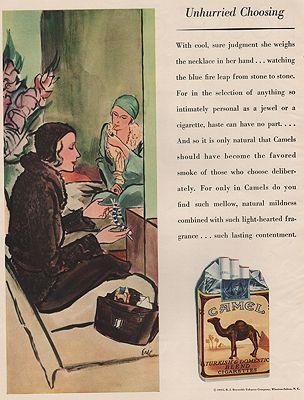
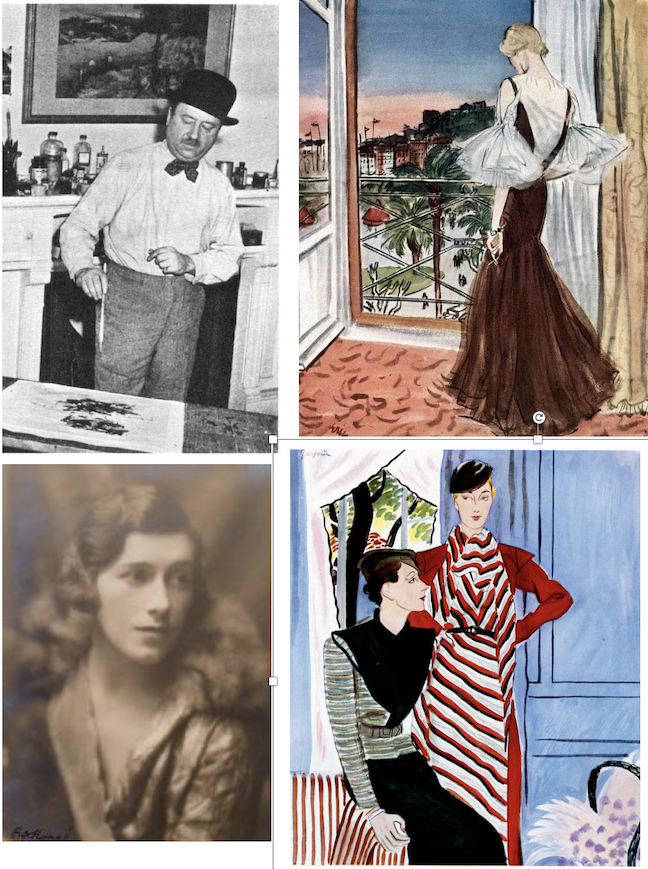
….for several years R.J. Reynolds employed the services of Carl “Eric” Erickson (1891–1958) to illustrate a series of ads featuring classy, disinterested, continental types smoking their Camel brand cigarettes…despite their less-than-exotic name, the makers of Spud menthol cigarettes hired Ruth Sigrid Grafstrom (1905–1986) to create their own smart set of smokers…

…ads that bore a striking resemblance to Erickson’s Camel work (this example from 1931)…

…and for your consideration, works from 1933 by Carl Erickson and Ruth Sigrid Grafstrom…both were noted fashion illustrators…

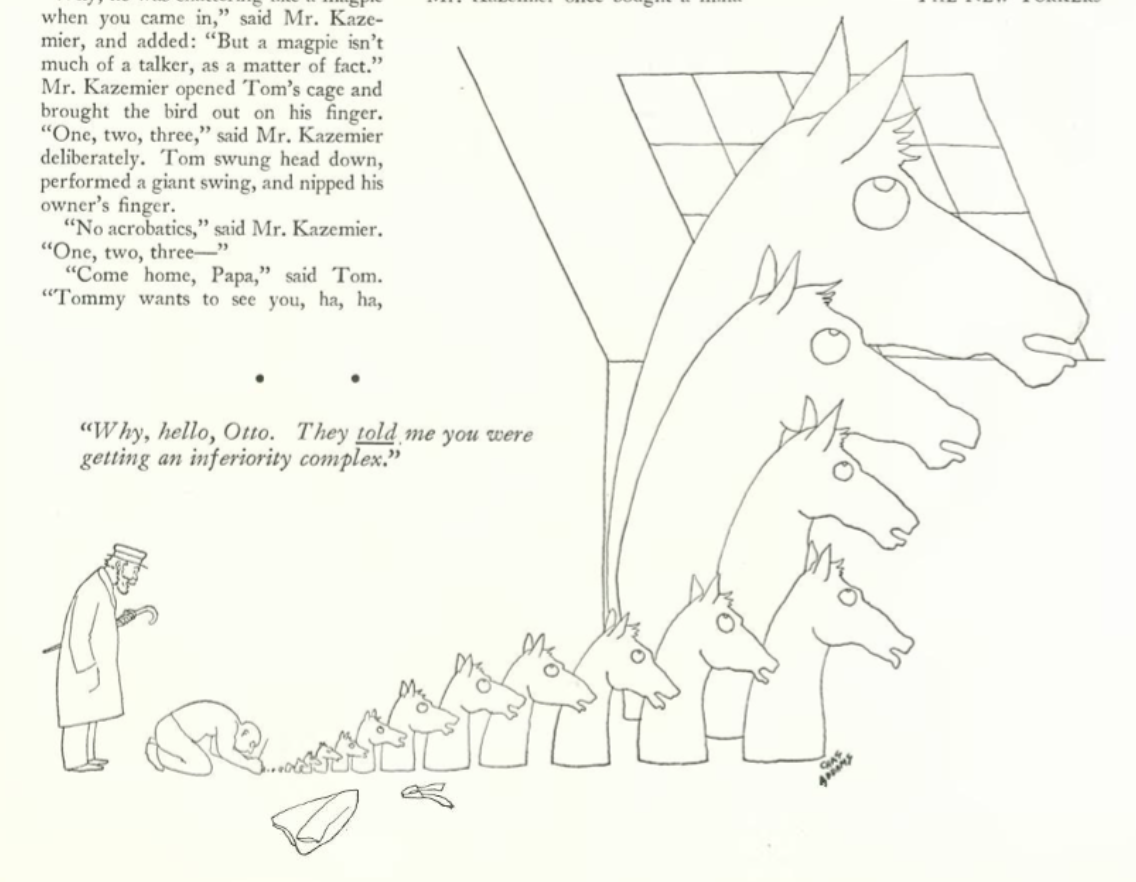
…on to our cartoonists, we begin with Charles Addams, who’d just published his first New Yorker cartoon the previous month, in the Feb. 4, 1933 issue

…that first cartoon was simply signed “Addams”…here he used the familiar “Chas Addams”…a close-up of the signature…

…we continue with a great caricature by Al Frueh to accompany a profile of Rudolf Kommer (as told by Alexander Woollcott)…

…a delightful full page of bank holiday-themed cartoons by James Thurber

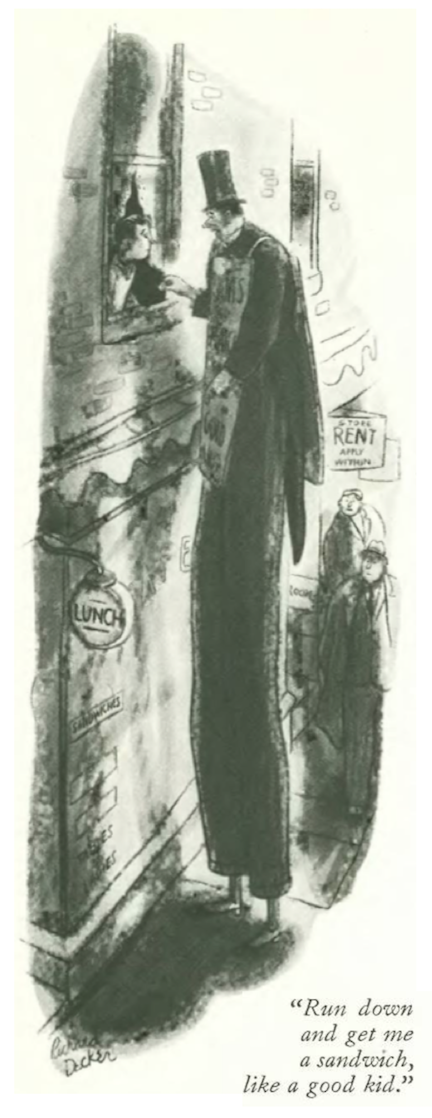
Richard Decker offered up a tall tale…

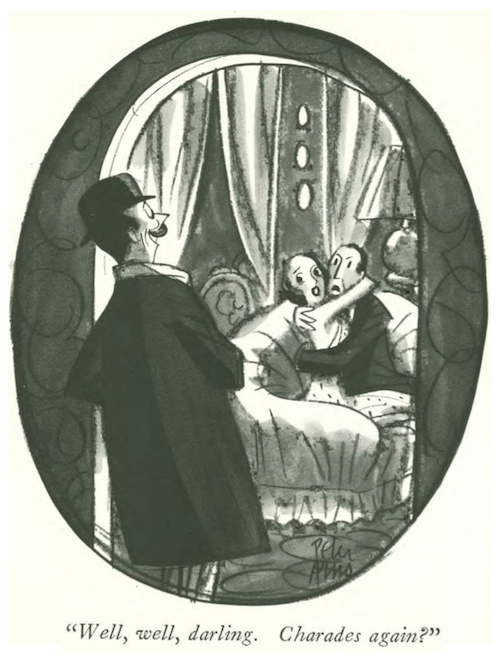
…and we close with Peter Arno, who served up one of his clueless cuckolds…

Next Time: Diary of a Lady…


Deskey’s Deco

Above, Donald Deskey's Design for a Sportshack, 1940 (Cooper Hewitt)

If you’ve never heard of Donald Deskey, you’ve most likely seen his work.

Feb. 25, 1933 cover by Rea Irvin.

Cultural critic Gilbert Seldes featured Deskey in the Feb. 25 profile (“The Long Road to Roxy” — with illustration by Al Frueh), noting that his subject had come to his profession as an industrial designer in a rather roundabout fashion. Here is a brief excerpt:

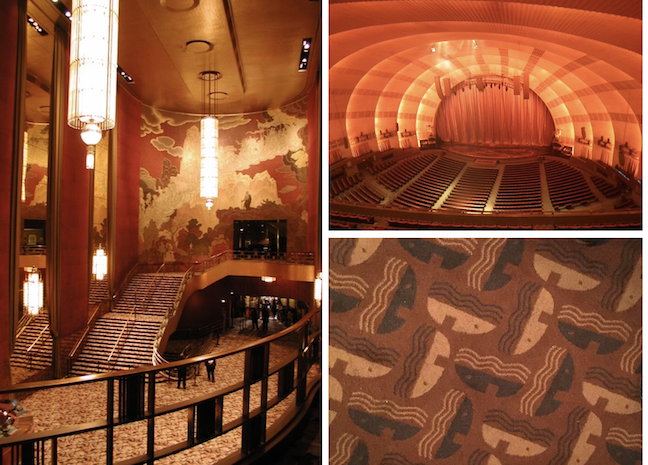
Deskey (1894–1989) was locally known in the late 1920s for his window displays at New York’s Franklin Simon Department Store, but it was his work at Roxy Rothafel’s new Radio City Music Hall that made him a marquee name in the design world. Although known for popularizing the Art Deco style, his interior designs for RCMH were noted for their restraint, signaling a break from the lavish, ornate designs of the city’s earlier performance spaces.

FEAST FOR THE EYES…Donald Deskey designed more than thirty spaces in Radio City Music Hall, including the Grand Foyer (left) and several lounges, each featuring a distinct visual motif. At bottom right, auditorium’s “Singing Woman” carpeting. (archdaily.com/drivingfordeco.com)

Original Deskey creations are highly prized today by collectors and museums…

DESIGN IN MOTION…Clockwise, from top left, Deskey’s “Guest Bedroom for Mrs. John D. Rockefeller, Jr.” (Abby Aldrich Rockefeller), on display at the 1931 American Union of Decorative Artists exhibition; Deskey table lamp, circa 1927; linen panel, circa 1930s; Deskey desk, circa 1930. (brooklynmuseum.org/artic.edu/Pinterest)

…and if that wasn’t enough, Deskey also designed logos for many consumer products in the late 1940s and 1950s…

THE TOTAL PACKAGE…Deskey designed some of the most iconic logos of midcentury America, including, clockwise from top left, Tide laundry detergent (1947); Gleem (1956) and Crest (1955) toothpastes; Cheer laundry detergent (1952); JIF peanut butter (1956) and Joy dishwashing liquid (1950).

*  *  *

From Our Advertisers

It seems appropriate to follow Mr. Deskey with some words and images from our sponsors, including the folks at Cadillac who continued to hammer home the snob appeal of their motorcar while also giving a nod to those hard times by emphasizing the car’s economy

…meanwhile, Studebaker was back with another full page ad—again featuring the admiring giant woman—in a vain attempt to push their fledgling, and unpopular line of Rockne automobiles…

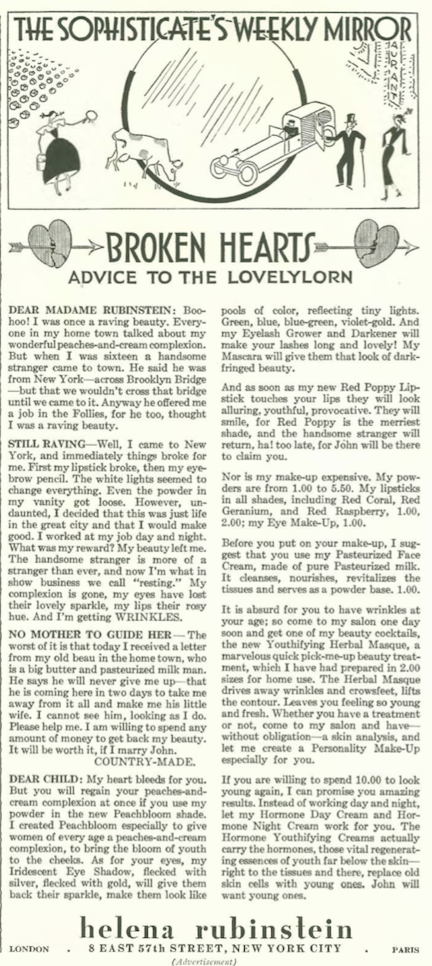
…and Helena Rubenstein continued her series of ads disguised as advice columns…the advice here was to shame women into buying her products…

…after Helena removed your wrinkles you could restore them with GE’s Mazda sunlight lamp…

Otto Soglow, on the brink of becoming a very wealthy man thanks to his Little King cartoons, continued to lay down some ink on behalf of the makers of Sanka decaf…

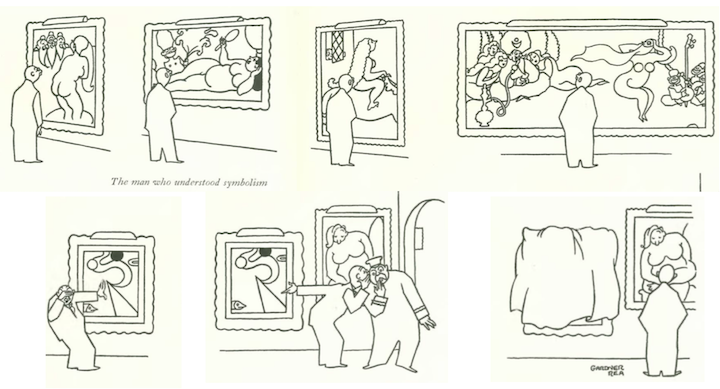
…and we move along to Soglow’s fellow cartoonists, beginning with Gardner Rea and a cartoon sequence spread across pages 24-25…

…here it is again, rearranged for closer inspection…

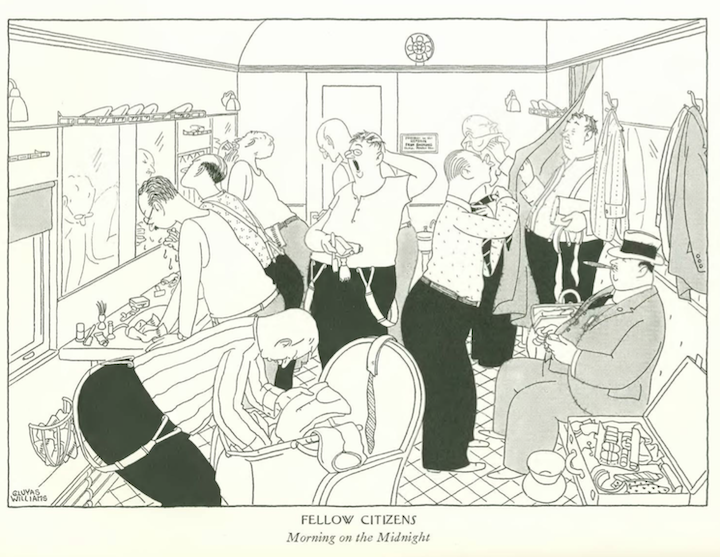
…and we have another terrific “Fellow Citizens” drawing by Gluyas Williams, which originally ran sideways on a full page…

…I like this James Thurber drawing for its utter disregard of scale—but of course (and thankfully) it wouldn’t be a Thurber if he cared about such things…

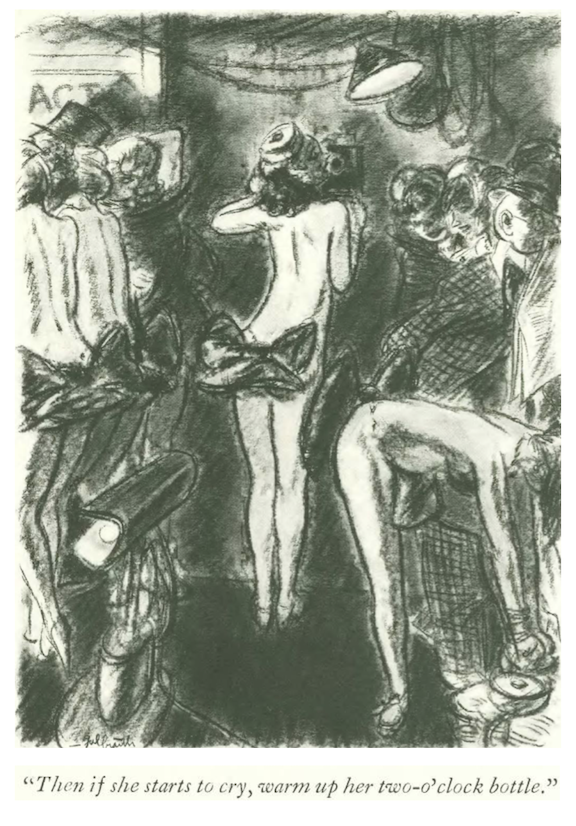
William Crawford Galbraith was still hung up on showgirls and sirens…

…while Peter Arno explored his spiritual side, as only Arno could…

…and we move along to March 4, 1933…

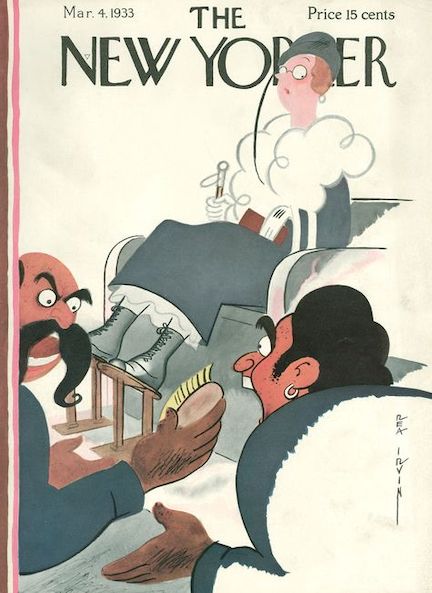
March 4, 1933 cover by Rea Irvin.

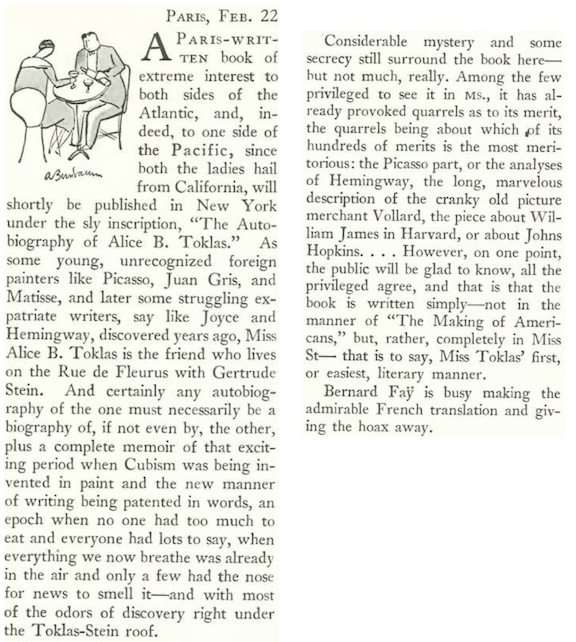
…in which The New Yorker’s Paris correspondent Janet Flanner (“Genêt”) wrote about a new book of “extreme interest to both sides of the Atlantic”…

BOOK OF REVELATION…Alice B. Toklas and Gertrude Stein were well known in the ex-pat community of 1920s Paris, but the publication of the American edition of The Autobiography of Alice B. Toklas (written by Stein) brought them fame in the wider world. Stein claimed she wrote the book — now considered a 20th century classic — in six weeks to amuse herself and to make money. At right, Toklas and Stein at 27 Rue de Fleurus in a portrait by Man Ray, 1922. (Library of Congress)

 *  *  *

Hope Springs Eternal

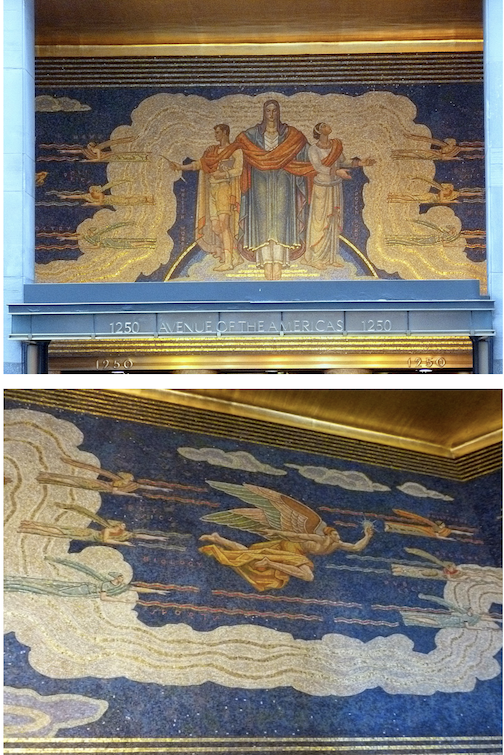
Even in the deepest depths of the Depression signs of hope abounded in works of public art, including a mosaic of one million hand-cut and hand-set glass tiles being prepared for the Sixth Avenue entrance to Rockefeller Center. Intelligence Awakening Mankind, by Barry Faulkner, celebrated the triumph of knowledge over the evil of ignorance. “The Talk of the Town” explained:

GOOD VIBES…Details of Intelligence Awakening Mankind include the central figure of Intelligence (top) sending knowledge into the far corners of the world. (Pinterest)

 *  *  *

From Our Advertisers

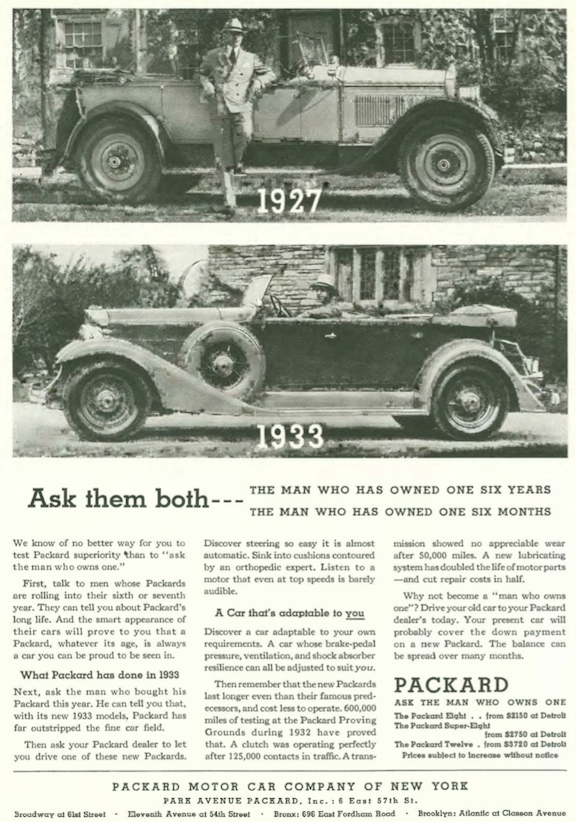
The folks at luxury brand Packard continued to counter their stodgy image with ads that emphasized other qualities including speed, durability, and here, serenity…despite the lengthy text, the ad also suggested modernity, with the sliced-off image and the single word “Hush!” to entice prospective buyers…

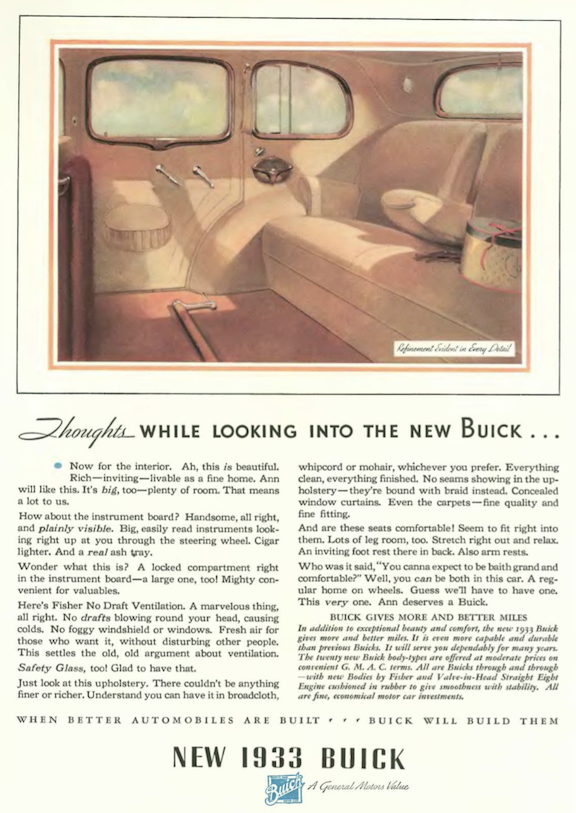
…if you couldn’t afford $3,720 for a 12-cylinder Packard, then you might have considered a Buick, “livable as a fine home” this ad claimed. And look at that back seat — you could comfortably fit three adults and a baby elephant in there…

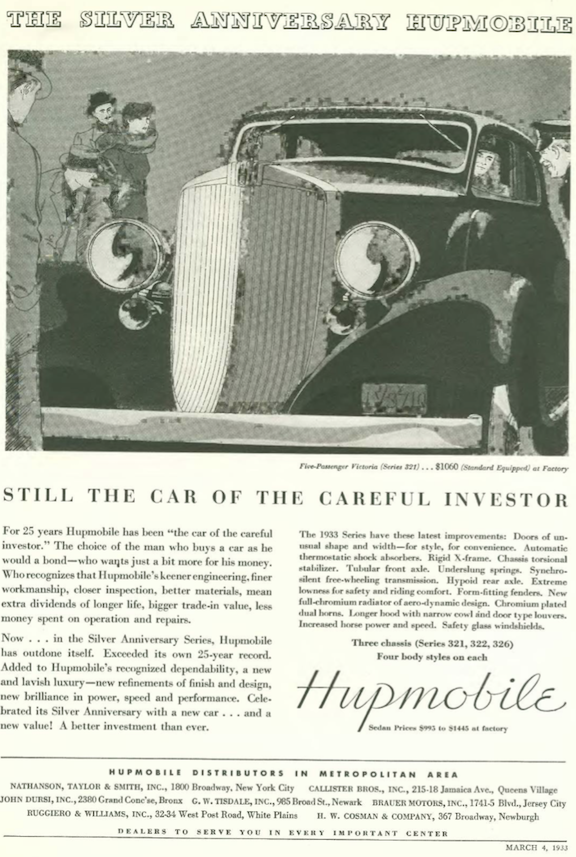
…and then there’s Hupmobile—for the price of a Packard 12 you could have purchased three Hupmobile Victorias (pictured below) with a good chunk of change left over…here the company celebrates its silver anniversary…a couple of odd facts: in 1914 a Minnesota Hupmobile salesman used an unsold vehicle to found Greyhound bus lines…the National Football League also traces its origins to Hupmobile — the league was created in 1920 at a Hupmobile dealership in Canton, Ohio…both Greyhound and the NFL survive Hupmobile, which went belly up in 1939…

…and now we move to the world of fashion, and some cultural appropriation by Lord & Taylor…

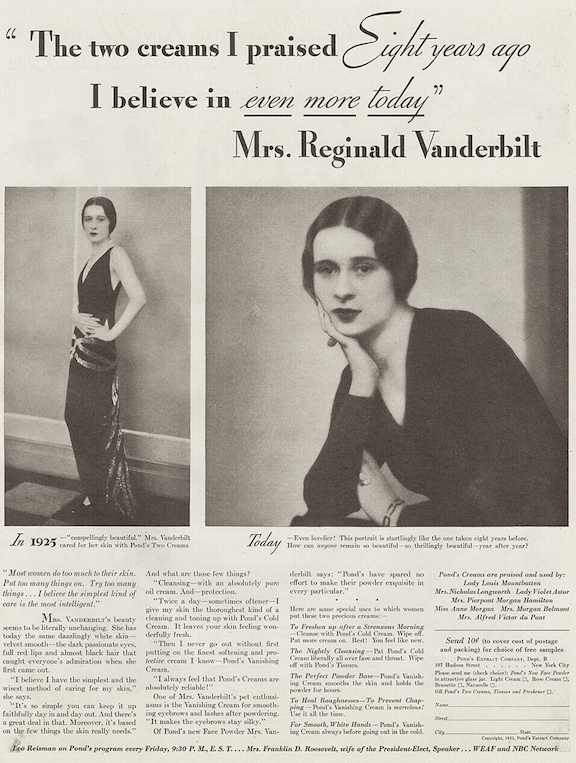
…in 1929 J. Walter Thompson President Stanley Resor observed how people instinctively wanted to be told what to do by authorities they respected. Applying this thinking to the marketing of Pond’s cold cream, Resor’s firm hired famed photographers to create idealized portraits of society women…

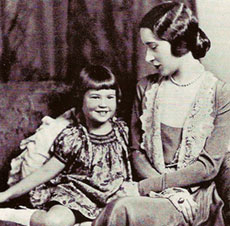
…Writing for Indy Week (July 7, 2010) Amy White observes that a 1933 portrait (above) of Mrs. Reginald Vanderbilt, aka Gloria Mercedes Morgan, reveals patrician eyes as “languid jet pools, her lips full and dark, her finely coiffed hair oiled to ebony perfection. However, a bit of backstory might explain the painful and hollow look Mrs. Vanderbilt can barely suppress. In that same year, she was declared by the courts to be unfit as a parent, and her young daughter was placed under the guardianship of her sister, Gertrude.” That young daughter, Gloria Vanderbilt, would later find fame for her designer jeans, her glittering lifestyle, and as mother of newscaster Anderson Cooper. White concludes, “I wonder if somehow, subconsciously, those consumers saw the pain in the eyes of some of those upper-crust spokeswomen, and it was basic humanness and empathy, as well as desire for wealth and beauty, that won them over”…

Mrs. Reginald Vanderbilt, aka Gloria Mercedes Morgan, and her daughter, “Little Gloria,” in 1928. (Wikipedia)

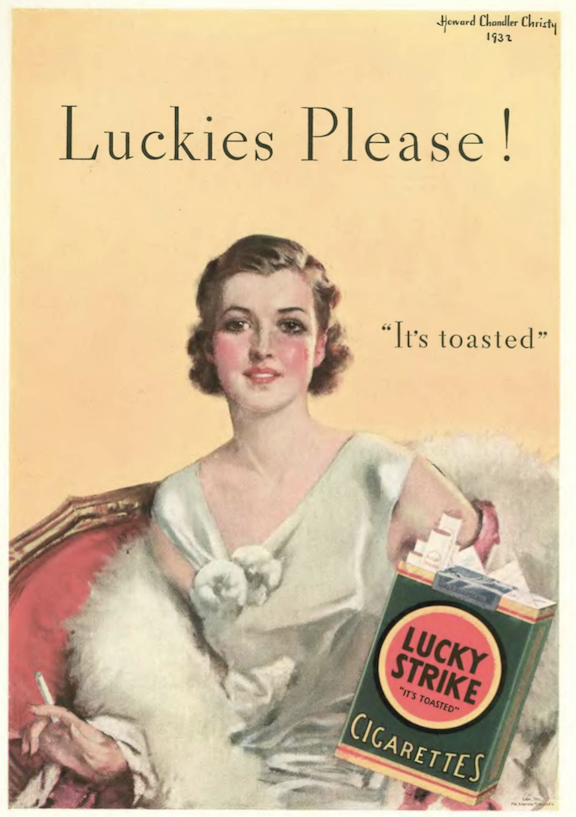
…and we move along to the toasted pleasures of Luckies, and Howard Chandler Christy’s “Christy Girl” looking the picture of health and vitality in this back cover ad…

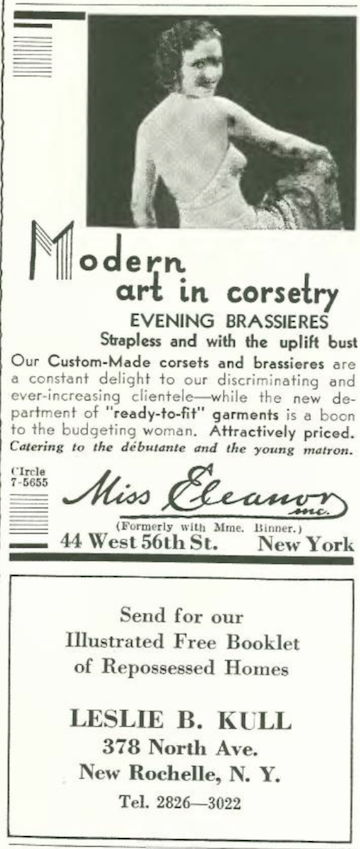
…we make an abrupt switch to the cheaper ads in the magazine’s nether pages…here “Miss Eleanor, formerly with Mme. Binner,” announced her selection of modern corsets for the “debutante and young matron”…and below, in a sign of the times, repossessed homes for sale…

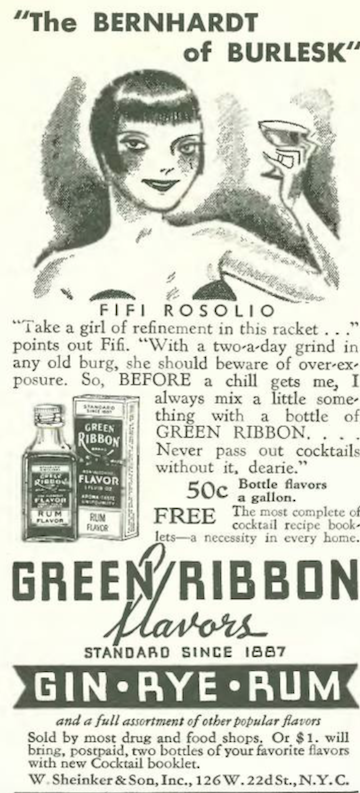
…looks like Fifi had a bit too much of the Green Ribbon-flavored bootleg…

…and if you thought taking probiotics was a new thing…

…the French Line once again featured the art of James Thurber to promote its Mediterranean cruises…

…and Thurber kicks off our cartoons with spot art that headed the “Goings On About Town” section…

…and this gem with one of Thurber’s beloved dogs…

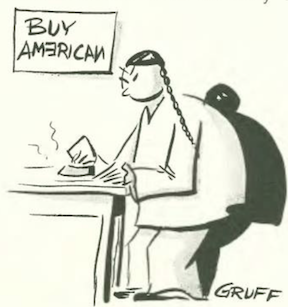
…below is the second New Yorker cartoon by Gruff with the “Buy American” slogan juxtaposed with an ethnic stereotype…I have no idea who this artist is, or if “Gruff” is a pen name — the style looks familiar but I haven’t had any luck chasing this artist down…

…here is the first one from the Feb. 18 issue…

…but we all know Al Frueh, who contributed this delightful bit of art to the theater review section…

Daniel ‘Alain’ Brustlein gave us an enterprising Frenchman offering peeks at exiled New York Mayor Jimmy Walker sunning on a beach at Cannes…

…and we close with Peter Arno, and the first signs of spring…

Next Time: Beauty and the Beast…

One Perfect Night

Once again The New Yorker marked its anniversary—the eighth—with a repeat of its very first cover, a tradition that would last until 1993. Unlike previous years, E.B. White made no special mention of the occasion in his “Notes and Comment,” no doubt feeling confident about the magazine’s prospects despite the challenges of the Depression. In 1933 The New Yorker could count on nearly 117,000 readers.

Feb. 18, 1933 cover by Rea Irvin.

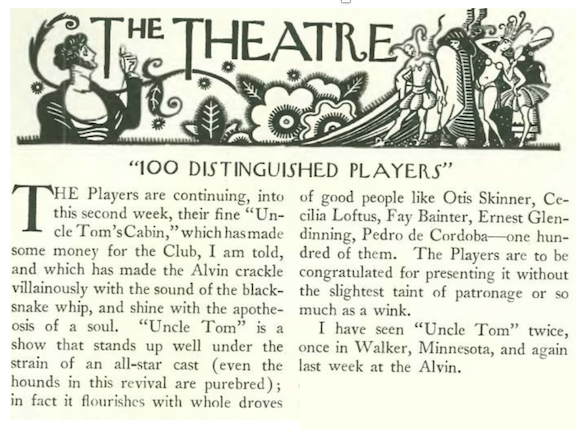
And so we look to another of the magazine’s star contributors, humorist and stage critic Robert Benchley, who was rarely impressed with Broadway’s middlebrow fare. It was in such an environment that Benchley found himself separating the wheat from the chaff, listing a selection of scenes from various plays that together might represent a “perfect night” of entertainment:

A BROADWAY BUFFET…Clockwise, from top left, Robert Benchley recommended Jack Haley’s bedroom scene and Ethel Merman’s rendition of “Eadie Was a Lady” in Take a Chance as worthy of a look; he also found George M. Cohan’s telephone call to police HQ in Pigeons and People memorable, and Beatrice Lillie was apparently a delight in the dressing room scene from Walk a Little Faster. (playbill.com)
TRIPPING THE LIGHT FANTASTIC in Cole Porter’s musical Gay Divorce were Claire Luce and Fred Astaire, dancing to the hit song “Night and Day.” It was Astaire’s last Broadway show before he headed to Hollywood for even greater stardom; Jack Pearl and Barbara Newberry in Pardon My English; Eva Le Gallienne as the White Queen and Josephine Hutchinson as Alice in the 1932-33 production of Alice in Wonderland at Le Gallienne’s own Civic Repertory Theatre; Alice (Hutchinson) encounters Tweedledee (Burgess Meredith) and Tweedledum (Landon Herrick) in Alice in Wonderland. (Pinterest/gershwin.com/blog.mcny.org)

 *  *  *

Spring Cleaning

While passing by the Vanderbilts’ “Triple Palace” on 51st and Fifth Avenue, E.B. White (“Notes and Comment”) noted signs of neglect at the famed mansion:

HOME  SWEET HOME…At top, Alva Vanderbilt engaged Richard Morris Hunt to build a “Petite Chateau” on the northwest corner of 52nd Street; below, the drawing room. The Triple Palace was demolished in 1947-49. (mcny.org/Wikimedia Commons)

The Triple Palace site today:

(daytoninmanhattan.blogspot.com)

*  *  *

Going Round and Round

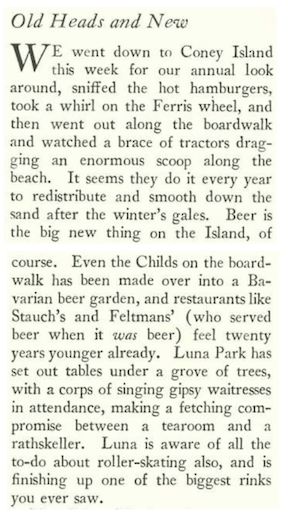
No one was landing quad flips at New York’s Ice House in 1933, but for ice skating enthusiasts it was the place to be for both figure skating competitors as well as for those just interested in a leisurely skate to the strains of a live orchestra. “The Talk of the Town” explains in this excerpt:

CHILLING SIGHT…Top and below, the Ice House was located on the top floor of a four-story building attached to Madison Square Garden. (Pinterest)

In both Europe and America ice skating in the 19th and early 20th century was something of an elaborate ritual in urban areas; skating rinks included tea rooms as well as places to dance or ice skate to the gentle rhythms of a live orchestra…

TEA COSY…The Biltmore Hotel Ice Gardens offered guests a warm place to watch the cold weather fun of the hotel’s outdoor ice skating rink, circa 1915. (mcny.org)

*  *  *

The Jig Is Up

Jigsaw puzzles have been around since the late 1700s (they were handmade then), but their popularity really took off in the 20th century with advancements in manufacturing and especially during the Depression when folks sought affordable forms of entertainment they could enjoy at home. The 1930s also saw jigsaw puzzles become more complex. “The Talk of the Town” observed:

In 1933 the Long Island City-based puzzle manufacturer Einson-Freeman introduced a line of puzzles that included clues to solving mysteries described in an accompanying novelette…

(worthpoint.com)

*  *  *

Small But Deadly

Howard Brubaker’s “Of All Things” column, which ran from 1925 to 1951, was a series of brief, satirical comments on the events of the day, including some that to modern eyes point to the catastrophic events that awaited Brubaker’s world (reader Frank W. notes that “the ‘aged piano-player’ was Ignacy Paderewski, who had served as Prime Minister in the immediate aftermath of WWI, and who was the nearest thing the Poles had to a national-unity figure”):

*  *  *

Her Protégé

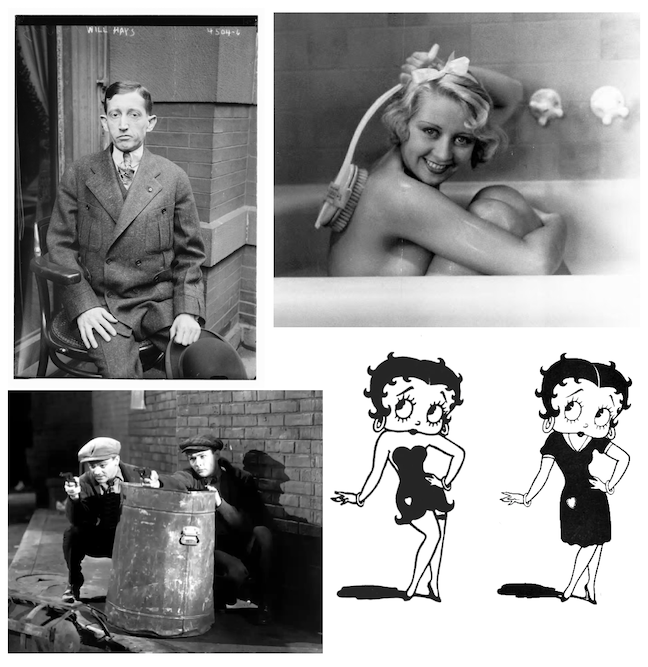
When Mae West adapted her 1928 Broadway play Diamond Lil into the 1933 film She Done Him Wrong, the puritanical backers of the Hays Code (which would be enforced in 1934) demanded that the film make no reference to the “scandalous” play. But because it was still the pre-Code era, West’s film featured many double entendres and her famous (and famously misquoted) quip, “Why don’t you come up sometime and see me?” That line was spoken to Cary Grant—whom West would later claim as her discovery even though Grant had drawn considerable attention in the previous year for his work opposite Marlene Dietrich in Blonde Venus. For the record, Grant, who would be paired again with West in 1933’s I’m No Angel, would later credit West, and She Done Him Wrong, for giving his career a major boost. New Yorker critic John Mosher lauded the film for the much-needed laughs it provided to Depression-weary audiences.

SHOWING HIM THE ROPES…The nearly forty-year-old Mae West was 11 years older than Hollywood newcomer Cary Grant when they appeared together in 1933’s She Done Him Wrong. The film was nominated for an Academy Award (Best Picture), and in 1996 was selected for preservation in the National Film Registry by the Library of Congress. (filmreference.com)

*  *  *

From Our Advertisers

The folks at Packard took a new advertising tack by demonstrating the durability of their luxury automobile…

…hopefully the Packard was riding on “Double Eagle” tires by Goodyear…however, this is an odd illustration to emphasize a child’s safety, when the kid’s posh mum seems more concerned about her appearance than anything else…also, does she plan to drive home with the windshield down?…

…Log Cabin continued its series of ads featuring New Yorker cartoonists…here Peter Arno lends one of his dirty old walruses to the cause of syrupy waffles and pancakes…

…on to our cartoonists, we have Arno again, keeping up appearances among high society…

Gluyas Willams demonstrated his knack for illustrating the foibles of his fellow citizens…

Helen Hokinson looked in on a man aspiring to become the next T.S. Eliot…

…the growing popularity of the gangster film knew no bounds, according to Perry Barlow

…and we close with James Thurber, and a speakeasy standoff…

Next Time: Deskey’s Deco…

Role Reversal

James Cagney began his entertainment career singing and dancing in various vaudeville and Broadway acts, but when he was cast in his first film as a tough guy, the die was cast…at least for one New Yorker critic.

Feb. 11, 1933 cover by Constantin Alajalov.

Cagney’s first film role came after he starred along with Joan Blondell in Broadway’s Penny Arcade. However when the play was made into the 1930 movie Sinners’ Holiday, execs at Warner Brothers opted to put Grant Withers and Evalyn Knapp into the lead roles, believing they were destined for stardom; Cagney and Blondell were relegated to supporting parts. As fate often has it, Withers and Knapp ended up in B-movie obscurity, while Cagney and Blondell went on to become two of the biggest stars of the 1930s. The pair would appear in six more films together, including the gangster film The Public Enemy (1931) and the musical Footlight Parade (1933).

TWO-FACED…James Cagney would be paired with Joan Blondell in seven films during the 1930s including the gangster film The Public Enemy (1931, left) and the musical Footlight Parade (1933, also with Ruby Keeler). (IMDB)
THE ONE I USED TO KNOW…Top, Cagney mashes a grapefruit half into Mae Clarke’s face in a famous scene from Cagney’s breakthrough film, 1931’s The Public Enemy; below, Cagney gets acquainted with a bartender (Lee Phelps) in The Public Enemy. (IMDB)

New Yorker film critic John Mosher preferred the tough guy Cagney to the toe-tapping version, and was anticipating Cagney’s return to pictures after a contact dispute with Warner in which he threatened to quit the business and follow his brothers into the medical profession…

When Cagney finally announced his return in Hard to Handle, Mosher found he had taken on the guise of actor Lee Tracy, who was best known for his comic portrayals of wisecracking salesmen and reporters…

MY SOFTER SIDE…James Cagney and Mae Clark (top) in 1933’s pre-Code comedy Hard to Handle — Cagney played a clowning con artist who organizes a dance marathon. Below, critic John Mosher thought Cagney was channelling the comic actor Lee Tracy, seen here with Jean Harlow in 1933’s Blonde Bombshell. (IMDB)

 *   *   *

Slippery Slope

Located on Lexington between 102nd and 103rd streets, Duffy’s Hill was once famous for being the steepest hill in Manhattan and the scourge of street cars that had to quickly accelerate and decelerate at that point, leading to numerous accidents. An excerpt from “The Talk of the Town”…

LOOK OUT BELOW…Duffy’s hill played merry hell with New York’s streetcars more than a century ago. (New York Social Diary via Facebook)

 *   *   *

Getting High

George Spitz Jr was an AAU high jump champion when he participated in the 1932 Summer Olympics in Los Angeles. In 1933 he made a personal best leap of  6 feet, 8¼ inches using scissors-style leap with elements of the Western roll. “The Talk of the Town” marveled at Spitz’s feat, giving him an extra quarter inch for his record leap:

MILLION-DOLLAR LEGS…In 1933 George Spitz Jr made his personal best leap of 6 feet, 8¼ inches using a scissors-style jump with elements of the Western roll. With the introduction of the Fosbury Flop in 1968, today’s men’s record stands at 8 feet, ¼ inches. The current women’s record is 6 feet, 10¼ inches. (Olympedia)

 *   *   *

This Guy Again

As we move into the 1930s we will be seeing more references to Adolf Hitler, who seized power in Germany on January 30, 1933. At this point “The Talk of the Town” wasn’t taking him seriously…

…and neither was Howard Brubaker in his regular column of short quips…

 *   *   *

From Our Advertisers

Hitler aside, the German-owned Hamburg-American Line was still serving peaceful purposes when it advertised the comfort of its “stabilized ships” on transatlantic voyages…these sister ships of the Hamburg-American Line were all destroyed during World War II…the SS New York and the SS Deutschland were both sunk by the British RAF in 1945…The SS Albert Ballin and the SS Hamburg sank after hitting Allied mines…

THE BIG BANG…the RAF sent the S.S. Deutschland to the bottom of the Bay of Lübeck  on May 3, 1945. (Wikipedia)

…if travel wasn’t your thing, you could escape the winter blahs in the comfort of your home thanks to the GE Mazda Sunlight Lamp…

…and Dad, when you were her age you called these things “horseless carriages”…

…the folks at luxury carmaker Packard answered the splashy color ad from Cadillac in the Jan. 7 issue…

…with a colorful show-stopper of their own…

…if the Packard was too pricy, you could have checked out this lower-priced Cadillac, marketed as the LaSalle…

…no, New York did not say “Rockne, you’re the car!”, even if it was juxtaposed with a giant woman…the car was named for famed football coach Knute Rockne, and the Depression was not a good time to promote a new car line…it was produced from 1932 to 1933, when Studebaker pulled the plug and sold the remaining inventory (about 90 cars, packaged in kits) to a Norwegian railroad car manufacturer…

…a couple of posts ago (“Life With Father”) we were accosted by a three-page Camel ad featuring a Q&A stating the facts about its product…here they are back with two more pages of irrefutable evidence…

…what I read in their eyes is that none of them, including the woman, gives a damn about the others…if anything, the fellow at left is checking out the other guy…

…this ad from Sonotone Corporation promoted a new hearing aid developed by Hugo Lieber…this revolutionary bone conduction receiver enabled the deaf to hear through bones in their head…

…a 1939 Sonotone catalog demonstrated how the hearing aid could be worn inconspicuously…

(abebooks.com)

…on to our cartoonists, Al Frueh illustrated the drama on board Broadway’s Twentieth Century Limited…note vaudevillian William Frawley’s caricature in the bottom right hand corner…although he appeared in more than 100 films, Frawley is best known today for his role as Fred Mertz on TV’s I Love Lucy

…here’s a great caricature by Rea Irvin of New York’s new mayor John P. O’Brien, using his new broom to sweep away the corruption of the deposed Jimmy Walker and his Tammany Hall cronies…

…here’s another early work by George Price, who would be a cartoonist at The New Yorker for nearly six decades…

…and here we have the other Price…Garrett Price gave us a fellow who made some changes in his life à la Paul Gauguin

…I like this Perry Barlow cartoon because it reminds me of the patient-in-traction trope commonly seen in comedies of the 1960s and 70s…

…such as this Paul Coker Jr. illustration from the June 1970 issue of MAD magazine…

(MAD Magazine)

…and Terry-Thomas and Spencer Tracy in 1963’s It’s a Mad Mad Mad Mad World

(IMDB)

William Steig assured readers there was nothing sweet about his “Small Fry”…

…once again Helen Hokinson offered her impressions of the annual Westminster Kennel Club show at Madison Square Garden…

Peter Arno’s Lake Placid would never be the same for his mustachioed millionaire “walruses” after the previous year’s Winter Olympic Games…

Next Time: One Perfect Night…


Life With Father

If you’ve ever come across the byline B.H. Arkwright, you were most likely reading the work of Clarence Day Jr., who in February 1931 began writing for The New Yorker under that pseudonym and also under his given moniker, which in four short years would become a household name.

Jan. 21, 1933 cover by Theodore Haupt.

In the Jan. 21, 1933 issue Day would publish his first humorous story in The New Yorker about upper-middle-class family life in the 1890s. A subsequent collection of these stories would be published in 1935 under the title Life with Father. Sadly, Day would die shortly thereafter and wouldn’t witness the enormous cultural impact his stories would have on mid-century America.

Here is an excerpt of Day’s first story about his father, describing an exchange between his parents that would set the tone for the series:

Life with Father was a hit with readers, inspiring a 1939 Broadway production by Howard Lindsay and Russel Crouse that would run for 3,224 performances over 401 weeks—it was, and still is, the longest-running non-musical play on Broadway. The play would be adapted into a 1947 film featuring Irene Dunne and William Powell in the leading roles. The stories even made it to the small screen in a CBS TV series that ran from 1953 to 1955.

ALL IN THE FAMILY…Clockwise, from top left, Clarence Day, Jr. (1874-1935) in undated photo; Dorothy Stickney and Howard Lindsay in the Broadway production of Life with Father, 1939; Day’s father and inspiration, stockbroker Clarence Day, Sr. (1844-1927); scene from the 1947 feature film Life with Father with Irene Dunne, William Powell, and a 14-year-old Elizabeth Taylor. (britannica.com/theguardian.com/IMDB)

Day was also a cartoonist, contributing satirical cartoons for U.S. suffrage publications in the 1910s and also publishing collections of humorous essays including a Darwinian satire on the origins of human nature, This Simian World (1920), and the rambling, whimsical The Crow’s Nest (1921). Both featured Day’s simplistic cartoons and anthropomorphic tales that anticipated the work of James Thurber later in the decade.

CATTAIL…Self-portrait of Clarence Day rendered as a cat in a selection from The Crow’s Nest (1921). The entire book is available as a free e-book from The Project Gutenberg.

As we know, New Yorker founding editor Harold Ross was a man of contradictions, at once profane and puritanical, the latter on display when it came to one of Day’s cartoon submissions for the magazine. According to Brendan Gill’s memoir Here at The New Yorker, Ross balked at publishing the drawing below because it showed an exposed breast. Either Day or an editor simply removed the nipple (note the broken line in the nipple’s place) and the cartoon was published.

 *  *  *

Big Man’s Big Man

August Gennerich not only served as President Franklin D. Roosevelt’s bodyguard, he was also a close family friend. “The Talk of the Town” featured a lengthy account of the man, an excerpt of which is below:

ON GUARD…Augustus “Gus” Gennerich (1887-1936) was a friend of Franklin and Eleanor Roosevelt’s as well as one of FDR’s most trusted guards. He began his career in 1909 as a NYC policeman and in 1929 was assigned to be then-Governor Roosevelt’s bodyguard in the city. The Roosevelts were heartbroken when Gus died unexpectedly at age 50 from a heart attack. (picryl.com)

*  *  *

Desert Solitude

In 1933 Georgia O’Keeffe (1887–1986) was well into her Southwestern phase when her husband Alfred Stieglitz staged a show of her work at his last New York gallery, An American Place. O’Keeffe and Stieglitz lived together in New York until 1929, when O’Keeffe began spending more time in the Southwest—most likely to put some distance between herself and Stieglitz, who was in a long-term affair with photographer and writer Dorothy Norman. After this show opened O’Keeffe would suffer a nervous breakdown (per the above) and not return to painting until 1934. Lewis Mumford visited An American Place and had this to say about O’Keeffe’s work:

ANOTHER AMERICAN PLACE…New Mexican Landscape by Georgia O’Keeffe, 1930. (springfieldmuseums.org)

*  *  *

The Bookish Type

Modernist American poet and writer Archibald MacLeish (1892–1982) was a man of letters to the letter, serving as the ninth Librarian of Congress (1939-44) and during which time initiated the process of naming U.S. poet laureates. Here he contributes some of his verse to The New Yorker:

DESK JOB…Archibald MacLeish, circa late 1930s. (Library of Congress)

It was no accident that MacLeish contributed to The New Yorker: in addition to being among the literary expatriates in Paris including Gertrude Stein and Ernest Hemingway, MacLeish and his wife, Ada Hitchcock, were part of the Riviera crowd hosted by Gerald and Sara Murphy, which included among other notables John O’Hara, Dorothy Parker, and Robert Benchley.

OVER THERE…Gerald and Sara Murphy hosting friends at a Riviera beach party, circa 1923. Gerald is the man standing in the striped shirt; Sara is at right with a parasol. I believe that is Benchley at the bottom right, and Parker seated at center-right. (Beinecke Library)

*  *  *

From Our Advertisers

We begin with this ad from Helena Rubinstein that parodies Lois Long’s “Tables for Two” column (Long signed that column as “Lipstick”) and announced a new “Red Poppy” shade…

…on the other hand, the folks at Tangee borrowed from the old Temperance Movement song, The Lips that touch liquor, shall never touch mine, to promote a lipstick guaranteed to snag a sugar daddy like the one illustrated below (recalling Monopoly’s Uncle Pennybags)…

…more advertising weirdness comes our way from the staid Best & Company, its execs somehow persuaded by an ad man to go with this chef motif…

…Leg ‘O Mutton referred to a type of puffy sleeve introduced in 1830s France that had a revival in the late 1880s…

MMMMM, MUTTON…The Leg ‘O Mutton look, circa 1890s. (genealogylady.net)

…the National Auto Show moved on and the National Motor Boat and Engine Show took its place at the Grand Central Palace…

…I’m trying to imagine the guy at left stowing his top hat in an overhead bin…

…down on earth folks could enjoy some down-to-earth home cooking at Mary Elizabeth’s, or go some Italian at Caruso’s…

…and for reference…

Top left, Mary Elizabeth’s success on Fifth Avenue led to expansion into Boston; below, a 1921 menu at Mary Elizabeth’s in New York; at right, 1930s postcard advertising Caruso’s on 42nd Street. (restaurant-ingthroughhistory.com)

…of course you couldn’t legally drink at those places, so you had to go to a speakeasy or mix your cocktails at home…but this is just sad, ‘ol Buddy here flavoring his bootleg with some Green Ribbon…let’s hope the playboy’s guests aren’t blinded before the night is over…

…we all know the tricky ways of the tobacco companies, including this 3-page Q&A from the makers of Camels offering smokers and would-be smokers THE TRUTH and THE FACTS about the cigarettes folks smoke…turns out Camels are the best!…

…and now for a bit of fresh air before we turn to our cartoonists…

…beginning with Al Frueh and his impressions of a show at the Guild Theatre…

Peter Arno contributed this illustration across pages 12-13 in “The Talk of the Town” section…

Helen Hokinson offered up some scandal among the “girls”…

James Thurber gave us an awkward moment among the tender youth of the unclad world…

Otto Soglow’s Little King rose to the occasion, as always…

Daniel Alain’s artist tried his best to make some small talk while at work…

…and we close with E. Simms Campbell, and the yawning gulf between owners and workers…

Next Time: A Slice of Paradise…


March of Time

In the span of 112 minutes, the much-anticipated Fox production Cavalcade took movie audiences through the first thirty years of the 20th century.

Jan. 14, 1933 cover by Peter Arno.

Anticipating Upstairs, Downstairs (1971) and the more recent Downton Abbey, Cavalcade looked at life through the eyes of upper class Londoners—Jane and Robert Marryot, their children and close friends—and the Marryot’s servants. It was a calamitous ride that included both the Boer War and World War I among other historic events. Critic John Mosher thought it a memorable picture despite its mawkishness.

IT’S A SCARY WORLD OUT THERE…This Fox theater card promised audiences epic thrills with a cast of thousands. (IMDB)
AGING GRACEFULLY…Diana Wynyard and Clive Brook portrayed upper class Londoners Jane and Robert Marryot through three tumultuous decades in Cavalcade. (IMDB)

In the film, the first decades of the 20th century would claim the lives of both Marryot sons—Joe would perish in World War I, and Edward would make the unfortunate decision to take his bride on a honeymoon cruise…

ONE-WAY TICKET…Edward Marryot (John Warburton) and his childhood sweetheart Edith Harris (Margaret Lindsay) are thrilled to be celebrating their honeymoon on a “big boat.” When the couple walk away from the railing, the opposite side of the life preserver is revealed in a dramatic camera shot.

After World War I the film hastily moved on to the Jazz Age, where the social order was going to hell…

CRY WOLF…A creepy older dude puts the moves on a young blonde (portrayed by Betty Grable in an uncredited role) during a Jazz Age scene of a wild party that included glimpses of flirting gay couples. Cavalcade was one of the first films to use the words “damn” and “hell.” (IMDB)

Cavalcade is considered by some critics to be one of the worst films to receive an Academy Award (it actually won three—Best Picture, Best Director, and Best Art Direction). If you are interested in learning more about Cavalcade or about pre-Code films in general, visit the excellent pre-code.com website.

 *  *  *

Sad Songs

George White was famed for his lavish Scandals revues, especially during the Roaring Twenties—leggy showgirls and wisecracking comedians shared the stage with some of the era’s top singers and dancers. White’s Music Hall Varieties seemed to have all of the same elements as his Scandals, but something seemed amiss to Robert Benchley—an unnamed sadness that he chalked up to those depressing times:

THE SHOW MUST GO ON…Even during the Depression George White did what he could to keep the old Roaring Twenties spark alive. Clockwise from top left: White auditioning dancers for his Scandals; Bert Lahr preparing for a stage show in the 1930s (Lahr’s son, John, would later become a New Yorker drama critic); the Howard Brothers, Eugene and Willie, in 1936; and a young Eleanor Powell ready to do some toe-tapping circa 1932. (PBS/NYPL/Wikipedia)

 *  *  *

Journey of the Mind

Louise Bogan (1897–1970) was poetry editor at The New Yorker for nearly forty years (1931–1970) and in 1945 was the first woman to be appointed Poet Laureate to the Library of Congress. For the Jan. 14 issue she wrote “Journey Around My Room,” which begins with her recollection of a childhood train ride. Here are some excerpts:

POET LAUREATE…Louise Bogan in 1937. She was poetry editor at The New Yorker for nearly forty years and was named U.S. Poet Laureate in 1945. (Library of Congress)

 *  *  *

Silent Cal Silenced

Many folks were surprised by the sudden passing of former U.S. President Calvin Coolidge. He was just sixty years old when he succumbed to coronary thrombosis at his Northampton home, “The Beeches.” During The New Yorker’s first years Coolidge was the butt of many jokes…beginning with this Miguel Covarrubias cartoon in the magazine’s fourth issue (March 14, 1925)…

E.B. White offered this eulogy of sorts…

THRIFTY IDYLL…Calvin and Grace Coolidge outside their newly acquired home, “The Beeches,” Northampton, summer 1930. (Leslie Jones Collection)

…and mused about the state of politics in 1933, proving that some things never change…

Last time we learned Lewis Mumford’s views about the new artwork displayed in the RKO Roxy Theatre and in Radio City Music Hall. In the Jan. 14 issue he turned his attentions to the actual buildings, giving them an average grade and preferring the Music Hall over the Roxy (he disliked the oversized chandelier/electrolier). Mumford was decidedly not a fan of the Rockefeller Center development, evident in his closing lines:

SHOWPLACES…Lewis Mumford gave Radio City Music Hall (top) and the RKO Roxy some muted nods, but found the Roxy’s electrolier distracting.

 *  *  *

Parting Thoughts

Alexander Woollcott shared some final recollections of his visit to Moscow, in which he likens the Russians’ freedom under Josef Stalin to the freedom of a spirited schoolboy who desires to sit in the back of the classroom…

 *  *  *

From Our Advertisers

Bonwit Teller employed some modern typesetting, wryly using the word DULL — offset in large san-serif letters — to draw attention to their “Chardonize” fabric, which was essentially artificial silk…

…nothing subtle about this next advertisement…don one of these bathing suits and millionaires will bow before you, or rather, to borrow this ad’s odd metaphor, “fall like wheat before locusts”…

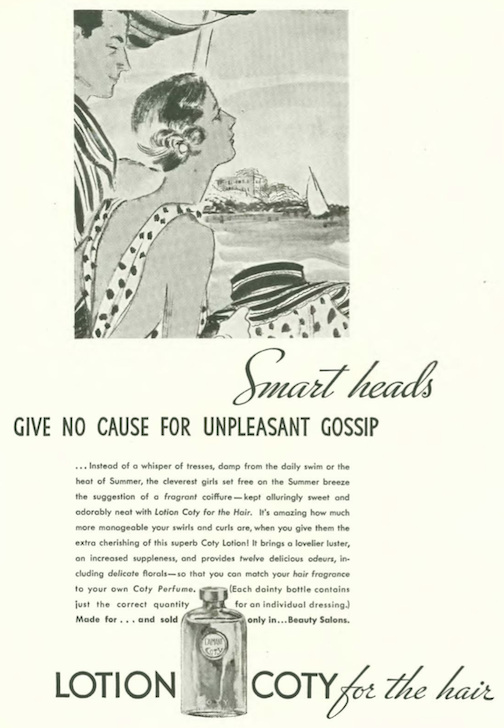
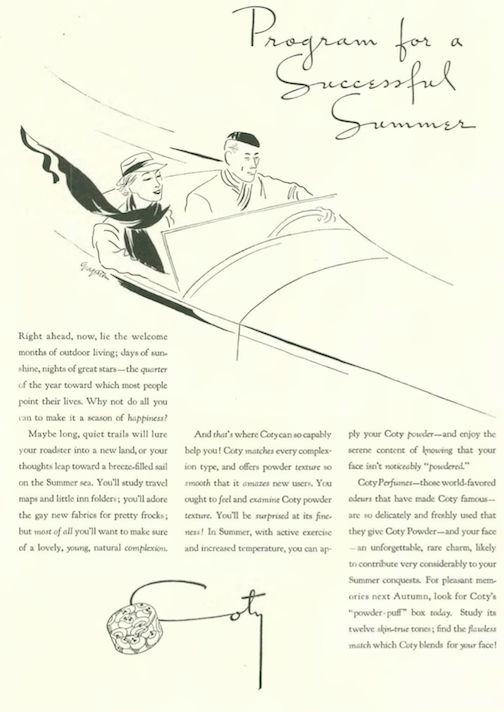
…we get a similar but far more muted pitch from Coty…so does this mean one out of every six desirable bachelors want to be seen with her? Not exactly knocking them down like locusts…

…now here’s a couple of self-assured souls who are neither troubled by hungry locusts nor face powders…they own a Cadillac, and wow, that is really quite the automobile, not like the Caddies you see today that are half-plastic and blend in with the rest of the shapeless blobs we call cars these days…

…the folks who pushed Chesterfield cigarettes were back with another ad aimed at their fastest growing demographic…note the sly reference to women’s suffrage…but that’s not why this woman (seated on a modern Breuer chair) smokes; she smokes because it gives her pleasure, and come to think of it, why should men have all the fun?…

…the Cunard Line suggested that you might run into some big-time celebrities on one of their ships, including actress Norma Shearer and banker/arts patron Otto Kahn (bottom of left-land page); or on the opposite page Charlie Chaplin, Douglas Fairbanks and Mary Pickford, Alfred Lunt and Lynn Fontanne among others…

…by contrast, the French Line employed the artistry of James Thurber to entice travelers onto the high seas…

…which gives us a nice segue into our cartoons, beginning with this spot by Thurber referencing the National Auto Show…

Al Frueh offered up another of his famed sequential works…

Gardner Rea with his usual perspective on the absurd…

Douglas Ryan plied the familiar waters of the harem trope…

…and Robert Day showed us that even the smallest consolation can still satisfy…

Next Time: Life With Father…