Queen of the Night Clubs

In the Roaring Twenties, Mary Louise Cecilia—aka Texas Guinan—was the undisputed queen of New York’s boozy, bawdy nightclub and speakeasy scene.

March 23, 1929 cover by Gardner Rea.

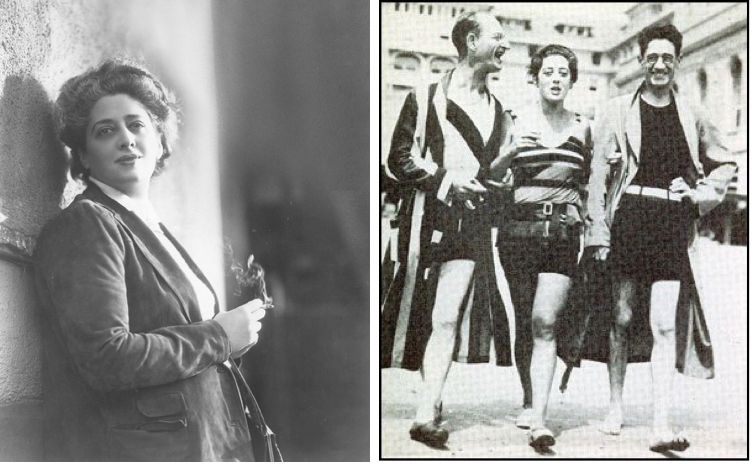
During the 1920s Guinan operated one of New York’s most famed speakeasies, The El Fey Club, which attracted the likes of Mayor Jimmy Walker, actors George Raft and Peggy Hopkins Joyce, writers including Ring Larder and Damon Runyon, and gossip columnists Walter Winchell, Mark Hellinger, and Ed Sullivan (yep, the same Ed who later hosted TV’s most famous variety show).

It was still months before the big stock market crash, but in the pages of the New Yorker you could already sense a change in its voice; it was maturing, to be sure, but it also seemed to be growing weary of the party. The magazine’s nightlife correspondent, Lois Long, contributed sporadically to her once-lively “Tables for Two” column (she was now a mother, and would abandon the column altogether in 1930). As for the queen of nightlife, Texas Guinan, New Yorkers were ready for something different.

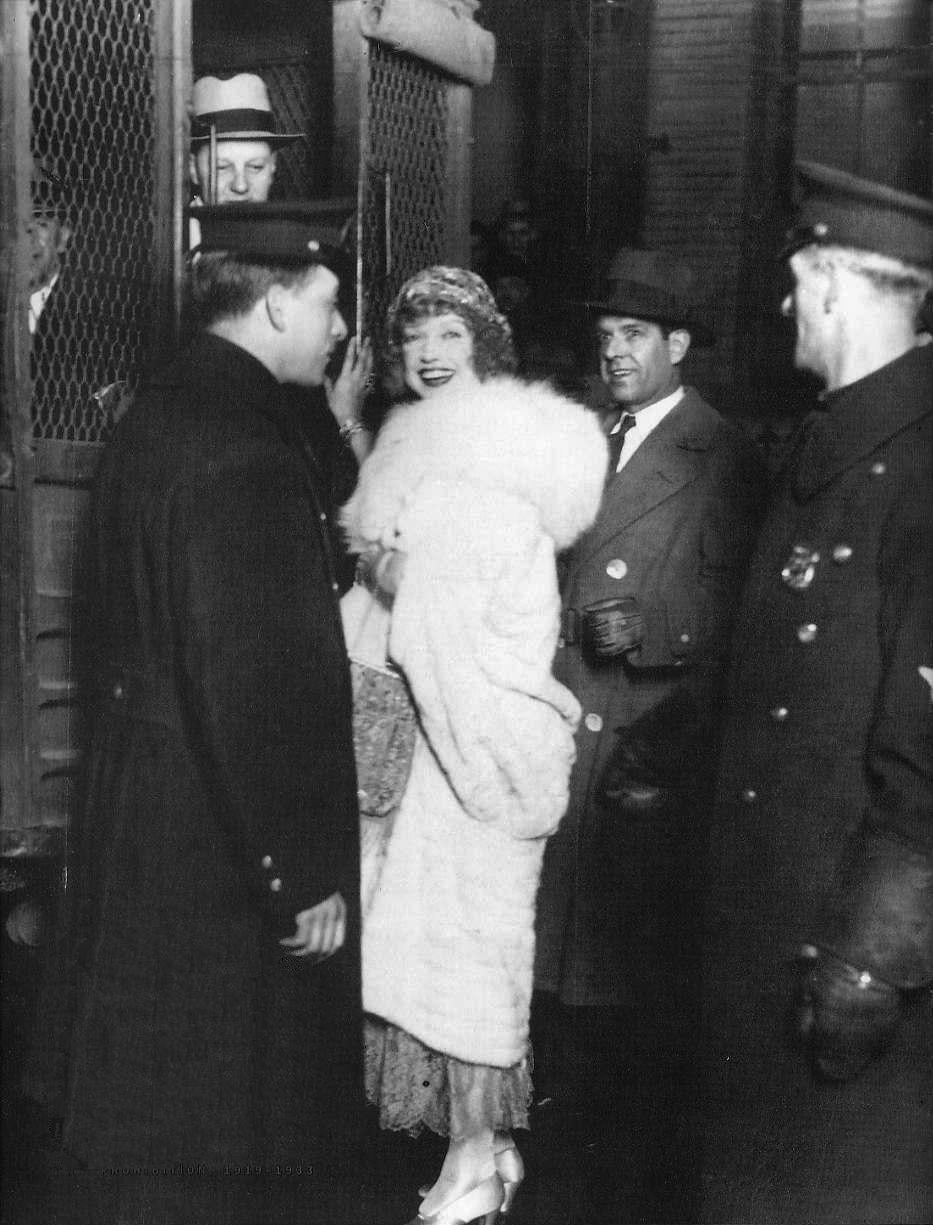
BEATING THE RAP…In June 1928 Texas Guinan and other New York speakeasy operators were arrested and indicted by a federal grand jury. Guinan beat the rap, and was acquitted in April 1929. (ephemeralness york)

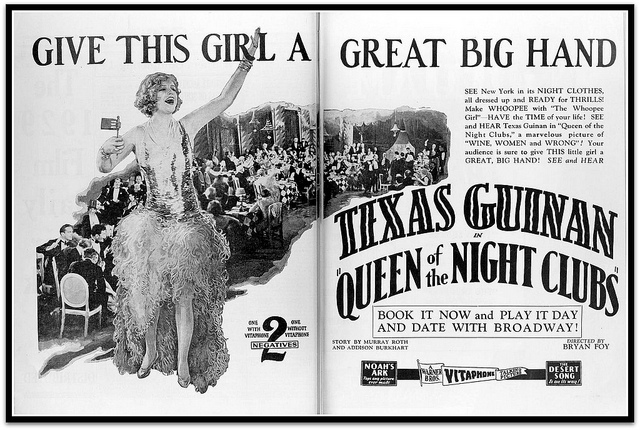
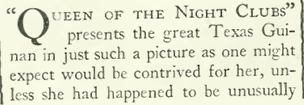
In a review of her latest movie, Queen of the Night Clubs, the New Yorker found that Guinan lacked her famed charm and vitality, and that the camera was “not kind to her looks.”

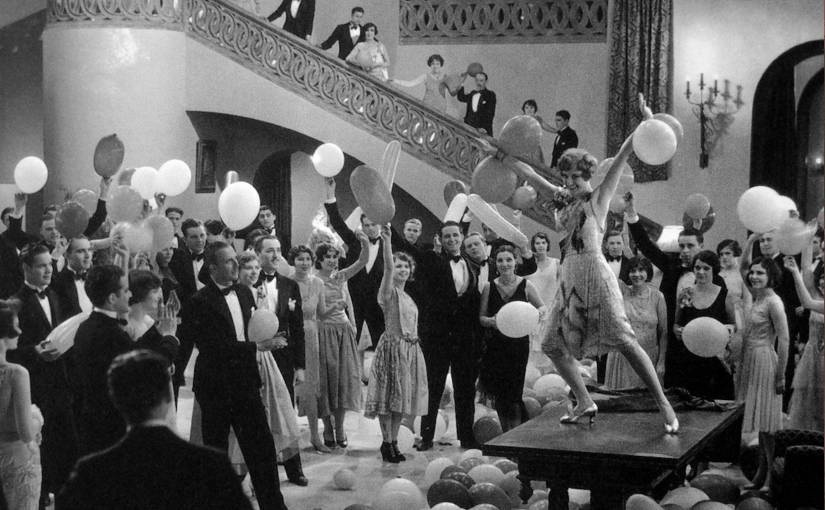
THE FINAL CURTAIN…Clockwise from top left: Texas Guinan in a nightclub scene from Queen of the Night Clubs; trading lines in the film with John Davidson; a 1929 portrait of Guinan by Cecil Beaton; and a scene from the film with co-star Lila Lee (far right). The film is considered lost. (boweryboyshistory.com/texasguinan.blogspot.com)

The film in many ways marked the end of Texas Guinan, not so much because it was a bad film but because she had simply run her course and was going out of style. The market crash later that year was the final straw. She took her show on the road, made an unsuccessful attempt at a European tour, then returned to the States. She made one final film, Broadway Thru A Keyhole, which was based on a story by Guinan acolyte Walter Winchell. Guinan died on Nov. 5, 1933, three days after the film’s release; her death was due to ulcerative colitis brought on by a case of amoebic dysentery contracted during a visit to Chicago. She was 49. One month later, Prohibition would be repealed.

A final note: Queen of the Night Clubs would be Texas Guinan’s final starring role (the film is considered lost), but before she became a night club fixture she was a popular star in dozens of shorts and two-reelers—with mostly Western themes— from 1917 to 1921.

HAPPIER TRAILS…Texas Guinan featured in a movie poster and publicity photo for The Two-Gun Woman, 1918. (Columbia University)

 *  *  *

A Film of Biblical Proportions

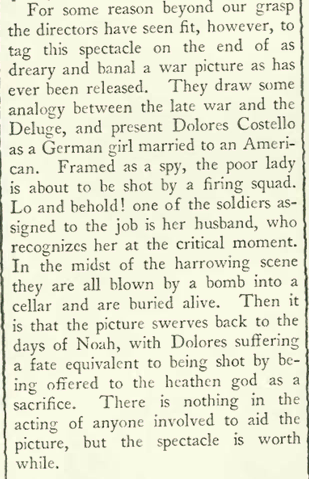
The New Yorker’s May 23 film review also sized up the latest epic to come out of Hollywood—Noah’s Ark—a picture with parallel storylines known mostly for its innovations in special effects.

The film premiered in late 1928 as a silent and was re-released in 1929 as a “part-talkie.” It told the story of Noah and the Great Flood, connected to another story featuring cabaret singers, soldiers and espionage during the First World War. Here is the New Yorker’s take on the film:

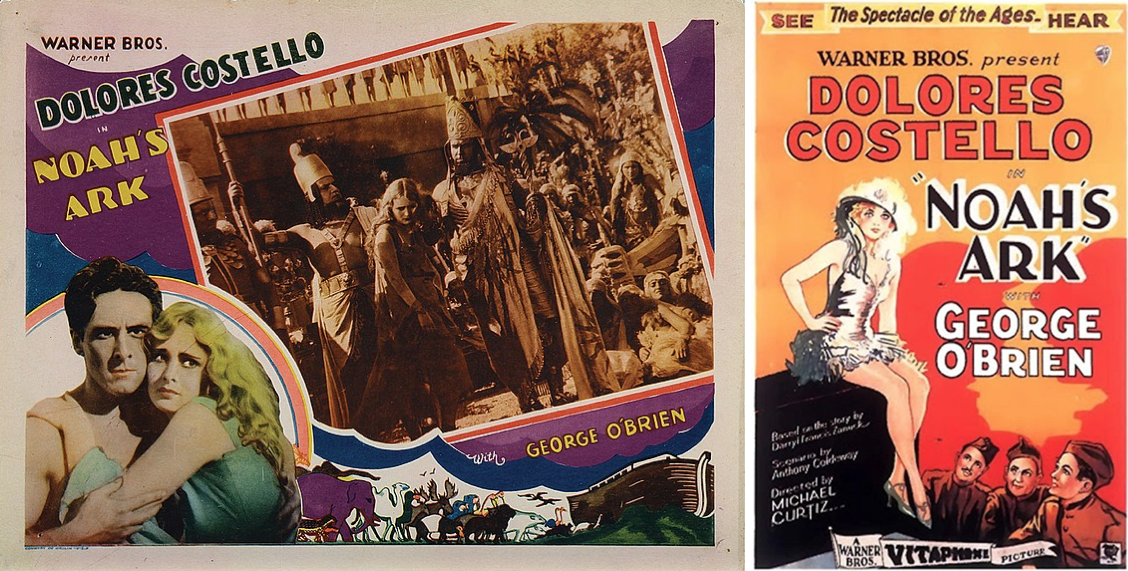
IDENTITY CRISES…Various promotional posters touted different aspects of the partial-sound film, Noah’s Ark. The one at left promoted the film’s biblical story, while the one at right played up Dolores Costello’s sex appeal. (IMDB)

The New Yorker concluded that the film was worth seeing for the Noah story’s special effects, despite its attachment to a “dreary and banal” war picture.

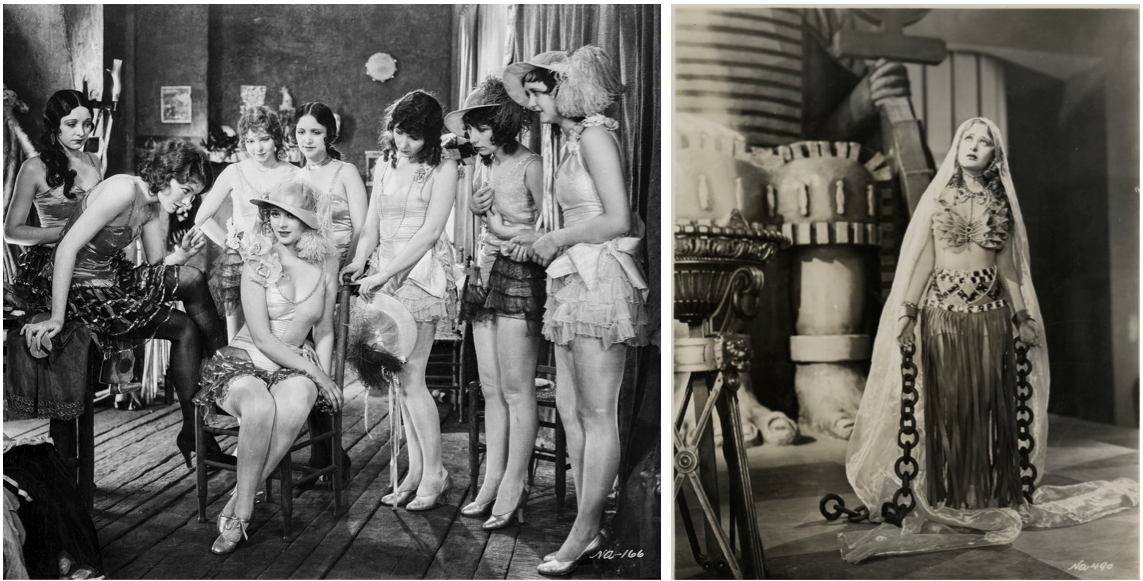
DUAL ROLES…Dolores Costello (seated, at left) played both a cabaret dancer, Marie, and Noah’s handmaiden Miriam, in Noah’s Ark. Note in the first photo the actress at far left, with her leg propped up on the chair—that’s Myrna Loy, who would become one of Hollywood’s biggest stars in the 30s and 40s. As for Costello, known as “The Goddess of the Silent Screen,” her greatest success was in the silent era. Click image to enlarge. (1stdibs.com, IMDB)
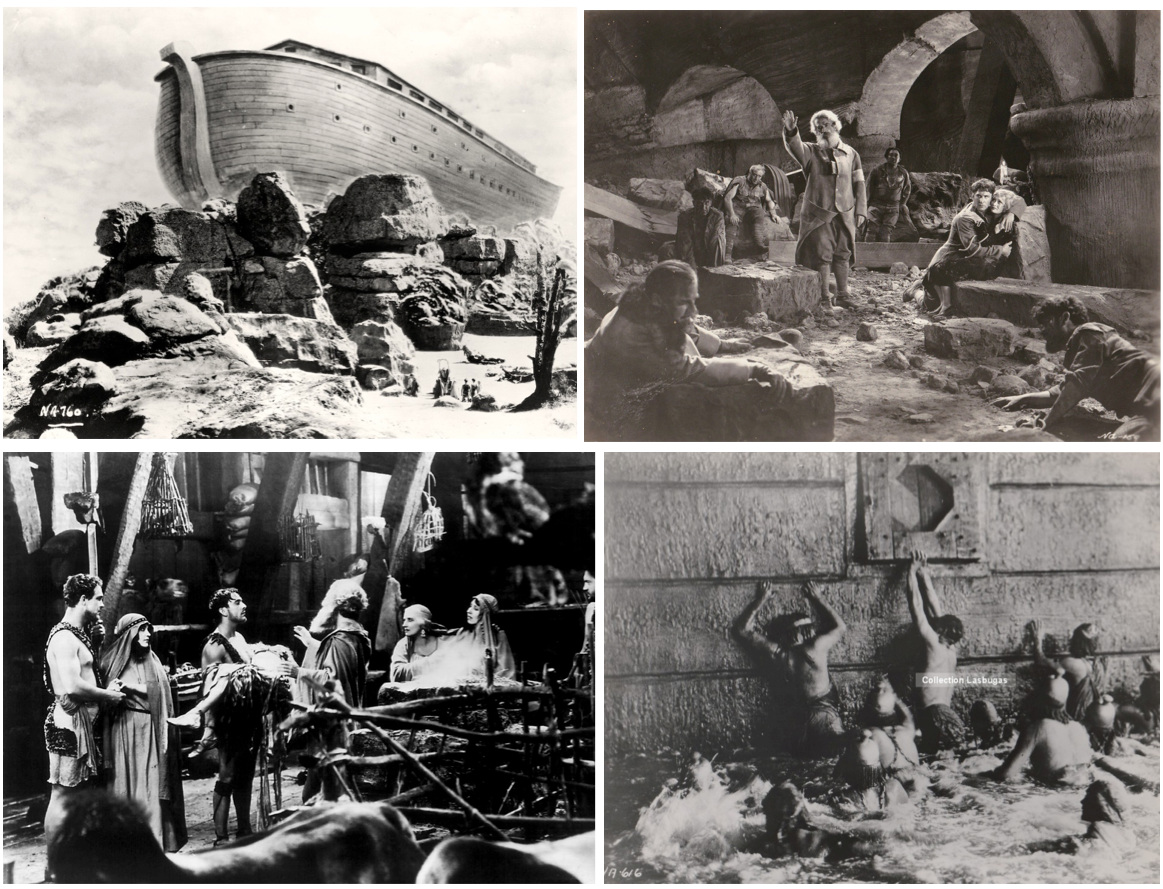
BIG SHOW…Portions of Noah’s Ark were filmed at the famed Iverson Movie Ranch in Chatsworth, California, including the opening shot that featured a massive ark (top, left) beached on the boulders of the movie ranch’s Garden of the Gods. Other scenes from the film included (moving clockwise, from top right) Paul McAllister as Noah, issuing a warning to the heathen as Noah’s son Japheth (George O’Brien) and servant girl Miriam (Dolores Costello) cower at right; the heathen masses desperately clamoring to board the ark as they are engulfed by the flood (600,000 gallons of water was used in the scene—three of the extras actually drowned during the filming); Japheth carries the rescued Miriam into the ark. Click image to enlarge. (IMDB, Wikipedia, dukewayne.com, medium.com)

Notable about these silent epics is the lack of precaution they took with both the actors and the extras. A huge amount of water—600,000 gallons—was used to film the the climactic flood scene. Three extras drowned and many others suffered broken bones and other serious injuries. One extra had to have his leg amputated. As for the stars, Dolores Costello caught a severe case of pneumonia during the filming.

Here’s a clip to give you an idea of what the extras had to deal with:

Some trivia: John Wayne was an extra in the film, and also worked in the prop department. The director of Noah’s Ark, Michael Curtiz, would go on to direct some of the most well-known films of the 20th century, including The Adventures of Robin Hood with Errol Flynn, Angels with Dirty Faces with James Cagney and Humphrey Bogart, Casablanca with Bogart and Ingrid BergmanMildred Pierce with Joan Crawford, and White Christmas with Bing Crosby and Rosemary Clooney. He would also direct an Elvis Presley movie, King Creole, and in his final film would reunite with John Wayne in 1961’s The Comancheros.

 *  *  *

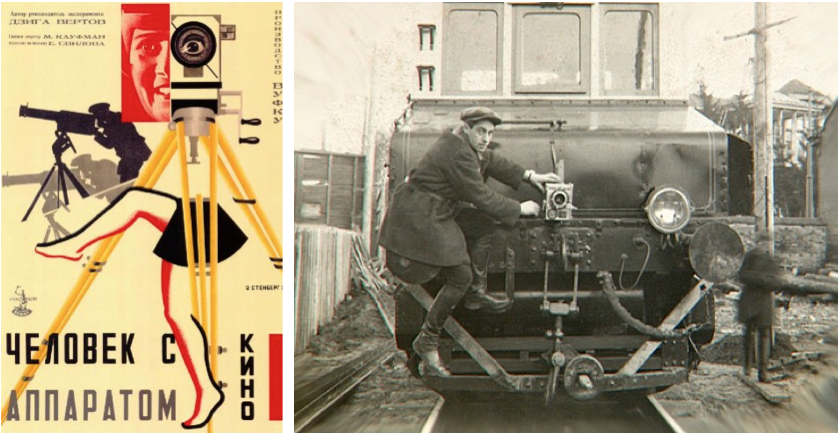
While Americans were enjoying epic filmmaking, Russian audiences were being served up the latest in propaganda, although this was propaganda presented with stunning film innovations and avant-garde sequences. In this item from the March 23 “Talk of the Town” the film is referred to as Through Russia With A Camera, but today it is known as Man with a Movie Camera. This experimental silent film from 1929 supposedly documented ordinary life in Soviet Union (with no signs of the famine that claimed 5 million Soviet citizens in the early 1920s). Directed by Dziga Vertov, the documentary’s famed cinematography was by Mikhail Kaufman. “Talk” observed:

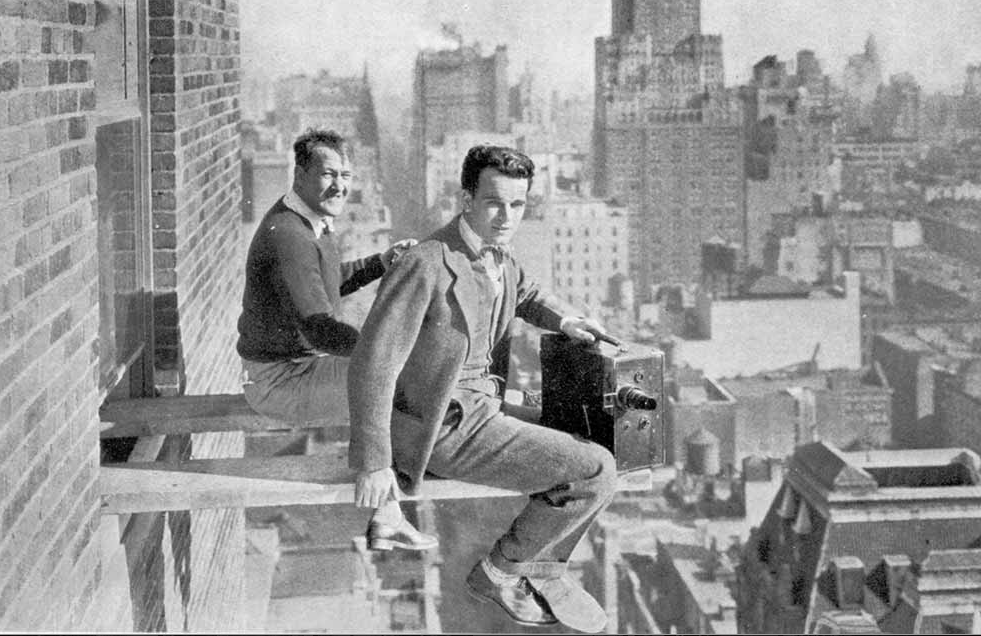
AVANT GARDE…Poster for Man with a Movie Camera rendered in the Constructivist style. At right, cinematographer Mikhail Kaufman risks his life for a unique camera angle. (Wikipedia)
Clockwise, from top left: Cinematographer Mikhail Kaufman prepares to set up for a Black Sea beach sequence near Odessa; images of ordinary life include a woman at a hairdresser and a young woman fastening her bra; the eye through the camera lens, the film’s final image. (ascmag.com)

 *  *  *

From Our Advertisers

A sampling of advertisements from the pages of the March 23 issue include this nearly two-page spread for Pond’s cold cream…no doubt Pond’s was thrilled with this endorsement by “Mrs. Cornelius Vanderbilt Jr,” otherwise known as Mary Weir of Davenport, Iowa. Mary was wife No. 2 of Cornelius Vanderbilt’s seven wives. Mary and Cornelius were married in 1928 and divorced in 1931…

…and then we have this advertisement from Knox hatters, illustrated by the New Yorker’s own Rea Irvin

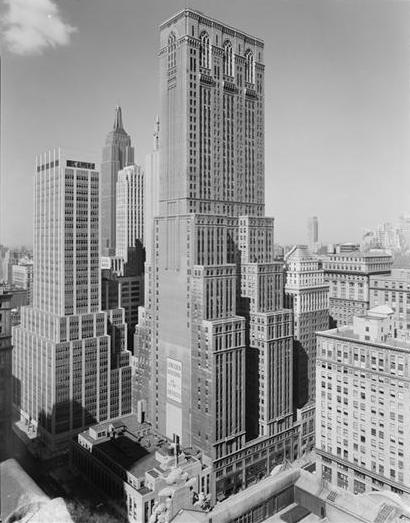
…this advertisement for the new Lincoln Building played up the building’s dominating form on Madison Avenue…

…a dominance that continues to this day. I know it’s not cool to gaze up at buildings in Manhattan, but if you’re ever in the neighborhood you must look upward at least once and gaze at the canyon that splits the Lincoln Building’s massive facade…

Lincoln Building, circa 1950. (Museum of the City of New York)

…this Remington typewriter was the closest thing to a desktop computer in 1929…I own one of these and I must attest that it isn’t exactly noiseless…

…this next ad caught my eye because it encouraged people to commit negligent homicide by throwing their product out of a high-rise window…it is also interesting because today Crosley is still a big name in radios and record players, although today’s Crosley is similar in name only. The original Crosley Corporation was a major player in early radio broadcasting, and in addition to manufacturing radios Crosley would go on to build refrigerators, a line of inexpensive subcompact cars and trucks (from 1939 to ’52) cars, and even small airplanes (1929-’36). Crosley ceased as a brand name in 1956, but the name was revived in 1984 by Modern Marketing Concepts. Today Crosley is a leading manufacturer of vintage-styled turntables, radios and other electronics…

…speaking of encouraging ridiculous behavior, some clever marketer at Ronson lighters found a great way not only to sell lighters, but also to encourage customers to waste lots of lighter fluid…

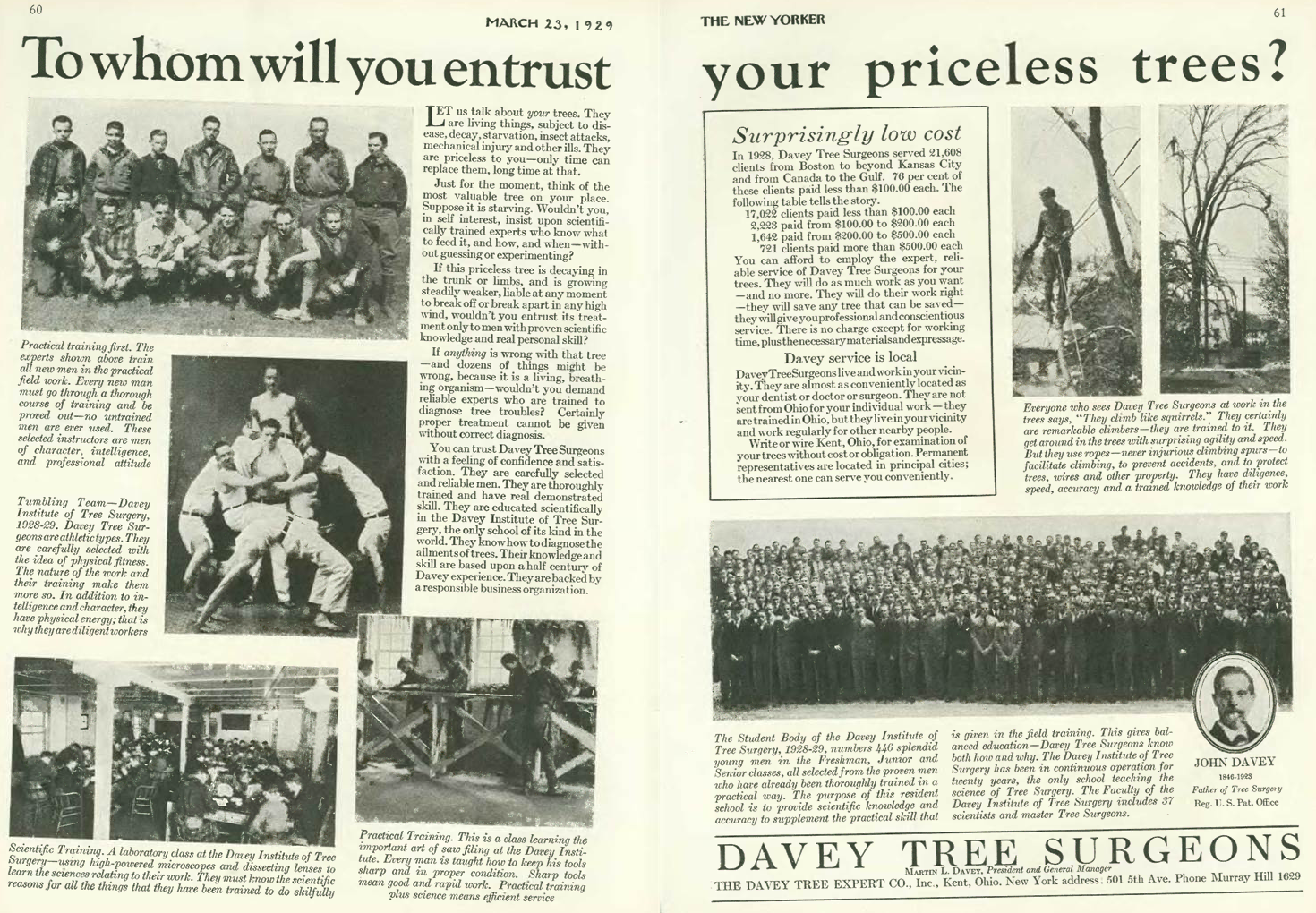
…and then we have this, one of the unlikeliest advertisements ever to appear in the New Yorker—at first I thought it was one of E.B. White’s fake newspapers, but it was actually a two-page spread promoting Davey Tree Surgeons of all things…

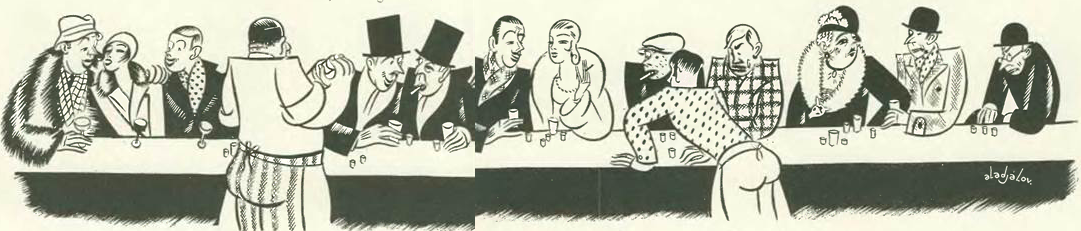
…just for fun I am tossing in this illustration by Constantin Aladjalov that appeared along the bottom of a two-page spread…

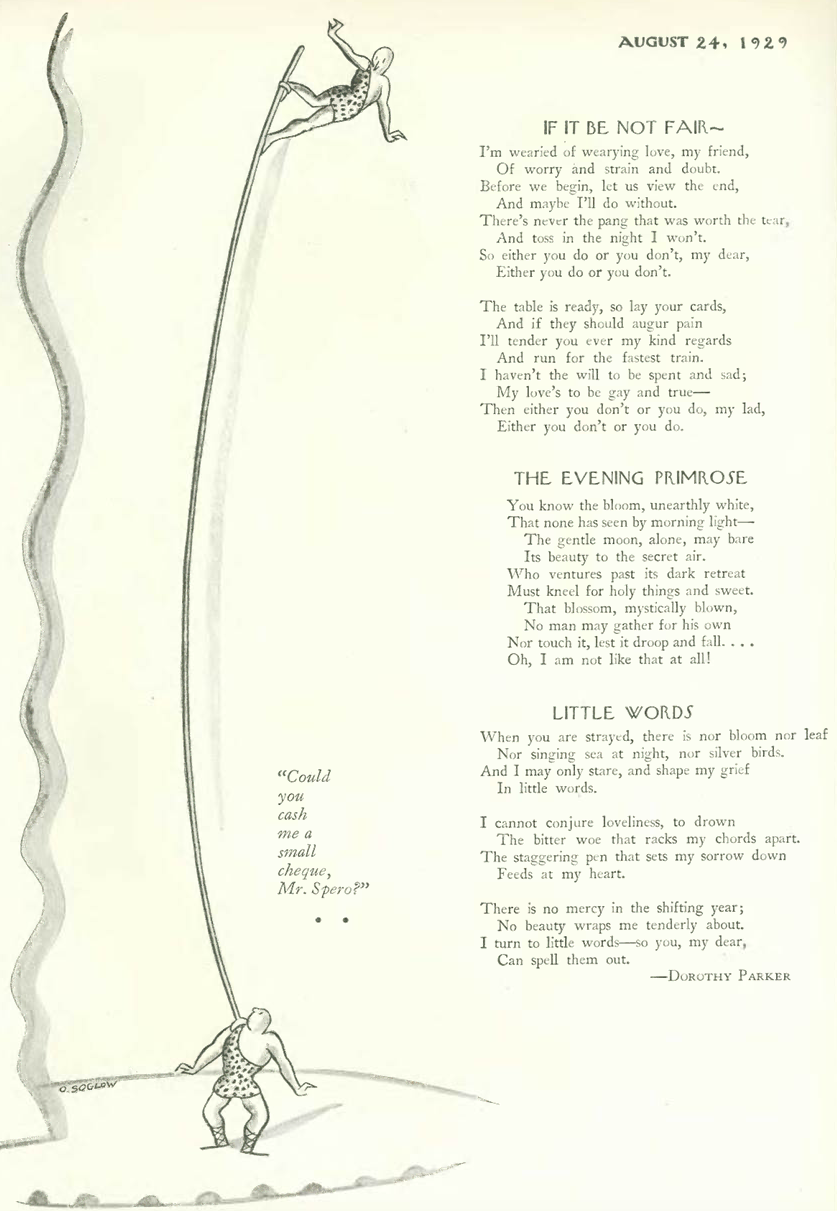
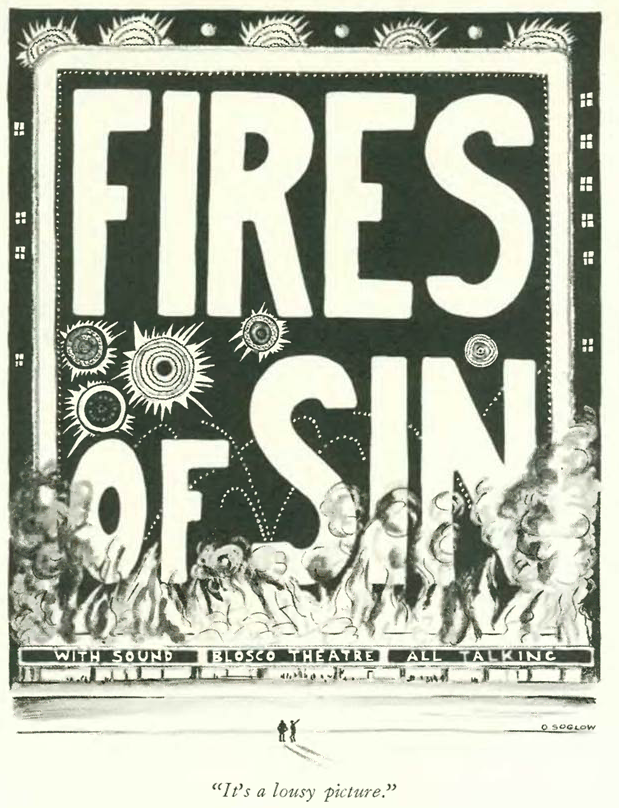
…and finally, our cartoon from Otto Soglow, in which our subject is either referring to a popular board game from 1929, or a particular sequence in a domino game…

Next Time: While You Were Away…


Happy 1929!

I’ve been writing this blog for nearly three years, and during that stretch have managed to cover more than 200 issues of The New Yorker, or about the first four years of the magazine.

Dec. 22, 1928 and Dec. 29, 1928 covers by Rea Irvin.

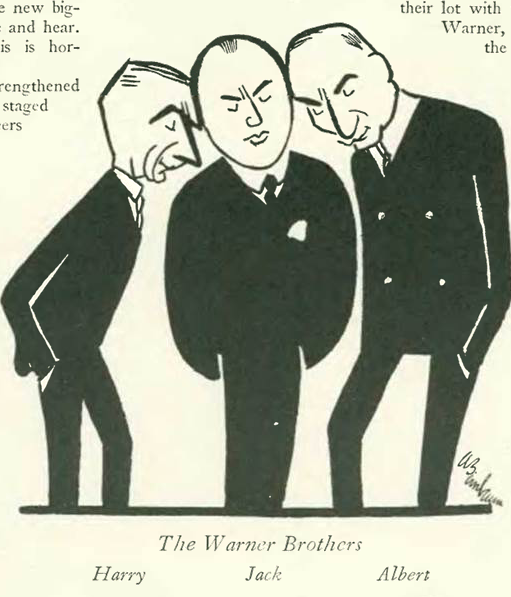
The amount of young talent on display in those early issues is truly astounding, from writers such as E.B. White, Dorothy Parker and James Thurber (writer and cartoonist) to illustrators and cartoonists including Peter Arno, Rea Irvin, Helen Hokinson, Miguel Covarrubias and Ilonka Karasz, to name just a few. Among the contributing artists was Abe Birnbaum, who illustrated more than 150 covers for The New Yorker from the 1940s to 1970s. One of his earliest contributions to the magazine was this illustration for the “Profile” section in the Dec. 22 issue:

Canadian artist Shelley Davies writes in her blog that Birnbaum “charmingly captured some of life’s quieter moments with a deft eye.” In addition to The New Yorker, Birnbaum illustrated numerous covers for Stage and Arts In America, and won a Caldecott Award in 1954 for his children’s book, Green Eyes.

ON THE QUIETER SIDE…Abe Birnbaum (pictured here circa 1960) created more than 150 covers for The New Yorker from the 1940s to the 1970s. At right, a cover from March 17, 1962. (google.com.br)

 * * *

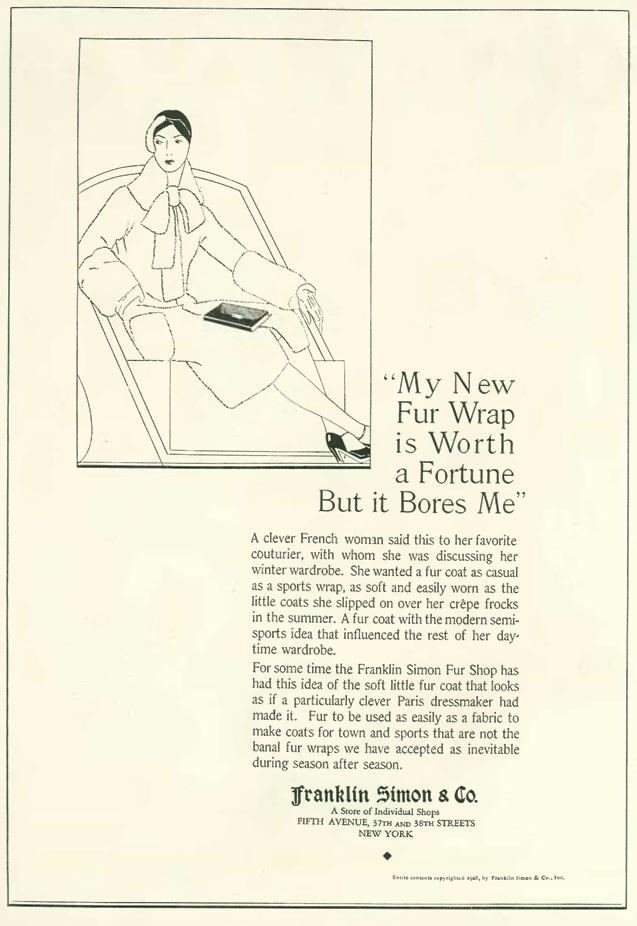
A couple of select advertisements from the Dec. 22 reveal what retailers knew, or thought they knew, about the magazine’s readership. Franklin & Simon, seeking perhaps to broaden their market for furs, suggested that even a stylish French woman might prefer a fur fashioned as a modest “sports wrap”…

…as for the guys, Saks appealed to the anglophilia that apparently was rife among New York’s smart set. Check out the ridiculous hat gracing the noggin of this young dandy…

Well-heeled readers who could afford to flee the New York winter were targeted by these various enticements in the Dec. 22 issue (this is a collage of select ads found in the back pages of the issue):

 * * *

Hello Down There

Writing about New Yorker humor derived from class distinctions, Ben Yagoda (About Town: The New Yorker and the World It Made, p. 63) noted a series of cartoons by Otto Soglow that began with this one in the Dec. 22, 1928 issue and continued through thirty installments that ran to early 1930, when the workers, Joe and Bill, finally emerged from the manhole:

This running gag, according to Yagoda, “came from the conceit that the laborers spoke with the same assumptions and in the same catchphrases as those with ‘higher’ places in society.”

Also from the Dec. 22 issue, this terrific cartoon by Leonard Dove that showed a bookish man who had accidentally entered the wrong type of book-making establishment:

* * *

The Girl Who Wouldn’t Grow Up

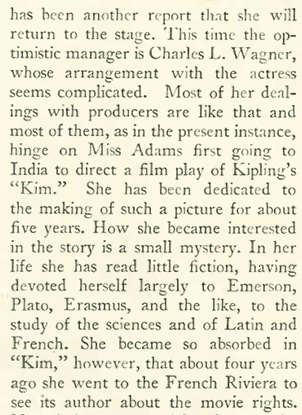
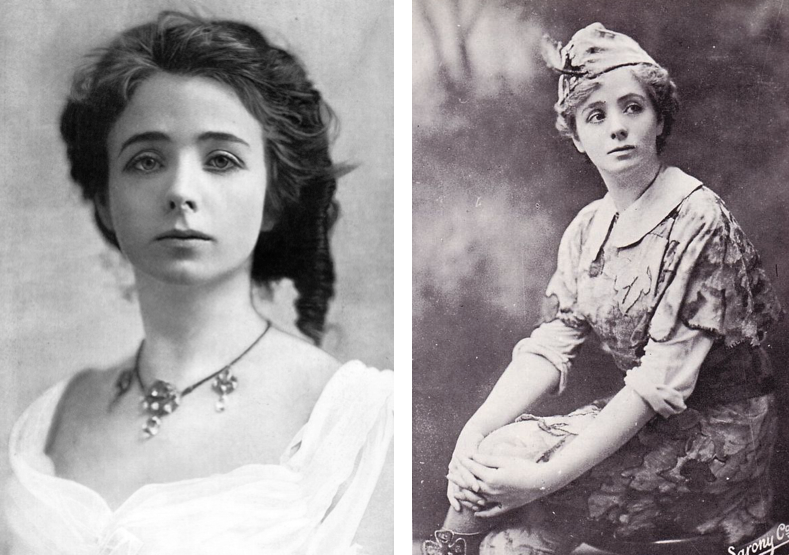
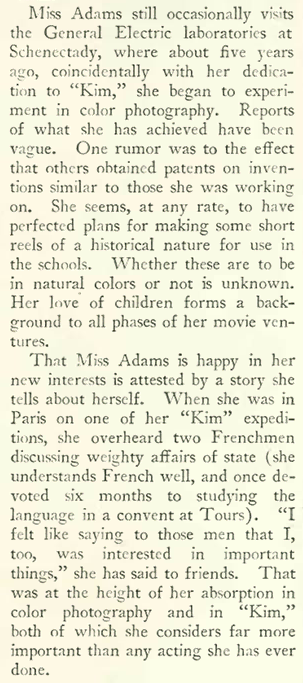
Maude Adams was a major Broadway star in the early years of the 20th century. Appearing in more than 25 productions from 1888 to 1916, she was most famous for her portrayal of Peter Pan in the Broadway production of Peter Pan; or, The Boy Who Wouldn’t Grow Up. She performed that role first in 1905-06 and again in 1912 and 1915. The highest-paid performer of her day, at her peak she earned more than $1 million a year, a staggering sum more than a century ago. James Thurber, writing in the Dec. 29 “Talk of the Town,” reported that after a decade-long absence from the stage, Adams was planning a comeback as a director:

STAR POWER…At left, American actress Maude Adams, circa 1900. At right, Adams as Peter Pan, her most famous stage role. Adams was the first American to portray Peter Pan on the stage. She played the role 1,500 times between 1905-1915. She retired from the stage in 1918 after a severe bout with the flu. She died at age 80 in 1953. (Wikipedia/Oakland Tribune)

Thurber also noted that Adams was working with General Electric in the development of color photography. According to the Trivia Library, it has been suggested that her motivation might have been a wish to appear in a color film version of Peter Pan. She eventually returned to acting in the 1930s, with occasional appearances in regional productions of Shakespeare plays.

 * * *

A Lukewarm Welcome to 1929

The Dec. 29 New Yorker opened with these lamentations for the last issue of 1928. At least it appears that one could obtain a decent bottle of French champagne to toast the New Year:

JAM SESSION…1929 photo of traffic on Fifth Avenue. (theoldmotor.com)

 * * *

The Passing of a Poet

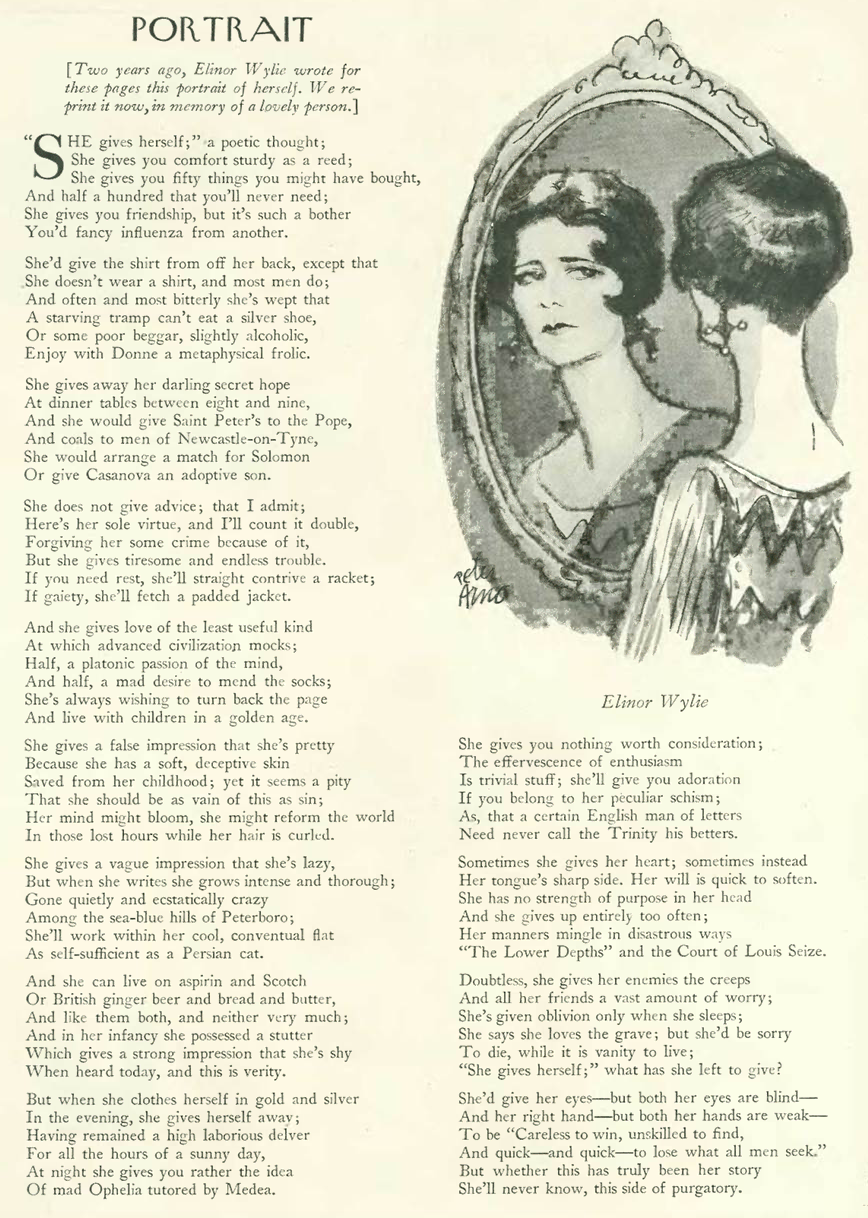
The Dec. 29 issue featured something unprecedented in The New Yorker up to that point: the reprinting of an entire piece previously featured in the magazine. In this case, it was in tribute to the sudden passing of poet and author Elinor Wylie:

PORTRAITS…Elinor Wylie posed for her friend Carl Van Vechten in this 1922 portrait (left). The photo at right, probably taken around 1926, was clearly the inspiration for the illustration by Peter Arno that accompanied “Portrait.” (Yale University/humorinamerica.wordpress.com)

It is no wonder that The New Yorker had such affection for Wylie, for she was as colorful a personality as could be found in 1920s literary circles. A Columbia University Press bio notes that “she was famous during her life almost as much for her ethereal beauty and personality as for her melodious, sensuous poetry.” Born to a socially prominent family and trained for a life in society, she instead became notorious for her multiple marriages and love affairs. She also suffered from extremely high blood pressure that gave her unbearable migraines.

Wylie died on Dec. 16, 1928, while going over a typescript of her poetry collection, Angels and Earthly Creatures, with her estranged third husband, William Rose Benét. According to Karen Stein (in the Dictionary of Literary Biography), Wylie, while picking up a volume of John Donne’s poems, asked Benét for a glass of water. When he returned with it, she reportedly walked toward him and murmured, “Is that all it is?,” and fell to the floor, dead of a stroke. She was 43.

* * *

Age of Innocence

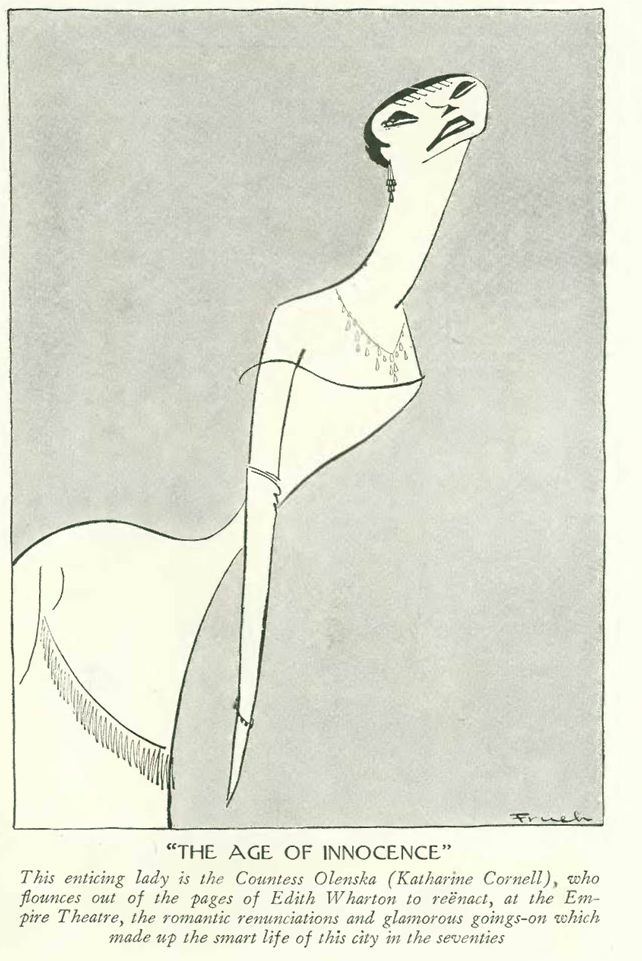
The Dec. 29 theatre review section featured this illustration by Al Frueh of Katharine Cornell in the Empire Theatre’s production of The Age of Innocence:

And below, a studio portrait of Cornell from the same play:

HOW SHE REALLY LOOKED…Katharine Cornell as ‘Countess Ellen Olenska’ in this Vandamm Studio portrait dated November 27, 1928. (Billy Rose Theatre Collection, The New York Public Library)

 * * *

Before Baby Snooks

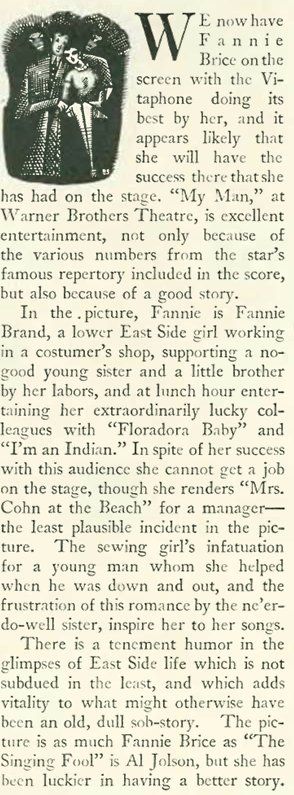
Although it was still a few years before singer and actress Fanny Brice would make her radio debut as the bratty toddler named “Snooks,” she was already well-known to New York audiences for her work in the Ziegfeld Follies (beginning in 1910). In its Dec. 29 issue The New Yorker favorably reviewed Brice’s first motion picture, My Man, which included musical scenes with Vitaphone sound:

MY MAN…Fanny Brice, Guinn Williams, and Edna Murphy on the set of the partially silent film My Man, 1928. Her first movie appearance, Brice played Fanny Brand, a poor girl who becomes a star. The film is now considered lost, since only an incomplete version survives. (brice.nl)
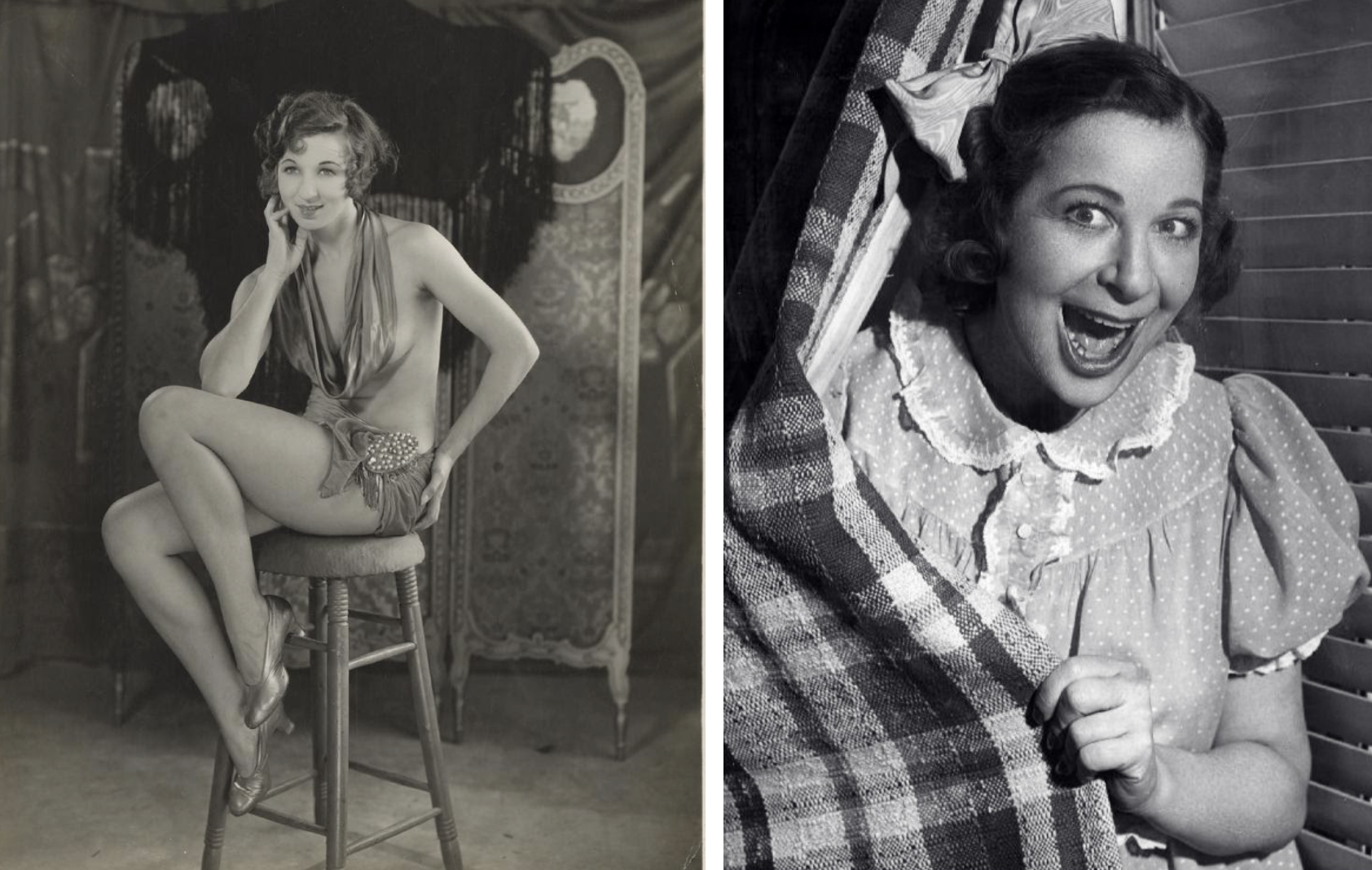
THROUGH THE YEARS…At left, singer and actress Fanny Brice from the time she was a Ziegfeld Follies girl, circa 1915. At right, Brice in the role of Baby Snooks, 1940. (Vintage Everyday/Wikipedia)

 * * *

Let’s Get Physical

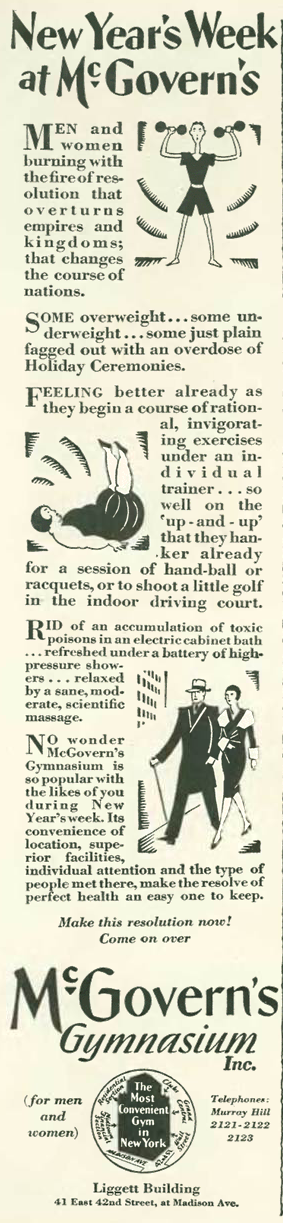
Even 90 years ago some folks (or at least some New Yorkers) resolved to get healthy and hit the gym in the New Year. In this ad, McGovern’s Gymnasium announced it was ready for them:

Babe Ruth trains at Artie McGovern’s Gym for the upcoming baseball season, February 9, 1928. (twitter.com/BSmile)

And to close out 1928, a cartoon from John Reehill

Next Time: Out With the Old…

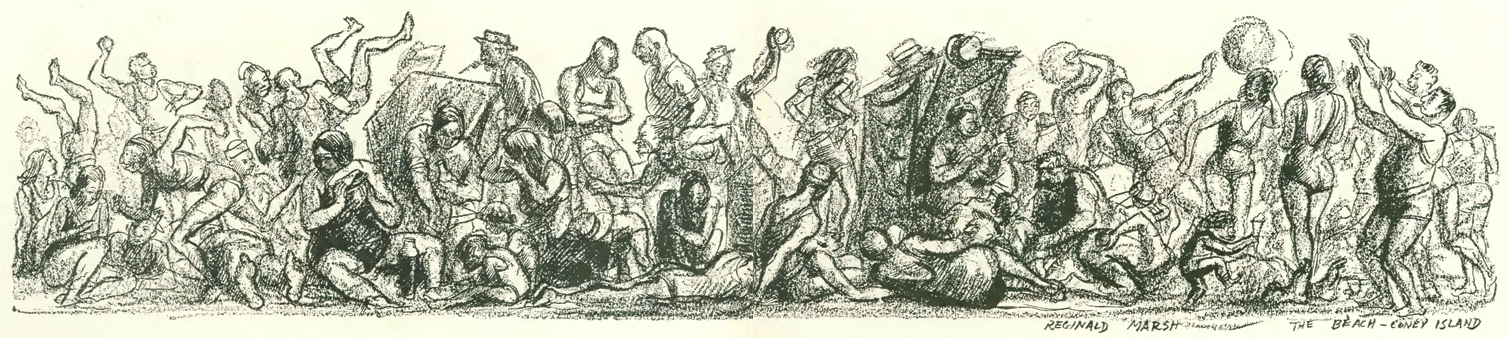
Down to Coney

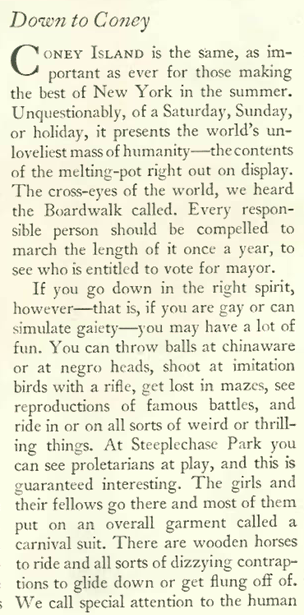
The New Yorker kicked off the summer season with a trip down to Coney Island. “The Talk of the Town” took in the various sights and amusements at the famed Steeplechase and Luna parks.

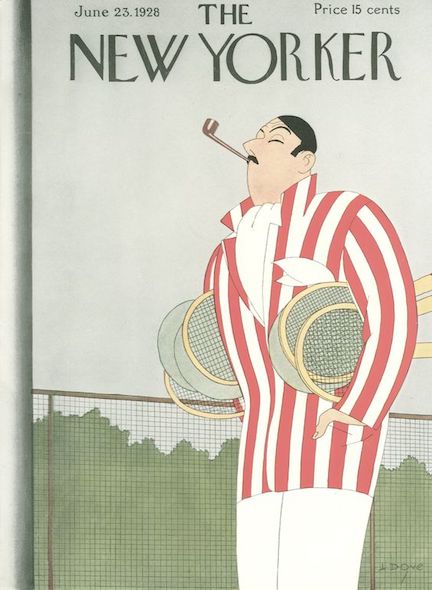
June 23, 1928 cover by Leonard Dove.

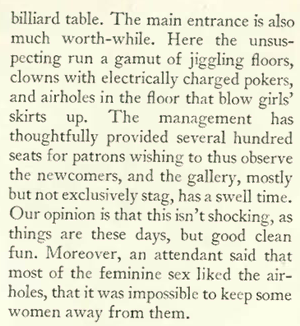
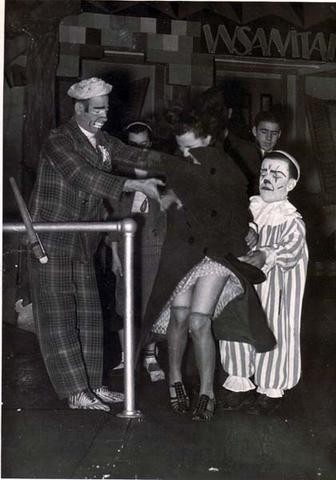
Attractions at Steeplechase Park included everything from racing wooden horses to a “human billiard table.” Less jolly diversions included air jets that blew up  women’s skirts and clowns who administered electric shocks to unsuspecting visitors (one more reason to fear them). And there was at least one racist game of skill…

FEAR THE CLOWN…A photo from the 1940s shows a pair of clowns “help” a woman through the entrance to Steeplechase Park’s Insanitarium and Blowhole Theatre. Located in the Pavilion of Fun, visitors were led through Comedy Lane, which featured jets of compressed air intended to lift skirts. Clowns spanked patrons and even zapped them with a cattle prod. (Worthpoint.com)
Clockwise, from upper left: A Steeplechase rider passes in front of the massive Pavilion of Fun; interior of the Pavilion of Fun; young women preparing to be spun around on the Human Billiard Table; scene from the 1928 Harold Lloyd movie Speedy filmed in the Pavilion of Fun (westland.net, CardCow, houseoftoomuchtrouble.tumblr.com, safetylast.tumblr.com) click to enlarge
OUT FOR A SPIN…Harold Lloyd and Ann Christy take a spin on the Pavilion of Fun’s Human Roulette Wheel in the 1928 film Speedy. (spellboundbymovies.com)
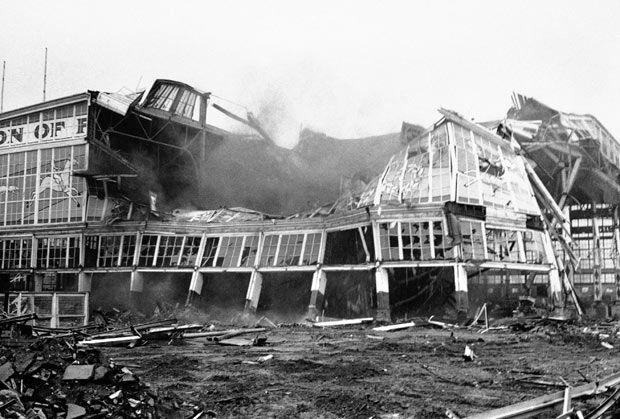
TRUMPED…Coney Island’s landmark Pavilion of Fun at Steeplechase Park was demolished in 1966 by developer Fred Trump, father of Donald Trump. The young Donald (19 at the time) was on hand for his father’s “Demolition Party,” which featured scantily clad models who paraded in front of the park and encouraged guests to throw bricks at the stained glass windows of the historic pavilion. Later that night Trump bulldozed the amusement park to the ground, thereby limiting any pending proceedings to declare the property a historic landmark. (Daily Telegraph/Untapped Cities)

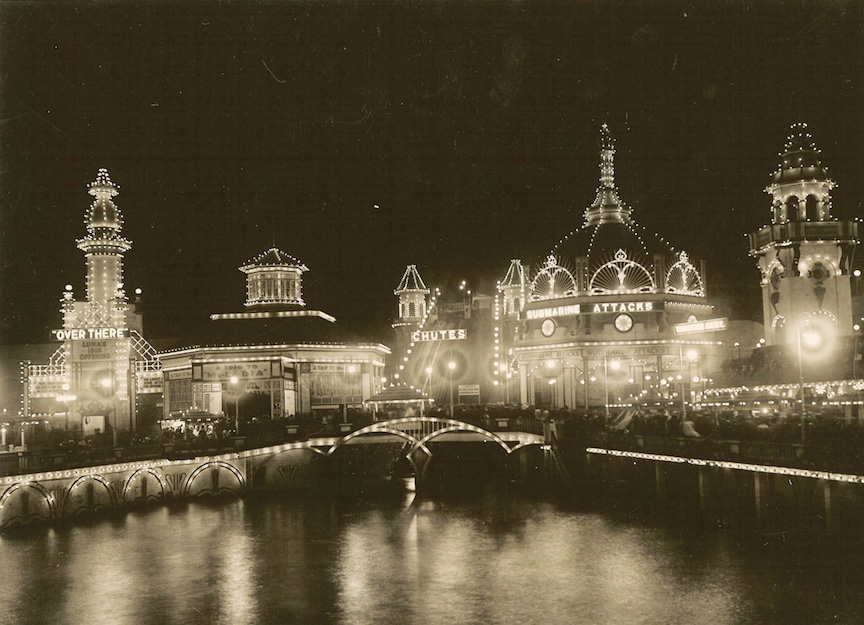
Over at Luna Park there were more air holes to blow up women’s skirts and assorted freak shows. More wholesome entertainments included the famed Cyclone rollercoaster, which celebrated its 90th year of operation in 2017.

DREAMLAND…Luna Park at night in the 1920s. (carouselhistory.com)

 *  *  *

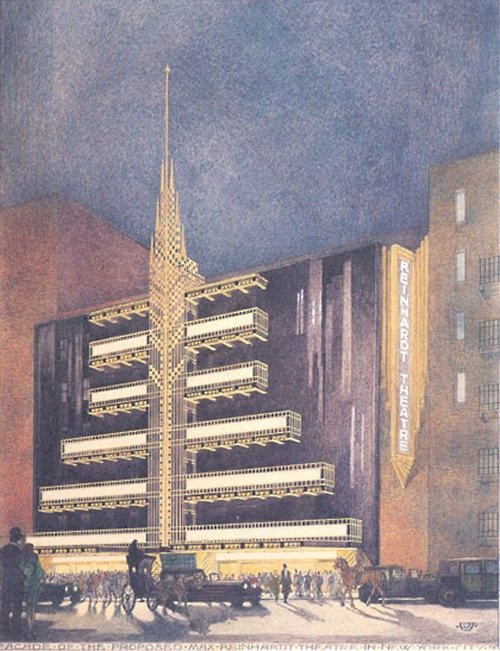
Writing for the June 23 “Talk of the Town,” Murdock Pemberton anticipated the construction of a new theatre to be developed by famed Austrian director/producer Max Reinhardt and designed by Austrian-American architect, illustrator and scenic designer Joseph Urban:

Unfortunately the market crash of 1929 put an end to the project, which would have looked like this had it been constructed:

DREAMLAND…Joseph Urban’s unbuilt Reinhardt Theatre. The innovative design incorporated the building’s fire escapes into its glimmering facade. (Columbia University)

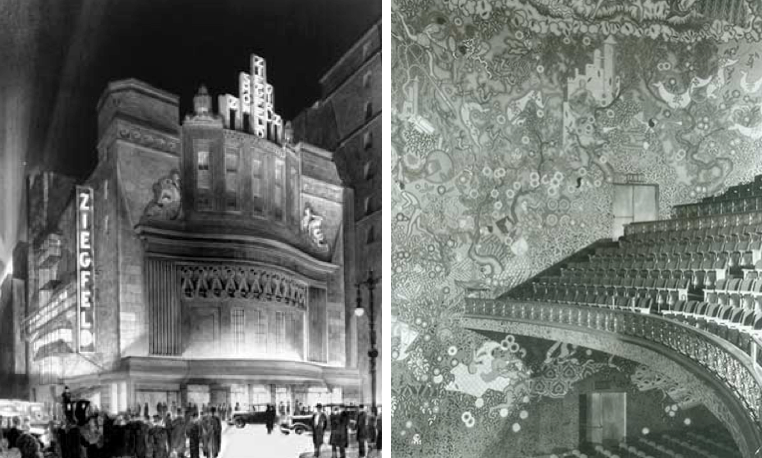
Urban designed innovative sets for clients ranging from the Metropolitan Opera to the Ziegfeld Follies (he also designed a theatre for Ziegfeld in 1927, see below). Although he is noted as one of the originators of American Art Deco, most of his architectural work in the United States has been demolished.

RARE REMNANT…Little remains of the work of Joseph Urban, one of the originators of American Art Deco. Fortunately the Tishman Auditorium at the New School still stands. (nycarchitecture.com)
ONLY A MEMORY…Most of Joseph Urban’s American work has been demolished, including his Ziegfield Theatre from 1927. (nyc-architecture.com)
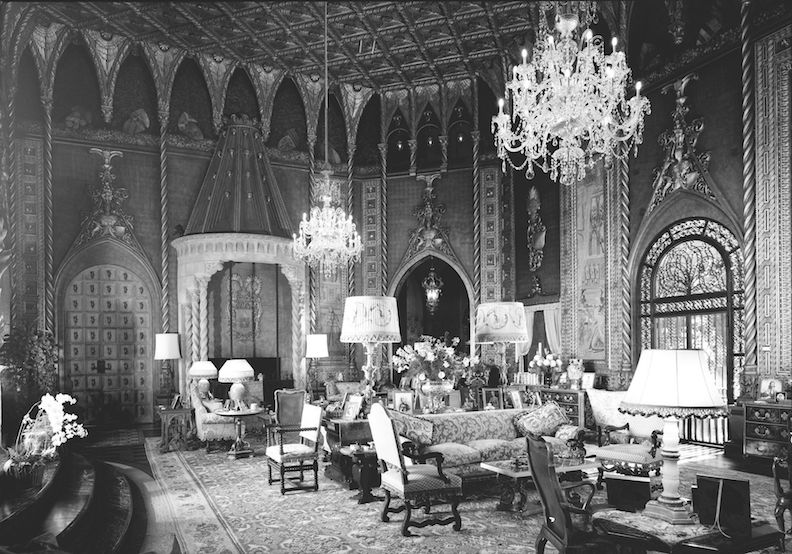
MAR-A-LAGO…Joseph Urban designed the interiors of one of America’s most famous mansions—Mar-a-Lago. Built from 1924 to 1927 by cereal heiress Marjorie Merriweather Post, it is now owned by Donald Trump and operated as a members-only club. (Wikipedia)

 *  *  *

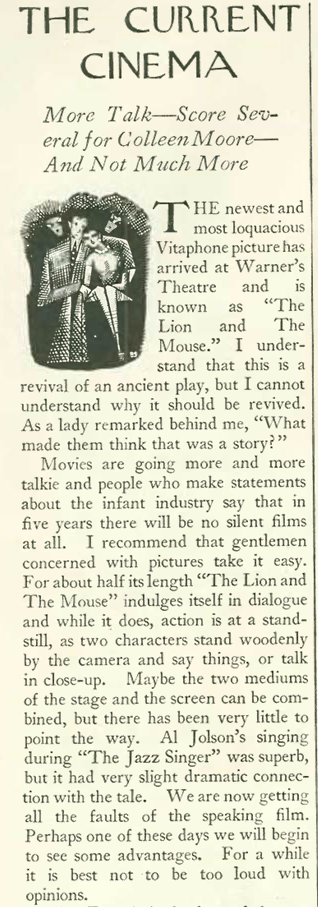
The New Yorker continued to struggle with the emergence of “talking pictures.” The critic “O.C.” found that the sound dialogue in The Lion and the Mouse did little to improve the picture:

The critic seemed to believe that sound pictures would take some time to catch on. Little did he know that Warner Brothers would announce later that summer (August 1928) that all of its films for the 1928-29 fiscal year would have sound. United Artists would make the same announcement in November 1928. In February 1929 Twentieth-Century Fox would make its final silent movie, and Columbia would release its last silent movie on April 1, 1929.

OH SHUT UP…Theatre card for The Lion and the Mouse. (Wikipedia)

The New Yorker still found happiness at the movies through the likes of actress Colleen Moore, who made a sweet little film called Happiness Ahead. 

A CASE OF THE HAPPIES…Colleen Moore strikes a contemplative pose in Happiness Ahead. (IMDB)

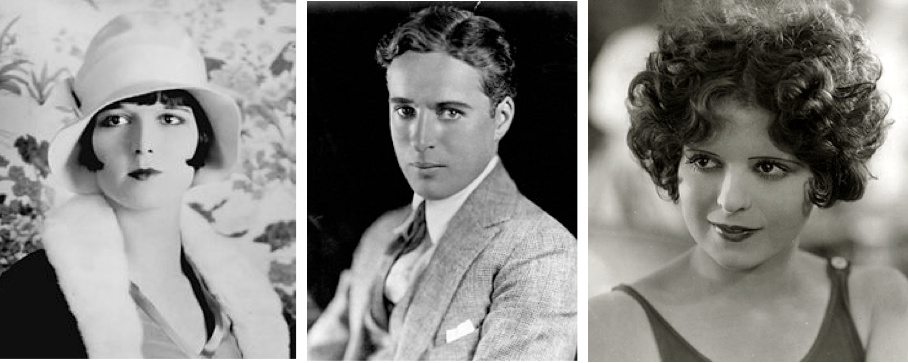
Colleen Moore was one of the most famous stars of the silent era who popularized the bobbed haircut and flapper style. Moore presented a more wholesome version of the flapper, in contrast to the more worldly Louise Brooks, another flapper icon of the Twenties.

VARIATIONS ON A THEME…Actresses Colleen Moore (left) and Louise Brooks defined flapper style in the 1920s. (dorineenvrac.wordpress.com / corvusnoir.com)

 *  *  *

From Our Advertisers

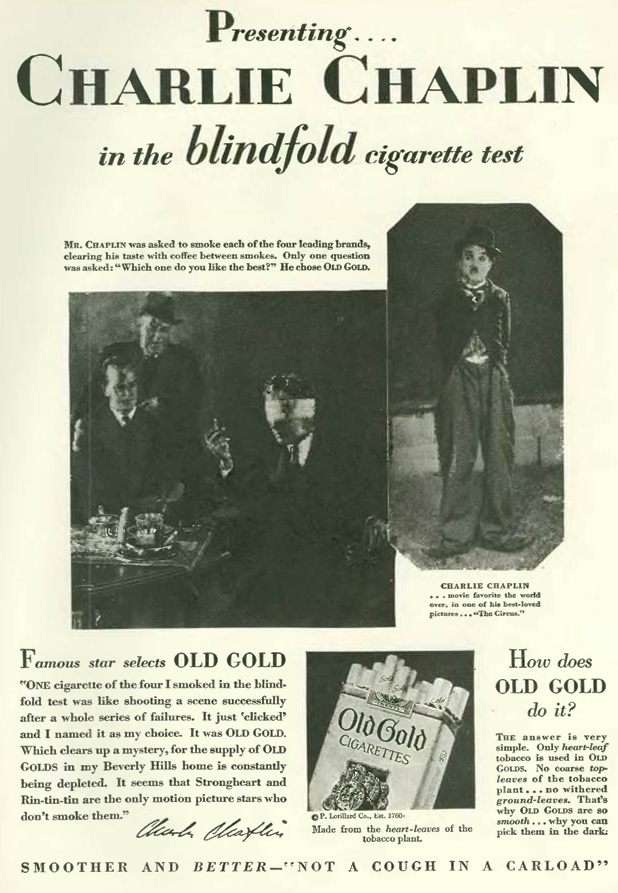
Continuing our series on celebrity endorsements of Old Gold cigarettes, none other than the Little Tramp stepped up to take the blindfold test (along with a pile of cash, no doubt):

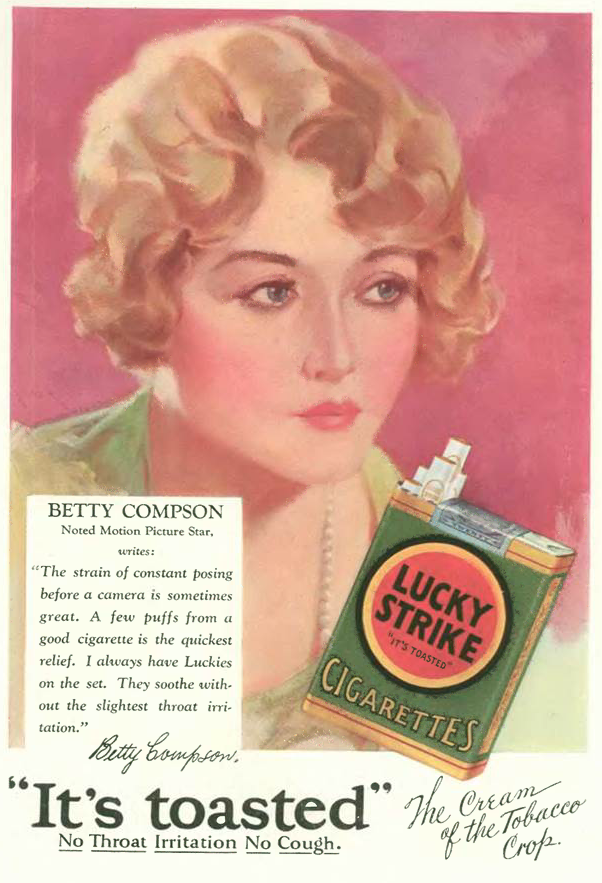
And if Old Gold is not to your taste, then why not enjoy the “toasted” pleasures of Lucky Strike? Actress Betty Compson found them indispensable when preparing for a big scene:

 *  *  *

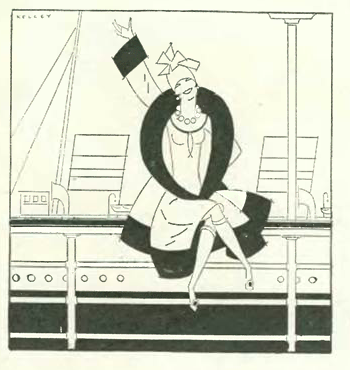
And now for something that caught my eye in the June 23 issue…a bit of filler art by Eldon Kelley that broke up some copy on page 34:

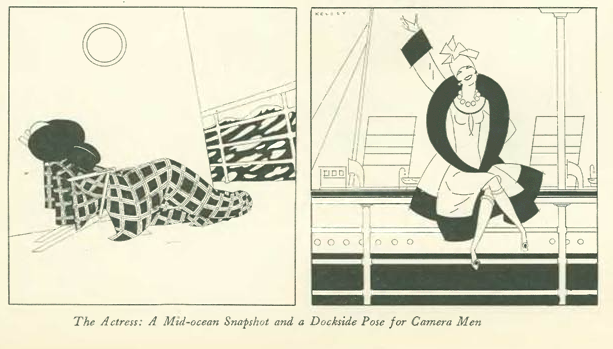
This particular illustration was also featured in one of The New Yorker’s earliest issues—March 21, 1925—in a two-part comic panel (below). I am puzzled why the magazine, flush with artistic talent by 1928, reused this Kelley illustration. Perhaps the layout editors figured since the readership was so small in March 1925, no one would notice.

Here’s an early contribution by Otto Soglow that is a far cry from his later minimalist cartoons…

And we leave with yet another look at some Jazz Age shenanigans, courtesy cartoonist Peter Arno:

Next Time: Summer Breeze…

Guess Who’s Coming to Dinner

Gene Tunney was not your typical boxer. Holder of the heavyweight title from 1926 to 1928, he defeated his rival Jack Dempsey in 1926 and again in 1927 in the famous “Long Count Fight.” But Tunney was no Palooka—he preferred to be known as a cultured gentleman, and made a number of friends in the literary world including George Bernard Shaw, Ernest Hemingway and Thornton Wilder.

d30ba2edfc3289f6c04c8dfd337ef06c
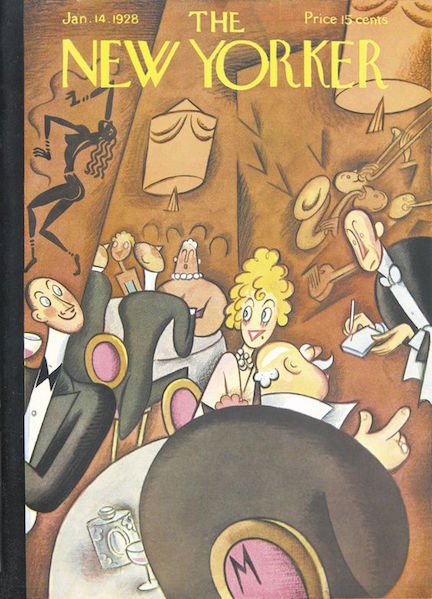
January 14, 1928 cover by Julian de Miskey.

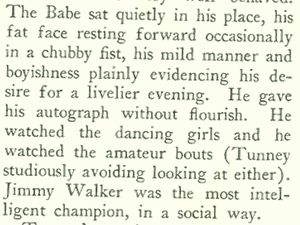
So when given the opportunity to say a few words, Tunney made the most of it, including at a dinner hosted by boxing and hockey promoter Tex Rickard to honor champions in various sports. The New Yorker’s E.B. White was there tell us about it:

screen-shot-2017-02-10-at-12-52-28-pm

d2cf24cb8345bcbf47135ea359d6eaa4
FETED FOR FEATS…World champion athletes are shown here from top row, left to right; Babe Ruth (baseball), Gene Tunney (boxing), Johnny Weissmuller (swimming), Bill Cook (hockey). On the bottom row is from left to right, Bill Tilden (tennis), Bobby Jones (golf), Fred Spencer and Charlie Winters (six-day bicycle race).

While Tunney was doubtless composing his thoughts at the banquet table, baseball legend Babe Ruth was wishing he could be someplace else…

screen-shot-2017-02-10-at-12-53-12-pm

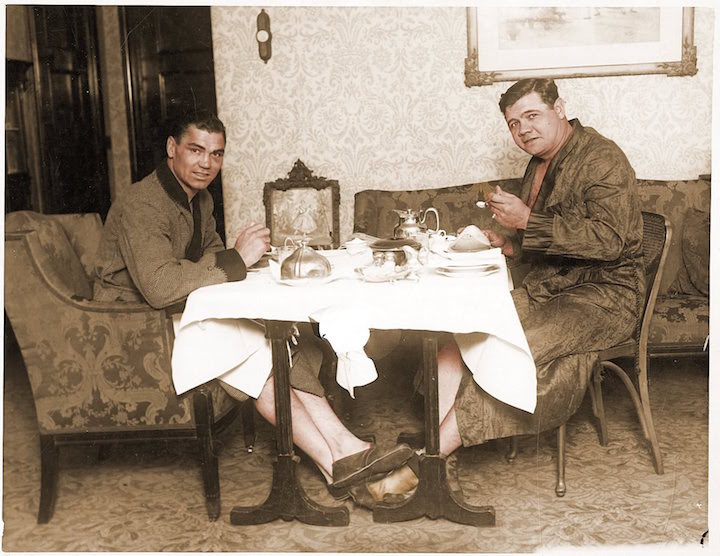
…like hanging out with his old buddy Jack Dempsey

ruthdempsey
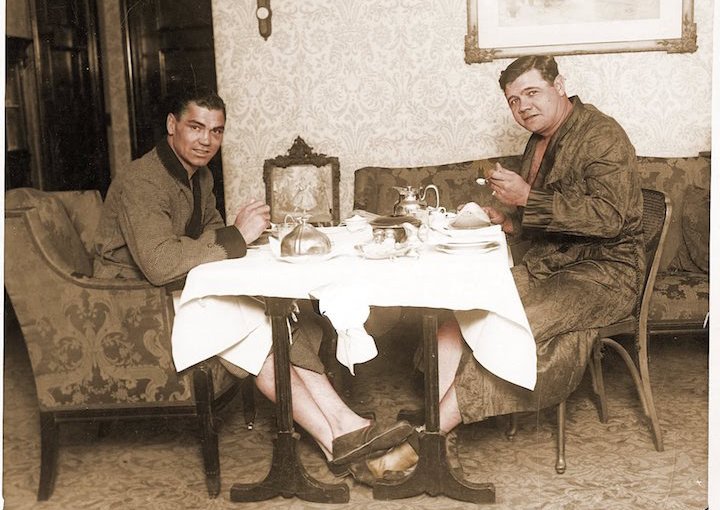
BREAKFAST OF CHAMPIONS…Babe Ruth having breakfast with his friend, heavyweight boxing champion Jack Dempsey, at Ruth’s residence at the Ansonia Hotel in New York City, 1927. Dempsey reigned as the champ from 1919 until 1926, when he was defeated by Gene Tunney. (captainsblog.info)

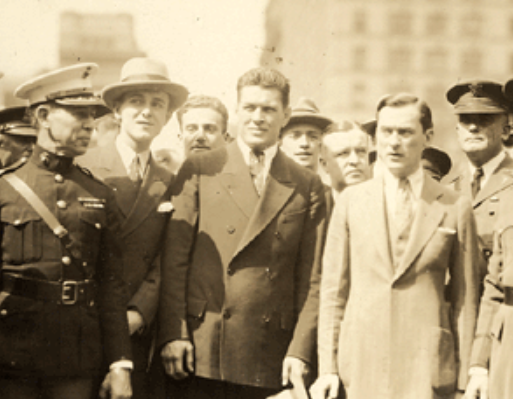
Instead, the Babe would have to listen to a surprise speech by Tunney, who sought to prove to those in attendance that he had brains to match his brawn. No doubt to the relief of many in attendance, New York City’s flamboyant mayor, Jimmy Walker, was able to return the proceedings to party mode.

screen-shot-2017-02-10-at-12-54-25-pm

screen-shot-2017-02-14-at-3-00-04-pm
THAT’LL DO, GENE, THAT’LL DO…Newly crowned heavyweight boxing champion Gene Tunney (center) meets with New York City Mayor Jimmy Walker (right) at City Hall, September 1926. (josportsinc.com)

 *  *  *

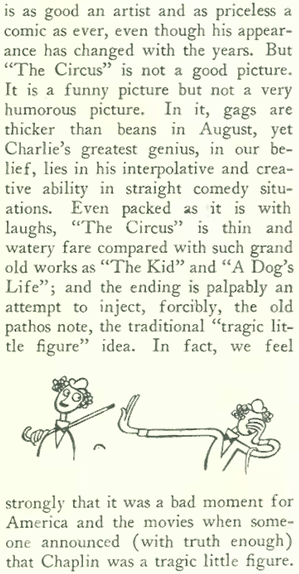
The New Yorker writers found little to like about Hollywood, but Charlie Chaplin could always be counted on to knock out a humorous film. At least most of the time. Here is what “The Talk of the Town” had to say about his latest, The Circus:

screen-shot-2017-02-10-at-12-48-54-pm

screen-shot-2017-02-10-at-12-49-02-pm

LIGHTEN UP, CHARLIE…Merna Kennedy, Charlie Chaplin and Harry Crocker in The Circus. (1928). (Turner Classic Movies)

 *  *  *

Give ‘Em Dirty Laundry

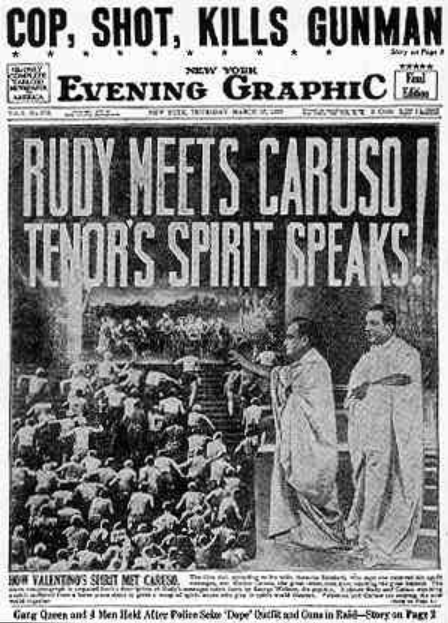
In these days of clickbait and other news designed to attract our prurient interest, we can look back 89 years a see that the tabloids were doing much of the same, particularly in Bernarr Macfadden’s New York Graphic, which was making the most of the final days of death row inmates Ruth Snyder and Judd Gray. “The Talk of the Town” (likely Robert Benchley) made this observation:

screen-shot-2017-02-10-at-12-49-34-pmscreen-shot-2017-02-10-at-12-49-56-pm

screen-shot-2017-02-14-at-4-48-21-pm
TSK, TSK…Evangelist Aimee Semple McPherson (left), received a tidy sum to write about convicted murderer Ruth Snyder for the New York Evening Graphic. (Wikipedia/Murderpedia)

Former lovers Snyder and Gray were sentenced to death in 1927 for the premeditated murder of Snyder’s husband (they went to the electric chair at Sing Sing prison on Jan. 12, 1928). Newspapers across the country sensationalized their trial, but the Graphic went the extra step by paying large sums to celebrity correspondents, including evangelist Aimee Semple McPherson, to write about the sordid case. Sister Aimee used her Graphic column to encourage young men to “want a wife like mother — not a Red Hot cutie.” Semple McPherson herself would later be accused of an affair, but then what else is new in the business of casting stones?

screen-shot-2017-02-15-at-10-57-28-am
FAKE NEWS…Before the National Enquirer and Weekly World News (and Facebook, Twitter, Instagram etc.), Benarr Mcfadden’s Evening Graphic was the tabloid of choice among the less discerning. This issue from March 17, 1927, depicted silent actor Rudolph Valentino meeting the famed tenor Enrico Caruso in heaven. The Graphic was famous for these “Composographs,” — images cut and pasted together using the heads or faces of current celebrities and glued onto staged images created by employees in Macfadden’s studio. (bernarrmacfadden.com)

 *  *  *

Even His Skivvies?

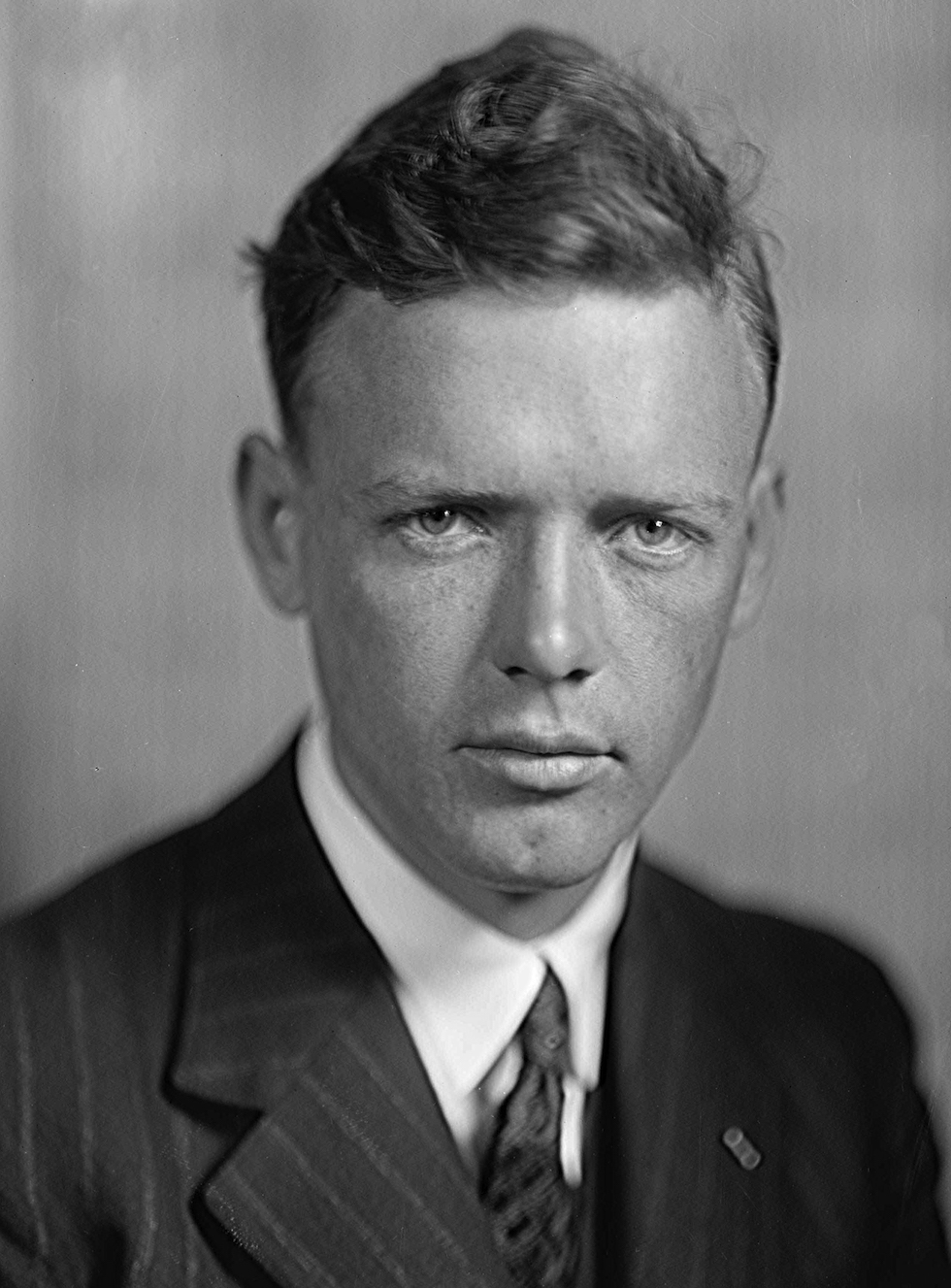
We can also look back 89 years and see that people were just as celebrity-crazed then as they are now. Charles Lindbergh could barely keep the clothes on his back while being pursued by adoring mobs, according to “The Talk of the Town”…

screen-shot-2017-02-10-at-12-50-39-pm

col_charles_lindbergh
KEEP YOUR HANDS OFF MY BVDS

 *  *  *

Kindred Spirits

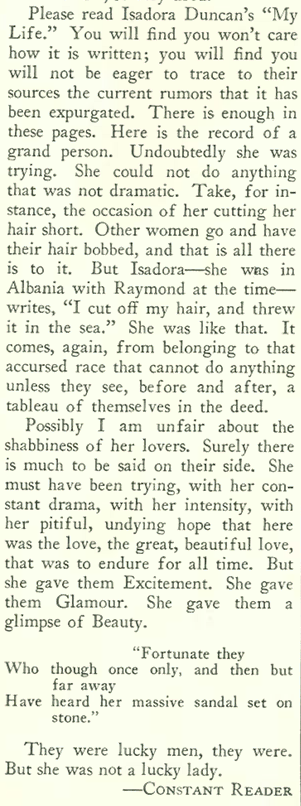
Dorothy Parker wrote a vigorous, even impassioned defense of the late dancer Isadora Duncan in her column, “Reading and Writing.” Parker reviewed Duncan’s posthumously published autobiography, My Life, which she found “interesting and proudly moving” even if the book itself was “abominably written,” filled with passages of “idiotic naïveté” and “horrendously flowery verbiage.” In this “mess of prose” Parker also found passion, suffering and glamour—three words that Parker could have used to describe her own life.

Parker elaborated on the word “glamour,” which she thought had been cheapened in her day to something merely glittery and all surface. True glamour, wrote Parker, was that of Isadora Duncan, coming from her “great, torn, bewildered, foolhardy soul.” Parker concluded with this plea:

screen-shot-2017-02-10-at-1-06-00-pm

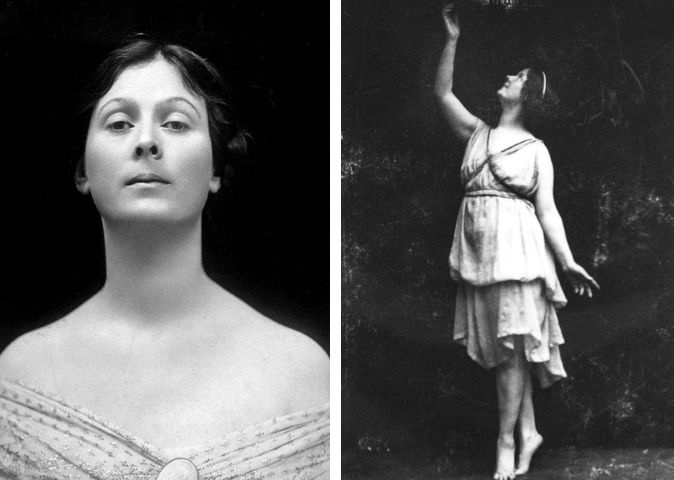
Isadora Duncan circa 1910 (left), and Duncan in a publicity photo circa 1903. (Wikipedia)

 *  *  *

New Kid on the Block

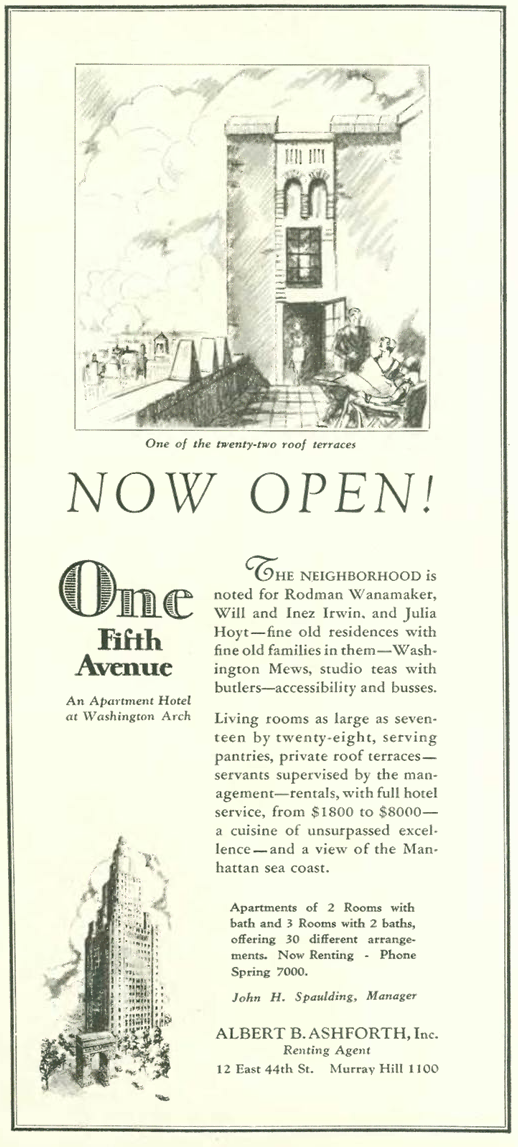
Yet another high-rise dwelling was available to Jazz Age New Yorkers—One Fifth Avenue in Greenwich Village. One Fifth Avenue was an apartment with the word “hotel” attached to justify its 27-story height. To meet zoning requirements, the apartments had “pantries” instead of kitchens. But then again, your “servant” would fetch your dinner anyway…

screen-shot-2017-02-10-at-1-00-01-pm

one-fifth-avenue-december-1928
GOING UP…The art deco landmark One Fifth Avenue signaled a dramatic change from the four-story mansions that once occupied the site.  (New York Public Library)

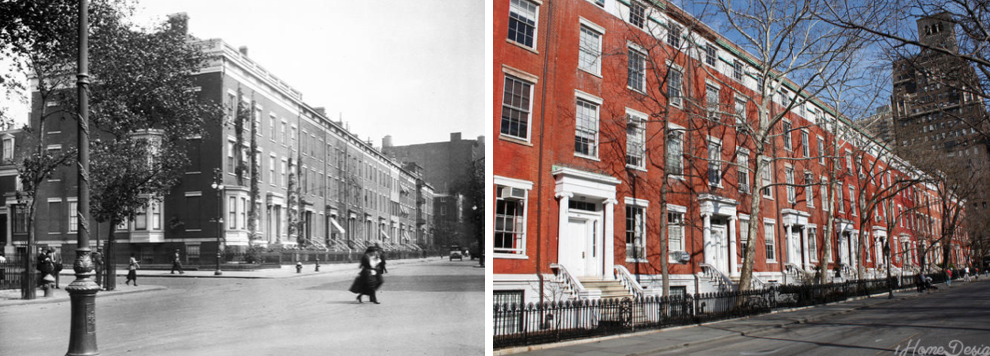
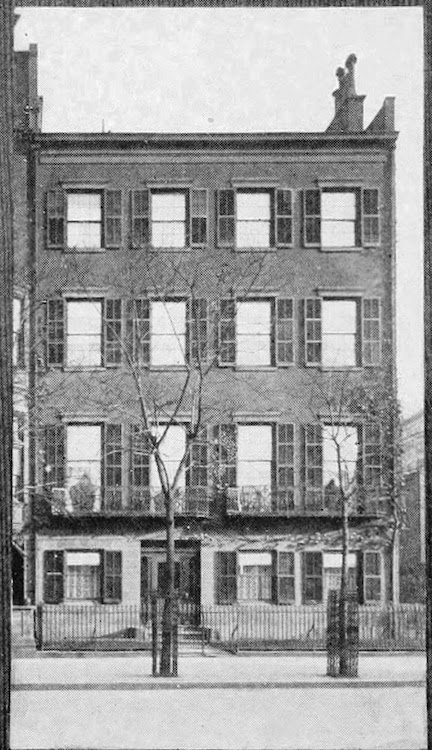
Historical note: One Fifth Avenue marked a dramatic change in the character of Washington Square, one of the most prestigious residential neighborhoods of early New York City. A previous occupant of the One Fifth Avenue site was the brownstone mansion of William Butler Duncan. In addition to One Fifth Avenue, the residences at 3, 5, and 7 Fifth Avenue were also demolished to make way for the new art deco “apartment hotel.”

01-fifth_william-butler-duncan
DUST TO DUST…The William Butler Duncan residence at One Fifth Avenue. (daytoninmanhattan)

*  *  *

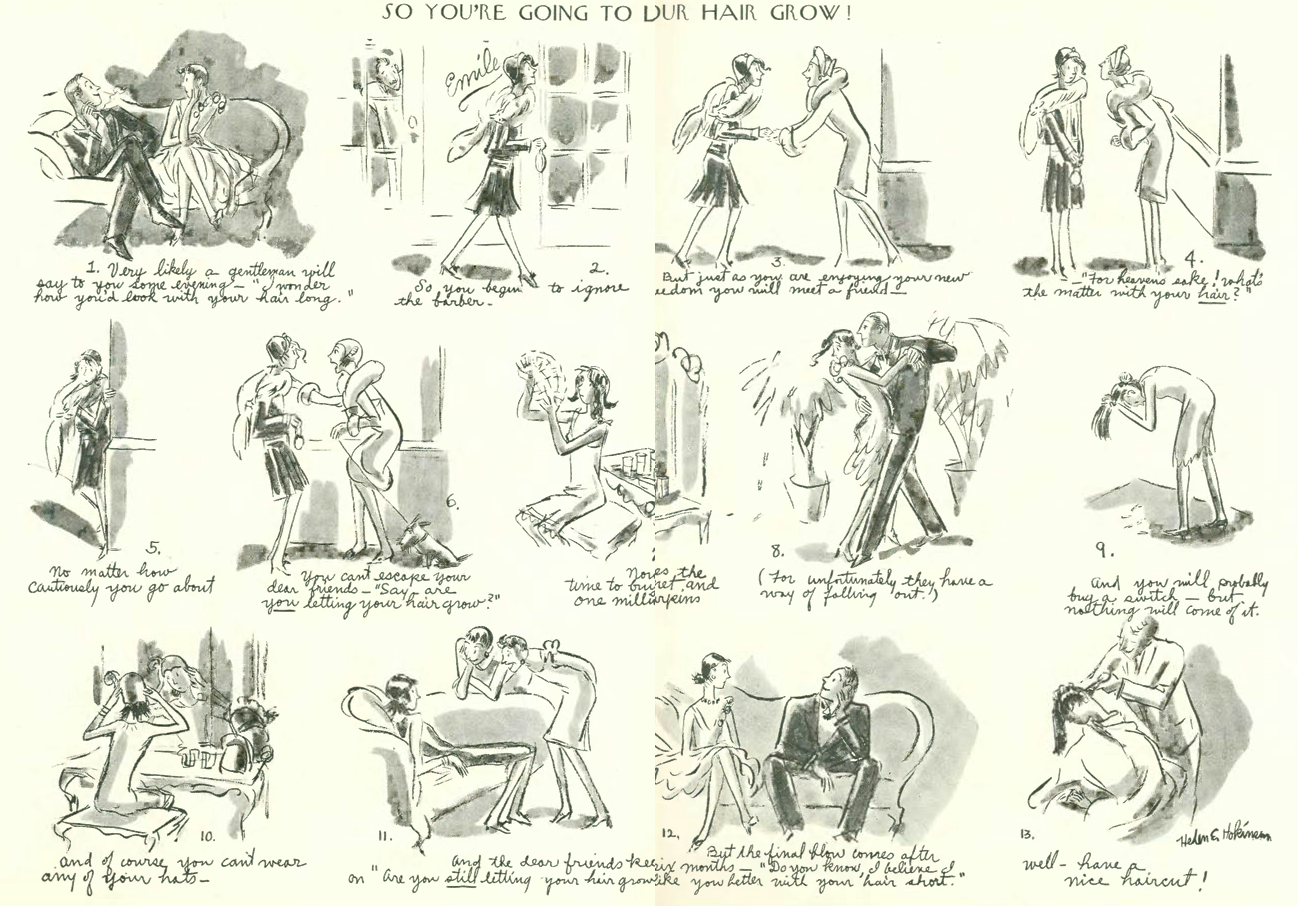
To close, a two-page spread by Helen Hokinson exploring one woman’s challenge with the “flapper bob” (sorry about the crease in the scan–that is how it is reproduced in the online archive). Click the image to enlarge.

screen-shot-2017-02-10-at-12-56-38-pm

And a bit of fun on the streetcar, courtesy of cartoonist Leonard Dove

screen-shot-2017-02-10-at-12-57-46-pm

…and a confession, from Otto Soglow…

Next Time: Machine Age Bromance…

986198649aa5ada2614b8158443db596


More Funny Business

My last entry featured cartoonist Bud Fisher, inventor of the comic “strip” (Mutt & Jeff) and the subject of The New Yorker’s Nov. 26, 1927 “Profile.” It was something of a surprise, then, to open the next issue, Dec. 3, and find literary critic Dorothy Parker offering her observations on the funny papers, including Sidney Smith’s comic strip, The Gumps.

dec-3
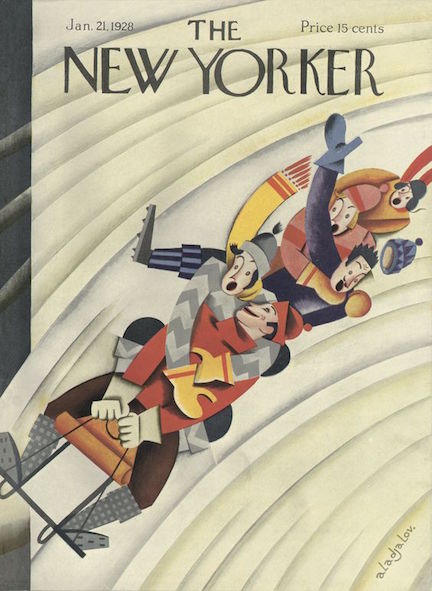
December 3, 1927 cover by Constantin Alajalov.

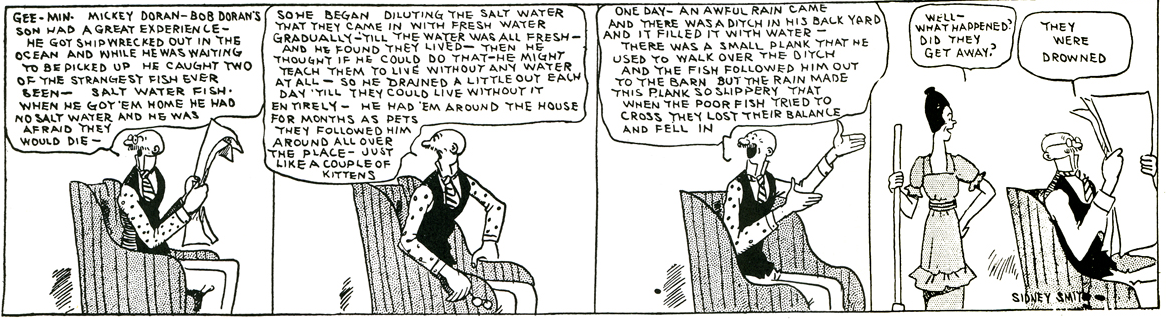
Before we get to Dorothy Parker, let’s have a look at The Gumps, created by Sidney Smith in 1917. Although that strip had plenty of slapstick, it was wordier than Mutt & Jeff and somewhat more realistic (Smith was the first cartoonist to kill off a regular character, in 1929–it caused a national outcry). An example of the strip from around 1920:

screen-shot-2017-01-31-at-12-37-37-pm
(michaelspornanimation.com) Click image to enlarge

Like Bud Fisher, Smith would become wealthy from the merchandising of Gump toys, games, songs, food products, etc…

9eef3c685e113a5712ce4c353729044a
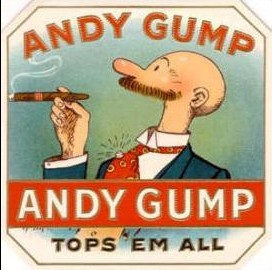
The image of Andy Gump even graced cigar boxes. (kenlevine.blog)

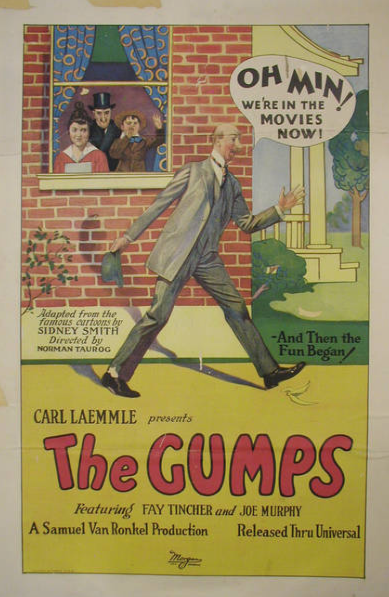
The Gumps were also featured in nearly 50 animated shorts, and between 1923 and 1928 Universal produced dozens of two-reel comedies starring Joe Murphy (one of the original Keystone Cops) as Andy Gump, Fay Tincher as Min and Jack Morgan as Chester (two-reelers were usually comedies, about 20 minutes in length). The director of these short films, Norman Taurog, would go on to become the youngest director to win an Academy Award (Skippy 1931). He would also direct such films as Boy’s Town (1938) and nine Elvis Presley movies from 1960 to 1968.

His comic strip barely five years old, in 1922 Smith famously signed a 10-year, one million-dollar contract. In 1935 he would sign an even more lucrative contract, but on his way home from the signing he would die in a car accident.

574451a661b35824488062388d2a1939
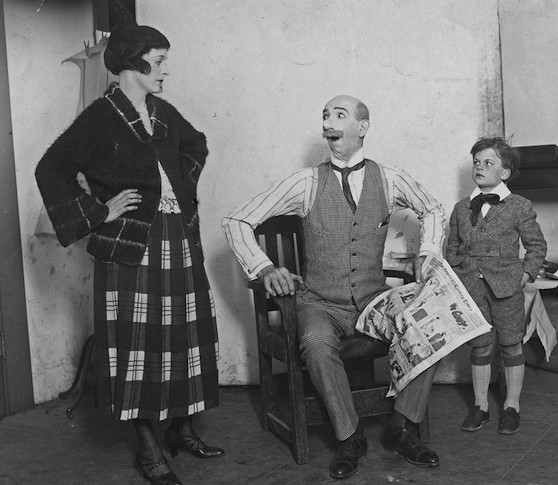
OH MIN!…A publicity still from Universal’s two-reel comedy series featuring The Gumps. From left, Fay Tincher (Min), Joe Murphy (Andy Gump) and Jackie Morgan (Chester). The actress Fay Tincher is a bit of a mystery…an enterprising young comedienne who started her own production company in 1918, she dropped from public view by 1930, and little is known of her life since that time, even though she lived to see the year 1983, and died at age 99. (younghollywoodhof.com)
screen-shot-2017-02-01-at-9-26-09-am
Theatre poster announced the coming of what would be dozens of two-reelers produced by Universal between 1923 and 1928 featuring The Gumps. (imdb.com)

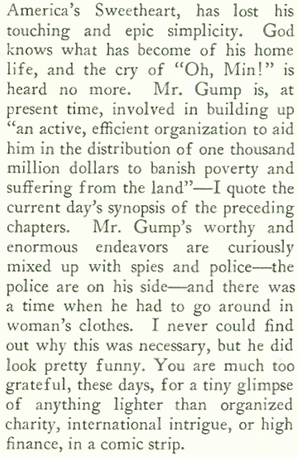
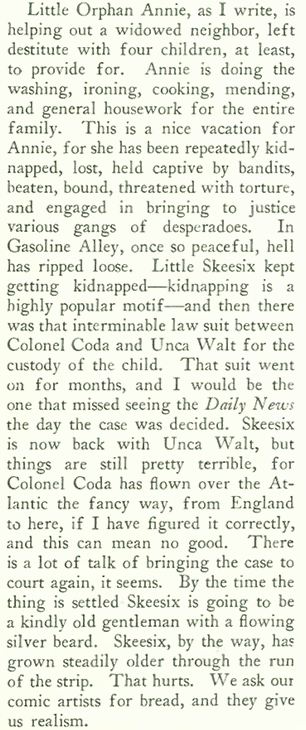
In her column, “Reading and Writing,” Dorothy Parker (writing under the pen name “Constant Reader”) lamented the fact that the comic strips were abandoning simple, light horseplay in favor of “melodramas.” Apparently even Andy Gump wasn’t exempt:

screen-shot-2017-01-30-at-10-06-30-am

screen-shot-2017-01-30-at-10-06-42-am

thegumpsintro21217

screen-shot-2017-01-31-at-9-55-35-am
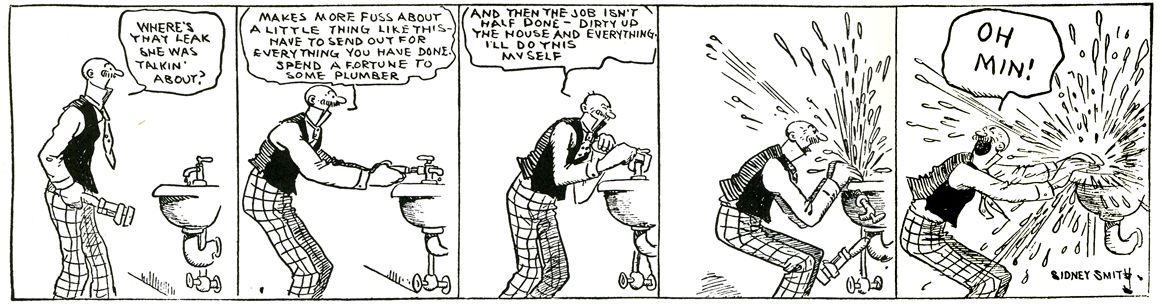
GUMPS IN THE DUMPS…in late 1927 Dorothy Parker longed for the antics of the old, dimwitted Andy Gump and his much-brainier wife, Minerva. Above, the first strip from 1917 that introduced The Gumps. Below, a circa 1920 strip featuring a typical Andy Gump mishap and his trademark “Oh Min!” (newspapers.com) Click images to enlarge.

Parker also bemoaned the likes of Little Orphan Annie and the gang from Gasoline Alley, where everyday hijinks were replaced by melodrama:

screen-shot-2017-01-30-at-10-07-07-am

screen-shot-2017-01-31-at-1-02-47-pm
I LOVE YA, TOMORROW…but I’m gonna kick your ass today! Annie gets rough in this 1927 strip. Hugely popular, the strip (begun in 1924) inspired a ton of merchandise, films, a radio show and the musical Annie. The strip Little Orphan Annie made creator Harold Gray a very rich man. (ha.comics.com) Click image to enlarge.
ga23nov1927
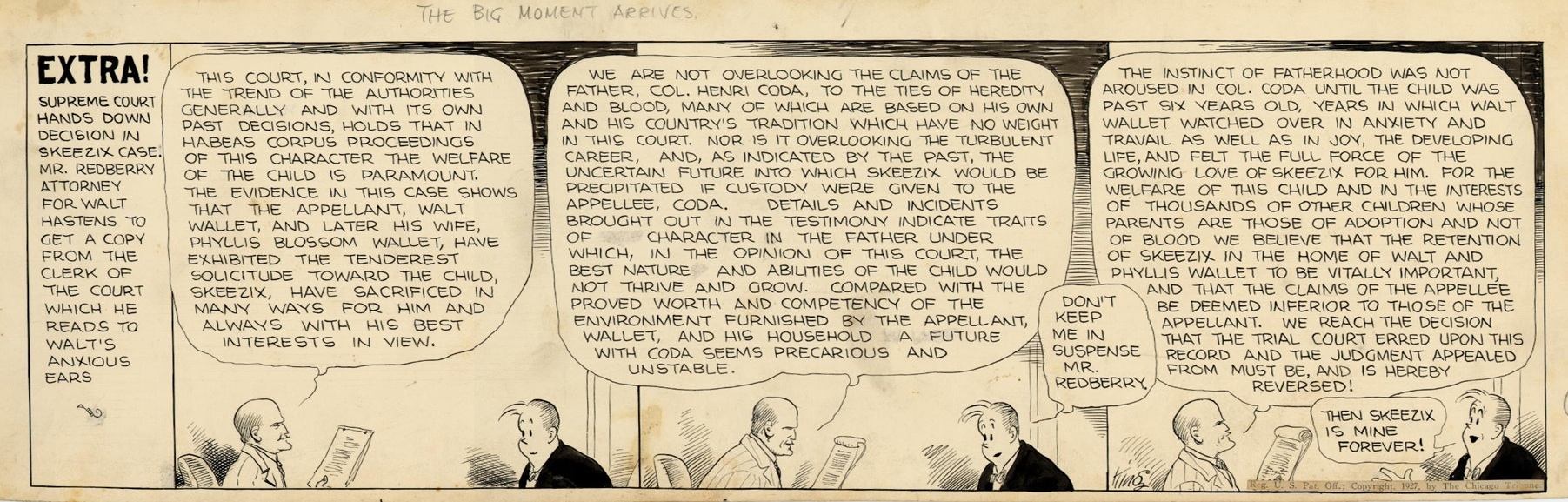
SORRY, NO PIE IN THE FACE HERE…In this series of turgid word balloons, Walt gets full custody of the orphan Skeezix in this Gasoline Alley strip from 1927, ending what Dorothy Parker called “an interminable law suit.” First published November 24, 1918 by Frank King (who drew the strip until 1959), Gasoline Alley is still going and is the second-longest-running comic strip in the U.S. As Parker noted in her column, the characters in Gasoline Alley were allowed to age naturally. Skeezix is currently 97 years old. (hoodedutilitarian.com) Click image to enlarge.

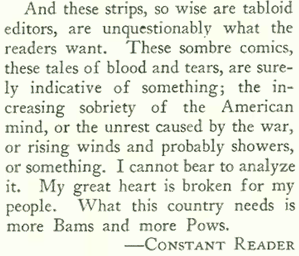
Parker suffered throughout her life from depression, and no doubt turned to the funnies for respite. However, she wrote that she hadn’t “seen a Pow or a Bam in an egg’s age,” and sadly concluded that melodrama was what the readers wanted.

screen-shot-2017-01-31-at-9-27-56-am

When Minerva Was a Car

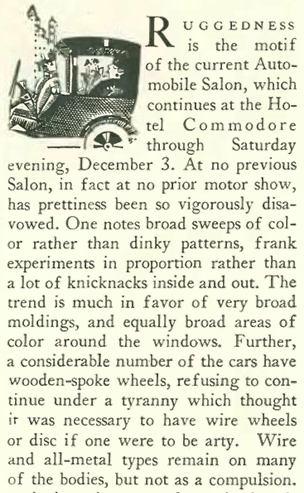
The New Yorker’s Nicholas Trott visited the Automobile Salon at the Hotel Commodore and noted that the latest trend favored an automobile’s “ruggedness” over its “prettiness.” Given the condition of roads in the 1920s, that probably wasn’t a bad thing…

the-automobile-salon

In the early days of the auto industry there were thousands of different manufacturers that eventually went broke or merged with other companies. Trott’s article mentioned new offerings from Chrysler, Mercedes, and Cadillac as well as from such makes as Erskine, Sterns-Knight, Minerva, Holbrook Franklin, Stutz, and Brewster.

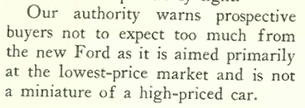
In “The Talk of the Town,” however, the editors wrote about another car with a far less colorful name: The Ford Model A. After 18 years of the ubiquitous black Model T, Ford buyers were ready for something different…

screen-shot-2017-01-30-at-9-38-36-am

1928_model_a_ford
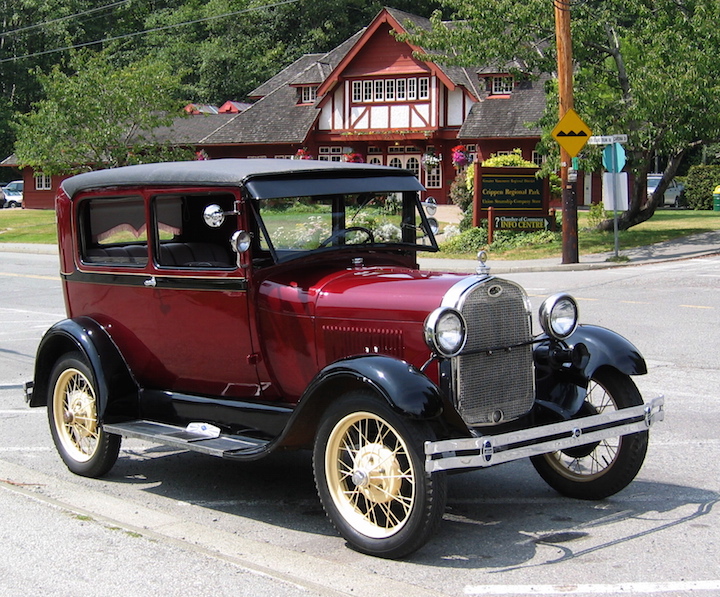
GOOD ENOUGH…The 1928 Ford Model A Tudor Sedan (Wikipedia)

New Yorker editors cautioned, however, that buyers of the Model A should “not expect too much” from a car aimed at more modest pocketbooks. In a little more than a year Ford would sell one million of the things, and by the summer of 1929, more than two million.

screen-shot-2017-01-30-at-9-39-30-am

When Model A production ended in early 1932, nearly five million of the cars had been produced.

German Atrocities?

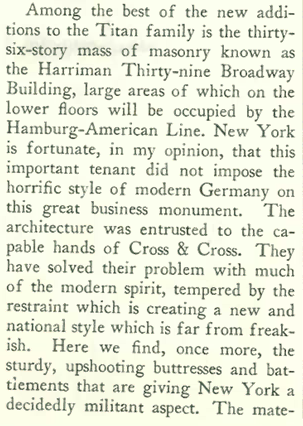
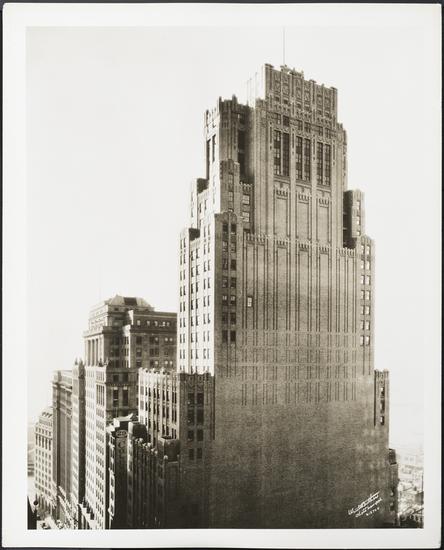
It’s seemed a bit of an “about face” for New Yorker architecture critic George S. Chappell to write of the “horrific style of modern Germany” after previously writing admiringly of the Bauhaus movement and “International Style” promulgated by Le Corbusier. Chappell’s column “The Sky Line” included this subhead, “German Atrocities Neatly Escaped.” In a few years “German Atrocities” would refer to something very different…

screen-shot-2017-01-30-at-10-02-36-am

screen-shot-2017-01-30-at-10-03-44-am

mny325559
TEN-HUT!…The New Yorker’s George Chappell liked the Harriman Building at 39 Broadway despite its “militant aspect.” Designed by Cross & Cross, it opened in 1928. (Museum of the City of New York)

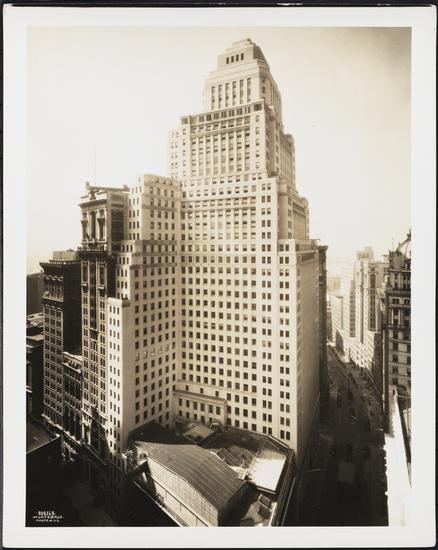
Another monstrous building of note in Chappell’s column was the “huge” Equitable Trust Building at 15 Broad Street…

screen-shot-2017-01-30-at-10-03-56-am

mny323767
Equitable Trust Building at 15 Broad Street. Designed by Trowbridge & Livingston, completed in 1928. (Museum of the City of New York)

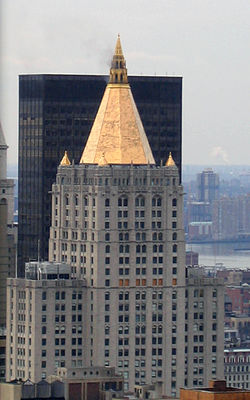
To save the best for last, Chappell also wrote of Cass Gilbert’s landmark New York Life Building, rising on the site of the old Madison Square Garden…

screen-shot-2017-01-30-at-10-04-22-am

screen-shot-2017-01-30-at-10-04-42-am

The distinctive pyramidal gilded roof of the New York Life Insurance Building, (Wikipedia)

 *  *  *

She Nearly Made It

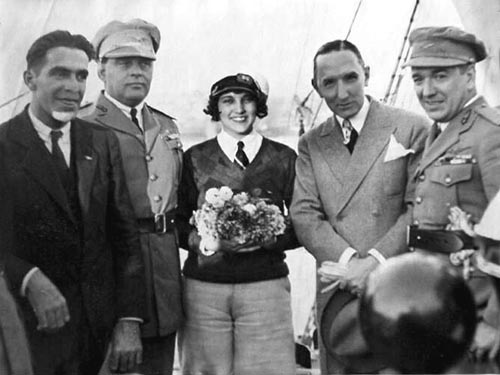
Morris Markey wrote about the exploits of pilot and actress Ruth Elder (1902–1977) in his “Reporter at Large” column. Known as the “Miss America of Aviation,” on Oct. 11, 1927, Elder and her co-pilot, George Haldeman, took off from New York in her attempt to become the first woman to make a transatlantic crossing to Paris. Mechanical problems in their airplane (a Stinson Detroiter dubbed American Girl) caused them to ditch into the ocean 350 miles northeast of the Azores. Fortunately they were rescued by a Dutch oil tanker in the vicinity.

elder_trip_4_500
NO WORSE FOR WEAR…Ruth Elder, center, and George Haldeman, far left, on board their rescue ship, the Barendrecht, Oct. 25, 1927. (ctie.monash.edu)
wt81_hootandlady
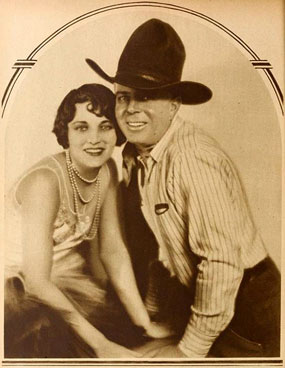
WHAT A HOOT…Ruth Elder and Hoot Gibson in a promotional pose for the 1929 film Winged Horseman (usc.edu).

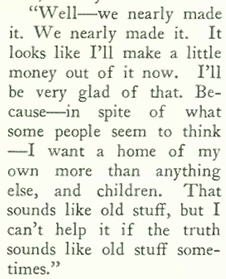
Although they were unable to duplicate Charles Lindbergh’s feat, Elder and Haldeman nevertheless established a new over-water endurance flight record of 2,623 miles–the longest flight ever made by a woman. They were honored with a ticker-tape parade upon their return to New York. Despite her derring-do, Elder suggested that she longed for a simpler, more domestic life…

morris-markey-a-reporter-at-large-ruth-elder

Whether or not she found the simple life it is hard to say. She married six times, perhaps looking for the right “old stuff” and not quite finding it.

 *  *  *

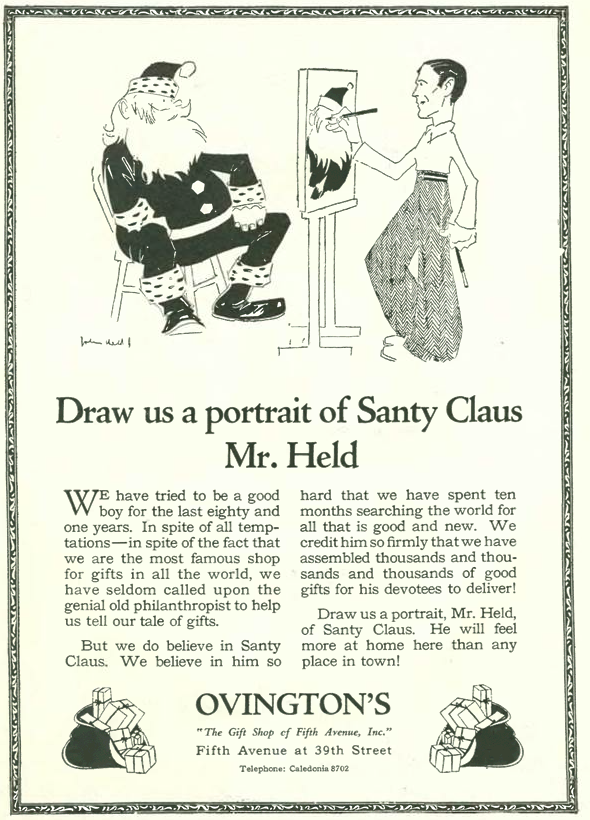
And finally, this ad from the Dec. 3 issue featuring the art of New Yorker contributor John Held Jr…

screen-shot-2017-01-30-at-9-37-40-am

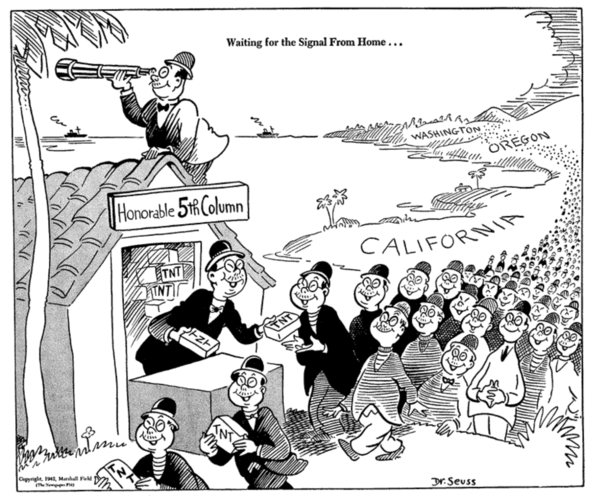
…and this cartoon by Otto Soglow, depicting how one toff bags his “trophy”…
screen-shot-2017-01-30-at-9-51-46-am

Next Time: The Perfect Gift for 1927…

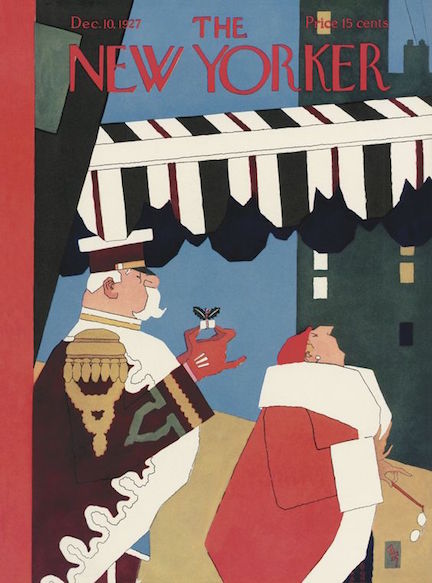
dec-10