Jimmy Comes Home

Above: Former New York Mayor Jimmy Walker and wife Betty Compton, aboard the S.S. Manhattan in 1935. (New York Daily News Archive)

The Roaring Twenties and Jimmy Walker seemed made for each other. A dandy with a taste for fine clothes, late-night parties, and Broadway showgirls, the 97th mayor of New York was a darling of the media…until the market crashed; as nest eggs evaporated along with jobs, folks quickly lost their taste for such frivolity.

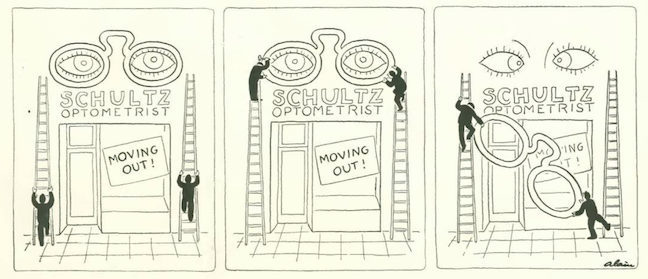
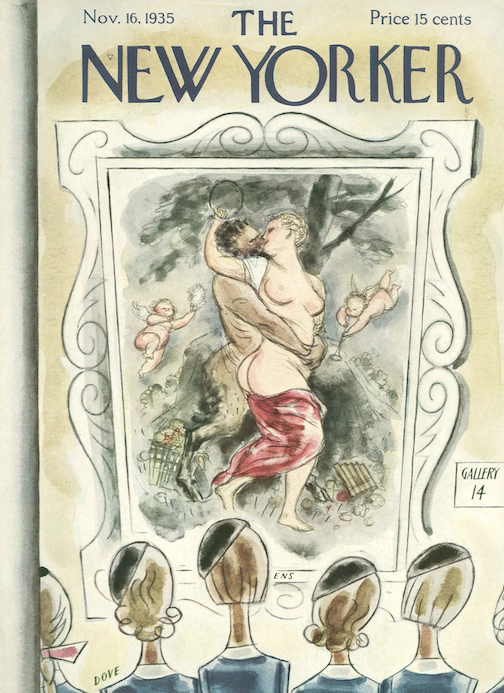
November 9, 1935 cover by Daniel “Alain” Brustlein. This was the first of nine covers Brustlein created for the magazine. An Alsatian-born American artist, cartoonist, illustrator, and author of children’s books, Brustlein (1904–1996) contributed to The New Yorker under the pen name “Alain” from the 1930s through the 1950s.
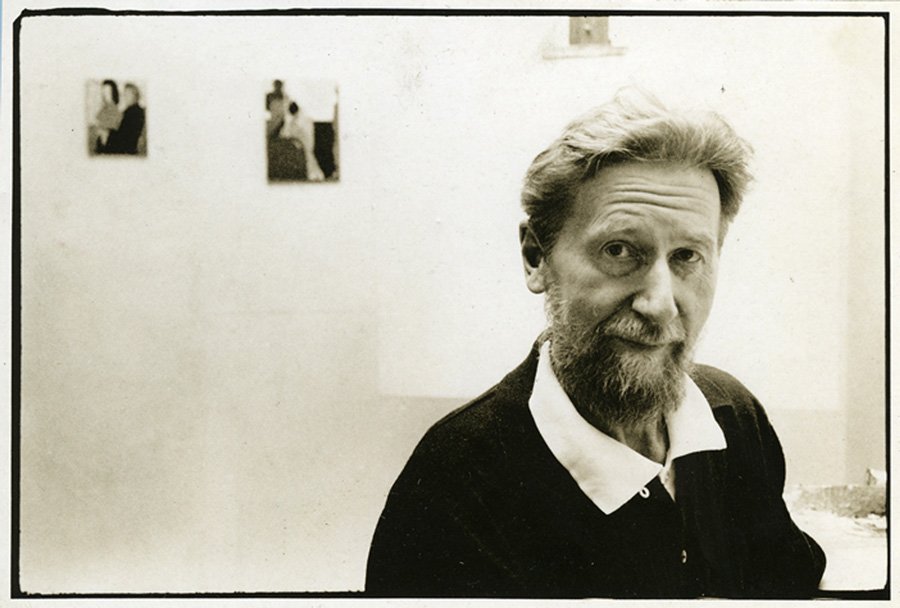
Daniel “Alain” Brustlein, in an undated photo. During the height of Abstract Expressionism Brustlein became a reputable painter, exhibiting his work in New York and Paris. (derfner.org)

 *

The fall of 1935 marked three years since Walker had left office, and for nearly two of those years the city had been governed by the reformist Mayor Fiorello La Guardia. New Yorkers, it seemed, were ready for a dose of Jimmy when he returned from his European exile, hailed by a throng of media and well-wishers.

Writing for Airmail, longtime New York journalist Sam Roberts observes that the city loved Walker, “a charming hellion, a witty, self-effacing, glib humanist, far more flawed, too, and compassionate than pictured previously, a man elevated and condemned by his own character, created and ultimately consumed by his times. He conjures up the anti-Trump—a dodgy philanderer who governed by making people feel good rather than angry.”

WHERE’S THE PARTY?…Former Mayor Jimmy Walker and his wife, Betty Compton, returned to New York in the fall of 1935 amid tremendous fanfare. The New Yorker’s Morris Markey noted that at least 160 media representatives were on hand for the couple’s arrival. (YouTube)

Walker (1881-1946) fled to Europe in November 1932 amid a bribery scandal that had prompted his resignation. Accompanied by Ziegfeld Follies singer Betty Compton (1906–1944)—whom he would marry in Cannes the following April—they would bounce around the continent until Walker determined that the danger of criminal prosecution had passed.

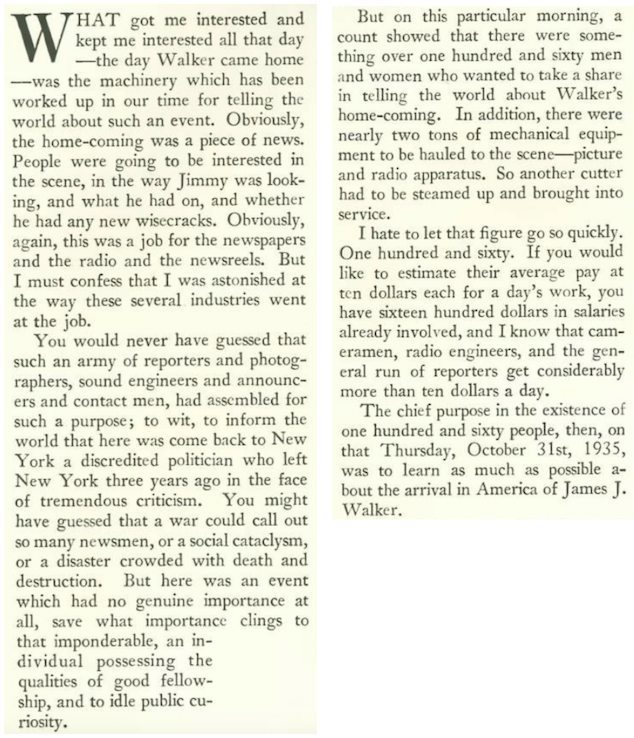
In his “A Reporter at Large” column, Morris Markey wrote about the media’s reception of the exiled mayor, “an army of reporters and photographers, sound engineers and announcers and contact men”…all assembled to inform the world of the return of a “discredited politician.”

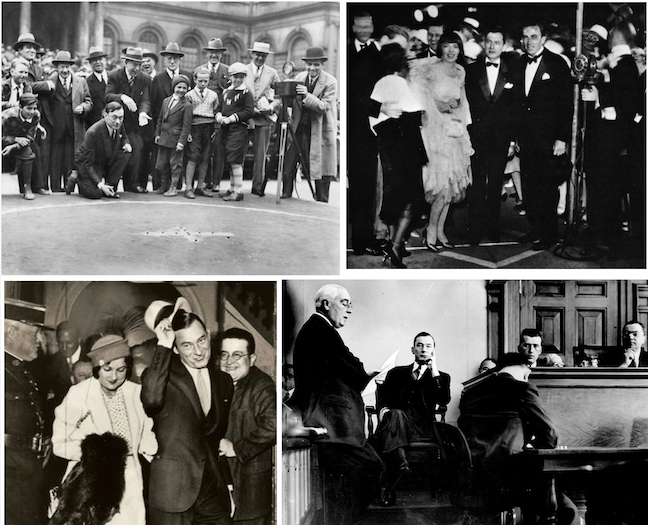
HE GOT AROUND…During his time in office from 1926 to 1932, Mayor Jimmy Walker never seemed to miss a moment in the spotlight. Clockwise, from top left, Walker presided over the first shot in the city’s annual marble tournament on June 3, 1928; with actress Colleen Moore at the 1928 premiere of her latest film, Lilac Time;  testifying on bribery charges before the investigative committee of Judge Samuel Seabury, 1932; with Betty Compton following their 1933 wedding in Cannes. (New York Times/konreioldnewyork.blogspot.com/villagepreservation.org)

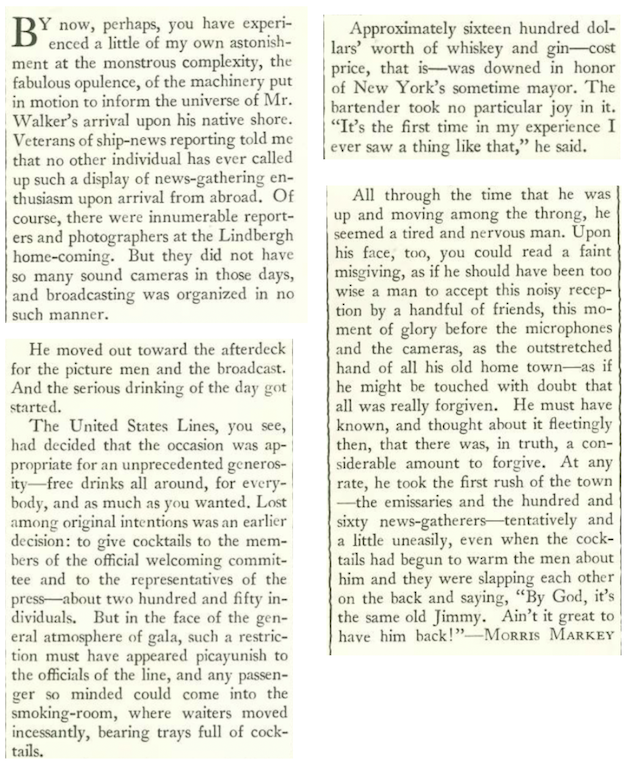
Markey continued to convey his astonishment at “the monstrous complexity, the fabulous opulence, of the machinery put in motion to inform the universe of Mr. Walker’s arrival upon his native shore.” This included a massive cocktail party—hosted by The United States Lines—for more than two hundred press representatives and other officials.

After all the commotion, Walker would settle into a job as head of Majestic Records, adopt two children with Compton, and host his own radio series on WHN, Jimmy Walker’s Opportunity Hour.

Compton would divorce Walker in 1941 and remarry. Becoming ill after the birth of a son, she would die at age 38 in 1944. Walker would die two years later at age 65 of a brain hemorrhage.

CALLING ON THE ROOSEVELTS…Jimmy Walker and Betty Compton at the White House in 1937. It was pressure from FDR that led to Walker’s resignation in 1932. (Wikipedia)

 * * *

High-flying Hooplah

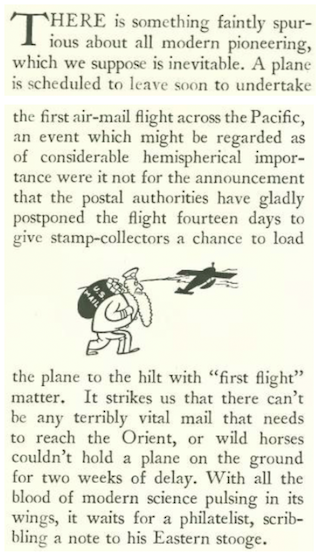
While New Yorkers were going gaga over Walker, folks in the Bay Area were all atwitter over the first air-mail flight across the Pacific, loading a Pan Am Clipper to the gills with all manner of collectables. E.B. White noted:

BELLYFUL…On Nov. 22, 1935, Pan American Airways made aviation history as the China Clipper lifted off from Alameda, beginning the world’s first trans-Pacific airmail service. Captained by Edwin Musick and crewed by famed navigator Fred Noonan, the Martin M-130 opened a new era of long-distance flight across the Pacific. Noonan, who charted many commercial routes across the Pacific, would go missing along with Amelia Earhart during their ill-fated flight in July 1937. (Library of Congress)

* * *

Wise Men From the East

“The Talk of the Town” visited with Soviet satirists Ilya Ilf (1897–1937) and Evgeny Petrov (1903–1942), who were in New York preparing for a ten-week road trip to California and back. On assignment as special correspondents for the newspaper Pravda, they later published a series of illustrated articles, “American Photographs,” as well as a book titled Single-Storied America (the summer 2004 issue of Cabinet Magazine features an account of their journey as well as a number of their photographs).

AMERICA WAS A GAS…Soviet satirists Ilya Ilf (left) and Yevgeni Petrov check out New York before heading into the American heartland on a ten-week road trip, a highlight being the countless full-service gas stations they encountered along the way. After seeing skyscrapers and mountains and other wonders, the pair agreed that the most enduring image was the one at right: “an intersection of two roads and a gasoline station against a (back)ground of wires and advertising signs.” Sadly, Ilf died two years later from tuberculosis; Petrov died in a plane crash in 1942 while working as a war correspondent. (Aleksandra Ilf archive/Cabinet Magazine)

 * * *

A Jumbo Career

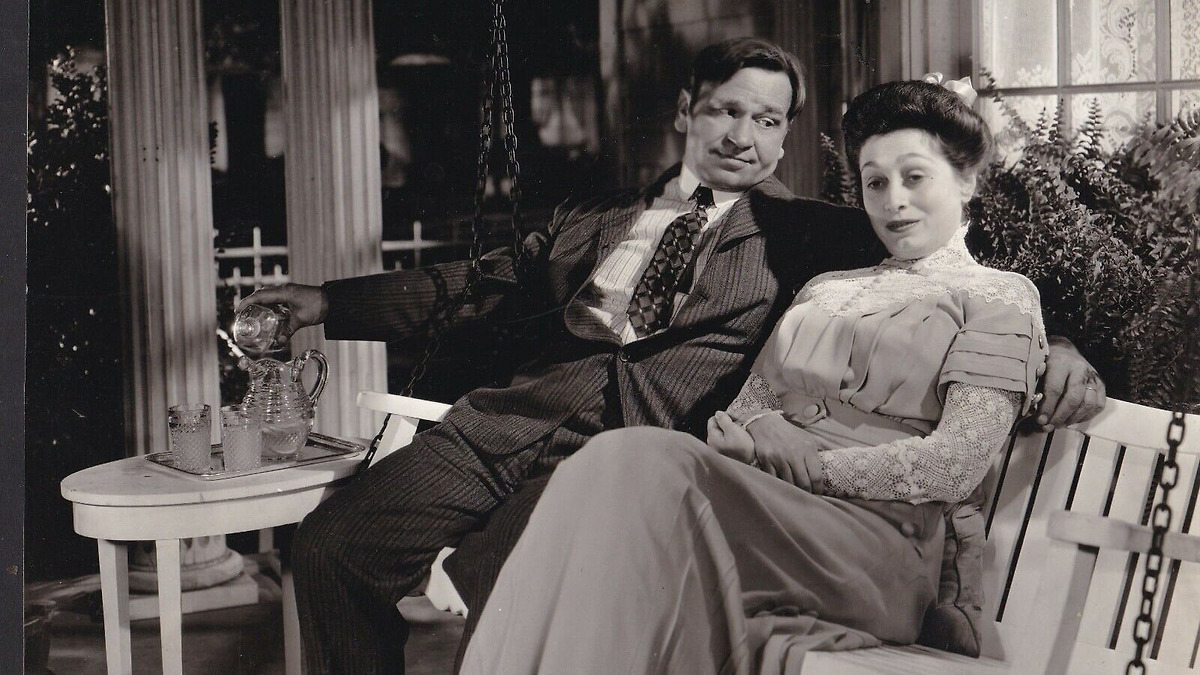
Wallace Beery (1885–1949) got his start in the comedy silents of the 1910s and became a star before the sound era made him an even bigger one; by 1932 he was the world’s highest-paid actor. Alva Johnston’s profile (titled “Jumbo”) took a look at Beery’s life and career (illustration by Al Frueh). Excerpts:

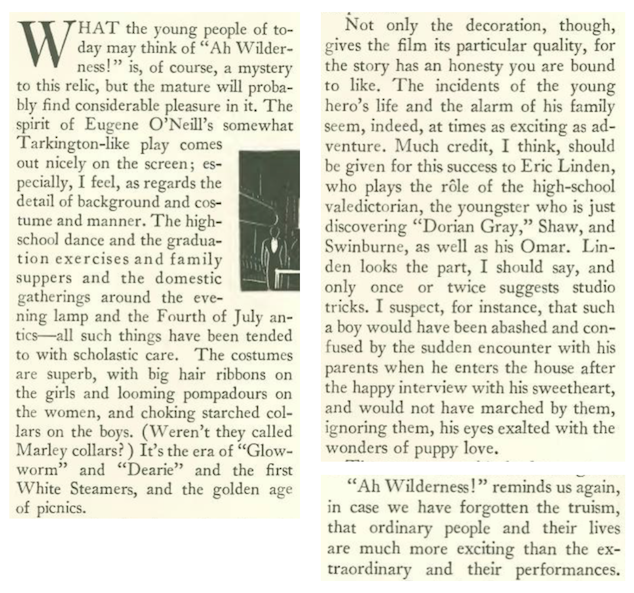
COURTING AND SPARKING…Sid Miller (Wallace Beery) spikes the lemonade as he woos Lily Davis (Aline MacMahon) in a scene from the 1935 film, Ah Wilderness! (letterboxd.com)

 * * *

A View and Corbu

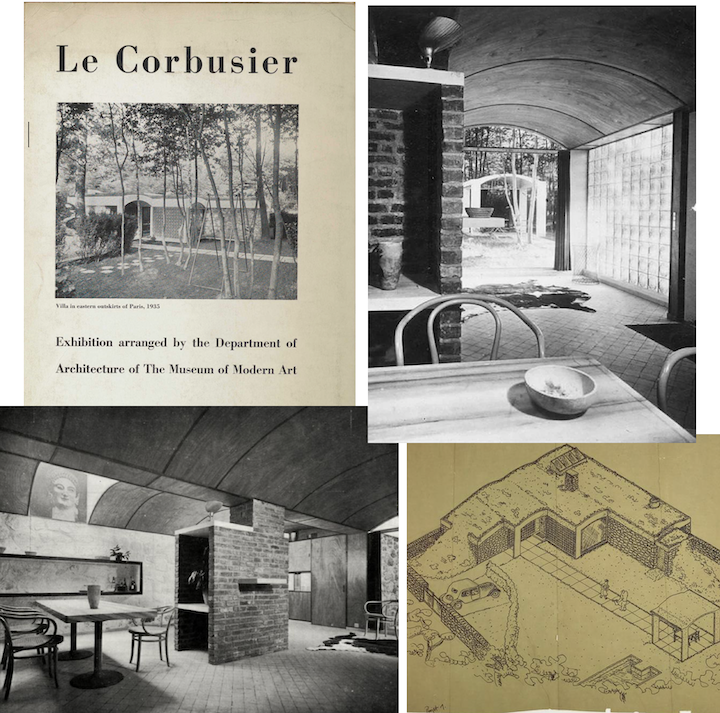
Art and design critic Lewis Mumford was well-known for his hypercritical eye, but occasionally he could be moved to rhapsodize, in this case about the opening of Fort Tryon Park, and particularly about the view it afforded visitors. He reserved his criticism for one of the latest works by Le Corbusier (aka Charles-Édouard Jeanneret), on exhibit at MoMA.

MAGNIFICENT is the word Lewis Mumford used to describe the view from Fort Tryon Park. This scene is taken from Linden Terrace to the west: a barge on the Hudson River and the Hudson Palisades beyond, with the Englewood Cliffs campus of Saint Peter’s University on the top. (Wikipedia)
IRRATIONAL?…Mumford was not pleased with Le Corbusier’s latest work, Le Petite Maison de Weekend (Villa Henfel), which was featured on the cover of the MoMA exhibition catalogue (upper left). Mumford saw the design as a pathetic escape from the architect’s renown rationalism. (MoMA/Fondation Le Corbusier)

* * *

At the Movies

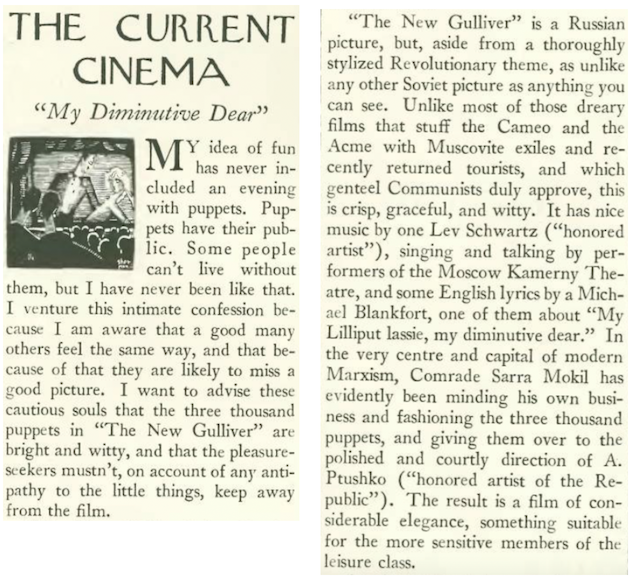
It was a mixed bag at the movies for critic John Mosher, who was delighted by a Soviet take on Gulliver’s Travels, rendered with puppets engaged in a proletarian struggle…

KOMRADE GULLIVER…The Soviet stop motion-animated fantasy film, The New Gulliver, was a communist re-telling of Jonathan Swift’s 1726 novel. The film depicted Lilliput suffering under capitalist inequality and exploitation, with Gulliver enabling a proletarian revolution against the Lilliputian monarchy. (revolutionsnewstand.com)

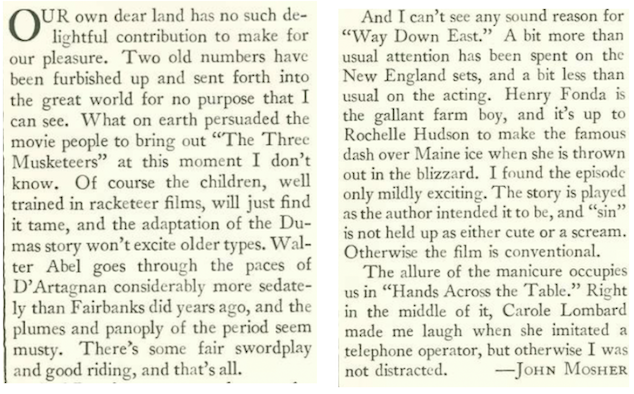
…but Mosher was less than delighted with the latest from Hollywood, including a sedate The Three Musketeers, a “conventional” remake of D.W. Grifffith’s 1920 melodrama Way Down East, and the romcom Hands Across the Table, which the Times called “uproariously funny” but Mosher deemed barely worth a chuckle.

OUTCLASSED BY PUPPETS…John Mosher found the latest from Hollywood underwhelming. Clockwise, from top, Onslow Stevens, Moroni Olsen, and Paul Lukas in The Three Musketeers; Rochelle Hudson and Henry Fonda in Way Down East; Fred MacMurray and Carole Lombard in Hands Across the Table. (mabumbe.com/zeusdvds.com/Wikipedia)

 * * *

From Our Advertisers

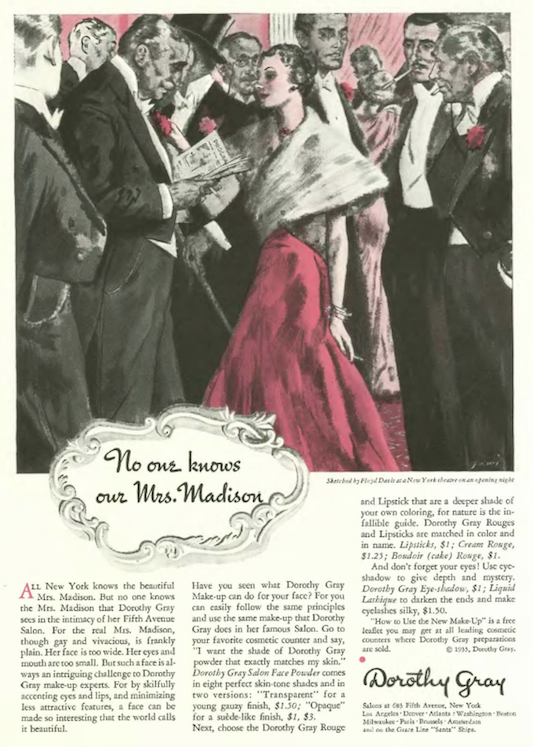
The Dorothy Gray salons didn’t mince words when it came to a woman’s beauty regimen…without their help, claimed this ad, the poor “Mrs. Madison” would be “frankly plain,” with a face too wide and eyes and mouth too small…

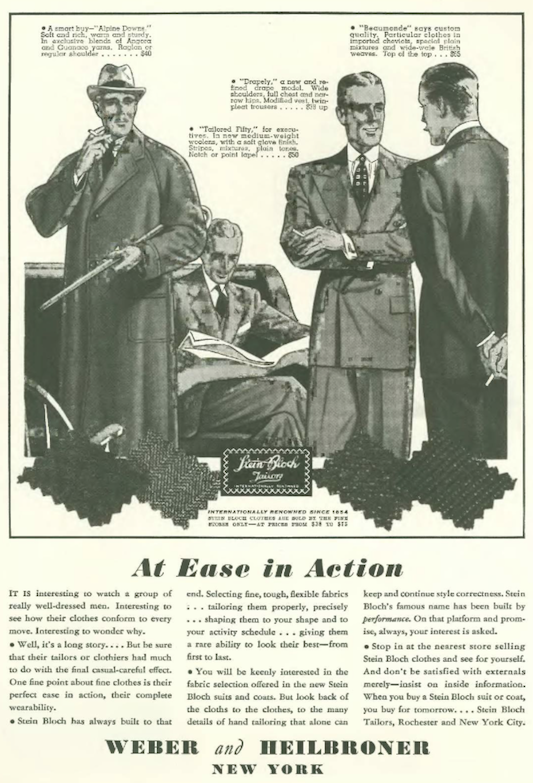
…notable in ads for men’s and women’s clothes were the presence of cigarettes…all three of the men in this spot are having a smoke in their smart attire…

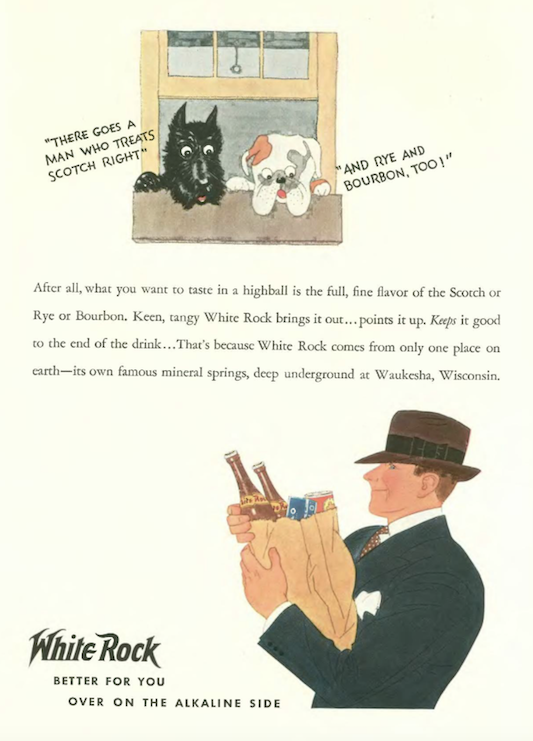
…White Rock gave their logo-bearer Psyche a rest in 1935 with a variety of ads including this one…

…the makers of Bisquit assumed their customers could read the French dialogue, or at least pretend to…

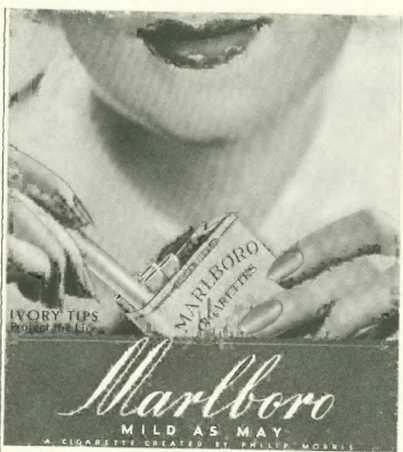
…when we (of a certain age) think of Marlboro we think of the rugged Marlboro Man, but in 1935 the brand was exclusively marketed to women…

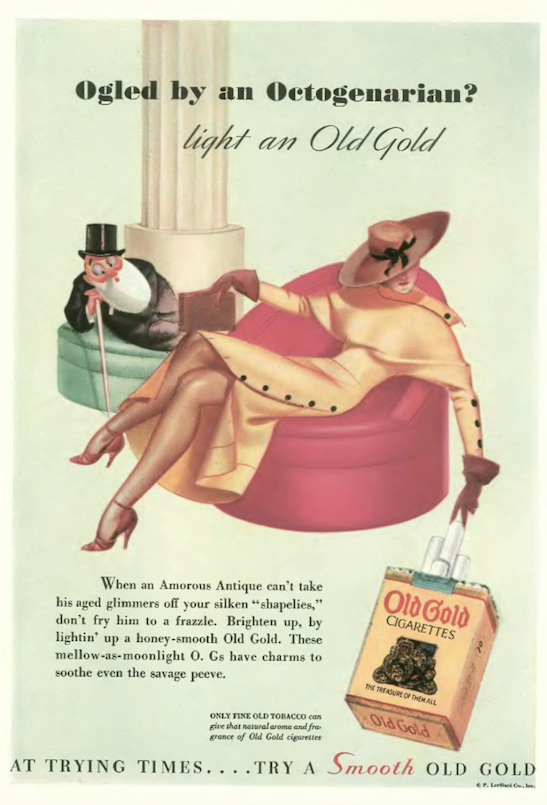
…and who knows what Old Gold’s target was here…definitely women smokers, who were the growth market, but men would take notice of the George Petty pin-up…

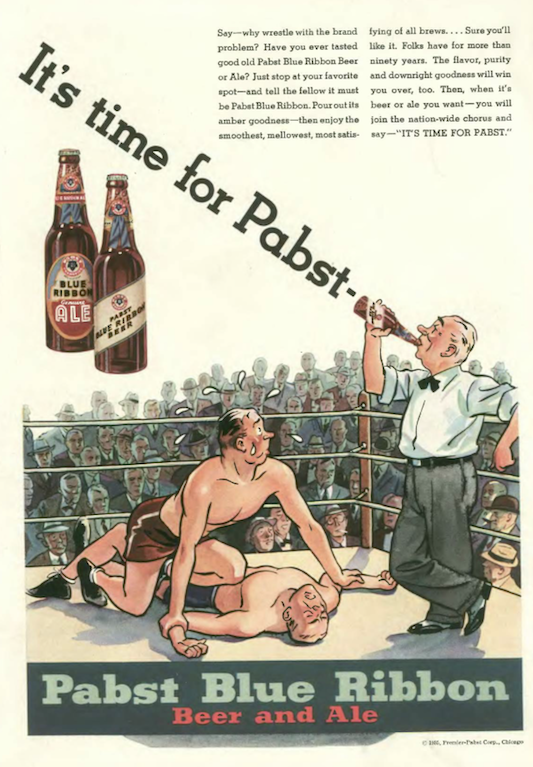
…the makers of Pabst Blue Ribbon Beer, who endured Prohibition by offering products like Pabst-ett cheese spread, were ready to grab a big market share after Repeal…

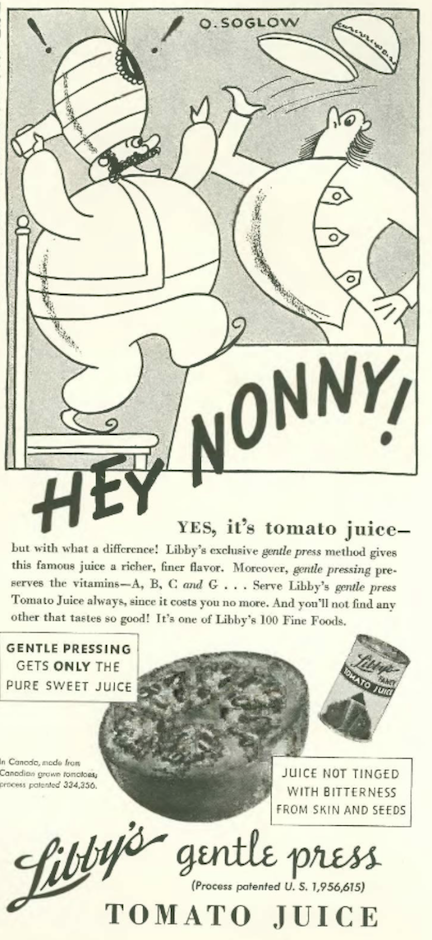
Otto Soglow, still contributing to The New Yorker despite taking his Little King to Hearst, drew up this potentate for a tomato juice spot…

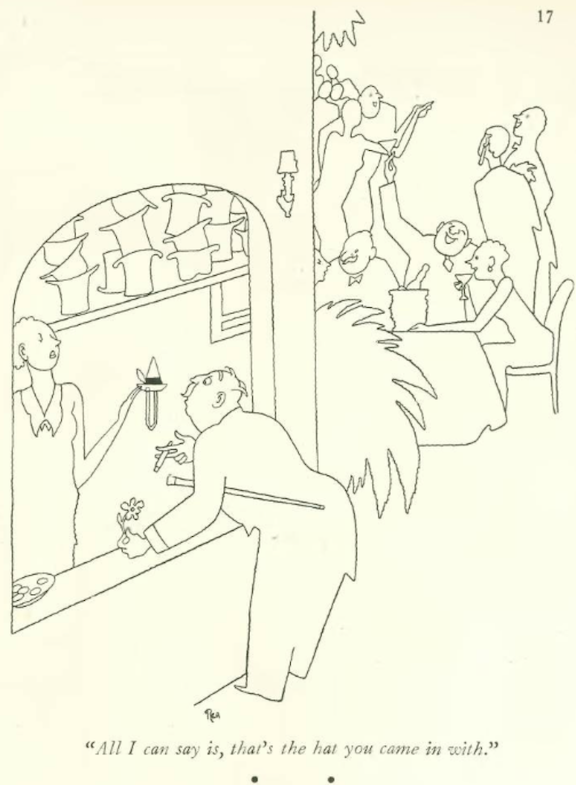
…which segues to our other cartoonists, beginning with Al Frueh and his take on the latest  Broadway hit, Jubilee!

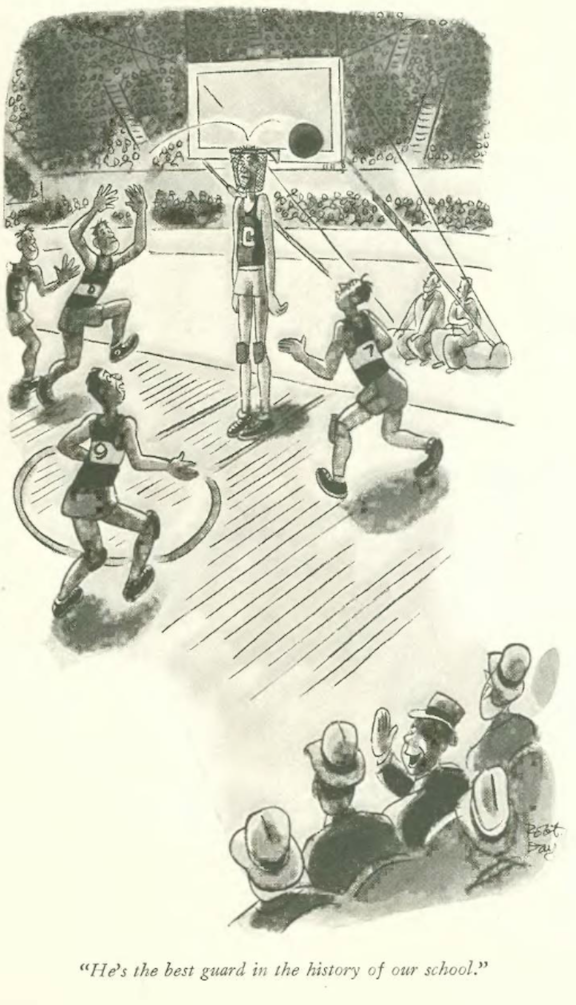
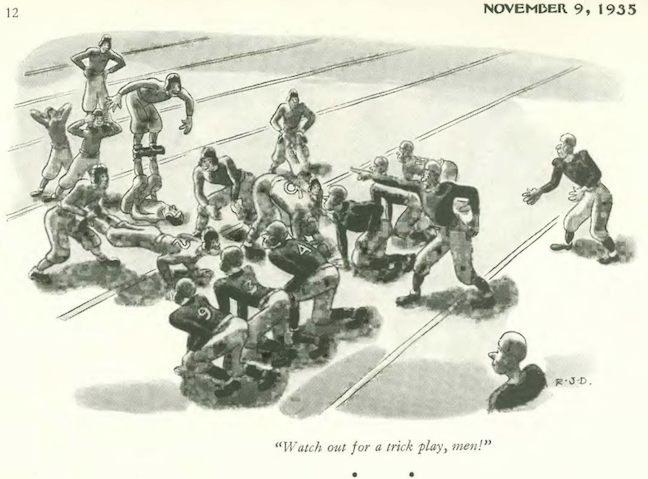
Robert Day saw action on the gridiron…

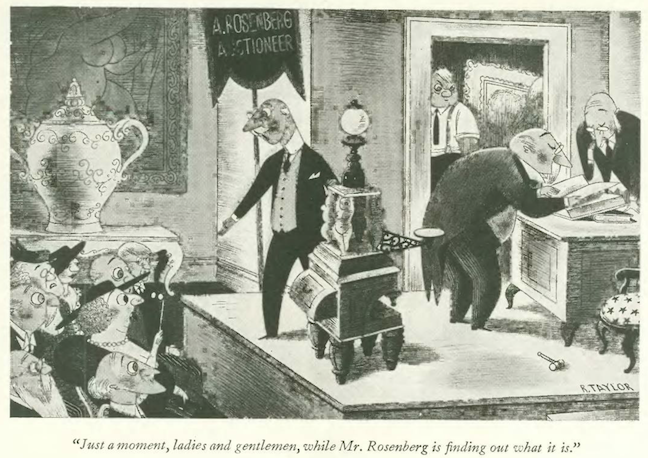
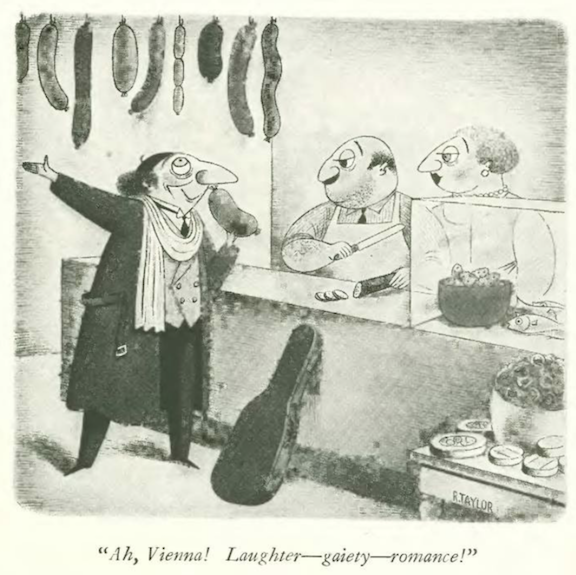
…unless I missed something, this might be Richard Taylor’s first New Yorker cartoon…

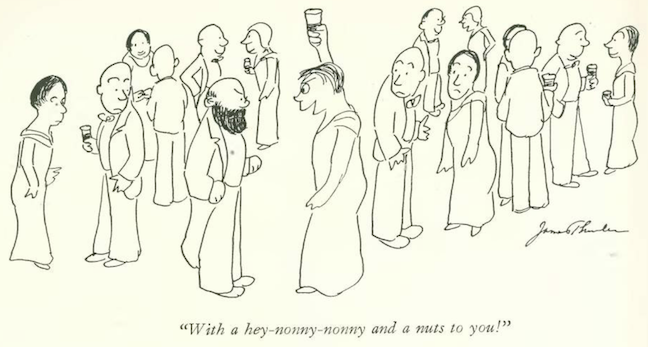
James Thurber put a unique spin on a bowling ball…

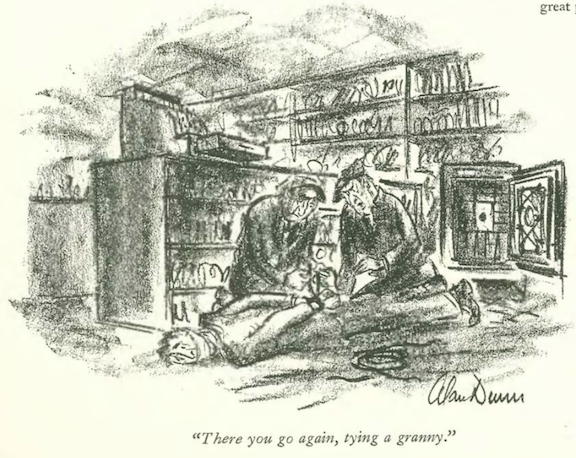
Alan Dunn was all in knots at a crime scene…

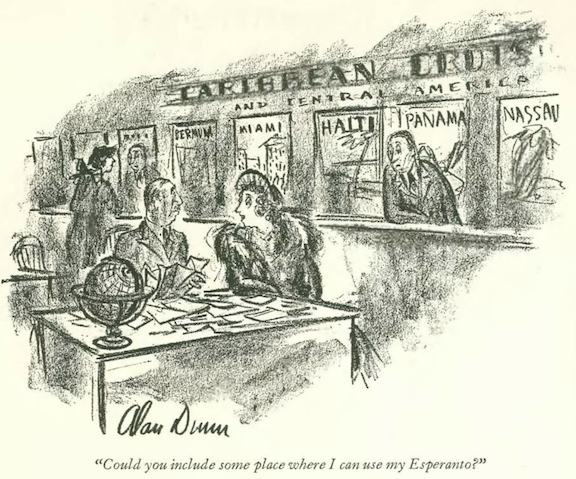
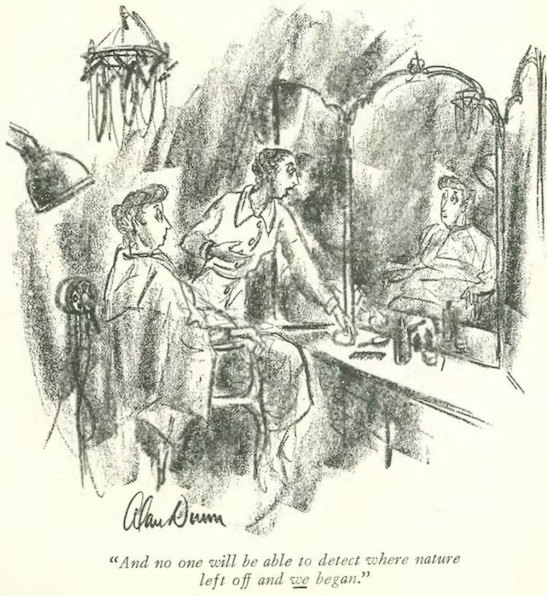
…Dunn again, pondering the wonders of a makeover…

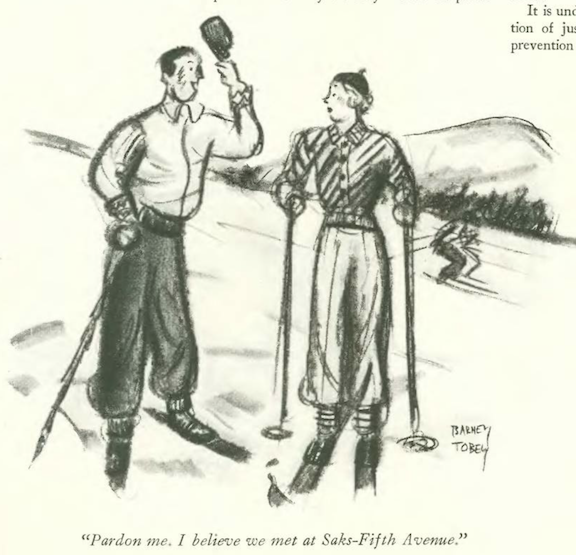
Barney Tobey eavesdropped on a Downtown subway…

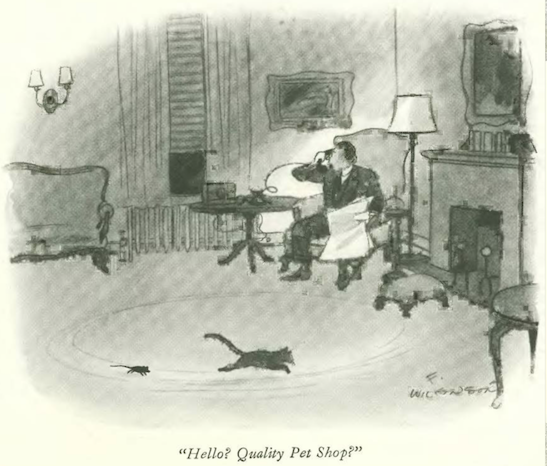
Fritz Wilkinson looked to return a defective pet…

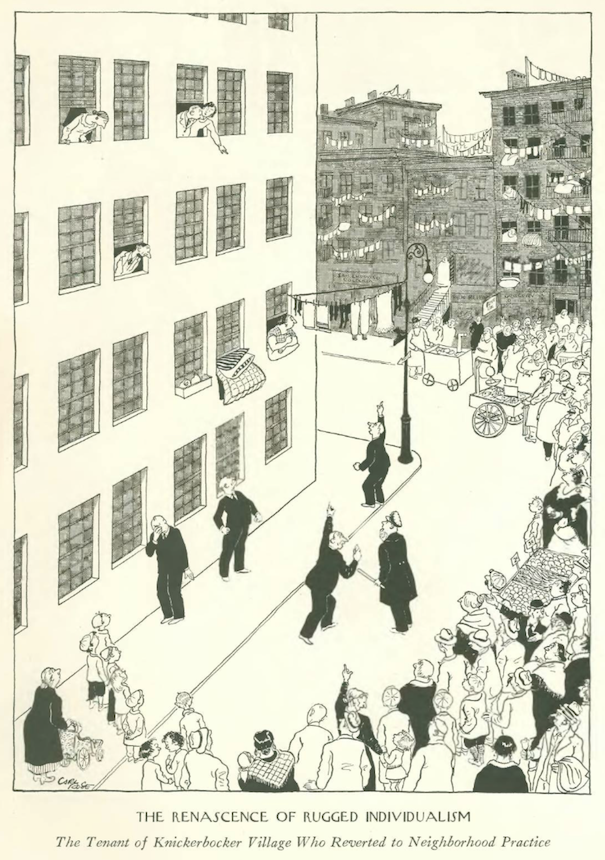
Carl Rose needed two pages to illustrate his epic cartoon (caption added at the bottom for readability)…

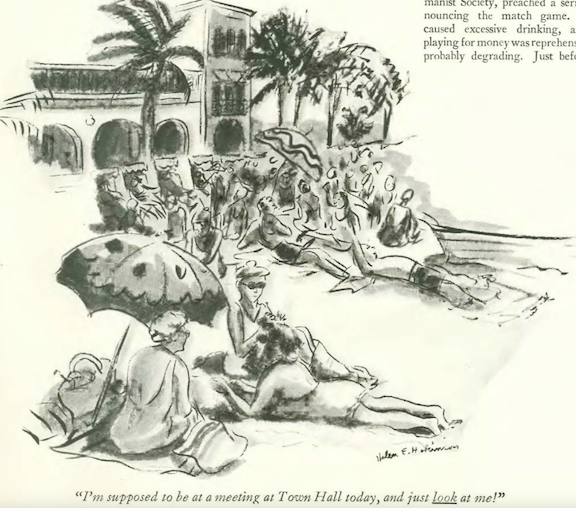
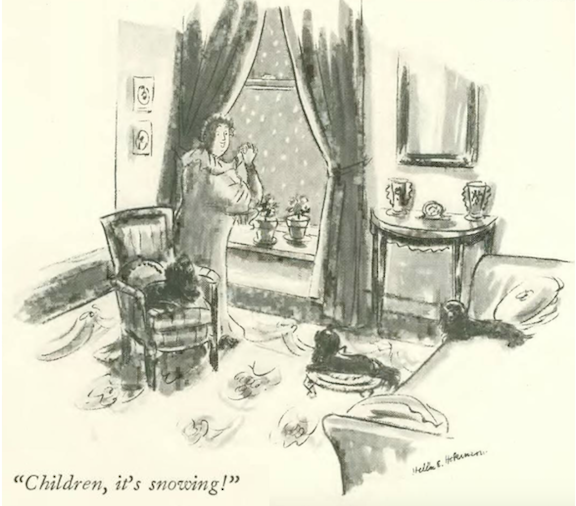
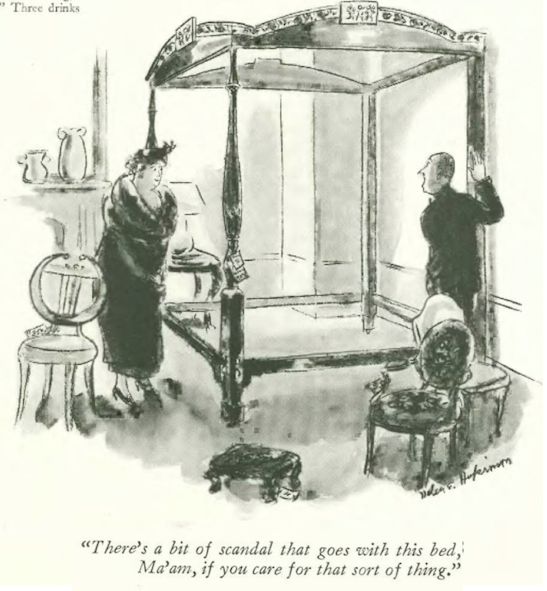
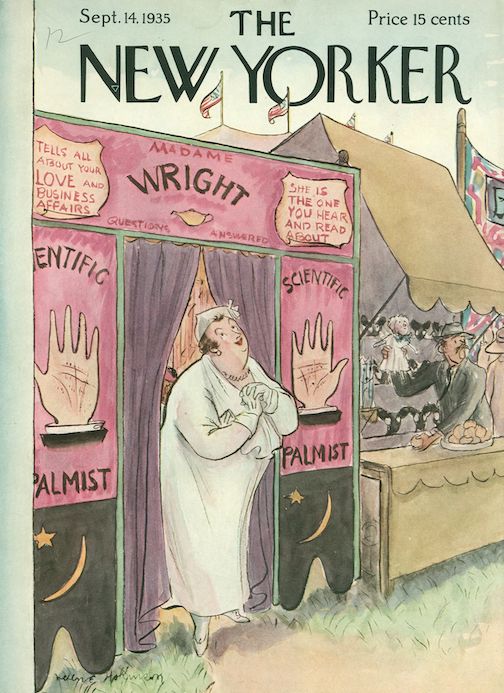
…and we close with Helen Hokinson, and a whiff of scandal…

Next Time: Seeking Decorative People…


A Summer Night

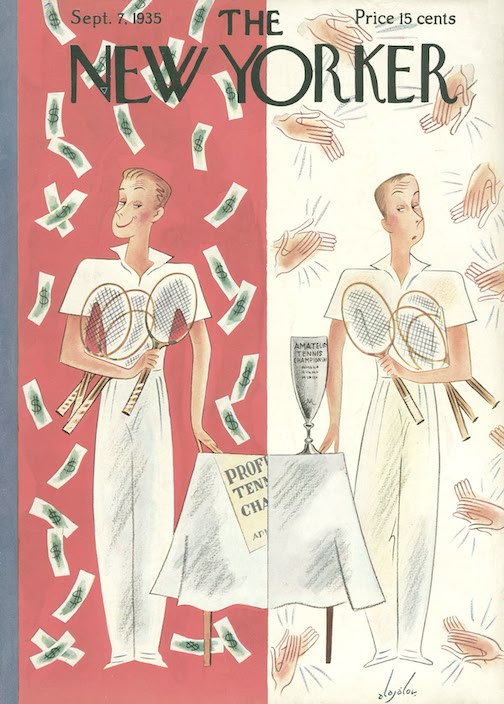
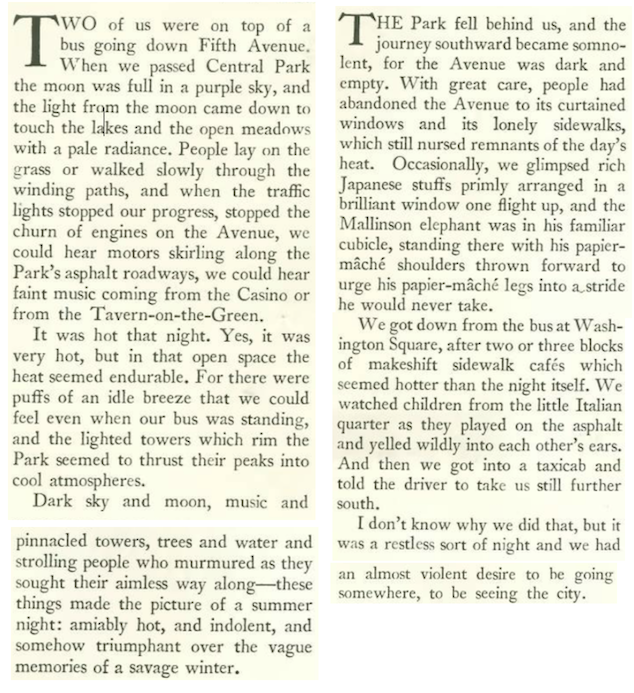
Morris Markey embodied the ideal of “A Reporter at Large,” and for his Sept. 7 column he decided to stroll the steamy streets of Manhattan on a late summer night, finding the sidewalks alive with folks seeking a break from their stifling dwellings.

September 7, 1935 cover by Constantin Alajalov.

Markey (1899-1950) began “Summer Night” by describing a bus ride from Midtown to Washington Square with (I assume) his wife, Helen Turman Markey. They enjoyed the breeze atop the bus as they passed Central Park and heard the faint strains of music in the air.

FINAL NOTES…Morris Markey thought he heard music coming from the Central Park Casino (left) on that hot summer night; it would prove to be one of the Casino’s last summer nights since Robert Moses would have it demolished the following May; at right, Adolf Dehn lithograph Central Park at Night, 1934. (NYC Parks/Art Institute of Chicago)
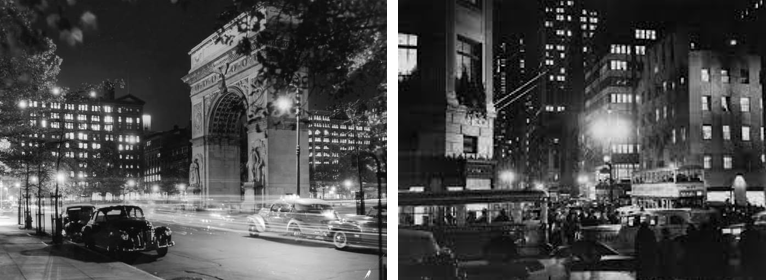
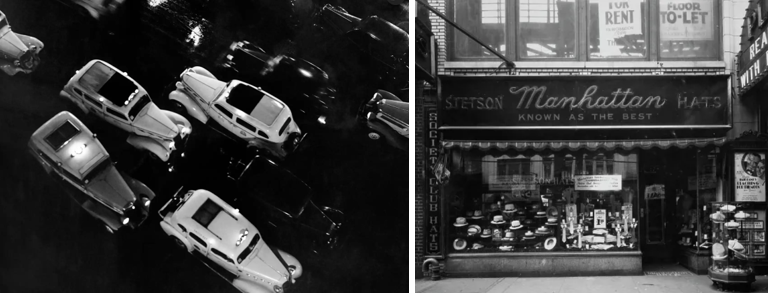
AMID THE BUSTLE the Markeys hopped off the bus at Washington Square and set out on foot. At left, Washington Square by night, 1945; at right, cacophony on Fifth Avenue, circa 1940. (Facebook)

The scenes described by Markey offer a glimpse of what has changed and what still remains of Manhattan night life after ninety years.

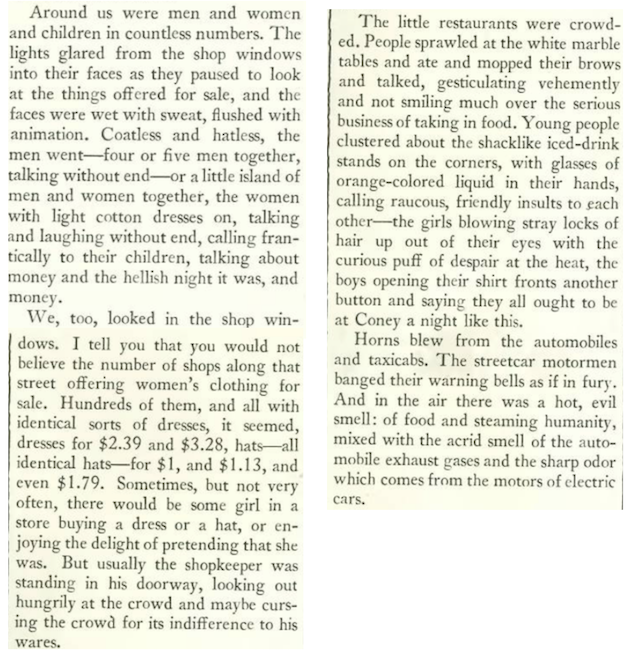
GO BLOW YOUR HORN…Something taxis did then and do now; Markey described folks looking at hats in a shop window, probably similar to this 1930s store at right. (theguardian.com/Pinterest)

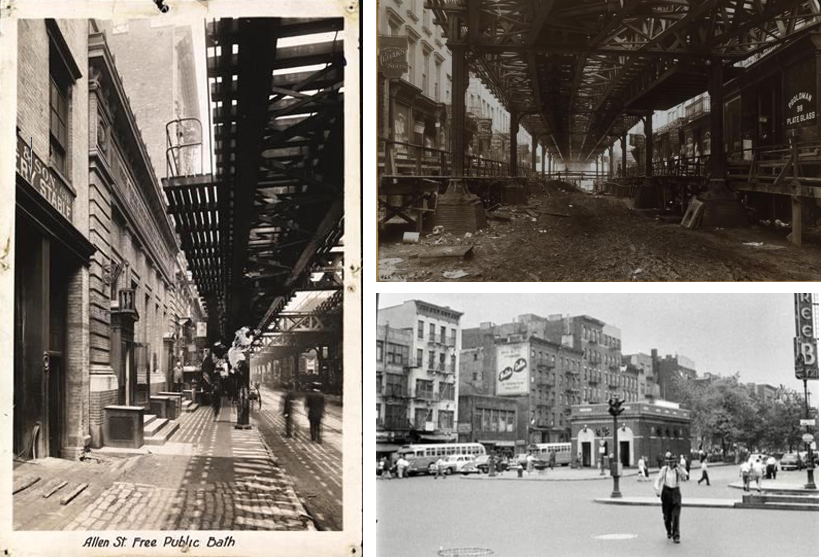
They concluded their stroll on the Lower East Side, where Markey noted a tenement clearance project on Allen Street. Considered one of the most densely populated places in the world, the street was widened by demolishing all of the buildings on its east side from Division to Houston Street.

HERE COMES THE SUN…The densely populated Allen Street was called “a place where the sun never shines.” The narrow street was mostly under the shadow of the elevated train tracks until it was widened in 1930s by demolishing all of buildings on its east side. Photo at left shows the public bath at 133 Allen Street (now used as a church). The demolition project, and the removal of the overhead “El” tracks in 1942, created a broad thoroughfare with a meridian mall in the center, as seen in the bottom photo of the intersection of Allen and Delancey circa 1950. (mcny.org/leshp.org/Facebook)

 * * *

At the Movies

Film critic John Mosher finally found a film he could gush about in Anna Karenina, and most notably its star Greta Garbo, who in Mosher’s words “sets the pace and the tone for the whole thing.” Mosher was not alone in his praise: Writing for The Spectator in 1935, Graham Greene wrote that Garbo’s acting in the film overwhelmed the acting of all the supporting cast save that of Basil Rathbone. This observation was later echoed by Roland Barthes, who wrote in 1957 that Garbo belonged “to that moment in cinema when the apprehension of the human countenance plunged crowds into the greatest perturbation, where people literally lost themselves in the human image.” Here is Mosher’s review:

GARBO AND THE OTHERS…Greta Garbo dominated the screen in 1935’s Anna Karenina. Clockwise, from top left, MGM poster for the film; Garbo with Fredric March as Anna’s lover, Count Vronksy; Garbo with Basil Rathbone, who portrayed Anna’s husband Karenin, and child actor Freddie Bartholomew as their son, Sergei; Maureen O’Sullivan took a break from the Tarzan films to portray Anna’s friend Kitty (here with Gyles Isham as Levin). (filmforum.org/Wikipedia/IMDB)

As Mosher noted, Garbo also portrayed Anna Karenina in the 1927 silent film Love, in which she co-starred with John Gilbert as Count Vronsky.

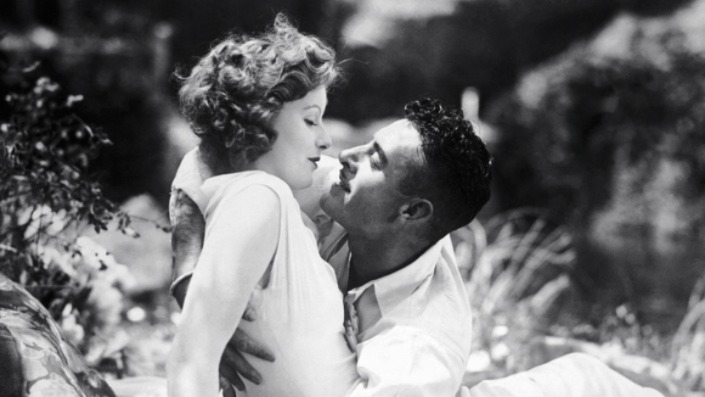
BEEN HERE BEFORE…Greta Garbo as Anna Karenina and John Gilbert as Count Vronsky in the 1927 silent film Love, the second of four films they made together. They were also lovers off-screen in the 1920s, but with the advent of sound pictures her star rose as his began to fall; in their last film together, Queen Christina (1933), Garbo insisted that Gilbert be cast opposite her in a final attempt to revive his declining career. He essentially drank himself to an early grave, dying of a heart attack in January 1936. (rottentomatoes.com)

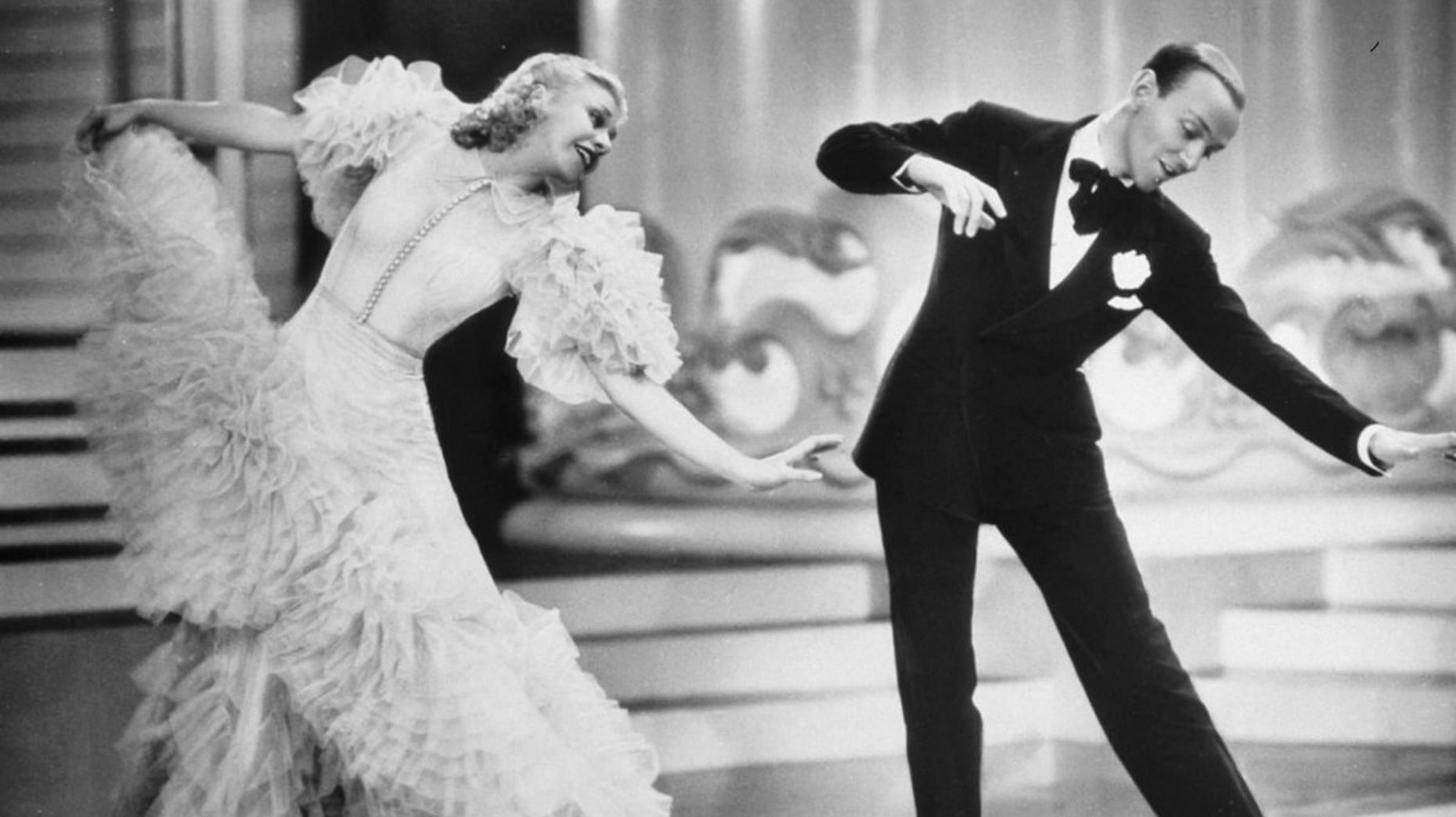
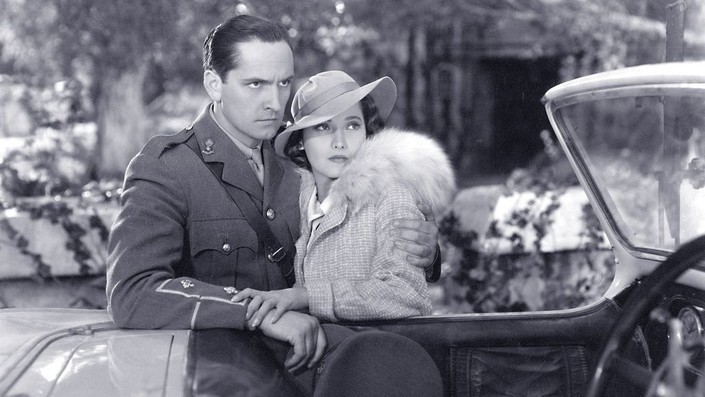
Mosher also enjoyed the dance moves of Fred Astaire and Ginger Rogers in Top Hat (although it could have used less “patter and piffle”), and brought out his hankie for The Dark Angel, where he once again encountered the acting of Fredric March.

DEFYING GRAVITY…Ginger Rogers and Fred Astaire made their complex dance moves look effortless as they glided through Top Hat, the fourth of ten films they made together. (americancinematheque.com)
TEARS FOR FEARS…Fredric March and Merle Oberon portrayed old friends and lovers facing a rival lover and the horrors of World War I in the 1935 weeper The Dark Angel. (rottentomatoes.com)

 * * *

From Our Advertisers

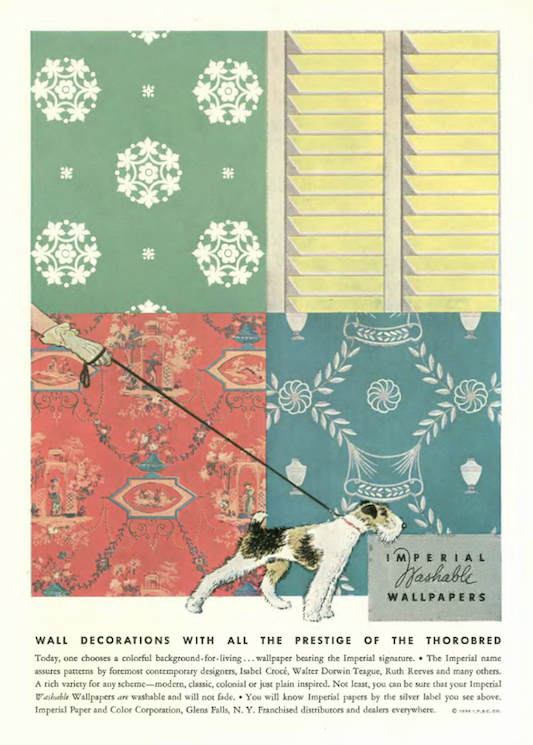
We begin with a splash of color from the makers of Imperial washable wallpapers…not sure why a wire fox terrier is featured in the advertisement…they were a popular breed, and maybe Fido was the reason one needed washable walls…

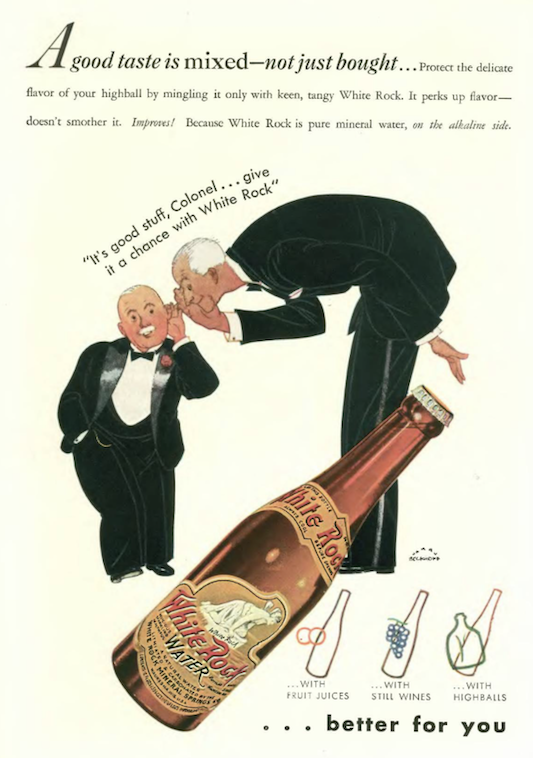
…White Rock rolled out their tiny Colonel to promote mineral water as an ideal mixer…

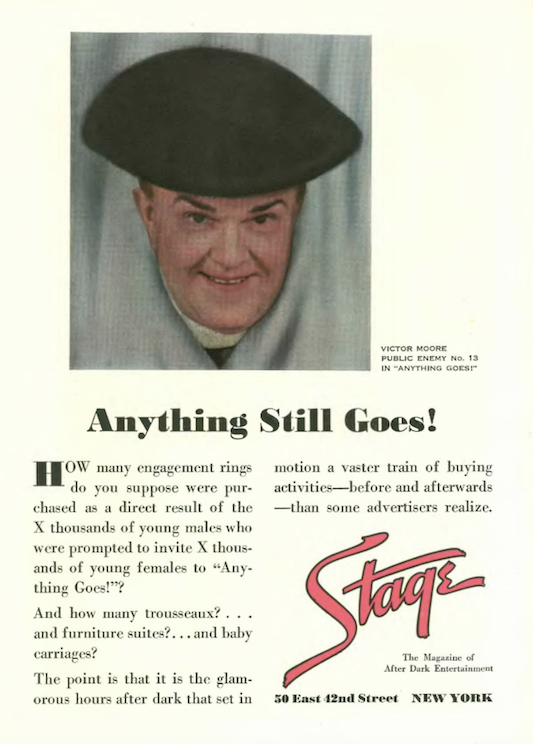
…ever heard of Victor Moore?…well, he was quite the comedian back in the day, playing timid, mild-mannered characters on stage and screen…Moore (1876-1962) was also famous for his 1942 marriage to dancer Shirley Paige when Moore was 65 and Paige was 20…

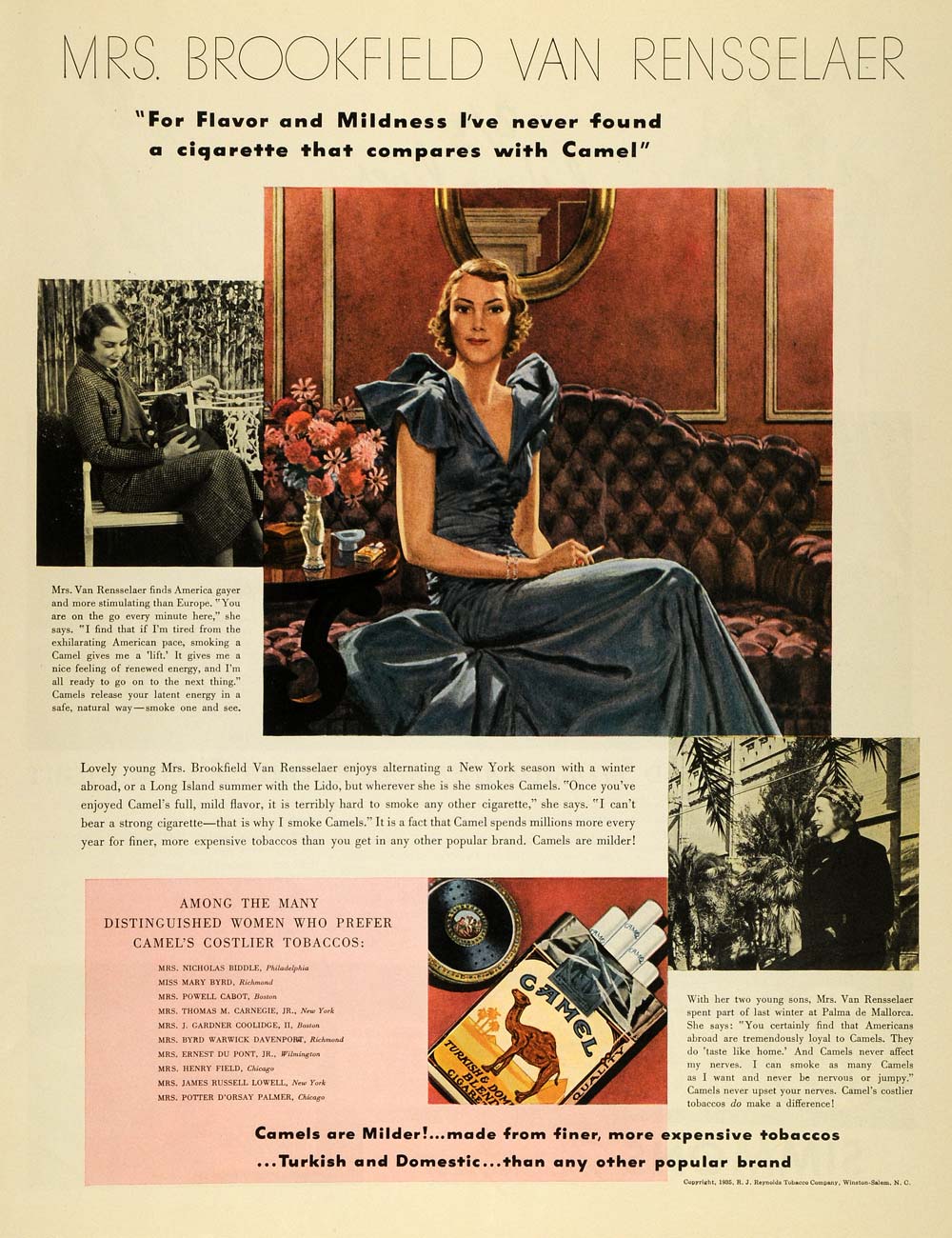
…Camel rolled out another high society endorser, Maude Adele Brookfield van Rensselaer (1904-1945)…her color image is a watercolor by Leslie Saalburg

…on to our cartoonists, we begin with spot art by Abe Birnbaum

and Maurice Freed

…also in the opening pages this wordless contribution by James Thurber

Gluyas Williams found this midday repast anything but relaxing…

Otto Soglow found a new “man’s best friend”…

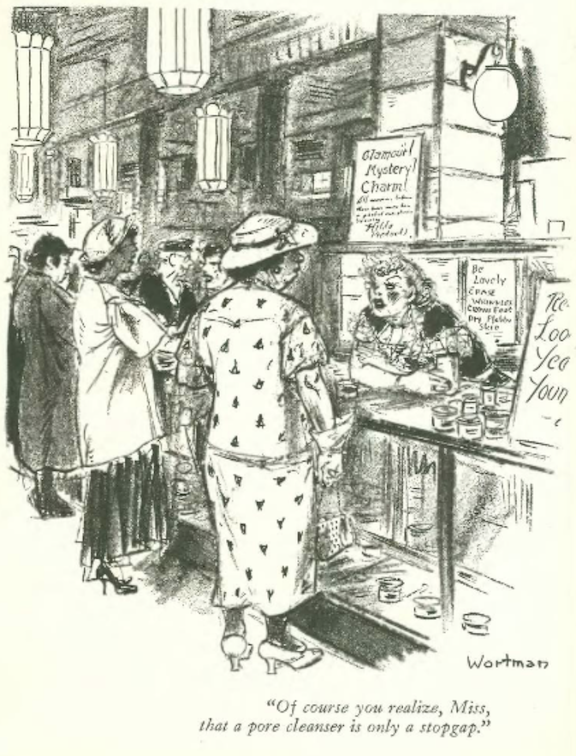
Denys Wortman encountered some frank advice at the cosmetics counter…

Helen Hokinson found appreciation for the “strong and silent” acting style…

Peter Arno gave us a department store clerk in need of some time off…

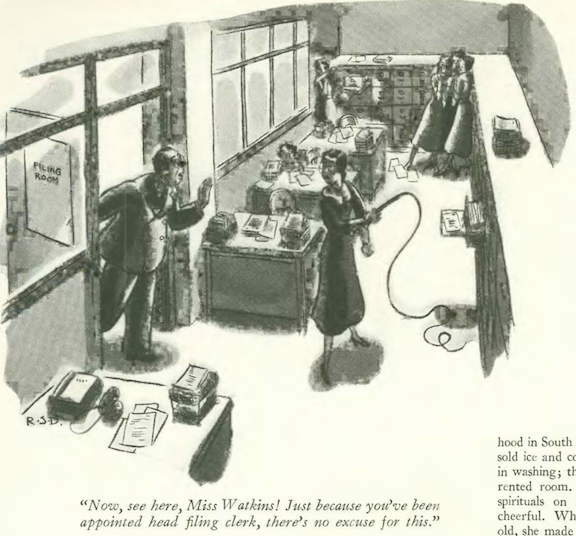
…and we close with Richard Decker, finding some truth in advertising…

Next Time: Looking For Mister Wrong…

Settling Down

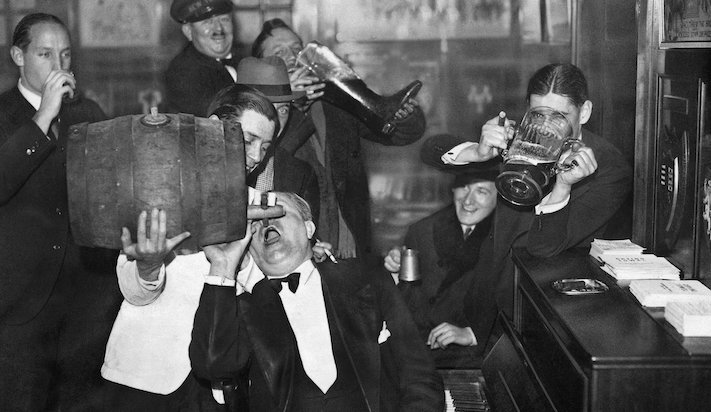
Above: Celebrating the repeal of the 18th Amendment, 1933. (New York Times)

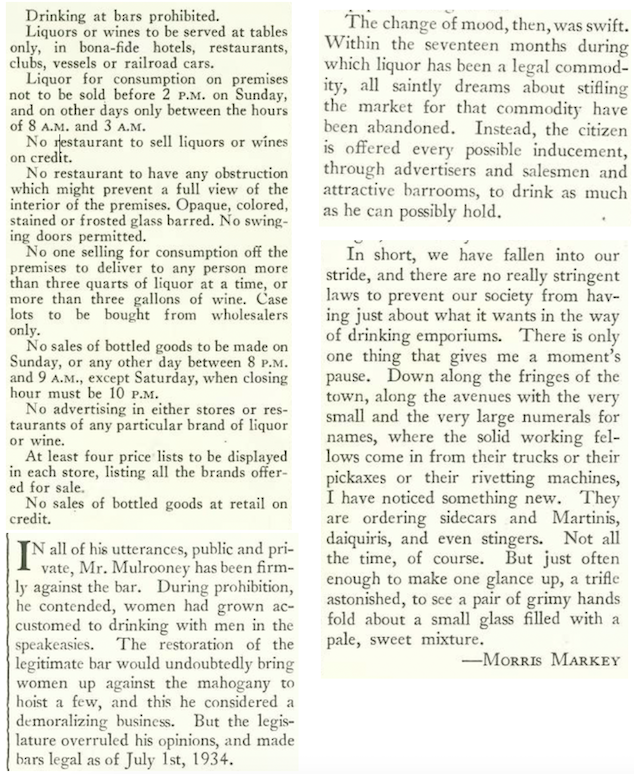
“Settling Down” was the title given to Morris Markey’s examination of the post-Prohibition world, which to no one’s surprise heartily embraced (and imbibed) everything this world had to offer.

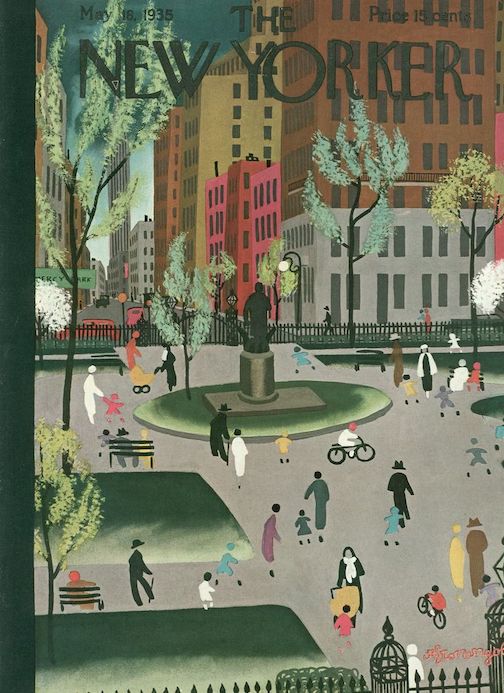
May 18, 1935 cover by Adolph K. Kronengold.

In his column, “A Reporter at Large,” Markey examined the challenges faced by local and federal governments in reestablishing old liquor control laws, in many cases creating new ones to address the technological, economic and social changes that transpired during the fourteen years of Prohibition. Facing this challenge in New York was Edward P. Mulrooney (1874-1960), a former police commissioner tapped in 1933 to head the State Alcoholic Beverage Control Board. Markey explained how Mulrooney and New York regulators tried to create new standards for alcohol consumption that would encourage moderation. Excerpts:

CAN’T HAVE A BELT IN THE BIBLE BELT…Published by The United States News on Nov. 11, 1933, this map shows how liquor laws varied by state following Prohibition. After Prohibition ended with the ratification of the 21st Amendment, states gained the authority to regulate alcohol sales, leading to a wide variety of state and local laws. Many states adopted local option laws, allowing cities and counties to decide whether to allow alcohol sales, resulting in “wet,” “dry,” and “moist” jurisdictions. (us news.com)

Seventeen chief provisions for moderating alcohol use were published in The New York Times on Nov. 10, 1933, but ten of those provisions were quickly abandoned. Less than a year and a half after repeal, Markey noted that “the citizen is offered every inducement…to drink as much as he can possibly hold.”

SO MUCH FOR RULES…Celebrations for the repeal of Prohibition in bars and former speakeasies began when Franklin Roosevelt signed the Cullen-Harrison Act on March 22, 1933; the president himself was known to enjoy a dry martini; former New York Police Commissioner Edward P. Mulrooney had the unlucky task of figuring out how to regulate the juice of the grape and the grain. In the end, people seemed to be drinking more than ever. (themobmuseum.org/thrillist.com/Condé Nast)

 * * *

Hordes From the Hinterland

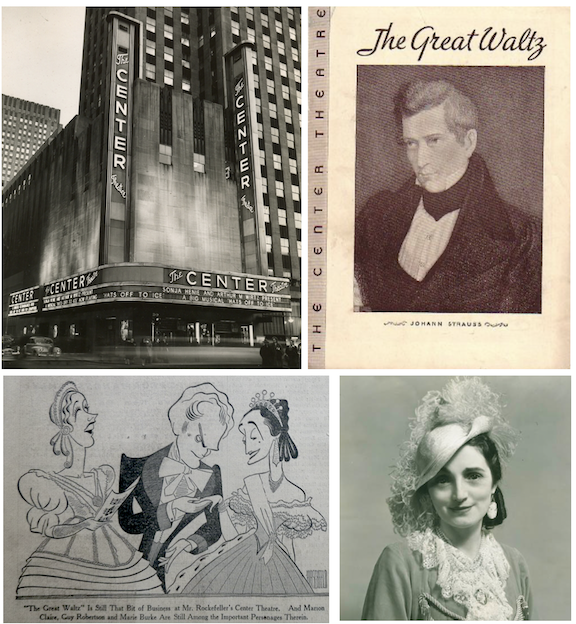
There was a time, long ago, when Broadway catered mostly to New Yorkers, but with the advent of mass media and better transportation options folks from the hinterlands (from beyond the Hudson) began to descend on the Great White Way. Then as now, certain shows attracted thousands, including The Great Waltz, a musical based on the works of Johann Strauss I and Johann Strauss II. It opened in September 1934 at the Center Theatre and ran for 289 performances. “The Talk of the Town” sniffed that “People who literally have never seen a play before in their lives turn up at Sixth Avenue and Forty-ninth Street, ready for anything.”

MANY AMERICANS WERE AGOG over the The Great Waltz…Clockwise, from top left, the play was performed at the Center Theatre (formerly the RKO Roxy Theatre) at 49th Street and 6th Avenue—sadly, it was demolished in 1954, the only building to ever be demolished from the original Rockefeller Center complex; cover of the Playbill; actress Marie Burke portrayed Countess Olga Baranskaja; Al Hirschfeld illustration of Burke and fellow actors Guy Robertson (as Johann Strauss) and Marion Claire as Therese. (cinematreasures.org/playbill.com/nyt.com)

 * * *

From Our Advertisers

Appropriately, this full-page advertisement for Gordon’s Gin appeared opposite the opening page of Morris Markey’s exploration of the post-Prohibition world…

…and business was booming in the liquor trades…most of the full-color ads in The New Yorker were placed by liquor companies, cigarette manufacturers, and automakers…the inside back cover shilled for Penn Maryland…

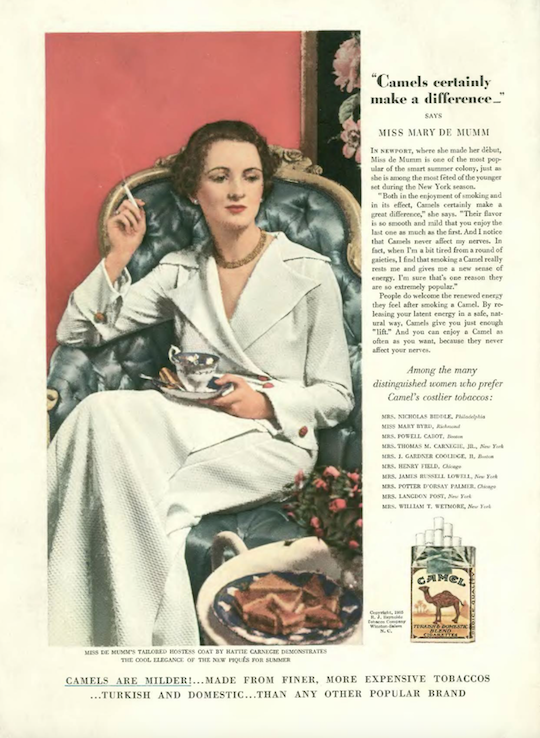
…while the back cover was once again claimed by big tobacco…here we have Newport deb Mary De Mumm expounding on wonders of Camel cigarettes, which somehow helped her feel both restful and energetic…

…those who enjoyed the finer things could buy this Packard for about $3,000 (nearly $90K today).

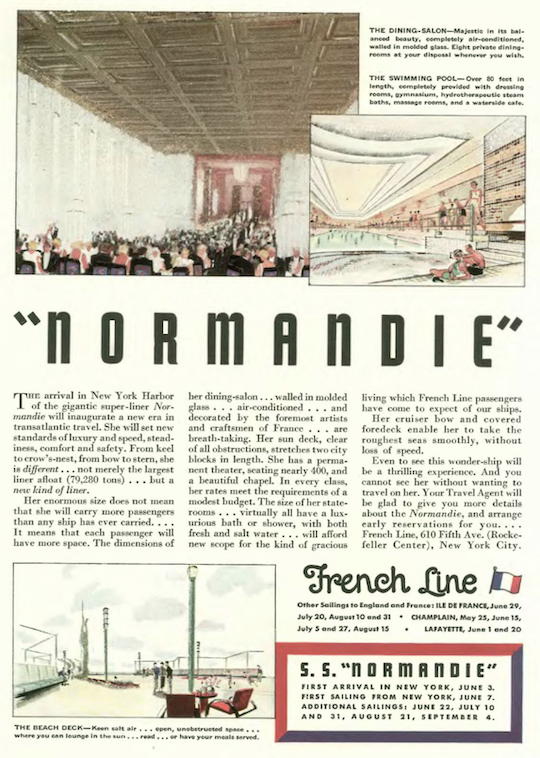
…anticipation was building for the June arrival of the new French liner S.S. Normandie, the largest and fastest passenger ship afloat…

S.S. Normandie on the high seas. (Wikipedia)

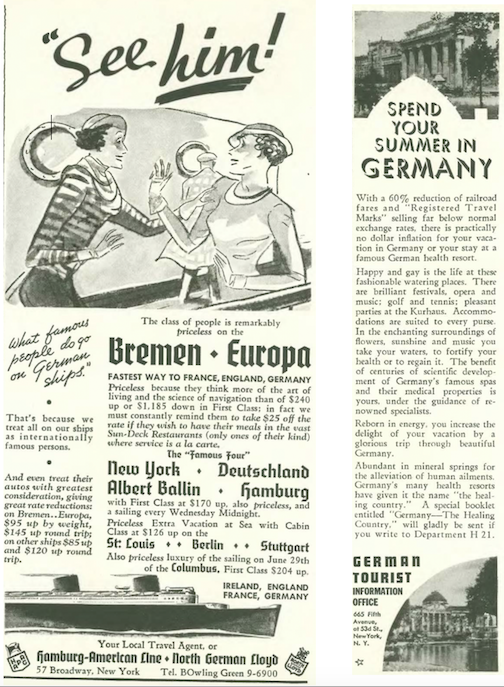
…the Hamburg-American Line was another way to get across the pond, and it promised a ship filled with famous and classy people (and likely more than a few Nazis)…the single-column ad on the right suggested you could spend your summer in Germany…the tourist bureau claimed that Germany was known as “the healing country,” and doubtless many needed healing after being beaten by Brownshirts…

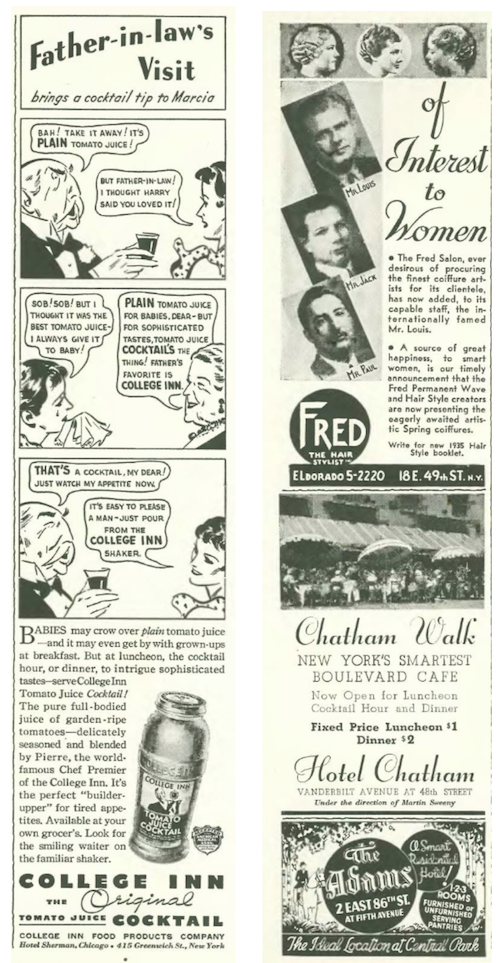
…a couple more single-column ads, first from our friends at College Inn, who dumped the furious Duchess in favor of a dyspeptic father-in-law who brings his daughter-in-law to tears over her choice of tomato juice…the ad at right advertised the services of Mr. Louis, Mr. Jack, and Mr. Paul at the hair stylist Fred, while a tiny ad at the bottom offered a luncheon for a buck at New York’s “Smartest Boulevard Cafe”…

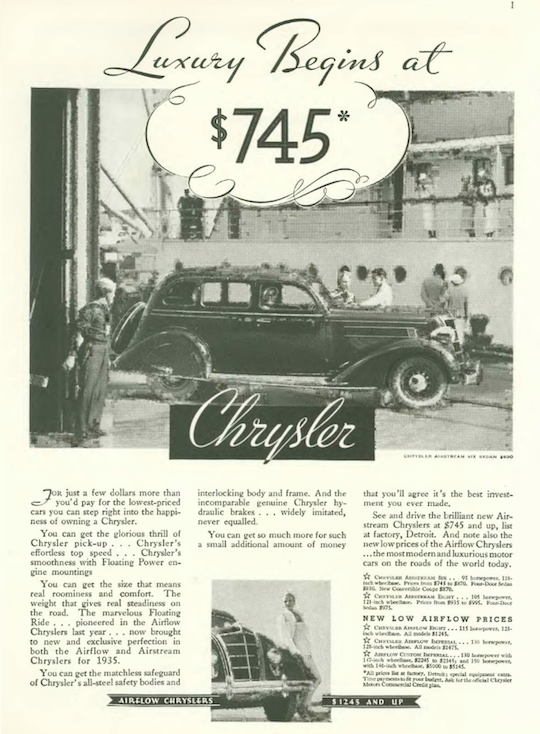
…the key word in many New Yorker advertisements was luxury, and for a fraction of what you would pay for a Packard, you could, apparently, experience luxury for as little as $745…

…or you could enjoy a bit of elegance by opening a some cans of Heinz soup, chili sauce, stuffed olives and other delectables…here a couple of shady-looking butlers are serving nothing but canned goods at a swanky party, much to the annoyance of the cook, who appears poised to take a cleaver to the scheming pair…

…and look what else you can get from a can, some soup with a “personality”…

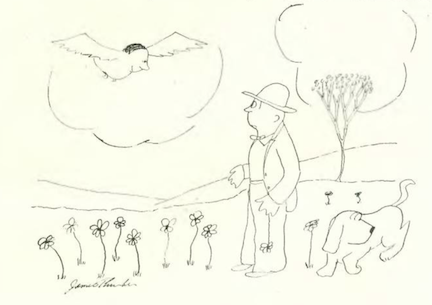
…enough of that nonsense, on to our cartoonists, with two spots from James Thurber

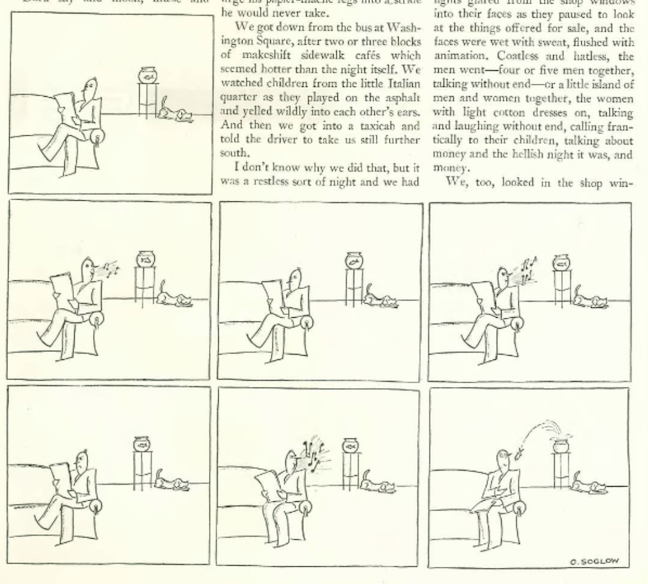
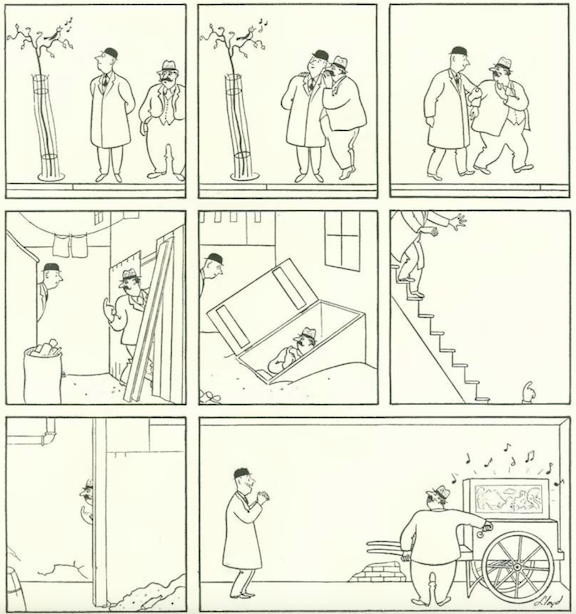
...Lloyd Coe gave us this musical multi-panel…

Leonard Dove looked in on the complex world of young love…

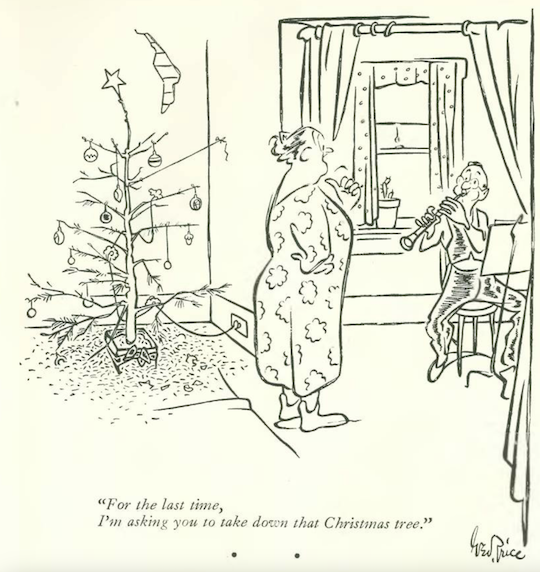
George Price found the Yuletide spirit still alive among procrastinators…

…and we close with Alan Dunn, and some earthy reading…

Next Time: Vive La Normandie…

Home Sweet Motohome

Morris Markey thought he was getting a glimpse of the future when he attended an exhibit of “machines to live in” at New York’s Grand Central Palace.

March 16, 1935 cover by Constantin Alajalov.

The Great Depression created a housing shortfall in the U.S. of nearly two million units, so many idled architects and builders turned to industrialized housing as a way to boost the building industry. In “A Reporter At Large,” Markey described his encounter with one type of “machine to live in”––the Motohome.

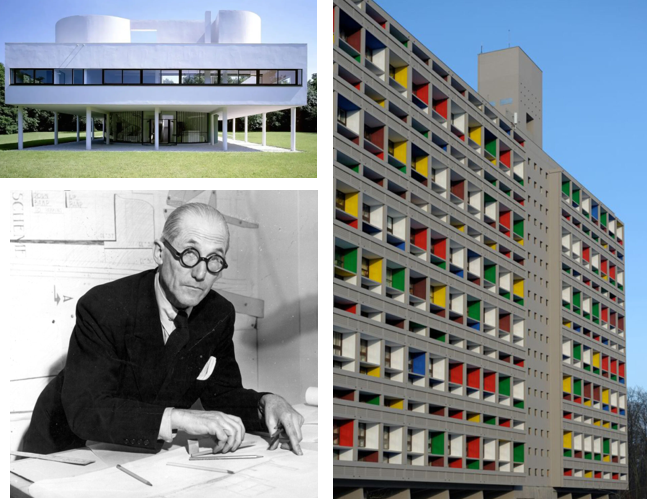
The idea of pre-fab living wasn’t exactly new in 1935, originating in the 1920s with the German Bauhaus school and with notables such as Swiss architect Le Corbusier.

NOT THRILLED WITH FRILLS…Charles-Édouard Jeanneret (1887-1965), better known as Le Corbusier, stated in 1923 that “a house is a living machine.” He believed the world had evolved beyond the need for decorative frills, and that homes and furnishings should reflect their functions. Top left, Corbu’s 1929 Villa Savoye in Poissy, France; at right, his 1947-52 Unité d’habitation de Marseille. (Fondation Le Corbusier/Architectural Digest/Le Corbusier World Heritage)

Markey correctly surmised that the American twist on Le Corbusier’s vision was largely driven by big corporations, and in the case of the Motohome, by General Electric.

GET YOUR MOTO RUNNING…Clockwise, from bottom left, New York’s Grand Central Palace; the Eggiman House in Madison, Wisconsin, a 1936 Motohome listed in the National Register of Historic Places; Long Island Motohome featured on a brochure; Popular Mechanics article on the Motohome. A common wall “core” was prefabricated with all kitchen and bath fixtures, as well as the HVAC system. (Wikipedia/makeitmidcentury.com/books.google.com)

 * * *

Strange and Wonderful

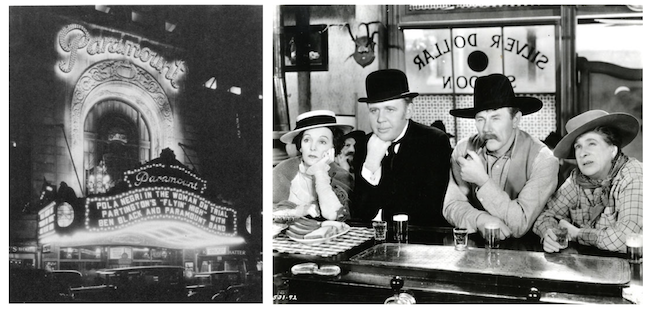
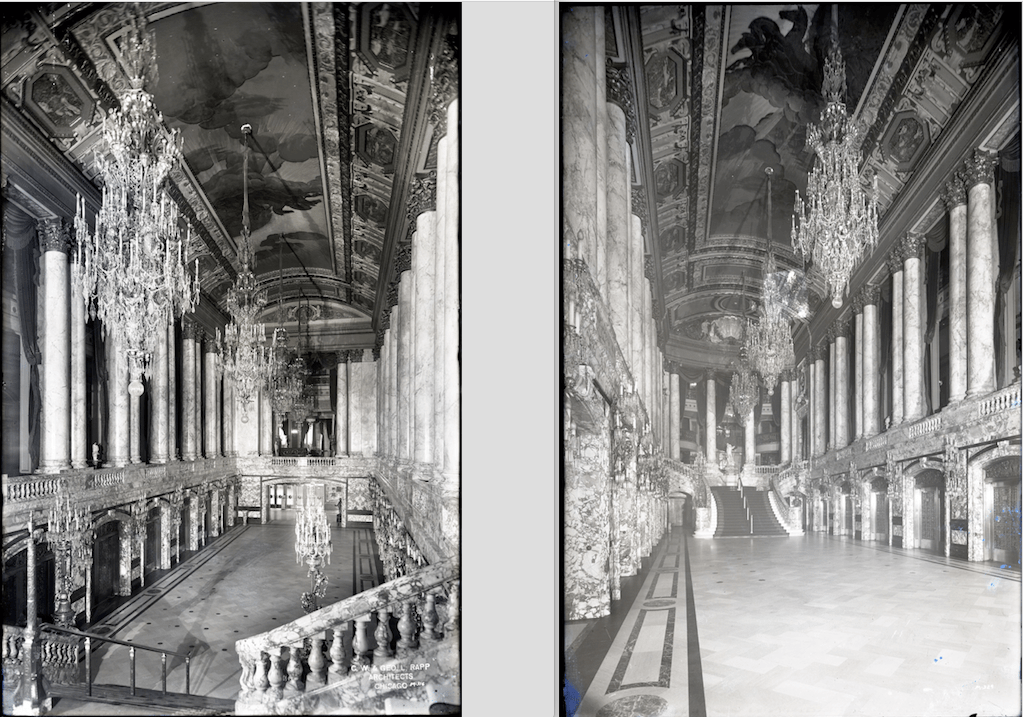
That is how E.B. White described the 3,664-seat Paramount Theatre, which opened on 43rd and Broadway in 1926. After nine years White was still in awe of its palatial trappings. In his “Notes and Comment,” White offered some thoughts after an evening at the movies.

CINEMA GLORY DAYS…E.B. White visited the Paramount Theatre to take in Charles Laughton’s hit film, Ruggles of Red Gap. From left, Zasu Pitts, Laughton, Charles Ruggles and Maude Eburne in Ruggles. (nyc.gov/TCM)
PALACE FOR THE PICTURES…The Paramount Theatre’s Grande Hall featured a 75-foot-long ceiling mural by artist Louis Grell above the Italian marble-lined entrance. In 1966, after a run of the James Bond film Thunderball, the Paramount was closed for good and later gutted and turned into retail and office space. (Louis Grell Foundation)

 * * *

Bad Guys

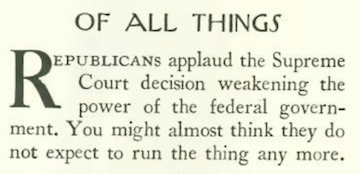
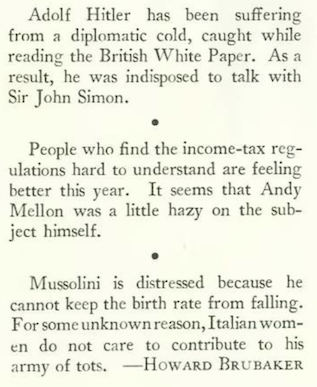
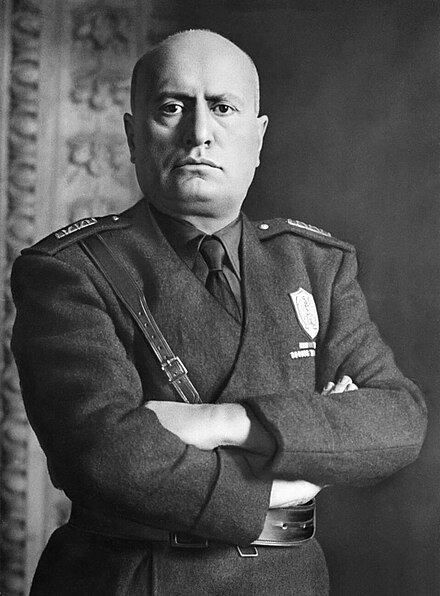
Andrew Mellon’s tax fraud troubles were sandwiched between the woes of a fascist bromance in Howard Brubaker’s “Of All Things”…Mellon would soon be dead, Adolf Hitler would lie his way around the Brits, and Benito Mussolini would struggle to inspire Italian women to produce his “army of tots”…

NOT TONIGHT, WE HAVE A HEADACHE…Little wonder fascist dictator Benito Mussolini couldn’t inspire a baby boom. (Wikipedia)

 * * *

Zoom Zoom

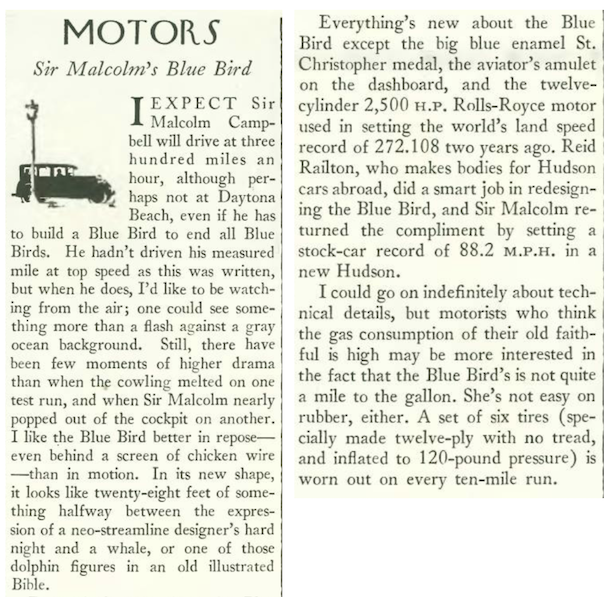
In his “Motors” column, writer “Speed” looked in on Sir Malcolm Campbell (1885-1948), who was attempting to break the 300-mph mark at Daytona in his 2,500-horsepower Blue Bird.

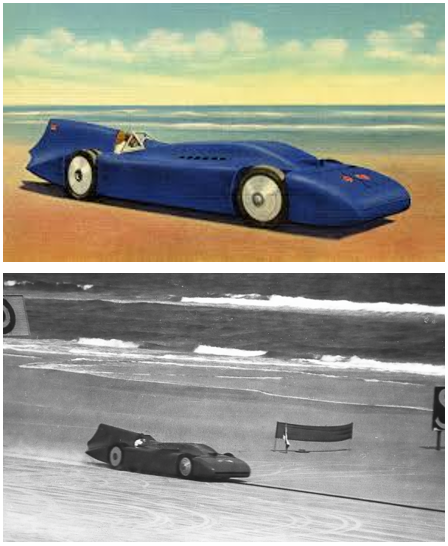
BLUE STREAK…Sir Malcolm Campbell’s bid for a land speed record surpassing 300 mph began at Daytona Beach in March 1935 in his Campbell-Railton Blue Bird, powered by a 2,500 hp supercharged Rolls-Royce V-12. He managed to hit 276 mph (combined runs in each direction), but conditions at the beach (bottom photo) left him short of his goal. He found a smoother, longer run at Utah’s Bonneville Salt Flats in September, where he would average 301.337 mph (484.955 km/h) in two passes to set the new record. (floridamemory.com/oldmachinepress.com)
ONCE IS NOT ENOUGH…Sir Malcolm Campbell MBE was a British racing motorist and motoring journalist. He gained the world speed record on land and on water several times. He was also one of the few land speed record holders of his era to die of natural causes. (Wikipedia)

 * * *

From Our Advertisers

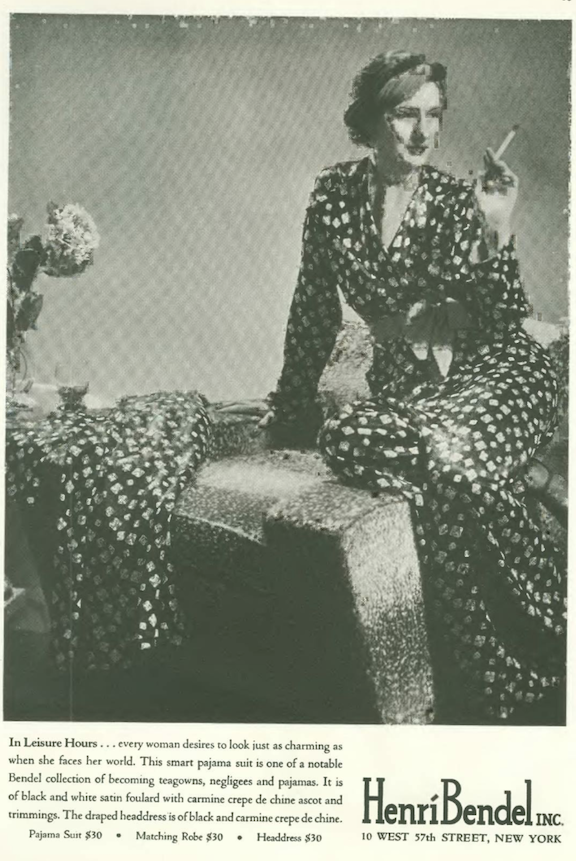
For ninety bucks you could get this swell pajama suit and matching robe (plus headdress) at Henri Bendel, the perfect ensemble for having a leisurely smoke after a day facing the world…For more than 100 years, Henri Bendel’s flagship and only store was located at 10 West 57th Street…it closed in 2018…

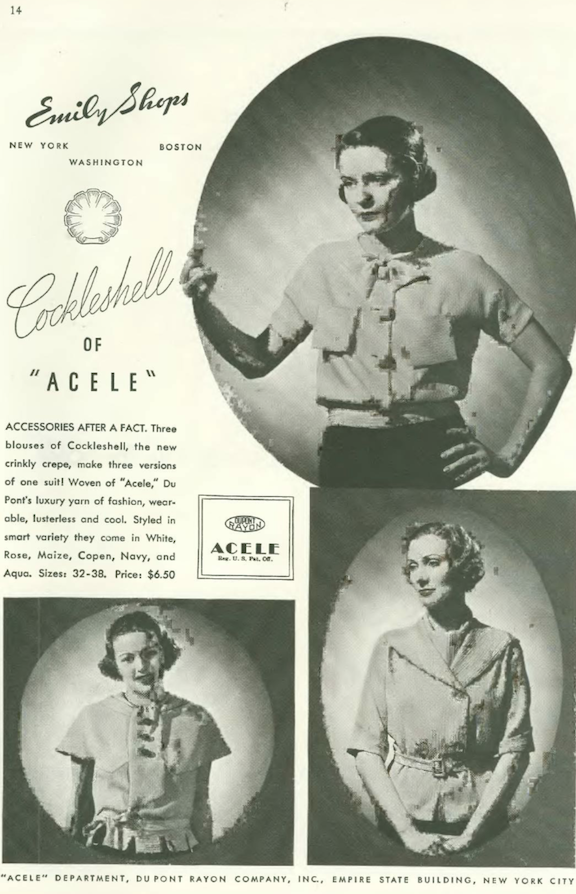
…I doubt the woman in the Bendel ad would have been interested in clothes made with Acele…it was without question that the uppers only wore clothes derived from living things…

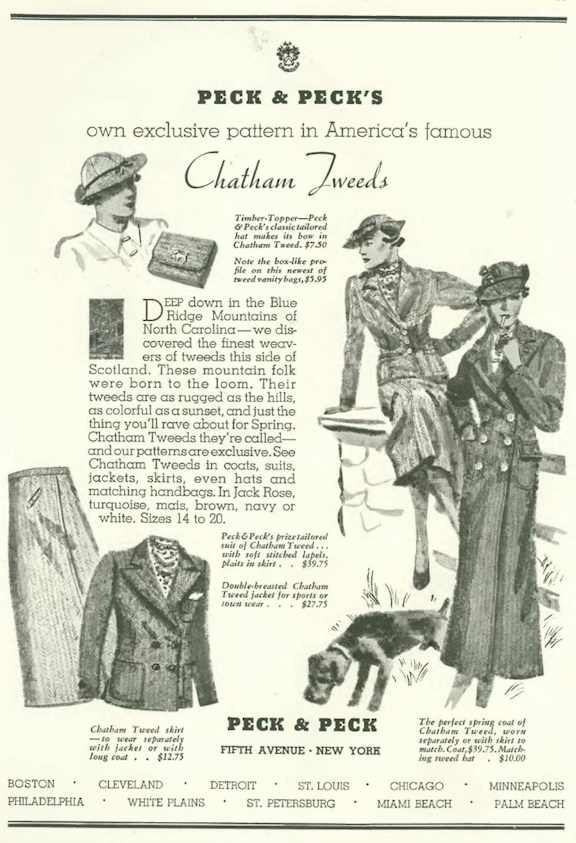
…this Anglophilic Peck & Peck ad is notable for its condescending reference to the “mountain folk” in Appalachia who “were born to loom”…

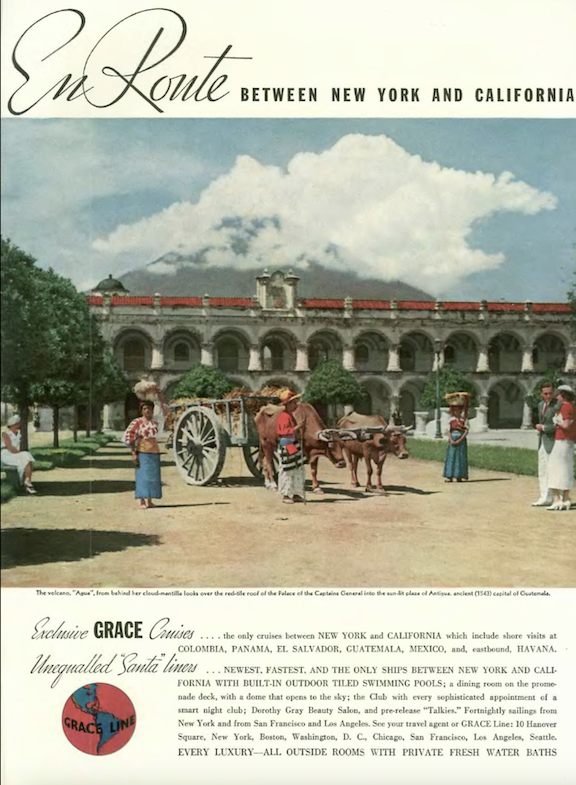
…while we are on the subject, check out this ad for Grace Cruises…this was a common theme in mid-century travel advertising, Westerners dressed in their Sunday best while having a gander at the colorful natives…

…who are just part of the scenery…

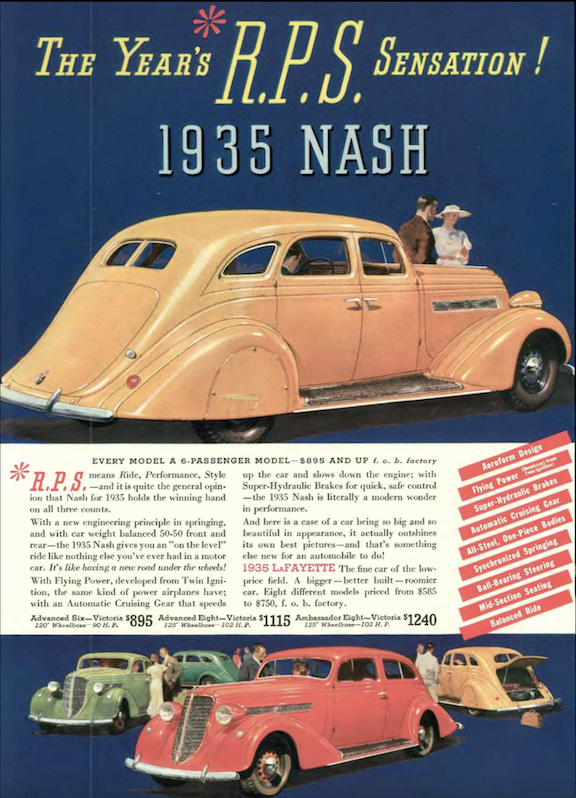
…all four of the automobile ads in this issue come from long-gone companies…the luxury carmaker Packard made beautiful, quality cars that outsold Cadillacs up until 1950, but competition from the Big Three (GM, Ford, Chrysler) plus Packard’s decision in 1954 to buy failing Studebaker led to Packard’s demise four years later…

…a more successful merger took place in 1954 between Nash…

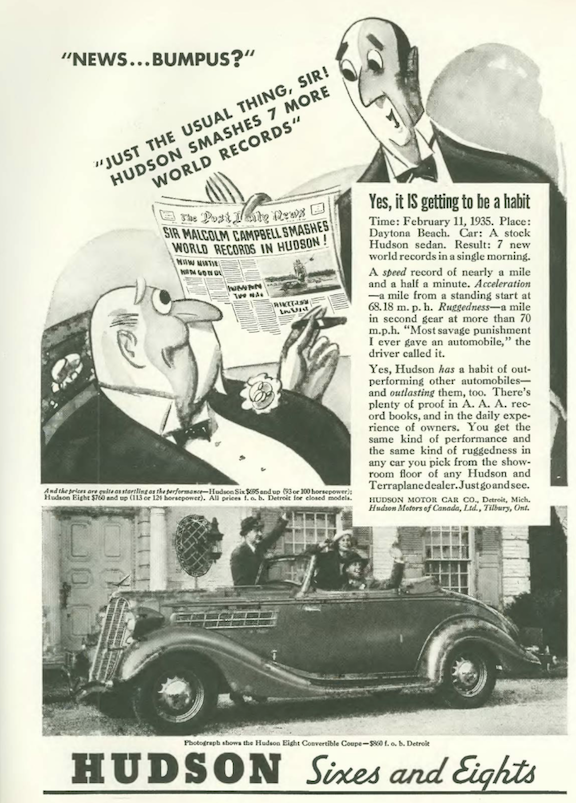
…and Hudson, the two forming the new American Motors Corporation…

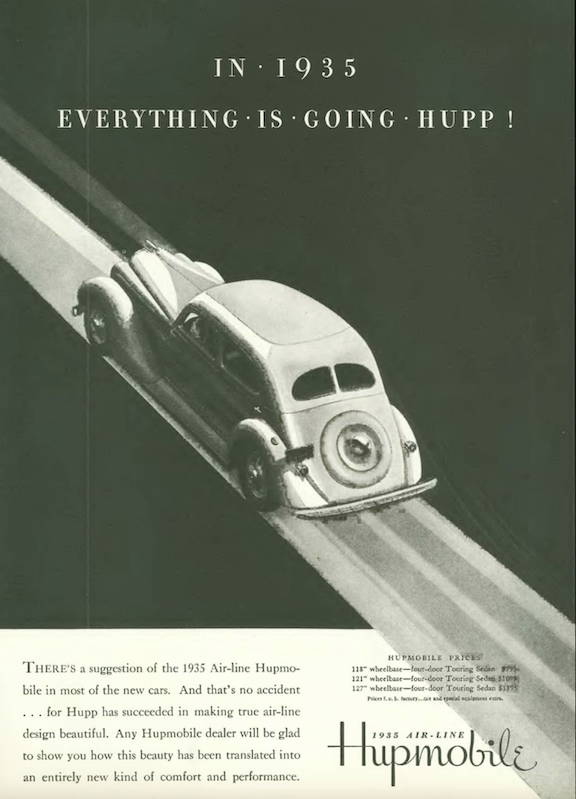
…contrary to this ad’s tagline, everything was actually going down for Hupmobile, which would go out of business in 1939…

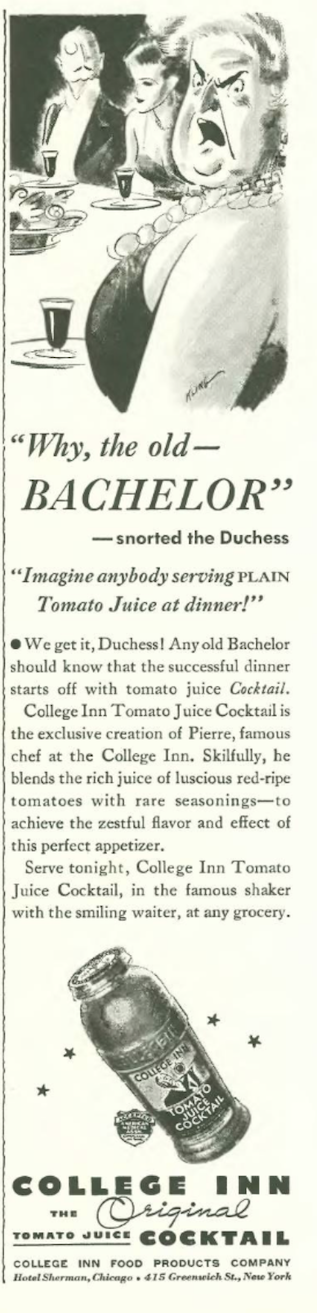
…the makers of College Inn Tomato Juice Cocktail apparently thought an angry old “Duchess” would boost sales…she first appeared in the Feb. 23 issue…

…in the March 16 issue she appears to be psychotic, threatening, “I’ll teach her not to serve PLAIN tomato juice before dinner!” Will she break the glass on the table and lunge at her host (the old WITCH) with a glass shard?…Stay tuned…

…better to calm down and have a Guinness, which, by Jove, was affordable and good for you!…

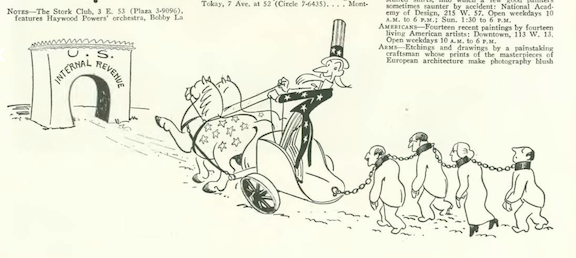
New Yorker cartoons are also good for you, and we begin with Al Frueh and this taxing illustration at the bottom of page 4…

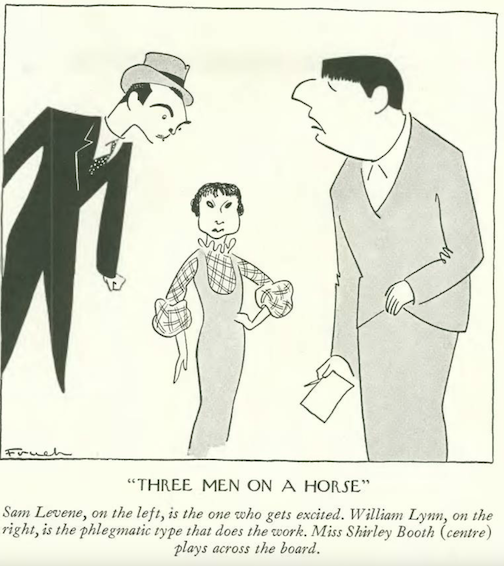
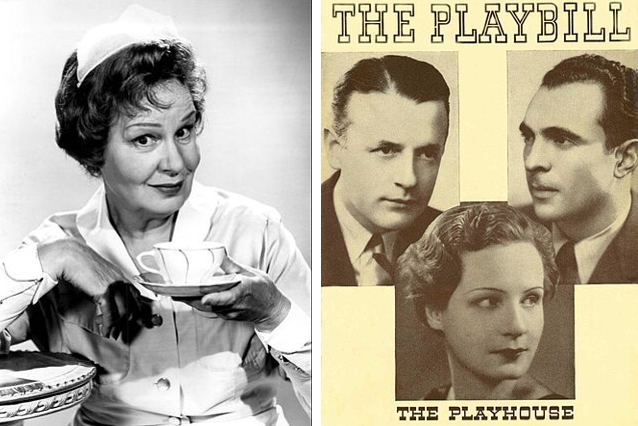
…Frueh again, for the theater review section…in the center is Shirley Booth, known to Baby Boomers as the star of the old TV series Hazel (1961-66)…

…Booth was much more than a sitcom star, achieving the Triple Crown of Acting––an Academy Award, two Primetime Emmy Awards and three Tony Awards…

ACTING CHOPS…Shirley Booth (1898-1992) as Hazel in 1962; on the cover of the 1935 Playbill featuring Three Men on a Horse. (Wikipedia)

…we continue with Daniel ‘Alain’ Brustlein, and a term of endearment from someone well known to the police…

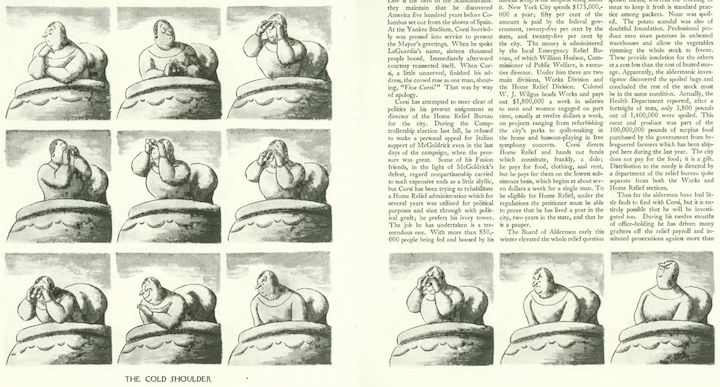
William Steig took up two pages to give one opera patron the cold shoulder…

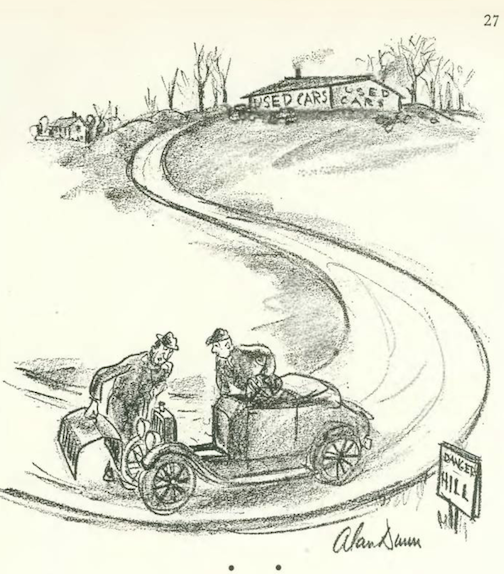
Alan Dunn cautioned against car dealers perched on high hills…

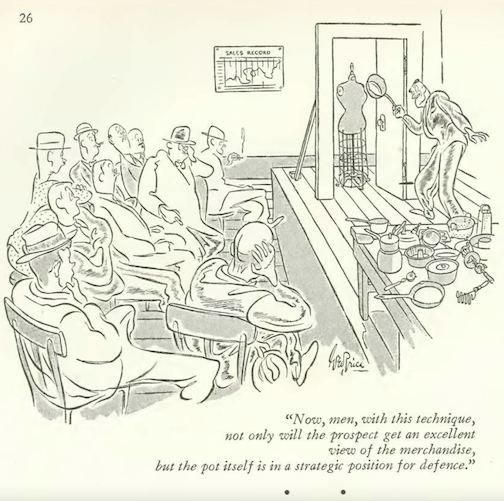
George Price examined the finer points of salesmanship…

Helen Hokinson headed for the high seas…

…and we close with an all-time classic from James Thurber

Next Time: Something Frivolous…

Mary Quite Contrary

Above: Illustration and article on "Typhoid Mary" that appeared in 1909 in The New York American. At right, Mary Mallon with other quarantined inmates on North Brother Island. (Wikipedia)

The Irish-born Mary Mallon (1869–1938) lived a simple life as a maid and a cook, and it would have been a life of anonymity save for a sad twist of fate on the day she was born.

Jan. 26, 1935 cover by Perry Barlow.

History knows Mary Mallon as Typhoid Mary. From 1901 to 1907 she would cook for seven wealthy New York families that would later contract typhoid. Mallon was born to a mother who was infected with typhoid, which offers a possible explanation as to why she became an asymptomatic carrier of the disease. Forcibly quarantined on North Brother Island (near Long Island) from 1907 to 1910, Mallon agreed upon her release to take hygienic precautions, including ending her occupation as a cook.

When other jobs failed to pan out, Mallon returned to cooking—this time in restaurants and hotels—infecting many more while evading investigators who were desperately trying to track her down (it is estimated she infected up to 122 people, resulting in as many as four-dozen deaths). When she was finally arrested in 1915, she was returned to North Brother Island, where she would live out her days. Stanley Walker (1898–1962), a native Texan, longtime editor of the New York Herald Tribune, and a New Yorker contributor from 1925 to 1956, featured Mallon in a profile for the Jan. 26, 1935 issue. Some brief excerpts:

 * * *

The Latest Sensation

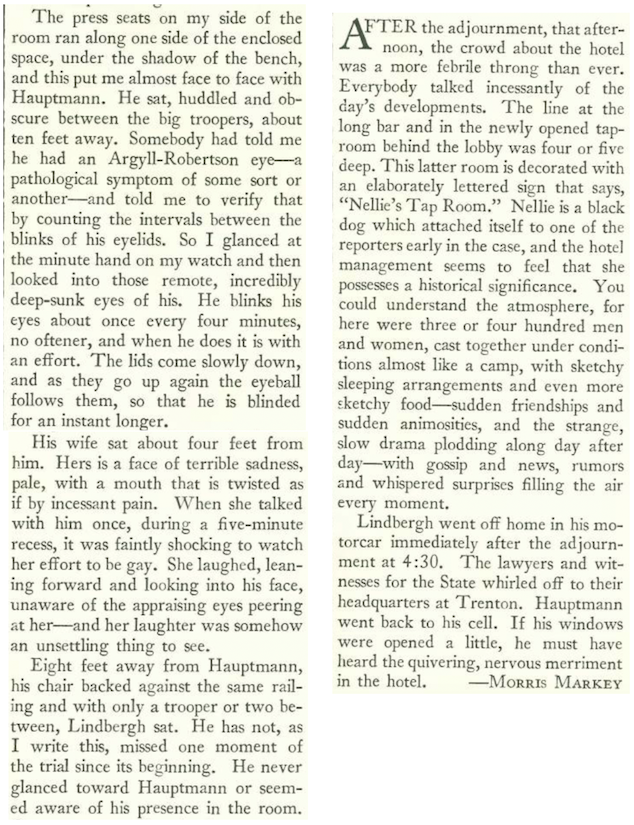
Mary Mallon was the source of sensational headlines in the early 1900s, but even she couldn’t top the media frenzy prompted by the Lindbergh baby kidnapping and the trial of accused murderer Bruno Hauptmann. The New Yorker’s Morris Markey went to the courthouse in Flemington, New Jersey, to file this report for “A Reporter at Large.” Excerpts:

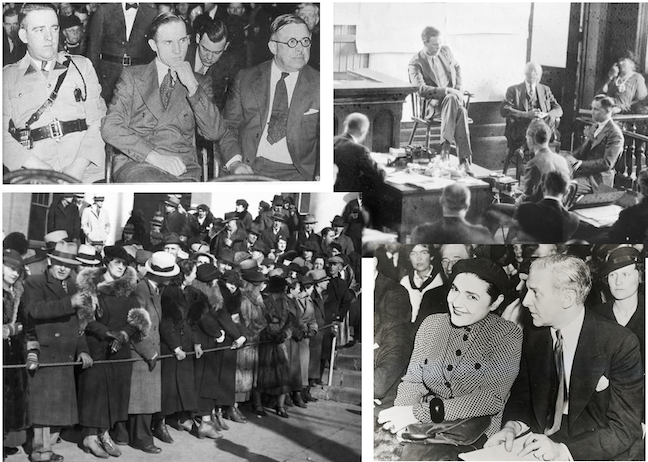
TRIAL OF THE CENTURY…Clockwise, from top left: Bruno Hauptmann (center) at his murder trial, which ran from Jan. 2 to Feb. 13, 1935, in Flemington, New Jersey; Charles Lindbergh takes the witness stand; novelist Fanny Hurst and gossip columnist Walter Winchell at the trial on Jan. 30, 1935—the “Trial of the Century” was followed by more than 700 reporters; police ropes contained the large crowds gathered at the courthouse. (Library of Congress/umass.edu/Courier Post)

Hauptmann would be convicted of the crime and immediately sentenced to death. On April 3, 1936, he would meet his end in an electric chair at the New Jersey State Prison, maintaining his innocence to the very end.

 * * *

From Our Advertisers

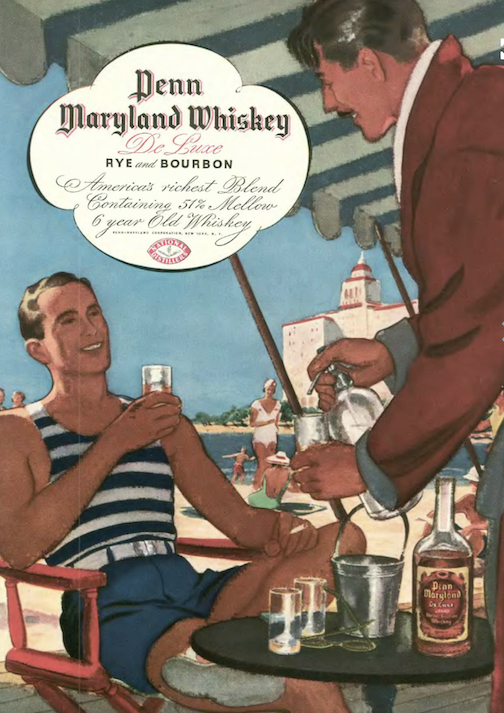
On to our ads, we begin with another colorful spot from Penn Maryland, and jolly times on Miami Beach…

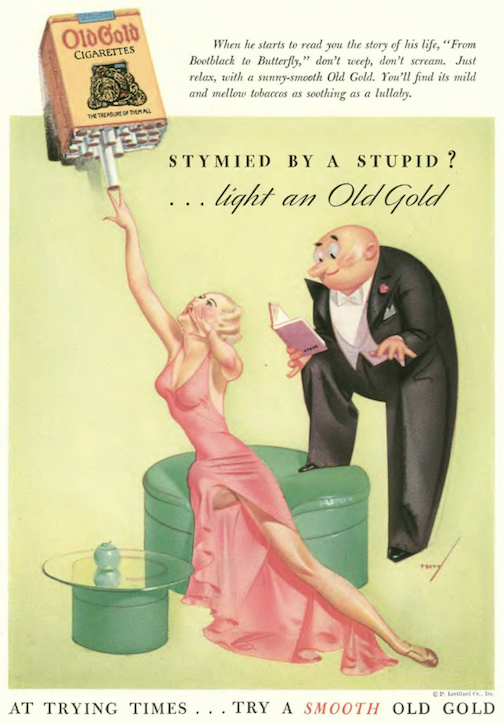
…here is the first in a series of ads that the makers of Old Gold cigarettes (Lorillard) began running in 1935, featuring a sugar daddy and his leggy mistress…they were drawn by George Petty (1884–1975), famed for his “pin-up girls” featured on many magazine covers as well as in ads for Old Gold, Jantzen swimsuits, and TWA, among others…

…here is Petty at work in 1939…

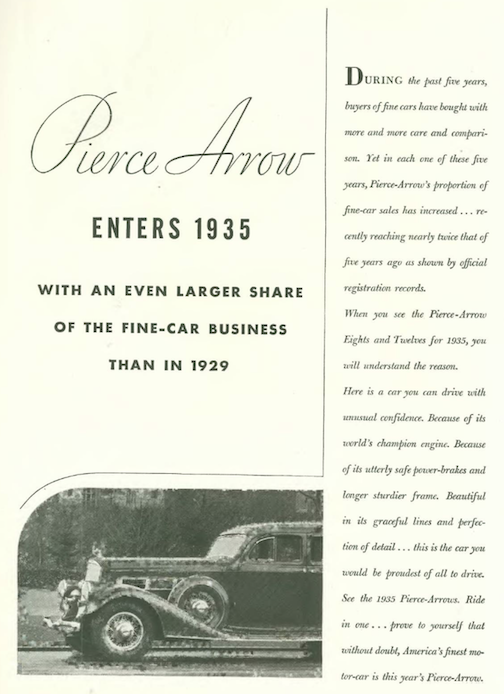
…Buffalo-based Pierce-Arrow was known for its expensive luxury cars, which were not exactly hot sellers during the Great Depression; moreover, Pierce was the only luxury brand that did not offer a lower-priced car to provide cash flow to the company, and contrary to the claims in this ad, Pierce-Arrow would close its doors by 1938…

…one thing alive and well in the 1930s was sexism, and here is a good example from the makers of a popular line of soups…

…The Theatre Guild called upon the talents of James Thurber to promote their latest production…

…and we continue with Thurber as move into the cartoons…

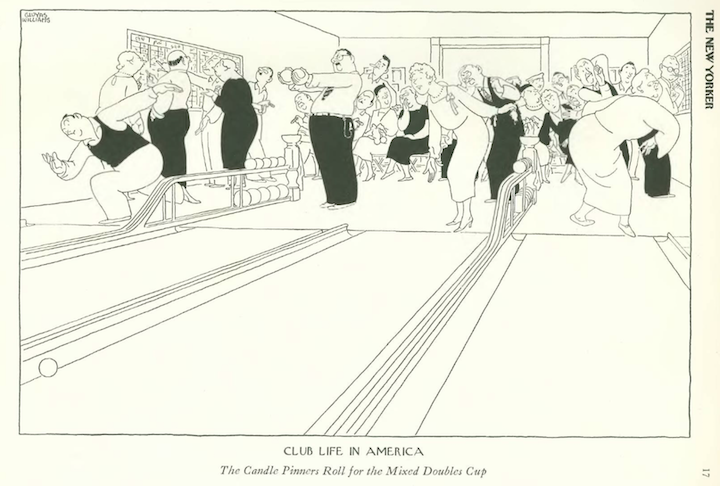
…where Robert Day found some miscasting in a Civil War epic…

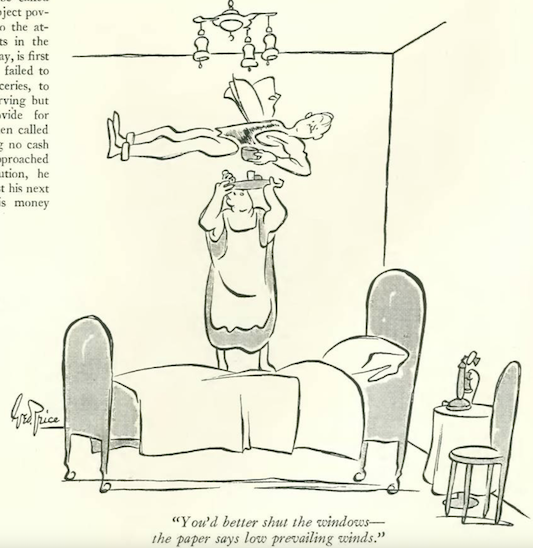
George Price’s floating man seemed to be coming back to earth…

…Day again, with a sure-fire way to defend one’s goal…

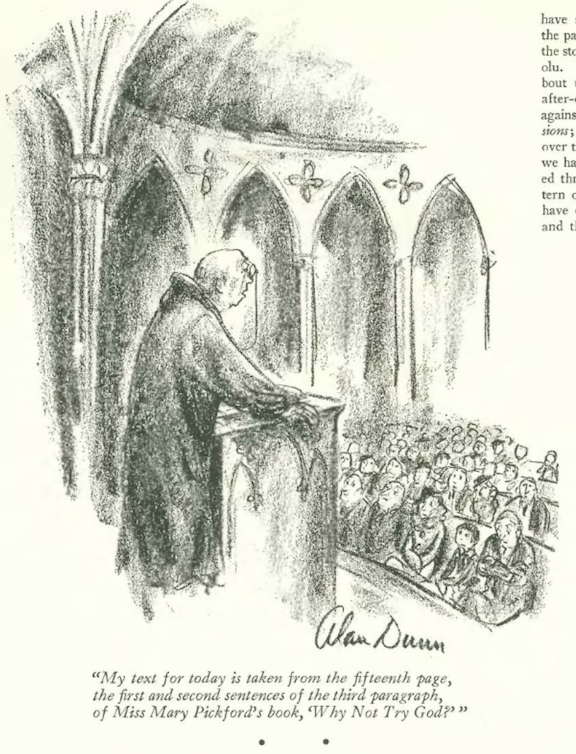
Alan Dunn offered words of wisdom from the pulpit…

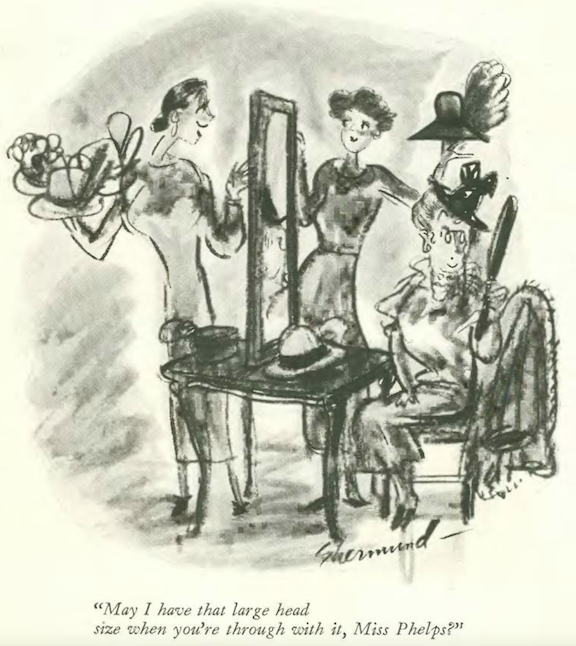
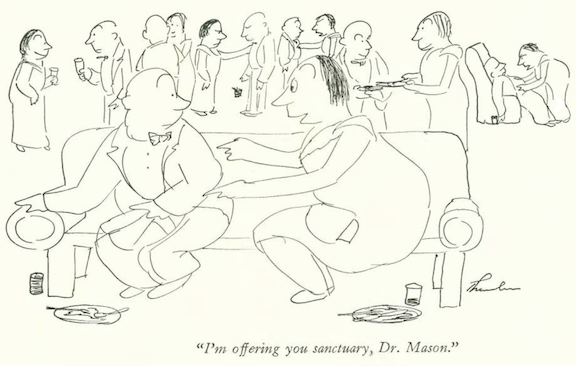
…and we close with Barbara Shermund, and a familiar face…

Next Time: Legitimate Nonchalance…

The Wahoo Boy

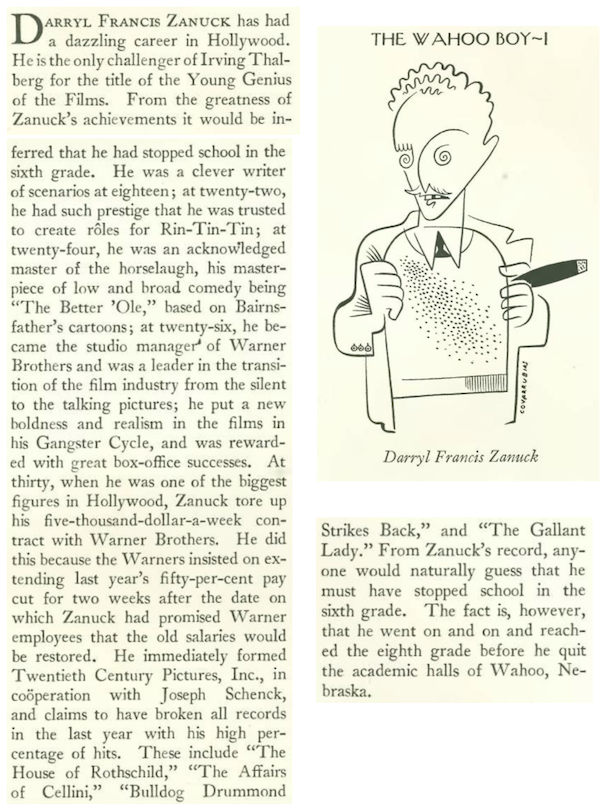
Darryl F. Zanuck (1902–1979) was an unlikely Hollywood mogul. Born in a small Nebraska town with an unusual name (both his and the town), Zanuck dropped out of school in the eighth grade, apparently bitten by the acting bug during a brief childhood sojourn in Los Angeles.

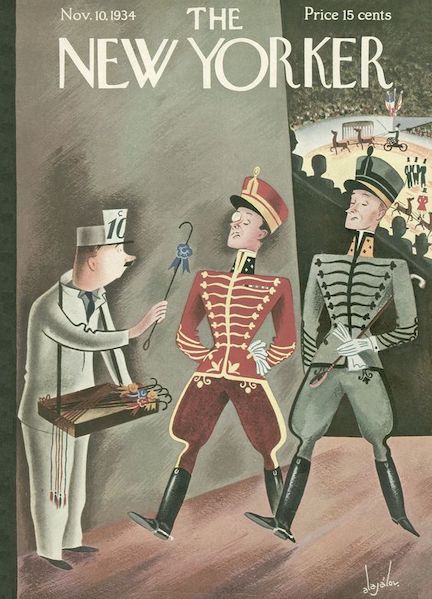
Nov. 10, 1934 cover by Constantin Alajalov.

In the first part of a two-part profile, Alva Johnston began to probe the mystery of the boy from Wahoo who would rise to become one of Hollywood’s most powerful studio executives.

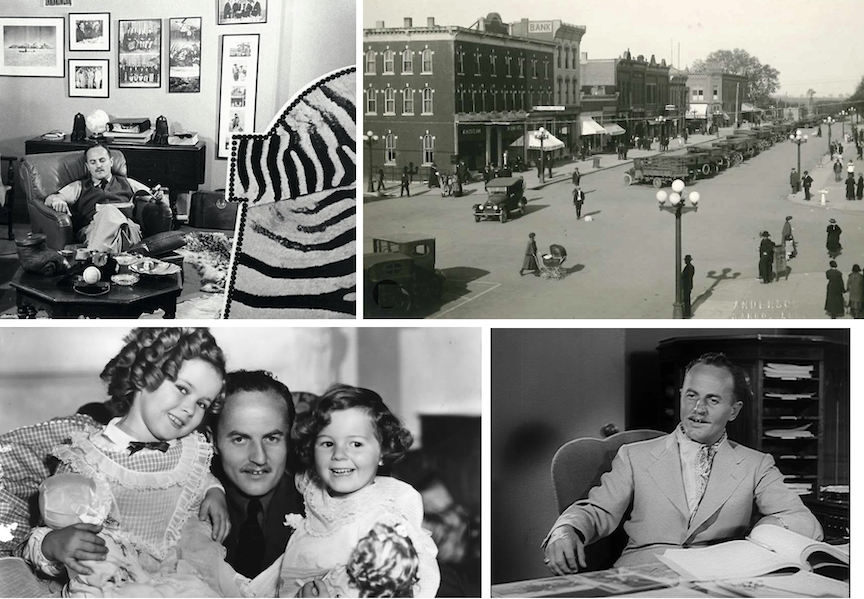
MAKING OF A MOGUL…Clockwise, from top left: Darryl F. Zanuck relaxing with trophies from his hunting excursions, circa 1940 (detail from a Margaret Bourke-White photo); Zanuck’s home town, Wahoo, Nebraska, 1920s; screenshot from a trailer for The Grapes of Wrath, 1940; Zanuck with child star Shirley Temple (left) and his first-born daughter Darrylin (mother was silent-screen actress Virginia Fox) in the 1930s. (Robin Pineda Zanuck via The Hollywood Reporter/Saunders County Historical Society/Wikipedia)

Johnston took a quick look at Zanuck’s humble origins, including his first encounter with the film industry at age eight. There must have been something in the water at Wahoo, a town of just 2,100 residents when Zanuck was born. Other Wahoo notables contemporary to Zanuck included Nobel Prize laureate and geneticist George Beadle, Pulitzer Prize–winning composer Howard Hanson, and Hall of Fame baseball player Sam Crawford, among others.

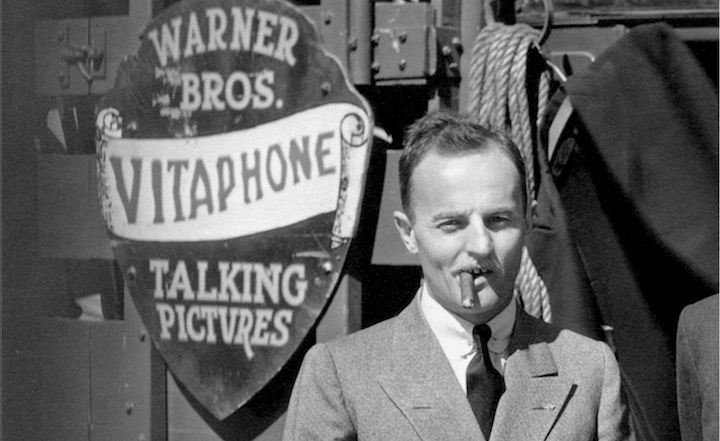
After writing dozens of scripts for Warner Brothers (including many for their popular canine star, Rin Tin Tin), in 1933 Zanuck would leave Warner and form 20th Century Pictures with Joseph Schenck. By the time Johnston penned the New Yorker profile, 20th Century had risen to be the most successful independent movie studio of its time.

 * * *

One-Way Street

It goes without saying that the interwar years of the 20th century were a time of extreme foment; Bolsheviks, communists, anarchists, fascists and other political agitators seemed to be constantly at each other’s throats as Europe prepared for its second act of self-annihilation. In the middle of it all was the Balkans, its many feuds always simmering near the boiling point.

After the assassination of Archduke Franz Ferdinand in 1914 (which, along with other factors, triggered World War I), you would have thought Europeans would have abandoned the practice of parading dignitaries through crowded streets. In 1934 they were reminded of its risks.

That year was King Alexander I of Yugoslavia’s thirteenth on the throne, but his time was running short in a country constantly beset by civil war. Fearing that the German Nazis and Italian Fascists would take advantage of the instability, on Oct. 9, 1934 French Foreign Minister Louis Barthou invited Alexander I to Marseille to sign a Franco-Yugoslav solidarity agreement. While Alexander and Barthou were being slowly driven in an open car through the city’s streets, a Bulgarian gunman, Vlado Chernozemski, stepped from the crowd, hopped onto the car’s running board, and shot Alexander along with his chauffeur. Barthou also died in the melee, killed by a stray bullet fired by French police (three women and a boy in the crowd were also fatally wounded by stray police bullets). Struck down by a policeman’s sword, Chernozemski was subsequently beaten to death by the enraged crowd. It was one of the first assassinations to be captured on film.

Paris correspondent Janet Flanner offered some thoughts about the incident in her “Paris Letter.” Excerpt:

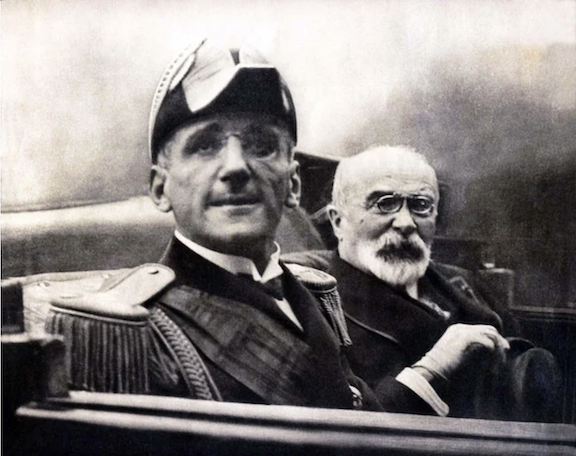
WHAT A DIFFERENCE A DAY MAKES…King Alexander I of Yugoslavia (left) and French Foreign Minister Louis Barthou just moments before an assassin fired two fatal shots into the king. Barthou would die an hour later from a stray police bullet that would enter his arm and sever an artery. (Still image from YouTube video)

 * * *

The Traffic Machine

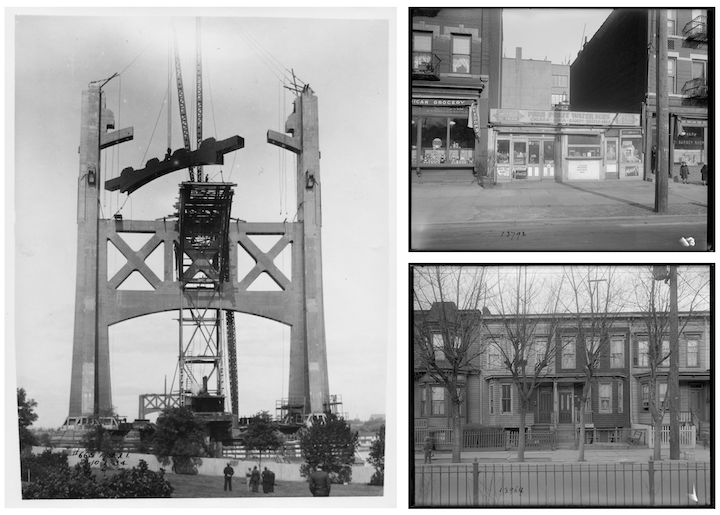
In his “A Reporter at Large” column, Morris Markey sang praises for the Triborough Bridge project, which was making visible progress on the massive public work that commenced in 1930. City officials had dreamed for years about a project that would at once connect Manhattan, Queens and the Bronx, but it wasn’t until the power broker Robert Moses got involved as the Triborough Bridge and Tunnel Authority chairman that things really started to move. Moses biographer Robert Caro wrote that “Triborough was not a bridge so much as a traffic machine, the largest ever built.” A brief excerpt:

As noted by Markey, the “people in charge” were forthright about the bridge’s completion date of July 1, 1936. And they kept their word. The bridge was substantially complete by June 1936, and would be dedicated on July 11, with Moses serving as master of ceremonies.

MAKE WAY FOR THE GIANTS…City engineers had been kicking around plans since 1916 to build bridges to connect Manhattan, Queens and the Bronx, but the massive Triborough Bridge project finally got off the ground in 1930. By 1934 the bridge’s Queens tower (left) would loom over Ward’s Island, visible in the background; at right, views of buildings in Astoria (Hoyt Ave.) that were slated for demolition to make way for the bridge, photographed by Eugene de Salignac in early 1931. (MTA Bridges and Tunnels Special Archives/NYC Municipal Archives)

 * * *

From Our Advertisers

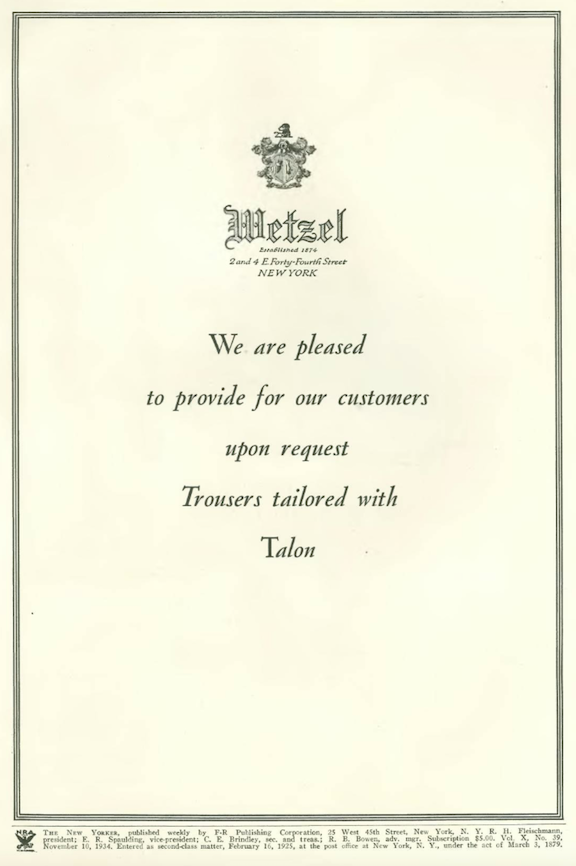
The common zipper was a relatively new invention in 1934. It had been more or less perfected by 1920, and in 1923 the B. F. Goodrich Company would coin the onomatopoetic word to describe the newfangled fastener on its galoshes, but it would take a while for the fashion industry to adopt the zipper as a replacement for buttons on garments, including men’s trousers. And so we get this staid-looking ad from Wetzel that signaled its entry into the brave new world of zippers (Talon was the dominant U.S. producer of zippers for many years)…

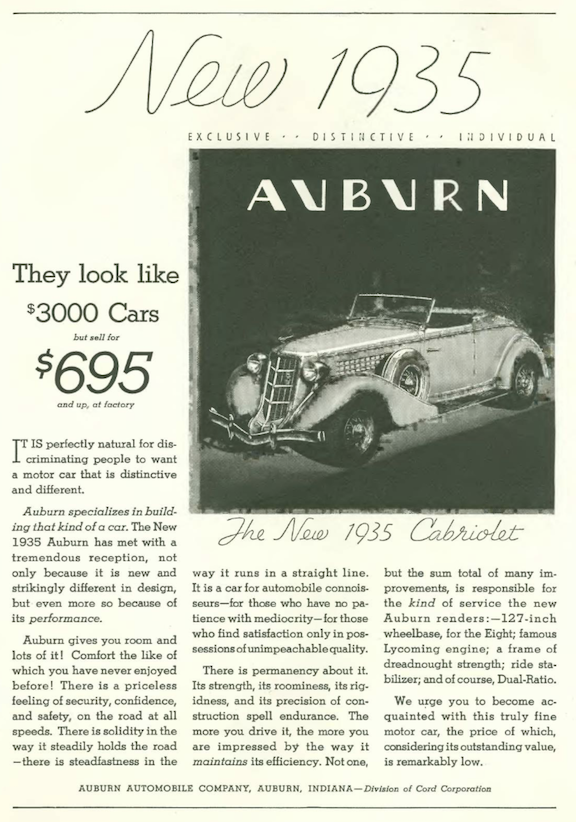
…this next ad is kind of amazing, a 1935 Auburn for only $695, which roughly translates to $15,000 or so today—still a bargain…known for cars that were fast, good-looking and expensive (and favored by Hollywood elite), Auburn struggled mightily during the Depression…along with its sister marques Duesenberg and Cord, the company would fold in 1937…

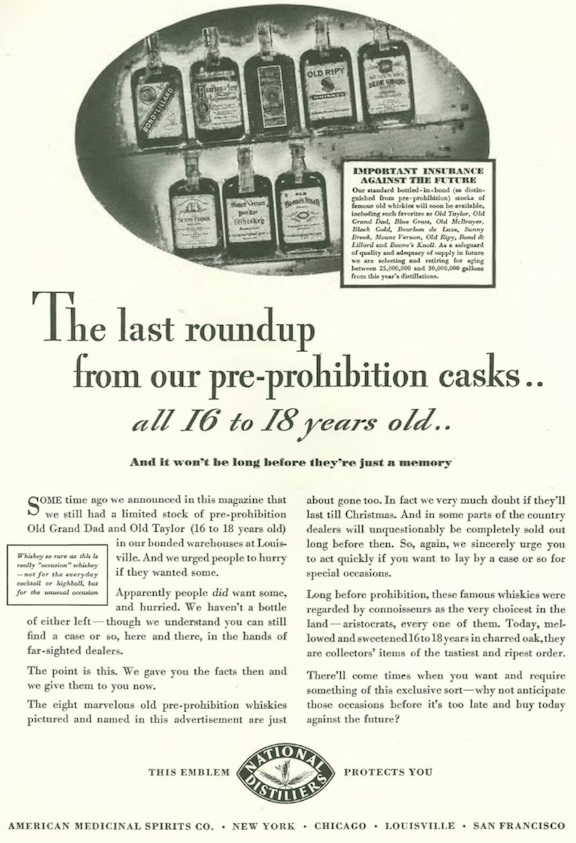
…during Prohibition distillers were allowed to keep stocks of whiskies produced before the 18th Amendment went into force…some of these were distributed through pharmacies during Prohibition for “medicinal purposes”…what was left over was sold after repeal, a stock of “pre-prohibition casks” that would be exhausted before Christmas, or so the ad rather alarmingly suggested…

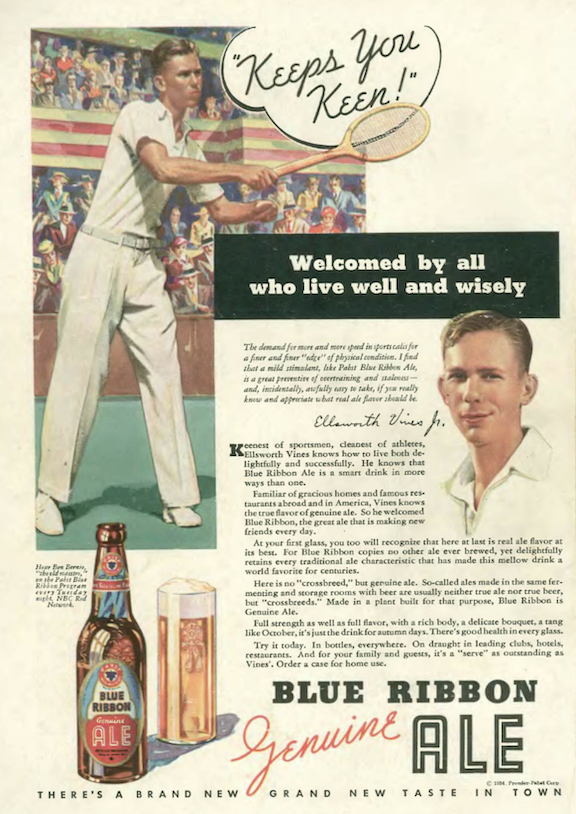
…we first met tennis star Ellsworth Vines Jr a few issues ago when he was touting the health and energy benefits of Camel cigarettes…here he promotes an unlikely “stimulant”—Pabst Blue Ribbon ale…Vines testified that “the demand for more and more speed in sports calls for a finer and finer ‘edge’ of physical condition” and observed that PBR was “a great preventive of overtraining and staleness”…yep, after a few brewskies who feels like doing anything, let alone play tennis?…

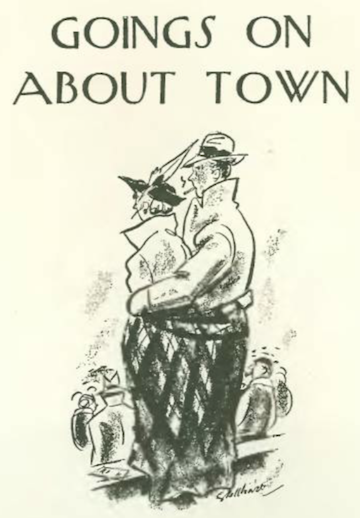
…on to our cartoonists we open with a couple of spots by George Shellhase

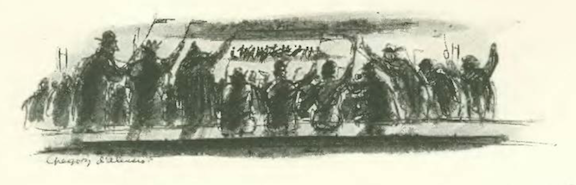
…and Gregory d’Alessio

William Crawford Galbraith gave us a fish out of water (the caption reads: You New Yorkers didn’t know we were so sophisticated in Detroit, did you?)…

George Price still hadn’t come back to earth in his latest installment…

Gardner Rea illustrated the results of charitable acts by the Junior League…

…and we close with James Thurber, and kindness from a stranger…

Next Time: Portraits and Prayers…

The Age of Giants

Otto Klemperer rehearsing at the Hollywood Bowl in September 1937. (Los Angeles Philharmonic)

The 20th century was an age of big personalities in classical music, among them Otto Klemperer (1885-1973), a German-born protégé of the composer and conductor Gustav Mahler. Klemperer was already an established conductor in opera houses around Germany when the rise of the Nazis prompted the maestro to emigrate with his family in 1933. He was soon appointed chief conductor of the Los Angeles Philharmonic.

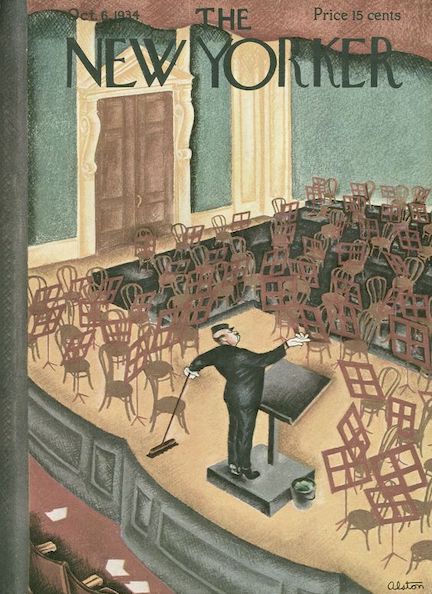
Oct. 13, 1934 cover by Rea Irvin.

Klemperer also guest conducted a number of orchestras in the U.S., including the New York Philharmonic, where his larger than life presence caught the attention of “The Talk of the Town.” Excerpts:

MAESTRO…Top left, Otto Klemperer with Czech composer Leoš Janáček in 1927; at right, with Austrian-American classical pianist and composer Artur Schnabel in 1933; bottom photo, with wife Johanna Geisler, son Werner and daughter Lotte in Los Angeles, 1936. (operaplus.cz/Otto Klemperer Film Foundation/ottoklemperer.nl)

Lauded internationally as a great orchestral commander, in 1939 Klemperer would begin experiencing balance issues. After a tumor the size of a small orange was removed from his brain, he would be left partially paralyzed on his right side; bouts of depression and a manic phase would later land him in a mental hospital. However, by 1946 he would recover his health enough to return to conducting in a career that would last until 1971.

The conductor’s daughter, Lotte Klemperer (1923–2003), would serve as her father’s secretary, negotiator and administrator until his death in 1973. Otto’s son, Werner Klemperer (1920–2000), would become a stage, screen and television actor, most notably portraying Colonel Klink in the 1960s comedy Hogan’s Heroes. Although the role would garner Werner two Emmys, his father never fully understood the series or even the concept of a sitcom. Reluctant to pursue a musical career while his father was alive, Werner would later join the Metropolitan Opera Company in the 1970s, appear in Broadway musicals, and serve as a narrator with a number of American symphony orchestras.

TO THEM HE WAS DAD…At left, daughter Lotte Klemperer with her famous father in 1954. She would serve as his caretaker and business partner after her mother’s death in 1956. At right, son Werner Klemperer acted on Broadway and in films before taking on the role of the bumbling Colonel Klink in the 1960s comedy Hogan’s Heroes, which garnered the actor two Emmys. Although Werner Klemperer was musically inclined, he avoided work in music until the death of his father in 1973. (Otto Klemperer Film Foundation/CBS)

 * * *

Vanished in the Haze

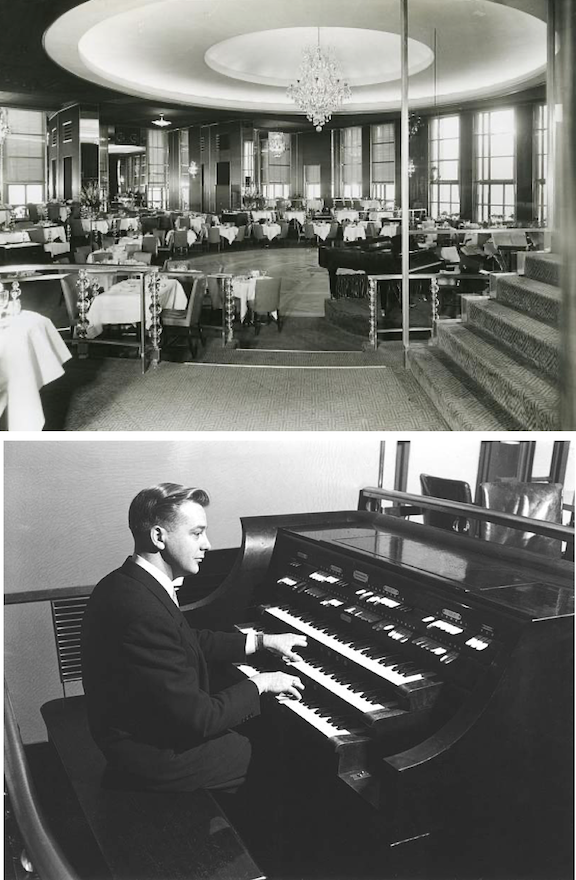
In his “Notes and Comment,” E.B. White lamented what appeared to be the transformation of the familiar night club; high above Manhattan in the Rockefeller Center’s Rainbow Room, the comforting haze of “cigarette smoke, talc, waiter’s venom” had been displaced by air conditioning, and to add to the horror, an organ had been installed that tinged the fox trot “with an odd piety.”

NOWHERE TO HIDE…E.B. White found the lack of haze in the new Rainbow Room disconcerting, not to mention the addition of a Wurlitzer organ, its wonders demonstrated here by organist Ray Bohr in 1934. (Library of Congress/nycago.org)

 * * *

There Oughta Be a Law

While E.B. White was mourning the demise of the smoky nightclub, art and design critic Lewis Mumford continued his tirade against the pretentious and mediocre buildings that were popping up all over the city, including the new Federal Court Building on Centre Street that was, in Mumford’s words, a supreme example of bad design and fake grandeur.

Cass Gilbert's The Federal Courthouse building (United States courthouse) in 1936 (the year of its completion). Located at 40 Centre Street (Foley Square), Manhattan, New York City. In 2001, it was designated as the Thurgood Marshall United States Courthouse.Source: Wurts Brothers Photography Collection at the National Building Museum.
A CRIMINAL CASE…Cass Gilbert’s Federal Courthouse building (United States courthouse) was completed in 1936, two years after Gilbert’s death. In 2001 it was designated as the Thurgood Marshall United States Courthouse. Critic Lewis Mumford called the design, which combined “two unlovely and unrelated forms”…”nothing short of a major crime.” (Wurts Brothers Photography Collection, National Building Museum)

 * * *

Crime of the Century

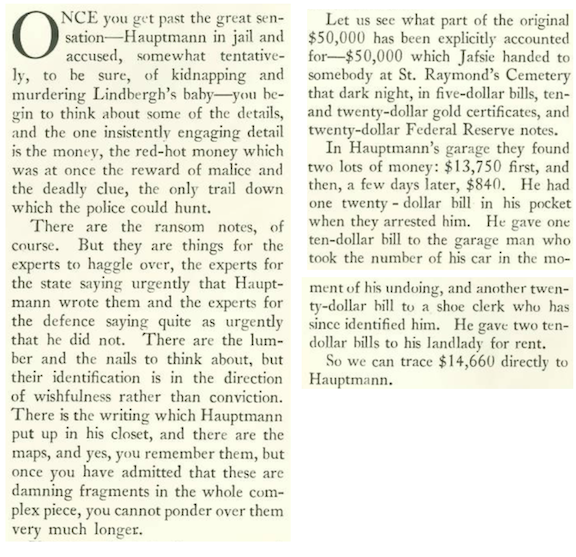
That is what the press called the kidnap and murder of the infant son of Charles Lindbergh and Anne Morrow. In September 1934 a German immigrant carpenter named Bruno Hauptmann was arrested for the crime, and a trial date was set for the following January. In his “A Reporter at Large” column, Morris Markey examined the ransom money trail that led to Hauptmann’s ultimate arrest. Excerpts:

DON’T SAY “CHEESE”…Bruno Hauptmann sits for a mug shot following his arrest for the abduction and murder of the 20-month-old son of Charles Lindbergh and Anne Morrow Lindbergh. (Leslie Jones, Boston Public Library)

 * * *

Should Have Stayed Lost

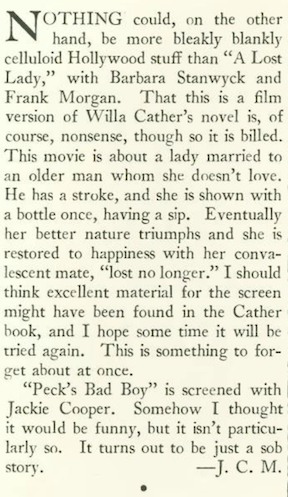
A film version of Willa Cather’s 1923 novel A Lost Lady was first made as a silent by Warner Brothers in 1924 (the film itself is lost) but in 1934 Warner had another go at the novel with a sound version starring starring Barbara Stanwyck, who was emerging as a major star. But Stanwyck’s talents could not overcome a script that critic John Mosher described as bleak, blank nonsense. Cather was so dismayed by the film that she refused to permit another adaptation of any of her novels during her lifetime.

LOST IN TRANSLATION…Barbara Stanwyck and Ricardo Cortez in A Lost Lady (1934). (IMDB)

 * * *

From Our Advertisers

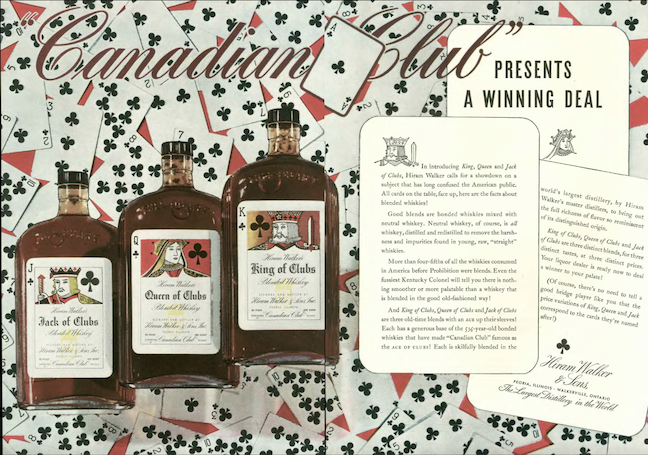
We kick off our sponsors with this two-page center spread from Hiram Walker & Sons, who introduced their new line of playing card-inspired whiskies…

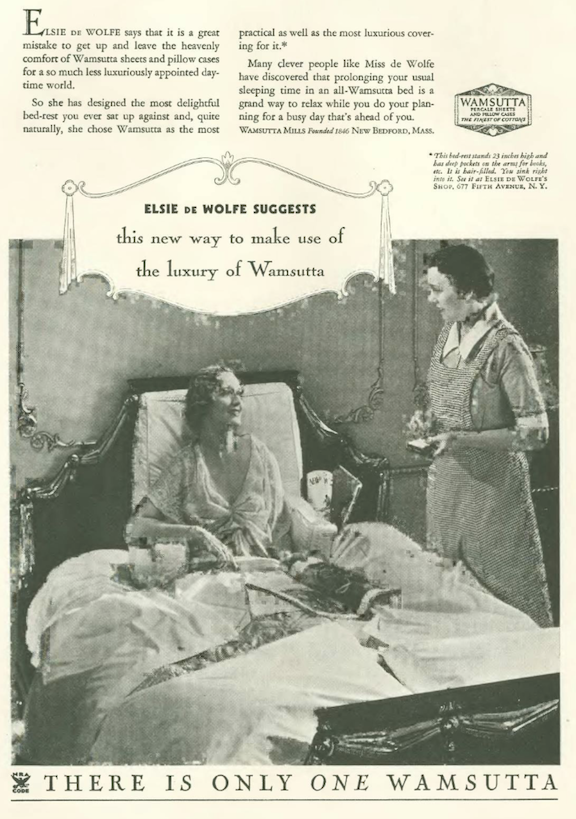
…the New Yorker’s Janet Flanner wrote in 1938 that Elsie de Wolfe invented interior design as a profession, so who was to argue with de Wolfe’s suggestion that the leisure class should linger in bed with the aid of a Wamsutta bed-rest…the small print beneath the logo indicated that the bed-rest was “hair-filled,” which I assume was horse hair, still used today in some luxury brands…

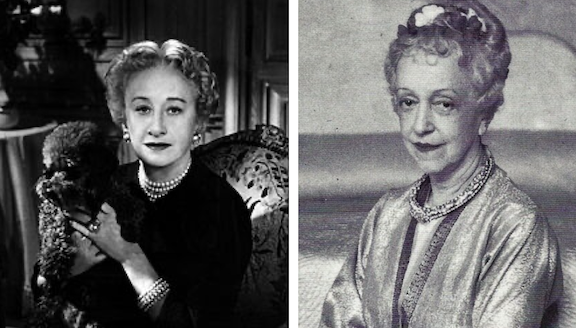
…if de Wolfe was queen of interior designers, then Hattie Carnegie was the “First Lady of Fashion,” or so this ad claimed…

…here are images of the two titans of fashion and good taste…

TASTEMAKERS…At left, Hattie Carnegie aka Henrietta Kanengeiser (1880-1956), and Elsie de Wolfe, aka Lady Mendl (1859–1950). (americacomesalive.com/bureauofinteriors.com)

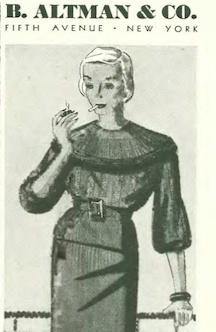
…and speaking of fashion, here is a llama cloth coat from B. Altman, trimmed in silver raccoon, suitable for Yale football games…based on inflation, that coat today would set you back at least $2,000…

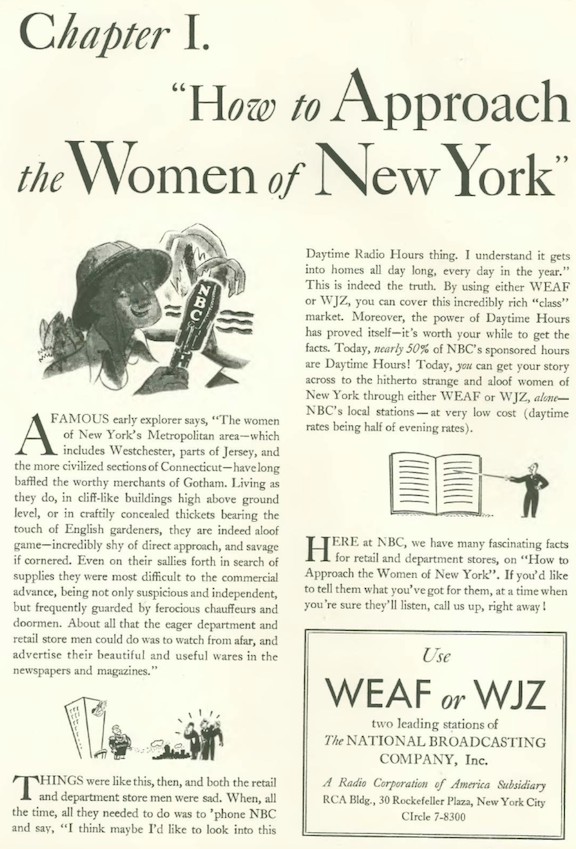
…this condescending ad offered merchants a way to reach the “hitherto strange and aloof women of New York” through daytime advertising…

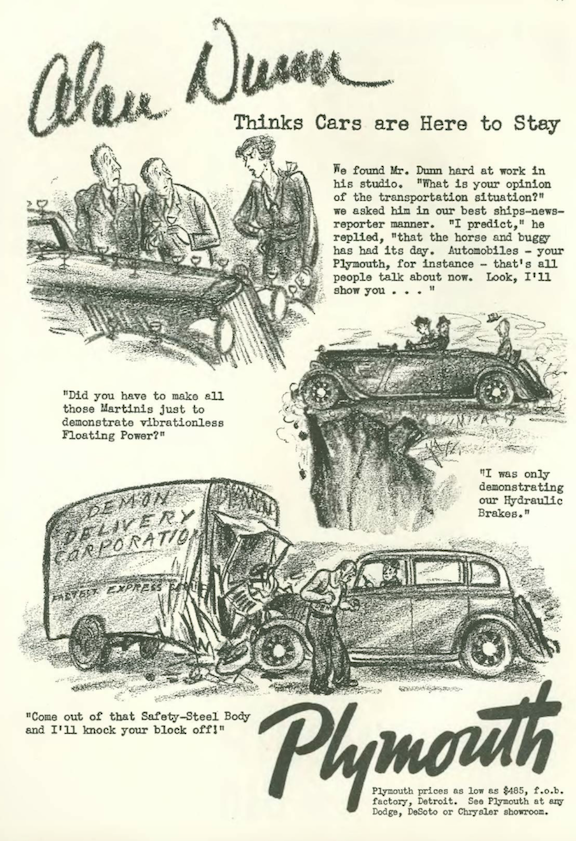
…Plymouth enlisted the talents of Alan Dunn to tout their car’s ride and durability…

…and on to our cartoonists, another from Dunn, a bit of spot art featuring a not so subtle commentary on Lawrence Lee Bazley Angas’s book The Coming American Boom

…and some spot art from Isadore Klein

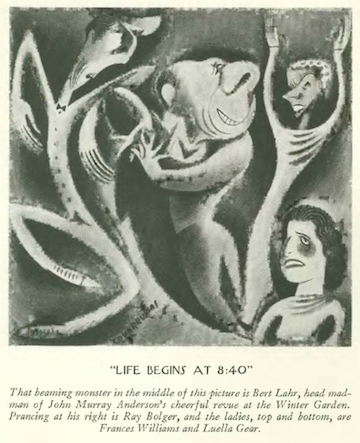
Miguel Covarrubias contributed to the theater review section…

James Thurber entertained a house guest…

George Price was still up in the air…

Helen Hokinson took a spin with a celebrity look-alike…

…and Barbara Shermund offered another glimpse into the life of a modern woman…

…on to Oct. 20, 1934…

Oct. 20, 1934 cover by Helen Hokinson.

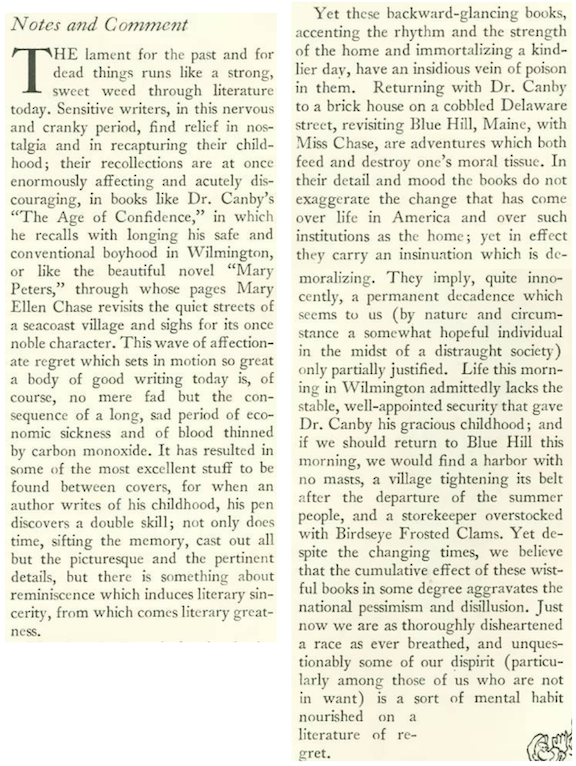
…in which E.B. White offered up a new lament, namely the pervasiveness of nostalgia and sentiment in contemporary literature…

HARKING BACK TO THOSE DAYS OF YORE…E.B. White simply had no stomach for the nostalgic stylings of Mary Ellen Chase (left) or Henry Seidel Canby, seen here on the cover of the May 19, 1924 issue of Time. (U of Maine/Time Inc)

 * * *

Fifty Years Young

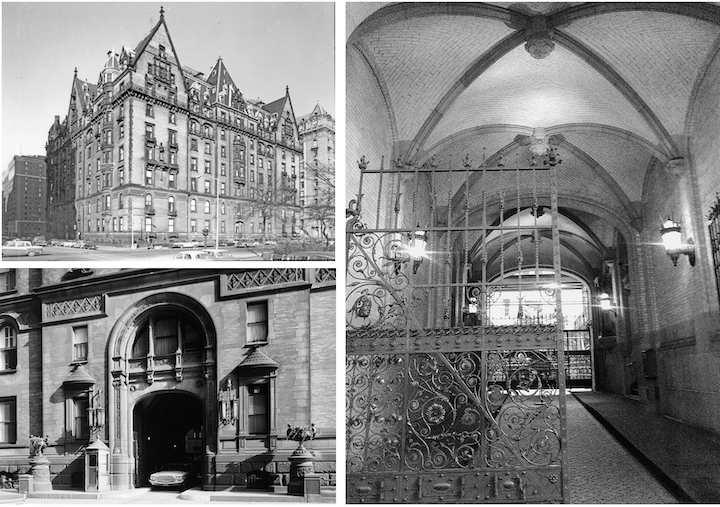
“The Talk of the Town” marked the Dakota’s 50th year at Central Park West, and made note of its loyal and prominent clientele…back in the day it served as a residence for actors such as Lillian Gish, Boris Karloff, and Teresa Wright, and in later years such luminaries as Lauren Bacall, Judy Garland, Rudolf Nureyev, and, of course, John Lennon and Yoko Ono.

THE STORIES IT COULD TELL…At left, the facade and main entrance of the Dakota in the 1960s; at right, inside the main entrance. (Pinterest/Wikipedia)

 * * *

More From Our Advertisers

The Matson-Oceanic Line offered a “millionaire’s idea of a vacation” at an affordable price, and offered this sumptuous image as proof…

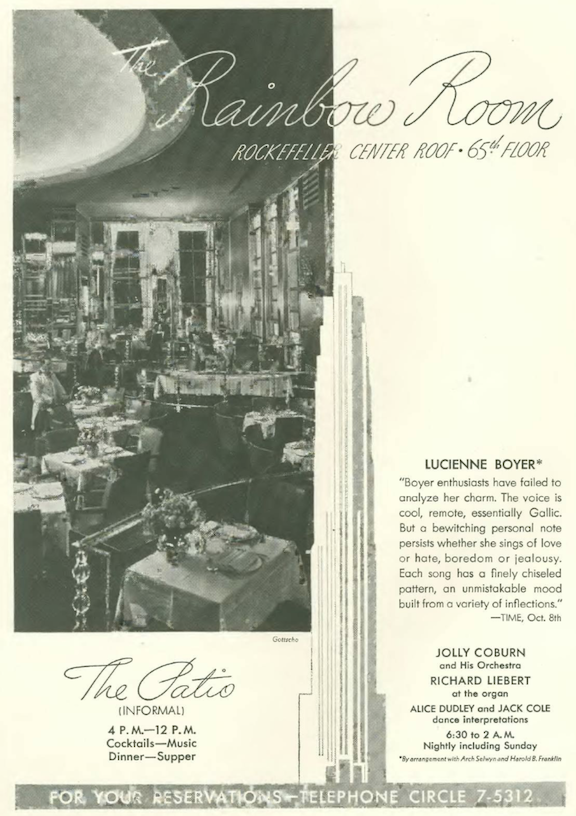
…E.B. White wasn’t crazy about the smokeless dazzle of the Rainbow Room, but it proved to be popular among the city’s elite…

…in case one was concerned about the provenance of one’s mink coat, Saks posted this helpful ad. Their high-end, natural-skin minks were priced at $8,000 (roughly $180,000 today); there was, however, a caveat regarding the cheaper models…

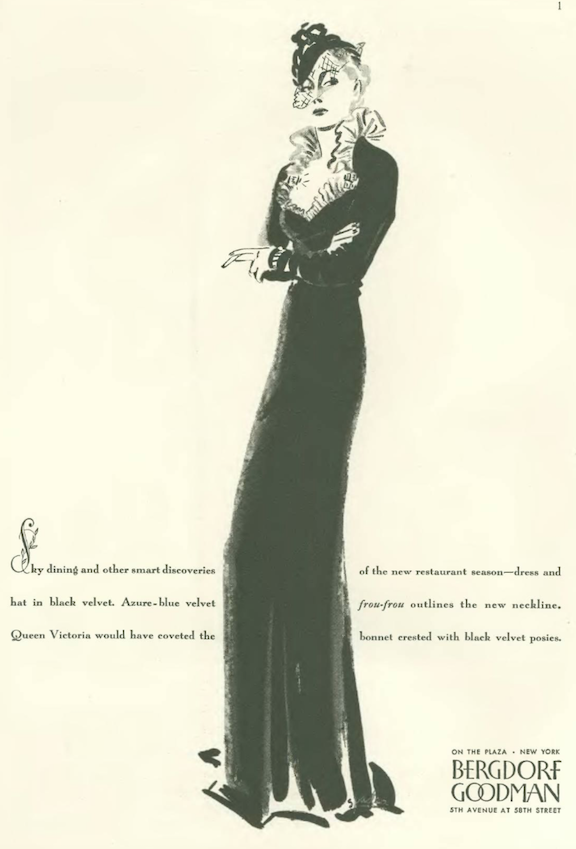
…Bergdorf Goodman offered up another ad featuring an impossibly attenuated model posed with a cigarette, her defiant gaze suggesting her modernity and individualism…

…Plymouth went back to the stable of New Yorker cartoonists, this time featuring the adventures of Helen Hokinson’s “girls”…

…and we segue to the rest of our cartoonists, including this spot by Constantin Alajalov

…and this by George Price

…who also gave us another update on the trials and tribulations of his floating man…

James Thurber occasionally ignored scale in rendering his characters, which didn’t really matter in his strange world…

Jack Markow had some bad news for two sign painters (the caption size is increased for readability)…

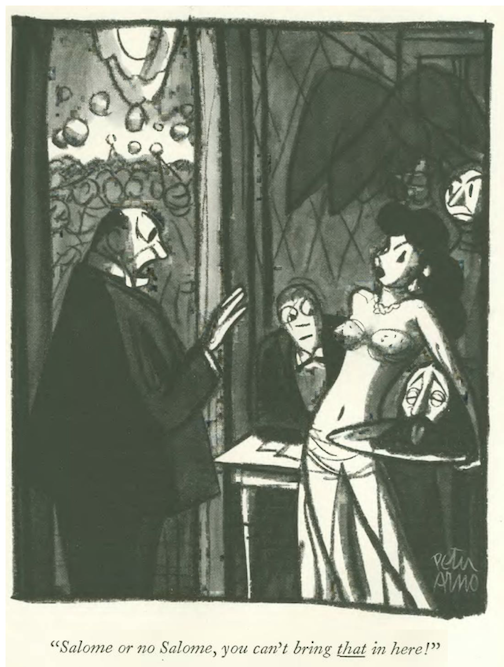
…and we close with Peter Arno, and the winner of most original Halloween costume…

…and before I go…this is being posted on Halloween, 2023, so here are a few images from 1934 to get you in the spirit, including a Saturday Evening Post cover, a 1934 party ideas magazine, and a page from Popular Mechanics featuring a smoking robot costume you could make yourself…in the 1930s, Popular Mechanics often featured Halloween party ideas that were downright lethal, usually involving electric shocks, pistols loaded with blanks, that sort of thing.

Happy Halloween!

Next Time: House & Home…

Reel News

Above: Newsreel cameramen perch on boards resting on a windowsill to get a birds-eye view of a passing parade, circa 1930. (Public Domain Image)

We marvel at, and sometimes decry, today’s instantaneous news coverage of wars, disasters and the like, but ninety years ago newsreel crews did a remarkable job of filming and delivering the latest news to thousands of theaters across the U.S. and around the world.

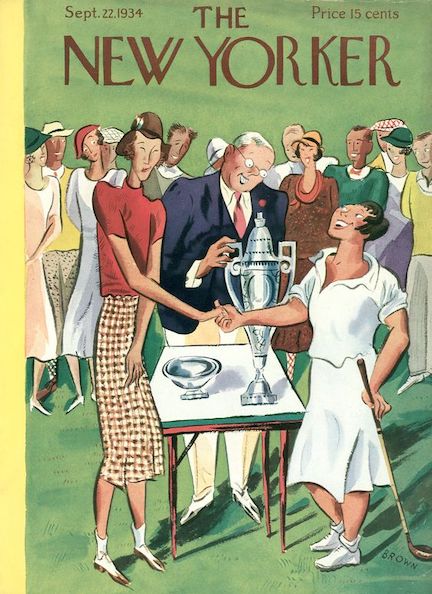
Sept. 22, 1934 cover by Harry Brown.

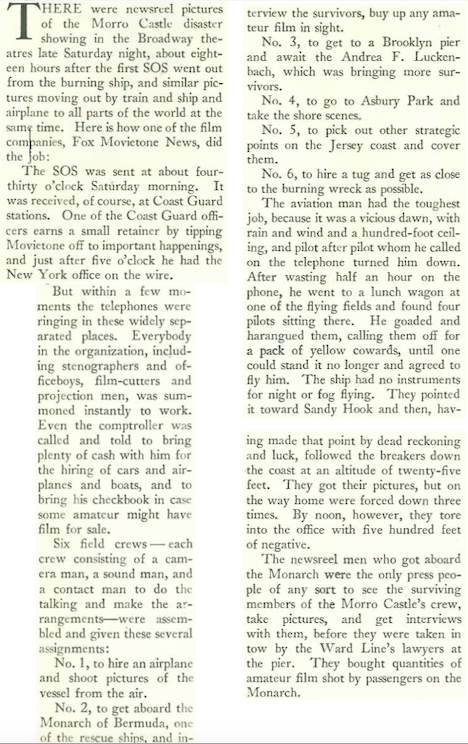
In his “A Reporter at Large” column, Morris Markey penned a lengthy account of Fox Movietone’s coverage of the SS Morro Castle disaster. En route from Havana to New York City on Sept. 8, 1934, the luxury liner caught fire near the New Jersey coast. Due to the ship’s design and the ineptitude of the crew, the blaze claimed 137 lives. Markey described how newsreel crews—with their bulky cameras and sound equipment—went into action, including a cameraman who “goaded” a pilot into taking him aloft through vicious weather conditions.

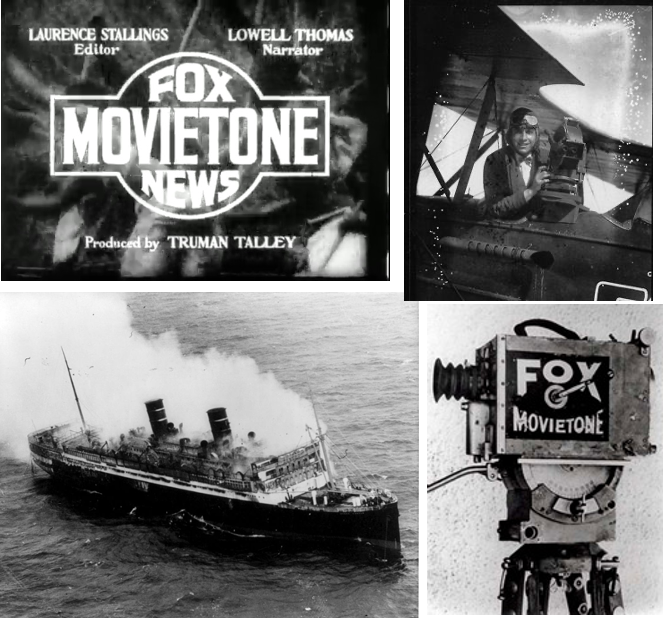
GUTS AND INGENUITY took newsreel reporters to places high and low. Clockwise, from top left, title card from a 1935 Fox Movietone newsreel; Jack Lieb goes aloft to get capture newsreel footage in an undated photo—Lieb was a cameraman for Hearst’s News of the Day; a 1930s Fox Movietone camera; the SS Morro Castle ablaze off the New Jersey Coast on Sept. 8, 1934. (Wikipedia/Lieb photo Courtesy of Bette Marshall via unwritten-record.blogs.archives.gov)

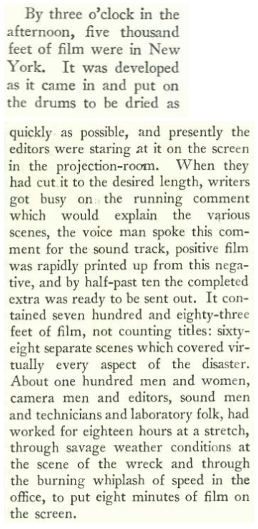
Somehow the cameraman aboard the airplane (which was forced down by weather three times) was able to get his footage to the Movietone office by noon, less than seven hours after the office first received word of the disaster. By three o’clock, five thousand feet of film from all sources was being developed.

UP NORTH AND DOWN UNDER…Movietone news had crews stationed around the world, including field staff in Sydney (top, from 1938), and in Toronto, circa 1930. (Nat’l Library of Australia/City of Toronto Archives)

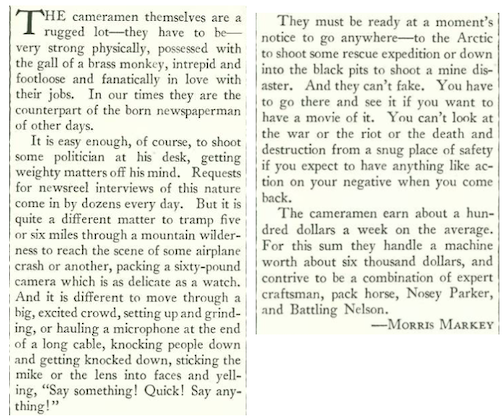
Markey concluded with this observation about the “rugged” and persistent newsreel cameramen:

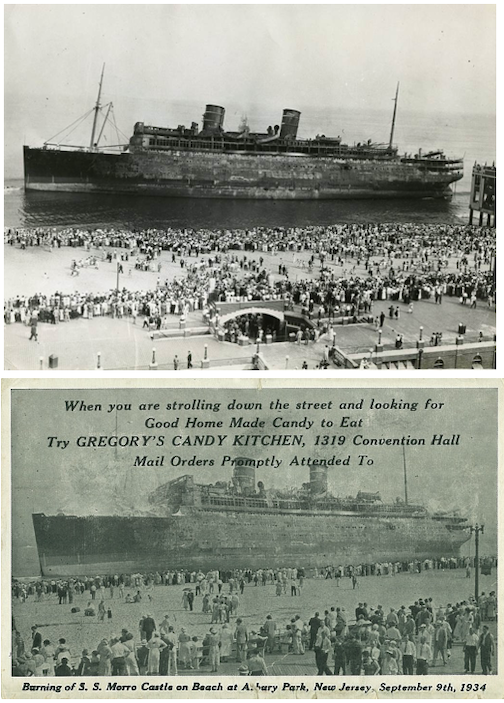
In the aftermath of the Morro Castle disaster, a scene of enormous tragedy was turned into a tourist attraction…

GAWKERS AND HAWKERS…The charred hulk of the SS Morro Castle came to rest on the shore near the Asbury Park boardwalk, which became a popular spot for souvenir salesmen and photo-ops. Tourists flocked to the site from September 1934 to March 1935, when the ship was finally towed away. Note the postcard (bottom) advertising homemade candy over an image of the charred ship. (ripleys.com/side-o-lamb.com)

Fox Movietone News produced sound newsreels from 1928 to 1963, and in the UK as British Movietone News…here is Movietone footage of the Morro Castle disaster, as presented by British Movietone in 1934:

 * * *

Up In The Old Hotels

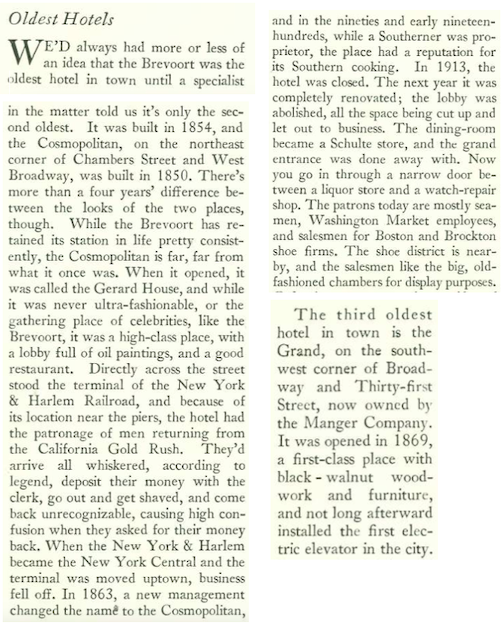
Last week “The Talk of the Town” looked in on one of Manhattan’s oldest saloons, McSorley’s. For the Sept. 22 “Talk” the subject was “Oldest Hotels,” two of which, The Cosmopolitan and The Grand, remarkably survive to this day.

HANGING IN THERE…The 1845 Brevoort House hotel at 15 Fifth Avenue (top left) was torn down in 1952, however the 1868 Grand Hotel (right) at 1232–1238 Broadway and the 1845 Cosmopolitan Hotel (below, left) at Chambers Street and West Broadway still stand today. (Museum of the City of New York / Chester Higgins Jr. for The New York Times)

 * * *

The Six-Million Dollar Road

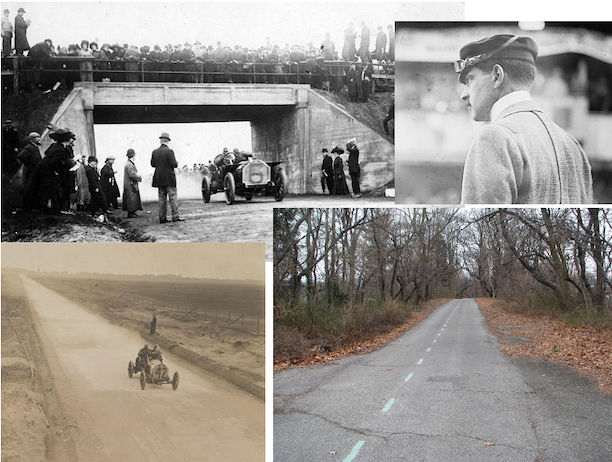
The first roadway designed exclusively for automobile use was likely the Long Island Motor Parkway, privately built by William Kissam Vanderbilt II because he wanted a road suitable for auto racing. He established the Vanderbilt Cup races on local roads in 1904, but after two spectators were killed and many others injured, in 1908 he began building what would become a 45-mile (72 km) toll road from Queens to Lake Ronkonkoma. After two mechanics were killed in a 1910 race, the New York Legislature banned racing on the road, which the state took over in 1938.

ROAD WARRIOR…William Kissam Vanderbilt II (top right) staged his Vanderbilt Cup Races on his private road until a fatal accident put a stop to the fun in 1910; At bottom right, a surviving section of the road today. Most of the road in Queens is a bicycle trail, and other segments still serve as parts of a county road. (nyheritage.org/Wikipedia-Steve Nowotarski/ny1.com)

 * * *

From Our Advertisers

I have nothing against accordion music, despite years of exposure to Lawrence Welk during my youth, but I find it hard to believe that a Park Avenue socialite (identified here as Mrs. René Du Champ Bellinger) would contemplate tormenting her posh friends with a Hohner squeezebox…

Esquire magazine was barely a year old when it posted this ad in The New Yorker…its appeal to men (and their anxieties) keeps it going today…

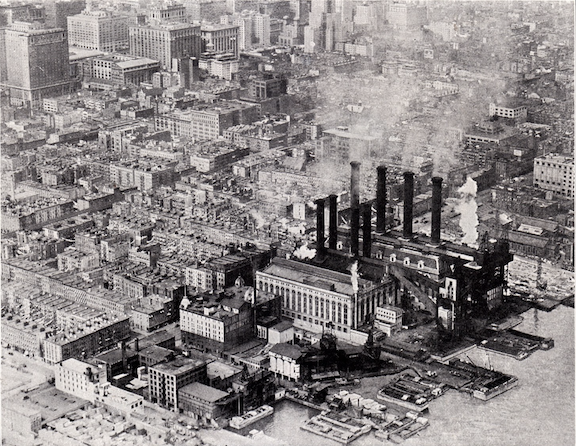
…it’s interesting how companies in the 19th century and on through the 1950s featured idealized, bird’s eye images of their factories in advertising, doubtless believing that consumers associated size (and smokestacks) with prosperity, and therefore a quality product…

…White Rock, however, has used the image of the Greek goddess Psyche for more than a century to promote the purity of its spring water…

…purity was also the main point of this ad from Daggett & Ramsdell, who hawked their wares to the Park Avenue set…after more than 130 years D&G is still in the beauty business…

…this next ad is almost unbelievable…single rooms starting at $5, double rooms $7, and a whole suite for $10…at the Plaza…okay, $10 is roughly equivalent to $225 today, but half of that could get you a single…

…and yet another unlikely claim from R.J. Reynolds regarding the energizing qualities of their Camel cigarettes…it seems the last thing you would need while climbing a mountain is smoke in your already over-taxed lungs…

…however, let’s give proper due to Georgia Engelhard (1906–1986), who scandalized the mountaineering world by ditching the Victorian climbing skirt in favor of a pair of climbing pants. Engelhard was the first female climber to ascend many of the peaks in the Rockies…

Georgia Engelhard in a 1922 photo attributed to her friend Alfred Stieglitz. (nga.gov)

…it seemed like nearly everyone smoked in the 1930s, even in ads that had nothing to do with tobacco companies (detail)…

…on to our cartoons, we begin with Richard Decker and some retail competition…

George Price drew up a curiosity even Robert Ripley couldn’t believe…

Robert Day examined advances in evolutionary science…

E. Simms Campbell offered up this abbreviated love story…

Peter Arno gave us a director with a god complex…

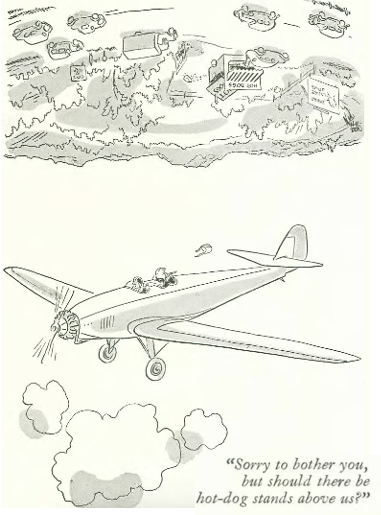
…and one from Ned Hilton, and a new perspective on flying…

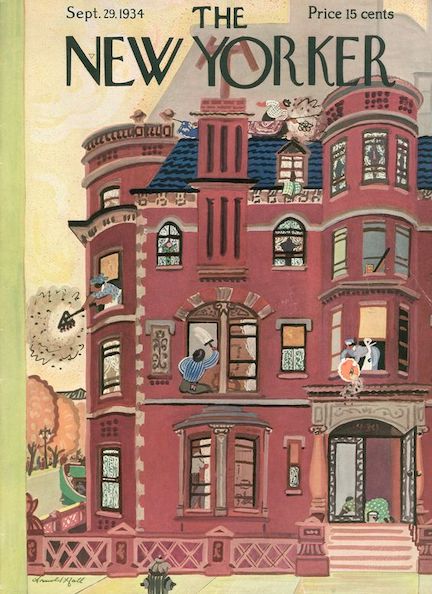
…on to Sept. 29, 1934, with a cover by Arnold Hall, who produced at least twelve covers for The New Yorker between 1933 and 1939…

Sept. 29, 1934 cover by Arnold Hall.

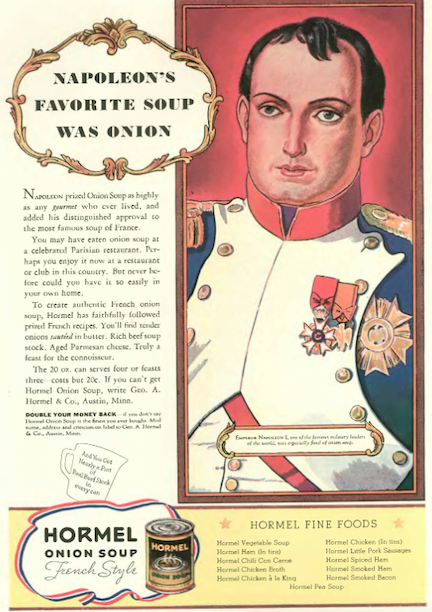
…and we go straight to ads, beginning with this alarming image that greeted readers on the inside cover…why would this prompt anyone to purchase a can of onion soup?…

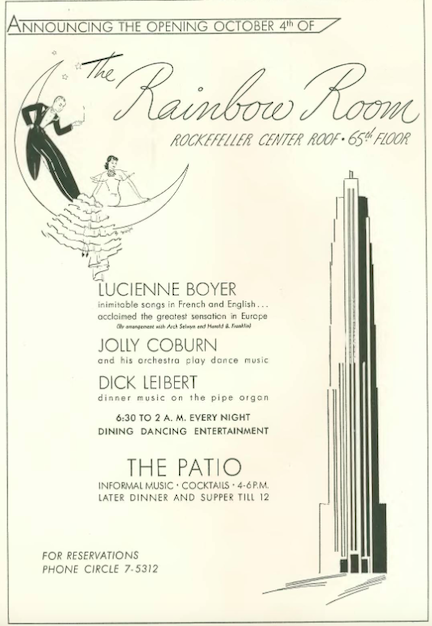
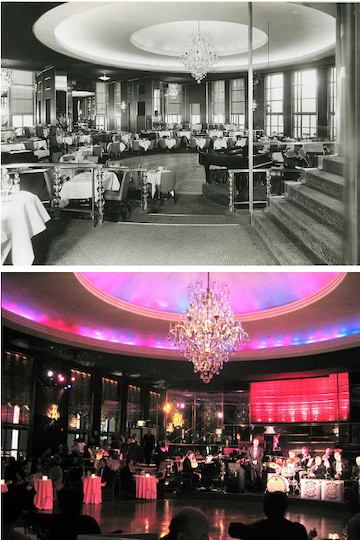
…the Rainbow Room on the 65th floor of Rockefeller Center opened in 1934, and it quickly became a focal point for the city’s elite…

Above, the dining room at the Rainbow Room, 1934, and below, in 2004. (Library of Congress/Wikipedia)

…Lucky Strike continued its series of ads featuring fashionable women looking smart with their product…

…our cartoons include this spot illustration by Otto Soglow, who did spots for The New Yorker for many years…although Soglow’s Little King moved to the Hearst newspapers, he continued to contribute cartoons to The New Yorker until 1974…

George Price continued to explore life as a levitating man…

…the enforcement of the Hays Code had this teen in a “fix,” per James Thurber

Gluyas Williams continued his exploration of various crises, this time in the music world…

Alan Dunn gave us a glimpse of civilization via the pharaonic sculptures that were emerging on the face of Mt. Rushmore…

…and we close with the wonderful wit of Barbara Shermund

Next Time: Bojangles…

Ring Ding

Back in the days before we had a zillion different entertainment options, almost anyone with a pair of ears would tune in to hear the radio broadcast of a heavyweight title fight.

June 23, 1934 cover by Rea Irvin.

Jack Dempsey and Gene Tunney dominated the late 1920s, while Joe Louis, Max Schmeling and Jack Sharkey were marquee names in the 1930s along with Max Baer and Primo Carnera, who met on June 14, 1934 at the outdoor Madison Square Garden Bowl in Long Island City. The reigning champ Carnera (1906–1967), who stood six-and-a-half feet tall and weighed in at 260 pounds, had won more fights by knockout than any other heavyweight champion. But Baer (1909–1959) was known as a knockout puncher who beat one opponent so savagely that he died the following day.

DEADLY DUEL…Max Baer (right) fought Frankie Campbell on Aug. 25, 1930, in San Francisco for the unofficial title of Pacific Coast champion. In the fifth round Baer got Campbell against the ropes and hammered him senseless. Campbell died the next day. An autopsy revealed that Campbell’s brain was “knocked completely loose from his skull.” Baer was profoundly affected by Campbell’s death, and donated purses from succeeding bouts to Campbell’s family. (thefightcity.com)

Baer was also something of a showboater, a quality Morris Markey found distasteful when he wrote about the Baer–Carnera bout in “A Reporter at Large.”

ALL SMILES…A year before their championship bout Max Baer (left) and Primo Carnera starred with Myrna Loy in The Prizefighter and the Lady. (theusaboxingnews.com)

GIANT SLAYER…The Italian prizefighter and wrestler Primo Carnera, nicknamed the “Ambling Alp,” was the reigning heavyweight champion when he faced Max Baer on June 14, 1934 at the Madison Square Garden Bowl. Baer felled the champion eleven times before the fight was stopped in the eleventh round. Baer would only hold the title for a year, losing to James J. Braddock on June 13, 1935, in what has been called one of the greatest upsets in boxing history. (theusaboxingnews.com)

Markey further explained why Baer’s behavior in the ring was so bothersome, and how it differed from the comic antics of other famous athletes:

RETIRING TYPES…Both Primo Carnera and Max Baer acted in films during their boxing careers, and continued acting after their retirements (Carnera in 1944, Baer in 1941). At left, Carnera with Bob Hope in the 1954 American comedy Casanova’s Big Night (Carnera appeared in eleven Italian films and in a half-dozen American films); at right, Max Baer and brother Buddy Baer (also a boxer) with Lou Costello in the 1949 comedy Africa Screams. Baer would appear in more than 20 films.(theusaboxingnews.com/monstermoviemusic.blogspot.com)

Complications from diabetes would take Carnera down for good at age 60. Baer would die even younger, from a heart attack, at age 50. His last words reportedly were, “Oh God, here I go.” Baer’s son, actor and director Max Baer Jr. (best known as Jethro Bodine from TV’s The Beverly Hillbillies) is still with us, at age 85.

We aren’t quite finished with the Baer–Carnera fight…E.B. White led his “Notes and Comment” with this observation regarding the fight’s mass appeal and seeming universality:

 * * *

Apologies to Ms. Winslow

I seem to have given short shrift to author Thyra Samter Winslow (1886–1961) who published more than 200 stories during her career in magazines such as The Smart Set and The American Mercury. She published more than thirty in The New Yorker, from 1927 to 1942, including the serialization of her short story collection, My Own, My Native Land. The story “Poodles” was featured in the June 23 issue.

According to the Encyclopedia of Arkansas, Winslow’s early life in Fort Smith (Ark.) “provided background for her view of small towns as prejudiced, hypocritical, and suffocating places…many stories expose the hypocrisy, prejudice, and carefully maintained social structures of both small town and urban life. She was particularly adept at portraying women of every social class, often in an unfavorable light. Money, especially the pursuit of it as a means to happiness or status, is an important theme throughout her work.”

THE PURSUIT OF HAPPINESS…Thyra Samter Winslow with friend, 1937. (findagrave.com)

 * * *

Hot Enough For Ya?

So what did New Yorkers do when the summer heat set in? The next few items offer some clues, beginning with this poem by E.B. White:

SUMMER STOCK…Theatergoers fled to shady villages in New York, New Jersey and New England in the 1920s and 30s when summer stock theater was at its height. The above photo shows theatergoers leaving a performance at the Lakewood Theatre near Skowhegan, Maine. The theater was claimed to be the oldest and finest summer stock company in America with a Broadway cast. Nearby Lakewood Inn provided recreation, camping, and tourist bungalows. (mainememory.net)

You could also take in some entertainment while enjoying the cooling breezes of the Hudson River. Robert Benchley hopped aboard the Alexander Hamilton to enjoy Bobby Sanford’s showboat revue:

SOME REAL SHOWBOATING…Clockwise, from top left, the steamboat Alexander Hamilton hosted Bobby Sanford’s showboat revue; comedian Lester Allen served as emcee for the show; the Meyer Davis Orchestra supplied the music; the revue featured the “exotic” DuVal sisters (image from program) among other diversions. (Hudson River Maritime Museum/IMDB/vintagebandstand.blogspot.com/Worthpoint)

“Tables for Two” took a look at summer dining options, from sidewalk cafes to hotel rooftops featuring dinner and dancing—this “Tables” was not written by Lois Long, but by Margaret Case Harriman, who knew a thing or two about nightlife (she was the daughter of the Hotel Algonquin’s owner, Frank Case)…

DANCING WITH THE STARS…The Waldorf-Astoria’s “Starlight Roof” was a popular summer restaurant for dining and dancing. Image from a 1935 publication The Waldorf-Astoria by Richard Averill Smith. (The Waldorf-Astoria)
 * * *
Doing Swimmingly
Historian Henry F. Pringle published part two of his series on President Franklin D. Roosevelt, here marveling at the president’s health despite his serious bout with polio (drawing by William Cotton).

TAKING THE WATERS…President Franklin D. Roosevelt took to swimming for therapy and exercise. (FDR Presidential Library and Museum)

* * *

Get Yourself to Chi-Town

The Chicago World’s Fair (The Century of Progress) was in its second and final year, and The New Yorker found everything “terrific.” Excerpt:

MAKING A SPECTACLE OF ITSELF…The 11-acre Ford Motor Company exhibit at Chicago’s Century of Progress became the most talked-about exhibit of 1934, featuring a central rotunda designed to simulate graduated clusters of gears. At right, Proof of Safety Exhibit in the Ford Building. (chicagology.com)

  * * *

From Our Advertisers

Just a couple of entries this week…You could take a plane to the Chicago World’s Fair on a United Airlines Boeing 247…

…the lower section of the ad claimed you could fly to Chicago in about five hours in planes featuring “Two pilots…stewardess…two-way radio…directive radio beam”…

TSA? WHAT’S A TSA?…United Airlines Boeing 247-D at an airport terminal with passengers and crew. (digitalcollections.lib.washington.edu)
COZY CONFINES…Passengers enjoy a game of checkers aboard a Boeing 247 in 1933. (digitalcollections.lib.washington.edu)

…and what would our advertising section be without two fashionable people lighting up?…

…on to our cartoonists, we begin with Reginald Marsh’s illustration of a Rep Theatre production…

Otto Soglow’s Little King found his artistic side…

Rea Irvin continued his examination of native fauna…

Gardner Rea correctly predicted the global domination of Mickey Mouse…

Peter Arno showed the dizzying effects of a Coney Island ride…

…however at the altar the thrill was gone, per Garrett Price

…another take on the ways of love, with Barbara Shermund...

…the newfangled diagonal bathtub continued to dazzle, with George Price

Gardner Rea offered up some subtle irony on the farm…

…and we close with James Thurber, in a poetic moment…

Next Time: A Light in Darkness…

Under the Knife

Above: Surgery being performed at the Hospital of Saint Raphael (Conn.) in the late 1930s. Operating rooms were often located near large windows and under skylights to offer greater illumination. (Yale New Haven Hospital)

For all the challenges of 21st century, I always remind myself that advances in medicine during the past ninety years have made our lives better, and substantially longer, even if our current health care system is far from ideal.

Feb. 3, 1934 cover by E. Simms Campbell.

People could live to a ripe old age in the 1930s, however the average life expectancy at birth in 1930 was only 58 for men and 62 for women. The Depression didn’t help matters, and neither did the Dust Bowl, unregulated urban smog, the dramatic rise in smoking, and the lingering effects of more than a decade of bootleg alcohol consumption.

Polio was a serious problem in the 1930s, as was syphilis, which affected as many as ten percent of Americans. Blood groups would not be identified until 1930 (by Nobel Prize-winner Karl Landsteiner), and human nutrition remained something of a puzzle—Vitamin C wasn’t identified until 1932. There was exciting chatter about penicillin (discovered in late 1920s) and the antibacterial effects of sulfonamides (first observed in 1932), but it would be years before antibiotics would come into common use. So yes, infection was also a big killer.

Nevertheless, progress had been made, as told by Morris Markey in the column, “A Reporter at Large.” An excerpt:

FORTRESS ON THE HEIGHTS…Top, Columbia-Presbyterian Medical Center loomed large when it opened in Washington Heights in 1928; below, New York Hospital, most likely the building described in Morris Markey’s column; at left, Dr. George Crile, Sr., completing his landmark 25,000th thyroid operation in 1936. (CUIMC/Wikipedia/Cleveland Clinic)

This next excerpt describes the work of the anesthetist after the patient receives a spinal injection of novocaine, which had replaced cocaine as a pain blocker. At the start of the 1930s, the most-used anesthetic was ether, used in this account to calm the patient. Ether carried its own risks—in was unstable, and sparks from X-ray machines and other equipment could cause an explosion.

NO SMOKING, PLEASE…Anesthetist in the 1920s carefully administers ether while surgeon swabs a patient with iodine (inset). Ether was unstable, and sparks from equipment could cause an explosion. (Internet Archive/Flickr)

 * * *

And Then There’s Maude

American actress and stage designer Maude Ewing Adams (1872–1953) defined the role of “the boy who wouldn’t grow up” in her Broadway adaptations of Peter Pan in the early 1900s (1905, 1906, 1912 and 1915). She would appear in 26 Broadway productions between 1888 and 1916, but after a severe bout of the Spanish flu in 1918 she retired from the stage and focused on developing better stage lights with General Electric; her electric lights ultimately set the industry standard with the advent of sound movies. As this excerpt from “The Talk of the Town” revealed, Adams was also quite shy and highly valued her privacy.

THE RETIRING SORT…Maud Adams in a Broadway publicity photo, circa 1900. (Vintage Everyday)

* * *

In The Trenches

Just before the Nazis decided to turn their country back into a warlike state, Victor Trivas and George Shdanoff wrote and directed an allegorical anti-war film. Niemandsland (released in the U.S. as Hell on Earth) featured five soldiers, from different backgrounds, who find themselves together in a dugout in no man’s land and together come to terms with the absurdity of war. The film premiered in Berlin in December 1931 and was greeted by thunderous applause. A little over a year later it was banned by the Nazis. Critic John Mosher made these observations:

WAR, WHAT’S IT GOOD FOR?Niemandsland (released in the U.S. as Hell on Earth) featured five soldiers from different backgrounds on a front lines during WWI: a carpenter from Berlin, a mechanic from Paris, an English officer, a Jewish tailor and a Black dancer (the only one who understands everyone’s languages). Actor and dancer Louis W. Douglas (top right) was a Philadelphia native who moved to Paris in 1925 with his dancing partner, Josephine Baker, in the popular La Revue Nègre. He went on to establish a successful musical and film career in Germany until his death in 1939. (silverinahaystack.wordpress.com/IMDB)

 * * *

From Our Advertisers

We begin with this jolly color image from Lucky Strike representing the joys of cigarette smoking…

…a trio of ads culled from the back pages, everything from “Tiara Trouble” (apparently a common problem) to a smoking penguin introducing a new line of menthol cigarettes, KOOL, challenging the dominance of the Spud menthol brand (we know who won that battle)…in the final ad, Atlantic City resort hotel Haddon Hall attempted to drum up business using a slavery/emancipation theme—Abraham Lincoln’s birthday is at hand…why not slip the shackles of work and run away to sunshine and freedom?

…These Paul Whiteman ads were ubiquitous in the 1930s…the distinctive caricature of his pudgy, mustachioed face—Whiteman’s “Potato Head” emblem—was featured in ads and on 78 rpm record labels and various promotional items…on the more classical side, violinist David Rubinoff sawed away on his famed $100,000 Stradivarius for audiences at the Roosevelt Hotel…

…automobile ads continued to grace the pages of The New Yorker, including this one suggesting that young blue bloods would look quite smart in a ’34 Chevy…

…in the 1930s Studebaker marketed car lines including the high-end President, the mid-priced Commander, and the low-priced Dictator…the Dictator was introduced in 1927, so named because it “dictated the standard” other automobile makes would be obliged to follow…the rise of Mussolini and Hitler attached unsavory connotations to the car’s moniker…it was renamed “Director” for European markets and was finally abandoned in 1937…

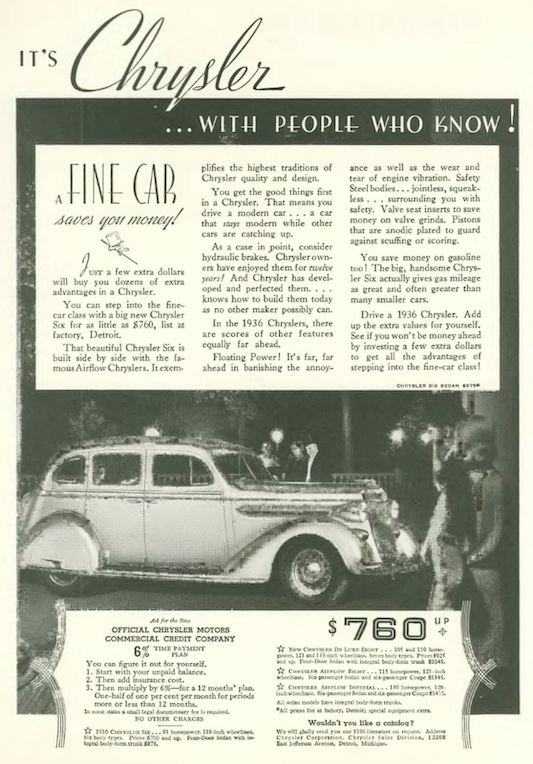
…Chrysler continued to push its radical new Airflow, here demonstrating how it blows the doors off of an old-timer…

…as we jump into our cartoons, Kemp Starrett referenced the Airflow in his latest contribution to The New Yorker

…the issue included two from George Price…a playful pairing in the events section…

…and a somewhat unkind nod to new Hollywood star Katharine Hepburn…apparently David O. Selznick had misgivings about casting a “horse face” like her…well, she obviously proved him wrong…

…the magazine pulled out this old illustration by H.O. Hofman to break up the copy in Howard Brubaker’s “Of All Things” column…

…more antics from the precocious set, courtesy Perry Barlow

Mary Petty offered this observation on the state of medicine in 1934…

…a sobering and topical contribution from Alan Dunn

Carl Rose made preparations for the annual Charity Ball…

…and James Thurber gave us Part III of his “War Between Men and Women”…

Next Time: Made in Germany…