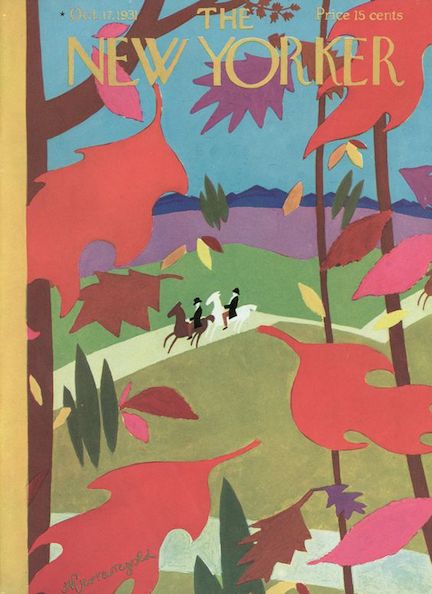
The Lighter Side of George Grosz

Above: Landscape in Bayside, 1935, by George Grosz (Phillips Collection)

Knowing that the Nazis would not look kindly on his art, George Grosz took a job teaching drawing in New York in 1932, and by 1933 he had become a permanent resident of the city.

March 30, 1935 cover by Garrett Price celebrated the traditional “Bock” beer of spring.

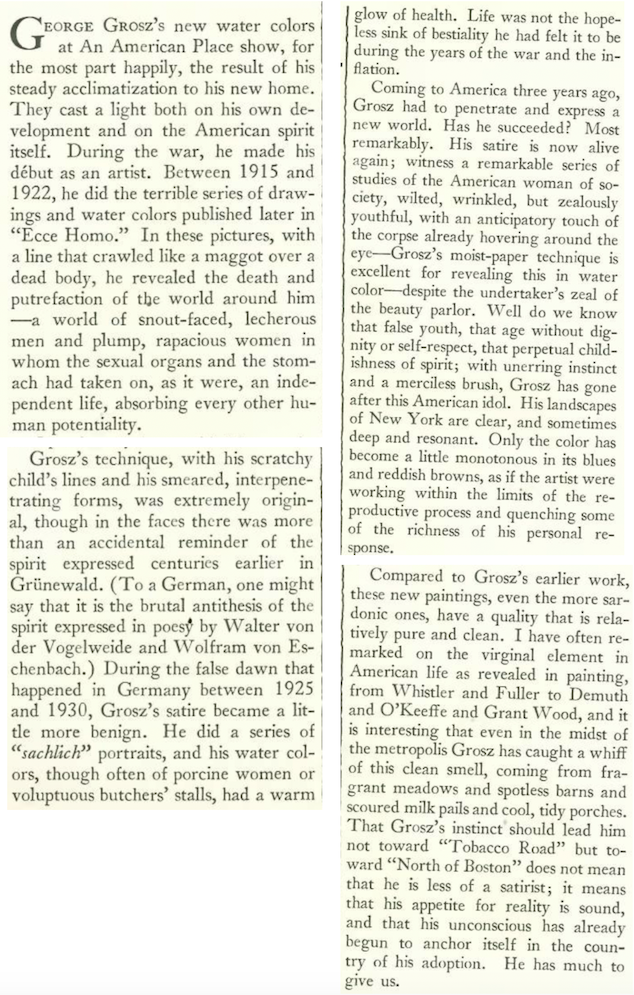
Grosz (1893–1959) was overwhelmed by the size and pace of his adopted city, and for the most part he left behind his bitter caricatures and paintings of Berlin’s Weimar years and turned to other subjects, including landscapes and New York’s urban life. Critic Lewis Mumford took in a show of Grosz’s new water colors at An American Place, a small gallery run by photographer and art dealer Alfred Stieglitz. 
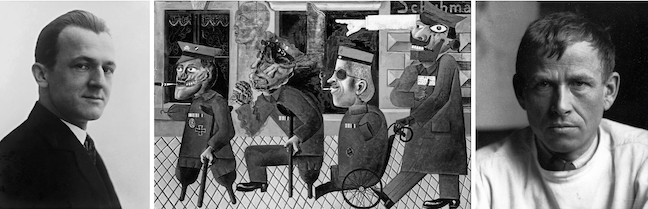
THE NEW OBJECTIVITY…George Grosz (left, circa 1921), was not alone in his harsh depictions of war and of German society during the Weimar Republic. Other key figures in the New Objectivity (Neue Sachlichkeit) movement included Max Beckmann and Otto Dix (right, circa 1929). Dix’s oil on canvas War Cripples (Kriegskrüppel), 1920, which is pictured above, was exhibited at the First International Dada Fair in Berlin in 1920. Only black and white images exist of the painting, which is believed to have been destroyed by Nazis who condemned it as degenerate art. (Wikimedia Commons/CUNY)

OH THE HUMANITY…Three selections from the “Ecco Homo” series by George Grosz. From left, Gruß aus Sachsen (Greetings from Saxony) 1920; Nachts, (At Night) 1919; and Schwere Zeiten (Hard Times) 1919. Grosz took a dim view of the corruption and moral decline he found in Weimar Berlin. (MoMA)
SEEING RED…Detail from George Grosz’s Metropolis, Oil on Canvas, 1916-1917. A blood-like shade of red could be seen in many of the artist’s paintings during World War I and the Weimar Republic. In this painting and in others, death is omnipresent. (Thyssen-Bornemisza Museum, Madrid)
A SOFTER SIDE could be found in George Grosz’s later watercolors, although he hadn’t entirely lost his sense of the satirical, or his taste for red paint. From left, Street in Harlem, circa mid-1930s; Ehepaar (A Married Couple), 1930; Central Park at Night, 1936. (Phillips Collection/Tate Gallery/Art Institute Chicago)
 * * *
Not the Bee’s Knees
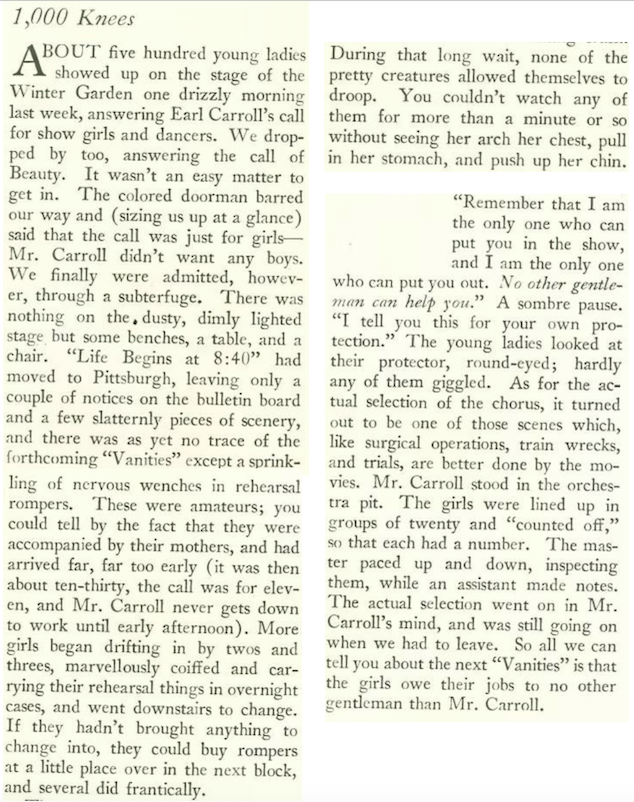
For all the progressive thinking that was on display in the early New Yorker, we also reminded that it was also a creature of its time in 1935. Here are excerpts from a lengthy “Talk of the Town” entry that described the sad winnowing process of Broadway revue producer Earl Carroll

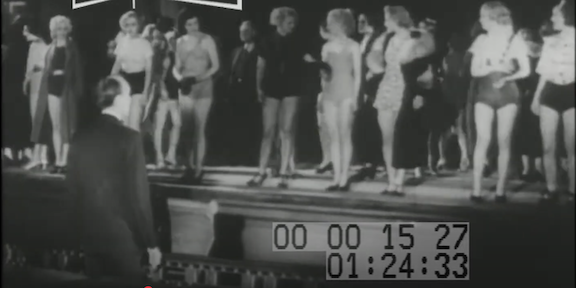
JUDGEMENT DAY…Here is a screenshot from a short film featuring the 1935 audition described in the “Talk” segment. At left is Earl Carroll. You can watch the film here. (YouTube)

 * * *

Too Little For Too Much

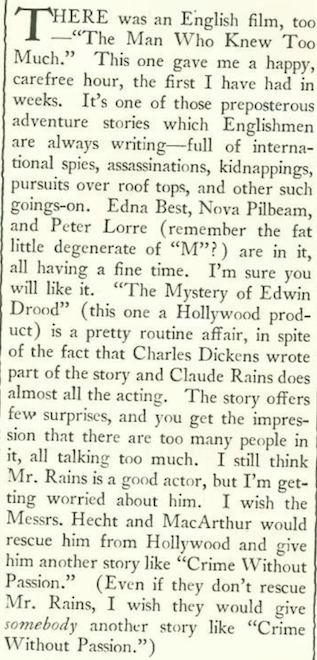
Film critic John Mosher gave Alfred Hitchcock’s 1934 version of The Man Who Knew Too Much just five lines in his review. He described it as “one of those preposterous adventure stories which Englishmen are always writing…” The film, however, was an international success, and it would define the rest of Hitchcock’s career as a director of thrillers with a unique sense of humor.
A HAPPY, CAREFREE HOUR is how critic John Mosher described his experience watching 1934’s The Man Who Knew Too Much. Clockwise, from top right, director Alfred Hitchcock with the film’s German star, Peter Lorre, who learned his part phonetically; Lorre and Cicely Oates; Edna Best did her best at playing a grieving mother. The film was remade by Paramount in 1956, starring James Stewart and Doris Day. (Wikipedia/aurorasginjoint.com/IMDB)

 * * *

Dizzy Nor Dazzled

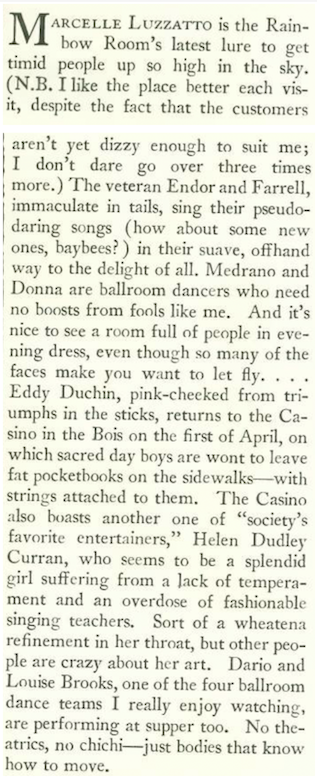
In 1935 Lois Long had been divorced from cartoonist Peter Arno for about four years, and she was the mother of six-year-old daughter from that marriage. That didn’t keep her from sampling the city’s night life, but the days of speakeasies and drinking sessions that lasted into the wee hours were over for the 34-year-old Long. For her “Tables for Two” column she took the elevator up to the 65th floor of 30 Rockefeller Plaza to take in the entertainment at the Rainbow Room…as well as the pedestrian crowd…
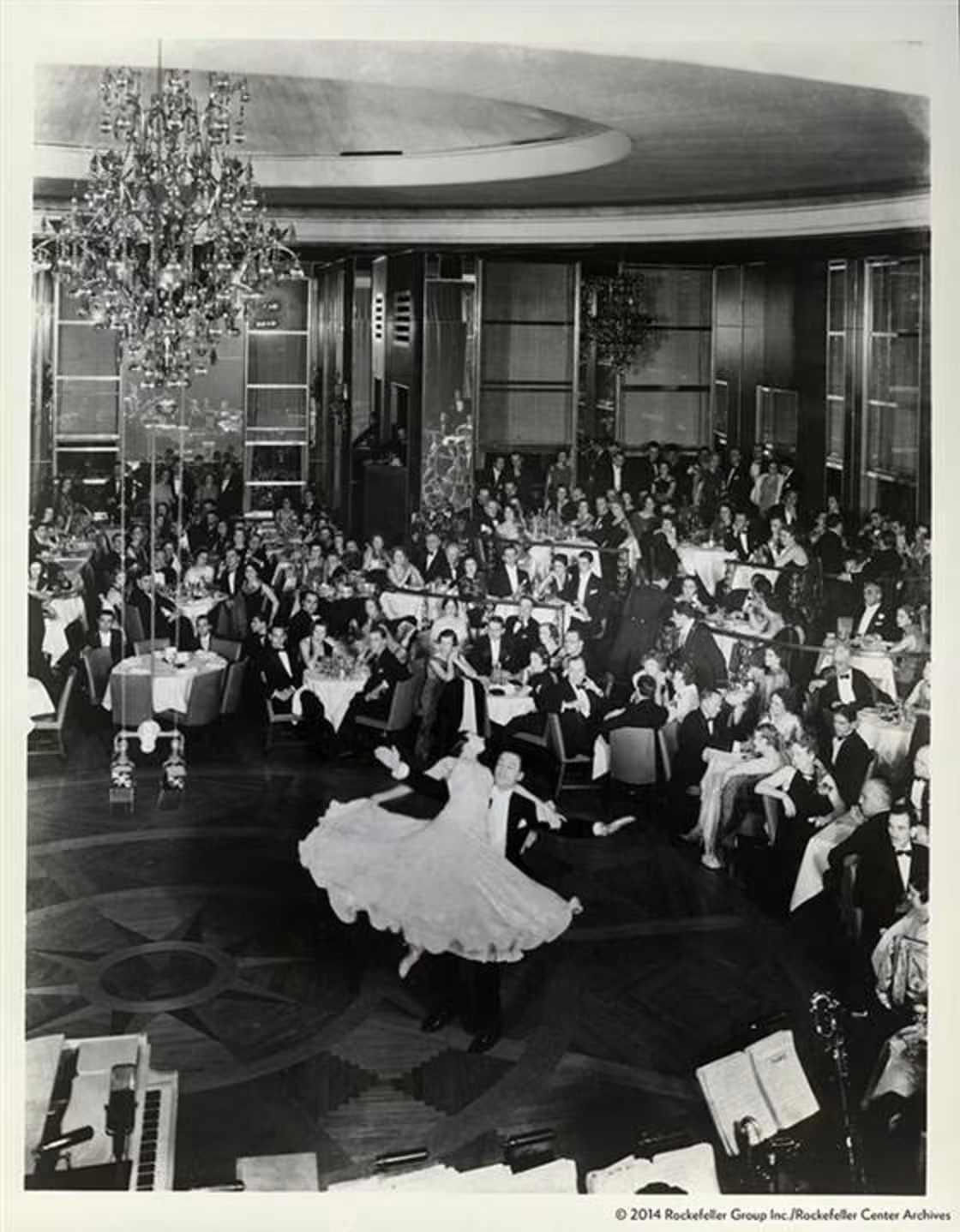
WHAT A WHIRL…Above, diners watch a performance by ballroom dancers Lydia and Joresco in the then newly opened Rainbow Room in 1934. Lois Long enjoyed the Rainbow Room in its 1930s heyday, but she missed her old speakeasy crowd, noting that the Rainbow Room’s customers weren’t “dizzy enough” to suit her tastes. (Rockefeller Center Archives)

…her speakeasy days were over, but it appears Long still enjoyed a bit of indulgence…here is how she concluded her column:

 * * *

From Our Advertisers

Step into a crowded mid-century elevator and you were bound to catch a whiff of the menthol-tinged scent of Aqua Velva, not objectionable if properly applied…

…speaking of menthol, the makers of Spud cigarettes were now competing with upstart menthol cigarette makers including Kool…this ad has all kinds of problems, including the suggestion that the occasional Spud not only inspires one’s nuptials, but also ensures marital bliss, as well as a lifetime of chain-smoking…

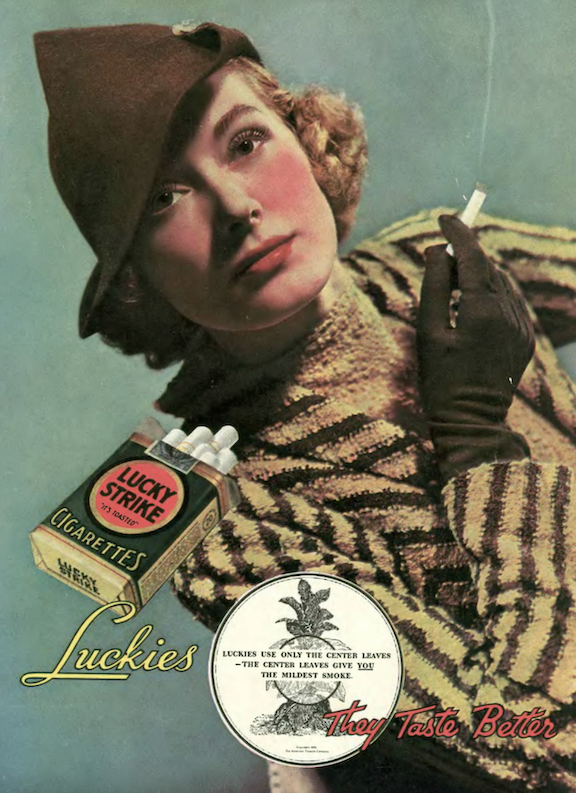
…Luckies, on the other hand, continued to appeal to the modern woman, and what impressionable young woman wouldn’t be inclined to pick up the habit to complete her ensemble?…
…the makers of College Inn tomato juice gave their raving Duchess the week off, but we get another old sourpuss in the form of a “Dowager” who demands that her servant remove a glass of what very well could have been tomato juice…enter the old bat’s niece, Dorothea, who suggests that the cook, Clementina, serve some Libby’s pineapple juice instead, probably spiked with vodka given the Dowager’s sudden change of demeanor…

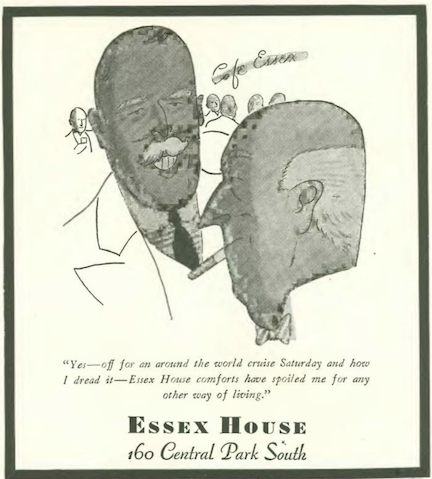
…Essex House continued their class-ridden ad campaign, this time with some stuff-shirt dreading his world cruise
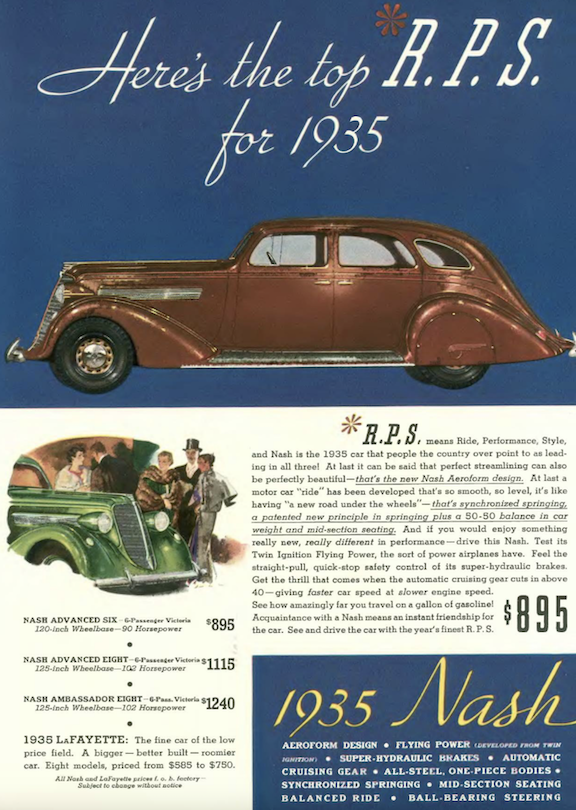
…carmakers continued to emphasize economy and price to move their latest models, including the 1935 Nash with “Aeroform Design”…
…last week I noted that Packard was doubling down on promoting the elite status of its premium automobile; however, the carmaker did introduce a “120” that cost a fraction of its luxury models and helped the company’s bottom line…
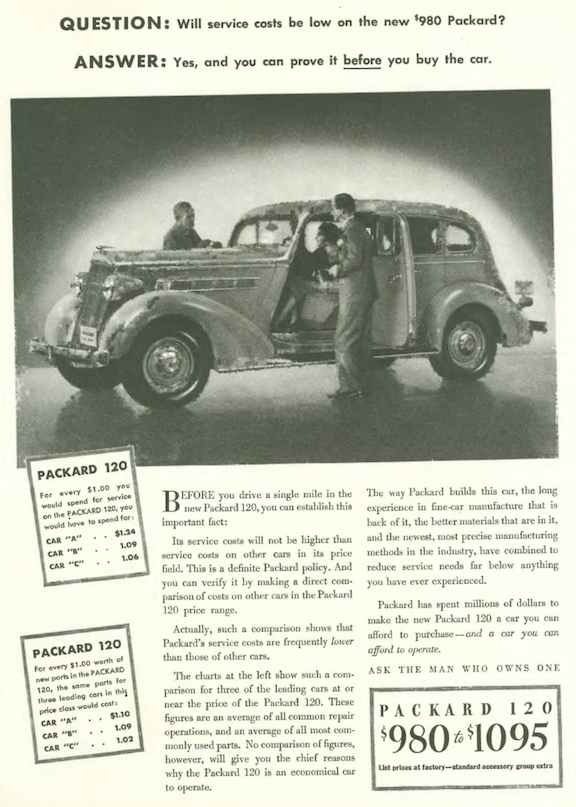
 

…Packard’s competition was Lincoln and Cadillac, among other luxury brands, but Pierce Arrow represented the pinnacle of luxury and craftsmanship, the American equivalent of Rolls Royce…unlike the other luxury brands, Pierce Arrow did not offer a lower-priced car, and the company folded it 1938…

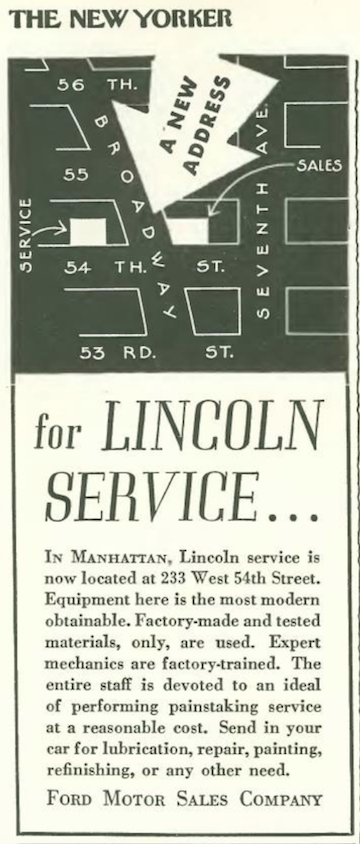
…speaking of luxury cars, if you owned a Lincoln, this little ad tucked into the top corner of page 55 showed you were to go to get a tune-up…
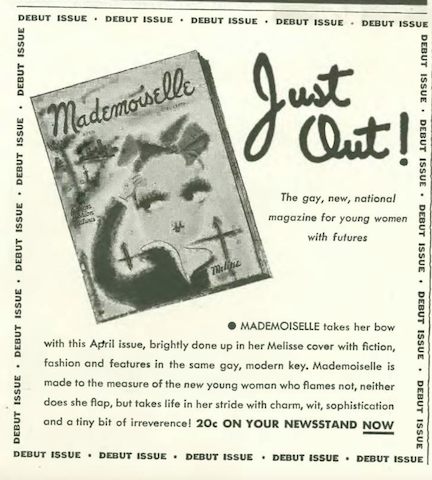
…the publishers at Street & Smith announced the launch of a new fashion magazine, Mademoiselle, a seemingly daring move in Depression America…the cover featured an illustration by Melisse (aka Mildred Oppenheim Melisse)…the magazine was later acquired by Condé Nast, and folded in November 2001…
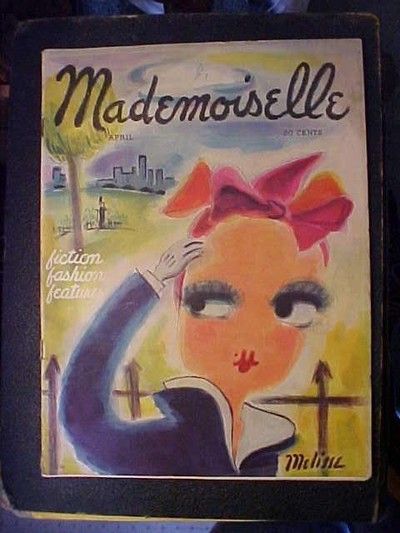
Mildred Oppenheim Melisse’s cover for the debut issue of Mademoiselle, April 1935. Melisse also supplied the cover art for the May and June issues that year. (Pinterest)

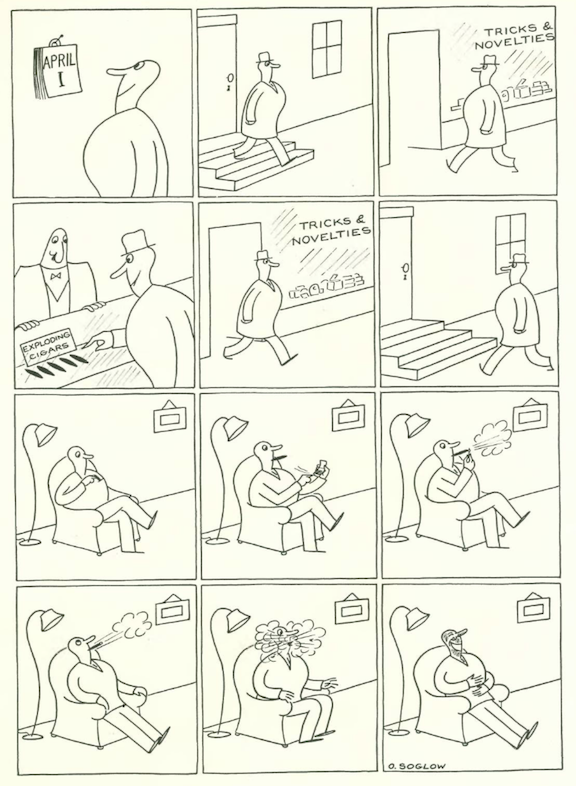
Otto Soglow was on his way to becoming a wealthy man thanks to his “Little King” cartoon…William Randolph Hearst lured Soglow and the cartoon away from The New Yorker in 1934, so the only way the wee potentate could appear in the magazine was in an ad, like this one for Bloomingdale’s…

…Soglow continued to contribute to The New Yorker, and we kick off our cartoons with an April Fool’s joke…
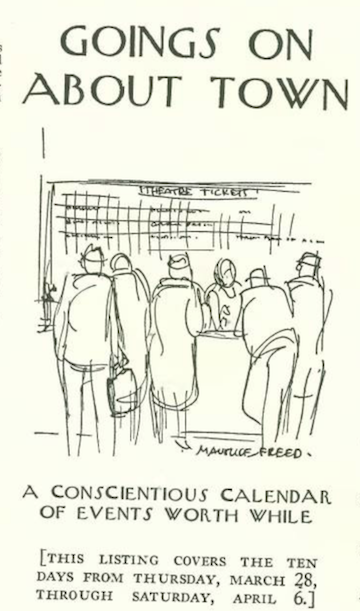
…for the second week in a row Maurice Freed supplied the opening spot art for “Goings On About Town”…
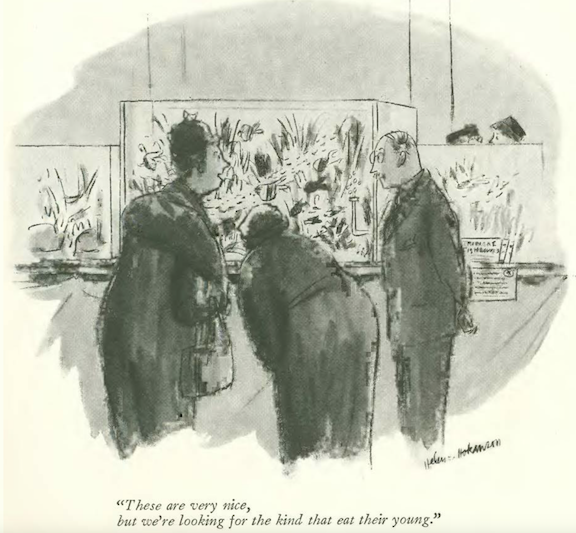
Helen Hokinson was on the hunt for some predatory fish…
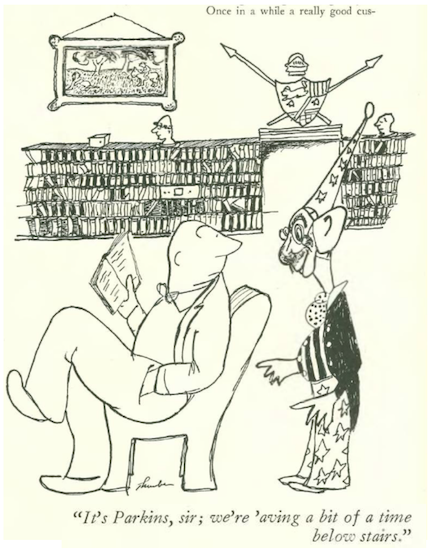
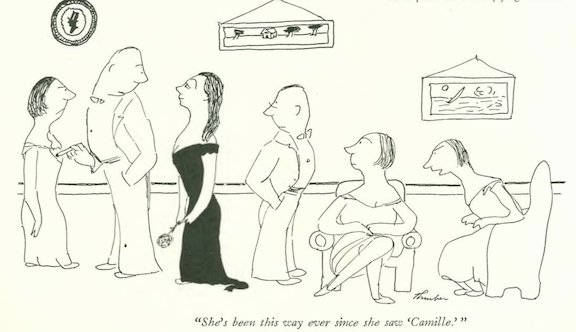
James Thurber looked in on the nudist fad that emerged in the 1930s…

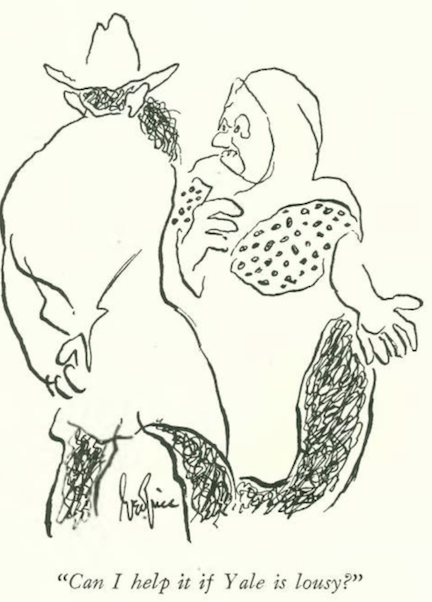
…and we close with George Price, an some alarming bedside manners…
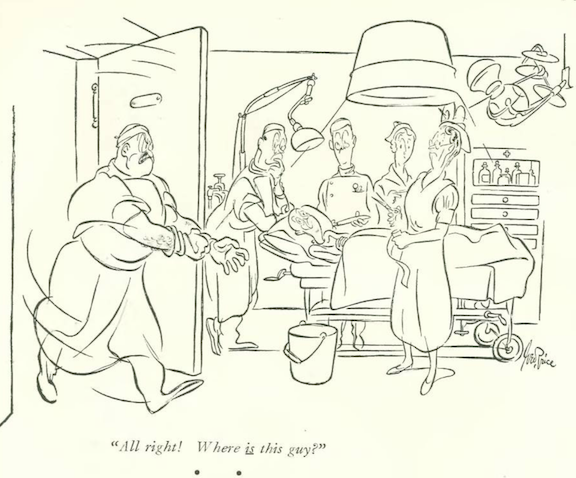
Next Time: Keep Calm and Carry On…
Cleo’s Allure

Claudette Colbert and Henry Wilcoxon in 1934's "Cleopatra." (cecilbdemille.com)

New Yorker film critic John Mosher was in the mood for one of Cecil B. DeMille’s big, splashy epic movies, but was disappointed to find a relatively restrained effort in DeMille’s latest flick, Cleopatra.

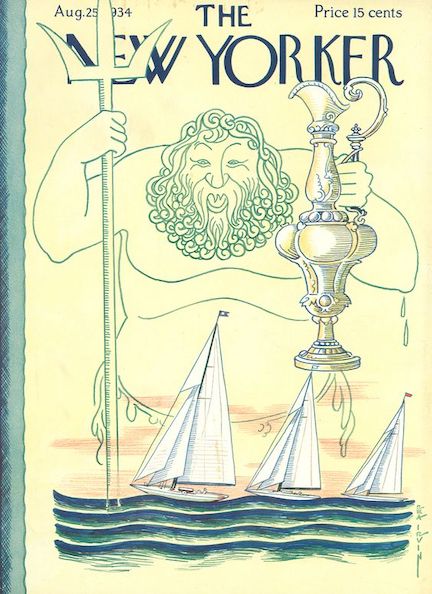
August 25, 1934 cover by Rea Irvin.

Perhaps Mosher would have preferred a silent version of the film, finding the dialogue “the worst I have ever heard in the talkies.” Among examples cited by Mosher was Warren William’s Caesar, who utters the word “Nope” to one of his senators.

CLEO BRIO…Clockwise, from top left, Paramount’s trailer for Cleopatra made a bold claim; Cleopatra (Claudette Colbert) hails Caesar after emerging from a rolled up rug that had been presented to the Roman court; Julius Caesar (Warren William) acts unimpressed, but eventually falls for the Egyptian queen before meeting his demise; Marc Antony (Henry Wilcoxon) is the next to fall for Cleopatra’s seductions. It ends badly for both of them. (pre-code.com/obscurehollywood.net)

Despite Mosher’s grumbles, Cleopatra would receive five Academy Award nominations (winning for Best Cinematography) and would become the highest-grossing film released in North America in 1934. That year Claudette Colbert (1903-1996) would appear in three films that were all nominated for the Academy Award for Best Picture—she is the only actress ever to do so.

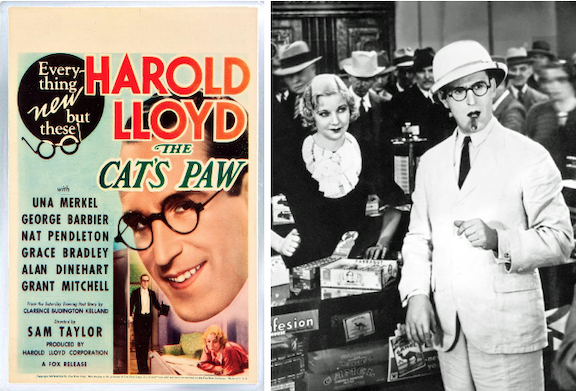
On the lighter side, Mosher took a liking to Harold Lloyd’s latest picture, The Cat’s Paw, which marked a sharp departure from Lloyd’s trademark slapstick. Lloyd adopted to a calmer pace, “touched with the delicate bloom of satire.”

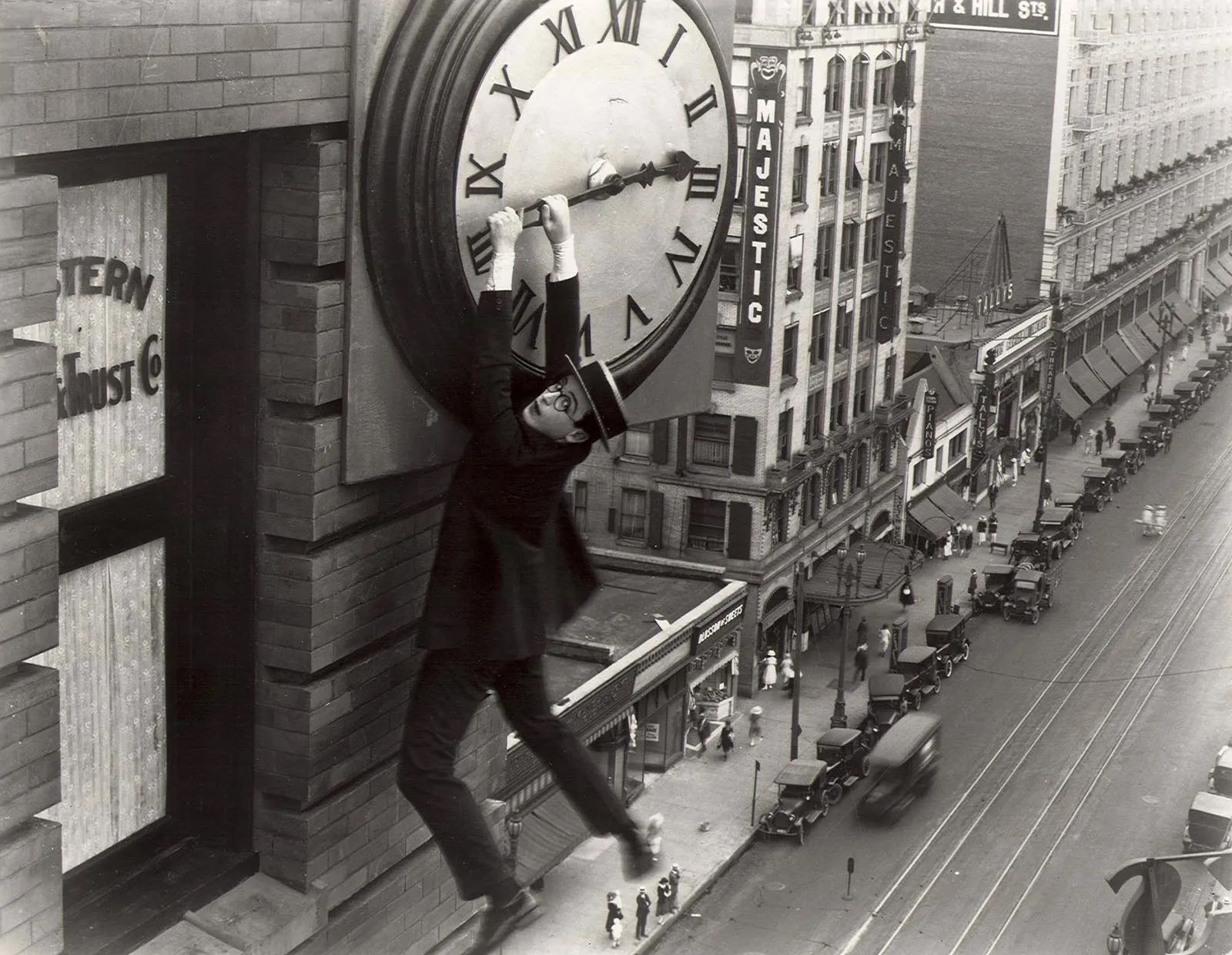
Moviegoers who associated Lloyd with such pictures as 1923’s Safety Last

(britannica.com)

…would have to settle for this new version of Lloyd, which was even touted on the movie’s promotional poster…

STAYING ON HIS FEET…Fox Pictures touted a “new” Harold Lloyd (except for his trademark glasses) in The Cat’s Paw. At right, Lloyd with co-star Una Merkel. (IMDB/criterionchannel.com)

 * * *

Fun With Philately

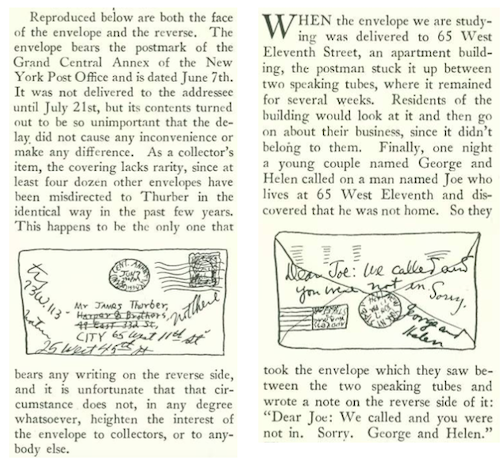
After reading a column in The Herald Tribune that concerned interesting stamps and envelopes…

James Thurber found himself inspired to make a brief examination of the “Thurber envelope”…

…which proved to be neither interesting nor unusual (excerpts):

 * * *

From Our Advertisers

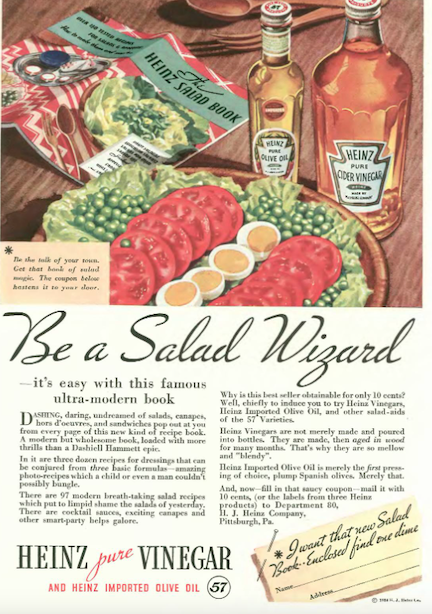
A couple of colorful advertisements, the first from the folks at Heinz, who invited New Yorker readers to become “Salad Wizards”…

…if being a salad wizard wasn’t good enough, you could pop open a bottle of Cora vermouth and feel downright aristocratic…

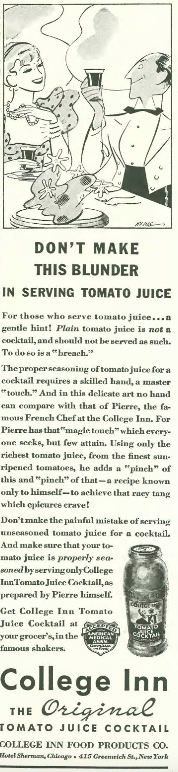
…and if you wanted to maintain that aristocratic pose, you’d better know how to serve your tomato juice, and make sure it is prepared by a “famous French Chef”…

…more libations in the back pages…here’s a sampling of three…there must have been a reason why all of the one-column ads featured mixers and spirits on the top and ads for hotels and apartments on the bottom…

…and before we jump into the cartoons, a brief look at illustrator Mildred Oppenheim, who worked under the pseudonym “Melisse.” Her work was seen in the early New Yorker mostly in ads for Lord & Taylor, however she also did work for others including the makers of Cannon towels (seen below). In 1931 The New York Times described her as “a wicked and telling satirist—almost a feminine counterpart of Peter Arno”…

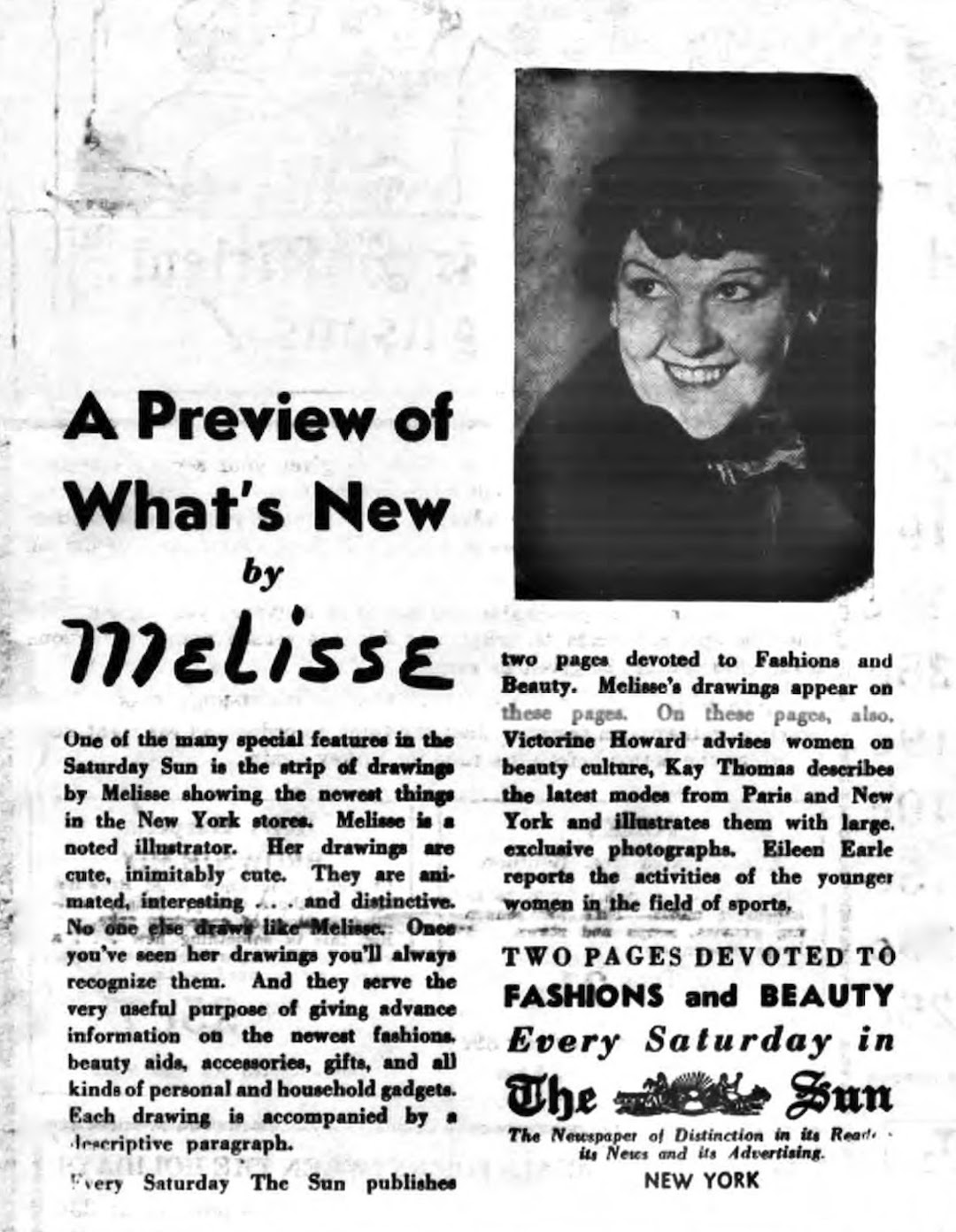
…Melisse ran a cartoon strip, “Real News of New York…A Preview of What’s New,” in the New York Sun from 1933 to 1935. Melisse seemed to be flying high, but in 1940 she declared bankruptcy. However she quickly rebounded in 1941 with an advertising panel for Orbachs—Around Town…with Melisse”—which became a nationally syndicated feature:

(strippersguide.blogspot.com)

…in the 1940s Melisse also produced a variety of drawings and paintings, designed mannequins for window and counter displays, and even produced designs for handkerchiefs and other clothing items. But for all her fame as a commercial illustrator, very little is known about her personal life, or what became of her after 1950. According to Alan Jay of the Stripper’s Guide, Melisse was born in Newark in 1905 and died in Miami in 1993, and was briefly married to another commercial artist in the early 1930s. A December 14, 1934 ad for her “Real News” strip in the Pelham Sun featured her photo:

(strippersguide.blogspot.com)

…on to our well-known New Yorker cartoonists, we begin with the stalwart Rea Irvin

…accompanying part two of a three-part profile of New Deal Administrator Hugh Samuel Johnson was this terrific caricature by Miguel Covarrubias

…never too early to get ready for winter…spot drawing in the opening pages by Alan Dunn

…but there was enough summer left for William Steig’s “Small Fry” to enjoy some leisurely pursuits…

William Crawford Galbraith continued to ply his familiar waters…

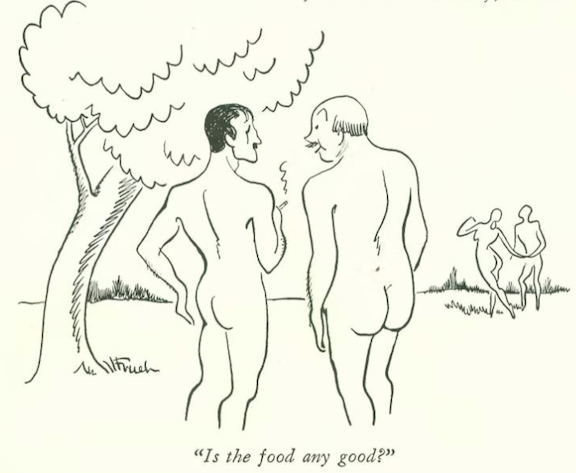
…while Al Frueh turned in this gem…

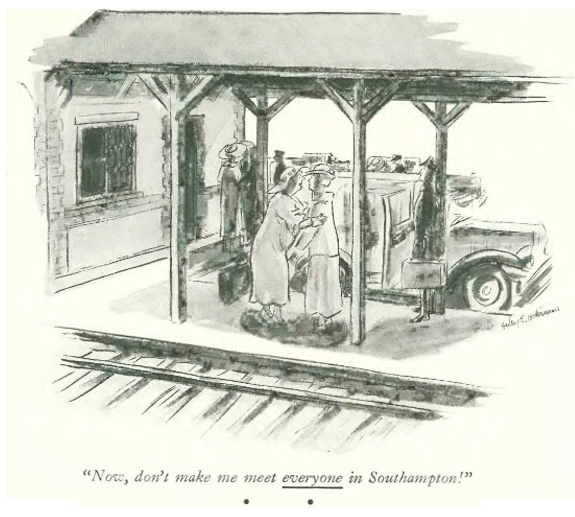
Helen Hokinson found some lively anticipation at the train station…
Garrett Price took us to the seashore…
…while Barbara Shermund kept us abreast of current events…

Next Time: Some Pitiful Melodies…

His Five Cent’s Worth

Above: Final Design of Grand Central Terminal, ca. 1910. (New York Transit Museum)

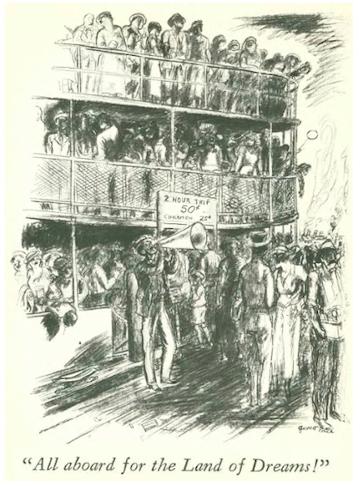
The heat wave of 1934 spread misery from the Midwest to the East Coast. The temperature in New York City hit 101 degrees F (38.3 C) on June 29, and July recorded at least ten days of temps in the mid- to upper 90s. It must have been miserable in the days before air-conditioning, and since no adult would dare be seen in public wearing shorts and a t-shirt, an outing on a crowded tour boat, as illustrated below by William Cotton, must have been hellish.

July 21, 1934 cover by William Cotton.

…putting a fine point on it, recall this wryly captioned cartoon from the June 30 issue by Garrett Price

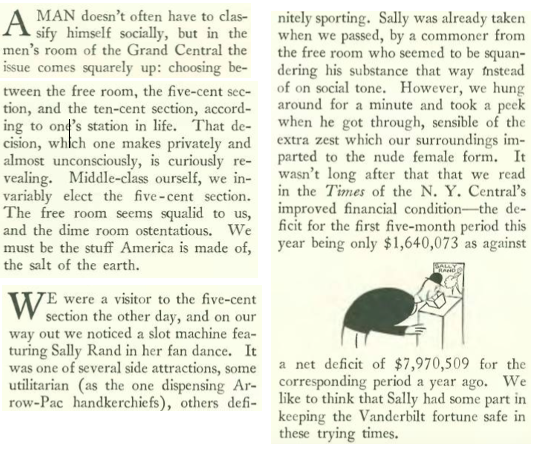
…but let us move ahead to the July 28 issue, where E.B. White was hopefully keeping his cool in the men’s waiting room at Grand Central Station, where he plunked down a nickel to cool his heels in the “middle class” section, where he observed side attractions including a vending machine that dispensed handkerchiefs and a coin-operated peep show featuring burlesque star Sally Rand.

NO MASHERS ALLOWED…Separate men’s and ladies’ rooms were available in three classes at Grand Central Station—free, five cents and ten cents. Top, the Ladies’ room, Grand Central Terminal (Central Lines), and below, a men’s room at the station. A nickel back then was worth about a dollar today. (Library of Congress)
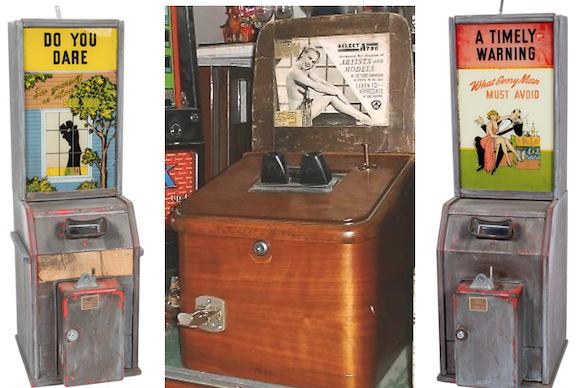
NICKEL AND DIMED…Machines similar to these could be found in some men’s waiting rooms at train stations in the 1930s. (pinballhistory.com/comics.ha.com)

…White referred to a peep show that featured famed fan dancer Sally Rand

DOING HER DEEP KNEE BENDS…Sally Rand in the 1930s. (www.vintag.es)

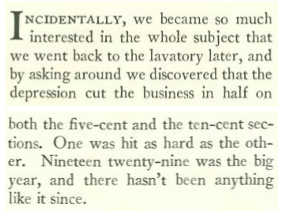
White also commented on the growing number of travelers, still pinched by the Depression, opting for the free section:

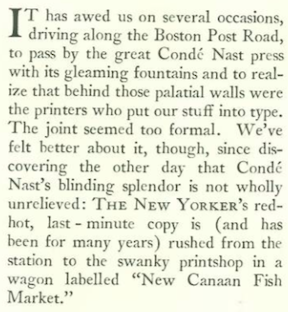
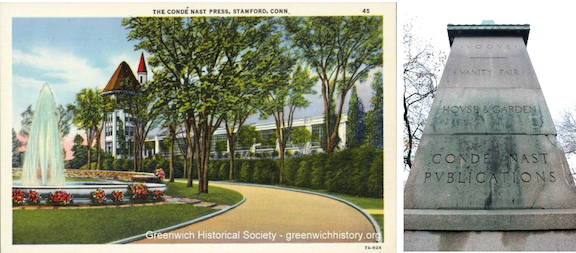
We settle in with the June 21 issue (which leads this post) with White once again, this time enjoying a drive to Stamford, Conn., where he admired the “splendor” of the Condé Nast printing plant (apparently the plant also printed The New Yorker, although the magazine itself would not be acquired by Condé Nast’s parent company, Advance Publications, until 1985).

ONLY A MEMORY…Postcard image of the Condé Nast printing plant; at left, a relic of the long-gone plant, one of two pillars that flanked the road to the plant. (Greenwich Historical Society/greenwichtime.com)

 * * *

Disney’s Other Mouse

Film critic John Mosher was a fan of Disney’s “Silly Symphony” cartoon shorts, which were produced between 1929 and 1939. Animation, and especially color animation, was in its infancy, so these doubtless had an uplifting effect on many moviegoers.

DON’T CALL ME TINKERBELL…The Butterfly Fairy brought some Disney magic to 1934’s The Flying Mouse. (disney.fandom.com)

 * * *

The Great McGonigle

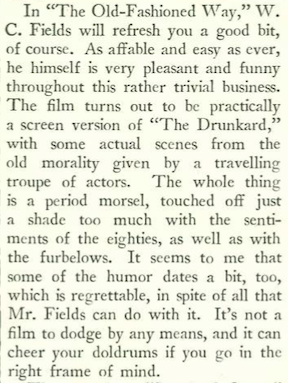
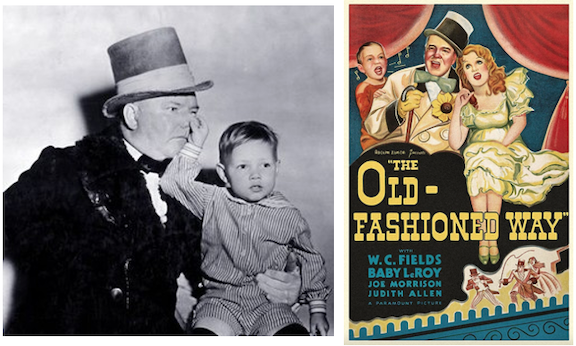
W.C. Fields appeared in more than a dozen silent films before making his first talkie, 1930’s The Golf Specialist, and it was in sound films that Fields was able to truly express his vaudevillian wit. It was also in the sound era that Fields teamed up with Baby LeRoy for three films (in 1933 and 1934), including The Old Fashioned Way, in which Fields portrayed “The Great McGonigle,” leader of a traveling (and perpetually underfunded) theater troupe who was always a step ahead of police and creditors. Critic John Mosher found the film’s riff on an old morality play, The Drunkard, to be a bit dated, but overall thought it a cheerful diversion.

HONK…Baby LeRoy, aka Ronald Le Roy Overacker (1932–2001), was just 16 months old when he became the youngest person ever put under term contract by a major studio. He is best known for his appearances in three W. C. Fields films: Tillie and Gus (1933), The Old Fashioned Way (1934) and It’s a Gift (1934). (Rotten Tomatoes/IMDB)

 * * *

From Our Advertisers

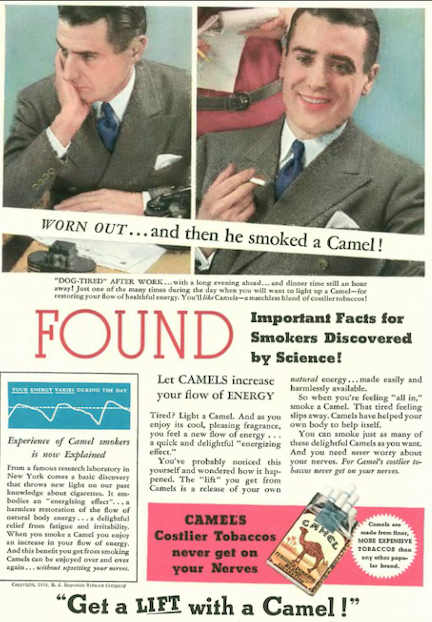
We begin with scientific proof (from a “famous research laboratory in New York”) that Camel cigarettes increased one’s flow of energy…

…if that crackpot claim doesn’t get you, here’s one that recommended downing a PBR before a big meeting, a sure remedy for that “listless, tired-out feeling”…

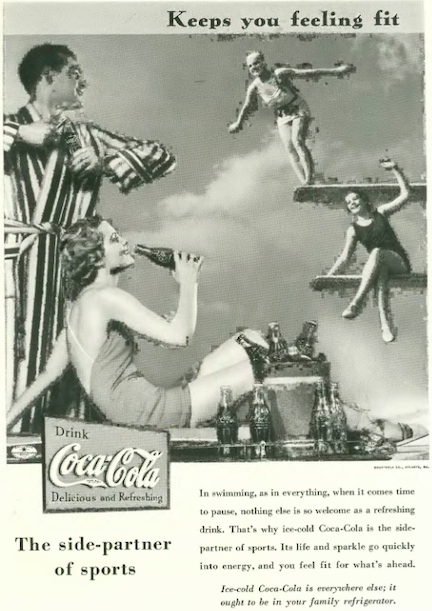
…of course we all know that a few sugary Cokes will get you going…back then they were taking it in six- and ten-ounce bottles, not 30- to 50-ounce Big Gulps…

…it’s not every day you see a dog food ad in The New Yorker…in the 1930s there was no secret to where ol’ Sparky ended up…

…popular were these Rockwellian ads that equated various products with happy and wholesome (and safe) living, in this case a massive “Dual-Balloon” tire that dominated this tableau featuring a stylish mommy and her little boy slumming with an old sea salt…

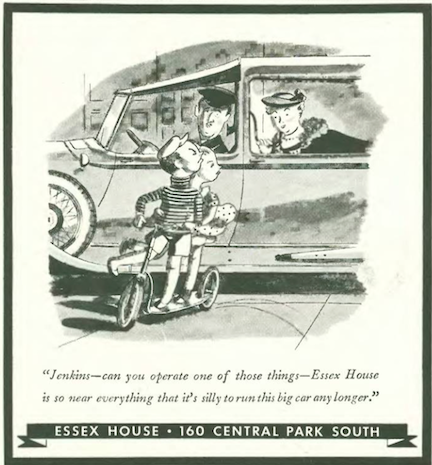
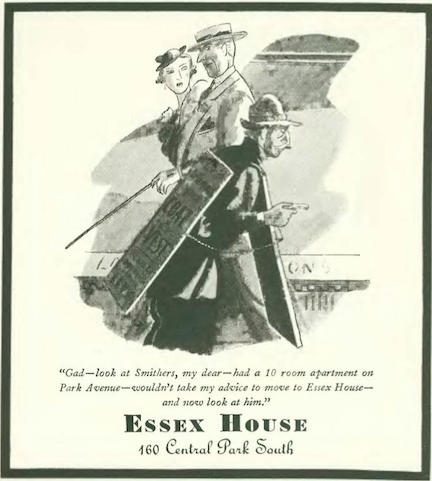
…the folks at Essex House hired an illustrator who did his or her best to channel Helen Hokinson and William Steig for this New Yorker ad…as we have seen before, Essex House ads walked a fine line between thrift and snob appeal…

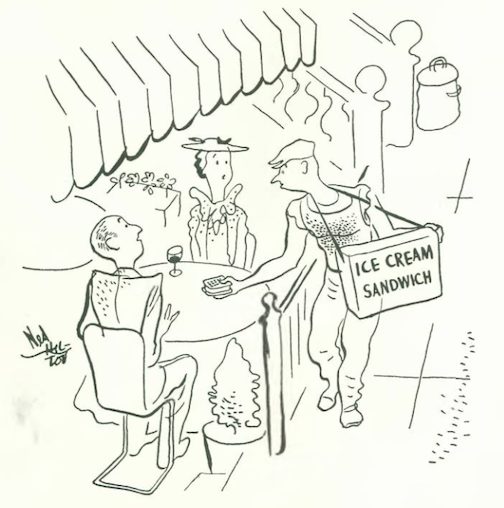
…on to our cartoons, beginning with Ned Hilton, whose work appeared in The New Yorker from 1934 to 1957…

Mary Petty recorded some sweet nothings by the seaside…

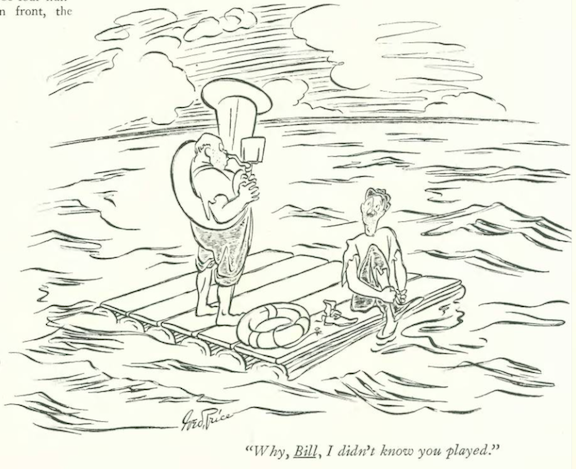
George Price drifted along with two men and tuba…

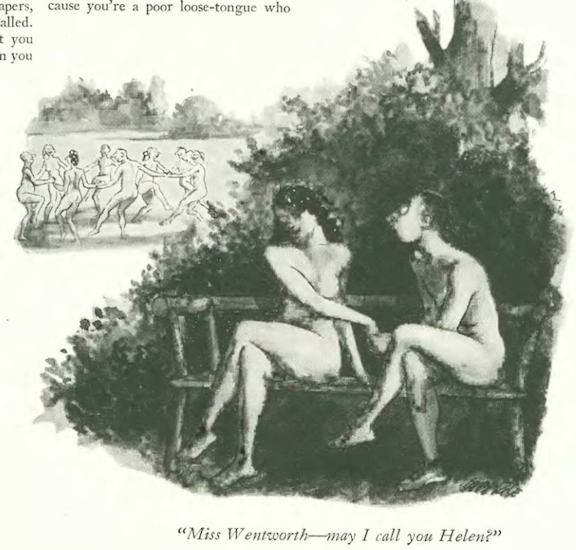
Carl Rose revealed a modest side to life at a nudist colony…

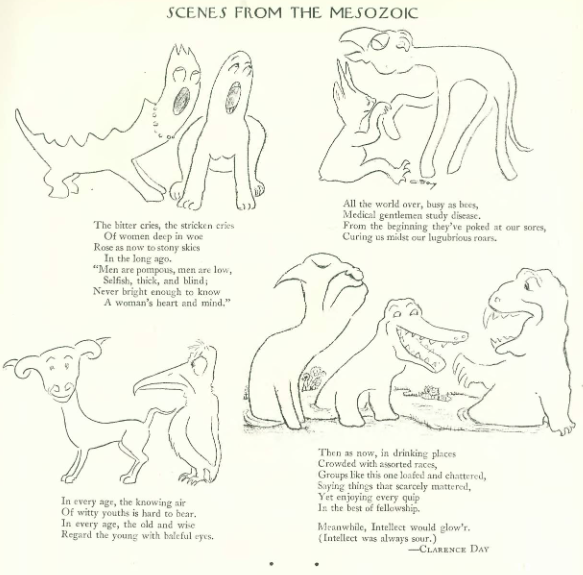
…we know Clarence Day for his Life With Father series, but on occasion he also contributed illustrated poems such as this one from the July 21 issue…

…on to July 28…

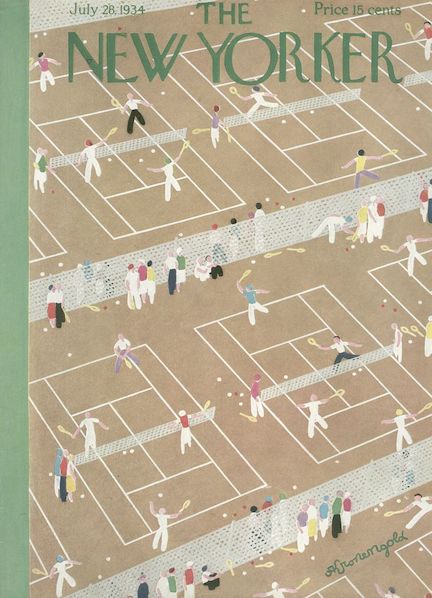
July 28, 1934 cover by Adolph K. Kronengold.

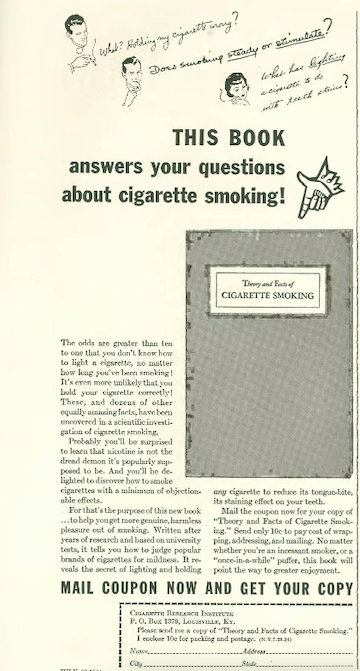
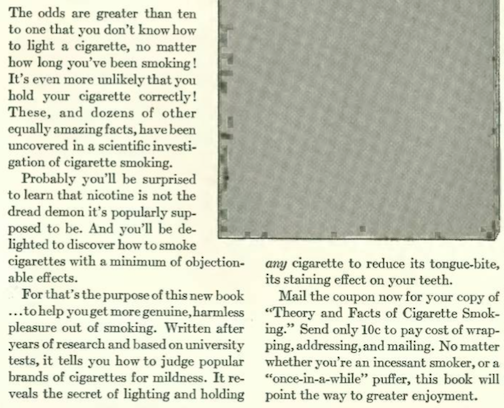
…where we encounter more “scientific research” that encouraged folks to smoke…This ad was placed on the very last page of the July 28 issue by the Cigarette Research Institute, based in Louisville, Kentucky…

…the booklet was filled with “amazing facts” uncovered in a “scientific investigation,” facts did not address the health effects of smoking, but rather such important topics as how to hold a cigarette the right way and how to reduce staining on your teeth…it also helpfully debunked the notion that nicotine was a “dread demon”…

…take for example this woman smoking a Lucky…now she knew how to hold a cigarette!…

…the folks at Essex House were back, aggressively playing the class/caste card…apparently if you lived there you were entitled to kick your old friends to the curb…

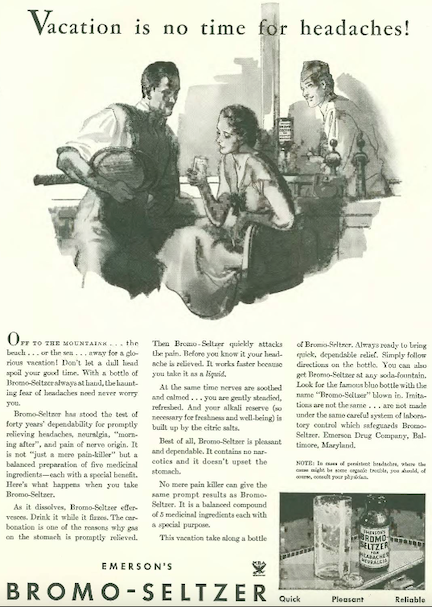
…the antacid and pain reliever Bromo-Seltzer was ubiquitous in 1930s medicine cabinets, but after the recipe was changed in the 1970s (all Bromides were withdrawn from the U.S. market in 1975) the brand slowly fizzled away…

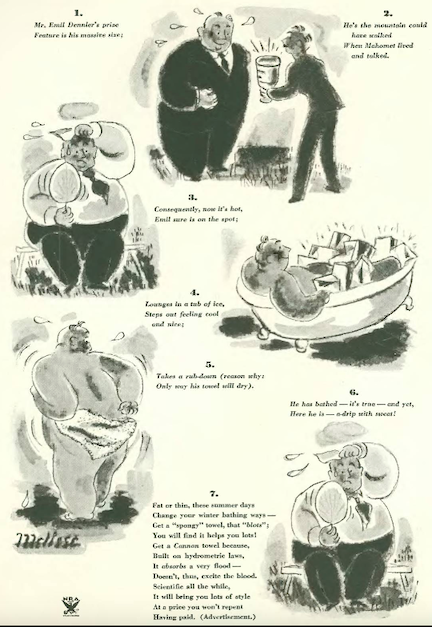
Mildred Oppenheim Melisse was a popular illustrator of ads for department stores and various household goods, including Cannon towels, here guaranteed to absorb even this man’s sweaty “flood”…

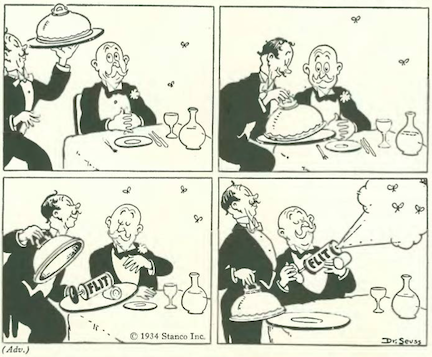
Dr. Seuss back again for Flit, once again having no issues mixing insecticide with food preparation…

Rea Irvin kicks off the cartoons with his Double Breasted Dowager…

Helen Hokinson found some misplaced pity at a garden party…

Garrett Price offered some unsolicited advice…

Reginald Marsh filled two pages with a scene from Central Park…

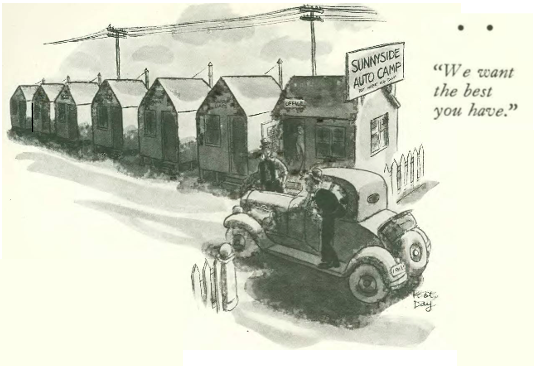
Robert Day looked for a unique experience at an auto camp…

…and we close with Barbara Shermund, and some alarming news on the domestic front…

Next Time: Men of Mystery…

Comrade Alex

If folks thought things were bad in Depression-era America, they could ponder the famine-ravaged masses in the Soviet Union…

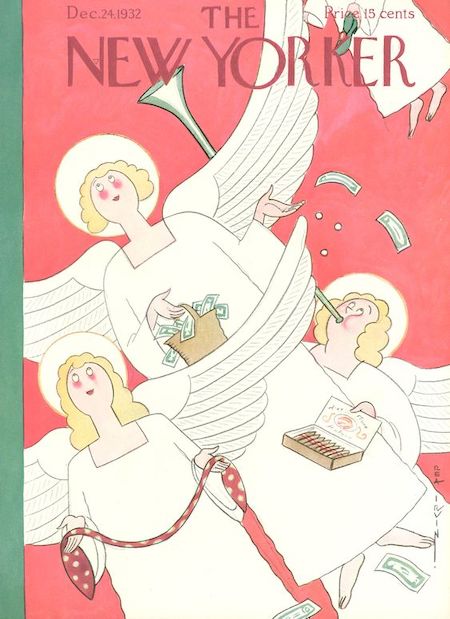
Dec. 24, 1932 cover by Rea Irvin.

…not that Alexander Woollcott seemed to notice or care all that much. In the autumn of 1932 he traveled to Moscow to check out some Russian theater and enjoy the fine food and drink provided by his friend Walter Duranty, Moscow bureau chief for The New York Times. In his “Shouts and Murmurs” column…

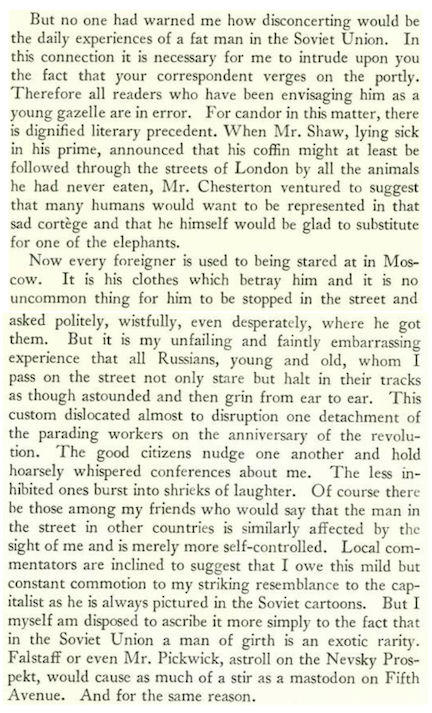
…Woollcott reflected on his Moscow visit, his humor at odds with the stark reality  all around him…

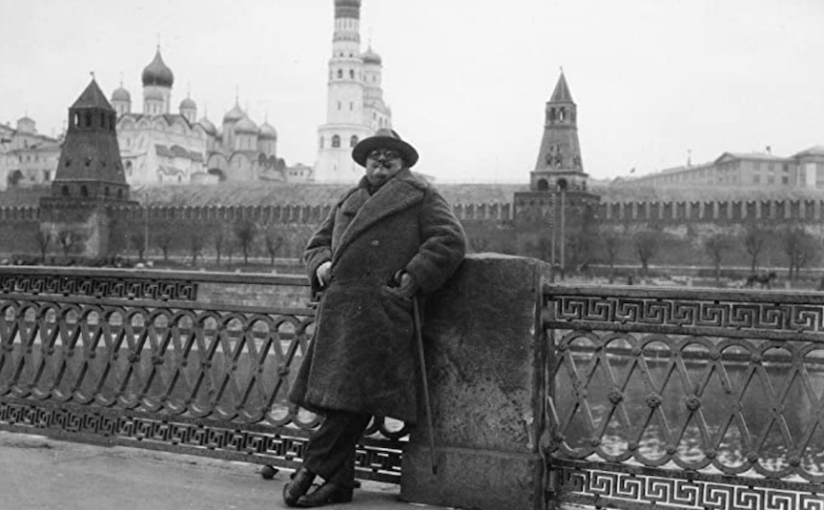
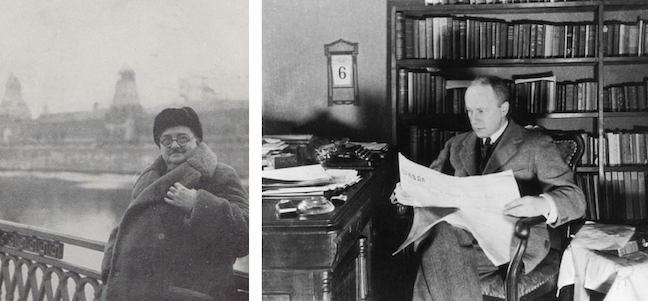
ELEPHANT IN THE ROOM…Alexander Woollcott (left) was amused by the stares of starving Russians he encountered with his substantial bulk on the streets on Moscow; Walter Duranty (1884–1957), Moscow bureau chief for The New York Times, played host to his old friend Woollcott. (Pinterest/Daily Mail)

Woollcott wrote of “spindle-shanked kids” singing cheerless songs about tractor production, recounted a conversation with a hungry moppet at a boot factory, and noted the “appreciative grin” he received from a teenager who both envied and admired his girth:

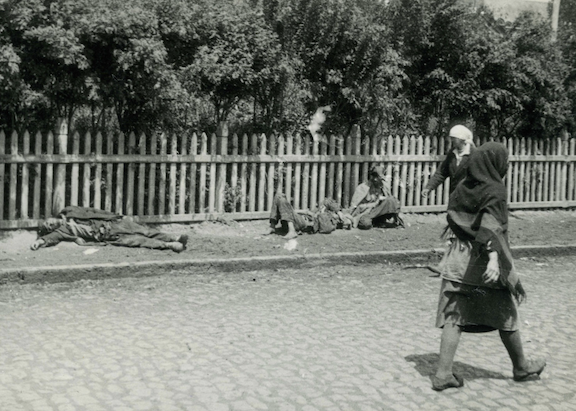
PERHAPS A SIDE TRIP TO UKRAINE?…Starved peasants on a street in Kharkiv, 1933. Millions of Ukrainians died during Stalin’s enforced famine. (Wikipedia) 

*  *  *

Happier Thoughts

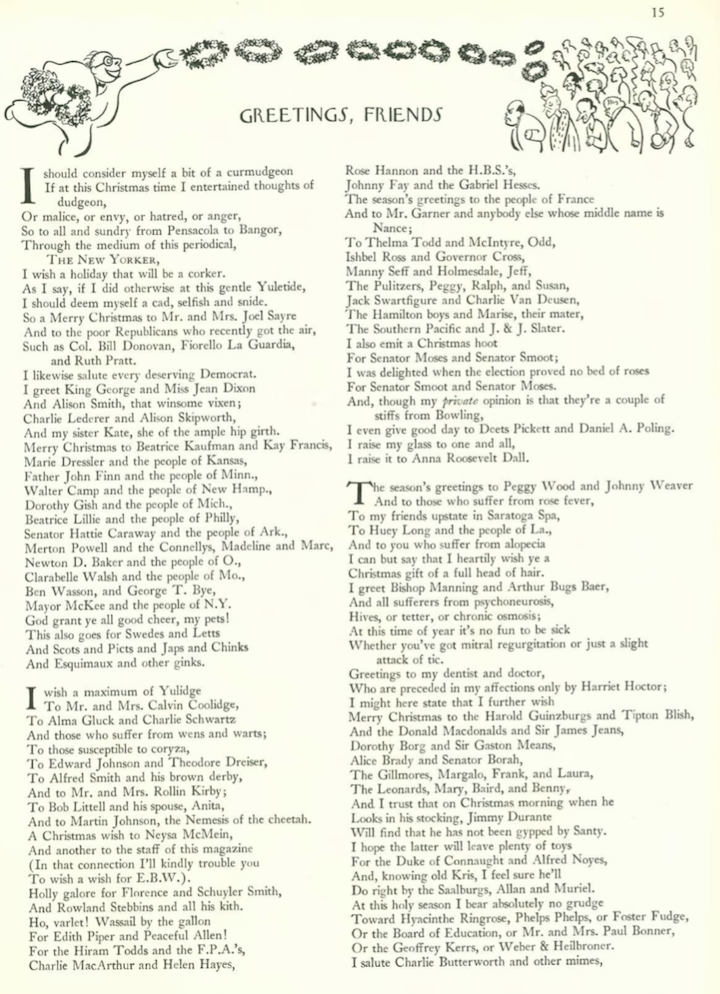
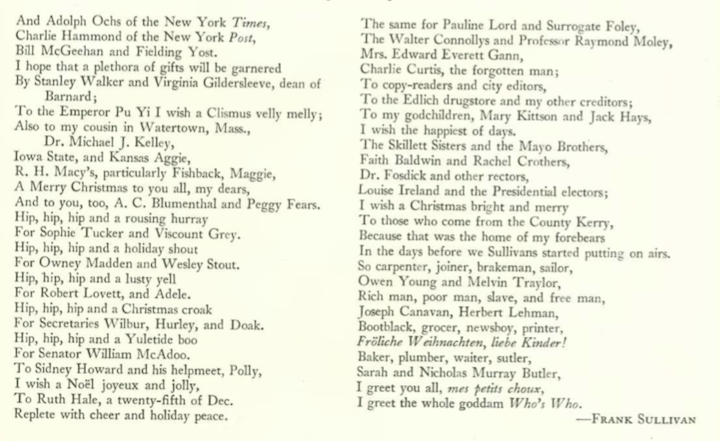
The Dec. 24 issue marked the beginning of a New Yorker tradition: Frank Sullivan’s annual holiday poem, “Greetings, Friends!” Writing for the Dec. 17, 2009 issue of The New Yorker (“Behind the Writing: “Greetings, Friends!”) Jenna Krajeski observes that “as far as holiday poems go, ‘Greetings, Friends!’…is as much an acknowledgment of the season as a noting of the times.” Frank Sullivan faithfully continued the tradition until 1974; after his death in 1976, New Yorker editor William Shawn asked Roger Angell to take over the writing of the poem. In 2012 Angell passed the duty along to Ian Frazier, the magazine’s current Yuletide bard.

CHEERFUL BUNCH…The holiday poem “Greetings, Friends!” has been a New Yorker tradition since 1932. It was originated by Frank Sullivan (left) and carried on by Roger Angell (center) and Ian Frazier. (hillcountryobserver.com/latimes.com/gf.org)

*  *  *

Waxing Poetic, Part II

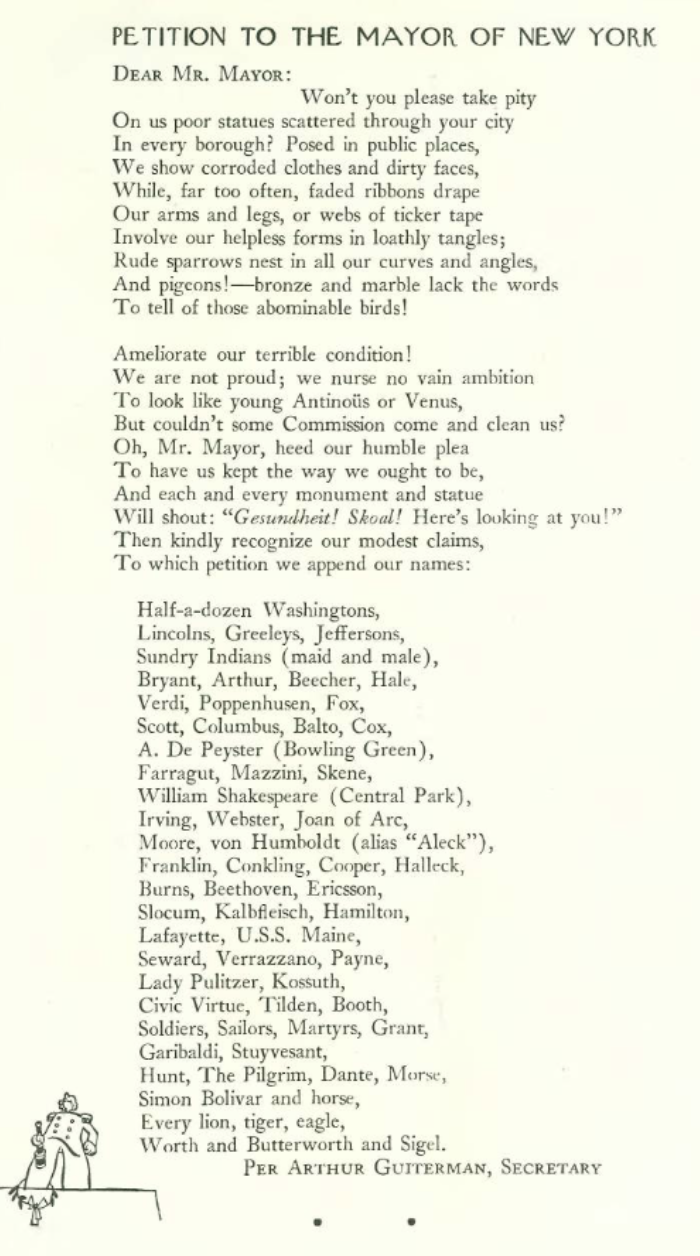
In the Dec. 17, 1932 issue humorist and poet Arthur Guiterman penned this petition to Acting Mayor Joseph McKee on behalf of the city’s statues…

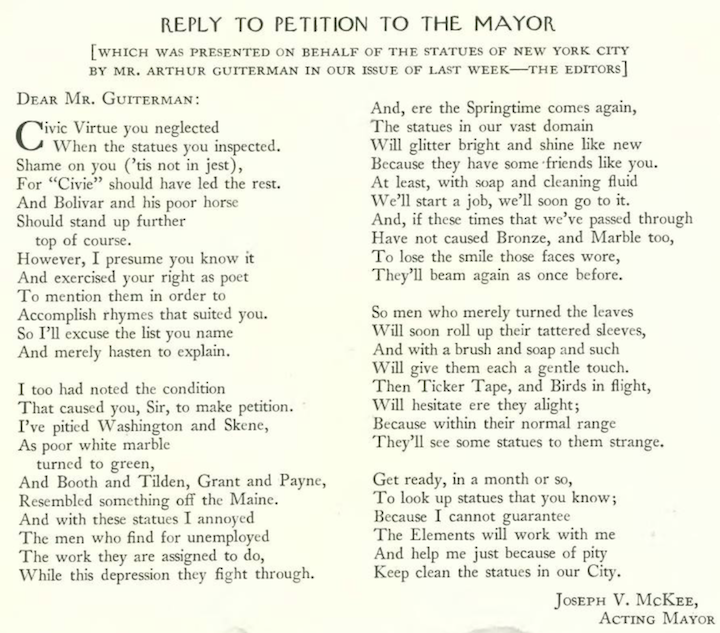
…to which Mayor McKee replied in the Dec. 24 issue:

DUELING POETS…Acting New York Mayor Joseph McKee (left) rarely smiled in photographs, but he seems to have been a person of good humor in his poetic reply to Arthur Guiterman. Both photos are from 1932. (Wikipedia/credo.library.umass.edu)

*  *  *

From Our Advertisers

New York’s fashion merchandisers continued to tout their latest copies of Paris styles such as this “Poppy Dress” from Lord & Taylor (illustration by Mildred “Melisse” Oppenheim)…

…Radio City Music Hall and the RKO Roxy Theatre announced their grand openings…

…Radio City featuring a cavalcade of stars along with the “Roxyettes” (soon to be renamed “Rockettes”) while the RKO Roxy presented the pre-Code romantic comedy The Animal Kingdom

LIGHT IN THE DARKNESS…It was winter, and the Depression was still on, but there were bright spots to be found on the stage at the opening of Radio City Music Hall and on the screen at the RKO Roxy; at right, Ann Harding, Leslie Howard and Myrna Loy in The Animal Kingdom. (Pinterest/IMDB)

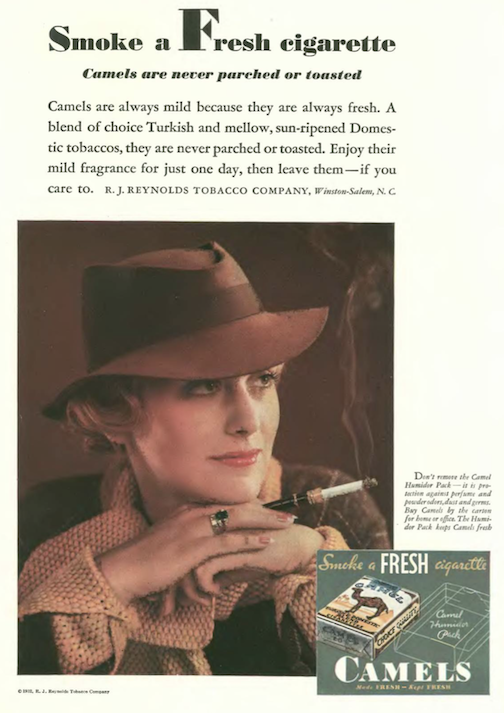
…the folks at R.J. Reynolds challenged smokers to “leave” their product, if they cared to, knowing full well they were hooking new smokers by the thousands every day…

…we ring in the New Year with some hijinks from James Thurber

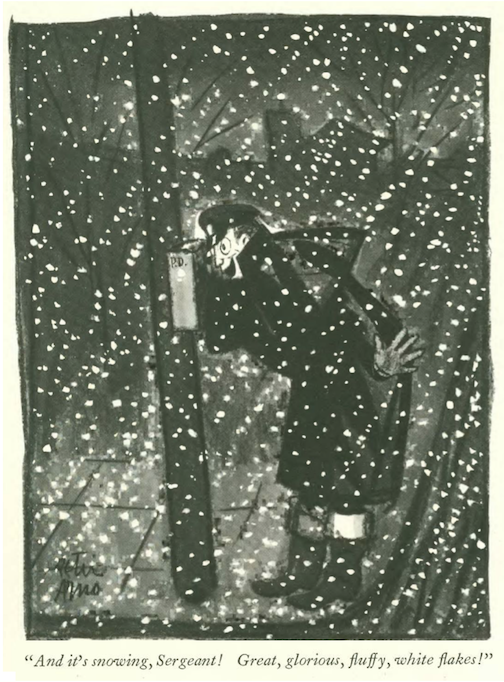
…and this unlikely dispatch from a New York police officer via Peter Arno

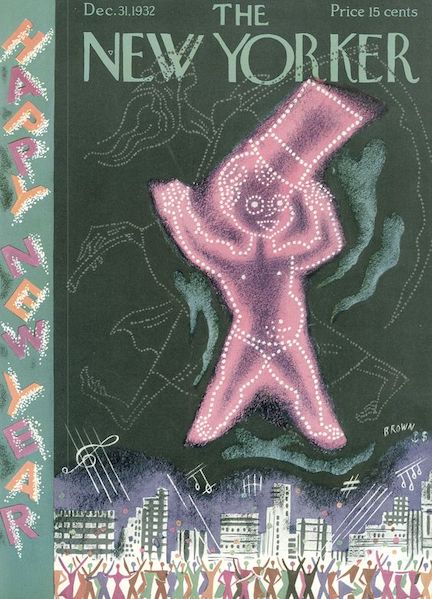
…ringing in the year with Harry Brown’s Dec. 31 cover…

Dec. 31, 1932 cover by Harry Brown.

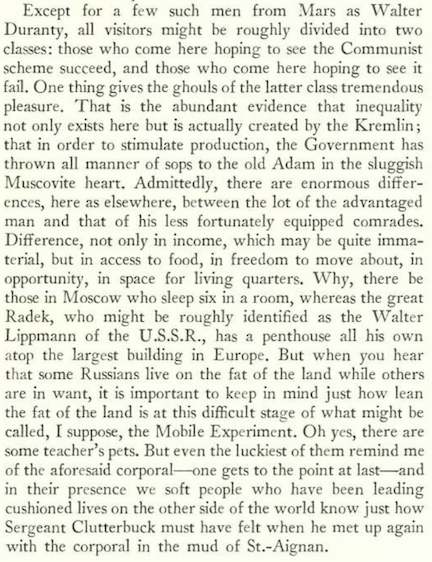
…and Alexander Woollcott’s continuing account of his visit to Moscow, where he was shown the town by his friend Walter Duranty. In this excerpt, Woollcott makes a rare political observation regarding his friend: “Except for a few such men from Mars as Walter Duranty, all visitors might be roughly divided into two classes: those who come here hoping to see the Communist scheme succeed, and those who come here hoping to see it fail.”

For the record, Duranty has been widely criticized, especially since the 1950s, for his failure to report on the 1932-33 famine (which claimed as many as 7 million lives) and for covering up other atrocities of the Stalin regime. In the 1990s there were even calls to revoke Duranty’s 1932 Pulitzer Prize, which was awarded for his reporting on the Soviet Union.

GOOD & PLENTY…Walter Duranty (center, seated) at a dinner party in his Moscow apartment. (spartacus-educational.com)

*  *  *

Rocky Theme

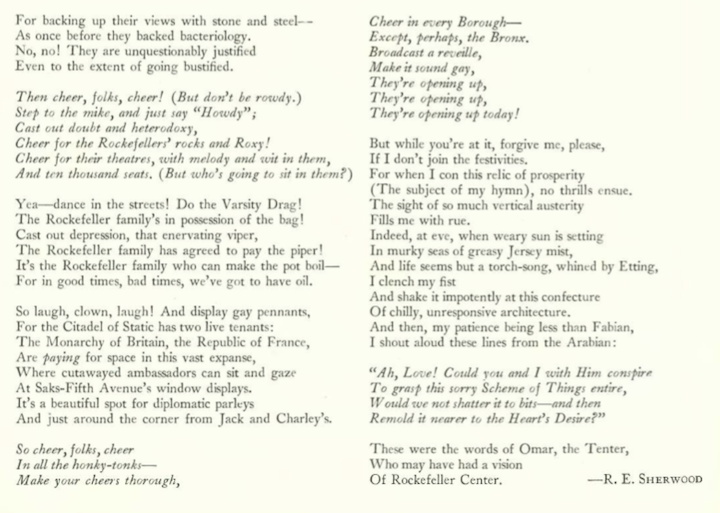
As Rockefeller Center prepared to open its doors to its first buildings (there would be fourteen in all) American playwright and screenwriter Robert E. Sherwood  penned this hymn to the “Citadel of Static”…

STANDING TALL…American playwright and screenwriter Robert E. Sherwood, one of the original members of the Algonquin Round Table, was moved to verse by the opening of Rockefeller Center’s first buildings. At left, Rockefeller Center in 1933. (Wikipedia)

*  *  *

Oh Chute

In 1929 Geoffrey Hellman secured a position with The New Yorker as a writer for “The Talk of Town” and also contributed a number of profiles, including this one about a parachute stunt-jumper named Joe Crane. Here is the opening paragraph and an illustation by Abe Birnbaum:

On Feb. 18, 1932, Joe Crane amazed crowds at Roosevelt Field with double parachute descent, in which he opened a second parachute through the first. If you are wondering, Crane died in 1968…of natural causes. (Pinterest)

 *  *  *

From Our Advertisers

Illustrator Howard Chandler Christy (1872-1952) is best remembered for his patriotic poster designs of World War I, which might explain why this fellow looks a bit outdated…

…Christy also originated the popular “Christy Girl,” the embodiment of the ideal American woman in the early 1900s (note the Christy Girl’s resemblance to the woman in the ad above)…

A “Christy Girl,” from 1906. (Internet Archive)

…speaking of ideal, imagine a movie featuring this trinity of actors: John, Ethel and Lionel BarrymoreJohn Mosher will give us his review in Jan. 7 issue…

…the Lyric Theatre saw its glory years during the 1920s when it hosted stage shows featuring such talents as The Marx Brothers, Fred and Adele Astaire and a young Cole Porter, who hit it big in 1929 with Fifty Million Frenchmen…the 1930s, however, saw the Lyric’s fortunes diminish and in another year it would be converted into a movie house…also note the influence of Italian Futurists in this ad for an Italian theater troupe…

…and there’s also a futuristic bent to this Garrett Price cartoon, which steers more in a Kandinsky direction…

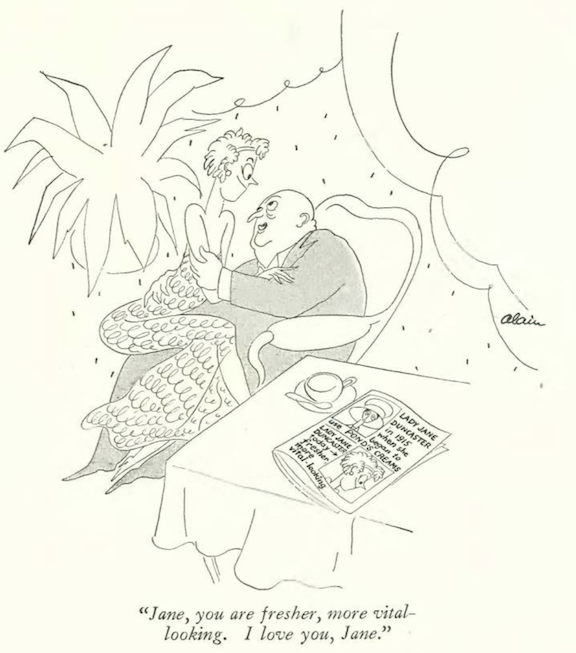
…cartoonists were also finding inspiration in the magazine’s advertising, Pond’s cold cream providing the spark for Alain (aka Daniel Brustlein)…

…for reference, a Pond’s ad from 1933 comparing Lady Diana Manners complexion to her former visage, circa 1924…

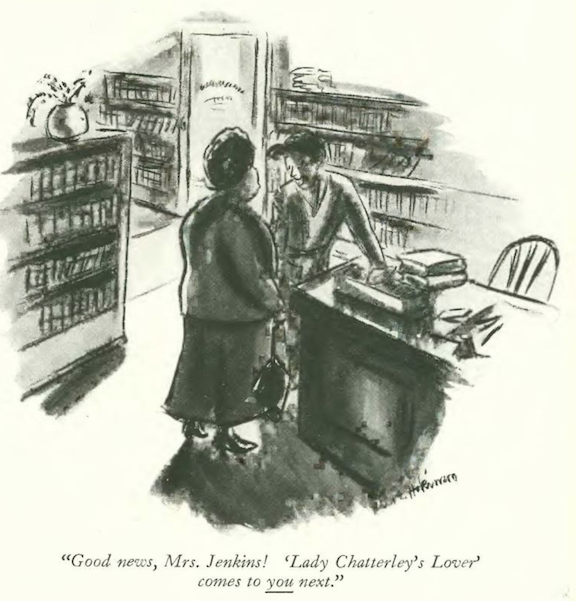
Lady Chatterley’s Lover, by D. H. Lawrence, was banned for obscenity in the United States in 1929, but Helen Hokinson’s enterprising librarian was still able to deliver the goods…

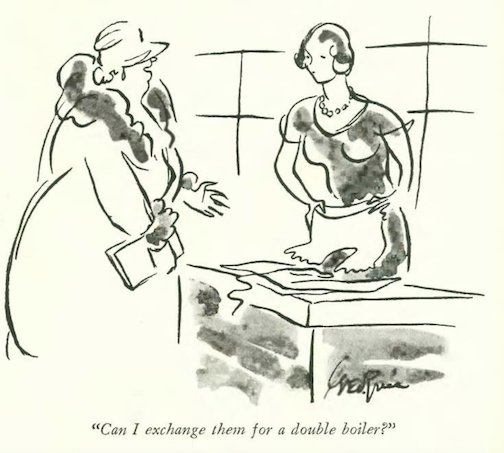
…on the other hand, it is doubtful George Price’s sales clerk will also deliver…

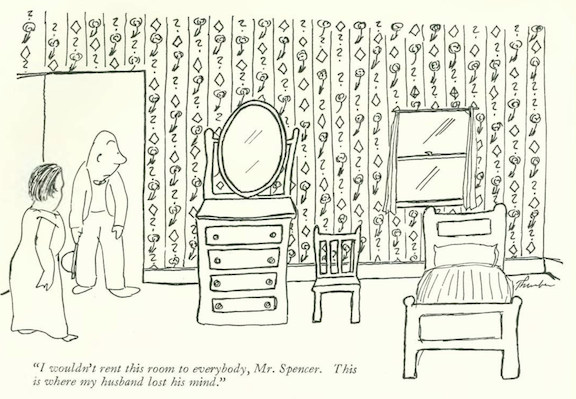
…a great one by James Thurber, with more detail than his usual spare line…

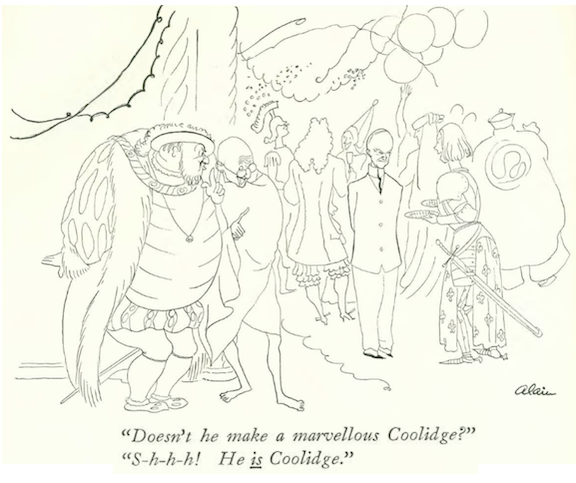
…and we say goodbye to 1932 with Alain, and a New Year’s Eve party with some familiar faces…

Next Time: Modernism Lite…

Pining for Tin Lizzy

In 1922, a young Cornell graduate named E.B. White set off across America in a Model T with a typewriter and a sense of adventure.

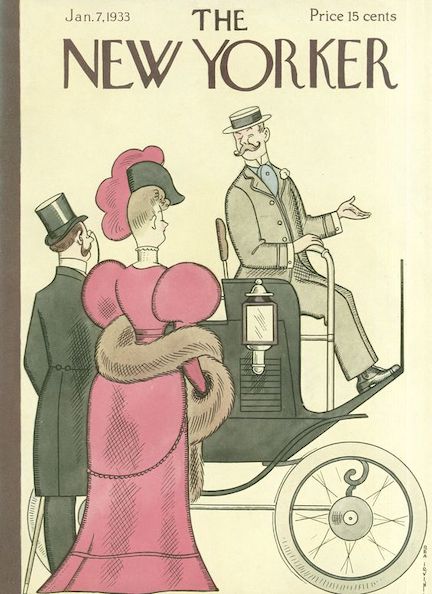
Nov. 12, 1932 cover by Constantin Alajalov.

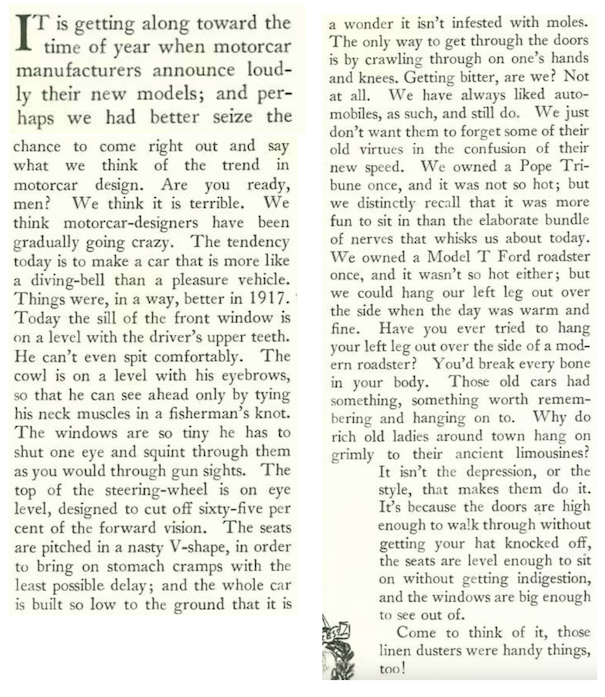
Years later, 1936 exactly, White would recall the America he had discovered as a 22-year old in his book From Sea to Shining Sea, which would include an essay “Farewell to Model T” that first appeared in The New Yorker as “Farewell My Lovely.” For this Nov. 12, 1932 “Notes and Comment” column, it appears White is already pondering his paean to the Model T, contrasting its freedom with the glassed-in claustrophobia of modern cars:

OUT WITH THE NEW, IN WITH THE OLD…Despite their many shortcomings, E.B. White seemed to prefer the cars of yesteryear, including (above) the 1904 Pope Tribune and 1917 Ford Model T Roadster; White likened modern cars, such as the 1932 Ford and Chevrolet sedans (bottom, left and right) to riding in a “diving bell.”(Wikimedia/vintagecarcollector.com/Pinterest)

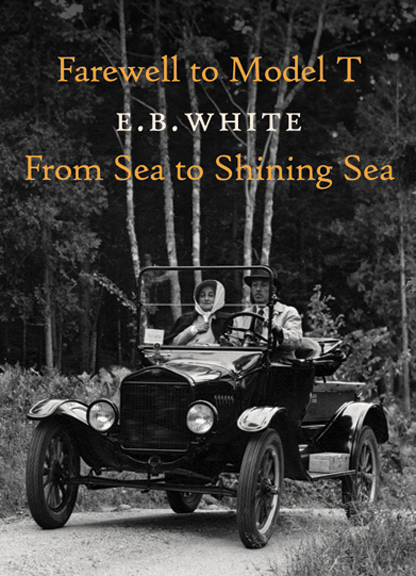
Here’s the cover of From Sea to Shining Sea, which features a photo of White and his wife, Katharine, in a Model T Roadster…

*  *  *

An Appreciation

Mary Cassatt (1844-1926) was an American painter who for most of her adult life lived in France among fellow Impressionists. Like her friend Edgar Degas, Cassatt excelled in pastels, works that were admired by critic Lewis Mumford in an exhibition at New York’s Durand-Ruel Galleries:

TRY A LITTLE TENDERNESS…Mothers and children were Mary Cassatt’s favorite subjects. Among the examples shown in 1932 at the Durand-Ruel Galleries’ Exhibition of Pastels were Cassatt’s A Goodnight Hug (1880) and Françoise, Holding a Little Dog, Looking Far to the Right (1909). (Sotheby’s/Christie’s)

*  *  *

Hollywood Slump

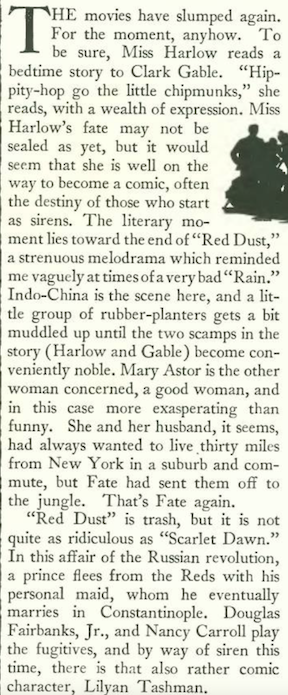
We go from treasure to trash with John Mosher’s latest cinema dispatch, in which he recounts his experience watching the “strenuous melodrama” Red Dust, starring Clark Gable and Jean Harlow. Mosher assured readers that the film is trash, but better trash than Scarlet Dawn with Douglas Fairbanks Jr. and Nancy Carroll.

DUMB AND DUMBER…Jean Harlow attempts to distract Clark Gable from his work in Red Dust; at right, Douglas Fairbanks Jr. is tempted by a servant girl’s affection (Nancy Carroll) in Scarlet Dawn. (IMDB)

*  *  *

From Our Advertisers

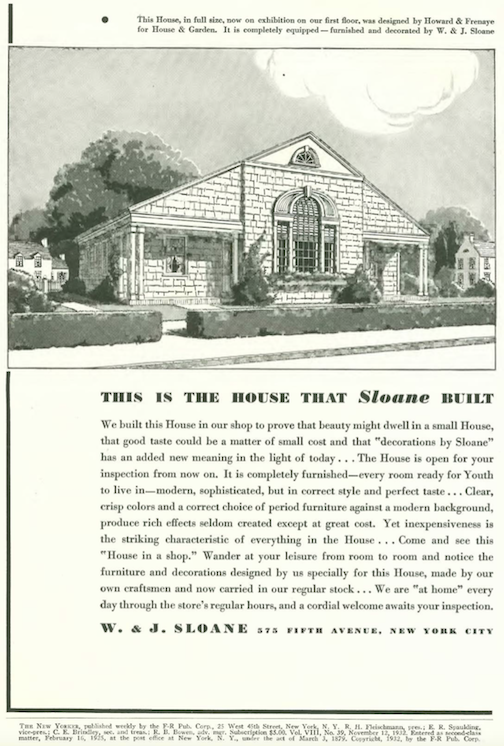
The folks at W.J. Sloane decided that the best way to sell their housewares would be to build an actual house in their Fifth Avenue store…

…do you really want to buy Kraft cheese after looking at this ad? From the look on the woman’s face, that tiresome old wheeze-bag probably smells like aged cheese, and not in a good way…

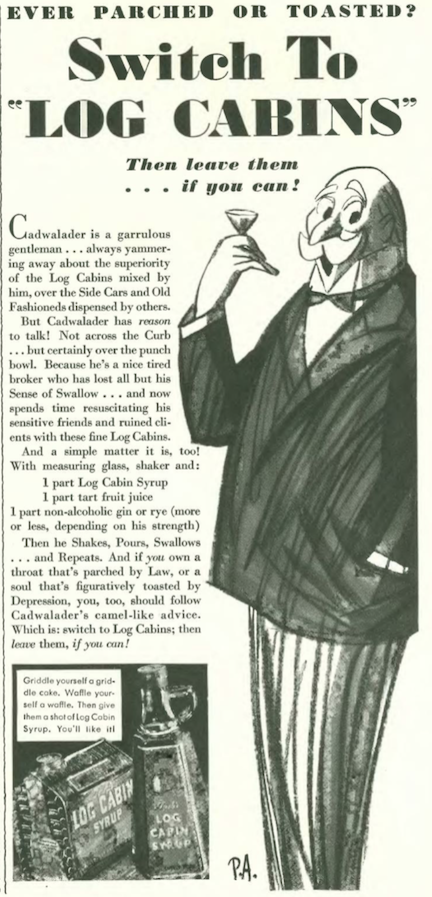
…The makers of Log Cabin syrup continued to parody the popular taglines of tobacco companies with ads featuring a several New Yorker cartoonists, here Peter Arno

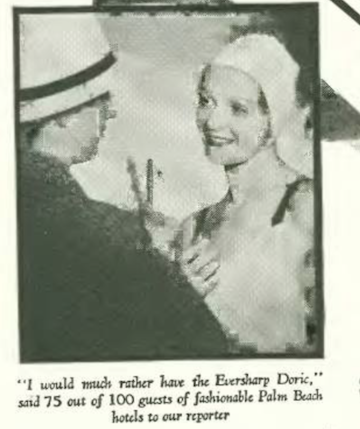
…yep, when I’m relaxing on the beach I like to talk about ink pens, especially those Eversharp ones…

…nor do I mind some weirdo in a dark coat seeking my opinion of said pen while I frolic near my fashionable Palm Beach hotel…

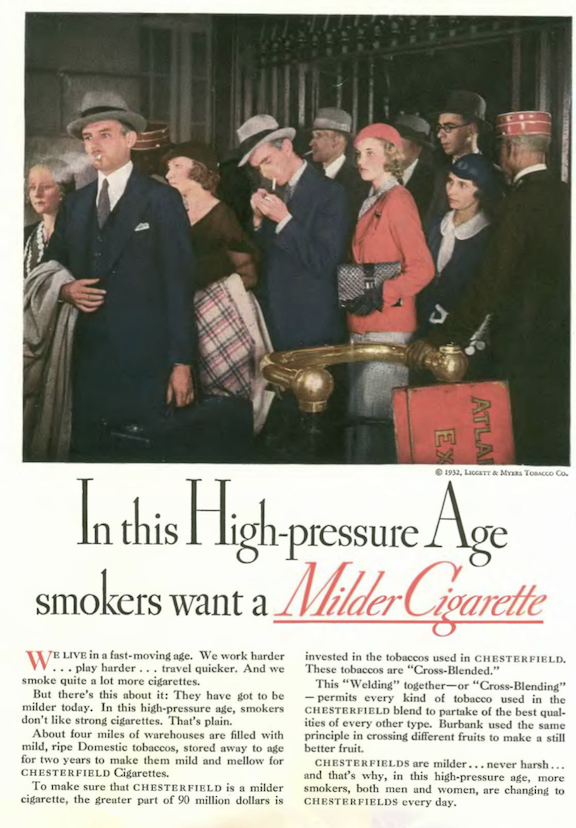
…yes, we all know that Chesterfields are milder, but will someone help that poor man on the left who appears to be blowing out his aorta…

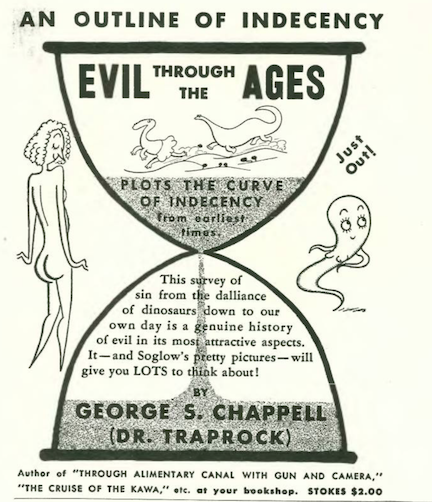
The New Yorker’s former architecture critic George S. Chappell (who wrote under the pen-name T-Square) had moved on to other things, namely parodies of societal mores, including this new book written under his other pen-name, Walter E. Traprock, with illustrations by Otto Soglow

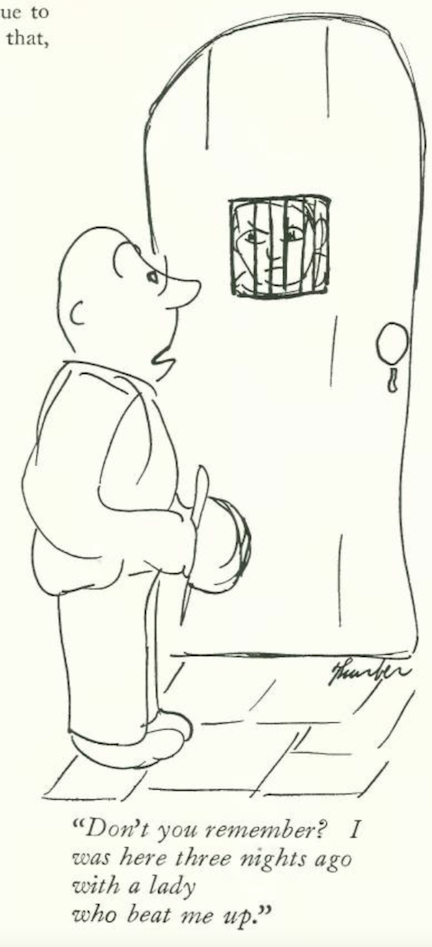
…on to our cartoons, we begin with James Thurber and the travails of menfolk…

Richard Decker gave us the prelude to one man’s nightmare…

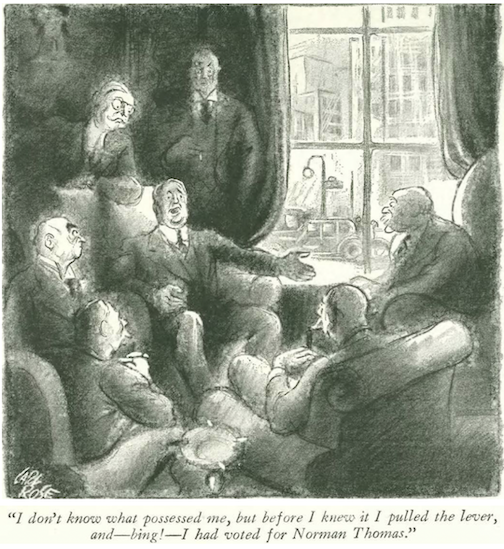
Carl Rose found a titan of industry puzzling over his vote for a socialist candidate…

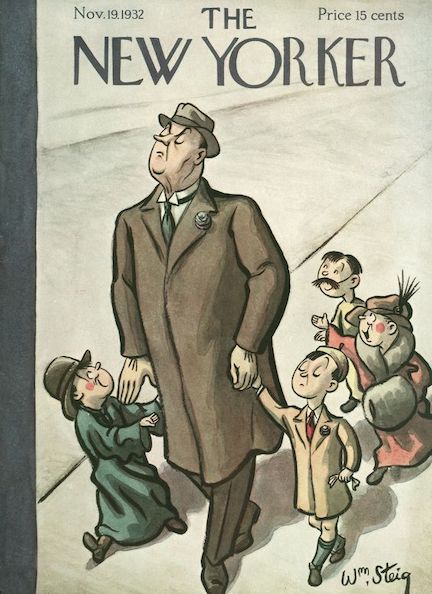
…and we move on to Nov. 19, 1932…

Nov. 19, 1932 cover by William Steig.

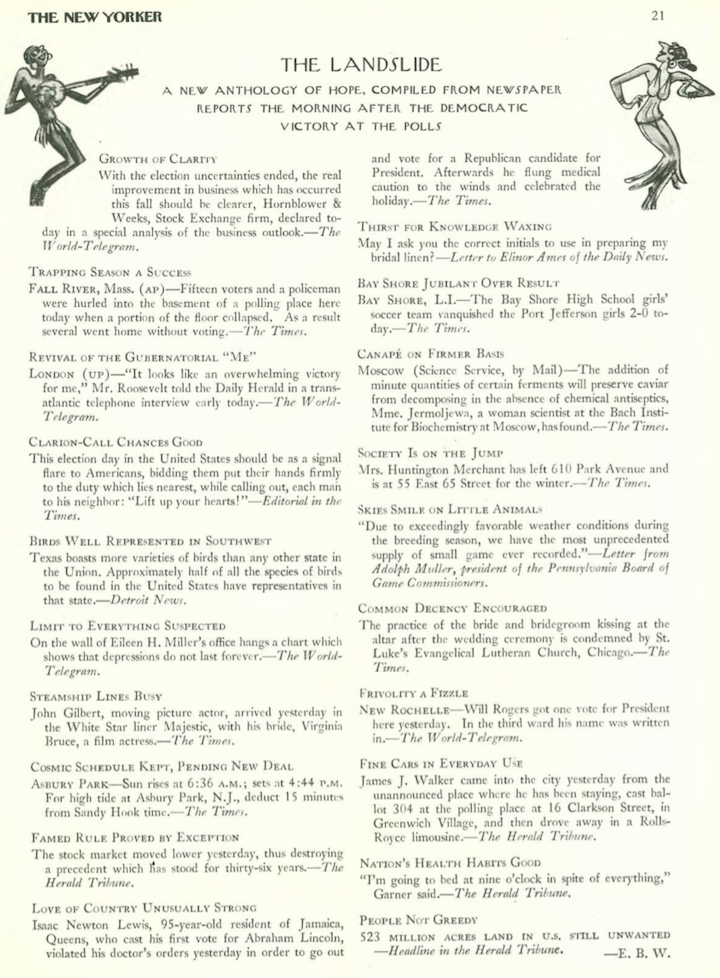
…and this compendium of election highlights by E.B. White

…and Howard Brubaker’s wry observation of the same…

BUSY DAYS AHEAD…Franklin D. Roosevelt celebrates his landslide victory over Herbert Hoover in the 1932 presidential elections. (Associated Press)

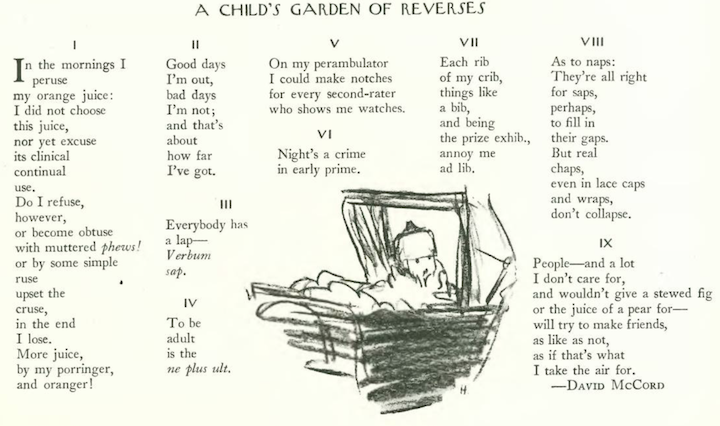
…and on an even lighter side, poet David McCord’s take on a Robert Louis Stevenson classic…

…speaking of children, the New Yorker was looking ahead to Christmas, and what the little ones might be hoping for under the tree…

ALL HUNG UP ON MICKEY…Mickey Mouse puppet was popular with the kiddies in 1932. (Ebay)

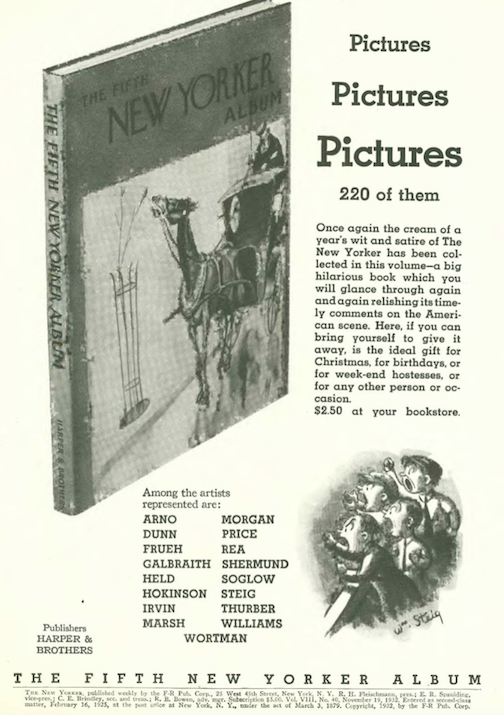
…if Mickey Mouse wasn’t your thing, you could spring for The Fifth New Yorker Album

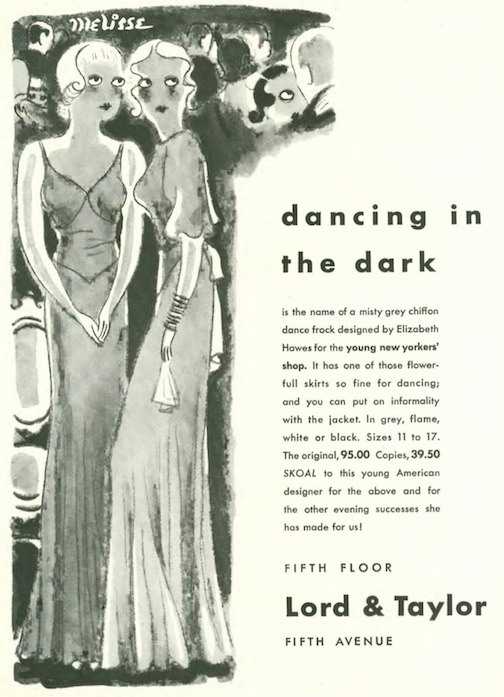
…on to our other Nov. 19 advertisements, Mildred Oppenheim (aka Melisse) illustrated another whimsical Lord & Taylor ad…

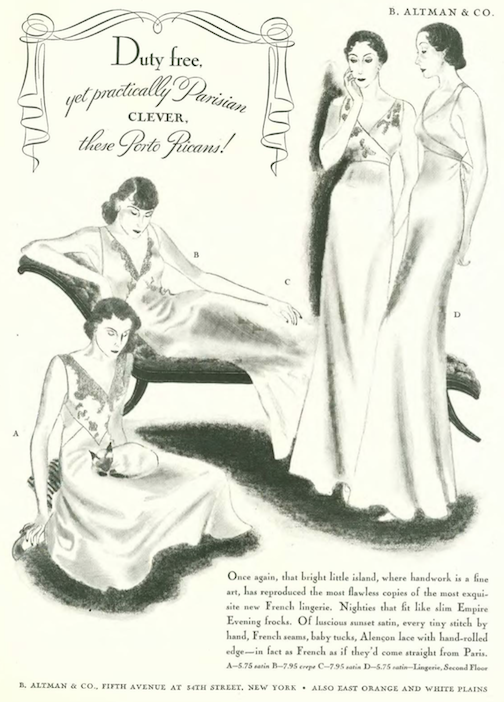
…while B. Altman maintained its staid approach to fashion to tout these duty-free, “practically Parisian” nighties created by “clever Porto Ricans”…

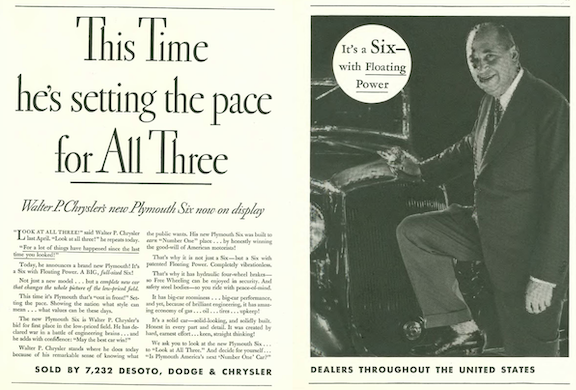
Walter Chrysler continued to spend big advertising bucks to promote his company’s “floating power”…

…in my last entry I noted E.B. White’s musings regarding Lucky Strike’s new “raw” campaign…this appeared on the Nov. 19th issue’s back cover…

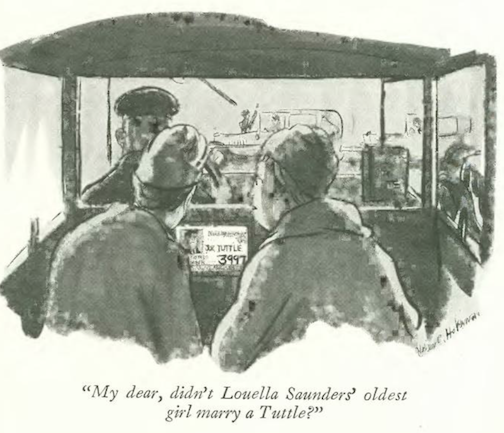
…on to our cartoons, we have Helen Hokinson’s girls pondering the social implications of a cabbie’s identity…

James Thurber explored the dynamic tension provided by passion dropped into mixed company…

Carl Rose offered a bird’s eye view of the 1932 election…

William Crawford Galbraith showed us one woman’s idea of sage advice…

…and George Price continued to introduce his strange cast of characters to The New Yorker in a career that would span six decades…

…on to our Nov. 26 issue, and a cover by William Crawford Galbraith that recalled the post-impressionist poster designs of Toulouse-Lautrec

Nov. 26, 1932 cover by William Crawford Galbraith.

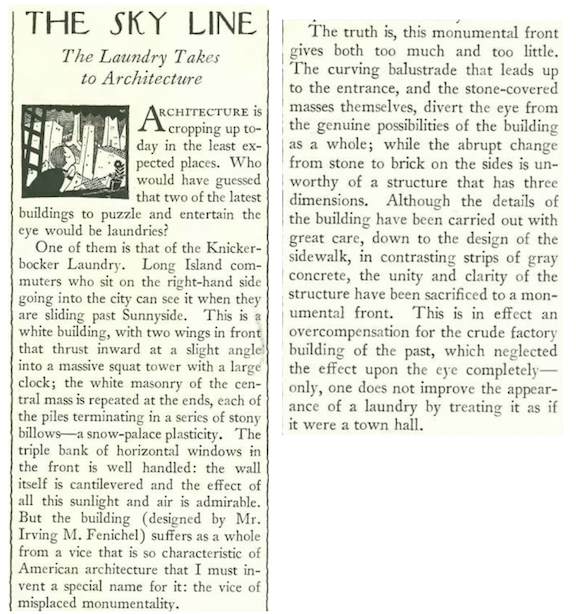
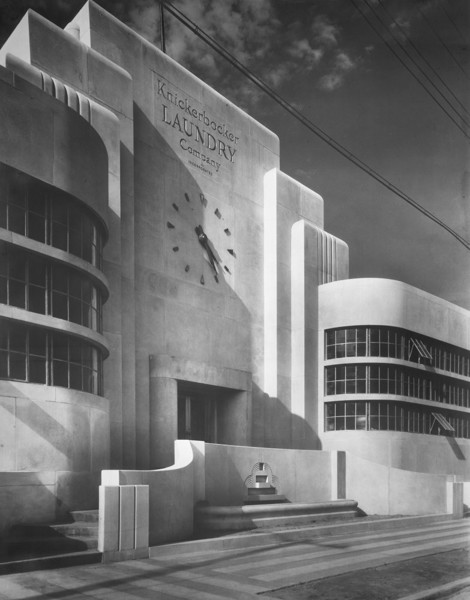
…and in this issue we have Lewis Mumford back on the streets assessing New York’s ever-changing landscape, including an unexpectedly “monumental” design for a Laundry company:

ALL WASHED UP?…Irving M. Fenichel’s Knickerbocker Laundry Building seemed a bit too monumental for Lewis Mumford. (ribapix.com)

…the building still stands, but is substantially altered (now used as a church)…

 *  *  *

Wie Bitte?

Attributed to E.B. White, this “Talk of the Town” item, “Besichtigung” (sightseeing) told readers — in pidgen German — about a visit to the German Cruiser Karlsruhe docked in the New York harbor.

…I try my best to avoid contemporary political commentary (this blog should be a respite from all that!), so I will let Howard Brubaker (in “Of All Things”) speak for himself regarding the outcome of the 1932 presidential election:

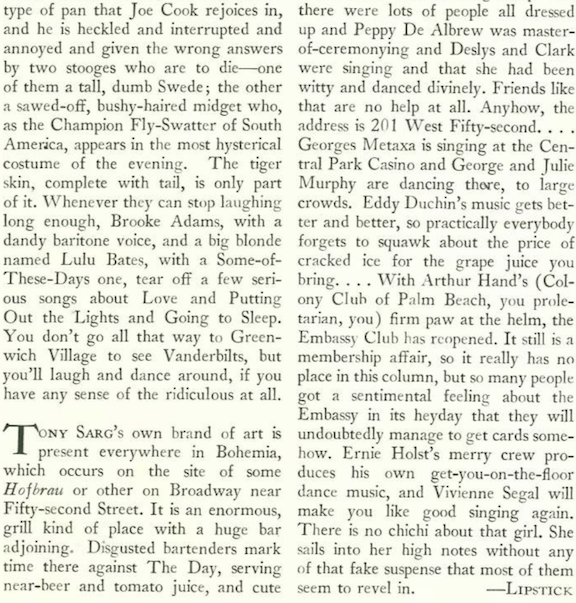
…in researching the life and work of Lois Long, there seems to be a consensus out there in the interwebs that her “Tables for Two” column ended in June 1930, however she continued the write the column from time to time, including this entry for Nov. 26 with a bonus illustration by James Thurber

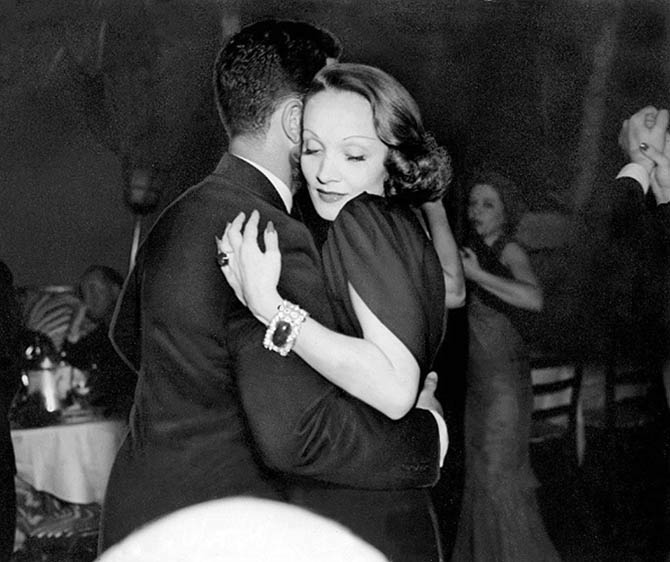
MARLENE DIETRICHING…was how Lois Long described the star’s appearance at the Bohemia club. Above is a photo of Marlene Dietrich and Cornelius Vanderbilt Whitney dancing at the New York club El Morocco in 1938. (Beinecke Rare Book and Manuscript Library)

*  *  *

From Our Advertisers

More Christmas ideas from the folks at Rogers Peet…hey, I could use a new opera hat!…and look at all those swell ash trays…

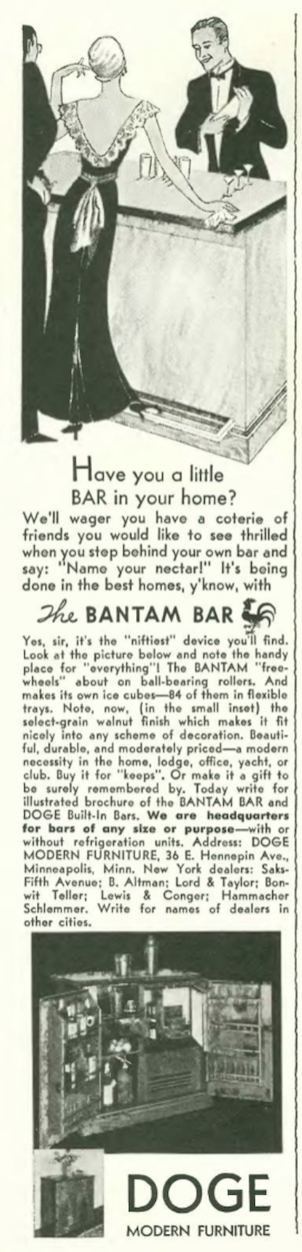
…yes, Prohibition is still around for another year, but the wets are ascendent, FDR is in office, so let’s get the party started…

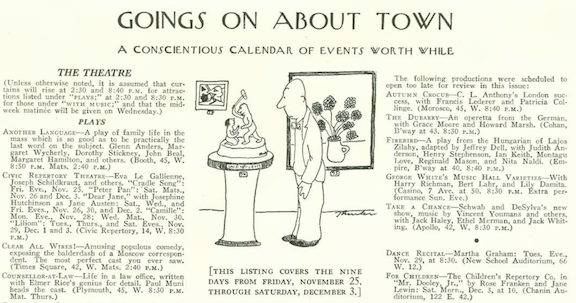
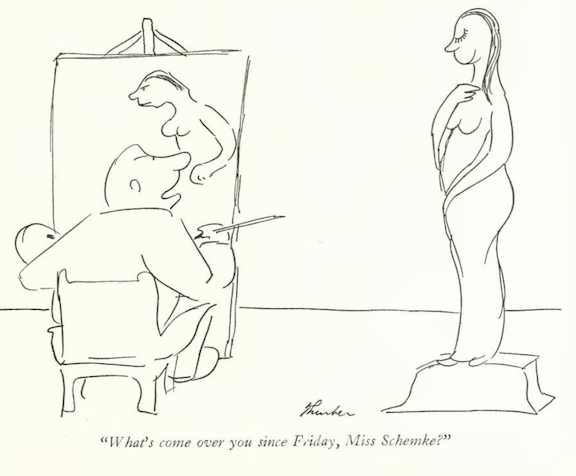
…on to our cartoonists, we begin with this illustration by James Thurber for the magazine’s events section…note the familiar theme of the sculpture, pondered by the young man…

…we are off to the races with William Steig, and some news that should kick this fella into high gear…

…and we close, with all due modesty, via the great James Thurber

Next Time: Cheers For Beer…

The Quiet Man

One of the challenges of writing these posts is giving proper due to the many writers and artists who helped shape The New Yorker universe, and especially to those we’ve almost forgotten.

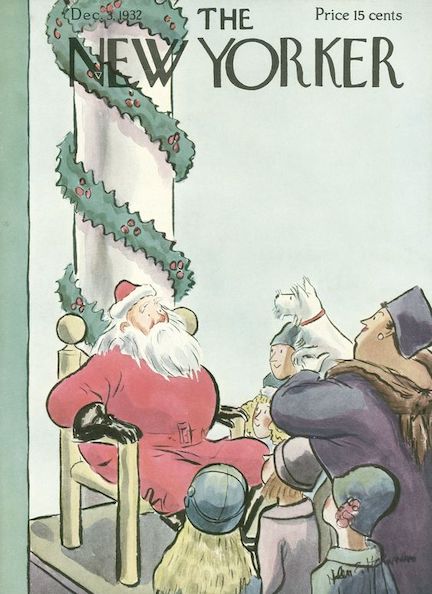
April 30, 1932 cover by Theodore Haupt.

One writer who deserves our special attention is John Mosher, film critic for the New Yorker from 1928 to 1942 and a pioneer of The New Yorker short story. In her 2000 book Defining New Yorker Humor, Judith Yaross Lee notes how the “burlesque” prose of the early magazine was displaced by Mosher’s quieter humor, which lent support to Dorothy Parker’s ironic mode and E.B. White’s “travails of the Sufferer.” Mosher’s prose, writes Lee, “helped New Yorker humor combine broad comic conception and ironic realistic narration.”

In addition to regular film reviews and occasional profiles, Mosher penned nearly fifty short stories, or “casuals” as they were called. It was also Mosher who “discovered” writer John O’Hara when in 1929 he found one of O’Hara’s pieces in a “slush pile” of unsolicited submissions. He is also credited with discovering James Thurber.

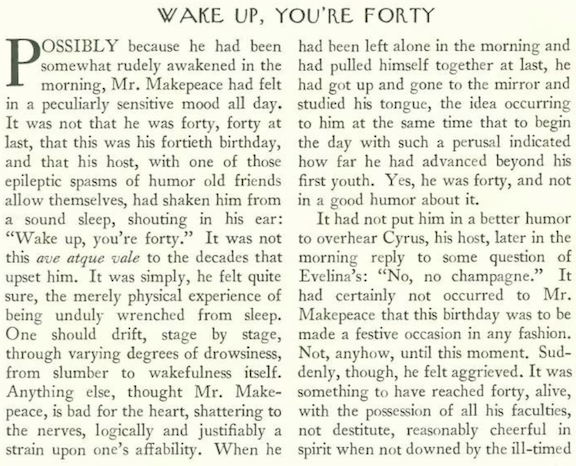
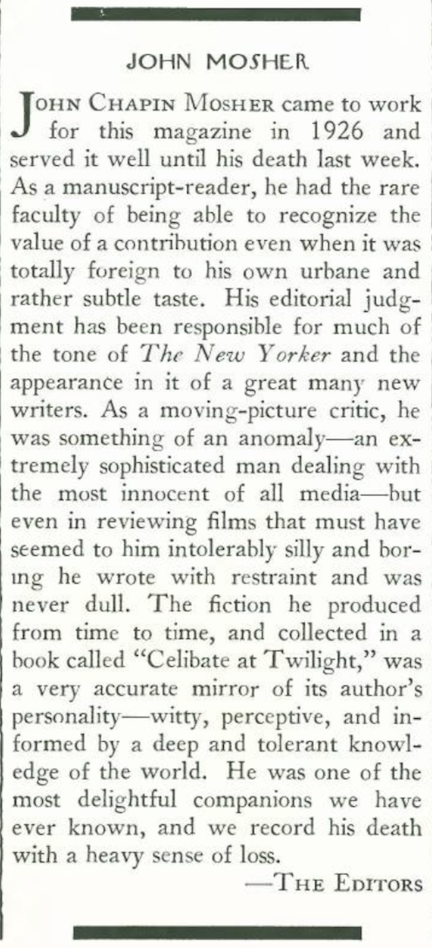
Without further ado, here is one of Mosher’s shorts, “Wake Up, You’re Forty” (Mosher turned forty in 1932) from the April 30 issue. It demonstrates Mosher’s ironic narrative style, skillfully deployed to describe a comically minor event:

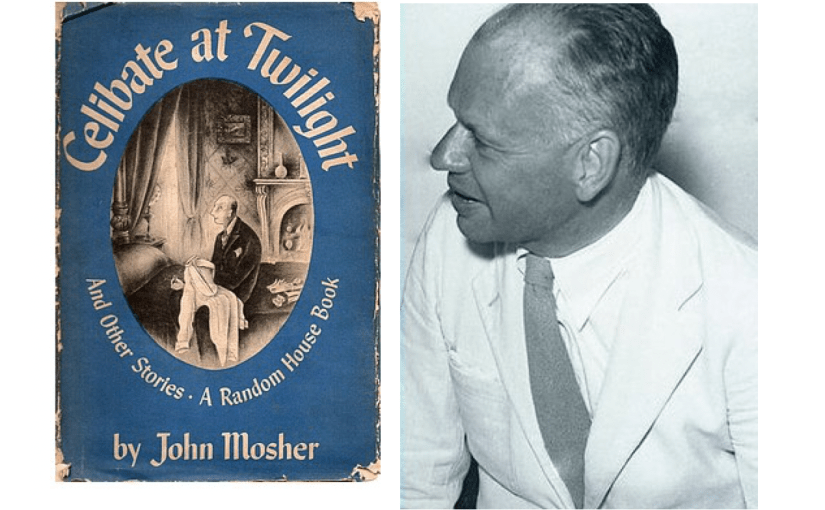
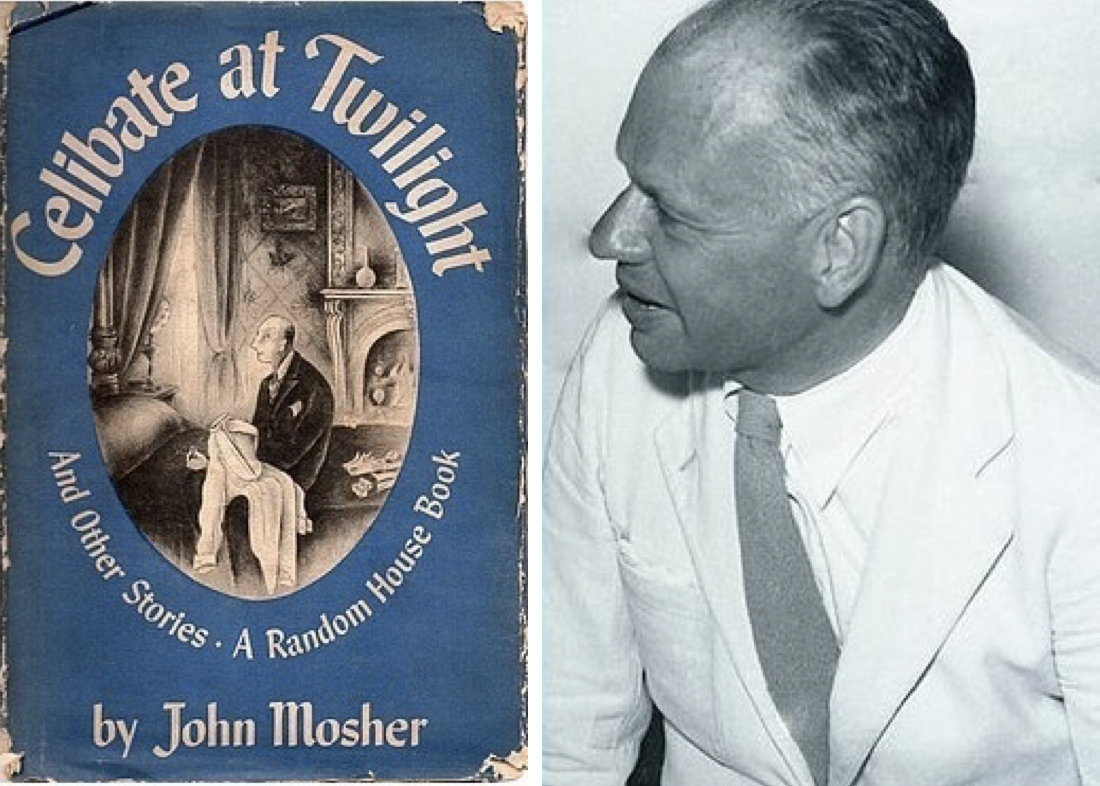
THE STORYTELLER…John Mosher’s New Yorker short stories (1925 to 1940) were collected in Celibate at Twilight, illustrated by New Yorker cartoonist Mary Petty. It included tales about life on Fire Island, where Mosher and his partner, broker Philip Claflin, became the first gay property owners in the vacation village of Cherry Grove. Visitors included Mosher’s close friend Edith Lewis as well as Willa Cather, Janet Flanner, Wolcott Gibbs, and James Thurber. (neglectedbooks.com/findagrave.com)
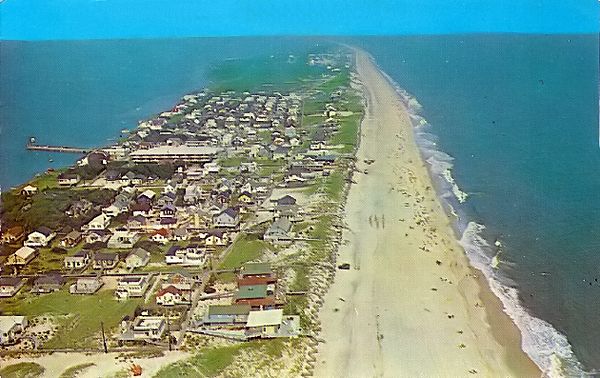
Aerial view of Cherry Grove, circa 1960. (pineshistory.org)

On Sept. 3, 1942, Mosher died of heart failure in New York City at the young age of 50. He was remembered by his New Yorker colleagues in this eulogy found on page 72 of the Sept. 12, 1942 issue:

*  *  *

Going Up!

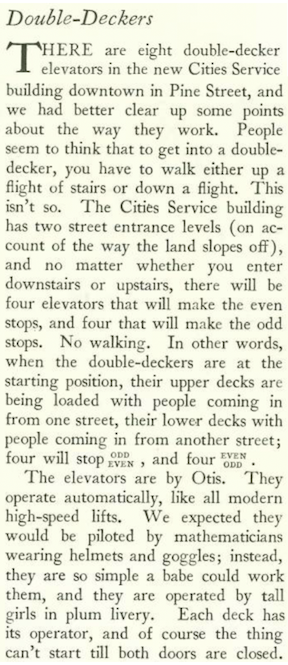
The “Talk of the Town” took a look at the innovative double-decker elevators being installed in the new Cities Service Building (now 70 Pine Street) in Lower Manhattan. Although the Cities Service building didn’t have the fame of the Empire State Building or the Chrysler Building, when completed the 952-foot Cities Service Building stood as the third tallest in the world.

STILL STANDING TALL…The Cities Service Building (now 70 Pine Street) in Lower Manhattan after its completion in 1932; center, a miniature model of the building, incorporated between the eastern entrance portals on Pine and Cedar Streets; at right, a clipping from the January 1932 Popular Science magazine detailing the unique double-decker elevator design. (MCNY/Wikipedia/Popular Science)

 *  *  *

Electric Patriotism

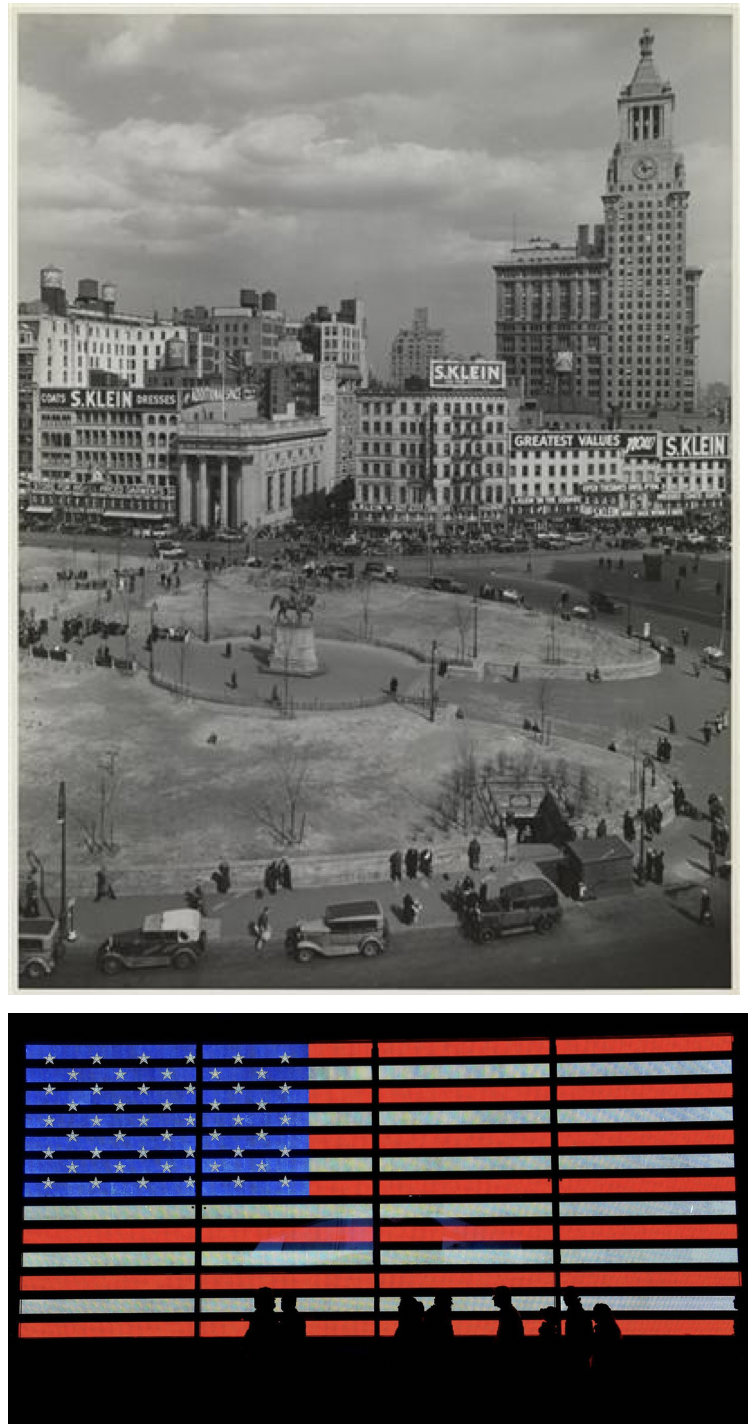
E.B. White kicked off his “Notes and Comment” with some observations about the newly-renovated Union Square and its electrified American flag:

PATRIOT GAMES…Then as now, Americans have always disagreed on what constitutes a tasteful patriotic display. At top, Union Square (circa 1930) arranged around Henry Kirke Brown’s 1856 statue, George Washington; in 2011 a U.S. Armed Forces Recruiting Office (below) at Broadway and Seventh Avenue, was fitted with a giant electric flag of red, white and blue LED lights. (Dick Ebert)

 *  *  *

From Our Advertisers

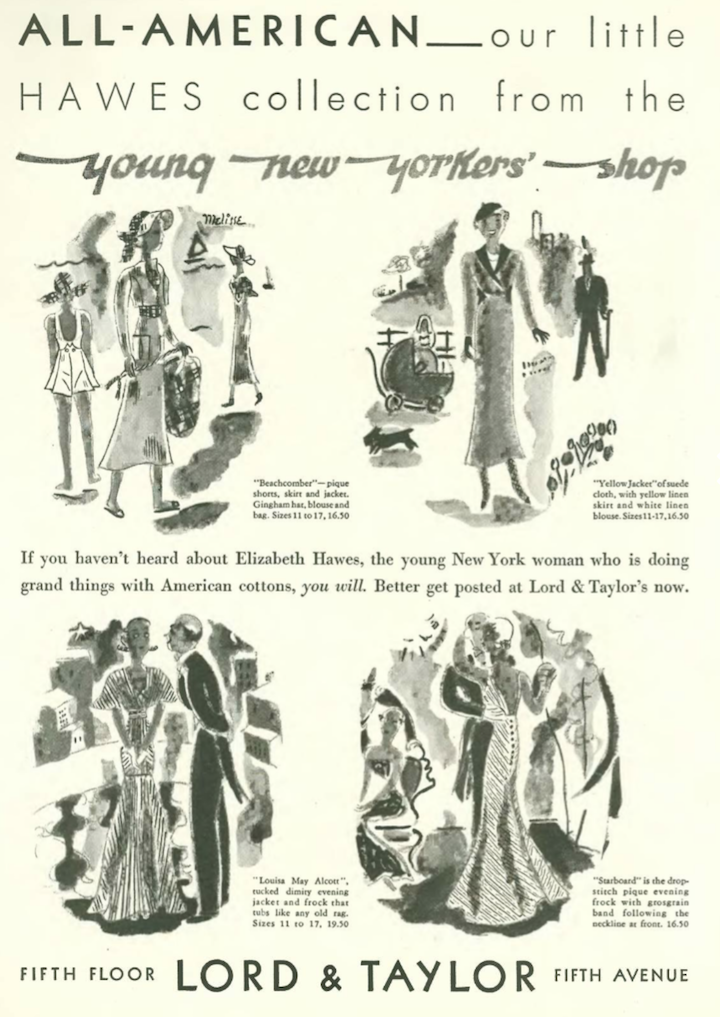
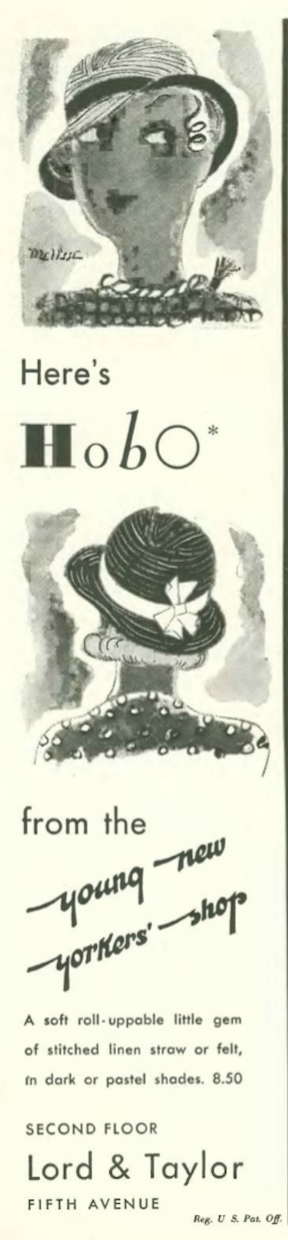
Lord & Taylor rolled out some new ads illustrated by Melisse, aka Mildred Oppenheim

…apparently giddy about their new campaign, Lord & Taylor ran a second one-column ad in the back pages…

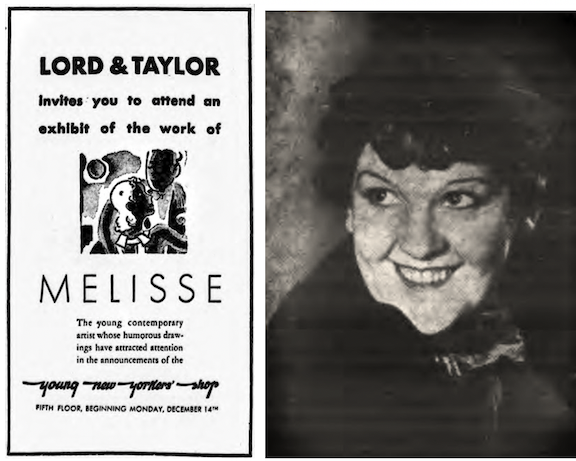
…apparently Melisse was a big draw in the 1930s, based on this Dec. 12, 1931 advertisement in the New York Sun (photo added by me, via strippersguide.blogspot.com)…

…travel companies continued their appeals to the well-heeled and included exotic destinations such as Zoppot…

…which today is known as Sopot, Poland…its Sofitel Grand Hotel (aka the Kasino Hotel) continues to serve as a spa resort…

TAKING THE WATERS…Sopot’s Grand Hotel (aka the Kasino Hotel) continues to serve as a spa resort — it is seen in the background of this 1950 photo (top); below, hotel interior in 1927. The hotel has hosted the famous — Greta Garbo, Marlene Dietrich, Josephine Baker — and the infamous, including Adolf Hitler. More recent guests to the hotel included Prince, Shakira, Vladimir Putin and The Weeknd.  (Wikipedia/sofitelgrandsopot.com)

…we move back to the States, where car companies continued to vie for scarce consumer dollars…Buick hired an artist to create this generic image of a successful-looking businessman, hoping to convince readers to invest in their automobile…

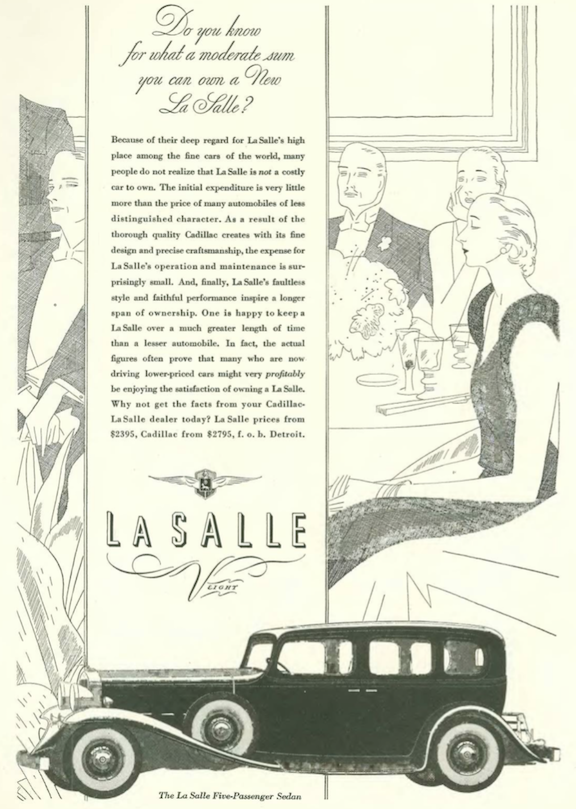
…the makers of LaSalle, a downscale version of Cadillac, wanted readers to imagine that owning their car would put them in the same company as the fashionably blasé patrician class…

…Hudson also made an appeal to class with this full-color ad designed to pique the Anglophilic tendencies of many readers…

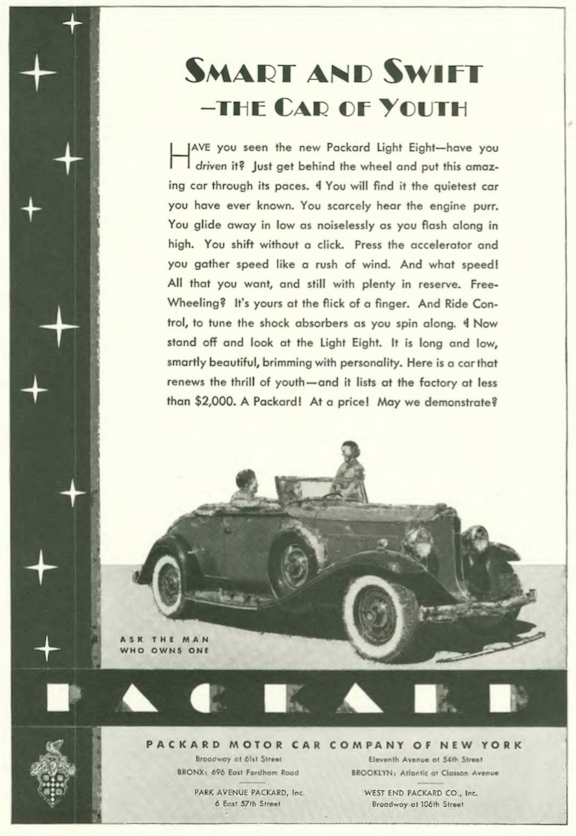
…the makers of the luxurious Packard usually marketed to older monied folks who sought mechanical quality, refinement and reliability, so this ad was a bit of a surprise…

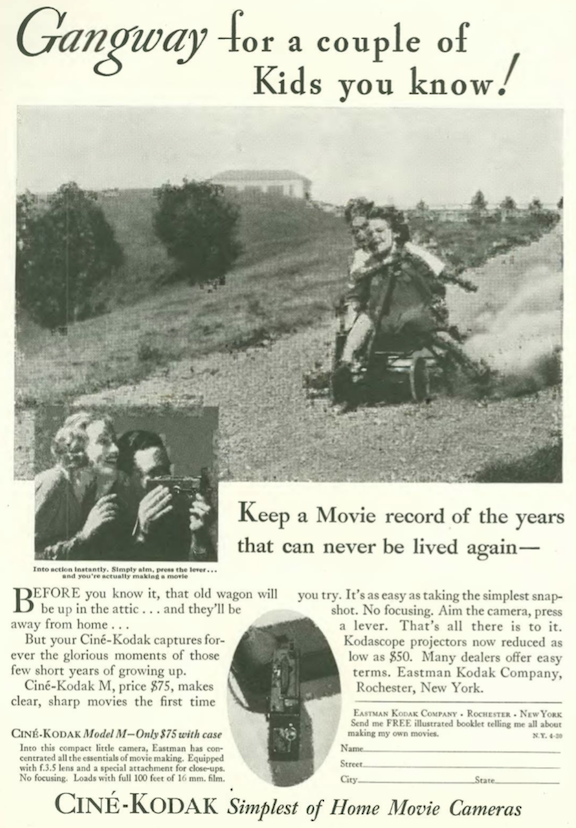
…and speaking of youth, with have an ad from Ciné-Kodak that begins on a lively note…

…but then includes this guilt-inducing bummer…

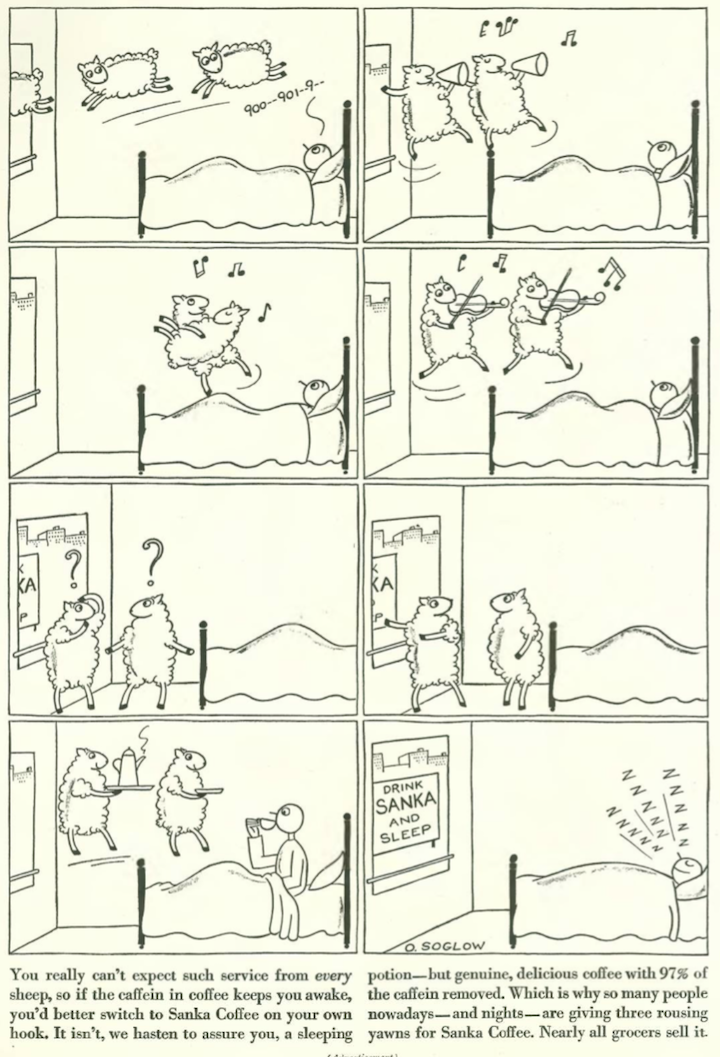
Otto Soglow kept things lighter with his latest ad for Sanka…

…which brings us to the cartoons, and Soglow’s Little King

Robert Day gave us a cordial shoppe owner spying opportunity…

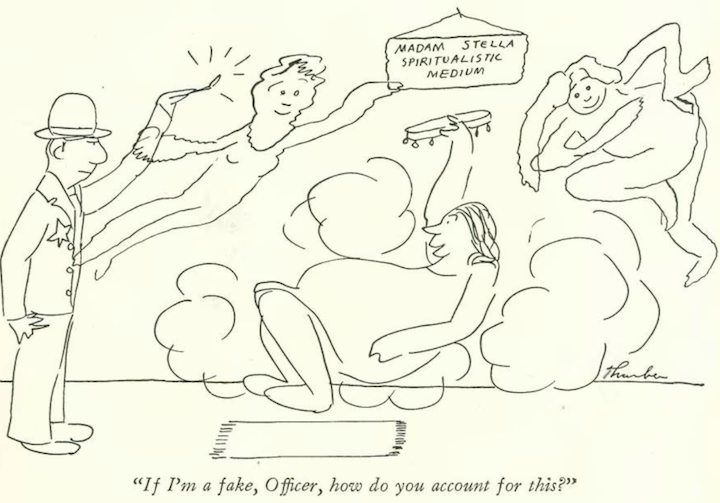
James Thurber explored the spirit realm…

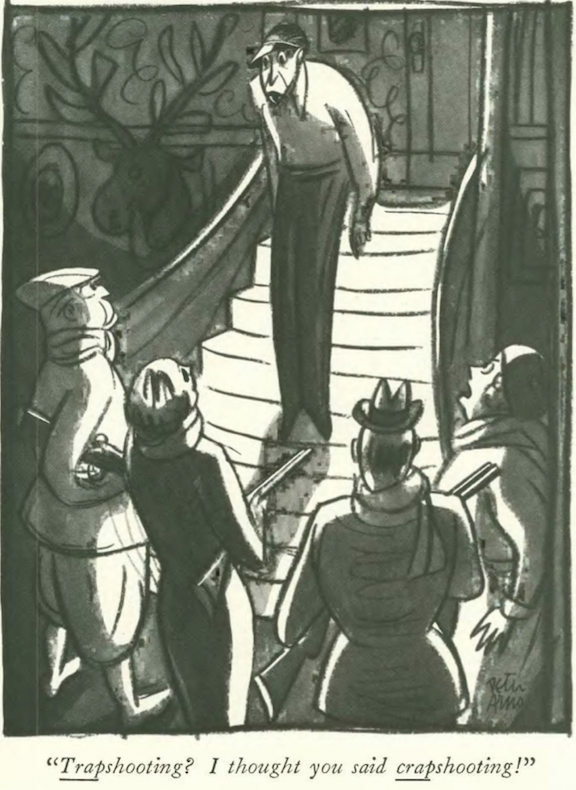
Peter Arno found misunderstanding at the manor house…

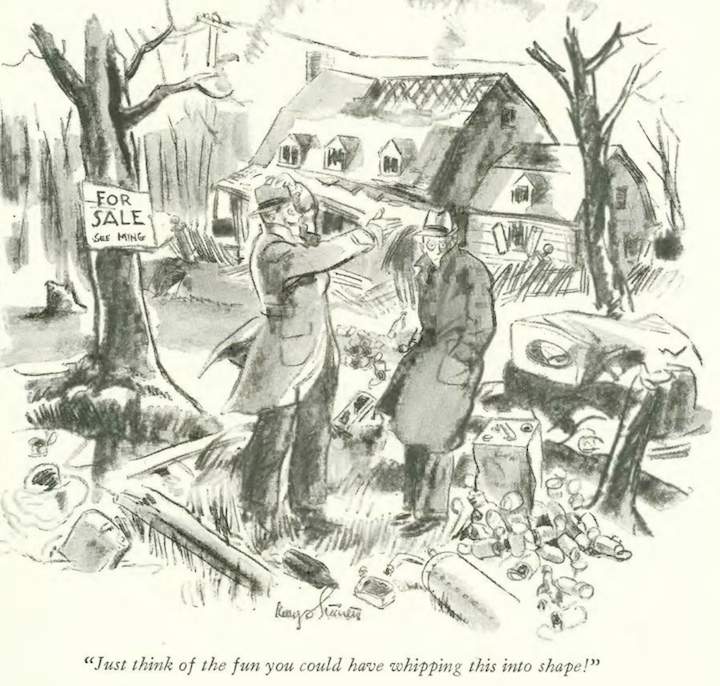
…and Kemp Starrett found a real fixer-upper…

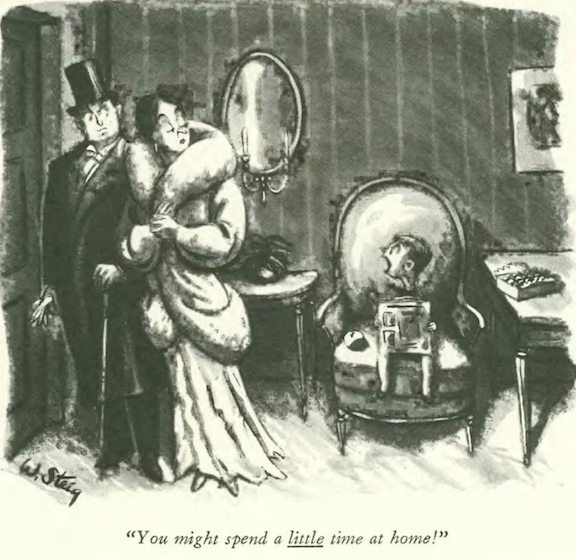
William Steig let one of his “Small Fry” speak his mind…

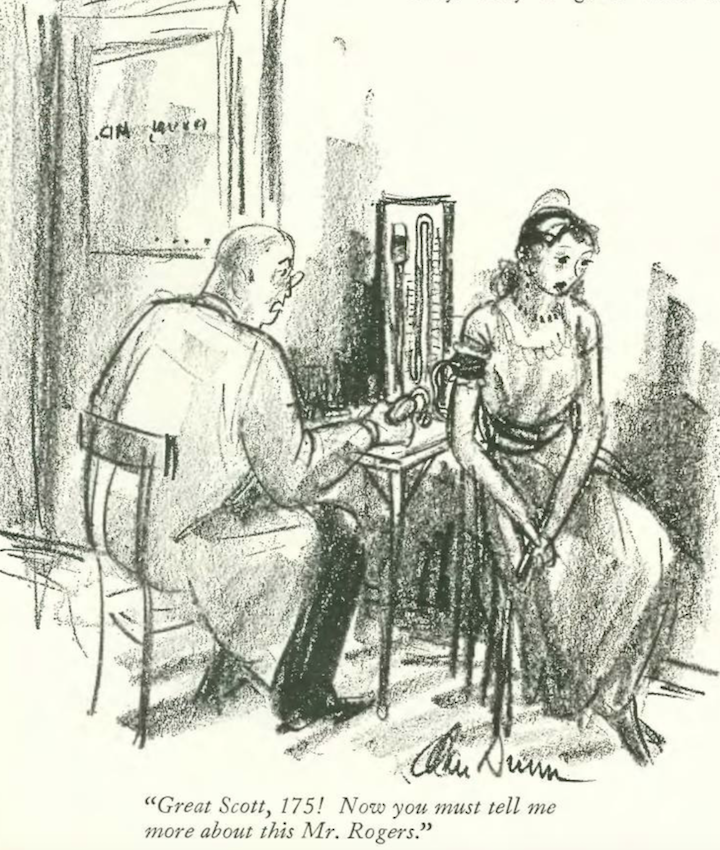
…and we close with Alan Dunn, and the pressures of modern love…

Next Time: High Anxiety…

The Wayward Press

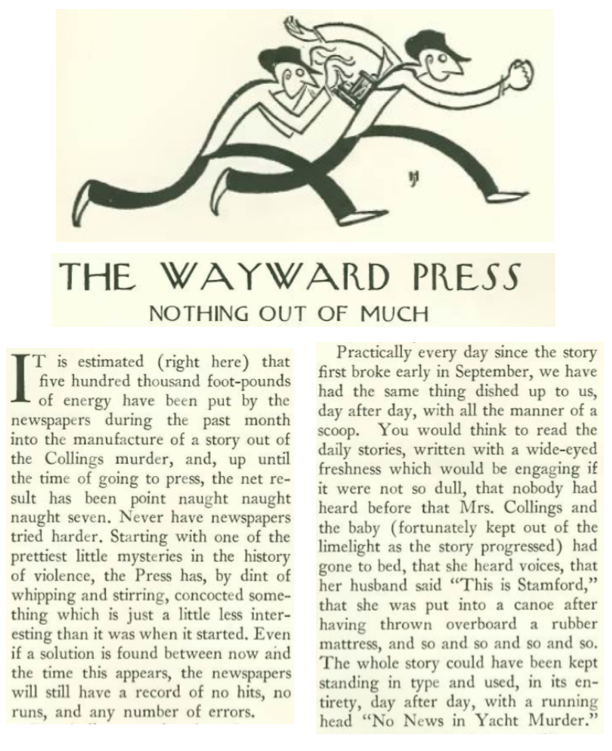
Robert Benchley is remembered today as an American humorist, and his funny side was on display in his New Yorker theater reviews and other contributions. It was his background as a journalist, however, that shown through in his column “The Wayward Press.”

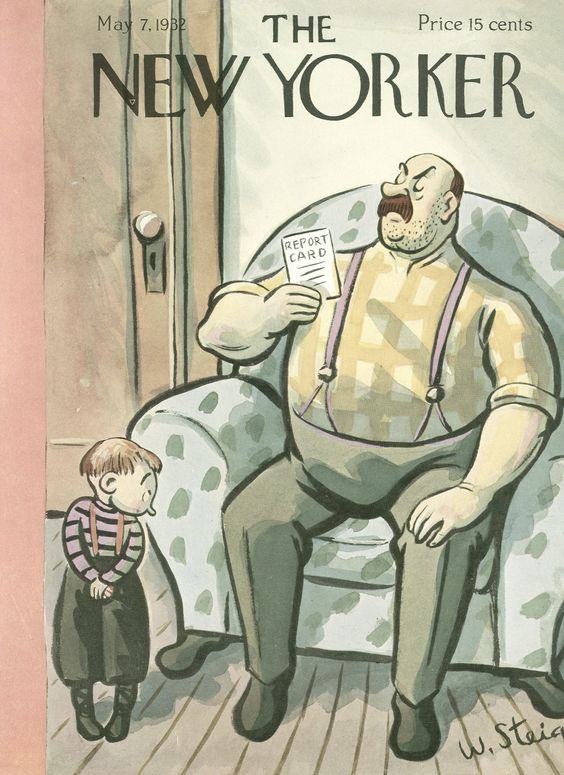
Oct. 10, 1931 cover by Theodore Haupt.

Benchley’s more serious side as a reporter (though still sprinkled with wit) demonstrated his ability to expose the conspiratorial nature of the 1930s press — which seemed to be in bed with moneyed interests — and decry its insatiable appetite for sensationalism. His October 10 column took aim at the coverage of the death of banking heir Benjamin Collings, who was murdered on Long Island Sound while aboard his yacht, Penguin. The investigation went on for weeks with scant developments, but that didn’t stop the newspapers from trying to squeeze every ounce of blood from this turnip.

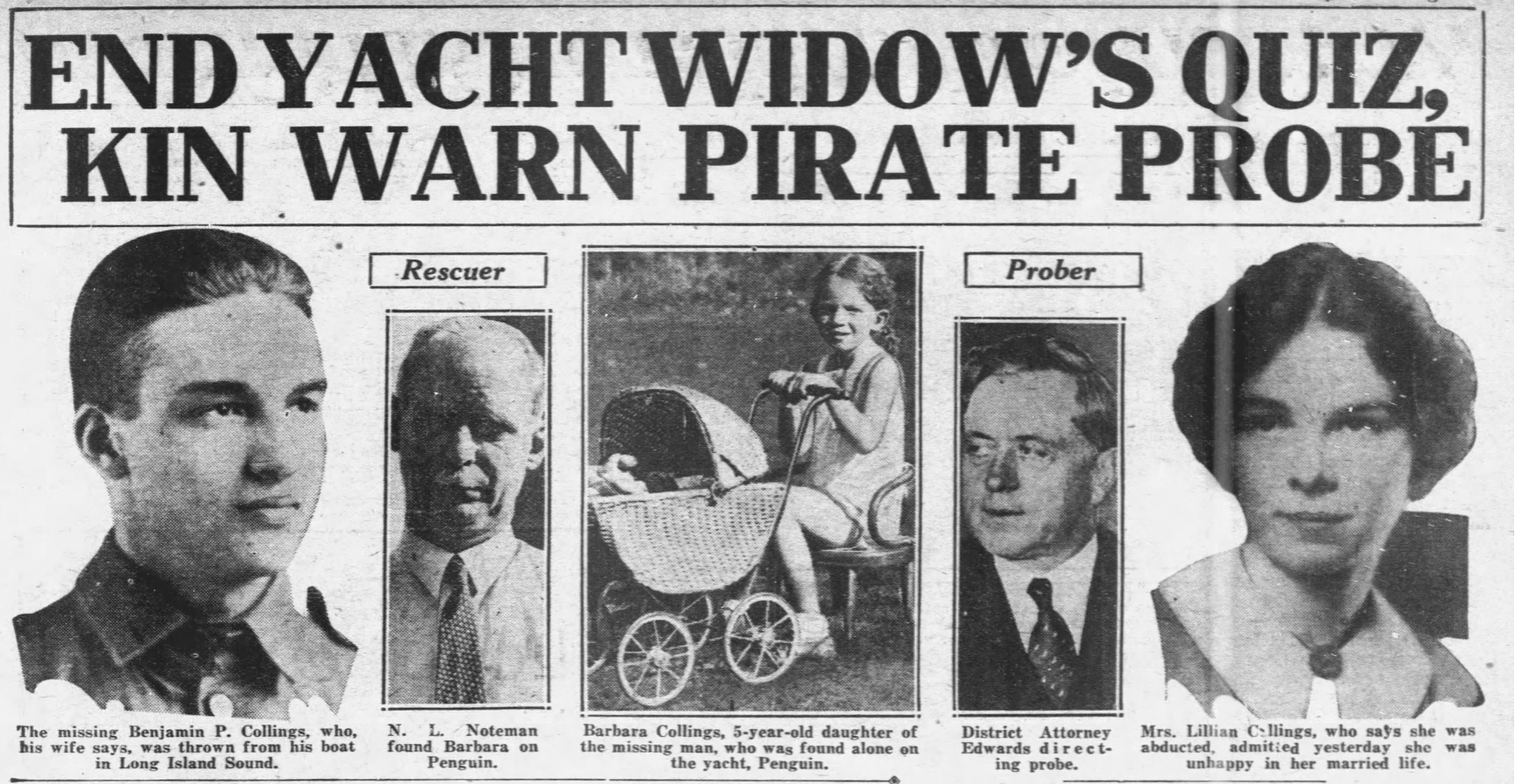
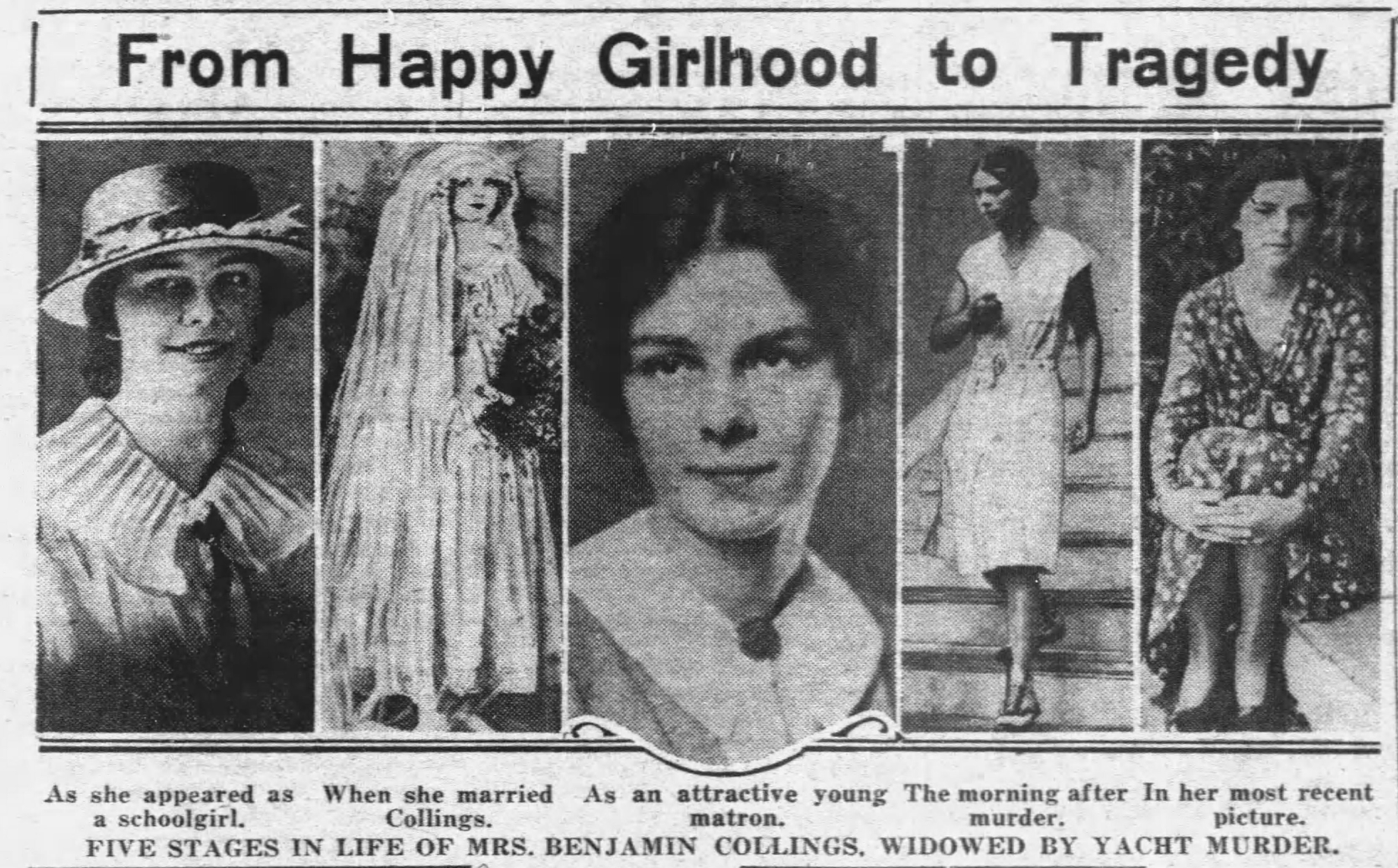
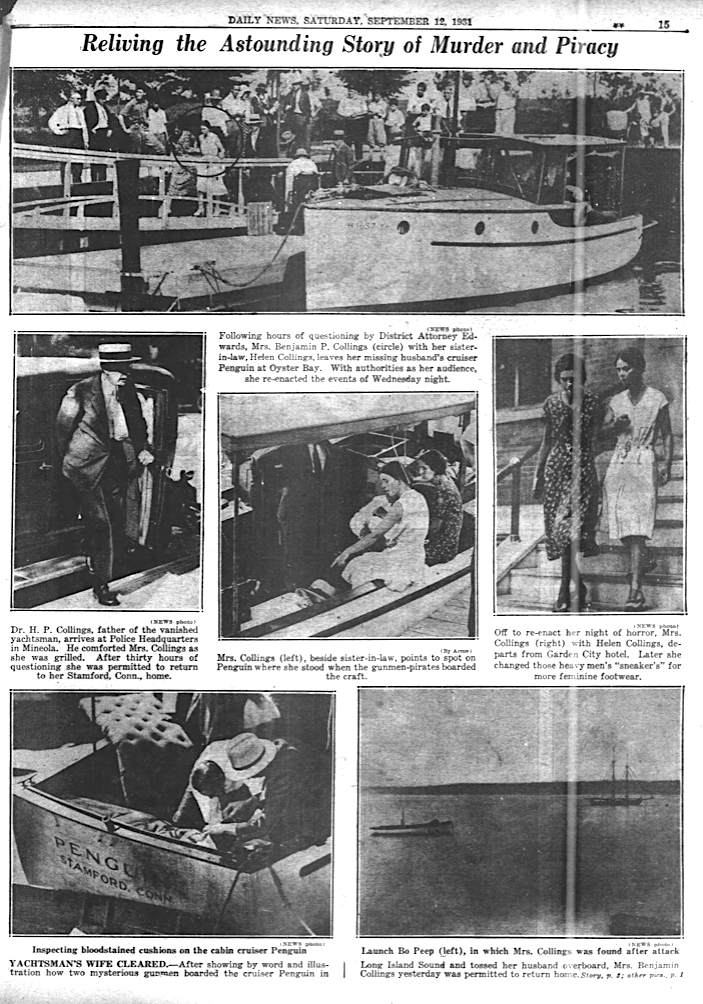
The New York Daily News milked the incident for all its worth, the heading of this first article featuring photos of the slain Benjamin Collings (far left), his widow (and briefly a suspect) Lillian Collings, as well as an image of their five-year-old daughter, Barbara. According to Lillian, all three were sleeping aboard the family yacht Penguin when two men paddled a canoe up to their boat. When Ben went on deck to confront the pair, these “pirates” (as she called them) seized control of the boat, and threw Ben overboard. According to Lillian, the men forced her into the canoe, then cut the Penguin’s anchor and set it adrift with little Barbara still on board. While the girl was quickly rescued by another yachtsman, the “pirates” deposited Lillian in a moored motorboat on Oyster Bay before disappearing into the night. The Suffolk County DA found Lillian’s account unbelievable, and newspapers subsequently described her story as bizarre and illogical. The Daily News headline below indicates Lillian’s family wanted her interrogation to end…

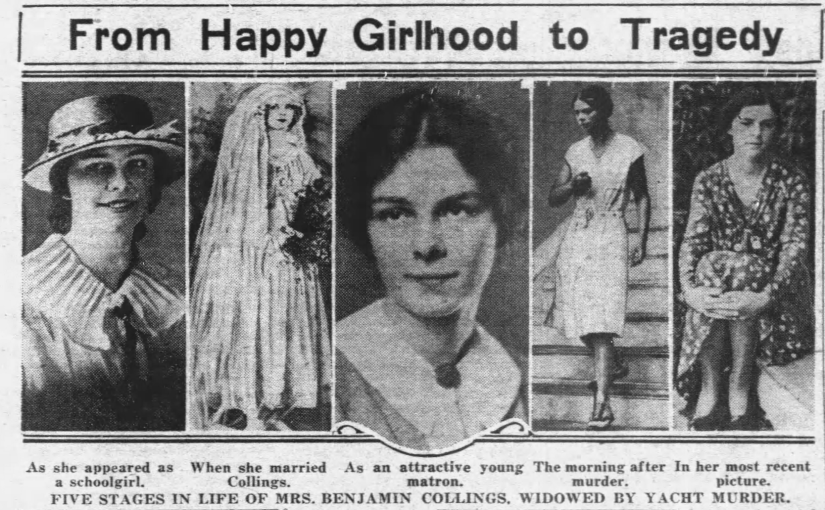
…lacking any other details, the Daily News nevertheless kept the story alive with features such as this one below that described Five Stages in Life of Mrs. Benjamin Collings, Widowed by Yacht Murder

…and in case readers still wanted more, the paper rehashed the whole thing in photos in its Sept. 12 edition…

A few days after the yacht incident the body of Ben Collings washed up on the North Shore, his hands bound and his skull bashed in. The Suffolk County DA then began hauling in pairs of suspects who somewhat matched Lillian’s description—a 50-year-old man with gray hair and a skinny teenager—but none were quite right. The crime has never been solved.

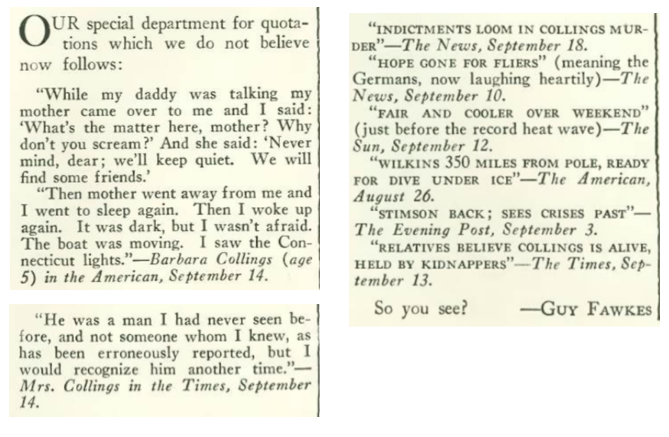
Benchley concluded his column with some quotations which he “did not believe”…

 *  *  *

And Now For Something Ironic…

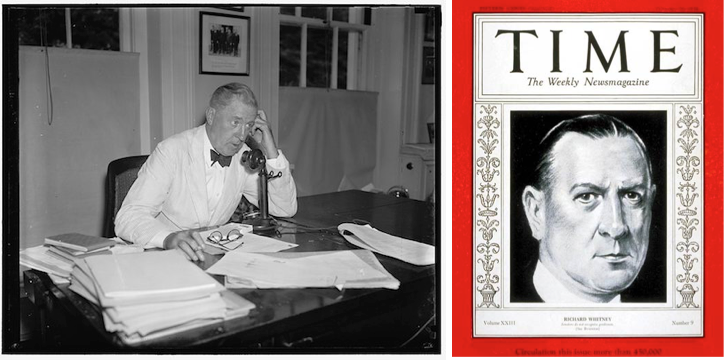
In his “Notes and Comment,” E.B. White teased New York Stock Exchange President Richard Whitney for blaming the market crash on “human vanity and selfishness,” when it was indeed those qualities that drove the markets in the first place. Before the decade was out Whitney would succumb to the very vices he named, and would serve three years and four months at Sing Sing for embezzlement.

HE DID TIME, THEN HE DID SOME MORE TIME…Richard Whitney made the cover of the Feb. 26, 1934 issue of Time magazine for his work as president of the New York Stock Exchange. At left, Whitney in 1937. He was sentenced to five to ten years for embezzlement, but was released early from Sing Sing for good behavior. He went on to a simpler life, managing a dairy farm and then a textile company before his death in 1974 at age 86. (Wikipedia/Time)

 *  *  *

The What Goes Up Department

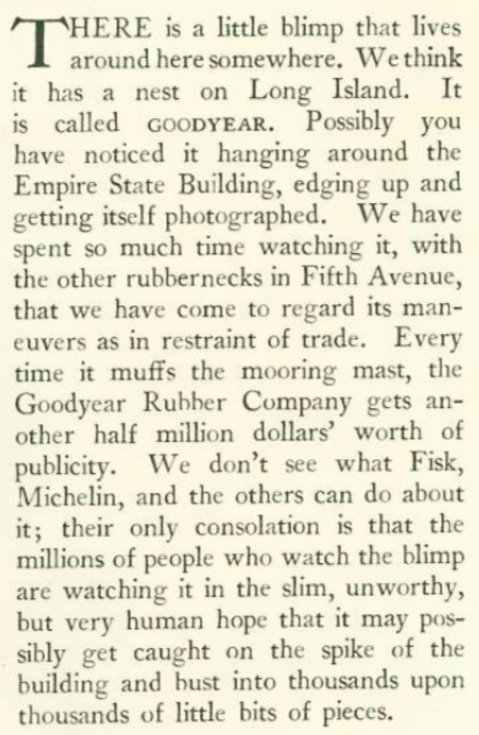
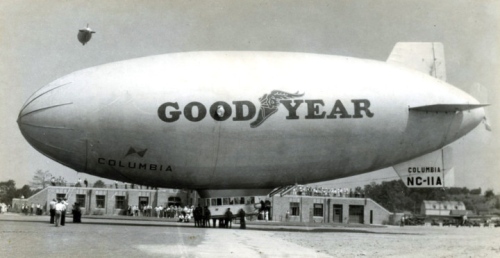
E.B. White also commented on the latest edition of the Goodyear Blimp, christened Columbia, which he spotted hanging around the Empire State Building. Note E.B. White’s last line

Columbia was flying around the Empire State Building because Goodyear was running a sightseeing service in which passengers paid $3 for a 15-minute flight around Manhattan. The blimp also performed publicity stunts such as delivering newspapers to a man standing on the Empire State’s mooring mast—that particular stunt was supposedly a test to see if airships could anchor on the mast for passenger loading and unloading (and as we know, they couldn’t and wouldn’t).

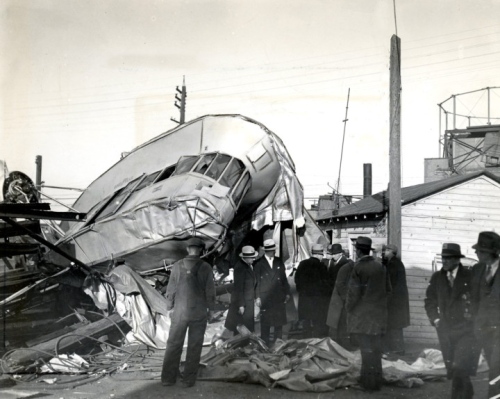
Just four months after White watched Columbia hover over Manhattan, the airship would indeed bust into a thousand pieces, meeting its demise near the Queens airport (today’s LaGuardia). Caught in unexpected high winds, Columbia dipped into the ground, tearing off its landing gear and bending its propellers. The ground crew tried to secure the blimp but an updraft ripped the airship from their hands and sent it sailing over Flushing Bay.

As Columbia once again drifted back over land, the 23-year pilot Prescott Dixon ordered his chief mechanic, John Blair, to pull a rip cord that would release most of the air from the blimp. As Blair reached from the cabin for the cord the blimp shifted, and Blair fell to his death. Columbia then knocked two men off a warehouse roof (injuring them), then struck a factory and some power lines before crashing along the tracks of the Long Island Railroad. Dixon survived after being extricated from the crumpled gondola.

CHRISTENED WITH A BOTTLE OF LIQUID AIR, the Goodyear Blimp Columbia was readied for its inaugural flight over Akron, Ohio, in July 1931.
A SHORT LIFE…Just seven months after its inaugural flight, Columbia crashed near Flushing Bay on Feb. 12, 1932. (kathrynsreport.com)

 *  *  *

When Bridges Were Crowd-Pleasers

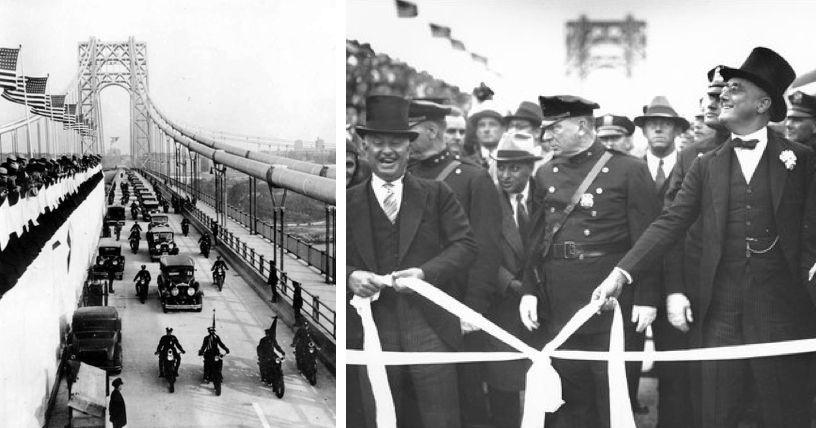
“The Talk of the Town” announced the imminent opening of the Jeffreys Hook Bridge, to be known thence as the George Washington Bridge:

BREAK OUT YOUR TOP HAT…New Yorkers turned out in droves to mark the official opening of the George Washington Bridge on Oct. 24, 1931. Gov. Morgan F. Larson of New Jersey, left, and Gov. Franklin D. Roosevelt of New York, right, did the ribbon honors at the dedication. (New Haven Register/AP)

 *  *  *

They Couldn’t Say ‘Hooters’ Either

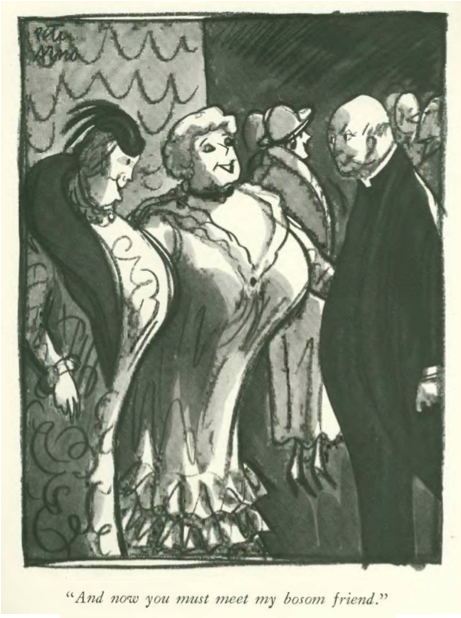
In these coarser times it is hard to believe that 89 years ago the word “bosom” was a “no-no” on the nation’s airwaves, per this “Talk” item…

 *  *  *

An Actor’s Actor

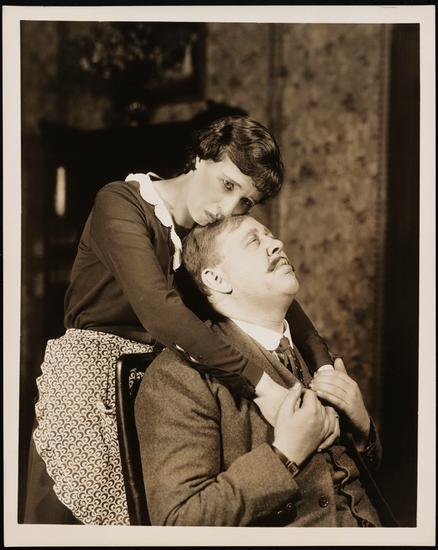
Theater critic Robert Benchley wasn’t the only one who noticed the talents of newcomer Charles Laughton in his New York stage debut — Hollywood would immediately come calling for the 32-year-old English actor:

WE’LL KEEP HIM…Cicely Oates as Annie Marble and Charles Laughton as William Marble in the 1931 play Payment Deferred. (Museum of the City of New York)

 *  *  *

Kinda Long For Being Short

Humorist Frank Sullivan claimed to be following the trend for shorter short stories by turning in this piece with an editor’s note longer than the story itself:

 *  *  *

Lurid Lit

Our dear Dorothy Parker is back with another of her entertaining book columns, and in this installment we have her taking on the world of literary and not-so-literary sex romps. Excerpts:

DIRTY LITTLE BOOKS?…The three books featured in Dorothy Parker’s column included, from left, Young and Healthy by Donald Henderson Clarke (issued here under a different title in a pulp 1948 Novel Library edition); Theodore Wilde’s Moonblind, which featured a hermaphrodite character and homosexual encounters; and although attributed to Anonymous, Lady Chatterley’s Husbands was actually written by Anthony Gudaitis, aka Anton Gud, who often wrote anonymously for erotica publisher Samuel Roth. Although it was publicized as a sequel to D.H. Lawrence’s Lady Chatterley’s Lover, Gud’s book actually had less sex than the Lawrence original. After all, in the sequel Lady Chatterley gets tired of horny old Mellors. (Goodreads/Amazon)

…and before we leave Dorothy, please note her last line in the review, where she quotes Carl Rose’s famed 1928 cartoon (with caption by E.B. White)…

 *  *  *

From Our Advertisers

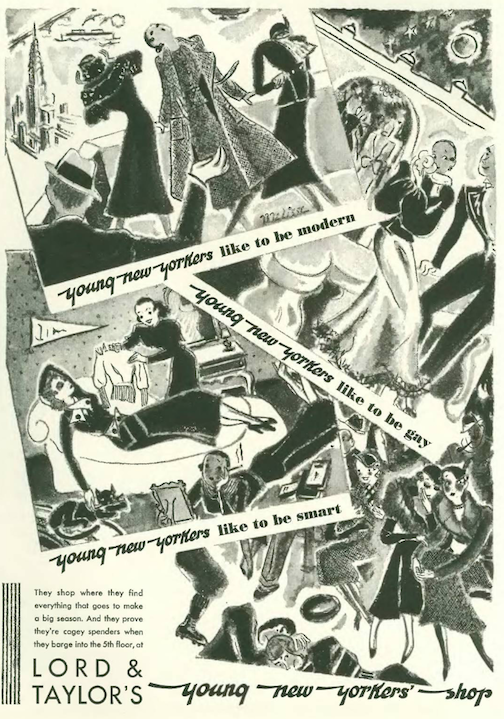
Just a couple quick ones (I will have more in the next installment)…this Lord & Taylor ad (illustrated by Mildred Oppenheim Melisse) showed young New Yorkers how to look smart for the fall (Lord & Taylor, the oldest department store in the United States (founded 1826), recently closed all 38 of its stores due to the pandemic, and it was announced in August that Lord & Taylor would be liquidated. Apparently its name will continue as an online-only business…

…and Helen Hokinson offered this illustration of one of her “girls” shilling for Frigidaire refrigerators…

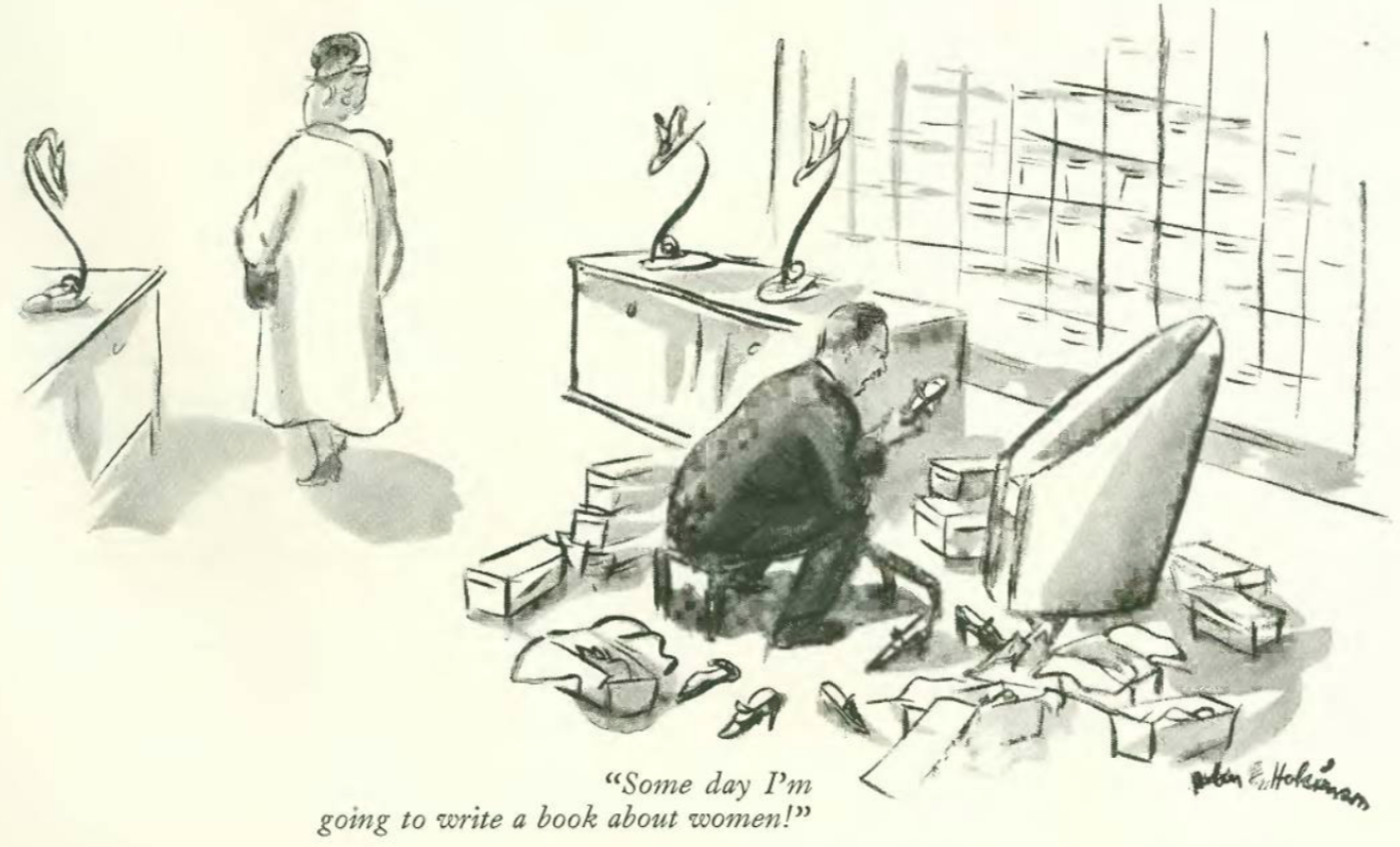
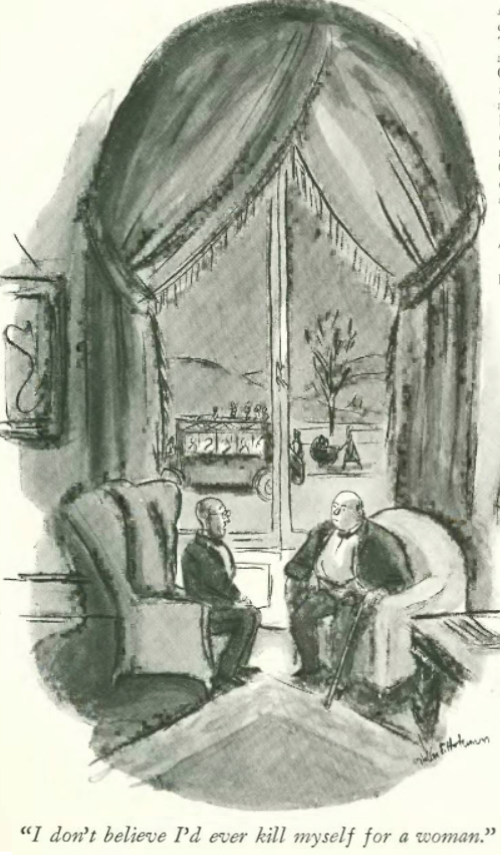
…and two more from Helen in the Oct. 10 cartoons…

…exploring men’s attitudes toward the opposite sex…

Garrett Price visited a seemingly unappetizing banquet…

Kemp Starrett gave us a man looking at life on the bright side…

William Steig explored home decor…

Barbara Shermund found some bedtime gossip…

…and recalling our earlier “Talk” item regarding bosoms, here’s Peter Arno

Next Time: Monkey Business…