The 1930s saw steady improvements in the fledging airline industry, which catered mostly to major businesses or well-heeled (and somewhat brave) folks who were interested in getting to places relatively quickly. Margaret Case Harriman reported on the many ways one could criss-cross the country by heading to the Newark Airport, the first major airport to serve the New York metro.
August 11, 1934 cover by Constantin Alajalov.
Writing for the “Out of Town” column, Harriman described how someone in 1934 could make their way to Los Angeles by boarding a 9 a.m. American Airlines flight in Newark and then changing over to a “sleeper plane” in Fort Worth around 10 p.m. that same day (top speed of the fastest plane was about 190 mph or 306 kph. The trip also required stops for refueling). The night flight from Fort Worth would deliver the traveler to Los Angeles the following day, at 7:55 a.m.—the trip totaled about 23 hours.
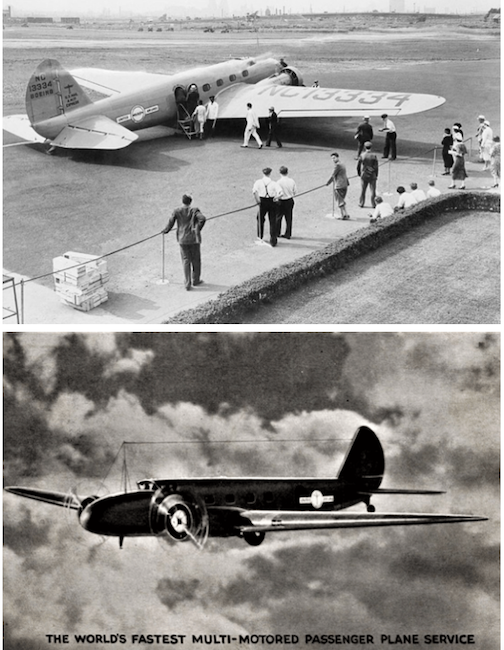
NIGHTY NIGHT…In 1934 American Airlines was the only airline offering “sleeper planes,” as the ad at left claimed. The head of American Airlines, C.R. Smith, was obsessed with customer service and the amenities offered on his Curtiss Condors—roomy airplanes with sleeping berths that Margaret Case Harriman likened to beds in a Pullman railroad car. Passengers loved the Curtiss Condor, although the planes tended to catch fire and pilots found them difficult to fly. (archbridgeinstitute.org/American Airlines)SKYTRAIN…Top, the passenger section of an American Airlines Curtiss Condor, circa 1930s; below, interior of a Boeing 247—note the steps in the aisle used to cross over the support beams that reinforced the 247’s wings. Also note the female attendant—the profession was dominated by male stewards in the first years of passenger service, but in the 1930s women took over the profession. (American Airlines/bethelgrapevine.com)TWENTY-TWO HOURS and change on a United Airlines Boeing 247 would get you from Newark to San Francisco in 1934. Top, Passengers are shown boarding a United Airlines Boeing 247 at the Newark Airport circa 1934; United boasted the fastest multi-motored plane service with the 247, but TWA apparently offered the fastest service between coasts with its sleek new DC-2, seen in photo below. (bethelgrapevine.com)HARD TO BEAT…A TWA Douglas DC-2 could get you to California faster than either United or American—fifteen hours from Newark to Los Angeles. (wahsonline.com)
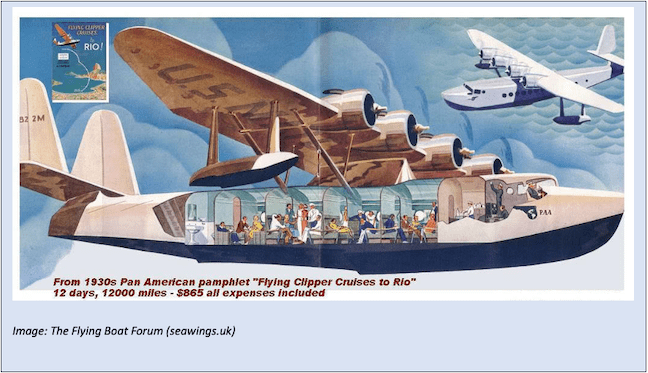
When we think of flying in the 1930s many of us recall the great travel posters featuring Pan American’s Clipper Ships—flying boats that took passengers to exotic locations in the Caribbean and in Central and South America. Harriman wrote:
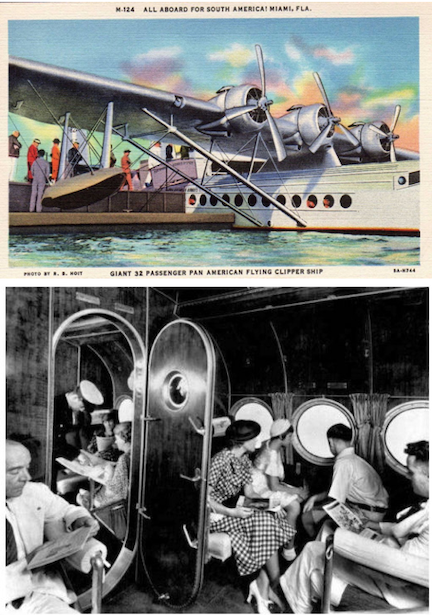
FLYING BOAT…Boasting nautical appointments including porthole windows, Pan Am’s Sikorsky S-42 offered roomy seats to its 32 passengers. Top, a postcard image of a Sikorsky S-42 in Miami in the 1930s; below, passenger cabin of the Sikorsky S-42. (clipperflyingboats.com/seawings.com.uk)
Harriman closed with some advice to readers unfamiliar with flying, including putting drops of Argyrol (a silver-protein antiseptic) into ones eyes to “prevent that ticking sensation in the temples.”
* * *
No Offense Taken
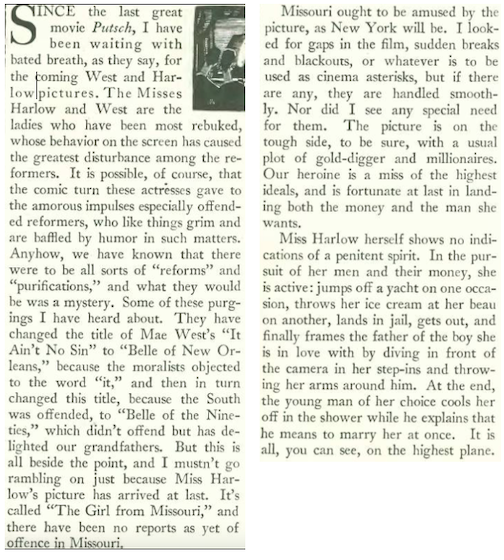
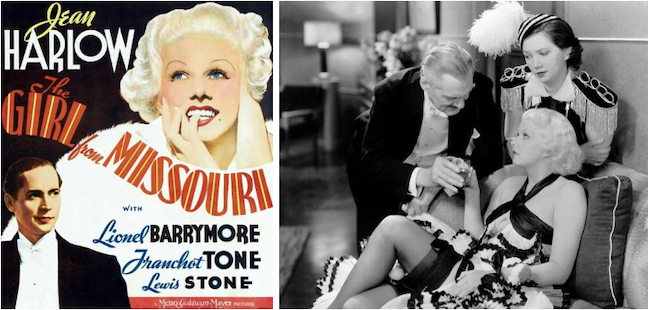
Critic John Mosher was no fan of Jean Harlow’s, but he did acknowledge her box office appeal, and that fans eagerly awaited the Blonde Bombshell’s next picture, The Girl from Missouri…with its “usual plot of a gold-digger and millionaries.” Mosher also noted that Harlow, along with Mae West, was a prime target of reformers (see Hays Code) who wanted to ban “immorality” from the pictures, and he was eager to see how the Puritans had wielded their new censoring shears on the film.
GOING FOR THE GOLD…At right, Lionel Barrymore, Jean Harlow, and Patsy Kelly in The Girl from Missouri. (IMDB)
* * *
From Our Advertisers
We begin with another ad from the makers of Spud menthol cigarettes, who deployed what seemed like every known visual metaphor to suggest that smoking their cigarettes “all day” would leave one feeling cool, clean and fresh, in this case as a blanket of newly fallen snow (an appealing sight in that hot summer of 1934)…
…R.J. Reynolds deployed any number of tricks to sell their Camels, from ads promoting their health benefits to endorsements by wealthy socialites, in this case Sarah Lippincott (“Mrs. Nicholas Biddle”) of Philadelphia…
…snob appeal was not limited to cigarette ads, as this full page from the folks at Chevrolet attests…
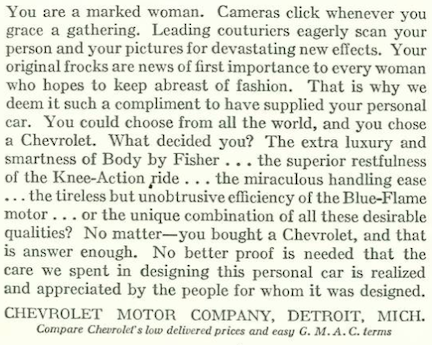
…zooming in on the copy that accompanied the above ad, we find that this fictive Chevy owner was a “marked woman” sought out by paparazzi and admired by couturiers…
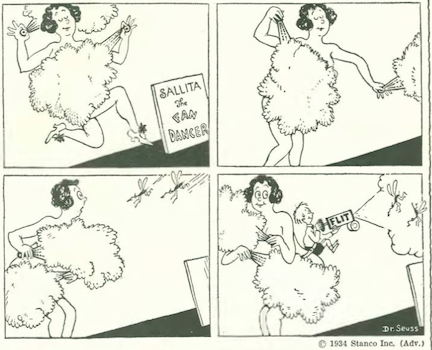
…Dr. Seuss continued his series of weird ads for Flit insecticide…
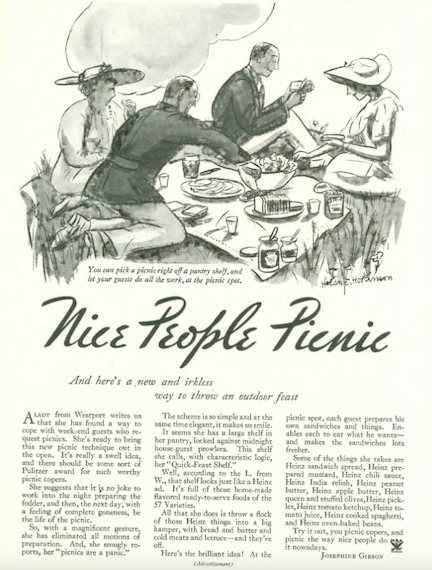
…Helen Hokinson illustrated this patrician picnic scene to promote Heinz’s line of sandwich spreads…
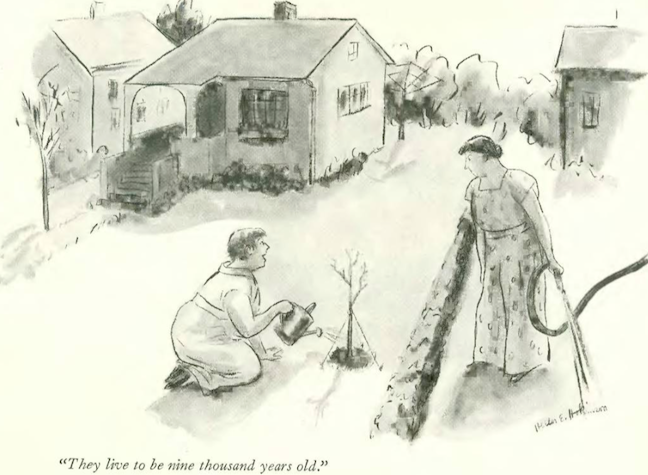
…and we kick off our cartoons with Helen again, observing a proud moment…
…Robert Day offered this observation on modern architecture…
…Rea Irvin skewered the puritan set with his latest bird illustration…
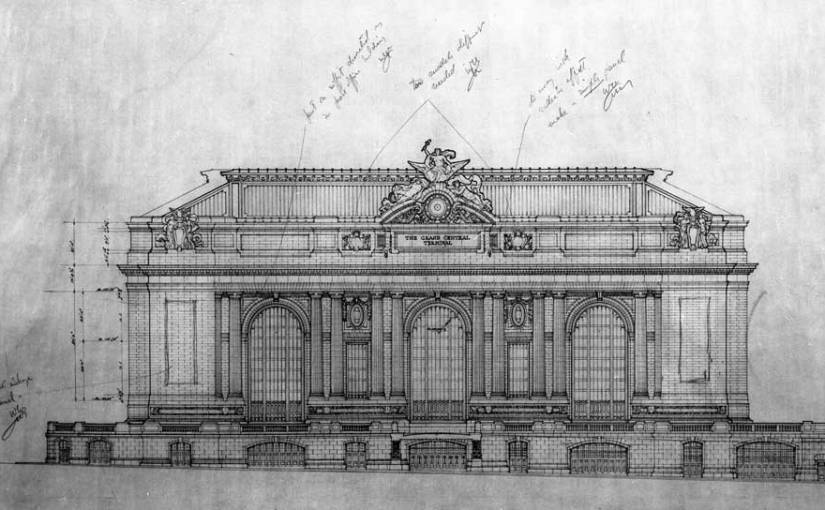
Above: Final Design of Grand Central Terminal, ca. 1910. (New York Transit Museum)
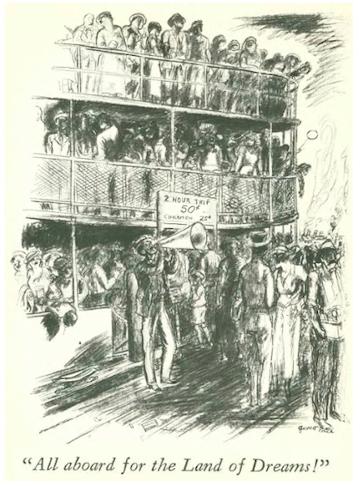
The heat wave of 1934 spread misery from the Midwest to the East Coast. The temperature in New York City hit 101 degrees F (38.3 C) on June 29, and July recorded at least ten days of temps in the mid- to upper 90s. It must have been miserable in the days before air-conditioning, and since no adult would dare be seen in public wearing shorts and a t-shirt, an outing on a crowded tour boat, as illustrated below by William Cotton, must have been hellish.
July 21, 1934 cover by William Cotton.
…putting a fine point on it, recall this wryly captioned cartoon from the June 30 issue by Garrett Price…
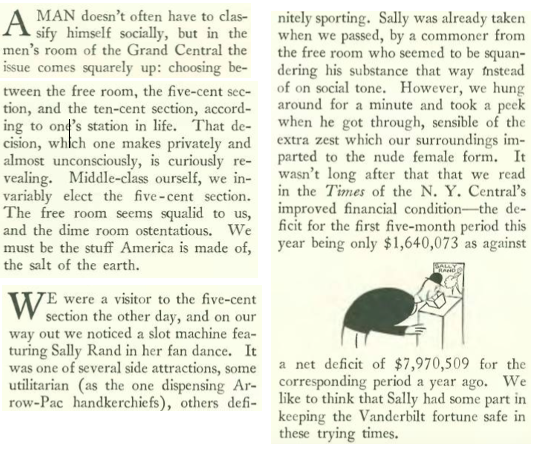
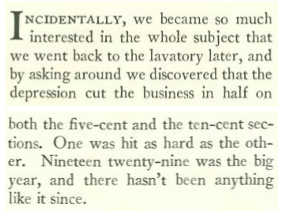
…but let us move ahead to the July 28 issue, where E.B. White was hopefully keeping his cool in the men’s waiting room at Grand Central Station, where he plunked down a nickel to cool his heels in the “middle class” section, where he observed side attractions including a vending machine that dispensed handkerchiefs and a coin-operated peep show featuring burlesque star Sally Rand.
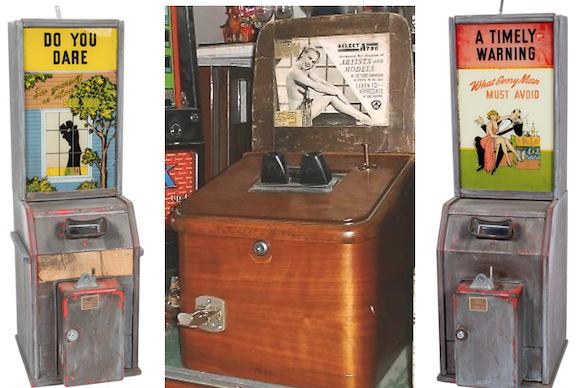
NO MASHERS ALLOWED…Separate men’s and ladies’ rooms were available in three classes at Grand Central Station—free, five cents and ten cents. Top, the Ladies’ room, Grand Central Terminal (Central Lines), and below, a men’s room at the station. A nickel back then was worth about a dollar today. (Library of Congress)NICKEL AND DIMED…Machines similar to these could be found in some men’s waiting rooms at train stations in the 1930s. (pinballhistory.com/comics.ha.com)
…White referred to a peep show that featured famed fan dancer Sally Rand…
DOING HER DEEP KNEE BENDS…Sally Rand in the 1930s. (www.vintag.es)
White also commented on the growing number of travelers, still pinched by the Depression, opting for the free section:
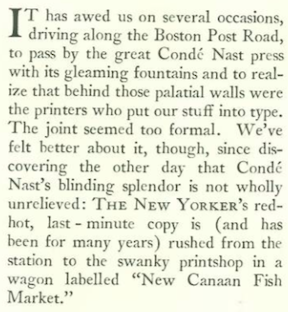
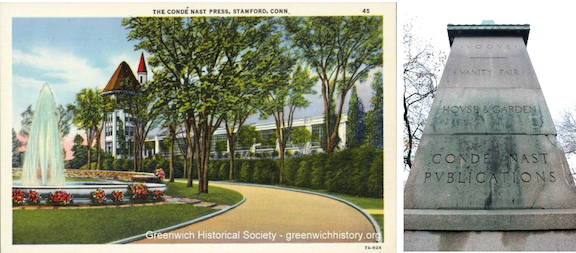
We settle in with the June 21 issue (which leads this post) with White once again, this time enjoying a drive to Stamford, Conn., where he admired the “splendor” of the Condé Nast printing plant (apparently the plant also printed The New Yorker, although the magazine itself would not be acquired by Condé Nast’s parent company, Advance Publications, until 1985).
ONLY A MEMORY…Postcard image of the Condé Nast printing plant; at left, a relic of the long-gone plant, one of two pillars that flanked the road to the plant. (Greenwich Historical Society/greenwichtime.com)
* * *
Disney’s Other Mouse
Film critic John Mosher was a fan of Disney’s “Silly Symphony” cartoon shorts, which were produced between 1929 and 1939. Animation, and especially color animation, was in its infancy, so these doubtless had an uplifting effect on many moviegoers.
DON’T CALL ME TINKERBELL…The Butterfly Fairy brought some Disney magic to 1934’s The Flying Mouse. (disney.fandom.com)
* * *
The Great McGonigle
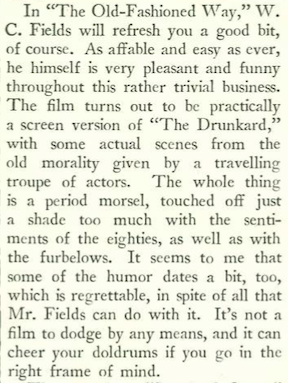
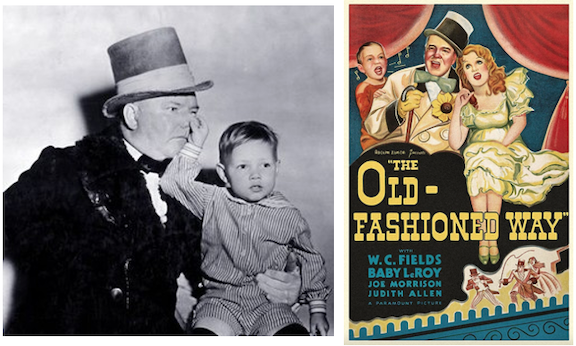
W.C. Fields appeared in more than a dozen silent films before making his first talkie, 1930’s The Golf Specialist, and it was in sound films that Fields was able to truly express his vaudevillian wit. It was also in the sound era that Fields teamed up with Baby LeRoy for three films (in 1933 and 1934), including The Old Fashioned Way, in which Fields portrayed “The Great McGonigle,” leader of a traveling (and perpetually underfunded) theater troupe who was always a step ahead of police and creditors. Critic John Mosher found the film’s riff on an old morality play, The Drunkard, to be a bit dated, but overall thought it a cheerful diversion.
HONK…Baby LeRoy, aka Ronald Le Roy Overacker (1932–2001), was just 16 months old when he became the youngest person ever put under term contract by a major studio. He is best known for his appearances in three W. C. Fields films: Tillie and Gus (1933), The Old Fashioned Way (1934) and It’s a Gift (1934). (Rotten Tomatoes/IMDB)
* * *
From Our Advertisers
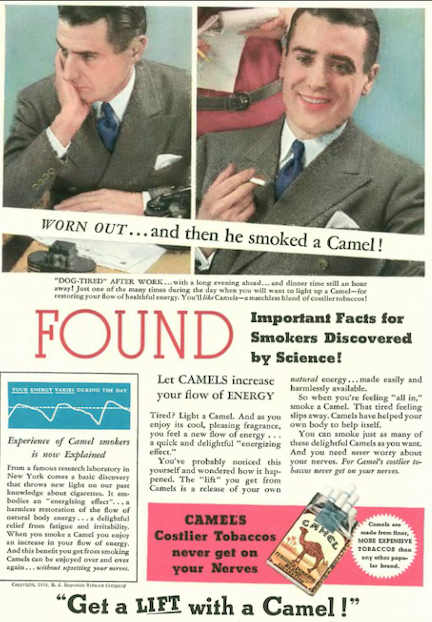
We begin with scientific proof (from a “famous research laboratory in New York”) that Camel cigarettes increased one’s flow of energy…
…if that crackpot claim doesn’t get you, here’s one that recommended downing a PBR before a big meeting, a sure remedy for that “listless, tired-out feeling”…
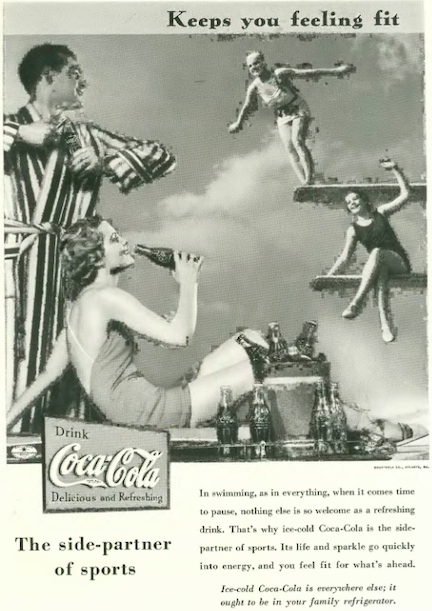
…of course we all know that a few sugary Cokes will get you going…back then they were taking it in six- and ten-ounce bottles, not 30- to 50-ounce Big Gulps…
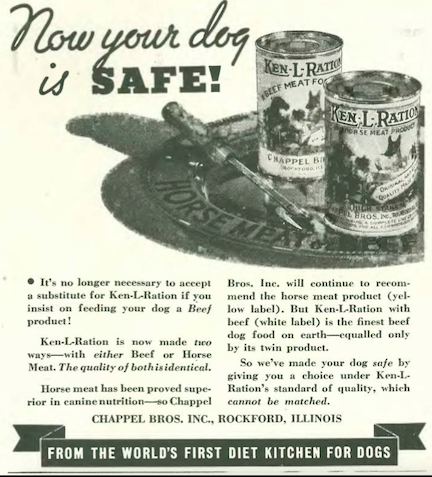
…it’s not every day you see a dog food ad in The New Yorker…in the 1930s there was no secret to where ol’ Sparky ended up…
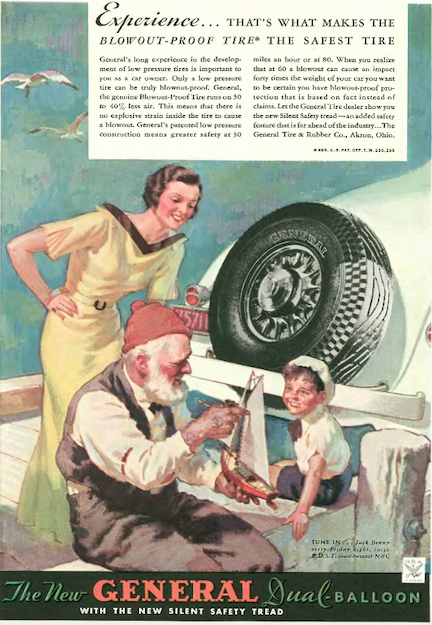
…popular were these Rockwellian ads that equated various products with happy and wholesome (and safe) living, in this case a massive “Dual-Balloon” tire that dominated this tableau featuring a stylish mommy and her little boy slumming with an old sea salt…
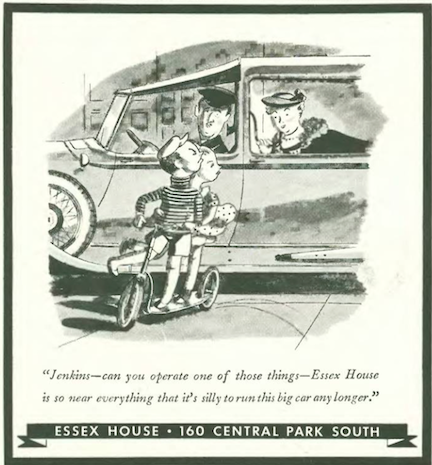
…the folks at Essex House hired an illustrator who did his or her best to channel Helen Hokinson and William Steig for this New Yorker ad…as we have seen before, Essex House ads walked a fine line between thrift and snob appeal…
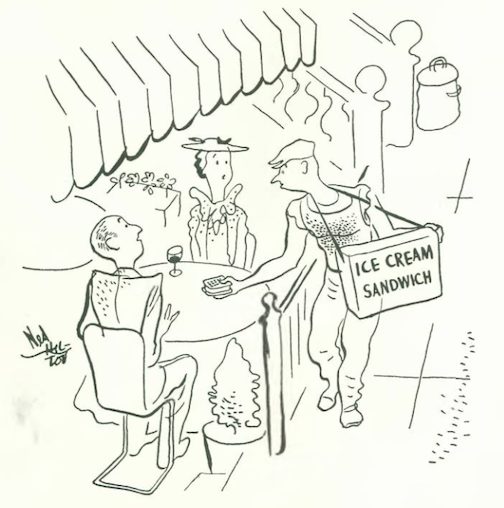
…on to our cartoons, beginning with Ned Hilton, whose work appeared in The New Yorker from 1934 to 1957…
…Mary Petty recorded some sweet nothings by the seaside…
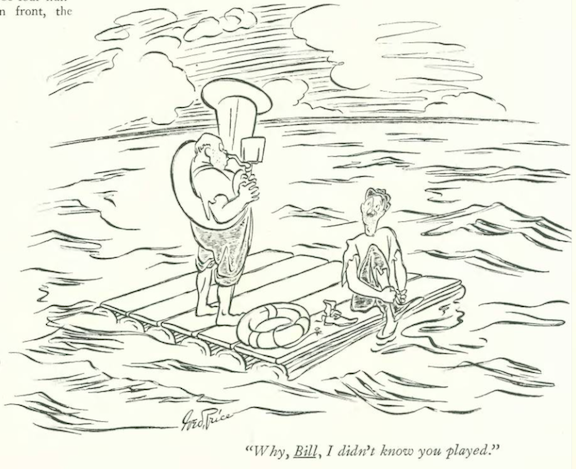
…George Price drifted along with two men and tuba…
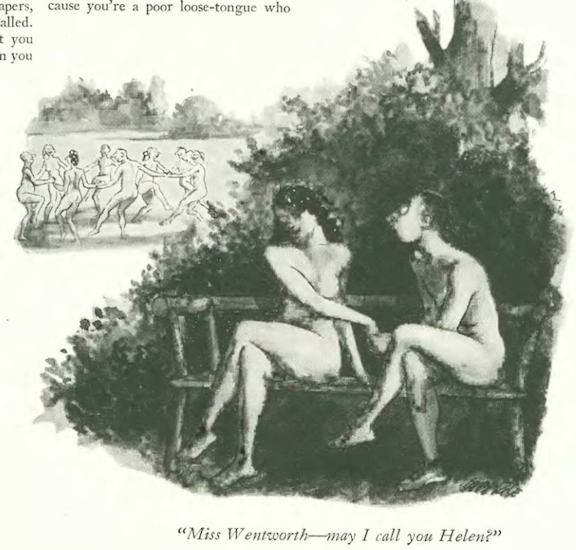
…Carl Rose revealed a modest side to life at a nudist colony…
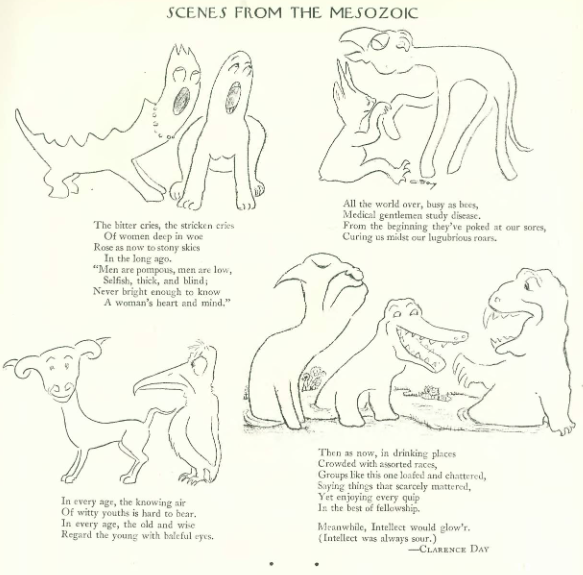
…we know Clarence Day for his Life With Father series, but on occasion he also contributed illustrated poems such as this one from the July 21 issue…
…on to July 28…
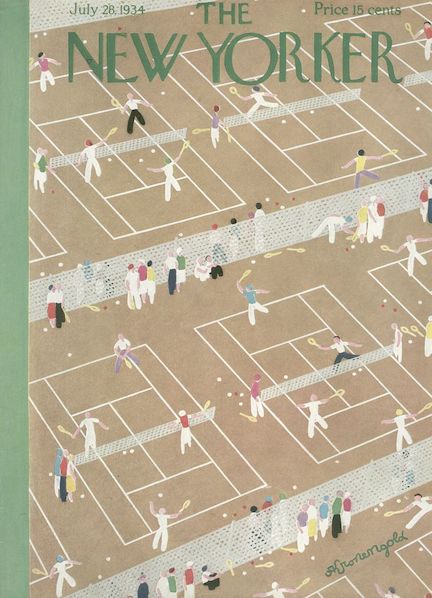
July 28, 1934 cover by Adolph K. Kronengold.
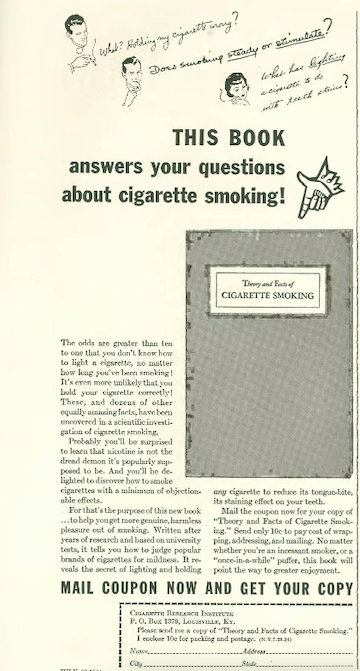
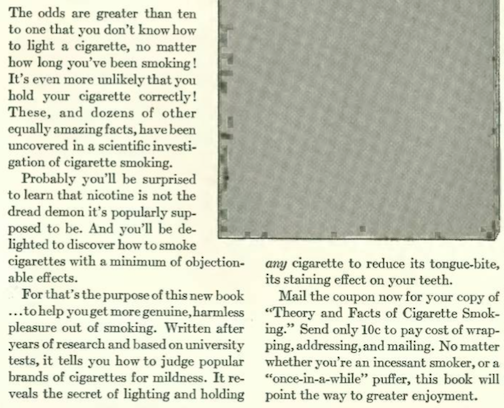
…where we encounter more “scientific research” that encouraged folks to smoke…This ad was placed on the very last page of the July 28 issue by the Cigarette Research Institute, based in Louisville, Kentucky…
…the booklet was filled with “amazing facts” uncovered in a “scientific investigation,” facts did not address the health effects of smoking, but rather such important topics as how to hold a cigarette the right way and how to reduce staining on your teeth…it also helpfully debunked the notion that nicotine was a “dread demon”…
…take for example this woman smoking a Lucky…now she knew how to hold a cigarette!…
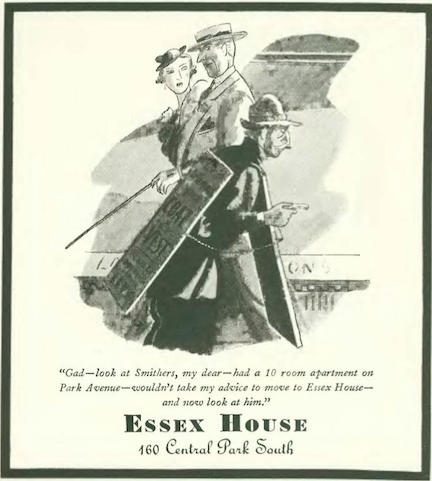
…the folks at Essex House were back, aggressively playing the class/caste card…apparently if you lived there you were entitled to kick your old friends to the curb…
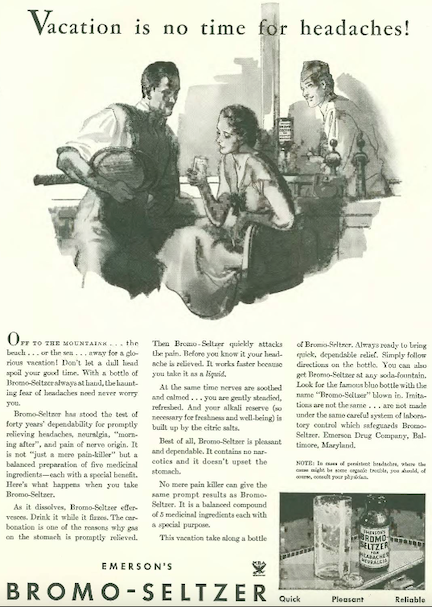
…the antacid and pain reliever Bromo-Seltzer was ubiquitous in 1930s medicine cabinets, but after the recipe was changed in the 1970s (all Bromides were withdrawn from the U.S. market in 1975) the brand slowly fizzled away…
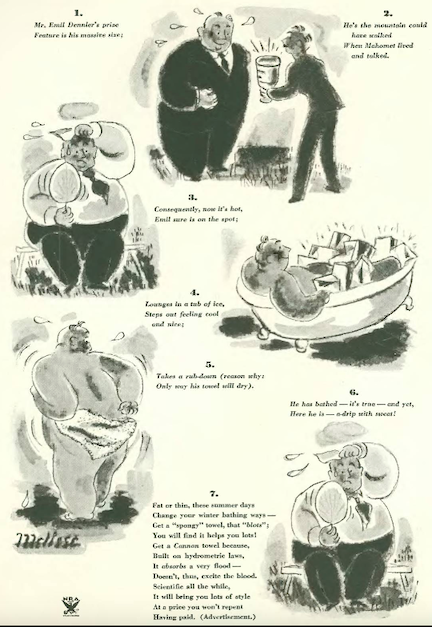
…Mildred Oppenheim Melisse was a popular illustrator of ads for department stores and various household goods, including Cannon towels, here guaranteed to absorb even this man’s sweaty “flood”…
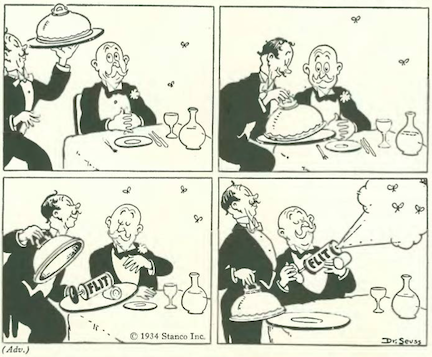
…Dr. Seuss back again for Flit, once again having no issues mixing insecticide with food preparation…
…Rea Irvin kicks off the cartoons with his Double Breasted Dowager…
…Helen Hokinson found some misplaced pity at a garden party…
…Garrett Price offered some unsolicited advice…
…Reginald Marsh filled two pages with a scene from Central Park…
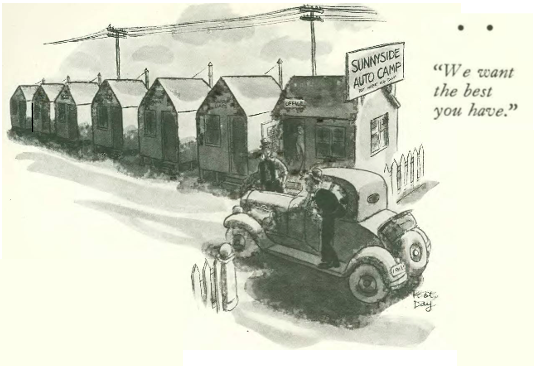
…Robert Day looked for a unique experience at an auto camp…
…and we close with Barbara Shermund, and some alarming news on the domestic front…
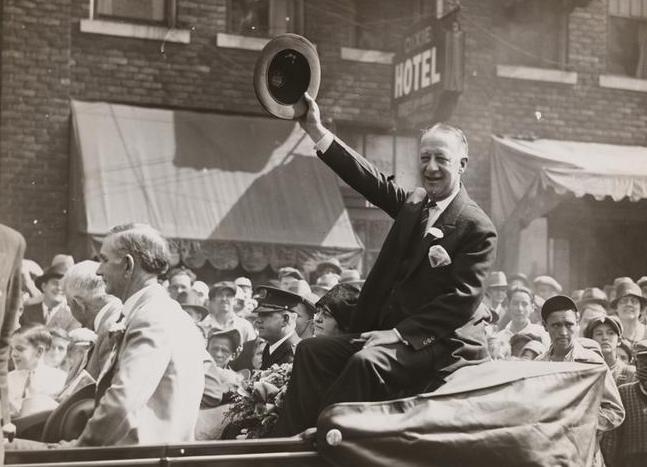
Above: Al Smith waving to crowds on arrival at Chattanooga, Tennessee during his presidential campaign in 1928. (Museum of the City of New York)
It’s hard to not like Al Smith, the governor of New York from 1923 to 1928, a man who avoided the temptations of political power and stayed true to his working class roots of the Lower East Side.
July 14, 1934 cover by Rea Irvin.
The son of Irish, Italian and German immigrants, Alfred Emanuel Smith (1873–1944) was raised in the Tammany Hall-dominated Fourth Ward, and although he was indebted to Tammany’s political machine throughout much of his professional life (including stints in the New York State Assembly and as York County Sheriff, President of the Board of Alderman, and finally Governor) he remained untarnished by corruption. Smith’s unsuccessful bid for the U.S. presidency in 1928 put an end to his political life, but there was still much to do, as “The Talk of the Town” explained:
HALL MONITORS…At left, Charles “Silent Charlie” Murphy with Al Smith in 1915. Murphy was the longest-serving head of Tammany Hall (1902 to 1924), and was known for transforming Tammany’s image from one of corruption to semi-respectability; at right, in 1929, Smith greets Franklin D. Roosevelt, who had just succeeded him as governor. (Library of Congress/Wikipedia)
Smith first sought the Democratic presidential nomination in 1924. According to historian Robert Slayton, Smith advanced the cause of civil liberty by decrying lynching and racial violence at the 1924 Democratic National Convention, where Franklin D. Roosevelt delivered the nominating speech for Smith and saluted him as “the Happy Warrior of the political battlefield.”
Following his 1928 presidential election loss to Herbert Hoover, Smith became president of Empire State, Inc., the corporation that built and also operated the Empire State Building, which was then the tallest building in the world. Smith was also known for his fondness of animals, and in 1934 Parks Commissioner Robert Moses made Smith “Honorary Night Zookeeper” of the renovated Central Park Zoo. Smith was given keys to the zoo and often took guests to see the animals after hours. According to Rebekah Burgess of the NYC Department of Parks and Recreation, “As a resident of 820 Fifth Avenue, directly across the street from the entrance of the Central Park Zoo, Smith was known to appear with snacks for the animals or to launch into impromptu lectures for visitors. Al Smith took his honorary title to heart. Throughout the rest of his life, Smith could often be found attending to the animals at the zookeepers’ sides during open hours. At night, Smith visited with guests, or more often, one-on-one with the animals.”
Smith was also a humanitarian, and in addition to advocating for the working class, he was an early critic of the Nazi regime in Germany, vigorously supporting the Anti-Nazi boycott of 1933. Here is another excerpt from the “Talk” piece:
LIFE OUTSIDE THE OFFICE…Scenes of post-political life, clockwise from top left: Al Smith fishing in 1933; with his family at the May 1, 1931 opening of the Empire State Building—Smith’s grandchildren cut the ribbon; golfing in 1930 with baseball great Babe Ruth in Coral Gables, Florida; with Rosie, the hippopotamus, at the Central Park Zoo, 1928. (Museum of the City of New York/Wikipedia)
* * *
Culture Club
In the Nov. 9, 1929 issue of The New YorkerMurdock Pemberton hailed the opening of the Roerich Museum. For the July 14, 1934 issue, “The Talk of the Town” took another look. A brief excerpt:
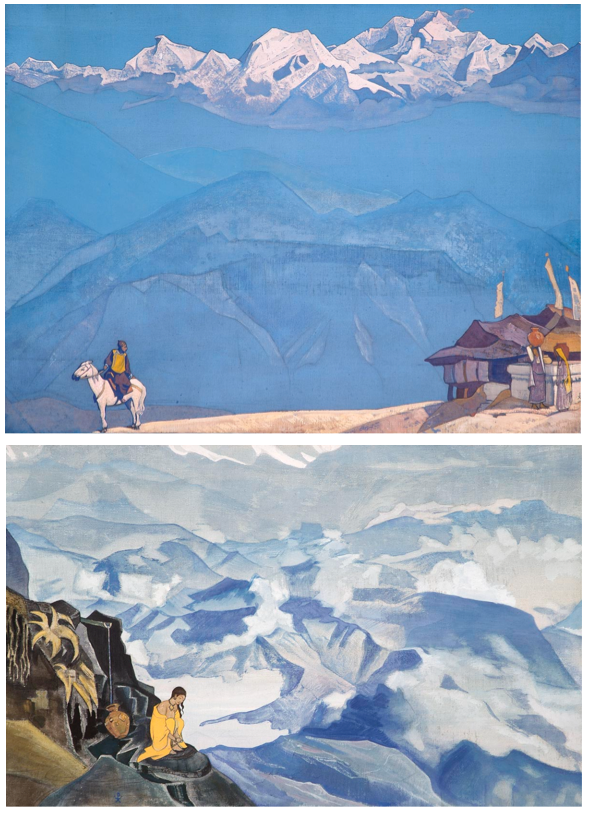
MORE THAN A BUILDING…”The Talk of the Town” noted the changing shades of the art deco landmark Master Building on Riverside Drive (left, in 1929) which originally housed the Nicholas Roerich Museum. Today the Roerich is located in this brownstone at 319 West 107th. (Wikipedia)FOOTNOTES FROM A FULL LIFE…Two of Nicholas Roerich’s paintings from the 1920s: at top, Remember, 1924; below, Drops of Life, 1924. (roerich.org)
* * *
Itinerant Showman
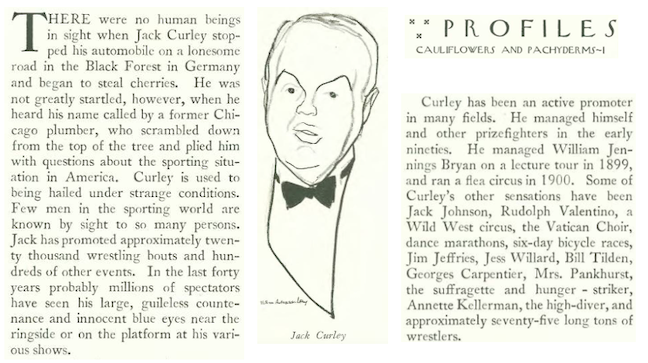
Alva Johnston filed the first installment of a three-part profile of famed sports promoter Jack Curley (1876–1937). A brief excerpt:
FIGHT CLUB…Sports promoter Jack Curley (left) with boxing manager Eddie Kane, circa 1920. (Library of Congress)
* * *
Over There
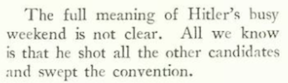
In his column “Of All Things,” Howard Brubaker made this brief mention of the “Night of the Long Knives;” on June 30, 1934 Adolf Hitler ordered SS guards to murder the leaders of the paramilitary SA along with hundreds of other perceived or imagined opponents.
Here is a clip from the front page of The New York Times, July 3, 1934:
(The New York Times)
* * *
Pimm’s and Soda
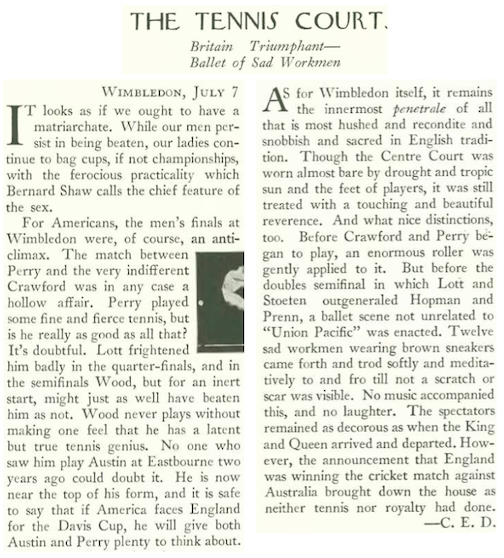
July in England meant Wimbledon, and The New Yorker was there to observe the “snobbish and sacred” rite…
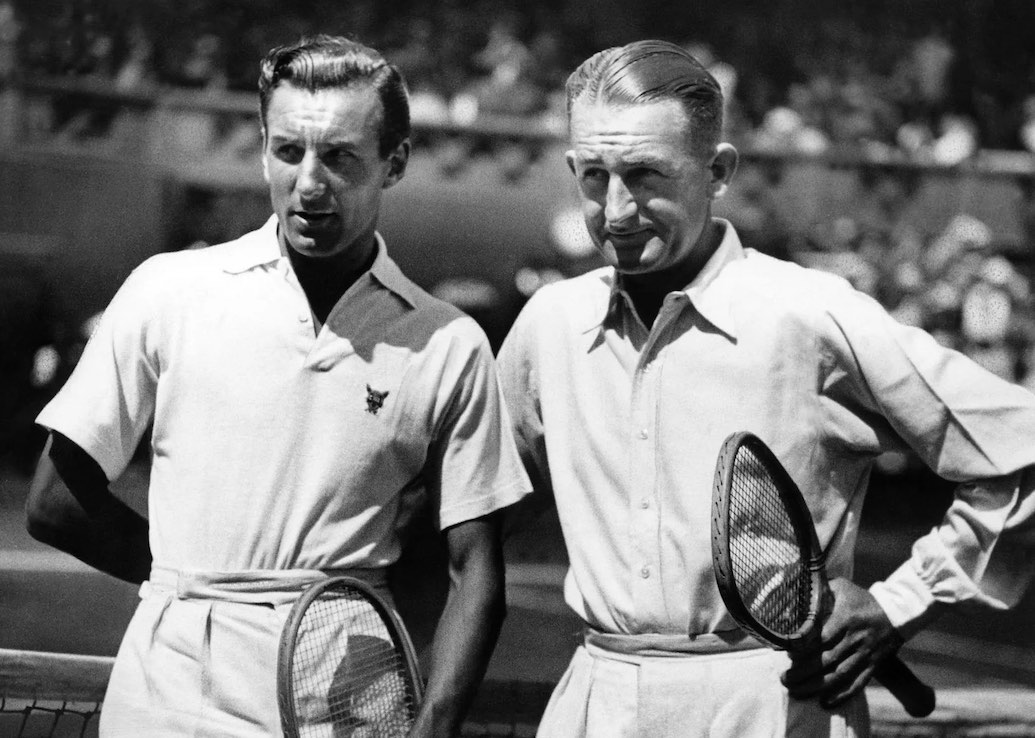
WATCH THE BOUNCING BALL…British tennis great Fred Perry (left) and Australian Jack Crawford before their men’s singles final at the 1934 Wimbledon tournament, which Perry won. Perry would claim three consecutive titles between 1934 and 1936. (Image: Mirrorpix)
* * *
Midsummer Dreams
In the summertime (and before widespread use of air conditioning) stage entertainments such as theater and musical performances took to the outdoors during their off-season, seeking the evening cool of intimate rooftops or large, open venues such as Lewisohn Stadium, A brief excerpt describing a performance of Samson et Dalila:
EVENING SHADE: Andre Kostelanetz conducts at Lewisohn Stadium in 1939. The stadium was demolished in 1973 to make way for City College of New York’s North Academic Center. (PressReader.com)
* * *
From Our Advertisers
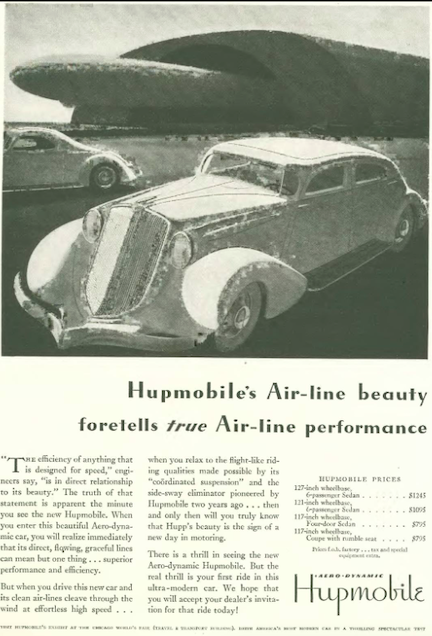
The folks at struggling carmaker Hupmobile took out this bold, full-page ad to tout their flashy “Aero-Dynamic” by noted designer Raymond Loewy…
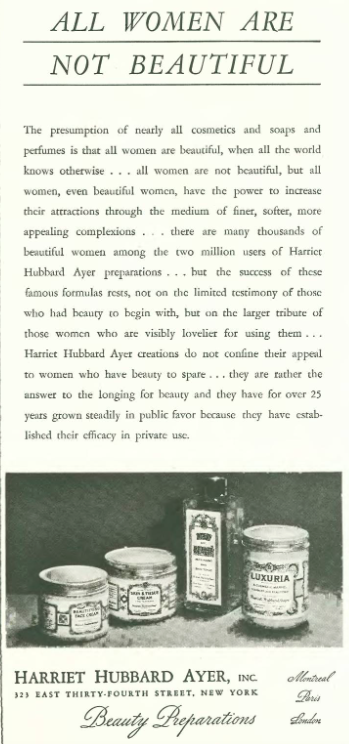
…this ad from Harriet Hubbard Ayer was bold in a very different way, essentially calling some women ugly unless they used the company’s “beauty preparations”…
…consommé, a clear soup that was particularly popular among the upper classes, offered up some keen competition between two food giants…here Heinz enlisted the help of William Steig to move their product…
…while the folks at Campbell’s offered up this lovely patio setting for their “invigorating” consommé…
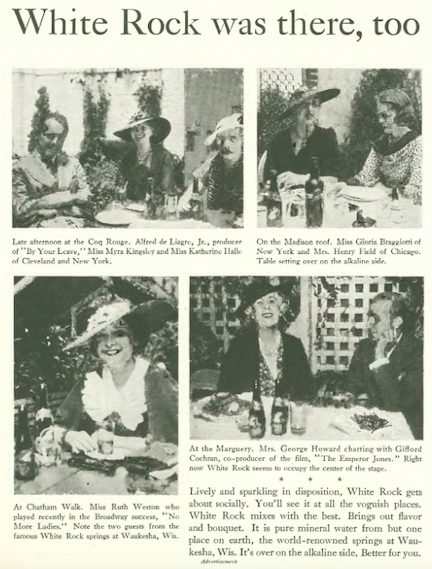
…meanwhile, White Rock mineral water could be found on patios all over Manhattan, as this ad attested…
…this is a reminder that most city folks had their milk and other dairy products delivered in the early part of the 20th century…by the early 1960s about 30 percent of consumers still had their milk delivered, dropping to 7 percent by 1975 and .4 percent by 2005…
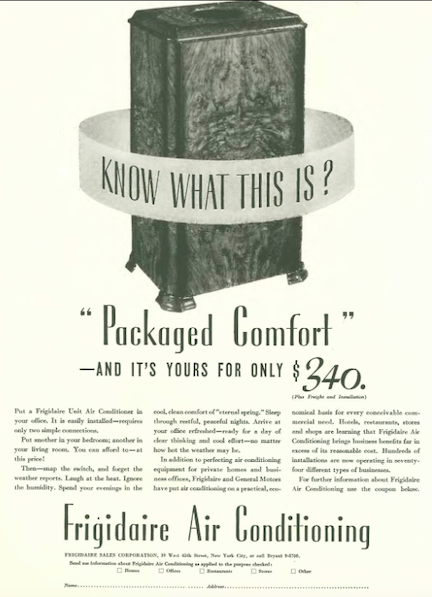
…affordable home air-conditioning wouldn’t be available to the masses until after World War II…this unit (designed for a single room) from Frigidaire retailed for $340 (a little less than $8,000 today)…
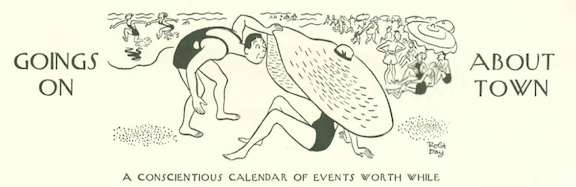
…on to our cartoonists, we begin with Robert Day in the “Goings On’ section…
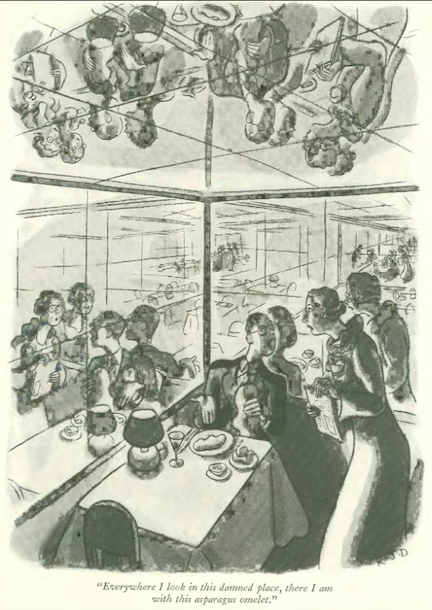
…Day again, exploring the baffling, glassy interiors of modern restaurants…
…the birdwatching continued with Rea Irvin…
…Alain (Daniel Brustlein) gave us a swimming somnambulist…
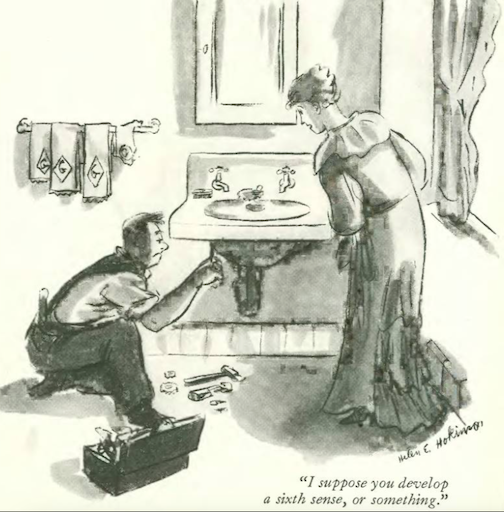
…Helen Hokinson explored the paranormal, via domestic plumbing…
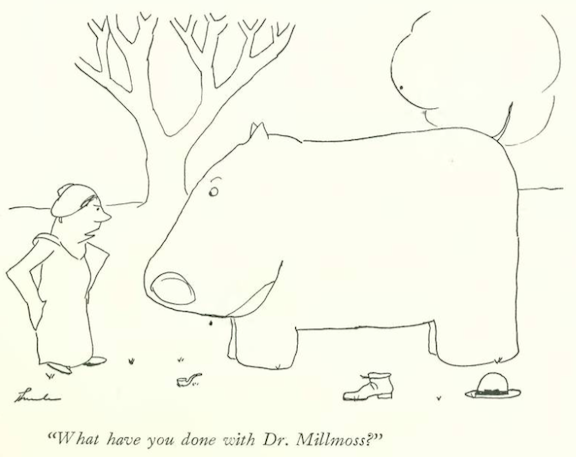
…and we close with James Thurber, and the missing Dr. Millmoss…
Above: Illustration of the Dorchester Hotel’s ballroom in the 1930s. (dorchestercollection.com)
Lois Long took her nightlife column, “Tables for Two,” to London and its famed nightclub scene, where everyone from British royalty to gangsters reveled in a boozy, bohemian scene.
July 7, 1934 cover by Ilonka Karasz.
Prince Edward, a well-known party animal (who would serve as king for less than a year and abdicate in 1936) was known to get up on the stage of the Embassy Club and perform drum solos, while at the Savoy his fellow toffs would sip Champagne and glide in elegant dress across the dance floor. London nightlife included a lively jazz scene in edgy Soho basement clubs, featuring such greats as Duke Ellington, Louis Armstrong and Dizzy Gillespie.
Long hoped that the visit to London, her first in eight years, would give her some much-needed rest and a change of scene. What she found instead was a red-hot, all-night party, where the smart set took dinner near midnight and danced until dawn.
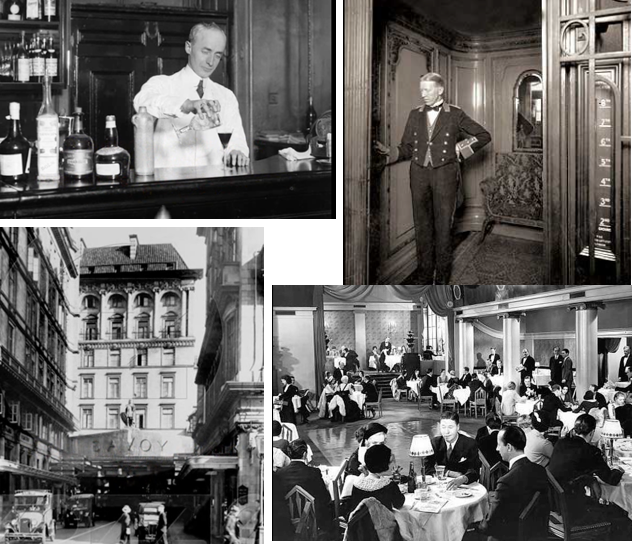
SAVVY SAVOY….Clockwise from top left, the famed Savoy bartender Harry Craddock, credited with inventing the White Lady and the Corpse Reviver, at the Savoy’s American Bar in the 1930s; a Savoy elevator operator in 1926; diners at the Savoy circa 1930s; Savoy entrance. (madamgenevaandgent.co.uk/The Savoy/YouTube)LONDON SWINGS…More Lois Long haunts in London included, clockwise from top left, the Dorchester Hotel; the crowded dance floor at the Monseigneur with Roy Fox and his Orchestra (photo from 1932); patrons kicking up their heels at the Embassy Club on Old Bond Street; the Café de Paris, where American actress Louise Brooks demonstrated a new dance craze, The Charleston, in 1924. (dorchestercollection.com/albowlly.club/lucyjanesantos.com/Wikipedia)
* * *
Misery Loves Company
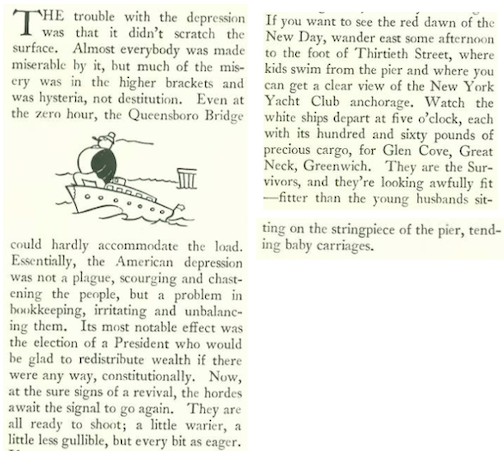
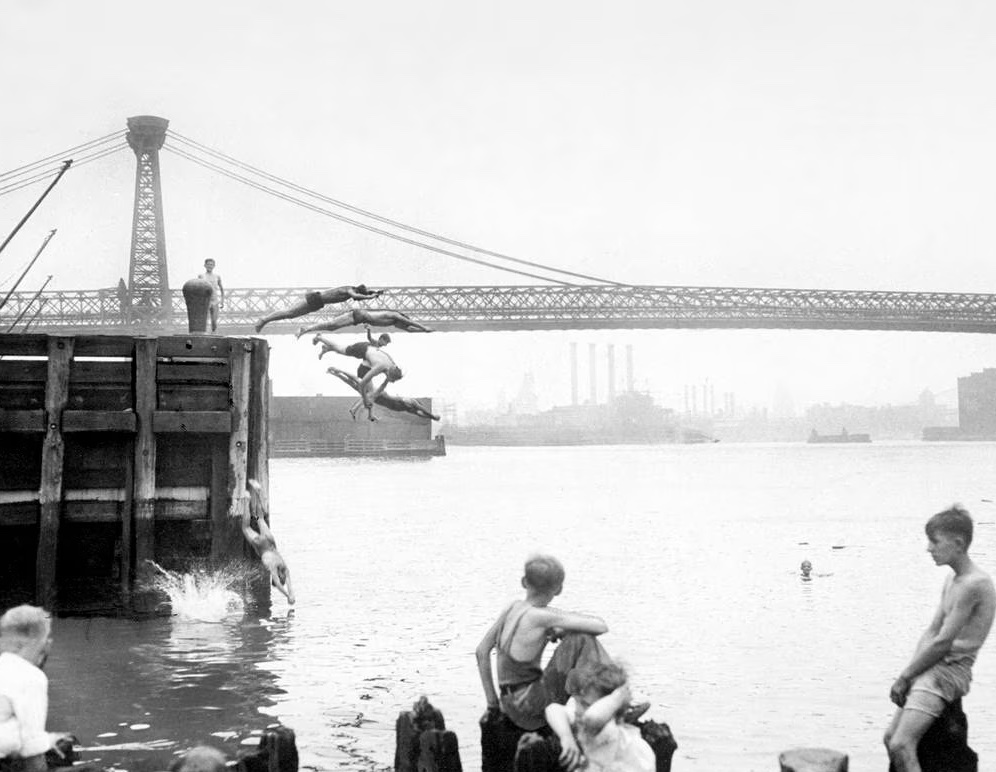
In his “Notes and Comment,” E.B. White observed that almost everyone was “made miserable” by the Depression, but if one looked around there were signs that things weren’t so bad after all.
REASON FOR CHEER…For those still feeling blue about the Depression, E.B. White suggested watching kids cool off at a pier, such as these lads seen diving into the East River on the Lower East Side on July 3, 1935. (Jack Gordon/New York Daily News)
* * *
He Came Up a Bit Short
Howard Brubaker, in his column “Of All Things,” made this observation about Adolf Hitler’s prediction that Nazism would endure a thousand years.
And now a retreat into the cool darkness of the cinema, where John Mosher singled out Bette Davis’s performance in Of Human Bondage…Mosher’s instincts were correct—the film proved to be Davis’s breakout role on her road to major stardom.
ROAD TO RUIN…Bette Davis wowed the critics with her portrayal of a tearoom waitress who seduces a young medical student (Leslie Howard) and leads him down a path of self-destruction. The film was based on the 1915 novel by W. Somerset Maugham. (IMDB)
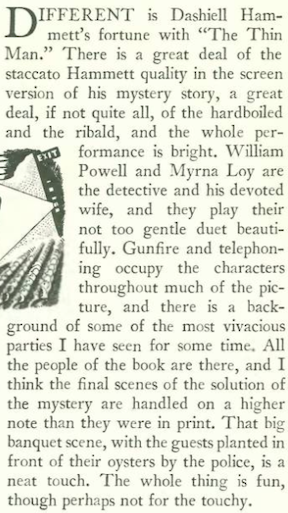
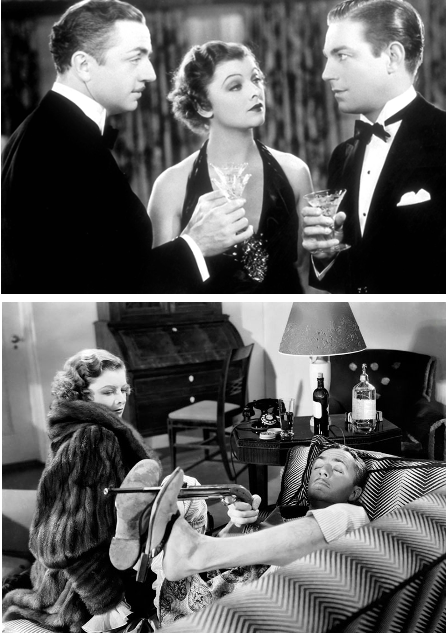
Mosher also took in the “bright” performances of William Powell and Myrna Loy in The Thin Man, a pre-Code comedy-mystery based on the Dashiell Hammett novel by the same name. Powell and Loy portrayed Nick and Nora Charles, who added spice to their leisurely lives through numerous cocktails, flirtatious banter, and crime-solving. Critics loved the film, as did audiences, spawning five sequels from 1936 to 1947.
CHEERS…Top photo: Nick and Nora Charles (William Powell and Myrna Loy) enjoy a drink with their client’s fiancee (Henry Wadsworth) in The Thin Man (1934); Bottom photo: Charles takes aim at a Christmas ornament (with a BB gun) while Nora enjoys the comforts of her new fur coat in a scene from The Thin Man. (Daily Beast/Austin Chronicle)
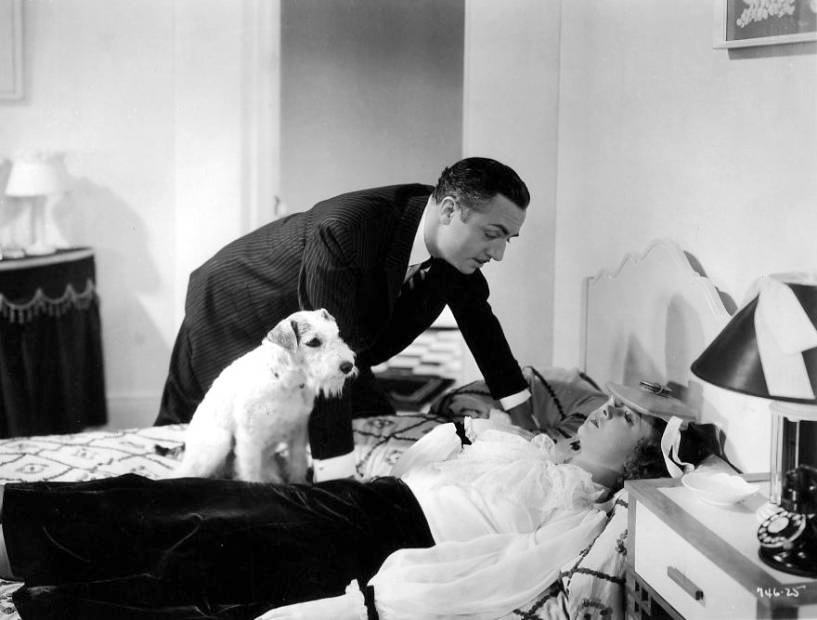
Another star of the show was Asta, the Charles’s wire fox terrier. Asta was portrayed by Skippy, a dog actor who not only appeared in The Thin Man films but also acted alongside Cary Grant in 1937’s The Awful Truth and in 1938’s Bringing Up Baby. Skippy appeared in three Thin Man movies and in more than twenty films altogether between 1932 and 1941. Being an actor in the film must have been good for one’s health: Powell lived 91 years, Loy 88 years, and Skippy, 20 years—a good long life for any pooch.
ROUGH NIGHT…Nick (William Powell) and Asta (Skippy) tend to Nora (Myrna Loy), who nurses a hangover in The Thin Man. (Wikipedia)
* * *
From Our Advertisers
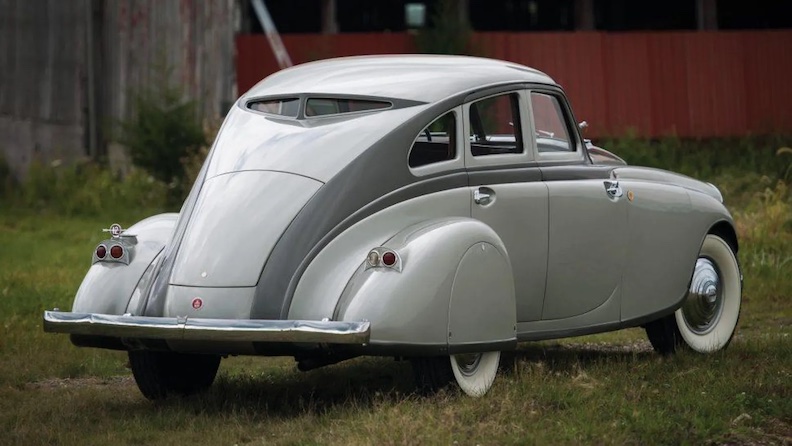
While Chrysler’s styling of their streamlined Airflow proved to be too far advanced for the buying public (the Depression didn’t help), Studebaker’s own foray into the streamlined future caused a sensation…
…thanks to Studebaker’s brief merger with Pierce-Arrow (1928–33), Studebaker’s designers took cues from Pierce’s streamlined 1933 Silver Arrow and created more than 800 cars with “Year-Ahead” design features—the positive reception convinced the company to continue the style in 1935…here is a top-of-the-line 1934 President Land Cruiser…
1934 Studebaker President Land Cruiser with “Year-Ahead” design features, yet not as radical as Chrysler’s Airflow. (hemmings.com)
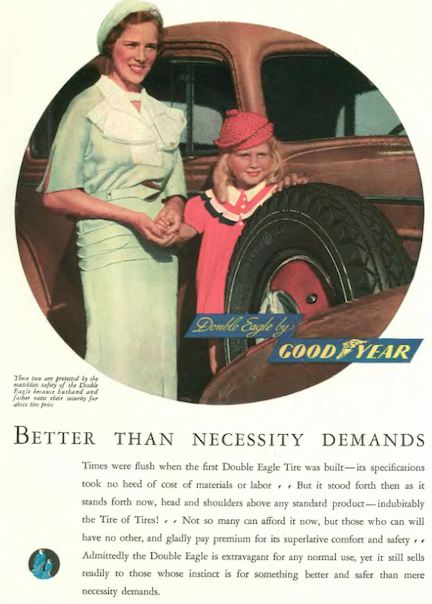
…we continue with those round rubber things that held the cars up…a lot of tire ads in the 1930s emphasized safety—blowouts were common back then…funny how it took nearly four decades to add seat belts to cars…those tires wouldn’t help much in a head-on collision, especially with your kid standing on the from seat…
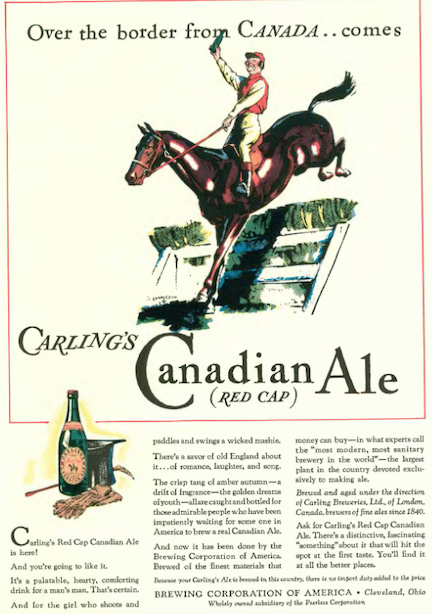
…now let’s cool off with crisp Canadian Ale, thanks to Carling’s entry into the American market…
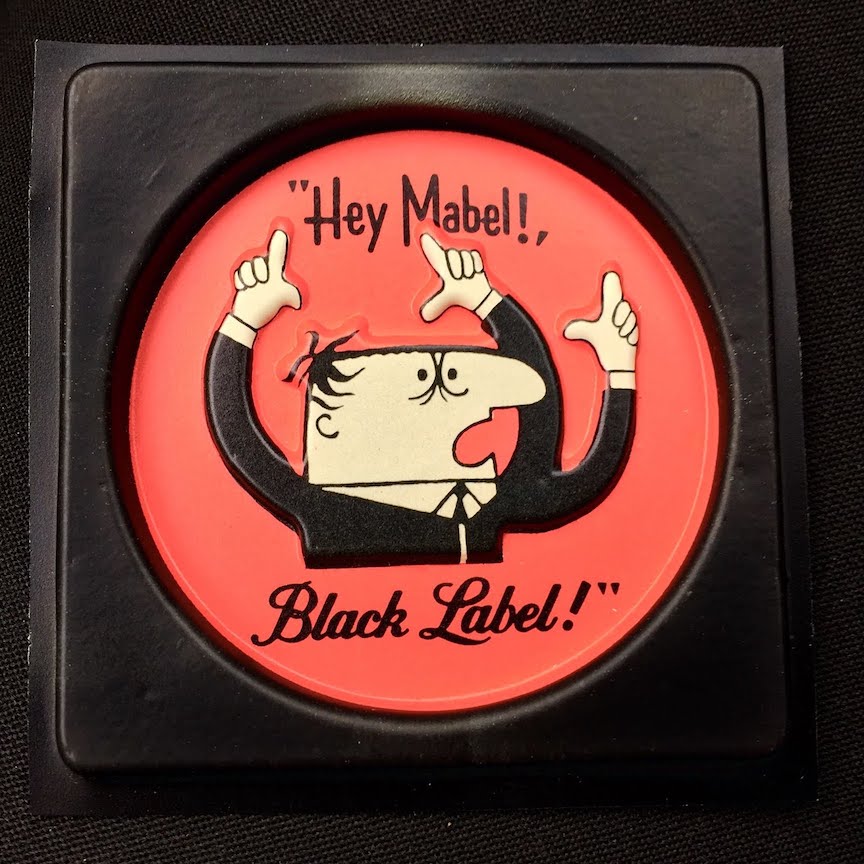
…Carling’s Black Label beer was popular in the states…my parents had a set of these coasters with the Black Label tagline…
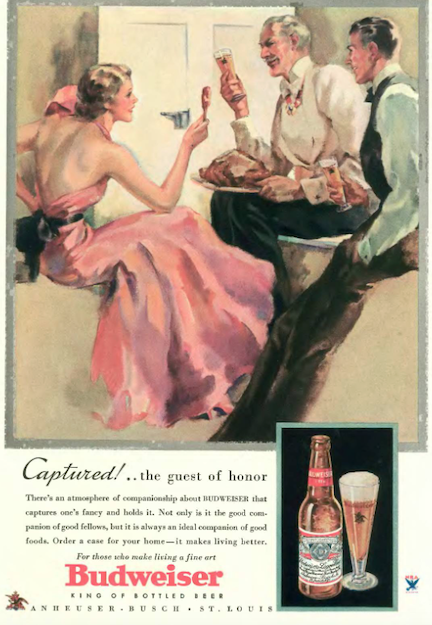
…Budweiser continued its artful series of ads featuring the well-heeled enjoying its product…here it appears old dad (wearing some kind of medal) is getting to know his daughter-in-law over some cold chicken…”hey boy, she’s one of us!”…
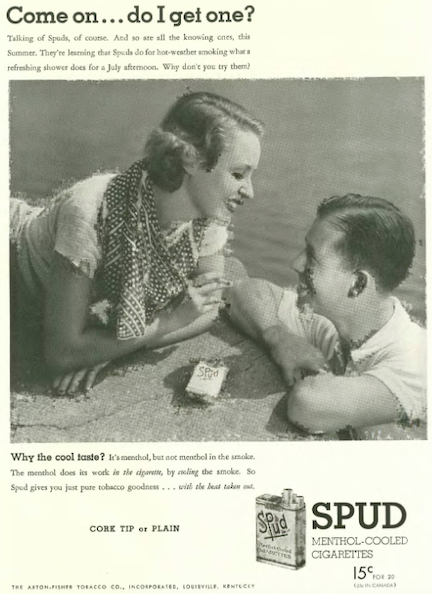
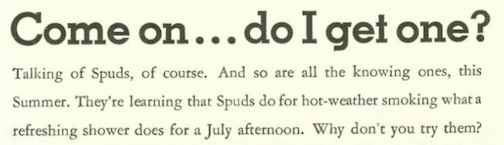
…and we move on to three very different approaches to selling cigarettes, beginning with Spud, continuing its message that menthol cigarettes are as refreshing as a shower on a July afternoon…
…a close up of the message…
…Camel, on the other hand, continued its campaign against irritability…it apparently did wonders for this woman, who seems to be on something more than nicotine…
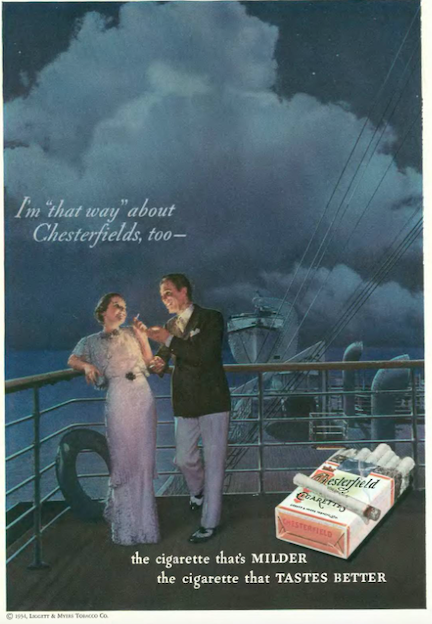
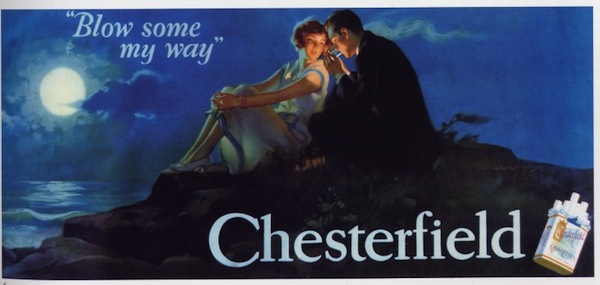
…and from the people who brought us the tagline “blow some my way” in 1928 (as a way to encourage women to take up the habit), by 1934 she is owning that cigarette, and apparently setting some ground rules with the gentleman…
…contrast with the more submissive pose in the Chesterfield ad from the late 1920s…
…on to our cartoons, we begin with spot art by Alan Dunn, which appears to have originated as a captioned cartoon…
…William Steig offered up this bit of art for a profile of an “insurance man” by St. Clair McKelway…
…Helen Hokinson drew up a full page of cartoons along the theme of outdoor dining…
…we continue Rea Irvin’s series on native birds…
…George Price found a way to save on the cost of light bulbs…
…and we close with James Thurber, and a welcome to the family…
Above, Stewart's Cafeteria in Greenwich Village, May 1933. (New York Public Library)
Although Sherwood Anderson is mostly known for his short story collections and novels, in the 1930s he also worked as a journalist, and for the June 9, 1934 issue of the New Yorker he explored the “centre of proletarian high life,” Stewart’s Cafeteria in Greenwich Village.
June 9, 1934 cover by Helen Hokinson.
What is particularly interesting about Anderson’s page 77 article for the “A Reporter at Large” column is what it doesn’t report, namely, that Stewart’s Cafeteria (later the Life Cafeteria) was known as a popular gay and lesbian hangout in addition to being a place for gawkers, assorted bohemians, and bohemian wannabes.
Anderson was a man of the world, so he knew exactly what Stewart’s was all about. But even the New Yorker wasn’t in the business of outing anyone, and editor Harold Ross, whose eccentricities included a puritanical strain, would not have allowed anything associated with “sexual deviance” to be printed in his magazine. Here is an excerpt from Anderson’s article, “Stewart’s, On the Square,” in which he subtly hints at the cafeteria’s “third life.”
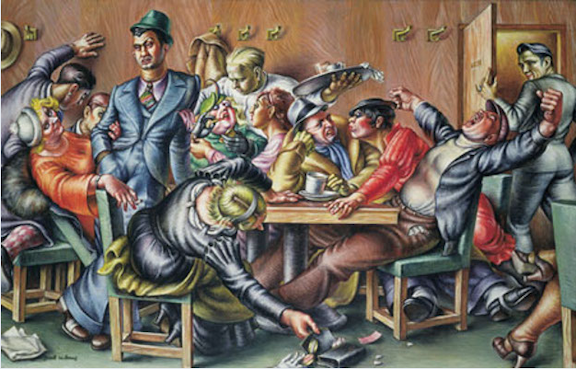
NIGHT LIFE…Paul Cadmus depicted Stewart’s in this sexually charged painting, Greenwich Village Cafeteria, 1934, oil on canvas,Museum of Modern Art. (All archival images for this entry were obtained via nyclgbtsites.org/site/stewarts-cafeteria)
While Anderson tiptoed around the topic of homosexuality, gossip rags such as Stephen Clow’sBroadway Brevities put it front and center. Described as one of the most vicious show business gossip magazines ever published, Brevities also provided Clow with some side income: Clow and his collaborators often threatened to blackmail wealthy businesspeople and show business figures who frequented places like Stewart’s—outing them in his tabloid unless payment was made.
(McGill Institute via HuffPost.com)
Naturally such reporting helped attract gawkers to Stewart’s and its successor, Life Cafeteria. According to the NYC LGBT Historic Sites Project, “Stewart’s closed in the mid-1930s and was subsequently reopened as the equally popular Life Cafeteria. Regulars included a young Tennessee Williams and Marlon Brando (though they didn’t meet each other until years later on a beach in Provincetown). Of the space, Brando later recalled, ‘The rednecks [on the street] were pointing at the diners like animals in a zoo. I was immediately intrigued and ventured in. Before I left that afternoon, I discovered that many of the homosexual men were actually putting on a show for the jam .'”
ON DISPLAY...According to the NYC LGBT Historic Sites Project, the large plate glass windows at Stewart's (later renamed Life Cafeteria) put gay life on full display to the late-night crowds who frequented the busy intersection. Artist Vincent La Gambina depicted one scene that gawkers might have taken in: Life Cafeteria, Greenwich Village, 1936. (Museum of the City of New York)TODAY, the building still stands, although it is a bit less lively as a home for a CVS store and a Bank of America branch. Just around the corner is the famed Stonewall Inn. (Google Maps Image)
According to the NYC LGBT Historic Sites Project:
...in 1935 the manager of Stewart’s was convicted of operating a “public nuisance” and “disorderly house” and “openly outraging public decency” by allowing objectionable behavior in the interior and large crowds to gather outside. Specifically, the district attorney’s complaint cited “certain persons of the homosexual type and certain persons of the Lesbian type, to remain therein and engage in acts of sapphism and divers [sic] other lewd, obscene, indecent and disgusting acts” and that the cafeteria was “used as a rendezvous for perverts, degenerates, homosexuals and other evil-disposed persons.” Much of the testimony centered on the gender non-conforming dress and behavior of the patrons.
Here is another excerpt from Anderson's article, where he delves into the nighttime scene at Stewart's:
* * *
Nightlife, Part II
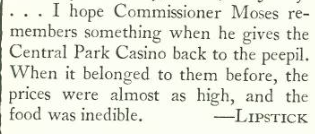
In my previous post E.B. White pondered the fate of the Central Park Casino, a favorite haunt of deposed Mayor Jimmy Walker and other members of the smart set who openly flouted Prohibition laws. In "Tables for Two," Lois Long made this observation (below) at the conclusion of her nightlife column, believing that Parks Commissioner Robert Moses would give the management a chance to lower food prices and allow common folks to enjoy its sumptuous atmosphere. Little did she know that Moses was feasting on a diet of revenge rather than food, and had plans to tear the place down, regardless of its lower prices.
* * *
From Our Advertisers
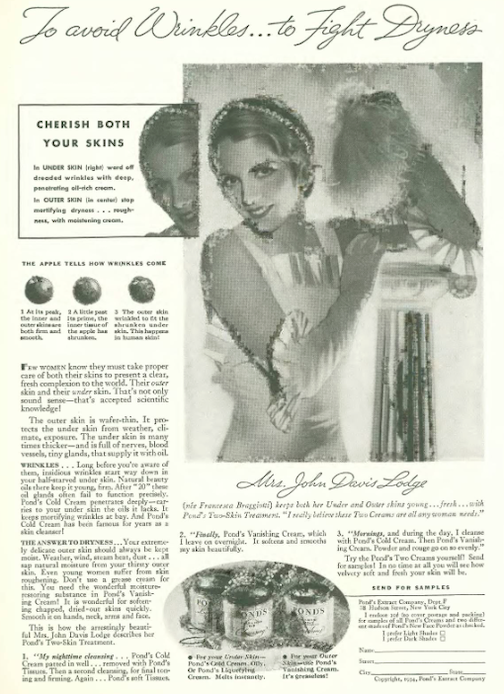
We kick off the ads with another Ponds celebrity endorsement from dancer and actress Francesca Braggiotti (1902-1998), who was married to actor, politician, and diplomat John Davis Lodge...
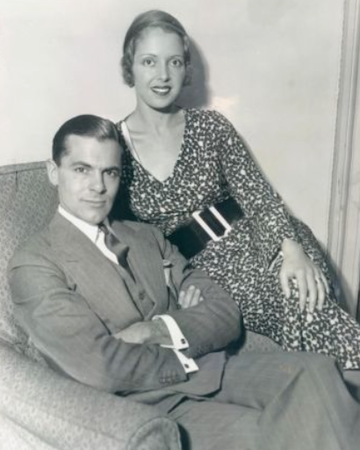
POWER COUPLE...John Davis Lodge and Francesca Braggiotti in 1932. They were married for 56 years. (Pinterest)
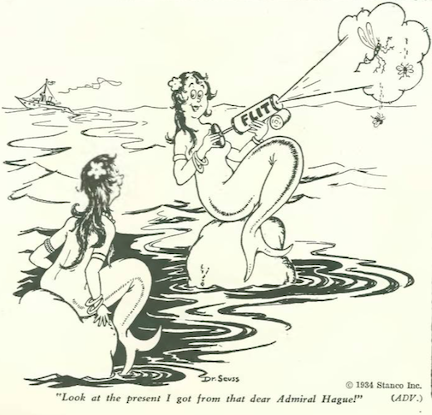
...Dr. Seuss was back with more ads for Flit insecticide...he was still two years away from his first children's book: And to Think That I Saw It on Mulberry Street...
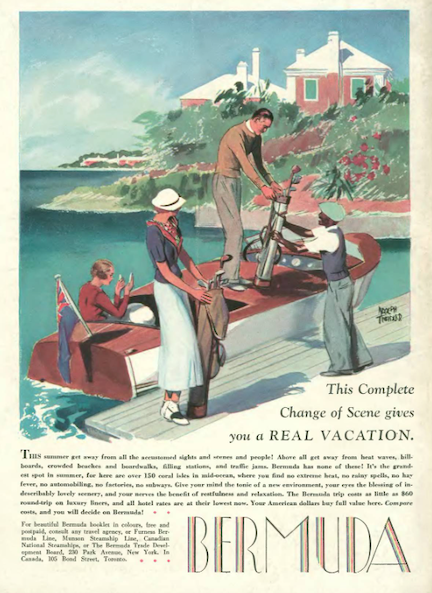
...and with a splash of color, Bermuda beckoned New Yorkers to a "Real Vacation"...
...however, before you headed to Bermuda, you'd needed to do something with the kids...
...on to our cartoonists, we start with spot art from Abe Birnbaum...
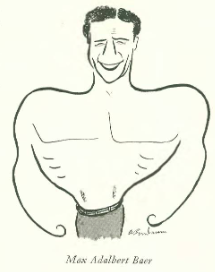
...Birnbaum again with an illustration of boxer Max Baer for the profile section...
...more spot art from James Thurber in the "Goings On About Town" section...
...and Thurber again with some alarming news for a potential suitor...
...Rea Irvin kicked off his series, "Our Native Birds"...
...a famed advertising agency launched a new door-to-door survey, per Perry Barlow...
...Helen Hokinson gave us a hopeful gardener...
...Barbara Shermund looked in on the "modern girl" scene...
...and Peter Arno examined a sad medical case...
...and we close the June 9 issue with this item from E.B. White, who commented on a recent rally of American Nazis and some fighting Irish...
...the Nazi rally was also alluded to in the June 2 issue (I have the issues reversed this time to support the narrative)...
June 2, 1934 cover by Harry Brown.
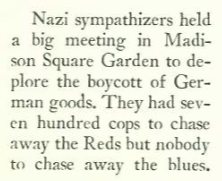
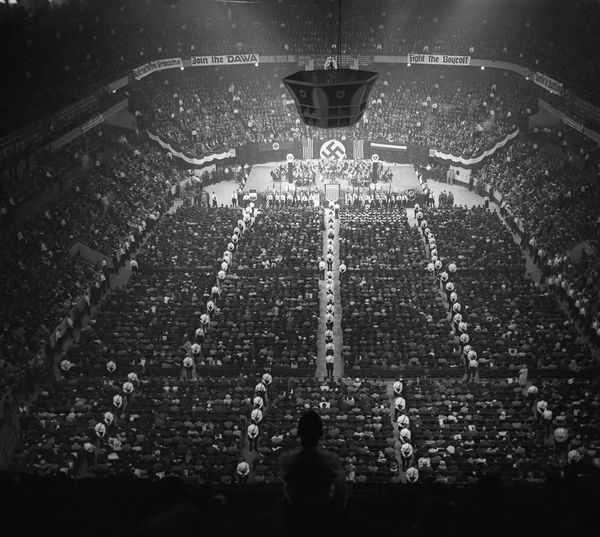
...where Howard Brubaker was keeping things light in his column "Of All Things." I was surprised how little was mentioned in either issue about the meeting of 20,000 Nazi sympathizers on May 17, 1934, at Madison Square Garden.
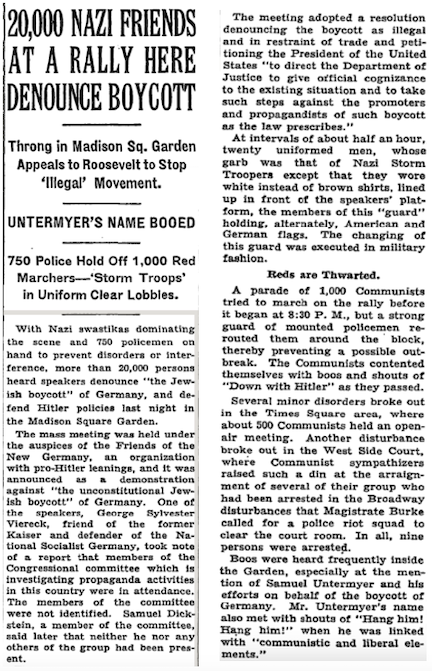
Let's explore further: According to the Jewish Virtual Library, America's first established anti-Nazi boycott group was the Jewish War Veterans (March 19, 1933), followed by the American League for the Defense of Jewish Rights (ALDJR), which was founded by the Yiddish journalist Abraham Coralnik in May 1933. By 1934 the ALDJR was led by Samuel Untermyer, who changed the organization's name to the "Non-Sectarian Anti-Nazi League to Champion Human Rights." Nazi sympathizers targeted Untermyer as the face of boycott efforts, and at the May 17 rally the mere mention of his name prompted shouts of "Hang him!"
AMERIKA...The site for hockey games and dog shows became a site for ugliness on May 17, 1934, when 20,000 Nazi sympathizers gathered in Madison Square Garden to denounce boycotts against Adolf Hitler's regime. (The Archive Project)
This excerpt from the May 18, 1934 edition of The New York Times gives some idea of what transpired at the rally:
REALLY? Americans gathered at Madison Square Garden on May 17, 1934 to show their support for Nazi Germany and denounce American boycotts. (The Archive Project)
* * *
Dueling Muses
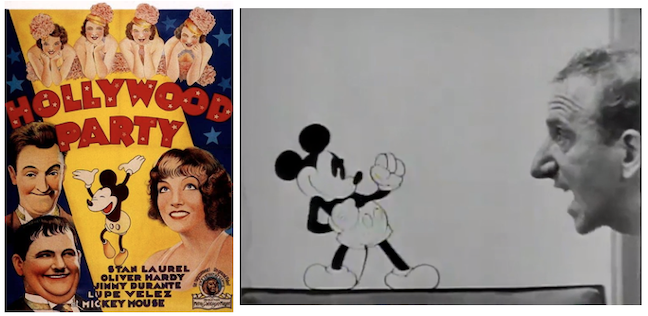
Film critic John Mosher always seemed upbeat about anything involving Disney, but given that animation was still in its infancy (its plastic trickery still rather novel), it didn't take much to outshine the otherwise drab fare (the "Grim") being coughed up by Tinseltown.
MAN OR MOUSE? The star-studded cast of Hollywood Party included Jimmy Durante, seen here duking it out with Mickey Mouse. (IMDB)
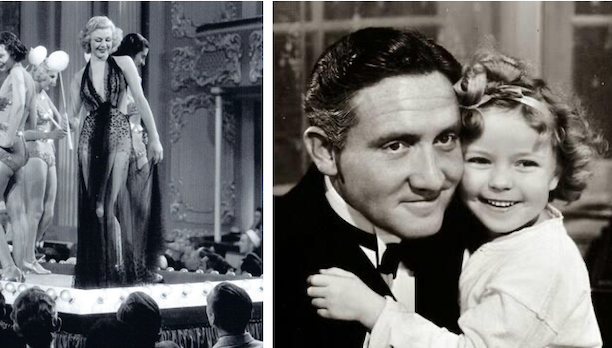
The grim included the Pre-Code drama, Upper World, about a rich, married man who falls to his ruin via a romance with a stripper (don't they always?), and Now I'll Tell, another Pre-Code drama, this one loosely based on the doings of racketeer and crime boss Arnold Rothstein.
SHAKE IT WHILE YOU CAN...Ginger Rogers performs “Shake Your Powder Puff” in a burlesque show in the film Upper World, one of the last of the Pre-Code dramas. It featured Warren William as a wealthy married railroad tycoon whose friendship with a showgirl (Rogers) leads to blackmail and murder; at right, five-year-old future child star Shirley Temple with Spencer Tracy in Now I'll Tell, which was loosely based on the autobiography of Carolyn Green Rothstein, wife of New York gambler Arnold Rothstein. Temple's role was a minor one, however her appearance in the musical Stand Up and Cheer!, which was released a month earlier, would make her a star. (IMDB)
* * *
More From Our Advertisers
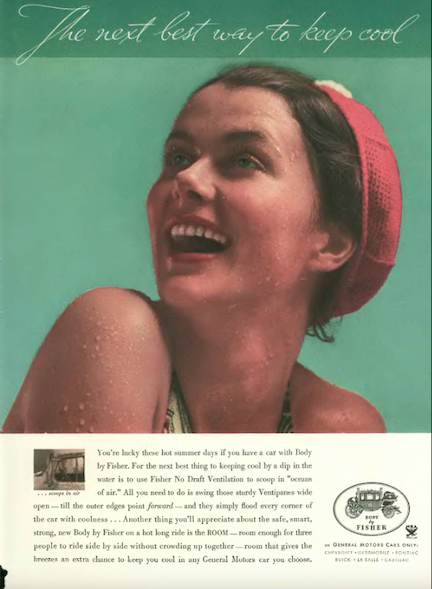
We cool off by a taking a dip in the pool...er, rather by enjoying the "No Draft Ventilation" of a car body by Fisher...the model might want to stay in the pool, since air-conditioning in cars was still a good twenty years away...
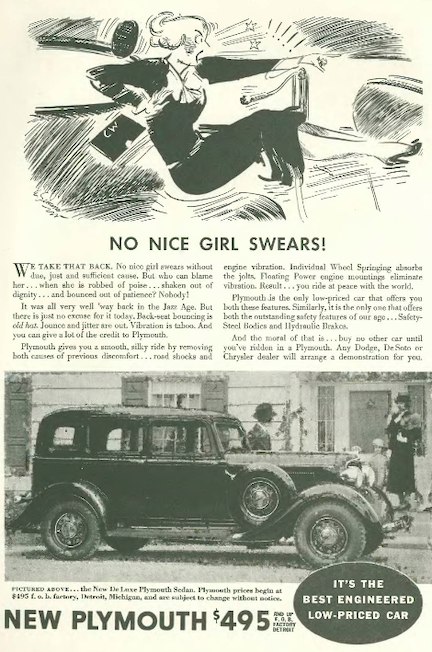
...and yes, this is also a car-related ad, if you can believe it, the bride looking forward not to years of wedded bliss but rather her new La Salle (a Cadillac product)...
...another bride, and a car...is that a car body by Fisher? Who cares, the wedding is over and its time to fire one up...
...this woman seems to have it all thanks to Daggett & Ramsdell of Park Avenue, who are prepared to coat her in a "complete range of all the essential creams, lotions, face powder...cold cream soap, dusting powder" etc. etc....
...Dr. Seuss again for Flit, with baby in tow...
...on to our cartoons, we have Robert Day checking on the progress at Mt. Rushmore...
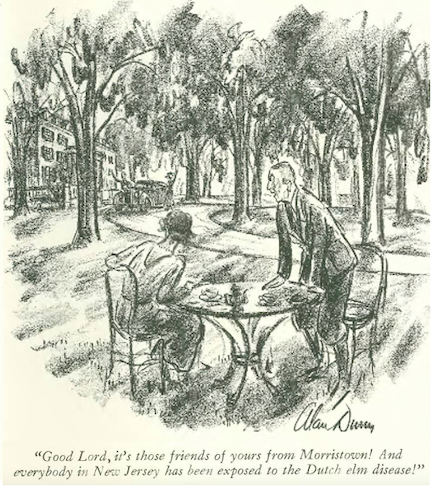
...Alan Dunn reveals pandemic worries of a different nature...
...and we close with Helen Hokinson, and a sudden change of mood...
Above: A scene from Mary Pickford’s 1922 film Tess of the Storm Country. (Library of Congress)
In today’s celebrity-saturated culture it is difficult to find a parallel to silent film star Mary Pickford, who was dubbed Queen of the Movies more than a century ago. Indeed, during the 1910s and 1920s Pickford was regarded as the most famous woman in the world.
April 7, 1934 cover by Rea Irvin.
Pickford was also known as “America’s Sweet” for her portrayal of gutsy but tenderhearted heroines. In real life she was also a gutsy and shrewd businesswoman who co-founded United Artists in 1919 with Charlie Chaplin, Douglas Fairbanks, and director D. W. Griffith. Commanding a salary only rivaled by Chaplin, her stardom only grew when she married Fairbanks in 1920, forming the first celebrity supercouple; together they ruled Hollywood from their Beverly Hills mansion, Pickfair (apparently staging dull affairs, per the “Profile” excerpt below).
The end of the silent era also put an end to Pickford’s stardom, as well as to her fairytale marriage to Fairbanks. Margaret Case Harriman’s profile of Pickford, simply titled “Sweetheart,” gave readers a glimpse into the decline of a silent superstar. Excerpts:
SINGULAR STAR…Clockwise, from top left, Mary Pickford in a publicity photo, circa 1910; Pickford visits close friend and screenwriter Frances Marion during filming of Straight is the Way (1921); Douglas Fairbanks and Pickford in the early 1920s; Pickford with a movie camera in 1916—in addition to being a shrewd businesswoman, she was also skilled behind the camera. (thehollywoodtimes.today/Time/Library of Congress)
Harriman concluded her profile with some thoughts on Pickford’s future:
THE SOUND BARRIER…With the advent of sound movies Mary Pickford turned to writing books and serving various charities. From left, sharing ice cream with rising star Bing Crosby in 1934; center, Al Frueh’s caricature of Pickford for the profile; Pickford in a 1934 promotional picture supporting The Salvation Army. (Pinterest/Library of Congress)
A note on the profile’s writer, Margaret Case Harriman (1904-1966), who doubtless sharpened her people-watching skills at the Hotel Algonquin (famed birthing ground of the New Yorker), which was owned by her father, Frank Case. Douglas Fairbanks was one of Case’s best friends, and Harriman knew both Fairbanks and Pickford well, since they often stayed at the hotel.
HOME SWEET HOME…Margaret Case Harriman, photographed May 31, 1937 by Carl Van Vechten. Harriman was born in 1904 in room 1206 of the Hotel Algonquin, which was owned by her father, Frank Case. (Philadelphia Museum of Art)
* * *
Master of Masters
The founder of perhaps the world’s most prestigious golf tournament was an amateur and a working lawyer by profession. When Bobby Jones (1902–1971) co-founded the Masters Tournament in 1934 with investment dealer Clifford Robert, it was called the Augusta National Invitation Tournament (it was Robert’s idea to call it The Masters, a name Jones thought immodest). Jones dominated top-level amateur competition from the early 1920s through 1930—the year he achieved a Grand Slam by winning golf ’s four major tournaments in the same year. However, by the 1934 Jones’s skills began to wane. The New Yorker had little to say about the first Masters (it wasn’t a big deal yet), other than Howard Brubaker making this observation in “Of All Things”…
A SWING INTO HISTORY…Bobby Jones (center) drives during the first-ever Masters Tournament in Augusta, Georgia on March 22, 1934. (augusta.com)
* * *
From Our Advertisers
Wanna get away? This colorful advertisement beckoned New Yorker readers to take the next boat to sunny Bermuda…
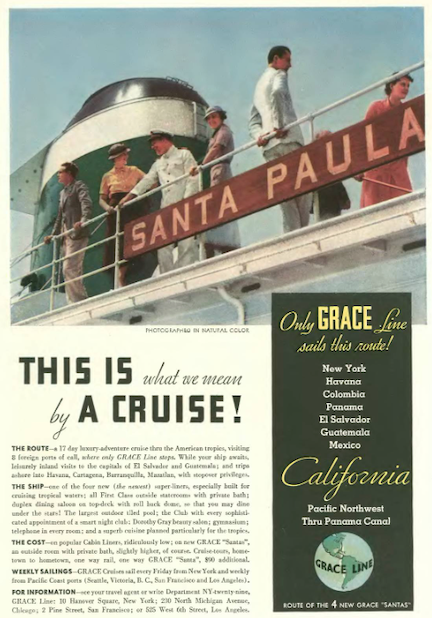
…while the Grace Line offered a southern cruise through the Panama Canal…
…but who needed to travel when you could enjoy a beer that was beloved the world over?…
…Mrs. Potter d’Orsay PalmerneeMaria Eugenia Martinez de Hoz was content to stay home in Chicago and smoke a few Camels, apparently…
…we’ve encountered her before—she appeared in a Ponds ad (below) in the Aug. 8, 1931 issue of the New Yorker, where we learned she was wife No. 2 of Potter d’Orsay Palmer, son of the wealthy family of Chicago Palmer House fame…they would divorce in 1937, and the playboy Potter would marry two more times before dying of a cerebral hemorrhage in May 1939—following a drunken brawl in Sarasota, Florida with a meat cutter called Kenneth Nosworthy. Maria Eugenia would remarry and return to her homeland of Argentina to raise a family…
…this ad from Nash looks like a scene from Attack of the 50 Foot Woman, if she had a car to match, that is…
…the Cadillac V-16 was a truly massive automobile, but in contrast to the Nash ad, you can barely see the car as it approaches from the vanishing distance…
…E. Simms Campbell got in on the advertising game with this spot that features contrasting images of storm and calm…
…James Thurber offered this cartoon on behalf of Heinz soups…
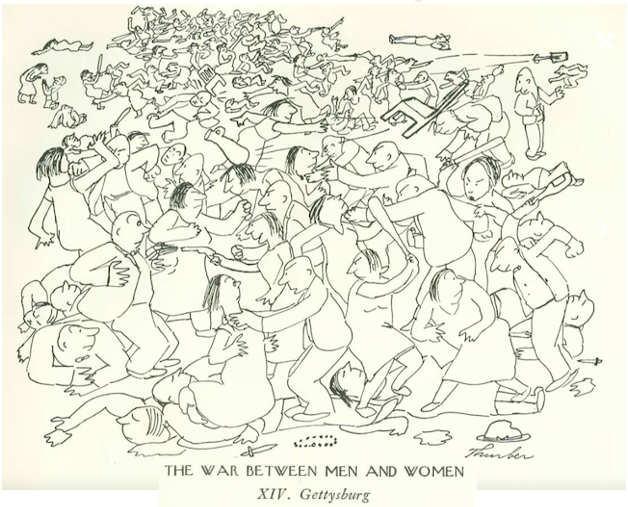
…and Thurber again, as we kick off the cartoons with the ongoing battle…
…Adolph Schus made a rare appearance in the New Yorker…according to Ink Spill, he also contributed a cartoon on March 19, 1938, and was editor of Pageant Magazine in 1945…
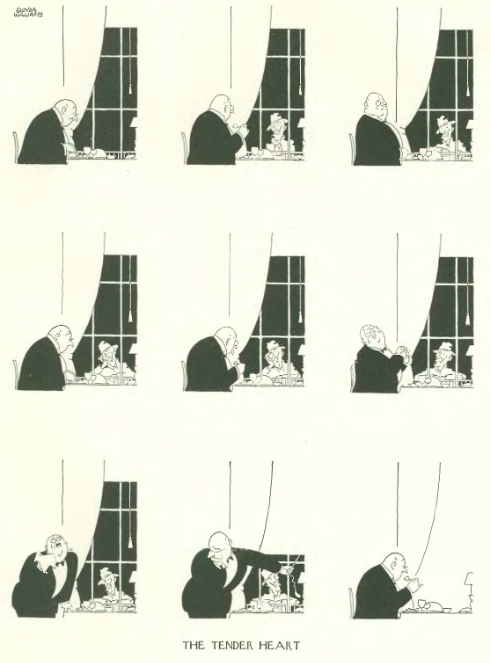
…Gluyas Williams looked in on the sorrows of moneyed classes…
…Helen Hokinson’s “girls” were in search of lunch, and propriety…
…and Leonard Dove gave us a renter surprised by something not included in his lease…
…on to April 14, 1934…
April 14, 1934 cover by Harry Brown.
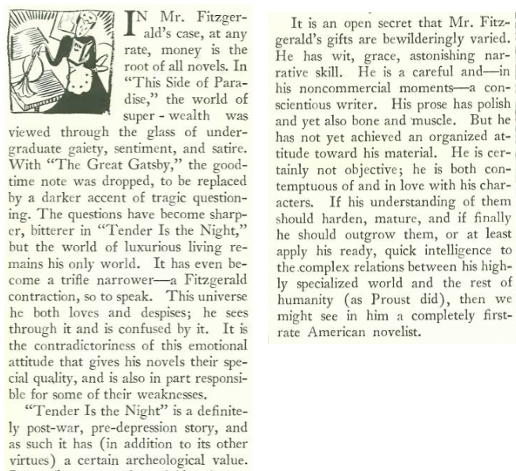
…and book reviewer Clifton Fadiman, who found F. Scott Fitzgerald’s literary gifts “bewilderingly varied”…
A NOT-SO-TENDER RECEPTION…F. Scott Fitzgerald’s status as a symbol of Jazz Age excess hurt his career during the Depression years. Tender Is the Night received mixed reviews, which didn’t help his alcoholism and deteriorating health. When Carl Van Vechten took this photo of Fitzgerald in June 1937, the author had a little over three years to live. (Wikipedia)
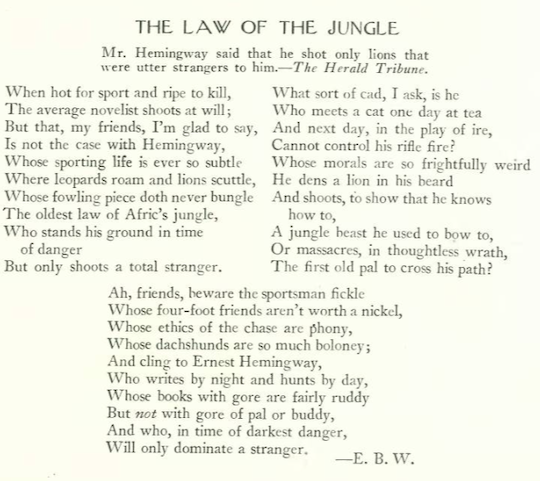
…speaking of F. Scott Fitzgerald, fellow author Ernest Hemingway defended Fitzgerald’s writing, arguing that criticism of his Jazz Age settings stemmed from superficial readings. One then wonders what Hemingway thought of E.B. White’s poetic “tribute” to his big game hunting excursions…
I ONLY SHOOT STRANGERS…Author Ernest Hemingway poses with a lion shot during a safari in Africa in 1934. (MPR News)
* * *
From History’s Ash Heap
Various reference sources cite “freak shows” as a normal part of American culture in the late 19th to the early 20th centuries, but I have to admit I saw exhibits at state fairs of half-ton humans and conjoined twins when I was a kid in the 1970s (not to mention things in jars at a carnival in St. Louis that should have been given a decent burial).
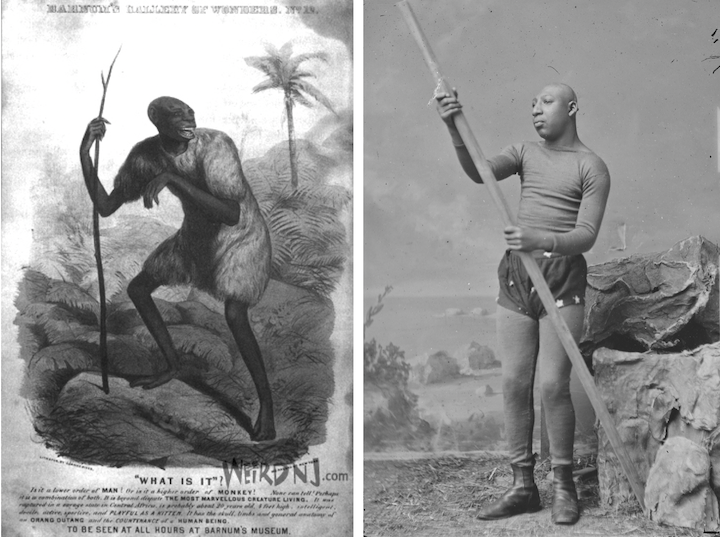
When Alva Johnston penned the first installment of a three-part profile series titled “Sideshow People,” such attractions could be found across the U.S. and Europe—Coney Island featured “Zip the Pinhead,” who was actually William Henry Johnson (1842–1926), one of six children born to former slaves living in New Jersey. His desperately poor parents agreed to allow P.T. Barnum to display him at a museum and at circus performances billed as a missing link, a “What-Is-It” supposedly caught in Africa.
FOR THE SUCKERS…P.T. Barnum exhibited William Henry Johnson as a “wild man”, a “What-Is-It” that subsisted on raw meat, nuts, and fruit, but was learning to eat more civilized fare such as bread and cake. Note the difference between the poster depiction at left and the actual man. Civil War-era photo at right by Mathew Brady’s photography studio in New York City. (National Portrait Gallery)
* * *
Floating and Sinking
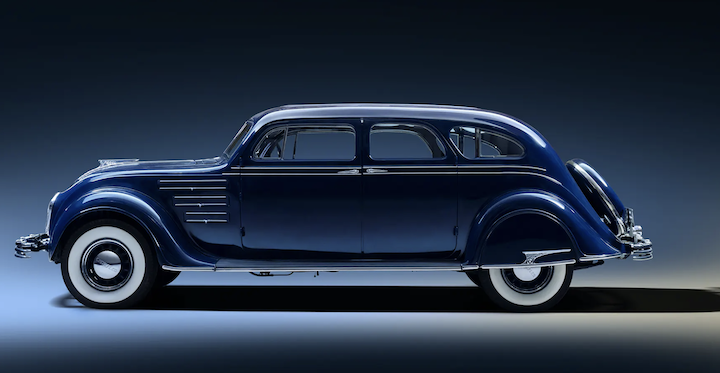
As much as New Yorker cartoonists (and E.B. White) liked to take pokes at Chrysler’s futuristic Airflow, there was much to be admired by the innovations the car represented. Unfortunately, the car’s design was too advanced for the buying public, and despite a big manufacturing and sales push by Chrysler the car was shelved by late 1936.
Writing for Time, Dan Neil noted the Airflow’s spectacularly bad timing. “Twenty years later, the car’s many design and engineering innovations — the aerodynamic singlet-style fuselage, steel-spaceframe construction, near 50-50 front-rear weight distribution and light weight—would have been celebrated. As it was, in 1934, the car’s dramatic streamliner styling antagonized Americans on some deep level, almost as if it were designed by Bolsheviks.”
SEEMED LIKE A GOOD IDEA. A restored 1934 Airflow. (Hagerty Media)
* * *
More From Our Advertisers
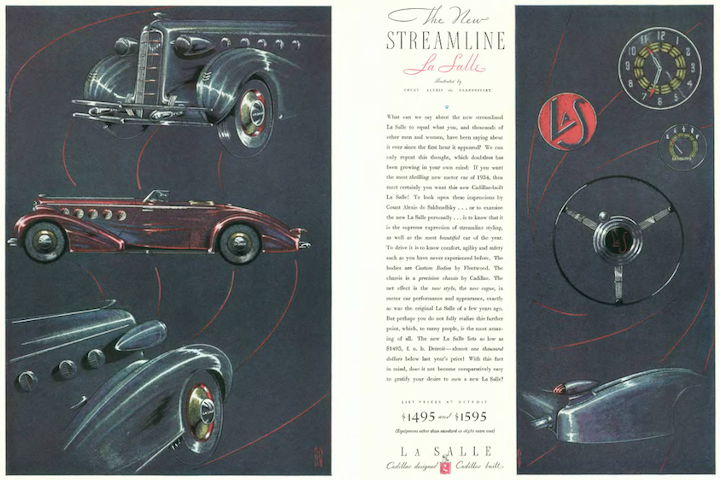
Maybe the buying public wasn’t ready for a car with a sloping hood and embedded headlights, but the folks at Cadillac were eager to unveil concepts for the new streamlined La Salle, which retained the familiar bullet headlights so as not to alarm consumers too much…
…and here’s a lovely image from Goodyear…I assume this woman is merely resting in a rumble seat, since this pose would not be possible above 25 mph…
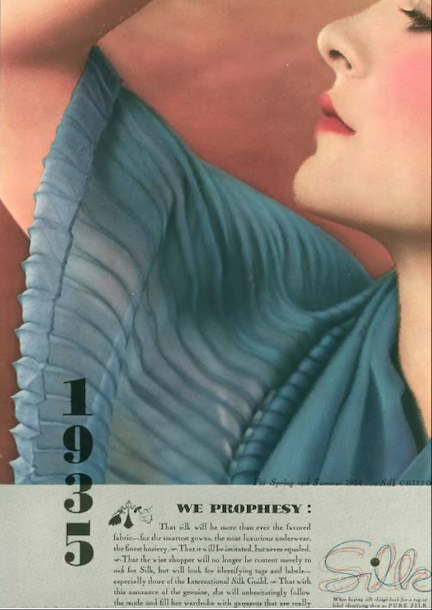
…full-bleed color ads were coming into their own, as demonstrated by this stylish entry from the purveyors of silk garments…
…on the other hand, our well-heeled friends at Ponds stuck with the tried and true copy-heavy approach…here they offer the flawless features of Anne Gould (1913–1962), granddaughter of Gilded Age robber baron Jay Gould…
…R.J. Reynolds continued their campaign to convince us that Camels bring success to the average Joe and the champion athlete…
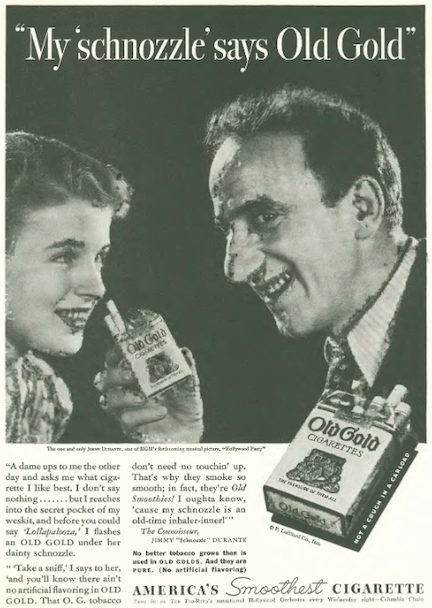
…the makers of Old Gold opted for the super creepy approach, asking entertainer Jimmy Durante to shove a pack of smokes into the face of what appears to be a teenager…
…here’s another ad from World Peaceways, reminding us of the futility of war…
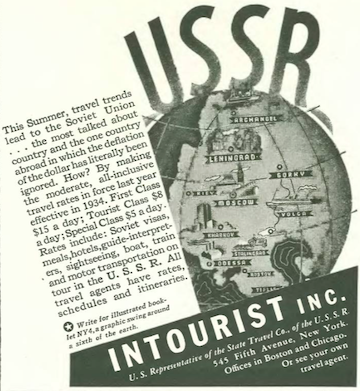
…speaking of futility, you could visit the USSR, which doubtless took great pains to steer tourists away from mass starvation in Ukraine and mass executions of Stalin’s many “enemies”…
…while folks in the USSR were worshiping Lenin and Stalin, Americans were rightly transfixed by the miracle of Kellogg’s Corn Flakes…a producer of industrial and advertising films, Castle Films would become a subsidiary of Universal and would go on to make a line of science-fiction and horror films including The Wolf Man, The Mummy, and Creature from the Black Lagoon.
…on to our cartoons, Alain took on the recent MoMA exhibition of “Machine Art”…
…and speaking of machine art, George Price was to latest cartoonist to take a crack at the Airflow…
…James Thurber offered this bit of spot art for the opening pages…
…and returned to a somber scene on the battlefield of the sexes…
Above: Robert Moses in 1939 with a model of his proposed Battery Bridge Park Reconstruction; at right, 1934 Bryant Park renovation, view to the south on 6th Avenue from 42nd Street. (Wikipedia/NYC Parks Department)
The title for this entry comes from Robert Caro’s landmark 1974 biography of Robert Moses, The Power Broker: Robert Moses and the Fall of New York, which questioned the benefit of Moses’s monumental projects.
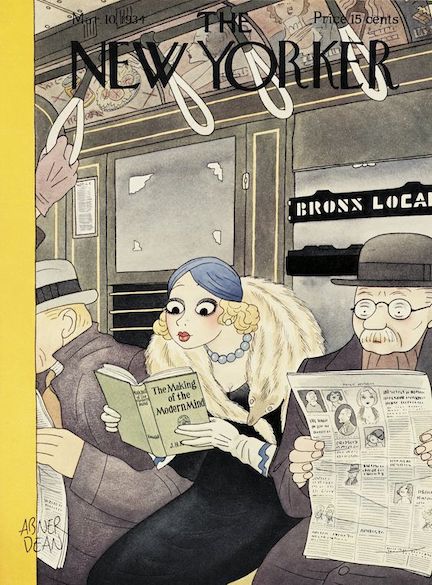
March 10, 1934 cover by Abner Dean.
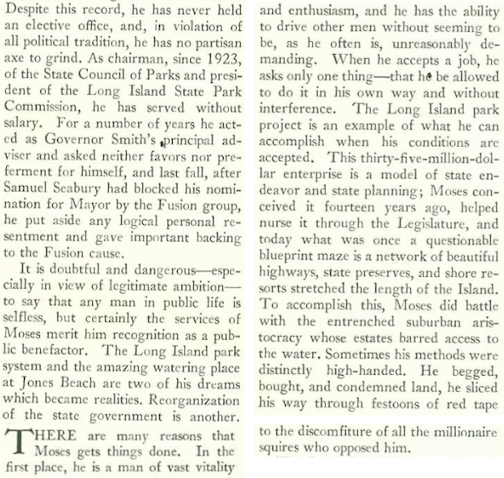
Like him or not, few unelected officials have wielded more power than Moses, who through various appointed positions, including New York City Parks Commissioner, he was able to impose his will on mayors, legislators, congressmen, wealthy burghers, and even, on occasion, The White House. In turn he imposed his will on the city itself, clearing whole neighborhoods to lay down new roads that extended from Manhattan to the tip of Long Island, where neither farmer nor landed gentry could stand in his way. A profile written by Milton MacKaye examined what made Moses tick. An excerpt:
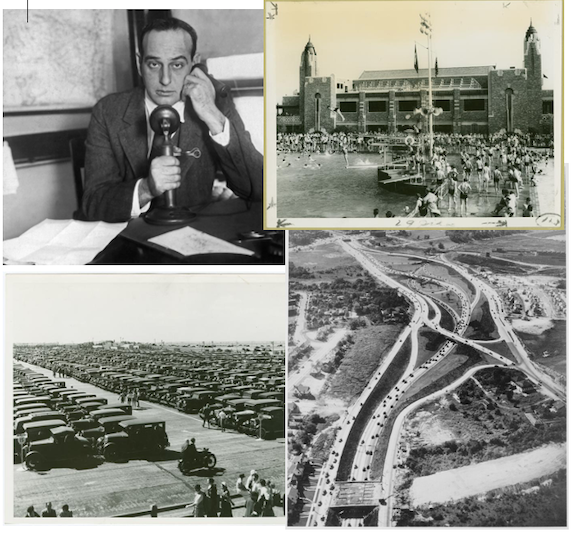
DON’T YOU DARE PUT ME ON HOLD…Relentless doesn’t begin to describe Robert Moses’s pursuit of power. Clockwise, from top left, Moses circa 1930; one of the swimming pools at the west bathhouse at Long Island’s Jones Beach, a project that helped launch Moses’s road to power; Long Island Expressway, which transformed Long Island from farm country (and a retreat for the rich) into a land of bedroom communities and public parks; the east parking field at Jones Beach. (Britannica/Library of Congress/U.S. National Archives)
In another excerpt, MacKaye noted that Moses had been named a member of the Triborough Bridge Authority; Moses would ultimately become chairman, and through this position would possess enormous, unchecked power and influence. Moses was skilled at creating legal structures that would favor his ambitions, burying language into legislative bills and other documents that would make him impervious to influence from mayors, legislators, governors and other elected officials.
A DIFFERENT KIND OF PLAYGROUND…Moses intensely disliked former New York Mayor Jimmy Walker, who used the Central Park Casino (top left) as his personal playground. Moses exacted his vengeance by having the historic casino razed in 1935 and replaced with the Rumsey Playground; at right, the 1936 Triborough Bridge (Berenice Abbot photo), a cluster of three separate spans connecting the Bronx, Manhattan, and Queens. It was developed through Moses’s Triborough Bridge Authority, which was impervious to influence from mayors, legislators and governors. While the city and state were strapped for funds, Moses reaped millions from tolls, which financed his other ambitions; bottom left, Moses in 1938. (Wikipedia/transalt.org/Library of Congress)
Final note, I highly recommend Caro’s The Power Broker—it’s a doorstop of a book, but also one of the best biographies of the 20th century and a must-read for anyone who wishes to understand how present-day New York came to be, and how it really works.
* * *
Let’s Talk About the Weather
Robert Benchley, writing under the pseudonym Guy Fawkes, took a turn at “The Wayward Press” column, commenting on the sensationalistic coverage of the weather by the local press. In all fairness to the press, New York City had endured a blizzard as well as the coldest temperature ever recorded for the city: 15 below zero (Fahrenheit) on Feb. 9, 1934. (According to newspaper accounts, it was 14.3 below).
Benchley also commented on journalist Ernest Gruening (1887–1974), who was the editor of the New York Post for only four months in 1934, but during those four months he really shook things up.
EASY BOSS…Ernest Gruening was editor of the New York Post for only four months in 1934, but during that time he made life better for his newsroom employees by implementing an unheard of 40-hour work week. Gruening went on to serve as the governor of the Alaska Territory from 1939 until 1953, and as a U.S. Senator from Alaska from 1959 until 1969. (Photo from 1935 via Wikipedia)
Robert Benchley thought the press made too much of the city’s snowy weather, but these newsreels tell a different story:
* * *
Punch Drunk
Critic John Mosher found slim pickings at the local movie houses, opting for Jimmy Durante’sPalooka as the best of crop:
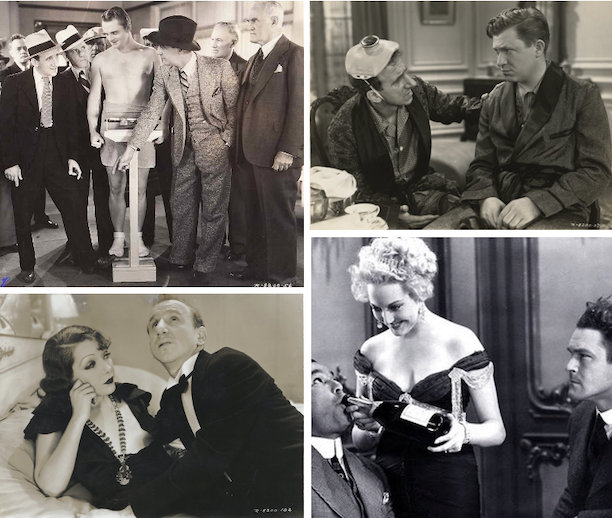
RIBALDRY AT RINGSIDE…Clockwise from top left, Knobby Walsh (Jimmy Durante) tries to press his advantage during the weigh-in of boxer Al McSwatt (portrayed by William Cagney, the look-alike younger brother of James Cagney) in 1934’s Palooka; Durante thinks he’s found a winning fighter in Joe Palooka (Stuart Erwin); Joe’s father, Pete Palooka (Robert Armstrong) demonstrates why he’s nicknamed “Goodtime” with the help of Trixie (Thelma Todd); Durante with Lupe Vélez, who portrayed glamorous cabaret singer and fortune hunter Nina Madero. (IMDB)
* * *
From Our Advertisers
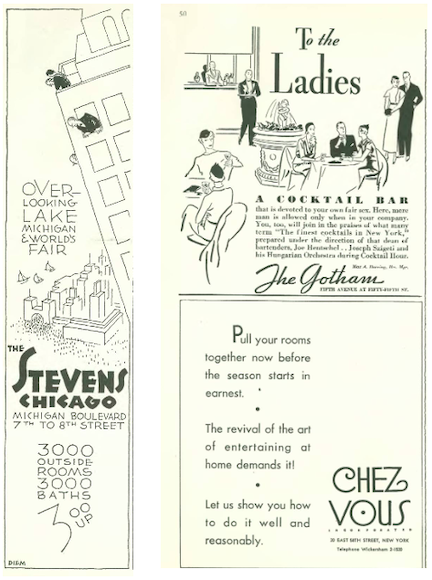
We start with a couple ads from the back pages…the promoters of Chicago’s famed Stevens Hotel offered a unique perspective as they appealed to New Yorkers to come check out the “Century of Progress” World’s Fair, which proved so popular that it planned to reopen in May for a second year…at right, The Gotham catered to the ladies with a special cocktail bar that only allowed men in the company of a woman…
NICE DIGS…At left, The Stevens Hotel (now Hilton Chicago) and, at right, The Gotham (now The Peninsula) are happily still with us today. (Wikipedia)
…cigarette manufacturers continued to work on their biggest growth market with ads like this one from the Lorillard Tobacco Company…here a perceptive woman chooses to ignore the “brazen claims” of other tobacco companies and makes an informed decision to inhale an Old Gold…
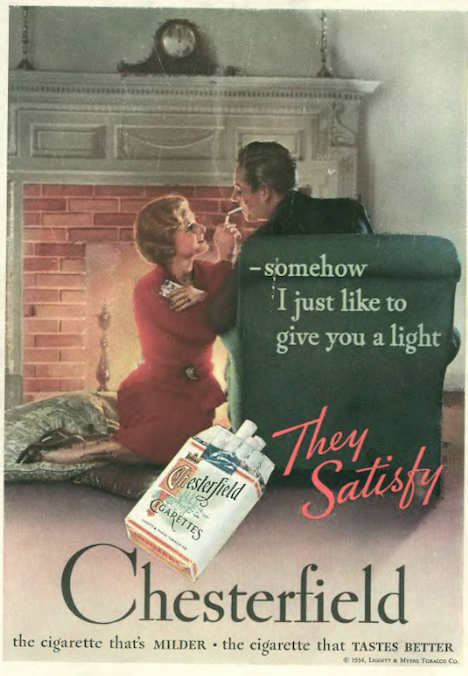
…Liggett & Myers, on the other hand, stuck with this subservient pose, suggesting both are happy with their cigarette, and their station in life…
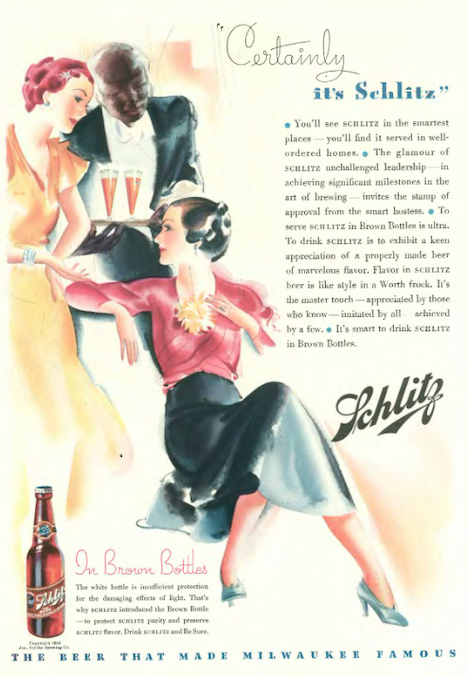
…another colorful ad from the makers of Schlitz beer…following the end of Prohibition Schlitz quickly became the world’s top-selling brewery, a position it would hold into the 1960s until it switched to cheaper brewing methods…
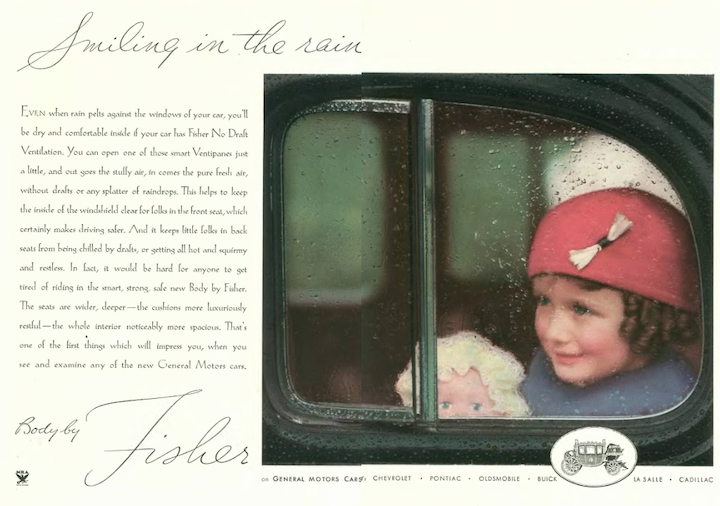
…the makers of Fisher car bodies (owned by General Motors) continued their lavish two-page spreads touting the homey comforts of their interiors…
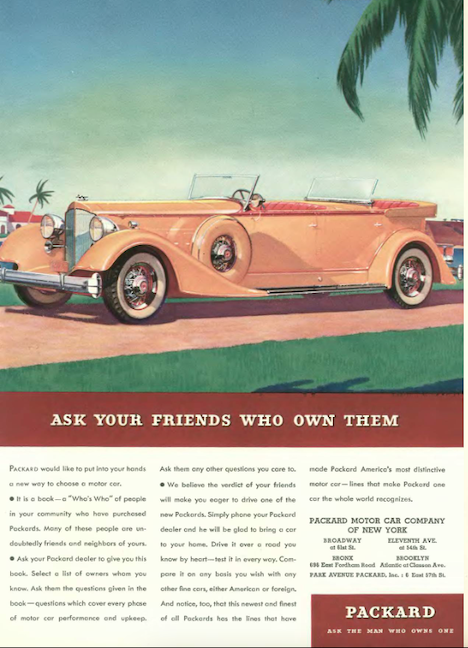
…and no more staid ads from luxury carmaker Packard, who ran this full-color, full-bleed spot…
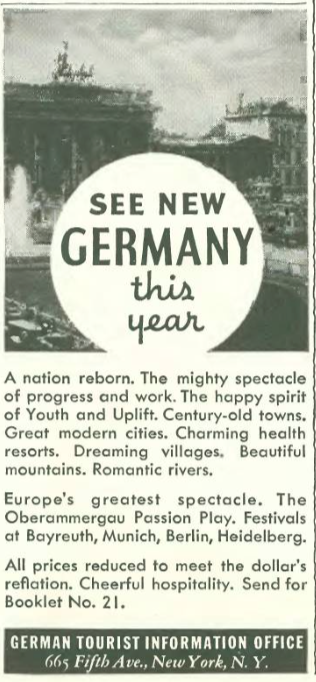
…it’s almost springtime for Hitler, and Germany welcomed American tourists with promises of “Dreaming Villages” (whatever those are), charming health spas and places of romance and beauty…hmmm, no mention of swastika flags hanging from every building, or parades of goose-stepping thugs…
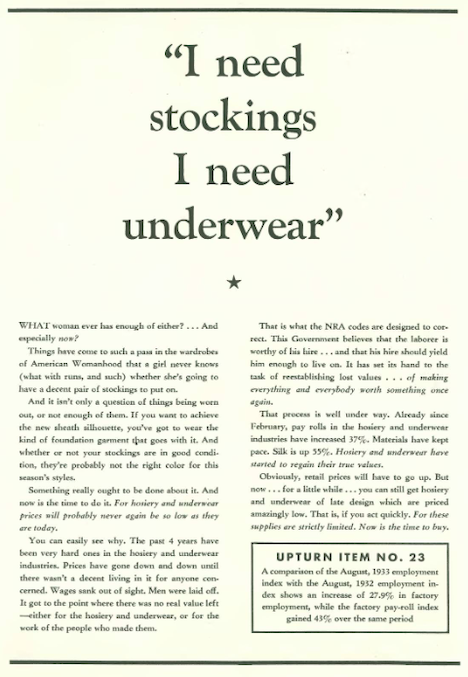
…this public service ad promoted the effectiveness of the National Recovery Act, offering the uptick in underwear sales as a sure sign of economic growth…
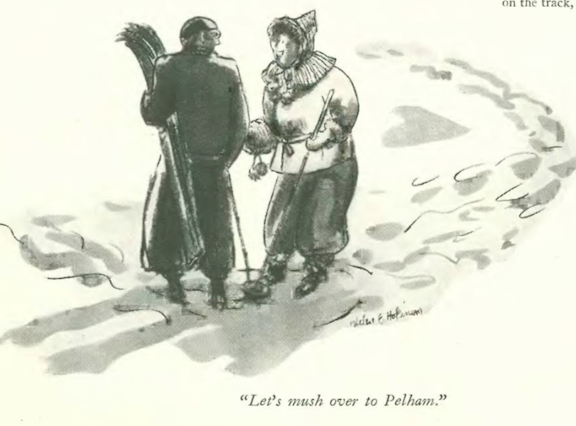
…on to our cartoonists, we begin with Helen Hokinson experiencing the results of the recent blizzard…
…as did Henry Anton, with a befuddled meteorologist…
…Alain (Daniel Brustlein) gave us this wordless gem…
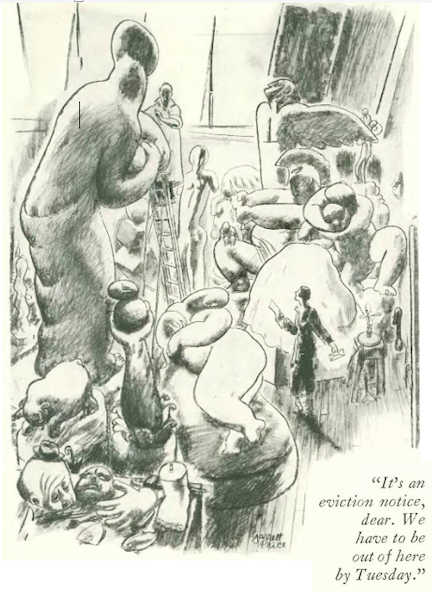
…while Garrett Price presented a sculptor’s greatest challenge…
…Alan Dunn gave us two women who expected more pizzazz from a recent funeral…
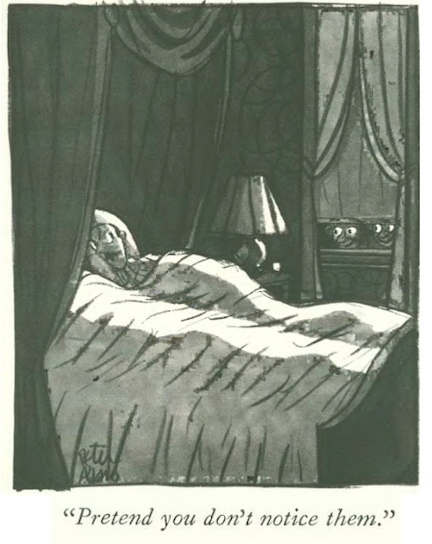
…Peter Arno contended with some Peeping Toms…
…and James Thurber looked in on recent maneuvers in his war between the sexes…
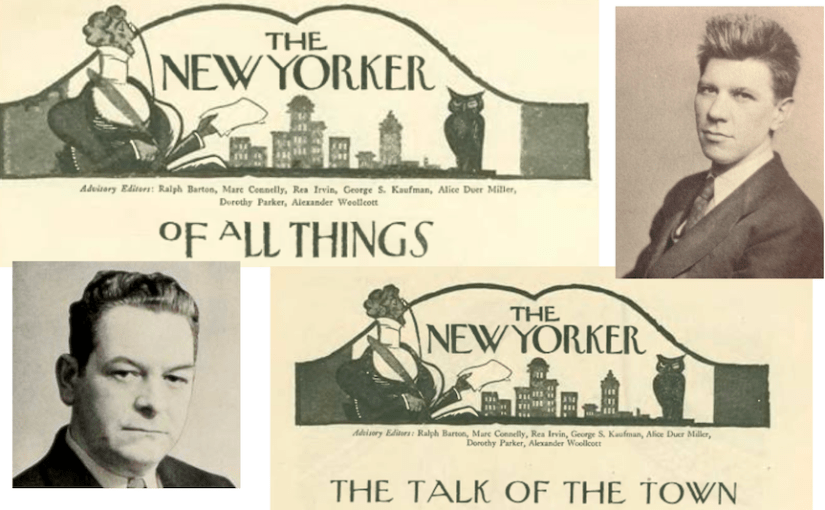
Above: It took a few issues for the editors to sort out regular features and their order of appearance. The opening section of Issue No. 1 featured the famous Rea Irvin masthead that would introduce “The Talk of Town” for many issues to come. In Issue No. 1, however, “Of All Things” appeared first under the masthead, followed by “The Talk of the Town." Let us hope the magazine restores the original Rea Irvin masthead for its 100th anniversary.
Despite the lingering Depression The New Yorker entered its ninth year on strong financial footing. With nearly equal numbers of subscribers and single copy sales, circulation would approach 125,000 in 1934, with more than $2.2 million in advertising income.
Feb. 17, 1934 cover by Rea Irvin (naturally).
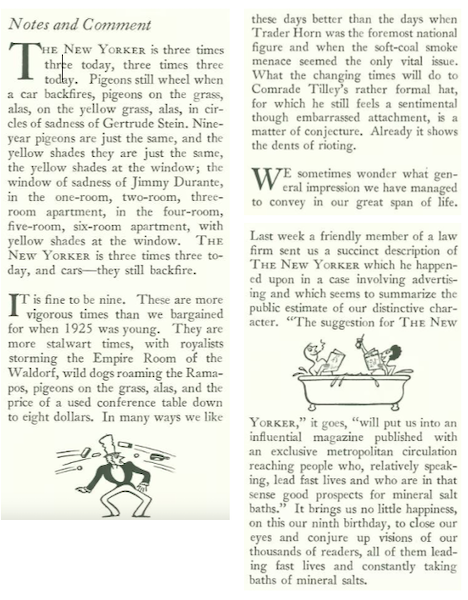
In his “Notes and Comment,” E.B. White commented on the “more vigorous times” the magazine was enjoying, declaring “it is fine to be nine.”
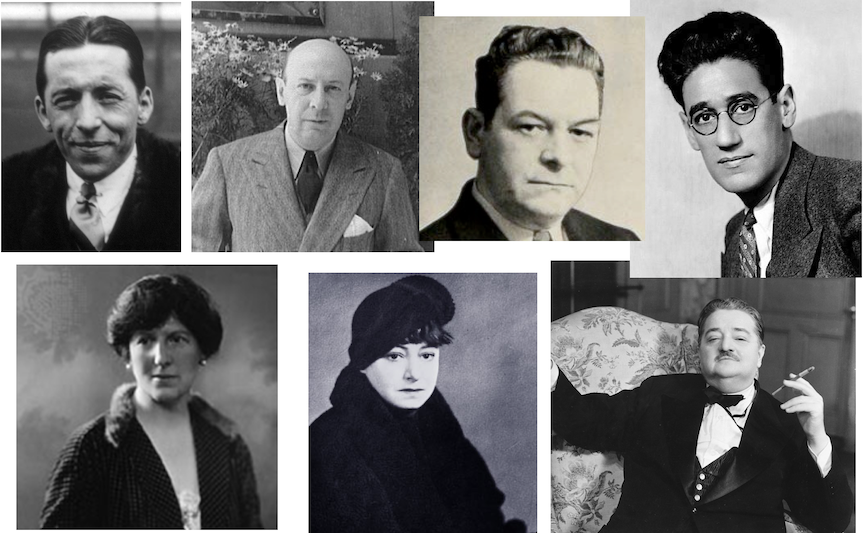
THE NEW YORKER SEVEN…In 1924, baking product heir Raoul Fleischmann put up $25,000 to help Harold Ross get his new magazine off the ground. To assuage Fleischmann’s doubts regarding his investment, Ross persuaded some of his Algonquin Round Table cronies to appear on the magazine’s purely ceremonial masthead. The seven who appeared on the first masthead were, from top left, Ralph Barton, Marc Connelly, Rea Irvin, and George S. Kaufman; bottom row, from left, are Alice Duer Miller, Dorothy Parker, and Alexander Woollcott.
* * *
Daffy Dilettante
Another Algonquin Round Table crony, Harpo Marx, was a skilled artist when it came to comedy, pantomime, or the harp, but when he decided to take up a brush and palette he struggled to properly paint a female nude. In this account from “The Talk of the Town,” Harpo eventually abandoned his painting and switched places with the model.
BRUSHING UP ON HIS ART…Undated photo of Harpo Marx putting finishing touches on his painting of an accordion player; Harpo was a one of the Algonquin Round Table originals: a 1919 photo features (standing, left to right) Art Samuels and Harpo Marx; (sitting) Charles MacArthur, Dorothy Parker, and Alexander Woollcott. (Twitter/Wikipedia)
* * *
Ode to Faraway Lands
A renowned author of children’s poetry, David McCord (1897-1997), was also a frequent contributor to The New Yorker for thirty years (1926-56). For the Feb. 17 issue he penned these sonnets to the Baedeker travel guide.
* * *
Wimpy Vernacular
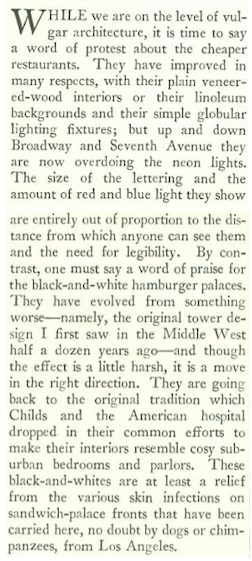
Architecture, art and cultural critic Lewis Mumford paused in his criticism of everything from liquor stores to cheap restaurants to offer some surprising praise to his city’s “black-and-white hamburger palaces.”
RED MEAT RIVALS White Tower and White Castle vied for customers in 1930s New York. Above, a 1933 photo of a White Tower in the 200 block of 2nd Avenue; below, a circa 1930 photo of a White Castle in the Bronx. (gothamist.com/Cision)
* * *
From Our Advertisers
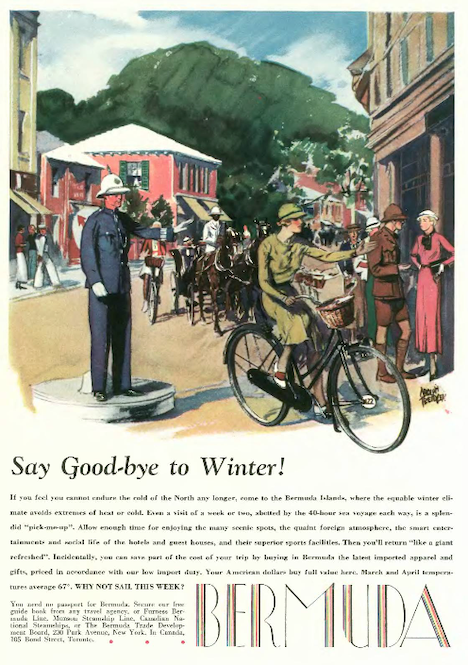
Advertising income reached an all-time high at The New Yorker in 1934, and it showed with the numerous color ads enticing travel to Bermuda…
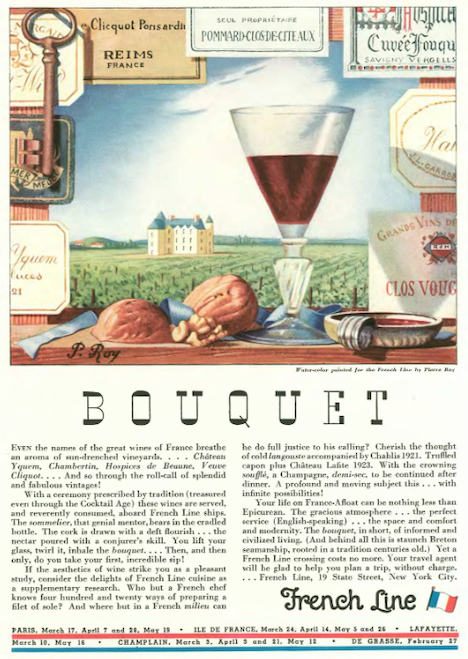
…or to the French wine country…
…Hiram Walker presented their Canadian Club whisky on what appeared to be a cloth napkin…
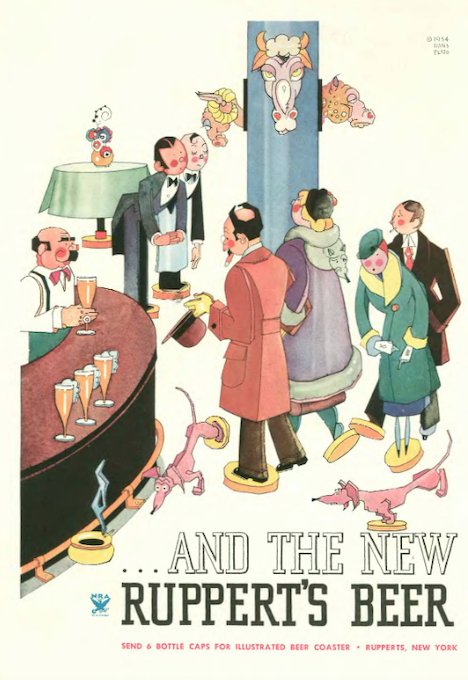
…artist Hans Flato continued his unusual Ruppert’s Beer series of mannequin people (and dogs) going about their lives stuck to yellow discs…
…according to the Ruppert’s ad, for six bottle caps you could get a tin coaster like those pictured below…
(1stdibs.com)
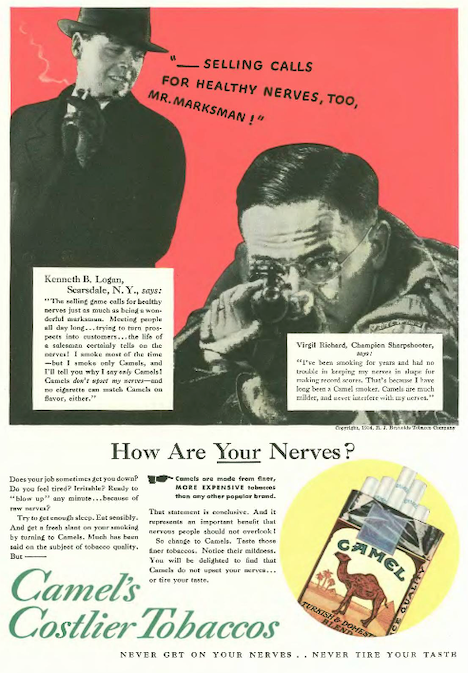
…from magicians and salesmen to sportsmen and high society, the folks pushing Camel cigarettes seemed to try every angle to get their product into the mouths of as many consumers as possible…
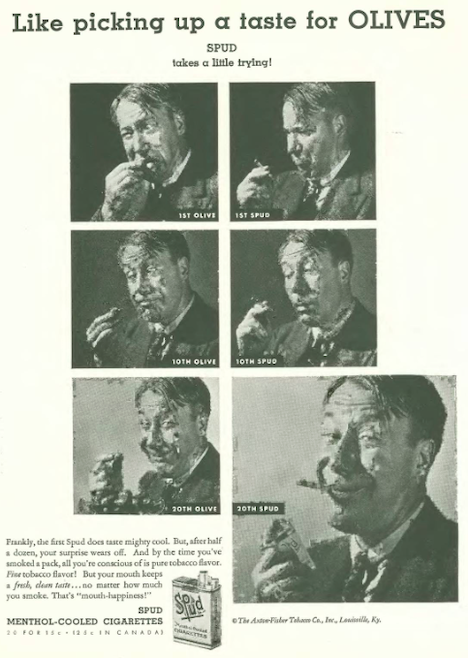
…the makers of Spud menthol cigarettes, on the other hand, tried a little humor to get smokers hooked on their “mouth happiness”…
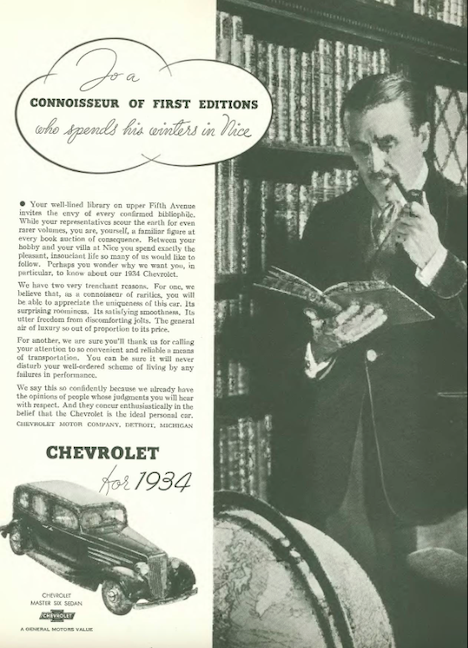
…as one of the world’s most popular car brands, Chevrolet has long been considered a car for the masses, although this ad campaign launched in 1934 suggested that the ubiquitous Chevy was just the car for a connoisseur of the finer things…
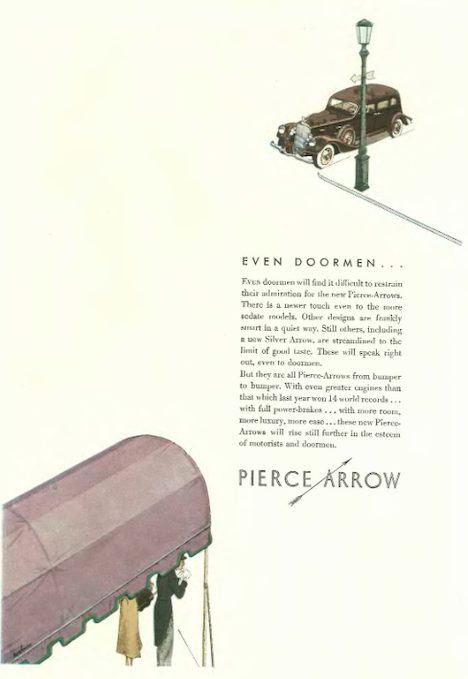
…the staid luxury auto maker Pierce Arrow broke with tradition by placing this very modern, minimalist ad…
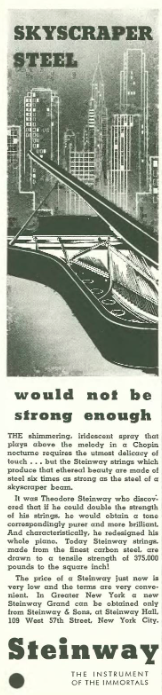
…the folks at Steinway also adopted a modern look with this single column ad touting the durability of their grand pianos…
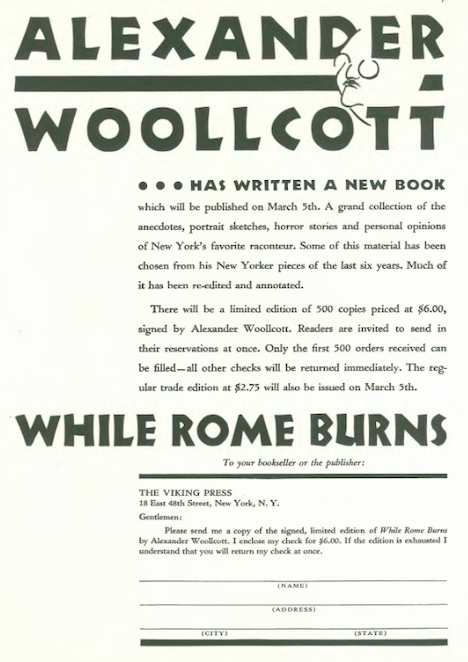
…The Viking Press took out this full-page ad to announce the publication of Alexander Woollcott’sWhile Rome Burns, a collection of some of Woollcott’s writings for TheNew Yorker and other magazines…
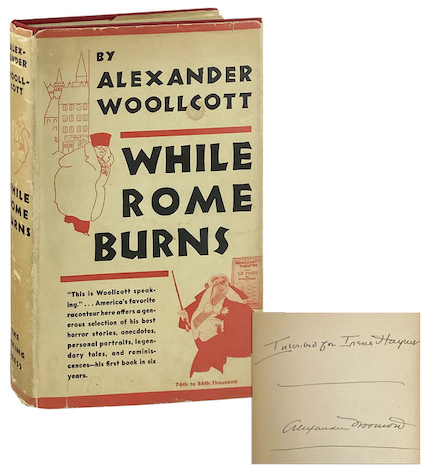
…according to the ad, for six bucks you could get one of 500 limited edition signed copies…as of this writing, the inscribed and signed edition below was available for $350…
(capitolhillbooks-dc.com)
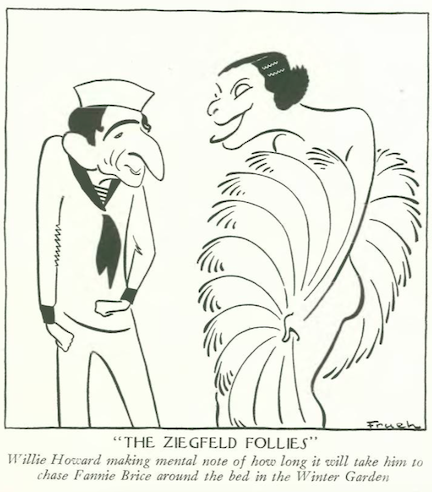
…on to our cartoonists, Al Frueh offered up this interpretation of Ziegfeld entertainers Willie Howard and Fannie Brice…
…Helen Hokinson took the plunge with 1930s water aerobics…
…Kemp Starrett demonstrated how beauty is in the eye of the beholder…
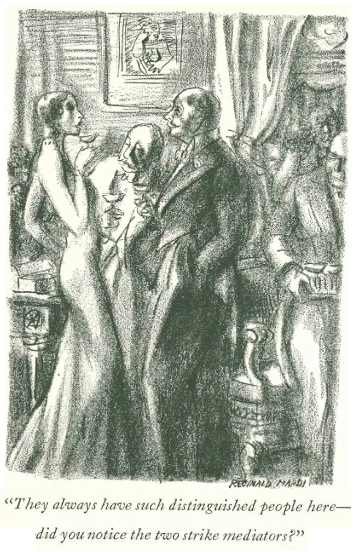
…Reginald Marsh returned, taking temporary leave from life on the streets to look at life above the streets…
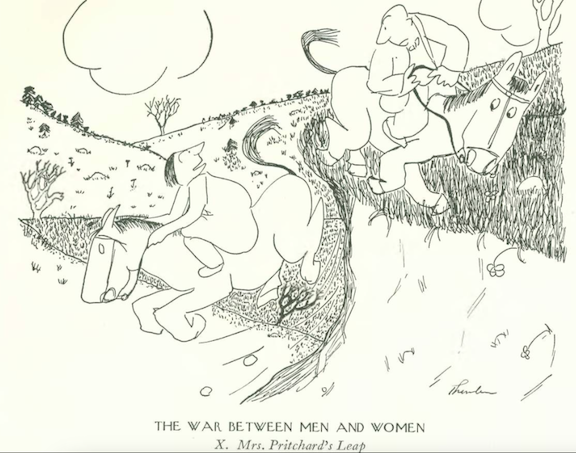
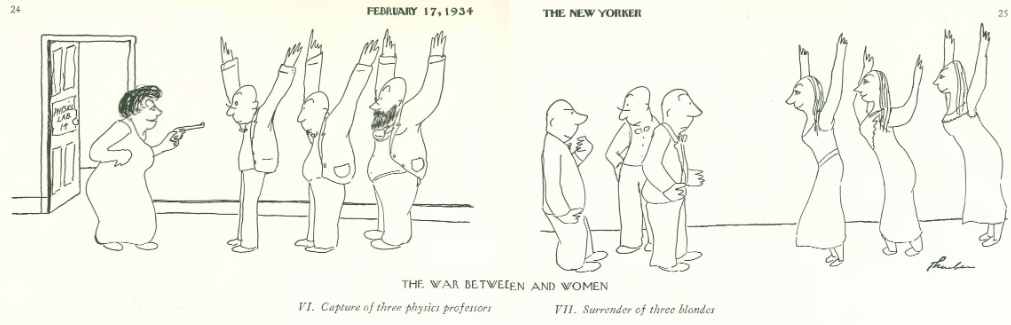
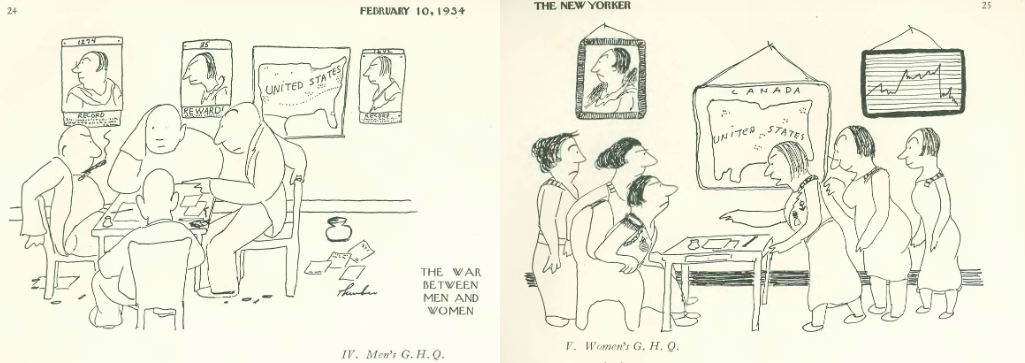
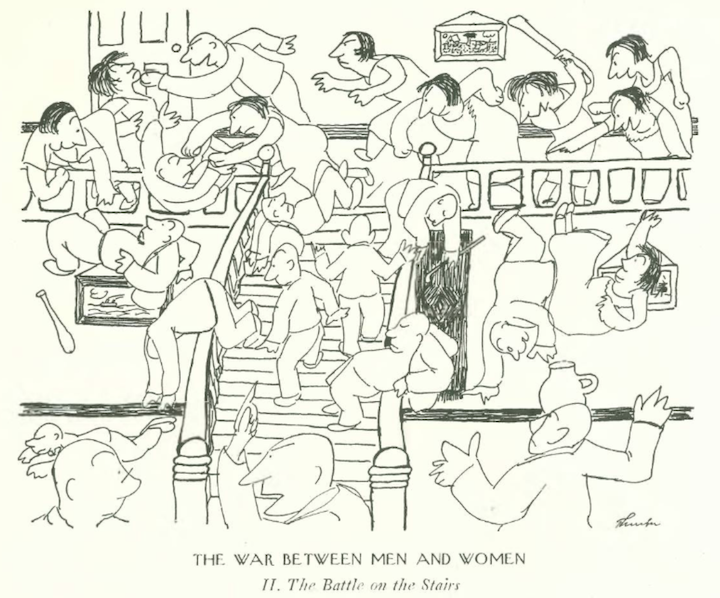
…James Thurber’s “War Between Men And Women” took some new twists…
…and we end with Carl Rose, and one man’s solution to being stuck in the middle…
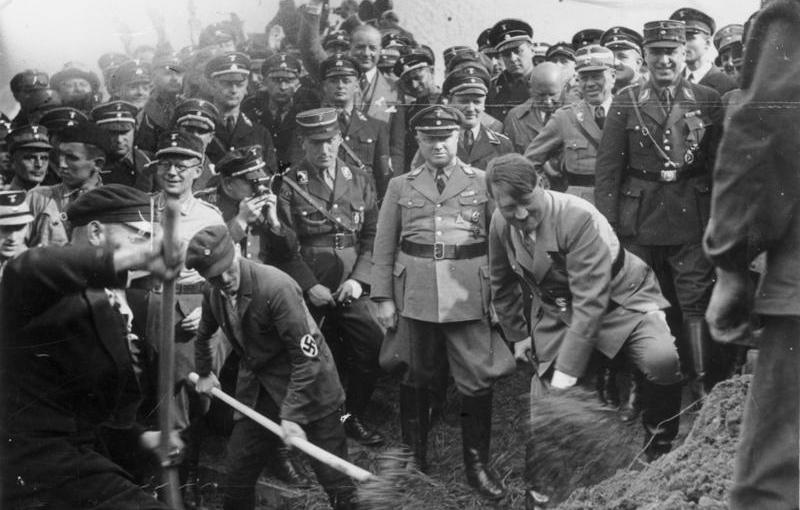
Above: Adolf Hitler at a groundbreaking ceremony for a new section of the Reichsautobahn highway system, 1933. (Bundesarchiv)
Mildred Gilman was one of the highest paid female reporters in the 1920s, interviewing everyone from murderers to heads of state. But when she arranged to interview Adolf Hitler in 1933, the Gestapo got nervous and threw her out of the country.
Feb. 10, 1934 cover by Harry Brown.
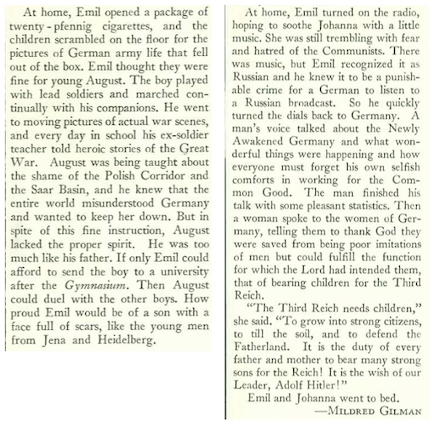
Gilman (1896-1994) doubtless sought a modicum of satisfaction when she penned “Made in Germany” for the Feb. 10, 1934 issue. I am including generous excerpts below, which describe the day in the life of an average Berliner named Emil Pfalz, a man who doesn’t question the omnipresent Nazi propaganda and often worries about his ability to keep in step with the new regime.
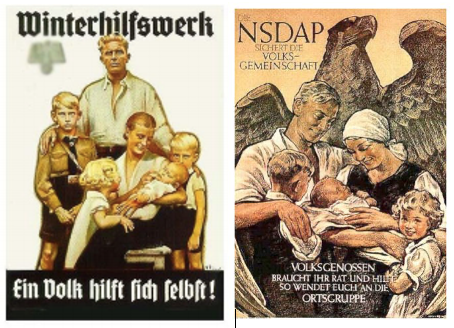
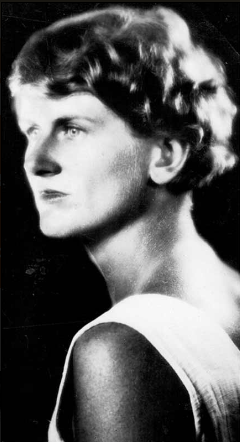
THERE’S SOMETHING HAPPENING HERE…Berliners (left) and residents of Worms (top) inspect Nazi propaganda that instructed Germans not to do business with Jewish people (on Jan. 24, 1934, the German government banned Jews from membership in the German Labor Front, depriving them of the opportunity to find employment); below, in early 1934 a simulated uprising was staged in Berlin (with people posing as casualties) as part of Nazi maneuvers. Later that summer SS and Gestapo forces would conduct a purge known as “Night of the Long Knives,” eliminating any known or suspected dissenters of the Nazi regime. Hundreds were murdered and many more arrested. (digitallibrary.usc/Wikipedia)GRIM FAIRY TALE…As a loyal citizen, Emil Pfalz was sure to teach his children the Nazi salute. Image from a Nazi propaganda booklet. (British Library Board)
Emil’s story continues as he contemplates his duties as a father and husband in the Third Reich…
…and heeds the call to produce more Aryan babies.
What the Nazis did not want more of was chronically ill or disabled persons. The sick minds of Nazi propagandists produced this image below, which argues that for the same daily amount of reichsmarks you could either support an entire Aryan family or a single mentally disabled person…in 1933 the Law for the Prevention of Hereditarily Diseased Offspring was passed, allowing for the forced sterilization of those regarded as ‘unfit’. In 1939 the regime began killing the disabled (up to 250,000 people).
A final note about the writer, Mildred Gilman. In addition to being a journalist of both daring and flair, she wrote eight novels including the bestseller Sob Sister. In her younger days she was employed as a secretary for New York World columnist Heywood Broun and partied with Dorothy Parker, Alexander Woollcott, and Robert Benchley. She wrote a profile of Paul Robeson for the Sept. 21, 1928 issue of The New Yorker.
Mildred Gilman in 1938.
* * *
Up In Smoke
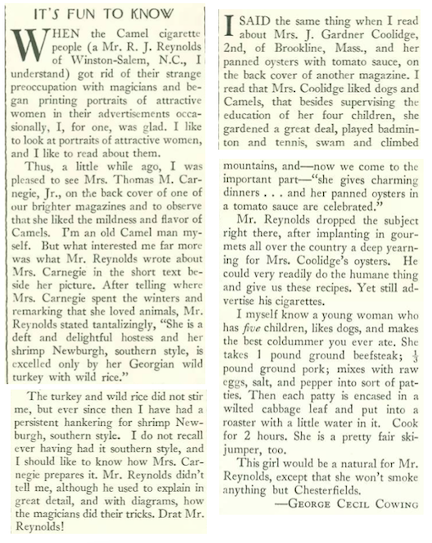
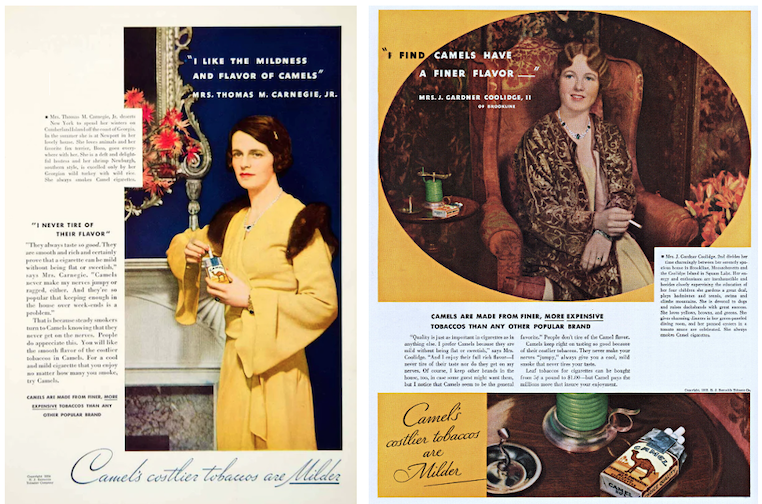
George Cecil Cowing, known for his whimsical “Boulevardier” column for the Pasadena Star-News, commented on the changing themes adopted by cigarette manufacturers, namely the folks at R.J. Reynolds who abandoned their magician-themed ads for their Camel brand (“It’s Fun to Be Fooled”) for spots featuring endorsements from second-tier society women…
POSH PUFFERS…”Mrs. Thomas M. Carnegie Jr.” (Virginia Beggs) and “Mrs. J. Gardner Coolidge II” (Mary Louise Coolidge) shared their favorite dishes and their love for smoking Camels in these ads, which appeared in The New Yorker in early 1934.
* * *
From Our Advertisers
Appropriately we turn to our advertisers, where we find the Camel brand trying out a new theme that demonstrated their product’s appeal to plainer folks…
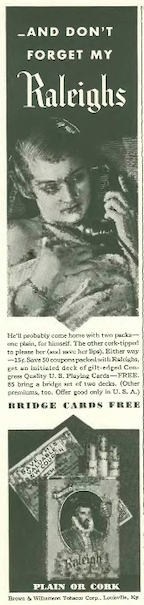
…Brown & Williamson’s first national brand, Raleigh, was launched as a premium cigarette in 1928, here marketed with a plain or cork tip (“to please her and save her lips”)…
…in his parody of Camel ads, George Cecil Cowing wrote that he preferred Chesterfields, a big-time brand of mid-century America…
…the makers of White Rock reveled in the newly found freedoms of legalized alcohol…
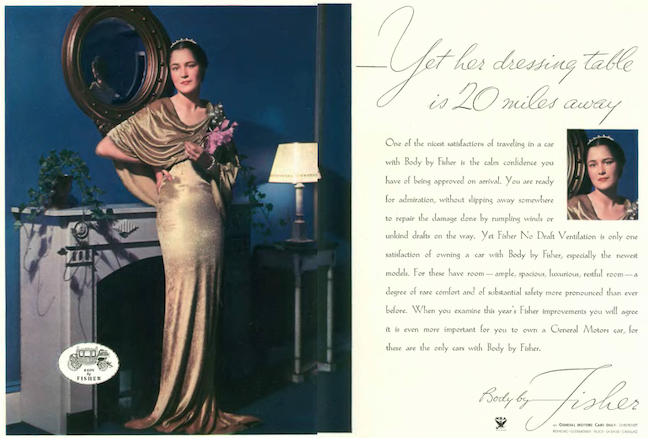
…the folks at Fisher were sticking with their lavish two-page color ads and what has always been a tiresome double entendre…
…Lord & Taylor took to the skies to promote their “country clothes” to the smart set…
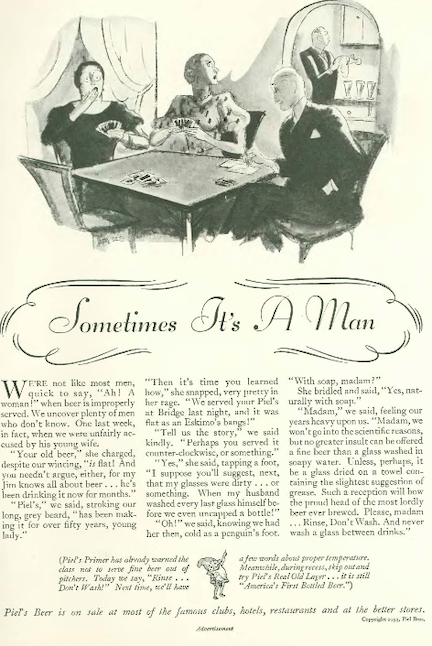
…and cartoonist Herbert Roese, who apparently never published a cartoon in The New Yorker, turned in this very New Yorker-looking illustration for Piel’s…
…on to our cartoonists, we begin with Clarence Day, better known for his Life With Father stories…
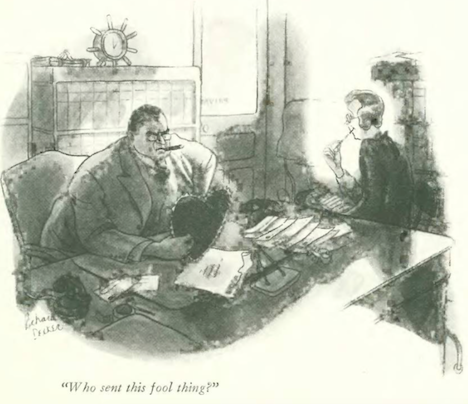
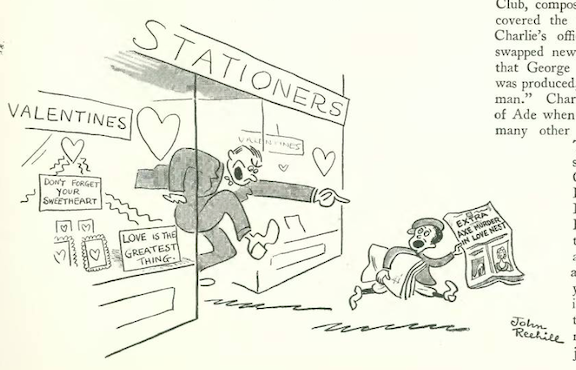
…the Valentine’s issue featured several themed cartoons, including these by Richard Decker…
…and John Reehill…
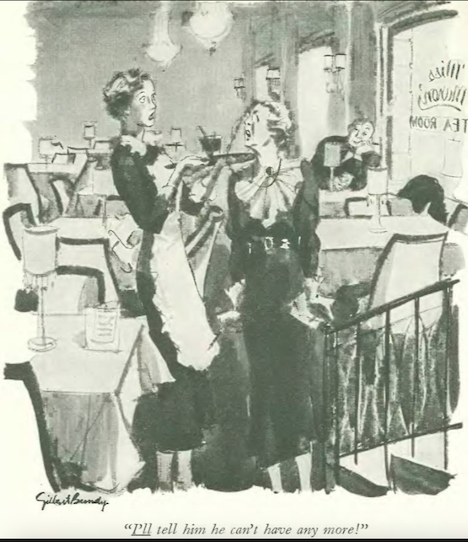
…love was also in the air for Gilbert Bundy…
…while William Crawford Galbraith continued to ply the waters of the creepily lustful…
…and we test different waters with Richard Yardley, a popular editorial cartoonist for The Baltimore Sun…this is the only cartoon he published in The New Yorker…
…the Westminster Kennel Club dog show was in town, here tapped by Helen Hokinson to also explore the theme of fatherhood…
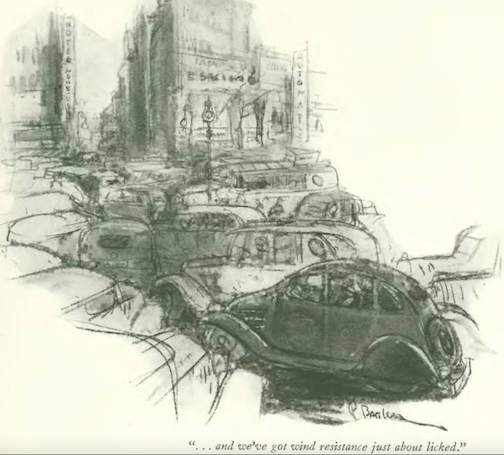
…Perry Barlow was the latest New Yorker contributor to mock the futuristic, aerodynamic style of Chrysler’s Airflow…
…and James Thurber’s “War Between Men and Women” paused as the two sides made preparations for the next battle…
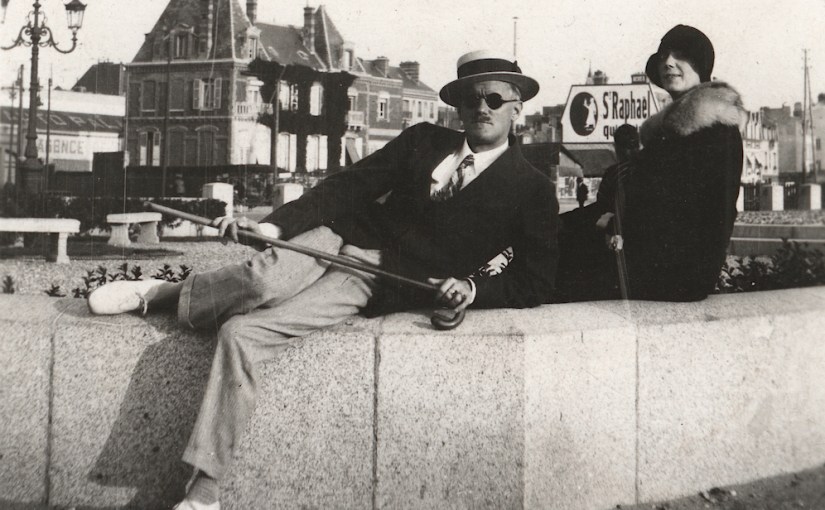
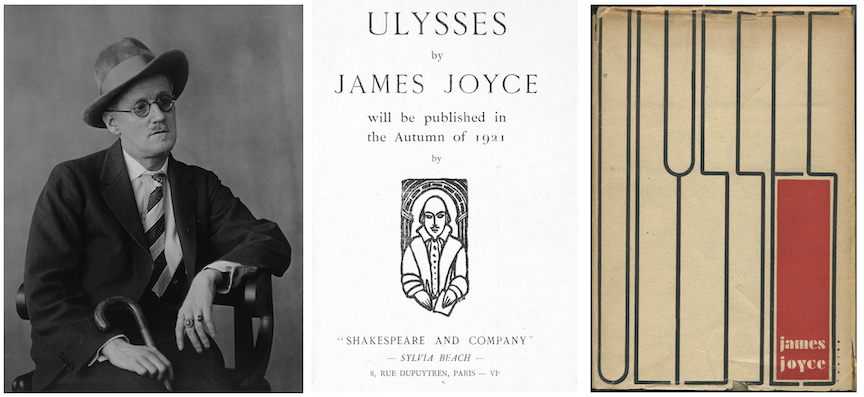
Above, James Joyce and his longtime partner Nora Barnacle, in Zurich, 1930. They would marry the following year when Joyce established residency in the UK. (SUNY Buffalo)
It began 103 years ago when the American literary magazine The Little Review published its latest installment of James Joyce’s landmark novel Ulysses—a chapter that featured an account of a wanker on a beach.
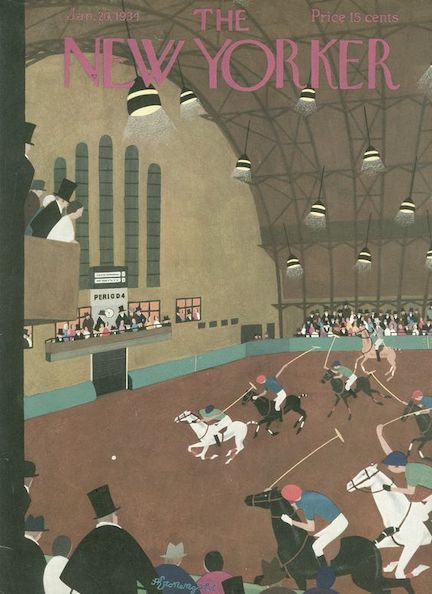
Jan. 20, 1934 cover by Adolph K. Kronengold.
More specifically, the passage described the novel’s main character, Leopold Bloom, pleasuring himself while gazing at a teenage girl. It didn’t take long for the pearl-clutchers at the New York Society for the Suppression of Vice to go after the editors of The Little Review, who were ultimately fined for obscenity and banned from publishing the remainder of the novel, which, by the way, Joyce had structured along the lines of Homer’s epic poem, the Odyssey.
Scenes in the novel that frankly described sexual acts and mocked rituals of the Catholic Church kept the book off American shelves until 1934, when District Judge John M. Woolsey ruled that the book was neither pornographic nor obscene. One wonders if Judge Woolsey took a cue from the end of Prohibition.
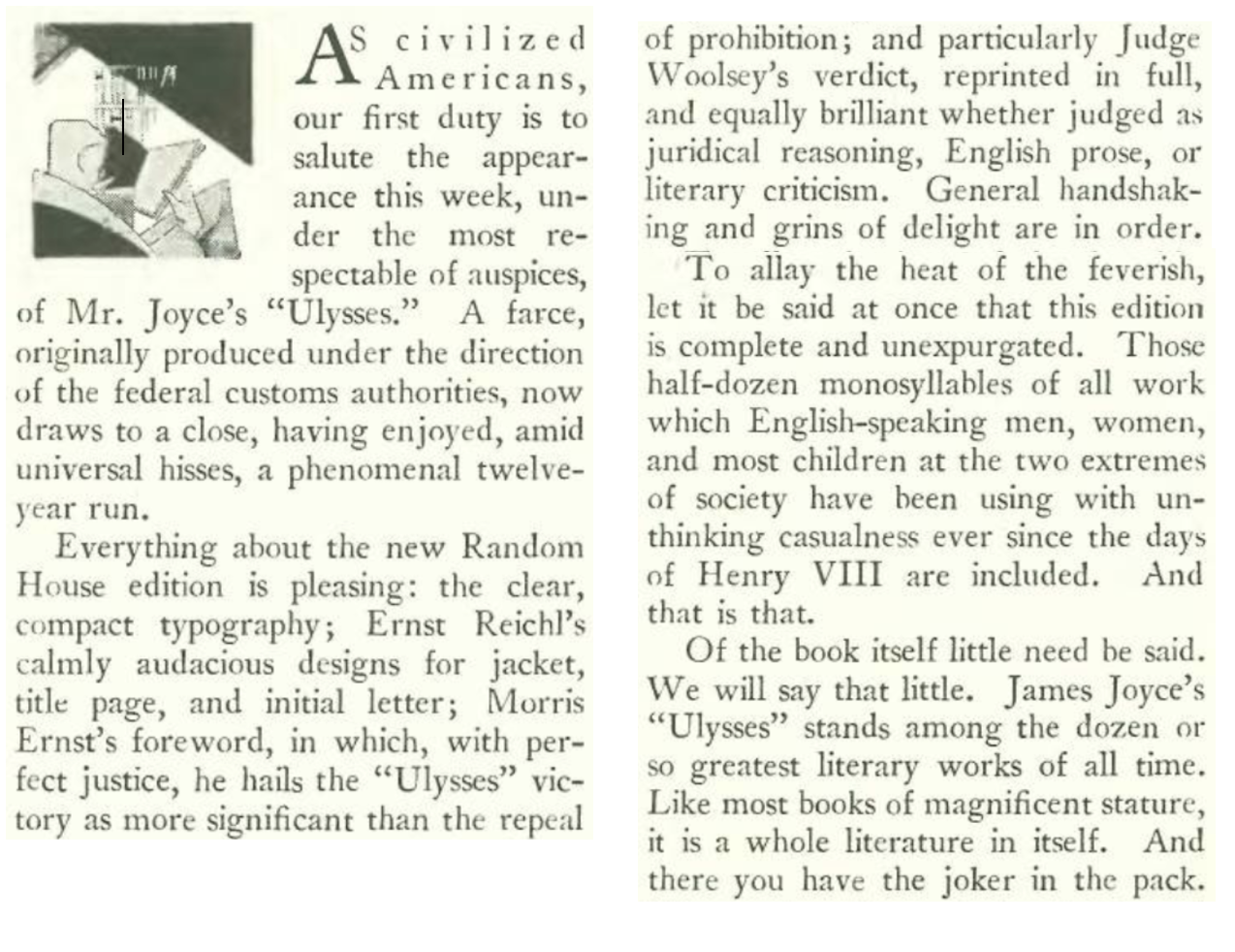
Lovers of literature, including New Yorker book reviewer Clifton Fadiman, rejoiced at the judge’s decision. We skip ahead to the Jan. 27 issue for Fadiman’s thoughts on the matter:
DUBLINER…James Joyce in 1928, as photographed by Berenice Abbott; announcement by Shakespeare & Company (Paris) of the first publication of Ulysses, 1921; cover of the American first edition, 1934, with Ernst Reichl’s “calmly audacious” jacket design. (Wikipedia/Abe Books)
* * *
Pleasurable Diversion
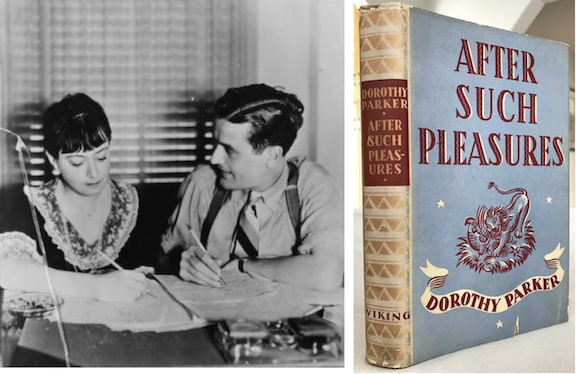
We now turn to the Jan. 20 issue, in which Robert Benchley concluded his stage reviews with a generous nod to his dear friend and colleague, Dorothy Parker, whose short stories were being performed as sketches at the Barbizon-Plaza Hotel, the first fully-equipped music and arts residential center in the U.S.
INCIDENTAL ATTRACTION…Stories from Dorothy Parker’s 1933 collection After Such Pleasures were performed as sketches at the Barbizon-Plaza Hotel; at left, Parker with her husband, actor/author Alan Campbell. (Pinterest/Biblio)
* * *
Une Séduction Américaine
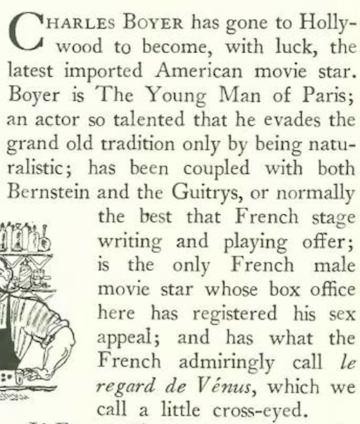
Janet Flanner began writing her weekly New Yorker column “Letter from Paris” in September 1925, keeping readers informed on a variety of subjects ranging from arts and culture to politics and crime. In the Jan. 20 issue she introduced readers to French actor Charles Boyer (1899–1978), who was preparing to try his luck in Hollywood. Actually, Boyer made his first trip to Tinseltown in 1930, but his return would mark the beginning of a successful run in American cinema, including the 1944 mystery-thriller Gaslight and the 1967 romantic-comedy Barefoot in the Park.
MAKING BEAUTIFUL MUSIC…Charles Boyer as the ” gypsy” vagabond Latzi, with Jean Parker (center) and Loretta Young in 1934’s Caravan. (MoMA)
* * *
The Way Of All Flesh
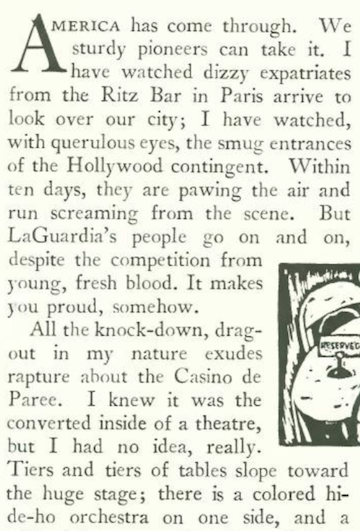
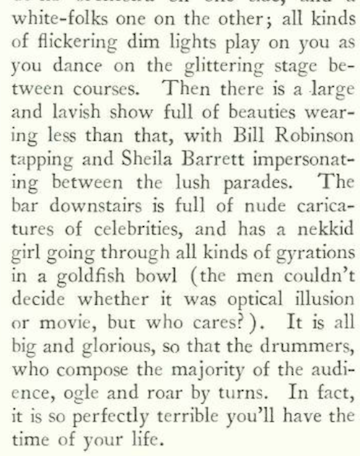
Lois Long continued to chronicle New York nightlife in her “Tables for Two” column, exuding “rapture” over the new theatre/restaurant Casino de Paree, which featured ample nudity as well as top performers dancer Bill “Bojangles” Robinson and comedienne Sheila Barrett.
The Casino de Paree featured revues, dancing, and side shows such as fire-eaters and animal acts. It closed in 1937, and the building later became home to the trendy 80s–90’s hot spot Studio 54.
CLOTHES OPTIONAL…A 1934 brochure offered glimpses of the entertainment to be had at the new theatre/restaurant Casino de Paree.
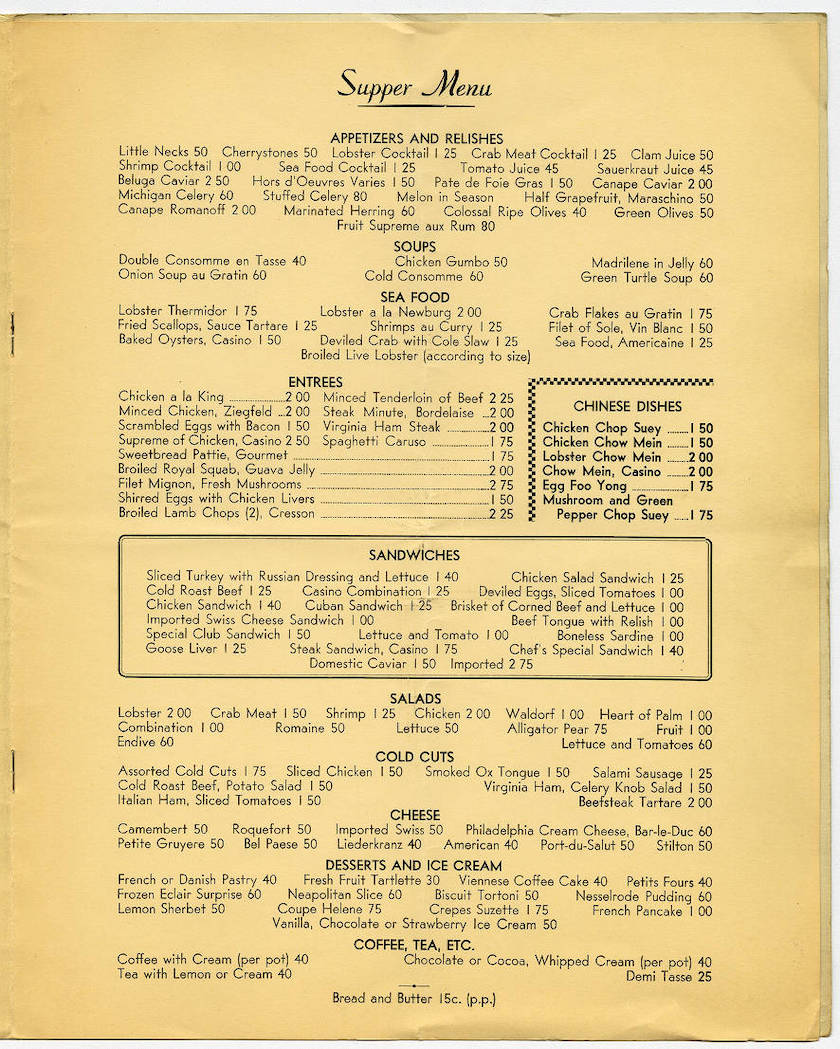
The Casino de Paree’s menu gave patrons some idea of what could be expected on the stage…
(The Culinary Institute of America Menu Collection)
…but if food and drink was the only thing on your mind, you could enjoy lobster thermidor for a buck seventy-five…
(The Culinary Institute of America Menu Collection; Craig Claiborne Menu Collection)
* * *
From Our Advertisers
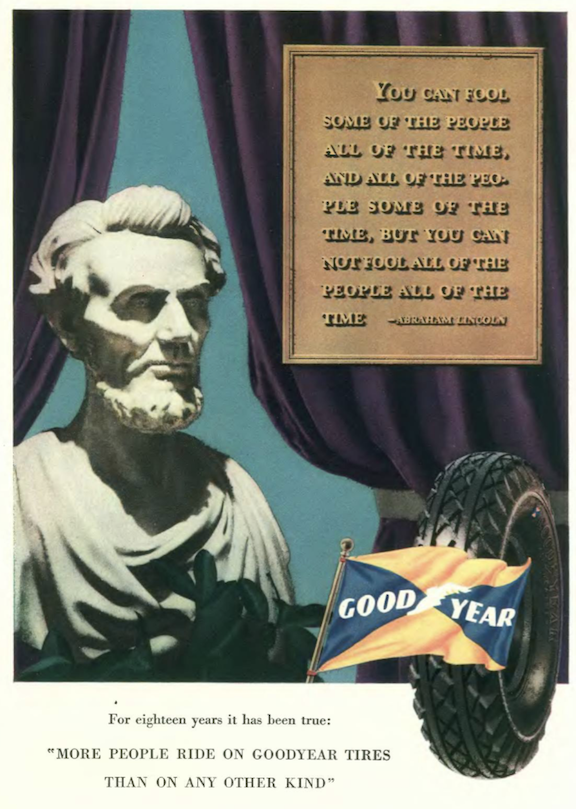
How reliable were Goodyear’s tires? Hopefully more reliable than this adage, which Abraham Lincoln apparently never uttered…
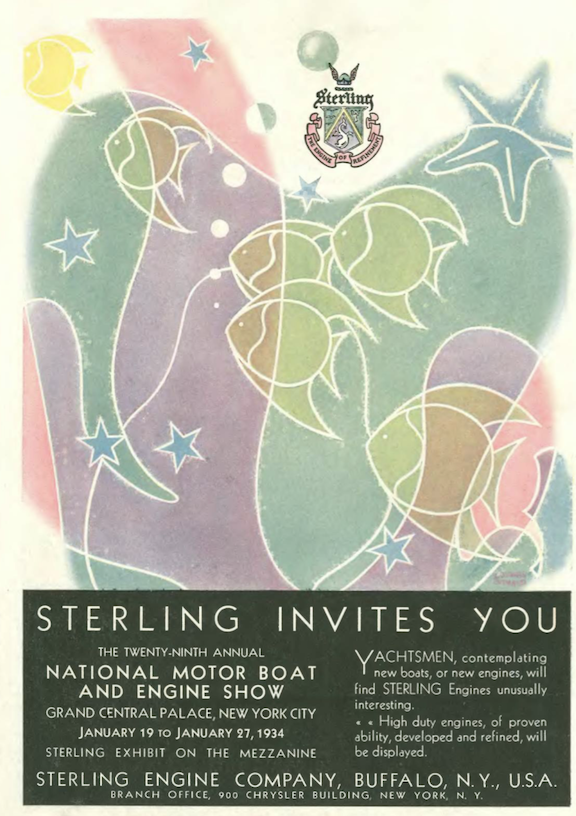
…major exhibitions at the Grand Central Palace changed like the seasons, the National Automobile Show ceding to the National Motor Boat & Engine Show…
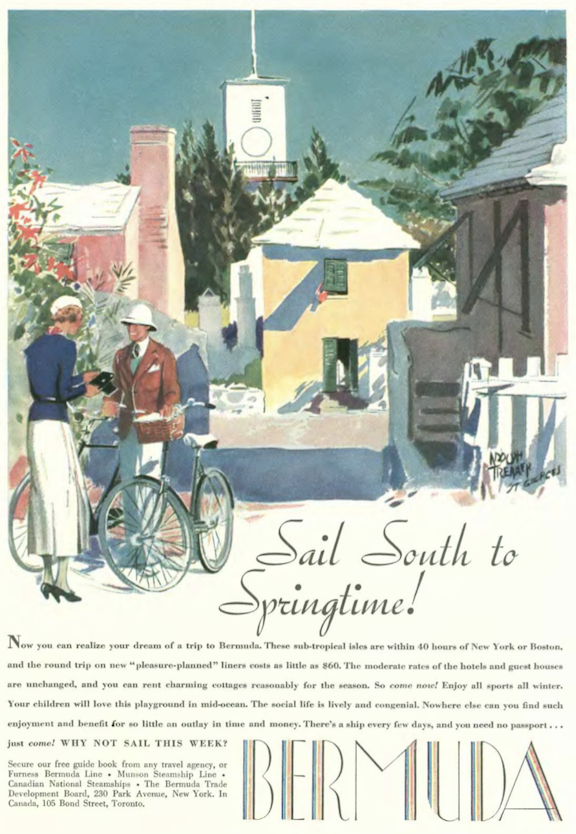
…if you’d rather have someone else do the sailing, the Bermuda line could take you on a round-trip cruise for as little as $60…
…with the end of Prohibition, the folks at White Rock were doubtless pleased to overtly advertise their product as a cocktail mixer…
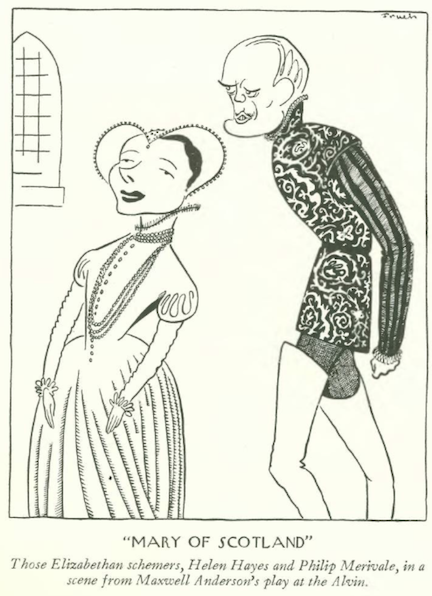
…on to our cartoonists, Al Frueh contributed this rendering for the theatre review section…
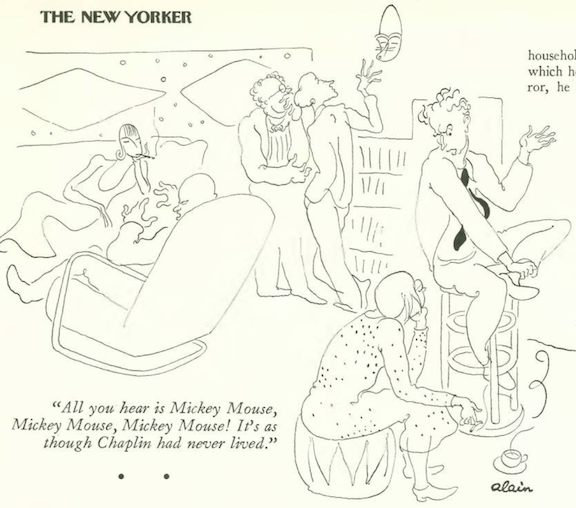
…Daniel ‘Alain’ Brustlein found this salon conversation a bit Mickey Mouse…
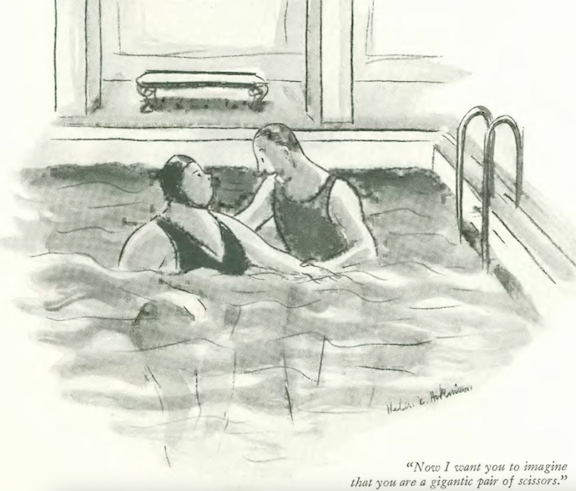
…Helen Hokinson explored the results of family planning…
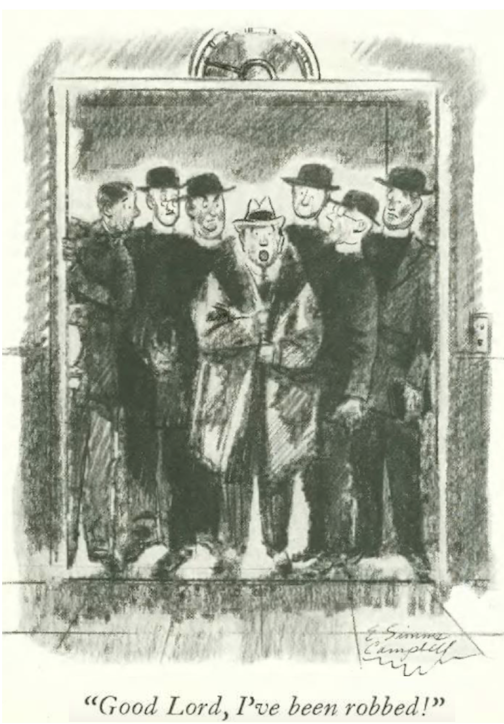
…E. Simms Campbell gave us an unlikely den of thieves…
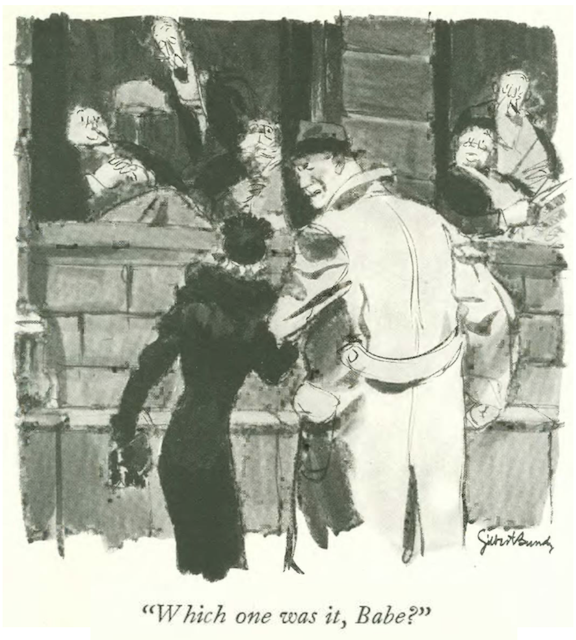
…Gilbert Bundy had us wondering what ensued at this gentlemen’s club…
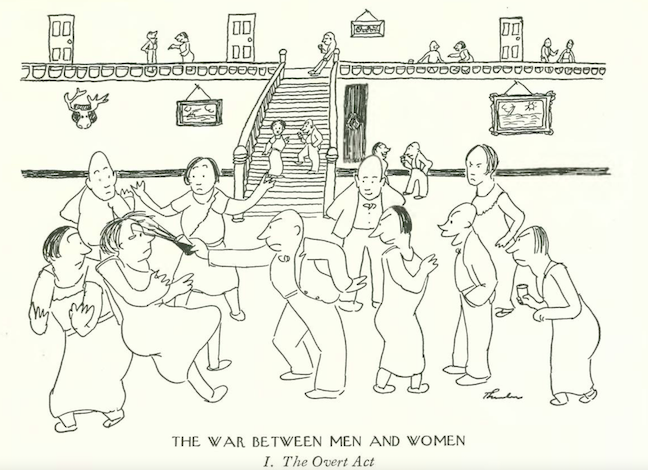
…and James Thurber fired the first shot in The War Between Men And Women…
…on to Jan. 27, 1934…
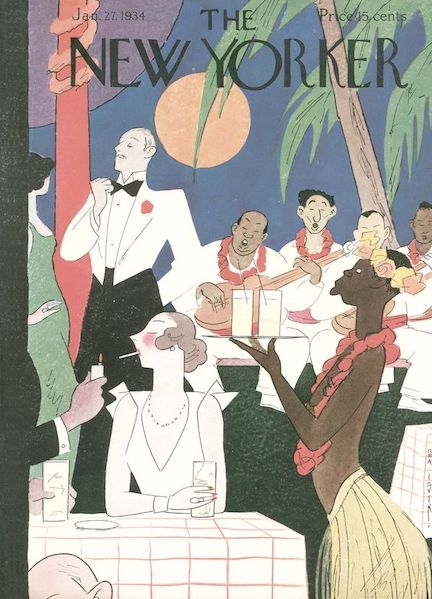
Jan. 27, 1934 cover by Rea Irvin.
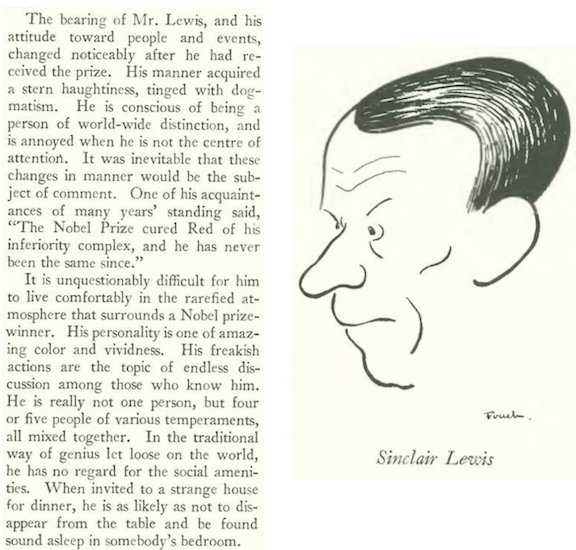
…where writer W.E. Woodward profiled Sinclair Lewis (1885-1951), whose manner had changed noticeably after receiving the Nobel Prize. An excerpt (with caricature by Al Frueh):
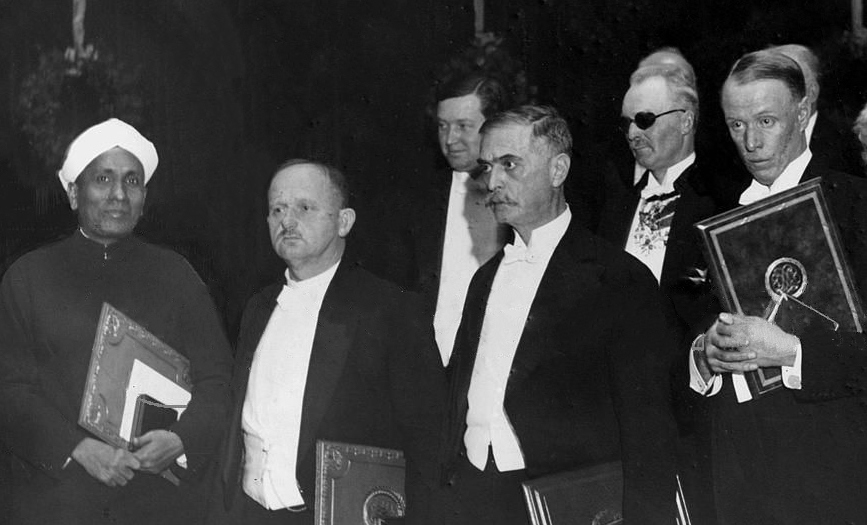
I’M SOMEBODY NOW…Sinclair Lewis (far right) with his 1930 Nobel Prize for literature. Other 1930 prize winners were, from left, Venkata Raman (physics), Hans Fischer (chemistry), and Karl Landsteiner (medicine).
* * *
More From Our Advertisers
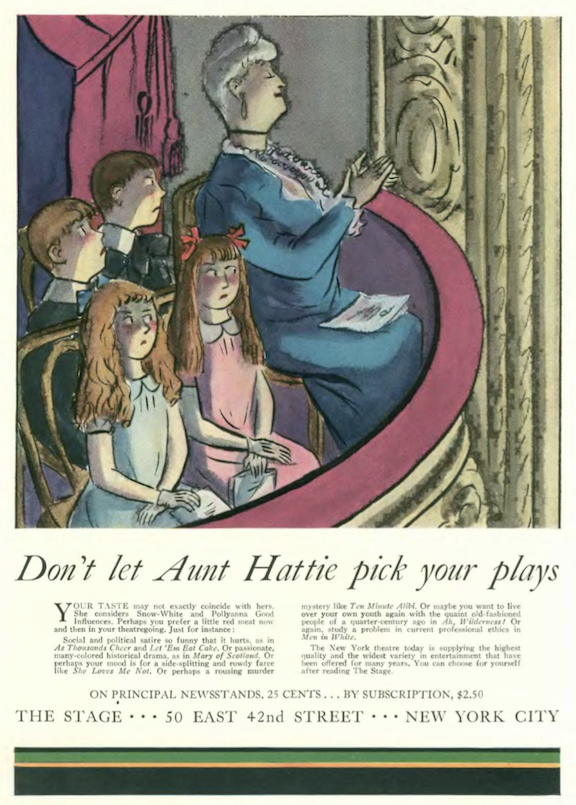
We begin with this lovely color illustration by Helen Hokinson, which also graced the cover of the January 1934 issue of The Stage…
…the vintners at Moët & Chandon let New Yorkers know that their fine Champagne could be had from sole distributors Labourdette and Company…
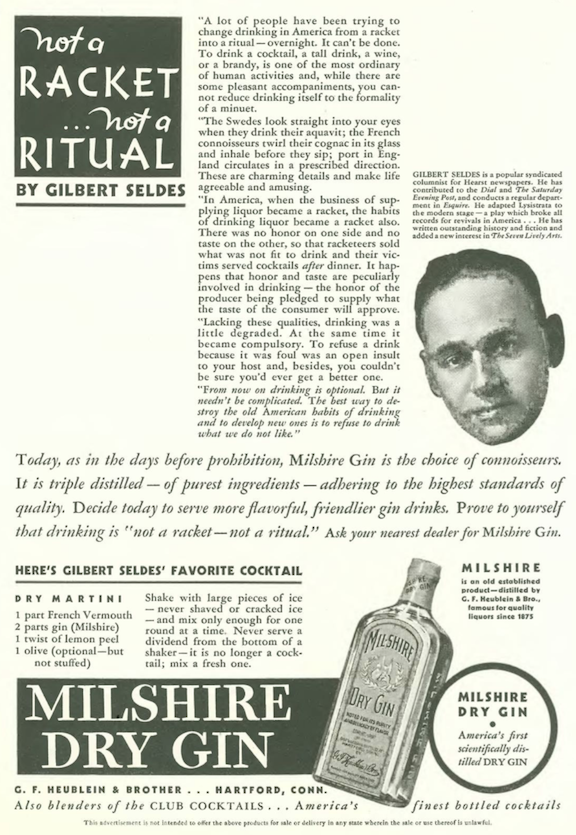
…cultural critic Gilbert Seldes advised drinkers to abandon their degraded ways and return to the civilized consumption of an old favorite…
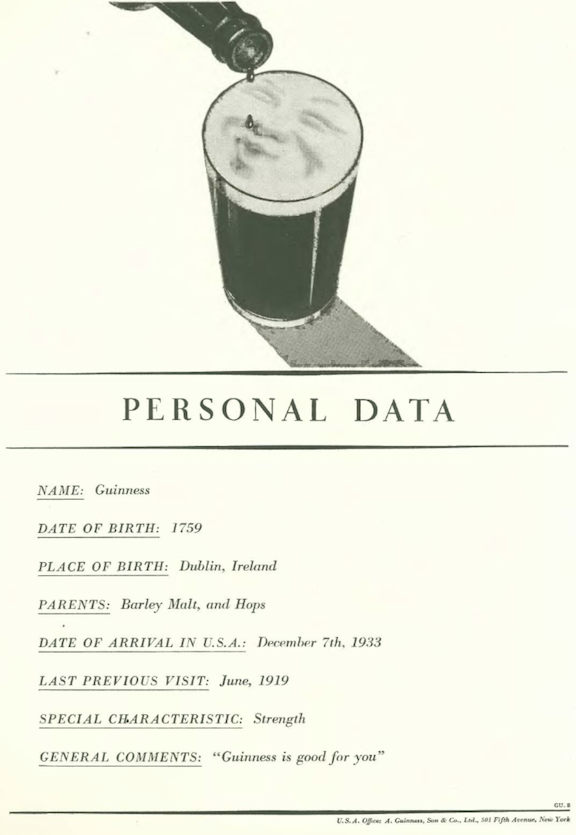
…while the folks at Guinness reminded us of their product’s deep history as well as its health benefits…
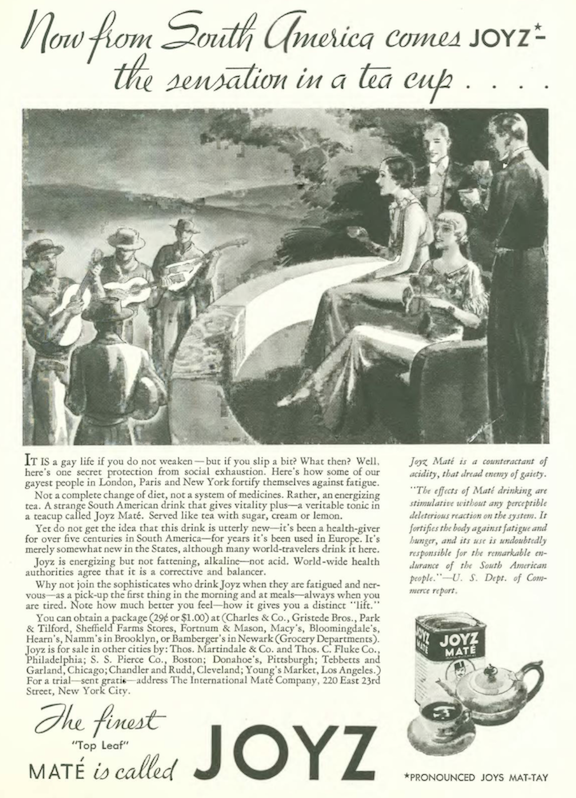
…and for the teetotalers the purveyors of Joyz Maté encouraged Yankees to take up this “strange” South American drink…the ad claimed it “fortifies the body against fatigue” (thanks to the generous amount of caffeine) and acts as a “corrective and a balancer” (it helped stimulate bowel movements)…
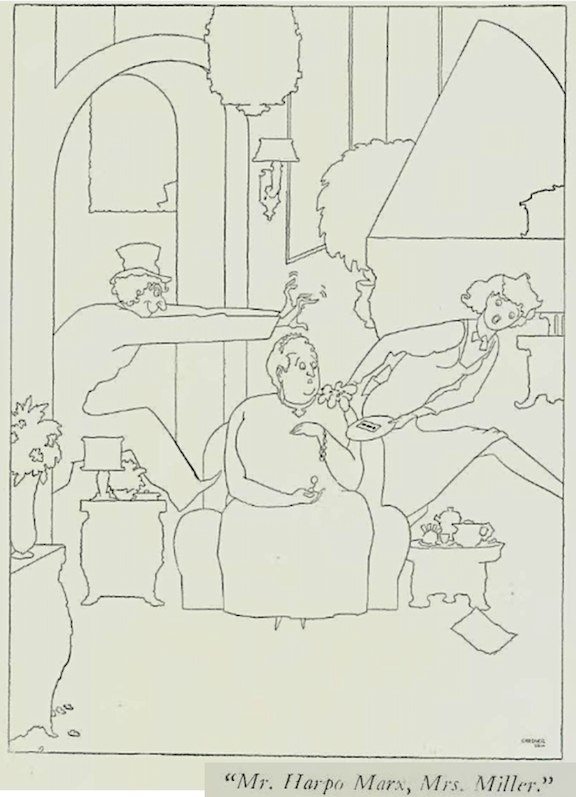
…on to our cartoons, we begin with Gardner Rea, borrowing from a running gag in the Marx Brothers’ 1930 film Animal Crackers, which featured Harpo chasing a sexy blonde around a mansion (apologies for the poor reproduction quality—the archival image was quite faint)…
…Gilbert Bundy gave us a couple confronting the subtleties of Times Square…
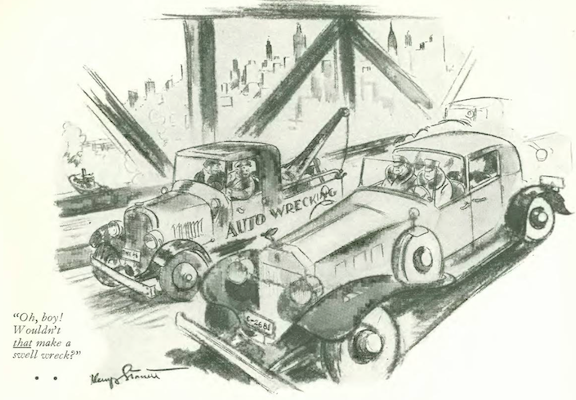
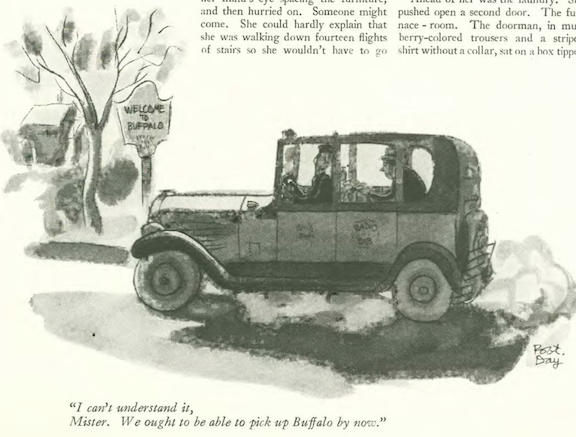
…Robert Day commented on the latest trend in taxicab conveniences: coin-operated radios for passengers…
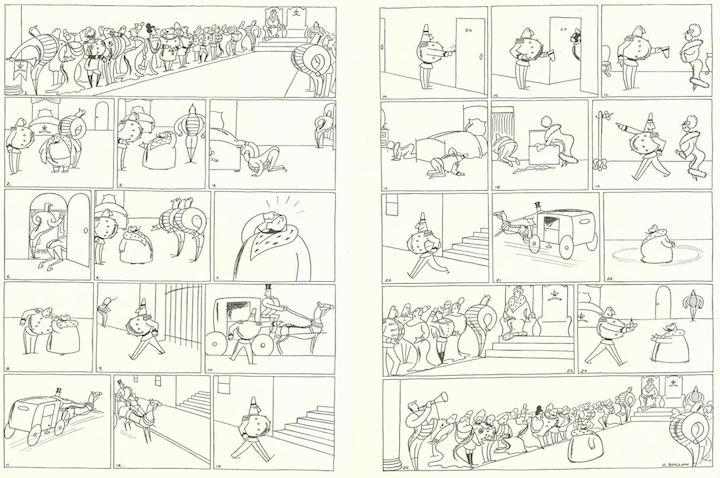
…this two-page Little King cartoon by Otto Soglow revealed another side to our diminutive potentate…
…and the war between the sexes raged on, with James Thurber…
















































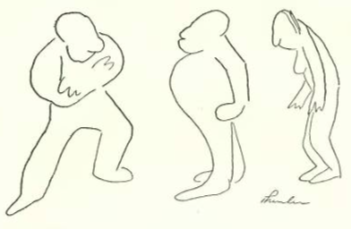


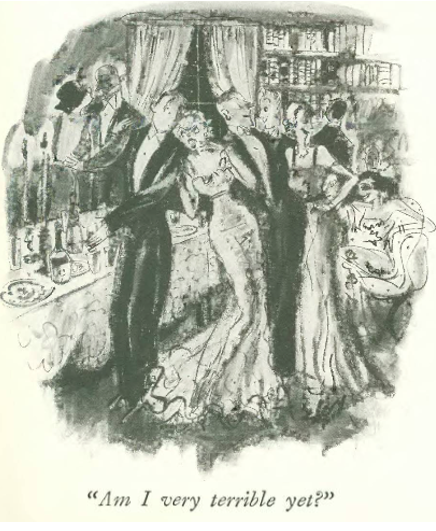



























































 A New Yorker State of Mind