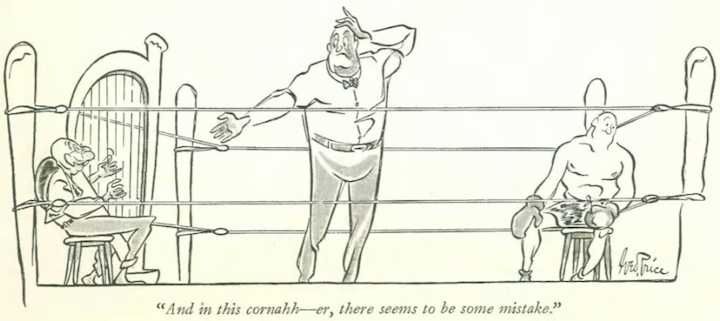
Back in the days before we had a zillion different entertainment options, almost anyone with a pair of ears would tune in to hear the radio broadcast of a heavyweight title fight.
June 23, 1934 cover by Rea Irvin.
Jack Dempsey and Gene Tunney dominated the late 1920s, while Joe Louis, Max Schmeling and Jack Sharkey were marquee names in the 1930s along with Max Baer and Primo Carnera, who met on June 14, 1934 at the outdoor Madison Square Garden Bowl in Long Island City. The reigning champ Carnera (1906–1967), who stood six-and-a-half feet tall and weighed in at 260 pounds, had won more fights by knockout than any other heavyweight champion. But Baer (1909–1959) was known as a knockout puncher who beat one opponent so savagely that he died the following day.
DEADLY DUEL…Max Baer (right) fought Frankie Campbell on Aug. 25, 1930, in San Francisco for the unofficial title of Pacific Coast champion. In the fifth round Baer got Campbell against the ropes and hammered him senseless. Campbell died the next day. An autopsy revealed that Campbell’s brain was “knocked completely loose from his skull.” Baer was profoundly affected by Campbell’s death, and donated purses from succeeding bouts to Campbell’s family. (thefightcity.com)
Baer was also something of a showboater, a quality Morris Markey found distasteful when he wrote about the Baer–Carnera bout in “A Reporter at Large.”
ALL SMILES…A year before their championship bout Max Baer (left) and Primo Carnera starred with Myrna Loy in The Prizefighter and the Lady. (theusaboxingnews.com)
GIANT SLAYER…The Italian prizefighter and wrestler Primo Carnera, nicknamed the “Ambling Alp,” was the reigning heavyweight champion when he faced Max Baer on June 14, 1934 at the Madison Square Garden Bowl. Baer felled the champion eleven times before the fight was stopped in the eleventh round. Baer would only hold the title for a year, losing to James J. Braddock on June 13, 1935, in what has been called one of the greatest upsets in boxing history. (theusaboxingnews.com)
Markey further explained why Baer’s behavior in the ring was so bothersome, and how it differed from the comic antics of other famous athletes:
RETIRING TYPES…Both Primo Carnera and Max Baer acted in films during their boxing careers, and continued acting after their retirements (Carnera in 1944, Baer in 1941). At left, Carnera with Bob Hope in the 1954 American comedy Casanova’s Big Night (Carnera appeared in eleven Italian films and in a half-dozen American films); at right, Max Baer and brother Buddy Baer (also a boxer) with Lou Costello in the 1949 comedy Africa Screams. Baer would appear in more than 20 films.(theusaboxingnews.com/monstermoviemusic.blogspot.com)
Complications from diabetes would take Carnera down for good at age 60. Baer would die even younger, from a heart attack, at age 50. His last words reportedly were, “Oh God, here I go.” Baer’s son, actor and director Max Baer Jr. (best known as Jethro Bodine from TV’s The Beverly Hillbillies) is still with us, at age 85.
We aren’t quite finished with the Baer–Carnera fight…E.B. White led his “Notes and Comment” with this observation regarding the fight’s mass appeal and seeming universality:
* * *
Apologies to Ms. Winslow
I seem to have given short shrift to author Thyra Samter Winslow (1886–1961) who published more than 200 stories during her career in magazines such as The Smart Set and The American Mercury. She published more than thirty in TheNew Yorker, from 1927 to 1942, including the serialization of her short story collection, My Own, My Native Land. The story “Poodles” was featured in the June 23 issue.
According to the Encyclopedia of Arkansas, Winslow’s early life in Fort Smith (Ark.) “provided background for her view of small towns as prejudiced, hypocritical, and suffocating places…many stories expose the hypocrisy, prejudice, and carefully maintained social structures of both small town and urban life. She was particularly adept at portraying women of every social class, often in an unfavorable light. Money, especially the pursuit of it as a means to happiness or status, is an important theme throughout her work.”
THE PURSUIT OF HAPPINESS…Thyra Samter Winslow with friend, 1937. (findagrave.com)
* * *
Hot Enough For Ya?
So what did New Yorkers do when the summer heat set in? The next few items offer some clues, beginning with this poem by E.B. White:
SUMMER STOCK…Theatergoers fled to shady villages in New York, New Jersey and New England in the 1920s and 30s when summer stock theater was at its height. The above photo shows theatergoers leaving a performance at the Lakewood Theatre near Skowhegan, Maine. The theater was claimed to be the oldest and finest summer stock company in America with a Broadway cast. Nearby Lakewood Inn provided recreation, camping, and tourist bungalows. (mainememory.net)
You could also take in some entertainment while enjoying the cooling breezes of the Hudson River. Robert Benchley hopped aboard the Alexander Hamilton to enjoy Bobby Sanford’s showboat revue:
SOME REAL SHOWBOATING…Clockwise, from top left, the steamboat Alexander Hamilton hosted Bobby Sanford’s showboat revue; comedian Lester Allen served as emcee for the show; the Meyer Davis Orchestra supplied the music; the revue featured the “exotic” DuVal sisters (image from program) among other diversions. (Hudson River Maritime Museum/IMDB/vintagebandstand.blogspot.com/Worthpoint)
“Tables for Two” took a look at summer dining options, from sidewalk cafes to hotel rooftops featuring dinner and dancing—this “Tables” was not written by Lois Long, but by Margaret Case Harriman, who knew a thing or two about nightlife (she was the daughter of the Hotel Algonquin’s owner, Frank Case)…
DANCING WITH THE STARS…The Waldorf-Astoria’s “Starlight Roof” was a popular summer restaurant for dining and dancing. Image from a 1935 publication The Waldorf-Astoria by Richard Averill Smith. (The Waldorf-Astoria)
* * *
Doing Swimmingly
Historian Henry F. Pringle published part two of his series on President Franklin D. Roosevelt, here marveling at the president’s health despite his serious bout with polio (drawing by William Cotton).
TAKING THE WATERS…President Franklin D. Roosevelt took to swimming for therapy and exercise. (FDR Presidential Library and Museum)
* * *
Get Yourself to Chi-Town
The Chicago World’s Fair (The Century of Progress) was in its second and final year, and The New Yorker found everything “terrific.” Excerpt:
MAKING A SPECTACLE OF ITSELF…The 11-acre Ford Motor Company exhibit at Chicago’s Century of Progress became the most talked-about exhibit of 1934, featuring a central rotunda designed to simulate graduated clusters of gears. At right, Proof of Safety Exhibit in the Ford Building. (chicagology.com)
* * *
From Our Advertisers
Just a couple of entries this week…You could take a plane to the Chicago World’s Fair on a United Airlines Boeing 247…
…the lower section of the ad claimed you could fly to Chicago in about five hours in planes featuring “Two pilots…stewardess…two-way radio…directive radio beam”…
TSA? WHAT’S A TSA?…United Airlines Boeing 247-D at an airport terminal with passengers and crew. (digitalcollections.lib.washington.edu)COZY CONFINES…Passengers enjoy a game of checkers aboard a Boeing 247 in 1933. (digitalcollections.lib.washington.edu)
…and what would our advertising section be without two fashionable people lighting up?…
…on to our cartoonists, we begin with Reginald Marsh’s illustration of a Rep Theatre production…
…Otto Soglow’s Little King found his artistic side…
…Rea Irvin continued his examination of native fauna…
…Gardner Rea correctly predicted the global domination of Mickey Mouse…
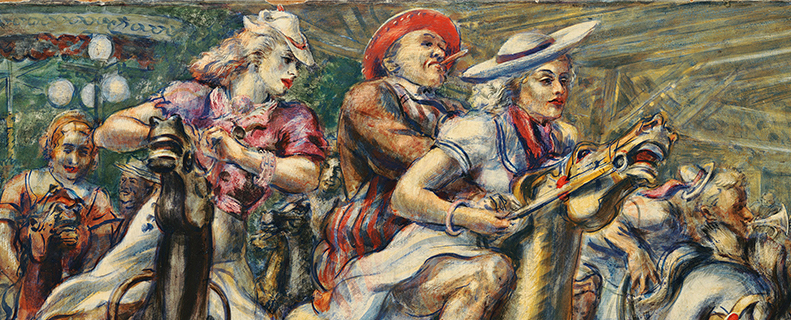
…Peter Arno showed the dizzying effects of a Coney Island ride…
…however at the altar the thrill was gone, per Garrett Price…
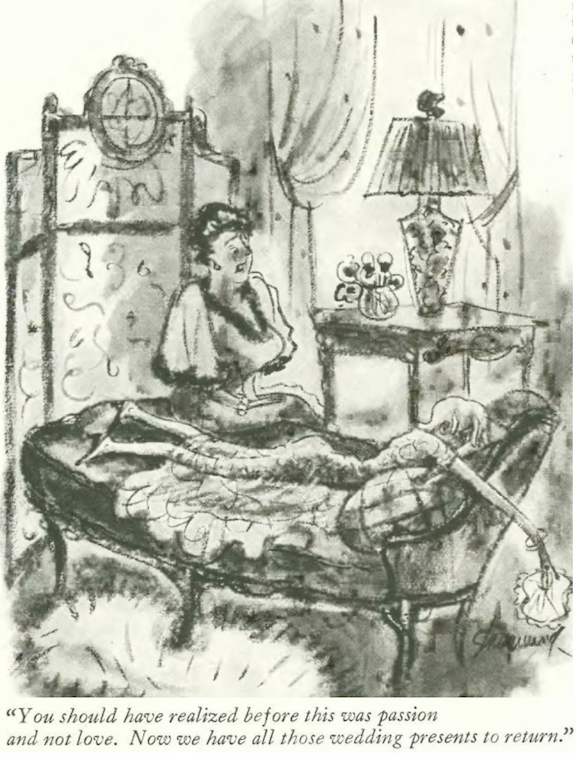
…another take on the ways of love, with Barbara Shermund...
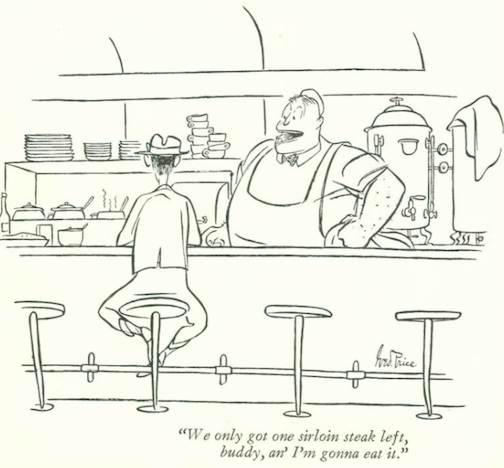
…the newfangled diagonal bathtub continued to dazzle, with George Price…
…Gardner Rea offered up some subtle irony on the farm…
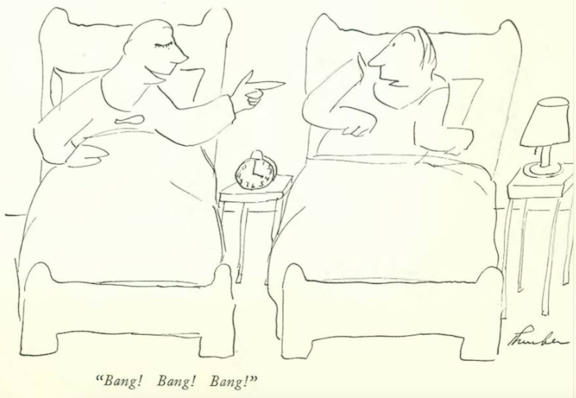
…and we close with James Thurber, in a poetic moment…
Above: Wooden Horses(detail) by Reginald Marsh, 1936. Marsh was a frequent visitor to Coney Island, a place that inspired numerous sketches and paintings. (Wadsworth Atheneum Museum of Art)
We officially kick off the summer with a visit to Coney Island, where “The Talk of the Town” took in the latest sights and amusements.
June 16, 1934 cover by Constantin Alajalov.
This excerpted “Talk” piece, attributed either to an “H. Beckett” orFrancis Steegmuller, describes a post-Prohibition Coney Island with liquor to be had (although at only three locations) and new attractions including several imported from the 1933-34 Chicago’s World’s Fair (aka “The Century of Progress”).
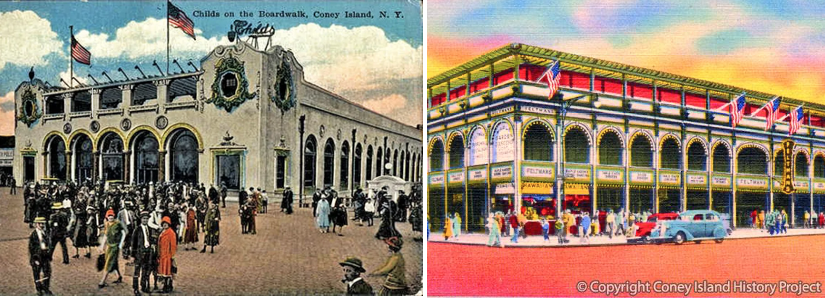
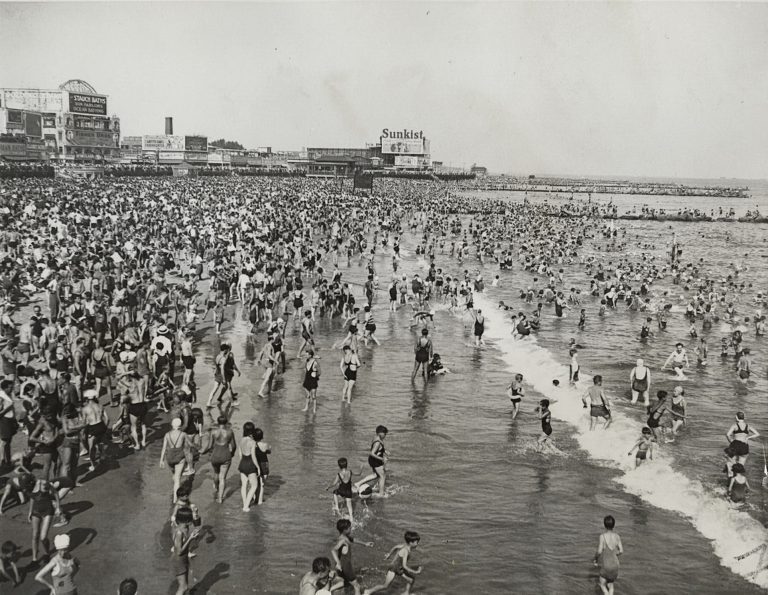
CLANKITY CLANK…The mechanical man referred to in the “Talk” piece was likely similar to the one pictured above in this October 1933 feature in Popular Mechanics. Like many “robots” of that era, they were often pictured smoking cigarettes. (Google books)WET YOUR WHISTLE…Beer flowed up and down the boardwalk at Coney Island, but if you wanted something stronger you had to stop by the Half Moon Hotel or one of these establishments, Childs (left) or Feltmans’. (www.coneyislandhistory.org)LEAVE SOME FOR ME…An estimated one million New Yorkers visited Coney Island on July 4, 1934 to get away from the heat of the city. (stuffnobodycaresabout.com)DIFFERING INTERPRETATIONS…In his 1934 painting, Coney Island (left), artist Paul Cadmus portrayed beachgoers as ridiculous and uncouth rabble, while Cadmus’s friend and fellow artist Reginald Marsh took a somewhat kinder approach to the same subject in his 1936 Coney Island (right). (Jon F. Anderson, Estate of Paul Cadmus, licensed by VAGA, obtained via lacma.org / Syracuse University Art Collection)
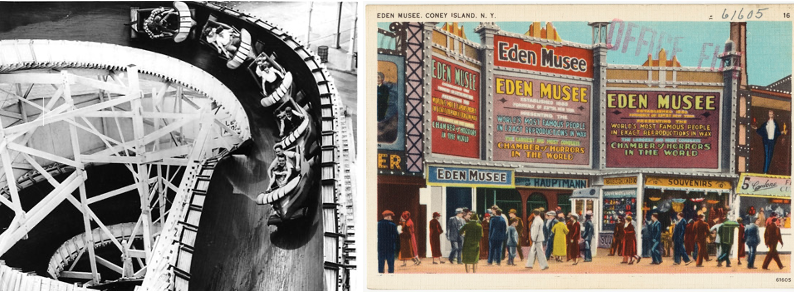
Of course it wouldn’t be Coney Island without grisly wax museum scenes inspired by the latest sensational headlines…bank robber John Dillinger was still on the run, and “little June Robles” was finally free and apparently unharmed after being kidnapped and locked in a desert cage for 19 days…
THANKS WINDY CITY…At left, the Chicago World’s Fair inspired Coney Island to build a trackless, bobsled-style “flying turns” coaster in Steeplechase Park (the wooden ride was destroyed by fire after only five years of operation). At right, a postcard image of the Eden Musee wax museum. (riverviewparkchicago.com / New York Public Library)ON THE BOARDWALK…Another Coney scene by Reginald Marsh, titled Pip and Flip, 1932. (Terra Foundation for American Art, Chicago Daniel J. Terra Collection via artblart.com)
* * *
Luck of the Irish
The Irish Hospitals’ Sweepstake (more commonly known as the Irish Sweepstakes) was established in 1930 to raise funding for hospitals in Ireland. Although lotteries were generally illegal in the U.S., millions of tickets were sold in the States, many of them in New York and New England. In his “Notes and Comment,” E.B. White wondered what would become of the lottery’s newest American winners, including former Ziegfeld Follies showgirl Alma Mamay, who won $152,000 in the Irish sweepstakes. White might have been pleased to know that Mamay moved to California, married a millionaire oil tycoon, and lived to the age of ninety-one.
CALIFORNY IS THE PLACE YOU OUGHTA BE..Ziegfeld Follies showgirl Alma Mamay took her Sweepstakes winnings and fled to California, where she married a millionaire oil tycoon. (ziegfeldfolliesgirls.com)
* * *
Rugged Individual
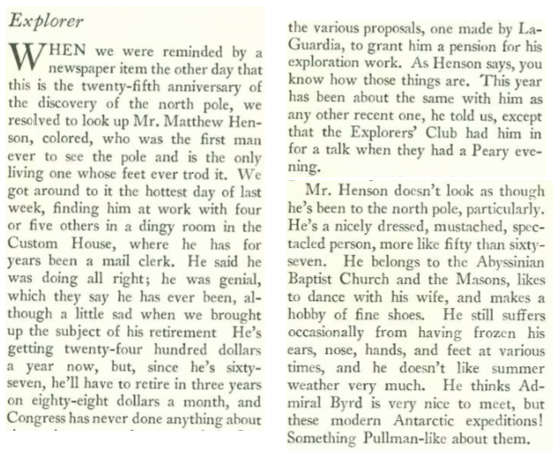
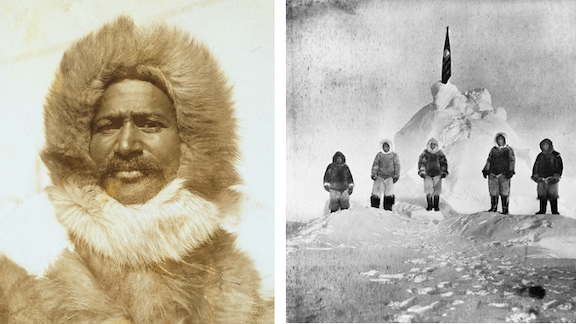
Matthew Alexander Henson (1866–1955) was an African American explorer who accompanied Polar explorer Robert Peary to the Arctic seven times, participating in a 1908–1909 expedition that arguably made Henson the first explorer to reach the geographic North Pole. “The Talk of the Town” caught up with Henson on the feat’s 25th anniversary.
GO NORTH YOUNG MAN…At left, Matthew Henson circa 1910. At right, photograph of Henson and four Inuit guides on the last stretch of their 1908–09 expedition, taken by Robert Peary at what they believed to be the North Pole. Henson (center) planted the flag. (Wikipedia)
* * *
POTUS Profiled
Pulitizer Prize-winning historian Henry F. Pringle published the first installment of a three-part profile of President Franklin D. Roosevelt. In this excerpt Pringle writes about FDR’s sense of humor (illustration by William Cotton):
* * *
Mattress Campers
The “About the House” column featured the latest in home-cooling devices. Couldn’t afford the zillions it would cost to install a home air-conditioner? Well the folks at Crosley—an electronics company known for its radios—offered a more affordable solution: an air-conditioned tent that could be erected over one’s bed for $150 (about $3,500 in today’s dollars):
Here is a 1934 ad for the contraption I found at worldradiohistory.com:
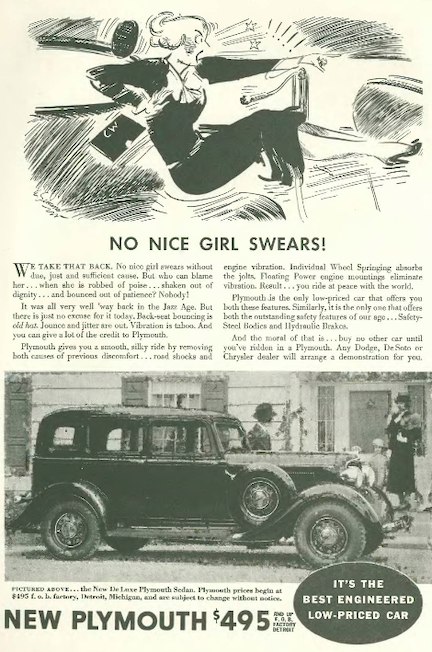
…and we continue with more from our advertisers, including the Broadway magazine The Stage, which offered up this idyllic scene showing what folks did in the days before air-conditioning…
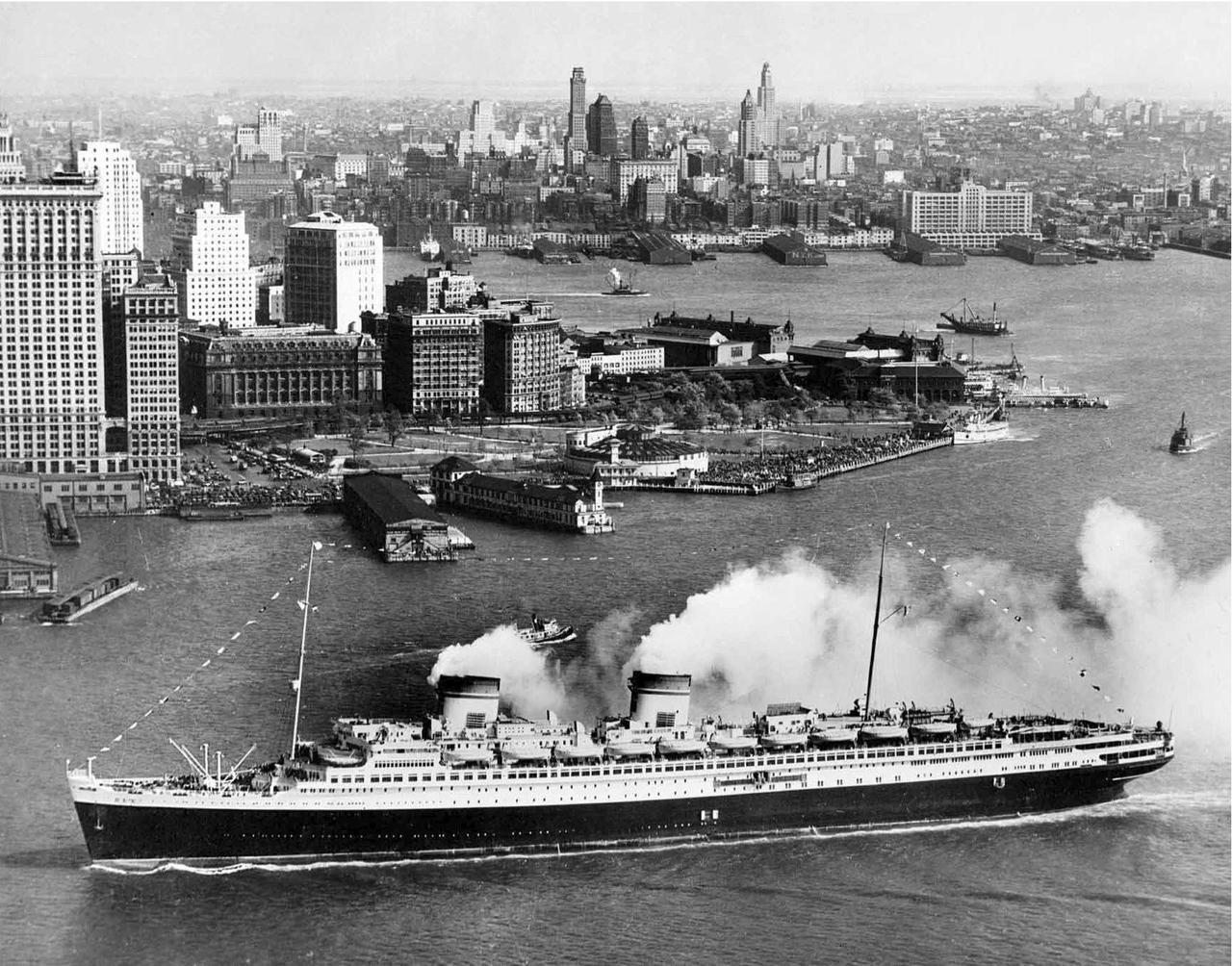
…you could also escape the heat by taking to the high seas aboard the Italian liner SS Rex…
…seen below arriving in New York in this 1932 photo, the 911-foot SS Rex was the largest ship built in Italy before World War II…it was destroyed by the British RAF in 1944…
(adventures-of-the-blackgang.tumblr.com)
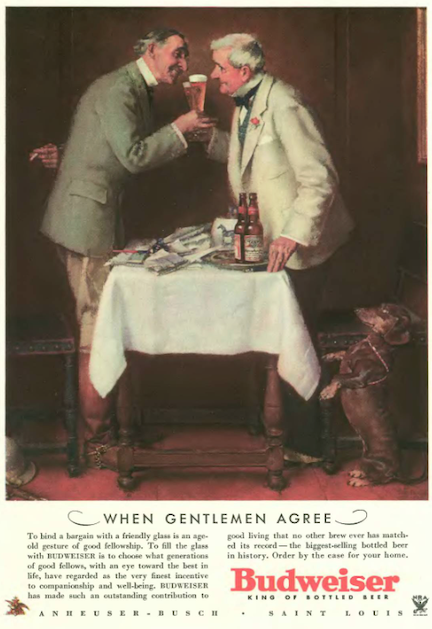
…you could also cool off like these two old gents, sharing a toast and some Budweisers…
…or you could get yourself a jug of applejack brandy and mix it 1:1 with pineapple juice…not sure who or what is being “saved” here…
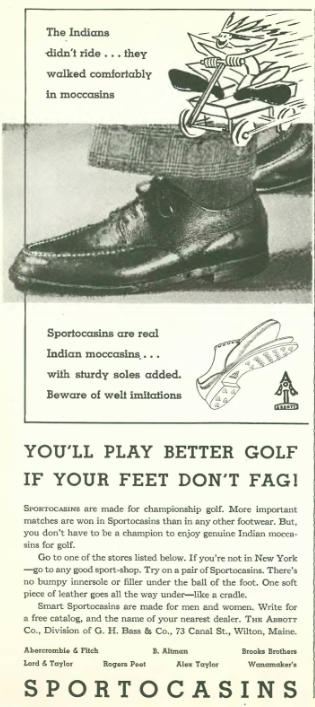
…long before there were Nikes or Adidas, golfers could hit the links in a pair of Sportocasins…
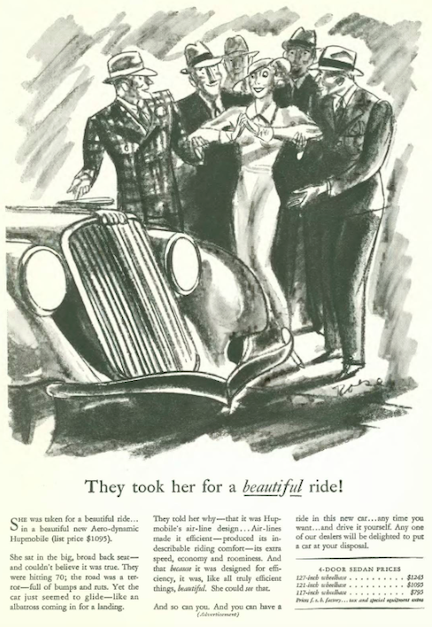
…Hupmobile was still hanging in there, enlisting the talents of illustrator Herbert Roese to extol the comforts and the beauty of its “air-line design”… it isn’t clear why it required five middle-aged men to take her on that beautiful ride…
…the real-life bellboy Johnny Roventini made his debut in the New Yorker as the spokesman for Phillip Morris cigarettes…
…Roventini (1910–1998), who stood less than four feet tall as an adult, was working as a bellboy at the New Yorker Hotel when he was discovered by an advertising executive in 1933. Apparently the exec had Roventini shout the line “Call for Philip Morris!” and learned the bellboy could repeatedly, and on cue, vocalize a perfect B-flat tone. Representing the company for more than forty years, he helped Lucille Ball and Desi Arnaz with the initial success of I Love Lucy (Philip Morris was the show’s sponsor)…
WHAT’S HIS LINE?…TV producers Mark Goodson, left, and Bill Todman greet Johnny Roventini during a 1952 radio broadcast of their quiz show, What’s My Line? The program’s sponsor was Phillip Morris. Note Goodson and Todman both hold cigarettes. (Wikipedia)
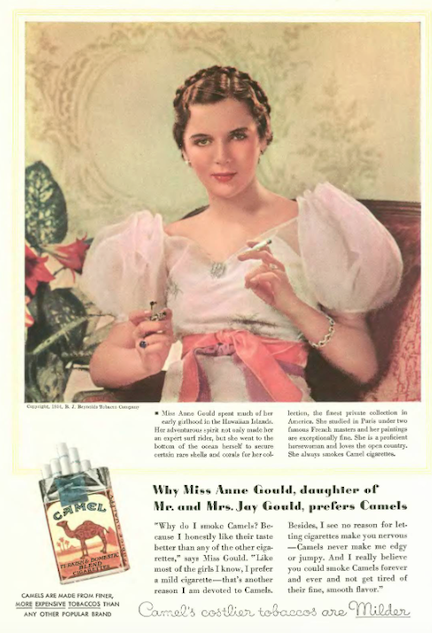
…by the looks of it, Anne Gould (heiress daughter of Jay Gould II and Anne Douglas Graham Gould) didn’t need anyone to tell her what to smoke…
…on to our cartoons, we continue our birdwatching with Rea Irvin…and we also get…
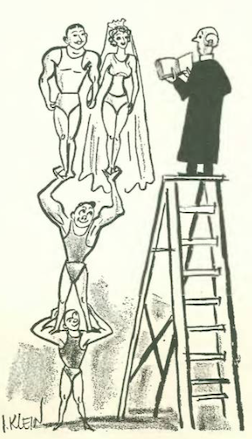
…high-flying nuptials with Isadore Klein…
…a mismatch with George Price…
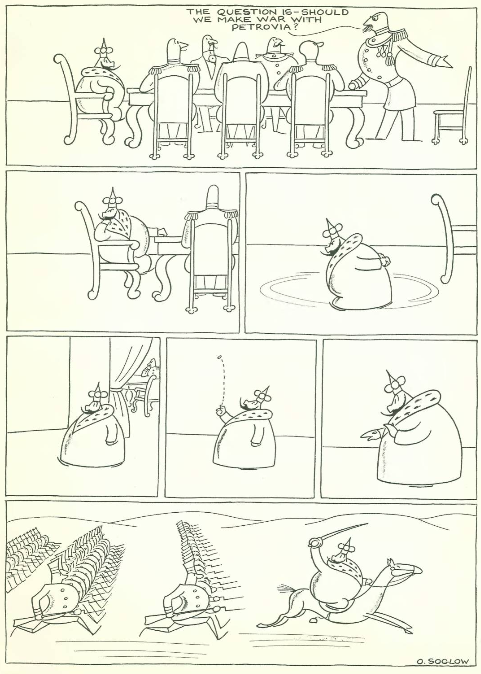
…the prospects for war with Otto Soglow…
…marital bliss with James Thurber…
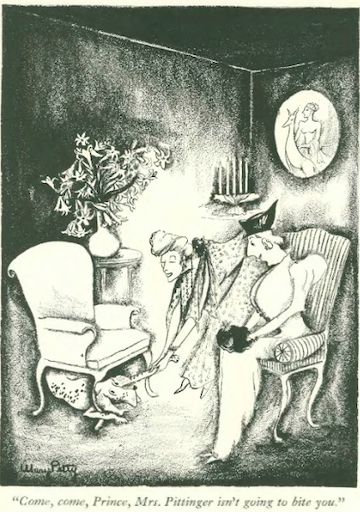
…and a courtship scene, with an expiration date, from Mary Petty…
Above: British architect Norman Foster's 2010 recreation of R. Buckminster Fuller's 1933 Dymaxion car. (Wikipedia)
Despite the limitations of 1930s technology, a few architects and designers were hell-bent on building a streamlined future that until then was mostly the stuff of movies and science fiction magazines.
May 5, 1934 cover by Rea Irvin.
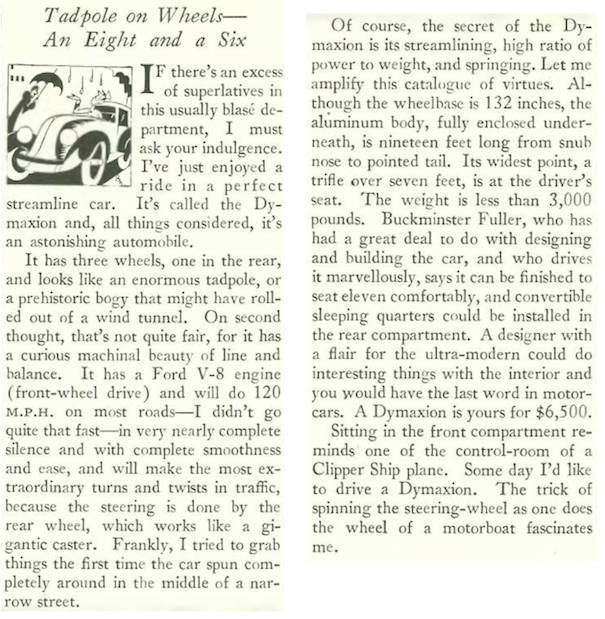
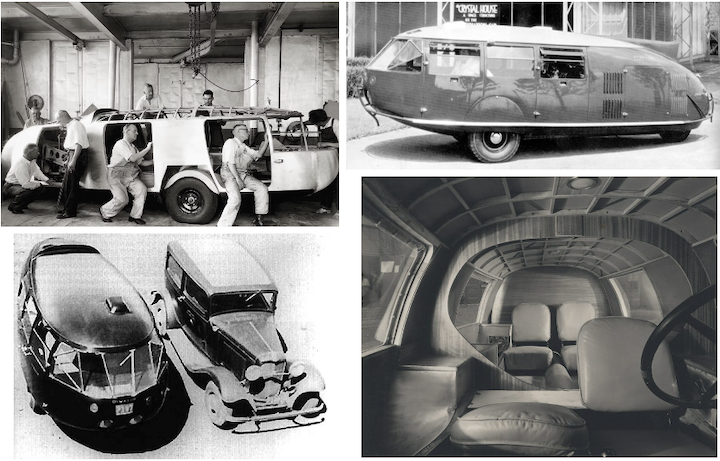
One of them was R. Buckminster Fuller (1895–1983), architect, designer, and futurist probably best known today as the inventor of the geodesic dome (think Disney’s Epcot Center). In the 1930s Fuller was all about a concept he called Dymaxion. Derived from the words dynamic, maximum, and tension, when applied to architecture and design it would supposedly deliver maximum gain from minimal energy input. The writer of the New Yorker article (pseud. “Speed”) was fascinated by the Dymaxion’s motorboat-type steering, no coincidence since Fuller intended to adapt his futuristic car for use on and under the water, as well as in the air.
THE SHAPE OF THINGS TO COME…Clockwise, from top left: Workers at a Bridgeport, Conn., plant creating the first of three Dymaxion cars; the Dymaxion at Chicago’s 1933 Century of Progress exposition—the car was involved in a fatal accident at the fair; interior view of the Dymaxion; using the same engine and transmission as a Ford sedan (pictured), the Dymaxion offered three times the interior volume with half the fuel consumption and a 50 percent increase in top speed. (Buckminster Fuller Institute/Poet Architecture)THINKING WITHOUT THE BOX…In 1927 R. Buckminster Fuller (pictured) developed a Dymaxion House, a “Dwelling Machine” that would be the last word in self-sufficiency. Although the aluminum house was intended to be mass-produced, flat-packaged and shipped throughout the world, the design never made it to market (however its ideas influenced other architects); at right, a Fuller geodesic dome at Disney’s Epcot Center in Florida. (archdaily.com/Wikipedia)
The 1933 Century of Progress exposition in Chicago was supposed to be a major showcase for Fuller, but when professional driver Francis Turner was killed while demonstrating the first prototype of the Dymaxion, the car’s prospects dimmed considerably. According to an article by Stephanie d’Arc Taylor (cnn.com Oct. 30, 2019), during the demonstration a local politician tried to drive his own car close to the Dymaxion—to get a better look—and ended up crashing into the unwieldy prototype, which rolled over, killing the driver and injuring its passengers. “The politician’s car was removed from the fracas before police arrived, so the Dymaxion was blamed for the accident,” writes Taylor, who notes that the rear wheel–powered car, though unconventional, was not necessarily the problem. However, “the thing that made the Fuller death-mobile singularly deadly was the fact it was also steered by the rear wheel, making it hard to control and prone to all kinds of terrifying issues.”
That history did not stop architect Norman Foster from building a replica of the Dymaxion in 2010. Foster worked with Fuller from 1971 to 1983, and considers Fuller a design hero.
GIVING IT ANOTHER GO…Architect Norman Foster with his 2010 recreation of the Dymaxion. To build a new Dymaxion, Foster sent a restorer to the National Automobile Museum in Reno, Nevada (home of the only surviving Dymaxion, Car No. 2), and after thousands of photos and measurements Foster had the car recreated using only materials available in 1933: Foster’s Dymaxion consists of an ash frame sheathed in hand-beaten aluminum, mounted on the chassis of an old 1934 Ford Tudor Sedan. (CNN/The Guardian)
According to Taylor, Foster cleaved so closely to Fuller’s original designs that he refers to his creation as a fourth genuine Dymaxion—not a replica. “The car is such a beautiful object that I very much wanted to own it, to be able to touch as well as contemplate the reality for its delight in the same spirit as a sculpture,” said Foster. “Everything in (the car) was either made in 1934, or recreated using techniques and materials that Bucky would have had access to in that period.”
* * *
Meanwhile, At The Tracks…
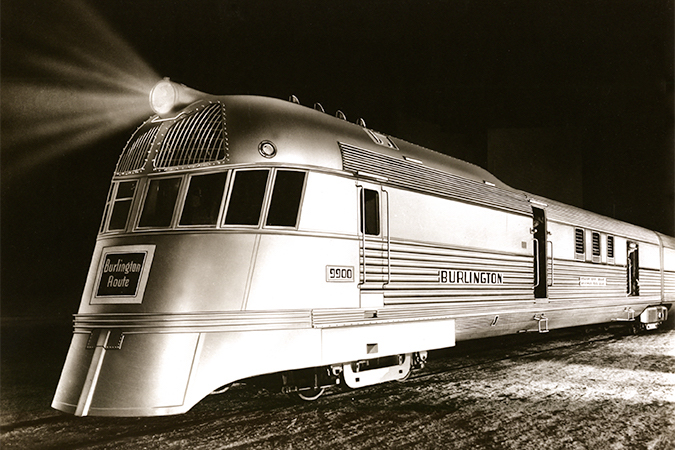
If Fuller’s attempt at the streamlined future was a bit of bust, the Burlington railroad was making a splash with its gleaming new Zephyr. E.B. White reported:
ZOOM ZOOM…The Burlington Zephyr set a speed record for travel between Denver and Chicago when it made a 1,015.4-mile (1,633 km) non-stop “Dawn-to-Dusk” dash in 13 hours 5 minutes at an average speed of almost 78 mph (124 km/h). In one section of the run it reached a speed of 112.5 mph. Following a promotional tour that included New York, it was placed in regular service between Kansas City, Missouri, and Omaha and Lincoln, Nebraska, on November 11, 1934. Other routes would be added later in the Midwest and West. (BNSF)
…we continue with E.B. White, here with some observations regarding Mother’s Day and bank robber/murderer John Dillinger, who had escaped from prison in March 1934 and was on the FBI’s Most Wanted List…
I REMEMBER MAMA…John Dillinger posed with Lake County prosecutor Robert Estill, left, in the jail at Crown Point, Ind. while he awaited his trial for murder in January 1934. Dillinger would escape from the jail in March and would be on the lam until July, when FBI agents would gun him down outside a Chicago movie theatre. (NY Daily News)
…and a last word from White, about an important change at Radio City:
* * *
Voice In The Wilderness
A combination of newsreel footage, documentary, and reenactment, Cornelius Vanderbilt Jr’sHitler’s Reign of Terror played to capacity crowds for two weeks in New York City, despite the refusal of the state’s censor to license the film. Disinherited by his parents when he became a newspaper publisher, Vanderbilt was a determined journalist, covertly filming scenes in Nazi Germany and even briefly encountering Adolf Hitler outside the Reichstag, where Vanderbilt yelled to Der Führer, “And what about the Jews, Your Excellency?” (Hitler ignored the question and referred Vanderbilt to one of his lackeys). Unfortunately, Vanderbilt wasn’t much of a filmmaker, and although he warned Americans about the emerging threat in Germany, few took the film, or his warning, seriously, including John Mosher:
UNHEEDED…Audiences flocked to see Cornelius Vanderbilt Jr’sHitler’s Reign of Terror, but critics dismissed the rather amateurish film—Film Daily scoffed at the film’s prediction that Hitler’s Germany was a future threat to world peace; at right, in the film Vanderbilt confronted “Hitler” in a recreation. (TMDB/Library of Congress)
* * *
From Our Advertisers
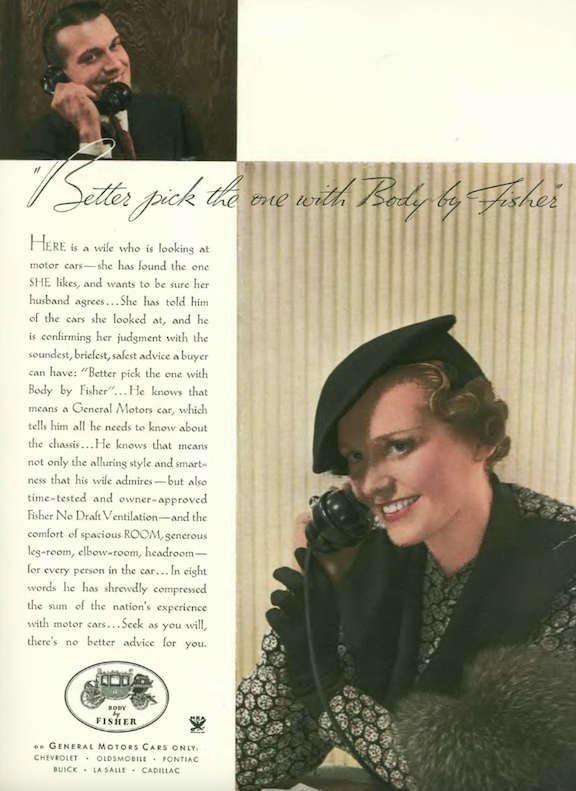
It wouldn’t seat eleven people like a Dymaxion, but a Body by Fisher (coach builder to General Motors) certainly impressed this young woman…but better check with the hubby just in case…
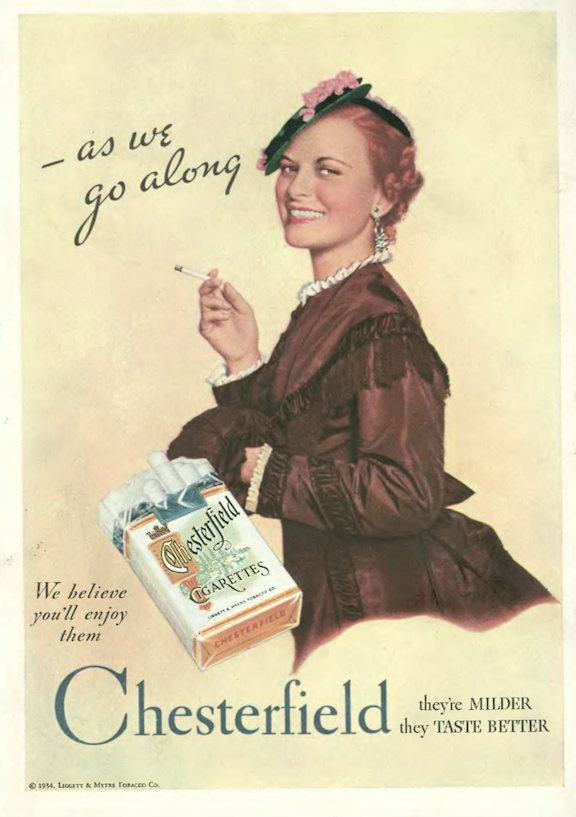
…in this next ad, we find what looks like the same woman, perhaps celebrating her decision with a nice smoke…
…this spot seems out of place in the New Yorker, like it snuck over from Better Homes & Gardens...
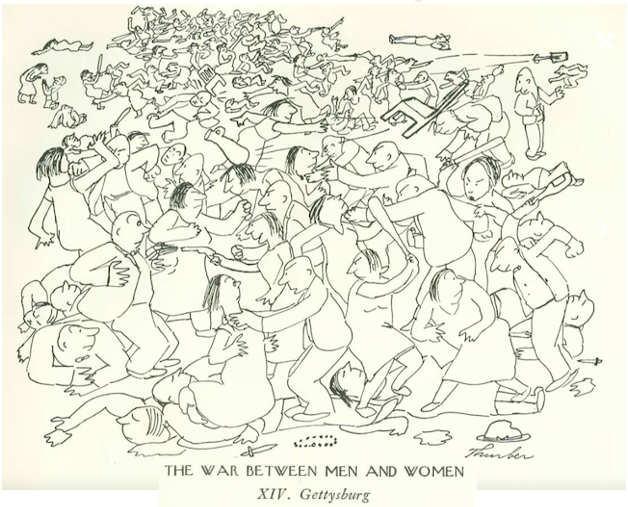
…on to our cartoons…with James Thurber’s war of the sexes over, life returned to normal…
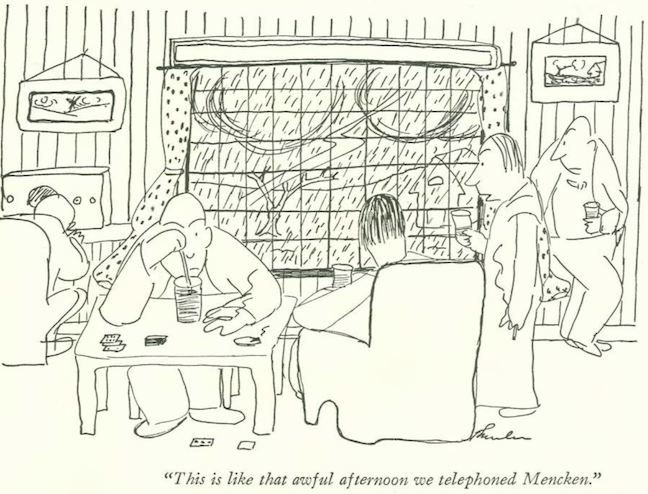
…and both sides shared in the gloom of a rainy afternoon…
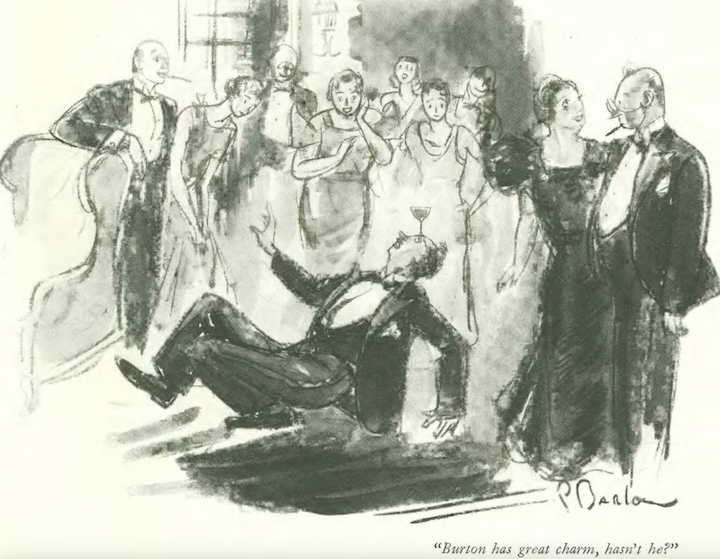
…by contrast, Perry Barlow brightened things up with this life of the party…
…but a good time doesn’t always translate over the airwaves, per George Price…
…Alain illustrated the consequences of losing one’s nest egg…
…Peter Arno didn’t leave any room for dessert…
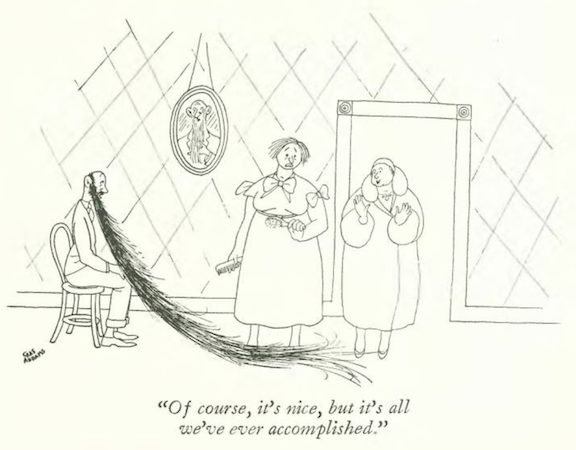
…and Charles Addams returned, a macabre cast of characters still percolating in his brain…
…on to May 12, 1934…
May 12, 1934 cover by Leonard Dove.
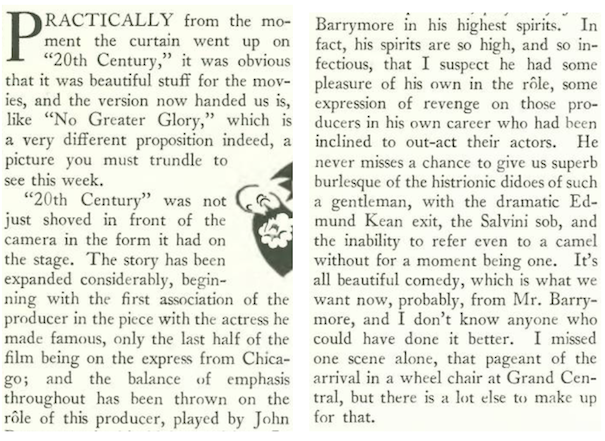
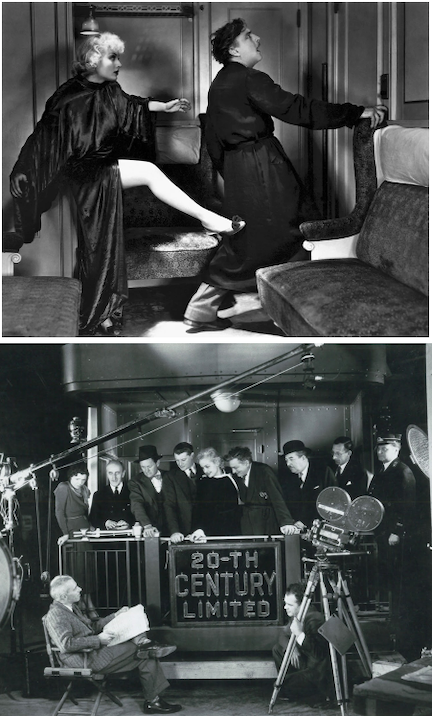
…and back to the movies, this time critic John Mosher found more cheery fare in 20th Century, a pre-Code screwball comedy directed by Howard Hawks and starring John Barrymore and Carole Lombard. Battling alcohol abuse since age 14, Barrymore nevertheless managed to display his rare genius as a comedian and turned in what is considered to be his last great film performance.
GETTING HER KICKS…Top, Carole Lombard delivers a swift one to John Barrymore in the screwball comedy 20th Century. Below, director Howard Hawks with the cast. (greenbriarpictureshows.blogspot.com)
* * *
Playing the Ponies
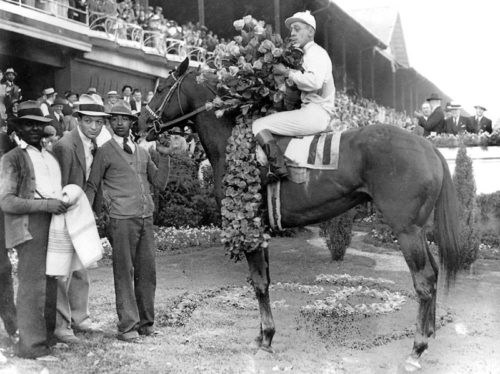
Horse racing correspondent George F. T. Ryall (pseud. “Audax Minor”) considered a losing wager at the Kentucky Derby in his column, “The Race Track.”
A HORSE OF COURSE…Jockey Mack Garner rode Cavalcade to victory at the 1934 Kentucky Derby. (Appanoose County Historical Society)
* * *
More From Our Advertisers
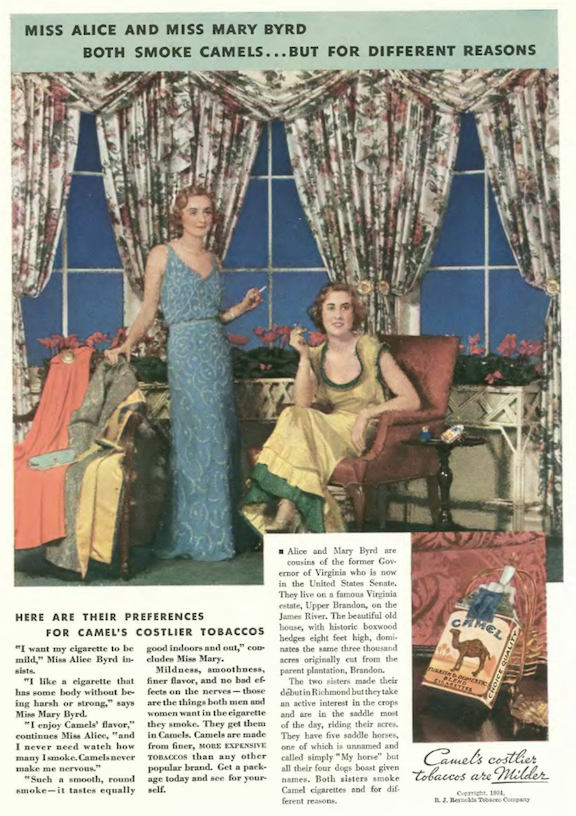
We begin with Camel cigarette endorsers Alice and Mary Byrd, residents of Virginia’s famous Brandon plantation and cousins of Virginia Senator and Governor Harry F. Byrd, known for his fights against the New Deal and his “massive resistance” to federally mandated school desegregation...
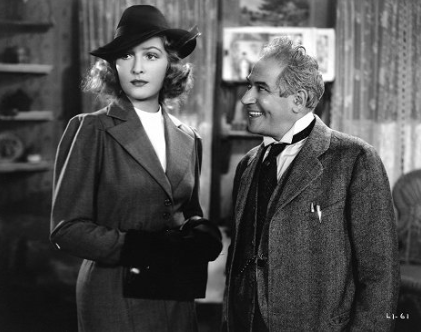
…also to the manor born, Whitney Bourne, a New York deb who would go on to a brief stage and film career that would end when she married her first husband (diplomat Stanton Griffis) in 1939…
AN EYE FOR STYLE…Whitney Bourne in a scene with Solly Ward in 1937’s Flight From Glory. Named in 1933 as one of America’s best dressed women, Bourne was a noted New York socialite, skier, golfer and tennis player as well as an occasional actress.
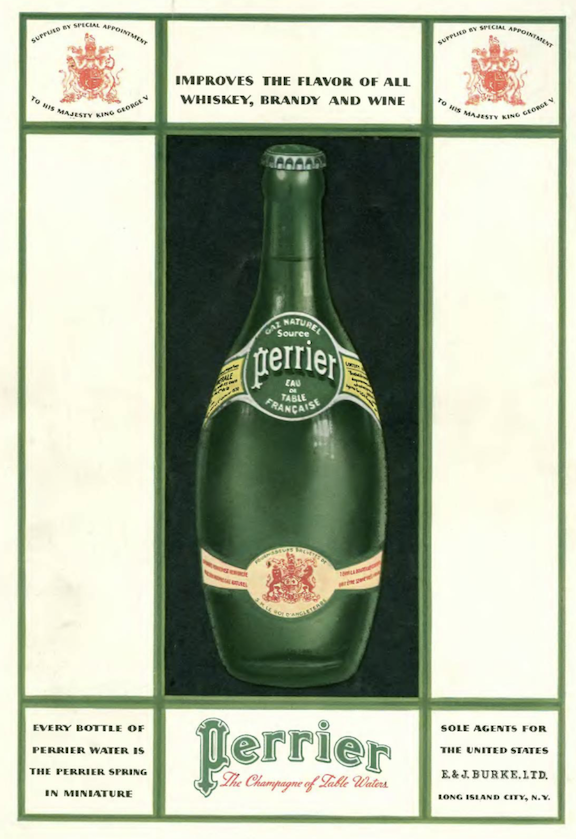
…we move along from the effervescent Whitney Bourne to the sparkling waters of Perrier…
…Gardner Rea followed other New Yorker cartoonists by illustrating an ad for Heinz…
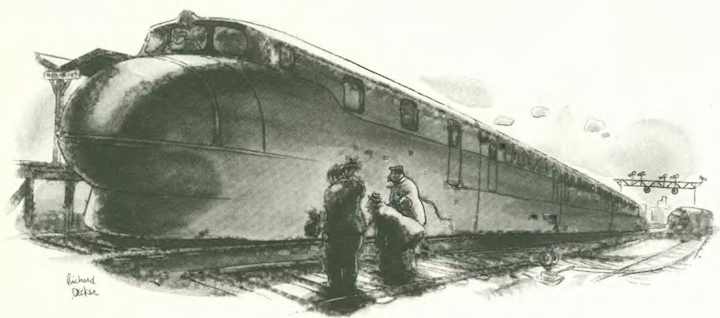
…which brings is to more cartoons, where according to Richard Decker, the move to streamlined trains wasn’t welcomed by everyone…
…Carl Rose illustrated this two-page spread with an imagined right-wing response to the recent left-wing May Day parades…
…William Steig eavesdropped onto a saucy little conversation…
…Barbara Shermund continued her explorations into the trials of the modern woman…
…James Thurber was back to his old tricks…
…and we conclude our cartoons with Eli Garson, and a new perspective…
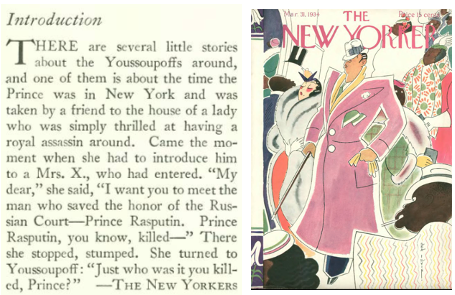
Before I close, a bit of housekeeping. The first issues in 1925 sometimes ended “The Talk of the Town” with…
…but on May 23, 1925, “Talk” signed off with —The New Yorkers. That continued until the March 31, 1934 issue (below), the last time the New Yorker signed off “The Talk of the Town” with —The New Yorkers:
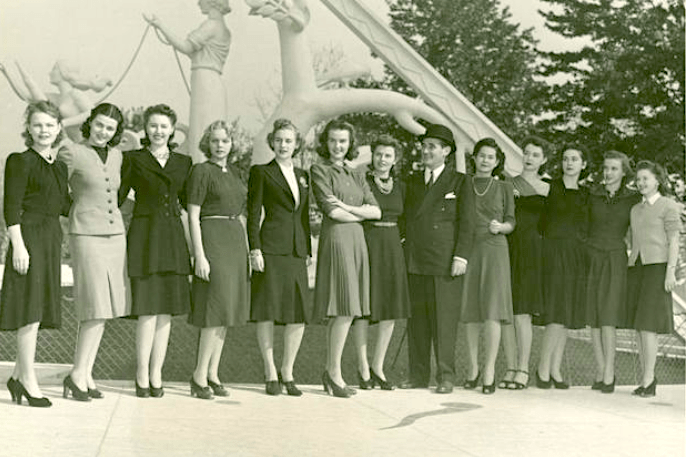
Above: Modeling agency founder John Robert Powers poses with participants of a fashion queen contest at the 1939 New York World's Fair. (NYPL)
John Robert Powers was a household name in the 1930s, founder of one of the world’s first modeling agencies—he supplied countless advertisers with mostly female models, some moving on to Hollywood careers.
April 21, 1934 cover by Abner Dean.
Writing for “A Reporter at Large” under the title “Perfect 36,” frequent New Yorker short story contributor Nancy Hale (1908 –1988) looked into the mysteries behind the fabled “John Powers Book” and its collection of sophisticated models.
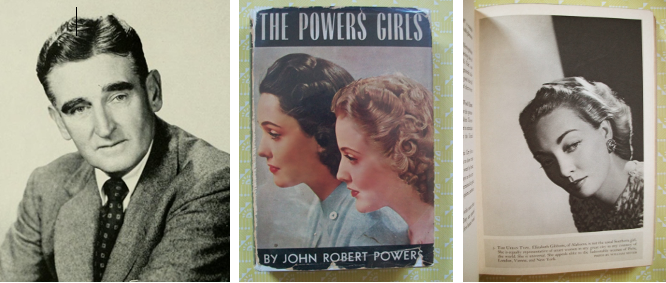
TYPING BOOK…John Robert Powers (1892–1977) wrote a bestselling 1941 book, The Powers Girls, that told “the story of models and modeling and the natural steps by which attractive girls are created,” organizing various models by type; at right, a page from the book featuring Elizabeth ‘Liz’ Gibbons—despite her Alabama roots, she was described by Powers as being “The Urban Type.” (Wikipedia/lastyeargirl.blogspot.com)
Hale was given a tour by a company representative who described the types of women the Powers company represented, noting the successes of women who landed in major cigarette ads or went on to become Hollywood stars:
SMOKE AND MIRRORS…Clockwise, from top left: Powers model Janice Jarratt (in a 1934 publicity photo from her only film, Kid Millions), who for a time was known as the “Lucky Strike Girl” as well as the “most photographed woman in the world”; Jarratt offering a Lucky to a nervous young man in a 1935 ad; Powers model Ethelyn Holt in a publicity photo for the Billy Rose Theatre; Holt in a 1933 ad for Camel cigarettes. (MGM/NPR/NYPL/propadv.com)
A number of Hollywood stars got their start or were discovered through their work with Powers, who himself was a sometime actor and the subject of a 1943 musical comedy, The Powers Girl.
POWER STARS…Former Powers models turned Hollywood stars included, from left, Norma Shearer,Frederic March and Kay Francis. (TCM/TMDB)
A note about the author, Nancy Hale: A brilliant short story writer, Hale published her first short story in The New Yorker in 1929 (when she was just 21) and would publish more than eighty stories in the magazine through 1969—she holds the record for the most stories in the magazine in a single year, publishing twelve between July 1954 and July 1955. New Yorker editor William Maxwell regarded Hale’s writing technique as “flawless.”
PROLIFIC…Nancy Hale published more than a hundred short stories in her lifetime, ten of which were recipients of an O. Henry Prize. Writer Joanne O’Leary (London Review of Books) notes that Hale also worked for Vogue (where she “pinch-hit as a model”) and became the first female news reporter at the New York Times. Above left, Hale in an undated photo; at right, Hale photographed in 1936 for Harper’s Bazaar. (Nancy Hale Papers, Sophia Smith Collection, Smith College)
* * *
Tat For Tat
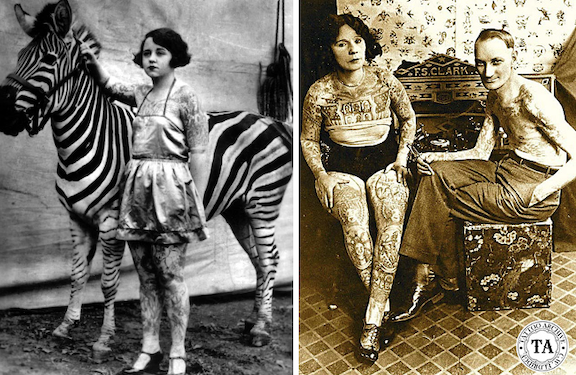
Alva Johnston explored the world of “tattooed people” in his second installment of a three-part profile series titled “Sideshow People”…
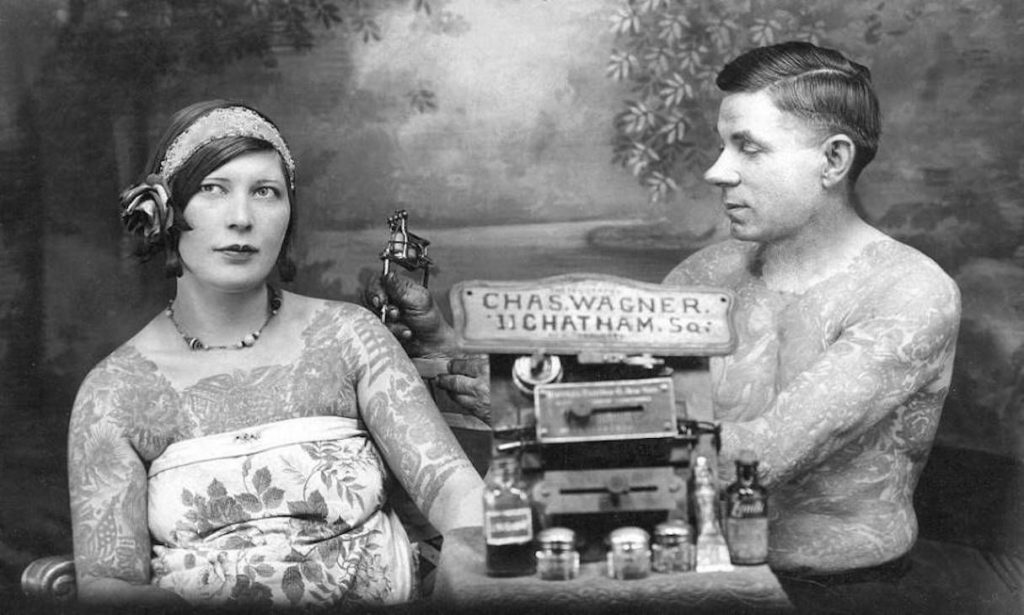
MARKED FOR LIFE…Alva Johnston noted such celebrated tattooed ladies as Mae Vandermark (left, circa 1920s), and Lady Viola, pictured at right with tattoo artist Fred Clark, 1930s. (Vintage Everyday)INKSLINGER…Charlie Wagner, a tattoo artist who lived from 1875 to 1953, is considered one of the kings of American tattooing. Practicing his art in New York’s Bowery, he not only developed an influential art style; he invented new machinery that helped spread the art of modern tattooing. (nyctattooshop.com)
* * *
Bloody Satisfying
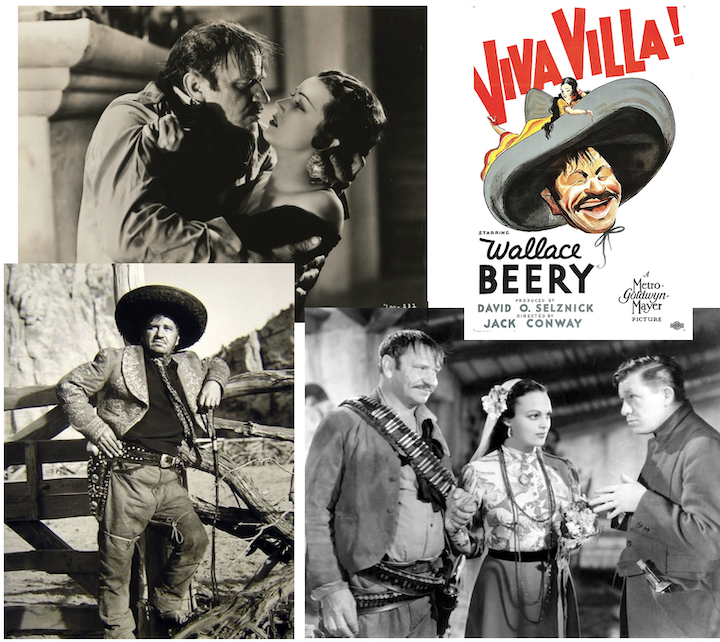
Film critic John Mosher declared David O. Selznick’s production Viva Villa! to be “thoroughly satisfying”—with a screenplay by Ben Hecht and starring actor Wallace Beery as Mexican revolutionary Pancho Villa, the film was considered violent and bloody by 1934 standards.
REVOLUTIONARY…Clockwise, from top left, Pancho Villa (Wallace Beery) finds himself attracted to a benefactor’s sister (Fay Wray); MGM film poster; Beery with Katherine DeMille (who was Cecil B. DeMille’s adopted daughter) and Stuart Erwin; Beery striking a pose on the set of Viva Villa! (IMDB)
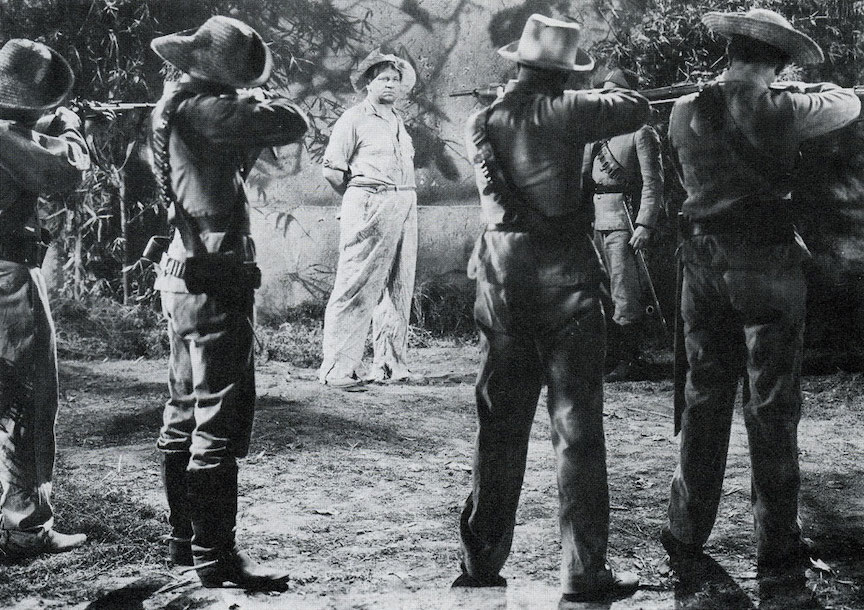
Mosher found some of the film’s violence to be startling. Being one the last Pre-Code films, censors would start clamping down on such scenes in the coming years.
MAKE SURE YOU GET MY GOOD SIDE…Pancho Villa (Wallace Beery) faces a firing squad before receiving a last-minute reprieve in Viva Villa! (IMDB)
* * *
From Our Advertisers
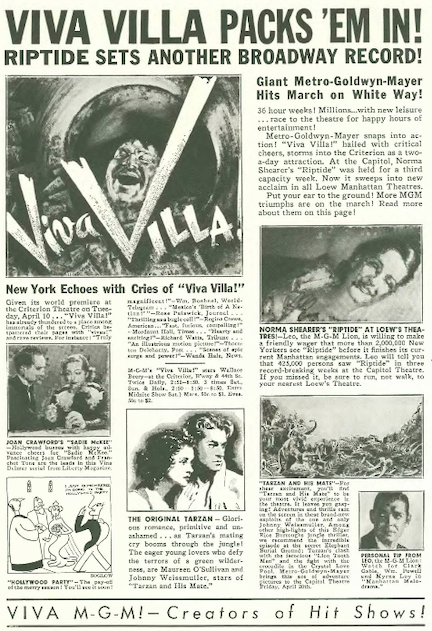
MGM took out a full-page ad to tout the success of Viva Villa and other MGM “hits”…
…note the bottom left hand corner of the MGM ad—a cartoon by Otto Soglow promoting the upcoming film Hollywood Party, a star-studded comedy musical featuring Laurel & Hardy, Jimmy Durante, Lupe Velez and Mickey Mouse…
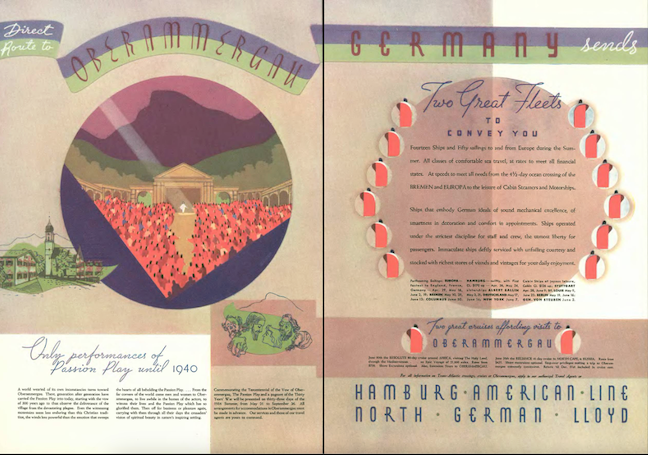
…those looking for a different kind of entertainment could have been enticed by this lavish center-page spread from German ocean liner companies…they were inviting Americans to Oberammergau, Germany to witness the “only performances of the Passion Play until 1940″…the play was usually performed every ten years (years ending in the digit zero) but in 1934 a special performance was supported by the Nazi Party…incidentally, the 1940 play was cancelled due to World War II…
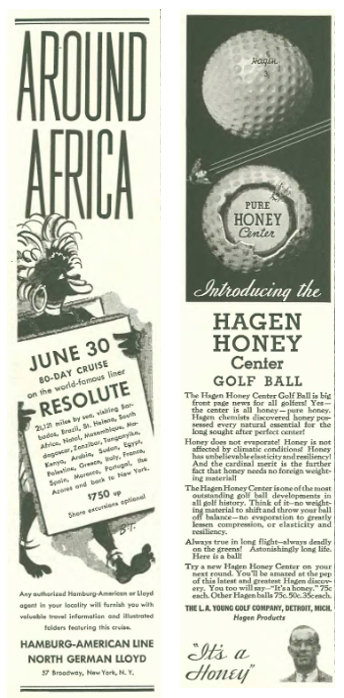
…the same German-American shipping companies also advertised an African cruise…with some racist imagery…
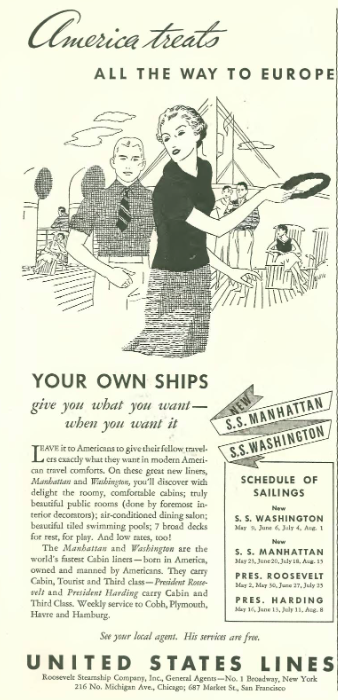
…perhaps you wanted to go to Europe on a ship with fewer Nazis on board…in that case you could grab a berth on a ship with the United States Lines, and hang out with these stiffs…
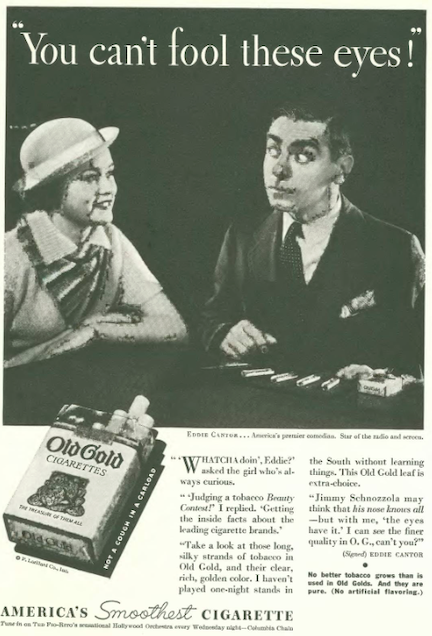
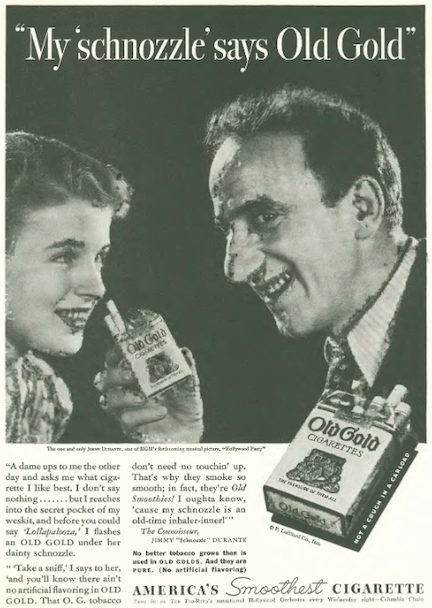
…the makers of Old Gold referenced a previous ad featuring Jimmy Durante with a new spot starring actor/comedian Eddie Cantor…both ads depicted impressionable young women admiring the smoking wisdom of older men…
…for reference, the creepy Durante ad…
…the famous “Call for Philip Morris” advertising campaign began during World War I, but in 1933 Johnny Roventini, a bellhop at the Hotel New Yorker, would become the living symbol of the cigarette brand…
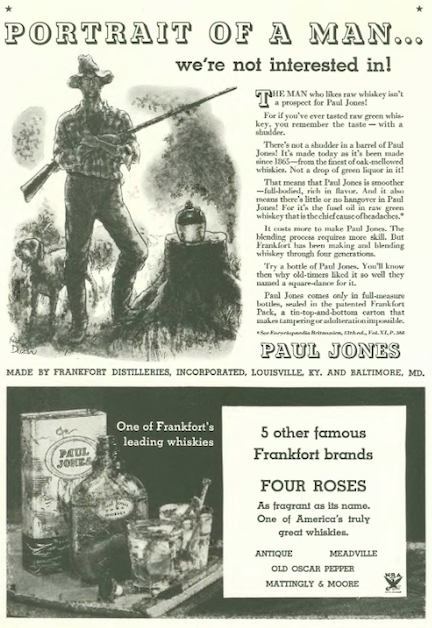
…by contrast, Frankfort Distilleries showed us an image of man who would not represent them, namely Jed Clampett…
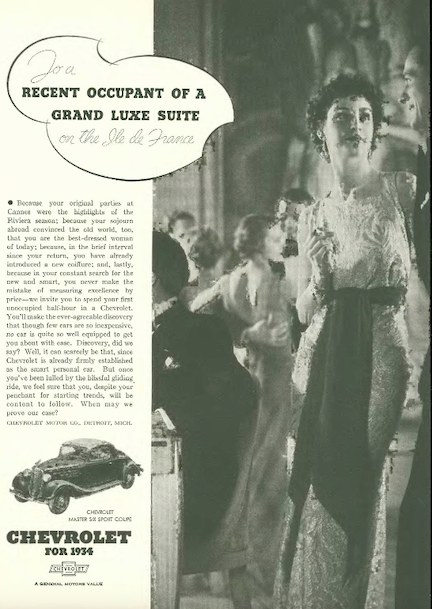
…Chevrolet continued its rebranding campaign, positioning itself as an affordable choice that was nevertheless favored by the posh set…
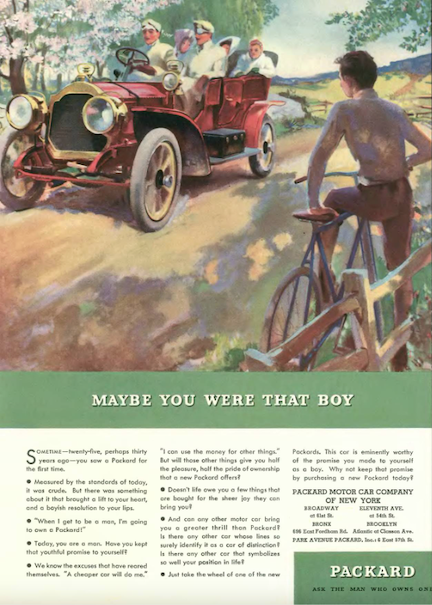
…who would rather be driving a Packard, here appealing to the nostalgic sensibilities of old-timers who had the means to afford one…
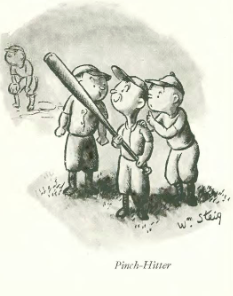
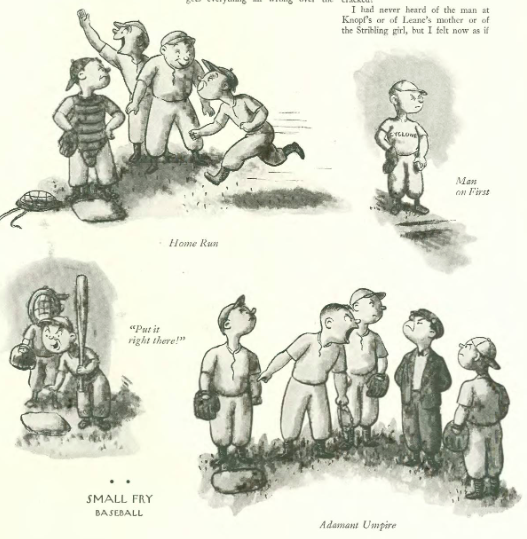
…on to our cartoons, and some “Small Fry” baseball from William Steig…
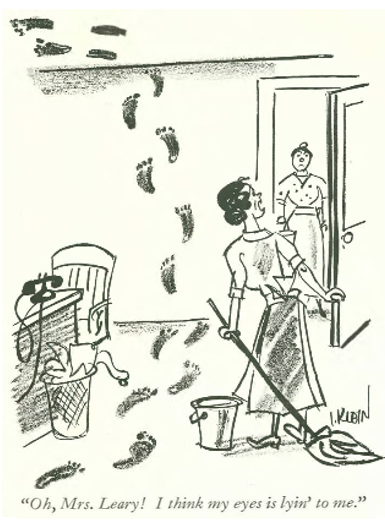
…an unusual captioned cartoon (from George Price) featured in the opening “Goings On About Town” section…
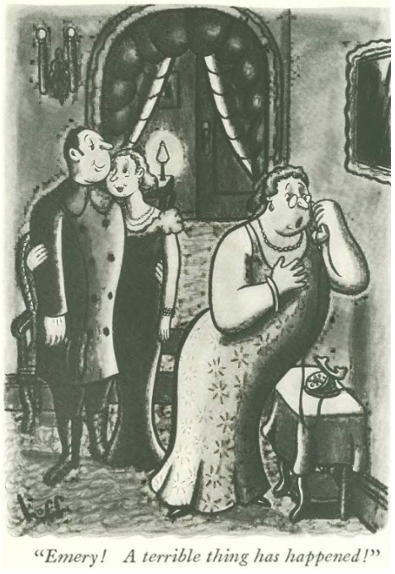
…Syd Hoff gave us an alarmed matron confronting the unthinkable…a doorman as a son-in-law…
…we haven’t seen Isadore Klein’s work in awhile—understandable, as he was busy in his career as an animator––in 1934 he worked on films for Van Beuren Studios (Rainbow Parade Cartoons) and in 1936 he would move to Disney’s Silly Symphonies…
…Paul Manship’sPrometheus at Rockefeller Center is iconic today, but when it was installed in 1934 it puzzled more than a few onlookers, including Robert Day…
…and we close with James Thurber, and a turn of events in his “war”…
Above: A scene from Mary Pickford’s 1922 film Tess of the Storm Country. (Library of Congress)
In today’s celebrity-saturated culture it is difficult to find a parallel to silent film star Mary Pickford, who was dubbed Queen of the Movies more than a century ago. Indeed, during the 1910s and 1920s Pickford was regarded as the most famous woman in the world.
April 7, 1934 cover by Rea Irvin.
Pickford was also known as “America’s Sweet” for her portrayal of gutsy but tenderhearted heroines. In real life she was also a gutsy and shrewd businesswoman who co-founded United Artists in 1919 with Charlie Chaplin, Douglas Fairbanks, and director D. W. Griffith. Commanding a salary only rivaled by Chaplin, her stardom only grew when she married Fairbanks in 1920, forming the first celebrity supercouple; together they ruled Hollywood from their Beverly Hills mansion, Pickfair (apparently staging dull affairs, per the “Profile” excerpt below).
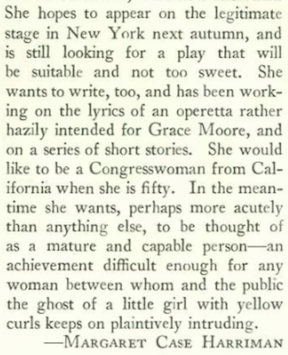
The end of the silent era also put an end to Pickford’s stardom, as well as to her fairytale marriage to Fairbanks. Margaret Case Harriman’s profile of Pickford, simply titled “Sweetheart,” gave readers a glimpse into the decline of a silent superstar. Excerpts:
SINGULAR STAR…Clockwise, from top left, Mary Pickford in a publicity photo, circa 1910; Pickford visits close friend and screenwriter Frances Marion during filming of Straight is the Way (1921); Douglas Fairbanks and Pickford in the early 1920s; Pickford with a movie camera in 1916—in addition to being a shrewd businesswoman, she was also skilled behind the camera. (thehollywoodtimes.today/Time/Library of Congress)
Harriman concluded her profile with some thoughts on Pickford’s future:
THE SOUND BARRIER…With the advent of sound movies Mary Pickford turned to writing books and serving various charities. From left, sharing ice cream with rising star Bing Crosby in 1934; center, Al Frueh’s caricature of Pickford for the profile; Pickford in a 1934 promotional picture supporting The Salvation Army. (Pinterest/Library of Congress)
A note on the profile’s writer, Margaret Case Harriman (1904-1966), who doubtless sharpened her people-watching skills at the Hotel Algonquin (famed birthing ground of the New Yorker), which was owned by her father, Frank Case. Douglas Fairbanks was one of Case’s best friends, and Harriman knew both Fairbanks and Pickford well, since they often stayed at the hotel.
HOME SWEET HOME…Margaret Case Harriman, photographed May 31, 1937 by Carl Van Vechten. Harriman was born in 1904 in room 1206 of the Hotel Algonquin, which was owned by her father, Frank Case. (Philadelphia Museum of Art)
* * *
Master of Masters
The founder of perhaps the world’s most prestigious golf tournament was an amateur and a working lawyer by profession. When Bobby Jones (1902–1971) co-founded the Masters Tournament in 1934 with investment dealer Clifford Robert, it was called the Augusta National Invitation Tournament (it was Robert’s idea to call it The Masters, a name Jones thought immodest). Jones dominated top-level amateur competition from the early 1920s through 1930—the year he achieved a Grand Slam by winning golf ’s four major tournaments in the same year. However, by the 1934 Jones’s skills began to wane. The New Yorker had little to say about the first Masters (it wasn’t a big deal yet), other than Howard Brubaker making this observation in “Of All Things”…
A SWING INTO HISTORY…Bobby Jones (center) drives during the first-ever Masters Tournament in Augusta, Georgia on March 22, 1934. (augusta.com)
* * *
From Our Advertisers
Wanna get away? This colorful advertisement beckoned New Yorker readers to take the next boat to sunny Bermuda…
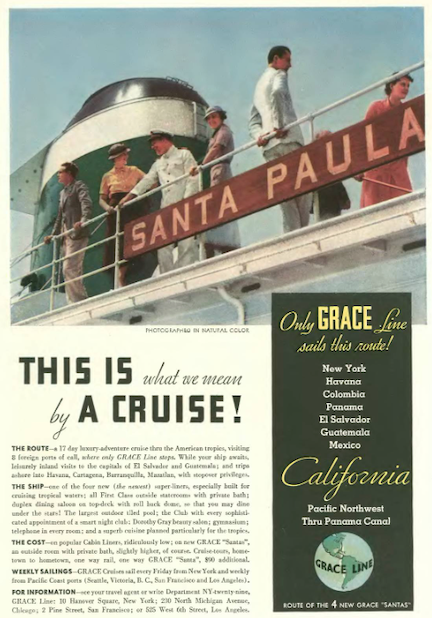
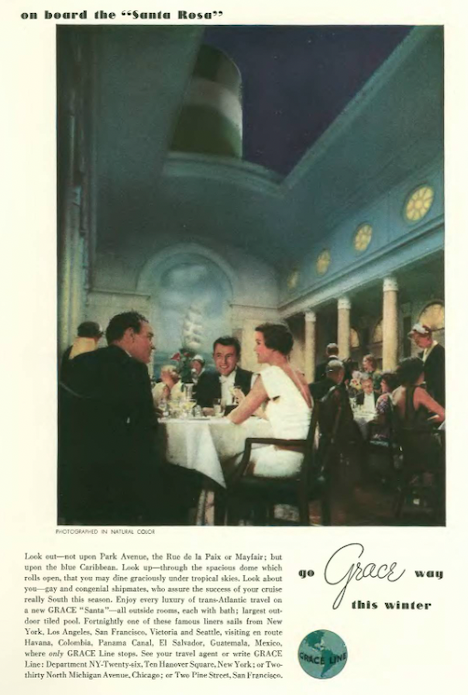
…while the Grace Line offered a southern cruise through the Panama Canal…
…but who needed to travel when you could enjoy a beer that was beloved the world over?…
…Mrs. Potter d’Orsay PalmerneeMaria Eugenia Martinez de Hoz was content to stay home in Chicago and smoke a few Camels, apparently…
…we’ve encountered her before—she appeared in a Ponds ad (below) in the Aug. 8, 1931 issue of the New Yorker, where we learned she was wife No. 2 of Potter d’Orsay Palmer, son of the wealthy family of Chicago Palmer House fame…they would divorce in 1937, and the playboy Potter would marry two more times before dying of a cerebral hemorrhage in May 1939—following a drunken brawl in Sarasota, Florida with a meat cutter called Kenneth Nosworthy. Maria Eugenia would remarry and return to her homeland of Argentina to raise a family…
…this ad from Nash looks like a scene from Attack of the 50 Foot Woman, if she had a car to match, that is…
…the Cadillac V-16 was a truly massive automobile, but in contrast to the Nash ad, you can barely see the car as it approaches from the vanishing distance…
…E. Simms Campbell got in on the advertising game with this spot that features contrasting images of storm and calm…
…James Thurber offered this cartoon on behalf of Heinz soups…
…and Thurber again, as we kick off the cartoons with the ongoing battle…
…Adolph Schus made a rare appearance in the New Yorker…according to Ink Spill, he also contributed a cartoon on March 19, 1938, and was editor of Pageant Magazine in 1945…
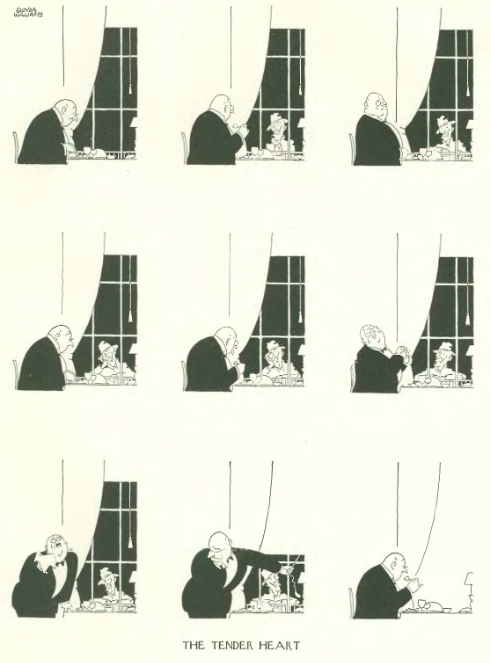
…Gluyas Williams looked in on the sorrows of moneyed classes…
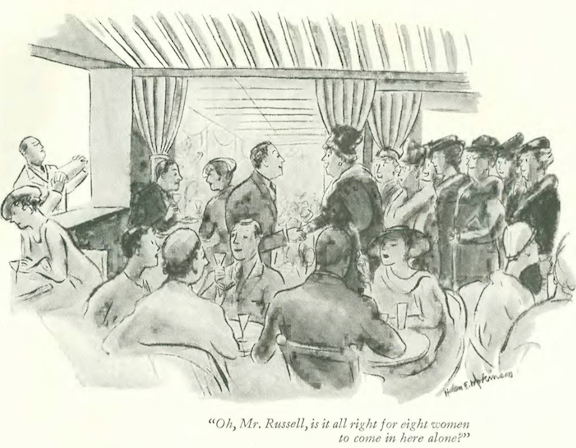
…Helen Hokinson’s “girls” were in search of lunch, and propriety…
…and Leonard Dove gave us a renter surprised by something not included in his lease…
…on to April 14, 1934…
April 14, 1934 cover by Harry Brown.
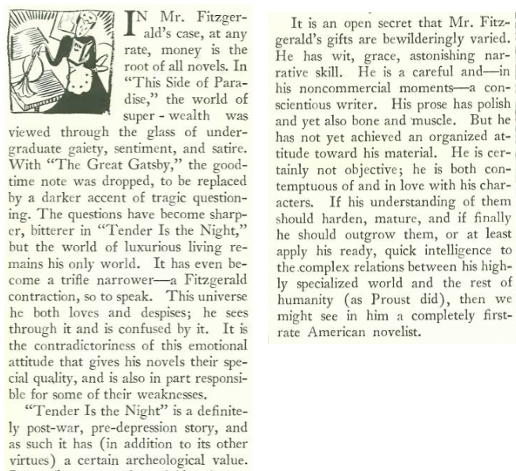
…and book reviewer Clifton Fadiman, who found F. Scott Fitzgerald’s literary gifts “bewilderingly varied”…
A NOT-SO-TENDER RECEPTION…F. Scott Fitzgerald’s status as a symbol of Jazz Age excess hurt his career during the Depression years. Tender Is the Night received mixed reviews, which didn’t help his alcoholism and deteriorating health. When Carl Van Vechten took this photo of Fitzgerald in June 1937, the author had a little over three years to live. (Wikipedia)
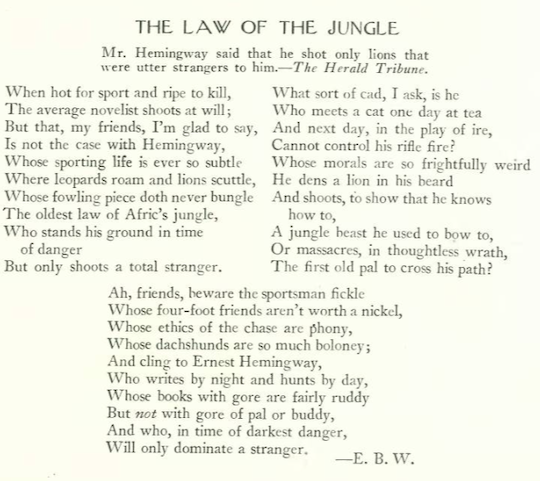
…speaking of F. Scott Fitzgerald, fellow author Ernest Hemingway defended Fitzgerald’s writing, arguing that criticism of his Jazz Age settings stemmed from superficial readings. One then wonders what Hemingway thought of E.B. White’s poetic “tribute” to his big game hunting excursions…
I ONLY SHOOT STRANGERS…Author Ernest Hemingway poses with a lion shot during a safari in Africa in 1934. (MPR News)
* * *
From History’s Ash Heap
Various reference sources cite “freak shows” as a normal part of American culture in the late 19th to the early 20th centuries, but I have to admit I saw exhibits at state fairs of half-ton humans and conjoined twins when I was a kid in the 1970s (not to mention things in jars at a carnival in St. Louis that should have been given a decent burial).
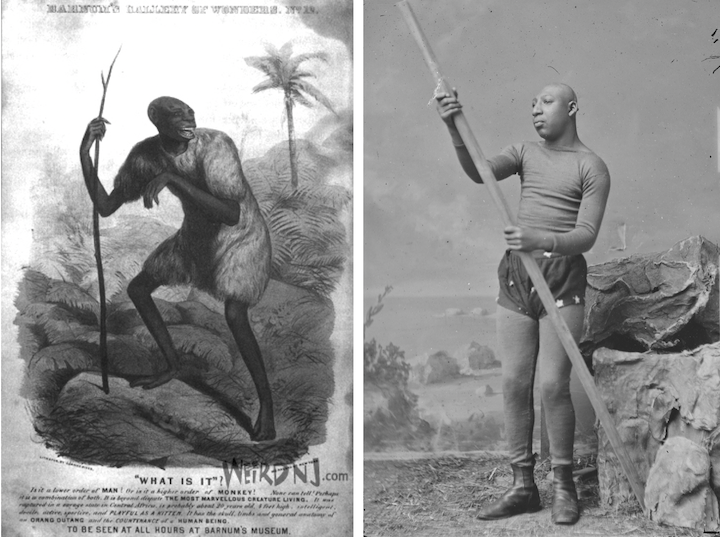
When Alva Johnston penned the first installment of a three-part profile series titled “Sideshow People,” such attractions could be found across the U.S. and Europe—Coney Island featured “Zip the Pinhead,” who was actually William Henry Johnson (1842–1926), one of six children born to former slaves living in New Jersey. His desperately poor parents agreed to allow P.T. Barnum to display him at a museum and at circus performances billed as a missing link, a “What-Is-It” supposedly caught in Africa.
FOR THE SUCKERS…P.T. Barnum exhibited William Henry Johnson as a “wild man”, a “What-Is-It” that subsisted on raw meat, nuts, and fruit, but was learning to eat more civilized fare such as bread and cake. Note the difference between the poster depiction at left and the actual man. Civil War-era photo at right by Mathew Brady’s photography studio in New York City. (National Portrait Gallery)
* * *
Floating and Sinking
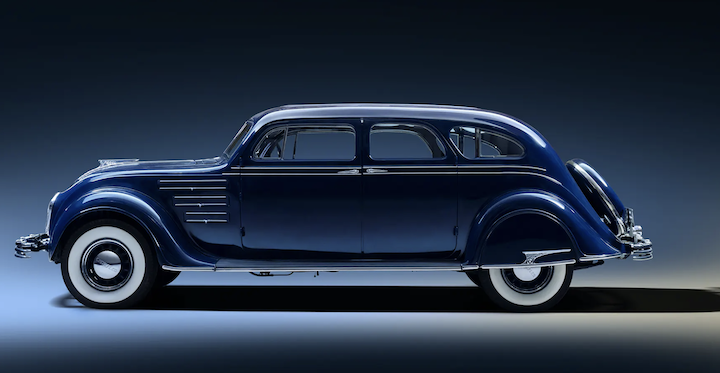
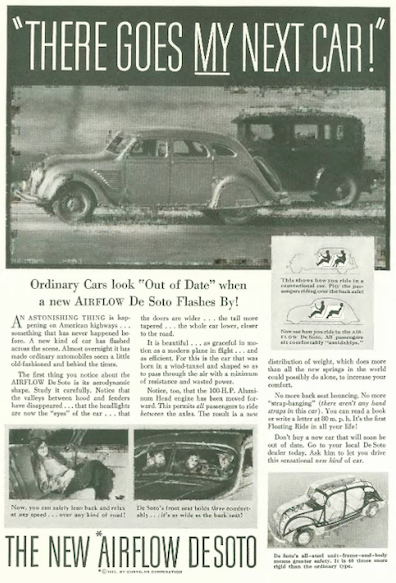
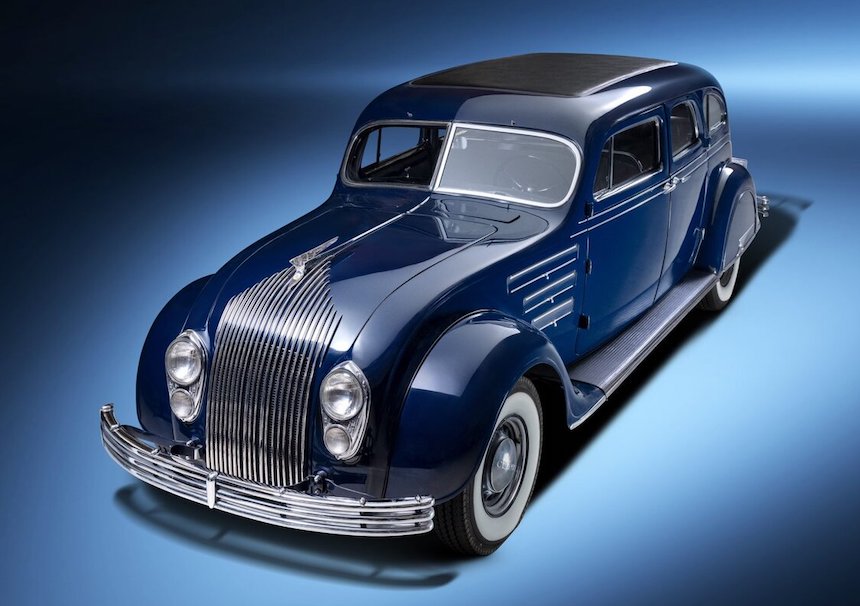
As much as New Yorker cartoonists (and E.B. White) liked to take pokes at Chrysler’s futuristic Airflow, there was much to be admired by the innovations the car represented. Unfortunately, the car’s design was too advanced for the buying public, and despite a big manufacturing and sales push by Chrysler the car was shelved by late 1936.
Writing for Time, Dan Neil noted the Airflow’s spectacularly bad timing. “Twenty years later, the car’s many design and engineering innovations — the aerodynamic singlet-style fuselage, steel-spaceframe construction, near 50-50 front-rear weight distribution and light weight—would have been celebrated. As it was, in 1934, the car’s dramatic streamliner styling antagonized Americans on some deep level, almost as if it were designed by Bolsheviks.”
SEEMED LIKE A GOOD IDEA. A restored 1934 Airflow. (Hagerty Media)
* * *
More From Our Advertisers
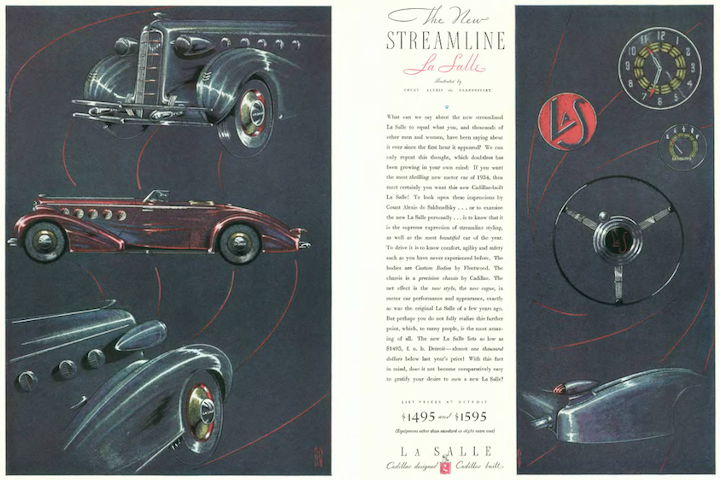
Maybe the buying public wasn’t ready for a car with a sloping hood and embedded headlights, but the folks at Cadillac were eager to unveil concepts for the new streamlined La Salle, which retained the familiar bullet headlights so as not to alarm consumers too much…
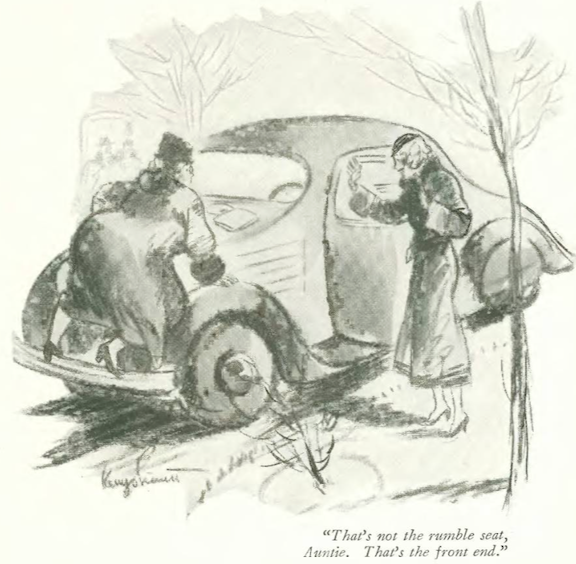
…and here’s a lovely image from Goodyear…I assume this woman is merely resting in a rumble seat, since this pose would not be possible above 25 mph…
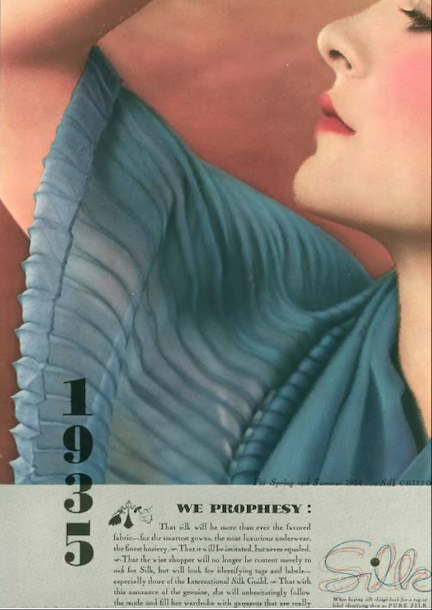
…full-bleed color ads were coming into their own, as demonstrated by this stylish entry from the purveyors of silk garments…
…on the other hand, our well-heeled friends at Ponds stuck with the tried and true copy-heavy approach…here they offer the flawless features of Anne Gould (1913–1962), granddaughter of Gilded Age robber baron Jay Gould…
…R.J. Reynolds continued their campaign to convince us that Camels bring success to the average Joe and the champion athlete…
…the makers of Old Gold opted for the super creepy approach, asking entertainer Jimmy Durante to shove a pack of smokes into the face of what appears to be a teenager…
…here’s another ad from World Peaceways, reminding us of the futility of war…
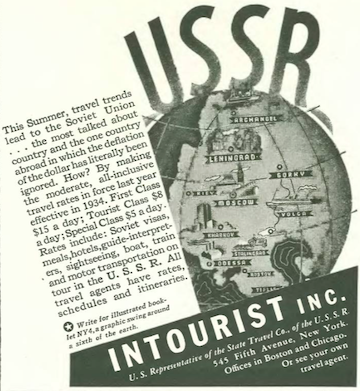
…speaking of futility, you could visit the USSR, which doubtless took great pains to steer tourists away from mass starvation in Ukraine and mass executions of Stalin’s many “enemies”…
…while folks in the USSR were worshiping Lenin and Stalin, Americans were rightly transfixed by the miracle of Kellogg’s Corn Flakes…a producer of industrial and advertising films, Castle Films would become a subsidiary of Universal and would go on to make a line of science-fiction and horror films including The Wolf Man, The Mummy, and Creature from the Black Lagoon.
…on to our cartoons, Alain took on the recent MoMA exhibition of “Machine Art”…
…and speaking of machine art, George Price was to latest cartoonist to take a crack at the Airflow…
…James Thurber offered this bit of spot art for the opening pages…
…and returned to a somber scene on the battlefield of the sexes…
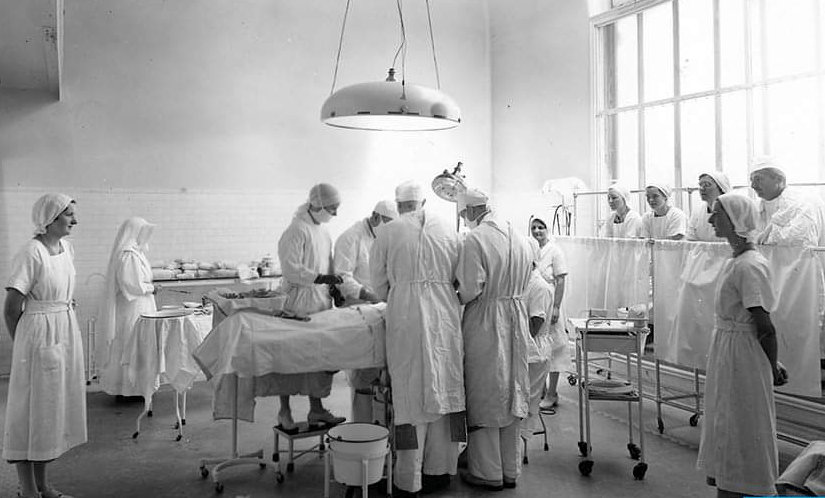
Above: Surgery being performed at the Hospital of Saint Raphael (Conn.) in the late 1930s. Operating rooms were often located near large windows and under skylights to offer greater illumination. (Yale New Haven Hospital)
For all the challenges of 21st century, I always remind myself that advances in medicine during the past ninety years have made our lives better, and substantially longer, even if our current health care system is far from ideal.
Feb. 3, 1934 cover by E. Simms Campbell.
People could live to a ripe old age in the 1930s, however the average life expectancy at birth in 1930 was only 58 for men and 62 for women. The Depression didn’t help matters, and neither did the Dust Bowl, unregulated urban smog, the dramatic rise in smoking, and the lingering effects of more than a decade of bootleg alcohol consumption.
Polio was a serious problem in the 1930s, as was syphilis, which affected as many as ten percent of Americans. Blood groups would not be identified until 1930 (by Nobel Prize-winner Karl Landsteiner), and human nutrition remained something of a puzzle—Vitamin C wasn’t identified until 1932. There was exciting chatter about penicillin (discovered in late 1920s) and the antibacterial effects of sulfonamides (first observed in 1932), but it would be years before antibiotics would come into common use. So yes, infection was also a big killer.
Nevertheless, progress had been made, as told by Morris Markey in the column, “A Reporter at Large.” An excerpt:
FORTRESS ON THE HEIGHTS…Top, Columbia-Presbyterian Medical Center loomed large when it opened in Washington Heights in 1928; below, New York Hospital, most likely the building described in Morris Markey’s column; at left, Dr. George Crile, Sr., completing his landmark 25,000th thyroid operation in 1936. (CUIMC/Wikipedia/Cleveland Clinic)
This next excerpt describes the work of the anesthetist after the patient receives a spinal injection of novocaine, which had replaced cocaine as a pain blocker. At the start of the 1930s, the most-used anesthetic was ether, used in this account to calm the patient. Ether carried its own risks—in was unstable, and sparks from X-ray machines and other equipment could cause an explosion.
NO SMOKING, PLEASE…Anesthetist in the 1920s carefully administers ether while surgeon swabs a patient with iodine (inset). Ether was unstable, and sparks from equipment could cause an explosion. (Internet Archive/Flickr)
* * *
And Then There’s Maude
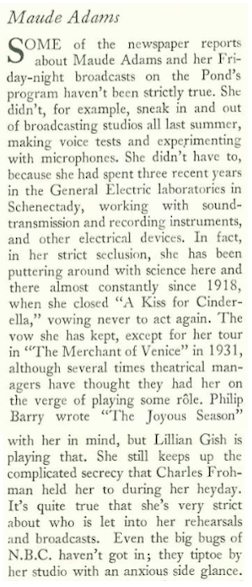
American actress and stage designer Maude Ewing Adams (1872–1953) defined the role of “the boy who wouldn’t grow up” in her Broadway adaptations of Peter Pan in the early 1900s (1905, 1906, 1912 and 1915). She would appear in 26 Broadway productions between 1888 and 1916, but after a severe bout of the Spanish flu in 1918 she retired from the stage and focused on developing better stage lights with General Electric; her electric lights ultimately set the industry standard with the advent of sound movies. As this excerpt from “The Talk of the Town” revealed, Adams was also quite shy and highly valued her privacy.
THE RETIRING SORT…Maud Adams in a Broadway publicity photo, circa 1900. (Vintage Everyday)
* * *
In The Trenches
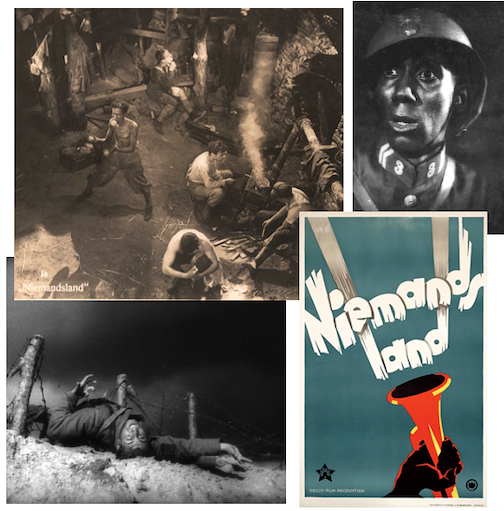
Just before the Nazis decided to turn their country back into a warlike state, Victor Trivas and George Shdanoff wrote and directed an allegorical anti-war film. Niemandsland (released in the U.S. as Hell on Earth) featured five soldiers, from different backgrounds, who find themselves together in a dugout in no man’s land and together come to terms with the absurdity of war. The film premiered in Berlin in December 1931 and was greeted by thunderous applause. A little over a year later it was banned by the Nazis. Critic John Mosher made these observations:
WAR, WHAT’S IT GOOD FOR?…Niemandsland (released in the U.S. as Hell on Earth) featured five soldiers from different backgrounds on a front lines during WWI: a carpenter from Berlin, a mechanic from Paris, an English officer, a Jewish tailor and a Black dancer (the only one who understands everyone’s languages). Actor and dancer Louis W. Douglas (top right) was a Philadelphia native who moved to Paris in 1925 with his dancing partner, Josephine Baker, in the popular La Revue Nègre. He went on to establish a successful musical and film career in Germany until his death in 1939. (silverinahaystack.wordpress.com/IMDB)
* * *
From Our Advertisers
We begin with this jolly color image from Lucky Strike representing the joys of cigarette smoking…
…a trio of ads culled from the back pages, everything from “Tiara Trouble” (apparently a common problem) to a smoking penguin introducing a new line of menthol cigarettes, KOOL, challenging the dominance of the Spud menthol brand (we know who won that battle)…in the final ad, Atlantic City resort hotel Haddon Hall attempted to drum up business using a slavery/emancipation theme—Abraham Lincoln’s birthday is at hand…why not slip the shackles of work and run away to sunshine and freedom?…
…These Paul Whiteman ads were ubiquitous in the 1930s…the distinctive caricature of his pudgy, mustachioed face—Whiteman’s “Potato Head” emblem—was featured in ads and on 78 rpm record labels and various promotional items…on the more classical side, violinist David Rubinoff sawed away on his famed $100,000 Stradivarius for audiences at the Roosevelt Hotel…
…automobile ads continued to grace the pages of The New Yorker, including this one suggesting that young blue bloods would look quite smart in a ’34 Chevy…
…in the 1930s Studebaker marketed car lines including the high-end President, the mid-priced Commander, and the low-priced Dictator…the Dictator was introduced in 1927, so named because it “dictated the standard” other automobile makes would be obliged to follow…the rise of Mussolini and Hitler attached unsavory connotations to the car’s moniker…it was renamed “Director” for European markets and was finally abandoned in 1937…
…Chrysler continued to push its radical new Airflow, here demonstrating how it blows the doors off of an old-timer…
…as we jump into our cartoons, Kemp Starrett referenced the Airflow in his latest contribution to The New Yorker…
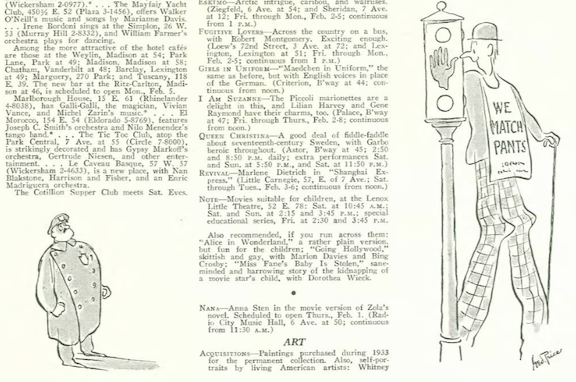
…the issue included two from George Price…a playful pairing in the events section…
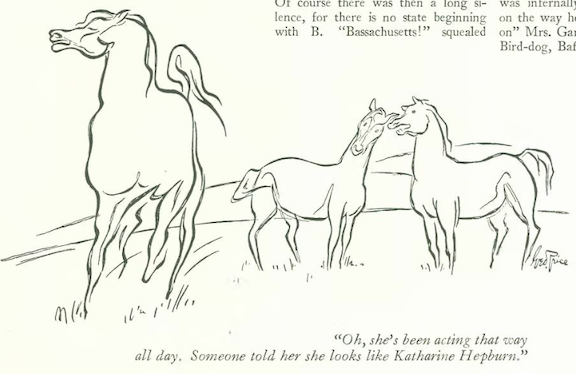
…and a somewhat unkind nod to new Hollywood star Katharine Hepburn…apparently David O. Selznick had misgivings about casting a “horse face” like her…well, she obviously proved him wrong…
…the magazine pulled out this old illustration by H.O. Hofman to break up the copy in Howard Brubaker’s “Of All Things” column…
…more antics from the precocious set, courtesy Perry Barlow…
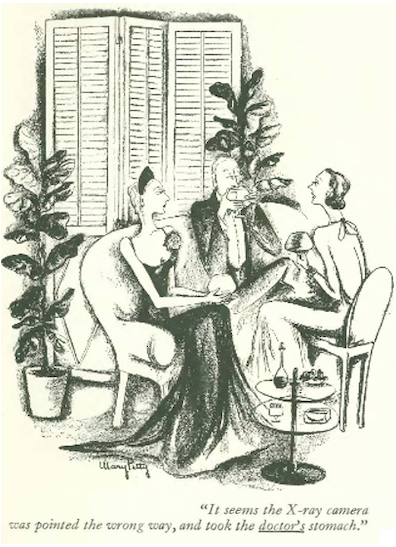
…Mary Petty offered this observation on the state of medicine in 1934…
…a sobering and topical contribution from Alan Dunn…
…Carl Rose made preparations for the annual Charity Ball…
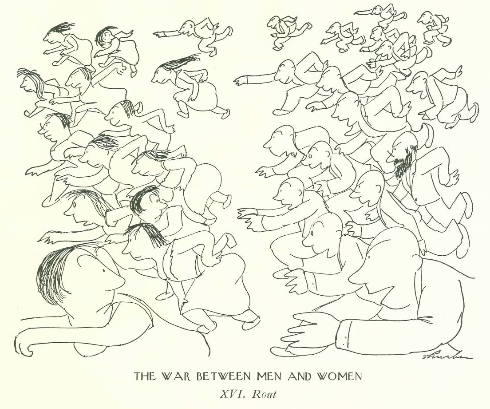
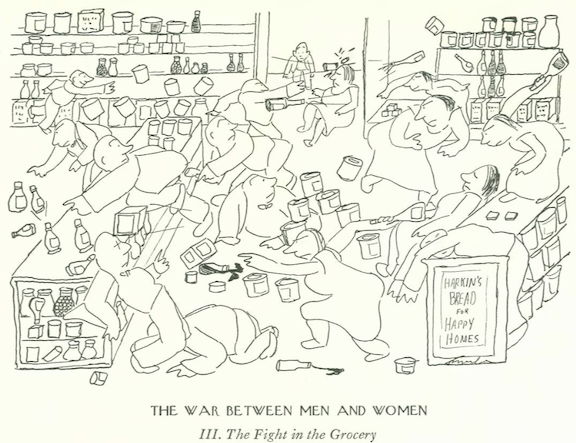
…and James Thurber gave us Part III of his “War Between Men and Women”…
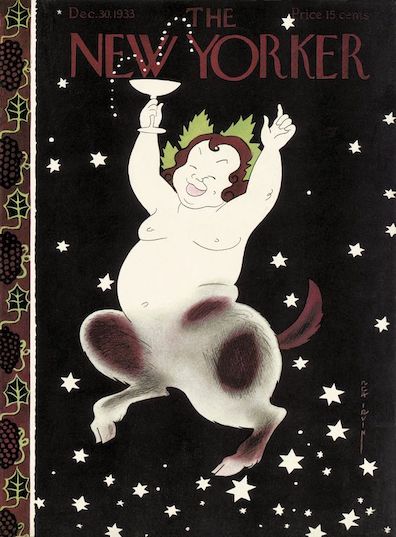
Perhaps it was the end of Prohibition, or the implementation of the New Deal, but throughout the pages of the final New Yorker of 1933 you could sense a lightening of spirit.
Dec. 30, 1933 cover by Rea Irvin.
By most accounts 1933 was one of the Depression’s worst years, and that is likely why E.B. White chose to remember “only a few scattered moments,” mixing the silly with the salient.
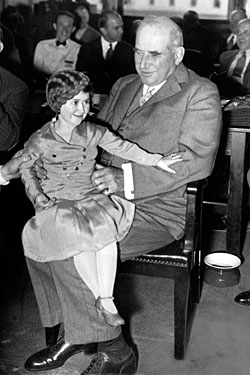
Of the silly, there was the time when the Barnum & Bailey circus dwarf Lya Graf sat on J.P. Morgan’s lap while he was waiting to testify before the Senate Banking Committee…
HE DIDN’T BANK ON THIS…J.P. Morgan was paid a visit by Barnum & Bailey circus dwarf Lya Graf, prior to his testimony before the Senate Banking Committee on June 1, 1933. (New York Magazine)
White also noted the passing of Texas Guinan. Known as “Queen of the Nightclubs,” she was a fixture on the Manhattan speakeasy scene throughout the Roaring Twenties and a reliable source of nightlife headlines. White also recalled George Bernard Shaw’s controversial speech at the crowded Metropolitan Opera House, during which he referred to American financiers as “lunatics” and called the U.S. Constitution a “charter of anarchism.”
YEAR IN A NUTSHELL…Clockwise, from top left: The year 1933 saw the passing of the “Queen of the Nightclubs” Texas Guinan—more than 10,000 showed up for her funeral in November; also that month Thomas G.W. Settle and C.L Fordney ascended to the stratosphere in the Century of Progress balloon; The New York Times (April 12, 1933) published the full text of George Bernard Shaw’s Met speech; Esquire published its first issue in the fall, featuring Ernest Hemingway and John Dos Passos as well as New Yorker cartoonists Constantin Alajalov, William Steig and E. Simms Campbell; according to Vogue, 1933’s breasts were “high and pointed.” (bounddv.medium.com/history.navy.mil/The New York Times/Pinterest)
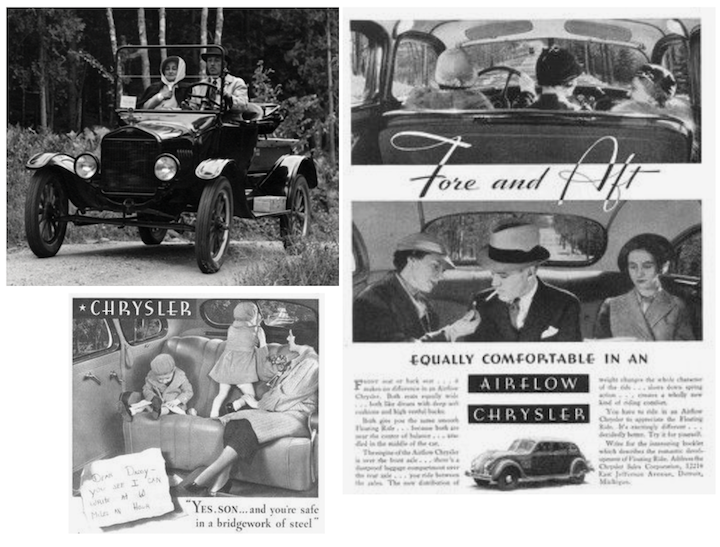
White also had more to say about the streamlining trend in automobiles, led by Chrysler’s new “Airflow.” White preferred the older, boxier models, with plenty of head and hat room.
In 1922 White set off across America in the car of his dreams, a Model T, which had plenty of headroom and, as he later wrote, transformed his view of the land, a vision “shaped, more than by any other instrument, by a Model T Ford…a slow-motion roadster of miraculous design—strong, tremulous, and tireless”…
MERRILY WE ROLL ALONG…Clockwise, from top left: E.B. White and wife Katharine Sergeant take a spin in a Model T in the mid 1930s; despite White’s remonstrations regarding headroom, the makers of the Chrysler Airflow advertised their streamlined car’s interior as practically cavernous. (Goodreads/Pinterest)
* * *
Crying in His Beer
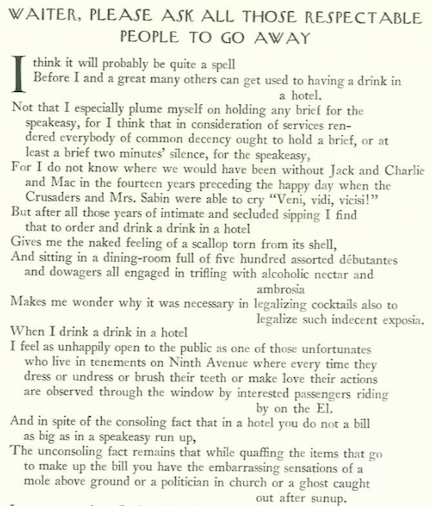
A couple of issues back we saw Lois Long bid a sad farewell to the cosy and secluded atmosphere of the speakeasy…Ogden Nash turned to verse to offer his own lament, feeling naked and exposed in dining rooms “full of 500 assorted debutantes and dowagers”…
FEELING EXPOSED…Ogden Nash (1902–1971) missed the sacrilegious rite of the speakeasy and lamented the “humdrumness” of legal drinking. (vpoeticous.com)
* * *
Wondering About Alice
Combine horrific character designs with a young adult playing a child and you have the recipe for 1933’s star-studded Alice in Wonderland, a film the Nerdist’sKyle Anderson calls “a fascinating, unintentionally disturbing take on a classic.” Almost ninety years earlier the New Yorker’sJohn Mosher found it disturbing in other ways, save for W.C. Field’s portrayal of Humpty Dumpty.
Writing for The Roarbots, Jamie Green notes that Charlotte Henry was 19 when she played Alice: “This version of Alice doesn’t feel like a sweet look at the twists and turns of adolescence; it feels more like a commentary on repressed desire and self-identity.” The film was a flop at the box office.
CHANNELLING HER YOUTH…Clockwise, from top left: 19-year-old Charlotte Henry as Alice in 1933’s Alice in Wonderland; W.C. Fields as Humpty Dumpty; Roscoe Karns as Tweedledee and Jack Oakie as Tweedledum; Alice has a chat with Gryphon (William Austin) and Mock Turtle (Cary Grant). Except for Henry, most of the cast was unrecognizable in their macabre makeup and costumes. (IMDB)
* * *
From Our Advertisers
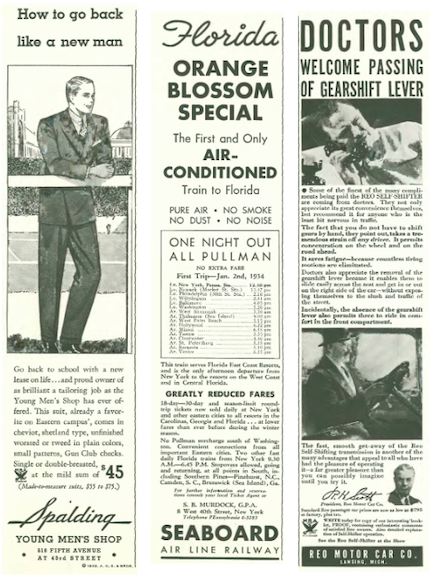
We start with a selection of three one-column ads, featuring, from left, the latest back-to-school look for the collegiate male (apparently attending Columbia); the dustless, noiseless, smokeless, AIR-CONDITIONED railway wonder called the Orange Blossom Special; the automobile arm of the REO Motor Car Company trying to pack everything it could into this narrow little ad (REO would stop producing cars in 1936 in order to focus solely on trucks)…
…the distillers of Holloway’s London Dry Gin warned newly liberated American drinkers about the consequences of imbibing cheap gin…
…the folks at R.J. Reynolds found another member of the gentry to push their Camels onto aspiring young women…
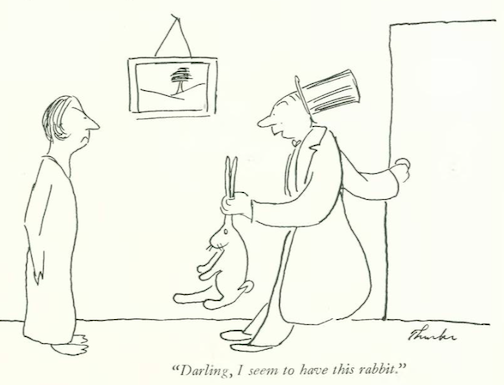
…on to our cartoons, the Dec. 30 issue featured a James Thurber double-header, beginning with this “Talk of the Town” spot illustration…
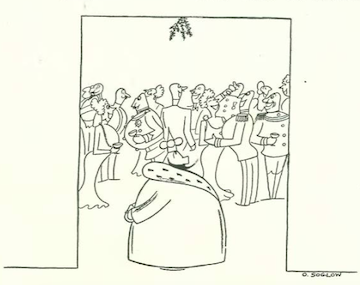
…a rare one-panel Little King from Otto Soglow…
…ringing in the New Year with Syd Hoff…
…and George Price…
…and we close with Gilbert Bundy, seeking from fresh air…
“We had the horse and buggy. We had the automobile. Now we have the first real motor car in history.” — Walter P. Chrysler. (Image: Blair Bunting via hagerty.com)
Classic motorcar collector and aficionado Jay Leno has more than 180 vehicles in his collection, but a pride and joy is a 1934 Chrysler Airflow Imperial CX—one of the only three surviving CXs today.
Dec. 16, 1933 cover by Rea Irvin.
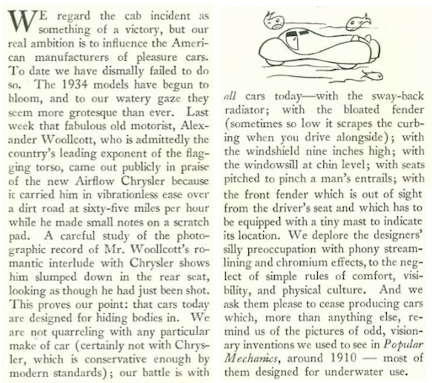
The 1934 Chrysler Airflow was a car of the future that came too early. The Airflow’s advances in engineering—including invention of the modern unibody—still inform car design today. But the streamlined look of the car was probably too advanced for those depressed times, and despite lots of media attention it flopped with consumers. E.B. White was among those who weren’t ready to jump on the Airflow bandwagon, and even poked fun at colleague Alexander Woollcott for posing in the backseat of an Airflow for a Chrysler advertisement:
The Woollcott ad in question, which appeared in the previous issue (Dec. 9):
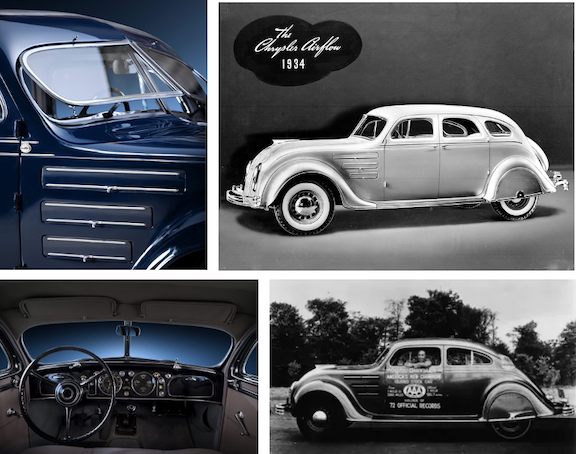
Of the major car companies in the 1930s, Chrysler was perhaps the most revolutionary in terms of technological and design advances. The first car to be wind tunnel-tested, the Airflow’s lightweight, unibody design moved the engine over the front axle and positioned the passengers between the front and rear wheels for a much roomier, smoother ride. Chrysler claimed the unibody also made the car stronger and safer, as this newsreel attests:
Air truly flowed through the car; even the windshield could be cranked open for greater air circulation.
AND THEN THERE WERE THREE…Jay Leno’s Chrysler Airflow Imperial CX, one of only three CX’s known to exist today. Other versions of the Airflow included a model sold under the DeSoto brand name. You can see this car in action on Jay Leno’s Garage.(Blair Bunting)AIR SUPPLY…Clockwise, from top left: The Chrysler Airflow featured a windshield that could be cranked open; advertising card for the Airflow; Indy veteran Harry Hartz set seventy-two speed and distance records at the Bonneville Salt Flats in an Airflow, driving 97.5 mph over the flying mile; the roomy interior featured a nearly horizontal steering column, which freed up space in the driver’s footwell. Although normal today, it was revolutionary in 1934, when most cars had steering columns sprouting from the floor. (Blair Bunting/macsmotorcitygarage.com)
* * *
No Fair, Doug
Few Hollywood marriages could ever match the legendary status accorded to that of Mary Pickford and Douglas Fairbanks, darlings of the silent screen who who exchanged vows in 1918. When the couple separated in 1933, even E.B. White couldn’t resist a bit of Tinseltown gossip.
FAIRY TALE FIZZLE…The very public nature of the Mary Pickford–Douglas Fairbanks marriage put a big strain on their matrimonial bonds. When both saw their careers fade at the end of the silent era, Fairbanks found escape in overseas travel, and in a romance with Sylvia, Lady Ashley (pictured above, center). Pickford and Fairbanks would divorce in 1936, and that same year Fairbanks and Lady Ashley would marry—just three years later Fairbanks would die from a heart attack, at age 56. Pickford would marry actor-musician Charles “Buddy” Rogers in 1937—they would remain married until her death in 1979. (Huffington Post/npg.org.uk)
* * *
Drinking Problem
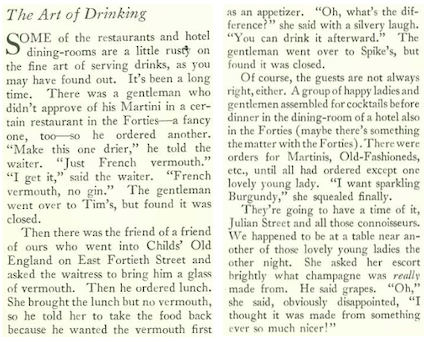
“The Talk of the Town” reported on the challenges facing both restaurants and patrons who were becoming reacquainted with legal drinking:
* * *
Before Mr. Rogers
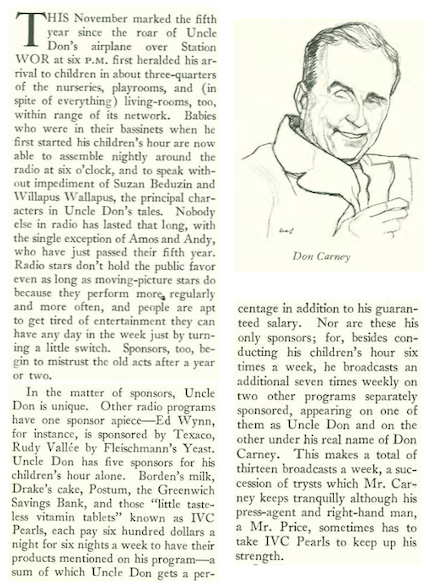
The “Profile” took a childish turn with this account of Don Carney (1896–1954) penned by Margaret Case Harriman. Carney is best remembered as the host of Uncle Don, a hugely popular WOR children’s radio program produced between 1928 and 1947. Excerpts:
MERCH…Don Carney’s popularity in the 1930s is evidenced in the output of merchandise including sheet music (1935), a 1940 activity book, and a 1936 “Strange Adventures” story book. (phantom.fan/ebay)
* * *
From Our Advertisers
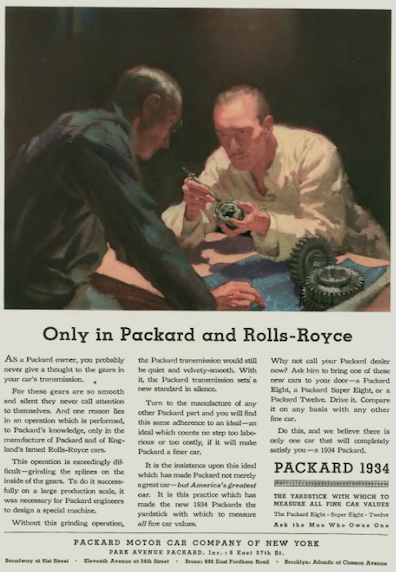
Speaking of fine cars, the folks at Packard pointed out one similarity between their automobile and the product manufactured by Rolls-Royce…owning a Packard in the 1930s was indeed considered prestigious, and like Rolls-Royce it competed in the international luxury car market…
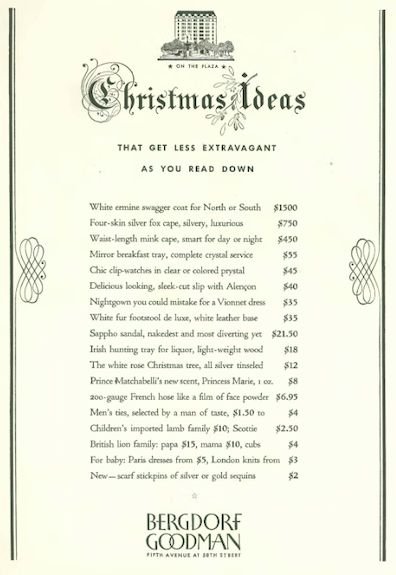
…Bergdorf Goodman placed this helpful ad listing various gift ideas in descending order of price…and extravagance…
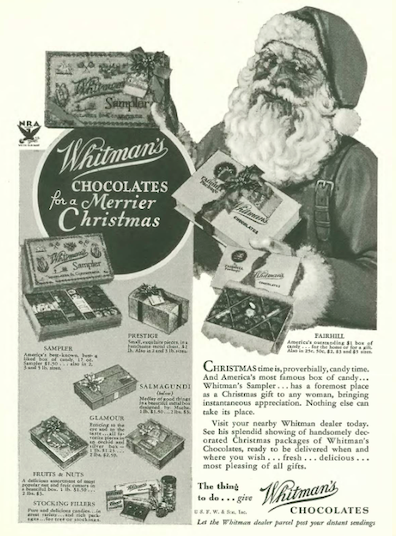
…and it wouldn’t be Christmas without the perennial Whitman’s Santa Claus touting his sweet wares…
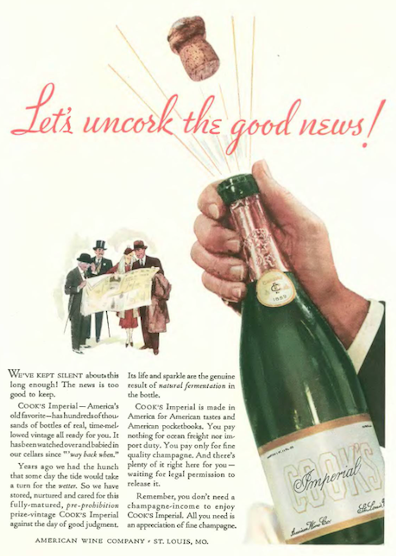
…and New Yorkers were getting ready to celebrate a New Year without Prohibition, and pop some “good news” with Cook’s American “champagne”…
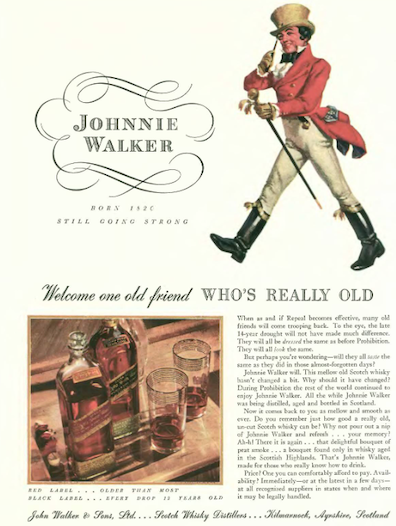
…an “old friend,” Johnnie Walker, strode into the advertising pages of the New Yorker for the very first time…
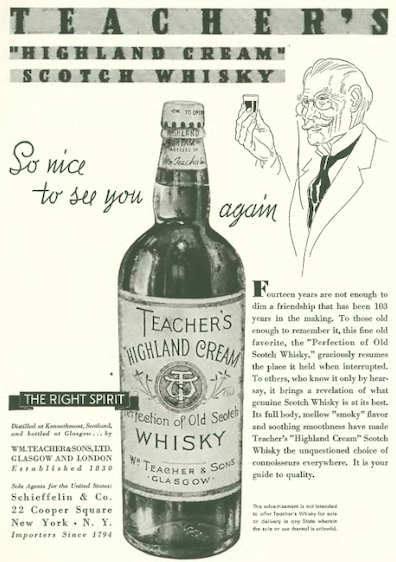
…while another purveyor of Scotch whiskey, Teacher’s, raised a glass to the return of legal liquor in the colonies…
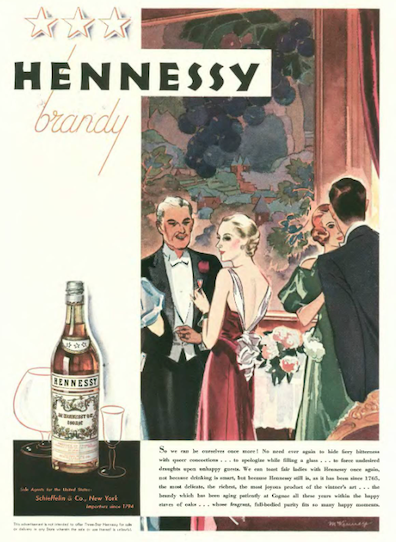
…the makers of Hennessy brandy celebrated the fact that “we can be ourselves once more”…
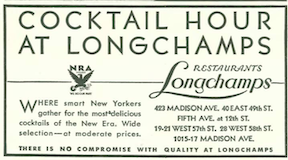
…the end of Prohibition saw the rapid expansion of the chain of Longchamps restaurants in New York City…in the 1930s the company hired top modernist decorators and architects (Winold Reiss and Ely Jacques Kahn, among others) to create some of New York’s most glamorous interiors…
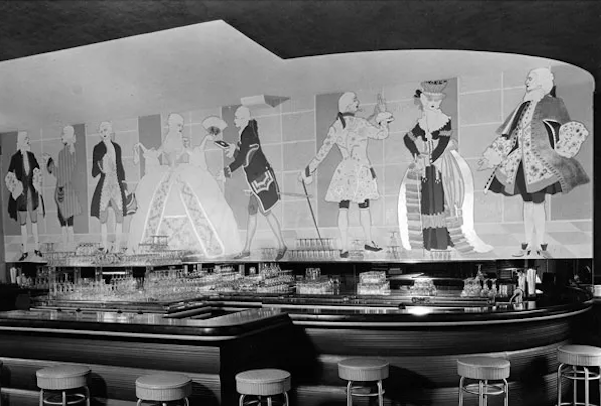
LONGCHAMPS LONG GONE…Winold Reiss’s Louis XV mural behind the Chanin Building’s Longchamps bar, 1935. Hugely popular in mid-century New York, Longchamps all but vanished by 1970. Read more about one of New York’s most stylish restaurants at two wonderful sites, Driving For Deco and Restaurant-ing Through History. (winoldreiss.org)
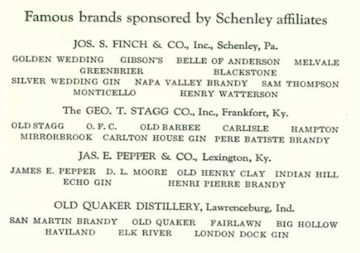
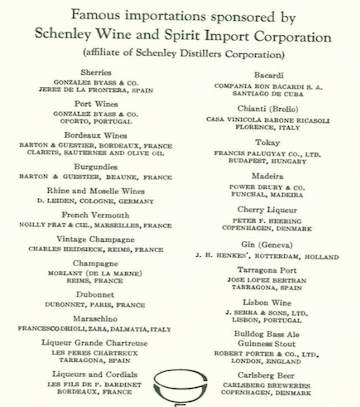
…Schenley was a giant in the spirits industry…headquartered in the Empire State Building, it also had a giant impact in the United States…to assure consumers that quality hadn’t suffered over the thirteen long years of Prohibition, Schenley ran this two-page ad stating: on through the years—famous names, famous brands, secrets, formulae, warehouses, yes—and stocks of precious old liquor have been accumulated and guarded by Schenley for you when the day arrives…
…here are some of the brands listed by Schenley in the side column:
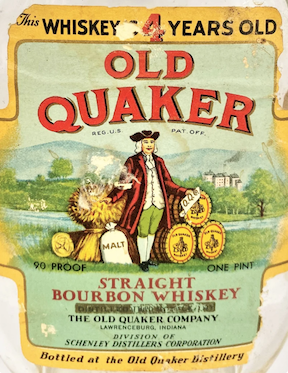
Old Quaker was one of Schenley’s popular whiskey brands in the 1930s.
…and we sober up for our cartoonists, beginning with Mary Petty…
…mixed company was always a recipe for trouble in James Thurber’s world…
…and we close with George Price, and an unexpected visitor…
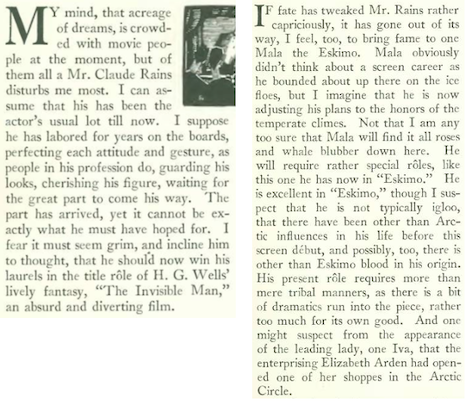
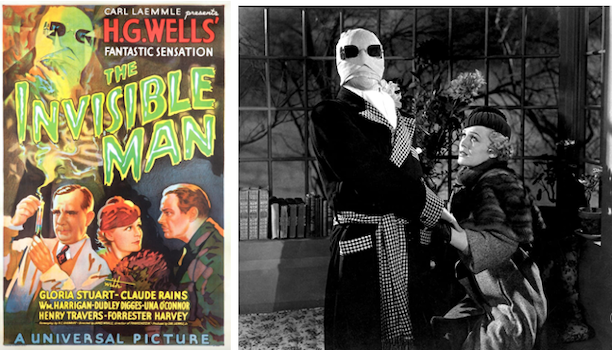
British actor Claude Rains made his American film debut in a 1933 movie where the actor’s face isn’t revealed until the final scene.
Nov. 25, 1933 cover by Gardner Rea.
Although praised by critics in 1933 and today, The New Yorker’sJohn Mosher had but a paragraph to offer on the The Invisible Man, calling it a “bright little oddity” and an “absurd and diverting film.” Mosher also reviewed the Arctic adventure Eskimo, a film he found to be less than convincing about life on the frozen tundra.
FROM A TEST TUBE, BABY…Dr. Jack Griffin (Claude Rains) develops a secret formula that renders him invisible, much to the distress of his former fiancée Flora Cranley (Gloria Stuart). Some of you may recall Stuart from 1997’s Titanic, in which she portrayed the 100-year-old Rose. In real life Stuart had a career spanning nearly eighty years. And wouldn’t you know, she died in 2010 at age 100. (IMDB)NOW YOU SEE HIM…Special effects in 1933 were no mean feat. To create the effect of invisibility, Rains was covered head to foot with black velvet tights and wore whatever clothes he required for the scene. The invisibility scenes were then shot against a black set, the negative areas later manually masked to create the effect of invisibility. (IMDB)
…on to our other film, Eskimo…Mosher had doubts about the authenticity of the Eskimo family portrayed in the movie, suggesting (rather unkindly) that the lead actress, Lotus Long, looked like a client of the noted beautician Elizabeth Arden. The film was well-received by critics, but did poorly at the box office. However, it did receive the first-ever Oscar for Best Film Editing.
ICEBREAKER…Although MGM publicists portrayed Eskimo as a steamy love story set against a backdrop of adventure in the wild, the film was ahead of its time in some ways, including the use of Inuit dialogue, which was translated in English intertitles. Directed by W.S. Van Dyke, who also directed 1932’s Tarzan the Ape Man, the cast included (top photo, from left), Ray Mala and Lulu Long Wing (older sister of famed Hollywood actress Anna May Wong) with unidentified child actors. Bottom right, Mala with actress Lotus Long. (IMDB)
* * *
Numbers Racket
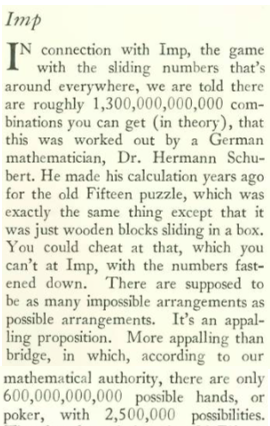
Little known today, the sliding number puzzle “Imp” was hugely popular in the late 19th and early 20th centuries. Plastic versions were produced following World War II—I recall one of them being quietly deployed from my mother’s purse during church, to keep me occupied during lengthy sermons.
* * *
Hammered and Sickled
“The Talk of the Town” commented on a Union Square riot in which American communists attacked a group of Ukrainians protesting the Soviet-imposed mass starvation in their country. Following is an excerpt from a longer piece that also noted the arrival of New York police, who “charged into the Square, riding their horses into the crowd and taking a crack at a head here and there.”
SEE NO EVIL…American Communists attack a group of Ukrainians protesting the Soviet-caused Holodomor famine in 1933, which killed at least four million Ukrainians. (Public domain)
* * *
Party Girl
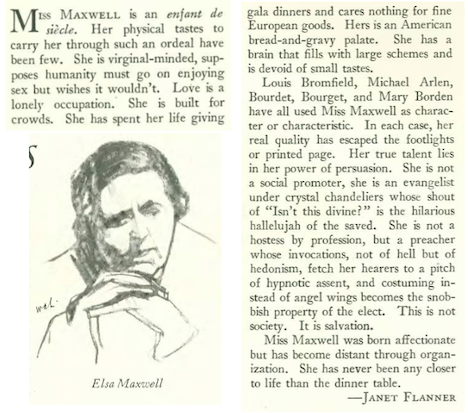
Elsa Maxwell (1883–1963) was an Iowa girl who grew up to become a gossip columnist and a hostess of high society parties—throughout the 1920s she was known for throwing lavish affairs for Europe’s wealthy and entitled. A 1963 Time magazine obituary noted that Maxwell developed a gift for staging games and diversions for the rich, making a living devising treasure-hunt parties, including a 1927 Paris scavenger hunt that created disturbances all over the city. Excerpts from a profile by Janet Flanner:
GETTING AN EARFUL…Elsa Maxwell hobnobbing with actress Constance Bennett and producer Darryl Zanuck in 1939. (Pinterest)
* * *
Masked Man
Novelist Sherwood Anderson offered his impressions of the late Ring Lardner in a piece titled “Meeting Ring Lardner.” Anderson wrote that although Lardner “seemed surrounded by a little halo of something like worship wherever he went,” he had no satisfaction in his achievements. Anderson recounted Lardner’s encounter with a shy banker, when for a moment Lardner dropped the “mask” that he often wore to shield himself from humanity. Excerpts:
SPHINX…Sherwood Anderson (right) wrote of Ring Lardner: “You wanted him not to be hurt, perhaps to have some freedom he did not have.” (AP/hilobrow.com)
* * *
Phooey on Huey
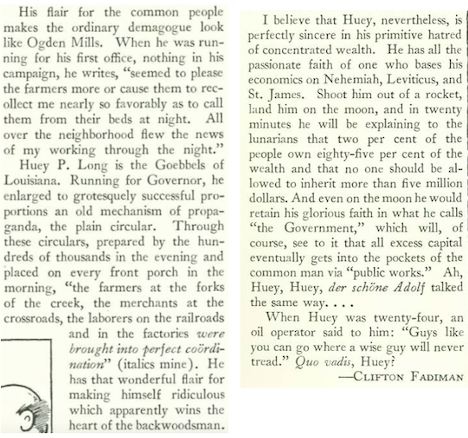
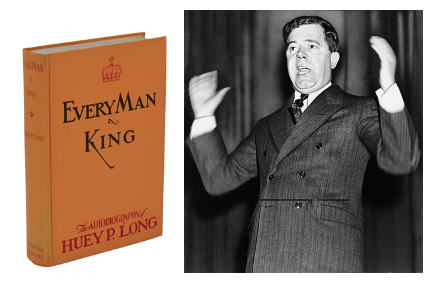
When Louisiana Senator and former Governor Huey Long published his autobiography, Every Man a King, the reaction from the press was resoundingly negative; in the Saturday Review,Allan Nevins wrote that Long “is unbalanced, vulgar, in many ways ignorant, and quite reckless.” The New Yorker’sClifton Fadiman went further, calling him the “Goebbels of Louisiana” and compared the senator to Adolf Hitler. Excerpts:
IT’S ALL ABOUT ME, REALLY…Huey Long’s 1933 autobiography, Every Man a King, was excoriated by the press, which largely viewed the senator as a fascistic demagogue. Long was assassinated in 1935. (Wikipedia)
* * *
From Our Advertisers
Christmas was coming, and parents with the means could consider buying a “Skippy” brand racer for their little tykes. The cartoon character at the top of the ad—Skippy—was the star of one of the most popular American comic strips of its day…
…written and drawn by Percy Crosby (1891–1964) from 1923 to 1945, the Skippy comic was a big influence on later cartoonists including Charles Schulz (Peanuts) and Bill Watterson (Calvin and Hobbes)…note the football gag below later made famous by Schulz’s Lucy and Charlie Brown…
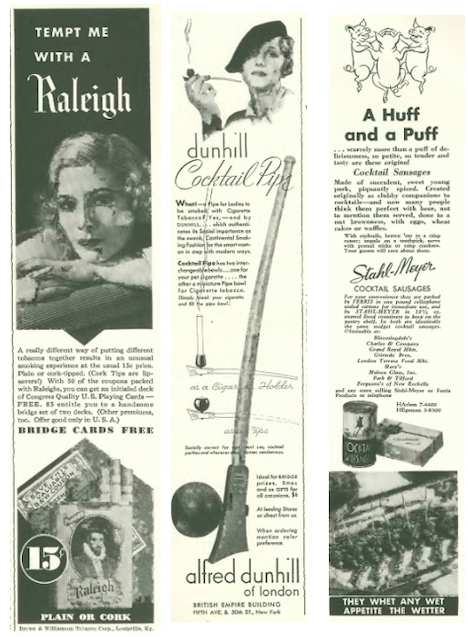
…on to some of our one-column ads…Raleigh cigarettes were promoted to the growing women’s market, while Dunhill touted a “cocktail pipe” that allowed women to get in on the fun of pipe smoking…and with Disney’s Three Little Pigs penetrating every nook and cranny of America, the makers of Stahl-Meyer sausages decided to join in the fun…
…I include this razor ad mainly for the bold typography…advertisers were in a transitional phase, experimenting with new forms and more white space, but still holding on text-heavy pitches…
…in the case of Goodyear, if you wanted to inspire confidence in your product, you propped an old codger in a rocking chair and offered some homespun wisdom…
…here is a closer look at the old-timer’s advice…
…another tobacco ad, this one displaying the glorious blooms of a tobacco plant…how could something so lovely be bad for you?…
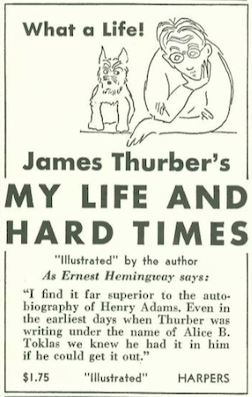
…a small back page ad announced a big-time book for James Thurber, including a satirical blurb from Ernest Hemingway…
…and that makes a nice segue to our cartoons, with Thurber again…
…Otto Soglow demonstrated the unexpected effectiveness of hair tonic…
…Perry Barlow gave us a look at the posh and precocious set…
…and we close with George Price, and 1933’s version of Black Friday…
The NBC Studios at 30 Rockefeller Plaza have wowed visitors and performers alike for nearly 90 years. Today we look back at the remarkable foresight of the studios’ designers, who created spaces that would one day accommodate a new medium called television, which was still in its experimental stages.
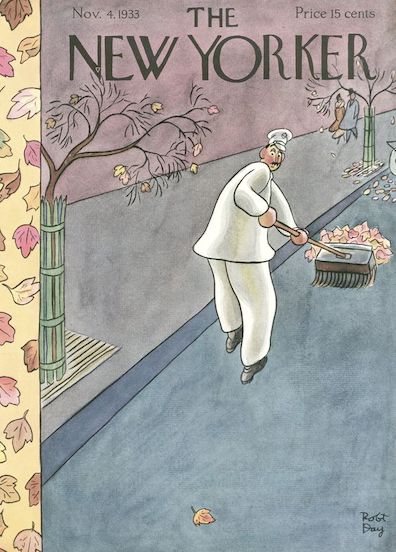
Nov. 4, 1933 cover by Robert Day, who contributed a total of eight covers to The New Yorker.
However, before we jump in, let’s look at Robert Day’s cover for the Nov. 4 issue, which featured a familiar character who made his first appearance on the cover of issue #12 (May 9, 1925), and returned four years later looking much older in the dog days of August…
Cover of issue #12 (May 9, 1925) by Rea Irvin introduced our street sweeper, who returned Aug. 3, 1929 by the hand of Gardner Rea.
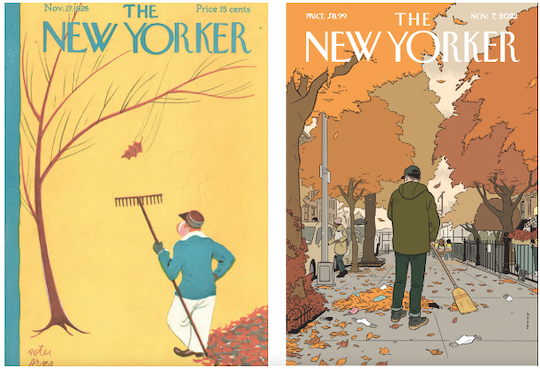
Day’s cover, however, was also a nod to the annual gathering of autumn leaves—an occasional cover theme that began with Peter Arno’s contribution to the Nov. 27, 1926 issue (below, left) and most recently expressed in Adrian Tomine’s cover for the Nov. 7, 2022 issue (with timely pandemic reference)…
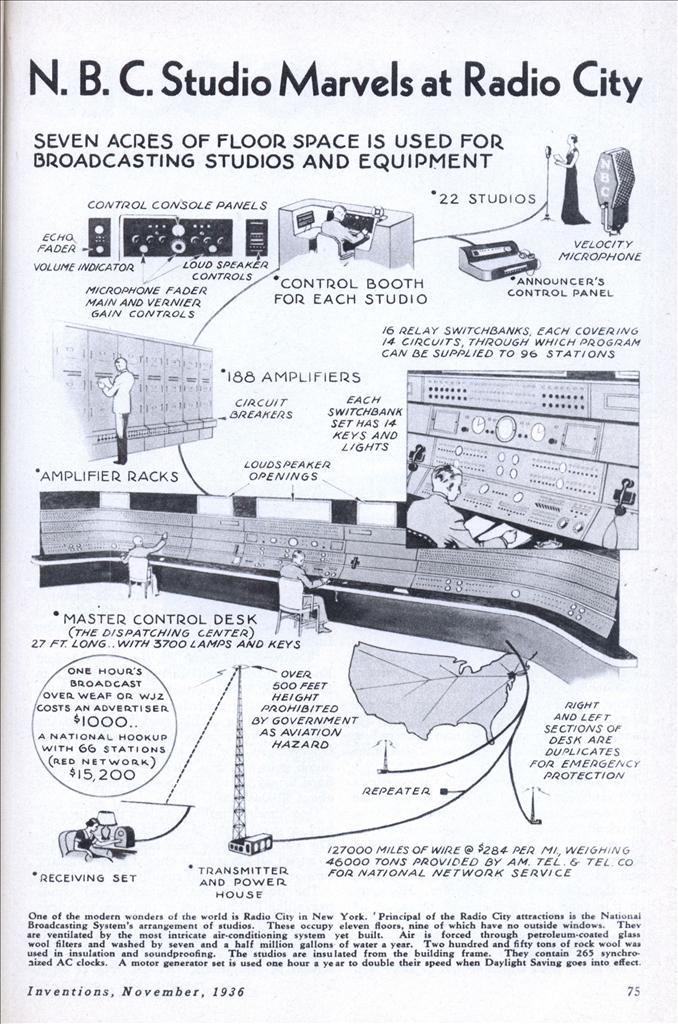
Back to Radio City, Morris Markey recounted the technological wonders of the new NBC studios in his “A Reporter at Large” column, “Marconi Started It.” Markey noted the “fabulous quality” of the facilities, wired for the day when television would arrive. Excerpts:
GEE WHIZ…Morris Markey could be assured that some folks would be “goggled-eyed” by NBC studios, including the technophiles at Popular Mechanics. (westmb.org)
WHERE HISTORY WAS MADE…Studio 8H was the world’s largest radio studio when it opened in 1933. It would be converted for television in 1950. (westmb.org)
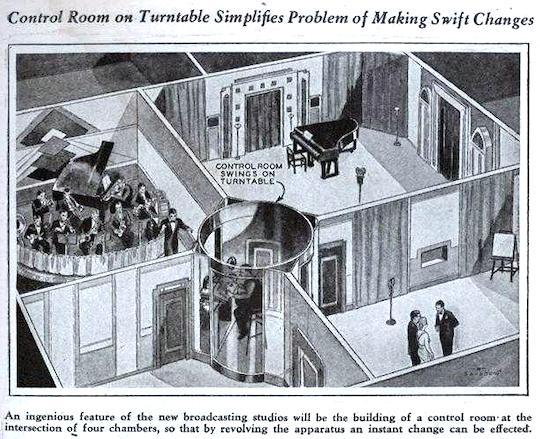
Markey marveled at NBC Studios’ various design innovations, including a revolving control room dubbed the “Clover Leaf”…
(Modern Mechanics, Jan. 1931)
Almost 90 years later, the studios continue to serve the broadcast needs of the 21st century, including Studio 8H…
LIVE FROM NEW YORK…Studio 8H was the world’s largest radio studio when it opened in 1933. Converted to television in 1950, it has been home to Saturday Night Live since 1975. Above, SNL stage manager Gena Rositano, in 2015. Below, longtime SNL director Don Roy King at the controls for Studio 8H, also in 2015. (Dana Edelson/NBC via Directors Guild of America)
* * *
Leopold!
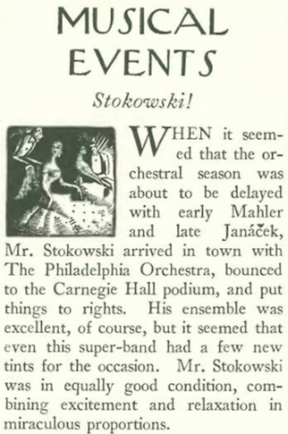
Conductor Leopold Stokowski was no stranger to Studio 8H. From 1941 to 1944 he led the NBC Symphony Orchestra in that venue. One of the leading conductors of the early and mid-20th century, Stokowski (1882–1977) began his musical career in New York City in 1905 as the organist and choir director at St. Bartholomew’s Church, but by 1915 he was conducting the famed Philadelphia Orchestra. Robert Simon reported on Stokowski’s return to New York for a performance at Carnegie Hall. A brief excerpt:
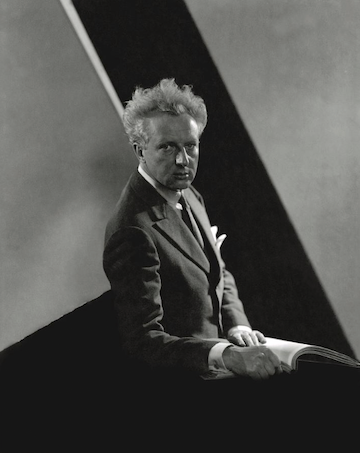
I GET AROUND…Portrait Of Leopold Stokowski by Edward Steichen, Dec. 1, 1933. Married three times and once romantically linked to Greta Garbo, he was married to wife #3, Gloria Vanderbilt, for ten years. (Condé Nast)
Stokowski had the distinct honor of being satirized in a 1949 Looney Tunes cartoon, “Long-Haired Hare,” in which Bugs Bunny disguised himself as the conductor and entered the stage to the astonished whispers of the orchestra…Leopold! Leopold!…
MAESTRO…Bugs Bunny as Stokowski in “Long-Haired Hare.”
Stokowski was no stranger to animation. The conductor appeared in silhouette in Disney’s Fantasia (1940), leading the Philadelphia Orchestra in the film’s score. He even shook hands with Mickey Mouse.
* * *
Bigga Badda Wolfa
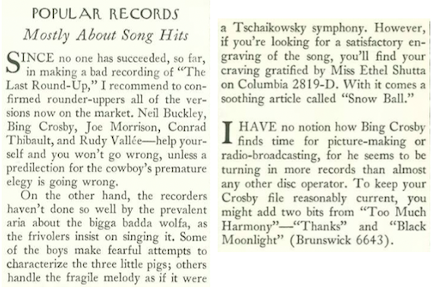
The New Yorker took a look at the popular records of the day, and in addition to tunes by Bing Crosby and Rudy Vallée there was yet another release of “Who’s Afraid of the Big Bad Wolf?”…Ethel Shutta was the latest of seemingly dozens of artists to cash in on the Disney hit…
I’LL HUFF AND I’LL PUFF…Those who couldn’t get enough of “Who’s Afraid of the Big Bad Wolf” could turn to Ethel Shutta’s rendition of the hit song on Columbia records. (discogs.com)
* * *
Page-Turner
Writer Kay Boyle wasn’t afraid of wolves or any other subject for that matter, according to book reviewer Clifton Fadiman…
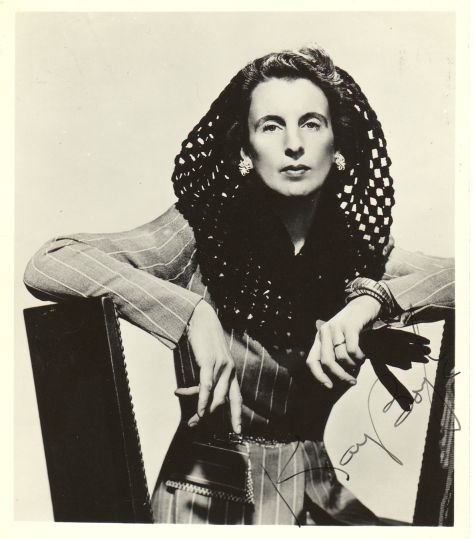
TOSSING A SALACIOUS SALAD…Kay Boyle, photographed by George Platt Lynes, 1941. (The Kay Boyle Papers, Morris Library, Southern Illinois University)
* * *
A Grapeful Nation
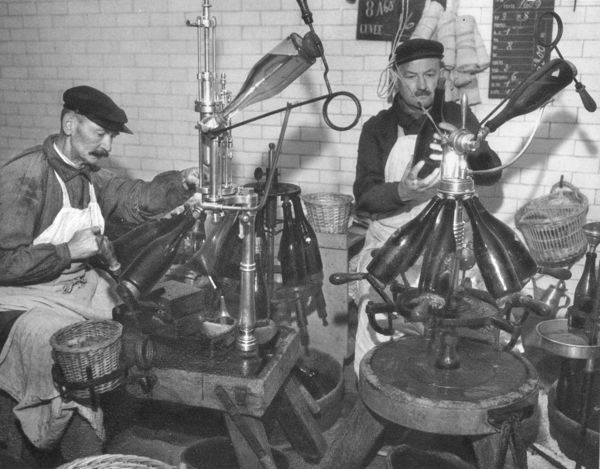
As New Yorkers counted the days until the end of Prohibition, The New Yorker did its part to get readers back up to speed by enlisting the talents of one of the world’s great wine experts, Frank Schoonmaker, who had the enviable job of filing a series of wine reports for the magazine. His first installment of “News From the Wine Country” featured the Champagne region. Excerpts:
THAT FIZZY FEELING…Bottling the good stuff in the Champagne region, circa 1930. (wineterroirs.com)
* * *
From Our Advertisers
Christmas was just around the corner, and F.A.O. Schwarz was READY with its 64-page catalog…
…White Rock anticipated the end of Prohibition with an ad featuring a miniature colonel who apparently needed a stiff drink to prepare for his wife’s return from abroad…
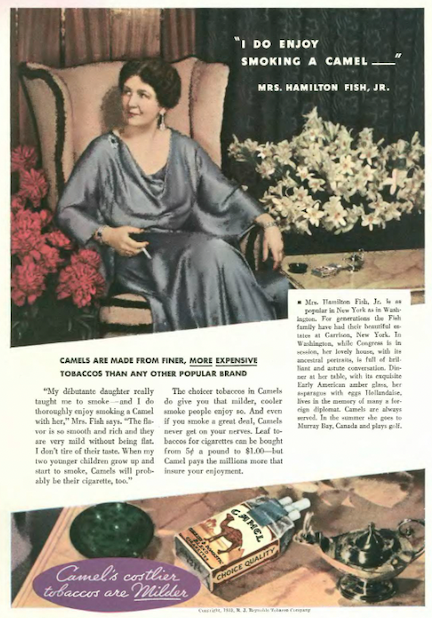
…Mrs. Hamilton Fish Jr, aka Grace Chapin, was married to the New York congressman from 1920 until her death in 1960, apparently enjoying many Camels along the way…her husband would go on living another 31 years and take three more brides before expiring at age 102…
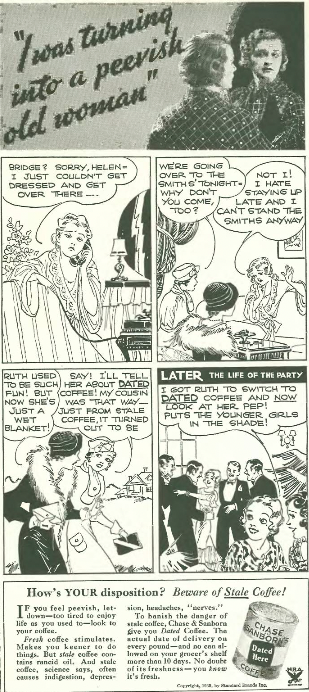
…another cautionary tale from Chase & Sanborne about the perils of undated coffee…
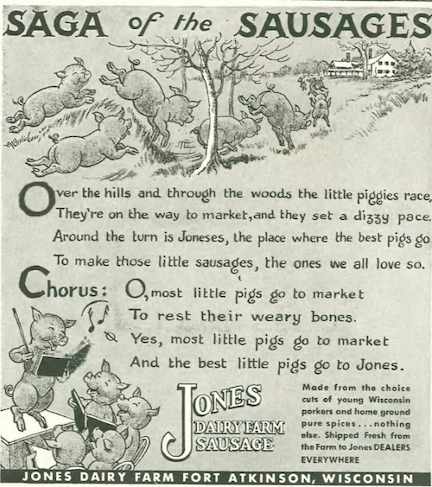
…and with the holidays approaching, a jolly ditty from Jones Dairy Farm, home to little piggies who merrily dash toward their inevitable slaughter…
…and we jump to another back-page ad, this from the stately Plaza, where you could get a single room for five bucks a night…
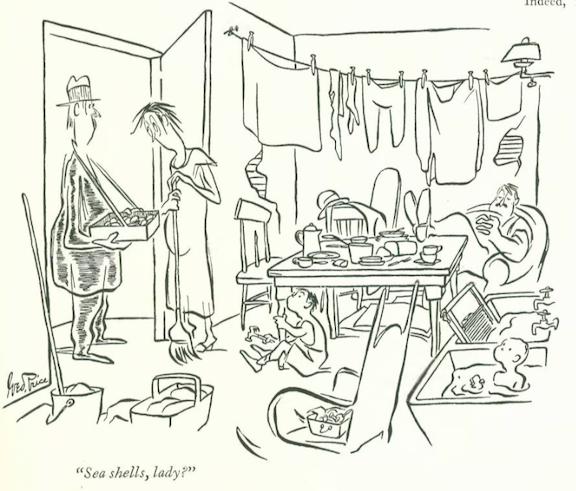
…turning to the cartoons, we find George Price hitting his stride with multiple cartoons in consecutive issues…
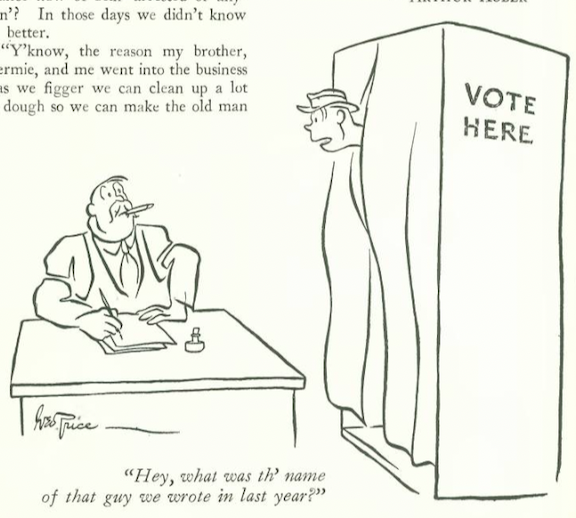
…and taking a look at the recent elections…
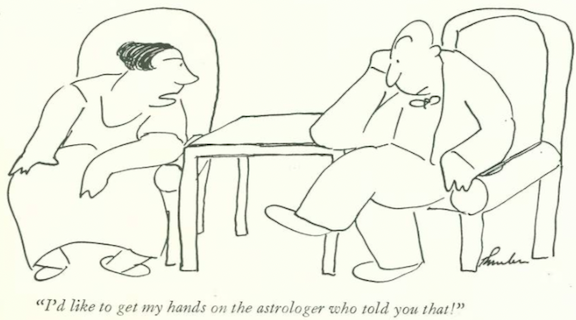
…on to James Thurber, and continuing struggles on the domestic front…
…and that brings us to our next issue…
Nov. 11, 1933 cover by Constantin Alajalov.
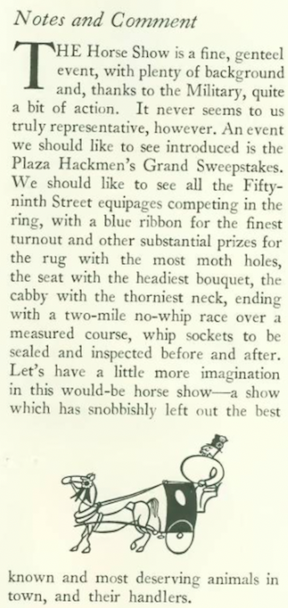
…in which E.B. White had a thing or two to say about the latest edition of the National Horse Show at Madison Square Garden.
HORSE SENSE AND SENSIBILITY…The National Horse Show at Madison Square Garden was a major event on New York’s social calendar; top and bottom right, scenes from the 1936 show; bottom left, undated scene circa 1960. (Stills from YouTube)
* * *
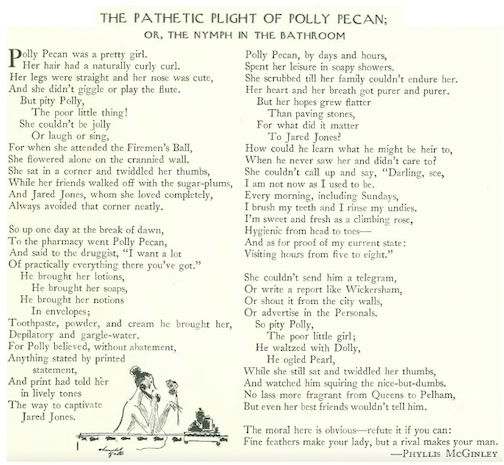
Versatile Verse
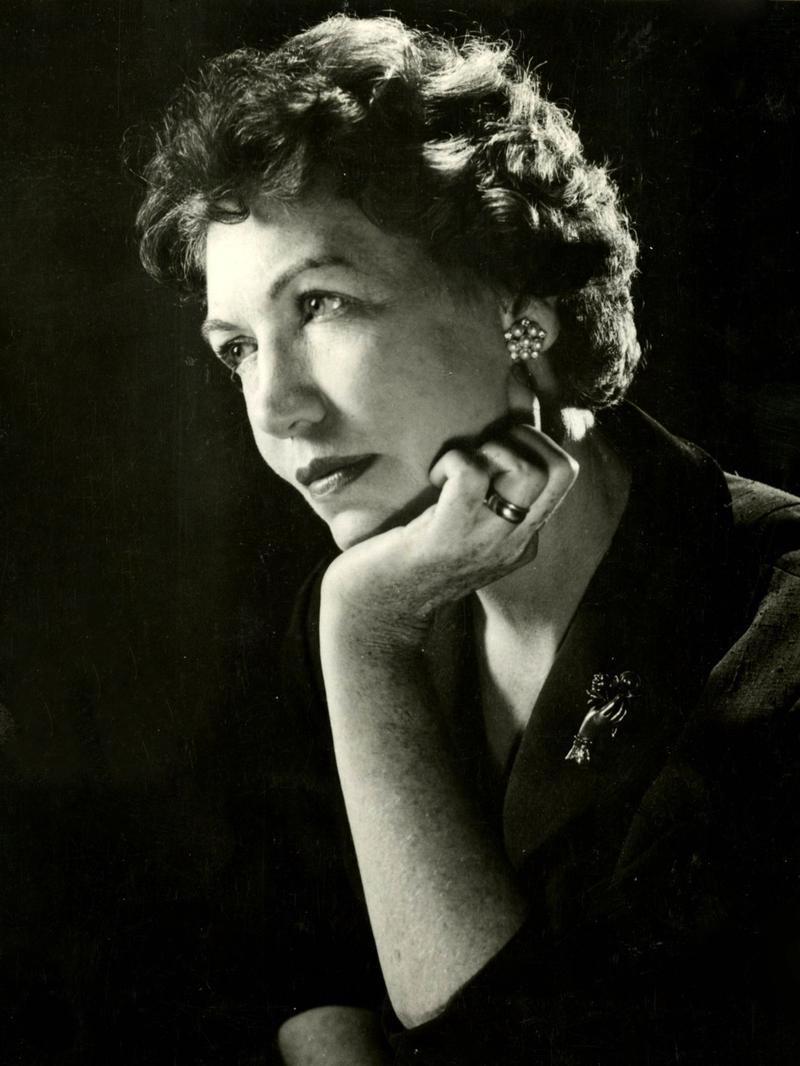
Phyllis McGinley (1905–1978) was the author of children’s books and poetry, the latter genre most notably for The New Yorker. However, she attracted a wide audience for her light verse in other publications ranging from Ladies Home Journal to The Saturday Review.
LIGHT TOUCH…Phyllis McGinley in an undated photo. She received the Pulitzer Prize in 1961 for her book Times Three—the first writer of light verse to receive the prize. (wnyc.org)
* * *
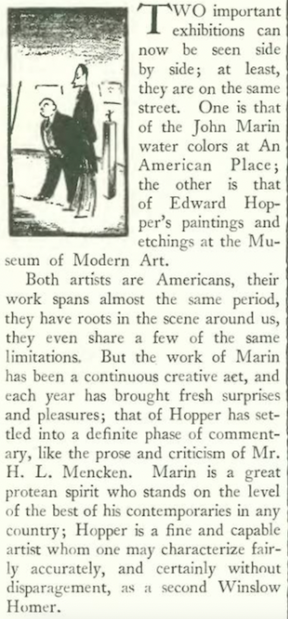
Oil and Water
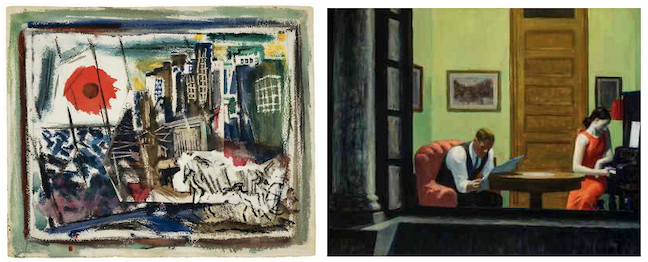
Art and architecture critic Lewis Mumford found two very different visions of America in the works of contemporaries John Marin and Edward Hopper. Marin’s watercolors were featured at An American Place, while Hopper’s oil paintings and etchings were shown down the street at the Museum of Modern Art.
SIDE BY SIDE…Lewis Mumford found different visions of New York and the world at An American Place and MoMA galleries. At left, John Marin’s watercolor From the Bridge, N.Y.C. (1933); at right, Edward Hopper’sRoom in New York, also from 1933. (Artists Rights Society/Sheldon Memorial Art Gallery)
* * *
More From Our Advertisers
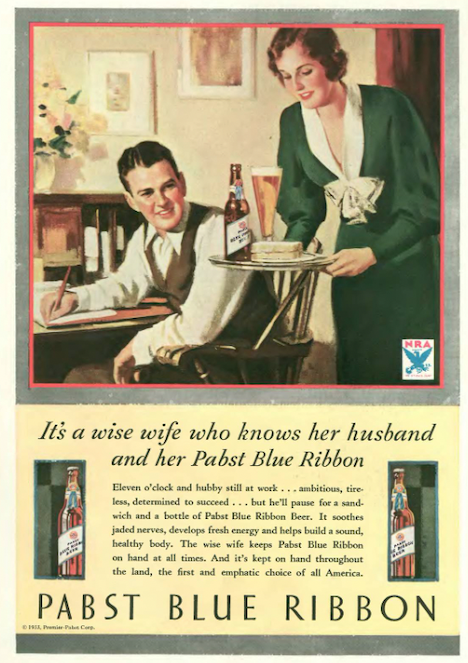
Okay, so I’ll buy the part about PBR’s ability to soothe “jaded nerves,” but I doubt it gave this guy “fresh energy” and “a sound, healthy body”…
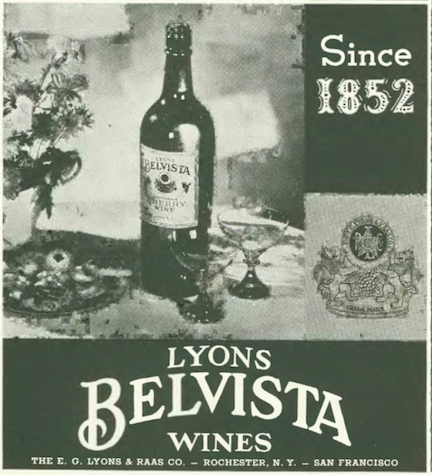
…After thirteen long years, winemakers emerged from their cellars to glimpse the light of a new day…
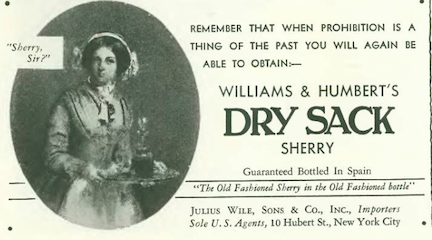
…and yes, after thirteen long years, some folks would be yearning for their DRY SACK Sherry…
…the name Elizabeth Hawes was synonymous with high fashion in the late 1920s and 1930s—she owned one of the most exclusive couture houses in New York…
…an outspoken advocate of dress reform, Hawes (1903–1971) was referred to by one historian as “the Dorothy Parker of fashion criticism.” After attacking the fashion industry with her 1938 book, Fashion Is Spinach (Hawes wrote: “I don’t know when the word fashion came into being, but it was an evil day…”), she closed her fashion house and in 1942 took a job as a machine operator at a wartime plant in New Jersey. She became a union organizer, a champion of gender equality, and a critic of American consumerism.
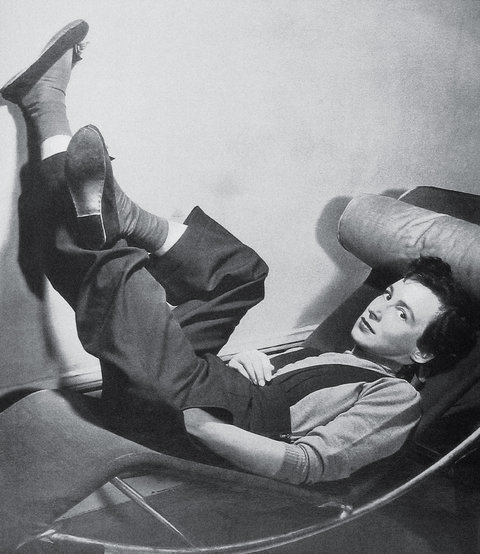
IN A LEAGUE OF HER OWN…Elizabeth Hawes — writer, fashion designer and political activist, poses for a photograph in 1941. (Mary Morris Lawrence)
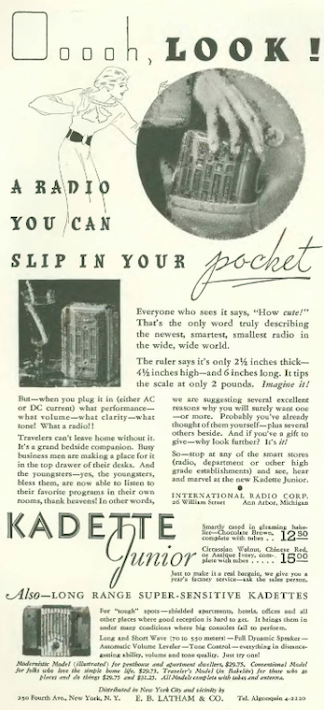
…speaking of consumerism, ooooh look! A radio “you can slip in your pocket,” depending of course on the size of your pocket…
…transistors would not come along until the late 1950s, so the Kadette still depended on tubes, and you had to plug it in somewhere, so no running down the beach with headphones, at least for awhile…
The Kadette Junior. (radiolaguy.com)
…it must have been a rare treat to sail on a ship like the SS Santa Rosa—situated between the ship’s two funnels, the dining room had an atrium stretching up two-and-a-half decks and featured a retractable roof…
…on to more cartoons, and more George Price…
…moving along, we received some big news from one of Helen Hokinson’s “girls”…
…an aside I’ve been meaning to include…in 1952, just three years after Helen Hokinson’s untimely death, a cartoonist for The Cincinnati Enquirer, Franklin Folger, debuted a cartoon called “The Girls.” The cartoon was eventually syndicated and appeared in more than 150 newspapers worldwide before Folger retired it in 1977. Perhaps I am missing something, but I cannot find a single reference to Folger’s obvious appropriation of Hokinson’s “girls”…some examples of Folger’s work from the early 1960s and another from H.H. for comparison:
…and onward to Peter Arno, and the trials of portrait artists…
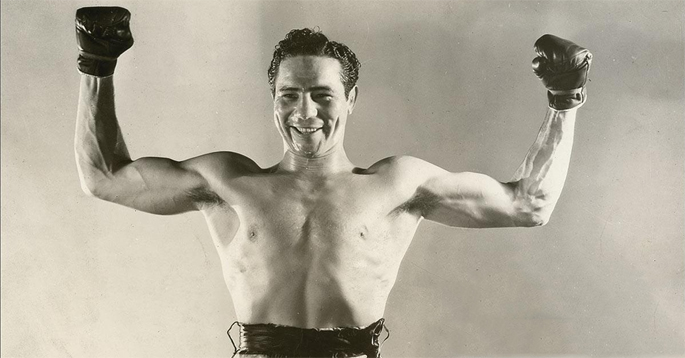

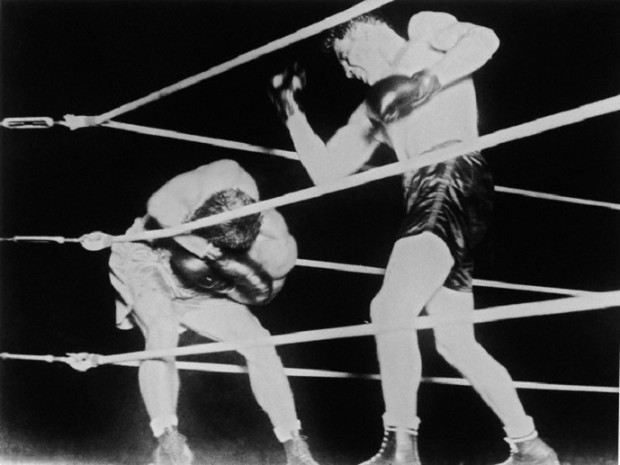
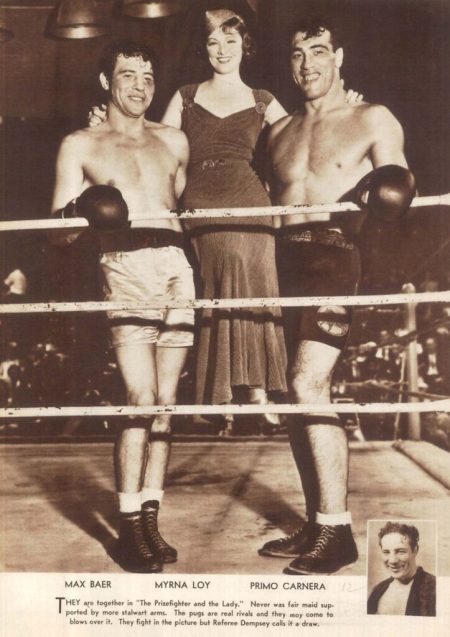
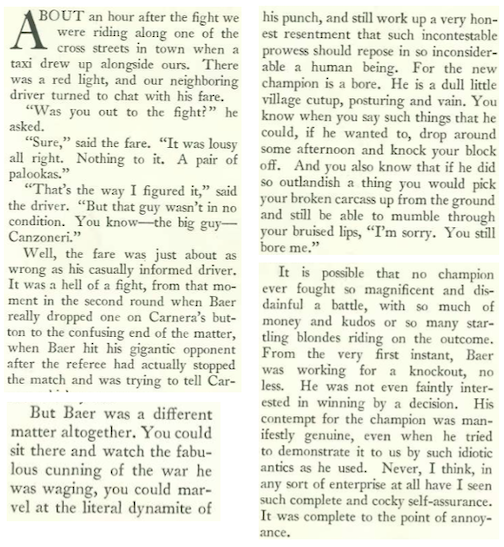
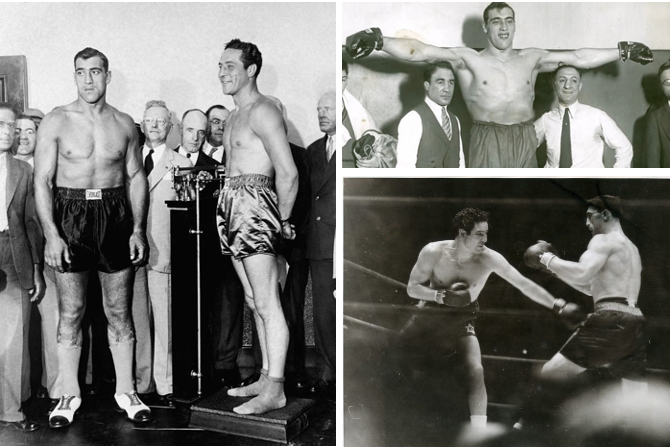


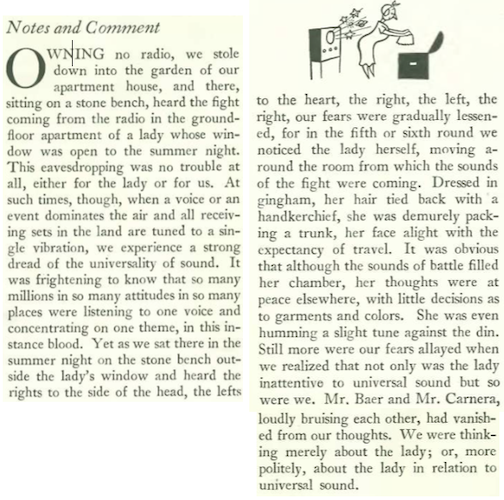


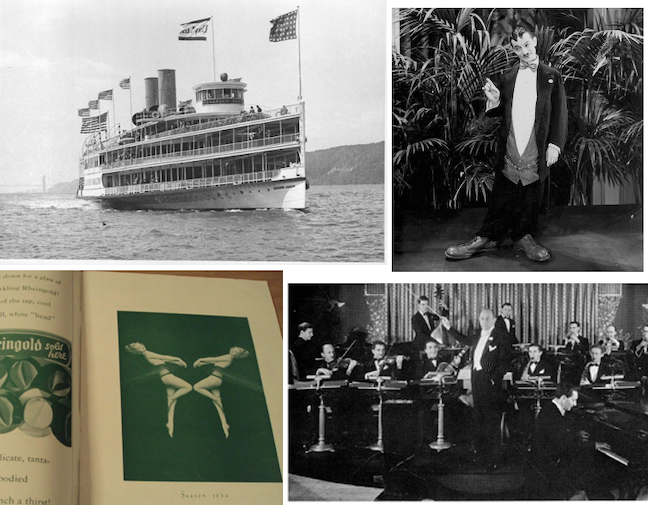


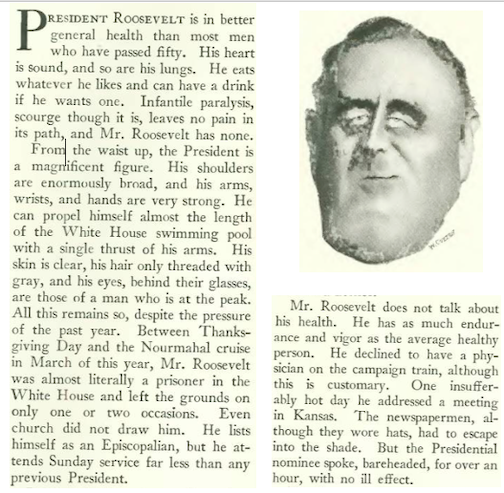
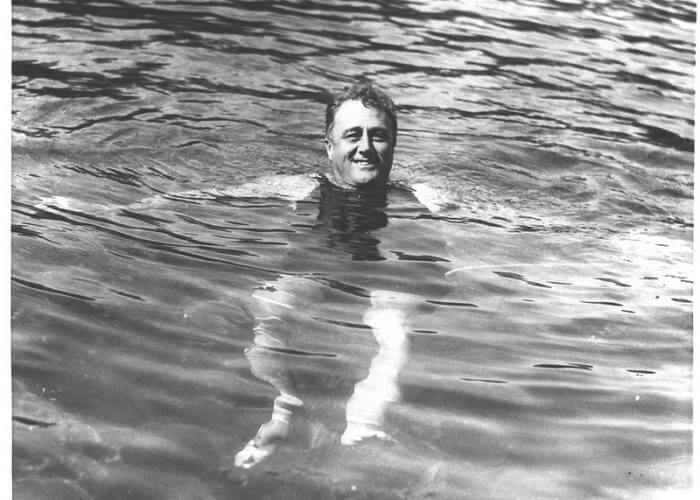
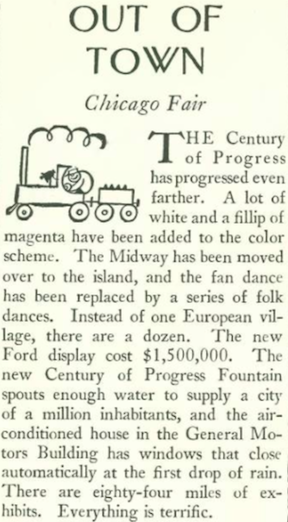
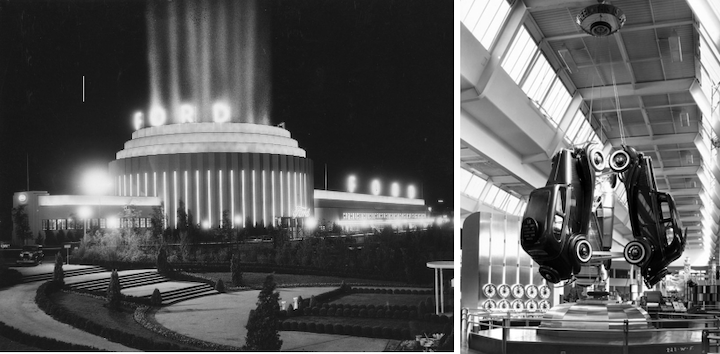
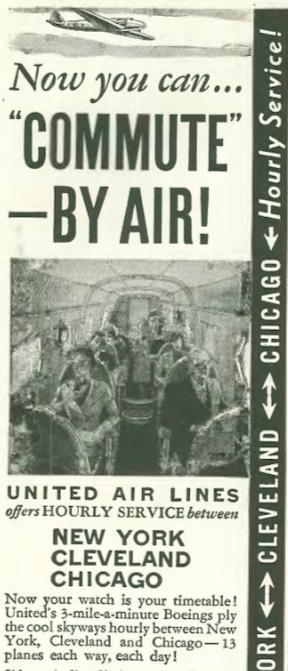
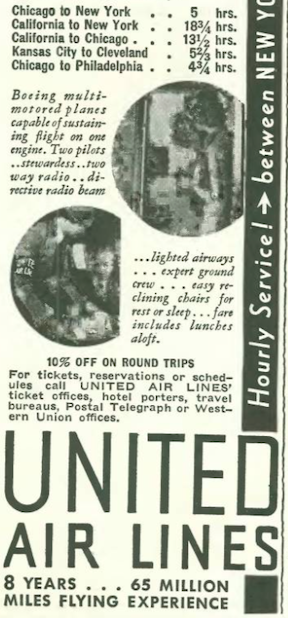


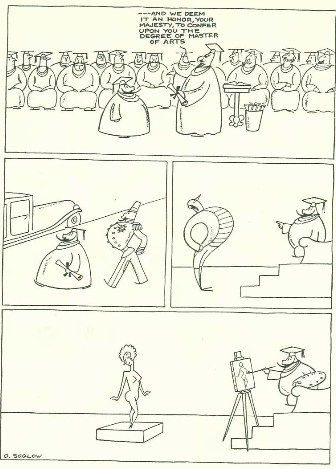

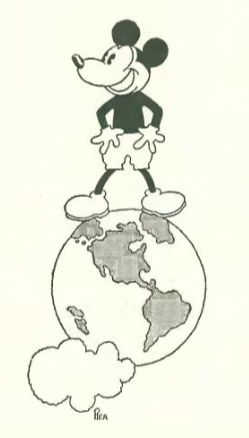


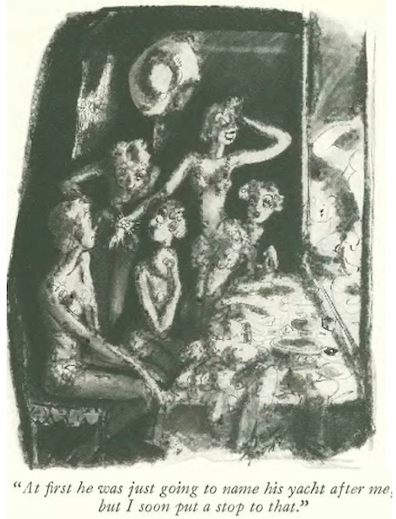


 Next Time: A Light in Darkness…