Above image: Groucho Marx, Margaret Dumont, and Lillian Roth in the Marx Brothers second film, Animal Crackers, 1930 (IMDB)
The Marx Brothers were famous for a string of hit films in the 1930s, but some of the comedy on which those films were based went all the way back to the days of vaudeville and 1920s Broadway.
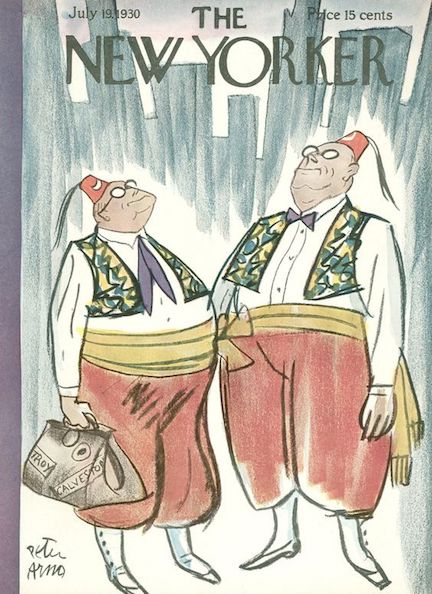
Sept. 6, 1930 cover by Peter Arno.
Animal Crackers was their second film (the first was 1929’s The Cocoanuts), and the last to be adapted from one of their stage shows. It was also the last Marx Brothers movie to be filmed at Paramount’s Astoria Studio in Queens before the brothers headed for Hollywood.
MUSICAL CIRCUS…Animal Crackers began as a Broadway stage production in 1928 before moving to film in 1930; from left to right: Groucho, Harpo, Chico and Zeppo in a publicity photo for the stage version of Animal Crackers. (www.georgeskaufman.com)
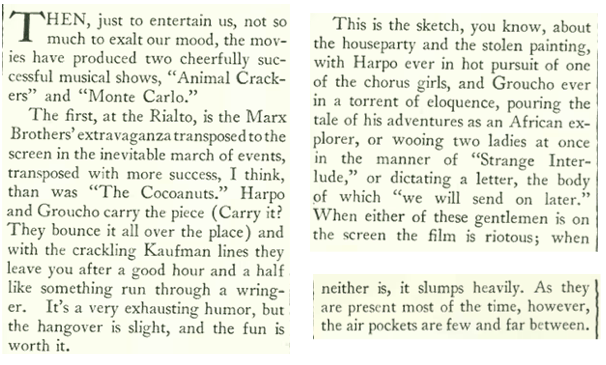
The New Yorker’s John Mosher reviewed the film version, which was playing at the Rialto Theatre:
SO LONG, NEW YORK…Animal Crackers was the second and final Marx Brothers movie to be filmed at Astoria Studios in Queens; from left, Chico, Zeppo, Groucho and Harpo Marx pose for a 1930 publicity photo. (IMDB)
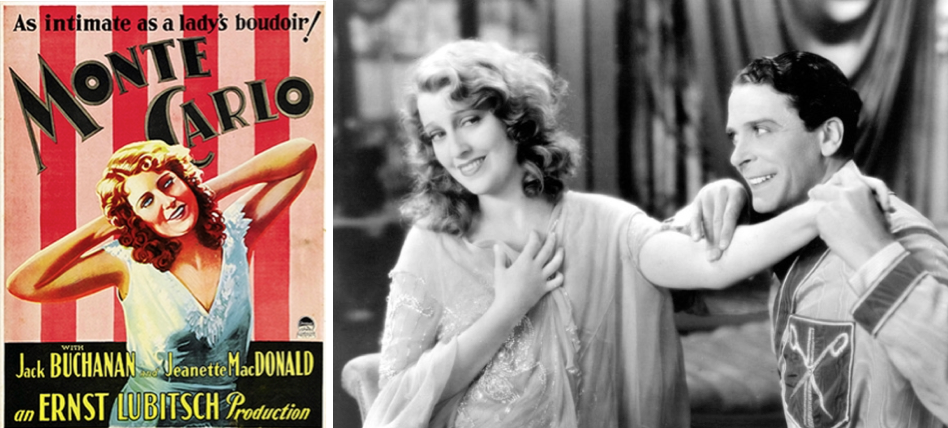
Always partial to European directors, Mosher found Ernst Lubitsch’sMonte Carlo among the better films playing in the late summer.
OH YOU CAD!…Jeanette MacDonald and Jack Buchanan in Monte Carlo. (IMDB)
* * *
Fox in the Hen House
“The Talk of the Town” made light of Mayor Jimmy Walker’s plan to “rid the city of graft.” Ironically, Jimmy himself would be drummed out of office two years later for accepting bribes…
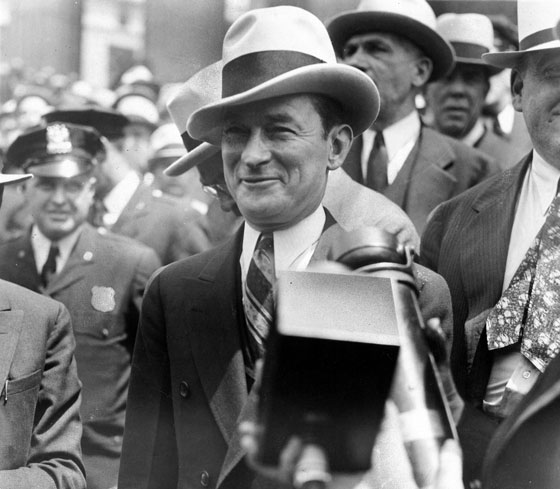
WHAT ME WORRY? Yes maybe. Mayor Jimmy Walker in 1930. (nymag.com)
* * *
From Our Advertisers
We have another lovely illustration from Carl “Eric” Erickson promoting the joys of smoking unfiltered cigarettes…
…these small ads for apartments in the back pages of the magazine promoted the bucolic vistas in Westchester…
Images of Fleetwood Hills from The American Architect, June 1926.
…and European-style living on East 44th Street…
The Beaux-Arts Apartments (which still stand) consisted of buildings on both sides of E. 44th Street. (Museum of the City of New York)
…as for cartoons, Peter Arno continued this running gag…
…as did Rea Irvin in another tableaux (originally running sideways, full page) featuring the clash of country bumpkins and city elites…
…Garrett Price looked in on the burdens of the wealthy…
…and Barbara Shermund caught some small talk at a cafe…
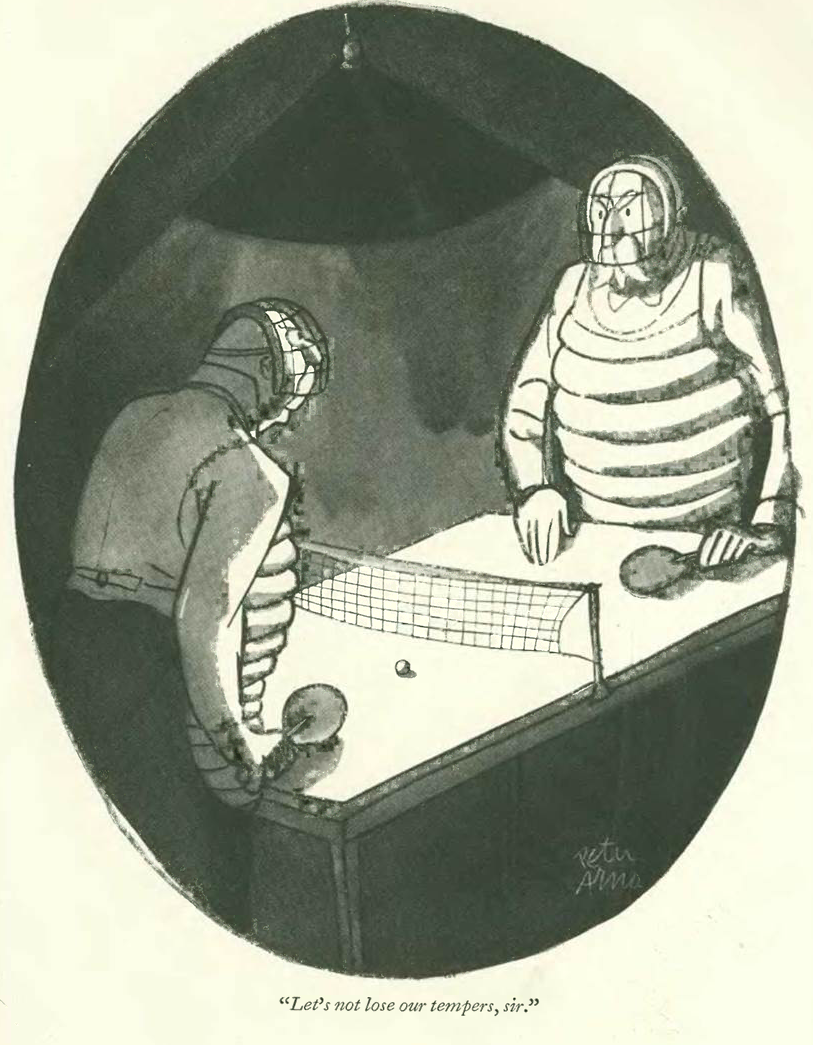
…back to Peter Arno, and a heated game of table tennis…
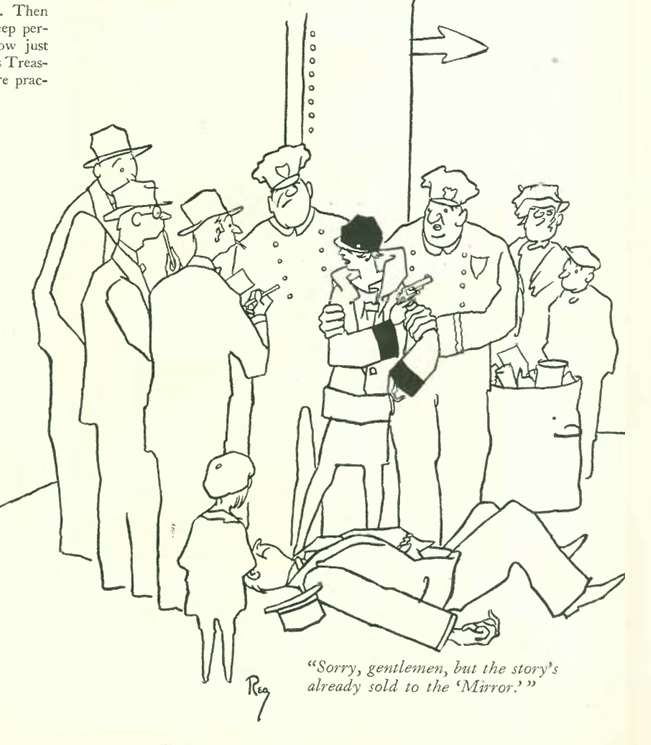
…and Gardner Rea, witness to modern-day crime reporting…
On to the Sept. 13, 1930 issue…
Sept. 13, 1930: yet another satirical kakemono cover by Rea Irvin.
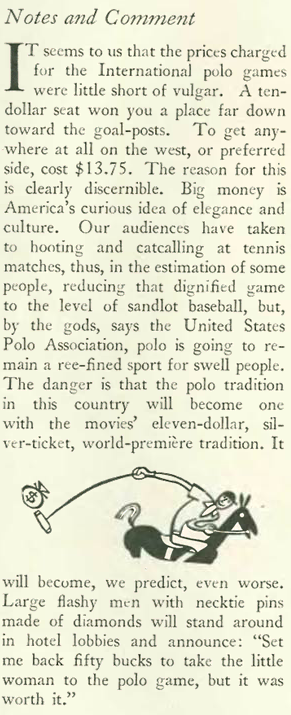
As I’ve noted many times before, the early New Yorker covered every sport under the sun (and especially elite sports such as yacht racing, tennis and badminton, golf and polo) but to my knowledge never covered a major league baseball game in its then five-year existence. Here, E.B. White, in his “Notes and Comment,” complains about the high price of tickets to polo matches…
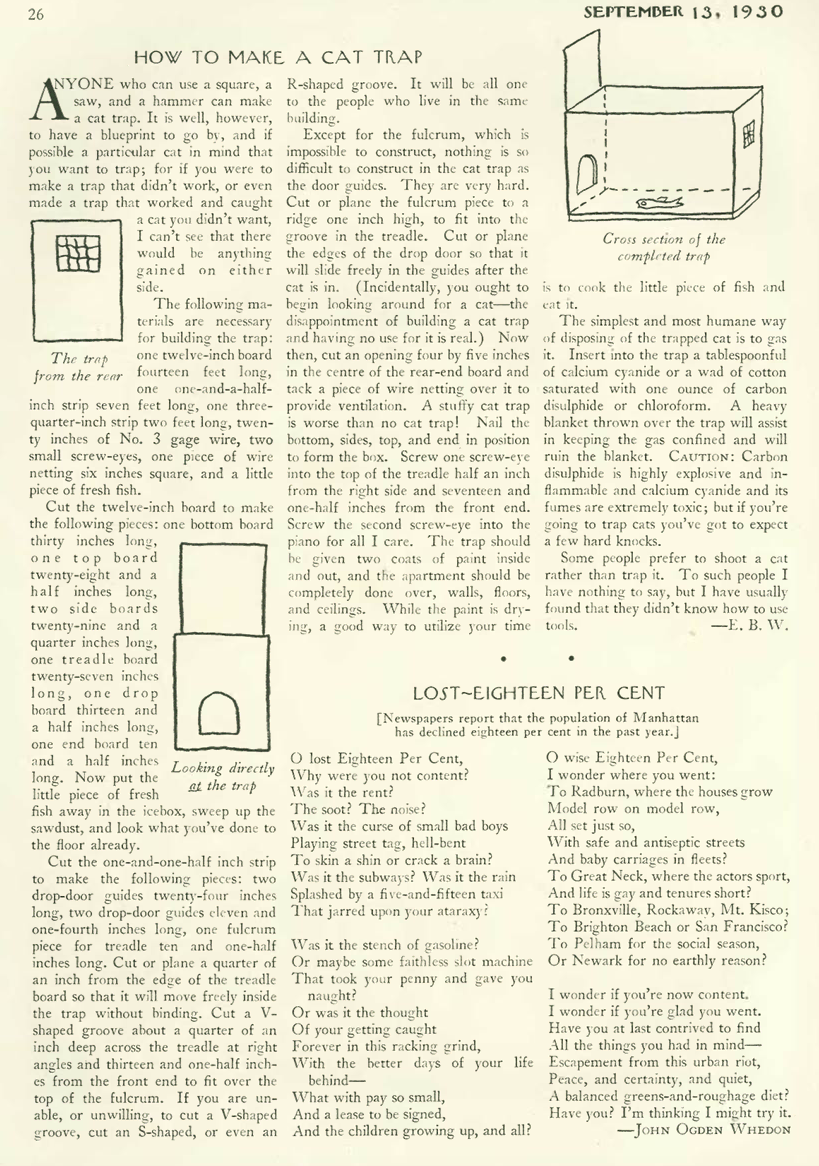
…White, a well-known dog lover, offered a rather cruel solution to a problem cat in this feature:
* * *
Oh Never Mind
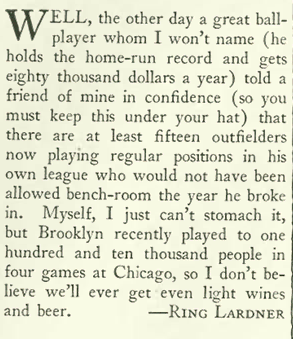
At first glance I thought this might actually be an article about a baseball game, but alas, it was a column by Ring Lardner (titled “Br’er Rabbit Ball”) that showed little enthusiasm for the game (the 1919 “Black Sox” scandal apparently soured his love for baseball). Excerpts:
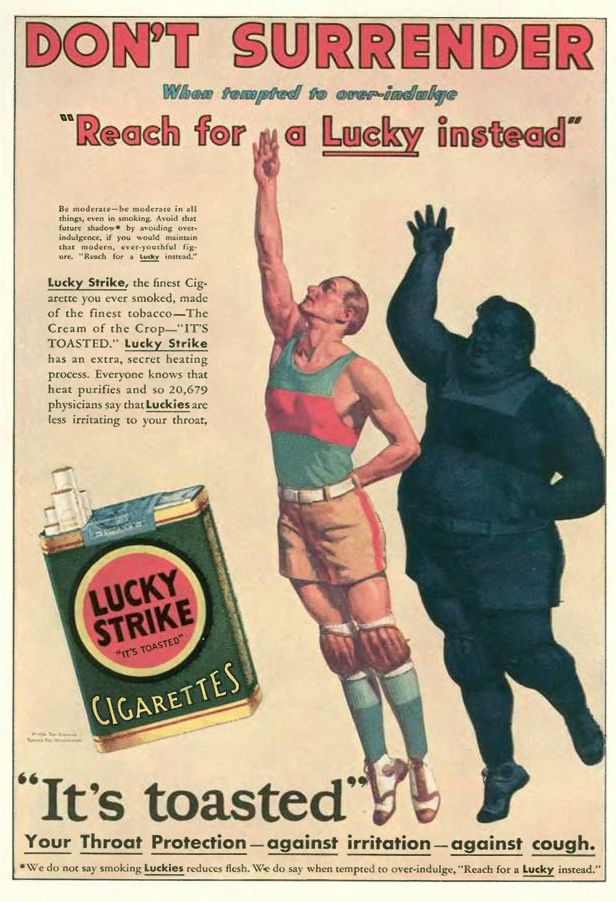
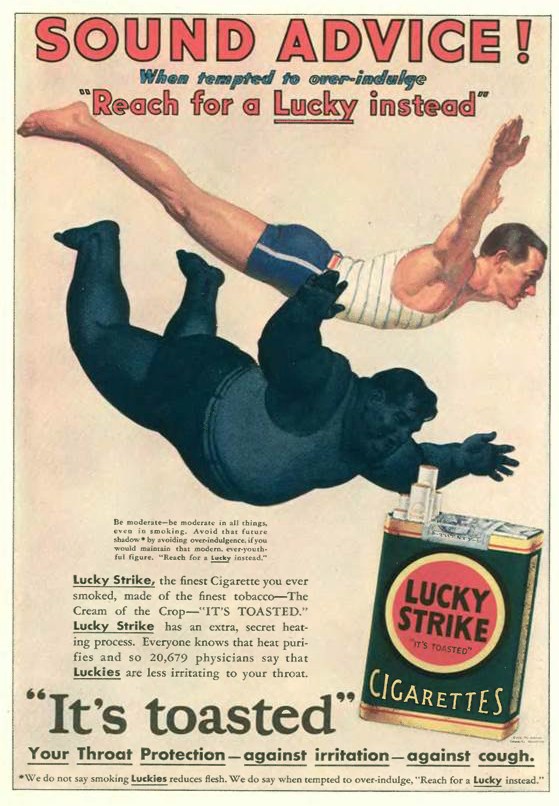
Speaking of sports, we move to the advertisements and the helpful folks from Lucky Strike, who wanted to help you get in shape with a smoke…
…and another ad for Flit insecticide by Dr. Seuss, featuring an elephant that looked a lot like the future Horton, and some unfortunate racist imagery…
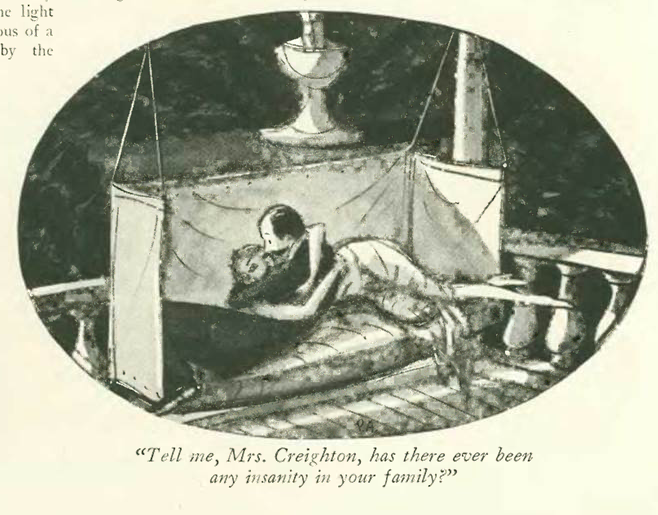
…yet another Peter Arno repeat with a new caption…
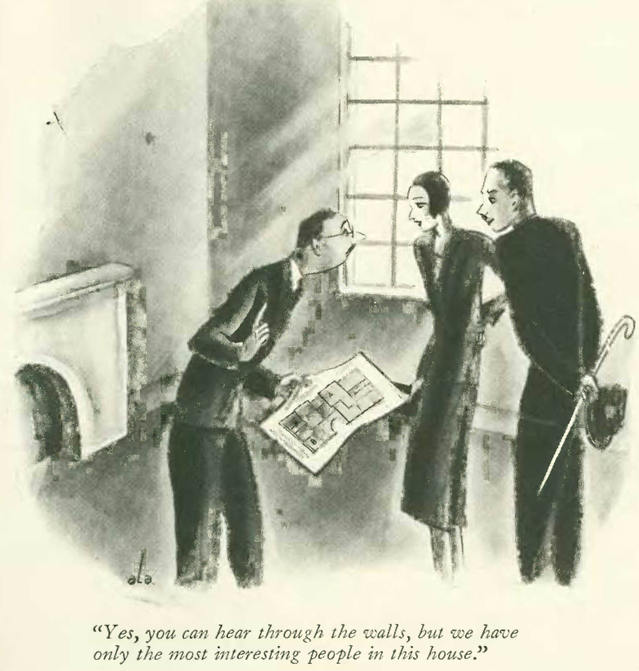
…and another in a series of 1930’s images by Ralph Barton…
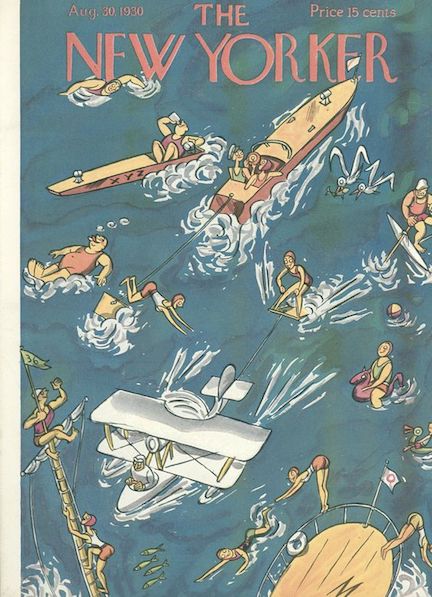
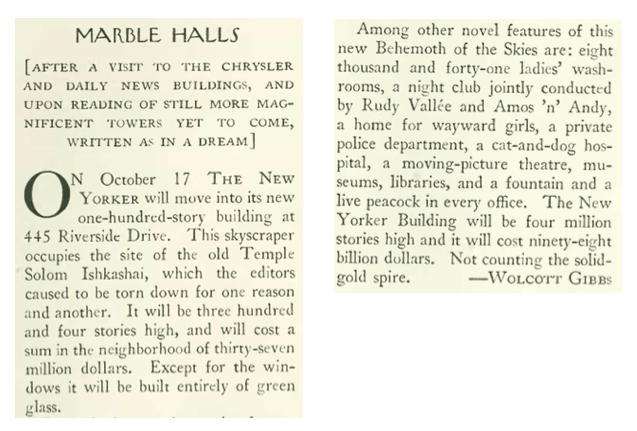
We close out the boiling August of 1930 with Wolcott Gibbs and his fanciful musings regarding the future offices of The New Yorker, inspired by his recent visit to the glitzy new lobby of the New York Daily News Building.
August 30, 1930 cover by Julian De Miskey.
I include a brief excerpt of Gibb’s tongue-in-cheek fantasy of the future, which inadvertently foresees The New Yorker’s current offices (see contrast of old and new above) in the gleaming glass tower now known as One World Trade Center:
THAT WAS THEN…The New Yorker’s first offices were located at 25 West 45th Street, a 16-story building erected in 1913 (it still stands). It’s almost impossible to find images of The New Yorker’s early office spaces, but you can probably get some idea from these photos of another tenant of the building, the Y.M.C.A. Dental School. (Museum of the City of New York/New York Public Library)THIS IS NOW…Almost in fulfillment of Wolcott Gibbs’ fantasy, The New Yorker today occupies offices in the Condé Nast section (images above) of the 104-story, 1,776 foot One World Trade Center (floors 20 to 44). When The New Yorker moved onto the building’s 38th floor in early 2015 (one floor above Wired), it marked the first time the magazine was located outside of a small area in Midtown. (New York Magazine/interiordesign.net)
* * *
His Bit of Earth
“The Talk of the Town” noted an increasingly rare sight along Fifth Avenue, a private garden created by Thomas Fortune Ryan that in 1930 was occupied by his son Clendenin J Ryan:
DUST TO DUST…Thomas Fortune Ryan demolished the Charles T. Yerkes mansion and its art galleries (before and after photos, top, and image of a gallery, bottom right) to make way for his private flower garden, which is visible in the bottom left hand corner of the image at top right. An apartment building erected in 1937 (bottom left) occupies the site today. (Museum of the City of New York/Alice Lum)
* * *
From Our Advertisers
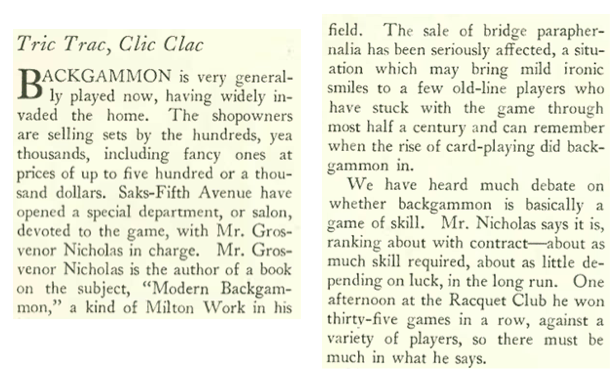
Backgammon became all the rage in the 1930, so much so that one Grosvenor Nicholas, “a famous authority on backgammon,” commanded a fill-page ad from Saks…
…for reference, The New Yorker made note of Nicholas’s visit in the Sept. 6 “Talk of the Town”…
OR WATCH THE YOUTUBE VIDEO…Leila Hattersley, author of 1930s How to play the New Backgammon, teaching at a New York Club (bkgm.com)
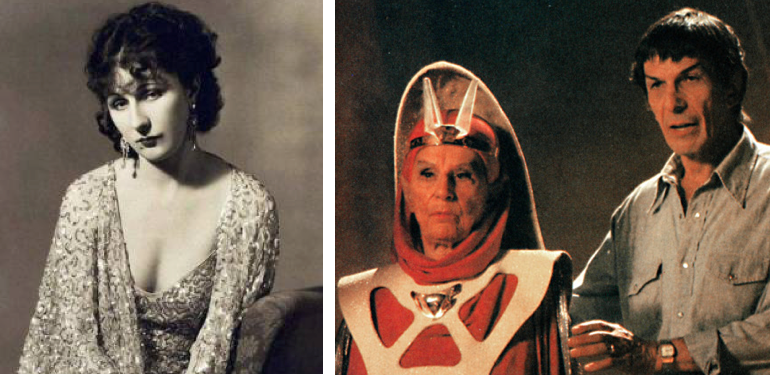
…celebrity endorsements continued to grow in importance in the 1930s, here the famed Australian-born British actress Judith Anderson (1897-1992) marvels at the products manufactured by Angelus…
…Anderson would later be made a “Dame,” and would enjoy a long career and a long life, even appearing in 1984’s Star Trek III: The Search for Spock as the Vulcan High Priestess T’Lar…
VERSATILE…At left, Dame Judith Anderson in 1932. At right, Anderson on the set of 1984’s Star Trek III: The Search for Spock, with actor Leonard Nimoy. (Tumblr)
…this ad for Buick shows a rich gent dismissing his chauffeur, something he would probably have to do permanently as the Depression continued to ruin fortunes…
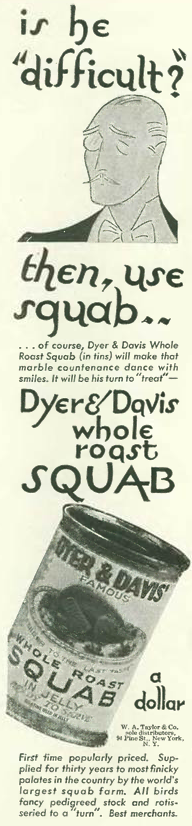
…and perhaps a lost fortune could lead to one being “difficult,” and in that case Dyers & Dyers could sooth the hurt with squab from a can…
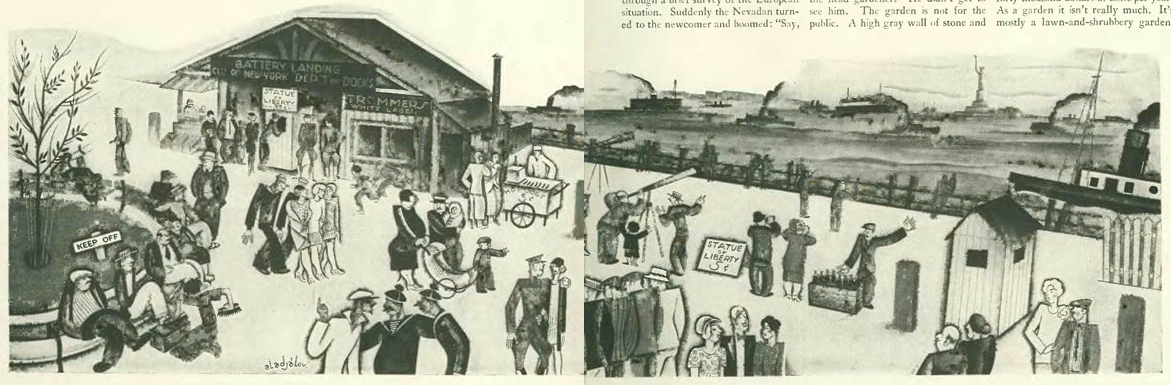
…on to our cartoonists, we have Constantin Alajalov illustrating a scene at the Battery…
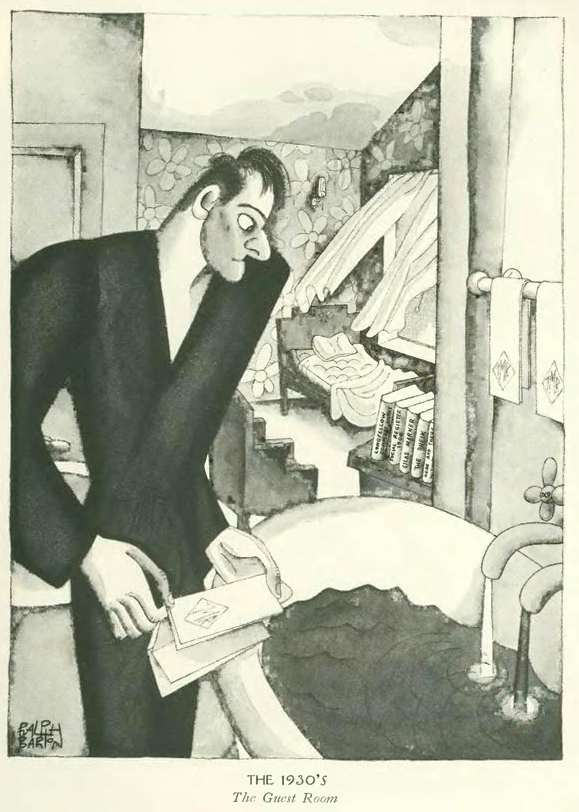
…Ralph Barton continued his interpretations of a new decade…
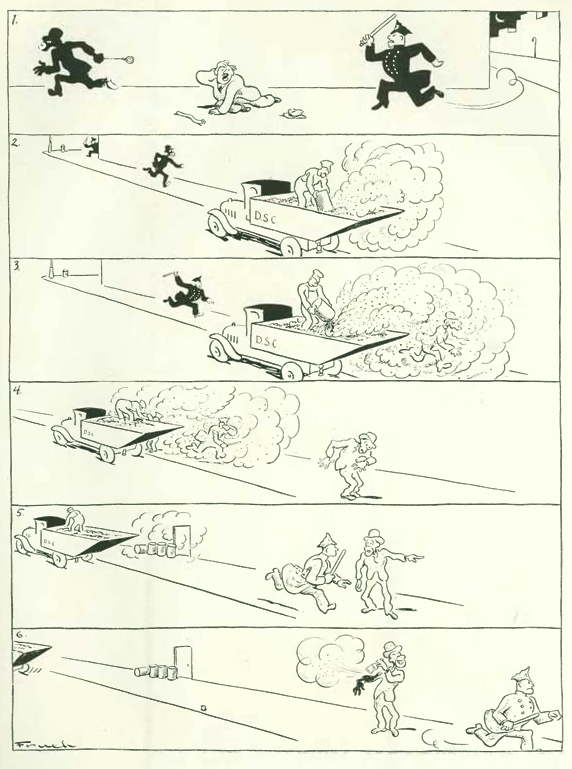
…some unfortunate racial humor from Al Frueh…
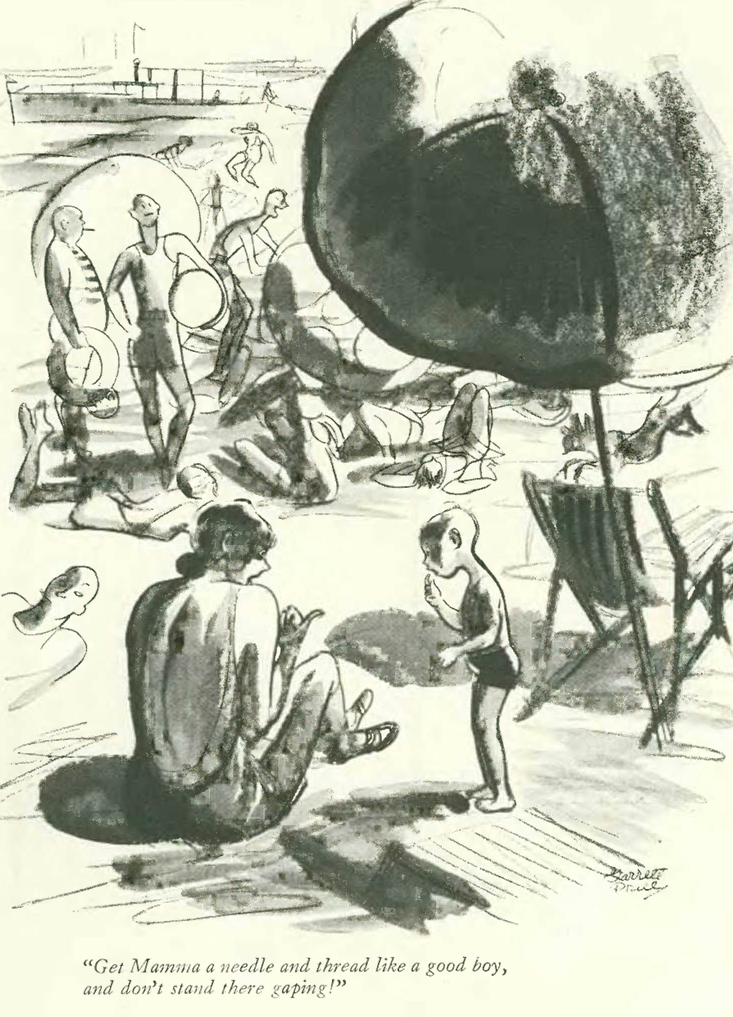
…an indelicate moment at the beach, courtesy Garrett Price…
…Perry Barlow looked at the challenges of city life…
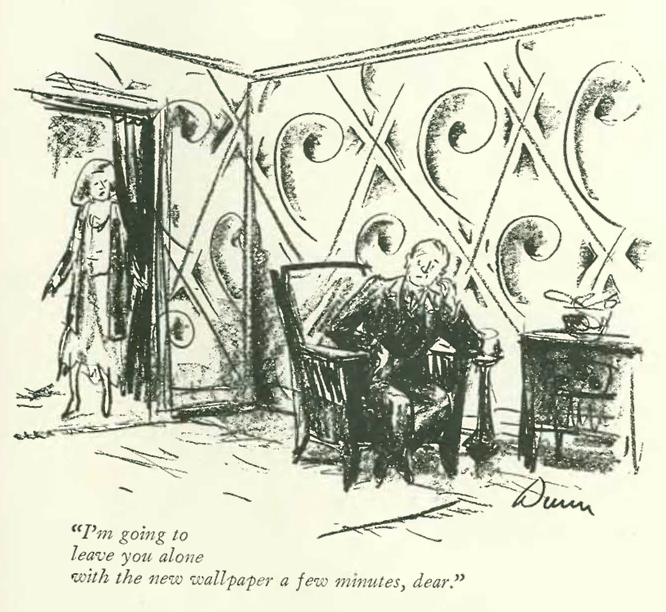
…and Alan Dunn found a man with a case of the moderns…
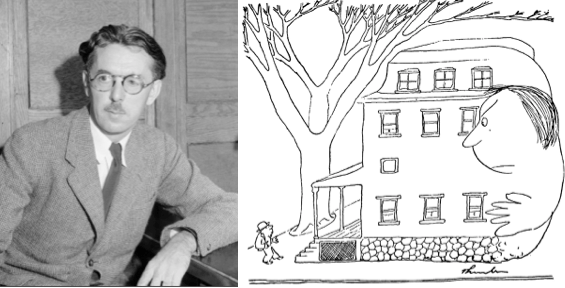
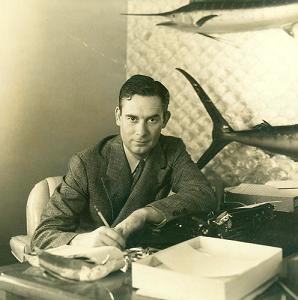
Whether probing the battle of sexes or exposing the secret lives of daydreamers like Walter Mitty, James Thurber (pictured above) had a knack for revealing the frustrations and various tics that plagued ordinary people.
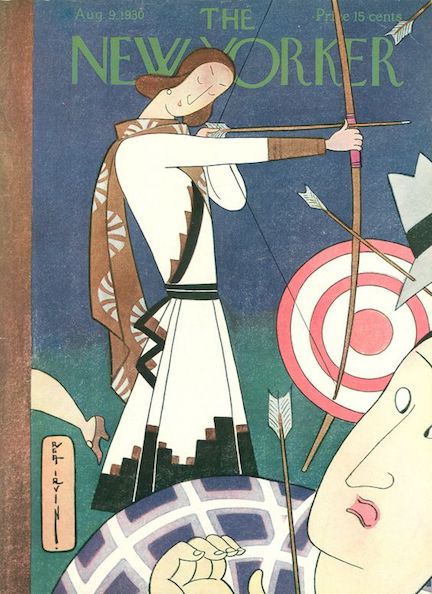
Aug. 9, 1930 cover by Rea Irvin.
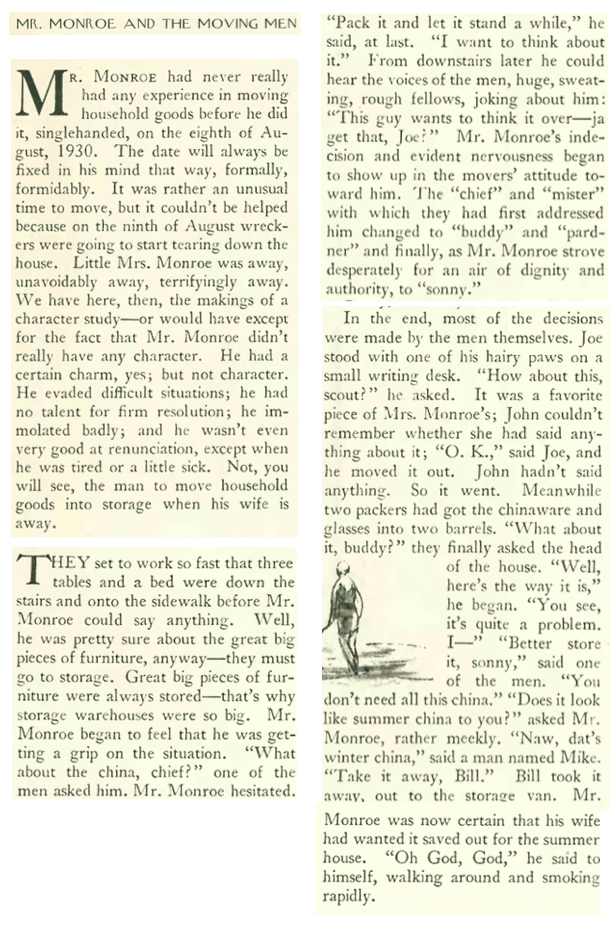
That included the fictional John Monroe, whom Thurber placed in various awkward situations in a series of humorous stories, including this encounter with some moving men that required the rather inept Monroe to make a series of decisions usually left to his wife, Ellen. Some excerpts from the Aug. 9 issue:
ODD COUPLES…Sue Randall and Orson Bean portrayed Ellen and John Monroe on a 1961 episode of The DuPont Show with June Allyson. (findagrave.com/Wikipedia)…a decade later, William Windom, left, and Joan Hotchkis portrayed John and Ellen Monroe on the Thurber-inspired (and award-winning) NBC comedy My World and Welcome to It (1969-70). (TV Guide)
* * *
Beats the Heat
In the hot August of 1930, film critic John Mosher probably found the air-conditioned theaters to be the best feature of the cinema, given the generally mediocre quality of the summer movies. Mosher also noted the new trend of adapting Broadway plays to the screen, a practice that continues to this day.
THE SOUND OF 1930…Joan Crawford (left) examines a boom microphone on the set of Our Blushing Brides. Although most films were produced with sound in 1930, it was still something of a novelty to actors who began their careers in the silent era; at right, Douglas Fairbanks Jr. and Anita Page in Little Accident. (IMDB)
* * *
From Our Advertisers
Well, who doesn’t love a whole chicken in jar, ready to “fry or cream” in just 20 minutes? This was actually a big deal in 1930, given that chicken dinners were not as common back in the days before factory farms and Chick-fil-A…
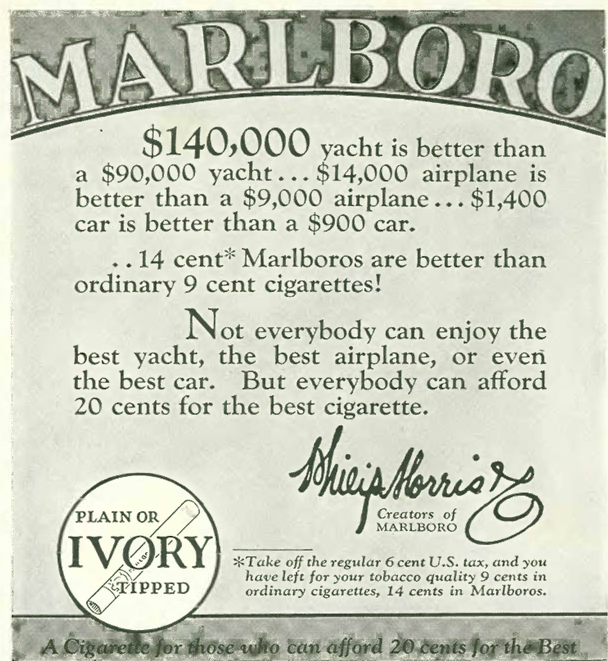
…the makers of Marlboro cigarettes abandoned their essay and penmanship contests and took another direction with their drab, back-page ads, appealing to a vague sense of status in the prospective smoker…
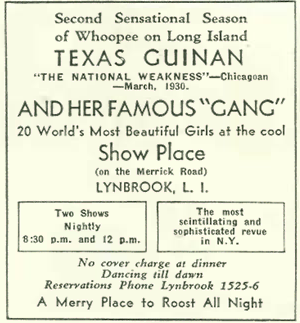
…this sad little bottom-of-the-page ad enticed readers to take a drive in the country to see Texas Guinan and her “Famous Gang” still whooping it up like it was 1925. The venture was short-lived…
…on to our cartoons, Peter Arno looked in on nightlife in the city…
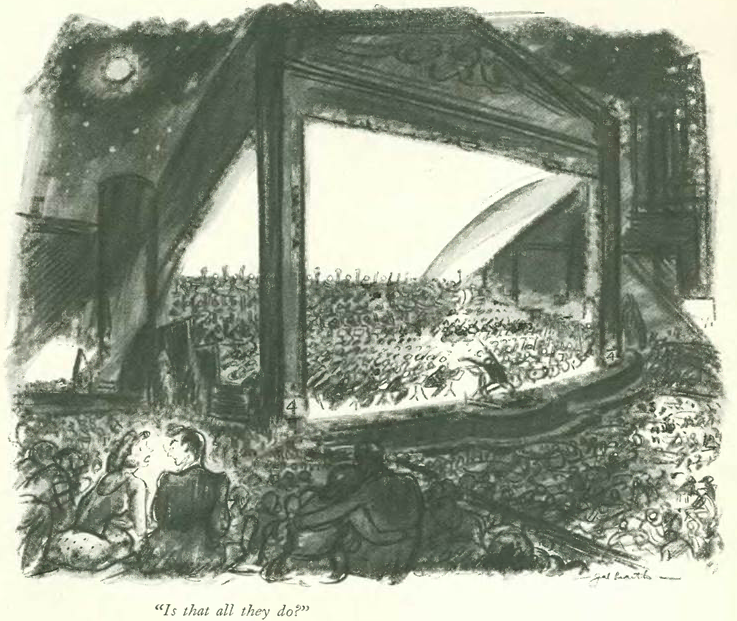
…William Crawford Galbraith took in an outdoor concert…
…Ralph Barton offered his comic skills to a glimpse of domestic life…
…Garrett Price observed some boaters on an outing that would be frowned upon today (or at least I hope so)…
…and Constantin Alajalov examined the pitfalls of modern art…
* * *
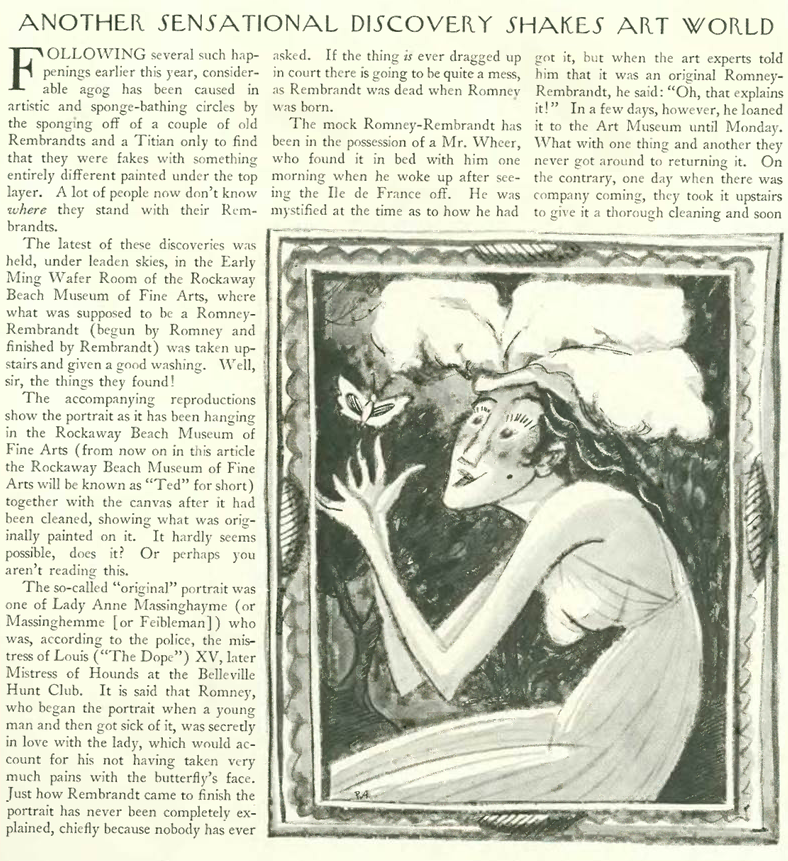
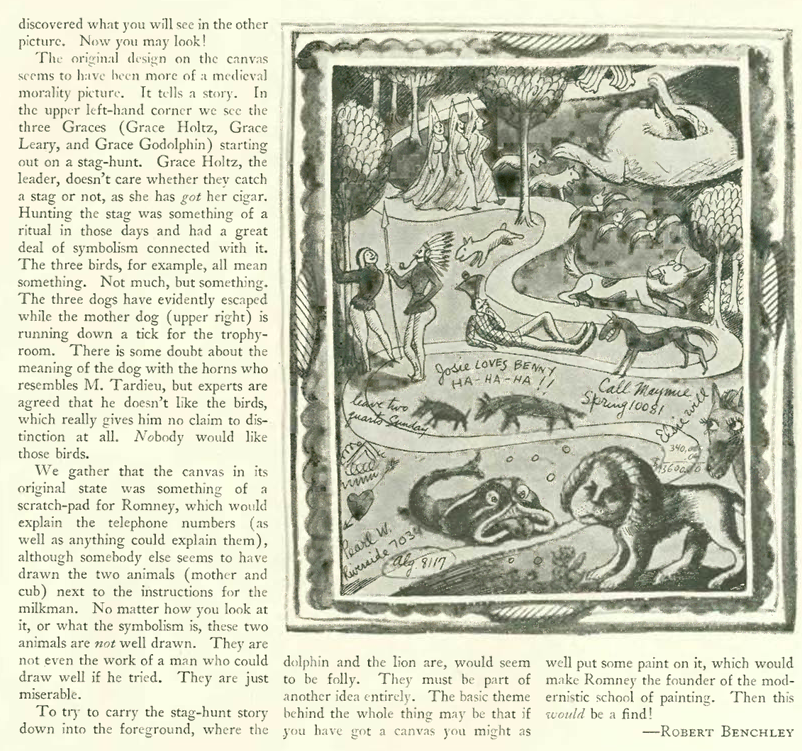
Speaking of art, we move on the Aug. 16, 1930 issue…
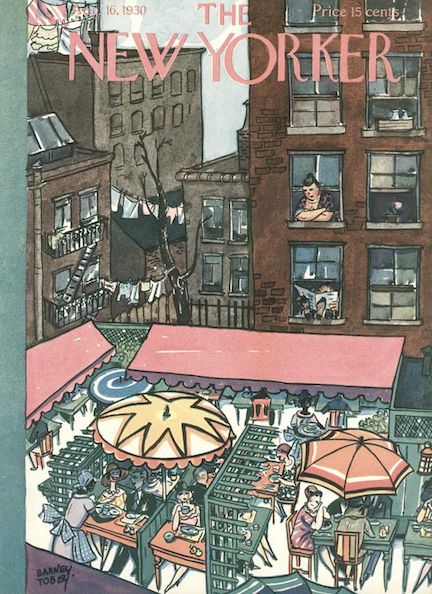
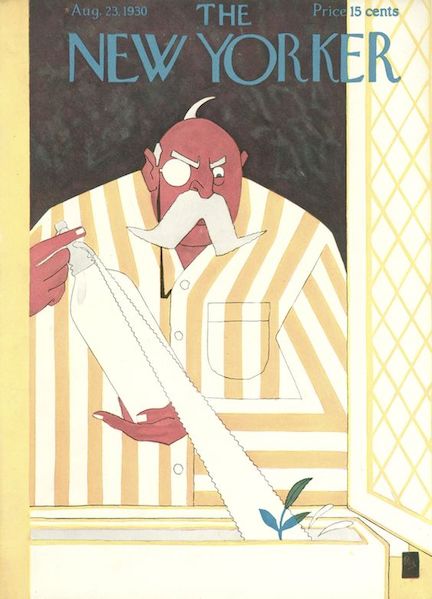
Aug. 16, 1930 cover by Barney Tobey.
…in which Robert Benchley has fun with the foibles of the art world…
* * *
Rough Riders
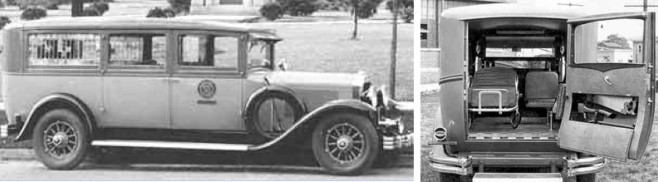
In his “Reporter at Large” column, Morris Markey looked in on the working world of one chain-smoking ambulance driver…some excerpts…
SLIDE ‘EM IN…1930s Flexible ambulance and its rather cramped interior. (coachbuilt.com)
* * *
From Our Advertisers
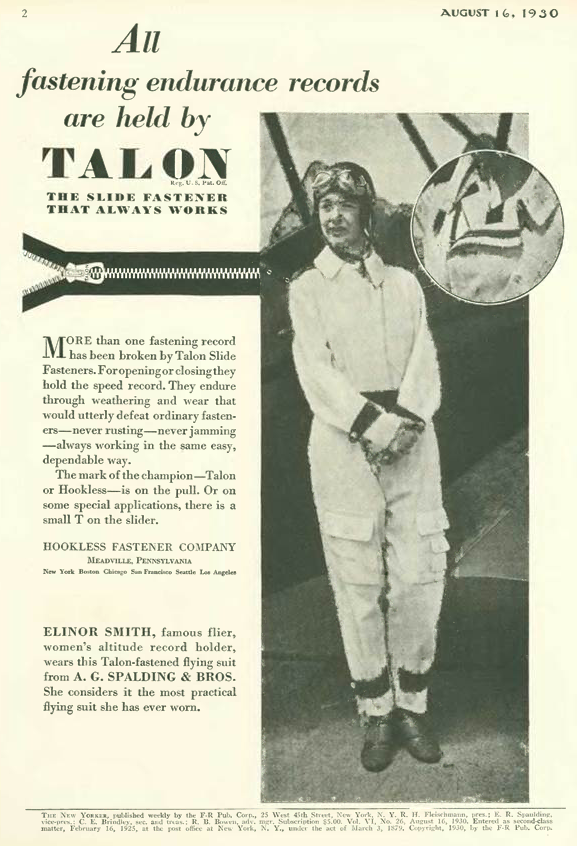
Hard to believe that zippers were a novel invention just 90 years ago…in this ad from the leading manufacturer, Talon, this “hookless” wonder was still referred to as a “slide fastener”…
…the Chrysler Corporation was never the biggest car company in America, but it was always known as a leader in both technology and design, as in these graceful lines that flowed over its new “Straight Eight” models…
…the makers of Camel cigarettes continued to push their product as a sound way to stay fit and trim…
…in the cartoons for Aug. 16, this drawing by Peter Arno appeared for the fifth time in the magazine, always with a different caption (the others appeared in three consecutive issues — June 5, 12 and 19, and on Aug. 2, 1930)…
…William Crawford Galbraith detected some wet vs. dry tension at the country club…
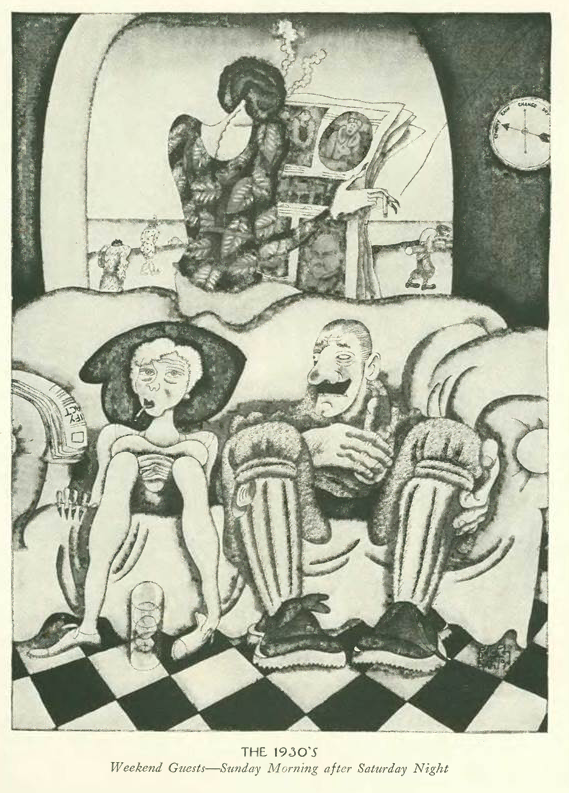
…Ralph Barton returned with another full-page illustration of a weekend domestic scene…
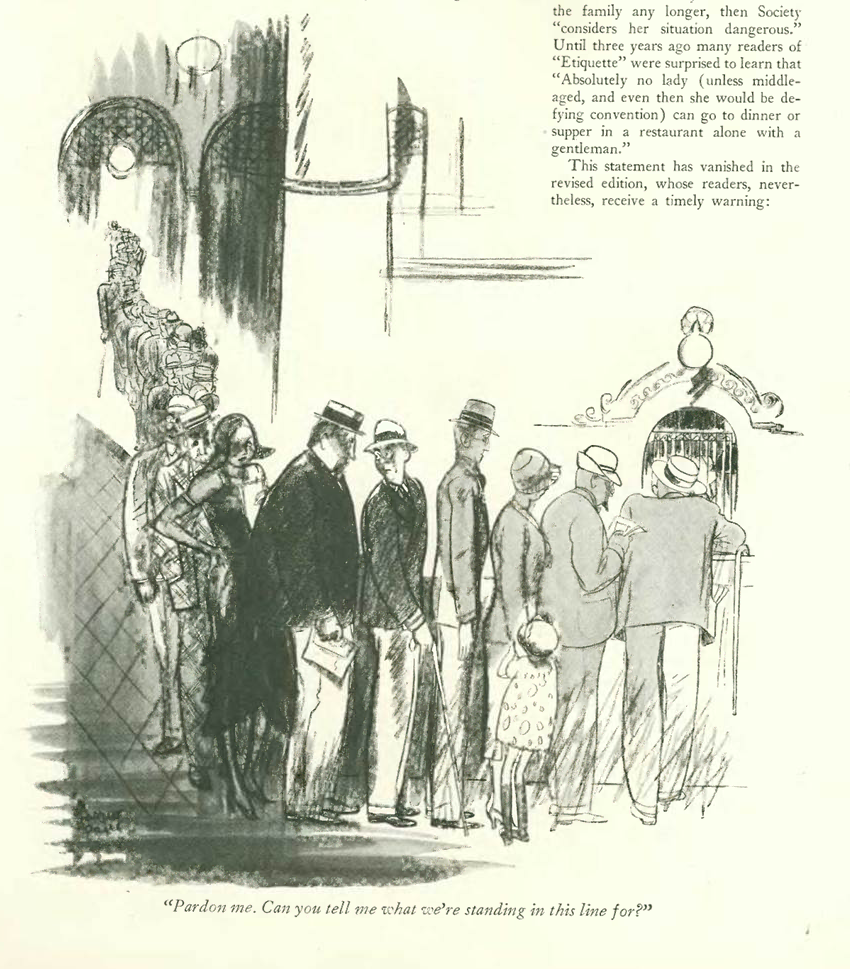
…Garrett Price found confusion in a lengthy queue…
…and Kemp Starrett gave us a bird’s eye view of a future New Yorker…
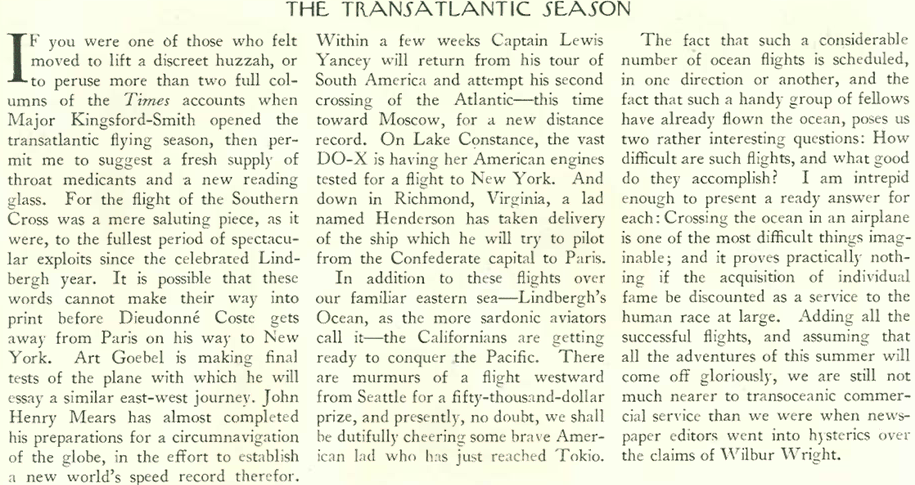
When Apollo astronauts landed on the moon fifty years ago, many skeptics asked the question, “What good does this accomplish?”
July 12, 1930 cover by Constantin Alajálov.
New Yorker writer Morris Markey posed the same question 89 years ago about transatlantic flights, then limited to a handful of daredevils chasing various speed and distance records. Crossing the ocean in an airplane, Markey observed, was “one of the most difficult things imaginable.” He concluded that despite the heroics of a few pilots, “we are still not much nearer to transoceanic commercial service…”
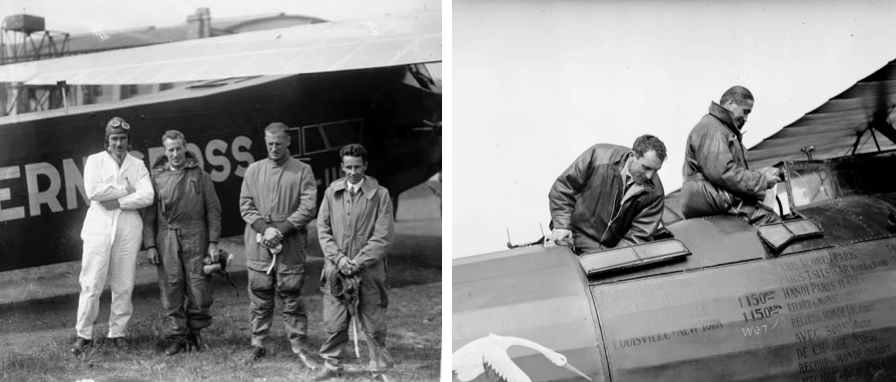
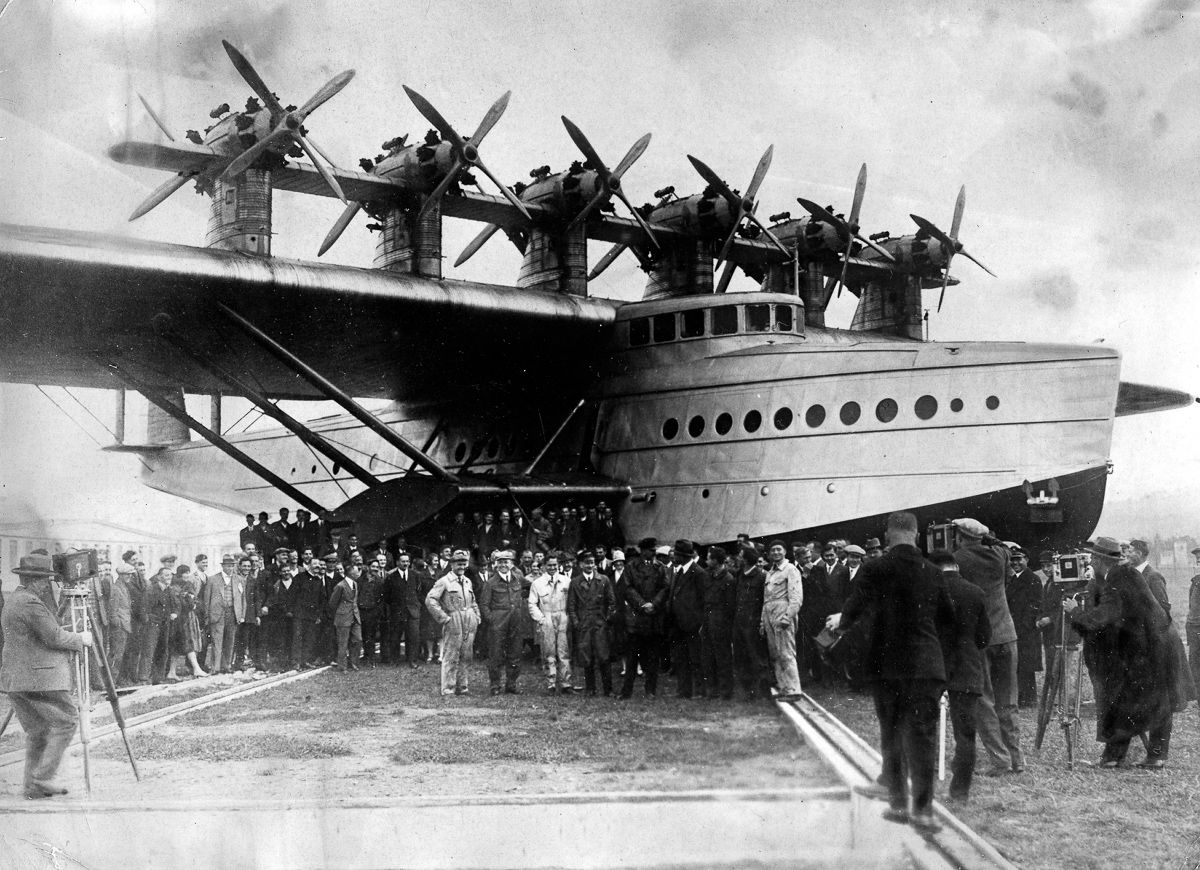
TESTING THE LIMITS…In photo at left, Charles Kingsford Smith (second from left) and the crew of his airplane, Southern Cross, pause before embarking on their east-west crossing of the Atlantic in June 1930; photo at right: Dieudonné Costes (right) with Maurice Bellonte in Boston in 1930. On September 1-2, 1930, they flew the “Point d’Interrogation” from Paris to New York, the first heavier-than-air aircraft to reach New York in the more difficult westbound direction between the North American and European mainlands. (National Library of Ireland/Wikipedia)BIG THINKERS…Germany’s massive Dornier Do-X made its first test flight on July 12, 1929. A few months later, it carried a world-record 169 passengers on a 40-minute flight, an astonishing number given that the largest planes at that time rarely carried more than 20 passengers. In 1930, the Do-X took off on an international publicity tour through Europe, down the west coast of Africa, across the Atlantic to Brazil and up to New York before returning to Berlin. (Mashable)
Markey went on to detail the various obstacles facing transatlantic fliers, including fairly good odds that a plane, laden with fuel and supplies for such a journey, would crash on takeoff. He noted that a little over half of the attempts succeeded, while the others seemed doomed from the start.
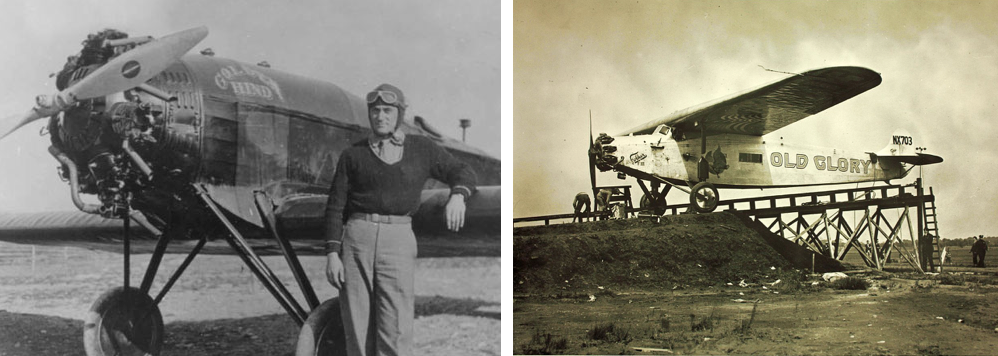
ILL-ADVISED…With only 70 hours of flying experience, Montana rancher Urban F. Diteman (left, with his airplane “Golden Hind”) took off from Harbour Grace, Newfoundland, bound for London. He was never seen again; at right, the William Randolph Hearst-sponsored “Old Glory,” a Fokker F.VIIa single-engined monoplane that was used in 1927 on an attempted transatlantic flight from Old Orchard Beach, Maine to Rome, Italy. The overloaded plane and its crew were lost approximately 700 miles east of Newfoundland, where only a section of wing was recovered. (dailymontana.com/Wikipedia)
* * *
Glare of the New
Architecture critic George Chappell enthusiastically followed the construction of the world’s tallest building, but in its completion he found the Chrysler Building’s now-iconic spire to be little more than a stunt, and suggested that a covering of masonry might be in order:
MAYBE SOME VINYL SIDING?…George Chappell wasn’t too crazy about the Chrysler’s chrome dome, and also worried about the amount of steel that would clad the exterior of the Empire State Building, right, which is composed of limestone, chrome bars and aluminum panels. (Wikipedia)
* * *
Bottoms Up
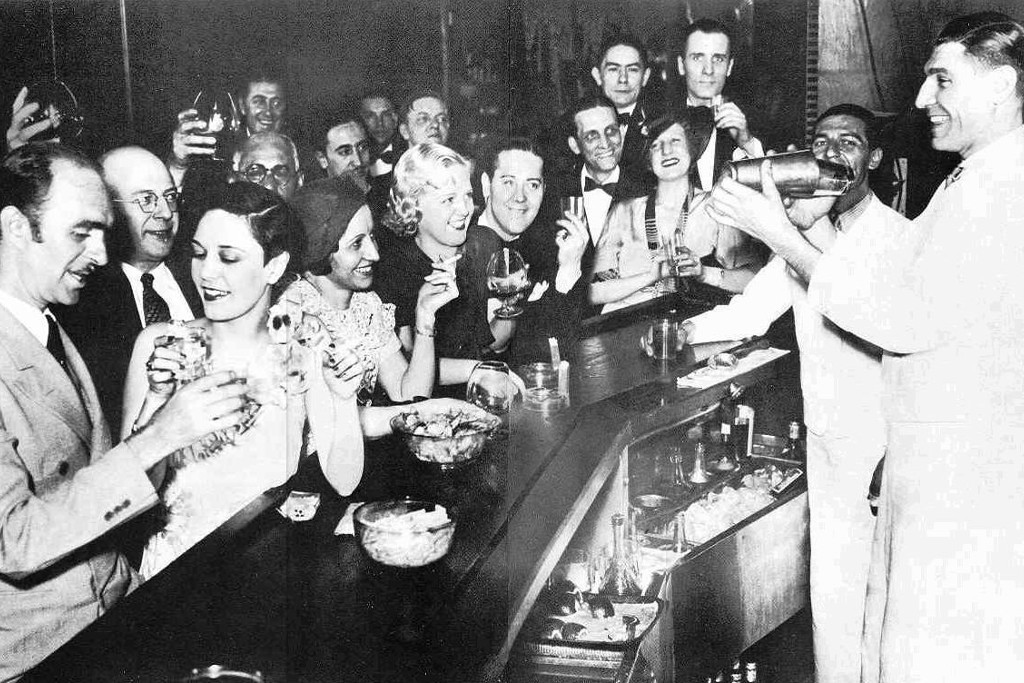
In his “Notes and Comment,” E.B. White pondered the drinking habits of his fellow citizens in the tenth year of Prohibition:
MAKE THAT A DOUBLE…Finding refreshment in the dark days of Prohibition. (junkee.com)
* * *
Good Old Summertime
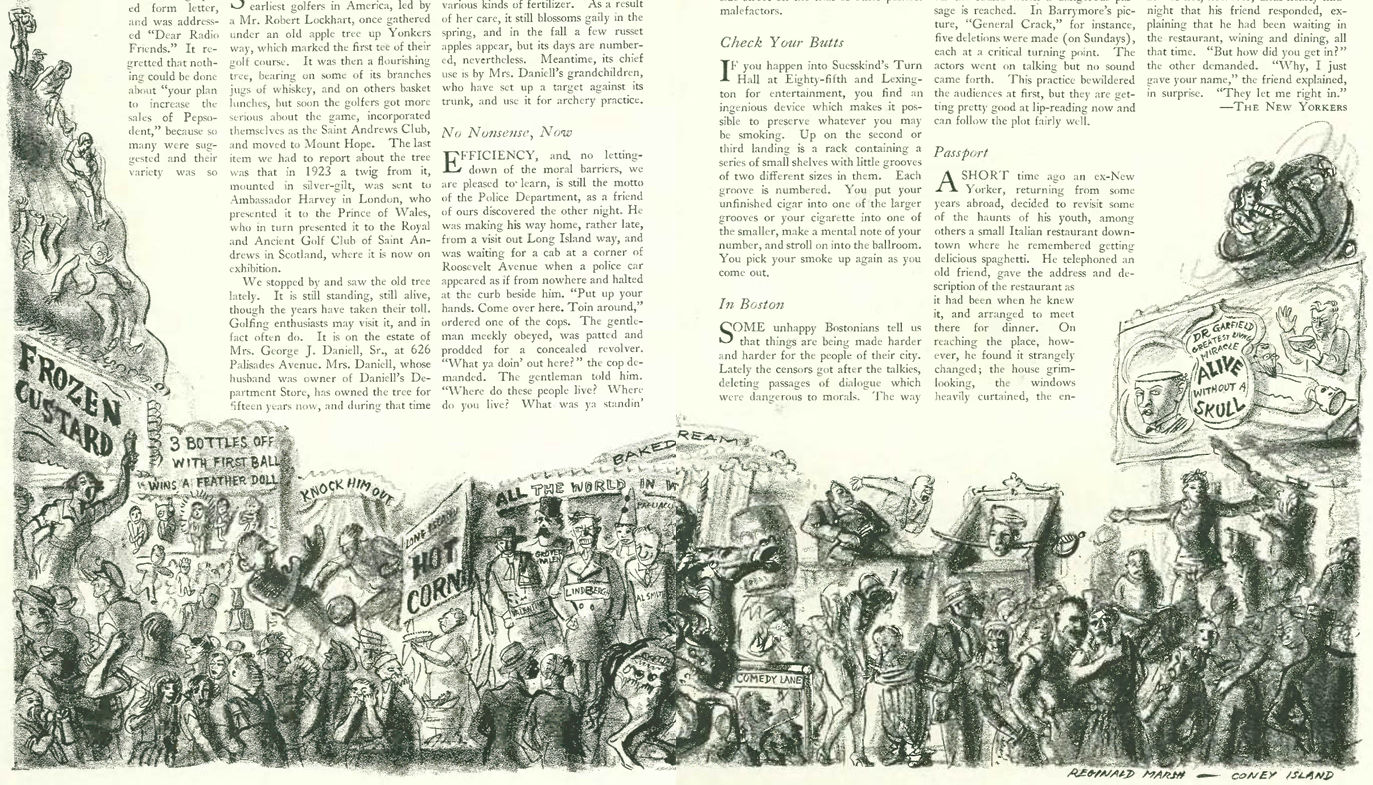
Along the bottom of “The Talk of the Town,” a Reginald Marsh interpretation of Coney Island fun and games…
* * *
Still the Same
Lois Long, who painted a picture of Jazz Age nightlife like no other in her “Tables for Two” column, teased her readers by disguising her identity, often claiming she was a frumpy old lady. With her “Tables” column now on hiatus, the fashionable and young Long maintained her pose, referring to herself as an “old war horse” in her fashion column “On and Off the Avenue.”
Problems of the Rich
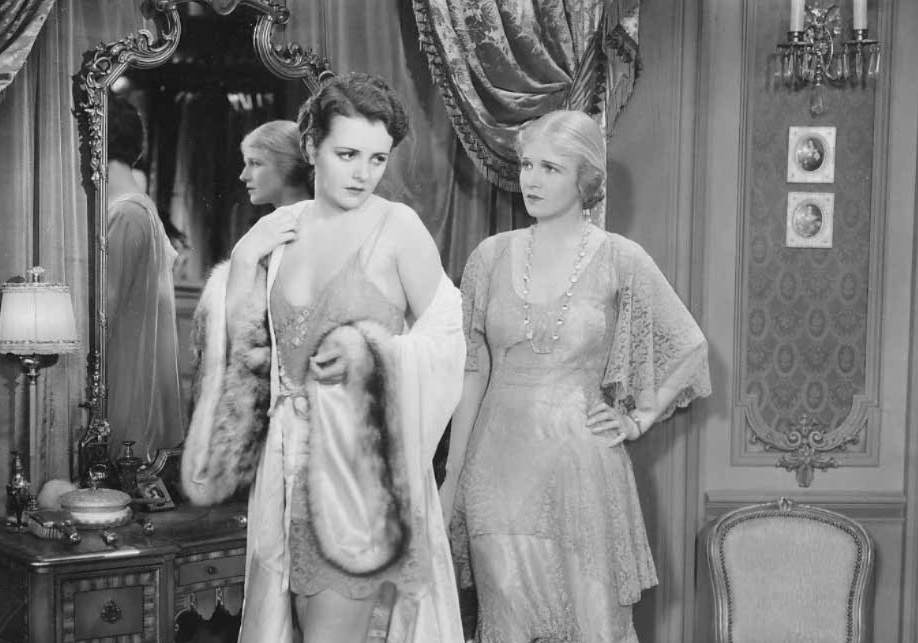
John Mosher reviewed the 1930 American Pre-Code comedy Holiday, which told the story of a young man torn between his wild lifestyle and the tradition of his wealthy fiancée’s family. Films that explored the “problems” of the rich seemed particularly popular in the Depression years…
POOR LITTLE RICH GIRLS…Mary Astor and Ann Harding in Holiday. (IMDB)
* * *
From Our Advertisers
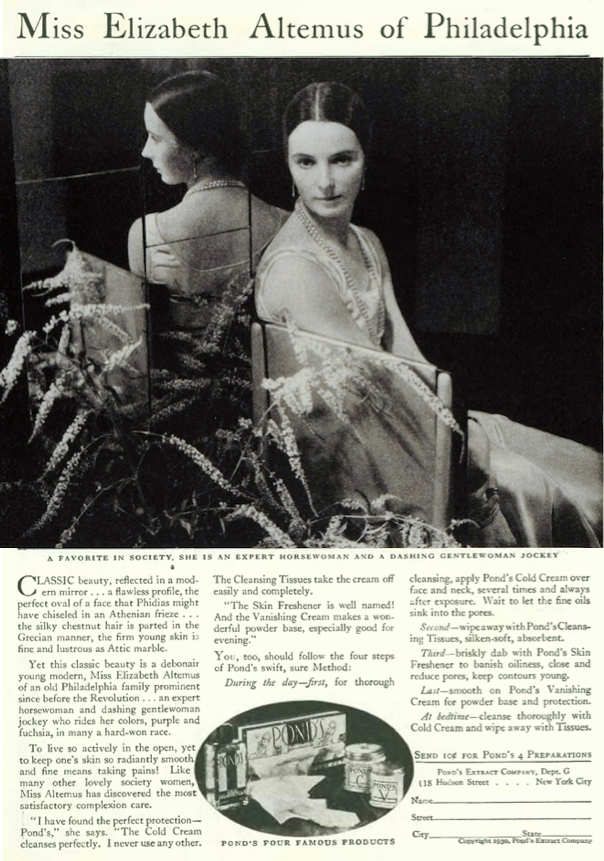
The makers of Pond’s Cold Cream continued its campaign of endorsements by society women, including Philadelphia socialite, philanthropist and champion horsewoman Elizabeth Altemus…
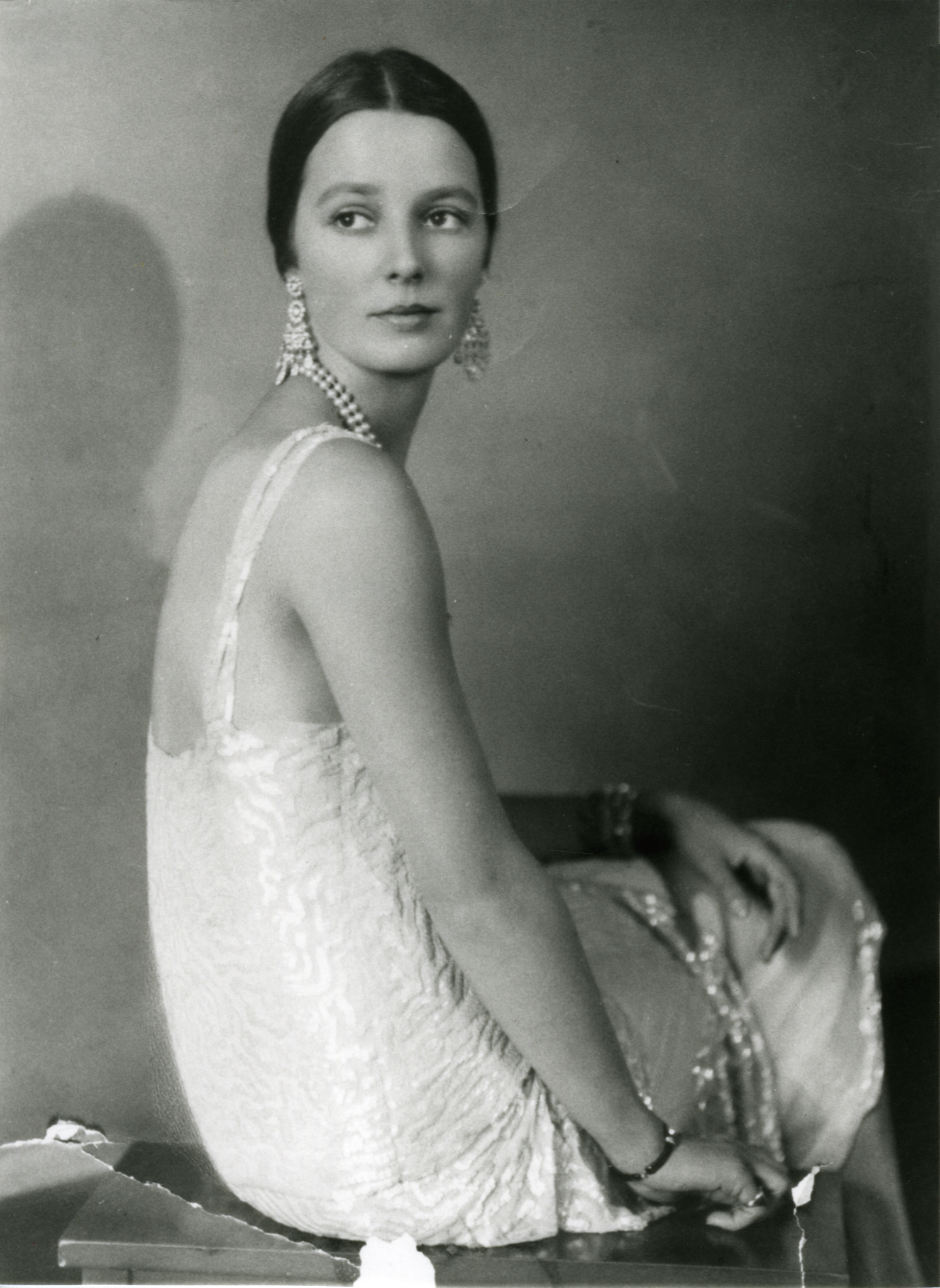
Altemus (1906-1988) was a prominent owner/breeder of Thoroughbred racehorses for more than 50 years. Her first marriage was to Jock Whitney, U.S. Ambassador to the United Kingdom, publisher of the New York Herald Tribune, and president of the Museum of Modern Art. By the looks of this 1937 portrait of Altemus, the cold cream certainly didn’t do her any harm…
Mary Elizabeth Altemus Whitney in 1937. (geni.com)
…speaking of cold cream, when Kleenex was introduced in the early 1920s, it was marketed solely as a hygienic way to remove cold cream. It wasn’t until the 1930s that the makers of Kleenex began to suggest it could also be used as a tissue in place of a handkerchief. Of course it was also a great way to dramatically expand consumption of its brand, and help usher in a new age of disposable products…
…as the Depression deepened, ads for automobiles began to change with the times, most manufacturers emphasizing the affordability of their cars over performance or prestige, as this sad little ad from Packard attested….
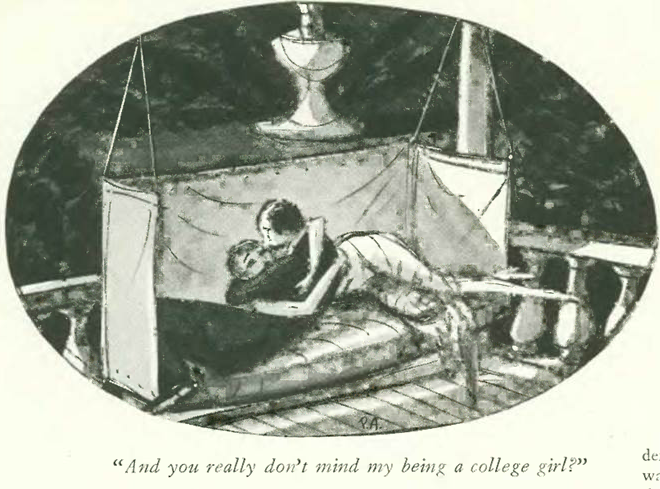
…in three consecutive issues (June 5, 12 and 19) Peter Arno featured the same drawing with a different caption that gave readers a very brief courtship story…
…Alan Dunn offered a glimpse of life among the newsboys…
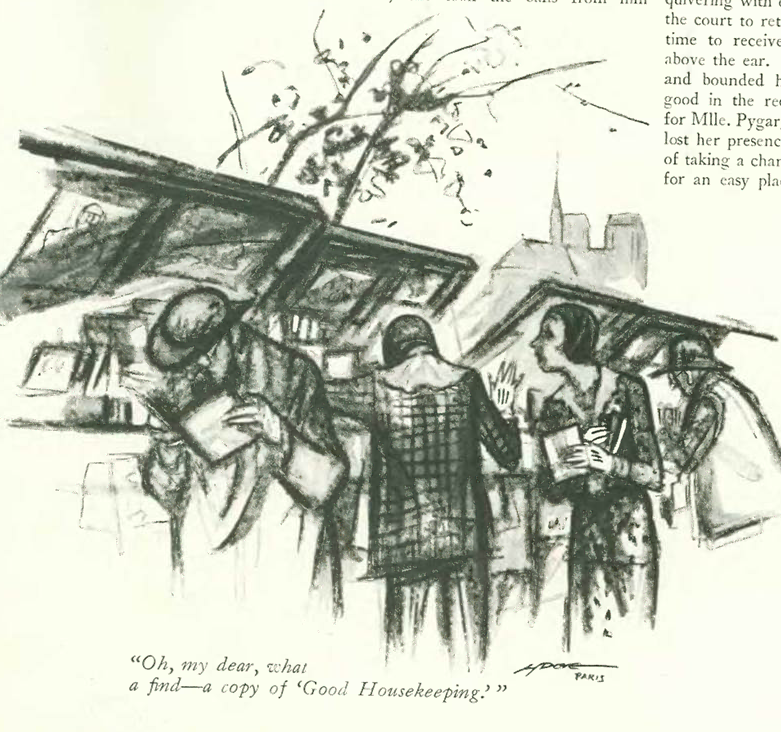
…Leonard Dove found Americans browsing newsstands along the Seine…
…Helen Hokinson looked in on an existential crisis…
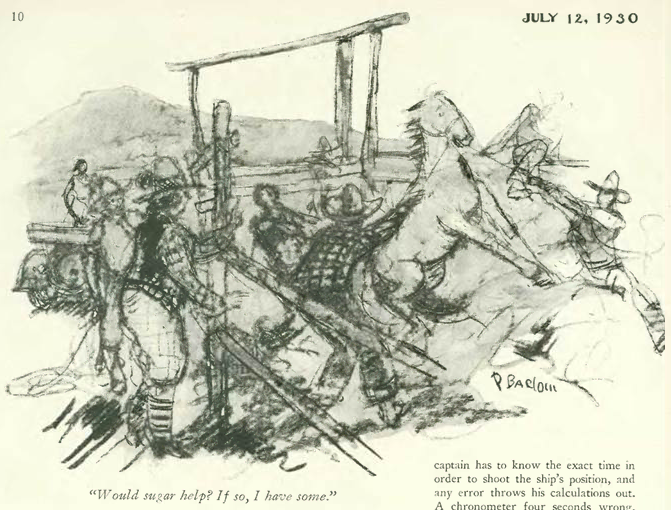
…Perry Barlow was Out West at a dude ranch…
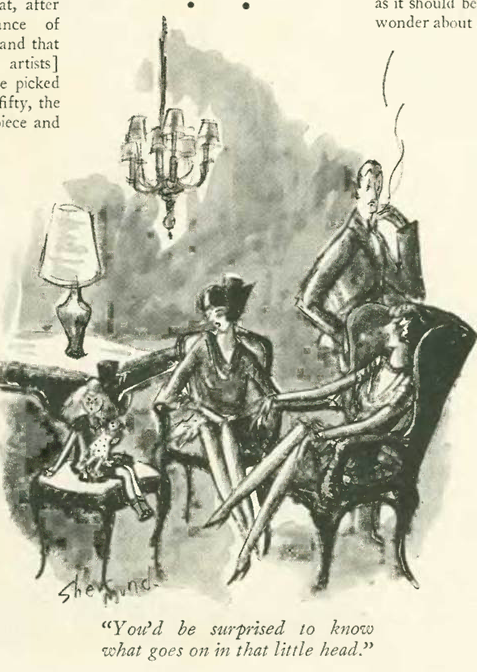
…Barbara Shermund eavesdropped on a couple of debs…
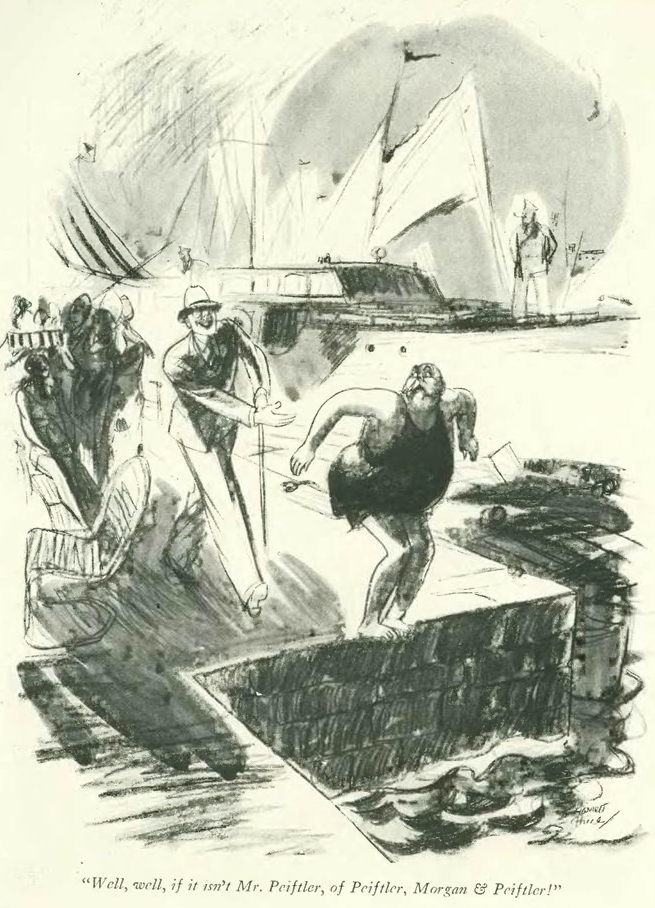
…Garrett Price gave us an awkward encounter among the yachting crowd…
…and finally William Crawford Galbraith, and a case of domesticus interruptus…
Like his New Yorker colleague Reginald Marsh, Otto Soglow trained in the “Ashcan School” of American art, and his early illustrations favored its gritty urban realism. He had his own life experience to draw upon, being born to modest means in the Yorkville district of Manhattan.
We look at two issues this week. At left, cover of March 31 issue by Peter Arno; at right, June 7 cover by Constantin Alajalov.
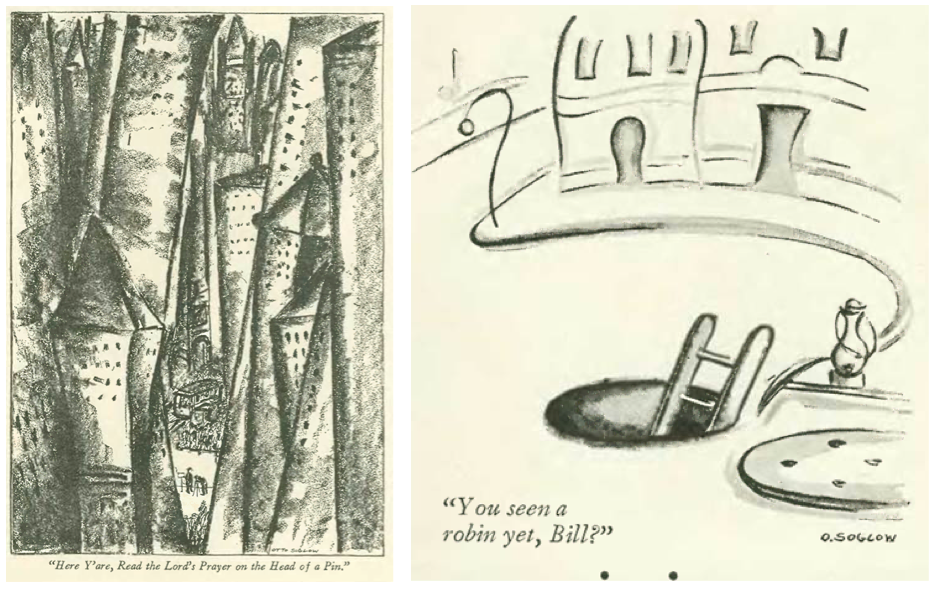
But Soglow (1900-1975) would soon abandon the gritty style in the work he contributed to the New Yorker…
RAGS TO RICHES…At left, Otto Soglow’s first cartoon in The New Yorker, Nov. 14, 1925, was rendered in the Ashcan style ; at right, an example of the sparer style he later adopted, one of his manhole series cartoons from March 2, 1929.
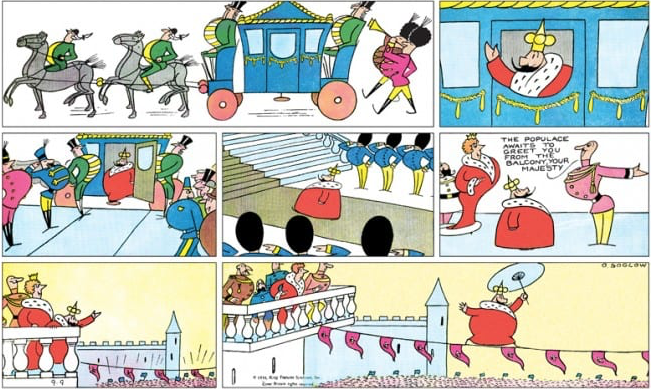
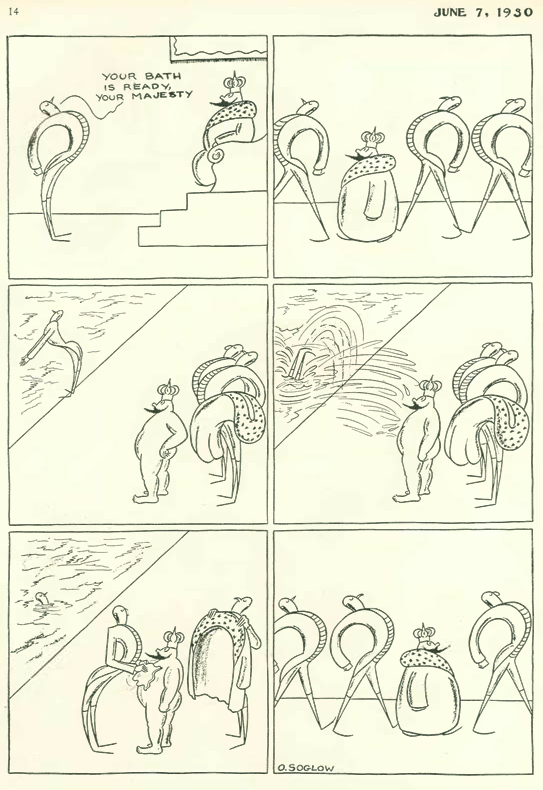
…and in the June 7, 1930 issue, Soglow would publish his first Little King strip, which would launch the 29-year-old into fame and fortune…
Did Soglow know he was on to something big with that first Little King cartoon? Well Harold Ross (New Yorker founding editor) liked what he saw, and asked Soglow to produce more. After building up an inventory over nearly ten months, Ross finally published a second Little King strip on March 14, 1931. It soon became a hit, catching the attention of William Randolph Hearst, who wanted the strip for his King Features Syndicate.
KING OF COMEDY…Otto Soglow working on an illustration for The Ambassador, a short-lived comic strip he created in 1933 for King Features Syndicate. The strip was replaced by The Little King in 1934 after Soglow fulfilled his contractual obligation to The New Yorker. (comicartfans.com)
After Soglow fulfilled his contractural obligation to The New Yorker, The Little King made its move to King Features on Sept. 9, 1934, and the strip ran until Soglow’s death in 1975. After his move to King Features, Soglow continued to contribute cartoons to The New Yorker, but with other themes.
Left, Soglow cartoon from the book Wasn’t the Depression Terrible? (1934); at right, King Features strip from Nov. 19, 1967. (Wikipedia/tcj.com)
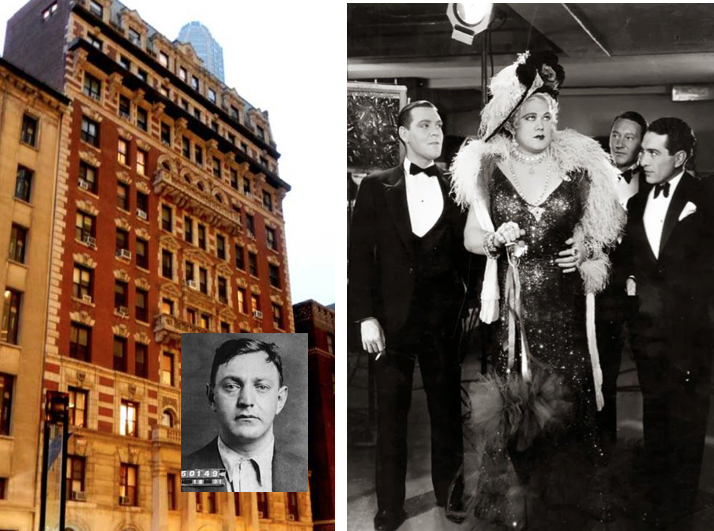
During the summer of 1925, a young writer at Vanity Fair named Lois Long would take over The New Yorker’s nightlife column, “When Nights Are Bold,” rename it “Tables For Two,” and set about giving a voice to the fledgling magazine as well as chronicling the city’s Jazz Age nightlife. There were accounts of Broadway actors mingling with flappers and millionaires at nightclubs and speakeasies, but Long also spoke out on issues such as Prohibition, taking the city’s leaders to task for raids on speakeasies and other heavy-handed tactics contrary to the spirit of the times. “Tables For Two” would go on hiatus with the June 7, 1930 issue, and appropriately so, as the deepening Depression gave the the city a decidedly different vibe. In her “final” column Long would write about the Club Abbey, a gay speakeasy operated by mobster Dutch Schultz…
PARTIED OUT…In her final nightlife column, Lois Long wrote about the new Club Abbey in the basement of the Hotel Harding (left), which was operated by mobster Dutch Schultz (inset). The club’s emcee was Gene Malin (right), Broadway’s first openly gay drag performer. The club was short-lived (as were Schultz and Malin), closing in January 1931 following a mob brawl. (infamousnewyork.com/Pinterest)
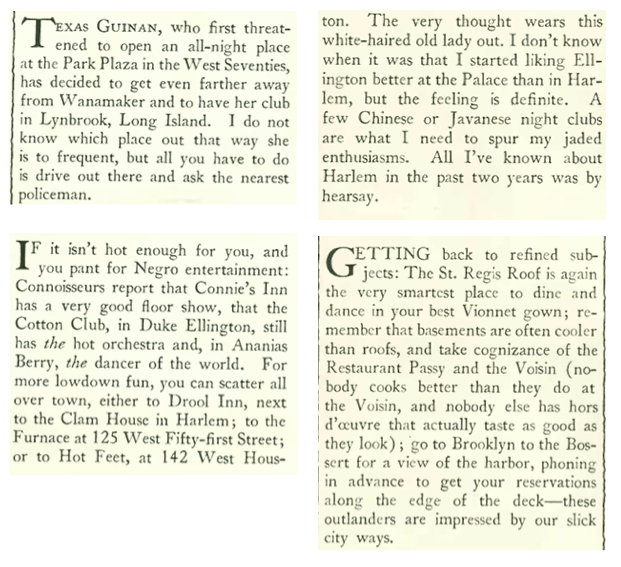
…and she would update her readers on “Queen of the Night Clubs” Texas Guinan, whose Club Intime was sold to Dutch Schultz and replaced by his Club Abbey…
FINAL ACT…Clockwise, from top left, Texas Guinan at Lynbrook, circa 1930; Joseph Urban murals on the rooftop of the St. Regis Hotel; Duke Ellington and his orchestra at the Cotton Club, circa 1930s.
Long’s column would signal a definitive end to whatever remained of the Roaring Twenties. It would also signal the end to some of those associated with those heady times. Texas Guinan’s Lynbrook plans would flop, and Gene Malin’s Club Abbey would close in less than a year. Both would both be dead by 1933—Malin would die in a car accident in 1933, and amoebic dysentery would claim Guinan that same year. Dutch Schultz would be gunned down by gangsters in 1935.
Lois Long, however, would continue to write for The New Yorker for another forty years, and would prove to be as innovative in her fashion column, “On and Off the Avenue,” as she was as a nightlife correspondent.
* * *
Gone to the Dogs
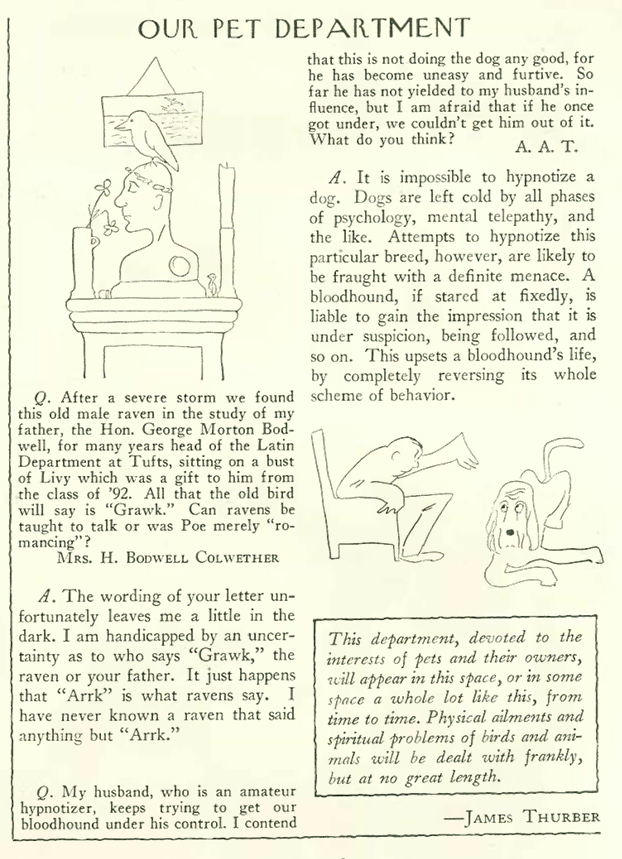
In another installment of his pet advice column (June 7), James Thurber gave us one of his classic dogs…a disinterested bloodhound…
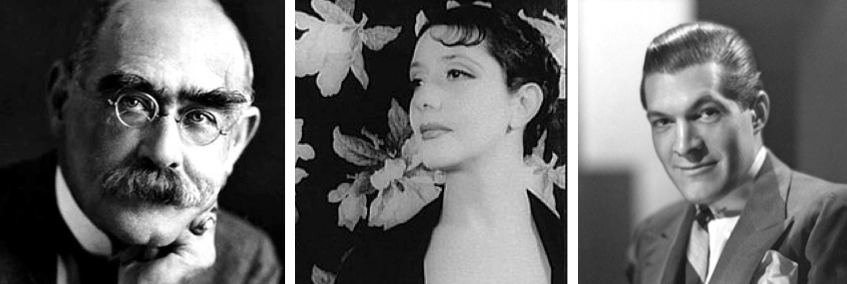
…while Thurber’s buddy and office mate E.B. White commented (in the March 31 issue) on a recent poll conducted among students at Princeton, discovering among other things that New Yorker cartoonist Peter Arno was preferred over the old masters…
FAN FAVORITES…The Princeton Class of 1930 named (from left) Rudyard Kipling, Lynn Fontanne and Peter Arno as favorite poet, actress and artist respectively in a student poll. (YouTube/Wikipedia/giam.typepad.com)
* * *
We Like It Fine, Thank You
The New Yorker dedicated a full page of the March 31 issue to a tongue-in-cheek rebuttal directed at the New York Evening Journal, which had reprinted one of Peter Arno’s cartoons to illustrate the moral cost of Prohibition. I believe the author of the rebuttal is E.B. White (note how he refers to Arno as “Mr. Aloe”).
…also in the May 31 issue, Rea Irvin changed things up, at least temporarily, with some new artwork for the “Goings On About Town” section. The entries themselves were often clever, such as this listing for a radio broadcast: PRESIDENT HOOVER—Gettysburg speech. Similar to Lincoln’s but less timely…
* * *
From Our Advertisers
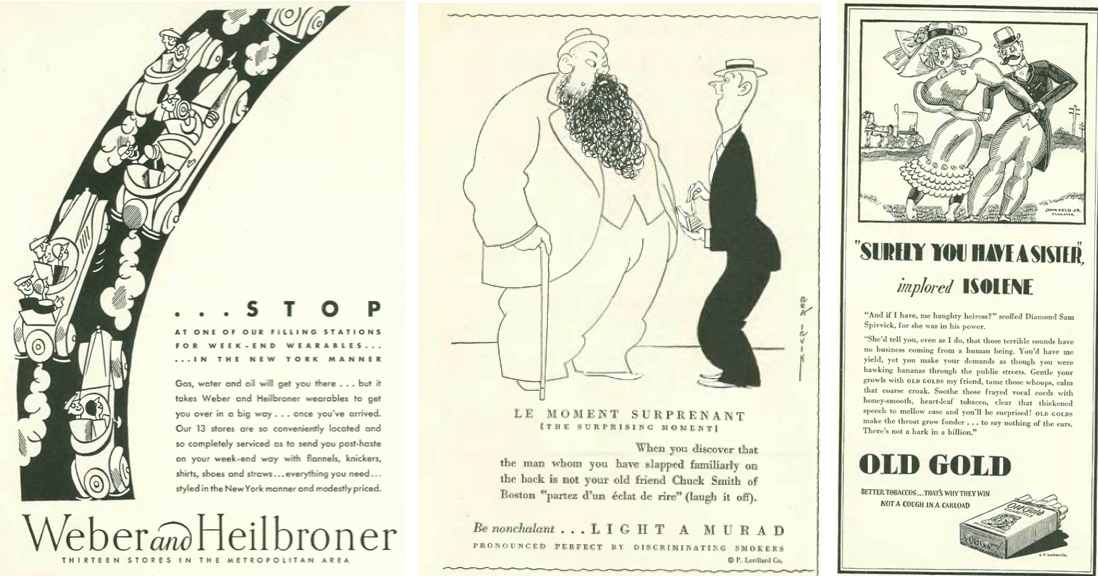
New Yorker cartoonists can be found throughout the advertisements — from left, Julian De Miskey, Rea Irvin and John Held, Jr…
…and in the June 7 issue we find an unusual ad for a used car…a sign of the times, no doubt…
…before it was associated with Germany’s Nazi Party (especially after it seized power in 1933), for thousands of years the swastika had been widely used as a religious or good luck symbol…
…Actress Clara Bow was famously pictured sporting a “good luck” swastika as a fashion statement in this press photo from June 1928, unaware that in a few years the symbol would become universally associated with hate, death and war…
From an unidentified publication dated June 6, 1928. (@JoHedwig/Twitter)
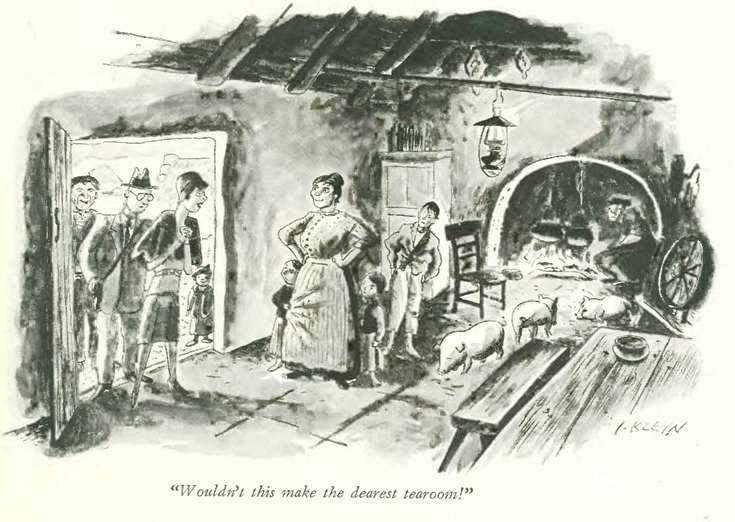
…on to our cartoons, Isadore Klein illustrated a cultural exchange…
…Garrett Price gauged the pain of a plutocrat…
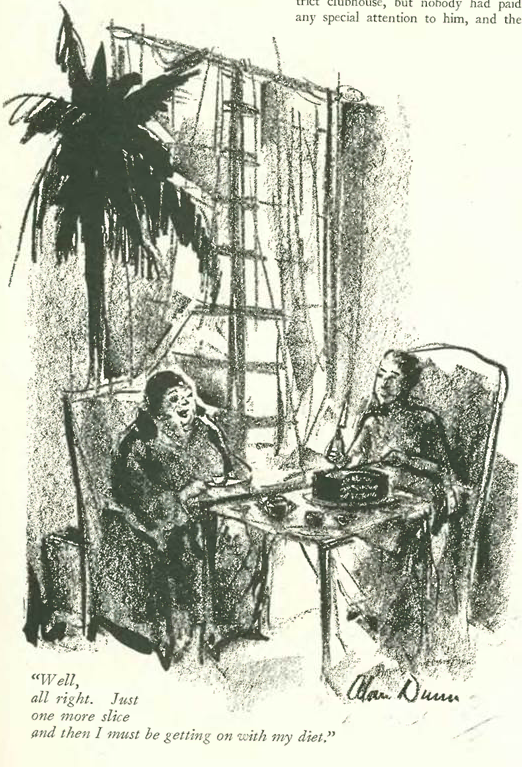
…Alan Dunn eavesdropped on some just desserts…
…Helen Hokinson found humor in the mouths of babes…
…as did Alice Harvey…
…Leonard Dove examined one woman’s dilemma at a passport office…
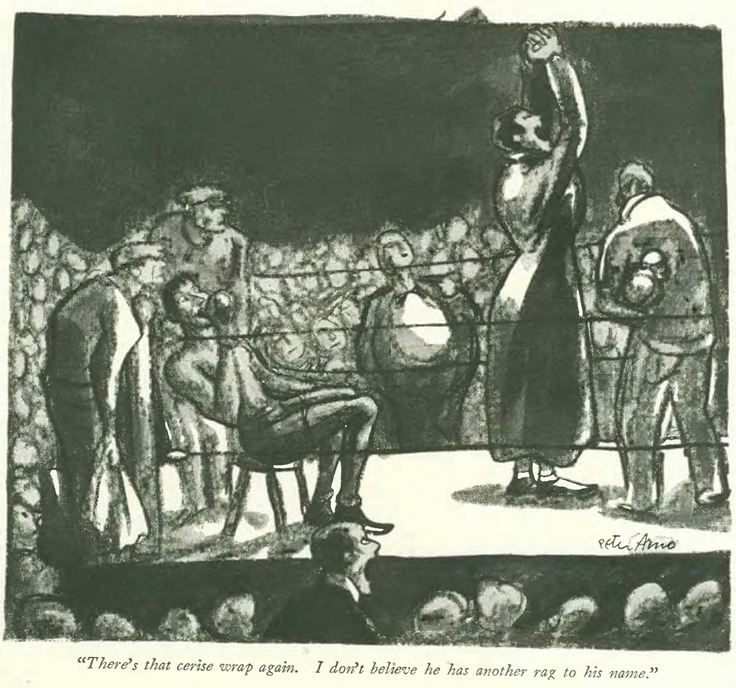
…and Peter Arno, who found some cattiness at ringside…
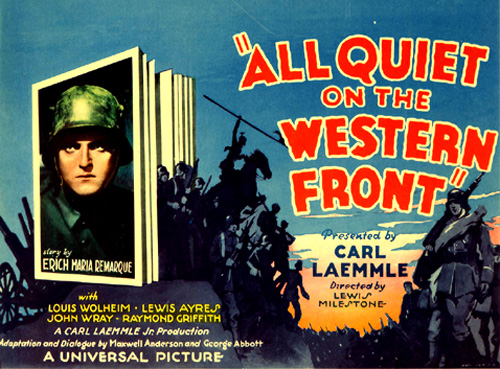
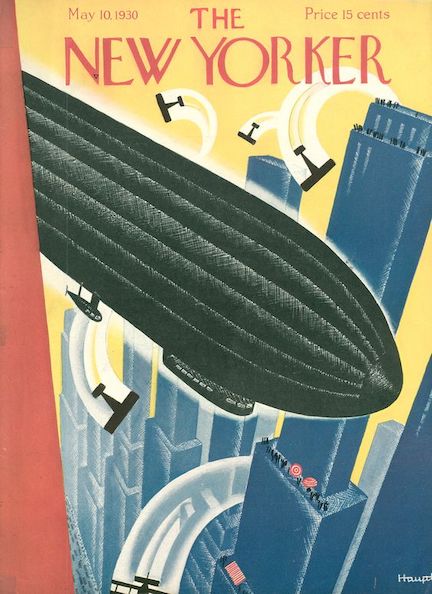
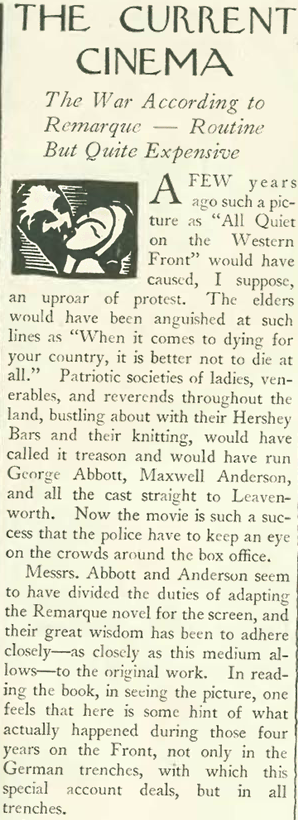
Still considered one of the greatest anti-war films ever made, All Quiet on the Western Front opened in New York on April 29, 1930 to strong reviews. Based on Erich Maria Remarque’s novel of the same name, the film’s depictions of the horrors of war were so realistic and harrowing that it was banned in a number of countries outside of the U.S.
May 10, 1930 cover by Theodore Haupt.
Banned, that is, by nations gearing up for war. In Germany, Nazi brownshirts disrupted viewings during its brief run in that country, tossing smoke bombs into cinemas among other acts of mayhem. Back in the U.S., The New Yorker’sJohn Mosher attended a screening at a “packed” Central Theatre:
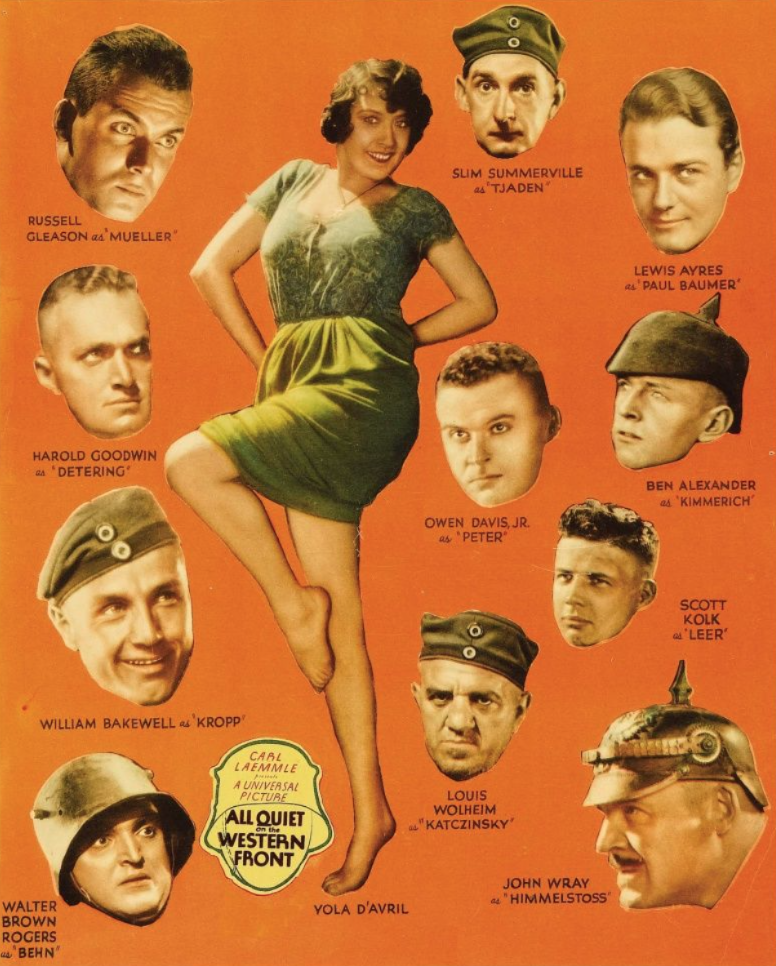
WAR IS HELL…Clockwise, from top left, movie poster for 1930’s All Quiet on the Western Front; German soldier Paul Bäumer (Lew Ayres), falls into a shell crater with a French soldier and draws his knife; in one of the most moving scenes in cinema, Bäumer is forced to spend the night in the crater, where he vainly tries to safe the life of the Frenchman he has mortally wounded; a German soldier crawls through the mud in a German training camp. (IMDB/Universal).
Mosher found the film’s adaption from the novel wanting in places, but overall praised the acting and the quality of the picture…
…and just in case some audiences were put off by the blood and guts, Universal promoted other themes on its lobby cards…
(IMDB)
* * *
More Than a Stunt
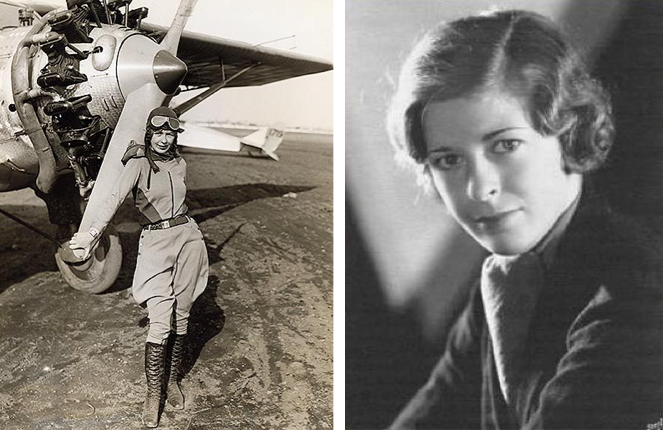
In her profile of aviator Elinor Smith (1911-2010), writer Helena Huntington Smith took great pains to distinguish Elinor from other “lady fliers” who were little more than passengers in various flying exploits. Like Amelia Earhart, Smith had the bona fides of a true aviator: in 1927 she become the youngest licensed pilot in the world at age 16, learning stunt flying at an early age. When she was 17 she smashed the women’s flying endurance record by soloing 26½ hours, and in the following month set a woman’s world speed record of 190.8 miles per hour. In March 1930 she set a women’s world altitude record of 27,419 feet (8,357 m), breaking that record in 1931 with a flight reaching 32,576 feet. Smith would continue to fly well into old age. In 2000 she flew NASA’s Space Shuttle vertical motion simulator and became the oldest pilot to succeed in a simulated shuttle landing. In 2001 (at age 89) she would pilot an experimental flight at Langley AFB. An excerpt from the profile:
HEAD IN THE CLOUDS…Elinor Smith’s flying career would extend from age 16 and into her 90s. At left, Smith poses in Long Island with the Bellanca monoplane she used to beat the solo flight record in 1929. Right, portrait of Smith circa 1930s. (findagrave.com)
* * *
I’d Rather Be in Philadelphia
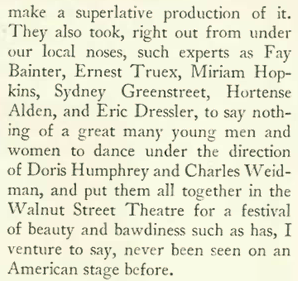
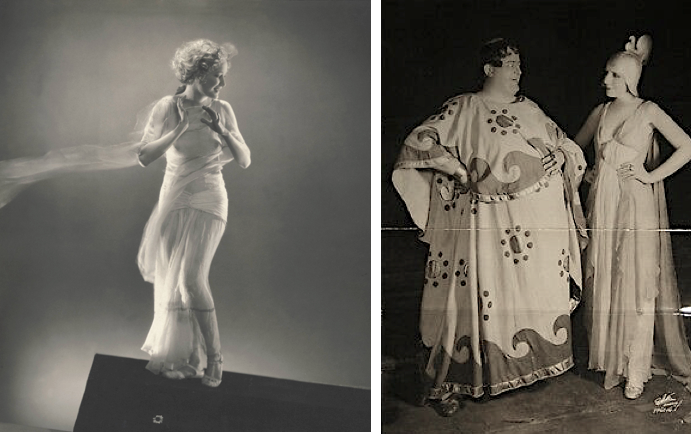
Theatre critic Robert Benchley was over the moon regarding a performance of Lysistrata staged by the Philadelphia Theatre Association. Benchley suggested the Philadelphians had “put New York to shame” in staging such a “festival of beauty and bawdiness…never seen on an American stage before.”
NO MORE HANKY PANKY…Left, actress Miriam Hopkins in Aristophanes’ Lysistrata, as photographed by Edward Steichen; at right, Sydney Greenstreet with unidentified actress from the 1930 Philadelphia production of Lysistrata. (timeline.com)
Benchley praised the seemingly advanced tastes of Philadelphia audiences as he continued to the lament the fact that the City of Brotherly Love had beaten New York to the punch with the staging of the play. He needn’t have worried much longer; the play would open on Broadway on June 5, 1930, at the 44th Street Theatre.
LOVER COME BACK…Production photograph for Norman-Bel Geddes’s staging for Lysistrata, titled “the women of Greece return to their men.” (hrc.utexas.edu)
While we are on the subject of theater, Constantin Alajálov provided this lovely illustration of Anton Chekhov’sUncle Vanya for The New Yorker’s theater review section…
* * *
Make ‘Em Dance, Boys
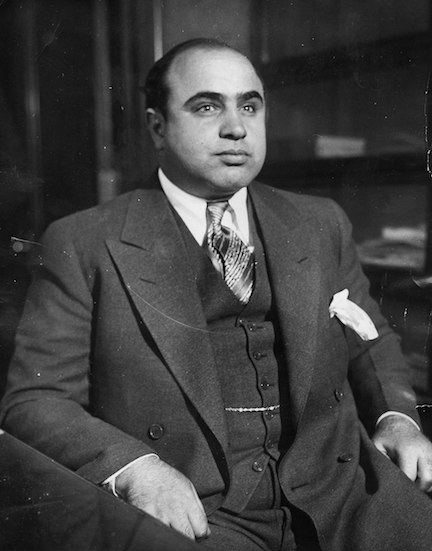
The author Robert Wilder contributed this interesting casual about the appearance of gangster Al Capone at a Chicago nightclub. Excerpts:
LIGHT ON HIS FEET…Al Capone in 1930. (Wikipedia)
* * *
You Say You Want a Revolution?
Alva Johnston offered his thoughts on how America could stage its own “Red Revolution,” given that Russia and several European countries had already experienced communist uprisings of their own, and also given that New York Police Commissioner Grover Whalen, always in search of problems that didn’t exist, had announced a new “Red Scare” in his fight against communism.
Tongue firmly in cheek, Johnston suggested how American know-how could be brought to bear in inciting a Red Terror. An excerpt:
YANKEE INGENUITY…Alva Johnston, left, offered some innovative ideas for a uniquely American “Red Revolution.” At right, soldiers stand behind a barricade during Germany’s communist Spartacist uprising of January 1919. (Wikipedia)
* * *
Speaking of Revolutionaries
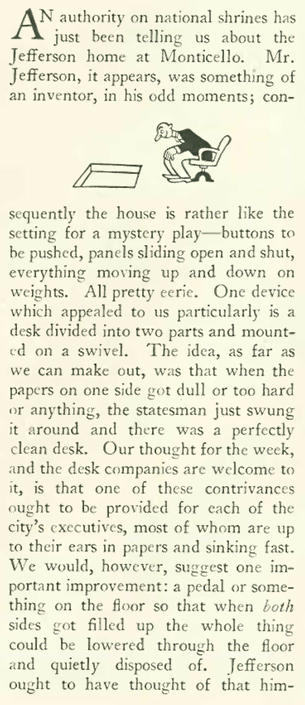
Thomas Jefferson’s home at Monticello is one of America’s most-visited historical sites, but in 1930 it was still something of a regional curiosity, having only been acquired in 1923 for the purposes of turning it into a public museum. Although Jefferson is well known today for his various inventions at Monticello, E.B. White was just learning about this side of the president in his weekly “Notes and Comment” dispatch:
THIS OLD HOUSE…Left, a combination of neglect and Civil War vandalism left Thomas Jefferson’s Monticello enmeshed in weeds and in a state of near collapse by the 1870s. At right, students of the University of Virginia pose outside Monticello in 1930. (UVA/Hulton Archive)
* * *
Play Ball?
We are well into the spring of 1930, yet The New Yorker stood firm in its complete lack of baseball coverage. As I’ve noted before, the magazine covered virtually every sport from horse racing to rowing to badminton, and even lowered itself to regular features on college football and professional hockey, but not a line on baseball, save for an occasional note about the antics of Babe Ruth or the homespun goodness of Lou Gehrig. There were signs, however, that baseball was being played in a city blessed with three major league teams; we do find game times in the “Goings On About Town” section, as well as occasional baseball-themed filler art, and a comic panel in the May 10 issue by Leonard Dove:
From Our Advertisers
We begin with an endorsement for Chase & Sanborn coffee by the soprano Alma Gluck, wife of famed violinist and composer Efrem Zimbalist Sr. Originally I thought she was enjoying coffee with a sister in law named “Mrs. Zimbalist,” but as reader Frank Wilhoit astutely points out, the “Alma Gluck” (celebrity) and “Mrs. Zimbalist” (housewife) are alternate personae of the same individual. And now that I look at the ad again, the clothes and hair styles are identical. I will try to locate a clearer image of the ad…
…and from the makers of White Rock we have a group of swells and their airborne friends enjoying some bubbles that are doubtless mixed with illegal hootch…
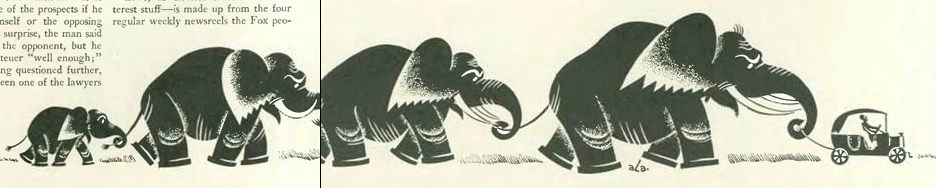
…Dr. Seuss continued to offer his artistry on behalf of Flit insecticide…
…and on to our cartoons, Peter Arno illustrated the hazards of the road…
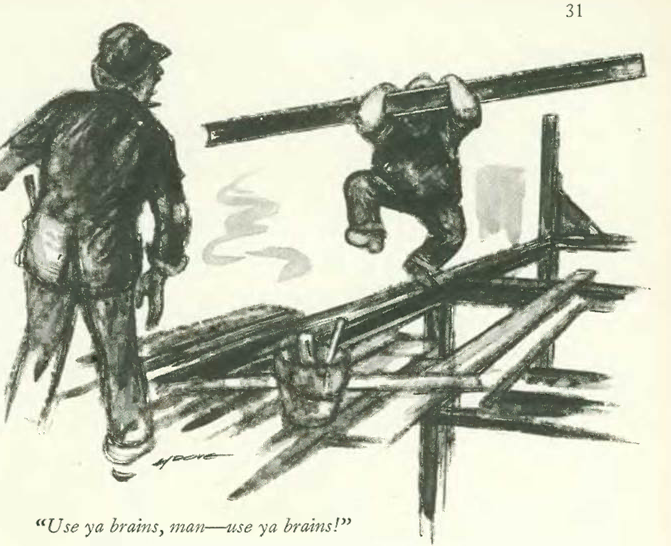
…while Leonard Dove explored the hazards high above the streets of Manhattan…
…Constantin Alajálov explored an odd encounter in a park…
…Isadore Klein mused on the tricks of mass transit…
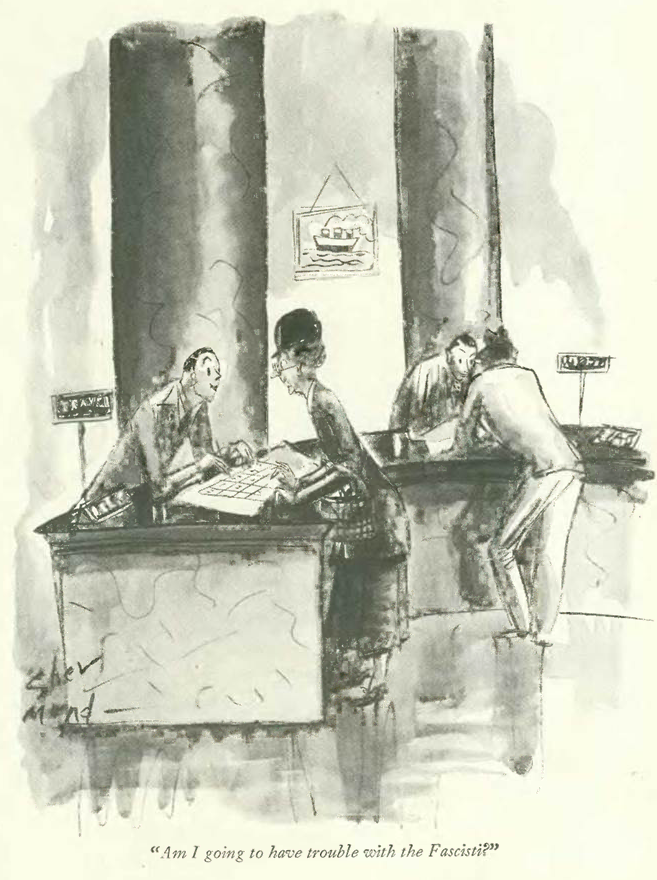
…and two from Barbara Shermund, who looked in on one tourist’s plans for a trip to Mussolini’s Italy…
For nearly 100 years, giant steam locomotives (and later diesels) rumbled through the streets of Manhattan’s West Side, serving warehouses and industries via a route known as “Death Avenue.”
Jan. 18, 1930 cover by Constantin Alajalov (who apparently had just visited St. Moritz, home of the 1928 Winter Olympics).
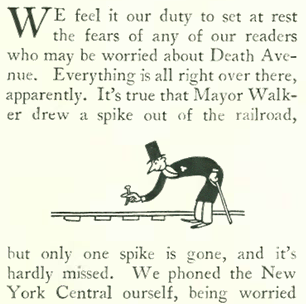
Beginning in 1846, freight trains began operating at street level along 10th, 11th and 12th avenues. When mixed with an ever-growing crush of pedestrians, wagons, cars and trucks — hundreds were killed or mutilated, many of them schoolchildren. One of these streets, 10th Avenue, earned the moniker “Death Avenue” for its large share of fatalities. Although protests over the unsafe rail lines had been going on for decades, it wasn’t until 1929 that an agreement was reached to build an elevated rail system (which is now the popular High Line elevated park). In late December 1929 Mayor Jimmy Walker pried out the first spike at 11th Avenue and 60th Street. In “Notes and Comment,” E.B. White wryly observed:
GOOD OLD DAYS…Freight trains were introduced to the west side warehouse district in 1846. Block-long trains would run through cross streets and congested traffic, maiming and killing along the way (image at left circa 1920). At some point in the late 19th century trains were required to send a man ahead on horseback waving a red warning flag (see images at right, circa 1900); nevertheless, in the decade 1890-1900 nearly 200 deaths were recorded, mostly schoolchildren from nearby tenements. WESTSIDE COWBOYs…Clockwise, from top left, a steam locomotive rumbles down 11th Avenue near 41st Street in the 1920s; men on horseback, known as the West Side Cowboys, rode ahead of the trains to warn pedestrians. Image at top right is of cowboy William Connolly on 11th Avenue in 1932; the last ride — George Hayde led the final ride of the West Side cowboys up 10th Avenue on March 24, 1941; aerial view of the High Line from 18th Street heading north. Opened in 1934, the elevated track lifted most freight train traffic 30 feet in the air. Today the High Line serves as a mile-and-a-half-long elevated park, and is one of New York’s biggest tourist draws. (Forgotten New York/Associated Press/New York Times/thehighline.org)
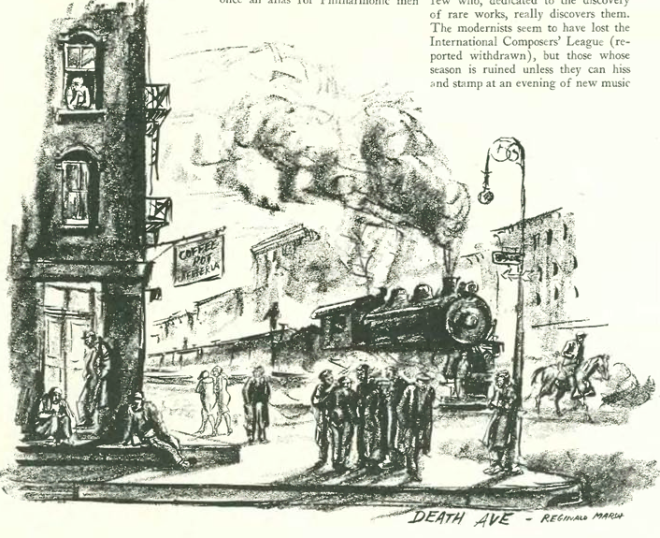
A New Yorker illustrator/cartoonist who spent a lot of time hanging around the working class neighborhoods on the West Side was Reginald Marsh. One of the first cartoonists employed by The New Yorker, Marsh was also a “Social Realist” painter who had studied with the Art Students League. The prevailing theme at the League was life among the working poor, the unemployed, and the homeless, especially after the market crash of 1929. For the Jan. 18 issue Marsh contributed this cartoon featuring a Death Avenue subject…
…more than two years earlier (the Nov. 5, 1927 issue) Marsh provided this illustration of life on Death Avenue…
* * *
Birds of a Feather
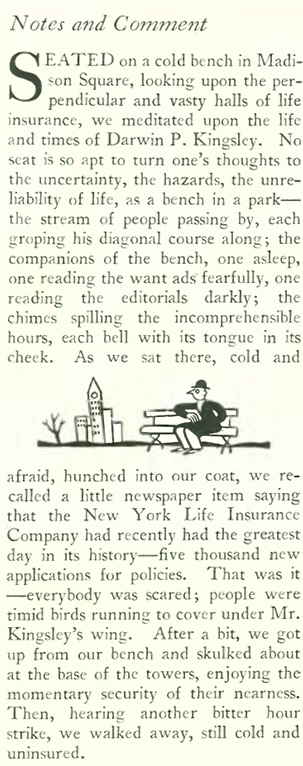
And speaking of the down and out, E.B. White commented on the thousands of panicked citizens who had flocked to the New York Life Insurance Company in search of some peace of mind under the wing of its leader Darwin P. Kingsley (1857-1932). Kingsley steered the company through the market crash relatively unscathed, thanks to its investments in government bonds and real estate, and not in common stocks.
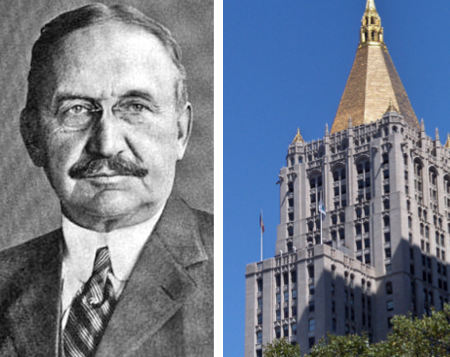
DARWIN’S LAW…Darwin P. Kingsley saw the New York Life Insurance Company through the stock market crash. The company’s assets weathered the crash thanks to investments in government bonds and real estate, and not common stocks. At right, the New York Life Building at 51 Madison Avenue, designed by architect Cass Gilbert and opened in December 1928.(retropundit.wordpress.com)
* * *
Oh Dear Me
As I’ve noted before, The New Yorker loved taking swipes at The New York Times, especially when the somewhat puritanical “Old Gray Lady” found it challenging to cover the more salacious side of life. In this case, according to E.B. White, it was the subject matter of a 1930 Broadway play Waterloo Bridge…
LES BELLES IMPURES…Actress June Walker (pictured here circa 1920) portrayed chorus girl Myra Deauville in the 1930 Broadway play Waterloo Bridge. In the play Myra finds herself out of work and stuck in London during World War I. She resorts to, um, prostitution, to support herself. (IBDB)
* * *
Nerd Alert
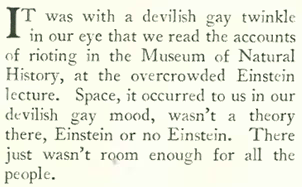
White also got a kick from reading accounts (presumably in the Times) about Albert Einstein’s “lecture” at the American Museum of Natural History. According to The New York Times’Michael Pollak (F.Y.I., Aug. 10, 2012), “an unruly crowd of 4,500 stampeded through the (museum) to see a movie about Einstein’s work…it became known—relatively speaking—as the “Einstein riot.”
JUST CHILLIN’…Albert Einstein circa 1930. The scientist was safely elsewhere when a science-crazed mob stormed the doors of the American Museum of Natural History, which was screening a film on the theory of relativity. (AP)
* * *
Not Ready For My Closeup
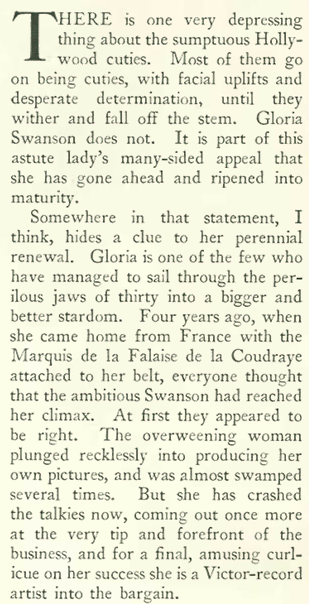
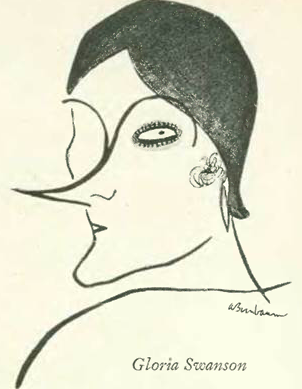
The actress Gloria Swanson (1899-1983) was a major star during the silent era who saw her career wane with the advent of the talkies, and then suddenly soar again with her unforgettable portrayal of reclusive silent film star Norma Desmond in the 1950 film Sunset Boulevard. In her profile of the actress, Helena Huntington Smith seemed to suggest that Swanson was something of an ugly duckling who managed to transcend her looks through a process of graceful maturation (Abe Birnbaum’s caricature notwithstanding). Some excerpts:
GLORIOUS FACES…Abe Birnbaum no doubt drew from images like these for his caricature of Gloria Swanson. From left, Swanson in a cloche hat in an undated photo; publicity photo for her 1928 film Sadie Thompson; publicity photo for 1929’s The Trespasser, Swanson’s first all-talking picture. (Pinterest/pixels.com)
* * *
Good-Bye and Good Luck
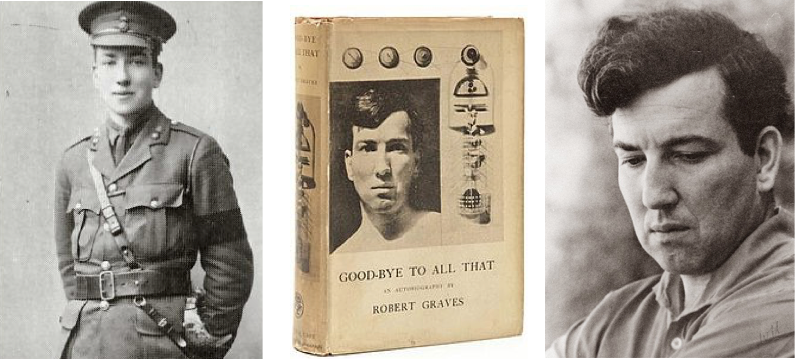
Not too many 33-year-olds write autobiographies, but then again Robert Graves was no typical 33-year-old. Good-Bye to All That, which Graves later described as “my bitter leave-taking of England,” was reviewed in the Jan. 18 “Recent Books” column. Note in the first paragraph how the reviewer (A.W.S.) suggested that writing about World War I (which ended less than 12 years earlier) was getting better “as the shock of the actual catastrophe wears off.” This is not unlike the writings (and films) about Viet Nam that began to emerge in the 1980s and 90s. An excerpt:
A LOT ON HIS MIND…from left, Robert Graves served in the 3rd Battalion of the Royal Welch Fusiliers in World War I (photo is probably from 1915); first edition of his autobiography Good-Bye to All That, which he published at age 33; Graves in 1935. (Oxford U/Wikipedia/fundaciorobertgraves.org)
* * *
From Our Advertisers
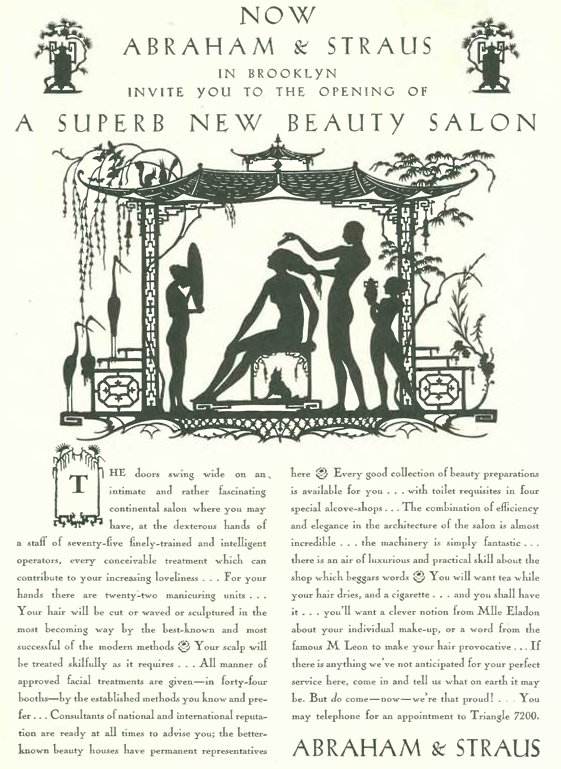
We begin with this elegant ad for a new art deco beauty salon at the Abraham & Straus department store on Fulton Street in Brooklyn…
…for reference, a photo of salon, from 1930…
…the Jan. 18 issue contained a slew of ads enticing New Yorkers to flee the winter and head south — smartly attired, of course — like the couple in the upper right hand corner who look fashionably disinterested as they head out for some “playtime” in Havana (love the man’s combo black tie and bucket hat)…
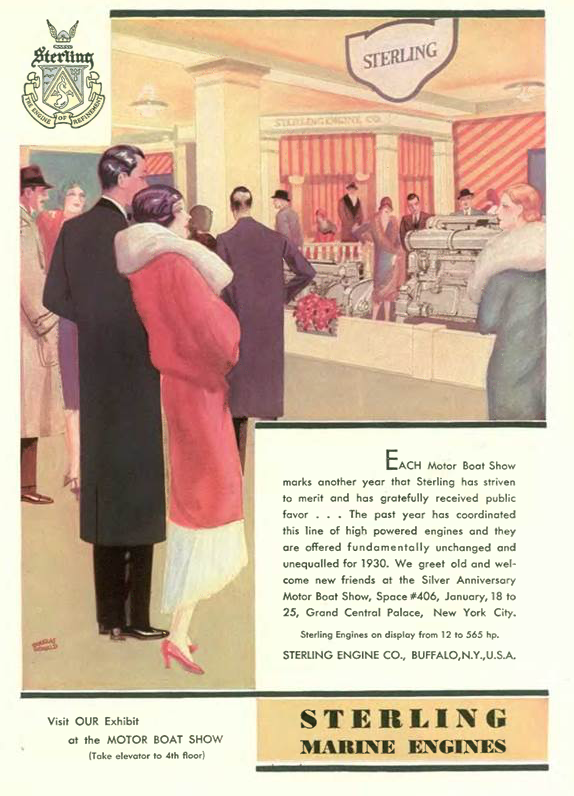
…and you have to hand it to the folks at Sterling, who put the chic into high-powered boat engines…
…this has to be one of the very few times, perhaps the only time, that a toilet seat was advertised in The New Yorker…note how the folks at the Church company played on consumers’ social anxieties, proffering the suggestion that an old toilet seat might be the one thing that lingers in the memories of your houseguests…
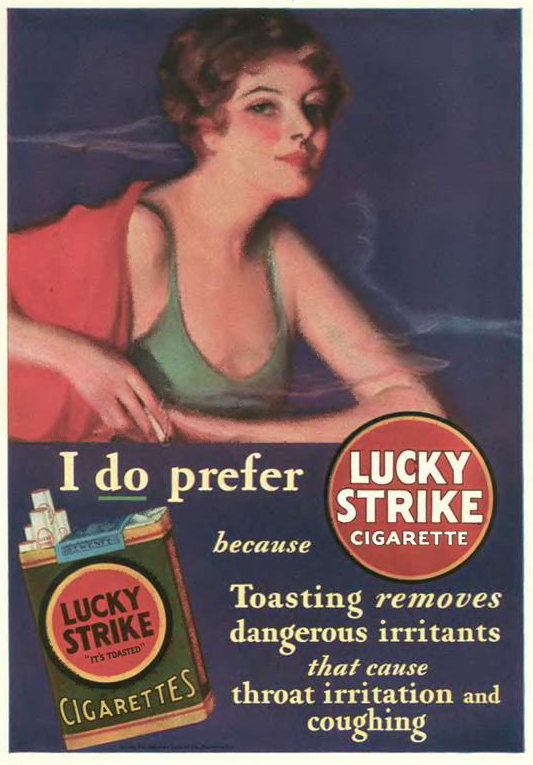
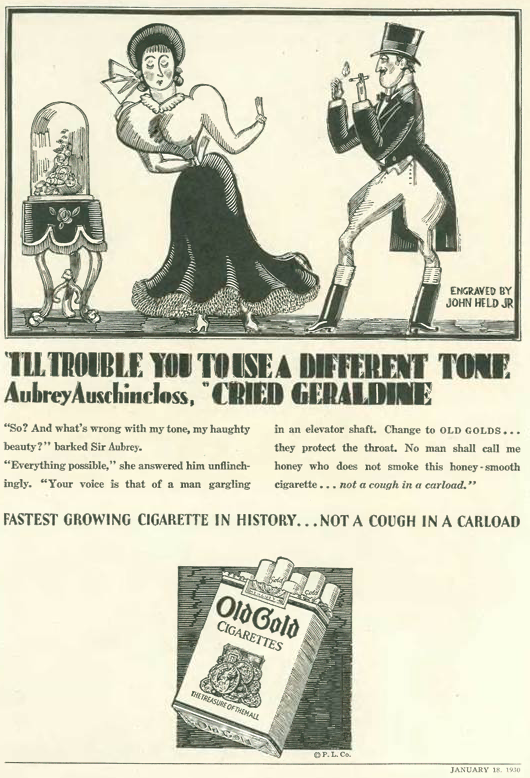
…of course a lot of people eased their anxieties by lighting up, something they didn’t have to worry about because they were told it was actually good for their health (the manufacturers of Old Golds, for example, claimed their cigarettes created a “smoke screen” that kept away colds and other “throat dangers”). Not to be left behind, the makers of Lucky Strikes claimed their “toasting” process removed “dangerous irritants”…
…speaking of Old Golds, cartoonist John Held Jr. picked up some extra pocket change with this “woodcut” illustration for the brand…
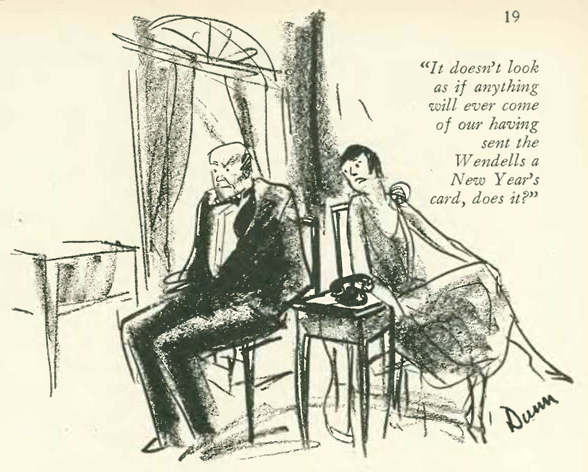
…as for Held’s fellow New Yorker cartoonists, we have some more social anxiety courtesy of Alan Dunn…
…a bit of chit chat among society ladies…Barbara Shermund looked in on a pair down in Palm Springs…
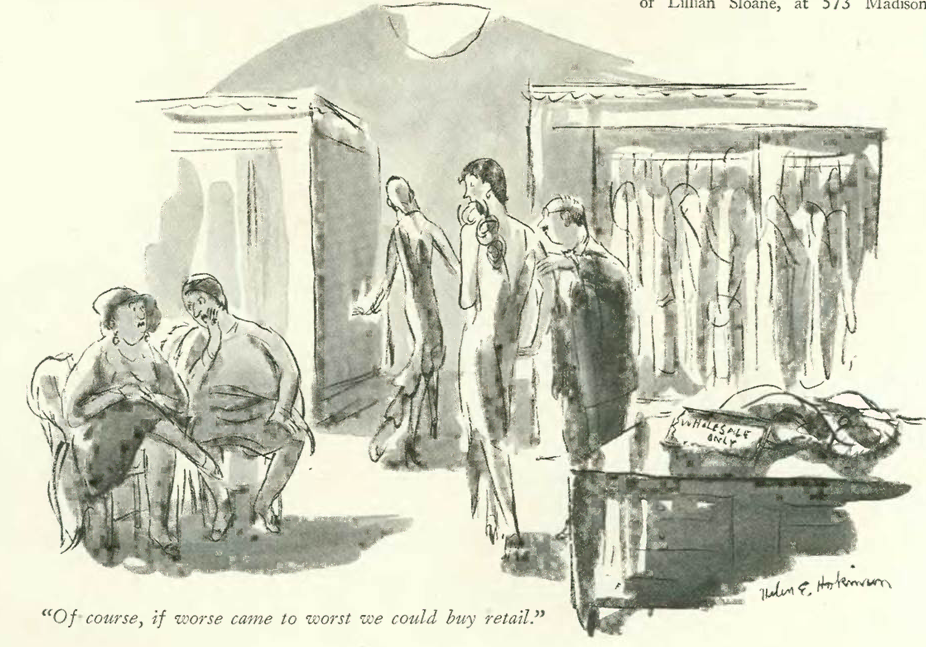
…while Helen Hokinson found her ladies contemplating new economic realities…
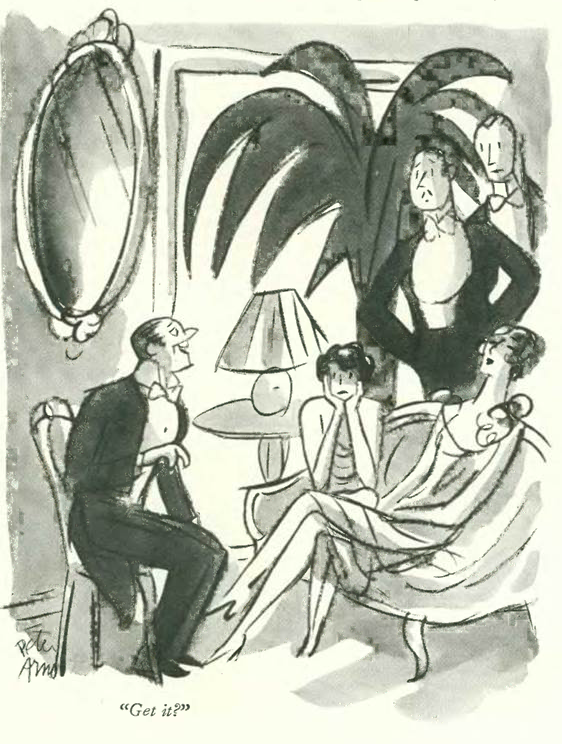
…and finally we have Peter Arno, and a punch line that failed to land…
The effects of the October stock market crash were finally beginning to show in the pages of the New Yorker in the last month of the 1920s.
Dec. 7, 1929 cover by Julien De Miskey.
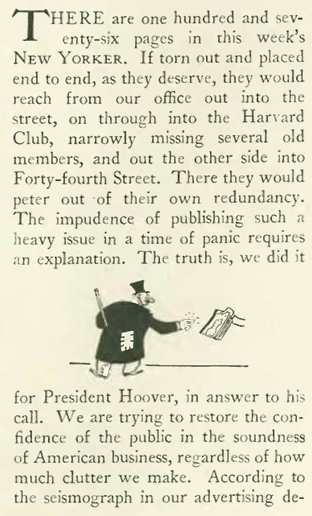
E. B. White was doing his best to keep things light, stating in his “Notes and Comment” column that despite the “time of panic,” the ad-packed Dec. 7 issue contained a whopping 176 pages…
Advertising income for The New Yorker would drop a bit in 1930 (from $1,929,000 to $1,922,000) and would continue to decline through 1932 (down to $1,448,000) before recovering slightly in 1933 and then really taking off again in 1934. And as White noted, even if they had to borrow the 15 cents, folks would still buy the magazine: circulation would top 100,000 in 1930, and except for a dip in 1932 would steadily grow past 150,000 by decade’s end.
KEEP CALM AND CARRY ON…E.B. White in 1946. (National Endowment for the Humanities)
The magazine was stuffed with ads as well as an extended “On and Off the Avenue” —which offered advice to holiday shoppers — and the continued serialization of Elmer Rice’s novel A Voyage to Purilia (installment No. 9).
But not all was sweetness and light. The biggest economic collapse in U.S. history was simply too pervasive to ignore, and even a feeling of hopelessness was creeping into magazine — here’s an observation by Howard Brubaker in his “Of All Things” column…
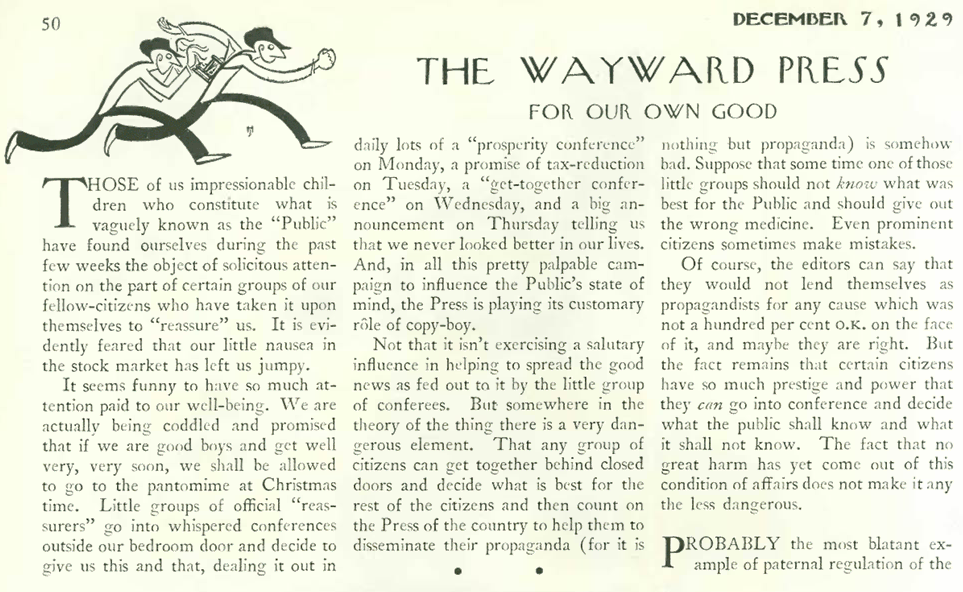
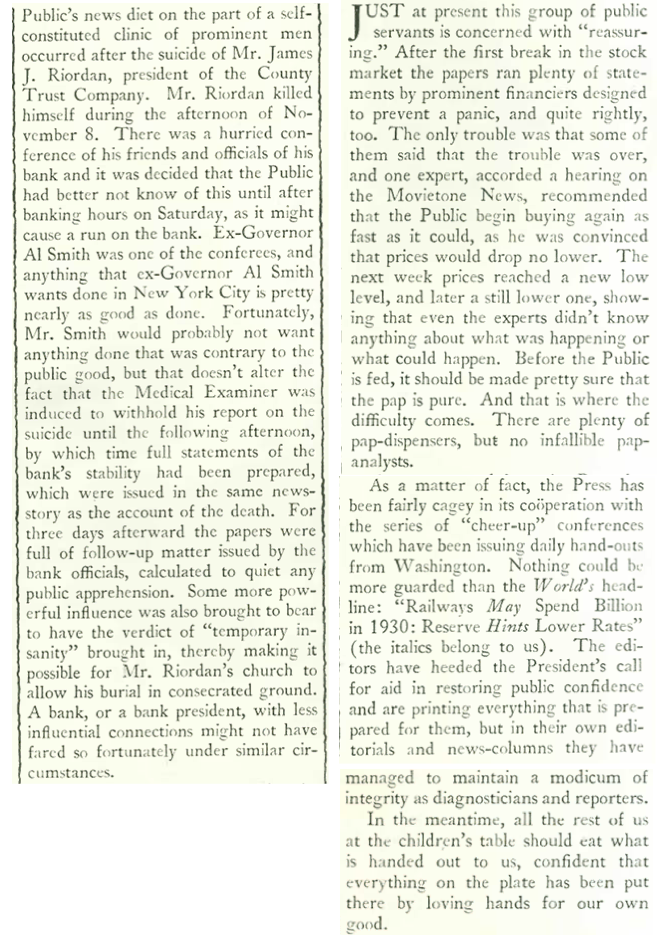
…and writing under the pseudonym “Guy Fawkes,” humorist Robert Benchley found little to laugh about in his “The Wayward Press” column. He chided the media for giving the public false hopes (which he labeled “propaganda”) regarding the state of the economy, and for concealing the suicide of prominent New York banker James J. Riordan, whosedeath announcement was postponed until Riordan’s bank closed for the weekend…
MARKET CASULTY…News of the suicide of prominent New York banker James J. Riordan (left) was suppressed to avoid a run on his County Trust Company. Robert Benchley (right) criticized the newspapers for working with power brokers to feed positive economic news to the masses. (NY Daily News/amsaw.org)
The following account excerpted from the Nov. 10, 1929 New York Times reveals how a nervous banking community responded to the market crash-related suicide of Riordan:
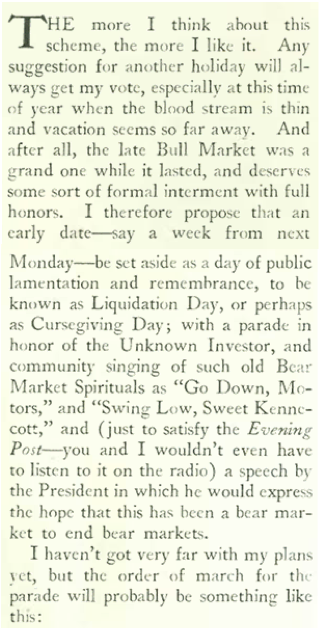
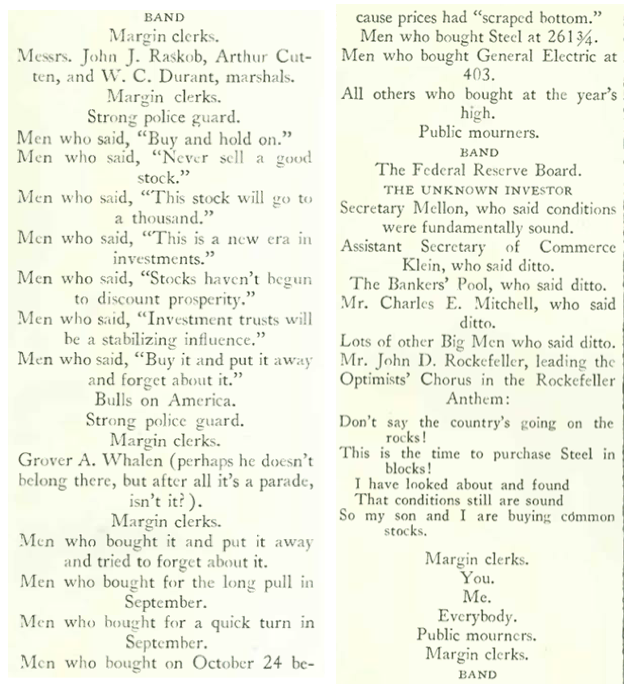
The popular historian Frederick Lewis Allen (1890 – 1954) offered a more lighthearted take on the events surrounding the market crash in his tongue-in-cheek casual, “Liquidation Day Parade,” in which he proposed a holiday to commemorate the end of the Big Bull Market.
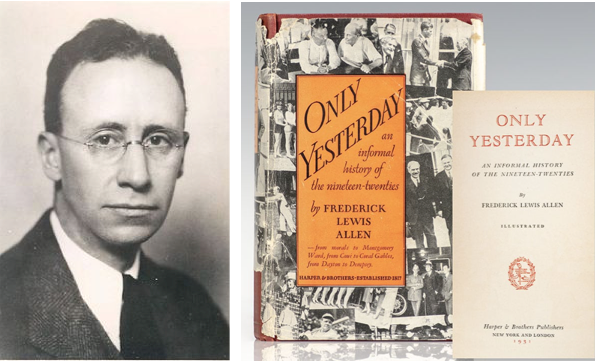
Allen, who also served as editor of Harper’s Magazine, would go on to write Only Yesterday, which chronicled American life in the Roaring Twenties. The 1931 book was a huge bestseller at the dawn of the Depression, and critically acclaimed, both then and now. Writing for the WashingtonPost (Nov. 28, 2007), book critic Jonathan Yardley observed: “It is testimony to both the popularity and the staying power of Only Yesterday that for more than three-quarters of a century it has remained steadily in print, and to this day enjoys sales that would please plenty of 21st-century writers.”
I CAN SEE CLEARLY NOW…in a little more than year after the Roaring Twenties came to a close, historian Frederick Lewis Allen would chronicle that decade in Only Yesterday, his most famous book. (Wikipedia/raptisrarebooks.com)
* * *
Clipped Wings
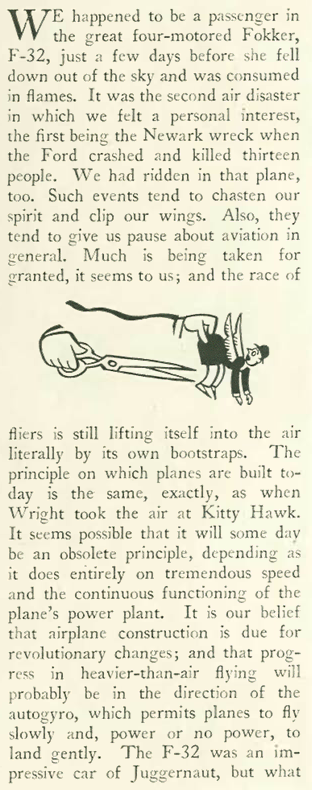
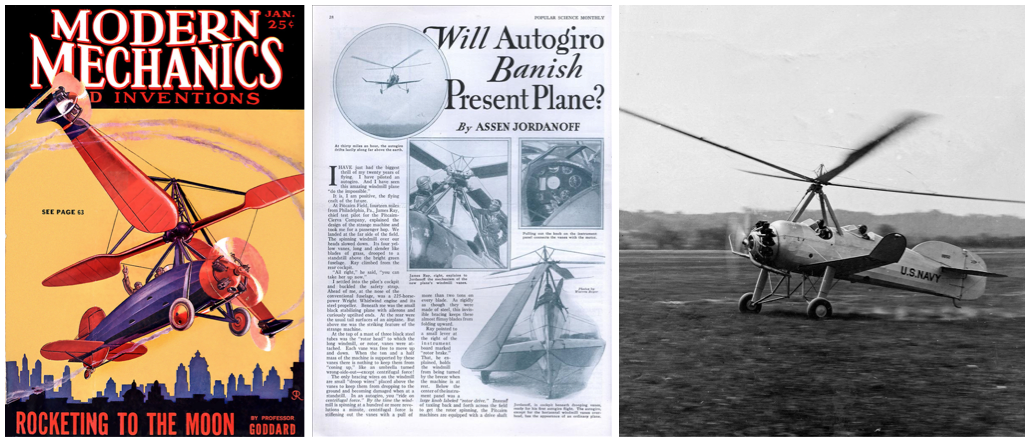
We turn back to E.B. White, The New Yorker’s most enthusiastic proponent of the aviation age. In the previous issue (Nov. 30) White had rhapsodized about a flight he took on a huge, new Fokker F-32. In the Dec. 7 “Talk of the Town” White reported that the very same plane had crashed and burned (and also noted that another plane on which he had been a passenger, a Ford Trimotor, had crashed earlier that year in Newark). White speculated that aviation would soon head in a different, safer, direction along the lines of the autogyro, a flying contraption that was widely favored by futurists of the day:
IT’S A BIRD, IT’S A PLANE…In the 1920s and 30s the autogyro — part airplane, part helicopter — was seen as the future of air transportation. From left, cover of ModernMechanics magazine from January 1930; an article on the autogyro from the March 1931 issue of Popular Science; an XOP-1 autogiro at the Naval Air Station Anacostia in Washington D.C., 1931. (modernmechanix.com/navalaviationmuseum.org) Click image to enlarge
* * *
Wonders Never Cease
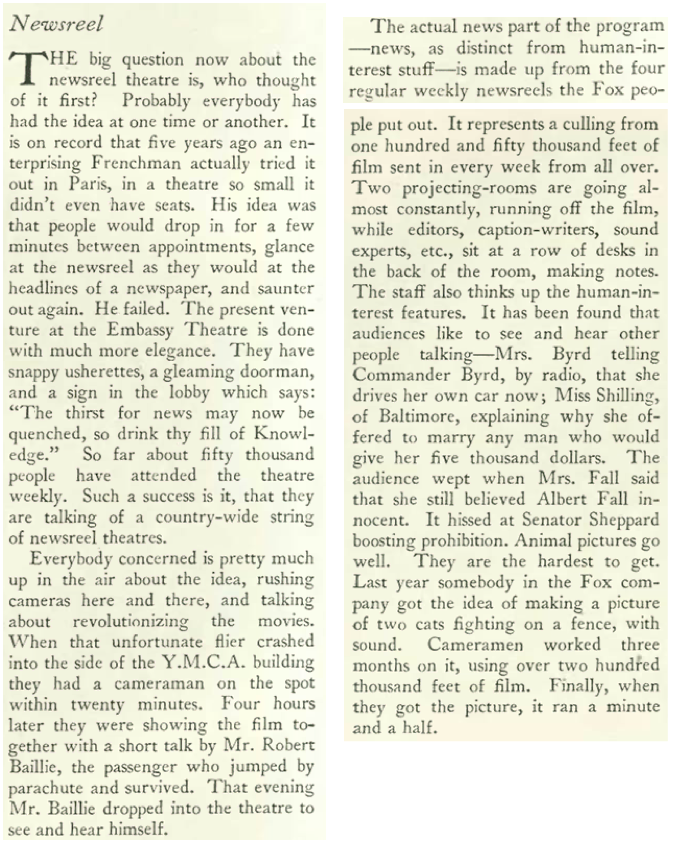
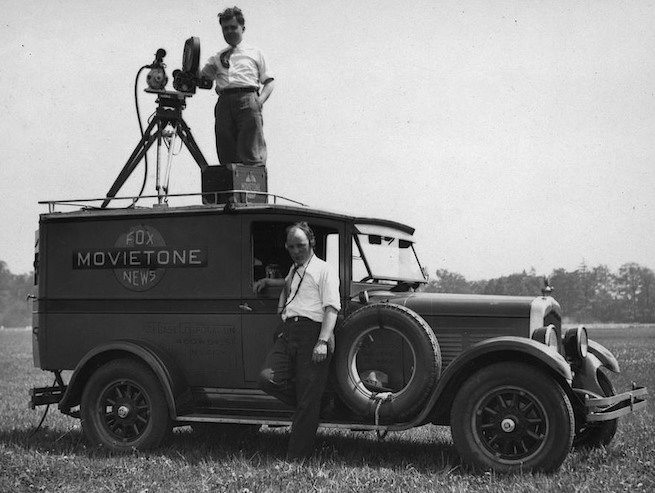
“Talk” also reported the growing popularity of newsreel theaters, and marveled at the speed with which camera crews could deliver their finished product to movie screens. An example was the crash of a small plane onto the side of a YMCA (an incident also noted by White in the previous issue); a newsreel crew was able to go from scene to screen in about four hours:
BEFORE GERALDO…Fox Movietone news crew in 1930. (City of Toronto archives)
* * *
High Wire Act
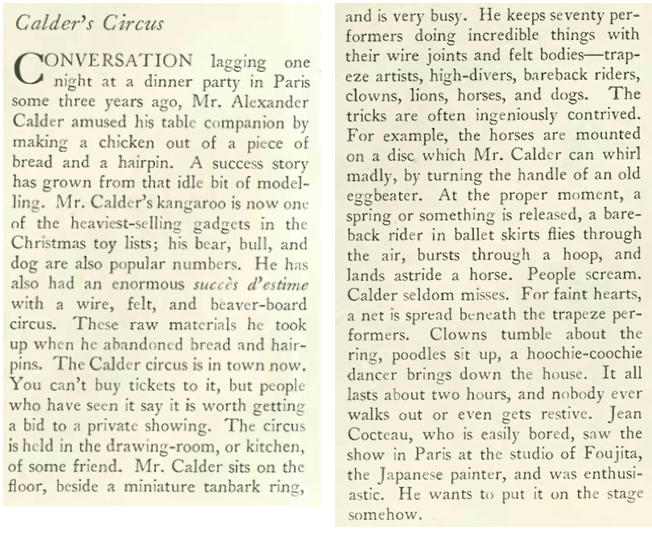
The artist Alexander Calder was already well known for his wire sculptures (his colorful mobiles would come later) when he embarked on his Cirque Calder in Paris in 1926. He brought “the show” to New York in 1929, where he used everything from eggbeaters to balloons to bring his wiry performers to life. Presumably art critic Murdock Pemberton wrote this account for “Talk of the Town”…
UNDER THE TINY TOP…Invitation to a performance of Cirque Calder (1926–31) at the Hawes-Harden apartment, August 28, 1929; AlexanderCalder with Cirque Calder (1926–31), 1929; Lion Tamer and Lion from Cirque Calder (1926–31). (calder.org)
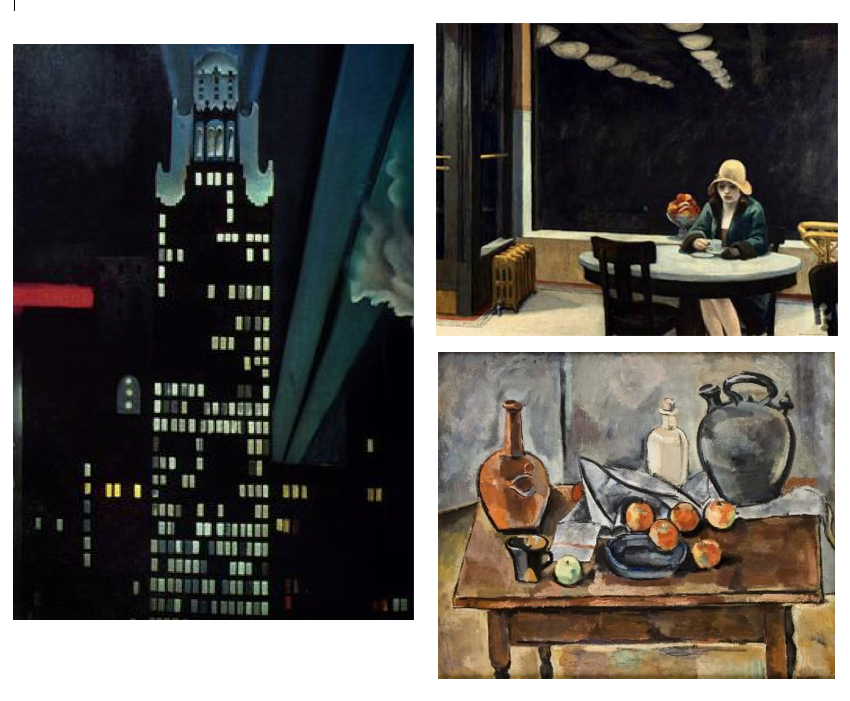
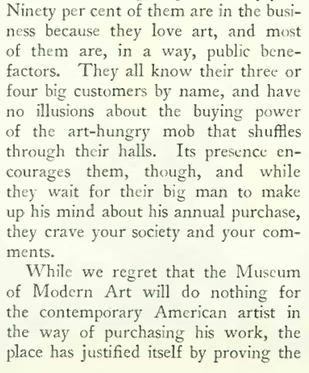
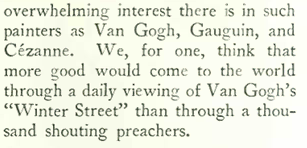
And we also have Pemberton over at his art column, where once again he tried to make sense of the new upstart Museum of Modern Art. He seemed to be surprised by the large crowds drawn to the new museum as he pondered its next show…
AMERICAN MODERN…Among works featured at MoMA’s second exhibition, Paintings by Nineteen Living Americans, were, at left, Georgia O’Keefe’sRadiator Building (1927); top right, Edward Hopper’sAutomat (1927); and Max Weber’sThree Jugs (1929). (Wikipedia/theartstack.com)
Pemberton had yet to see MoMA’s stunning second exhibition, Paintings by Nineteen Living Americans, but had to (grudgingly) conclude that the museum was filling a need…
* * *
The Toy Bazaar
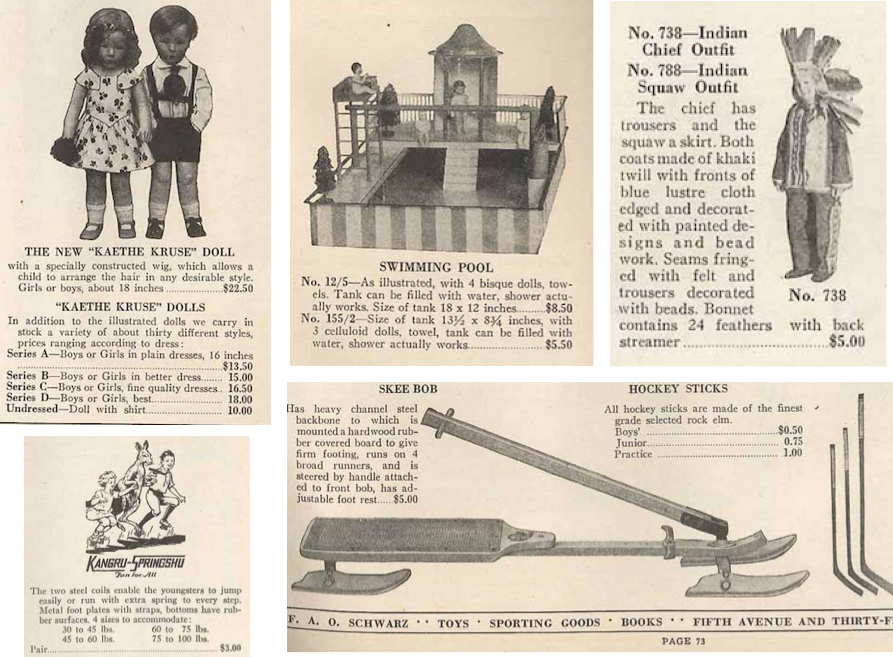
From its beginnings in 1862 until the end of the 19th century, the F.A.O. Schwarz toy store was known to New Yorkers as the “Toy Bazaar,” and by 1929 was something of an institution. As part of a lengthy column featuring ideas for Christmas shoppers, The New Yorker offered some tips on what shoppers might find at the famed toy store:
FUNLAND…Left, the cover the 1929 F.A.O. Schwarz Christmas catalog; at right, the store’s location in 1929, 303 Fifth Avenue. (oldwoodtoys.com)
Some of the toys mentioned in The New Yorker article, from the 1929 F.A.O. Schwarz Christmas catalog. There’s nothing plastic here — plastics as we know them, such as polypropylene, would be developed in the 1950s:
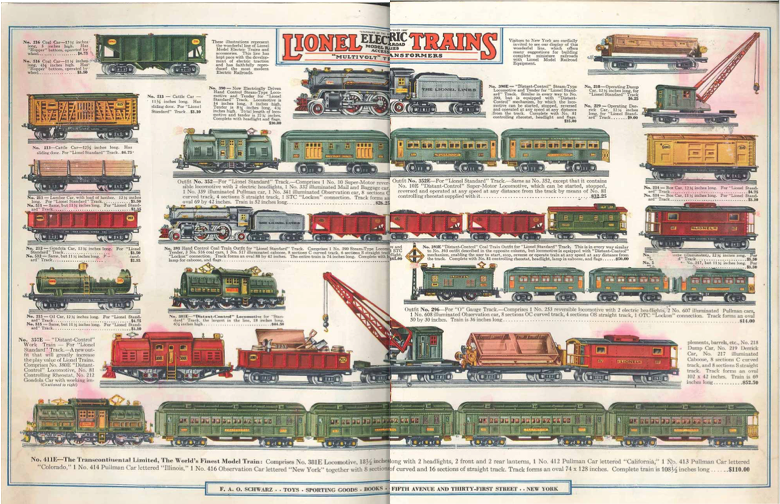
The 1929 F.A.O. Schwarz Christmas catalog also featured a color spread of its stock of Lionel Electric Trains:
If you want to look at the entire 1929 F.A.O. Schwarz Christmas catalog, you can find it at this terrific site.
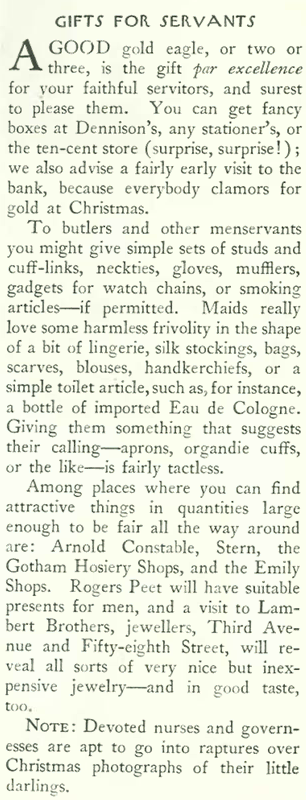
The column also offered advice on “gifts for servants,” at least for those who weren’t getting laid off due to the market crash. Note the somewhat patronizing tone, especially the final paragraph regarding nurses and governesses:
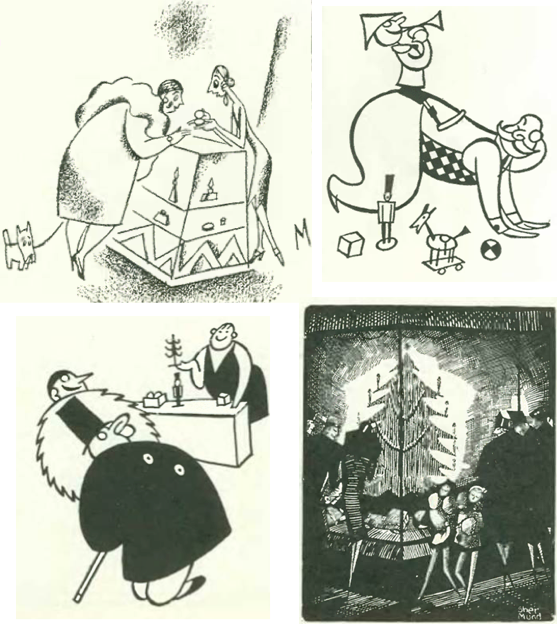
As usual, the shopping column was sprinkled with spot drawings celebrating the season: here are three from Julian De Miskey and one from Barbara Shermund:
* * *
The Bard Does the Talkies
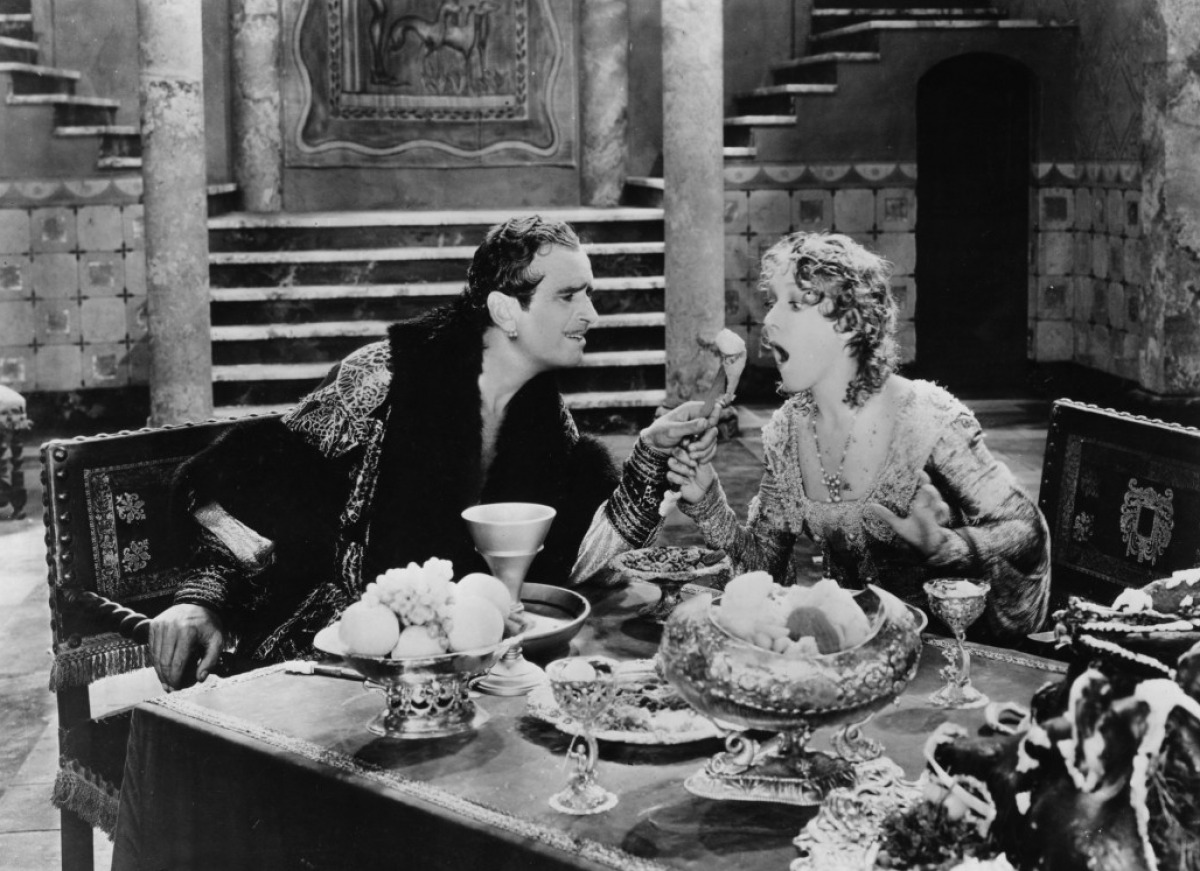
At the movies, critic John Mosher found much to like at the Rivoli, which was screening The Taming of the Shrew featuring the husband/wife team of Douglas Fairbanks and Mary Pickford:
WILD AT HEART…Douglas Fairbanks and Mary Pickford in 1929’s The Taming of the Shrew. (IMDB)
* * *
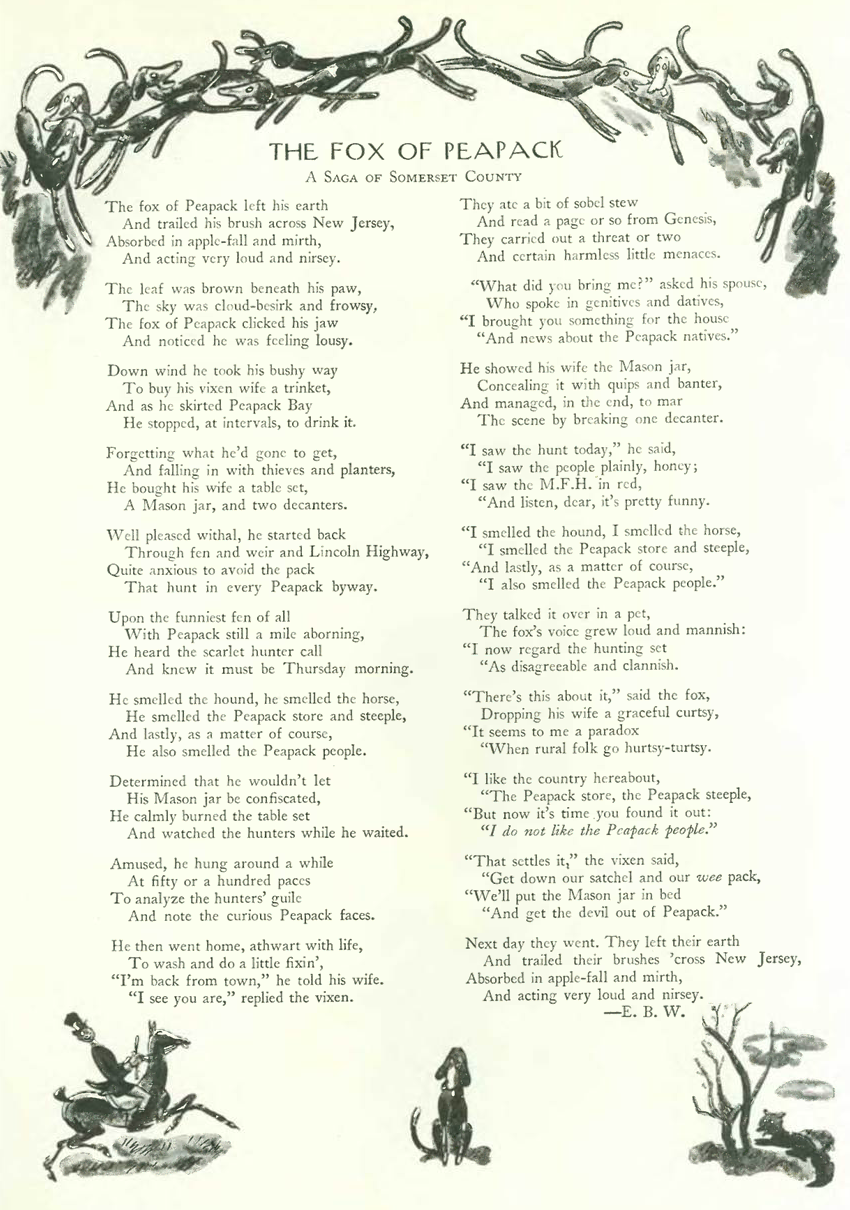
Somerset Saga
When I first spotted this I thought it was an early edition of The New Yorker’s famed Christmas poem, but those were started by Frank Sullivan in 1932. Nevertheless, here is a clever “Saga of Somerset County” from our dear E.B. White:
* * *
From Our Advertisers
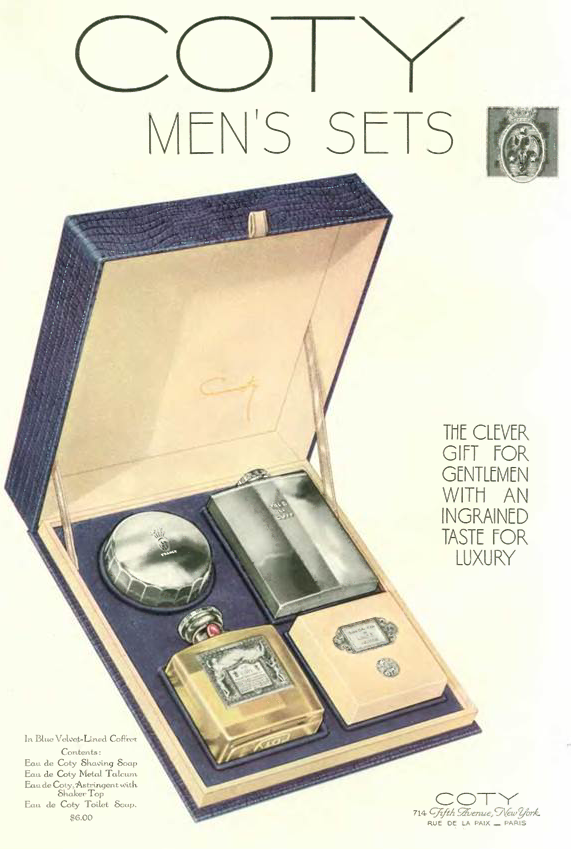
For men who hadn’t lost their shirts and had an “ingrained taste for luxury,” here was a men’s toilet set from Coty featuring a talcum shaker that would have doubled as a fine whiskey flask…
…did the folks at Bergdorf Goodman miss the news of the market crash? Read the fine print about the coming “revolution in fur fashion”…
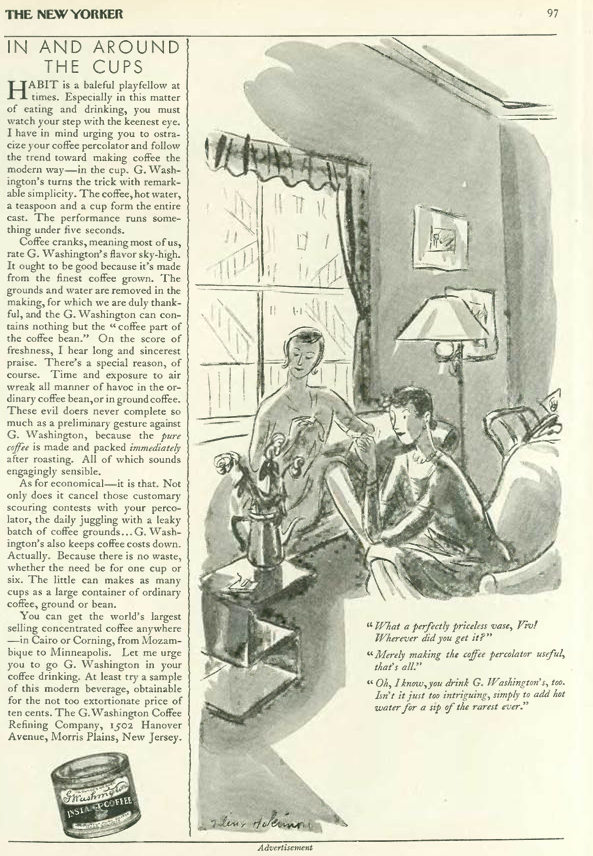
…Helen Hokinson illustrated another ad for G. Washington instant coffee…
…Atwater Kent offered up this sumptuous appeal to holiday shoppers…
…at first glance I thought this was an ad for a luxury apartment…the copy is almost identical, save for a couple of words like “death” and “crypt”…
…on to our artists, here is a spot by Constantin Alajalov that ran along the bottom of “Talk of the Town”…
…and a sight that would become more familiar as the Depression deepened, a look at an estate sale, courtesy Helen Hokinson…
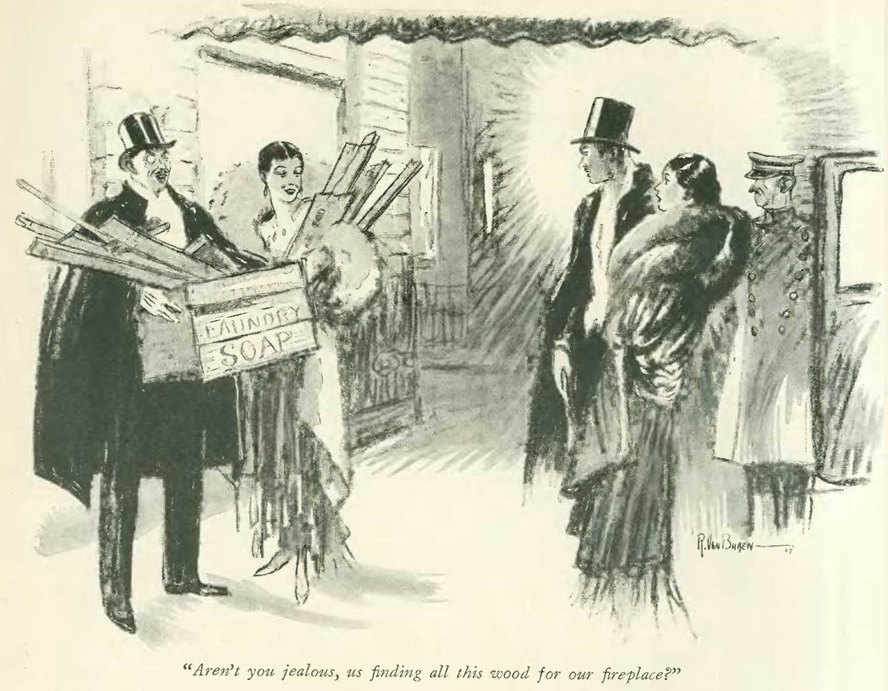
…signs of the economic collapse were starting to creep into the cartoons, including offerings by Raeburn Van Buren…
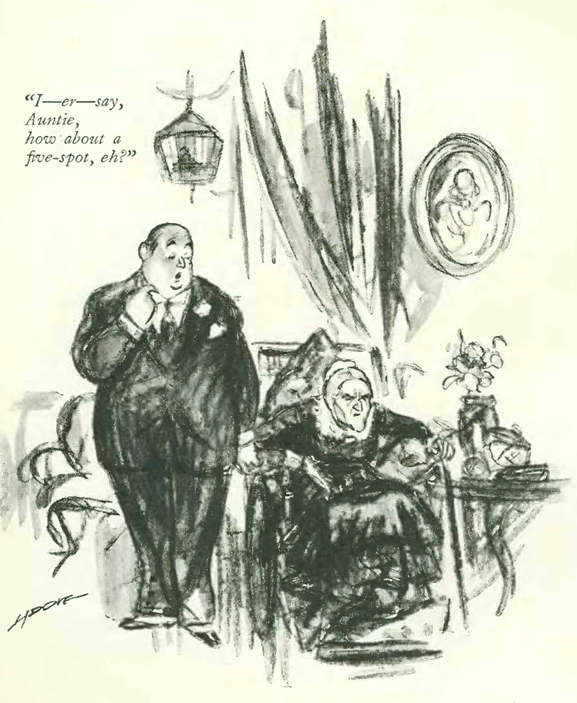
…Leonard Dove…
…and Paul Webb…
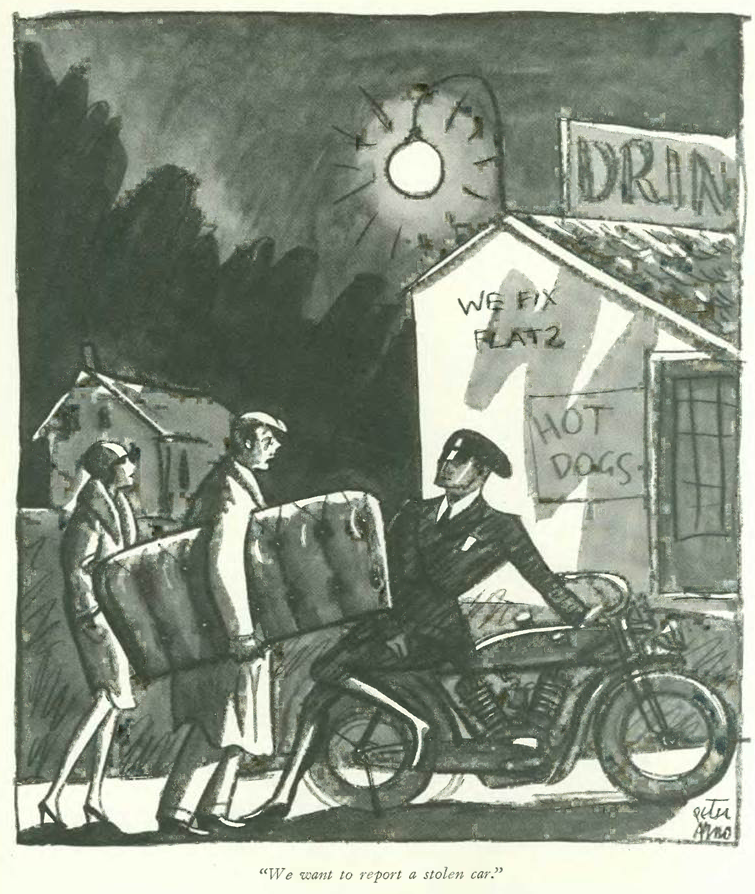
…while the economy was headed into the pits, cartoonist Peter Arno saw his fortunes soaring as he headed into a new decade. In his excellent 2016 biography, Peter Arno: The Mad Mad World of The New Yorker’s Greatest Cartoonist,Michael Maslin writes, “By the time The New Yorker’s December 7, 1929 issue hit the newsstands, its readership had, within the year, seen three Arno covers and fifty-seven of his drawings.” Maslin notes that drawing number fifty-eight, which appears below, “ended the 1920s with a bang (so to speak).” The drawing, writes Maslin, “became a lightning rod for two New Yorker camps: the (James) Thurber camp, who chose to believe Harold Ross (the magazine’s founding editor, who forbade sex as a subject) was naive in sexual matters, and the (E.B.) White camp, convinced Ross would never have let the drawing appear in the magazine if he hadn’t understood its meaning.” If you enjoy Arno’s work, or are a fan of The New Yorker, Maslin’s book is a must-read…
The New Yorker offices at 25 West 45th Street were a long walk from Wall Street, but the panic that gripped the city beginning on Oct. 24 spread quickly through the borough. What the panic was about, however, wasn’t exactly clear.
Nov. 2, 1929 cover by Constantin Alajalov.
There was fear in the air, and a hint of doom, when E.B. White submitted his “Notes and Comment” section for the Nov. 2 issue. Having filed his column sometime between October 24 (“Black Thursday”) and October 29, 1929 (“Black Tuesday”), he weighed the mood of his city against the reassurances offered by politicians, bankers and pundits…
TELLERS OF TALES…As the New York Stock Exchange headed toward collapse, President Herbert Hoover, Thomas Lamont (head of the Morgan Bank) and prominent journalist Arthur Brisbane offered assurances that all was well. (Wikipedia/bhg.com)
…and expressed schadenfreude over “a fat land quivering in paunchy fright” and some satisfaction in confirming his suspicions that “our wise and talky friends” on Wall Street really didn’t know what they were talking about:
THEY MADE A MESS OF THE ECONOMY, TOO…Sweeping the floor of the New York Stock Exchange after the Wall Street crash of 1929. (Wikipedia)
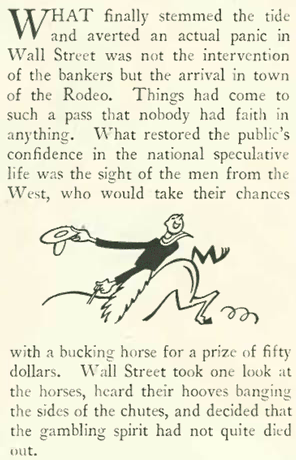
It seems White might have believed the worst was over, and that Wall Street would get back to its gambling spirit…
TALES OF TWO CITIES…The Brooklyn Daily Eagle proclaimed panic in its late edition on “Black Thursday,” Oct. 24; however, a day after the “Black Tuesday” crash of Oct. 29, The New York Times offered a more optimistic outlook for the days ahead.
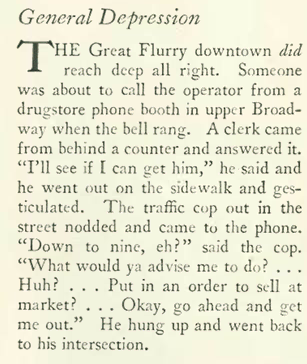
In “The Talk of Town” we find the first use of the word “Depression” in The New Yorker as it is related to the economic collapse…
BUSTED…Crowds gather on Wall Street following news of the stock market crash. (Library of Congress)
* * *
Mr. Blue Sky
On the subject of stocks, “Talk” also featured this mini profile (written by Robert Coates) of Roland Mulville Smythe (1855-1930), who specialized in buying and selling old and obsolete stocks. Nicknamed “No Telephone” Smythe for his dislike of the device, he began his trade in obsolete securities and banknotes sometime around 1880…
MARKET GLEANER…Title page of Roland Smythe’s 1929 book, Valuable Extinct Securities. The notation beneath his portrait reads “No Telephone.” (worthpoint.com)
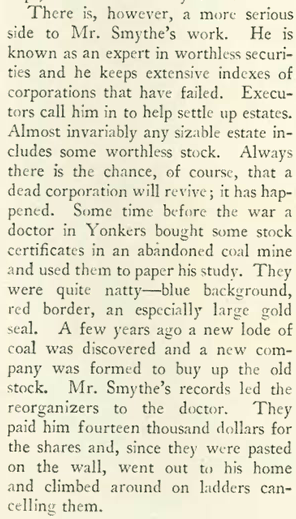
Coates told the story of a Yonkers doctor who used what he thought were worthless stock certificates (from an abandoned coal mine) to paper the walls of his study. Thanks to Smythe’s meticulous record-keeping, when a new lode was discovered at the mine, the doctor learned his wallpaper was worth $14,000 (equivalent to about $200,000 today)…
WALL STREET JUNKER…Share bought by Roland M. Smythe in 1899 and signed by him on the reverse side. At right, unusual obituary headline for an unusual man. (scripophily.org)
…Coates concluded by describing Smythe’s aversion to the telephone, and his talent for bowling…
* * *
Rise of the Machine
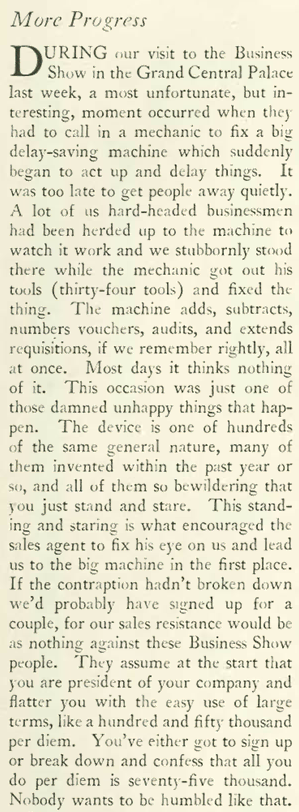
Ironically, the National Business Show was staging a big exhibition in Midtown while the economy was collapsing Downtown. James Thurber was on hand at the Grand Central Palace to take in the wonders of the machine age…
NOT MY TYPE…Manufacturers of the Underwood typewriter staged a typing competition at the 1929 National Business Show at the Grand Central Palace. From left are George Hossfield, Stella Willins (with her typewriter “Timmy”), Irma Wright and Albert Tangora. Hossfield, the men’s champion, could type 157 words a minute. The women’s champion — and the world’s champion typist of the 1930s — Willins once typed 128 words a minute for an entire hour without a mistake. She could type 240 words per minute from memorized lines. (oztypewriter.blogspot.com)
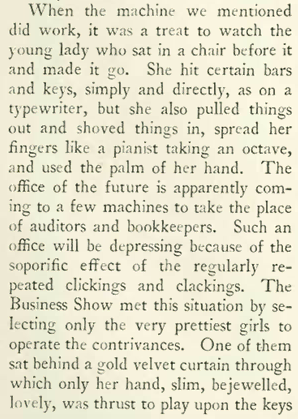
…Thurber seemed as impressed by the machines as by the “very prettiest girls” who were on hand to demonstrate them…
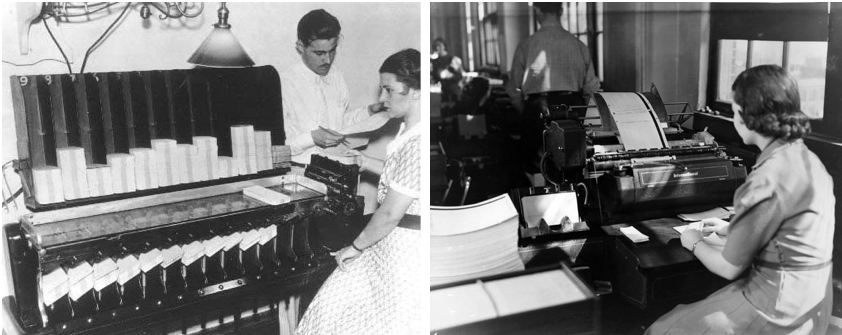
LOOKS COMPLICATED…At left, National Cash Register touted its business machines in this ca. 1930 ad; at right, a woman demonstrates a mimeograph machine in the 1920s. (Pinterest)SHOCK OF THE NEW…At left, these young operators contemplate the operation of an IBM Type 80 horizontal Hollerith card sorter. The woman appears less than thrilled by the mechanical beast; at right, a woman operates a IBM 405 Alphabetic Accounting Machine, ca. 1934. It could process 150 cards a minute and keep track of multiple sums while printing data on continuous-sheet forms. (officemuseum.com/computerhistory.org)
* * *
What a Strange Trip It’s Been
This brief “Talk” entry by Alfred Richman related a story from a traveling salesman just returned from Moscow. Among the highlights of his visit was a Soviet movie that “featured” America’s Sweetheart, Mary Pickford, in the title role…
In the 1920s, silent film stars Mary Pickford and Douglas Fairbanks were perhaps the most famous couple in the world. That included in the Soviet Union, where moviegoers preferred American films over their own avant-garde fare (while on the other hand, the New Yorker found Soviet films to be far more advanced than Hollywood’s). While vacationing in Moscow in 1926, Pickford and Fairbanks visited a Russian film studio with director Sergei Komarov, who cleverly captured enough footage of the two to weave them into a silent comedy titled A Kiss from Mary Pickford (Potseluy Meri Pikford). The film was a spoof on Hollywood fame, finding humor in a loveless man’s chance meeting (and kiss) with Mary Pickford, and his sudden and unexpected attractiveness to the opposite sex.
FUN WHILE IT LASTED…At left, Soviet film poster for Sergei Komarov’sA Kiss From Mary Pickford, featuring Russian actors Anel Sudakevich and Igor Ilyinsky (in the center photos) with various cameos by Mary Pickford and Douglas Fairbanks; at top, Soviet movie posters featuring Fairbanks and Pickford; bottom right, the couple feted by Russian fans, who presented Pickford with the headdress. The year 1929 would mark the end of such films in the Soviet Union — as Stalin began forced collectivization, he declared that Soviet cinema should only satisfy “the basic demands of the proletarian collective farm mass viewer.” Remarkably, Komarov and the actors Sudakevich and Ilyinsky would survive the years of Stalinist terror that would follow, even living to old age. (IMDB/transmediale.de/Facebook fan site)
* * *
Fire and Ice
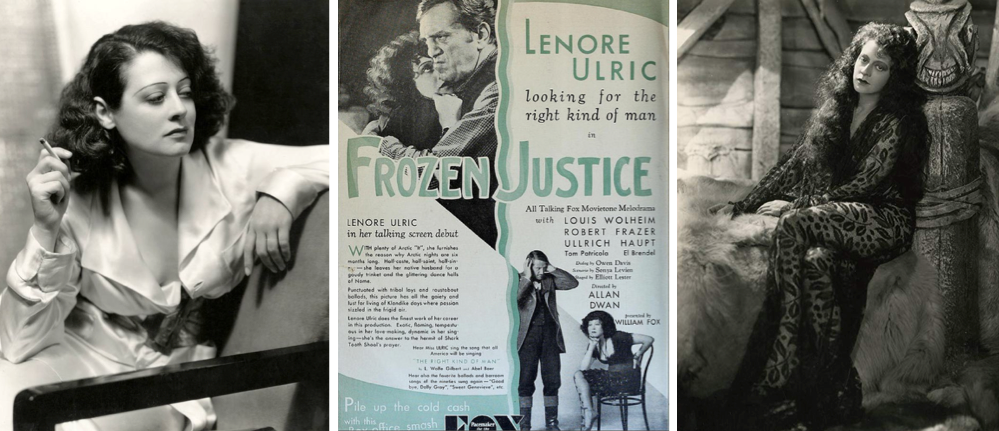
Back stateside, New Yorker film critic John Mosher took in the talking film debut of the hugely popular stage actress Lenore Ulric (1892-1970). Known on Broadway for her portrayals of fiery women, she tried, it seems unsuccessfully, to bring some of that heat to Frozen Justice, which was set in Alaska during the Klondike Gold Rush…
FEMME FATALE…Lenora Ulric, who made less than 20 films, was known for her work on the stage. At left, Ulric taking a break from her Broadway work in the early 1930s; center, magazine ad for Frozen Justice; at right, Ulric as the half-Eskimo Talu in Frozen Justice. (Pinterest/IMDB)
* * *
Right Ho, Plummie (CORRECTION: Not So, Plummie)
I incorrectly attributed this poem in the Nov. 2 issue to British humorist P.G. Wodehouse…
…thankfully, an alert reader kindly pointed out that “Ode to Peter Stuyvesant” isn’t by Wodehouse, but by another person with the initials P.G.W. — Philip G. Wylie.
HE COULD BE FUNNY, TOO…Short story writer, screenwriter and satirist Philip G. Wylie in an undated photo. (Wikipedia)
* * *
From Our Advertisers
We begin with the back pages, where toaster wars were being waged by the makers of the “Toastmaster” and Thomas Edison’s “Automaticrat”…
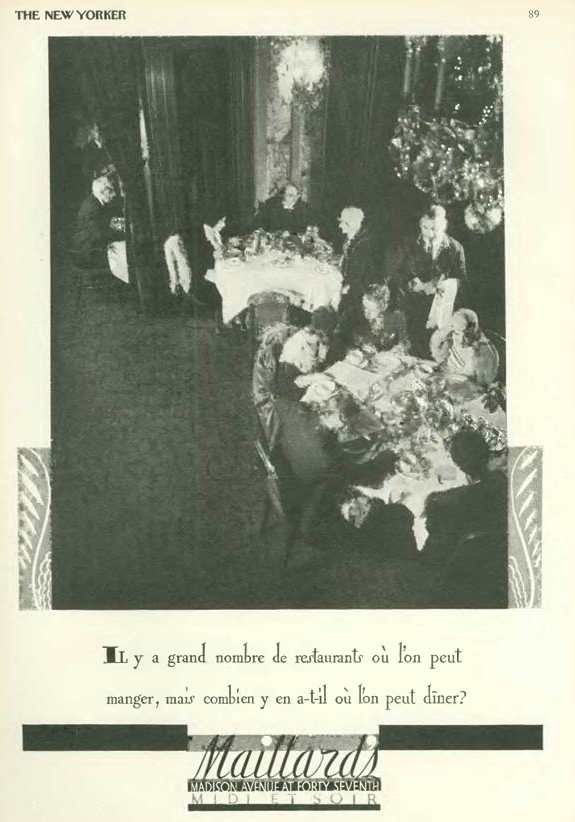
…for some in the posh set, the days of fine dining at places like Maillard’s (with this all-French ad) would be coming to an end thanks to the market crash…actually, Maillard’s itself would come to an end in the 1930s, thanks to the Depression…
…stage, film (and later television) actress and dancer Queenie Smith was the latest celeb to tout the wonders of Lux Toilet Soap…
Queenie Smith circa 1930. (IMDB)
…here’s an unusual way to sell shock absorbers…I’m wondering if this is supposed to be a sugar daddy and a chorus girl trying to make hay in the back seat of a car without Houdaille shocks…
…a couple more ads from the back pages, the ones on the left appeal to women’s fitness, while the ad on the right tries its best to push a product that was fast going the way of the horse and buggy. Spats — devised in the late 19th century to protect one’s shoes and socks (then called stockings) — went out of fashion in the 1930s, no doubt because most streets were now paved and you didn’t have to worry about a passing wagon splashing mud and horseshit all over your shoes and ankles…
…and indeed, now you could have Goodrich Zippers, in smart new colors…
…and speaking of colors, a couple of richly toned ads for Arrow Shirts…
…and Camel cigarettes…
…on to our illustrators and cartoonists…spot drawings — sprinkled throughout the magazine — were often a foot in the door for aspiring contributors (Peter Arno and Charles Addams are just two examples). Below is a collection of spot drawings from the Nov. 2 issue, mostly from established artists including Barbara Shermund, Alice Harvey, Julian De Miskey, Gardner Rea, Johan Bull and I. Klein. The New Yorker also recycled old cartoons for spots, including the illustration below (third row, second one down) by Shermund of the young woman on telephone, which originally appeared in the July 16, 1927 issue with the caption, “Hold the line a minute, dear—I’m trying to think what I have on my mind.”
…Arno continued to provide illustrations for Elmer Rice’s serialized novel, A Voyage to Purilia…
…and Julian De Miskey illustrated G. Marston’s entry for the ongoing “That Was New York” column…
…our cartoons come from Barbara Shermund…
…Gardner Rea, having a political moment…
…for reference, a photo of Mayor Jimmy Walker…
brookstonbeerbulletin.com
…Shermund again, on the joys of parenthood…
…Peter Arno’s take on Jazz Age chivalry…
…and perhaps the timeliest entry of all, from Leonard Dove…
Winding down the last summer of the 1920s — an unusually hot one — one detects subtle changes in The New Yorker’s mood; weary from the decade-long party known as the Roaring Twenties, a bit more mature, and more confident in its voice thanks to the regular writings of James Thurber, E.B. White and Lois Long and copious cartoons and illustrations by such notables as Peter Arno, Barbara Shermund and Helen Hokinson that gave the magazine a distinctively modern feel as it headed into the 1930s.
Aug. 10, 1929 cover by Theodore Haupt; Aug. 17 cover by Peter Arno.
The exuberance associated with the rapidly changing skyline was still there, however, as the Aug. 17 “Talk of the Town” speculated on the race for the world’s tallest building. The article not only anticipated an architect’s sleight of hand, but also a Zeppelin docking station that in the end would top the world’s tallest building:
As it turned out, William Van Alen did not have to compete against himself, the commission for One Wall Street instead going to Ralph Walker, who would design a beautiful art deco landmark that, at 50 stories, would not vie for the title of the world’s tallest building. Unbeknownst to The New Yorker, and perhaps Van Alen, the challenger would instead be 40 Wall Street, which would hold the crown as world’s tallest for about a month. Thanks to some sleight of hand (see caption below) the Chrysler building would quickly surpass 40 Wall Street and hold the title for just eleven months, bested in the end by the Empire State Building (which would sport a “Zeppelin superstructure”).
DECO DELIGHTS…40 Wall Street (left) vied with the Chrysler Building for the title of the world’s tallest building. The 927-foot 40 Wall Street would claim the title in late April 1930. One month later, the Chrysler building would sprout a needle-like spire (secretly constructed inside the building) bringing its total height to 1,046 feet. The builders of 40 Wall Street cried foul and claimed that their building contained the world’s highest usable floor, whereas the Chrysler’s spire was strictly ornamental and inaccessible. Less than a year later the point was made moot when the Empire State Building soared above them both. (Wikipedia/The Skyscraper Museum)ERECTILE DYSFUNCTION…Clockwise, from top left, progression of designs for the Chrysler Building; the building’s architect, William Van Alen; drawing from Popular Science Monthly (Aug. 1930) revealed the inner workings of the spire’s clandestine construction; Zeppelin docking station for the Empire State Building as imagined in a composite (faked) photograph. At 1,250 feet, the wind-whipped mooring mast proved not only impractical, but downright dangerous. In September 1931 a dirigible briefly lashed itself to the mast in 40 mph winds, and two weeks later the Goodyear Blimp Columbia managed to deliver a stack of Evening Journals to a man stationed on the tower. Contrary to the faked photograph, no passengers ever transferred from the tower to a Zeppelin. (Skyscraper City/Wikipedia/NY Times)
* * *
What, Me Worry?
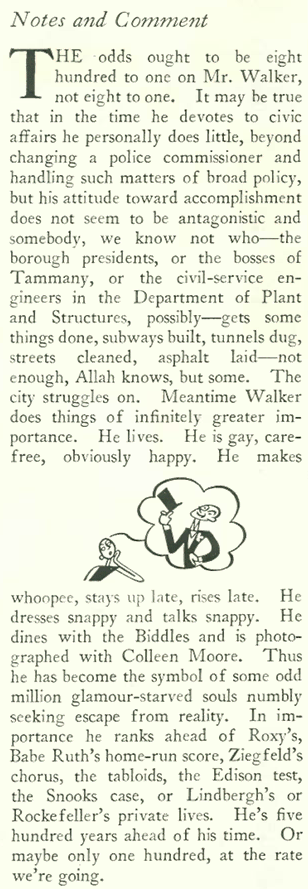
The famously flamboyant New York City Mayor Jimmy Walker lived the easy life during his initial years as Hizzonner, riding a booming economy, partying with the rich and famous (while flaunting Prohibition laws), carousing with his mistress (Ziegfield dancer Betty Compton) and sleeping until noon. When reform-minded Fiorello La Guardia challenged Walker’s reelection bid in 1929, Walker left the dirty work to his Tammany Hall cronies and continued to charm the public, and The New Yorker. The Aug. 17 “Talk of the Town” observed:
IT’S EASY BEING ME…Mayor Jimmy Walker accompanied actress Colleen Moore to the October 1928 premiere of her latest film, Lilac Time. (konreioldnewyork.blogspot.com)I HAVE MY EYE ON YOU…Reform-minded Fiorello La Guardia (right) detested Jimmy Walker and his Tammany cronies, but that wasn’t enough to get him elected in 1929. The Great Depression would soon turn the tables. (Wikipedia)
Howard Brubaker, in his Aug. 17 “Of All Things” column, suggested that La Guardia had a zero chance of getting elected. Just three years later, Walker would resign amid scandal and flee to Europe. La Guardia, on the other hand, would be elected to the first of his three terms as mayor in 1933, riding the wave of the New Deal.
* * *
Peek-A-Boo
Politics might have been business as usual, but in the world of fashion the vampish hat styles associated with flappers were giving way to a new rolled-brim look that seemed to suggest an aviator’s helmet. In her Aug. 17 fashion column “On and Off the Avenue,” Lois Long reported:
FACING THE FUTURE…Vampish hats of 1928, pictured at top, gave way to the rolled-brim or flare look of 1929. (Images gleaned from magazine/catalog images posted on Pinterest)
Long seemed to welcome the idea that women should once again bare their foreheads…
* * *
Twain Wreck
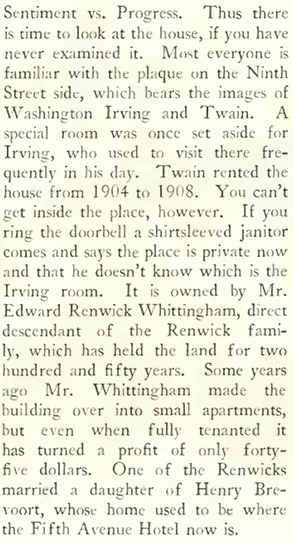
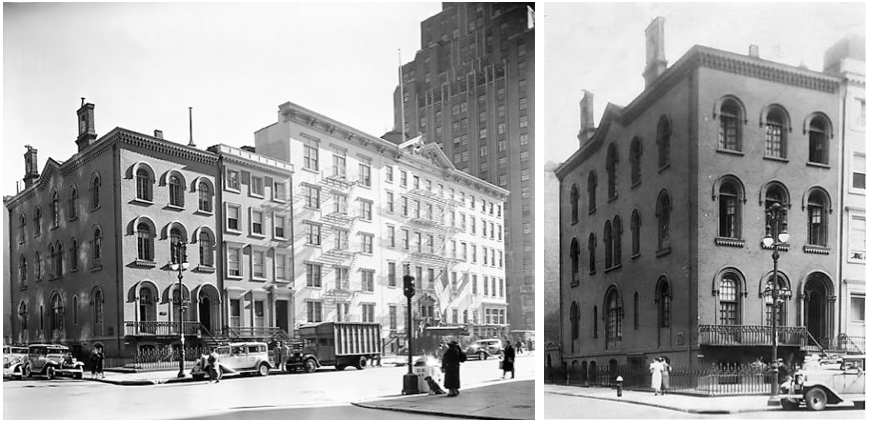
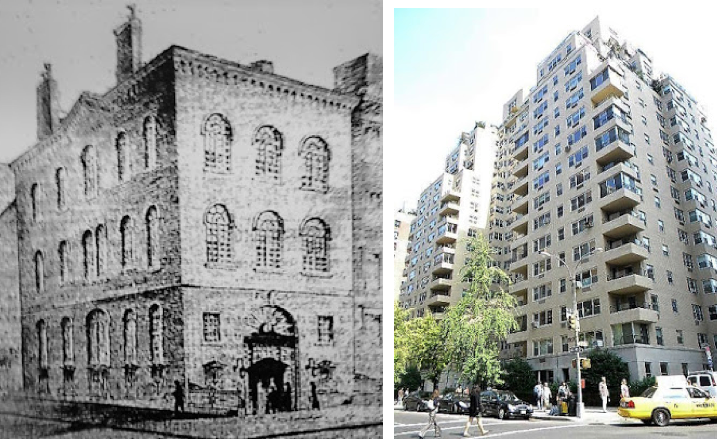
Jumping back to the Aug. 10 issue, “The Talk of the Town” reported on the possible remodeling or demolition of a house once occupied by Samuel Clemens, aka Mark Twain. The house in question was a lavish old mansion built by Henry Brevoort, Jr. in 1834, at the northwest corner of Fifth Avenue and 9th Street. Twain lived in the house from 1905 to 1908, and it was there that Twain’s biographer Albert Paine conducted interviews with the author and wrote the four-volume Mark Twain, a Biography; The Personal and Literary Life of Samuel Langhorne Clemens. When millionaires abandoned their Fifth Avenue mansions in the 1920s and high-rise apartments took their place, there was pressure to either convert an old mansion like the Breevoort house at 21 Fifth Avenue to apartments or demolish it altogether.
LOOKING GOOD AFTER A CENTURY…At left, Berenice Abbott took this photograph of No. 21 Fifth Avenue in 1935. At right, in a close-up shot from the same period, the 1924 plaque from the Greenwich Village Historical Society is visible on the side of the house. (Museum of the City of New York/Greenwich Village Historical Society)A NOW FOR SOMETHING COMPLETELY DIFFERENT…A proposed 1929 remodeling (left) moved the front door of the old Brevoort mansion to the center and lowered it to street level. At right, today the 1955 Brevoort apartment house occupies the site. (daytoninmanhattan.blogspot.com)
The Greenwich Village Historical Society did what it could to save the house, and in 1924 affixed a bronze plaque to a side wall noting that both Twain and Washington Irving were once occupants. When the house was slated for demolition in 1954, the Society appealed to New Yorkers to raise the $70,000 needed to move the building, but only a fraction of that amount was secured. No. 21 was demolished in 1954 along with the rest of the houses on that block.
* * *
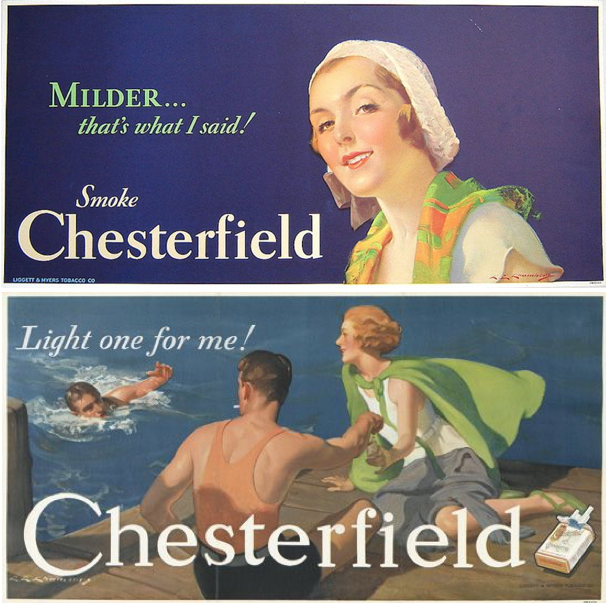
Charles Edward Chambers was an American illustrator probably best known for his Chesterfield ads, although he also illustrated stories for a number of popular magazines from the early 1900s until his death in 1941. The Aug. 10 “Talk of the Town” looked in on his work with model Virginia Maurice:
QUICK…THROW THAT MAN A CIGARETTE!…Examples of Charles Edward Chambers’ Chesterfield ads from 1929 featuring model Virginia Maurice. Note that Maurice is wearing the latest “rolled brim” hat style in the upper image. (Pinterest)HIS NONSMOKING SECTION…A 1919 Harper’s cover illustration by Charles Edward Chambers. (Wikipedia)
* * *
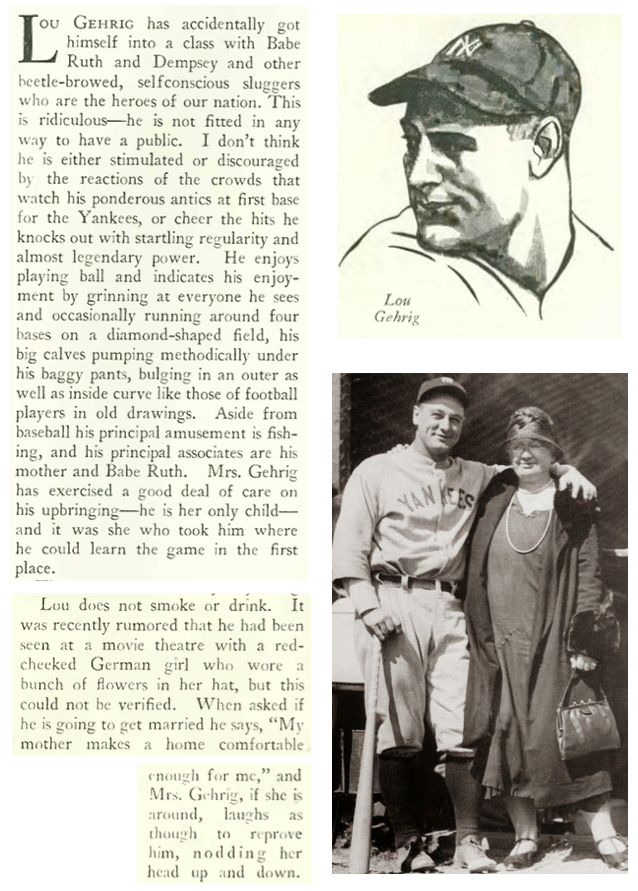
Mama’s Boy
Lou Gehrig rivaled Babe Ruth as a top Murderer’s Row slugger for the 1929 Yankees, yet he couldn’t be more opposite in his lifestyle. A teetotaler and nonsmoker, Gehrig was completely devoted to mom (pictured below in 1927). Niven Busch Jr. submitted this profile of Gehrig for the Aug. 10 issue. Excerpts:
* * *
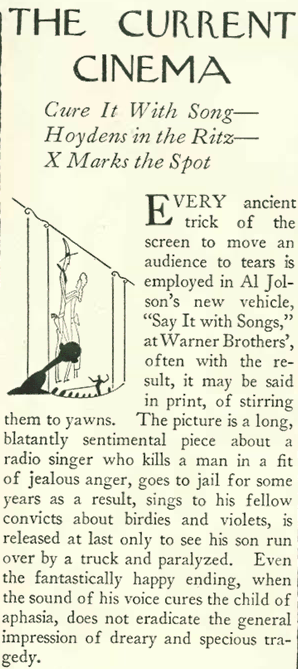
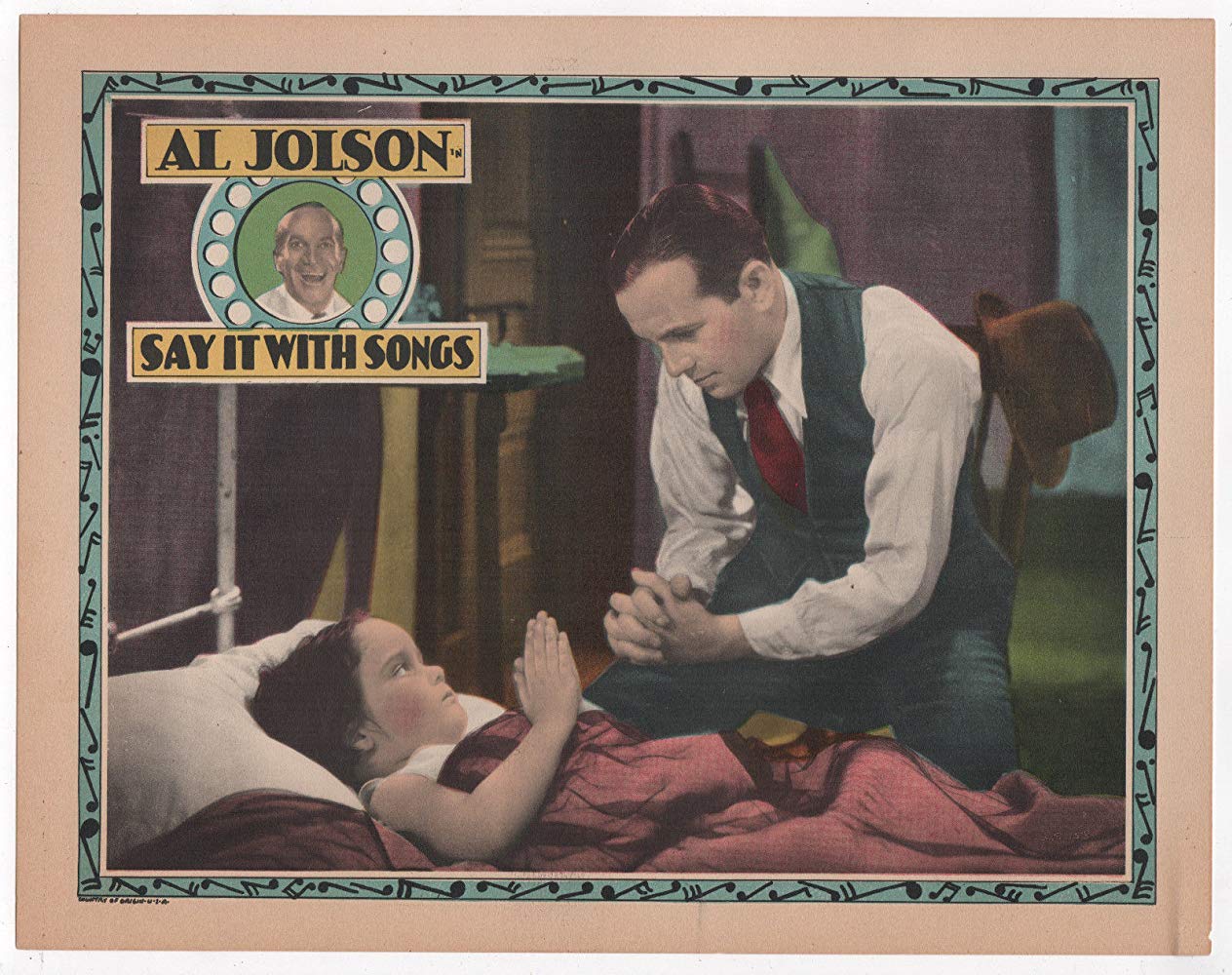
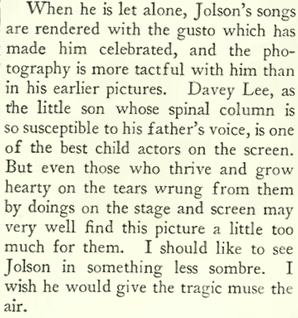
After appearing as Al Jolson’s dying son in The Singing Fool (1928), the child actor Davey Lee returned to the screen for yet another Jolson weeper, 1929’s Say It With Songs. Once again portraying Jolson’s son—this time crippled and rendered dumb after being hit by a truck—he miraculously recovers at the end of the film. The New Yorker wasn’t having any of this sentimental treacle, especially served up for a second time…
LET’S PRAY FOR A BIG BOX OFFICE…Davey Lee and Al Jolson in Say It With Songs. (IMDB)
…and the magazine hoped for something a bit less somber from Jolson in the future, suggesting that he “give the tragic muse the air”…
In the same issue of The New Yorker, this advertisement touted Jolson’s recording of “Little Pal” from Say It With Songs (note the blackface image of Jolson—his unfortunate trademark back in the day)…
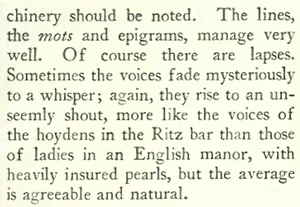
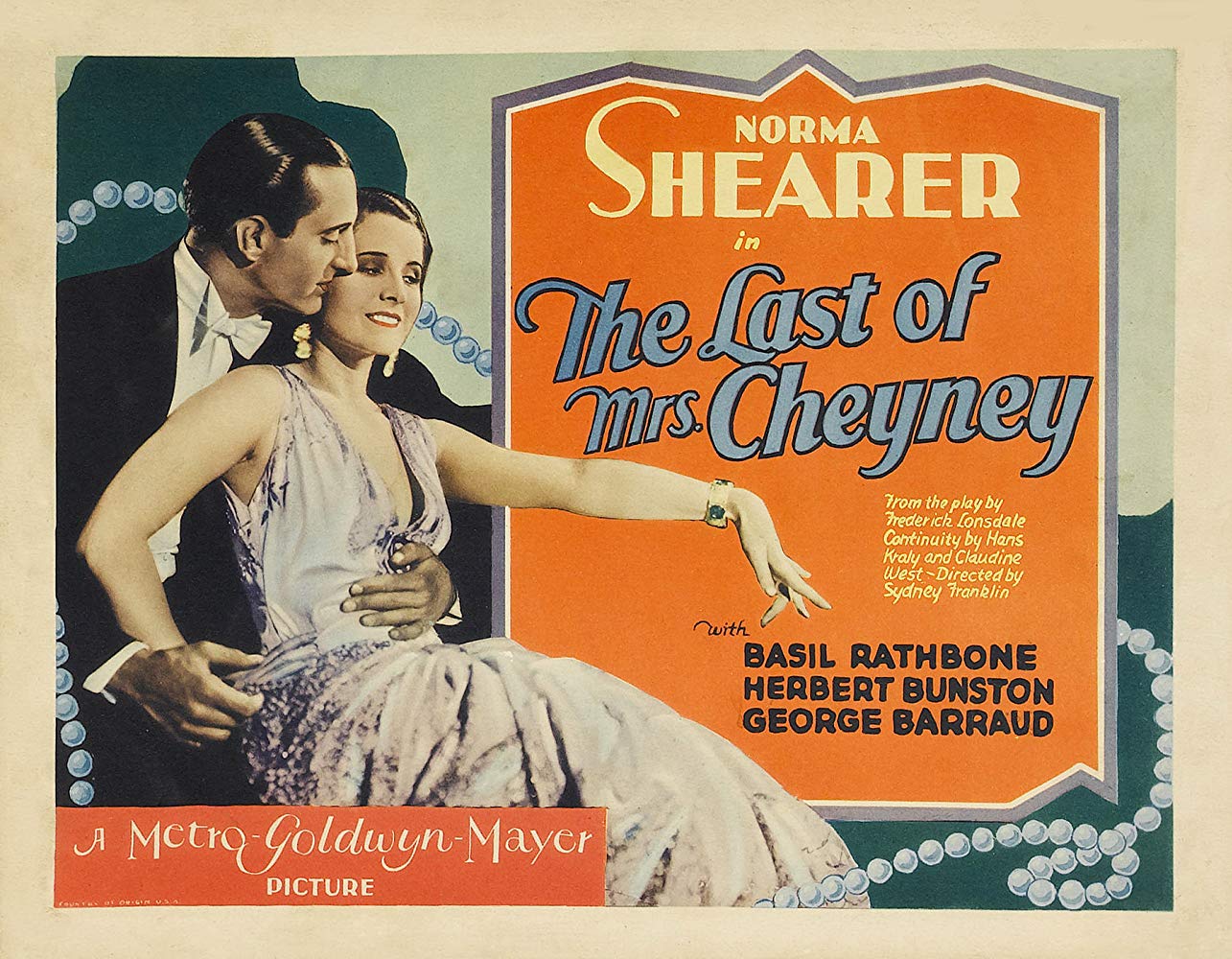
…happily, there were other movies that offered less schmaltzy diversions, including Norma Shearer’s comedy-drama The Last of Mrs. Cheyney, in which Shearer portrayed the jewel thief Fay Cheyney…
OH BASIL YOU ANIMAL…Theatre card for The Last of Mrs. Cheyney. (IMDB)
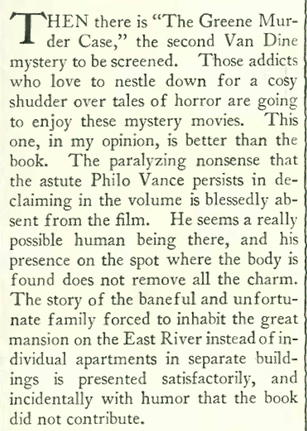
…often cast as a heavy in silent films, it was the “talkies” that made William Powell a star, his pleasant voice more suited to a hero or leading man than a villain. In The Greene Murder Case, Powell portrayed amateur detective Philo Vance, a role that he played in another 1929 release, The Canary Murder Case (originally filmed as a silent in 1928), both based on mystery novels by S.S. Van Dine. Powell would portray Philo Vance in three more films from 1930 to 1933 until he took on the role of another amateur detective, Nick Charles, in 1934’s The Thin Man (a role he would reprise five times from 1936 to 1947)…
WHODUNNIT? YOUDUNNIT!…William Powell as detective Philo Vance, Florence Eldridge as Sibella Greene, and Jean Arthur as Ada Greene in 1929’s The Greene Murder Case. (IMDB)KEEPING IT QUIET…William Powell as Philo Vance and Louise Brooks as “the Canary,” a scheming nightclub singer, in The Canary Murder Case. Brooks was a huge star in the silent era and the iconic flapper. According to IMDB, the film was shot as a silent in 1928, but producers decided to rework it as a more profitable “talkie.” When Brooks refused to return from Germany (where she was filming Pandora’s Box) to dub the movie, Paramount spread the word that Brooks’ voice was not suited to sound film, although later productions made by Brooks proved this to be wrong. Actress Margaret Livingston ultimately supplied Brooks’ voice for Canary. (IMDB)
* * *
From Our Advertisers
We look at some advertisements from the August 17 issue, including this one from Past Blue Ribbon. Note that nowhere in the ad is the word “beer” used, this being a “near-beer” with less than 1% alcohol content by volume. In addition to making cheese (a Velveeta-like product), Pabst hoped to keep its company alive by selling this “brew” during the unusually hot summer of 1929…
…and with that blazing sun advertisers also promoted a number of face creams and powders to those “enjoying the sunny outdoor life,” including this two-page spread from Richard Hudnut and Poudre Le Début…
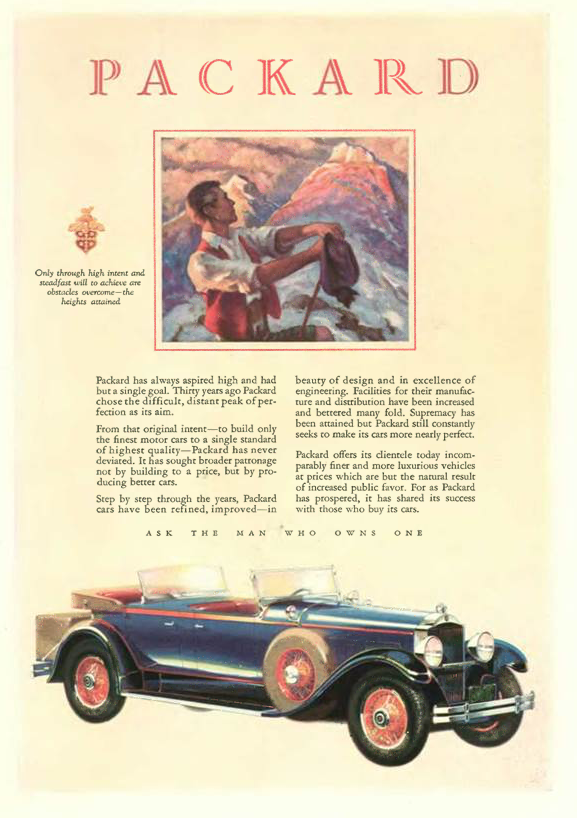
…the outdoor life could also be enjoyed in a convertible Packard 640, a car that was a cut above a Lincoln or Cadillac, and was considered by some to be America’s answer to the Rolls Royce…
A 1929 Packard 640 Convertible. This particular model can be had today for about $130,000. (Hemmings Motor News)
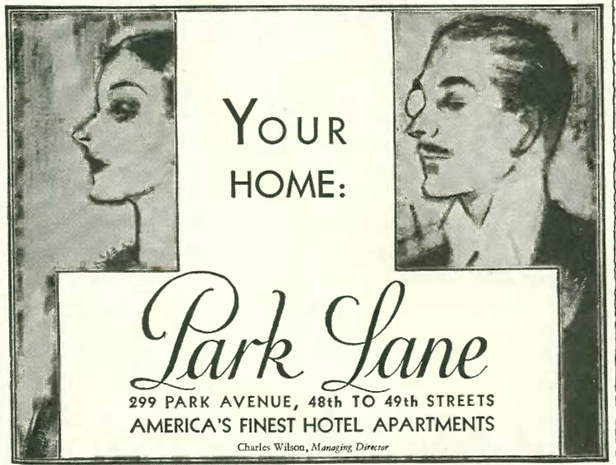
…I found this ad in the back pages interesting for its crude design yet overt appeal to snobbishness with this haughty pair…
…and here is what the Park Lane looked like when it opened in 1924…
Circa 1924 advertisement from the Sargent lock and hardware company touting its fixtures in the new Park Lane hotel apartments. At right, circa 1924 image from The American Architect depicting the Park Lane’s dining room. The building is long gone, razed some time in the 1960s to make way for an office tower. (Pinterest)
* * *
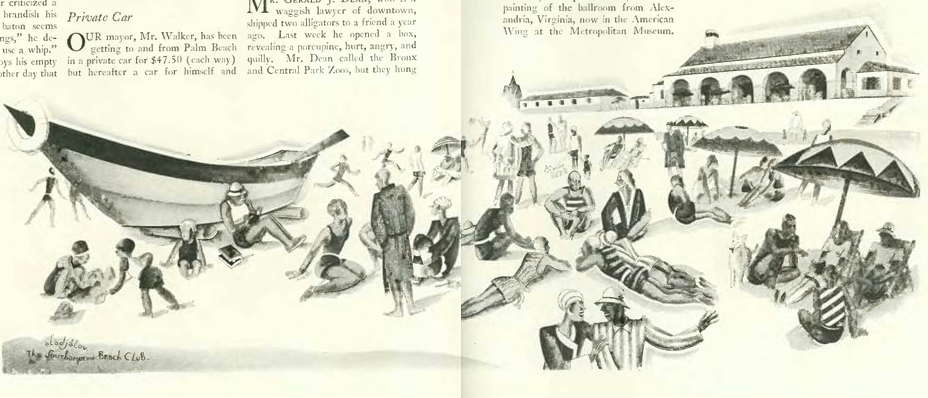
This week’s featured illustration is by Constantin Alajalov, who depicted a summer scene from the Southampton Beach Club…click to enlarge…
…our cartoonists from the Aug. 10 issue include Helen Hokinson, who looked at the challenges of Americans abroad…
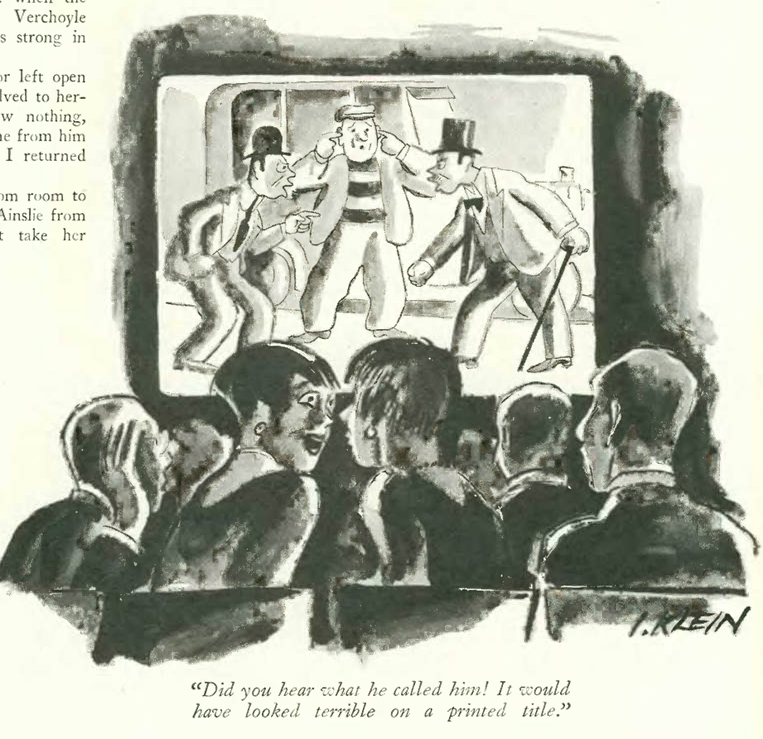
…Isadore Klein observed the changing mores of movie houses (a couple of “damns” were apparently uttered in the talking pictures of 1929)…
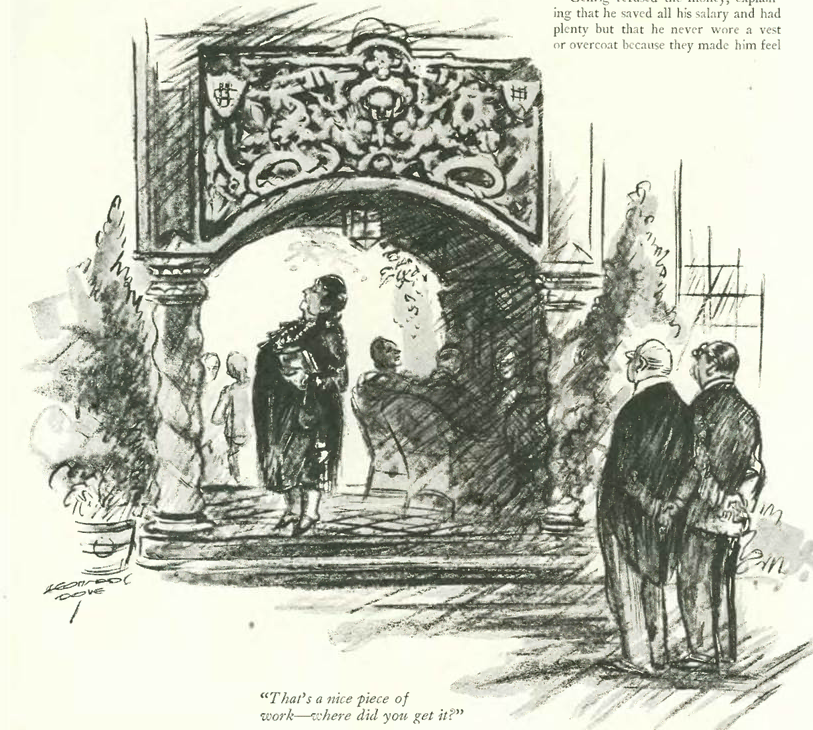
…and Leonard Dove offered up a double entendre of sorts…
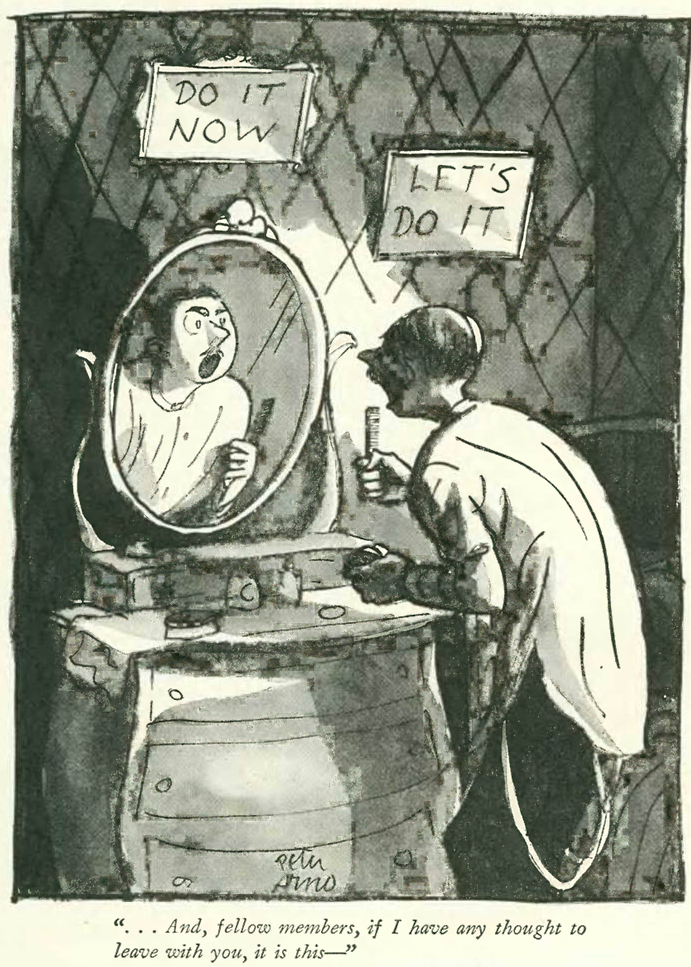
…cartoons for the Aug. 17 issue included a peek behind the scenes at a motivational speaker courtesy Peter Arno…
…Carl Kindl had some fun with the juxtaposition of a matron and a flapper hat…
…and for reference, the cloche hat called a “Scalawag” was featured in this ad by Knox in the March 30, 1929 New Yorker…drawing by Carl “Eric” Erickson…
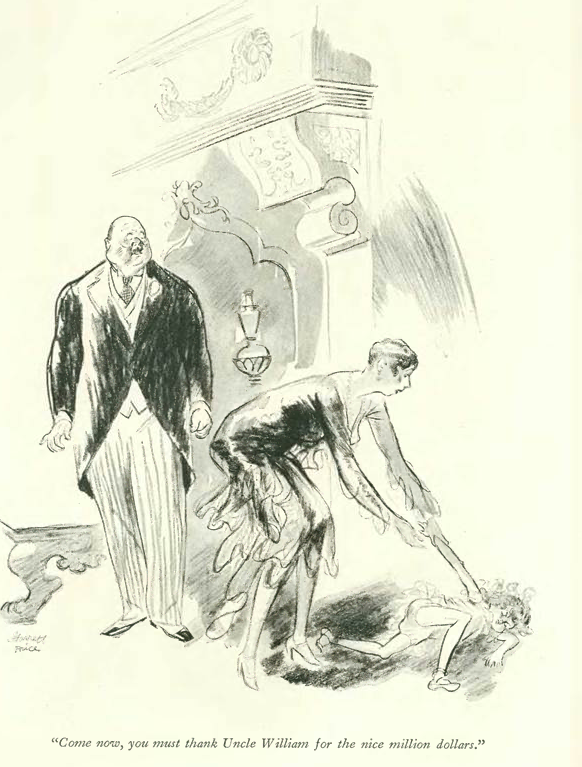
…Garrett Price portrayed the antics of an ungrateful trust fund brat, who probably did not have that million dollars after the market crash…
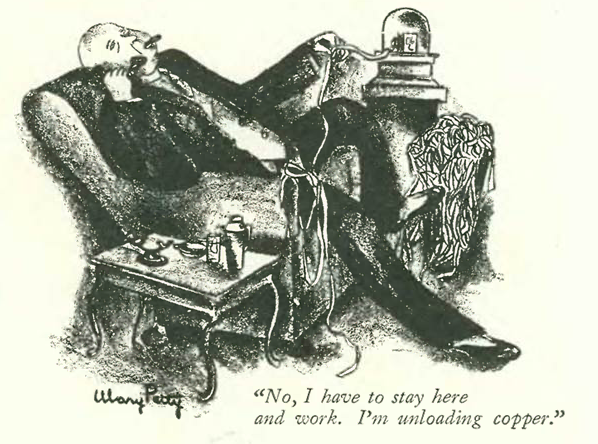
…and this fellow, depicted by Mary Petty, who doubtless would be less nonchalant come Oct. 28, or what we know as “Black Monday”…
















































































































































 A New Yorker State of Mind