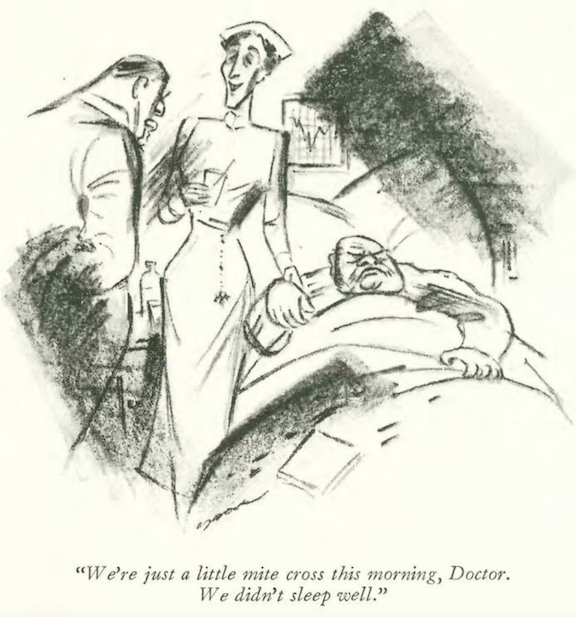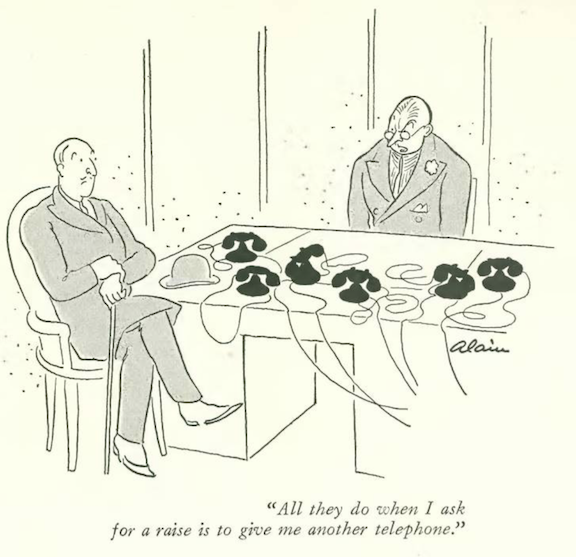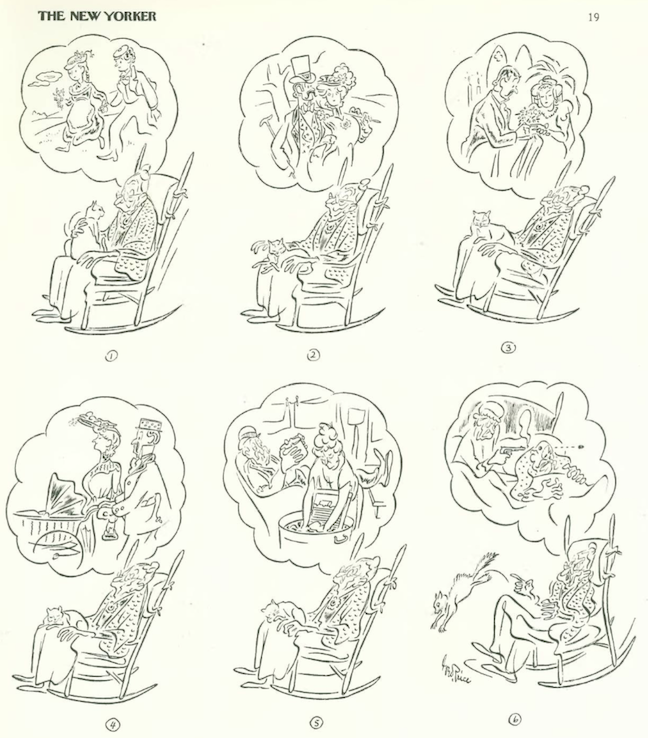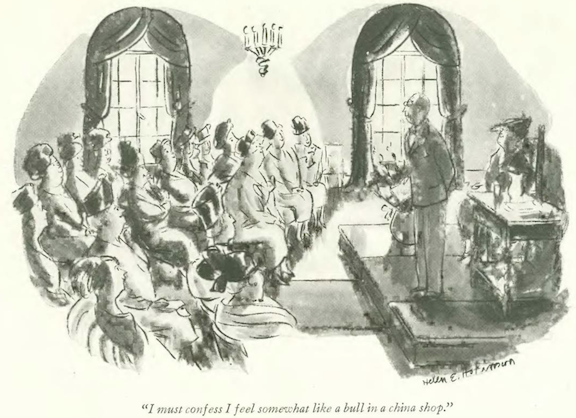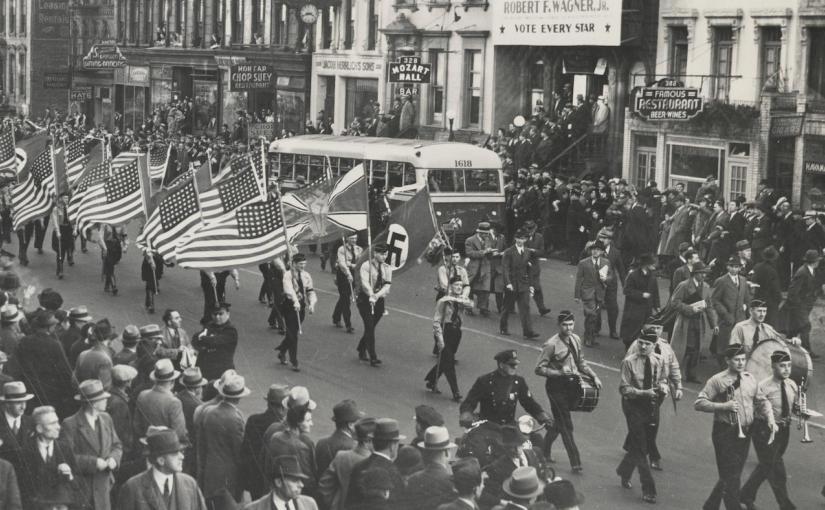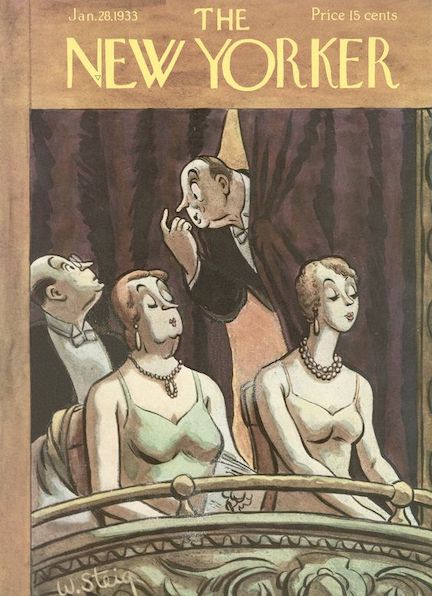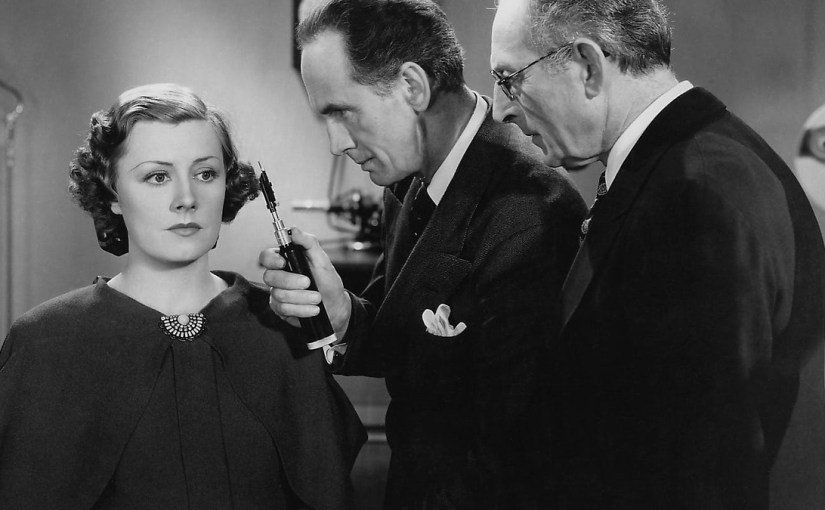
Above: A German American Bund parade in New York City on East 86th Street. Oct. 30, 1937. (Library of Congress)
Among the many ethnic enclaves of 1930s New York City was a neighborhood that was feeling the influence of world events, and not necessarily in a good way.
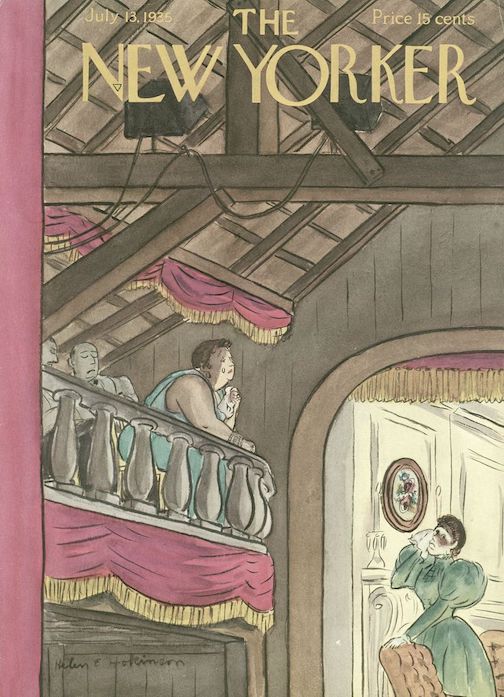
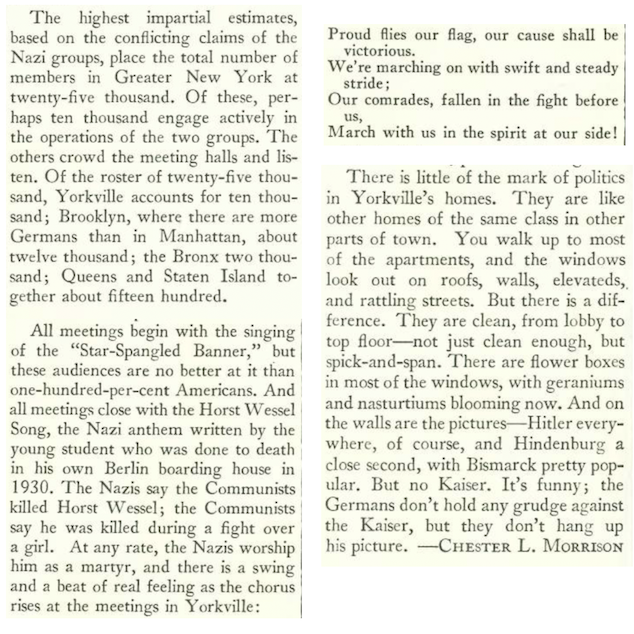
July 13, 1935 cover by Helen Hokinson. One of the first cartoonists to be published in The New Yorker, she appeared in the magazine for the first time in the July 4, 1925 issue. She contributed 68 covers and more than 1,800 cartoons to the magazine.
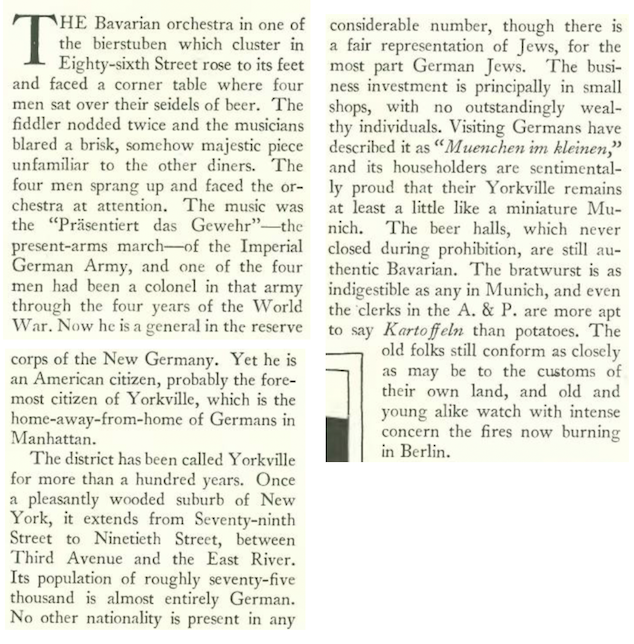
Journalist Chester L. Morrison looked at life among German immigrants on the Upper East Side for “A Reporter at Large.” Under the title “Muenchen Im Kleinen” (Little Munich), Morrison examined the everyday life of the Yorkville district between East 79th and East 96th streets.
Germans had settled in New York City almost from its first days, and by 1885 the city had the third-largest German-speaking population in the world, outside of Vienna and Berlin, the majority settling in what is today the East Village. Following the General Slocum disaster in 1904, German settlement migrated to Yorkville, which was commonly referred to as Germantown. Here are excerpts of Morrison’s observations:
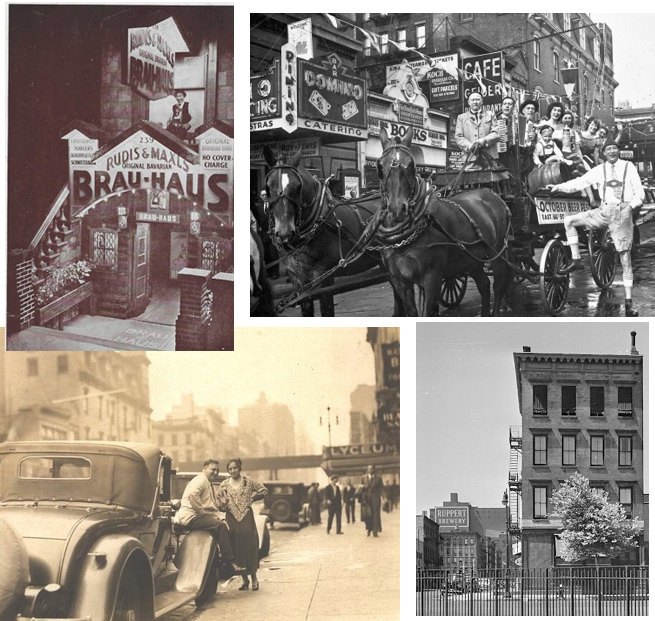
ENCLAVE…Clockwise, from top left, Rudi and Maxl’s Brau-Haus at 239 East 86th; Oktoberfest celebration in Yorkville, undated; Walker Evans photo with Rupert Brewery sign in the background; the Yorkville neighborhood in the 1930s with the old Third Avenue El in the background. (postcardhistory.net/boweryboyshistory.com/metmuseum/gothamcenter.org)
With the rise of the Nazi Party in Germany in the 1930s, a pro-Hitler group called the German-American Bund began to organize street rallies and marches on 86th Street and on 2nd Avenue. Although they represented a minority of German settlers, the Bund made itself visible in parades and other public events that culminated in a mass demonstration at Madison Square Garden in 1939. The Bund also organized training camps for young men outside of the city, such as Camp Siegfried in Yaphank, L.I.
Morrison noted that Yorkville homes looked like many others across the city, that is until you saw the pictures on their walls.
SCOUT’S HONOR?…At a German-American Bund camp in Andover, New Jersey, young campers stand at attention as the American flag and the German-American Youth Movement flag are lowered at sundown, July 21, 1937. (AP)THE MADNESS OF CROWDS…A German-American Bund color guard marches through Madison Square Garden, Feb. 20, 1939. (AP)
* * *
Garden Varieties
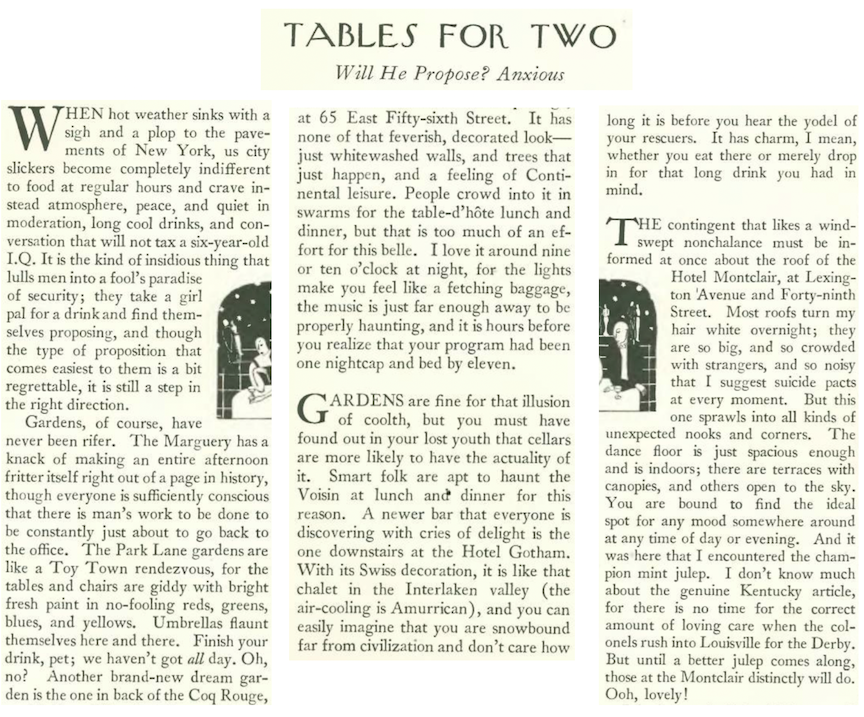
Now for a palate cleanser as we turn to Lois Long and her “Tables For Two” column, in which she examined the confluence of hotel gardens and marriage proposals. Excerpts:
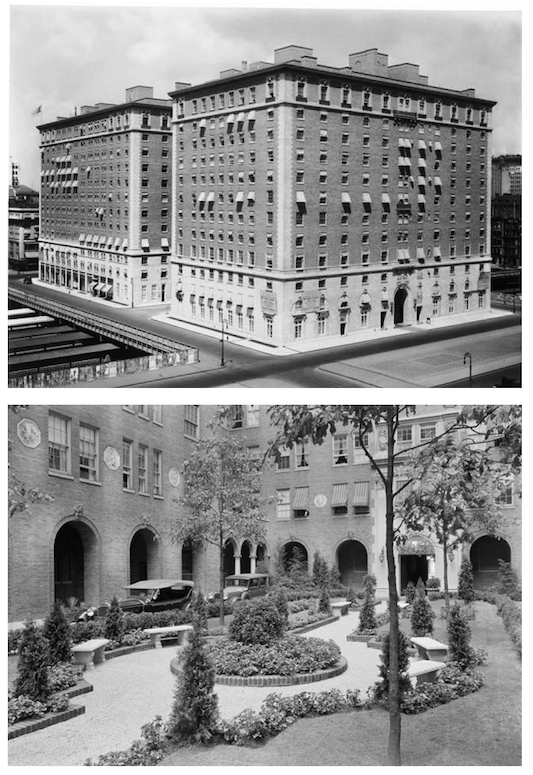
OASIS…Lois Long recommended the Hotel Marguery’s formal garden as a place to “fritter away” an afternoon. The hotel was demolished in 1957 to make way for the Union Carbide Building. (Museum of the City of New York)A COOL, SWISS CHALET was how Long described the new Alpine Room in the basement of the Gotham Hotel. (daytoninmanhattan.blogspot.com)
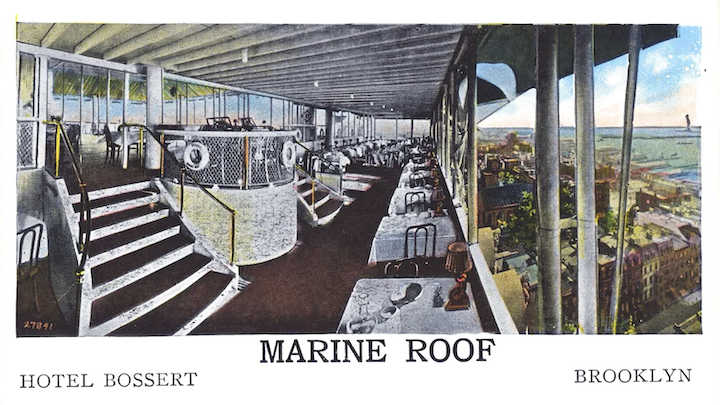
Long continued as she set her sights on Brooklyn…
HE WILL LIKELY SAY YES, according to Long, if you got your beau to accompany you to the roof of the Hotel Bossert in Brooklyn. (brownstoner.com)THE TUNEFUL SURROUNDINGS of the Famous Door were a bit too crowded for Long, however this group seems to have had plenty of room to enjoy the greats Ben Webster, Eddie Barefield, Buck Clayton, and Benny Morton on stage at the Famous Door in 1947. (Wikipedia)
* * *
Monster Mash-up
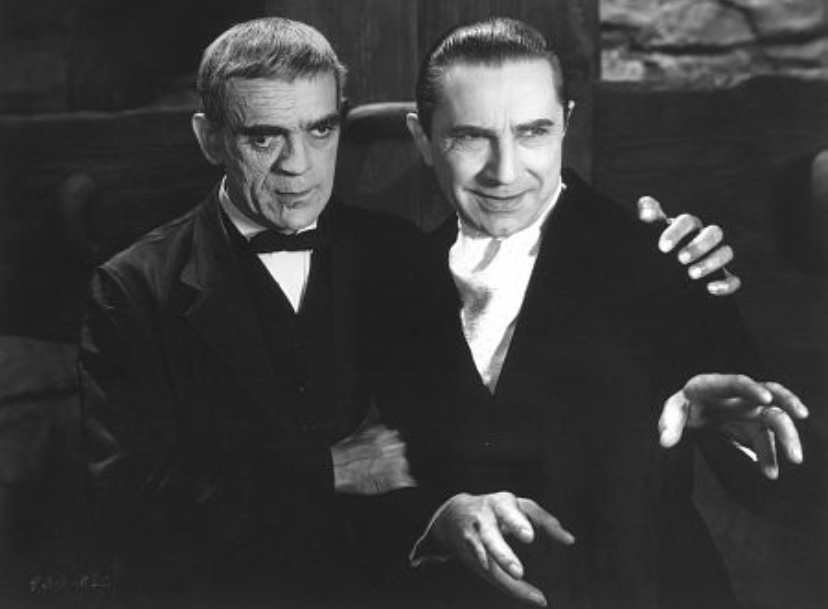
Boris Karloff and Bela Lugosi are synonymous with 1930s monster flicks (they did eight together) but their latest outing, The Raven, left critic John Mosher wondering where the Poe was in the midst of this “sadistic trifle.”
BUDDY FILM…The Raven (which had almost nothing to do with Edgar Allen Poe’s famous narrative poem) was the third of eight films that featured Boris Karloff and Bela Lugosi. According to film historian Karina Longworth, thanks to a wave of monster movie hits in the 1930s, these two middle-aged, foreign, struggling actors became huge stars. (cerealatmidnight.com)TYPECAST? WHO CARES?…Bela Lugosi and Boris Karloff in 1932. Despite being monster movie rivals, the two seemed get along well off-screen, perhaps appreciating their mutual good fortune. (beladraculalugosi.wordpress.com)
* * *
Ode to Education
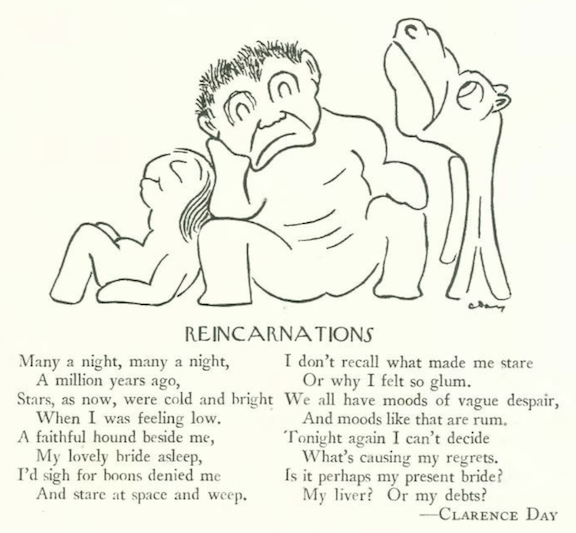
Clarence Day, best known for his Life With Father stories, also contributed a number of cartoons to The New Yorker that were accompanied by satirical poems…here he examines attempts at education in the arts and sciences…
* * *
From Our Advertisers
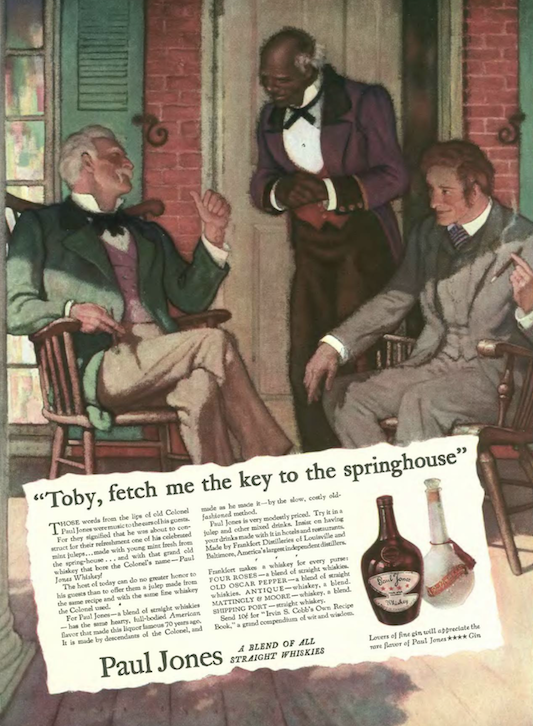
We start at the back of the book, and a couple of one-column ads (appearing on the opposite sides of the same page) that catered to very different clientele…
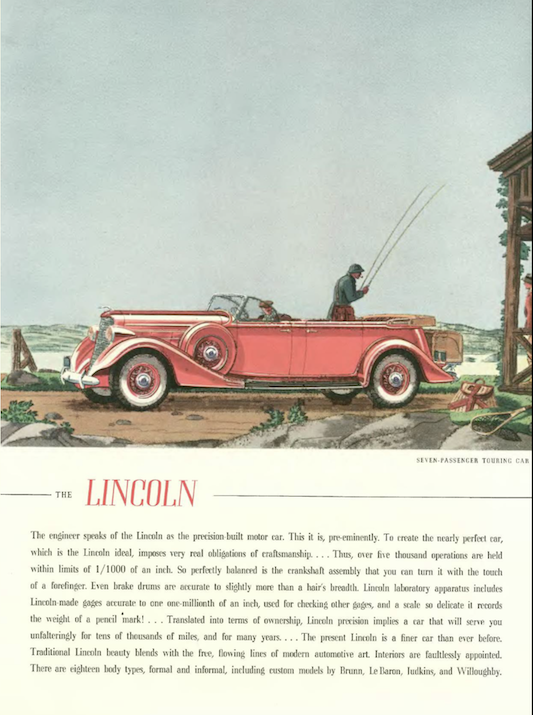
…the makers of Lincoln luxury cars knew the type of client they were fishing for here…
…pin-up artist George Petty continued exploring his beauty and the beast theme on behalf of Old Gold cigarettes…
…and Camel offered more reasons why you should smoke your way to athletic glory…
…this inside back cover advertisement reminds us that we are indeed back in 1935…
…as does this one from Dr. Seuss, with a shot of insecticide for a talking toddler…
…on to our cartoonists, beginning with Charles Addams and some Navy hijincks…
…Gluyas Williams offered his latest take on American club life…
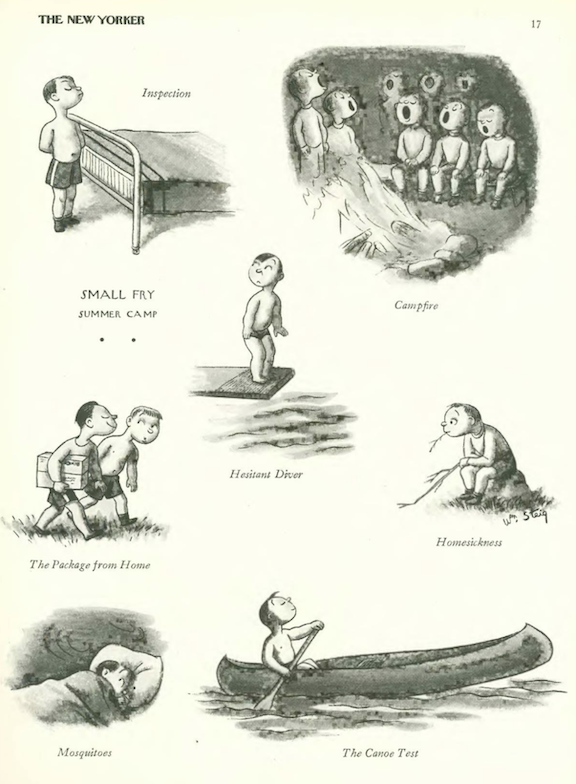
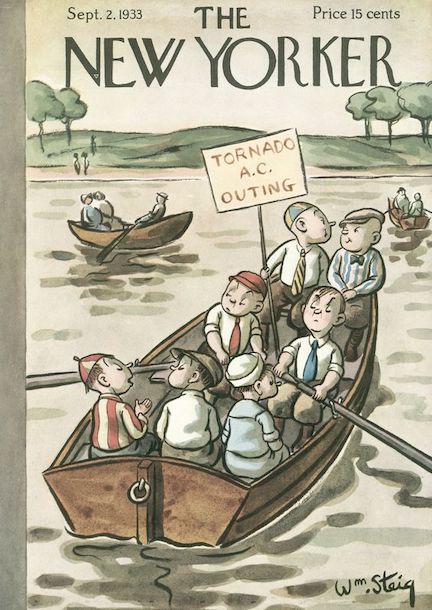
…William Steig took us to summer camp…
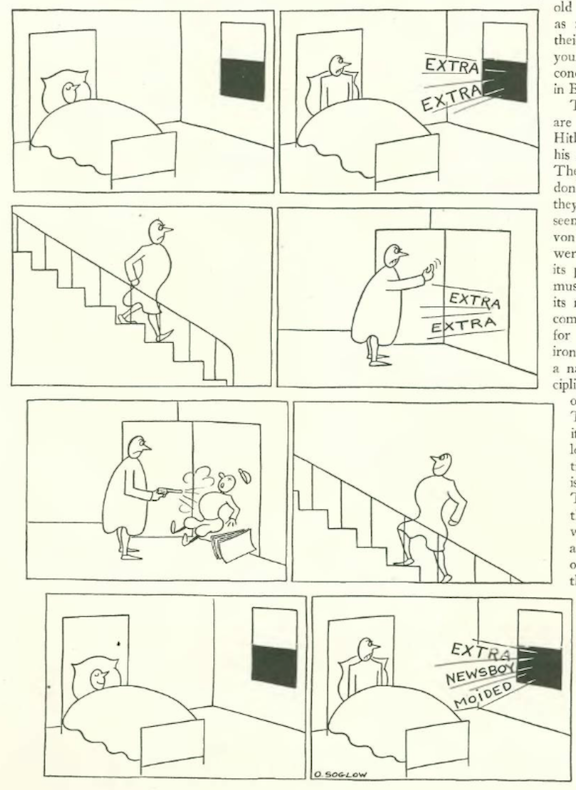
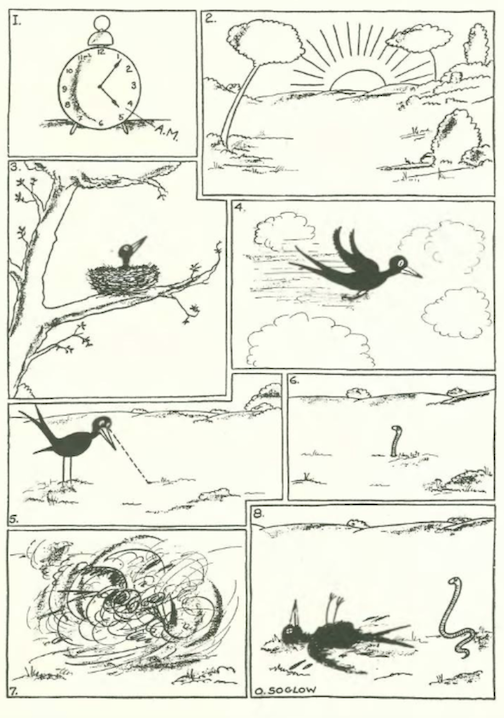
…Otto Soglow looked for a good night’s rest…
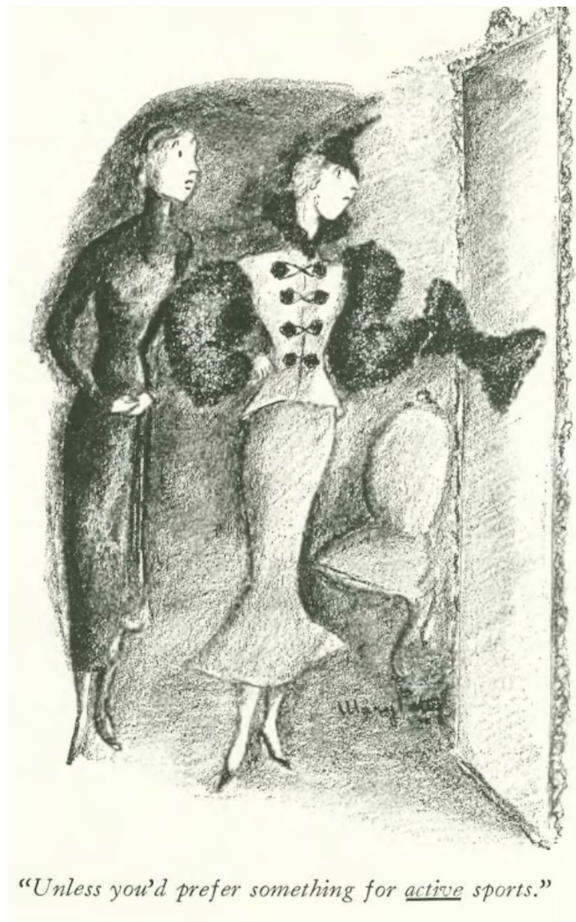
…Mary Petty explored the latest in bathing fashions…
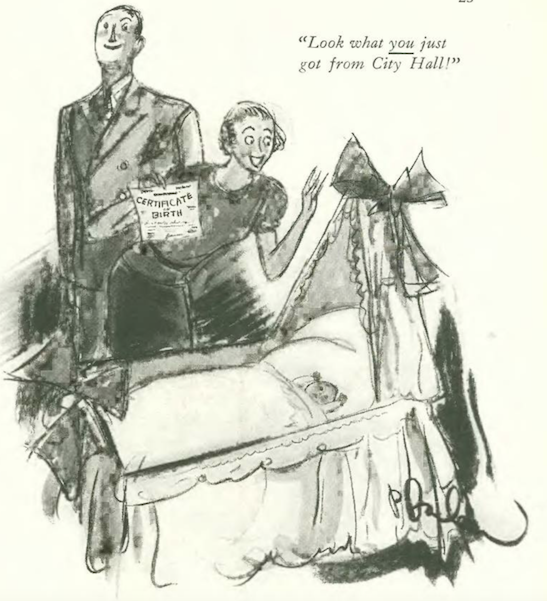
…Perry Barlow introduced us to some proud parents…
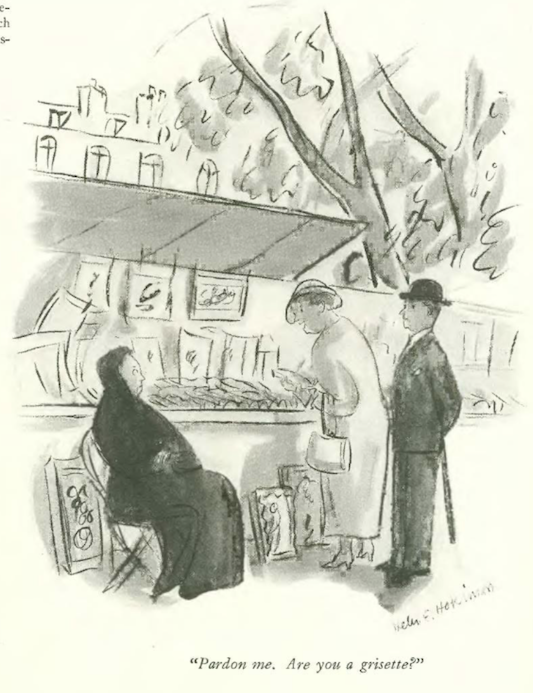
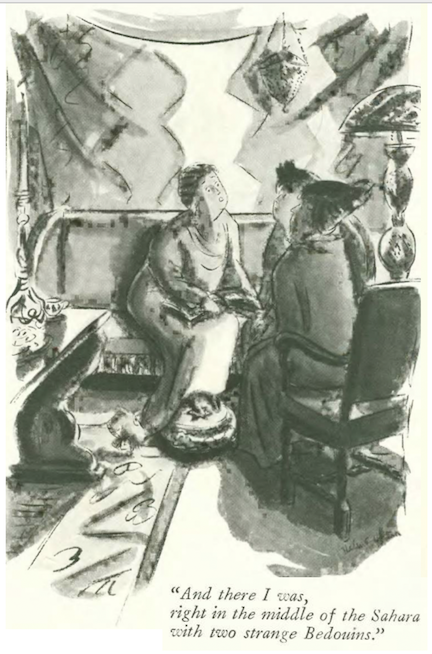
…and to close with Helen Hokinson, who showed us some innocents abroad…
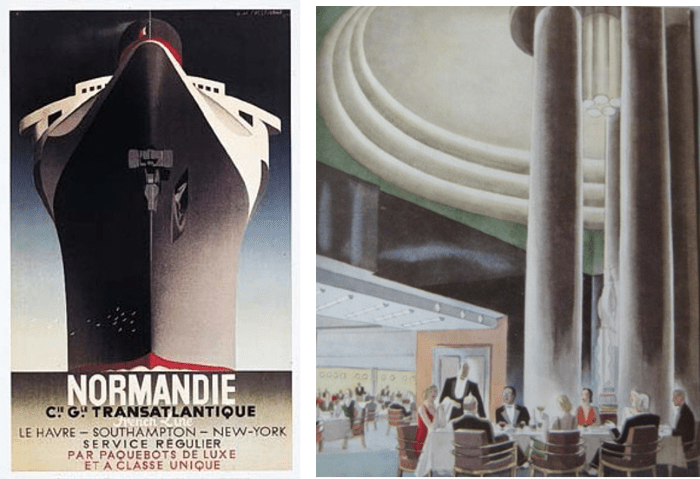
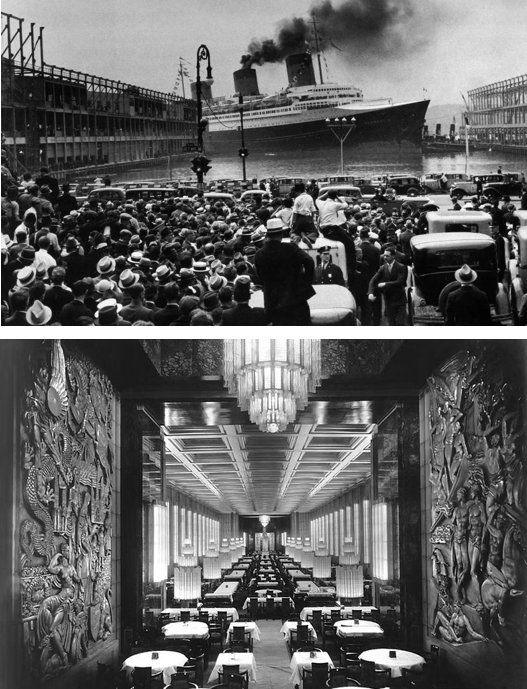
Above: At left, Adolphe Cassandre's famed 1935 depiction of the S.S. Normandie; right, image from a 1935 promotional booklet published by the French Line.
When the S.S. Normandie entered service in 1935, she was the largest and fastest passenger ship afloat, crossing the Atlantic in a little over four days. The ship was so impressive that even the imperturbable Janet Flanner expressed enthusiasm over its launch.
May 25, 1935 cover by Constantin Alajalov.
As Paris correspondent, Flanner was giving New Yorker readers a preview of Normandie‘s May 29 maiden voyage from Le Havre to New York City.
HER ENTOURAGE…The S.S. Normandie was welcomed into New York Harbor on June 3, 1935. (Wikipedia)IMAGINE THAT…An S.S. Normandie promotional poster from 1935 depicts the ocean liner making an unlikely entrance into Manhattan. The sleek ship measured 1,029 feet (313.6m) in length and carried nearly 2,000 passengers plus 1,345 crew. It was the first ocean liner to exceed 1,000 feet in length. (Museum of the City of New York–MCNY)
To give New Yorkers some idea of the liner’s size, Flanner noted that the Normandie would stretch from 43rd to 47th Street, and if stood on her stern, would stand nearly 180 feet above the RCA Building at Rockefeller Center.
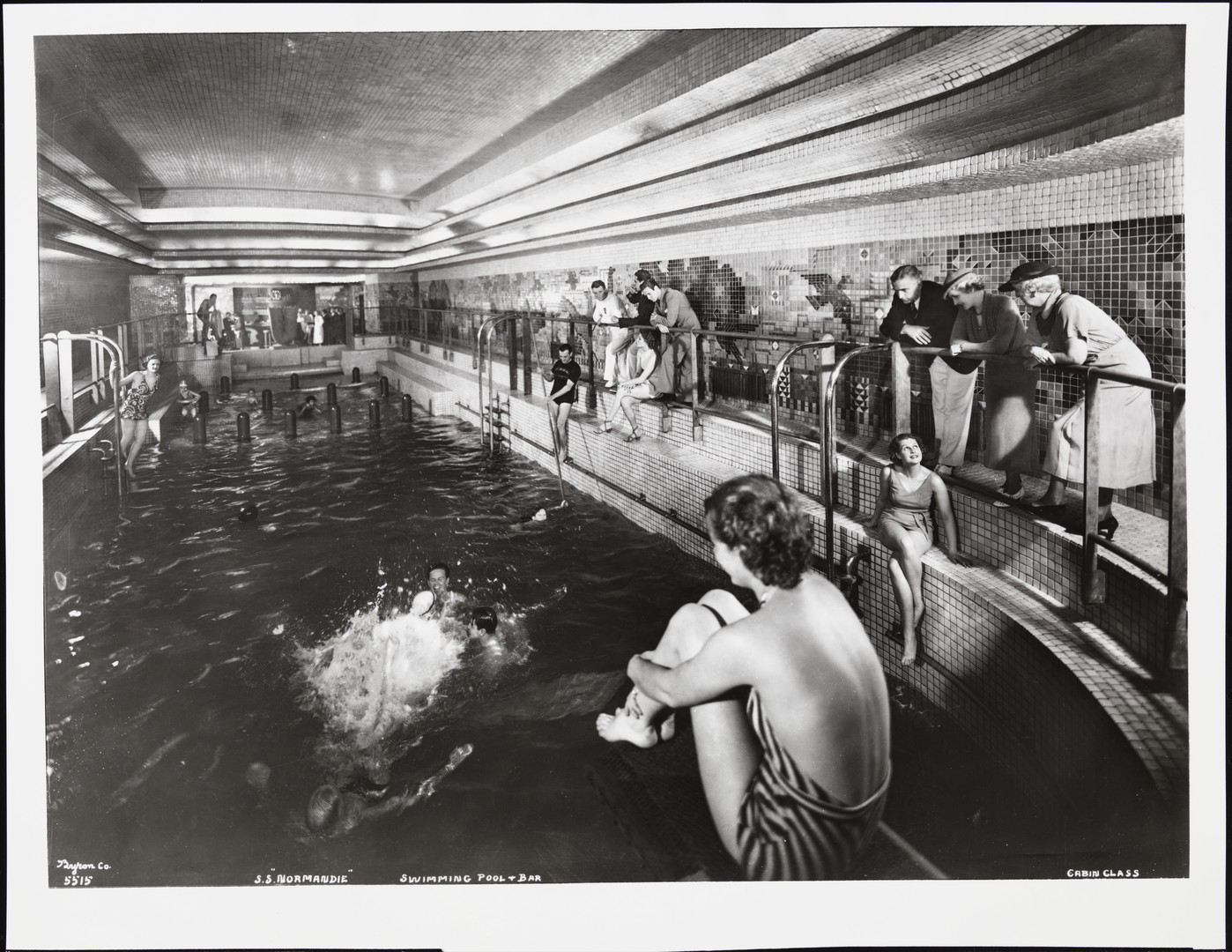
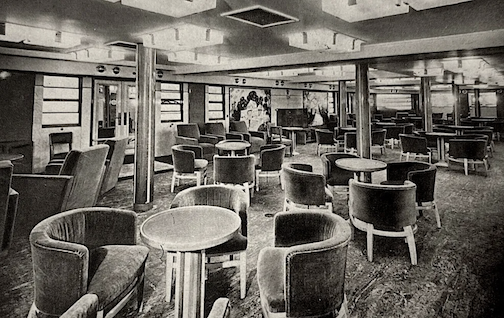
FRENCH TOAST…Top, a crowd cheers the S.S. Normandie as it arrives at New York’s Pier 88 on June 3, 1935; below, the first class dining hall was 305 feet long, 46 feet wide and three decks high. (drivingfordeco.com/MCNY)IN, AND ON THE WATER…Passengers take a plunge in the Normandie’s swimming pool, which included a bar at the far end. (MCNY)EYE-POPPING…Colorized image of the first-class lounge. (Pinterest)BARGAIN…Accommodations for weren’t too bad, either, for the other classes. Here is the 3rd class salon. (drivingfordeco.com)TAKE YOUR PICK…Clockwise from top left, elevators decorated in sea shells; the rear of the Grand Salon; a first class suite; view of the swimming pool. An incredible scale model of the S.S. Normandie is displayed on the Queen Mary, which is permanently docked at Long Beach, CA. (MCNY)
World War II would cut short the Normandie’s life. Seized in New York and renamed USS Lafayette in 1942, she was being converted to a troopship when she caught fire, capsized onto the port side, and came to rest half submerged on the bottom of the Hudson at Pier 88, the same pier where she was welcomed in 1935. She was scrapped in 1946.
THE WAGES OF STUPIDITY…The Normandie after a fire brought her glory days to an end. (Reddit)
* * *
A Critic Is Born
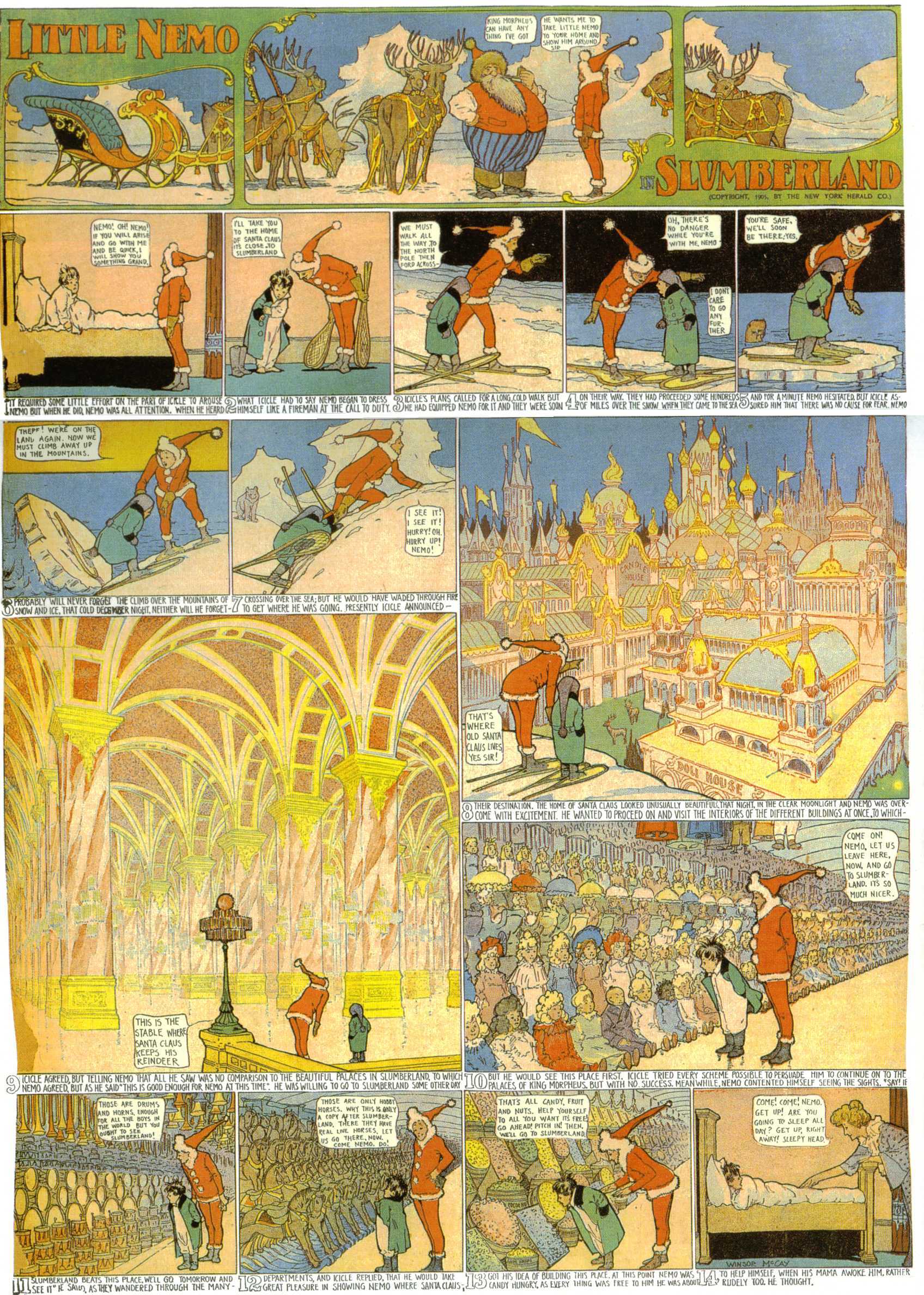
It turns out that Wolcott Gibbs (1902–1958) cut his teeth as The New Yorker’s theatre critic while he was still in short pants. Gibbs recalled his five-year-old self in an essay that described his first experience with the theatre—a play based on the New York Herald’s popular comic strip, Little Nemo in Slumberland, by Winsor McCay. In parallel with Gibbs’ childhood, the strip ran from 1905 to 1911.
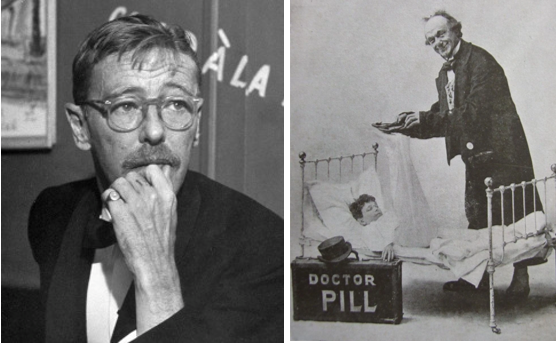
As a child, Gibbs was wild about Little Nemo’s adventures, but the stage adaptation left the child disillusioned (and feeling “tricked and furious”). The New York Public Library’s Douglas Reside wrote (in 2015) that the producers, seeking to draw as wide an audience as possible, presented Little Nemo “as a bloated mixture of theatrical styles, including the minstrel show, pantomime, operetta, farce-comedy, vaudeville, revue, and ballet,” featuring three comedians “mostly superfluous to Nemo’s story.” The part of Nemo was played by a 25-year-old actor with dwarfism.
DREAMLAND…The Little Nemo strip from Dec. 17, 1905 depicted the boy’s dream of a visit to Santa’s magical city at the North Pole. (Wikipedia)THAT’S SHOWBIZ…As a boy, Wolcott Gibbs (left) was disillusioned by a 1907 theatre adaptation of his favorite comic strip, Little Nemo in Slumberland. The play was dominated by three comedians including Joseph Cawthorn, right, who burlesqued German linguistic and cultural mannerisms for comic effect. He played Dr. Pill, the quack doctor of Slumberland’s royal court. The “boy” in the bed portraying Nemo was 25-year-old “Master” Gabriel Weigel. (Wikipedia/New York Public Library)
* * *
Humorous Humors
Clarence Day, best known for his Life with Father stories, wrote humorously about his physical ailments and contributed a number of cartoons to The New Yorker that were accompanied by satirical poems. Day would be dead by December—after a bout with pneumonia—however, despite his ailments he would spend his last months arranging publication of his Life with Father book, which was published posthumously.
* * *
Frankie Got Hitched
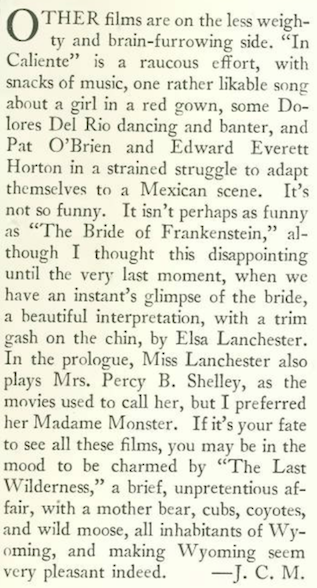
Film critic John Mosher still wasn’t finding much to rave about at the cinema, getting more chuckles from the monster mash-up of Boris Karloff and Elsa Lanchester in The Bride of Frankenstein than he did from the Dolores Del Rio vehicle Caliente.
DATE NIGHT…Top, Elsa Lanchester and Boris Karloff let the sparks fly in The Bride of Frankenstein, while Dolores Del Rio danced and chatted her way through the unfunny musical comedy Caliente. (Wikipedia/TCM)
* * *
Other features in the May 25 issue included H. L. Mencken’s continuing exploration into the origins of American names…
…and The New Yorker published its first John Cheever story, “Brooklyn Rooming House.” Of Cheever’s 180 short stories, the magazine would publish 121 of them.
A NEW FACE…In spring 1935 The New Yorker bought two John Cheever stories, paying $90 for “The Brooklyn Rooming House” and $45 for “Buffalo.” Fiction editor Katharine White urged the purchase of the stories. Above, Walker Evan’s photo of Cheever, circa 1940s. (metmuseum.org)
* * *
From Our Advertisers
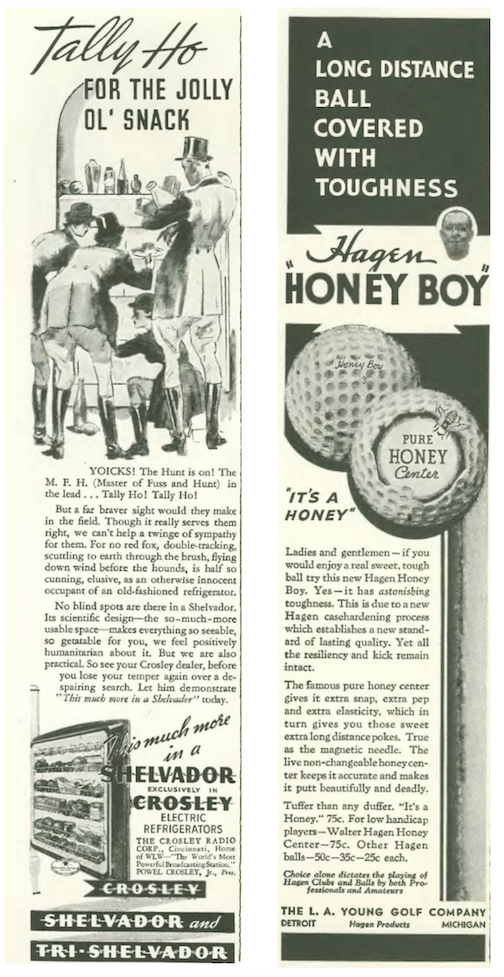
We start with some one-column gems from the back of the book including the latest innovation in electric refrigerators…a shelf in the door!…apparently Crosley was the first to invent this “Shelvador”…the ad to the right is interesting in that it advertises honey-filled golf balls…in the early 20th century some golf balls did contain real honey…apparently it was chosen for its consistent viscosity (or maybe for a quick snack on the ninth hole)…
…and from General Tire, we have another ominous warning from Dad as the teens head out for another night of crooning, or whatever they are dressed for…
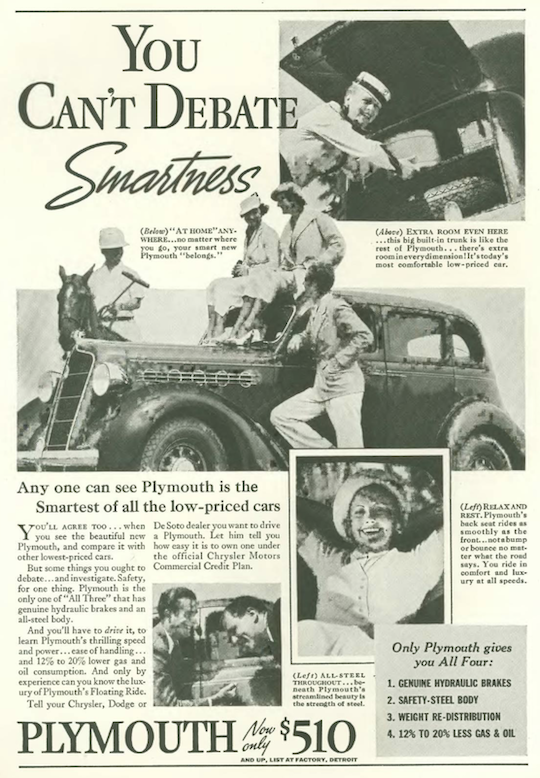
…last week Chrysler was offering its sedans for $745, and this week you could have one of their Plymouths for just 510 bucks…the message: you would be admired by your polo buddies for your smart, thrifty choice…
…where the above ad crammed every square inch with information, the folks at Pierce Arrow offered a restrained, minimal message (suggesting “we can afford to buy a full-page ad and leave much of it blank”)…another class signifier was the absence of a price tag (about $150k in today’s dollars)…but Chrysler-Plymouth would survive the Depression because it sold affordable cars, while Pierce Arrow was on its last legs…
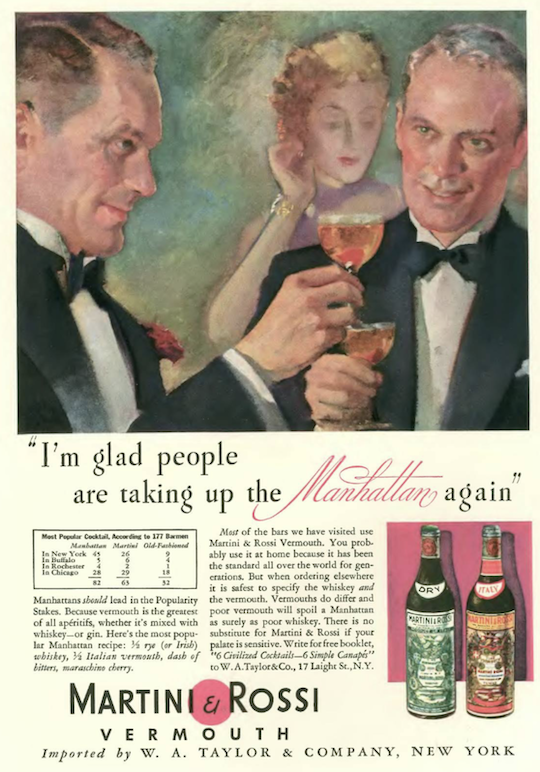
…here’s a couple of Pierce Arrow owners toasting the return of the Manhattan…
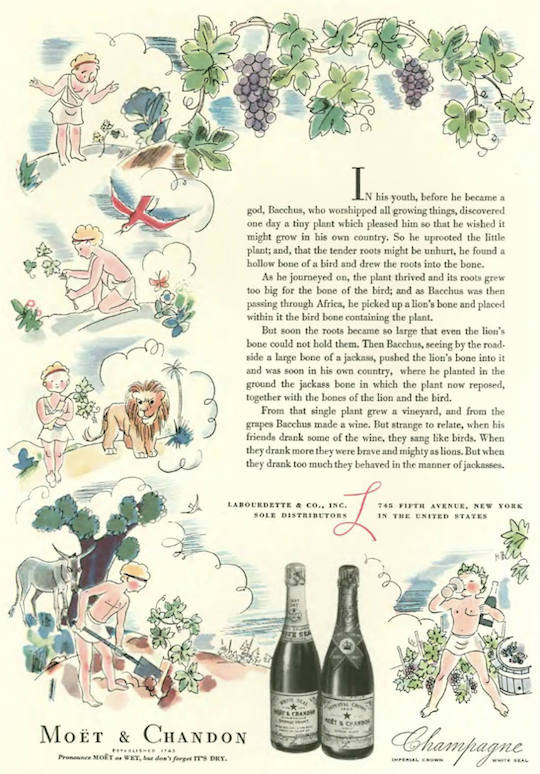
…Moët & Chandon offered up this whimsical tableau from the youth of Bacchus…
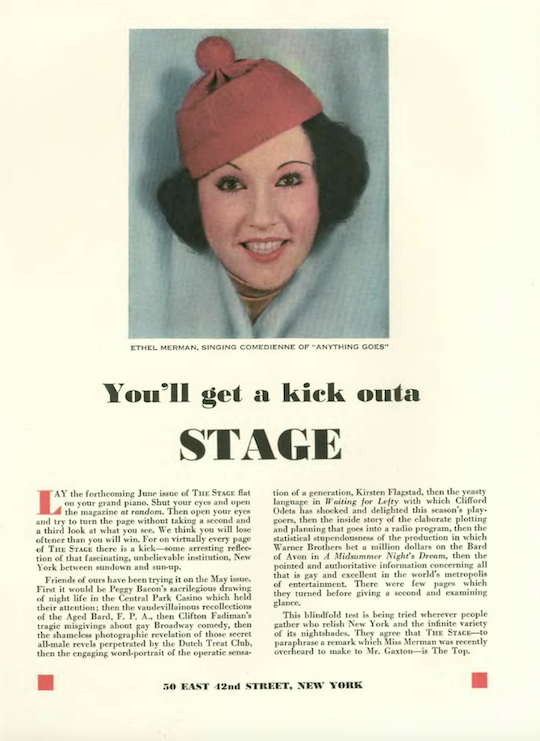
…Ethel Merman popped through a curtain on the inside back cover to invite readers to subscribe to The Stage magazine…
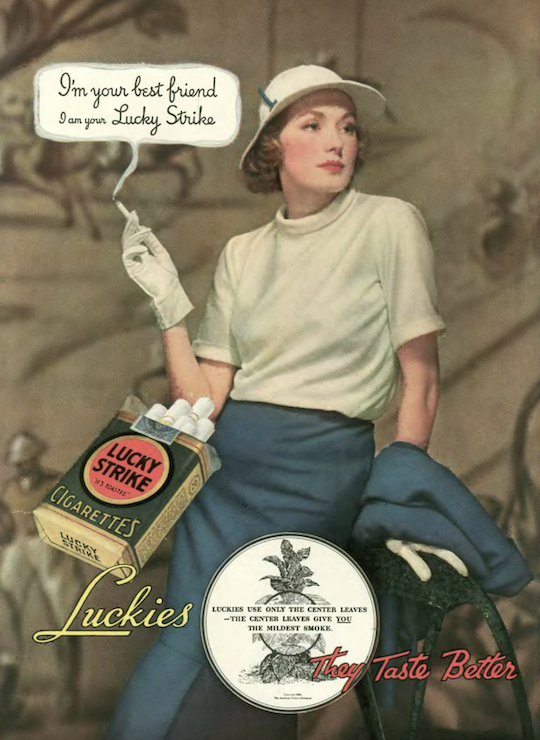
…and Lucky Strike claimed the back cover with another stylish woman and a talking cigarette bent on mind control…
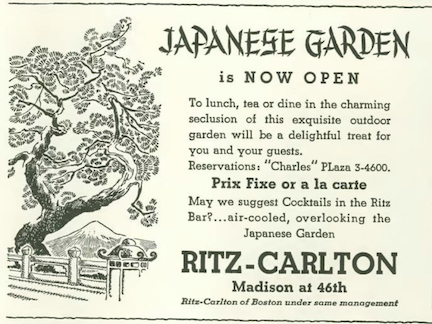
…the Ritz-Carlton announced the spring re-opening of its famed Japanese Garden…
The Japanese Garden in 1924. (clickamericana)
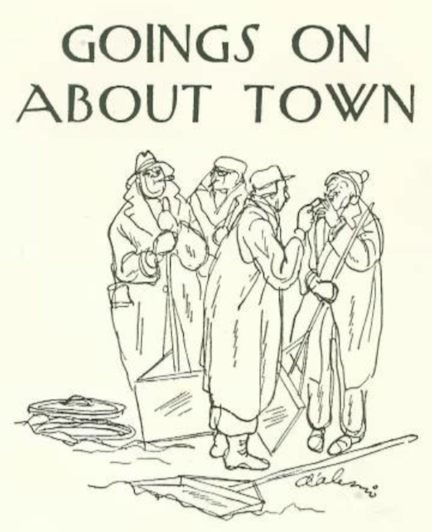
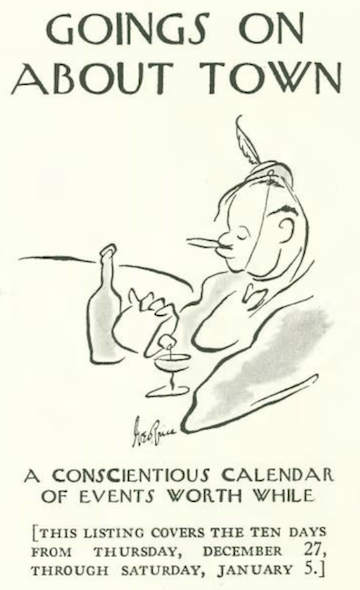
…and we kick off our cartoonists with this “Goings On” topper by D. Krán…
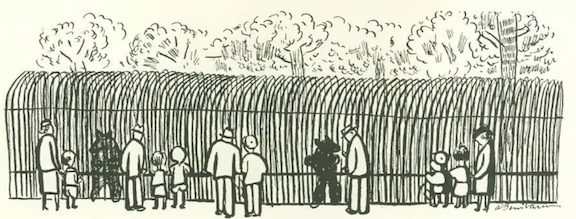
…followed by this visit to the zoo by Abe Birnbaum…
…James Thurber was up for some fashion criticism…
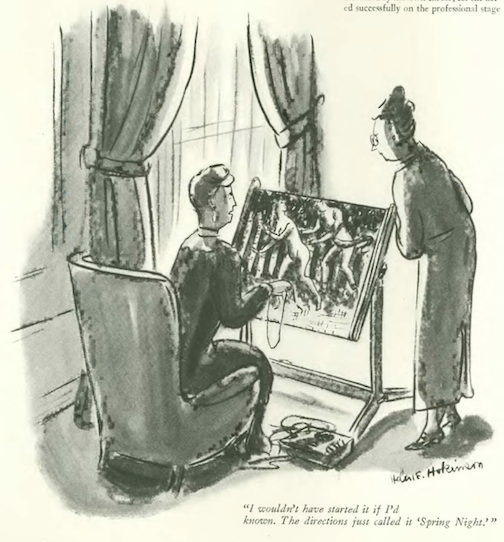
…Helen Hokinson found a surprise in a paint-by-numbers kit..
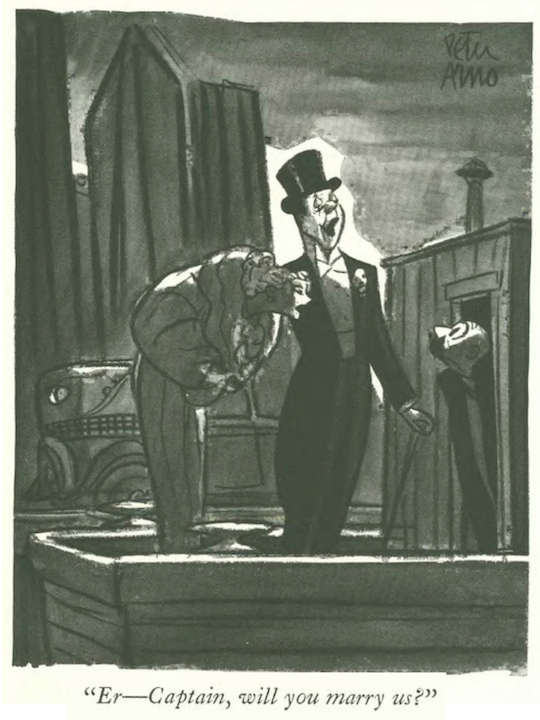
…Peter Arno was up for some late night nuptials…
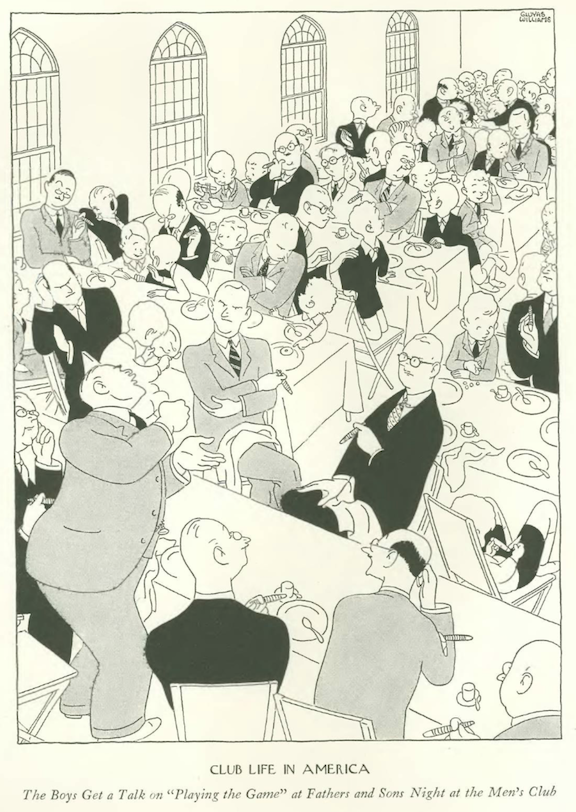
…Gluyas Williams continued to examine club life…
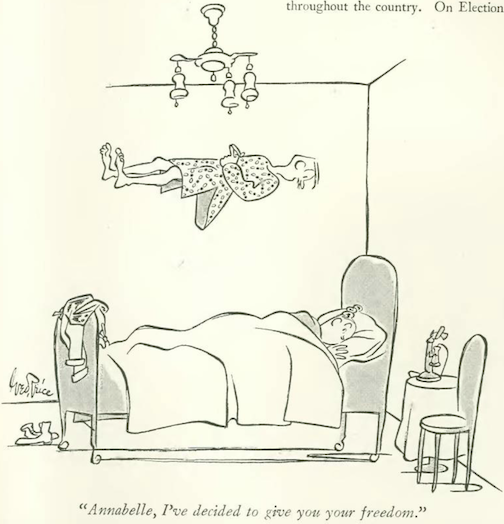
...George Price was back in the air…
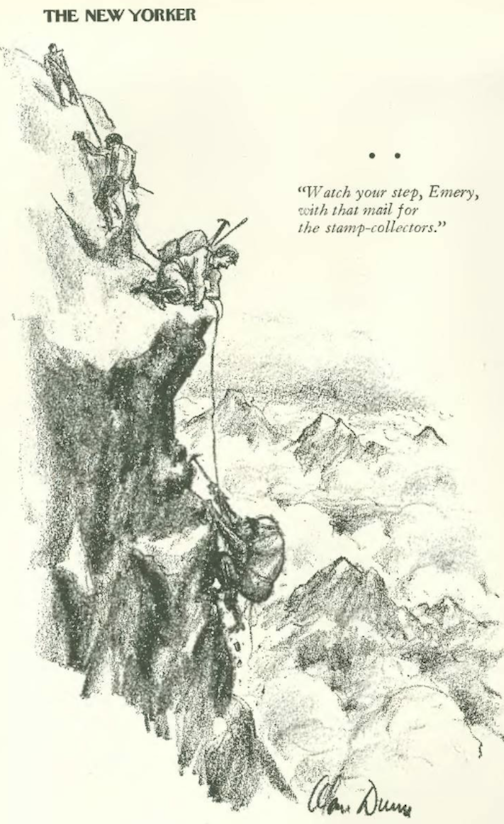
…Alan Dunn gave us some men on a mission…
…and we close with Charles Addams, and some dam trouble…
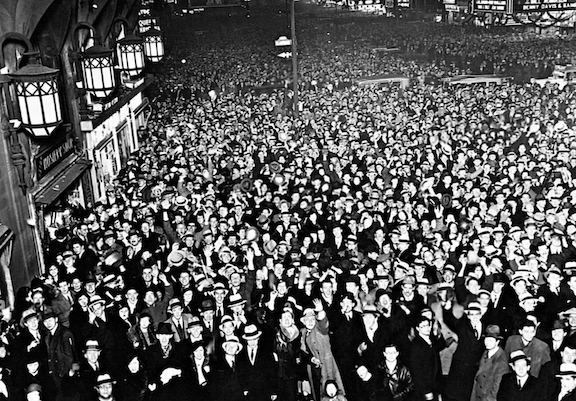
Above: Ringing in the New Year at Times Square, 1934.
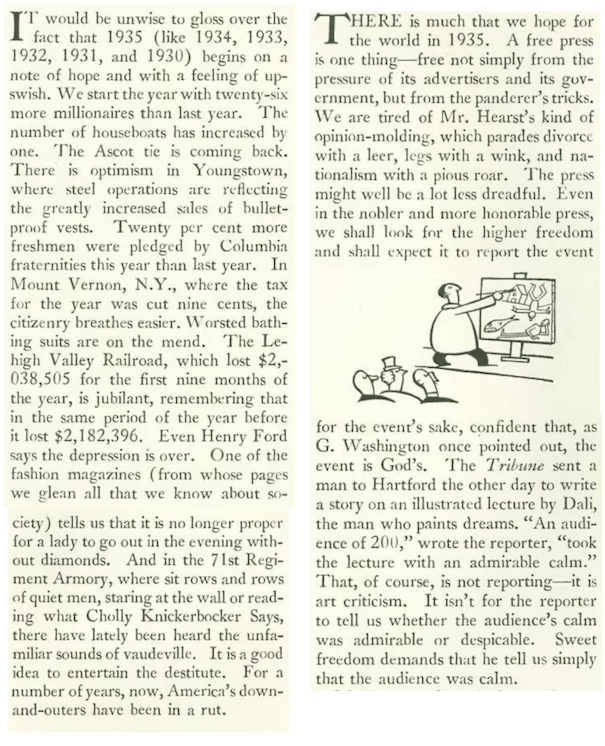
We bid adieu to 1934 with some odds and ends, beginning with E.B. White’s observations for the upcoming year, which if anyone had noticed the uptick in Ascot tie purchases, just might be a bit rosier than previous years of the decade.
Dec. 29, 1934 cover by S. Liam Dunn.
White was also hopeful for a new year with a less dreadful press, particularly the pandering type promulgated by William Randolph Hearst.
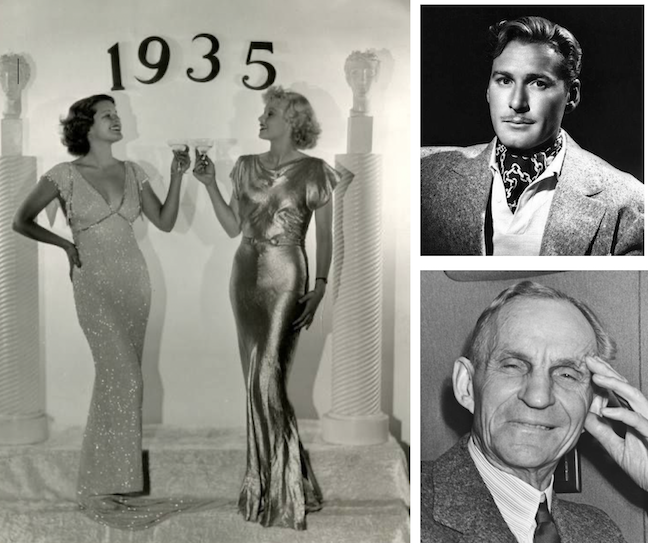
GOOD RIDDANCE…E.B. White wryly noted the positive signs heading into 1935. While actresses Billie Seward and Lucille Ball rang in the New Year, Erroll Flynn was sporting an ascot tie and Henry Ford was proclaiming that the Depression was over. (Pinterest)
* * *
Dr. Peeper
“The Talk of the Town” noted that Dr. Allan Dafoe, the country doctor who gained fame for delivering the Dionne Quintuplets, expressed a desire to see Sally Rand perform her bubble dance during his visit to Gotham. “Talk” also looked in on the some of the technical aspects of the burlesque dancer’s signature act:
DON’T BURST MY BUBBLE…Dr. Allan Dafoe of Dionne Quintuplet fame looked forward to taking in the sights of New York, including Sally Rand’s famed bubble dance. (Image from the 1936 book The Country Doctor/Sally Rand via stuffnobodycaresabout.com)
* * *
Leading Ladies
Film Critic John Mosher noted the continued rise of two leading female stars, twenty-seven-year-old Katharine Hepburn and six-year-old Shirley Temple. Mosher recalled Hepburn’s recent performance in Little Women, and proclaimed that she “succeeds again” in The Little Minister.
OPPORTUNITY KNOCKS...Katharine Hepburn and John Beal in The Little Minister. Hepburn portrayed Babbie, a member of the nobility who disguises herself as a gypsy to protect villagers from a tyrannical lord. In the process she falls in love with the good Rev. Gavin Dishart (Beal). (IMDB)
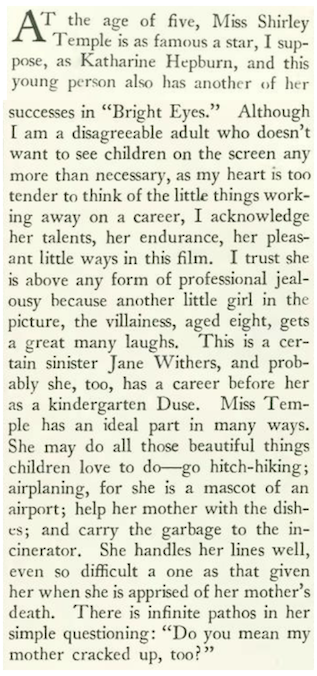
Although Mosher admitted he was a “disagreeable adult” who doesn’t enjoy seeing children on the screen “more than necessary,” he acknowledged Shirley Temple’s talents as well as those of child actor Jane Withers in Bright Eyes.
BRIGHT EYES, BRIGHT STARS…Jane Withers, Shirley Temple, and Terry in Bright Eyes. (IMDB)
* * *
That Youthful Feeling
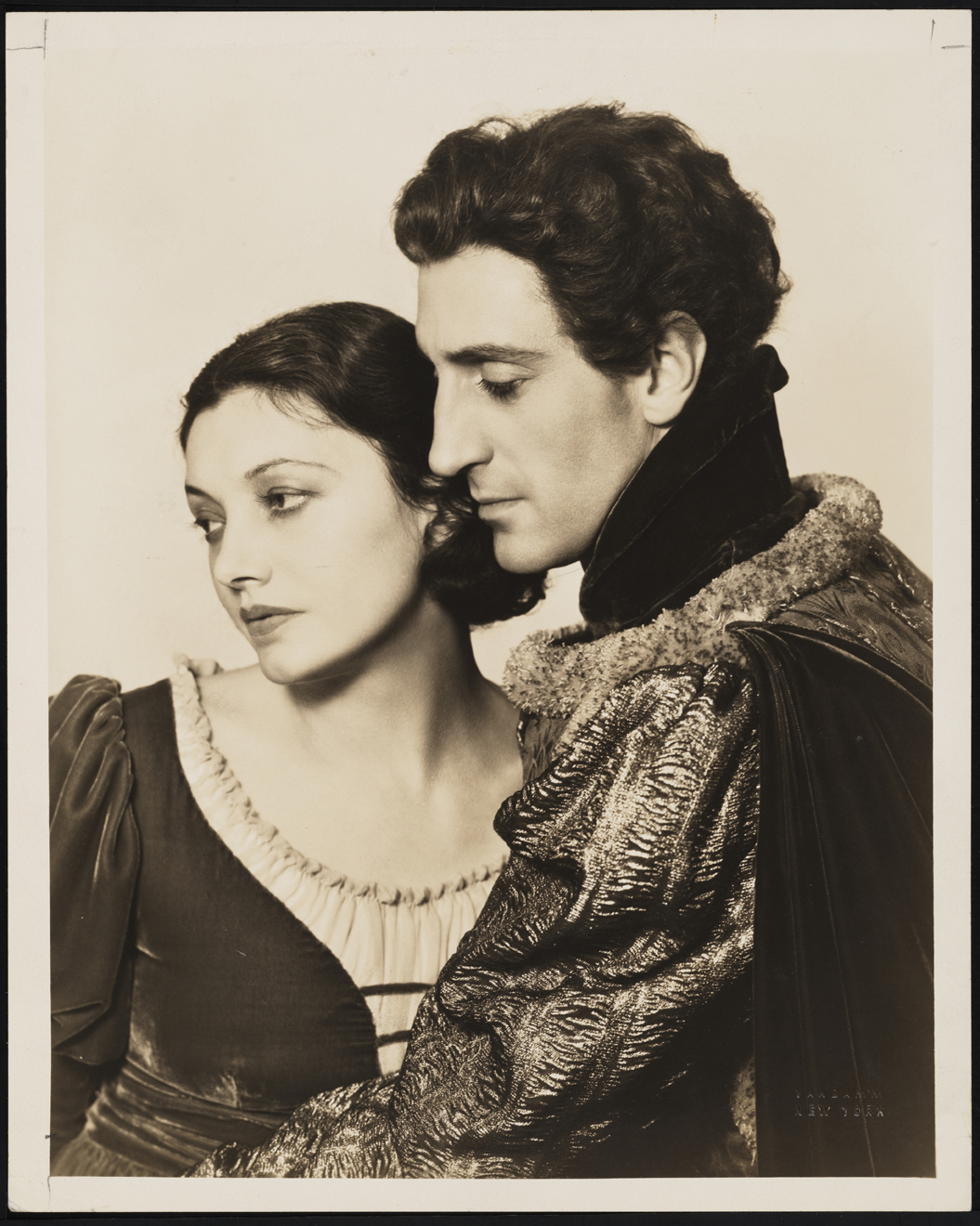
Given that William Shakespeare’s star-crossed lovers Romeo and Juliet were mere teenagers (the ages 13 and 16 were given to Juliet and Romeo, respectively), many productions featured actors more than twice that age. That was the case in 1933 when the play was revived by actress Katharine Cornell and her director husband Guthrie McClintic, who took the play on a seven-month nationwide tour before it was revised and opened on Broadway in December 1934. Critics dubbed the 41-year-old Cornell “the greatest Juliet of her time,” and it seems Robert Benchley heartily agreed in this excerpt from his stage review:
AGE IS JUST A NUMBER…The 41-year-old Katharine Cornell and 42-year-old Basil Rathbone in a promotional photo for Romeo and Juliet. Cornell was the first performer to receive the Drama League’s Distinguished Performance Award, which became the oldest and most exclusive theatrical honor in North America. (Vandamm photo, Museum of the City of New York)
* * *
The New Yorkiest Place
In 1930 gossip columnist Walter Winchell called the new Stork Club “New York’s New Yorkiest place on W. 58th,” and when it relocated to 3 East 53rd Street in 1934 it further defined itself as the ultimate New York night club. In her “Tables for Two” column, Lois Long found the new location much to her liking. An excerpt:
THE STORK DELIVERS…The Stork Club truly became the New Yorkiest nightclub when it relocated to 3 East 53rd Street in 1934. Clockwise, from top left: the club entrance in the 1930s; Cary Grant was one of the many celebrities who favored the nightclub, circa 1935; a 1930’s club menu; Lita Grey, the former teen bride of actor Charlie Chaplin, was a featured singer at the club during Lois Long’s visit. (Gibbes Museum of Art/Pinterest/vintagemenuart.com/IMDB)
* * *
So Long?
Clarence Day, best known for his Life with Father stories, also contributed a number of cartoons to the magazine, accompanied by satirical poems and humorous shorts. Day would die at the tender age of 61—after a bout with pneumonia—in December 1935, about a year after this cartoon was published in The New Yorker. I assume he was signing off from the magazine in order to arrange publication of his Life with Father book, which was published shortly after his death.
* * *
From Our Advertisers
Sunny California beckoned those who had the means and leisure to head to warmer climes during the New York winter…
…for those who stayed behind, they could wrap themselves in a chic winter coat such as this one sported by Camel endorser Mrs. Langdon Post (Janet Kirby)…
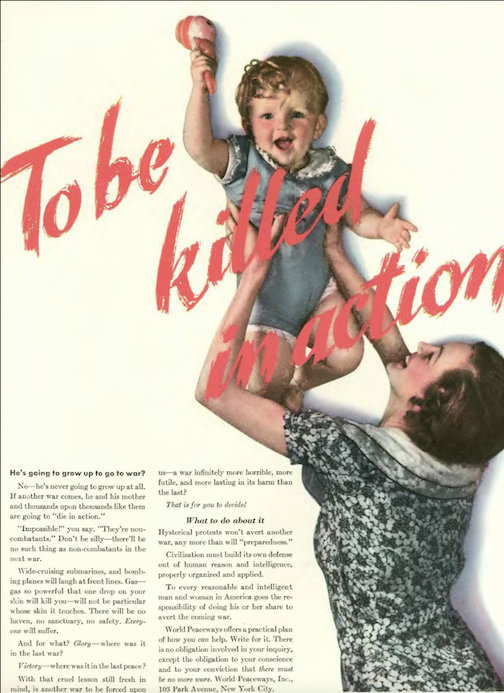
…another colorful ad with a not-so-colorful message from World Peaceways, a 1930s anti-war organization that characterized soldiers (and future soldiers, seen here) as pawns in the corrupt games of the rich and powerful…
…the distributors of French champagne rang in the New Year by suggesting that Doyen was worth your very last cent…
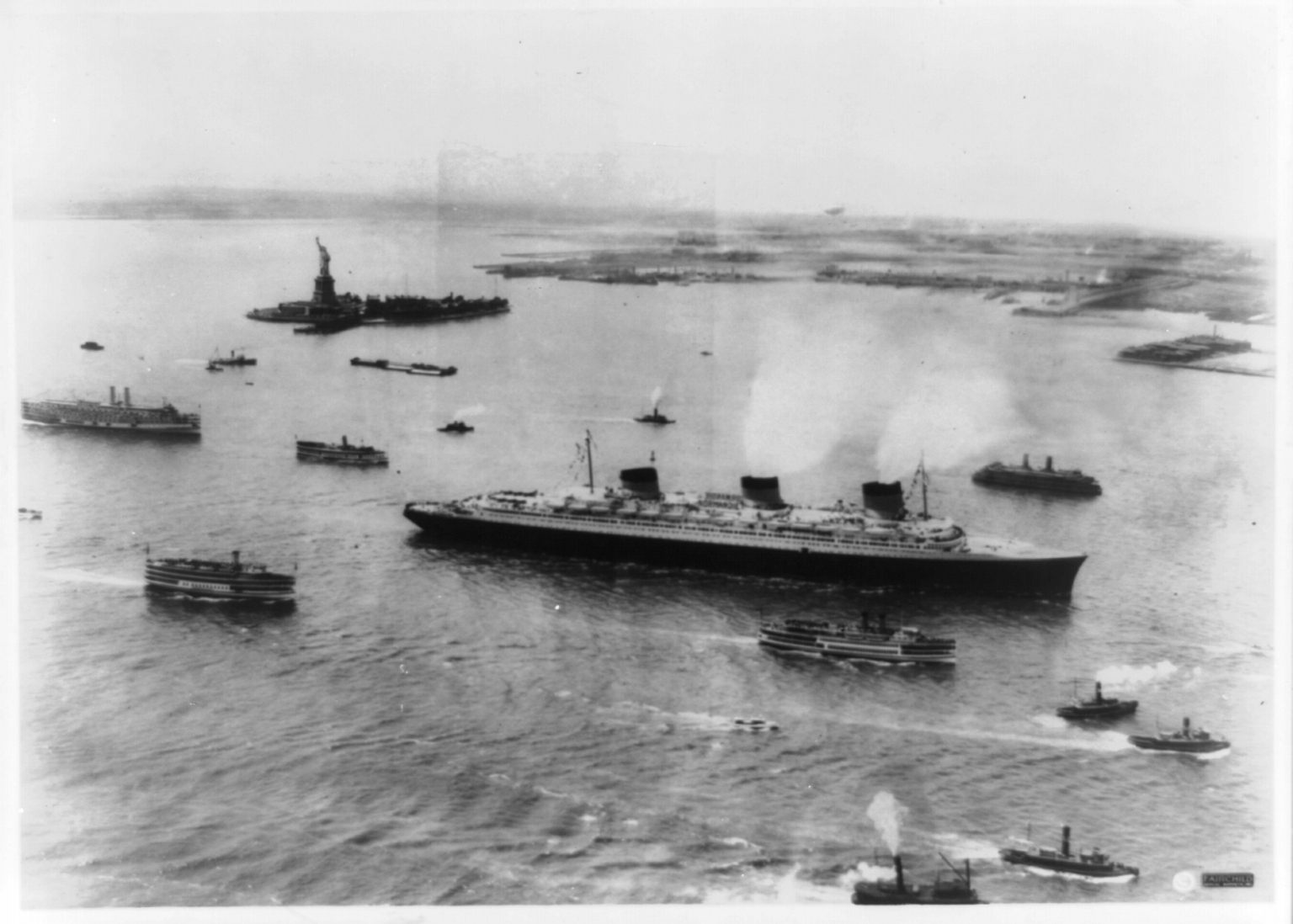
…we kick off our cartoons by welcoming the New Year with George Price…
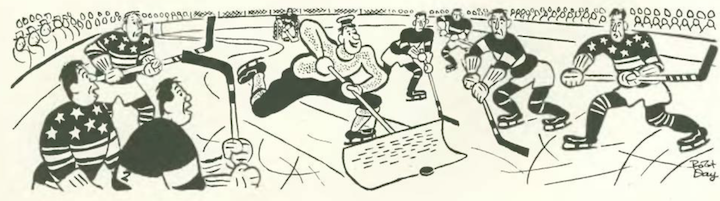
…Robert Day contributed a spot drawing that offered a new twist to ice hockey…
…I should know this artist, but it escapes me for the moment…nevertheless, a great illustration to stretch across the bottom of an opening page…
…a closeup of the signature…
…another from George Price, still up in the air in the final issue of 1934…
…Garner Rea introduced us to the life of the party…
…”Miss Otis Regrets” is a 1934 Cole Porter song about the lynching of a society woman after she murders her unfaithful lover. Porter wrote the song as a parody of a sad cowboy song he heard on the radio. The song was further workshopped for fun at “smart set” cocktail parties…on to our next cartoon, and a moment of keen insight from James Thurber…
…Garrett Price went on the town with some students of anatomy…
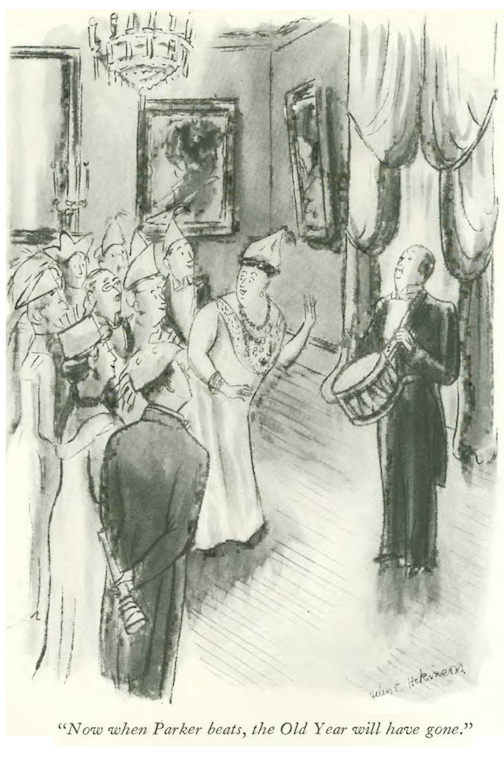
…and we say Happy New Year with the help of Helen Hokinson…
Above: Final Design of Grand Central Terminal, ca. 1910. (New York Transit Museum)
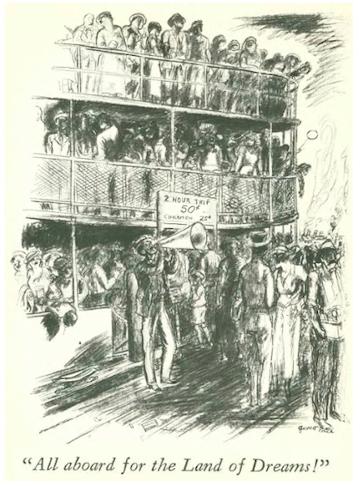
The heat wave of 1934 spread misery from the Midwest to the East Coast. The temperature in New York City hit 101 degrees F (38.3 C) on June 29, and July recorded at least ten days of temps in the mid- to upper 90s. It must have been miserable in the days before air-conditioning, and since no adult would dare be seen in public wearing shorts and a t-shirt, an outing on a crowded tour boat, as illustrated below by William Cotton, must have been hellish.
July 21, 1934 cover by William Cotton.
…putting a fine point on it, recall this wryly captioned cartoon from the June 30 issue by Garrett Price…
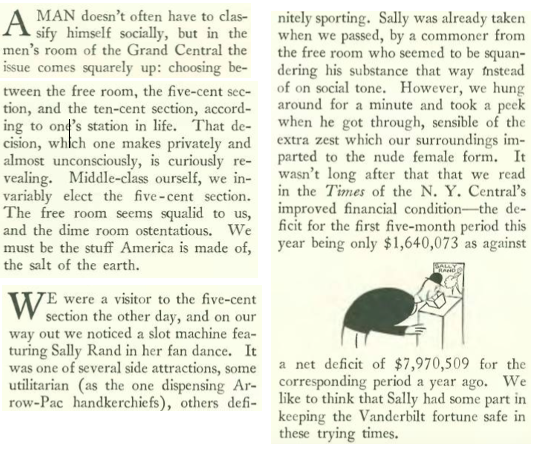
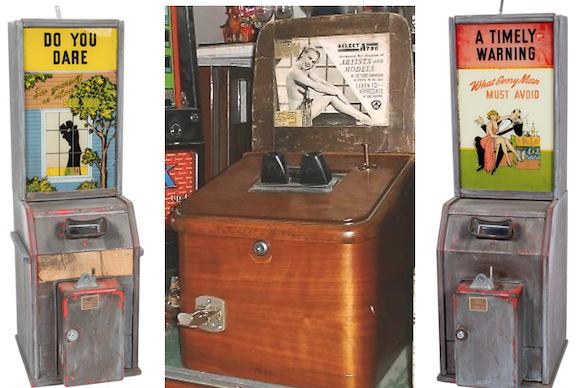
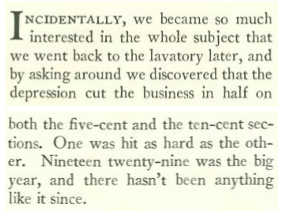
…but let us move ahead to the July 28 issue, where E.B. White was hopefully keeping his cool in the men’s waiting room at Grand Central Station, where he plunked down a nickel to cool his heels in the “middle class” section, where he observed side attractions including a vending machine that dispensed handkerchiefs and a coin-operated peep show featuring burlesque star Sally Rand.
NO MASHERS ALLOWED…Separate men’s and ladies’ rooms were available in three classes at Grand Central Station—free, five cents and ten cents. Top, the Ladies’ room, Grand Central Terminal (Central Lines), and below, a men’s room at the station. A nickel back then was worth about a dollar today. (Library of Congress)NICKEL AND DIMED…Machines similar to these could be found in some men’s waiting rooms at train stations in the 1930s. (pinballhistory.com/comics.ha.com)
…White referred to a peep show that featured famed fan dancer Sally Rand…
DOING HER DEEP KNEE BENDS…Sally Rand in the 1930s. (www.vintag.es)
White also commented on the growing number of travelers, still pinched by the Depression, opting for the free section:
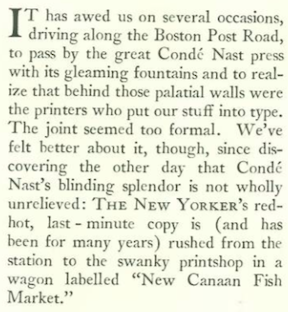
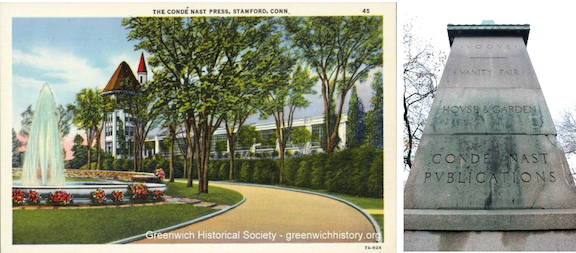
We settle in with the June 21 issue (which leads this post) with White once again, this time enjoying a drive to Stamford, Conn., where he admired the “splendor” of the Condé Nast printing plant (apparently the plant also printed The New Yorker, although the magazine itself would not be acquired by Condé Nast’s parent company, Advance Publications, until 1985).
ONLY A MEMORY…Postcard image of the Condé Nast printing plant; at left, a relic of the long-gone plant, one of two pillars that flanked the road to the plant. (Greenwich Historical Society/greenwichtime.com)
* * *
Disney’s Other Mouse
Film critic John Mosher was a fan of Disney’s “Silly Symphony” cartoon shorts, which were produced between 1929 and 1939. Animation, and especially color animation, was in its infancy, so these doubtless had an uplifting effect on many moviegoers.
DON’T CALL ME TINKERBELL…The Butterfly Fairy brought some Disney magic to 1934’s The Flying Mouse. (disney.fandom.com)
* * *
The Great McGonigle
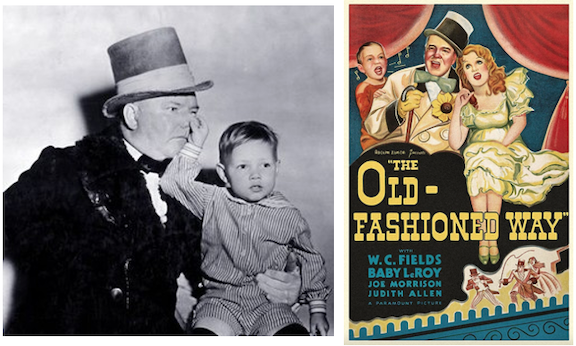
W.C. Fields appeared in more than a dozen silent films before making his first talkie, 1930’s The Golf Specialist, and it was in sound films that Fields was able to truly express his vaudevillian wit. It was also in the sound era that Fields teamed up with Baby LeRoy for three films (in 1933 and 1934), including The Old Fashioned Way, in which Fields portrayed “The Great McGonigle,” leader of a traveling (and perpetually underfunded) theater troupe who was always a step ahead of police and creditors. Critic John Mosher found the film’s riff on an old morality play, The Drunkard, to be a bit dated, but overall thought it a cheerful diversion.
HONK…Baby LeRoy, aka Ronald Le Roy Overacker (1932–2001), was just 16 months old when he became the youngest person ever put under term contract by a major studio. He is best known for his appearances in three W. C. Fields films: Tillie and Gus (1933), The Old Fashioned Way (1934) and It’s a Gift (1934). (Rotten Tomatoes/IMDB)
* * *
From Our Advertisers
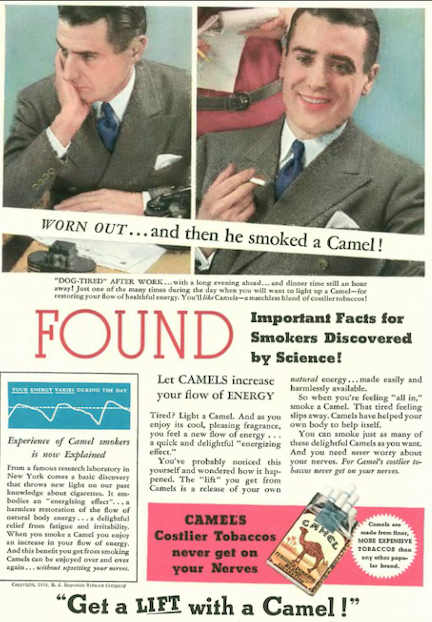
We begin with scientific proof (from a “famous research laboratory in New York”) that Camel cigarettes increased one’s flow of energy…
…if that crackpot claim doesn’t get you, here’s one that recommended downing a PBR before a big meeting, a sure remedy for that “listless, tired-out feeling”…
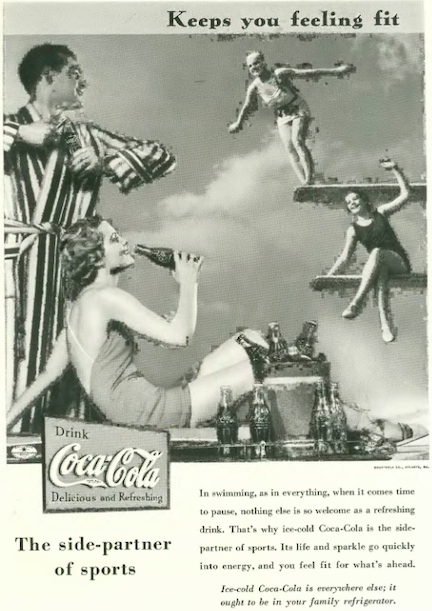
…of course we all know that a few sugary Cokes will get you going…back then they were taking it in six- and ten-ounce bottles, not 30- to 50-ounce Big Gulps…
…it’s not every day you see a dog food ad in The New Yorker…in the 1930s there was no secret to where ol’ Sparky ended up…
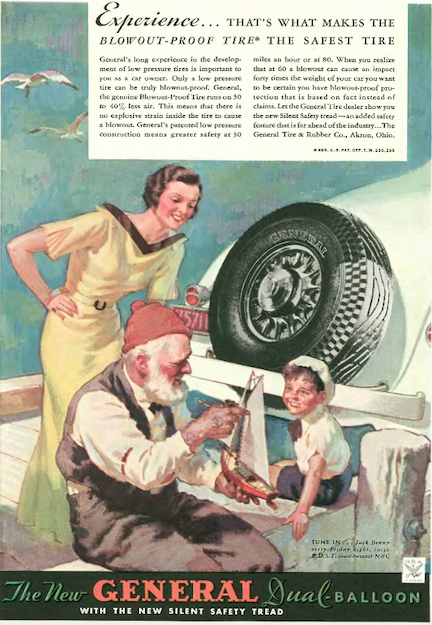
…popular were these Rockwellian ads that equated various products with happy and wholesome (and safe) living, in this case a massive “Dual-Balloon” tire that dominated this tableau featuring a stylish mommy and her little boy slumming with an old sea salt…
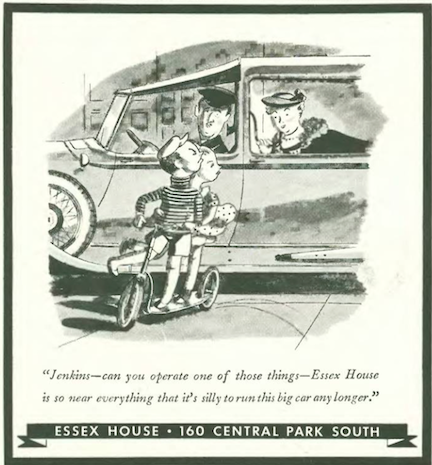
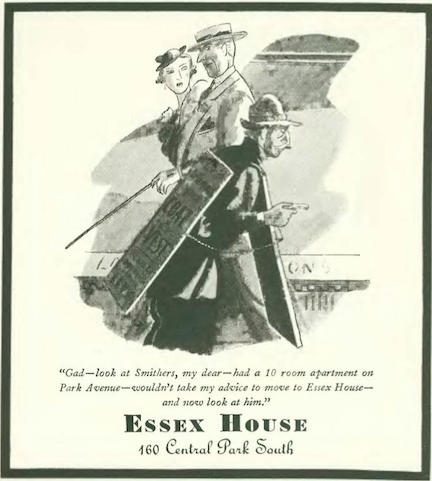
…the folks at Essex House hired an illustrator who did his or her best to channel Helen Hokinson and William Steig for this New Yorker ad…as we have seen before, Essex House ads walked a fine line between thrift and snob appeal…
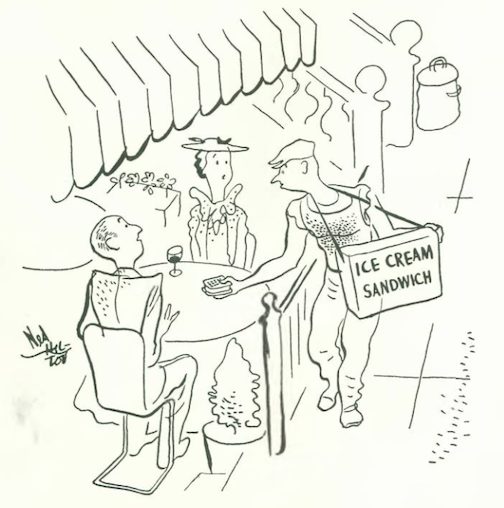
…on to our cartoons, beginning with Ned Hilton, whose work appeared in The New Yorker from 1934 to 1957…
…Mary Petty recorded some sweet nothings by the seaside…
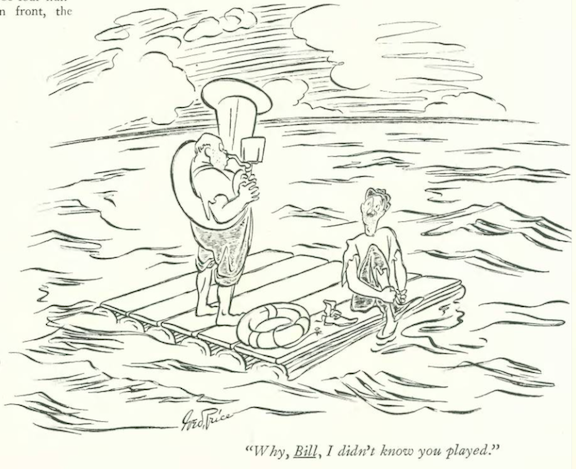
…George Price drifted along with two men and tuba…
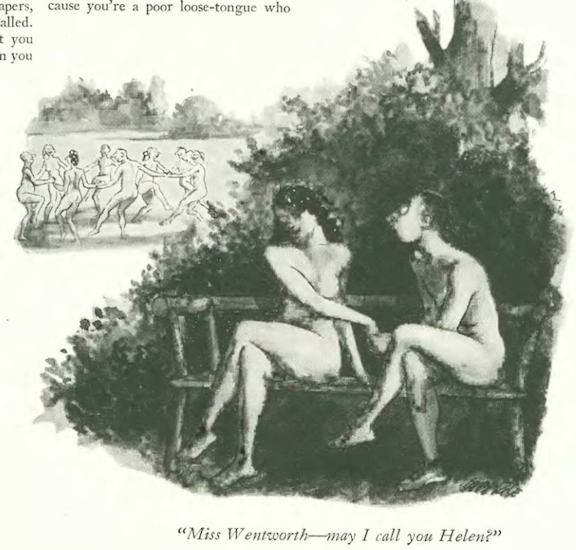
…Carl Rose revealed a modest side to life at a nudist colony…
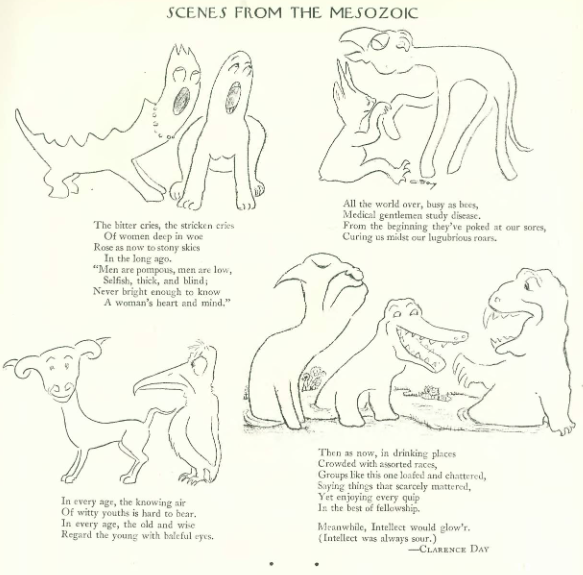
…we know Clarence Day for his Life With Father series, but on occasion he also contributed illustrated poems such as this one from the July 21 issue…
…on to July 28…
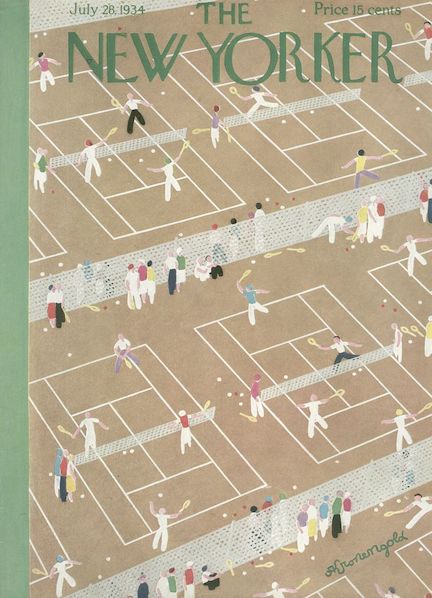
July 28, 1934 cover by Adolph K. Kronengold.
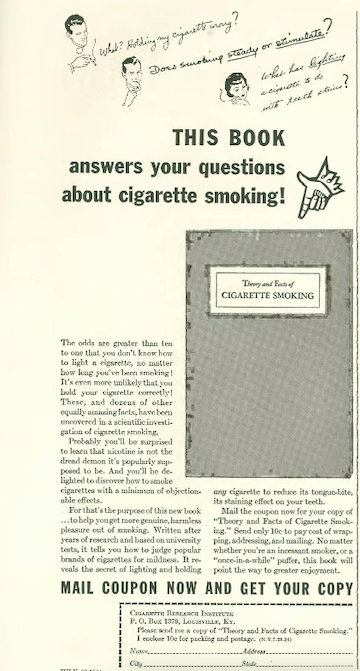
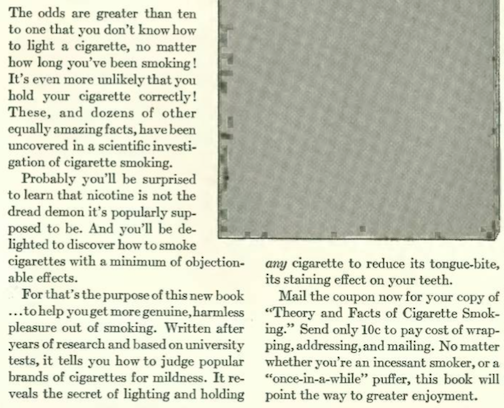
…where we encounter more “scientific research” that encouraged folks to smoke…This ad was placed on the very last page of the July 28 issue by the Cigarette Research Institute, based in Louisville, Kentucky…
…the booklet was filled with “amazing facts” uncovered in a “scientific investigation,” facts did not address the health effects of smoking, but rather such important topics as how to hold a cigarette the right way and how to reduce staining on your teeth…it also helpfully debunked the notion that nicotine was a “dread demon”…
…take for example this woman smoking a Lucky…now she knew how to hold a cigarette!…
…the folks at Essex House were back, aggressively playing the class/caste card…apparently if you lived there you were entitled to kick your old friends to the curb…
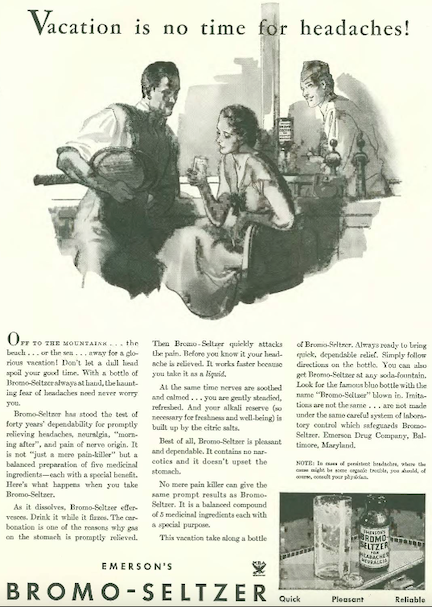
…the antacid and pain reliever Bromo-Seltzer was ubiquitous in 1930s medicine cabinets, but after the recipe was changed in the 1970s (all Bromides were withdrawn from the U.S. market in 1975) the brand slowly fizzled away…
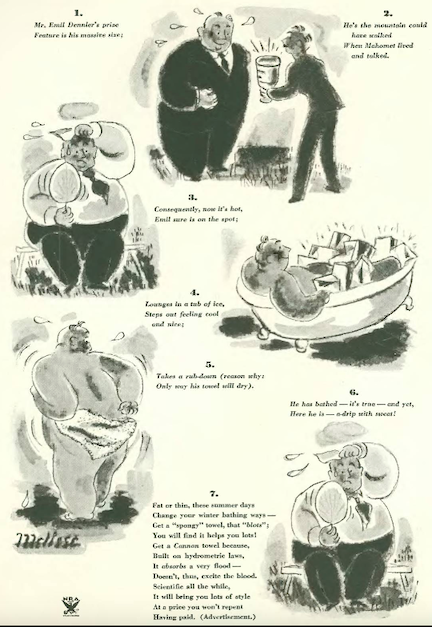
…Mildred Oppenheim Melisse was a popular illustrator of ads for department stores and various household goods, including Cannon towels, here guaranteed to absorb even this man’s sweaty “flood”…
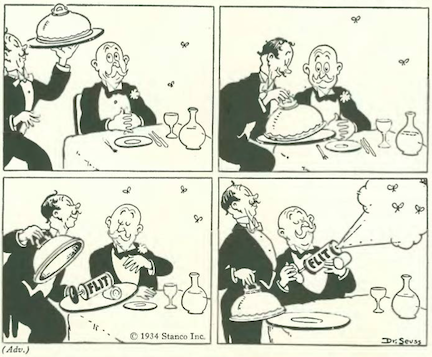
…Dr. Seuss back again for Flit, once again having no issues mixing insecticide with food preparation…
…Rea Irvin kicks off the cartoons with his Double Breasted Dowager…
…Helen Hokinson found some misplaced pity at a garden party…
…Garrett Price offered some unsolicited advice…
…Reginald Marsh filled two pages with a scene from Central Park…
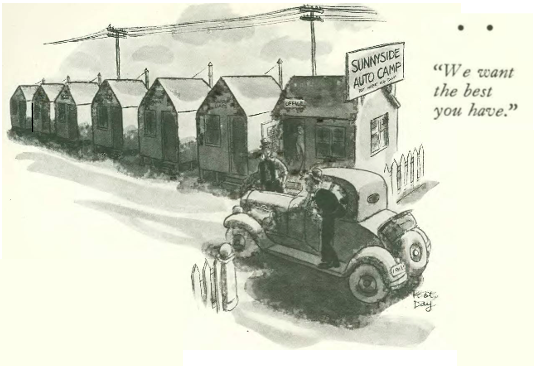
…Robert Day looked for a unique experience at an auto camp…
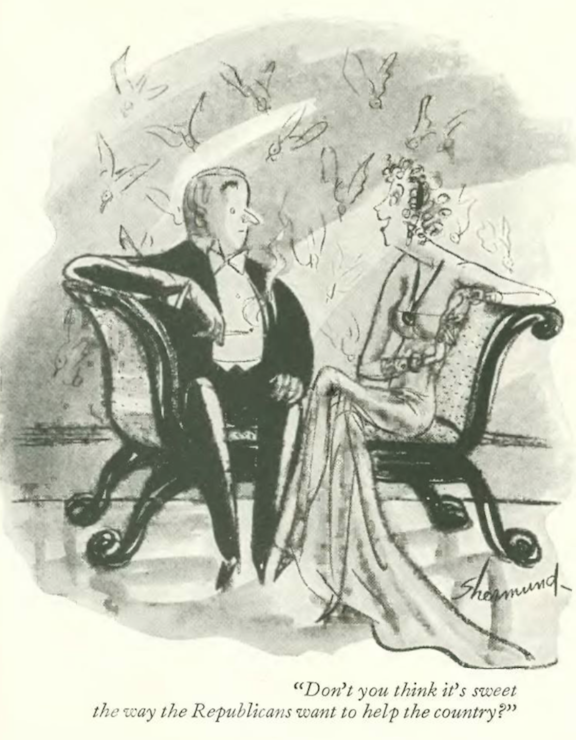
…and we close with Barbara Shermund, and some alarming news on the domestic front…

In 1912, Edgar Rice Burroughs published the short story Tarzan of the Apes. Since then at least ninety books, 350 radio serials, three TV series and forty-five full-length films have told the story of the Lord of the Apes.
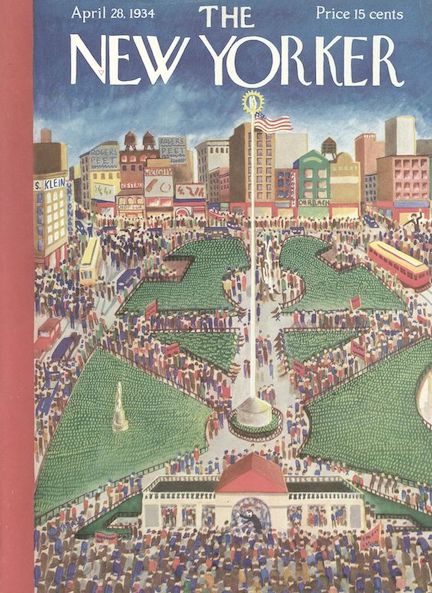
April 28, 1934 cover by Ilonka Karasz.
Tarzan was the first pop culture icon to attain worldwide fame, paving the way for a host of comic-book superheroes that would follow. Recalling his youth in post-war Leningrad in the early 1950s, Joseph Brodsky wrote of the bootleg Tarzan movies he devoured at the local cinema, and the effect a “long-haired naked loner” had on the regimented, inhibited lives of Soviet youth: “The Tarzan (film) series alone, I daresay, did more for de-Stalinization than all of Khrushchev’s speeches.”
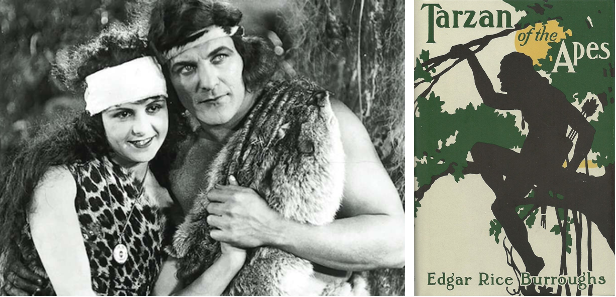
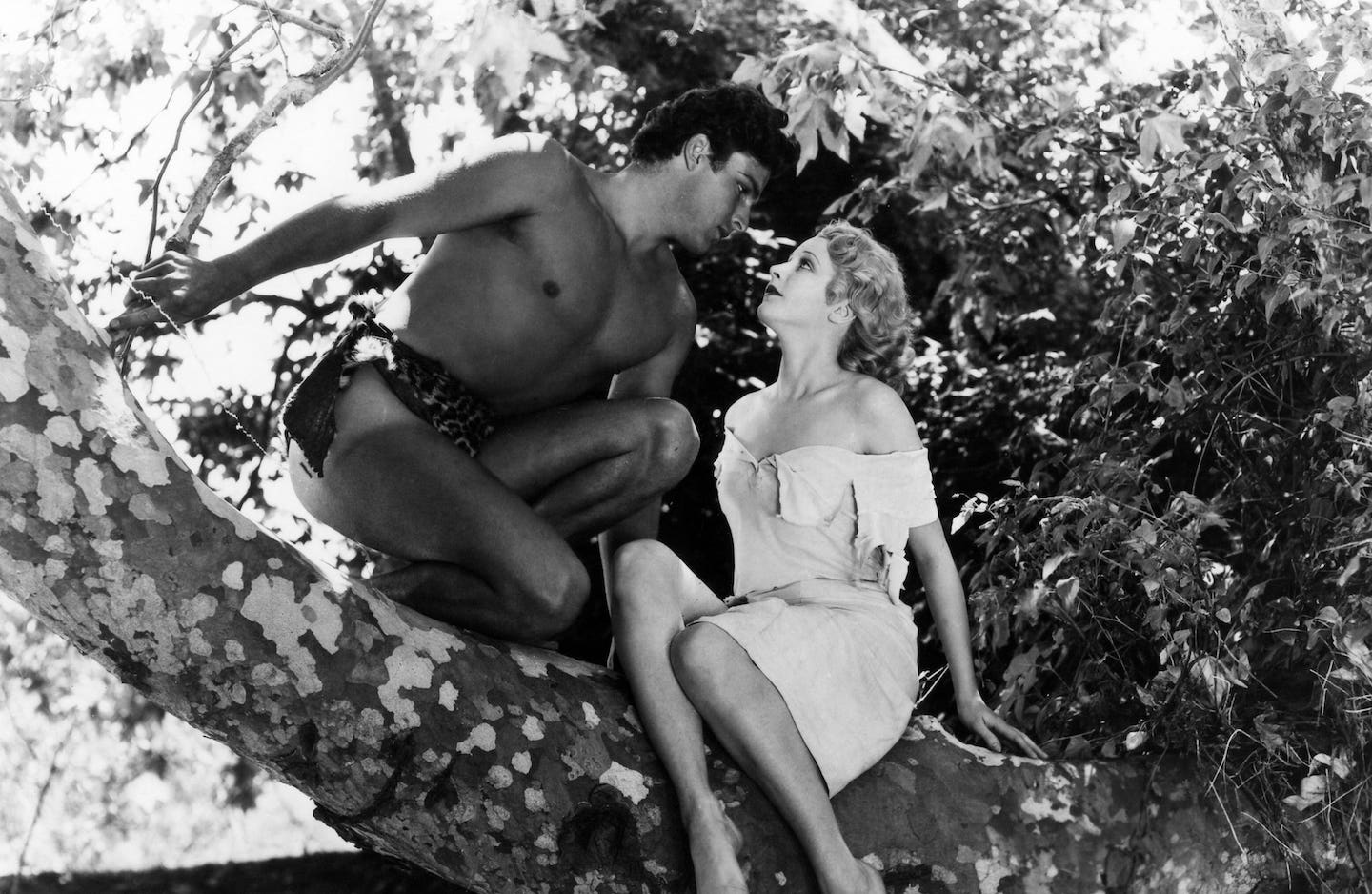
ME ELMO, YOU ENID…Elmo Lincoln as Tarzan and Enid Markey as Jane Porter in the 1918 silent film Tarzan of the Apes. The movie was released just six years after the publication of Edgar Rice Burroughs’ short story and subsequent book. (times-herald.com/Wikipedia)
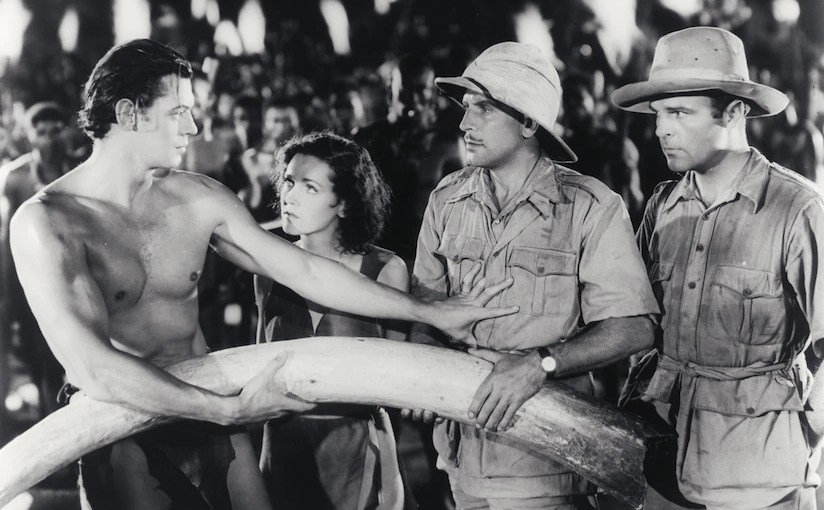
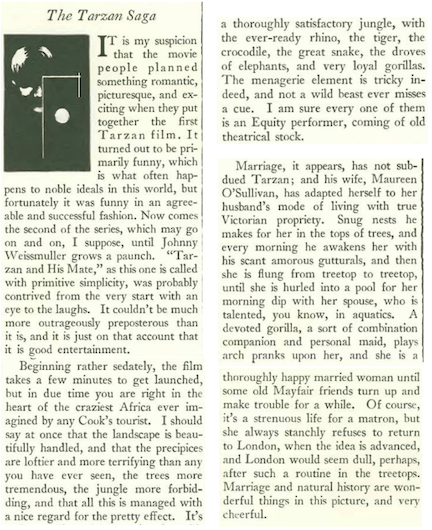
Starting with Elmo Lincoln in 1918, four different silent film actors portrayed Tarzan before Johnny Weissmuller (1904–1984) swung onto the screen with co-star Maureen O’Sullivan. Other Tarzan portrayers would follow, but it was Weissmuller—winner of five gold medals as an Olympic swimmer—who defined the role over two decades, starring in twelve Tarzan films from 1932 to 1948, O’Sullivan playing Jane in the first six of those films. Critic John Mosher sensed that Weissmuller was in for the long haul in just his second outing:
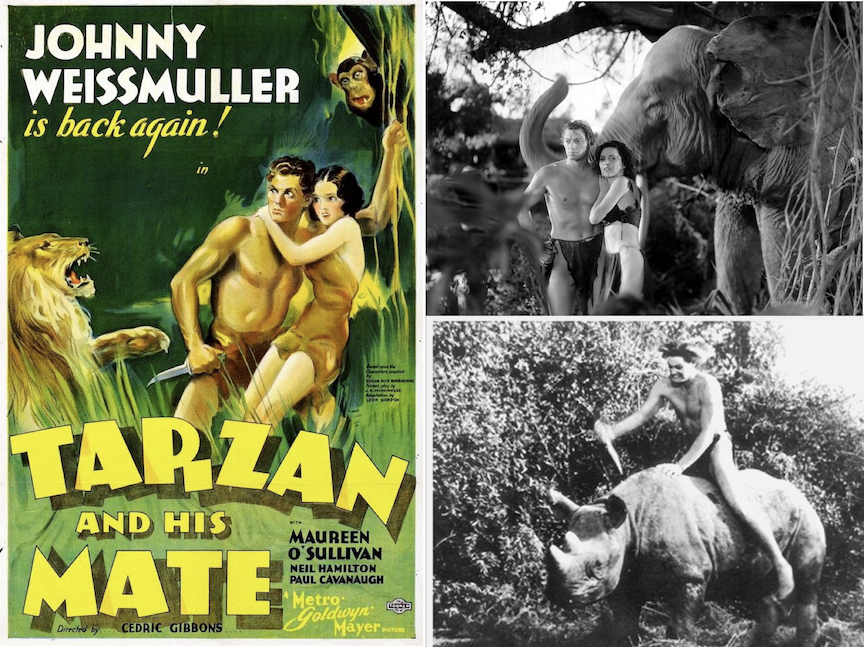
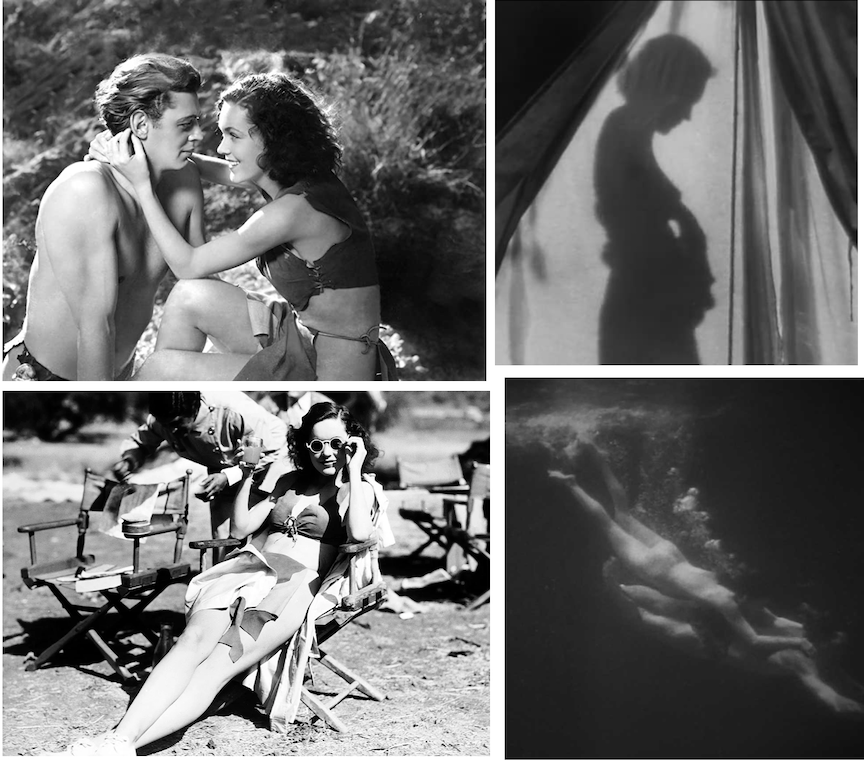
FAUX JUNGLE…Critic John Mosher was impressed by the wild and forbidding jungle scenes portrayed in Tarzan and His Mate—actually locations around Los Angeles. At left, MGM poster proclaims “Johnny Weissmuller is back again,” a reference to the 1933 dud Tarzan the Fearless starring Buster Crabbe (his single turn at Tarzan); top, Indian elephants taken from MGM’s zoo had attachments fixed to their ears and tusks to suggest African elephants; bottom, Weissmuller rides a rhino (named Mary), imported from a German zoo to appear in the scene. (Wikipedia/IMDB/Reddit)NOTHING TO HIDE…Tarzan and His Mate has acquired cult status mainly due to Maureen O’Sullivan’s skimpy halter top and loincloth—in 1934 it was one of the most revealing costumes ever seen on the silver screen. Hays Code puritans had fits over scenes that showed O’Sullivan nude in silhouette and swimming sans bathing suit with Weissmuller (the swimming scene used a body double, Olympic swimmer Josephine McKim). On April 24, 1934, all prints of Tarzan and His Mate were ordered changed, the nude scenes removed—the original print was not restored until 1986. At bottom left, O’Sullivan on the set of Tarzan and His Mate, looking quite unperturbed. (IMDB/hotcorn.com/Twitter)
In 2003, the Library of Congress deemed Tarzan and His Mate “culturally, historically or aesthetically significant” and selected it for preservation in the National Film Registry.
A note of trivia: Irish actress Maureen O’Sullivan (1911–1998) was the mother of actress Mia Farrow and grandmother of journalist Ronan Farrow. She’s also the grandmother of Soon-Yi Previn, Mia’s adopted daughter and current wife of Mia’s ex-partner, Woody Allen.
* * *
Spring Has Sprung
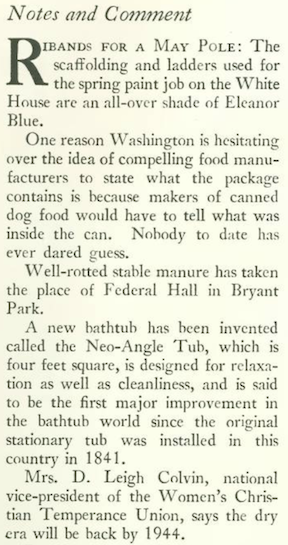
E.B. White began his weekly column with some thematic suggestions for the Maypole’s ceremonial ribbons. Excerpt:
A few of White’s references explained:
SPRING IS IN THE AIR, or in E.B. White’s case, horse manure, likely used to amend the soil in Bryant Park. In 1933 Parks Commissioner Robert Moses had the park’s Federal Hall replica demolished (erected in 1932 to commemorate the bicentennial of George Washington’s birth) and embarked on an ambitious facelift that included elevating the park from street level and planting numerous trees and hedges. The bottom image shows a 1934 view of the reconstruction looking south on 6th Avenue from 42nd Street. (Untapped Cities/NYC Parks Dept.)
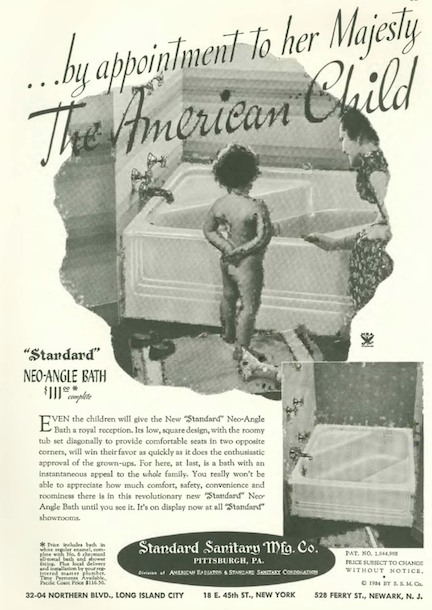
White also referenced the “Neo-Angle” bathtub, shown here in an ad from the same issue:
…James Thurber added this embellishment along the bottom of White’s column…
* * *
Freaked Out
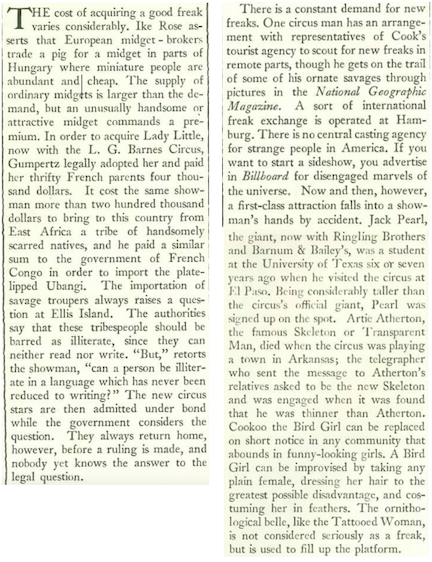
Alva Johnston contributed his third and final installment on the world of circus freaks, using descriptive language that would not pass muster today:
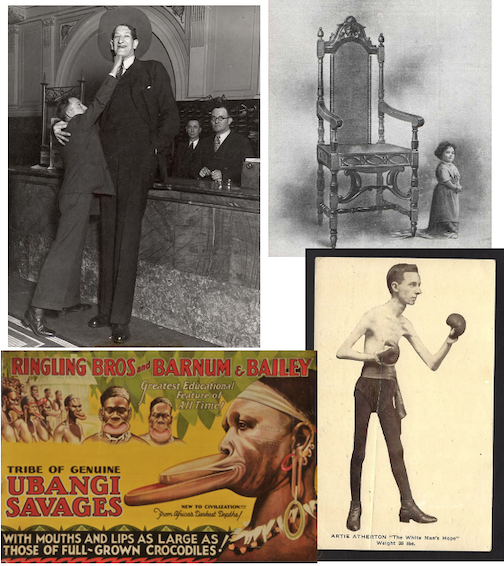
THE LONG AND SHORT OF IT…In his third installment of the world of circus freaks, Alva Johnston referenced the following performers, clockwise, from top left: circus giant Jack Earle; Lady Little, aka “Anita The Doll Lady,” on a 1918 postcard that described her as “26 inches high, 36 years old”; Artie Atherton, aka “Skeleton Dude,” weighing in at 38 pounds; Ringling Bros. and Barnum & Bailey Circus advertised “Geniune Ubangi Savages”—the word “Ubangi” was made up, plucked from a map of Africa because it sounded exotic. These “savages” were actually Congolese natives. (Pinterest/University of Sheffield/Worthpoint/Harry Ransom Center)
* * *
Biding Its Time
“The Talk of the Town” took notice of a lighthouse that was mounted atop the Seamen’s Church Institute, which overlooked New York Harbor from Battery Park. A time ball above the lighthouse would drop down a pole to signal twelve noon to ships in the harbor. Installed on April 15, 1913—to mark one year after the sinking of the RMS Titanic—the lighthouse and time ball were relocated to the South Street Seaport Museum in 1968.
REFUGE BY THE SEA…The Seamen’s Church Institute at 25 South Street (left) could house up to 580 seafarers in dormitory-style rooms. The building also housed a shipping bureau, a restaurant, a postal service and a chapel. When the building was demolished in 1968, the lighthouse and time ball were salvaged and relocated to South Street Seaport Museum. (southstreetseaportmuseum.org)
* * *
Gall of a Gaul
French writer Céline, aka Dr Louis Ferdinand Auguste Destouches (1894–1961), is considered by some to be one of France’s greatest 20th century writers, influencing the likes of Henry Miller, Samuel Beckett, and Charles Bukowski. However Céline is also widely reviled as a Nazi sympathizer and anti-semite, but whatever one thinks of the writer, most agree that he hated pretty much everyone. Clifton Fadiman tried to make sense of the bilious Céline and his most celebrated novel, Journey to the End of the Night (Voyage au bout de la nuit). An excerpt:
DON’T STAND SO CLOSE TO ME…The French writer Céline in a 1932 photograph. (Bibliothèque nationale de France)
* * *
From Our Advertisers
There’s nothing hateful about these brightly colored blankets and throws if you were looking for something for Mother’s Day…
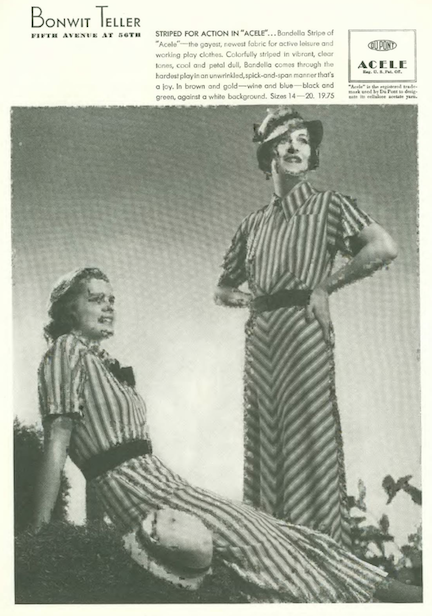
…it’s interesting how Fifth Avenue department stores such as Bonwit Teller embraced new-fangled synthetics made by Dupont—not exactly material favored by those to the manor born…
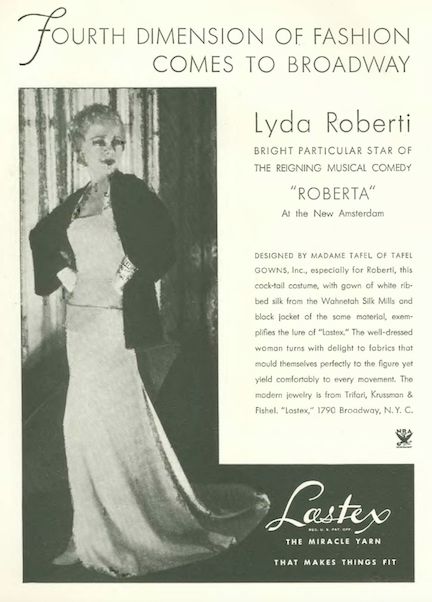
…however Lyda Roberti, the “Bright Particular Star” of the Broadway musical Roberta, seemed pleased to be sporting a gown spun from “Lastex,” formed from a combination of silk and rubber…
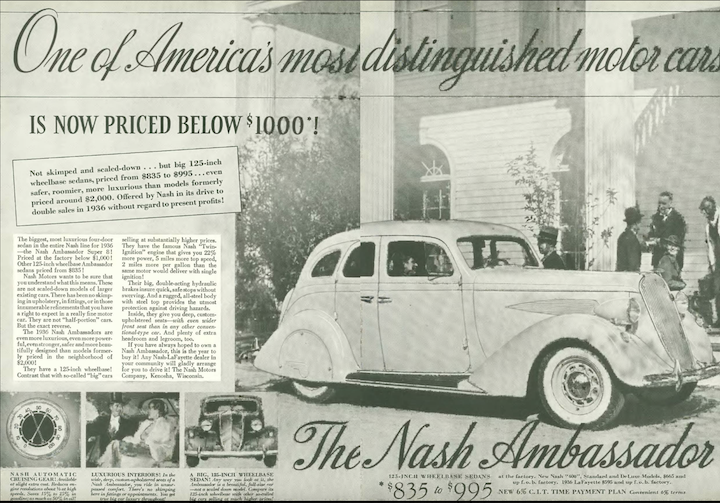
…more fashionable women, this time paired with Buick’s latest model displaying a bit of streamlined flair…
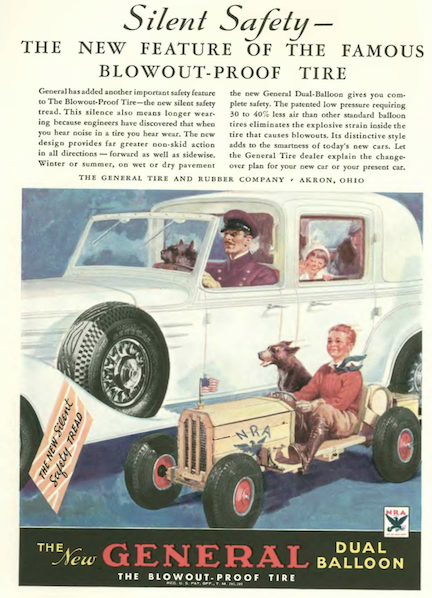
…the folks at General Tire touted the safety of their blowout-proof tires, but as with most things in the 1930s, the scene suggests little regard for safety in general…the boy driving the soapbox racer perilously close to the limo is not a supporter of the National Rifle Association—in the 1930s NRA stood for the New Deal’s National Recovery Act…
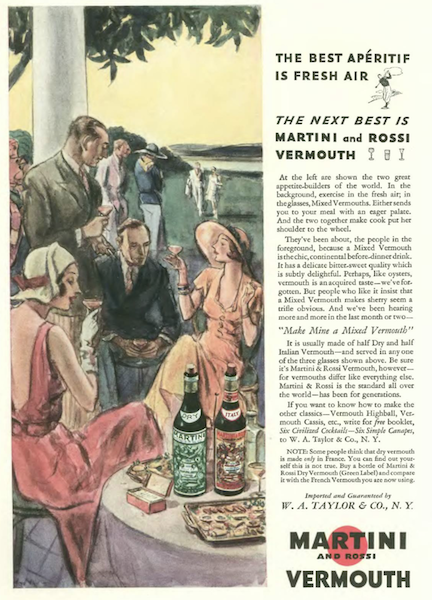
…recalling a style perfected by fashion illustrator Carl “Eric” Erickson, this lovely ad beckoned us to an outdoor cocktail party courtesy of Martini & Rossi…
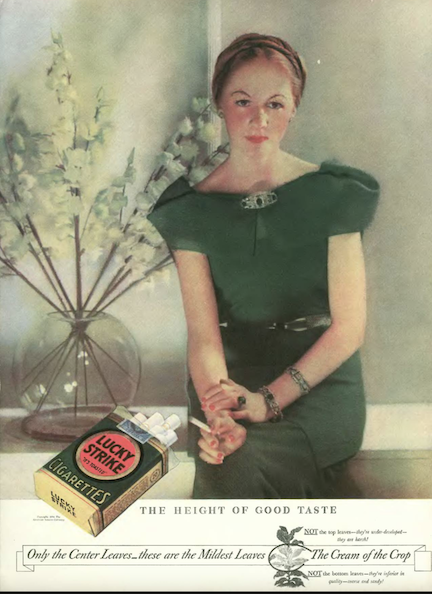
…working the growing market of female smokers, the folks at Lucky Strike gave us this sophisticate caught in a pensive mood…
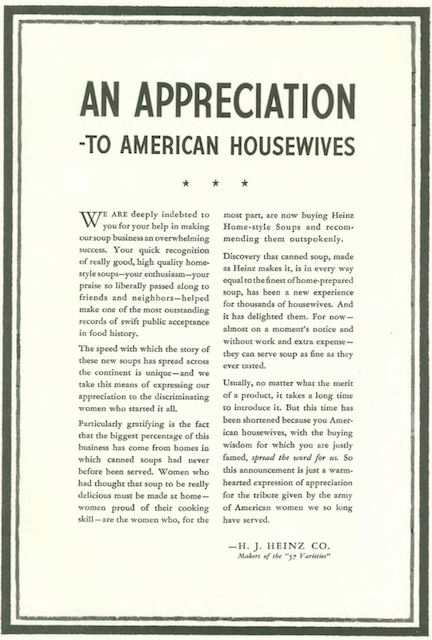
…of course advertisers also appealed to another female market, the majority of women stuck at home doing the cooking and cleaning…and so we have pandering ads like this one from Heinz (did people really read these things?)…
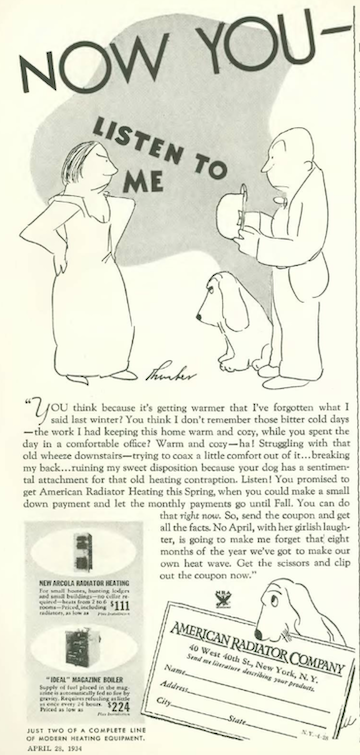
…another approach was to cast women as a nagging emasculators, here illustrated by James Thurber…
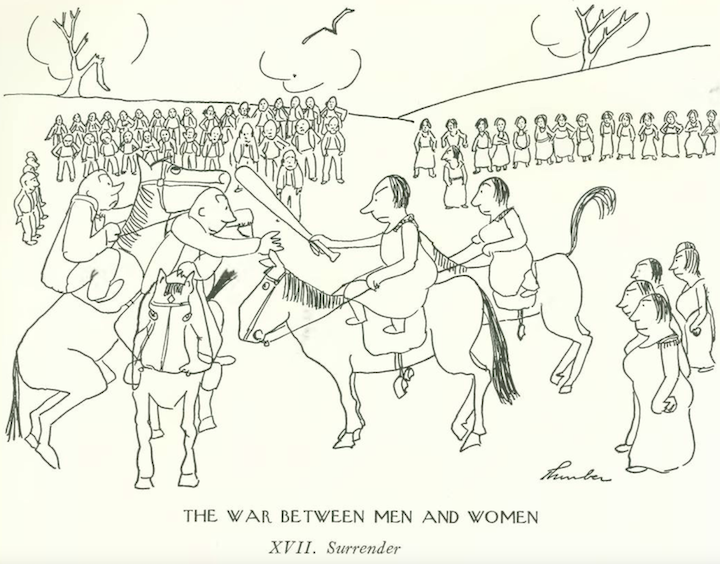
…however, in Thurber’s cartoon world, it was the men who got the upper hand in the final installment of his “war” series…
…Thurber was busy in this issue, also supplying this spot illustration…
…we switch to a more leisurely pace with Syd Hoff…
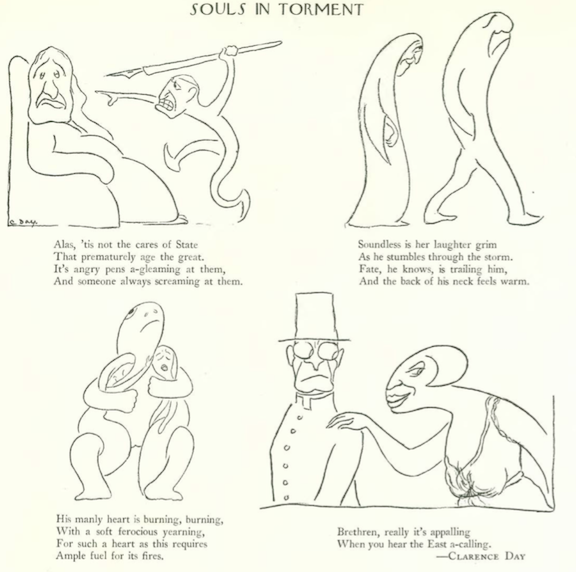
…and check in with Clarence Day, who in addition to his continuing “Life With Father” series occasionally contributed these illustrated poems…
…and we close with Otto Soglow, and an early bird who should have stayed in bed…
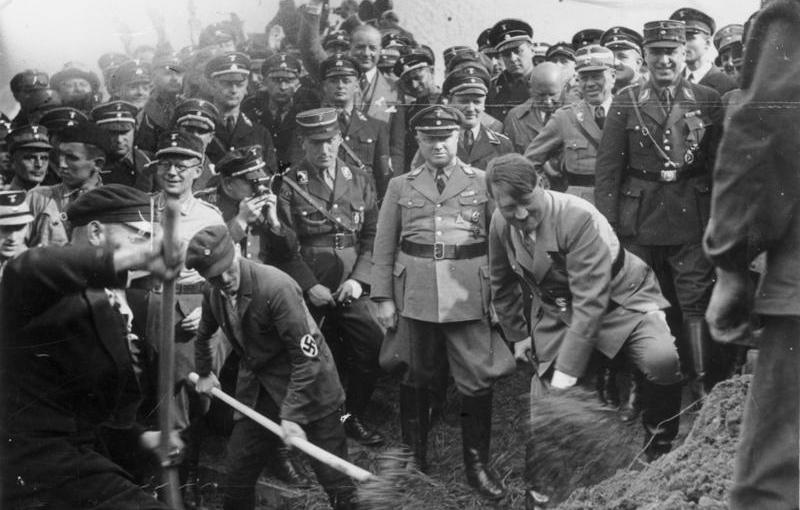
Above: Adolf Hitler at a groundbreaking ceremony for a new section of the Reichsautobahn highway system, 1933. (Bundesarchiv)
Mildred Gilman was one of the highest paid female reporters in the 1920s, interviewing everyone from murderers to heads of state. But when she arranged to interview Adolf Hitler in 1933, the Gestapo got nervous and threw her out of the country.
Feb. 10, 1934 cover by Harry Brown.
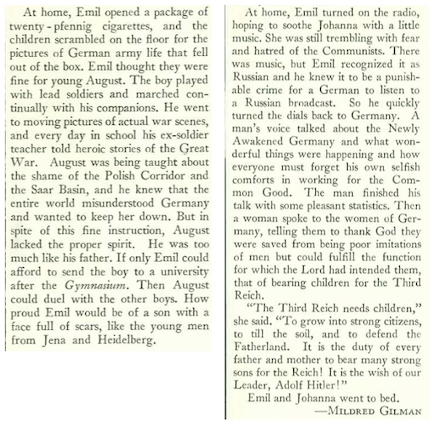
Gilman (1896-1994) doubtless sought a modicum of satisfaction when she penned “Made in Germany” for the Feb. 10, 1934 issue. I am including generous excerpts below, which describe the day in the life of an average Berliner named Emil Pfalz, a man who doesn’t question the omnipresent Nazi propaganda and often worries about his ability to keep in step with the new regime.
THERE’S SOMETHING HAPPENING HERE…Berliners (left) and residents of Worms (top) inspect Nazi propaganda that instructed Germans not to do business with Jewish people (on Jan. 24, 1934, the German government banned Jews from membership in the German Labor Front, depriving them of the opportunity to find employment); below, in early 1934 a simulated uprising was staged in Berlin (with people posing as casualties) as part of Nazi maneuvers. Later that summer SS and Gestapo forces would conduct a purge known as “Night of the Long Knives,” eliminating any known or suspected dissenters of the Nazi regime. Hundreds were murdered and many more arrested. (digitallibrary.usc/Wikipedia)GRIM FAIRY TALE…As a loyal citizen, Emil Pfalz was sure to teach his children the Nazi salute. Image from a Nazi propaganda booklet. (British Library Board)
Emil’s story continues as he contemplates his duties as a father and husband in the Third Reich…
…and heeds the call to produce more Aryan babies.
What the Nazis did not want more of was chronically ill or disabled persons. The sick minds of Nazi propagandists produced this image below, which argues that for the same daily amount of reichsmarks you could either support an entire Aryan family or a single mentally disabled person…in 1933 the Law for the Prevention of Hereditarily Diseased Offspring was passed, allowing for the forced sterilization of those regarded as ‘unfit’. In 1939 the regime began killing the disabled (up to 250,000 people).
A final note about the writer, Mildred Gilman. In addition to being a journalist of both daring and flair, she wrote eight novels including the bestseller Sob Sister. In her younger days she was employed as a secretary for New York World columnist Heywood Broun and partied with Dorothy Parker, Alexander Woollcott, and Robert Benchley. She wrote a profile of Paul Robeson for the Sept. 21, 1928 issue of The New Yorker.
Mildred Gilman in 1938.
* * *
Up In Smoke
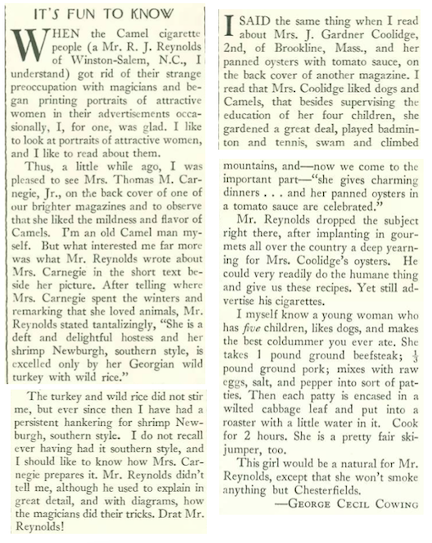
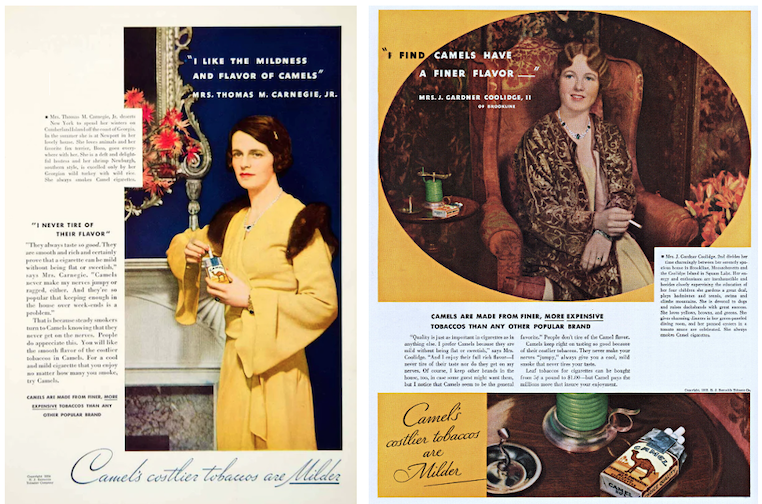
George Cecil Cowing, known for his whimsical “Boulevardier” column for the Pasadena Star-News, commented on the changing themes adopted by cigarette manufacturers, namely the folks at R.J. Reynolds who abandoned their magician-themed ads for their Camel brand (“It’s Fun to Be Fooled”) for spots featuring endorsements from second-tier society women…
POSH PUFFERS…”Mrs. Thomas M. Carnegie Jr.” (Virginia Beggs) and “Mrs. J. Gardner Coolidge II” (Mary Louise Coolidge) shared their favorite dishes and their love for smoking Camels in these ads, which appeared in The New Yorker in early 1934.
* * *
From Our Advertisers
Appropriately we turn to our advertisers, where we find the Camel brand trying out a new theme that demonstrated their product’s appeal to plainer folks…
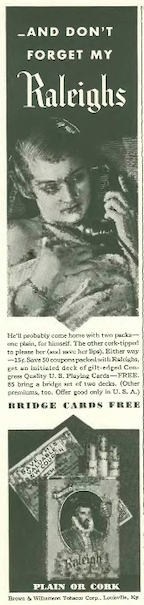
…Brown & Williamson’s first national brand, Raleigh, was launched as a premium cigarette in 1928, here marketed with a plain or cork tip (“to please her and save her lips”)…
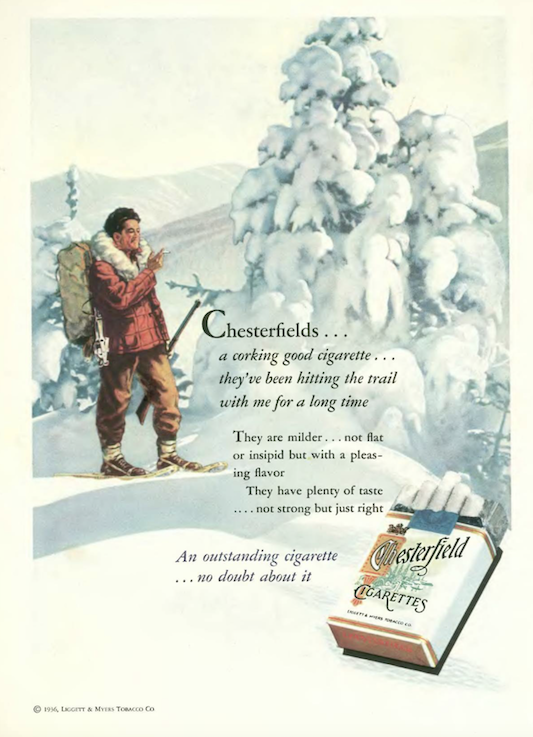
…in his parody of Camel ads, George Cecil Cowing wrote that he preferred Chesterfields, a big-time brand of mid-century America…
…the makers of White Rock reveled in the newly found freedoms of legalized alcohol…
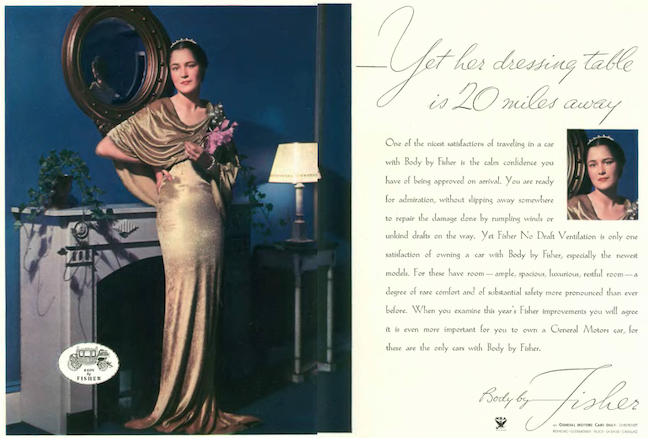
…the folks at Fisher were sticking with their lavish two-page color ads and what has always been a tiresome double entendre…
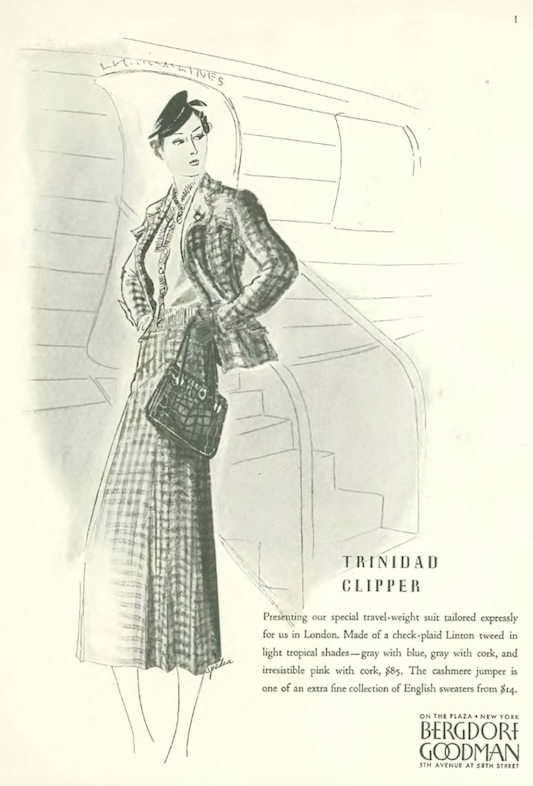
…Lord & Taylor took to the skies to promote their “country clothes” to the smart set…
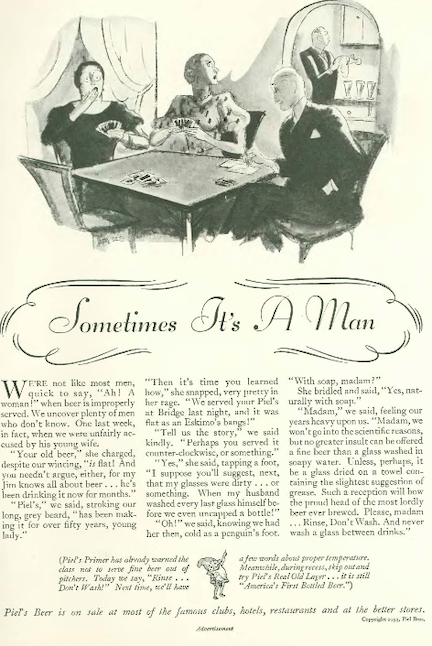
…and cartoonist Herbert Roese, who apparently never published a cartoon in The New Yorker, turned in this very New Yorker-looking illustration for Piel’s…
…on to our cartoonists, we begin with Clarence Day, better known for his Life With Father stories…
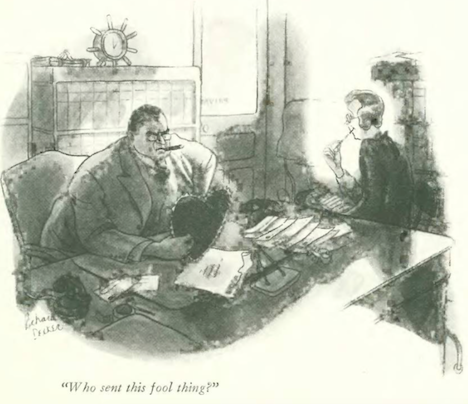
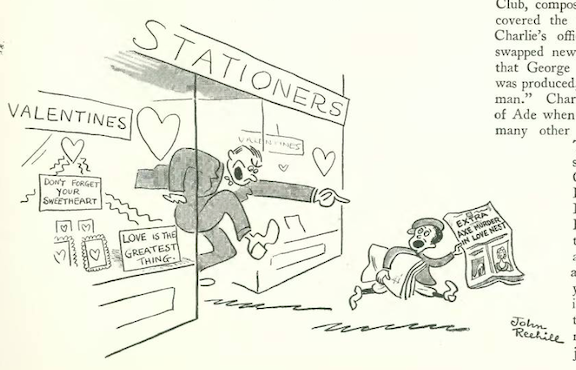
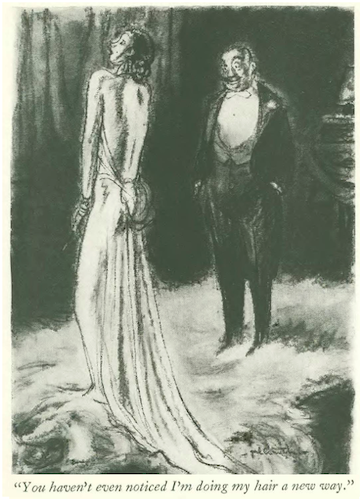
…the Valentine’s issue featured several themed cartoons, including these by Richard Decker…
…and John Reehill…
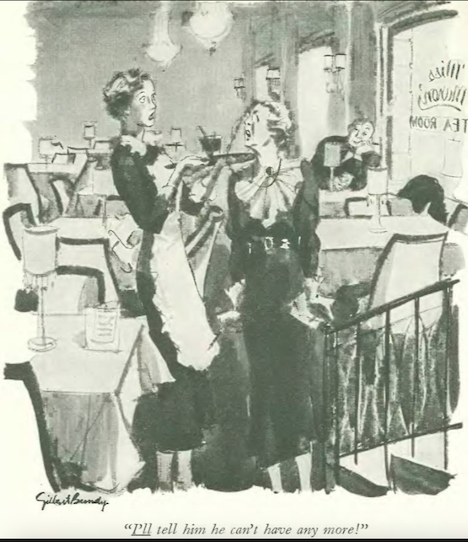
…love was also in the air for Gilbert Bundy…
…while William Crawford Galbraith continued to ply the waters of the creepily lustful…
…and we test different waters with Richard Yardley, a popular editorial cartoonist for The Baltimore Sun…this is the only cartoon he published in The New Yorker…
…the Westminster Kennel Club dog show was in town, here tapped by Helen Hokinson to also explore the theme of fatherhood…
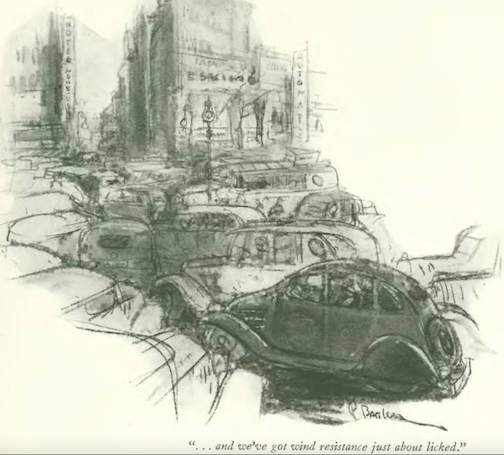
…Perry Barlow was the latest New Yorker contributor to mock the futuristic, aerodynamic style of Chrysler’s Airflow…
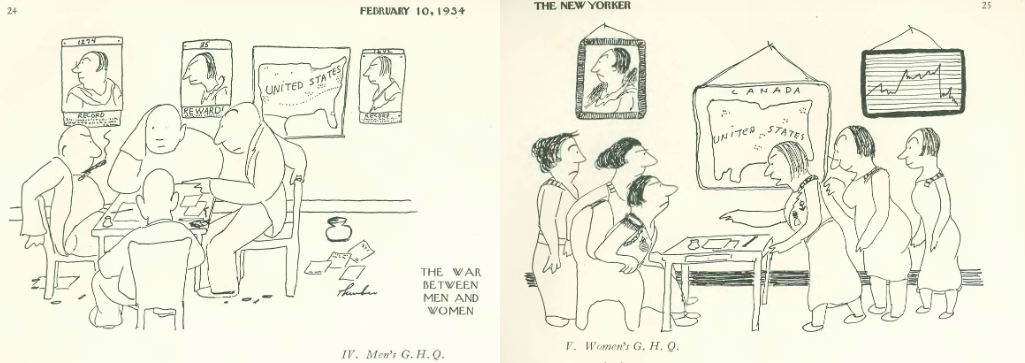
…and James Thurber’s “War Between Men and Women” paused as the two sides made preparations for the next battle…
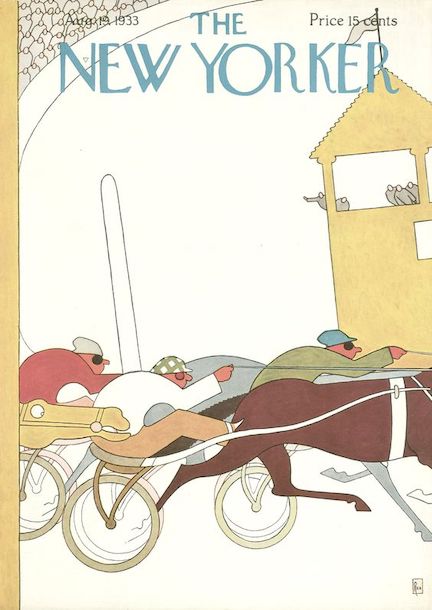
New Yorkers were enduring the dog days of August, and those who couldn’t escape the heat by fleeing to the country or the beach could find cool respite at the movies.
August 19, 1933 cover by Gardner Rea.
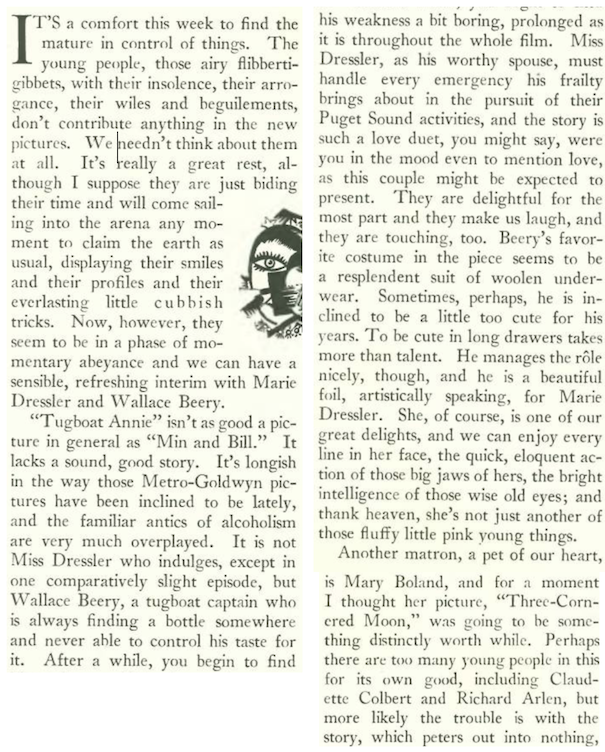
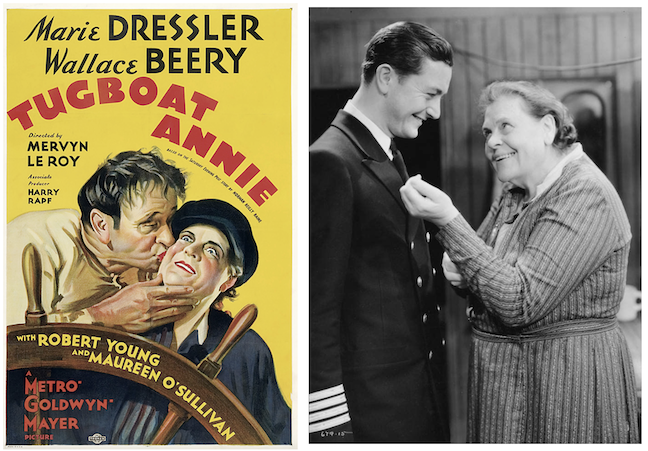
It was doubtless in an air-conditioned theatre where critic John Mosher enjoyed the craft of older actors, in this case Wallace Beery and Marie Dressler in Tugboat Annie. Although the film didn’t quite live up to Beery and Dressler’s 1930 smash hit, Min and Bill, Mosher found Beery to be a “beautiful foil” to Dressler, who thankfully wasn’t just another “fluffy little pink young thing.”
ON GOLDEN POND…Wallace Beery and Marie Dressler portrayed a comically quarrelsome older couple who operate a tugboat in MGM’s Tugboat Annie. It would be one Dressler’s last film roles—she would die the following year; at right, a young Robert Young with Dressler in a scene from the film—Young would go on to television fame playing two beloved characters: the dad in Father Knows Best (1954-60) with fellow film star Jane Wyatt, and the kindly, avuncular doctor on Marcus Welby M.D. (1969–76). (IMDB)
Another seasoned performer Mosher admired was Mary Boland, although her latest film, Three Cornered Moon, was crowded with “too many young people”…
BRAT PACK…Mary Boland (left) with Wallace Ford, Claudette Colbert, and Hardie Albright in Three Cornered Moon (IMDB)
…and then there was Buster Crabbe’s lackluster Tarzan the Fearless to consider—it was Crabbe’s only screen appearance as the Ape-Man…
MONKEYING AROUND…A self-described “King of the Serials,” Buster Crabbe’s career included nine sound serials, including Flash Gordon and Buck Rogers (1936-40). In Tarzan the Fearless Crabbe’s sole appearance as Tarzan was played opposite Jacqueline Wells (aka Julie Bishop). The media at the time made hay of a so-called rivalry between Crabbe and Johnny Weissmuller, who defined the Tarzan role in twelve films from 1932 to 1948. Both men were Olympic athletes: Crabbe won the 1932 Olympic 400-meter freestyle swimming championship, while Weissmuller was the undefeated winner of five Olympic gold medals. (IMDB)
* * *
From Our Advertisers
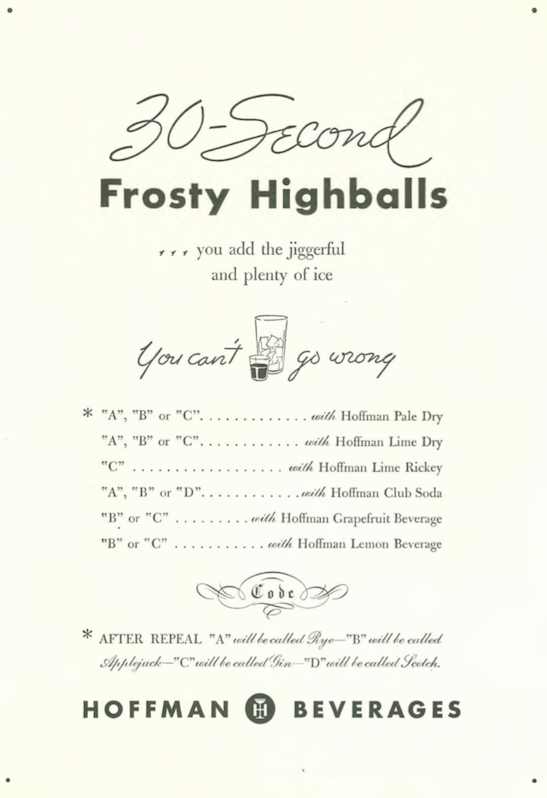
The folks at Hoffman Beverages continued to offer up ways to enjoy an adult refreshment, including a tongue-in-cheek “code” to be used until the repeal of Prohbition…
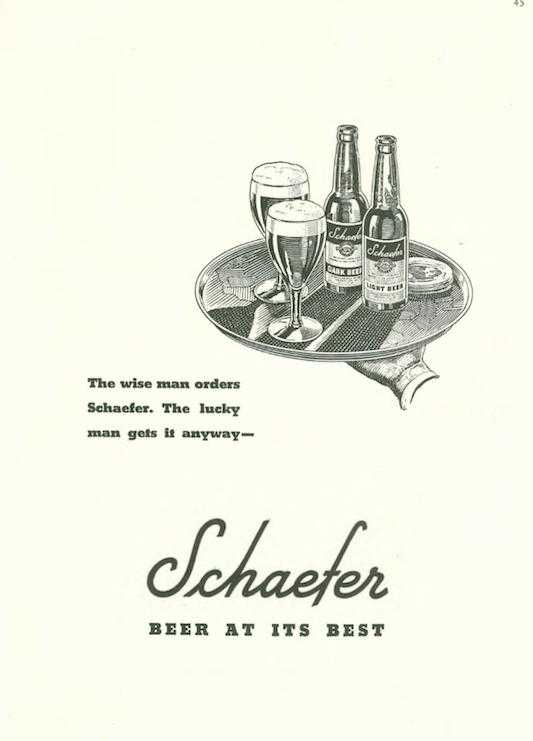
…with the return of legal (3.2) beer, brewers were aggressively targeting women as a new growth market…
…a selection of one-column ads from the back pages touted imported beers and an old “Pennsylvania Dutch” quaff, intermixed with apartment ads and a women’s deodorant called SHUN…
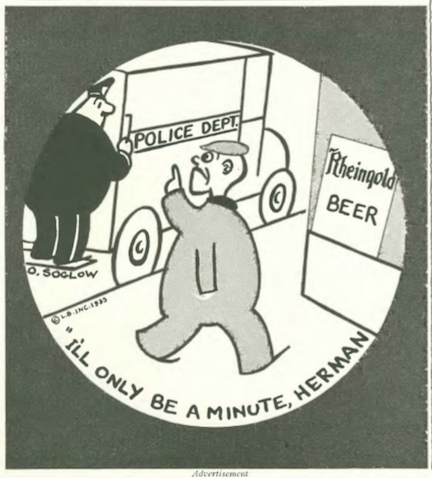
…Otto Soglow, who would become rich and famous with his The Little King strip, also did well as an illustrator for various products, including Rheingold beer…
…another way to stay cool was to dine at Longchamps, thanks to their “scientific air-conditioning system”…
…on the subject of keeping cool, back in the day you had to regularly top off the radiator on hot days, and if you added lead to your gasoline you could also get rid of those annoying hot engine knocks…
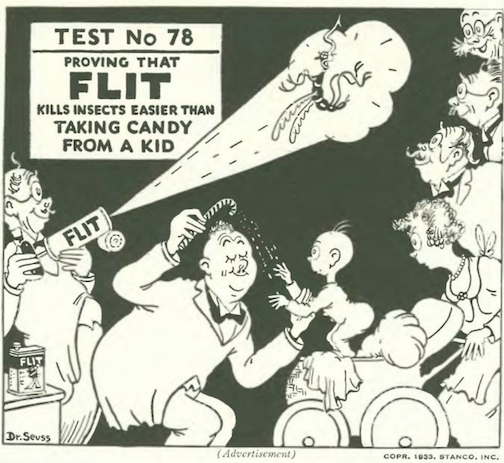
…It would be four years before Dr. Seuss would publish his first children’s book, so he continued to pay the bills with illustrated ads for Flit insecticide…ah the good days when spraying poison above a child’s head seemed perfectly reasonable…
…another one-column ad from the back pages says a lot about how advertisers perceived a New Yorker reader—even dog food demanded snob appeal…
…on to our cartoons we return to Otto Soglow and his take on the old William Tell trope…
…Peter Arno delivered some surprising news to dear old mom…
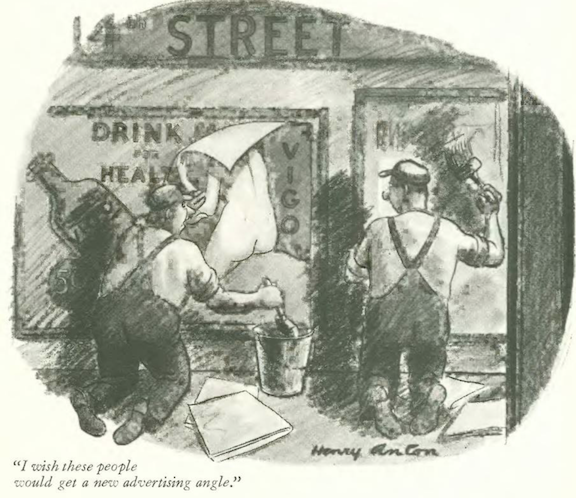
…Henry Anton gave us a sign man unconvinced that sex sells…
…Gluyas Williams gave us his latest take on “Fellow Citizens” (this originally appeared sideways on p. 17)…
…and Garrett Price shared this observation, from the mouth of babes…
…on to Aug. 26…
Aug. 26, 1933 cover by Perry Barlow.
…where we find Ring Lardner, who since March had been injecting humor into the “Over the Waves” radio column.
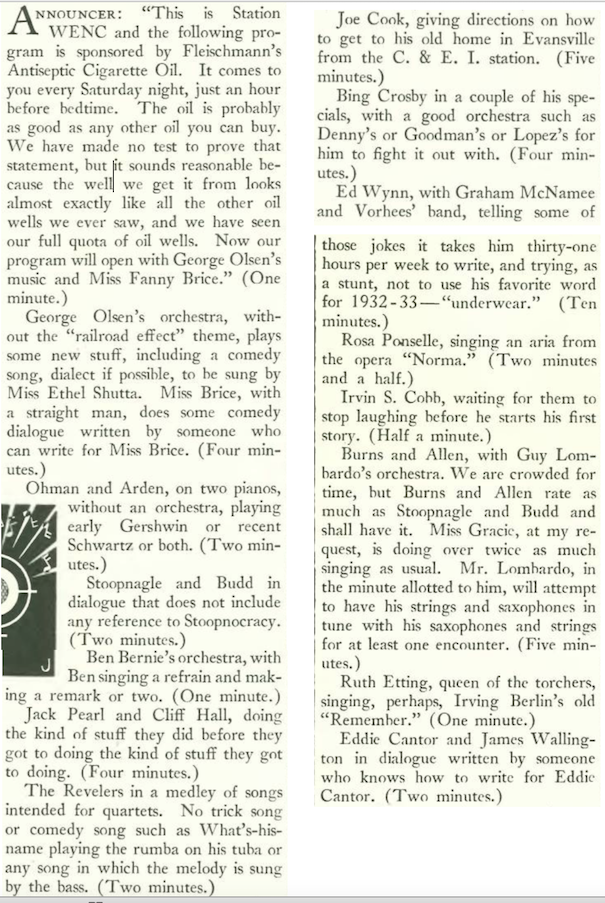
In this installment, Lardner outlined his ideal radio program. An excerpt:
UP TO OLD GAGS?…Ring Lardner gave the comedy duo Jack Pearl (right) and Cliff Hall a generous four minutes in his fantasy radio show—if they did their old routines. (Wikimedia)
Lardner concluded his dream program:
Sadly, Ring Lardner would be gone in less than a month—he died of a heart attack on Sept. 25, 1933, at the tender age of 48.
* * *
On Second Thought
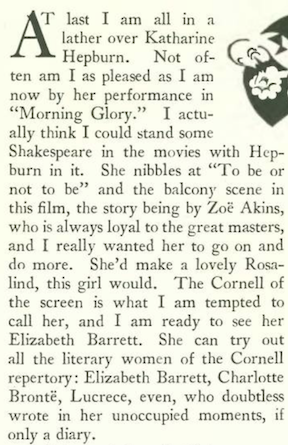
Previously, film critic John Mosher had been lukewarm to the up-and-coming Katharine Hepburn. No more. Her appearance in Morning Glory drew praise from all over, including the Academy, which gave the young star her first Oscar.
A STAR IS BORN…Katharine Hepburn with Douglas Fairbanks Jr. (left) and Adolphe Menjou in Morning Glory (1933). Hepburn would win the Oscar for Best Actress in a Leading Role, the first of four she would receive in that category—a record for any performer. (IMDB)
* * *
Life With Clarence
Following “The Talk of the Town” section was this illustrated contribution by Clarence Day…
* * *
More From Our Advertisers
While folks were cooling down at the movies Barbara Stanwyck did her best to heat up the screen…
…the frank discussion of sex in Baby Face made it one of the most notorious films of the year and no doubt hastened the implementation of the Hays Code…
LIGHT MY FIRE…Barbara Stanwyck in Baby Face.
…in case anyone had forgotten during Prohibition, Budweiser reminded them who was the king of beers with this inside front cover ad…
…Irvin S. Cobb was back on behalf of Hupmobile, the struggling carmaker hoping that a bit of humor would boost sales…
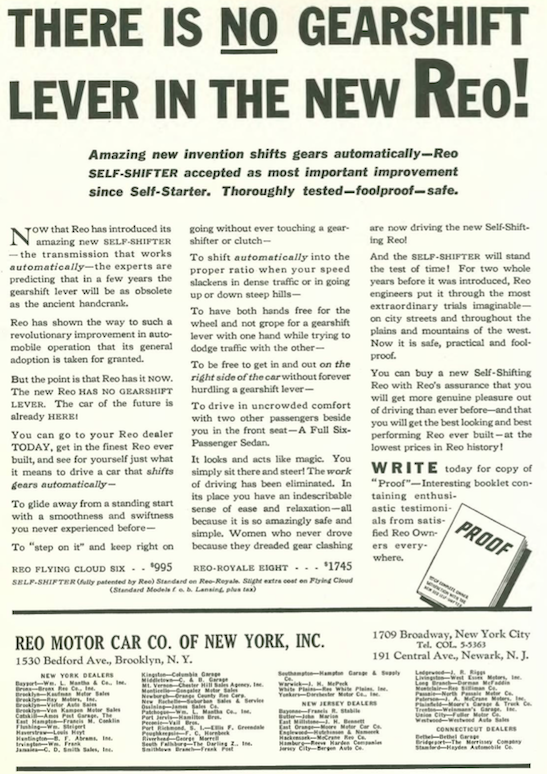
…this ad from Reo not only lacked humor, it lacked the car itself…
…too bad, because the 1933 Reo Royale was a beauty…
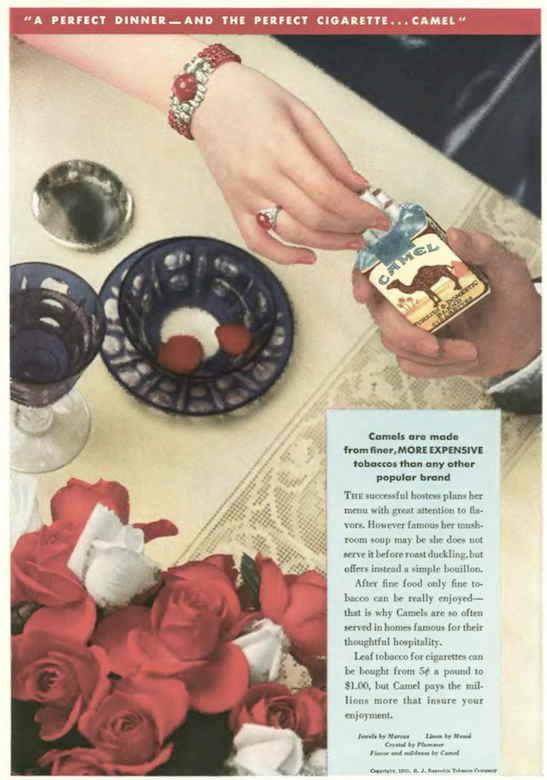
…more color ads from our cigarette manufacturers Camel…
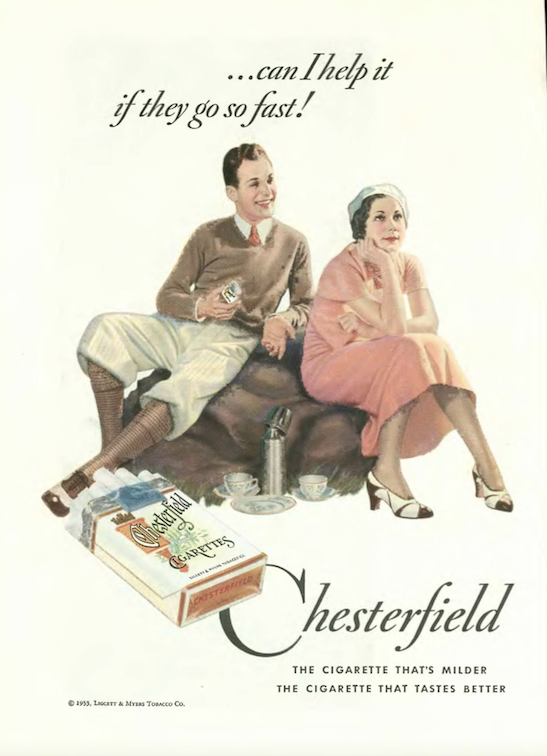
…and Chesterfield…
…why, it’s Barbara Stanwyck again, this time in color, thanks to the folks at Powers Reproduction…
…and Otto Soglow again for Rheingold beer…
…and on to the cartoons, with Soglow’s Little King…
…Carl Rose demonstrated the perils of attending theatre in a barn…
…Robert Day found a Hebrew lifeguard at Coney Island…
…and we end with another by Day, with a twist on America’s Pastime and a subtle plug for the National Recovery Administration…
If you’ve ever come across the byline B.H. Arkwright, you were most likely reading the work of Clarence Day Jr., who in February 1931 began writing for The New Yorker under that pseudonym and also under his given moniker, which in four short years would become a household name.
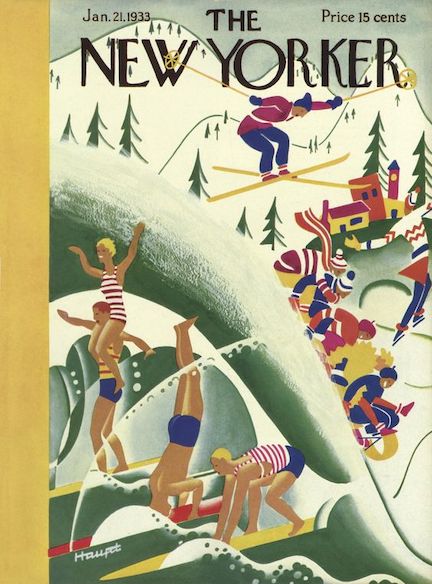
Jan. 21, 1933 cover by Theodore Haupt.
In the Jan. 21, 1933 issue Day would publish his first humorous story in The New Yorker about upper-middle-class family life in the 1890s. A subsequent collection of these stories would be published in 1935 under the title Life with Father. Sadly, Day would die shortly thereafter and wouldn’t witness the enormous cultural impact his stories would have on mid-century America.
Here is an excerpt of Day’s first story about his father, describing an exchange between his parents that would set the tone for the series:
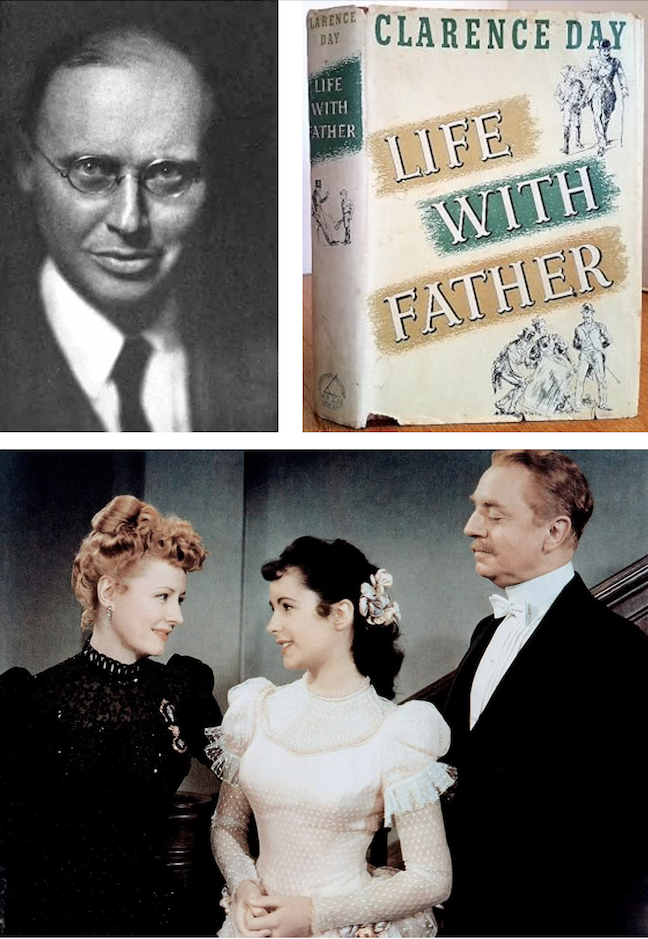
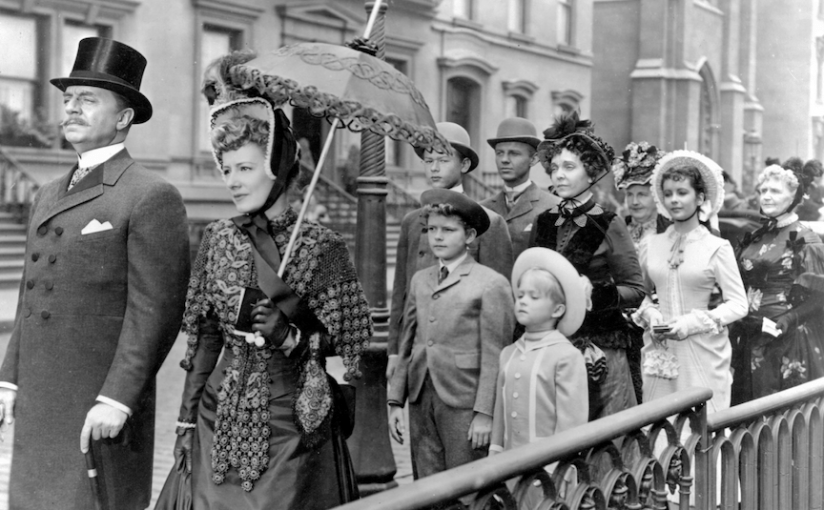
Life with Father was a hit with readers, inspiring a 1939 Broadway production by Howard Lindsay and Russel Crouse that would run for 3,224 performances over 401 weeks—it was, and still is, the longest-running non-musical play on Broadway. The play would be adapted into a 1947 film featuring Irene Dunne and William Powell in the leading roles. The stories even made it to the small screen in a CBS TV series that ran from 1953 to 1955.
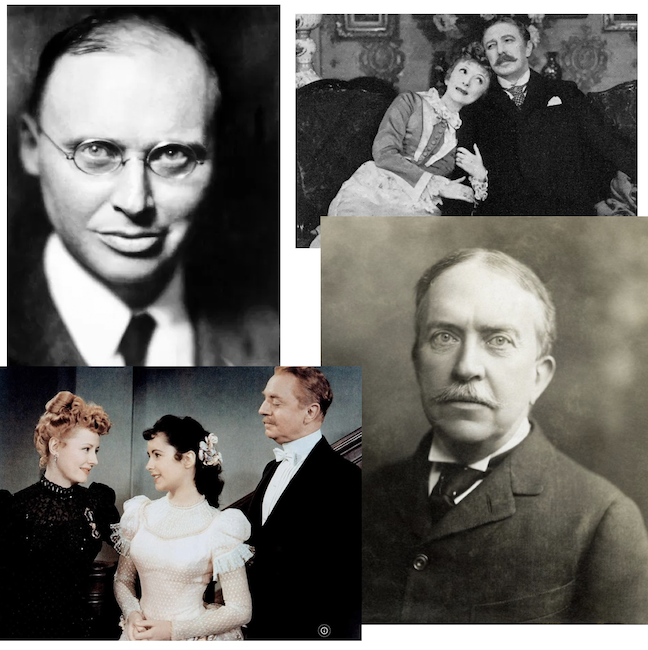
ALL IN THE FAMILY…Clockwise, from top left, Clarence Day, Jr. (1874-1935) in undated photo; Dorothy Stickney and Howard Lindsay in the Broadway production of Life with Father, 1939; Day’s father and inspiration, stockbroker Clarence Day, Sr. (1844-1927); scene from the 1947 feature film Life with Father with Irene Dunne, William Powell, and a 14-year-old Elizabeth Taylor. (britannica.com/theguardian.com/IMDB)
Day was also a cartoonist, contributing satirical cartoons for U.S. suffrage publications in the 1910s and also publishing collections of humorous essays including a Darwinian satire on the origins of human nature, This Simian World (1920), and the rambling, whimsical The Crow’s Nest (1921). Both featured Day’s simplistic cartoons and anthropomorphic tales that anticipated the work of James Thurber later in the decade.
CATTAIL…Self-portrait of Clarence Day rendered as a cat in a selection from The Crow’s Nest (1921). The entire book is available as a free e-book from The Project Gutenberg.
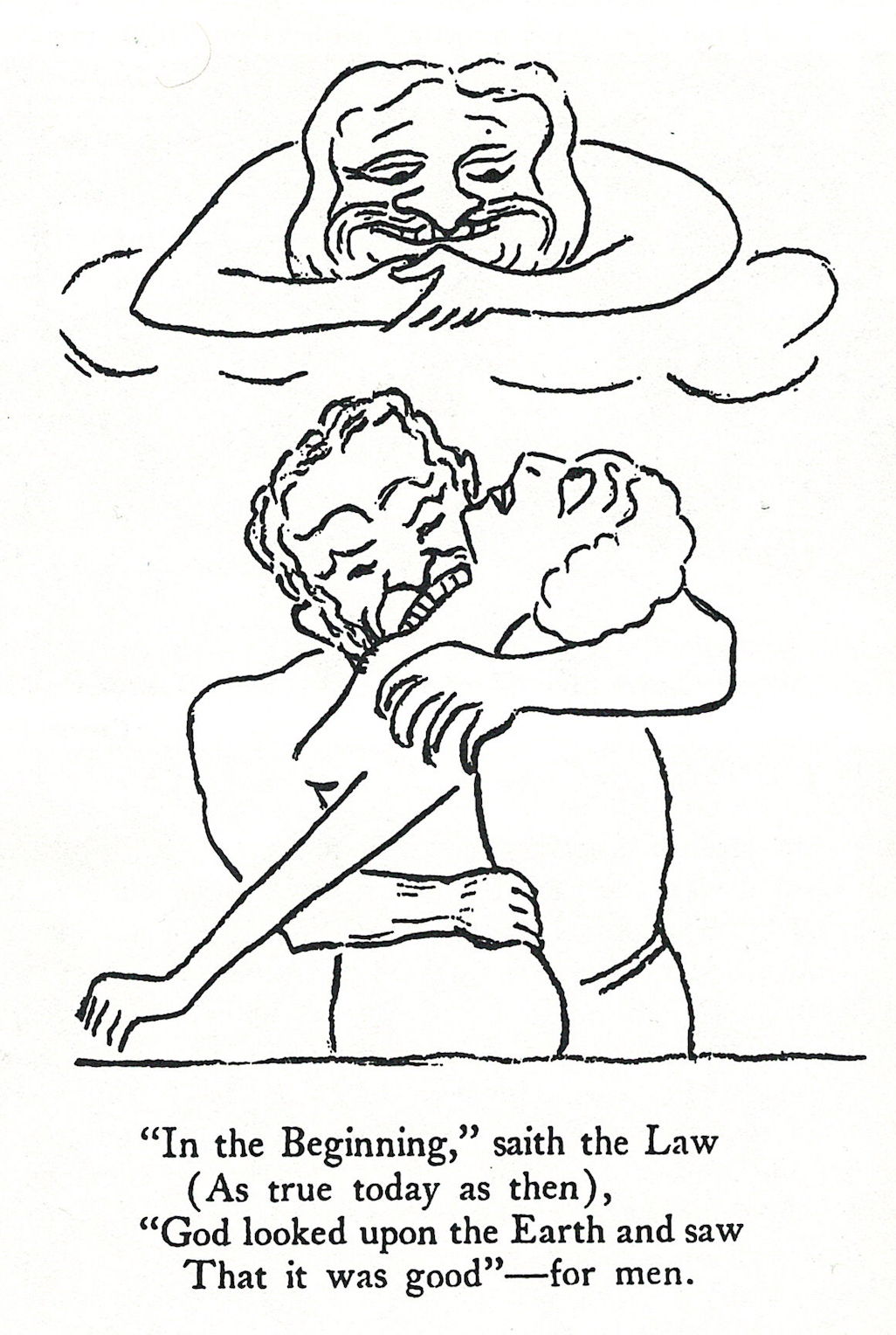
As we know, New Yorker founding editor Harold Ross was a man of contradictions, at once profane and puritanical, the latter on display when it came to one of Day’s cartoon submissions for the magazine. According to Brendan Gill’s memoir Here at The New Yorker, Ross balked at publishing the drawing below because it showed an exposed breast. Either Day or an editor simply removed the nipple (note the broken line in the nipple’s place) and the cartoon was published.
* * *
Big Man’s Big Man
August Gennerich not only served as President Franklin D. Roosevelt’s bodyguard, he was also a close family friend. “The Talk of the Town” featured a lengthy account of the man, an excerpt of which is below:
ON GUARD…Augustus “Gus” Gennerich (1887-1936) was a friend of Franklin and Eleanor Roosevelt’s as well as one of FDR’s most trusted guards. He began his career in 1909 as a NYC policeman and in 1929 was assigned to be then-Governor Roosevelt’s bodyguard in the city. The Roosevelts were heartbroken when Gus died unexpectedly at age 50 from a heart attack. (picryl.com)
* * *
Desert Solitude
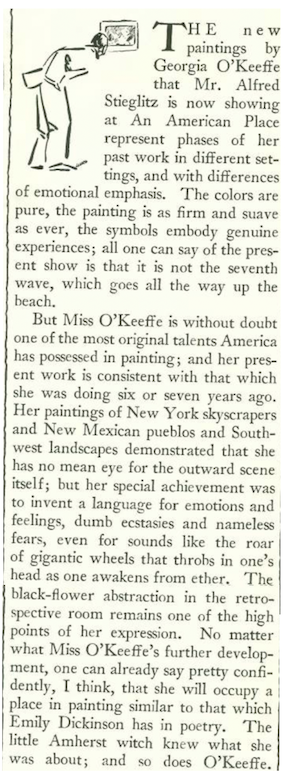
In 1933 Georgia O’Keeffe (1887–1986) was well into her Southwestern phase when her husband Alfred Stieglitz staged a show of her work at his last New York gallery, An American Place. O’Keeffe and Stieglitz lived together in New York until 1929, when O’Keeffe began spending more time in the Southwest—most likely to put some distance between herself and Stieglitz, who was in a long-term affair with photographer and writer Dorothy Norman. After this show opened O’Keeffe would suffer a nervous breakdown (per the above) and not return to painting until 1934. Lewis Mumford visited An American Place and had this to say about O’Keeffe’s work:
ANOTHER AMERICAN PLACE…New Mexican Landscape by Georgia O’Keeffe, 1930. (springfieldmuseums.org)
* * *
The Bookish Type
Modernist American poet and writer Archibald MacLeish (1892–1982) was a man of letters to the letter, serving as the ninth Librarian of Congress (1939-44) and during which time initiated the process of naming U.S. poet laureates. Here he contributes some of his verse to The New Yorker:
DESK JOB…Archibald MacLeish, circa late 1930s. (Library of Congress)
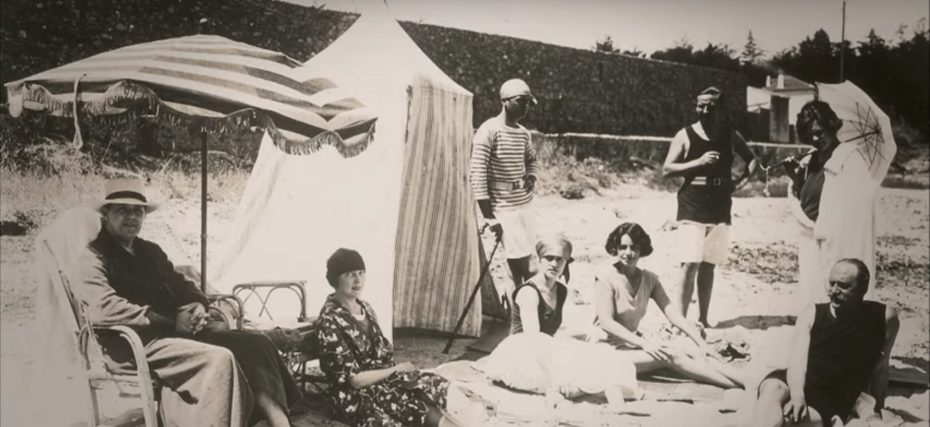
It was no accident that MacLeish contributed to The New Yorker: in addition to being among the literary expatriates in Paris including Gertrude Stein and Ernest Hemingway, MacLeish and his wife, Ada Hitchcock, were part of the Riviera crowd hosted by Gerald and Sara Murphy, which included among other notables John O’Hara, Dorothy Parker, and Robert Benchley.
OVER THERE…Gerald and Sara Murphy hosting friends at a Riviera beach party, circa 1923. Gerald is the man standing in the striped shirt; Sara is at right with a parasol. I believe that is Benchley at the bottom right, and Parker seated at center-right. (Beinecke Library)
* * *
From Our Advertisers
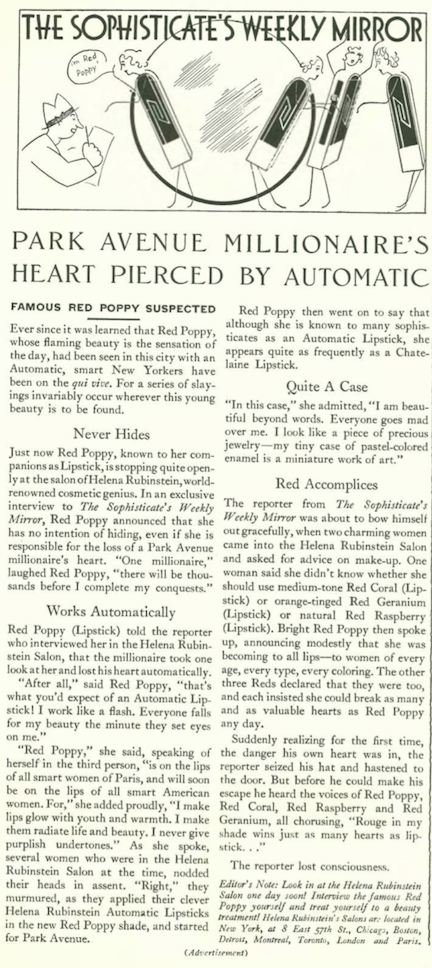
We begin with this ad from Helena Rubinstein that parodies Lois Long’s “Tables for Two” column (Long signed that column as “Lipstick”) and announced a new “Red Poppy” shade…
…on the other hand, the folks at Tangee borrowed from the old Temperance Movement song, TheLips that touch liquor, shall never touch mine, to promote a lipstick guaranteed to snag a sugar daddy like the one illustrated below (recalling Monopoly’s Uncle Pennybags)…
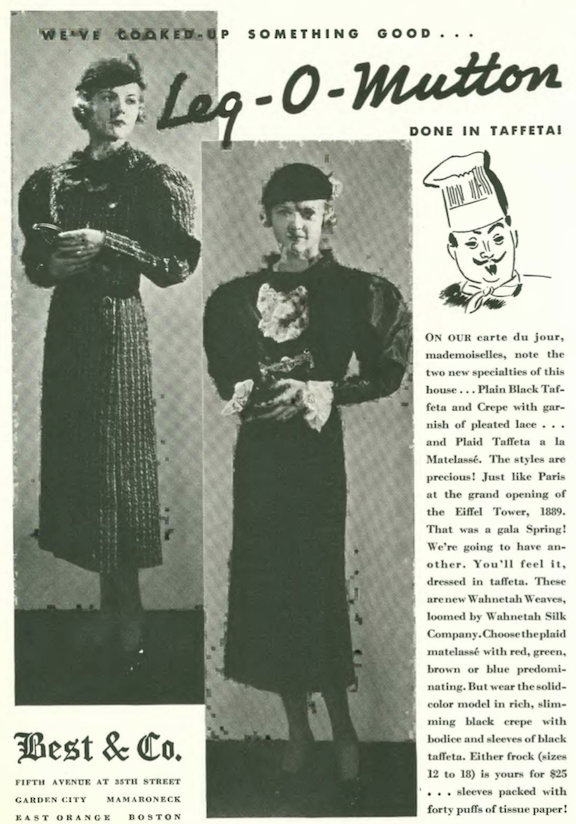
…more advertising weirdness comes our way from the staid Best & Company, its execs somehow persuaded by an ad man to go with this chef motif…
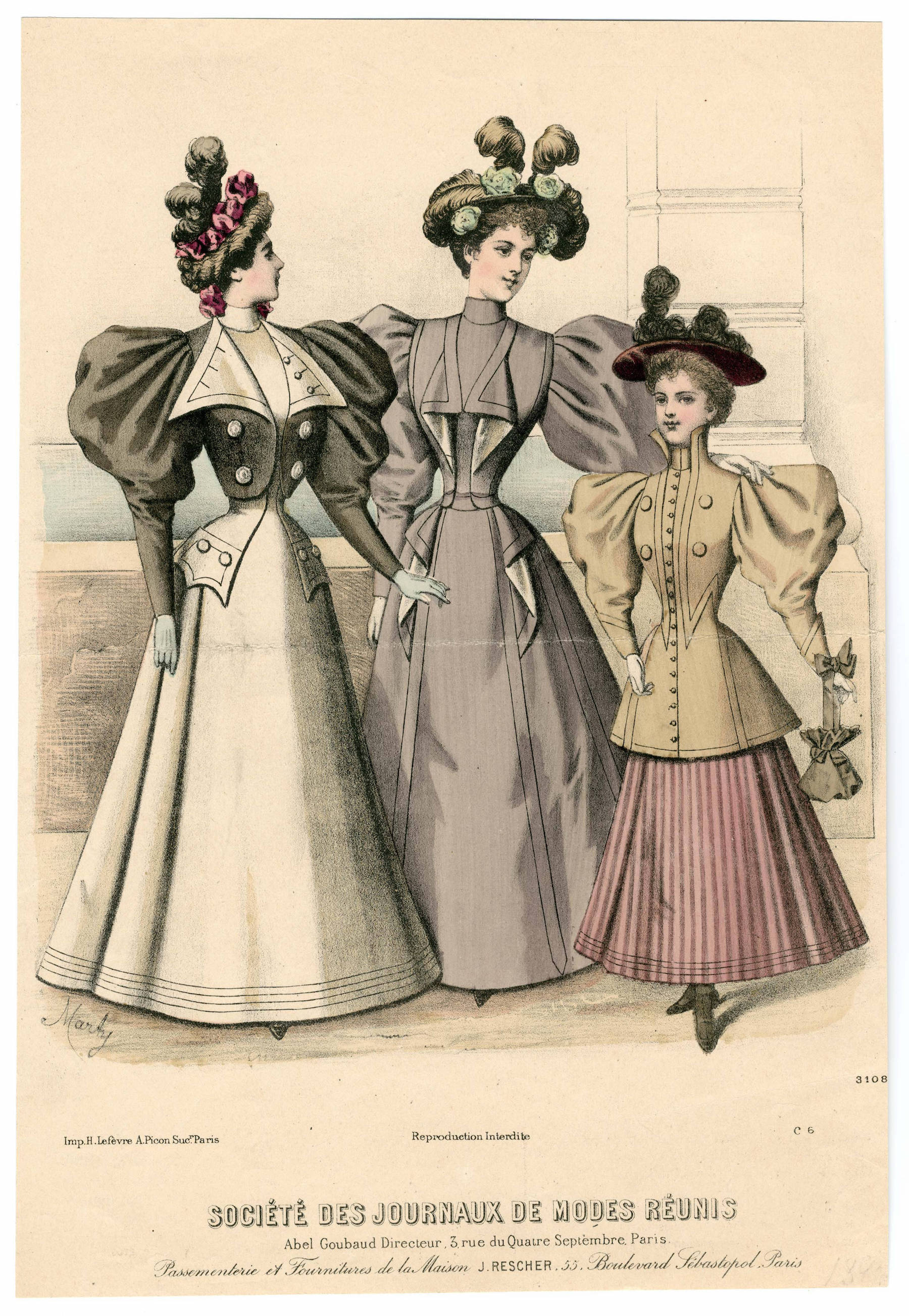
…Leg ‘O Mutton referred to a type of puffy sleeve introduced in 1830s France that had a revival in the late 1880s…
MMMMM, MUTTON…The Leg ‘O Mutton look, circa 1890s. (genealogylady.net)
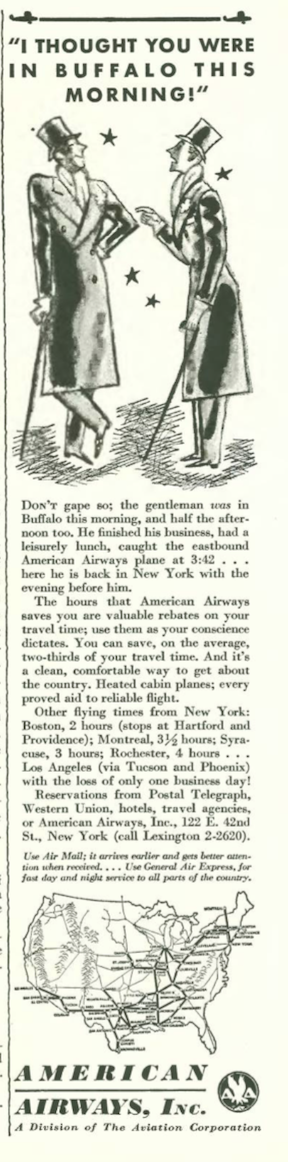
…the National Auto Show moved on and the National Motor Boat and Engine Show took its place at the Grand Central Palace…
…I’m trying to imagine the guy at left stowing his top hat in an overhead bin…
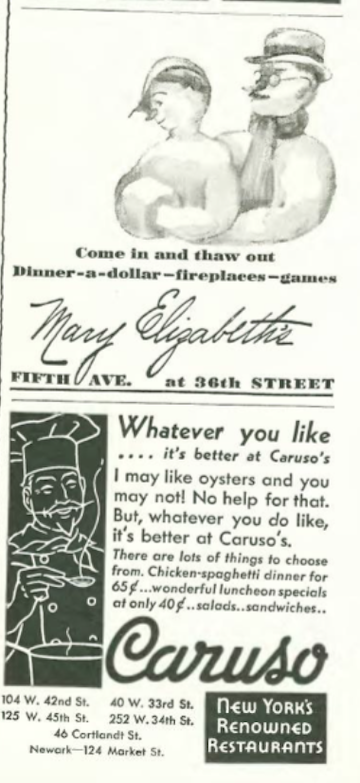
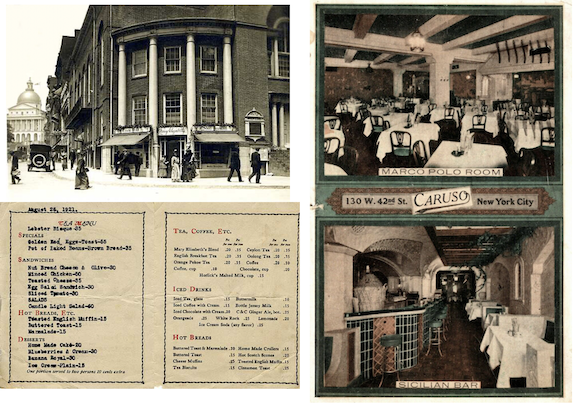
…down on earth folks could enjoy some down-to-earth home cooking at Mary Elizabeth’s, or go some Italian at Caruso’s…
…and for reference…
Top left, Mary Elizabeth’s success on Fifth Avenue led to expansion into Boston; below, a 1921 menu at Mary Elizabeth’s in New York; at right, 1930s postcard advertising Caruso’s on 42nd Street. (restaurant-ingthroughhistory.com)
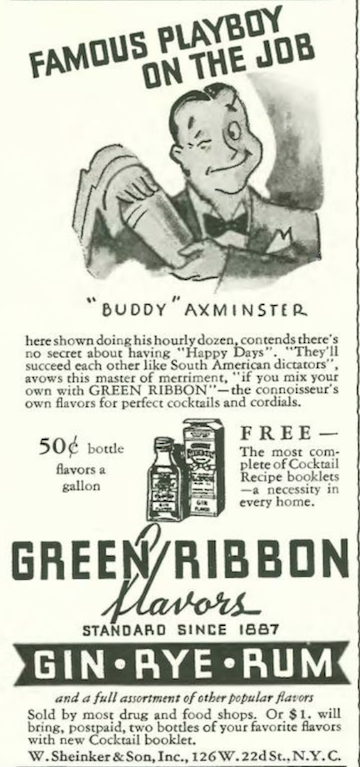
…of course you couldn’t legally drink at those places, so you had to go to a speakeasy or mix your cocktails at home…but this is just sad, ‘ol Buddy here flavoring his bootleg with some Green Ribbon…let’s hope the playboy’s guests aren’t blinded before the night is over…
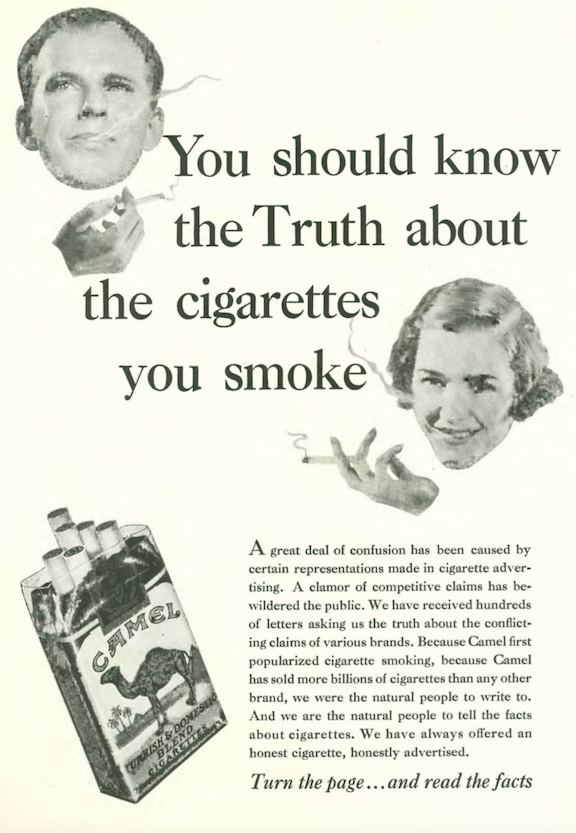
…we all know the tricky ways of the tobacco companies, including this 3-page Q&A from the makers of Camels offering smokers and would-be smokers THE TRUTH and THE FACTS about the cigarettes folks smoke…turns out Camels are the best!…
…and now for a bit of fresh air before we turn to our cartoonists…
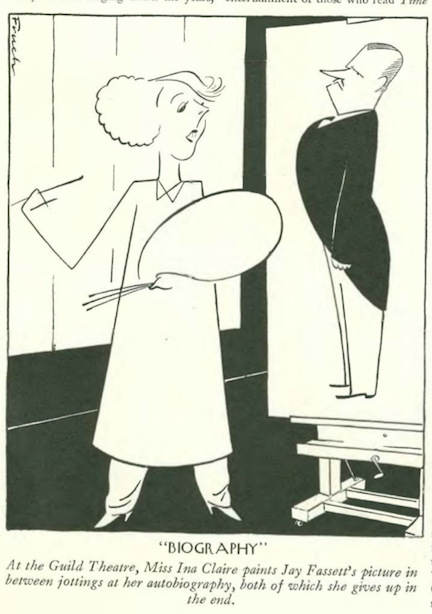
…beginning with Al Frueh and his impressions of a show at the Guild Theatre…
…Peter Arno contributed this illustration across pages 12-13 in “The Talk of the Town” section…
…Helen Hokinson offered up some scandal among the “girls”…
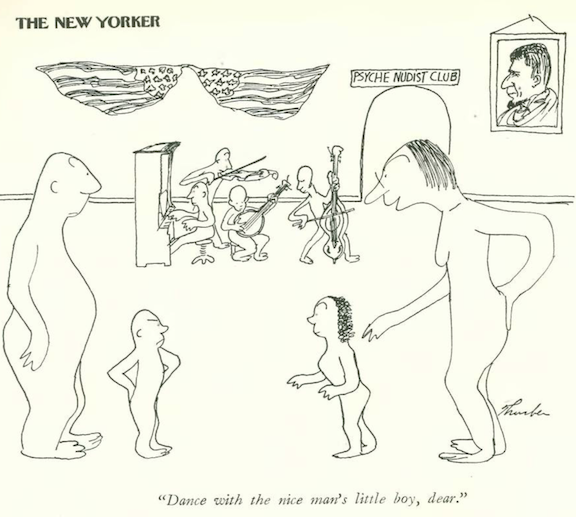
…James Thurber gave us an awkward moment among the tender youth of the unclad world…
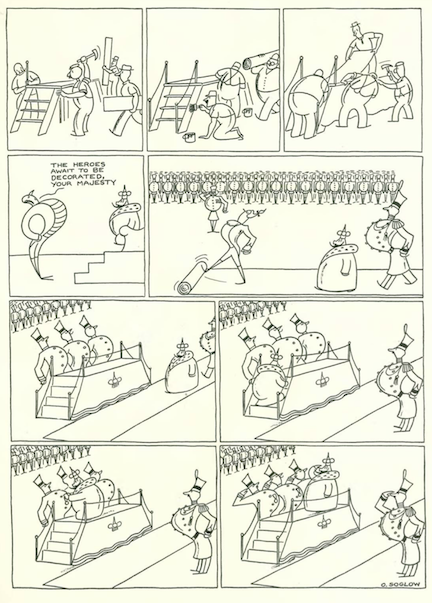
…Otto Soglow’s Little King rose to the occasion, as always…
…Daniel Alain’s artist tried his best to make some small talk while at work…
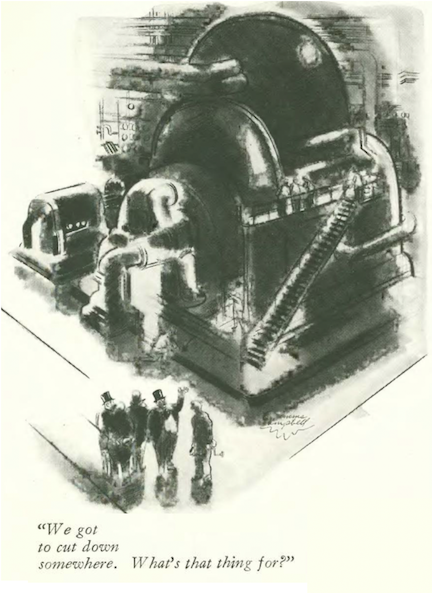
…and we close with E. Simms Campbell, and the yawning gulf between owners and workers…