With the 1920s ending with a crash, few seemed interested in looking back to that decade. Indeed, just days into the 1930s the Jazz Age seemed to belong to a distant, frivolous past.
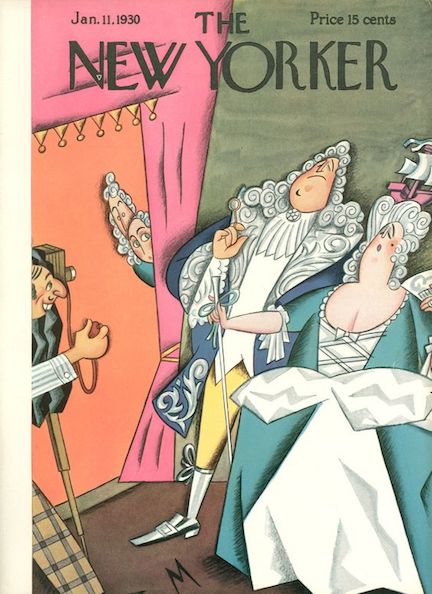
Jan. 11, 1930 cover by Julian De Miskey.
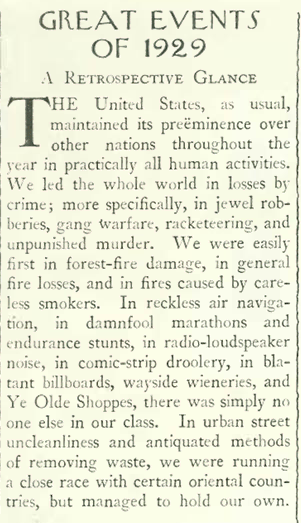
Or at least that is how popular historian Alvin F. Harlow (1875-1963) saw it, penning this somewhat cynical, tongue-in-cheek retrospective on the “great events” of the previous year…
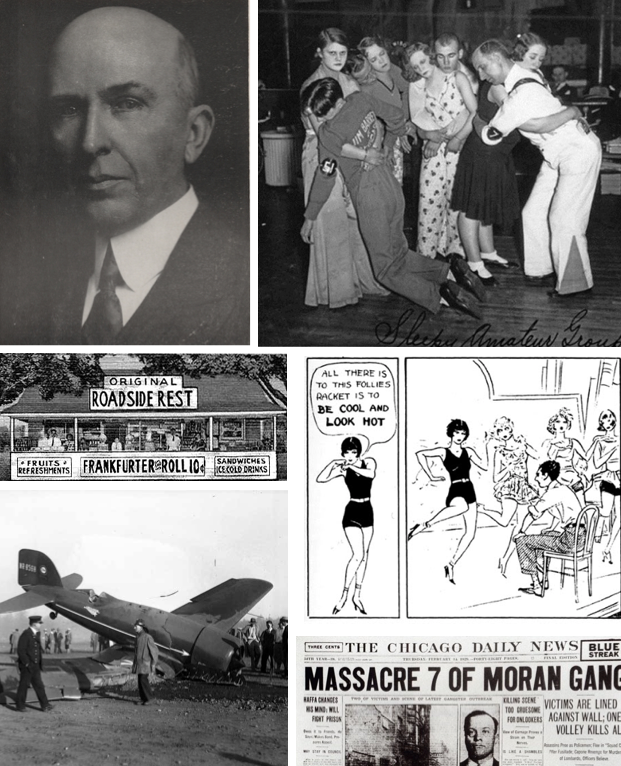
FLASHBACK…Historian Alvin F. Harlow (top left) recalled some of the “great events” of 1929, including (clockwise, from top right) “damnfool” dance marathons; “comic strip droolery” (clip is from Dixie Dugan, 1929); gang warfare; reckless air navigation and wayside wieneries. (jstor.org/News dog Media/nitrateville.com/Chicago/U of Washington/Nathan’s)
…Harlow continued to list the various ways folks sought relief “from the monotony of existence” in 1929…
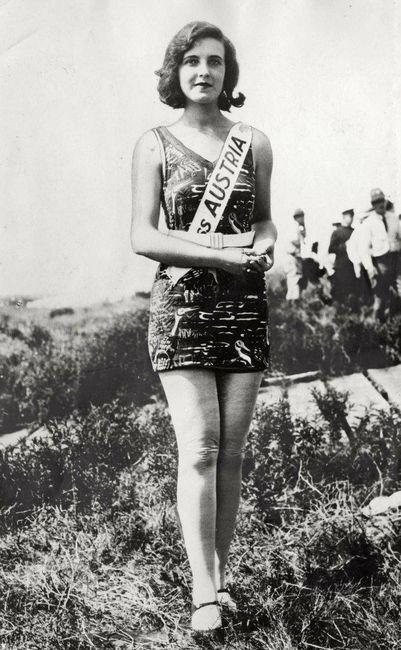
TOO THIN?…Miss Austria, Lisl Goldarbeiter, was crowned the first Miss Universe at the “International Pageant of Pulchritude” in Galveston, Texas in 1929. The pageant actually was one of year’s big events, garnering worldwide attention. (bashny.net)
…as well as the persistence of superstition and quackery…
* * *
A Byrd Takes Wing
In 1928 and 1929 the name Richard Byrd popped up quite a bit in the pages of The New Yorker, and for good reason. In 1928 Byrd — already known for his exploits at the North Pole — began his first expedition to the Antarctic, a land that was as remote to explorers in the 1920s as the moon was to us in the 1960s. On Nov. 28-29, 1929, Byrd — along with pilot Bernt Balchen, co-pilot/radioman Harold June, and photographer Ashley McKinley — flew a Ford Trimotor to the South Pole and back in 18 hours, 41 minutes. It was such a feat that Byrd was promoted to the rank of rear admiral by a special act of Congress on December 21, 1929, making the 41-year-old Byrd the youngest admiral in the history of the United States Navy. In his “Notes and Comment,” E.B. White was still awaiting details of the heroic adventure:
ROUGHING IT…Once the expedition arrived by ship on the Antarctic coast, planes were assembled at the “Little America” base camp on the Ross Ice Shelf. This image shows Richard Byrd and his dog Igloo unpacking crates. The ships that brought the plane and other supplies can be seen in the background. (library.osu.edu)LIKE A MOONSHOT…Clockwise, from top left, a Ford Trimotor (named Floyd Bennett after the recently deceased pilot of a previous expedition) was one of three planes brought on the expedition. It sits assembled and ready to go before its historic flight over the Pole; flying over the pass near Liv’s Glacier enroute to the Pole; Richard Byrd in the library of Little America prior to the flight, with a stone from Floyd Bennett’s grave. Byrd dropped the stone, wrapped in a small American flag, over the South Pole in honor of the pilot of his 1926 North Pole expedition; the geological party (Byrd is second from right) upon returning to Little America, January, 1930; Little America in 1928, soon to be covered in snow. (library.osu.edu)
In his “Wayward Press” column, Robert Benchley commented on Byrd’s promotion, and took a shot at The New York Times (the Gray Lady was a favorite New Yorker target) for monopolizing the news of the South Pole expedition:
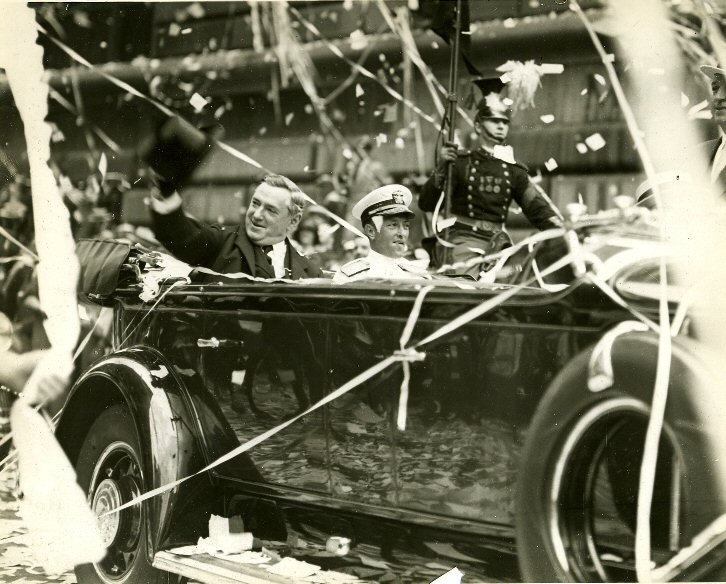
SNOWFALL OF A DIFFERENT SORT…Adm. Richard Byrd received a hero’s welcome in 1930 when he returned to the U.S. from Antarctica. Here he is shown being feted at a ticker tape parade in Boston. (library.osu.edu)
E.B. White also touted an endorsement by the venerable magazine The Nation, which included both Adm. Byrd and The New Yorker in its Honor Roll for 1929:
* * *
Bitter and Sweet
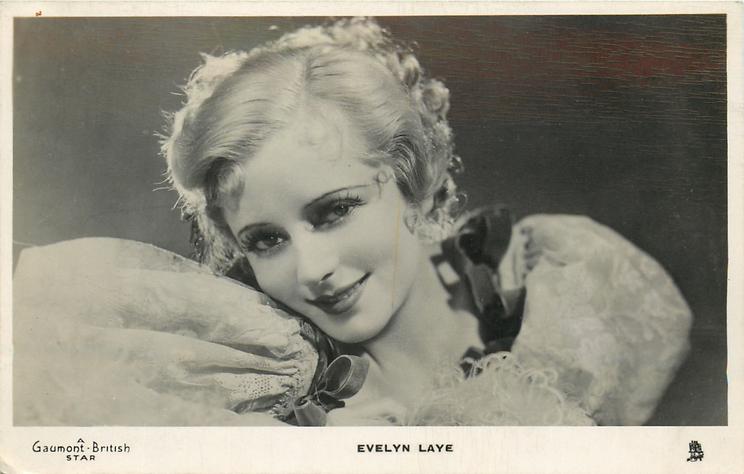
“The Talk of the Town” looked in on English light opera actress Evelyn Laye (1900-1996), who had just arrived in town to make her Broadway debut in the American première of Noël Coward’sBitter Sweet. “Talk” discovered that Laye “had her own notions” about how a stage actress should conduct herself:
MOSTLY SWEET…Postcard image of Evelyn Laye, circa 1933. (tuckdb.org)
Although Laye refused star billing in Bitter Sweet, she had no problem appearing in this two-page ad for Lux soap in The New Yorker’s Jan. 18. issue, hers the only full-page portrait in the ad:
…and so we segue into the ads for Jan. 11, where we find all sorts of diversions in the back pages, including an appeal to revelers for the Greenwich Village Ball (top left corner). The ad copy reads “come when you like, with whom you like—wear what you like…” and asks the question “Unconventional? Oh, to be sure—only do be discreet!”
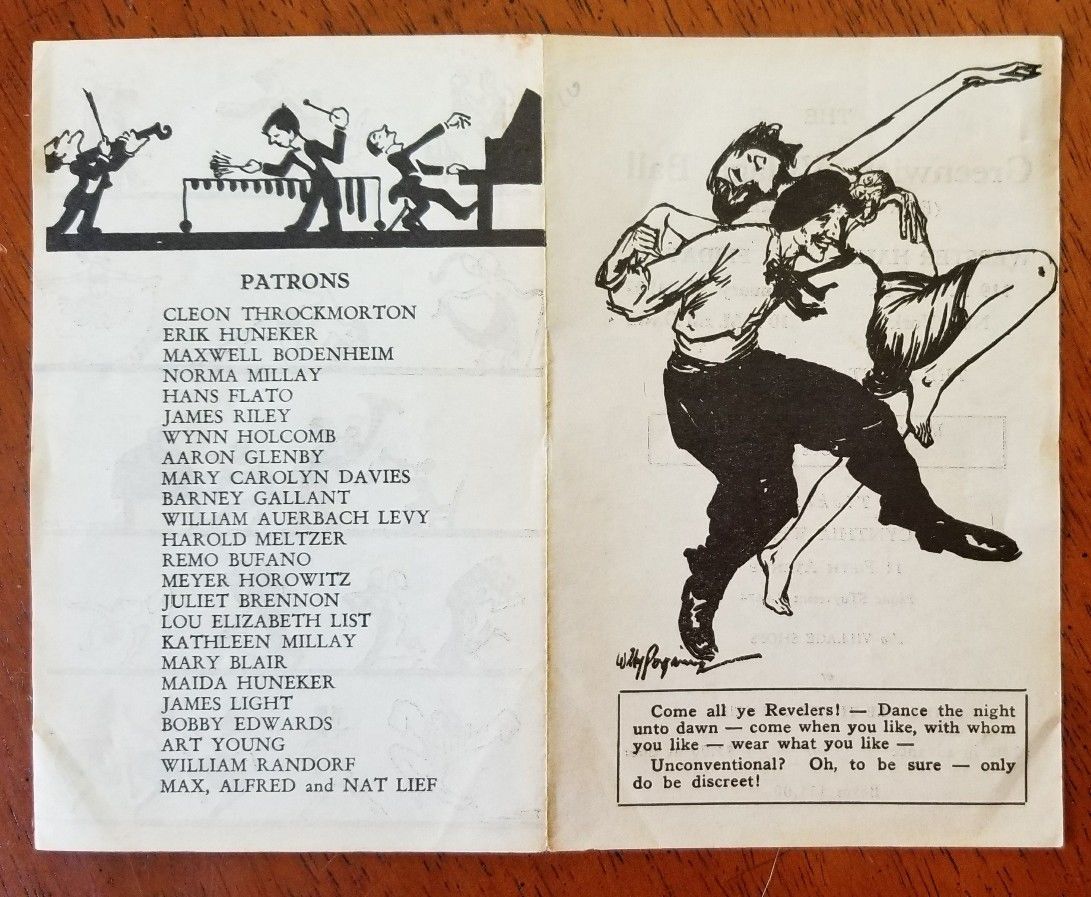
…for reference, here is an invitation from the 1932 Greenwich Village Ball, with a list of patrons printed on the inside cover, including the “King of Greenwich Village Bohemians,” Maxwell Bodenheim, and poet Edna St. Vincent Millay’s two sisters Norma and Kathleen…
(hobohemiadotblog.wordpress.com)
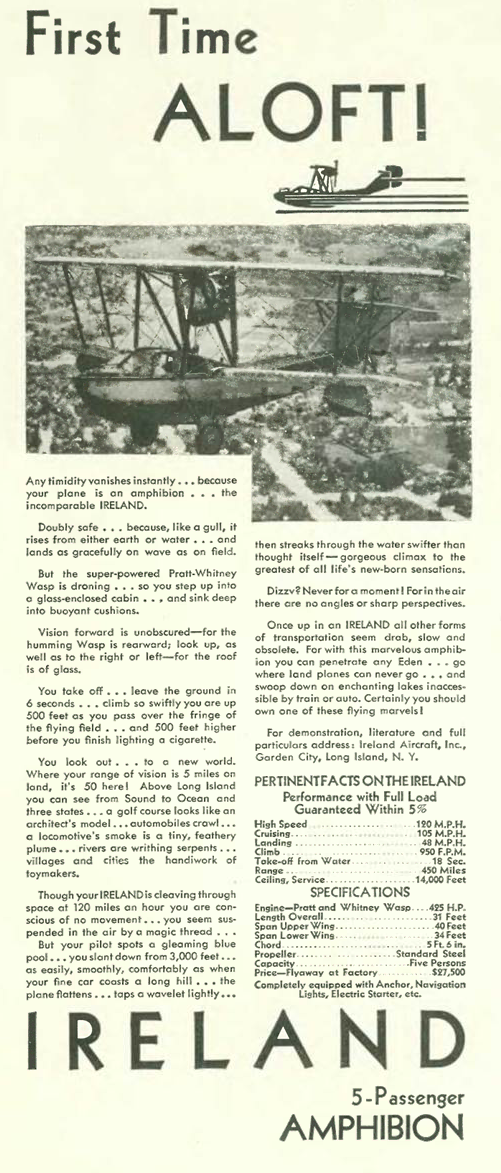
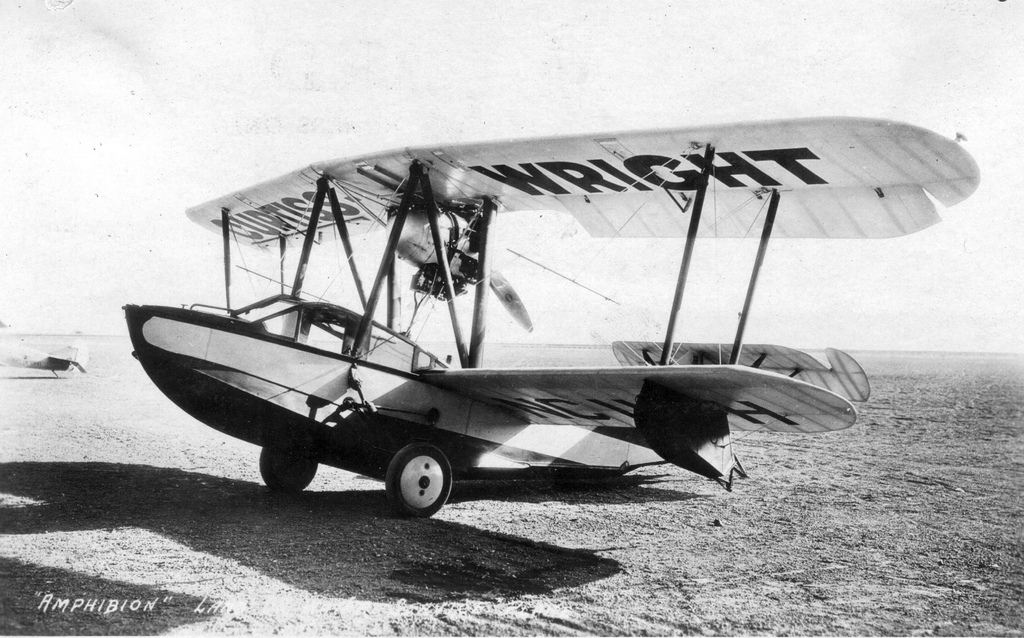
…ads for private airplanes were a regular feature in The New Yorker, aviation companies assuming that at least some readers had the means to consider such a purchase…the copy in this ad emphasized the ease of flying—here is a sample from the fifth paragraph: “You take off…leave the ground in 6 seconds…climb so swiftly you are 500 feet as you pass over the fringe of the flying field…and 500 feet higher before you finish lighting a cigarette…”
…here’s a better view of the Ireland Amphibion…
(San Diego Air and Space Museum Archive)
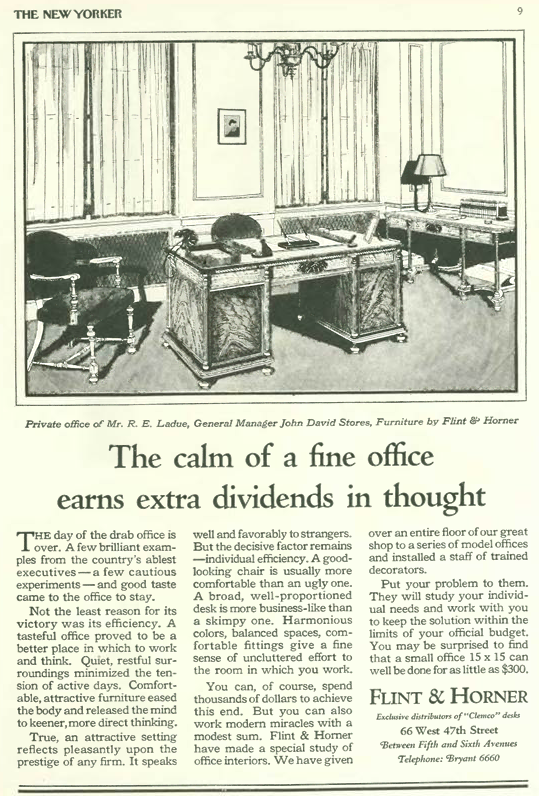
…but for those who remained firmly on the ground, respite could be found in a nice, quiet (and affordable) office, a place where one could, perhaps, start rebuilding from the ashes of the market crash…
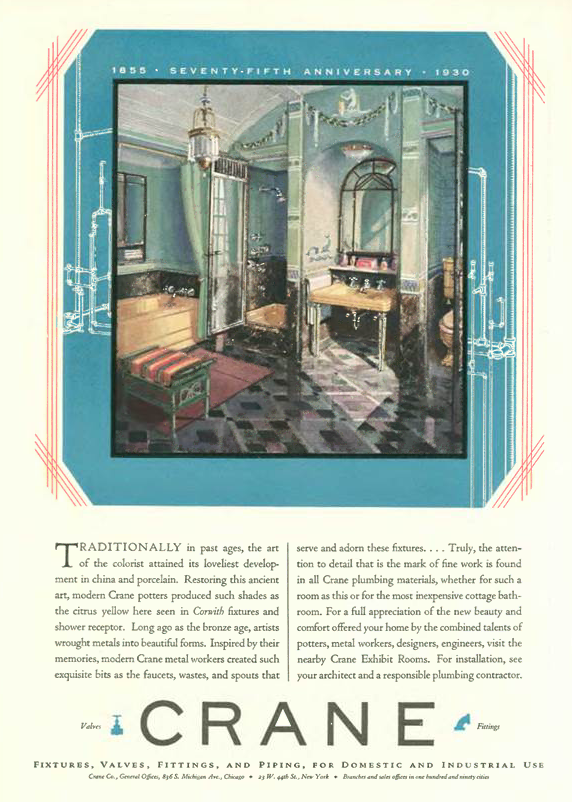
…and for those with a little extra scratch, they could treat themselves to the patrician comforts of a nice bathroom…
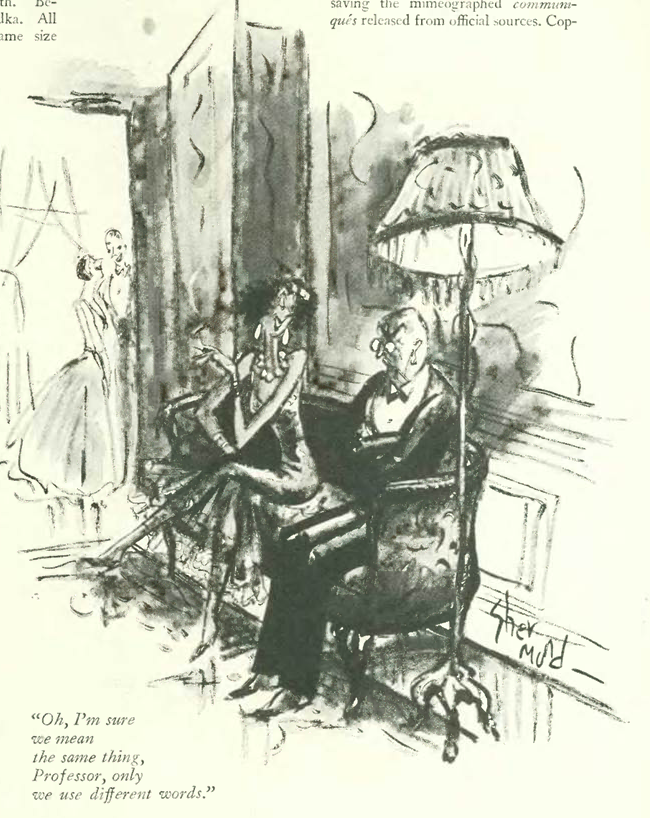
…on to our cartoons, we have a nice little culture clash courtesy of Barbara Shermund…
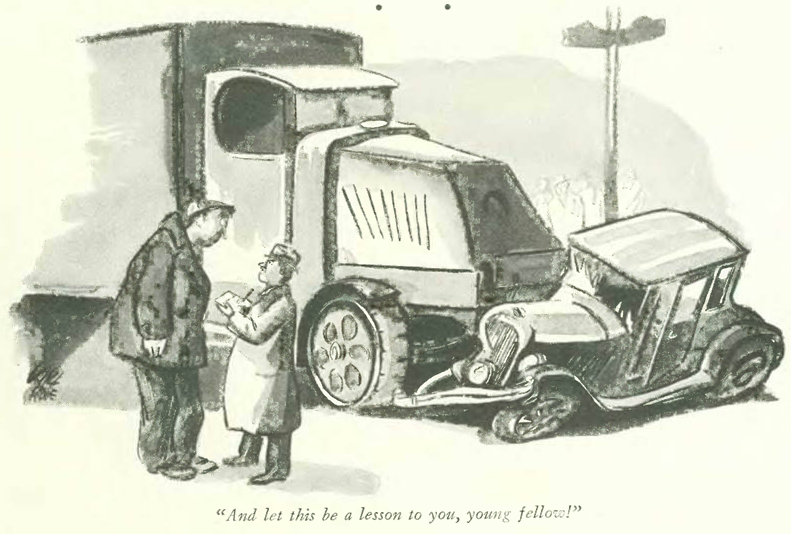
…Carl Rose illustrated a clash of a different sort…
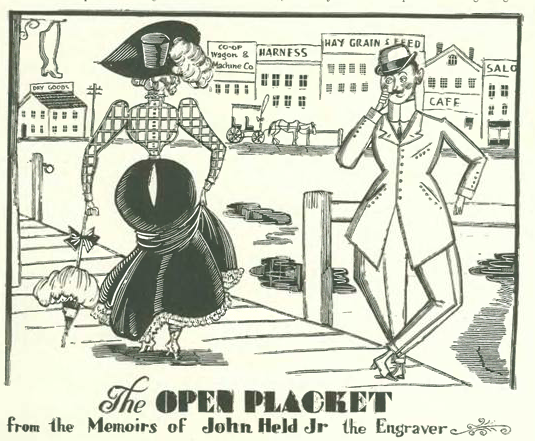
…John Held Jr. was back with one of his slightly naughty “engravings”—these were favorites of founding editor Harold Ross, with his rustic tastes…
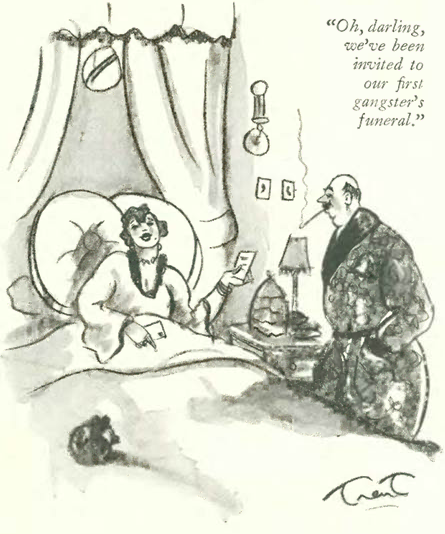
…W.P. Trent explored the strange ways of social status…
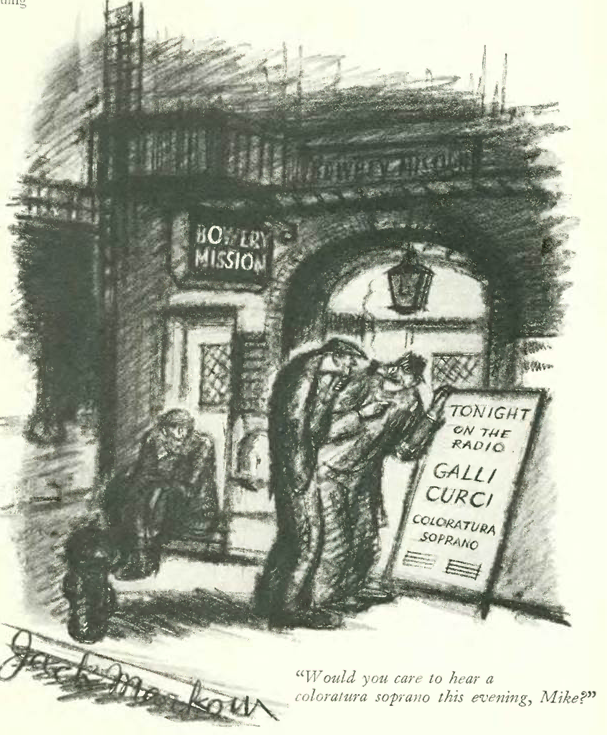
…Jack Markow looked in on life on the skids, a theme that would become more frequent as the Depression deepened…
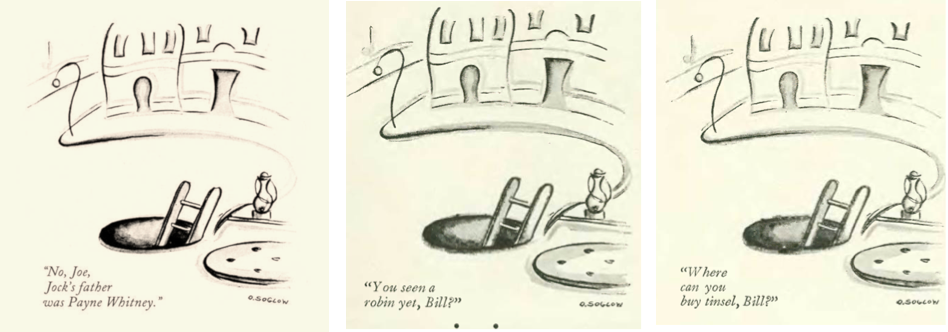
…and after thirty installments throughout 1929, Otto Soglow’s manhole series — a one-panel gag featuring dialogue from unseen workers Joe and Bill…
…came to an end when Joe and Bill finally emerged…
The re-opening of New York’s Central Park Casino in 1929 was in many ways the city’s last big party before the economy came crashing down, along with the exhuberance and frivolity of the Jazz Age.
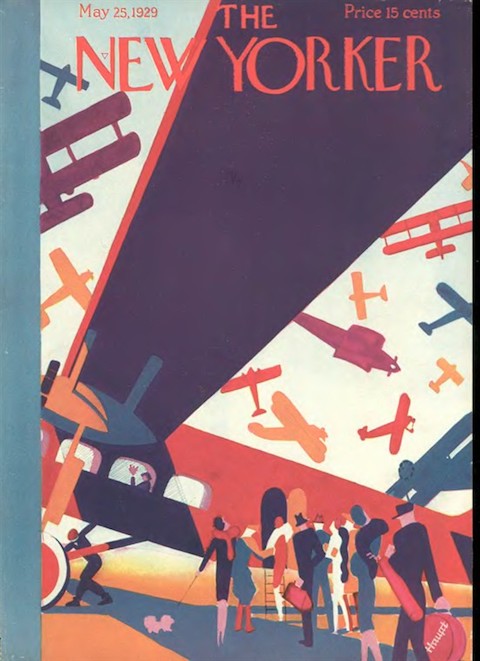
May 25, 1929 cover by Theodore Haupt.
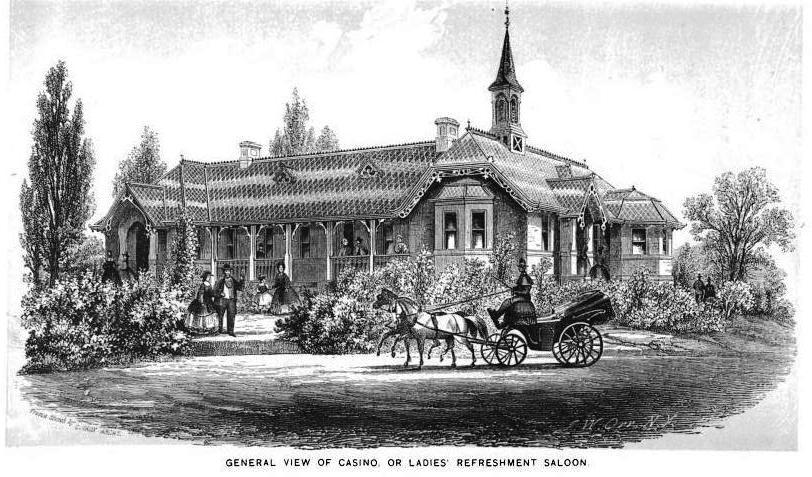
The Casino itself wasn’t new–it opened in 1864 as the Ladies’ Refreshment Salon (sometimes spelled “saloon”), a two-room stone cottage designed by Calvert Vaux. As Susannah Broyles writes in her excellent blog post for the Museum of the City of New York, the Victorian cottage was a place where “unaccompanied ladies could relax during their excursions around the park and enjoy refreshments at decent prices, free of any threat to their propriety.”
Central Park’s Ladies’ Refreshment Saloon opened in 1864. (daytoninmanhattan.blogspot.com)
Broyles writes that by the 1880s the salon had morphed into a far pricier destination, a restaurant called The Casino, open to both sexes. With the rare attraction of outdoor seating, “it was the place to see and be seen.”
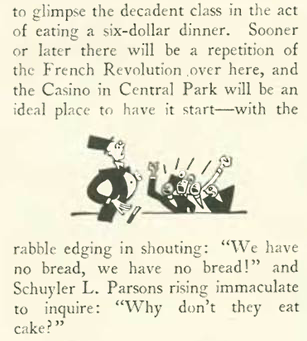
By the 1920s the restaurant had grown a bit shabby. Then along came the city’s flamboyant mayor, Jimmy Walker (1881-1946), who saw the potential of the property as a place where he could hob-nob with wealthy and fashionable New Yorkers and openly flaunt Prohibition laws. There were others, however, who found the idea of an exclusive playground for the rich in a public park distasteful. The New Yorker observed as much in the “Notes and Comment” opening of “The Talk of the Town”…
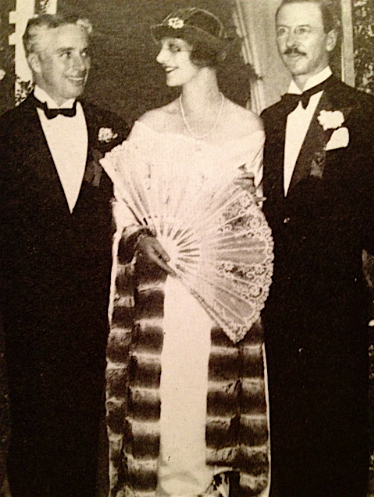
…the “Schuyler L. Parsons” referred to above was a tireless host, prominent decorator, and a society A-lister. He is pictured here (circa 1930) with two of his closest friends, actor Charlie Chaplin and the actress, singer and dancer Gertrude Lawrence…
(Tyler Hughes Collections)
The Central Park Casino reopened its doors on June 4, 1929 at an invitation-only event. The following day it would open to the public, but as New York’s newest and most expensive restaurant it would remain closed to all but the wealthiest. As The New Yorker observed, the city was, after all, a “plutarchy,” and the populace passing by the Casino would at least be allowed “to glimpse the decadent class in the act of eating a six-dollar dinner” (nearly $90 today).
This formal announcement of the opening appeared in the May 6, 1929 issue of The New Yorker, including the time of the event—I suppose for the benefit of the 600 who actually had an invitation, or perhaps to tantalize those without such credentials…
The Casino was a playground for the rich by design, conceived in the image of the flamboyant Mayor Walker—himself a product of the Tammany Hall political machine—and executed by hotelier Sidney Solomon, who obtained the building’s lease via some Tammany-style subterfuge. Solomon hired architect and theatrical set designer Joseph Urban to transform the Casino into a glittering showpiece of Jazz Age nightlife.
Clockwise, from top left, the Central Park Casino; architect Joseph Urban; his Casino ballroom design with black-mirrored ceiling; the Casino lobby. (acontinuouslean.com/Columbia University/centralpark.com/drivingfordeco.com)
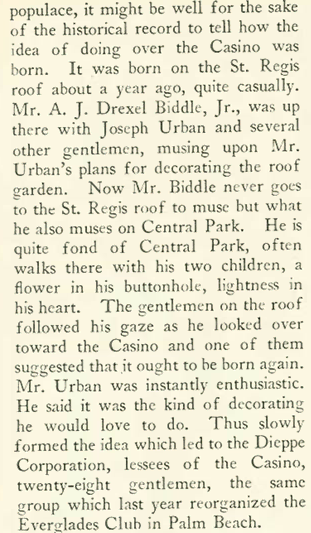
The New Yorker continued its observations on the Casino in another “The Talk of the Town” piece titled “Historical Note,” attributing the inspiration for the Casino not to Walker or Solomon, but to socialite Anthony Joseph Drexel Biddle Jr…
AN EYE FOR THE FINER THINGS…The wealthy socialite A.J. Biddle (pictured here with his first wife, Mary Lillian Duke, in 1924) trained his eye on the Central Park Casino while on the rooftop of the St. Regis Hotel pondering another Joseph Urban project. (voxsartoria.com)PARTY BOY…New York Mayor Jimmy Walker and his nighttime playground, the Central Park Casino, show here on September 10, 1935. (Britannica/ New York City Department of Parks & Recreation)
Well, as you’ve probably guessed, the party didn’t last forever. After the October 1929 stock market crash, the sight of rich folks stuffing their faces and drinking fine wines in a public park looked even more unseemly. Soon the Casino found itself in the crosshairs of Parks Commissioner Robert Moses, who detested Mayor Walker.
As for Walker himself, a growing financial scandal prompted him to resign from office on Sept. 1, 1932. He promptly fled to Europe with his mistress, Ziegfeld girl Betty Compton, and stayed overseas until the threat of criminal prosecution had passed. For Moses, it wasn’t satisfaction enough to see Walker driven from office. In 1936, despite protests from preservationists, Moses had Urban’s lovely restaurant demolished. It was replaced by a children’s playground the following year.
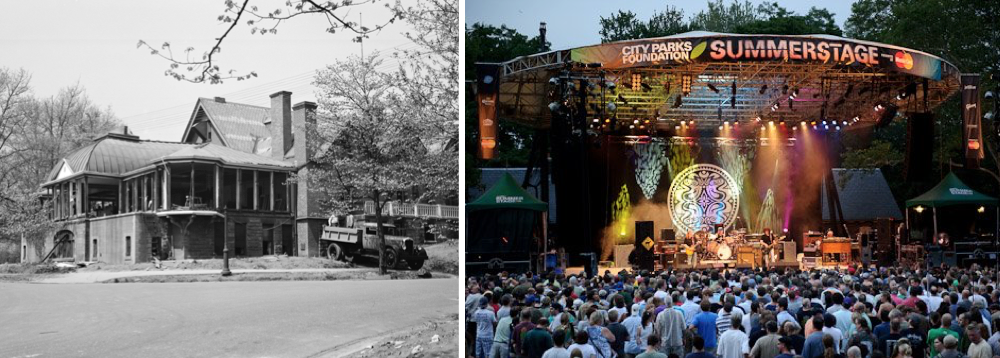
THE PARTY’S OVER…Crews dismantling the Central Park Casino in 1936. In 1937, the Rumsey Playground was built on the site of the Casino, and in the 1980’s the site was razed again and converted into Rumsey Playfield, where the city’s SummerStage events are now held. (Museum of the City of New York/centralpark.com)
* * *
A Drinking Life
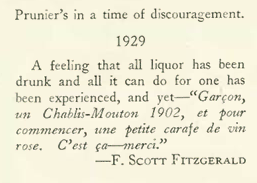
As the Jazz Age was winding down, one of its greatest chroniclers began a brief relationship with The New Yorker. In the March 12, 2017 issue of the magazine, Erin Overbey and Joshua Rothman wrote “There’s a doomed, romantic quality to the relationship between F. Scott Fitzgerald and The New Yorker; they were perfect for each other but never quite got together.” In total, Fitzgerald published just two poems and three humorous shorts for the magazine, beginning with this piece in the May 25, 1929 issue:
Fitzgerald’s last contribution to the New Yorker would appear in the Aug. 21, 1937 issue (“A Book of One’s Own”). Following the author’s death in 1940 the magazine would feature various articles on his life and work, and in 2017—77 years after Fitzgerald’s death—the New Yorker would publish a long lost short story, “The IOU.” A fitting title for an author who sadly did not get his due while he was alive.
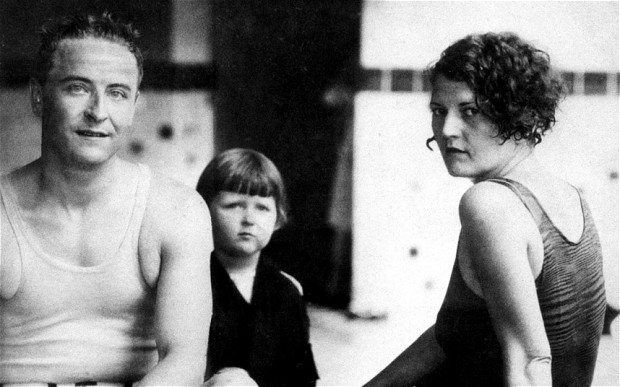
IOU…F. Scott Fitzgerald with daughter “Scottie” and wife Zelda, circa 1927. (The Telegraph)
* * *
One of the Gang
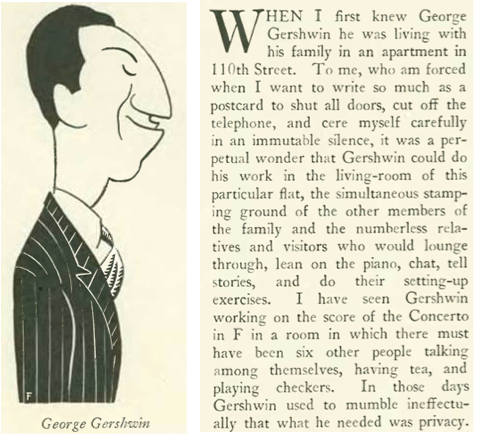
Among the Jazz Age artists and writers who orbited around the Algonquin Round Table (and the Central Park Casino) and chummed with the writers of the New Yorker was musician and composer George Gershwin (1898-1937) who was profiled in the May 25 issue by his friend and longtime New Yorker writer Samuel N. Behrman. The opening paragraph (with caricature by Al Frueh):
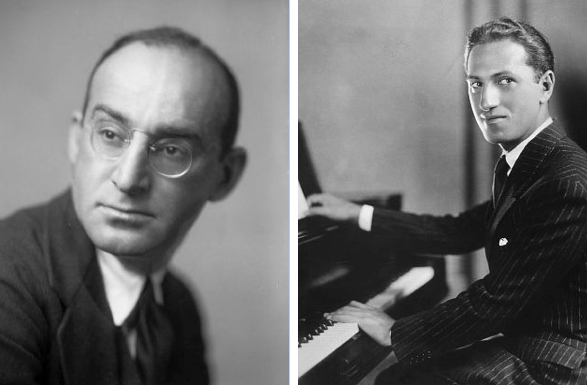
IN THE SAME ORBIT…Samuel Nathaniel Behrman (left), was an American playwright, screenwriter, biographer, and longtime writer for The New Yorker. From the late 1920s through the 1940s, he was considered one of Broadway’s leading authors of “high comedy,”His son is the composer David Behrman. At right, George Gershwin at the piano, 1929. (prabook.com/IMDB)
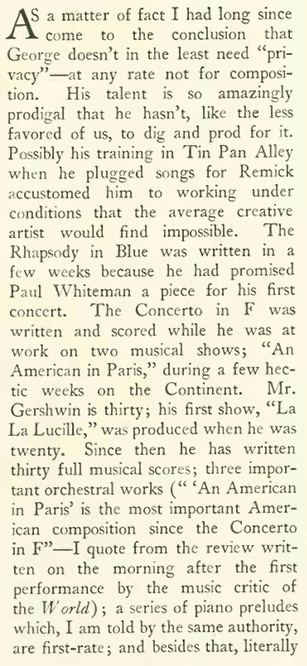
In the profile, Behrman observed that although Gershwin expressed a desire for privacy, he was quite capable of dashing off major works in practically any setting:
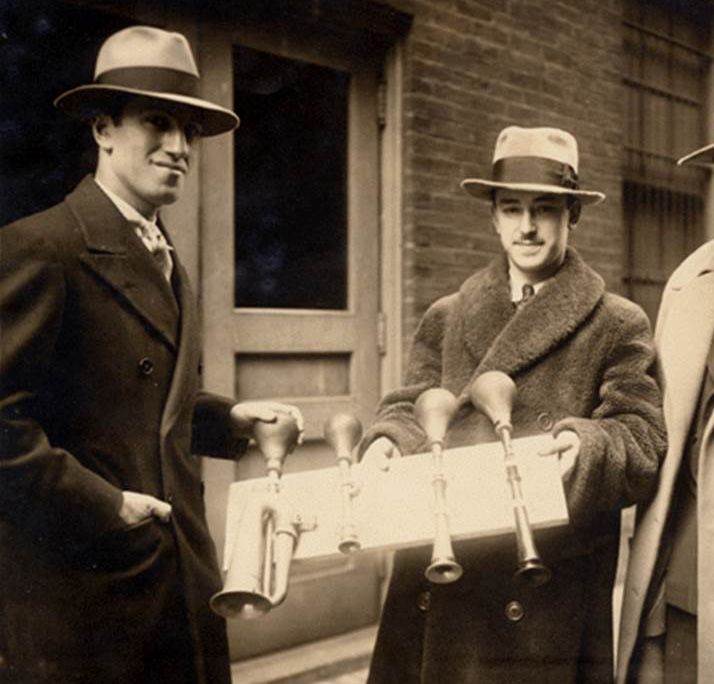
TOOTING HIS OWN HORN…Composer George Gershwin and Cincinnati Symphony Orchestra percussionist James Rosenberg holding four taxi horns used in the orchestra’s performance of An American in Paris, on Feb. 28, 1929. (Photo courtesy of Ira and Leonore Gershwin Trusts)
* * *
Scratching the Surface
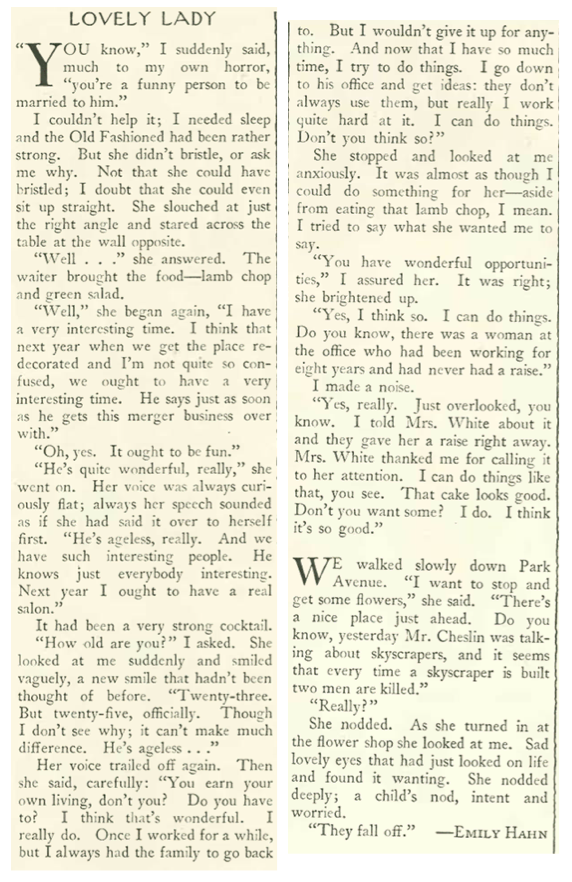
Emily Hahn (1905-1997) was a prolific journalist and author who contributed at least 200 poems, articles and works of fiction to The New Yorker over an astonishing 68-year span—from 1928 to 1996. As the title suggests, I am merely scratching surface, and will devote a post to her in the near future. Here is her contribution to the May 25, 1929 issue:
PROLIFIC…A 1937 portrait of Emily Hahn taken in Shanghai, China, by Sir Victor Sassoon. The author of 54 books, Hahn is credited with playing a significant role in opening up Asia and Africa to the West through her many novels. (DeGolyer Library, SMU)
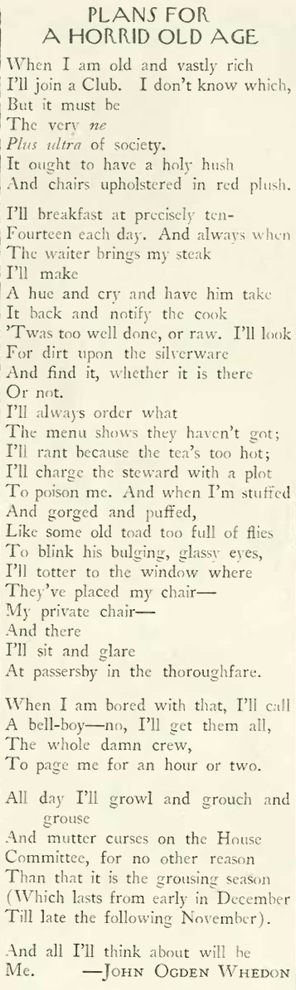
Another frequent contributor to The New Yorker was screenwriter John Ogden Whedon (1905-1991), who offered up mostly shorts from 1928 to 1938. He is best known as a television writer for such shows as The Andy Griffith Show, The Dick Van Dyke Show and Leave It to Beaver. Whedon and his wife, Louise Carroll Angell, were parents and grandparents to a number of screenwriters, including grandson Joss Whedon, creator of Buffy the Vampire Slayer and writer/director of The Avengers (2012) and its sequel Avengers: Age of Ultron (2015). An excerpt of grandpa’s writing from the May 25 issue:
* * *
From Our Advertisers
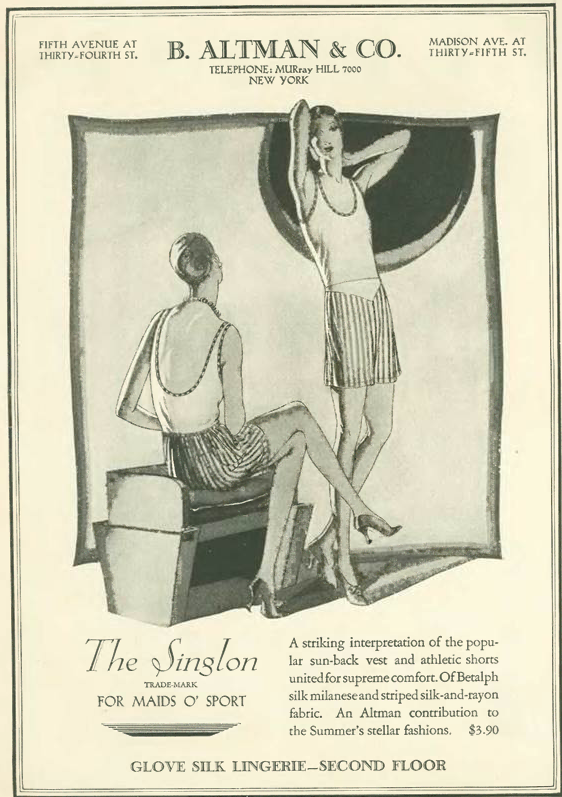
In a recent post (Waldorf’s Salad Days) I noted an ad from Lily of France that proclaimed the straight flapper figure was out, and it was now the “season of curves.” This ad from B. Altman begs to differ…
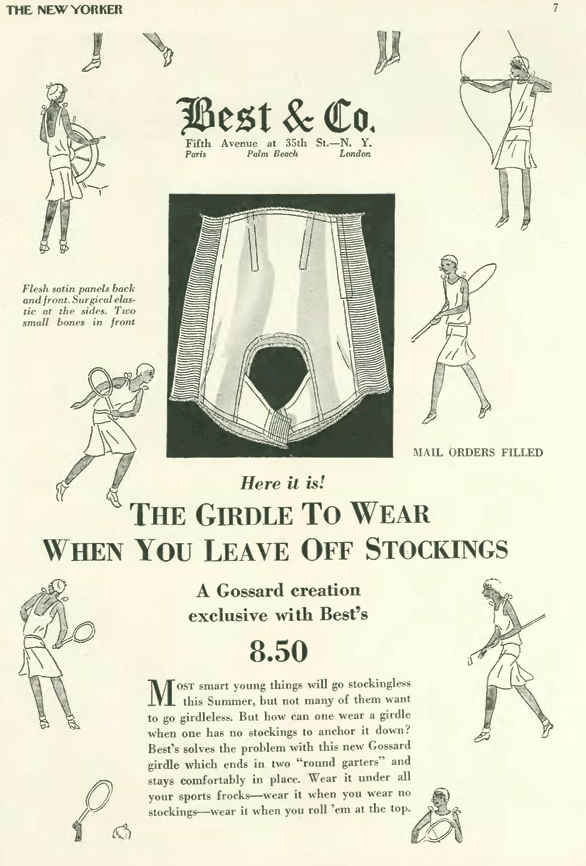
…one way to keep that straight figure was to pull on a girdle, which I’m sure felt great while one played tennis…
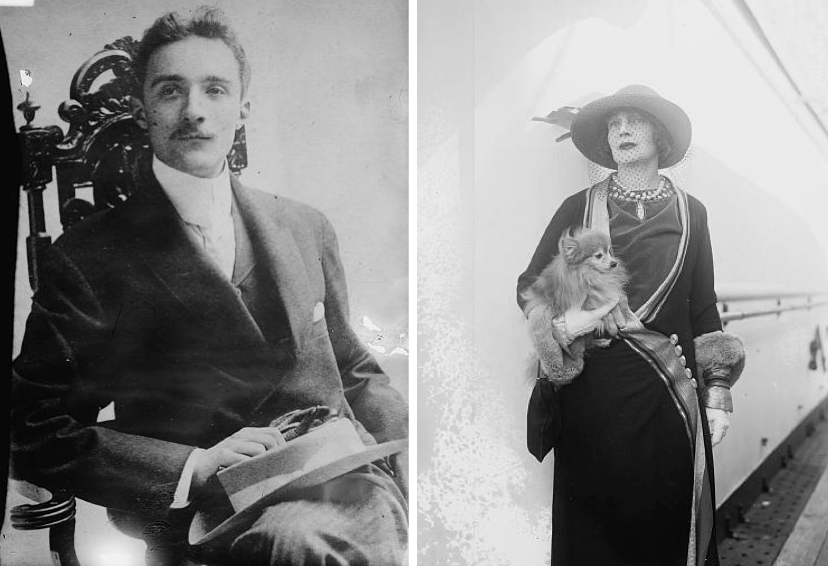
…our latest Lucky Strike endorser is…Mrs. Jerome Napoleon Bonaparte. Never heard of her? Well, “Mrs. Jerome” was actually a one Blanche Pierce (1872-1950) of Rochester, NY. Her second husband, Jerome Napoleon Bonaparte (the great-grandnephew of Emperor Napoleon) was something of a wastrel, having inherited a fortune and never worked at a job or profession. Blanche herself was known as a social climber…
THEY EXISTED…Jerome Napoleon Charles Bonaparte (pictured here circa 1915) was the great-grandnephew of Emperor Napoleon and a man of extreme leisure. His wife, Blanche Pierce Bonaparte (right, in a photo circa 1925), was known as a dog lover, a passion that indirectly led to her second husband’s demise. Jerome died while walking his wife’s dog in Central Park—he apparently stumbled over the dog’s leash and broke his neck. (Library of Congress)
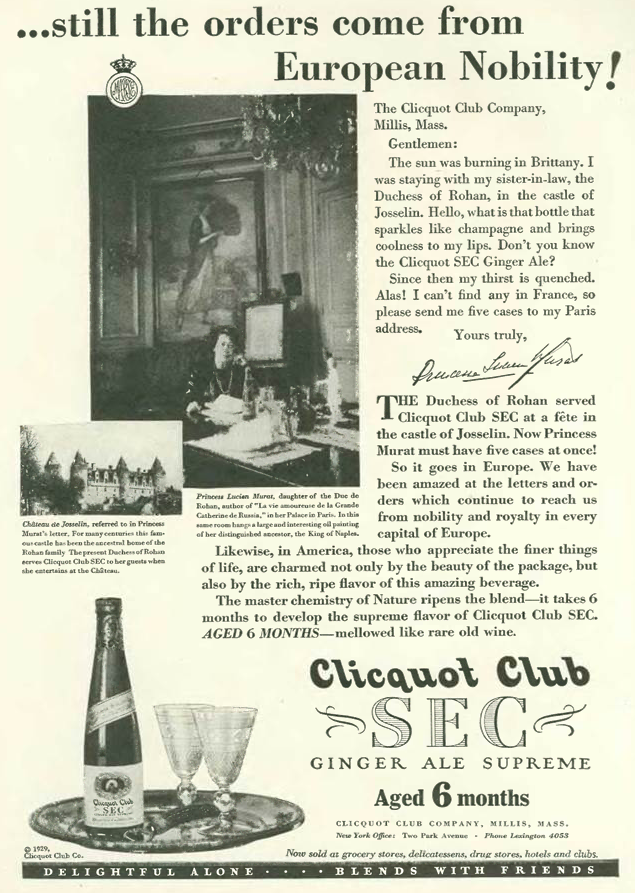
…speaking of European nobility, here is another sad endorsement from a French noble touting the wonders of Clicquot Club ginger ale to Prohibition-strapped Americans…
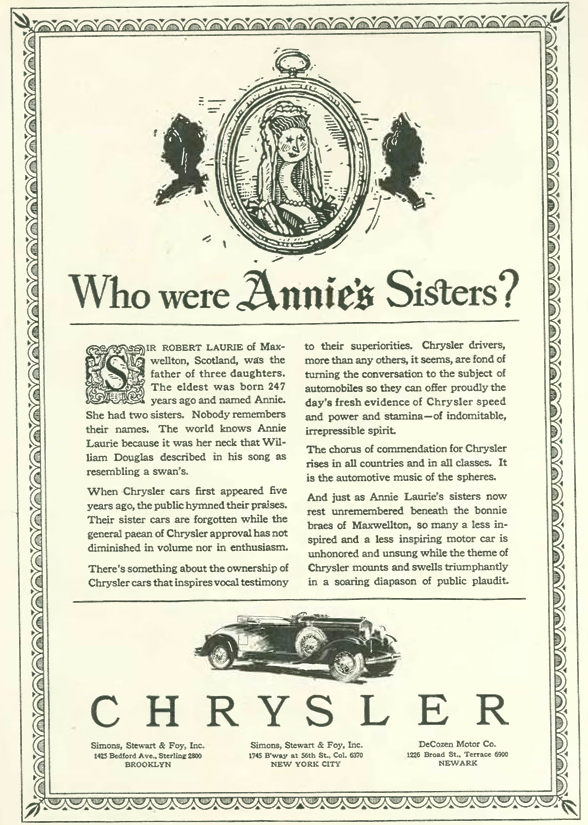
…and then we have this weird “Annie Laurie” analogy used by Chrysler to sell its line of automobiles…
…the manufacturers of Studebaker, on the other hand, opted for a more direct approach, equating its automobiles with the speed and modernity of airplane flight…note how in both ads the cars are pictured with the windshields folded down to emphasize sleekness…
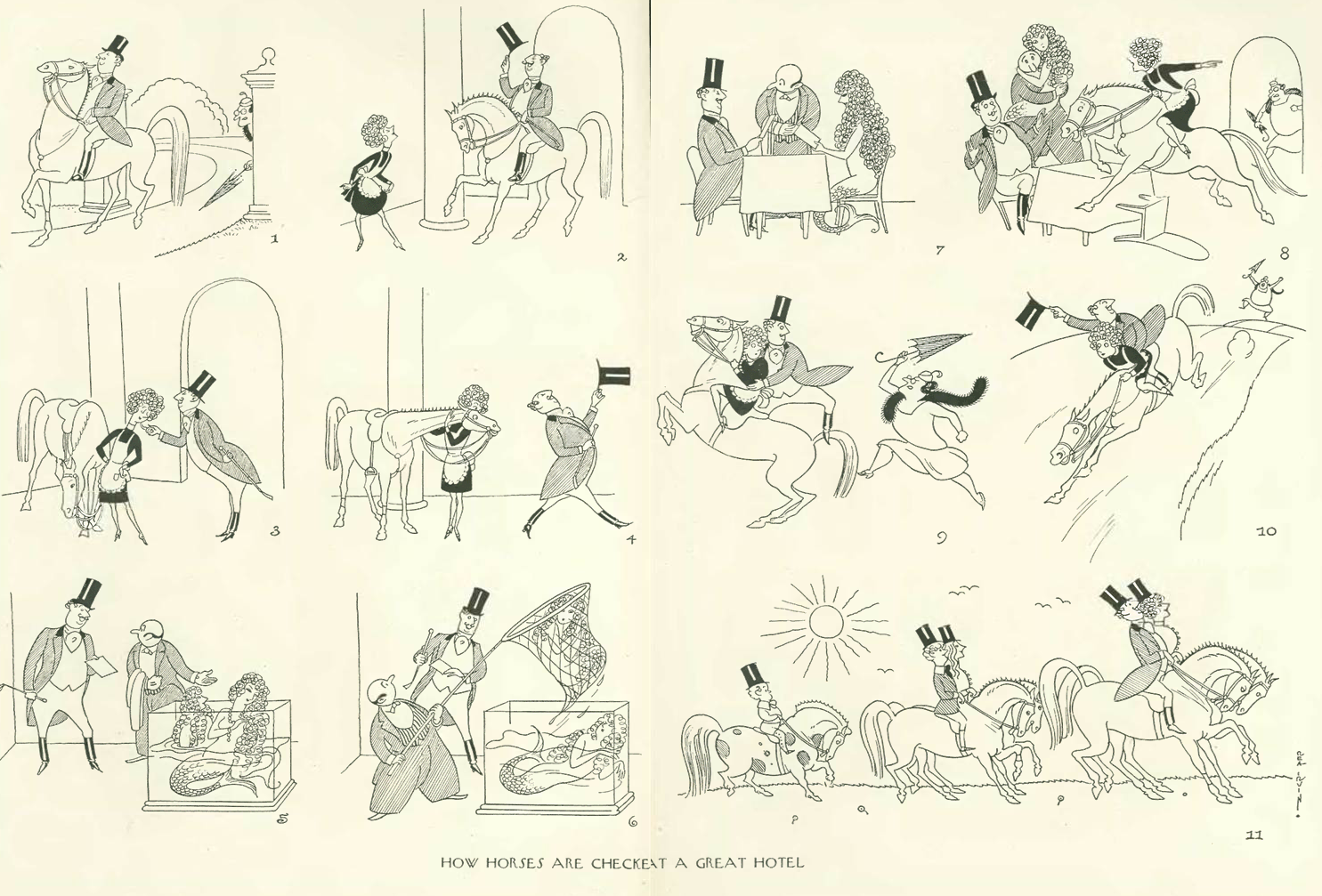
…on to the cartoons: we begin with this two-page entry by Rea Irvin, which makes very little sense…I get the part where the rich old man (stalked by his fearsome wife) finds a mistress (and a new wife) through the process of “checking his horse,” but the whole mermaid thing is lost on me…please click to enlarge—I’d love to have this one explained…
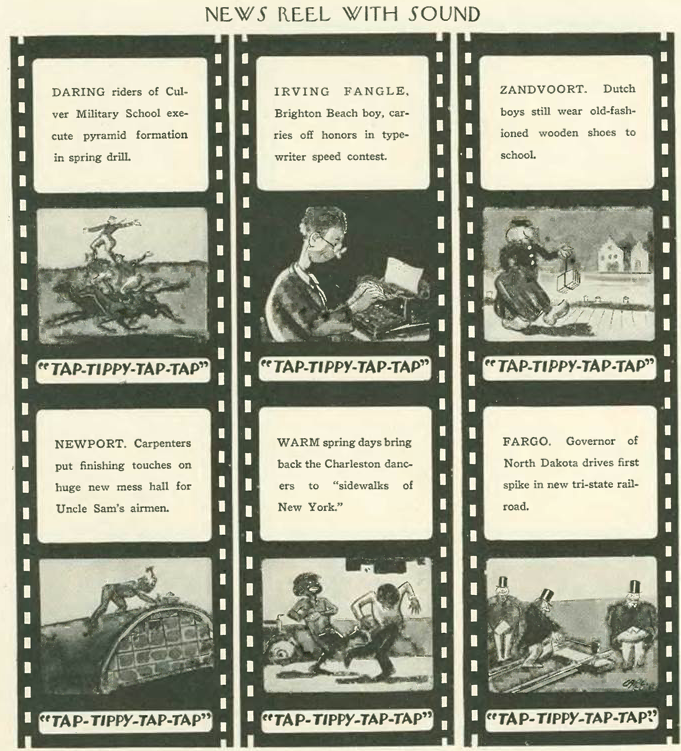
…Carl Rose had some fun with newfangled sound effects in the dawning age of the talkies…
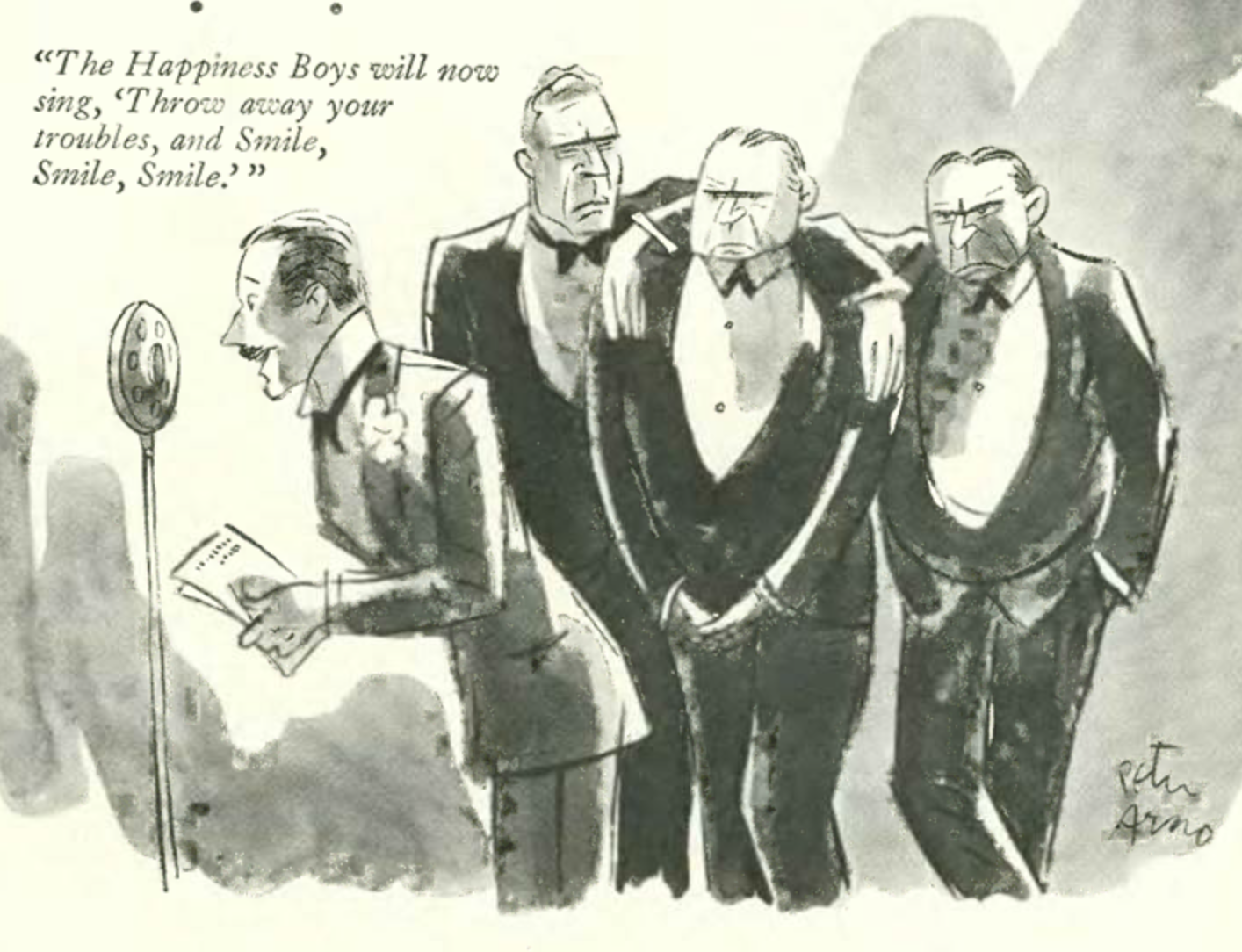
…Peter Arno sketched up the cynicism of one New York dowager…
…Perry Barlow captured two women who might have been driving home from an auction at the old Waldorf-Astoria Hotel…
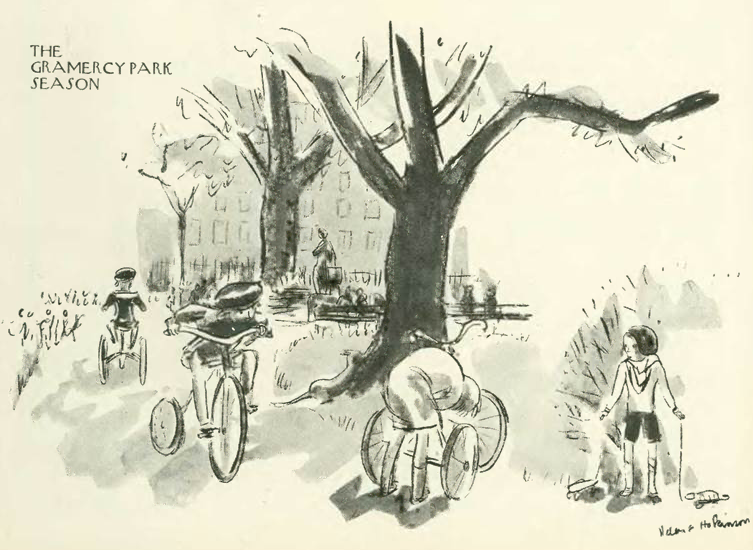
…and finally, a lovely illustration by Helen Hokinson of children at play…
Like many publications, there are defining moments in the New Yorker’s history that make the magazine what it is today.
December 8, 1928 cover by Peter Arno.
In a post more than two years ago I wrote about Ellin Mackay’s pivotal essay, “Why We Go To Cabarets: A Post-Debutante Explains.” The debutante daughter of a multi-millionaire (who threatened to disinherit her due to her romance with Irving Berlin), Mackay explained that modern women were abandoning social matchmaking in favor of the more egalitarian night club scene. Mackay’s essay provided a huge boost to the struggling New Yorker, which had dipped to less than 3,000 subscribers in August 1925. A more recent post, “A Bird’s Eye View,” noted how a short story by Thyra Samter Winslow opened the door to serious fiction in the magazine.
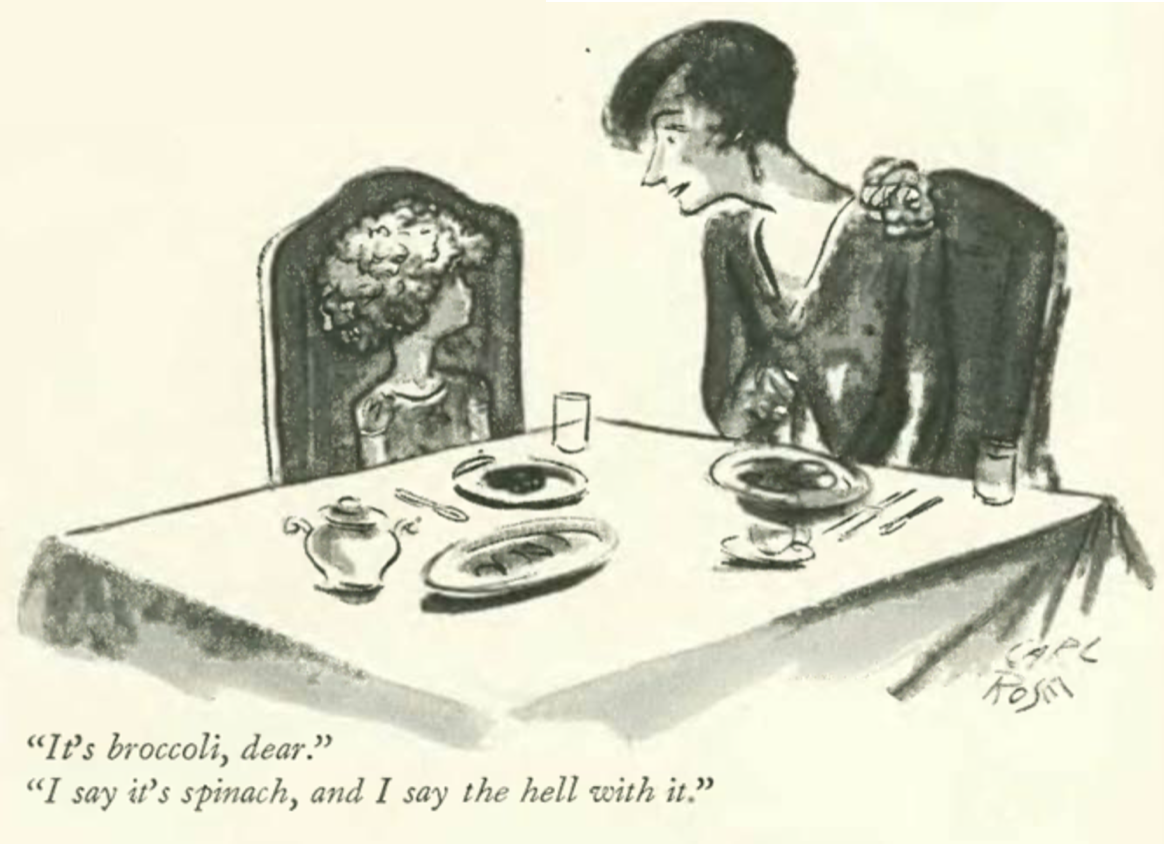
The Dec. 8, 1928 issue was significant for a cartoon by Carl Rose that appeared on the bottom of page 27:
It remains one of The New Yorker’s most famous cartoons, and for good reason. In his book About Town: The New Yorker and the World It Made, Ben Yagoda writes that the cartoon (drawn by Rose, with spinach line provided by E.B. White) “was picking up on something in the culture: it was a moment when the air reverberated with the sound of speech.” Yagoda notes that although “the cartoons led the way,” the magazine has always been filled with the sound of voices in “The Talk of the Town.” Naturalistic rendering of speech could also be found under the heading of such features as “Overheard,” which ran from 1927-1929 and included such contributors as the young writer John O’Hara.
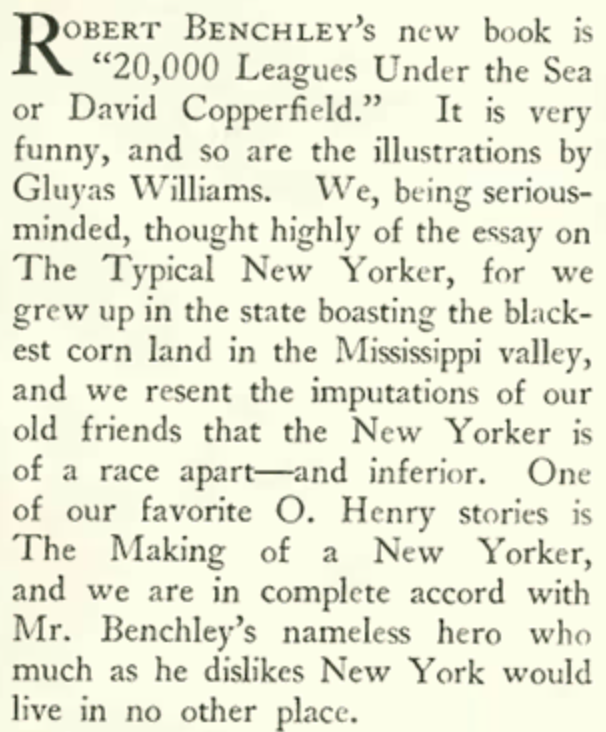
Another New Yorker contributor whose work resounded with the sound of speech, Robert Benchley, received some kind words from the magazine on his latest book, Twenty Thousand Leagues Under the Sea or David Copperfield:
DON’T BE SERIOUS…Robert Benchley and his book, 20,000 Leagues Under the Sea or David Copperfield, illustrated by his New Yorker colleague Gluyas Williams. The cover depicted Benchley performing his famous sketch, The Treasurer’s Report. (Goodreads/bio.com)
* * *
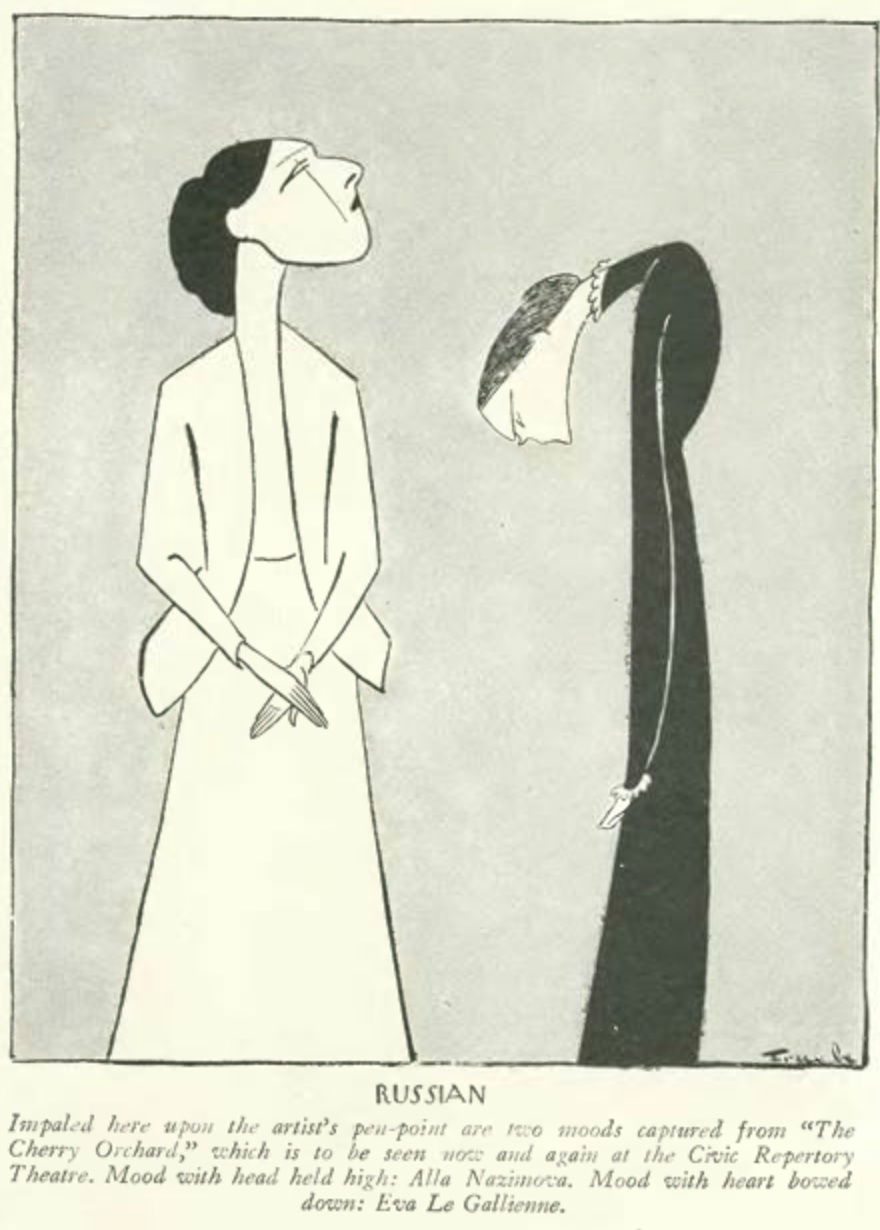
Appearing at the Civic Repertory Theatre (founded by actress Eva Le Gallienne in 1926) was Alla Nazimova and Eva herself in Anton Chekov’s last play, The Cherry Orchard.Al Frueh offered this sketch for the theatre review section.
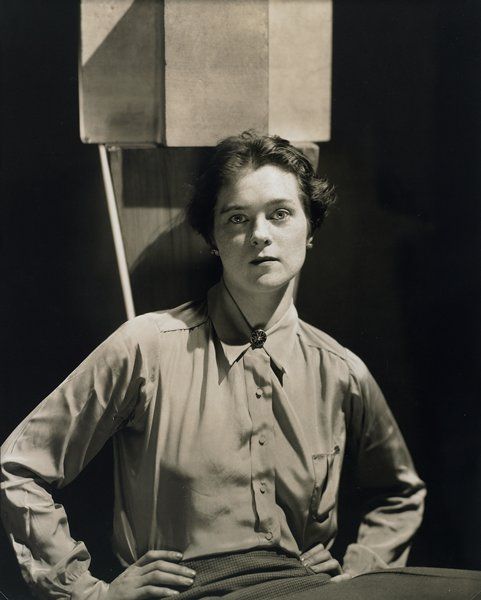
Josephine Hutchinson as Anya, Alla Nazimova as Ranevskaya, and Paul Leyssac as Gayev in Anton Chekov’s last play, The Cherry Orchard, at the Civic Repertory Theatre in 1928. (eBay)TOUR DE FORCE…Eva Le Gallienne in 1928, photo by Edward Steichen. (Minneapolis Institute of Art)
* * *
From Our Advertisers
Advertisements from the Dec. 8 issue offered this study in contrasts…a “modern” take on the holidays by Wanamaker’s, featuring the unfortunately titled “Psycho-Gifts for Christmas”…
…versus the staid offerings of Brooks Brothers on the following page…
* * *
On to the Dec. 15 issue, we find The New Yorker enjoying the debut of the Ziegfeld Follies latest revue…
December 15, 1928 — issue number 200 — cover by Julian de Miskey.
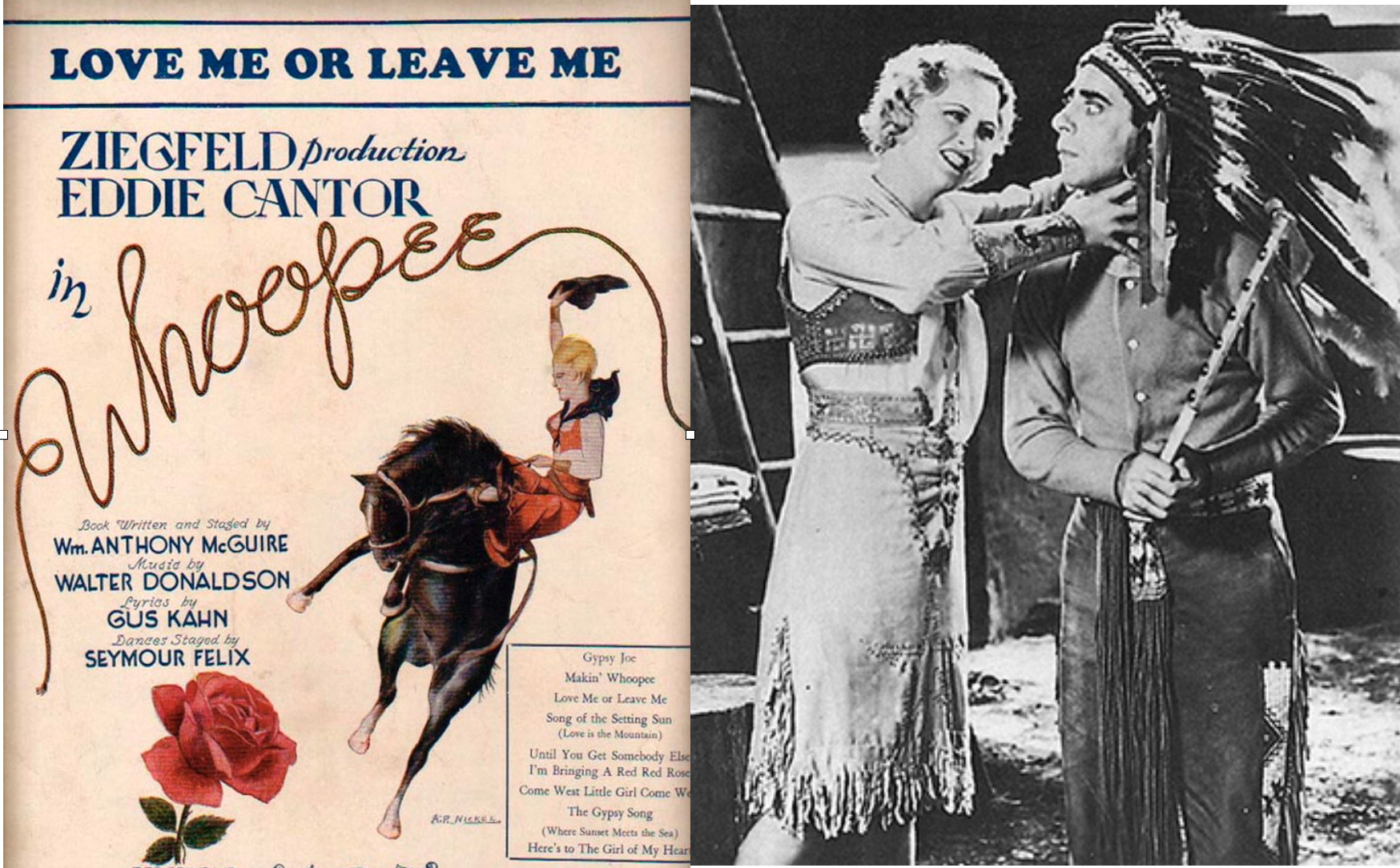
…the show “Whoopee” at the New Amsterdam, featuring Eddie Cantor:
HIT MAKER…Sheet music for the hit “Love Me Or Leave Me” from the Ziegfeld Follies show Whoopee. At right, a still from the 1930 film Whoopee!, with Eleanor Hunt and Eddie Cantor. (carensclassiccinema/thejumpingfrog.com)
And lest you think audiences were flocking to only see Eddie Cantor…
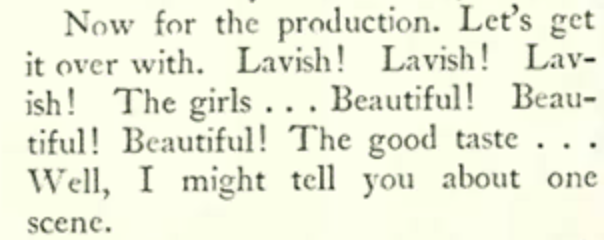
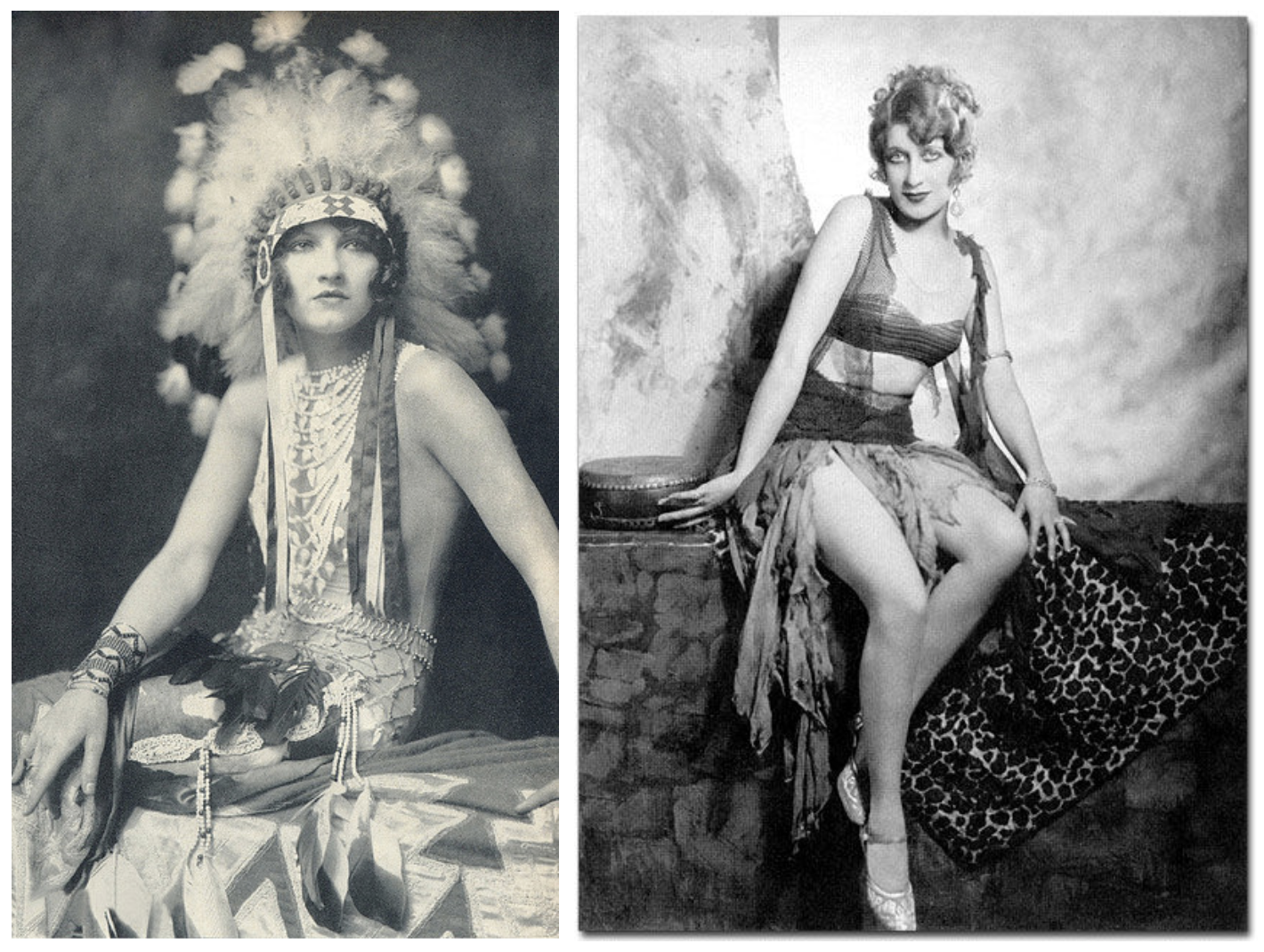
LAVISH, LAVISH!…At left, Ziegfeld Follies performer Jean Ackerman in Whoopee! At right, Ziegfeld performer Ruth Ettig’s rendition of “Love Me or Leave Me” in Whoopee made it a major hit as well as her signature song. (mote-historie.tumblr.com/Alfred Cheney Johnston photo via songbook1.wordpress.com)
* * *
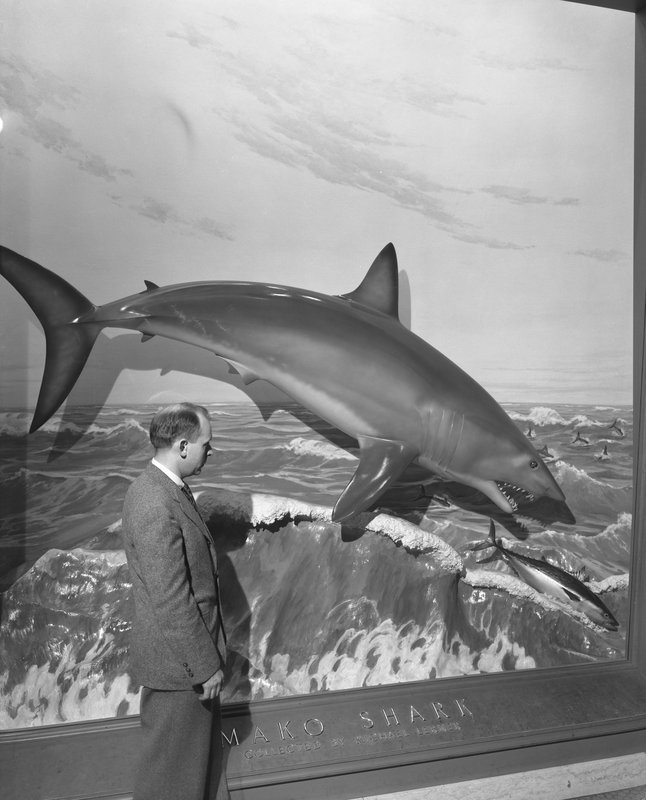
On to less glamorous pursuits, The New Yorker also paid a visit to the new “Fish Wing” at the Museum of Natural History, as recounted in “Talk of the Town.” A brief excerpt:
SWIMMING WITH THE FISHES…A visitor admires the mako shark exhibit at the Hall of Fishes in the American Museum of Natural History, 1948 (AMNH)
From Our Advertisers…
…comes this house ad from The New Yorker itself, promoting its first-ever Album:
Chris Wheeler has gathered all of the albums at this site.
It what would become a longstanding tradition, TheNew Yorker marked its third anniversary by featuring the original Rea Irvin cover illustration from Issue No. 1. The New Yorker was a very different magazine by its third year, fat with advertising and its editorial content bolstered by such talents as Peter Arno, E.B. White and Dorothy Parker.
Feb. 25, 1928 cover by Rea Irvin.
Parker livened up the magazine’s books section, mincing few words as she took on writers both great and not so great.
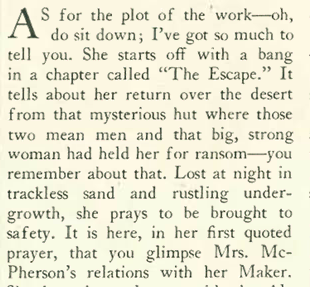
In the latter category was Aimee Semple McPherson, a 1920s forerunner of today’s glitzy televangelists. In her column “Reading and Writing,” Parker took aim at McPherson — “Our Lady of the Loud-speaker” — who had just published a book titled In the Service of the King.
READY FOR MY CLOSEUP…Although she was an evangelical preacher, Aimee Temple McPherson was also considered one of the most glamorous women in 1920s America. (Foursquare Church)
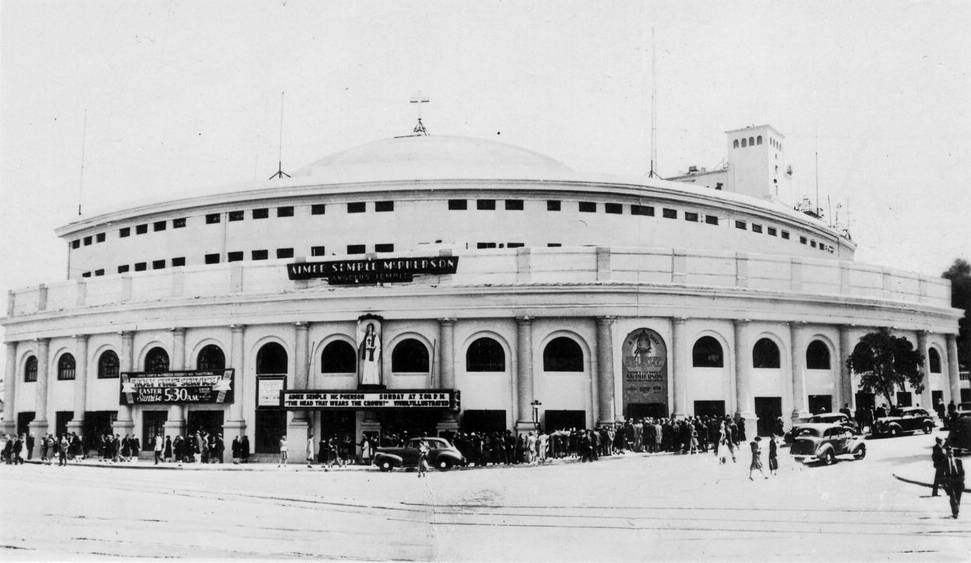
McPherson (1890–1944) was a Pentecostal-style preacher who practiced “speaking in tongues” and faith healing in her services, which drew huge crowds at revival events between 1919 and 1922. She took to the radio in the early 1920s and in 1923 she based her ministry in Los Angeles at her newly completed Angelus Temple, which served as the center of the International Church of the Foursquare Gospel.
McPherson’s book detailed her conversion and her various hardships, including her mysterious “kidnapping” in 1926. Parker was having none of it:
Parker was referring to events beginning on May 18, 1926, when the evangelist visited Venice Beach for a swim and went missing. Some thought she had drown, others claimed they saw a “sea monster” in the area. McPherson reemerged in June on the Mexico-Arizona border, claiming she had been kidnapped and held captive by three strangers.
Numerous allegations of illicit love affairs targeted McPherson during her years of fame, so some were inclined to believe she went missing in order to engage in a love affair with her sound engineer.
Upon her return to Los Angeles she was greeted by a huge crowd (est. 30,000 to 50,000) that paraded her back to the Angelus Temple. However many others in the city found McPherson’s homecoming gaudy and annoying. A grand jury was subsequently convened to determine if evidence of a kidnapping could be found, but the court soon turned its focus to McPherson herself to determine if she had faked the kidnapping. Parker thought the condition of the preacher’s shoes, after a long trek through the desert, were evidence enough of a sham:
THE MEGACHURCH IS BORN…Angelus Temple, completed in 1923, is the center of the International Church of the Foursquare Gospel founded by McPherson. It is still in active use. (Loyola Marymount University)SPECTACLE…Aimee Semple McPherson surrounded by massed choirs at Angelus Temple for a musical requiem in 1929. (Los Angeles Public Library/Herald Examiner)Aimee Semple McPherson (second from left) joins tambourine players in a service at Angelus Temple. McPherson produced weekly dramas, often major spectacles, illustrating various religious themes. (Los Angeles Public Library/Herald Examiner)
McPherson, who was married three times and twice divorced, died in September 1944 from an apparent overdose of sleeping pills. She was 53. Her son Rolf took over the ministry after her death. Today McPherson’s Foursquare Church has a worldwide membership of about 8 million, and is still based in Los Angeles.
But How Do I Look?
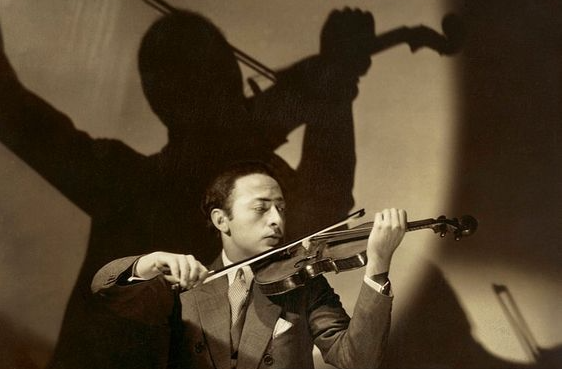
The Feb. 25 issue profiled the young Jascha Heifetz, a Russian-born violin prodigy who seemed more interested in how he looked than in how he performed. An excerpt:
SARTORIAL PERFECTION…Detail of a 1928 photo of 27-year-old Jascha Heifetz, taken by Edward Steichen. (Condé Nast)
* * *
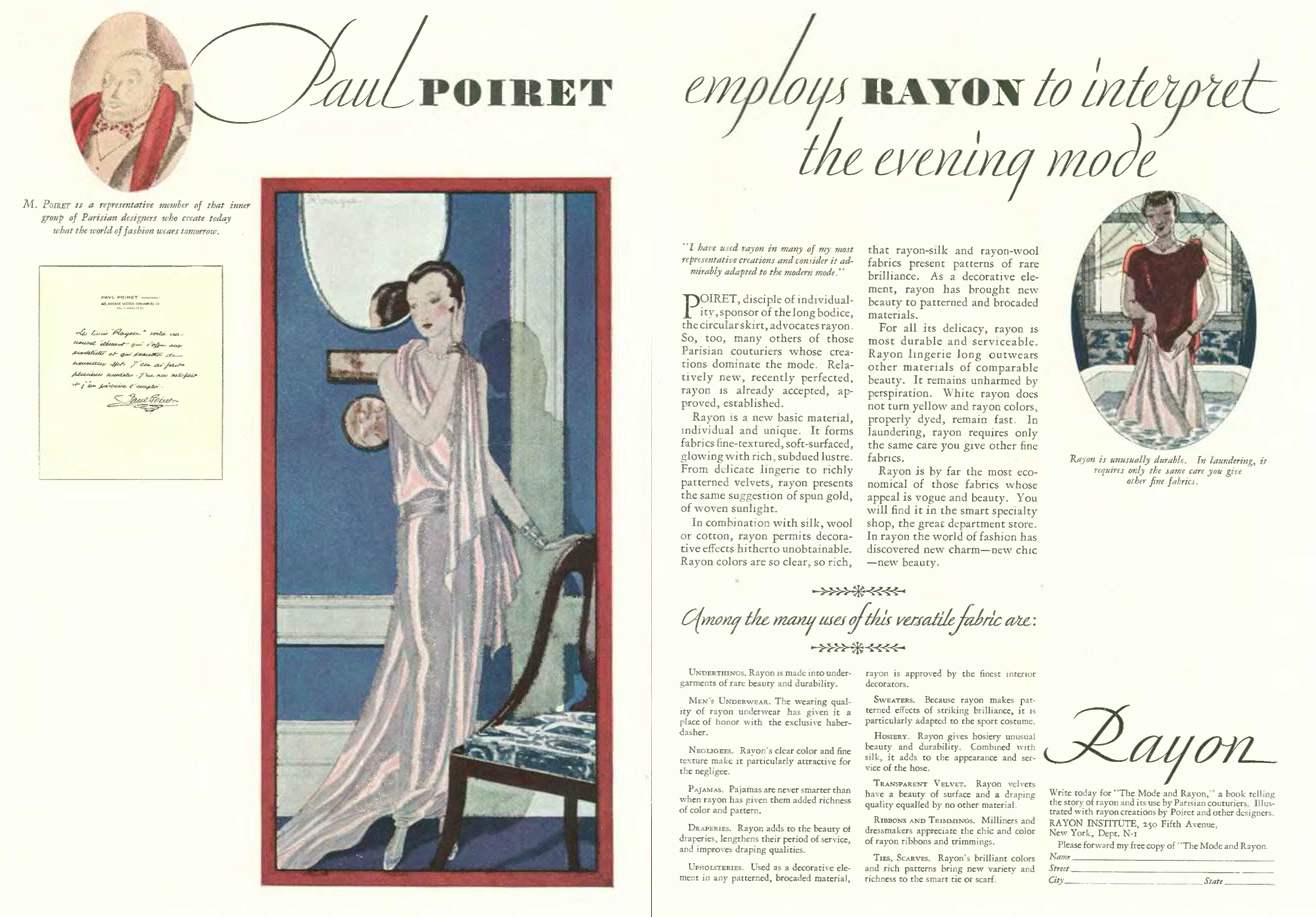
Speaking of fashion, one of the world’s greatest fashion designers, Paul Poiret, was seeing hard times in the late 1920s with his designs losing popularity in his native France and his formidable fashion empire on the brink of collapse. But Francophile New Yorkers, always hungry for French fashion, greeted Poiret with open arms when he arrived in the city in the fall of 1927.
It is something of a surprise, however, to find this advertisement in the Feb. 25 issue in which Poiret endorses Rayon, a man-made substitute for silk. We don’t usually associate synthetics with haute couture, but then again maybe Poiret just needed the money. Better living through chemistry, as they say…
(click to enlarge)
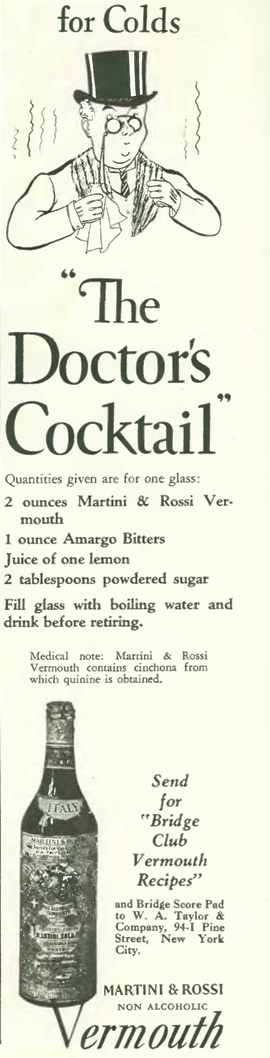
Also in the issue was a sad, Prohibition-era advertisement that extolled the virtues of an oxymoronic “non-alcoholic vermouth”…
And finally from the Feb. 25 issue, a cartoon by Carl Rose…
* * *
One-eyed Monster
In the March 3 issue “The Talk of the Town” discovered the miracle of television during a visit to the Bell Telephone laboratories.
March 3, 1928 cover by Peter Arno.
Lab researchers demonstrated a “receiving grid” with a tiny screen that displayed images broadcast across the expanse of an auditorium:
WE’LL CALL IT THE BOOB TUBE…Engineer and inventor Ernst Alexanderson (right) and the TV projector he used for early public demonstrations of television, circa 1928. (edisontechcenter.org)
Another glimpse into the future in the March 3 issue came courtesy illustrator Al Frueh, who offered this fanciful look at the skyscraper of tomorrow:
(click to enlarge)
* * *
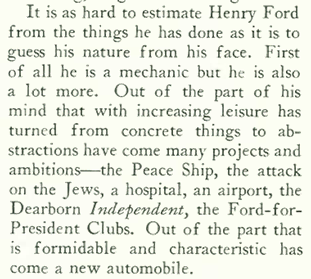
“Profile” featured the first installment of a four-part article (by Niven Busch Jr.) on a man who put America on wheels and into traffic jams. Excerpts:
Profile illustration by Al Frueh.
And finally, from W.P. Trent, an analogy that would take on new meaning after the market crash…
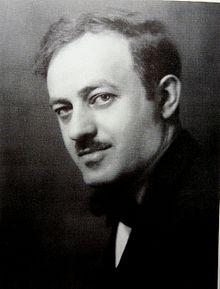
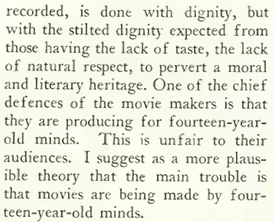
The journalist and screenwriter Ben Hecht wrote the “Reporter at Large” column for the early New Yorker, and for the April 30, 1927 issue took aim at the shoddy coverage of the Ruth Snyder murder trial at the Long Island City Courthouse.
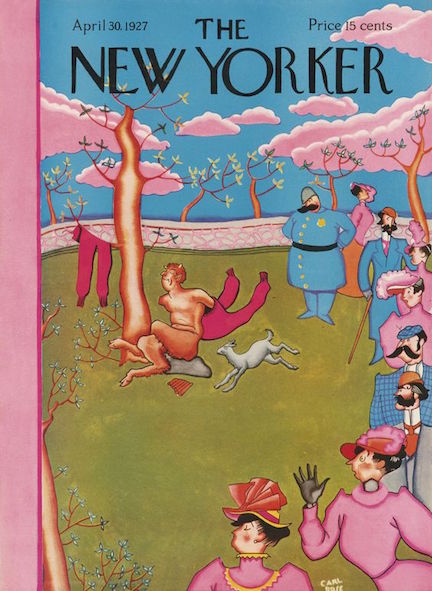
April 30, 1927 cover by Carl Rose.
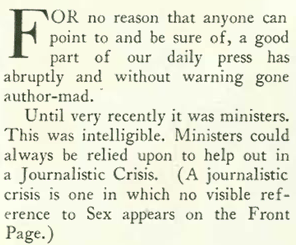
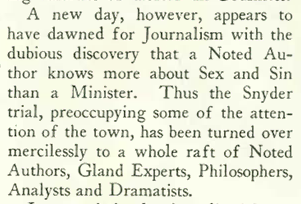
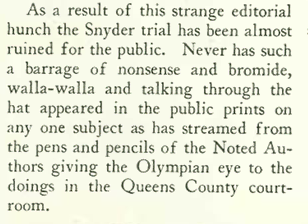
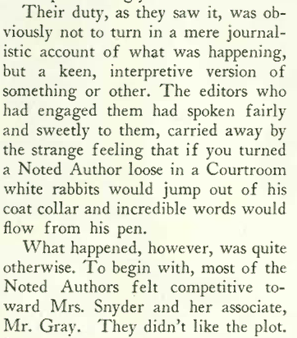
Hecht was appalled by the media’s use of celebrity “experts” to cover the trial, which only served to sensationalize and trivialize the proceedings:
Ben Hecht (Wikipedia)
The Ruth Snyder trial dominated headlines in 1927. A housewife from Queens, Snyder began an affair in 1925 with Henry Judd Gray, a married corset salesman. After she persuaded her husband, Albert Snyder, to purchase life insurance, she enlisted Gray’s help to murder him. On March 20, 1927 the couple garrotted Albert (after bludgeoning him with a sash weight) and then staged the murder scene to look like a burglary.
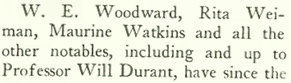
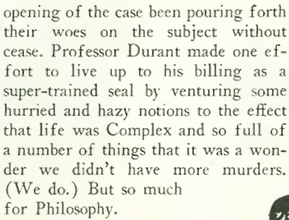
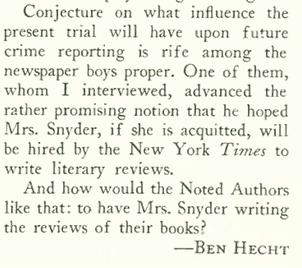
The trial was covered by such figures as former Ziegfeld Follies showgirl Peggy Hopkins Joyce, the radio evangelist Aimee Semple McPherson, movie director D. W. Griffith, author Damon Runyon, popular philosopher Will Durant, and James M. Cain, a crime reporter who went on to write Double Indemnity, which was later made into a major Hollywood movie. Hecht (who would go on to co-write a hugely successful play about newspaper reporters, The Front Page) would have none of this celebrity circus. Some excerpts:
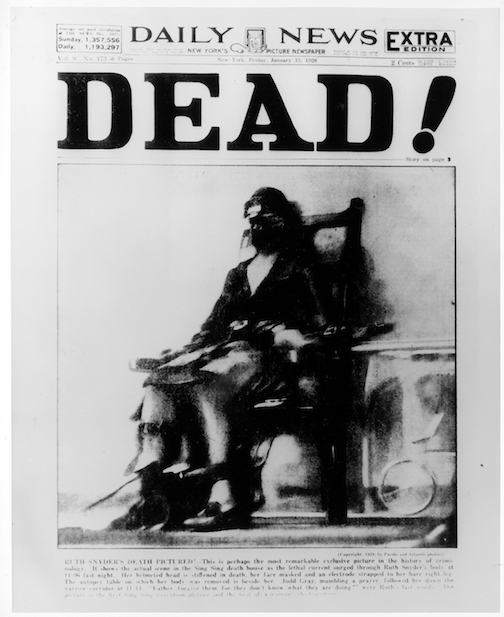
Ruth Snyder would not be acquitted (or live to write reviews), but instead would go to Sing Sing’s electric chair on Jan. 12, 1928. The 32-year-old Snyder would go to the chair first, followed shortly thereafter by her former lover and accomplice, 35-year-old Henry Judd Gray. The pair had sealed each other’s fate: During the trial, Snyder and Gray had turned on each other, contending the other was responsible for killing Albert Snyder.
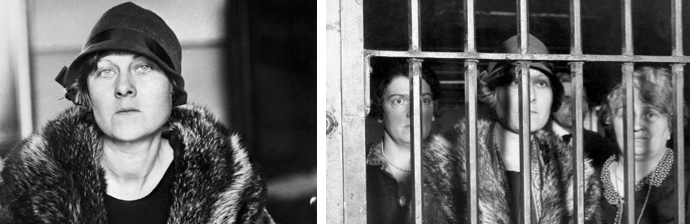
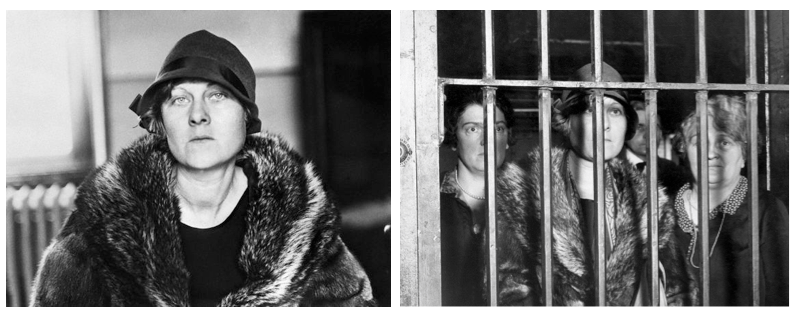
BUSTED…Ruth Snyder in custody and behind bars at the Queens County Jail. (Criminal Encyclopedia/NY Daily News)END OF THE LINE…Mugshots of Ruth Snyder and Henry Judd Gray taken at Sing Sing Prison following their conviction. (Lloyd Sealy Library, CUNY)NATIONAL SENSATION…The cover of Jan. 13, 1928, issue of the New York Daily News. Although photographs of the execution were not allowed, photographer Tom Howard took this now-famous photo of Snyder at the moment of her execution with the aid of a miniature camera strapped to his ankle. (newseum.org)
* * *
On to a lighter topic…The Sherry-Netherland Hotel has graced the corner of Fifth Avenue and East 59th Street since 1927, and when it was built it was the tallest apartment-hotel in New York City.
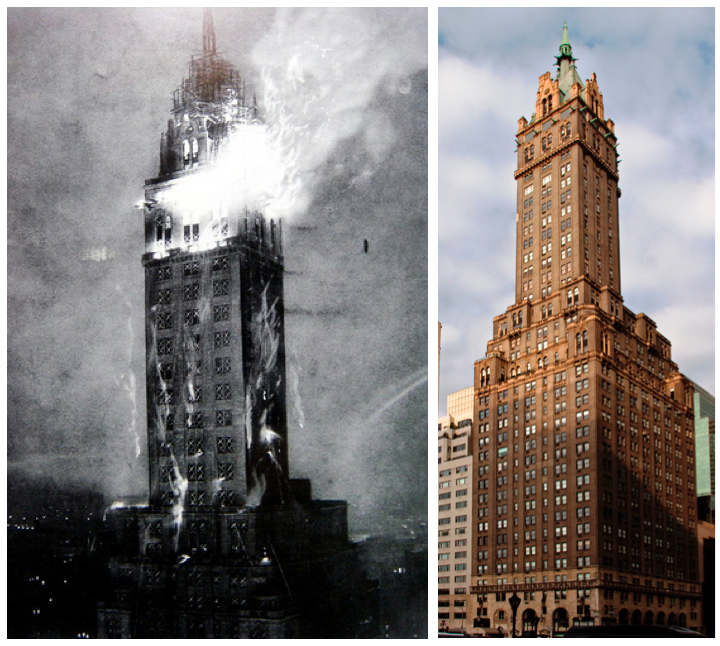
The building was nearing completion when around 8 pm on April 12, 1927, fire broke out on wood plank scaffolding surrounding the top floors. Firefighters responded only to find they lacked water pressure to fight the blaze.
According to the New York Times (“The Night a Hotel Turned Into a Torch,” Nov. 15, 2012), the fire was watched by hundreds of thousands, and “the windows of the Plaza Hotel across the street were ‘black with people’; every front room was engaged, either by news organizations or for spontaneous parties to watch the fire.”
Planks tumbled to the street for hours, and The Times said one “sailed in a crazy parabola” and crashed against the Savoy-Plaza, also nearly finished; occasionally minor collapses of the scaffolding turned the picturesque top into a “lofty Roman candle.” The crowds on the street could feel the heat on their faces, and the roar and crackle of the fire could be heard for blocks around. The fire burned itself out around midnight.
Oddly, the New Yorker had little to say about the fire, mentioning it only in passing in this “Talk of the Town” item:
HOT TIME IN THE CITY…In 1927 the Sherry-Netherland caught on fire, creating what The New York Times called “the best show of the season.” The newspaper ran this photo (left), retouching it for contrast (New York Times). At right, the hotel as it appears today (Wikipedia)
An interesting side note…at the time of the Sherry-Netherland’s construction, the nearby Vanderbilt mansion was being demolished. Carved limestone panels from the mansion’s porte-cochere as well as ornamental frieze roundels were salvaged and installed in the Sherry-Netherland’s lobby.
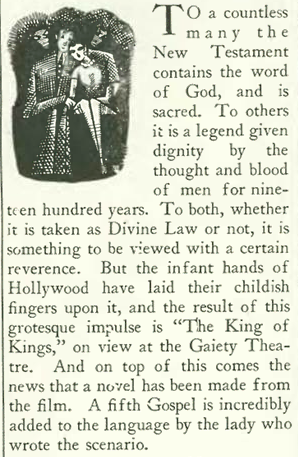
Hollywood movies continued to disappoint New Yorker critics, including Cecil B. DeMille’s silent epic The King of Kings.
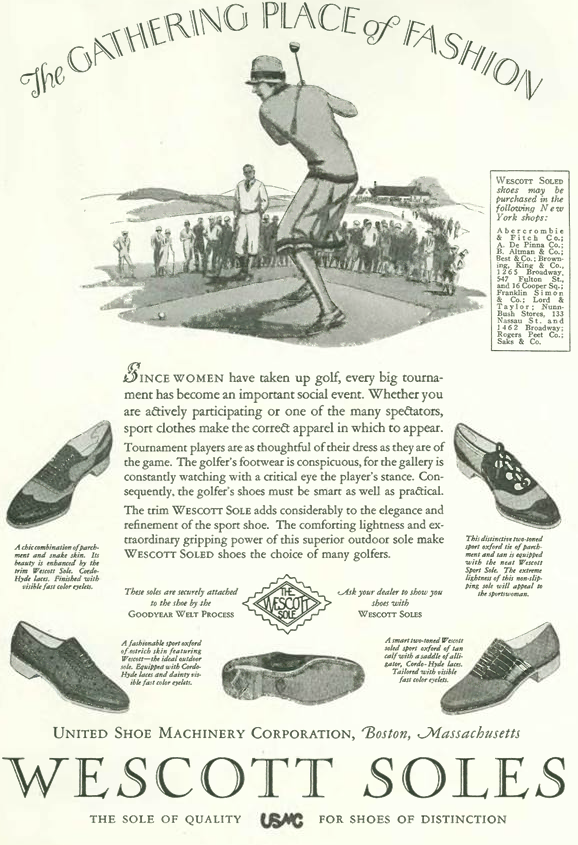
Finally, a couple of advertisements from the April 30 issue. It was spring, and time to hit the links…
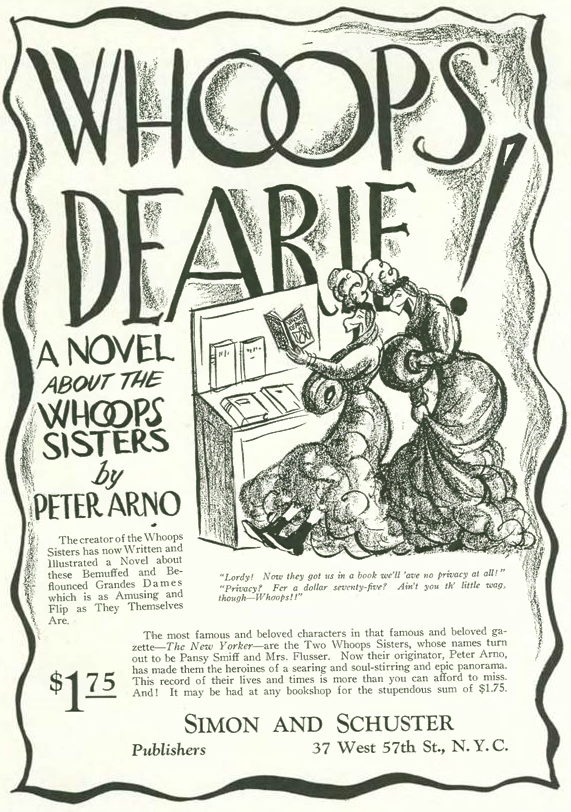
…and New Yorker cartoonist Peter Arno plugged his new book featuring the Whoops Sisters:
Publisher William Randolph Hearst was a larger-than-life personality who inspired writer Herman Mankiewicz* —an early NewYorker contributor—to pen the screenplay for Orson Welles’s film Citizen Kane.
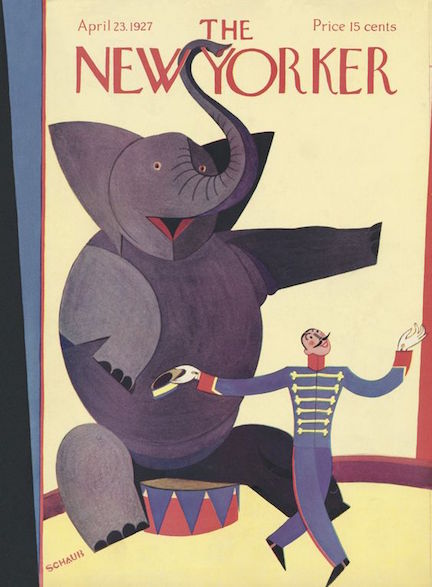
April 23, 1927 cover by Andre De Schaub.
* Stuart Cooke adds this clarification: Herman Mankiewicz did not write the screenplay of Citizen Kane. He contributed to it along with many others. (See Citizen Welles by Frank Brady). However, Welles credited him as the co-writer and at the last minute, graciously put Mankiewicz’s before his in the credits.
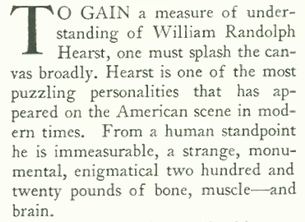
So when the New Yorker featured Hearst in its April 23, 1927 “Profile,” it required five lengthy installments by the writer (and Hearst biographer) John K. Winkler, who began the profile with this observation:
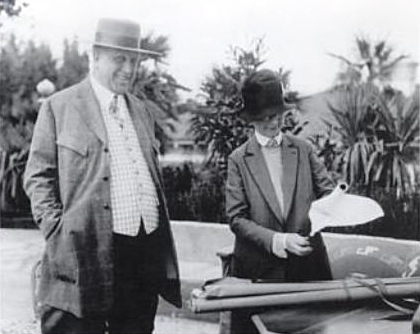
MAKE NO SMALL PLANS…William Randolph Hearst reviews blueprints with Julia Morgan, architect of Hearst Castle, in 1926. (Wikipedia)
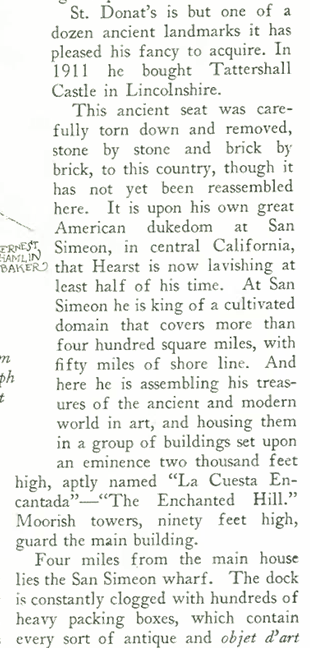
Winkler detailed Hearst’s plunder of European art and architecture—much of it sitting on a wharf below his “castle” at San Simeon on California’s Central Coast—awaiting architect Julia Morgan’s decision on where it might fit into the fabric of what became one of America’s most famous “homes.” Later in the profile Winkler described Hearst’s purchase of St. Donat’s Castle in Wales, and his acquisition of another castle that he had dismantled and shipped to San Simeon.
Hearst Castle at San Simeon. (sfgate)LEGENDARY PARTIES FOR THE LEGENDS…Hollywood actors pose for a photo at one of the famed Hearst costume parties…(back row) Douglas Montgomery, Leslie Howard, Marion Davies, unidentified man; (front row) Bruce Cabot, George K. Arthur, Ramon Navarro & Eileen Perry. (moviemorlocks.com)HOST & HOSTESS…Hearst and his mistress, actress Marion Davies, at one of their famous San Simeon costume balls (oldloves.tumblr.com)
The mid-1920s to the mid-1930s were glory days at San Simeon. In his Great Hall Hearst “held court” with movie stars and statesmen who also attended famous costume parties hosted by Hearst and actress Marion Davies.
The profile writer, John K. Winkler, would publish two books on Hearst in 1928 and 1955, as well as books on other captains of industry including Andrew Carnegie, John D. Rockefeller, F.W. Woolworth, J. Pierpont Morgan and the DuPont family.
* * *
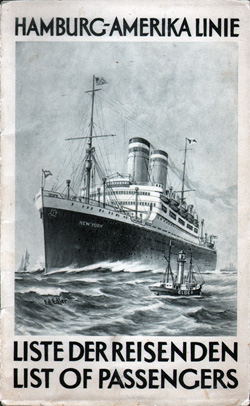
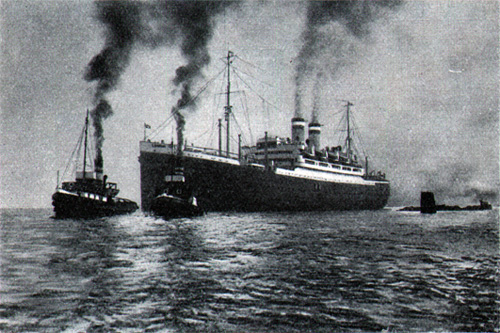
The Germany-based Hamburg America Line had been a major player in moving both passengers and freight between Europe and North America since 1847. In 1914, its passenger flagship, the Vaterland, was caught in port at Hoboken, New Jersey at the outbreak of World War I. She was later seized, renamed Leviathan after the declaration of war on Germany in 1917, and served as a U.S. troopship. So it was significant to European travelers (including many New Yorker readers) that the line was out to regain its former glory with the launch of the New York.
Cover of the passenger list for the, SS New York.Photo of the departure of the steamship SS New York.
* * *
Lois Long chronicled nightly escapades of drinking, dining, and dancing for The New Yorker in her column “Tables for Two,” and she often teased her readers about her true identity. Although in reality she was young (26), attractive and a big partier, she often described herself to readers as a bit of wallflower, or a “short squat maiden of forty.” When her marriage to cartoonist Peter Arno was announced in August 1927, her true identity was revealed.
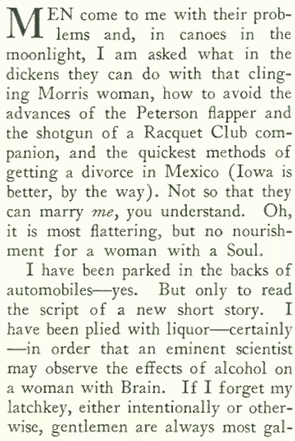
Long seemed to be growing bored with New York nightlife, as evidenced by shorter “Tables” columns (the feature would go on hiatus in 1930) while her fashion column—On and Off the Avenue—took on more importance. In her “Tables” column for the April 23, 1927 issue, she devoted most of it to yet another playful deception for her readers.
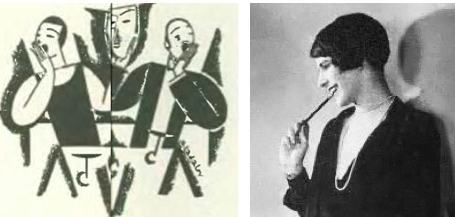
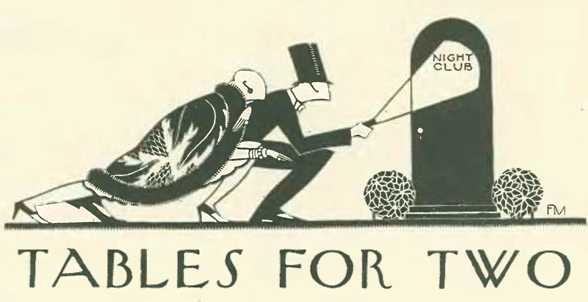
The artwork that accompanied Lois Long’s “Tables for Two” column often featured this pair of bored nightclub patrons. Long, with stylish bob, shown during her New Yorker days in the 1920s.
This time she portrays herself as a bookish spinster…
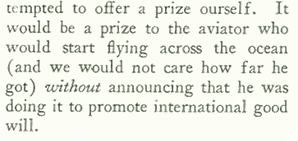
In other diversions, “Talk of the Town” made this mention of the Orteig Prize,a reward offered to the first aviator to fly non-stop from New York City to Paris or vice versa. Of course we know Charles Lindbergh would capture the prize the following month (and six others would die trying):
In advertising, the issue featured this promotion for radio station WOR. Broadcast radio was in its infancy in 1927, and this is one of the first ads of its kind to appear in The New Yorker:
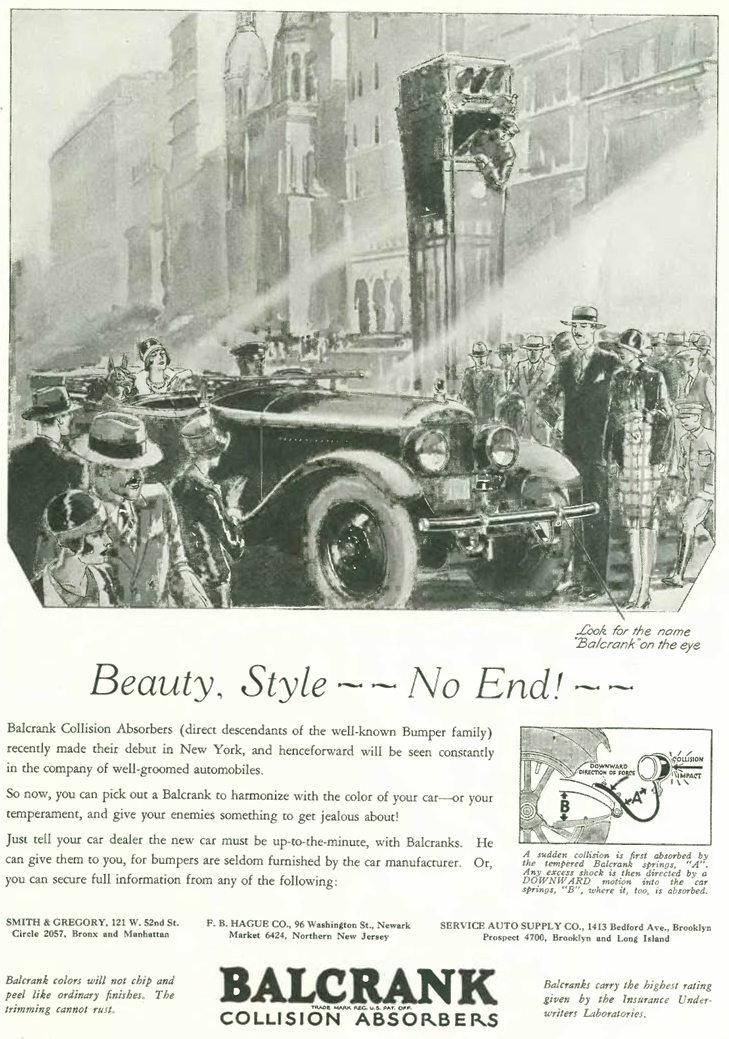
The following advertisement for Balcrank auto bumpers tells you a lot about the bourgeois New Yorker reader it is trying to reach. It suggests the addition of these bumpers to your car will lend an upper class touch people will admire and notice—everyone from the traffic cop in the signal tower to the smart couple who seem to be inches away from having their feet run over.
I love the smug expression worn by the female passenger. Of course the actual old money upper class wouldn’t see this ad—they could care less about bumpers or literature—and would be reading Town & Country, the Social Register, or nothing at all. Funny how the early New Yorker loved to tweak the nose of the upper class, all the while running ads that appealed to a grasping bourgeois desire for status. The bumper ad says it all.
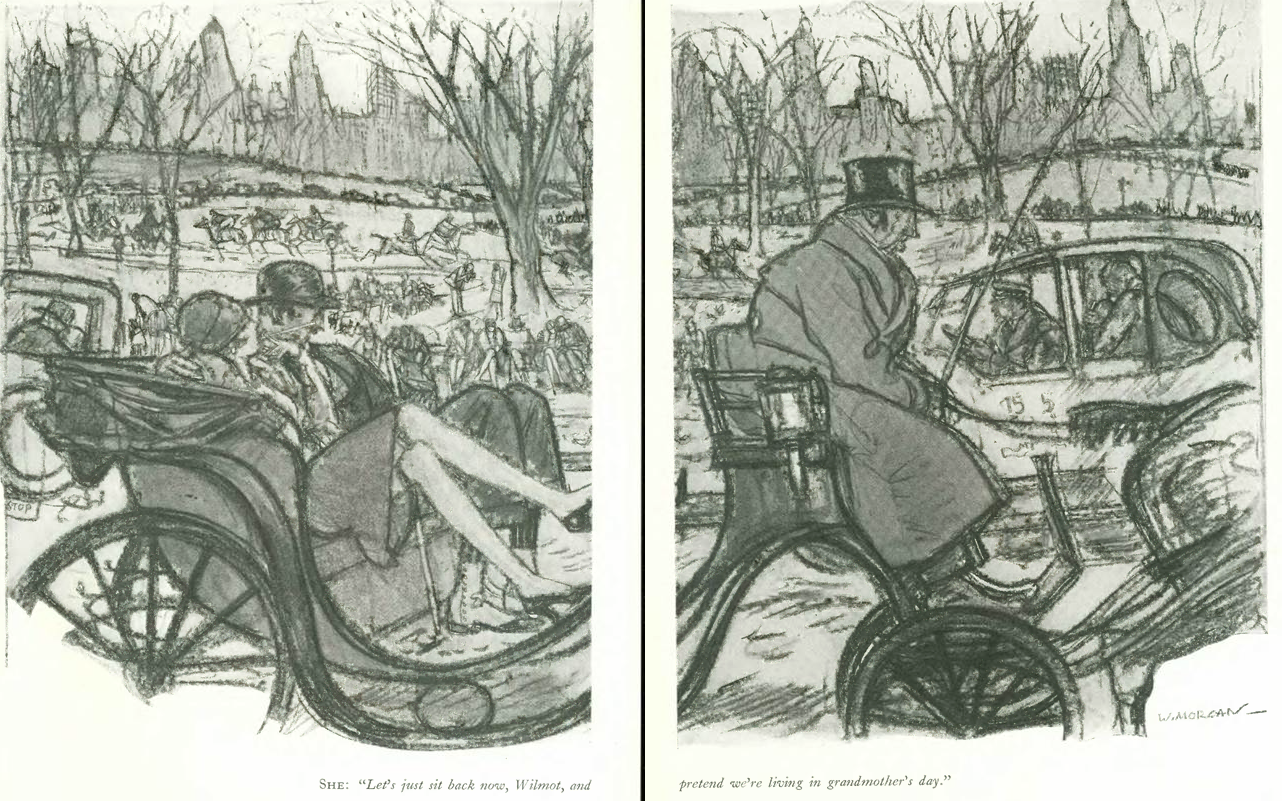
The issue included this cartoon by Wallace Morgan, set in Central Park. Displayed across a two-page spread, the caption reads: SHE: “Let’s just sit back Wilmot, and pretend we’re living in grandmother’s day.” (click to enlarge)
And finally, the Barnum and Bailey Circus was in town, so we end with this cartoon by Carl Rose:
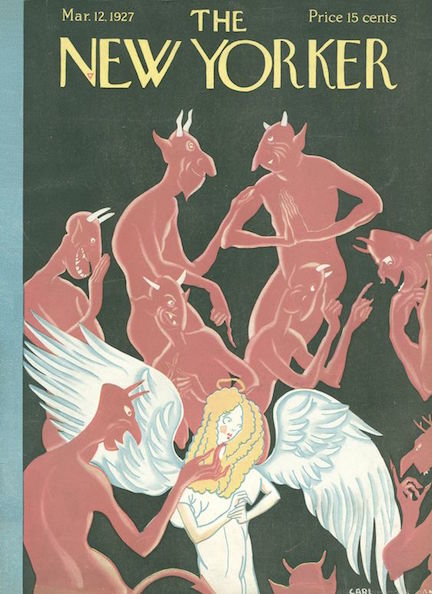
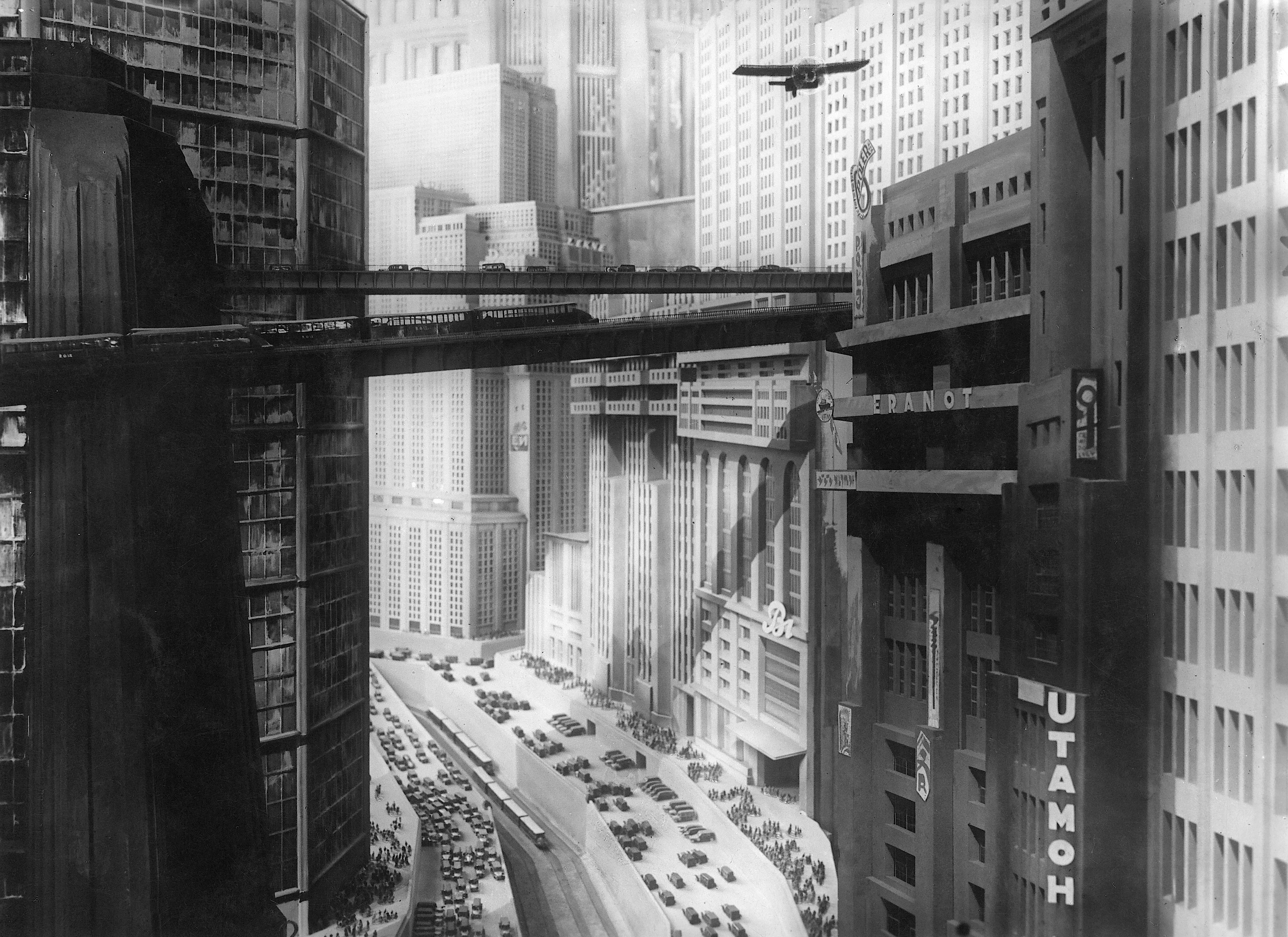
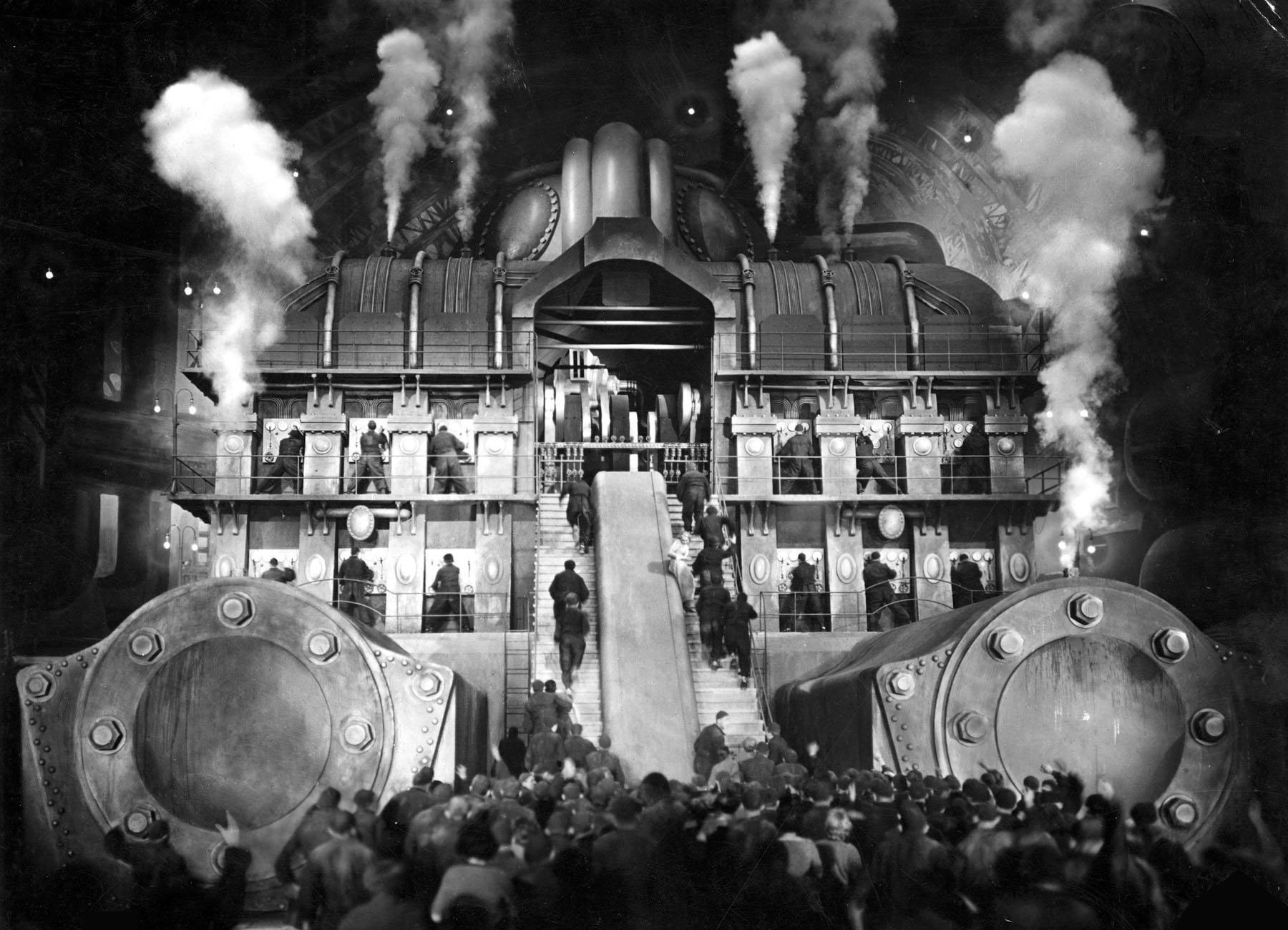
The much-anticipated German expressionist film, Metropolis, opened at Manhattan’s Rialto Theatre. Although considered today to be a classic of the silent era, the March 12, 1927 New Yorker found Fritz Lang’s film to be overlong and preachy despite its fantastic setting and complex special effects.
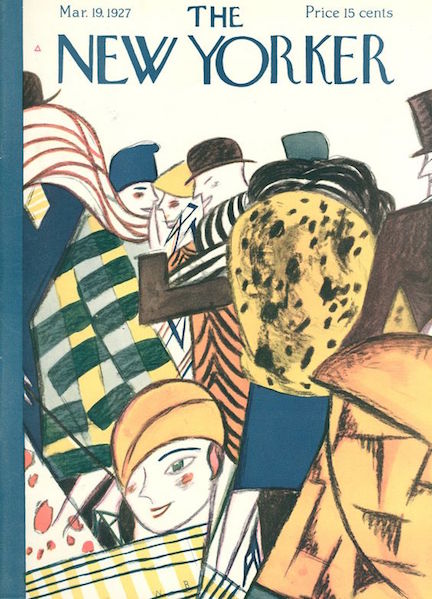
March 12, 1927 cover by Carl Rose.
Set in a futuristic dystopia in which the wealthy ruling classes lived high above the toiling masses, the film followed the attempts of a wealthy son of the city’s ruler and a poor working woman named Mary to overcome the city’s gaping class divisions.
The city of tomorrow as portrayed in the opening scenes of Fritz Lang’sMetropolis. The New Yorker encouraged readers to see the film mostly for the special effects, but lamented its “Teutonic heaviness” and uninspired acting. (archhistdaily)
An excerpt from the New Yorker review:
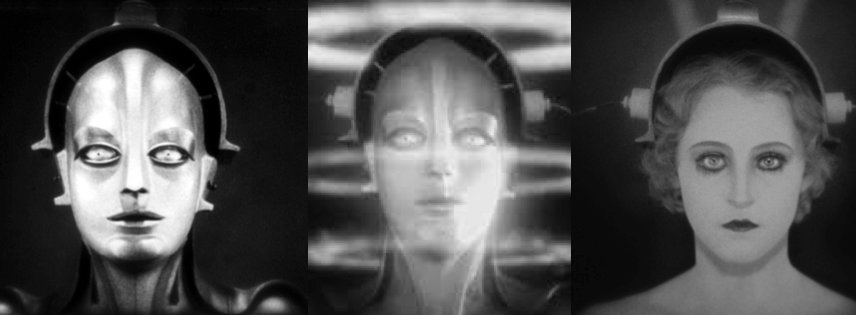
The working masses toil in the dank world beneath the city in Metropolis. (myfilmviews.com)Brigette Helm’s duo portrayal of the noble Mary and her robotic double (here being created through cinematic magic) in Metropolis was praised by The New Yorker, which otherwise found the film’s acting subpar. (cinemagraphe.com)
Considered one of the most expensive movies of its time, Metropolis cost $5 million to film in 1925 (roughly about $70 million today).
* * *
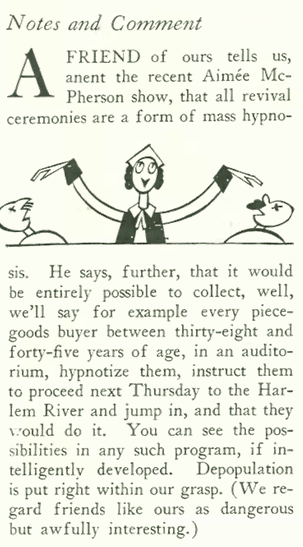
The famous 1920s evangelist Aimee Semple McPherson had been holding a series of revival meetings in New York, which were often (and derisively) noted by the New Yorker editors. In the previous issue “Talk of the Town” observed:
And in the March 12 issue they offered this parting note in “Of All Things”….
Aimee Semple McPherson (left) leading a service at her Angelus Temple in Los Angeles in the 1920s. (Los Angeles Public Library Photo Collection)
A pioneer in the use of modern media, McPherson was in New York on a “vindication tour,” taking advantage of the publicity from her alleged kidnapping a year earlier that led to investigations that she had staged her disappearance to bolster her flagging ministry.
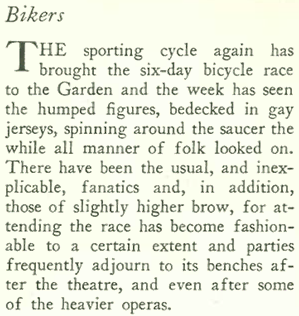
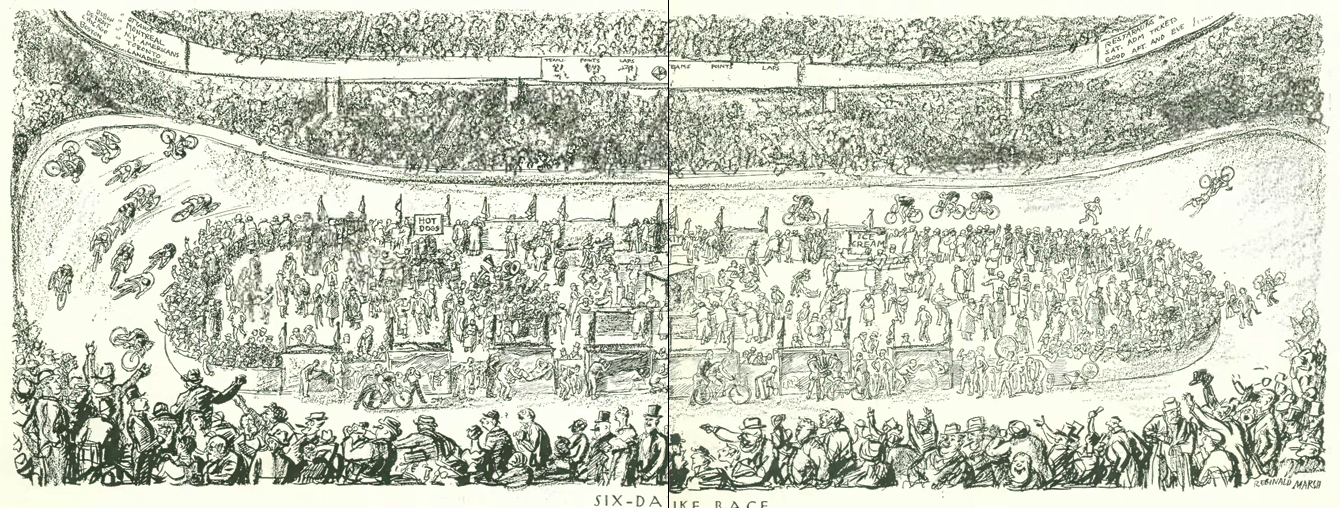
In other diversions, bicycle racing had come to Madison Square Garden, as noted in “Talk of the Town” with an illustration by Reginald Marsh:
click to enlarge
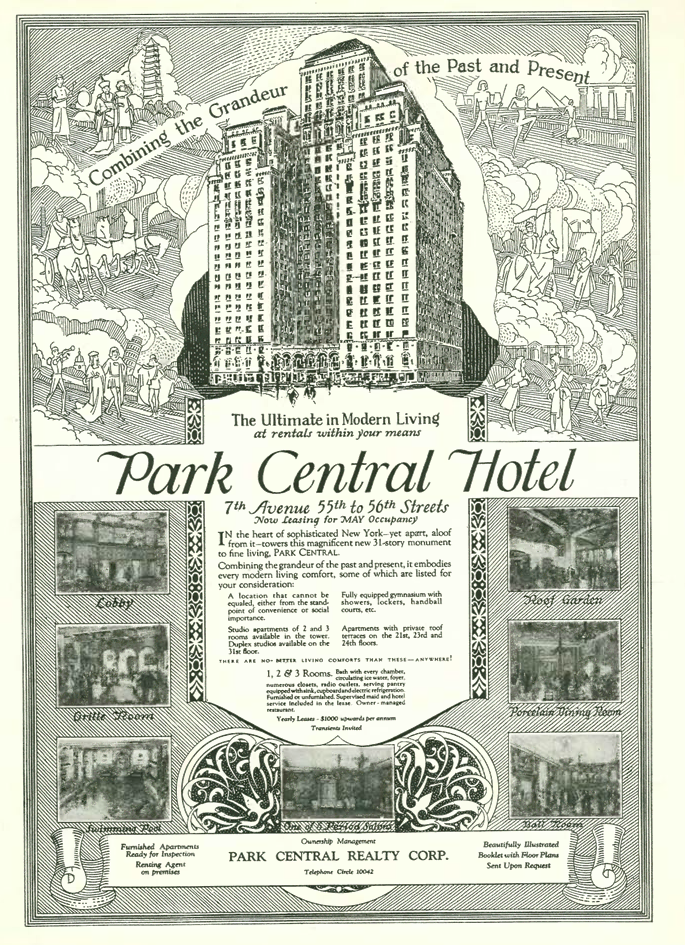
Advertisements in this issue included this announcement for the opening of the Park Central Hotel, still a grand landmark on 7th Avenue…
…and this ad from Nestle touting the latest method for achieving success in the latest hair style…
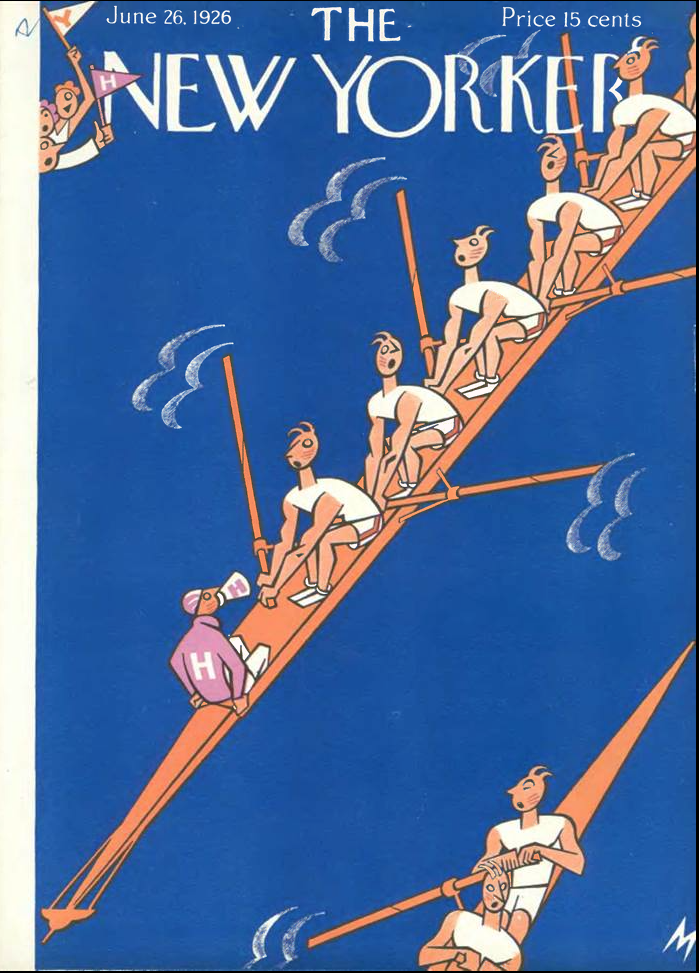
The sad world of “taxi dancers” was explored by Maxwell Bodenheim in the June 12, 1926 edition of The New Yorker.
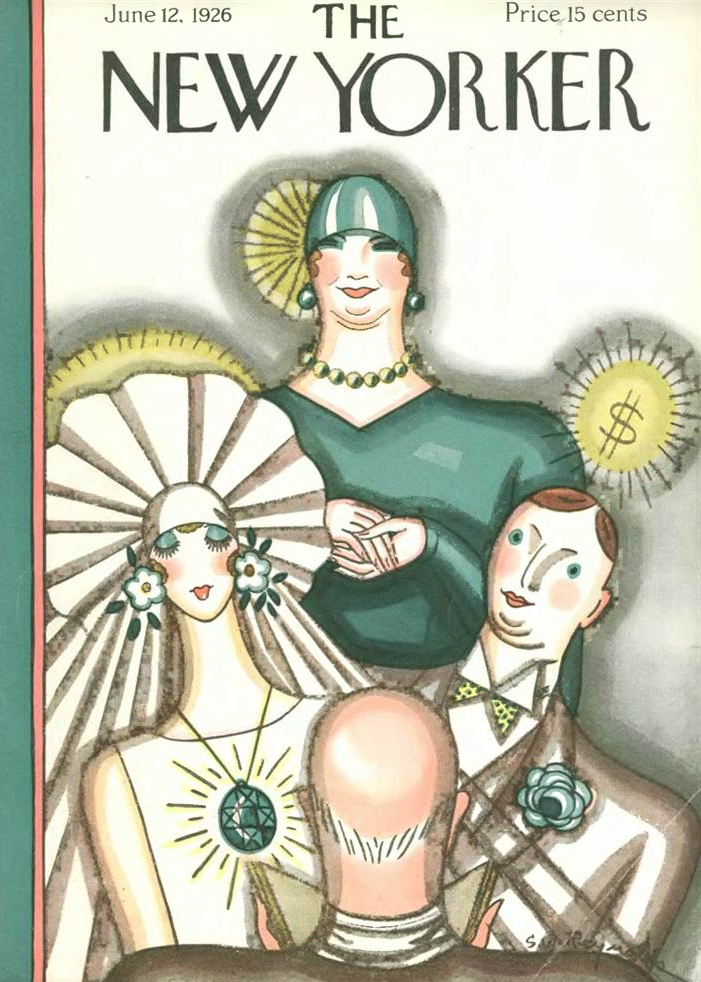
June 12, 1926 cover by S.W. Reynolds.
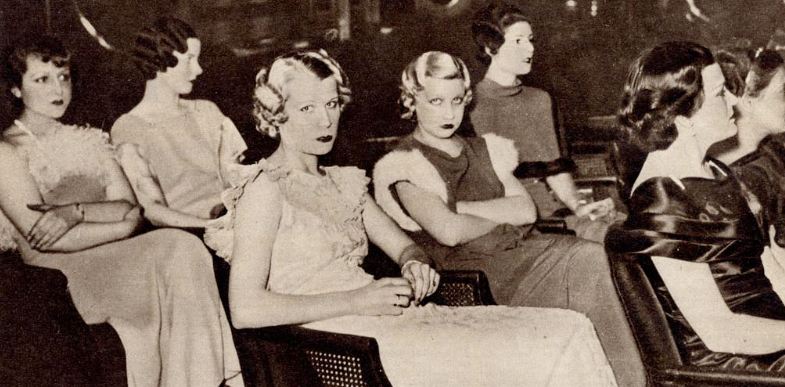
Bodenheim visited a “cheap Broadway dance hall” populated by taxi-dancers and their patrons. It worked something like this: A male patron would buy dance tickets for ten cents apiece, and for each ticket a chosen “hostess-partner” would dance with him for the length of a single song.
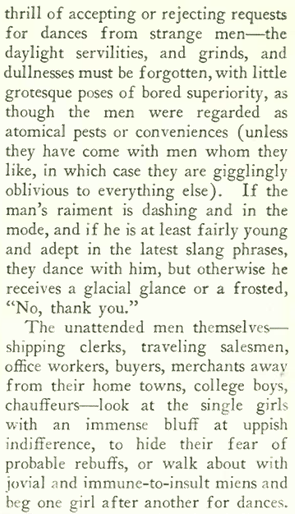
He also described the pathetic strutting and preening rituals of both dancers and patrons:
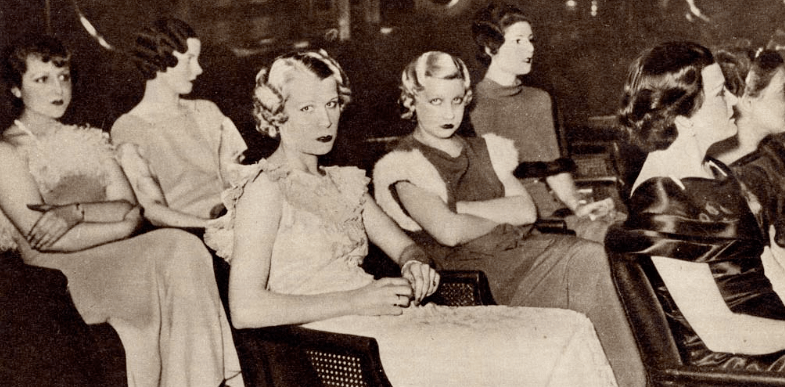
“TAXI-DANCERS” waiting for customers at a Broadway dance hall in the early 1930s. The image was scanned from an article in Weekly Illustrated (Oct. 6, 1934) that described new regulations banning the vocation.
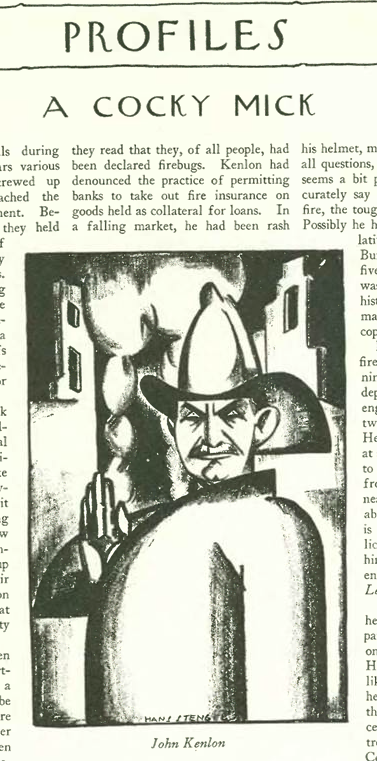
A couple of other bits from the issue: An interesting headline for the profile of NYC Fire Chief John Kenlon…
…and this advertisement for apartments at 1035 Fifth Avenue. I thought the ad was interesting because children are rarely featured in The New Yorker. In case you are wondering about their social class, these are children living on posh Fifth Avenue, and that’s a nurse-maid, not mother, chasing behind them in nearby Central Park.
On to the June 19th issue, and a couple more items of interest…
June 19, 1926 cover by Carl Rose.
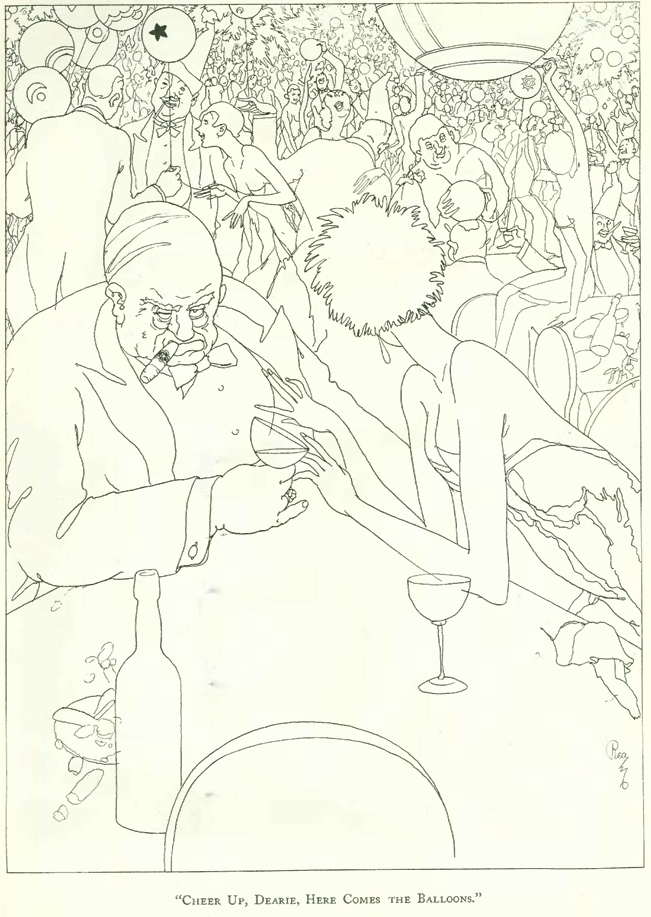
As noted previously, a common theme of the early New Yorker’s cartoons was the comic imbalance of rich old men and their young mistresses. This time Rea Irvin explores the subject with this terrific illustration:
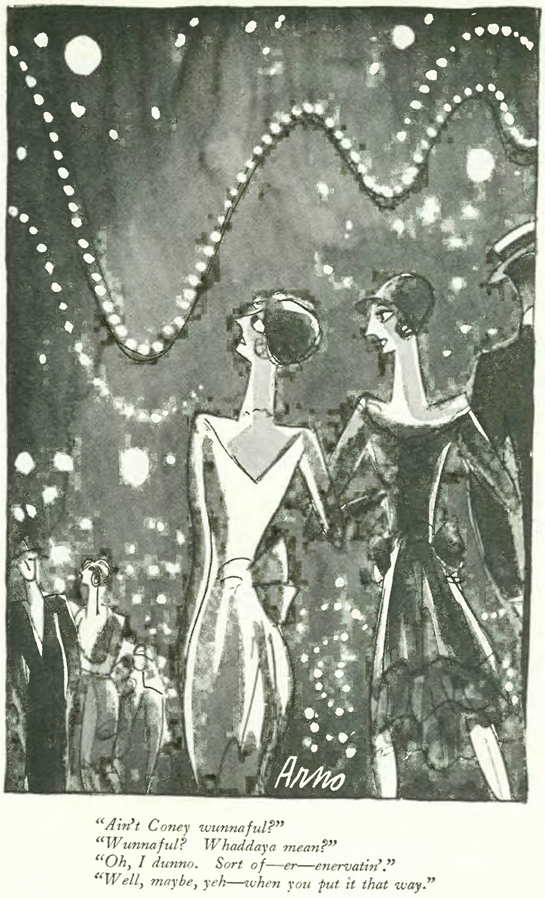
And we close with Peter Arno, and his observations of Coney Island.
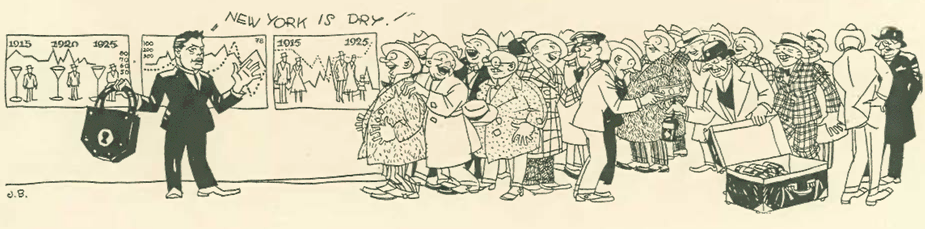
The woes of Prohibition were acutely felt by the readership of The New Yorker. The magazine responded in kind with its continued criticism of the law’s enforcement and particularly the tactics of Manhattan District Attorney Emory C. Buckner, whose agents continued to padlock restaurants and clubs suspected of selling alcohol.
The New Yorker previously called the padlocking tactic a “promotional stunt” that would ultimately backfire (I wrote about this in a previous blog post last March).
Both the “The Talk of the Town” and “Tables for Two” took aim at Buckner this time around. “Talk” led with this item, accompanied by the art of Johan Bull:
“Talk” also made a call to action by “men of virtue:”
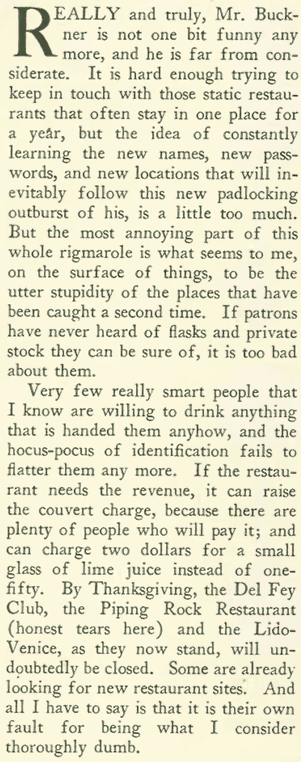
Heck with statements. Lois Long just wanted to have some fun, and led her column, “Tables for Two,” with her own attack on Buckner and on the “stupidity” of establishments that were closed by Buckner’s agents (I include art that accompanied the column by Frank McIntosh—at least that is what I think the “FM” stands for; if I am in error, someone please correct me!):
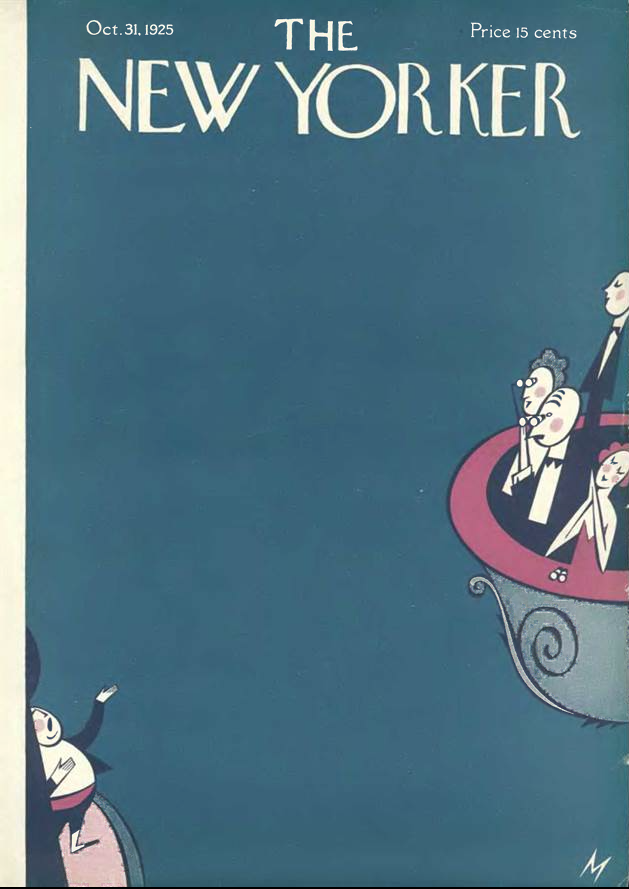
In a previous column (Oct. 17), Long pondered the popularity of a new dance, the “Charleston.” She closed her Oct. 31 column with “telegrams” from exemplary colleges in answer to the query: “Is the Charleston being done at college dances?”
W.J. Henderson wrote a lengthy article about the upcoming opera season at the Metropolitan Opera (it was opening with La Gioconda), and recalled the days after World War I when the once-popular German singers suddenly grew scarce on the American stage.
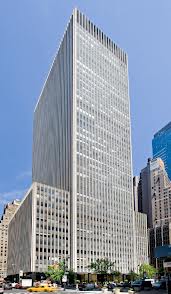
The old Metropolitan Opera House at 1411 Broadway. The “Old Met” opened in 1883 and was rebuilt after a fire in 1892. The interior, shown here, was redesigned in 1903. This photo depicts a recital by pianist Josef Hofmann on November 28, 1937. The old Met was torn down in 1967 and replaced by a 40-story office tower. (Wikipedia)Site of the old Metropolitan Opera House today.
According to Henderson, this led to a general falling off of quality in the performances, a situation made even worse by the absence of the late, great Enrico Caruso on the Metropolitan’s stage.
In other items, John Tunis wrote about Illinois All-American halfback Red Grange in “Profiles,” calling him “a presentable youth of twenty-two…well-groomed, he would pass anywhere—even in the movies—for a clean type of American manhood.”
Tunis also noted that Grange had been offered a “half a million” to star in movies, and that professional football was ready to offer him a sum “that would cause even the once-mighty Ruth to blanch.” Grange, known as “The Galloping Ghost,” would later join the Chicago Bears and help to legitimize the National Football League (NFL).
Howard (Real Photograph)
The young actor Leslie Howard, who was appearing on Broadway in Michael Arlen’sThe Green Hat, wrote a humorous account of theatre life in “The Intimate Diary of An Opening Night.”
It was one of seven articles on the acting life that Howard (perhaps best known for his role as Ashley Wilkes in Gone With the Wind) would write for The New Yorker between 1925 and 1927.
For the record, I include Howard’s first New Yorker article here (with Carl Rose cartoon):
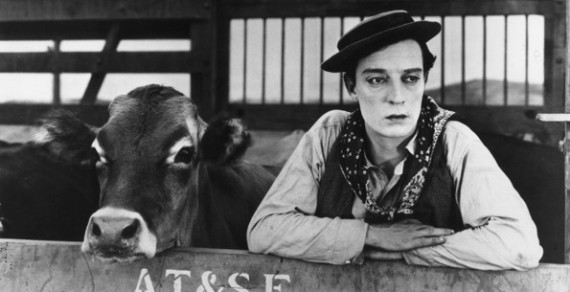
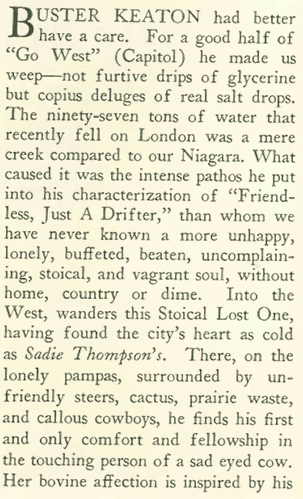
“Motion Pictures” looked at Buster Keaton’s new film, Go West…
Cow and Keaton in Go West (1925) (silentology.com)
Theodore Shane wrote that what at first seemed to be a real weeper…
…turned into a comic romp thanks to the introduction of the “sad-eyed cow…”
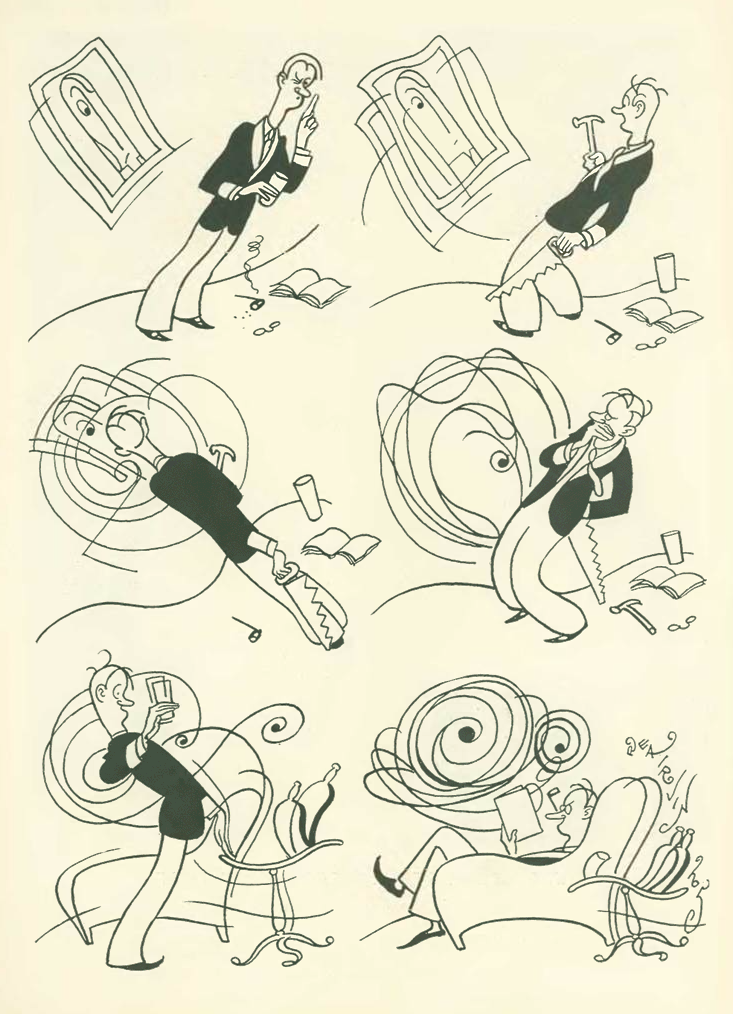
And finally, in keeping with the Prohibition theme, here is a center-spread cartoon by Rea Irvin that seemed to depict the results of consuming too much bootleg booze:






































































 A New Yorker State of Mind