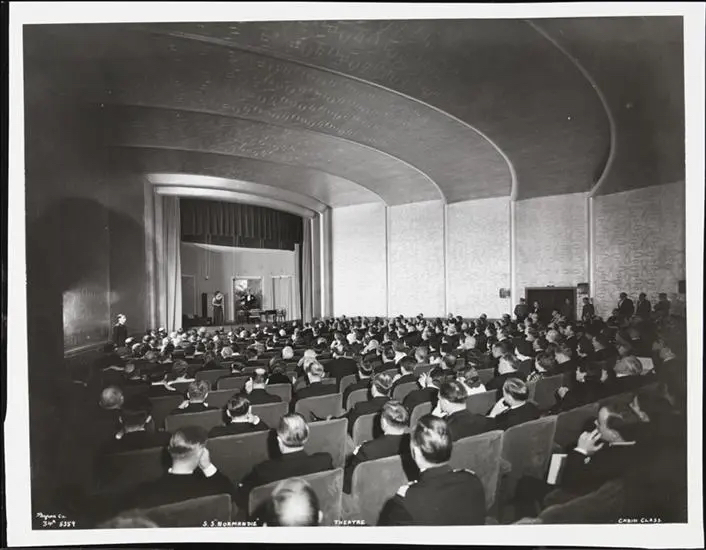
Vive La Normandie

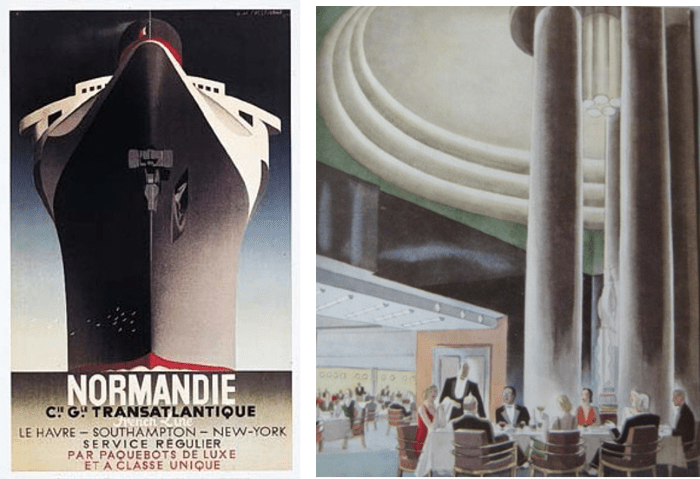
Above: At left, Adolphe Cassandre's famed 1935 depiction of the S.S. Normandie; right, image from a 1935 promotional booklet published by the French Line.

When the S.S. Normandie entered service in 1935, she was the largest and fastest passenger ship afloat, crossing the Atlantic in a little over four days. The ship was so impressive that even the imperturbable Janet Flanner expressed enthusiasm over its launch.

May 25, 1935 cover by Constantin Alajalov.

As Paris correspondent, Flanner was giving New Yorker readers a preview of Normandies May 29 maiden voyage from Le Havre to New York City.

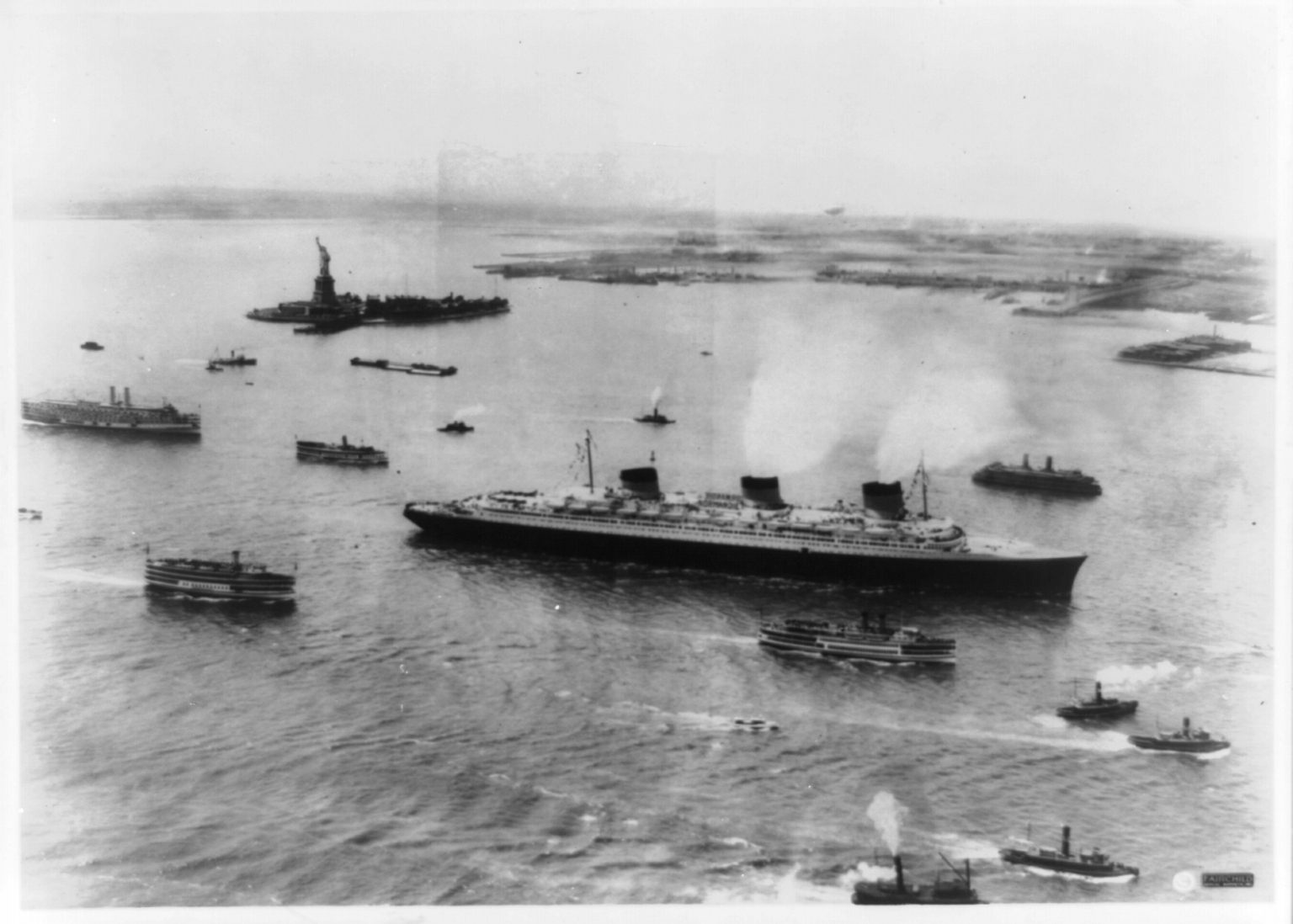
HER ENTOURAGE…The S.S. Normandie was welcomed into New York Harbor on June 3, 1935. (Wikipedia)
IMAGINE THAT…An S.S. Normandie promotional poster from 1935 depicts the ocean liner making an unlikely entrance into Manhattan. The sleek ship measured 1,029 feet (313.6m) in length and carried nearly 2,000 passengers plus 1,345 crew. It was the first ocean liner to exceed 1,000 feet in length. (Museum of the City of New York–MCNY)

To give New Yorkers some idea of the liner’s size, Flanner noted that the Normandie would stretch from 43rd to 47th Street, and if stood on her stern, would stand nearly 180 feet above the RCA Building at Rockefeller Center.

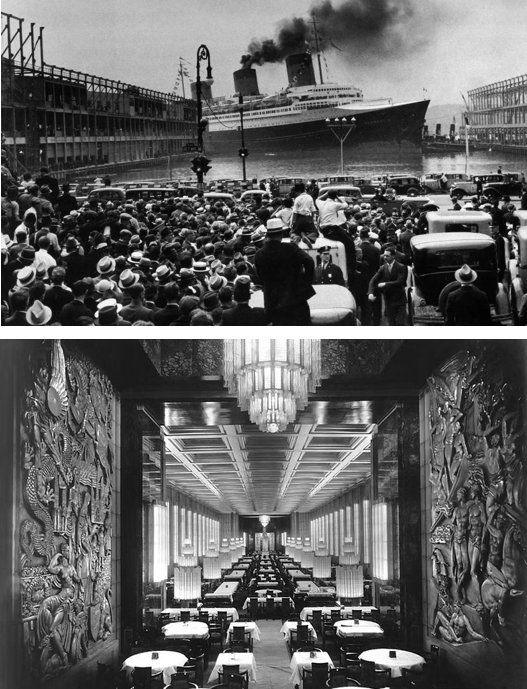
FRENCH TOAST…Top, a crowd cheers the S.S. Normandie as it arrives at New York’s Pier 88 on June 3, 1935; below, the first class dining hall was 305 feet long, 46 feet wide and three decks high. (drivingfordeco.com/MCNY)
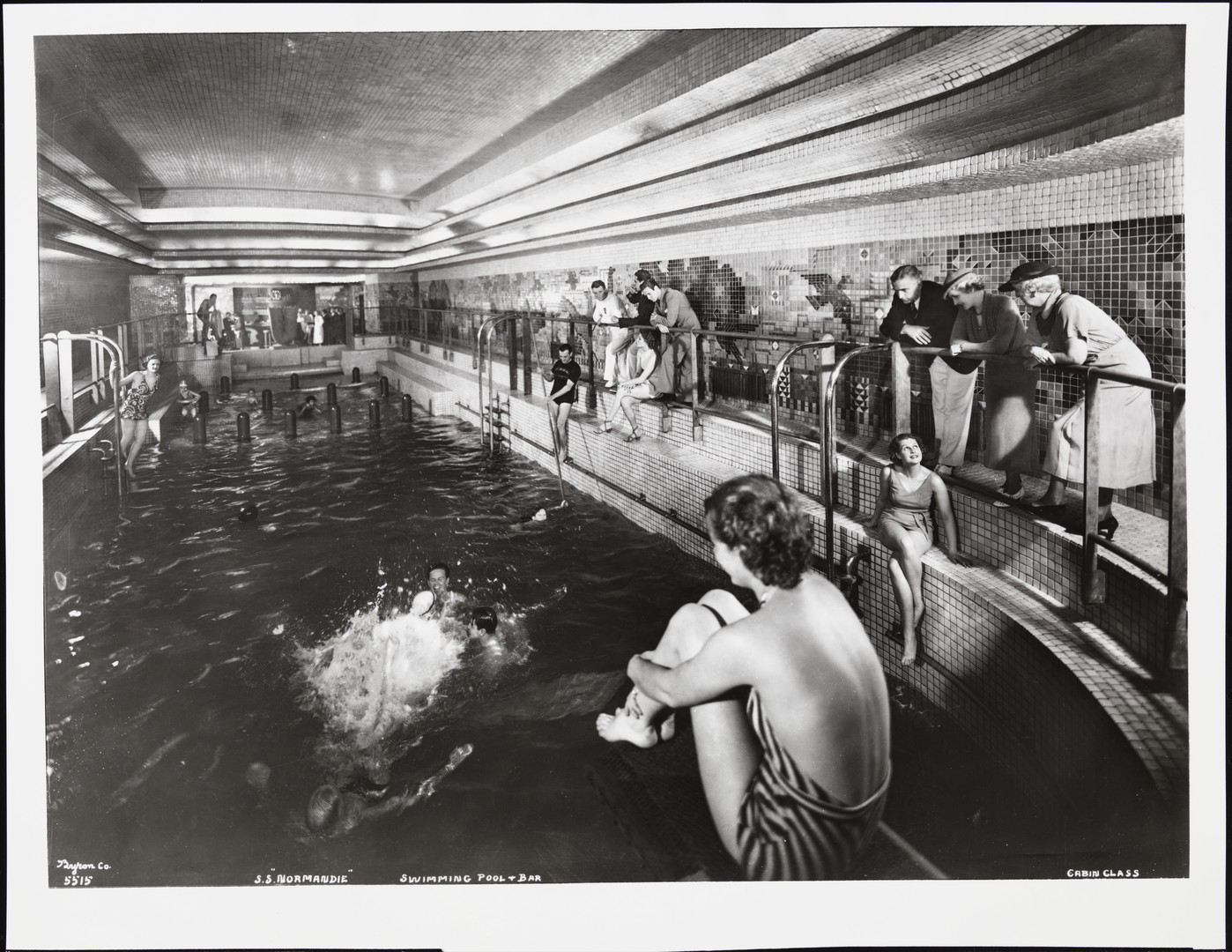
IN, AND ON THE WATER…Passengers take a plunge in the Normandie’s swimming pool, which included a bar at the far end. (MCNY)
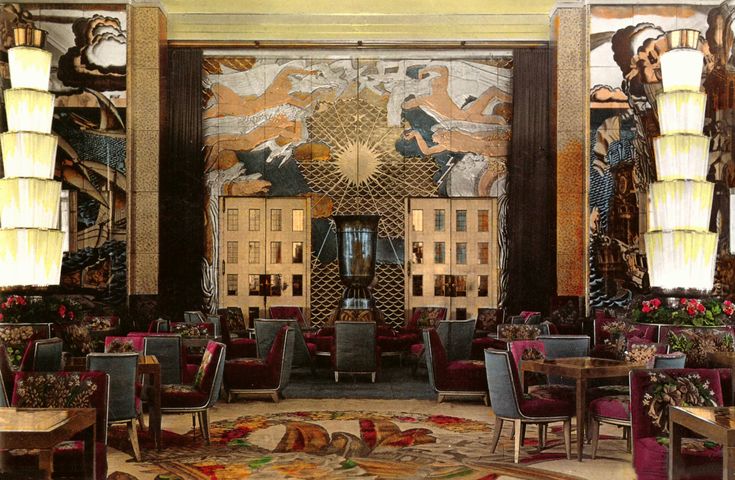
EYE-POPPING…Colorized image of the first-class lounge. (Pinterest)
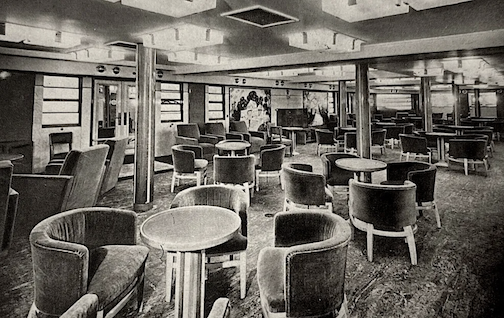
BARGAIN…Accommodations for weren’t too bad, either, for the other classes. Here is the 3rd class salon. (drivingfordeco.com)
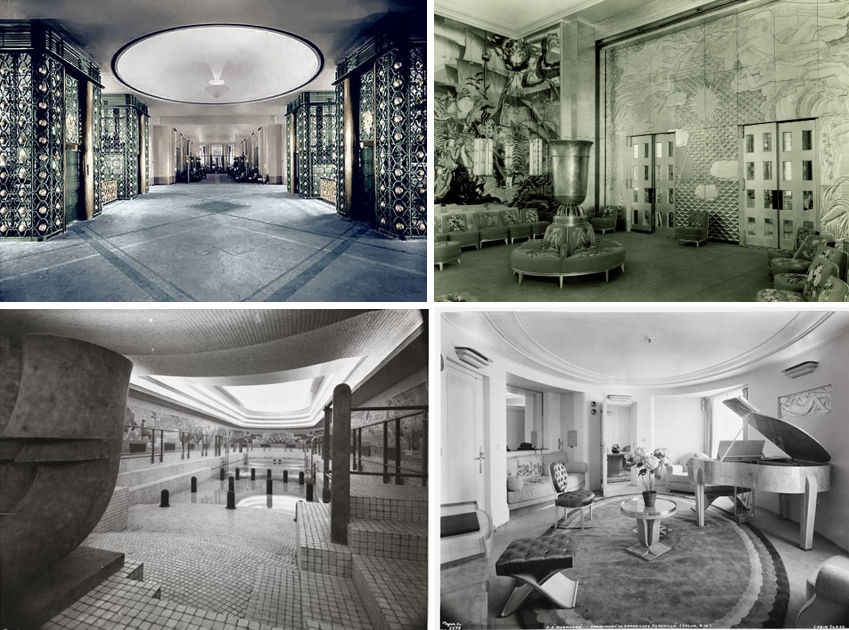
TAKE YOUR PICK…Clockwise from top left, elevators decorated in sea shells; the rear of the Grand Salon; a first class suite; view of the swimming pool. An incredible scale model of the S.S. Normandie is displayed on the Queen Mary, which is permanently docked at Long Beach, CA. (MCNY)

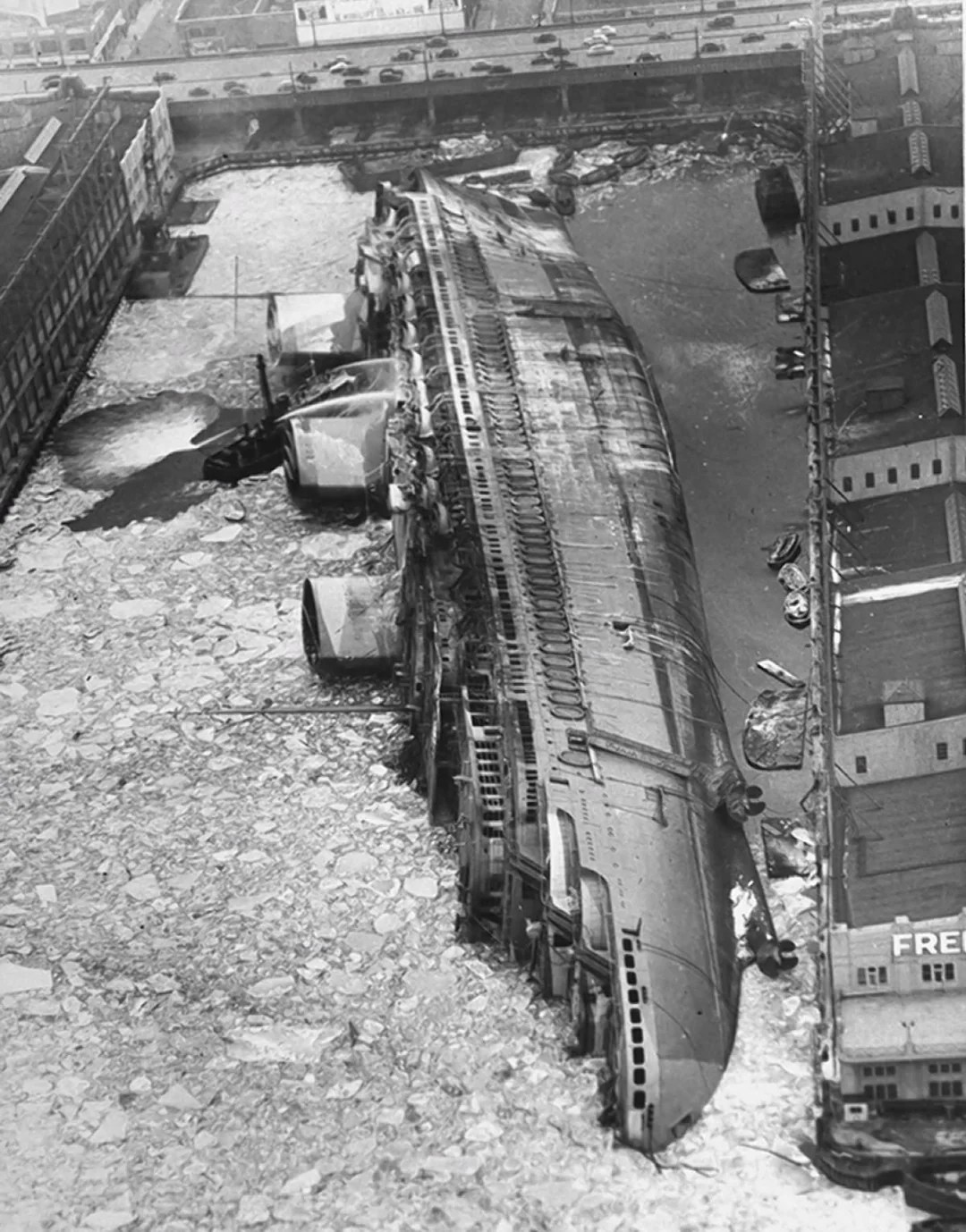
World War II would cut short the Normandie’s life. Seized in New York and renamed USS Lafayette in 1942, she was being converted to a troopship when she caught fire, capsized onto the port side, and came to rest half submerged on the bottom of the Hudson at Pier 88, the same pier where she was welcomed in 1935. She was scrapped in 1946.

THE WAGES OF STUPIDITY…The Normandie after a fire brought her glory days to an end. (Reddit)

 * * *

A Critic Is Born

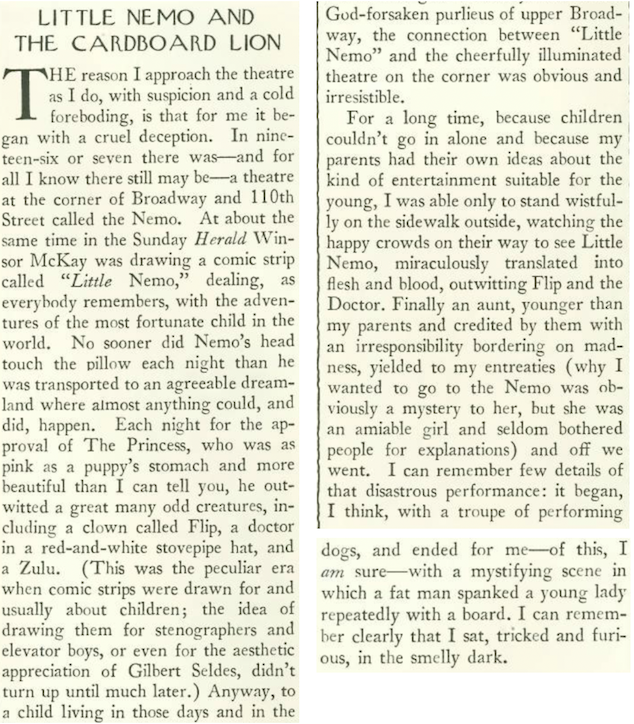
It turns out that Wolcott Gibbs (1902–1958) cut his teeth as The New Yorker’s theatre critic while he was still in short pants. Gibbs recalled his five-year-old self in an essay that described his first experience with the theatre—a play based on the New York Herald’s popular comic strip, Little Nemo in Slumberland, by Winsor McCay. In parallel with Gibbs’ childhood, the strip ran from 1905 to 1911.

As a child, Gibbs was wild about Little Nemo’s adventures, but the stage adaptation left the child disillusioned (and feeling “tricked and furious”). The New York Public Library’s Douglas Reside wrote (in 2015) that the producers, seeking to draw as wide an audience as possible, presented Little Nemo “as a bloated mixture of theatrical styles, including the minstrel show, pantomime, operetta, farce-comedy, vaudeville, revue, and ballet,” featuring three comedians “mostly superfluous to Nemo’s story.” The part of Nemo was played by a 25-year-old actor with dwarfism.

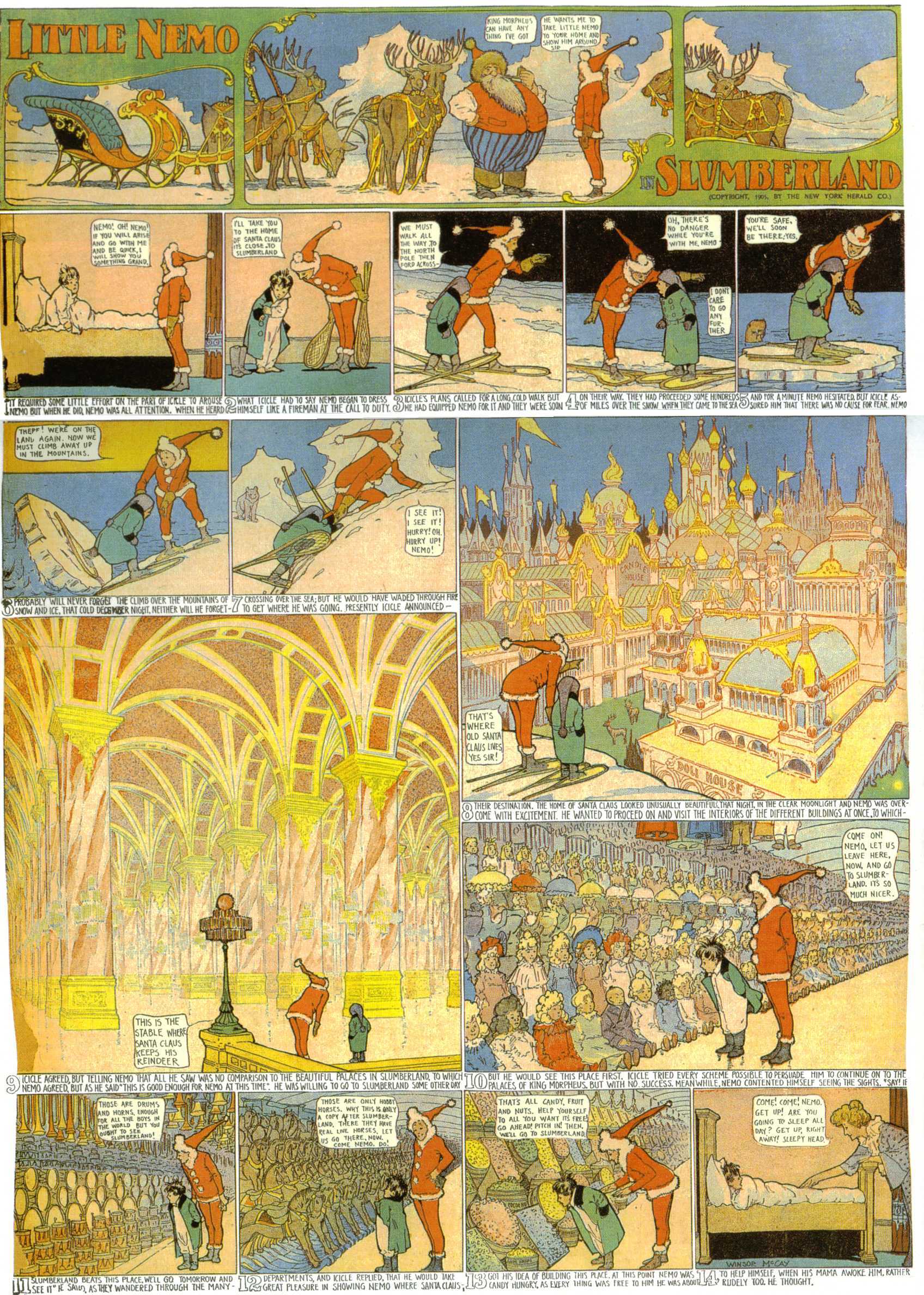
DREAMLAND…The Little Nemo strip from Dec. 17, 1905 depicted the boy’s dream of a visit to Santa’s magical city at the North Pole. (Wikipedia)
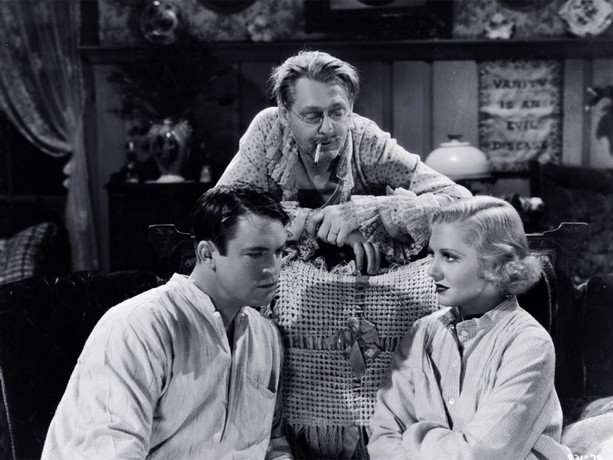
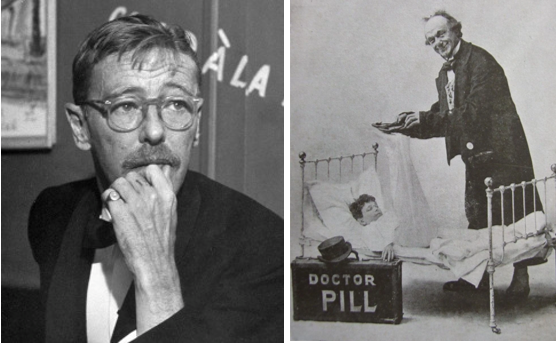
THAT’S SHOWBIZ…As a boy, Wolcott Gibbs (left) was disillusioned by a 1907 theatre adaptation of his favorite comic strip, Little Nemo in Slumberland. The play was dominated by three comedians including Joseph Cawthorn, right, who burlesqued German linguistic and cultural mannerisms for comic effect. He played Dr. Pill, the quack doctor of Slumberland’s royal court. The “boy” in the bed portraying Nemo was 25-year-old “Master” Gabriel Weigel. (Wikipedia/New York Public Library)

 * * *

Humorous Humors

Clarence Day, best known for his Life with Father stories, wrote humorously about his physical ailments and contributed a number of cartoons to The New Yorker that were accompanied by satirical poems. Day would be dead by December—after a bout with pneumonia—however, despite his ailments he would spend his last months arranging publication of his Life with Father book, which was published posthumously.

 * * *

Frankie Got Hitched

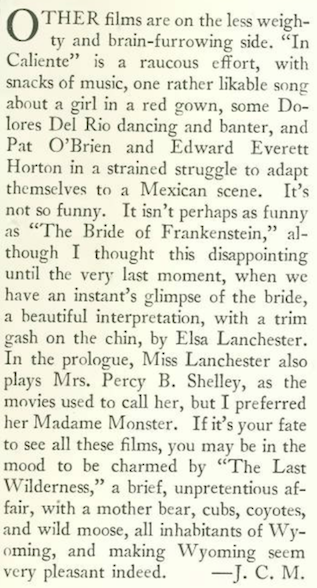
Film critic John Mosher still wasn’t finding much to rave about at the cinema, getting more chuckles from the monster mash-up of Boris Karloff and Elsa Lanchester in The Bride of Frankenstein than he did from the Dolores Del Rio vehicle Caliente.

DATE NIGHT…Top, Elsa Lanchester and Boris Karloff let the sparks fly in The Bride of Frankenstein, while Dolores Del Rio danced and chatted her way through the unfunny musical comedy Caliente. (Wikipedia/TCM)

* * *

Other features in the May 25 issue included H. L. Mencken’s continuing exploration into the origins of American names…

…and The New Yorker published its first John Cheever story, “Brooklyn Rooming House.” Of Cheever’s 180 short stories, the magazine would publish 121 of them.

A NEW FACE…In spring 1935 The New Yorker bought two John Cheever stories, paying $90 for “The Brooklyn Rooming House” and $45 for “Buffalo.” Fiction editor Katharine White urged the purchase of the stories. Above, Walker Evan’s photo of Cheever, circa 1940s. (metmuseum.org)

 * * *

From Our Advertisers

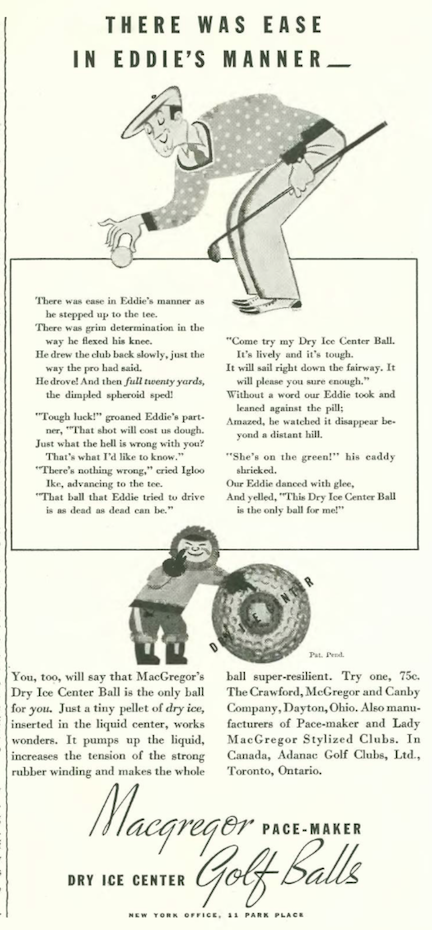
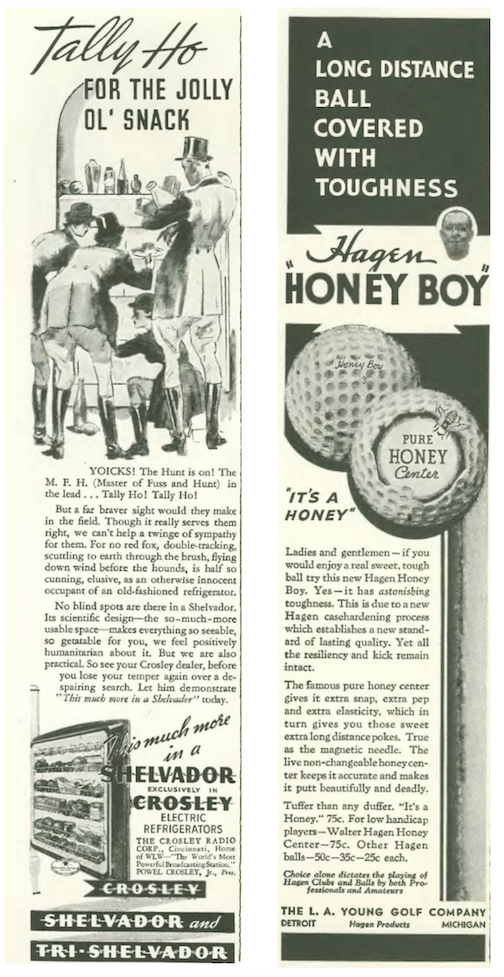
We start with some one-column gems from the back of the book including the latest innovation in electric refrigerators…a shelf in the door!…apparently Crosley was the first to invent this “Shelvador”…the ad to the right is interesting in that it advertises honey-filled golf balls…in the early 20th century some golf balls did contain real honey…apparently it was chosen for its consistent viscosity (or maybe for a quick snack on the ninth hole)…

…and from General Tire, we have another ominous warning from Dad as the teens head out for another night of crooning, or whatever they are dressed for…

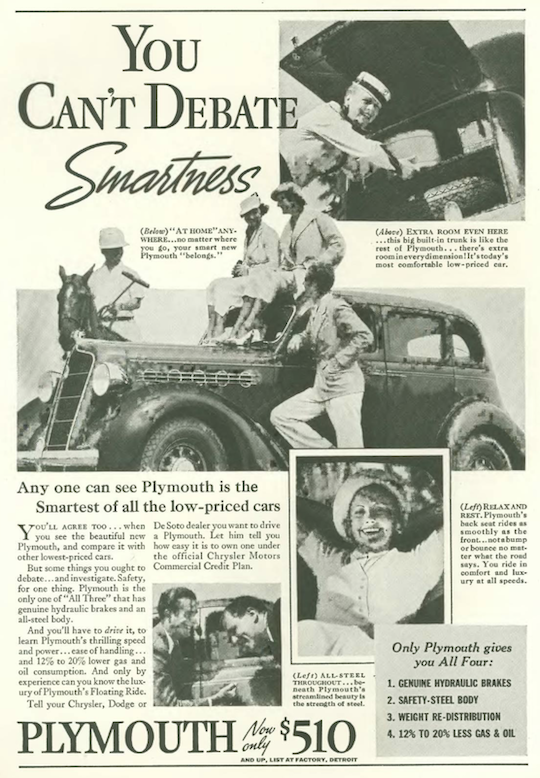
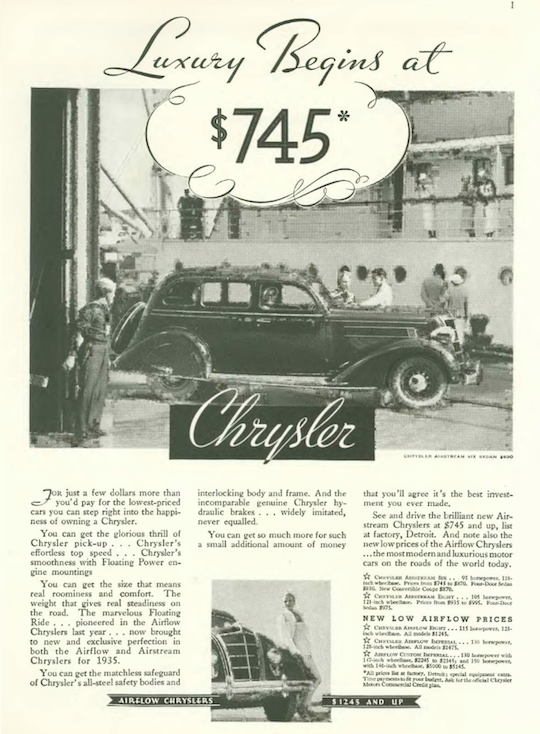
…last week Chrysler was offering its sedans for $745, and this week you could have one of their Plymouths for just 510 bucks…the message: you would be admired by your polo buddies for your smart, thrifty choice…

…where the above ad crammed every square inch with information, the folks at Pierce Arrow offered a restrained, minimal message (suggesting “we can afford to buy a full-page ad and leave much of it blank”)…another class signifier was the absence of a price tag (about $150k in today’s dollars)…but Chrysler-Plymouth would survive the Depression because it sold affordable cars, while Pierce Arrow was on its last legs…

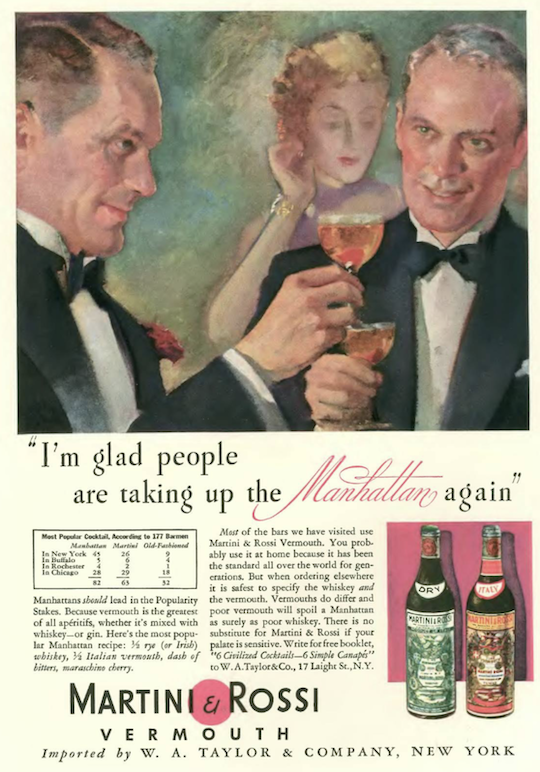
…here’s a couple of Pierce Arrow owners toasting the return of the Manhattan…

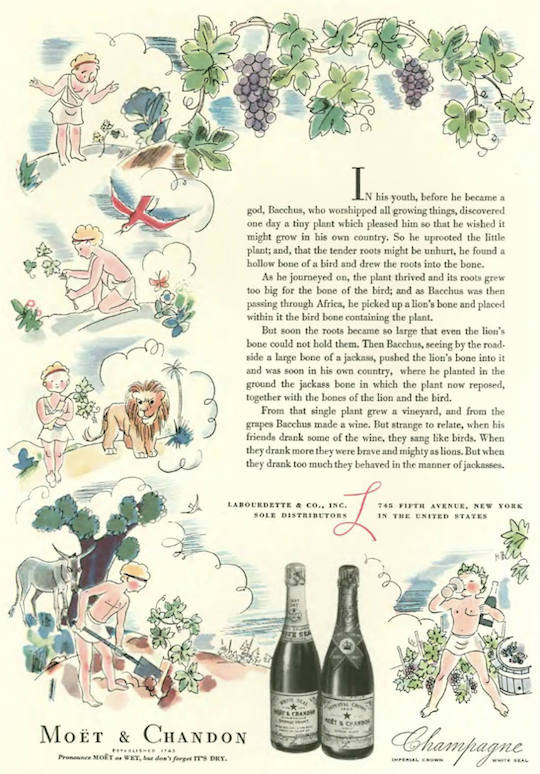
…Moët & Chandon offered up this whimsical tableau from the youth of Bacchus…

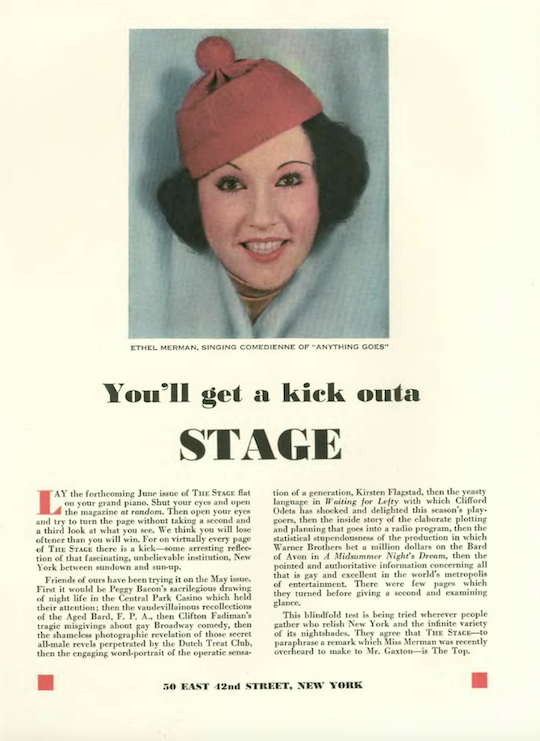
Ethel Merman popped through a curtain on the inside back cover to invite readers to subscribe to The Stage magazine…

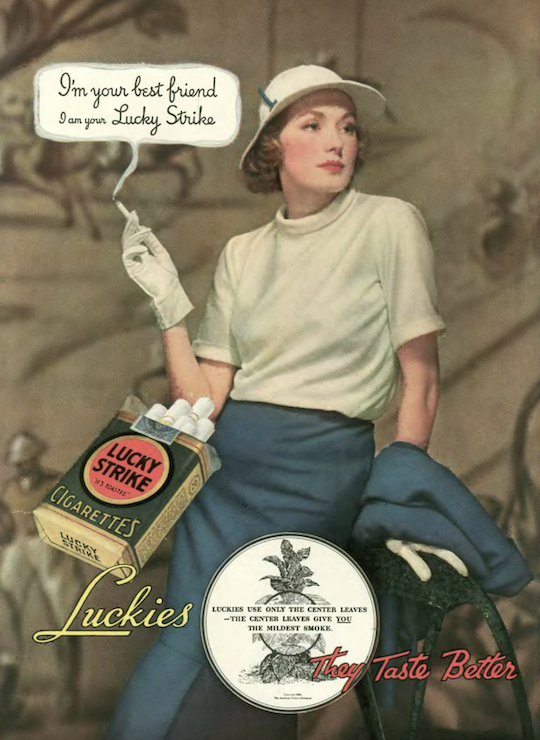
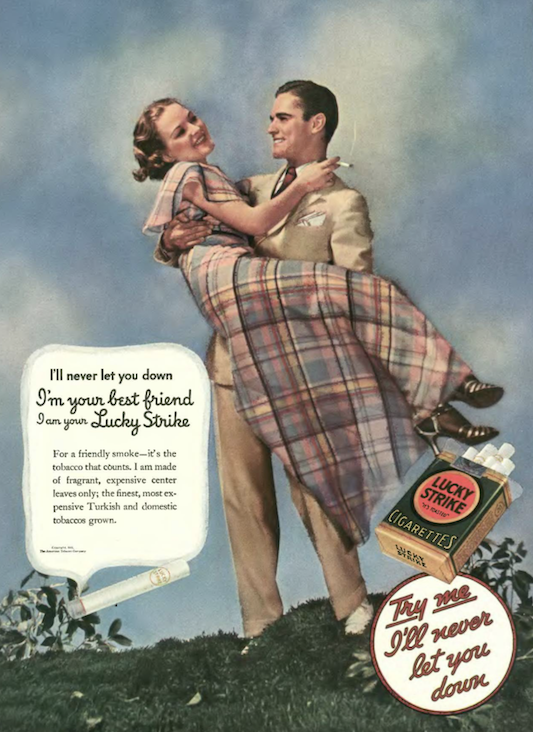
…and Lucky Strike claimed the back cover with another stylish woman and a talking cigarette bent on mind control…

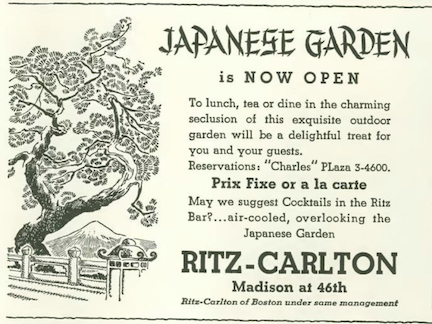
…the Ritz-Carlton announced the spring re-opening of its famed Japanese Garden…

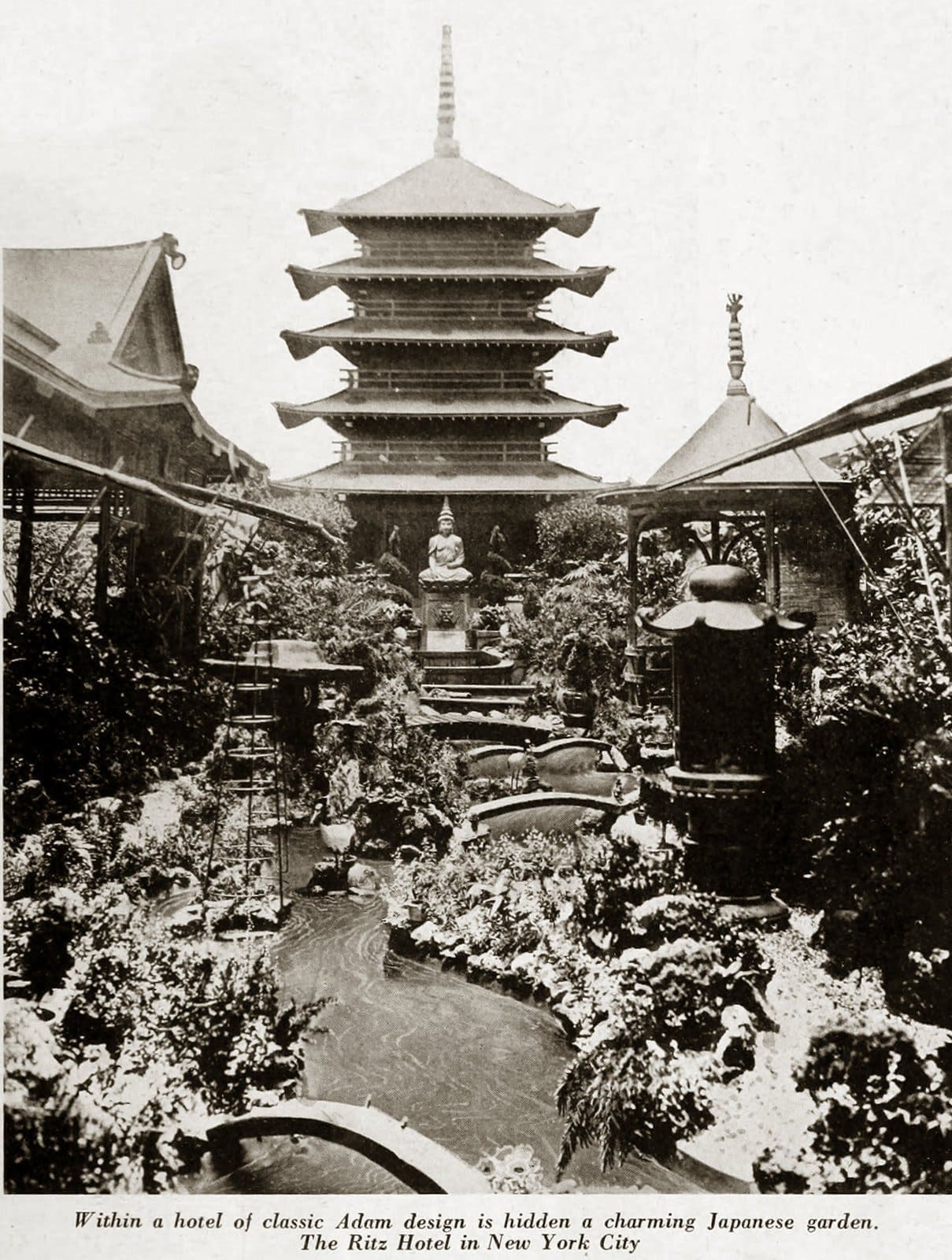
The Japanese Garden in 1924. (clickamericana)

…and we kick off our cartoonists with this “Goings On” topper by D. Krán

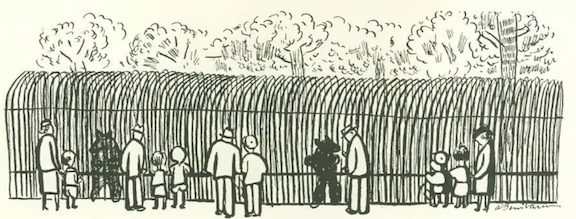
…followed by this visit to the zoo by Abe Birnbaum

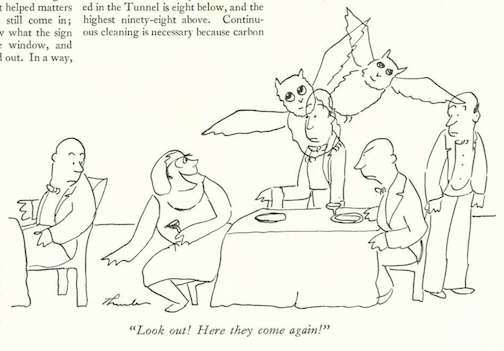
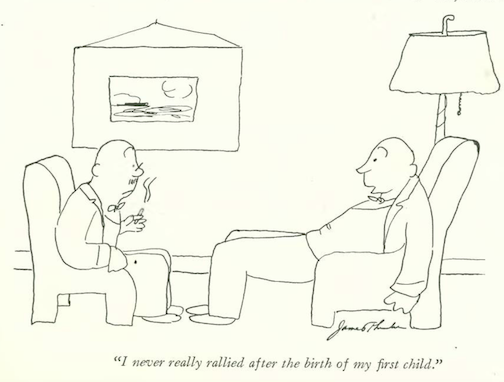
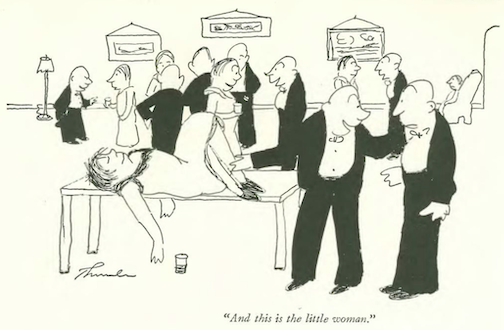
James Thurber was up for some fashion criticism…

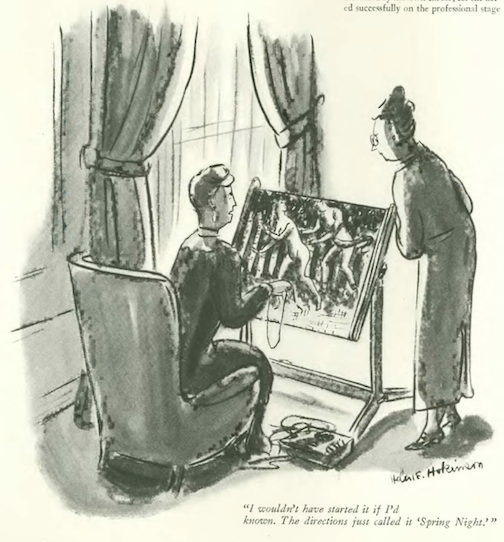
Helen Hokinson found a surprise in a paint-by-numbers kit..

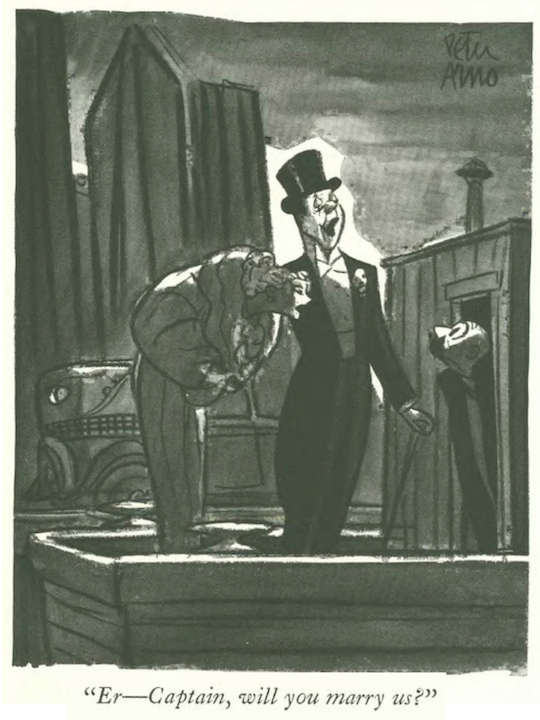
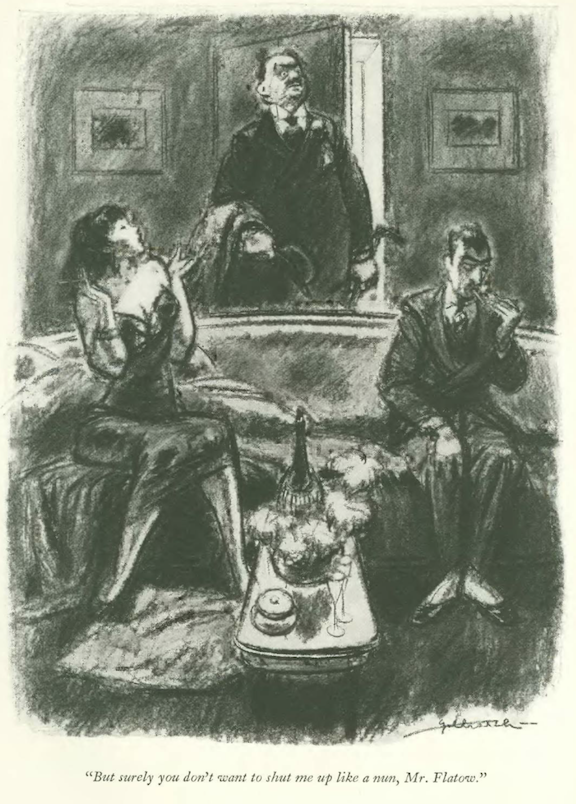
Peter Arno was up for some late night nuptials…

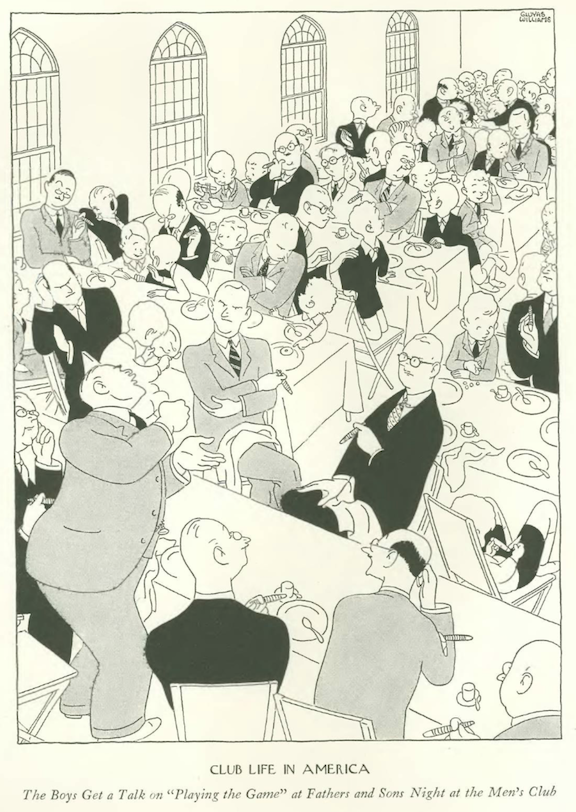
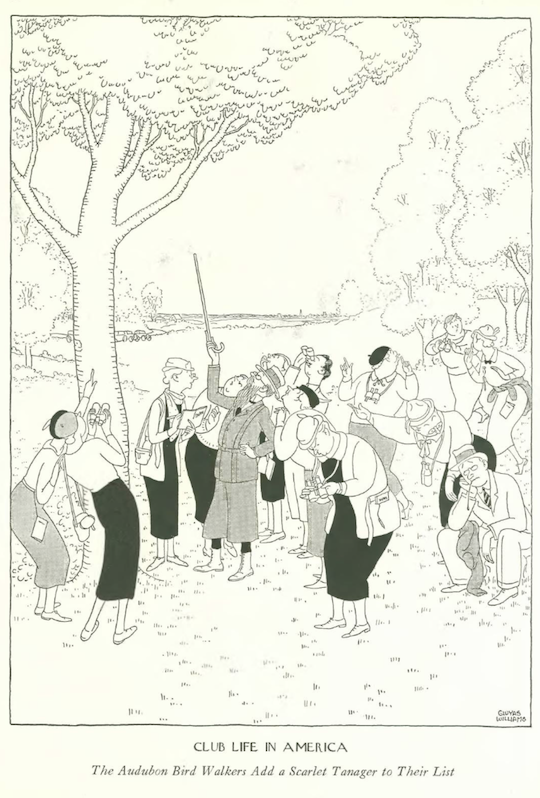
Gluyas Williams continued to examine club life…

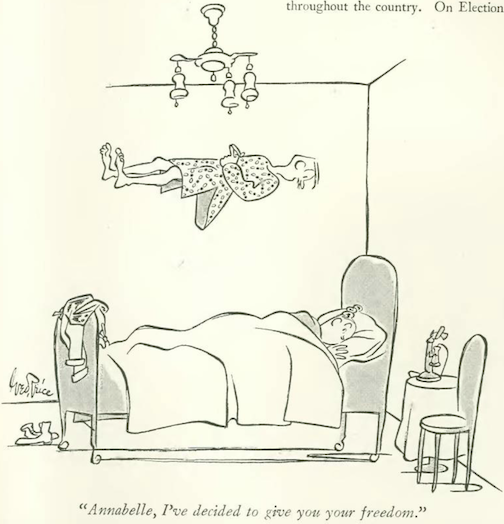
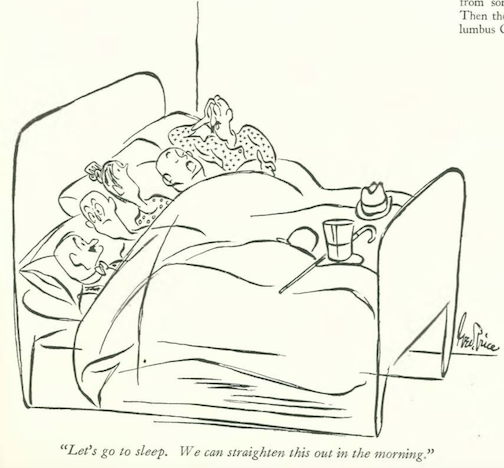
...George Price was back in the air…

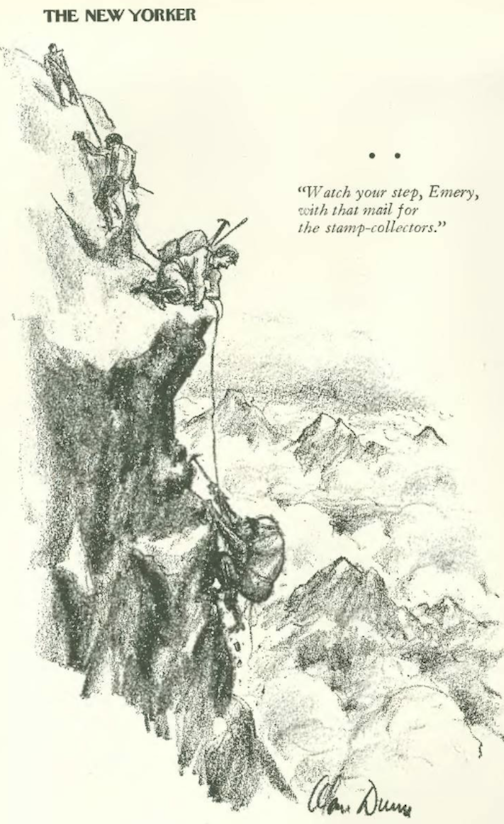
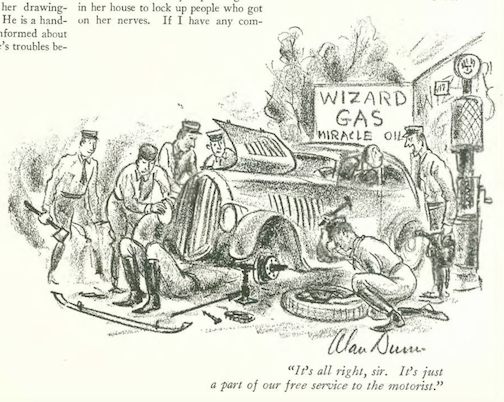
Alan Dunn gave us some men on a mission…

…and we close with Charles Addams, and some dam trouble…
Next Time: Wining and Dining…


Settling Down

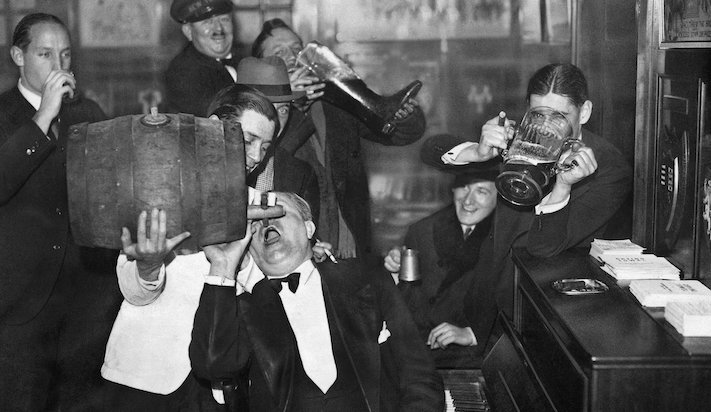
Above: Celebrating the repeal of the 18th Amendment, 1933. (New York Times)

“Settling Down” was the title given to Morris Markey’s examination of the post-Prohibition world, which to no one’s surprise heartily embraced (and imbibed) everything this world had to offer.

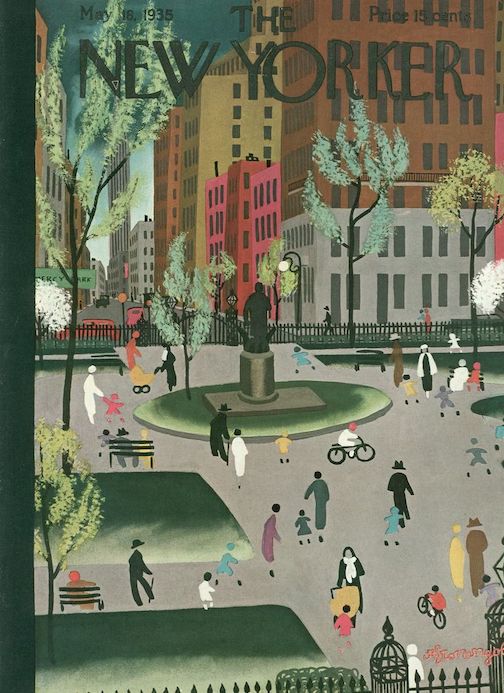
May 18, 1935 cover by Adolph K. Kronengold.

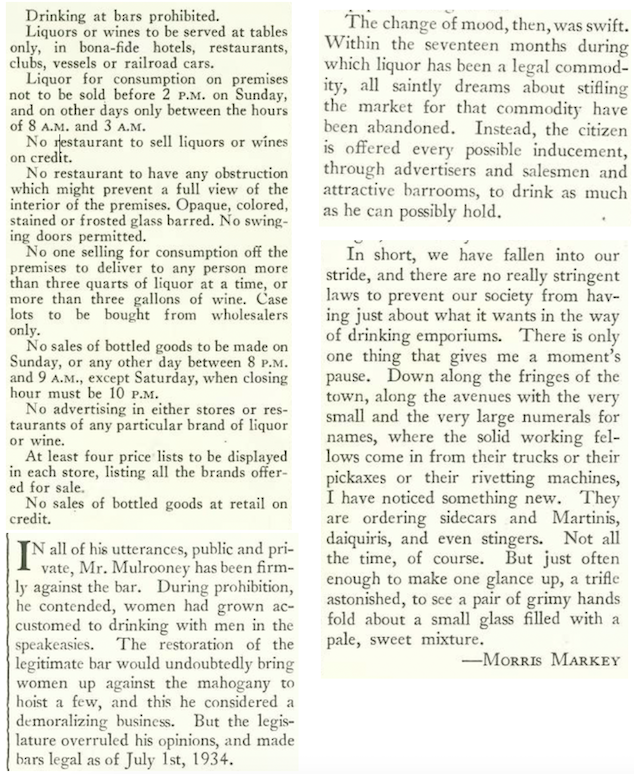
In his column, “A Reporter at Large,” Markey examined the challenges faced by local and federal governments in reestablishing old liquor control laws, in many cases creating new ones to address the technological, economic and social changes that transpired during the fourteen years of Prohibition. Facing this challenge in New York was Edward P. Mulrooney (1874-1960), a former police commissioner tapped in 1933 to head the State Alcoholic Beverage Control Board. Markey explained how Mulrooney and New York regulators tried to create new standards for alcohol consumption that would encourage moderation. Excerpts:

CAN’T HAVE A BELT IN THE BIBLE BELT…Published by The United States News on Nov. 11, 1933, this map shows how liquor laws varied by state following Prohibition. After Prohibition ended with the ratification of the 21st Amendment, states gained the authority to regulate alcohol sales, leading to a wide variety of state and local laws. Many states adopted local option laws, allowing cities and counties to decide whether to allow alcohol sales, resulting in “wet,” “dry,” and “moist” jurisdictions. (us news.com)

Seventeen chief provisions for moderating alcohol use were published in The New York Times on Nov. 10, 1933, but ten of those provisions were quickly abandoned. Less than a year and a half after repeal, Markey noted that “the citizen is offered every inducement…to drink as much as he can possibly hold.”

SO MUCH FOR RULES…Celebrations for the repeal of Prohibition in bars and former speakeasies began when Franklin Roosevelt signed the Cullen-Harrison Act on March 22, 1933; the president himself was known to enjoy a dry martini; former New York Police Commissioner Edward P. Mulrooney had the unlucky task of figuring out how to regulate the juice of the grape and the grain. In the end, people seemed to be drinking more than ever. (themobmuseum.org/thrillist.com/Condé Nast)

 * * *

Hordes From the Hinterland

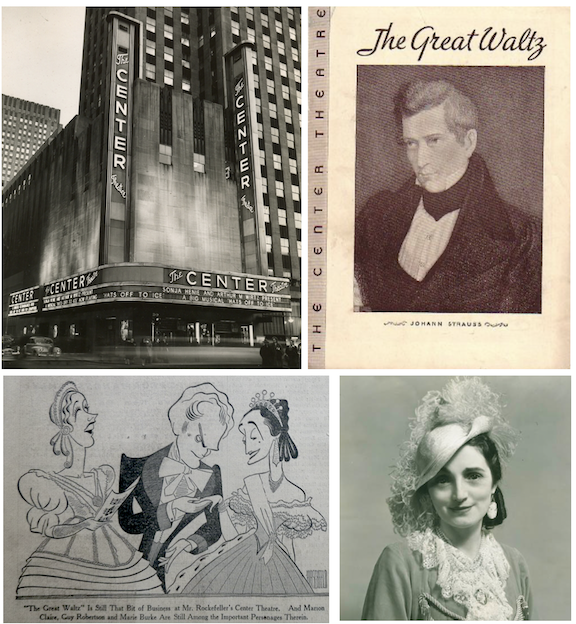
There was a time, long ago, when Broadway catered mostly to New Yorkers, but with the advent of mass media and better transportation options folks from the hinterlands (from beyond the Hudson) began to descend on the Great White Way. Then as now, certain shows attracted thousands, including The Great Waltz, a musical based on the works of Johann Strauss I and Johann Strauss II. It opened in September 1934 at the Center Theatre and ran for 289 performances. “The Talk of the Town” sniffed that “People who literally have never seen a play before in their lives turn up at Sixth Avenue and Forty-ninth Street, ready for anything.”

MANY AMERICANS WERE AGOG over the The Great Waltz…Clockwise, from top left, the play was performed at the Center Theatre (formerly the RKO Roxy Theatre) at 49th Street and 6th Avenue—sadly, it was demolished in 1954, the only building to ever be demolished from the original Rockefeller Center complex; cover of the Playbill; actress Marie Burke portrayed Countess Olga Baranskaja; Al Hirschfeld illustration of Burke and fellow actors Guy Robertson (as Johann Strauss) and Marion Claire as Therese. (cinematreasures.org/playbill.com/nyt.com)

 * * *

From Our Advertisers

Appropriately, this full-page advertisement for Gordon’s Gin appeared opposite the opening page of Morris Markey’s exploration of the post-Prohibition world…

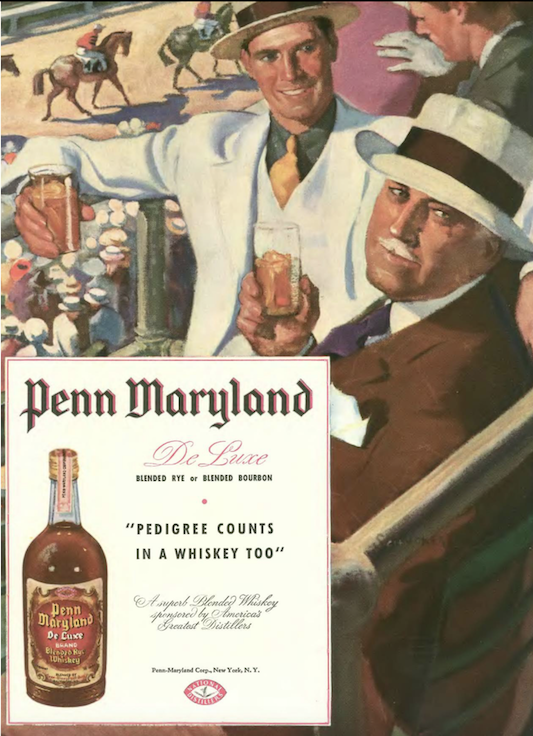
…and business was booming in the liquor trades…most of the full-color ads in The New Yorker were placed by liquor companies, cigarette manufacturers, and automakers…the inside back cover shilled for Penn Maryland…

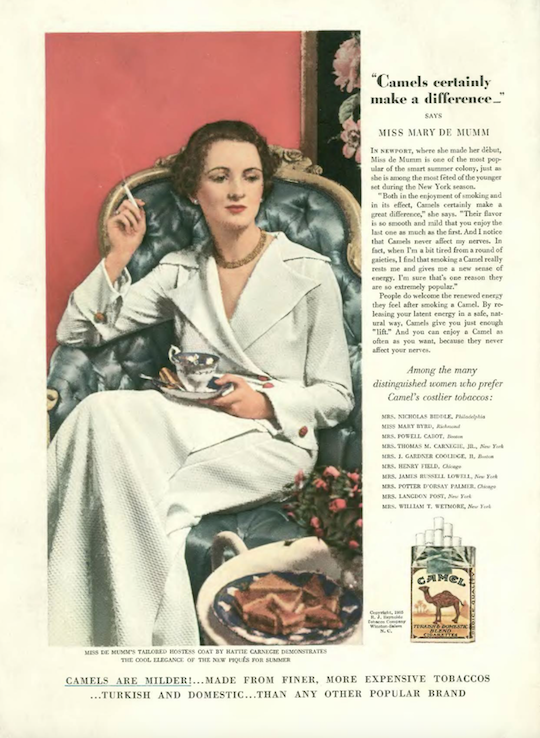
…while the back cover was once again claimed by big tobacco…here we have Newport deb Mary De Mumm expounding on wonders of Camel cigarettes, which somehow helped her feel both restful and energetic…

…those who enjoyed the finer things could buy this Packard for about $3,000 (nearly $90K today).

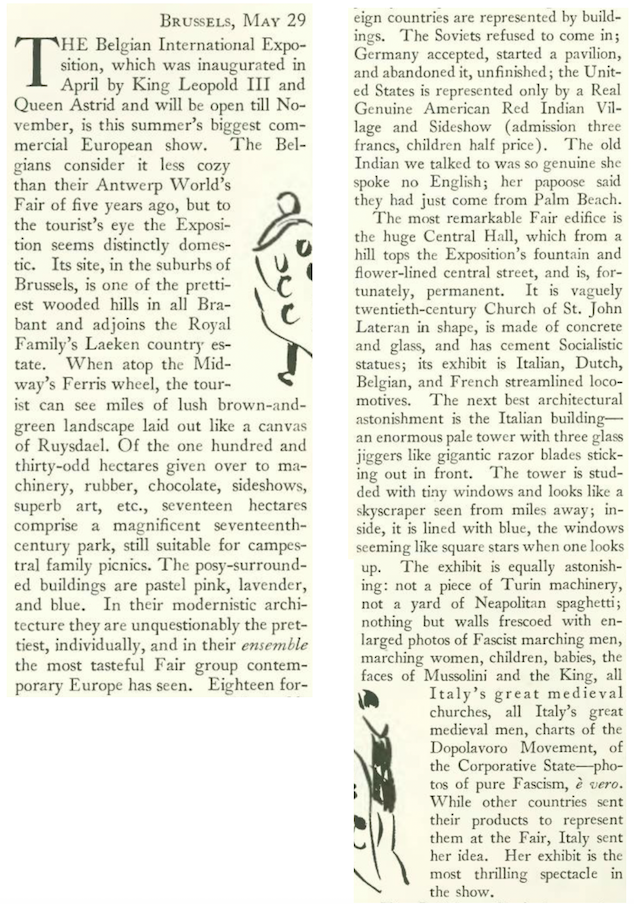
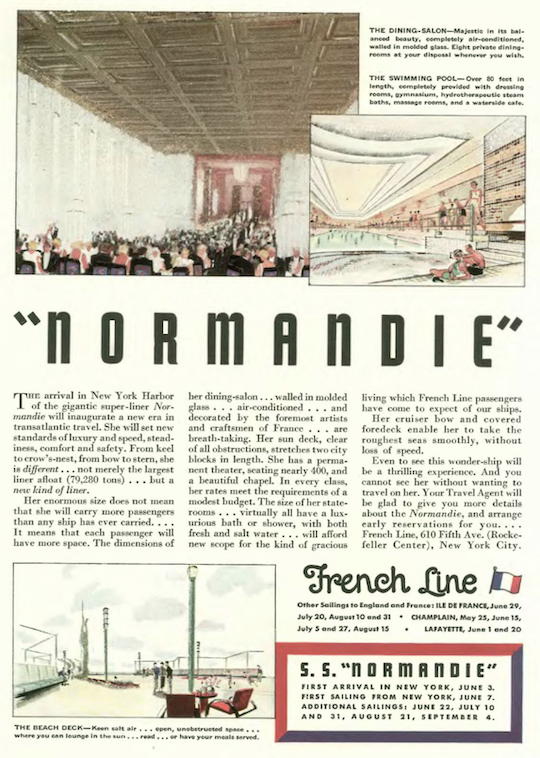
…anticipation was building for the June arrival of the new French liner S.S. Normandie, the largest and fastest passenger ship afloat…

S.S. Normandie on the high seas. (Wikipedia)

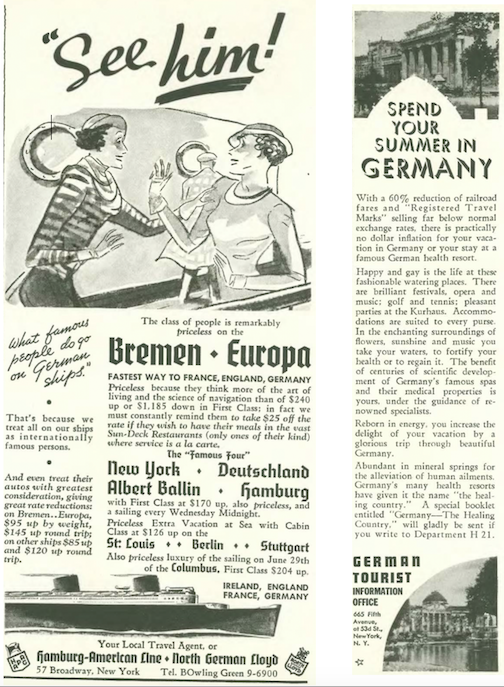
…the Hamburg-American Line was another way to get across the pond, and it promised a ship filled with famous and classy people (and likely more than a few Nazis)…the single-column ad on the right suggested you could spend your summer in Germany…the tourist bureau claimed that Germany was known as “the healing country,” and doubtless many needed healing after being beaten by Brownshirts…

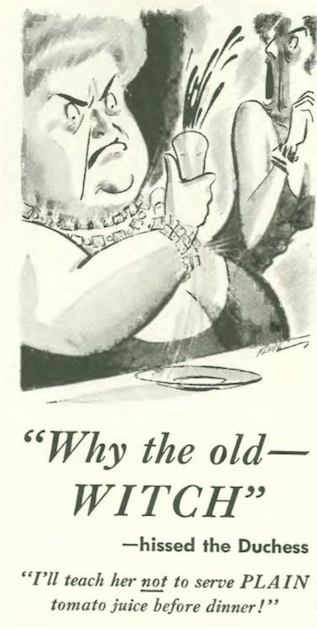
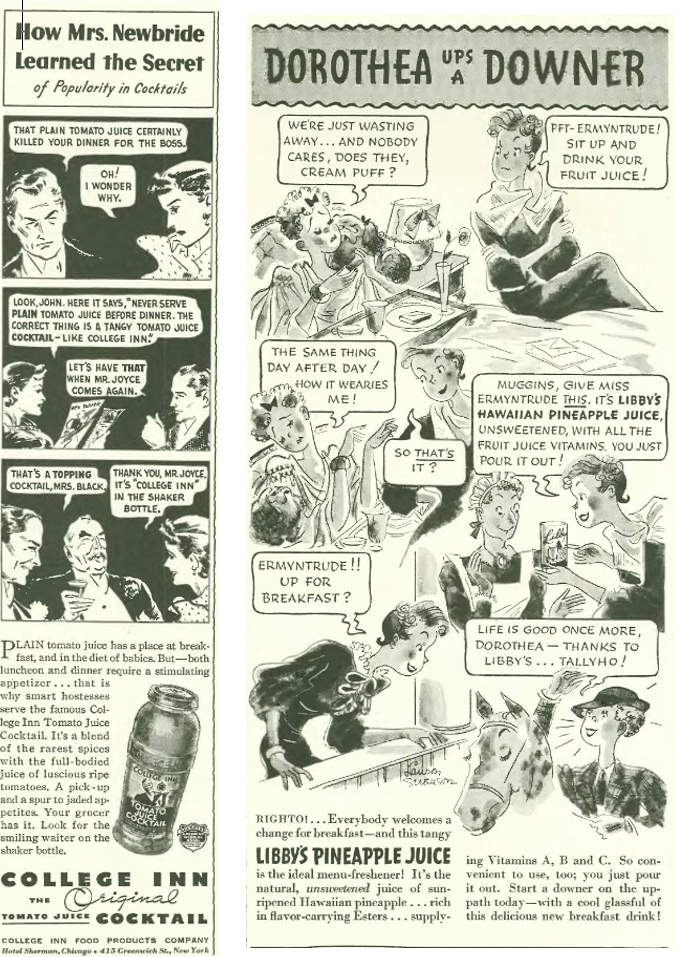
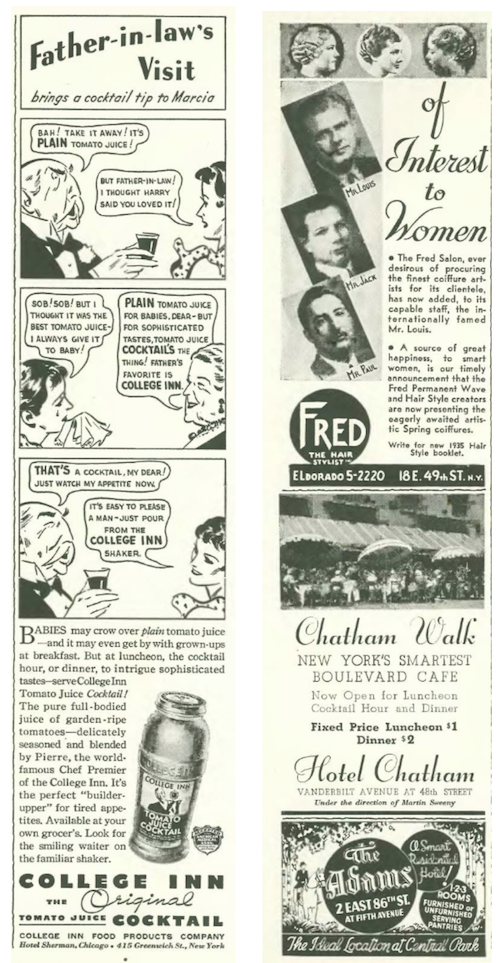
…a couple more single-column ads, first from our friends at College Inn, who dumped the furious Duchess in favor of a dyspeptic father-in-law who brings his daughter-in-law to tears over her choice of tomato juice…the ad at right advertised the services of Mr. Louis, Mr. Jack, and Mr. Paul at the hair stylist Fred, while a tiny ad at the bottom offered a luncheon for a buck at New York’s “Smartest Boulevard Cafe”…

…the key word in many New Yorker advertisements was luxury, and for a fraction of what you would pay for a Packard, you could, apparently, experience luxury for as little as $745…

…or you could enjoy a bit of elegance by opening a some cans of Heinz soup, chili sauce, stuffed olives and other delectables…here a couple of shady-looking butlers are serving nothing but canned goods at a swanky party, much to the annoyance of the cook, who appears poised to take a cleaver to the scheming pair…

…and look what else you can get from a can, some soup with a “personality”…

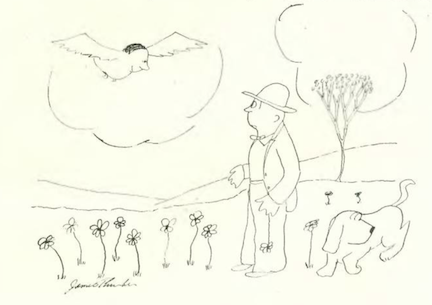
…enough of that nonsense, on to our cartoonists, with two spots from James Thurber

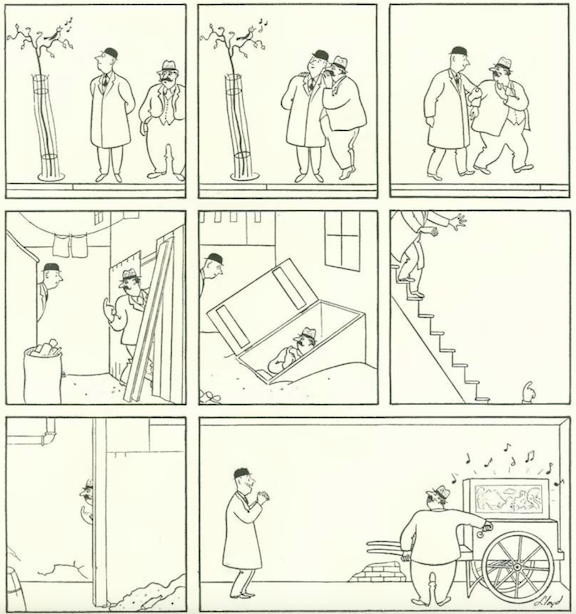
...Lloyd Coe gave us this musical multi-panel…

Leonard Dove looked in on the complex world of young love…

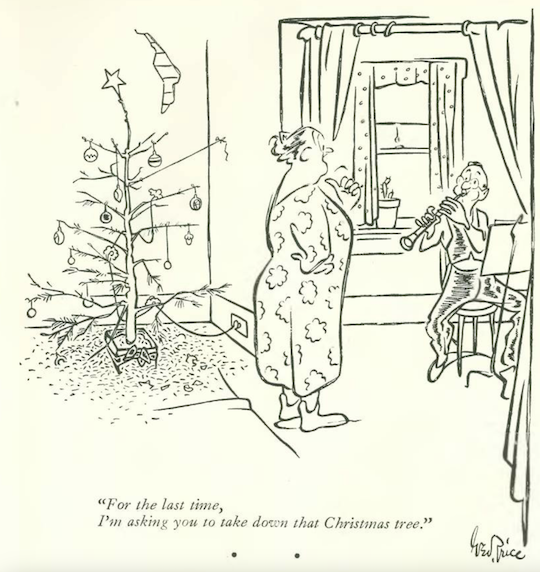
George Price found the Yuletide spirit still alive among procrastinators…

…and we close with Alan Dunn, and some earthy reading…

Next Time: Vive La Normandie…

What’s in a Name?

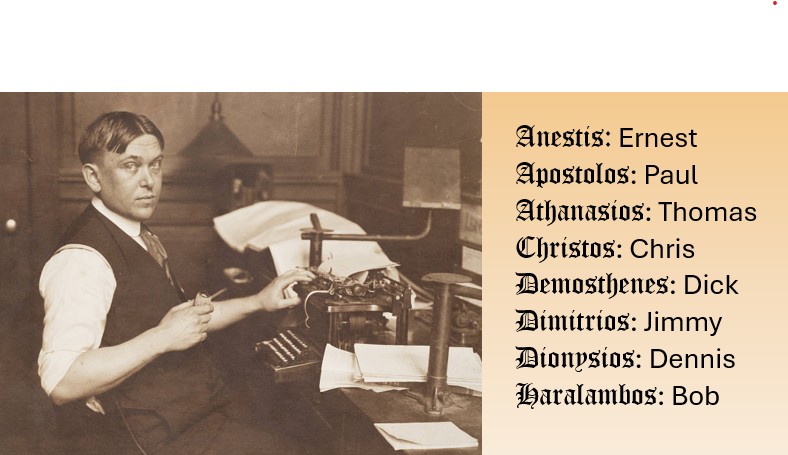
Above: H.L. Mencken at the Baltimore Sun, circa 1930. From April 1934 to September 1949, Mencken contributed more than fifty articles to The New Yorker.

The American journalist Henry Louis Mencken (1880–1956) was well-known as a biting satirist and cultural critic, but he was also a noted scholar of the English language and its various quirks.

May 11, 1935, Mother’s Day cover by William Cotton.

One of those quirks was explored in Mencken’s essay, “The Advance of Nomenclatural Eugenics In the Republic,” for the column “Onward & Upward With The Arts.” Broadly defined, eugenics refers to the discredited belief that selective breeding could be used to improve the human race. Mencken used the term satirically to describe the anglicization of immigrant names, either to conform to English spellings or, in many cases, to avoid racial and ethnic discrimination. An excerpt:

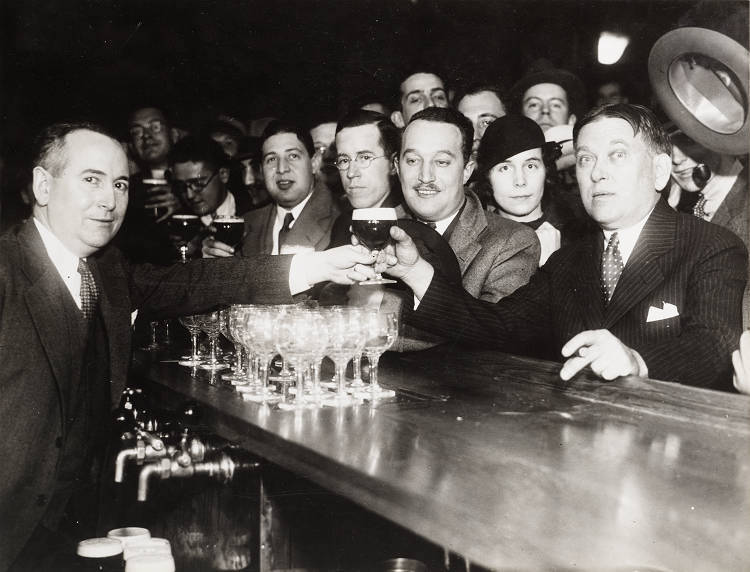
A PERFECT PAIRING, for H. L. Mencken, was a beer and a cigar. Here he is accepting “his first public glass of post-Prohibition beer” at the Rennert Hotel in Baltimore on April 7, 1933. In 1924 Mencken wrote: “Five years of Prohibition have had, at least, this one benign effect: they have completely disposed of all the favorite arguments of the Prohibitionists.” (digitalmaryland.org)

Many Jewish immigrants also abandoned their surnames, seeking to blend in and avoid discrimination. Historian and author Kirsten Fermaglich (A Rosenberg by Any Other Name, 2016) found that persons with Jewish-sounding last names made up 65 percent of all name change requests in New York in the first quarter of the 20th century. Mencken observed:

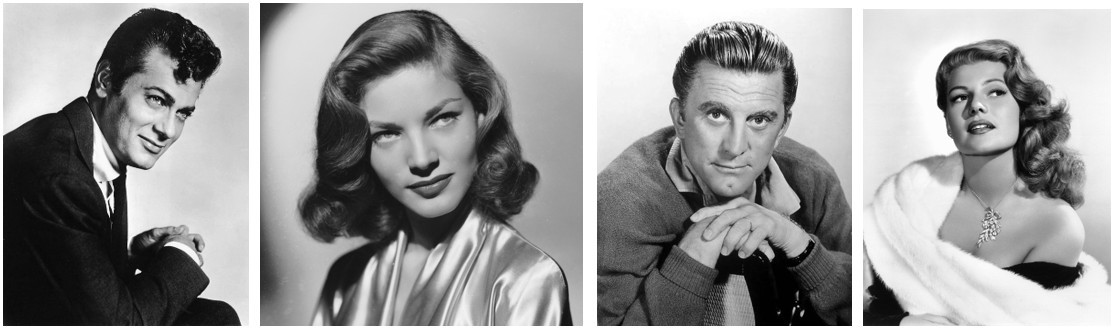
MEET BERNARD, BETTY, ISSUR AND MARGARITA…Some more famous examples of name changes in the first half of the 20th century. From left, actors (and New Yorkers) Tony Curtis (Bernard Schwartz), Lauren Bacall (Betty Joan Perske), Kirk Douglas (Issur Danielovitch Demsky), and Rita Hayworth (Margarita Carmen Cansino). (Wikipedia)

 * * *

Canada Dry

In his column, “Of All Things,” Howard Brubaker noted the “well-merited spanking” FDR gave to military leaders who were talking about fortifying the border with Canada. Brubaker agreed with FDR’s action, observing how Canadians came to the aid of thirsty Americans during Prohibition.

 * * *

Air France

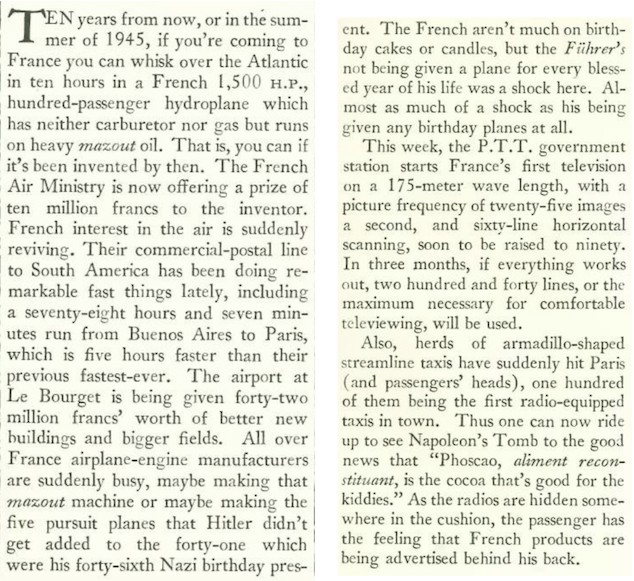
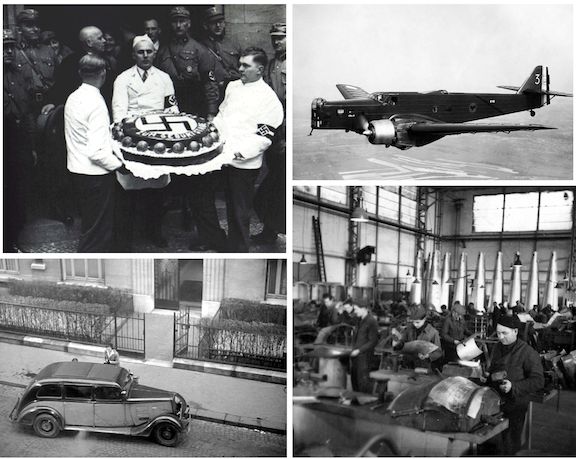
Paris correspondent Janet Flanner considered the state of French aviation as well as signs of war preparation. She also noted the birthday of German dictator Adolf Hitler, the birth of French television, and the streamlined taxis that had suddenly appeared on the streets of Paris. Excerpts:

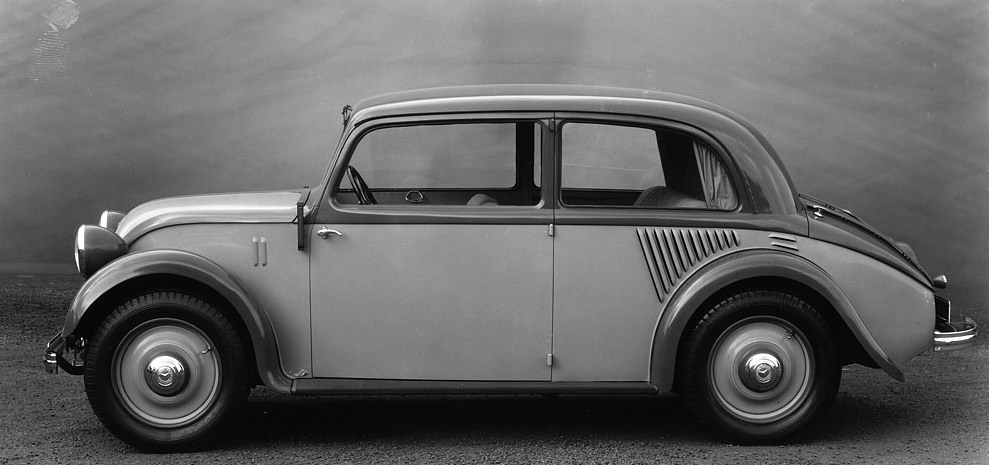
SOME ICE CREAM WITH YOUR SLICE OF HATE?…Clockwise, from top left, bakers carefully carry Adolf Hitler’s birthday cake in April 1935; the French, meanwhile, were ramping up war production including the manufacture of the M210 bomber; airplane factory workers fashion sheet metal in a factory in Châteauroux-Déols; streamlined Peugeot 401 taxis hit the Paris streets in 1935. (reddit.com/dassault-aviation.com/imcdc.org)

 * * *

Vamps and Vampires

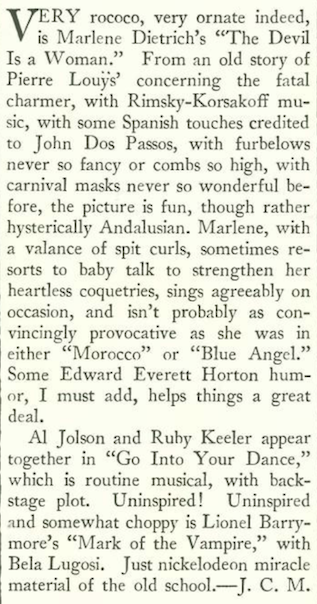
John Mosher offered mixed reviews of Hollywood’s latest fare, finding Marlene Dietrich’s latest vehicle “fun,” and the singing and dancing of husband/wife Al Jolson and Ruby Keeler “uninspired,” a term he also applied to Bela Lugosi’s latest vampire flick.

TAKE YOUR PICK…Critic John Mosher sampled some very different films including, left, Marlene Dietrich and Lionel Atwill in The Devil Is a Woman; top, Ruby Keeler with her then-husband Al Jolson in Go Into Your Dance; and Bela Lugosi did his vampire schtick with the help of Carroll Borland (who played Dracula’s daughter) in Mark of the Vampire. (MoMA/Pinterest/Instagram)

 * * *

From Our Advertisers

We start off with a bang from Goodyear…tire blowouts were common in the 1930s as tire technology could not keep pace with the increasing speed of automobiles, nor the poor condition of many roads…

…after many weeks, the back cover went to something other than cigarette manufacturers…

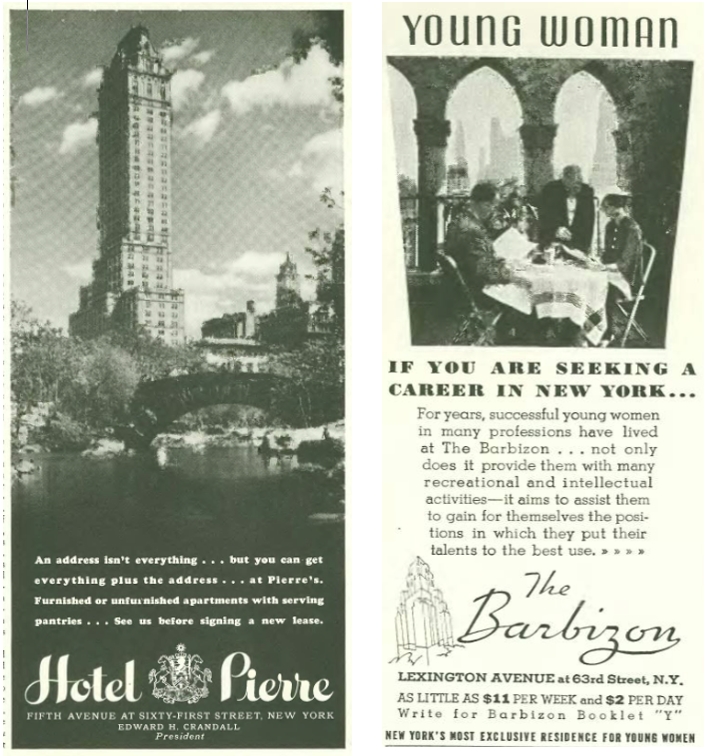
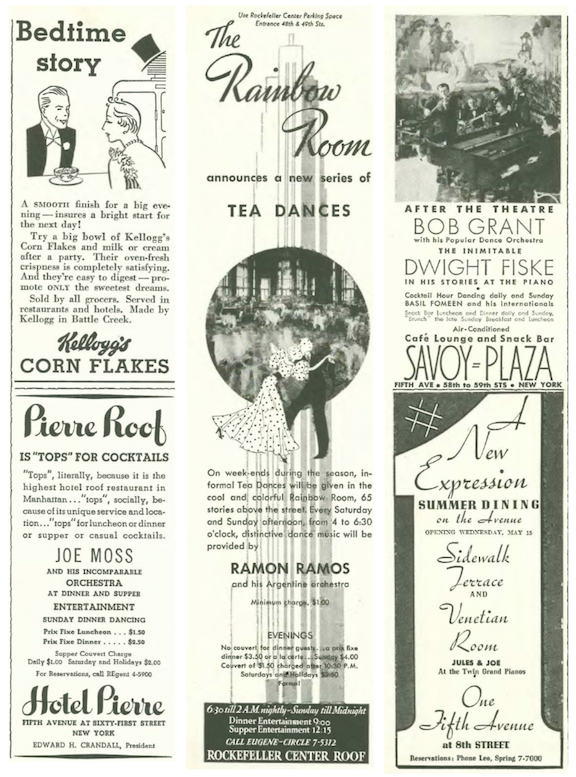
…let’s take a look at some of the one-column ads from the back pages…many of them highlighted the various nighttime entertainments, from the rooftop of Hotel Pierre to the air-conditioned lounge at the Savoy-Plaza (plus that weird ad that suggested Corn Flakes as a nightcap)…

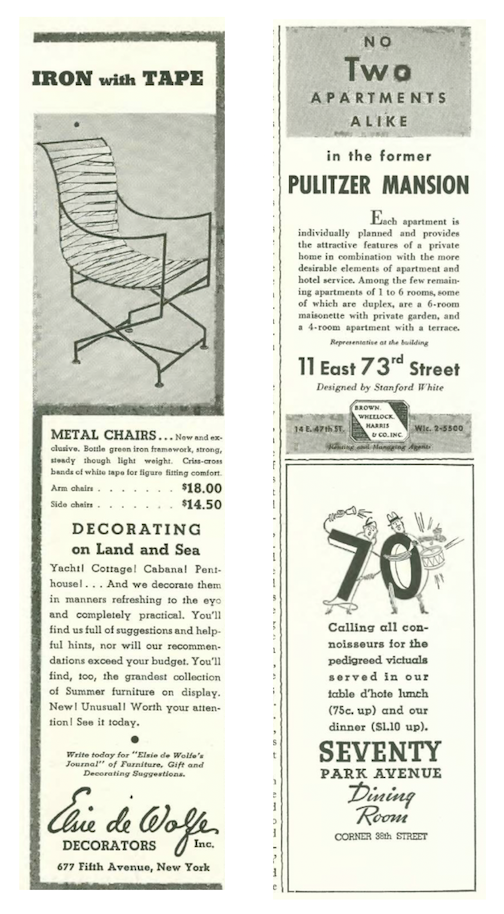
…interior designer Elsie de Wolfe rolled out “Iron with Tape” chairs, which might be the first example of what would become the ubiquitous webbed lawn chair…also advertised were apartments in the former Pulitzer mansion…

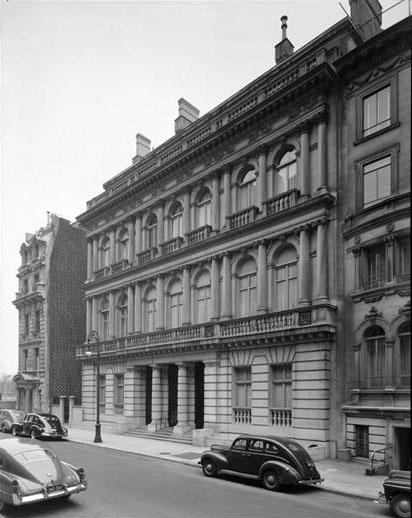
…the Pulitzer apartments were one happy outcome of the Great Depression, which foiled the plans of investors to demolish the house in 1934 and erect an apartment building…

The Pulitzer mansion still stands today, now divided into high-class coops. (daytoninmanhattan.blogspot.com)

…here’s something new from the Jay Thorpe shop, “noted for unusual sportswear”…

…perhaps inspired by Hollywood…

Ruby Keeler in 1935’s Shipmates Forever. (Reddit)

…illustrator Lyse Darcy created many of these distinctive ads for Guerlain products from the 1930s through the 1950s…

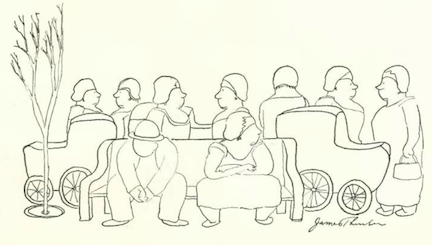
…on to our cartoonists, we begin with spot art from James Thurber

…and Thurber again…

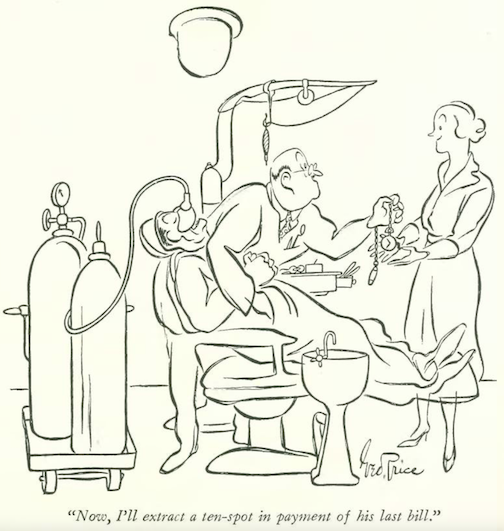
…and we have two from George Price

Otto Soglow continued with his multi-panel tricks…

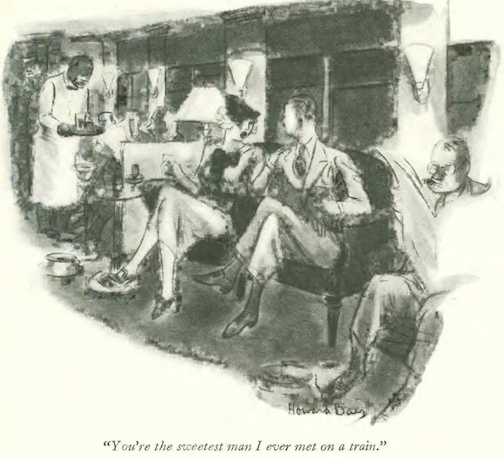
Howard Baer did some eavesdropping on the rails…

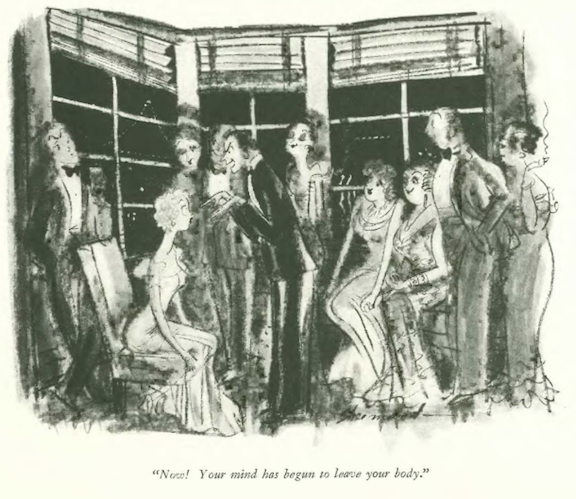
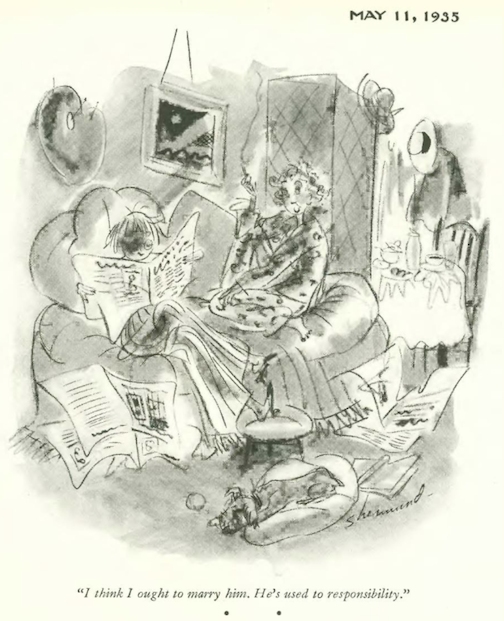
…while Barbara Shermund checked in on her modern women…

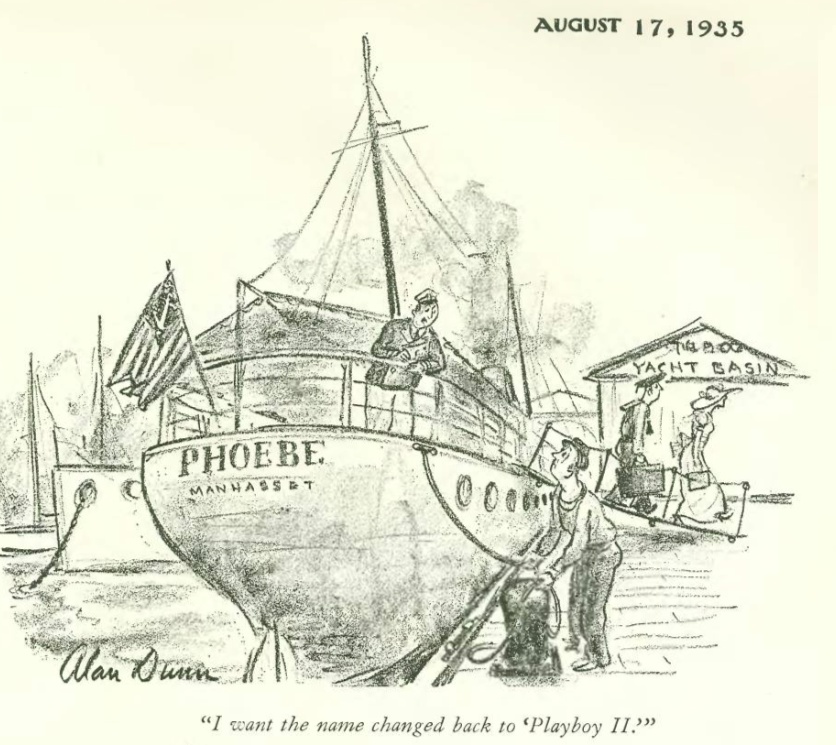
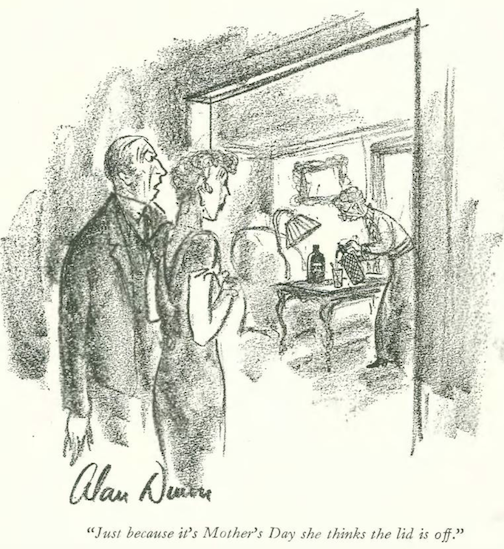
Alan Dunn gave us a mother who took care of herself on Mother’s Day…

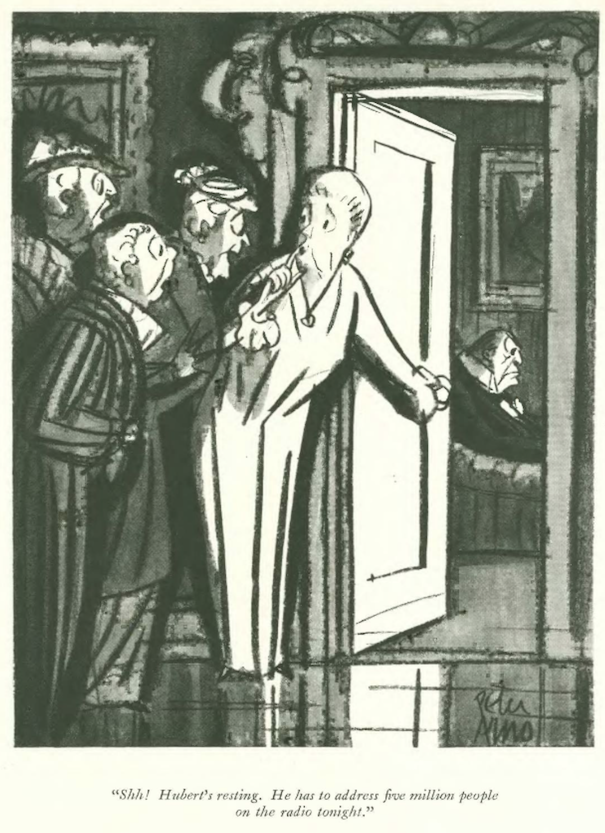
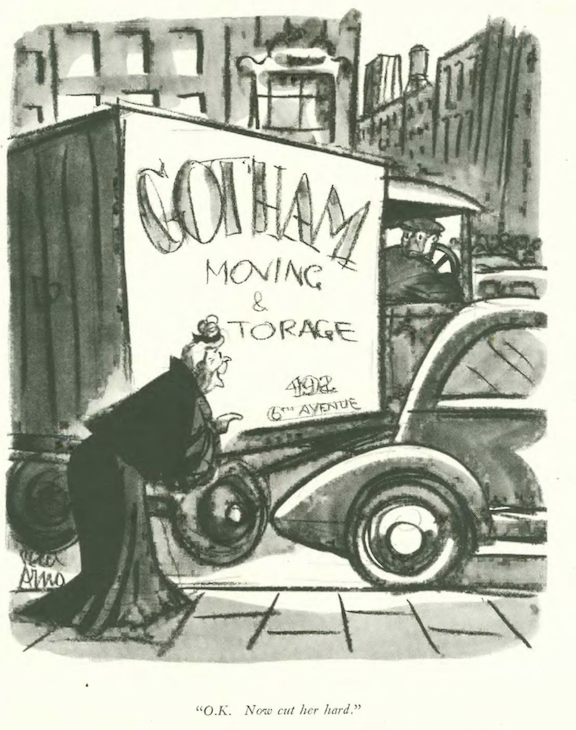
Peter Arno found some kindly advice in the crowded city…

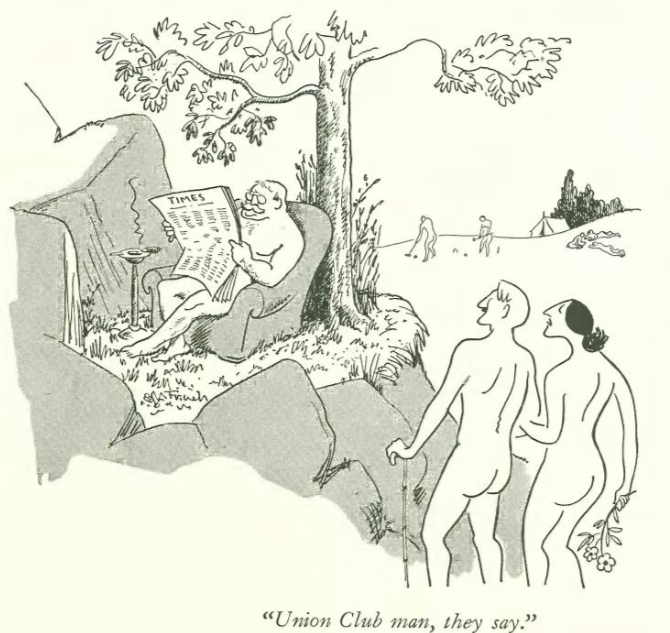
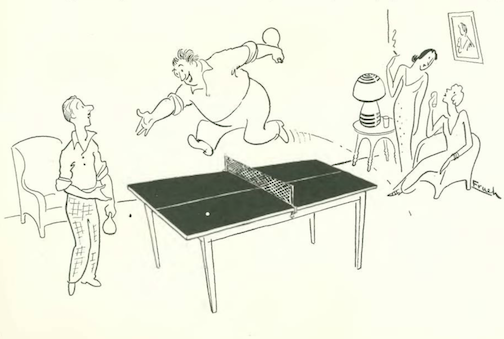
Al Frueh put the “tennis” back into table tennis…

…and we close with Charles Addams, who had become a regular contributor but was still more than three years away from launching his “Addams Family” cartoons…

Next Time: Settling Down, In a Way…


The Royal Treatment

Above: King George V and Queen Mary posed for portraits by John St Helier Lander to commemorate the king’s Silver Jubilee in 1935. (Wikipedia) 

The British Royal Family has never been my cup of tea, but its hard to deny their influence on world affairs, even if today it is mostly ceremonial. The king and queen were also figureheads back in 1935, however they could still claim to lead a vast empire, albeit one badly fraying at the seams.

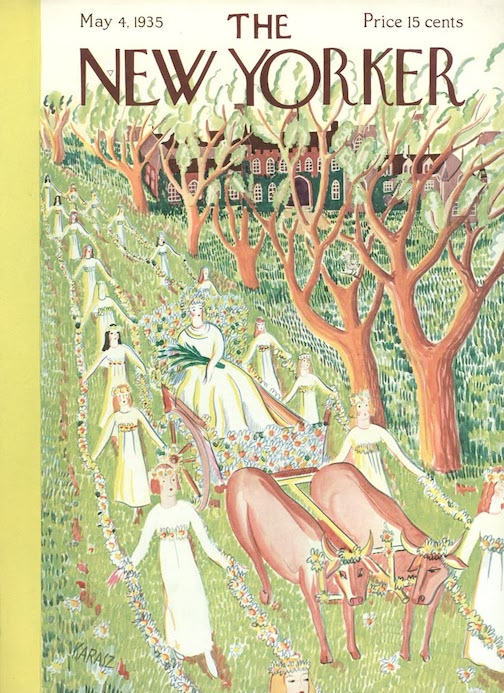
May 4, 1935 cover by Ilonka Karasz.

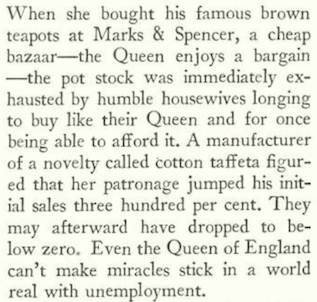
Then as now, the power of the royals lay largely in their ability to boost the political and economic fortunes of their island nation. Such was observed by The New Yorker’s Paris correspondent Janet Flanner, who penned a two-part profile of Queen Mary (nee Mary of Teck or more formally Victoria Mary Augusta Louise Olga Pauline Claudine Agnes; Queen of the United Kingdom and the British Dominions, and Empress of India). Flanner wrote the profile of Queen Mary (1867-1953) in anticipation of the Silver Jubilee of her husband, King-Emperor George V (1865-1936). Excerpts:

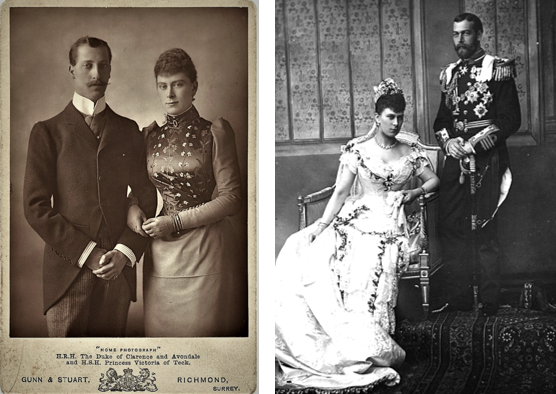
A DEB AND A DUKE…In 1886 Mary was a an unmarried British princess who was not descended from Queen Victoria, so she was a suitable candidate for the royal family’s most eligible bachelor, Mary’s second cousin Prince Albert Victor, Duke of Clarence and Avondale. In early December 1891 Albert Victor (left photo) proposed marriage to Mary, but he died six weeks later in the Russian flu pandemic. Less than two years later (July 1893) Albert Victor’s brother, Prince George, Duke of York, would wed Mary—at right, their wedding day photo. (Wikipedia)

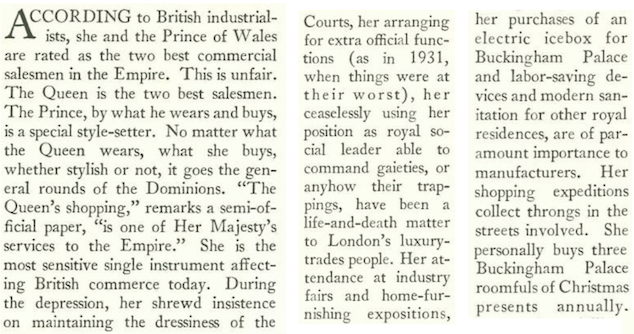
Flanner noted that the King George V and Queen Mary were rated by British industrialists as the Empire’s “two best salesmen,” however it was Mary who proved the most influential whether she was buying a hat or a refrigerator. Excerpts:

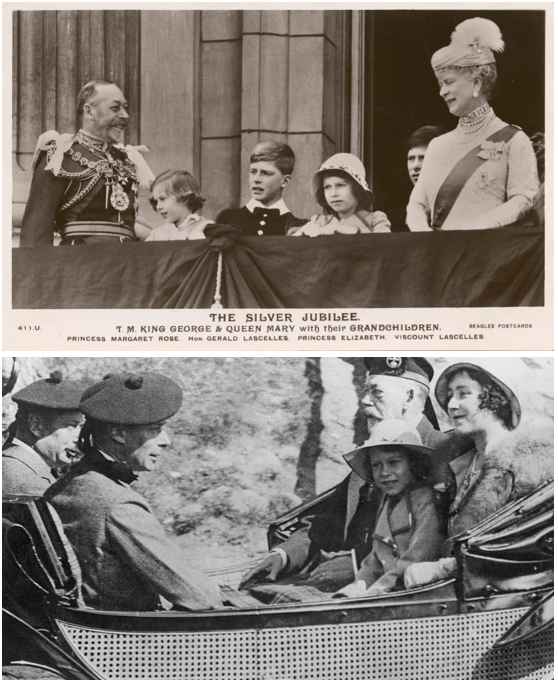
SILVER AND GOLD…Top photo: to mark the king’s Silver Jubilee on May 6, 1935, King George V and Queen Mary greet their subjects from a balcony at Buckingham Palace with their grandchildren, (from left) Princess Margaret Rose, Hon. Gerald Lascelles, Princess Elizabeth, and Viscount Lascelles. Below, King George V, the Duke and Duchess of York, and Princess Elizabeth take a trip in the royal carriage, 1933. The Duke and Duchess would succeed the throne upon the death of King George in 1936 and the abdication of the Duke’s brother, Edward, that same year. (Reddit/Town & Country)

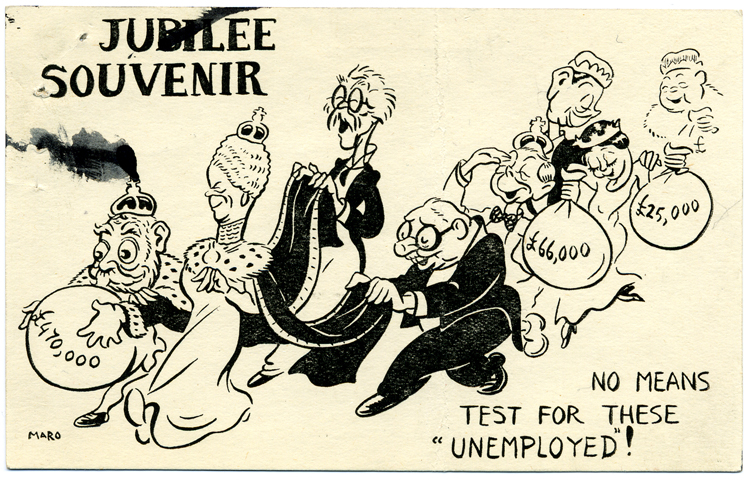
Naturally, not everyone in the kingdom was thrilled by the Silver Jubilee…

OPPOSING VIEWPOINT…The anti-monarchist cartoonist Desmond Rowney commemorated the Silver Jubilee with this cartoon in the Daily Worker. The public expense for the Silver Jubilee in the midst of a financial depression caused some controversy. (National Archives UK)

 * * *

Corn-fed Canvasses

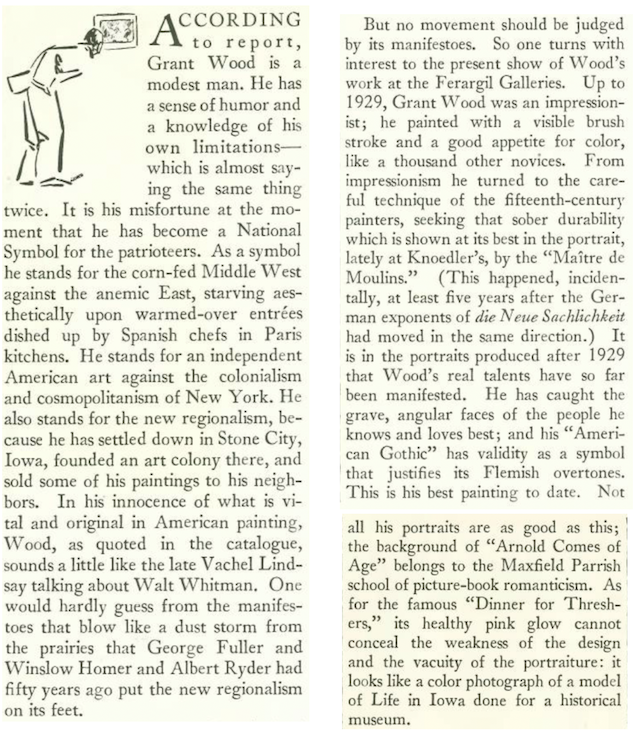
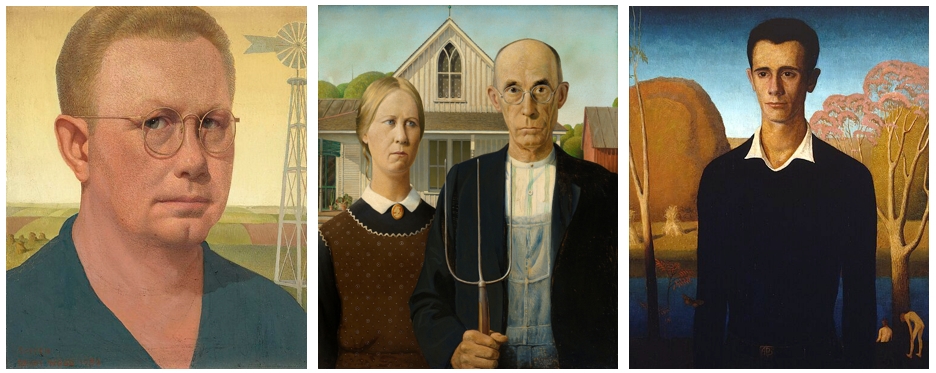
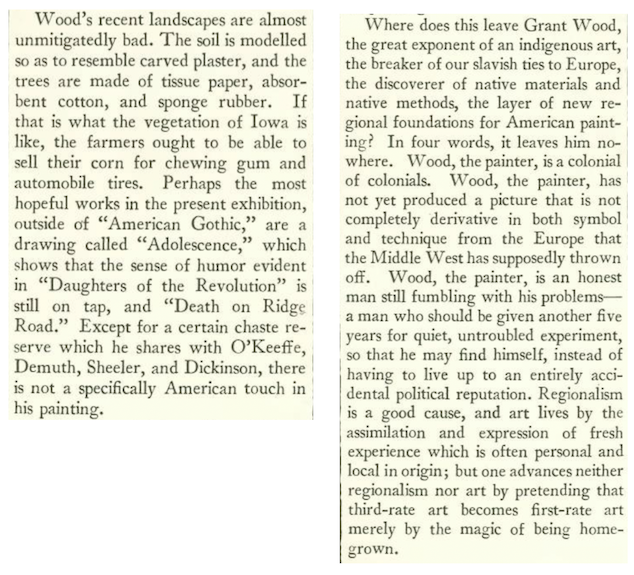
Critic Lewis Mumford, like many East Coast intellectuals, was allergic to the over-patriotic and the sentimental, so when it came to assessing the work of the regionalist painter Grant Wood (1891-1942), Mumford found himself perplexed but hopeful that Wood would one day “find himself” and produce “first rate” art.

FLANKING THE ICONIC painting American Gothic (1930) are Grant Wood’s Self Portrait (1932) and, at right, Arnold Comes of Age (1930). Lewis Mumford considered American Gothic to be Wood’s best work. (figgeartmuseum.org/whitney.org/sheldonartmuseum.org)

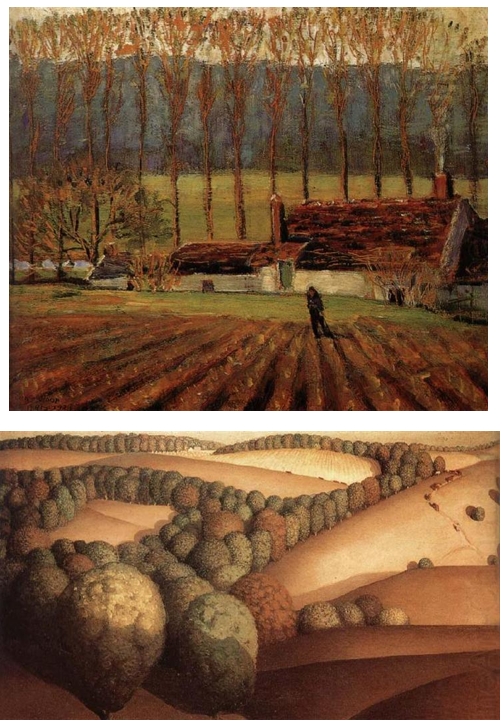
Mumford did not mince words, however, when it came to Wood’s contemporary landscapes, which he called “unmitigatedly bad…If that is what the vegetation of Iowa is like, the farmers ought to be able to sell their corn for chewing gum…”

BUBBLEGUM TREES…From 1919 to 1925, Grant Wood taught junior high art in Cedar Rapids, Iowa. The seasonal nature of teaching allowed Wood to take summer trips to Europe to study art, and his early work showed strong post-impressionist influences, including his impressionistic Vegetable Farm (top) from 1924; below, Mumford thought Grant’s later landscapes looked like they were made of cotton and sponge rubber, including Near Sundown, from 1933. (wikiart.org)
HOPE AND NOPE…Mumford wrote that Wood’s more “hopeful” works included, top left, Death on Ridge Road and, top right, Adolescence. On the other hand, he found the portraiture in Dinner for Threshers (bottom) vacuous, suggesting “a color photograph of a model of Life in Iowa done for a historical museum.” (wikiart.org/figgeartmuseum.org)

 * * *

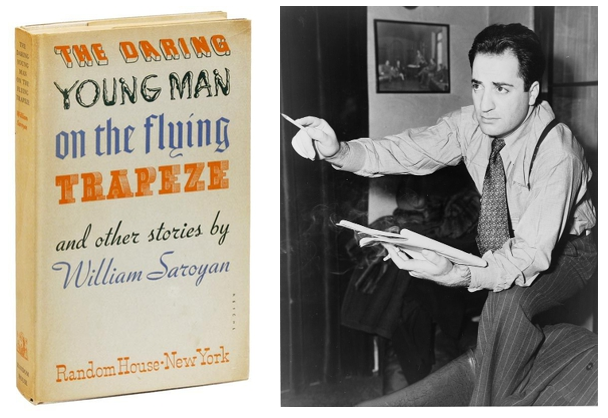
Daring Young Man

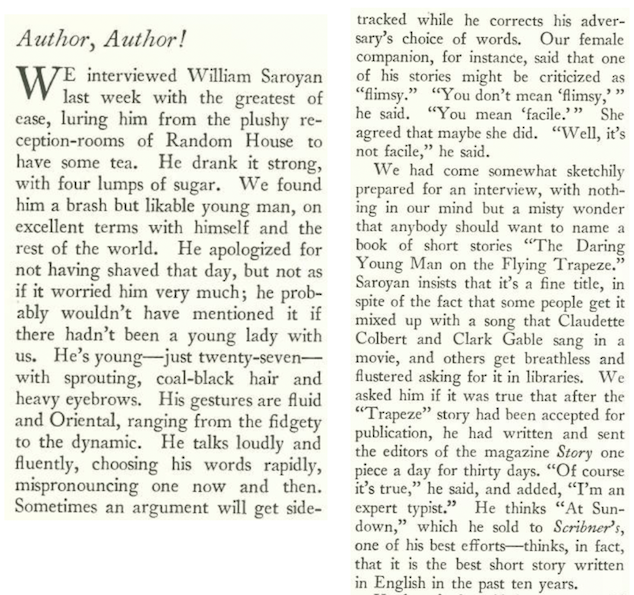
“The Talk of the Town” paid a visit to William Saroyan (1908–1981), an Armenian-American novelist, playwright, and short story writer who would go on to receive a Pulitzer Prize for Drama in 1940 and a 1943 Academy Award for Best Story for the film The Human Comedy. An excerpt:

HIGH WIRE ACT…The Daring Young Man on the Flying Trapeze and Other Stories (1934) was the first collection of 26 short stories by William Saroyan (pictured here in 1940). The book became an immediate bestseller. (Wikipedia)

 * * *

Not Long For Long

In his column “Of All Things,” Howard Brubaker noted that the “loose talk” of Huey Long, a U.S. Senator from Louisiana and prominent critic of the New Deal, could be squelched by a Senate vote. As it turned out, it wouldn’t be necessary; Long was felled by an assassin’s bullet four months later.

 * * *

Ode to Abode

E.B. White turned to verse to offer his thoughts on where one should live:

 * * *

Tough Guys

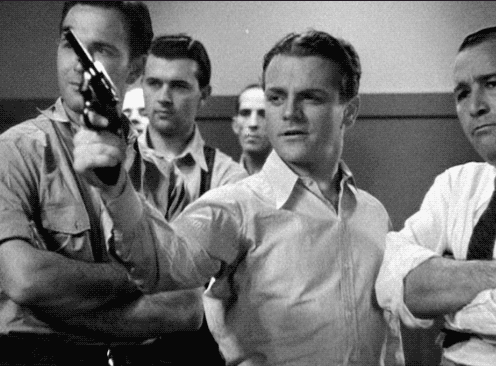
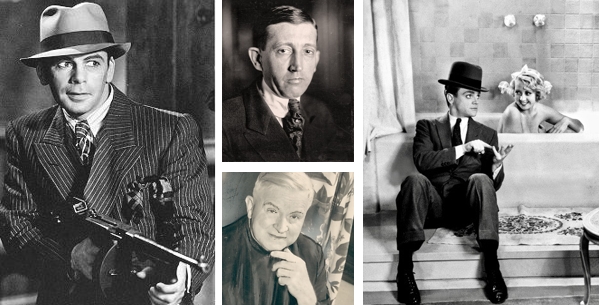
After a musical comedy, a Shakespeare adaptation (A Midsummer Night’s Dream), and another comedy, James Cagney returned to familiar form with an exciting crime drama, G Men. Critic John Mosher was pleased that Cagney was back to tap-dancing with machine guns rather than showgirls.

CRIME PAYS…AT THE BOX OFFICE… James Cagney takes aim at his new role as a federal agent James “Brick” Davis in G Men. With the Hays Code in force, Warner Brothers made the film to counteract what many leaders claimed was a disturbing trend of glorifying criminals in gangster films. (Still from film)

 * * *

From Our Advertisers

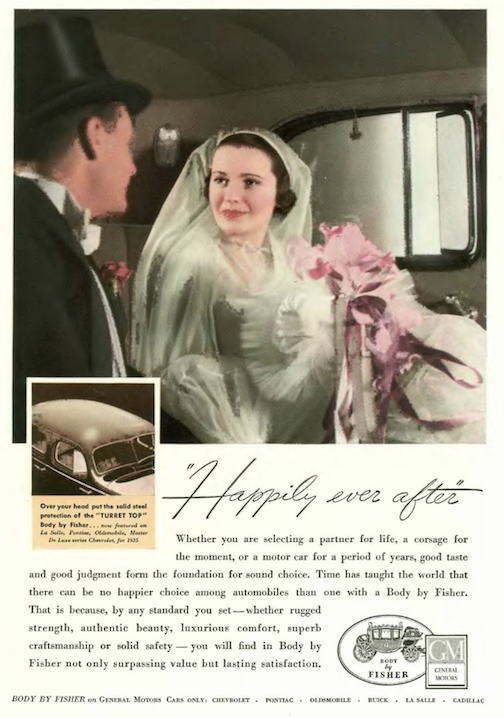
According to General Motors’ Fischer division, good taste was in order whether you were choosing a spouse or an automobile…
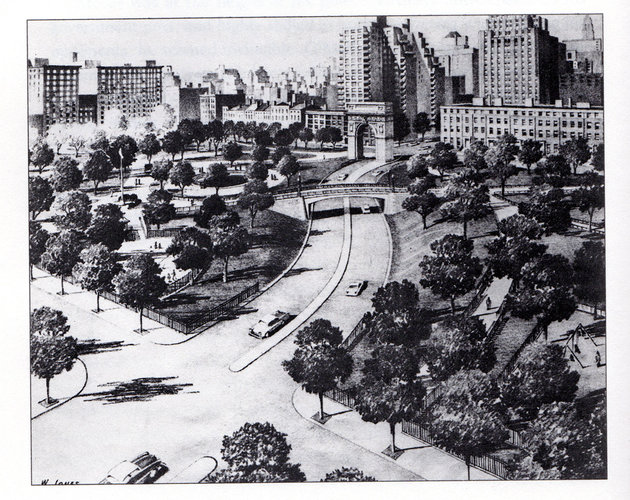
New Yorker ads continued to display bright colors to sell everything from cars to whiskey to sparkling water (with apparent health benefits)…

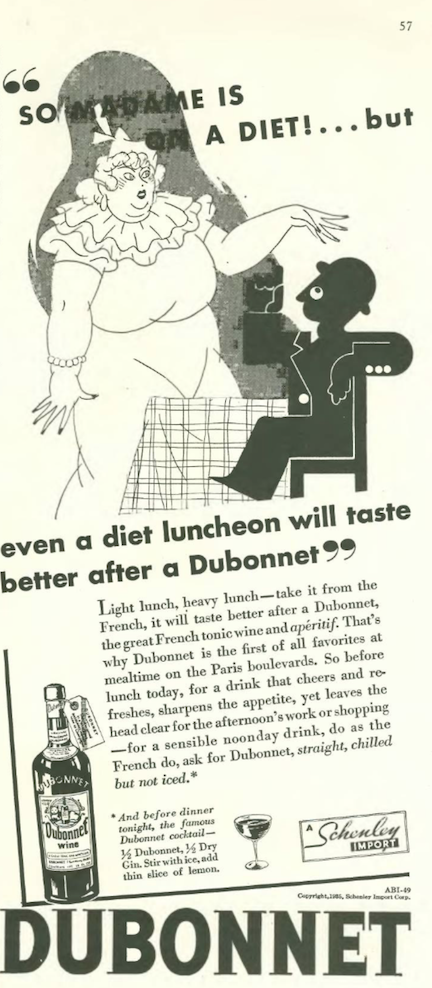
…the shadowy Dubonnet mascot was back, here making the claim (against the wisdom of the ages) that a lunchtime drink will clear your head for the afternoon ahead…

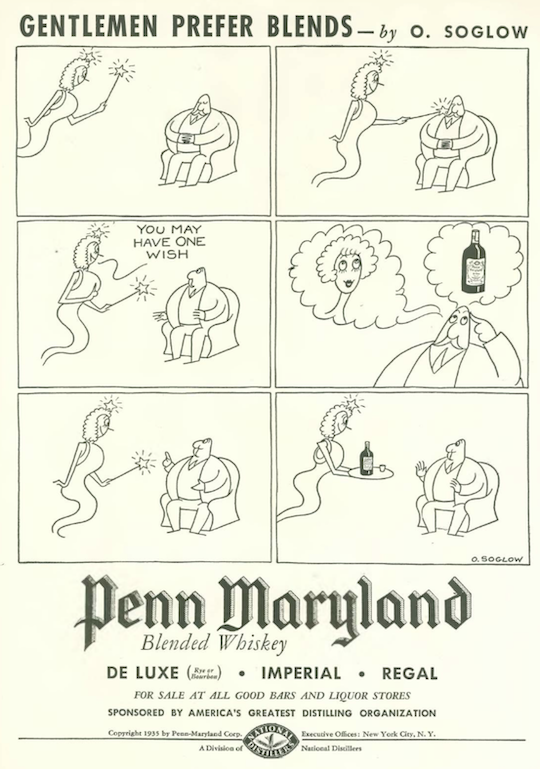
…no health claims here from Penn Maryland, just pure magic as depicted by Otto Soglow

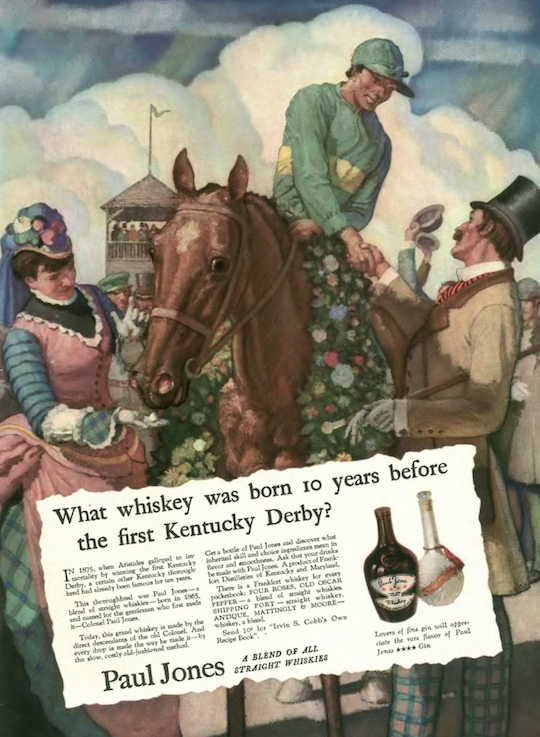
…and what goes better with whiskey than the Kentucky Derby…

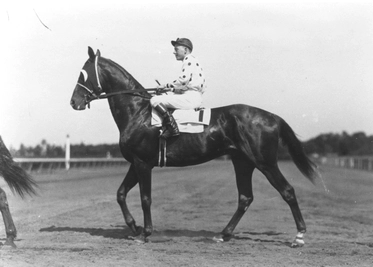
…the 1935 Kentucky Derby was won by Omaha, a three-year-old Thoroughbred; he was the third horse to ever win the Triple Crown (Omaha was the son of Gallant Fox, the 1930 U.S. Triple Crown winner)…

Omaha in 1935 (Wikipedia)

…on the subject of Thoroughbreds, Camel offered up testimonials from top athletes in a variety of sports…they all agreed that the cigarettes “don’t get your wind”…so what did that mean?…according to R.J. Reynolds, “It means you can smoke Camels all you want”…

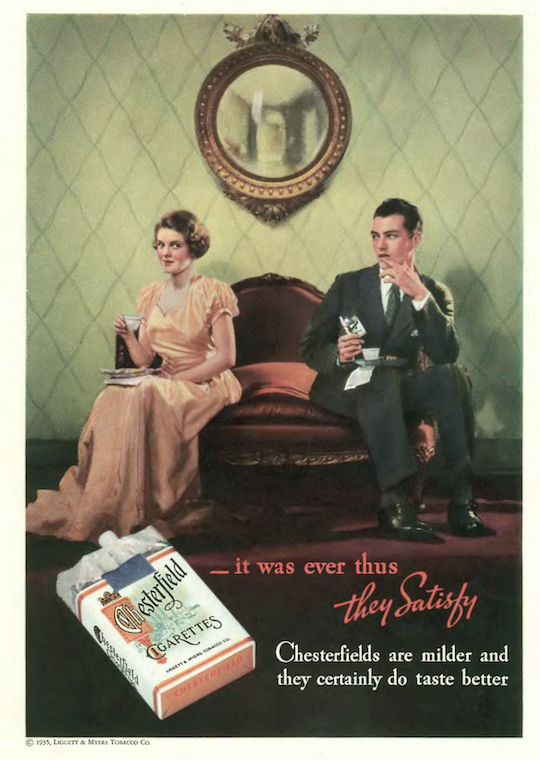
…Camels also calmed the nerves, and so apparently did Chesterfields…

…on to our cartoonists, we begin with a spot by Charles Addams at the top of page 2…

…later in the issue James Thurber contributed this drawing to stretch across the bottom of page 62 (“On and Off the Avenue”)…

…Thurber again, with the life of the party…

William Steig offered up a page-full of wits…

…plus one more on the preceding page…
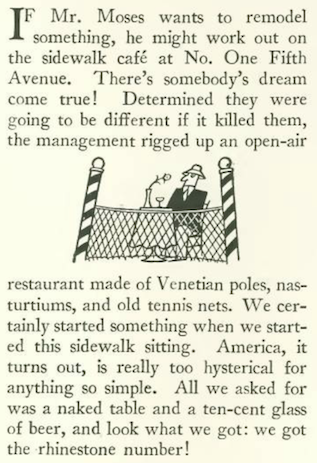
Gluyas Williams continued to follow the strange ways of club life in America…

…and we close with Alan Dunn, and service with a smile…

Next Time: What’s In a Name?…


The Cowboy Philosopher

William Penn Adair Rogers, aka Will Rogers (1879–1935), was a man of many talents. Today he is mostly referred to as a humorist, but he was also an actor, a social and political commentator, a trick roper and a vaudeville performer. To Americans he was a national icon.

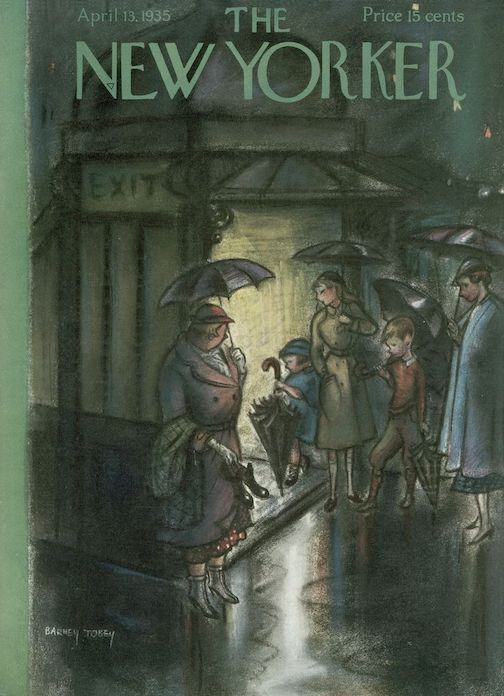
April 13, 1935 cover by Barney Tobey.

Rogers was also internationally famous, having traveled around the world three times and appearing in 71 films (50 of those silent). He also wrote more than 4,000 newspaper columns—nationally syndicated by The New York Times—that reached 40 million readers, and there were also magazine articles, radio broadcasts and personal appearances. He seemed to be everywhere.

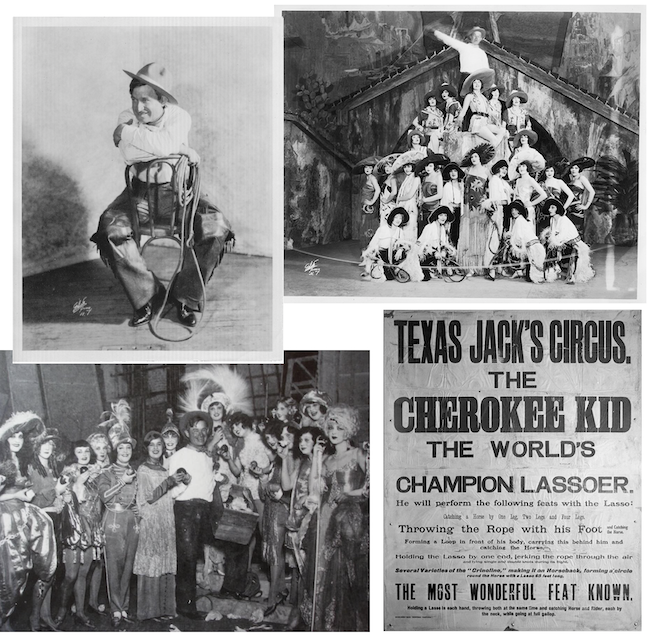
ROPING THEM IN…In 1902, Will Rogers joined Texas Jack’s Wild West Show & Circus in South Africa as the “Cherokee Kid”—he was born as a citizen of the Cherokee Nation, in the Indian Territory that is now part of Oklahoma. By 1910, he had created a sensational vaudeville act by mixing trick roping with witty monologues. Clockwise, from top left, Rogers in a publicity photo from 1916, the year he joined the Ziegfeld Follies; on stage with the Follies in 1924; poster from his circus days; backstage with the 1924 Follies cast. (National Portrait Gallery)
MULTIMEDIA MULTI-TALENT…Left, Rogers catches a few moments to write one of his 4,000 nationally syndicated newspaper columns; from 1929 to 1935 he used the exciting new medium of radio to broadcast his newspaper pieces. His weekly Sunday evening show, The Gulf Headliners, sponsored by Gulf Oil, ranked among the top radio programs in the country. (National Portrait Gallery)

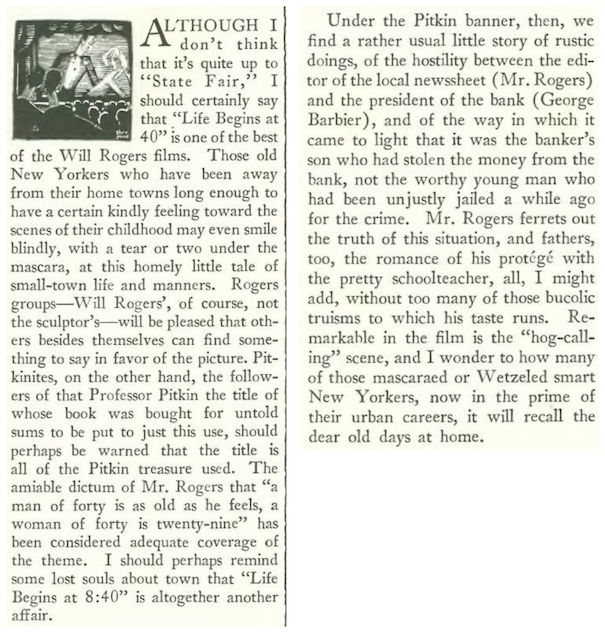
When John Mosher reviewed Rogers’ latest film, Life Begins At Forty, he found it to be one of Rogers’ best. It would also prove to be one of his last. On August 15, 1935, a small airplane carrying Rogers and aviator Wiley Post would crash on takeoff near Point Barrow, Alaska, claiming the lives of both men. Rogers would appear in three more films in 1935, the last two posthumously.

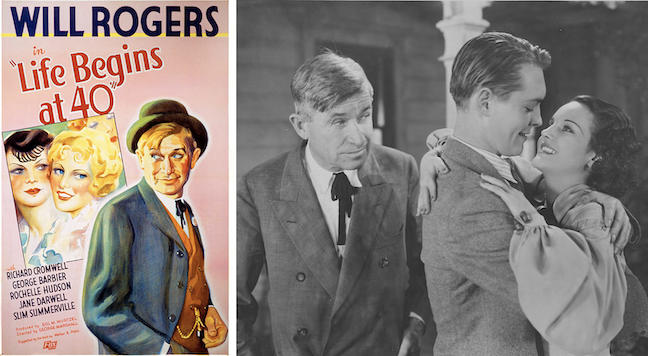
THAT’S LIFE…Will Rogers with Richard Cromwell and Rochelle Hudson in Life Begins at 40. Rogers’ film took its title from a 1932 self-help book by Walter B. Pitkin. Pitkin maintained that keeping a positive attitude toward life could give a person many fulfilling years after age 40. By the time of his death in 1935, the 55-year-old Rogers was Hollywood’s highest paid actor. (Wikipedia/IMDB)

 * * *

Not Toying Around

“The Talk of the Town” looked in on the serious business of toymakers, with 1935 being the year of streamlined tricycles, Buck Rogers disintegrator pistols, and, of course, Shirley Temple dolls.

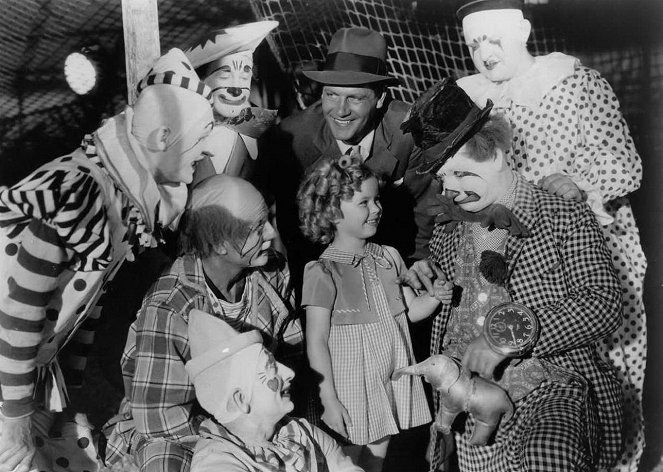
RIVALED ONLY BY MICKEY MOUSE, Shirley Temple was the most popular celebrity to endorse merchandise for children and adults, including the “one and only” Shirley Temple Doll (left, ad from 1935); the Buck Rogers XZ-38 Disintegrator Pistol (top) was produced in 1935 by Daisy, and was available in both copper and nickel finishes–it was also offered as a premium from Cream of Wheat cereal; at bottom, the American National Streamline Velocipede Tricycle (1935), just one example of the hundreds of products receiving the streamlining treatment in the 1930s. (flickr/airandspace.si.edu/onlinebicyclemuseum.co.uk)

 * * *

Literary Spirits

E.B. White welcomed the return of literary tea party, which thanks to the repeal of the 18th Amendment had been re-dubbed the “literary cocktail party.” He shared his thoughts in “Notes and Comment”…

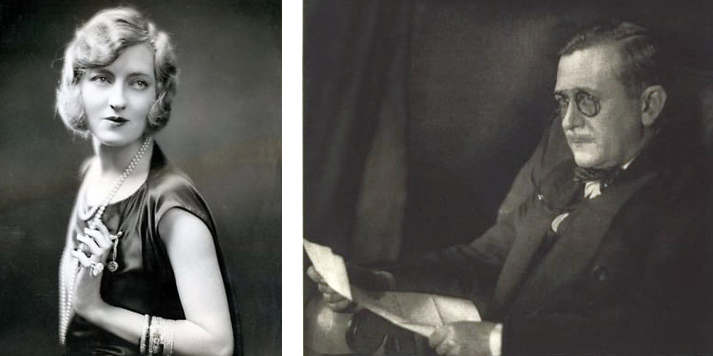
AMUSING MUSES…Actress, writer and socialite Peggy Hopkins Joyce hosted literary “teas” in the 1920s, while former Cosmopolitan editor Ray Long inspired a book on adventures in the South Seas shortly before his death; from left, Joyce in 1923; photogravure of Long, 1925. (Wikipedia/photogravure.com)

 * * *

Proto Feminist

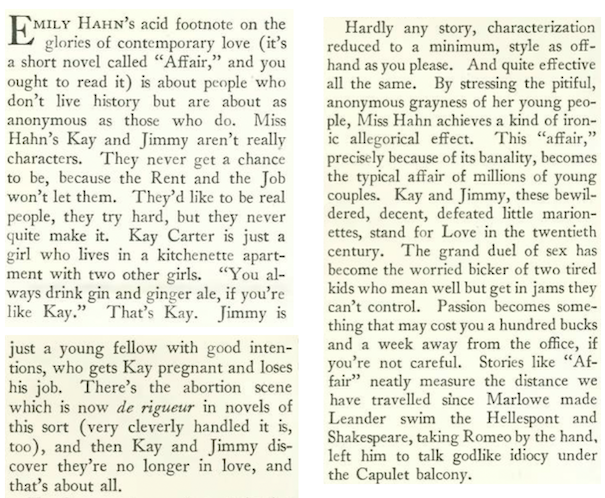
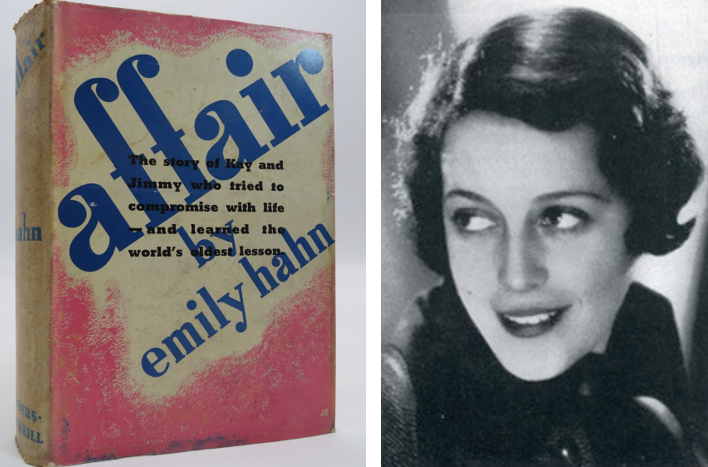
Emily Hahn was one of the more lively figures in The New Yorker’s stable of journalists and writers, leading an adventurous life that included a hike across Central Africa in the 1930s and getting into all kinds of trouble during the Japanese invasion of China. According to Roger Angell, Hahn was, “in truth, something rare: a woman deeply, almost domestically, at home in the world. Driven by curiosity and energy, she went there and did that, and then wrote about it without fuss.” It is no surprise that Hahn’s latest novel, Affair, didn’t shy away from topics like abortion. According to reviewer Clifton Fadiman, the novel’s “anonymous grayness” exposed the banality of love in the twentieth century.

If Hollywood is looking for a new biopic, Hahn would make a fascinating subject (Kristen Stewart would be perfect for the part). According to IMDB, there is an “Untitled Emily ‘Mickey’ Hahn Project”—a TV series—that has been in development since 2022, but so far nothing has come of it.

DOWN ON LOVE?…Emily Hahn’s 1935 novel Affair exposed the banality of love in the twentieth century. (abebooks.com/susanbkason.com)

 * * *

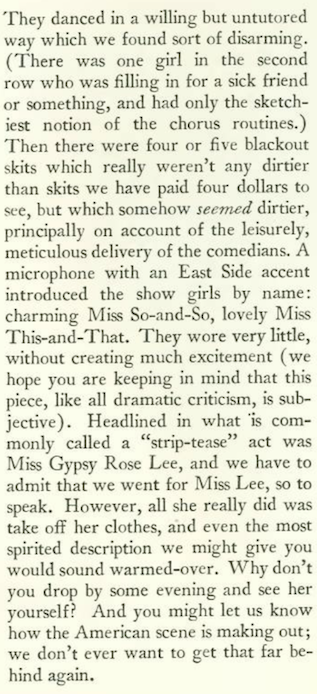
From Our Advertisers

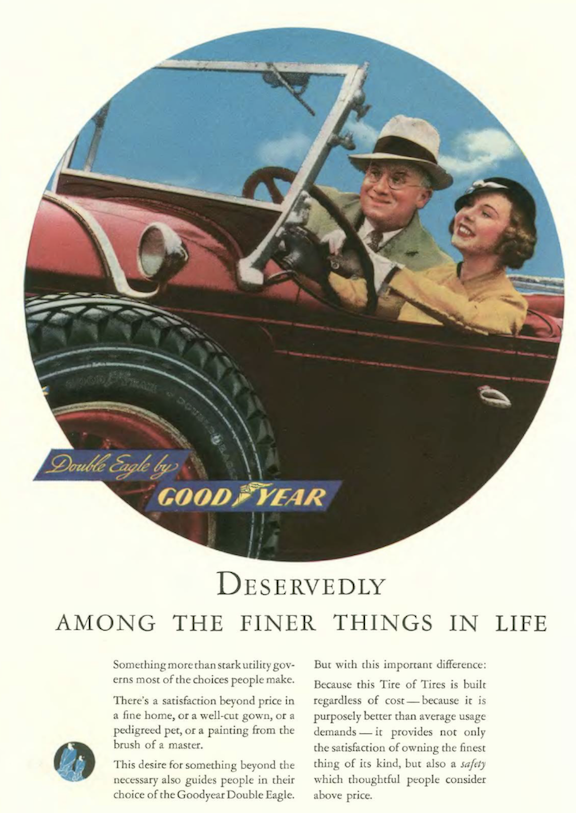
We begin with this advertisement from Goodyear, featuring what appears to be a father teaching his daughter how to drive, or in this case, fly, just like Chitty Chitty Bang Bang…

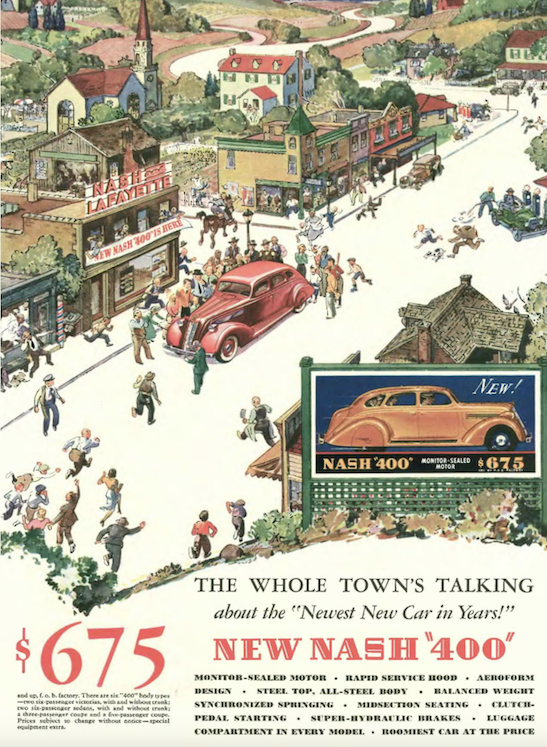
…and we stay airborne with the makers of the streamlined Nash, who claimed their automobile had “flying power”…

…and we return to earth with Cadillac’s budget model, the LaSalle, which featured “flashing performance”…

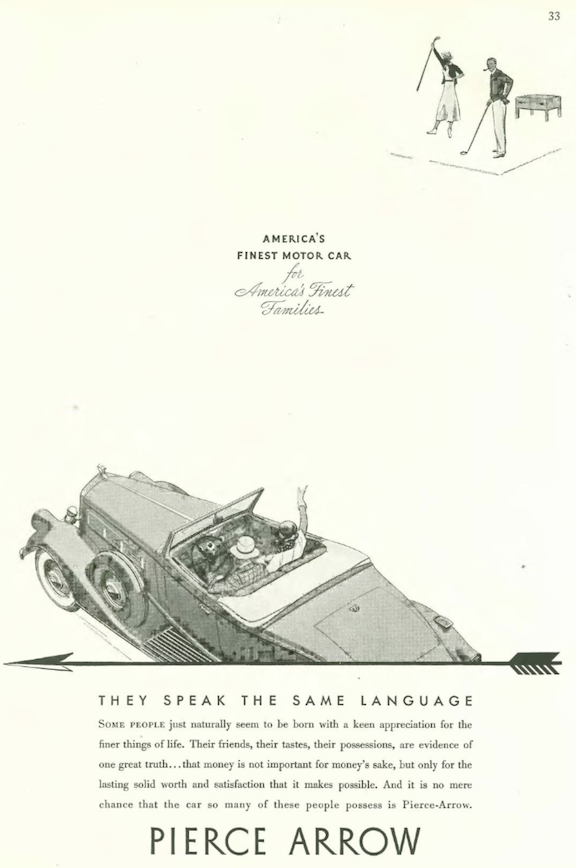
…by contrast, Pierce Arrow took a minimalist approach, gimmicks and splashy colors being reserved for the lower orders…

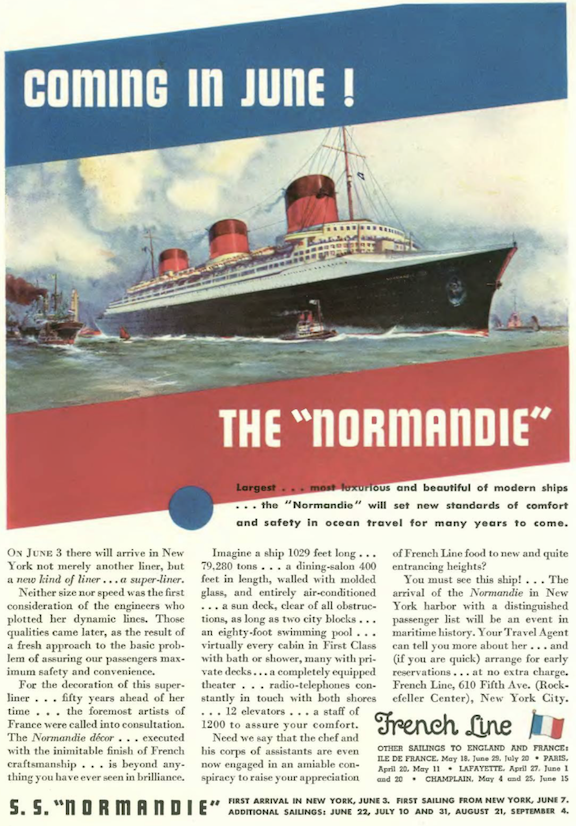
…one of the world’s most iconic ocean liners took to the sea with much fanfare in 1935. The SS Normandie was the largest and fastest passenger ship afloat; it remains the most powerful steam turbo-electric-propelled passenger ship ever built…

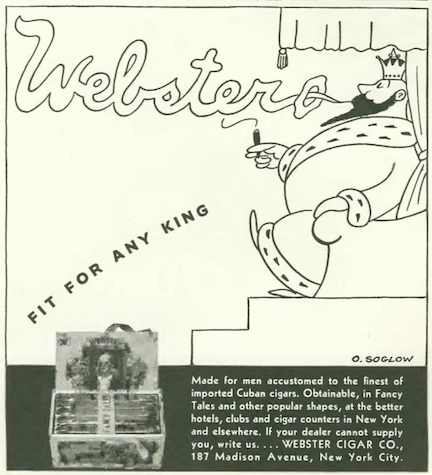
…if you happened to smoke Webster cigars, it could have been a sign that you were favored by the heavens…

…the “20-year rule” in fashion suggests that trends have a tendency to re-emerge every two decades, and that seems to be the case here…

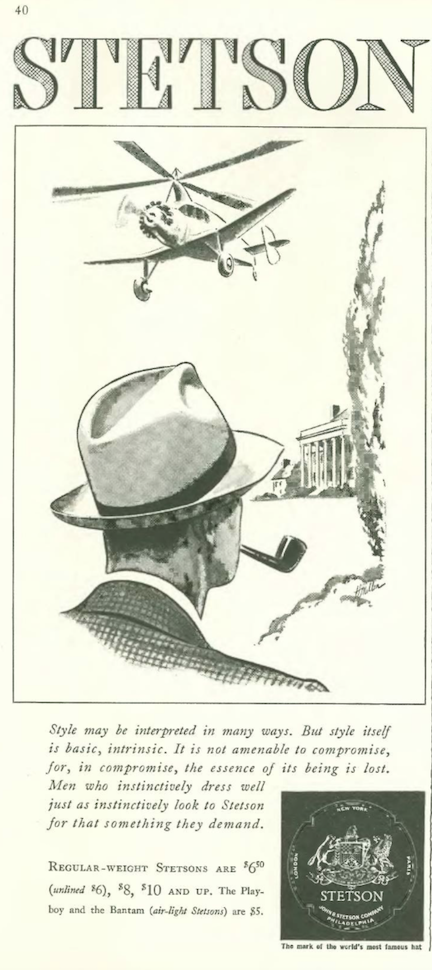
…this next ad tells us everything we need to know about the Stetson wearer: he is a wealthy country gentleman who values tradition but who is also a man of the future…from the 1920s to midcentury the autogyro was thought to be the answer to the long-dreamed of flying car…

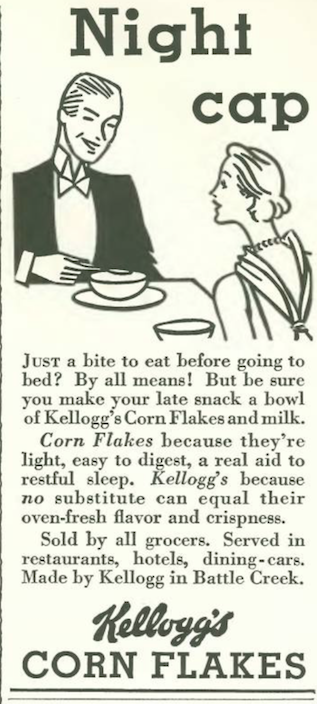
…whoever coined the term “night cap” probably wasn’t thinking about cold cereal…

…although Harold Ross’s old high school friend, John Held Jr., contributed many woodcut-style cartoons and faux maps to The New Yorker from 1925 to 1932, Held was more famous for his shingle-bobbed flappers and their slick-haired boyfriends in puffy pants, a style more apparent in this ad for Peychaud’s Bitters (the original was a one-column ad, split here for clarity)…

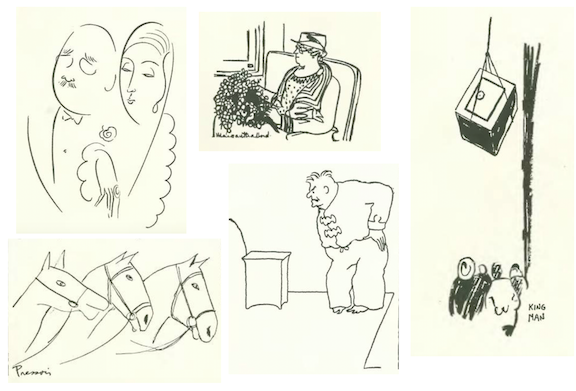
…Held provides a segue to our illustrators and cartoonists, beginning with a sampling of spot art from the April 13 issue…

James Thurber got things going on page 2…

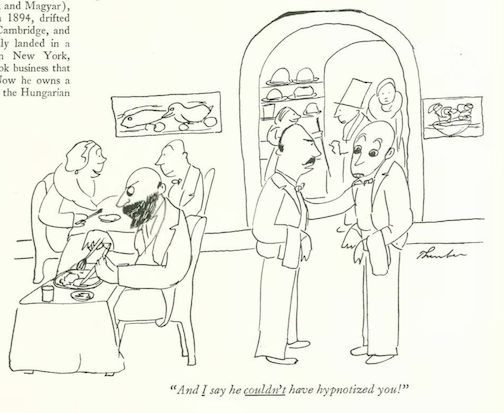
…and also contributed this observation of the hypnotic arts…

Otto Soglow did some careful surveying (this originally appeared across two pages)…

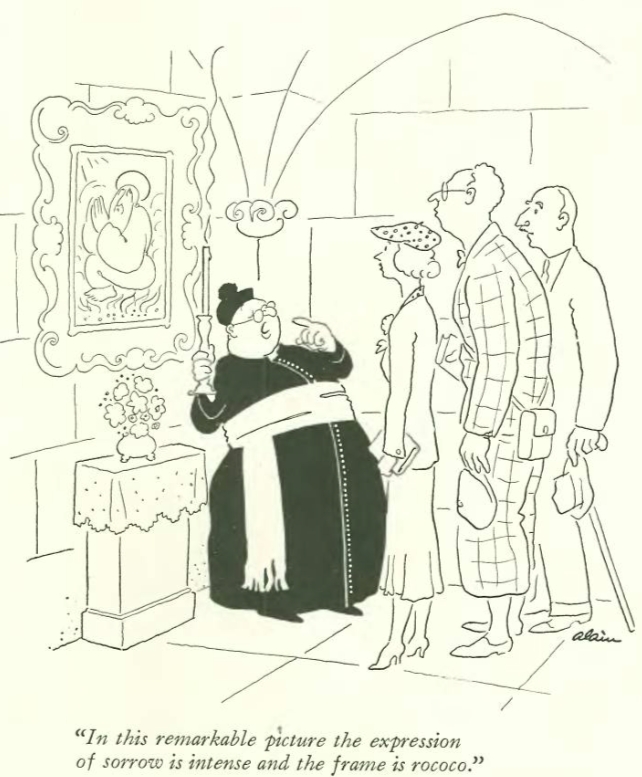
Alain looked in on some Vatican gossip…

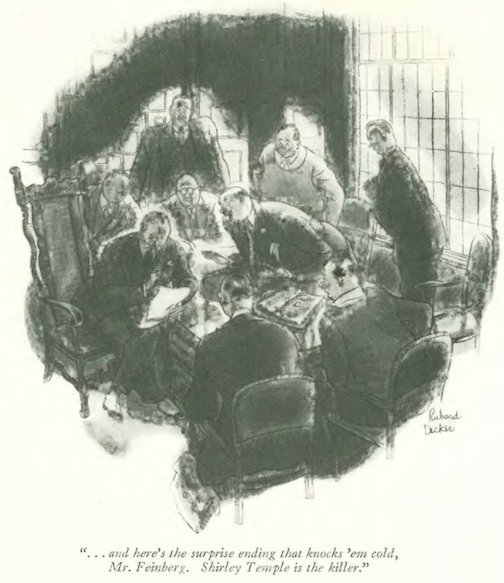
Richard Decker pitched a Shirley Temple murder caper…

Carl Rose gave us a sweet send-off…

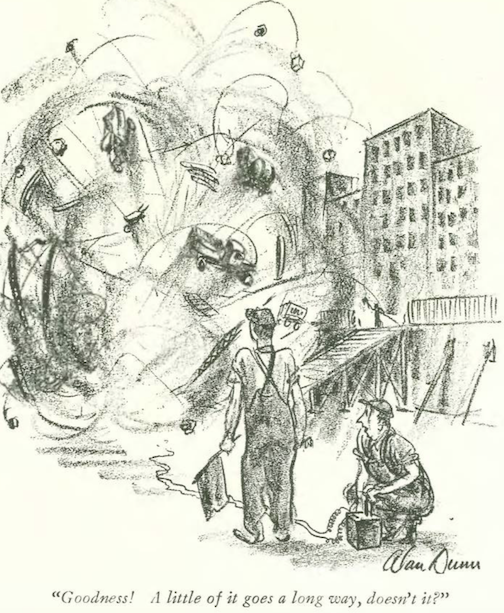
…and we close out with a big bang, courtesy of Alan Dunn

Next Time: Terse Verse…


Keep Calm and Carry On

If you lived in Germany in 1935, or in Italy or Spain for that matter, the world would have looked very different from the one most Americans were experiencing, clawing their way out of the Great Depression and hoping to improve their domestic lives. War was not big on their worry list.

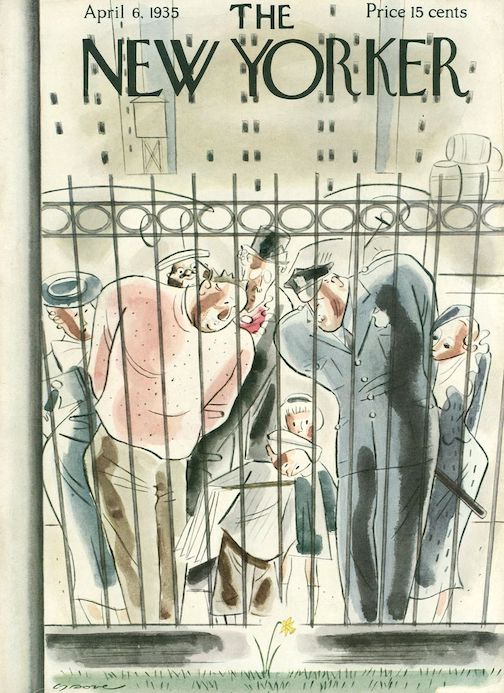
April 6, 1935 cover by Leonard Dove.

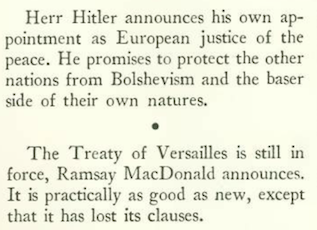
In his “Notes and Comment,” E.B. White satirized the talk about war that was filling more column inches in the nation’s newspapers. He was particularly scornful of journalists such as Arthur Brisbane—the influential editor of William Randolph Hearst’s media empire—who was fond of giant headlines warning of impending war.

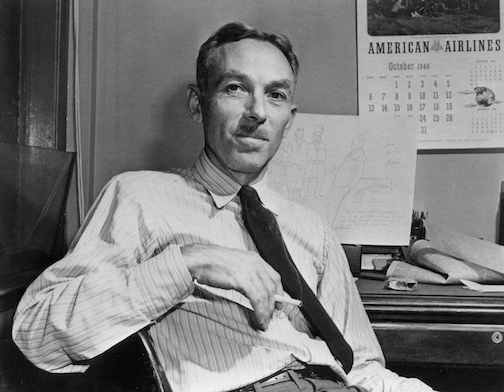
TEND YOUR OWN GARDEN...E.B. White in 1946. (Britannica)

White wasn’t naive about the possibilities of war; however, he believed obsessing about things over which we have little control did little to help the human condition. Helping one’s neighbor, on the other hand, would do the world more good. In 1939, just six months before Germany invaded Poland, White wrote a piece titled “Education” for his Harper’s Magazine column, One Man’s Meat. This excerpt helps define his worldview:

“I find that keeping abreast of my neighbors’ affairs has increased, not diminished, my human sympathies…in New York I rise and scan Europe in the Times; in the country I get up and look at the thermometer—a thoroughly set-contained point of view which, if it could infect everybody everywhere, would I am sure be the most salutary thing that could happen to the world.”

With that, here is a selection from the April 6 “Notes and Comment”…

TANKS A LOT…Clockwise, from top left, German war production in the 1930s—by increasing the size of the army by 500,000 and establishing the Luftwaffe in early 1935, Germany broke international law and the Treaty of Versailles; the 1935 Anglo-German Naval Agreement was the first sign of British and European appeasement—photo shows the launch of the Admiral Graf Spee; a display of force at Nuremberg, mid 1930s; cartoon by Bernard Partridge from Punch (September 1932) foresaw the inevitable. (parisology.net/theholocaustexplained.org/Punch Limited)

In March 1973, a “Mr. Nadeau” wrote a letter to E. B. White expressing fears about humanity’s bleak future. Here are the first and last lines of White’s reply:

As long as there is one upright man, as long as there is one compassionate woman, the contagion may spread and the scene is not desolate. Hope is the thing that is left to us, in a bad time. I shall get up Sunday morning and wind the clock, as a contribution to order and steadfastness…Hang on to your hat. Hang on to your hope. And wind the clock, for tomorrow is another day.

 * * *

Another Viewpoint

Ever the observer of the passing scene, Howard Brubaker made these relevant observations in “Of All Things”…

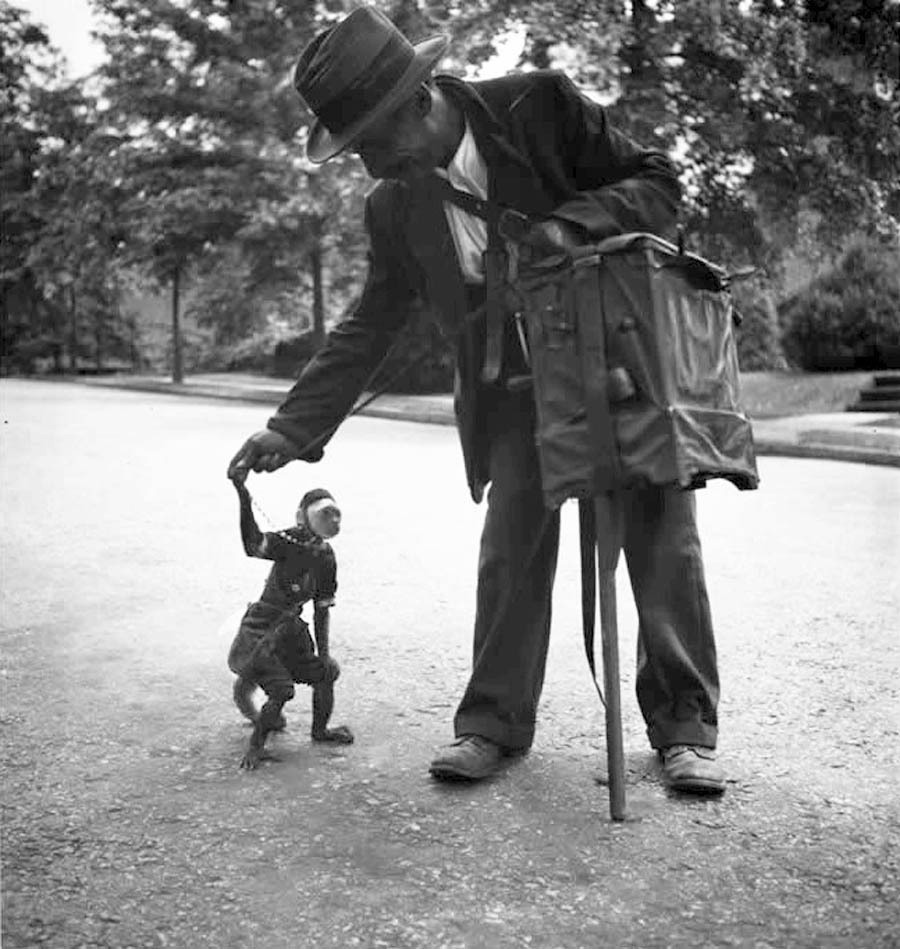
…and back to White’s “Notes,” and the imminent passing of the beloved organ grinder…

THE OLD GRIND…Above, one of New York City’s last organ grinders in Washington Heights, ca. 1935. Organ grinders had been fixtures in Manhattan since the 1850s, and by 1880 roughly five percent of Italian men living in Five Points were organ grinders, often accompanied by monkeys who entertained and collected coins. Organ grinders were outlawed in 1936 by Mayor Fiorello La Guardia. It is thought the mayor disliked the Italian immigrant stereotype. (Library of Congress)

 * * *

Give Him More Mickey Mouse

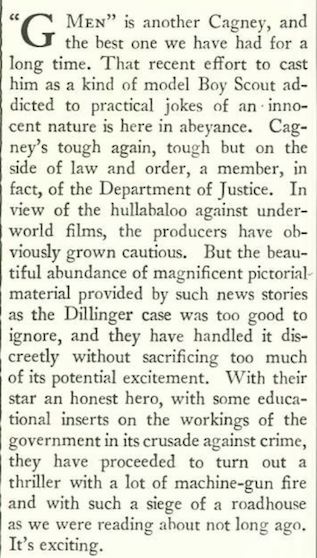
John Mosher expressed his displeasure with movies that failed to deliver some escape from life’s mundane realities or offered little more than tepid storylines.

IN SEARCH OF A CREDIBLE PLOT…Critic John Mosher found Claudette Colbert (top left) both unbelievable and unqualified to be a psychiatrist in Private Worlds; at top right, Joan Blondell and Glenda Farrell offered some mindless distractions in Traveling Saleslady (from 1933 to 1936 Blondell and Farrell appeared together in seven films); bottom, Mosher called The Woman in Red an “anemic” tale. Barbara Stanwyck seems to be wondering why she took the part. (rottentomatoes.com/TCM)

 * * *

Odds and Ends

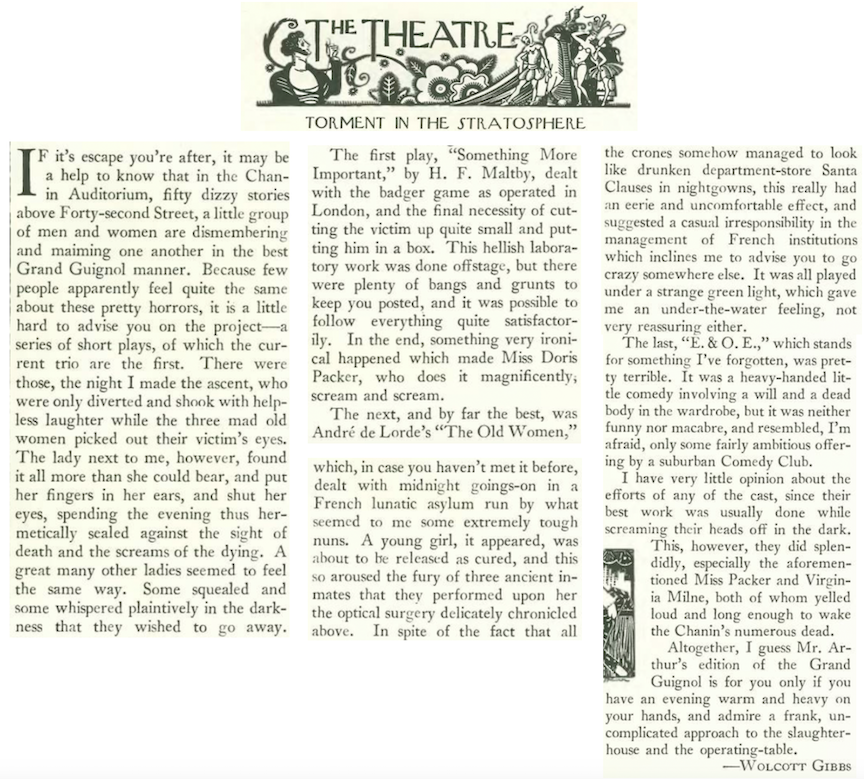
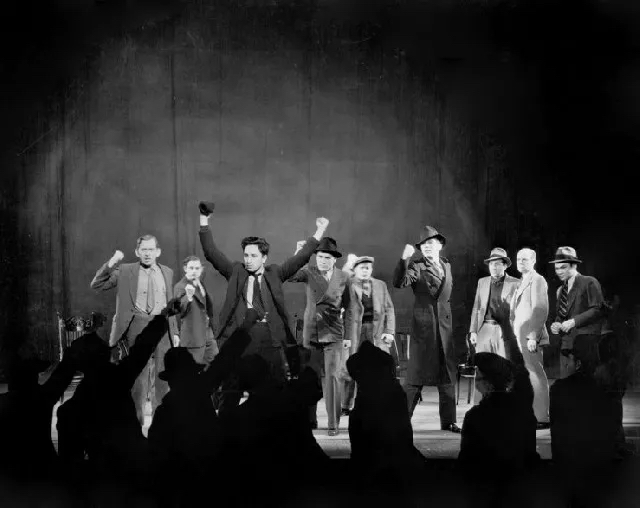
Also in the issue, John O’Hara kicked off the short fiction with “I Could Have Had A Yacht,” Margaret Case Harriman penned a profile of Elizabeth Arden (of cosmetics empire fame), and theatre critic Wolcott Gibbs enjoyed the “bitterly effective performances” in Clifford Odets’ Waiting For Lefty, which was being produced at the Longacre Theatre.

ENOUGH IS ENOUGH...Elia Kazan led the cast in the original production of Clifford Odets’ iconic 1935 play Waiting for Lefty. Centered around a taxi drivers’ strike, Lefty was produced by The Group Theatre, which sought to perform plays that functioned as social commentaries on the inequality and poverty of 1930s America. Some referred to Kazan as the “Proletarian Thunderbolt.” (Creative Commons)

 * * *

From Our Advertisers

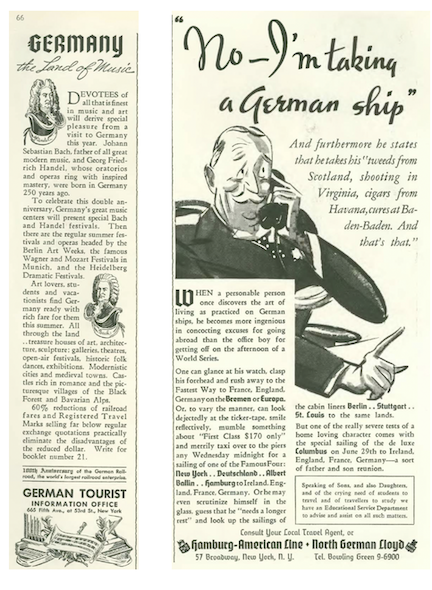
While Hitler ramped up weapons production and prepared to enact the Nuremberg Race Laws, the German Tourist Office touted their country as “The Land of Music” in this one-column advertisement on page 66 (left)…a couple of pages later we have an old chap looking forward to a German cruise and a quiet soak at Baden-Baden in the midst of madness…

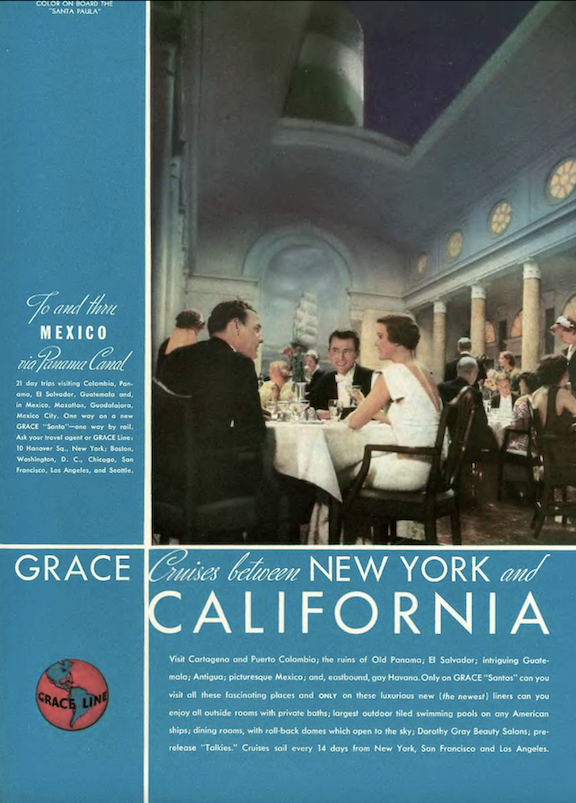
…now this is more like it, fine dining under the stars aboard the Santa Paula, far from the maddening crowds…

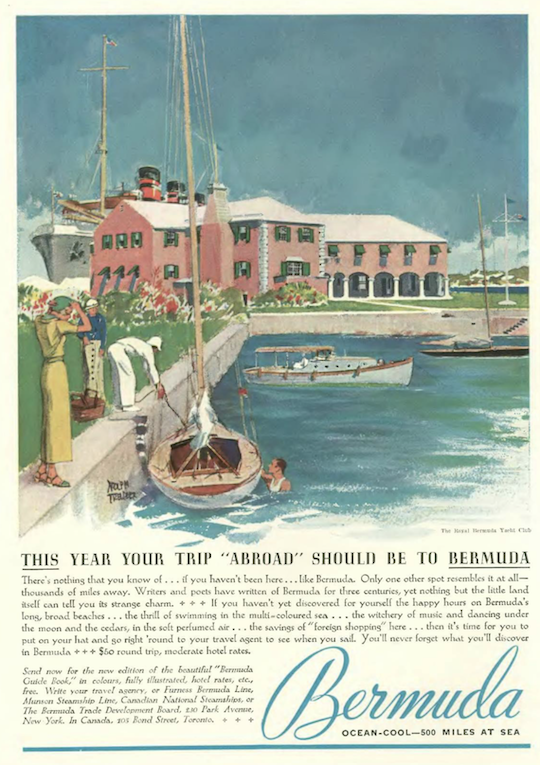
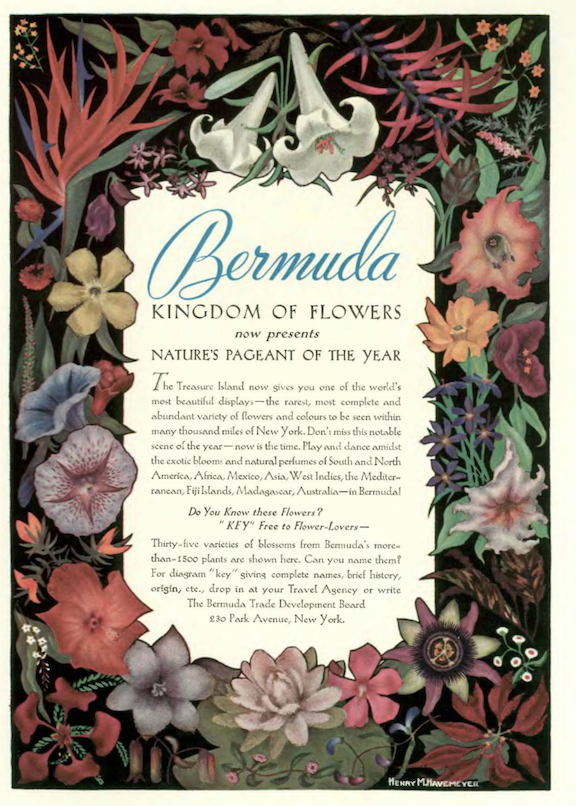
…there were several colorful full-page ads in the issue, including this splashy display from the very un-splashy-sounding Bermuda Trade Development Board…

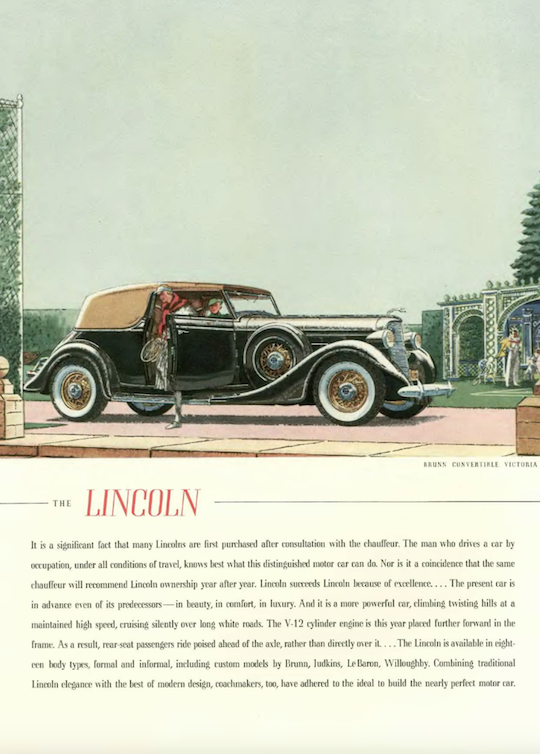
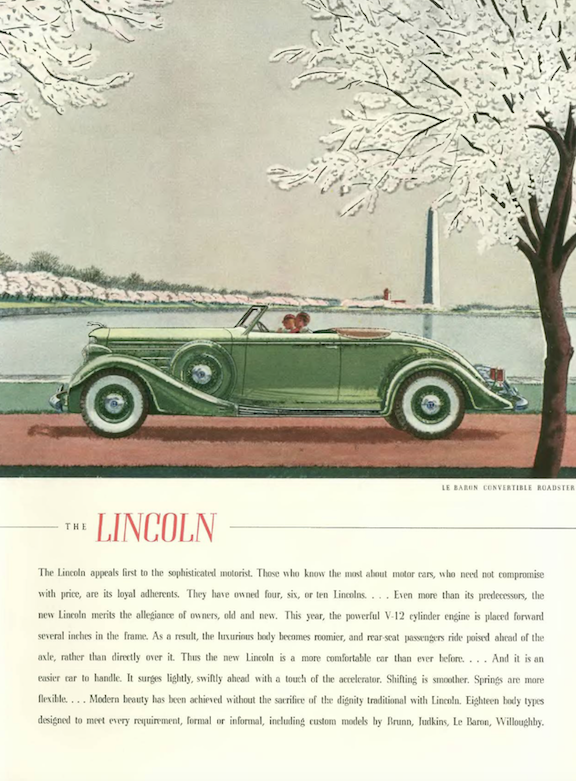
…cherry blossoms lined the path of Lincoln’s Le Baron Roadster…

…Camel played to a wide demographic, from ads featuring stylish young women to ads like this that roped in everyone from an “enthusiastic horsewoman” to an engineer working on the Boulder (now Hoover) Dam…

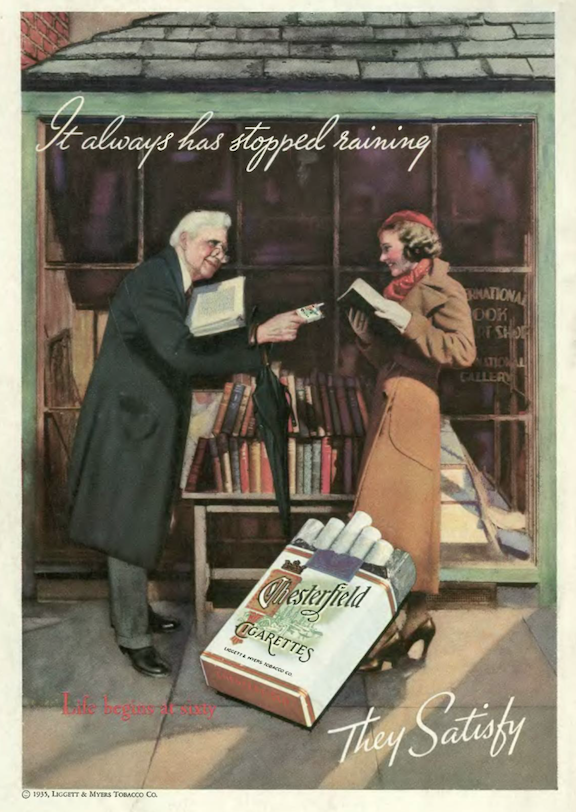
…I’m not sure what “Life begins at sixty” is supposed to mean, unless it’s about tempting young women with your bad habit…

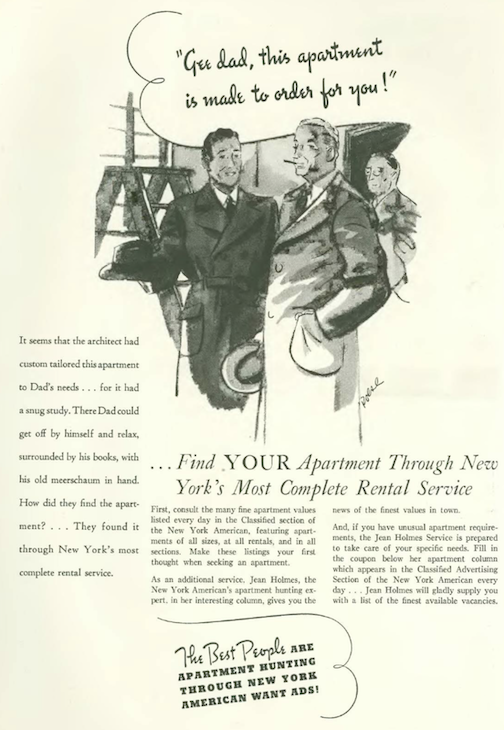
…the New York American was hoping that some of the “Best People” who read The New Yorker would also want to read their apartment rental want ads…

…spring was in the air at Richard Hudnut’s Fifth Avenue salon…if you had dry skin, it was recommended you try a product with the unfortunate name “Du Barry Special Skin Food”…

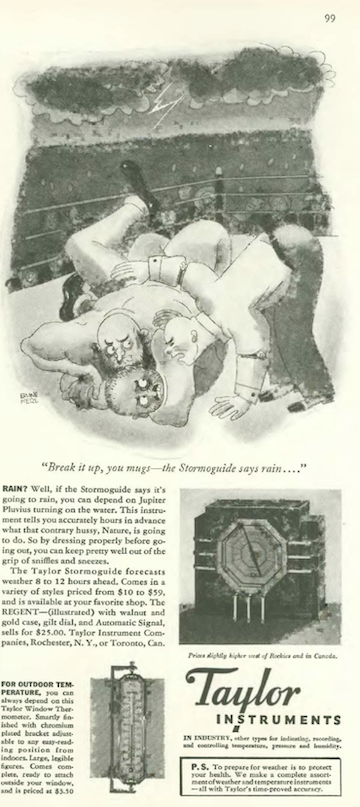
…Taylor Instruments hoped readers would monitor the spring weather with one of their stylish thermometers…American graphic artist and illustrator Ervine Metzl provided the artwork…he was best known for his posters and postage stamp designs…

…which brings us to our illustrators and cartoonists, beginning with this small woodcut on page 6 signed “Martin”…

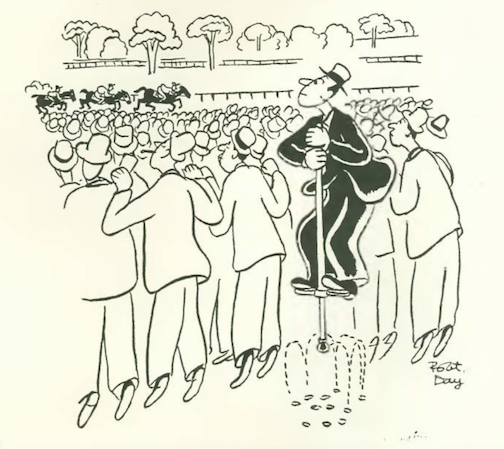
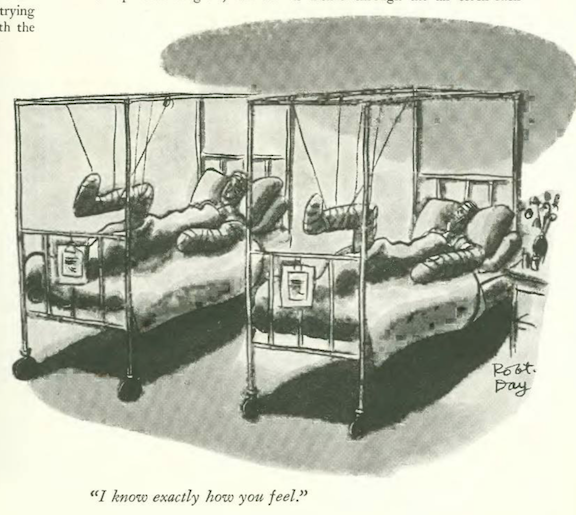
…empathy gained some traction in this Robert Day cartoon…

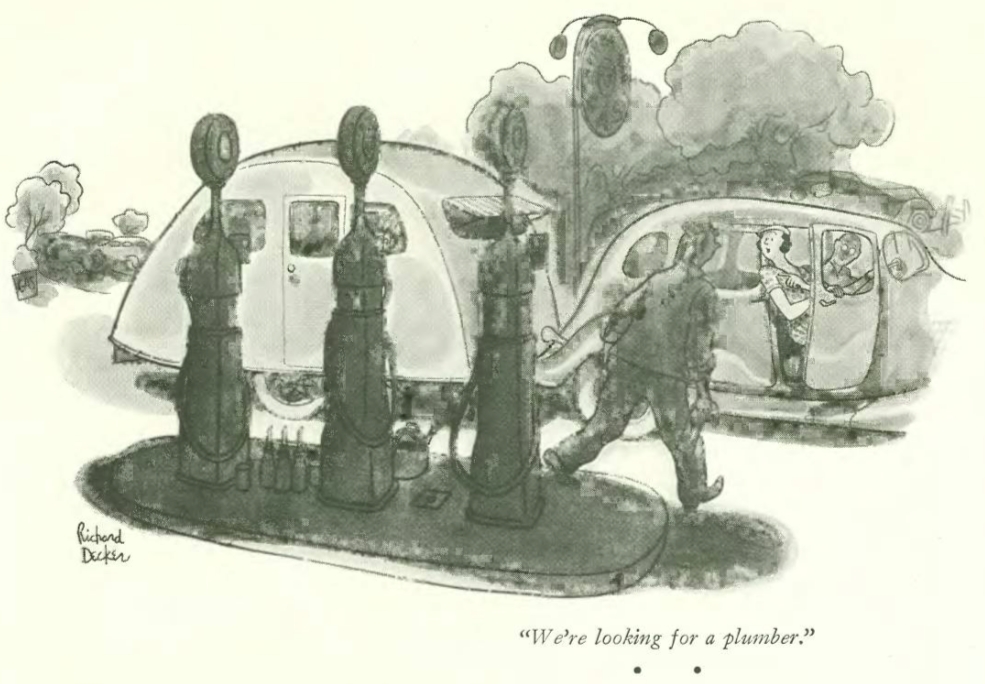
Alan Dunn demonstrated the effect of the Depression on the building trades…

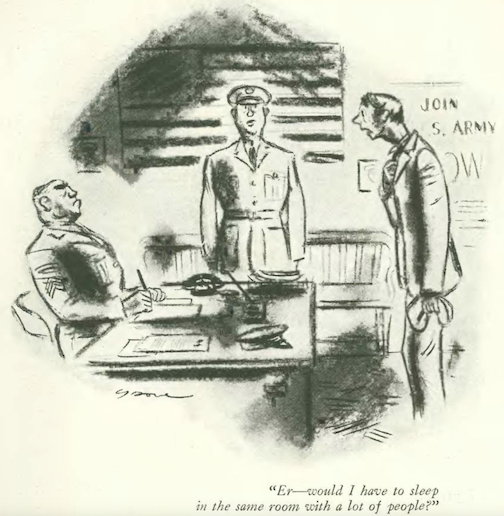
Leonard Dove found one enlistee not ready for basic training…

Syd Hoff showed us all the right moves…

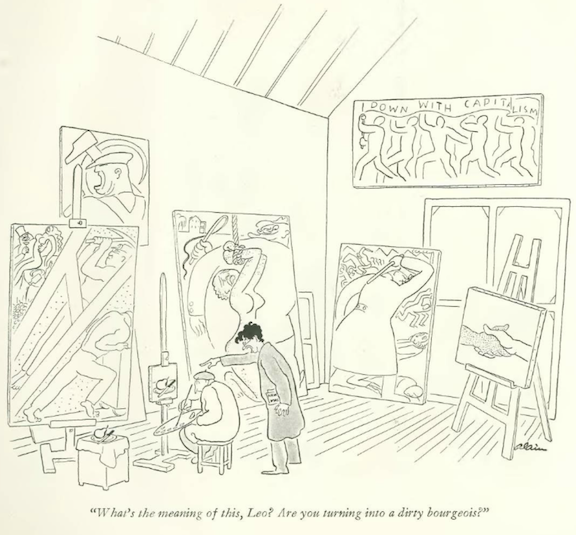
Alain was up in the garret with an artist in need of some peace…

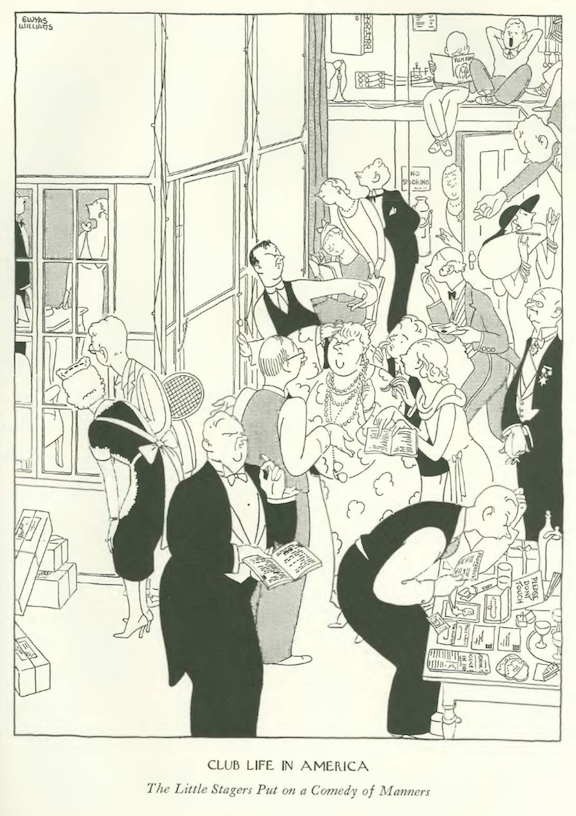
Gluyas Williams took a glimpse backstage…

William Crawford Galbraith was still exploring the world of sugar daddies and golddiggers…

Barbara Shermund introduced a few giggles…

…and we close with another James Thurber classic…

Next Time: The Cowboy Philosopher…

Snapshot of a Dog

Above: A bull terrier in the early 1900s. (Westminster Kennel Club)

For dog lovers, or really for anyone with a heart, James Thurber’s “Snapshot of a Dog” is a moving tribute to a childhood pet, a bull terrier named Rex.

March 9, 1935 cover by Rea Irvin.

“Snapshot of a Dog” was reprinted almost two decades later in Our Dogs, A Magazine For Dog Lovers, which featured cover stories of various celebrities and their dogs. I recall reading “Snapshot” as a child in an anthology belonging to my parents; it affected me deeply then and still does today. Grab your hankies—here are excerpts from the first and last sections of the story:

FAITHFUL FRIENDS…Clockwise, from left, James Thurber with his beloved Christabel; Thurber’s illustration of a childhood pet, a terrier named “Muggs” from the story “The Dog That Bit People” (1933); photograph of the real Muggs; dogs appear in many of Thurber’s cartoons as a stoic presence among maladjusted humans; Thurber at work on one of his dogs in an undated photo. (thurberhouse.org/ohiomemory.org/jamesthurber.org)

 * * *

Searching For the American Way

Ninety years ago E.B. White (in “Notes and Comment”) offered some thoughts on America’s system of government, and the country’s need for a song of hope…

…White also commented on a distasteful development at the old Round Table haunt, the Algonquin Hotel…

MAYBE USE THE BACK DOOR…Entrance to the Hotel Algonquin, early 1930s. (Hotel Algonquin)

…In her column “Tables for Two,” Lois Long took issue with folks who were yapping about couvert charges, and offered a simple solution…

…following Long’s “On and Off the Avenue” column were several restaurant reviews signed “S.H.”…here the writer visited the home of the Reuben sandwich…

KNOWN FOR ITS EPONYMOUS SANDWICH, Reuben’s also offered a Georgie Jessel (sturgeon and Swiss) and an Al Jolson (raw beef). (restaurant-ingthroughhistory.com/tag/reubens)

 * * *

Getting Their Kicks

Professional football has been played in the UK since the 1870s, and by the early 20th century the sport drew massive crowds (the 1923 FA Cup final at Wembley Stadium drew an estimated 300,000). This excerpt from “London Letter” correspondent Samuel Jeake, Jr. (aka Conrad Aiken) offered a glimpse into the sport in 1935:

DOWN IN FRONT…Spectators in a crush at Highbury ground in London when a huge crowd turned up for the Arsenal versus Tottenham Hotspur match in January 1934. (Photo by A. Hudson/blog.woolwicharsenal.co.uk)

 * * *

Endurance Test

Thomas Wolfe (1900-1938) published a number of novellas as well as plays and stories during his short life, but he only published two novels before his death in 1938 (others would be published posthumously). Wolfe’s second novel, the autobiographical Of Time and the River, would be well received by New Yorker critic Clifton Fadiman. Here is an excerpt from Fadiman’s lengthy review:

KNOCKOUT…Clifton Fadiman, right, wrote that Thomas Wolfe’s energetic writing could leave one feeling “punch-drunk.” (biblio.com/Wikipedia)

 * * *

From Our Advertisers

We begin with two pioneers in the cosmetics industry…Dorothy Gray salons set the springtime mood with this advertisement on the inside front cover…

Dorothy Gray (1886-1968), a.k.a. Dorothy Cloudman, sold her business in 1927 to Lehn & Fink, a New York-based pharmaceutical company best known as the maker of Lysol. In 1929, the company opened a flagship salon and executive offices in the new Dorothy Gray Building at 683 Fifth Avenue…

Dorothy Gray Building at 683 Fifth Avenue (cosmeticsandskin.com)

Richard Hudnut (1855-1928) began working in his father’s drug store in 1873, and in 1899 opened his own pharmacy on Broadway. Hudnut, who promoted his perfumes and cosmetics by distributing booklets detailing his preparations, sold his company in 1916 to William R. Warner, which eventually became Pfizer…

Hudnut is recognized as the first American to achieve international success in cosmetics manufacturing. Part of that success was Du Barry, a premium perfume he created in 1902. It was used to scent a variety of products.

At left, the narrow Hudnut Building at 693 Fifth Avenue, designed by Ely Jacques Kahn and Eliel Saarinen. The Elizabeth Arden salon was next door. At right, salon treatment room in the Hudnut building.(cosmeticsandskin.com)

…if salon treatments weren’t your thing, you could revive by taking a trip to sunny Southern California…just look what it did for the old Major…

…the makers of Camel cigarettes offered an even quicker and cheaper way to feel invigorated…

…the back cover continued to be dominated by tobacco companies targeting women smokers…this week Chesterfield got in on the act…

…on to our cartoonists, we begin with James Thurber at the top of page 2 to kick off “Goings On About Town”…

…and Thurber again, with the ultimate party pooper…

George Price graced the bottom of “Goings On” on page 4 with this whimsy…

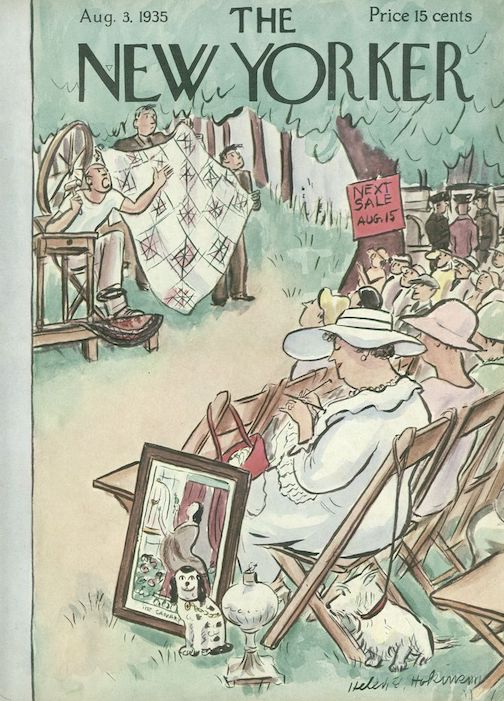
Helen Hokinson looked in on a children’s concert…

…there was another quarrel among lovers via Peter Arno

…revolution was in the air at Alan Dunn’s cocktail party…

George Price again, with two women who found a new perspective atop the Empire State Building…

…and we close with Syd Hoff, and an unexpected bundle of joy…

Next Time: Home Sweet Motohome…

Mary Quite Contrary

Above: Illustration and article on "Typhoid Mary" that appeared in 1909 in The New York American. At right, Mary Mallon with other quarantined inmates on North Brother Island. (Wikipedia)

The Irish-born Mary Mallon (1869–1938) lived a simple life as a maid and a cook, and it would have been a life of anonymity save for a sad twist of fate on the day she was born.

Jan. 26, 1935 cover by Perry Barlow.

History knows Mary Mallon as Typhoid Mary. From 1901 to 1907 she would cook for seven wealthy New York families that would later contract typhoid. Mallon was born to a mother who was infected with typhoid, which offers a possible explanation as to why she became an asymptomatic carrier of the disease. Forcibly quarantined on North Brother Island (near Long Island) from 1907 to 1910, Mallon agreed upon her release to take hygienic precautions, including ending her occupation as a cook.

When other jobs failed to pan out, Mallon returned to cooking—this time in restaurants and hotels—infecting many more while evading investigators who were desperately trying to track her down (it is estimated she infected up to 122 people, resulting in as many as four-dozen deaths). When she was finally arrested in 1915, she was returned to North Brother Island, where she would live out her days. Stanley Walker (1898–1962), a native Texan, longtime editor of the New York Herald Tribune, and a New Yorker contributor from 1925 to 1956, featured Mallon in a profile for the Jan. 26, 1935 issue. Some brief excerpts:

 * * *

The Latest Sensation

Mary Mallon was the source of sensational headlines in the early 1900s, but even she couldn’t top the media frenzy prompted by the Lindbergh baby kidnapping and the trial of accused murderer Bruno Hauptmann. The New Yorker’s Morris Markey went to the courthouse in Flemington, New Jersey, to file this report for “A Reporter at Large.” Excerpts:

TRIAL OF THE CENTURY…Clockwise, from top left: Bruno Hauptmann (center) at his murder trial, which ran from Jan. 2 to Feb. 13, 1935, in Flemington, New Jersey; Charles Lindbergh takes the witness stand; novelist Fanny Hurst and gossip columnist Walter Winchell at the trial on Jan. 30, 1935—the “Trial of the Century” was followed by more than 700 reporters; police ropes contained the large crowds gathered at the courthouse. (Library of Congress/umass.edu/Courier Post)

Hauptmann would be convicted of the crime and immediately sentenced to death. On April 3, 1936, he would meet his end in an electric chair at the New Jersey State Prison, maintaining his innocence to the very end.

 * * *

From Our Advertisers

On to our ads, we begin with another colorful spot from Penn Maryland, and jolly times on Miami Beach…

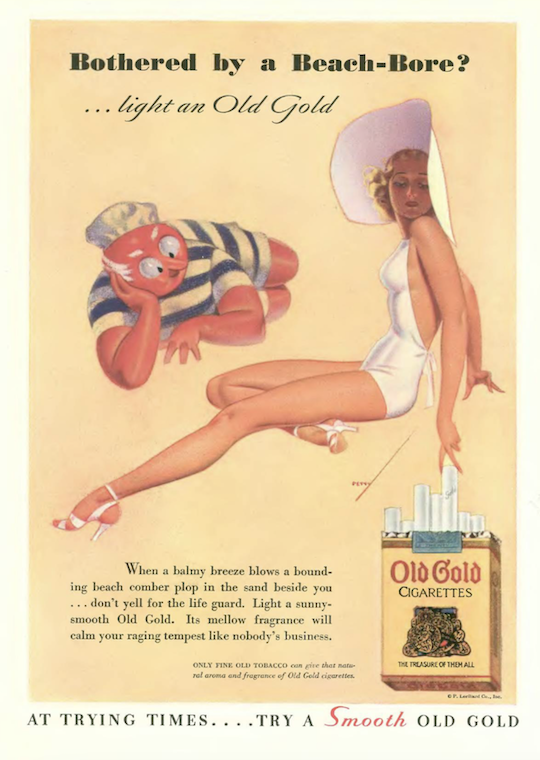
…here is the first in a series of ads that the makers of Old Gold cigarettes (Lorillard) began running in 1935, featuring a sugar daddy and his leggy mistress…they were drawn by George Petty (1884–1975), famed for his “pin-up girls” featured on many magazine covers as well as in ads for Old Gold, Jantzen swimsuits, and TWA, among others…

…here is Petty at work in 1939…

…Buffalo-based Pierce-Arrow was known for its expensive luxury cars, which were not exactly hot sellers during the Great Depression; moreover, Pierce was the only luxury brand that did not offer a lower-priced car to provide cash flow to the company, and contrary to the claims in this ad, Pierce-Arrow would close its doors by 1938…

…one thing alive and well in the 1930s was sexism, and here is a good example from the makers of a popular line of soups…

…The Theatre Guild called upon the talents of James Thurber to promote their latest production…

…and we continue with Thurber as move into the cartoons…

…where Robert Day found some miscasting in a Civil War epic…

George Price’s floating man seemed to be coming back to earth…

…Day again, with a sure-fire way to defend one’s goal…

Alan Dunn offered words of wisdom from the pulpit…

…and we close with Barbara Shermund, and a familiar face…

Next Time: Legitimate Nonchalance…

Al’s Menagerie

Above: The Dec. 2, 1934 opening of the reconstructed Central Park Menagerie drew such luminaries as Mayor Fiorello La Guardia, pictured at left with his family, and, at right, former New York Governor Al Smith, who was designated honorary zookeeper. Smith, who, lived across from the zoo at 820 Fifth Avenue, poses with two donkeys at the Menagerie in 1940. (New York Parks Archive)

The Central Park Zoo was not part of the original Olmstead-Vaux plan for the park, but beginning in 1859 it evolved spontaneously as a menagerie located near the Arsenal; its odd collection of animals included exotic pets donated as gifts, and other random creatures including a bear, a monkey, a peacock and some goldfish.

Dec. 1, 1934 cover by Leonard Dove.

The menagerie accepted animals of all kinds, even sick ones, and by the 1920s the quality of the animals as well as the hodgepodge of buildings had degraded significantly (the lion house had to be guarded to prevent the animals from escaping their rotting quarters). In early 1934 Parks Commissioner Robert Moses addressed the adverse conditions in the menagerie, putting a redesign on a fast track and insisting that only healthy animals, in more humane settings, would be displayed.

DUMBOS…According to a 1911 Department of Parks Annual Report, the menagerie at Central Park submitted animals to questionable treatment, as suggested by this photo of a trainer and a dog perched on top of an elephant. (nycgovparks.org)

Built of brick and limestone, the new zoo was designed in just sixteen days by an in-house team led by architect Aymar Embury II. Construction on the roughly six-acre zoo took just eight months, employing federally financed Works Progress Administration (WPA) labor.

MOSES PARTS THE RED TAPE…Robert Moses wasted no time after his appointment as parks commissioner (in January 1934) to get rolling on the menagerie makeover—it took just eight months to complete the new zoo. Clockwise, from top left, invitation to the opening celebration of the Central Park Menagerie—12,000 invited guests attended the opening, while another 25,000 lined Fifth Avenue hoping to be admitted; the popular sea lion pool was a central attraction on opening day (it is one of several elements from the 1934 zoo that still exists); conditions had improved for elephants and other animals, but they were still far from ideal; aerial view of the zoo as it neared completion on Oct. 9, 1934. (nycma.lunaimaging.com/digitalcollections.nypl.org)

Much ado was made of Al Smith’s appointment as “Honorary Night Superintendent”—in these clips from the Dec. 3 New York Times, Smith gave a brief “lecture” about the zoo’s bison, to which he offered a slice of bread…

(Excerpts from The New York Times via the TimesMachine)

 * * *

From Our Advertisers

R.J. Reynolds continued to roll out its list of distinguished women who preferred their Camel cigarettes: “Mrs. Allston Boyer” nee Charlotte Young was a model with the John Robert Powers agency who was married to resorts planner Allston Boyer from 1934 to 1939. Young (1914–2012) would later marry New York Times Moscow correspondent Harrison Salisbury, and the two would embark on lengthy journeys throughout Asia, including a grueling 7,000-mile journey retracing the route of The Long March that Charlotte recounted in one of her seven travel books. Whether she continued her Camel habit is unknown, but she did live 98 years…

…a house ad from The New Yorker celebrated the holiday season with special Christmas rates (and Julian de Miskey embellishments)…

Rea Irvin continued to have fun with the federal government’s new food and drug labeling standards…

…while Richard Decker had these two castaways contemplating a simpler form of government…

…and James Thurber continued to stir up trouble among the sexes…

…on to Dec. 8, 1934…

Dec. 8, 1934 cover by Richard Decker.

…which featured (on page 135) a handwritten letter from Kewpie Doll inventor Rose O’Neill, who commented on her recent New Yorker profile…

…here is an excerpt from the Nov. 24 profile referenced by O’Neill:

…and on to our advertisements from the Dec. 8 issue, including another Julian de Miskey-illustrated house ad…

…the clever folks at Heinz enlisted the talents of Carl Rose for a play on his famous Dec. 8, 1928 New Yorker cartoon…

…a closer look at the illustration (note the mother’s softer, more conservative appearance, five years removed from her flapper days; the child hasn’t changed a bit, except now we can see her face)…

…and the 1928 original, with caption by E.B. White

Peter Arno also popped up in the advertising section on behalf of Libby’s…

…the magazine grew thicker with many Christmas-themed ads, including this one from Johnnie Walker…

…Marlboro continued to take out these modest, back-page ads aimed at tobacco’s growth market—women smokers…

…the makers of Spud menthol cigarettes continued their campaign to encourage chain-smoking with this rather depressing image…

…while Spud’s new competitor in menthol cigs, KOOL, kept things simple with their smoking penguin mascot and valuable coupons for keen merchandise…

…the Citizens Family Welfare Committee offered this reminder that the Depression was still very much a challenge for 20,000 New York families…

…on to our cartoonists, beginning with Alan Dunn’s rather dim view of Robert Moses’s generously funded parks department…

George Price gave us the latest update on his floating man, who had been up in the air since the Sept. 22 issue…

Daniel ‘Alain’ Brustlein marked the season with dueling Santas from Macy’s and Gimbel’s…

…and we end with James Thurber, and some reverse psychology…

Next Time: An Industrial Classicist…

The Age of Giants

Otto Klemperer rehearsing at the Hollywood Bowl in September 1937. (Los Angeles Philharmonic)

The 20th century was an age of big personalities in classical music, among them Otto Klemperer (1885-1973), a German-born protégé of the composer and conductor Gustav Mahler. Klemperer was already an established conductor in opera houses around Germany when the rise of the Nazis prompted the maestro to emigrate with his family in 1933. He was soon appointed chief conductor of the Los Angeles Philharmonic.

Oct. 13, 1934 cover by Rea Irvin.

Klemperer also guest conducted a number of orchestras in the U.S., including the New York Philharmonic, where his larger than life presence caught the attention of “The Talk of the Town.” Excerpts:

MAESTRO…Top left, Otto Klemperer with Czech composer Leoš Janáček in 1927; at right, with Austrian-American classical pianist and composer Artur Schnabel in 1933; bottom photo, with wife Johanna Geisler, son Werner and daughter Lotte in Los Angeles, 1936. (operaplus.cz/Otto Klemperer Film Foundation/ottoklemperer.nl)

Lauded internationally as a great orchestral commander, in 1939 Klemperer would begin experiencing balance issues. After a tumor the size of a small orange was removed from his brain, he would be left partially paralyzed on his right side; bouts of depression and a manic phase would later land him in a mental hospital. However, by 1946 he would recover his health enough to return to conducting in a career that would last until 1971.

The conductor’s daughter, Lotte Klemperer (1923–2003), would serve as her father’s secretary, negotiator and administrator until his death in 1973. Otto’s son, Werner Klemperer (1920–2000), would become a stage, screen and television actor, most notably portraying Colonel Klink in the 1960s comedy Hogan’s Heroes. Although the role would garner Werner two Emmys, his father never fully understood the series or even the concept of a sitcom. Reluctant to pursue a musical career while his father was alive, Werner would later join the Metropolitan Opera Company in the 1970s, appear in Broadway musicals, and serve as a narrator with a number of American symphony orchestras.

TO THEM HE WAS DAD…At left, daughter Lotte Klemperer with her famous father in 1954. She would serve as his caretaker and business partner after her mother’s death in 1956. At right, son Werner Klemperer acted on Broadway and in films before taking on the role of the bumbling Colonel Klink in the 1960s comedy Hogan’s Heroes, which garnered the actor two Emmys. Although Werner Klemperer was musically inclined, he avoided work in music until the death of his father in 1973. (Otto Klemperer Film Foundation/CBS)

 * * *

Vanished in the Haze

In his “Notes and Comment,” E.B. White lamented what appeared to be the transformation of the familiar night club; high above Manhattan in the Rockefeller Center’s Rainbow Room, the comforting haze of “cigarette smoke, talc, waiter’s venom” had been displaced by air conditioning, and to add to the horror, an organ had been installed that tinged the fox trot “with an odd piety.”

NOWHERE TO HIDE…E.B. White found the lack of haze in the new Rainbow Room disconcerting, not to mention the addition of a Wurlitzer organ, its wonders demonstrated here by organist Ray Bohr in 1934. (Library of Congress/nycago.org)

 * * *

There Oughta Be a Law

While E.B. White was mourning the demise of the smoky nightclub, art and design critic Lewis Mumford continued his tirade against the pretentious and mediocre buildings that were popping up all over the city, including the new Federal Court Building on Centre Street that was, in Mumford’s words, a supreme example of bad design and fake grandeur.

Cass Gilbert's The Federal Courthouse building (United States courthouse) in 1936 (the year of its completion). Located at 40 Centre Street (Foley Square), Manhattan, New York City. In 2001, it was designated as the Thurgood Marshall United States Courthouse.Source: Wurts Brothers Photography Collection at the National Building Museum.
A CRIMINAL CASE…Cass Gilbert’s Federal Courthouse building (United States courthouse) was completed in 1936, two years after Gilbert’s death. In 2001 it was designated as the Thurgood Marshall United States Courthouse. Critic Lewis Mumford called the design, which combined “two unlovely and unrelated forms”…”nothing short of a major crime.” (Wurts Brothers Photography Collection, National Building Museum)

 * * *

Crime of the Century

That is what the press called the kidnap and murder of the infant son of Charles Lindbergh and Anne Morrow. In September 1934 a German immigrant carpenter named Bruno Hauptmann was arrested for the crime, and a trial date was set for the following January. In his “A Reporter at Large” column, Morris Markey examined the ransom money trail that led to Hauptmann’s ultimate arrest. Excerpts:

DON’T SAY “CHEESE”…Bruno Hauptmann sits for a mug shot following his arrest for the abduction and murder of the 20-month-old son of Charles Lindbergh and Anne Morrow Lindbergh. (Leslie Jones, Boston Public Library)

 * * *

Should Have Stayed Lost

A film version of Willa Cather’s 1923 novel A Lost Lady was first made as a silent by Warner Brothers in 1924 (the film itself is lost) but in 1934 Warner had another go at the novel with a sound version starring starring Barbara Stanwyck, who was emerging as a major star. But Stanwyck’s talents could not overcome a script that critic John Mosher described as bleak, blank nonsense. Cather was so dismayed by the film that she refused to permit another adaptation of any of her novels during her lifetime.

LOST IN TRANSLATION…Barbara Stanwyck and Ricardo Cortez in A Lost Lady (1934). (IMDB)

 * * *

From Our Advertisers

We kick off our sponsors with this two-page center spread from Hiram Walker & Sons, who introduced their new line of playing card-inspired whiskies…

…the New Yorker’s Janet Flanner wrote in 1938 that Elsie de Wolfe invented interior design as a profession, so who was to argue with de Wolfe’s suggestion that the leisure class should linger in bed with the aid of a Wamsutta bed-rest…the small print beneath the logo indicated that the bed-rest was “hair-filled,” which I assume was horse hair, still used today in some luxury brands…

…if de Wolfe was queen of interior designers, then Hattie Carnegie was the “First Lady of Fashion,” or so this ad claimed…

…here are images of the two titans of fashion and good taste…

TASTEMAKERS…At left, Hattie Carnegie aka Henrietta Kanengeiser (1880-1956), and Elsie de Wolfe, aka Lady Mendl (1859–1950). (americacomesalive.com/bureauofinteriors.com)

…and speaking of fashion, here is a llama cloth coat from B. Altman, trimmed in silver raccoon, suitable for Yale football games…based on inflation, that coat today would set you back at least $2,000…

…this condescending ad offered merchants a way to reach the “hitherto strange and aloof women of New York” through daytime advertising…

…Plymouth enlisted the talents of Alan Dunn to tout their car’s ride and durability…

…and on to our cartoonists, another from Dunn, a bit of spot art featuring a not so subtle commentary on Lawrence Lee Bazley Angas’s book The Coming American Boom

…and some spot art from Isadore Klein

Miguel Covarrubias contributed to the theater review section…

James Thurber entertained a house guest…

George Price was still up in the air…

Helen Hokinson took a spin with a celebrity look-alike…

…and Barbara Shermund offered another glimpse into the life of a modern woman…

…on to Oct. 20, 1934…

Oct. 20, 1934 cover by Helen Hokinson.

…in which E.B. White offered up a new lament, namely the pervasiveness of nostalgia and sentiment in contemporary literature…

HARKING BACK TO THOSE DAYS OF YORE…E.B. White simply had no stomach for the nostalgic stylings of Mary Ellen Chase (left) or Henry Seidel Canby, seen here on the cover of the May 19, 1924 issue of Time. (U of Maine/Time Inc)

 * * *

Fifty Years Young

“The Talk of the Town” marked the Dakota’s 50th year at Central Park West, and made note of its loyal and prominent clientele…back in the day it served as a residence for actors such as Lillian Gish, Boris Karloff, and Teresa Wright, and in later years such luminaries as Lauren Bacall, Judy Garland, Rudolf Nureyev, and, of course, John Lennon and Yoko Ono.

THE STORIES IT COULD TELL…At left, the facade and main entrance of the Dakota in the 1960s; at right, inside the main entrance. (Pinterest/Wikipedia)

 * * *

More From Our Advertisers

The Matson-Oceanic Line offered a “millionaire’s idea of a vacation” at an affordable price, and offered this sumptuous image as proof…

…E.B. White wasn’t crazy about the smokeless dazzle of the Rainbow Room, but it proved to be popular among the city’s elite…

…in case one was concerned about the provenance of one’s mink coat, Saks posted this helpful ad. Their high-end, natural-skin minks were priced at $8,000 (roughly $180,000 today); there was, however, a caveat regarding the cheaper models…

…Bergdorf Goodman offered up another ad featuring an impossibly attenuated model posed with a cigarette, her defiant gaze suggesting her modernity and individualism…

…Plymouth went back to the stable of New Yorker cartoonists, this time featuring the adventures of Helen Hokinson’s “girls”…

…and we segue to the rest of our cartoonists, including this spot by Constantin Alajalov

…and this by George Price

…who also gave us another update on the trials and tribulations of his floating man…

James Thurber occasionally ignored scale in rendering his characters, which didn’t really matter in his strange world…

Jack Markow had some bad news for two sign painters (the caption size is increased for readability)…

…and we close with Peter Arno, and the winner of most original Halloween costume…

…and before I go…this is being posted on Halloween, 2023, so here are a few images from 1934 to get you in the spirit, including a Saturday Evening Post cover, a 1934 party ideas magazine, and a page from Popular Mechanics featuring a smoking robot costume you could make yourself…in the 1930s, Popular Mechanics often featured Halloween party ideas that were downright lethal, usually involving electric shocks, pistols loaded with blanks, that sort of thing.

Happy Halloween!

Next Time: House & Home…