Planes, Trains and Automobiles

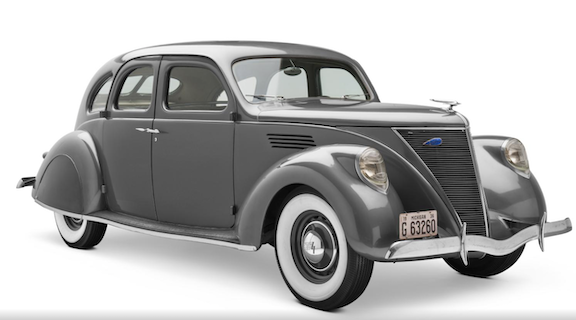
Above: Clockwise from top left—the Douglas DC-3 was introduced to airlines in 1935; Seaboard streamlined locomotive, c. 1930s; 1936 Lincoln-Zephyr; 1936 Pierce Arrow. (hushkit.net/Wikimedia/classicautomall.com)

As we’ve seen in previous issues, E.B. White often served as The New Yorker’s unofficial aviation correspondent; despite his sometimes anachronistic views on progress, he never missed a chance to hop aboard an airplane and marvel at the scene far below.

November 2, 1935 cover by Constantin Alajalov.

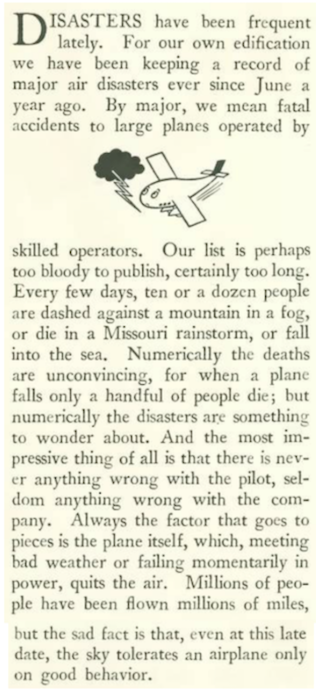
White’s enthusiasm, however, was tempered with doubts about air safety, including observations he made in an August 31, 1935 column following the deaths of Wiley Post and Will Rogers in an Alaska plane crash. Here is what he wrote then:
The aviation industry’s strong reaction to that “noisy little paragraph” apparently led to a number of subscription cancellations, prompting White to return to the topic in his Nov. 2 “Notes and Comment” column:

HE’D BEEN AROUND…E.B. White supported his comments on air safety by citing his many flying experiences, including soaring around the Empire State Building “on a blithe morning.” Pictured above is a New York Daily News plane flying over Manhattan in 1934. (NY Daily News)

White also turned to statistics for his defense, finding that per passenger mile, railroads were still the safest mode of transportation in the country.
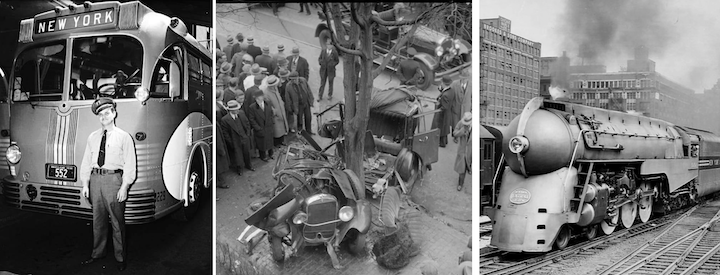
HOP ABOARD…According to 1933 statistics shared by E.B. White, trains were the safest mode of transportation per passenger mile, followed by buses. Automobiles were the least safe, a fact that still holds true today. From left, Greyhound bus and driver, 1937; automobile wreck, 1930s; New York Central’s 20th Century Limited leaving Chicago’s LaSalle Street station in 1938. (Facebook/Reddit/Wikipedia)

With that, White still wasn’t done with the topic, turning to none other than Anne Morrow Lindbergh for her thoughts on flying, which she shared in her latest book, North to the Orient. White noted Lindbergh’s mixed feelings about flying, about getting to places quickly and missing familiar landmarks. He also suggested that someday airline passengers would use mountains and rivers as landmarks…(I still try to do that when I fly, but at 35,000 feet it is a challenge). Today most folks are content with plugging in their earbuds and tuning out completely.
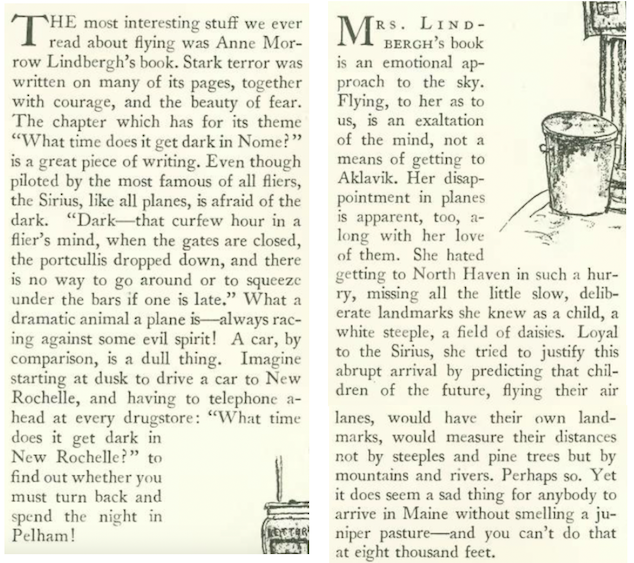
NOT YOUR EVERYDAY OUTING…In July 1931 Charles and Anne Morrow Lindbergh embarked in their Lockheed Model 8 Sirius on an often treacherous 7,100-mile journey across Canada, Alaska, Siberia and Japan in an attempt to find a commercial route to Asia for Pan American Airways. Top photo, Charles (standing on pontoon) and Anne (in the cockpit) make final preparations before the flight; bottom photo, enthusiastic crowds greet the Lindberghs upon their arrival in Japan. The Siberia-to-Japan leg was the most dangerous due to heavy fog. (historynet.com)

E.B. White also announced the return to the city of former Mayor Jimmy Walker, who had fled to Europe in 1932 amid corruption charges. White noted that New York’s nightclubs were eager to welcome the fun-loving Walker back to town.
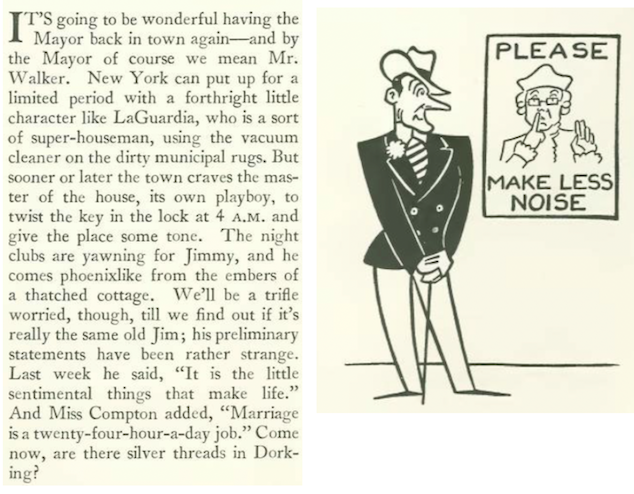
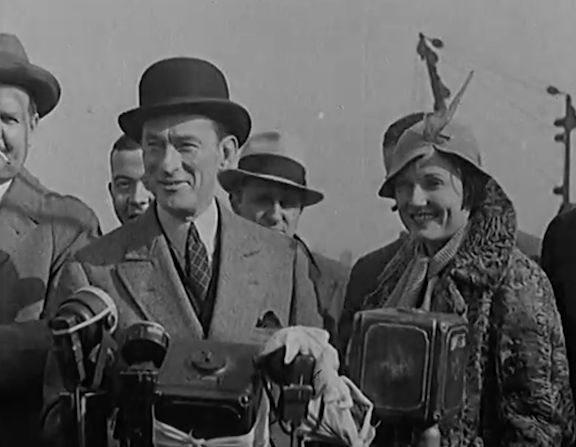
SECOND ACT…Still image from a 1935 British Pathé newsreel shows the triumphant return from Europe of former Mayor Jimmy Walker and his wife, Betty Compton. (YouTube)

 * * *

A Zephyr Blows In

The magazine’s “Motors” correspondent (pen name “Speed”) noted the dazzling display of 1936 models at the New York Automobile Show, singling out the Lincoln-Zephyr as the year’s biggest innovation.
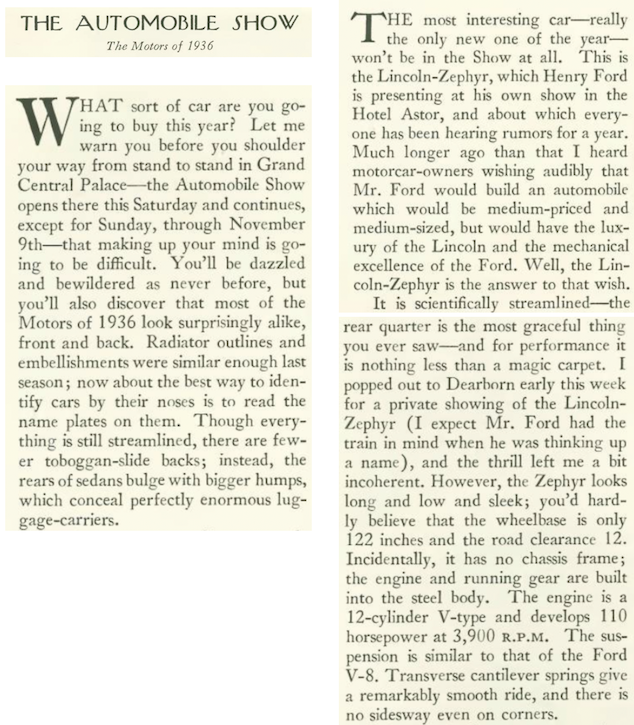
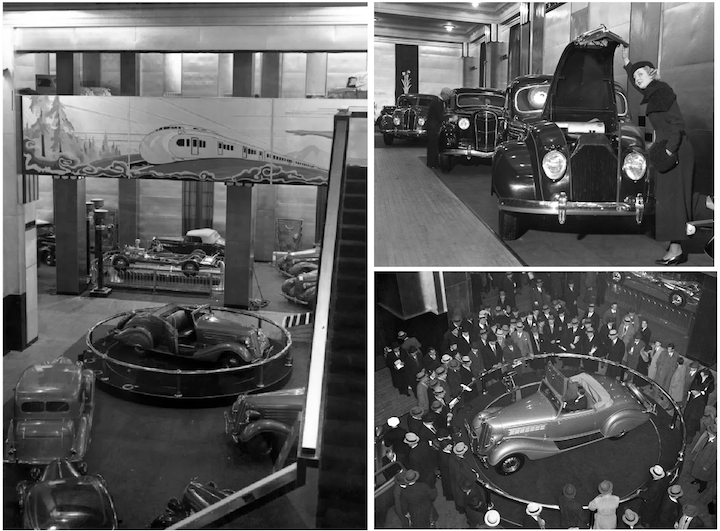
DECO DREAMSCAPE…Streamlining was all the rage at the 1935 New York Automobile Show at Grand Central Palace. Upper right, a woman opens the hood of a streamlining pioneer, the Chrysler Airflow. (New York Daily News)
LEADER OF THE PACK…The 1936 Lincoln-Zephyr had tongues wagging at the New York Automobile Show.  (thehenryford.org)

 * * *

At the Movies

William Powell and Hollywood newcomer Rosalind Russell blessed film critic John Mosher with their spy caper, Rendezvous, while Pauline Lord got lost in the London fog with Basil Rathbone in A Feather in Her Hat.
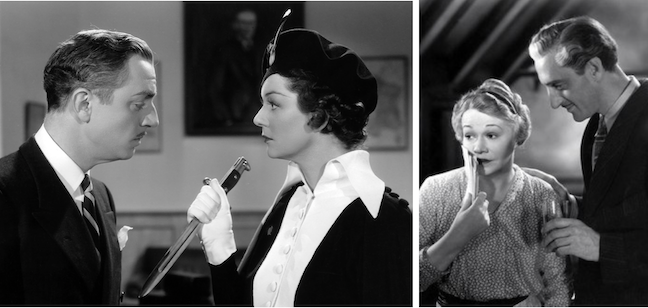
A CAPER AND A WEEPER…At left, William Powell starred with Hollywood newcomer Rosalind Russell in Rendezvous; at right, Broadway stage actress Pauline Lord appeared opposite Basil Rathbone in A Feather in Her Hat. (1935)

Mosher also screened a French comedy, René Clair’s Le Dernier Milliardaire (The Last Billionaire), finding its slapstick approach to satire a bit dated.

DURABLE AND ADORABLE…Renée Saint-Cyr as Princess Isabelle in the French comedy Le Dernier Milliardaire (The Last Billionaire). Known for her chic comedies, Saint-Cyr (1904–2004) was a major French film star for seven decades. (Film Forum)

Finally, Mosher turned his critical eye toward a British sci-fi film, Transatlantic Tunnel. Looking forward to seeing a gee-whiz Jules Verne-type story, what Mosher found instead was a lot of sentimental “padding” and very little gee-whiz.

UNDERWATER…John Mosher looked forward to an undersea adventure, but instead got a lot of sentimental fluff in the British sci-fi film, Transatlantic Tunnel. Clockwise, from top left, movie poster for the American release; scene from the film depicting the tunnel entrance; the film showcased such futuristic conveniences as video phones (called “televisors”); a group of wealthy industrialists gather at the home of a Mr. Lloyd, a millionaire investor who used a motorized wheelchair. (Wikipedia/Reddit/cinemasojourns.com)

 * * *

No Thanks, Ernie

Clifton Fadiman had an armload of books to review, including an autobiography by Andre Gide (If I Die), novels by Mikhail Sholokhov (Seeds of Tomorrow) and Mari Sandoz (Old Jules), and an Ernest Hemingway tale about big game hunting (Green Hills of Africa) that Fadiman did not care for at all. Here are excerpts from a couple of the reviews:
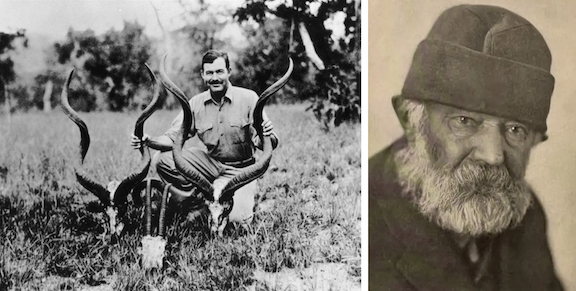
RUGGED TYPES…At left, Ernest Hemingway poses with skulls of kudu and female of sable antelope in East Africa, 1934, part of his hunting trip described in Green Hills of Africa; at right, photo of Jules Sandoz from the frontispiece of Old Jules, a biography written by his daughter Mari Sandoz. (JFK Library/U of Nebraska)

 * * *

From Our Advertisers

With the National Automobile Show in full swing at the Grand Central Palace, the issue was jammed with ads for every type and price range…the Chrysler Corporation took out this full-page spot on the opening spread to promote one of the lowest priced cars on the market…

…Chrysler/DeSoto continued to tout its streamlined Airflow models…introduced in 1934, the Airflow was the first full-size American production car to use streamlining, and it featured a number of other innovations, but consumers just weren’t ready for something this radical…even with the streamlining toned down after its first year, only 55,000 units were produced during the model’s four-year run…
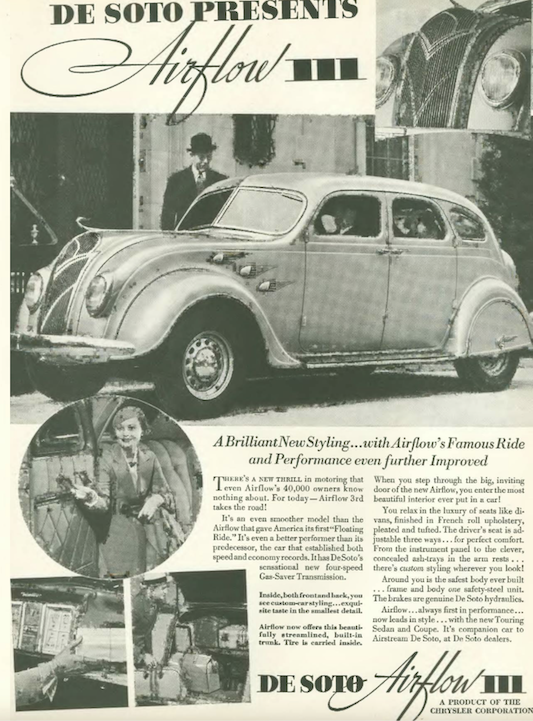
…on a side note, Chrysler has revived the Airflow nameplate for an electric car concept due to the marketplace in 2028…

…mentioned in Speed’s review of the Automobile Show, the Lincoln-Zephyr would find success with its aerodynamic design…
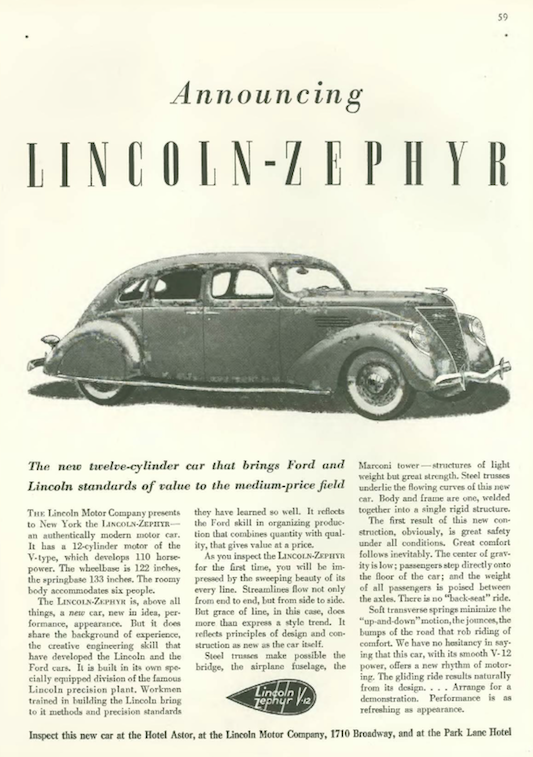
…most manufacturers were in on the streamlining trend, noticeable in the tilted grilles, low rooflines, and sweeping fenders…
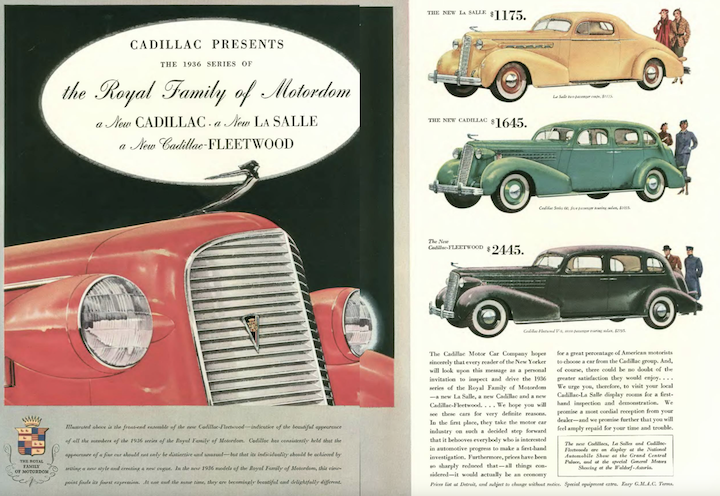
…unlike the other car companies, Pierce Arrow did not produce an economy model to keep its luxury line afloat during the Depression…emphasizing its handmade quality, this American rival to Rolls-Royce went out of business by 1938…

…Goodyear got in on the Auto Show action promoting its tires for the “new and faster cars”…

…the folks at Campbell’s continued their ad series featuring upper-class women covertly serving canned soup to their society friends…in this ad, however, the hostess reveals her secret…

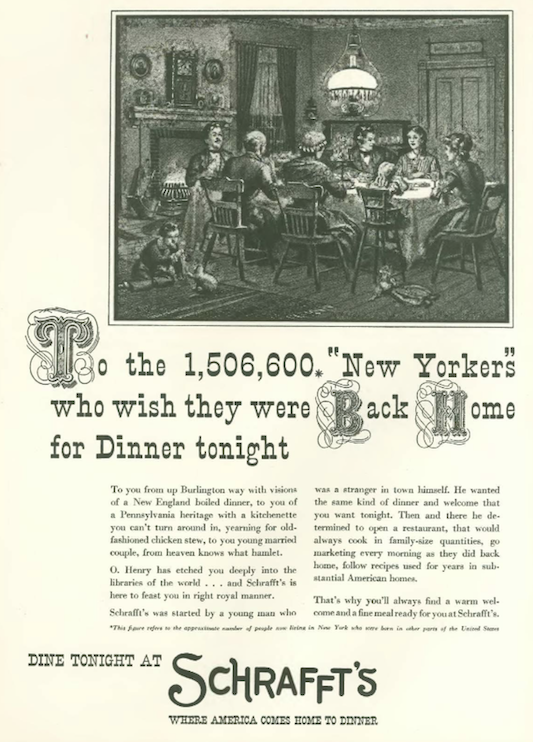
…there were no secrets to be found at Schrafft’s—its popularity increased during the Depression, when more than forty locations in the New York metro offered moderately priced “home-style” meals in an atmosphere that suggested upper-middle-class gentility…
…Long Island’s Lido Country Club tried to drum up some autumn business by promoting the “warm and lazy” sunshine of “Indian Summer”…

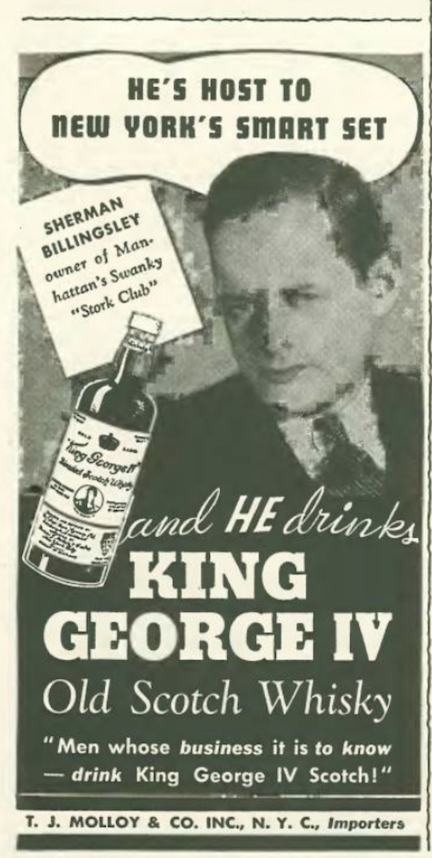
…the makers of King George IV Scotch used the face of Stork Club owner Sherman Billingsley to lend some nightlife cachet to their product…here’s an odd little fact: his nephew, Glenn Billingsley, was married to Leave It to Beaver actress Barbara Billingsley, who played June Cleaver on the TV series…
…this week the back cover belonged to R.J. Reynolds, with various aviators testifying to the calming effects of Camel cigarettes…the lead endorser in the ad, Frank Hawks, was famous for breaking aviation speed records until he perished in the crash of an experimental plane in 1938…

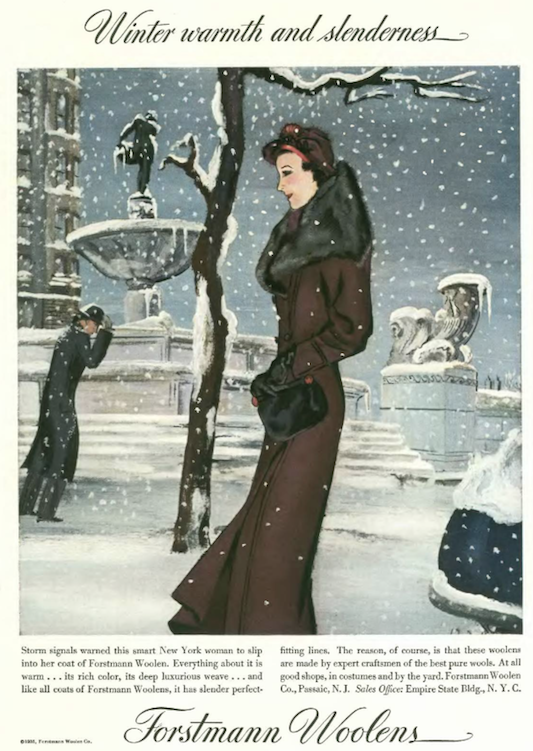
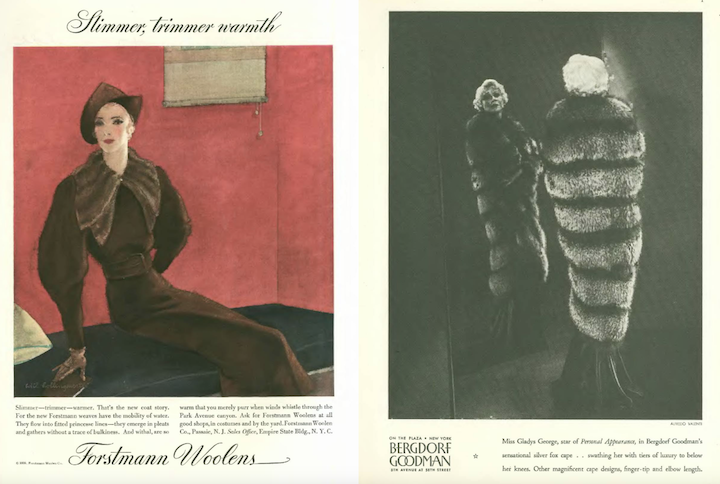
…Forstmann ads were a regular feature on the inside front cover during the fall/winter fashion season, rendered in a style made popular by illustrator Carl “Eric” Erickson

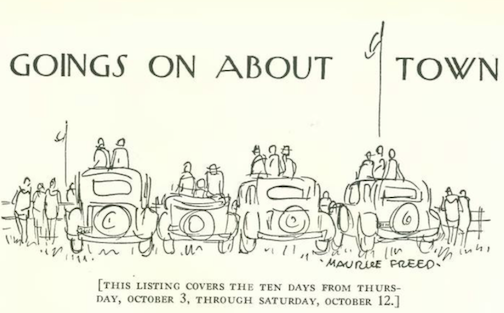
…on to our cartoonists, we open the magazine with Maurice Freed

James Thurber was busy in this issue, writing a touching character sketch of a medicine show man he greatly admired (“Doc Marlowe”)…and contributing this spot art for “Goings On About Town”…
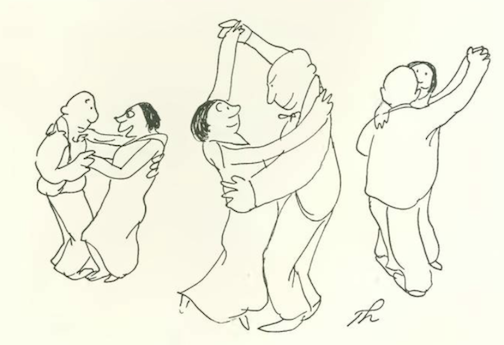
…he also turned in this terrific cartoon…

Christina Malman livened up the Auto Show review with this spot art…

Carl Rose also paid tribute to the annual event…

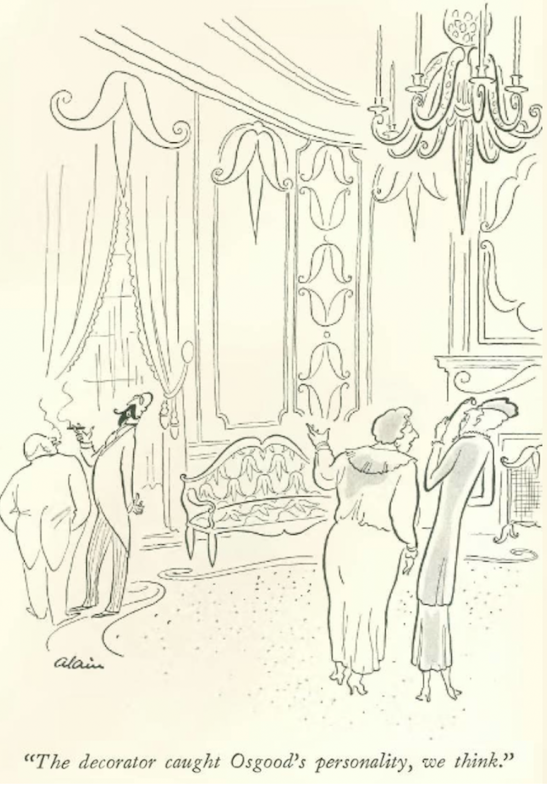
Daniel ‘Alain’ Brustlein did a bit of home decorating…
Robert Day was ready to call it a night…

Helen Hokinson contributed two cartoons, shopping for a pet fish…
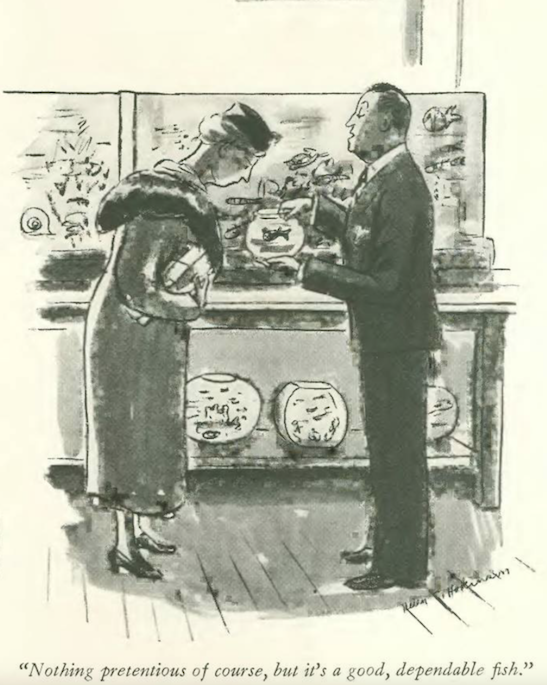
and taking in a Dolores Del Rio picture…
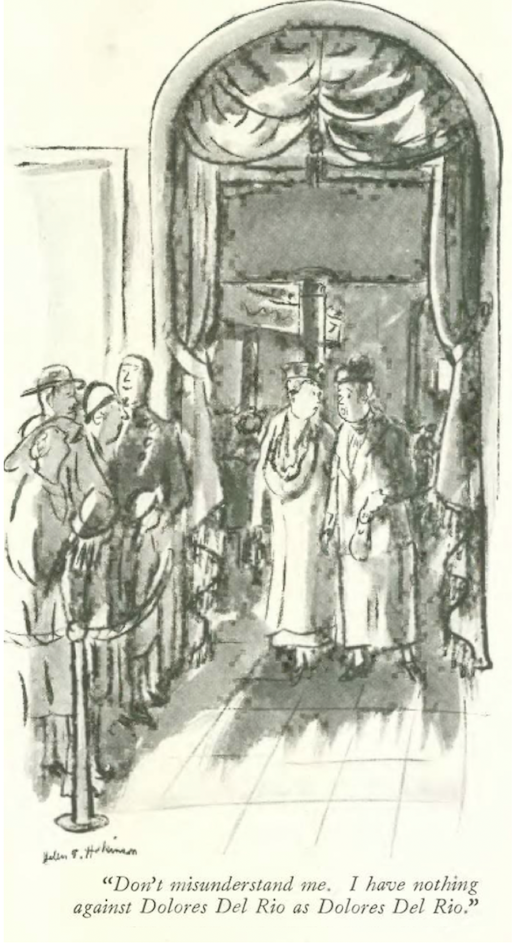
…no doubt Hokinson’s “girls” were commenting on the 1935 musical comedy In Caliente, featuring Mexican actress Dolores Del Rio (1904–1983)…Del Rio was the first Mexican actress to achieve mainstream success in Hollywood…

Dolores Del Rio in a scene from In Caliente. (Reddit)

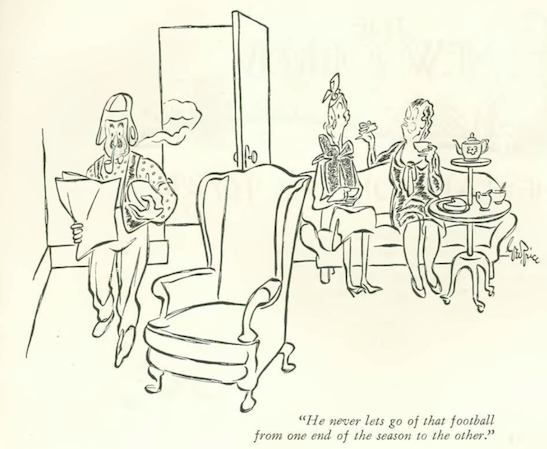
…we continue with George Price, and a dedicated lumberjack…

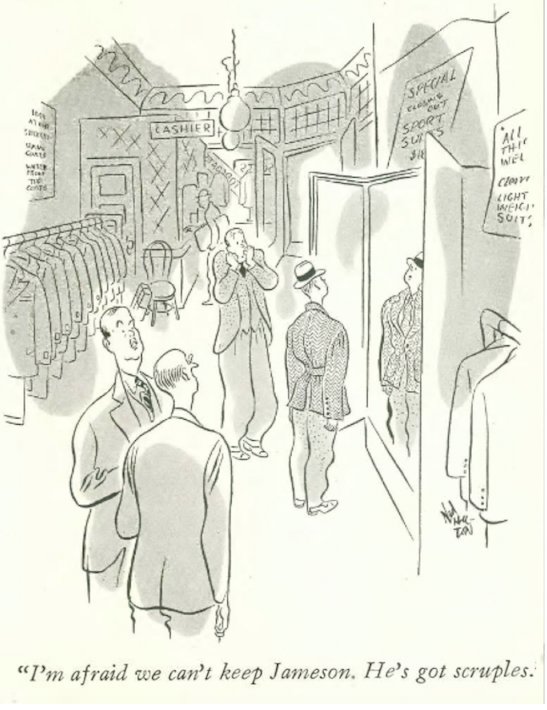
Ned Hilton discovered some honesty in the Men’s Department…
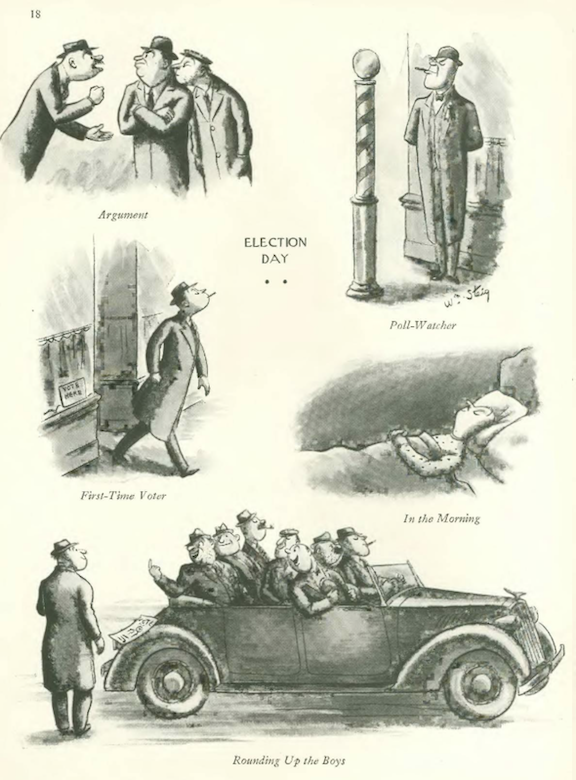
William Steig took a look around on Election Day…
Richard Decker took the pulse of the medical profession…
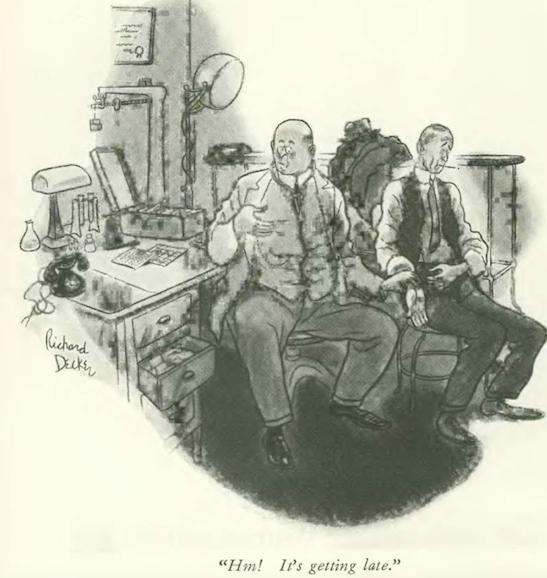
…and we close with another by Decker, where seeing is not believing…

Next Time: Jimmy Comes Home…

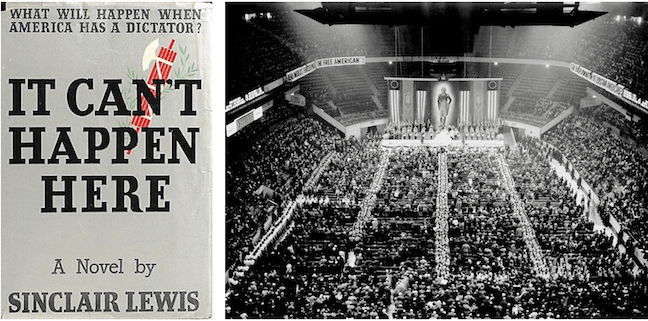


It Can’t Happen Here

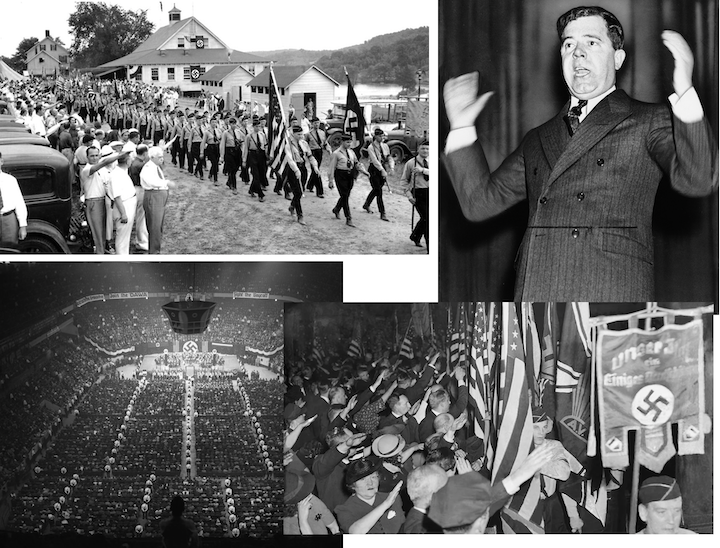
Above: Cover of Sinclair Lewis's 1935 novel about a fascist takeover of America, It Can't Happen Here. At right, 22,000 people attended a Nazi rally at Madison Square Garden on February 20, 1939. (Wikipedia/Reddit)

Ninety years ago Sinclair Lewis published It Can’t Happen Here, a dystopian novel that responded to the rise of fascism in Europe as well as to American demagogues like Louisiana Senator Huey Long.

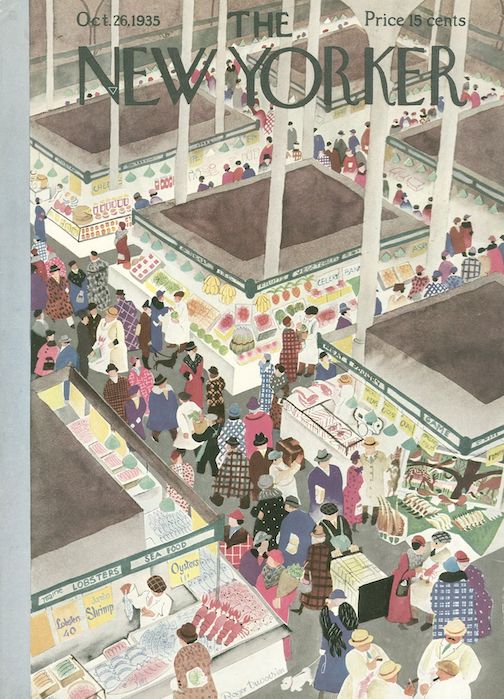
October 26, 1935 cover by Roger Duvoisin. Duvoisin (1900–1980) was a Swiss-born American writer and illustrator best known for children’s picture books. He illustrated 32 covers for The New Yorker, along with five cartoons. Duvoisin won the Caldecott Medal in 1948 (along with author Alvin Tresselt) for White Snow, Bright Snow.

In his 2016 New Yorker article, “Getting Close to Fascism with Sinclair Lewis’s ‘It Can’t Happen Here,'” journalist Alexander Nazaryan notes how Lewis was arguing for journalism and civic education as essential pillars of democracy. The title of Lewis’s book, Nazaryan observes, suggests that ‘It’ was something more subtle: “a collective apathy, born of ignorance, and a populace that can no longer make the kind of judgments that participatory democracy requires.”

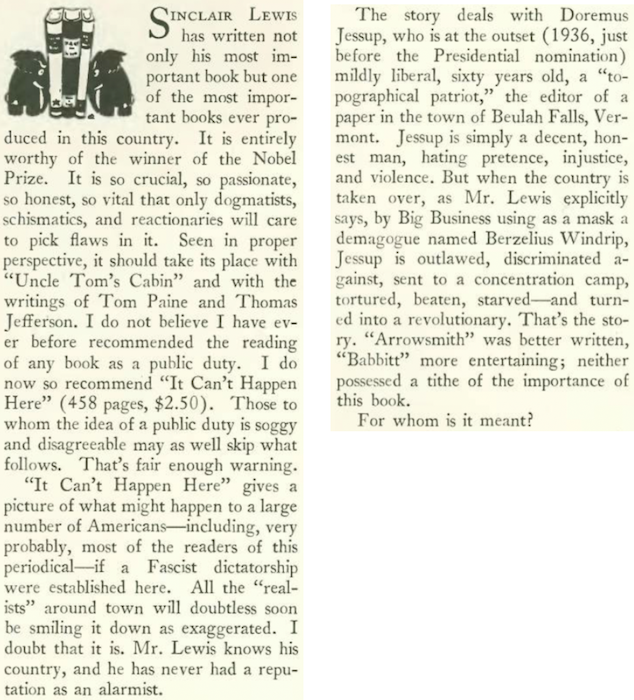
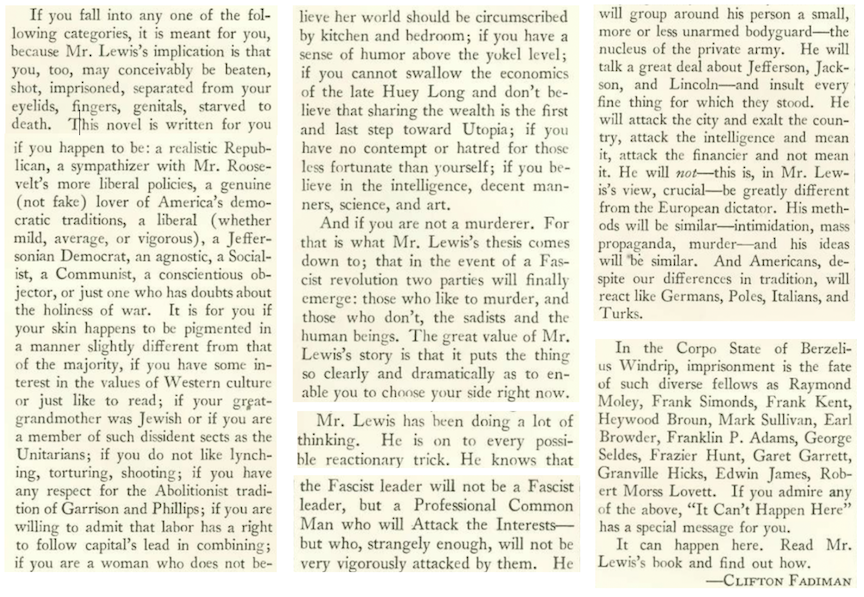
Lewis’s novel also made book critic Clifton Fadiman sit up and take notice. Here are excerpts from the first part of his review:

HOME-GROWN…American fascism was represented by organizations such as the German American Bund, the Silver Legion of America, and radio host Charles Coughlin, who opposed the New Deal and promoted conspiracy theories and antisemitic views. Clockwise, from top left: Nearly a thousand uniformed men wearing swastika arm bands and carrying Nazi banners parade past a reviewing stand in New Jersey on July 18, 1937. The New Jersey division of the German-American Bund had opened the 100-acre Camp Nordland at Sussex Hills; Huey Long in 1935, the same year he was assassinated; Nazi rally at Madison Square Garden in 1939. (AP/Wikipedia)

If you zoom in on the photo at bottom right, you can’t help but notice the woman in the black hat, who seems a little unsure about what she is doing, especially in front of a camera…the woman to her right appears to be hiding her face.

Here is more of Fadiman’s review (click to enlarge). It’s worth a read.

WE’VE BEEN WARNED…Published nearly seventy years apart, Sinclair Lewis’s It Can’t Happen Here (1935) and Philip Roth’s The Plot Against America (2004) both explored the dangers of fascism in the United States. (pulitzer.org/Wikipedia/Nancy Crampton via stanford.edu)

 * * *

It Was Happening There

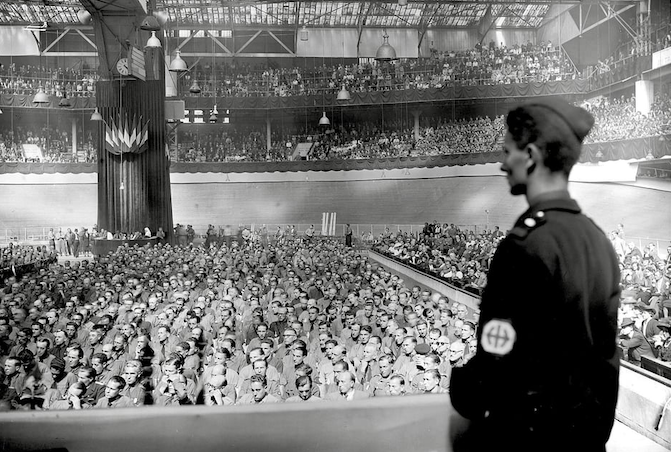
In her “Letter from Paris,” Janet Flanner was noting “increasing Fascist sentiment and  sympathy” in her adopted city:

OVER THERE…The French Popular Party (Parti populaire français, PPF) was a French fascist and anti-semitic political party led by Jacques Doriot before and during World War II. Formed in June 1936, with an estimated 120,000 members by 1937, it is generally regarded as the most collaborationist party of France. (thefrenchhistorypodcast.com)

 * * *

All Talk

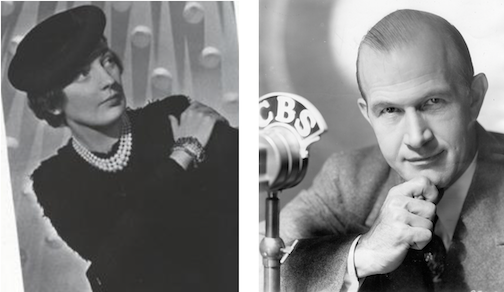
Marion Sayle Taylor (1889–1942) was the popular host of a radio advice show, The Voice of Experience. Margaret Case Harriman (1901–1966) penned a two-part profile of Taylor titled “The Voice.” I’ve included the opening lines to Part One here:

IF ONLY SHE KNEW…Margaret Case Harriman, left, circa 1936, profiled Marion Sayle Taylor before his misdeeds were revealed. (Vogue Archive/eleanorbritton.blogspot.com/Oregon Encyclopedia)

After reading both parts of Harriman’s profile piece, it appears she wasn’t yet aware that Taylor was more than a radio personality; he was also dishonest, manipulative, and opportunistic, according to a biography by Dick and Judy Wagner featured in the Oregon Encyclopedia. For example, Harriman reported (likely from Taylor’s official bio) that Taylor’s first wife, Pauline, had died in childbirth, when in fact she was quite alive and suing him for divorce that same year. Taylor also divorced his second wife, Jessie, who sued him in 1936 after he deceived her about another woman. Not surprisingly, his radio image as a reliable marriage counselor was damaged irretrievably.

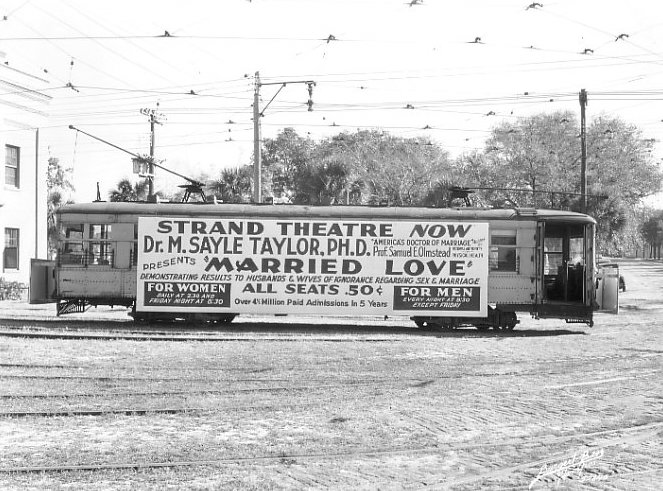
FALSE ADVERTISING…A streetcar, possibly in Newark, N.J., advertising a lecture by Taylor, circa 1931. In addition to hiding a previous prison record, Taylor also falsely reported that he had studied at several universities (he did not earn a Ph.D, as the redundant title claims in the above photo). It appears Taylor also kept much of the money he solicited for charitable causes. (Oregon Encyclopedia)

 * * *

Selling Pooh

Commercial cross-marketing of children’s books with toys and other products had its origins in the late nineteenth century with Alice’s Adventures in Wonderland, and in the first years of the 20th century Beatrix Potter’s Peter Rabbit series inspired everything from dishes and wallpaper to board games and dolls—in 1903 Peter Rabbit was the first fictional character to be made into a patented stuffed toy.

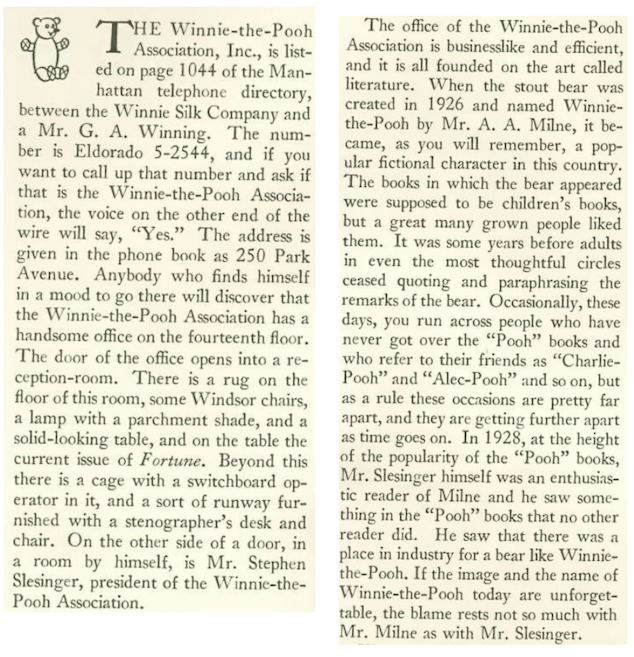
Then came another character from British children’s literature, A.A. Milne’s Winnie-the-Pooh. In January 1930, Stephen Slesinger (1901–1953) purchased U.S. and Canadian merchandising, television, recording, and other trade rights to the Winnie-the-Pooh works from Milne (for $1,000, plus royalties), marketing a wide range of products. For the column “Onward & Upward With the Arts,” St. Clair McKelway paid a visit to Slesinger at the Park Avenue offices of Winnie-the-Pooh Association, Inc. Excerpts:

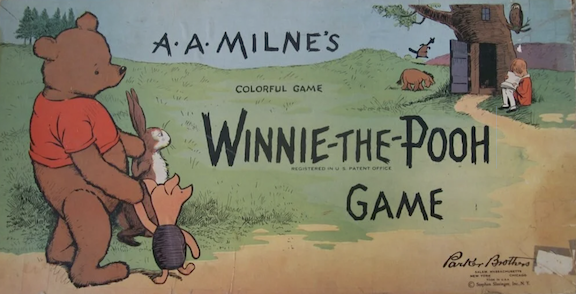
KEEP YER SHIRT ON…The Parker Brothers were the first to feature Winnie-the-Pooh in color for a 1932 board game. Stephan Slesinger added the iconic red t-shirt to Pooh for the game and a children’s record, a look that was later adopted by the Disney Corporation when it acquired the rights from Slesinger’s widow and daughter in 1961. (thedisneyclassics.com)
FUNNIES MAN…At left, Stephan Slesinger in an undated photo. Slesinger was a radio, television and film producer, and a curator of comic strip characters including Alley Cop, Captain Easy, Buck Rogers and Blondie, among others; at center, a record of “Winnie-the-Pooh Songs,” 1932; an ad for the Red Ryder BB gun—in 1938 Slesinger created the comic strip Red Ryder along with artist Fred Harmon. (alchetron/yesterdaysgallery.com/Port Isabel Press)

In another excerpt, McKelway gave us an idea of the scope of Slesinger’s Pooh empire:

 * * *

At the Movies

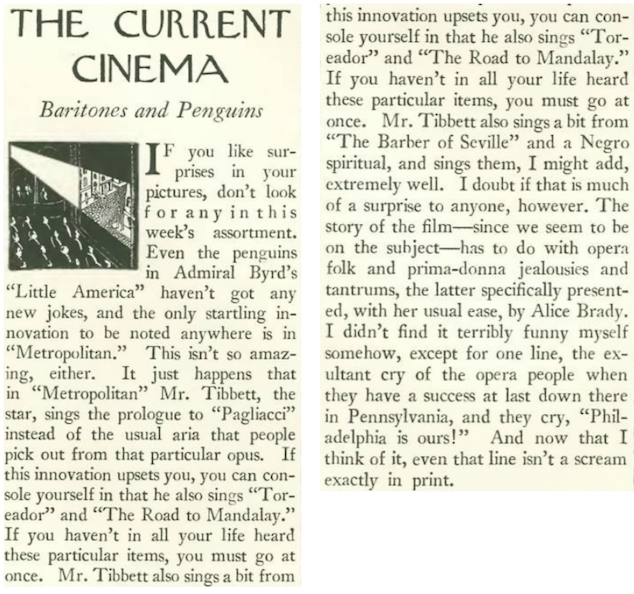
Critic John Mosher found few thrills in the latest fare from Hollywood, offering his views of Admiral Richard Byrd’s Into Little America and the musical Metropolitan, featuring famed baritone Lawrence Tibbett. 

FOR THE BYRDS…At left, lobby card for Into Little America; at right, Alice Brady and Lawrence Tibbett in Metropolitan. (eBay.uk/rottentomatoes.com)

With a screenplay by Ben Hecht and Charles MacArthur and direction by Howard Hawks, one would hope for some rough and tumble in a film about Gold Rush San Francisco. Instead, Mosher found the trappings of Barbary Coast rather mild. This was doubtless due in part to the Hays Code that curtailed the sex and violence portrayed in films of the 1920s and early 1930s.

TAKING A SPIN…Miriam Hopkins runs the roulette wheel as Edward G. Robinson looks on in Barbary Coast. A brief 2019 review in the Harvard Film Archive praised the film’s Gothic feel created by the “evocative portrayal of early San Francisco as a foggy labyrinth of rickety boardwalks and ominous, sky-high ship masts…” (harvardfimarchive.org)

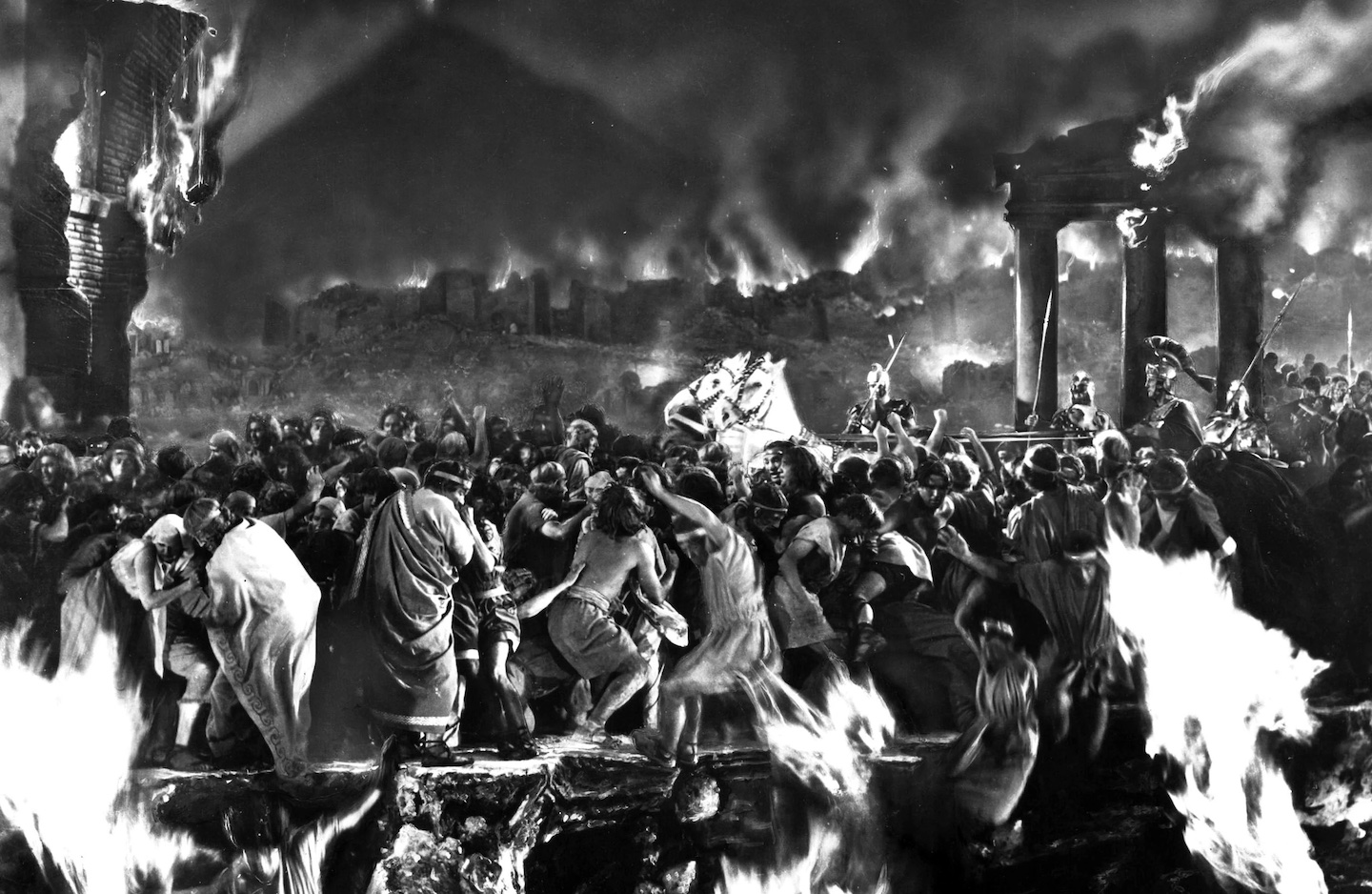
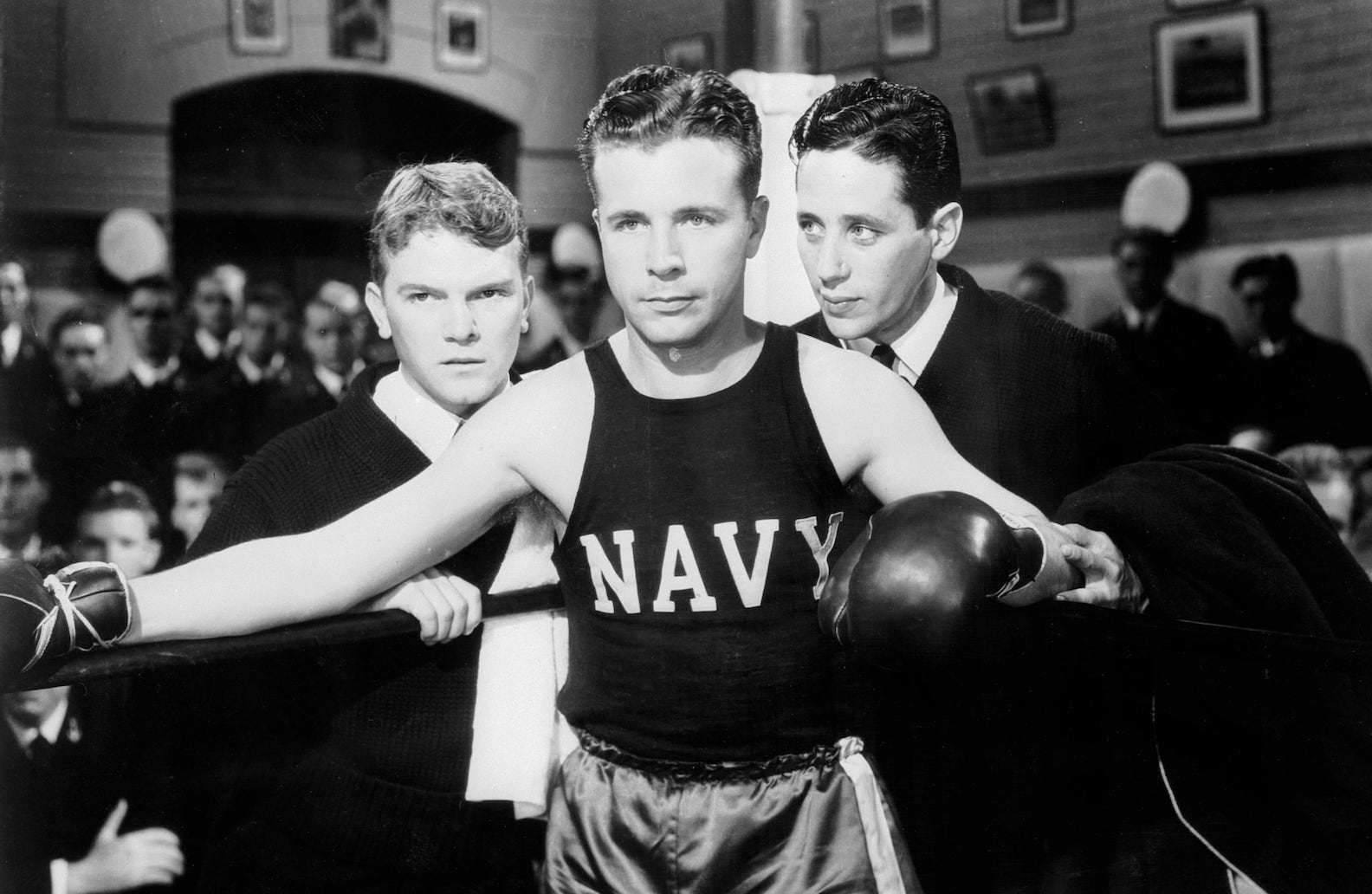
One might think that a film featuring the destruction of Pompeii would have some thrills, however RKO’s The Last Days of Pompeii proved to be a “temperate affair” in Mosher’s eyes, “one of the great bores of the moment.” The Dick Powell/U.S. Navy vehicle Shipmates Forever didn’t prove to be any better.

HOT TIMES IN POMPEII?…John Mosher called The Last Days of Pompeii “one of the great bores of the moment,” including the “drearily enacted” eruption of Vesuvius in which “Paper temples fall and there is a bit of bustle, and that is all there is to that.” Mosher did single out Basil Rathbone’s performance as an urbane Pontius Pilate, “a Pontius Pilate with a Long Island manner.” (tcm.com)
GO GET ‘EM DICK…The U.S. Naval Academy provided the setting for the musical Shipmates Forever, featuring Dick Powell as a crooner who ultimately chooses the Navy over a singing career. (tcm.com)

* * *

From Our Advertisers

We begin with the inside front cover, where the folks at Fisher touted their innovative “Turret Top” design…Body by Fisher began as a separate company in 1908, specializing as an automobile coach builder…although acquired by General Motors in 1926, the Fisher brand was promoted until the 1980s…

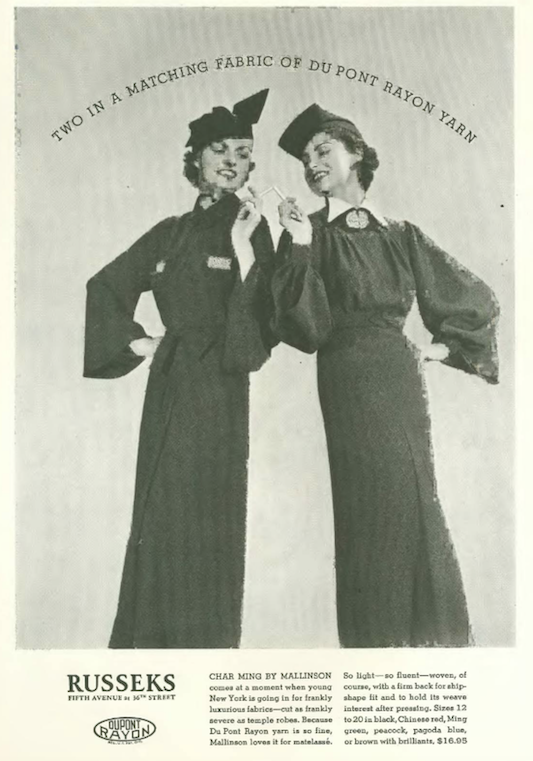
…there were many fall and winter fashion ads in this issue, including this continuing series by Russeks promoting Rayon fabrics…and women smoking, no doubt considered a sign of sophistication…

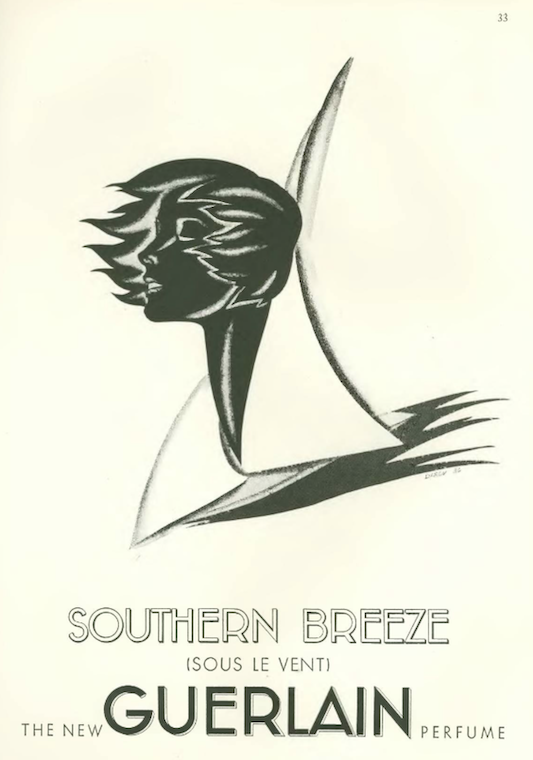
…Guerlain perfume ads featured the unmistakable style of illustrator Lyse Darcy

…the Heyward/Gershwin production of Porgy and Bess made a splash in this ad for Stage magazine…
…World Peaceways often used terrifying imagery to promote their anti-war messages…this ad was on the inside back cover…

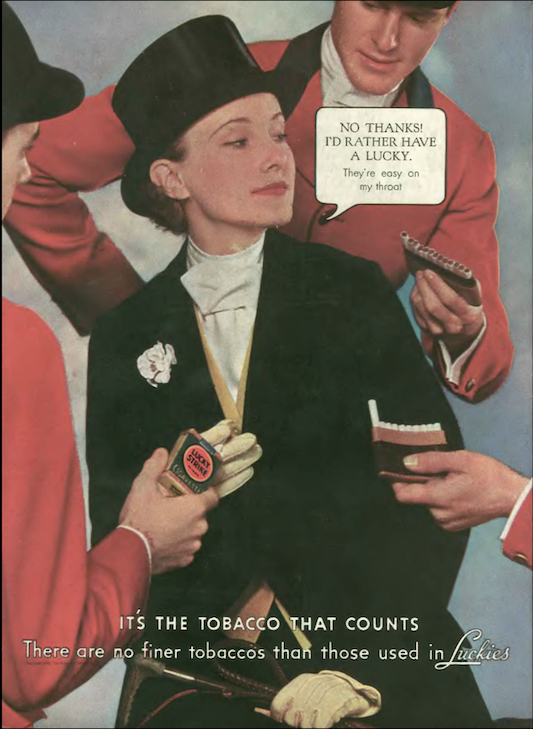
…and as you closed the magazine, the back cover greeted you with this stylish appeal to smoke Luckies…

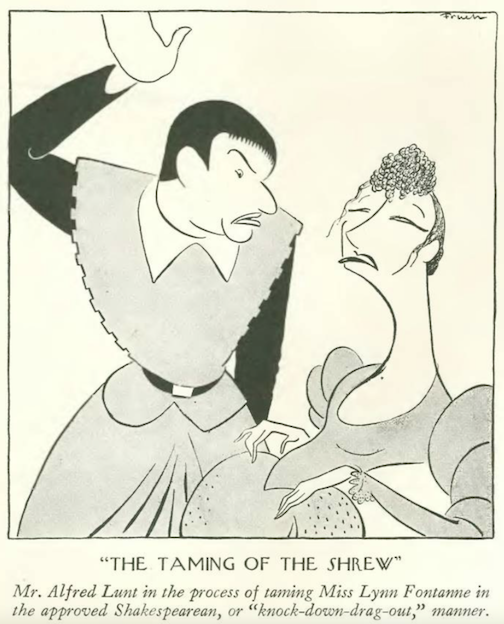
…on to our cartoonists, starting with Al Frueh in the Theatre section…

…and Frueh again, in this interesting arrangement…

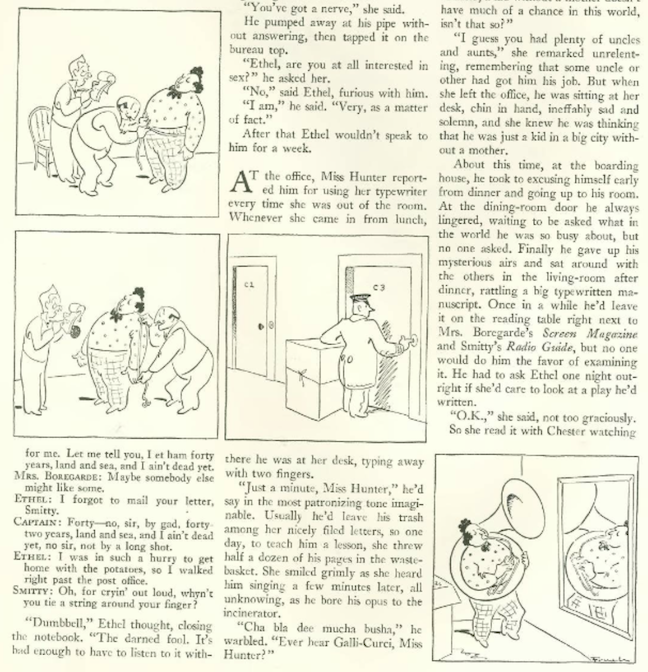
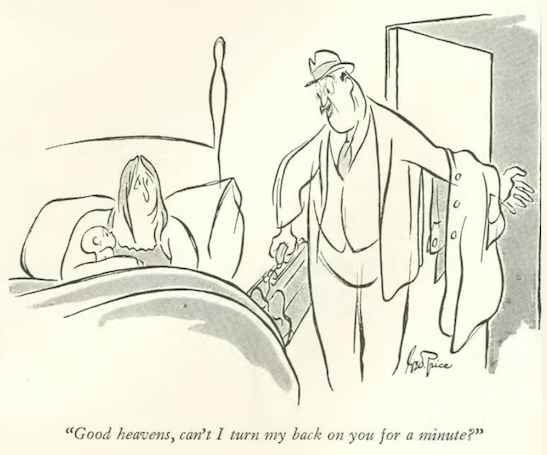
George Price was featured twice…

…with scenes of domestic life as only Price could render…
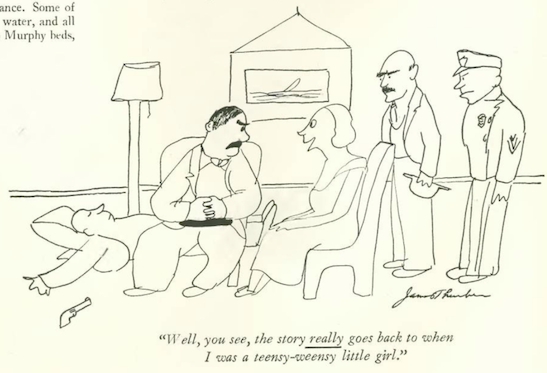
…and speaking of distinctive, no one did it quite like the great James Thurber

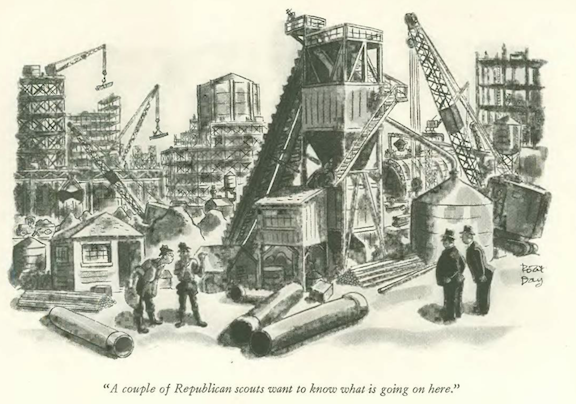
Robert Day gave us two Republicans looking in on the progress of the New Deal…

Carl Rose bid farewell to a writer sick of his peace and quiet…

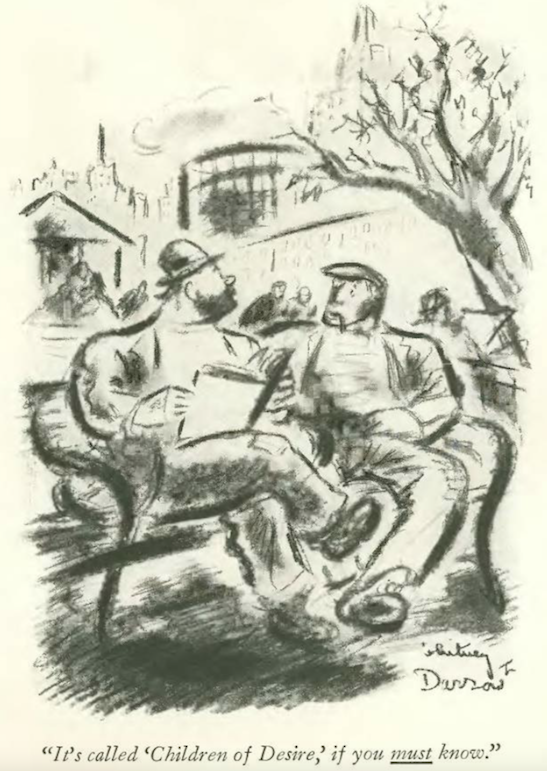
Whitney Darrow Jr illustrated a literary exchange on a park bench…

…and I close with today’s New Yorker cover artist, Roger Duvoisin—here is his cover for White Snow, Bright Snow, which won the Caldecott Medal in 1948.

Next Time: Planes, Trains and Automobiles…

On Catfish Row

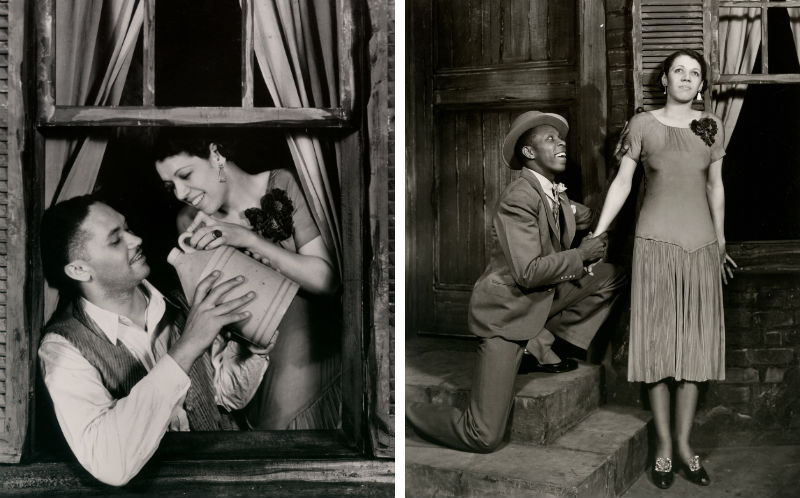
Above: Left image: Todd Duncan (Porgy) and Anne Brown (Bess), in the 1935 Broadway production of Porgy and Bess. Right image: John Bubbles (Sportin’ Life) and Brown. (Photos courtesy the Ira & Leonore Gershwin Trusts)

The 1935 Broadway production of Porgy and Bess is widely regarded as one of the most successful American operas of the twentieth century, but when it opened at the Alvin Theatre on Oct. 10, 1935, reviews were mixed, including the one penned by Wolcott Gibbs.

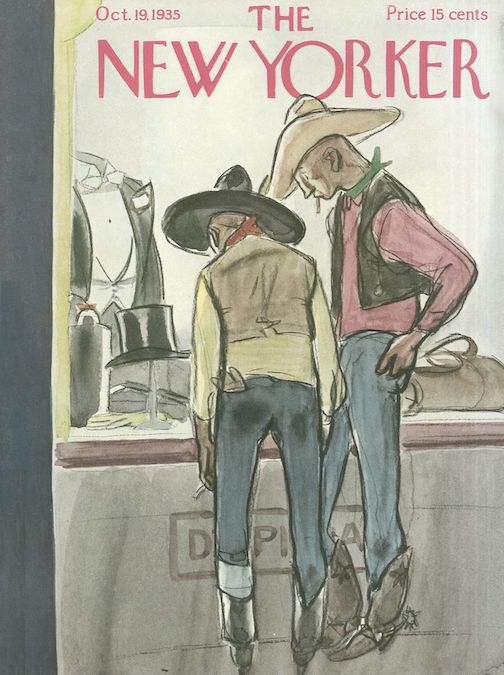
October 19, 1935 cover by William Crawford Galbraith. The New York Times (Oct. 9, 1935) made this observation about the rodeo at Madison Square Garden: “New York, which for several days has been vaguely aware of an impending rodeo because of a profusion of ten-gallon hats along Eighth Avenue and a sign in a beauty parlor, ‘Welcome, Cowgirls,’ will see the real thing this morning.”

Now you would think a work by composer George Gershwin, with a libretto written by DuBose Heyward (author of the 1925 novel Porgy) and lyricist Ira Gershwin, would be a sure hit. Some critics did praise the production, which ran for 124 performances, but others criticized themes and characterizations of Black Americans that were created by white artists.

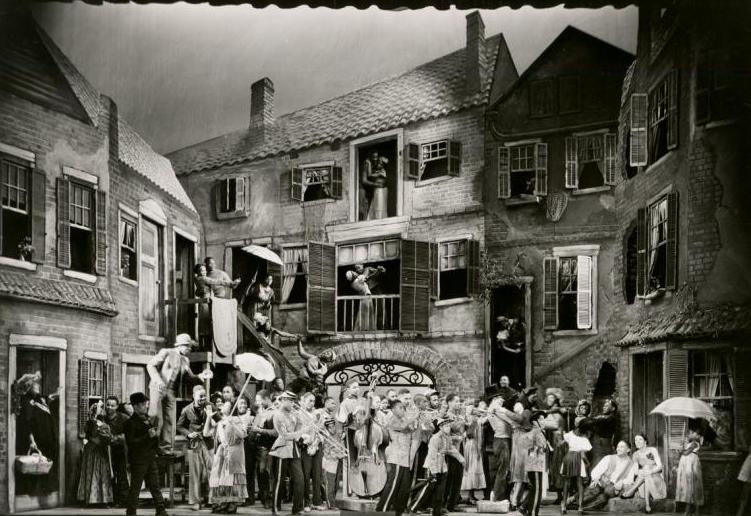
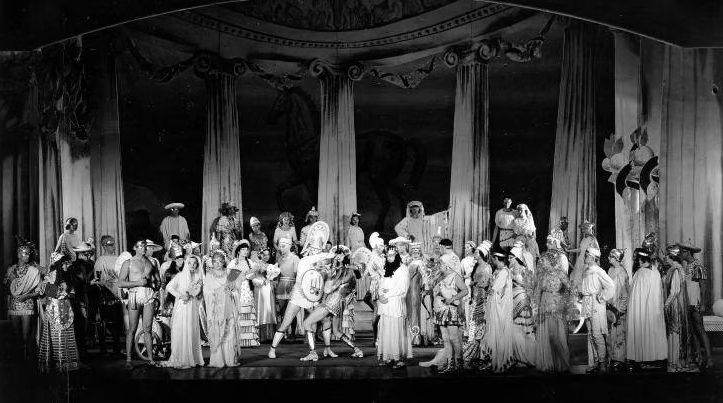
MIXED REVIEWS…The original Catfish Row set for Porgy and Bess as seen at Broadway’s Alvin Theatre (now the Neil Simon Theatre) in 1935. (Billy Rose Theatre Collection, New York Public Library Digital Gallery)

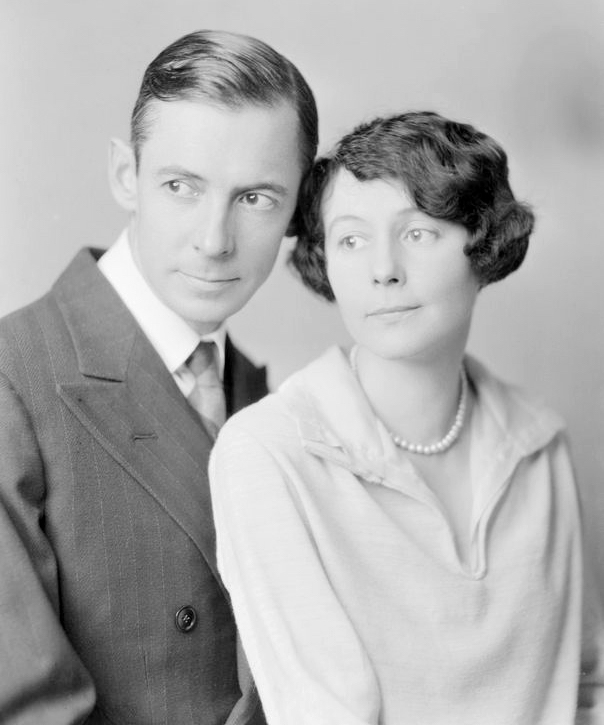
This wasn’t the first time Porgy was adapted to the stage. It was originally produced in 1927 by Heyward and his wife, Dorothy, at the Guild Theatre in New York. The Heywards insisted on an African-American cast—an unusual decision at the time—and enlisted newcomer Rouben Mamoulian to direct. The play ran a total of fifty-five weeks.

ORIGIN STORY: Porgy: A Play in Four Acts, was a 1927 play by Dorothy Heyward and DuBose Heyward, adapted from the short novel by DuBose. (Wikiwand)

Gibbs preferred the original Porgy to the Gershwin–Heyward production, admitting that he simply did not care for “the operatic form of singing a story.”

continued…

TAKING THEIR BOWS…George Gershwin greets an audience after a performance of Porgy and Bess. Behind Gershwin are his brother, Ira Gershwin (left), and librettist and Porgy author DuBose Heyward (partially hidden, at right). (umich.edu)

The Moss Hart/Cole Porter musical comedy Jubilee! premiered at Broadway’s Imperial Theatre on Oct. 12, 1935, just two days after the Porgy and Bess premiere. Gibbs dubbed this show “heat-warming and beautiful.”

THE BEGUINE BEGINS…Inspired by the Silver Jubilee of Britain’s George V, the musical comedy Jubilee! told the story of a fictional royal family. The play featured such hit songs as “Begin the Beguine” and “Just One of Those Things,” which have become part of the American Songbook. (ovrtur.com)
ROYAL HIJINKS…At left, June Knight as Karen O’Kane and Charles Walters as Prince James in Jubilee!; at right, Mary Roland (the Queen) encounters “Mowgli” (Mark Plant) in Act I. (ovrtur.com)

Note: In the last issue (Oct. 12) we saw an ad for an around-the-world luxury cruise on the Franconia. Cole Porter and Moss Hart—with their families, friends, and assistants—sailed on a previous Franconia cruise, possibly in 1934, with the intention to write a new musical while on the trip. Apparently some of the songs and scenes in Jubilee! were inspired by their ports of call.

 * * *

Steering Clear

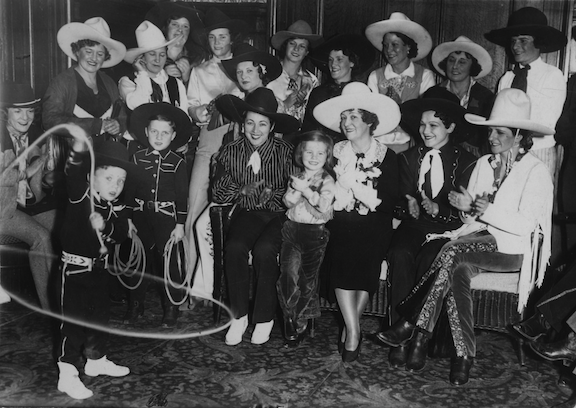
“The Talk of the Town” commented on the “steer-wrestlers” that were featured at the Madison Square Garden rodeo. Since steer-wrestling was also called “bulldogging,” it caused considerable consternation among New York animal lovers.

A BIG HOWDY…Cowgirls From the Madison Square Garden Rodeo With Millicent Hearst, 1932. (texashistory.unt.edu)

 * * *

Much Ado About FDR

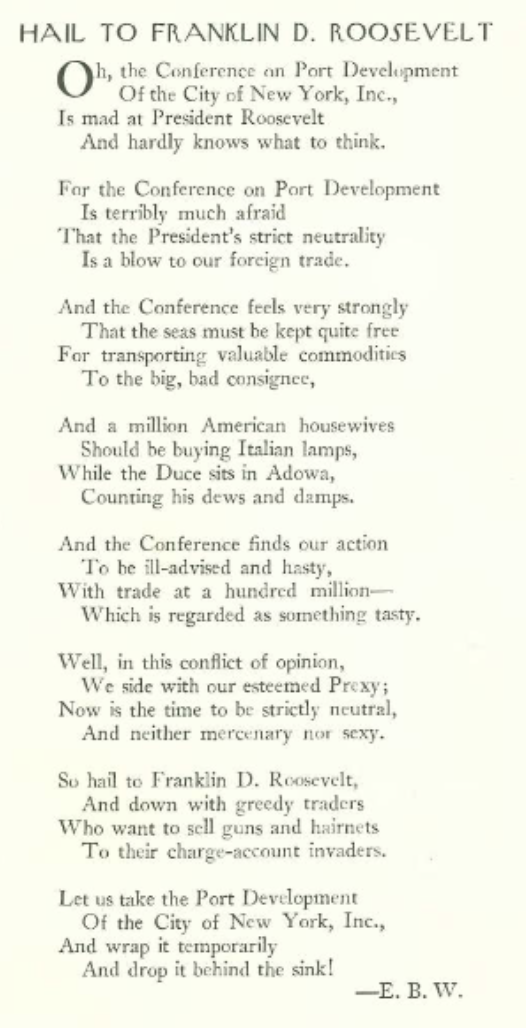
The Conference on Port Development of the City of New York took issue with President Franklin D. Roosevelt’s foreign trade policies, particularly his strict stance on neutrality, which the Conference believed was detrimental to foreign trade. This was likely related to the October 1935 Italian invasion of Ethiopia. E.B. White offered this satirical poem in reaction to the trade spat.

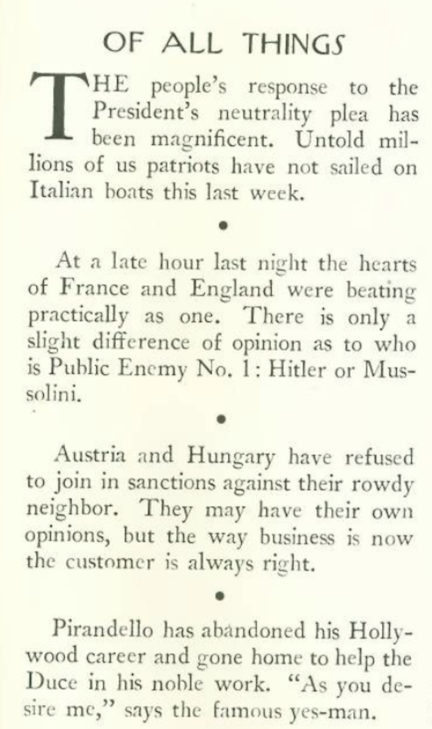
Howard Brubaker also chimed in on the trade issue, and on other unsettling developments in Europe:

 * * *

Puppy Love

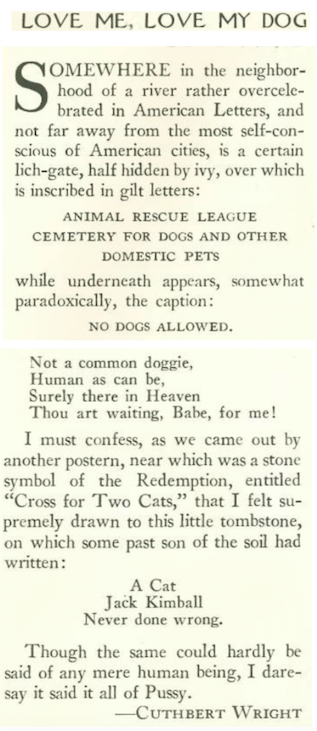
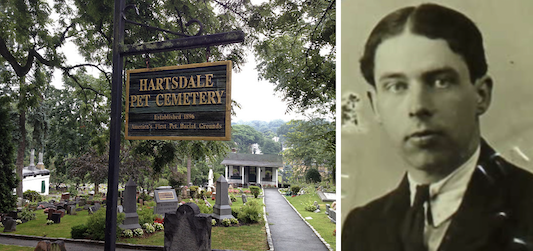
Critic and poet Cuthbert Wright (1892–1948) was moved to write poetry after visiting a dog cemetery that also welcomed animals of all stripes. Here are excerpts of the opening and closing lines:

PET PROJECT…Cuthbert Wright was moved to verse after his visit to a pet cemetery, possibly the Hartsdale Pet Cemetery in Westchester. (Wikipedia/parenthetically.blogspot.com)

 * * *

Man and Machine

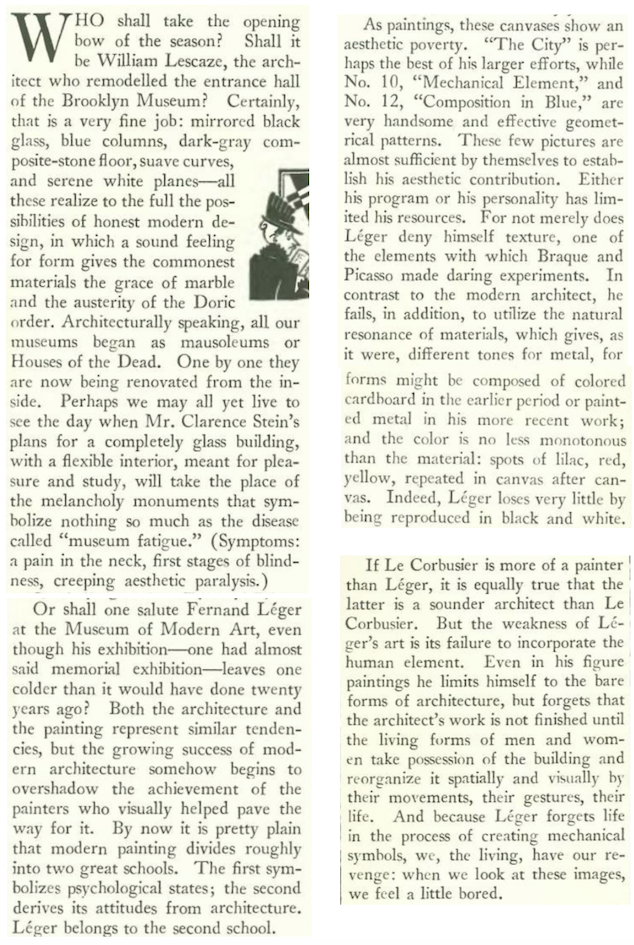
Art and culture critic Lewis Mumford is back this week, this time taking a look at the work of French artist Fernand Léger (1881–1955), who created a form of cubism known as “tubism,” regarded today as a forerunner of the pop art movement of the mid-1950s and the 1960s.

It is no surprise that the humanist Mumford, who sought an “organic balance” in everyday design, found Léger’s machine-like works alienating and sterile, representing an “aesthetic poverty.”

TOTALLY TUBULAR…Clockwise, from top left, works of Fernand Léger cited by Lewis Mumford: The City, 1919; photo of Léger, circa 1930s; from the 1918–1923 series Mechanical Elements, 1920; Composition in Blue, 1920–27. (Philadelphia Museum of Art/The Met Collection/Art Institute of Chicago, Charles H. and Mary F. S. Worcester Collection)

 * * *

Disappointment in O’Hara

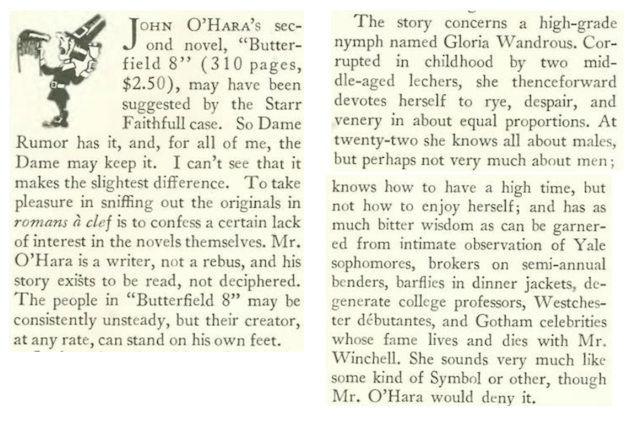
That is how Clifton Fadiman titled his “Books” column after reviewing John O’Hara’s latest novel, Butterfield 8.

O’Hara (1905–1970) wasn’t just any old scribbler. A prolific short-story writer, he has often been credited with helping to invent The New Yorker’s short story style. Praised by the likes of F. Scott Fitzgerald and Ernest Hemingway, O’Hara cranked out two bestsellers before the age of thirty. One was the acclaimed Appointment in Samarra (which was praised by Fadiman). The other was BUtterfield 8, the novel Fadiman found disappointing (Hemingway, on the other hand, blurbed, “John O’Hara writes better all the time.”). Here are a couple of brief excerpts from Fadiman’s review:

Fadiman concluded his review with a note to the author: “Why not let Jean Harlow have it, Mr. O’Hara, and start a fresh page?”

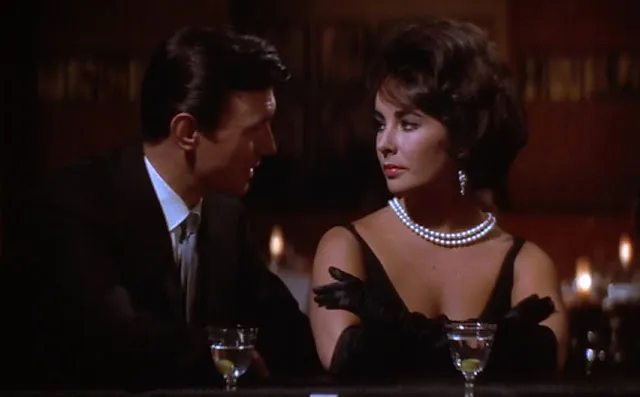
Well, Harlow didn’t get it, but twenty-five years later Elizabeth Taylor would reluctantly take on the role of Gloria Wandrous, and win the Academy Award for Best Actress.

YOU AGAIN?…Laurence Harvey and Elizabeth Taylor played on and off lovers in 1960’s Butterfield 8. John O’Hara did not participate in writing the adaptation, and the film’s plot bore only a slight resemblance to his novel. However, after the film’s release more than one million paperback copies of the novel were sold. (aiptcomics.com)

 * * *

At The Movies

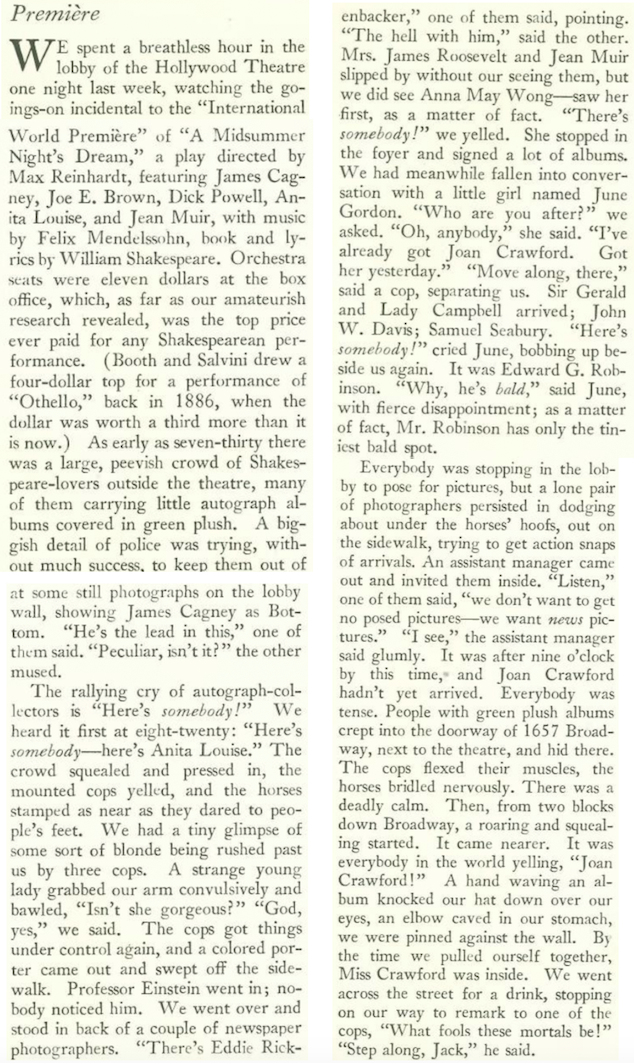
We begin this section with an excerpt from “The Talk of the Town,” which covered the “International World Première” of the Warner Brother’s adaptation of A Midsummer Night’s Dream. The film opened worldwide on October 9, 1935 in London, Sydney, Vienna and at New York’s Hollywood Theatre, where crowds turned out to get a glimpse of the stars.

RUBBERNECKERS…A Midsummer Night’s Dream premiere at the Hollywood Theatre in New York City on October 9, 1935. (britannica.com)

Film critic John Mosher praised Joe E. Brown’s performance as Flute, as well James Cagney’s portrayal of Bottom, and lauded the “magnificent group of clowns” that formed the remainder of The Players. Here are excerpts from his review (note I included the entirety of Otto Slogow’s delightful spot drawing):

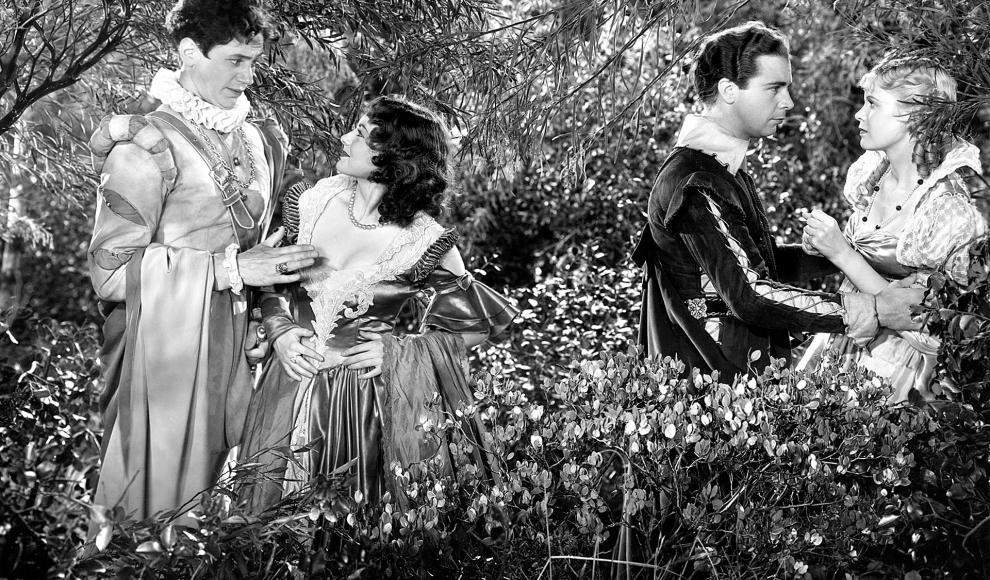
THE LOVERS…Left to right: Ross Alexander (Demetrius), Olivia de Havilland (Hermia), Dick Powell (Lysander) and Jean Muir (Helena) meet cute and confused in A Midsummer Night’s Dream. (TCM.COM)
THE SEVEN STOOGES…Bottom (James Cagney) and his fellow Players prepare to perform a stage play about the death of Pyramus and Thisbe which turns into a farce. From left, in front, Joe E. Brown (Flute), Cagney, and Otis Harlan (Starveling); in the back are, from left, Hugh Herbert (Snout), Arthur Treacher (Epilogue) and Dewey Robinson (Snug) as The Players in A Midsummer Night’s Dream. Frank McHugh (Quince) can be seen behind the wall in back. (IMDB)
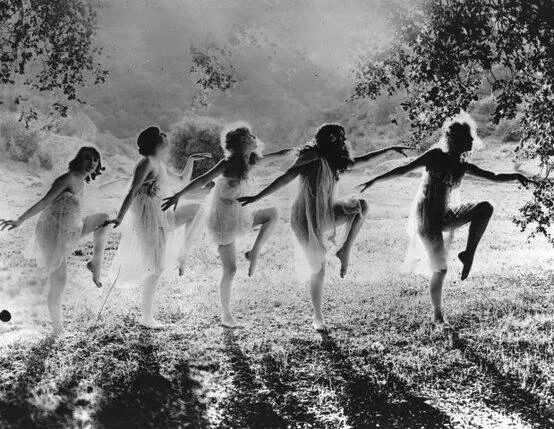
DANCING THE NIGHT AWAY…Fairie scene from A Midsummer Night’s Dream. (Facebook)

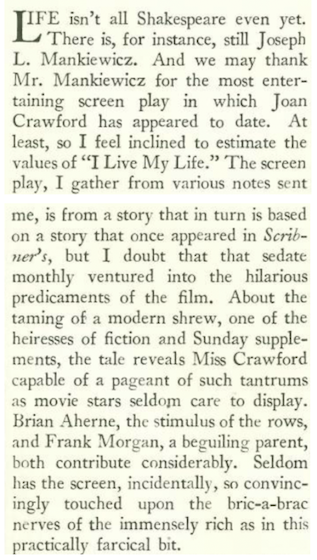
Mosher also reviewed the romantic comedy I Live My Life, which he found to be a satisfying satire on the lives of the rich.

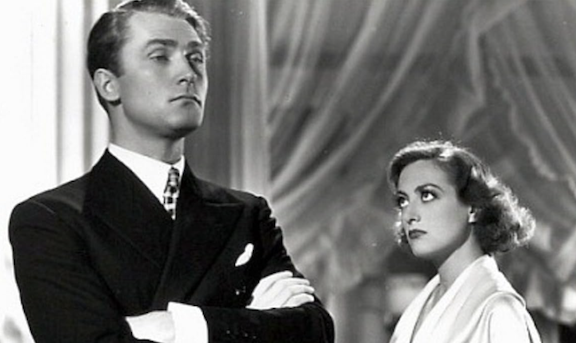
MATCHING WITS…Bored socialite Kay Bentley (Joan Crawford) has a tempestuous romance with idealistic archaeologist Terry O’Neill (Brian Aherne) in I Live My Life. (IMDB)

 * * *

From Our Advertisers

Readers ninety years ago opened the Oct. 19 issue to this two-page spread featuring the latest in fall/winter fashions…the ad on the right from Bergdorf Goodman featured stage and screen actress Gladys George donning a full-length silver fox fur…

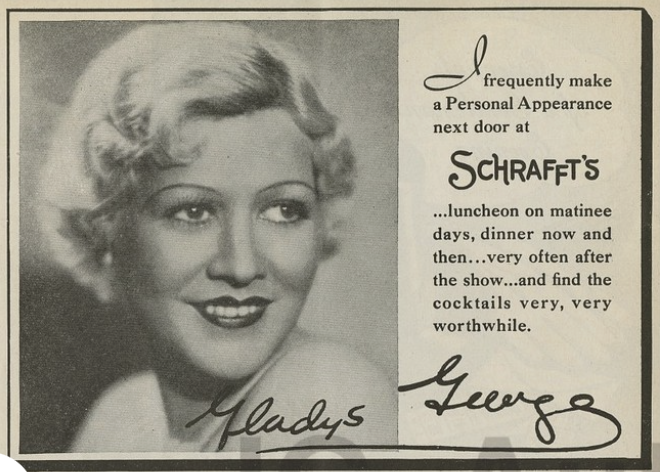
…George (1904–1954) was appearing at Henry Miller’s Theatre in the play Personal Appearance…she was featured in this testimonial ad for Schrafft’s in the theatre’s Playbill…

(playbill.com)

…the folks at Packard took out this colorful two-page spread to promote their more affordable model, the 120…the move to more affordable models helped the luxury carmaker weather the lean years of the Depression…

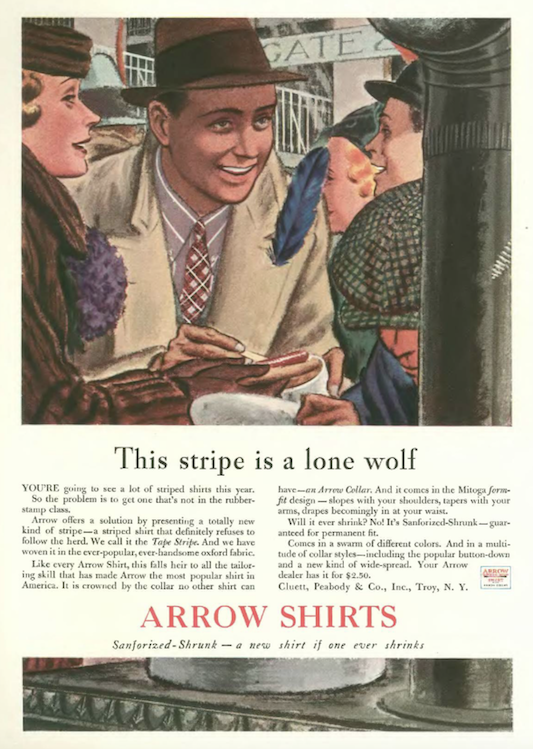
…there is a strange quality to these Arrow Shirt advertisements…what are the they looking at?…apparently something amusing as the man applies mustard to a hotdog, but it isn’t the vendor, who looks down at his cart…

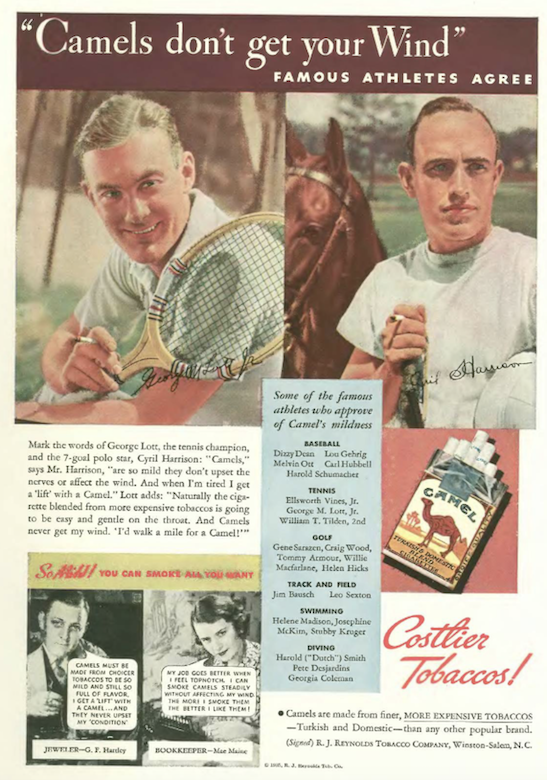
…R.J. Reynolds continued its Camel campaign featuring accomplished athletes who got a “lift” from smoking…the ad also included a couple of regular folks at the bottom, who claimed the cigarettes were so mild “You can smoke all you want”…

…Old Gold continued to enlist the talents of George Petty to illustrate their full-page ads…

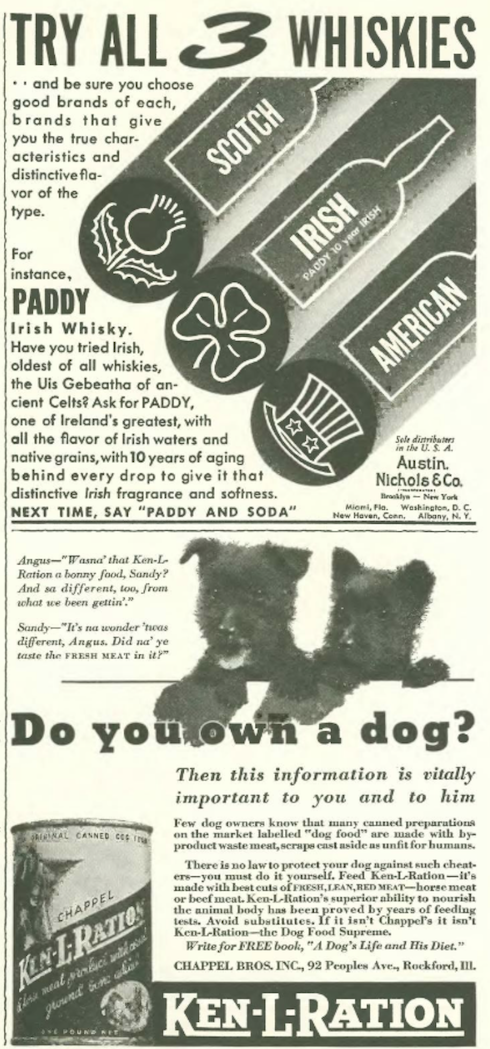
…here’s a couple of back of the book ads touting Irish whisky and Ken-L-Ration dog food…note how the Scottish terriers speak in “dialect”…Ken-L-Ration was a leading dog food brand in the 1930s, thanks to their use of horse meat rather than “waste meat”…

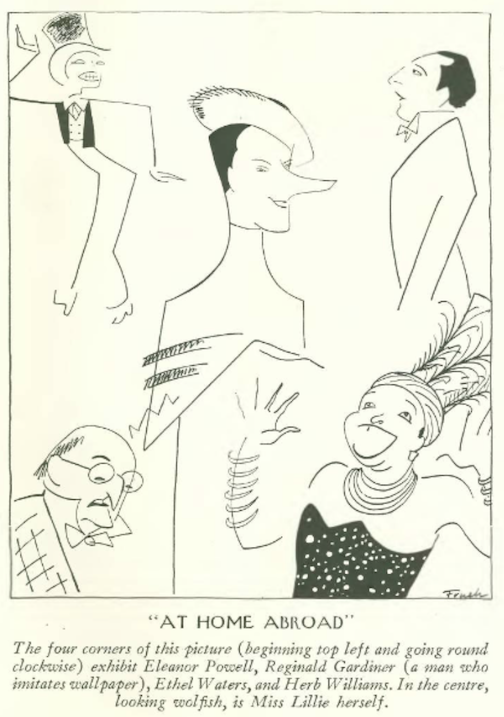
…on to our cartoonists, we start with Al Frueh enhancing the “Theatre” page…

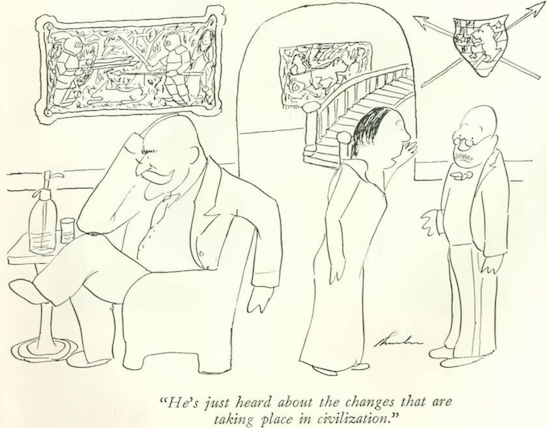
James Thurber showed us a man at odds with the times…

Barbara Shermund kept us up to date on the modern woman…

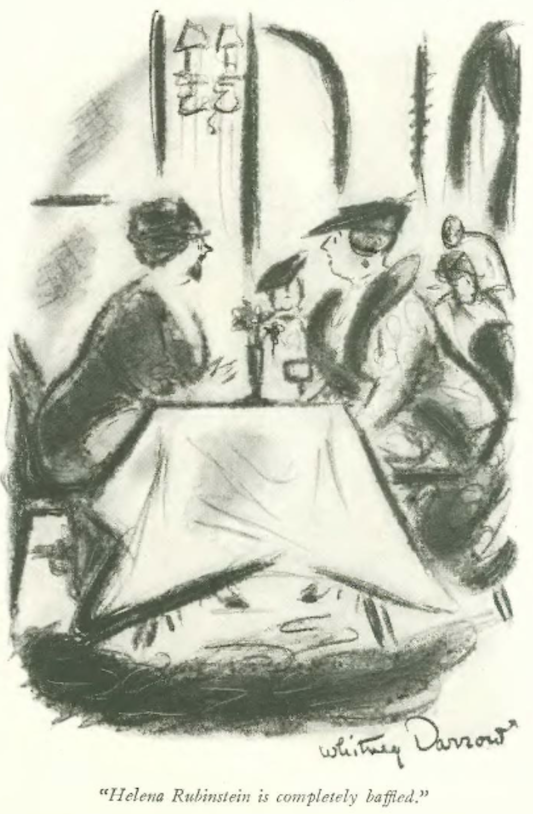
Whitney Darrow Jr offered a challenge to Helena Rubinstein (note the woman on the right—she could have been drawn by Helen Hokinson)…

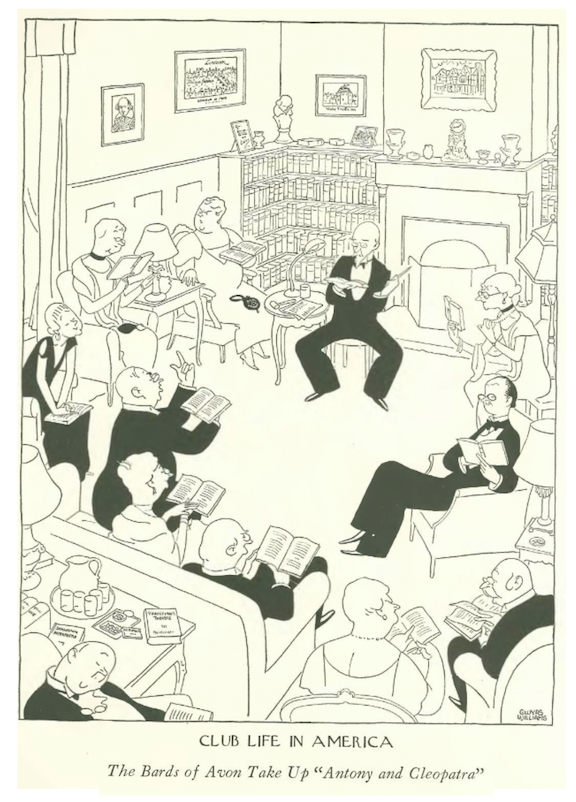
Gluyas Williams checked in on the lively proceedings of a book club…

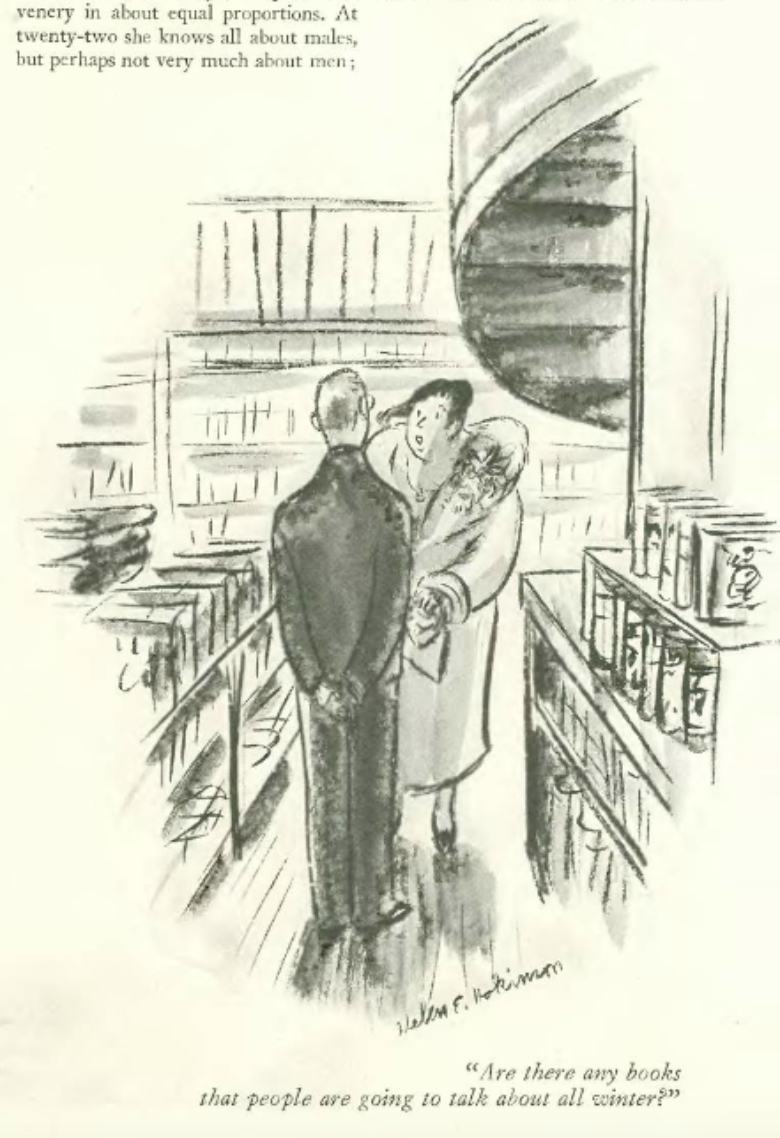
Helen Hokinson went looking for a good winter read…

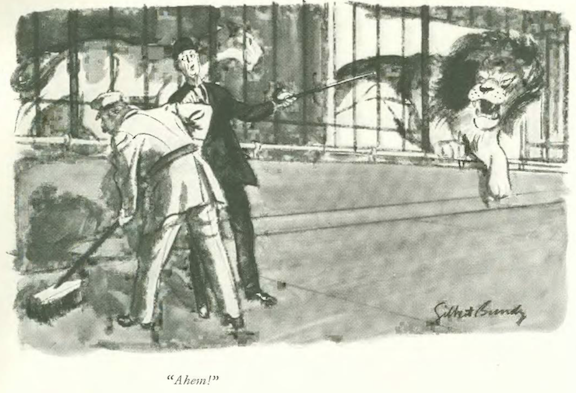
Gilbert Bundy offered an alarming scenario on the top of p. 31…

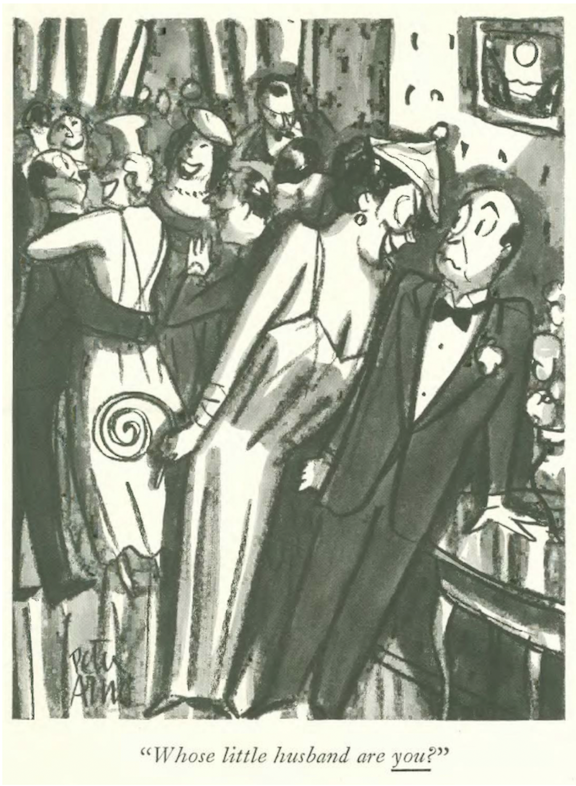
…and we close with Peter Arno, and an eye-raising encounter…

New Time: It Can’t Happen Here…

A Merry Menagerie

It has been a while since we’ve heard from art and design critic Lewis Mumford, who often cast a censorious eye at the rapidly changing world around him.

October 12, 1935 cover by William Steig. From 1930 until his death in 2003 at age 95, Steig contributed 121 covers and 1,676 drawings to The New Yorker.

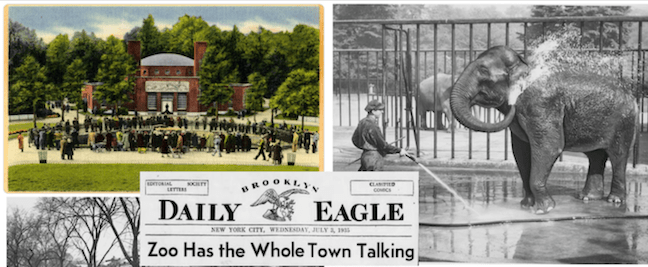
In his column “The Sky Line,” Mumford cast an envious gaze north toward Brooklyn’s Prospect Park Zoo, which he believed had greatly improved upon the recently rebuilt Central Park Zoo.

HE HAD OPINIONS…Lewis Mumford (1895-1990).

Brooklyn’s advantage, according to Mumford, was the superior design of Prospect Park, which offered a better location for a zoo than Central Park. We’ll let Mumford explain in these excerpts:

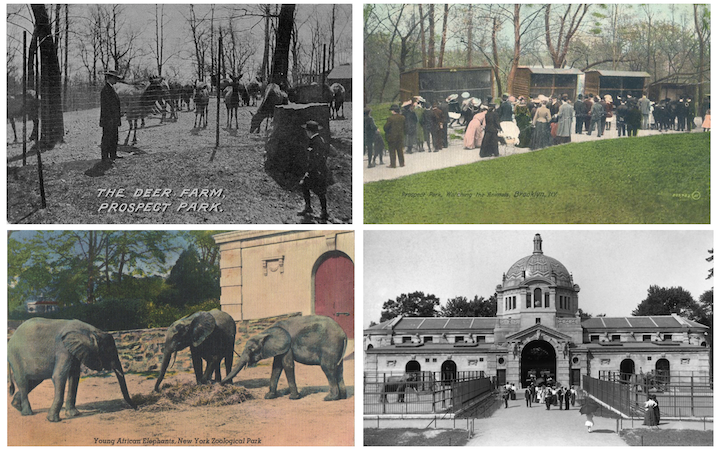
CURIOSITIES, MOSTLY…Clockwise, from top left: Animals were on display at Prospect Park as early as 1866, as seen in this photo of the “Deer Farm”; circa 1900 postcard of Prospect Park’s rather distressing “Menagerie,” which opened around 1890; the park’s Elephant House opened in 1908—modeled after the Hippo Palace at the Antwerp Zoo, the Elephant House also featured rhinoceroses, hippopotamuses, and tapirs; baby elephants (postcard circa 1940s) were a popular attraction until the zoo moved on to smaller creatures in the 1990s. (bklynlibrary.org/untappedcities.com/blog.wcs.org/nycgovparks.org)
LEWIS MUMFORD PRAISED the 1934 plan for the Prospect Park Zoo, designed by architect Aymar Embury II and approved by Parks Commissioner Robert Moses. The zoo was built, in large part, through Civil Works Administration and Works Progress Administration labor and funding. (Brooklyn Public Library)
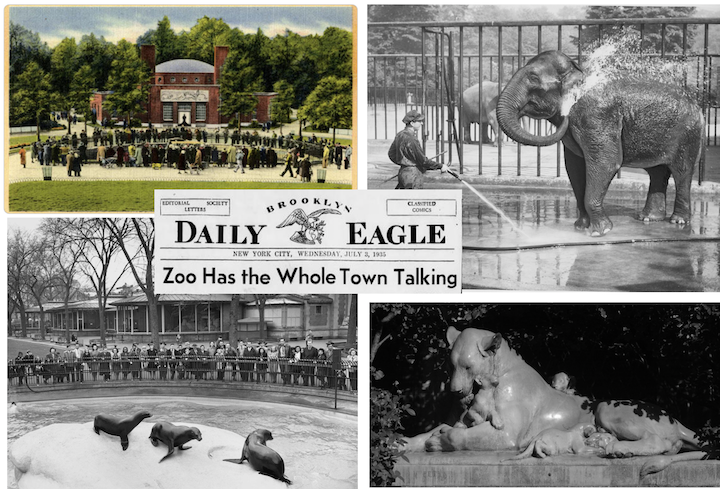
FLATBUSH FAUNA…Clockwise, from top left: Postcard image of Prospect Park Zoo circa 1935; zoo keeper sprays an elephant with a hose, circa 1940; an 1899 bronze sculpture depicting a mother lion nursing her cubs was created by French artist Victor Peter; seal pool, undated photo. (nycgovparks.org/Center for Brooklyn History/Facebook)
CARING OVER CAGES…Prospect Park Zoo today. The zoo closed in 1988 for five-year, $37 million renovation program that, except for the exteriors of the 1930s-era buildings, completely replaced the original zoo. With an emphasis on education and conservation, current exhibits house smaller species rather than elephants, tigers, and lions. (Prospect Park Alliance)

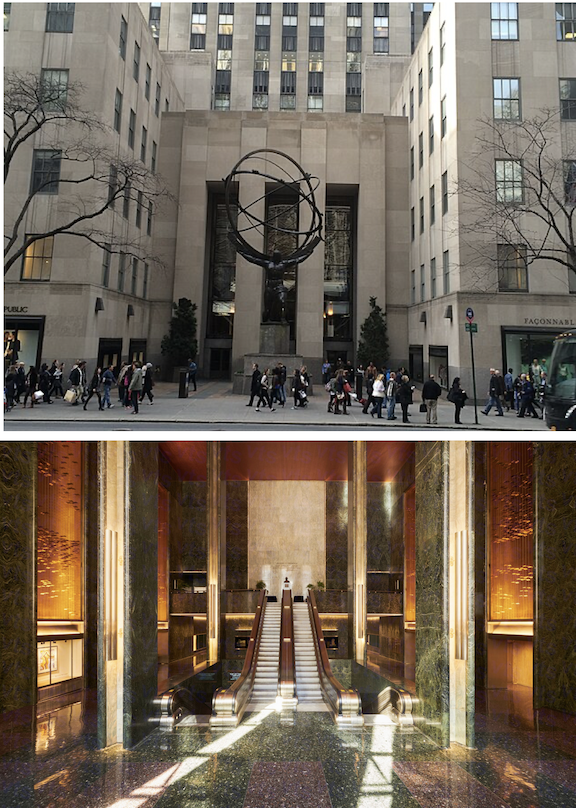
Mumford also looked at the latest developments at Rockefeller Center. As we’ve seen before, he favored smaller-scale developments that were organic and community-focused, and therefore was a strong critic of projects like Rockefeller Center. At its inception he called it a dehumanizing “megamachine,” a product of corporate greed, a “reckless, romantic chaos” that represented the capitalist jungle. Harsh words indeed, so it was something of a surprise to see his approval of the latest piece of the complex—the International Building at 630 Fifth Avenue:

SIMPLE AND CORRECT were the words Lewis Mumford used to describe the interior entrance to 630 Fifth Avenue. (Wikiwand/newyorkoffices.com)

 * * *

Bad Benito

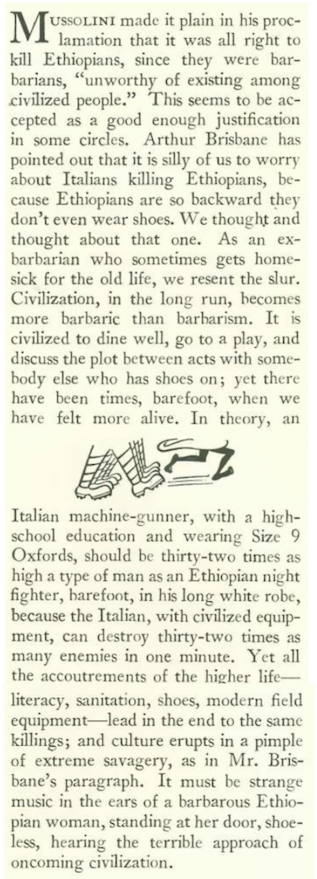
In his “Notes and Comment,” E.B. White had some choice words for the murderous Italian dictator Benito Mussolini and for the newspaper columnist Arthur Brisbane, both unconcerned with the slaughter of “backward” Ethiopians by invading Italian forces:

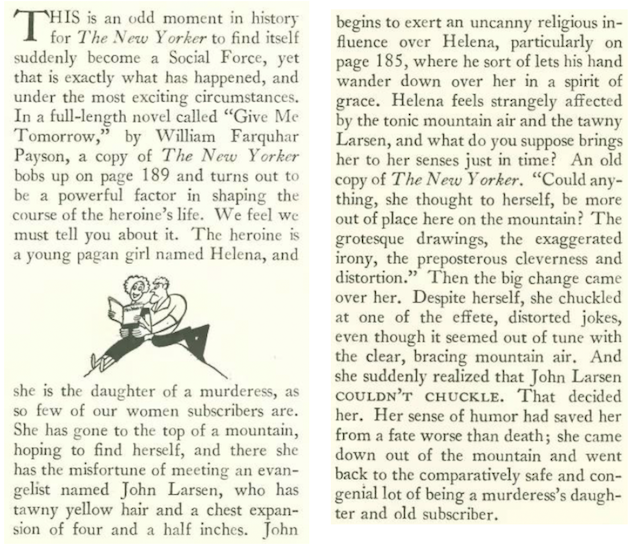
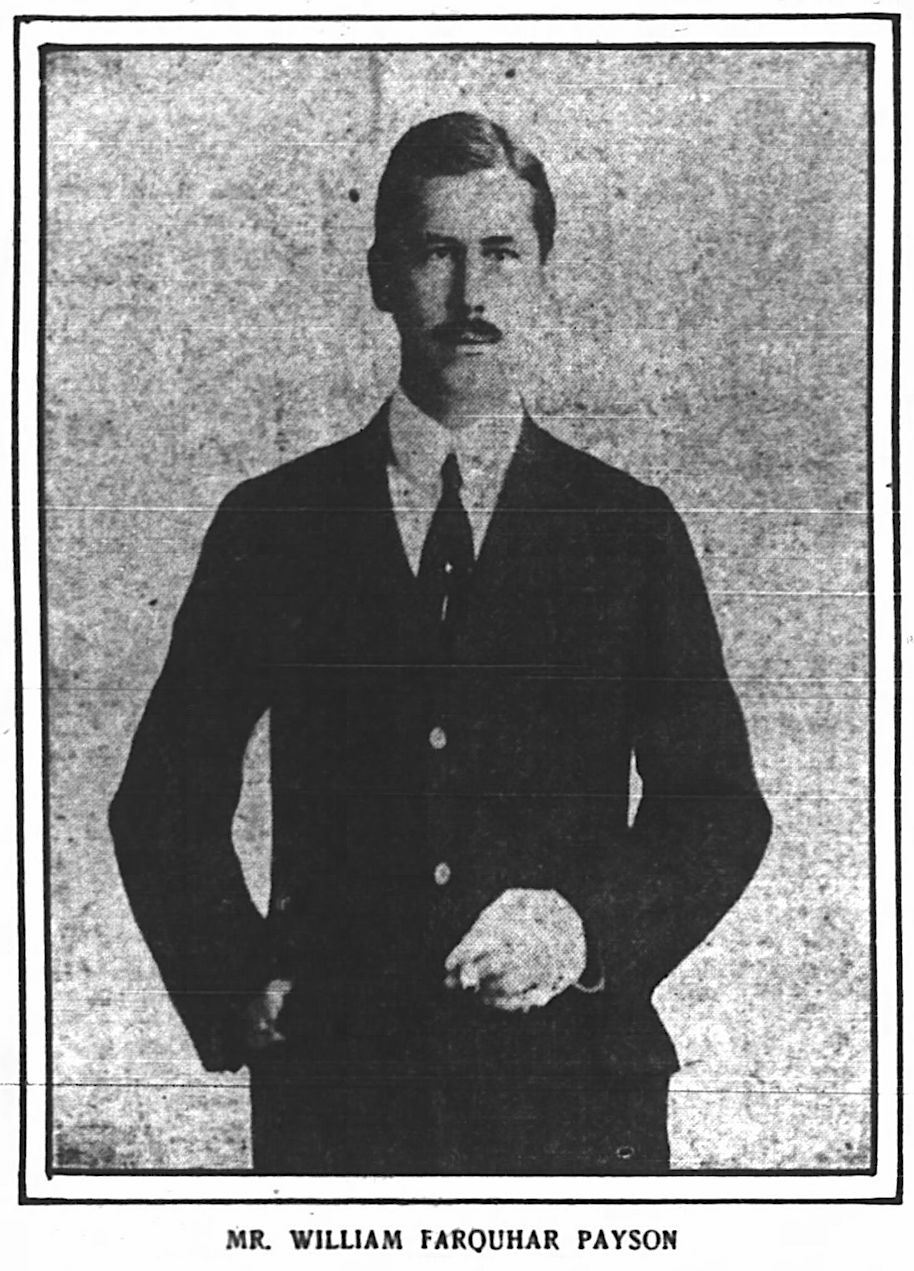
White also noted the role played by The New Yorker in a new novel by William Farquhar Payson (1876–1939) titled Give Me Tomorrow. Apparently the novel credited the magazine’s unique humor for revealing the banality of an evangelist and delivering a young woman from his clutches…

THE NEW YORKER TO THE RESCUE…William Farquhar Payson deployed a copy of the magazine for a pivotal scene in his novel Give Me Tomorrow. (findagrave.com)

 * * *

A Star Is Born

Stage and film director Vincente Minnelli (1903-1986) moved from Chicago to New York in 1931, where he worked as a stage designer for Earl Carroll’s Vanities and costume and set designer for the Ziegfeld Follies before becoming art director at Radio City Music Hall. He got his big break in 1935 when he directed, to critical acclaim, the Broadway musical At Home Abroad. “The Talk of Town” took notice of the rising star (excerpts):

AN EYE FOR DESIGN…Photographer Lusha Nelson photographed Vincente Minnelli at his desk with a miniature stage on Feb. 1, 1936. (James Grissom via threads.com)

 * * *

A Safe Space

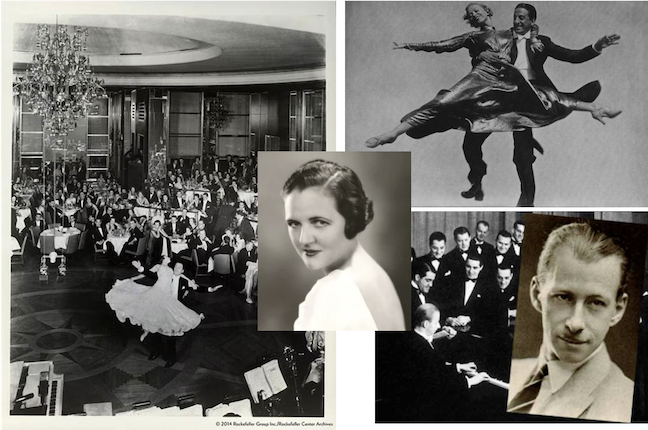
Lois Long had mixed feelings regarding the Rockefeller Center’s Rainbow Room, fearing that it was a tourist magnet but also desiring to take in its sumptuous floor shows. In the first excerpt, Long continued her comment on the heated competition she perceived among nightclub owners.

FEAR FACTOR…The entertainment lineup at Rockefeller Center’s Rainbow Room helped Lois Long overcome her fear of encountering tourists. Clockwise, from left, the Rainbow Room in 1934; Ramon and Renita lit up the dance floor (photo from Nov. 1935 Harper’s Bazaar); Ray Noble and his orchestra provided “all-around beauty”; and (inset) cabaret singer Frances Maddox offered her sophisticated warble to the glittering affair. (Rockefeller Center Archives/Pinterest/Shedd Institute)

 * * *

An Untamed Shrew

Theatre critic Wolcott Gibbs had a good time watching Alfred Lunt and Lynn Fontanne take on Shakespeare’s The Taming of the Shrew at the Guild Theatre, especially Lunt’s uproarious take on the play.

FUN WITH SHAKESPEARE…Alfred Lunt and Lynn Fontanne matched wits in the Theatre Guild’s presentation of The Taming of the Shrew. (minnesotaplaylist.com)

 * * *

At the Movies

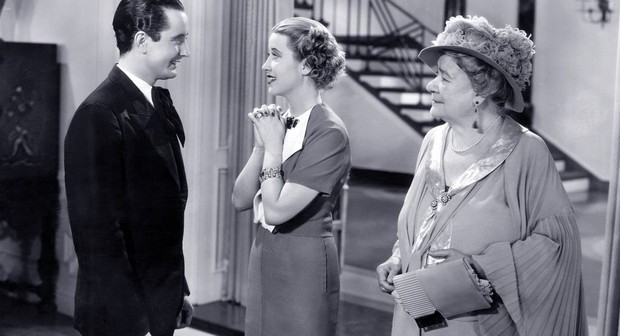
Our film critic John Mosher didn’t have much to say about Here’s To Romance, which seemed contrived to introduce the Italian tenor Nino Martini (1905–1976) to a wider audience. To Mosher, the highlight of the film was the appearance of Ernestine Schumann-Heink (1861–1936), the Austrian-American operatic dramatic contralto, who appeared to be having a good time.

SINGER SANDWICH…Genevieve Tobin (center) stands between tenor Nino Martini and dramatic contralto Ernestine Schumann-Heink in a scene from Here’s to Romance. (rottentomatoes.com)

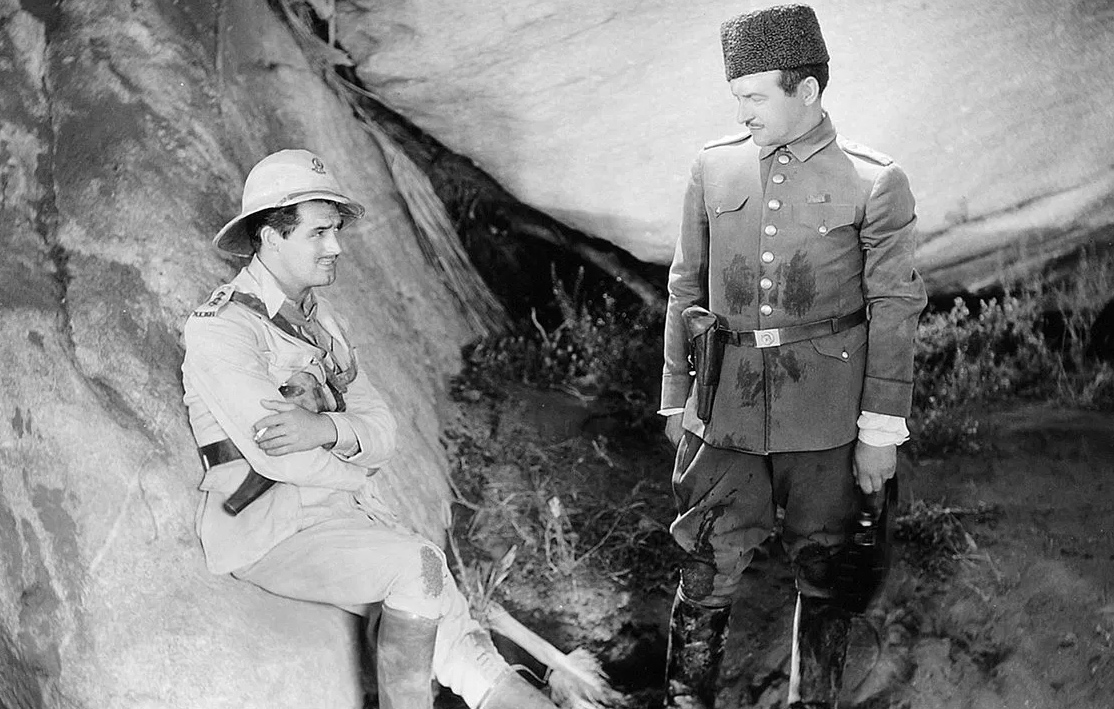
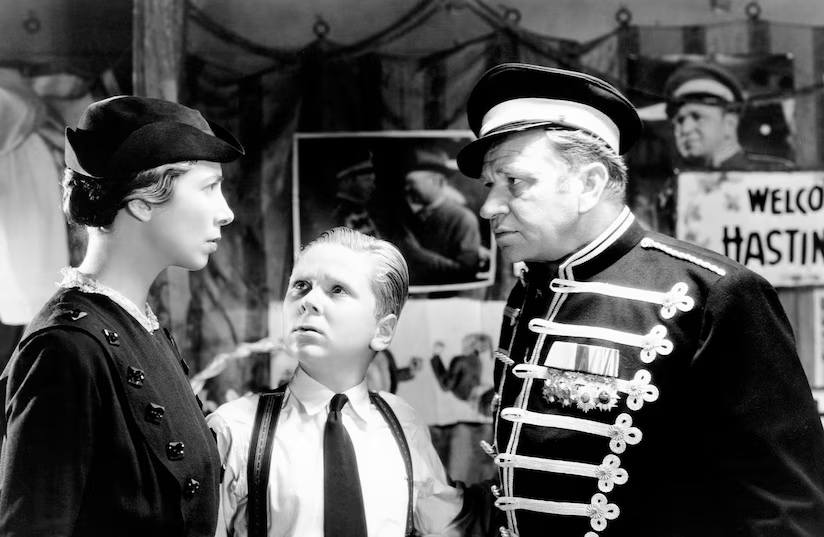
Mosher reviewed two other films that were a bit more dismal: The Last Outpost was a war-themed melodrama starring Cary Grant and Claude Rains; O’Shaughnessy’s Boy featured Wallace Beery as a circus animal trainer who loses his arm as well as his family.

DUELING MUSTACHES…Cary Grant (left) sported a rare mustache in a role opposite Claude Rains in The Last Outpost. (mabumbe.com)
A TOUGH ACT…Sara Haden played a skeptical aunt who sees a one-armed circus animal tamer (Wallace Beery) regain his son (Jackie Cooper) and the confidence he lost along with his wife in O’Shaughnessy’s Boy. (tcm.com)

 * * *

From Our Advertisers

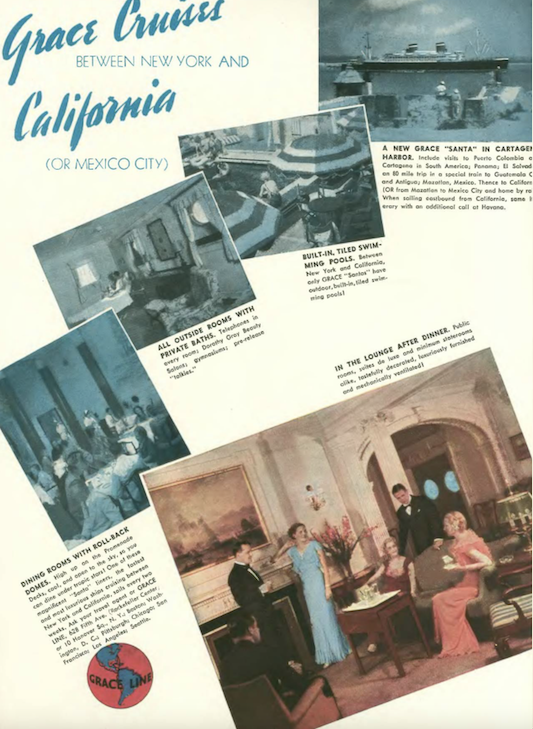
I find these advertisements oddly appealing, because this kind of travel no longer exists. Today there is exactly one ocean liner left in the world—the Queen Mary 2; the cruise ships that rule the 21st century seas are essentially hotel/amusement parks stacked on top of a huge barges…water slides, Vegas-style entertainments, and all-you-can-stuff-into-your-face buffets…

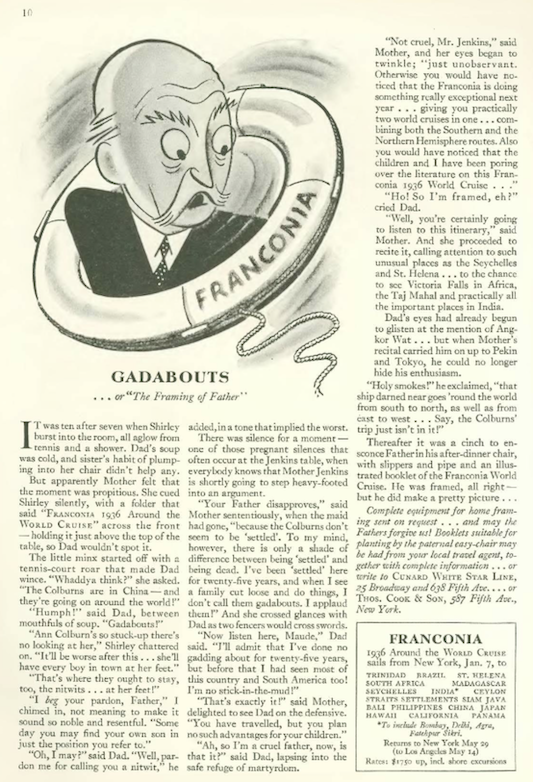
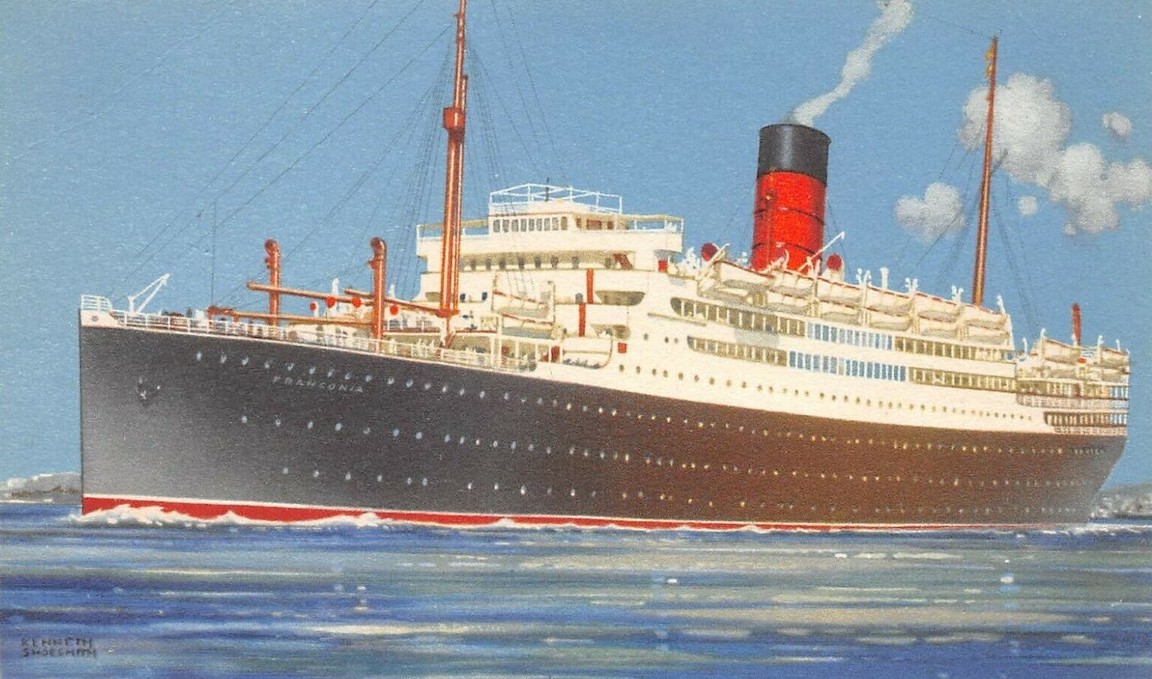
…this curious ad on page 10 mimicked the look of a New Yorker short in the vein of Clarence Day…what it promoted was an around-the-world cruise that would take two-hundred (well-heeled) passengers to more than twenty destinations including Malaysia, Bali and Singapore…

Postcard image of the Franconia. (Pinterest)

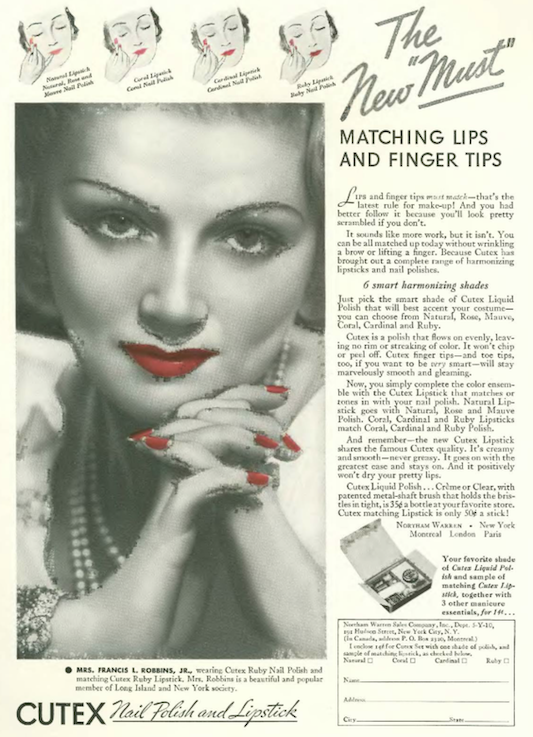
…society women could be counted on to endorse all sorts of things from cigarettes to cold cream…here a “Mrs. Francis L. Robbins, Jr” (I couldn’t find her given name) endorses Cutex nail polish and lipstick…the ad noted that Mrs. Robbins “is a beautiful and popular member of Long Island and New York society”…

…the makers of Spud menthol cigarettes entered the realm of the surreal with a talking cigarette that encouraged chain smoking…

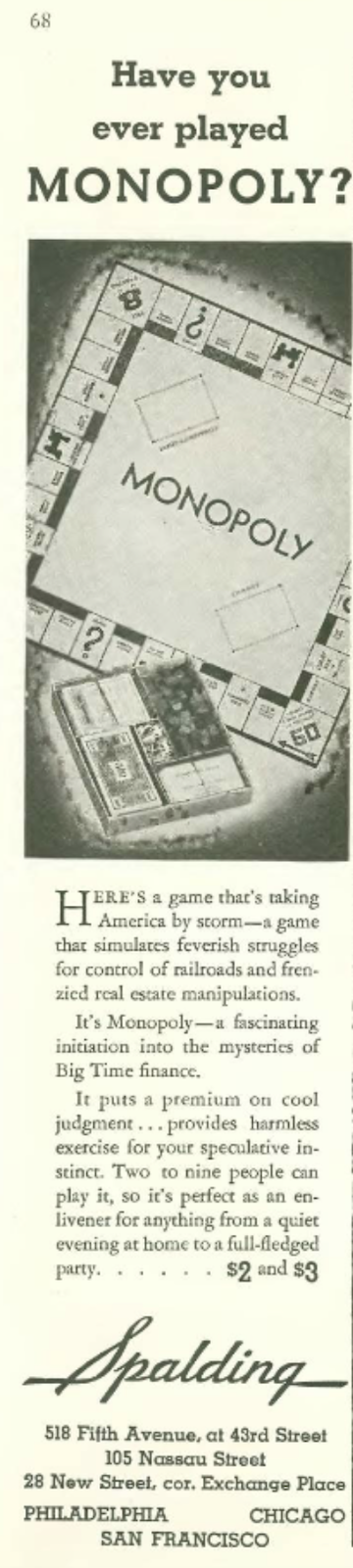
…the board game Monopoly had its origins in The Landlord’s Game, created in 1903 by an anti-monopolist named Lizzie Magie…over the years variants of the game were introduced until Parker Brothers bought the rights from Magie and another inventor and began mass-marketing the game in the fall of 1935…

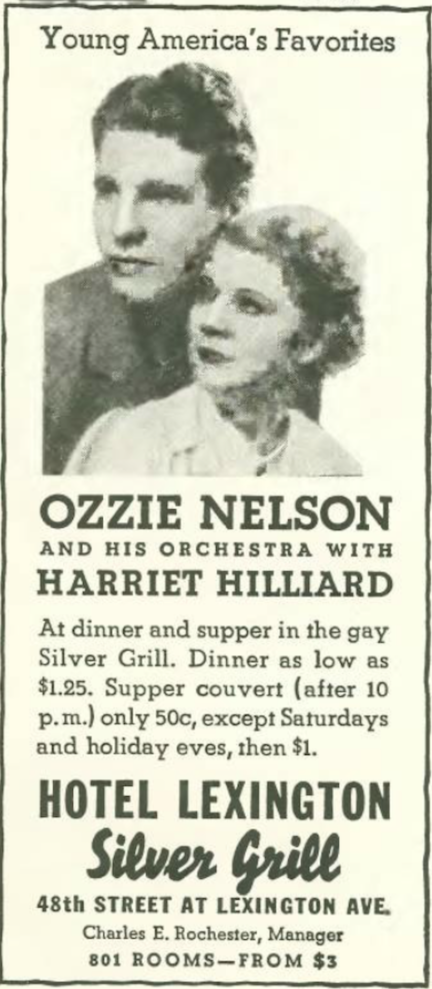
Peggy Lou Snyder was performing in vaudeville when she met the saxophone-playing bandleader Ozzie Nelson in 1932. Nelson hired her to sing with his band (under the name Harriet Hilliard) and then married her three years later…in 1944 the couple would launch a comedy series for radio, The Adventures of Ozzie and Harriet, which made a successful transition to television, appearing on ABC from 1952 to 1966…

…here we have some old-timers offering hunting advice and promoting octane-boosting Ethyl gasoline, which helped prevent engine knock…it also contained the highly toxic additive tetraethyllead, which could cause severe neurological damage, particularly in children…it was completely banned in the U.S. by 1996…

…on to our cartoonists, we start with this delightful spot art by Christina Malman that graced the bottom of the calendar and events page…

Helen Hokinson appeared twice, first at the vet’s…

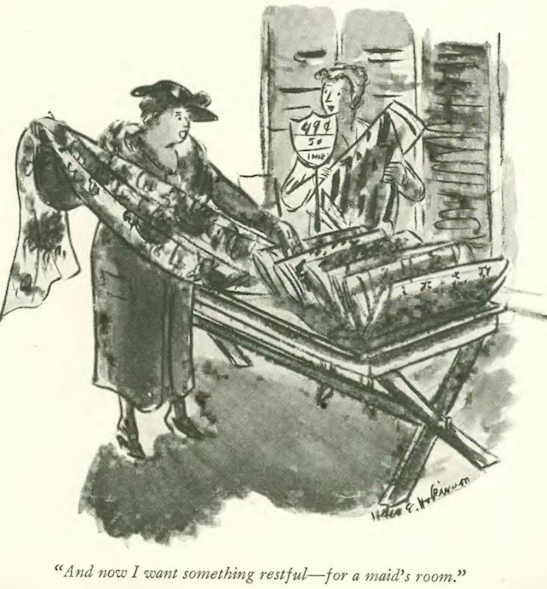
…and later shopping for the maid at a department store…

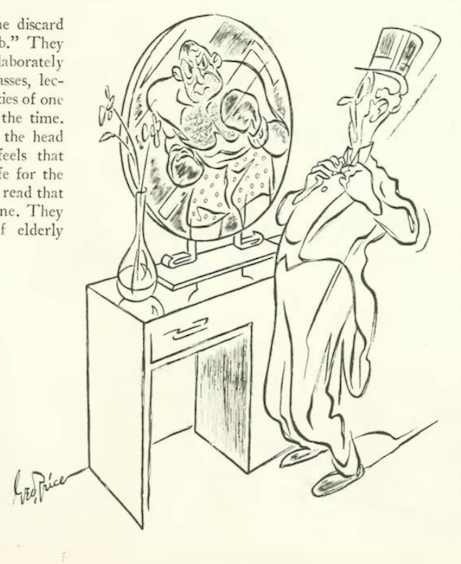
George Price had a surprise in store for this mirror-gazer…

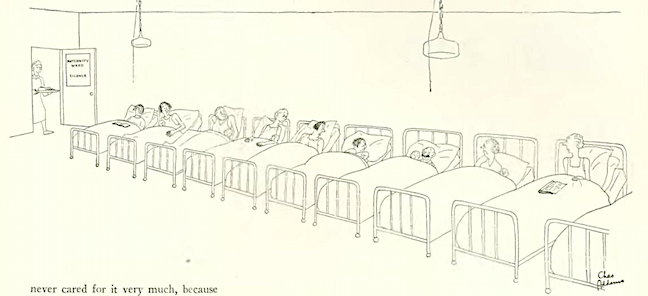
…Charles Addams took the top of page 29 to show us a proud papa in a maternity ward…

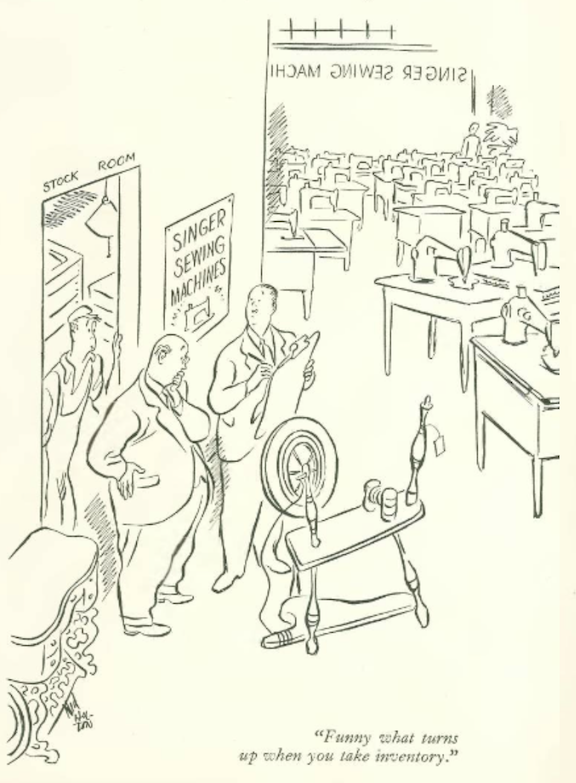
…Ned Hilton uncovered some history at the Singer Building…

…Mary Petty eavesdropped on a tactless toff…

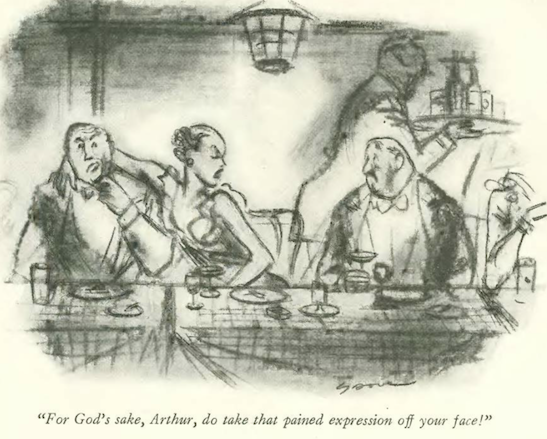
…Leonard Dove showed us that being a sugar daddy wasn’t so sweet…

…and we close with William Steig, one of his “Small Fry” speaking up for the old man…

Next Time: On Catfish Row…


School Days

Above: First-grade pupils at the blackboard, circa 1943. (The New York Times)

Peering into the life of a Manhattan elementary school—as it was ninety years ago—offers a glimpse into the social mores of the 1930s.

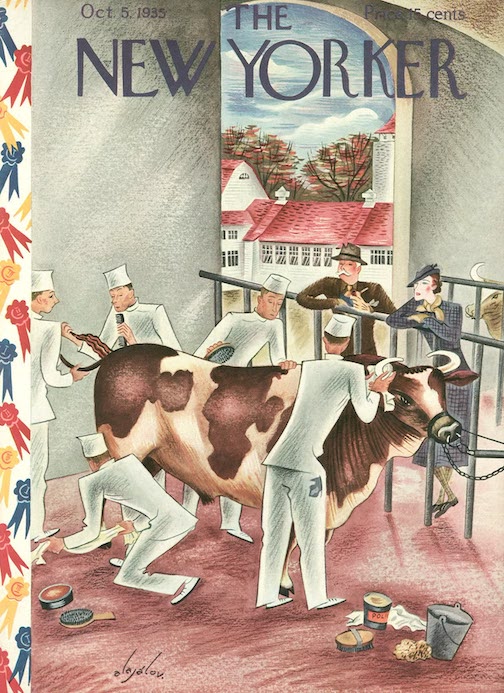
October 5, 1935 cover by Constantin Alajalov.

Taking us back to those days was St. Clair McKelway (1905-1980), who beginning in 1933 served as a writer and editor for The New Yorker. Although not well-known today, McKelway was credited by William Shawn as one of a handful of people who “set the magazine on its course.”

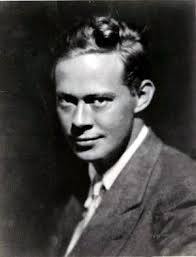
St. Clair McKelway. (LA Times)

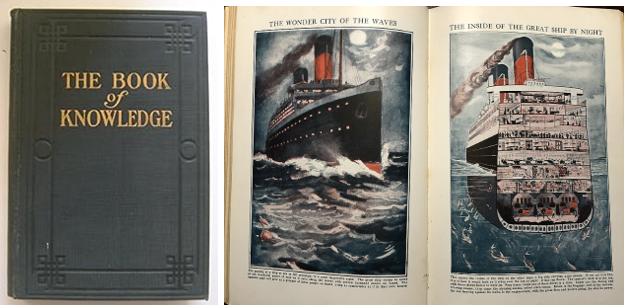
AROUND THE  WORLD IN TWENTY VOLUMES…The Grolier Society’s The Book of Knowledge was a well-known resource to students and teachers alike in the 1930s. Originally largely a reprint of the British Children’s Encyclopædia with U.S. revisions, it evolved over time into an entirely new entity. This particular volume is from 1919, part of a twenty-volume set. (Randal Oulton via Wikipedia)

In this next excerpt, a teacher and principal speak of the schoolchildren dispassionately, casually referring to one pupil’s IQ as “almost down to mental defective.”

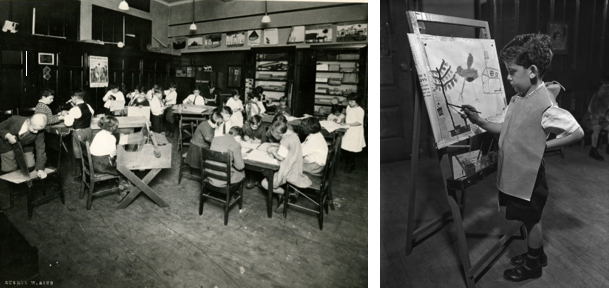
PS PUPILS…Students participate in Elizabeth Irwin’s “Little Red Schoolhouse“ program at PS 61 in 1928; at right, a kindergarten painter at PS 23 in 1935. (NYC Municipal Archives/Fordham U)

In this final excerpt, McKelway looked in on the school’s “ungraded class” of sixteen boys, most from families who were “on relief.” Beginning in the third paragraph, note how the teacher speculates on the future of one of the students.

STILL STANDING, STILL SERVING…PS 165 Robert E. Simon school today. (insideschools.org/Anna Duncan/Friends of PS 165)

A final note: It is interesting to compare McKelway’s article with one written almost thirty years later by few blocks from Columbia University, the school teaches children of graduate students and professors as well as long-time neighborhood residents and newcomers.

 * * *

Moving Days

In the fall of 1935 E.B. and Katharine White and their four-year-old son Joel moved from their Greenwich Village apartment on East 8th Street (reluctantly for E.B.) to Turtle Bay Gardens in the East 40s. At about the same time The New Yorker moved from its original headquarters on West 45th Street to its new digs at 25 West 43rd Street, where the magazine would settle in for more than fifty years.

HOME SWEET HOME…This New York townhouse (left) was the new home of E.B. and Katharine White in the fall of 1935 (their neighbor was Katharine Hepburn). At right, The New Yorker also moved to a new home at 25 West 43rd Street. The magazine would occupy several floors of the building for 56 years. (homes.com/Ink Spill)

 * * *

A Good Bad Girl

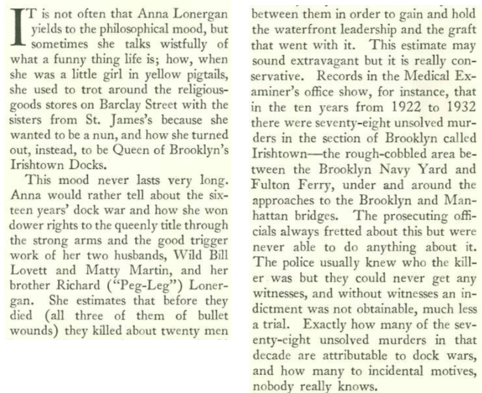
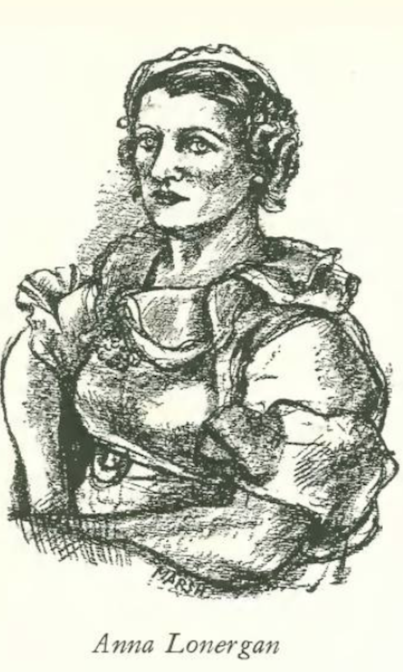
Journalist Meyer Berger (1898-1959) was known for digging deep into his subjects, including a two-part New Yorker profile of Anna Lonergan, “Queen of the Irishtown Docks.” Her two husbands and a brother—notorious killers themselves—were murdered in gang wars along with dozens of others who were Lonergan’s friends and neighbors. She was often called to the morgue to identify murder victims, thus the “Profile” title “Lady in Crepe”—one who is in a constant state of mourning. Here are the opening paragraphs:

SHE WANTED TO BE A NUN…Anna Lonergan, as rendered by Reginald Marsh for the Profile.
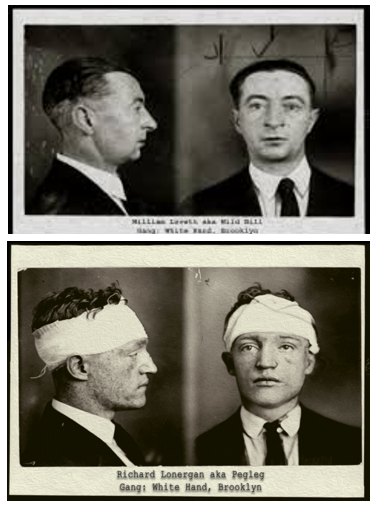
KILL OR BE KILLED…Members of the Irish “White Hand Gang” battled their Italian rivals (the Black Hand Gang) on the Brooklyn waterfront from the early 1900s to 1930. Anna Lonergan’s first husband William “Wild Bill” Lovett (top) was murdered in 1923; her brother Richard “Pegleg” Lonergan was gunned down in 1925. (artofneed.com)

 * * *

At the Movies

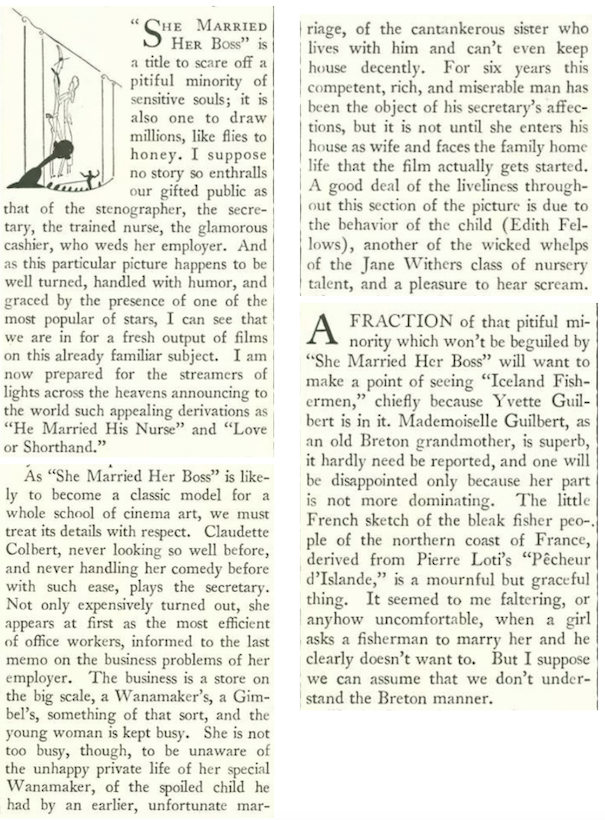
Film critic John Mosher took on a couple of very different films—the lively Claudette Colbert comedy She Married Her Boss, and the “mournful, graceful” Iceland Fisherman featuring the 1890s French cabaret star Yvette Guilbert.

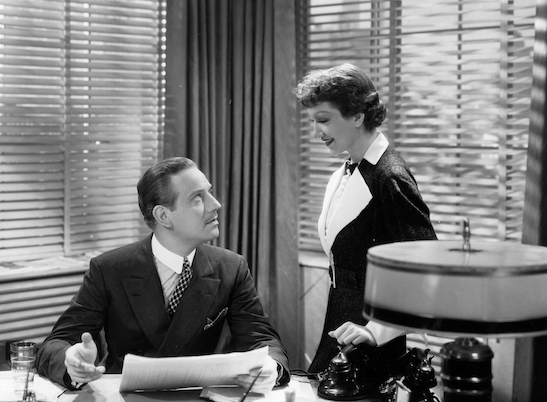
BUSINESS AND PLEASURE…Melvyn Douglas and Claudette Colbert in She Married Her Boss. (IMDB)
GRAND GRANDMOTHER...John Mosher found French actress and cabaret singer Yvette Guilbert (1865–1944) to be the main attraction as a Breton grandmother in 1934’s Pêcheur d’Islande (Iceland Fishermen). Guilbert was a favorite subject of artist Henri de Toulouse-Lautrec, who made many portraits and caricatures of Guilbert, including the one at right from 1894. (musee-breton.finistere/National Portrait Gallery, London/Wikipedia)

Mosher also screened Soviet Russia through the Eyes of an American, which documented American engineer Charles Stuart’s travels through the Soviet Union. You can watch the entire film here.

NO FAMINE HERE…Children playing games were featured in Soviet Russia through the Eyes of an American, a travelogue that skipped all the bad parts of Stalinist Russia. (YouTube/Hoover Institution)

* * *

Some Housekeeping

Before we jump into the advertisements, I would feel remiss not to mention other writers in the issue, including poet Ogden Nash (“How Now, Sirrah, Oh, Anyhow”), James Thurber (“Smashup,” featuring henpecked husband Tommy Trinway); Frances Warfield (“Practical Nurse”); Theodore Pratt (“I Jes’ Goin'”); James Reid Parker (“The First Day”); Andree L. Eilert (“Words Across the Sea”) W.E. Farbstein (“Copycat”); and P. S. Le Poer Trench (“Parsons is Prepared”). Some of these contributors are long forgotten—Warfield often wrote about her deafness, but little to nothing can be found out about Eilert or Trench without considerable effort (Trench published twice in the New Yorker in 1935).

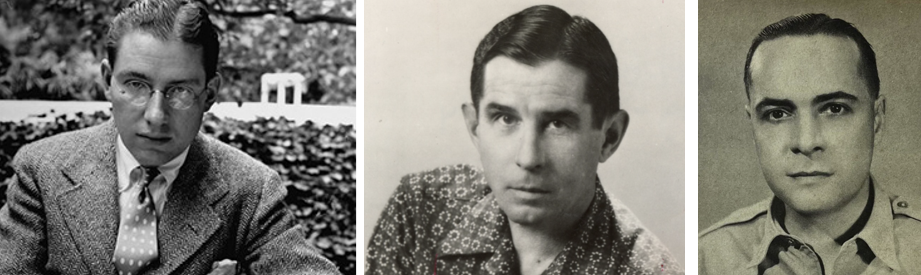
AMONG THE KNOWN…At left, Ogden Nash (1902-1971) is the most famous of this trio that includes Theodore Pratt (1901-1969), center, known as the “Literary Laureate of Florida”; and at right, James Reid Parker (1909-1984), who sidelined as a writer of captions for Helen Hokinson. Read more about Parker’s contributions to The New Yorker at Michael Maslin’s New Yorker treasure trove Ink Spill.

 * * *

From Our Advertisers

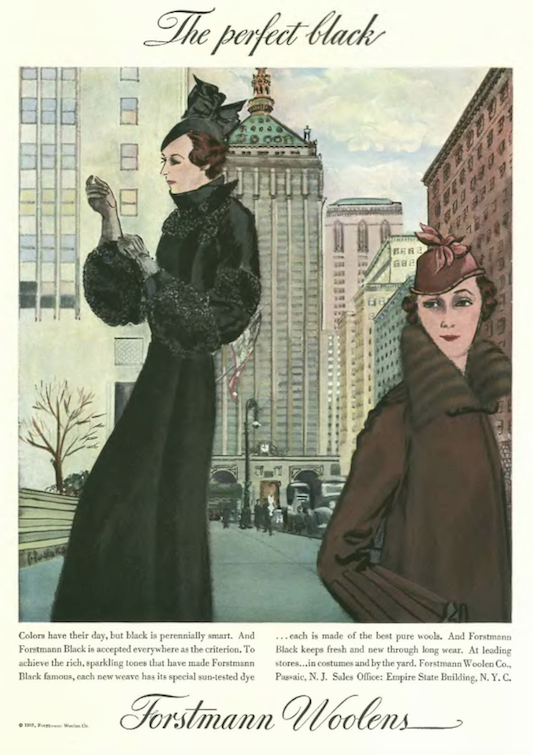
Apparently business was booming at Forstmann Woolens, who continued to post these stylish ads in the opening pages of The New Yorker—note Midtown’s 1927-29 New York Central Building (now Helmsley Building) that served as a gateway to Grand Central…

…who knew that one could be so stylish while drinking a glass of tomato juice?…

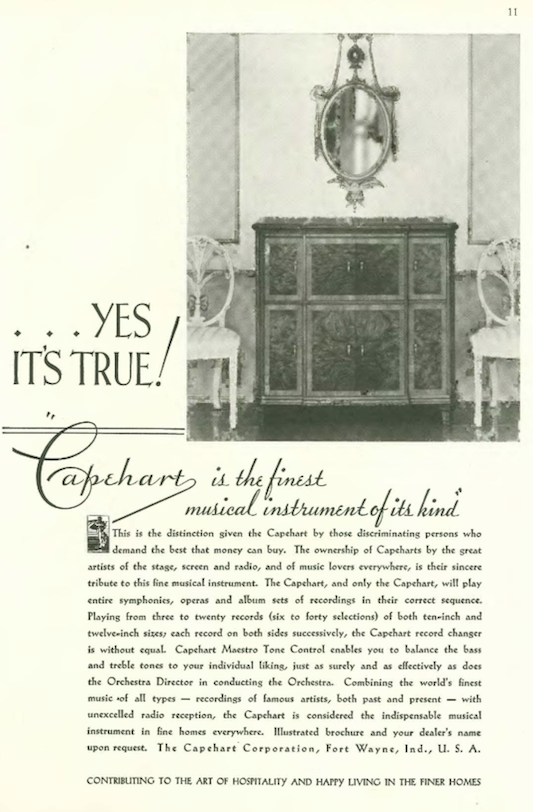
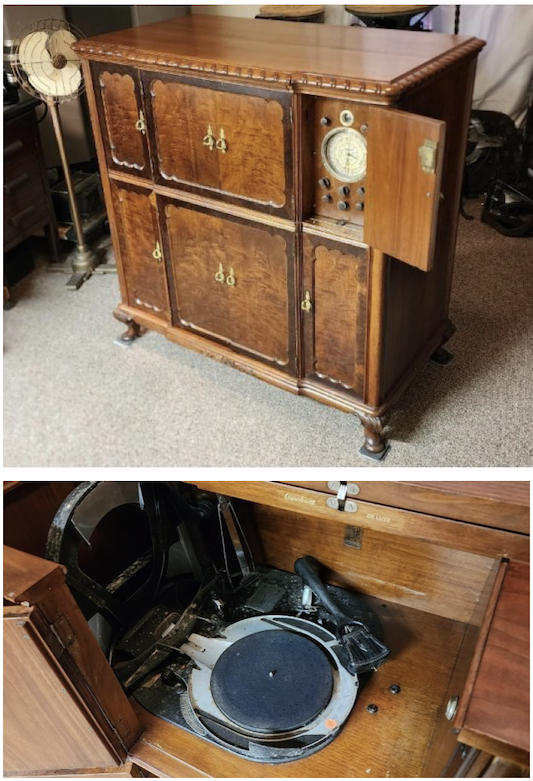
…the Capehart Automatic Phonograph Company produced a radio-phonograph that could automatically flip records to play both sides—this particular model could play up to twenty records in succession…

QUITE THE GIZMO…Restoration of a Capehart 405E. These units were not cheap, selling for the equivalent of $30k or more today. (forum.antiquephono.org)

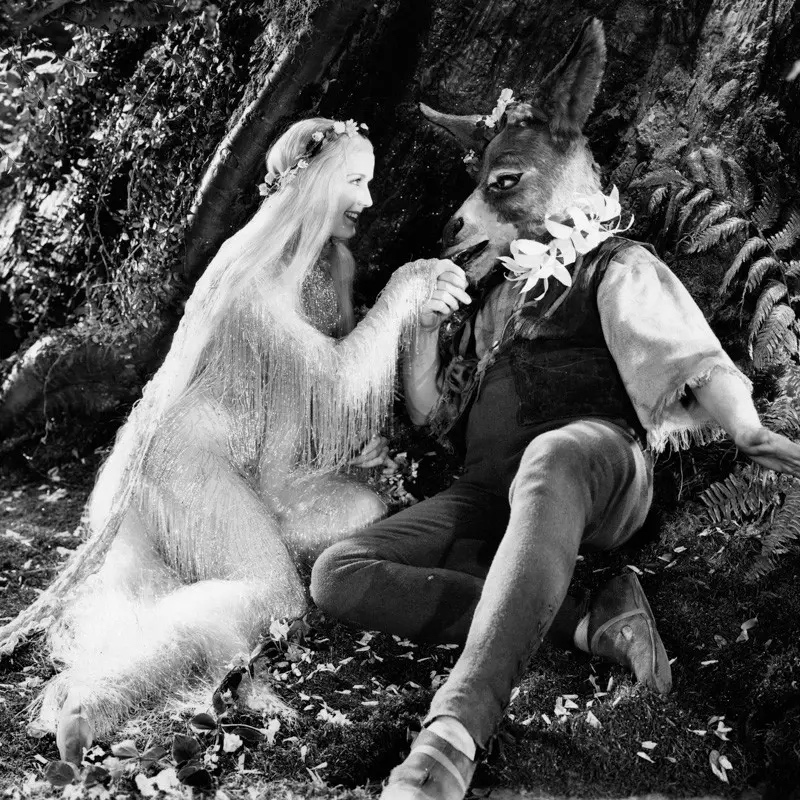
…Warner Brothers took out a full-page ad to announce the world premiere of A Midsummer Night’s Dream…the lavish, star-studded production featured, among others, James Cagney, Olivia de Havilland, Dick Powell, Anita Louise and Mickey Rooney

AN ACQUIRED TASTE...Anita Louise as Titania, Queen of the Fairies, and James Cagney as Bottom, the Weaver, in the 1935 film production of Shakespeare’s A Midsummer Night’s Dream. The film failed at the box office with mixed reviews, however it won two Academy Awards—Best Cinematography and Best Film Editing, and it was nominated for Best Picture. Today the film gets mostly good reviews. (www.academymuseum.org)

Stage magazine also took out a full-page ad to trumpet its own star-studded lineup, including contributions by James Thurber, Peggy Bacon and Abe Birnbaum

…Mrs. Chiswell Dabney Langhorne, nee Caryetta Davis Saunders (1899-1971), was the latest society maven to encourage women smokers to enjoy the unfiltered pleasures of Camel cigarettes…

…on to our cartoonists, George Price and Maurice Freed got things rolling with these spot drawings…

Carl Rose mixed the old with the new on moving day…

Barney Tobey showed us how the posh travelled to school…

George Price again, here demonstrating the joys of moneyed eccentricity…

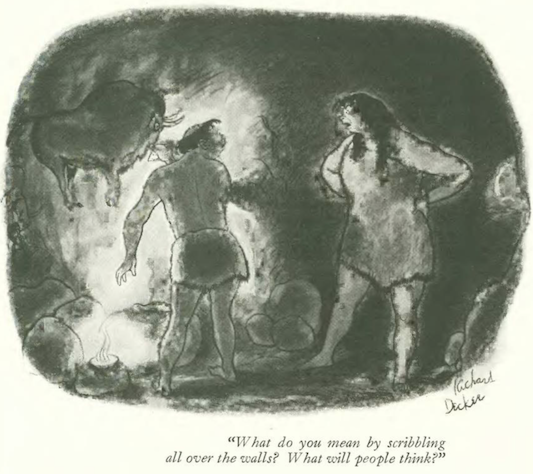
Richard Decker explored the origins of art criticism…

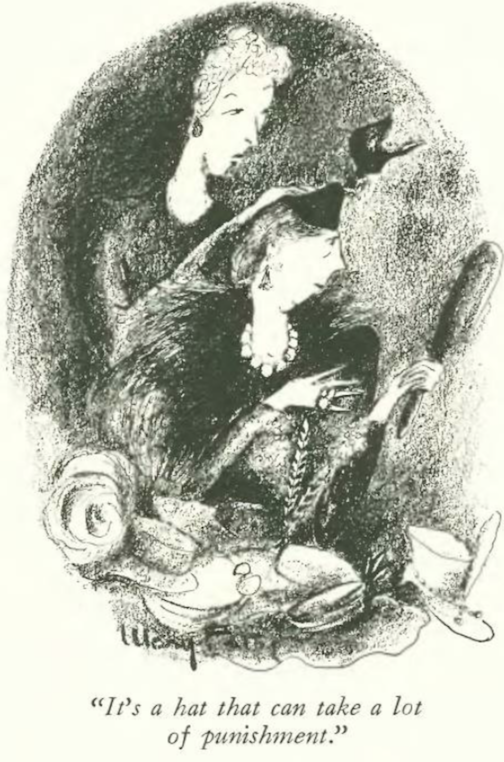
Mary Petty offered some durable fashion advice…

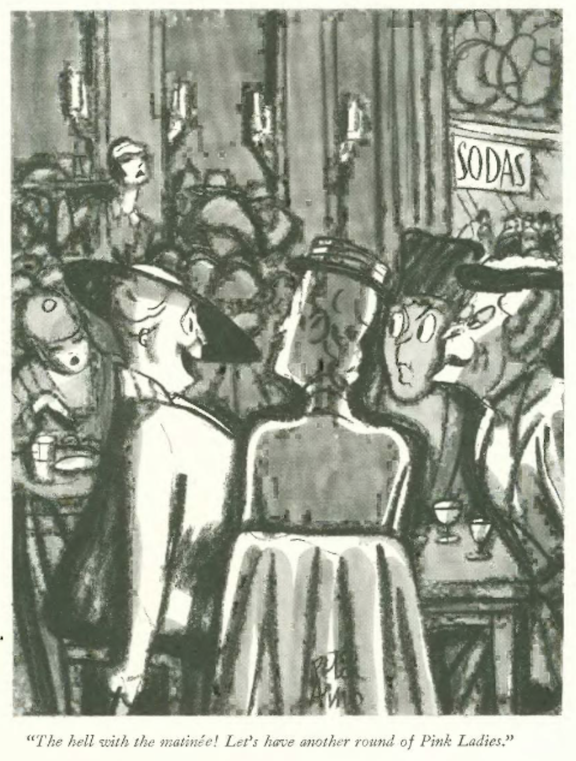
…and we close with Peter Arno, finding sudden inspiration in a Pink Lady cocktail…

Next Time: A Merry Menagerie…