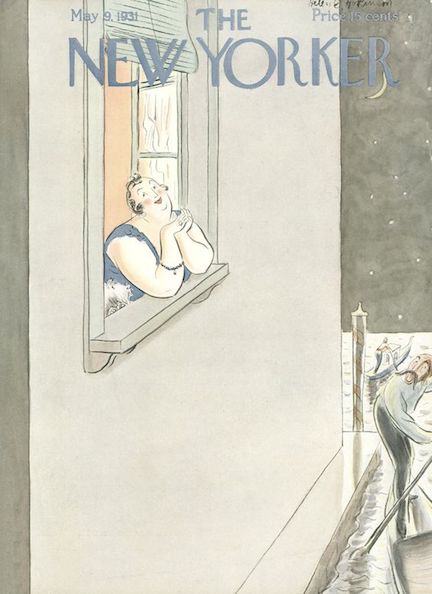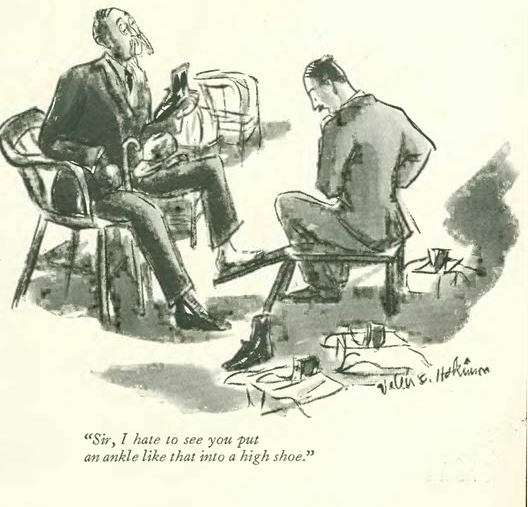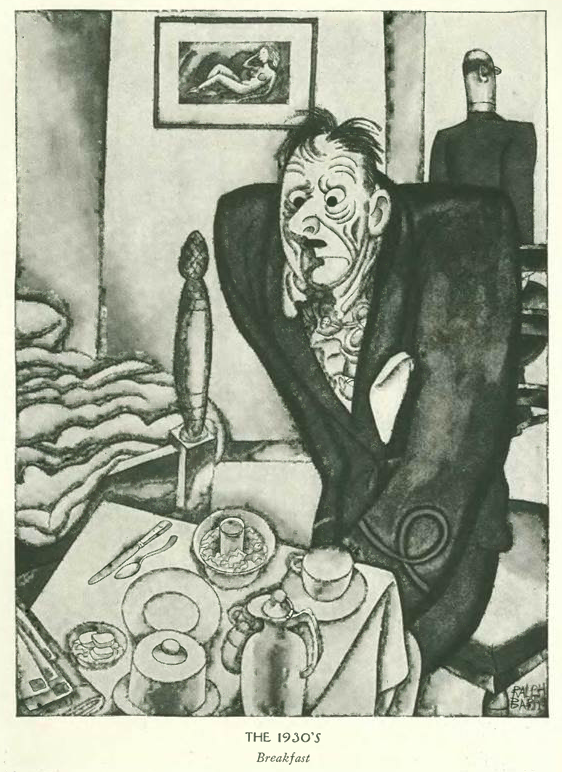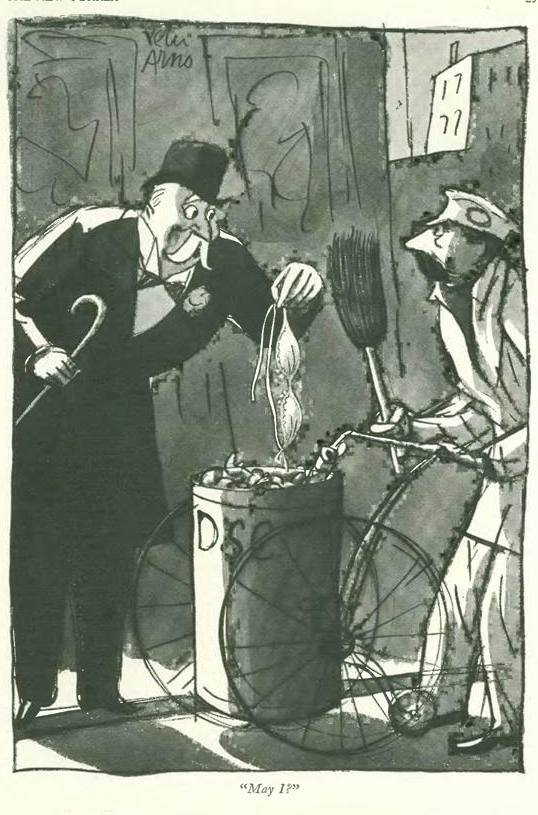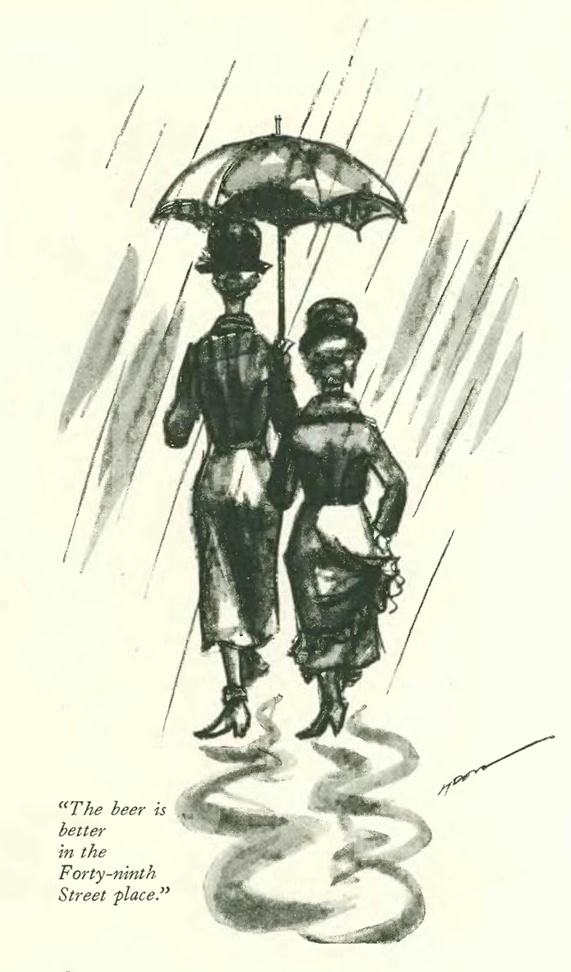
Firecracker Lane

When fireworks were still allowed on the streets of New York City, Firecracker Lane was the place to go for all your pyrotechnic needs.

Theodore Haupt illustrated holiday travelers for the Fourth of July issue in 1931.

By 1931, however, fireworks had been banned across the greater New York City area, so customers visiting Firecracker Lane—a short row of sellers on Park Place between Broadway and Church Street—had to find a friendly burg beyond the metropolis to shoot off their Independence Day arsenals.

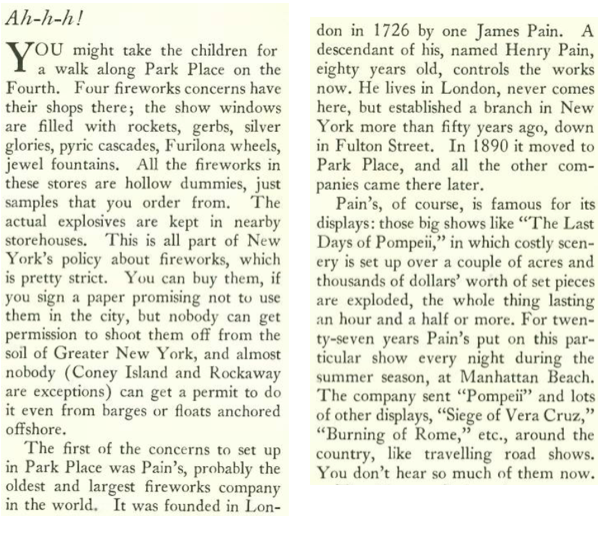
Before the city clamped down on the fun, Firecracker Lane did a bustling trade, and fireworks were even manufactured at sites around the metro area. But after a number of explosions and fires, the city closed down the fireworks factories, and by 1931 Fireworks Lane itself was on its last leg. “The Talk of the Town” visited what remained, and reminisced about the glory days.
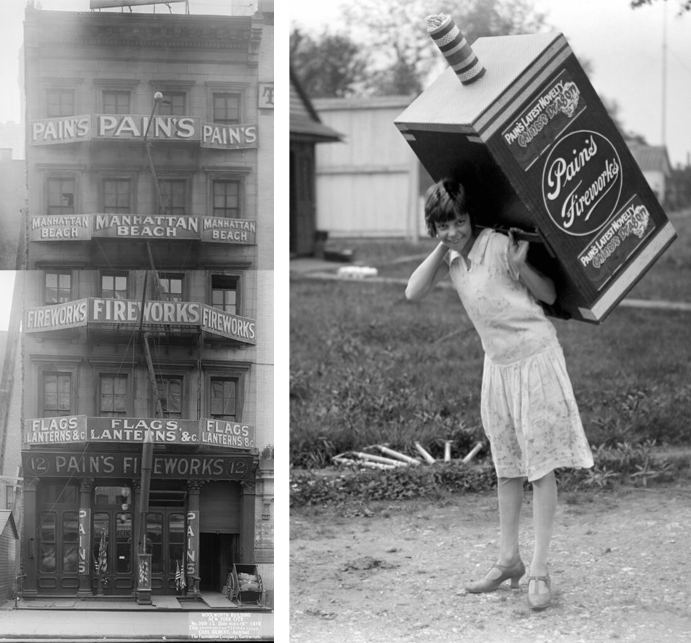
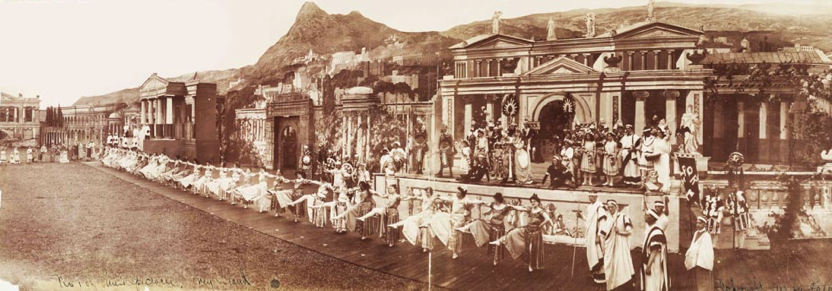
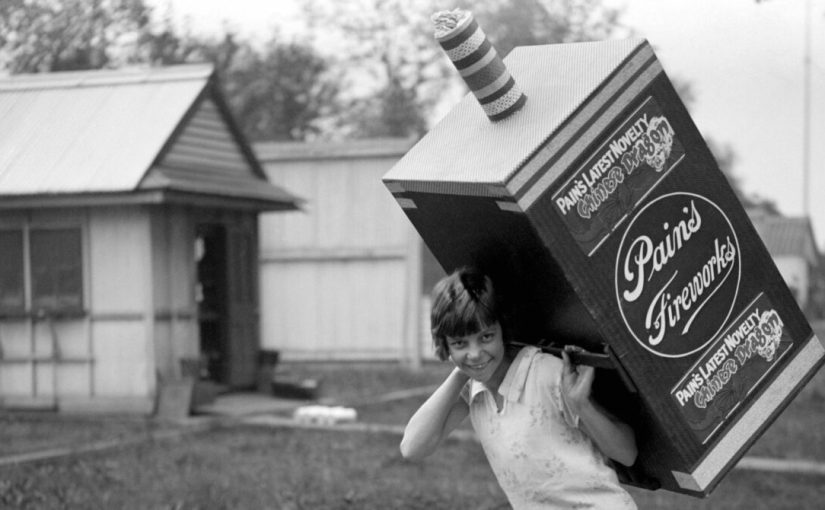
A STREET WITH SOME SIZZLE…The famed Pain’s Fireworks company occupied this building on Firecracker Lane, photo circa 1903. At right, a young woman promoting Pain’s latest novelty, the “Chinese Dragon,” in the 1920s. (Museum of the City of New York)
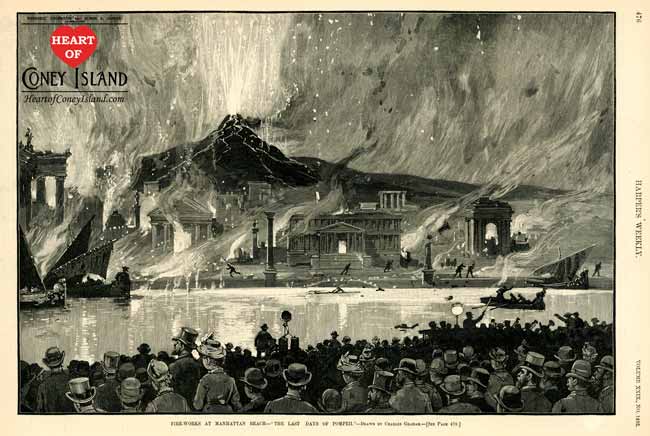
HAVING A BLAST…In the 19th and early 20th centuries, Pain’s staged massive themed fireworks displays, including the incredible The Last Days of Pompeii show on Manhattan Beach, seen here during its 1903 Season. (heartofconeyisland.com)
BEFORE THERE WERE MOVIES, entertainment companies were fond of putting on spectacular shows like The Last Days of Pompeii on Manhattan Beach. Illustration from an 1885 edition of Harper’s Weekly. (heartofconeyisland.com)
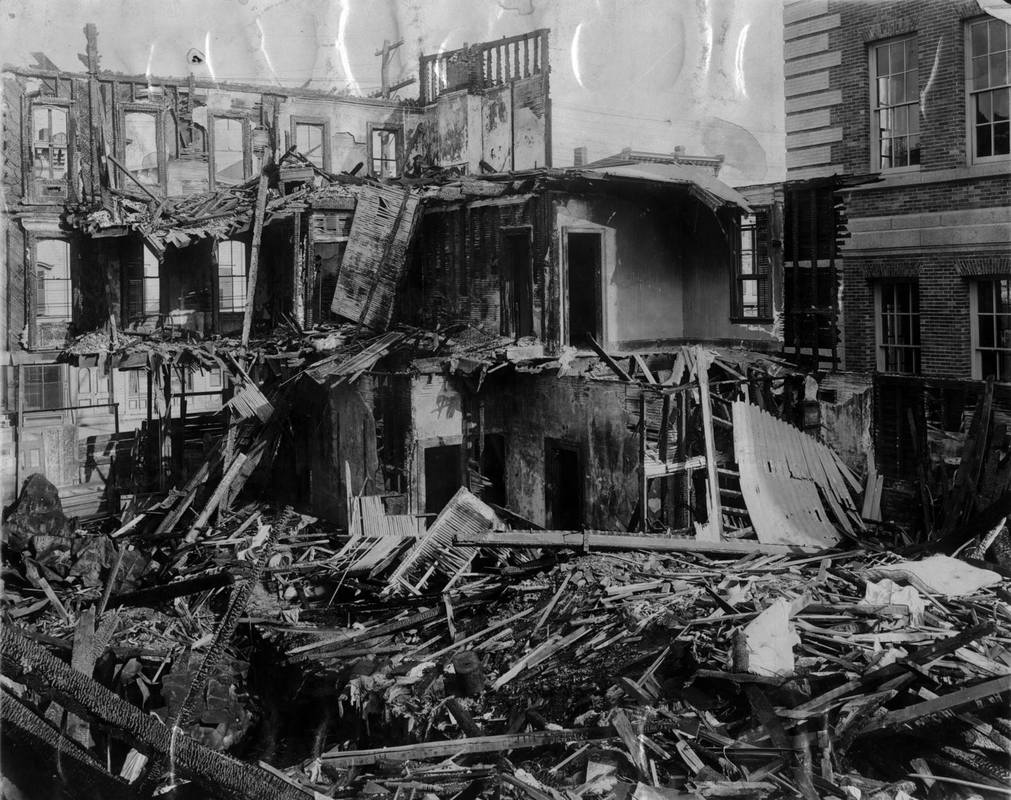
LOCATION, LOCATION…Explosions at fireworks factories in New York and New Jersey put an end to the manufacture of fireworks in the area by 1930. Above, a July 1901 explosion of a fireworks factory in a Paterson, N.J. tenement resulted in the deaths of 17 people who lived above factory. The New York Times reported “So great was the force of the blast, that a boy playing in the street a half a block away was lifted from his feet and hurled against an iron fence, and had one of his legs broken.” (Courtesy Paterson Fire History, via boweryboyshistory.com)

*  *  *

Not Mum on Mumford

In the previous post we were introduced to critic Lewis Mumford, who excoriated plans for the new Radio City, now known as Rockefeller Center. In his “Notes and Comment,” E.B. White added his own two cents:

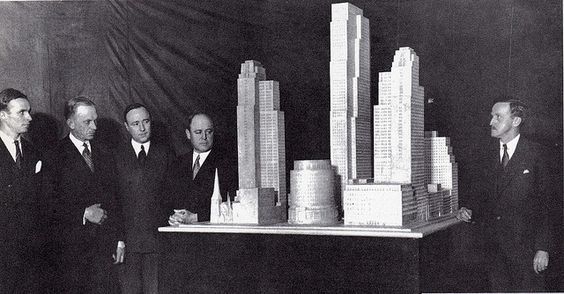
PERHAPS IT SHOULD HAVE BEEN A CAKE…Even the promoters of the Radio City project looked uncertain of their scheme in this March 1931 photo. (drivingfordeco.com)

*  *  *

From Our Advertisers

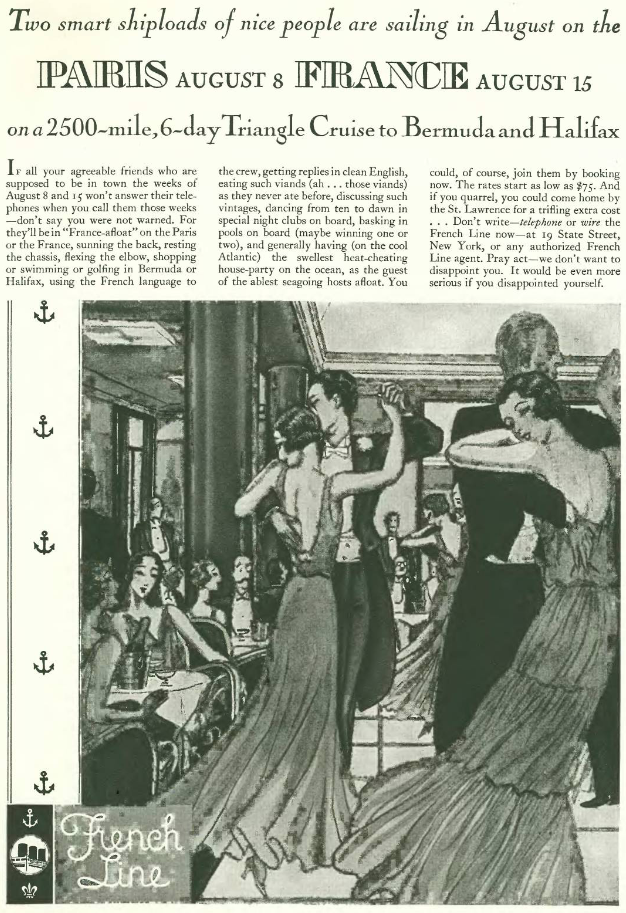
New Yorkers who wanted to get away from the steamy streets of Manhattan (almost no one had air conditioning in 1931) could catch the cooling breezes of the Atlantic on any number of cruise lines that plied the Eastern Seaboard and Canadian Maritimes during the summer…here the French Line offered a six-day “Triangle Cruise”…
…while Cunard offered a similar excursion (employing the cartooning skills of H.O. Hofman) that allowed passengers to “do the ocean” in just four days…

…to earn the ever-shrinking travel dollar during the Depression, both the Red Star and White Star lines offered their giant ocean liners for half- and full-week cruises to the Maritimes, Red Star even throwing in some on-board entertainment, claiming to be the first to do so “on any ocean”…

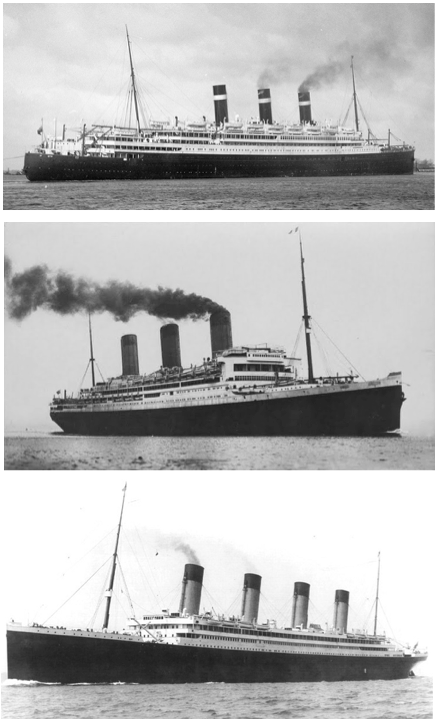
A SCRAPPED LOT…From top, the Belgenland, Majestic and Olympic. These great ships that once ferried passengers in high style between Europe and the States had been reduced to taking folks on short cruises and even one-day excursions due to the Depression. By the mid-1930s the Belgenland and Olympic (once the world’s largest ship) were sold for scrap. The Majestic was scuttled a few years later. (Wikipeda)

…I’m not sure where this pair is headed, but the angle suggests they just drove off a cliff…

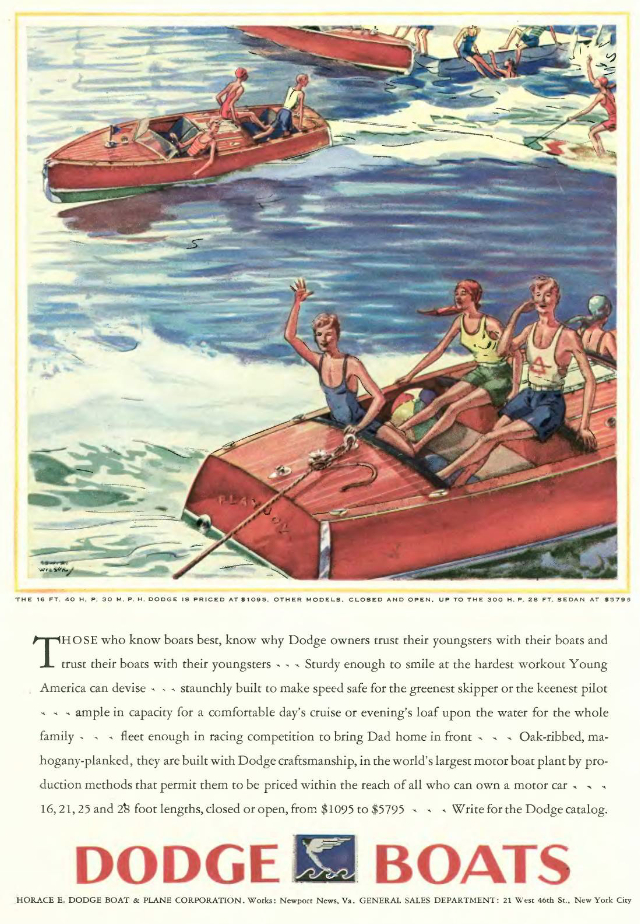
…if cliff diving wasn’t your thing, you could tool around in a bright red Dodge boat…
…or be easily amused like this guy on the right, who gets his jollies from the abundance of ice cubes in his fridge…

…over at Essex House we find a more reserved scene, the “well-born” father and son gloating over their Central Park view…
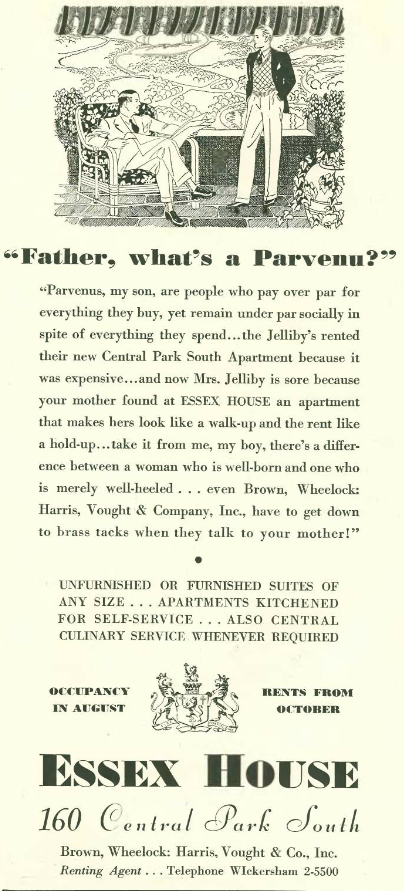
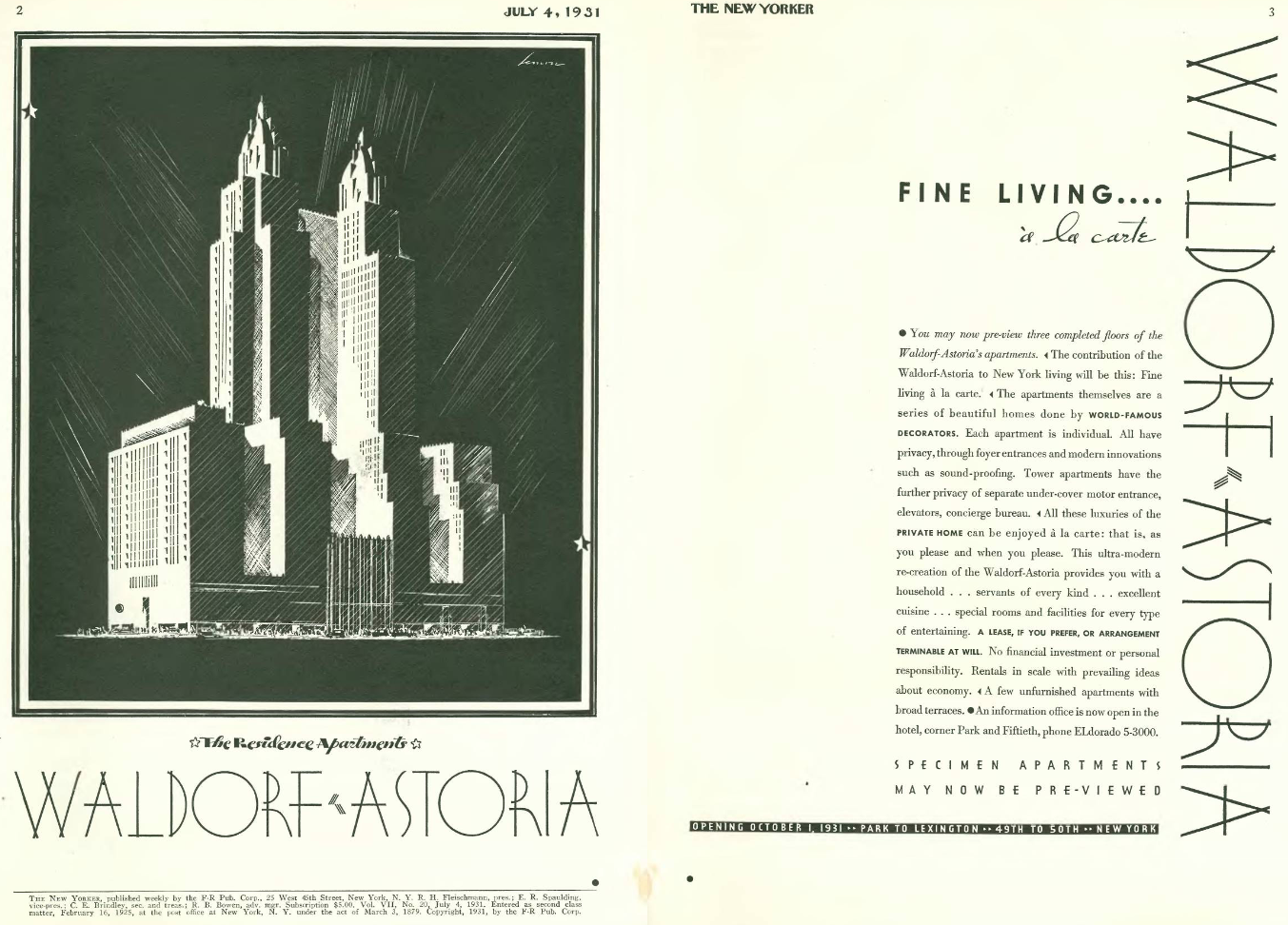
…the Essex House might have been “all that,” but Dad and Junior would have to reconsider their social rank against a newcomer — the Waldorf-Astoria, reborn on Park Avenue…
…on to our cartoons, this couple illustrated by Garrett Price might consider something with a larger balcony…

Otto Soglow’s Little King took his Little Prince out for some air…

Kemp Starrett showed us a chap who contemplated the passing of time along with the passing of his timepiece…

Isadore Klein updated the theme of a damsel in distress…

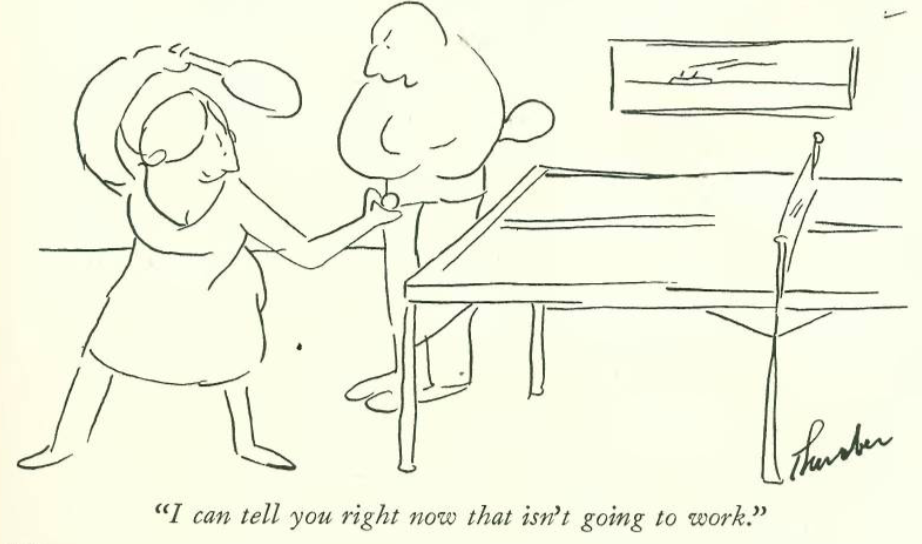
…the growing popularity of Ping-Pong gave James Thurber some material to explore the battle of the sexes…
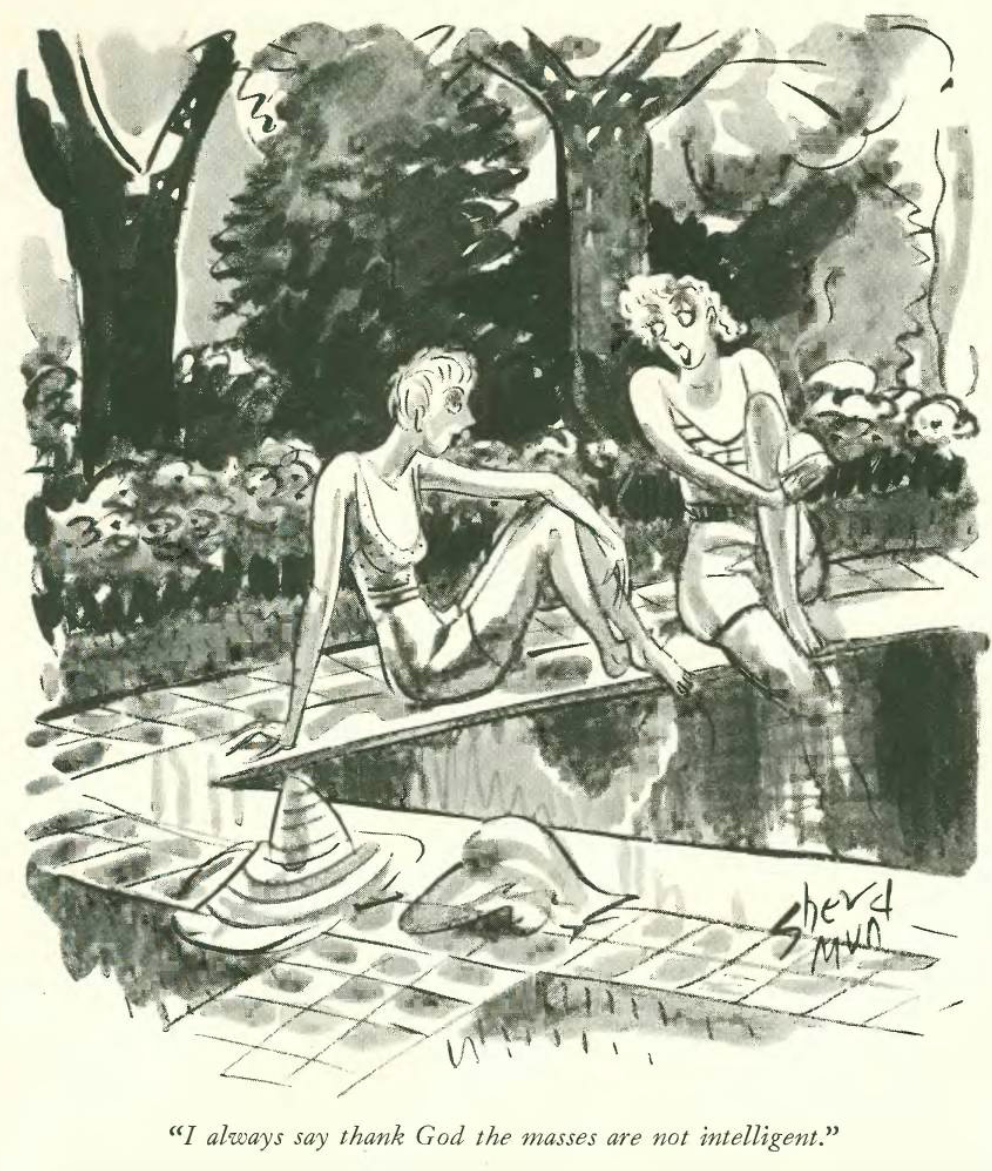
…and Barbara Shermund left us poolside with a couple of eggheads…
…on to our July 11, 1931 issue…
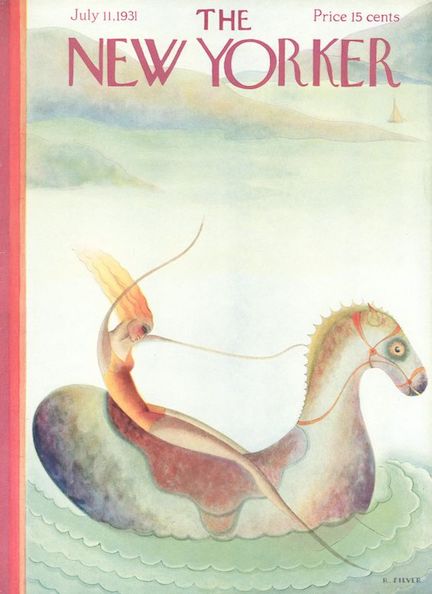
July 11, 1931 cover by Rose Silver.

…we find E.B. White taking his sweetheart, Katharine Angell White (referred to here as his “best girl”) out for a date at Coney Island…
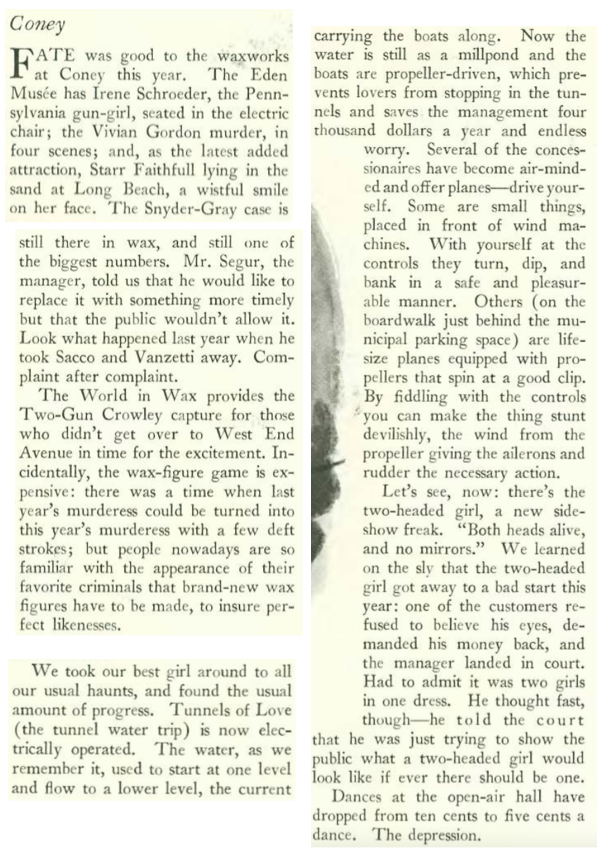
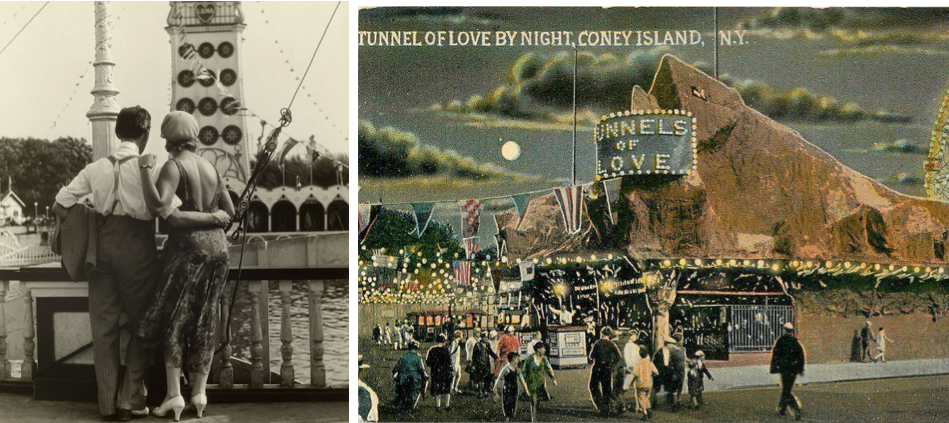
A PLACE FOR ROMANCE…It’s not them, but this couple visiting Coney Island in 1928 (photo by Walker Evans) will serve well as our stand-ins for E.B. and Katharine White on their date to Coney. At right, the famous “Tunnels of Love.” (Metropolitan Museum of Art/Pinterest)
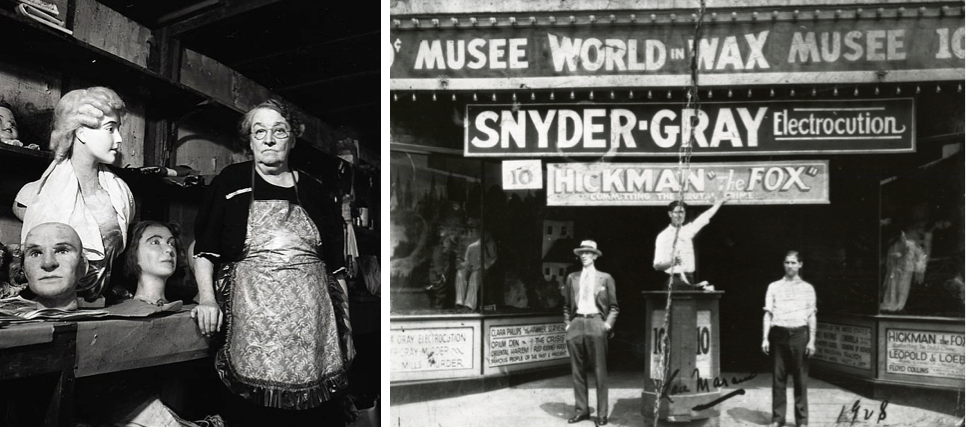
AND OTHER DIVERSIONS…Another famous and rather lurid Coney attraction was the wax museum, which featured dioramas based on headlines of the day. The biggest attractions were those featuring famous crime scenes, gruesome effects included. (Museum of the City of New York)
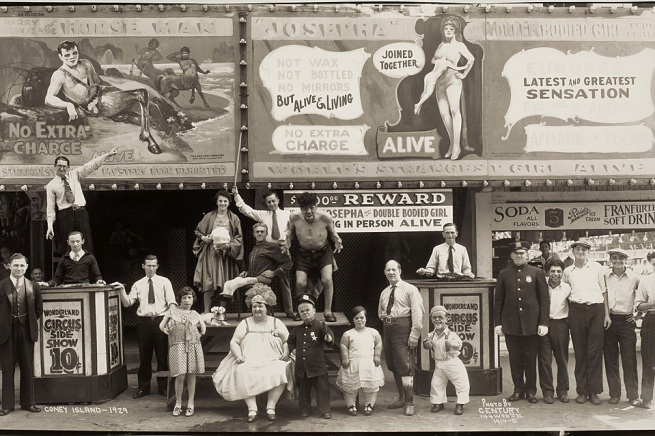
IT WAS A LIVING…Among other big attractions at Coney were the sideshow “freaks” White mentioned in his article. The photo above, from 1929, is by Edward J. Kelty. (artblart.com)

 *  *  *

On the Waterfront

The 1954 film by the same name featured the murderous mob boss Johnny Friendly (Lee J. Cobb) who ruled the waterfront’s stevedores with an iron fist. The reality was just as brutal, if not more so along the Brooklyn waterfront in the early 20th century, where the reign of a crime boss was as short as his life span. Alva Johnston reports:
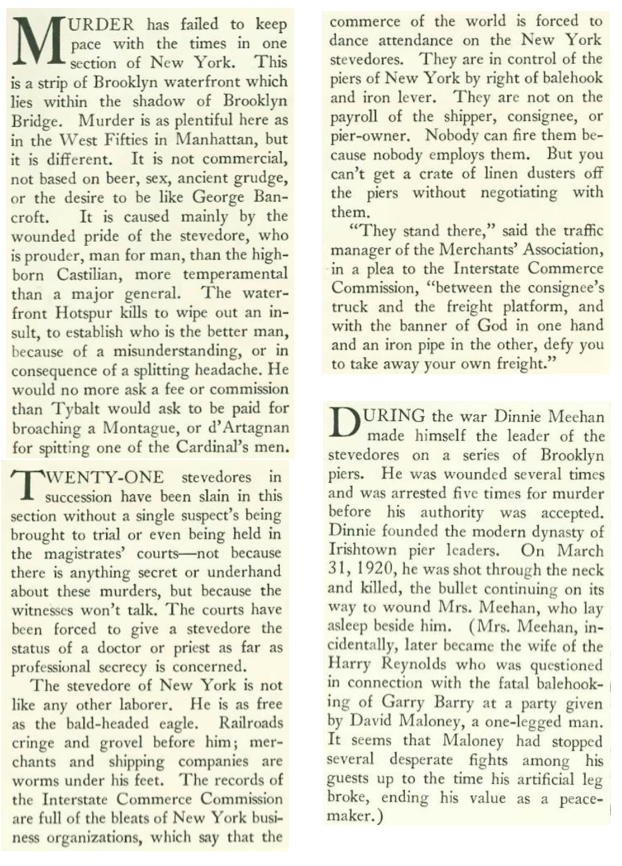
TOUGH NEIGHBORHOOD…Midcentury view of the Brooklyn waterfront. (thenewyorkmafia.com)

Dinnie Meehan’s widow, Anna Lonergan, had the distinction of being shot at the side of two successive husbands; after Meehan was murdered, Anna married “White Hand” gangster Harry Reynolds. Johnston, who referred to Anna Lonergan as “the Brunhild of the longshore cycle,” concluded his piece with a look at the “last of the great leaders,” Red Donnelly, also known as “Cute Charlie”…
HARD KNOCKS…“Peg Leg” Lonergan was the final leader of the waterfront’s “White Hand Gang.” He was gunned down on Dec. 26, 1925, after a short reign as boss. He was just 25 years old when he died. (Pinterest)

 *  *  *

The Show Must Go On

With the glory days of vaudeville quickly receding into the past, Flo Ziegfeld was nevertheless determined to keep his “Follies” alive at his eponymous theatre. Robert Benchley stopped by for a look at the Ziegfeld Follies of 1931.

CARE FOR A SMOKE?…Program cover for the Ziegfeld Follies of 1931. At right, Ziegfeld star Ruth Etting, who portrayed a cigarette girl in the show’s “Club Piccadilly” skit. A note of trivia: Etting and I attended the same high school (but not at the same time!). (Playbill/Wikimedia Commons)
GLORY BE…Inside pages of the program featured some of the “Ziegfeld Beauties” appearing in the show. (Playbill)

 *  *  *

Gross

Back in the day some entrepreneurial types would kill a large whale, stuff it full of sawdust and formaldehyde, and then take it on the road to parade in front of gawkers with spare nickels in their pockets. E.B. White observed the fate of one such specimen:
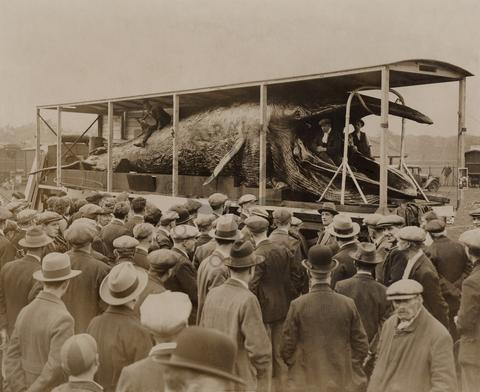
YES, THIS WAS A THING…Before the days of Jacques Cousteau and Animal Planet, this is how some folks got their first and likely only look at a real whale, even if it was pumped full of sawdust and formaldehyde.

 *  *  *

From Our Advertisers

This small back page ad invited New Yorkers to the cooling breezes atop the Hotel Bossert in Brooklyn Heights, once referred to as the “Waldorf-Astoria of Brooklyn”…
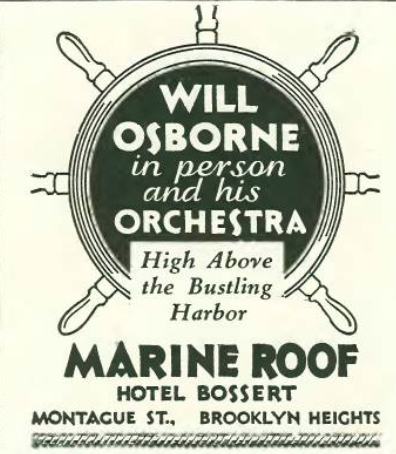
Its rooftop restaurant — the Marine Roof — was a famous hangout. When the Brooklyn Dodgers won the World Series in 1955, this is where they celebrated…
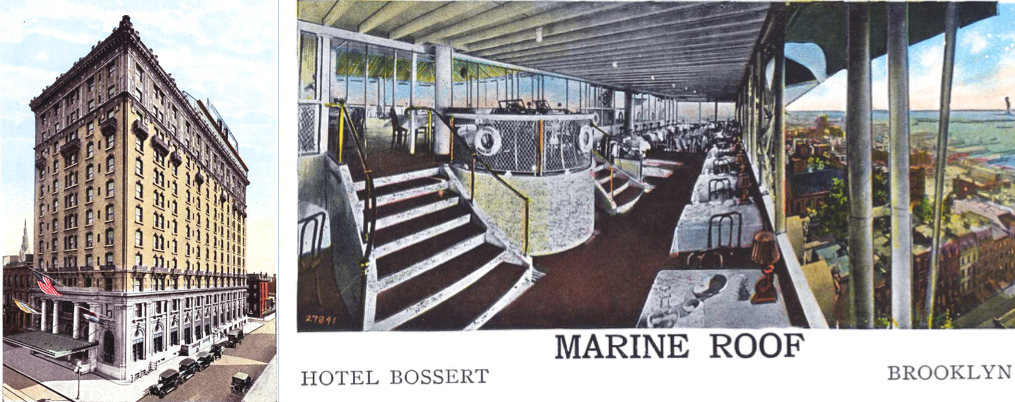
(brownstoner.com)

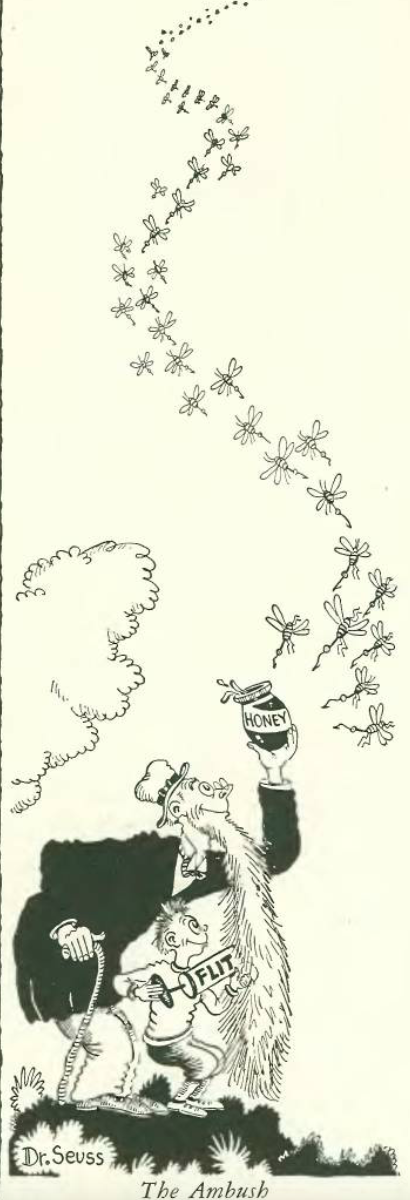
Dr. Seuss was still making a living illustrating advertisements for Flit insecticide…
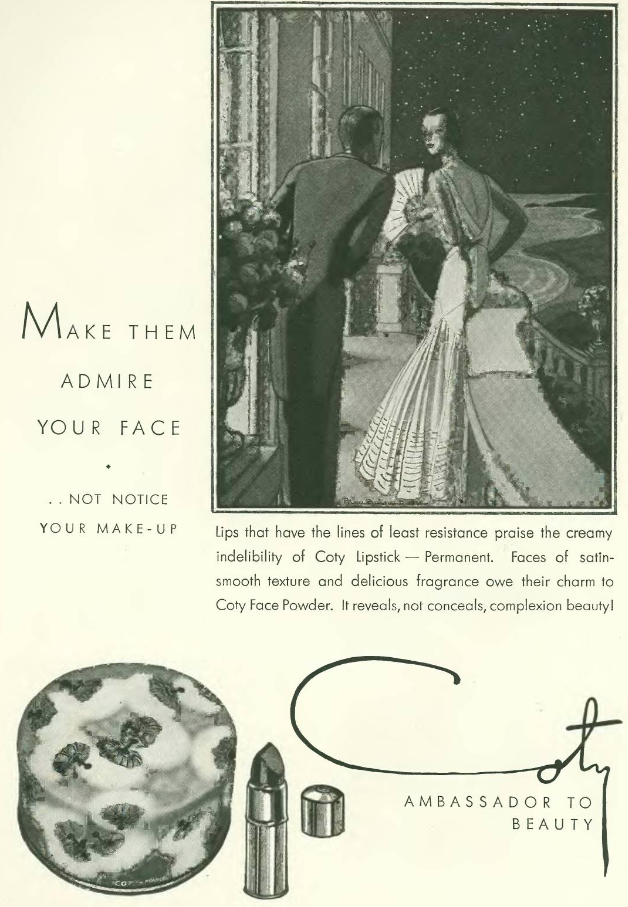
…”my eyes are up here”…says the woman who uses Coty brand lipstick…
…on to our cartoonists, we have Garrett Price also examining the challenges of playing Ping-Pong…

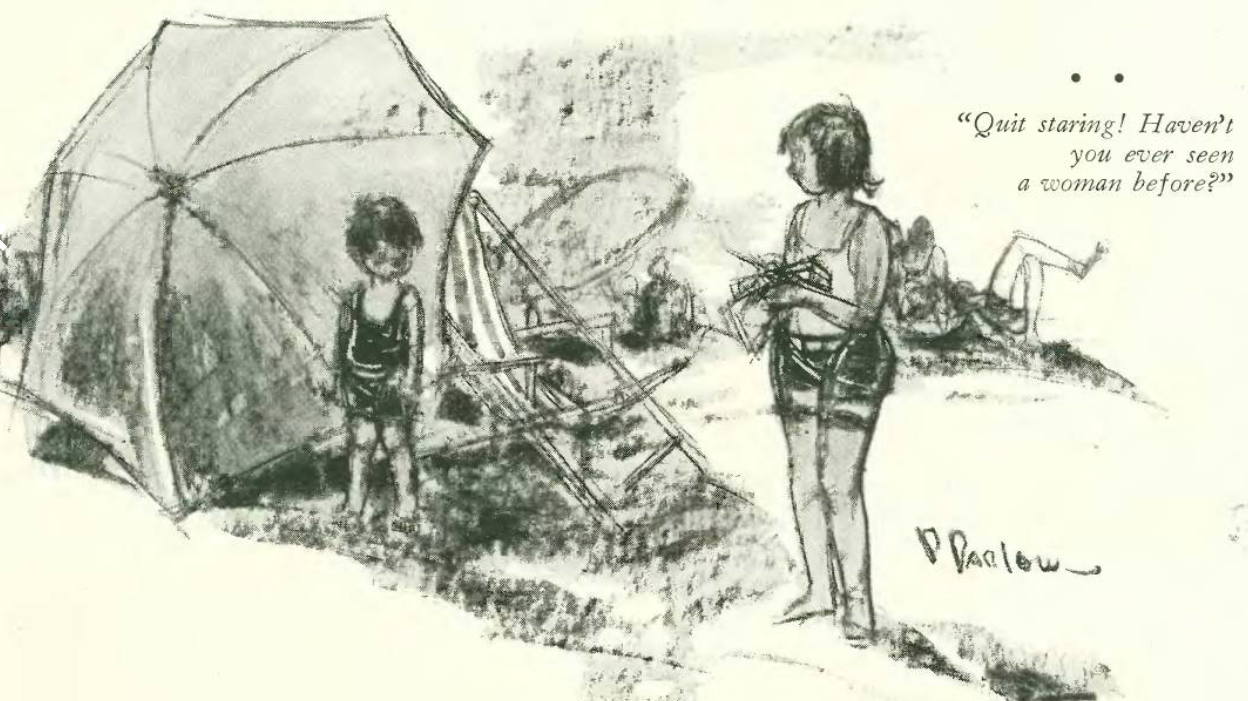
Perry Barlow was at the seaside with a precocious beach-goer…
Carl Rose showed us a Boy Scout after his encounter with the Red Menace…

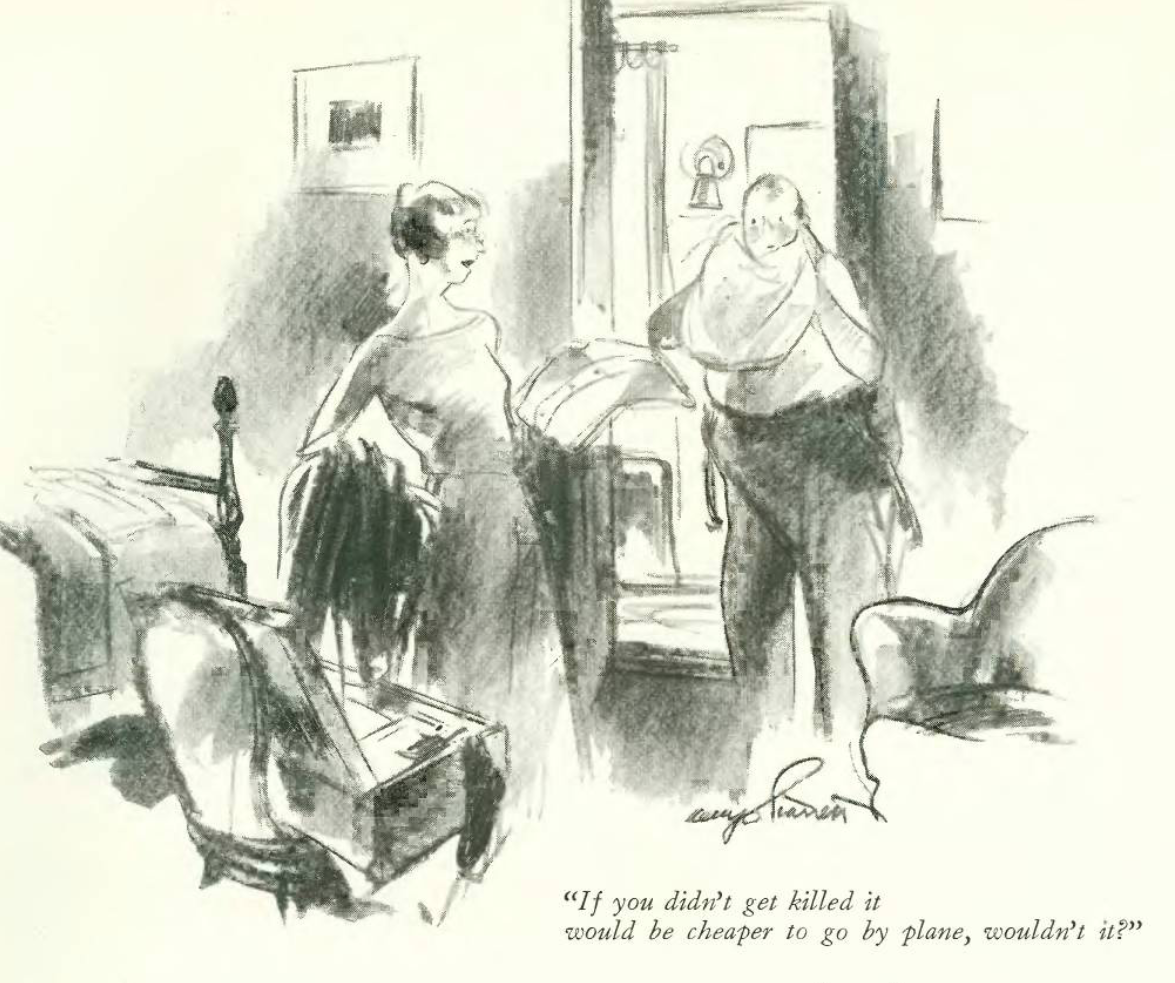
Kemp Starrett weighed the advantages of air travel…
Otto Soglow surprised us with this undercover operation…

…and we end with James Thurber, and the price of literary fame…

Next Time: The Black Eagle…



Rooftop Romance

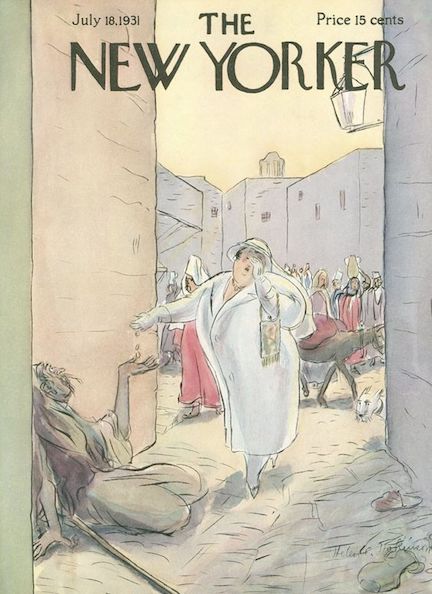
In the days before air conditioning, New Yorkers took to the higher rooftops in the city to escape the summer heat and reconnect with familiar entertainers.

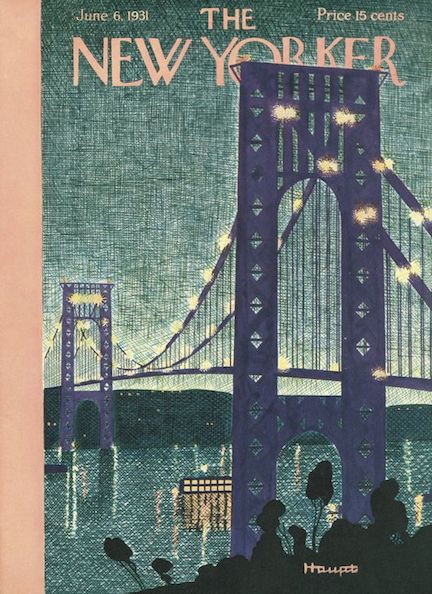
June 6, 1931 cover by Theodore Haupt. The title image is a detail from a Sept. 5, 1970 cover by Arthur Getz.

Among those reconnecting was Lois Long, who had abandoned her nightlife column “Tables for Two” the previous year but revived it in the June 6, 1931 issue, perhaps in reaction to the “boundless trouble” that had marched into her “quiet life,” namely her bitter divorce that month from cartoonist Peter Arno. Soon to be single again, Long dusted off her “Table” for another night out.

PRE-AC…As far back as the Gilded Age of the 19th century New Yorkers escaped the summer heat by seeking entertainment on one of the city’s rooftop gardens. Pictured is the Paradise roof garden atop Hammerstein’s Victoria Theatre, 1901. (MCNY)

THE BUCK STARTS HERE…It wasn’t a rooftop, but the Central Park Casino was a cool retreat from city streets, especially for Mayor Jimmy Walker, who conducted much of city business there. After reform-minded Mayor Fiorello La Guardia replaced Walker in 1934, Parks Commissioner Robert Moses had the place torn down. (New York City Parks Photo Archive)
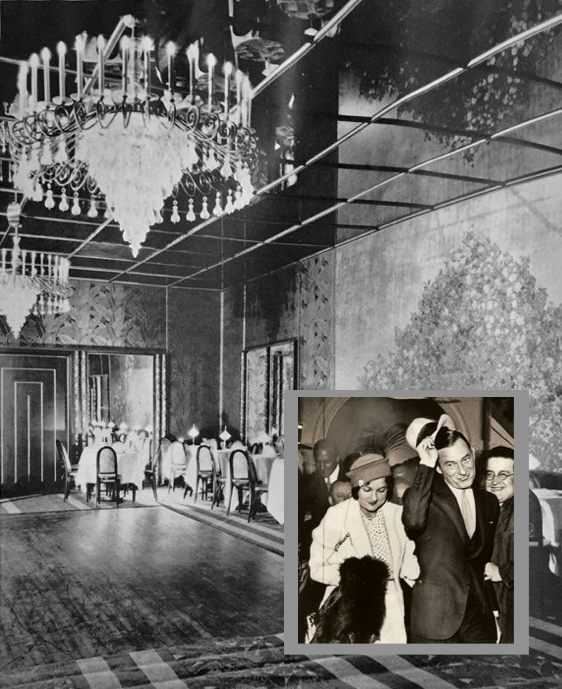
I COULD HAVE DANCED ALL NIGHT…Mayor Jimmy Walker and his mistress, showgirl Betty Compton, were often the last to leave the Casino in the wee hours of the morning, dancing in the Joseph Urban-designed black-glass ballroom (above) to the Leo Reisman Orchestra. (drivingfordeco.com)

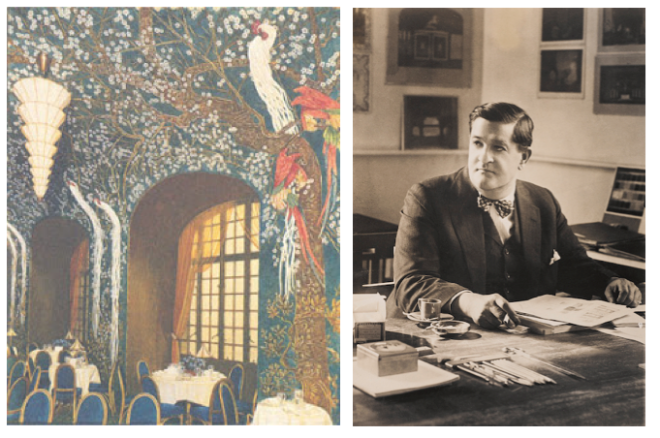
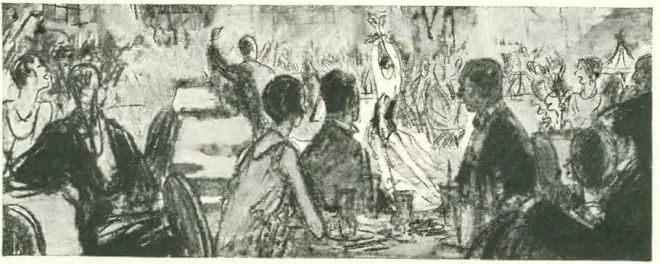
Higher up in the city, Long also paid a visit to the elegant rooftop of the St. Regis, also designed by the famed architect and theatrical designer Joseph Urban

DAZZLING…The St. Regis rooftop, designed by Joseph Urban. (flaglermuseum.us)
ANOTHER VIEW of the St. Regis rooftop as illustrated in the July 7, 1928 issue of The New Yorker by Alice Harvey. 

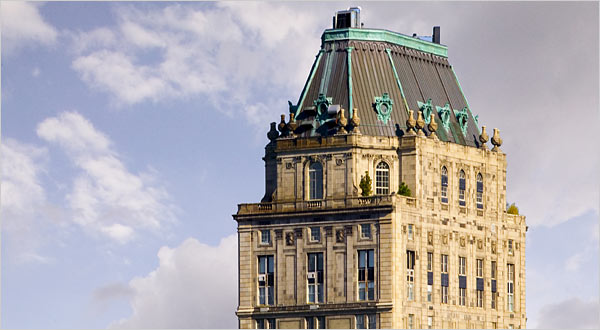
Long also visited the roof of the 42-story Hotel Pierre. The New York Sun described the top two floors as “decorated to resemble the interior of a zeppelin cabin.”

THE COOLEST…Top of the Hotel Pierre. A popular summer ballroom in the years before air-conditioning, the Pierre advertised itself as having “the highest and coolest hotel roof in Manhattan.” (NYT)

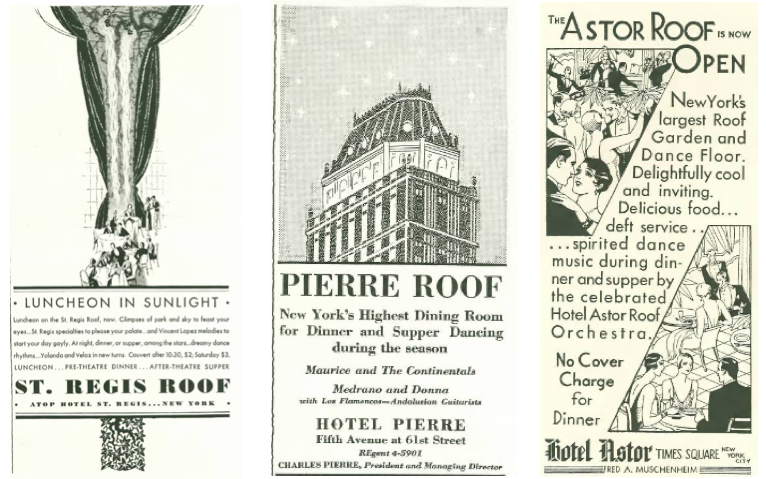
If you were in the mood for a little crooning, Rudy Vallee and his Connecticut Yankees were taking in the breeze atop the Hotel Pennsylvania, per this ad in the back pages of the June 6 New Yorker

Advertisers must have been paying attention to Long’s column, because the back pages of the following issue (June 13) had plenty of ads touting various rooftops…

Long also sampled the offerings of less savory venues, such as the Club Argonaut, which was apparently frequented by mobsters…

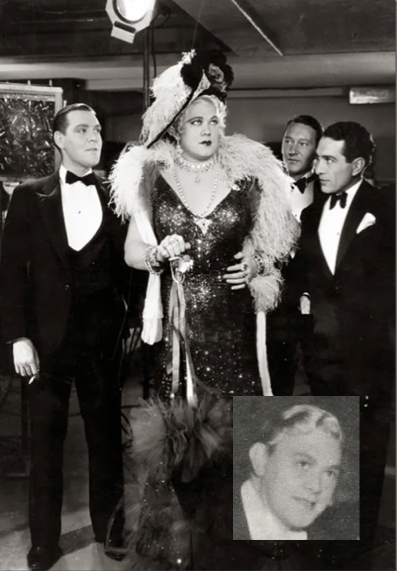
NOT AMUSED…Lois Long didn’t care for the antics of Gene Malin (center, and inset) who performed in front of a tough-looking crowd at the Club Argonaut. A popular drag artist who helped ignite the “Pansy Craze” in the 1920s and 30s, Malin was one of the first openly gay performers in Prohibition-era speakeasy culture. His career ended abruptly at age 25 in a car accident. (Wikipedia)

 *  *  *

Sexy Soviet Tractors

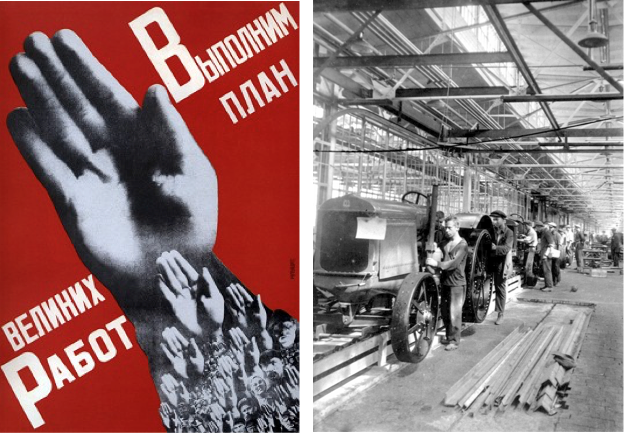
One place you could find an early form of air conditioning was at the movies (critic John Mosher referred to these theatres as “iced), and no doubt many lowered their cinematic standards just to get a few hours respite from the heat. For some unknown reason the Central Theatre thought it could entice audiences not with air-conditioning, but with a Soviet propaganda film titled The Five-Year Plan.

STAY CALM AND CARRY ON…Soviet poster for The Five Year Plan (1930), and a 1930 image of the Volograd (Stalingrad) tractor factory. You wonder how many of those chaps got wiped out by Stalin’s purges, or by the Battle of Stalingrad in 1942-43. (Wikipedia)

 *  *  *

Laughing at Death

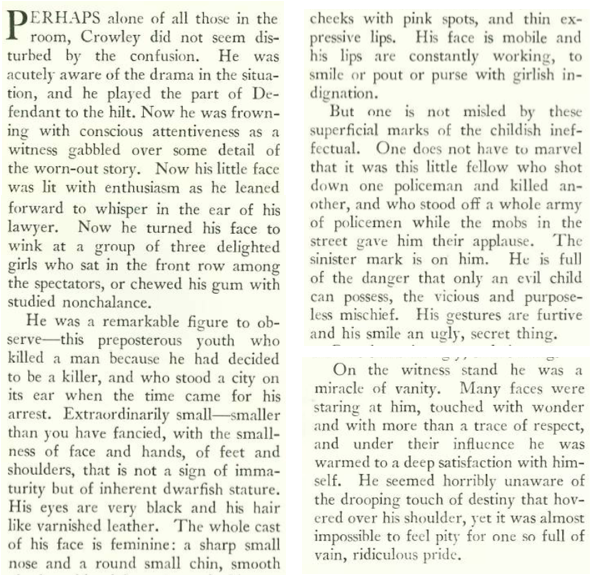
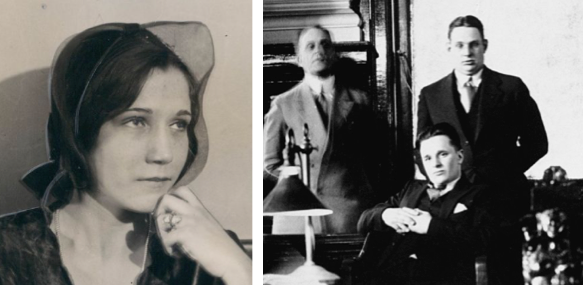
A couple of posts ago I wrote about a very public gun battle that brought diminutive killer Frances Crowley to justice (“The Short Life of Two-Gun Crowley”). In the June 6 installment of “A Reporter at Large,” Morris Markey recounted the courtroom scene where the 18-year-old Crowley winked at girls and nonchalantly chewed his gum as judge and jury determined his fate.

OH WELL…Frances Crowley’s 16-year-old girlfriend, Helen Walsh, left, was positively bored during the trial that would send her beau to Sing Sing’s electric chair. Crowley himself (shown above at the trial) seemed to be amused by the proceedings, and enjoyed the attention. (NY Daily News)

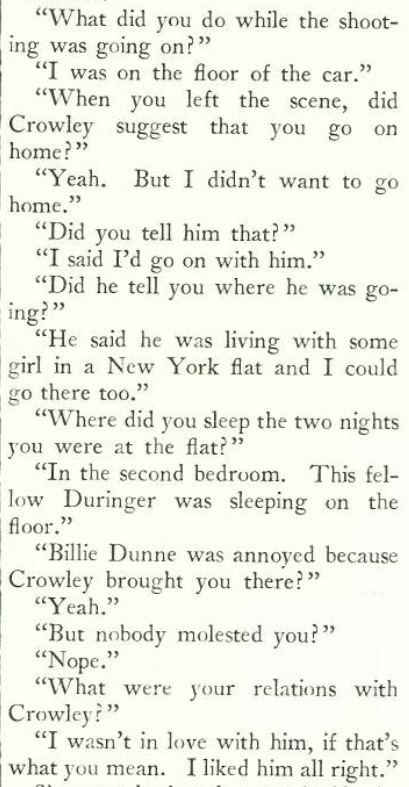
Markey also noted the unseemly behavior of Crowley’s 16-year-old girlfriend, Helen Walsh, who seemed bored by the whole thing. “She was not a creature of your world or of mine,” wrote Markey, who noted at one point that she put her hands to her face “to conceal a faint smile that sprang from some incalculable amusement within her.” Markey offered this sample of Walsh’s questioning.

 *  *  *

Summer Frost

Novelist and poet Raymond Holden penned a profile of famed poet Robert Frost, who among things apparently enjoyed apples and a bit of gossip. A brief excerpt:

 *  *  *

Dead Ball

E. B. White lamented in his “Notes and Comment” the changes to the official golf ball, which was to be made slower in a time when Depression-weary businessmen could use a little lift:

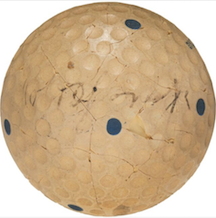
GET ‘EM WHILE THEY LAST…This 1930 golf ball, signed by golf legend Bobby Jones, listed for $15,000 on eBay.

 *  *  *

From Our Advertisers

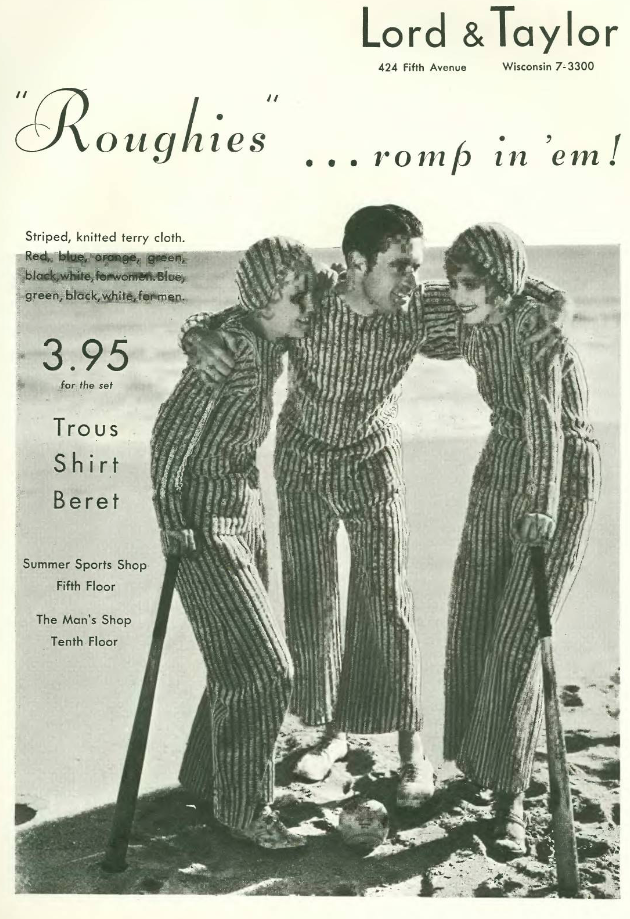
Gender-bending trends in clothing continued from the 1920s with flowing trousers for women (unthinkable a decade earlier)…

…and beach pajamas for men and women alike…

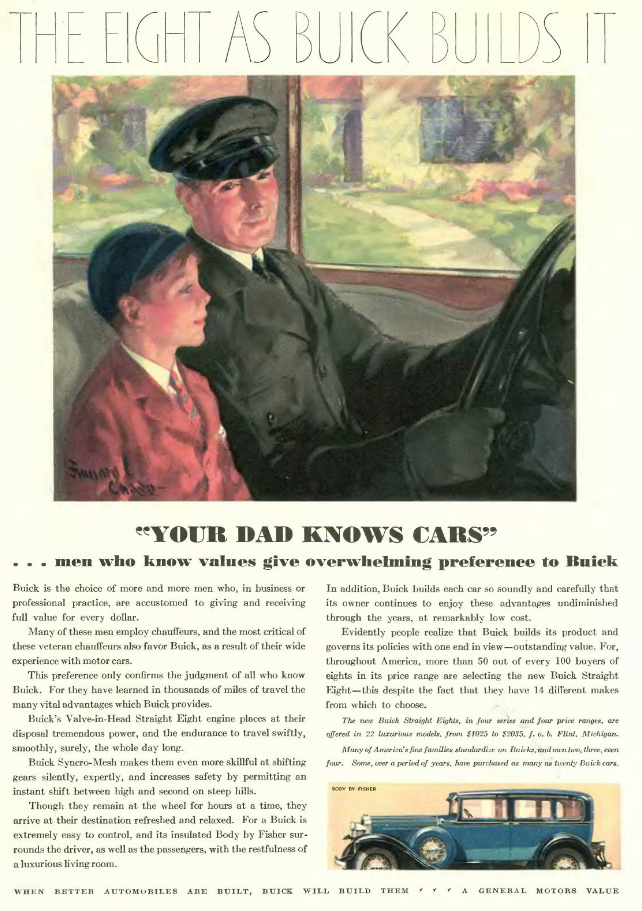
…Buick dialed up a patrician vibe with this ad that suggested a posh boy might be transported in one by the family’s driver…

…and this might be one of the first ads that linked cigarette smoking to the myth of the Western cowboy…

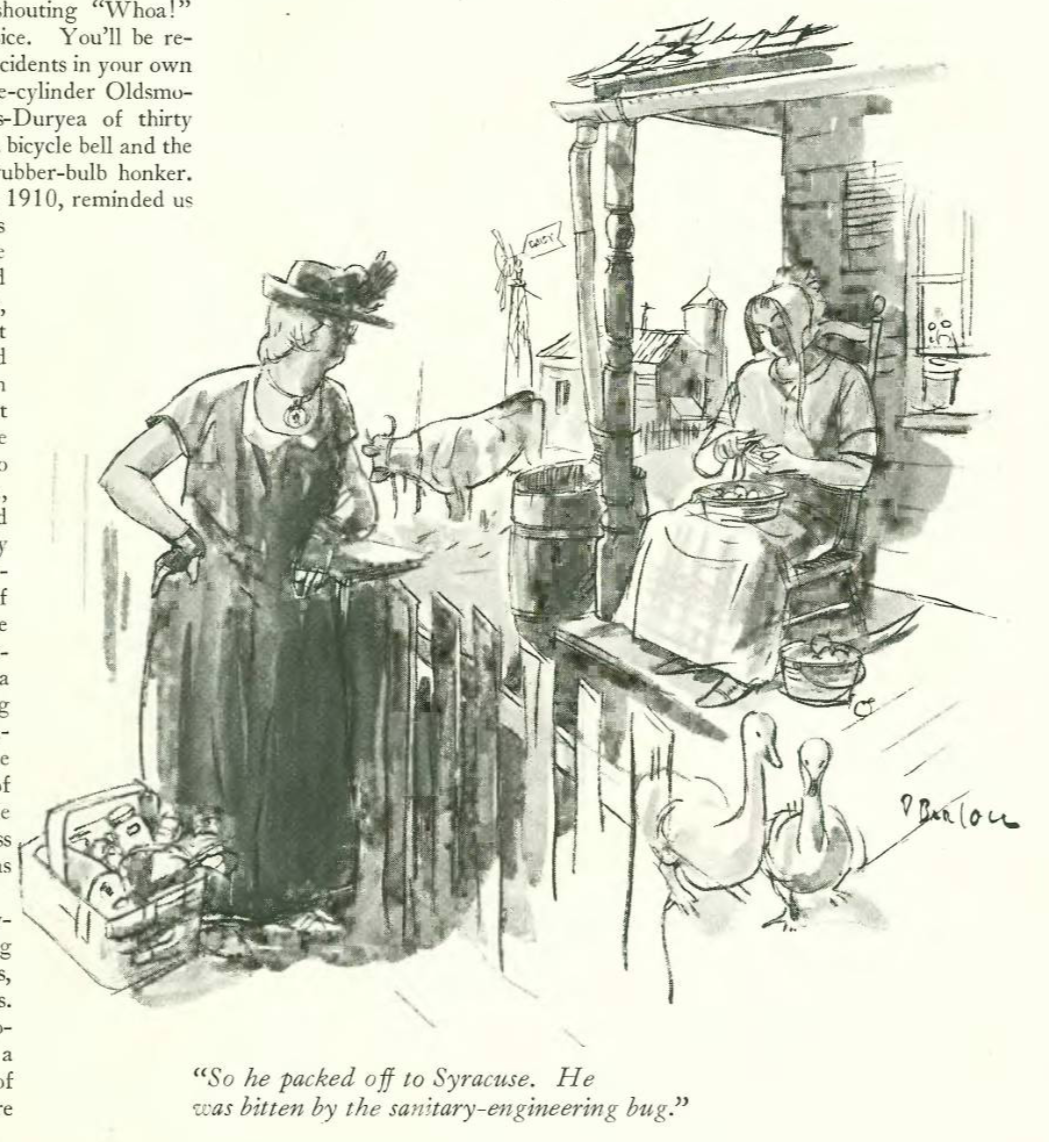
…on to our cartoons, we begin out in the country with Perry Barlow

…and Kemp Starrett, with this charming bucolic scene…

…back in the drawing room, we have this canine encounter from Leonard Dove

Helen Hokinson explored the violent side of bridge…

Barbara Shermund went into the garden to sample the trials of the rich…

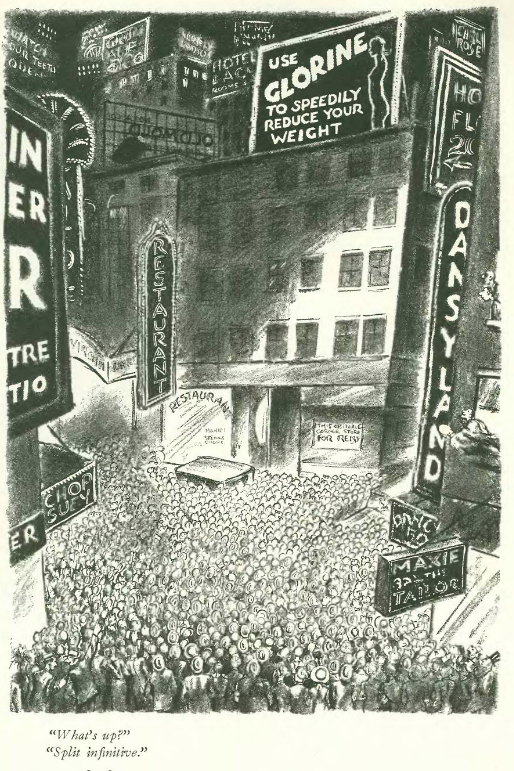
Carl Rose pondered the art of grammar in crowded places…

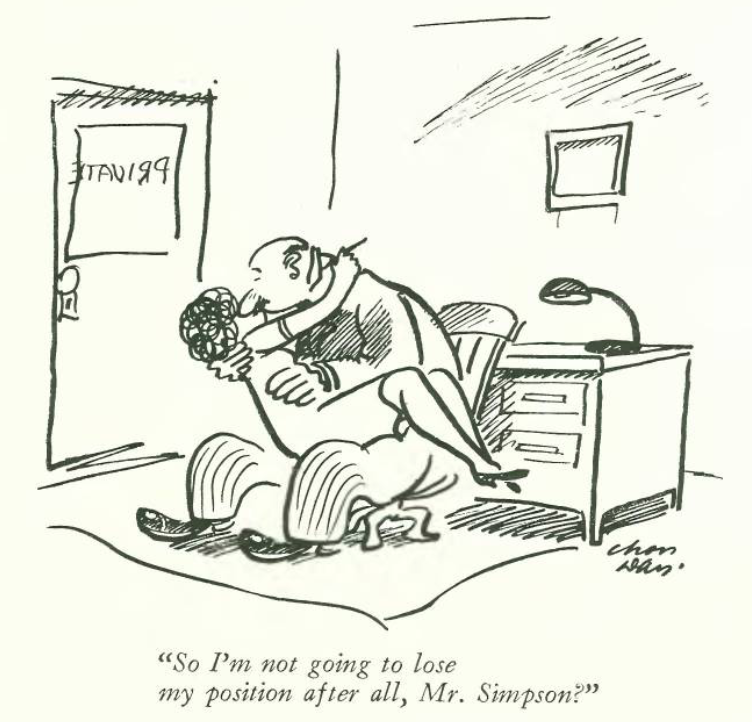
Chon Day gave us yet another take on the familiar boss vs secretary trope…

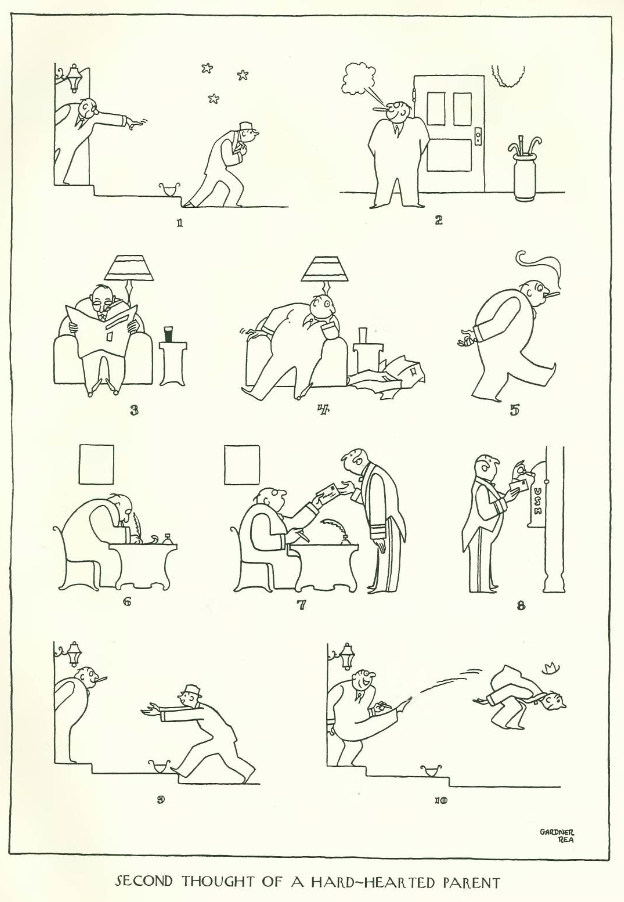
…and Gardner Rea gets the last laugh with this hapless prodigal son…

Next Time: A Star is Born…


The Short Life of Two-Gun Crowley

Harold Ross founded The New Yorker as a sophisticated humor magazine, so when events in the city or the world took a serious turn, the writers and editors did their best to maintain its waggish tone.

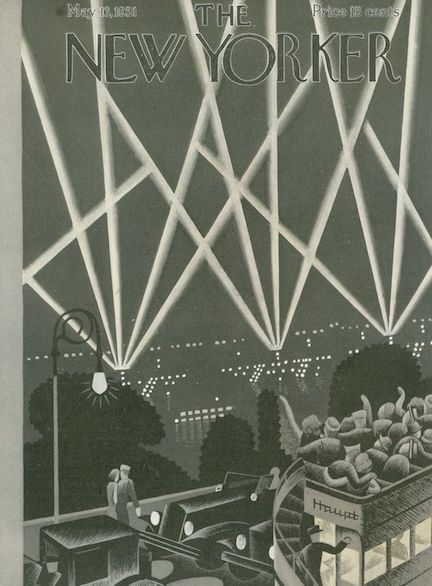
May 16, 1931 cover by Theodore Haupt.

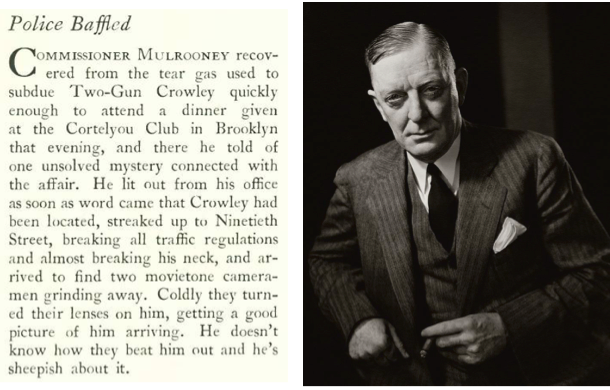
After two cold-blooded killers engaged police in a heated gun battle from a West 91st Street rooming house, the May 16, 1931 “Talk of the Town” had this to say about the incident:

At right, a 1933 portrait of Portrait Of Edward Mulrooney, Police Commissioner of New York City, by Edward Steichen. (Conde Nast)

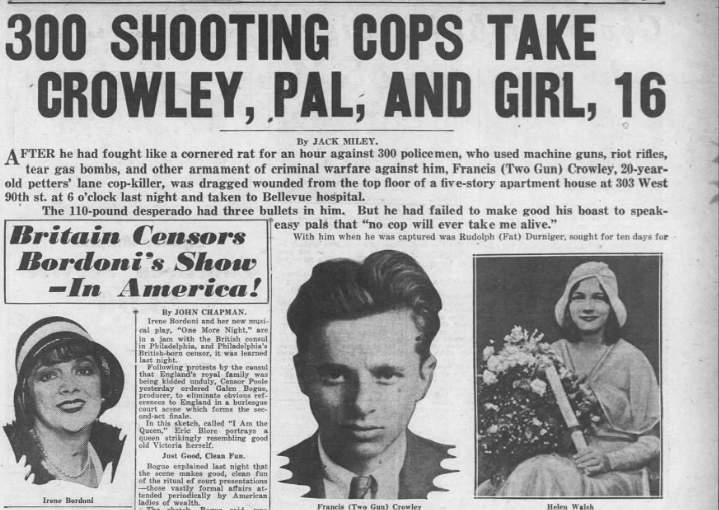
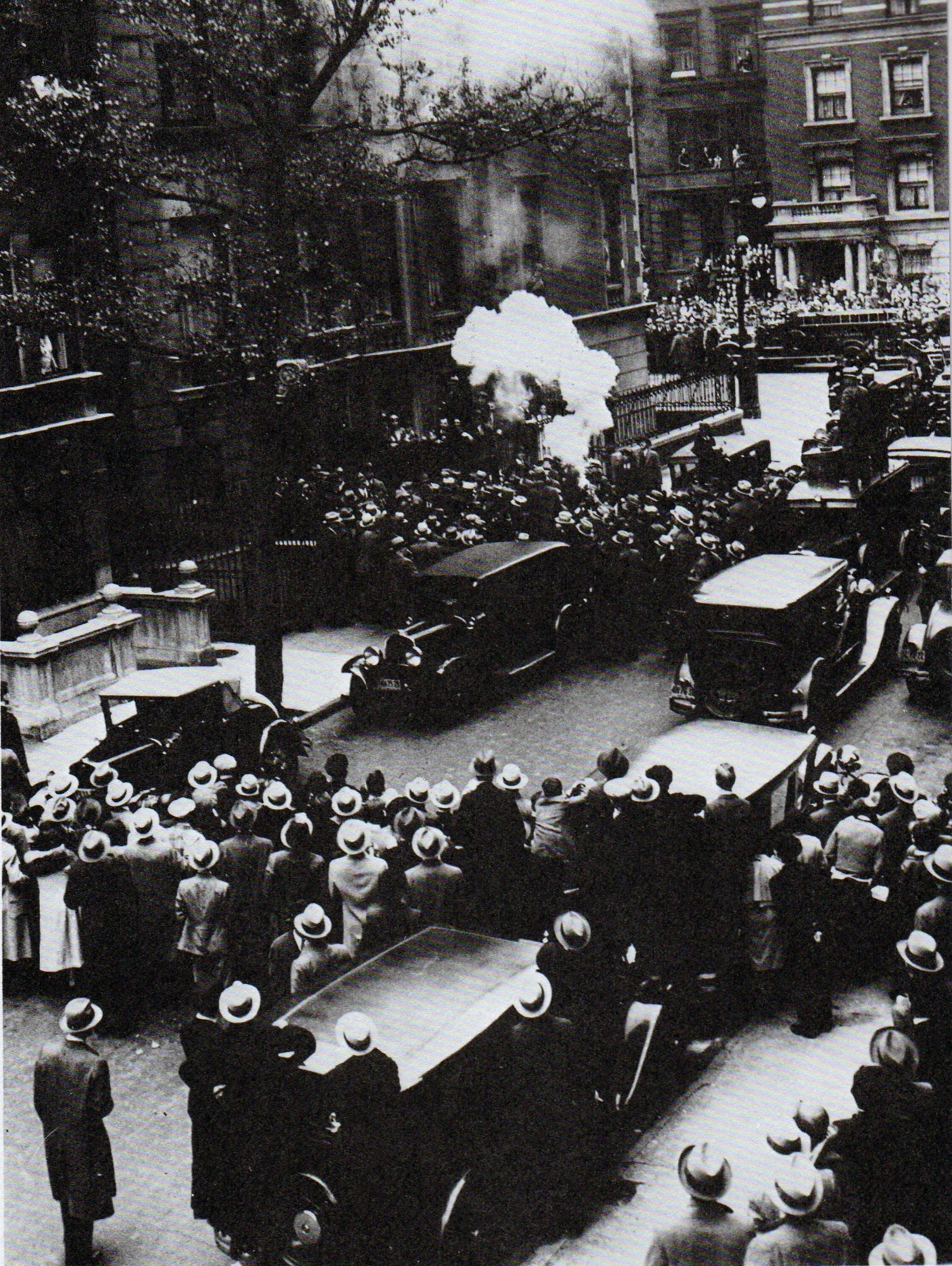
The New Yorker wasn’t alone in finding entertainment value in the gun battle. Safety standards were quite different in the 1930s, so as police exchanged heavy gunfire with 18-year-old Francis “Two Gun” Crowley, a crowd of 15,000 bystanders surrounded the scene, some just yards away from the action as the photo below attests:

THEY NEEDED SOCIAL DISTANCING…On May 7, 1931, Francis “Two Gun” Crowley exchanged gunfire with police for nearly two hours from the fifth floor of a rooming house on West 91st Street. A force of 300 police fired an estimated 700 rounds at Crowley’s apartment while a crowd of 15,000 spectators surrounded the scene. Not sure why the police stood in a huddled mass beneath the window of the shooter. Strength in numbers, perhaps. (ephemeralnewyork.wordpress.com)

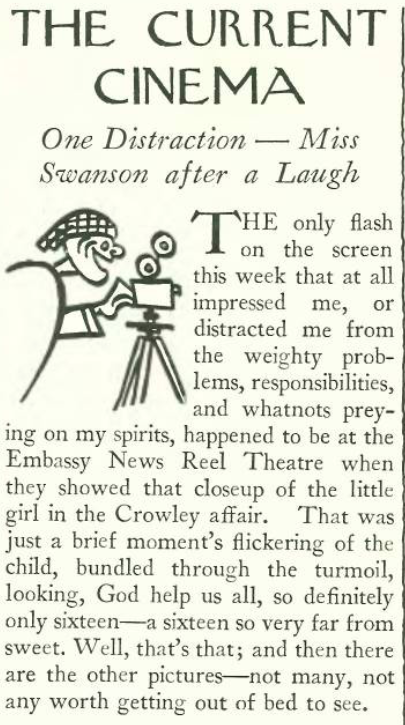
Another mention of the incident was in John Mosher’s film review column. He noted that the newsreel footage of the shoot-out was the best thing on the screen that week, and especially the moment when Crowley’s 16-year-old girlfriend Helen Walsh emerged from the building in the clutches of the police:

DON’T GET TOO COMFORTABLE…18-year-old Francis “Two Gun” Crowley (left) surrendered to police after suffering four gunshot wounds in the West 91st Street shootout, but would recover in time to be executed two months after his 19th birthday. At right, images from the newsreel show Crowley accomplice Fats Durringer being led away from the scene, along with Crowley’s girlfriend (bottom right), 16-year-old Helen Walsh. (Everett/YouTube)

By the end of the month Crowley was tried and convicted of the murder of a police officer, and his partner Fats Durringer was found guilty of brutally killing a dance hall hostess. Justice moved swiftly in those days, especially when the murder of a police officer was involved: On June 1, 1931—just three weeks after the shoot-out with police—Crowley and Durringer were sentenced to death. Only six months would pass before Durringer took a seat in Sing Sing’s electric chair. Crowley would follow his accomplice a few weeks later. As for Helen Walsh, she was released after testifying against Crowley and Durringer.

SHORT LIFE FOR SHORT KILLER…The diminutive Francis “Two Gun”Crowley, top, left, developed a habit of carrying more than one gun at all times, hence the nickname. At right, Crowley with officials at Sing Sing, where both he and partner Fats Durringer would meet their end in the electric chair. Below left, Crowley’s 16-year-old girlfriend Helen Walsh. Crowley was barely 19 years old when he was executed on Jan. 21, 1932. Among his last words, he asked the warden for a rag to wipe off the electric chair before he took his seat. “I want to wipe off the chair after that rat sat in it,” Crowley said, referring to Durringer, who had been executed weeks earlier, on Dec. 10, 1931. His request was denied. (www.swordandscale.com)

One final mention of the incident came from Ralph Barton, who named Police Commissioner Ed Mulrooney his “Hero of the Week”…

 *  *  *

Sub Sandwich

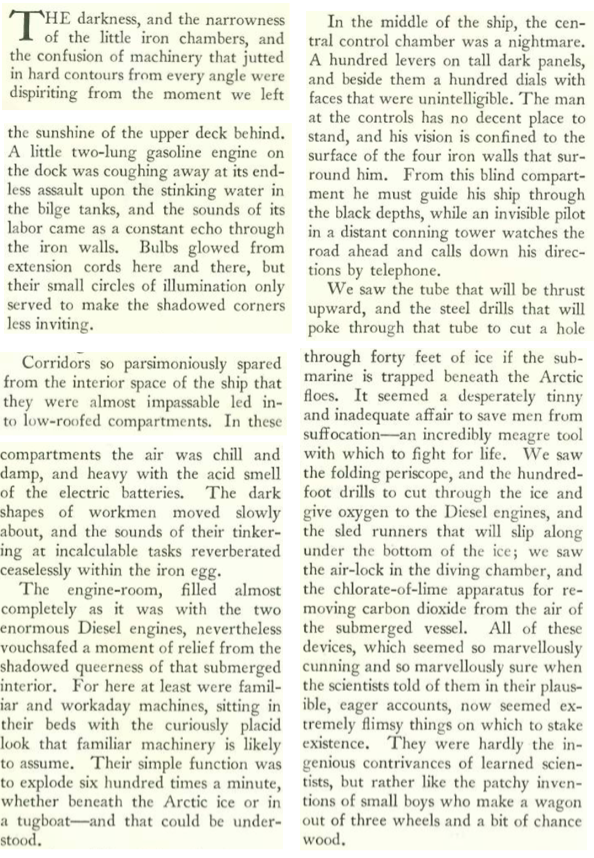
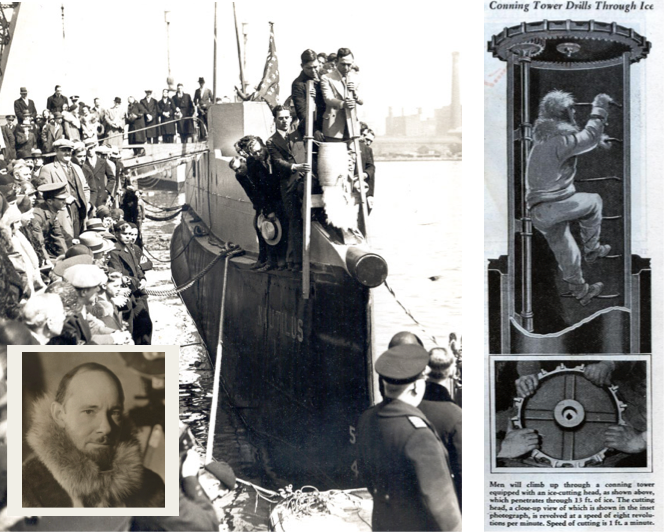
In his “Reporter at Large” column, Morris Markey paid a visit to the Brooklyn Navy Yard where Sir Hubert Wilkins and his crew were busy preparing a narrow, cramped submarine dubbed Nautilus for a trip beneath the ice of the North Pole. Markey marveled at all of the complicated devices crammed into the vessel, but at the same time wondered why anyone would stake their life on “such flimsy things”…

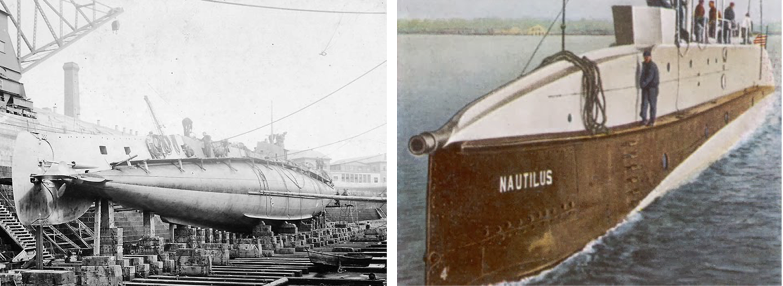
TIGHT QUARTERS…The Nautilus was a refurbished O-class submarine built in 1916 for the U.S. Navy. Somehow a crew of 20 crammed into the thing. (amphilsoc.org)
The Nautilus was fitted with ice drills that would allow access to the surface of North Pole ice, as well as provide air to the crew and the vessel’s diesel engines. All this equipment was untested and unproven, since at the time submarines were not able to snorkel and had never broken through ice to reach fresh air. Click to enlarge. (Modern Mechanix)

Markey wasn’t alone in thinking such an expedition was preposterous, and from the very beginning it was beset by problems. On the very first day of preparations, March 23, 1931, a crew member fell overboard and drowned. The next day, Lady Suzanne Bennett Wilkins (Sir Hubert’s wife) christened the submarine with a bottle of ice water rather than Champagne, which was unavailable due to Prohibition.

More on this in another post, but suffice to say Sir Hubert did not succeed in this endeavor, and perhaps should have listened to the advice of the Icelandic American explorer Vilhjalmur Stefansson:

DRY DOCK…Christened with a bottle of ice water rather than Champagne thanks to Prohibition, the Nautilus expedition, led by Sir Hubert Wilkins (inset), had to overcome many obstacles to reach the North Pole, including untested equipment such as a conning tower (right) designed to drill through ice to allow crew members to reach the surface of polar ice. (amphilsoc.org)

 *  *  *

Bright Star on Broadway

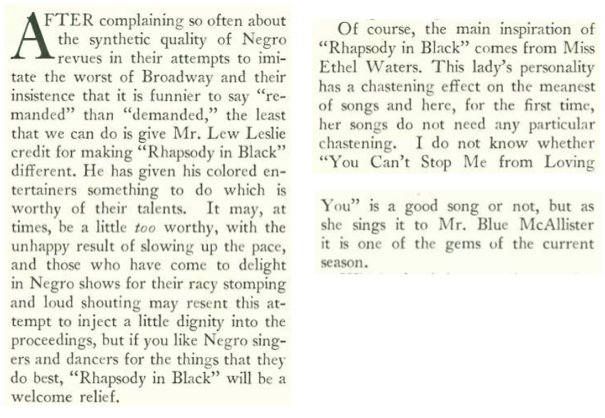
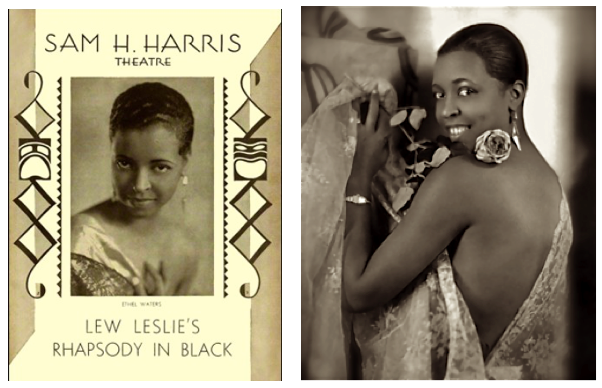
In spring 1931 Dorothy Parker subbed as theatre critic for her friend, Robert Benchley, and was greeted with a remarkably mediocre (or worse) line-up of shows. When Benchley returned to his post, things didn’t get much better until Rhapsody in Black came along with its inspiring star, Ethel Waters.

WELCOME RELIEF…Robert Benchley wrote that singer Ethel Waters had a “chastening effect” on even “the meanest of songs.” (Playbill/Carter Magazine)

 *  *  *

Six – Love

Eighty years ago sportswriter John Tunis declared that the Davis Cup international tennis competition would likely come to an end due to expense and the erosion of amateur play. Well, we know the Davis Cup is still around, and one wonders if Tunis was getting a whiff of sour grapes, since the French had won the cup five years straight, and would win again in 1932.

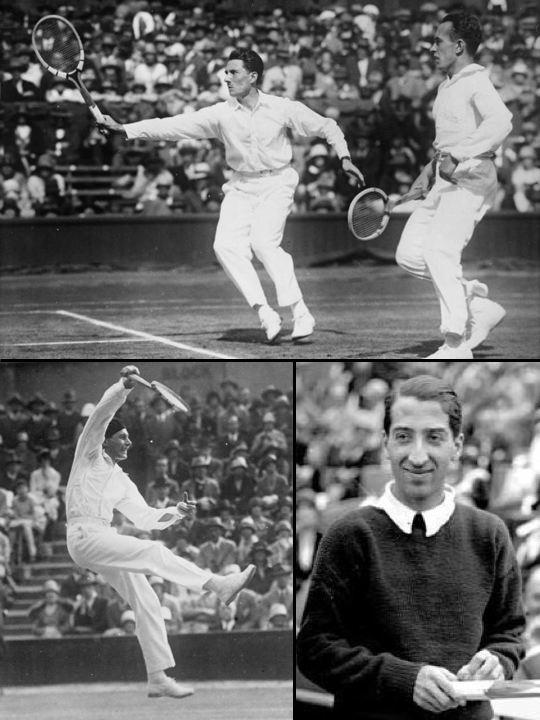
JEU, SET ET MATCH!…Dubbed Les Quatre Mousquetaires (“The Four Musketeers”), the French team of Jacques Brugnon and Henri Cochet (top), Jean Borotra (bottom left), and René Lacoste (bottom right) led France to six straight Davis Cup wins, 1927–1932. (Wikipedia)

 *  *  *

Old Gloria

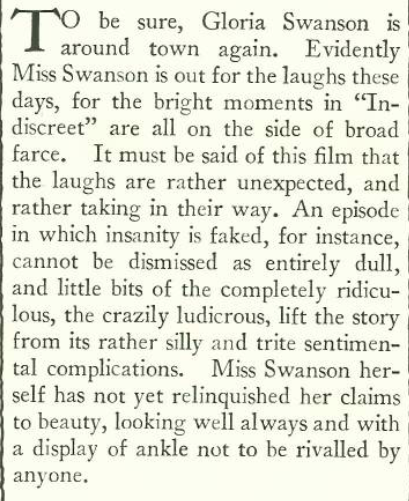
To be fair, Gloria Swanson was only 32 years old in 1931, but she was so deeply associated with the silent era that by the 1930s she seemed positively ancient (a status that she would brilliantly use to her advantage in 1950’s Sunset Boulevard). Mosher offered this “meh” review of her latest work — only her second completely-sound film — Indiscreet.

WHERE’S THE DOOR?…Ben Lyon seems perplexed by Gloria Swanson’s attentions in this theatre lobby card promoting Indiscreet. At right, Swanson delivers her trademark laser stare. (IMDB)

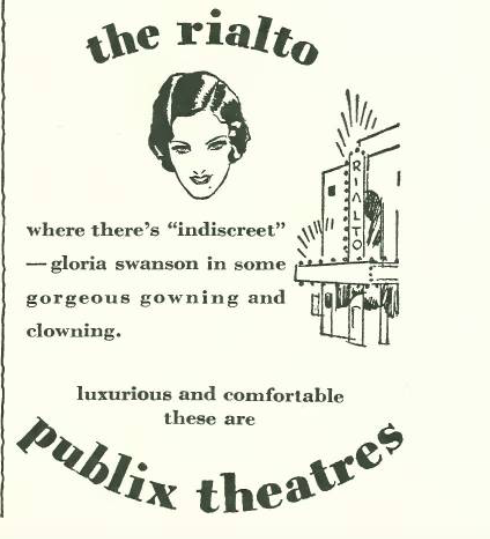
And we move on to our advertisers, with this ad from Publix Theatres (owned by Paramount) promoting Indiscreet

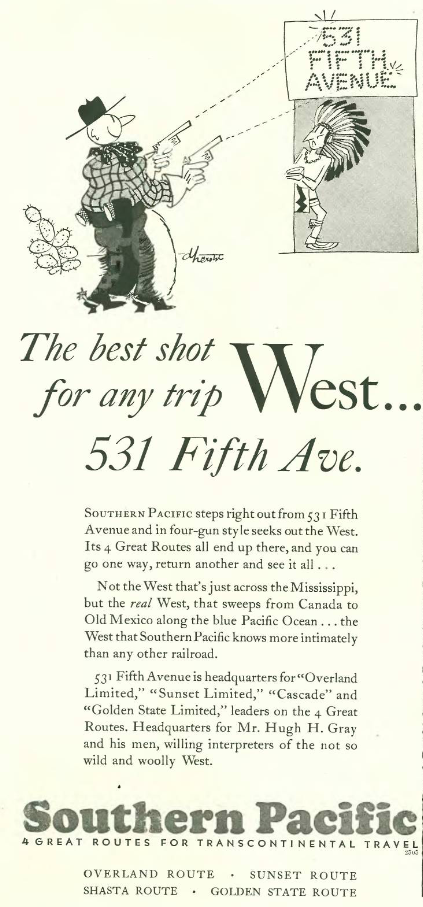
…Southern Pacific used a theme (illustrated by Don Harold) to promote travel on their trains that wouldn’t fly today…

…I include this ad for the design, which seemed to have a little of everything…

…the makers of Camel cigarettes, however, reverted to a somewhat more homespun image, abandoning the stylish, euro-set illustrations of Carl “Eric” Erickson

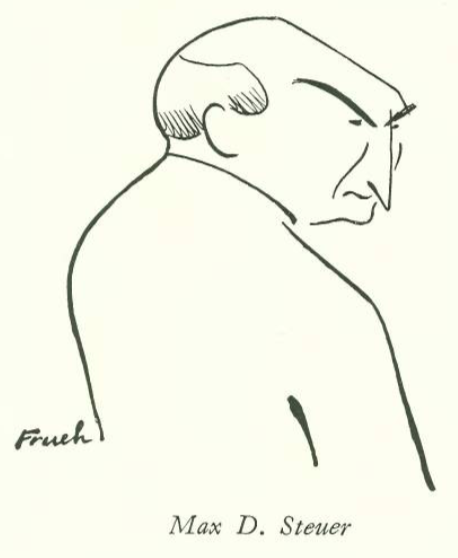
…on to our cartoonists, we have this caricature of Max Steuer by Al Frueh, rendered for a two-part profile…Steuer is perhaps best known for his successful defense of the factory owners after the 1911 Triangle Shirtwaist Factory Fire…

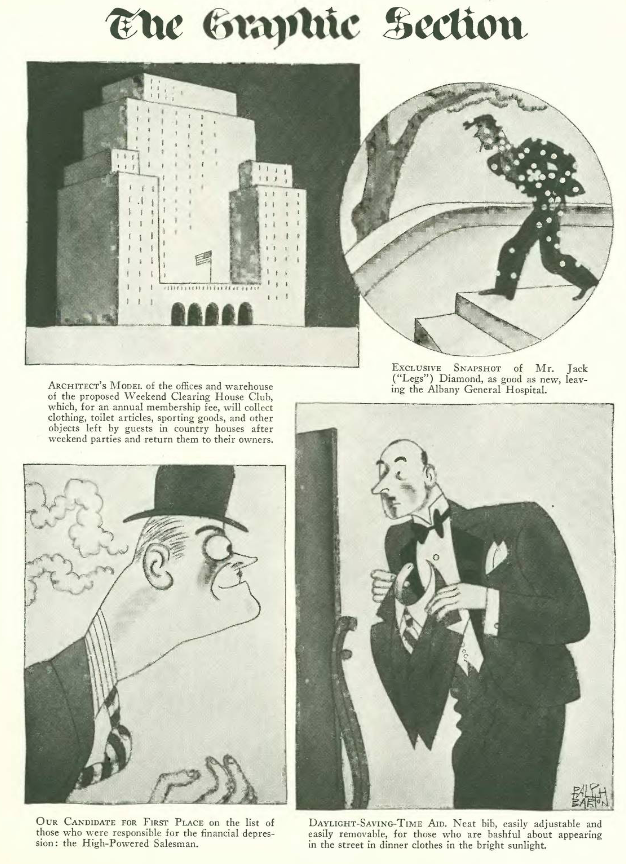
Ralph Barton again, with his “Graphic Section”…

Garrett Price weighed the durability of modern decor…

Barbara Shermund looked at gardening challenges in the ‘burbs…

Perry Barlow gave us a glimpse of something perhaps inspired by a trip to Europe…

Richard Decker conjured a boat salesman with a loaded question…

…and we end with the great James Thurber, and a cartoon that might not pass muster today…

Next Time: Flying the Friendly Skies…


From Bad to Awful

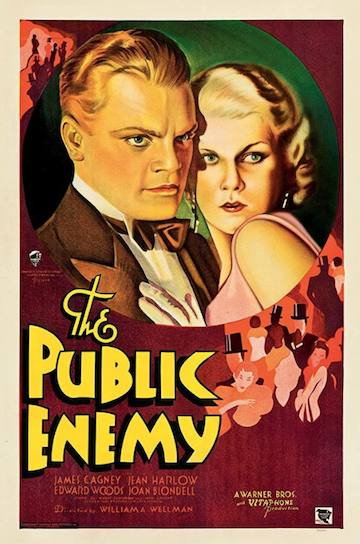
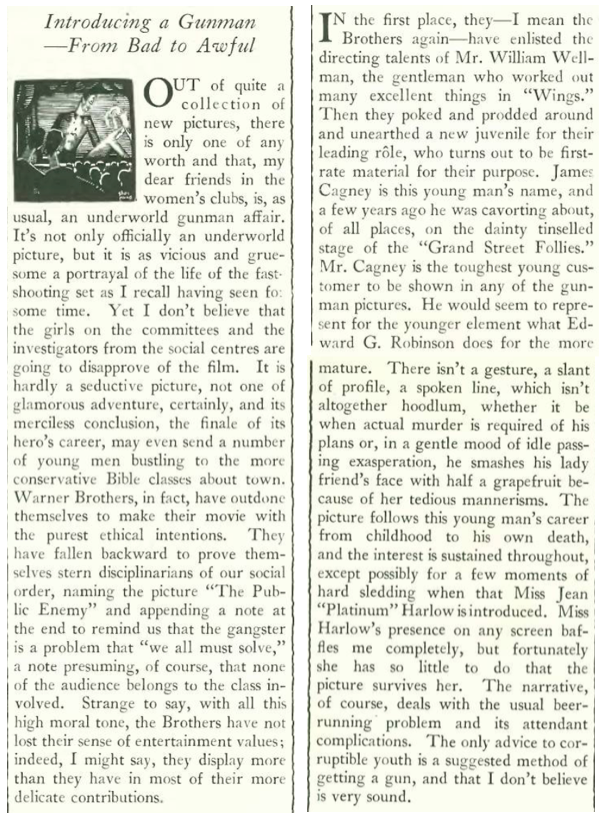
In the previous issue, New Yorker film critic John Mosher examined the morals of pre-code, “underworld films” such as Edward G. Robinson’s Little Caesar. Mosher didn’t seem all that impressed with these new gangster films, that is, until James Cagney lent his talents to The Public Enemy.

May 2, 1930 cover by Theodore Haupt.

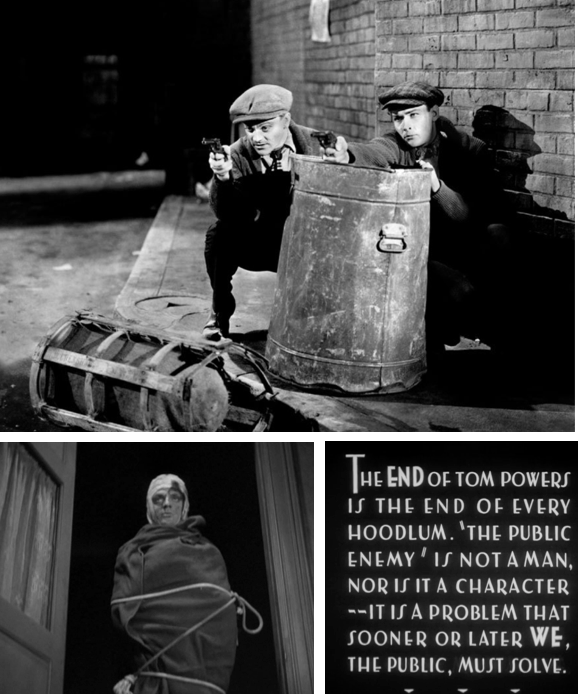
Despite its violence (by yesterday’s standards), Mosher believed that even the preachers and various women’s committees who decried the sex and violence in pre-code movies would have little to gripe about with The Public Enemy, since it clearly depicted the wages of the sins of Tom Powers, a bootlegger on the rise portrayed by Cagney.

YOU AGAIN?…New Yorker film critic John Mosher thought very little of Jean Harlow’s acting, but Warner Brothers heavily promoted their new sex symbol, giving her equal billing even though she contributed little to the film. In the previous issue, Mosher had reviewed the film Iron Man, which also featured Harlow. He found it distressing that it was her “platinum blonde” status, rather than her acting, that landed her in that picture. (IMDB)

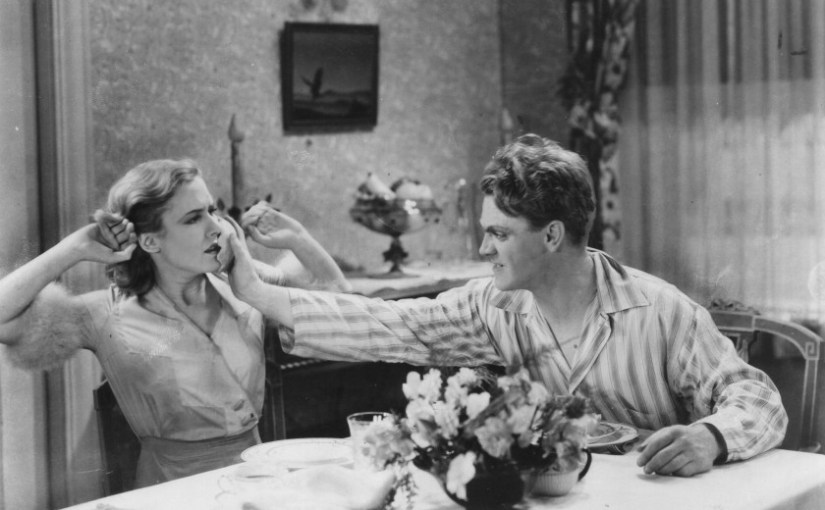
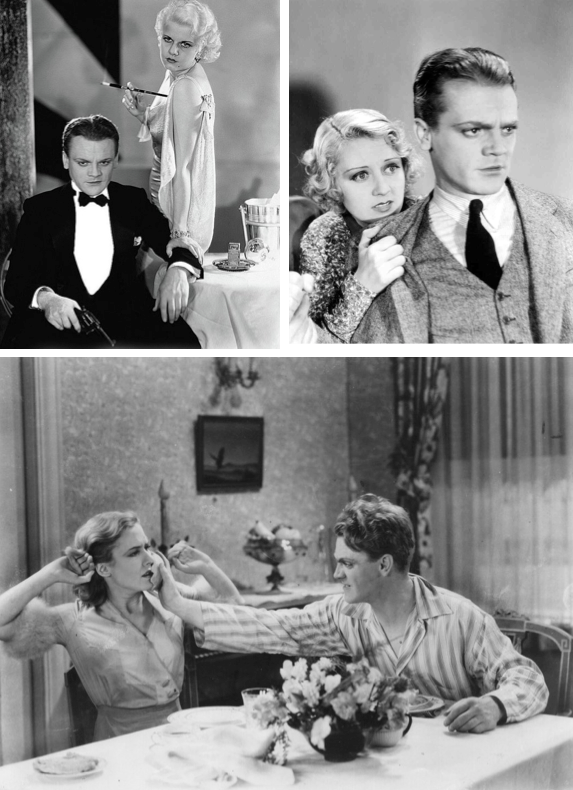
WOMEN IN HIS LIFE…James Cagney played a small-time bootlegger, Tom Powers, who rose in the criminal underworld in Public Enemy. Top left: Powers with Gwen Allen (Jean Harlow), a woman with a weakness for bad men. Top right: Joan Blondell portrayed Mamie, the girlfriend of Powers’ friend, Matt Doyle (Edward Woods). Blondell, one of the biggest stars of the 1930s, worked often with Cagney. In 1930 they were in Penny Arcade on Broadway and co-starred in the film Sinner’s Holiday. They would make several more films together after Public Enemy. Bottom photo: Tom smashes a grapefruit into the face of his first girlfriend, Kitty (Mae Clarke). Although this is one of Public Enemy’s most iconic scenes, Clarke was uncredited in the film. (IMDB)
WHAT HAPPENS WHEN YOU’RE NAUGHTY…Top, Tom Powers (Cagney) and his buddy, Matt Doyle (Woods) shoot it out in an alleyway. Bottom, the film ends with one of cinema’s greatest death scenes — awaiting the return of his brother to the family home, Mike Powers (Donald Cook) opens the door to be greeted by Tom’s corpse, which falls over the threshold. Just in case the audience didn’t get the message, Warner Brothers included this epilogue after the death scene. (IMDB/YouTube)

 *  *  *

Flag of a Father

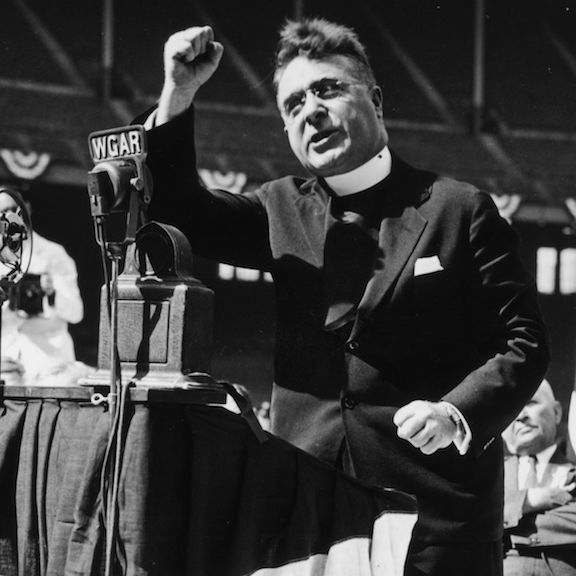
Speaking of morality, no voice was louder, or carried farther, than that of Charles Edward Coughlin (1891-1979), known familiarly as “Father Coughlin,” an enormously popular radio priest who had an estimated following of 30 million listeners in the 1930s. E.B White took notice of this phenomenon, and also the Father’s stand against “internationalism,” which in a few years would morph into a virulent nationalism and anti-semitism that would find the Father finding common cause with Hitler and Mussolini. Yes, those guys. But for now, we are still in 1931…

SAVING SOULS?…Fr. Charles Coughlin preached nationalism and anti-semitism in his widely broadcast radio show in the 1930s. He was one of the first demagogues to effectively use the mass media to his advantage. (Detail of Library of Congress photo)

 *  *  *

Paradise Lost

Far up the Henry Hudson Parkway, just before you cross Spuyten Duyvil Creek (Harlem River) into Younkers, is a park with a history that goes back to a Lenape tribe that occupied the site prior to European settlement. Inwood Hill Park is where, legend has it, Peter Minuit purchased Manhattan from the Lenape on behalf of the Dutch West India Company.

ORIGIN STORY…It was purportedly under this tulip tree that the Lenape tribe sold Manhattan to Peter Minuit in 1626. The tree was felled by a storm in 1933. A large stone (inset) marks the spot today. (Wikipedia)

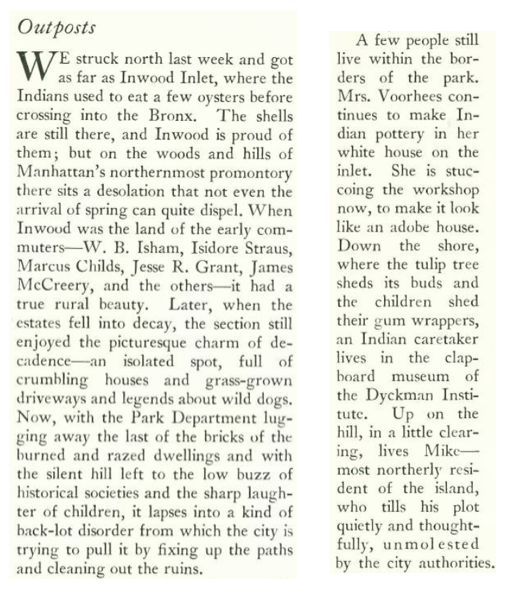
Inwood served as a location for a fort during the Revolutionary War, and was dotted with working farms including one owned by the Jan Dyckman family, established in 1661. In the 19th century a number of wealthy New Yorkers built country retreats around Inwood, which became a park in 1926. Squatters continued to live in abandoned estates around the edge of the park until Robert Moses came along in the 1930s and cleared them out. E.B. White, in “The Talk of the Town,” takes it from there.

WE CALL IT HOME…In 1931, Marie Naomie Boulerease Constantine Kennedy, an American Indian known as Princess Naomie (left) was a caretaker of the old Dyckman farm (below), which had fallen into disrepair by the late 1800s and was restored in 1916. At right, LePrince Voorhees and her husband, Harry Voorhees, at the door of their ramshackle Inwood Hill Pottery. (myinwood.net/MCNY)

The Dyckman farmhouse fell into disrepair by the late 1800s, seen here in 1892…

(myinwood.net)

…but it was restored in 1916, and still stands today at Broadway and 204th Street…

(myinwood.net)

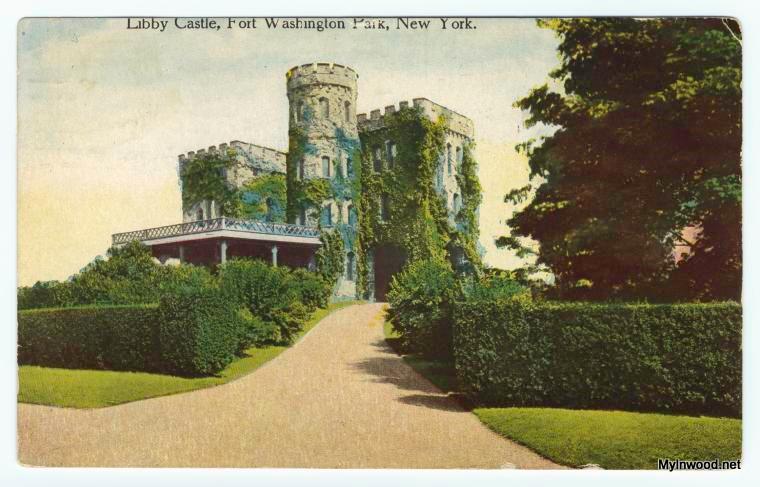
White wondered how Inwood would appear in ten years, now that parks workers were paving over the old Indian trails and landmarks like the Libby Castle were being torn down to make way for John D. Rockefeller’s Cloisters and Fort Tryon Park.

Built around 1855, Libby Castle was home to several New York bigwigs including William “Boss” Tweed of Tammany Hall fame. It was bulldozed in 1930-31 to make way for John D. Rockefeller’s Cloisters.

(myinwood.net)

Inwood contained the last remaining farms in Manhattan — below are cows grazing in 1900 at site today now occupied by Isham Park, located on the southeast edge of Inwood Park. The next photo, from 1895, identifies “the last field of grain on Manhattan Island.” In the background is the Seaman Mansion at Broadway and 216th Street…

(myinwood.net/MCNY)

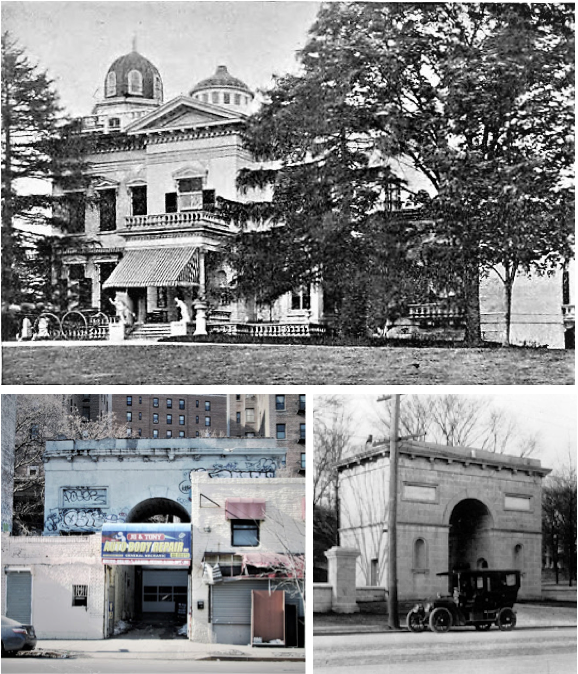
Below is a closer view of Seaman Mansion, a white marble, 30-room pile built around 1852. When this photo was taken in 1895, it had just become the new home of a riding club. Entry to the mansion was through a gatehouse, pictured below at right. The mansion was demolished in 1938 as the area around it filled up with cheap commercial buildings. Only the gatehouse remains, crumbling behind an auto body shop as seen in this 2015 image (bottom left):

(daytoninmanhattan.blogspot.com/Google Maps)

And here’s the latest view from Google maps. Note how the business is now renamed (ironically, yes) after the crumbling arch behind it…

But let’s be fair; there is still much beauty to be had at Inwood. Check out this lovely fall panorama…

(Wikipedia/Barry Solow, November 2010)

 *  *  *

Rub-a-Dub-Dub

One of the great British modernists of the 20th century — perhaps best known for his 1915 novel, The Good Soldier — Ford Madox Ford (1873 – 1939) led a complicated personal life filled with indecision and anxiety. It makes sense that a man, in search of some order in his life, imposed a strict routine on bath time (and also found time for a bit of humor). Here is an excerpt from Ford’s submission to the May 2, 1931 New Yorker:

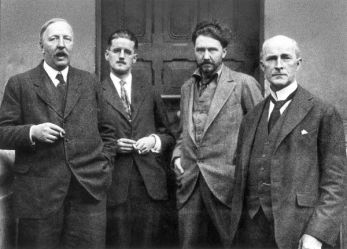
LITERARY LIONS…Ford Madox Ford (left) poses with other literary greats of the 20th century in a photo taken in Paris, November 1923. Next to Ford are James Joyce, Ezra Pound and John Quinn. (justewords.com)

 *  *  *

Tete-a-tete

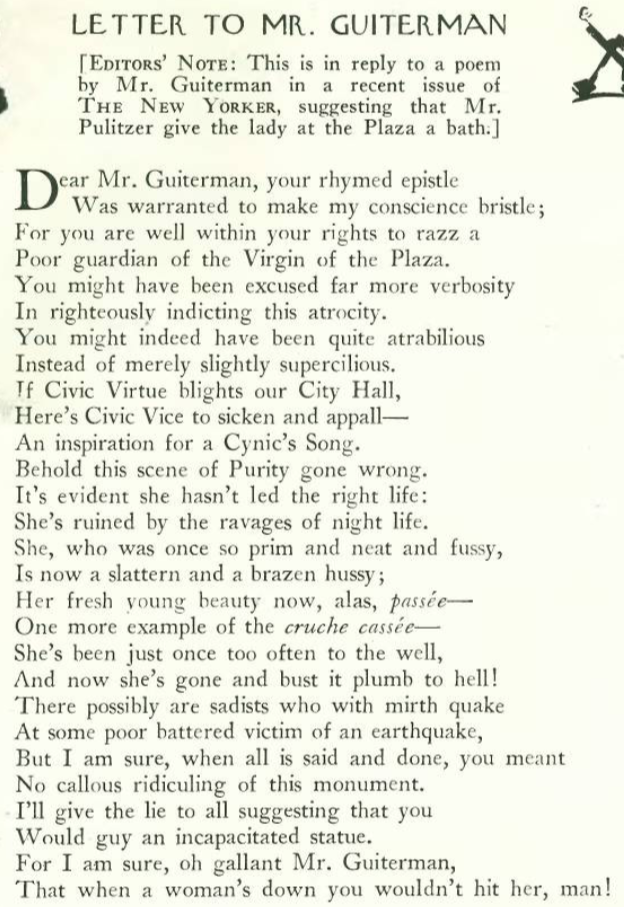
Humorist and poet Arthur Guiterman was a regular contributor of comic verse to The New Yorker from its first days in 1925 until his death in 1943. In the April 18, 1931 issue, he dashed off this poem to Ralph Pulitzer, imploring him to give his family’s namesake Plaza fountain, and its “goddess of abundance,” a much-needed scrubbing…

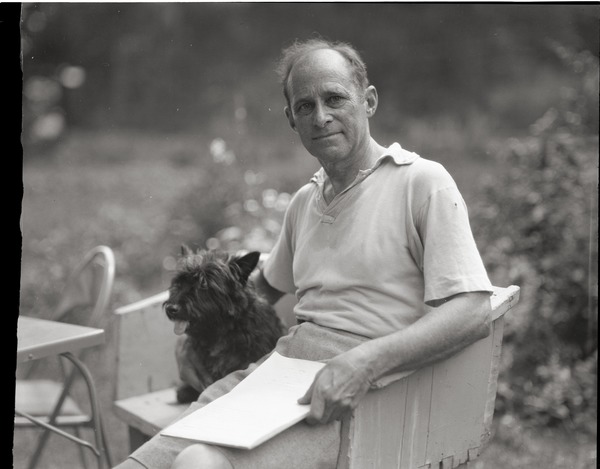
KEEP IT CLEAN, RALPH…Arthur Guiterman, shown here seated with his Scottish terrier in August 1931, asked Ralph Pulitzer to do a bit of scrubbing on the family’s namesake Grand Plaza fountain. (UMassAmherst)

No doubt to Guiterman’s delight, he received a reply in the May 3 issue, also in verse, from Ralph Pulitzer himself…

Well, Pulitizer was good for his word, and the fountain was cleaned and restored in 1933. There have been other restorations in 1971, 1985-90. Here is how it looks today:

(Central Park Conservancy)

 *  *  *

From Our Advertisers

The Empire State Building officially opened its doors for business, and to mark the occasion the building’s promoters ran this full page ad that said it all: we are the biggest. Period.

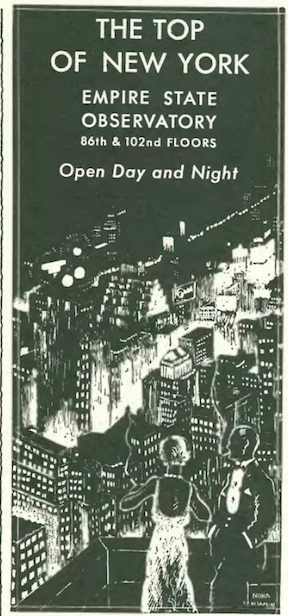
In the back pages another ad touted the amazing views one could afford from the highest spot in the city…note the couple in formal wear having a leisurely smoke as they gaze over the metropolis, their view unobstructed by fencing later added in 1947 to prevent suicidal leaps…

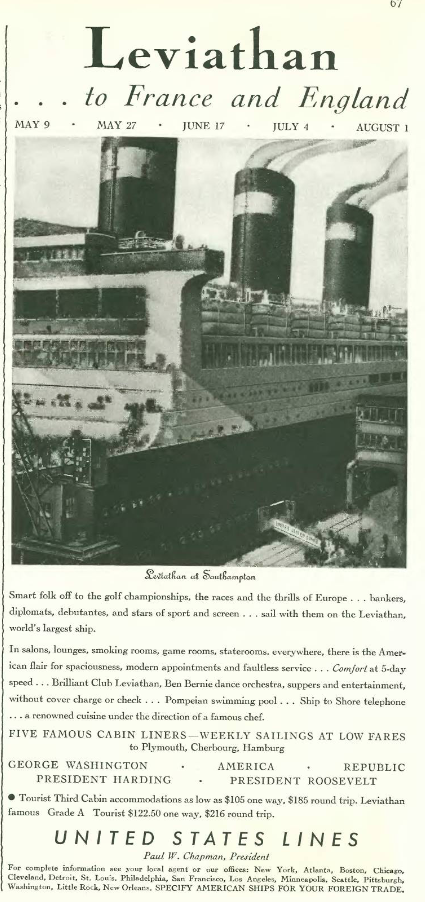
…speaking of large things, folks in the 19th and 20th centuries marveled at the gigantic scale of the man-made world—the Empire State Building, the Hindenburg, Hoover Dam, and ships with names like Titanic and Leviathan, the latter seen below in this ad from the United States Line…

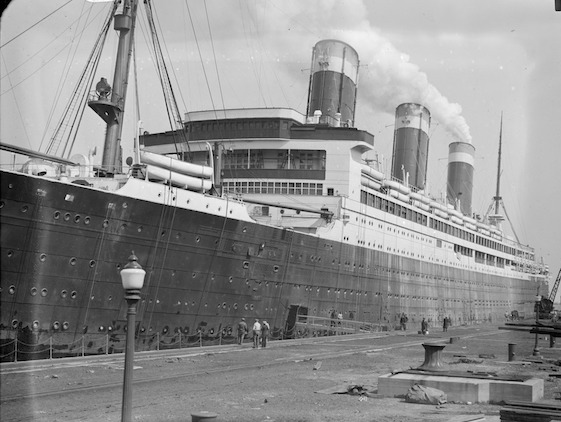
…one of the largest and most popular ocean liners of the 1920s, the U.S.S. Leviathan was actually built in 1914 for Germany’s Hamburg-American Line and christened the Vaterland. During World War I the American government seized the ship while it was docked in Hoboken, New Jersey and used it to transport troops. After the war, it was refurbished and re-christened Leviathan. It was scrapped in 1938…

The U.S.S. Leviathan at dry dock in Boston, 1930. (digitalcommonwealth.org)

…if you took the boat to Paris, you probably had enough money to make an overseas call back home…it would set you back almost $34 for three minutes of static-filled chat, about $550 in today’s dollars…

…and despite the Depression, the thrills of the modern world still abounded, such as GE’s “all-steel” electric refrigerator so artfully depicted in this ad…

…and check out these Chryslers, looking absolutely luxurious…

…as do these Dodge boats, their polished wooden hulls gliding effortlessly through placid waters…

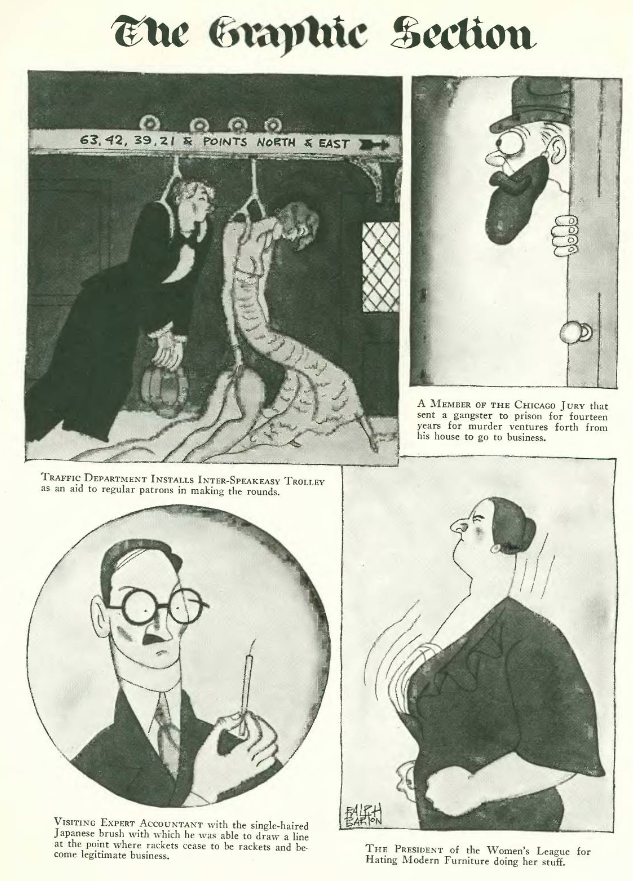
…on to our cartoonists, we begin again with Ralph Barton’s “Hero of the Week”…

…and Barton’s graphic take on the week’s headlines…

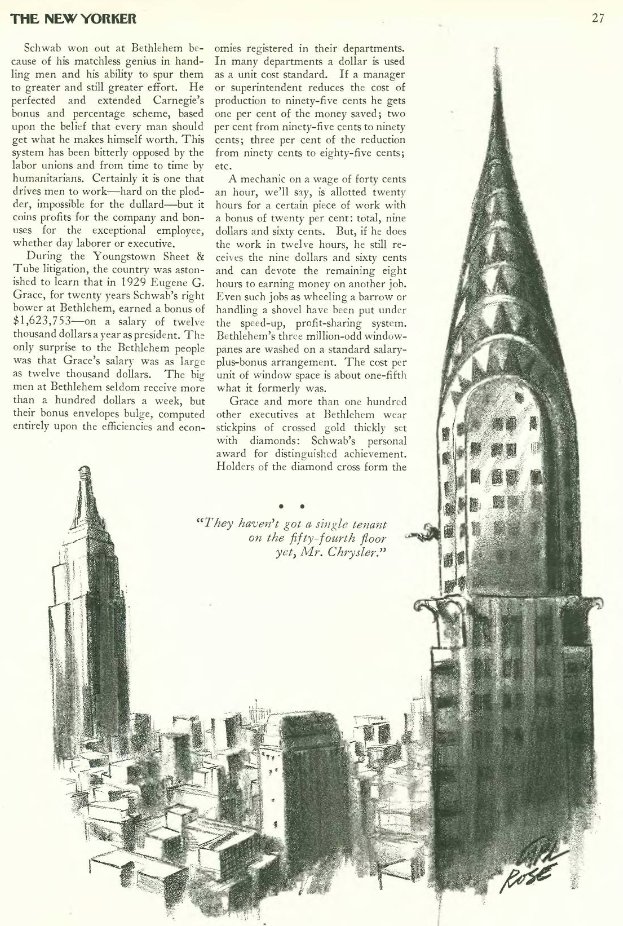
Carl Rose examined new heights in envy…

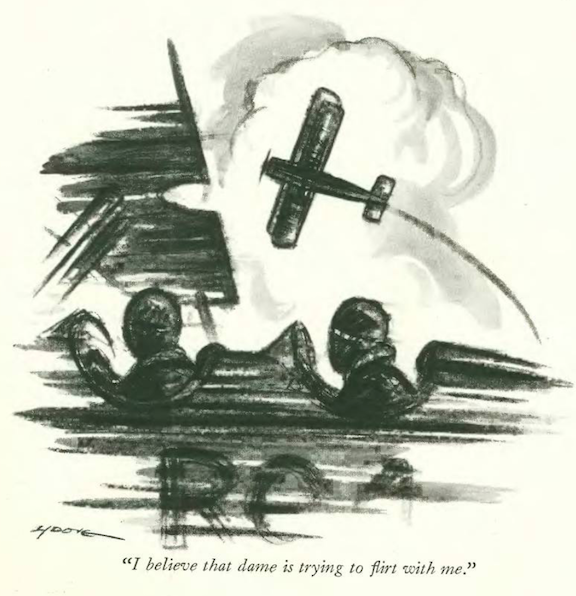
…or in the case of Leonard Dove, romance…

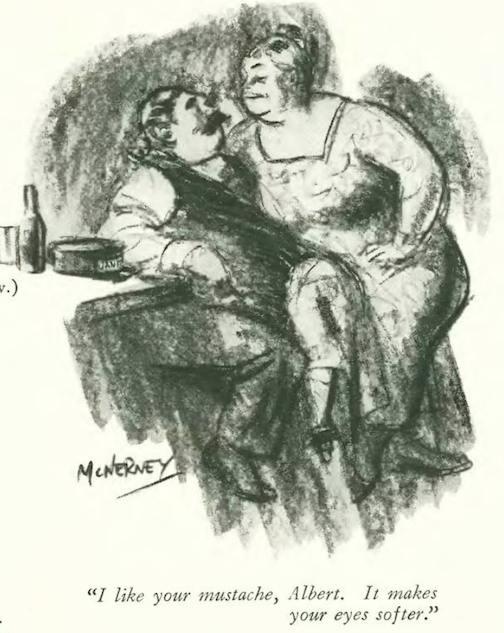
…back to earth, more romance from E. McNerney

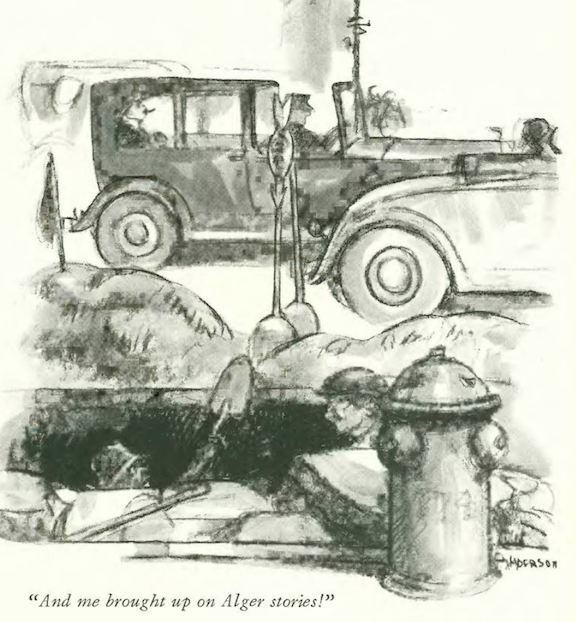
…and below ground, C.W. Anderson showed how romantic notions can go sour, in this case a man who felt duped by those rags-to-riches tales…

…and we end with Alan Dunn, and a little girl getting an education through the pages of a scandal rag…

Next Time: Through the Looking Glass…

Last Stand for Beau James

“Everyone in this life draws bad cards with the good. The great trouble with most of us is that we do not know when to discard quickly,” observed New York Mayor Jimmy Walker.

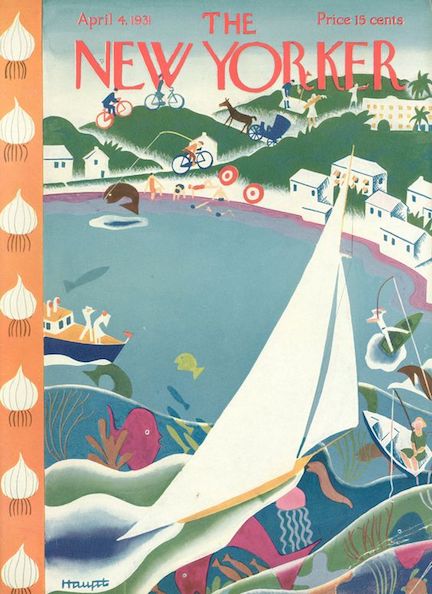
April 4, 1931 cover by Theodore Haupt.

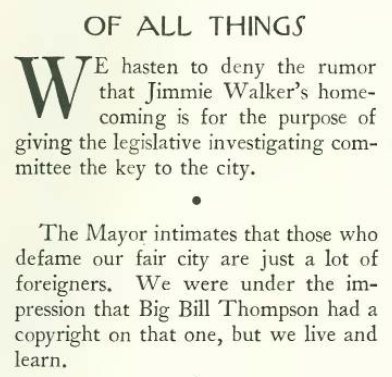
Signs that the first bad card was being turned were apparent in the April 4, 1931 edition of The New Yorker. In his weekly collection of quips — “Of All Things” — Howard Brubaker suggested that Walker — known for his frequent trips and general lack of attention to governance — had a different sort of homecoming awaiting his return from California…

…Walker was no doubt hobnobbing with the Hollywood crowd back in the Golden State…the mayor loved donning fine attire (thus the nickname “Beau James”) and enjoyed throwing lavish events for famous people…
MIGNIGHT MAYOR was one of the many nicknames New Yorkers bestowed on Mayor Jimmy Walker, known for his love of nightlife, fine clothes, and beautiful people (another nickname was “Beau James”). Although he was married at the time, he conducted a very open affair with actress Betty Compton (left), who later became his wife. At right, in his element, Walker (center) accompanies actress Colleen Moore to the October 1928 premiere of her film, Lilac Time. (IMDB/konreioldnewyork.blogspot.com)

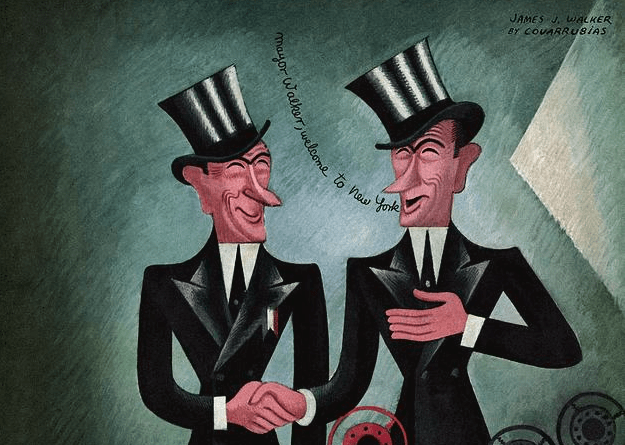
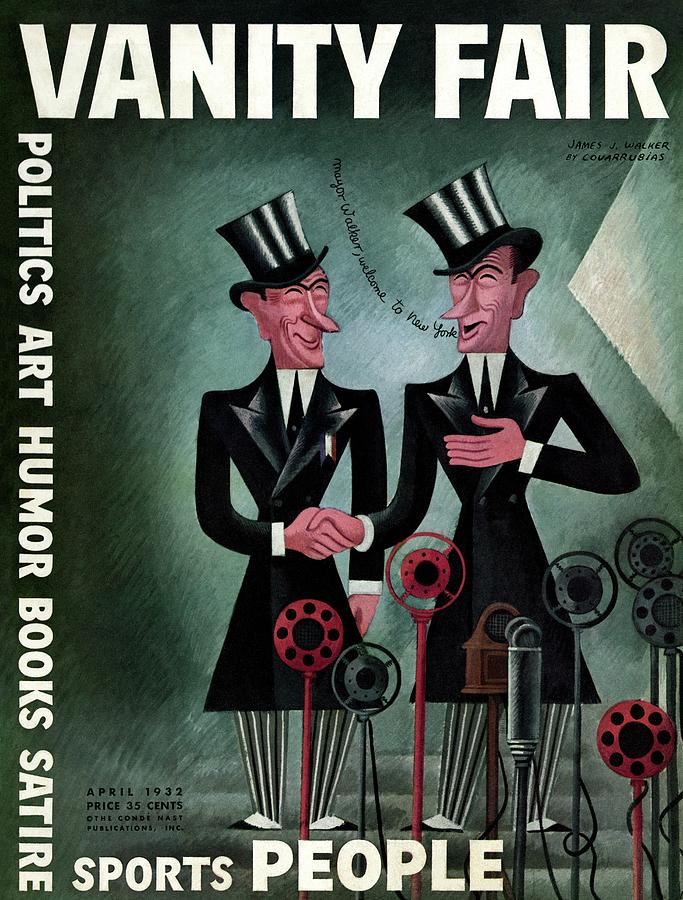
…which made him an easy target for parody, such as this 1932 Vanity Fair cover, where the mayor even welcomes himself to the city…

(Conde Nast)

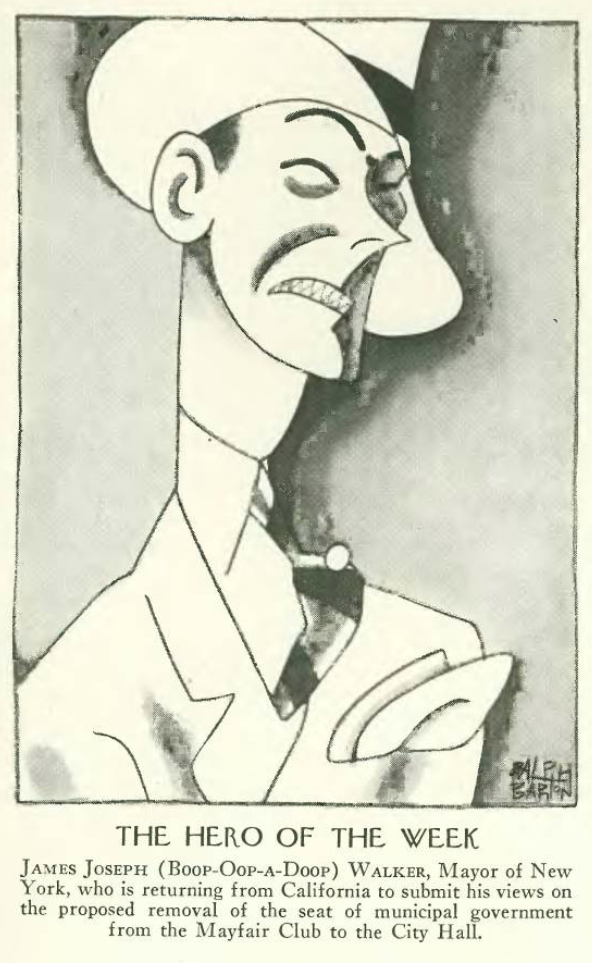
Ralph Barton revived his “Hero of the Week” feature to welcome the mayor back to the city…Barton alluded to the fact that Walker preferred conducting his office outside of the official confines:

Walker (1881-1946) made a far more interesting personality than an effective mayor. When he took office in 1926 he proved to be a terrible administrator, partying at speakeasies late into night, sleeping till noon, and leaving city matters (except the lavish ceremonies) to Tammany Hall cronies. This didn’t seem to bother voters when the economy boomed in the 1920s, and indeed they re-elected him by an overwhelming margin in 1929.

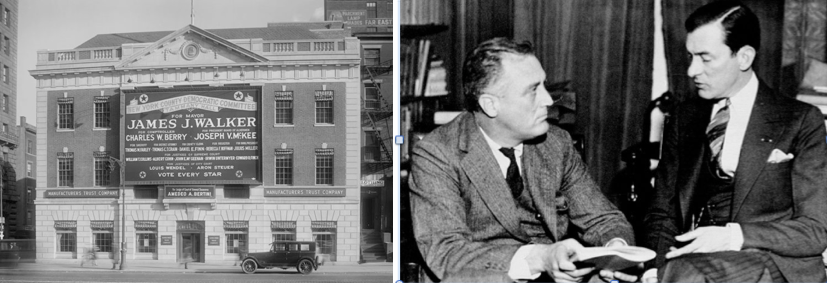
The 1929 market crash quickly changed things. The Roaring Twenties abruptly ended, and with people losing their jobs (and fortunes), the mayor’s antics didn’t seem so amusing anymore. Reform was in the air, and leading the charge was Gov. Franklin Roosevelt, who was no fan of Walker’s.

IF LOOKS COULD KILL…Gov. Franklin D. Roosevelt meets with Mayor Jimmy Walker in conference at Roosevelt’s home on E. 65th St. in December 1928; at left, campaign banner for Walker on Tammany Hall, 4th Avenue and 17th Street, Oct. 28, 1929. Walker was a product of the Tammany Hall political machine, and much of the mayor’s backroom dealings were conducted there, as well as at various speakeasies and nightclubs. (NYC Municipal Archives/NY Daily News)

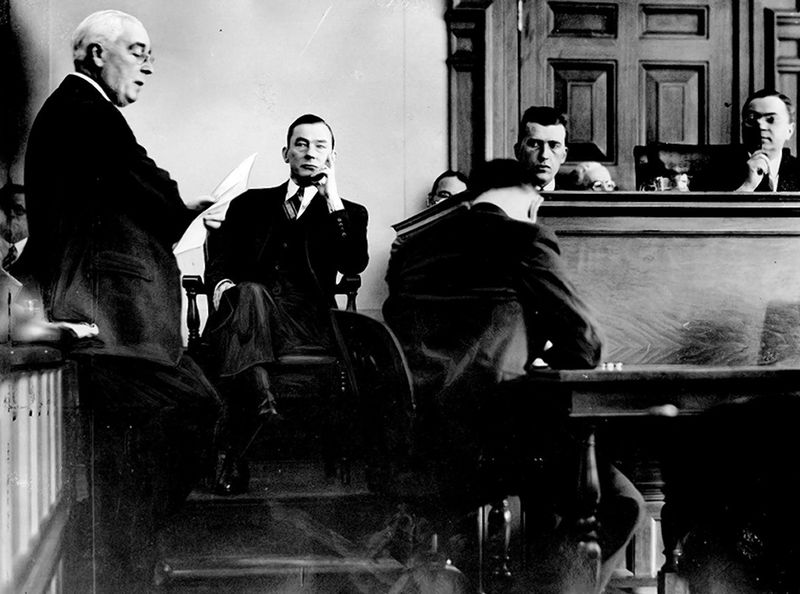
Investigations into corruption in Walker’s administration landed Walker before an investigative committee of led by Judge Samuel Seabury in 1931…

IN THE COLD LIGHT OF DAY…Mayor Jimmy Walker takes the stand in the New York County Courthouse on May 25, 1932, to answer questions from Judge Samuel Seabury (left). Thousands of New Yorkers showed up to cheer the mayor when he entered the courthouse, but those cheers soon became jeers as details of the administration’s corruption were made public. (NY Daily News).

…Mayor Walker resigned the following year and fled to Europe, where he married his mistress, Betty Compton (1904-1944) in Cannes, France, on April 19, 1933. We will revisit this tale in later issues…

SEE YA…

 *  *  *

On the Lighter Side

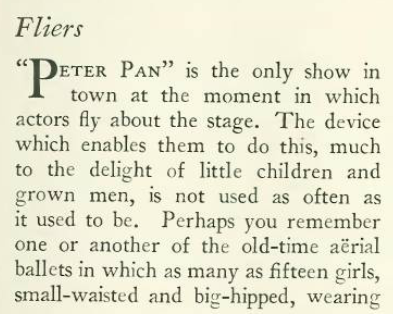
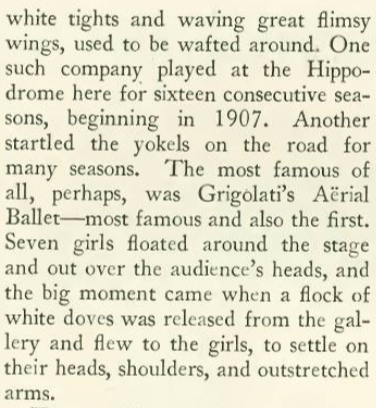
“The Talk of the Town” included this note about the play Peter Pan, which was being staged at the Fourteenth Street Theatre. Much was made of the wizardry that enabled actors to float above the audience.

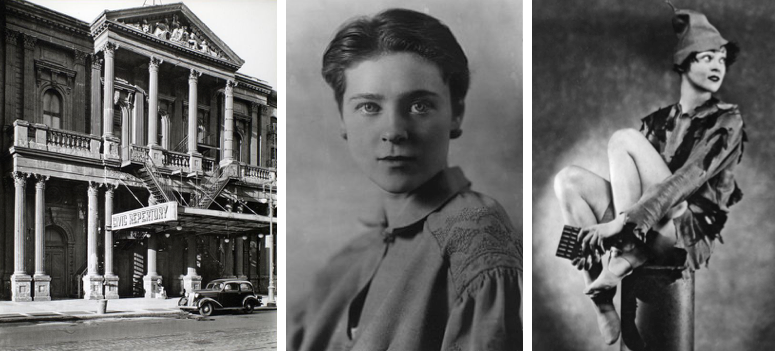
Eva Le Gallienne (1899-1991), who portrayed the title character, made the theatre home of her stage company in 1926, and renamed it the Civic Repertory Theatre. Le Gallienne played the role of Peter Pan 129 times, and although the flying effects were quite hazardous, she said she “took to flying like the proverbial duck to water.”

NO STAGE FRIGHT HERE…The Fourteenth Street Theatre, originally constructed in 1866, was dubbed the Civic Repertory Theatre when Eva Le Gallienne (center) made it the home of her stage company. Le Gallienne played the role of Peter Pan 129 times on the theatre’s stage, and loved performing the dangerous flying stunts. Images of Le Gallienne from Bruce K. Hanson’s book, Peter Pan on Stage and Screen, 1904-2010. (Wikipedia/Bruce K. Hanson).
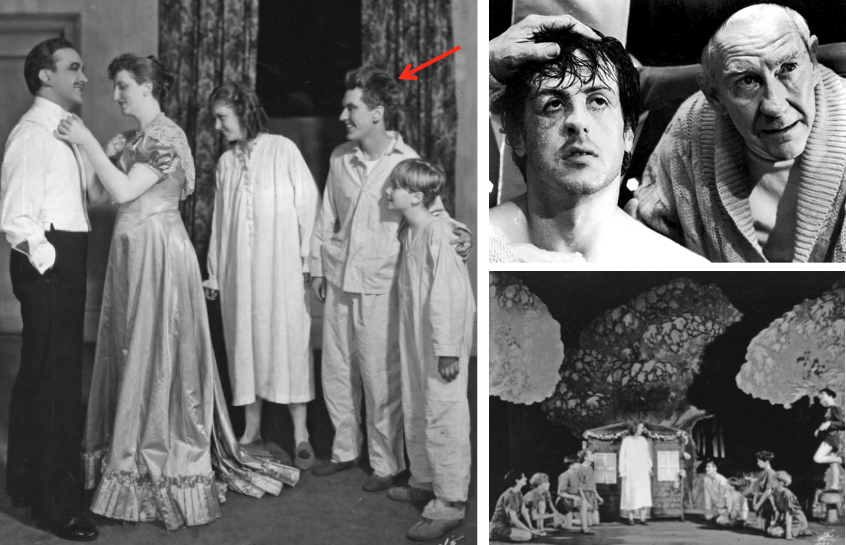
DARLINGS…The Darling family as portrayed in the Civic Repertory Theatre’s production of Peter Pan. At bottom, right, “The Wendy House” as it appeared on stage. And a bit of trivia: the young lad who portrayed John Darling (see arrow) was none other than Burgess Meredith, who would go on to a long and successful career on the stage, television (he played the Penguin in the 1960s Batman TV series), and in film, seen top right as Sylvester Stallone’s trainer Mickey in 1976’s Rocky. (Bruce K. Hanson/IMDB)

Eva Le Gallienne lived 92 years, and Burgess Meredith made it to 89. Such was not the fate of the Civic Repertory Theatre, which closed in 1934 due to the Depression. The 1866 building was demolished in 1938. Not a trace remains.

 *  *  *

Fightin’ Words

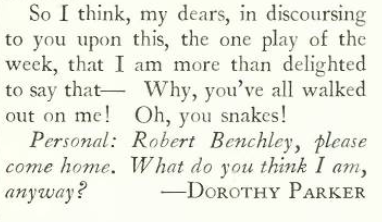
It’s really too bad Dorothy Parker didn’t stay on as theatre critic for The New Yorker (she was subbing for her friend, Robert Benchley) because her weekly forays into the middlebrow world of Broadway produced some of her most entertaining writing. For the April 4 issue Parker offered some thoughts about The Silent Witness, which ran from March to June at the Morosco Theatre.

Instead of turning cartwheels, Parker took aim at actress Kay Strozzi, “who had the temerity to wear as truly horrible a gown as ever I have seen on the American stage. … Had she not luckily been strangled by a member of the cast while disporting this garment, I should have fought my way to the stage and done her in, myself.”

She ended the review with another plea to Benchley, who was traveling abroad:

WHAT ABOUT THIS OUTFIT, DOROTHY?…I don’t have a photo of the “horrible” gown worn by Kay Strozzi (left) in The Silent Witness, so you’ll have to settle for this image of Ms. Strozzi from the 1931 film Captain Applejack. At right, and dressed to kill, Dorothy Parker posed for Edward Steichen in this 1931 portrait. (IMDB/Pinterest)

 *  *  *

Tipsy Tots

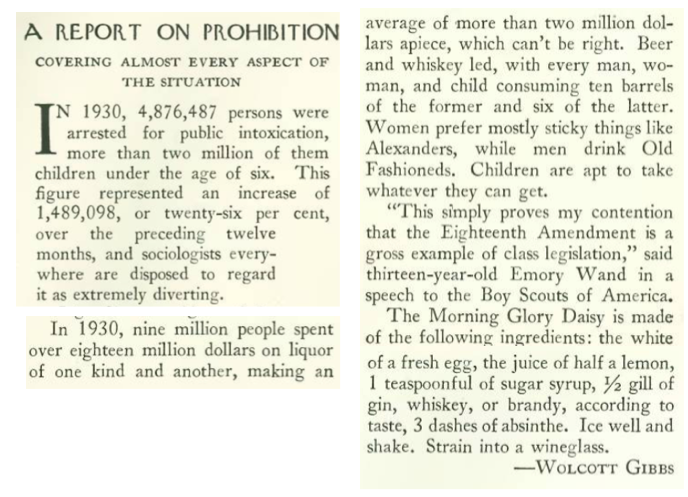
Tired of Prohibition, and its farcical enforcement, Wolcott Gibbs had some fun with the official Wickersham Report’s conclusions regarding the success of the 18th Amendment:

Wolcott Gibbs (wsj.com)

On a loftier note, we have this ode to the new Empire State Building from Price Day, Pulitzer Prize-winning reporter and noted editor of the Baltimore Sun:

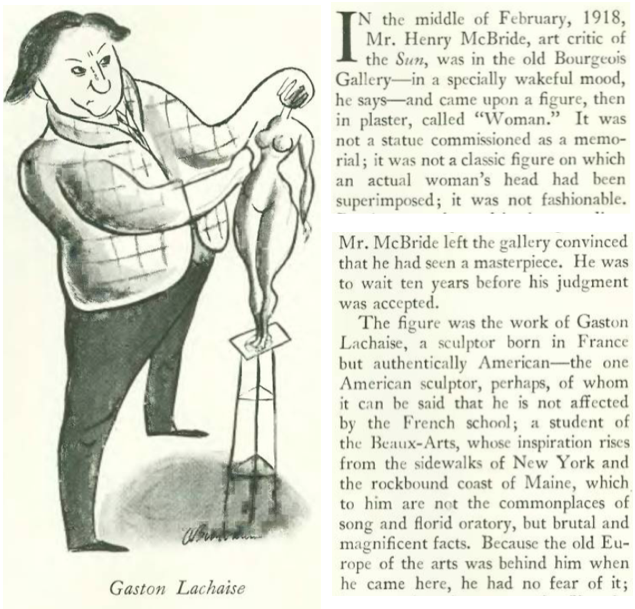
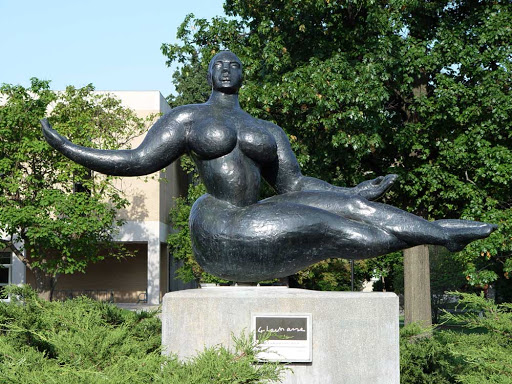
The profile, written by Gilbert Seldes, featured artist Gaston Lachaise…I include a brief excerpt for personal reasons, because I first encountered this artist in the Sheldon Memorial Art Gallery’s sculpture garden in Lincoln, Nebraska (my hometown), many years ago, via his “Floating Figure”…

WEIGHTLESS…”Floating Figure” by Gaston Lachaise was cast in bronze at the end of 1934 after a retrospective held in January 1935 at the Museum of Modern Art, New York. This is one of seven casts, at the University of Nebraska’s Sheldon Memorial Art Gallery. (Lincoln Arts Council)

 *  *  *

From Our Advertisers

Pierce Arrow would struggle to promote its luxury cars in the Great Depression (and they would go under by the mid-1930s) but their advertising still harked back to the carmaker’s early days of refined travel…

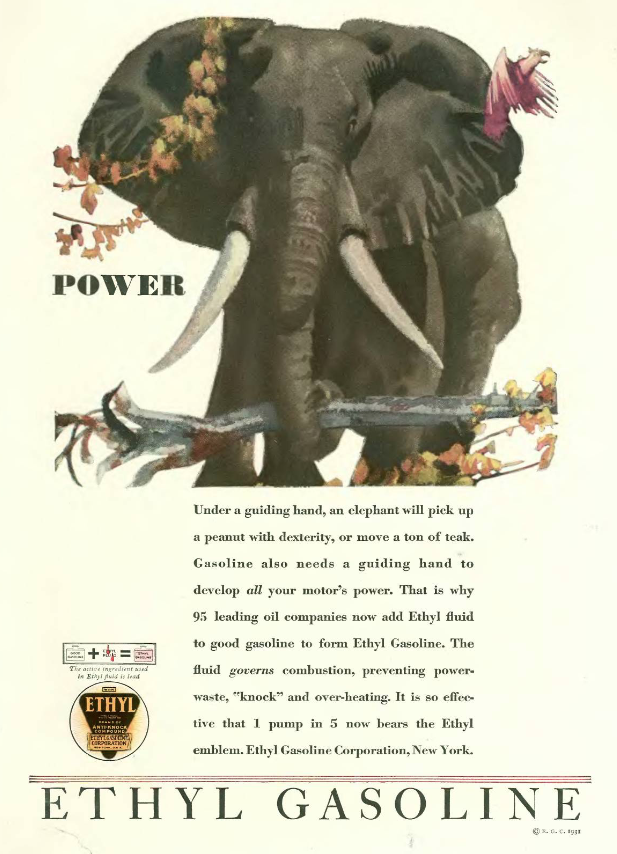
…the folks at Ethyl would make that car run smoother, thanks to the lead they added to gasoline (and to the air folks were breathing)…

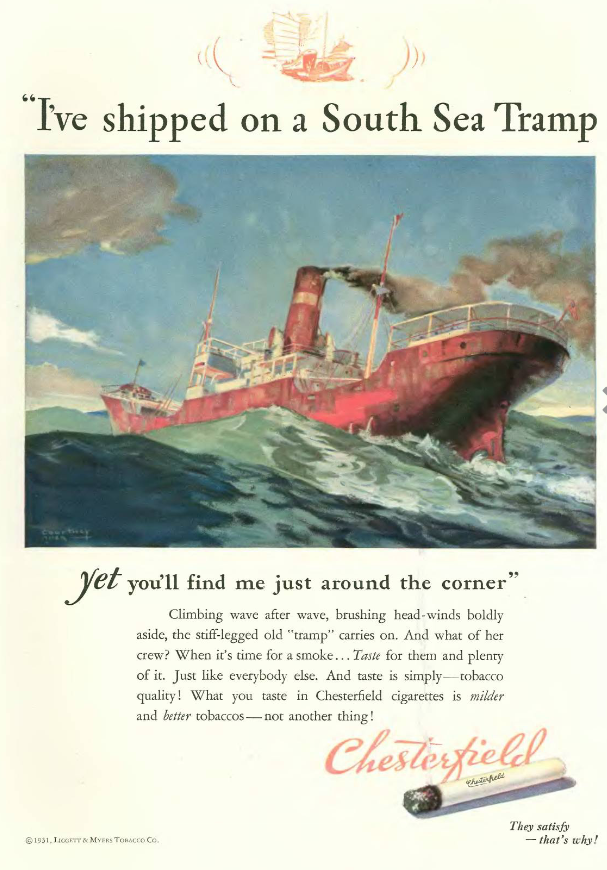
…tired of driving? Then hop a freighter and fire up a Chesterfield…

…or go for a more cushy ride on the French Line…
…we turn to our cartoons, and Ralph Barton’s revival of his old “Graphic Section”…
Helen Hokinson showed us the nuances of the DMV…

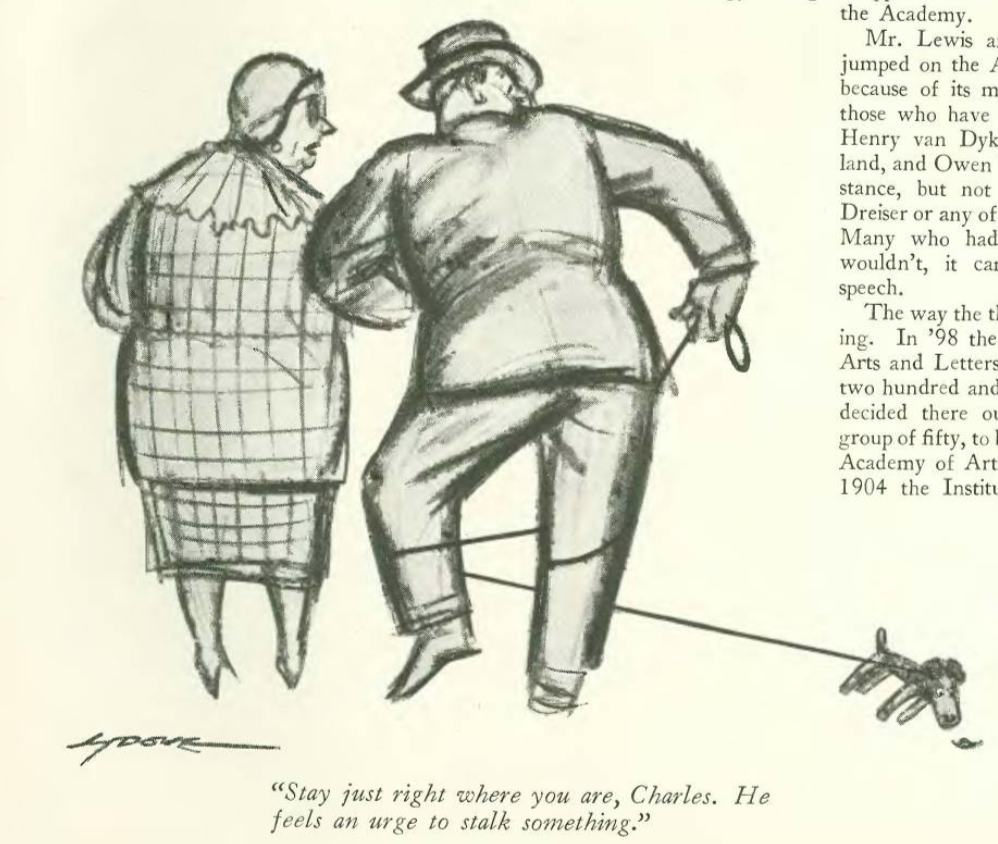
Leonard Dove showed us a pet on the wild side…

…thanks to the typography skills of The New Yorker’s layout artist Popsy Whitaker, Otto Soglow zigzagged across the pages with his Little King…

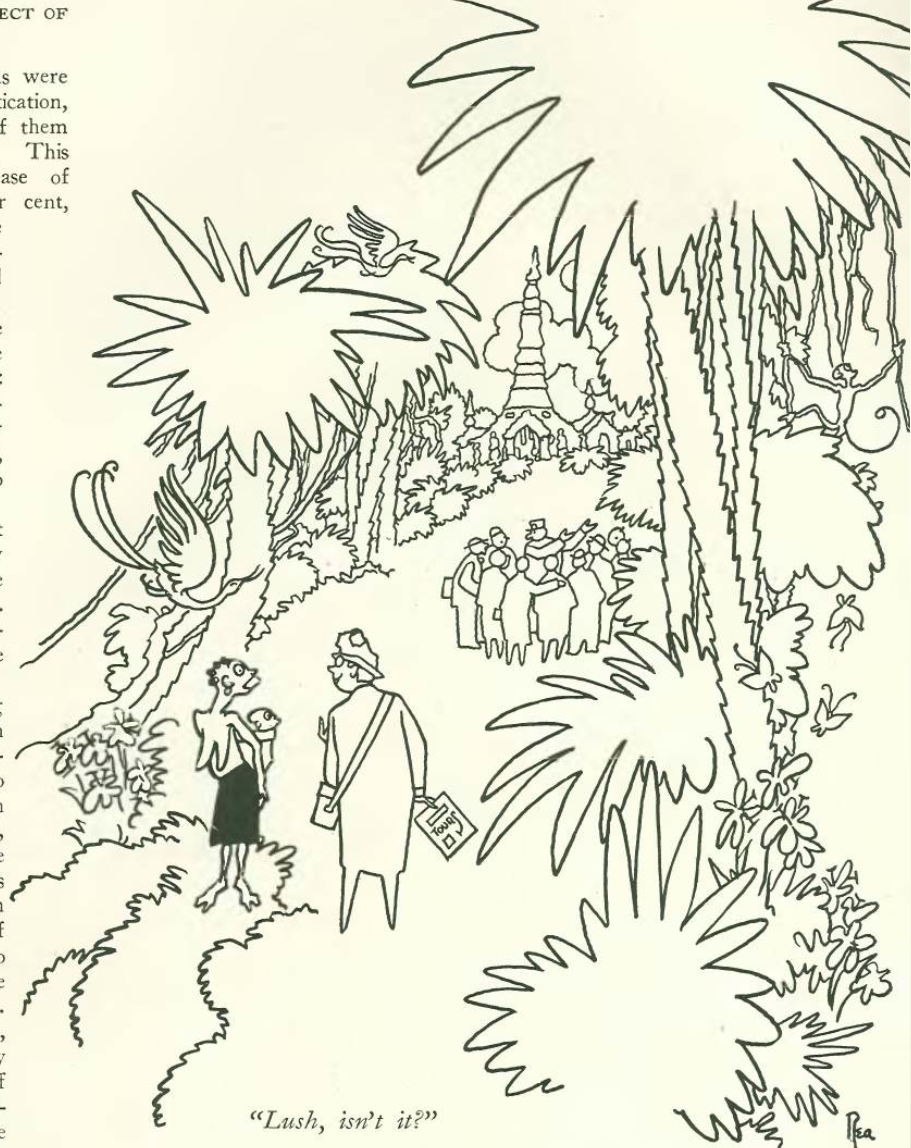
…and Gardner Rea revealed the wonders of world travel…

Next Time: Fear of Flying…

Chaplin of the Jungle

In the 1920s and 30s the concept of the documentary film was still in its infancy, and beginning with the silent Nanook of the North (1922), the idea that a documentary and a drama were separate things was unknown to filmmakers.

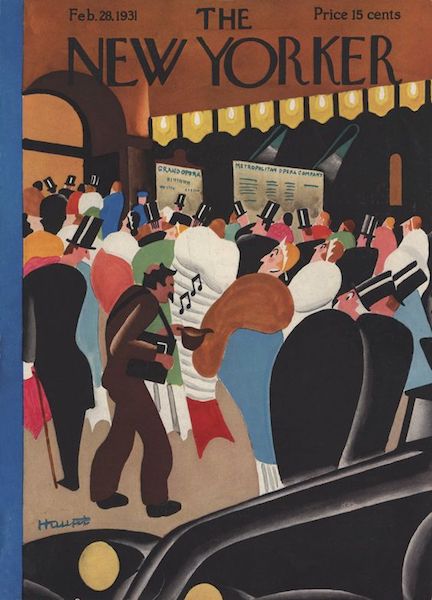
Feb. 28, 1930 cover by Theodore Haupt.

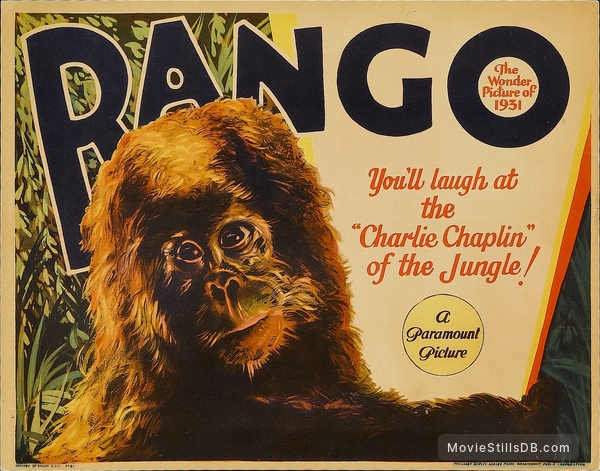
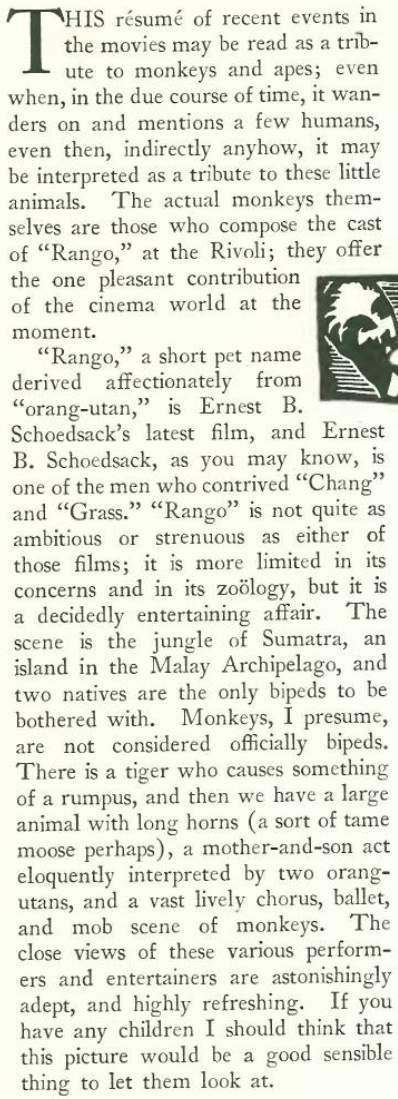
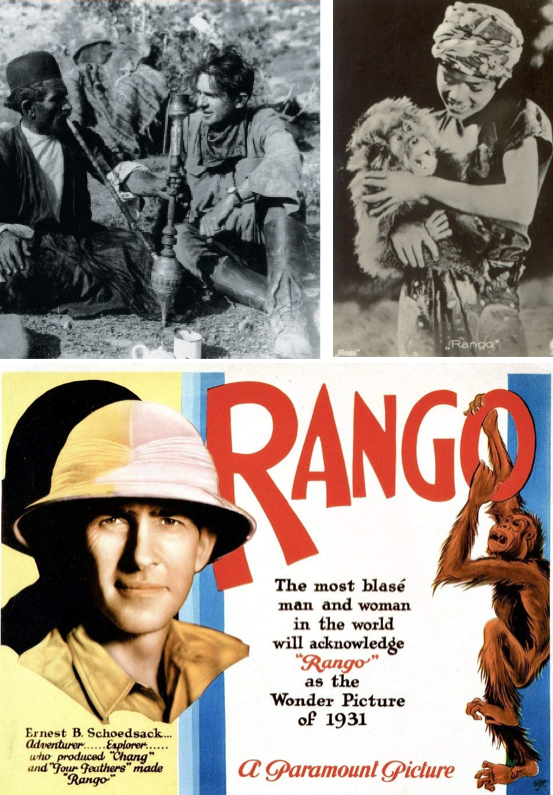
What was known, however, was the box office appeal of films that explored unknown and exotic lands, like Ernest B. Schoedsack’s 1927 blockbuster Chang, which featured a mix of staged events as well as the actual slaughter of wild animals. Audiences (and most critics) seemed little troubled that these films were a mix of fact and fiction. It was a movie, after all, and movies followed a story arc, and they had drama, and sometimes comedy. And so when Schoedsack (1893-1979) introduced audiences to an orangutan named Rango, publicists described the simian star as the “Charlie Chaplin of the Jungle.” The New Yorker’s John Mosher found the performances of the various apes “astonishingly adept”…

MONKEY BUSINESS…Clockwise, from top left, the Iowa-born Ernest B. Schoedsack cut his filmmaking teeth as a producer/director of quasi-documentaries, beginning with 1925’s Grass, which followed a caravan from Angora to Persia; a young Sumatran boy, Bin, bonds with the orangutan Rango; promotional theater card for the film. (filmaffinity.com)
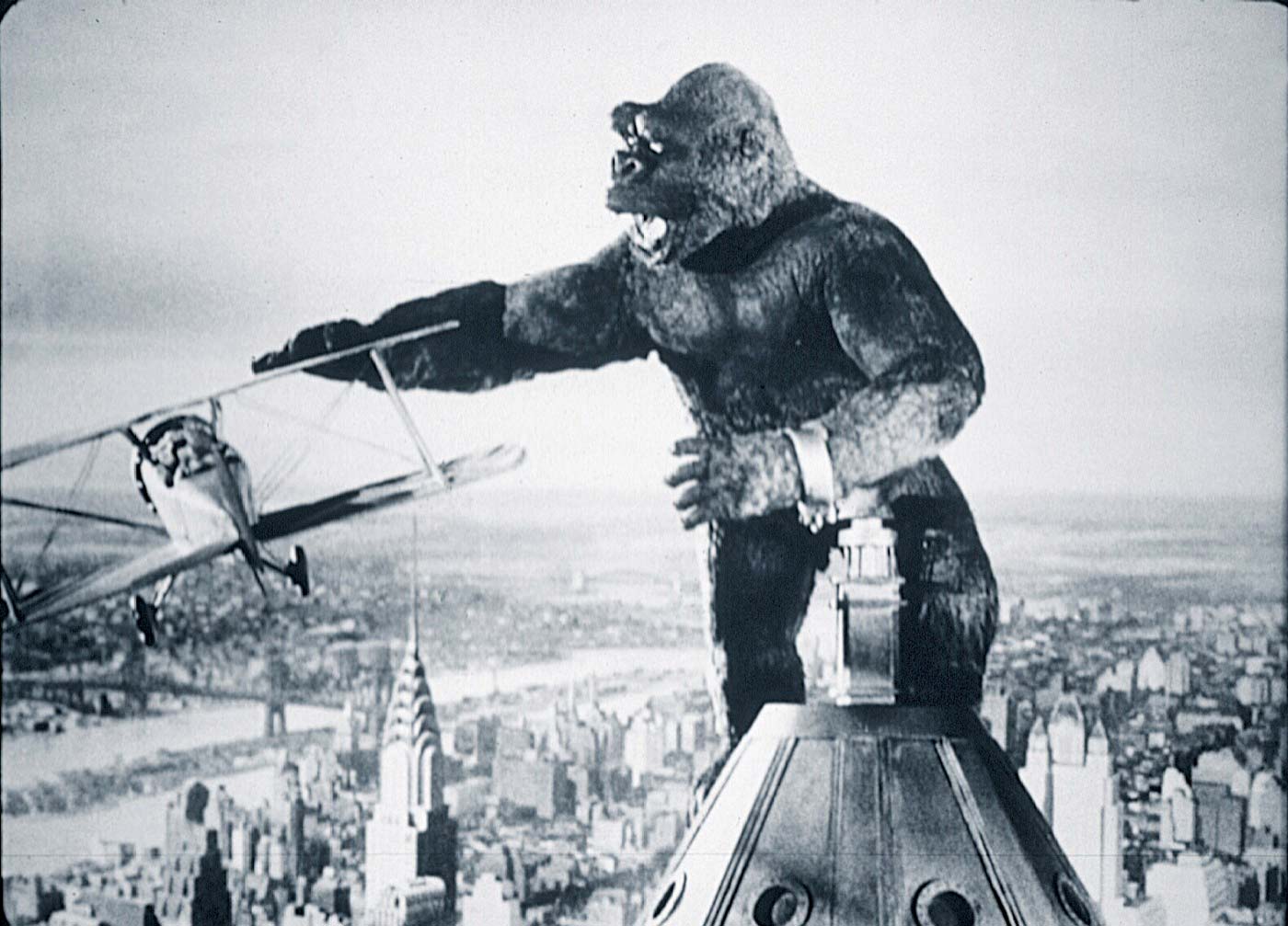
NOT SO CUDDLY…Two years after Rango, Ernest B. Schoedsack would co-produce and co-direct 1933’s King Kong, with Merian C. Cooper. (Britannica)

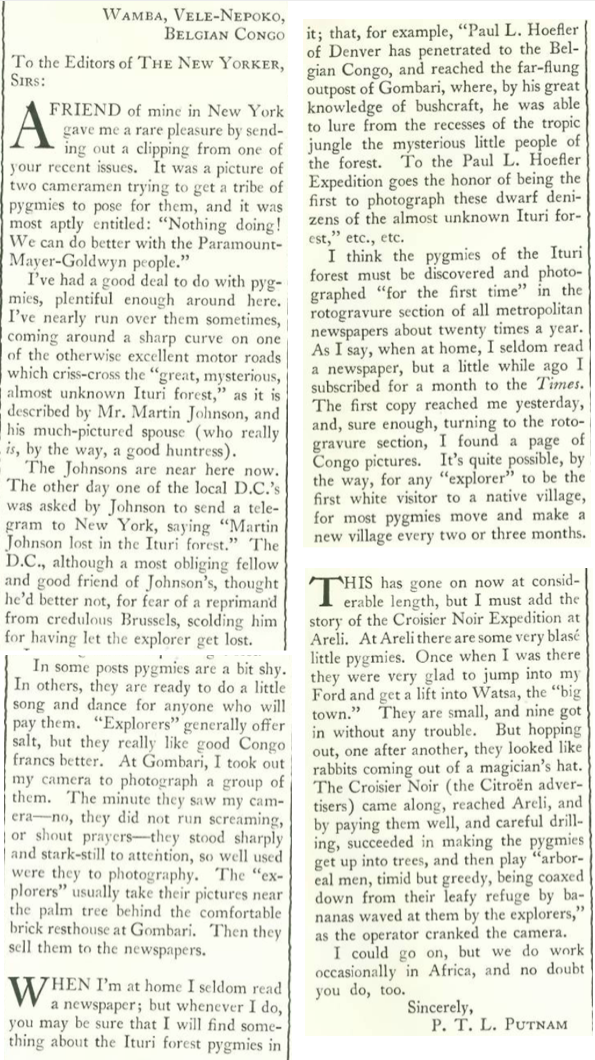
If interpretations of tropical life weren’t accurate in 1931, it wasn’t completely due to filmmakers taking dramatic license. Attitudes toward “exotic” lands and people commonly ranged from naively paternalistic to downright racist. In a letter to The New Yorker, Patrick T.L. Putnam (1904-1953) is decidedly of the former, portraying Congo pygmies as clever, amusing children who hoodwink unsuspecting “explorers”…

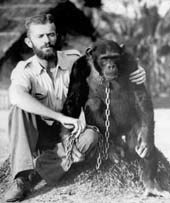
To Putnam’s credit, he showed a genuine interest (and respect for) in the lives of tribal peoples, and particularly the Mbuti of the Congo’s Ituri Forest. He remained in the Congo for the rest of his life. This thumbnail is the only photo I could find of Putnam:

(geni.com)

 *  *  *

Big Bill Turns Pro

In first decades of the 20th century it was still widely believed that athletic competition should be for its own sake rather than as a means for making money, so many top stars competed as amateurs. Professional golf wasn’t established until 1916, and professional leagues in basketball and football first formed in the 1920s. Amateur status was especially prized in tennis — before the “Open Era” began in 1968, only amateurs were allowed to compete in Grand Slam tournaments.

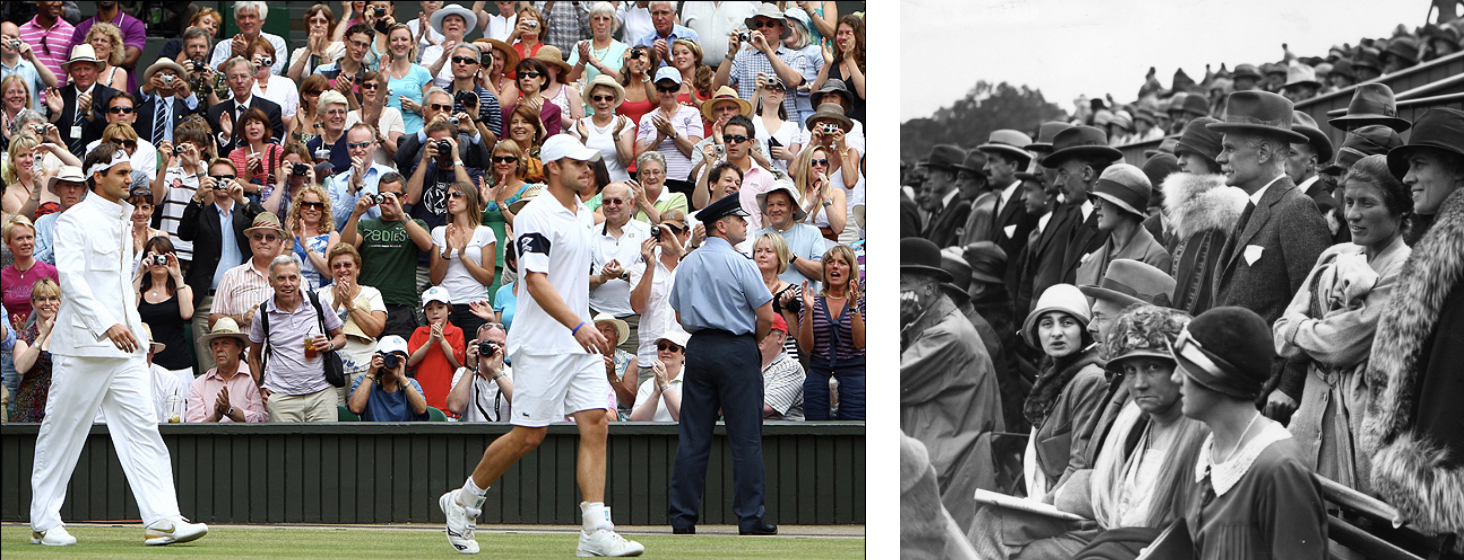
Sports promoter C. C. Pyle established the first professional tennis tour in 1926 with American and French stars playing exhibition matches in front of paying audiences. According to The New Yorker’s John Tunis, many in the crowd were finely dressed, with men in top hats and women turned out in the latest high fashion.

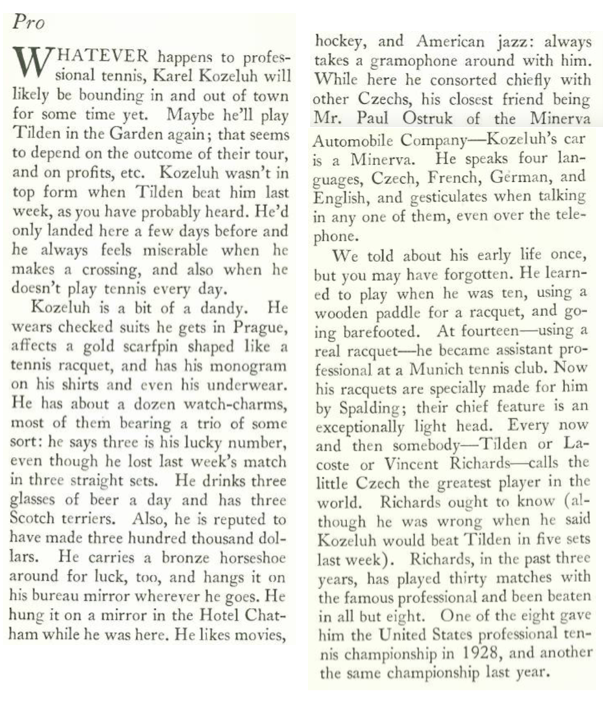
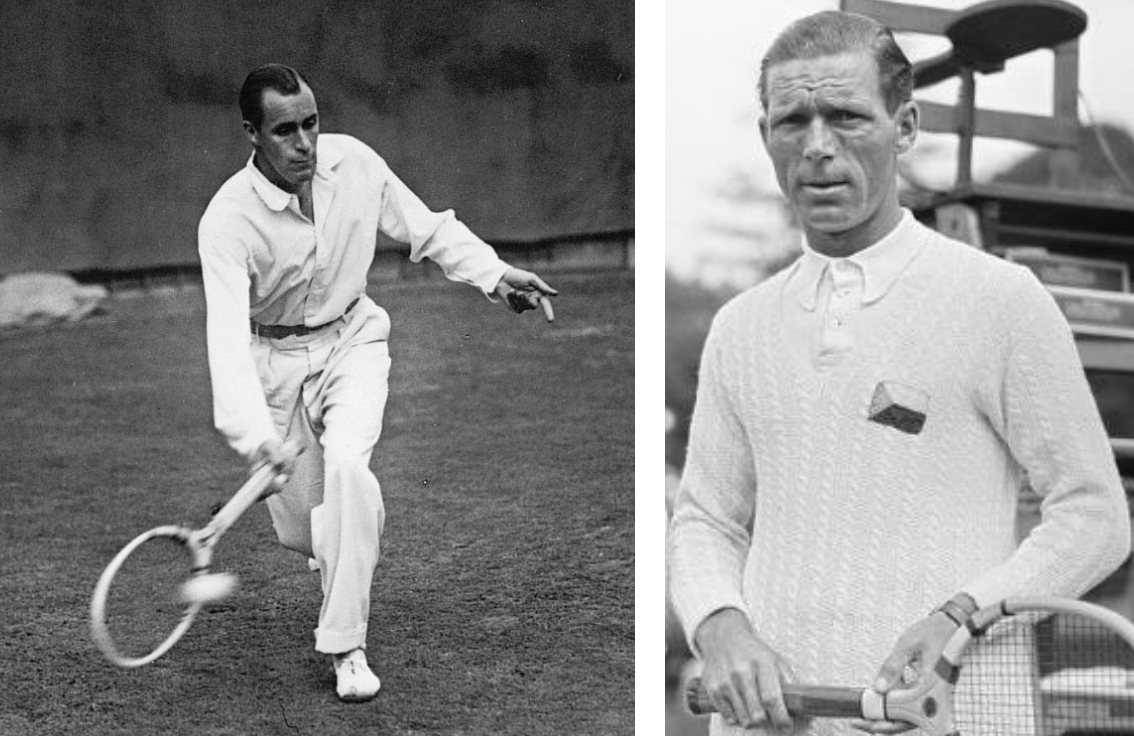
America’s top draw was “Big Bill” Tilden, the world’s number one player from 1920 to 1925 and the first American to win Wimbledon. It caused quite a stir when Tilden went pro on Dec. 31, 1930. He barnstormed across the country,  playing one-night stands with a small group of professionals including the top Czech player Karel Koželuh. “The Talk of the Town” had this to say about the fledging game of professional tennis:

BARNSTORMERS…Bill Tilden (left) and Karel Koželuh toured America and Europe with a handful of other players in a series of exhibition matches in the fledgling professional tennis circuit. (Britannica/cyranos.ch)

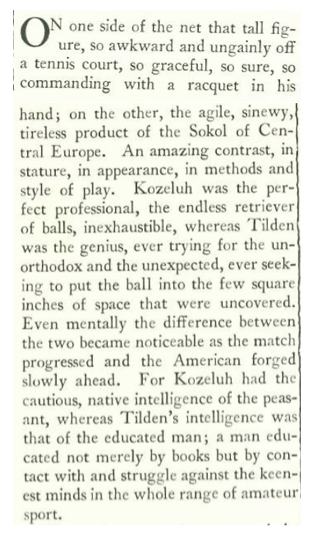
In his sports column, John Tunis offered this description of the competitors:

NOW AND THEN…At left, you can still spot a few neckties at Wimbledon as the audience watches Roger Federer and Andy Roddick enter Centre Court in 2009; at right, Wimbledon crowd in 1925. (BBC/Vintage Every Day)

 *  *  *

Triple Tripe

Dorothy Parker continued to sub in the theater column for her friend Robert Benchley, who was traveling abroad. She found little to like on the Great White Way, including three forgettable plays she reviewed in the Feb. 28 issue:

Apparently audiences agreed with Parker’s assessment. The Gang’s All Here closed after just 23 performances, The Great Barrington, after just 16. And Heat Wave was not so hot, closing after a mere 15 performances.

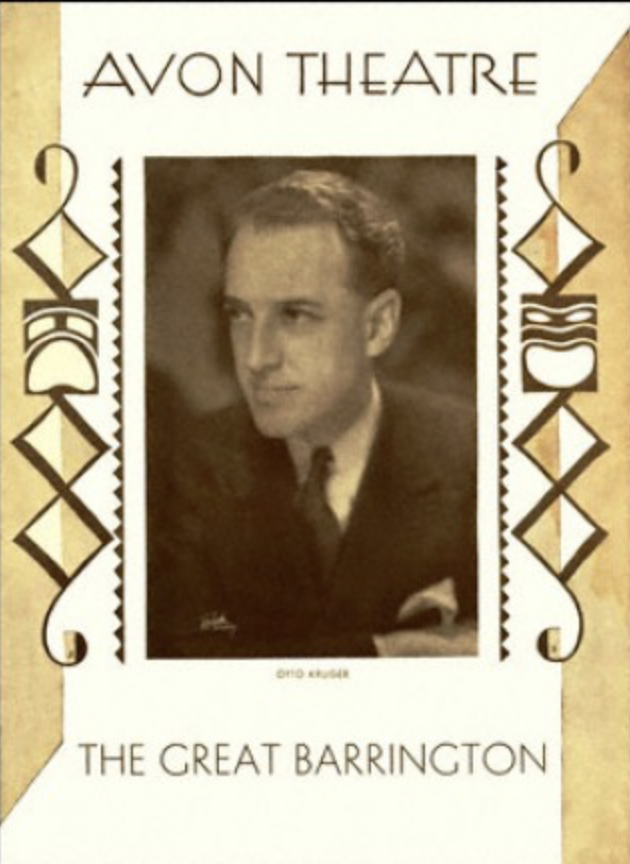
NOT SO GREAT…Program for 1931’s The Great Barrington. It lasted 16 performances. (IBDB)

Parker once again closed the column with a plea to her dear friend:

 *  *  *

To Swash No More

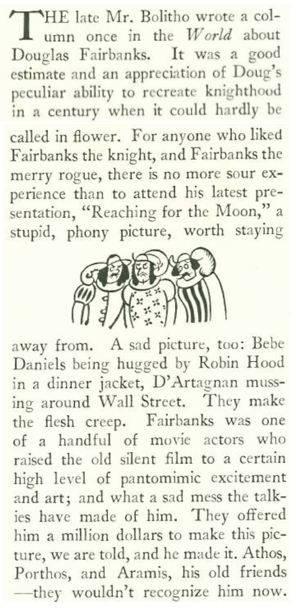
In his “Notes and Comment,” E.B. White lamented the end of Douglas Fairbanks as the swashbuckler of the silents, and rejected the talkie version of the actor in Reaching for the Moon, a film in which Fairbanks portrayed Larry Day, a Wall Street millionaire who later loses his fortune in the 1929 stock market crash.

KEEP YOUR SHIRT ON, DOUG…From left, Douglas Fairbanks in the silent era’s The Thief of Bagdad (1924); Fairbanks on an ocean cruise with Bebe Daniels in Reaching for the Moon. The 47-year-old Fairbanks was still fit enough to pose shirtless, but E.B. White wasn’t having any of it. Despite his fit appearance, Fairbanks would die of a heart attack at the end of the decade. (IMDB)

The film today is perhaps best known for its sumptuous Art Deco sets…

(IMDB)

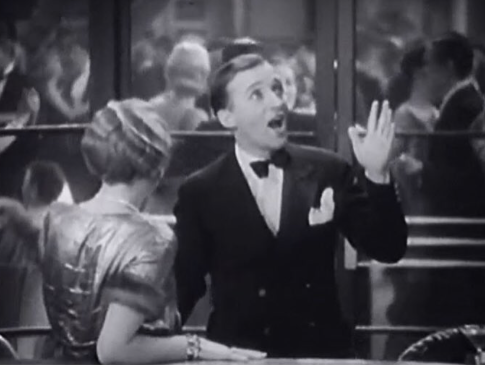
…and for one of Bing Crosby’s earliest film appearances. Reaching for the Moon was originally intended to be a musical featuring numbers by Irving Berlin, however Berlin found director Edmund Goulding difficult to work with, so only one of the original five songs recorded for the film was used, “When the Folks High Up Do the Mean Low Down,” sung by Crosby. It was filmed late at night after he had completed his gig at the Cocoanut Grove.

SINGING WITH BA-BA-BEBE…A young Bing Crosby sings “When the Folks High Up Do the Mean Low Down” with Bebe Daniels in Reaching for the Moon. (IMDB)

 *  *  *

Modern Living

E.B. White also commented on the modern world’s reliance on electric appliances, a habit a mere decade in the making since the gadgets he lists below did not exist before the 1920s:

ELECTRIC SURGE…Prior to the 1920s none of these electric appliances existed. By 1931 many homes were dependent upon them — although many country houses would have to wait for the Rural Electrification Administration (1935) and other New Deal programs get electrical service. (Pinterest)

*  *  *

From Our Advertisers

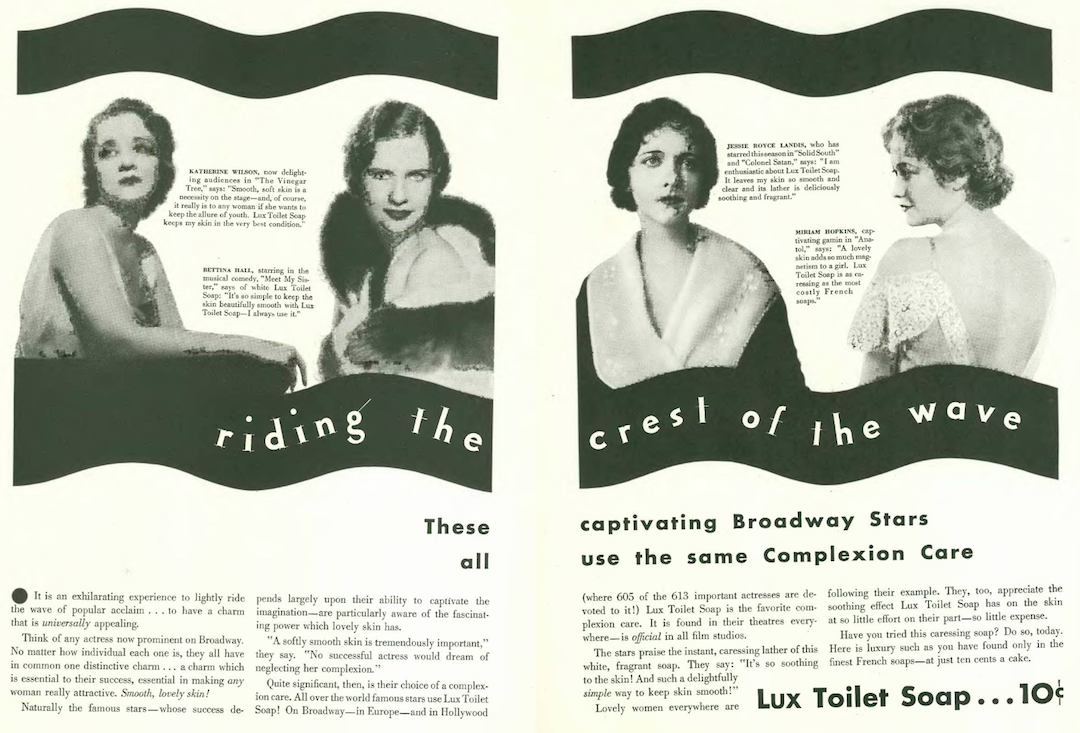
I’ve written before about Lux Toilet Soap’s celebrity-studded ad campaigns, but this two-page ad in the Feb. 28 issue caught my eye because it featured one of my favorite actresses, Jessie Royce Landis

…who appeared in two of my favorite films, both by Alfred Hitchcock: To Catch a Thief (1955) and North by Northwest (1959).

MATERNAL ROLES…Jessie Royce Landis usually played older than she was in real life. Clockwise, from top left, detail of Lux ad; Landis circa 1930; opposite Cary Grant in 1955’s To Catch a Thief; and again with Grant in 1959’s North by Northwest. In the latter film she played Grant’s mother, but in reality she was only seven years older than Grant. (IMDB)

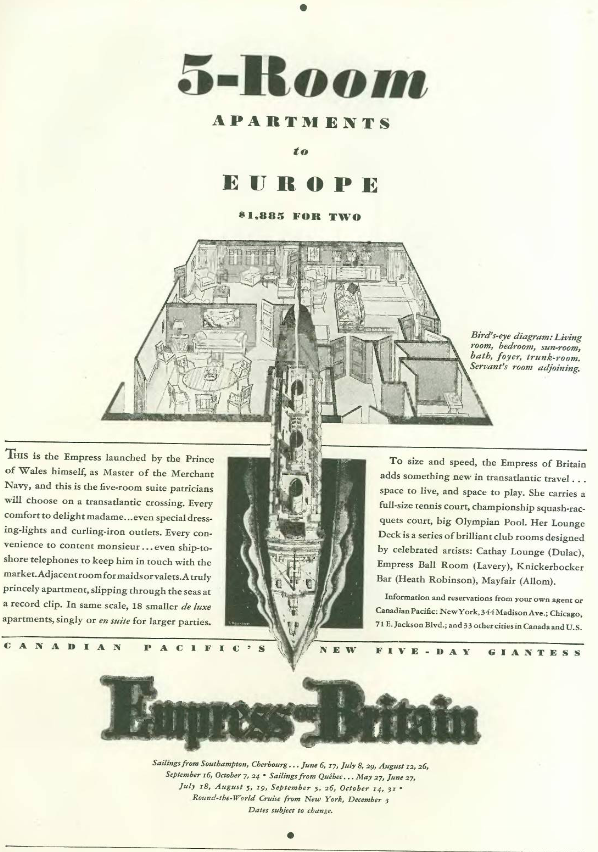
…much of the Douglas Fairbanks/Bebe Daniels film Reaching for the Moon was set on a luxury ocean liner…if the stock market didn’t get you down, you could also afford to travel in style with the Empress of Britain

…or on one of the fine ships of the French Line fleet…

…the Imperial was one of the luxury cars that could get you to the docks…

…among the stranger ads to appear in The New Yorker was this one by the maker of clay plumbing fixtures…

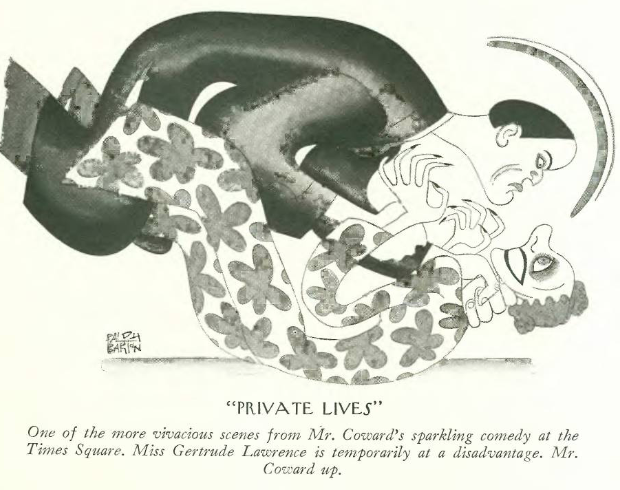
…on to our cartoonists, Ralph Barton returned with this illustration for the theater section…

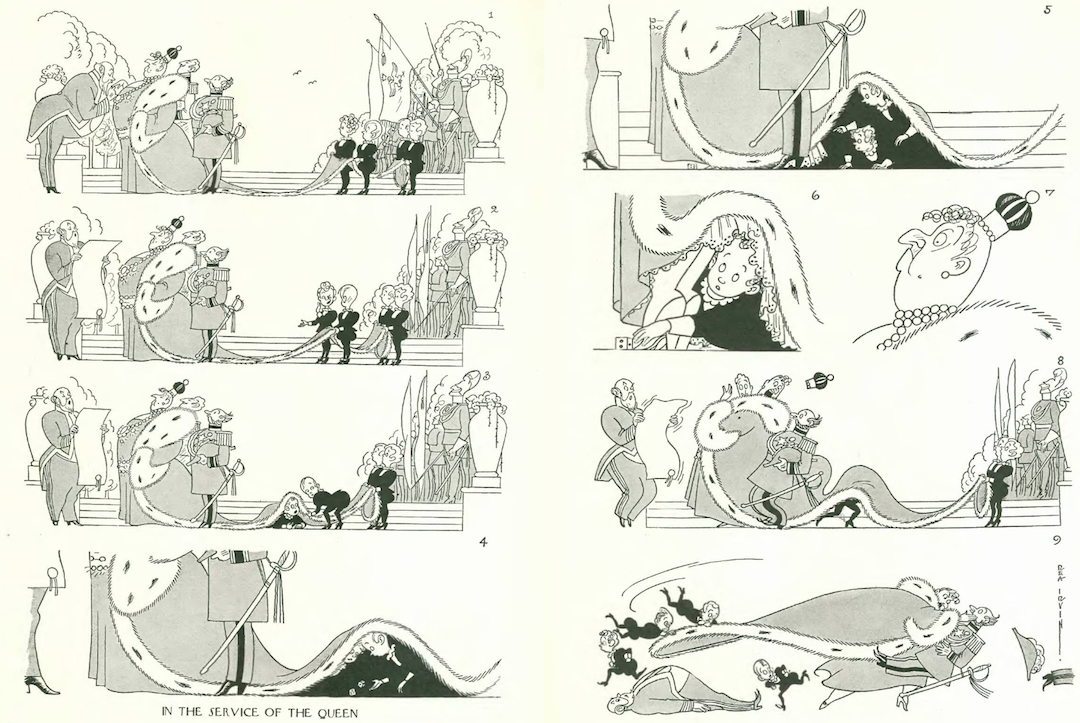
Rea Irvin brought us another of his two-page series cartoons…

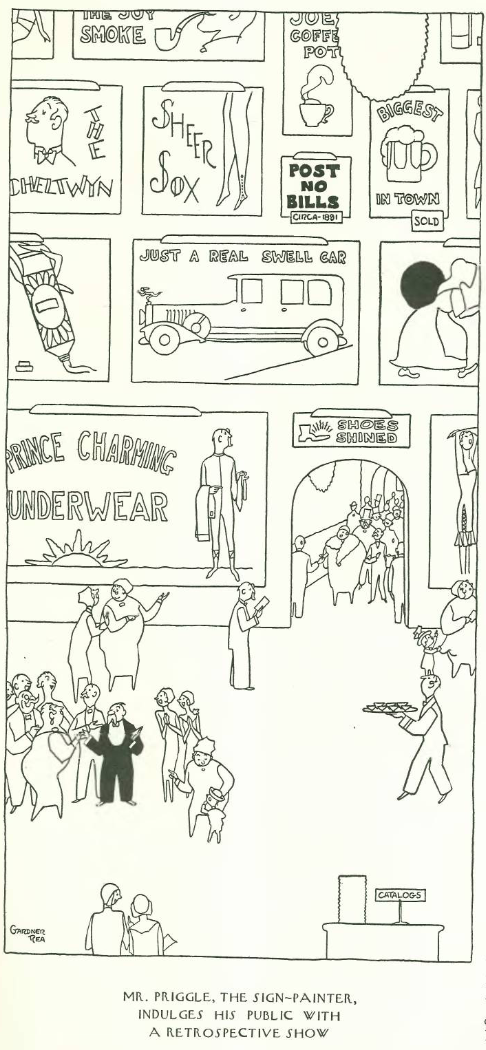
Gardner Rea commented on the state of the art world…

Peter Arno peered in on an unfortunate infant…

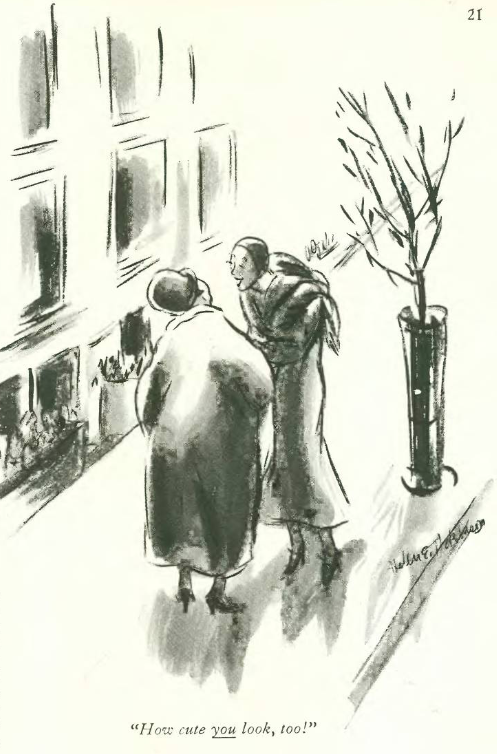
Helen Hokinson gave us this exchange along a city street…

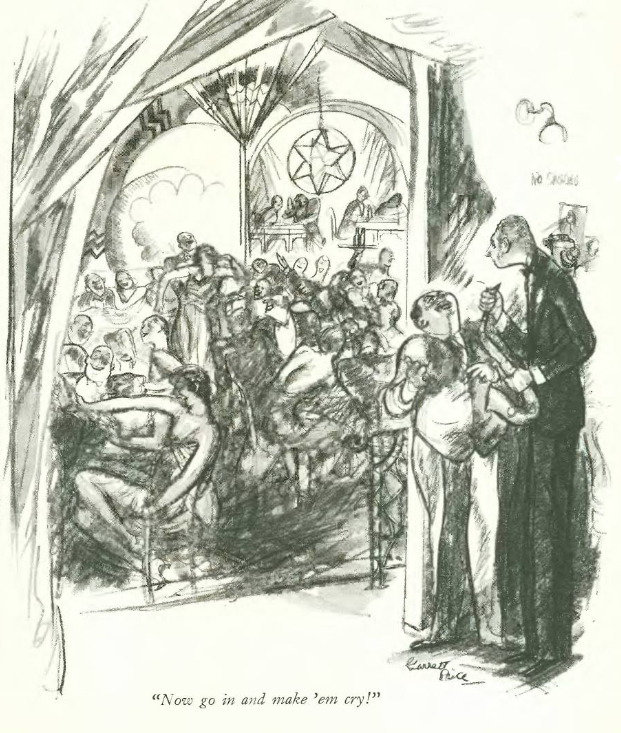
Garrett Price illustrated a tall order for a blues musician…

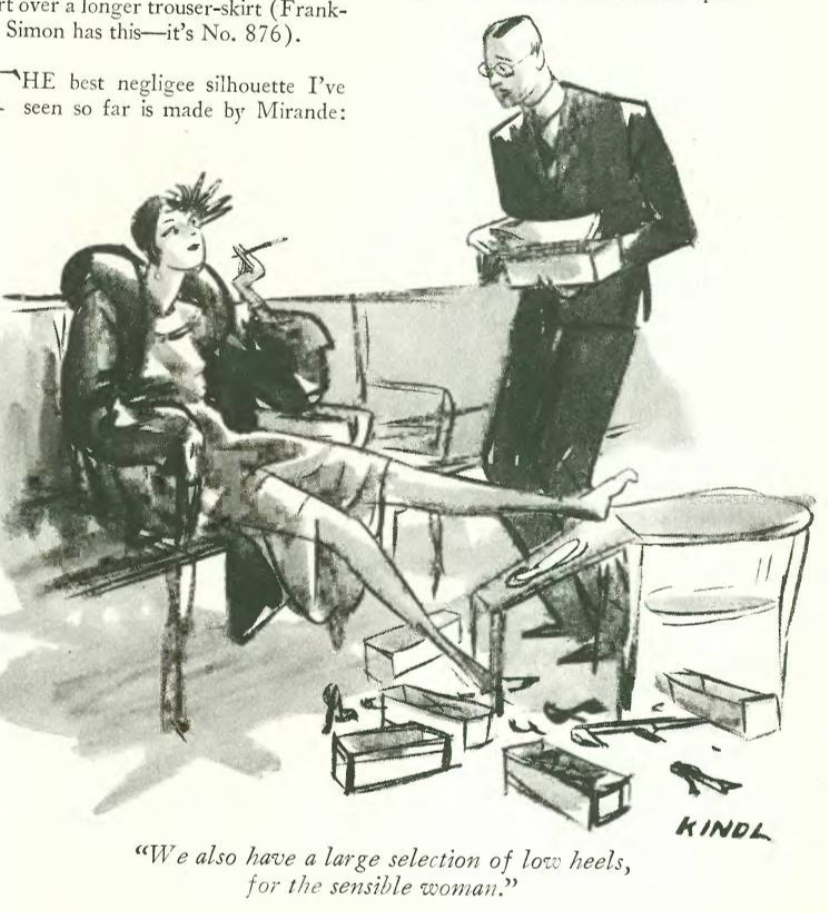
Carl Kindl found clashing styles in the shoe department…

…and James Thurber returned with a prelude to his battle of the sexes…

Next Time: The End of the World…

The High Place

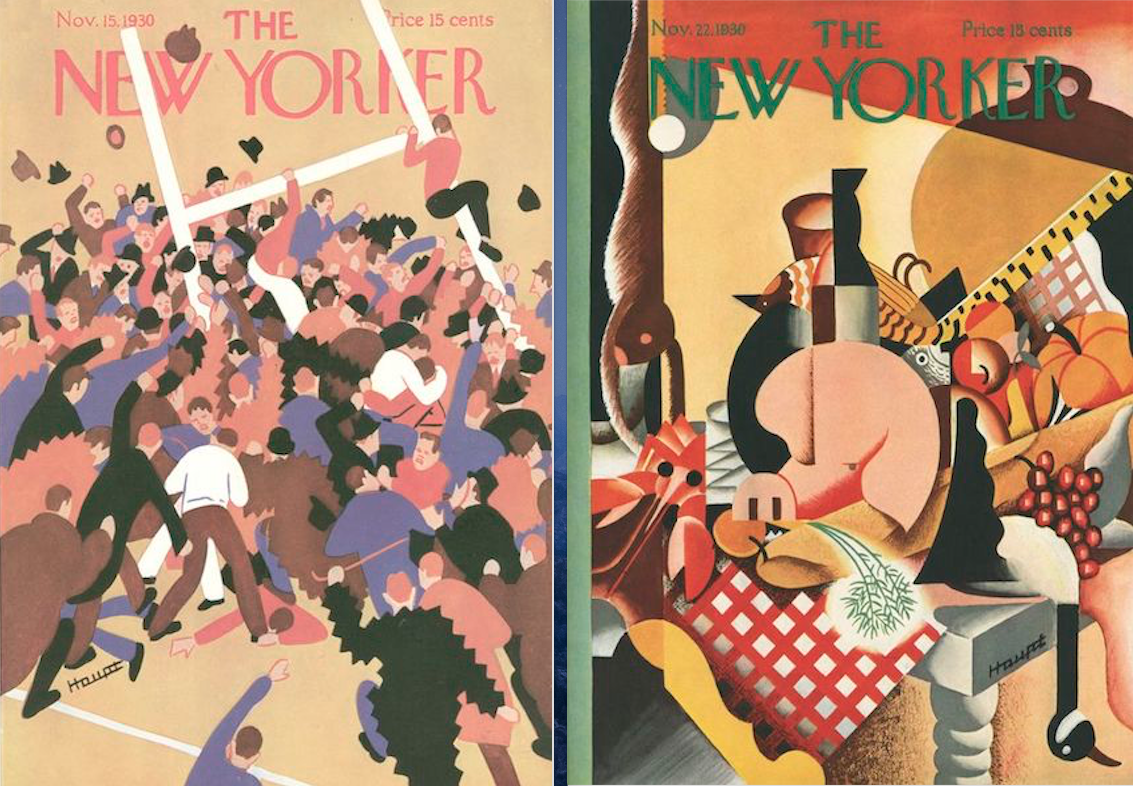
For this installment we look at two issues, Nov. 15 and 22, both featuring covers by Theodore Haupt that celebrated two autumn rituals: football and Thanksgiving.

Let’s begin with the Nov. 22 issue, which climbed to the highest place in Manhattan — no, not the Chrysler Building, but the nearby Empire State Building — with E.B. White admiring the commanding view:

Before the Empire State Building could go up, the old Waldorf-Astoria hotel had to come down. As White observed, the old hotel was built so soundly that it was too costly to deconstruct and salvage. Most of it ended up on the bottom of the ocean.

DOWN IN DAVY JONES’ LOCKER lie the remains of the old Waldorf-Astoria Hotel, which stood for just 36 years before it was razed to make room for the Empire State Building. At right, one of the hotel’s lobbies, and the Grand Ballroom. (nyc-architecture.com/Pinterest)
A LOT OF HOT AIR…Top images: The fabled “mooring mast,” described by E.B. White in his New Yorker brief, as imagined in composite images (old-time Photoshop). In reality, the morning mast never worked; bottom right, a cutaway view of the mast featured in Popular Mechanics; bottom left, New York Times photo from March 22, 1931, announcing the completion of the Empire State Building, just 17 months after the Waldorf-Astoria began coming down. (Keith de Lellis Gallery, rarehistoricalphotos.com/Google Books/The New York Times)
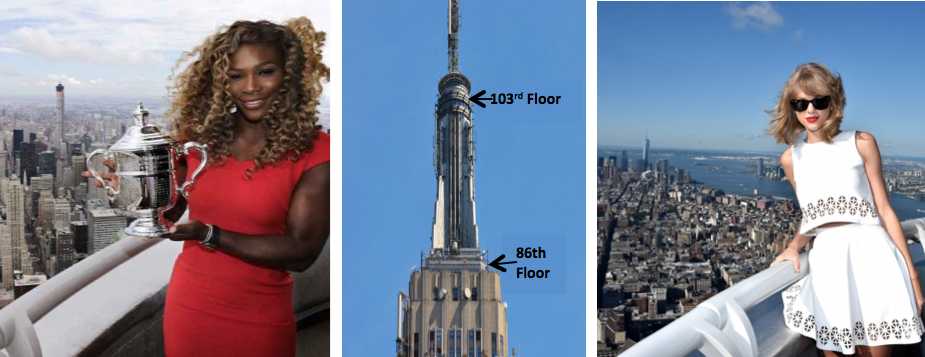
SURVEYING THEIR KINGDOM…Most visitors to the Empire State Building can only go as high as the 86th floor observation deck. However, if you are a VIP like Serena Williams or Taylor Swift, you can get your picture snapped on the 103rd. (Associated Press/Empire State Building/Evan Bindelglass, CBSNewYork)

*  *  *

Sore Winner

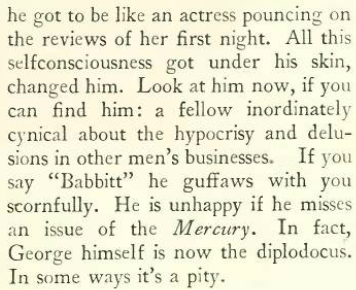
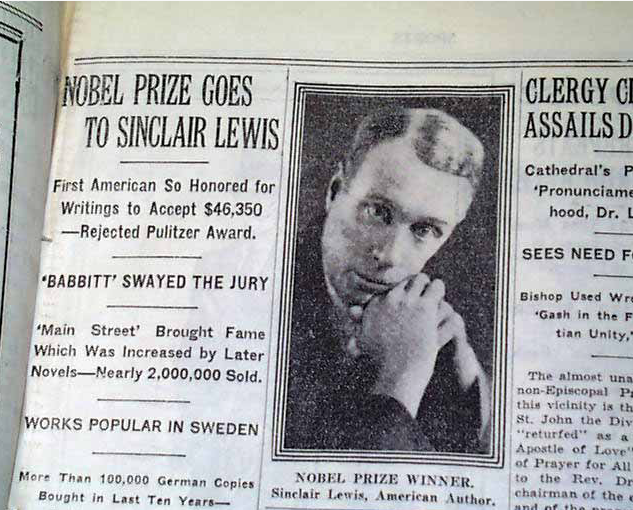
Sinclair Lewis famously declined the Pulitzer Prize for his 1925 novel Arrowsmith, upset that his 1920 novel Main Street had not previously won the prize. But when the Swedish Academy came calling with a Nobel Prize in Literature in 1930, he happily accepted. According to “The Talk of the Town,” this award also seemed a bit tardy, since Lewis’s small town booster archetype, George F. Babbitt, did not fit the dour days of the Great Depression. But it turned out that the 1922 novel Babbitt was ultimately what swayed the Nobel jury:

BOOST FROM A BOOSTER…George F. Babbitt helped make Sinclair Lewis famous, and landed him a Nobel. (NYT, NOVEMBER 6, 1930)

 *  *  *

Not So Sweet

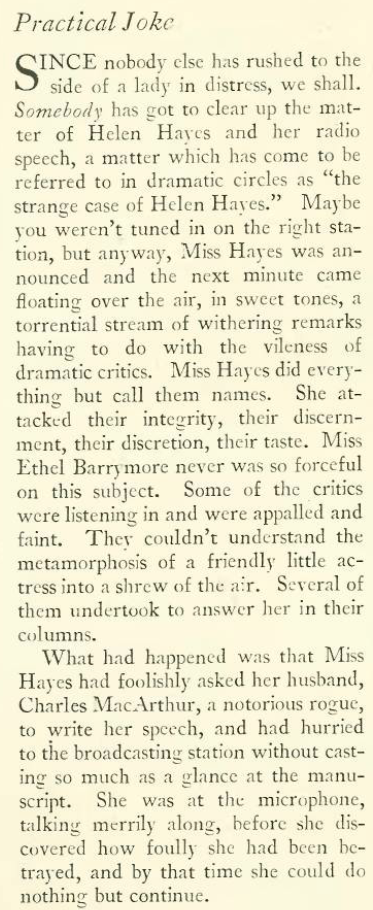
Those of a certain age might remember Helen Hayes as a sweet old lady who appeared on a number of TV shows in the 1970s and 80s, or as the mother in real life of James MacArthur, Disney teen star and later the portrayer of Danny “Book ’em Danno” Williams on the original Hawaii 5-0 TV series. Hayes was married to playwright Charles MacArthur, and “The Talk of the Town” takes it from there…

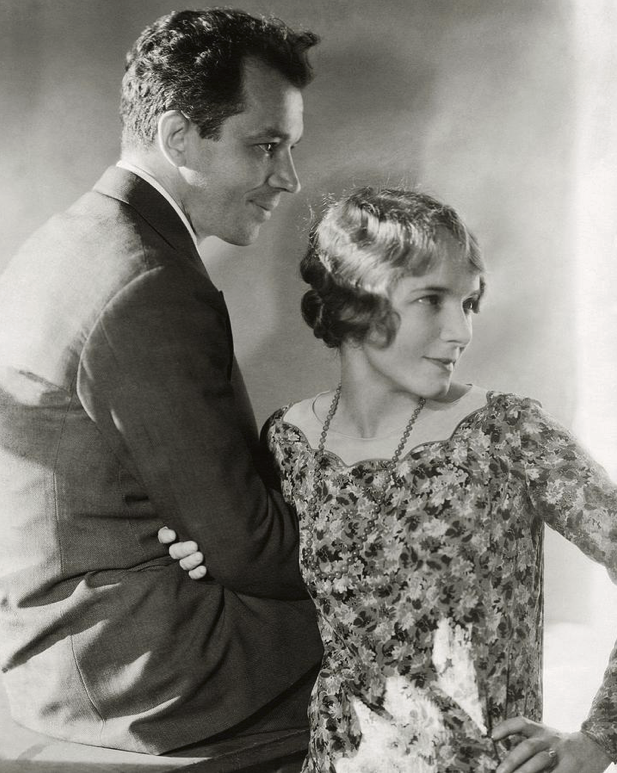
CREATIVE TYPES…The engaged couple Charles MacArthur and Helen Hayes posed for photographer Edward Steichen for this Jan. 1, 1929 image featured in Vanity Fair magazine. (Condé Nast)

 *  *  *

Ain’t It Grand

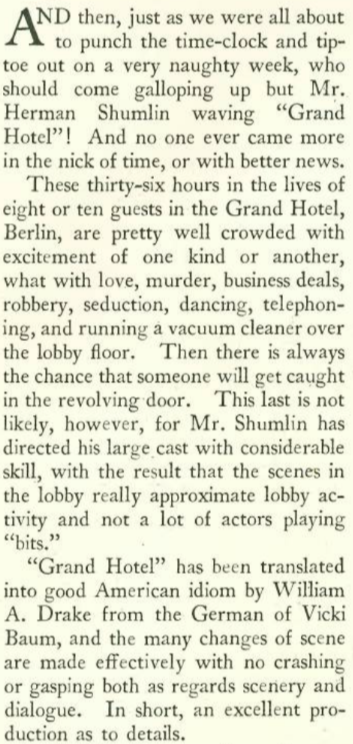
Grand Hotel opened at the National Theatre on Nov. 13, 1930 to strong reviews, including the one below by Robert Benchley that he filed for The New Yorker. The play, adapted from the 1929 novel Menschen im Hotel by Austrian writer Vicki Baum, would prove to be a smash on Broadway and again on the silver screen in a star-studded 1932 film featuring Greta Garbo, John Barrymore, and Joan Crawford.

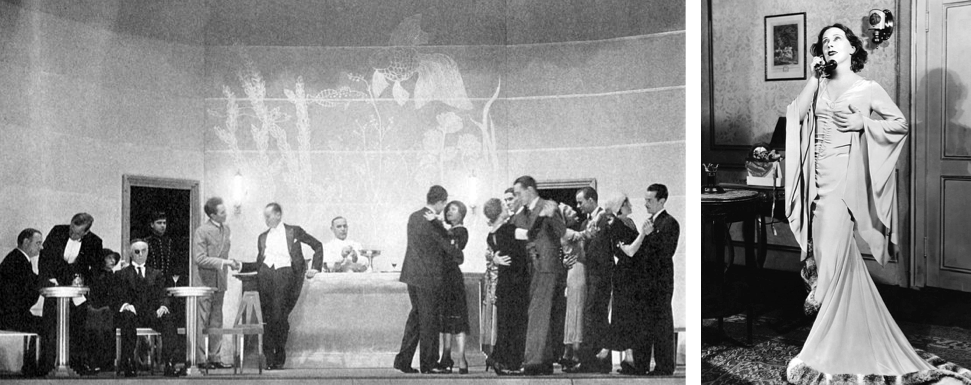
THE STARS ALIGN…Left, promotional photograph of the original Broadway production of Grand Hotel. At right, Eugenie Leontovich portrayed fading Russian ballerina Grusinskaya in the play. The role would go to Greta Garbo in the 1932 film adaptation. (Theatre Magazine, February 1931/Wikipedia)

…and while we are on the subject of Broadway, the theater review section also featured this Al Frueh illustration promoting a noted production of Twelfth Night at the Maxine Elliott…

Program for the production featuring Jane Cowl. (Playbill)

 *  *  *

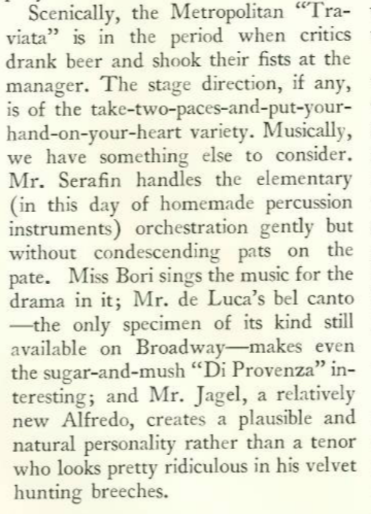
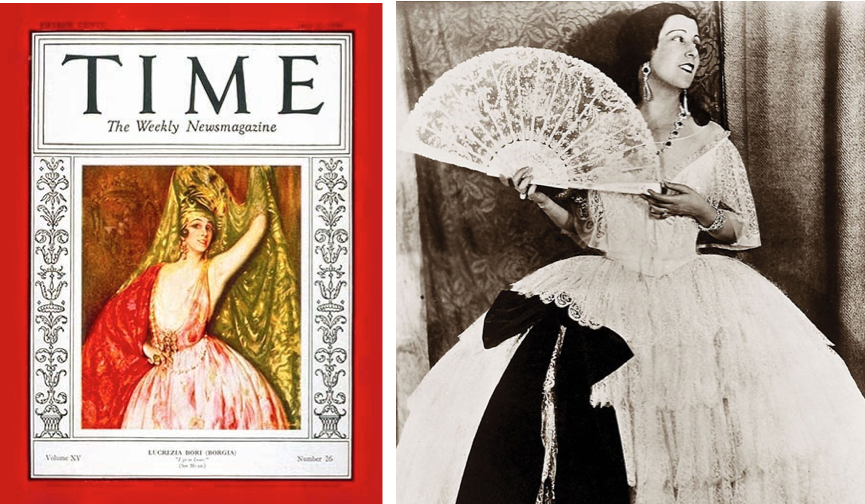
There were also big doings at the Met, where Spanish lyric soprano Lucrezia Bori (1887-1960) wowed audiences with her portrayal of Violetta in La Traviata.

SHE HAD SOME PIPES…right, lyric soprano Lucrezia Bori on the cover of the June 30, 1930 edition of Time magazine. At right, promotional photo of Bori circa 1930. (Time/Wikipedia)

 *  *  *

Bounty of Blessings

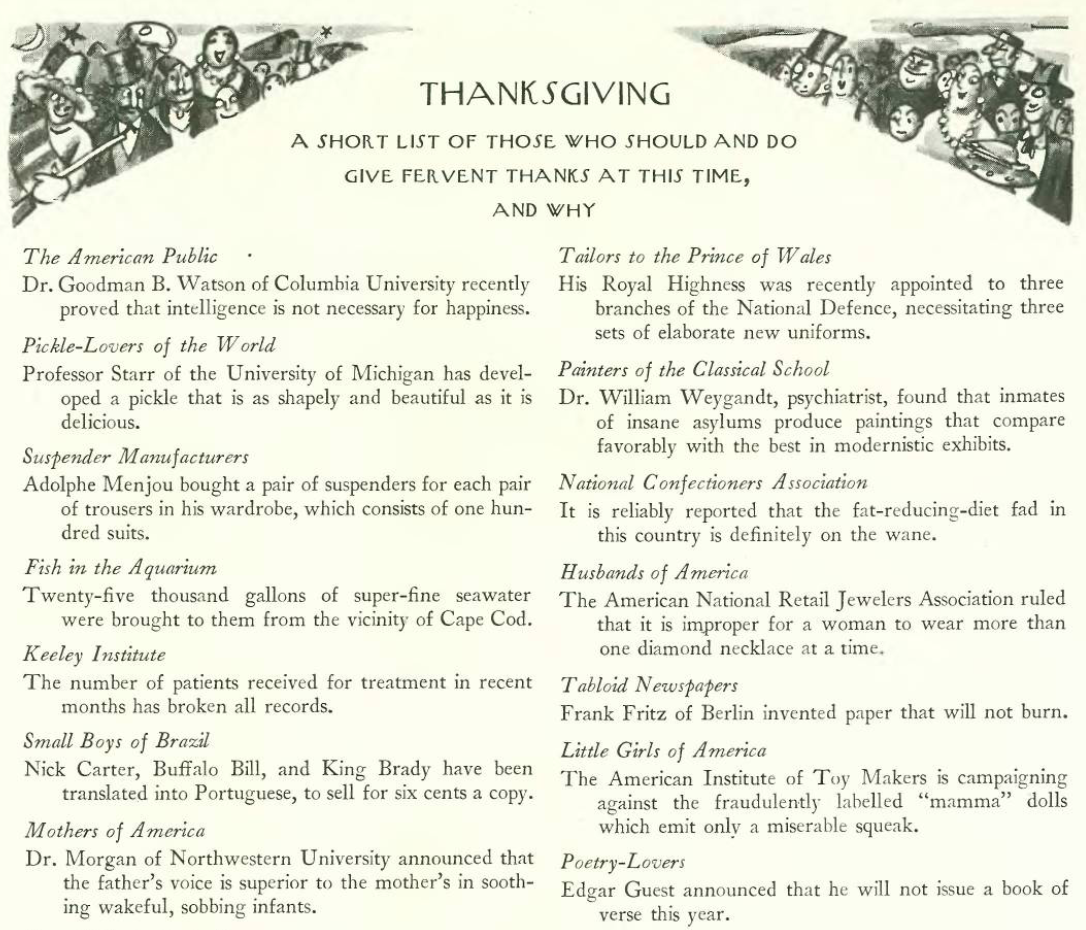
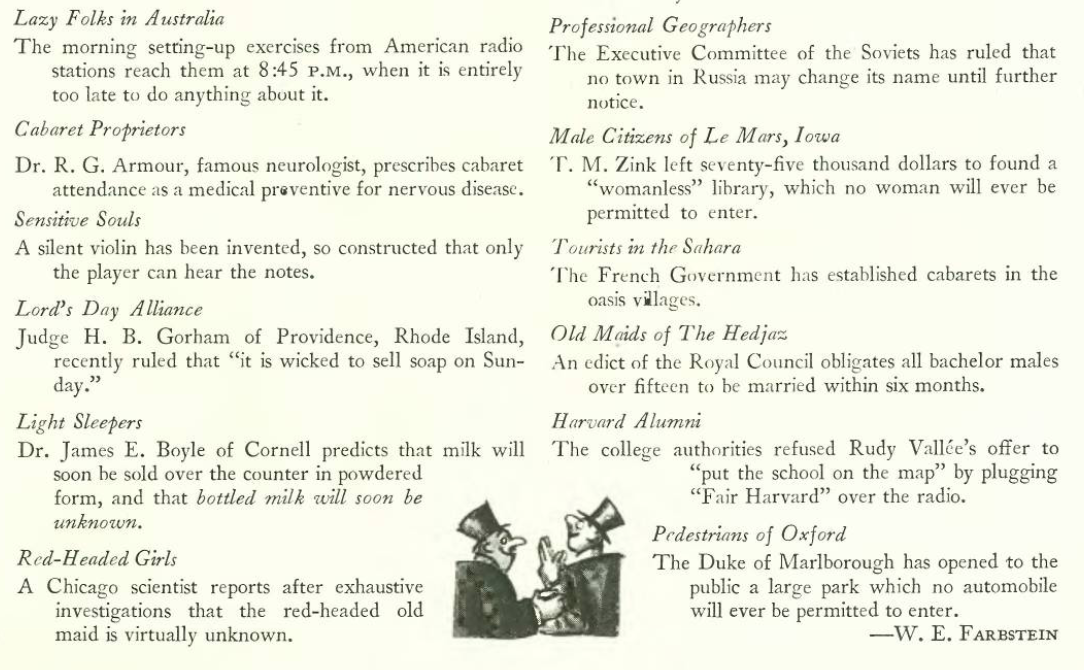
Humorist W. E. Farbstein gave readers plenty to be thankful for in this tribute to the Thanksgiving holiday…

 *  *  *

From Our Advertisers

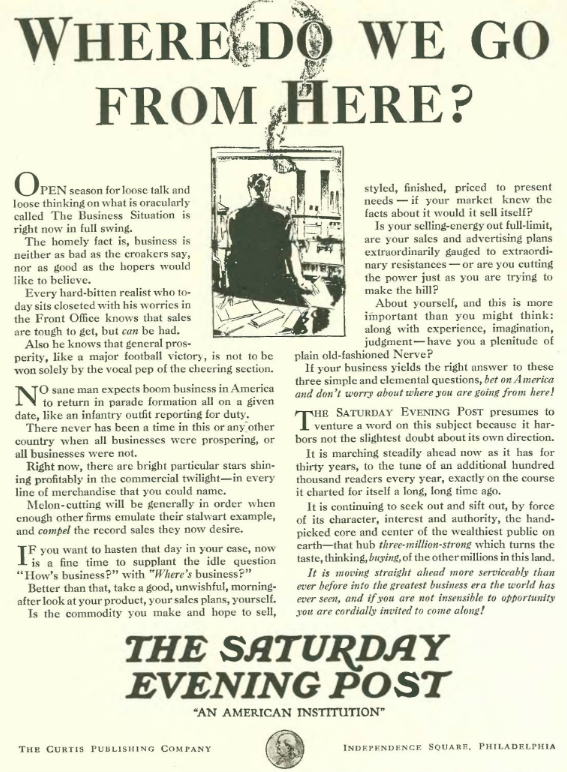
Occasionally advertisements acknowledged the reality of the Great Depression, including this one from The Saturday Evening Post that offered encouraging words to prospective readers…

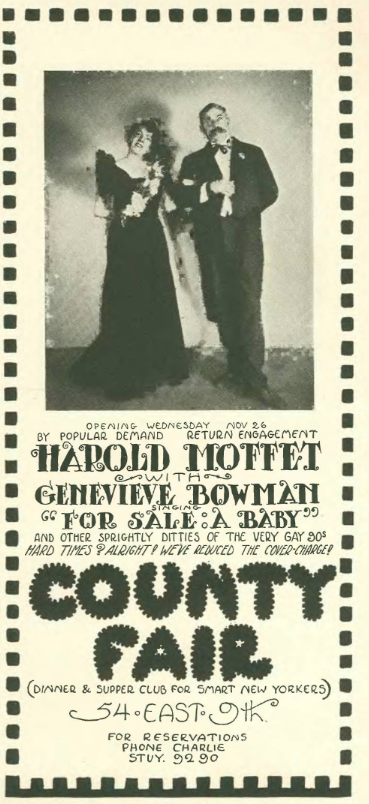
…County Fair, a Greenwich Village country-themed nightclub, offered the diversion of Moffatt and Bowman to take audiences’ minds off of hard times…

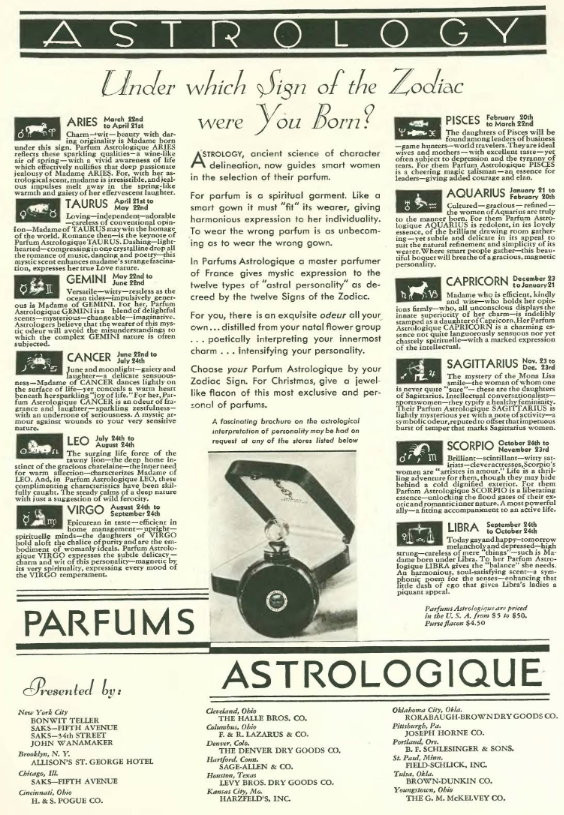
…and for all the supposed sophistication of New Yorker readers, there were still plenty of back page ads offering nostrums laced with superstition…

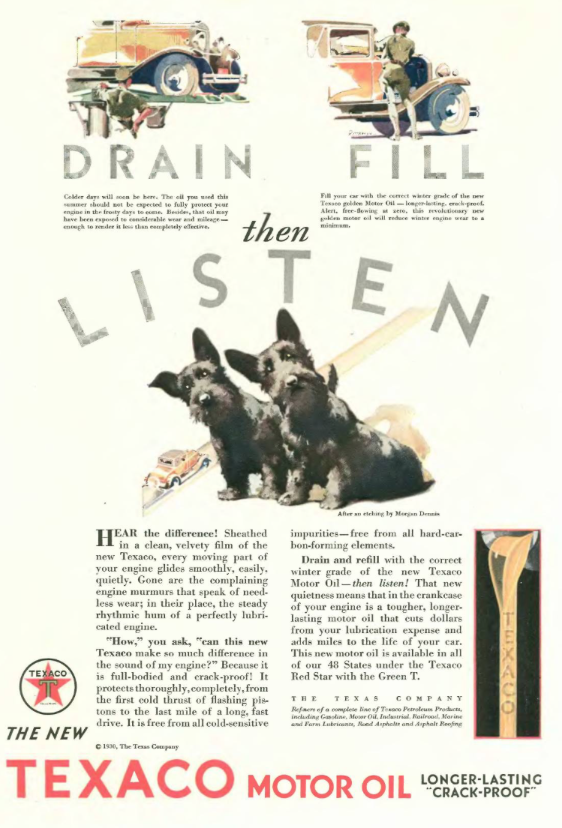
…some of the more colorful, spritely ads from the era were offered up by the producers of Texaco Motor Oil…

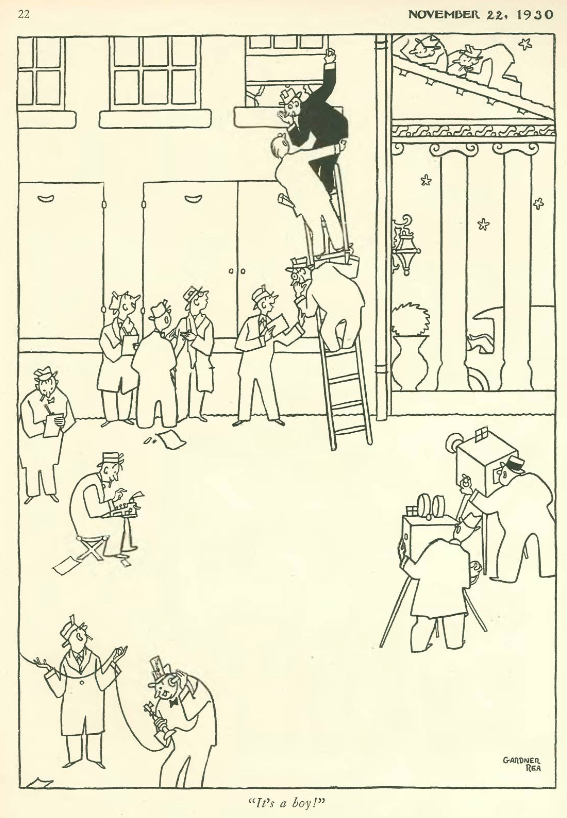
…our cartoons are by Gardner Rea

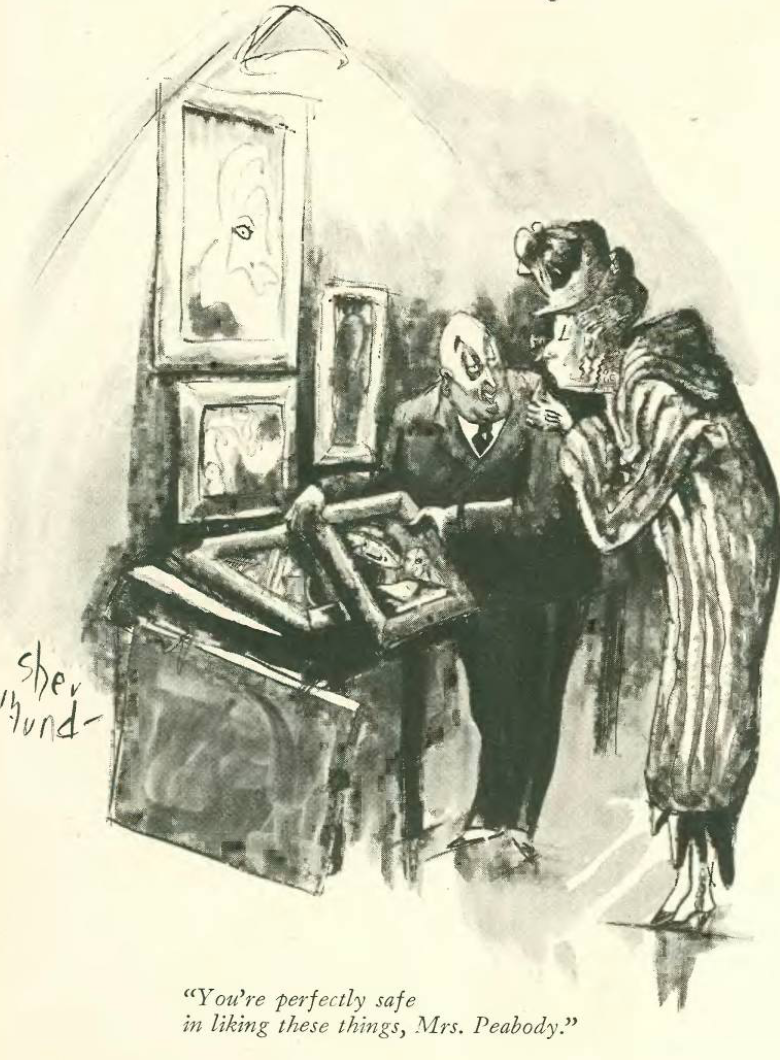
Barbara Shermund

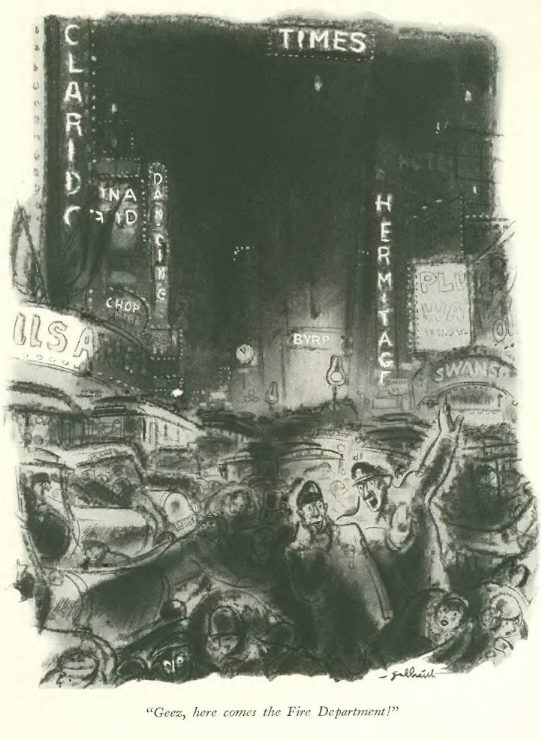
William Crawford Galbraith

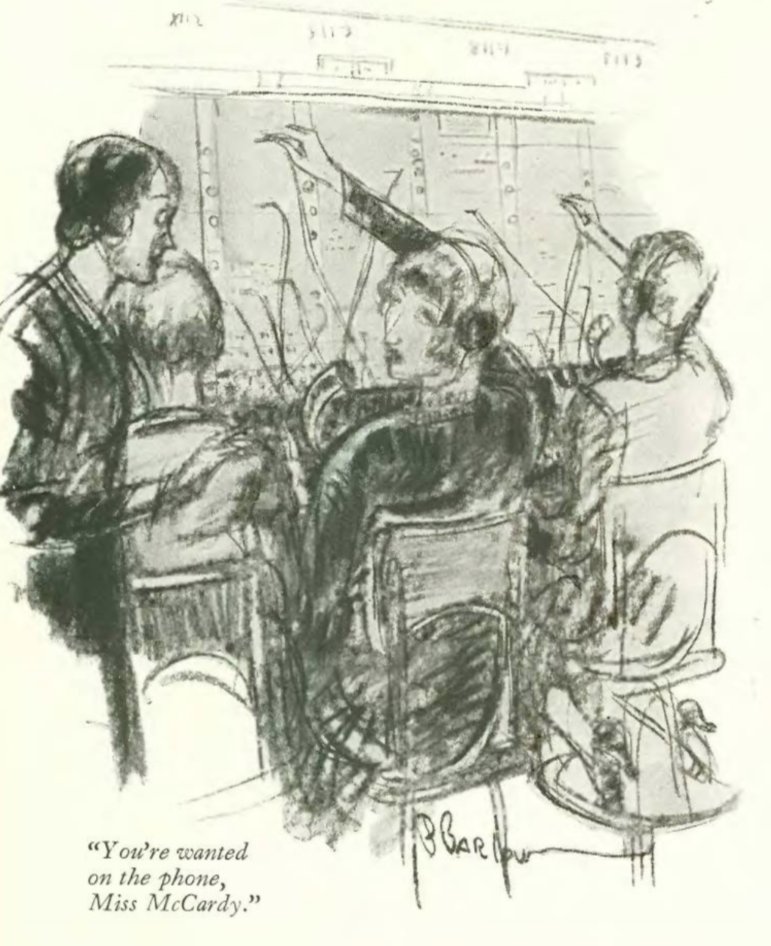
…and Perry Barlow

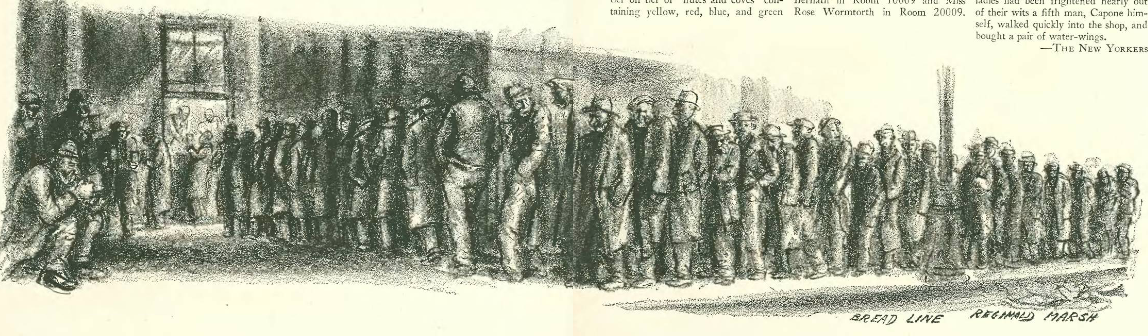
…and for another reminder of reality in the city, this sketch that ran along the bottom of “The Talk of the Town,” by Reginald Marsh

…and now we step back to the Nov. 15 issue, where E.B. White offered a less somber take on the Great Depression…

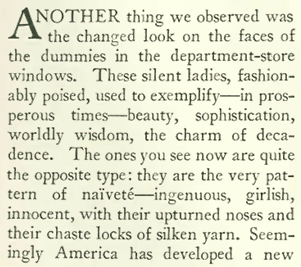
…White also noted a change on the faces of storefront mannequins…

YIN AND YANG…The worldly pose of a Roaring Twenties mannequin, and a more wholesome look for the leaner times in the 1930s. (Pinterest)

 * * *

Playing Telephone

Long, long before cell phones, telephones were heavy stationary devices that required a certain amount of planning before installation, as E.B. White explains:

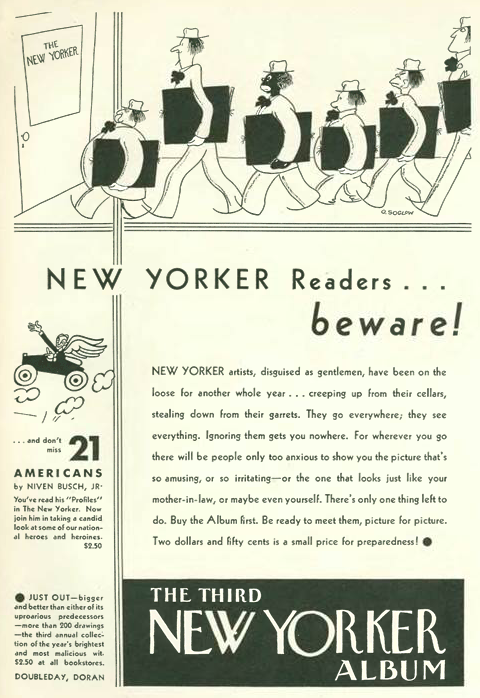
On to our Nov. 15 ads, we have this announcement for The Third New Yorker Album…with illustration by Otto Soglow

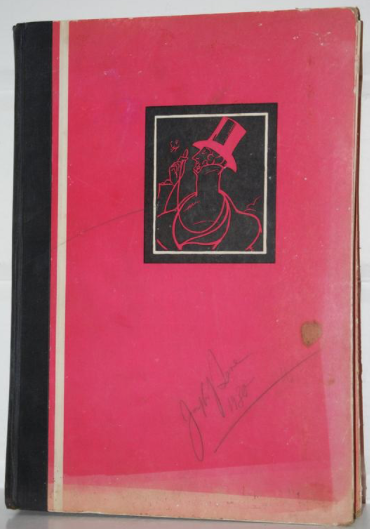
…here is what the album looked like…

…and a couple of inside pages…

(Etsy)

…one of the contributors to the album was Rea Irvin, founding illustrator for The New Yorker, here doing some business with Murad cigarettes…also another Flit insecticide ad by Dr. Seuss

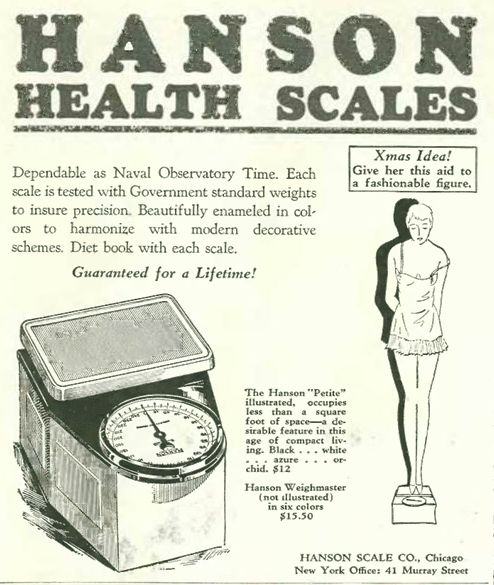
…Christmas ads began appearing in the magazine, including this one for Hanson scales…pity the poor chap (and his wife) who actually thought this might be a suitable present for Christmas, or any occasion for that matter…

…and with Prohibition still in force, advertisers found other uses to promote their products…

…on to our cartoons, Leonard Dove illustrated a couple who didn’t get away with the ruse…

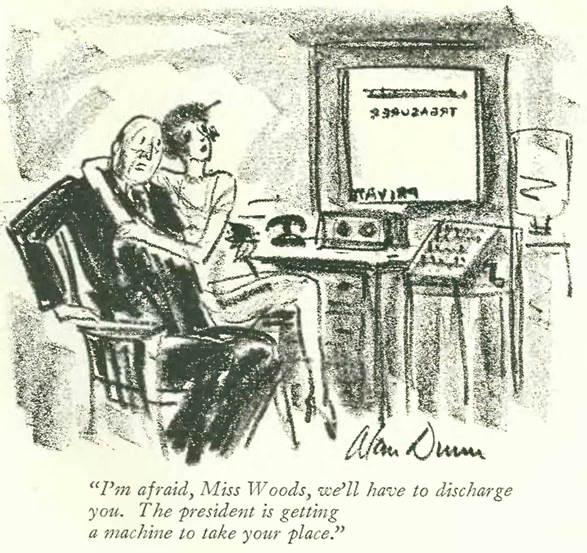
… Alan Dunn depicted what was considered typical office behavior in the 1930s…

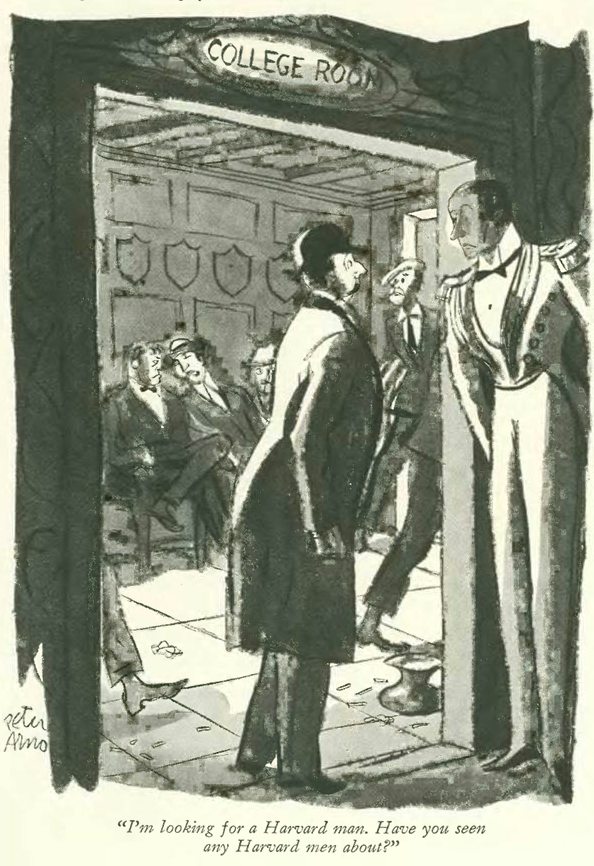
...Peter Arno visited the Harvard Club…

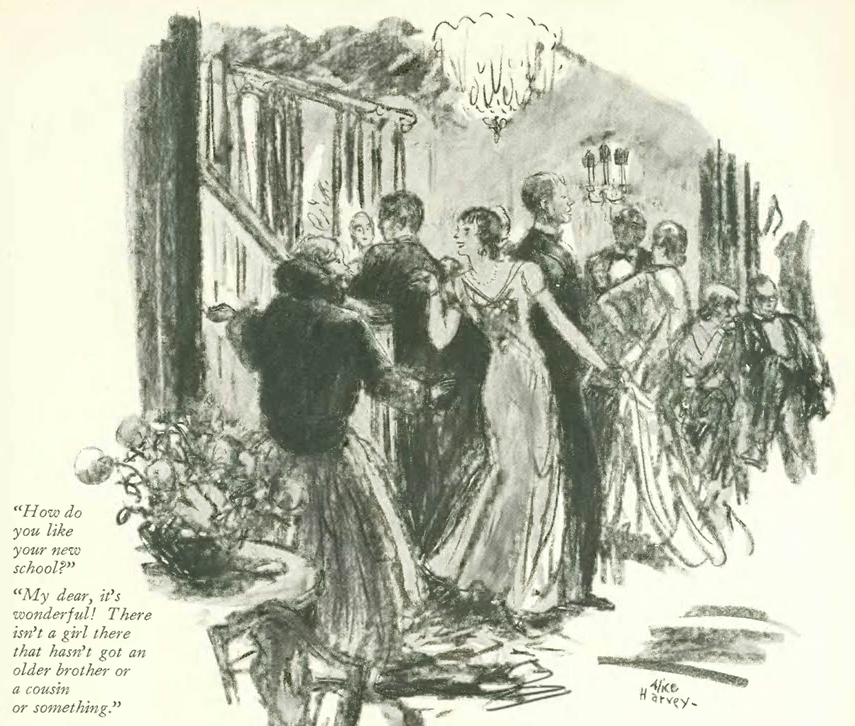
Alice Harvey also explored the college scene…

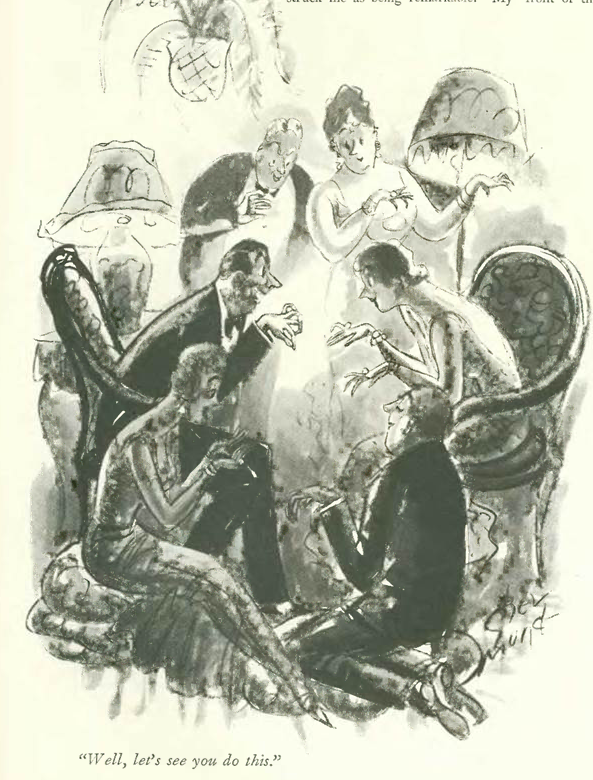
…some parlor games with Barbara Shermund

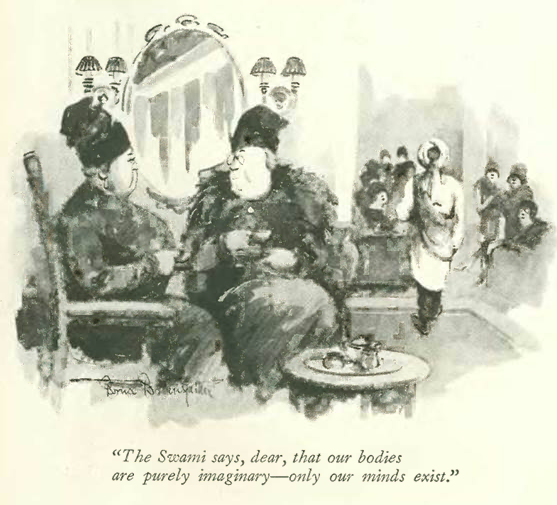
……Bruce Bairnsfather, and some existentialist chat at tea time…

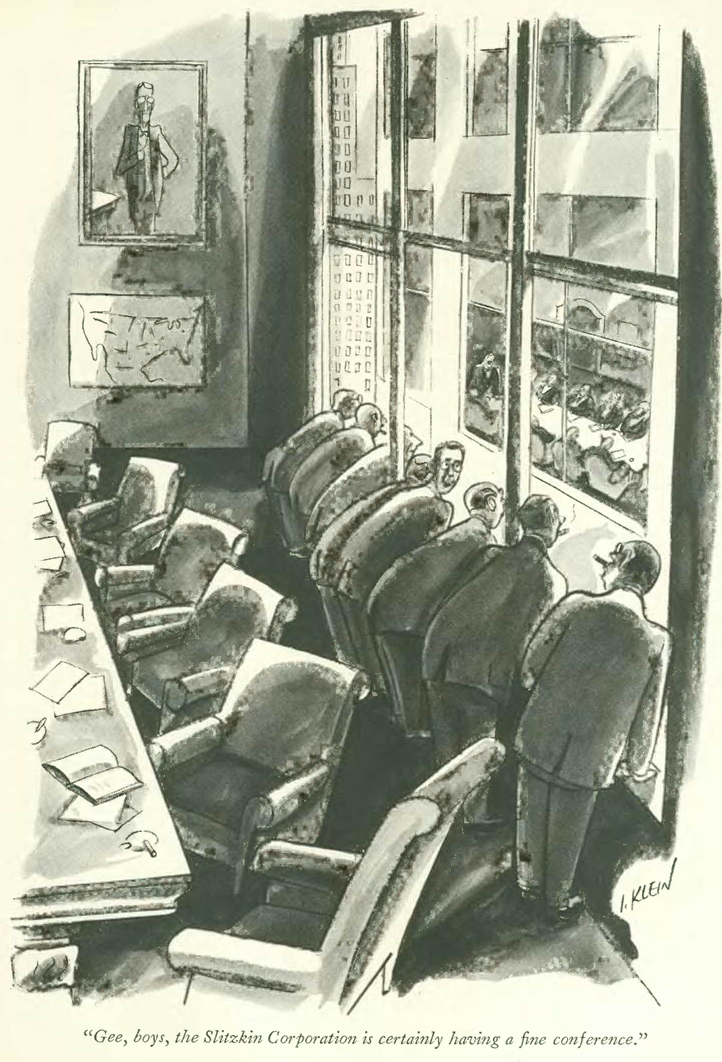
…and we close with Isadore Klein, and the world of corporate competition…

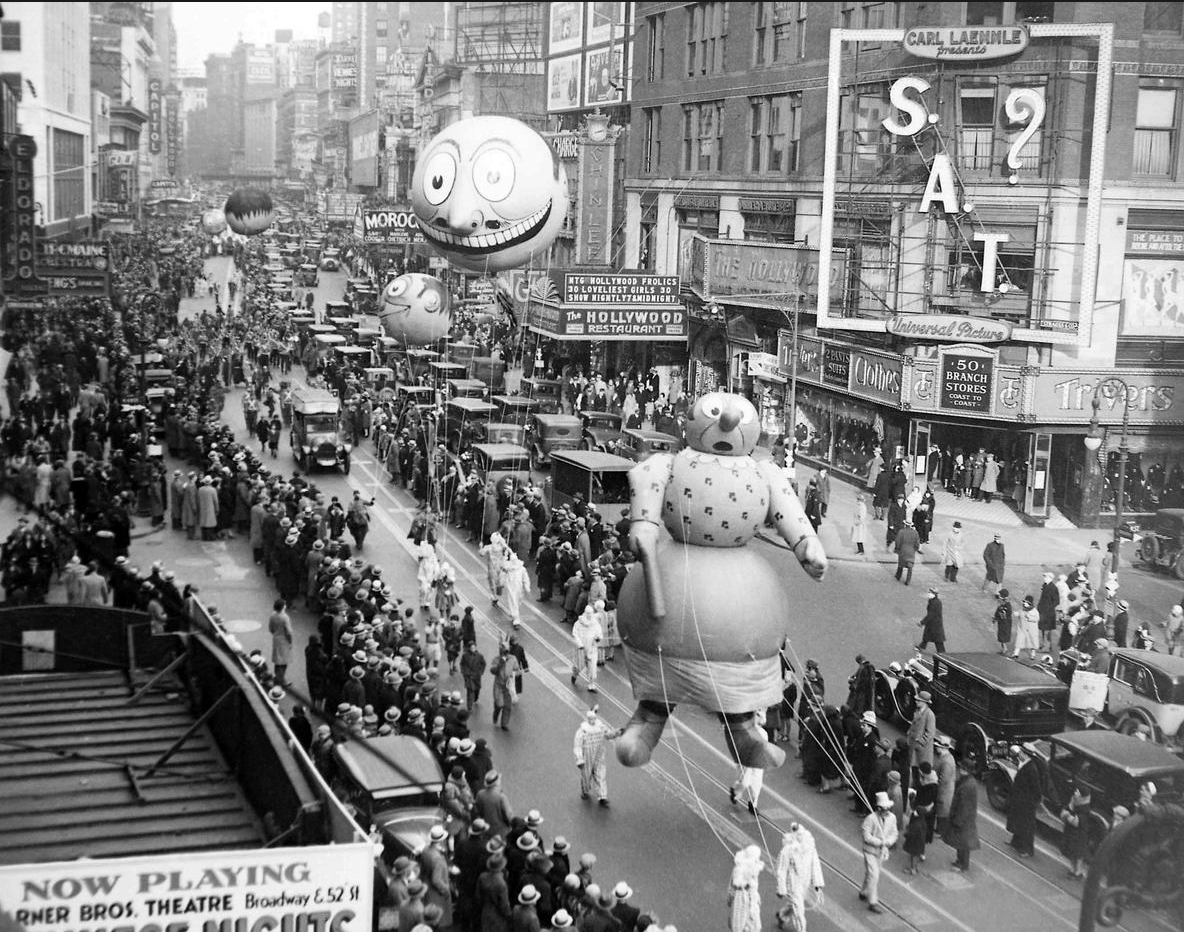
…and a Happy Thanksgiving, from the Macy’s Thanksgiving Parade 89 years ago, Nov. 27, 1930…

(CBS/Associated Press)

Next Time: The Future Was a Silly Place…


Will It Play In Peoria?

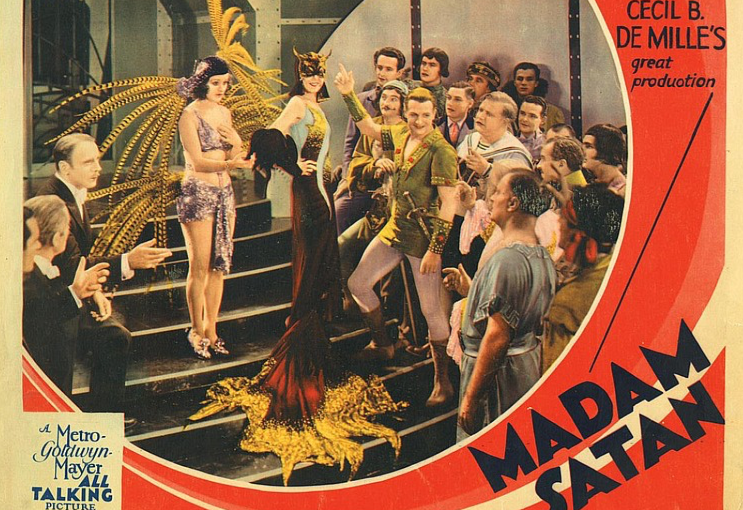
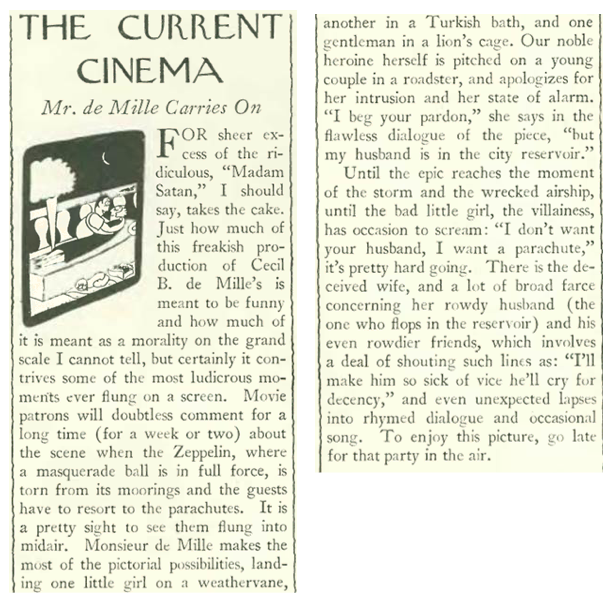
Cecil B. DeMille was known for his epic films (e.g. The Ten Commandments, 1923 and 1956) and cinematic showmanship, but in 1930 he puzzled his audiences with a very weird pre-Code musical, Madam Satan.

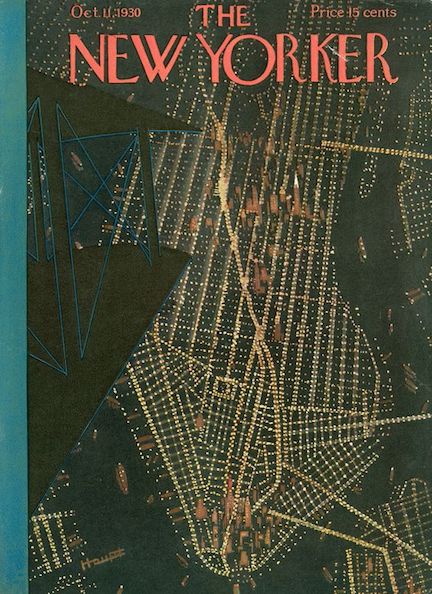
Oct. 11, 1930 cover by Theodore Haupt.

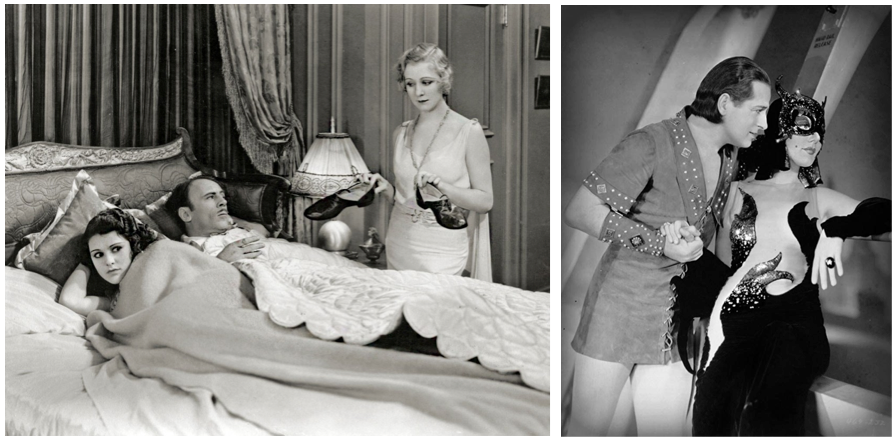
The film centered on a wealthy couple, Angela and Bob Brooks (played by Kay Johnson and Reginald Denny). Bob is unfaithful to his wife (a common pre-Code theme), and she attempts to lure him back by disguising herself as a mysterious devil woman at a masquerade ball held aboard a dirigible. Quite a plot indeed. Here’s what The New Yorker’s John Mosher had to say about it.

(IMDB)

PAJAMA GAMES…Lillian Roth, Roland Young, and Kay Johnson in Madam Satan. At right, Reginald Denny falls for the charms of his wife (Kay Johnson), disguised as a devil woman at a masked ball held aboard a giant dirigible. (IMDB/cecilbdemille.com)
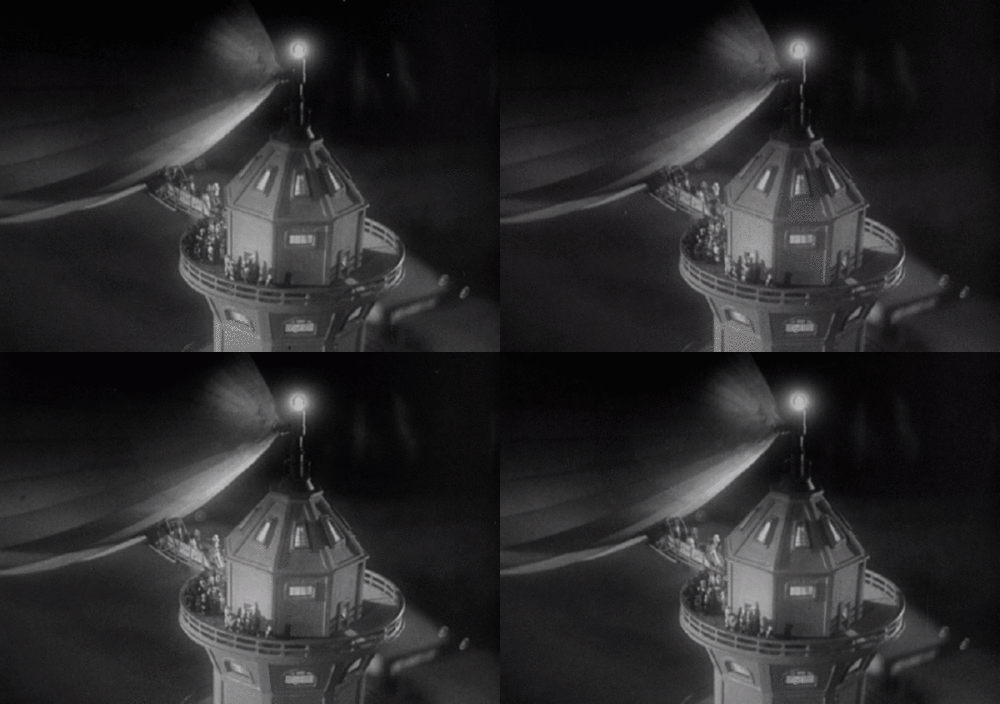
AIRHEADS…Via a giant mooring mast, partygoers board a dirigible for the masquerade ball in Madam Satan. Curiously, developers of the Empire State Building (which was under construction) envisioned a similar use for the mast that would top out their tower. In reality, winds that whipped around high towers would have prevented this type of boarding. (twitter.com)
SOMEONE CALL THE FAA…At right, the lavish masquerade ball aboard a giant dirigible in Madam Satan. At right, the dirigible is damaged by lightning in a scene that foreshadowed the Hindenberg disaster of 1937. (cecilbdemille.com/precode.com)
SEEMS PLAUSIBLE…In a silly ending to a silly film, partygoers float on parachutes away from the damaged dirigible. (twitter.com)

*  *  *

Let Them Eat Cake

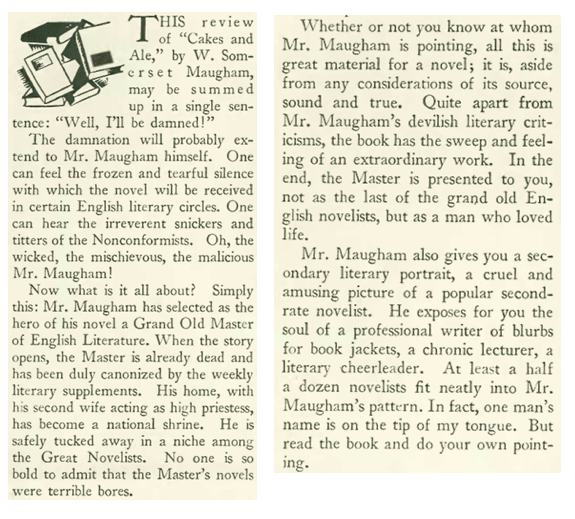
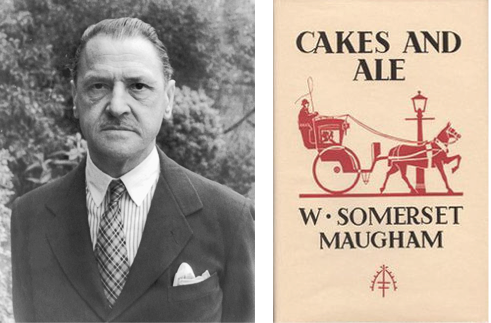
Somerset Maugham regarded his comic novel, Cakes and Ale, to be his favorite. The book took aim at snobs as well as at the legacy of one overrated, late-Victorian writer—a character many believe was based on the recently departed Thomas Hardy (Maugham denied the inspiration). The New Yorker had this to say about Cakes and Ale:

THROW HARDY INTO THE DUSTBIN…Somerset Maugham as photographed by Carl Van Vechten in 1934. (Wikipedia)

 *  *  *

He Meant What He Said

Howard Brubaker, in his “Of All Things” column, found humor in the words of a rising figure in German politics, you know who…

 *  *  *

Throw Him a Softball

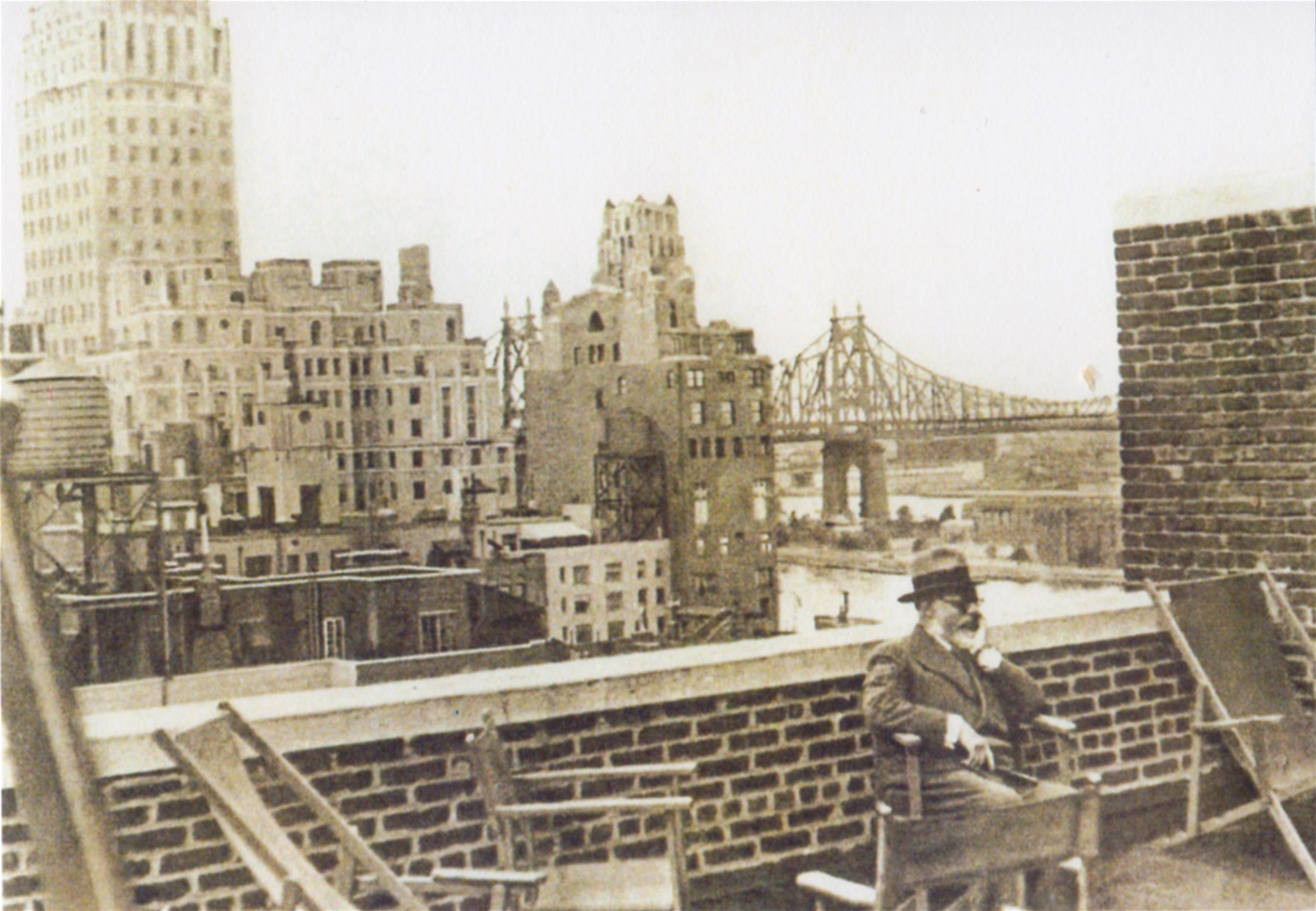
The famed French artist Henri Matisse paid a visit to New York City, and according to this account in “The Talk of Town,” seemed to be seeking some peace of mind…

AN OPPOSITE VIEW…Henri Matisse struck a thoughtful pose atop a Manhattan apartment at 10 Mitchell Place in 1930. The Queensboro Bridge can be glimpsed in the background. (ephemeralnewyork.wordpress.com)

 *  *  *

Still Barred From the Bar

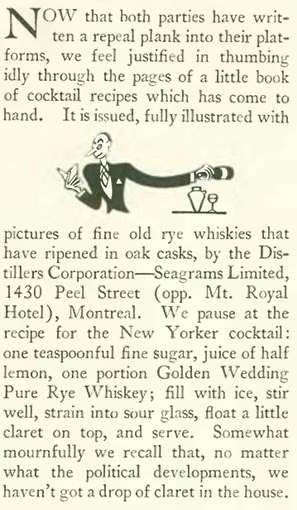
We are still about three years away from the official repeal of the 18th Amendment, but as we know the partying continued in houses and speakeasies across the great city. E.B. White, in his “Notes and Comment,” wistfully recalled the days when good booze was legal:

White did find some cheer in the pro-wet platforms of the two major parties…

A GIMLET IN EVERY POT…The major political parties in 1932’s U.S. presidential race were represented by incumbent Herbert Hoover (Republican) and Franklin D. Roosevelt (Democratic). Both favored repeal of the 18th Amendment. Pictured at the center, a New Yorker cocktail, the object of E.B. White’s longing. (Wikipedia)

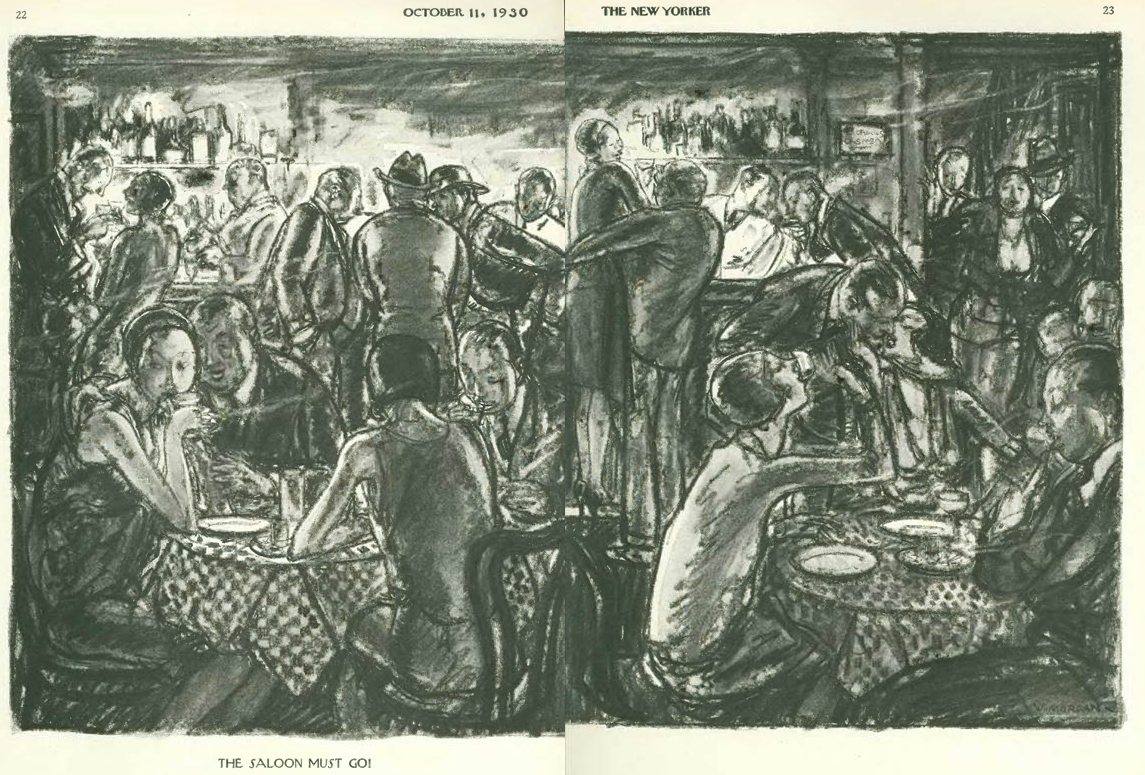
And while we are on the subject, we have this Wallace Morgan illustration of a lively speakeasy with the ironic caption, “The Saloon Must Go!” — referencing an old Anti-Saloon League Slogan.

You didn’t have to go to a speakeasy if you wanted a glass of wine. During Prohibition American winemakers found a lucrative loophole by selling perfectly legal concentrated grape juice (called “wine bricks”) to home brewers and bootleggers alike.

According to an article in the Smithsonian, winemakers marked the wine bricks with warnings that they were “for non-alcoholic consumption only.” However, the package would also bear a note explaining how to dissolve the brick in a gallon of water, and yet another “warning” instructing the buyer not to leave the jug in a cool cupboard for 21 days, lest it turn into wine.

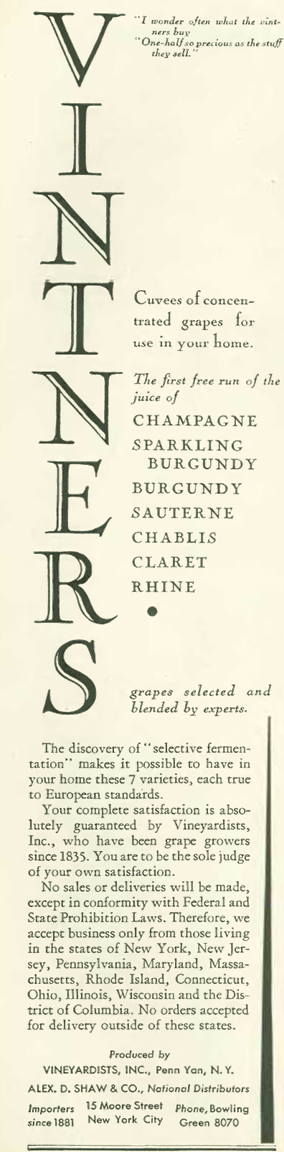
Here’s an ad in the Oct. 11, 1930 New Yorker that not-so-subtly offered a selection of varietals…

Here’s what a wine brick looked like:

A wine brick from San Francisco’s Vino Sano company. The label reads: “Each Brick dissolve in one gallon of water. To prevent fermentation, add 1-10% Benzoate of Soda.” Yeah right. (vinepair.com)

 *  *  *

From Our Advertisers

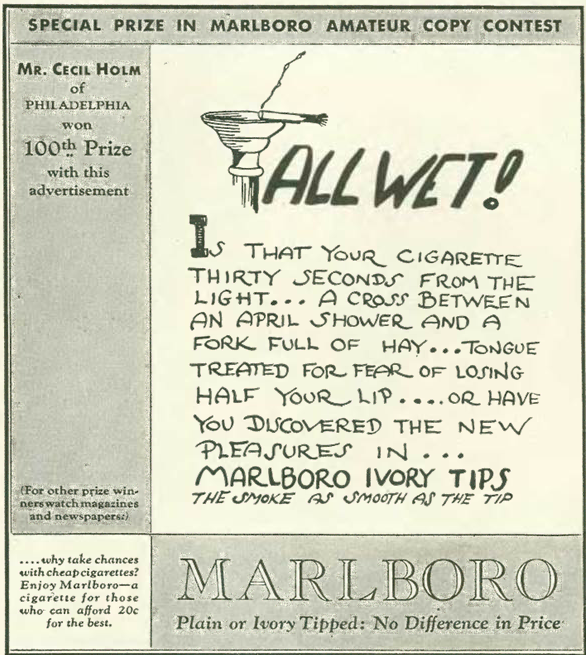
No doubt Prohibition caused more than a few people to take up smoking. Women adopted the habit in droves during the Roaring Twenties, and by the Depression it seemed everyone was lighting up. Advertisers explored various ways to market cigarettes, and long before the Marlboro Man made the scene, that brand pushed its product through a series of dopey handwriting and essay contests,,,

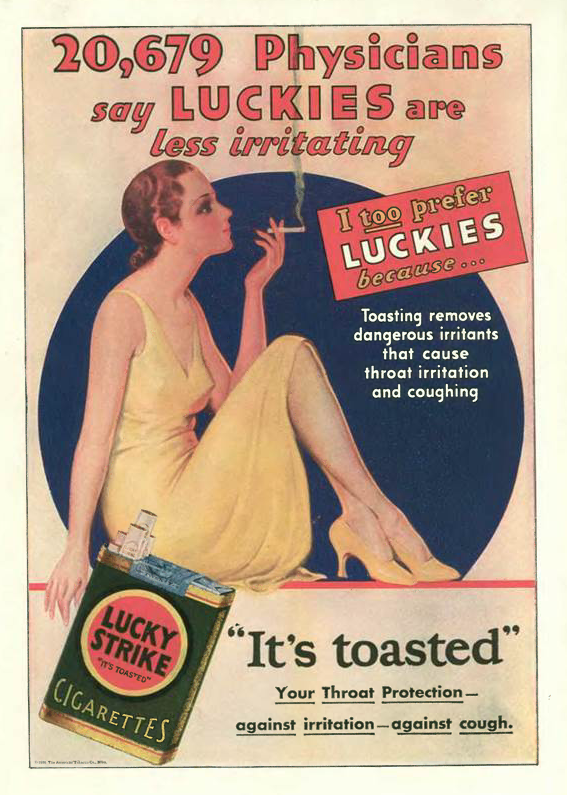
…the makers of Luckies used a combination of sex and bogus health claims to sell their products…

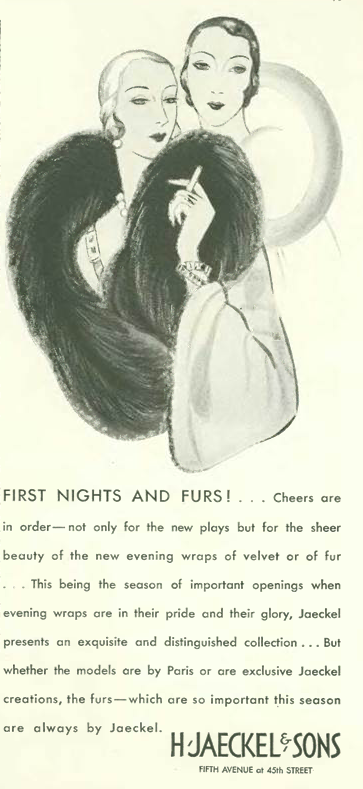
…cigarettes were not confined to ads by tobacco companies; here they are accessories to fine furs…

…even The New Yorker’s spot illustrations (this by Frank McIntosh) featured smokers…

…as did cartoons, such as this one by Barbara Shermund in the Oct. 4 issue…

…and we have one more ad, this one from Chrysler, which acknowledged the new world of the Great Depression, but only through use of careful euphemisms (The New Yorker editorial side practiced much of the same)…

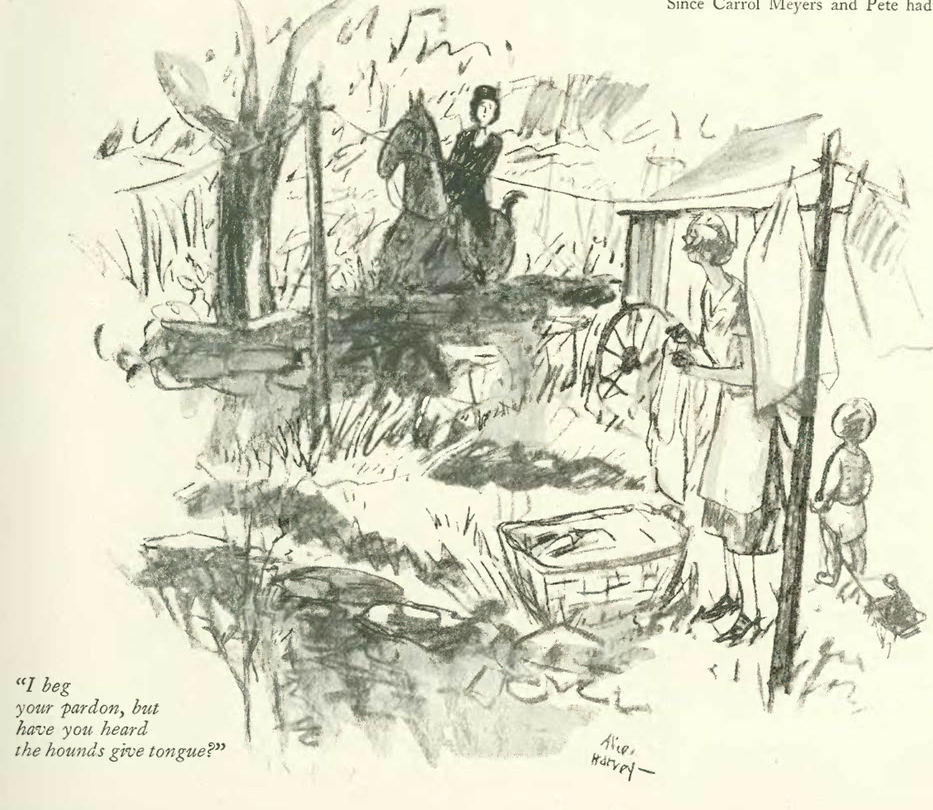
…on to our cartoons, beginning with an exploration of city vs. country life, by Alice Harvey

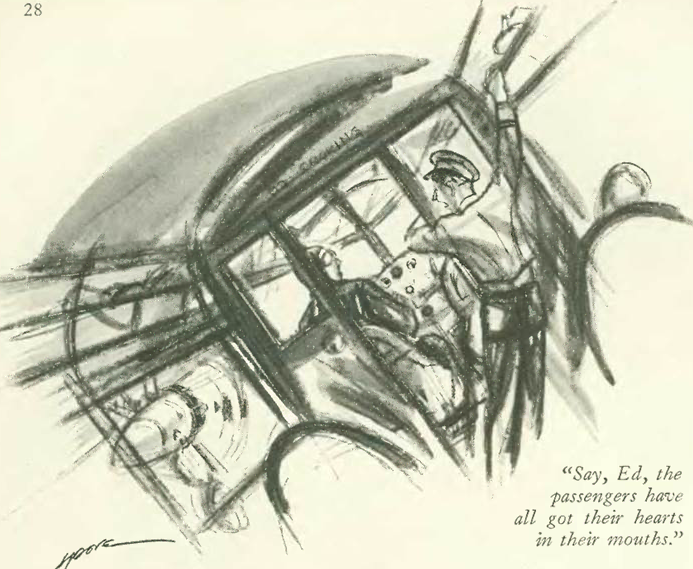
…a depiction of what commuter flying was actually like in 1930, thanks to Leonard Dove

…a glimpse at modern parenting, with Helen Hokinson

…humor in a gentleman’s drawing room, courtesy Peter Arno

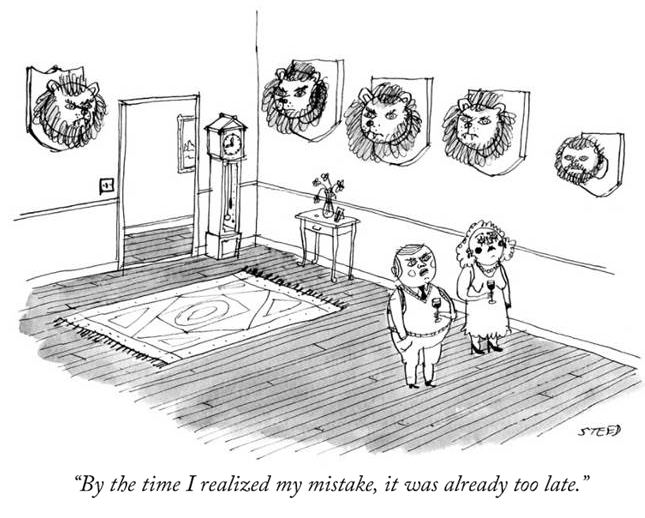
…and 89 years later, a hilarious update on the subject by Edward Steed in the Sept. 9, 2019 issue…

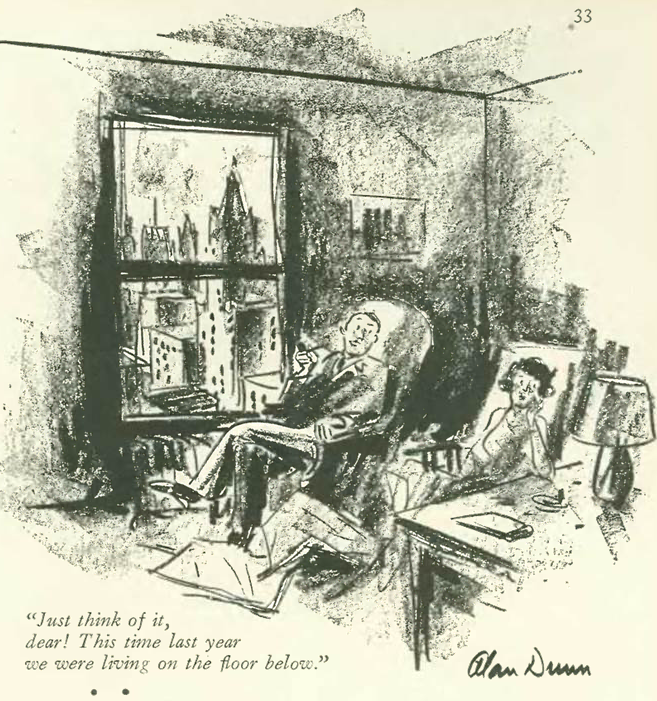
…and finally, the joys of urban life brought to us by Alan Dunn

Next Time: Ghosts of Gotham…

The Flying Misanthrope

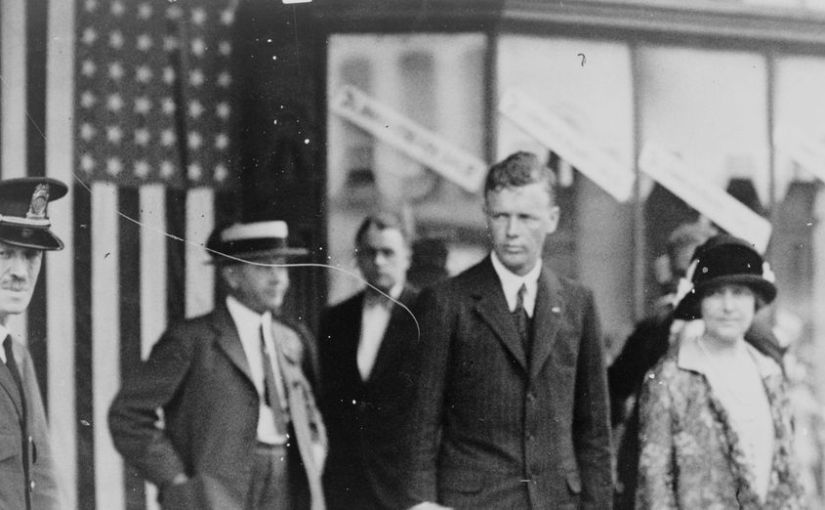
When Charles Lindbergh returned to New York after his solo, history-making transatlantic flight, he was mobbed by thousands of fans and adored by many millions more. The feeling was not mutual.

Sept. 20, 1930 cover by Theodore Haupt.

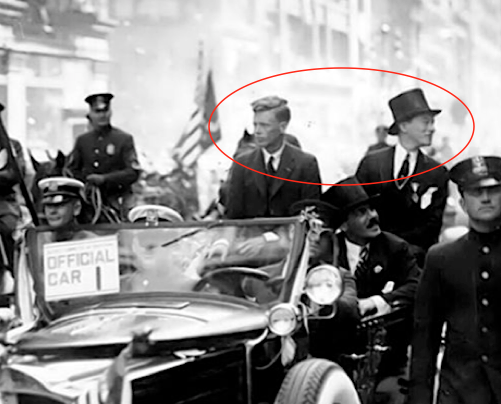
This image from his June 13, 1927 ticker-tape parade says it all, a disinterested, almost hostile-looking Lindbergh contrasted with that crowd-loving dandy, Mayor Jimmy Walker:

Detail of larger photograph. (Associated Press)

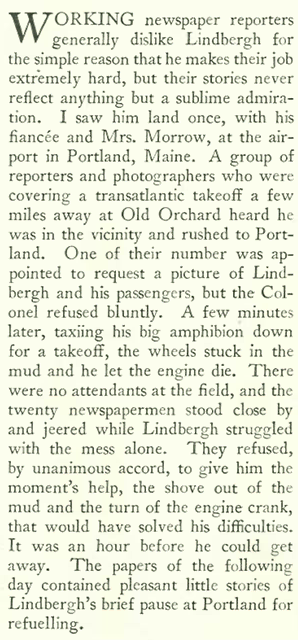
Morris Markey checked in on the famed flyboy three years later in a two-part profile for the New Yorker. Markey observed how Lindbergh had become “sucker-sour,” a phrase that described how someone could suddenly go wild “at the ceaseless procession of staring faces.” I encourage you to read the excerpt below about Lindbergh’s appearance at the 1929 Cleveland Air Races, where in a fit of temper he nearly forced a passenger plane to lose control and crash:

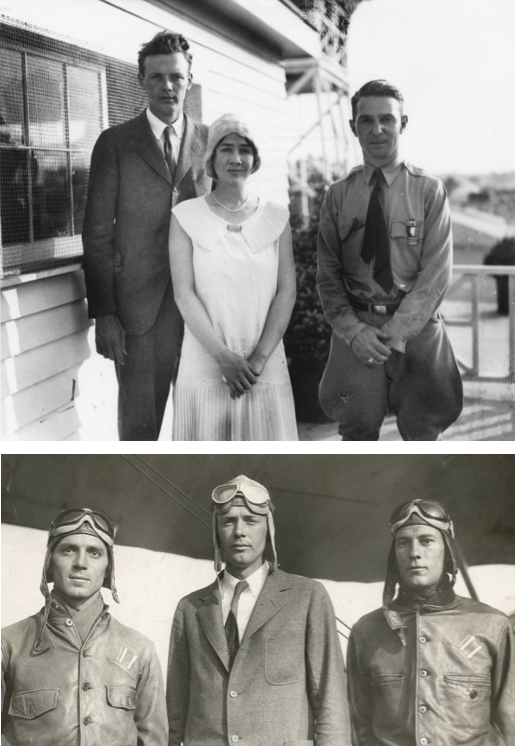
SAY CHEESE…Top photo, Charles and Anne Lindbergh pose with Cliff Henderson at the 1929 Cleveland National Air Races. Henderson was the managing director of the National Air Races and was often described as “the Barnum of aviation.” Below, Lindbergh flanked by Navy flyers Frederick Kivette and Frank O’Beirne at the 1929 air races. (Smithsonian)

Because he was a national hero of nearly saint-like dimensions, newspaper reporters did not dare to report on his antics at the Cleveland Air Races (so far, The New Yorker account is the only one I can find of the incident). Needless to say, he was not popular among members of the fourth estate:

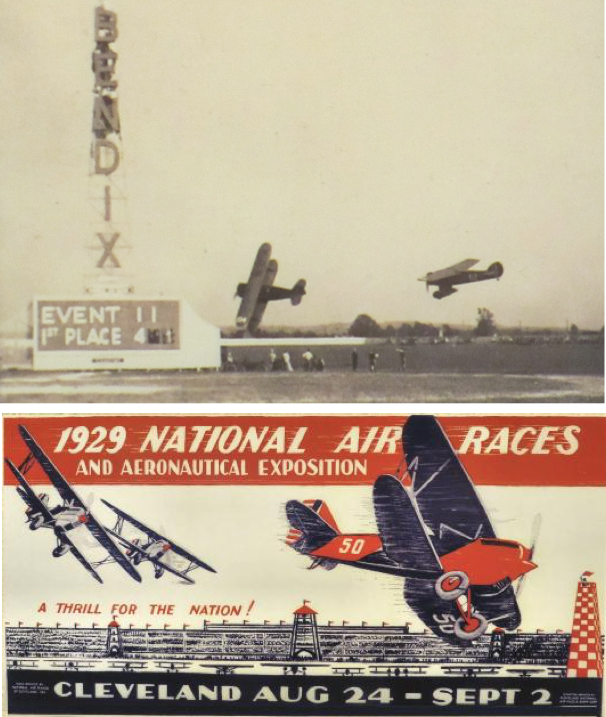
WHAT COULD POSSIBLY GO WRONG?…Fliers raced around a closed course near a crowded grandstand at the 1929 National Air Races in Cleveland. (Western Reserve Historical Society)

 *  *  *

Innocents Abroad

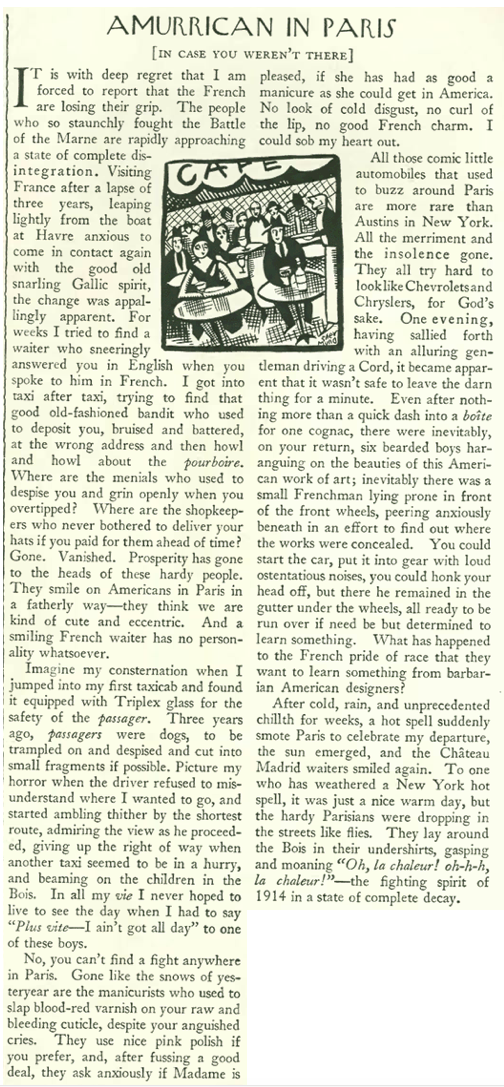
It was a nice surprise to find Lois Long once again writing under her pen name “Lipstick” in this casual piece (excerpted below) on Parisian life. I was also surprised to find the term “Amurrican” in the headline — I always thought it was a more recent derivation of redneck-speak…

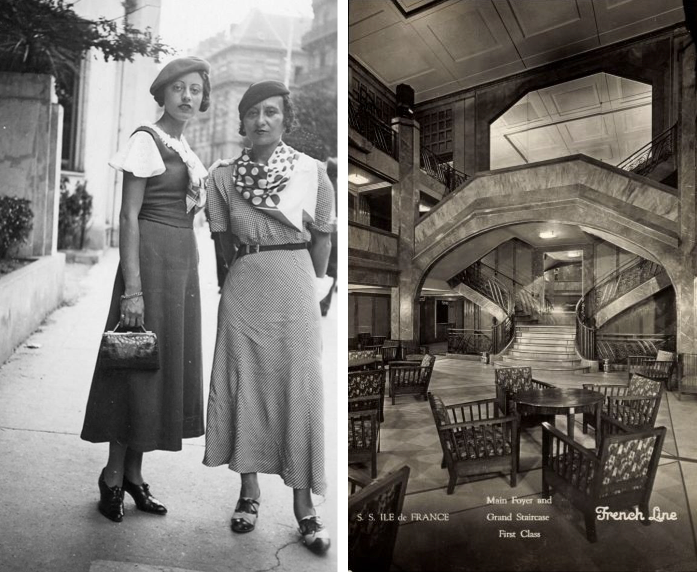
OVER THERE…Left, a fashionable pair on the streets of Paris circa 1930; right, main staircase and grand foyer of the Ile de France. (Pinterest/akpool.co.uk)

 *  *  *

Imbiber in Chief

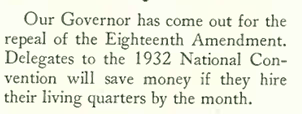
No doubt many a New Yorker enjoyed this bit of news from Howard Brubaker (in his column, “Of All Things”) regarding New York Governor Franklin D. Roosevelt, who later as president would preside over the end of Prohibition.

LEADING BY EXAMPLE…FDR and a gin martini. (Time/Life)

 *  *  *

From Our Advertisers 

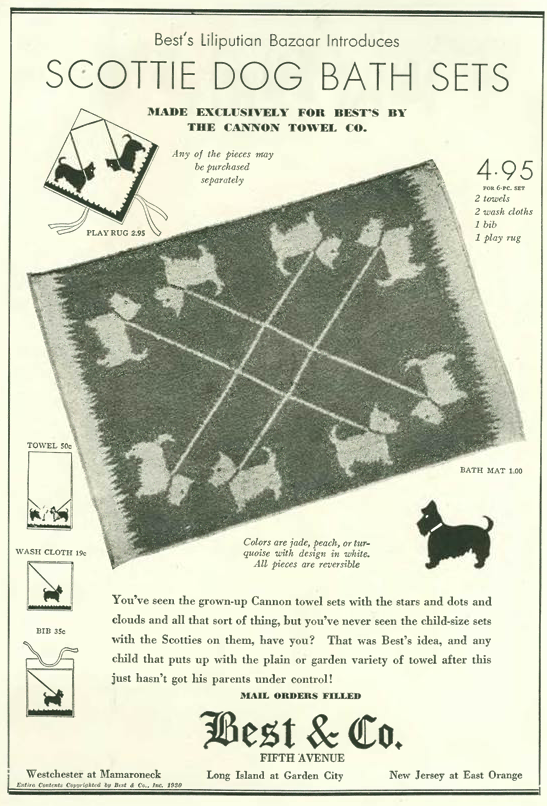
The Scottish Terrier was one of the most popular dog breeds in 1930s America (in addition to martinis, FDR was also fond of Scotties, including his loyal companion Fala), and you could show your love for the breed with bath sets from Best & Company…

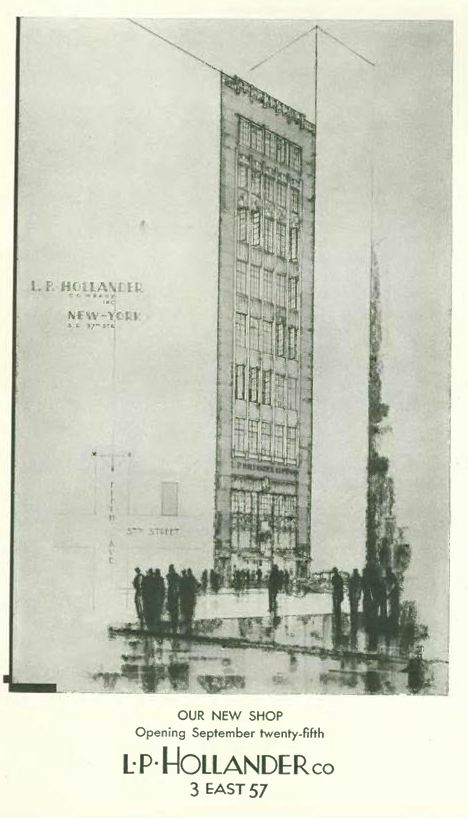
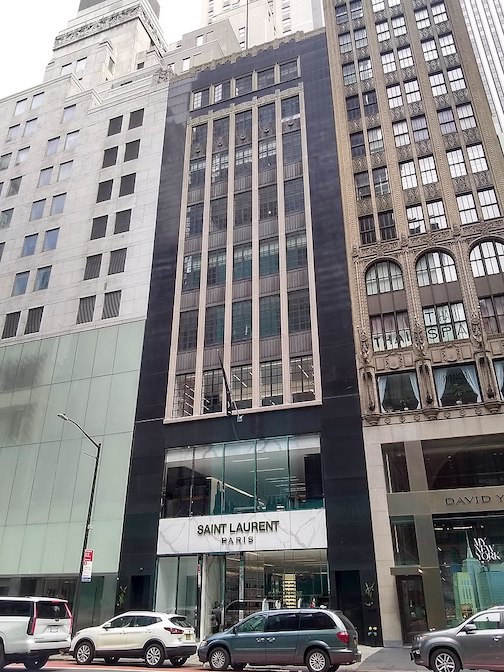
…the handsome L.P. Hollander Company Building (designed by William Lamb) at 3 East 57th began life in 1930 as a women’s fashion boutique…

…and today it serves as the Fifth Avenue home to Yves Saint Laurent…

(Wikipedia)


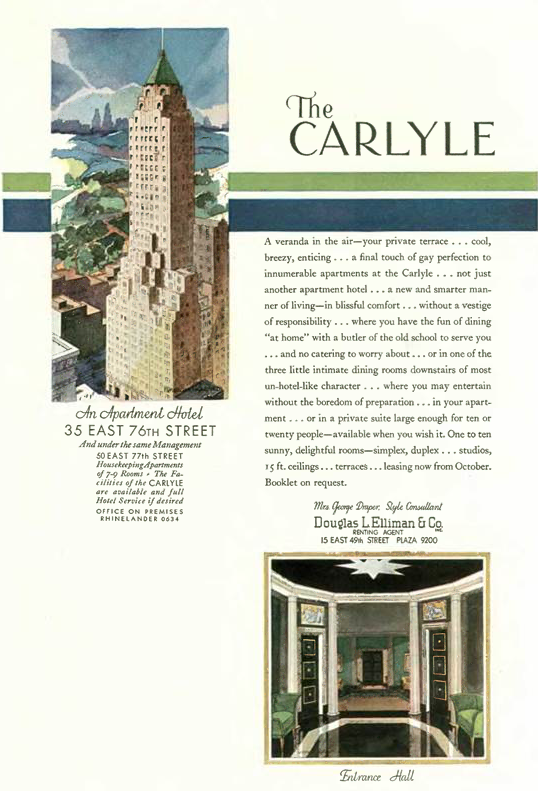
…another exclusive New York destination, the Carlyle, opened as a luxury residential hotel in 1930, only to go into receivership in 1931 thanks to the deepening Depression. In the postwar years it would rise to prominence and become a favorite haunt of the Kennedy family. The Carlyle is also home to the Bemelmans Bar, which is decorated with murals painted by Ludwig Bemelmans depicting his storybook character, Madeline, in Central Park…

…the Carlyle’s cozy Bemelmans Bar…

(TripAdvisor)

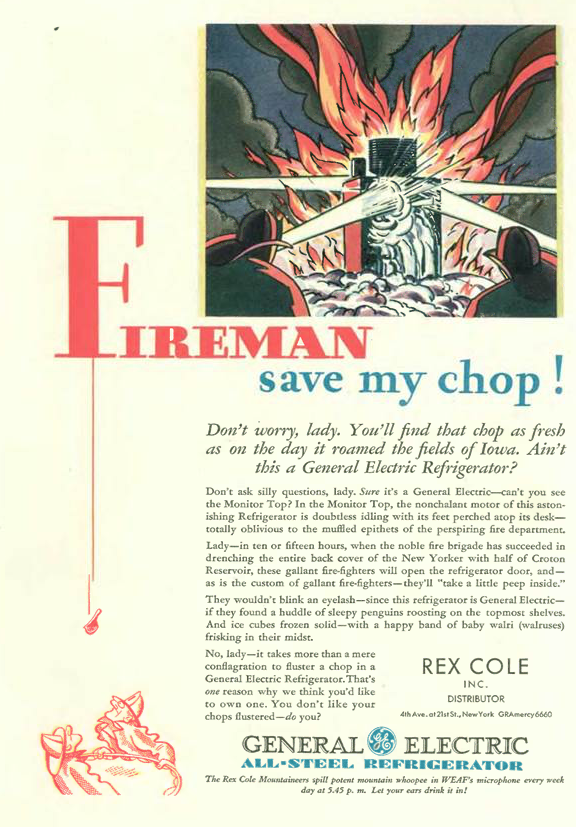
…this next one goes in my terrible ads file…did the makers of this GE refrigerator really want to depict it bursting into flames?…

…it is 1930, and we are at the dawn of the age of plastics, and in this case “Beetleware” tumblers made from an early type of plastic formed from a urea formaldehyde powder developed in England and licensed to American Cyanamid …so bottom’s up!…

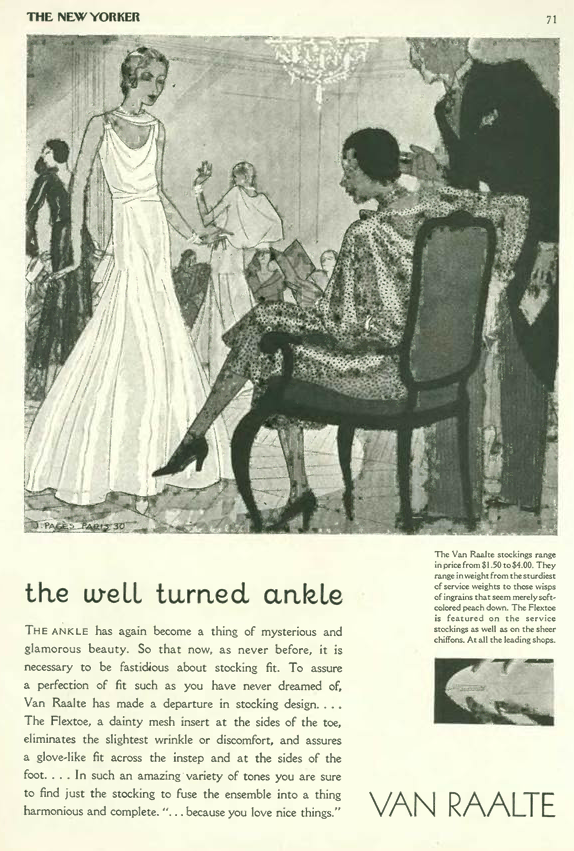
…the makers of Van Raalte stockings hoped to revive the sex appeal of the ankle…

…which provides a good segue to our cartoons, this one by Helen Hokinson, which was actually featured on the page opposite the stocking ad…

Ralph Barton continued his series on the 1930’s…

Alan Dunn took his work to new heights…

Gardner Rea had fun with the garden club set (English-American S. Parkes Cadman was a pioneer Christian radio broadcaster in the 1920s and 30s)…

…while Peter Arno illustrated this cultural exchange on the streets of New York…

…and we end with Leonard Dove, and a walk in the rain…

Next Time: Lights, Camera, Action…


All Quiet on the Western Front

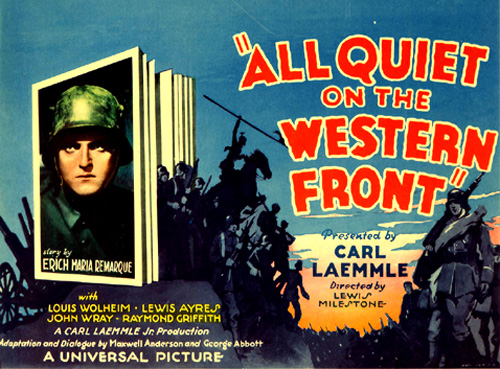
Still considered one of the greatest anti-war films ever made, All Quiet on the Western Front opened in New York on April 29, 1930 to strong reviews. Based on Erich Maria Remarque’s novel of the same name, the film’s depictions of the horrors of war were so realistic and harrowing that it was banned in a number of countries outside of the U.S.

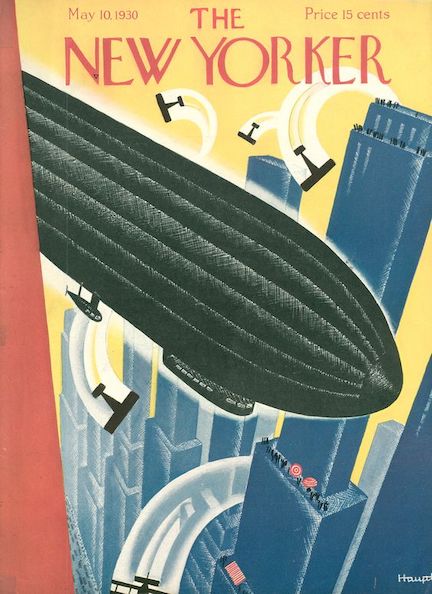
May 10, 1930 cover by Theodore Haupt.

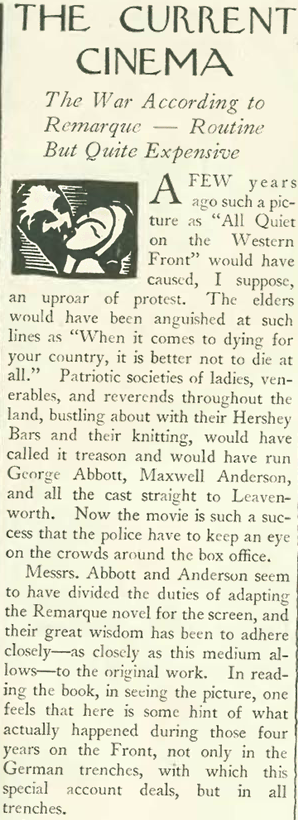
Banned, that is, by nations gearing up for war. In Germany, Nazi brownshirts disrupted viewings during its brief run in that country, tossing smoke bombs into cinemas among other acts of mayhem. Back in the U.S., The New Yorker’s John Mosher attended a screening at a “packed” Central Theatre:

WAR IS HELL…Clockwise, from top left, movie poster for 1930’s All Quiet on the Western Front; German soldier Paul Bäumer (Lew Ayres), falls into a shell crater with a French soldier and draws his knife; in one of the most moving scenes in cinema, Bäumer is forced to spend the night in the crater, where he vainly tries to safe the life of the Frenchman he has mortally wounded; a German soldier crawls through the mud in a German training camp. (IMDB/Universal).

Mosher found the film’s adaption from the novel wanting in places, but overall praised the acting and the quality of the picture…

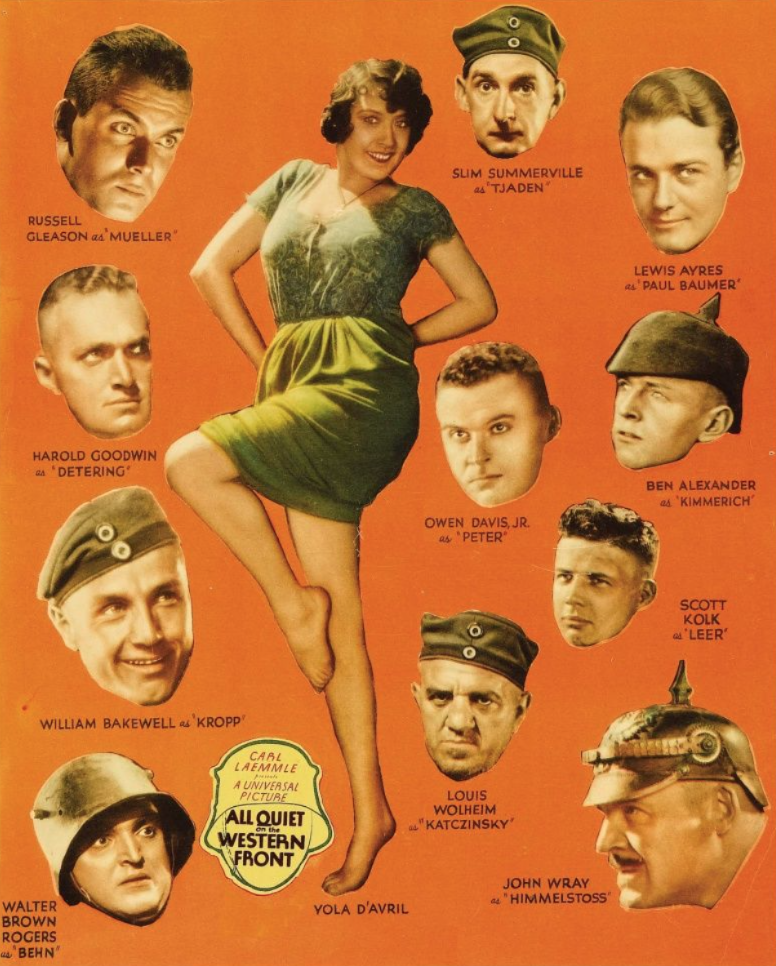
…and just in case some audiences were put off by the blood and guts, Universal promoted other themes on its lobby cards…

(IMDB)

 *  *  *

More Than a Stunt

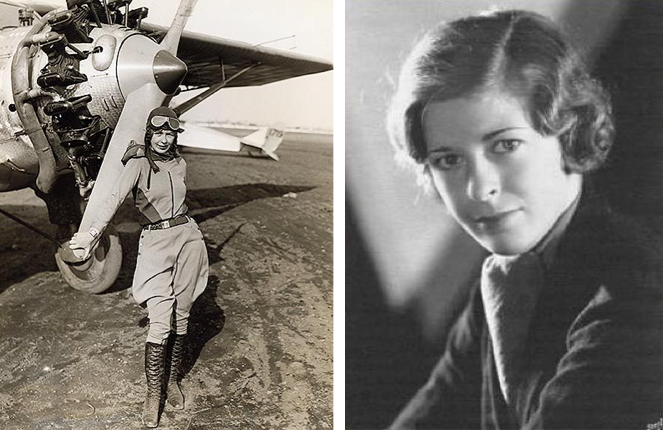
In her profile of aviator Elinor Smith (1911-2010), writer Helena Huntington Smith took great pains to distinguish Elinor from other “lady fliers” who were little more than passengers in various flying exploits. Like Amelia Earhart, Smith had the bona fides of a true aviator: in 1927 she become the youngest licensed pilot in the world at age 16, learning stunt flying at an early age. When she was 17 she smashed the women’s flying endurance record by soloing 26½ hours, and in the following month set a woman’s world speed record of 190.8 miles per hour. In March 1930 she set a women’s world altitude record of 27,419 feet (8,357 m), breaking that record in 1931 with a flight reaching 32,576 feet. Smith would continue to fly well into old age. In 2000 she flew NASA’s Space Shuttle vertical motion simulator and became the oldest pilot to succeed in a simulated shuttle landing. In 2001 (at age 89) she would pilot an experimental flight at Langley AFB. An excerpt from the profile:

HEAD IN THE CLOUDS…Elinor Smith’s flying career would extend from age 16 and into her 90s. At left, Smith poses in Long Island with the Bellanca monoplane she used to beat the solo flight record in 1929. Right, portrait of Smith circa 1930s. (findagrave.com)

 *  *  *

I’d Rather Be in Philadelphia

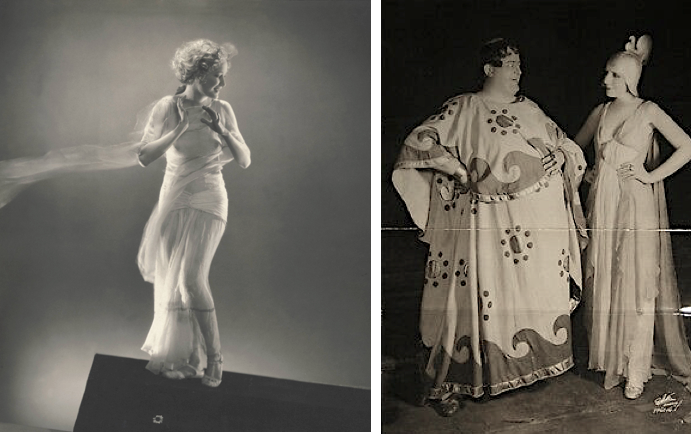
Theatre critic Robert Benchley was over the moon regarding a performance of Lysistrata staged by the Philadelphia Theatre Association. Benchley suggested the Philadelphians had “put New York to shame” in staging such a “festival of beauty and bawdiness…never seen on an American stage before.”

NO MORE HANKY PANKY…Left, actress Miriam Hopkins in Aristophanes’ Lysistrata, as photographed by Edward Steichen; at right, Sydney Greenstreet with unidentified actress from the 1930 Philadelphia production of Lysistrata. (timeline.com)

Benchley praised the seemingly advanced tastes of Philadelphia audiences as he continued to the lament the fact that the City of Brotherly Love had beaten New York to the punch with the staging of the play. He needn’t have worried much longer; the play would open on Broadway on June 5, 1930, at the 44th Street Theatre.

LOVER COME BACK…Production photograph for Norman-Bel Geddes’s staging for Lysistrata, titled “the women of Greece return to their men.” (hrc.utexas.edu)

While we are on the subject of theater, Constantin Alajálov provided this lovely illustration of Anton Chekhov’s Uncle Vanya for The New Yorker’s theater review section…

 *  *  *

Make ‘Em Dance, Boys

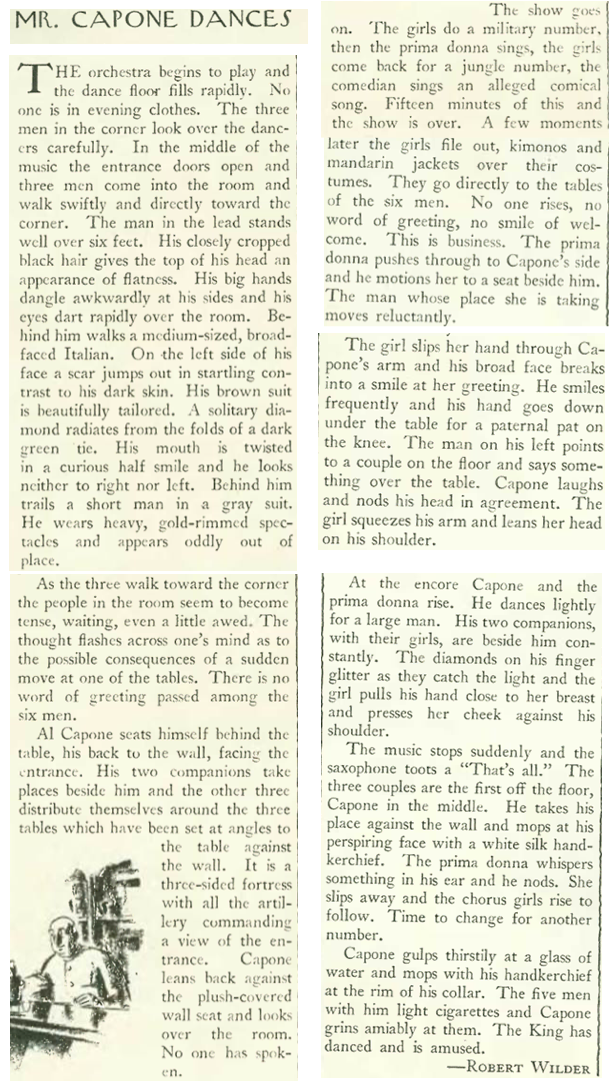
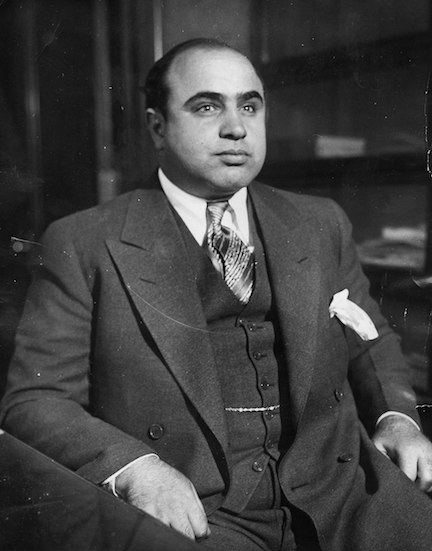
The author Robert Wilder contributed this interesting casual about the appearance of gangster Al Capone at a Chicago nightclub. Excerpts:

LIGHT ON HIS FEET…Al Capone in 1930. (Wikipedia)

 *  *  *

You Say You Want a Revolution?

Alva Johnston offered his thoughts on how America could stage its own “Red Revolution,” given that Russia and several European countries had already experienced communist uprisings of their own, and also given that New York Police Commissioner Grover Whalen, always in search of problems that didn’t exist, had announced a new “Red Scare” in his fight against communism.

Tongue firmly in cheek, Johnston suggested how American know-how could be brought to bear in inciting a Red Terror. An excerpt:

YANKEE INGENUITY…Alva Johnston, left, offered some innovative ideas for a uniquely American “Red Revolution.” At right, soldiers stand behind a barricade during Germany’s communist Spartacist uprising of January 1919. (Wikipedia)

 *  *  *

Speaking of Revolutionaries

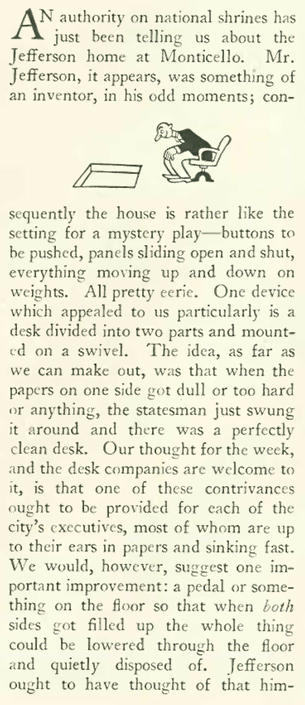
Thomas Jefferson’s home at Monticello is one of America’s most-visited historical sites, but in 1930 it was still something of a regional curiosity, having only been acquired in 1923 for the purposes of turning it into a public museum. Although Jefferson is well known today for his various inventions at Monticello, E.B. White was just learning about this side of the president in his weekly “Notes and Comment” dispatch:

THIS OLD HOUSE…Left, a combination of neglect and Civil War vandalism left Thomas Jefferson’s Monticello enmeshed in weeds and in a state of near collapse by the 1870s. At right, students of the University of Virginia pose outside Monticello in 1930. (UVA/Hulton Archive)

 *  *  *

Play Ball?

We are well into the spring of 1930, yet The New Yorker stood firm in its complete lack of baseball coverage. As I’ve noted before, the magazine covered virtually every sport from horse racing to rowing to badminton, and even lowered itself to regular features on college football and professional hockey, but not a line on baseball, save for an occasional note about the antics of Babe Ruth or the homespun goodness of Lou Gehrig. There were signs, however, that baseball was being played in a city blessed with three major league teams; we do find game times in the “Goings On About Town” section, as well as occasional baseball-themed filler art, and a comic panel in the May 10 issue by Leonard Dove:

From Our Advertisers

We begin with an endorsement for Chase & Sanborn coffee by the soprano Alma Gluck, wife of famed violinist and composer Efrem Zimbalist Sr. Originally I thought she was enjoying coffee with a sister in law named “Mrs. Zimbalist,” but as reader Frank Wilhoit astutely points out, the “Alma Gluck” (celebrity) and “Mrs. Zimbalist” (housewife) are alternate personae of the same individual. And now that I look at the ad again, the clothes and hair styles are identical. I will try to locate a clearer image of the ad…

…and from the makers of White Rock we have a group of swells and their airborne friends enjoying some bubbles that are doubtless mixed with illegal hootch…

Dr. Seuss continued to offer his artistry on behalf of Flit insecticide…

…and on to our cartoons, Peter Arno illustrated the hazards of the road…

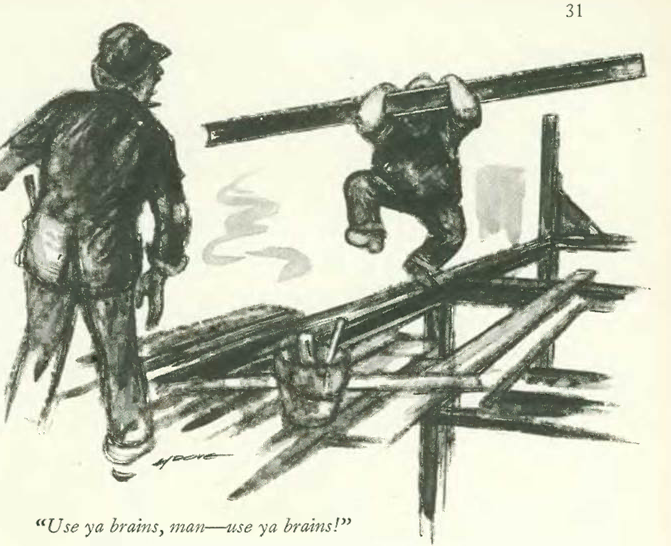
…while Leonard Dove explored the hazards high above the streets of Manhattan…

Constantin Alajálov explored an odd encounter in a park…

Isadore Klein mused on the tricks of mass transit…

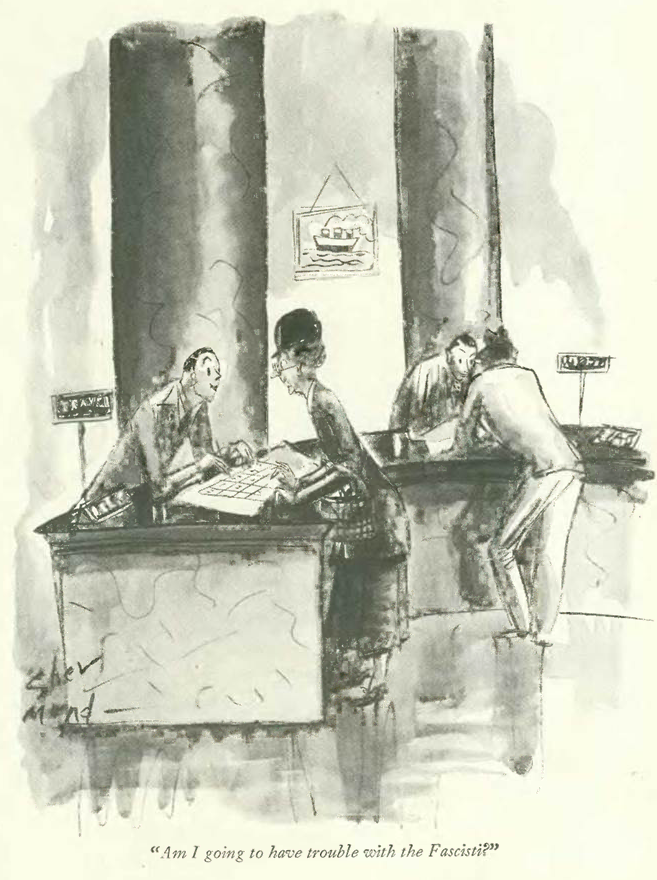
…and two from Barbara Shermund, who looked in on one tourist’s plans for a trip to Mussolini’s Italy…

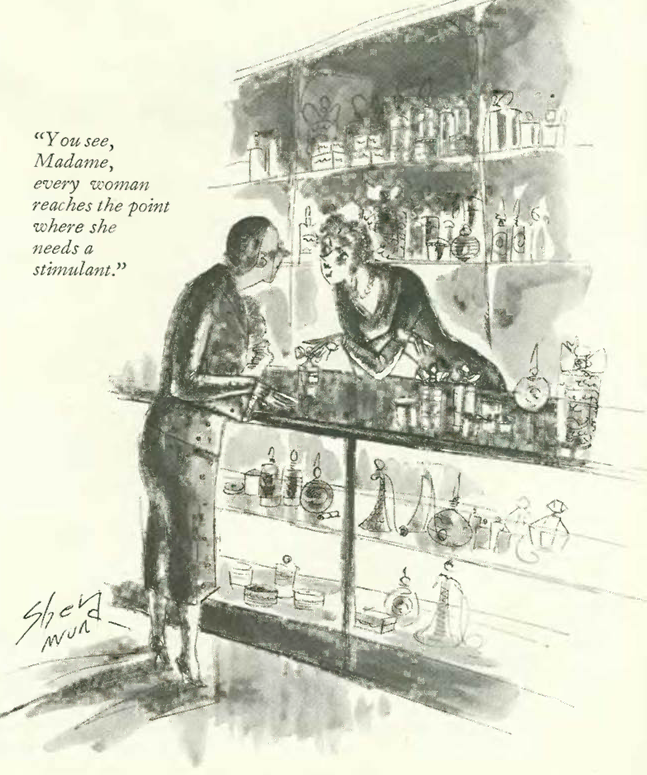
…and some helpful advice at a perfume counter…

Next Time: Red Alert…