Dorothy Parker turned her jaded eye to the latest big thing — talking pictures — and in the Sept. 1, 1928 issue she joined her New Yorker colleagues in a collective yawn at the technology that was dramatically transforming cinema.
Sept. 1, 1928 cover by Helen Hokinson.
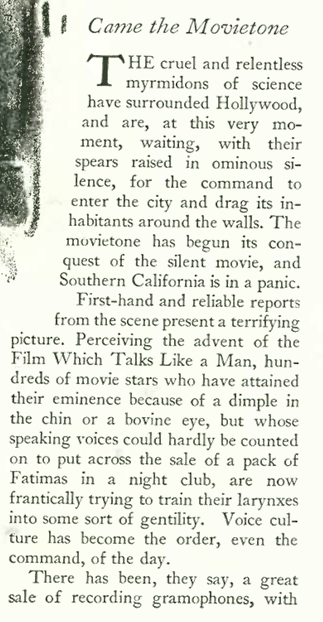
In a feature titled “Out of the Silence,” Parker mused about the changes facing former silent stars…
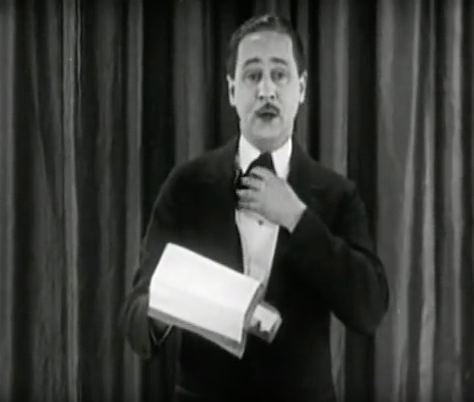
…and seemed unconvinced that the talking pictures, at least to date, were any real improvement over the silents, including a performance by her Algonquin Round Table pal and New Yorker colleague Robert Benchley, who seemed but a talking simulacrum:
HIS SCREEN VERSION…Robert Benchley delivers his comedy sketch The Treasurer’s Report in a short 1928 Movietone film. Benchley portrayed a nervous assistant treasurer struggling to present an organization’s yearly report. (YouTube screen shot)
Parker attended a matinee at a jam-packed Warner Theatre, where folks paid a dollar apiece for standing room only to witness a series of shorts and a feature-length film, all presented with sound:
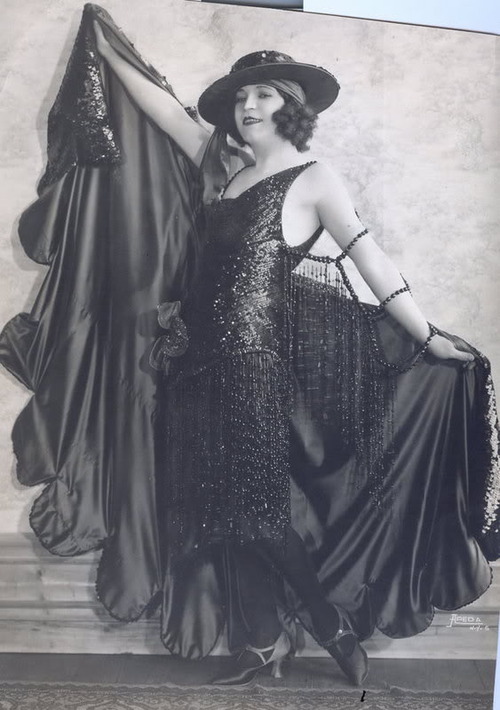
One of the shorts featured a performance by female impersonator George Francis Peduzzi, known professionally as Karyl Norman, “The Creole Fashion Plate,” followed by a performance from violinist Albert Spaulding:
WHAT A DRAG…Dorothy Parker was underwhelmed by Karyl Norman’s performance in a Vitaphone short. He is pictured here in a 1924 publicity photo, dressed as “The Creole Fashion Plate.” (queermusicheritage.com)
What Parker was subjecting herself to was the Vitaphone Varieties, described by North Carolina Museum of Art film curator Laura Boyes as “the last gasps of vaudeville.”
Boyes writes that many vaudevillians stepped off the stage to immortalize their acts on film in the early days of the talkies. They were produced in Brooklyn between 1927 and 1929 using the Vitaphone method (large recorded discs synchronized with the film) “at a time when the major studios hoped that the talkies were just a passing fad.” She notes that “talkies would eventually put this style of theater completely out of business, and Vitaphone shorts literally became the place where Vaudeville went to die. Many of the people in these short films were obscure at the time, and they are doubly obscure now.”
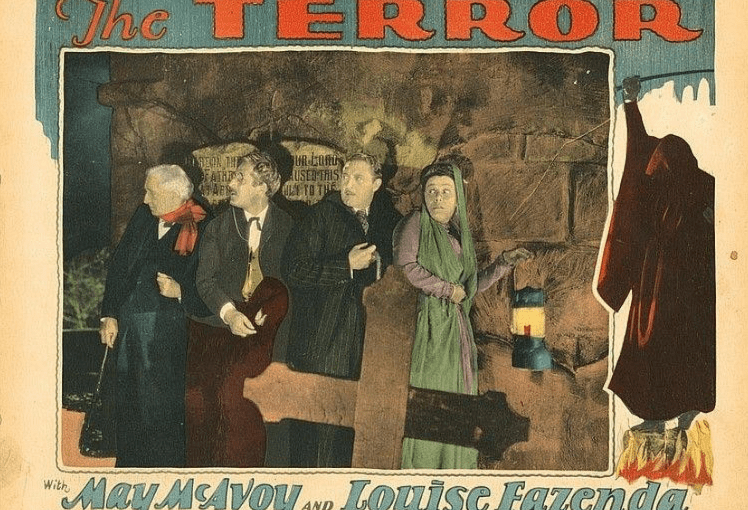
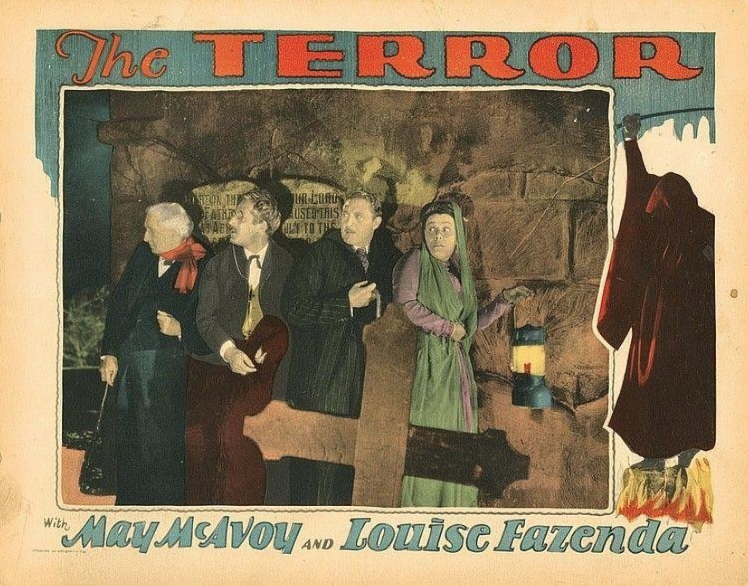
As for the main feature, The Terror, the only terror Parker felt was the fear of being bored to death:
SOUND AND FURY, SIGNIFYING NOTHING…Dorothy Parker found The Terror to be unexciting, its sound effects a “racket.” But for the record, it was the first all-talking horror film. (IMDB)
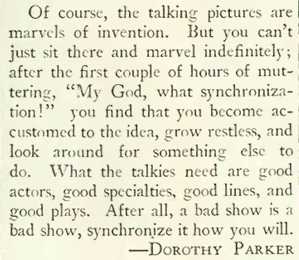
Parker concluded that “talking pictures are marvels of invention,” but “a bad show is a bad show, synchronize it how you will.”
Coming of Age in Samoa
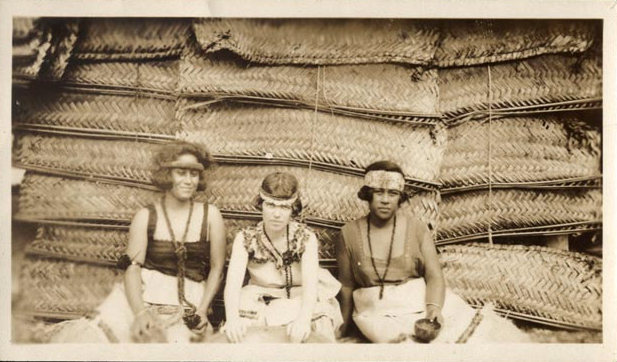
Social critic and humorist Baird Leonard took the honors as book reviewer for the Sept. 1 issue, offering a brief, humorous endorsement of Margaret Mead’s landmark Coming of Age in Samoa, in which the famed anthropologist explored the link between culture and psychosexual development among the island’s adolescents. Leonard found much to like about the book, and particularly Mead’s observations on the separation of youth from adult activities in Samoan culture (it would enhance his bridge-playing enjoyment):
GOING NATIVE…Margaret Mead sitting between two Samoan girls, ca. 1926. (Library of Congress).
* * *
Writer Cameron Rogers profiled American sculptor Paul Manship, who was an important contributor to Art Deco style, and is perhaps best known for his iconic Prometheus sculpture at Rockefeller Center in New York. Rogers made these closing observations about Manship, noting that the artist’s success netted him about $60,000 a year — close to $850,000 today (These days, someone like showman/artist Jeff Koons, who makes giant shiny balloon animal sculptures, among other things, has a net worth of at least $100 million).
PROMETHEUS, gilded cast bronze by Paul Manship, 1934, at Rockefeller Center. (Encyclopedia Britannica)
* * *
From Our Advertisers
I find it interesting when one magazine advertises in another, especially when an older magazine like the Outlook (founded in 1893) advertises in an upstart like The New Yorker. But then again, the publishers of the Outlook were looking to breathe new life into their stodgy journal, and what better way than to announce that their “conservative girl” was now a modern, grown-up woman with a new Jazz Age look and an attitude to match. And it was no coincidence that they hired The New Yorker’s Rea Irvin to illustrate their point.
OUTLOOK magazine was first published as The Christian Union in 1870, changing its name to Outlook in 1893 when it shifted its focus from religious subjects to social and political issues. The magazine folded in 1935. (Pinterest)
* * *
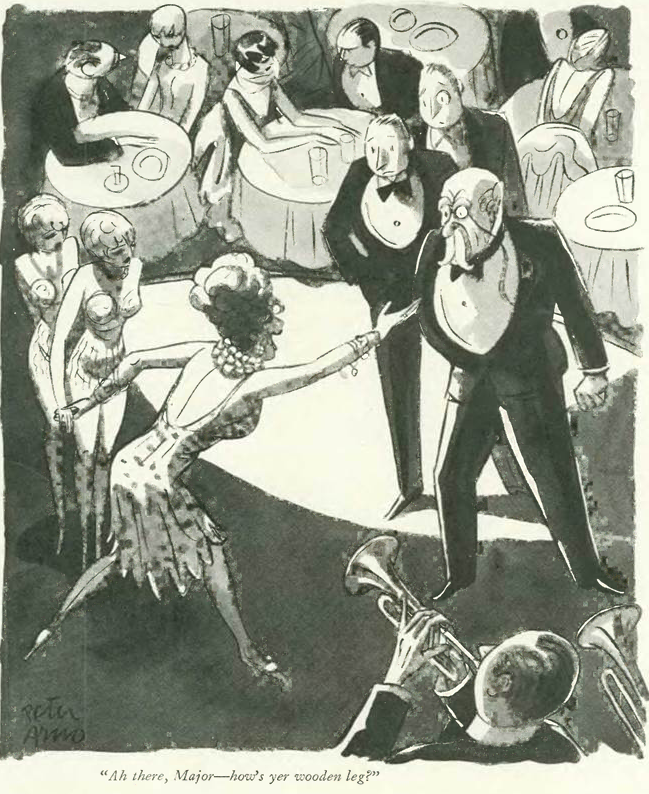
Our cartoon is by Peter Arno, who continued to explore the lighter moments of New York night life…
NINETY YEARS AGO, when former Chicago reporters Ben Hecht and Charles MacArthur sat down to write The Front Page, they might have sensed they had a Broadway hit in the making, but probably had no idea their play would still grace a Broadway stage well into the 21st century.
August 25, 1928 cover by Leonard Dove.
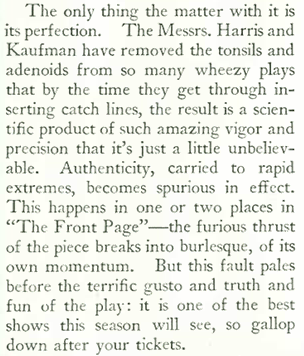
The Front Page made a big splash on the Great White Way when it premiered on August 14, 1928 at Times Square Theatre. Featuring a story about tabloid newspaper reporters on the police beat, the play’s wisecracking, rapid-fire dialogue (which would become a staple of Hollywood’s screwball comedies), was a big hit with audiences, and with E.B. White, who reviewed the play in the Aug. 25, 1928 New Yorker:
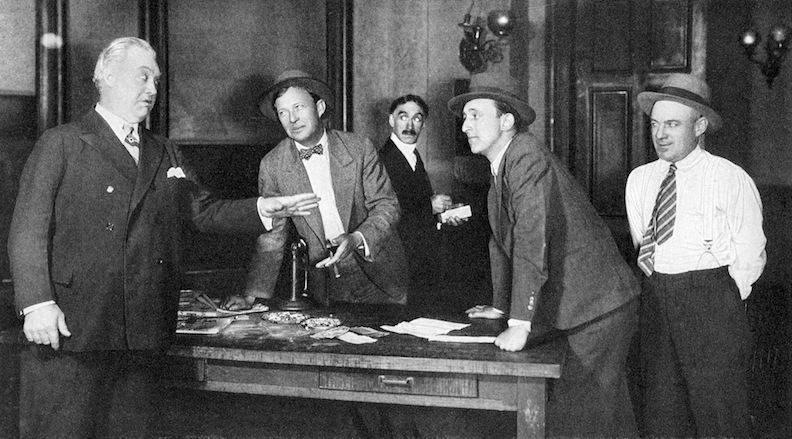
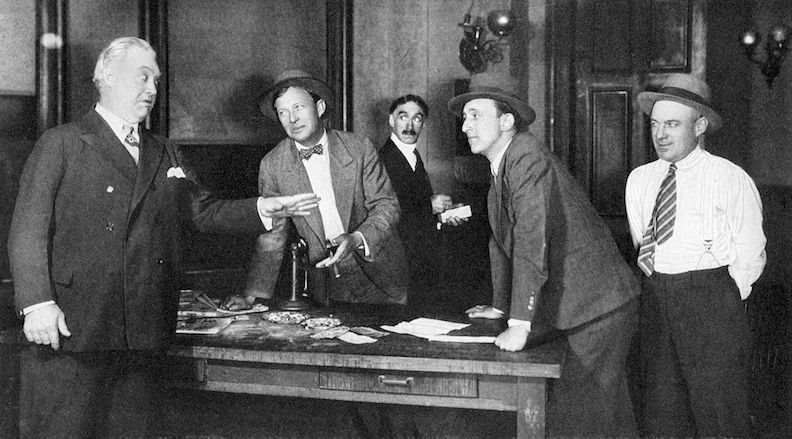
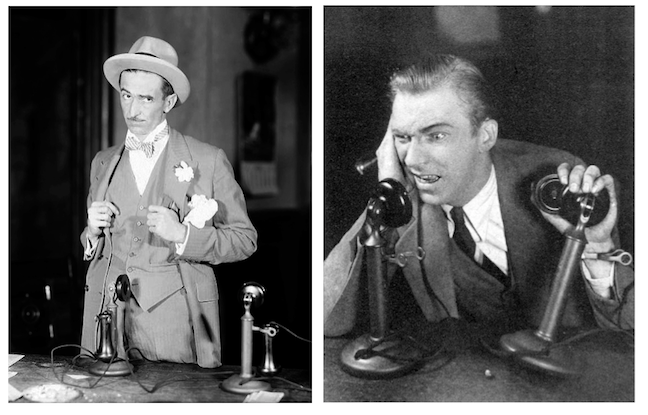
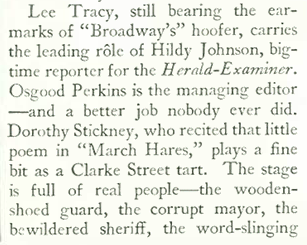
DREAM TEAM…The Front Page was written by former Chicago reporters Ben Hecht (left) and Charles MacArthur (center) and produced by Jed Harris (at right, in a 1928 photo used on the cover of Time magazine). Hecht, an occasional New Yorker contributor, would go on to a successful career as a screenwriter, director, producer and playwright. Like Hecht, screenwriter/playwright MacArthur was friends with members of the Algonquin Round Table. He was married to actress Helen Hayes, with whom he adopted a son, James MacArthur (“Danno” on TV’s Hawaii 5-0). Harris was responsible for some of Broadway’s most successful productions in the ’20s and ’30s including Uncle Vanya, Our Town and The Crucible. (IMDB, Kentucky Digital Library, Time)TROUBLE IN WINDY CITY…Set entirely in a dingy press room of Chicago’s Criminal Courts Building, The Front Page featured reporters who passed the time playing poker and exchanging wisecracks—until a convicted killer escapes jail and makes things lively. Worried about his chances for re-election, the crooked Mayor, played by George Barbier, far left, confronts three reporters — Murphy (Willard Robertson), Endicott (Allen Jenkins), and McCue (William Foran). In the background is Claude Cooper, as the crooked Sheriff Hartman. (Theatre Magazine, August 1928)
White was so taken by the play, in fact, that he found it to be nearly perfect, like a scientific instrument of exacting precision. And considering how many times the play has been adapted to stage and screen (most recently on Broadway in 2016), he was probably right. It still plays pretty well after all these years:
WISE GUYS…Promotional photographs of Osgood Perkins as Walter Burns (left) and Lee Tracy as Hildy Johnson in the 1928 Broadway production of The Front Page. (Theatre Magazine, August 1928)
ENTER, STAGE RIGHT…Escaped prisoner Earl Williams (George Leach) surprises reporter Hildy Johnson (Lee Tracy) in The Front Page. (Theatre Magazine, August 1928)
The play was restaged four more times on Broadway — 1946, 1969, 1986 and 2016 — the 2016 production starred Nathan Lane as Walter Burns, John Slattery as Hildy Johnson and John Goodman as Sheriff Hartman. Film adaptions included The Front Page in 1931 and His Girl Friday (directed by Howard Hawks) in 1940 — the latter added a twist to the play by changing the Hildy character to a woman, played by Rosalind Russell as the ex-wife of Walter Burns (Cary Grant). The play returned to the big screen in 1974 as The Front Page, directed by Billy Wilder and starring Jack Lemmon as Hildy and Walter Matthau as Walter Burns.
Still Some Fight Left in Him
Although boxer Gene Tunney had retired from the ring, he was still making headlines fighting off a different foe: the paparazzi.
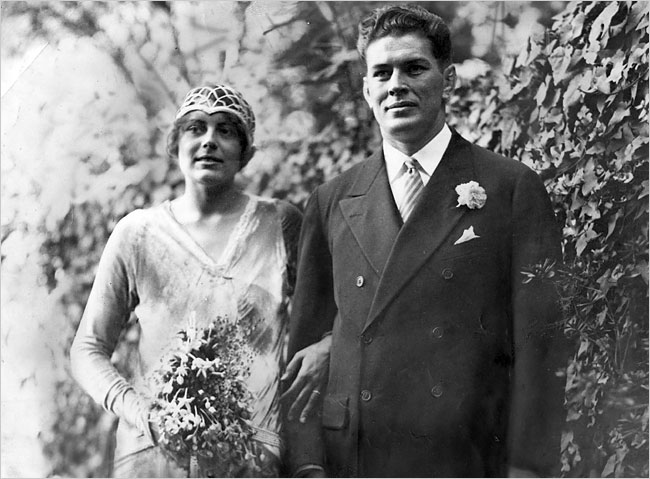
Tunney’s engagement to Connecticut socialite and Carnegie heiress Polly Lauder was front-page news across the country, and photographers were eager to capture a photo of the couple, who up until the announcement had enjoyed a mostly secret romance. “The Talk of the Town” described the couple’s attempts to elude a persistent press:
MAYBE IT’S QUIETER OVER HERE…21-year-old Polly Lauder Tunney and 31-year-old Gene Tunney after marrying in Rome on Oct. 3, 1928. The marriage would last 50 years. (Wikipedia)
In September 1928 the couple took separate trips to Rome and married in a small ceremony on Oct. 3. Unfortunately, they attracted the attentions of Rome’s original paparazzi: According to The New York Times “the scene after the wedding looked mighty like a riot as clothes were torn and cameras smashed in a melee of photographers jostling to capture images of the couple.”
After traveling in Europe they returned to the U.S. and made their home in North Stamford, Connecticut, where they restored an 18th century farmhouse and raised Hereford cattle and sheep. They would be married 50 years until Tunney’s death at age 81 in 1978. Polly continued to live at her home in Stamford until her death in 2008 at age 100.
* * *
Dorothy Recuperates
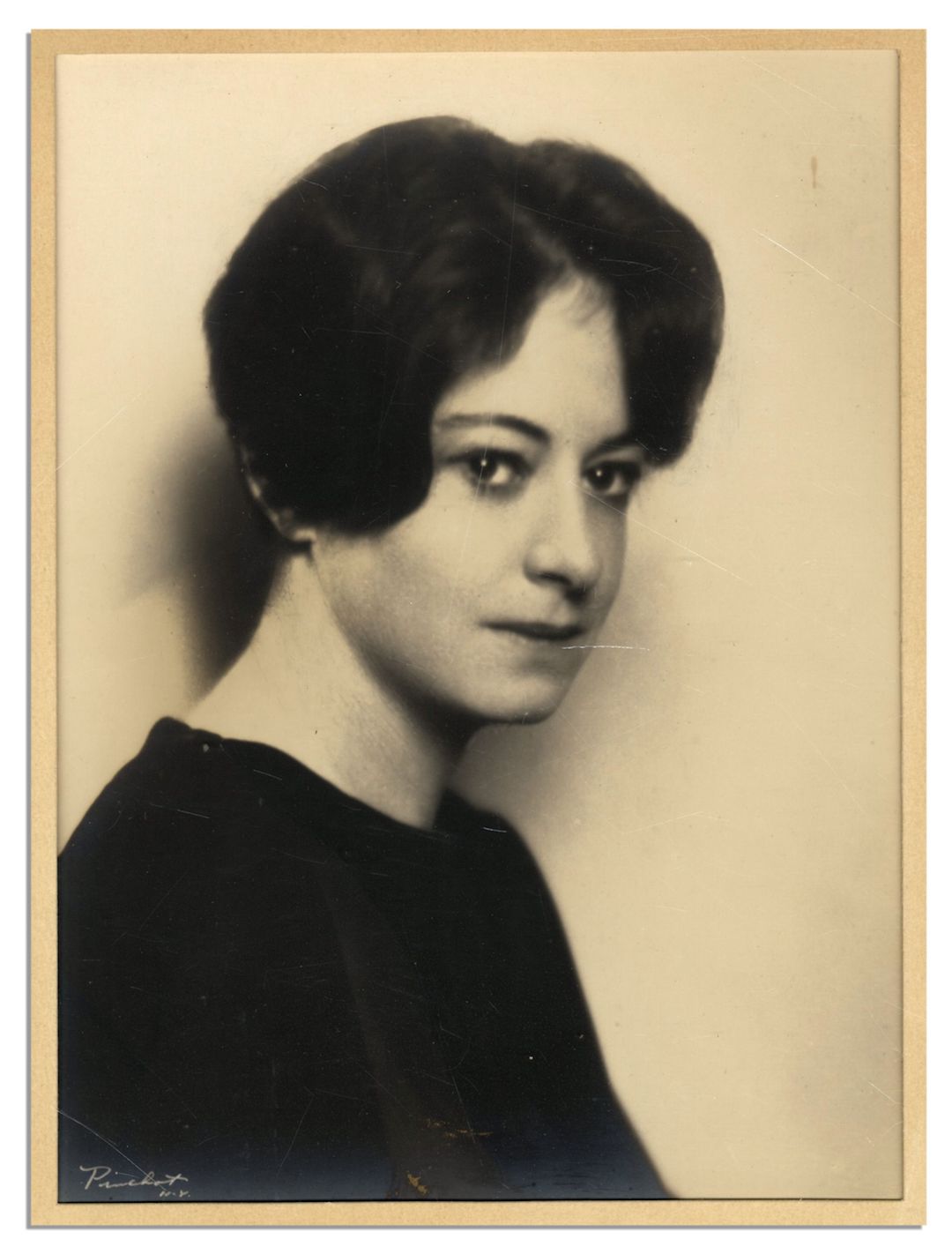
Dorothy Parker’s “Constant Reader” signature at the end of the book review section was absent during part of the summer of 1928 as she was recuperating from an appendectomy. Fortunately her rapier wit remained intact when she returned in the Aug. 25 issue…
Dorothy Parker in 1928 (natedsanders.com)
…where she found the strength to skewer The Lion Tamer, the latest novel by romance writer E.M. Hull:
I’D RATHER BE IN SURGERY…E.M. Hull’sThe Lion Tamer. Dodd, Mead and Co. 1928. (yesterdaysgallery.com)
* * *
Long Before Starbucks
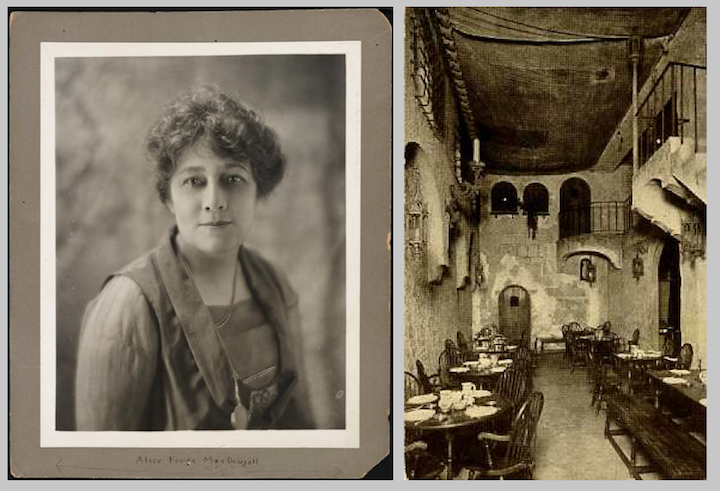
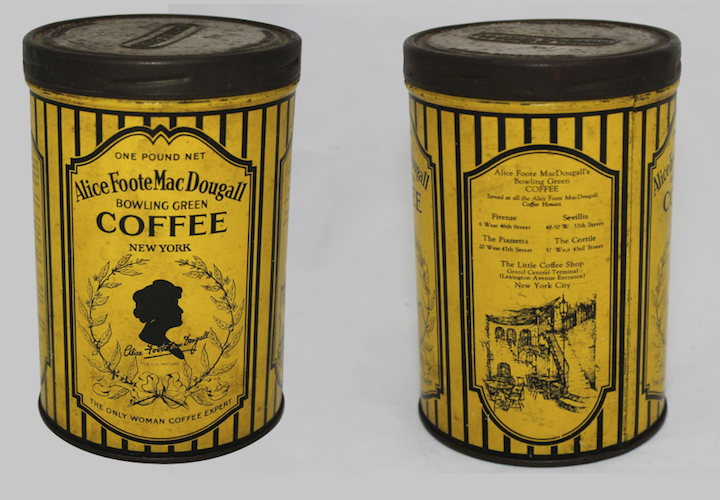
If you were a New Yorker in the 1920s, this cartoon by Rea Irvin would make perfect sense, because nearly everyone knew that Alice Foote MacDougall was the queen of New York’s coffee scene, a one-woman Starbucks of her day.
According to Jan Whitaker, writing for the blog Restaurant-ing Through History, MacDougall kept a carefully crafted persona. In numerous magazine stories crafted by her publicity agent, “she was widely known as the poor widow with three children who built a coffee wholesaling and restaurant empire on $38.”
MacDougall was actually from a distinguished New York City family, and her coffee wholesaling career began in 1909 after her husband’s death. Whitaker writes: “In the 1920s she was said to be the only woman expert in coffee grading and blending in the U.S. She opened her first eating place, The Little Coffee Shop, in Grand Central Station in New York in December 1919. Waffles were the specialty in her homey café which was decorated with a plate rail and shelves holding decorative china. (Evidently tips were good, because MacDougall had the nerve to charge her waitresses $10 a day to work there.) By 1927 she had signed a $1 million lease for her fifth coffee house, Sevillia, at West Fifty-seventh Street. Her places became known for their Italian-Spanish scene setting. The reason, she said, was that it provided a way to disguise long, narrow spaces.”
BEANS TO RICHES…Alice Foote MacDougall, ca. 1910. At right, Sevillia, at West Fifty-seventh Street, in the late 1920s. (restaurant-ingthroughhistory.com)TIN GOLD…Canisters of Alice Foote MacDougall’s famed coffee, ca. 1927. (ruby lane.com)
* * *
The Friendly Skies
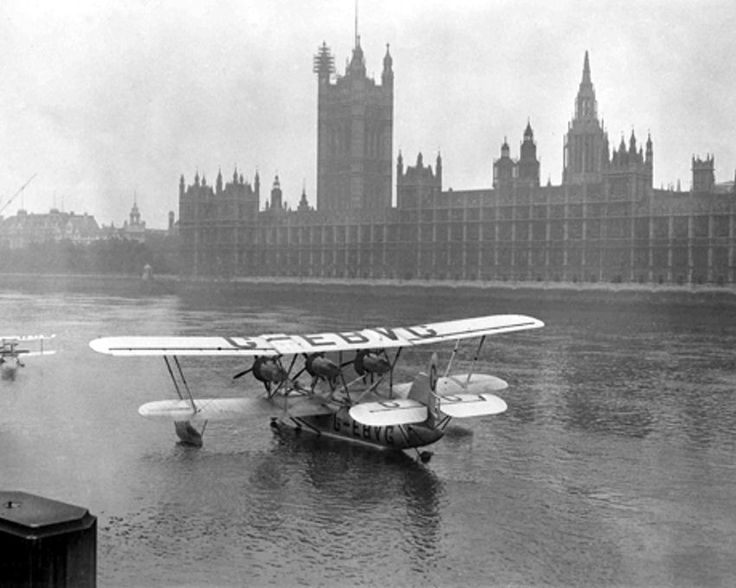
E.B. White made another appearance in the Aug. 25 issue, this time with a poem describing his recent flight from London to Paris aboard an Imperial Airways trimotor biplane. If White seems to rhapsodize a bit here (especially to jaded fliers of the 21st century), it is understandable, considering that White’s flight to France was only 25 years removed from the Wright Brothers at Kitty Hawk. It was still something miraculous:
TOP, the Imperial Airways “Calcutta” trimotor flying boat on the Mediterranean, 1928. Below, the “Calcutta” moored on the River Thames in 1928. (Claude Boullevraye de Passillé / AP)
* * *
Missing the Boys of Summer
The New Yorker continued to ignore the sport of baseball in its pages, even though it enthusiastically covered almost everything else: college football, hockey, tennis, golf, lacrosse, polo, rowing and yacht racing. Strange because the New York Yankees had one of the winningest lineups in baseball (Murderer’s Row, with sluggers Babe Ruth and Lou Gehrig), had won the 1927 World Series, and were poised to win it again in 1928. Unless I missed something, the first mention of baseball in the 1928 New Yorker was this bit in Howard Brubaker’s Aug. 25 “Of All Things” column:
The Yankees would sweep the favored St. Louis Cardinals in the ’28 World Series.
From Our Advertisers
This creepy advertisement from the Aug. 25 issue comes courtesy of the Clark Lighting Company. The tagline, “Clark Always Works,” has a double meaning, the ad copy suggesting that a woman is so simple (described here as a “little minx”) that she will be captivated by the very flick of a lighter:
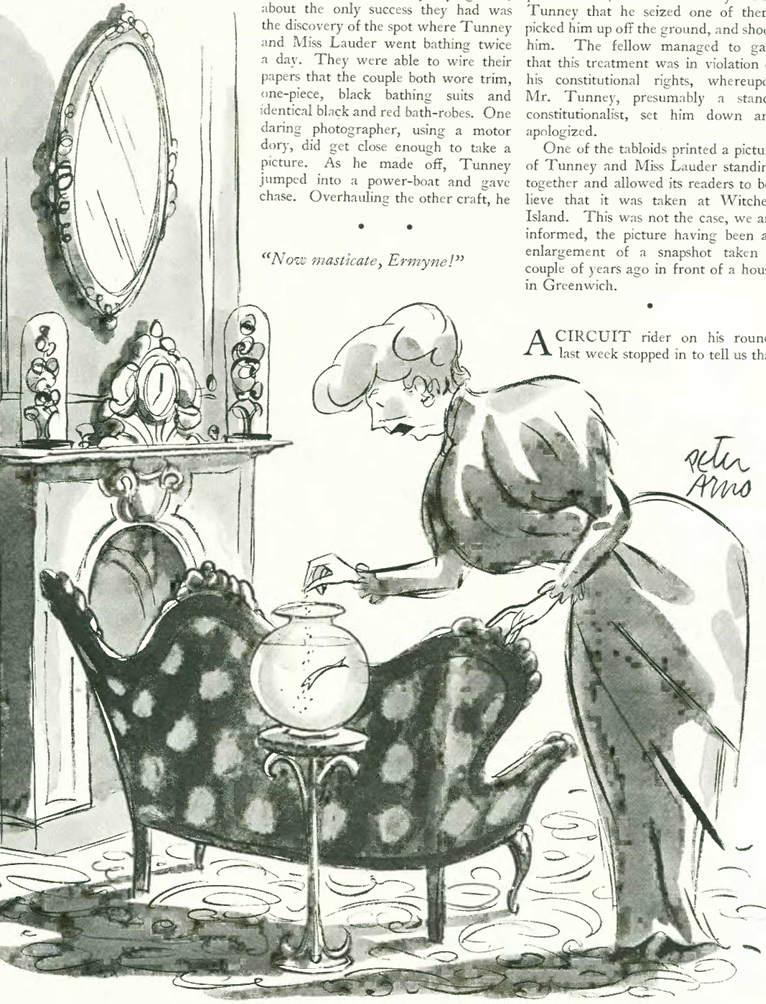
Our cartoon is by Peter Arno, who was making light of a diet fad from the late 19th and early 20th century (hence the woman’s age and dress) made famous by Horace Fletcher, who was known as the “Great Masticator” for his diet that involved chewing each mouthful of food a minimum of 100 times. The cartoon’s caption reads: “Now masticate, Ermyne!”
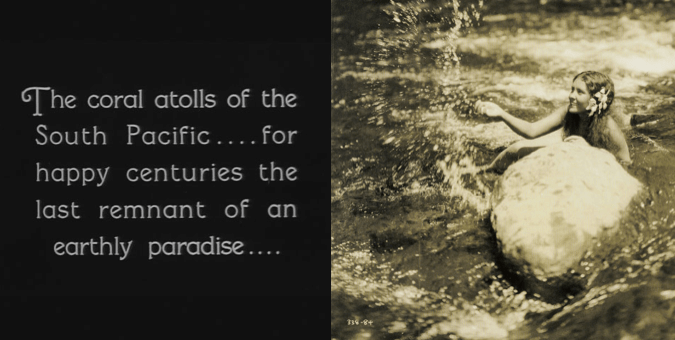
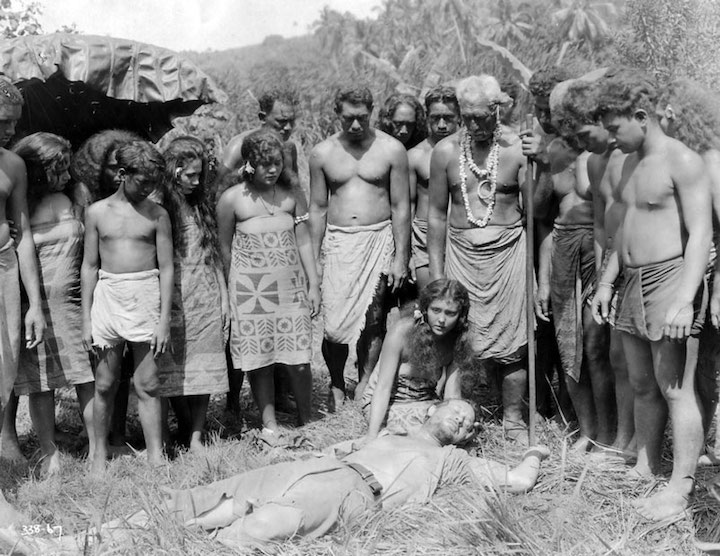
Thirty years before South Pacific would grace the silver screen, an earlier film that also explored the clash of civilizations in Polynesia, White Shadows of the South Seas, wowed audiences with its cinematography and, like South Pacific, a melodramatic love story between an American and a beautiful Polynesian girl, Fayaway, played by Mexico-born actress Raquel Torres.
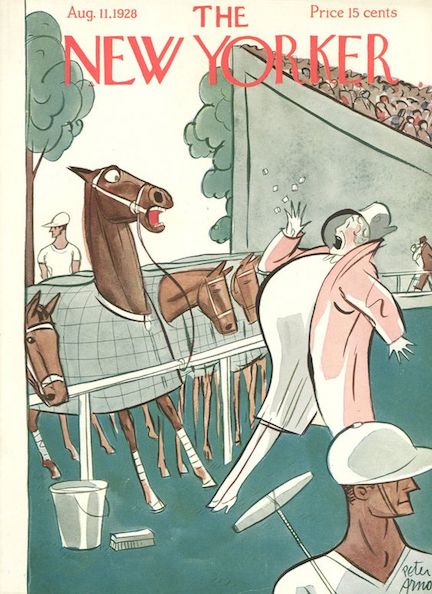
August 11, 1928 cover by Peter Arno.
Inspired by a 1919 travel book of the same name (by Frederick O’Brien), what is significant about the film is that it was shot in Tahiti, featured a supporting cast of Tahitian islanders, and was the first MGM picture to be released with a pre-recorded soundtrack, which consisted of a musical score and a few effects. It was also the first film in which the MGM Lion (known then as “Jackie”), roared during the introduction.
TROUBLE IN PARADISE…Raquel Torres and Monte Blue in White Shadows in the South Seas. (cinemasojourns.com)
Leonard Maltin writes the film “features stunning, Oscar-winning cinematography of the Marquesas Islands welded to a story about the corrupting influence of Western civilization, with Blue as an alcoholic doctor who falls in love with native Torres and clashes with an exploitative (pearl) trader…Portions of the beautiful, documentary-style footage were shot under the supervision of Robert Flaherty, who fought with the studio over its emphasis on a melodramatic plot and left the production.”
The film also caused David O. Selznick, one of the top executives at MGM, to quit the studio over a dispute with fellow MGM exec Hunt Stromberg. According to the 1990 book The Dame in the Kimono by Leonard Left and Jerold Simmons,David (Selznick) thought it an idyllic story, Hunt wanted more sex.
Here’s what the Aug. 11, 1928 New Yorker had to say about the film:
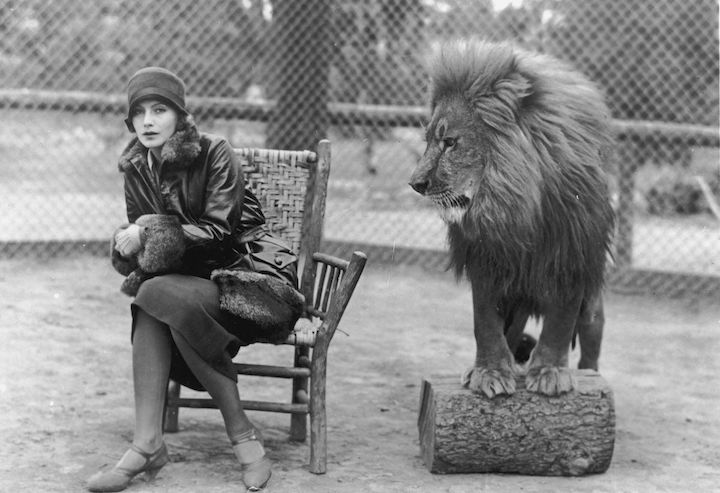
GOING NATIVE…Raquel Torres as Fayaway in White Shadows in the South Seas. (torontofilmsociety.org)HE ROARS AT LAST…A cameraman and a sound technician record Jackie’s roar for MGM’s famous logo in 1928. The footage was first used on MGM’s first talking picture, White Shadows in the South Seas, as seen at right. (MGM)WHILE WE ARE ON THE SUBJECT…Five different lions have been used for the MGM logo. Pictured above is Lion #1, named “Slats,” seated next to a less than enthusiastic Greta Garbo in this publicity photo from 1925. Slats was never heard, his career limited to the silent era. Slats was followed by Jackie, the first lion to roar on film (through the use of a gramophone synched to the movie). Jackie was followed by Tanner, George, and finally, Leo. (martinturnbull.com)
Speaking of Garbo, The New Yorker’s film critic “O.C.” was one of the few moviegoers in the world not bewitched by the Swedish actress. In the same issue this is what he had to say about her latest film, The Mysterious Lady:
CHANNELING HER INNER WALLOP…Greta Garbo in The Mysterious Lady, 1928. (Pinterest, uncredited)
* * *
Revisiting Race
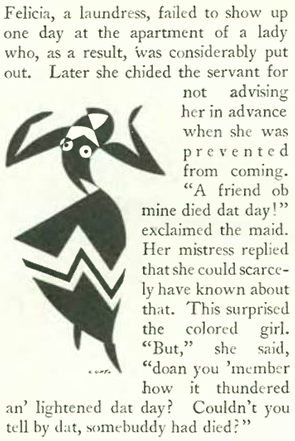
As I’ve noted before, The New Yorker of the 1920s was decidedly mainstream in its treatment of blacks and other minorities as racial “others.” Here is an example (from the Aug. 11 issue) of the casual bigotry that occasionally could be found in “The Talk of the Town.”
…and a few pages on in the same issue, this filler art by Julian de Miskey:
* * *
And to close out the Aug. 11 issue, Barbara Shermund looked in on the Uppers during a moment of contemplation:
* * *
The Aug. 18, 1928 issue featured an interesting dispatch from the magazine’s Paris correspondent, Janet “Genêt” Flanner.
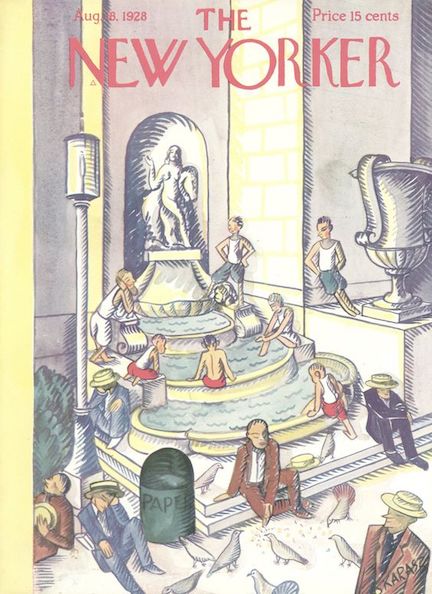
August 18, 1928 cover by Ilonka Karasz.
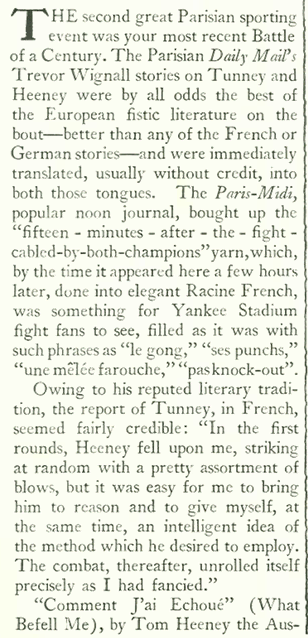
Flanner gave us a taste of how the French regarded the recent “Battle of the Century” between heavyweight boxers Gene Tunney and Tom Heeney:
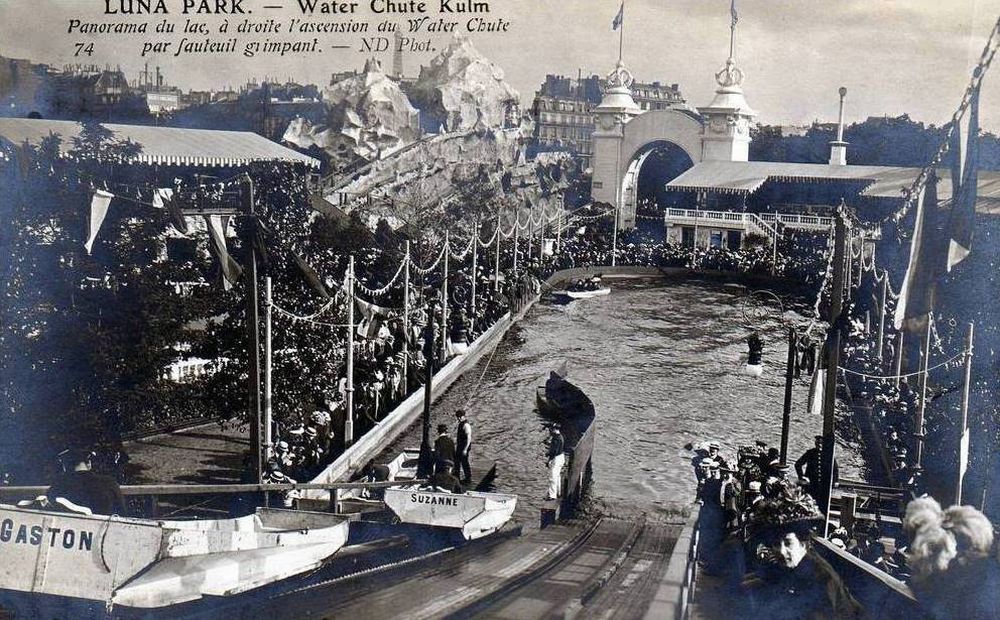
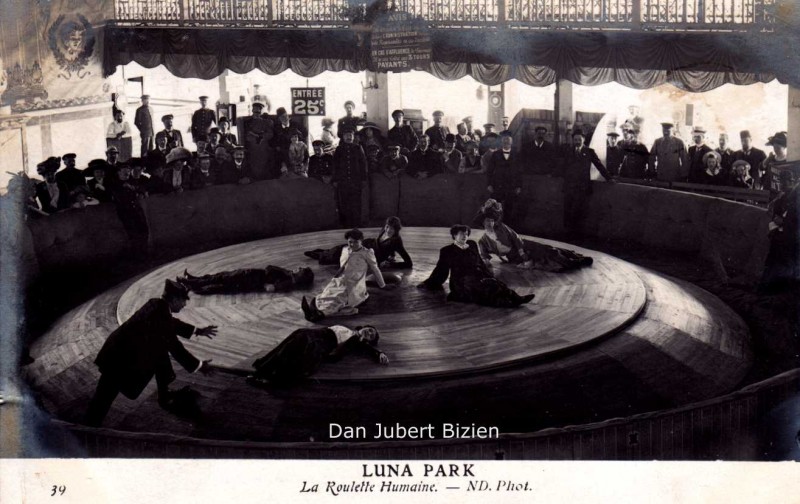
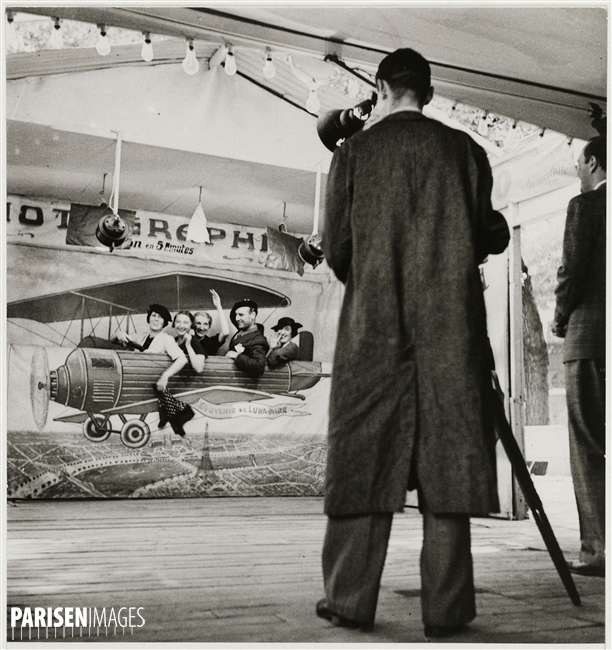
Flanner also wrote about an amusement park near the Porte Maillot in Paris called Luna Park:
WITH A FRENCH ACCENT…Entrance to Luna Park near the Porte Maillot, circa 1922. (Wikipedia)
Postcard image of the French Luna Park’s river ride, circa 1910. (paris-unplugged.fr )Postcard image of Luna’s Roulette Wheel ride, recalling similar ride at Coney Island’s Pavilion of Fun. (paris-unplugged.fr )Photographer snaps a photo of visitors to Porte Maillot in 1935. Although the banner on plane reads “Souvenir de Luna Park,” the park itself closed in 1931. (parisenimages.fr )
* * *
From Our Advertisers
Another sports celebrity who didn’t mind relieving Old Gold of some extra cash was Babe Ruth, who was next in line to submit to the blindfold test:
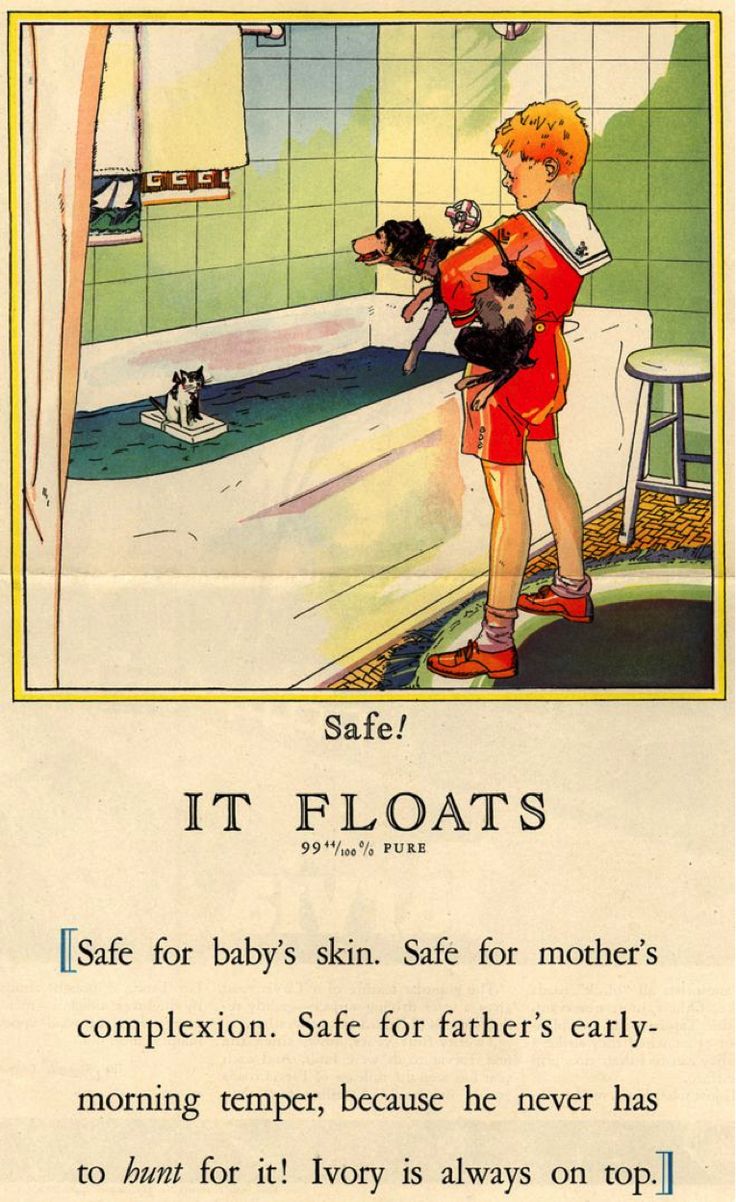
I include this ad for Proctor & Gamble’s Ivory Soap (from a 1928 issue of The Saturday Evening Post) as an explanatory note for The New Yorker cartoon that follows, by Gluyas Williams…
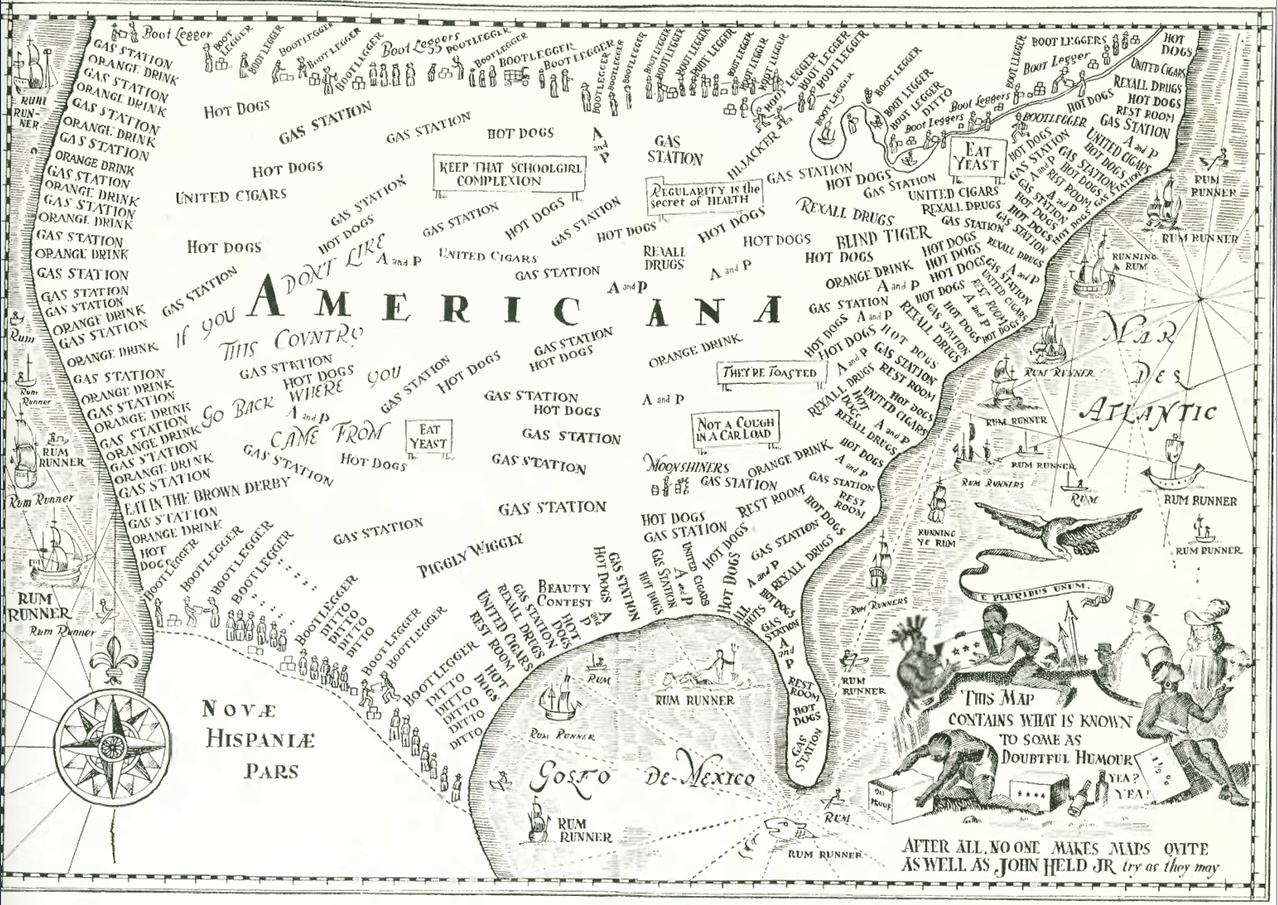
Also in the issue, John Held Jr. contributed one of his famous maps, displayed sideways, full-page (click to enlarge):
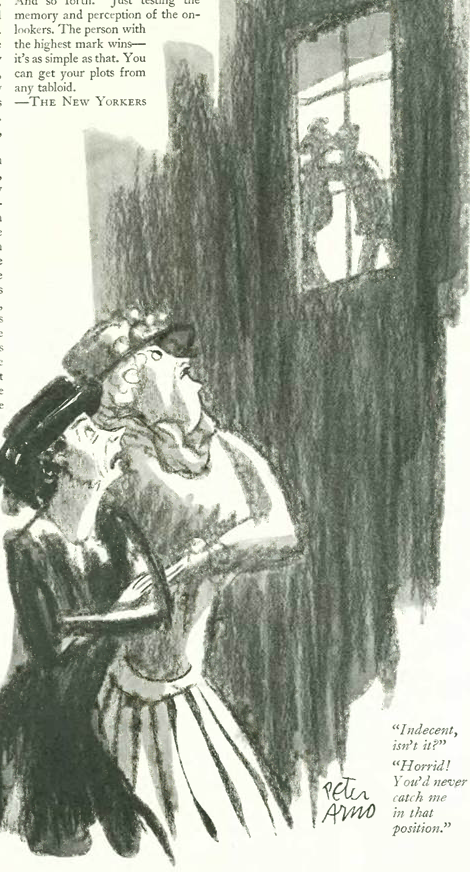
And finally, we close with Peter Arno, and two outraged spinsters:
It seems that each generation has its “Fight of the Century,” a phenomenon that emerges from the alchemy of mass marketing, a lust for blood sport, and the madness of crowds. Gene Tunney — a boxer who also wanted to be a public intellectual — was party to at least two of these spectacles in the 1920s.
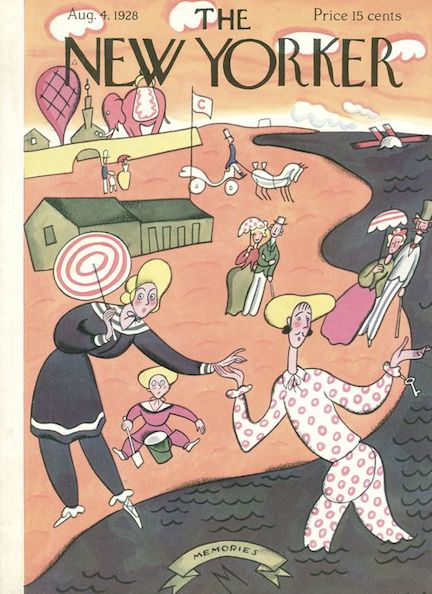
August 4, 1928 cover by Julian de Miskey.
Tunney is most famous for his fights against Jack Dempsey—in some ways they were the Ali–Frazier of their day. Tunney took the heavyweight title from Dempsey in 1926, and again defeated Dempsey in the controversial “long count” rematch one year later, on Sept. 22, 1927. That match was a huge spectacle, staged at Chicago’s Soldier Field in front of 105,000 spectators.
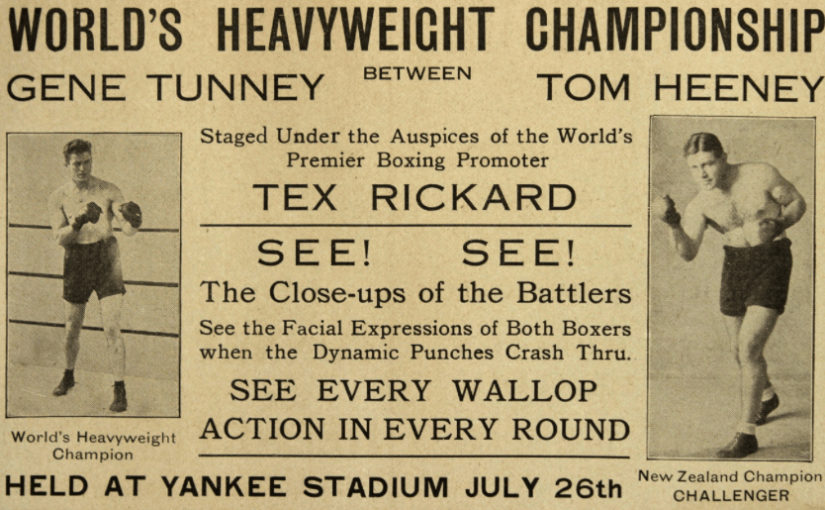
Boxing promoter Tex Rickard saw dollar signs when a scrappy New Zealander named Tom Heeney challenged the champ to a match. Heeney had won the Australian heavyweight title in 1922, and after arriving in the U.S. in 1926 found enough success in the ring to be ranked fourth among the world’s heavyweight boxers.
Writing in his column, “Sports of the Week,” in the July 21, 1928 issue of The New Yorker, Niven Busch Jr. assessed Heeney as a formidable opponent:
NO PALOOKAS HERE…Tom Heeny (left), and Gene Tunney in the late 1920s. (boxrec.com / Alchetron)
This cartoon by Leonard Dove, also in the July 21 issue, joined in the fun…
As for the actual fight at Yankee Stadium on July 26, 1928, Tunney won by a TKO in the 11th round. Perhaps the boxer from Down Under wasn’t in such great shape after all, or so surmised Niven Busch Jr in the August 4 issue:
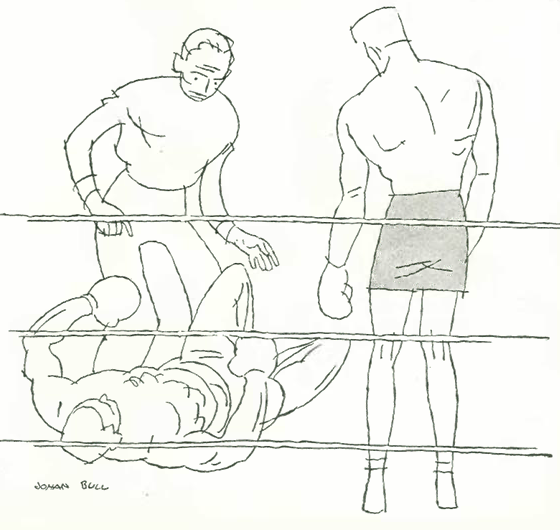
New Yorker illustrator Johan Bull offered this perspective in artwork that accompanied Busch’s article…
Tunney’s winning purse was $525,000 (about $7.3 million today) and Heeney’s was $100,000 ($1.4 million), modest when compared to the recent debacle in Las Vegas that pitted professional boxer Floyd Mayweather Jr. against mixed martial arts champion Conor McGregor. Mayweather earned a disclosed purse of $100 million while Conor McGregor brought home $30 million.
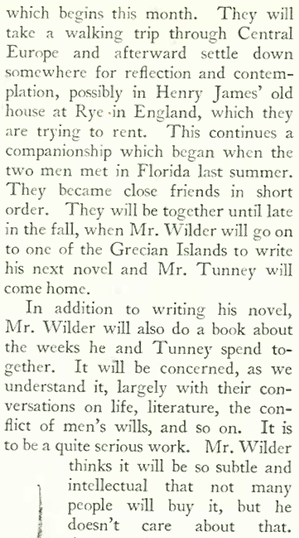
Heeney would remain in the U.S. and fight a few more bouts before retiring to Florida, where he ran a bar and fished with his friend, Ernest Hemingway. Tunney, on the other hand, announced his retirement from boxing just five days after the fight. It was time to finally devote himself to a life of the mind. Norman Klein, writing in the Aug. 4 “Talk of Town,” offered a glimpse into that new life:
BRAIN OVER BRAWN…Boxing champ Gene Tunney, left, and writer George Bernard Shaw on a 1929 vacation to Brioni. (Associated Press)
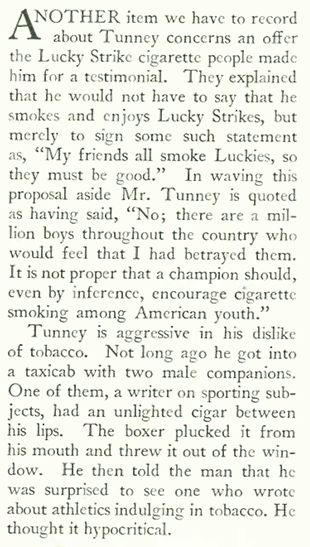
Still not getting enough of The Champ, “Talk” also related this story about Lucky Strike cigarettes, and how that company’s publicists tried unsuccessfully to persuade Tunney to endorse their product:
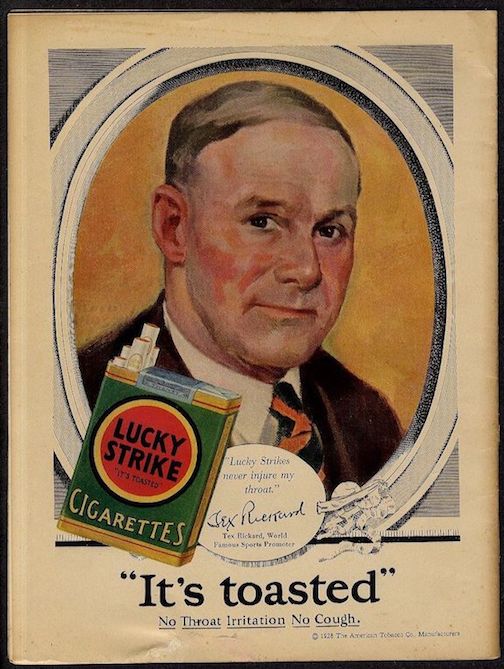
However the promoter of the Tunney–Heeney fight, Tex Rickard, had no problem taking money from the American Tobacco Company:
THEN I’LL TAKE THE MONEY…The promoter of the Tunney – Heeney fight, Tex Rickard, had no problem endorsing Lucky Strikes in this 1928 advertisement. Rickard would die the following year at age 59, from an appendectomy of all things. (eBay)
* * *
Tunney Was More Exciting
“The Talk of the Town” cast a jaded eye toward the Ninth Olympic Games in Amsterdam:
Poster from the 1928 games. (www.olympic.org)
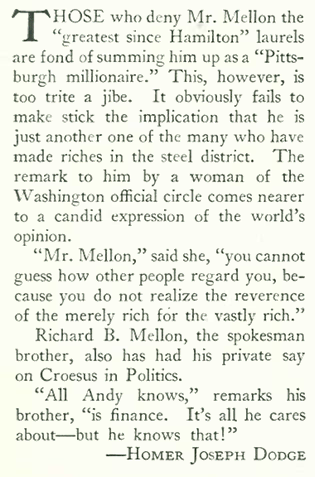
And perhaps even less exciting than the Olympics was the magazine’s “Profile” subject, Andrew W. Mellon, referred to in the title as “Croesus in Politics.” Mellon was no Gene Tunney, but he did ensure his immortal fame through his philanthropy, still expressed today by the Andrew W. Mellon Foundation. Below are the concluding lines of the profile, written by Homer Joseph Dodge:
The article featured this terrific caricature by illustrator Abe Birnbaum…
Planned Obsolescence
The magazine’s “Motors” column touted Chrysler’s new “peaked” radiators, which no doubt caused many insecure Chrysler owners to consider junking their non-peaked models of yesteryear:
This ad in the same issue screamed “new, new, new” for what appeared to be mostly the same old, same old…
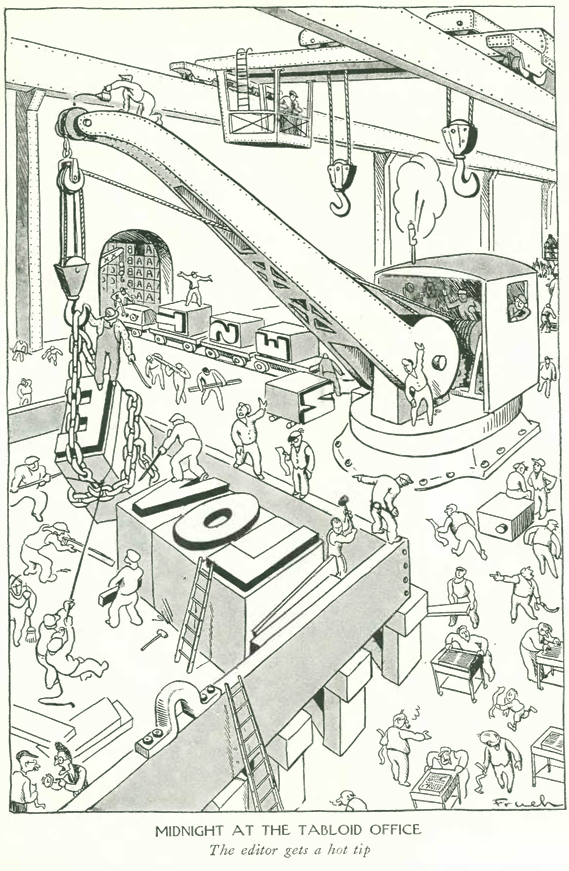
Our comic comes courtesy Al Frueh, who looks in on the workings of a printing press at a celebrity tabloid:
TheNew Yorker stepped out of its Manhattan offices at 25 West 45th Street and headed north to see what lay beyond 96th Street and Park Avenue, to “a land on to which realtors may not push.”
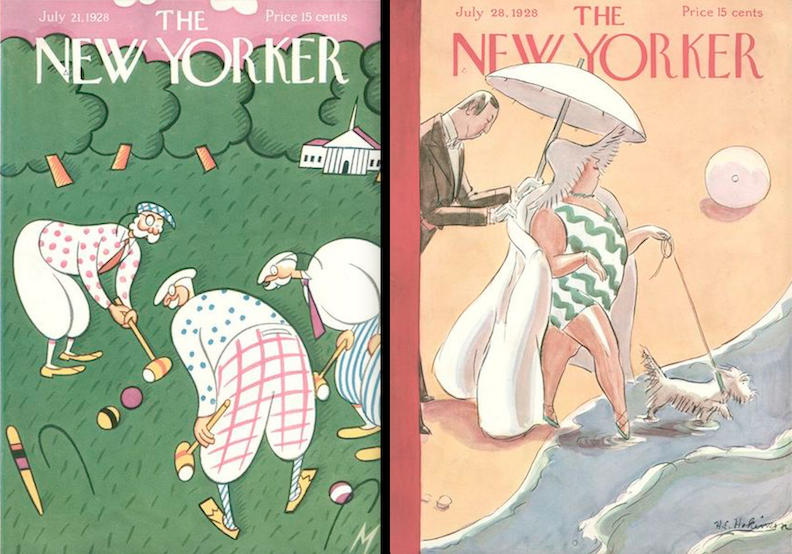
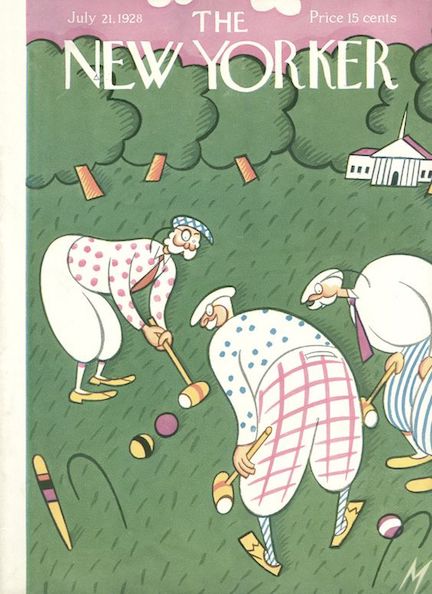
July 21, 1928 cover by Julian de Miskey; July 28, 1928 cover by Helen Hokinson.
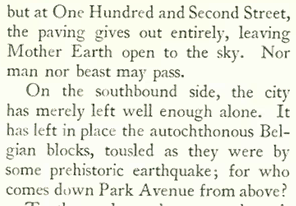
In the early to mid 20th century, 96th street represented a real dividing line across Park Avenue, separating Manhattan from the “frontier” to the north. Although developers have since breached this line (particularly beginning in the 1980s), back in 1928 it truly marked an end of sorts to Park Avenue—even the paving ran out by 102nd Street. The July 28, 1928 “Talk of the Town” observed:
FRONTIER NO MORE…Aerial view of Park Avenue from 96th Street (the X at bottom left) all the way past 132nd Street, where Park Avenue joins Harlem River Drive. The ‘X’ at the upper right hand corner marks the former location of Gus Hill’s Minstrels (mentioned in the article) at 129th and Park Avenue. (Google Maps) Click on image to enlarge
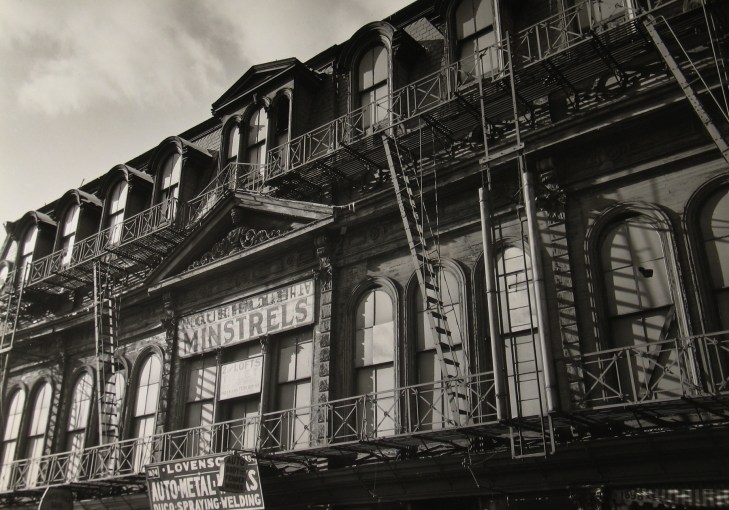
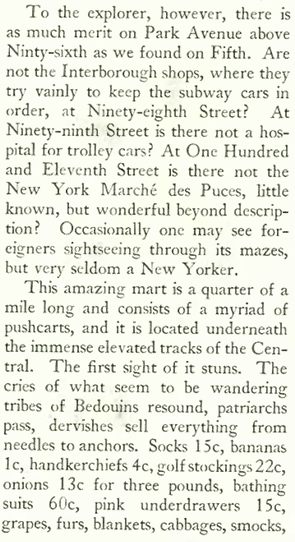
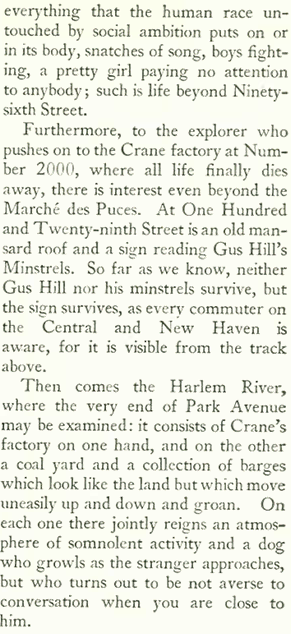
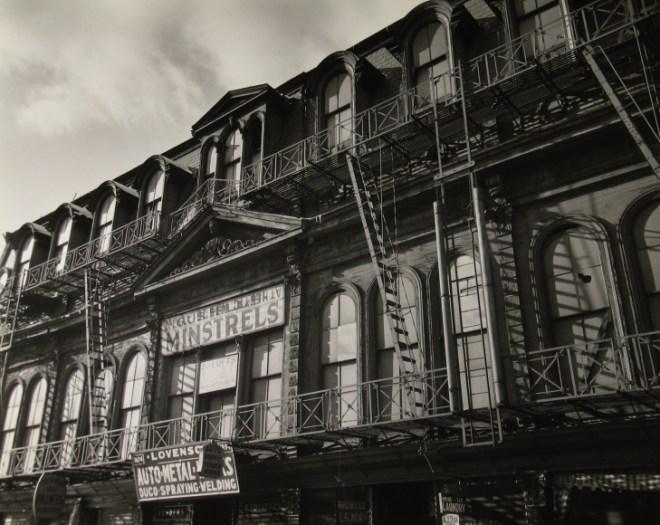
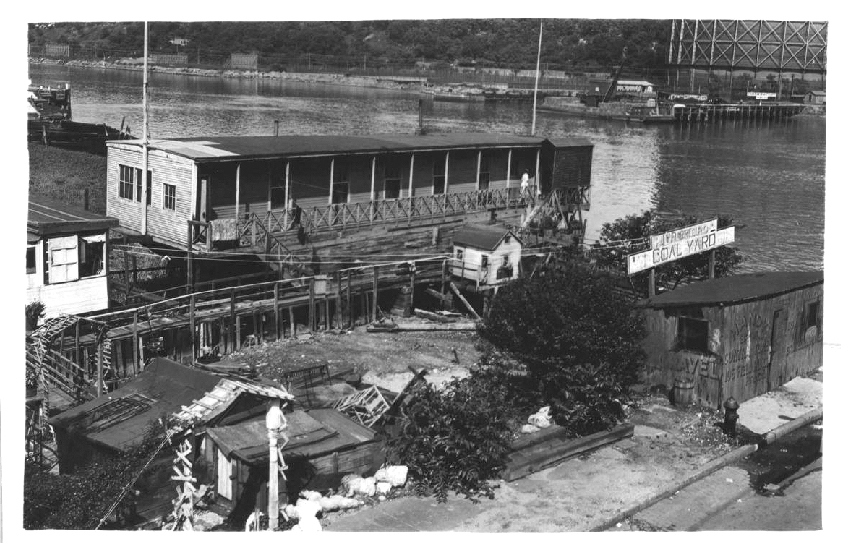
Beyond 96th a vast pushcart market was discovered to be operating under the elevated railroad tracks, while further on toward the Harlem River there were factories, coal yards, and a shuttered theatre:
NEAR THE END OF THE LINE…The Gus Hill’s Minstrels building at the corner at East 129th and Park Avenue, facing the elevated train tracks. There was an auto garage at the lower floor. The “Minstrels” were long gone by the time the photo was taken, in 1935, by Berenice Abbott. (Museum of the City of New York)ONLY A GHOST…The former site of Gus Hill’s Minstrels, at the corner at East 129th and Park Avenue, now occupied by a filling station. (Google Maps)SOARING…The Park Avenue elevated railroad tracks in Harlem east of 96th Street created vast covered spaces frequented by pushcart vendors. (nyc-architecture)UP THE RIVER…A houseboat colony near a coal yard at 208th Street by the Harlem River, 1933. (myinwood.net)
* * *
Sport of Lords and Ladies
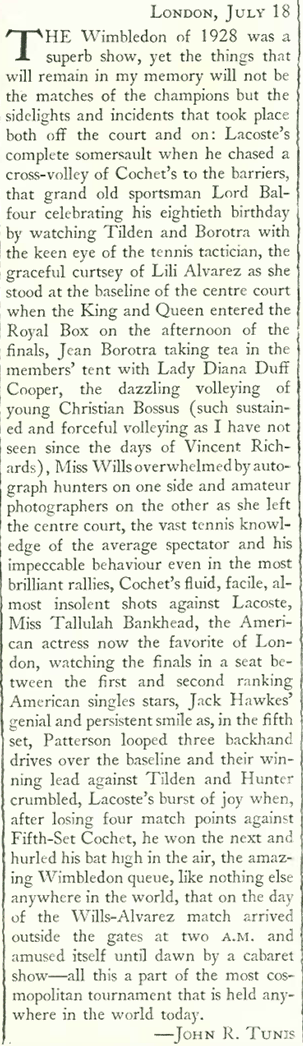
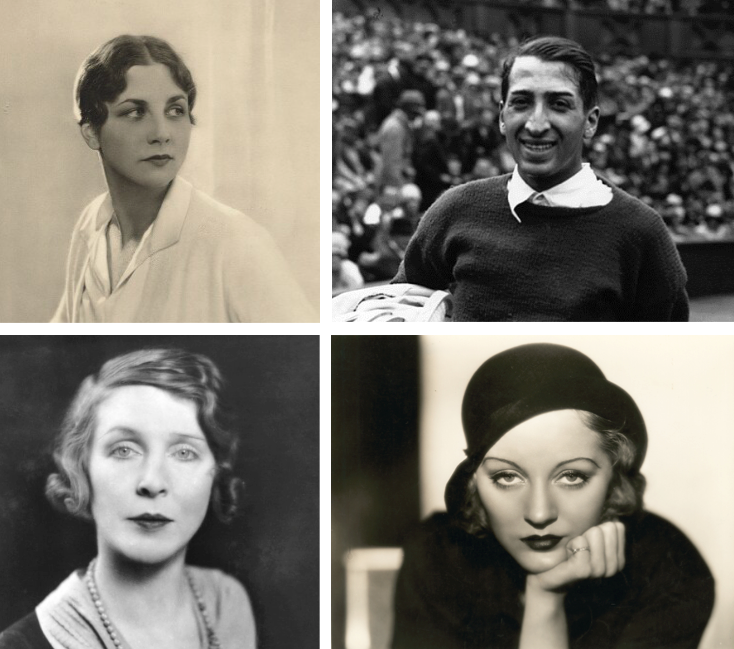
TheNew Yorker’s sportswriter John Tunis paid a visit to the 1928 Wimbledon tennis tournament, where he took in a scene that included several celebrities:
FACES IN THE CROWD at the 1928 Wimbledon included clockwise, from top left, the tournament’s singles champions Helen Wills Moody and René LaCoste; and spectators such as actress Tallulah Bankhead and Lady Diana Duff Cooper. (Wills Moody image from 1928 courtesy National Portrait Gallery, London; circa 1930 Bankhead image, Alchetron; Lady Diana image dated 1931, (UK National Portrait Gallery); and LaCoste photo taken after he won the men’s singles title at the 1928 Wimbledon, bltimes.com)
* * *
From Our Advertisers
The July 28 issue included yet another Dr. Seuss-illustrated ad for Flit insecticide. No doubt Seuss would later regret such an illustration, as later in life he strongly opposed racism and supported environmental causes.
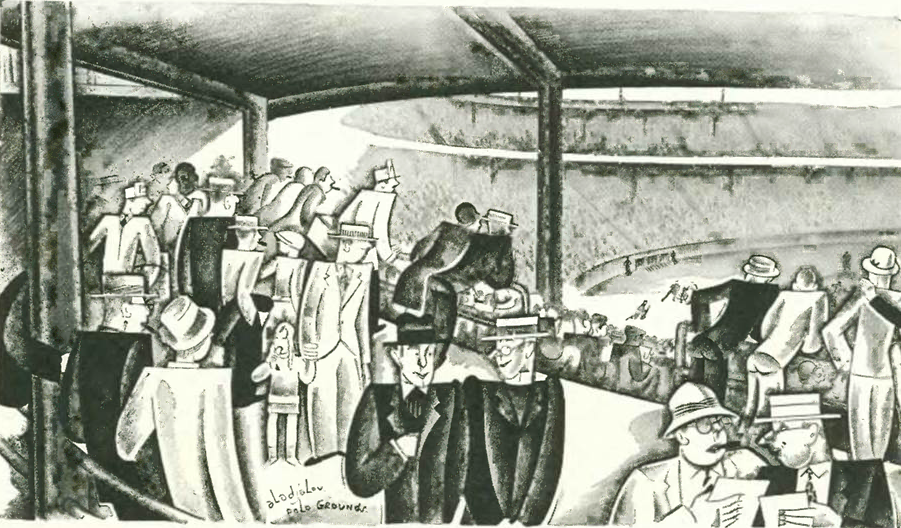
Also from the July 28 issue, a detail from a two-page illustration of baseball fans at the Polo Grounds by Constantin Alajalov, which appeared in “The Talk of the Town” section:
* * *
From Our Advertisers, Part II:
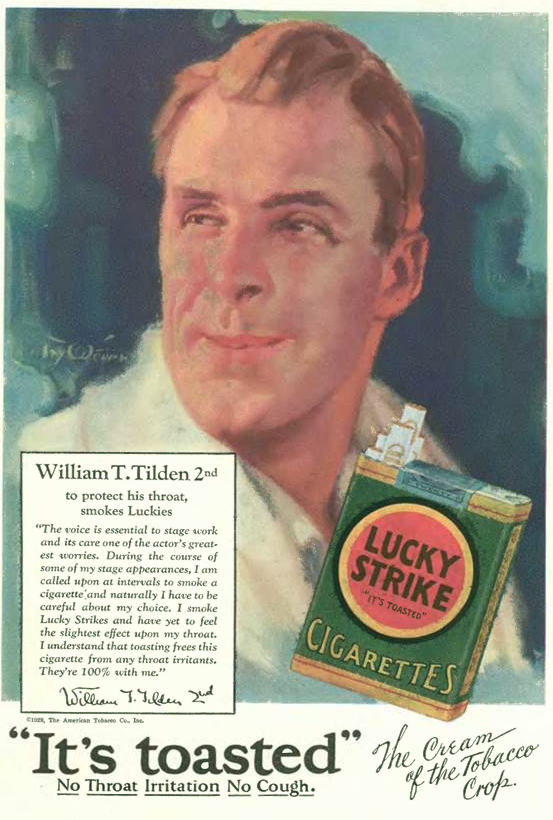
Jumping back an issue, to July 21, 1928, we find tennis great (and sometime film actor) Big Bill Tilden hawking the toasted pleasures of Lucky Strike cigarettes on the magazine’s back cover:
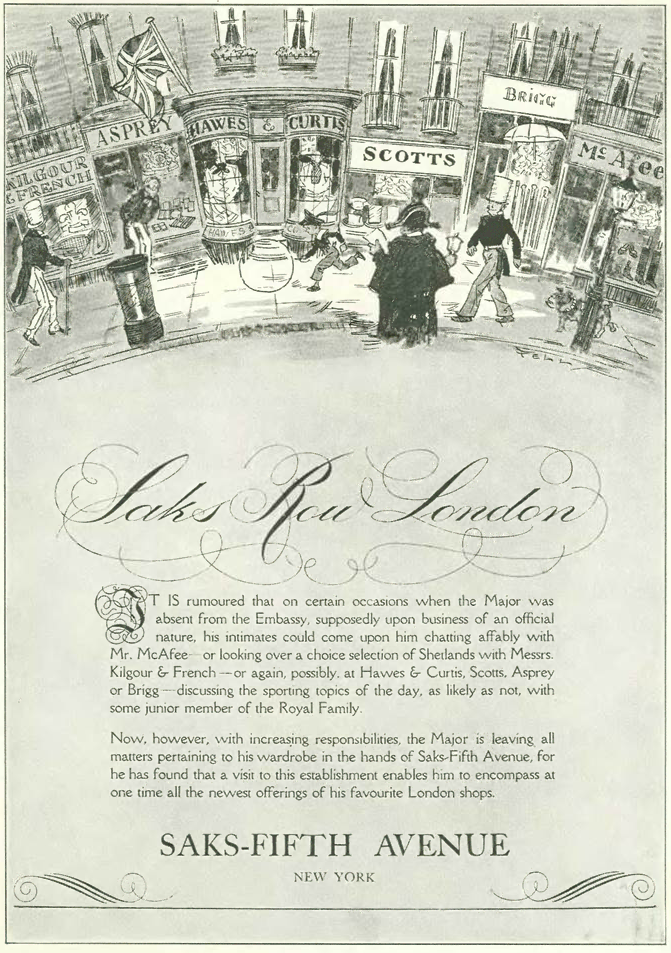
As I’ve noted before, many New Yorker ads appealed to the Anglophilic pretensions of its striving readershship. This one below from Saks is a particularly egregious example…
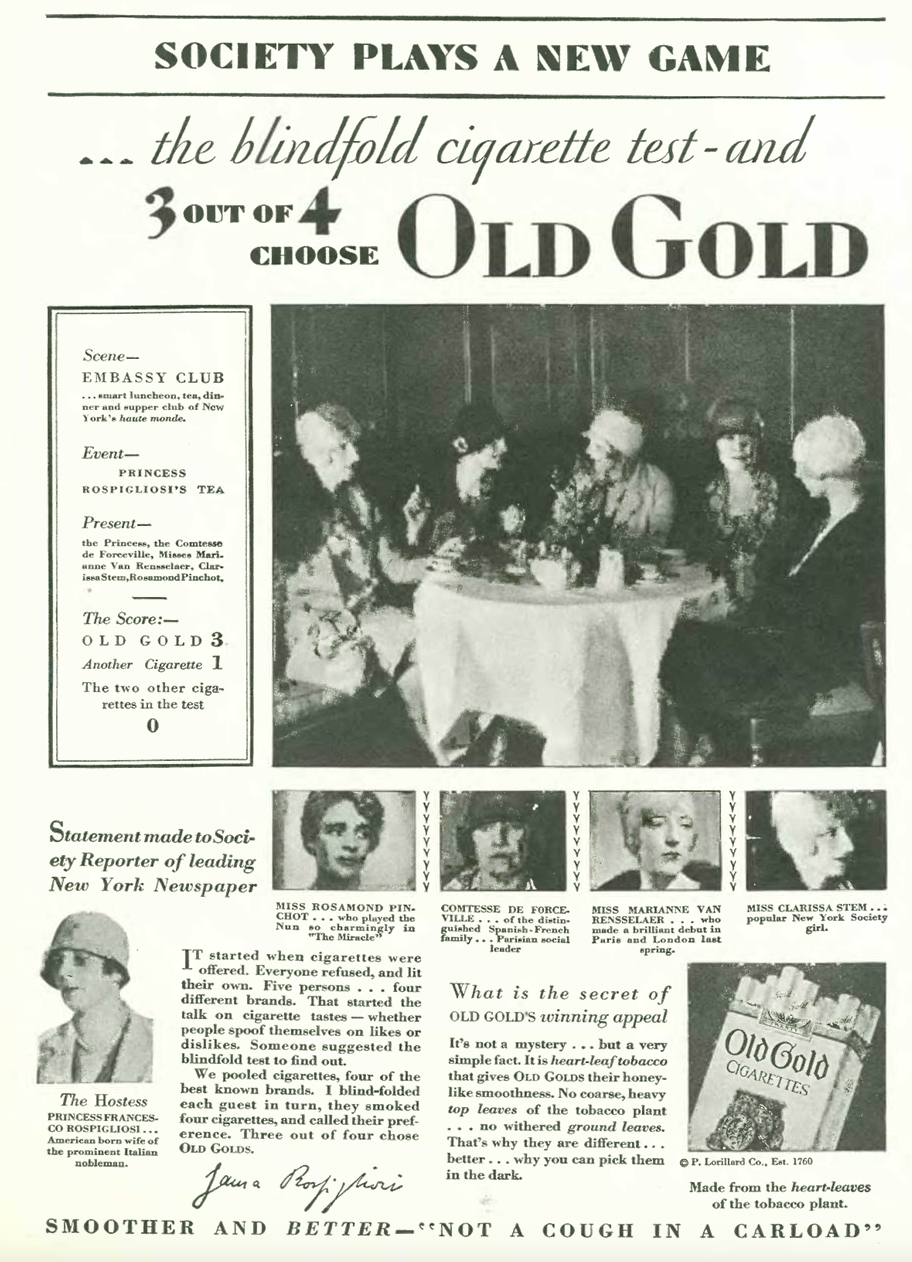
…other social strivers could look to the example of these society matrons who picked up some spare cash shilling for Old Gold cigarettes…
I close with a couple of cartoons from the July 21 issue by Barbara Shermund and Peter Arno:
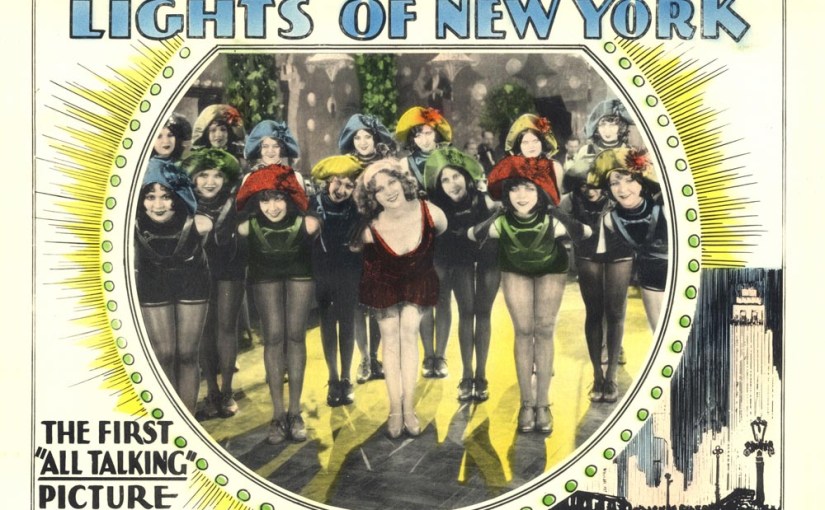
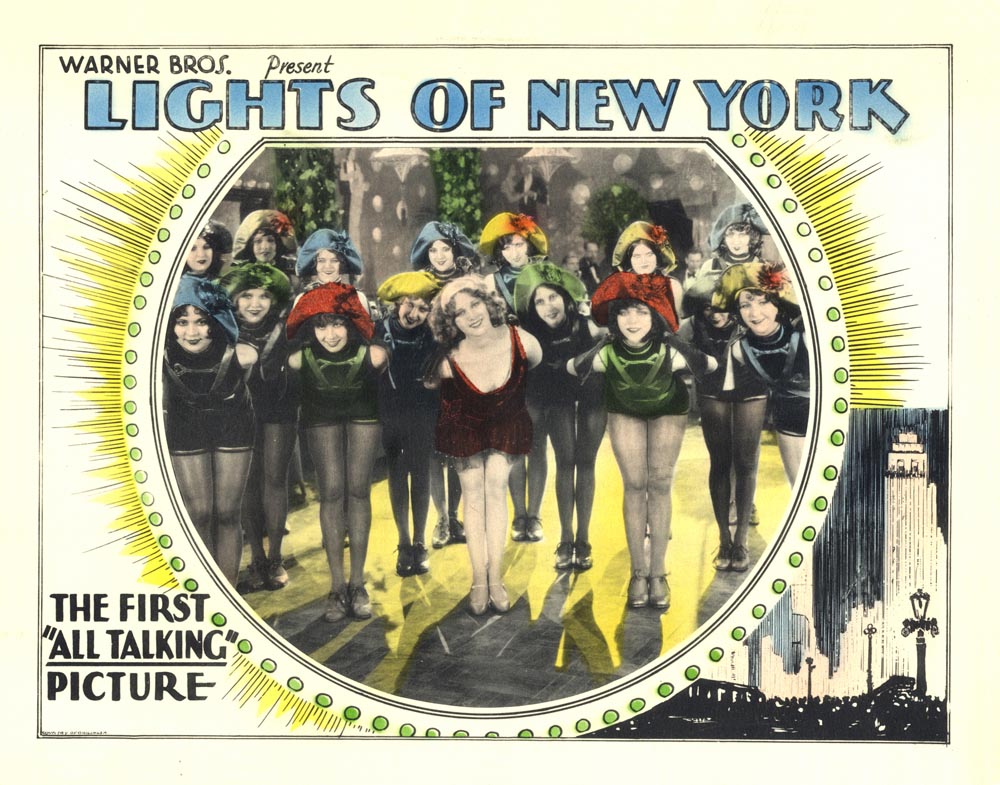
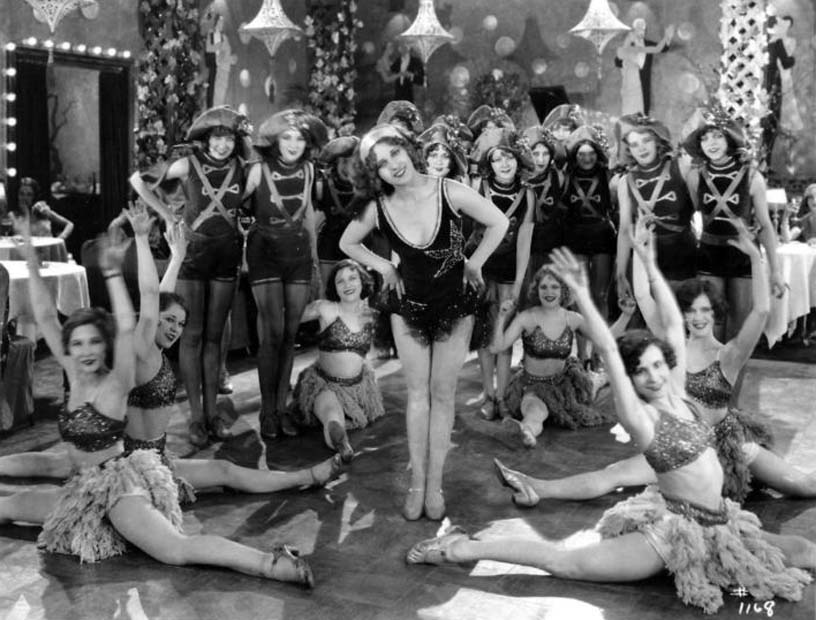
Lights of New York would be a forgettable film if not for the fact it was the world’s first 100 percent talking motion picture. Yes, it was a bad film, but…
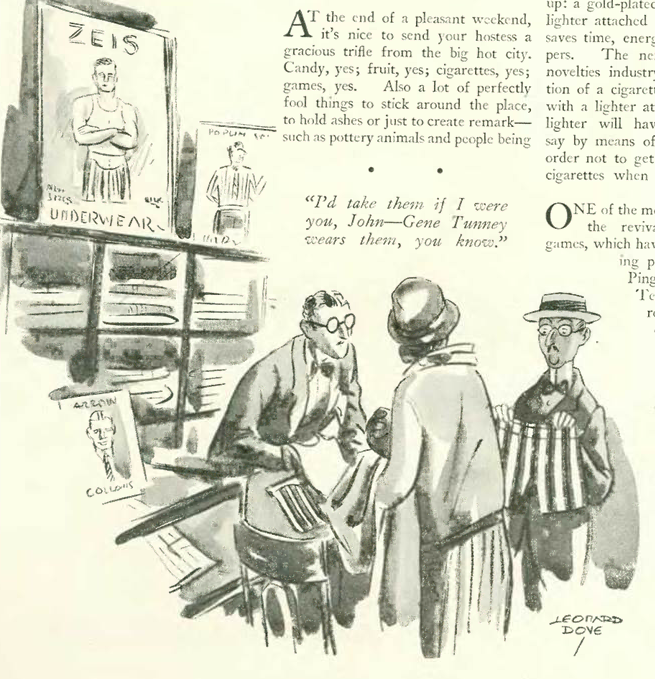
July 14, 1928 cover by Leonard Dove.
…even the July 14, 1928 New Yorker had the foresight to note that the film was destined to be a “museum piece.” Despite the corny plot and bad acting, the magazine’s critic “O.C.” had to concede that the film offered proof that sound would improve the motion picture experience.
Theatre Card for Lights of New York. (untappedcities.com)MAKING SOME NOISE…Helene Costello with a cast of nightclub dancers in Lights of New York. (vintage45.wordpress.com)
The Jazz Singer (1927) launched a “talkie revolution” that would culminate nine months later in Lights of New York, and by the end of 1929 Hollywood was almost exclusively making sound films. But studios still released silent films into the 1930s, since not every theatre in the country was wired for sound.
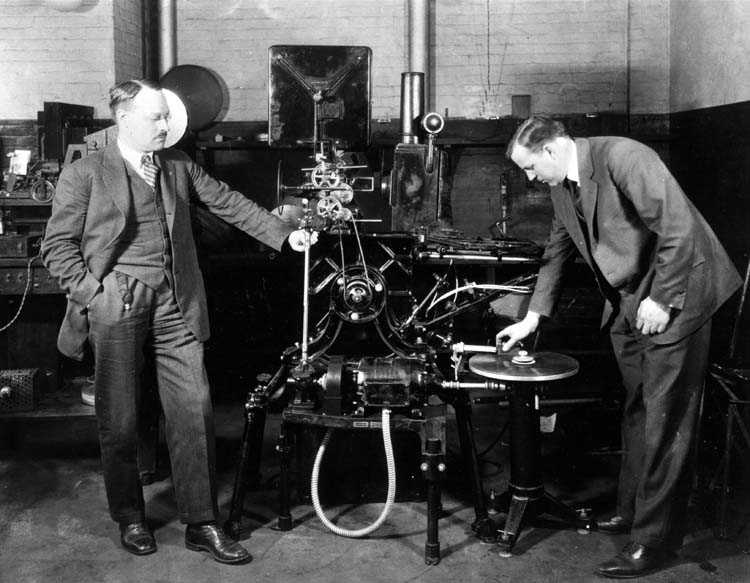
TheNew Yorker had been slow to embrace sound in motion pictures (see my previous posts). What helped to win them over was the further refinement of the Movietone process, in which the sound track was printed directly onto the film strip (The Jazz Singer used Vitaphone, which essentially synched a record player with a film and provided a sporadic rather than continuous sound track).
In the same issue, writer Robert Benchley also predicted (in “The Talk of the Town”) that sound in movies would challenge actors whose voices weren’t as attractive as their screen images:
IT’S COMPLICATED…It is a common assumption that sound motion pictures killed the careers of many silent stars, however big names like John Gilbert (left) and Clara Bow left the pictures for other reasons. Studio politics ended Gilbert’s career, and he drank himself to death by 1936. Bow—famously known as the “It Girl,”—made a few sound pictures, but retired from acting in 1931 to become a Nevada rancher. (Wikipedia)SILENCED…Some silent actors such as Wallace Beery (left), were sidelined not because of their voices but because of their high salaries. On the other hand Raymond Griffith (right), who made only one sound movie, spoke with a hoarse whisper not suited for the talkies. (Wikipedia / silentfilmstillarchive.com)
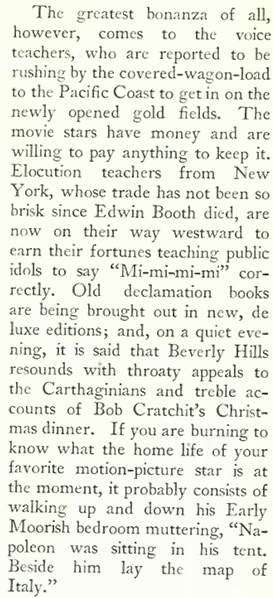
The New Yorker also noted that sound pictures would prove to a great “bonanza” to voice teachers:
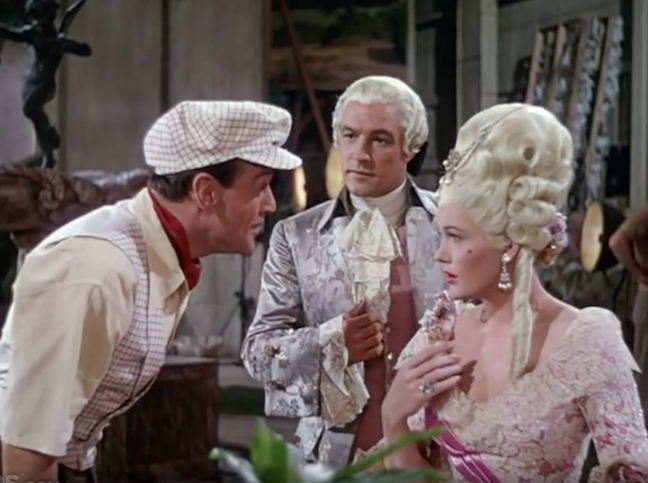
Transition to sound in the late 1920s would later provide the theme for the 1952 musicalSingin’ In The Rain, in which Jean Hagen portrayed silent film star Lina Lamont, whose voice was ill-suited for talking pictures.
SAY WHAT?…Actress Lina Lamont (Jean Hagen) tries the patience of her director (Chet Brandenburg) while her co-star (Gene Kelly) looks on. The scene demonstrated the challenges of acclimating former silent stars (like Lina Lamont, whose voice sounded like squeaky hinge) to “talking pictures.” (MGM/YouTube Movieclips)
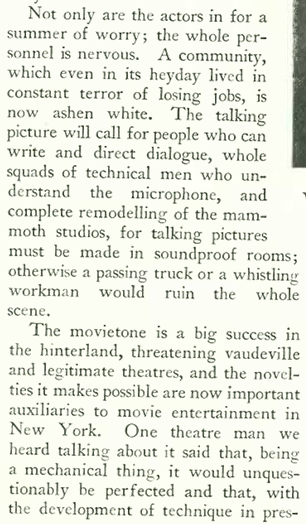
The New Yorker also noted that the advent of sound in motion pictures would put an end to many theatres operating on the vaudeville circuit:
In his regular column, “Of All Things,” Howard Brubaker gave his two cents about the new world of talking movies:
Paving Over Paradise
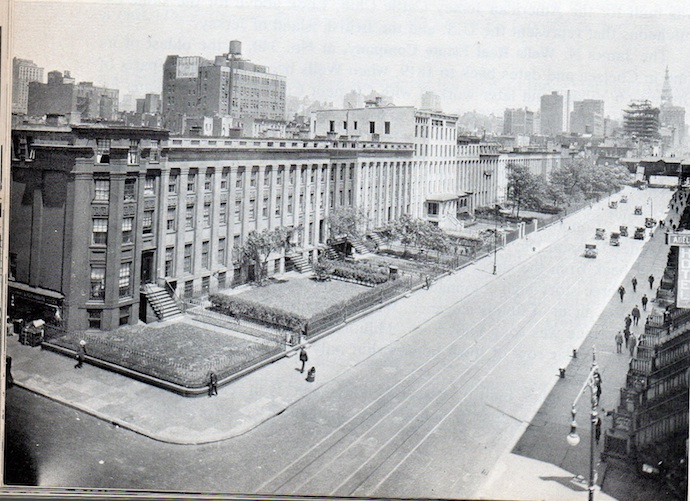
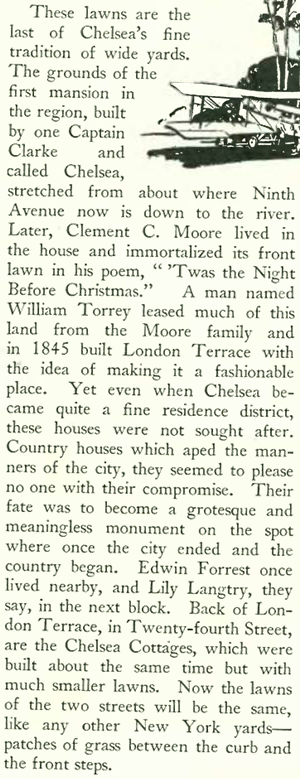
The July 14 “Talk of the Town” offered more bittersweet commentary on the city’s rapidly changing landscape. This time it was a famous stretch of lawns on West 23rd Street—London Terrace— that were being uprooted to make way for a massive new apartment block:
According to Tom Miller (writing for his blog Daytonian in Manhattan), Clement Moore, the writer to whom “A Visit from St. Nicholas” (“The Night Before Christmas”) “had developed the block when he divided up his family estate, ‘Chelsea.’ On the 23rd Street block, in 1845, he commissioned Alexander Jackson Davis to design 36 elegant Greek Revival brownstone townhouses. The row was designed to appear as a single, uniform structure or ‘terrace’ (a design not lost on The New Yorker). Unusual for Manhattan, each had deep front yards planted with shrubbery and trees. He called his development ‘London Terrace.'”
A BIT O’ GREEN…London Terrace, circa 1920. (ephemeralnewyork)
By October 1929, writes Miller, “a few weeks before the collapse of the stock market and the onset of the Great Depression, (developer Henry Mandel) had acquired and demolished all the structures on the enormous block of land. All except for Tillie Hart’s house. Hart leased 429 West 23rd Street and, although her lease had legally expired, she refused to leave, firing a barrage of bricks and rocks at anyone who approached the sole-surviving house. A court battle ensued while she barricaded herself inside. Finally, just four days before Black Tuesday, sheriffs gained entry and moved all of Hart’s things onto the street. She held out one more night, sleeping on newspapers in her once-grand bedroom, then gave up. The following day her house was destroyed.”
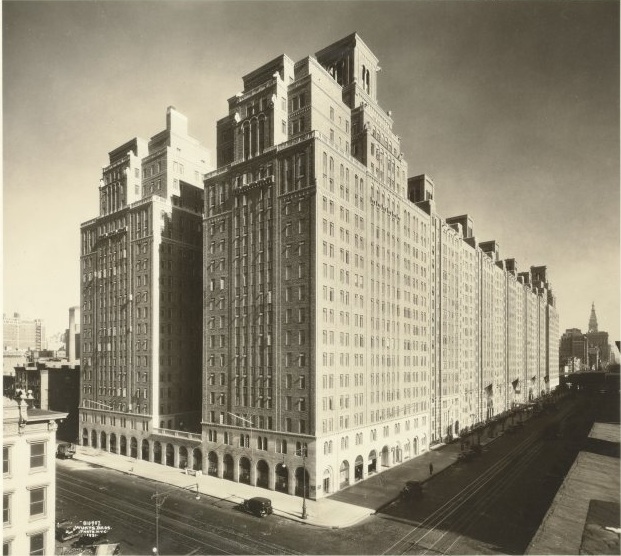
IT’S YUGE…Farrar & Watmough designed this massive, Tuscan-inspired apartment block, completed during 1930-31. The developer Henry Mandel, kept the site’s original name, London Terrace. (ephemeralnewyork)
Miller writes, “to describe the new London Terrace was to use superlatives. Consuming the entire city block, it was the largest apartment building in the world with 1,665 apartments. It boasted the largest swimming pool in the city – 75 feet by 35 feet, with mosaic walls and viewing balconies. Twenty-one stories above the street a “marine deck” was designed to mimic that of a luxury ocean liner. It had a fully-equipped gymnasium, a recreation club, a rooftop children’s play yard with professional supervisors, and a large dining room. The doormen were dressed as London bobbies.”
STILL THERE…London Terrace today. (Brick Underground)
* * *
In other diversions, Isadore Klein looked askew at the latest headlines, namely the big fight between Gene Tunney and Tom Heeney, one of the 20th century’s many “battles of the century”…
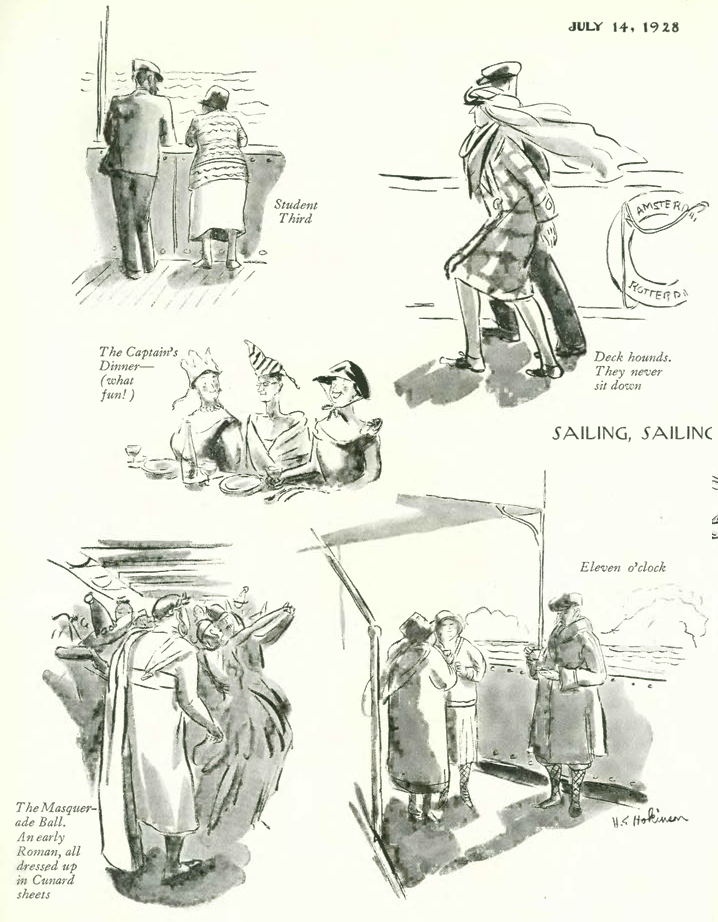
…while Helen Hokinson, on the other hand, offered some sketches of seafaring life…
…and looked in on the challenges of buying a hat…
And to close, a cartoon by Leonard Dove…
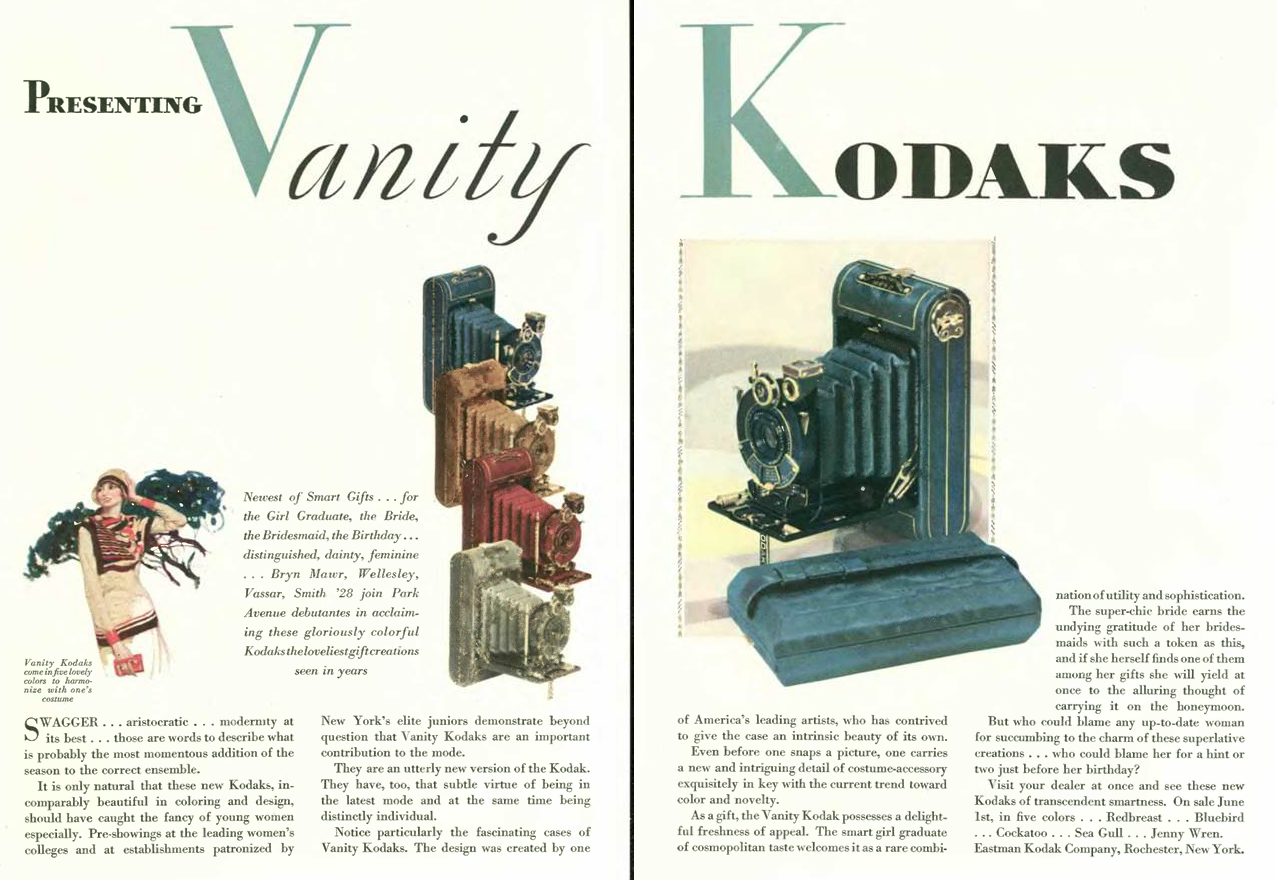
…that referenced ads such as this one from the June 2, 1928 issue…
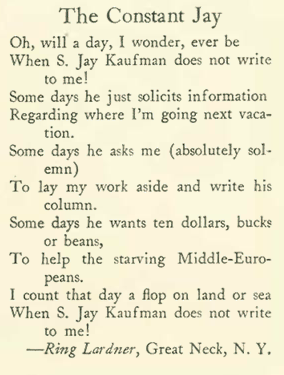
Ring Lardner is one of those 20th century American writers everyone has heard of but few have actually read. This is perhaps because he is often pigeonholed as a sportswriter rather than being remembered as a gifted satirist whose crisp writing style—often peppered with slang—influenced a generation of writers including Ernest Hemingway, who covered sports for his high school newspaper under the pseudonym “Ring Lardner.”
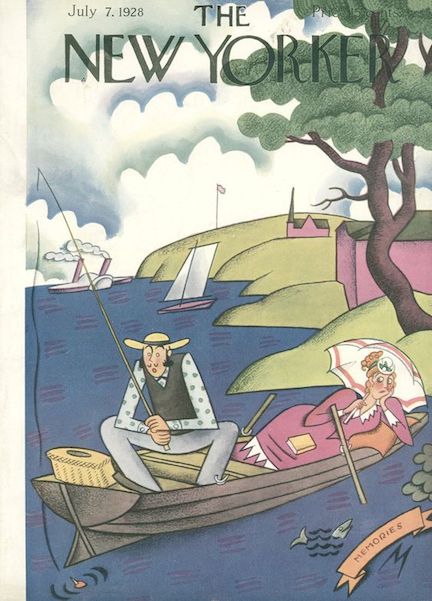
July 7, 1928 cover by Julian de Miskey.
Lardner would contribute nearly two dozen pieces to The New Yorker beginning with this ditty in the April 18, 1925 issue—
—and ending with “Odd’s Bodkins,” published posthumously in the Oct. 7, 1933 issue (Lardner died at age 48 of a heart ailment on Sept. 25, 1933). In his satirical “Profiles” piece for the July 7, 1928 issue, Lardner had some fun with editor and playwright Beatrice Kaufman, who like Lardner existed within the orbit of the famed Algonquin Round Table but was not a regular member (however Beatrice’s husband, playwright and director George S. Kaufman, was a charter member).
The entire piece, including an illustration by Peter Arno, is below (click image to enlarge the text):
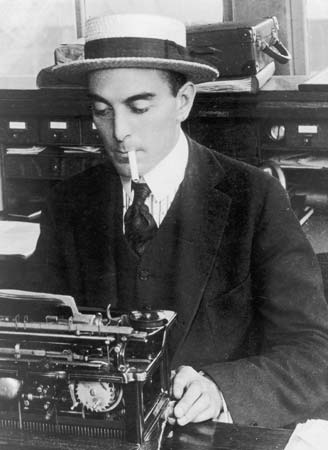
Ring Lardner in undated photo, possibly mid 1920s (Encyclopaedia Britannica)KAUFMAN CHUMS…Comedian Julius Tannen (left) frolics with Beatrice Kaufman and George S. Kaufman in Atlantic City in the 1920s; writer/critic Alexander Woollcott (left), artist Neysa McMein, actor Alfred Lunt, Beatrice Kaufman and comedian Harpo Marx hanging out in the 1920s. (spartacus-educational.com)
* * *
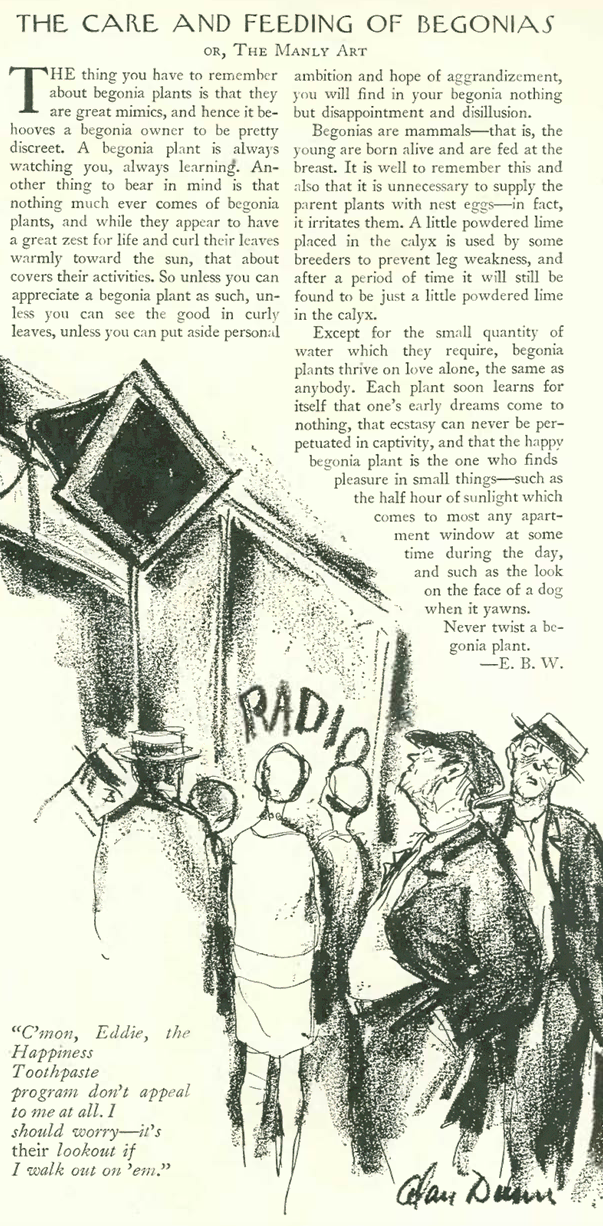
One New Yorker writer who does stand the test of time is E.B. White, known to earlier generations for his many humorous contributions to The New Yorker and to later generations for his co-authorship of the English language reference The Elements of Style, and for his beloved children’s books including Stuart Little and Charlotte’s Web (Charlotte’s Web was often voted as the top children’s novel in a survey of School Library Journal readers, and most recently in 2012—the 60th anniversary of its publication). In the July 7, 1928 issue the nature-loving White offered these tongue-in-cheek plant care instructions, arranged atop a cartoon by Alan Dunn:
Another cartoon in the July 7 issue by Garrett Price offered another perspective on an advertising come-on:
No doubt Price was referencing ads such as this one below by the American Tobacco Company in which actress and dancer Gilda Gray—who in the 1920s popularized a dance called the “shimmy”—announced her preference for pipe smokers:
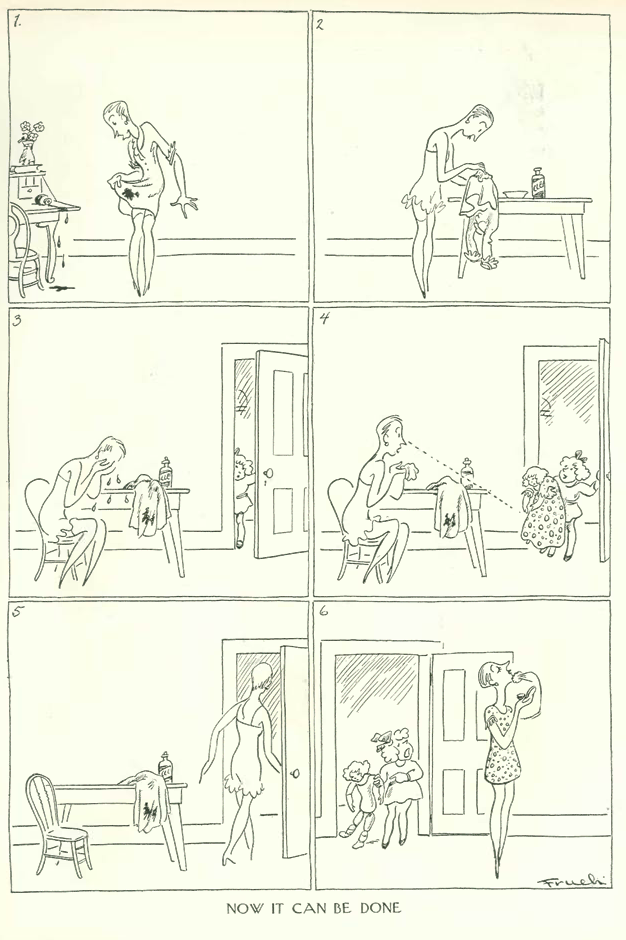
And we close with this cartoon by Al Frueh, who demonstrated how fashion had freed the woman of the Roaring Twenties:
Interested in the history of New Yorker cartoons and cartoonists? Then I recommend you check out cartoonist Michael Maslin’sInkspillwebsite for news on cartoonists and events. Another great site is Stephen Nadler’sAttempted Bloggery, which explores original art, auctions, obscurities and other angles of New Yorker cartoons and cartoonists.
A couple of my favorite Maslin cartoons (among many):
In the days before air conditioning, summertime city dwellers escaped the heat by fleeing to the countryside or the coast, or, if they lacked the time or the means, by taking their dining and dancing to one of Gotham’s breezy rooftop nightclubs.
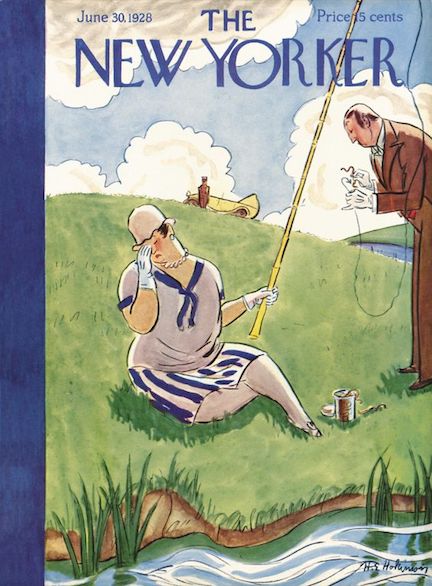
June 30, 1928 cover by Helen Hokinson.
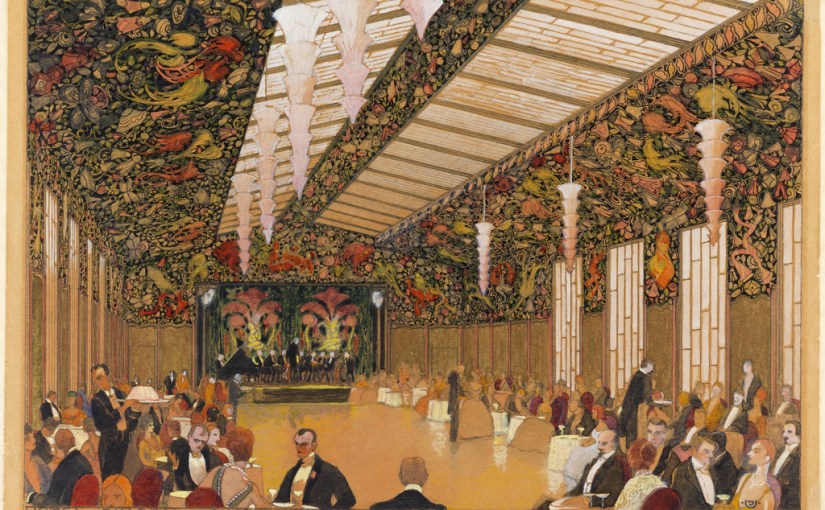
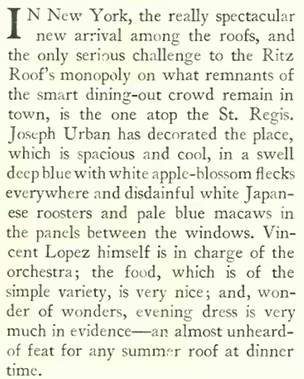
In her column “Tables for Two,” nightlife correspondent Lois Long welcomed the addition of rooftop dining atop the St. Regis Hotel, which featured decor by the famed theatrical set designer and architect Joseph Urban:
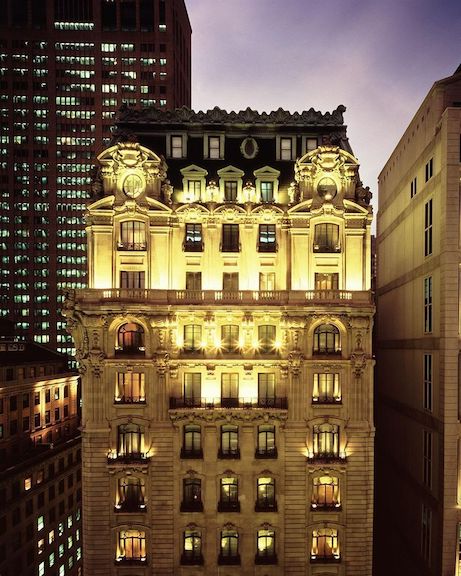
The St. Regis Hotel in New York City. (StreetEasy)
Illustrations by Alice Harvey (in the July 7, 1928 issue) depicted diners and dancers on the St. Regis rooftop…
“DISDAINFUL ROOSTERS” looked down upon diners from Joseph Urban’s roof garden murals at the St. Regis. At right, Urban in 1920. Urban was right at home at the St. Regis, and even died there in 1933 after suffering a heart attack in his apartment. (artcontrarian.blogspot.com / Columbia University, Butler Rare Book and Manuscript Library)CONTINENTAL INSPIRATION…Joseph Urban’s 1928 design for the Roof Garden at the Hotel Gibson in Cincinnati, Ohio, was inspired by 19th century European pleasure gardens. (Cooper Hewitt)
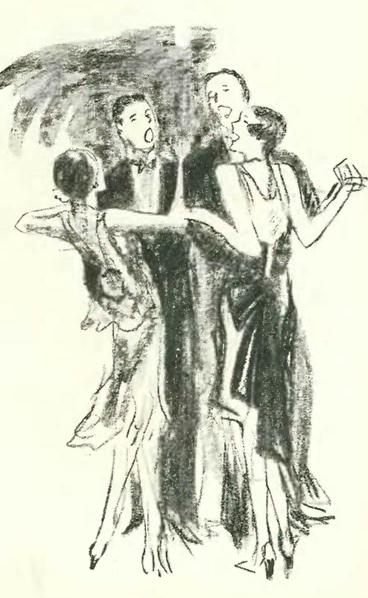
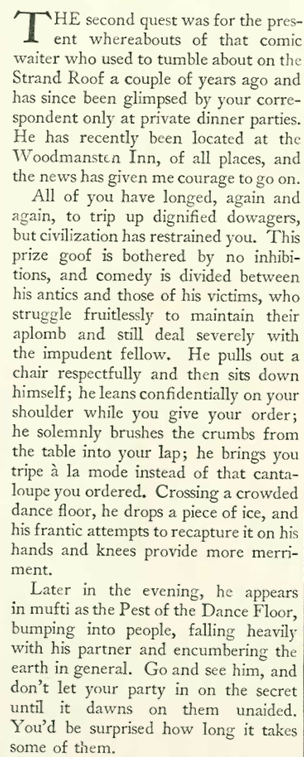
Long also fondly recalled a “comic waiter” who entertained patrons of another popular rooftop destination, The Cascades atop the Strand:
CASCADES…A 1920s postcard image of the Strand’s rooftop dining room, known as “The Cascades.” The room once featured a comical waiter who entertained diners with various gags and pratfalls. (thejumpingfrog.com)
* * *
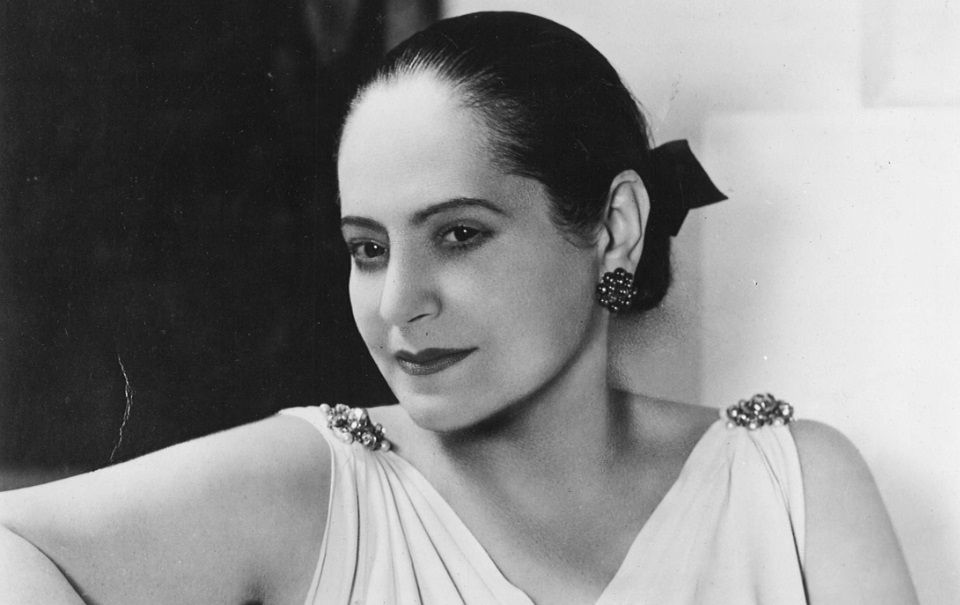
The June 30 issue featured a Profile of cosmetics entrepreneur Helena Rubinstein, who began her cosmetics empire with a dozen jars of face cream. Writer Jo Sterling described a businesswoman of limitless energy whose habits could be described as restless and haphazard but also revealed a woman of great generosity. Sterling noted that this woman of great wealth and a renowned collector of fine art and other rare objects preferred riding the bus to owning an automobile (illustration by Hugo Gellert).
IT STARTED WITH A DOZEN JARS OF FACE CREAM…Polish American businesswoman, art collector, and philanthropist Helena Rubenstein in the 1920s. (Womanology)
* * *
Portents of War (to be continued…)
In the Roaring Twenties most believed the Great War was indeed the “War to End All Wars,” so when militarism was clearly on the rise in Shōwa Japan few took it seriously, including New Yorker cartoonist Al Fruh:
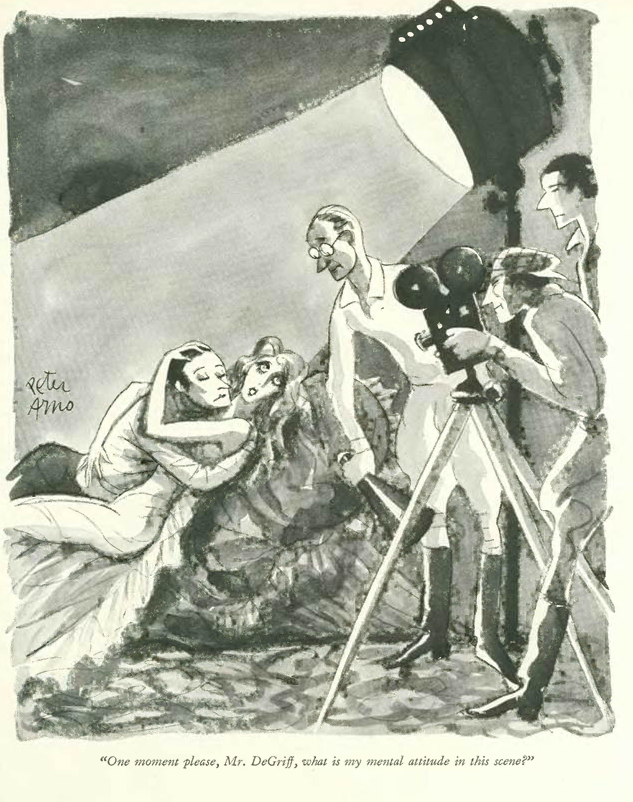
On the lighter side, Peter Arno offered up his take on a cinematic love scene:
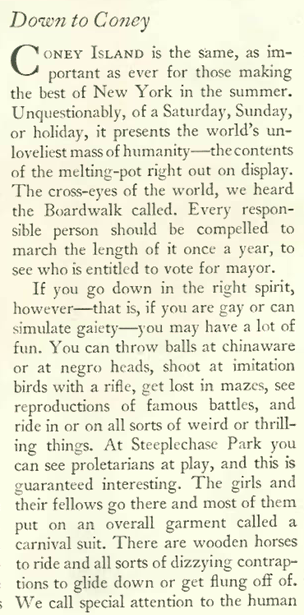
TheNew Yorker kicked off the summer season with a trip down to Coney Island. “The Talk of the Town” took in the various sights and amusements at the famed Steeplechase and Luna parks.
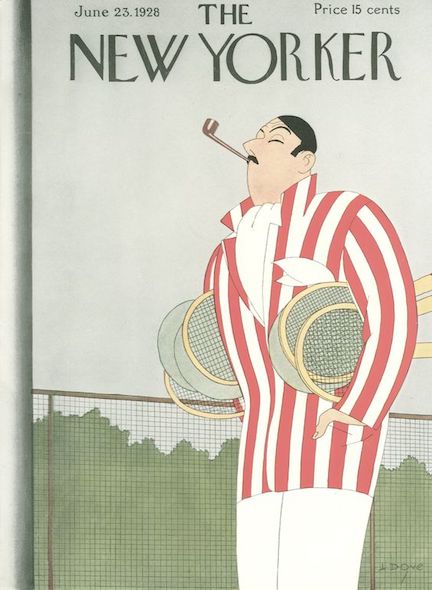
June 23, 1928 cover by Leonard Dove.
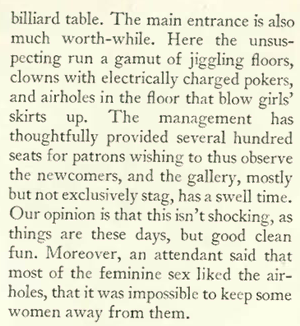
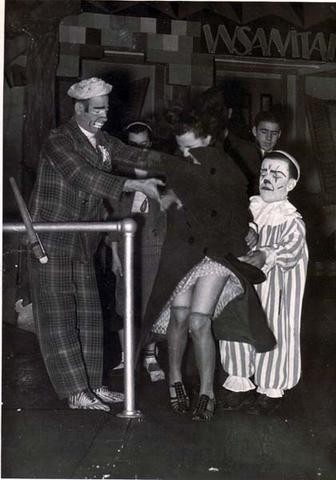
Attractions at Steeplechase Park included everything from racing wooden horses to a “human billiard table.” Less jolly diversions included air jets that blew up women’s skirts and clowns who administered electric shocks to unsuspecting visitors (one more reason to fear them). And there was at least one racist game of skill…
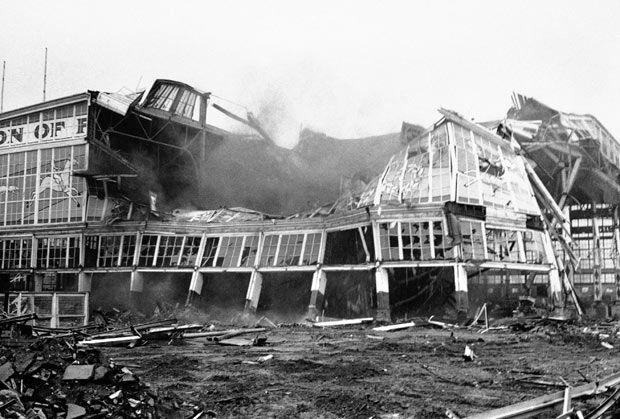
FEAR THE CLOWN…A photo from the 1940s shows a pair of clowns “help” a woman through the entrance to Steeplechase Park’s Insanitarium and Blowhole Theatre. Located in the Pavilion of Fun, visitors were led through Comedy Lane, which featured jets of compressed air intended to lift skirts. Clowns spanked patrons and even zapped them with a cattle prod. (Worthpoint.com)Clockwise, from upper left: A Steeplechase rider passes in front of the massive Pavilion of Fun; interior of the Pavilion of Fun; young women preparing to be spun around on the Human Billiard Table; scene from the 1928 Harold Lloyd movie Speedy filmed in the Pavilion of Fun (westland.net, CardCow, houseoftoomuchtrouble.tumblr.com, safetylast.tumblr.com) click to enlargeOUT FOR A SPIN…Harold Lloyd and Ann Christy take a spin on the Pavilion of Fun’s Human Roulette Wheel in the 1928 film Speedy. (spellboundbymovies.com)TRUMPED…Coney Island’s landmark Pavilion of Fun at Steeplechase Park was demolished in 1966 by developer Fred Trump, father of Donald Trump. The young Donald (19 at the time) was on hand for his father’s “Demolition Party,” which featured scantily clad models who paraded in front of the park and encouraged guests to throw bricks at the stained glass windows of the historic pavilion. Later that night Trump bulldozed the amusement park to the ground, thereby limiting any pending proceedings to declare the property a historic landmark. (Daily Telegraph/Untapped Cities)
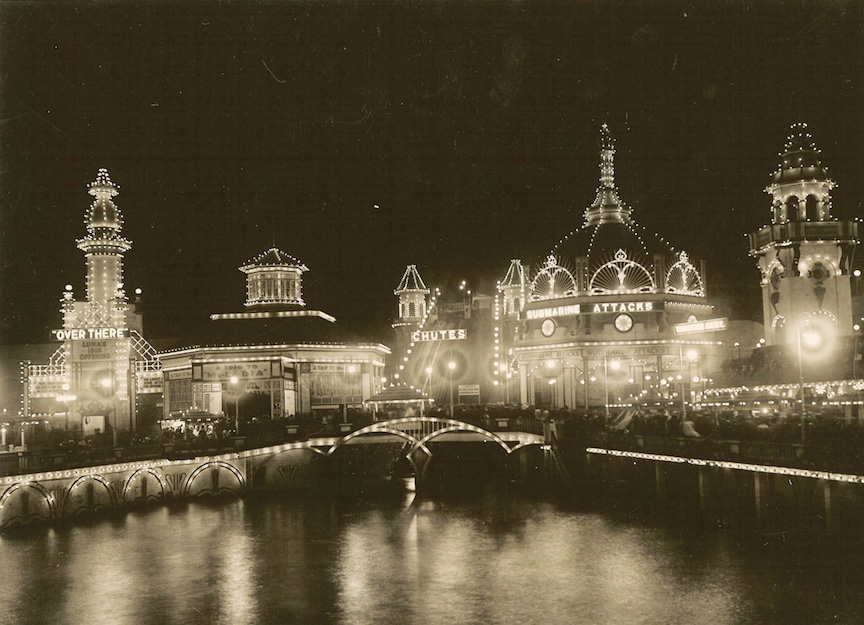
Over at Luna Park there were more air holes to blow up women’s skirts and assorted freak shows. More wholesome entertainments included the famed Cyclone rollercoaster, which celebrated its 90th year of operation in 2017.
DREAMLAND…Luna Park at night in the 1920s. (carouselhistory.com)
* * *
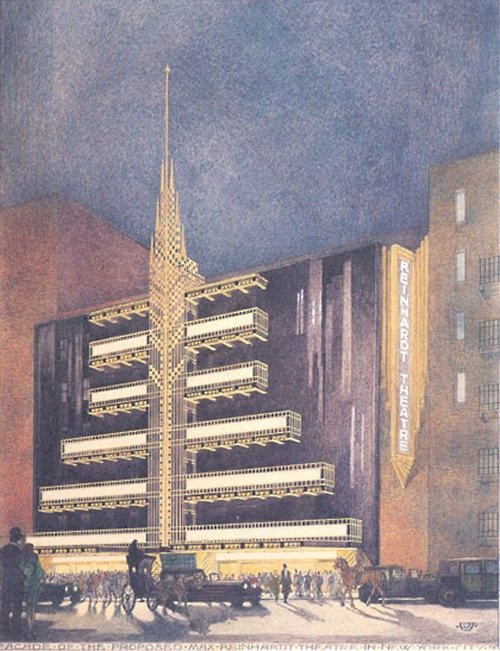
Writing for the June 23 “Talk of the Town,” Murdock Pemberton anticipated the construction of a new theatre to be developed by famed Austrian director/producer Max Reinhardt and designed by Austrian-American architect, illustrator and scenic designer Joseph Urban:
Unfortunately the market crash of 1929 put an end to the project, which would have looked like this had it been constructed:
DREAMLAND…Joseph Urban’s unbuilt Reinhardt Theatre. The innovative design incorporated the building’s fire escapes into its glimmering facade. (Columbia University)
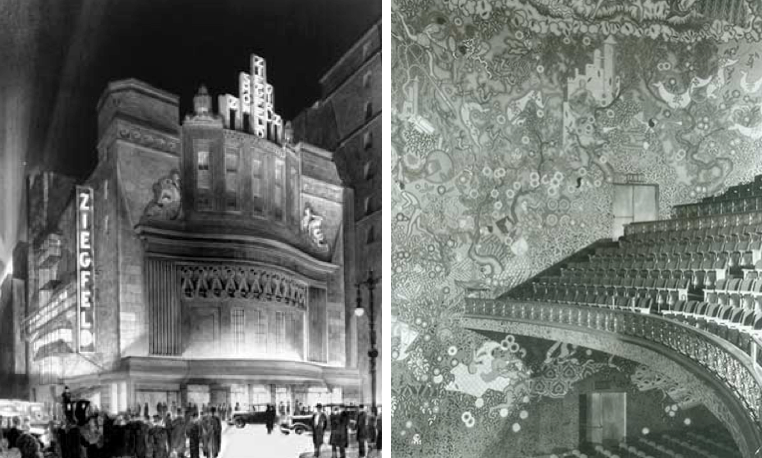
Urban designed innovative sets for clients ranging from the Metropolitan Opera to the Ziegfeld Follies (he also designed a theatre for Ziegfeld in 1927, see below). Although he is noted as one of the originators of American Art Deco, most of his architectural work in the United States has been demolished.
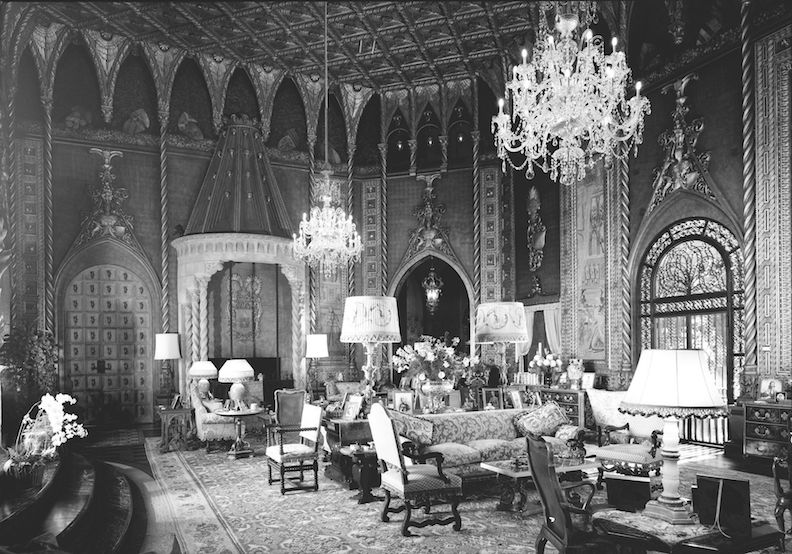
RARE REMNANT…Little remains of the work of Joseph Urban, one of the originators of American Art Deco. Fortunately the Tishman Auditorium at the New School still stands. (nycarchitecture.com)ONLY A MEMORY…Most of Joseph Urban’s American work has been demolished, including his Ziegfield Theatre from 1927. (nyc-architecture.com)MAR-A-LAGO…Joseph Urban designed the interiors of one of America’s most famous mansions—Mar-a-Lago. Built from 1924 to 1927 by cereal heiress Marjorie Merriweather Post, it is now owned by Donald Trump and operated as a members-only club. (Wikipedia)
* * *
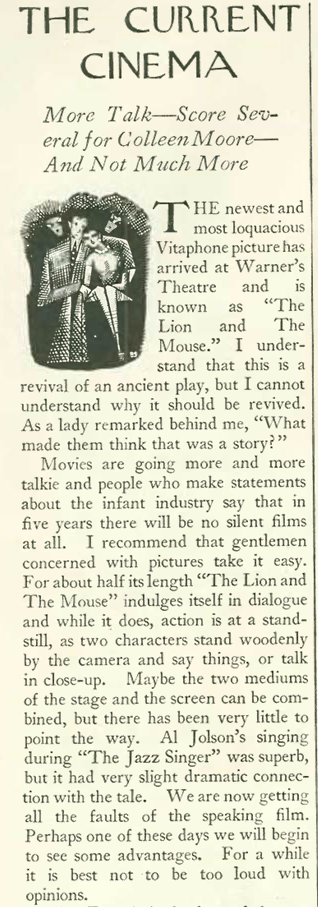
The New Yorker continued to struggle with the emergence of “talking pictures.” The critic “O.C.” found that the sound dialogue in The Lion and the Mouse did little to improve the picture:
The critic seemed to believe that sound pictures would take some time to catch on. Little did he know that Warner Brothers would announce later that summer (August 1928) that all of its films for the 1928-29 fiscal year would have sound. United Artists would make the same announcement in November 1928. In February 1929 Twentieth-Century Fox would make its final silent movie, and Columbia would release its last silent movie on April 1, 1929.
OH SHUT UP…Theatre card for The Lion and the Mouse. (Wikipedia)
TheNew Yorker still found happiness at the movies through the likes of actress Colleen Moore, who made a sweet little film called Happiness Ahead.
A CASE OF THE HAPPIES…Colleen Moore strikes a contemplative pose in Happiness Ahead. (IMDB)
Colleen Moore was one of the most famous stars of the silent era who popularized the bobbed haircut and flapper style. Moore presented a more wholesome version of the flapper, in contrast to the more worldly Louise Brooks, another flapper icon of the Twenties.
VARIATIONS ON A THEME…Actresses Colleen Moore (left) and Louise Brooks defined flapper style in the 1920s. (dorineenvrac.wordpress.com / corvusnoir.com)
* * *
From Our Advertisers
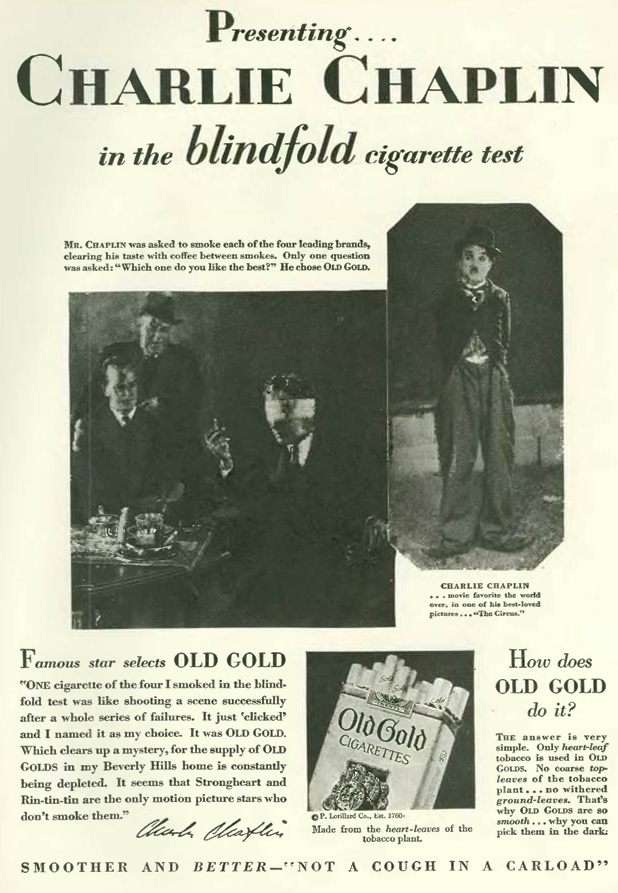
Continuing our series on celebrity endorsements of Old Gold cigarettes, none other than the Little Tramp stepped up to take the blindfold test (along with a pile of cash, no doubt):
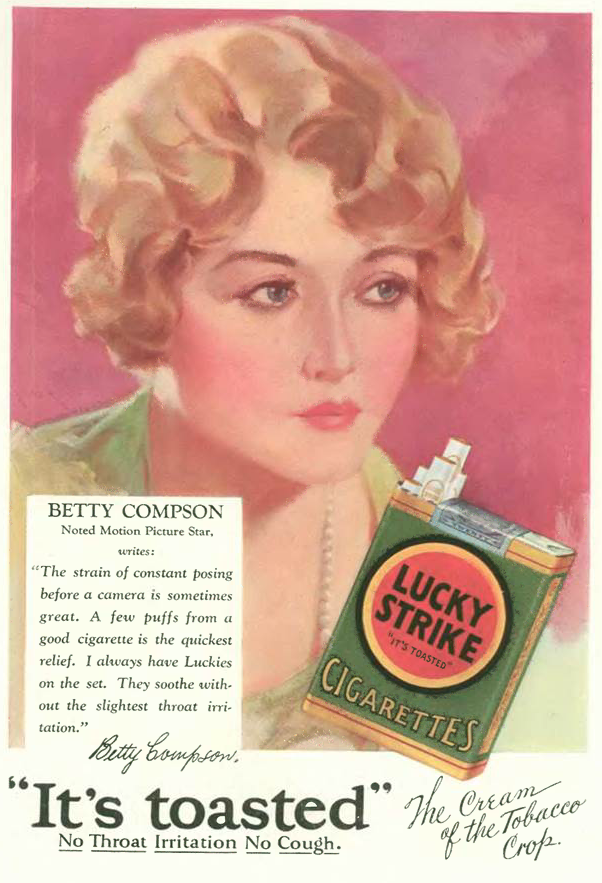
And if Old Gold is not to your taste, then why not enjoy the “toasted” pleasures of Lucky Strike? Actress Betty Compson found them indispensable when preparing for a big scene:
* * *
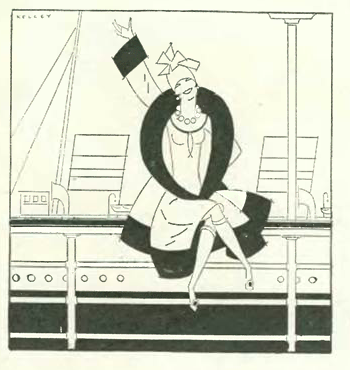
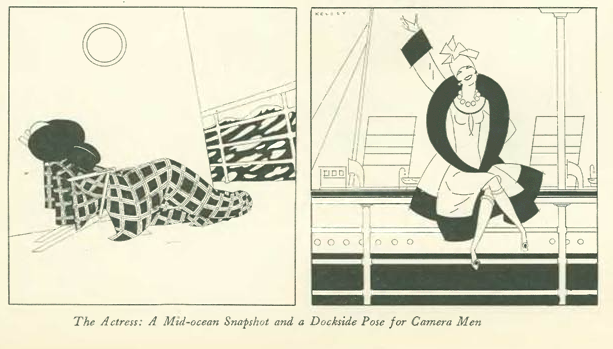
And now for something that caught my eye in the June 23 issue…a bit of filler art by Eldon Kelley that broke up some copy on page 34:
This particular illustration was also featured in one of The New Yorker’s earliest issues—March 21, 1925—in a two-part comic panel (below). I am puzzled why the magazine, flush with artistic talent by 1928, reused this Kelley illustration. Perhaps the layout editors figured since the readership was so small in March 1925, no one would notice.
Here’s an early contribution by Otto Soglow that is a far cry from his later minimalist cartoons…
And we leave with yet another look at some Jazz Age shenanigans, courtesy cartoonist Peter Arno:
Compared to Hollywood, cinema as an art form in the 1920s was more advanced in Europe, where filmmakers took a more mature, nuanced approach to movies; they focused less on money and more on exploring difficult social and historical issues. Trench warfare, genocide and famine have a way of doing that to you.
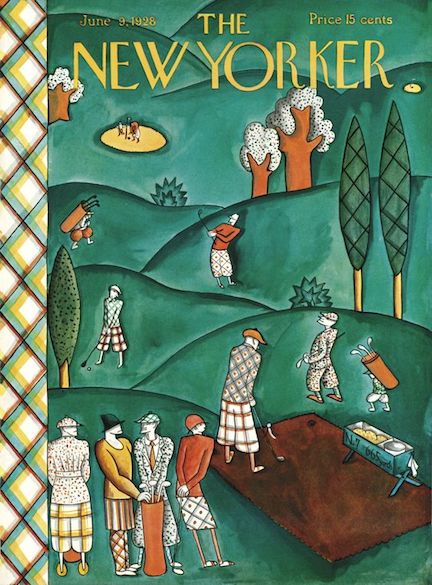
June 9, 1928 cover by Ilonka Karasz.
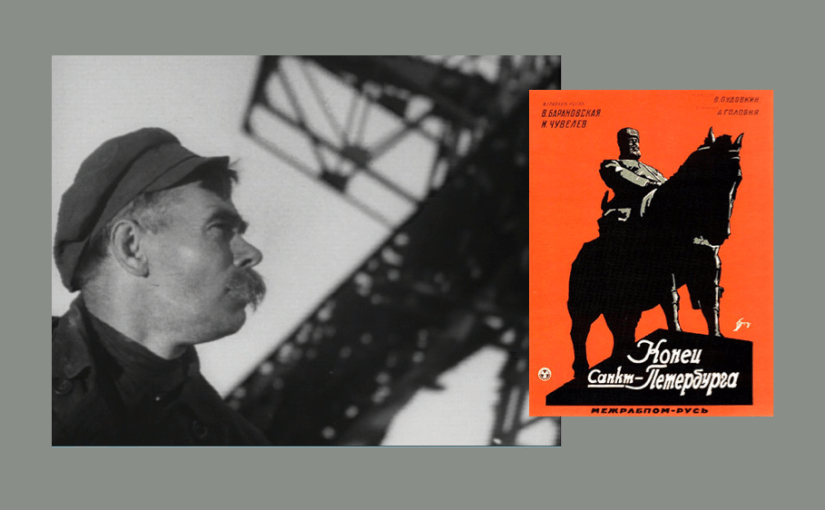
The contrast between the European avant-garde and Hollywood’s Tinseltown was not lost on The New Yorker’s film critics, who consistently lambasted American cinema while applauding nearly everything coming out of Europe, and especially the films produced by German and Russian directors. The critic “O.C.” used the Russians latest American release, The End of St. Petersburg, to drive home the point. He also chided those who dismissed the film as propaganda, a stance much in line with leftist intellectuals of the day who found inspiration in the Russian Revolution (and sometimes they looked the other way when things didn’t go so well in the Soviet experiment—1928 marked the beginning of the Soviet Union’s first Five-Year Plan. By 1934 it was estimated that almost 15 million people died from forced collectivization and famine).
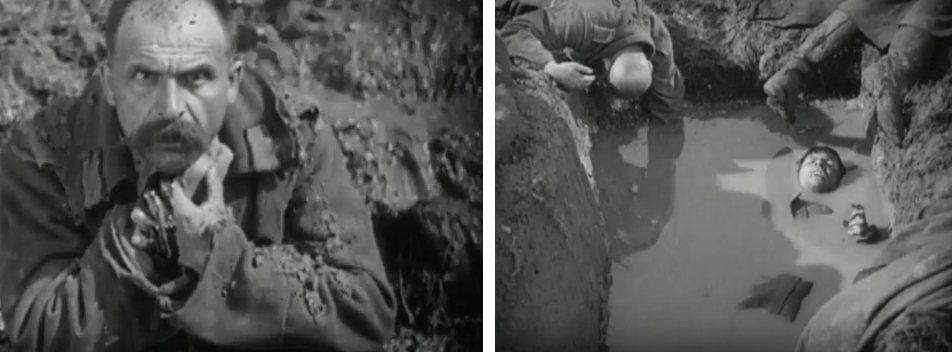
The End of St. Petersburg was blatant propaganda, to be sure, but to this day it has been widely praised for its cinematic innovations. The story itself was fairly straightforward: A peasant goes to St. Petersburg looking for work, gets arrested for his involvement in a labor union and is subsequently sent to fight in the trenches of World War I. His experiences in the war solidify his commitment to revolution and the overthrow of the capitalist overlords. The New Yorker review:
OPPRESSORS & OPPRESSED…The shareholders of a steel mill (top) demand longer hours from workers who already suffer from hellish conditions at the factory in The End of St. Petersburg. (Stills from the film, available on YouTube)
TheNew Yorker reviewer suggested that a story used primarily to influence an audience—propaganda—was not necessarily a bad thing:
ALL CHOKED UP…The horrors of trench warfare were graphically depicted in The End of St. Petersburg. (stills from film)
* * *
Back in the New World, most of the talk in cinematic circles revolved around the excitement of “talking pictures.”
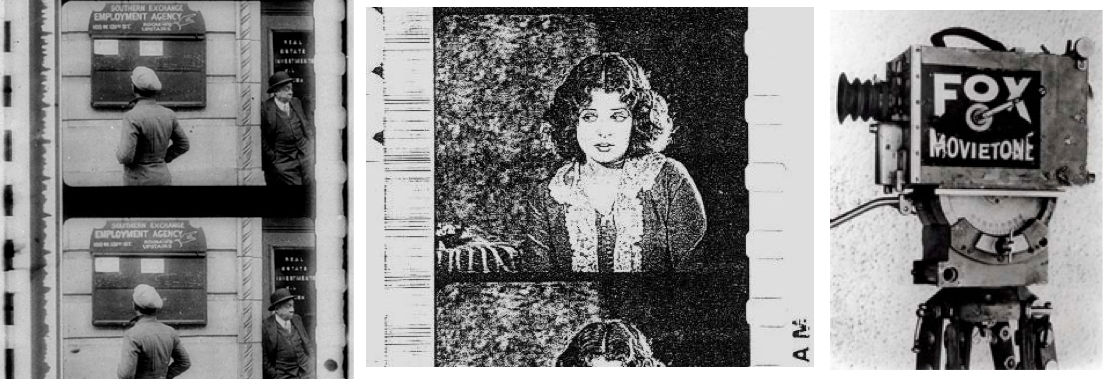
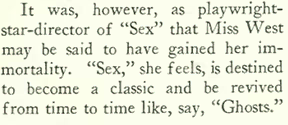
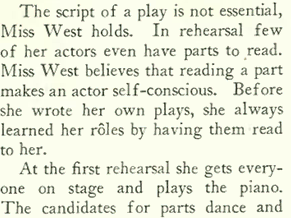
FORERUNNER…The Vitaphone system was the most successful of early attempts at sound movies. It synchronized a large recorded disc (seen at lower right) with the film. The Jazz Singer, often heralded as the movie that marked the commercial ascendance of sound films, used Vitaphone technology. (Audio Engineering Society)BETTER YET…Sound movies took off with the invention of a soundtrack that could be printed directly onto the film. Filmmakers either used Variable Area (left) or Variable Density (center) mono optical soundtracks located between the film’s picture frame and sprocket holes. The tracks could be read by a newly developed photocell (a light source also known as Aeo-light) that could be modulated by audio signals and was used to expose the soundtrack in sound cameras such as the one at right. (Images 1 & 2, Audio Engineering Society/ Image 3, Wikipedia)
It seems that Fox Movietone newsreels really got things going with sound and whetted audience appetites for more:
TELLING US A THING OR TWO…Irish playwright and critic George Bernard Shaw’s first visit to America, recorded for posterity in this 1928 Fox Movietone Newsreel. (YouTube still from film)
* * *
Then There Was The Other Playwright…
Mae West, to be exact. My guess is her approach to the craft was a bit different than G.B. Shaw’s, and we can gather as much from these excerpts from the June 9 “Talk of the Town.” The piece discusses West’s rise to fame as the creator and star of the scandalous play Sex, and her unorthodox approach to rehearsals.
DEMURE SHE’S NOT…Mae West in 1928’s Diamond Lil. (doctormacro.com)
* * *
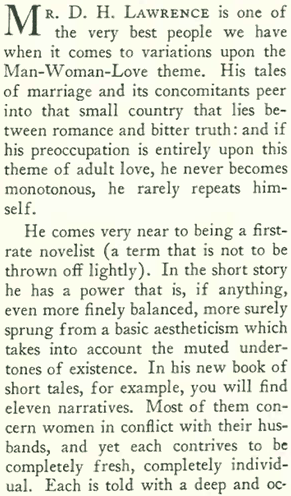
Although many today would identify D.H. Lawrence as one of great English novelists of the 20th century, eighty-some years ago New Yorker book critic Dorothy Parker described him as “very near to being first rate.”
A BARDIC QUALITY…D.H. Lawrence with wife Frieda Weekley in Chapala, Mexico in 1923. (tanvirdhaka.blogspot.com)
* * *
Blind Justice
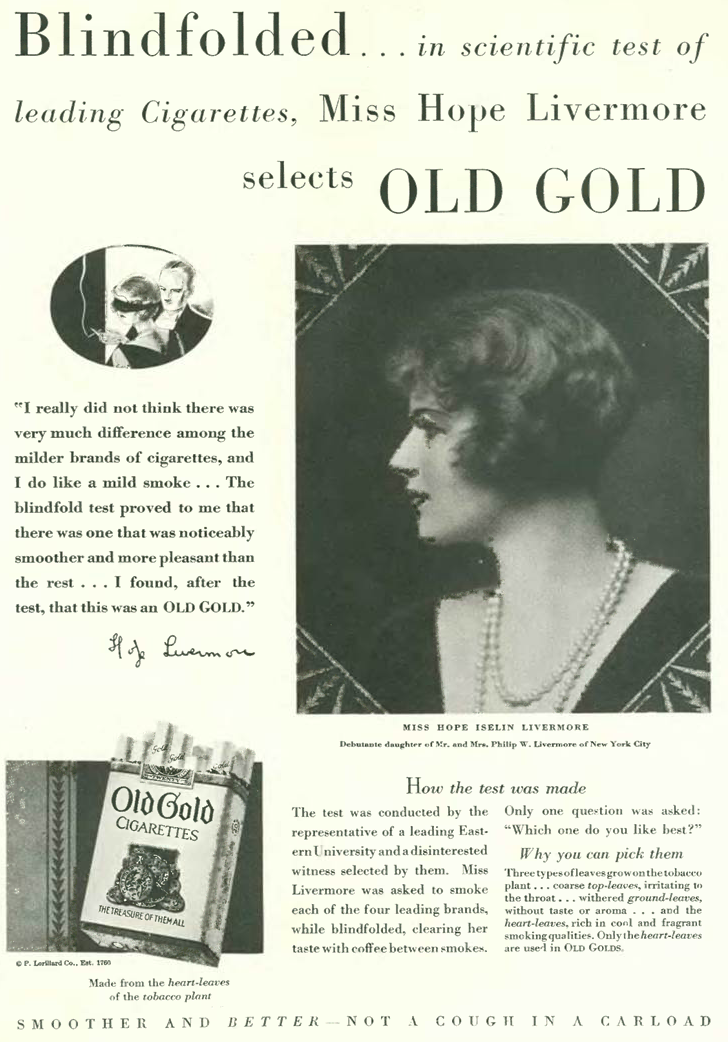
The makers of Old Gold cigarettes claimed to have scientific proof on their side with a series of ads featuring endorsements by the rich and famous. This ad ran in the June 9 issue:
In the same issue was this cartoon by Al Frueh that took a poke at Old Gold’s marketing strategy…
…and Peter Arno offered this unique take on human vanity…
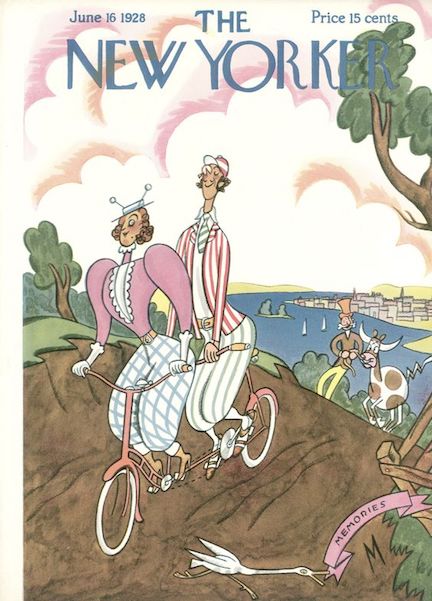
Talking pictures continued to be a theme in the June 16, 1928, issue…
June 18, 1928 cover by Julian de Miskey.
In his “Of All Things Column,” Howard Brubaker suggested that sound movies would spell the end of careers for some silent stars:
Although some actors struggled with the transition to sound, the reasons why some major stars faded with the advent of “talkies” are far more varied and nuanced. In many cases, some stars packed it in because their careers had already peaked during the silent era, and both studios and audiences were looking for some fresh faces.
HAS BEENS?…It is a common assumption that sound motion pictures killed the careers of many silent stars, including big names like John Gilbert (left) and Clara Bow. The reality is far more nuanced. (Wikipedia)
* * *
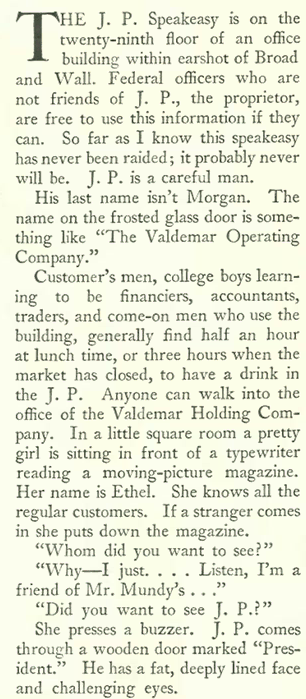
Niven Busch, Jr. continued to explore the illicit bar scene in his recurring feature “Speakeasy Nights.” I include this excerpt because it described a rather clever facade devised by the owner of the “J.P. Speakeasy.”
WORK/LIFE BALANCE…What might appear to be a typical business office might conceal an even more lucrative business in the back rooms. (Musée McCord/americanhistoryusa.com)
Busch observed an interesting protocol for admittance into the speakeasy, including a typewritten message devised to throw off any would-be Prohibition officers:
From Our Advertisers…
This ad leaves a bad taste in your mouth no matter how you look at. Nothing like coating your mouth with Milk of Magnesia before lighting up that first fag of the day…
…and here we have another ad for Flit insecticide, courtesy of Theodore “Dr. Seuss” Geisel.
And finally, a look at a Roaring Twenties wedding reception, courtesy cartoonist Garrett Price:


 One of the shorts featured a performance by female impersonator George Francis Peduzzi, known professionally as Karyl Norman, “The Creole Fashion Plate,” followed by a performance from violinist Albert Spaulding:































































































 A New Yorker State of Mind