Literary Rotarians

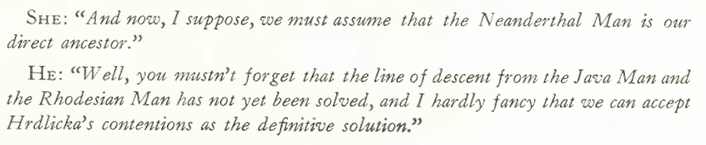
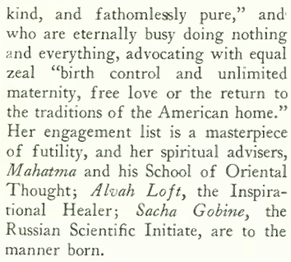
Dorothy Parker had a particular aversion to intellectual snobs, and in the Feb. 11, 1928 issue she wrote that the city had been beset with “Literary Rotarians” in search of bookish gatherings attended by people who, according to Parker, “looked as if they had been scraped out of drains.”

February 11, 1928. The cover is unsigned, but looks like a Rea Irvin.

I would have to say Parker was on firm ground here. Her own writing was clear and unaffected, and her tastes were democratic (she enjoyed and even wrote about comic strips). So when the book dandies crossed her path, there was trouble:

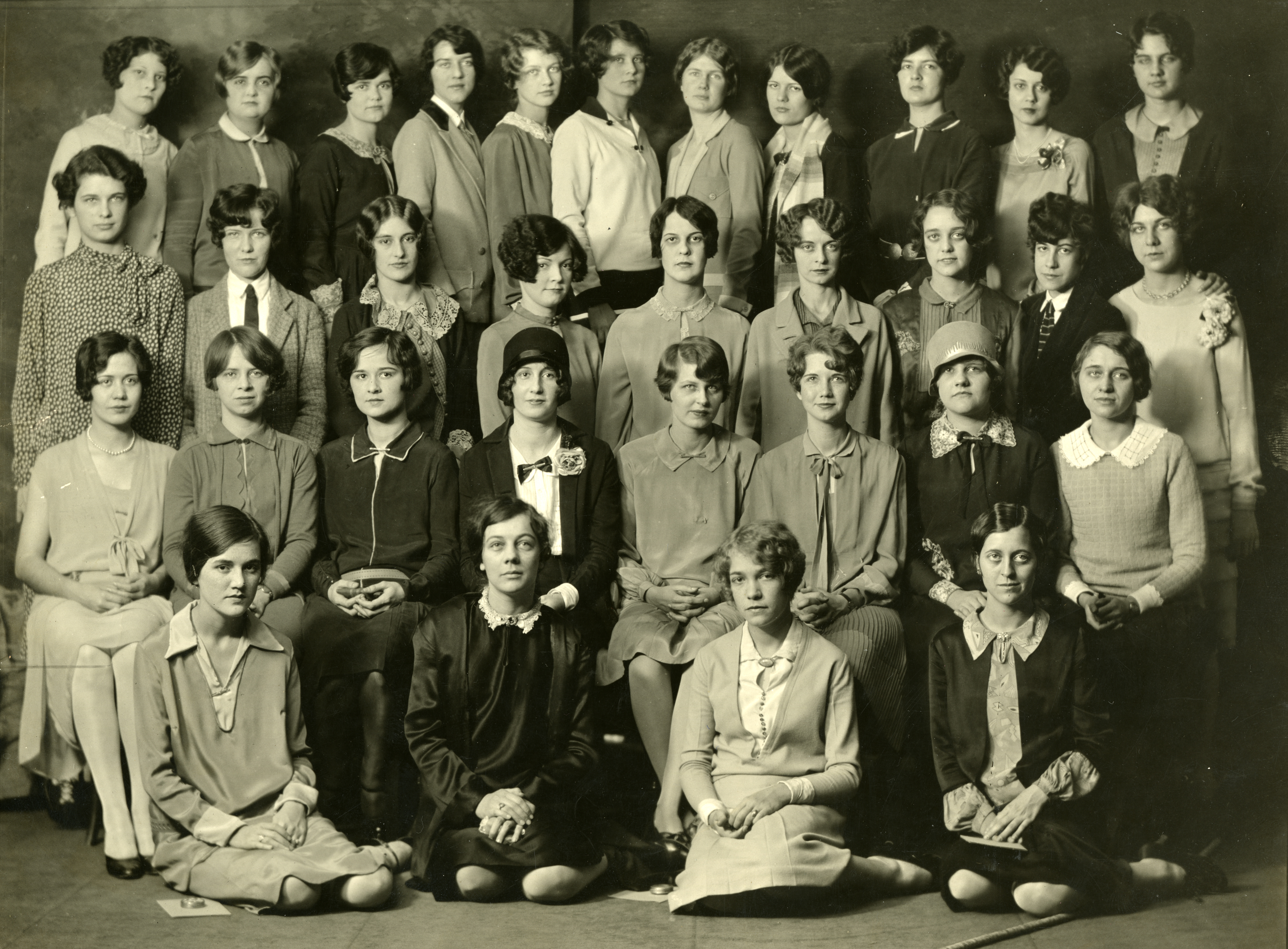
BOOK LOVERS…Rice University’s Pallas Athene literary society in 1927. No doubt most of them were interesting, bright young women. However, can you spot the “Rotarians?” (caralangston.com)
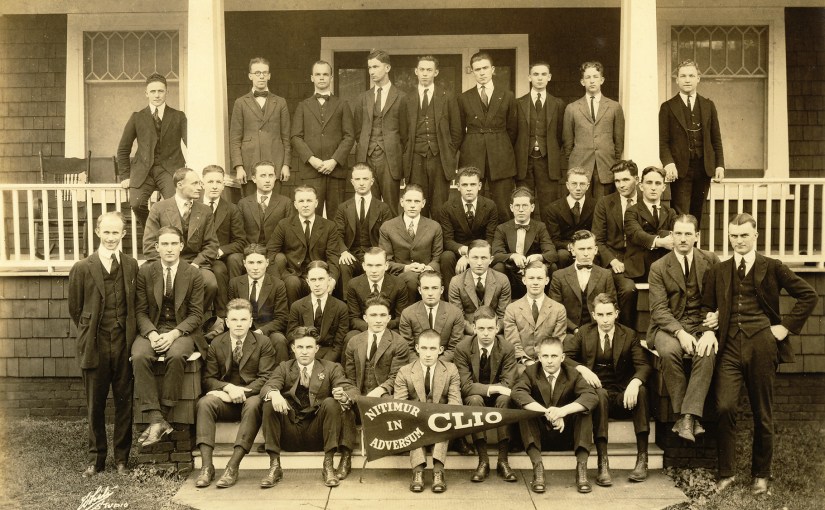
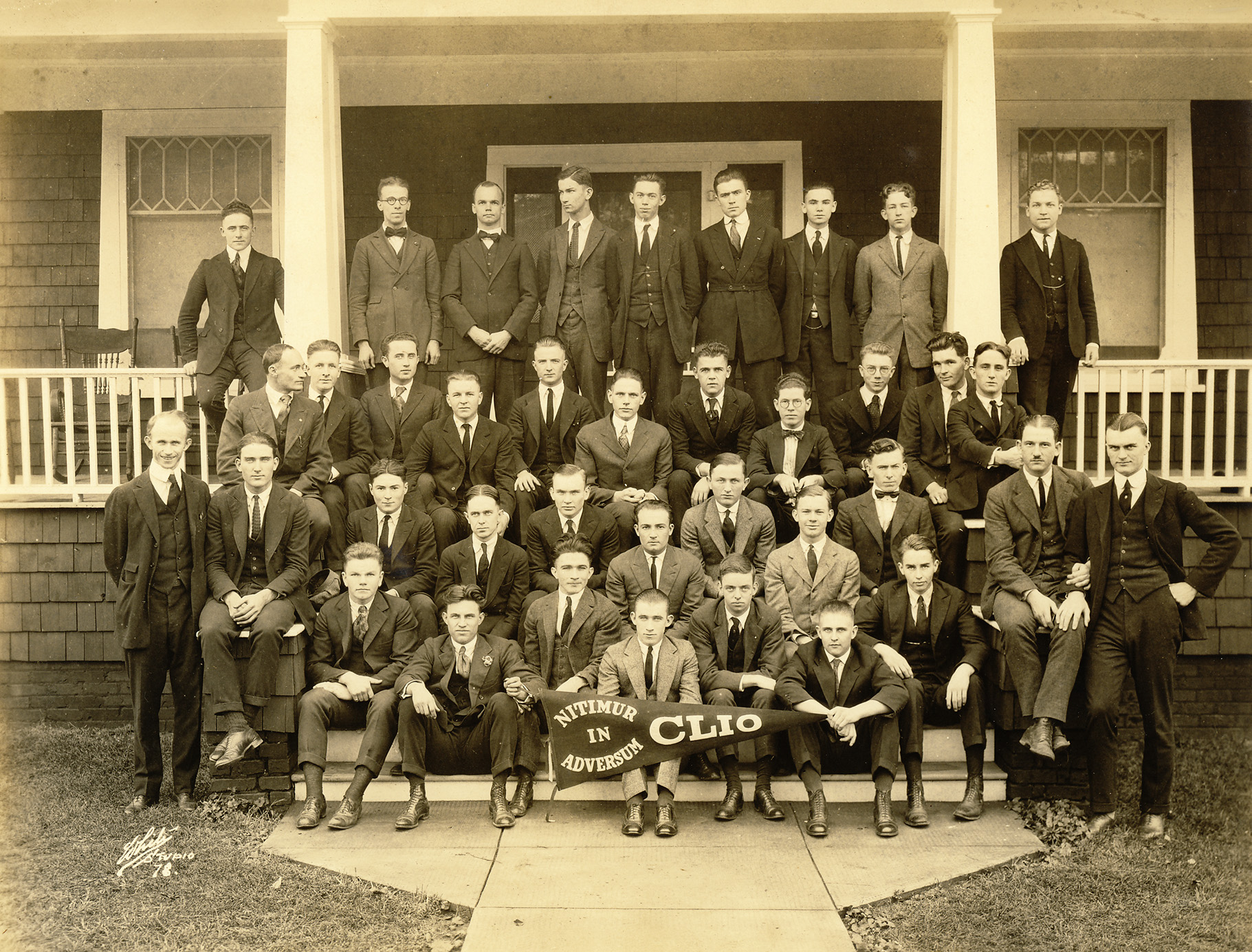
AND FROM THE OTHER GENDER…representatives of the Clio literary society at Elon University, circa 1920s. Did one of these lads ever cross Dorothy’s path? (belkarchives.wordpress.com)

 *  *  *

Parker continued, recalling the trauma she once endured at a literary association dinner:

 *  *  *

Thumb on the Scale of Justice

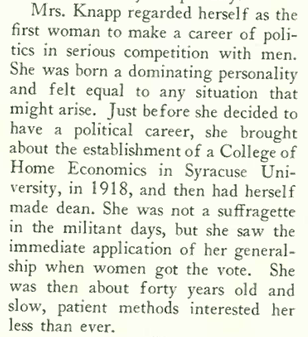
An unfortunate aspect of American life is how the law is selectively applied to favor those in power. Such was the case of Florence Knapp, who was elected as New York’s Secretary of State in 1924. After leaving office in 1926, she was accused of maladministration, and two years later was convicted of grand larceny while in office—Knapp put her stepdaughter’s name on the state payroll during the administration of the 1925 census, then cashed the checks herself, apparently using the funds to purchase clothes.

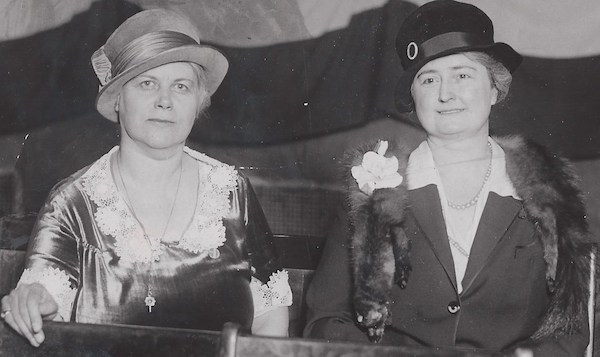
BRIEF CAREER…Florence Knapp (left) and Anna Drury DeWitt at State Republican Convention Sept. 28, 1926. Knapp was Secretary of State and DeWitt was delegate and member of Women’s Republican State Executive Committee. (findagrave.com)

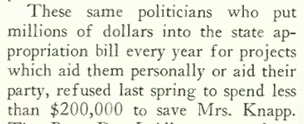
In a special article for The New Yorker, contributing writer Hugh O’Connor did not disagree with Knapp’s guilt, but found the hypocrisy of her accusers hard to stomach. Some excerpts:

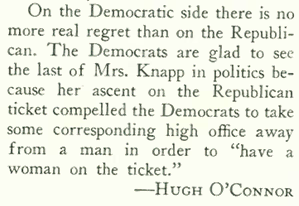
Just in case anyone thought this was solely a Republican hit job, O’Connor concluded that the other side was just as complicit in keeping women from high office:

For the record, Knapp was the last Secretary of State elected to that office in New York. After Knapp the office became appointive by the governor, and remains so today. It would be fifty years until another woman would be elected to a statewide office in New York.

Opening Eyes to Red Russia

The New Yorker encouraged open-minded readers to check out a new exhibition on Soviet Russia that offered an alternative vision of a young country beset by famine and political violence:

The exhibition featured hand-carved toys probably similar to these:

SOMETHING FOR THE LITTLE COMMIES…Toy Red Army soldier and sailor from the Zagorsk area. Painted wood, circa 1930. (soviet-art.ru)

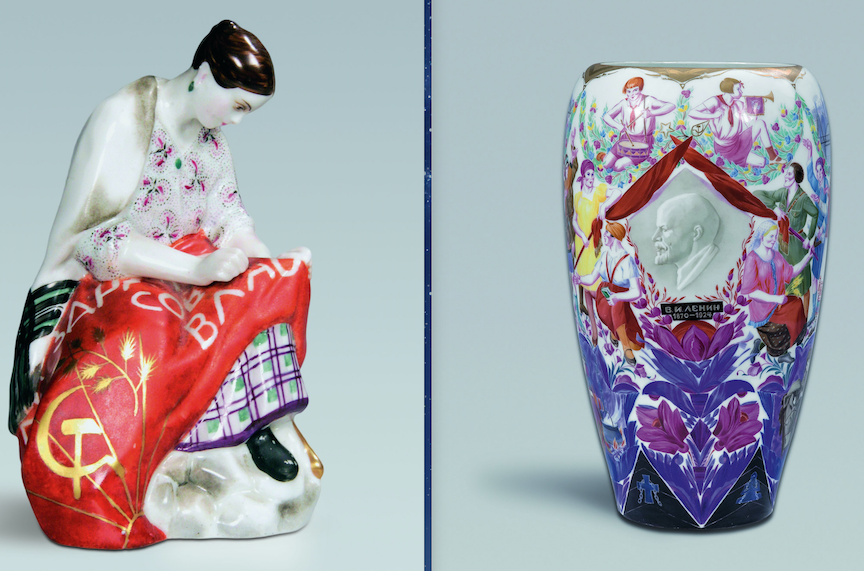
Also featured were pieces of “boldly propagandistic china.” Below are some examples of period pieces, not necessarily featured in the exhibition but perhaps give some idea of what New Yorkers were viewing in 1928. They range from kitschy…

At left, Woman Embroidering a Banner, by Natalia Danko of the State Porcelain Factory, Petrograd,1919. At right, decorative vase depicting The Liberated People, with Vladimir Lenin’s portrait below banners and scenes of life in different nations, by Maria Lebedeva of the State Porcelain Factory, Leningrad, 1929. (Photo © The Petr Aven Collection)

…to the stunningly avant garde….

At left, a vase with ornamental Suprematist elements by Nikolai Suetin, for the State Porcelain Factory, Leningrad, 1930. At right, a plate with Suprematist composition by Kazimir Malevich,1923. (Photo © The Petr Aven Collection)

 *  *  *

Woof for Westminster

The New Yorker’s “Talk of the Town” was abuzz with anticipation for the Westminster Kennel Club show at Madison Square Garden. The article noted that the record price paid for a dog was $9,500 (roughly equivalent to $133,000 today). By comparison, in 2014 a Chinese property developer paid nearly $2 million for a Tibetan mastiff puppy.

Note how the writer of the “Talk”  piece already knows that the “wire-haired terrier” has the inside track to victory:

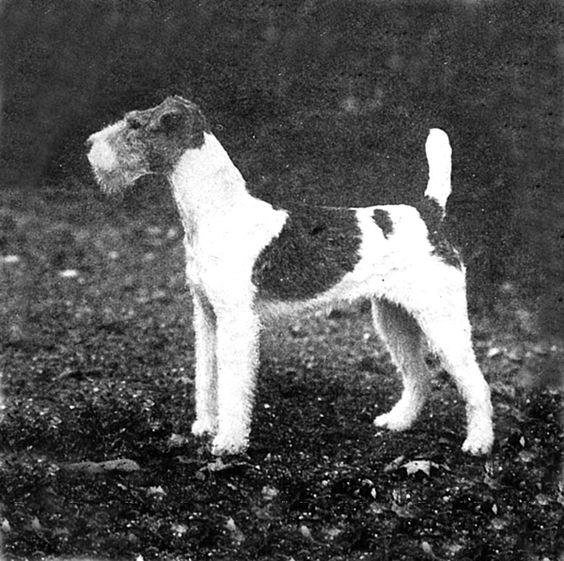
SPOILER ALERT…Talavera Margaret, a Wire Fox Terrier, was named winner (Best of Show) at the 1928 Westminster Kennel Club dog show. The Wire Fox Terrier breed has won Best of Show at Westminster more than any other breed, sweeping the award 13 times between 1915 and 1992. The Terrier Group overall is the most successful group, with 45 wins out of 103 occasions. (westminsterkennelclub.org)

 *  *  *

Advertisers in The New Yorker also had Westminster fever, including sporting goods purveyor Abercrombie & Fitch (note the breed of the tartan-clad dog):

 *  *  *

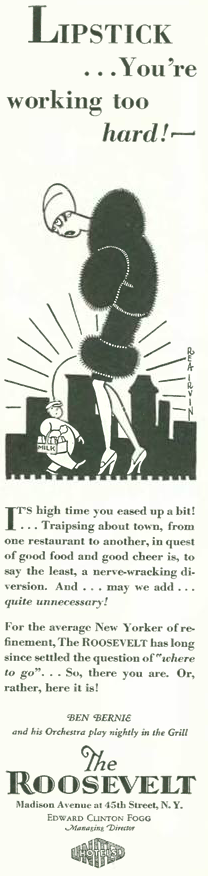
I found this advertisement in the back pages interesting because it called out The New Yorker’s Lois Long, who wrote her nightlife column, “Tables for Two,” under the pseudonym “Lipstick.” The drawing for the ad was provided by Rea Irvin, the artist who gave the magazine its signature look.

In her nightlife column Long played coy with her readers, careful not to reveal her true identity. She teased about being a “short squat maiden of forty,” but when she married cartoonist and fellow New Yorker contributor Peter Arno in August 1927, word was out about her true identity. Irvin’s drawing aptly captures Long in her early years at the New Yorker, on a writer’s salary but nevertheless fashionably dressed, partying all night and heading home with the rising sun.

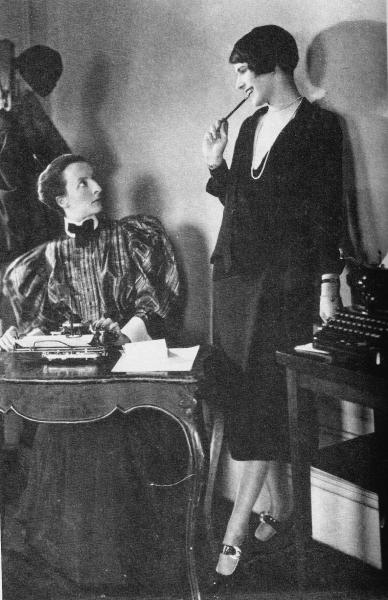
THE REAL LIPSTICK…A staged and posed joke photo of a young lady in prim 1890s clothes (at left) pretending to be startled by a 1920s flapper (Lois Long, at right). Photo taken in the mid to late 1920s. (Wikipedia)

 *  *  *

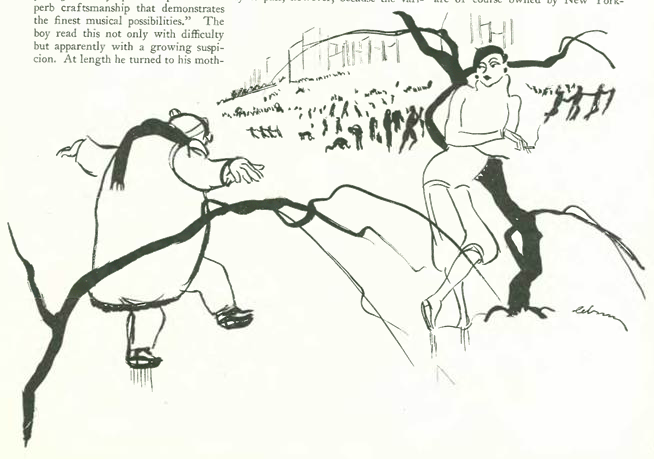
And finally, a great illustration that graced the bottom of the “Talk” section. If anyone knows the artist, please comment!

Next Time: Speakeasy Nights…
The Perfect Gift for 1927

We close out 1927 by looking at the final December issues, which grew fat with Christmas advertising catering to the tastes of New York’s smart set.

dec-10
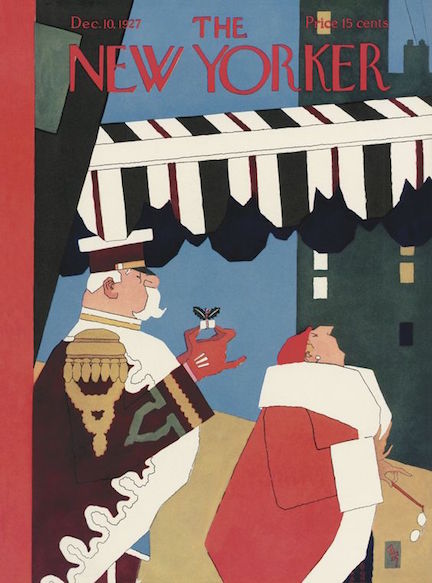
December 10, 1927 cover by Gardner Rea.

Before we jump to the ads, let’s look in on Lois Long, who in the Dec. 10 issue continued her lamentations regarding the quality of New York’s Prohibition-era night life and reminded readers that her job was far from a “soft snap”…

screen-shot-2017-02-06-at-10-03-06-am

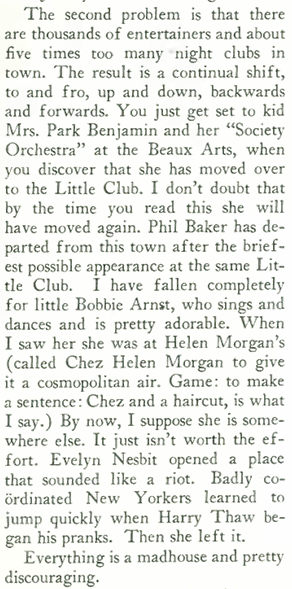
The problem, as diagnosed by Long, was that there were not enough talented entertainers to fill the needs of an overabundance of nightclubs…

screen-shot-2017-02-06-at-10-04-09-am

vit-94-bobbe-arnst1
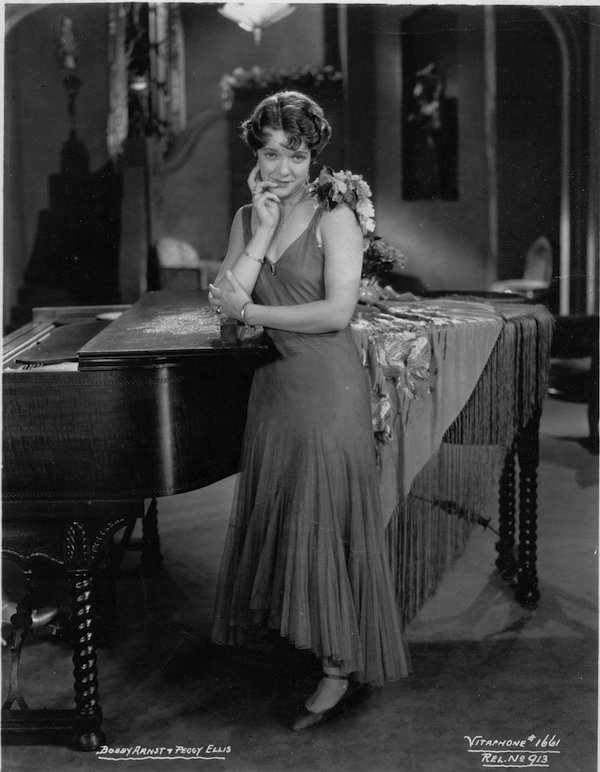
LOIS THOUGHT BOBBIE ARNST WAS PRETTY SWELL when she appeared at Helen Morgan’s nightclub. A noted broadway singer and dancer, Arnst is pictured above in a publicity photo from the 1929 film Rhythms in Blue. (picking.com)
screen-shot-2017-02-07-at-12-33-26-pm
ON THE OTHER HAND…Evelyn Nesbit’s tearoom (and later speakeasy) couldn’t survive on notoriety alone. In the early 20th century Nesbit’s face was everywhere—from advertisements to calendars—but in 1906 her fame took a nasty turn when her jealous husband, Harry Thaw, shot and killed suspected lover and famed architect Stanford White at Madison Square Garden’s rooftop theatre. At left, Nesbit in 1900. At right, Nesbit in her tea room on West 52nd Street, near Broadway, circa 1922. (Library of Congress / restaurant-ingthroughhistory.com)

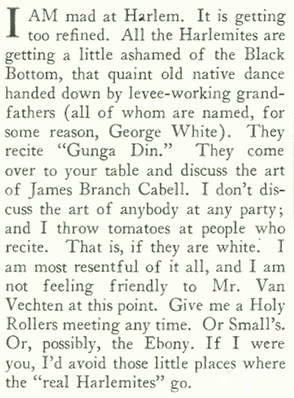
Long also railed against the white appropriation of Harlem entertainment, which she felt was draining the place of its soulfulness. In particular she called out writer and photographer Carl Van Vechten, who among white writers was the most prominent in intellectualizing the “Harlem Renaissance”…

screen-shot-2017-02-06-at-11-43-27-am

What to Buy in ’27

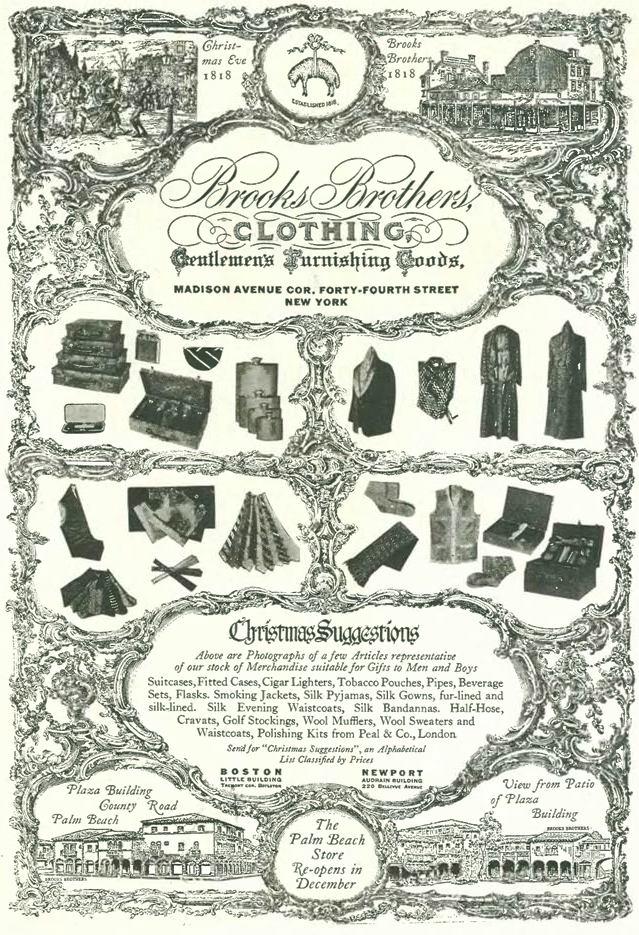
The Dec. 10 and Dec. 17 issues grew fat with holiday advertising, averaging 120+ pages as opposed to the usual 60 or so pages. The advertisements mostly appealed to upscale readers, ranging from this almost Victorian-style ad from the staid Brooks Brothers…

screen-shot-2017-02-06-at-9-46-21-am

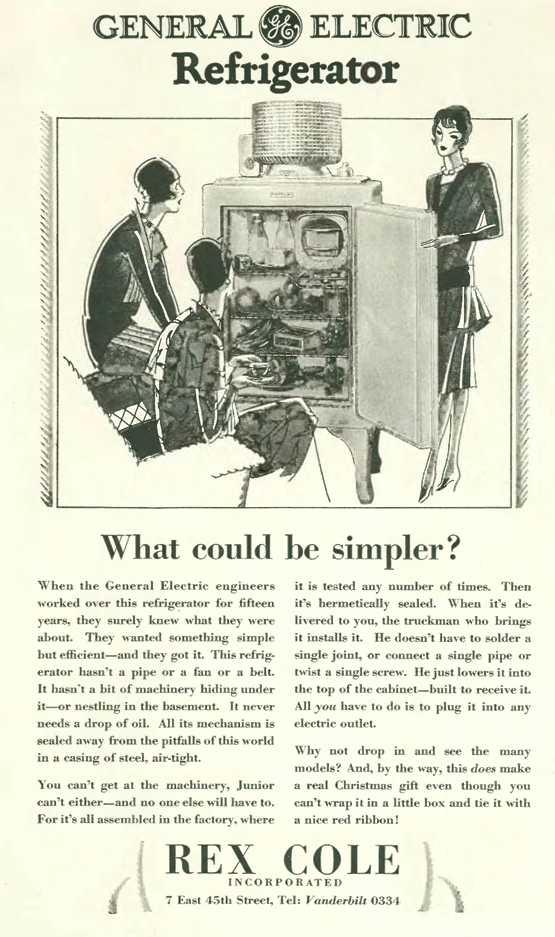
…to this ad from Rex Cole promoting the latest in modern conveniences…

screen-shot-2017-02-06-at-9-56-44-am

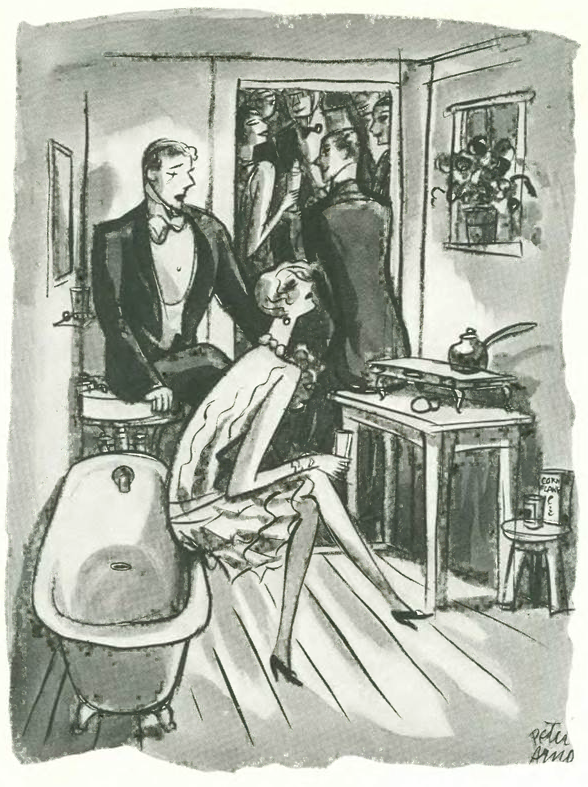
And I’ll toss in this cartoon from the Dec. 10 issue, in which Peter Arno allows us to listen in on an unlikely conversation between a couple of toffs…

screen-shot-2017-02-06-at-9-53-54-am

screen-shot-2017-02-06-at-9-54-11-am

Lois is Also Tired of the Holidays

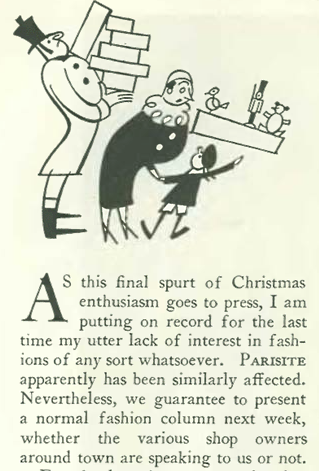
On to the Dec. 17 issue, in which Lois Long also shared with readers her weariness of Christmas shopping in her column, “On and Off the Avenue.”

dec-17
December 17, 1927 cover by Theodore G. Haupt.

The “Parisite” Long referred to in this excerpt was actually Elizabeth Hawes, who occasionally contributed to Long’s column (with cables sent from Paris) regarding the latest in French fashions. More on Hawes another time…

screen-shot-2017-02-06-at-12-11-30-pm

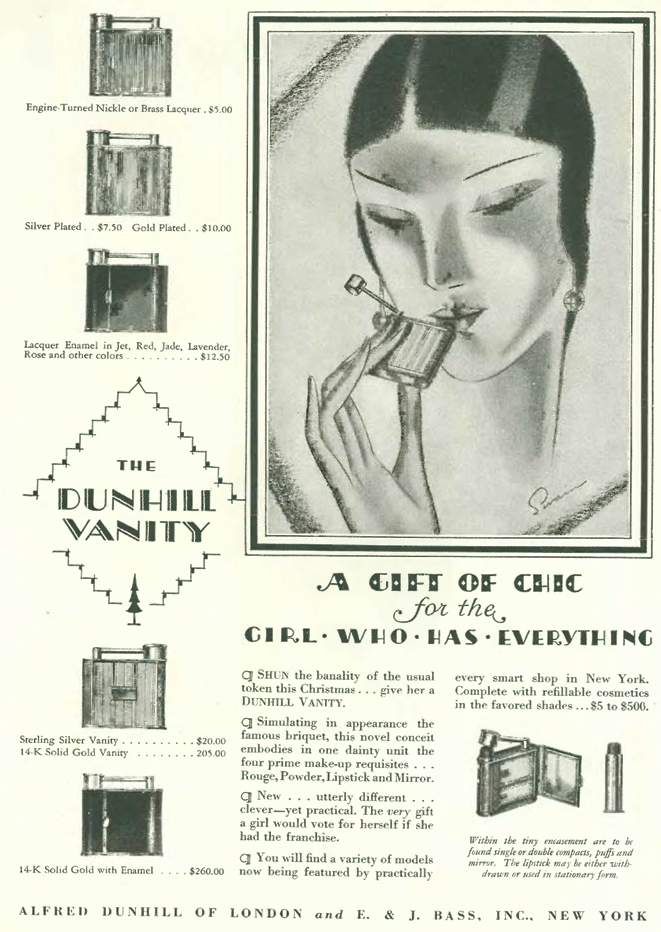
As for ads in the Dec. 17 issue, we get this one from Dunhill, maker of fine English cigarettes and accessories: a woman’s compact that resembles a lighter…

screen-shot-2017-02-06-at-12-07-21-pm

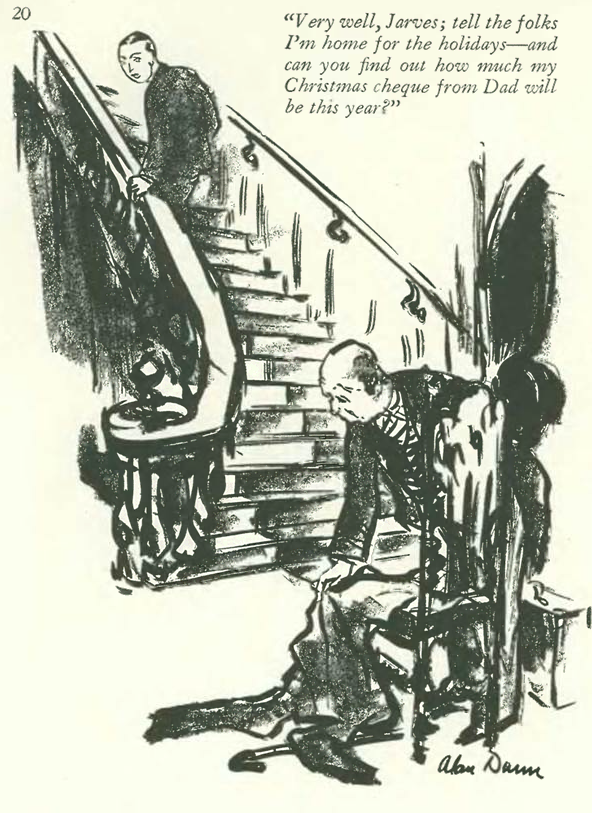
…and the same issue offers this glimpse into the life a spoiled rich kid, home from college for the holidays. The cartoon is by Alan Dunn, one of the most published New Yorker cartoonists (1,906 cartoons from 1926 to 1974)…

screen-shot-2017-02-06-at-11-52-12-am

With Christmas advertising over, the magazine’s page length dropped by half from the Dec. 17 to the Dec. 24 issue…

dec-24
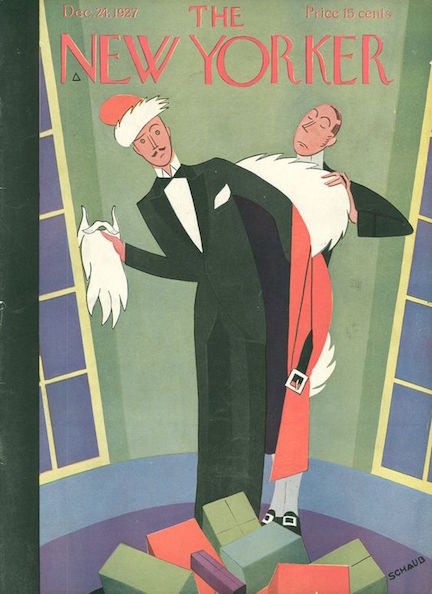
December 24, 1927 cover by Andre De Schaub.

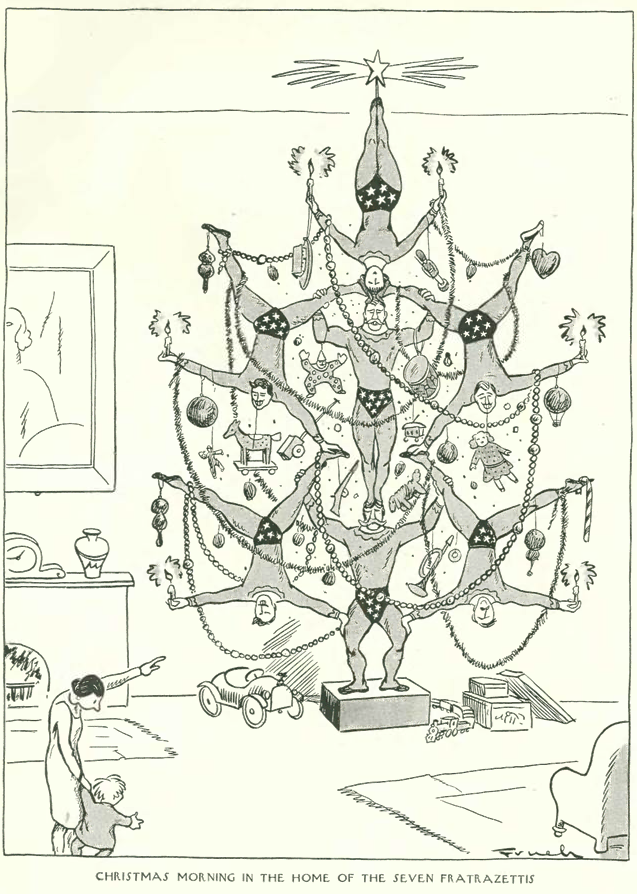
…in which we find this holiday-themed illustration by Al Frueh:

screen-shot-2017-02-06-at-12-26-56-pm

Why We Sing Auld Lang Syne

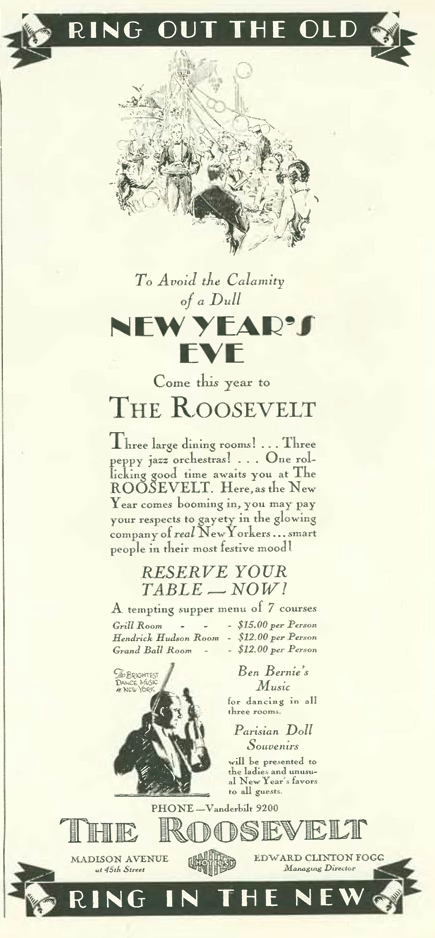
This advertisement in the Dec. 24 issue invited readers to celebrate the New Year at The Roosevelt Hotel…

screen-shot-2017-02-06-at-12-27-47-pm

roosevelt-hotel-1924
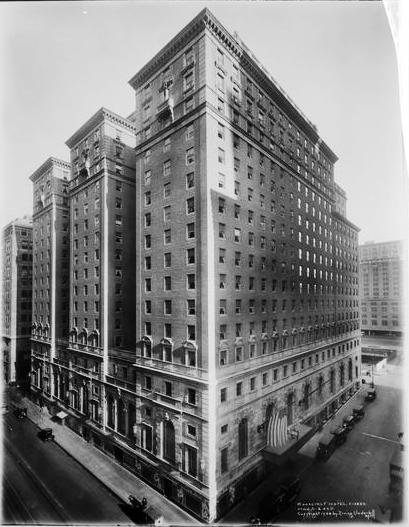
The Roosevelt Hotel after its completion in 1924 (Museum of the City of New York)
1387211957-0
AULD ACQUAINTANCE…If you want to know why we sing “Auld Lang Syne” on New Year’s Eve, you can thank Guy Lombardo and his Royal Canadian Band, which made the song a staple at his New Year’s performances beginning in 1929 at the Roosevelt Hotel. Their performance that night was broadcast on the radio before midnight Eastern time on CBS, then after midnight on NBC radio. (neatorama.com)

 *  *  *

Now Let’s Get Out of Here

With the holidays out of the way, New Yorkers still faced a good three months of winter. That is, unless you were well-heeled enough to head south to Palm Beach. Considering the abundance of ads promoting travel to southern climes in the Dec. 24 and 31 issues, apparently many of the magazine’s readers possessed the means to do just that…

screen-shot-2017-02-06-at-12-29-05-pm

screen-shot-2017-02-06-at-12-29-15-pm

And we close this entry, and the year of 1927, with this cover…

dec-31
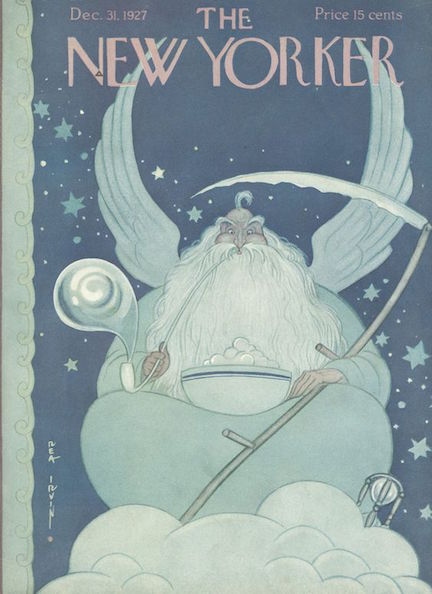
December 31, 1927 cover by Rea Irvin.

…and another tropical-themed advertisement, courtesy of Russeks…

screen-shot-2017-02-06-at-12-31-07-pm

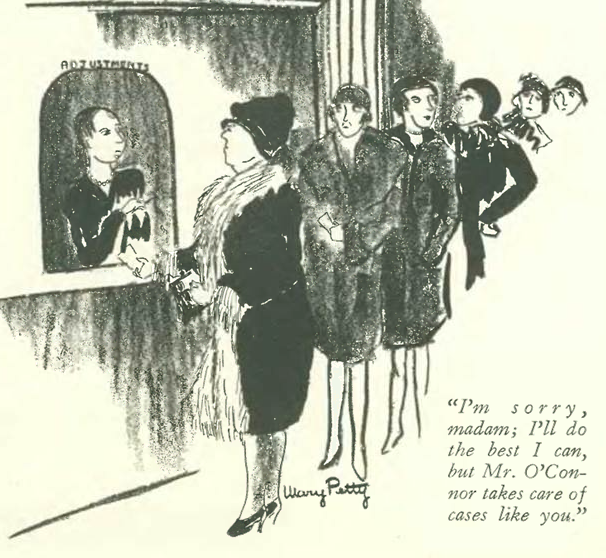
…and this cartoon by Mary Petty depicting those who were left behind, still returning their Christmas gifts…

screen-shot-2017-02-06-at-12-32-39-pm

Next Time: Odious Odes…

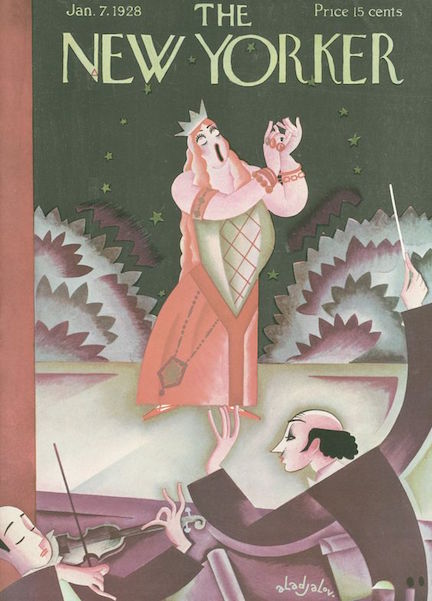
jan-7


Mutt & Jeff

We close out November 1927 by looking at a hugely popular comic strip—Mutt & Jeff—that made cartoonist Bud Fisher both famous and wealthy.

screen-shot-2017-01-26-at-10-05-52-am
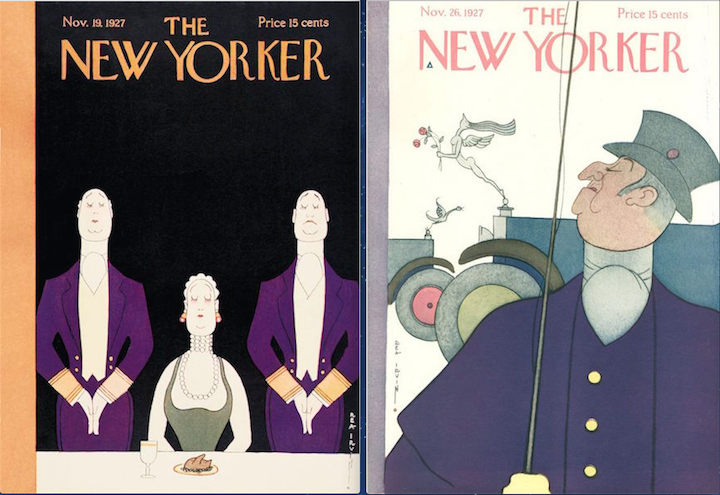
Nov. 19 and Nov. 26, 1927 covers by Rea Irvin.

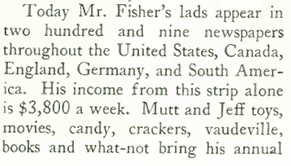
The editors of the Nov. 26, 1927 issue of The New Yorker thought Fisher interesting enough to feature in a lengthy “Profile,” written by Kelly Coombs. A brief excerpt:

screen-shot-2017-01-24-at-1-50-02-pm

screen-shot-2017-01-24-at-1-50-10-pm

According to John Adcock’s terrific Yesterday’s Papers blog, by 1916 Bud Fisher was the highest paid cartoonist on earth. The New Yorker suggested his annual income was $300,000 (roughly equivalent to more than $4 million today). In addition to the strips, created by Fisher and a team of ghost illustrators/writers, Mutt & Jeff were featured in vaudeville engagements, theatrical shows, animated cartoons, comic books and toys.

muttmagicdark1380
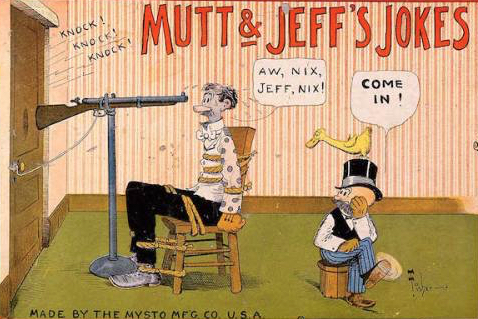
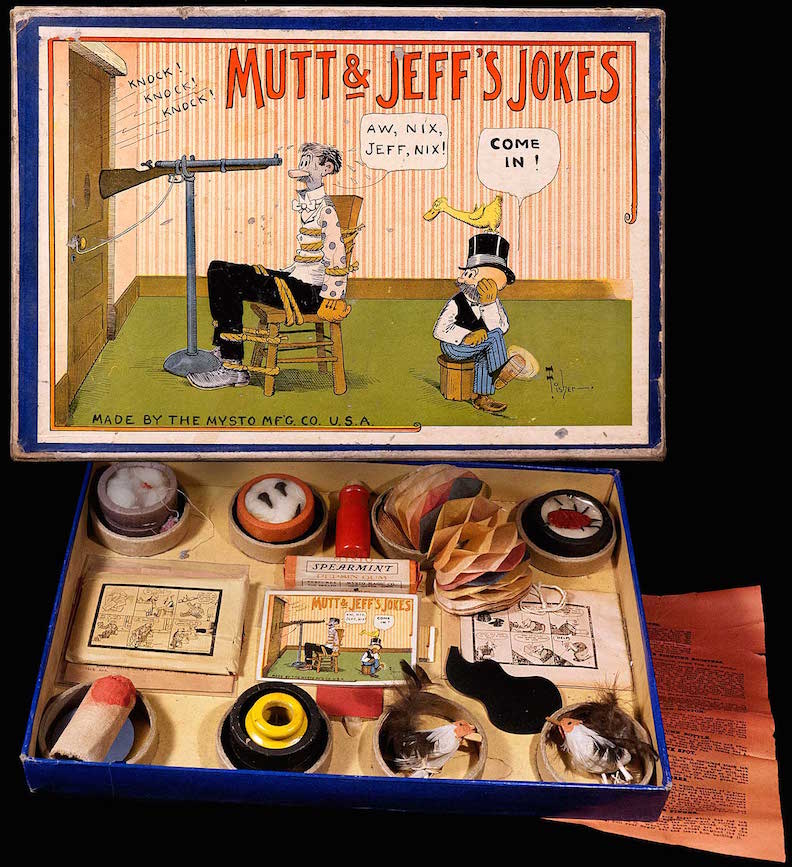
DIE LAUGHING…Mutt & Jeff themed toys included this joke kit from Mysto Manufacturing. I don’t quite get the joke featured on the cover, depicting Jeff’s casually twisted approach to murdering poor Mutt. (Copyright MEL BIRNKRANT via melbirnkrant.com—a truly amazing collection)
m902d5g
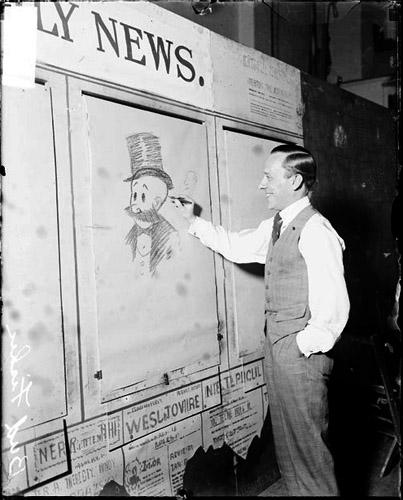
IT’S A LIVING…Harry Conway (Bud) Fisher, drawing a likeness of the character “Jeff” at a Chicago Daily News event in 1915. (Chicago History Museum)

Fisher began his career as a sports cartoonist for the San Francisco Chronicle and started his strip about “two mismatched tinhorns” in 1907. It went into syndication the following year. Mutt and Jeff, originally titled A. Mutt, is regarded as the first American newspaper cartoon published as a strip of panels, making it the first “comic strip.”

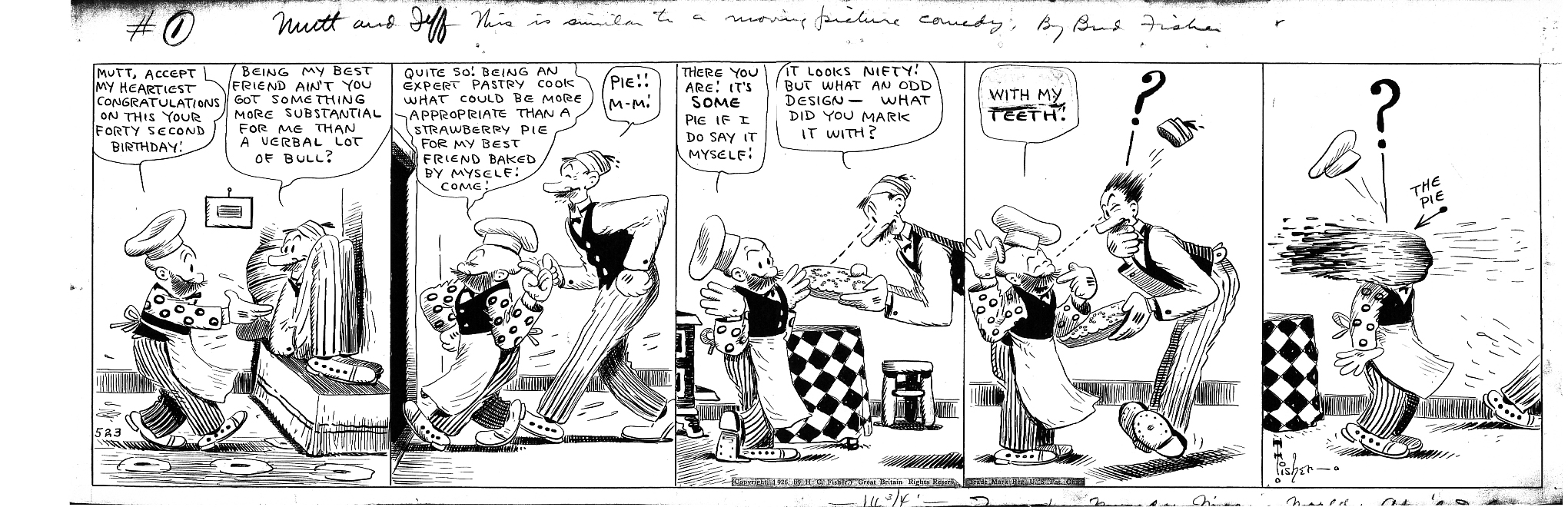
There was obviously a time when American readers thought Mutt & Jeff hilarious, but I don’t quite get its appeal. In this strip from 1926, Jeff gets a pie in the face. The giant question mark was frequently employed by Fisher, as were the dotted eye lines and explanatory arrows like the one in the last panel. No, Jeff didn’t get his brains blown out by Mutt. It is only a pie! Hah!

muttjeff052326b
Click on image to enlarge

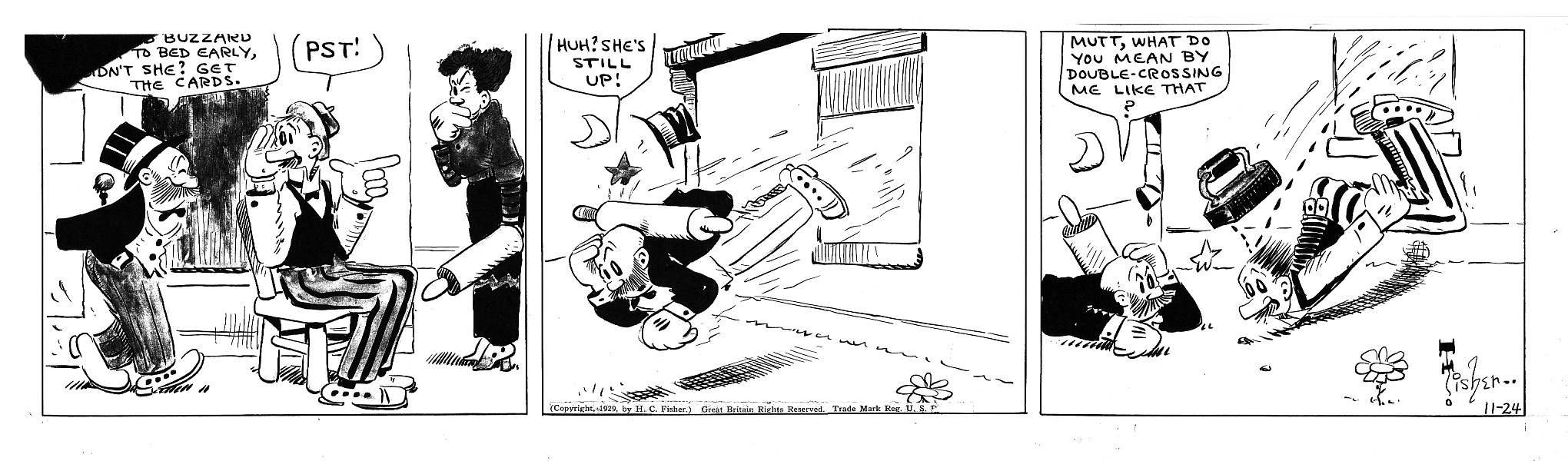
Another visual cliché from comics of yore was the angry wife wielding a rolling pin. Apparently Jeff refers to Mutt’s wife as an “Old Buzzard” and assumes she is already in bed (sorry about the poor quality of the reproduction). Jeff subsequently gets whacked with the rolling pin, and Mutt takes it on the bean with a flatiron. That is quite a feat, throwing a grown man through a window while simultaneously hitting him on the head with a flatiron…

muttjeff112429a
Click on image to enlarge (Both strips courtesy University of Michigan)

The duo were also featured in more than 300 animated “half-reelers” produced between 1913 and 1926, including Mutt and Jeff: On Strike from 1920. The short film (which can be viewed here) even includes rare footage of Bud Fisher himself, since the story–sort of a film within a film–involves the penniless Mutt and Jeff going on strike after they see a movie featuring Fisher’s lavish home.

screen-shot-2017-01-26-at-12-50-34-pm
STRIKEBREAKER…Still images from the silent half-reeler, Mutt and Jeff: On Strike. Bud Fisher is shown at home discussing terms over the phone with his striking characters. They lose. (www.filmpreservation.org)

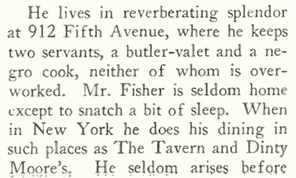
Coombs concluded the profile with these observations concerning Fisher’s personal habits:

screen-shot-2017-01-24-at-1-50-19-pm

screen-shot-2017-01-24-at-1-50-30-pm

Fisher employed a number of assistants on the strip, including George Herriman (Krazy Kat) and a high-school boy named Maurice Sendak (Where the Wild Things Are). When Fisher appeared to lose interest in the strip in the 1930s, assistant Al Smith took over and drew the strip for nearly fifty years (but Smith didn’t sign his own name on the strip until after Fisher’s death in 1954).

In Yesterday’s Papers, Adcock notes that Fisher “was the unlikeliest person you could think of to draw Mutt and Jeff…along with most of his contemporary cartoonist-journalists pals, (he) enjoyed fights, chorus girls, gambling, and saloons. Fisher liked to shoot up hotel rooms with his pistols, one of which was a gift from Pancho Villa, indoors when he was drunk.”

Heads in the Clouds

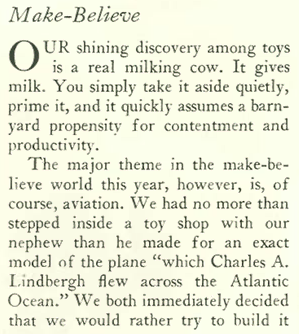
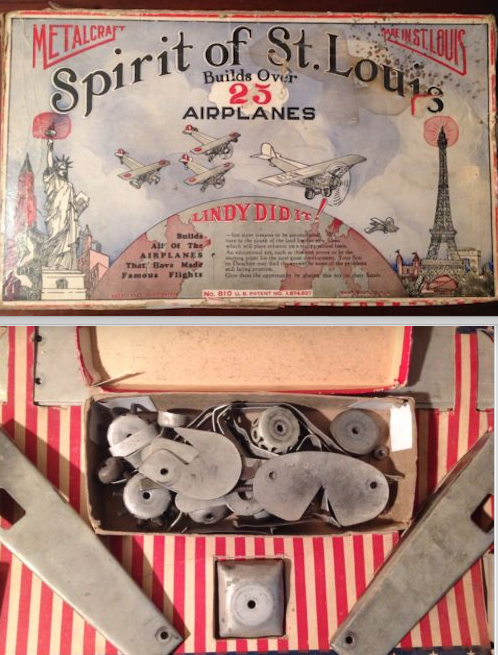
Thanks to the race to fly across the Atlantic, toy models of Charles Lindbergh’s Spirit of St. Louis and other planes were in high demand for the Christmas season, according to this item in the Nov. 26, 1927, “Talk of the Town:”

screen-shot-2017-01-24-at-1-42-51-pm

screen-shot-2017-01-24-at-1-42-56-pm

screen-shot-2017-01-27-at-9-48-40-am
BUILT TO LAST…A Metalcraft model kit (box, upper image, contents below) from the late 1920s. It was all metal in the days before plastic model kits. (eBay)

 *  *  *

At a Loss For Words

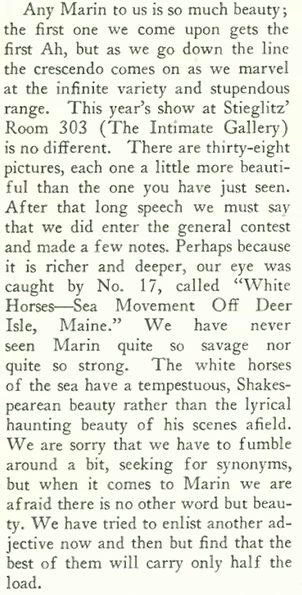
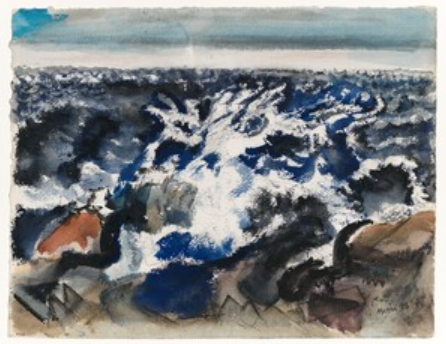
Jumping back to the Nov. 19, 1927 issue, we go from the low art of Bud Fisher to the high art of John Marin featured in “The Art Galleries” section. Art critic Murdock Pemberton wrote:

the-art-galleries-marin-1

screen-shot-2017-01-27-at-10-01-51-am
SAVAGE WORK…John Marin, White Horses – Sea Movement off Deer Isle, Maine, 1926. (Whitney Museum of American Art)

But perhaps “high art” is not an accurate description of Marin’s paintings, since Marin himself wasn’t into “highfalutin words” to describe his work…

marin-2-signed-mp

12032401444_4bb042eb04_b
HAUNTING BEAUTY…John Marin, Echo Lake Franconia Range White Mountain Country, 1927 (National Gallery of Art, Washington DC.)

 *  *  *

In the previous week’s issue (Nov. 12) the Marmon 8 was advertised as an ideal car for women. Not to be outdone, the folks at Buick shot back with this colorful ad in the Nov. 19 issue:

screen-shot-2017-01-24-at-1-19-18-pm

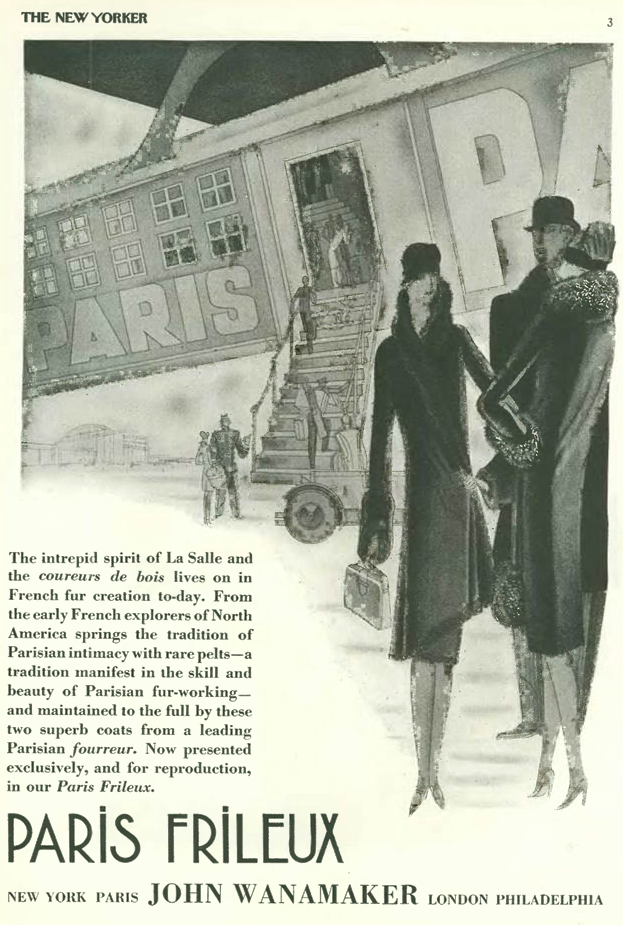
The Nov. 19 issue also featured this strange advertisement from the famed Wanamaker department store. Strange mainly because of the illustration, which features a fashionable woman departing a fanciful aircraft studded with mullioned windows(!) and a stairway that stretches to improbable depths…oh, and in case the reader might miss the snob appeal associated with French furs, the words Paris, Parisian or French are featured ten times…

screen-shot-2017-01-24-at-1-20-53-pm

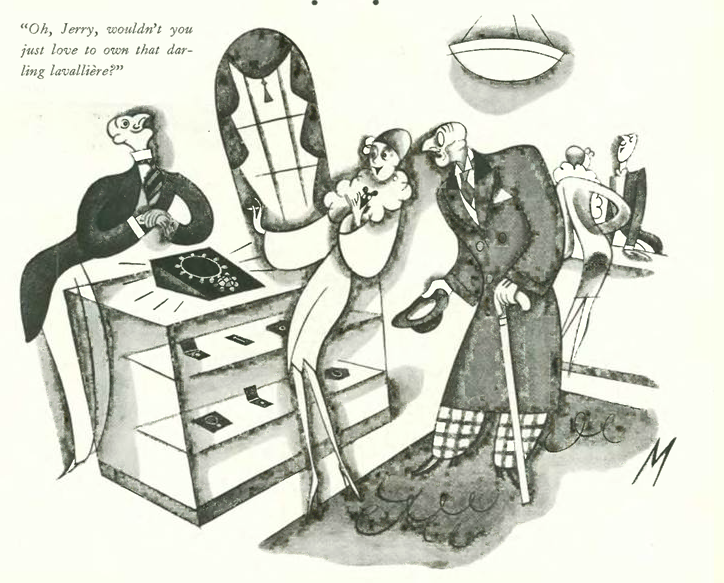
And finally, the ubiquitous New Yorker cartoon featuring the humorous mismatch of rich old sugar daddy and ditzy young mistress, courtesy of Julian de Miskey

screen-shot-2017-01-24-at-1-25-20-pm

Next Time: More Funny Business…

dec-3


Wits of the Round Table

Two big voices from the famed Algonquin Round Table were prominently featured in the Oct. 1 and Oct. 8, 1927 issues of the New Yorker–journalist and champion of the underdog Heywood Broun wrote his own “Profile” under the title, “The Rabbit That Bit the Bulldog,” and Dorothy Parker served up biting satire in “Arrangement in Black and White,” a clever exposé of racism among the fashionably “open-minded” upper classes.

488a50459a792547010d30e8bfe5ddf4
October 1, 1927 cover by Gardner Rea.

The Rabbit That Bit the Bulldog

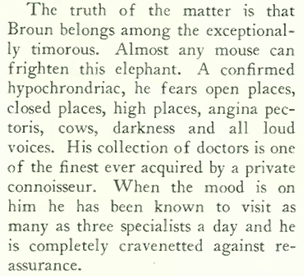
Hiding under the signature “R.A.”, Heywood Broun (1888–1939) was merciless as his own profiler, describing himself as a coward, hypochondriac, and a slob (there is truth to the latter, however, as friends often likened him to “an unmade bed”).

screen-shot-2016-12-08-at-9-06-52-am

Broun cut his teeth in journalism as a sportswriter and war correspondent. In 1921 he went to work for the New York World, where he penned his popular syndicated column “It Seems to Me.” Broun’s New Yorker “Profile” was written after he was fired from the World following a disagreement with his editor over his critical commentary on the sentencing of anarchists Sacco and Vanzetti. Broun would move on to The Nation, where he would write a regular column, “It Seems to Heywood Broun,” that would offer criticism on a number of topics including his former employer, the World.

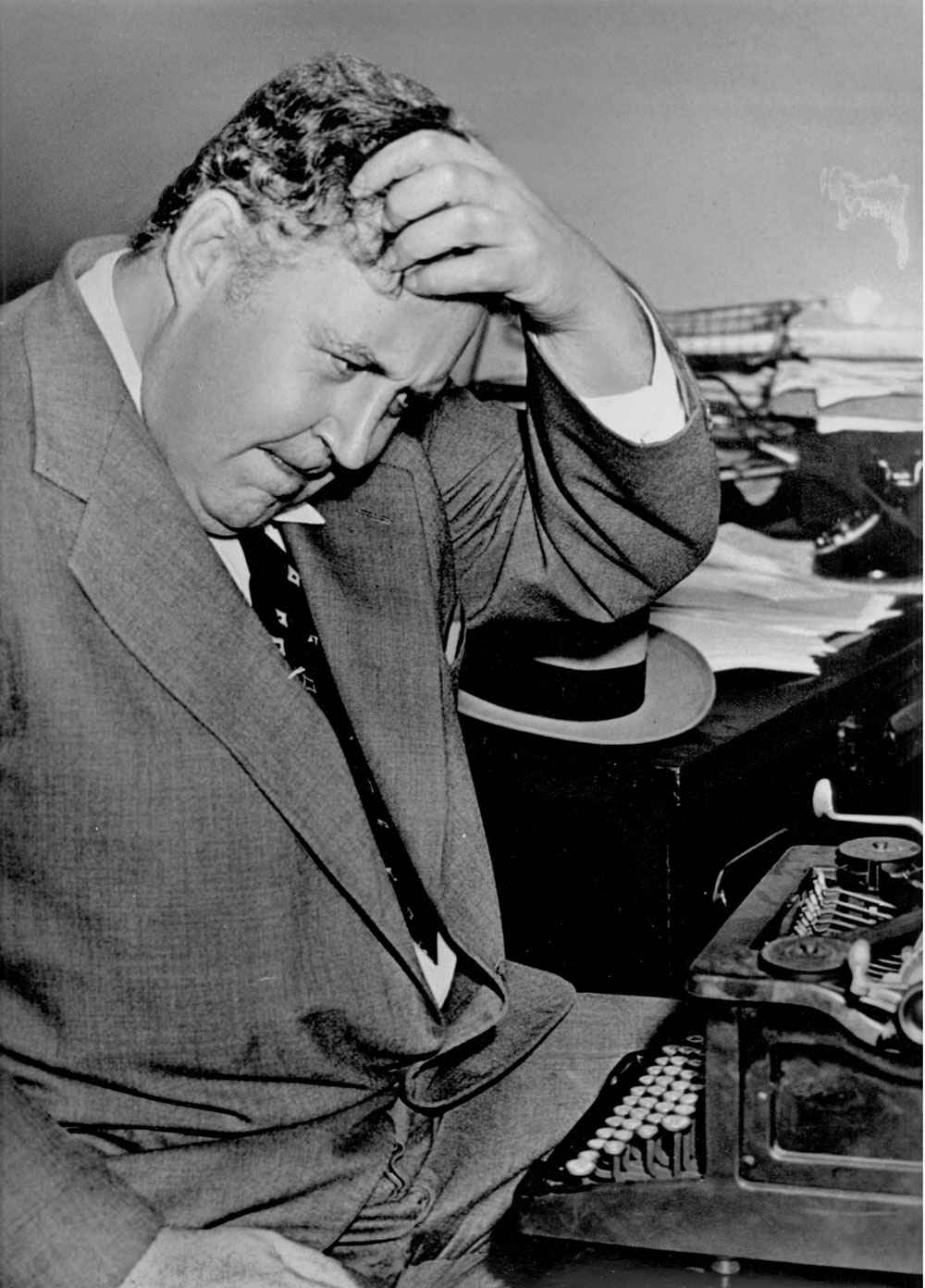
Heywood Broun. (Denver Newspaper Guild)

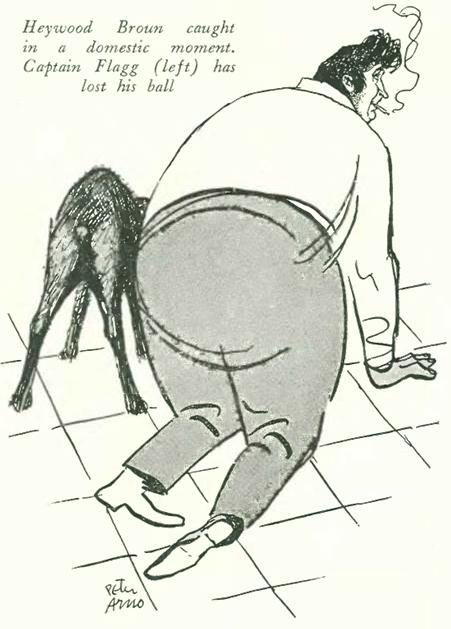
The New Yorker profile included this caricature by Peter Arno

screen-shot-2016-12-06-at-9-46-21-am

…a portrayal Broun claimed was inaccurate due to his “habitual stoop,” among other faults…

screen-shot-2016-12-06-at-9-52-23-am

screen-shot-2016-12-06-at-9-52-34-am

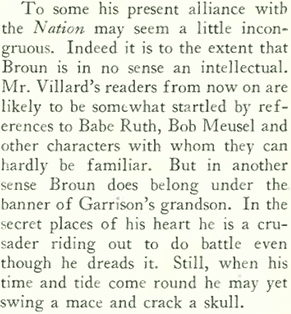
…and he mused about his future with the Nation, and how that august publication would square with his various foibles…

screen-shot-2016-12-06-at-9-52-45-am

…and as for his personal appearance and habits, Broun weighed in thusly…

screen-shot-2016-12-06-at-9-55-18-am

Broun married social activist Ruth Hale in 1917. A son born the following year, Heywood Hale Broun, would have a long and successful career as an author, sportswriter, commentator and actor.

*  *  *  *  *

The Long Count

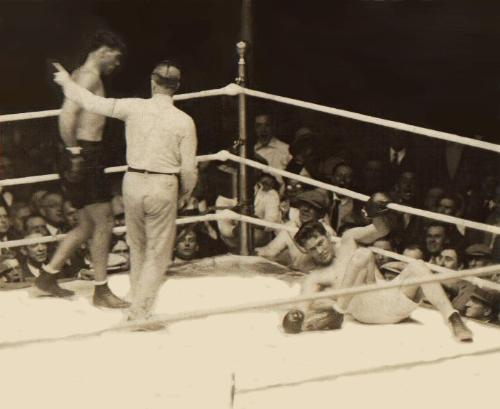
Oddly, The New Yorker had little to say about the famous Chicago rematch between heavyweight boxers Gene Tunney and Jack Dempsey, which Tunney won after the controversial “long count.” The fight took place under new rules that gave a fallen fighter ten seconds to rise to his feet, but the count would not begin until his opponent moved to a neutral corner.

tumblr_mti3g257h11rnxl9do1_500
DAZED AND CONFUSED…Referee Dave Barry motions Jack Dempsey to a neutral corner before he begins his count. Gene Tunney got back up and went on to win the fight. (Chicago Tribune archive photo)

Although Tunney dominated the fight, Dempsey unleashed a flurry in the seventh round that knocked Tunney to the canvas–it was the first time in Tunney’s career that he’d been knocked down. Instead of going immediately to a neutral corner, Dempsey just stood and observed his opponent for several seconds until finally retreating. Those extra seconds proved just enough time to allow Tunney to return to his feet and eventually win the bout. To one observer quoted in “The Talk of Town,” those extra seconds really dragged…

screen-shot-2016-12-06-at-9-44-49-am

screen-shot-2016-12-06-at-9-44-55-am

From the Ad Department

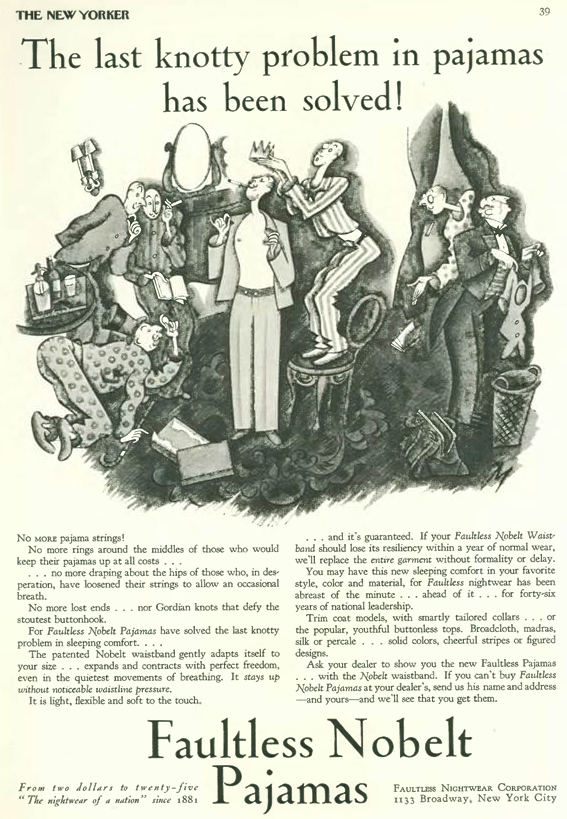
We feature this Julian de Miskey-illustrated advertisement for Faultless Nobelt Pajamas. Apparently these special PJs had some sort of newfangled rubber elastic band…

screen-shot-2016-12-06-at-9-57-42-am

…and this cartoon from the Oct. 1 issue featured Helen Hokinson’s ditsy society women at New York’s Fashion Week…

screen-shot-2016-12-06-at-9-43-37-am

 *  *  *  *  *

Dorothy Takes On the Snobs

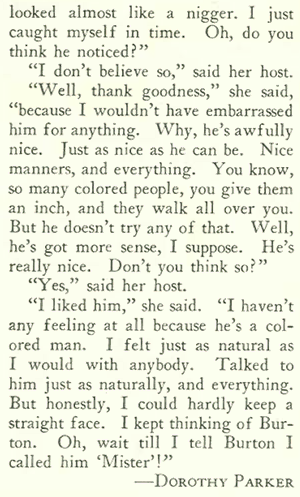
In the Oct. 8 issue, our other Round Table wit, Dorothy Parker, took aim at the less savory aspects of society women in her short fiction piece, “Arrangement in Black and White.”

f19964a9d1e1b6179fe2715bb3b1aa72
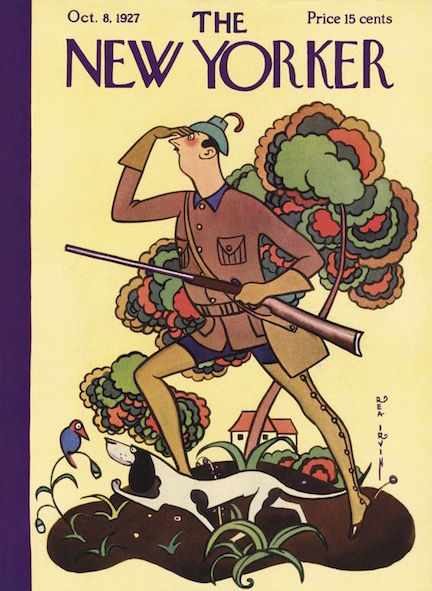
October 8, 1927 cover by Rea Irvin.

Parker began her piece by introducing us to a woman who enters a party wearing a wreath of “pink velvet poppies” in her golden hair. In short order she asks the party’s host to “pretty please” introduce her to the party’s guest of honor, an African American singer named Walter Williams.

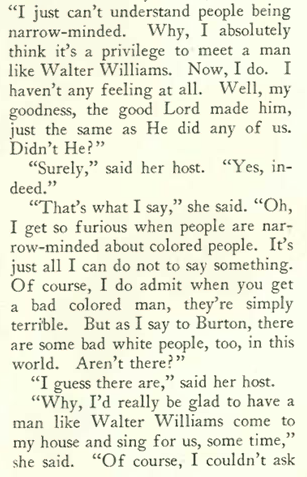
The woman with the pink velvet poppies goes on to tell her host that she came to the party alone because her husband, Burton, preferred not to socialize with “colored people”–but she however was “simply crazy” about some of them. “They’re just like children–just as easy-going, and always singing and laughing and everything.” Before she met the singer she observed to the host:

screen-shot-2016-12-06-at-1-18-25-pm

screen-shot-2016-12-06-at-1-19-09-pm

screen-shot-2016-12-06-at-1-16-57-pm
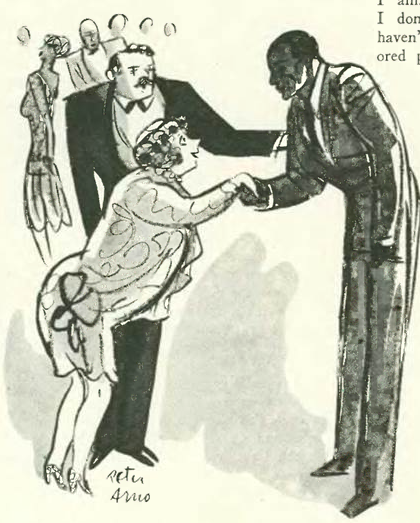
The woman with the pink velvet poppies meets the singer Walter Williams, as illustrated by Peter Arno.

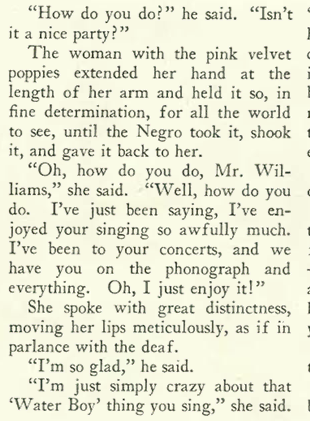
Then the woman with the pink velvet poppies meets Walter Williams:

screen-shot-2016-12-06-at-1-19-42-pm

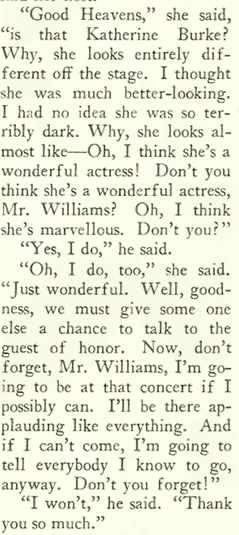
She continues to patronize the guest of honor, then notices a stage actress at the party:

screen-shot-2016-12-08-at-12-32-44-pm

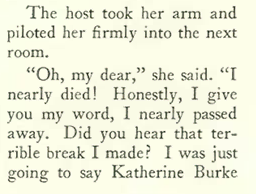
Finally, the host guides the woman with the pink velvet poppies away from Walter Williams…

screen-shot-2016-12-06-at-1-21-59-pm

screen-shot-2016-12-06-at-1-22-30-pm

05325779fdf286303013d76dc9e89388
BITING WIT…Dorothy Parker in the 1920s.

We will see more of Dorothy Parker in issues to come as she continues to take aim at the pretentious, hypocritical, self-absorbed snobs of the Jazz Age and beyond.

Baseball’s Lament

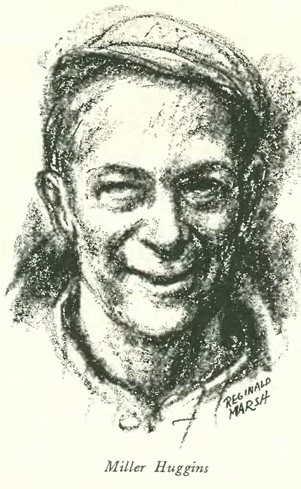
The Oct. 1 and 8 issues covered yacht racing, polo, tennis, golf and college football, but still no baseball. The 1927 New York Yankees would be one of the greatest teams of all time, but as the World Series commenced all we got from The New Yorker was a personality profile of Yankees manager Miller Huggins in the Oct. 8 issue (with a drawing by Reginald Marsh)…screen-shot-2016-12-06-at-1-24-05-pm

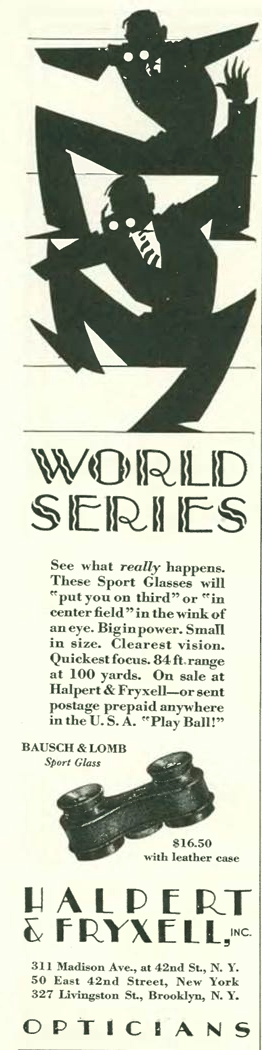
…and this advertisement for “Sport Glasses” for those attending the World Series…

screen-shot-2016-12-06-at-4-34-19-pm

Perhaps The New Yorker had no one on staff who could competently write about baseball. The strangest reference to the game was this article about polo, but for some reason it was illustrated with baseball images. Perhaps the editors felt sheepish about their lack of baseball coverage, and offered these illustrations by Howard Baer as a token acknowledgement…

screen-shot-2016-12-06-at-1-28-18-pm

At any rate, we end with this cartoon by Julien de Miskey, who like his colleagues explored the comic richness of wealthy old men paired with their young mistresses…

screen-shot-2016-12-06-at-1-16-04-pm

Next Time: The Ephemeral City…

f19964a9d1e1b6179fe2715bb3b1aa72


The Age of Innocence

Above: Film stars Dorothy Sebastian (left) and Joan Crawford square off for a game of ping pong in 1925. The umpire is actor Eddie Nugent. (Film Noir Photos)

After studying every page of the first 120 issues of the New Yorker, and after researching the lives of its writers and their subjects, the world as described by the New Yorker — 89 years distant — can seep into one’s imagination, not unlike a world created by a fiction writer, whose characters are very much alive in his or her mind even when the pen is idle. You become accustomed to their voices, their likes and dislikes, and begin to see their world as a contemporary of sorts.

fe856464214bef0718e3c838d3a54ab2
June 4, 1927 cover by H.O. Hofman.

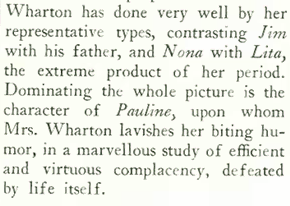
And so I find myself reading a review of Edith Wharton’s “latest” novel, Twilight Sleep, and think not of some author I haven’t read since college, but rather see her work as it was seen at its unveiling, albeit through the eyes of New Yorker book critic Ernest Boyd, who wrote under the pen name “Alceste”:

screen-shot-2016-10-12-at-12-20-20-pm

screen-shot-2016-10-12-at-12-20-45-pm

screen-shot-2016-10-12-at-12-20-56-pm

edith-wharton
NOT DEFEATED BY LIFE…Edith Wharton with her Pekes, circa 1920. (lib guides.com)

Wharton won the Pulitzer Prize for fiction in 1921 for The Age of Innocence, making her first woman to receive the prize. Indeed, Wharton kicked off a great decade for women fiction writers — Willa Cather would win the Pulitzer for One of Ours in 1923, Margaret Wilson for The Able McLaughlins in 1924, Edna Ferber for So Big in 1925, and Julia Peterkin for Scarlet Sister Mary in 1929.

*  *  *

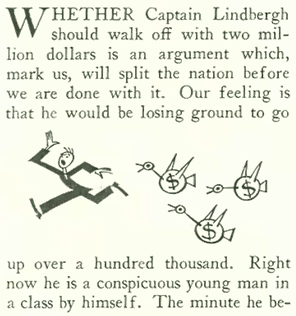
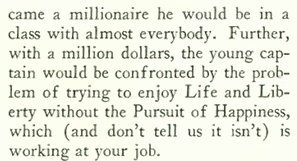
The June 4 issue offered some follow-up items on Charles Lindbergh, this from “The Talk of the Town” regarding Lindbergh’s potential to claim perhaps more than the $25,000 Orteig Prize (about $350,000 today) for being the first to fly nonstop across the Atlantic — endorsements, book and movie deals, offers to serve on company boards, and so on…

screen-shot-2016-10-13-at-9-18-42-am

screen-shot-2016-10-13-at-9-18-48-am

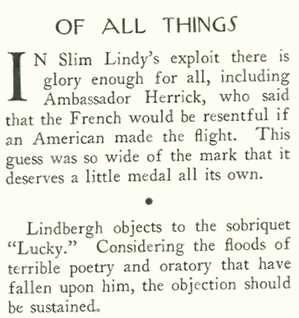
…and from Howard Brubaker’s “Of All Things” column, we learn that the aviation hero doesn’t like to be called “Lucky”…

screen-shot-2016-10-13-at-9-19-10-am

*  *  *

Baseball was still inexplicably shut out from the pages of The New Yorker, even as the Yankees (and Babe Ruth) were having one of their best-ever seasons. Instead, the June 4 issue covered horse racing (pgs. 63-65), rowing (pgs. 66-68), and lawn games (pgs. 69-72).

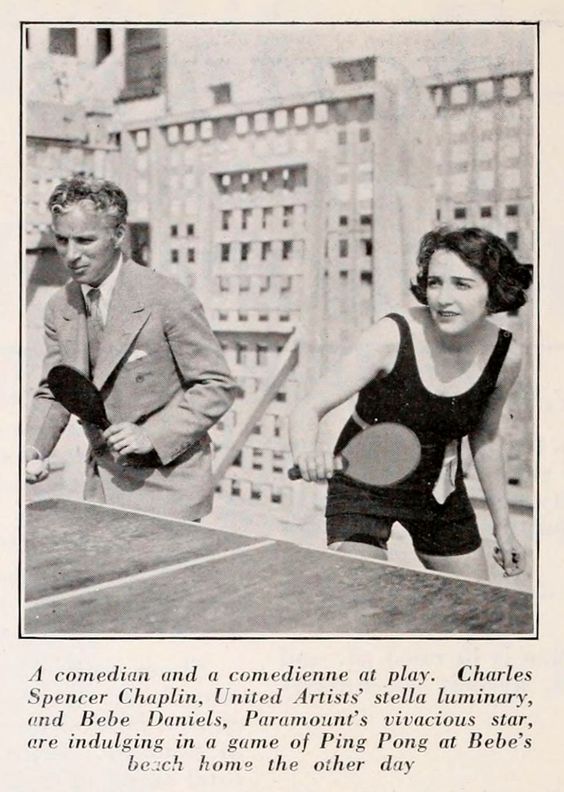
Among the “lawn games” reviewed, the New Yorker had this to say about the revival of ping-pong and the “spirited matches played between the sexes”…

screen-shot-2016-10-13-at-9-11-38-am

More celebrity action from the 1920s. (Clip from Pinterest)

 *  *  *

82b1f6e20ffd1e39a8e9d0f9da216917
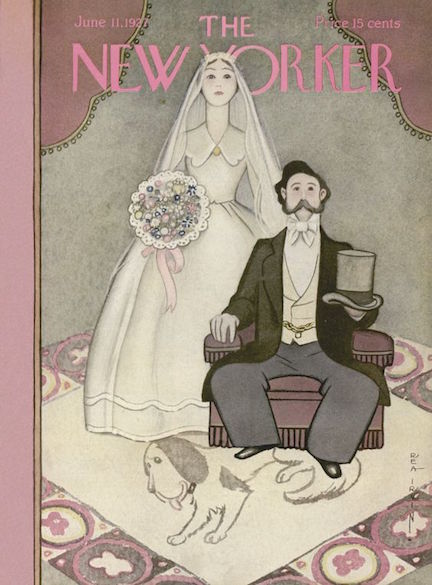
June 11, 1927 cover by Rea Irvin.

In the following week’s issue, June 11, 1927, there was a bit more to say about Lindy’s future economic prospects…

screen-shot-2016-10-13-at-9-35-14-am

…and there is this item about New York Mayor Jimmy Walker. Given his love of late-night parties, speakeasies and chorus girls, it was no wonder that The New Yorker’s editors found him an attractive subject for “Talk of the Town”…

screen-shot-2016-10-13-at-9-33-36-am

Jimmy Walker and Betty Compton after their wedding in Cannes, 1933. (www.isle-of-wight-fhs.co.uk)

screen-shot-2016-10-13-at-9-33-44-am

Of course Walker’s aloofness would have consequences later when scandal and corruption would knock him and his cronies from office.

 *  *  *

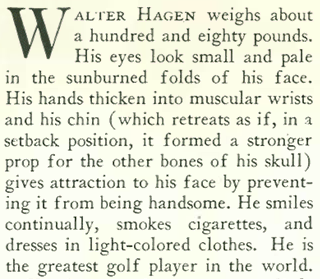
The issue also included a profile of golfer Walter Hagen, written by Niven Busch Jr. In his “Portrait of a Dutchman,” Busch begins:

screen-shot-2016-10-13-at-9-38-10-am

The profile included this portrait of Hagen by Miguel Covarrubias:

screen-shot-2016-10-13-at-9-37-53-am

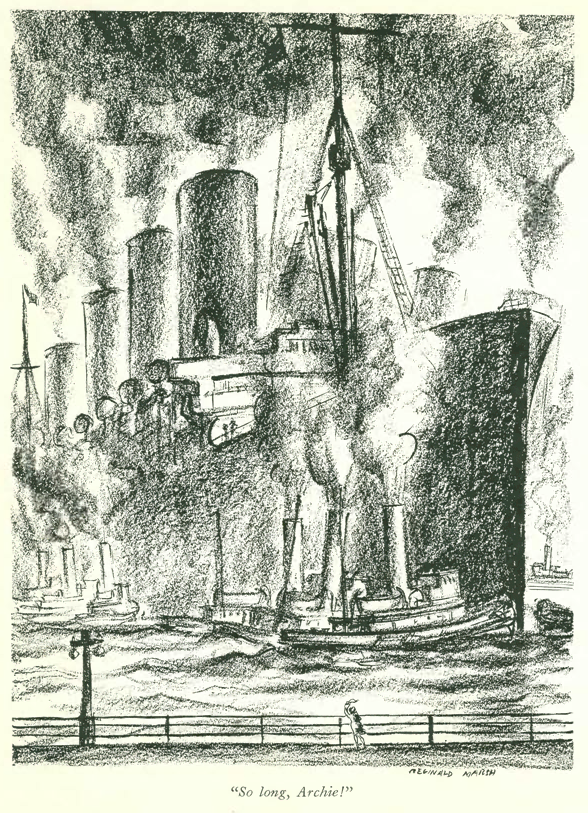
We end with this full-page cartoon, beautifully rendered in Conté crayon by Reginald Marsh

screen-shot-2016-10-13-at-9-37-31-am

Next Time: Coney Island, 1927…

37723304ec91b372ae19e57e36b4d4b9

Mode de Vie

We cross the pond for the May 14, 1927 issue, for a look at all things French. As I’ve previously noted, New Yorker readers of the 1920s had a decidedly Francophile bent when it came to food, fashion and general joie de vivre.

304b9308de906b0c02f50b14add69c6d
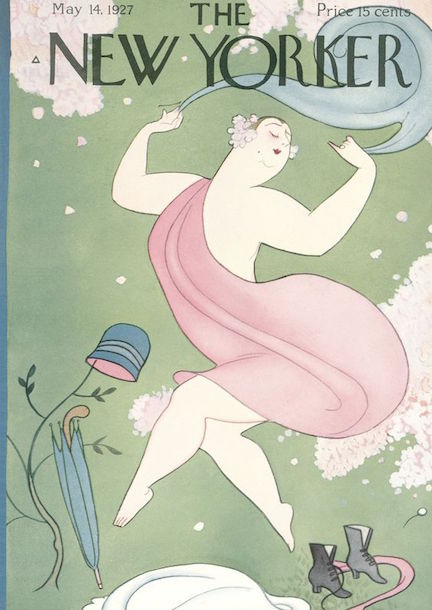
May 14, 1927 cover by Rea Irvin.

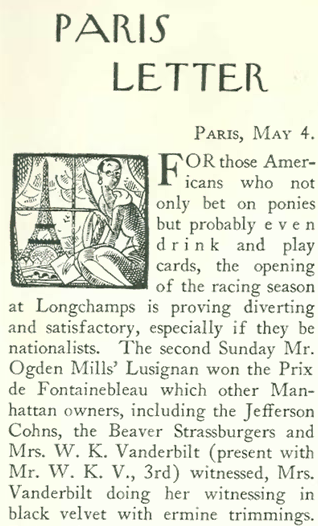
In fact, readers were so enamored with France that the country merited its own New Yorker correspondent, Janet Flanner, who wrote under the nom de plume “Genêt.”

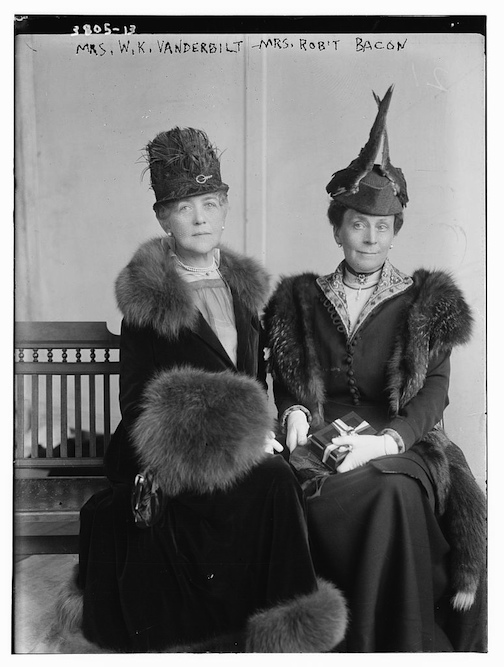
In the May 14 issue Flanner casually mused about the racing season at Longchamps, which attracted the likes of Anne Harriman Vanderbilt (identified here as Mrs. W. K. Vanderbilt), who was well-known in France for her philanthropic work during World War I, including her founding of an ambulance service and a hospital at Neuilly. Vanderbilt received the class of the Legion of Honor in 1919 in recognition of her war work, and in 1931 she was made an officer of the legion.

screen-shot-2016-09-21-at-9-04-27-am

11733033805_35c6a9f8d5_b
BLUE BLOODS…Anne Harriman Vanderbilt (left) with Martha Waldron Cowdin Bacon, circa 1915-1920. Bacon served as chairman of the American Ambulance Committee. (Library of Congress)

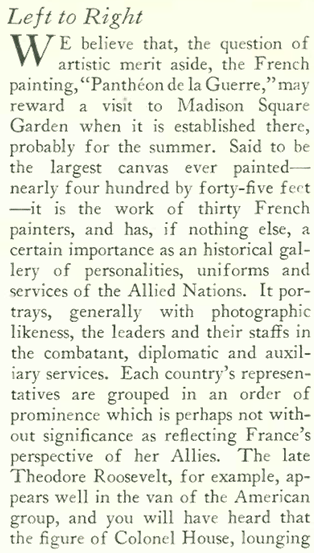
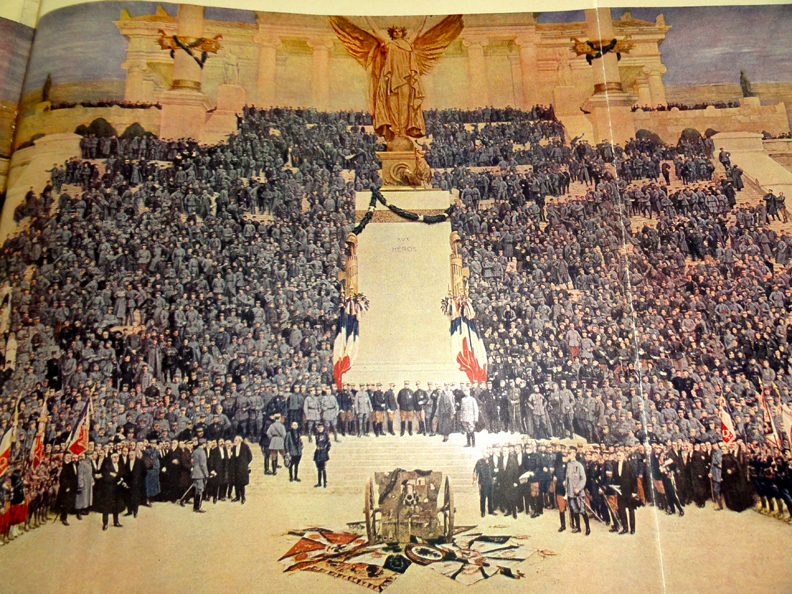
In “Talk of the Town,” the editors suggested that readers go to Madison Square Garden and check out the world’s largest canvas painting, Panthéon de la Guerre, more for the spectacle than for any artistic merit:

pantheon_de_la_guerre_panorama_smaller
Section of Panthéon de la Guerre showing allies of World War I, now in Memory Hall, Liberty Memorial, Kansas City, Missouri. (theworldwar.com) Click to enlarge

screen-shot-2016-09-21-at-8-57-10-am

screen-shot-2016-09-21-at-8-57-22-am

Panthéon de la Guerre was painted during World War I as a circular panorama—402 feet in circumference and 45 feet high—displayed in Paris in a specially built building next to the Hôtel des Invalides. It was visited by an estimated eight million people between 1918 and 1927.

The painting was acquired by American businessmen in 1927 and exported to New York, where it was displayed at Madison Square Garden. Some changes were made to the painting for the benefit of an American audience, including the addition of an African-American soldier. The work later toured the U.S.—from 1932 to 1940 it went to Washington DC, Chicago, Cleveland, and San Francisco. It was then acquired by restaurant entrepreneur William Haussner for $3,400.

In 1956 Haussner donated the work to Leroy MacMorris to be adapted for display at the Liberty Memorial in Kansas City. MacMorris drastically reduced the size of the work and modified it to emphasize America’s contribution to WWI: Only seven percent of the original work was retained, and large French sections were left out. MacMorris likened it to “whittling down a novel to Reader’s Digest condensation.” And he didn’t stop there. He also modified some figures to represent post-WWI figures such as Presidents Franklin Roosevelt and Harry Truman.

exhibithall
A BIT OF THIS, A DASH OF THAT…Figure of Victory from the Temple to Glory cut to fit above a doorway at Memory Hall, Liberty Memorial, Kansas City, Missouri, with the staircase of heroes to either side. Compare to original below:
129-2
(trenchartcollection.com)

To reduce and reconfigure the painting, MacMorris first photographed it in detail, then cut out the figures in the photos and used them like puzzle pieces to work out his new condensed version, which was dedicated on Nov. 11, 1959.

As for the unused portions, what MacMorris did not use he threw away, sending several of the larger excised passages back to Haussner for display in his Baltimore restaurant. MacMorris also gave pieces to the art students who helped him reconfigure the painting and to a number of prominent Kansas Citians.

2qaatdogmghsne7v2y1e
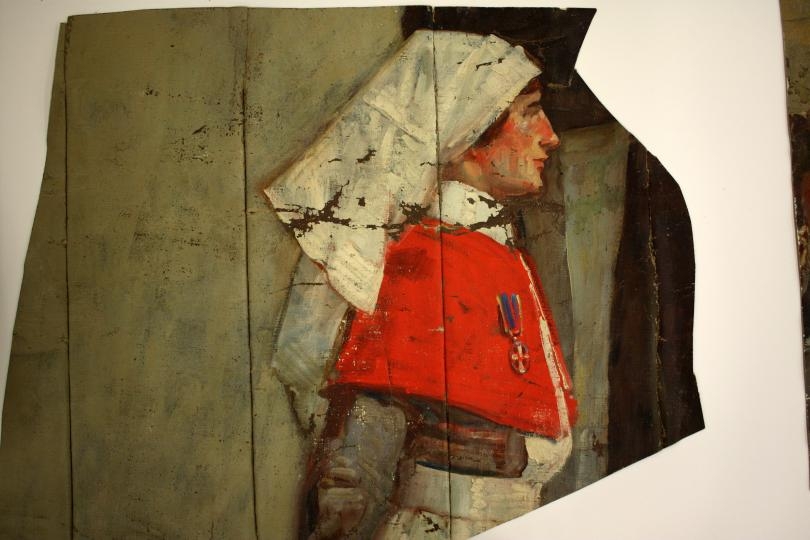
Fragment from Panthéon de la Guerre depicting a British nursing sister. (theworldwar.org)

The National World War I Museum and Memorial in Kansas City recently held an exhibition on the painting and its recovered fragments.

 * * *

Lois Long had returned from Paris and advised readers on where to shop in the City of Light. Her fashion column, “On and Off the Avenue,” featured recommendations for many stores and bargains. It began with a brief note from “Parisite,” aka Elizabeth Hawes, who occasionally contributed to Long’s column with cables sent from Paris).

screen-shot-2016-09-21-at-9-01-58-am

And now for the advertisements, all from the May 14 issue, featuring various French themes, such as this one for Krasny makeup that evokes the glamour of Paris and the intrigue of Russian women…

screen-shot-2016-09-21-at-8-48-43-am

…or exotic perfumes for only the most exclusive set…

screen-shot-2016-09-21-at-8-54-15-am

…or the chic look of Revillon Freres spring coats and wraps…

screen-shot-2016-09-21-at-8-55-10-am

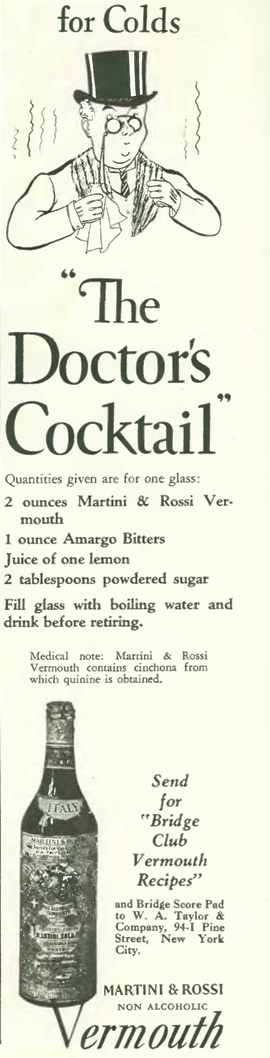
…or fake vermouth…this odd little illustration in the back pages for non-alcoholic vermouth, served by a dutiful French maid to what appears to be a giant. You have to feel sorry for the writers of such ads during Prohibition, trying so hard to make this sad libation appealing to thirsty New Yorkers…

screen-shot-2016-09-21-at-9-08-34-am

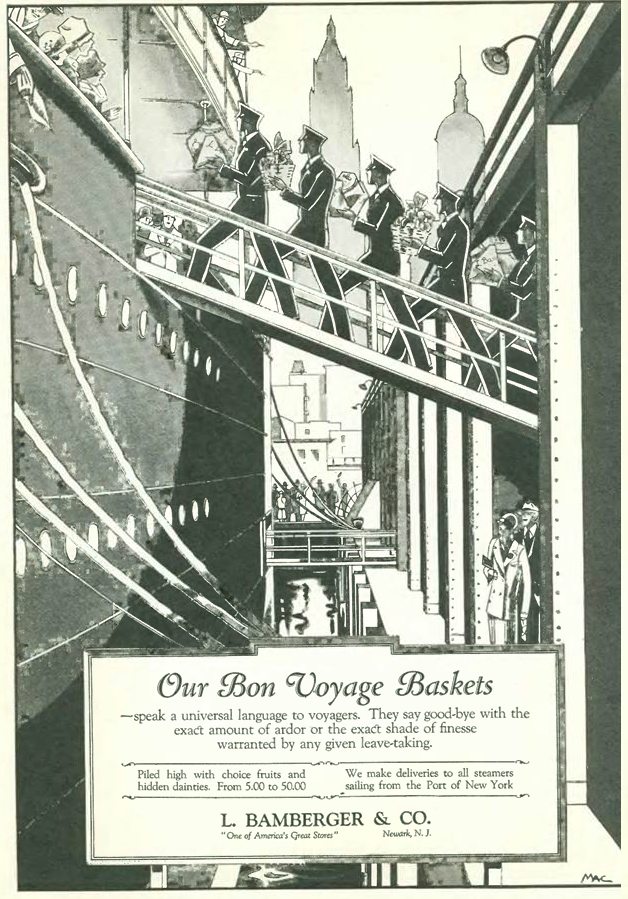
…but there were those lucky few who could actually travel to France and drink the real stuff, you could get a really swell send-off with a “Bon Voyage Basket” from L. Bamberger & Co…

screen-shot-2016-09-21-at-8-54-37-am

…and while you were in France (at least for the men), Peter Arno could show you how to give the glad eye to the mesdemoiselles…

screen-shot-2016-09-21-at-9-09-42-am

Next Time: Shock of the New…

may-21


Two Years Young

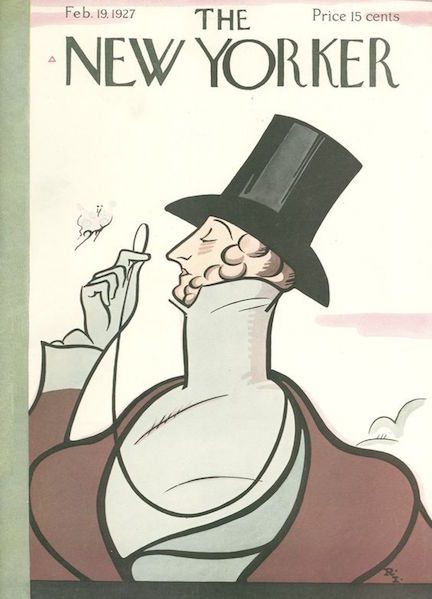
The New Yorker celebrated its 2nd anniversary by once again using the Rea Irvin cover from its first issue, which depicted a dandified character–soon to be dubbed “Eustace Tilley”–that would become a mascot of sorts for the magazine.

e5c3fabc5f1612a71442c78a3c71d654
February 19, 1927: 2nd anniversary issue cover by Rea Irvin.

For more than 90 years it has been a tradition to feature the original cover every year on the issue closest to the anniversary date of February 21, although on several occasions a newly drawn variation has been substituted, including several “alternative” covers for last year’s 90th anniversary issue. This one in particular, by Carter Goodrich, is appropriate for our times:

CV1_TNY_02_23_15Goodrich.indd

The magazine included this embellishment on the opening page of “The Talk of the Town” (also repeated from the previous year)…

Screen Shot 2016-07-21 at 4.54.08 PM

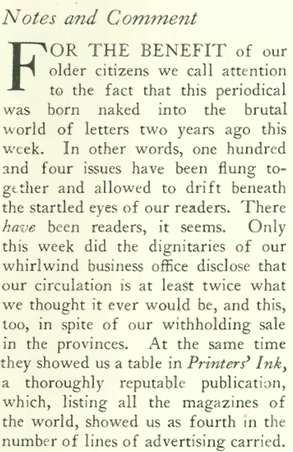
…and the editors opened with a somewhat tongue-in-cheek boast of the young magazine’s improving fortunes:

Screen Shot 2016-07-21 at 4.55.17 PM

Screen Shot 2016-07-21 at 4.56.04 PM

The boasts about advertising were legitimate. Apparently the people at Rolls Royce felt that the magazine was worth a full-page, weekly advertisement. Note the third paragraph of the ad, third to to the last line: How many car makers today, or any at time for that matter, would tout that their car “meets every traveling situation blandly?”

Screen Shot 2016-07-22 at 9.02.21 AM

While on the topic of ads, this one from the back pages caught my eye:

Screen Shot 2016-07-22 at 9.24.12 AM

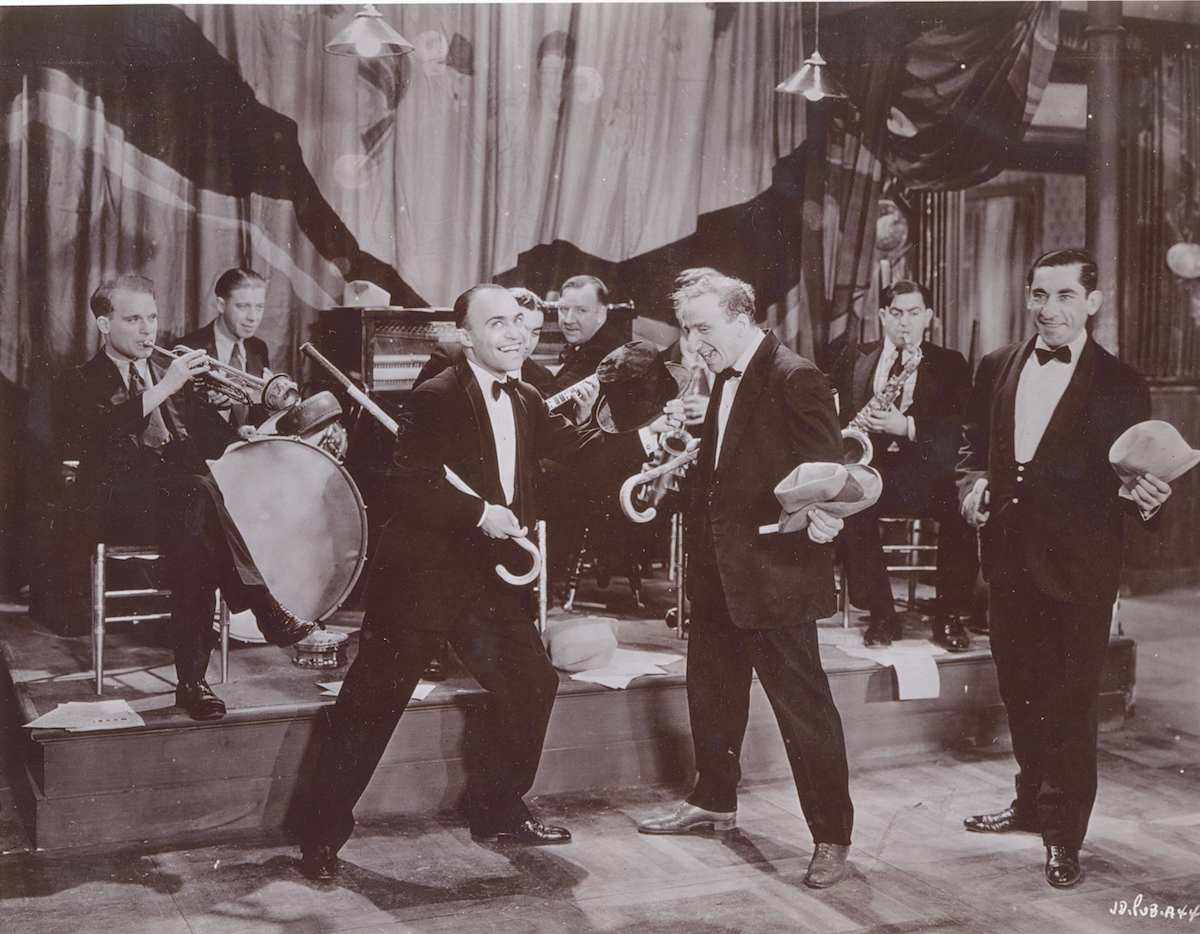
Most of us have heard of vaudeville teams like the Marx Brothers and Laurel & Hardy, but there were many others who drew big audiences but who are mostly forgotten today, including the trio of Clayton, Jackson and Durante.

clayton-jackson-and-durante0001
Jimmy Durante (center) performing with his vaudeville partners Eddie Jackson (right) and Lou Clayton. (New York Public Library)

Of the three, Jimmy Durante would go on to the greatest fame. Known for his gravelly voice, clever wordplay and his prominent nose (which he dubbed “the Schnozzola”), Durante would find great success in radio, film, and in early television. The singer, pianist and comedian would appear on many variety shows in the 1950s and 60s. Although he died in 1980, today he is still known to audiences young and old alike thanks to his appearance as the narrator in the animated Frosty the Snowman (1969), which is still broadcast every year during the Christmas season and is distributed through countless DVDs and streaming services.

Screen Shot 2016-07-22 at 1.26.10 PM
GOOD NIGHT, Mrs. Calabash, wherever you are…the animated Jimmy Durante in Frosty the Snowman (1969), and in a 1964 publicity photo. (YouTube/Wikipedia)

*  *  *  *  *

On to more advertising, and a less savory topic. Beginning in the 1920s, Lysol was advertised for use in feminine hygiene as a guard against “odors,” a term that was widely understood as a euphemism for contraception. According to Andrea Tone (Devices and Desires) by 1940 it had become the most popular birth control method in the country. Unfortunately for many women, Lysol contained cresol (derived from coal tar) which could cause severe inflammation and even death:

Screen Shot 2016-07-22 at 9.03.33 AM

Also popular (and a lot less harmful) in the 1920s was sheet music featuring the latest songs. So sidle up to the piano with your guy or gal and belt out one of these favorites:

Screen Shot 2016-07-22 at 9.26.21 AM

And to close, a cartoon by the famed Peter Arno, who was well-acquained with New York nightlife:

Screen Shot 2016-07-22 at 9.00.34 AM

Next Time: Clark’s Folly…

a4866ba5e836b04dce69f13fb06cf5df


Papa Pens a Parody

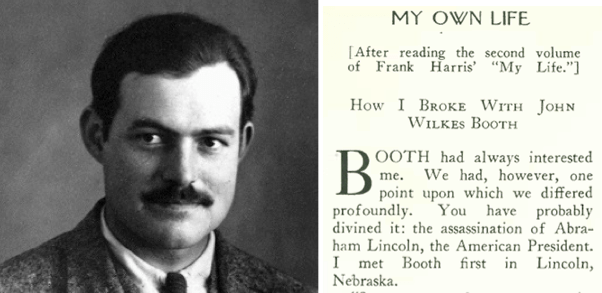
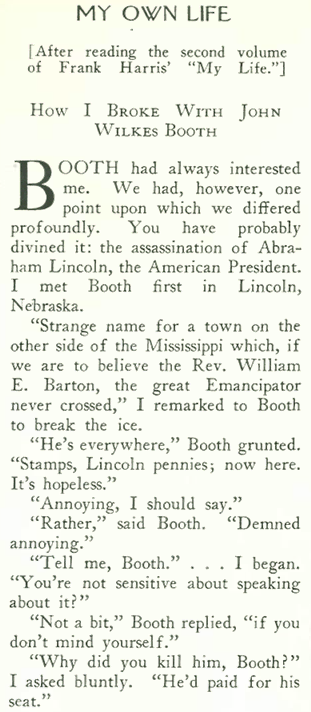
Ernest Hemingway wrote his lone New Yorker piece for the Feb. 5, 1927 issue. Titled “My Own Life,” it was a short parody of the 3-volume My Life and Loves by Irish writer Frank Harris.

7532b3c65dcb4c041db31d7c0c75b4c4
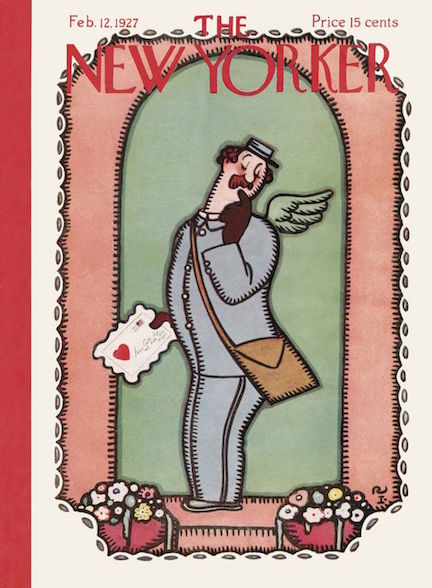
February 12, 1927 cover by Rea Irvin.

Writing for The Hemingway Review (Fall 2001), Francis Bosha notes in “The Harold Ross Files” that Hemingway’s sole contribution to the New Yorker is striking given that the magazine was such a major influence on fiction in the 20th century.

Money, or the shortage thereof, appears to be the main reason why Hemingway was not a regular contributor. Although the young magazine was doing well, Bosha writes that it was not yet ready to compete financially with more established mass market magazines. Indeed, Hemingway’s “My Own Life” landed in the New Yorker because it had already been rejected by both Scribner’s and The New Republic.

Ernest_and_Pauline_Hemingway,_Paris,_1927
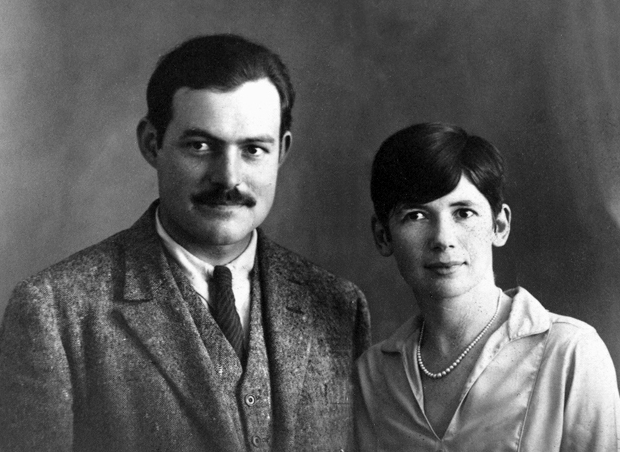
Ernest Hemingway and his second wife, Pauline Pfeiffer, in Paris, 1927. (Wikipedia)

If you read the piece you can see why it was rejected. The famed fiction writer, hot off the success of The Sun Also Rises, was not a great parodist. An excerpt:

Screen Shot 2016-07-20 at 3.24.37 PM

And so on. Hemingway wisely stuck with serious fiction, which might explain his fleeting association with The New Yorker, which in its first years was bent toward humor in the Punch or Judge vein and not toward serious writing.

Nevertheless, the New Yorker’s founding editor, Harold Ross, maintained a friendship and a regular correspondence with Hemingway during the writer’s years in Cuba in the 1940s. On several occasions Ross invited Hemingway to submit something to the magazine, but nothing came of it. It didn’t help that Hemingway publicly stated in 1942 that he “was out of business as a writer,” and was suffering from depression, weight gain, and bouts of heavy drinking.

The Great Ziegfeld Finally Opens His New Theatre

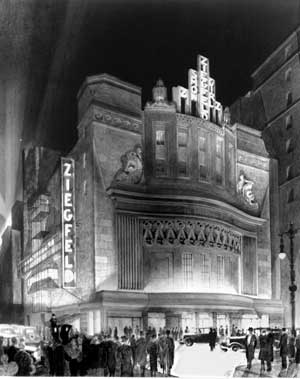
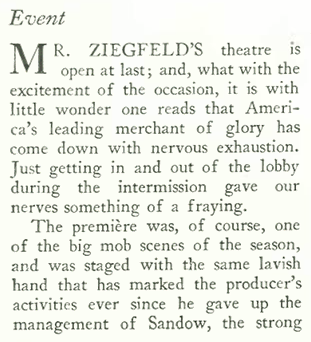
“The Talk of the Town” reported the premiere of Florenz Ziegfeld’s new art deco theatre was “one of the big mob scenes of the season,” attracting celebrities and celebrity-gawkers alike:

110927-GON066-04
Opening Night…

Screen Shot 2016-07-19 at 3.48.51 PM

Screen Shot 2016-07-19 at 3.49.09 PM

wurts_A0810_808013 001
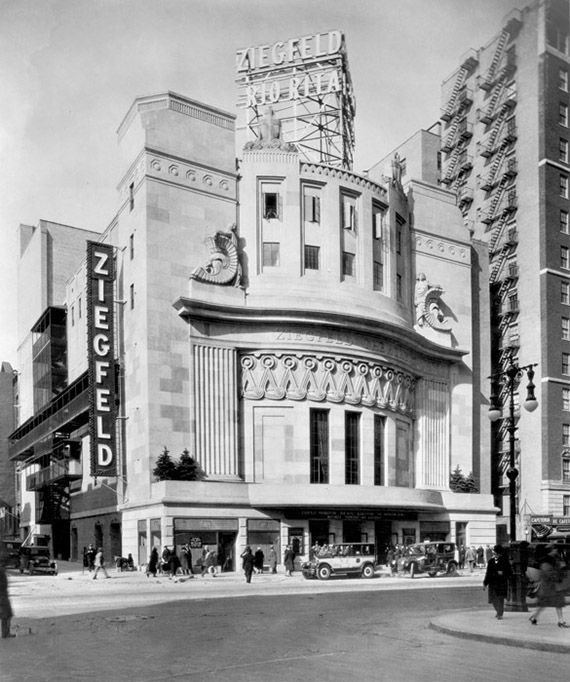
DECKED IN DECO…The Ziegfeld Theatre at Sixth Avenue and 54th Street, 1927. Joseph Urban’s design of the facade suggests open curtains flanking a stage. (nyc-architecture.com)
Screen Shot 2016-07-20 at 4.11.16 PM
HELLO DOLLY…On the Ziegfeld Theatre’s opening night Ada May played Dolly in Rio Rita (Museum of the City of New York)

The opening drew the likes of Charlie Chaplin and polar explorer Roald Amundsen, who perhaps found a line of chorus girls a welcome sight after years of trekking through frozen landscapes.

Screen Shot 2016-07-19 at 3.49.28 PM

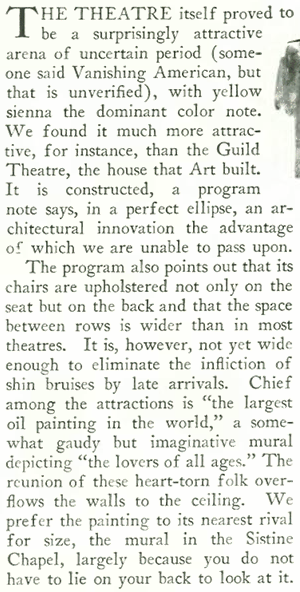
Among the attractions of the new theatre was what was claimed to be the largest oil painting in the world:

Screen Shot 2016-07-19 at 3.50.12 PM

110927-GON066-02
AN EYEFUL…A section of the interior wall of the Ziegfeld Theatre, decorated with “the largest oil painting in the world.” (nyc-architecture.com)

Sadly, despite public protests, the theatre was razed in 1966, bulldozed into rubble. The Burlington House stands on the site today:

800px-Burlington-house-nyc
Burlington House. (Wikipedia)

But we will end on a happier note, a cartoon by Barbara Shermund:

Screen Shot 2016-07-19 at 3.52.59 PM

Next Time: Two Years Young…

e5c3fabc5f1612a71442c78a3c71d654

Upstairs, Downstairs

As the New Yorker was a magazine of the city’s new money smart set, it poked fun at their faddish tastes and patronizing attitudes while at the same time feeding their Anglophilia and WASPish sense of superiority.

015737c92d9c339b44b3805c311dd478
January 22, 1927 cover by Andre De Schaub.

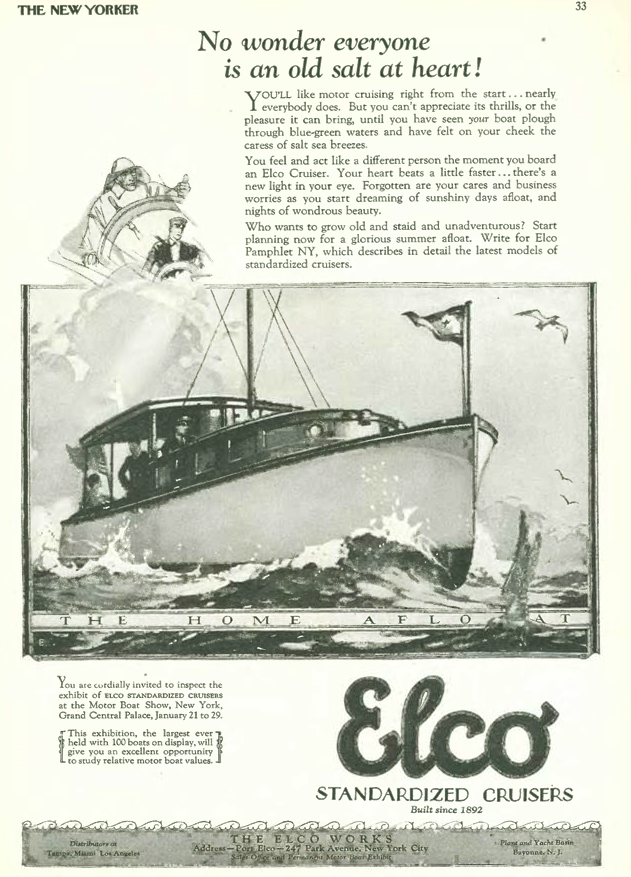
The magazine’s pages were filled with ads for English-style clothes, French perfumes and expensive cars. And in the Jan. 22 issue there were many ads for the motorboats that had displaced the automobile show at Grand Central Palace:

Screen Shot 2016-06-14 at 9.25.59 AM

It is important to note that this ad is an appeal to new money; old money would have found this motorized vessel quite vulgar.

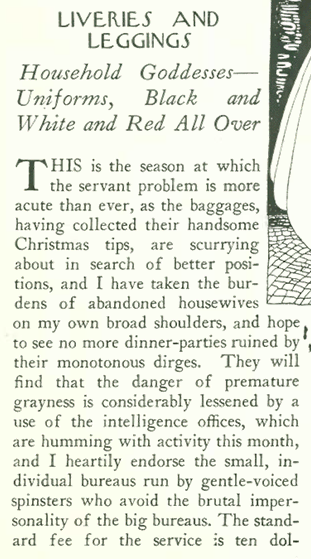
As it were, the new money needed some guidance if they hoped to live a lifestyle of ease and sophistication. And thus the issue’s “On and Off the Avenue” column, guest-written by Gretta Palmer (Lois Long took the week off), offered advice on how to hire and clothe the help:

Screen Shot 2016-06-14 at 9.27.59 AMScreen Shot 2016-06-14 at 9.28.35 AM

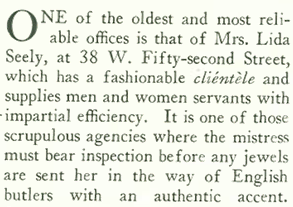
Perhaps you wanted a proper English butler. Lida Seely had your man:

Screen Shot 2016-06-14 at 9.28.53 AM

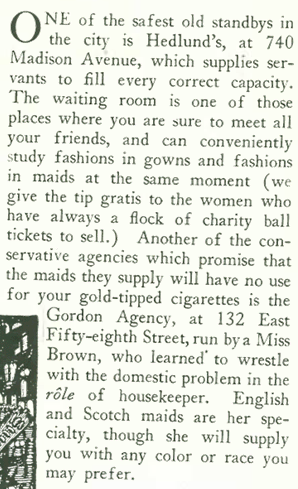
Or a Scotch maid, or choose from a selection of “any color or race”…

Screen Shot 2016-06-14 at 9.30.18 AM

In case you found that last sentence a bit callous, Gretta reassured:

Screen Shot 2016-06-14 at 9.30.55 AM

Screen Shot 2016-06-14 at 9.31.27 AM

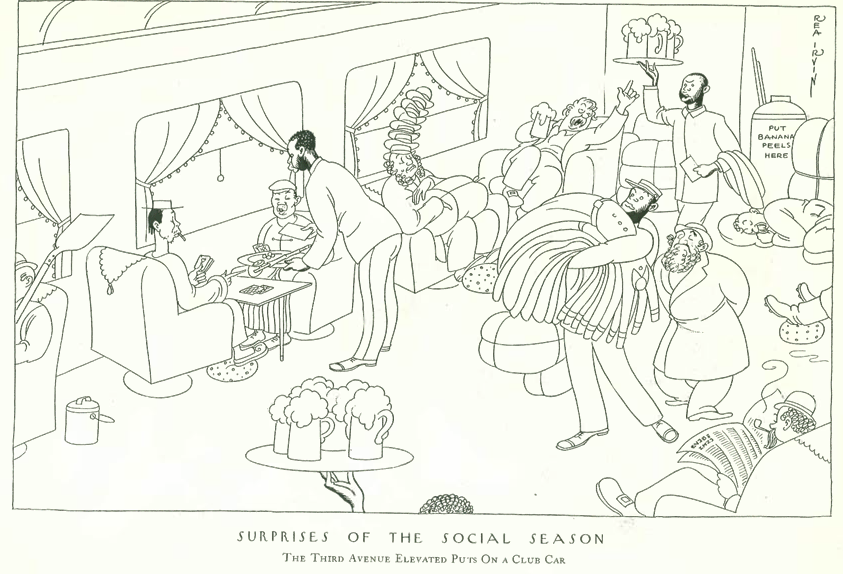
The issue also featured a cartoon by Rea Irvin (displayed full-page, sideways in the original magazine) depicting the “lower orders” aping the lifestyle of the upper classes. Note that of all the racial and ethnic types shown here, only Blacks remain in the servant class.

Screen Shot 2016-06-14 at 9.18.03 AM

As I noted in a previous post, “Race Matters,” the New Yorker of the 1920s was decidedly mainstream in engaging in casual bigotry common in those days, including treating blacks as racial “others.” There is, perhaps, a subtle jab here by Irvin at the pretensions of the uppers, but he’s not around anymore to clarify this.

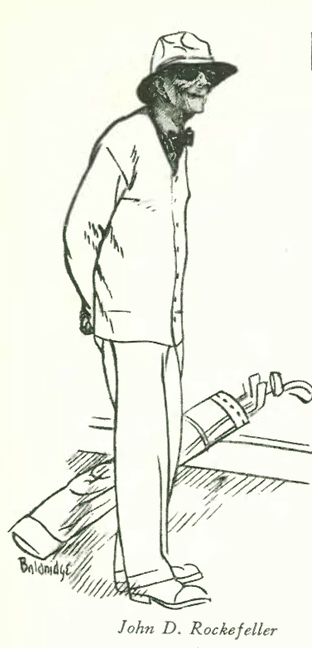
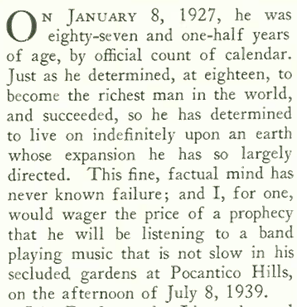
The issue also featured the first of a series of articles (“Profiles”) on the 87-year-old John D. Rockefeller. A brief excerpt, with illustration by Cyrus Baldridge:

Screen Shot 2016-06-14 at 9.19.18 AM

Rockefeller

The writer’s prediction wasn’t too far off: Rockefeller would live another ten years, and die at age 97 in 1937. His grandson, David Rockefeller, apparently inherited both his money and his genes: he recently celebrated his 101st birthday (update: David Rockefeller died in 2017 at age 101).

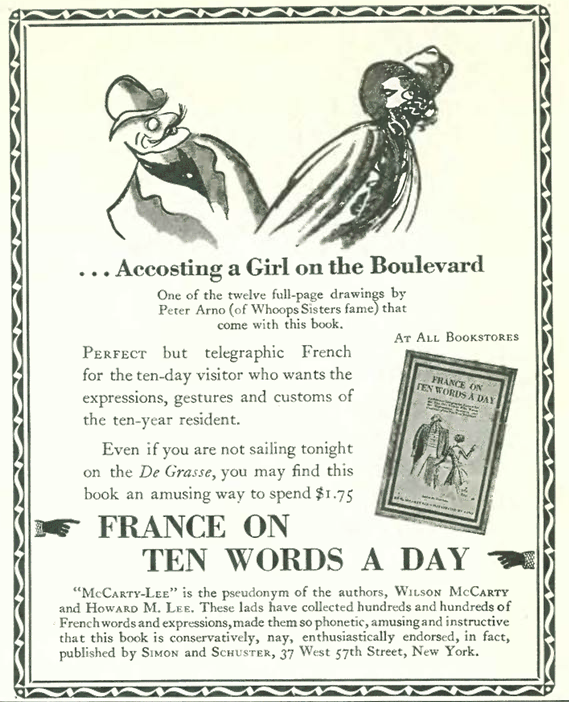
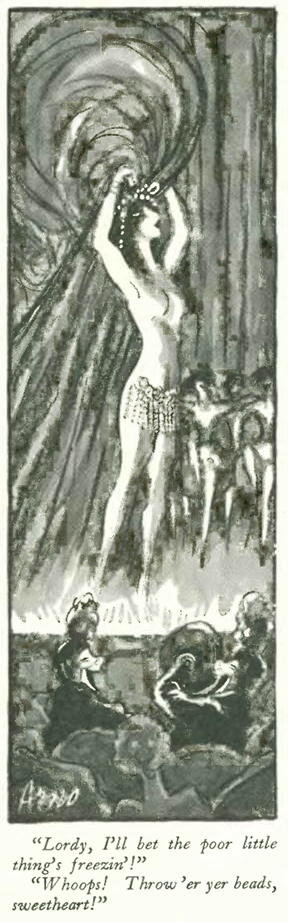
Finally, a cartoon by Peter Arno, famed for his drawings of women, usually scantily clad. Here we see an early example in one of his “Whoops Sisters” panels:

Screen Shot 2016-06-14 at 9.22.05 AM

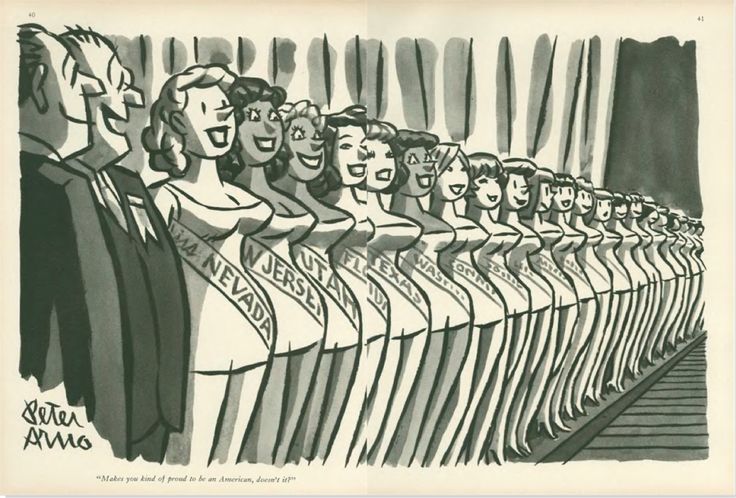
By comparison, here is a cartoon by Arno 33 years later, from the September 10, 1960 issue of the New Yorker:

869a0a6de1edde2e7479b79d285bd73a
Caption: “Makes you kind of proud to be an American, doesn’t it?”

Next Time: All That Jazz…

b8a47deb10bba89d024899c9500bba81

Living High in ’27

It’s 1927 and the New Yorker is almost two years old. After a shaky start the magazine found its voice (and a lot of advertising revenue) and moved forward with a solid stable of contributors that would give the magazine a style that persists to this day.

3d2b321563197a6b5234717d2c47259b
Jan. 1, 1927 cover by Rea Irvin.

Before I dive in, let’s get a snapshot of the country in 1927, courtesy of Bill Bryson’s terrific book, One Summer: America, 1927.

Bryson describes America as “staggeringly well-off in 1927,” with homes (especially in urban areas) shining with sleek appliances—refrigerators, radios, telephones, electric fans and razors—“that would not become standard in other countries for a generation or more.”

He writes that “of the nation’s 26.8 million households, 11 million had a phonograph, 10 million had a car, 17.5 million had a phone…42 percent of all that was produced in the world was produced in the United States.” Bryson also notes that in 1927 the U.S. made 80 percent of the world’s movies and 85 percent of the world’s cars, and that the state of Kansas alone had more cars than France.

It was also the year Babe Ruth would hit a record 60 home runs, and Charles Lindbergh would fly the Spirit of St. Louis across the Atlantic.

* * *

The Jan. 1 issue featured a profile of world-famous dancer Isadora Duncan, who was living in sad decline in Paris. Particularly acclaimed in Europe for her free dance style, the California-born Duncan also gained notoriety (mostly in puritanical America) for her flouting of traditional mores and morality. Today, she is mostly known for the freak accident that killed her. More on that below.

Screen Shot 2016-06-02 at 3.01.43 PM
“Profiles” illustration of Isadora Duncan by Hugo Gellert.

The profile, written by Paris correspondent Janet Flanner under the pen name “Hippolyta,” noted that Duncan was “the last of the trilogy of great female personalities our century produced. Two of them, [Eleanora] Duse and [Sarah] Bernhardt, have gone to their elaborate national tombs. Only Isadora Duncan, the youngest, the American, remains wandering the European earth.”

WANDERING THE EARTH…At left, portrait of Isadora Duncan, circa 1910. At right, a 1904 photograph Photograph by Hof-Atelier Elvira shows Duncan in her favored costume, which was inspired by classical drapery. The look was considered shocking at the time for the way it showed off her legs. (Wikipedia/New York Public Library)

Little did Flanner know that Duncan would also be dead before the year was over. Here is how the Wikipedia entry on Duncan describes her death:

On the night of September 14, 1927 in Nice, France, Duncan was a passenger in an Amilcar automobile owned by Benoît Falchetto, a French-Italian mechanic. She wore a long, flowing, hand-painted silk scarf, a gift from her friend Mary Desti, the mother of American film director Preston Sturges. Desti, who saw Duncan off, had asked Duncan to wear a cape in the open-air vehicle because of the cold weather, but Duncan would only agree to wear the scarf.

As they departed, Duncan reportedly said to Desti and some companions, “Adieu, mes amis. Je vais à la gloire!” (“Farewell, my friends. I go to glory!”); but according to American novelist Glenway Wescott, Desti later told him that Duncan’s actual last words were, “Je vais à l’amour” (“I am off to love”). Desti considered this embarrassing, as it suggested that she and Falchetto were going to her hotel for a tryst.

Her silk scarf, draped around her neck, became entangled around the open-spoked wheels and rear axle, hurling her from the open car and breaking her neck. Desti said she called out to warn Duncan about the shawl almost immediately after the car left.

1927-amilcar
NO SEAT BELTS, EITHER…A 1927 Italian Amilcar, similar to the one in which Duncan met her end. (irrational geographic)

Referring to Duncan’s demise, the writer Gertrude Stein remarked: “Affectations can be dangerous.”

Next Time: Those Jaunty Jalopies…

02a20a11df95c233092dc64bfc8f2b3c