The Age of Giants

Otto Klemperer rehearsing at the Hollywood Bowl in September 1937. (Los Angeles Philharmonic)

The 20th century was an age of big personalities in classical music, among them Otto Klemperer (1885-1973), a German-born protégé of the composer and conductor Gustav Mahler. Klemperer was already an established conductor in opera houses around Germany when the rise of the Nazis prompted the maestro to emigrate with his family in 1933. He was soon appointed chief conductor of the Los Angeles Philharmonic.

Oct. 13, 1934 cover by Rea Irvin.

Klemperer also guest conducted a number of orchestras in the U.S., including the New York Philharmonic, where his larger than life presence caught the attention of “The Talk of the Town.” Excerpts:

MAESTRO…Top left, Otto Klemperer with Czech composer Leoš Janáček in 1927; at right, with Austrian-American classical pianist and composer Artur Schnabel in 1933; bottom photo, with wife Johanna Geisler, son Werner and daughter Lotte in Los Angeles, 1936. (operaplus.cz/Otto Klemperer Film Foundation/ottoklemperer.nl)

Lauded internationally as a great orchestral commander, in 1939 Klemperer would begin experiencing balance issues. After a tumor the size of a small orange was removed from his brain, he would be left partially paralyzed on his right side; bouts of depression and a manic phase would later land him in a mental hospital. However, by 1946 he would recover his health enough to return to conducting in a career that would last until 1971.

The conductor’s daughter, Lotte Klemperer (1923–2003), would serve as her father’s secretary, negotiator and administrator until his death in 1973. Otto’s son, Werner Klemperer (1920–2000), would become a stage, screen and television actor, most notably portraying Colonel Klink in the 1960s comedy Hogan’s Heroes. Although the role would garner Werner two Emmys, his father never fully understood the series or even the concept of a sitcom. Reluctant to pursue a musical career while his father was alive, Werner would later join the Metropolitan Opera Company in the 1970s, appear in Broadway musicals, and serve as a narrator with a number of American symphony orchestras.

TO THEM HE WAS DAD…At left, daughter Lotte Klemperer with her famous father in 1954. She would serve as his caretaker and business partner after her mother’s death in 1956. At right, son Werner Klemperer acted on Broadway and in films before taking on the role of the bumbling Colonel Klink in the 1960s comedy Hogan’s Heroes, which garnered the actor two Emmys. Although Werner Klemperer was musically inclined, he avoided work in music until the death of his father in 1973. (Otto Klemperer Film Foundation/CBS)

 * * *

Vanished in the Haze

In his “Notes and Comment,” E.B. White lamented what appeared to be the transformation of the familiar night club; high above Manhattan in the Rockefeller Center’s Rainbow Room, the comforting haze of “cigarette smoke, talc, waiter’s venom” had been displaced by air conditioning, and to add to the horror, an organ had been installed that tinged the fox trot “with an odd piety.”

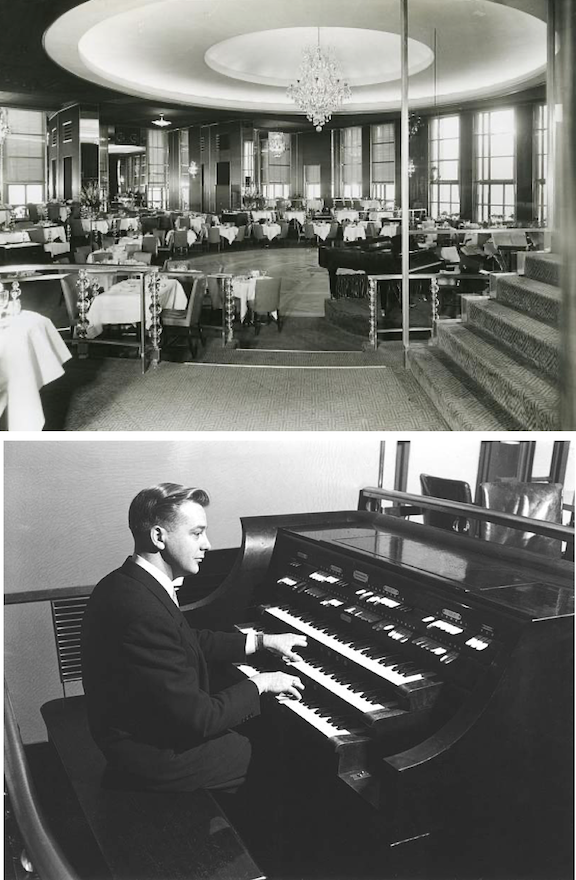
NOWHERE TO HIDE…E.B. White found the lack of haze in the new Rainbow Room disconcerting, not to mention the addition of a Wurlitzer organ, its wonders demonstrated here by organist Ray Bohr in 1934. (Library of Congress/nycago.org)

 * * *

There Oughta Be a Law

While E.B. White was mourning the demise of the smoky nightclub, art and design critic Lewis Mumford continued his tirade against the pretentious and mediocre buildings that were popping up all over the city, including the new Federal Court Building on Centre Street that was, in Mumford’s words, a supreme example of bad design and fake grandeur.

Cass Gilbert's The Federal Courthouse building (United States courthouse) in 1936 (the year of its completion). Located at 40 Centre Street (Foley Square), Manhattan, New York City. In 2001, it was designated as the Thurgood Marshall United States Courthouse.Source: Wurts Brothers Photography Collection at the National Building Museum.
A CRIMINAL CASE…Cass Gilbert’s Federal Courthouse building (United States courthouse) was completed in 1936, two years after Gilbert’s death. In 2001 it was designated as the Thurgood Marshall United States Courthouse. Critic Lewis Mumford called the design, which combined “two unlovely and unrelated forms”…”nothing short of a major crime.” (Wurts Brothers Photography Collection, National Building Museum)

 * * *

Crime of the Century

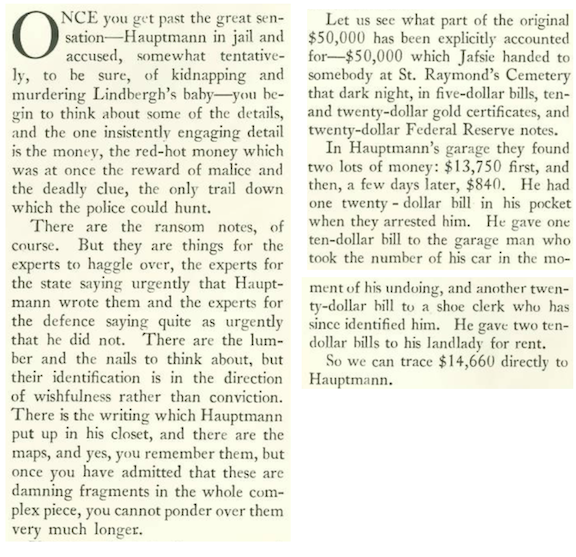
That is what the press called the kidnap and murder of the infant son of Charles Lindbergh and Anne Morrow. In September 1934 a German immigrant carpenter named Bruno Hauptmann was arrested for the crime, and a trial date was set for the following January. In his “A Reporter at Large” column, Morris Markey examined the ransom money trail that led to Hauptmann’s ultimate arrest. Excerpts:
DON’T SAY “CHEESE”…Bruno Hauptmann sits for a mug shot following his arrest for the abduction and murder of the 20-month-old son of Charles Lindbergh and Anne Morrow Lindbergh. (Leslie Jones, Boston Public Library)

 * * *

Should Have Stayed Lost

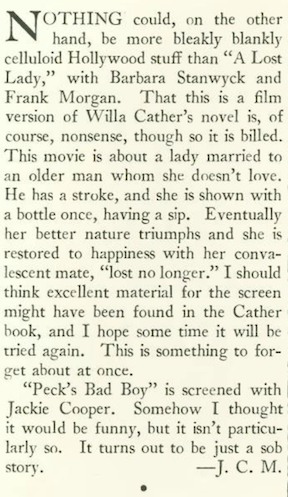
A film version of Willa Cather’s 1923 novel A Lost Lady was first made as a silent by Warner Brothers in 1924 (the film itself is lost) but in 1934 Warner had another go at the novel with a sound version starring starring Barbara Stanwyck, who was emerging as a major star. But Stanwyck’s talents could not overcome a script that critic John Mosher described as bleak, blank nonsense. Cather was so dismayed by the film that she refused to permit another adaptation of any of her novels during her lifetime.
LOST IN TRANSLATION…Barbara Stanwyck and Ricardo Cortez in A Lost Lady (1934). (IMDB)

 * * *

From Our Advertisers

We kick off our sponsors with this two-page center spread from Hiram Walker & Sons, who introduced their new line of playing card-inspired whiskies…

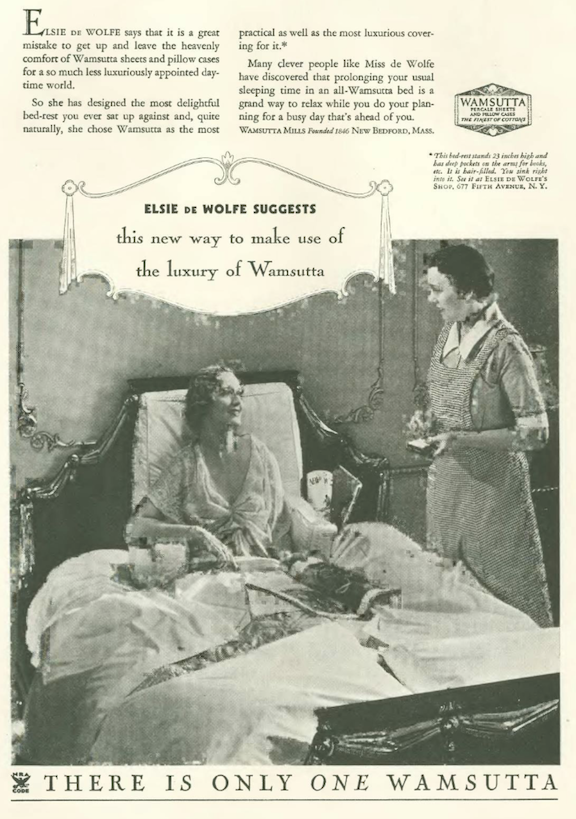
…the New Yorker’s Janet Flanner wrote in 1938 that Elsie de Wolfe invented interior design as a profession, so who was to argue with de Wolfe’s suggestion that the leisure class should linger in bed with the aid of a Wamsutta bed-rest…the small print beneath the logo indicated that the bed-rest was “hair-filled,” which I assume was horse hair, still used today in some luxury brands…
…if de Wolfe was queen of interior designers, then Hattie Carnegie was the “First Lady of Fashion,” or so this ad claimed…

…here are images of the two titans of fashion and good taste…
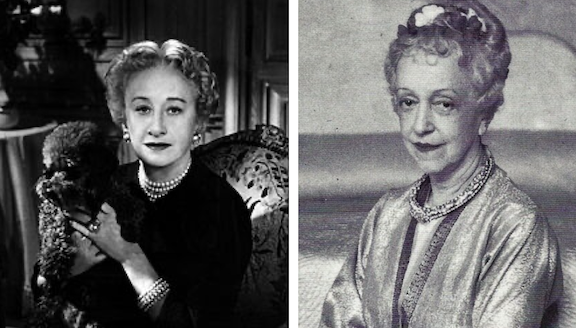
TASTEMAKERS…At left, Hattie Carnegie aka Henrietta Kanengeiser (1880-1956), and Elsie de Wolfe, aka Lady Mendl (1859–1950). (americacomesalive.com/bureauofinteriors.com)

…and speaking of fashion, here is a llama cloth coat from B. Altman, trimmed in silver raccoon, suitable for Yale football games…based on inflation, that coat today would set you back at least $2,000…

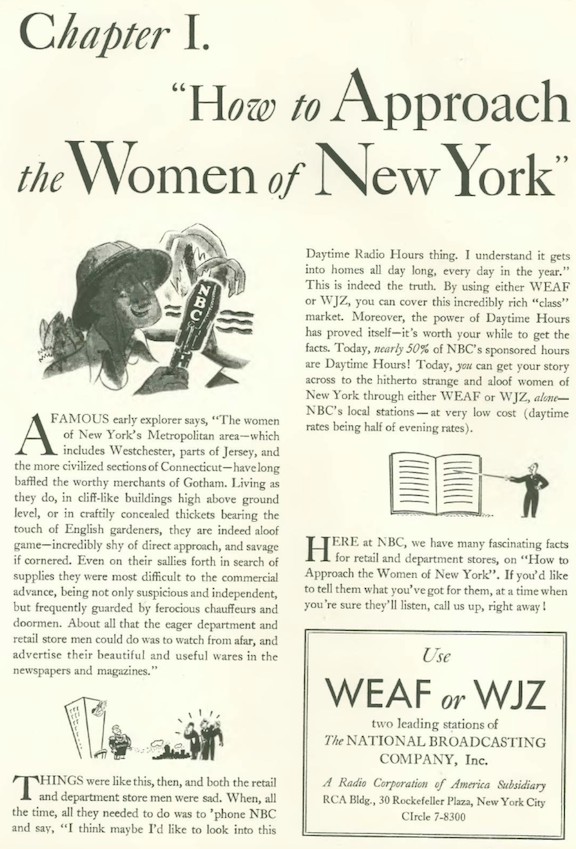
…this condescending ad offered merchants a way to reach the “hitherto strange and aloof women of New York” through daytime advertising…
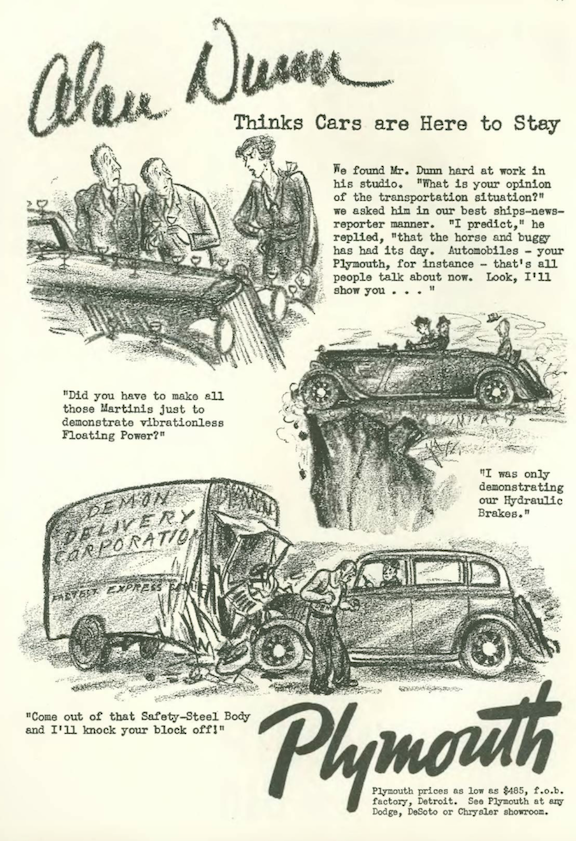
…Plymouth enlisted the talents of Alan Dunn to tout their car’s ride and durability…
…and on to our cartoonists, another from Dunn, a bit of spot art featuring a not so subtle commentary on Lawrence Lee Bazley Angas’s book The Coming American Boom

…and some spot art from Isadore Klein

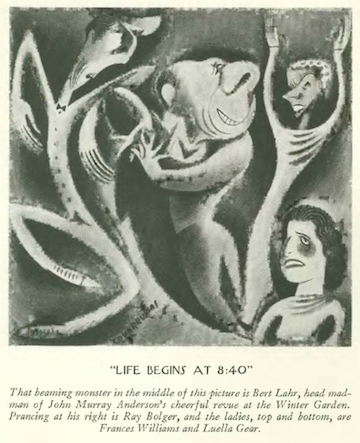
Miguel Covarrubias contributed to the theater review section…
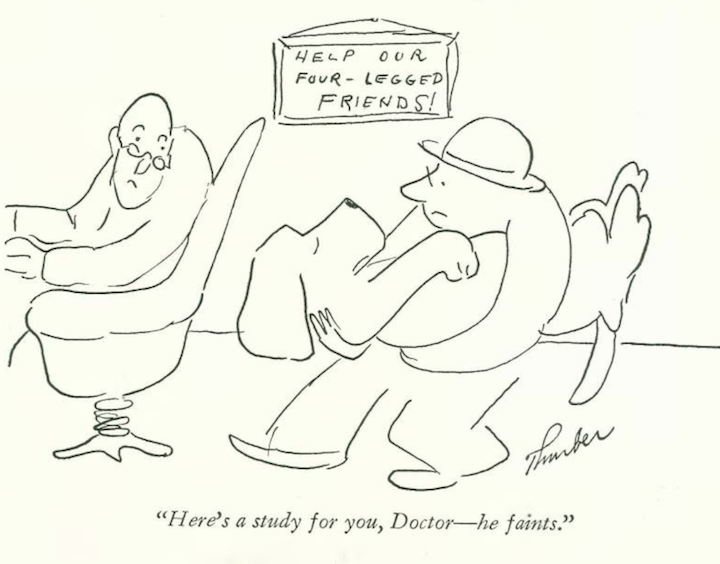
James Thurber entertained a house guest…

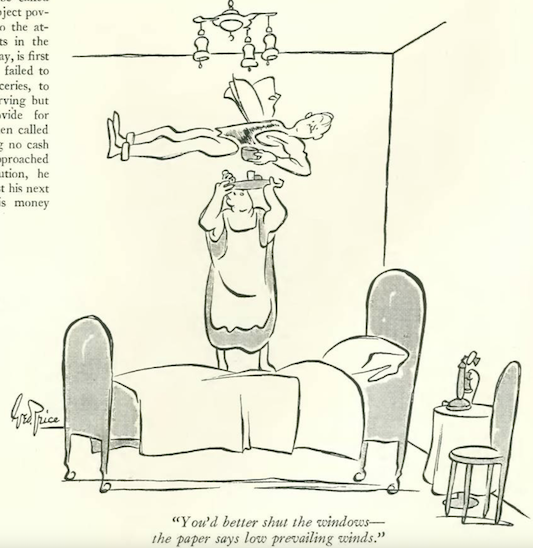
George Price was still up in the air…

Helen Hokinson took a spin with a celebrity look-alike…

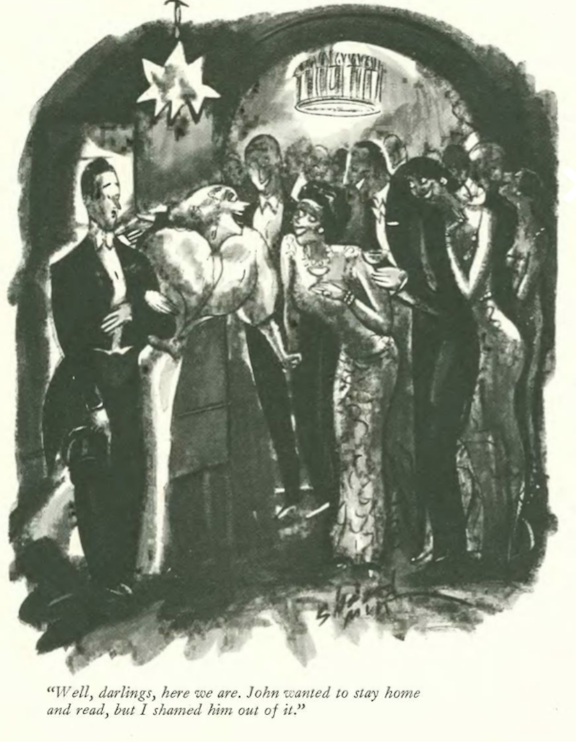
…and Barbara Shermund offered another glimpse into the life of a modern woman…

…on to Oct. 20, 1934…

Oct. 20, 1934 cover by Helen Hokinson.

…in which E.B. White offered up a new lament, namely the pervasiveness of nostalgia and sentiment in contemporary literature…
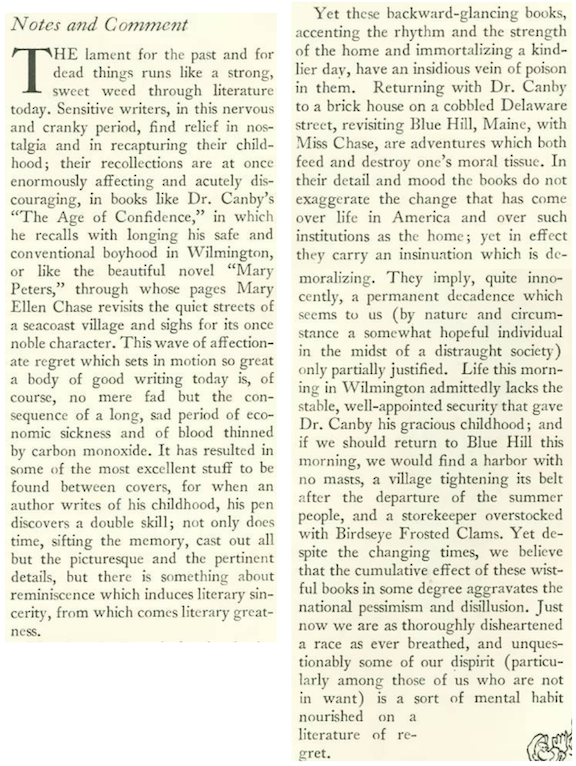
HARKING BACK TO THOSE DAYS OF YORE…E.B. White simply had no stomach for the nostalgic stylings of Mary Ellen Chase (left) or Henry Seidel Canby, seen here on the cover of the May 19, 1924 issue of Time. (U of Maine/Time Inc)

 * * *

Fifty Years Young

“The Talk of the Town” marked the Dakota’s 50th year at Central Park West, and made note of its loyal and prominent clientele…back in the day it served as a residence for actors such as Lillian Gish, Boris Karloff, and Teresa Wright, and in later years such luminaries as Lauren Bacall, Judy Garland, Rudolf Nureyev, and, of course, John Lennon and Yoko Ono.

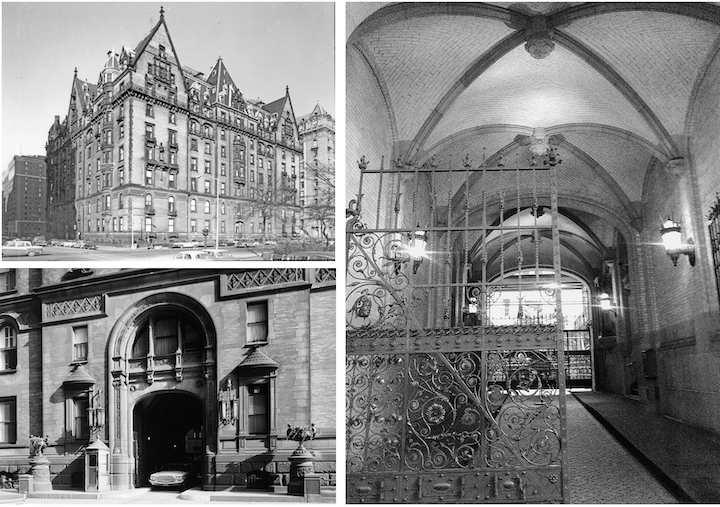
THE STORIES IT COULD TELL…At left, the facade and main entrance of the Dakota in the 1960s; at right, inside the main entrance. (Pinterest/Wikipedia)

 * * *

More From Our Advertisers

The Matson-Oceanic Line offered a “millionaire’s idea of a vacation” at an affordable price, and offered this sumptuous image as proof…

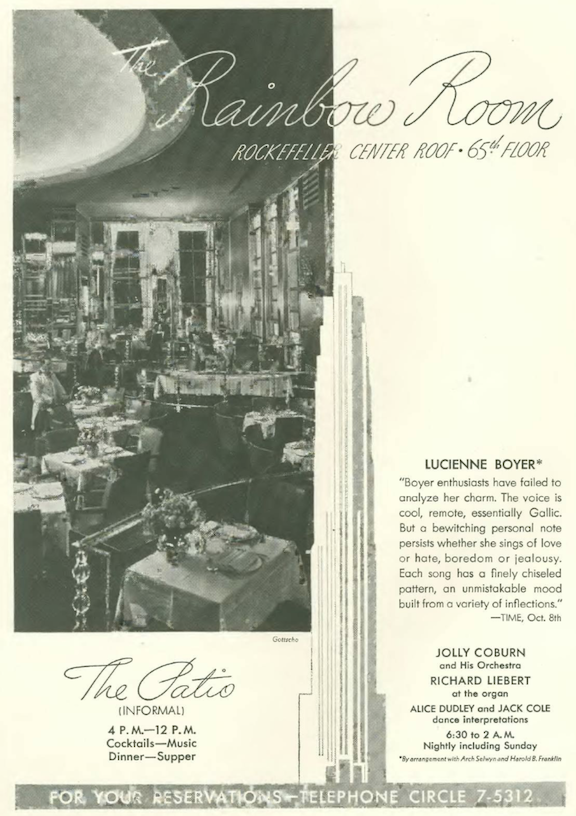
…E.B. White wasn’t crazy about the smokeless dazzle of the Rainbow Room, but it proved to be popular among the city’s elite…
…in case one was concerned about the provenance of one’s mink coat, Saks posted this helpful ad. Their high-end, natural-skin minks were priced at $8,000 (roughly $180,000 today); there was, however, a caveat regarding the cheaper models…

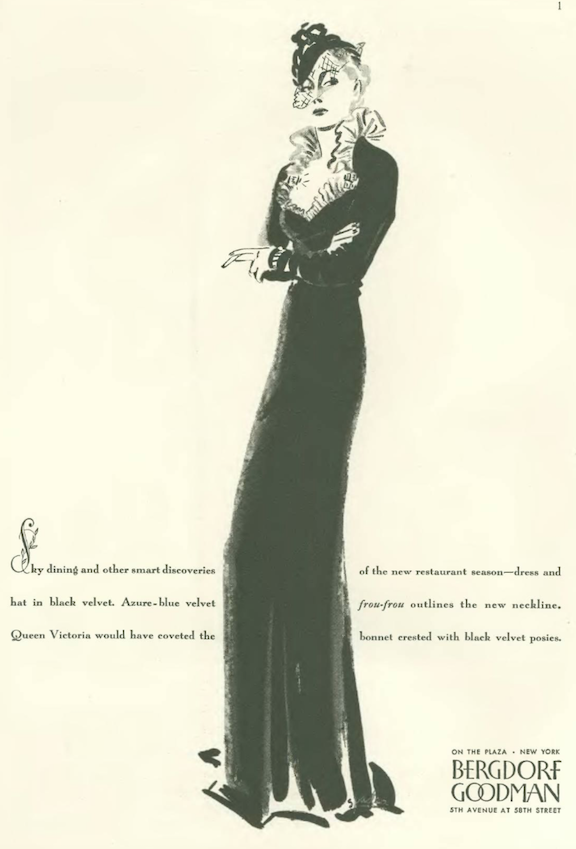
…Bergdorf Goodman offered up another ad featuring an impossibly attenuated model posed with a cigarette, her defiant gaze suggesting her modernity and individualism…
…Plymouth went back to the stable of New Yorker cartoonists, this time featuring the adventures of Helen Hokinson’s “girls”…

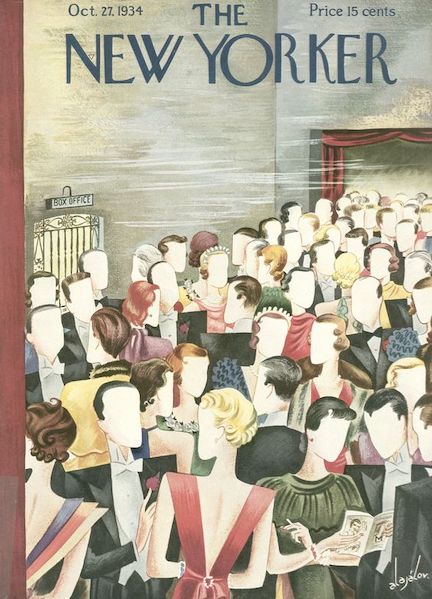
…and we segue to the rest of our cartoonists, including this spot by Constantin Alajalov

…and this by George Price

…who also gave us another update on the trials and tribulations of his floating man…

James Thurber occasionally ignored scale in rendering his characters, which didn’t really matter in his strange world…

Jack Markow had some bad news for two sign painters (the caption size is increased for readability)…

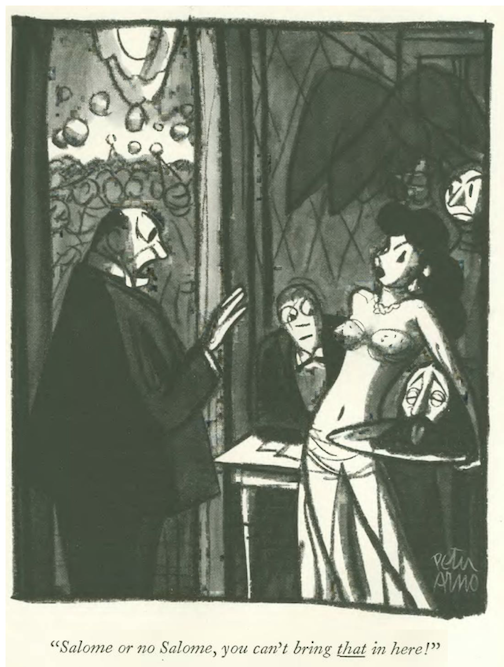
…and we close with Peter Arno, and the winner of most original Halloween costume…
…and before I go…this is being posted on Halloween, 2023, so here are a few images from 1934 to get you in the spirit, including a Saturday Evening Post cover, a 1934 party ideas magazine, and a page from Popular Mechanics featuring a smoking robot costume you could make yourself…in the 1930s, Popular Mechanics often featured Halloween party ideas that were downright lethal, usually involving electric shocks, pistols loaded with blanks, that sort of thing.

Happy Halloween!

Next Time: House & Home…
Summer Indulgences

Writing under the pseudonym Guy Fawkes, Robert Benchley (1889-1945) tried to keep the newspaper industry honest through regular criticism in his “Wayward Press” column.

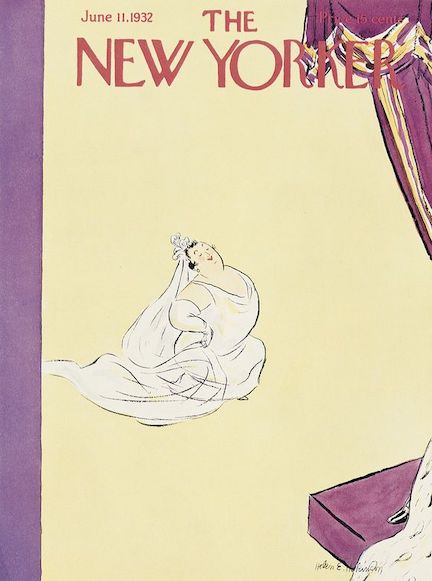
June 11, 1932 cover by Helen Hokinson.

As the summer of ’32 approached, Benchley recalled the barrage of sensational headlines that dominated the month of May—everything from Amelia Earhart’s solo crossing of the Atlantic to John Curtis’ false confession in the Lindbergh baby kidnapping. Here is the opening paragraph:

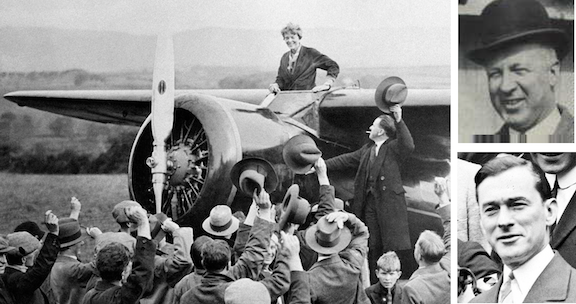
THE NOBLE AND IGNOBLE marked a busy May 1932. On May 20–21, Amelia Earhart became the first woman—and the only person since Charles Lindbergh—to fly nonstop and alone across the Atlantic. She is shown here after arriving in Culmore, Northern Ireland after her solo flight; At top, right, John Hughes Curtis, a bankrupt shipbuilder from Norfolk, Virginia, who falsely claimed he was in contact with the actual kidnappers of the Lindbergh baby, leading investigators on a wild goose chase; bottom right, Jimmy Walker’s days as mayor of New York were numbered as investigations into corruption continued. (pioneersofflight.si.edu/Wikipedia)

*  *  *

News From Texas

Lois Long filed another installment of “Tables for Two,” noting that folks at Broadway and Seventh Avenue “still own most of the motorcars that sally out of town,” with some of those cars ending up at Texas Guinan’s new La Casa Guinan on Merrick Road.

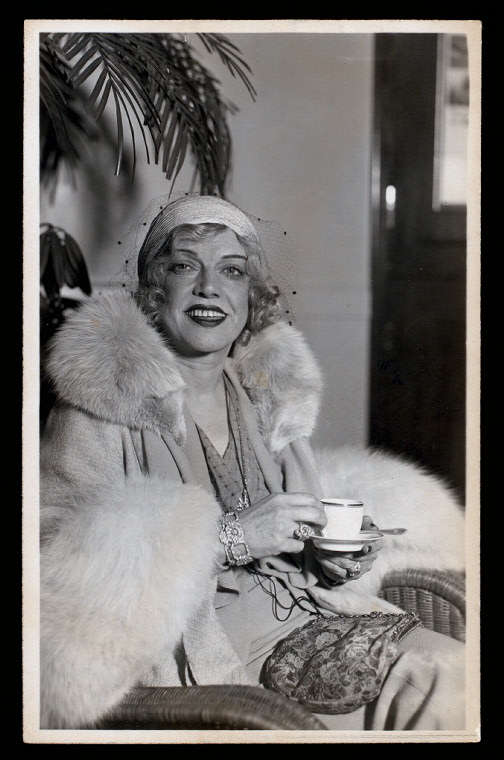
TEXAS TEA…Following the market crash of 1929, Mary Louise Cecilia “Texas” Guinan left Manhattan’s speakeasy life and in time started a new club near Valley Stream, Long Island. Formerly known as Hoffman’s, Guinan renamed the club La Casa Guinan in 1932. (liherald.com)

 *  *  *

Dud Stud

Writing under his pseudonym Audax Minor, George F. T. Ryall reported on the latest news from the track, namely the race at Belmont that produced a surprise winner.

FAIR FAIRENO scored his first major victory of 1932 in the Belmont Stakes. Unfortunately, Faireno fared less well with the fillies—he was found to be completely sterile when tried at stud.(americanclassicpedigrees.com)

*  *  *

Appreciating ZaSu

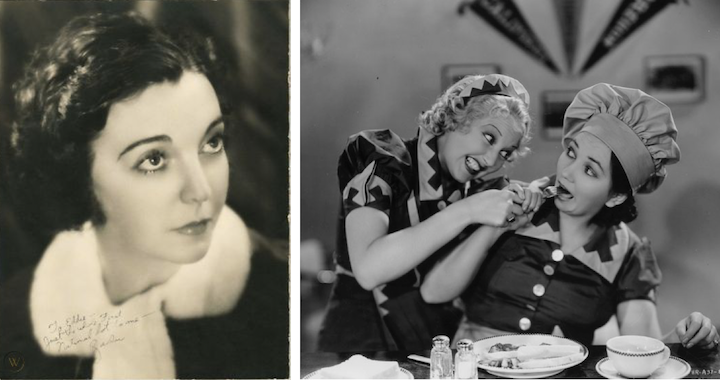
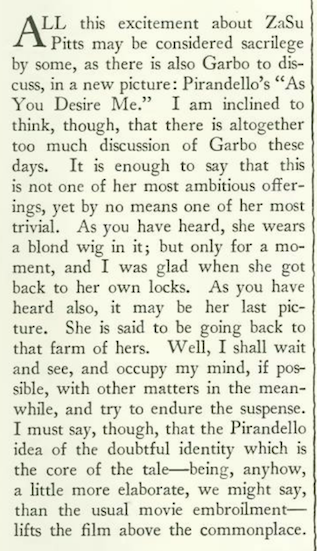
ZaSu Pitts (1894 – 1963) began her acting career in silent dramas, but moved on to comic roles with the advent of sound, most famously pairing up with Thelma Todd in a string of comedy shorts. Producer Hal Roach saw the duo as a female version of Laurel and Hardy, although Pitts and Todd’s characters were smarter and more streetwise. Pitts was also known for playing many secondary parts in B films, mostly portraying fretful spinsters. According to critic John Mosher, this typecasting did not do justice to the Pitts’ obvious talents, which were on display in 1932’s Strangers of the Evening.

UNSUNG HEROINE is how critic John Mosher described actor ZaSu Pitts, seen at left in a circa 1930 publicity photo. Anticipating Lucy and Ethel from I Love Lucy, Pitts teamed up with Thelma Todd in a string of comedy shorts in the early 1930s. Pitts was featured in dozens of films in her 50-year career, including appearances in 18 films in 1932 alone. (IMDB)

Mosher was also a big fan of Greta Garbo, her recent appearance in Grand Hotel prompting a raft of superlatives from the usually reserved critic. But in her latest outing, As You Desire Me, the enigmatic star seemed to drift a bit closer to earth.

GET OFF MY BACK…Critic John Mosher was a big fan of Greta Garbo, but her appearance in As You Desire Me was a bit of a letdown. Maybe it was the blonde wig. (IMDB)

*  *  *

From Our Advertisers

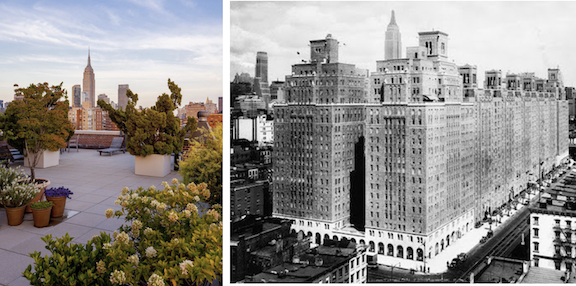
Chelsea’s London Terrace opened in 1930 as largest apartment building in the world, and it was a world unto itself, noted for its “Garden Quiet” as this ad claimed…

…and its terraces continue to provide respite from the clamor below…

NOW AND THEN…London Terrace today and in 1930. (londonterracestories.com)

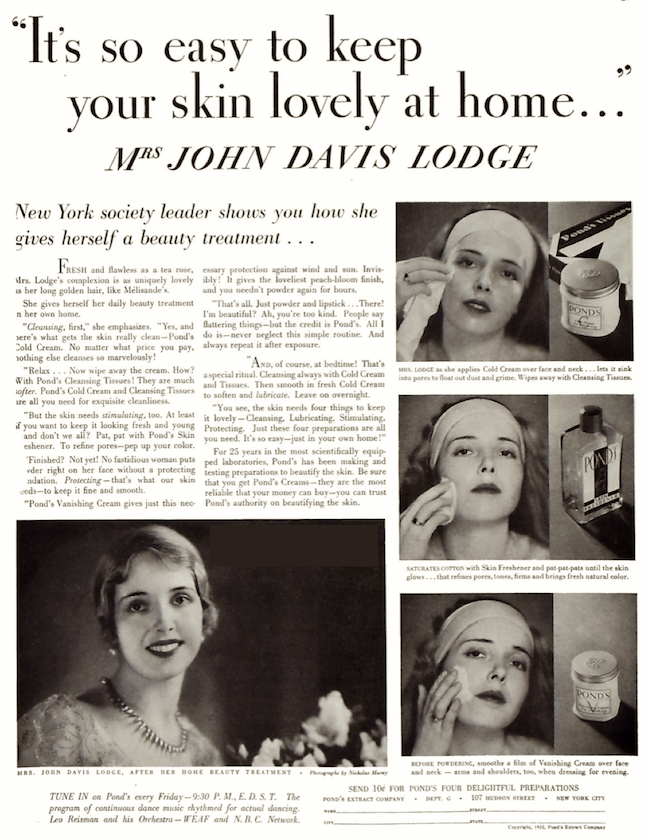
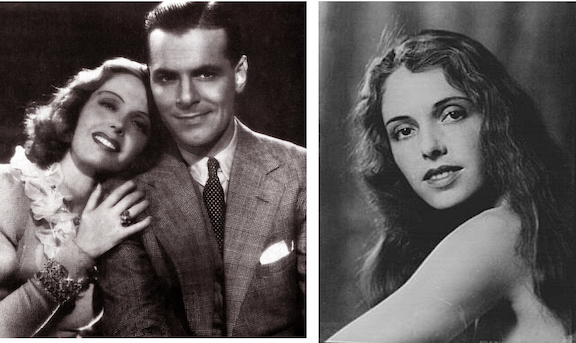
…next is another testimonial ad from Pond’s Cold Cream, this time featuring “Mrs. John Davis Lodge,” aka Francesca Braggiotti (1902-1998), an Italian dancer and actor who married fellow actor John Davis Lodge in 1929 (they co-starred in the 1938 film Tonight at Eleven)…

…A member of a prominent political family, John Davis Lodge (1903-1985) later served as governor of Connecticut, a U.S. House representative, and ambassador to Spain, Argentina, and Switzerland…

SECOND ACT… Francesca Braggiotti married fellow actor John Davis Lodge in 1929, but gave up the acting life when her husband entered politics in the 1940s. At left, the couple in 1938; at right, a 1931 portrait of Braggiotti by Arnold Genthe. The couple had two children, one of whom is Lily Lodge, co-founder of Actors Conservatory in NYC. (Wikipedia/geni.com)

…on with the rest of the ads, we have this one from the maker of Camels, R.J. Reynolds, who took a shot at rival American Tobacco, and their “toasted” Lucky Strikes…

…and we get a dose of retrofuturism thanks to Charles Kaiser and his illustrations of life unbounded with the autogiro, a predecessor to the modern helicopter…

…and it makes a nice segue to our cartoons, beginning with Robert Day

…and the next series are of a scandalous nature, beginning with Otto Soglow’s comment on Mayor Walker’s corruption charge, and an “unnamed” whistleblower…

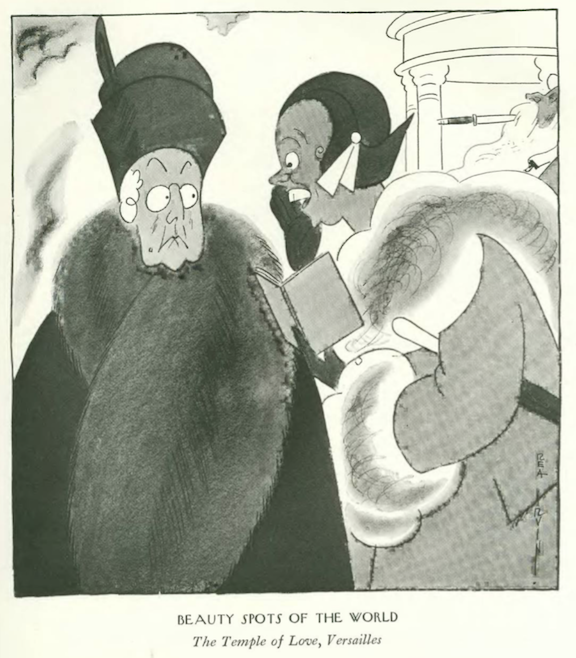
…and we have scandalous whispers for a dowager at Versailles, with Rea Irvin

…and we let our imaginations run wild with Helen Hokinson here…

…and again here…

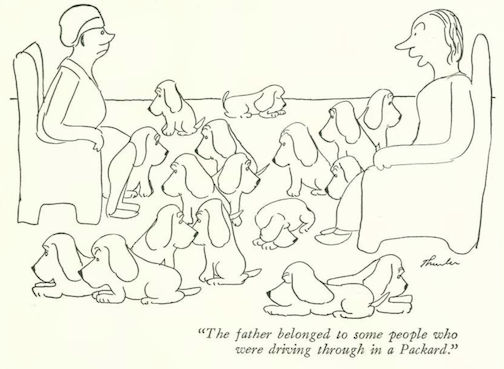
…and we end with another James Thurber classic…

Next Time: On Detention…

High Anxiety

The New Yorker profiled authors, composers, civic and world leaders and other notables in its early years, but every so often it would turn the spotlight on a member of the working class.

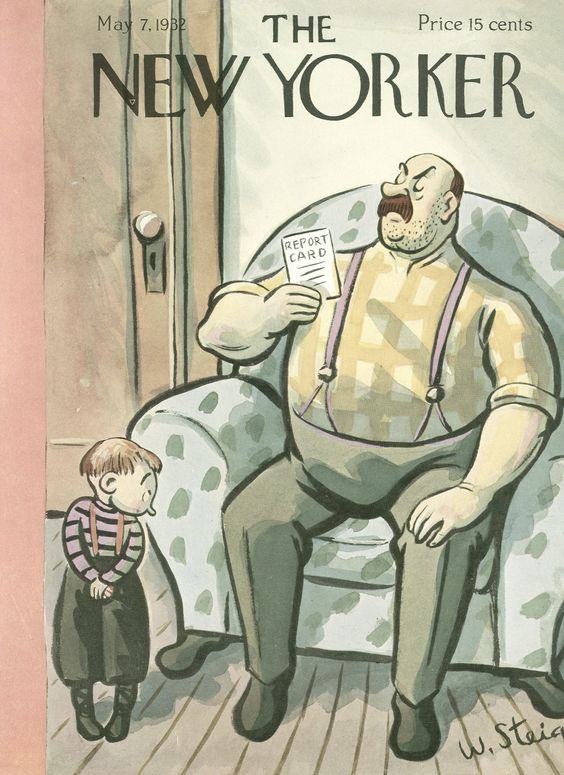
May 7, 1932 cover by William Steig, the first of 117 covers he would contribute to the magazine over his long life and career.

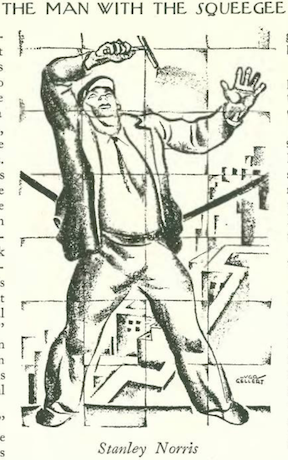
“The Man With The Squeegee,” a profile written by journalist (and later, playwright) Russel Crouse, detailed the life and work of Stanley Norris, a son of Polish immigrants who daily defied death as a window cleaner on Manhattan’s skyscrapers.

Profile illustration by Hugo Gellert

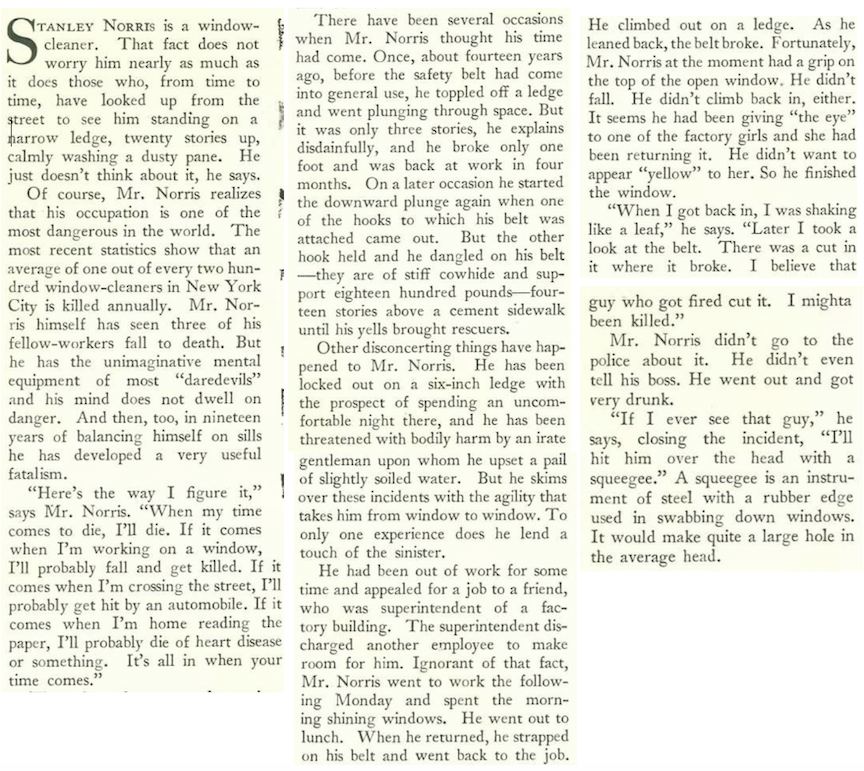
Below is an excerpt that includes a couple of Norris’ harrowing experiences high above the city streets:

LOOK MA, NO HANDS!…Clockwise, from top left…attached to the side of the Empire State Building, just two leather straps separated this brave window washer from oblivion in March 1936; a lone worker confronts his task in 1935; window washers in 1930; window washers on the 34th street side of the building, January 1932. There are 6,400 windows on the Empire State Building, and each worker averaged 76 panes per day. (retronaut.com/cnn/considerable.com/reddit)

During the 1930s one out of every 200 window cleaners in New York City fell to their deaths annually. In the previous decade, more than 80 fell to their deaths. In another excerpt, Norris recalled one of those unfortunate deaths.

 *  *  *

Vintage Whines

E.B. White enjoyed both wine and spirits, but like many of his fellow Americans he was growing sick and tired of Prohibition, and in his “Notes and Comment” looked abroad for a better way to live.

White concluded the entry with this observation…

…which referenced the sad grape “bricks” folks could order by mail…

Grape growers sold these bricks with a warning that they were not to be used for fermentation — a warning that kept them within the law. Naturally both seller and consumer understood that the end product would likely be something stronger than grape juice.

(vinepair.com)

Where White did procure his cocktails is revealed later in “Notes” — he tells us of an encounter with a night-club host while out walking with his wife, Katharine White, and toddler Joel.

SOMETIMES E.B. JOINED THEM…Katharine White taking baby Joel for a stroll with the White’s beloved Scotty Daisy in New York City, 1931. (brainpickings.org)

 *  *  *

News Stooges

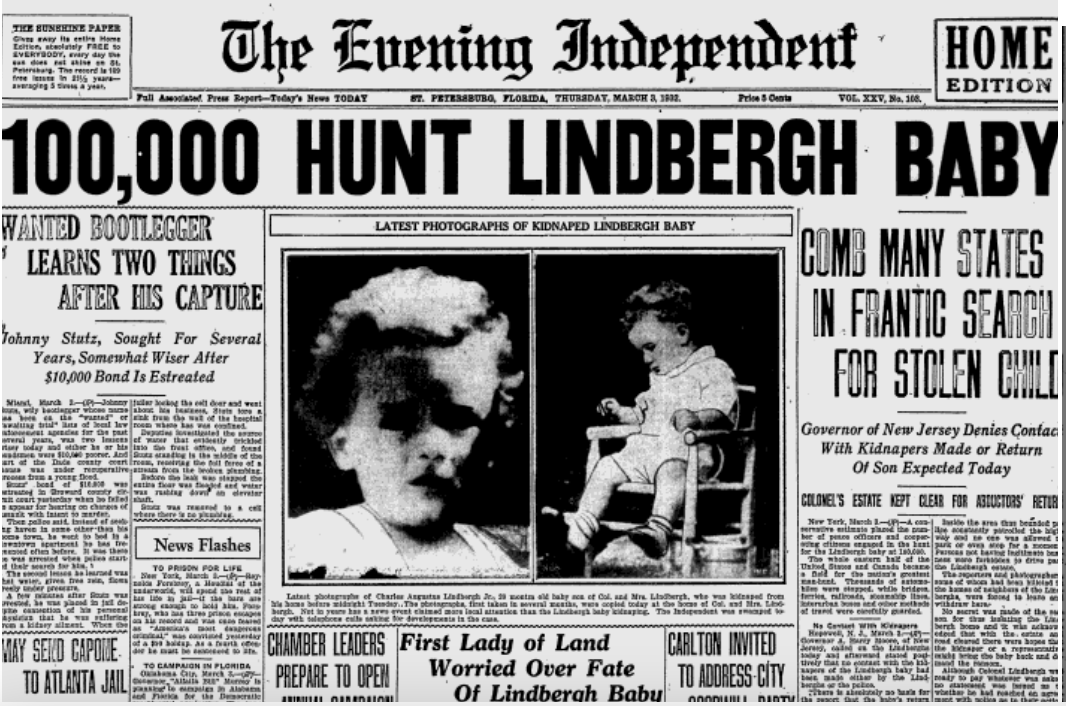
In “The Wayward Press” column, Robert Benchley (writing under the pseudonym Guy Fawkes) took the newspapers to task for their tasteless reporting on the Lindbergh baby kidnapping, and their general sullying of a once proud profession (Benchley himself was an experienced journalist):

TRAGEDY SELLS…The kidnapping of Charles and Ann Lindbergh’s infant son, Charles Jr., dominated headlines across the country in the spring of 1932. This March 3 edition of the St. Petersburg (Fla.) Evening Independent ran this headline just two days after the boy’s disappearance. The body of Charles Jr. was found on May 12, 1932. (Pinterest)

 *  *  *

Rising Stars

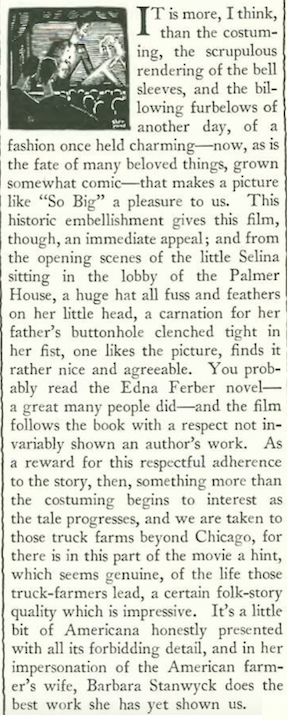
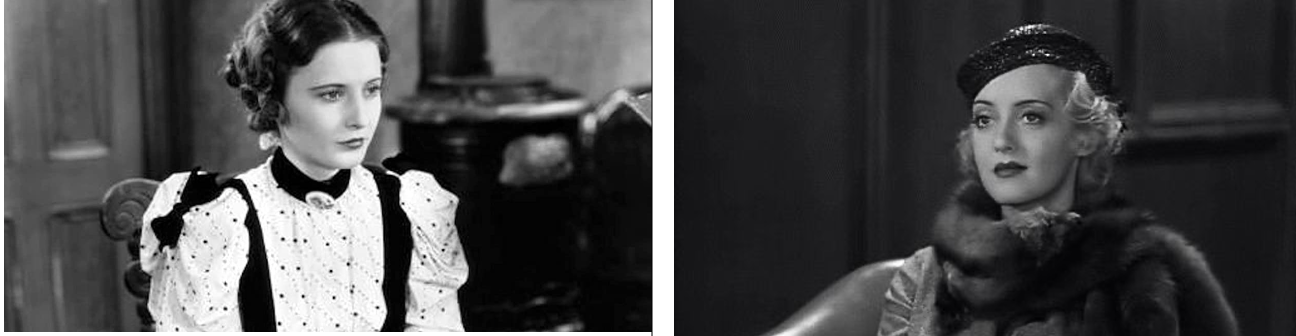
The pre-Code drama So Big!, based on Edna Ferber’s 1924 Pulitzer Prize-winning novel, featured two iconic Hollywood actors, but in 1932 only one of them, Barbara Stanwyck, was a bankable star. The film also featured the soon-to-be-famous Bette Davis, who had a much smaller role but was nevertheless grateful to be cast in a prestigious Barbara Stanwyck film. For critic John Mosher, the film proved to be a breakout role for Stanwyck.

SO BIG!…Barbara Stanwyck (left) was a marquee attraction in 1932, but Bette Davis would soon emerge as another major star in the Warner Brothers universe. (IMDB)

 *  *  *

From Our Advertisers

Clothes spun from cotton have been around for thousands of years, but this B. Altman advertisement suggests they were relatively novel for summer wear, at least among the upper orders. Both men and women wore wool bathing suits up until the 1930s, so perhaps there was something new about this cool, casual material…

…no doubt the landed gentry helped keep the Davey Tree Surgeons in business during the Depression, but in those lean times it didn’t hurt to reach out to those with modest means…

…they did something right, because this 141-year-old company still thrives today, the ninth-largest employee-owned company in the U.S…

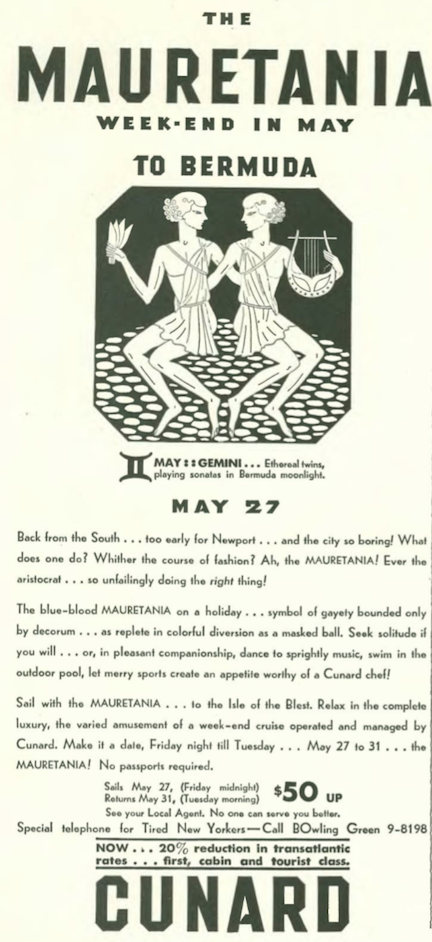
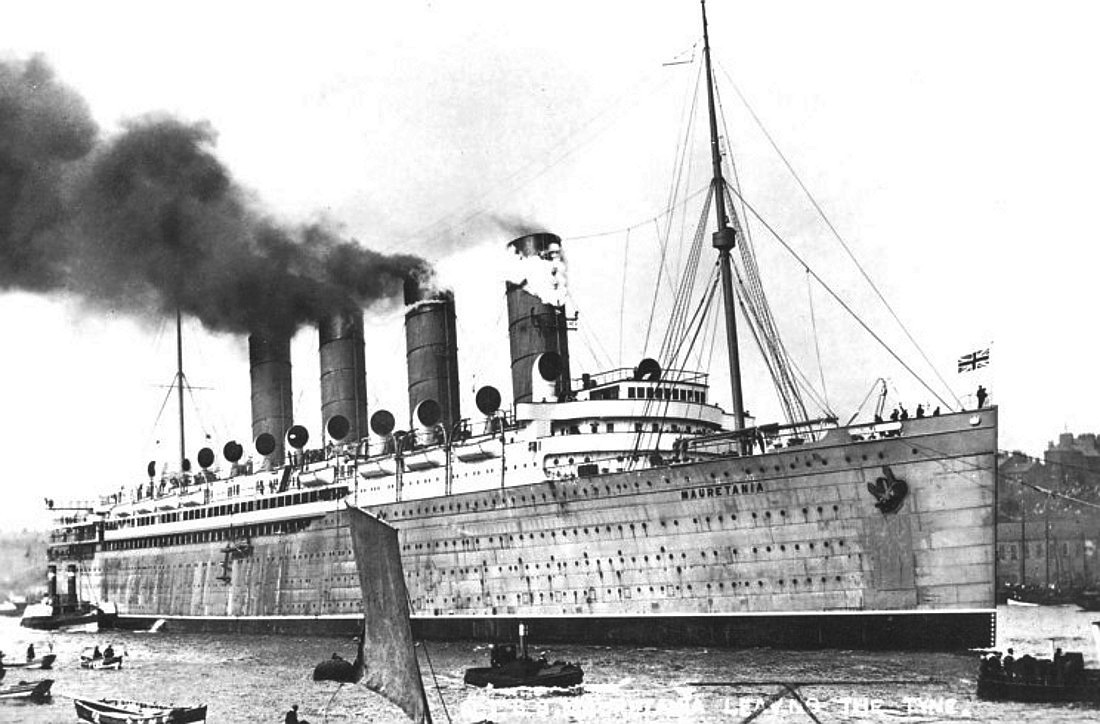
…launched in 1906, the RMS Mauretania was beloved for her Edwardian elegance and style, but as sleeker ships came into service in 1930, the Mauretania was removed from Atlantic crossings and relegated to running shorter cruises from New York to Nova Scotia and Bermuda…

OLD RELIABLE…The RMS Mauretania was the world’s largest and fastest ship after it left the Port of Liverpool in 1906. The liner was scrapped in 1935-37, much to the dismay of many of its former passengers, including President Franklin D. Roosevelt. (Wikipedia)

…with Mother’s Day around the corner, one company suggested a silver cigarette box as a suitable gift…

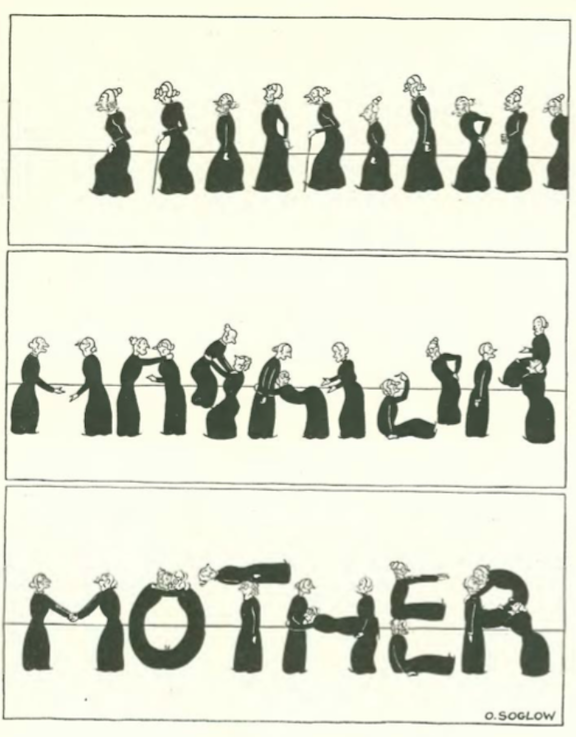
…on to our cartoons, Otto Soglow marked the upcoming holiday with this choreographed group…

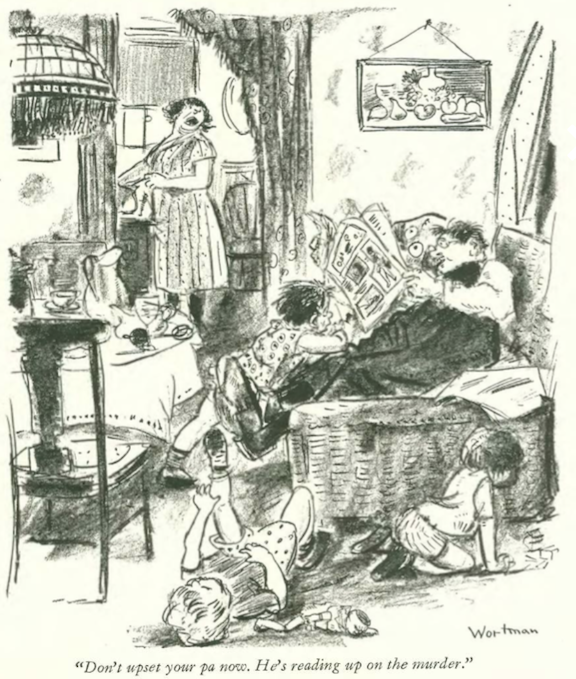
Denys Wortman gave us another side of motherhood…

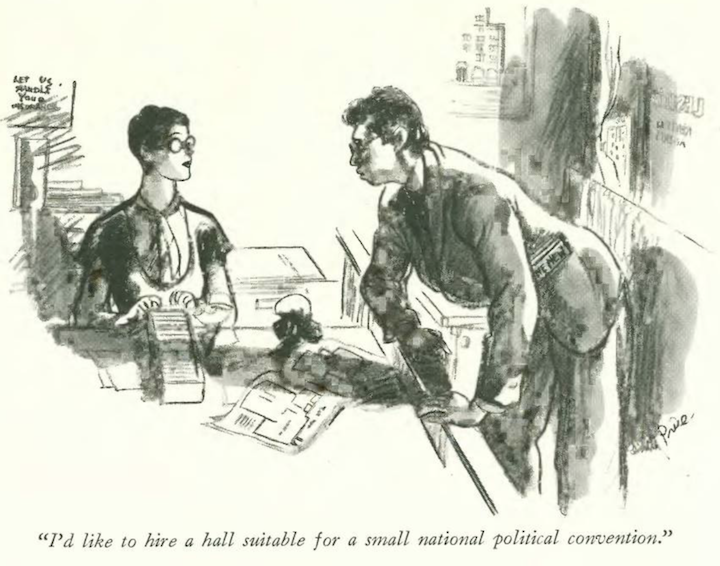
…other women were busy organizing political gatherings, per Garrett Price

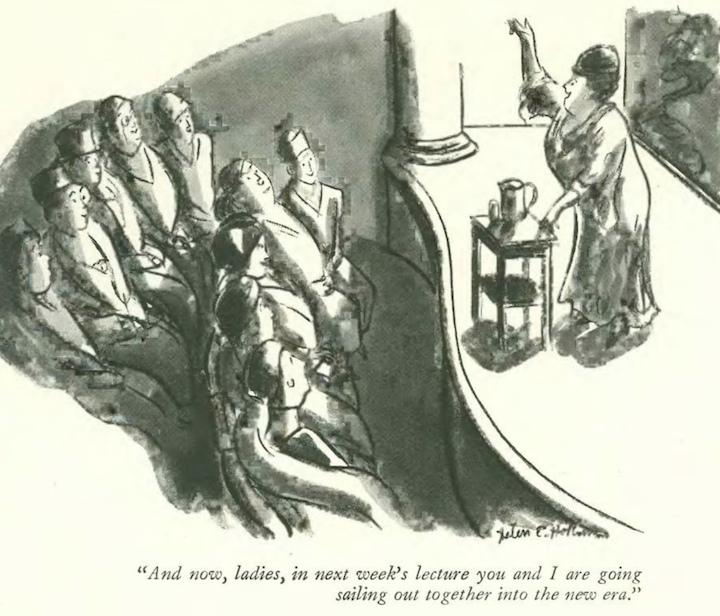
…and Helen Hokinson

James Thurber gave us a dog in distress…

Robert Day illustrated the dilemma of two bootleggers…

…and Barbara Shermund takes us out…

Next Time: Under the Boardwalk…


The Final Curtain

Nearly a century after his passing, many still regard Florenz Ziegfeld Jr as the most important and influential producer of Broadway musicals. His theatrical revues, filled with leggy chorines and wisecracking comics, set a standard for everything from Busby Berkeley productions to the Fats Waller stage celebration Ain’t Misbehavin’.

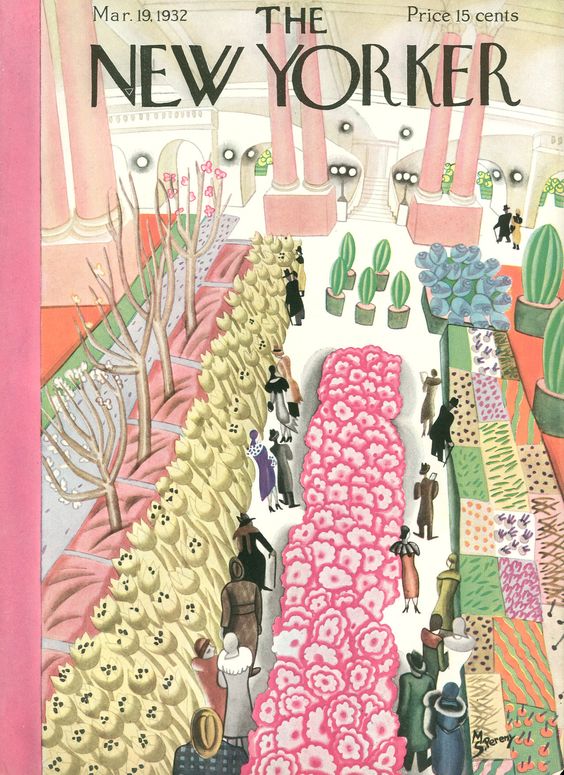
March 19, 1932 cover by Madeline S. Pereny, who gave us a glimpse of the annual International Flower Show at Grand Central Palace.

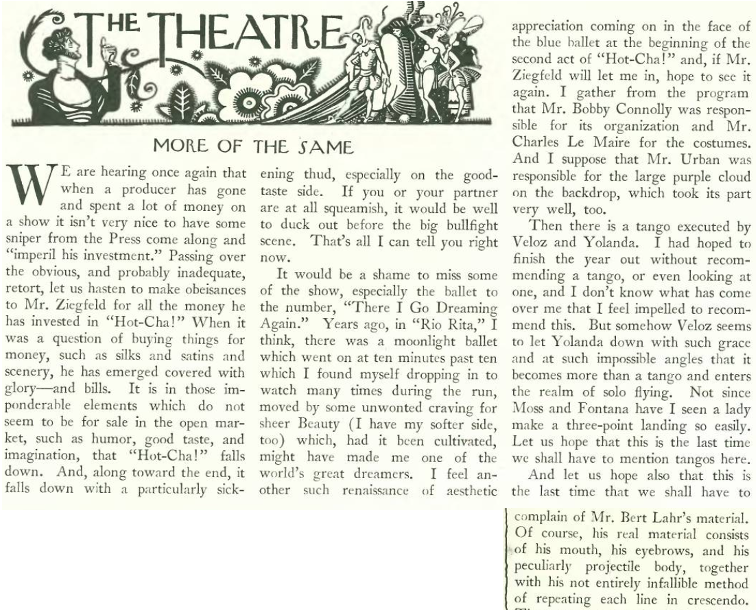
But when Robert Benchley checked out Ziegfeld’s latest revue, Hot-Cha, which opened at the Ziegfeld Theatre on March 8, 1932, he found it tiresome, and no amount of expensive scenery could keep the show from ending on a “particularly sickening thud.” What Benchley couldn’t know, however, was that Hot-Cha would be the last original musical-comedy produced by Ziegfeld, who in just four months would punch his final ticket.

NOT SO HOT-CHA!…Florenz Ziegfeld’s final revue brought out the stars, but it wasn’t enough to dazzle drama critic Robert Benchley. Clockwise, from top left, program for the revue; Lupe Velez, Charles “Buddy” Rogers, and June Knight in Hot-Cha; Benchley was more critical of Bert Lahr’s material than of the comedian himself — many years later Lahr’s son, John Lahr, would follow in Benchley’s footsteps and serve as the New Yorker’s drama critic; Frank Veloz and Yolanda Casazza were among the highest-paid dance acts in the 1930s and 40s, but Benchley had simply lost his appetite for yet another tango. (playbill.com/Pinterest/Smithsonian/Wikimedia)

Selections from the Ziegfeld Theatre program promised a stageful of talents, including 75 “Glorified Girls”…

…and Ziegfeld (1867–1932) would be back in May for a revival of Show Boat, which once again proved to be a hit, but a bout of pleurisy would claim his life on July 22, 1932. As Benchley alluded in his review, these lavish shows led to equally lavish expenses, and Ziegfeld, having lost much of his money in the stock market crash, would leave his actress wife Billy Burke with substantial debts. The plucky Burke, however, marched on with a successful acting career that included her appearance as Glinda the Good Witch in 1939’s Wizard of Oz.

SECOND ACT…Florenz Ziegfeld Jr. and his wife, actress Billie Burke, pose for an Edward Steichen photo, 1927. At right, Burke as Glinda the Good Witch in 1939’s Wizard of Oz. (Condé Nast/IMDB)

 *  *  *

Everyone’s a Critic

The March 19 issue also featured drama criticism from Alexander Woollcott in his “Shouts and Murmurs” column. In this case, Woollcott had a bone to pick with the famed playwright Eugene O’Neill, as well as with Guild Theatre’s coughing patrons, who called to mind a chorus of frogs:

SHSSS!…Alexander Woollcott would have preferred an empty Guild Theatre to one filled with “bronchial” patrons. (goodreads.com)

 *  *  *

Down in Old Mexico

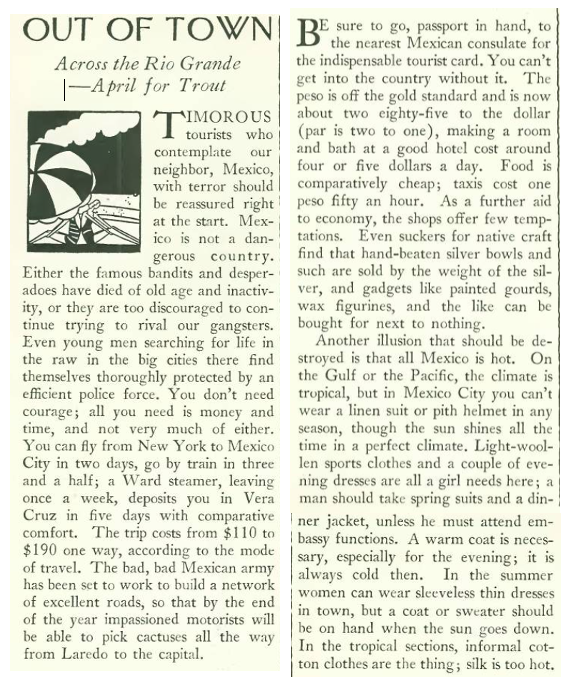
The New Yorker’s latest “Out of Town” feature assured travelers that Mexico was a safe destination, and advised men to pack “spring suits and a dinner jacket” if they planned to visit Mexico City. The author of this piece (signed “P.L.”) cautioned travelers “to get insulated against liquid lightning before getting flip with the national drinks: pulque and tequila. Bootleg liquor is no preparation for the havoc these work even on the sternest drinker.”

 *  *  *

Sweating With the Stars

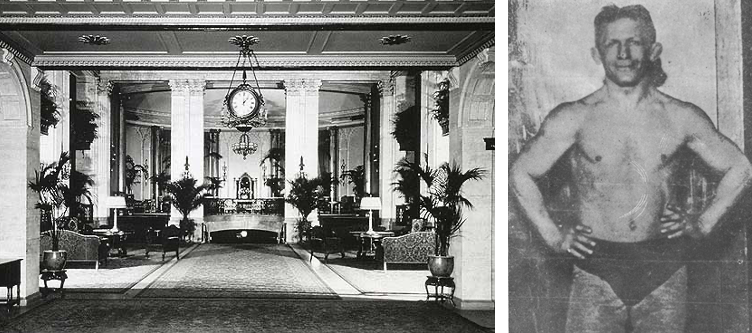
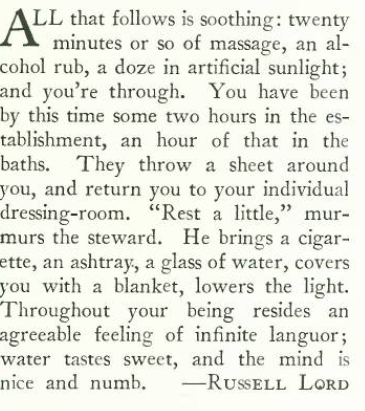
The March 19 “A Reporter at Large” column carried the simple title “Exercise.” Written by journalist Russell Lord* (1895-1964), this excerpt revealed some high-powered clients of one of the world’s first celebrity trainers:

GUY LOMBARDO’S DOOR IS ON THE LEFT…Izzy Winter’s health and exercise “institute” was tucked away on the second floor of the Roosevelt Hotel. Patrons passed through the hotel’s lobby to access an “honest sweat.” Izzy is pictured at right. (Roosevelt Hotel/Yale University)

In Lord’s conclusion, he noted that after a workout patrons were treated to a doze under a sunlamp…and a cigarette…

* In his day, Russell Lord was a noted agricultural writer and editor of the agricultural literary journal The Land, which promoted ecologically responsible agricultural practices.

 *  *  *

Fame and Infamy

I include this snippet from John Mosher’s film column to note the first reference in The New Yorker to the March 1, 1932 kidnapping of the baby of Charles and Anne Morrow Lindbergh…the lives and various doings of the Lindberghs were frequent subjects in the early days of the magazine…

  *  *  *

From Our Advertisers

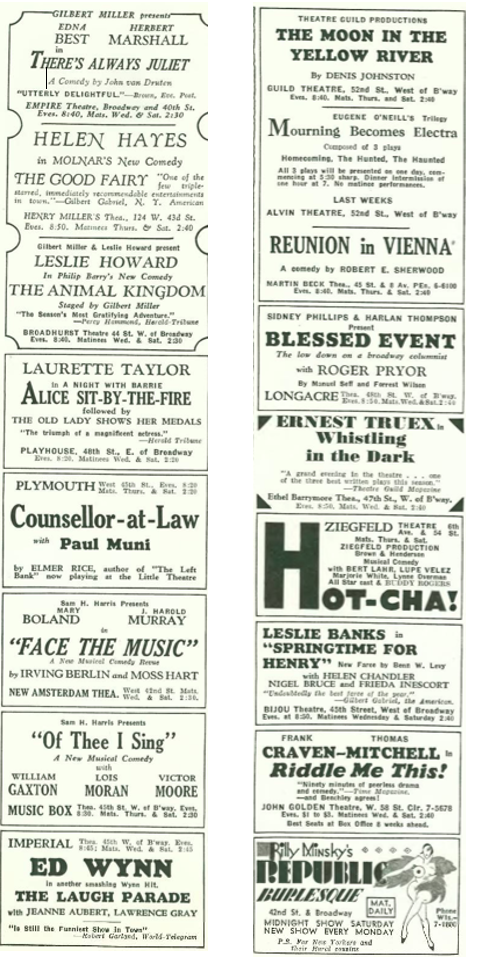
We’ll start by sampling some of the wares in the back pages…looks like Ziegfeld got a big bang for his small investment with his Hot-Cha ad…

…while Ziegfeld ran a cheap ad for his lavish production, the R.F. Simmons Company decided to go big with this ad for…drum roll please…watch chains…

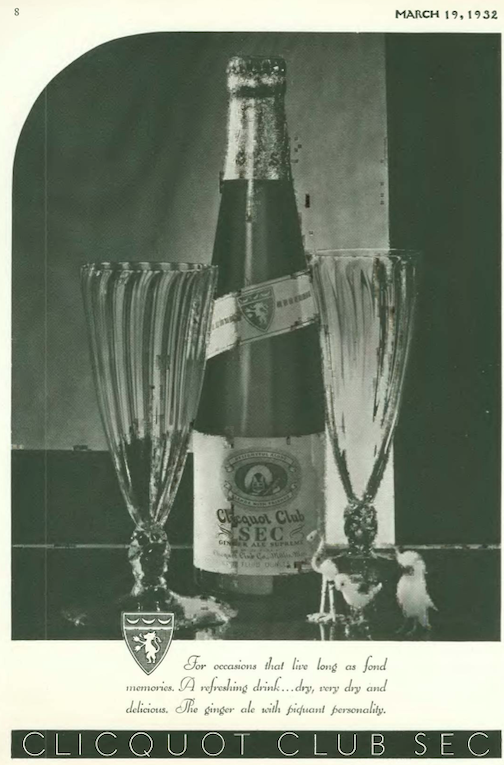
…the makers of Cliquot Club Ginger Ale also did their best to promote a mundane product, claiming their beverage had a “piquant personality”…yeah, especially with a splash or two of some bootleg whisky…

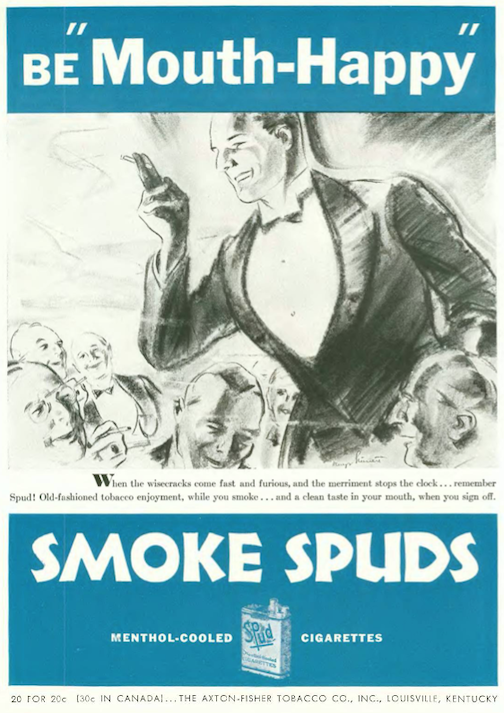
…the makers of Spuds were staying with their stupid “Mouth-Happy” theme, assuring menthol cigarette smokers they will be the life the party…a party filled with old gasbags, that is…

…R.J. Reynolds continued to push their Camels on the growing market of women smokers, demonstrating the effects of a fresh cigarette with this image of a rosy-cheeked nurse…

…DeSoto (a division of Chrysler) gave Depression-era readers something to smile about with this full-color, two-page advertisement featuring a sunny beach scene and an affordable automobile…

…on to our cartoons, here’s Carl Rose’s perspective on the Disarmament Conference taking place in Geneva, Switzerland…

…while the Otto Soglow’s Little King had his own way of projecting power…

…on the domestic scene, Barbara Shermund’s modern women were channeling  René Descartes

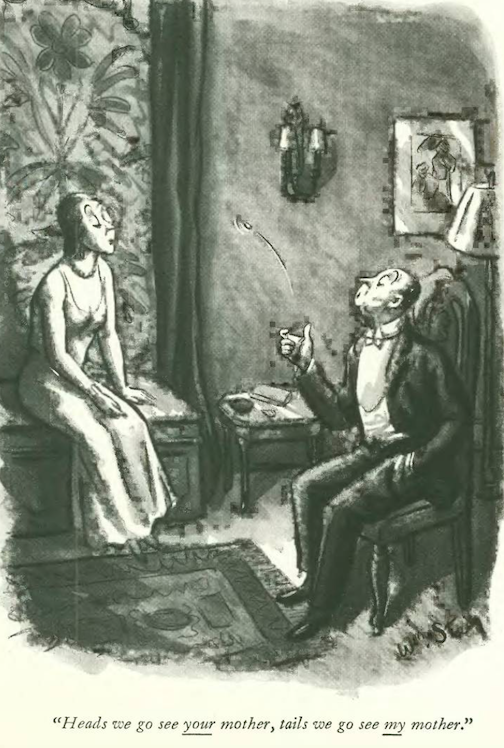
…and William Steig showed us a couple debating an equally weighty matter…

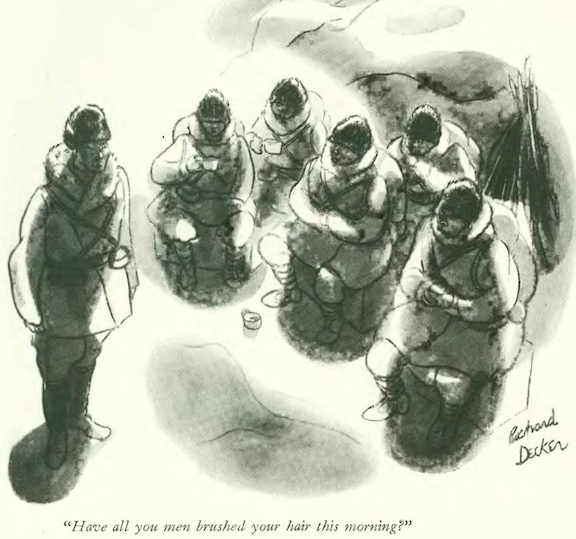
…and via Richard Decker, some well-groomed polar explorers…

…two of Helen Hokinson’s “girls” stopped by the International Flower Show at Grand Central Palace…

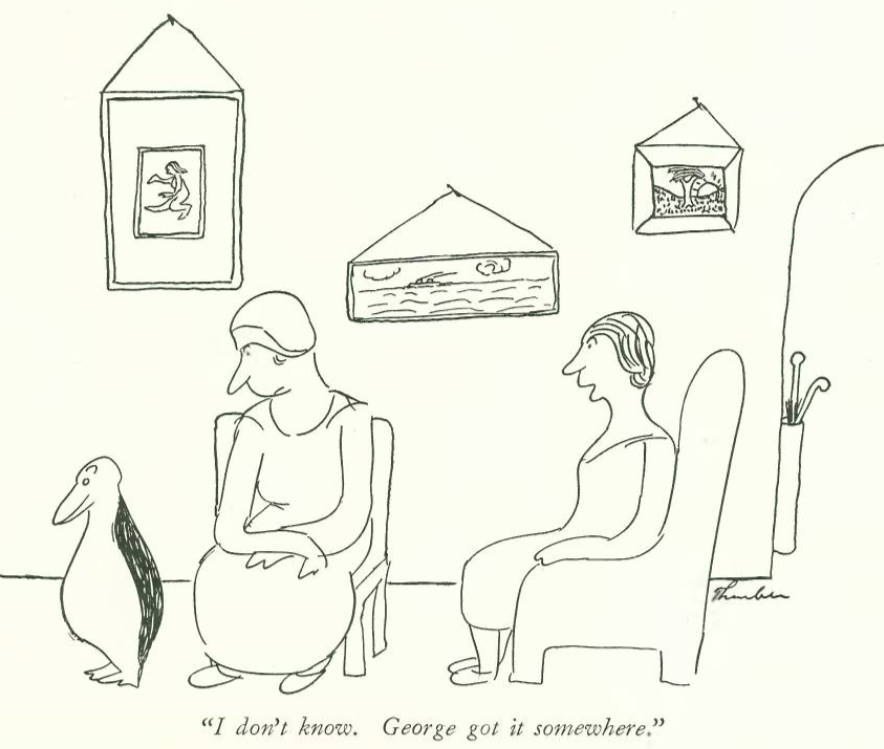
…and we end with another classic from James Thurber

Next Time: Dirge for a Dirigible…