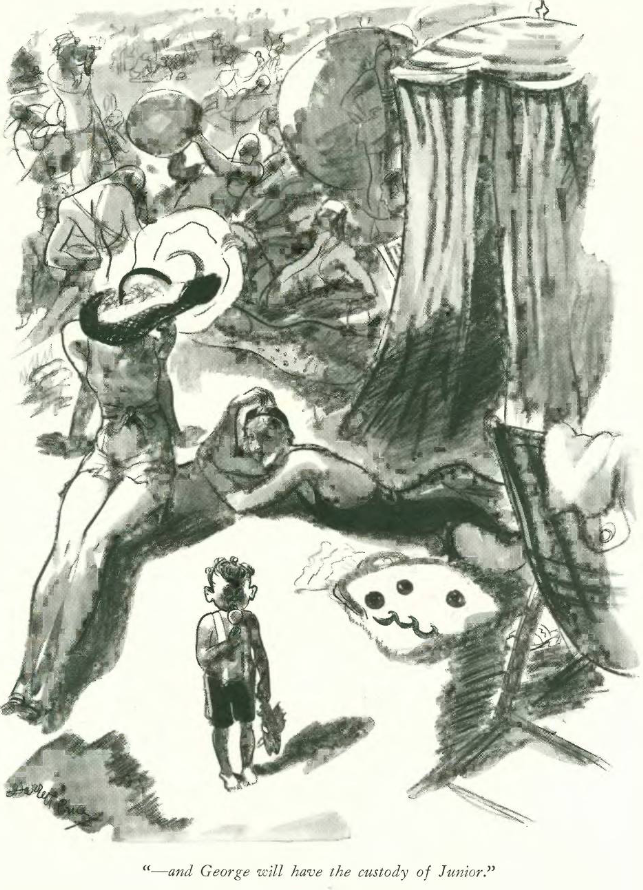
The Cowboy Philosopher

William Penn Adair Rogers, aka Will Rogers (1879–1935), was a man of many talents. Today he is mostly referred to as a humorist, but he was also an actor, a social and political commentator, a trick roper and a vaudeville performer. To Americans he was a national icon.
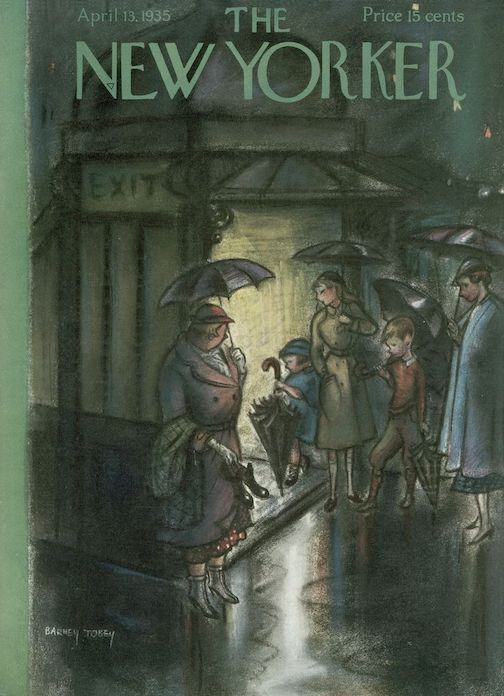
April 13, 1935 cover by Barney Tobey.

Rogers was also internationally famous, having traveled around the world three times and appearing in 71 films (50 of those silent). He also wrote more than 4,000 newspaper columns—nationally syndicated by The New York Times—that reached 40 million readers, and there were also magazine articles, radio broadcasts and personal appearances. He seemed to be everywhere.
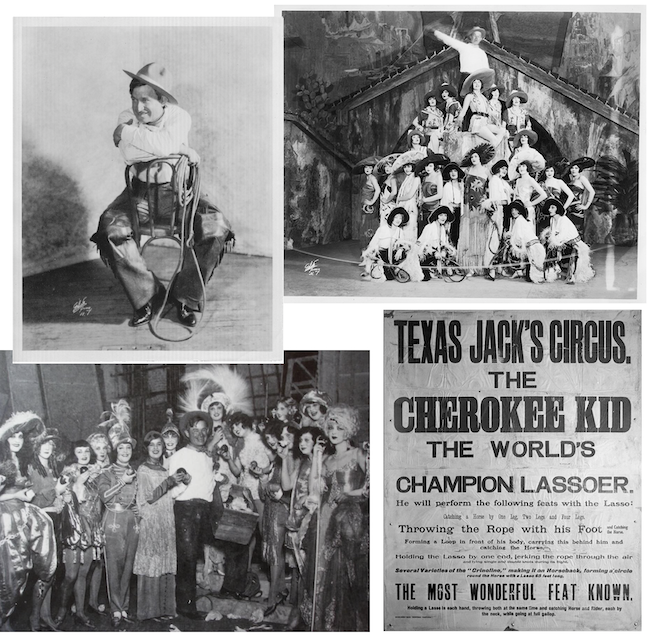
ROPING THEM IN…In 1902, Will Rogers joined Texas Jack’s Wild West Show & Circus in South Africa as the “Cherokee Kid”—he was born as a citizen of the Cherokee Nation, in the Indian Territory that is now part of Oklahoma. By 1910, he had created a sensational vaudeville act by mixing trick roping with witty monologues. Clockwise, from top left, Rogers in a publicity photo from 1916, the year he joined the Ziegfeld Follies; on stage with the Follies in 1924; poster from his circus days; backstage with the 1924 Follies cast. (National Portrait Gallery)
MULTIMEDIA MULTI-TALENT…Left, Rogers catches a few moments to write one of his 4,000 nationally syndicated newspaper columns; from 1929 to 1935 he used the exciting new medium of radio to broadcast his newspaper pieces. His weekly Sunday evening show, The Gulf Headliners, sponsored by Gulf Oil, ranked among the top radio programs in the country. (National Portrait Gallery)

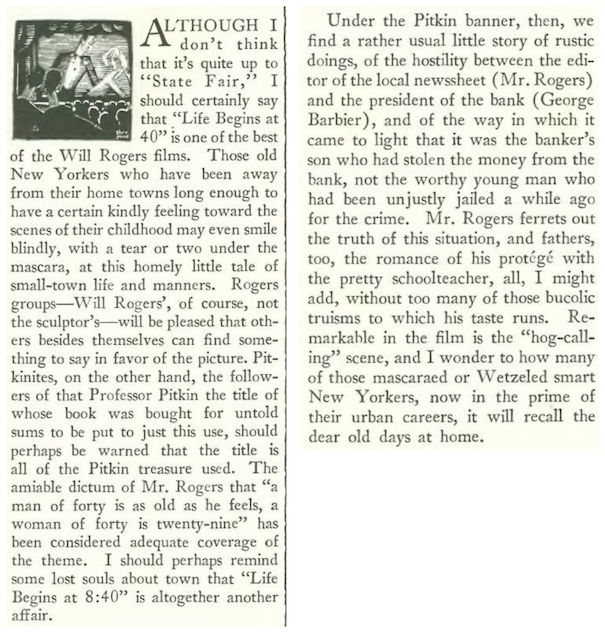
When John Mosher reviewed Rogers’ latest film, Life Begins At Forty, he found it to be one of Rogers’ best. It would also prove to be one of his last. On August 15, 1935, a small airplane carrying Rogers and aviator Wiley Post would crash on takeoff near Point Barrow, Alaska, claiming the lives of both men. Rogers would appear in three more films in 1935, the last two posthumously.
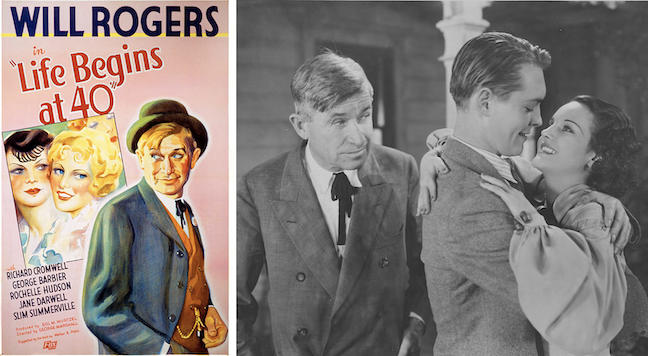
THAT’S LIFE…Will Rogers with Richard Cromwell and Rochelle Hudson in Life Begins at 40. Rogers’ film took its title from a 1932 self-help book by Walter B. Pitkin. Pitkin maintained that keeping a positive attitude toward life could give a person many fulfilling years after age 40. By the time of his death in 1935, the 55-year-old Rogers was Hollywood’s highest paid actor. (Wikipedia/IMDB)

 * * *

Not Toying Around

“The Talk of the Town” looked in on the serious business of toymakers, with 1935 being the year of streamlined tricycles, Buck Rogers disintegrator pistols, and, of course, Shirley Temple dolls.

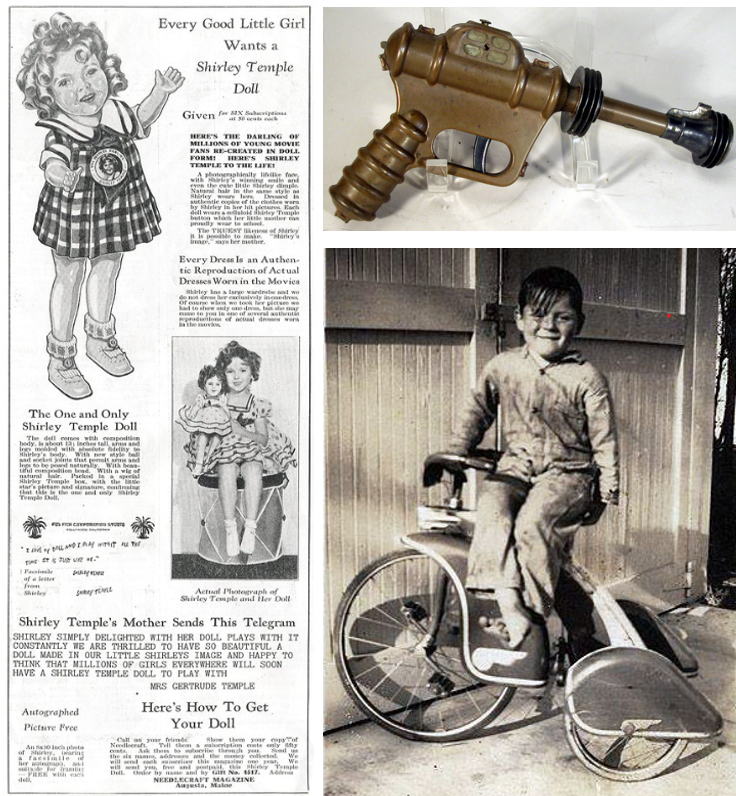
RIVALED ONLY BY MICKEY MOUSE, Shirley Temple was the most popular celebrity to endorse merchandise for children and adults, including the “one and only” Shirley Temple Doll (left, ad from 1935); the Buck Rogers XZ-38 Disintegrator Pistol (top) was produced in 1935 by Daisy, and was available in both copper and nickel finishes–it was also offered as a premium from Cream of Wheat cereal; at bottom, the American National Streamline Velocipede Tricycle (1935), just one example of the hundreds of products receiving the streamlining treatment in the 1930s. (flickr/airandspace.si.edu/onlinebicyclemuseum.co.uk)

 * * *

Literary Spirits

E.B. White welcomed the return of literary tea party, which thanks to the repeal of the 18th Amendment had been re-dubbed the “literary cocktail party.” He shared his thoughts in “Notes and Comment”…

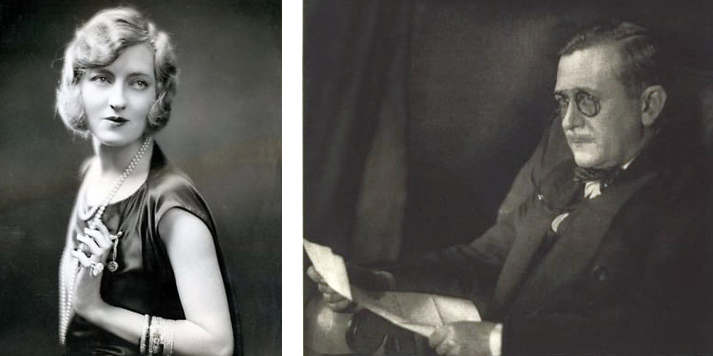
AMUSING MUSES…Actress, writer and socialite Peggy Hopkins Joyce hosted literary “teas” in the 1920s, while former Cosmopolitan editor Ray Long inspired a book on adventures in the South Seas shortly before his death; from left, Joyce in 1923; photogravure of Long, 1925. (Wikipedia/photogravure.com)

 * * *

Proto Feminist

Emily Hahn was one of the more lively figures in The New Yorker’s stable of journalists and writers, leading an adventurous life that included a hike across Central Africa in the 1930s and getting into all kinds of trouble during the Japanese invasion of China. According to Roger Angell, Hahn was, “in truth, something rare: a woman deeply, almost domestically, at home in the world. Driven by curiosity and energy, she went there and did that, and then wrote about it without fuss.” It is no surprise that Hahn’s latest novel, Affair, didn’t shy away from topics like abortion. According to reviewer Clifton Fadiman, the novel’s “anonymous grayness” exposed the banality of love in the twentieth century.
If Hollywood is looking for a new biopic, Hahn would make a fascinating subject (Kristen Stewart would be perfect for the part). According to IMDB, there is an “Untitled Emily ‘Mickey’ Hahn Project”—a TV series—that has been in development since 2022, but so far nothing has come of it.
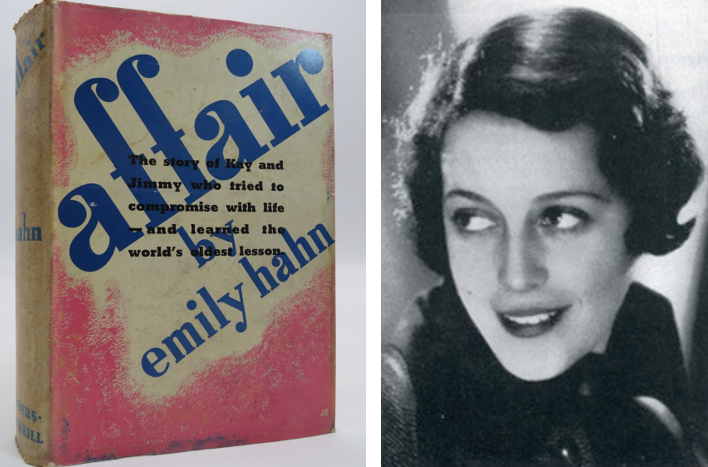
DOWN ON LOVE?…Emily Hahn’s 1935 novel Affair exposed the banality of love in the twentieth century. (abebooks.com/susanbkason.com)

 * * *

From Our Advertisers

We begin with this advertisement from Goodyear, featuring what appears to be a father teaching his daughter how to drive, or in this case, fly, just like Chitty Chitty Bang Bang…
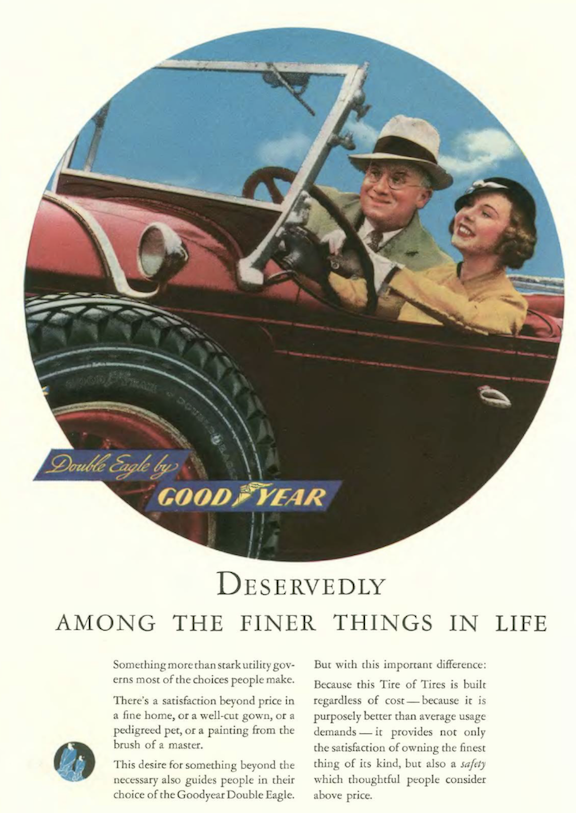
…and we stay airborne with the makers of the streamlined Nash, who claimed their automobile had “flying power”…

…and we return to earth with Cadillac’s budget model, the LaSalle, which featured “flashing performance”…

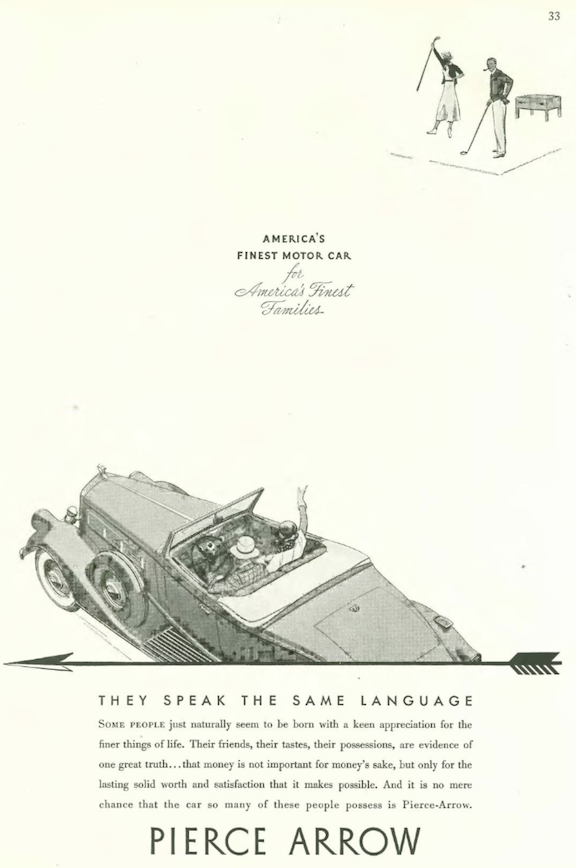
…by contrast, Pierce Arrow took a minimalist approach, gimmicks and splashy colors being reserved for the lower orders…
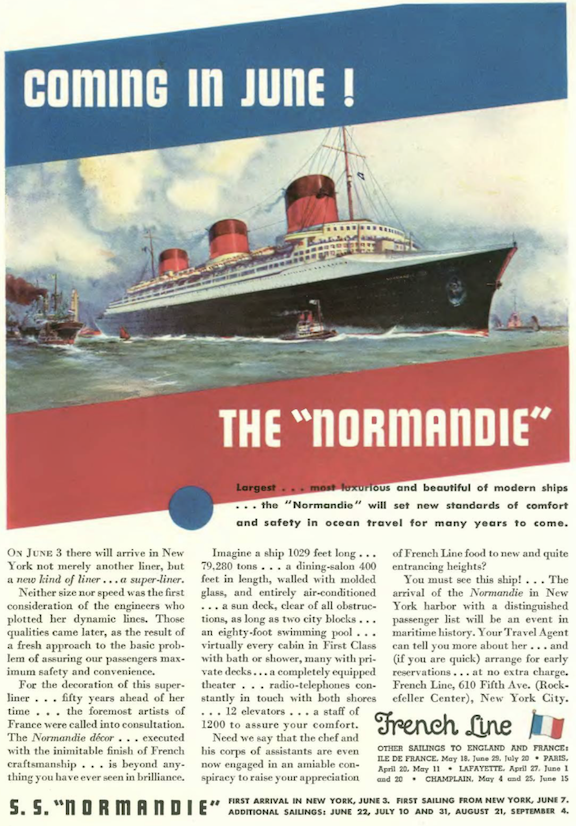
…one of the world’s most iconic ocean liners took to the sea with much fanfare in 1935. The SS Normandie was the largest and fastest passenger ship afloat; it remains the most powerful steam turbo-electric-propelled passenger ship ever built…
…if you happened to smoke Webster cigars, it could have been a sign that you were favored by the heavens…

…the “20-year rule” in fashion suggests that trends have a tendency to re-emerge every two decades, and that seems to be the case here…

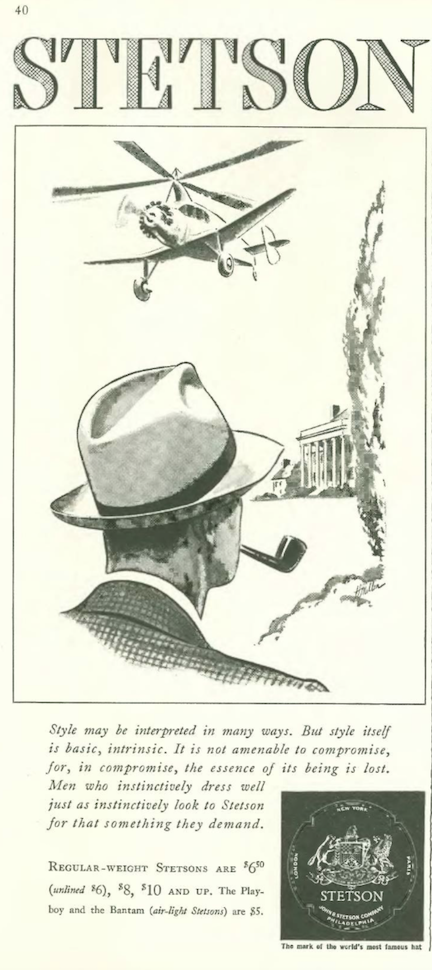
…this next ad tells us everything we need to know about the Stetson wearer: he is a wealthy country gentleman who values tradition but who is also a man of the future…from the 1920s to midcentury the autogyro was thought to be the answer to the long-dreamed of flying car…
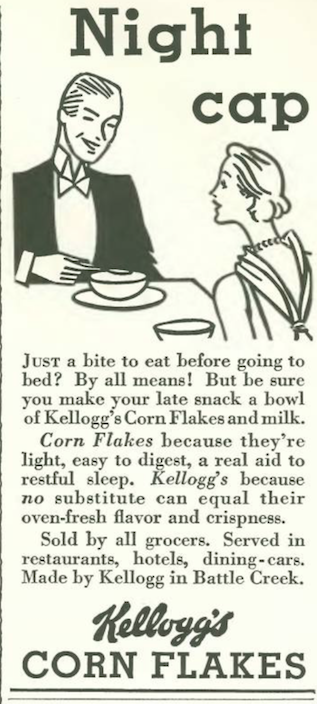
…whoever coined the term “night cap” probably wasn’t thinking about cold cereal…
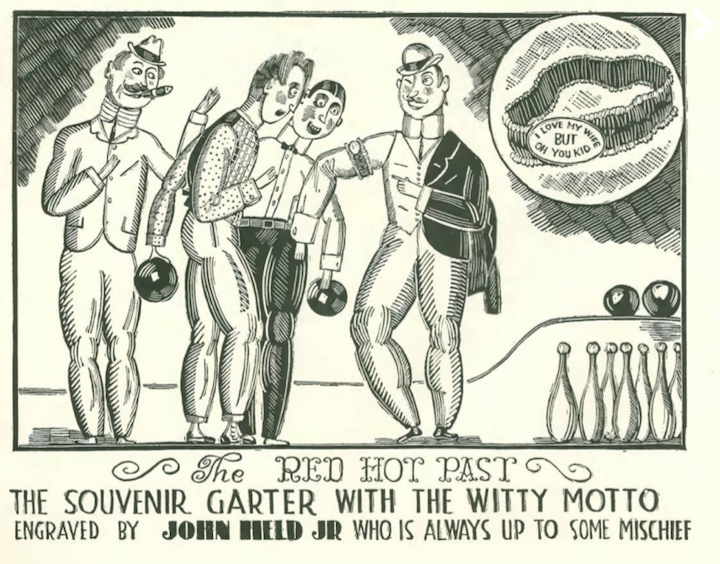
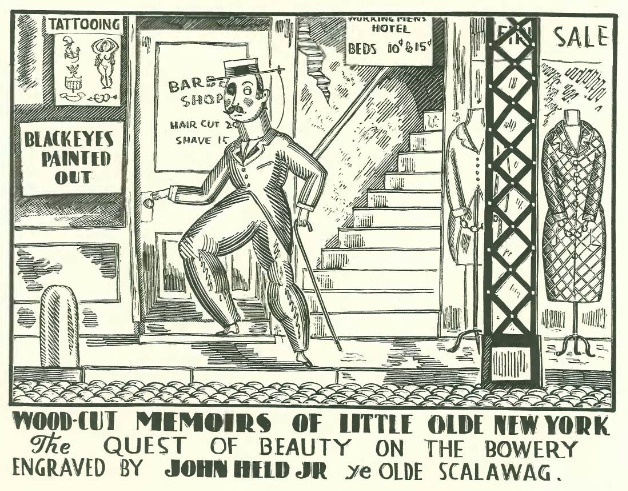
…although Harold Ross’s old high school friend, John Held Jr., contributed many woodcut-style cartoons and faux maps to The New Yorker from 1925 to 1932, Held was more famous for his shingle-bobbed flappers and their slick-haired boyfriends in puffy pants, a style more apparent in this ad for Peychaud’s Bitters (the original was a one-column ad, split here for clarity)…

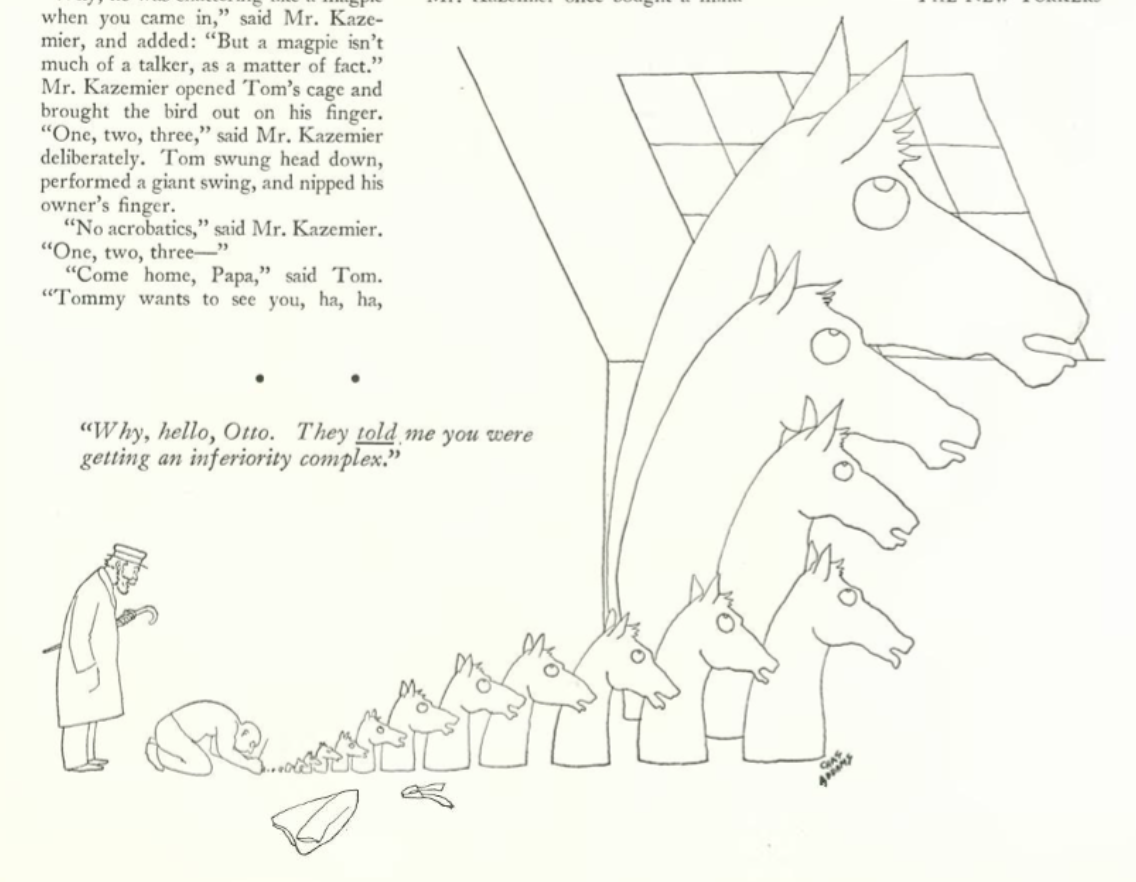
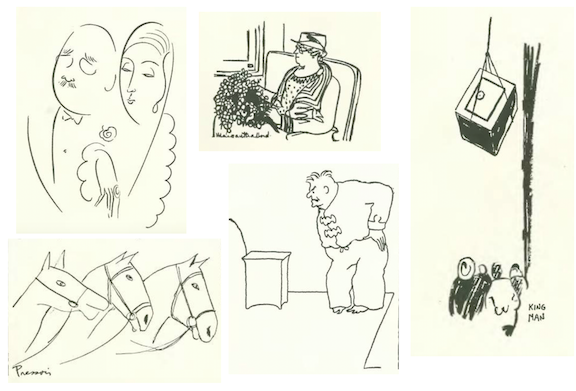
…Held provides a segue to our illustrators and cartoonists, beginning with a sampling of spot art from the April 13 issue…
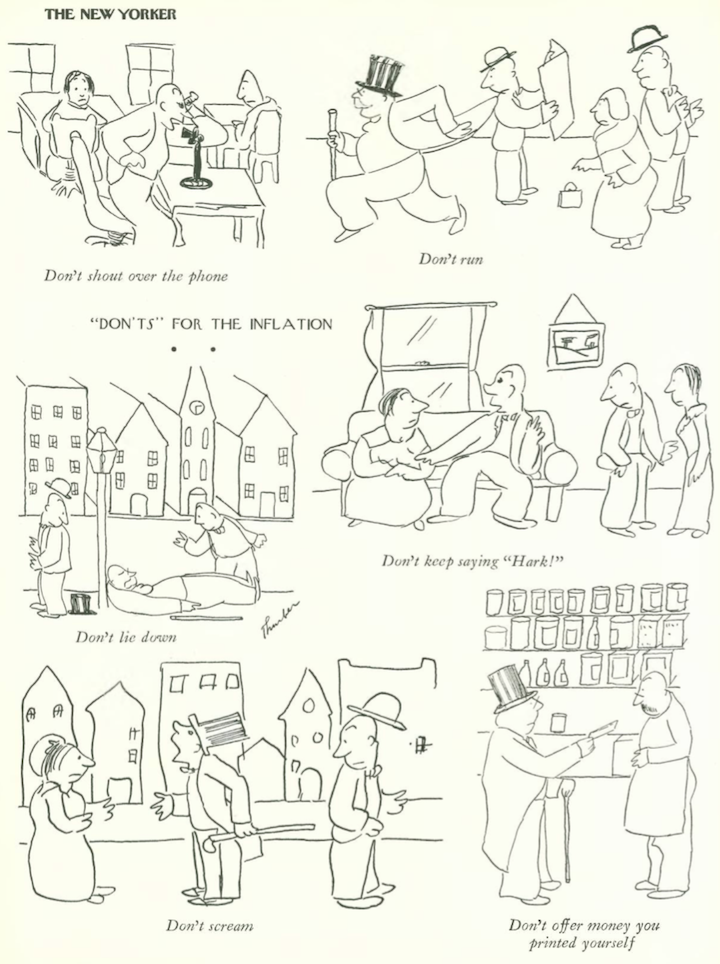
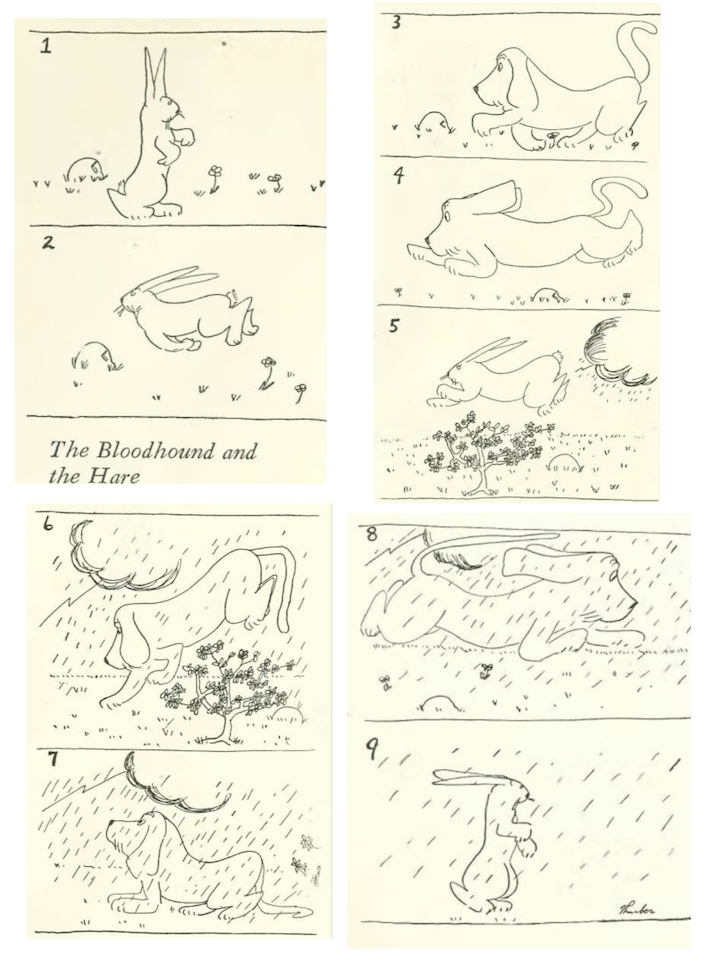
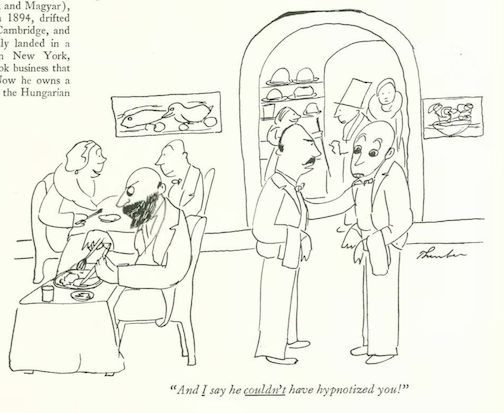
James Thurber got things going on page 2…
…and also contributed this observation of the hypnotic arts…
Otto Soglow did some careful surveying (this originally appeared across two pages)…

Alain looked in on some Vatican gossip…

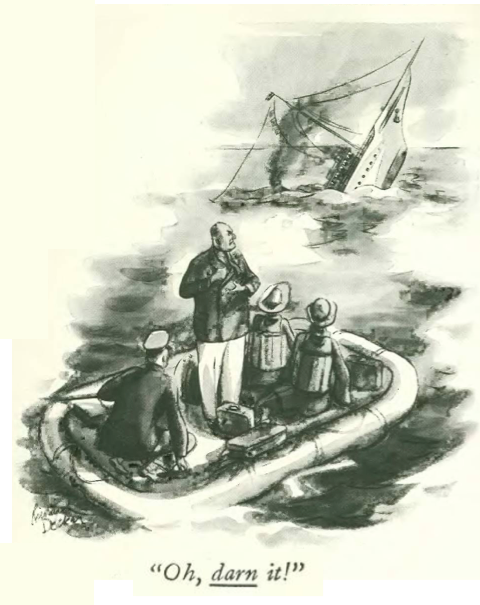
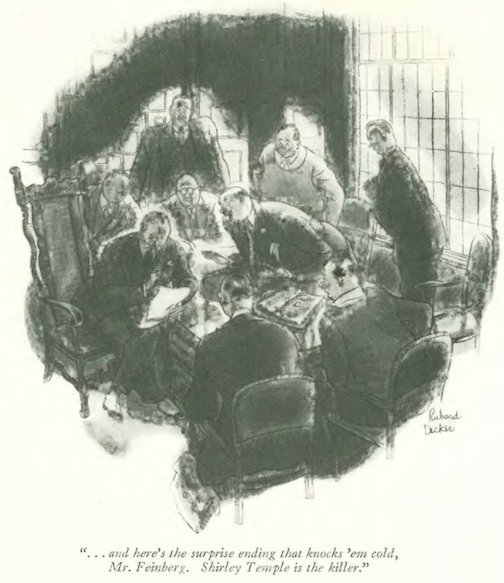
Richard Decker pitched a Shirley Temple murder caper…
Carl Rose gave us a sweet send-off…

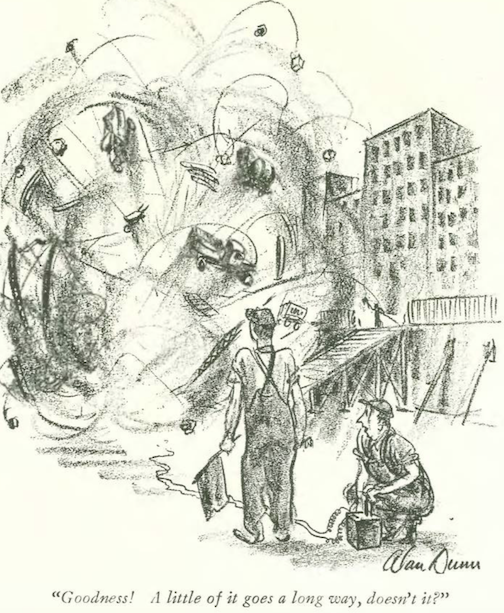
…and we close out with a big bang, courtesy of Alan Dunn

Next Time: Terse Verse…


Moses Parts a Yacht Club

Power broker Robert Moses always made sure he was few steps ahead of any possible opposition to his grand development plans in and around New York City. That included the yacht clubbers along the Hudson River, who were more or less erased from the scene by Moses in one fell swoop.

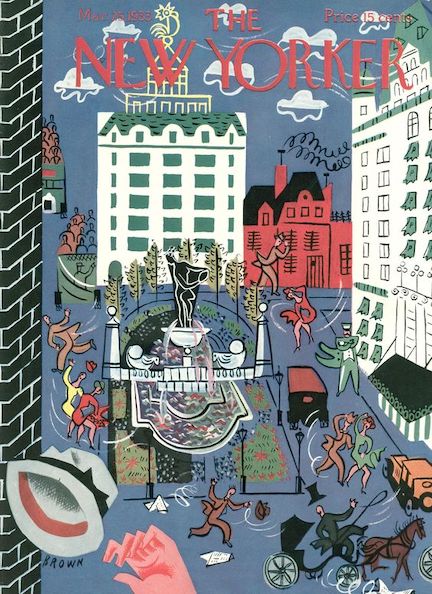
May 19, 1934 cover by Ilonka Karasz.

The Upper West Side’s Columbia Yacht Club probably thought it was just swell that the city was dumping waste and rock along the shores of the Hudson River, since it eventually created driveway access for members who previously had to access the club via a footbridge over the New York Central’s tracks. What hadn’t occurred to them was that nearly 25 years-worth of infill had also created a new strip of land that extended from 79th to 96th street, land that Moses envisioned as an expansion of Riverside Park (and the abrupt end of the West Side yacht club scene). “The Talk of the Town” explained:

LOCATION, LOCATION…Two views of the Columbia Yacht Club at West 86th Street, circa 1930. The club was razed to make room for Robert Moses’s expansion of Riverside Park. Moses’s ambitious project, which cost twice as much as Hoover Dam, put the train tracks underground and topped the park with the Henry Hudson Parkway. (newyorktoursbygary.blogspot.com/NYPL Digital Collections)
HEADS UP…Elsie Henneman dives into the water near the Hudson River Yacht Club, circa 1930. Located at the foot of West 74th Street, the club moved onto a barge at 145th Street to escape Moses’s park expansion plans, but it was eventually banished from the West Side. (Reddit)

 * * *

Ode to the Road

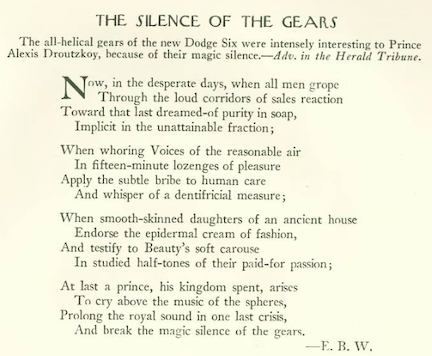
We now shift gears to E.B. White, who was poetically inspired by an advertisement in the Herald Tribune that featured Prince Alexis A. Droutzkoy (a member of the exiled White Russian colony in New York) praising the “magic silence” of the new “Dodge Six” automobile:

SILENCE OF THE CAMS…The 1934 Dodge Six. (detail from a vintage ad)

 * * *

Führer’s Filmmaker

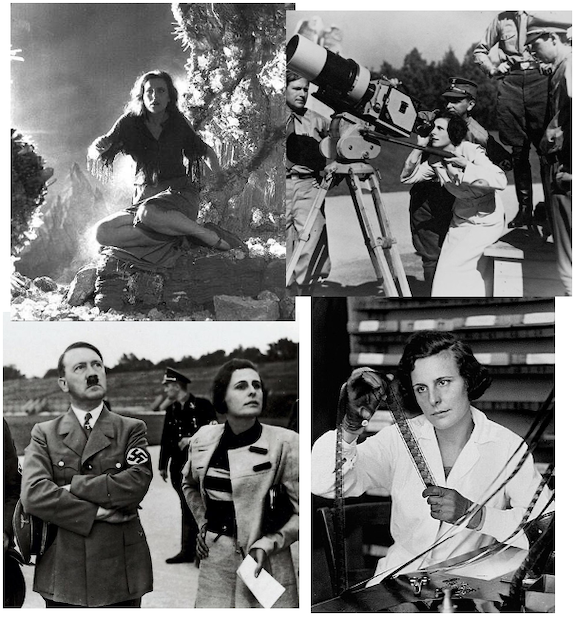
The ability (or inability) to separate art from an artist’s personal conduct or beliefs has been a particular topic of the last two decades, given the litany of stars who have been “cancelled” despite the quality or importance of their work. The work of German filmmaker Leni Riefenstahl (1902–2003), still debated nearly ninety years after her collaboration with Nazi leaders, demonstrates the fine line many a film historian or critic must walk when assessing the career of an innovative artist (for an American example, see filmmaker D. W. Griffith). Riefenstahl’s 1932 film, The Blue Light (Das blaue Licht), made prior to her Nazi collaborations, was praised for its beauty by American critics, including the New Yorker’s John Mosher, when it was released in the U.S. in 1934.

The Blue Light also captivated Adolf Hitler, who saw the attractive and athletic Riefenstahl as an ideal of Aryan womanhood. A subsequent meeting with Hitler would result in Riefenstahl’s controversial 1935 Nazi propaganda film Triumph of the Will (Triumph des Willens). We will explore that film, and Riefenstahl’s role, in a later post.

CAREER MOVE…Clockwise, from top left, Leni Riefenstahl demonstrated her acting ability, athleticism and filmmaking talents in 1932’s The Blue Light (Das blaue Licht); Riefenstahl filming in Nuremberg during the 1934 Nazi Party congress—the footage was used in 1935 Nazi propaganda film Triumph of the Will; working at a film cutting table, 1935; with Adolf Hitler at Nuremberg, 1934. (IMDB/Library of Congress/UTK Cinema Studies/The Irish Times)
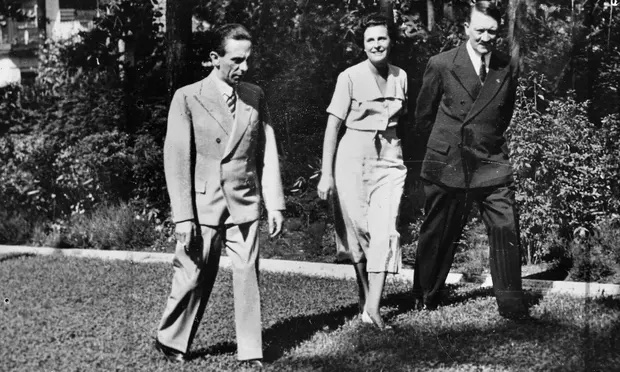
HI HITLER…Nazi propaganda minister Joseph Goebbels and Adolf Hitler pay a visit to Leni Riefenstahl at her Berlin estate, circa 1937. (Roger-Viollet)

 * * *

From Our Advertisers

We begin with more Carl “Eric” Erickson-inspired artwork, here promoting the bygone elegance of transatlantic travel…

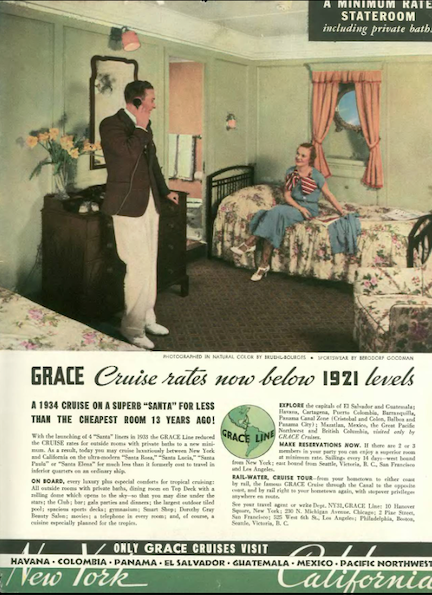
…perhaps a bit less upscale but still pretty nice, the “Santa” line of ships operated by the Grace Line between New York and Latin America included air-conditioned interiors paneled with aluminum (a fireproofing measure) and spacious cabins with private baths that faced to outside…

…this ad must have been a happy sight to folks who had to endure more than a decade of bootleg Scotch during Prohibition…

…Smirnoff vodka had its origins in 1860s Russia, capturing two-thirds of the Moscow market by the mid-1880s…forced to leave Russia in 1904 after the Tsar nationalized the Russian vodka industry…Smirnoff relocated to Turkey, then Poland, and then Paris, each time with limited success…at the end of Prohibition the brand relocated once again to a distillery in Bethel, Connecticut, hence this advertisement…

…the habanero pepper has been used to infuse everything from tequila to vodka to whiskey…this particular product was marketed as something new that could be mixed with a variety of spirits or topped up with club soda or ginger ale…

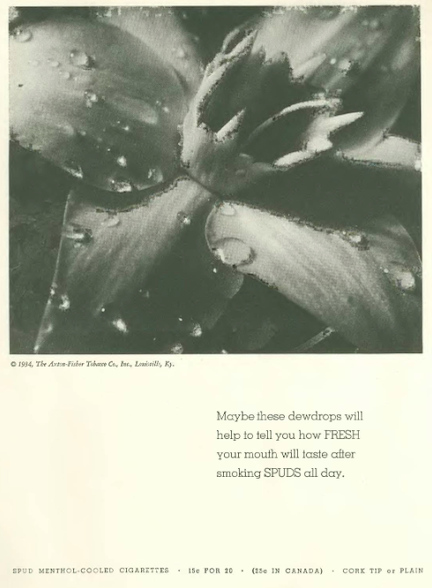
…I include this ad from the maker of Spud cigarettes for its sheer audacity…it claims your mouth will feel dewdrop fresh after an entire day of smoking menthols…

…stunt driver Billy Arnold was one of the “Hell-Drivers” Chrysler employed to tout the safety of its low-priced Plymouths at promotional events…

…including Chicago’s “Century of Progress”…below, a crowd watches Arnold take his Plymouth for a roll and emerge unscathed…

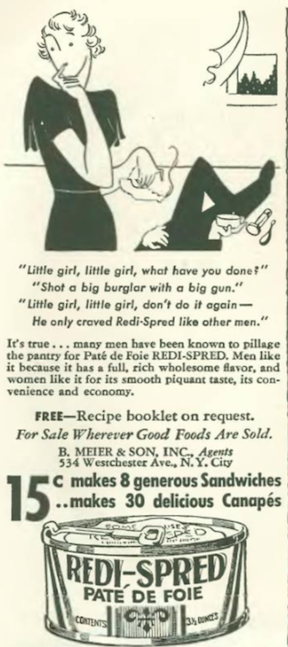
…the folks at Redi-Spred employed a murder theme to promote their “Pâté de Foie”…which foie was used…duck, goose or lord knows what, is not specified…

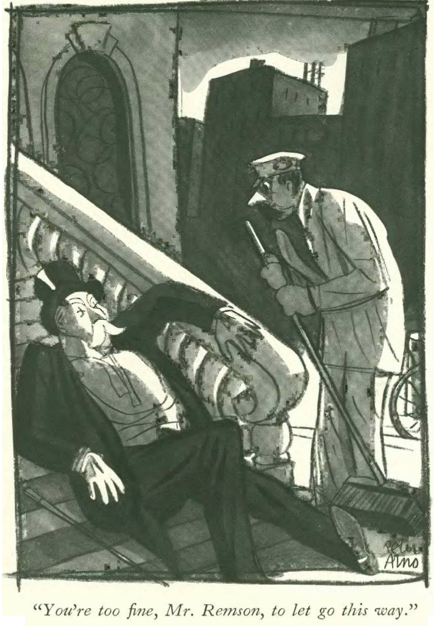
…the signature is muddled, but this looks like another illustration by Herbert Roese, who never published a cartoon in the New Yorker but sure had its style down, especially Peter Arno’s

Harold Ross’s high school friend and cartoonist John Held Jr. was a frequent contributor to the New Yorker from 1925 to 1932 (he also contributed to LifeVanity FairHarper’s Bazaar), but when demand for his Jazz Age cartoons and illustrations fell off in the 1930s, he turned to painting and illustrating children’s books. So it was a surprise to catch this glimpse of Held’s work in a one-column ad promoting a Held-drawn map of New England inns…

…speaking of elusive illustrators, I am often challenged to discover the identities of spot illustrators in the early issues…this one appears to be signed by “Maurice Dreco”…

…the signature on this one looks like “Saphire,” but again, it is not clear…

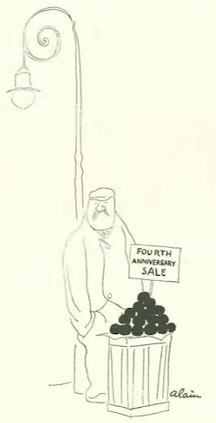
…but there is no doubt this little gem is by Daniel ‘Alain’ Brustlein

…which leads us to Richard Decker, and a hostage situation gone flat…

…and Decker again, with a back-handed compliment…

James Thurber was in his familiar world of dogs and battling sexes…

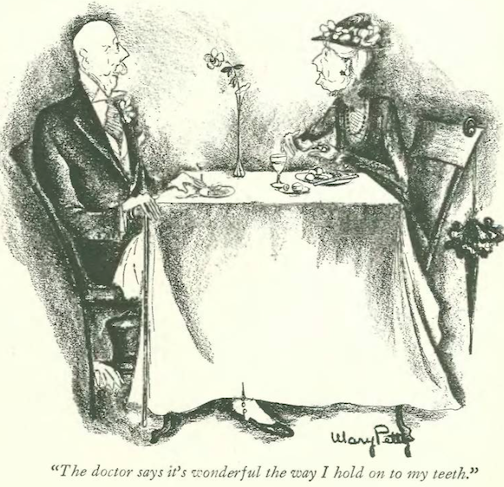
Mary Petty found some good news on the dentistry front…

Otto Soglow’s Little King believed more is merrier…

…and we close with William Crawford Galbraith, and a wedding day surprise…
Next Time: Isle of Ill Repute…


Not Even Funny

There were a number of people Dorothy Parker couldn’t abide. That included gifted writers who not only eschewed serious literature, but who instead chose to crank out a lot of mass-market trash.

March 18, 1933 cover by William Steig.

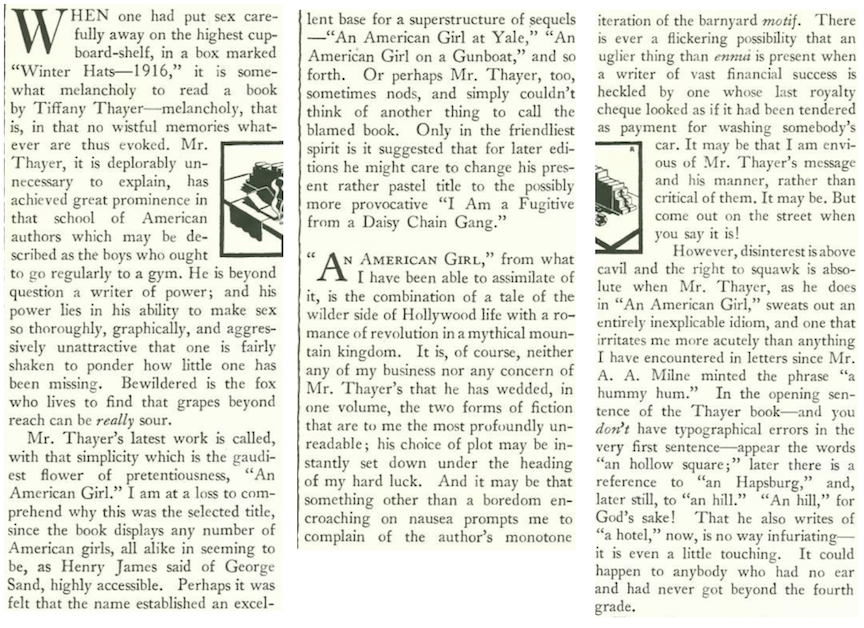
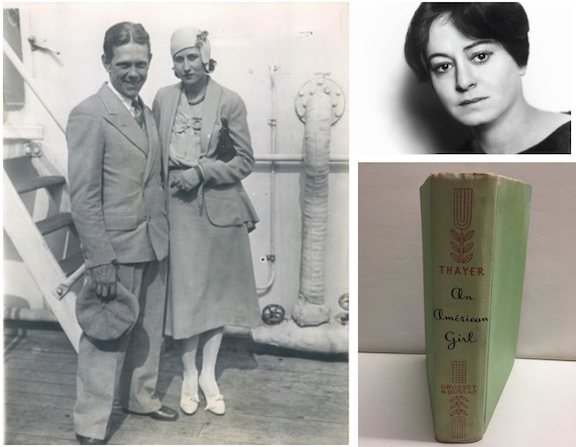
Parker was well acquainted with Tiffany Ellsworth Thayer (1902–1959), and for a time she even associated with the Fortean Society, which Thayer founded in 1931. Inspired by writer Charles Fort, the Forteans promoted the use of scientific methods to evaluate unexplained phenomena such as UFOs, spontaneous human combustion, and other oddities. Parker and fellow New Yorker writers Ben Hecht and Alexander Woollcott were among founding members, doubtless drawn to Fort’s reputation as a skeptic; however one famous skeptic, journalist H.L. Mencken, called Fort’s ideas “Bohemian mush.” It’s hard to say how long Parker stayed connected to the Society, but by 1933 she was fed up with Thayer’s novels, including his latest, An American Girl, which she found to be “the gaudiest flower of pretentiousness.” Here is an excerpt from Parker’s sometime column, “Reading and Writing,” subtitled Not Even Funny…
TIFF WITH TIFFANY…At left, Tiffany Thayer aboard a cruise ship with an unidentified woman, most likely his first wife, a dancer named Tanagra, early 1930s; at right, Dorothy Parker and a first edition of the offending volume. In her review, Parker observed that Taylor “is beyond question a writer of power; and his power lies in his ability to make sex so thoroughly, graphically, and aggressively unattractive that one is fairly shaken to ponder how little one has been missing.” (IMDB/Worthpoint)

Although Thayer founded a society based on scientific reason, his pulp novels were filled with fantasy and prurient imagery. F. Scott Fitzgerald once observed that “curious children nosed at the slime of Mr. Tiffany Thayer in the drug-store libraries.”

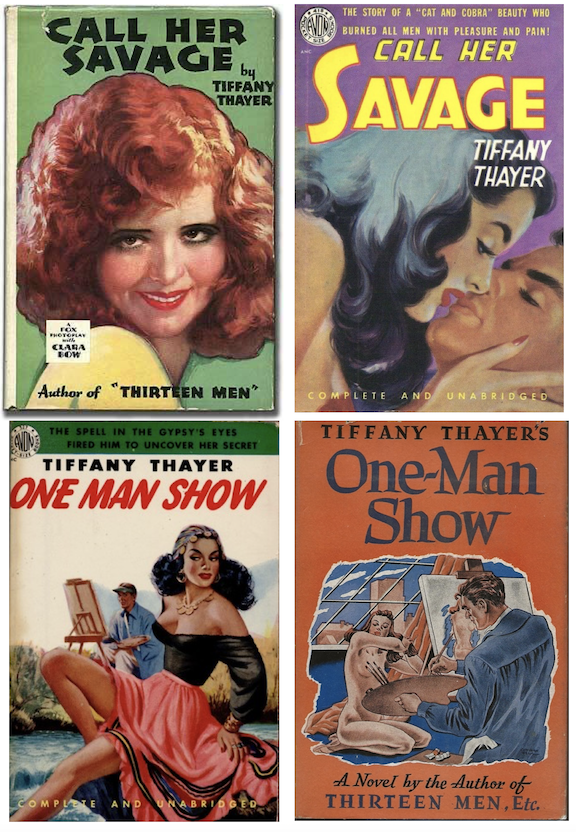
BELIED LETTRES…Clockwise from top left, Thayer’s 1931 novel Call Her Savage was made into a 1932 film starring Clara Bow, here featured on the book’s dustcover; the same novel repackaged in 1952 for the pulp trade; a 1943 edition of Thayer’s One-Man Show, and a 1951 Avon reprint that toned down the nudity but upped the creep factor. (facebook.com/biblio.com)

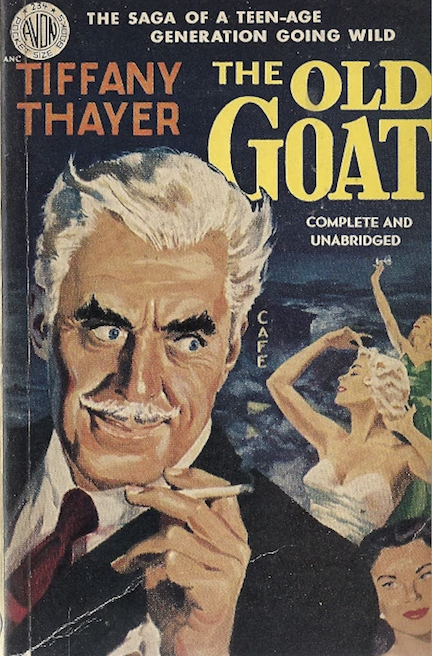
…and speaking of creep factor, check out Avon’s 1950 re-issue of Thayer’s 1937 novel The Old Goat, illustration attributed to Edgar Lyle Justis

(biblio.com)

Artists like Justis must have had a ball doing these illustrations, creating images to lure the unsuspecting into purchasing these old titles. Note how the coked-up old man sports not-so-subtle devil horns.

*  *  *

They Called It a Holiday

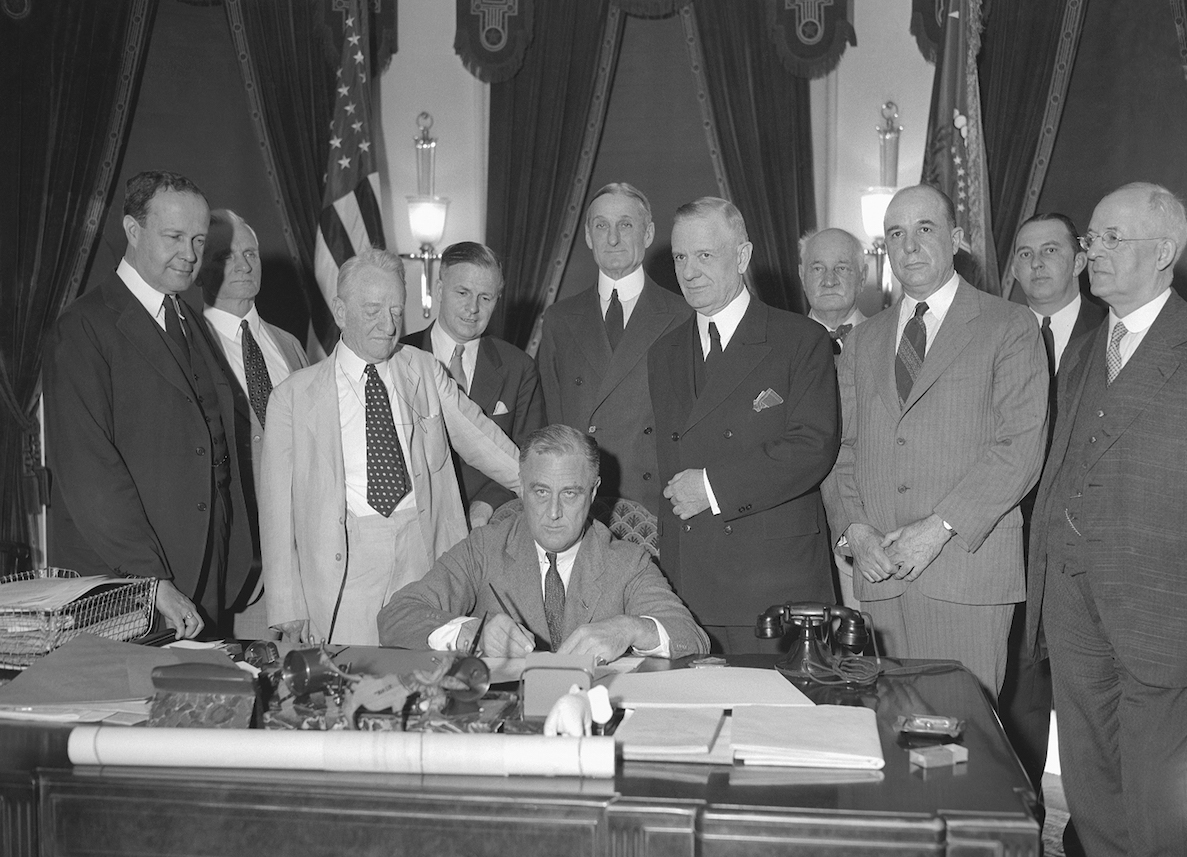
E.B. White, James Thurber (see below) and others in the March 18 issue commented on the national banking “holiday” declared by President Franklin D. Roosevelt in an effort to stabilize America’s banking system and rebuild public confidence. This led to the Glass-Steagall Act, signed three months later by FDR. Some observations in “Notes and Comment” by E.B. White, with the usual great spot illustrations by Otto Soglow

SAY CHEESE!…President Franklin D. Roosevelt signs the Glass-Steagall Act on June 16, 1933, effectively separating commercial banking from investment banking and creating the Federal Deposit Insurance Corporation (FDIC), among other things. (Associated Press)

…meanwhile, Germany’s new chancellor, Adolf Hitler, was busy abolishing civil liberties while pretending to be distressed by the behavior of his brownshirt thugs…an excerpt from Howard Brubaker’s “Of All Things”…

*  *  *

A Familiar Ring

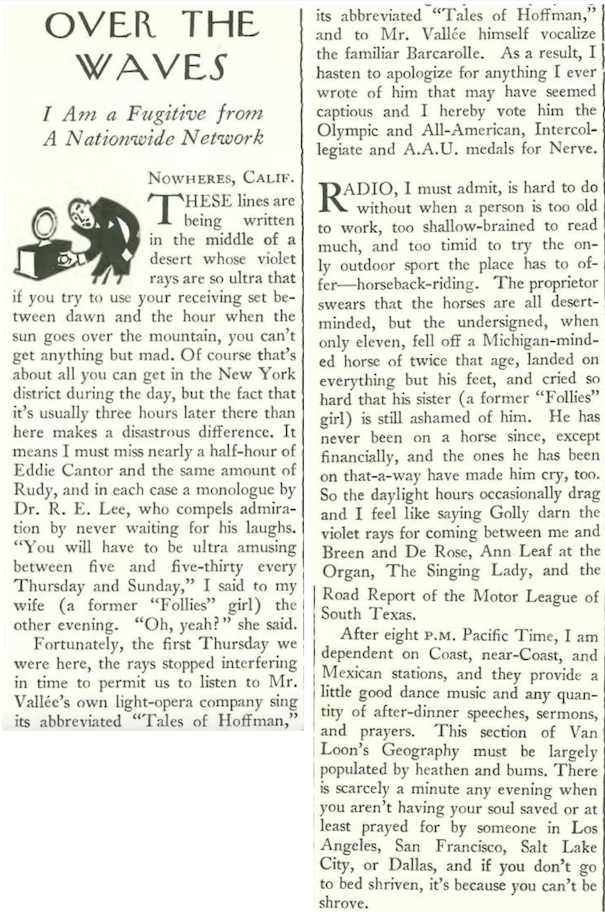
For the second week in a row Ring Lardner lent his wit to The New Yorker’s “Over the Waves,” column, which typically reviewed the latest news and entertainment beamed from the radio tower atop the Empire State Building. Lardner, however, was in California, lamenting the challenges of the time lag. An excerpt:

AND NO WI-FI, EITHER…Ring Lardner (center) detailed the frustrations of listening to New York-based radio entertainers like Eddie Cantor (left) and Rudy Vallée during his stay in California. (Pinterest/The Classic Archives/The New York Times)

 *  *  *

Dance Away Those Blues

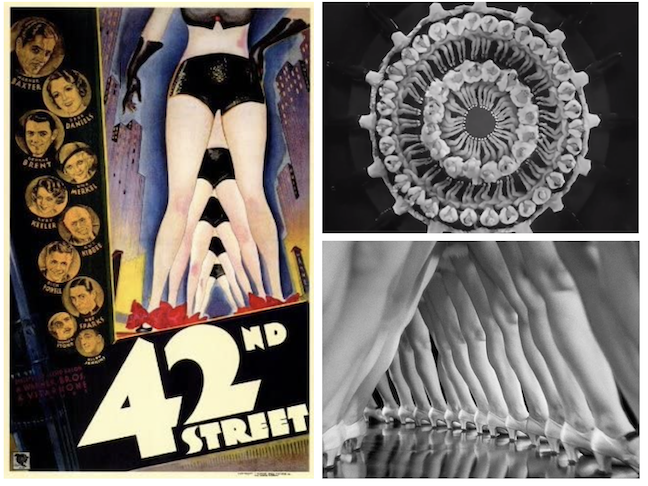
The pre-Code musical 42nd Street received a brief, albeit mostly positive review from critic John Mosher, who along with the producers of the film knew Depression-weary Americans needed such distractions. Nearly 90 years later (April 10, 2020), another New Yorker film critic, Richard Brody, suggested 42nd Street as one of the best films to stream during the Covid-19 pandemic: “Modern musicals start here, and Busby Berkeley’s genius bursts into full flower,” he wrote.

DANCE ‘TIL YOU DROP…Under pressure to produce a hit after losing his lead dancer (Bebe Daniels) to a broken ankle, Broadway musical director Julian Marsh (Warner Baxter, center) mercilessly rehearses her replacement, Peggy Sawyer (Ruby Keeler, in her film debut) before the premiere, vowing “I’ll either have a live leading lady or a dead chorus girl.” Looking on (to the right of Baxter) is Ginger Rogers, who portrayed “Anytime Annie.” (tcm.com)
A LEG UP ON HIS CAREER…42nd Street was a breakthrough film for choreographer Busby Berkeley, who would direct and choreograph a long string of musicals until the 1960s. The film is now considered a classic, preserved in the United States National Film Registry. (IMDB)

…and for trivia buffs, during an opening scene Bebe Daniels is shown reading the February 20, 1932 (anniversary) issue of The New Yorker…

*  *  *

From Our Advertisers

A convertible LaSalle (a downscale Cadillac brand) looks like a great way to enjoy a drive along the beach…let’s hope it has enough acceleration to outrun the tsunami apparently heading its way…

Walter Chrysler continued to dig into his deep pockets for two-page color spreads, including this one that placed his humble DeSoto in St. Moritz, of all places…

…not to be outdone, the folks at Nash found another exotic locale for their budget-priced sedan…Chicago, that is, at the 1933 Century of Progress Exhibition…and for an extra touch of class, we have what appears to be a chauffeur attending to this modest motorcar…

…America’s top luxury car maker, Pierce Arrow — a regular advertiser in The New Yorker — decided a quarter-page ad was sufficient to keep their name before the eyes of the well-heeled…at right, an ad from another back page featured cartoonist Don Herold shilling for the makers of imitation liquor flavors…according to the ad, one bottle, obtainable from your druggist, “flavors a gallon” of whatever forsaken hootch you are consuming…

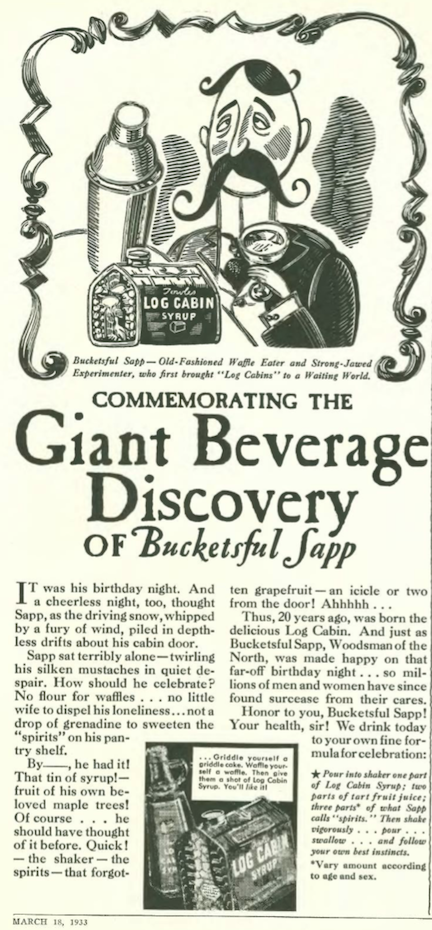
…the folks at Log Cabin relied on the talents of another New Yorker cartoonist, John Held Jr., to make both their product and a signature cocktail a more palatable experience…

…I have to hand it to the folks at Heinz for signing off on an advertisement only a vampire would find appealing…

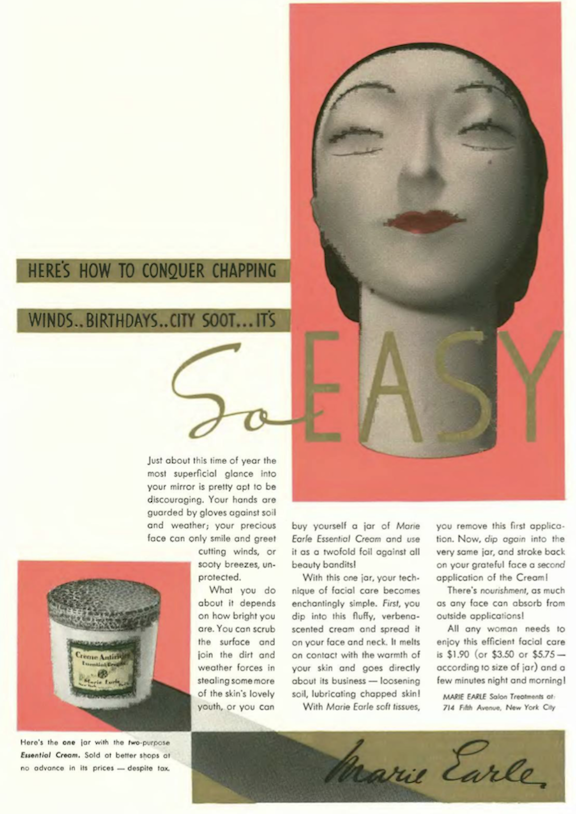
…the purveyors of Marie Earle beauty products rolled out this modern ad to promote their “Essential Cream”…

…while staid Brooks Brothers remained true to form — no flashy colors or advertising jargon — just straight talk about price increases….

…and then there’s the upmarket Fortnum & Mason, appealing to America’s Anglophiles with one of their famed wicker hampers filled with various goodies selected for “charming and greedy people”…

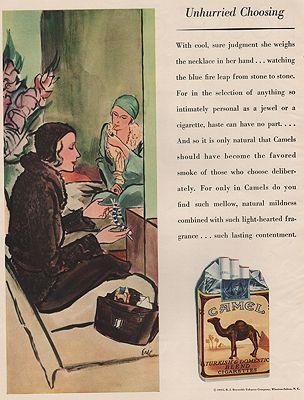
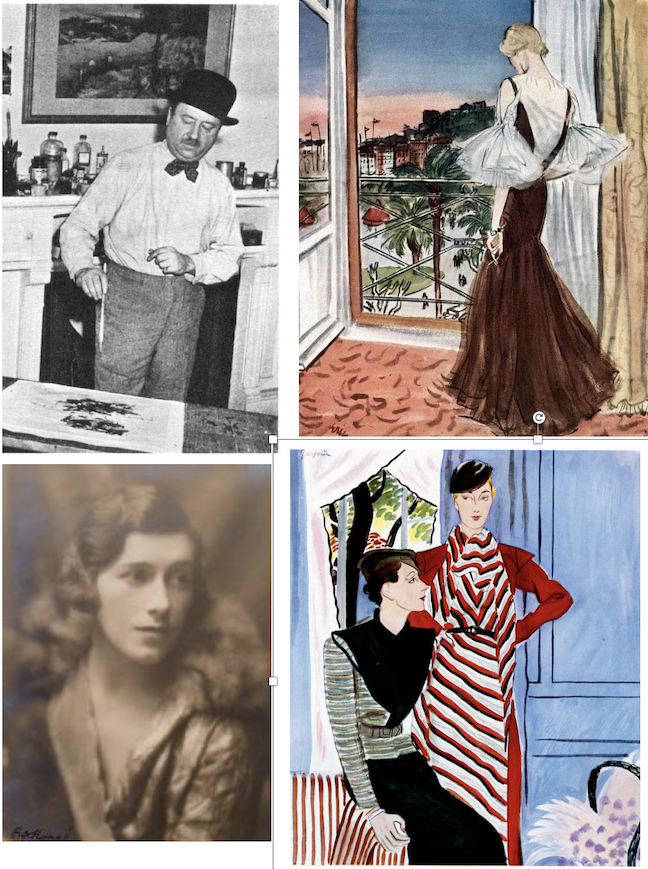
….for several years R.J. Reynolds employed the services of Carl “Eric” Erickson (1891–1958) to illustrate a series of ads featuring classy, disinterested, continental types smoking their Camel brand cigarettes…despite their less-than-exotic name, the makers of Spud menthol cigarettes hired Ruth Sigrid Grafstrom (1905–1986) to create their own smart set of smokers…

…ads that bore a striking resemblance to Erickson’s Camel work (this example from 1931)…

…and for your consideration, works from 1933 by Carl Erickson and Ruth Sigrid Grafstrom…both were noted fashion illustrators…

…on to our cartoonists, we begin with Charles Addams, who’d just published his first New Yorker cartoon the previous month, in the Feb. 4, 1933 issue

…that first cartoon was simply signed “Addams”…here he used the familiar “Chas Addams”…a close-up of the signature…

…we continue with a great caricature by Al Frueh to accompany a profile of Rudolf Kommer (as told by Alexander Woollcott)…

…a delightful full page of bank holiday-themed cartoons by James Thurber

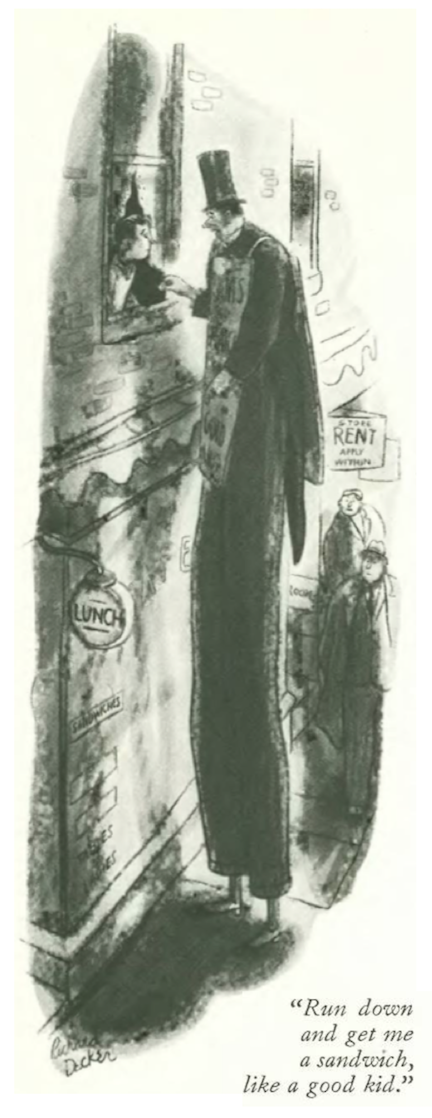
Richard Decker offered up a tall tale…

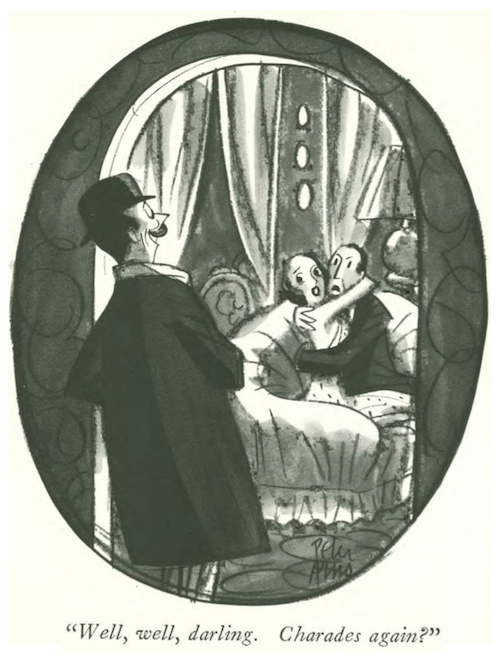
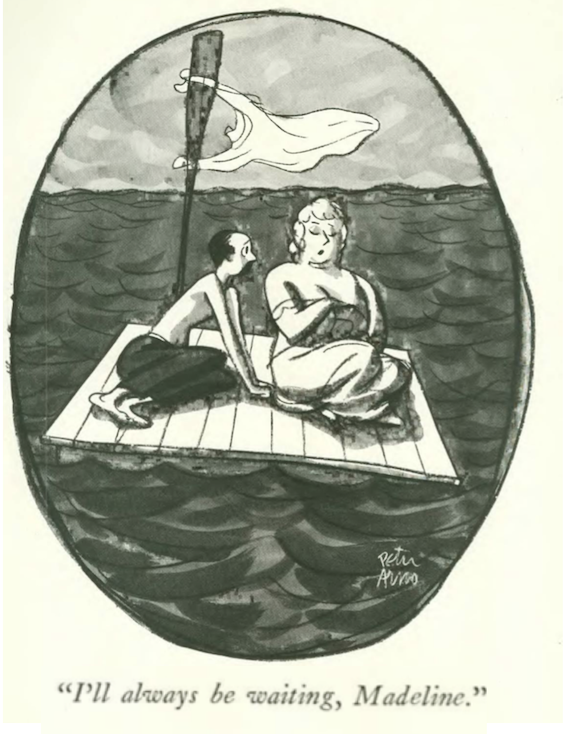
…and we close with Peter Arno, who served up one of his clueless cuckolds…

Next Time: Diary of a Lady…


The Red House

From the 1930s until the 1950s, New York City was the one place where American communists almost became a mass movement.


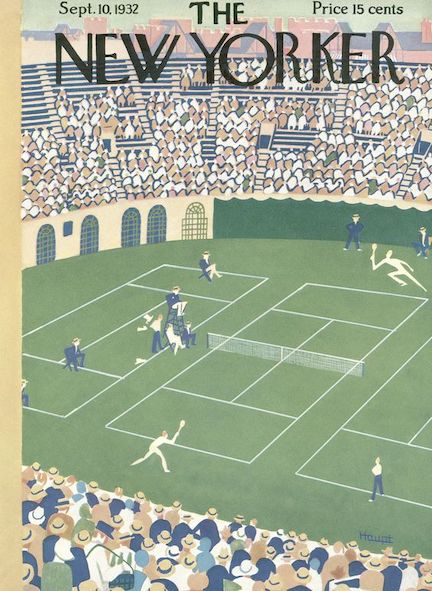
Sept. 10, 1932 cover by Theodore Haupt.

Writing in The New York Times opinion section (Oct. 20, 2017), Maurice Isserman observed how in those days New York party members “could live in a milieu where co-workers, neighbors and the family dentist were fellow Communists; they bought life insurance policies from party-controlled fraternal organizations; they could even spend their evenings out in night clubs run by Communist sympathizers…” we skip to the Sept . 17 issue in which journalist Matthew Josephson penned a report on the movement for the Reporter at Large” column titled “The Red House”…excerpts:

According to Isserman (a professor of history at Hamilton College), in 1938 the Communist Party of America counted 38,000 members in New York State alone, most of them living in New York City. A Communist candidate for president of the board of aldermen received nearly 100,000 votes that same year, with party members playing a central role in promoting trade unions.

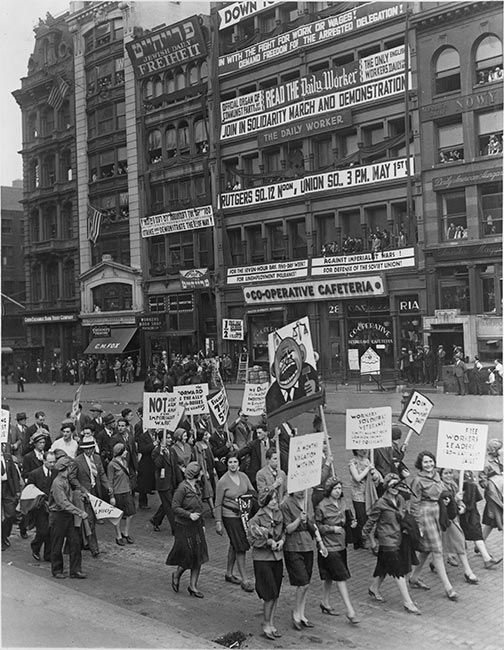
BOSS’S DAY…Communists march at Union Square against “the boss class” at a 1930 rally in New York City.  (Oxford Research Encyclopedias)
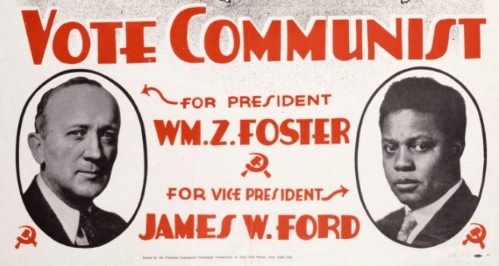
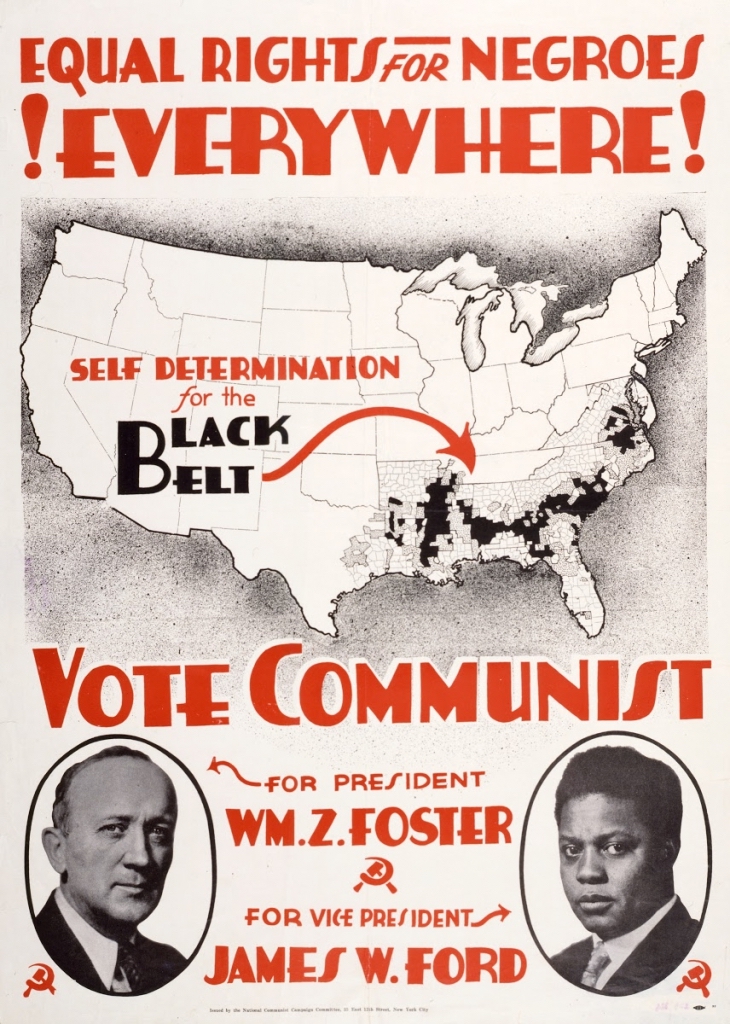
PARTY INVITATION…William Z. Foster and James W. Ford were on the Communist ticket in the 1932 U.S. presidential elections. Ford (1893–1957) was also on the 1936 and 1940 tickets as a vice-presidential candidate. (peoplesworld.org)

Josephson commented on the candidates appearing on the Communist ticket in the 1932 U.S. presidential elections, finding James W. Ford to be “much more intellectual” than his running mate:

THE HQ…Communist Party of America headquarters, 13th St., New York City, 1934; a close-up view of the Workers’ Bookshop display window in 1942. (USC Libraries/Library of Congress)
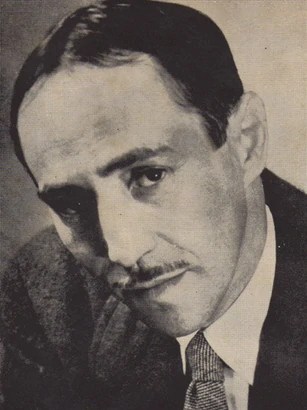
A regular New Yorker contributor, journalist Matthew Josephson (1899–1978) popularized the term “robber baron” with the publication of his 1934 book, The Robber Barons: The Great American Capitalists. (nationalbook.org)

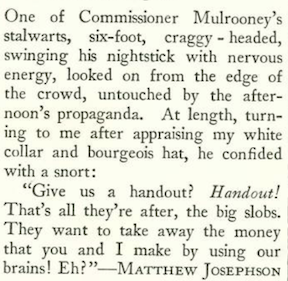
Josephson concluded his article with observation of a party protest event, and one unmoved police officer…

Postscript: The Cold War in the 1950s and a renewed Red Scare spelled the end of the party’s heyday, as did Nikita Khrushchev’s 1956 speech that denounced the murderous legacy of his predecessor, Josef Stalin.

*  *  *

Très Chic

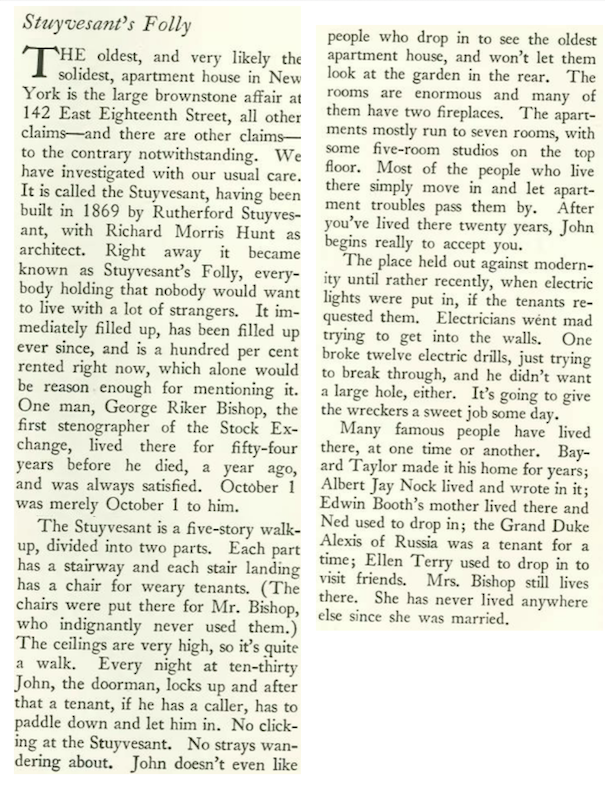
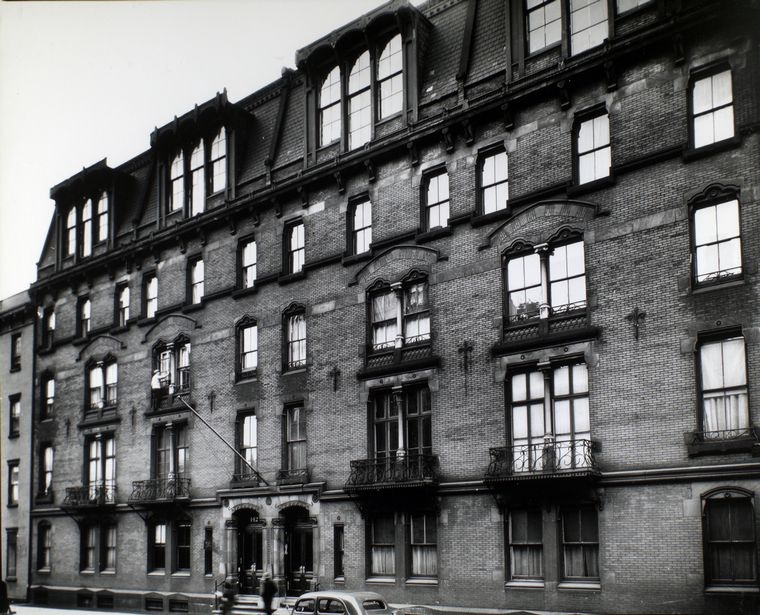
For those with means, the idea of living in the same building with other non-family humans seemed unseemly, but in 1870 Rutherford Stuyvesant hired Richard Morris Hunt to design a five-story apartment building for middle-class folks that had a decidedly Parisian flair. The Sept. 10 “Talk of the Town” explained:


According to Ephemeral New York, the apartments were initially dubbed a “folly,” but the building’s 16 apartments and four artists’ studios—located near chic Union Square—were quickly snapped up, creating a demand for more apartments. The building remained fully occupied until it was demolished in 1958. According to another favorite blog—Daytonian in Manhattan—demolition of Morris Hunt’s soundly built, sound-proof building was a challenge.

IT DIDN’T GO QUIETLY…Stuyvesant Flats at 142 East 18th Street, 1935, in a photo by Berenice Abbott. It was demolished in 1958. (New York Public Library)

*  *  *

Some Characters

I include this brief snippet of the Sept. 10 “Profile” for the jolly illustration by Abe Birnbaum of Al Smith, Jimmy Hayes and the Prince of Wales…

*  *  *

Down In Front

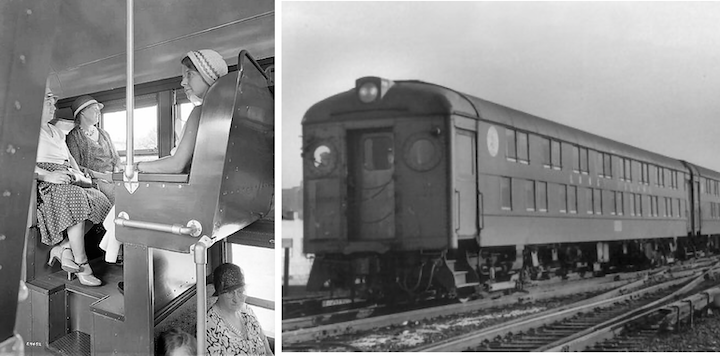
E.B. White was always on the lookout for the newfangled in the world of transportation, but this latest development by the Long Island Railroad was not a breath of fresh air…

STACK ‘EM UP…A woman wears a bemused expression (left) as she takes in her surroundings on one of the Long Island Railroad’s new double-decked cars in 1932. (trainsarefun.com)

White also looked in on the latest news from the world of genetics—with hindsight we can read about these developments with a degree of alarm, since Hitler was months away from taking control of Germany…

*  *  *

Showing His Colors

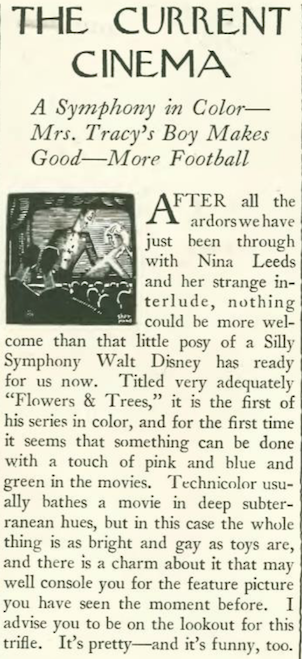
On to lighter matters, critic John Mosher enjoyed an eight-minute animated Walt Disney short, Flowers and Trees—the first commercially released film made in full-color Technicolor…

SEEING GREEN…Walt Disney’s Flowers and Trees won the very first Academy Award for Best Animated Short Film in 1932. (intanibase.com)

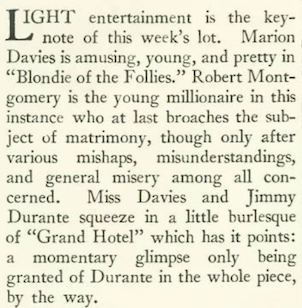
…Mosher also took in light entertainment of the live-action variety with Marion Davies and Billie Dove providing some amusement in Blonde of the Follies, although the picture could have used a bit more Jimmy Durante, billed as a co-star but making an all-too-brief appearance…

WHERE’S THE DUDE WITH THE SCHNOZ?…Billie Dove (left) starred with headliner Marion Davies in Blondie of the Follies, but another co-star, comedian Jimmy Durante, was mostly absent from the picture. (IMDB)

*  *  *

From Our Advertisers

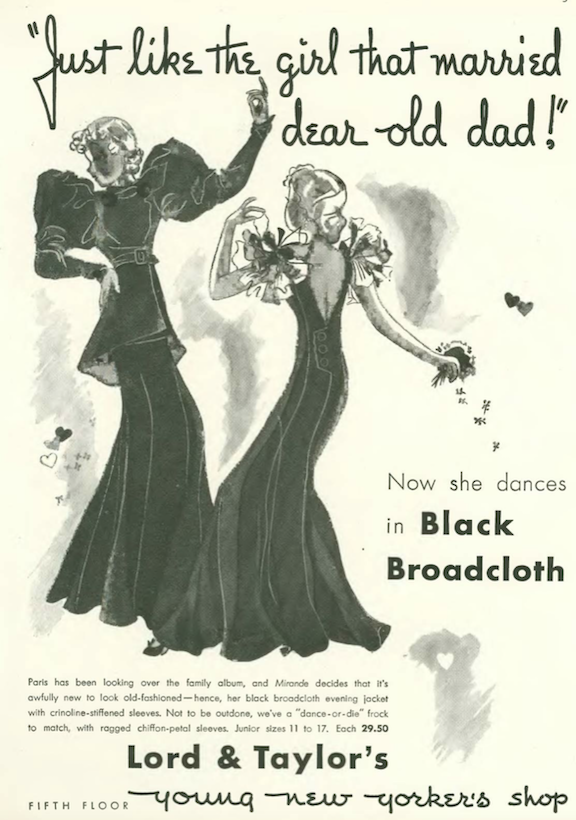
Lord & Taylor announced the return of Edwardian styles as the latest in fashion among the younger set, once again proving what goes around comes around, ad infinitum

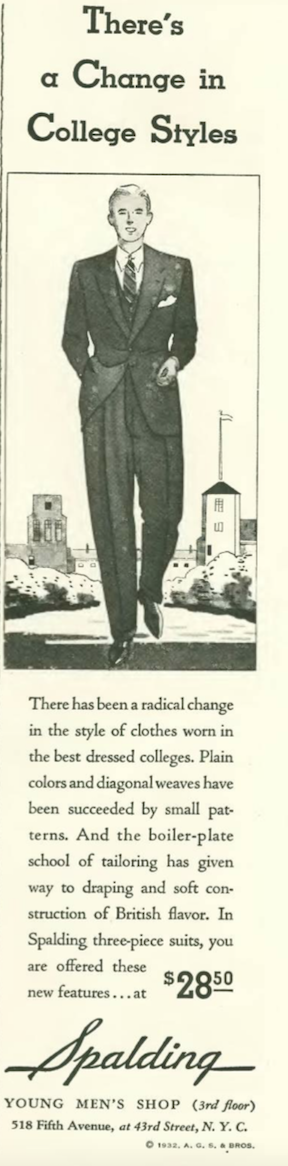
…except when it comes to “college styles”…I don’t see this look returning to our campuses anytime soon…

…the end of Prohibition was still a year away, but at least in New York it was all but over…I like the Hoffman ad and its winking line “with or without”…

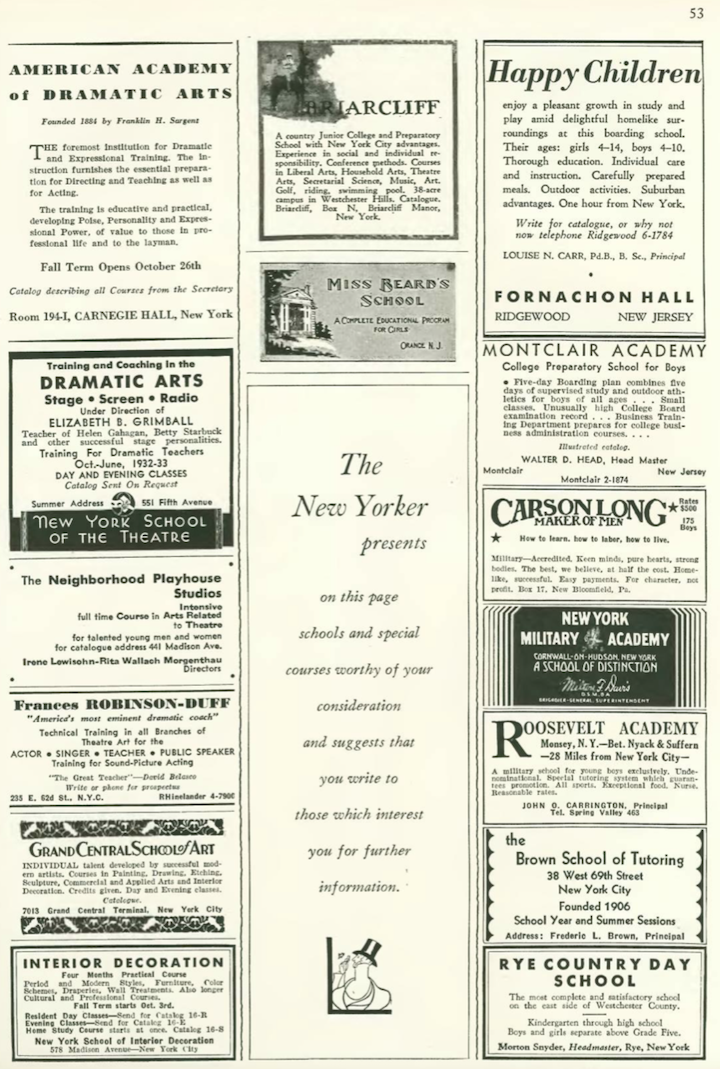
…as a courtesy to readers (and to fill a blank space) the New Yorker    “presented” a full page of signature ads touting a variety of specialty schools and courses…the Carson Long Military Academy (right hand column) closed in 2018 after 182 years of “making men”…

…on to our cartoonists and illustrators, we begin with this Isadore Klein illustration in the opening pages…

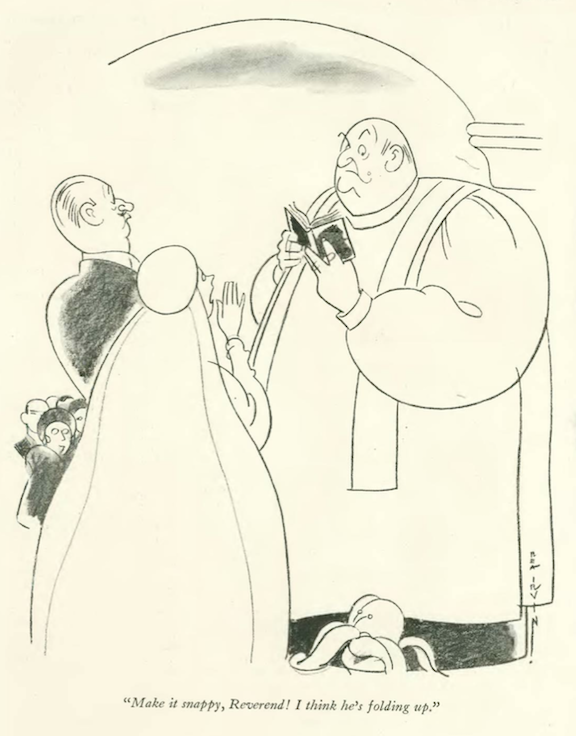
Rea Irvin gave us a nervous moment at the altar…

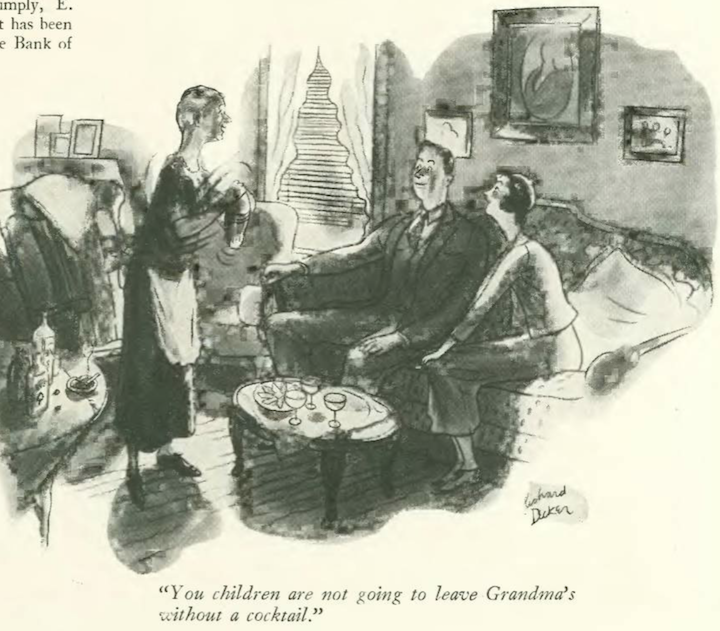
…and Richard Decker showed us one groovy grandma…

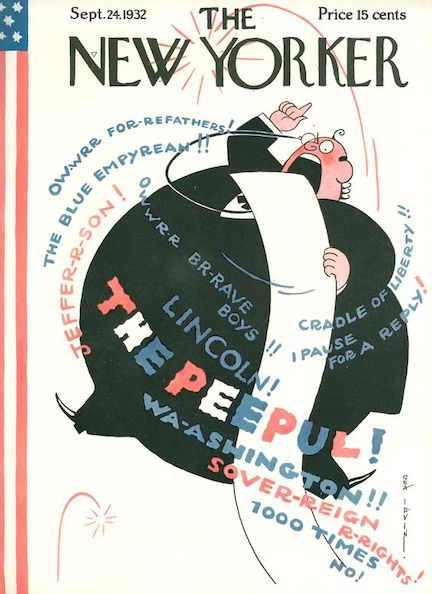
…on to the Sept. 17 issue (which we dipped into at the start)…and what a way to begin with this terrific cover by Peter Arno

Sept. 17, 1932 cover by Peter Arno.

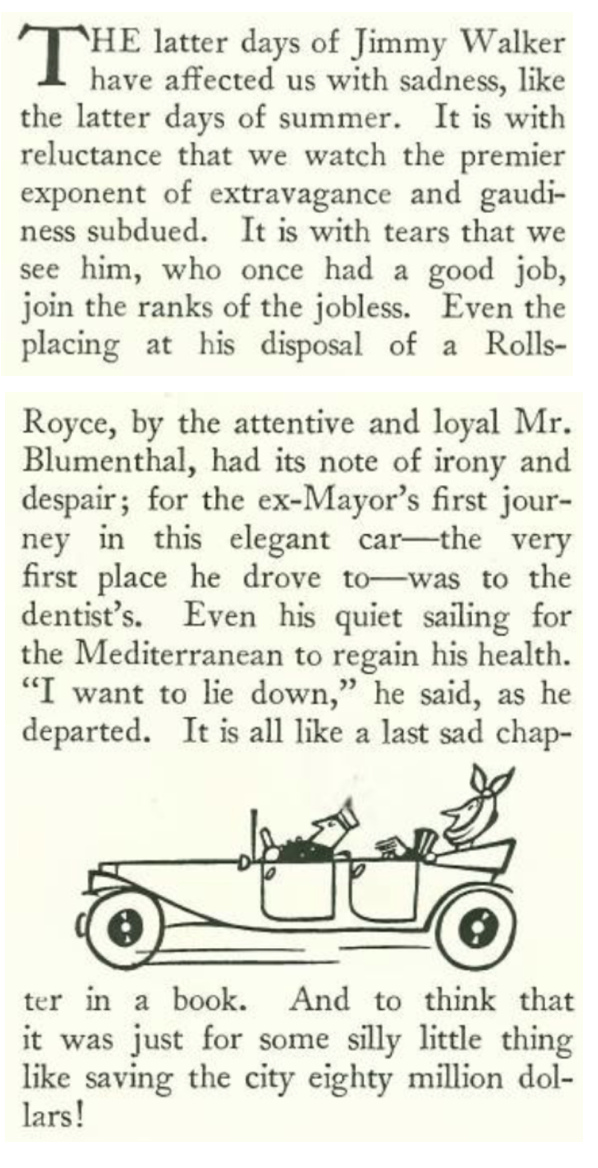
…in his “Notes and Comments,” E.B. White offered some parting words for the departing (and scandal-ridden) Mayor Jimmy Walker

THAT’S ALL FOLKS…Deposed New York Mayor Jimmy Walker skipped town shortly after he left office and caught a boat to Europe. He is seen here at his wedding to Betty Compton in Cannes, April 1933. (Library of Congress)

…and Howard Brubaker added his two cents regarding Walker and his replacement, Joseph McKee, who served as acting mayor until Dec. 31, 1932…

*  *  *

Heady Role

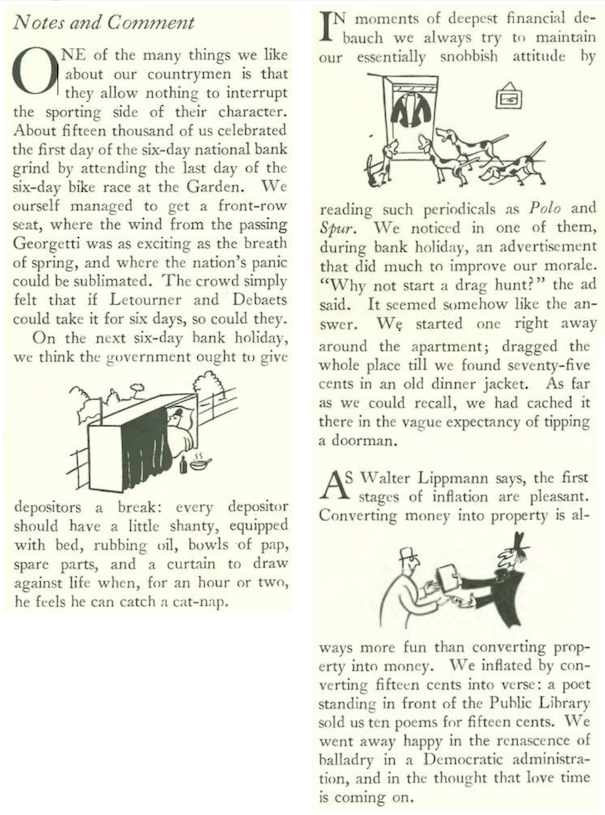
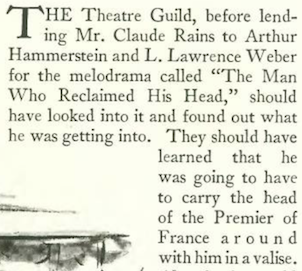
The British actor Claude Rains earned his acting chops on the London Stage before coming to Broadway, where in 1932 he appeared in The Man Who Reclaimed His HeadE.B. White was subbing for regular critic Robert Benchley, and concluded that Rains should have used his own head before agreeing to appear in such silly stuff…

NO MORE HEAD JOKES, PLEASE…Although he got a late start on his Hollywood career, Claude Rains (1889—1967) became one of the silver screen’s great character stars. (Playbill)

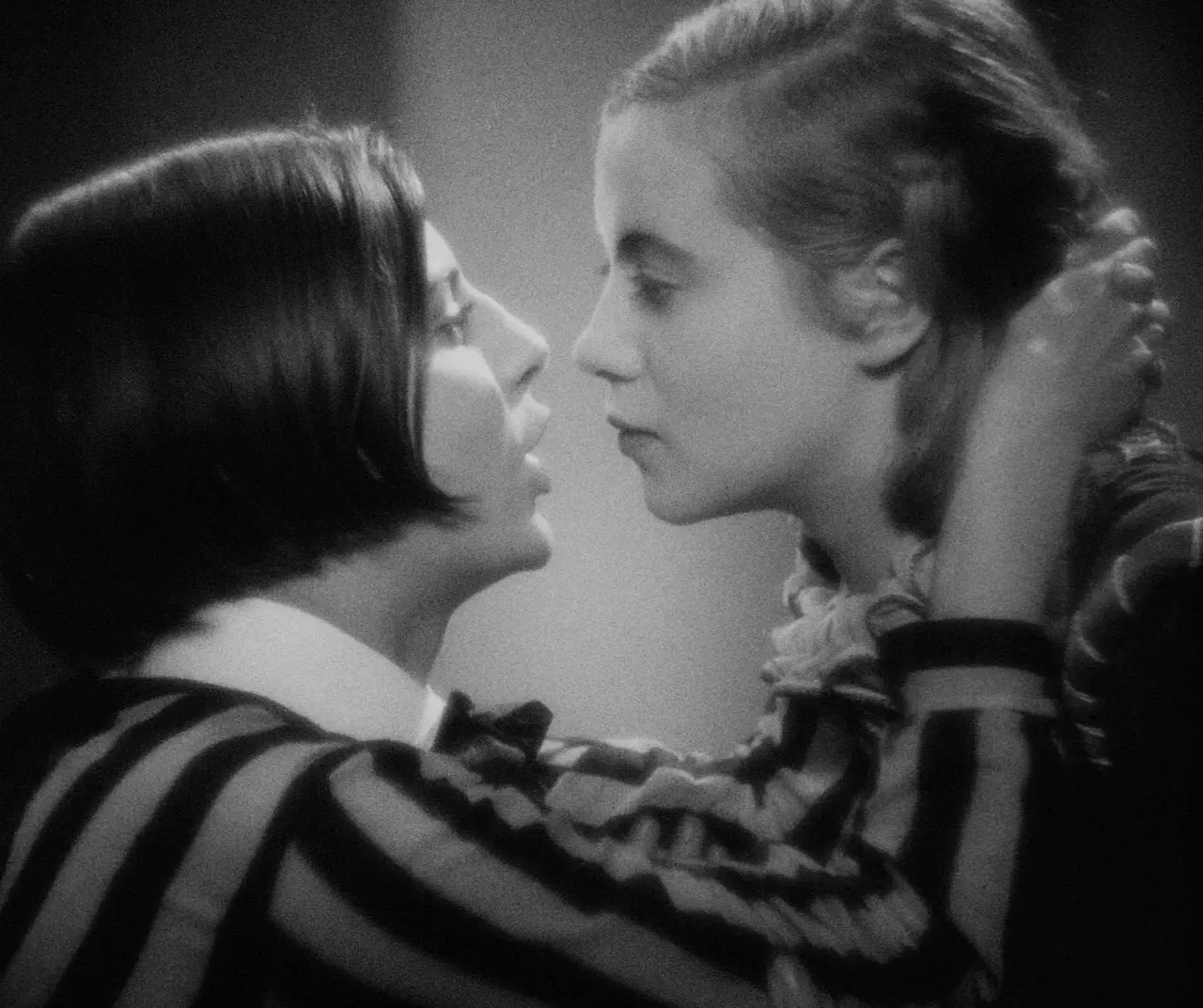
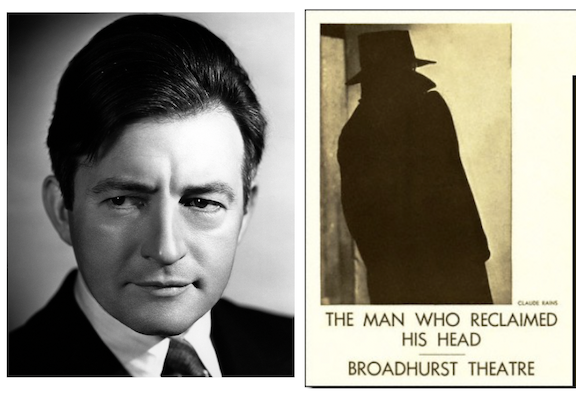
…and speaking of the silver screen, we turn to critic John Mosher and his review of the 1931 German film

WOMEN IN REVOLT…The New York Times (in 2020) describes 1931’s  “expression of anti-fascism and a lesbian coming-out story.” The film was a success throughout Europe, but was later banned as “decadent” by the Nazi regime. Above, Ellen Schwanneke, left, and Hertha Thiele in Mädchen in Uniform. (Kino Lorber)

Mädchen in Uniform was almost banned in the U.S., but Eleanor Roosevelt spoke highly of the film, resulting in a limited US release (albeit a heavily-cut version) in 1932–33.

*  *  *

From Our Advertisers

I’m featuring this detail from an Elizabeth Arden ad because the illustrator’s style is so distinct…if someone knows the identity of the artist, please let us know (on other drawings I’ve seen a signature that looks like “coco”)…

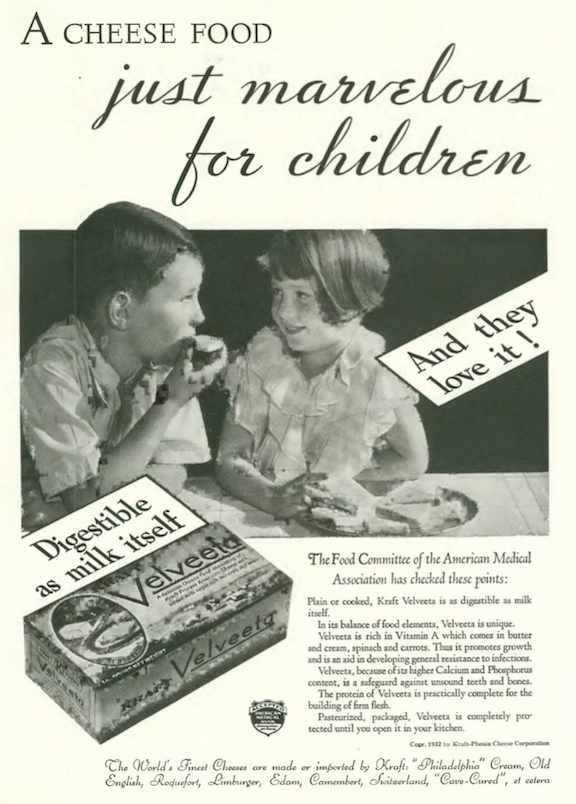
…invented in 1918, this “cheese food” made from milk, water, whey, milk protein concentrate, milkfat, whey protein concentrate and sodium phosphates—among other things—was acquired by Kraft in 1927 and marketed in the 1930s as a nutritious health food…I have to say I haven’t seen any Velveeta ads in The New Yorker as of late…

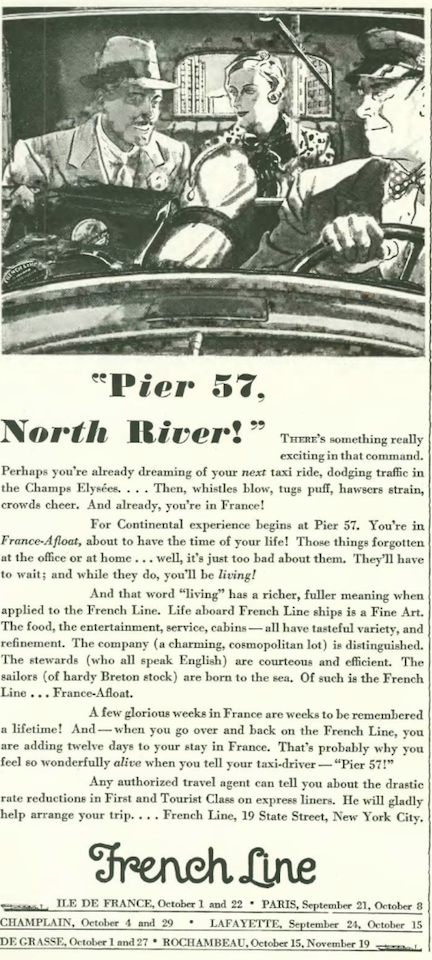
…”Pier 57, North River!” barks the successful-looking man to the admiring cabby who’s thinking “lucky dog!”…

…on the other hand, Peter Arno (kicking off our Sept. 17 cartoons) gave us a Milquetoast who wasn’t getting anywhere near the French Line, or First Base…
…and speaking of the mild-mannered, James Thurber offered up this fellow…

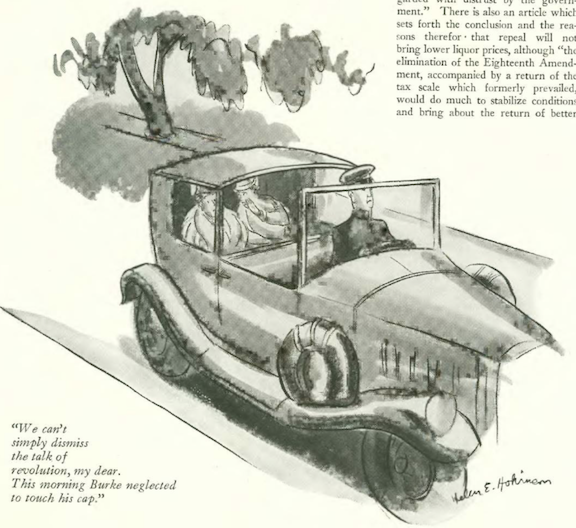
Helen Hokinson’s “girls” were perhaps wondering if their driver was among the Commies at Union Square…
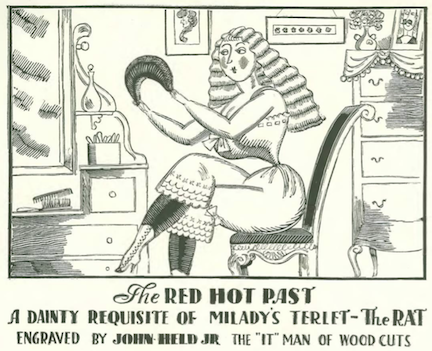
John Held Jr. entertained with another “naughty” Victorian portrait…
Robert Day, and wish unfulfilled at the zoo…

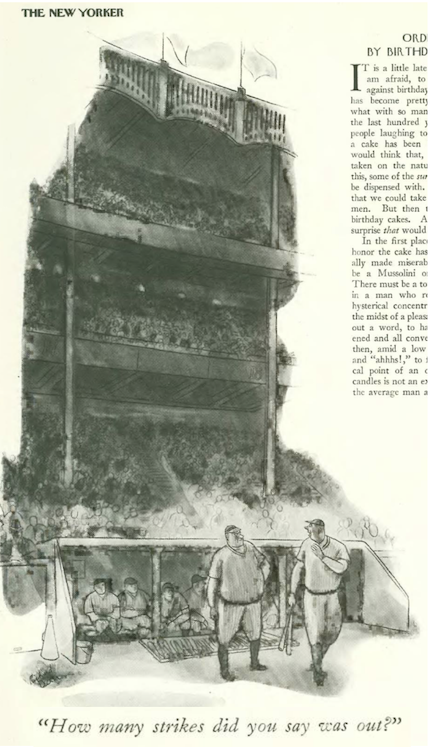
…and we close with Richard Decker, and trouble in the Yankee dugout…

Next Time: A Picture’s Worth…

Jimmy’s Jam

New York City Mayor Jimmy Walker (1881-1946) was commonly referred to as “Beau James” for his flamboyant lifestyle and his taste for fine clothes and Broadway showgirls.

June 4, 1932 cover by Theodore Haupt.

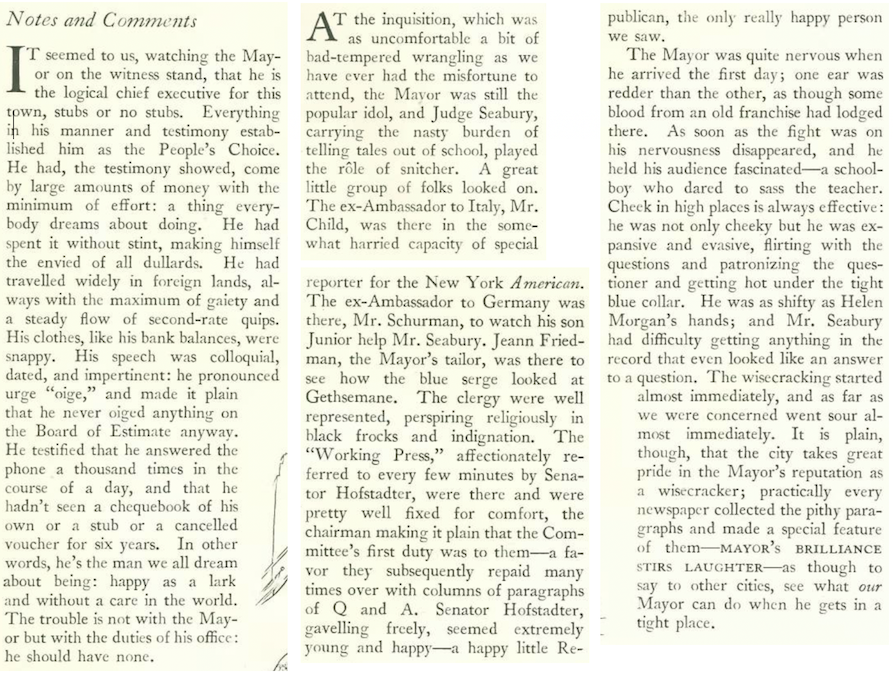
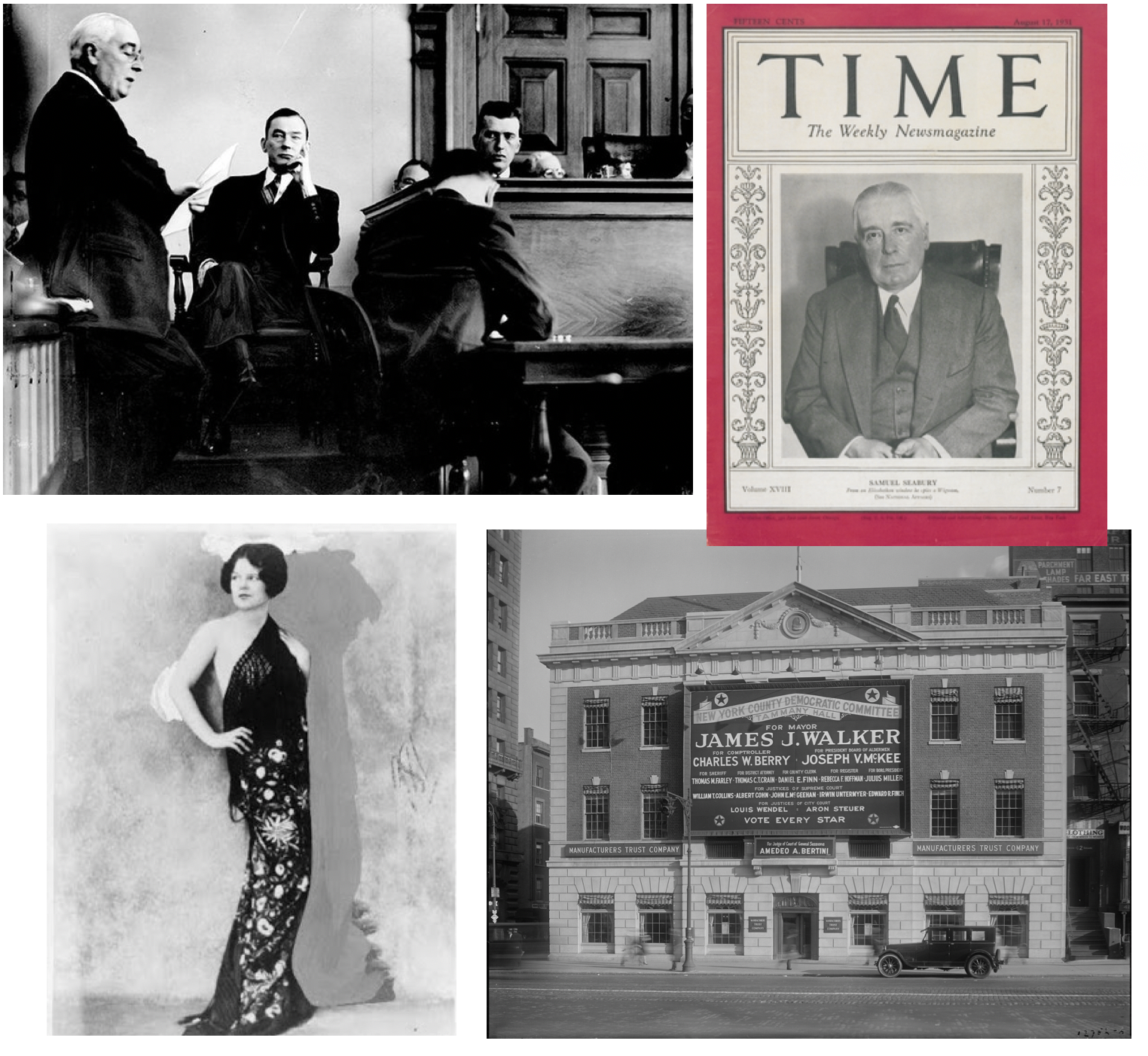
Mayor Walker was also a product of the powerful Tammany Hall machine that traded in political favors and outright bribery. When he took office in 1926, the economy was riding high, and few seemed to care that hizzoner was aloof, partying into the night (while openly flouting Prohibition laws), and taking numerous pleasure trips to Europe. He easily won reelection in 1929, but when the stock market crashed later that year his hijinks began to wear a bit thin, and reform-minded politicians like State Senator Samuel H. Hofstadter began looking into corruption in New York City. The actual investigation was led by another reformer, Samuel SeaburyThe New Yorker’s E.B. White looked in on the proceedings and its star witness, Mayor Walker.

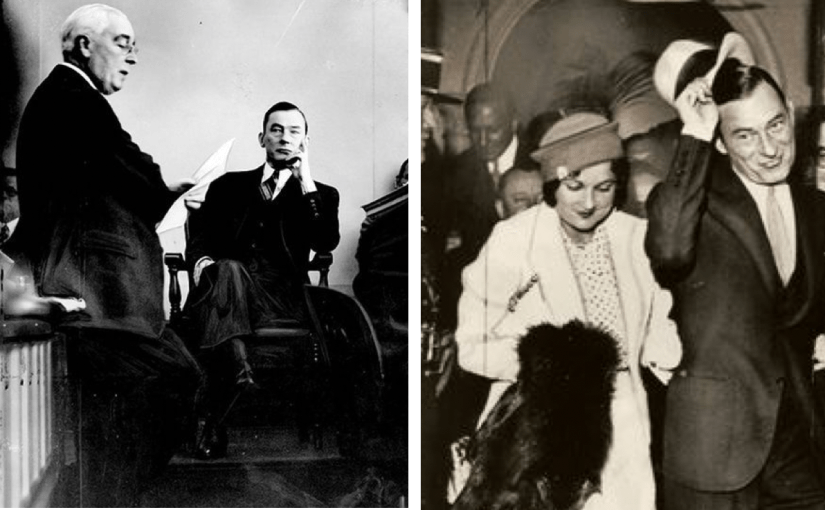
I DO NOT LIKE THIS, SAM I AM…Clockwise, from top left, Mayor Jimmy Walker was full of wisecracks during his testimony before Samuel Seabury, far left; Seabury’s role in the high-profile commission landed him on the cover of Time (Aug. 17, 1931); Tammany Hall’s support was writ large for Walker in the 1920s; Vivian Gordon was a surprise witness in the Seabury investigation, telling investigators police received bonuses for falsely arresting women on prostitution charges. After her testimony Gordon was found strangled in Van Cortland Park, leading many to believe Walker’s corruption played a role in her death. (Daily News/Time/archives.nyc/Pinterest)

Public opinion really started to turn on Walker with the death of star witness Vivian Gordon (see caption above). The final blow came from New York Governor Franklin D. Roosevelt, who like Walker was a Democrat but unlike Walker was not a Tammany product. Roosevelt was also running for president, and rightly seeing Walker as a liability, asked the mayor to resign, which he did on Sept. 1, 1932. That event was still three months away when E.B. White wrote these concluding lines:

SO LONG, SUCKERS…Eight days after he resigned from office, New York Mayor Jimmy Walker headed for Paris, where his mistress, Ziegfeld star and film actress Betty Compton, awaited with open arms. Clockwise, from top left, Compton and Walker on their wedding day in Cannes, France, April 19, 1933; and a 1920s photo portrait of Compton; Walker’s first wife, Janet Allen Walker, had sued for divorce a month earlier (March 10, 1933) claiming Jimmy had deserted her in 1928 and they had not lived together since; Walker and Compton on the deck of SS Normandie, June 17, 1936. (legacy.isle-of-wight-fhs.co.uk/IMDB/Pinterest/NYC Municipal Archives)

Eight days after Walker resigned from office he caught a boat for Paris, where his mistress, Ziegfeld star and film actor Betty Compton (1904-1944), awaited him. They married the following year in Cannes.

 *  *  *

Out of the Shadows

F. Scott and Zelda Fitzgerald were Jazz Age fixtures, cutting wide swaths through literary and society worlds filled with wild drinking and various infidelities. Francis Scott (1896-1940) was a chronicler of that age, most notably with The Great Gatsby, but Zelda (1900-1948) also took pen in hand, contributing short pieces to various magazines in the 1920s. By 1930 their self-destructive ways caught up with them both, and Zelda was admitted to a sanatorium in France that spring; it was the beginning of a long road of treatments that would end in her death nearly two decades later.

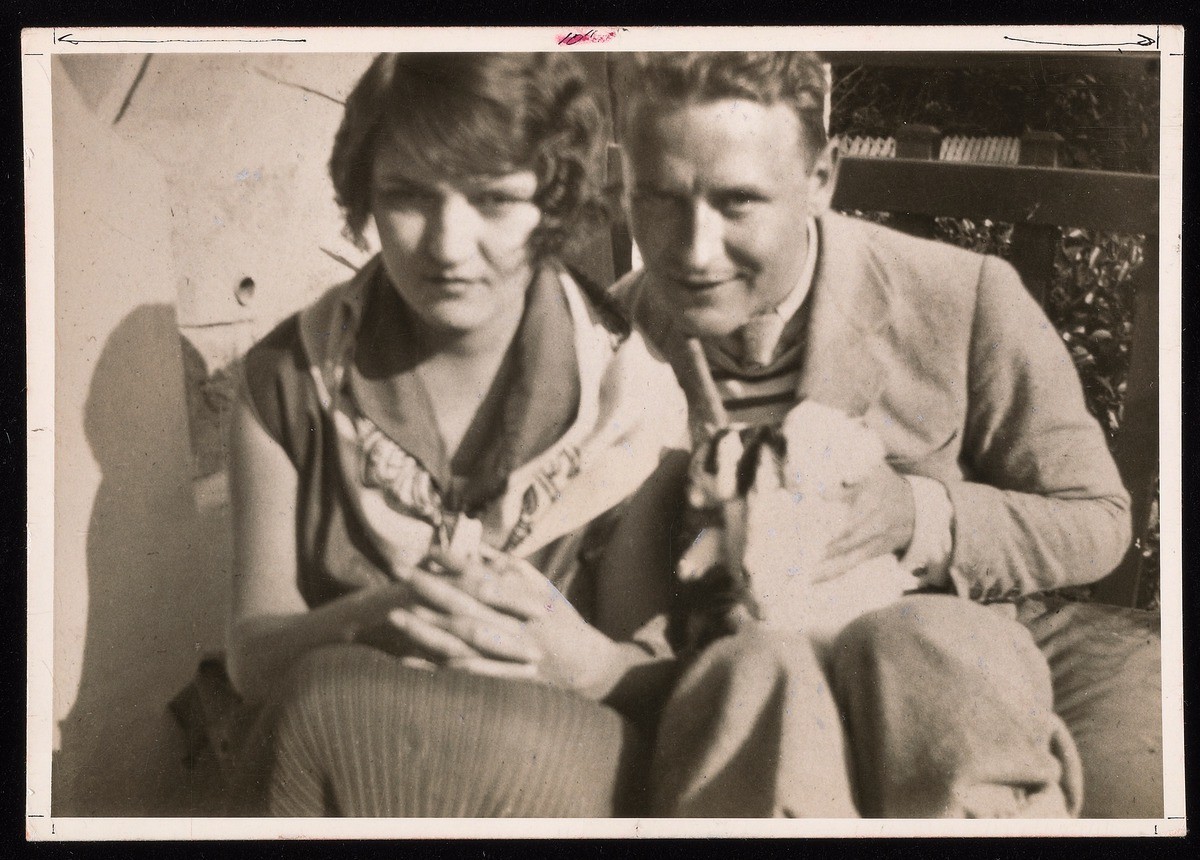
ALL THAT JAZZ…Zelda and F. Scott Fitzgerald (pictured here in 1926) embodied the riotous days of the Roaring Twenties. (beinecke.library.yale.edu)

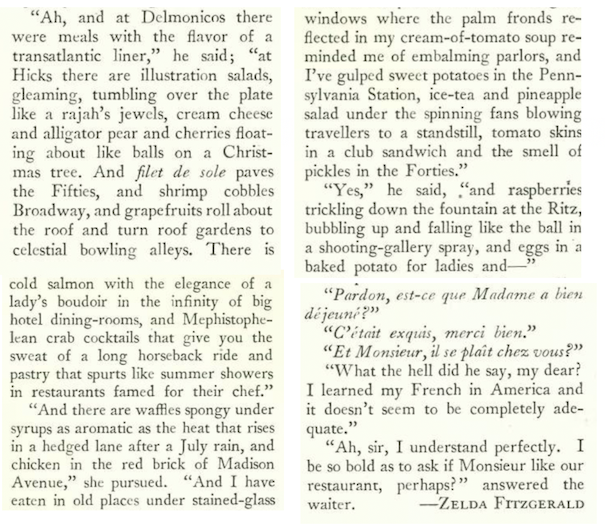
In 1932, during her stay at the Phipps Clinic (Johns Hopkins), Zelda experienced a burst of creativity, writing an entire autobiographical novel — Save Me the Waltz — in just six weeks. Sadly, it was not well-received (by critics or by her husband), and fewer than 1,400 copies of the novel were sold — a crushing blow to Zelda. However, during that same time she published a short story in The New Yorker titled “The Continental Angle.” Here it is:

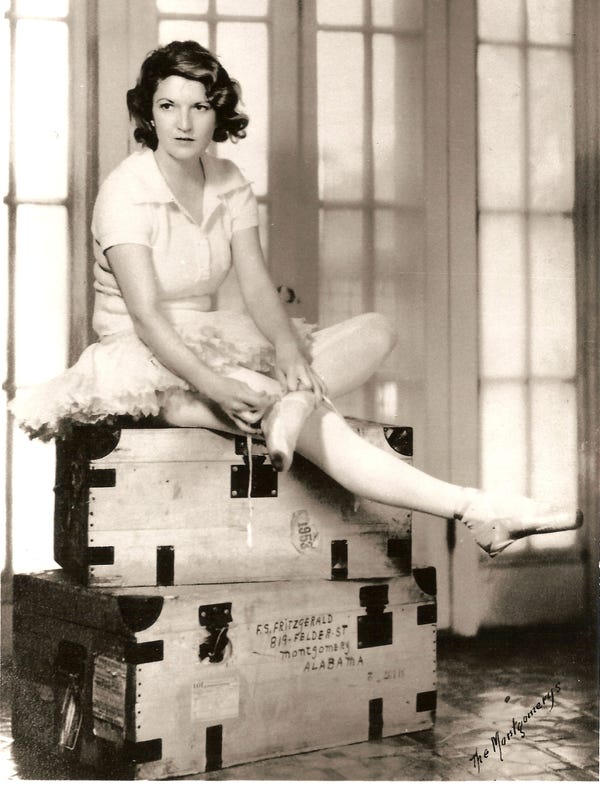
TALENTED AND TROUBLED…Zelda Fitzgerald in 1931, a year before she entered the Phipps Clinic and had a burst of creativity. (citizen-times.com)


 *  *  *

From Our Advertisers

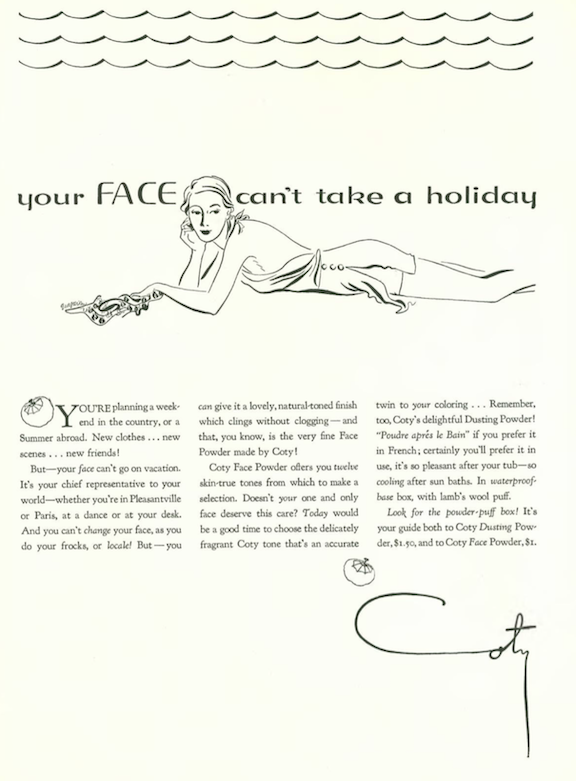
Yet another stylish and very modern-looking ad from Cody, thanks to the artistry of American fashion illustrator Ruth Sigrid Grafstrom…

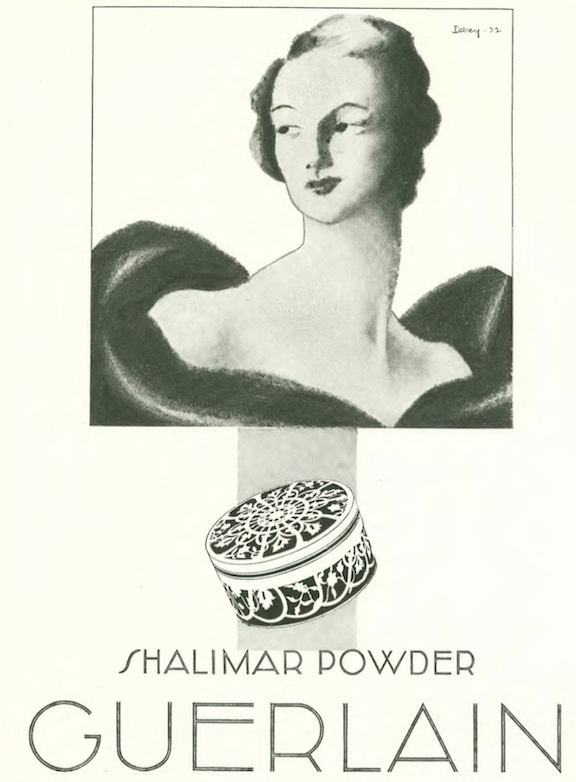
…while later on in the issue French illustrator Lyse Darcy gave his subject an Art Deco look to promote Guerlain’s face powder…

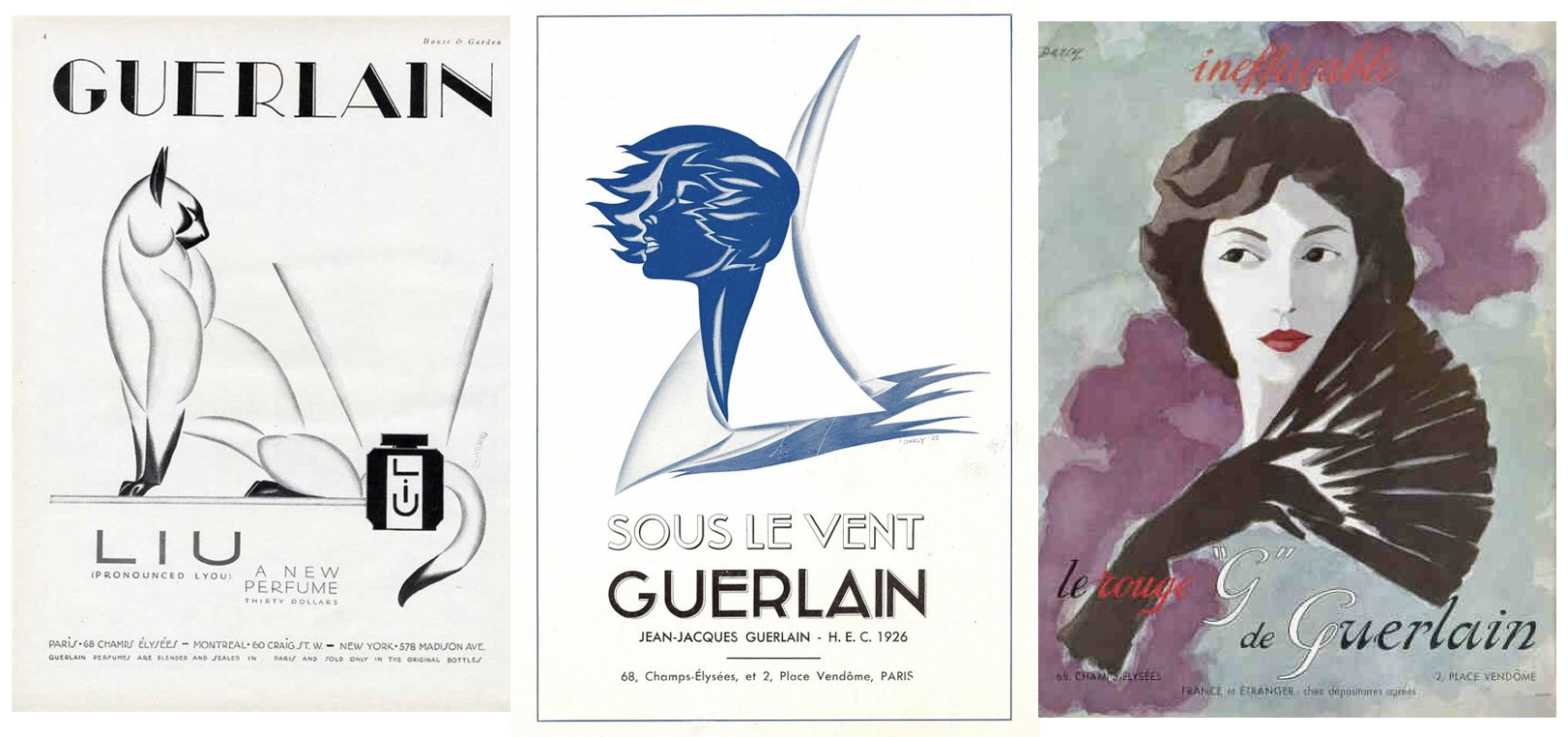
…Darcy was famed for his Guerlain ads from the 1920s to the 1950s…

From left to right, Darcy ads from 1929, 1938, 1957…

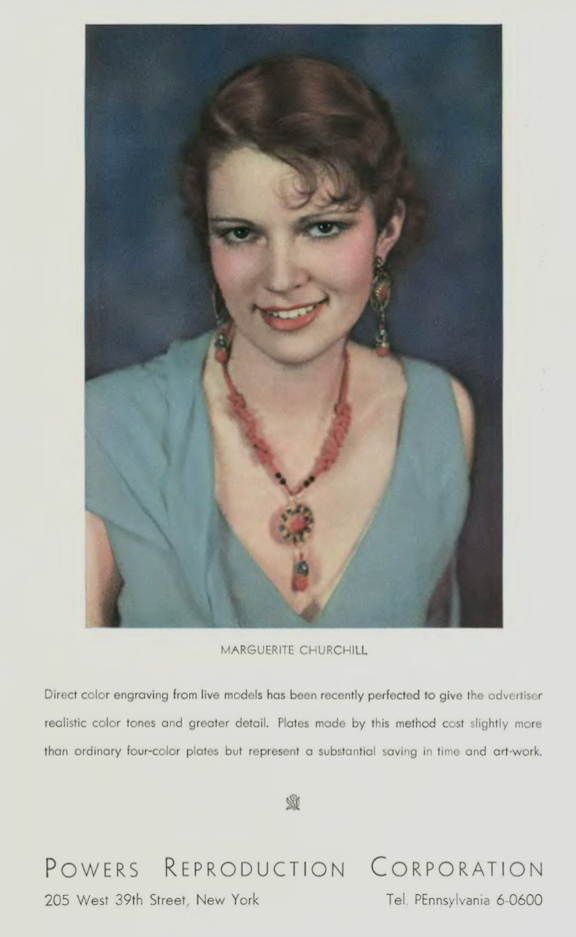
…Powers Reproduction turned to star power to promote their latest color engraving techniques…

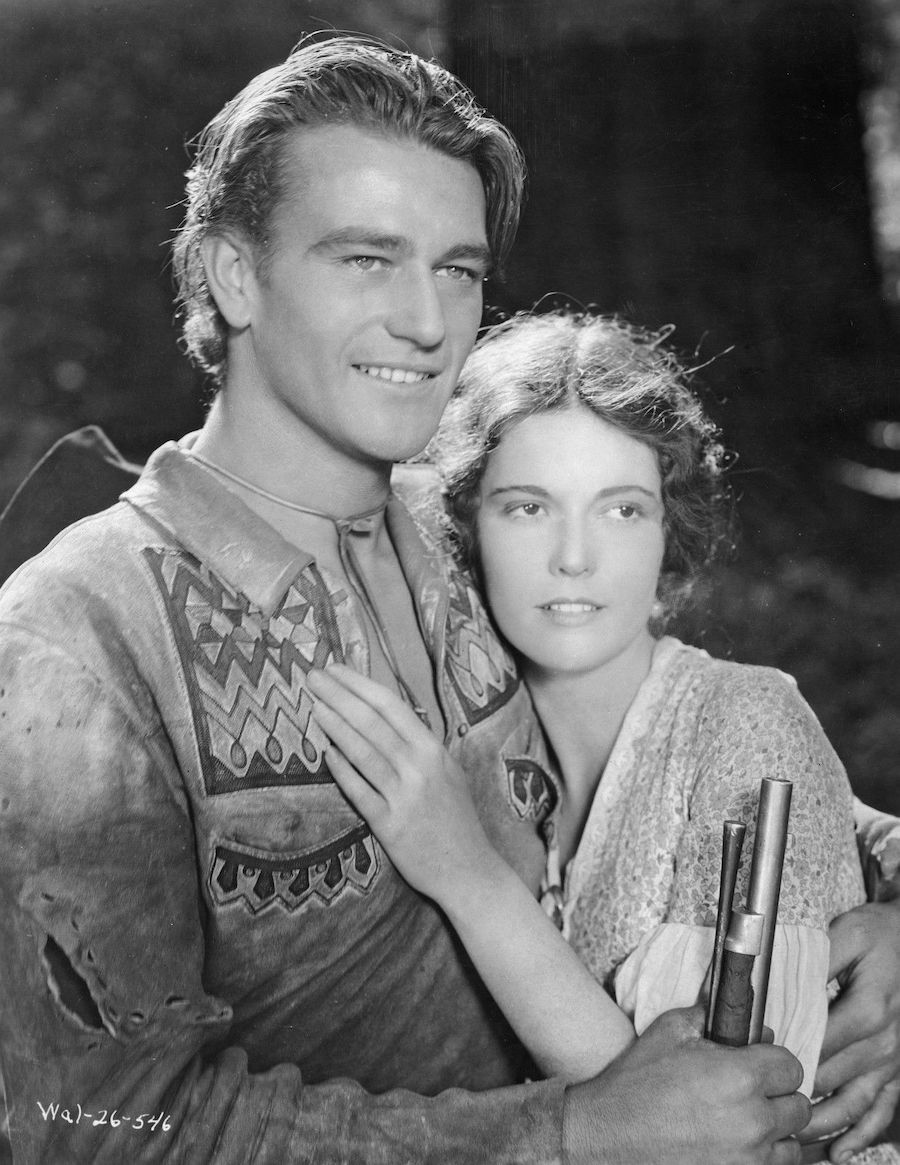
…the actor Marguerite Churchill (1910-2000) had a film career spanning 1929 to 1952, and was John Wayne’s first leading lady in 1930’s The Big Trail

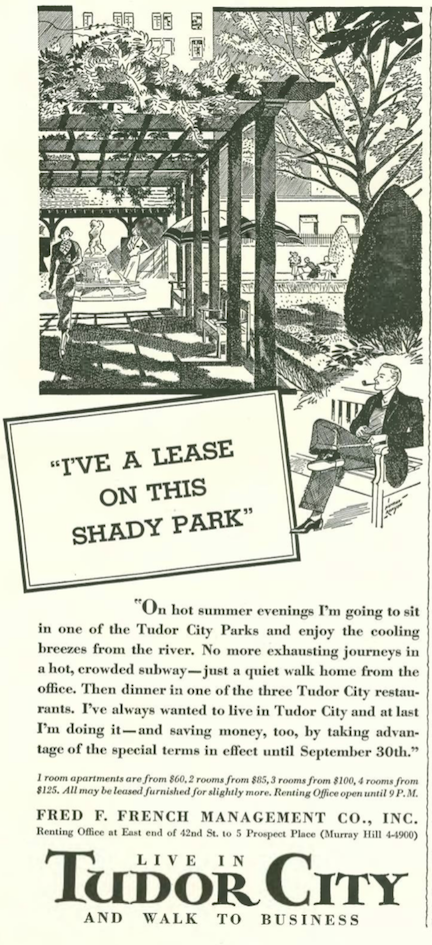
…and we head back to the city, Tudor City, to be precise, where apparently it was common in the 1930s to spot a gent in formalwear relaxing with his pipe…

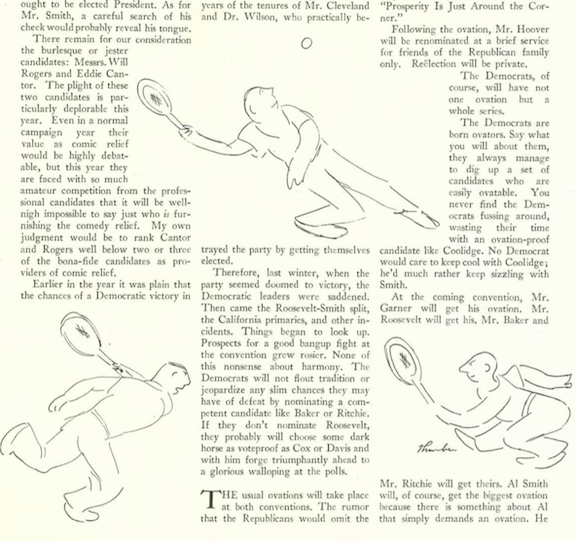
…on to our cartoons, we have James Thurber contributing some spots…

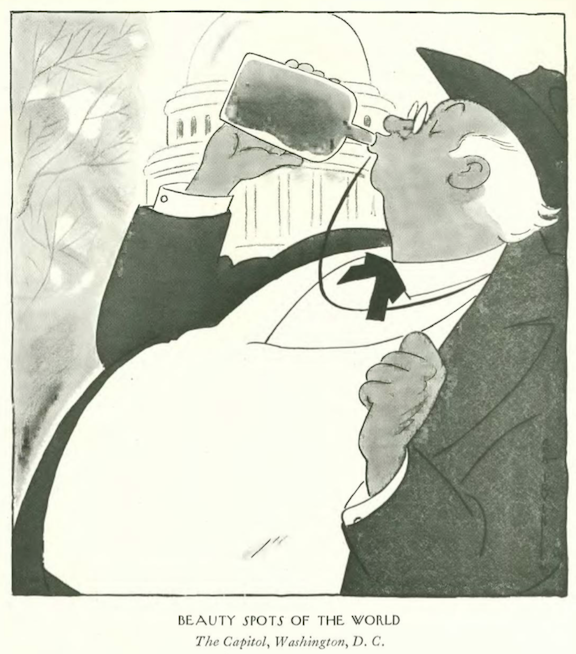
Rea Irvin continued to visit the world’s “Beauty Spots”…

Garrett Price showed us a couple looking for the “We Want Beer” parade…

…which happened three weeks earlier, on May 14, 1932…the parade was organized by none other than Mayor Jimmy Walker, who believed prohibition was making life difficult for New Yorkers…

(brookstonbeerbulletin.com)

Barbara Shermund introduced two men with bigger issues than beer on their minds…

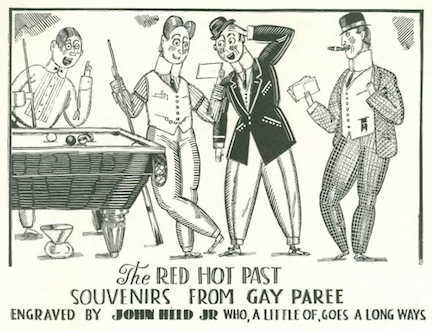
John Held Jr. continued to plumb the depths of the naughty Nineties…

…and some more naughtiness, courtesy Gardner Rea

Next Time: Summer Indulgences…


The Grand Garbo

Joan Crawford was an MGM star by the 1930s, and according to many critics, an absolute scene-stealer in 1932’s Grand Hotel. However, The New Yorker’s film critic John Mosher saw Garbo, and only Garbo, in this Academy Award-winning pre-code drama.

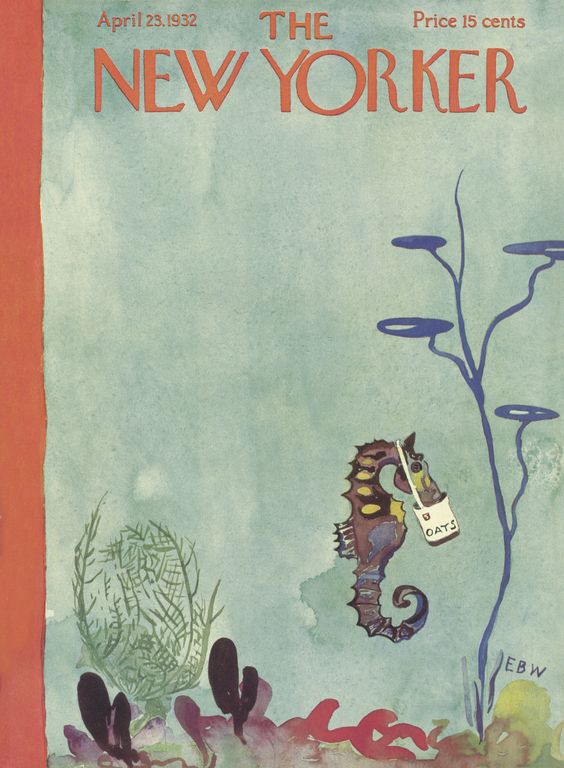
April 23, 1932 cover by E.B. White. Although White’s friend and early office mate James Thurber had been contributing drawings for more than a year, it was White who would land the first cover—his only one (Thurber’s first cover would come in 1936). Maria Popova (brainpickings.org) shares this excerpt from a 1969 Paris Review interview, during which White explained to George Plimpton: “I’m not an artist and never did any drawings for The New Yorker. I did turn in a cover and it was published. I can’t draw or paint, but I was sick in bed with tonsillitis or something, and I had nothing to occupy me, but I had a cover idea—of a sea horse wearing a nose bag. I borrowed my son’s watercolor set, copied a sea horse from a picture in Webster’s dictionary, and managed to produce a cover that was bought. It wasn’t much of a thing. I even loused up the whole business finally by printing the word ‘oats’ on the nose bag, lest somebody fail to get the point.”

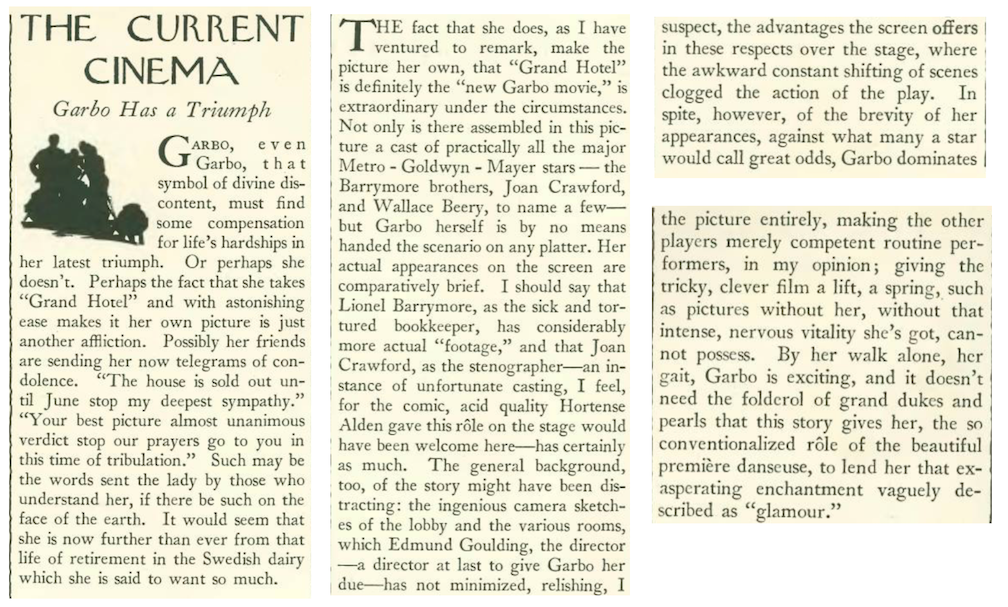
Greta Garbo’s previous films hadn’t exactly wowed Mosher, but the gossip he was hearing even before he screened Grand Hotel suggested it was not to be missed. Mosher touted the unseen film (in the April 16 issue), expressing his hope that the rumors would prove true—he feared Garbo would quit the business altogether and leave the country if she didn’t land a hit. His fears were laid to rest:

Adapted from the 1929 German novel Menschen im Hotel by Vicki BaumGrand Hotel is considered the first all-star epic. The brainchild of MGM’s production head Irving Thalberg, the film proved a triumph for director Edmund Goulding, who somehow managed to direct five leading roles into one film classic.

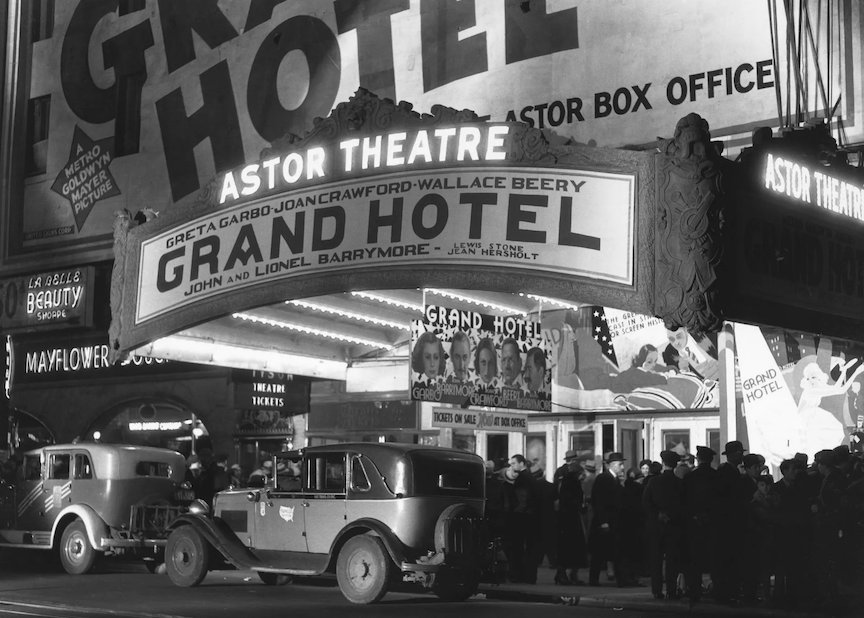
GRAND OPENING…The April 12, 1932 opening of Grand Hotel at Broadway’s famed Astor Theatre was much anticipated by critic John Mosher and pretty much everyone else. (ny.curbed.com)
STELLAR CAST…Set at a luxurious Berlin hotel, Grand Hotel brought together the stories of five seemingly unrelated lives. Clockwise, from top left, crooked industrialist Preysing (Wallace Beery), trades innuendos with an ambitious stenographer, Flaemmchen (Joan Crawford); Baron Felix von Gaigern (John Barrymore), a once wealthy man fallen on hard times, supports himself by stealing from vulnerable marks like the depressed ballerina Grusinskaya (Greta Garbo), and also teams up with a gravely ill accountant (Lionel Barrymore, John’s real brother, not pictured here); hotel entrance from the film; MGM movie poster deftly juggled the film’s five big stars; advertisement from the April 16, 1932 New Yorker made much of the film’s star power. (Wikipedia/IMDB)
THE OTHER BIG STAR in Grand Hotel was the luxurious Art Deco set created by Cedric Gibbons. Centered on the hotel’s reception desk, the set allowed filming in 360 degrees. (IMDB)

And let’s not forget that it was in this film Garbo famously uttered “I want to be alone” — it ranks number 30 in AFI’s 100 Years…100 Movie Quotes. In 2007 Grand Hotel was selected for preservation in the United States National Film Registry by the Library of Congress.

* * *

She’s Back

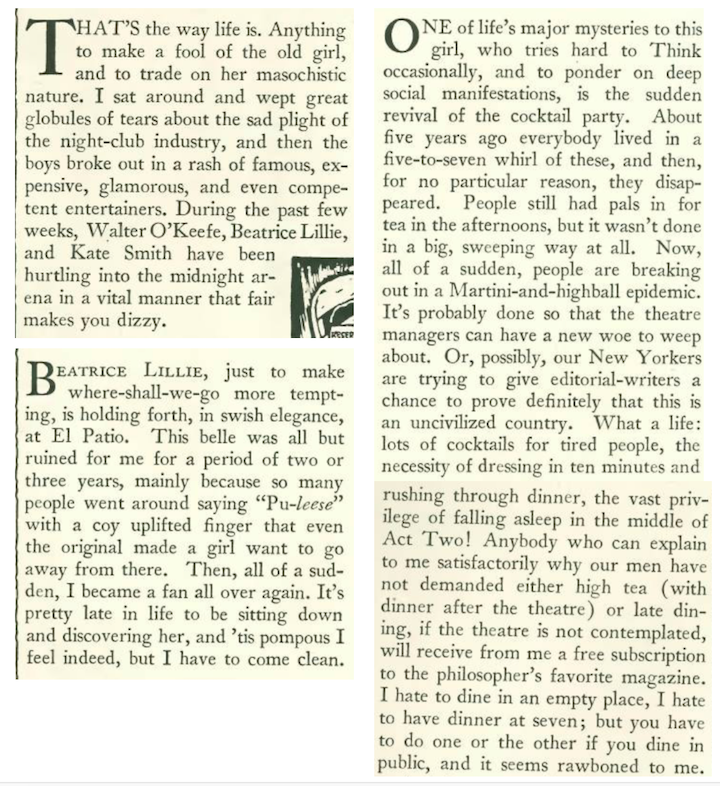
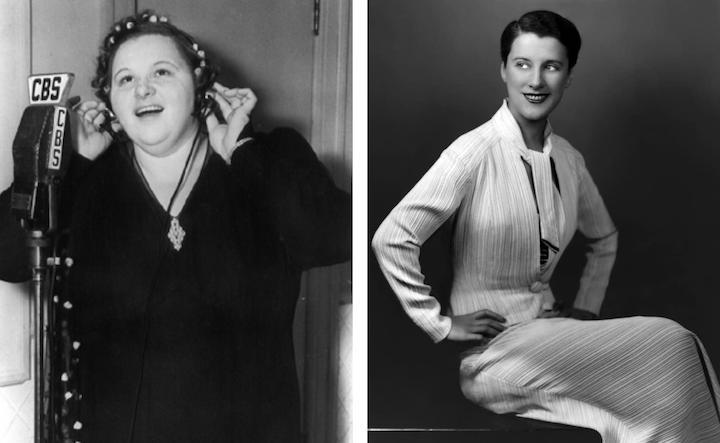
Lois Long aka “Lipstick” turned in yet another “Tables for Two,” even though she had abandoned that column as a regular feature two years earlier. Unlike those earlier columns, Long seemed to have had her fill of the night life, but occasionally she found a diversion or two worth mentioning. She also offered her thoughts about the decline of civilization, indicated by such behaviors as dining at the early hour of 7 p.m.—”rawboned” she called it…

NIGHT LIGHTS…Singer Kate Smith and comedic performer Beatrice Lillie managed to keep Lois Long awake in the wee hours of nightclub entertainments. (katesmith.org/The Poster Corp)

*  *  *

Notes, and More Notes

Despite his cover contribution, and his continued presence in the “Notes and Comment” section, the year 1932 is regarded as one of E.B. White’s leanest as a full-time writer for The New Yorker. According to Scott Elledge in E.B. White: A Biography, White published only a few “Talk” pieces or signed contributions. With a toddler about the house (Joel White had just turned 1 the previous December), White and wife Katharine enjoyed what Elledge describes as perhaps “the happiest of their years together, “able to enjoy fully their professional and private lives in the city they both loved.” So perhaps that explains this particular “Notes” entry for the April 23 issue. Still, it’s good stuff:

(Note Otto Soglow’s Tammany-themed spot cartoon — the political machine was still chugging along, but its days were numbered)

 *  *  *

From Our Advertisers

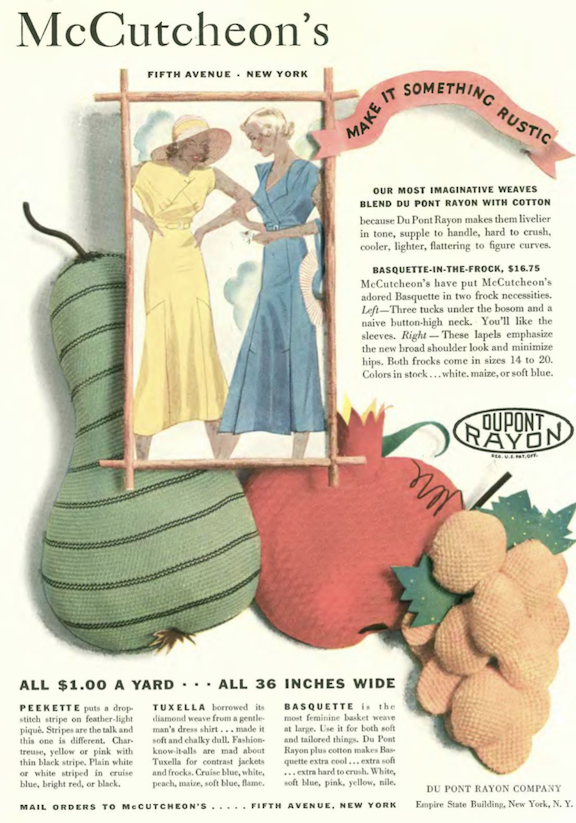
We begin with this colorful ad from McCutcheon’s to brighten our day…

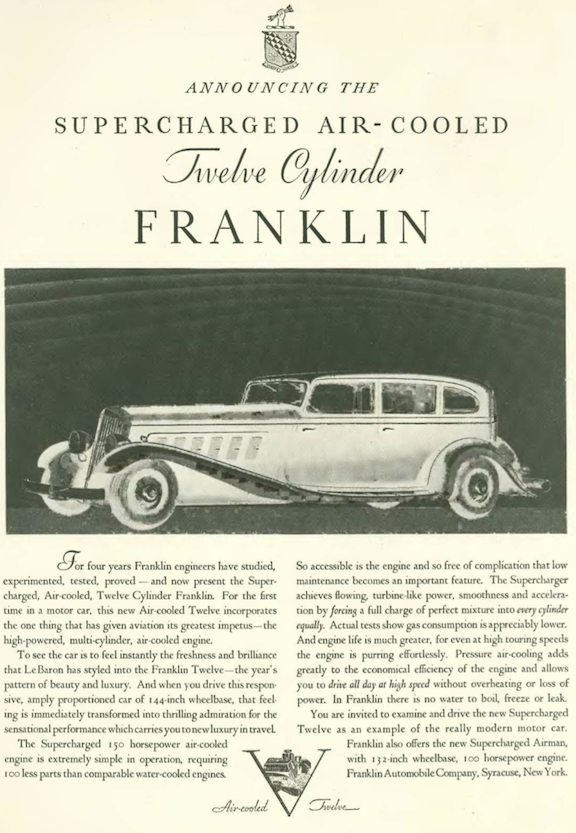
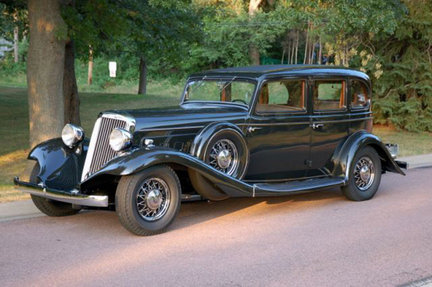
…the Franklin Automobile Company responded to competition from other luxury car makers by introducing its own 12-cylinder model, the only American car to be powered by a 12-cylinder air-cooled engine (according to the H.H. Franklin Club)…

…introducing a 12-cylinder luxury car was not a good move in 1932—one of the worst years of the Depression—and the company folded by 1934…but what a swell-looking car…

(Courtesy H.H. Franklin Club)

…one innovation that would stick around, however, was the lighted refrigerator, something to brighten those dim days of 1932, that is if you could even afford an electric fridge…

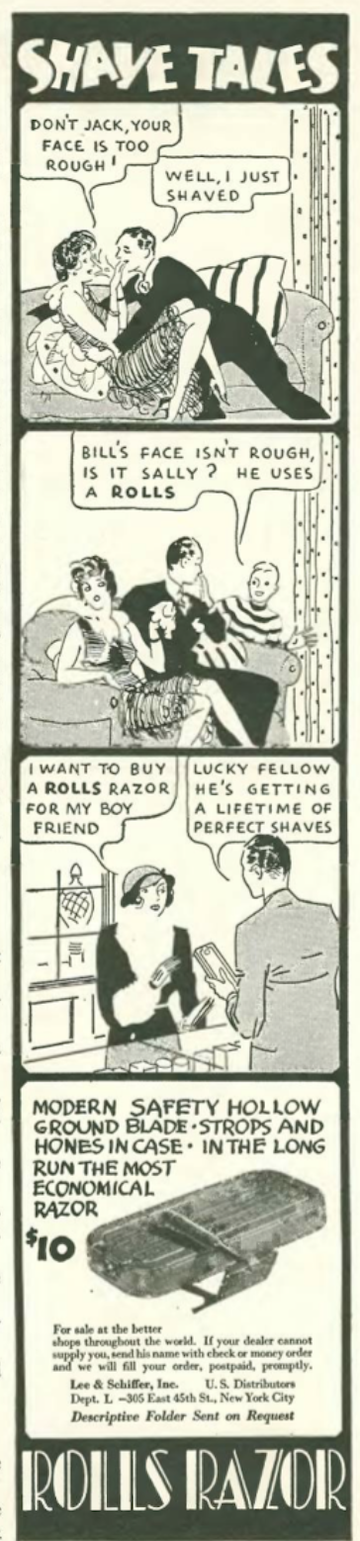
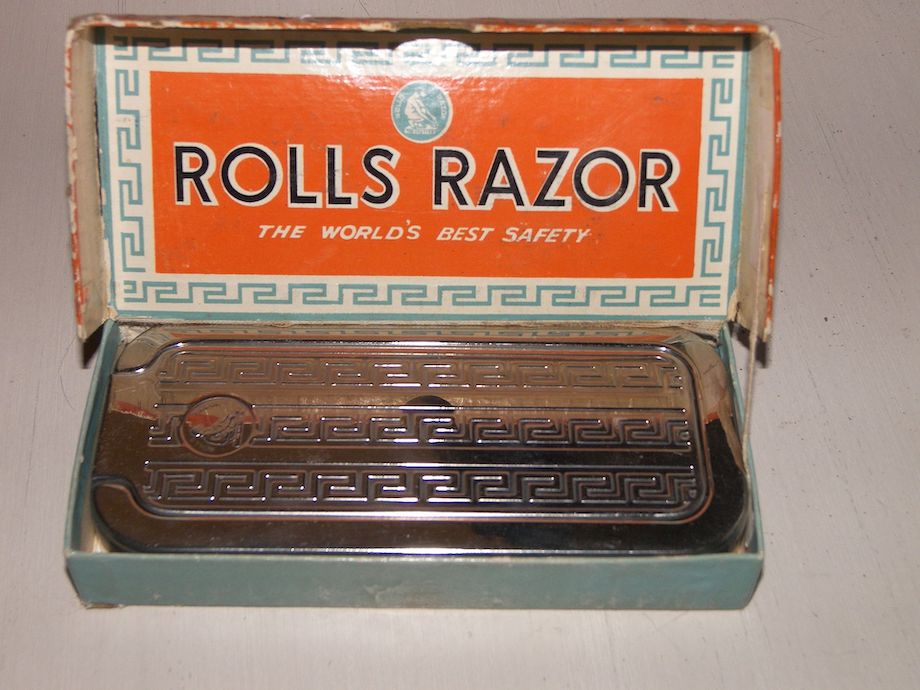
…named to evoke the luxury automobile, the British-made Rolls Razor made its debut in the back pages of The New Yorker with this panel cartoon ad featuring a hapless suitor and his girlfriend’s nosy kid brother…

…the razor came in a rigid case enclosed by two detachable lids; one carried a sharpening stone and the other a leather strop. When a lid was removed, the razor’s oscillating a handle drove a shaft along the frame, pushing the solid, hollow ground blade forward against the stone or dragging it against the strop…

…and here’s an ad you don’t see often in The New Yorker…one featuring children…

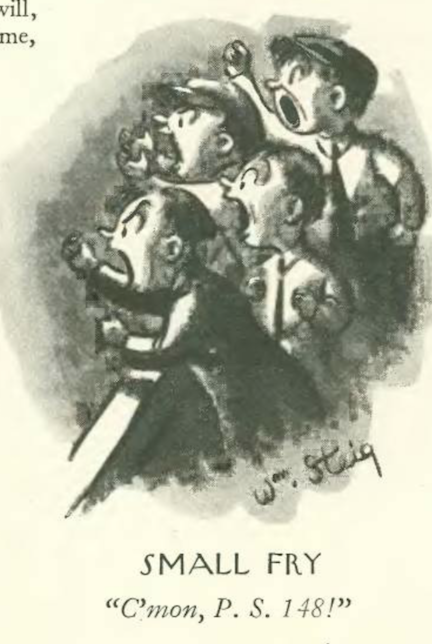
…on to our cartoonists, we have more kids via William Steig’s Small Fry…

James Thurber continued to ply his cartooning craft with one of his favorite subjects:

…here is a more detailed look at the above…

John Held Jr. continued to take us back to those saucy days of yore…

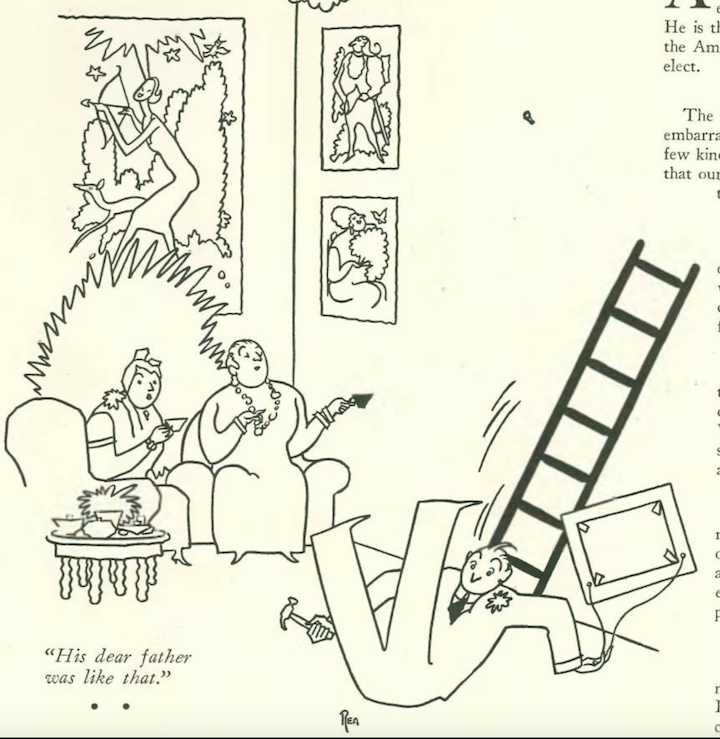
Gardner Rea sketched this hereditary pratfall…

E. McNerney gave us a woman whose beau was in alliance with architecture critic Lewis Mumford

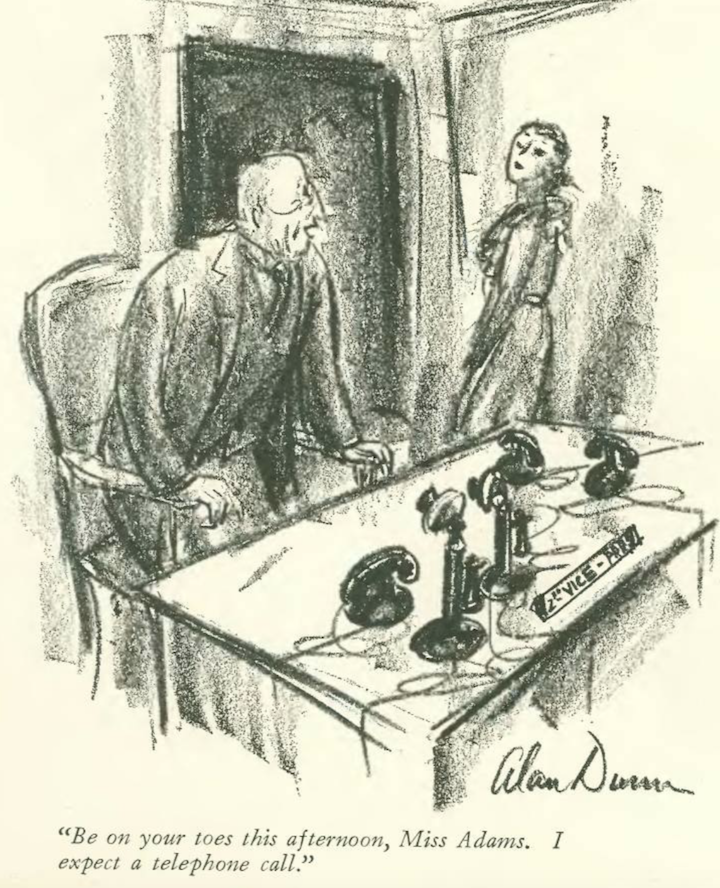
Alan Dunn looked in on the fast-paced world of business…

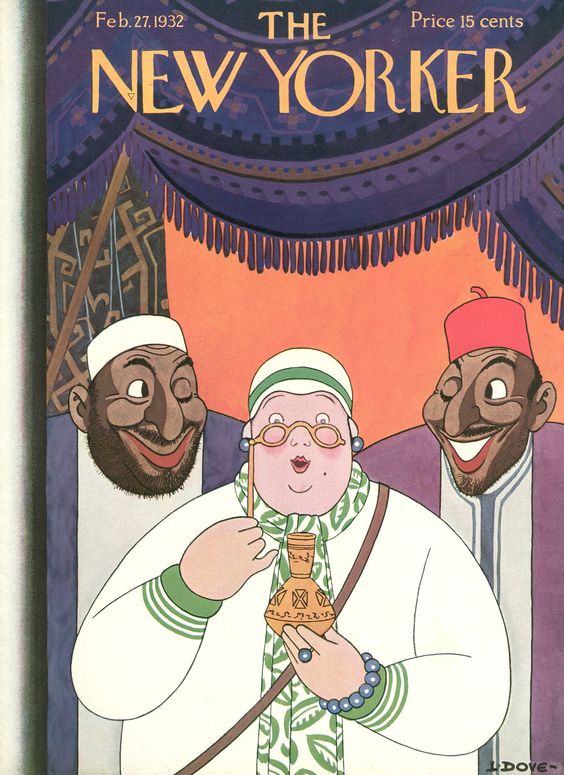
…and Leonard Dove takes us out on a droll note…

Next Time: The Quiet Man…


Winter Games

E.B. White was not known for his sports reporting, but when the Third Winter Olympic Games opened in Lake Placid, New York, on Feb. 4, 1932, it was White who represented The New Yorker at the first-ever winter games in the U.S.

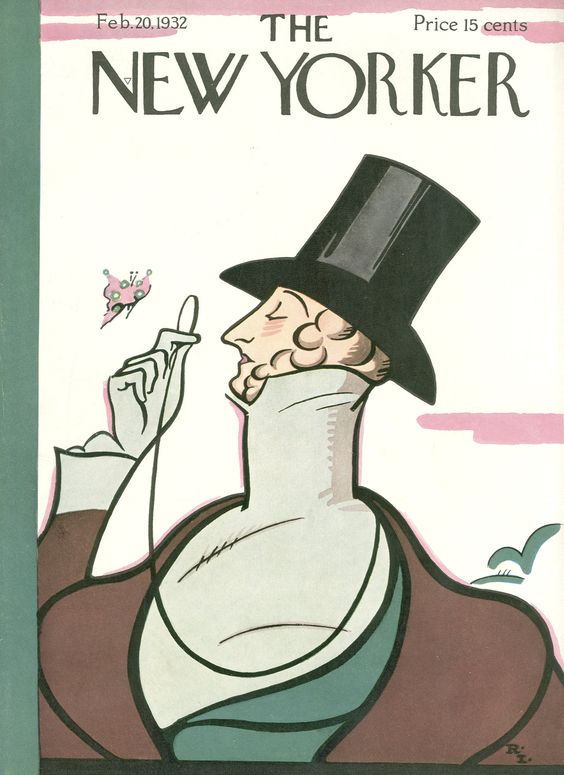
Feb. 20, 1932—seventh anniversary cover by, of course, Rea Irvin!

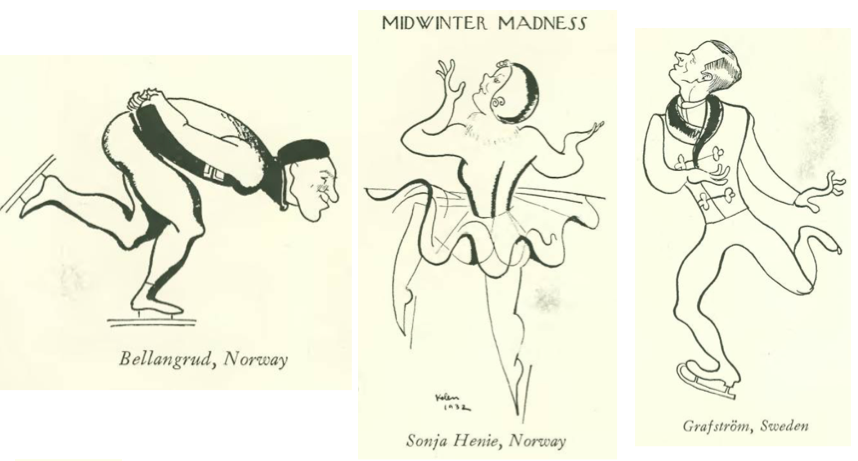
Famed caricaturist Emery Kelen (1896-1964) provided the artwork for White’s account of the games…

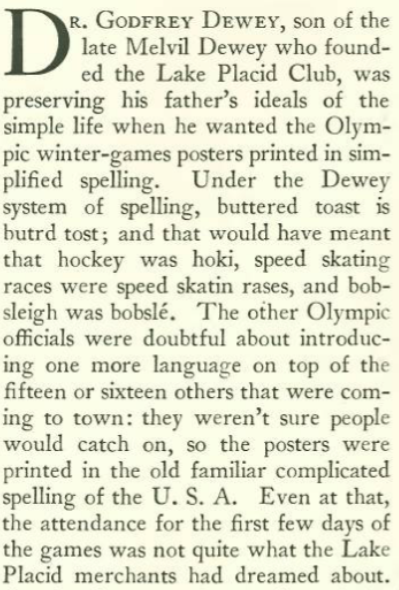
…which was featured in the “A Reporter at Large” section under the title, “Midwinter Madness.” White opened the piece with some observations on Godfrey Dewey, head of the Lake Placid Club, and son of Melvil Dewey, inventor of the Dewey Decimal System. It seems that Dewey wanted the Olympic posters printed in the simplified Dewey system of spelling:

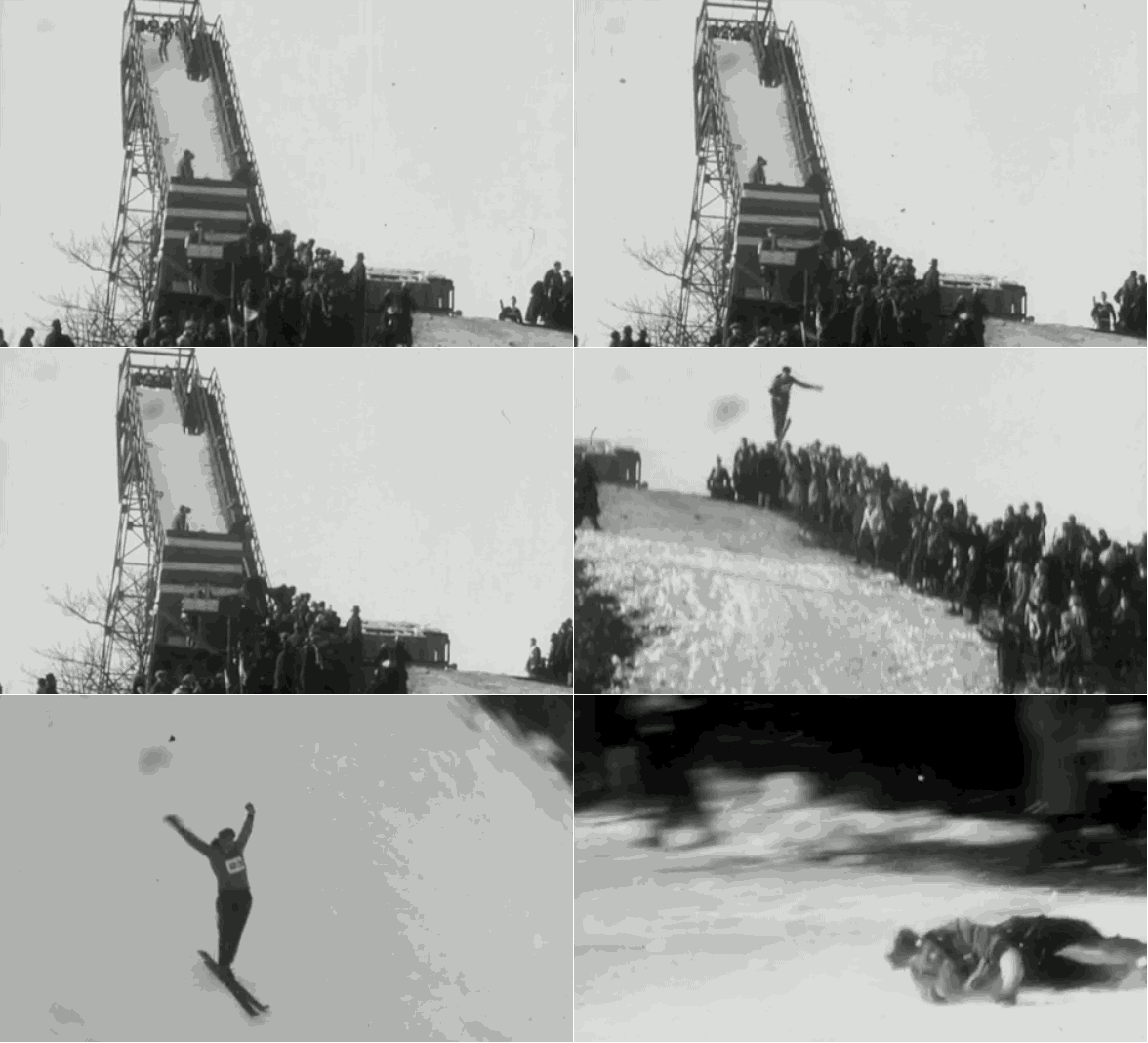
BEFORE BOB COSTAS…Opening ceremonies were a far simpler affair. Clockwise, from top left, the III Winter Olympic Games officially opened on Feb. 4; Sonja Henie of Norway and Karl Schäfer of Austria were gold medal winners in ladies’ and men’s singles figure skating; the rather uninspired official poster for the event; as a pusher in the four-man bobsleigh team, Edward Eagan (center) won the gold medal with the USA I team. Twelve years earlier Eagan had been crowned Olympic champion in the light heavyweight boxing competition at Antwerp. He was the first and only person to win gold at both the summer and winter games. Note the leather helmets and the fact that, unlike today, the sled is actually a real sled. (olympic.org/Wikipedia)

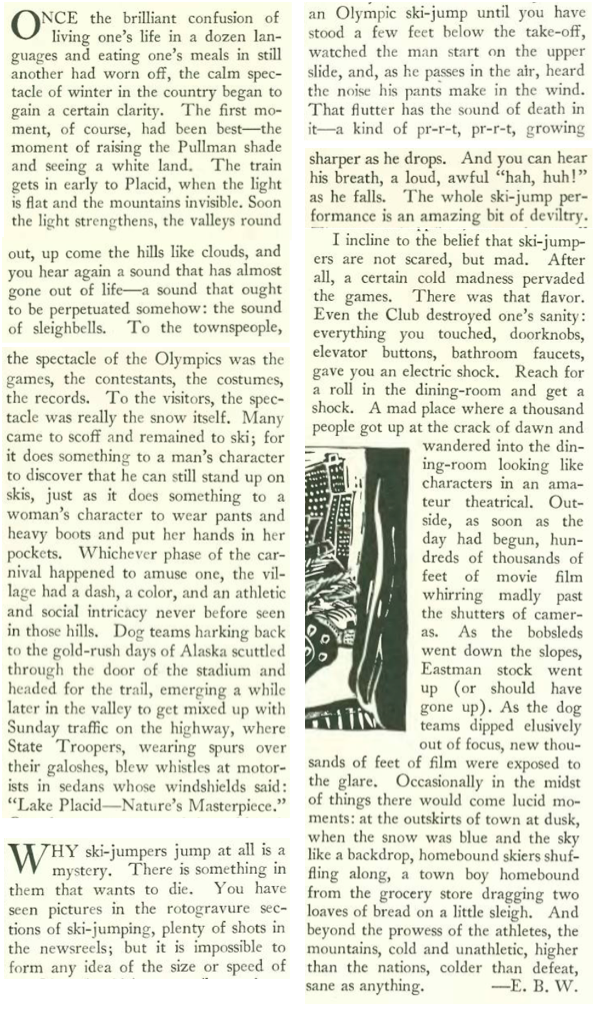
True to form, White set the stage for the games by describing his train journey to Lake Placid. At the games he observed dogsled teams—dogsled racing was one of nine sports featured at the III Winter Olympics—and marveled at the derring-do of the ski-jumpers.

Writing in the Atlantic (Feb. 10, 2014), Philip Bump described the 1932 Games as looking “way more fun and dangerous” than today’s games, “like a group of guys who set up a competition in the woods behind their house. The Jackass Games, really.” They were a lot smaller, too. The 2018 Olympics in Pyeongchang, South Korea featured entrants from 92 countries participating in 102 events over 15 disciplines. By contrast, just 17 countries participated the 1932 games.

HOVERING HANS…Norwegian Olympic skier Hans Vinjarengen took Bronze at the 1932 games. At right, ski jump at Lake Placid. (olympic.com/Wikipedia)

And we close with this gif of an unidentified ski jumper at the ’32 games…

 *  *  *

Seeing Red

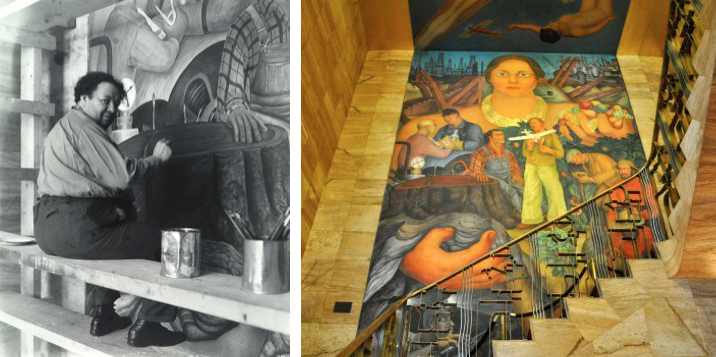
The Mexican painter Diego Rivera was sympathetic to the Soviet cause (with a Trotsky twist), but to the party faithful, painting a mural for some money-grubbing capitalists was unforgivable, as “The Talk of the Town” related…

NO GOODNIK…Left, Diego Rivera at work on Allegory of California at the San Francisco Stock Exchange Luncheon Club, 1931. At right, the mural still graces the stairwell of the building, now called “City Club.” (sfhistory.org).

 *  *  *

Thank Heaven For Little Smiles

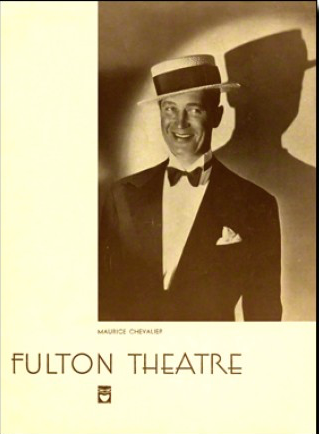
It is a challenge to find an image of Maurice Chevalier without his sunny smile, but as “The Talk of the Town” revealed, even the French crooner needed a break from all that mirth…

GRIN AND BEAR IT...Maurice Chevalier headlined an evening of song and dance at the Fulton Theatre in February 1932. (playbill.com)

 *  *  *

Survivor

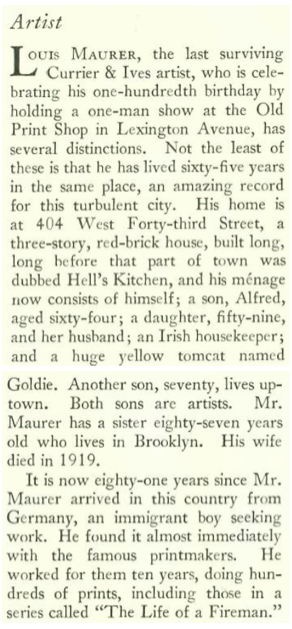
The last surviving artist of the old Currier & Ives print shop, Louis Maurer (1832–1932) celebrated his 100th birthday, and “The Talk of the Town” was there to fete the old man…

AMERICANA’S FINEST…Louis Maurer poses with one of his works on the centenary of his birth. (findagrave.com)

 *  *  *

Silence is Golden

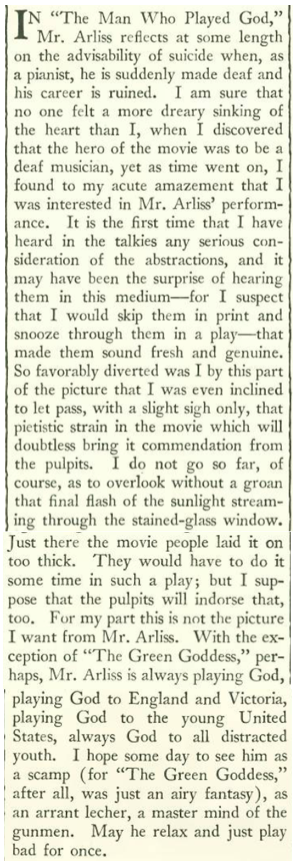
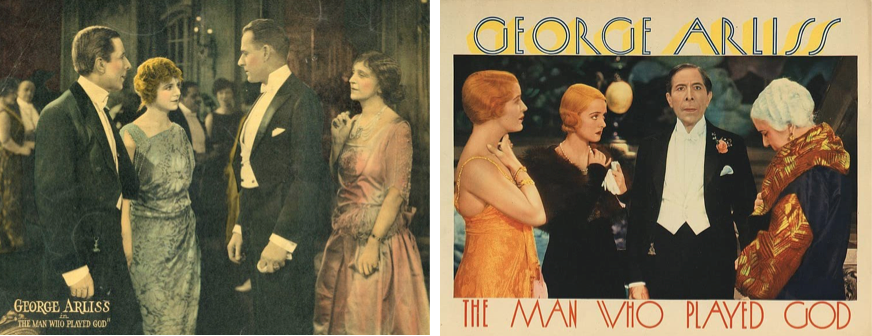
One of the older actors working in Hollywood, British actor George Arliss (1868–1946) was best known for his role in Disraeli (1929), and he is also credited with promoting the career of 23-year-old actress Bette Davis, who would have her breakout role in The Man Who Played God. This remake of a 1922 silent (that also featured Arliss) told the story of a concert pianist, Montgomery Royale, who believes his career is over when he loses his hearing. However, he finds a new purpose when he uses his lip-reading skills to help others, including himself when he calls off his engagement to Grace (Davis) after learning she is in love with another man. Critic John Mosher was impressed by Arliss, but found the film sanctimonious and wished the actor would play a baddie for a change.

TWO-TIMER…George Arliss appeared in both silent (1922) and talking (1932) versions of the The Man Who Played God. The latter film featured 23-year-old Bette Davis (second from left) in her breakout role. (IMDB)
DRAMA KING…Concert pianist Montgomery Royale (George Arliss) considers suicide when he loses his hearing in 1932’s The Man Who Played God. Arliss was the first British actor to win an Academy Award for his role as PM Benjamin Disraeli in 1929’s Disraeli. (IMDB)

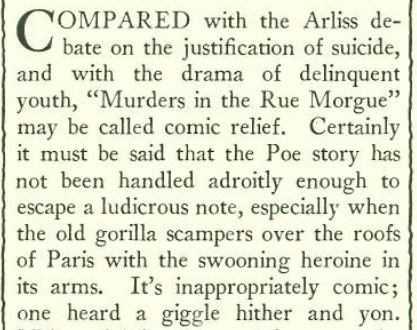
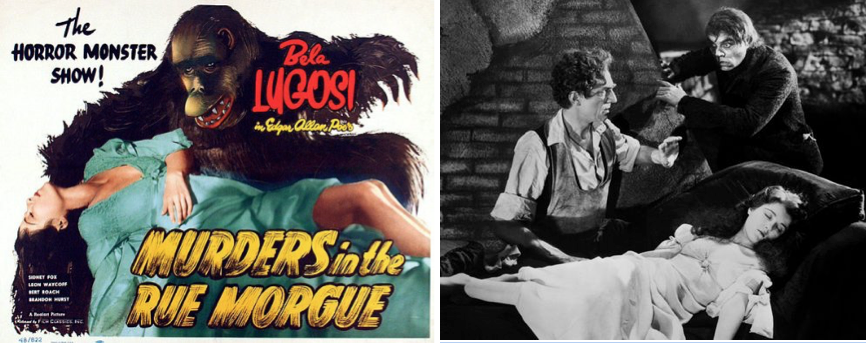
While Mosher found The Man Who Played God a bit too preachy, Murders in the Rue Morgue (1932) was way too campy to be taken seriously as a horror film. Thanks to his newfound Dracula fame, Bela Lugosi headlined the film, which debuted another young star, Arlene Francis (1907–2001), who would find her greatest fame in television from 1949 to 1983, most notably on the long-running quiz show What’s My Line?

HORROR MONSTER SHOW…or so the producers of Murders in the Rue Morgue (1932) claimed. Still image from the movie featured Bela Lugosi (left), Noble Johnson and Arlene Francis. (IMDB)

 *  *  *

From Our Advertisers

Planning a visit to England? Don’t be mistaken for a clod-kicking Yankee and get yourself over to Lord & Taylor’s…

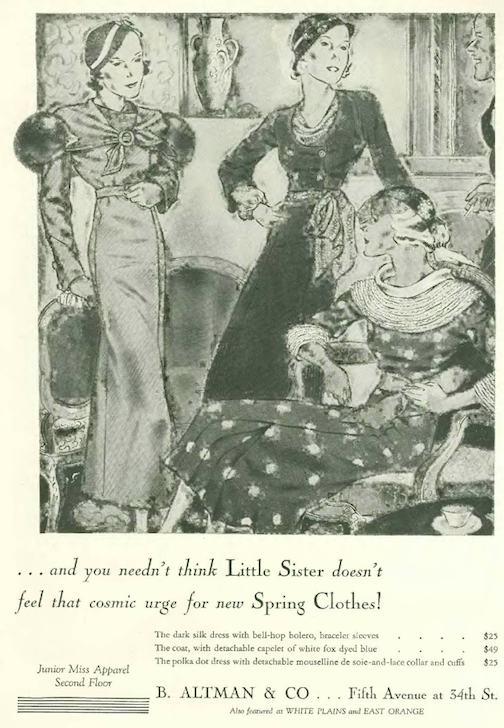
…and with spring in the air make sure little sis has the right duds to look like a 40-year-old woman…

…if you’re taking the train, you wouldn’t dare sit with the proles (I mean, look at that woman eating god-knows-what from a wrapper, and some filthy urchin wandering the aisles, and what the hell does Mr. Creepo have in that box?), so why settle for plain old gas when you can sweeten it with some lead?…

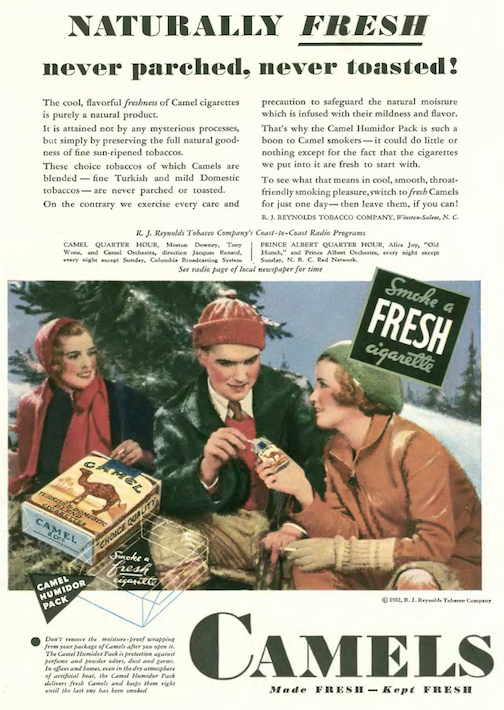
…nothing better than traveling out into the fresh air to breathe in some nice fresh tobacco smoke…it’s naturally fresh, so it’s just as good as mountain air, maybe even better

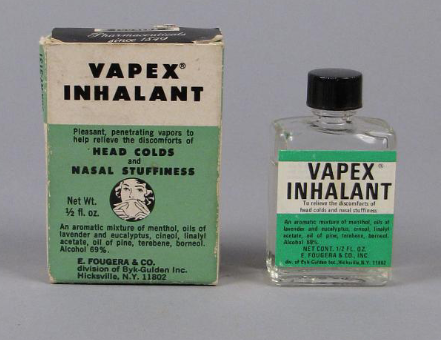
…this poor chap can’t breathe well at all, or so he claims, and that’s why he needs Vapex…

…which puts him right to sleep because it contains 70 percent alcohol, so why not take a couple of chasers with that snort…you’ll get used to the menthol flavor (it’s in your Spud cigarettes after all) and before long it’s nighty-night, oh hell I’ll just drink this and put a little ether on my pillow…yeah that’s the ticket…

…for others, why even bother pretending Prohibition is still a thing?…

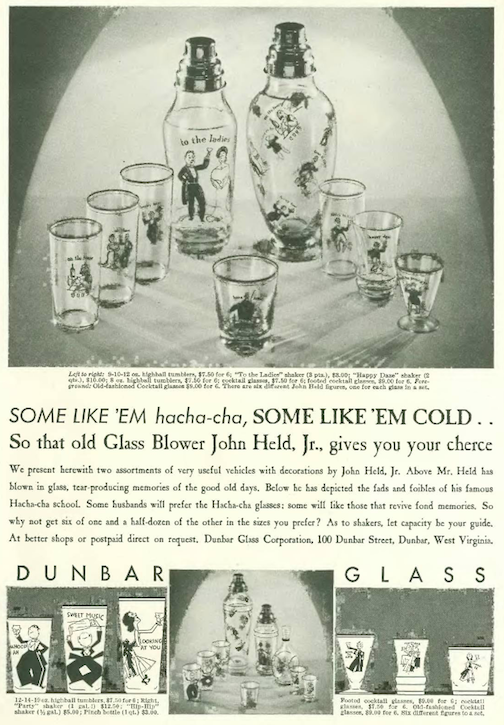
…and look at this swell cocktail set you could stock in your Bantam Bar, designed by The New Yorker’s own John Held Jr

…on to our cartoons, we have Held again with another look at those naughty Victorian days…

Rea Irvin continued his commentary on the “improving” economy…

...Richard Decker gave us a master of understatement…

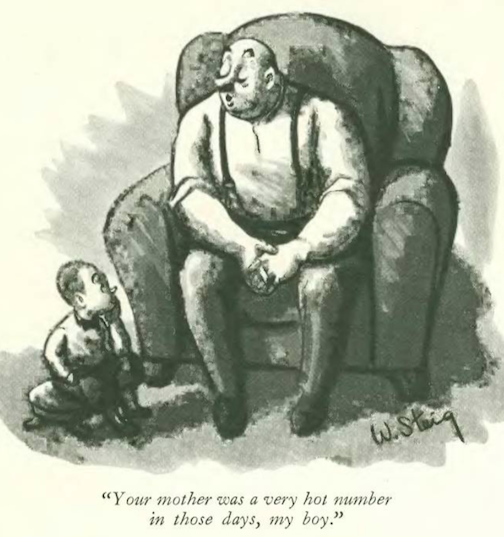
William Steig captured a special father-son moment…

Barbara Shermund continued to explore the ways of her modern women…

…given the recent kerfuffle over Dr. Seuss, Carl Rose confirms just how acceptable racist stereotypes were back in the day…

…and we end with Peter Arno, and one sugar daddy finding himself on the skids, temporarily at least…

Next Time: MoMA Sees The Future…


Back in the USSR

The year 1932 was a tough one for many Americans, barely scraping by in the deepening Depression. But to the suffering millions in the Soviet Union, America’s economic woes looked like a walk in the park.

Jan. 30, 1932 cover by Rose Silver.

The year marked the beginning of a catastrophic famine that swept across the Soviet countryside, thanks to the government’s bone-headed and heartless forced collectivization that caused more than five million people to perish from hunger. Those events, however, were still on the horizon when Robin Kinkead, a New York Times Moscow correspondent, ventured out into Moscow’s frigid streets in search of a lightbulb. Here is his story:

WE HAVE PLENTY OF NOTHING FOR EVERYONE…In 1930s Moscow, and in the decades beyond, much of life consisted of standing in line for everything from bread to light bulbs.
MAGIC LANTERN…Russian peasants experience electricity for the first time in their village. (flashback.com)
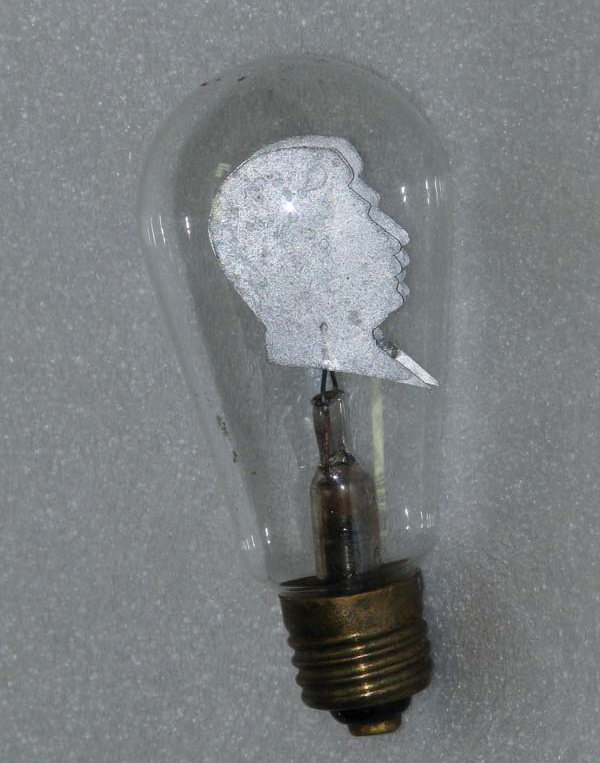
STALIN CAST A LARGE SHADOW over his subjects, even when they sought a bit of light in the darkness. Stalin and Lenin profiles served as glowers in this Soviet lightbulb, circa 1935. The first series of these bulbs were presented to the delegates of Soviet parliament of 1935, just in case they forgot who was in charge—or who might liquidate them at any moment, for any reason, or for no reason. (englishrussia.com)

*  *  *

One of Theirs

Miguel Covarrubias was one of the first artists to contribute to the fledgling New Yorker, and his linear style was well known to readers when he opened his latest show at New York’s Valentine Gallery. It featured works he had created during a 1931 sojourn in the East Indies. Critic Murdock Pemberton found the palette reminiscent of Covarrubias’ earlier work during the Harlem Renaissance:

GLOBETROTTER…A frequent contributor to the early New Yorker, Miguel Covarrubias traveled the world in search of inspiration. His 1932 exhibition at New York’s Valentine Gallery featured his latest work, a series of “Balinese paintings” including In Preparation of a Balinese Ceremony, at right. (sothebys.com)
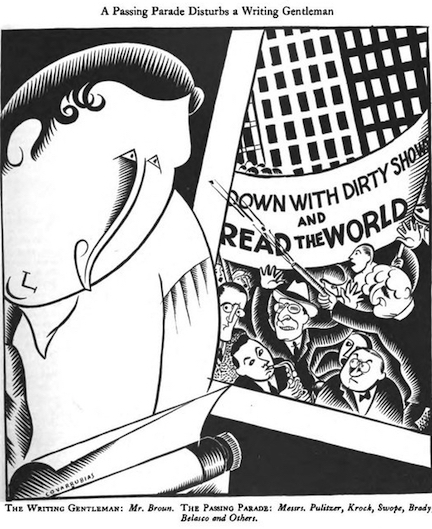
MAN OF MANY TALENTS…An early Covarrubias contribution to the New Yorker in the March 7, 1925 issue.
 *  *  *
From Our Advertisers
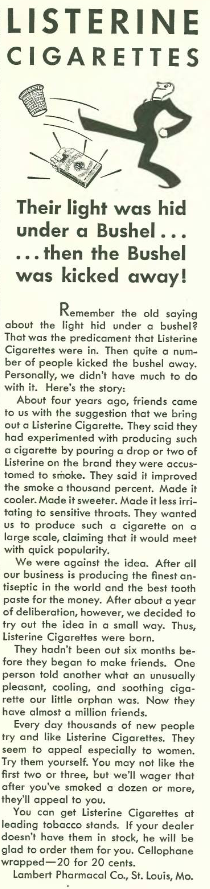
Listerine had been around since the late 1860s, but it wasn’t marketed as a mouthwash until 1914. The brand really took off in the 1920s when it was heavily advertised as a solution for “chronic halitosis” (bad breath), so in 1930 its makers went one step further by adding a few drops of their product to one of the chief causes of bad breath. The folks at Listerine were also keen to the growing market of women smokers—note the fifth paragraph: “They seem to appeal especially to women”…

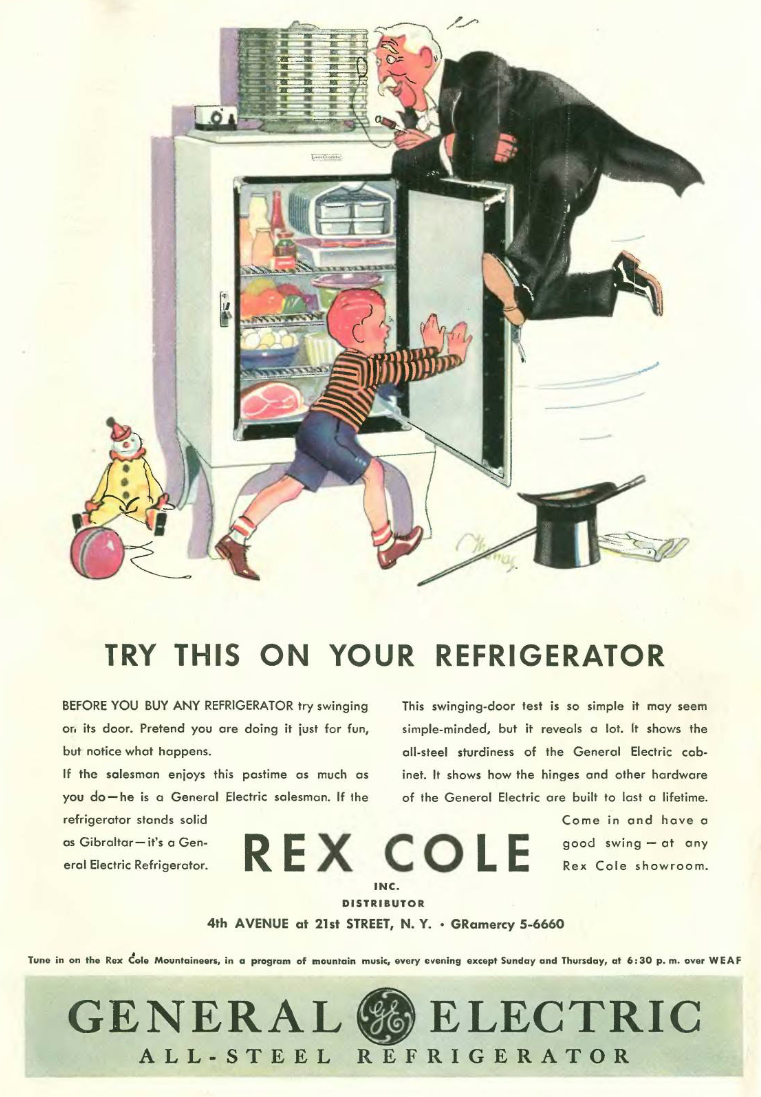
…when you run out of ideas to amuse your grandchild, drop your top hat and walking stick and let him take you for a swing on a GE fridge door…wow, admire its “all-steel sturdiness” as it slowly tips toward the unsuspecting lad…

…on to our cartoons, Rea Irvin showed readers what he thought of the latest “rosy” economic predictions…

…but with the economy still deep in the dumps, building continued to boom, per Robert Day

Perry Barlow gave us a fellow needing a break from the daily gloom…

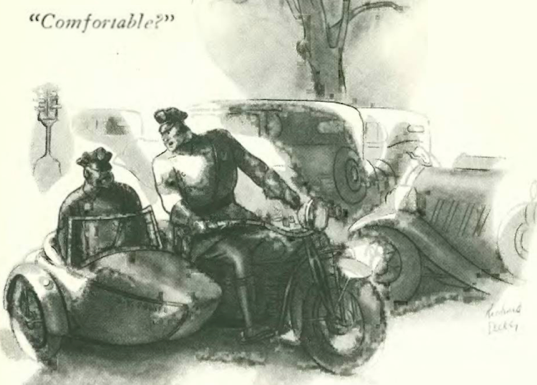
Richard Decker unveiled this crime-fighting duo…

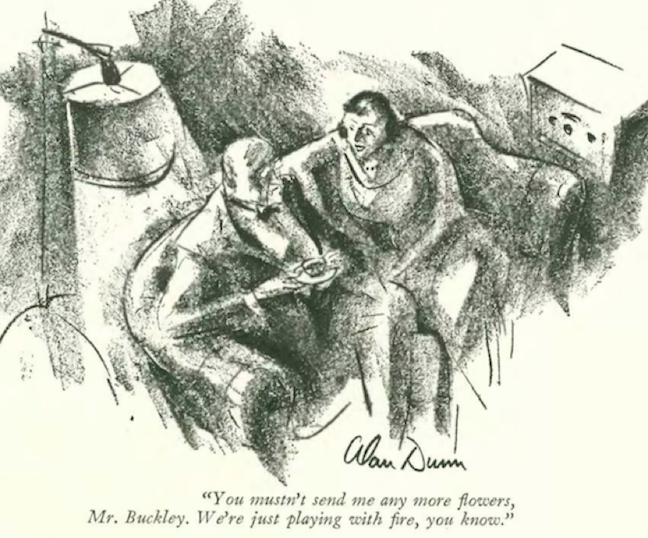
Alan Dunn tempered the flames of passion…

…and we close this issue with one of James Thurber’s most famous cartoons…

…on to Feb. 6, 1932…

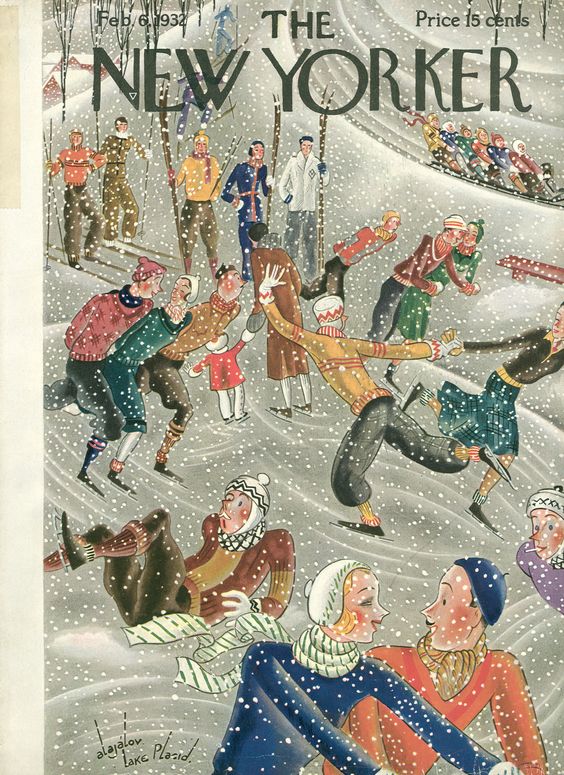
Feb. 6, 1932 cover by Constantin Alajalov.

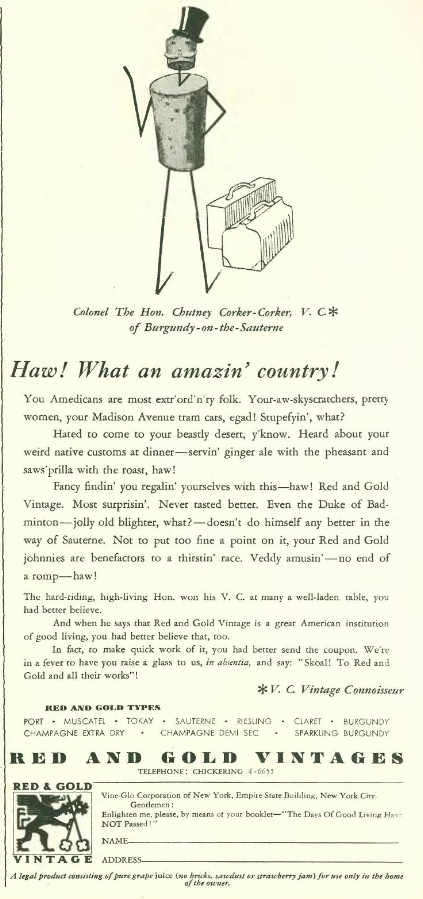
…and we head straight to our advertisers…and yet with another sad Prohibition-era ad, this from the makers of Red & Gold Vintages, who promised to dress up your bootleg rotgut with many fine flavorings…

New Yorker founding editor Harold Ross couldn’t care less about the advertising department as long as it paid the bills and kept its nose out of editorial, but I wonder if a cig dropped from his lips when he glanced at this ad…

…as noted in the Listerine ad above, tobacco companies were eager to tap the growing market of women smokers…actress Sue Carol egged on the sisterhood in this ad…Carol would have a brief acting career (including 1929’s Girls Gone Wild—not quite as racy as the 1990s DVD series) before becoming a successful talent agent…

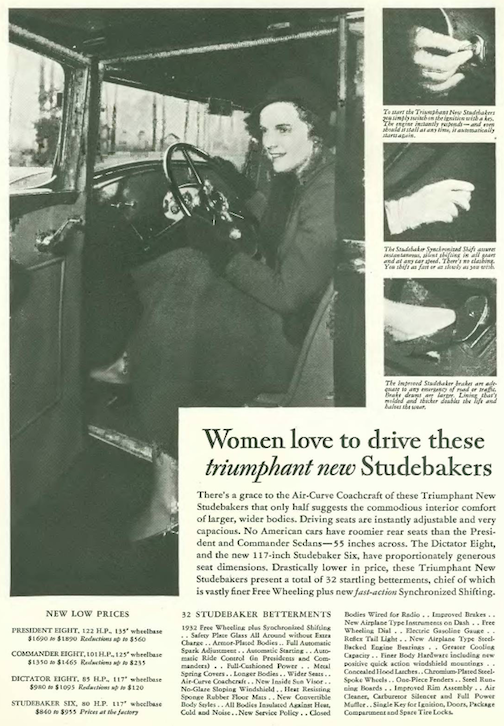
…as noted in my previous “Dream Cars” post, women were also a fast growing market for automobiles, and manufacturers—desperate for Depression-era sales—scrambled to show women all of the swell gadgets that would make driving a snap (as if men didn’t need these gadgets too)…

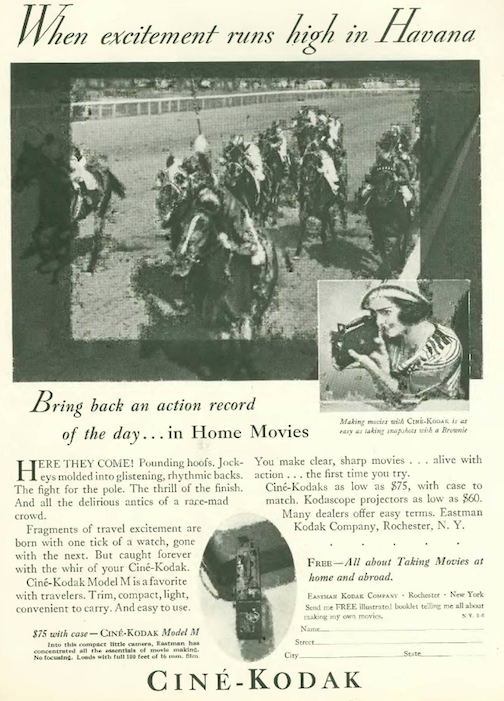
…and here we have an ad from Kodak that demonstrated the ease of its home movie camera, which could go anywhere, say, like the horse races in Havana…

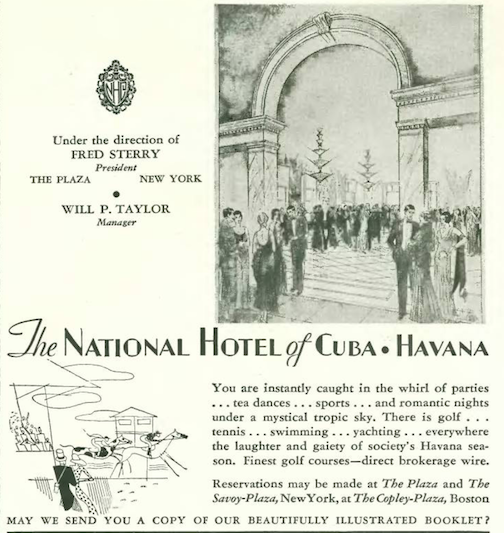
…Havana then was a playground for wealthier Americans, and many resided at a grand hotel operated by another rich American…

…but if you remained in town, you should at least know how to get tickets to the latest show (this drawing is signed “Russell”…could it be the noted illustrator Russell Patterson?)…

…on to our cartoons, Rea Irvin again commented on the latest predictions for economic recovery…

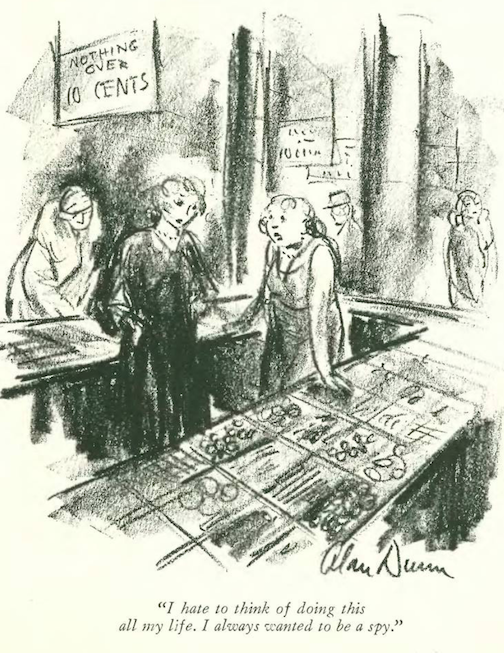
…but Alan Dunn found one woman who wanted an adventure, not a job…

…perhaps she should hang out with one of Barbara Shermund’s “New Women,” who had a flair for the dramatic…

…as for those seeking a new life, Mary Petty considered the costs…

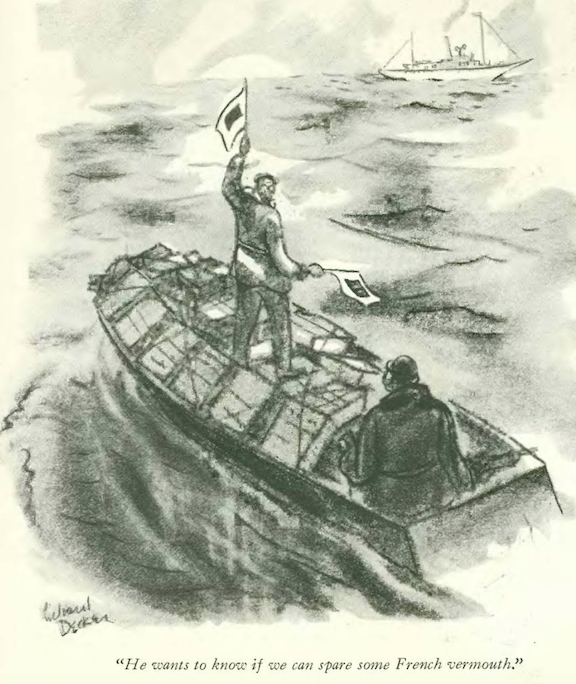
Richard Decker took us to the high seas, where a thirsty yachtsman hailed a passing smuggler…

Otto Soglow probed the sorrows of youth…

…and William Crawford Galbraith, the joys…

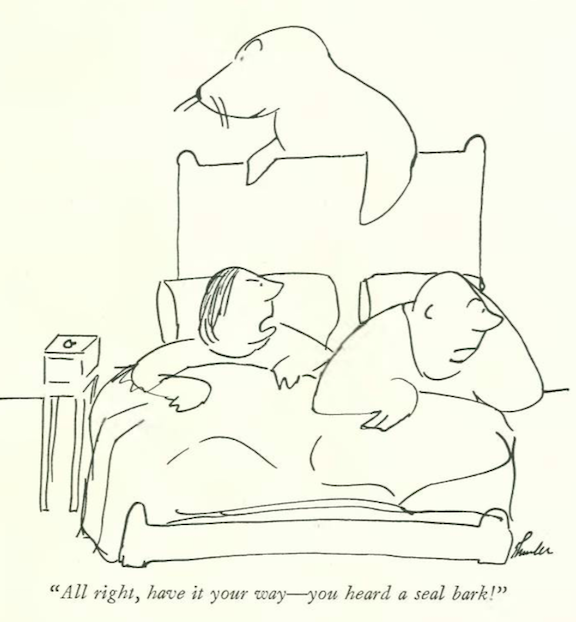
…and James Thurber introduced his classic dog in a big way on this two-page spread…

…and on to one more issue, Feb. 13, 1932…

Feb. 13, 1932 cover by S. Liam Dunne.

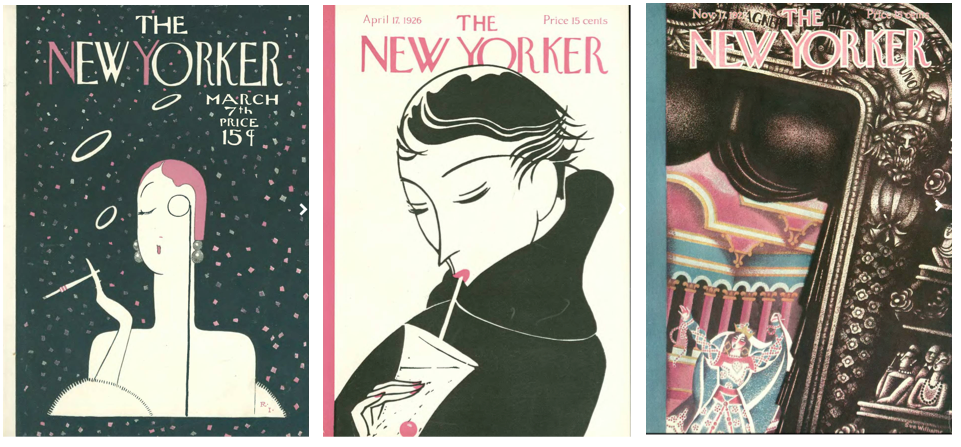
…we begin with a nerd alert—the Feb. 13 cover represented one of the magazine’s biggest departures from the original Rea Irvin nameplate, here heavily embellished within S. Liam Dunne’s design. Departures in previous issues were more subtle, Irvin himself experimented with an elongated version in the third issue (below, left). For the April 17, 1926 issue, Katharine and Clayton Knight’s* stylish illustration (center) was the first to overlap part of the nameplate, and Sue Williams’ Nov. 17, 1928 cover (right) was the first to embellish the Irvin font.

*A note on Katharine Sturges Knight and Clayton Knight. The April 17, 1926 cover (center) was the only design by the Knights published by The New Yorker. The original picture was drawn on wood by Katharine and then cut by Clayton. Their son, Hilary Knight, is also an artist, best known as the illustrator of Kay Thompson’s Eloise book series.

…on to the advertisements, kicking off with this subtle appeal from the makers of the unfortunately named “Spud” menthol cigarettes…here a young woman experiences Spud’s “mouth-happiness” while attending the annual Beaux Arts Ball at the new Waldorf-Astoria…

…if you’re wondering why the Spud ad featured a guy in a powdered wig puffing on a cigarette, well the theme of the 1932 ball was “A Pageant of Old New York.” Every year had a different costume theme, and the ladies and gentlemen of the ruling classes delighted in dressing up for the occasion…

PLAYING DRESS-UP…Program for the 1932 Beaux Arts Ball, and two of the attendees, Frank Sanders and Frances Royce. (Pinterest)

…if stuffy events weren’t your thing, you could chuck the fancy duds and head to the sunny beaches of Bermuda…

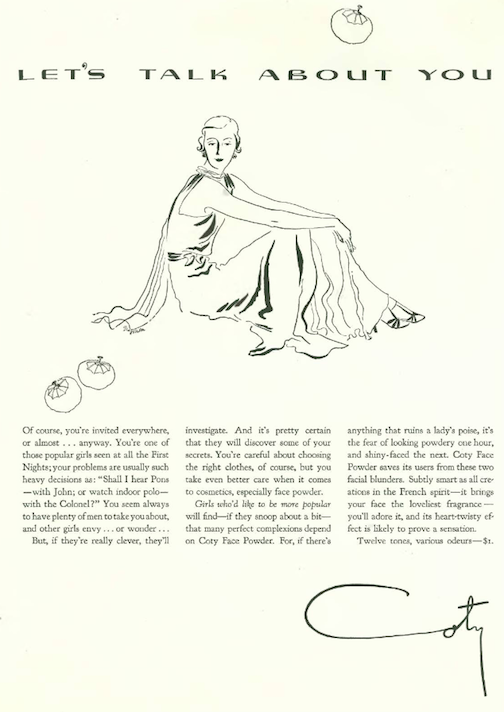
…I include this Coty advertisement for its modern look — it easily could have appeared in a magazine from the 50s or even 60s…the artwork is by American fashion illustrator Ruth Sigrid Grafstrom…

…the auto show has left town, but for some reason the makers of 12-cylinder models continued to shill their products in the New Yorker…Auburn (the middle ad) built beautiful, upscale vehicles, but the Depression would drop it to its knees by 1937…Pierce Arrow would succumb the following year…Lincoln, the highest-priced of these three, would hang on thanks to the largess of parent Ford…

New Yorker cartoonist John Held Jr. picked up some extra bucks by designing this ad for Chase and Sanborn’s…

…and on to our other cartoonists/illustrators, Reginald Marsh wrapped this busy dance hall scene around a section of “The Talk of the Town”…

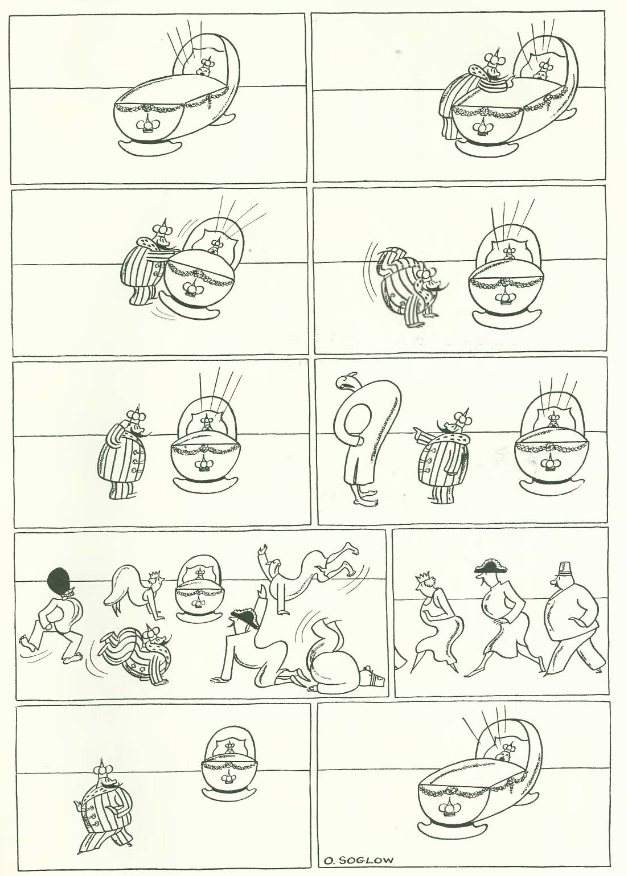
Otto Soglow was back with his Little King, and the challenges of fatherhood…

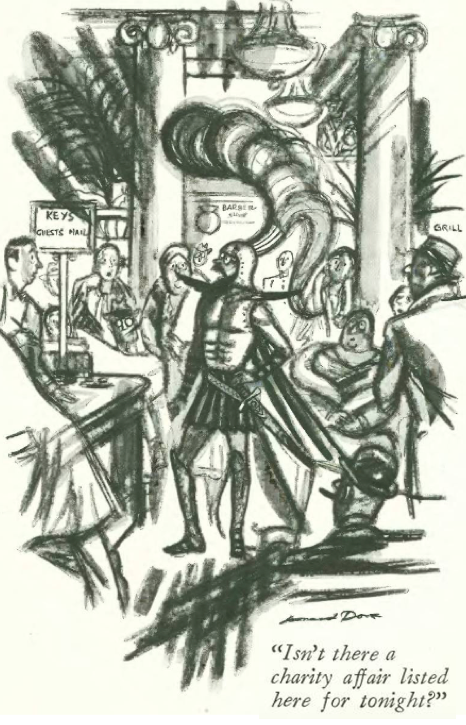
Leonard Dove gave us a knight lost on his crusade…

Richard Decker explored the softer side of gangster life…

…and we sign off with Peter Arno, and a little misunderstanding…

Next Time: Winter Games…

An American Classic

Immigration over the centuries transformed New York City into a cosmopolitan metropolis, with many of those migrants drawn from America’s hinterlands. What they found in the city was not only economic opportunity, but also a place to grow artistically and intellectually.

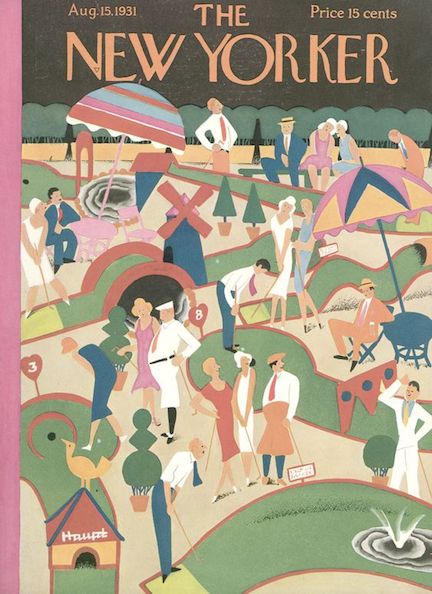
Aug. 8, 1931 cover by Theodore Haupt.

Such was the case of Willa Cather, who while living in New York City would draw on her Nebraska childhood to write a succession of novels about prairie life and its people (including My Antonia and O Pioneers!) that would culminate in a 1923 Pulitzer Prize.

Louise Bogan, in 1931 a new poetry editor for The New Yorker (and a poet herself), wrote a profile of Cather for the Aug. 8 issue. An excerpt:

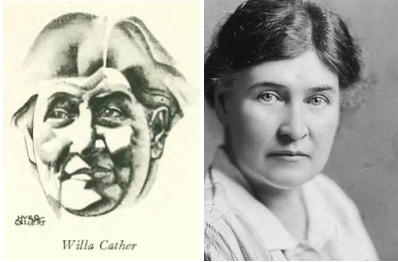
TWO FACES…Hugo Gellert rendering of Willa Cather for the profile; undated photo at right gives you some idea of the look Cather aimed at the affected behavior of others. (The New York Times)
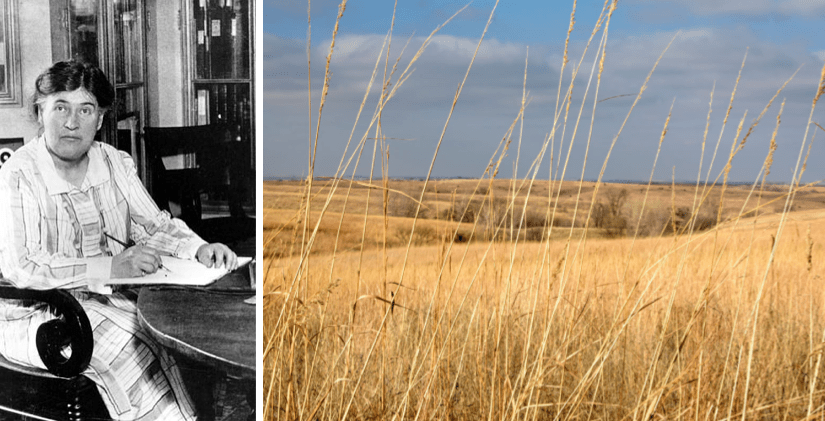
FORMATIVE YEARS…Clockwise, from top left, Willa Cather as a student at the University of Nebraska in the early 1890s; classmates at Nebraska included author and activist Dorothy Canfield Fisher and Alvin Johnson, later a co-founder of New York’s New School. Both Cather and Fisher took fencing lessons from John J. Pershing, who taught military science at Nebraska; Cather’s childhood home in Red Cloud, Neb., and the prairie that inspired much of her writing. (news.unl.edu/Wikipedia/new school.edu/literaryamerica.net)
CITY LIFE…Clockwise, from top: S. S. McClure, Willa Cather, Ida Tarbell, and Will Irvin visit in Washington Square Park, 1924; Cather in the meadow of High Mowing farm near Jaffrey, N.H., where she wrote part of My Antonia; on the cover of Time, Aug. 3, 1931; one of Cather’s New York residences at 82 Washington Place. (Indiana University/Southwick Collection, University of Nebraska/time.com/jschumacher.typepad.com)

Bogan concluded the profile with this note about Lèon Bakst, who was commissioned in 1923 to paint a portrait of Cather while she visiting Paris (image courtesy Omaha Public Library):

My dear late friend Susan Rosowski, who was a preeminent Cather scholar, wrote that Cather was “the first to give immigrants heroic stature in serious American literature.” In these times when immigration is so hotly debated, it is worth revisiting My Antonia and O Pioneers! to recall what once made America truly great.

 *  *  *

One Arm Restaurant

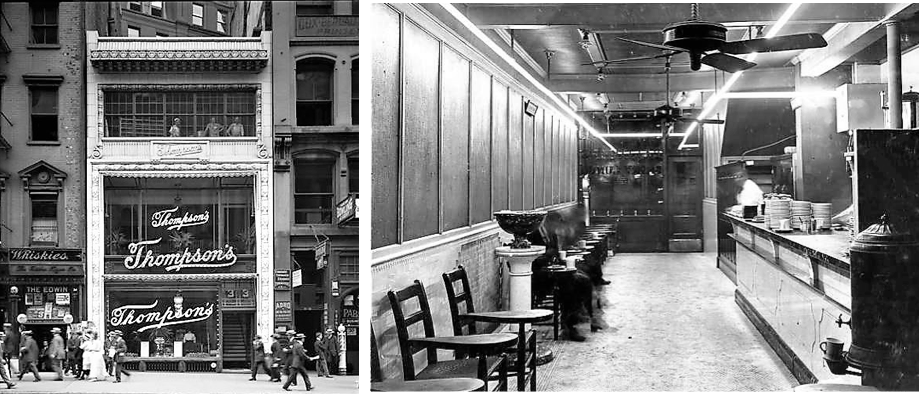
If you wanted to get lunch fast and cheap in 1931 you might have stopped at one of John Thompson’s New York restaurants. According to Tom Miller (daytoninmanhattan.blogspot.com), there were no waiters in Thompson’s restaurants. “Customers purchased foods like cold corned beef, cold boiled ham, smoked boiled tongue or hot frankfurters at a counter. They then took their trays to ‘one arm’ chairs lined up along the wall. There were no tables; instead customers ate at what was similar to turn-of-the-century school desks.” E.B. White stopped in for a visit:

YOU CAN’T MISS IT…John Thompson’s name is emblazoned no less than four times on the front of his restaurant at No. 33 Park Row. No-frills interior featured “one-arm” chairs and a self-service coffee urn. (Museum of the City of New York /daytoninmanhattan.blogspot.com)

 *  *  *

Cinematic Eyeful

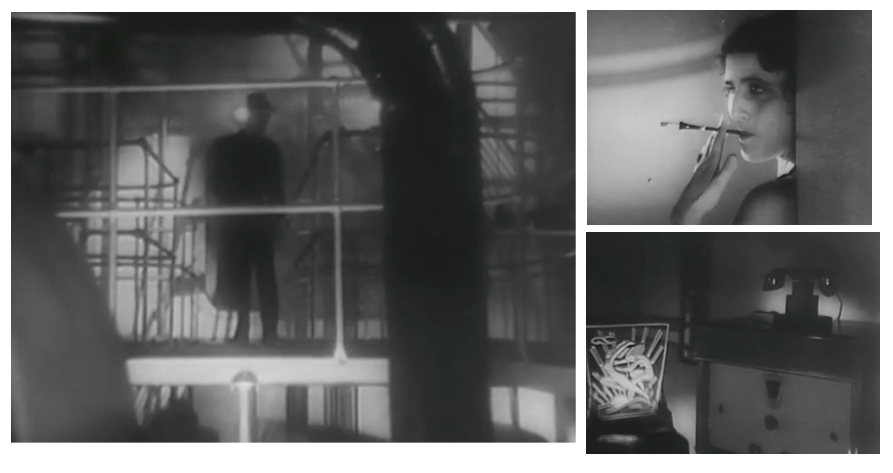
The Pre-Code comedy-drama Transatlantic was light on plot but heavy on deep-focus cinematography (by James Wong Howe) that wowed New Yorker critic John Mosher in 1931…and still wows critics today.

High Seas Hijinks…The pre-code comedy-drama Transatlantic wowed critic John Mosher not so much for its storyline as for its style and cinematography. Clockwise, from left, Edmund Lowe has his hands full with Lois Moran, Greta Nissen and Myrna Loy. (IMDB)
NIFTY NOIR…John Mosher loved the avant-garde, noir-ish stylings of Transatlantic. This film by director William K. Howard and cinematographer James Wong Howe is still admired today. A MoMA cinema site notes that the film’s style anticipates Citizen Kane by ten years. (pre-code.com)

 *  *  *

From Our Advertisers

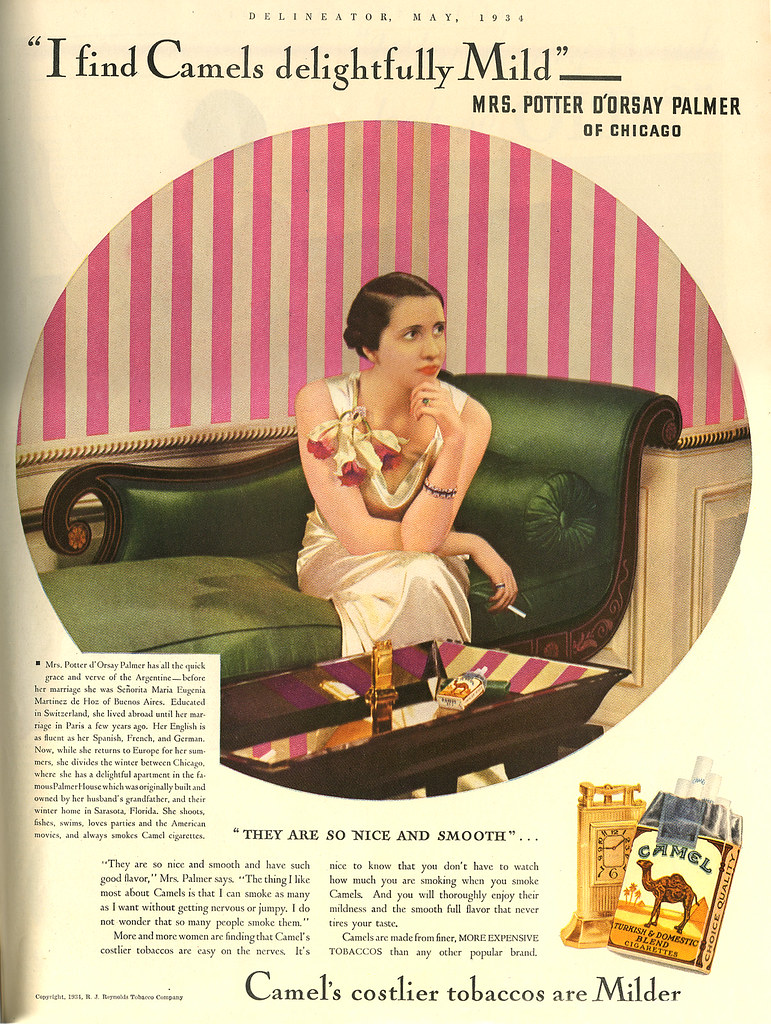
We begin with another socialite endorsing Pond’s Cold Cream — Mrs. Potter d’Orsay Palmer nee Maria Eugenia Martinez de Hoz. She was wife No. 2 of Potter d’Orsay Palmer, son of the wealthy family of Chicago Palmer House fame…they would divorce in 1937, and the playboy Potter would marry two more times before dying of a cerebral hemorrhage in 1939 (the result of a drunken brawl). Maria Eugenia would remarry and return to her homeland of Argentina to raise a family…

…it seems Maria Eugenia didn’t limit herself to endorsing cold cream, as this next ad attests (from the May, 1934 Delineator magazine)…

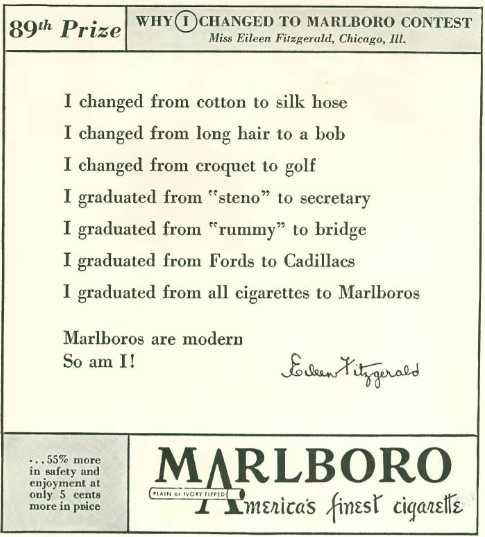
…Maria Eugenia endorsed Camels because they were marketed to women back then, as were Marlboro cigarettes, the makers of which continued their silly handwriting and jingle-writing contests to promote the brand (note the examples “Miss Eileen Fitzgerald” offered of what defined a modern lifestyle)…

…the makers of Chesterfield cigarettes, on the other hand, originally marketed their product to men, but they made sure women were included in the copy beneath the image — “yes, there’s a big woman vote” …

…you may recall the subtle ways Liggett & Myers began to lure women smokers back in 1928 with this ad campaign…

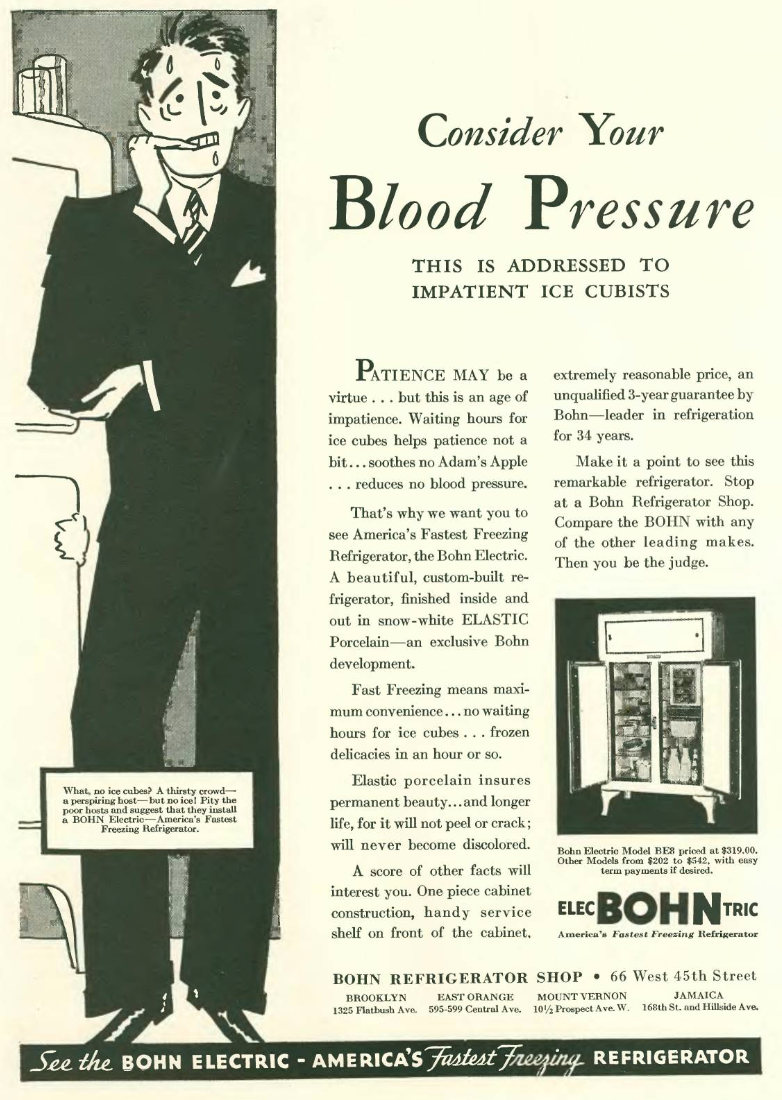
…you see a lot of tobacco ads because cigarette manufacturers were one of the few industries still turning a profit during the first years of the Depression…men and women were smoking like crazy, maybe to calm their nerves over the performance of their refrigerators…

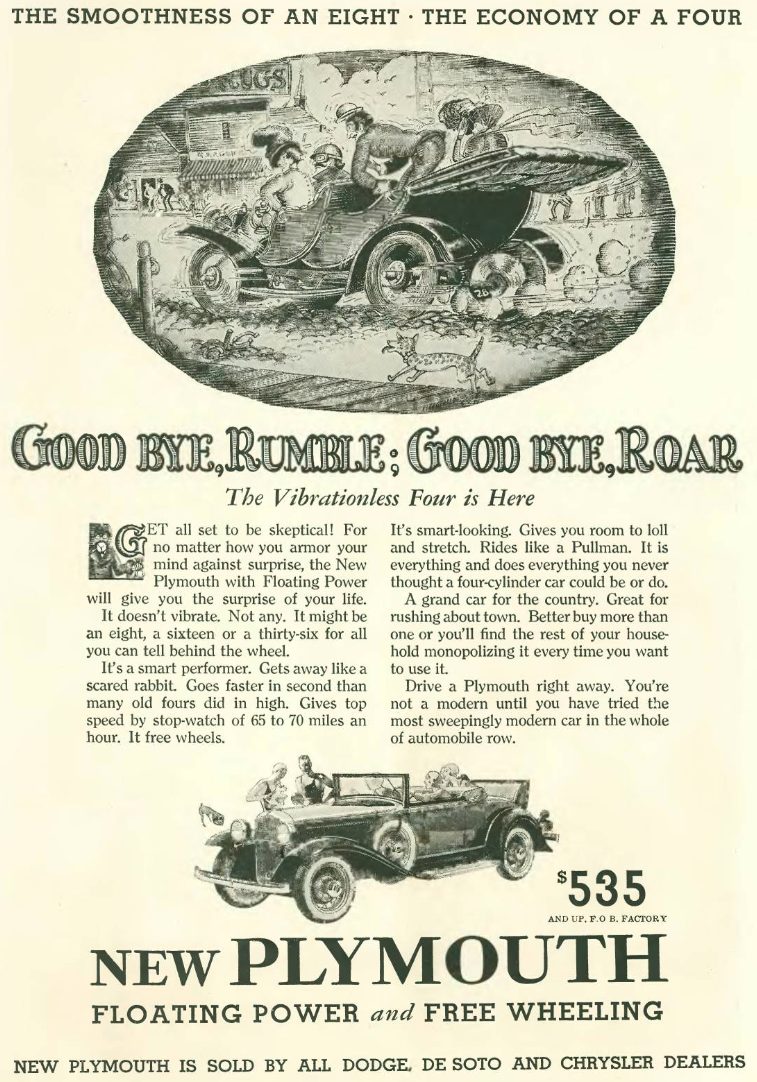
…one could always calm the nerves by taking a spin in a new Plymouth, bargain-priced at just $535…

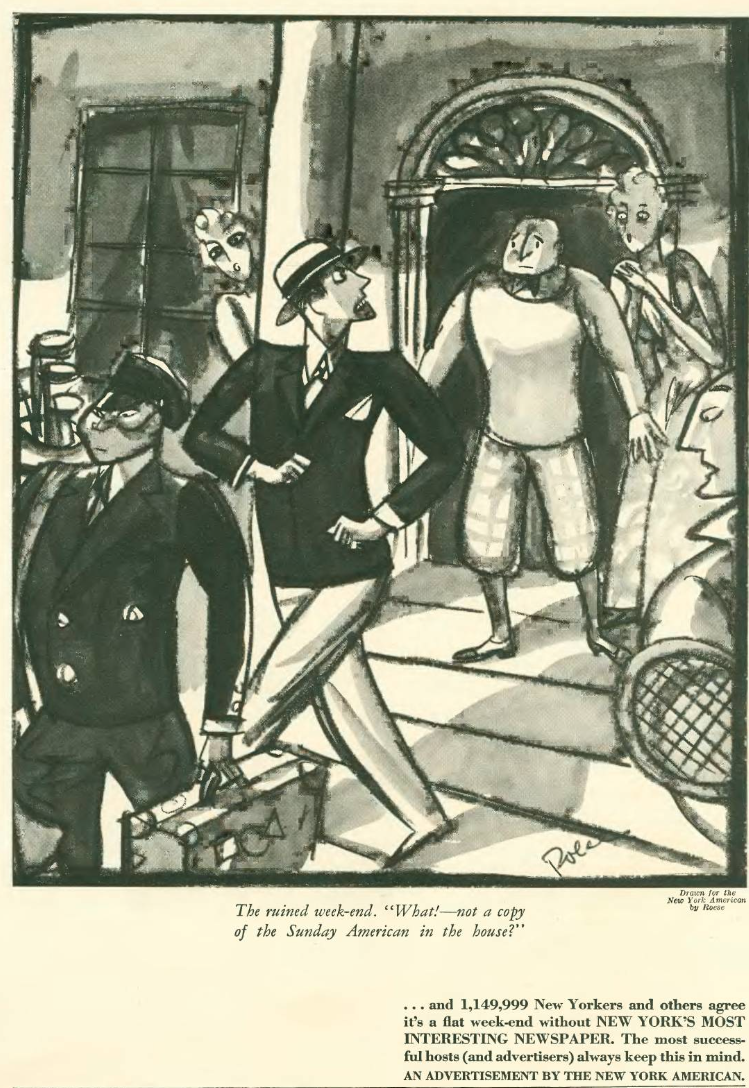
…and we have another Arno-esque ad by Herbert Roese, touting the wonders of “New York’s Most Interesting Newspaper”…

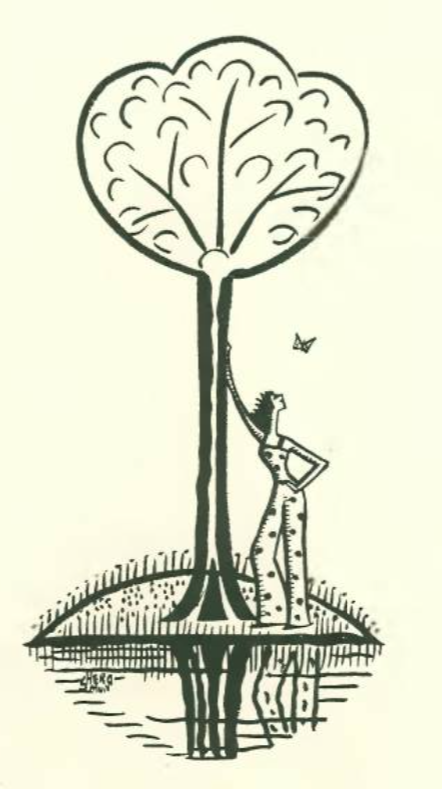
…on to our cartoonists, we begin with this wonderful spot drawing by Barbara Shermund

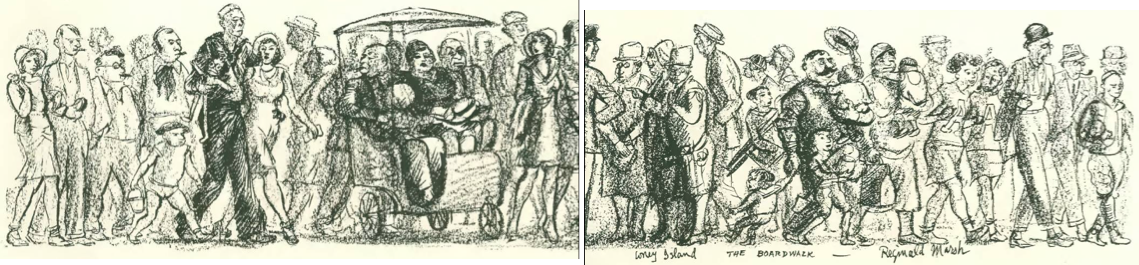
…and an illustration by Reginald Marsh of a Coney Island crowd that graced facing pages in “The Talk of the Town”…

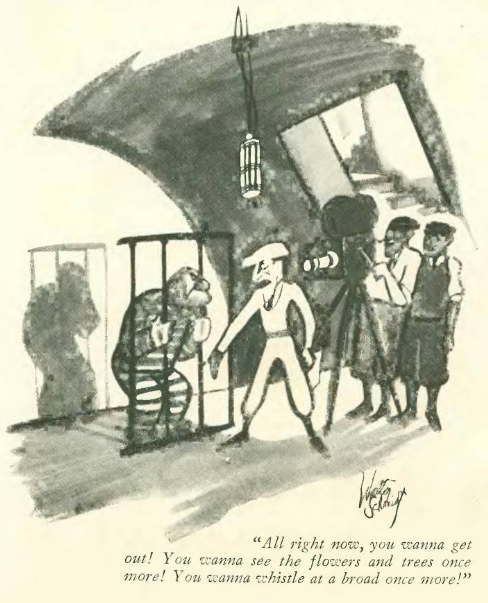
…here’s one of four drawings Walter Schmidt contributed to The New Yorker between 1931 and 1933…

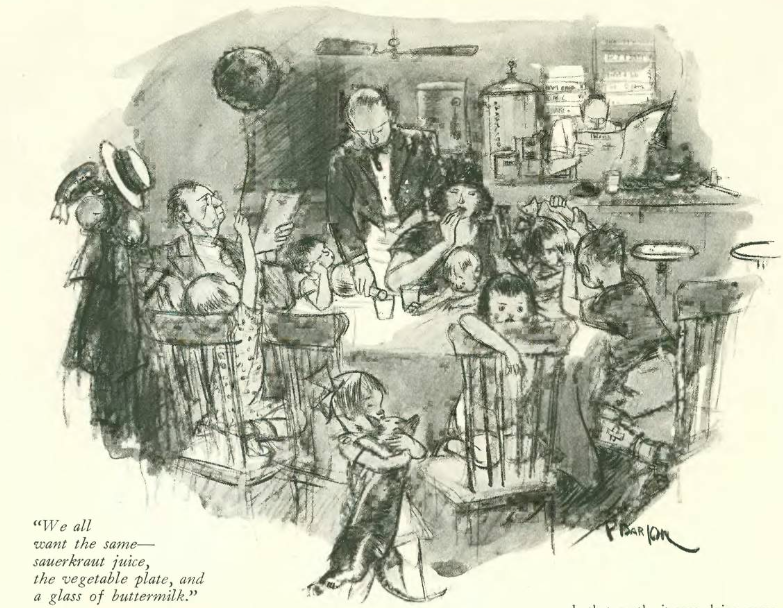
Perry Barlow illustrated the joys of dining out with the kiddies…

…back to Barbara Shermund, who eavesdropped on her debs…

Kemp Starrett gave us a proud moment at the county fair…

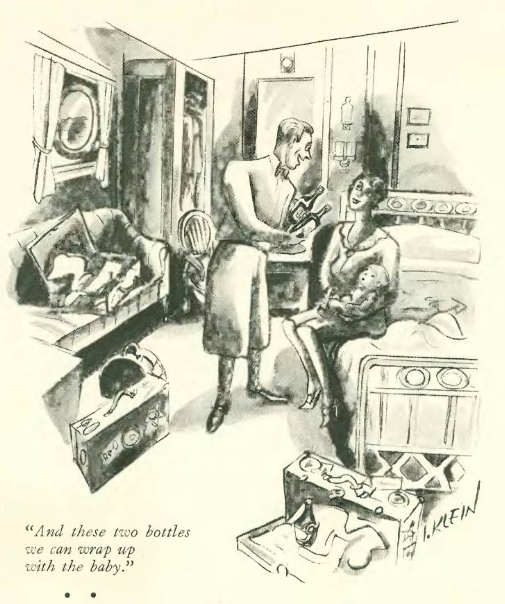
Isadore Klein offered up a new twist on the term “family planning”…

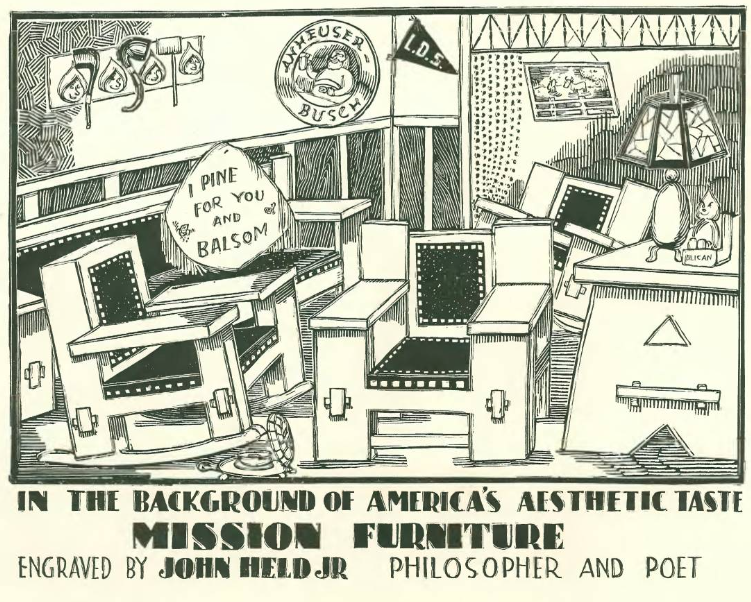
John Held Jr assessed the aesthetic value of chunky mission-style furniture…

…and Peter Arno reappeared in the cartoons with this full-page illustration of some desperate climbers…

Next Time: Asphalt Jungle…

Markey’s Road Trip

With the explosion of car ownership in the 1920s and 30s came improved highways across America, but if one were to undertake a long-distance journey, like The New Yorker’s Morris Markey, you were bound to find a wide range of conditions, from concrete highways to muddy dirt roads.

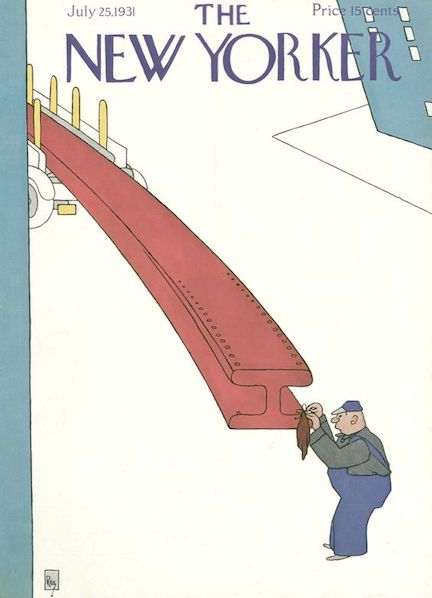
July 25, 1931 cover by Gardner Rea.

Markey wrote about his experience of driving from New York City to Atlanta for his “Reporter at Large” column, noting that stops at filling stations also offered opportunities to fill up on bootleg gin. Drunk driving, it seems, wasn’t a big concern in the early 1930s.

BLUE HIGHWAYS…Although the U.S. launched into major roadbuilding projects in the 1920s and 30s, rutted and muddy roads were still common in many areas of the country. Clockwise, from top left, Route 1 winds through Maryland in the 1920s; marker indicating the Mason and Dixon Line dividing Pennsylvania from Maryland, circa 1930; a 1930s dirt road in the Eastern U.S.; a policeman directs traffic in Richmond, Va., in the 1930s. (Library of Congress/fhwa.dot.gov/theshockoeexaminer.blogspot.com)
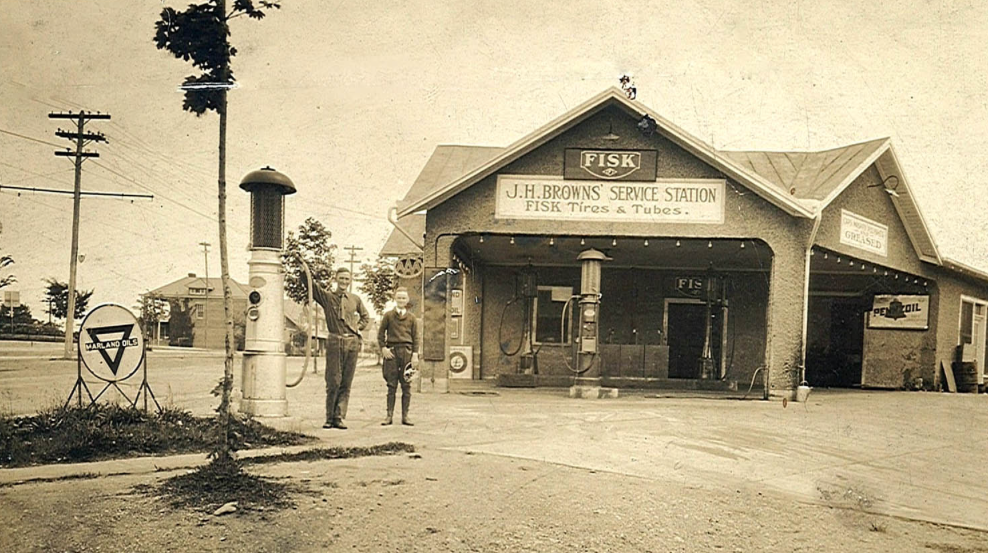
TIME TO GIN UP…James H. Brown (left), at the first of his four service stations in Richmond, Va., circa 1930. Some service stations offered Morris Markey bootleg gin during his journey to Atlanta. My use of this photo, however, does not imply that Mr. Brown offered the same service. (vintagerva.blogspot.com)

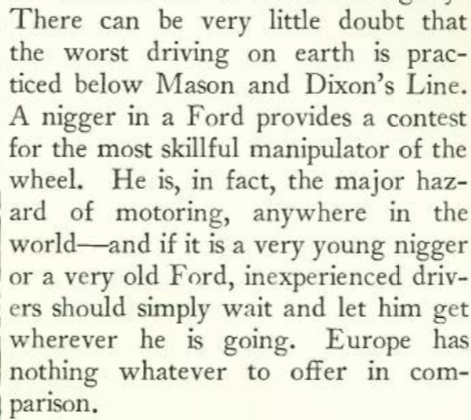
Unfortunately, Markey shared the sensibilities of many of his fellow Americans 89 years ago, and made this observation about drivers below the Mason and Dixon Line:

 *  *  *

Pale Riders

Since the mid-19th century Chelsea’s Tenth Avenue was known as “Death Avenue” due to the killing and maiming of hundreds who got in the way of freight trains that plowed through 10th and 11th Avenues in the service of warehouses and factories in the district. In the 1850s the freight line hired horsemen known as “West Side Cowboys” to warn wagons and pedestrians of oncoming trains, but even with this precaution nearly 450 people were killed by trains between 1852 and 1908, with almost 200 deaths occurring in the decade preceding 1908. Calls for an elevated railroad were finally answered with the opening of the High Line in 1934. “The Talk of the Town” looked in on the last of these urban cowboys:

WESTSIDE COWBOYS…Clockwise, from top left, a steam locomotive rumbles down 11th Avenue in the 1920s; a West Side Cowboy William Connolly rides ahead of a train to warn pedestrians in 1932; George Hayde led the final ride of the West Side cowboys up 10th Avenue on March 24, 1941; aerial view of the High Line from 18th Street heading north. Opened in 1934, the High Line lifted most train traffic 30 feet above the street. Today it serves only pedestrians, and is one of New York’s biggest tourist draws. (Forgotten NY/AP/NY Times/thehighline.org)

 *  *  *

Guys and Dolls

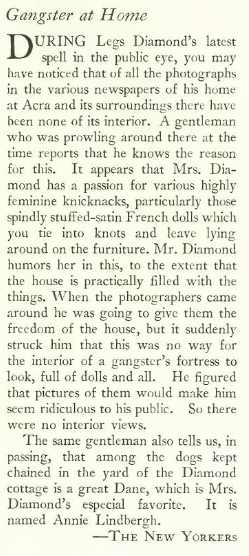
“The Talk of the Town” had some fun with a little-known aspect of a notorious gangster’s life; namely, the doll-filled house belonging to Jack “Legs” Diamond:

DOLL HOUSE…This house on Route 23 near Cairo, New York, once sheltered gangster Jack “Legs” Diamond, his wife, Alice, and her extensive collection of dolls and other knick-knacks. (nydailynews.com/Zillow)

“Talk” also made joking reference to the number of times Diamond had been shot and survived to tell about it.

Diamond’s luck would run out at the end of 1931 — Dec. 18, to be exact — when gunmen would break into his hotel room in Troy, NY, and put three bullets into his head.

 *  *  *

Ziggy’s Stardust

Florenz Ziegfeld (1867-1932) had a knack for show business, launching the careers of many entertainers through his Ziegfeld Follies, which got its start in 1907 during vaudeville’s heyday. The advent of sound movies signaled the end of the vaudeville era and of Ziegfeld himself, who would stage one final Follies before his death in 1932. Gilbert Seldes penned a two-part profile of Ziegfeld under the title “Glorifier” (caricature by the great Abe Birnbaum). An excerpt:

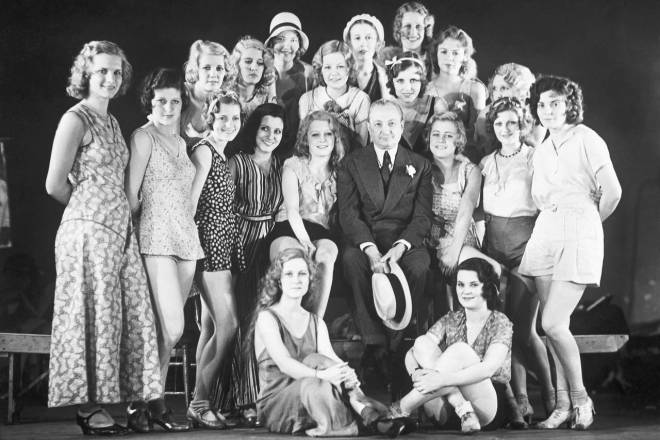
GO WITH THE FLO…Broadway impresario Florenz “Flo” Ziegfeld Jr with his Follies cast, 1931. It would prove to be his last Follies show. Revivals following his death in 1932 would prove to be much less successful. (Wall Street Journal)

 *  *  *

If Looks Could Kill

The New Yorker’s film critic John Mosher had a difficult time making sense of Murder by the Clock and its lead actress, Lilyan Tashman, who gave a tongue-in-cheek performance as the film’s femme fatale.

ARE YOU NUTS?…Irving Pichel and Lilyan Tashman in Murder by the Clock (1931). Tashman was known for her tongue-in-cheek portrayals of villainesses in films she made before her untimely death in 1934. (IMDB)

 *  *  *

Eine Kleine Nachtmusik

Open-air performances of classical music and opera were popular summertime diversions in the days before air-conditioning. In 1931 crowds gathered in Lewisohn Stadium to hear the New York Philharmonic perform under the direction of Willem van Hoogstraten, who conducted the Lewisohn summer concert series from 1922 to 1939. Here is a listing in The New Yorker’s “Goings On About Town” section:

MUSIC IN THE AIR…Cover of the 1931 program for concerts at Lewisohn Stadium, College of the City of New York. Bottom right, signed photo of Willem van Hoogstraten from 1930. (digitalcollections.nypl.org/ebay.com)

 *  *  *

From Our Advertisers

Flo Ziegfeld’s 1931 Follies were lavish productions, but his advertising in The New Yorker was anything but as evidenced in this tiny ad that appeared at the bottom of page 52…

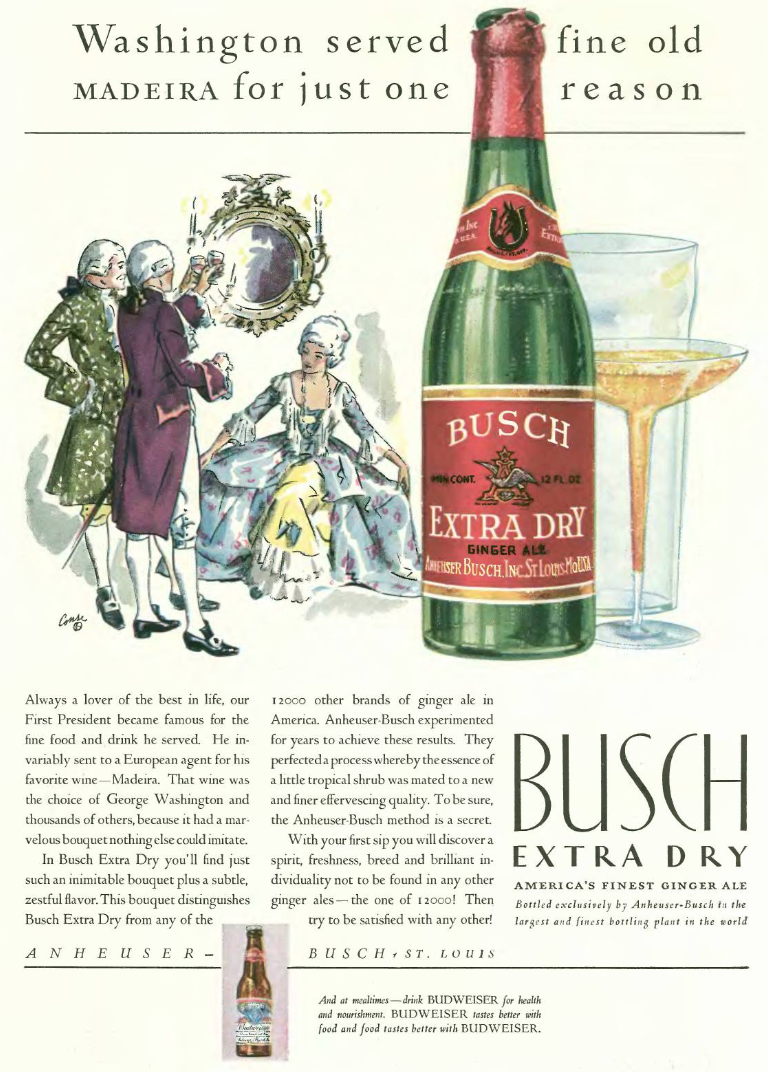
…no doubt anticipating the demise of Prohibition, the makers of Anheuser-Busch beverages ramped up the promotion of their non-alcoholic products to create associations with pre-Prohibition times…

…not to be outdone by the East Coast chocolates giant Schrafft’s, Whitman’s took out this full page ad to suggest how you might enjoy their product…

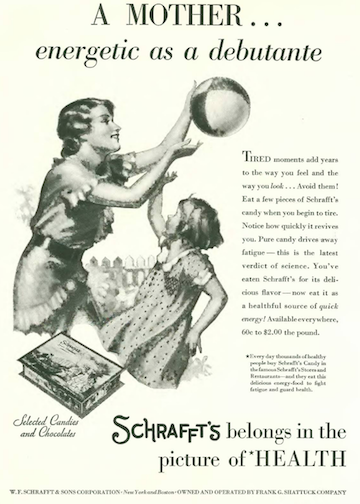
…which was in sharp contrast to the approach Schrafft’s took in this full-page ad featured in the April 25, 1931 New Yorker, which touted the health benefits of its candy…

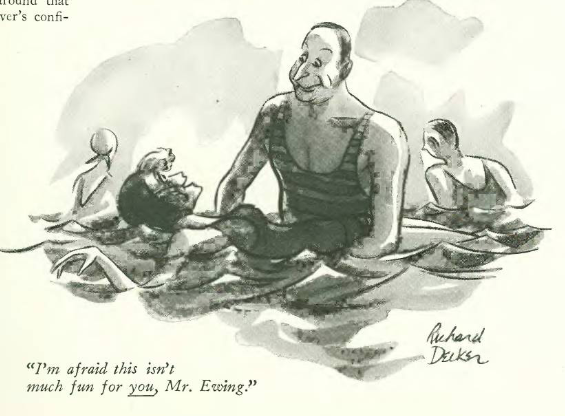
…on to our cartoons, Richard Decker took us swimming with a middle-aged man who was anything but bored…

Barbara Shermund went en plein air with a couple of her ditzy debs…

Garrett Price also went to the country to find a bit of humor…

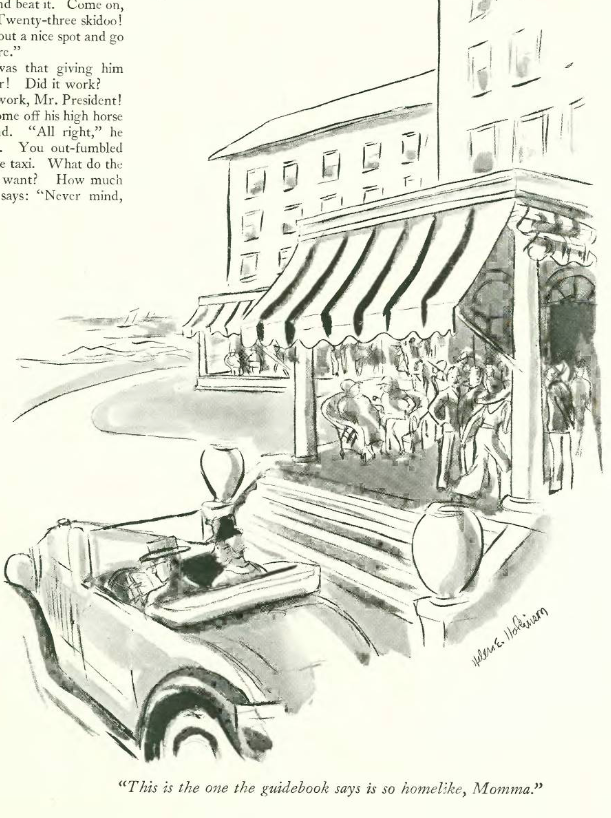
Helen Hokinson found a home away from home for a couple looking to take the sea air…

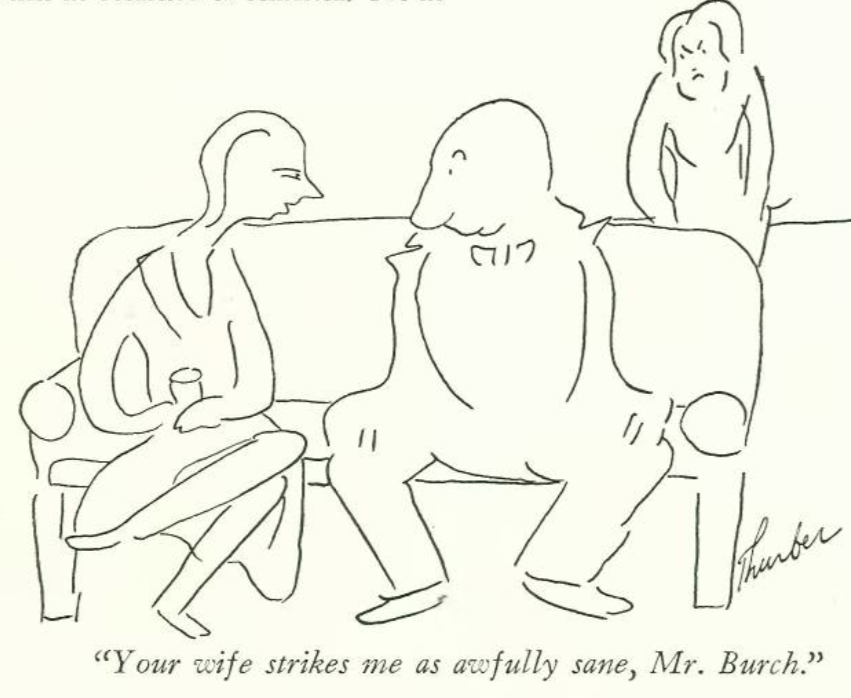
James Thurber continued to explore his brewing war between the sexes…

Harry Haenigsen gave us a novel approach to landing a trophy fish…

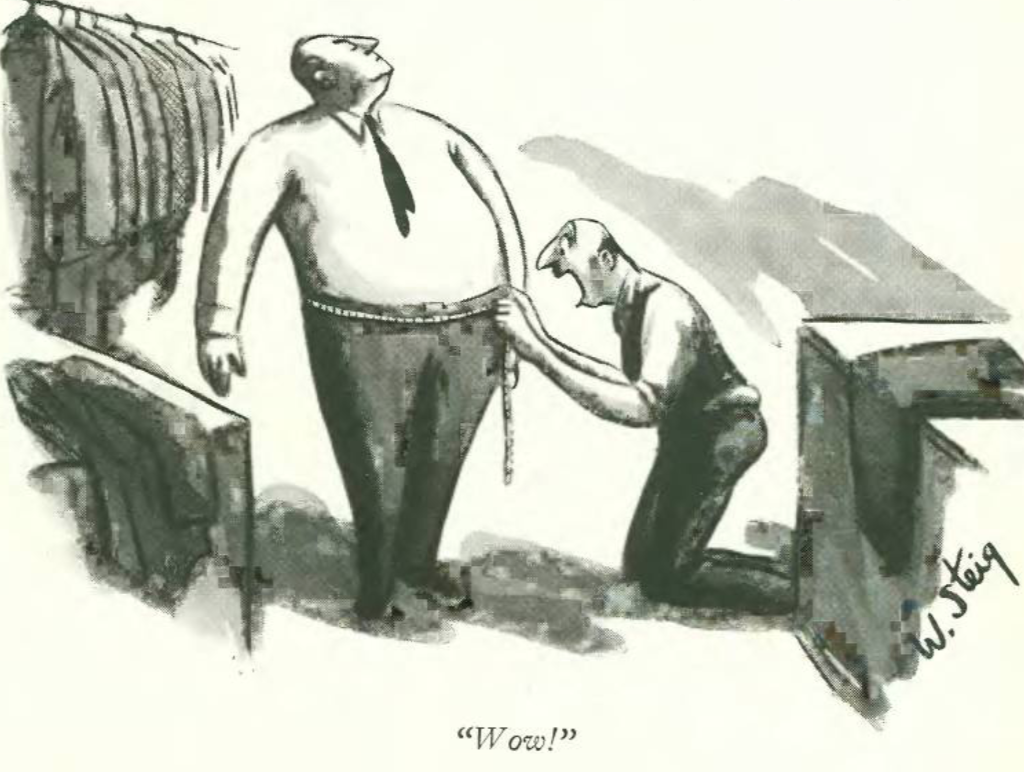
William Steig illustrated the wonders of the tailoring profession…

…and Alan Dunn aptly summed up the generation gap of the 1930s…

…on to the Aug. 1, 1931 issue…

August 1, 1931 cover by Rose Silver.

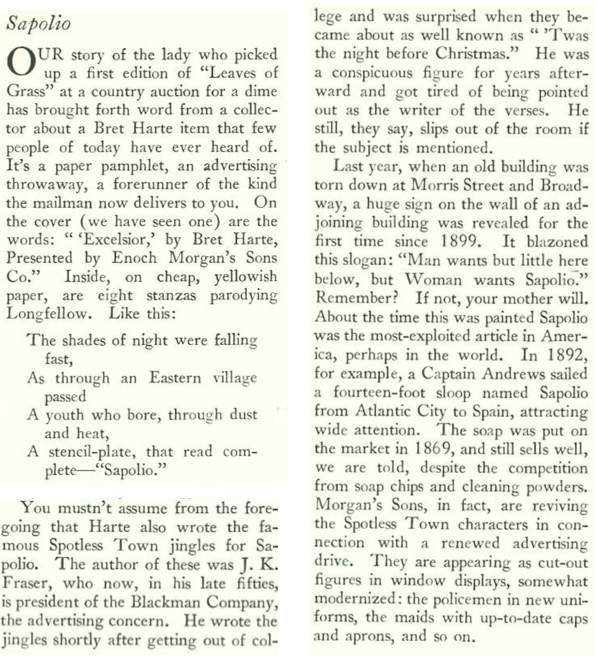
…”The Talk of the Town” mused about the advertising jingles made famous by the makers of Sapolio soap…

…Bret Harte actually did write jingles for the brand, once described by Time magazine as “probably the world’s best-advertised product” in its heyday. With a huge market share, Sapolio was so well known in the early 20th century that its owners decided they no longer needed to spend money on advertising. It was a poor decision, and by 1940 the product disappeared from the marketplace.

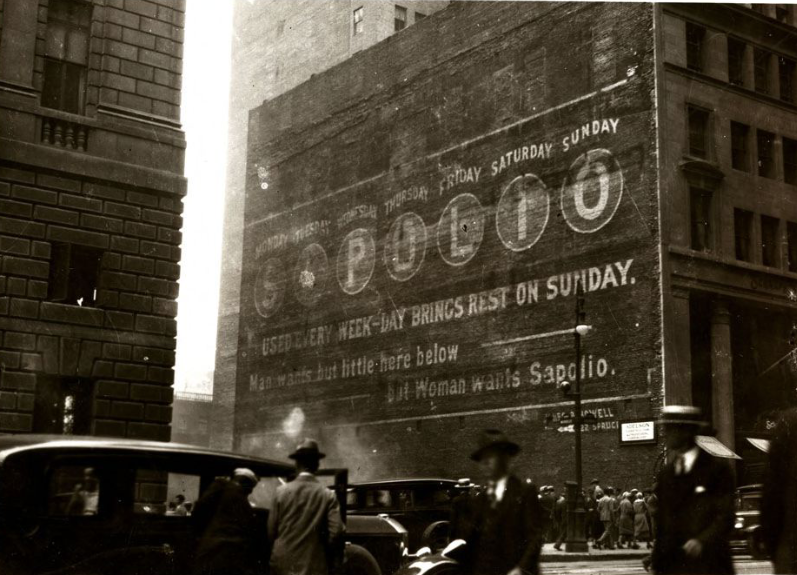
SEEING THE LIGHT OF DAY…A 19th century Sapolio sign on Broadway and Morris Street revealed after an adjoining building was demolished in 1930. (Museum of the City of New York)
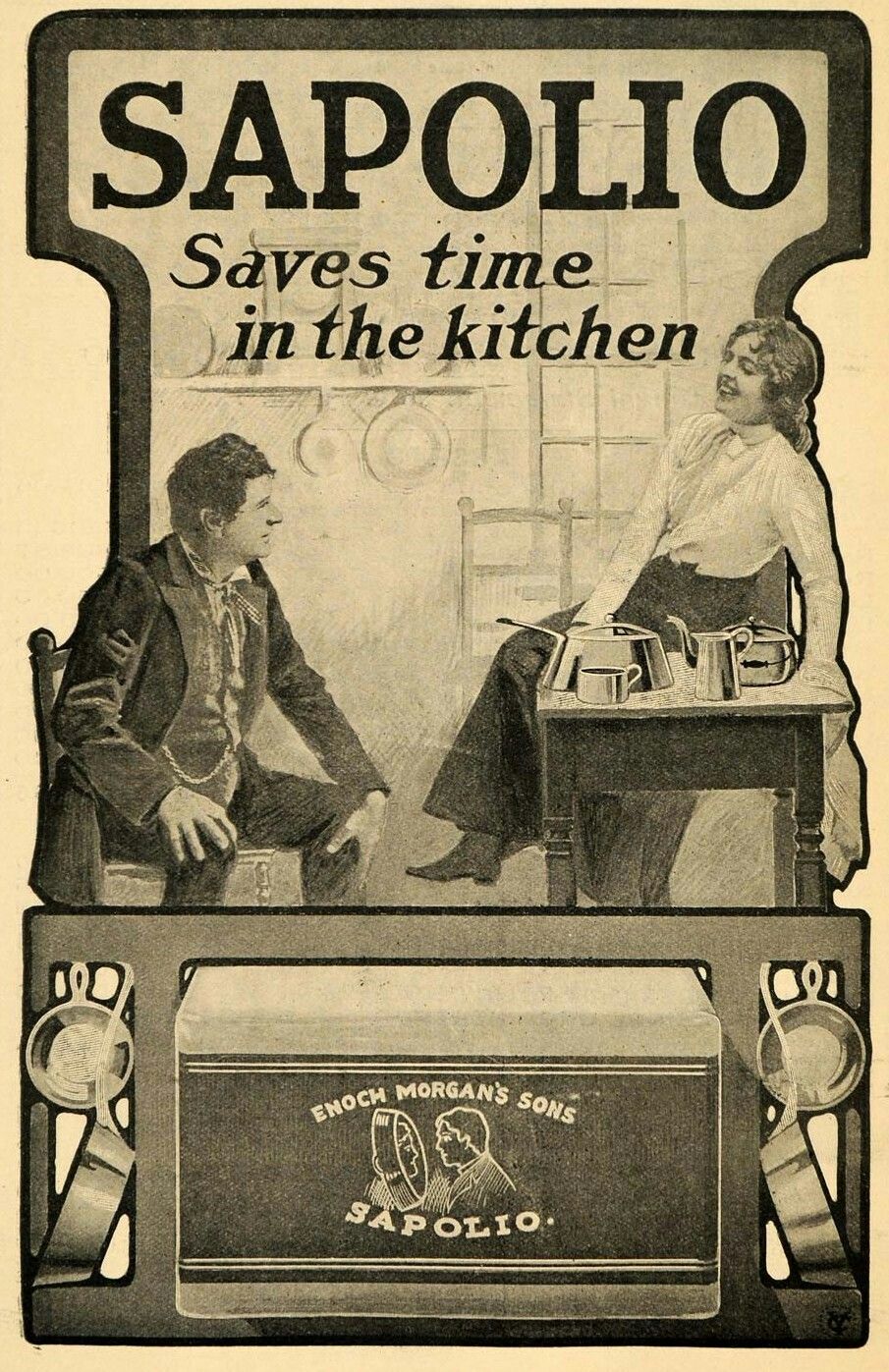
MONEY WELL SPENT…Sapolio ad from its heyday in the early 20th century. (Pinterest)

 *  *  *

Tough Love

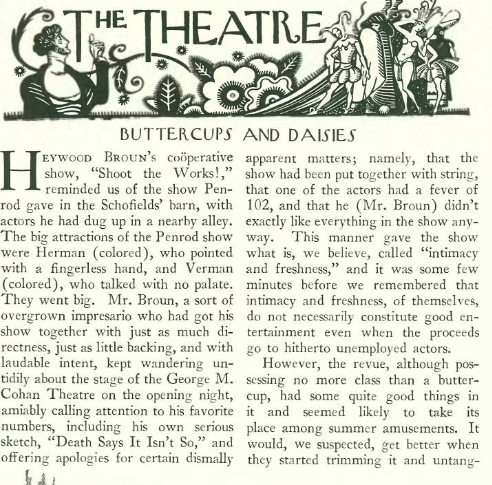
As a charter member of the famed Algonquin Round Table, Heywood Broun was a friend to many of the founding writers and editors of The New Yorker. And so it must have been quite a task to review his play, Shoot the Works, which The New Yorker found wanting in a number of aspects. And because he was so close to Broun himself, Robert Benchley left the review writing to someone who signed the column “S. Finny.” I can’t find any record of an S. Finny at The New Yorker, and I don’t believe this is a Benchley pseudonym (he used “Guy Fawkes” in The New Yorker). At any rate, here is an excerpt:

SHOOT GETS SHOT…The New Yorker wasn’t crazy about Heywood Broun’s play, which ran for 87 performances at George M. Cohan’s Theatre. (Playbill)

 *  *  *

From Our Advertisers

The makers of the “Flexo” ice cube tray continued to tout the wonders of their product with these Ripley-themed ads. This might appear rather mundane to modern eyes, but electric refrigerators with built-in freezers were still rather novel in 1931…

…another way to stay cool in the summer of 1931 was to take an excursion to the Northern climes…

…this ad for the New York American featured an illustration by Herbert Roese, whose early work strongly resembled that of Peter Arno’s

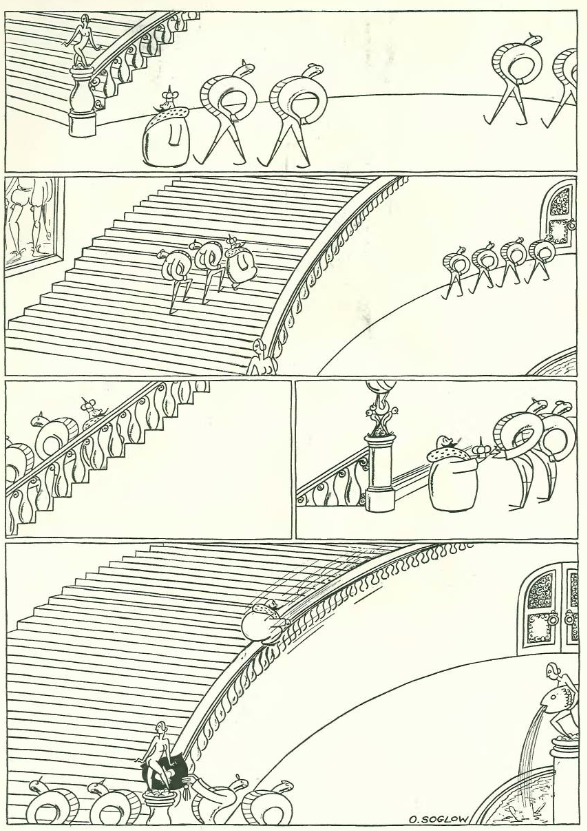
…on to our cartoons, we have the latest antics of the Little King courtesy Otto Soglow

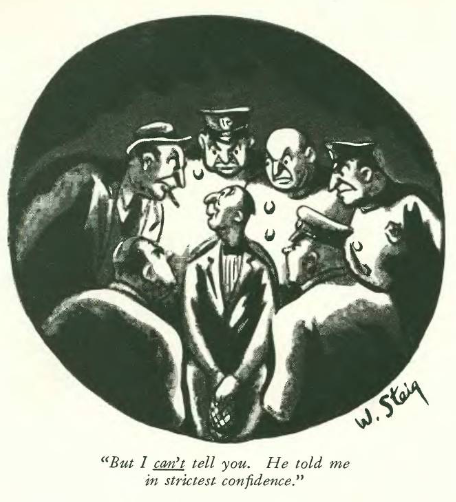
William Steig added levity to a heavy moment…

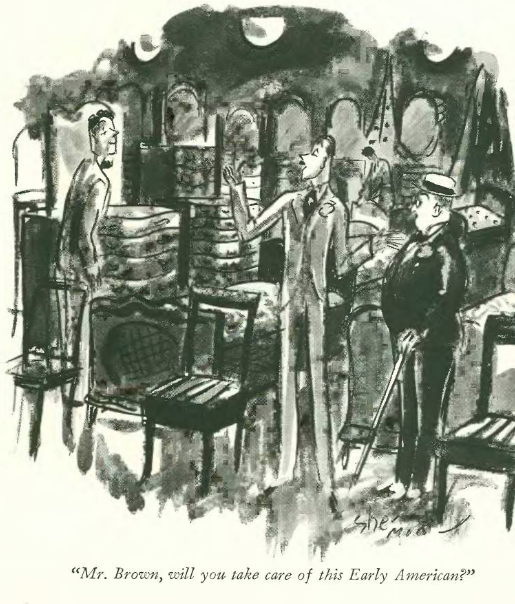
Barbara Shermund found humor at an antiques shop…

...John Held Jr continued his revels into our “naughty” Victorian past…

…and we end with Garrett Price, and a look at the ways of the modern family…

Next Time: An American Classic…