It was no surprise Dorothy Parker did not think much of society types, especially those afflicted with extreme solipsism.
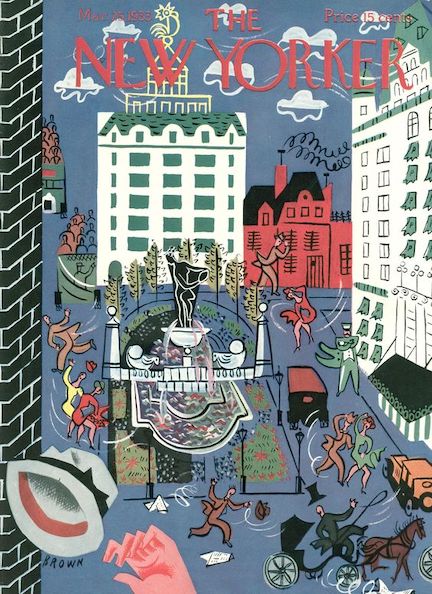
March 25, 1933 cover by Harry Brown.
Parker’s “The Diary of a Lady,” briefly excerpted here, featured entries from a diary of a fictional socialite who constantly bemoaned the minor inconveniences of her shallow existence, oblivious to the world around her.
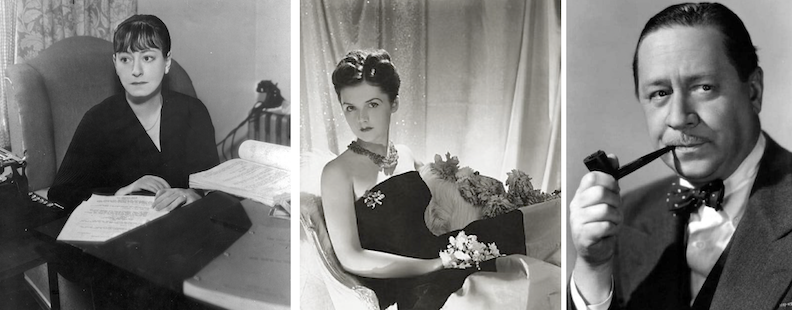
YOU POOR THING…Dorothy Parker (left) took a dim view of the lives of “poor little rich girls” like socialite Brenda Frazier (who had a tempestuous relationship with New Yorker cartoonist Peter Arno); Robert Benchley, on the other hand, took a more jolly view of human absurdity. (britannica.com/Wikipedia/theattic.space)
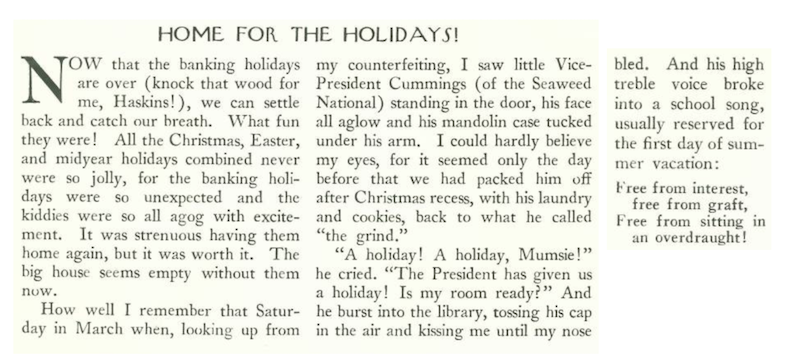
In contrast to Parker, Robert Benchley’s satire was usually more on the silly side, with a lot less bite. Here is an excerpt from “Home for the Holidays” (which immediately followed Parker’s piece in the magazine), in which Benchley describes the festive mood of one family during FDR’s “bank holiday”…
* * *
On the Lighter Side
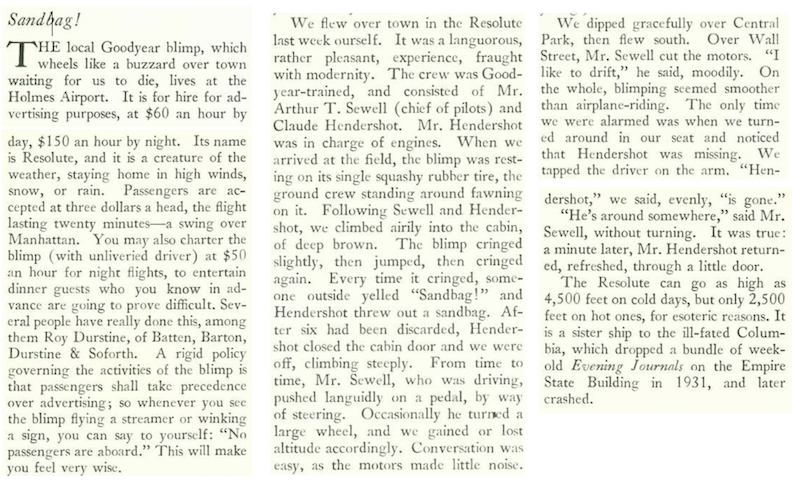
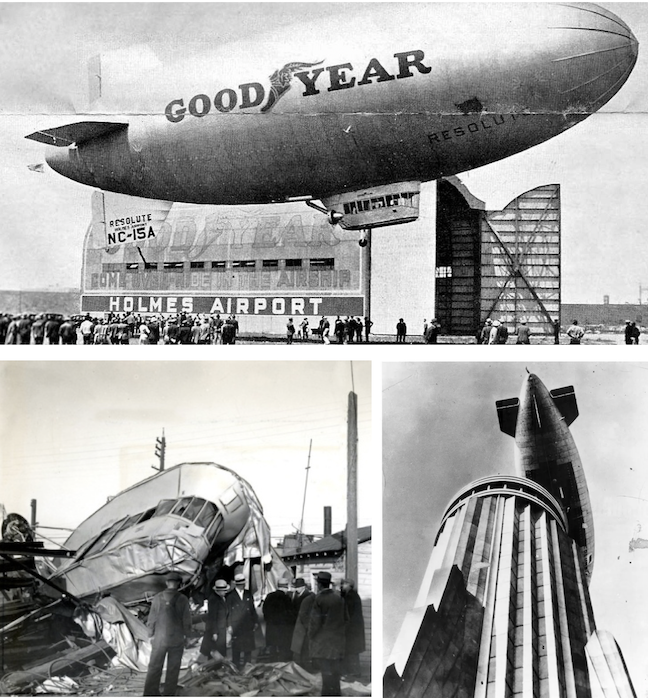
E.B. White was the unofficial aviation correspondent for The New Yorker, ever eager to go aloft in the latest contraption. In this excerpted “Talk of the Town” entry White described his adventures aboard the Goodyear blimp Resolute:
WHAT A GAS…Top photo, the Resolute at its home base, Holmes Airport (in Jackson Heights, L.I.), where E.B. White boarded his flight. As White noted, Resolute was a sister ship to Columbia, famed for dropping off a bundle of newspapers (lowered on a 100-foot-line) at the top of the Empire State Building; bottom photos, Columbia flying over the the mast of the Empire State Building in 1931—seven months later, on Feb. 12, 1932, its wreckage near Flushing Bay. (kathrynsreport.com/New York Times)
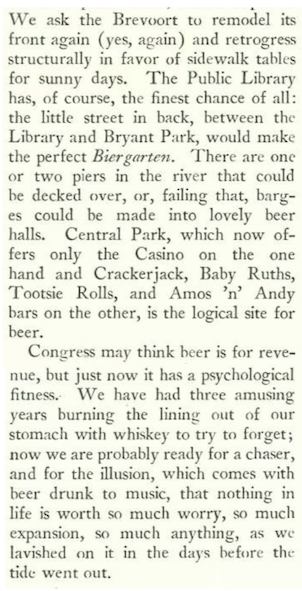
And we turn again to White, this time an excerpt from his “Notes and Comment” celebrating Franklin D. Roosevelt’s planned amendment to the Volstead Act that would allow people to have a legal beer while they waited for the 21st Amendment to be ratified. White had a couple of ideas regarding locations for beer gardens. An excerpt:
BEER THIRTY…E.B. White believed the front of the internationally famous Brevoort Hotel (next to the Mark Twain House at the southeast corner of Fifth Avenue and 9th Street) would be an ideal spot to quaff some suds. Alas, the hotel (and the Twain house) fell to the wrecking ball in 1952, replaced by the Brevoort apartments (right). (MCNY/streetwise.com)
Although the Brevoort idea didn’t pan out, White did get his wish, more or less, for a Bryant Park location, the Bryant Park Grill…
(bryantpark.org)
* * *
Mayor McCarthy
The profile featured Stitch McCarthy, considered one the most flamboyant “street mayors” of the Lower East Side. Writing in Lapham’s Quarterly (Aug. 1, 2018), Laurie Gwen Shapiro describes McCarthy as “a five-foot-tall, cross-eyed Romanian Jew born Samuel Rothberg, always seen with a cigar in his mouth.” What Stitch lacked in height he made up for in toughness, and by his teens was as tough as nails. Shapiro writes: “At night he managed a small-time boxer who once was scheduled to fight a bantamweight named Stitch McCartney in Jersey City. As he later told the story (no doubt over and over), his client fled in fear at the sight of McCartney and the crowd booed. He went in the ring himself, flattened McCartney, and took a version of his opponent’s name for his own.”
The profile was written by Meyer Berger, known as a master of the human interest story. Berger did a short stint at The New Yorker but for most of his career he worked for The New York Times, where he wrote a long-running column, “About New York.” Here is a very brief excerpt of the profile, with a caricature by Al Frueh.
TOUGH AS NAILS was what you became if you wanted to be one of the unofficial mayors of the Lower East Side like Stitch McCarthy, seen here in 1931. According to Laurie Gwen Shapiro, street mayors “were likable fixers who cut through red tape and might settle between fifteen and twenty neighborhood disputes a day.” Photo at left (by Berenice Abbott) is a scene from McCathy’s world—Hester Street, between Allen and Orchard Streets. (New York Public Library/Lapham’s Quarterly)
* * *
From Our Advertisers
I would guess Dorothy Parker would have some problems with this ad, featuring society women shilling for nail polish…
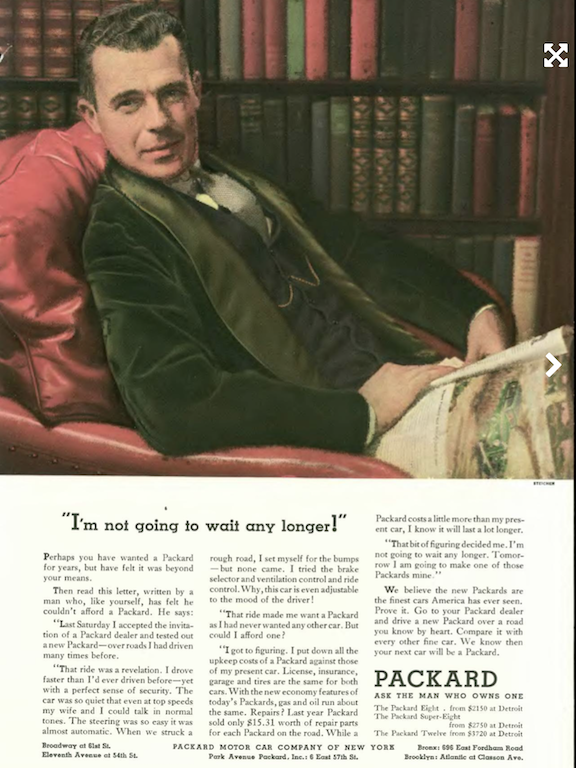
…the folks at Packard went with an ad that showed the ideal customer (seated in a library, clad in smoking jacket), contemplating one of their recent ads (the same one that was featured in the Feb. 18, 1933 issue of The New Yorker…
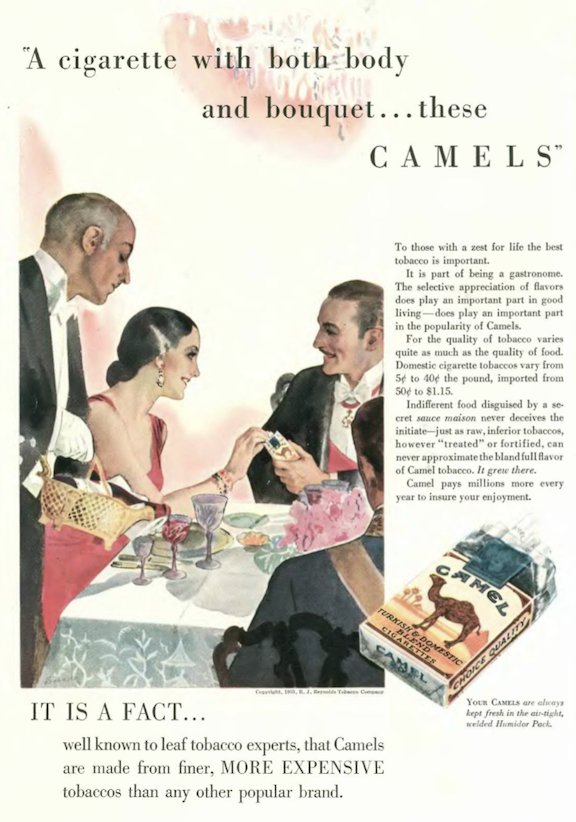
…Camel ads took on a new look thanks to the artistry of Ray Prohaska (1901–1981)…in the early 1930’s you see more use of watercolors in ads for fashion, or in this case, cigarettes…
…and Gardner Rea drew up this scene for the makers of Sanka coffee, the decaf of its day…
…which leads into the work of other New Yorker cartoonists and another master of the line drawing, Gluyas Williams…
…Robert Day offered a bit of understatement…
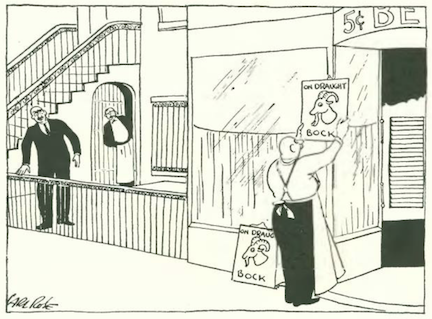
…Carl Rose celebrated the arrival of legal beer…
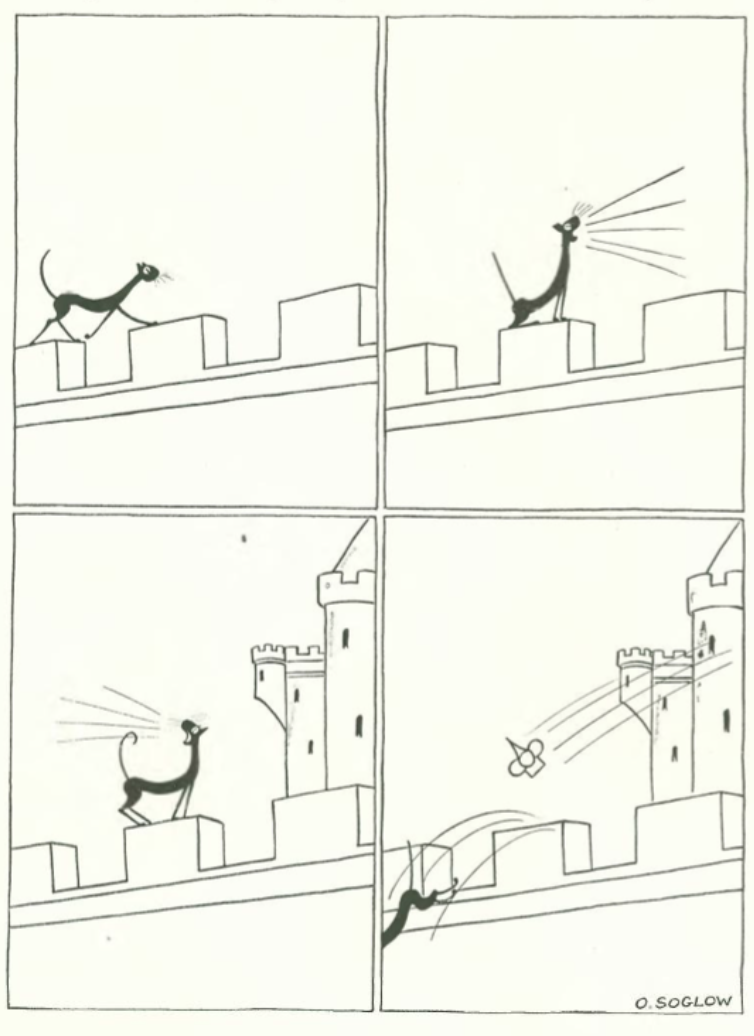
…Otto Soglow showed us how royalty responds to a noisy feline…
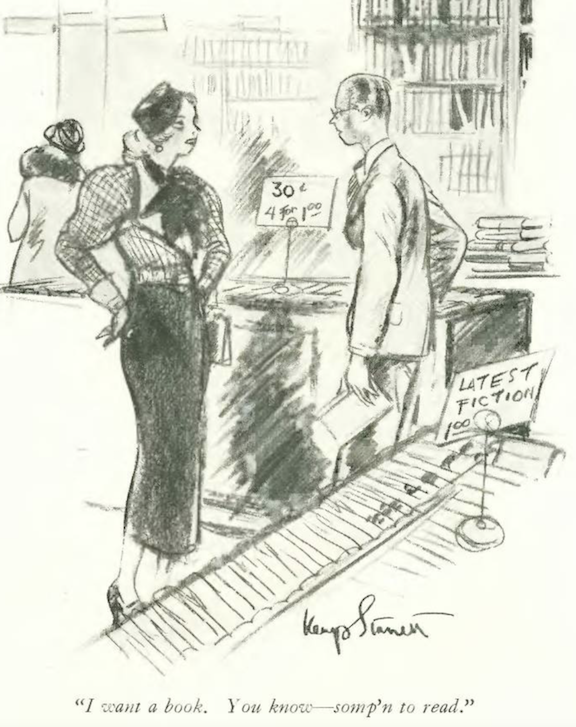
…Kemp Starrett shopped for somp’n to read…
…and we close with Peter Arno, and an ill-timed joke, at least for one woman…
Above, Donald Deskey's Design for a Sportshack, 1940 (Cooper Hewitt)
If you’ve never heard of Donald Deskey, you’ve most likely seen his work.
Feb. 25, 1933 cover by Rea Irvin.
Cultural critic Gilbert Seldes featured Deskey in the Feb. 25 profile (“The Long Road to Roxy” — with illustration by Al Frueh), noting that his subject had come to his profession as an industrial designer in a rather roundabout fashion. Here is a brief excerpt:
Deskey (1894–1989) was locally known in the late 1920s for his window displays at New York’s Franklin Simon Department Store, but it was his work at Roxy Rothafel’s new Radio City Music Hall that made him a marquee name in the design world. Although known for popularizing the Art Deco style, his interior designs for RCMH were noted for their restraint, signaling a break from the lavish, ornate designs of the city’s earlier performance spaces.
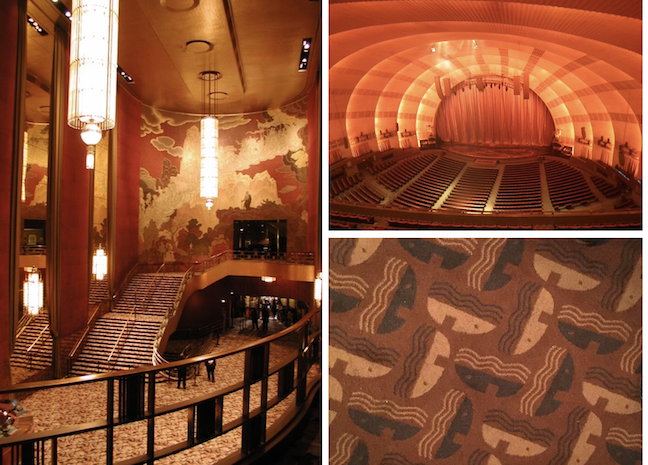
FEAST FOR THE EYES…Donald Deskey designed more than thirty spaces in Radio City Music Hall, including the Grand Foyer (left) and several lounges, each featuring a distinct visual motif. At bottom right, auditorium’s “Singing Woman” carpeting. (archdaily.com/drivingfordeco.com)
Original Deskey creations are highly prized today by collectors and museums…
DESIGN IN MOTION…Clockwise, from top left, Deskey’s “Guest Bedroom for Mrs. John D. Rockefeller, Jr.” (Abby Aldrich Rockefeller), on display at the 1931 American Union of Decorative Artists exhibition; Deskey table lamp, circa 1927; linen panel, circa 1930s; Deskey desk, circa 1930. (brooklynmuseum.org/artic.edu/Pinterest)
…and if that wasn’t enough, Deskey also designed logos for many consumer products in the late 1940s and 1950s…
THE TOTAL PACKAGE…Deskey designed some of the most iconic logos of midcentury America, including, clockwise from top left, Tide laundry detergent (1947); Gleem (1956) and Crest (1955) toothpastes; Cheer laundry detergent (1952); JIF peanut butter (1956) and Joy dishwashing liquid (1950).
* * *
From Our Advertisers
It seems appropriate to follow Mr. Deskey with some words and images from our sponsors, including the folks at Cadillac who continued to hammer home the snob appeal of their motorcar while also giving a nod to those hard times by emphasizing the car’s economy…
…meanwhile, Studebaker was back with another full page ad—again featuring the admiring giant woman—in a vain attempt to push their fledgling, and unpopular line of Rockne automobiles…
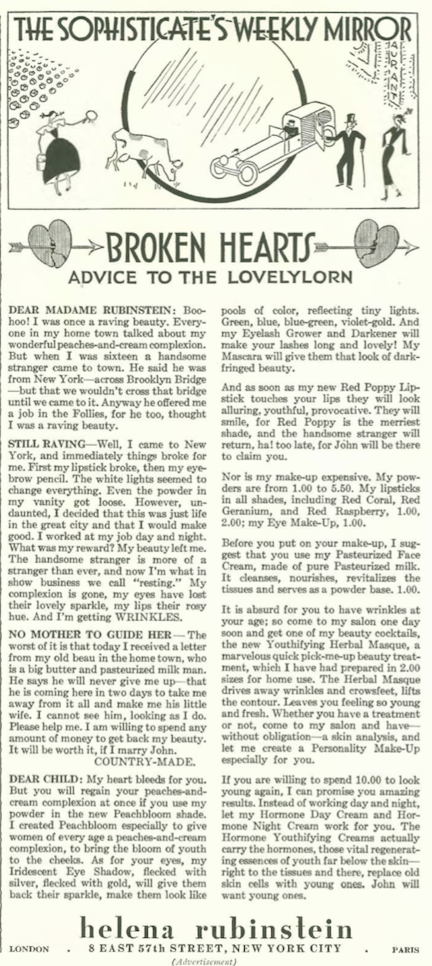
…and Helena Rubenstein continued her series of ads disguised as advice columns…the advice here was to shame women into buying her products…
…after Helena removed your wrinkles you could restore them with GE’s Mazda sunlight lamp…
…Otto Soglow, on the brink of becoming a very wealthy man thanks to his Little King cartoons, continued to lay down some ink on behalf of the makers of Sanka decaf…
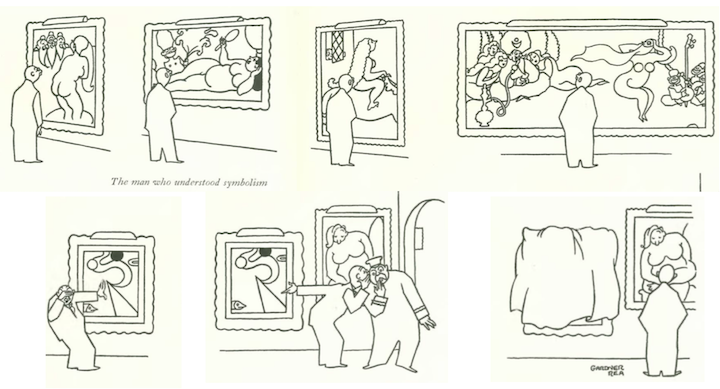
…and we move along to Soglow’s fellow cartoonists, beginning with Gardner Rea and a cartoon sequence spread across pages 24-25…
…here it is again, rearranged for closer inspection…
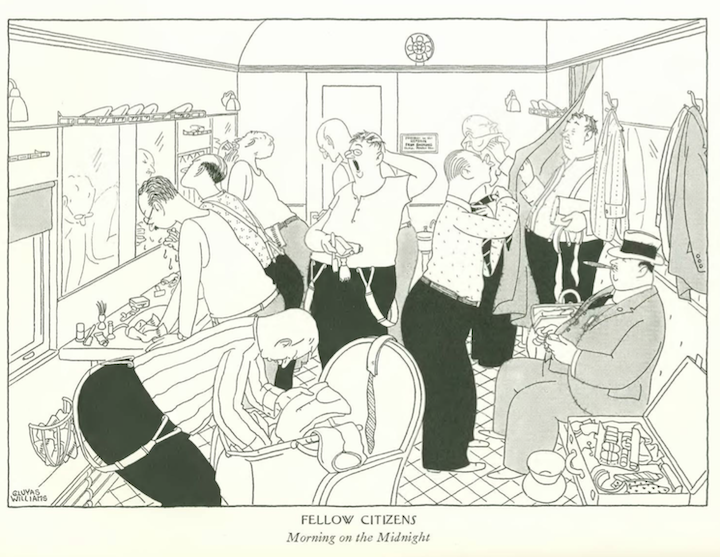
…and we have another terrific “Fellow Citizens” drawing by Gluyas Williams, which originally ran sideways on a full page…
…I like this James Thurber drawing for its utter disregard of scale—but of course (and thankfully) it wouldn’t be a Thurber if he cared about such things…
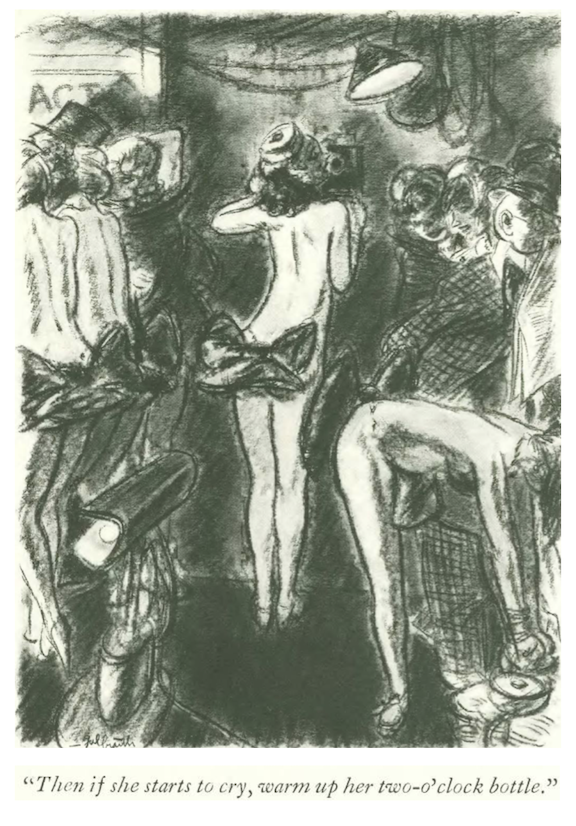
…William Crawford Galbraith was still hung up on showgirls and sirens…
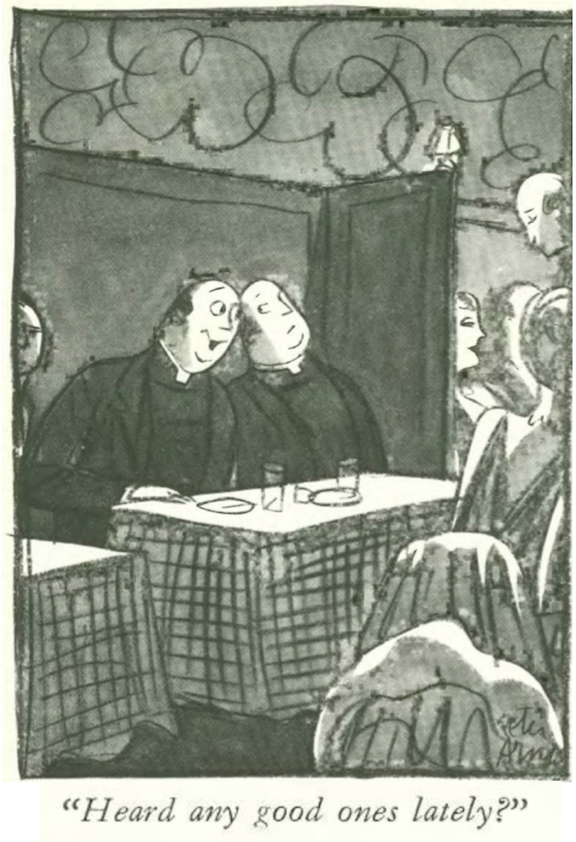
…while Peter Arno explored his spiritual side, as only Arno could…
…and we move along to March 4, 1933…
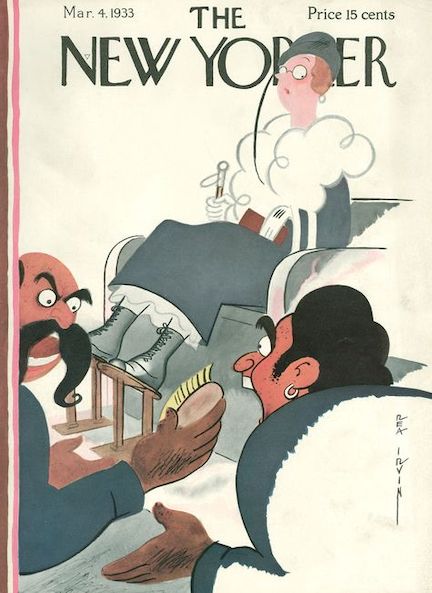
March 4, 1933 cover by Rea Irvin.
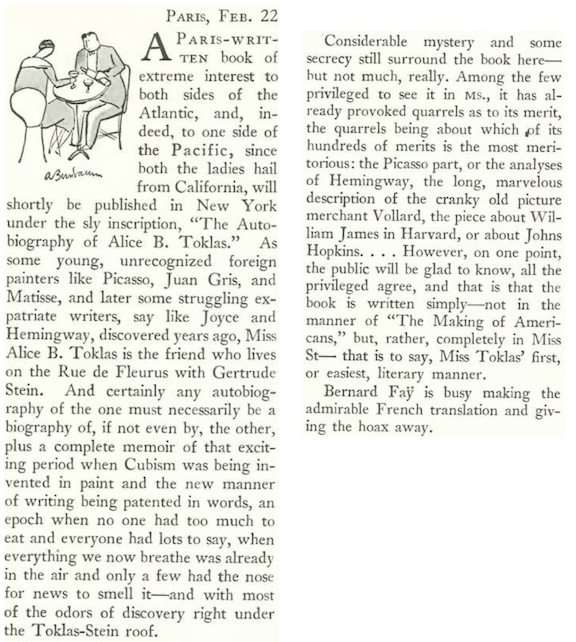
…in which The New Yorker’s Paris correspondent Janet Flanner (“Genêt”) wrote about a new book of “extreme interest to both sides of the Atlantic”…
BOOK OF REVELATION…Alice B. Toklas and Gertrude Stein were well known in the ex-pat community of 1920s Paris, but the publication of the American edition of The Autobiography of Alice B. Toklas (written by Stein) brought them fame in the wider world. Stein claimed she wrote the book — now considered a 20th century classic — in six weeks to amuse herself and to make money. At right, Toklas and Stein at 27 Rue de Fleurus in a portrait by Man Ray, 1922. (Library of Congress)
* * *
Hope Springs Eternal
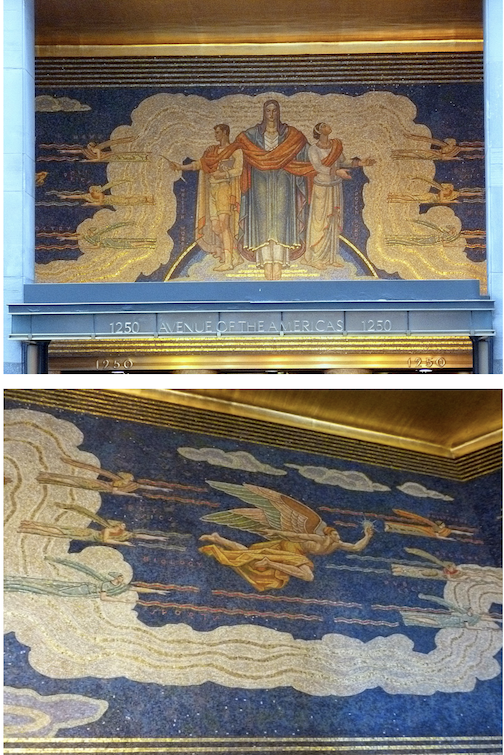
Even in the deepest depths of the Depression signs of hope abounded in works of public art, including a mosaic of one million hand-cut and hand-set glass tiles being prepared for the Sixth Avenue entrance to Rockefeller Center. Intelligence Awakening Mankind, by Barry Faulkner, celebrated the triumph of knowledge over the evil of ignorance. “The Talk of the Town” explained:
GOOD VIBES…Details of Intelligence Awakening Mankind include the central figure of Intelligence (top) sending knowledge into the far corners of the world. (Pinterest)
* * *
From Our Advertisers
The folks at luxury brand Packard continued to counter their stodgy image with ads that emphasized other qualities including speed, durability, and here, serenity…despite the lengthy text, the ad also suggested modernity, with the sliced-off image and the single word “Hush!” to entice prospective buyers…
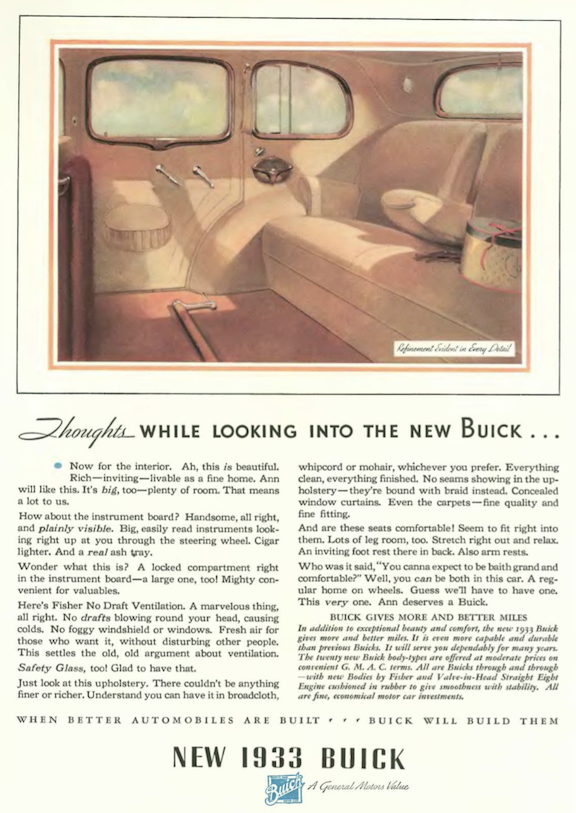
…if you couldn’t afford $3,720 for a 12-cylinder Packard, then you might have considered a Buick, “livable as a fine home” this ad claimed. And look at that back seat — you could comfortably fit three adults and a baby elephant in there…
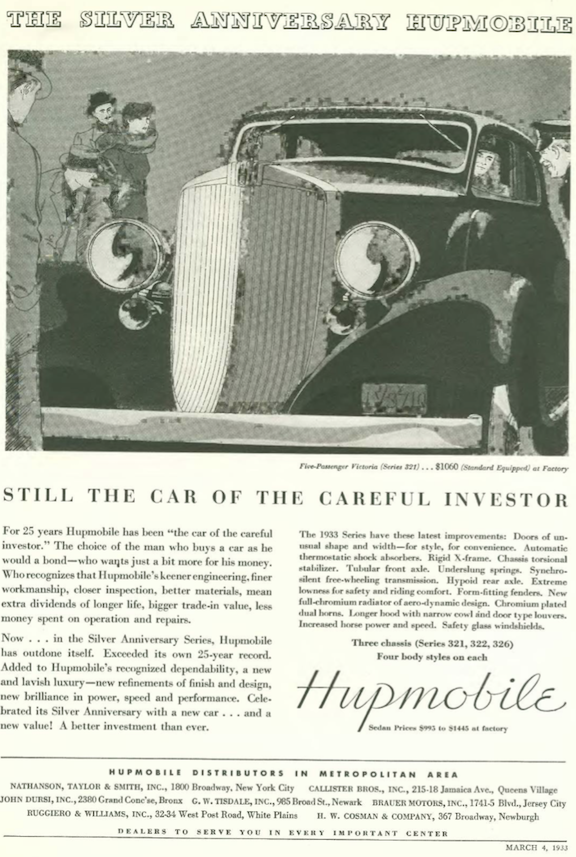
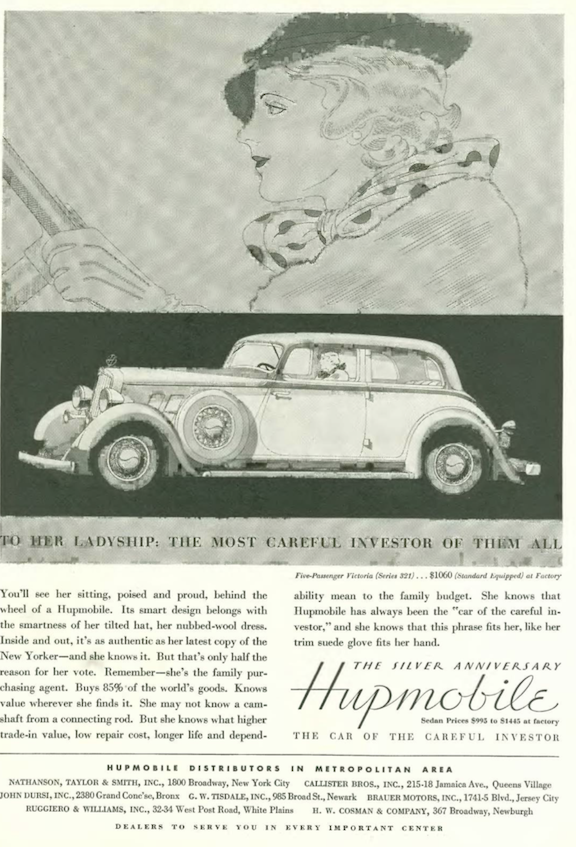
…and then there’s Hupmobile—for the price of a Packard 12 you could have purchased three Hupmobile Victorias (pictured below) with a good chunk of change left over…here the company celebrates its silver anniversary…a couple of odd facts: in 1914 a Minnesota Hupmobile salesman used an unsold vehicle to found Greyhound bus lines…the National Football League also traces its origins to Hupmobile — the league was created in 1920 at a Hupmobile dealership in Canton, Ohio…both Greyhound and the NFL survive Hupmobile, which went belly up in 1939…
…and now we move to the world of fashion, and some cultural appropriation by Lord & Taylor…
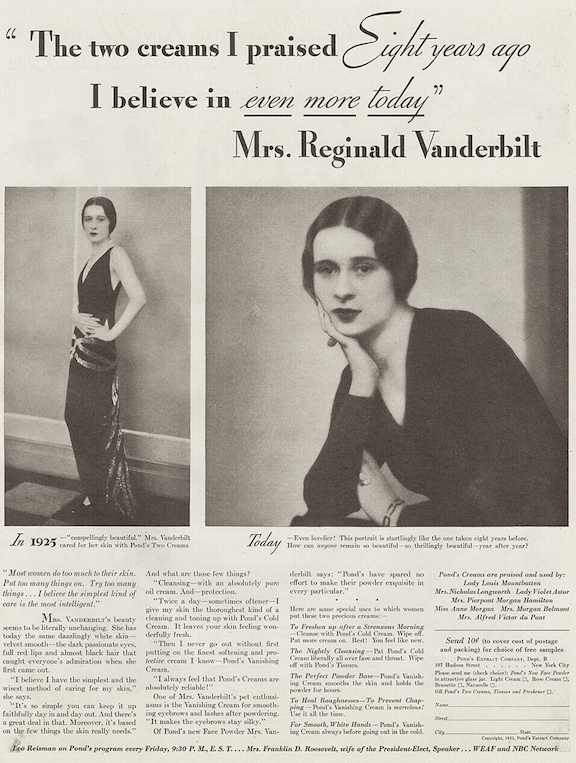
…in 1929 J. Walter Thompson President Stanley Resor observed how people instinctively wanted to be told what to do by authorities they respected. Applying this thinking to the marketing of Pond’s cold cream, Resor’s firm hired famed photographers to create idealized portraits of society women…
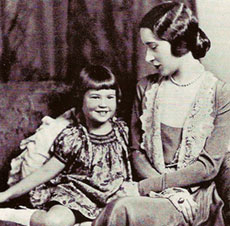
…Writing for Indy Week (July 7, 2010) Amy White observes that a 1933 portrait (above) of Mrs. Reginald Vanderbilt, aka Gloria Mercedes Morgan, reveals patrician eyes as “languid jet pools, her lips full and dark, her finely coiffed hair oiled to ebony perfection. However, a bit of backstory might explain the painful and hollow look Mrs. Vanderbilt can barely suppress. In that same year, she was declared by the courts to be unfit as a parent, and her young daughter was placed under the guardianship of her sister, Gertrude.” That young daughter, Gloria Vanderbilt, would later find fame for her designer jeans, her glittering lifestyle, and as mother of newscaster Anderson Cooper. White concludes, “I wonder if somehow, subconsciously, those consumers saw the pain in the eyes of some of those upper-crust spokeswomen, and it was basic humanness and empathy, as well as desire for wealth and beauty, that won them over”…
Mrs. Reginald Vanderbilt, aka Gloria Mercedes Morgan, and her daughter, “Little Gloria,” in 1928. (Wikipedia)
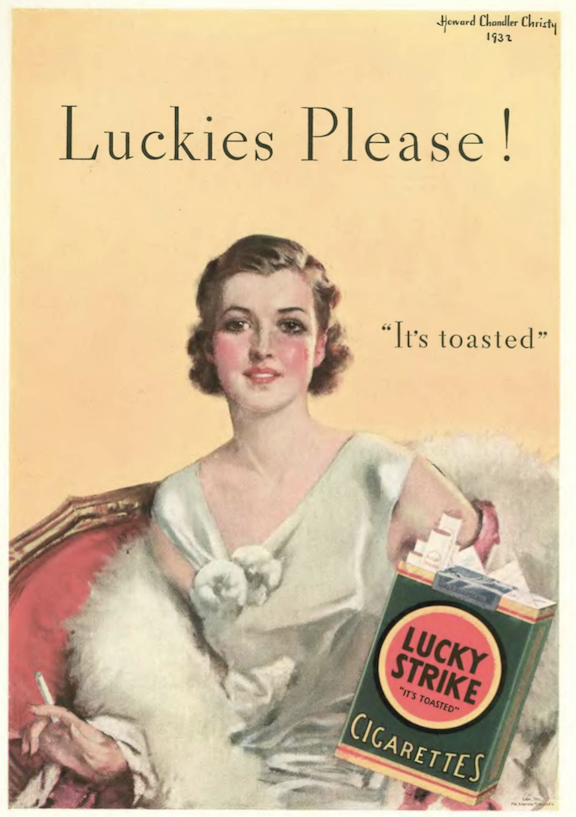
…and we move along to the toasted pleasures of Luckies, and Howard Chandler Christy’s “Christy Girl” looking the picture of health and vitality in this back cover ad…
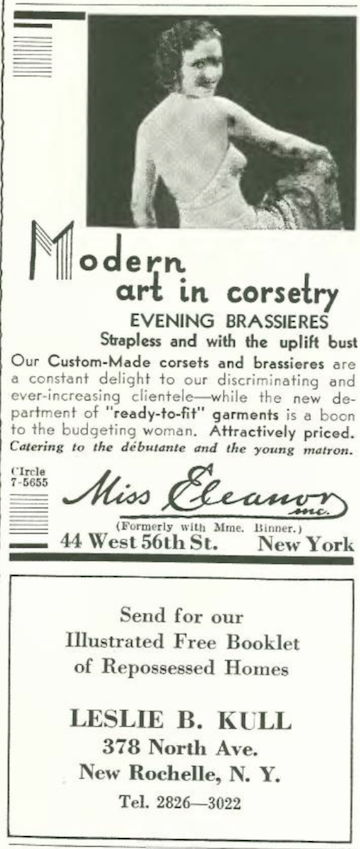
…we make an abrupt switch to the cheaper ads in the magazine’s nether pages…here “Miss Eleanor, formerly with Mme. Binner,” announced her selection of modern corsets for the “debutante and young matron”…and below, in a sign of the times, repossessed homes for sale…
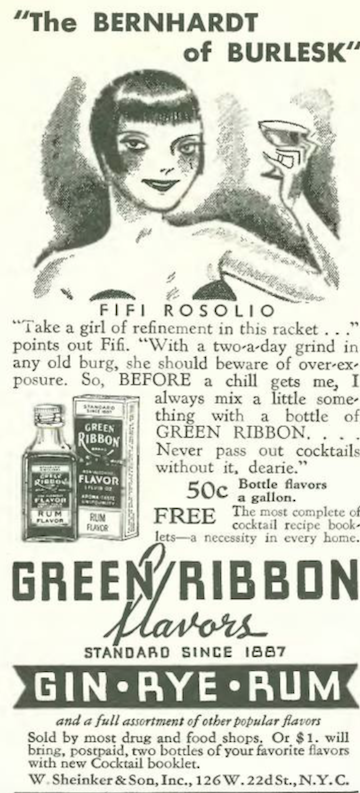
…looks like Fifi had a bit too much of the Green Ribbon-flavored bootleg…
…and if you thought taking probiotics was a new thing…
…the French Line once again featured the art of James Thurber to promote its Mediterranean cruises…
…and Thurber kicks off our cartoons with spot art that headed the “Goings On About Town” section…
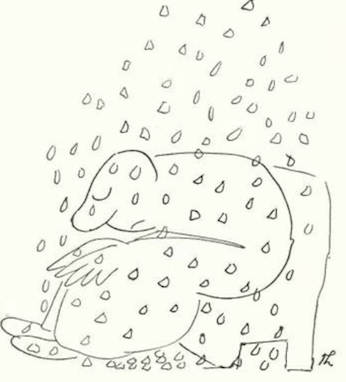
…and this gem with one of Thurber’s beloved dogs…
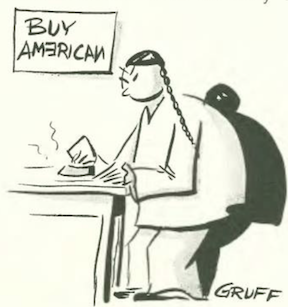
…below is the second New Yorker cartoon by Gruff with the “Buy American” slogan juxtaposed with an ethnic stereotype…I have no idea who this artist is, or if “Gruff” is a pen name — the style looks familiar but I haven’t had any luck chasing this artist down…
…here is the first one from the Feb. 18 issue…
…but we all know Al Frueh, who contributed this delightful bit of art to the theater review section…
…Daniel ‘Alain’ Brustlein gave us an enterprising Frenchman offering peeks at exiled New York Mayor Jimmy Walker sunning on a beach at Cannes…
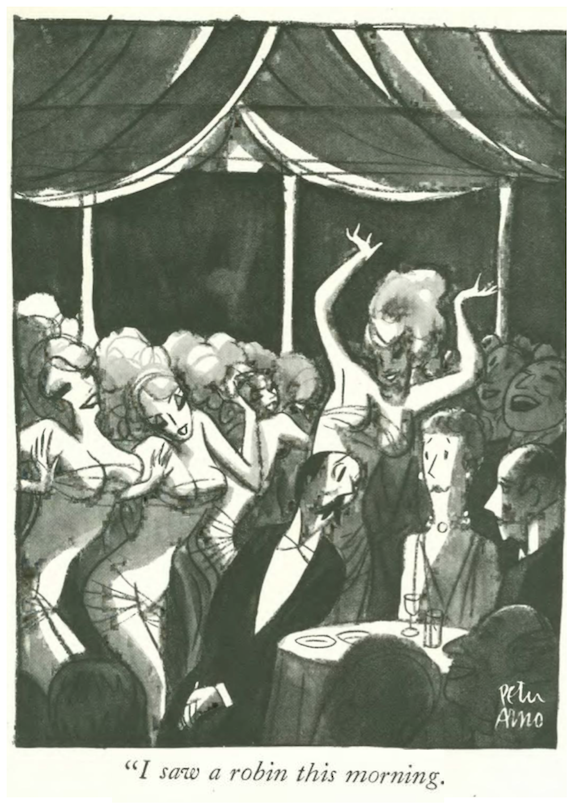
…and we close with Peter Arno, and the first signs of spring…
“Nobody said not to go” was a phrase often used by Emily “Mickey” Hahn when returning from one of her far-flung and often wild adventures.
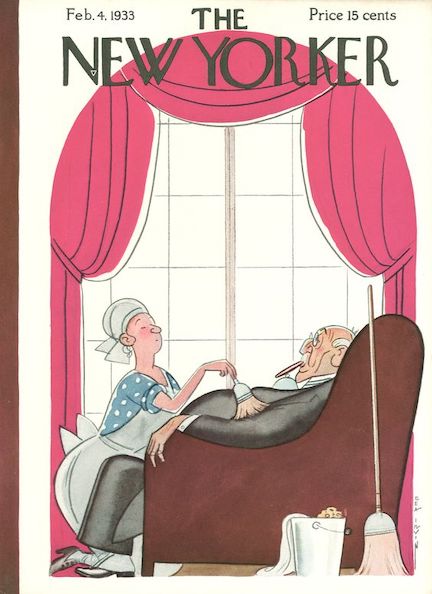
Feb. 4, 1933 cover by Rea Irvin.
And nobody ever told Hahn (1905–1997) what she could write about, and so she wrote, with brio and authority, on a variety of subjects ranging from feminism, diamond mining, and animal behavior to Chinese history and cooking. The author of 54 books, Hahn also penned a number of biographies including those of Leonardo da Vinci, Chiang Kai-shek, and D. H. Lawrence among others. In the Feb. 4 issue Hahn wrote about spending the night at a New York flophouse, not out of necessity but rather to write about the experience. Excerpts:
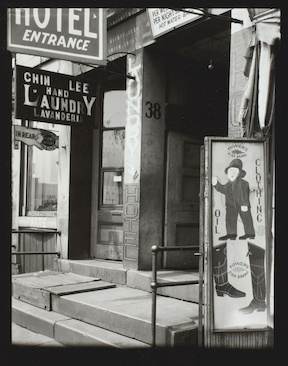
NO RITZ, THIS…Entrance to a flophouse in the Bowery, photo by Walker Evans, 1934.
In the following two excerpts, Hahn described her sleepless night, and her exit from the flophouse the following morning…
More on Emily Hahn, who defied convention from the very start of her adult life: before graduating from the University of Wisconsin in 1926 (the first woman to earn a degree in mining engineering there), she drove across the U.S. in a Model T, dressed a man. She wrote about her experiences in letters to her brother-in-law who, unbeknownst to Hahn, shared them with New Yorker editors. This would lead to a longtime relationship with the magazine, to which she would contribute nearly 200 articles (and one poem) between 1929 and 1996. She would also serve as China correspondent from 1935 to 1943.
In 1930 she traveled to the Belgian Congo, where she lived for two years with a pygmy tribe while working for the Red Cross; she later crossed Central Africa alone on foot. In his 2006 memoir, Let Me Finish, Roger Angell described Hahn as the magazine’s “Belle Geste,” a woman “deeply, almost domestically, at home in the world. Driven by curiosity and energy, she went there and did that, and then wrote about it without fuss.”
AT HOME IN THE WORLD…Clockwise, from top left, Emily “Mickey” Hahn poses with her pet gibbon, Mr. Mills, in Shanghai, circa 1935; undated photo with more of her furry friends; Hahn as a teenager, circa 1920; cover photo from her 1944 book, China to Me; Hahn in 1944 with her daughter Carola, following their return from occupied China. (Wikipedia/Lilly Library, Indiana U)
* * *
Chief Stooge
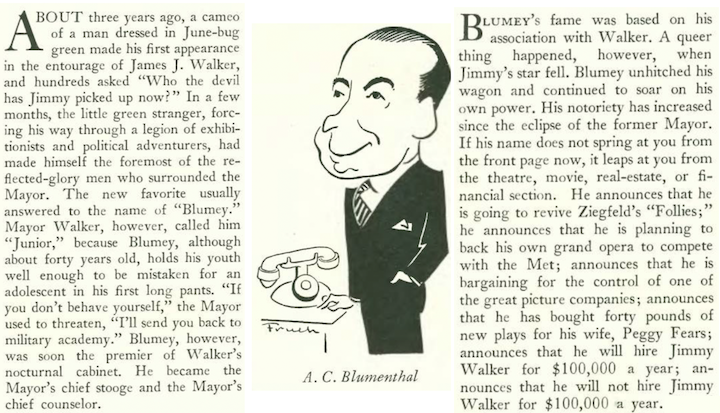
Theatrical promoter Alfred Cleveland Blumenthal (1885–1957) was well-known to New Yorkers in the 1920s and 30s as a speakeasy owner, buddy to Mayor Jimmy Walker and husband to actress Peggy Fears. Although “Blumey” is largely forgotten today, in 1933 he merited a two-part profile by Alva Johnston. Here are excerpts from the opening lines:
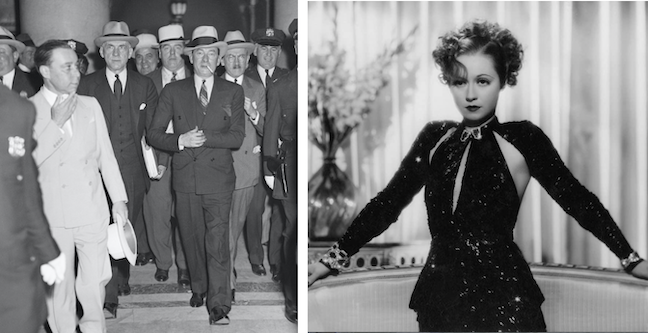
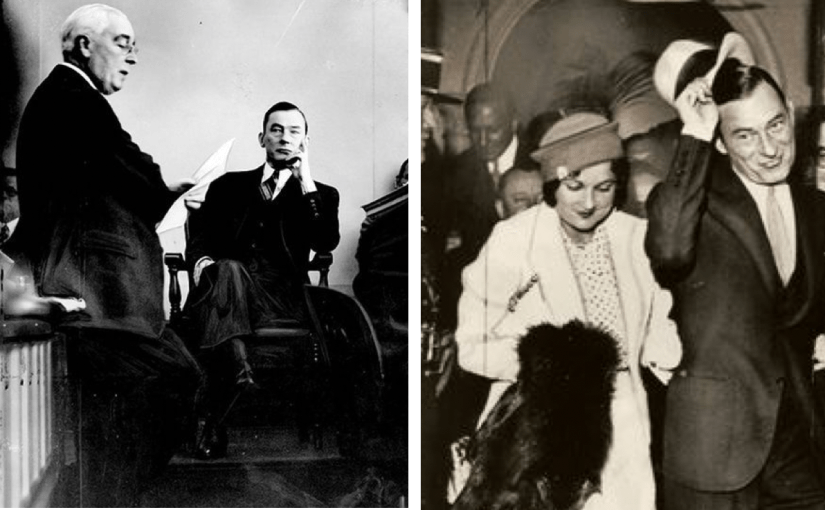
ONLY THE SHADOW KNOWS…A.C. “Blumey” Blumenthal (at left in the light suit) was often seen shadowing Mayor Jimmy Walker in his role as chief counselor and chief stooge. Here the mayor is escorted by Blumey and New York’s finest during corruption hearings in 1931. At right, Blumey’s wife Peggy Fears (1903–1994) in her most notable film role, 1935’s The Lottery Lover. Their tempestuous marriage lasted from 1927 to 1950. (avenuemagazine.com)
* * *
Coward’s Ménage
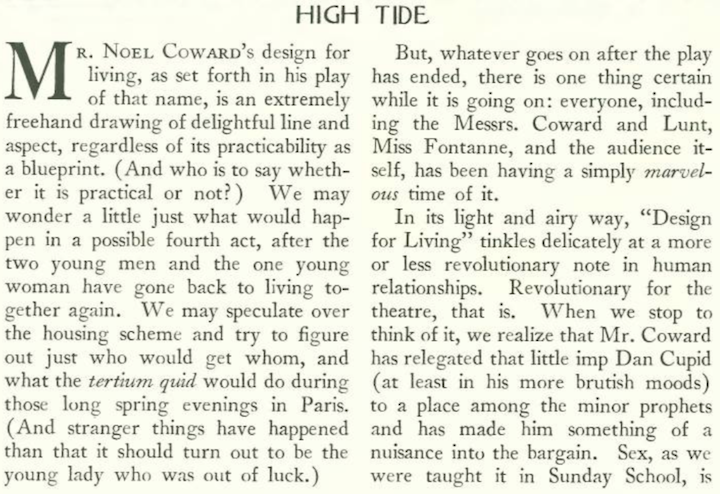
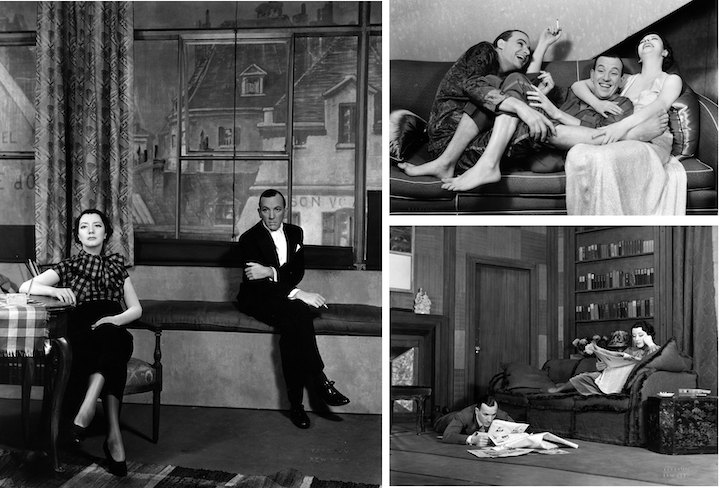
Playwright Noel Coward existed in the orbit of the Algonquin Round Table, so it was doubtless challenging for Robert Benchley to critically review his friend’s work. Fortunately, Benchley found Design For Living mostly to his liking. Note how Benchley subtly refers to the play’s gay subtext, and to the fact that it mirrored the real-life relationships of the play’s trio.
THREE’S COMPANY…A studio in Paris. A penthouse in New York. A flat in London. These were the settings for Noël Coward’s play Design for Living at the Ethel Barrymore Theatre, which starred the wife-husband team Lynn Fontanne and Alfred Lunt and their close friend Coward in a Broadway run of 135 performances from January to May 1933. (Vandamm theatrical photos via wisc.edu)
Benchley did have a few quibbles, but reasoned there was no need to be overly critical when there was such a dearth of quality stage entertainment. Note the great caricatures by Al Frueh (below) that accompanied the review.
Benchley had a different sort of dilemma criticizing Elmer Rice’s earnestly patriotic We, the People, a play about the misfortunes of a working class family in Depression America.
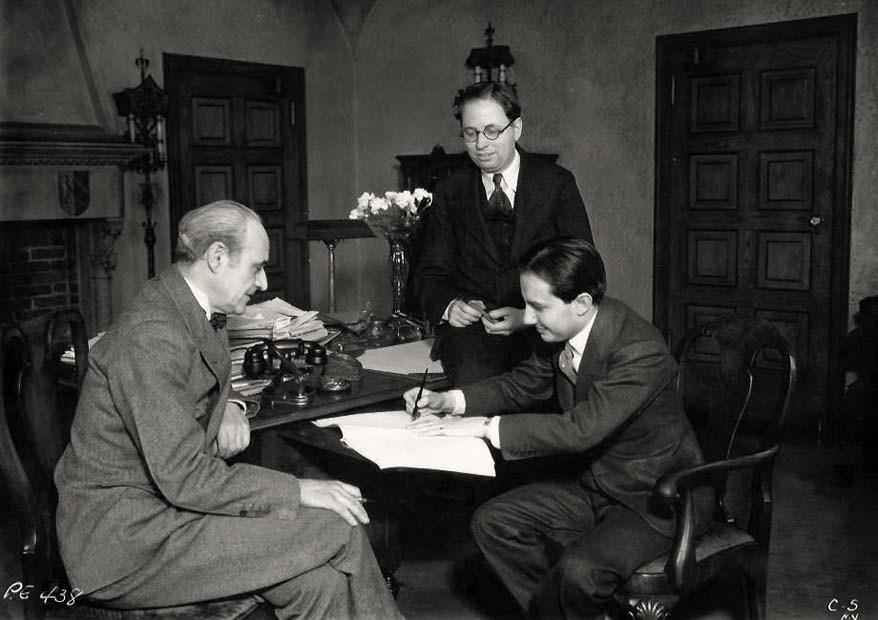
Rice, who won the Pulitzer Prize for Drama in 1929, was an occasional contributor to The New Yorker from 1929 to 1931, including his sci-fi satire on the film industry, Voyage to Purila, which was serialized in eleven installments (with illustrations by Peter Arno) in The New Yorker from Oct. 12 to Dec. 21, 1929.
LET’S MAKE A MOVIE…Elmer Rice (standing) joins theatre producer Joseph P. Bickerton, Jr. (left), and Universal’s Carl Laemmle Jr. to sign a contract for the film version of Rice’s 1931 Broadway play Counsellor at Law. The film proved to a critical success. (Wikipedia)
Meanwhile, film critic John Mosher was trying his best to enjoy the latest Hollywood fare, another Broadway play adapted to the silver screen. Whistling in the Dark…
MURDER MOST AMUSING…The 1933 American pre-Code comedy-mystery film Whistling in the Dark starred Ernest Truex and Una Merkel. (IMDB)
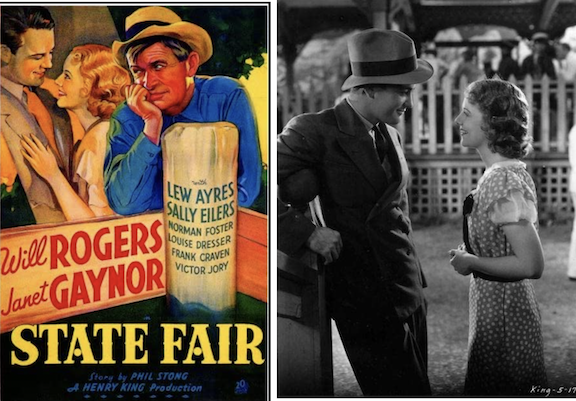
However, Mosher was surprisingly enthused by the rustic charms of Iowa country folk in State Fair…
THE TRIUMPH OF PRIZE PICKLES and other delights awaited viewers of 1933’s State Fair, which gave star billing to Will Rogers and Janet Gaynor. At right, Lew Ayres sweet-talks Gaynor at the fairgrounds. (IMDB)
* * *
Form Follows Function
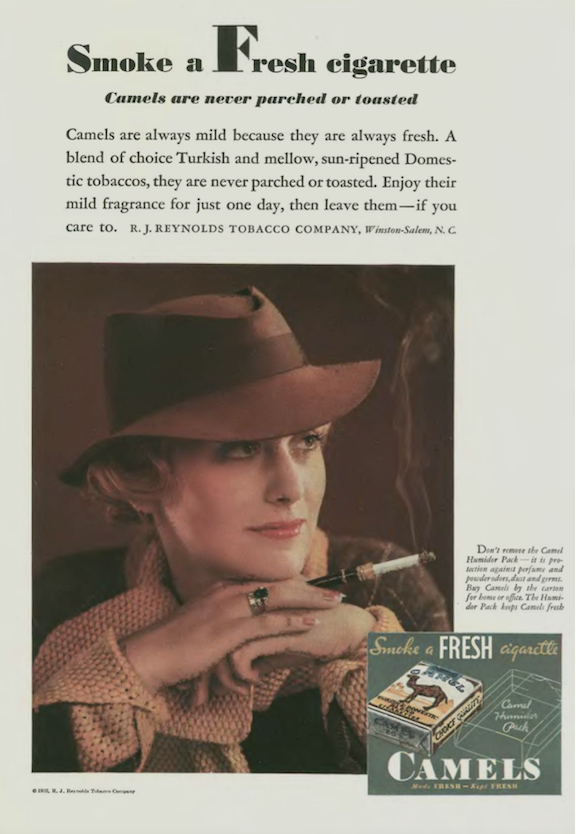
E.B. White paid close attention to all the little details of daily life, including the advertisements that appeared in The New Yorker. In “The Talk of the Town” he wrote about a Camel ad that inspired a sudden fashion trend:
…here is the Dec. 24, 1932 New Yorker ad to which White referred:
* * *
From Our Advertisers
We keep our cigs lit for our first ad, from Lucky Strike, keeping it simple with their familiar slogan…
…this ad from Powers Reproduction shows us the beach caps that were all the rage in the early ’30s…
…this may look like an old car to modern eyes, but in 1933 these sweeping curves were la dernière mode in the auto world…
…and then there was Hupmobile, trying its best to stay relevant in the Depression…
…the company folded in 1939, but a few reminders live on…
HUP HUP HOORAY…The 1917 Hupmobile dealership at 25th and Farnam in Omaha, NE, was located along the old Lincoln Highway and is the last preserved Hupmobile dealership in the United States. On the National Register since 2014, it now houses apartments. (Flickr)
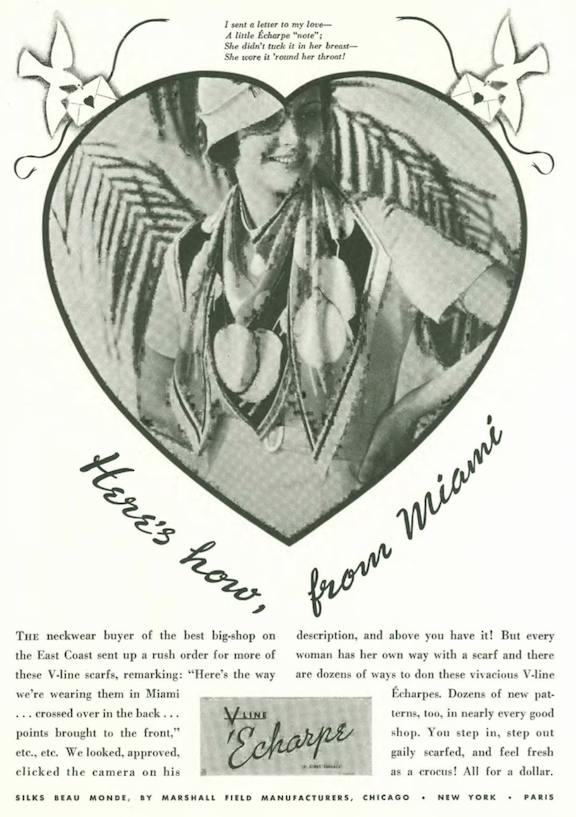
…Valentine’s Day was just around the corner, so time to buy your sweetheart something special, like this scarf that was all the rage among the Miami snowbirds…
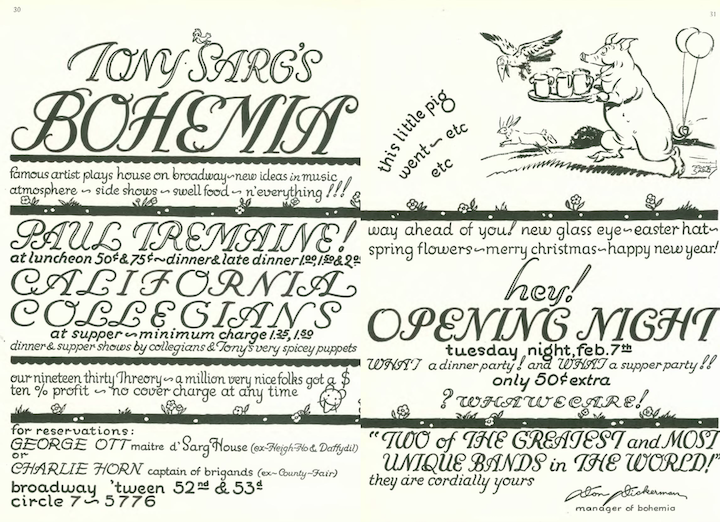
…Greenwich Village restaurateur and personality Don Dickerman took out this two-page ad to trumpet his partnership with puppeteer and illustrator Tony Sarg at the Bohemia restaurant on Broadway…
…the German-American Sarg is also known as the creator, in 1927, of the first giant balloons for Macy’s Thanksgiving Parade…
THE OLD GASBAG…Tony Sarg (upper right hand corner) and assistants painting one of his Macy’s parade balloons. (Fotograms News Photo Service via Pinterest)
…on to our cartoons, and what a big day for The New Yorker…the Feb. 4, 1933 issue featured the first captioned cartoon by Charles Addams…
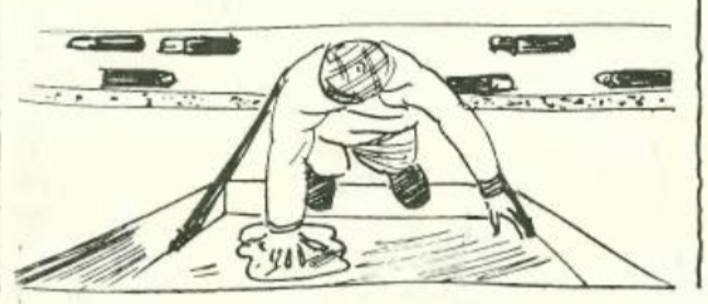
…for the record, Addams’s very first contribution to the magazine was this spot illustration (below) featured on page 65 of the Feb. 6, 1932 issue…
…one of the original contributing artists to The New Yorker,Gardner Rea, continued his skewering of America’s plutocrats…
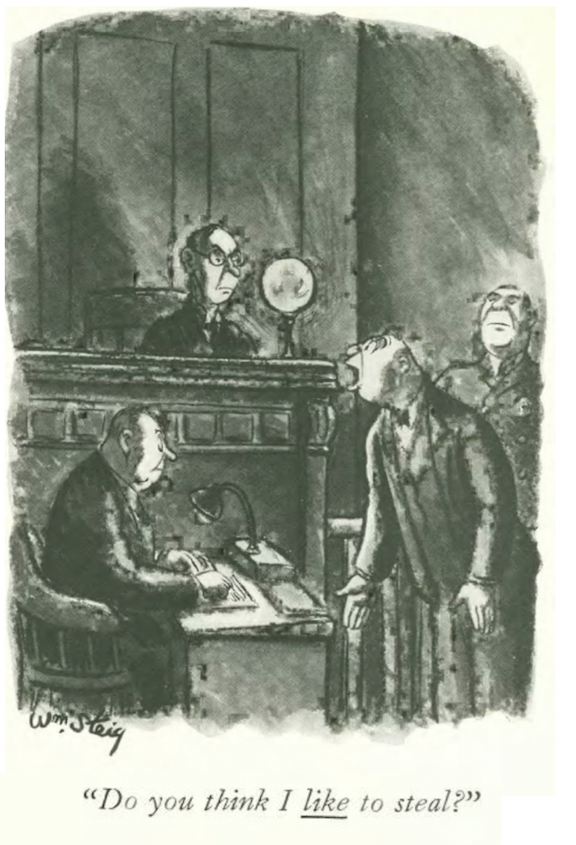
…William Steig took us before the bench to make an honest plea…
…James Thurber gave us another skirmish between the sexes…
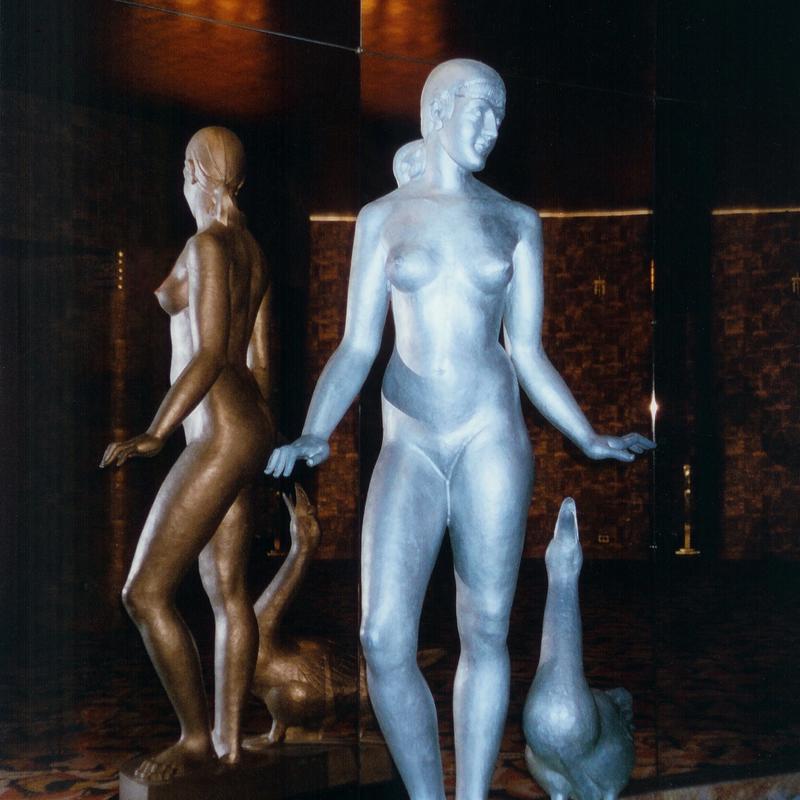
…and recalling my Jan. 12 post (about the Jan. 7, 1933 issue), in which the puritans got their knickers in a bunch over Robert Laurent’sGoose Girl sculpture in the Radio City Music Hall lobby…
…we end with Helen Hokinson, inspired by Laurent’s work…
In the span of 112 minutes, the much-anticipated Fox production Cavalcade took movie audiences through the first thirty years of the 20th century.
Jan. 14, 1933 cover by Peter Arno.
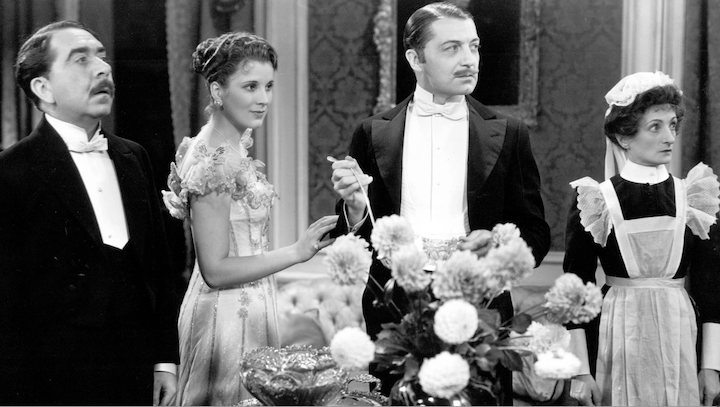
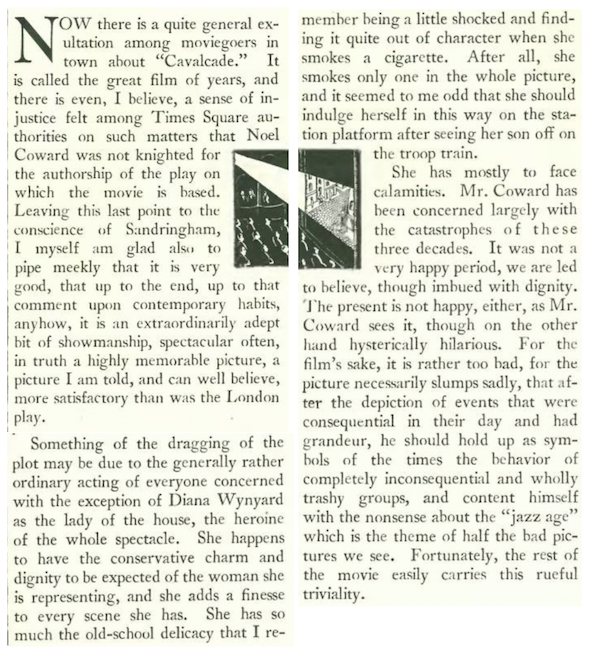
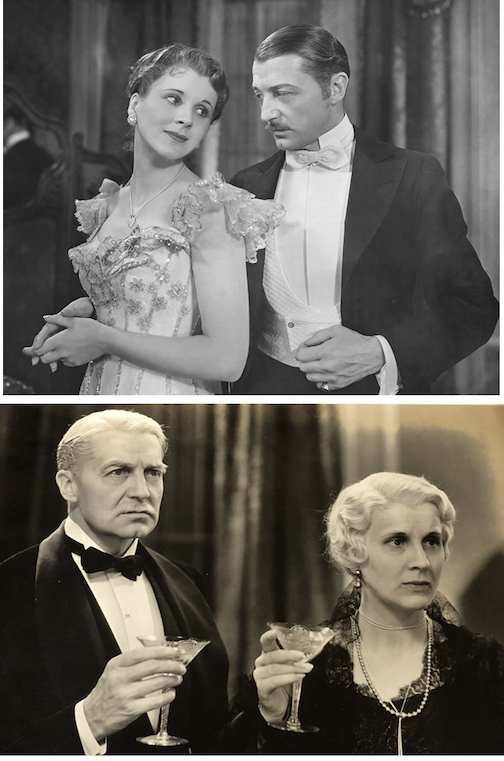
Anticipating Upstairs, Downstairs (1971) and the more recent Downton Abbey, Cavalcade looked at life through the eyes of upper class Londoners—Jane and Robert Marryot, their children and close friends—and the Marryot’s servants. It was a calamitous ride that included both the Boer War and World War I among other historic events. Critic John Mosher thought it a memorable picture despite its mawkishness.
IT’S A SCARY WORLD OUT THERE…This Fox theater card promised audiences epic thrills with a cast of thousands. (IMDB)AGING GRACEFULLY…Diana Wynyard and Clive Brook portrayed upper class Londoners Jane and Robert Marryot through three tumultuous decades in Cavalcade. (IMDB)
In the film, the first decades of the 20th century would claim the lives of both Marryot sons—Joe would perish in World War I, and Edward would make the unfortunate decision to take his bride on a honeymoon cruise…
ONE-WAY TICKET…Edward Marryot (John Warburton) and his childhood sweetheart Edith Harris (Margaret Lindsay) are thrilled to be celebrating their honeymoon on a “big boat.” When the couple walk away from the railing, the opposite side of the life preserver is revealed in a dramatic camera shot.
After World War I the film hastily moved on to the Jazz Age, where the social order was going to hell…
CRY WOLF…A creepy older dude puts the moves on a young blonde (portrayed by Betty Grable in an uncredited role) during a Jazz Age scene of a wild party that included glimpses of flirting gay couples. Cavalcade was one of the first films to use the words “damn” and “hell.” (IMDB)
Cavalcade is considered by some critics to be one of the worst films to receive an Academy Award (it actually won three—Best Picture, Best Director, and Best Art Direction). If you are interested in learning more about Cavalcade or about pre-Code films in general, visit the excellent pre-code.com website.
* * *
Sad Songs
George White was famed for his lavish Scandals revues, especially during the Roaring Twenties—leggy showgirls and wisecracking comedians shared the stage with some of the era’s top singers and dancers. White’s Music Hall Varieties seemed to have all of the same elements as his Scandals, but something seemed amiss to Robert Benchley—an unnamed sadness that he chalked up to those depressing times:
THE SHOW MUST GO ON…Even during the Depression George White did what he could to keep the old Roaring Twenties spark alive. Clockwise from top left: White auditioning dancers for his Scandals;Bert Lahr preparing for a stage show in the 1930s (Lahr’s son, John, would later become a New Yorker drama critic); the Howard Brothers, Eugene and Willie, in 1936; and a young Eleanor Powell ready to do some toe-tapping circa 1932. (PBS/NYPL/Wikipedia)
* * *
Journey of the Mind
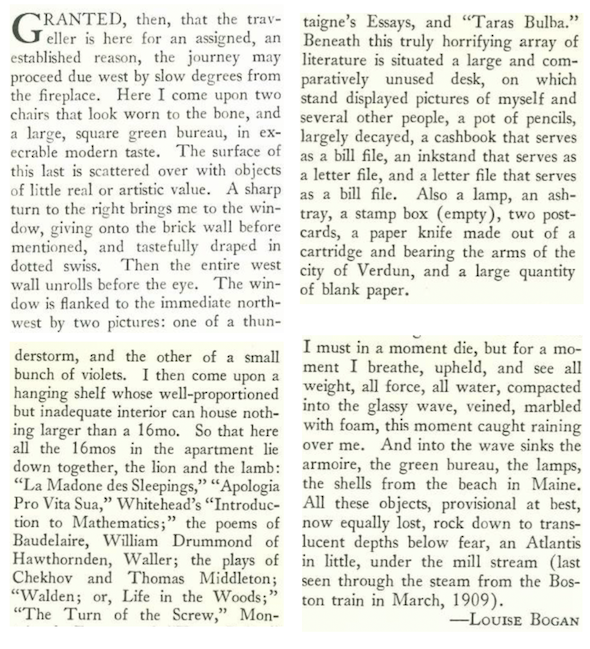
Louise Bogan (1897–1970) was poetry editor at The New Yorker for nearly forty years (1931–1970) and in 1945 was the first woman to be appointed Poet Laureate to the Library of Congress. For the Jan. 14 issue she wrote “Journey Around My Room,” which begins with her recollection of a childhood train ride. Here are some excerpts:
POET LAUREATE…Louise Bogan in 1937. She was poetry editor at The New Yorker for nearly forty years and was named U.S. Poet Laureate in 1945. (Library of Congress)
* * *
Silent Cal Silenced
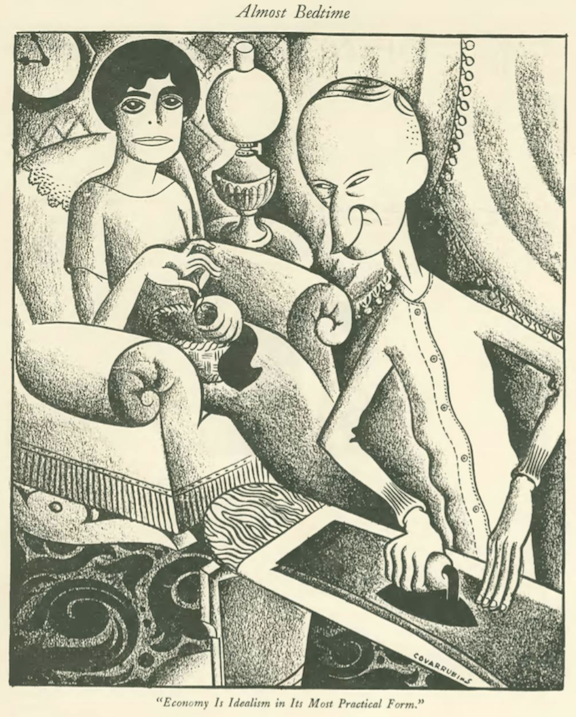
Many folks were surprised by the sudden passing of former U.S. President Calvin Coolidge. He was just sixty years old when he succumbed to coronary thrombosis at his Northampton home, “The Beeches.” During The New Yorker’s first years Coolidge was the butt of many jokes…beginning with this Miguel Covarrubias cartoon in the magazine’s fourth issue (March 14, 1925)…
E.B. White offered this eulogy of sorts…
THRIFTY IDYLL…Calvin and Grace Coolidge outside their newly acquired home, “The Beeches,” Northampton, summer 1930. (Leslie Jones Collection)
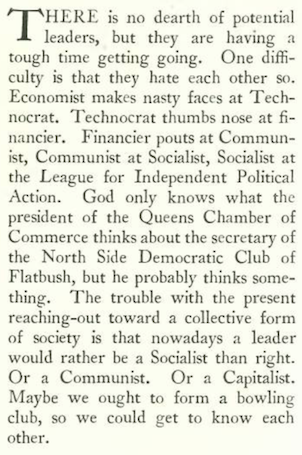
…and mused about the state of politics in 1933, proving that some things never change…
Last time we learned Lewis Mumford’s views about the new artwork displayed in the RKO Roxy Theatre and in Radio City Music Hall. In the Jan. 14 issue he turned his attentions to the actual buildings, giving them an average grade and preferring the Music Hall over the Roxy (he disliked the oversized chandelier/electrolier). Mumford was decidedly not a fan of the Rockefeller Center development, evident in his closing lines:
SHOWPLACES…Lewis Mumford gave Radio City Music Hall (top) and the RKO Roxy some muted nods, but found the Roxy’s electrolier distracting.
* * *
Parting Thoughts
Alexander Woollcott shared some final recollections of his visit to Moscow, in which he likens the Russians’ freedom under Josef Stalin to the freedom of a spirited schoolboy who desires to sit in the back of the classroom…
* * *
From Our Advertisers
Bonwit Teller employed some modern typesetting, wryly using the word DULL — offset in large san-serif letters — to draw attention to their “Chardonize” fabric, which was essentially artificial silk…
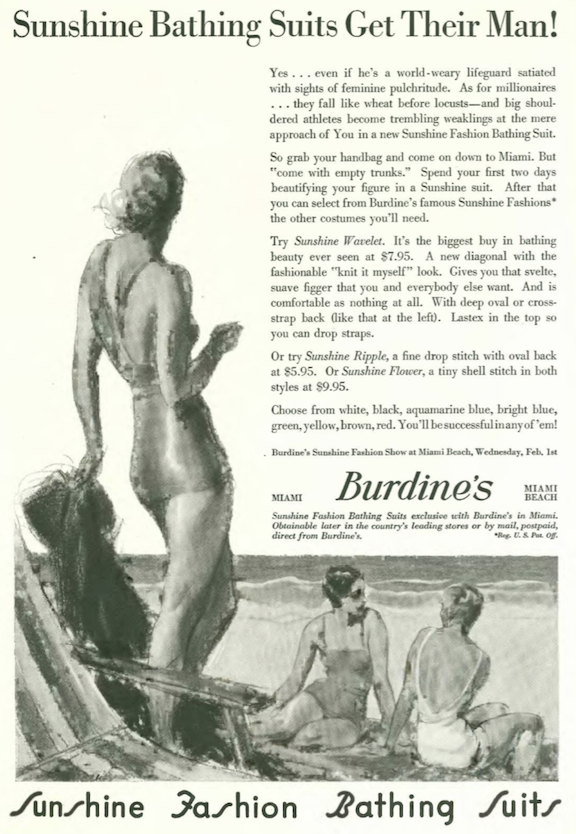
…nothing subtle about this next advertisement…don one of these bathing suits and millionaires will bow before you, or rather, to borrow this ad’s odd metaphor, “fall like wheat before locusts”…
…we get a similar but far more muted pitch from Coty…so does this mean one out of every six desirable bachelors want to be seen with her? Not exactly knocking them down like locusts…
…now here’s a couple of self-assured souls who are neither troubled by hungry locusts nor face powders…they own a Cadillac, and wow, that is really quite the automobile, not like the Caddies you see today that are half-plastic and blend in with the rest of the shapeless blobs we call cars these days…
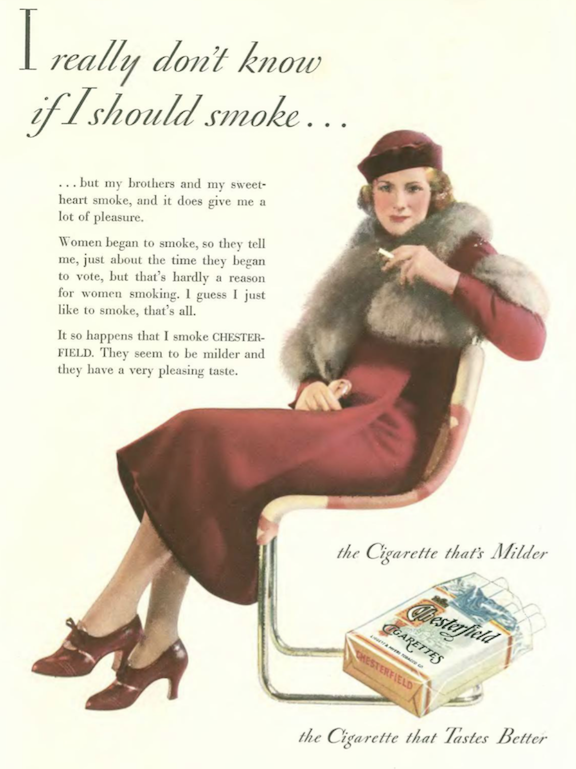
…the folks who pushed Chesterfield cigarettes were back with another ad aimed at their fastest growing demographic…note the sly reference to women’s suffrage…but that’s not why this woman (seated on a modern Breuer chair) smokes; she smokes because it gives her pleasure, and come to think of it, why should men have all the fun?…
…the Cunard Line suggested that you might run into some big-time celebrities on one of their ships, including actress Norma Shearer and banker/arts patron Otto Kahn (bottom of left-land page); or on the opposite page Charlie Chaplin, Douglas Fairbanks and Mary Pickford, Alfred Lunt and Lynn Fontanne among others…
…by contrast, the French Line employed the artistry of James Thurber to entice travelers onto the high seas…
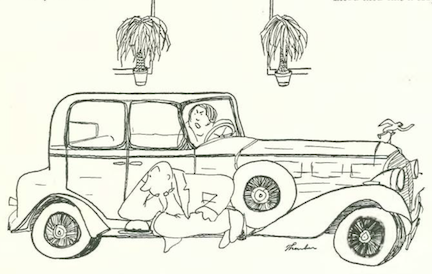
…which gives us a nice segue into our cartoons, beginning with this spot by Thurber referencing the National Auto Show…
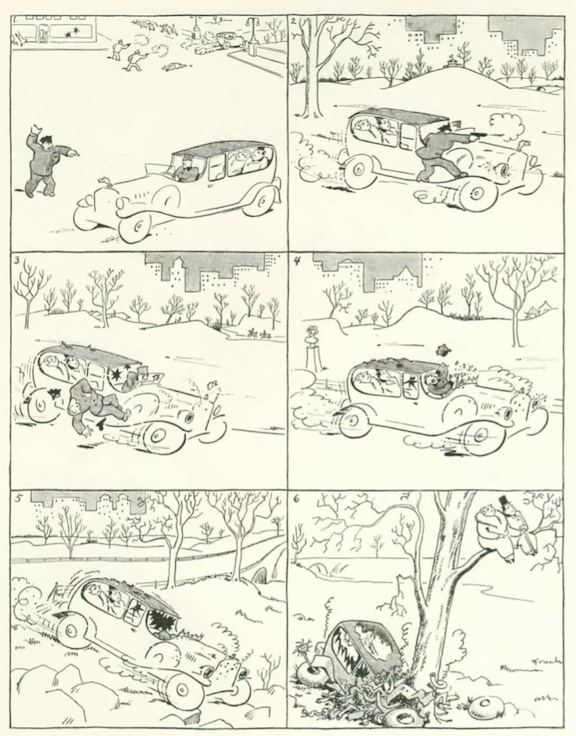
…Al Frueh offered up another of his famed sequential works…
…Gardner Rea with his usual perspective on the absurd…
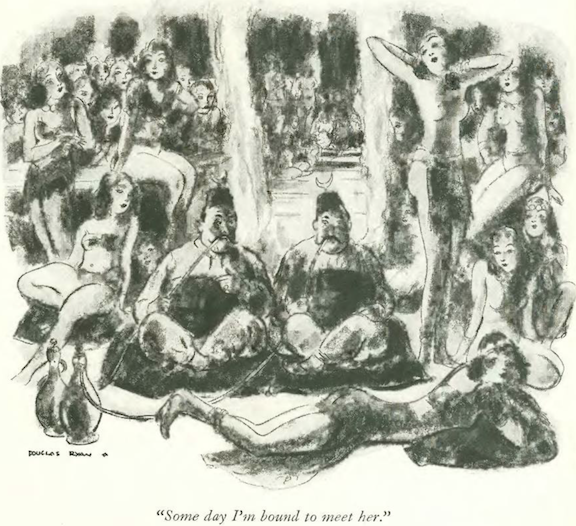
…Douglas Ryan plied the familiar waters of the harem trope…
…and Robert Day showed us that even the smallest consolation can still satisfy…
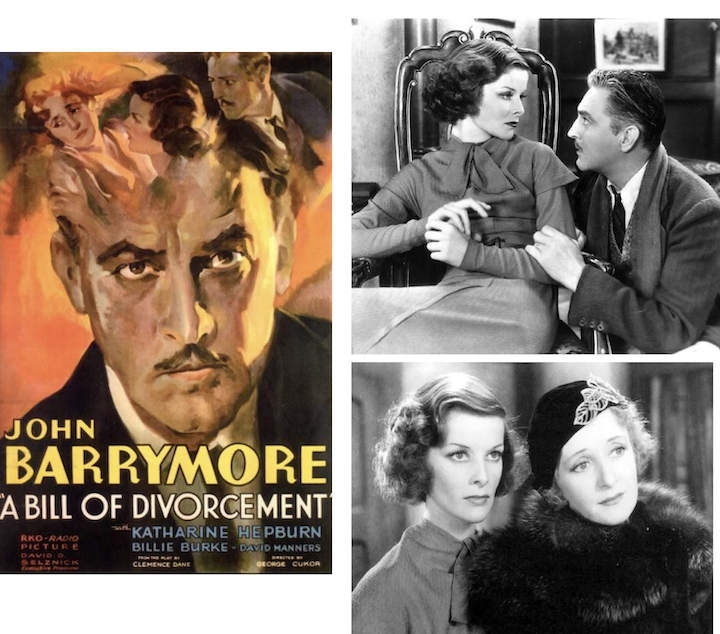
George Cukor’s 1932 pre-Code film A Bill of Divorcement would make Katharine Hepburn an instant star in her screen debut…
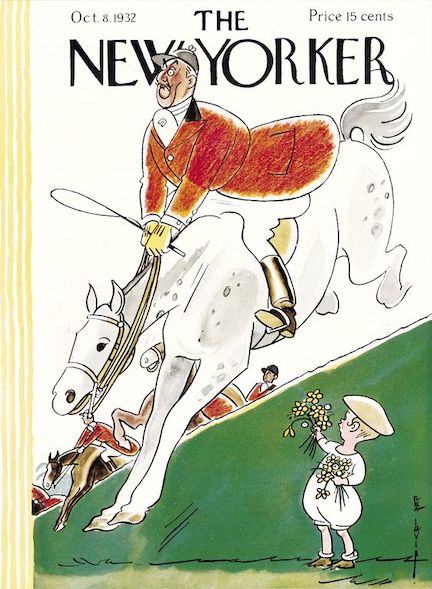
Oct. 8, 1932 cover by Rea Irvin.
… but New Yorker critic John Mosher seems to have missed the boat in spotting this new talent, who would go on to be—at least according to the American Film Institute, “the greatest female star of classic Hollywood cinema.” In A Bill of Divorcement, Hepburn portrays a young woman who fears she has inherited the same psychiatric problems that plague her father (John Barrymore). Mosher wrote:
A LOT ON HIS MIND…In A Bill of Divorcement, John Barrymore portrays a man who escapes from a mental hospital after 15 years of confinement, seeking to return to wife and family; his daughter, Sydney (Katharine Hepburn), fears she has inherited his psychiatric problems, while Sydney’s mother, Meg (Billie Burke) wants to start a new life with another man. (IMDB)
Although Mosher offered a rather tepid response to Hepburn’s debut role, critic Mordaunt Hall of The New York Times called the film “intelligent, restrained and often stirring.” Of Hepburn he wrote: “Miss Hepburn’s characterization is one of the finest seen on the screen and the producers have been wise in not minimizing the importance of her part because Mr. Barrymore is the star of the film.”
* * *
On Shaky Ground
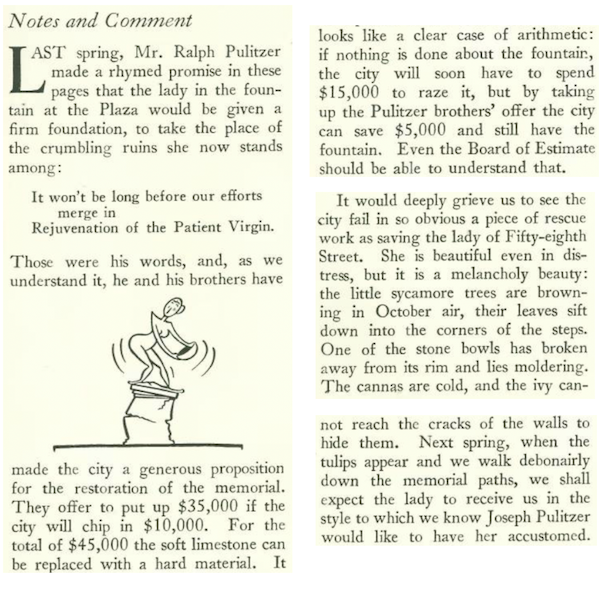
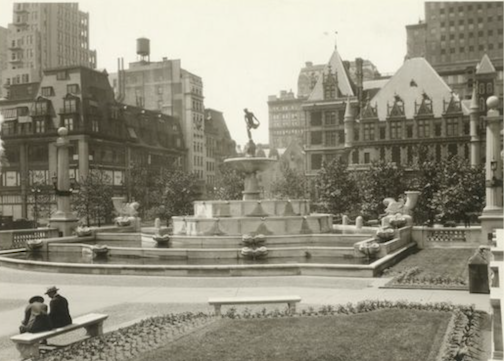
E.B. White noted the sad state of the Pulitzer Fountain, which had stood at the Plaza since 1916. Although Joseph Pulitzer’s sons had put up funds to restore the landmark, the city had yet to act on a plan.
Fortunately the fountain still stands, thanks to restorations in 1933-35, 1971 and 1985-90. As to White’s concerns, the city finally accepted the Pulitzers’ offer, and after delays due to labor disputes it was completed in June 1935. The original limestone basin was rebuilt in Italian marble, and a limestone balustrade and columns that surrounded the fountain were demolished.
WHEN WE WERE YOUNG…The Pulitzer Fountain after it was completed in 1916. (New York Public Library)
White also mused about the nature of Long Island, soon to be transformed under Robert Moses’ system of parkways that would stretch across the island’s vast expanses.
EAT ME…Hundreds of truck farms dotted Long Island in the early 20th century, especially known for their potatoes. (Newsday)
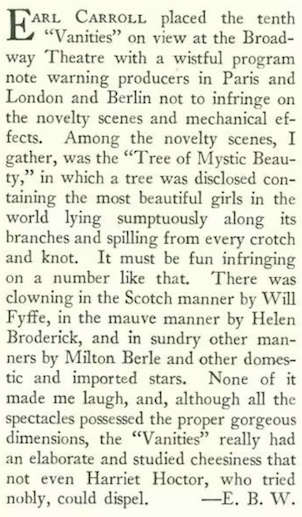
…and we have more from White, also serving as the magazine’s theater critic and taking in the latest installment of Earl Carroll’sVanities…I include this mainly to note the young vaudevillian Milton Berle’s first appearance on a big stage…
BEFORE UNCLE MILTIE…Milton Berle (1908–2002) made his first appearance on a big stage with Earl Carroll’s 1932 Vanities. It is also noteworthy that in that same year Chicago native Vincente Minnelli (see program cover) was getting his first breaks on Broadway as a stage and costume designer. (tralfaz.blogspot.com/Playbill)
* * *
Delirious Nights
Although Lois Long was primarily focused on her fashion column, she continued to file an occasional “Tables for Two” that gave readers a glimpse into New York nightlife, including the star-studded (Walter Chrysler, Howard Hughes, among others) opening of the Pierrette Club in the Waldorf-Astoria’s Sert Room…
DANCING WITH THE STARS…Lois Long reported on the star-studded opening of the Pierrette Club in the Waldorf-Astoria’s Sert Room, which featured a series of Saturday night supper dances; images of the Sert Room left and right; at center, The New York Times’ account of the club’s opening, Oct. 2, 1932. (geographicguide.com/The New York Times/jstor.org)
* * *
From Our Advertisers
Simon & Schuster promoted George Gershwin’s Song Book, illustrated by New Yorker regular Constantin Alajalov…
…signed first editions go for up to $8000 these days…
(raptisrarebooks.com)
…meanwhile, Farrar & Rinehart trumpeted the release of Evelyn Waugh’s latest novel (his third)…Black Mischief satirized the ways Europeans attempted to impose their customs and beliefs on other cultures…
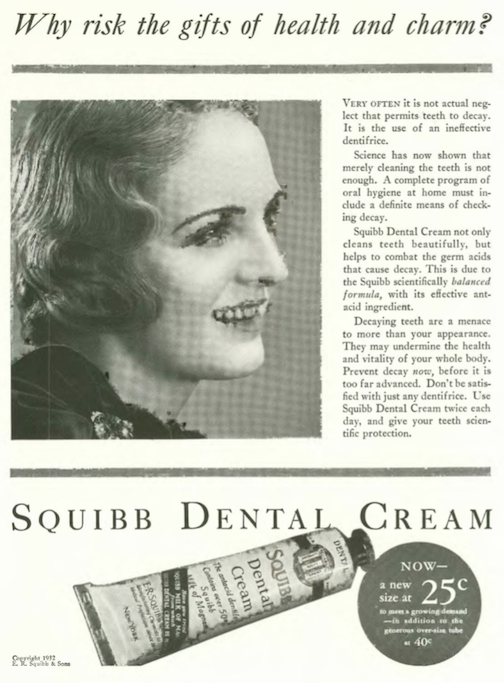
…Squibb helped The New Yorker’s bottom line with three separate ads scattered throughout the magazine…back in the day the Squibb brand was associated with everything from toothpaste…
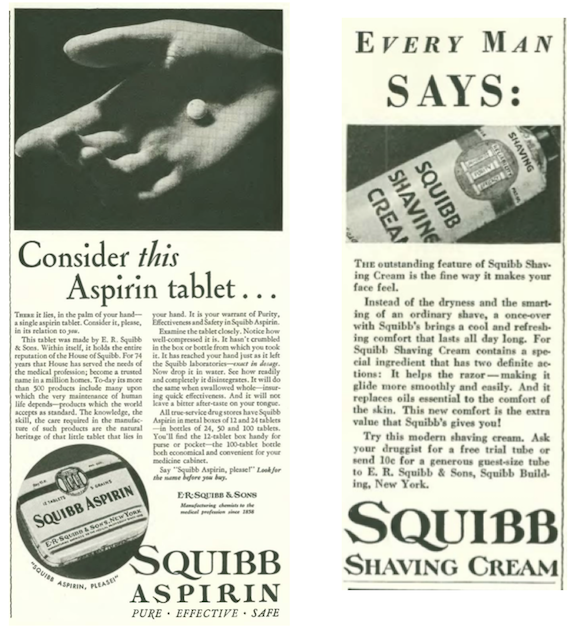
…to aspirin and shaving cream…founded in 1858, it merged with Bristol Meyers in 1989 to form one of the world’s largest pharmaceutical companies, Bristol Myers Squibb, which today is mostly known for manufacturing dozens of prescription pharmaceuticals and biologics…
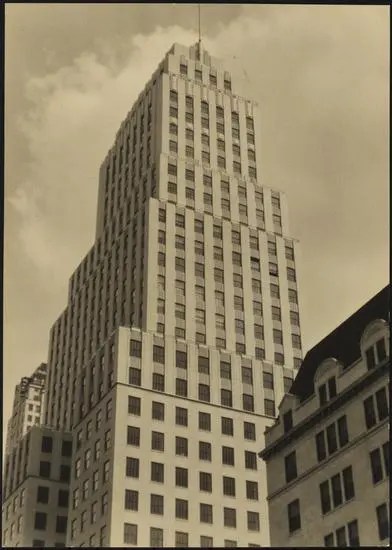
…Squibb & Sons were the primary tenant (the top 12 floors) of New York’s landmark Squibb Building when it opened its doors in 1930…
(Museum of the City of New York)
…moving on, here are a couple of ads that show us one thing that has definitely changed in the past 89 years…when was the last time you wore a fur coat to a football game?…
…cigarette manufacturers had plenty of money to advertise during the depths of the Depression, but apparently so did the folks at Wamsutta Mills…Wamsutta sheets are no longer made in New Bedford—part of the circa 1847 mill complex is now loft-style housing…however, the Wamsutta brand still exists in the U.S. through Bed, Bath & Beyond and internationally as part of a Brazilian textile conglomerate…
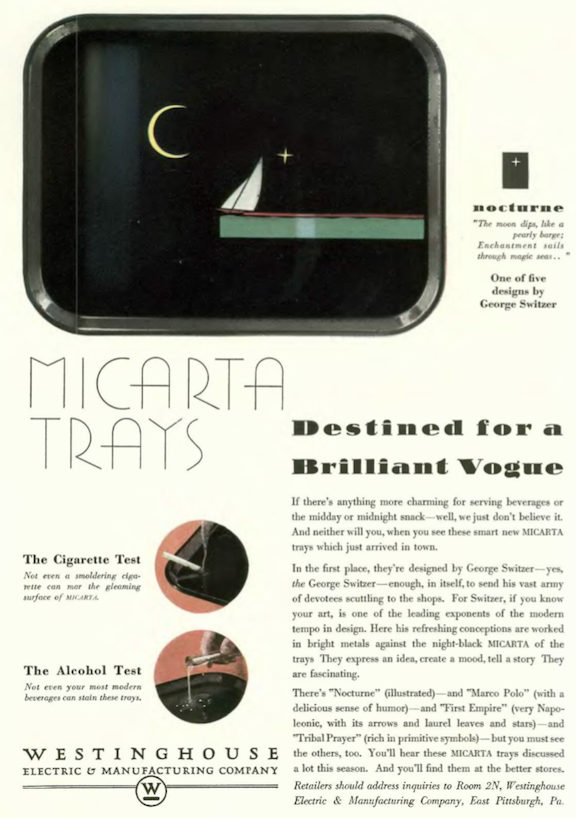
…Micarta was a substance developed by Westinghouse in the early 20th century for use with electrical equipment…produced from a combination of linen, canvas, paper, fiberglass and other materials processed under heat and pressure, Westinghouse found a new use for this laminate — serving trays designed by George Switzer…you can read more about Micarta trays at Driving for Deco…reader Chris notes that Micarta is “still available in a wide range of grades and designer colors and is popular with hobbyists and craftsmen the world over”…
…in the Oct. 29 issue, E.B. White made this observation about Micarta trays…
…on to our cartoons, William Steig’s “Small Fry” learned about the birds and the bees…
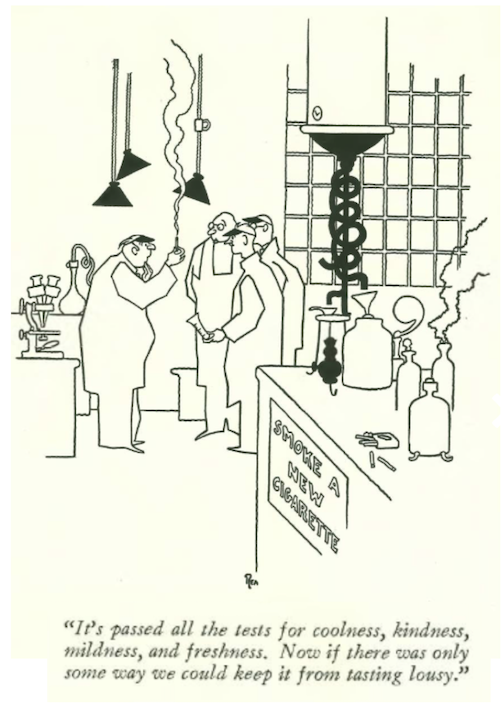
…Gardner Rea visited some tobacco researchers challenged to keep pace with advertising claims…
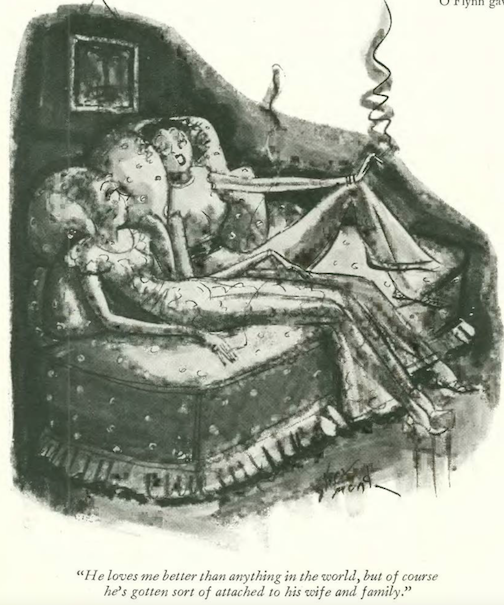
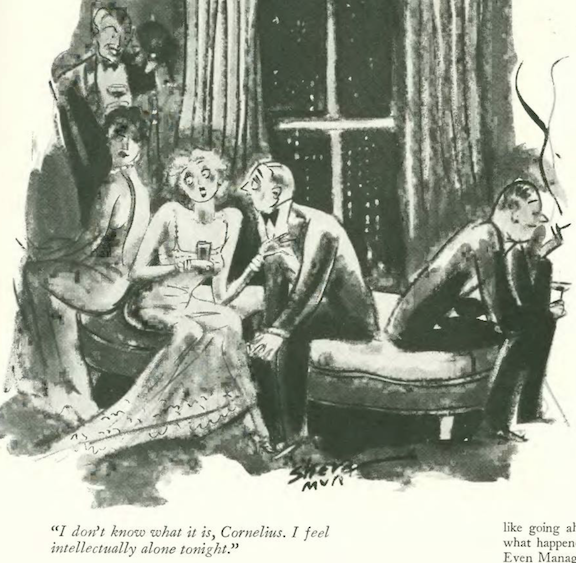
…Barbara Shermund looked into the love lives of the modern woman…
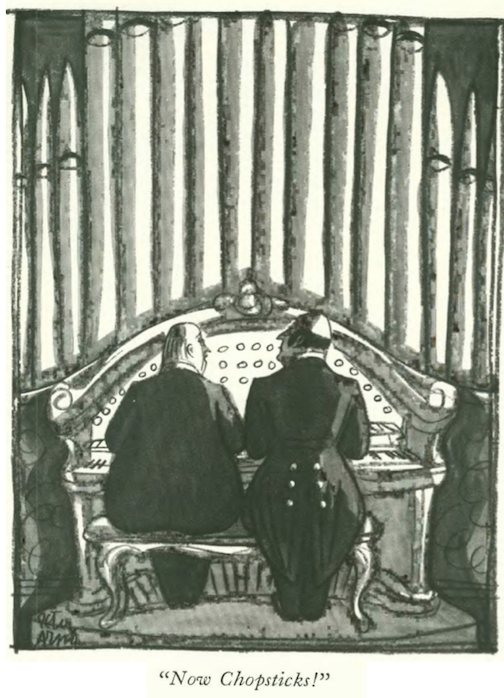
…and Peter Arno got playful at the pipe organ…
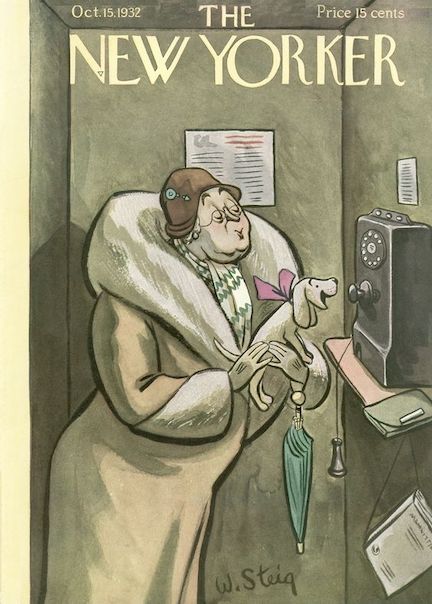
…on to our Oct. 15, 1932 issue…
Oct. 15, 1932 cover by William Steig.
…where we check in on John O’Hara (1905–1970), who defined the short story at The New Yorker (and contributed more shorts to the magazine than any other writer). For the Oct. 15 issue O’Hara submitted a profile titled “Of Thee I Sing, Baby.” The profile is unusual because it is told as a story rather than as a biography, and the subject, a chorus girl, is not identified by her real name. A brief excerpt:
WRITING MACHINE…John O’Hara (pictured here in 1945) contributed more short stories to The New Yorker than any other writer. (Library of Congress)
* * *
…William Steig (1907–2003) was both a writer and illustrator, and every bit as prolific as O’Hara, publishing more than 50 books during his long life and career, including his very first, which received this mention at the end of the Oct. 15 book review section:
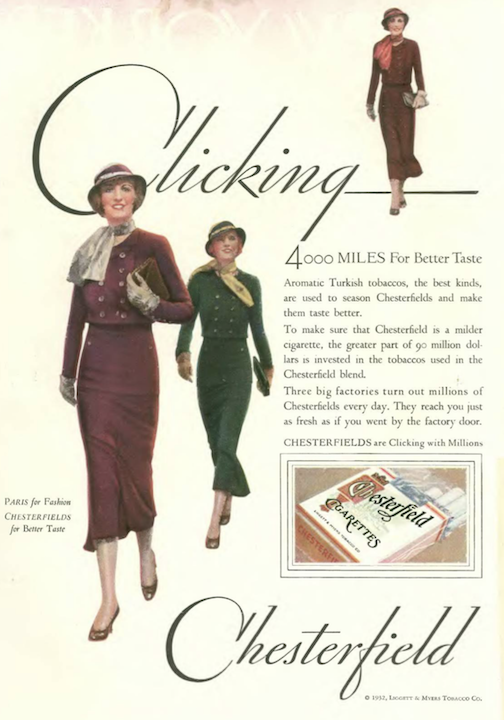
…on to our Oct. 15 advertisers, we have the makers of Chesterfields pairing their product with the sophistication of Paris fashions…
…Carl “Eric” Erickson illustrated a number of ads for R.J. Reynolds’ Camel cigarettes in the late 1920s and early 1930s…here he employed his signature sophisticated style for the French Line…
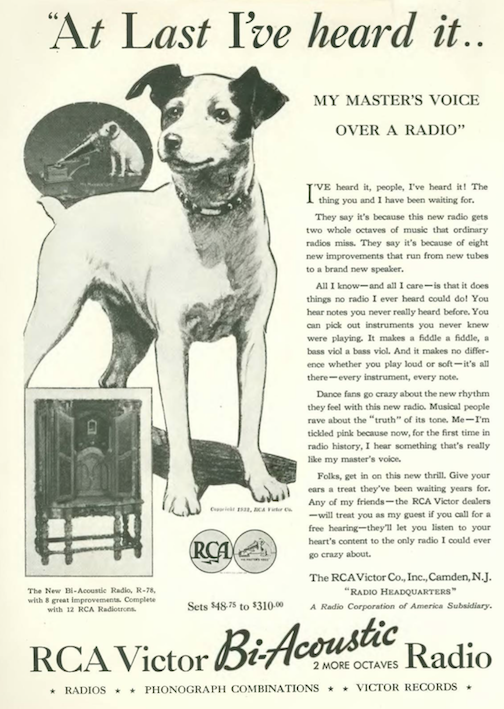
…RCA promoted the next great advance in radio technology—”bi-acoustic” sound that added “two more octaves” to radio broadcasts…it would take thirty more years to roll out something we take for granted today—stereo…
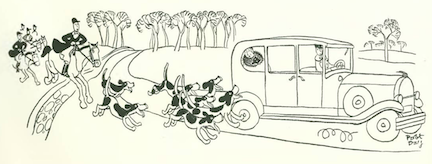
…on to our cartoons, Robert Day joined a misdirected fox hunt…
…Richard Decker gave us one man’s simple solution to a perilous situation…
James Thurber made a rare appearance in the “Reporter at Large” column—usually the purview of the departing Morris Markey—to offer a glimpse into the life of Albert Davis and his extensive collection of theatrical and sports photographs.
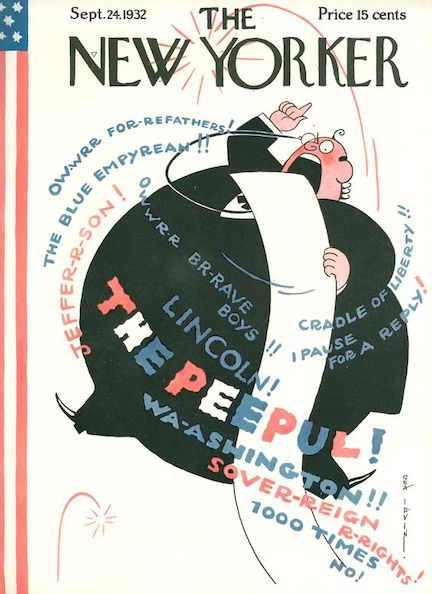
Sept. 24, 1932 cover by Rea Irvin.
A publicist by trade, Davis (1865-1942) collected thousands of photographs, clippings, programs, scripts and playbills from hundreds of productions mainly from the 1890s to the 1920s. In this excerpt, Thurber took a look into Davis’s rarefied world:
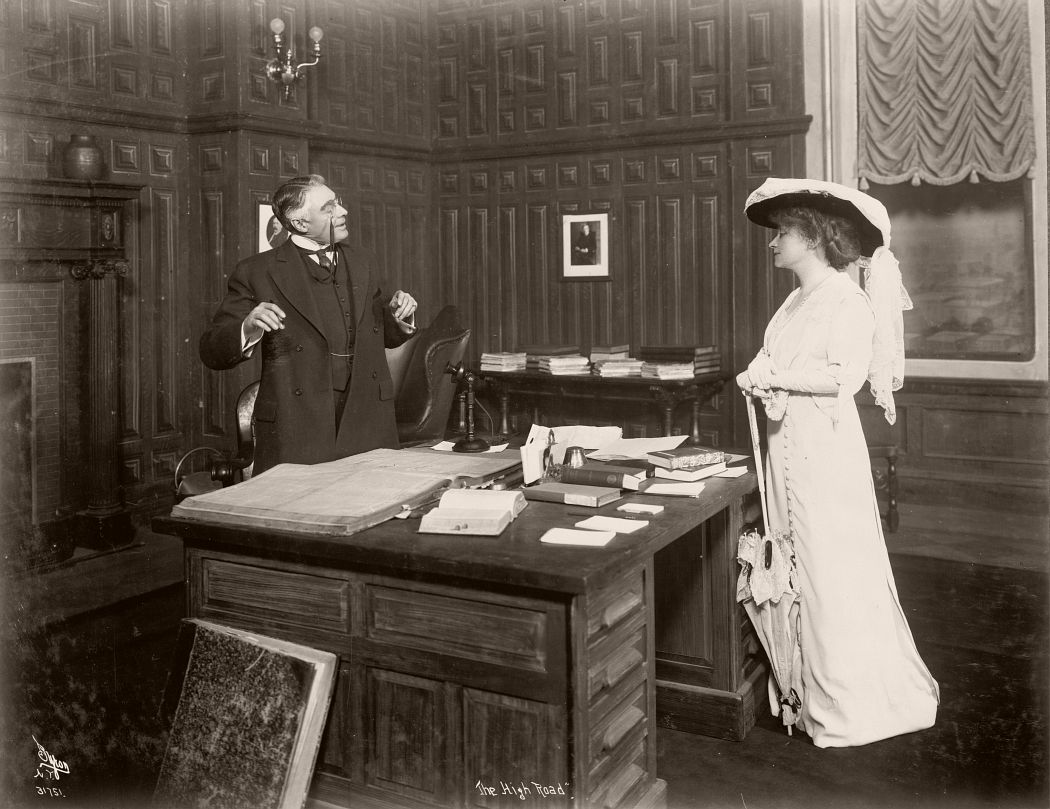
PLAYING MAKE-BELIEVE…Among the photographers collected by Davis was Joseph Byron, who captured this scene from the 1912 play The High Road by American playwright Edward Sheldon. Pictured are actors Frederick Perry and Minnie Maddern Fiske. (monovisions.com)OSCAR THE FIRST…Theatre impresario Oscar Hammerstein (left) at Manhattan Opera House, which opened December 3, 1906. Hammerstein was the first person with whom Davis traded photographs. He was also the father of famed lyricist and musical comedy author Oscar Hammerstein II. (monovisions.com)WHEN ALL PERFORMANCES WERE LIVE…Images of performers from the Davis collection included actor Bert Williams (ca. 1895); sharpshooter Annie Oakley (ca.1886); and actor Theodore Drury as Escamillo in Carmen (ca. 1905). (Harry Ransom Center, UT Austin)
Thurber pointed out that the collection was quite valuable, and its sale could reap a considerable sum for Davis. It seems Davis intended to present the collection to his university’s library, a wish more or less fulfilled.
Davis’s collection also contained hundreds of sports figures, mostly from the world of boxing.
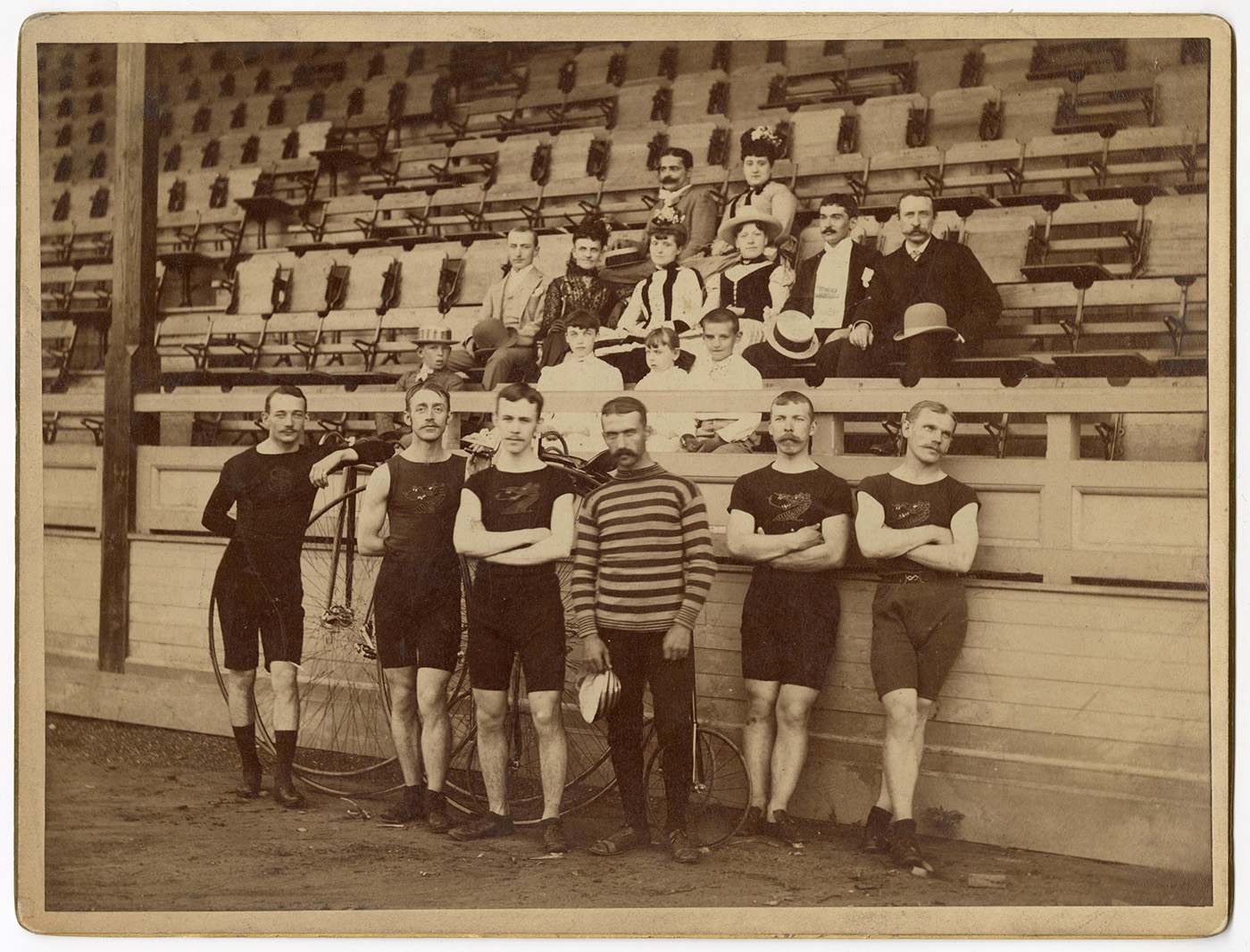
TOUGH GUYS…Omaha-born Max Baer (left) defeated German champion Max Schmeling at Yankee Stadium in 1933 and took the heavyweight title in 1934; Paul Berlenbach (right) was a light-heavyweight champ from 1923 to 1926. An interesting footnote: Baer acted in 20 films, and one of his three children, Max Baer Jr., portrayed Jethro Bodine on The Beverly Hillbillies. (Stark Center for Physical Culture and Sports, UT Austin)PEDDLERS…Bicycle racers at the Hartford Wheel Club’s bicycle tournament pose for an 1889 photograph in Stamford, Connecticut. (Stark Center)
Endnote: Davis wanted his collection to go to a university library, and so it finally did: it resides at the University of Texas at Austin; the theatrical photos and memorabilia are at the Harry Ransom Center, and the sports-related items are housed at the Stark Center for Physical Culture and Sports.
* * *
Is It Beer-Thirty Yet?
Brewer, politician and owner of the New York Yankees baseball franchise Jacob Ruppert Jr. (1867–1939) inherited the Jacob Ruppert Brewing Company and the Yankees upon his father’s death in 1915. It was Ruppert who purchased the contract of Babe Ruth (from the Red Sox in 1919) and built famed Yankee Stadium (1923), moves that helped propel a middling franchise to the top of the major leagues. Alva Johnston profiled Ruppert in the Sept. 24 issue; here is the opening paragraph:
LOOK WHAT I JUST BOUGHT…Jacob Ruppert purchased the contract of Babe Ruth from the Red Sox in 1919; Ruppert also inherited the Knickerbocker brewery at 92nd Street and 3rd Avenue (demolished in 1969). (historywithkev.com/brookstonbeerbulletin.com)
* * *
Pol Mole
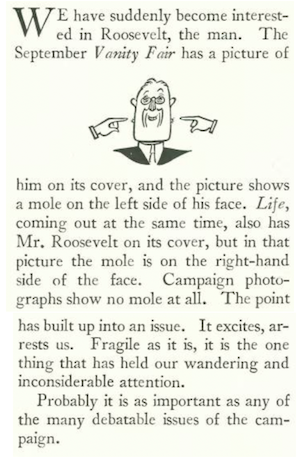
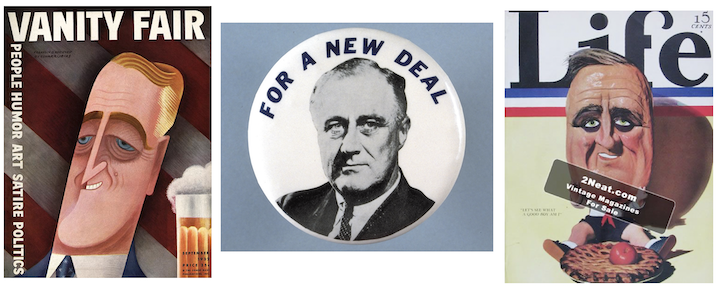
With the 1932 presidential election just weeks away, E.B. White’s focus was on an apparently elusive mole that decorated the left side of Franklin D. Roosevelt’s face, or possibly the right, or perhaps not at all…
REPRESENTING THE LEFT AND THE RIGHT…E.B. White mused on FDR’s apparently shifting mole, which appeared on the right cheek on the cover of Vanity Fair, on the left on the cover of Life, and not at all on the campaign button. (picclick.com/Britannica/2Neat.com)
This wouldn’t be the last time someone discussed FDR’s dermatology. Health experts today still debate whether a pigmented lesion above FDR’s left eyebrow was a melanoma—some even speculate that it led to his death at age 63, although the official cause of FDR’s death on April 12, 1945 was cerebral hemorrhage associated with high blood pressure. Incidentally, most photographs show the cheek mole on the right side.
* * *
Words Were Their Bond
What a treat it must have been for a New Yorker reader to turn to pages 15-16 and find Dorothy Parker’s “A Young Woman in Green Lace,” followed by Parker’s dear friend and confidant Robert Benchley’s “Filling That Hiatus” on pages 17-18.
GETTING TO KNOW YOU…Dorothy Parker and Robert Benchley (far right) with their employers in 1919: Vanity Fair editor Frank Crowninshield, Vogue editor Edna Chase, and publisher Condé Nast. (publicdomainreview.org)
Benchley and Parker’s friendship began when he was hired as Vanity Fair’s managing editor in the winter of 1919 (and would become Parker’s office mate the following May). That same year they were among the founders of the famed Algonquin Round Table.
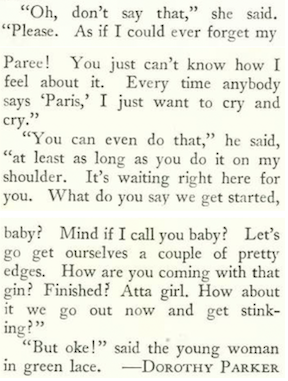
“A Young Woman in Green Lace” reveals how Parker regarded some of the modern women of those times, this next-generation flapper, a bit childish and snobbish, wishing she were back in “Paree.” In the story a man presses his charms as the woman descends into drunkenness and drops her Continental facade:
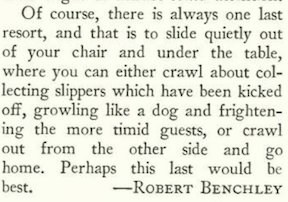
Where disillusion creates a darkly comic mood in Parker’s piece, in Benchley’s world disillusion provided a nice opening for some silliness. In ”Filling That Hiatus” Benchley addressed a seldom-discussed dinner-party etiquette situation in which both your right- and left-hand partners become engaged in conversation with someone else. He concluded:
* * *
His Country, Too
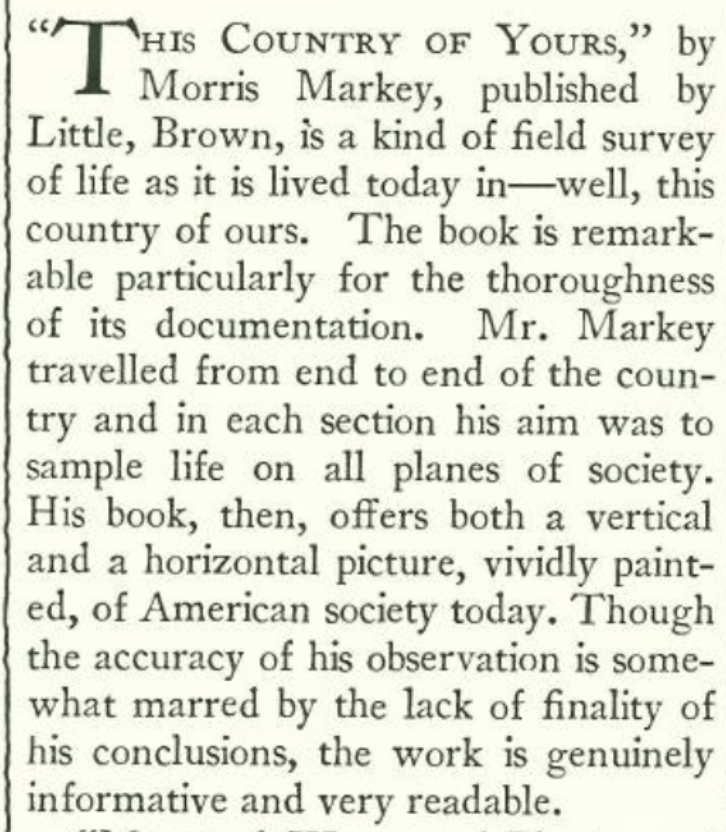
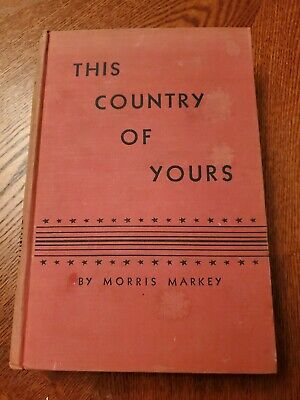
It is always with a tinge of sadness that I write about Morris Markey, who from the start wrote for virtually every department at The New Yorker and was best known for his “A Reporter at Large” feature. According to his obituary in The New York Times, Markey won his greatest recognition for the book This Country of Yours, published after he left The New Yorker. That magazine’s review was brief, and read thusly:
The book is mostly forgotten today, as is Markey, who was found shot to death on July 12, 1950 at his home in Halifax, Virginia. He was just 51 years old. There was insufficient evidence as to whether the wound behind his right ear was the result of accident, homicide, or suicide.
Here is what the Times (Sept. 10, 1932) had to say about Markey’s book:
* * *
From Our Advertisers
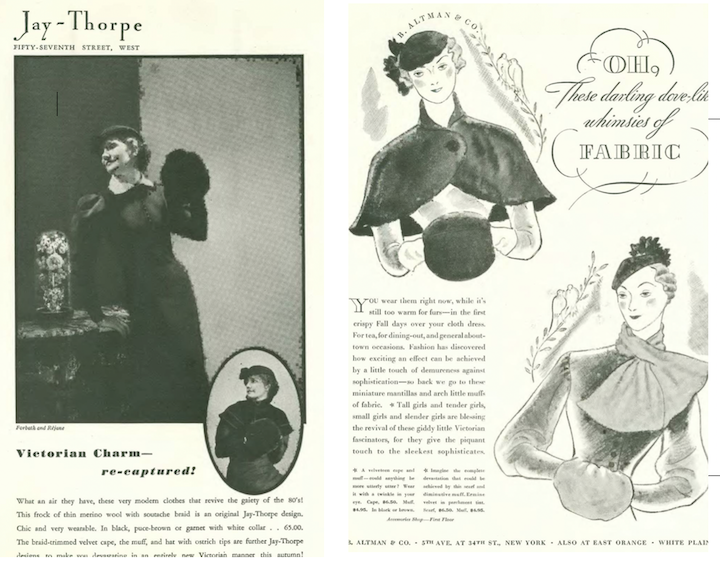
With cold weather arriving during the Depression’s worst year, fashions continued to borrow from the past for a more conservative look (these are two ads from Jay-Thorpe and B. Altman)…
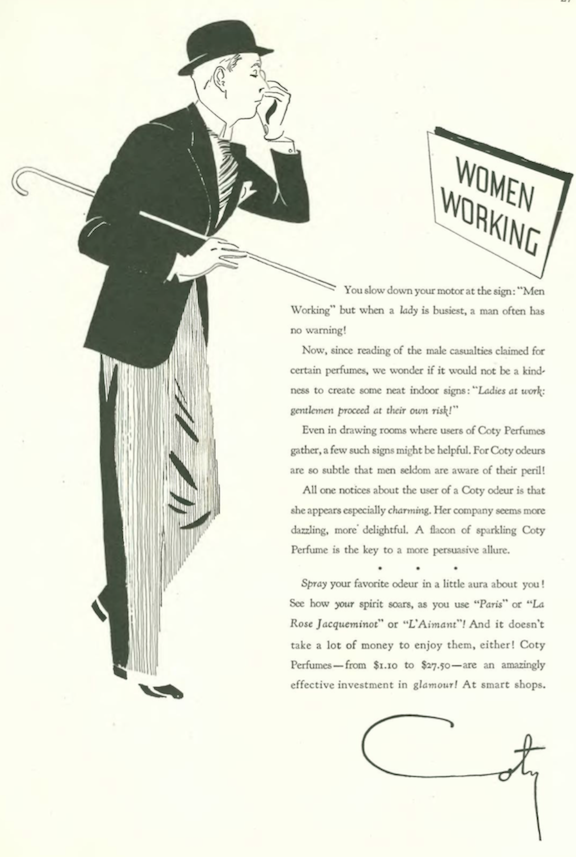
…as for the gentleman, fashion continued to emphasize a genteel look (although there is a bit of the Little Tramp about this fellow)…
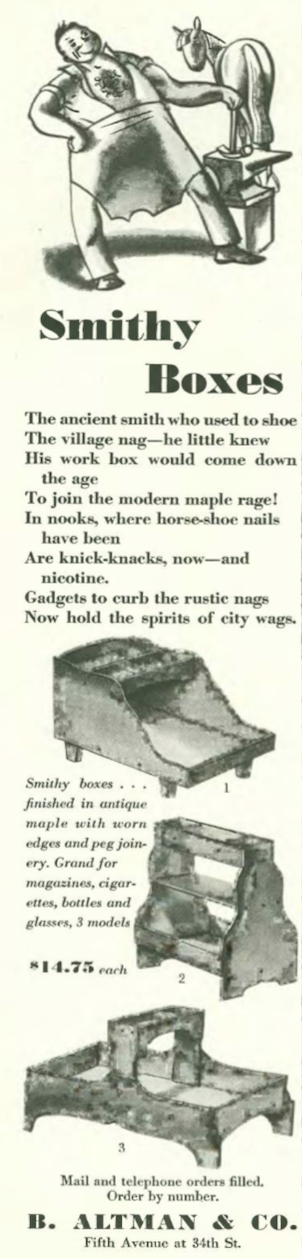
…then as now, folks turned toward the rustic to find a bit of comfort in uncertain times…
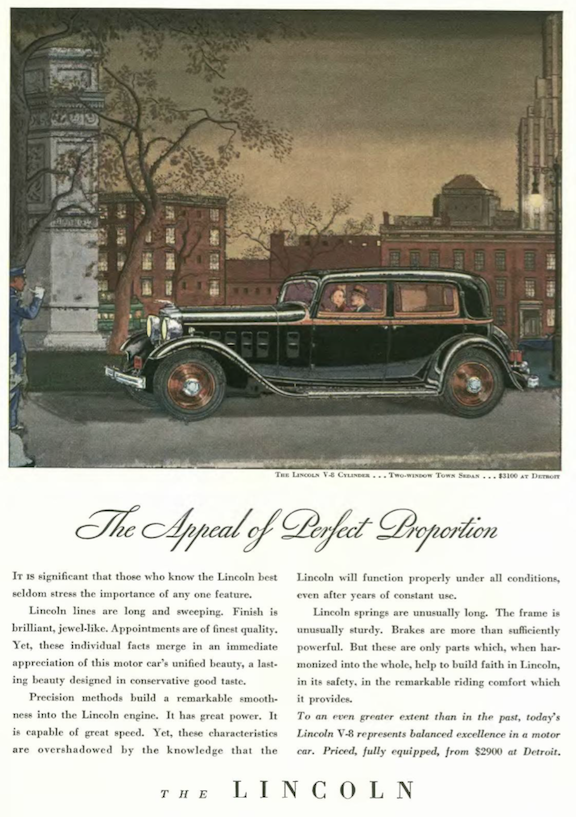
…and if they could afford it, the comforts of the stolid, solid Lincoln motorcar…
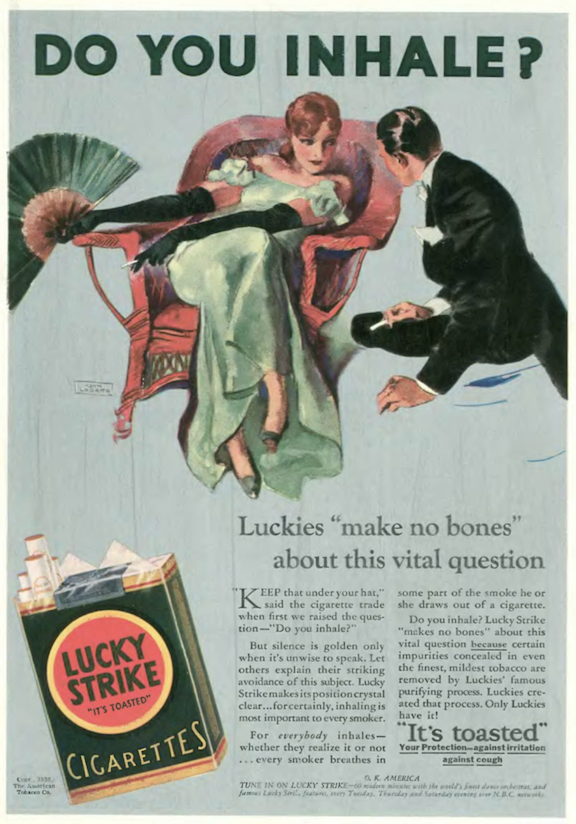
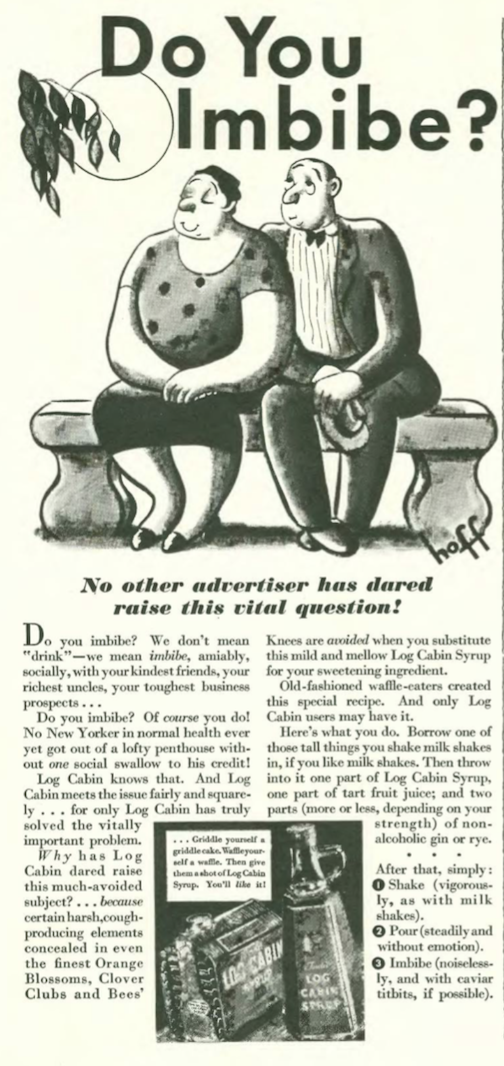
…the folks at Lucky Strike continued to ask this question…
…and with the help of Syd Hoff, the makers of Log Cabin syrup ran this parody ad (in the Oct. 1 issue) of the Lucky Strike campaign…Hoff was among the newest members of The New Yorker cartooning cast…
…as was William Steig, who featured one of his “Small Fry” to tout the benefits of decaf coffee…
…our cartoon from the Sept. 24 issue is by Richard Decker…
…on to Oct. 1, 1932…
Oct. 1, 1932 cover by Peter Arno.
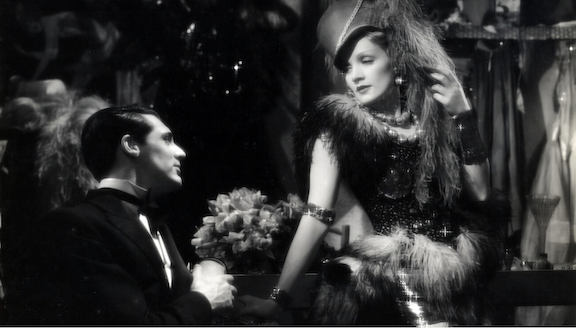
…where film critic John Mosher took in the latest from Marlene Dietrich and came away less than dazzled by Blonde Venus…
Now something of a cult film, reviews were mixed when Blonde Venus was released in 1932. The New York Times’ critic Mordaunt Hall went even further than Mosher, calling the film a “muddled, unimaginative and generally hapless piece of work, relieved somewhat by the talent and charm of the German actress…”
WELL HELLO THERE…Cary Grant made his film debut in 1932 in This Is the Night—he went on to appear in eight films that year, including Blonde Venus with Marlene Dietrich. (MoMA)
* * *
Unlucky in Luck
In its early years The New Yorker paid little attention to baseball, but “The Talk of the Town” did appreciate a human interest story from the field every now and then, and Yankee batboy Eddie Bennett filled that bill—this was the second time Bennett was featured in the column…
LUCKY EDDIE…Top, Eddie Bennett in 1921, the year he became the Yankees’ batboy; below, with slugger Babe Ruth in 1927; at right, newspaper profile the year after the 1927 World Series. As an infant Bennett twisted his spine in a carriage accident that stunted his growth and gave him a misshapen back.(Library of Congress/The New York Times/Brooklyn Citizen)
Throughout the 1920s Bennett was a famed good luck charm for the Yankees, but when a taxicab struck him in 1932 his batboy career ended. According to The New York Times (April 2, 2021) “Three years later, Mr. Bennett was found dead in a furnished room on West 84th Street. Autographed photos from Herb Pennock and Waite Hoyt, both pitchers for the Yankees, hung on the walls…Balls and bats signed by Ruth and Lou Gehrig decorated the room. An autopsy found that Mr. Bennett had died of alcoholism. He was 31.”
For 85 years, Bennett rested in an unmarked grave at St. John’s Cemetery in Queens, but last November he was remembered with a new marker and a simple ceremony. You can read more about it in this Times article.
* * *
Original Verse
Ogden Nash was working as an editor at Doubleday when he submitted some rhymes to The New Yorker. Harold Ross (New Yorker founder/editor) saw the submissions and asked for more, apparently stating “they are about the most original stuff we have had lately.” Here is one of the later submissions:
* * *
From Our Advertisers
If you were of the male persuasion and a member of the smart set you probably dressed down in something like this for a day with your dressage buddies…
…the modern woman of the 1930s could also be a successful business woman in this “successful” frock (how that translated into reality was another thing)…what is also interesting about this ad is how it features both an illustration and a photograph of the same outfit—it’s as though they’ve acknowledged that the attenuated figure in the illustration, although eye-catching, does not resemble an actual body type…
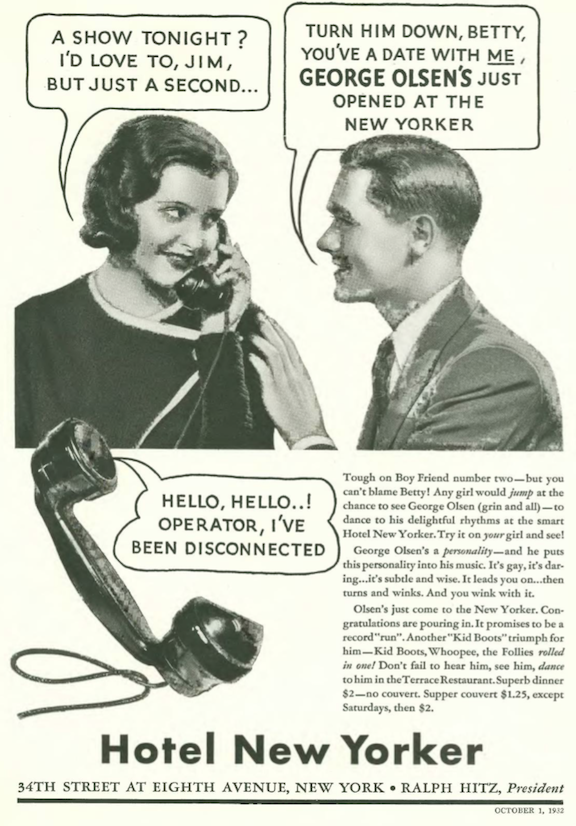
…here was see an early use of the word balloon in an advertisement featuring real people—I wonder if this was inspired by the comics, or by Bernarr Mcfadden’s“composographs” featured in his New York Evening Graphic?…
…on to our cartoonists, we begin with a strange bit of bedside manner courtesy Gardner Rea…
…Robert Day introduced us to a modest suspect…
…Barbara Shermund continued to explore the travails of modern women…
…while this woman (via Perry Barlow) seems quite content with her lot…
…Mayor Jimmy Walker was out, but not down, like these fellows presented by Alan Dunn…
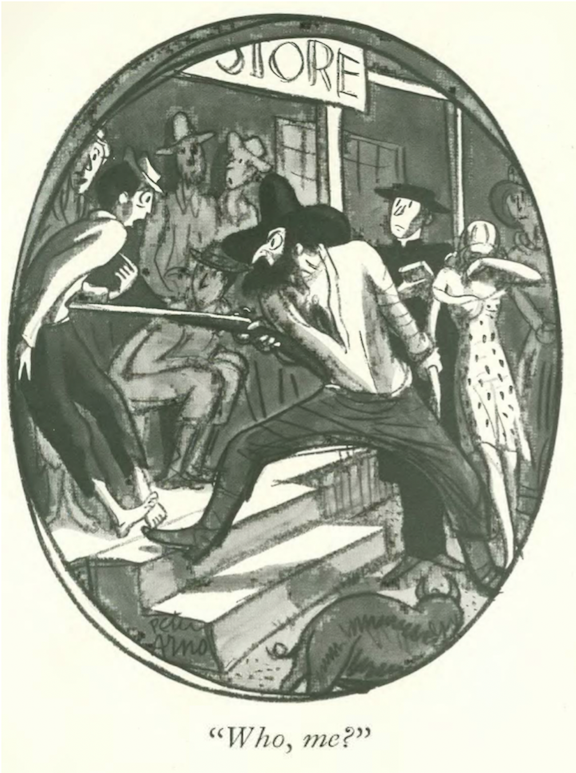
…and we close with Peter Arno, announcing some upcoming nuptials…
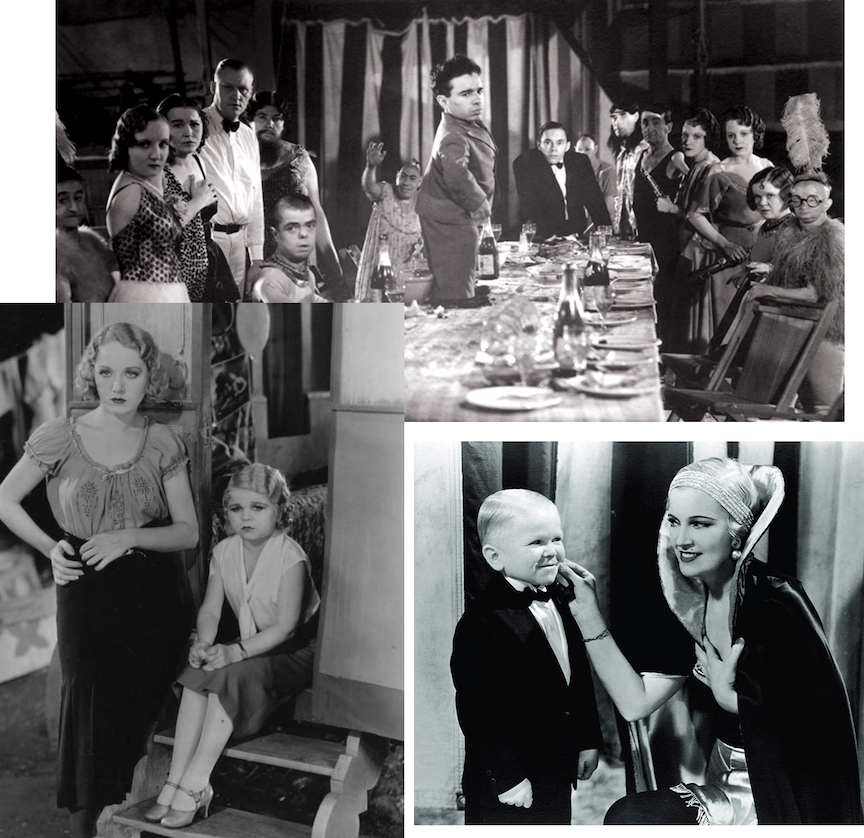
Over the years Tod Browning’s 1932 pre-code film Freaks has been called everything from grotesque and exploitive to sympathetic and compassionate. Now a cult classic, the film’s closing scenes are regarded by some critics as among the most terrifying ever put to film.
July 16, 1932 cover by Rea Irvin.
What disturbed so many about Freaks was Browning’s use of actual sideshow performers with real disabilities to tell the story of a conniving trapeze artist who plots to seduce and then kill a dwarf performer to gain his inheritance. The film was not well-received by audiences and many critics. The Kansas City Star’sJohn Moffitt wrote, “There is no excuse for this picture. It took a weak mind to produce it and it takes a strong stomach to look at it.” However, The New Yorker’s John Mosher, along several other New York critics, gave the film a rather favorable review:
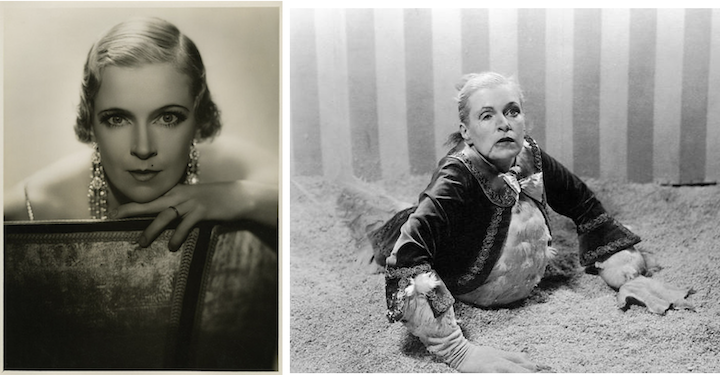
ONE OF US…Although audiences and critics found Tod Browning’s 1932 film Freaks grotesque and exploitive, today many regard the film as a rare (for its time), sympathetic portrayal of persons with disabilities. Clockwise, from top left, Browning with some of the members of his Freaks cast; French-American actress Rose Dione portrayed Madame Tetrallini, operator of the sideshow; Daisy and Violet Hilton with actor Wallace Ford in a scene from Freaks. Born fused at the pelvis, the sisters were joined at their hips and buttocks and shared blood circulation; limbless sideshow performer Prince Randian, who wore a one-piece wool garment over his body, appeared in the film as “The Living Torso.” (IMDB)IT HAD A PLOT, ACTUALLY…Freaks told the story of a conniving trapeze artist named Cleopatra (portrayed by Russian actress Olga Baclanova, bottom right) who plots to seduce and then kill a dwarf performer, Hans (portrayed by Harry Earles) to gain his inheritance. Top photo: assembled “freaks” chant their acceptance of Cleopatra at the wedding feast of Hans and Cleopatra; bottom left, the kind-hearted seal trainer Venus (portrayed by Leila Hyams) consoles Frieda (Daisy Earles), who worries about Hans (Daisy and Harry Earles were members of a famous quartet of sibling entertainers known as The Doll Family. The quartet also appeared as members of The Munchkins in 1939’s The Wizard of Oz.)(IMDB)SURPRISE…Leila Hyams (1905–1977) was something of a surprising presence in the controversial film Freaks, given that she was a popular leading lady in the 1920s and 30s. Known for both her comedic and dramatic talents, she retired from films in 1936; another unlikely cast member was Henry Victor (1892–1945) whose physique didn’t necessarily support his role as circus strongman. (dangerousminds.net)TRUE GRIT…Perhaps only a Russian actress in 1932 had the grit to transform herself from an exotic blonde temptress to a grotesque “human duck” for the movie Freaks. In the film, Olga Baclanova (1893 – 1974) portrayed a conniving trapeze artist named Cleopatra. Near the end of film the “freaks” capture Cleopatra, gouge out her right eye, remove her legs and tongue and melt her hands to look like duck feet. For critics and audiences, the horror was just too much. As for Baclanova — who was a popular silent film actress known as the “Russian Tigress” — her heavy accent did not translate well to talking films, and she left the movie business altogether in 1943. (muni.com/IMDB)
* * *
Tennis Anyone?
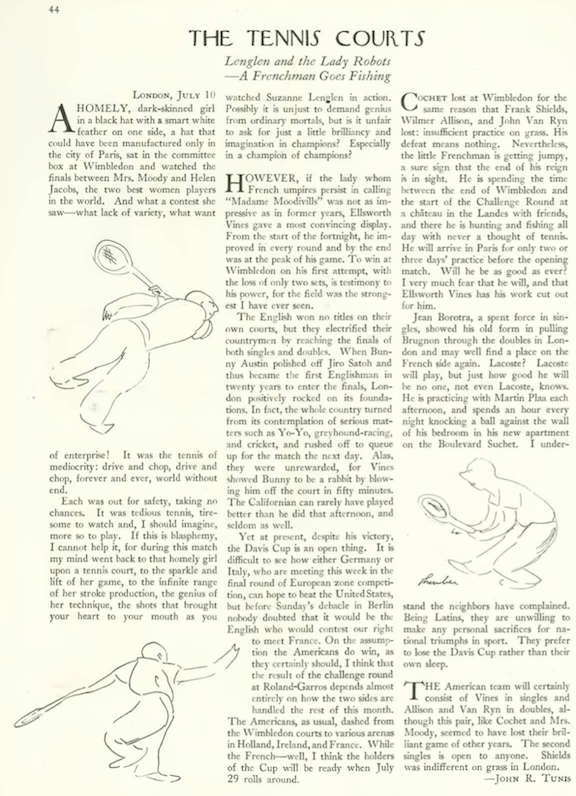
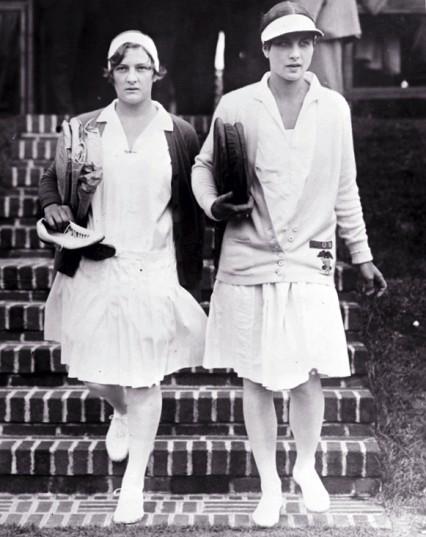
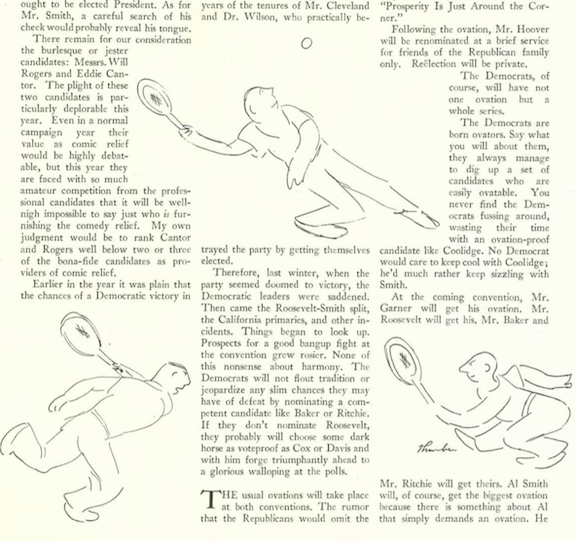
Helen Moody was the top women’s singles tennis player for nearly a decade in the 1920s and 30s, winning Wimbledon eight times, including a match in 1932 against her rival Helen Jacobs. However to sportswriter John Tunis, the women had reached such a level in their play that it had become robotic and tedious to watch. At least James Thurber livened things up with some keen illustrations.
RACKETEERS…Helen Jacobs (left) and Helen Moody (right, in a 1929 photo) were tennis rivals known for their explosive matches. Except, apparently, for the one attended at Wimbeldon in 1932 by John Tunis. (nickelinthemachine.com)
* * *
From Our Advertisers
Sensing that the end of Prohibition was near, the makers of Budweiser reminded readers of the good ol’ days of beer drinking and such…
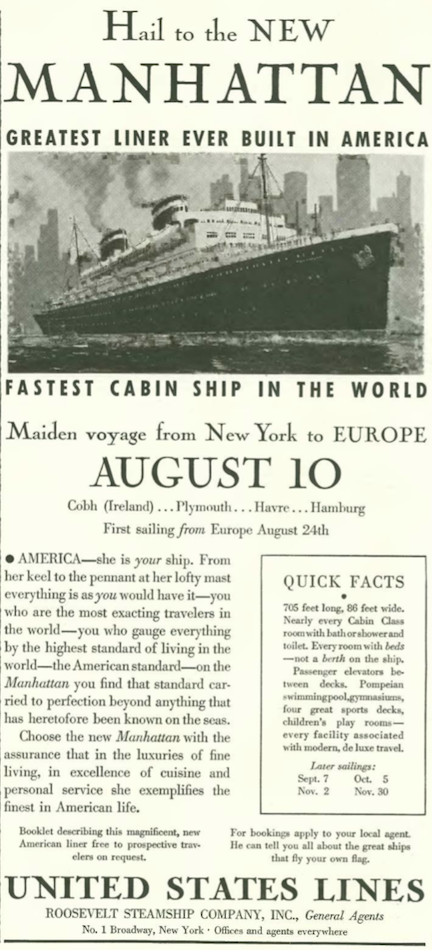
…if you could afford something better than beer, then you might have contemplated a trip on the SS Manhattan, which along with her sister ship SS Washington were the largest liners ever built in the US…
TO AND FRO…Beginning in August 1932 the SS Manhattan operated the New York – Hamburg route until 1939, when instead of taking passengers to Germany the ship began taking Jewish refugees and others away from Nazi-occupied Europe. It was turned into a troopship in 1941 and never returned to commercial service. The SS Manhattan was sold for scrap in 1965. (cruiselinehistory.com)
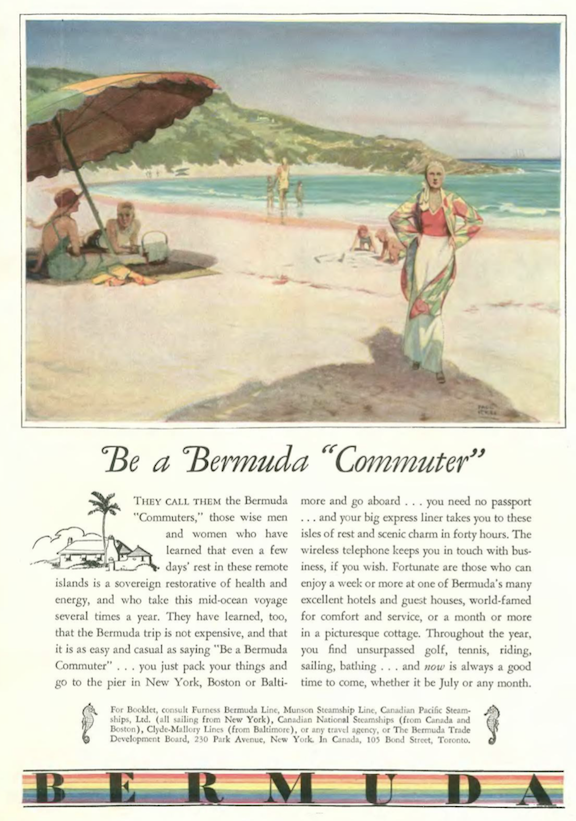
…if your thing wasn’t traveling to Germany to see that country being transformed into the Third Reich, you could instead become a Bermuda “Commuter”…
…back home, William Steig joined other New Yorker cartoonists who earned extra money off of the big tobacco companies…
…which segues into our cartoonists, beginning with Victor Bobritsky’s illustration for “Goings On About Town”…
…Otto Soglow offered more Little King adventures…
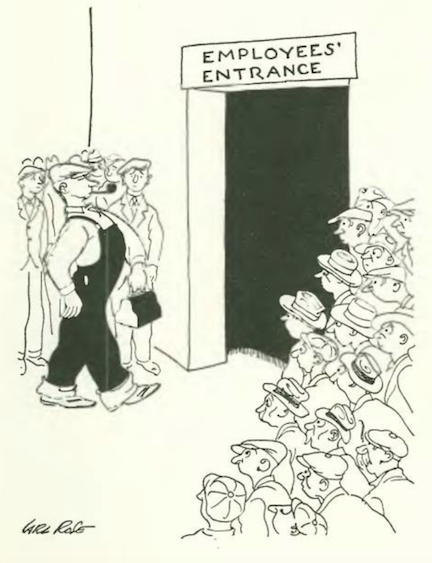
…and Carl Rose gave us a man striding into a factory, apparently a rare sight in 1932…
…on to July 23…
July 23, 1932 cover by Antonio Petruccelli (1907 – 1994). This is the first of six covers Petruccelli created for the New Yorker from 1932 to 1938. He also did numerous covers and illustrations for Fortune, Colliers and other publications.
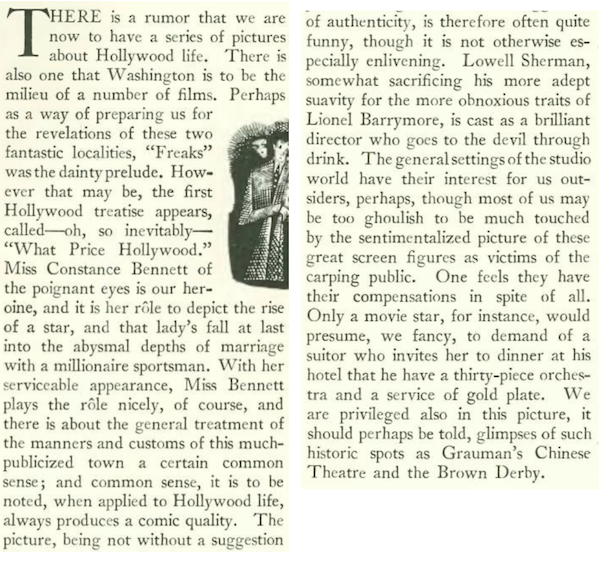
…and we have another John Mosher film review, in which he refers to Freaks as a “dainty prelude” to another film about the lives of entertainers, in this case George Cukor’sWhat Price Hollywood, a pre-Code drama starring Constance Bennett and Lowell Sherman with a storyline that anticipated 1937’s A Star Is Born—namely, a famous but fading male star who helps an ingénue rise to stardom while he descends into a pit of alcoholic despair.
FUN WHILE IT LASTED…Top image: Waitress and aspiring actress Mary Evans (Constance Bennett) has the good fortune to meet film director Maximillan Carey (Lowell Sherman) when she serves him one night at the Brown Derby. Bottom: Mary and her polo player boyfriend Lonny Borden (Neil Hamilton) look down with pity at the down-on-his-luck Maximillan in What Price Hollywood? (Wikipedia/IMDB)
* * *
From Our Advertisers
Originally published by Adam Budge, Inc. in 1910 and later by Joseph Judd Publishing and others, Arts & Decoration magazine hoped to stay alive in the Depression with a promise that its August 1932 issue would be “compellingly readable”…
…and here is the cover of that issue…Arts & Decoration would hang on for another ten years before folding in 1942…
…one of the stars of Ziegfeld Follies of 1931 was actress and dancer Patricia “Boots“ Mallory (1913 – 1958), who posed for this portrait to demonstrate the wonders of color reproduction…
…and here’s Boots Mallory in a scene from the 1932 film Handle With Care with comedian Elmer “El” Brendel (standing) and actor James Dunn…
…not everyone could be a movie star, but you could pretend to be one in this swell new (and low-priced) DeSoto…Walter Chrysler must have laid out some big bucks for this two-page color spread…
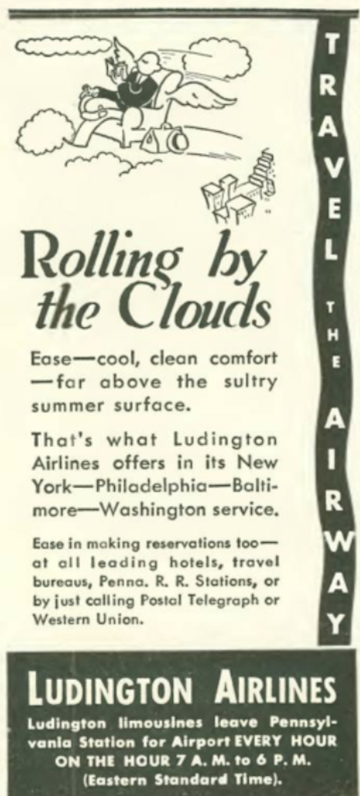
…for those with greater means you could skip the roads altogether and fly the friendly skies of Ludington Airlines…the airline was founded by wealthy New York socialite Charles Townsend Ludington and his brother Nicholas…
…founded in 1929, Ludington Airlines was the first airline with flights every hour on the hour and the first to carry passengers only (others carried mail, an important source of revenue). The airline offered service between Washington, D.C. and New York City—with stops in Philadelphia, Baltimore, Norfolk, Virginia, Nashville and Knoxville, Tennessee—using seven Stinson tri-motor 6000 aircraft in its fleet, each carrying up to ten passengers…the airline went bankrupt in 1933 (mostly due to the lack of mail revenue) but left behind an astonishing record—in its first two years it flew more than 3.4 million miles and carried 133,000 passengers, a record at the time…
A Stinson SM-6000 airliner similar to the type flown by Ludington Airlines from 1929 to 1933.
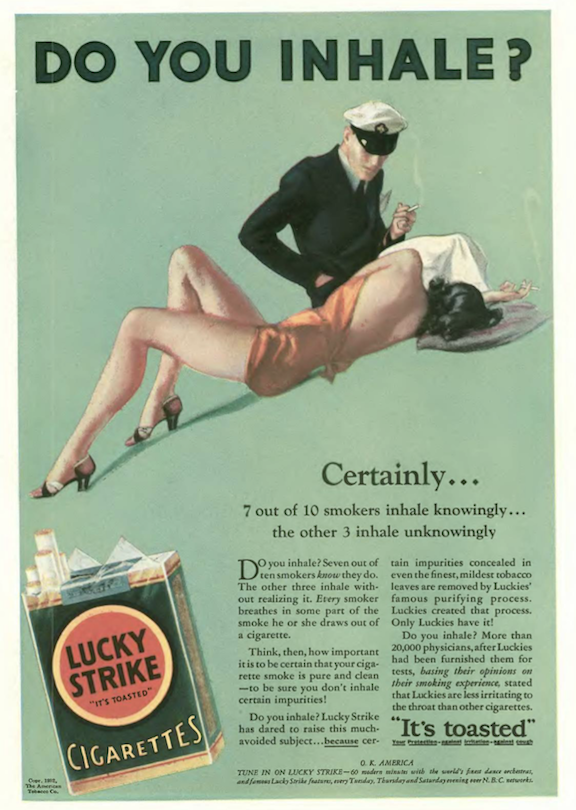
…back to earth, sort of, we have this Lucky Strike ad with the famed “Do You Inhale?” campaign that oozed innuendo and no doubt prompted a few young men to take up the habit posthaste…
…on to cartoons, beginning with this spot art by James Thurber…
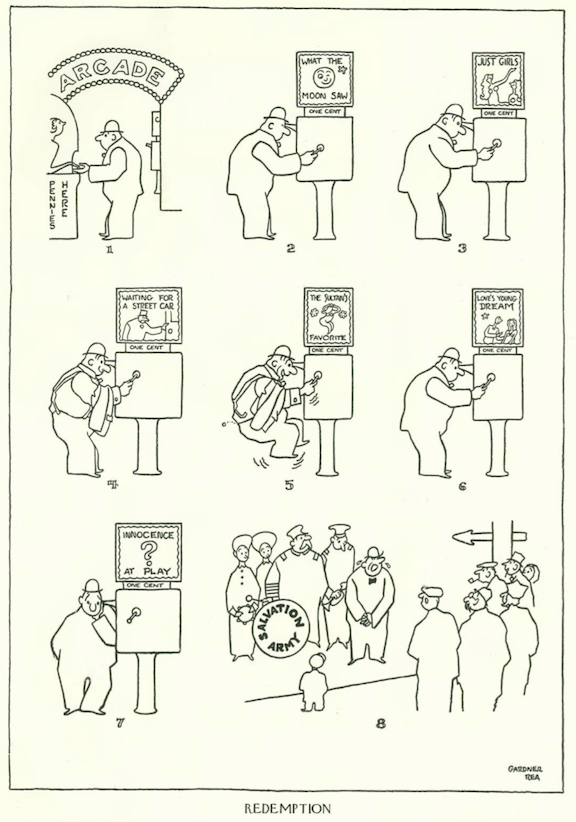
…Gardner Rea showed us a man getting his nickel’s worth of sin and repentence…
…and we end with the delightfully unrepentant Peter Arno…
Twentieth century New York saw a lot of paradise paved (see Moses, Robert), but there is one spot in New York that saw paradise reclaimed—not from a parking lot but from an eleven-story prison that once stood at 10 Greenwich Avenue.
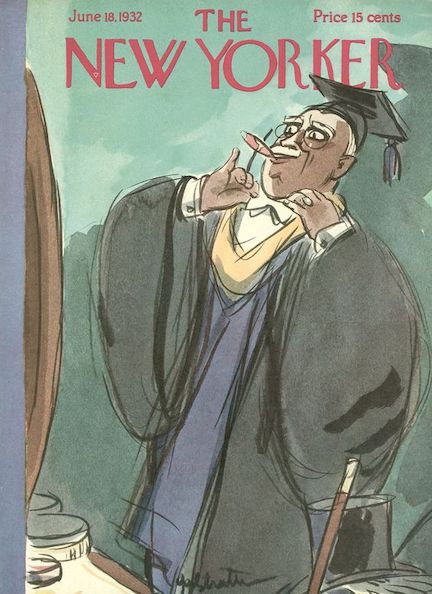
June 18, 1932 cover by William Crawford Galbraith.
The Jefferson Market Garden in Greenwich Village was once the site of a women’s prison designed to be a more humane corrections facility, but between its opening in 1932 and its closing in 1971 the Women’s House of Detention went from noteworthy to notorious.
It was designed by a firm known for its Art Deco buildings—Sloan and Robertson—and although it still looked rather stark and institutional on the inside, attempts were made to gussy it up with artworks commissioned by the WPA. The New Yorker’sE.B. White found a certain “sanitary elegance” to the place.
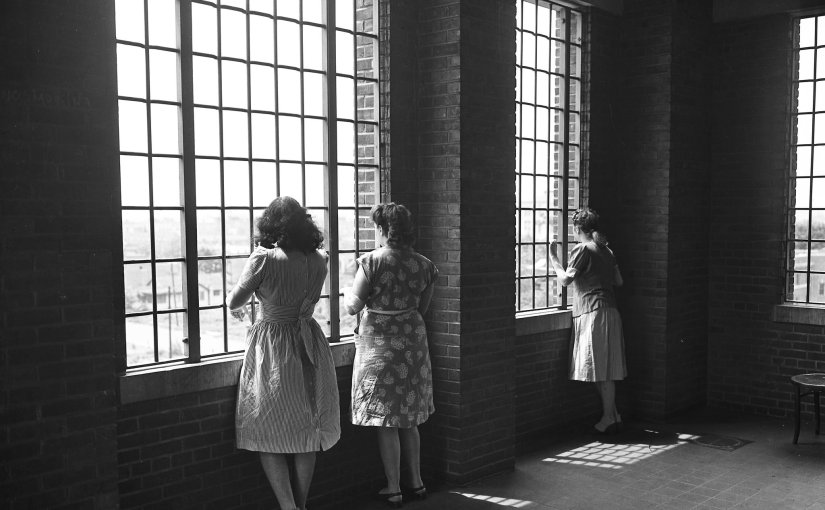
WELCOME INMATES!…When the Women’s House of Detention opened in 1932 it focused on more humane practices, including vocational training and other reform measures. Clockwise from top right, a 1938 photo shows how the prison once loomed over the Sixth Avenue El; inmates stare out of the windows in 1941; WPA artist Lucienne Bloch working on one of the murals that lined prison walls; example of a mural. (amny.com/New York Times/correctionhistory.org)
Thirty years after its opening, things took a turn for the worst at the Women’s House of Detention. Michael Kimmelman wrote in The New York Times (Dec. 18, 2019) that by the late 1960s the jail had become squalid, overcrowded and violent. He wrote: “I can still hear the desperate pleas of inmates shouting through the windows as I walked home from school every day.”
BIG, BAD HOUSE…Clockwise from top, left, protestor outside the New York Women’s House of Detention at the Prisoners’ Rights and “Free the Panther 21” demonstration in 1970; illustrious inmates at the prison included Ethel Rosenberg (pictured Aug. 8, 1950), Angela Davis, and Valerie Solanas (who shot Andy Warhol in 1968); demonstrators outside the prison in 1970; 1956 publicity still taken by the Department of Corrections. (Diana Davies via Smith College/correctionhistory.org)
In the late 1960s Village residents began holding town hall meetings to discuss the removal of the overcrowded prison, many complaining of the friends and families of inmates who lingered outside day and night, yelling up to their loved ones behind bars. The protests were successful; the prison closed in 1971 and was demolished three years later.
A BIT OF EARTH…Top photo is an overhead view of the Jefferson Market Garden, planted on the site of the former Women’s House of Detention. Below, a verdant pathway takes a turn through Jefferson Market Garden. Photos courtesy of amny.com and Jefferson Market Garden.
* * *
How Dry I Ain’t
Franklin D. Roosevelt was a canny politician, seemingly able at times to please both sides of a divisive issue. This was the case in 1932, when teetotaling New Yorkers touted FDR’s long record of supporting such causes as the Anti-Saloon League, while city dwellers such as E.B. White knew better…
LIBERAL LIBATION…Franklin D. Roosevelt was an enthusiastic drinker, especially of his famed martinis. (thrillist.com)
* * *
From Our Advertisers
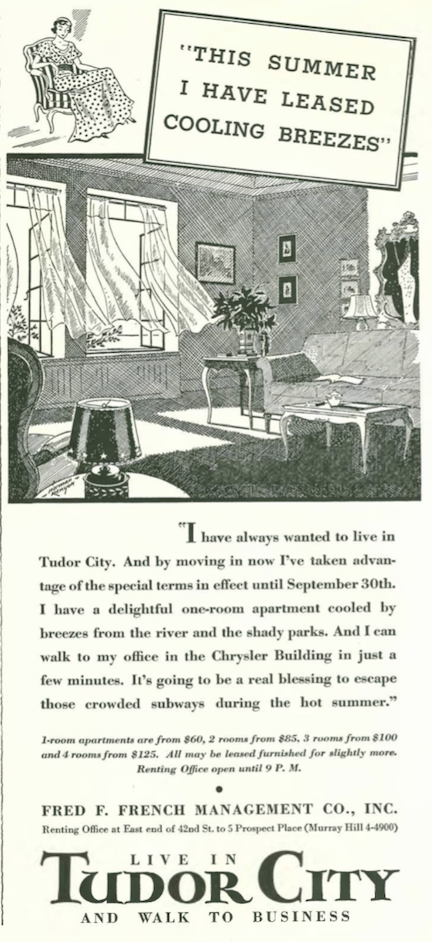
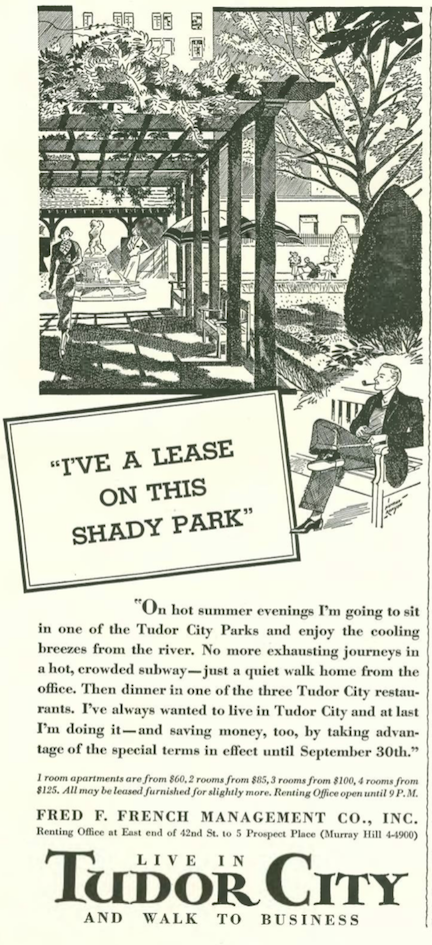
In the days before air conditioning, most folks had to rely upon whatever cooling breezes they could channel into their homes, and apparently in Tudor City they could find some relief from the East River, at least when the wind was blowing from that direction…
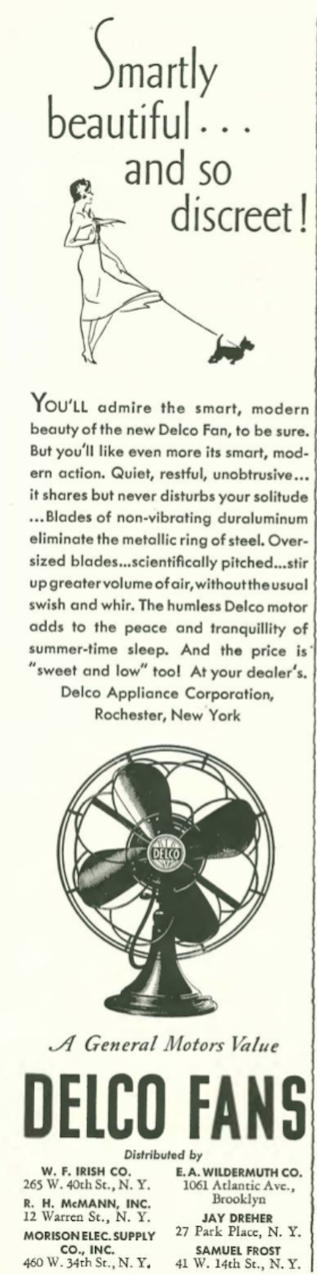
…if the wind wasn’t in your favor, you could switch on an electric fan, an appliance that didn’t come into common use until the 1920s…this ad also demonstrated the power of the dictum “sex sells,” even if applied subtly…
…it would be awhile before air-conditioning became common, but in 1932 you could at least keep your goodies cool with a GE refrigerator, its radiating coils offering a novel way to disperse this smoker’s emissions…
…we jump to our cartoons, with Kemp Starrett in some mixed company…
…Garrett Price illustrated the peril one faced when driving through Chelsea, where one could encounter freight trains at street level…
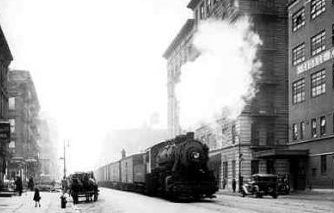
…for almost one hundred years this street-level freight line on 11th Avenue—known as “Death Avenue”—claimed the lives and limbs of hundreds of (mostly poor) New Yorkers…
HEADS UP!…the Hudson River Railroad at 11th Avenue and West 41st Street. (forgotten-ny.com)
…happily, we move on to June 25, 1932…
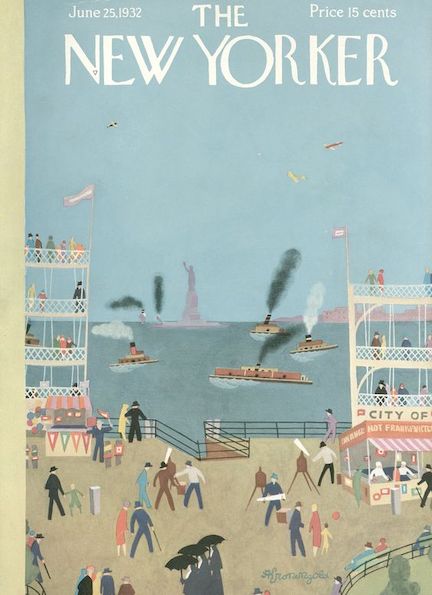
June 25, 1932 cover by Adolph K. Kronengold.
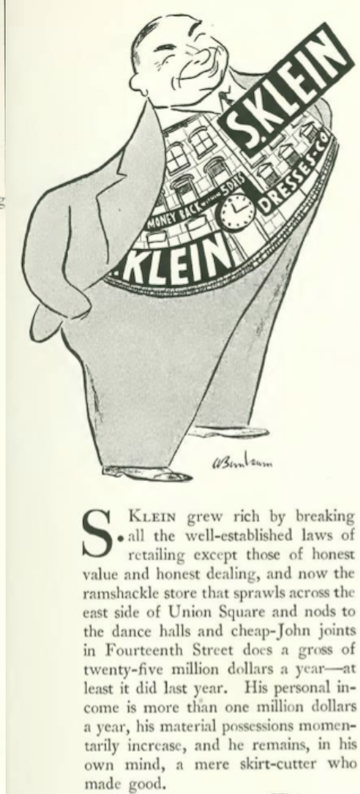
…which featured a profile of Samuel Klein (1886-1942), founder of Union Square’s discount department store S. Klein, famous for its “bargain bins.” The profile included this column-busting caricature of Klein as rendered by Abe Birnbaum…
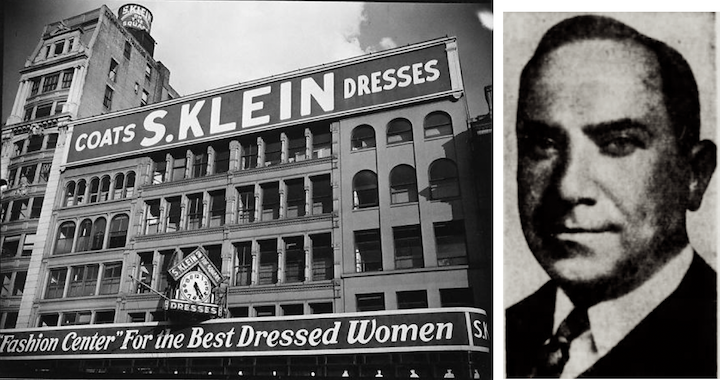
YOU COULDN’T MISS IT…The S. Klein Department Store was a Union Square fixture from 1910 to its closing in 1975. At right, undated photo of founder Samuel Klein. The building is long gone, the Zeckendorf Towers now occupying the site. (theclio.com/bklyn.newspapers.com)
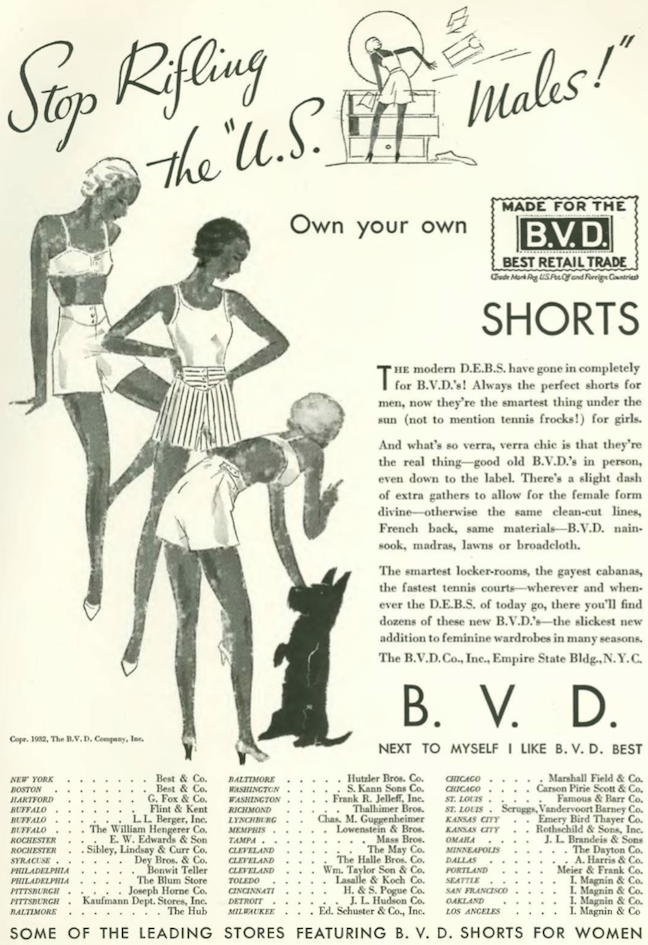
…and we roll right into our advertisements, and this spot from the makers of B.V.D.s, who found a new market for men’s shorts and continued the 1920s trend toward a more casual, androgynous look among “modern debs”…
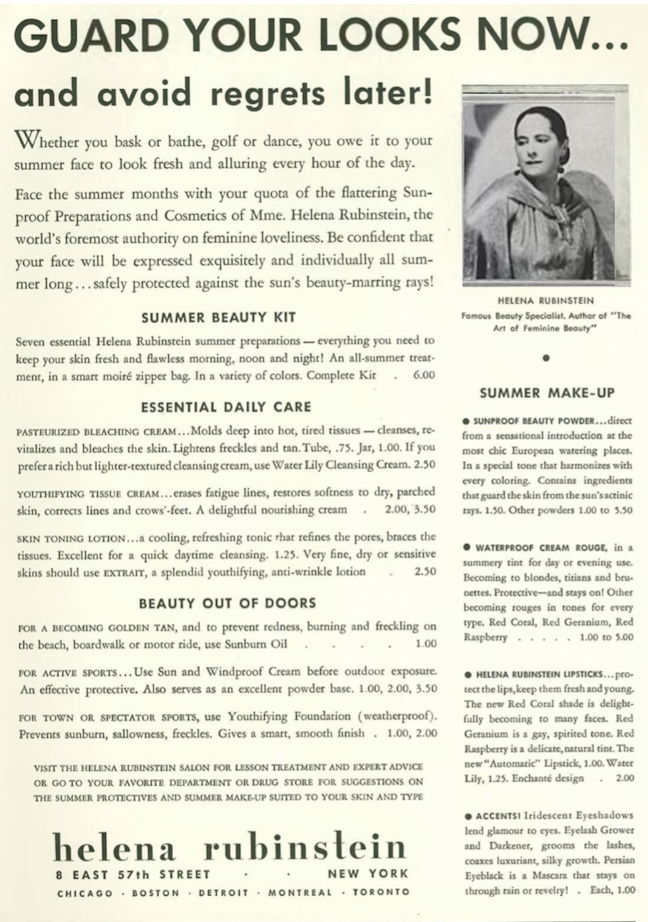
…you likely wouldn’t catch Helena Rubinstein wearing B.V.D.s., busy here shaming women into using her line of beauty products…
…on to our cartoons, we have this spot illustration by James Thurber…
…and another travelogue image from Rea Irvin…
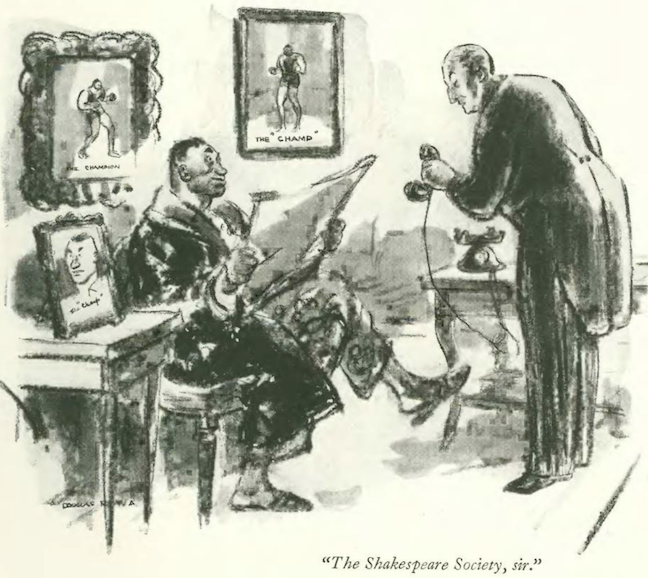
…Douglas Ryan gave us an unlikely Shakespeare lover (unless the boxer was Gene Tunney)…
…and we end with a bit of Prohibition humor from Gardner Rea…
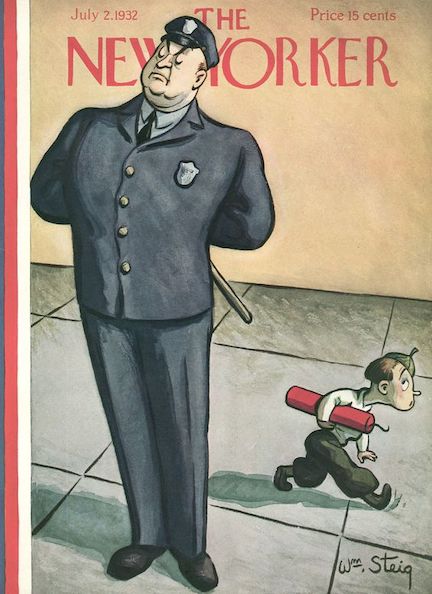
New York City Mayor Jimmy Walker (1881-1946) was commonly referred to as “Beau James” for his flamboyant lifestyle and his taste for fine clothes and Broadway showgirls.
June 4, 1932 cover by Theodore Haupt.
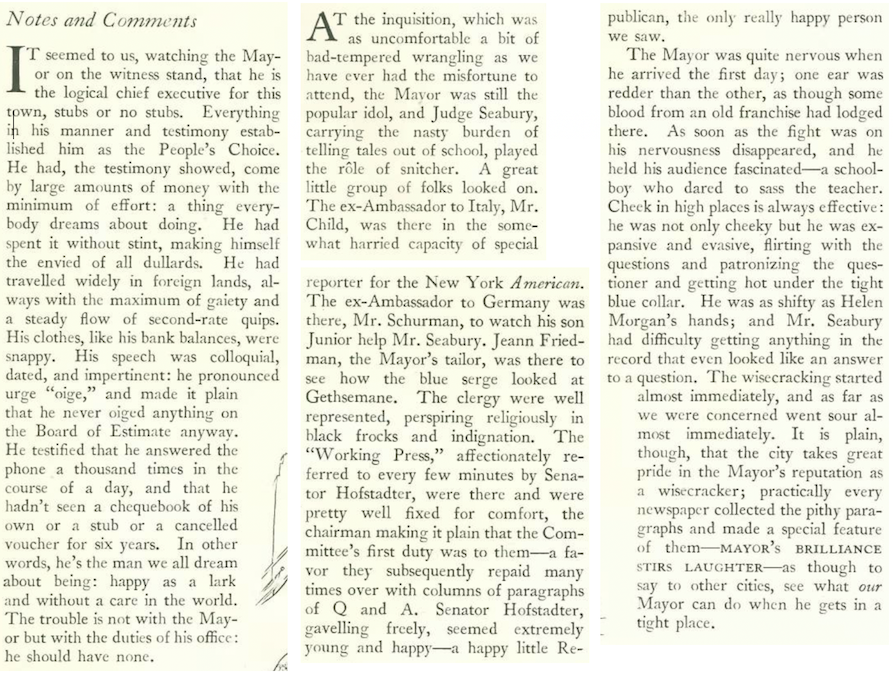
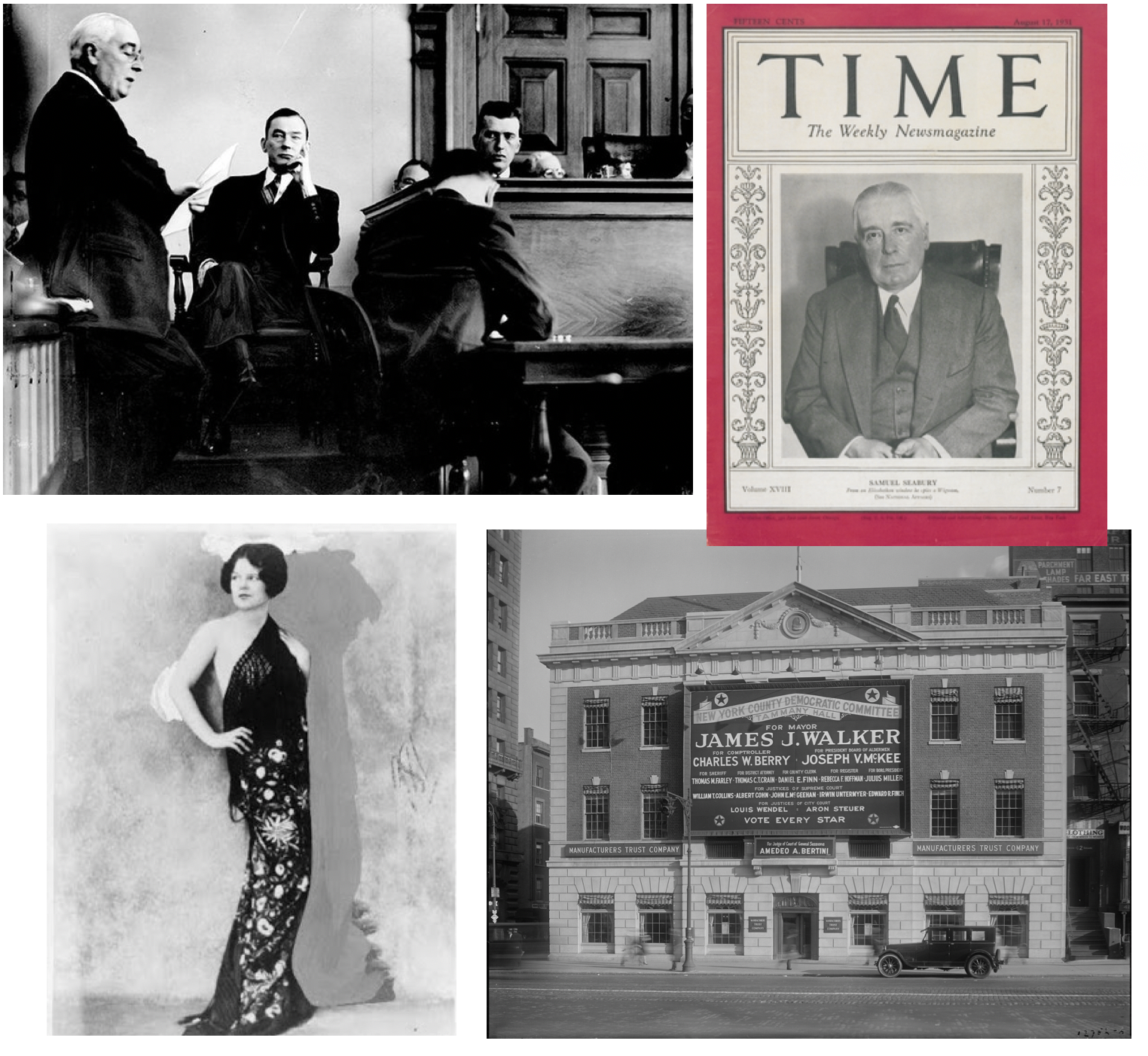
Mayor Walker was also a product of the powerful Tammany Hall machine that traded in political favors and outright bribery. When he took office in 1926, the economy was riding high, and few seemed to care that hizzoner was aloof, partying into the night (while openly flouting Prohibition laws), and taking numerous pleasure trips to Europe. He easily won reelection in 1929, but when the stock market crashed later that year his hijinks began to wear a bit thin, and reform-minded politicians like State Senator Samuel H. Hofstadter began looking into corruption in New York City. The actual investigation was led by another reformer, Samuel Seabury. The New Yorker’sE.B. White looked in on the proceedings and its star witness, Mayor Walker.
I DO NOT LIKE THIS, SAM I AM…Clockwise, from top left, Mayor Jimmy Walker was full of wisecracks during his testimony before Samuel Seabury, far left; Seabury’s role in the high-profile commission landed him on the cover of Time (Aug. 17, 1931); Tammany Hall’s support was writ large for Walker in the 1920s; Vivian Gordon was a surprise witness in the Seabury investigation, telling investigators police received bonuses for falsely arresting women on prostitution charges. After her testimony Gordon was found strangled in Van Cortland Park, leading many to believe Walker’s corruption played a role in her death. (Daily News/Time/archives.nyc/Pinterest)
Public opinion really started to turn on Walker with the death of star witness Vivian Gordon (see caption above). The final blow came from New York Governor Franklin D. Roosevelt, who like Walker was a Democrat but unlike Walker was not a Tammany product. Roosevelt was also running for president, and rightly seeing Walker as a liability, asked the mayor to resign, which he did on Sept. 1, 1932. That event was still three months away when E.B. White wrote these concluding lines:
SO LONG, SUCKERS…Eight days after he resigned from office, New York Mayor Jimmy Walker headed for Paris, where his mistress, Ziegfeld star and film actress Betty Compton, awaited with open arms. Clockwise, from top left, Compton and Walker on their wedding day in Cannes, France, April 19, 1933; and a 1920s photo portrait of Compton; Walker’s first wife, Janet Allen Walker, had sued for divorce a month earlier (March 10, 1933) claiming Jimmy had deserted her in 1928 and they had not lived together since; Walker and Compton on the deck of SS Normandie, June 17, 1936. (legacy.isle-of-wight-fhs.co.uk/IMDB/Pinterest/NYC Municipal Archives)
Eight days after Walker resigned from office he caught a boat for Paris, where his mistress, Ziegfeld star and film actor Betty Compton (1904-1944), awaited him. They married the following year in Cannes.
* * *
Out of the Shadows
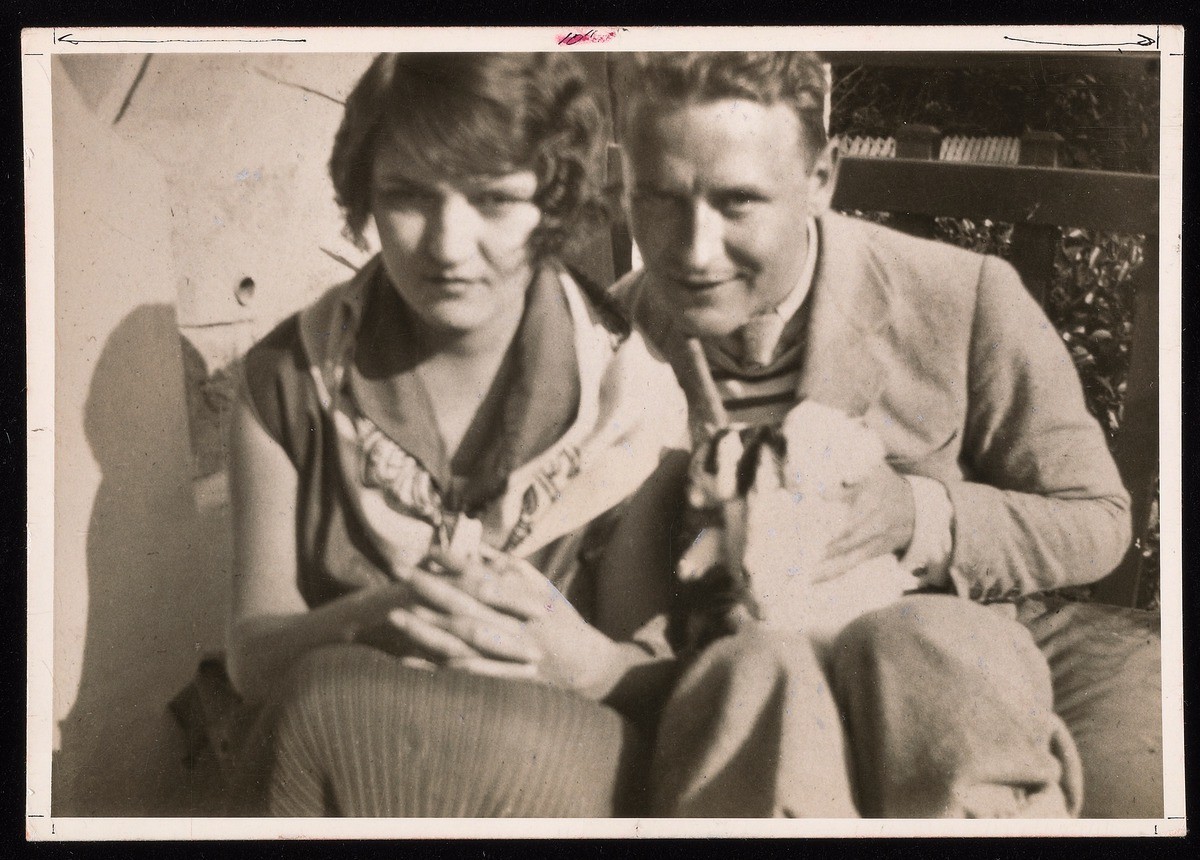
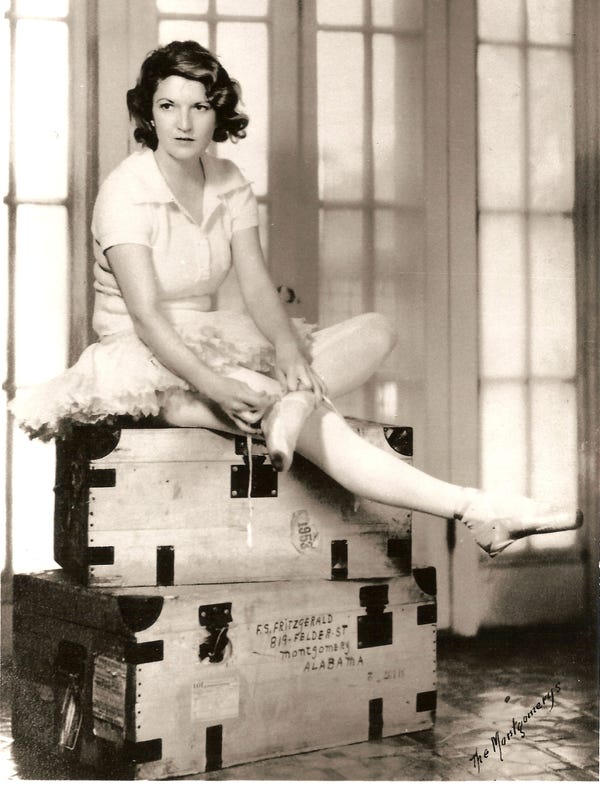
F. Scott and Zelda Fitzgerald were Jazz Age fixtures, cutting wide swaths through literary and society worlds filled with wild drinking and various infidelities. Francis Scott (1896-1940) was a chronicler of that age, most notably with The Great Gatsby, but Zelda (1900-1948) also took pen in hand, contributing short pieces to various magazines in the 1920s. By 1930 their self-destructive ways caught up with them both, and Zelda was admitted to a sanatorium in France that spring; it was the beginning of a long road of treatments that would end in her death nearly two decades later.
ALL THAT JAZZ…Zelda and F. Scott Fitzgerald (pictured here in 1926) embodied the riotous days of the Roaring Twenties. (beinecke.library.yale.edu)
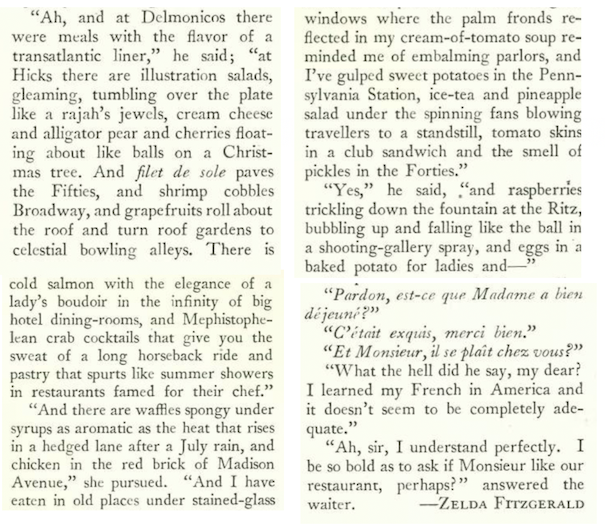
In 1932, during her stay at the Phipps Clinic (Johns Hopkins), Zelda experienced a burst of creativity, writing an entire autobiographical novel — Save Me the Waltz — in just six weeks. Sadly, it was not well-received (by critics or by her husband), and fewer than 1,400 copies of the novel were sold — a crushing blow to Zelda. However, during that same time she published a short story in The New Yorker titled “The Continental Angle.” Here it is:
TALENTED AND TROUBLED…Zelda Fitzgerald in 1931, a year before she entered the Phipps Clinic and had a burst of creativity. (citizen-times.com)
* * *
From Our Advertisers
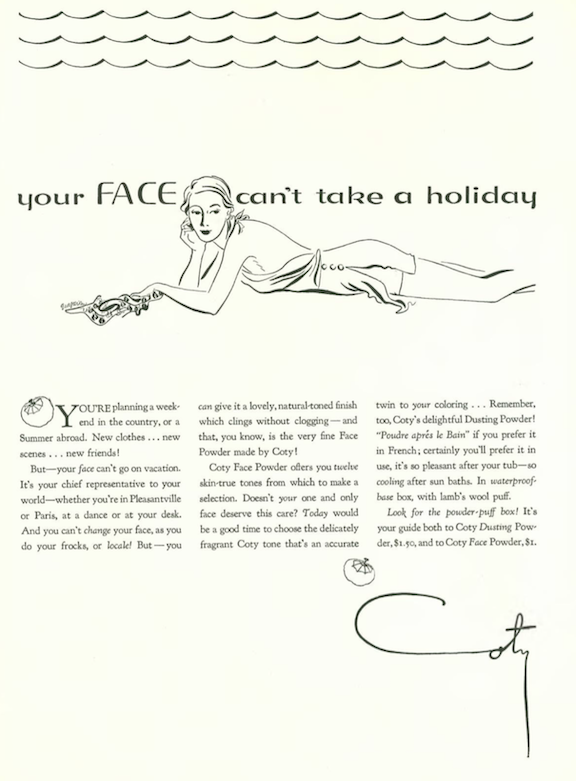
Yet another stylish and very modern-looking ad from Cody, thanks to the artistry of American fashion illustrator Ruth Sigrid Grafstrom…
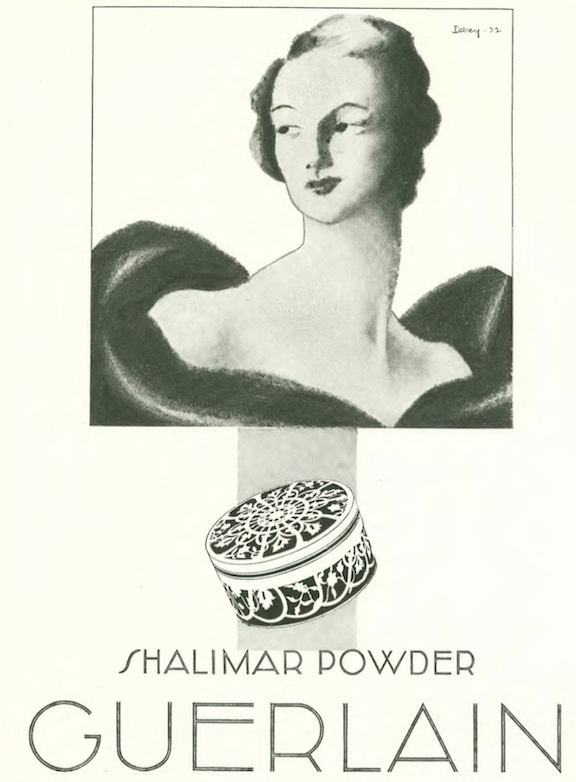
…while later on in the issue French illustrator Lyse Darcy gave his subject an Art Deco look to promote Guerlain’s face powder…
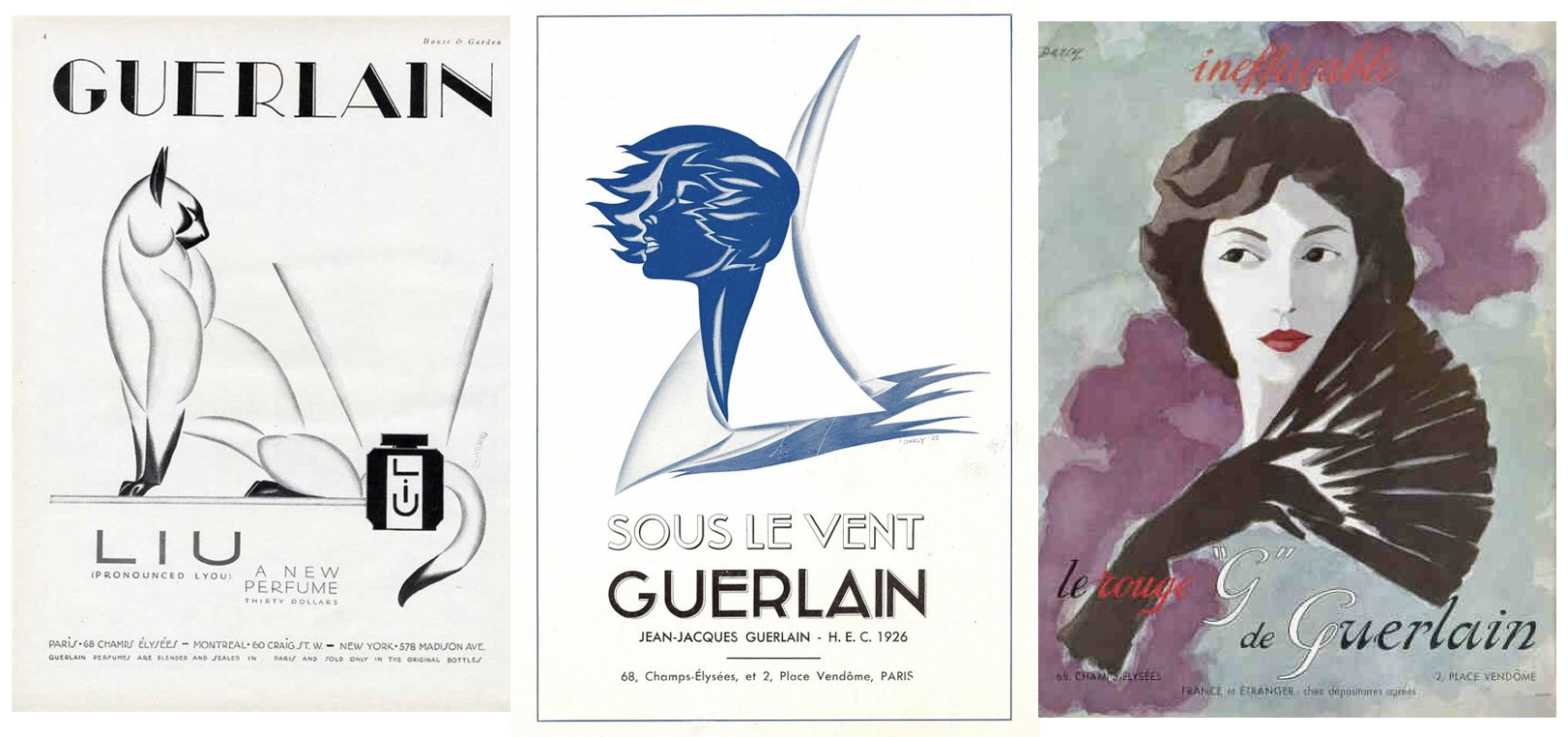
…Darcy was famed for his Guerlain ads from the 1920s to the 1950s…
From left to right, Darcy ads from 1929, 1938, 1957…
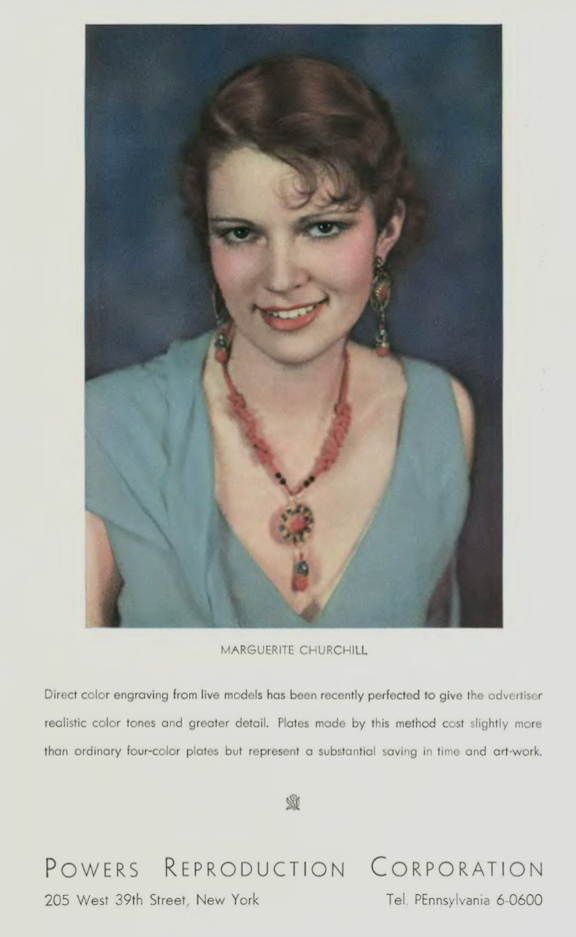
…Powers Reproduction turned to star power to promote their latest color engraving techniques…
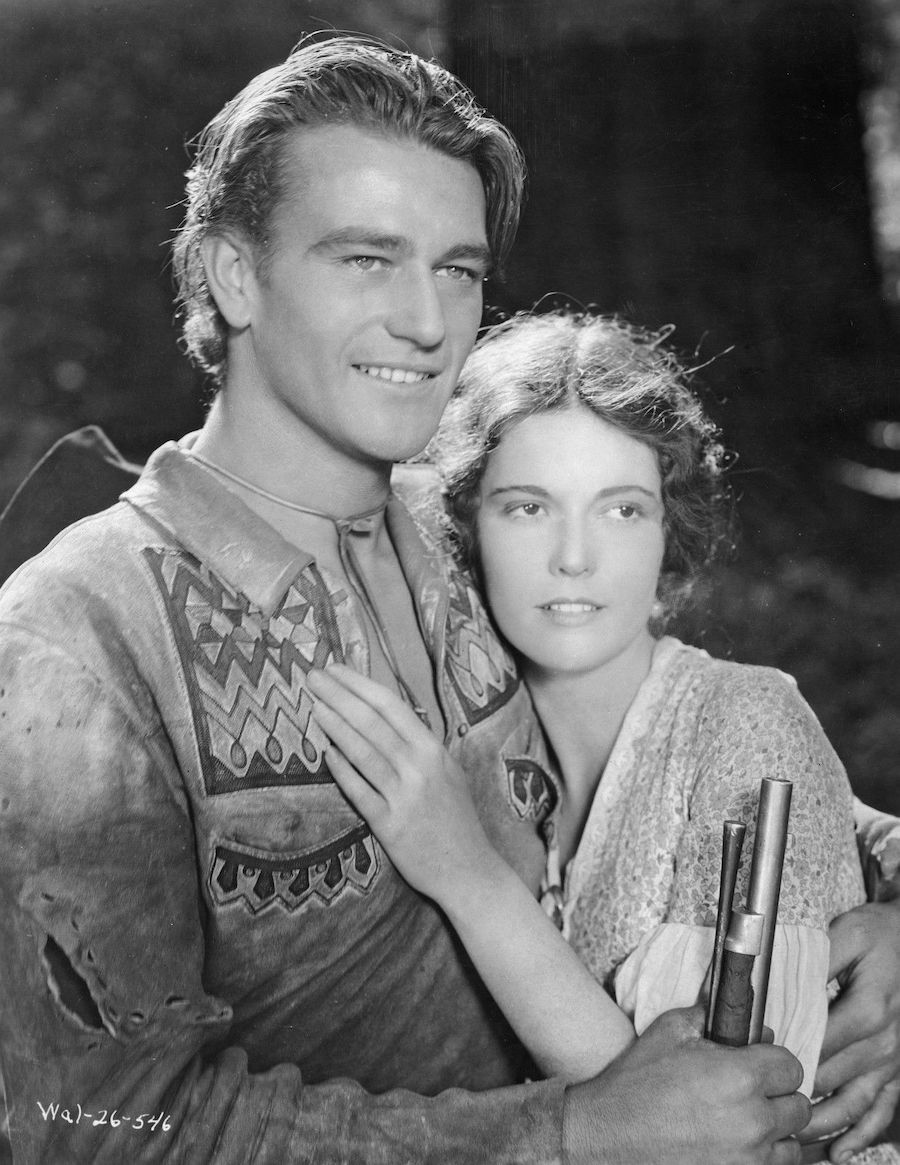
…the actor Marguerite Churchill (1910-2000) had a film career spanning 1929 to 1952, and was John Wayne’s first leading lady in 1930’s The Big Trail…
…and we head back to the city, Tudor City, to be precise, where apparently it was common in the 1930s to spot a gent in formalwear relaxing with his pipe…
…on to our cartoons, we have James Thurber contributing some spots…
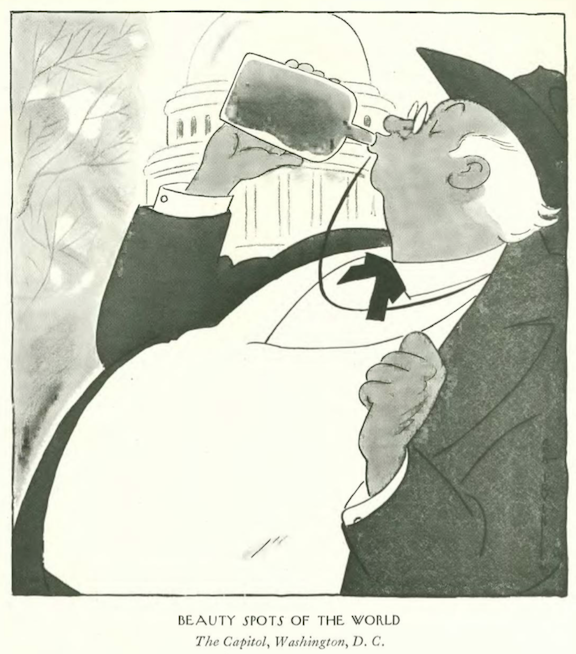
…Rea Irvin continued to visit the world’s “Beauty Spots”…
…Garrett Price showed us a couple looking for the “We Want Beer” parade…
…which happened three weeks earlier, on May 14, 1932…the parade was organized by none other than Mayor Jimmy Walker, who believed prohibition was making life difficult for New Yorkers…
(brookstonbeerbulletin.com)
…Barbara Shermund introduced two men with bigger issues than beer on their minds…
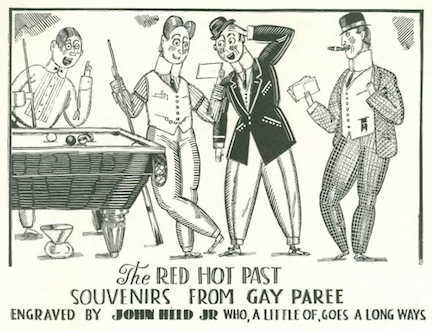
…John Held Jr. continued to plumb the depths of the naughty Nineties…
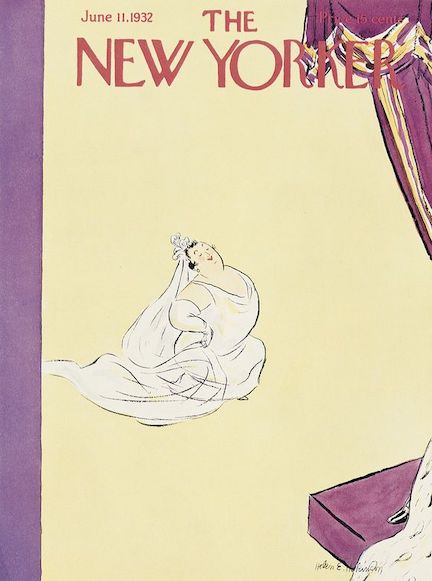
During the 1930s few people could afford the luxury of a Broadway show, but a trip to “Minskyville” was in reach of nearly anyone looking to escape the gloom of the Depression, at least for a few hours.
May 28, 1930 cover by Constantin Alajalov.
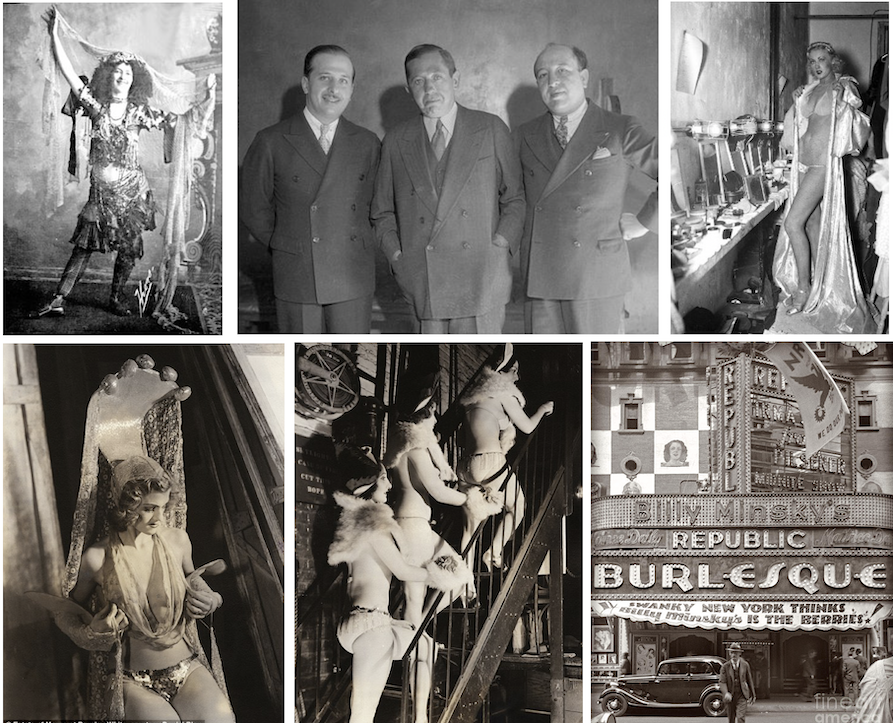
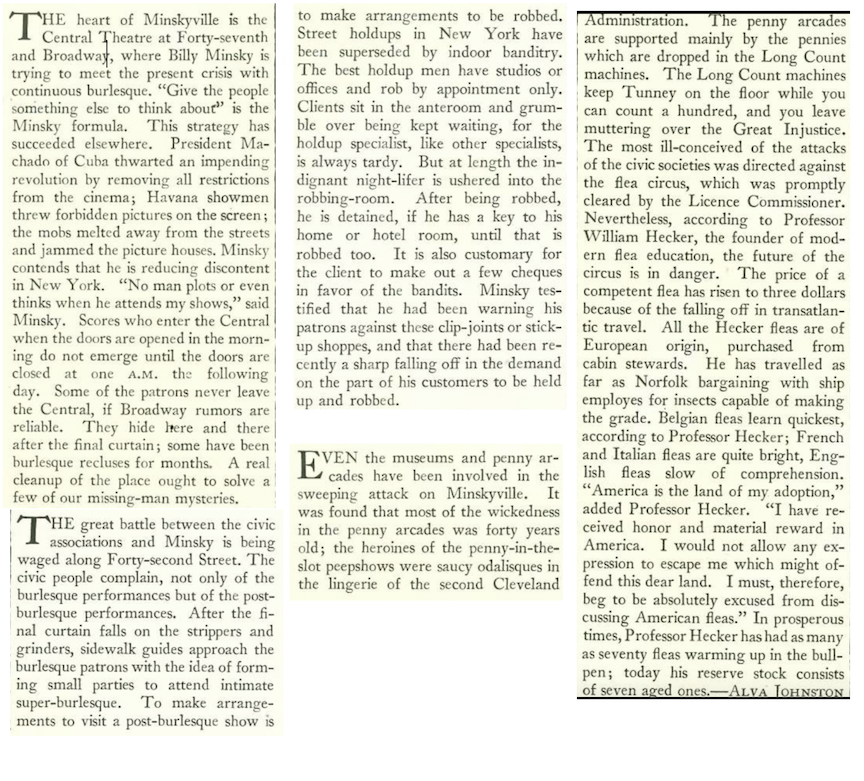
The Minsky family—brothers Billy, Herbert, Morton and Abe—built the beginnings of a New York burlesque empire, writes actress, author and documentarian Leslie Zemeckis: “Abe, the eldest, started showing racy films in a nickelodeon theater on the Lower East Side. His father—believing that if his son was gonna be a perv, he might as well make real money at it—bought the National Winter Garden theater on Houston Street near Second Avenue (where a Whole Foods stands today), and gave Abe the sixth floor to run his burlesque shows.” Alva Johnson paid a visit to Houston Street and environs for the “A Reporter at Large” column:
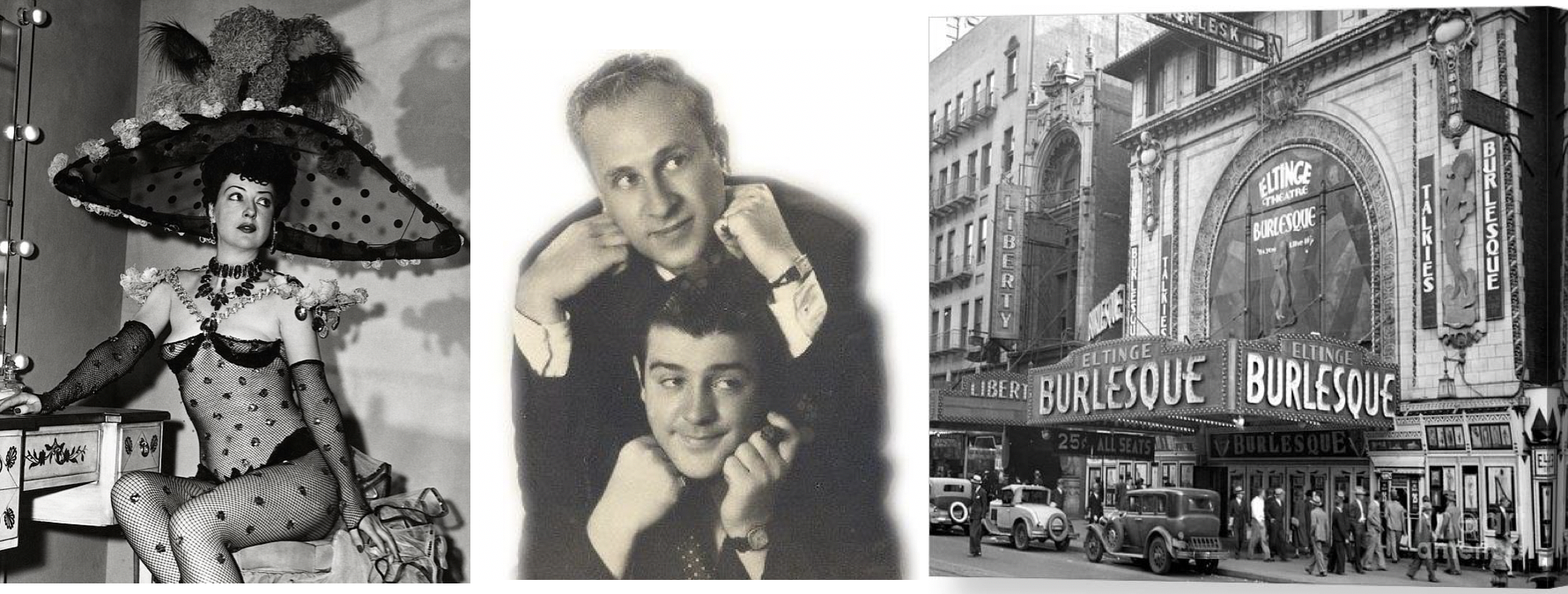
LITTLE EGYPT, aka Farida Mazar Spyropoulos, top left, both titillated and scandalized crowds at the 1893 Chicago World’s Fair (really?); clockwise, from center top, three of Minsky Brothers – Billy, Morton and Herbert; the Minsky Brothers owned several burlesque theaters in New York, including Minsky’s Oriental on 51st Street and Broadway, where stripper Julie Bryan was a top draw in 1936; Billy Minsky brought the Minsky brand to Broadway when he leased the Republic Theatre on 42nd Street in 1931; the last two images are by Margaret Bourke-White, backstage at the Republic in 1936. (Wikipedia/Daily News/Estate of Margaret Bourke-White)NEED A CAREER?…Well, in the 1930s an aspiring dancer or comedian could earn some chops on the burlesque stage. Gypsy Rose Lee (aka Rose Louise Hovick), left, who became the world’s most famous stripper (as well as an actress, author and playwright), was one of the biggest stars of Minsky’s Burlesque; breaks between burlesque performances were commonly filled by comedians, including Abbott and Costello (pictured above in their 1930s burlesque days), who first worked together in 1935 at the Eltinge Burlesque Theater on 42nd Street, at right.
According to Zemeckis, “burlesque caught on among the recent immigrants of the Lower East Side. The shows were cheap, the humor broad, and the allure of beautiful, barely-clothed women transcended language barriers.” But if striptease wasn’t your thing, Minskyville offered plenty of other diversions:
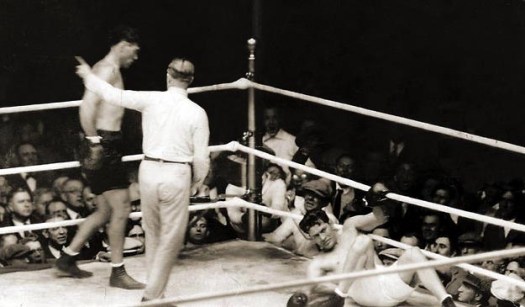
ONE LUMP OR TWO?…Minskyville’s entrepreneurs (top images) added a modern twist to the study of head bumps and cranium size — called Phrenology — with the electronic “Psycograph” (sic); at bottom, Prof. William Heckler’s Trained Flea Circus at Hubert’s Museum on West 42nd Street attracted some gents itching to see Heckler’s fleas in action; according to Alva Johnston, Minskyville’s penny arcade peepshows (such as the one at bottom right) would take your penny or nickel in exchange for photos of a woman old enough to give your grandpa the glad eye. (Museum of Questionable Medical Devices/sideshowworld.com)LET’S SEE THAT AGAIN…Folks who didn’t want to look at forty-year-old photos of bathing beauties could check out the most popular attraction at Minskyville’s penny arcades — a clip from the famed Long Count Fight, a 1927 rematch between world heavyweight champion Gene Tunney and former champ Jack Dempsey, which Tunney won in a unanimous decision despite being knocked down in the seventh round. It was, and is, the subject of endless debate. (www.wbaboxing.com )
* * *
Not a Gearhead
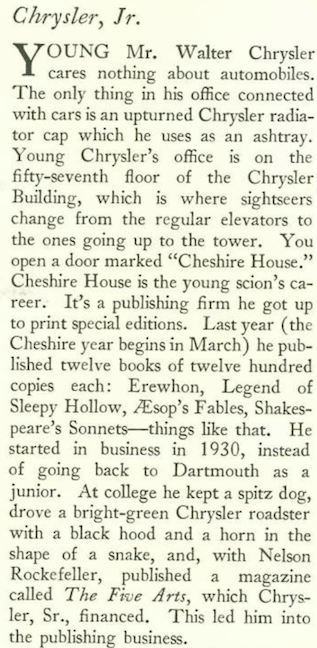
“The Talk of the Town” noted that young Walter P. Chrysler, Jr. preferred arts and literature over things that went zoom:
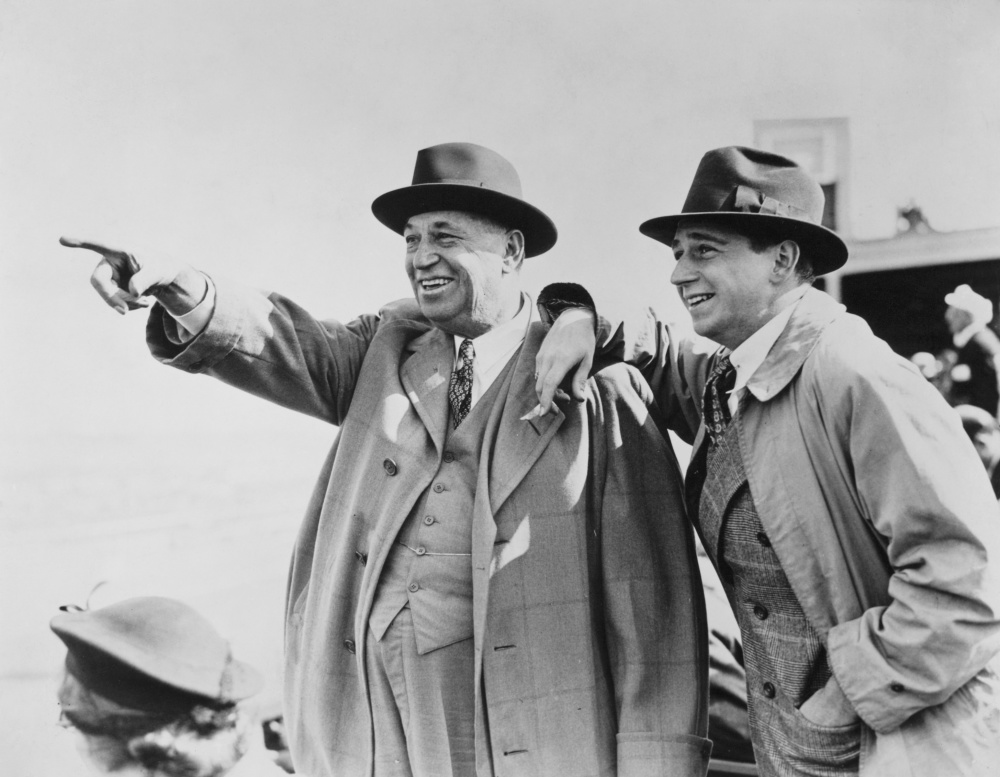
SOMEDAY THIS WILL ALL BE YOURS, RIGHT?…Walter P. Chrysler Sr. and Walter P. Chrysler Jr. share a father-son moment in 1930. Junior Chrysler devoted much of his life to building a multimillion-dollar collection of paintings (some of which were later found to be forgeries) and made substantial forays into collecting stamps, rare books and glassworks. He also produced a movie, The Joe Louis Story, released in 1953. (chrysler.org)
* * *
Rat-a-tat
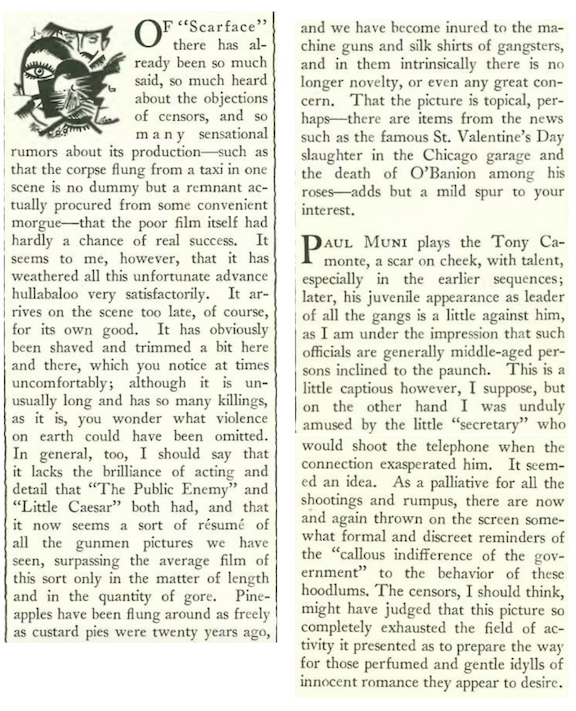
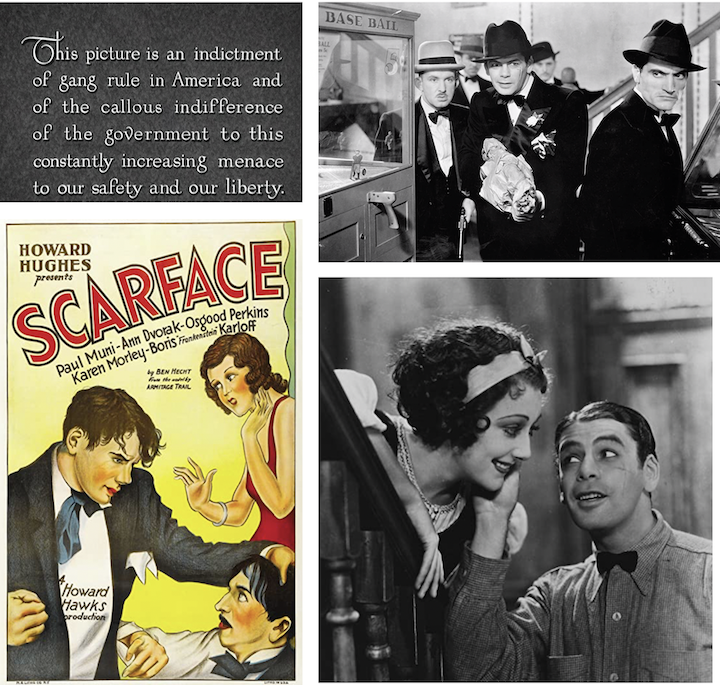
Today most movie lovers associate Scarface with the 1983 Brian DePalma film (starring Al Pacino), but the original Scarface in 1932 was far more influential in that it helped define the American gangster film genre. Directed by Howard Hawks and produced by Hawks and Howard Hughes, the screenplay was penned by early New Yorker contributor Ben Hecht. Mild by today’s standards, the film’s violent scenes caused it to be banned by many theaters around the country. Along with 1931’s Little Caesar and The Public Enemy, Scarface is regarded as among the most significant gangster films. Here is what critic John Mosher thought of it:
JUST IN CASE YOU GET THE WRONG IDEA…Also known as Scarface: The Shame of the Nation, this 1932 gangster film opened with some cautionary words (top left). Clockwise, from top right, gangster “Tony” Camonte (Paul Muni) is flanked by his cronies during a hit on a rival; Tony (Muni) shows his softer side with his dear sister Francesca (Ann Dvorak). United Artists promotional poster (note how Boris Karloff was billed with a reference to his 1931 Frankenstein role). (IMDB)
* * *
From Our Advertisers
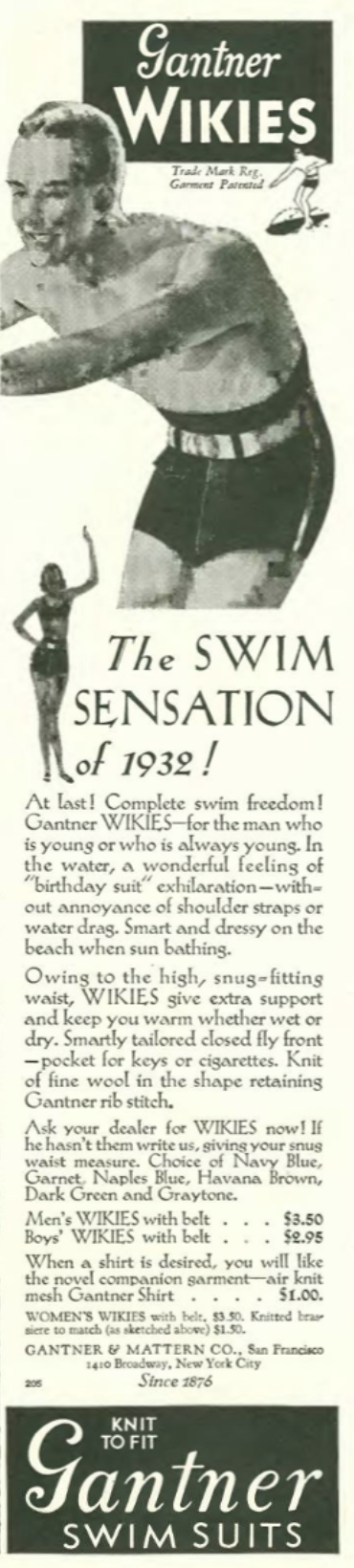
Just when I thought it was safe to go back into the water, out comes another line of wool swimsuits. I honestly can’t imagine how they must have felt, especially when wet and clinging to your skin after you left the water…
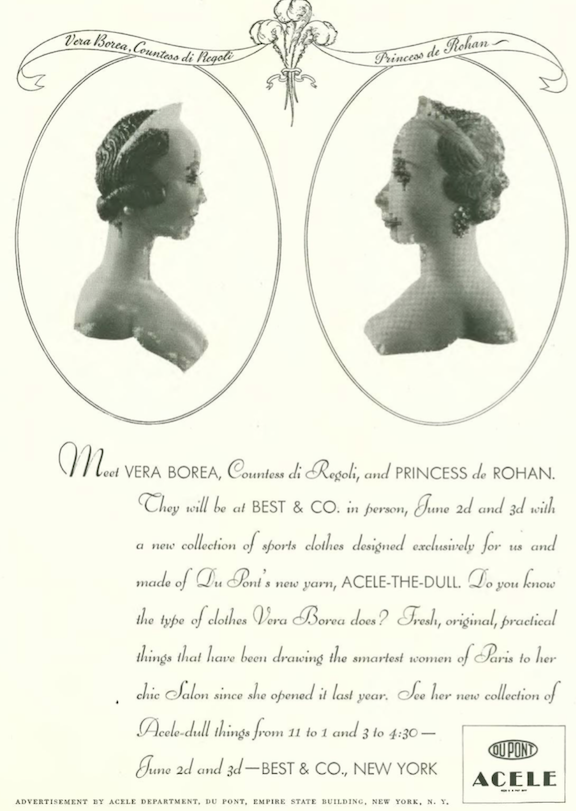
…the ad below from DuPont was just the sort of thing that drove New Yorker fashion critic Lois Long nuts…a couple of downscale royals shilling their fashion lines to an unsuspecting public…the paychecks from DuPont must have been substantial enough for these bluebloods to publicly embrace synthetics…
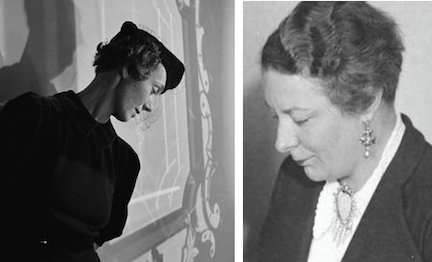
TWO HEADS ARE BETTER THAN ONE…Here is the real Countess Borea de Buzzaccarini Regoli, left, and the Princess de Rohan, who played to America’s insatiable thirst for nobility while shilling for a chemical company. (Wikimedia)
…if you had the money and the steady nerves, you could have hopped aboard an almost 32-hour flight to the West Coast assured that a “coordinated mechanism” of men and machine would get you there in one piece…
…perhaps you could have steadied your nerves by dragging on a Tally-Ho — for some weird reason the Lorillard Tobacco Company (who also made Old Gold) thought some folks might prefer an oval-shaped cigarette (I include the remainder of the back-page ads for context)…
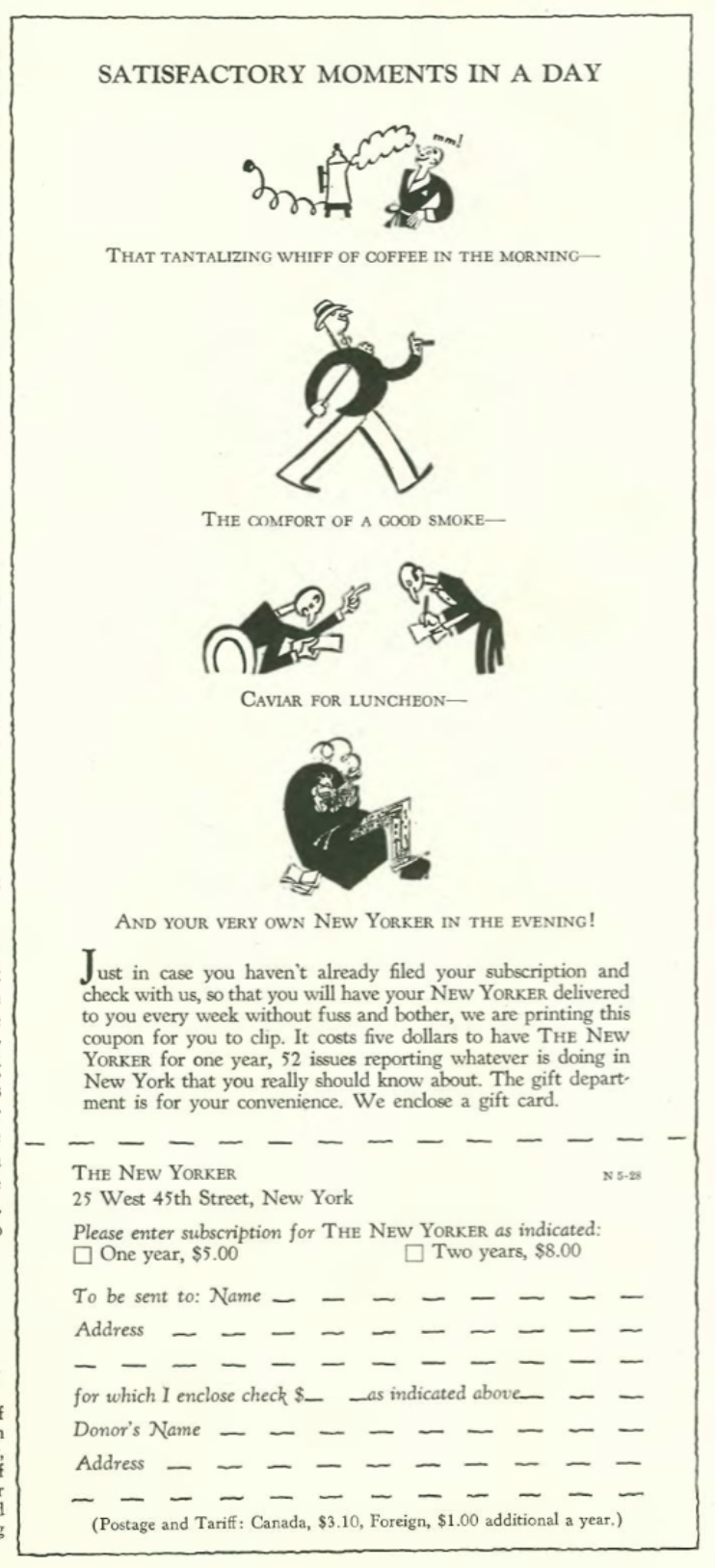
…despite the Depression, The New Yorker was holding its own in sales and subscriptions, but it never hurt to place a house ad every now and then to convince a few who might be holding out…
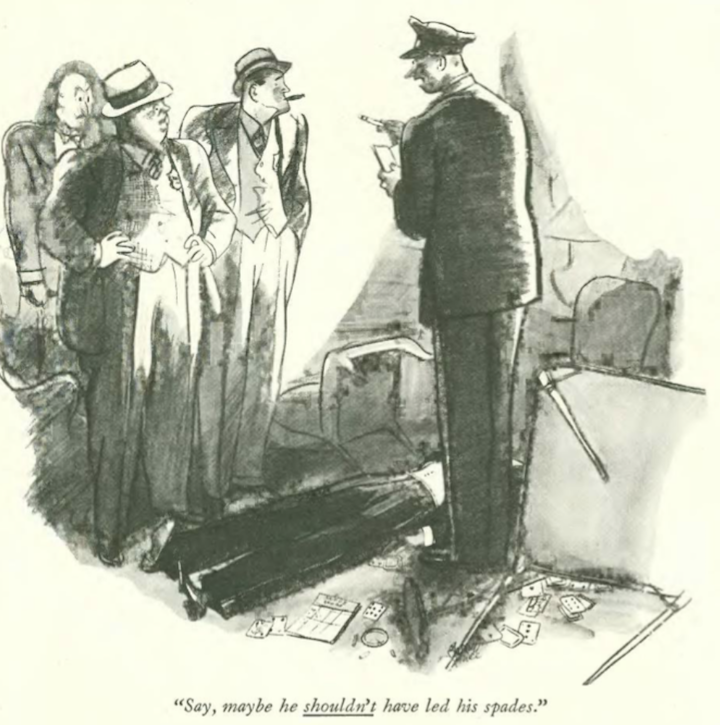
…on to our cartoons, Garrett Price showed us the result of a bad hand…
…James Thurber offered up this spot illustration in the opening pages…
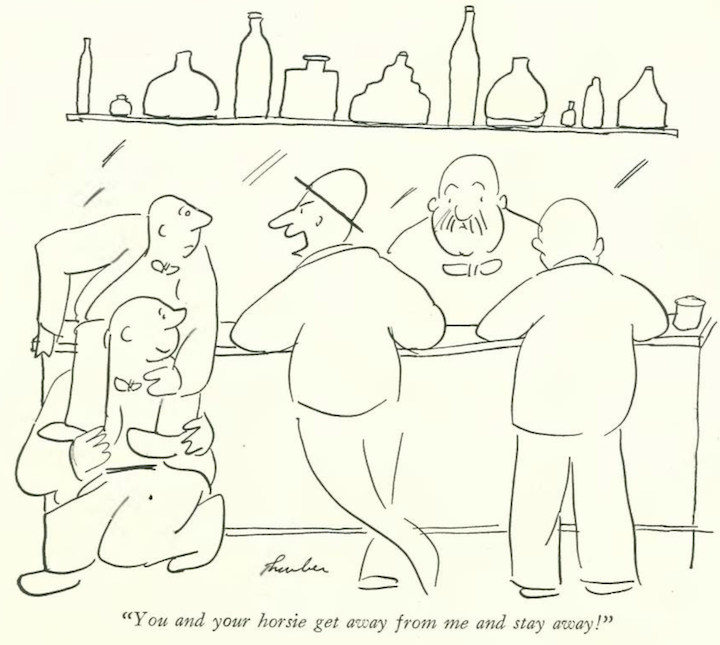
…and this terrific cartoon…
…Gardner Rea demonstrated the perils of summoning the dead…
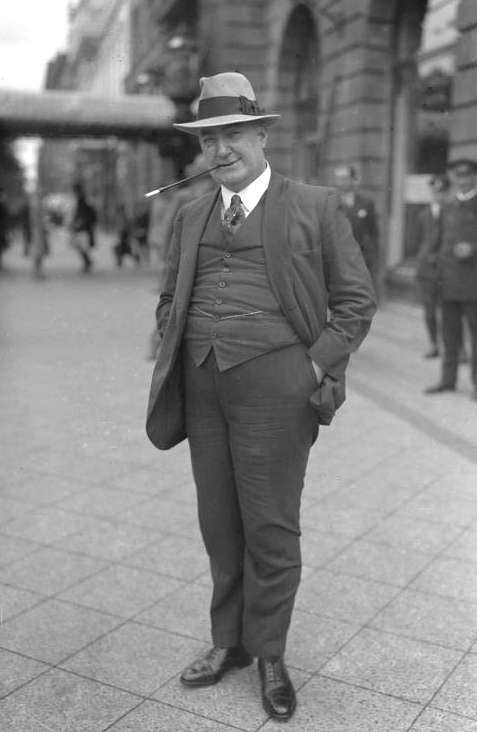
…the departed soul mentioned in Rea’s cartoon was prolific British crime writer, journalist and playwright Edgar Wallace (1875-1932), who wrote 175 novels, 24 plays, and countless articles in newspapers and journals in his relatively short life. He is most famous today as the co-creator of the film King Kong…
PRODUCTIVE SCRIBBLER…Edgar Wallace. (Wikipedia)
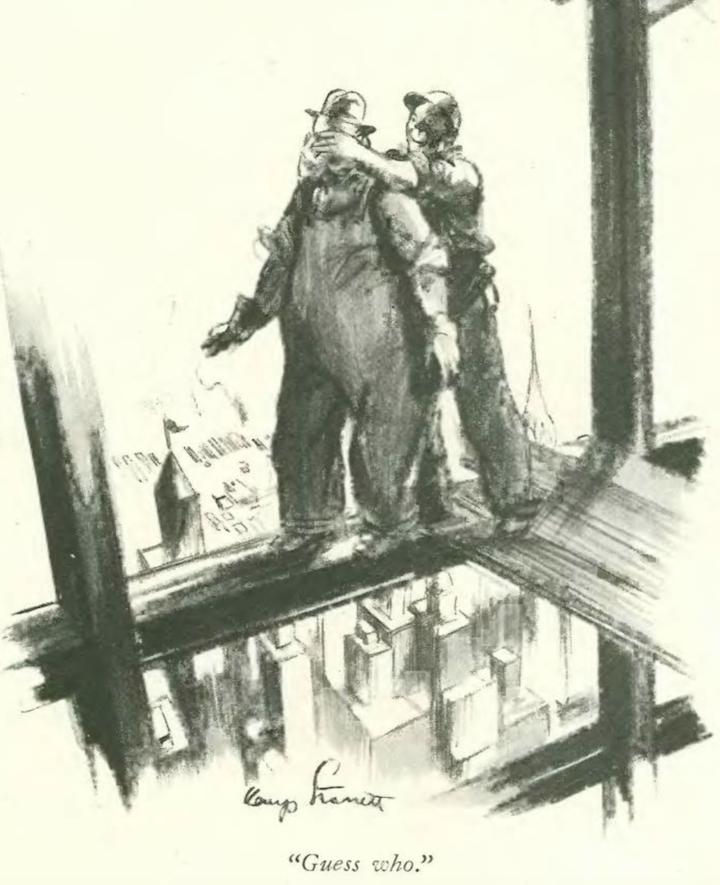
…and we end with this gem from Kemp Starrett, and some high-jinks…




























































































































 A New Yorker State of Mind