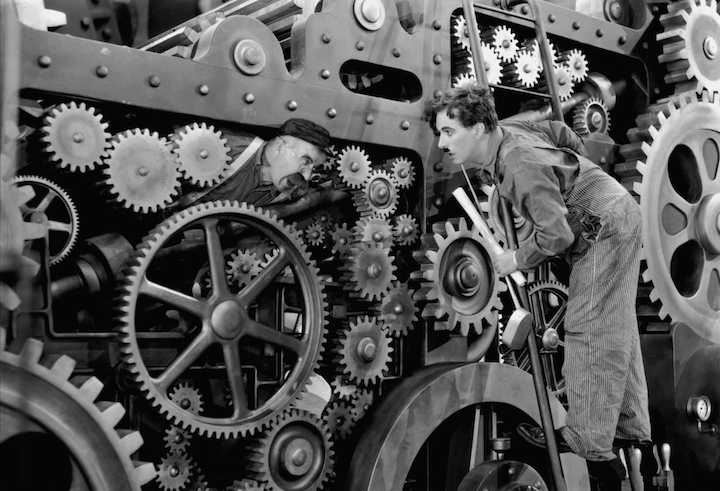
Modern Times

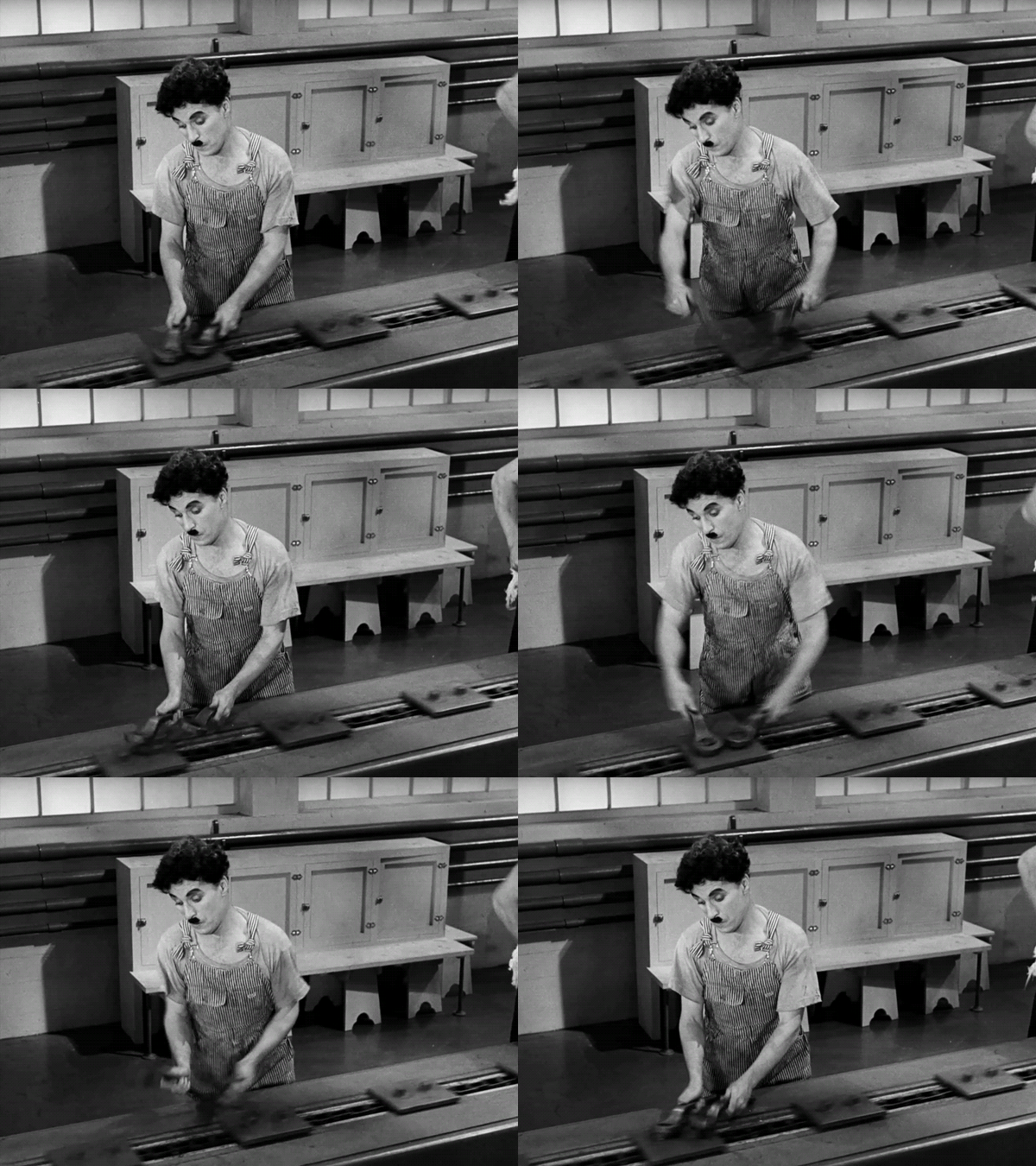
Above: A mechanic (Chester Conklin) gets caught up in his work with the help of the Tramp (Charlie Chaplin) in Modern Times. (festival-entrevues.com)

The film Modern Times was Charlie Chaplin’s last performance as “The Tramp” (or, “The Little Tramp”), a character he created more than twenty years earlier to represent a simple person’s struggle to survive in the modern world. That struggle was no more apparent than in Modern Times, a film in which the Tramp faced the dehumanizing industrial age in all its kooky complexity.
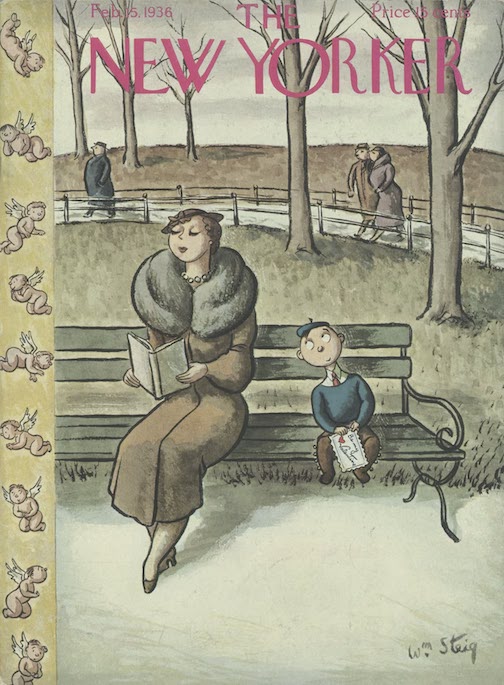
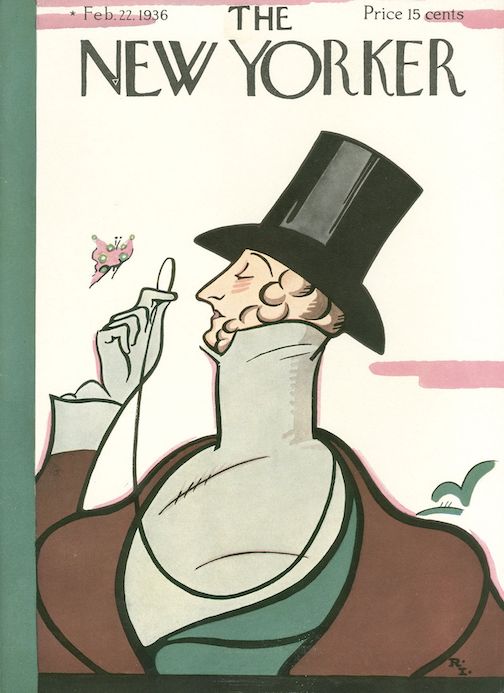
A sweet Valentine’s Day-themed cover by William Steig, February 15, 1936.

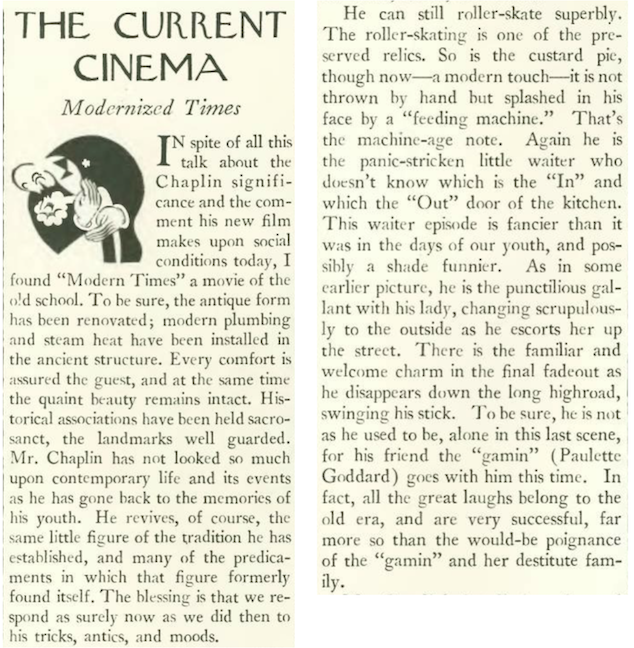
The film is notable for being Chaplin’s first picture to feature sound, and the first in which Chaplin’s voice is heard—singing Léo Daniderff’s comical song “Je cherche après Titine” (although Chaplin replaced the lyrics with gibberish). Modern Times was nevertheless filmed as a silent, with synchronized sound effects and a small amount of dialogue. Critic John Mosher appreciated the movie as being “of the old era,” not anticipating that it would become one of cinema’s most iconic and beloved films.
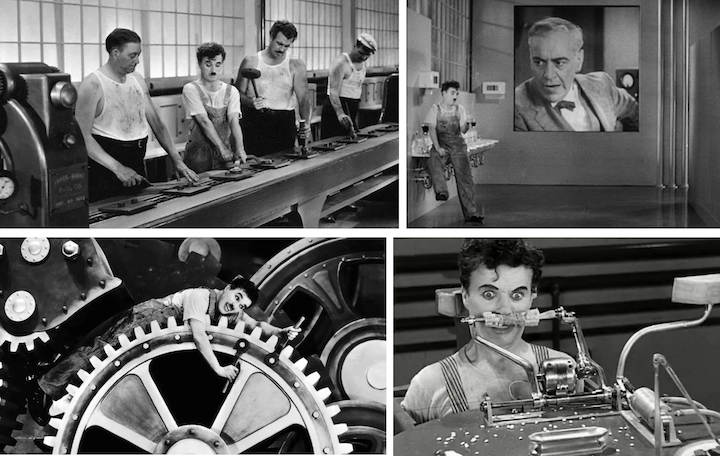
JUST A COG IN THE MACHINE…Clockwise, from top left: Repetitive assembly line work drives the Tramp (Charlie Chaplin) to a nervous breakdown; the steel factory is an Orwellian world where the president (Allan Ernest Garcia) constantly monitors his workers—even in the bathroom where the Tramp is caught taking a break; the company tries out a new lunch efficiency machine on the Tramp, with mixed results; iconic image of the Tramp at work. (medium.com/YouTube.com)
(thetwingeeks.com)

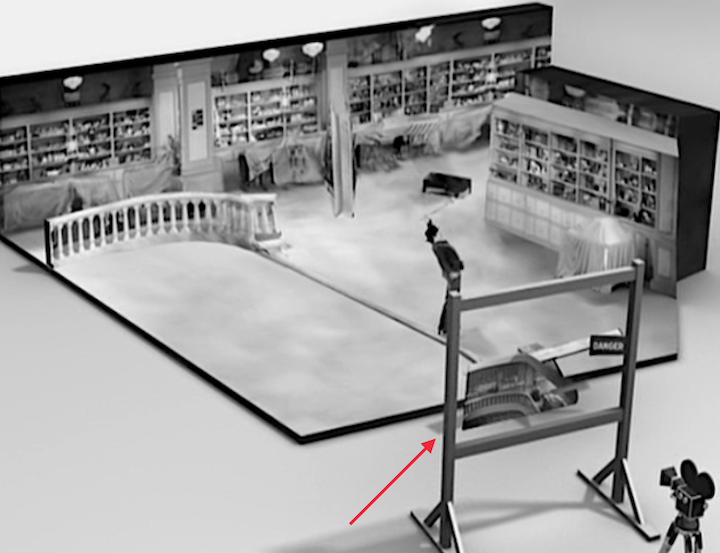
One of the film’s best stunts involved the blindfolded Tramp rollerskating on the fourth floor of an under-construction department store; Chaplin employed a matte painting, perfectly applied on a glass pane in front of a camera, to create the illusion of a sheer drop-off. Even as an illusion, Chaplin’s skating skills were remarkable.
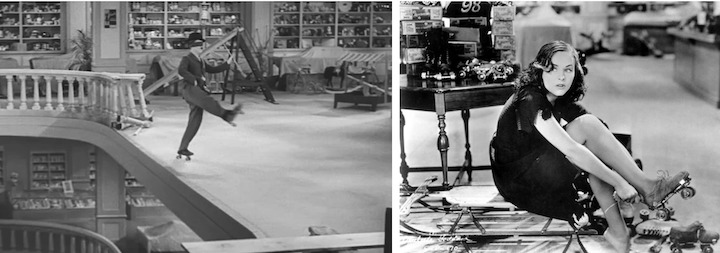
HIGH ANXIETY…The blindfolded Tramp (Charlie Chaplin) skates precariously close to a sheer drop-off on the fourth floor of a department store while his companion, an orphan girl known as “The Gamin” (Paulette Goddard) puts on her skates, unaware of his peril. (YouTube.com)

The model below shows how the effect was achieved, filming next to a glass-mounted matte painting to create the illusion of a sheer drop off…
(reddit.com)

In his conclusion, Mosher found the film to be “secure in its rich, old-fashioned funniness.”
Chaplin gave a happy send-off to the Tramp, who at the end of earlier films walked down the road alone. Modern Times closed with the Tramp and the Gamin walking hand in hand, dreaming of a life together.
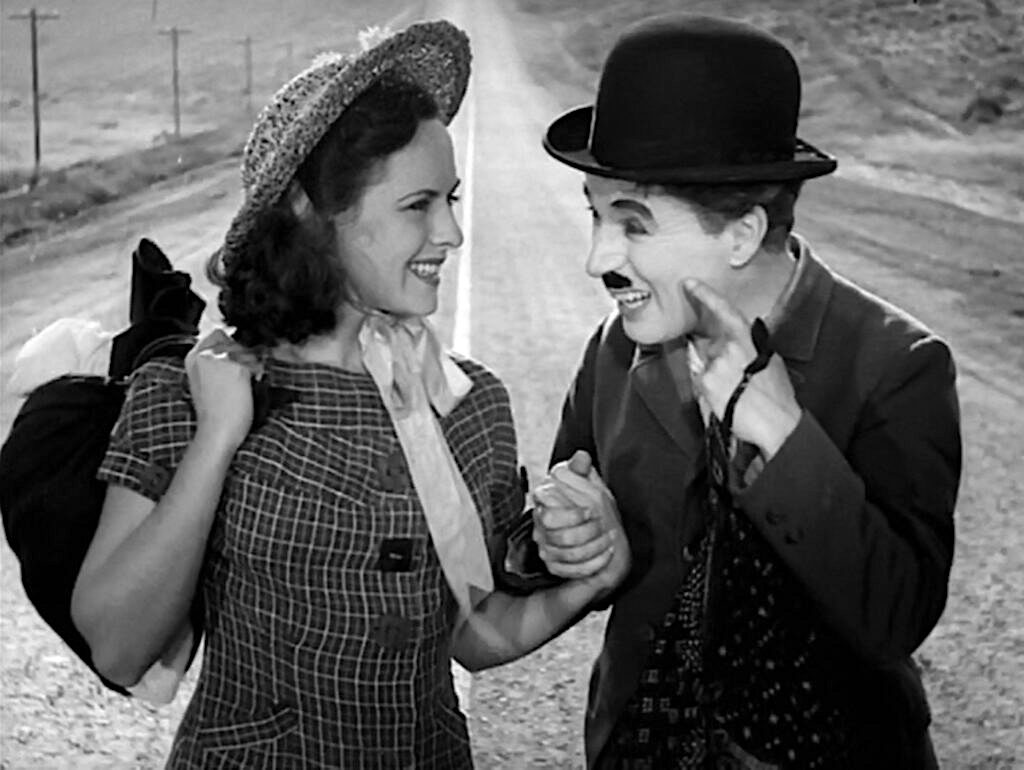
FOND FAREWALL…Paulette Goddard joined Charlie Chaplin on the road at the end of Modern Times. Goddard became Chaplin’s third wife in 1936. (the-cinematograph.com)
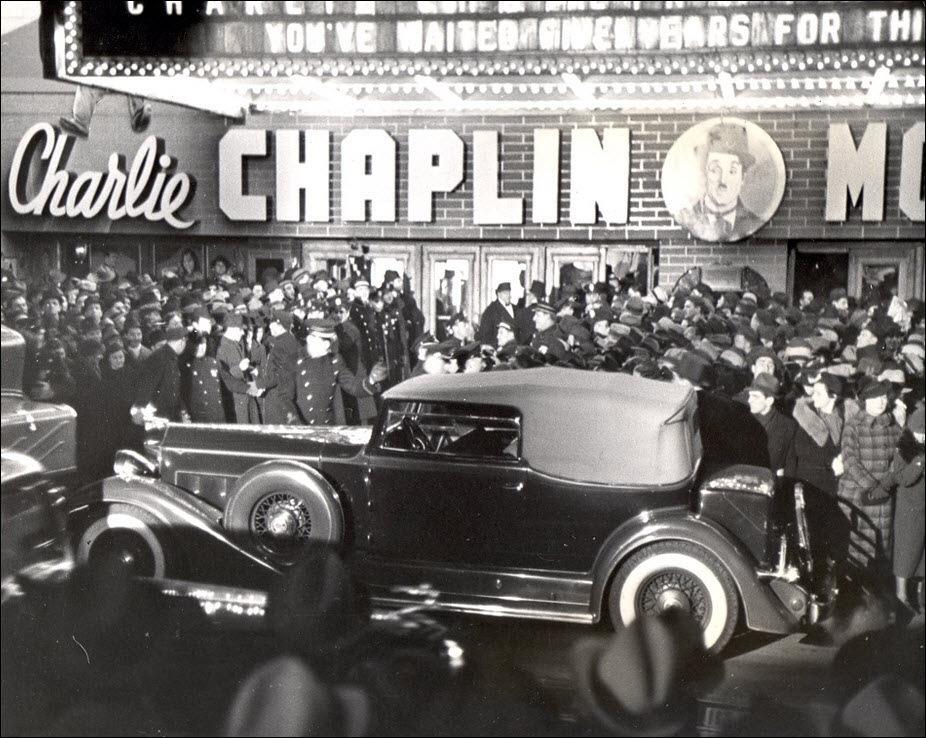
THE TRAMP RETURNS…World premiere of Modern Times, Feb. 5, 1936, at the Rivoli Theatre in New York City. The film was one of the top-grossing films of 1936. (Wikipedia)

A final note: The website The Twin Geeks offers an excellent synopsis and analysis of Modern Times.

 * * *

Bachelor King

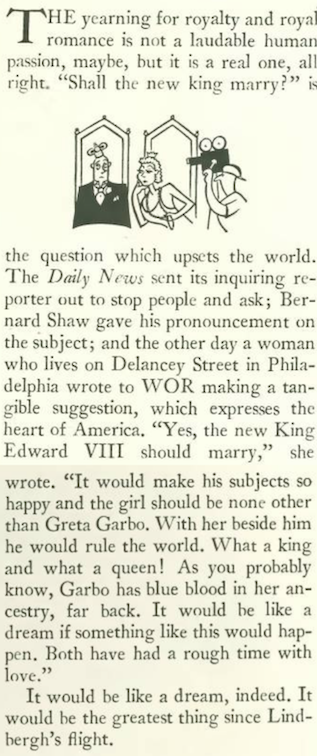
In his “Notes and Comment,” E.B. White wrote about the ascension to the British throne by Edward VIII following the death of his father, George V. In this excerpt, White considered a question raised by the Daily News regarding the king’s plans to marry (a question answered a few months later when Edward announced his plan to wed American divorcee Wallis Simpson, which led to a constitutional crisis and Edward’s subsequent abdication).
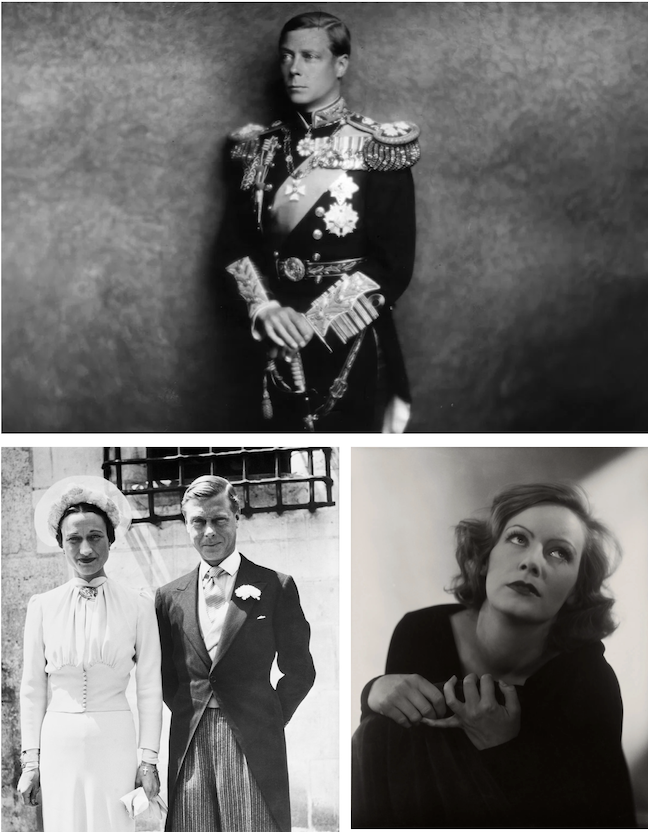
BUT I DON’T WANNA BE KING…The reluctant king Edward VIII would choose love over the crown when he abdicated the throne in December 1936 to marry Wallis Simpson (bottom left); E.B. White noted one woman’s suggestion that the king should marry actress Greta Garbo, since “Both have had a rough time at love.” (highland titles.com/George Eastman Museum)

* * *

By Any Other Name

“The Talk of Town” featured a profile of Arthur J. Burks, a prolific writer of pulp fiction who published everything from detective stories to science fiction under a half-dozen pseudonyms. A brief excerpt:
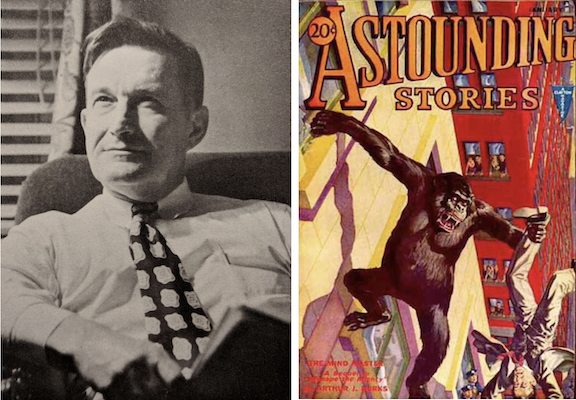
A CURIOUS MIND…Arthur J. Burks (1898–1974) and the cover of Astounding Stories,  January 1932, which featured the first part of his two-part tale, “The Mind Master.” Burks produced around eight hundred stories for the pulps, twenty-nine of which appeared in the magazine Weird Tales. (findagrave.com/gutenberg.org)

* * *

A Day in the Life

From 1935 to 1962 Eleanor Roosevelt published a daily syndicated newspaper column titled “My Day”—through the column millions of Americans learned her views on politics, society, and events of the day as well as details about her private and public life. James Thurber couldn’t resist writing a parody—here’s an excerpt:
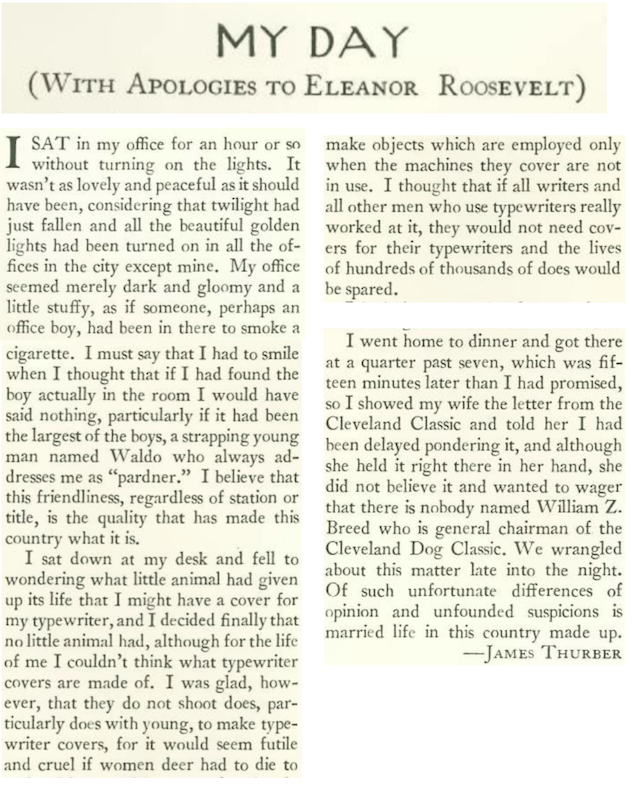
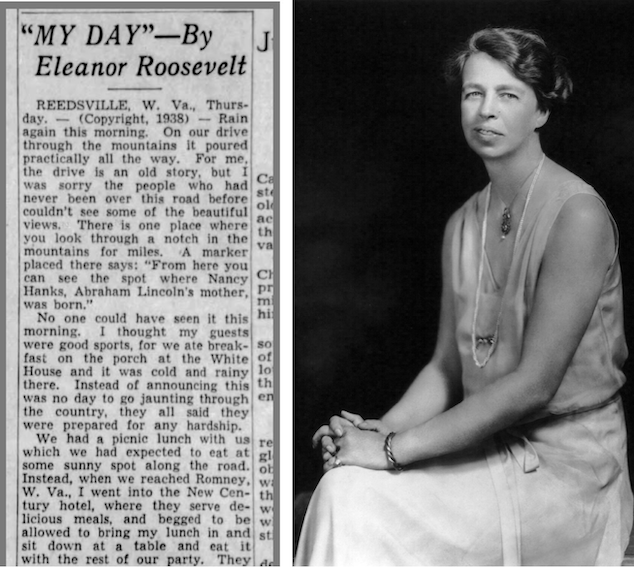
THE REAL DEAL…At left, sample of one of Eleanor Roosevelt’s syndicated “My Day” columns from 1938; photo of the First Lady from 1932. (arthurdaleheritage.org/Library of Congress)

 * * *

At the Movies

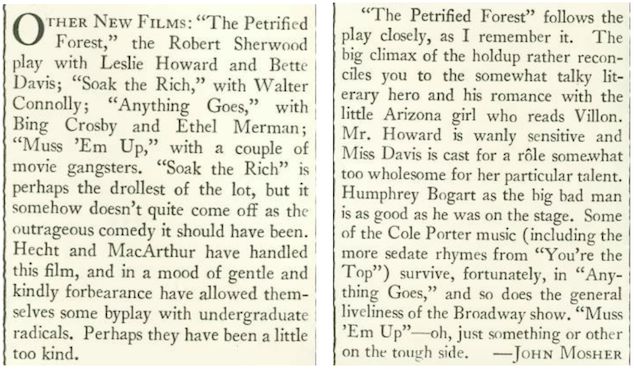
Besides Modern Times, there were other movies of note that were given rather scant attention in Mosher’s column, including the film adaptation of The Petrified Forest starring Humphrey Bogart, Bette Davis and Leslie Howard.
Robert E. Sherwood wrote the 1934 Broadway play of the same name, which was co-produced by Howard and featured both Howard and Bogart. When it was adapted to film, Howard insisted that Bogart appear in the movie, and it made Bogart a star (he remained grateful to Howard for the rest of his life).
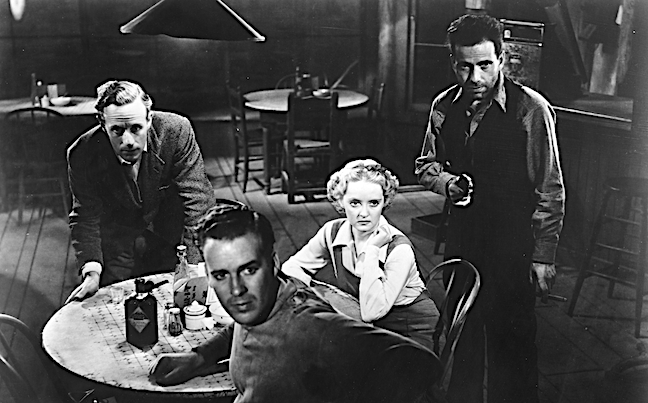
DANGEROUS DINER…An odd mix of patrons at a gas station cafe are taken hostage by desparate criminals in The Petrified Forest. From left are Leslie Howard, Dick Foran, Bette Davis and Humphrey Bogart. Playwright Robert Sherwood based Bogart’s character, Duke Mantee, on the the real-life criminal John Dillinger, the FBI’s first “Public Enemy #1.” (moma.org)

Other cinema diversions included the musical Anything Goes, which included songs by Cole Porter; the comedy Soak the Rich, which featured a radical who falls in love with a rich man’s daughter; and a detective film, Muss ‘Em Up, with the usual movie gangsters.
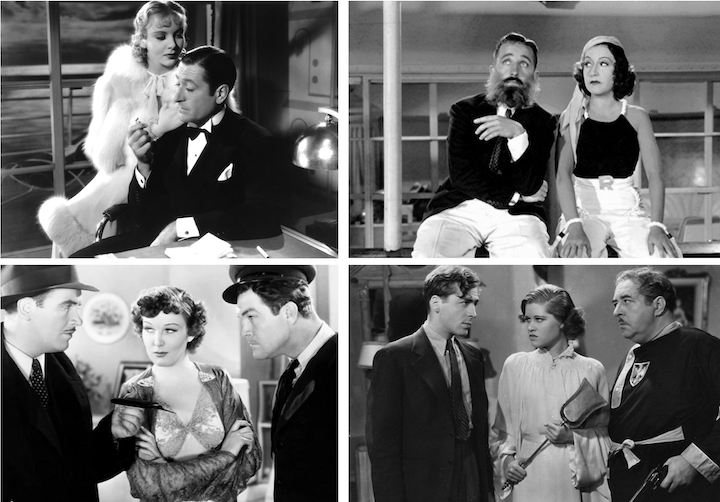
TAKE YOUR PICK…Clockwise, from top left: Ida Lupino and Arthur Treacher in the musical Anything Goes; Bing Crosby (in disguise) and Ethel Merman in Anything Goes; John Howard, Mary Taylor and Walter Connolly in the comedy Soak the Rich; Preston Foster, Maxine Jennings and Guinn “Big Boy” Williams in the detective film Muss ‘Em Up. (imdb.com/torontofilmsociety.com/zeusdvds.com)

 * * *

The Amazing Race

The New Yorker periodically featured “That Was New York,” which took a detailed look at significant events in the city’s history. In this installment, Donald Moffat recalled the 1908 New York to Paris automobile race, which commenced in Times Square on February 12 with six cars representing the U.S., France, Germany and Italy. It was an extraordinary event given that motorcars were a recent invention, and roads were nonexistent in many parts of the world. A brief excerpt:
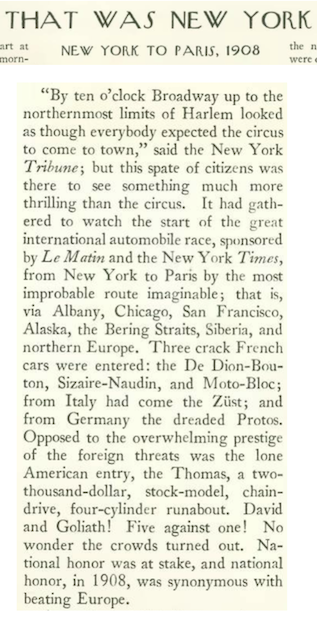
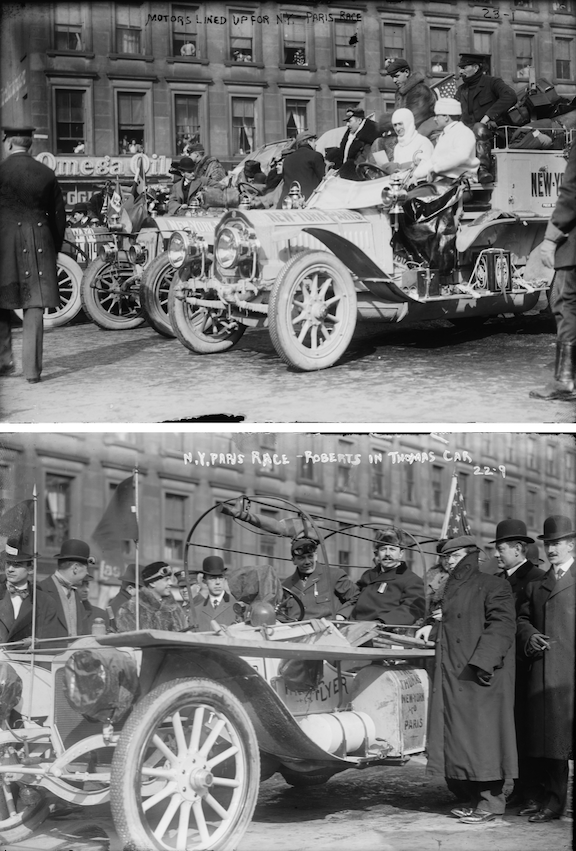
ON YOUR MARK…Cars lined up in Times Square on Feb 12, 1908 for the start of what would become a 169-day race. American George Schuster was declared the winner when he arrived in Paris on July 30, 1908, after covering approximately 10,377 miles (16,700 km). (Library of Congress)

 * * *

Miscellany

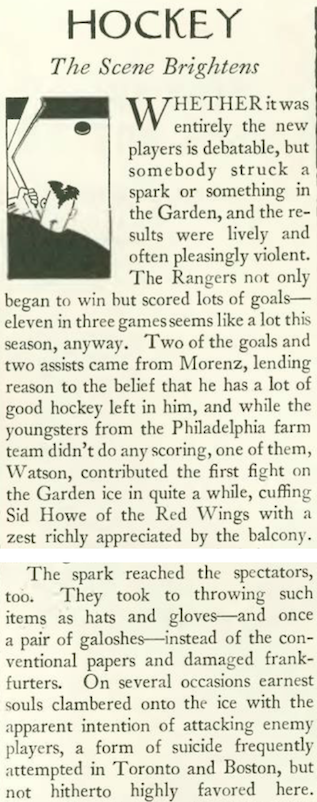
Another regular feature in the early New Yorker was coverage of the New York Rangers, a team founded in 1926 by Tex Rickard after he completed construction of the third incarnation of Madison Square Garden. The Rangers were one of the Original Six NHL teams before the 1967 expansion, the others being the Boston Bruins, Chicago Blackhawks, Detroit Red Wings, Montreal Canadiens and Toronto Maple Leafs.

In this excerpt, the writer “K.B.” described the rough play against rival Detroit, which would win back-to-back Stanley Cups in 1936 and 1937.

ZESTY…The excerpt above noted that the Rangers’ Phil Watson cuffed the Red Wings’ Syd Howe “with a zest richly appreciated by the balcony.” At left, team photo of the 1935-36 New York Rangers, with star and fight instigator Phil Watson identified with arrow; at right, Syd Howe won three Stanley Cups with Detroit, winning back-to-back in 1936 and 1937, and then again in 1943. (hockeygods.com)

 * * *

From Our Advertisers

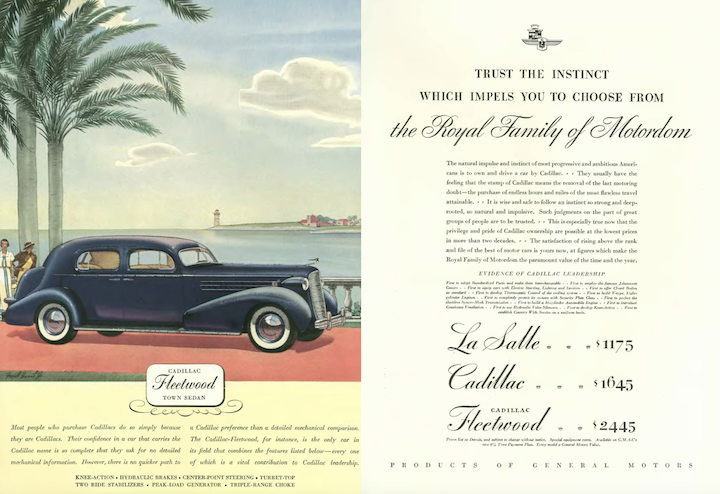
General Motors’ luxury car line offered three price points (and this lovely image) to weather the Depression years, ranging from the relatively affordable La Salle to the Cadillac Fleetwood…
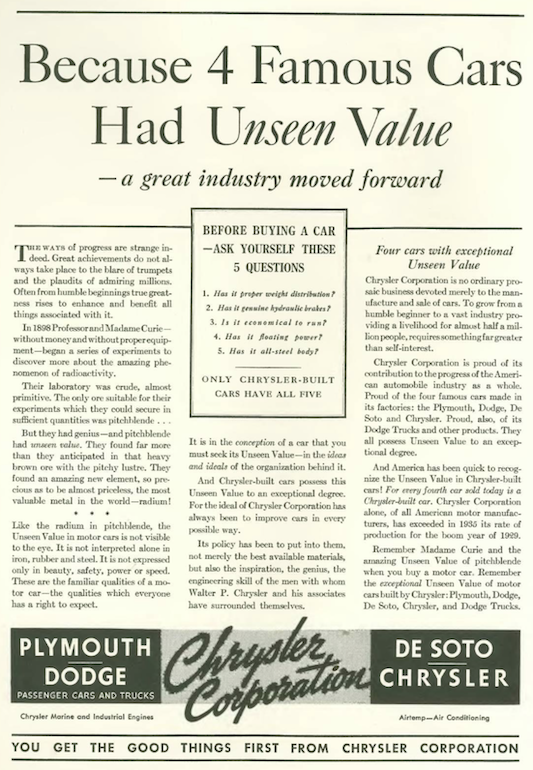
…the Chrysler corporation took a different approach, deploying a very wordy full-page ad that referenced history (a Madame Curie analogy) and something called “Unseen Value” to move its line of autos…
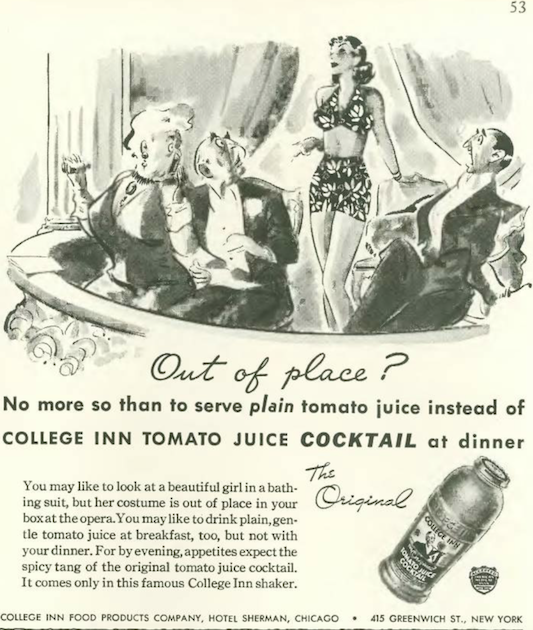
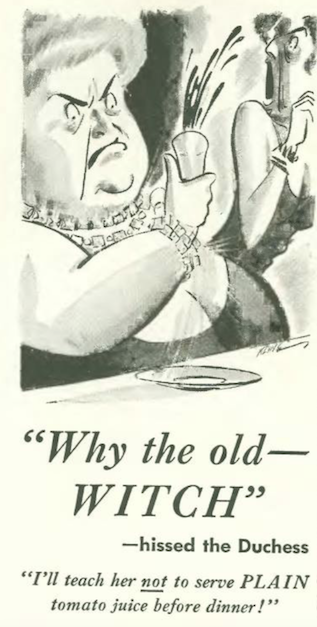
…the makers of College Inn Tomato Juice Cocktail brought back the “Duchess” with this shocking scene at the opera…
…recall last summer when College Inn featured the Duchess in a series of ads that illustrated her increasing fury over plain tomato juice…one wonders what sort of sadistic torment she had in mind for her hostess, “the old WITCH”…
…on to our cartoonists, beginning with this spot by James Thurber

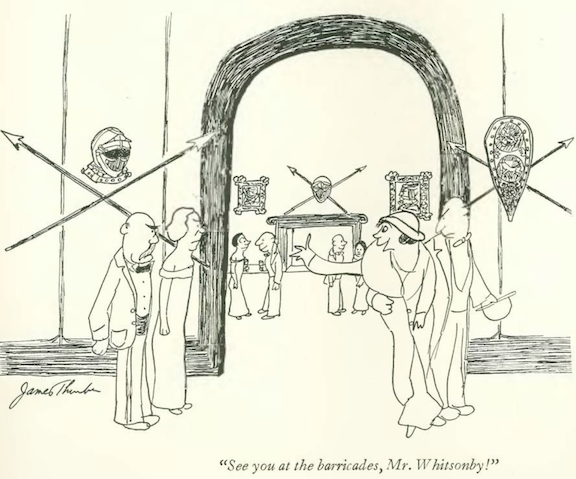
…and Thurber again, with an unwanted call to solidarity…
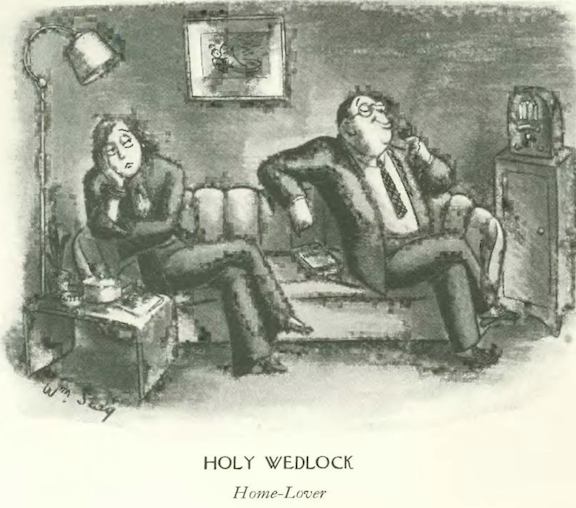
William Steig explored marital bliss…

George Price gave us a Three Stooges moment…
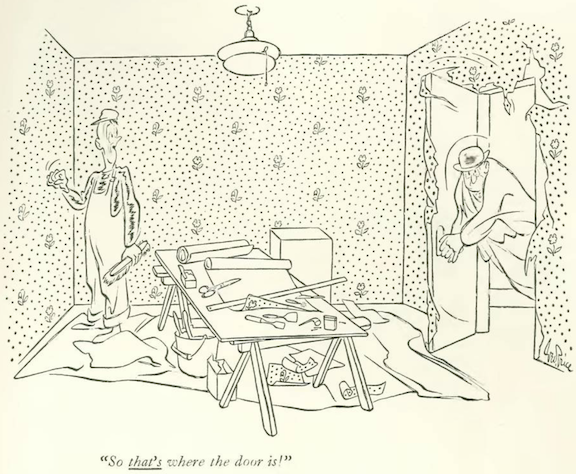
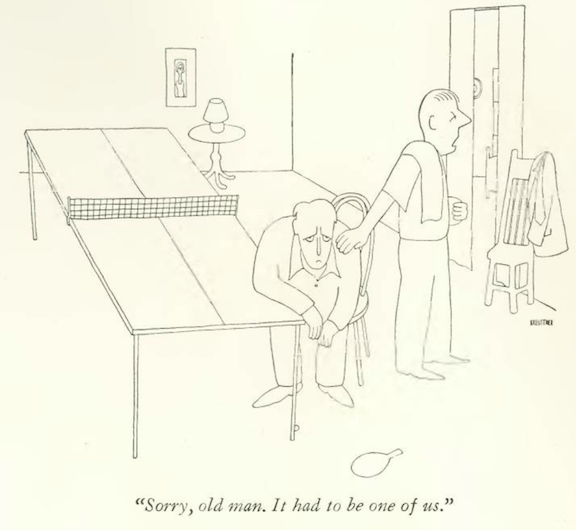
…I do not have the identity of this cartoonist…I will keep looking, but would love suggestions in the meantime…*update*…thanks to Frank Wilhoit for identifying the cartoonist below as John Kreuttner, also confirmed through Michael Maslin’s Ink Spill

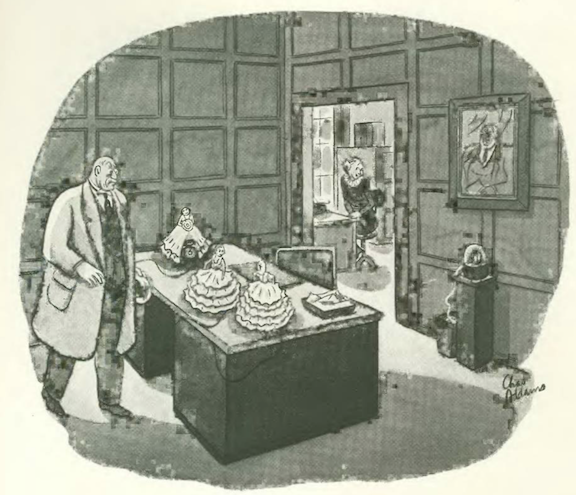
Charles Addams added some frills to an executive suite…
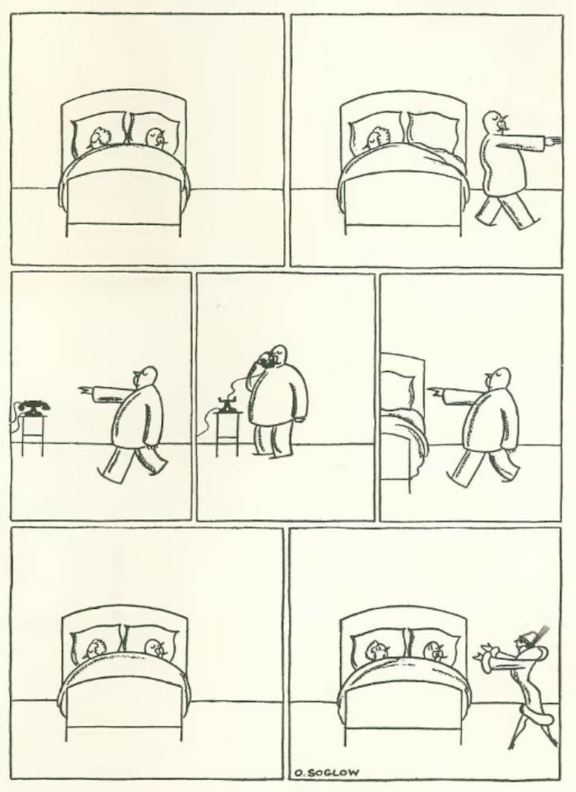
Otto Soglow illustrated the hazards of sleepwalking…
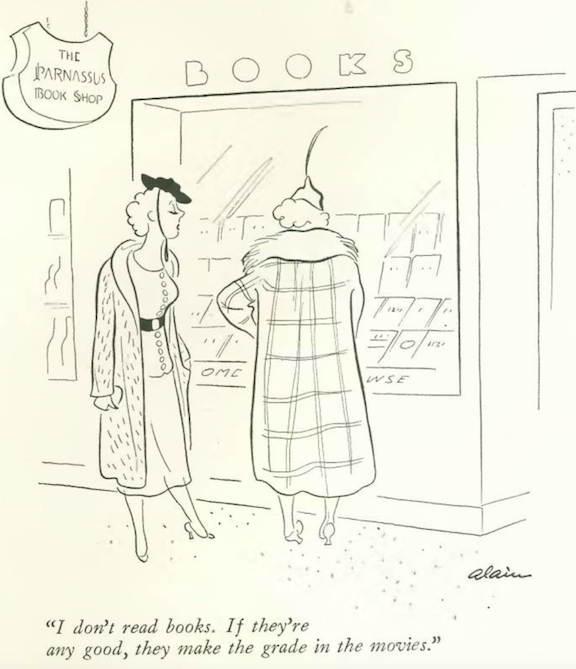
Alain revealed a challenge to the publishing industry…
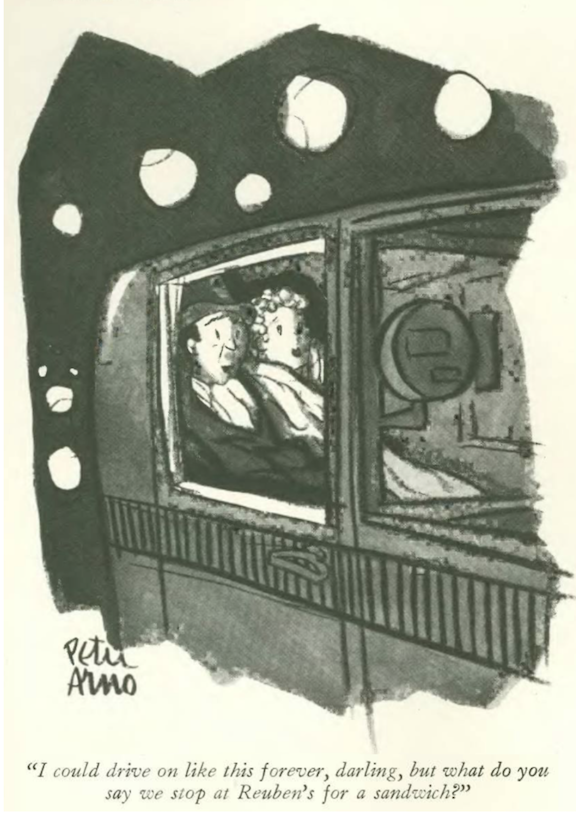
Peter Arno possibly craved some sauerkraut and corned beef…
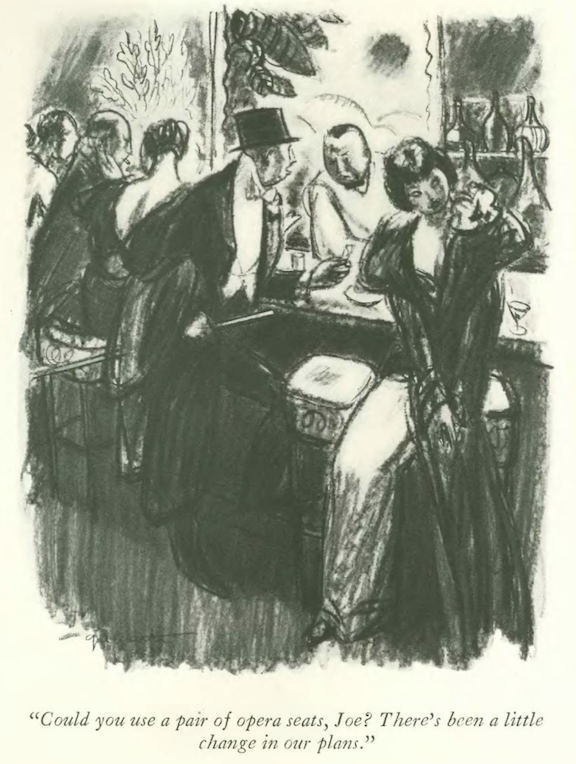
William Crawford Galbraith was in familiar sugar daddy territory…
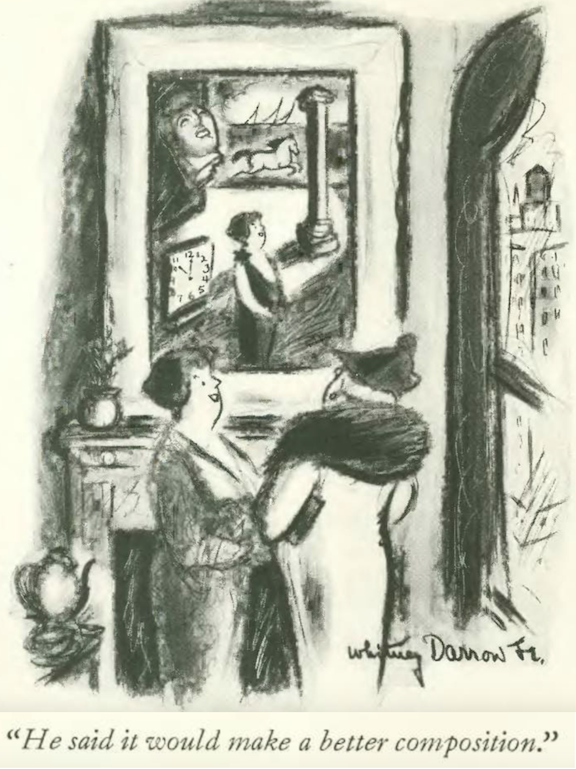
Whitney Darrow Jr gave a nod to some homey surrealism…
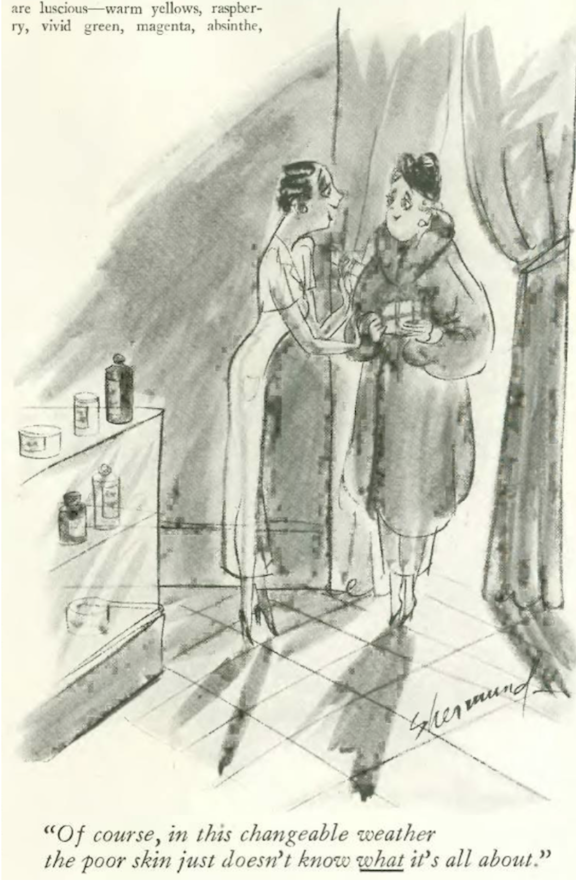
Barbara Shermund offered some well-weathered advice…
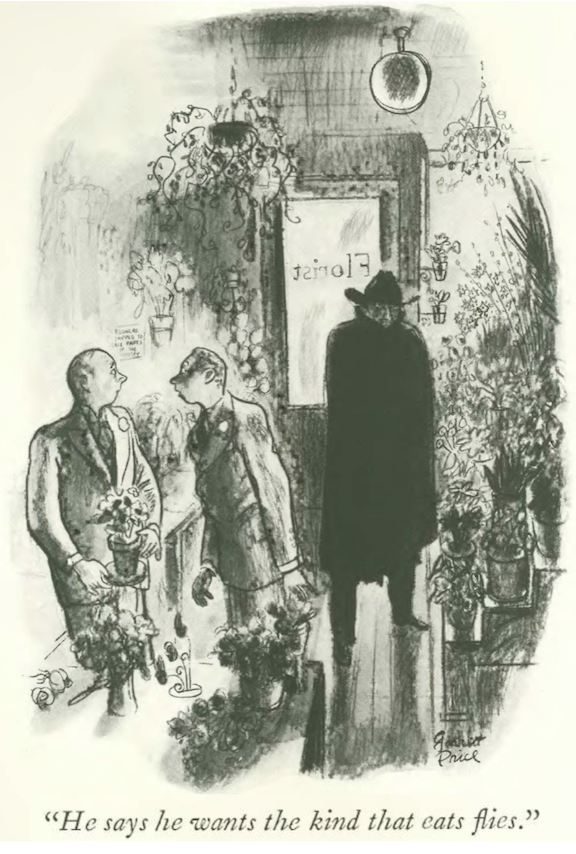
…and we close with Garrett Price, and a visitor more suited to Charles Addams…
Next Time: Eleven Years On…

The Coming War

While many Americans partied through the Roaring Twenties, there were a few voices out there, barely audible, that warned of economic collapse and another world war.

Oct. 3, 1931 cover by Helen Hokinson.

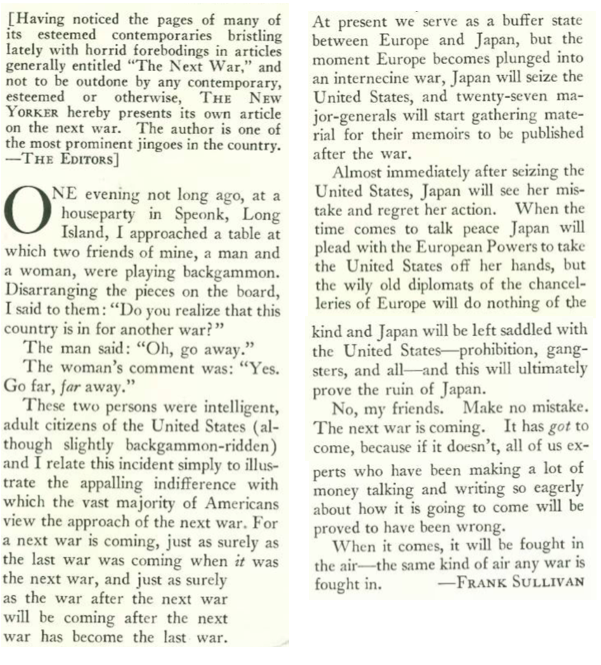
The humorist and New Yorker contributor Frank Sullivan was among the few who took notice of the dire predictions (of war, anyway) and turned it into a funny take on how a European war might unfold. Excerpts:

Sullivan’s last line is a wordplay on “air,” and not likely a prediction of the horrible firebombing and V-2 attacks that would devastate Europe in the following decade.

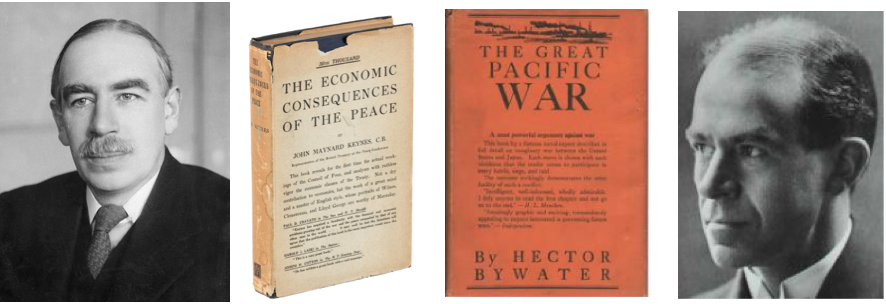
In Sullivan’s day two notable predictions of war came from British economist John Maynard Keynes and British author Hector Charles Bywater. In his 1919 book, The Economic Consequences of the Peace, Keynes warned that “unstable elements,” destroyed during the Great War (WWI), had not been replaced with more stable networks or institutions. Bywater’s prescient 1925 novel, The Great Pacific War, featured a hypothetical future war between Japan and the U.S. that predicted a number of events in World War Two’s Pacific Theatre.

I SEE DEAD PEOPLE…Economist John Maynard Keynes and British author Hector Charles Bywater both didn’t like what they saw coming on the horizon.

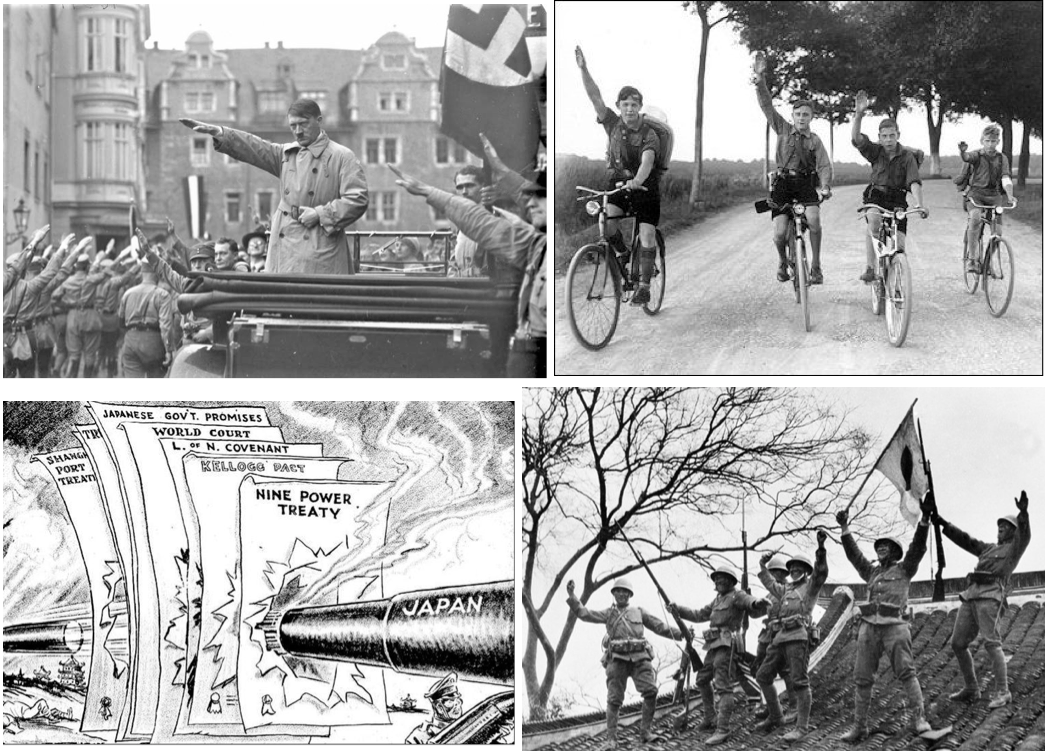
There were reasons for Keynes to be concerned. Germany found many ways to subvert restrictions imposed by the Treaty of Versailles, and continued to make technological advances in armaments and air power. Moreover, the Treaty’s humiliating terms and demands for costly reparations would lead to a rise in German nationalism in the midst of mass unemployment and a volatile economy. In just a little over a year Adolf Hitler and his Nazi Party would seize control of the German state.

And as Bywater feared, the Japanese invaded Manchuria (under false pretenses) on Sept. 18, 1931, and then ignored orders to withdraw from the League of Nations (which had been established by a covenant included in the Treaty of Versailles). Japanese warlords were emboldened by the ease of this takeover and the toothless response from the international community. This scenario would be replayed by the Nazis when they invaded Czechoslovakia in 1939.

UGH, IT’S THAT GUY…Clockwise, from top left, Adolf Hitler rolls into Weimar as the Nazi Party continued to gain power in 1930; Hitler youth out for a bike ride in 1932; Japanese troops celebrate their easy invasion of Manchuria in September 1931; political cartoon illustrated Japan’s attitude toward international treaties. (Wikipedia/Pinterest)

 *  *  *

The Man Who Would Not Be King

The world that was gradually setting the stage for World War II was also the world of Edward VIII, the Prince of Wales. A renowned womanizer and major disappointment to his father, George V, this heir to the British throne would begin a secret affair with American socialite Wallis Simpson that would later lead to his abdication as king after a reign of just 326 days. In a two-part profile, the New Yorker’s London correspondent Anthony Gibbs could already see that Edward would not be like other monarchs, this lonely “fish out of water” bored with court protocol and finding escape in a bottle of whisky. Excerpts from Part I (caricature by Al Frueh):

HITLER HONEYMOON…Edward VIII abdicated the British throne in December 1936 and married the newly divorced Wallis Simpson in June 1937. Four months later (right) they would pay a visit to Adolf Hitler and his thugs at Hitler’s mountain retreat above Berchtesgaden. Edward was known to be sympathetic to the Nazis, and favored the type of appeasement that would embolden Der Führer to invade Czechoslovakia and much of Europe beginning in 1939. (Pinterest/Wikipedia)

 *  *  *

From Our Advertisers

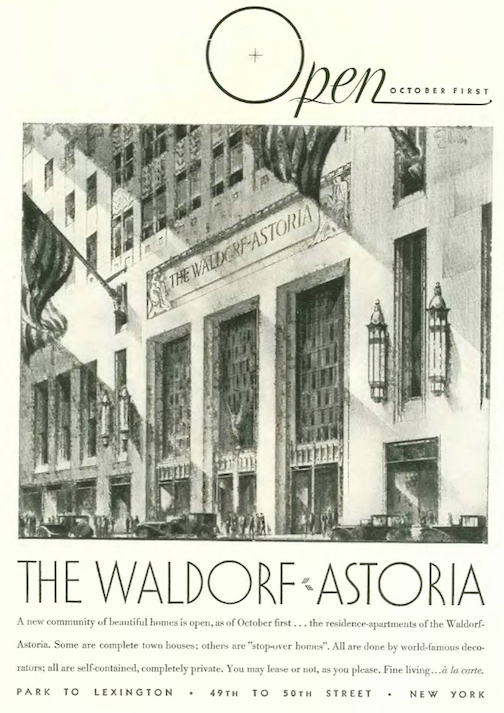
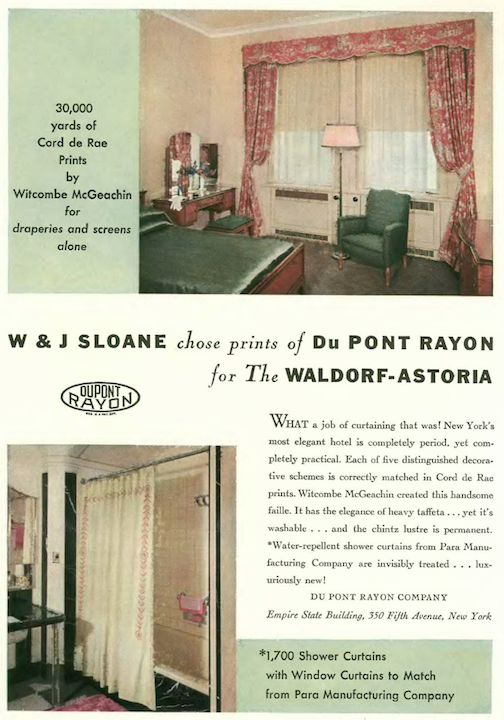
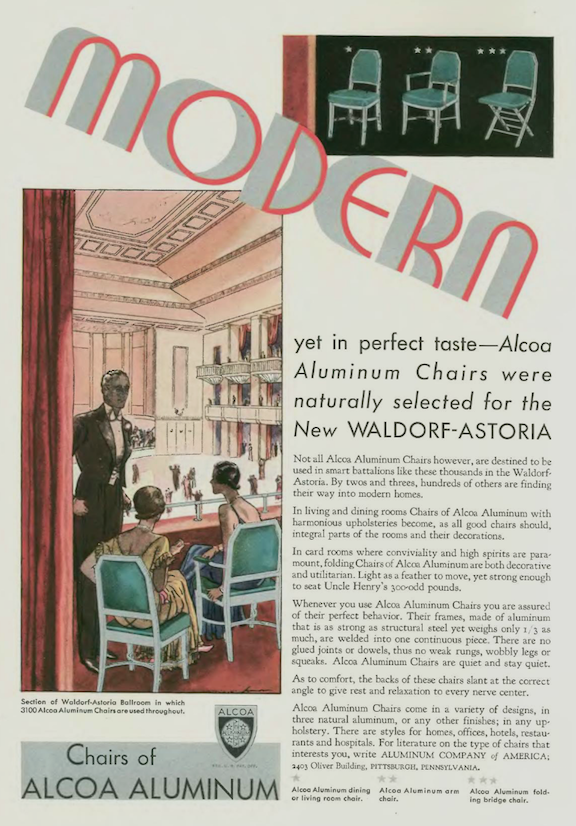
The opening of the new Waldorf-Astoria Hotel on Park Avenue had everyone and their dog getting in on a piece of the action, including manufacturers who hoped to associate their wares with the world’s tallest hotel…we begin with an ad from the hotel’s promoters…

…I surprised to find pedestrian products such as rayon curtains and aluminum chairs associated with the luxury hotel…

…but perhaps the novelty of these things made them “must-haves” associated with modern living in 1931…this ad from the Oct 10 issue…

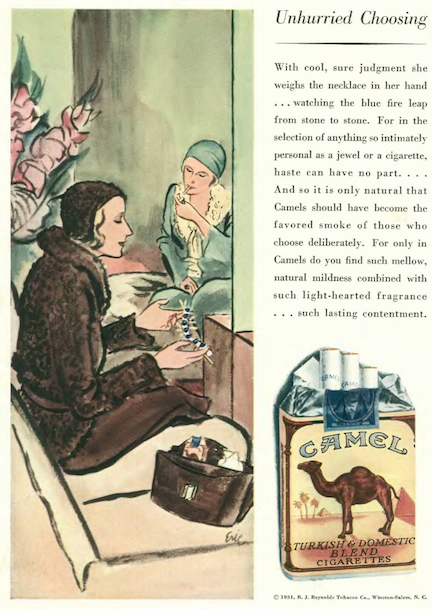
…one habit of modern living was cigarette smoking, and thanks to aggressive advertising droves of women were joining the menfolk in this activity…

…Camels were originally promoted as a woman’s cigarette, and in 1931 R.J. Reynolds shifted their ad style from chic illustrations of disinterested, continental types, such as the one below by Carl Erickson from the March 21, 1931 issue (and imitated by the Spud ad above)…

…to photographs of fresh-faced American women…

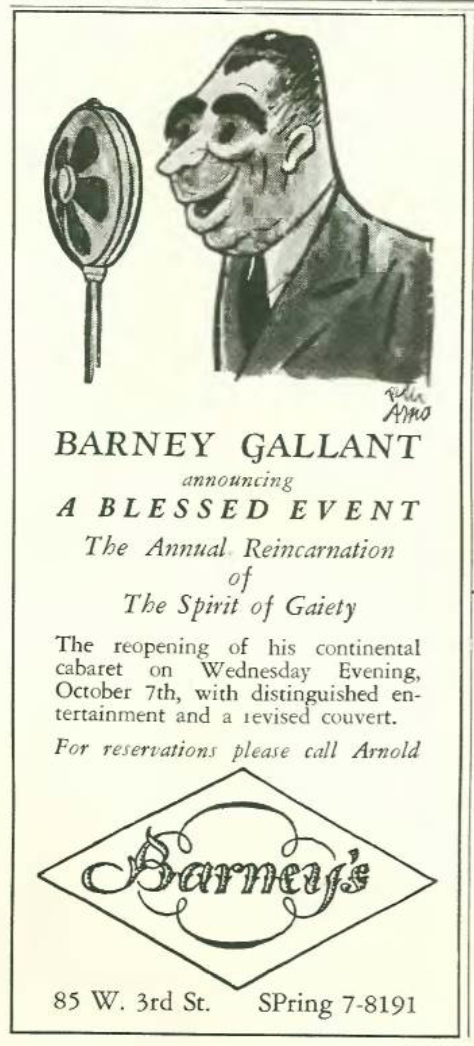
…Barney’s ran this recurring ad (with illustration by Peter Arno) in the back pages of the New Yorker, the latest touting the reopening of Barney Gallant’s “continental cabaret”…

GOOD TIME BARNEY…Barney Gallant was a celebrity and a hero to many New Yorkers for his defiance of Prohibition. At left, actor/writer/producer John Murray Anderson (seated) and Gallant in a photo by Nickolas Muray. At right, illustration by Joseph Golinken of Gallant’s speakeasy Speako de Luxe at 19 Washington Square North. The first New Yorker to be prosecuted under the Volstead Act (serving 30 days in the Tombs), Gallant operated several Bohemian speakeasies in Greenwich Village during the 1920s. Stanley Walker (writing in his 1933 history, The Night Club Era) described the clientele as “youngsters with strange stirrings in their  breasts, who had come from remote villages on the prairie; women of social position and money who wanted to do things — all sorts of things — in a bohemian setting; businessmen who had made quick money and wanted to breathe the faintly naughty atmosphere in safety, and ordinary people who got thirsty now and then and wanted to sit down and have a drink.” (Metropolitan Museum/New York Historical Society)

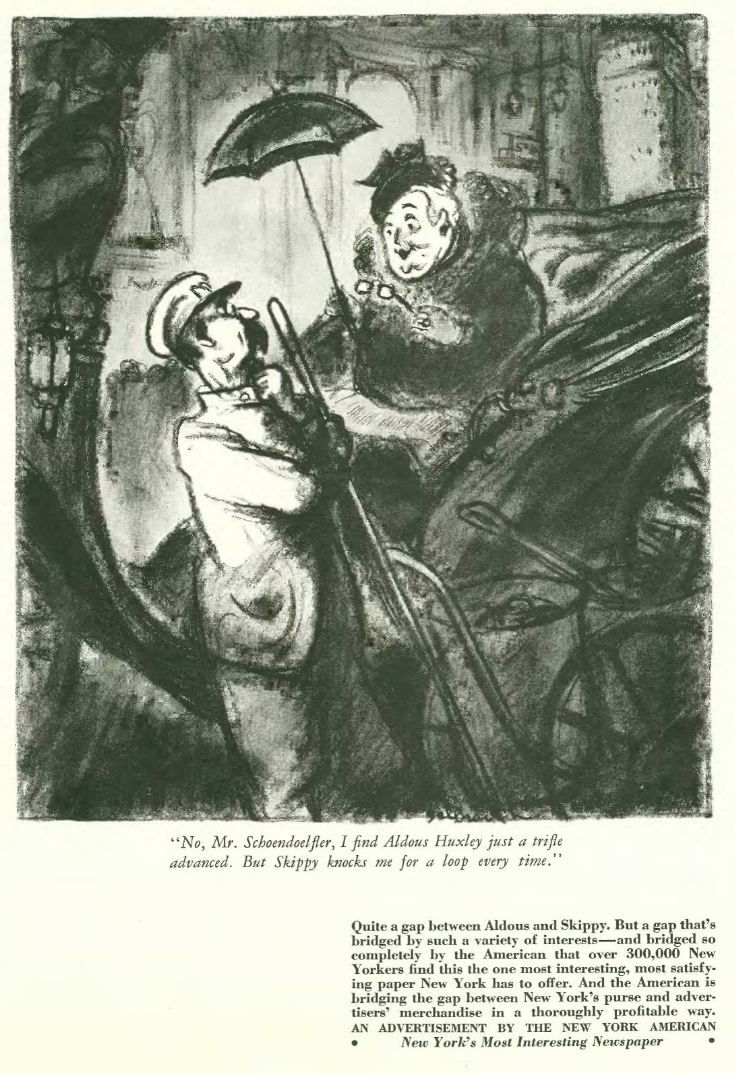
New Yorker cartoonist William Crawford Galbraith picked up some extra income illustrating this ad for The New York American

…which segues into our cartoons, beginning with Alan Dunn and the art of the dance,

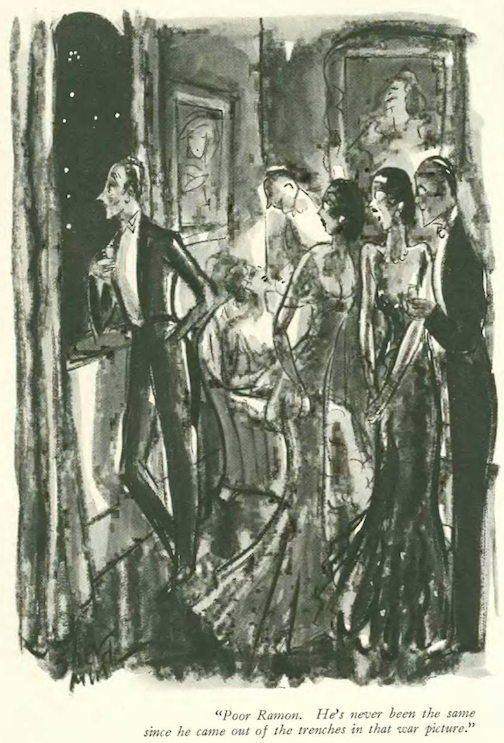
Barbara Shermund, who showed us that a war (movie) is hell…

William Steig continued to develop his repertoire of cartoons with precocious children…

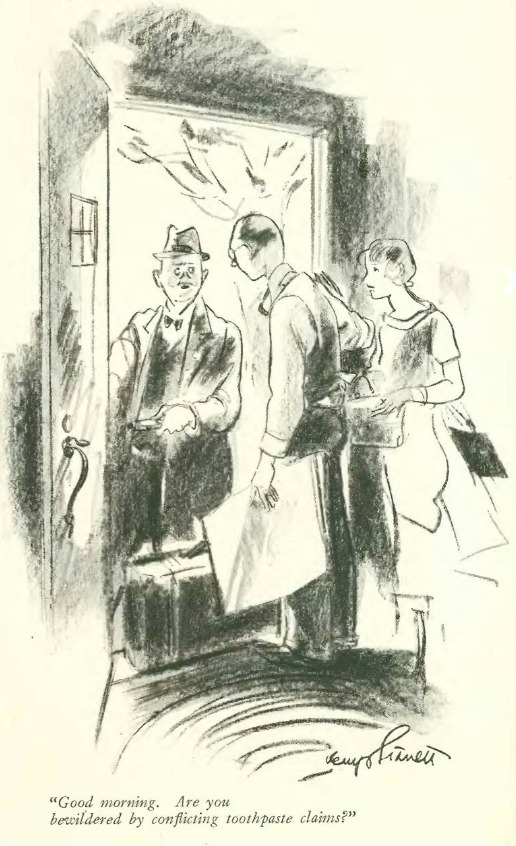
Kemp Starrett gave us a salesman who put more than his foot in the door…

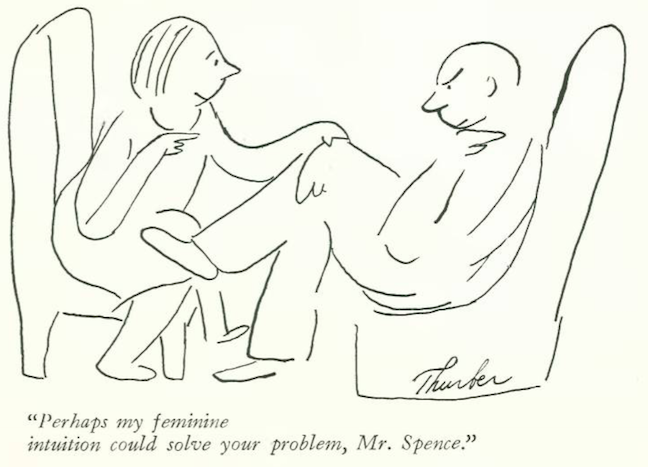
James Thurber continued his ongoing “dialogue” between the sexes..,

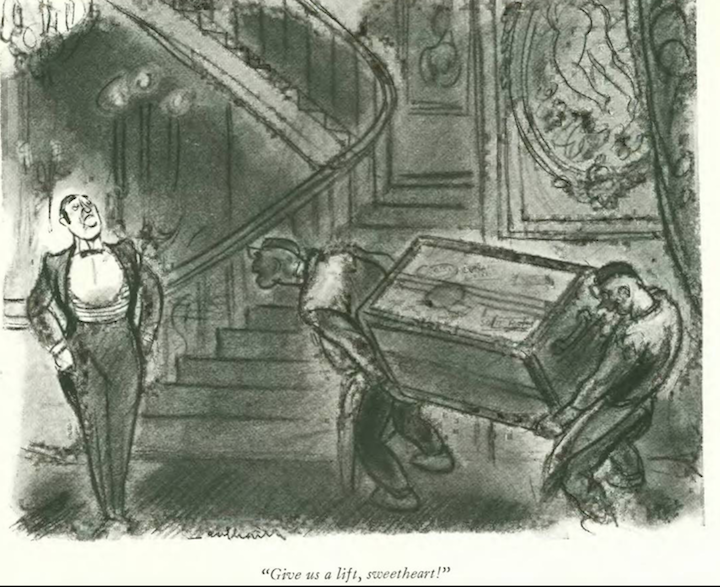
William Crawford Galbraith again, with his take on “Upstairs, Downstairs”…

Rea Irvin also exploring the theme in this two-page spread (click to enlarge)…

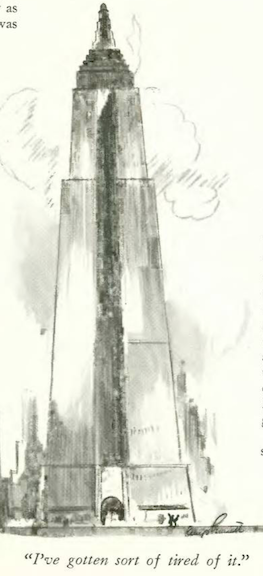
…and we end with another by Kemp Starrett, and the blasé attitude New Yorkers might display before the world’s tallest building…

Next Time: The Wayward Press…


Cinema’s Underworld

In some ways, the raucous party of the Roaring Twenties was sublimated in the movies of the late 1920s and early 1930s—a brief period at the beginning of the sound era before censorship guidelines were enforced. During those “Pre-code” times everyone from preachers to publishers decried the sex and violence that washed across the silver screen.

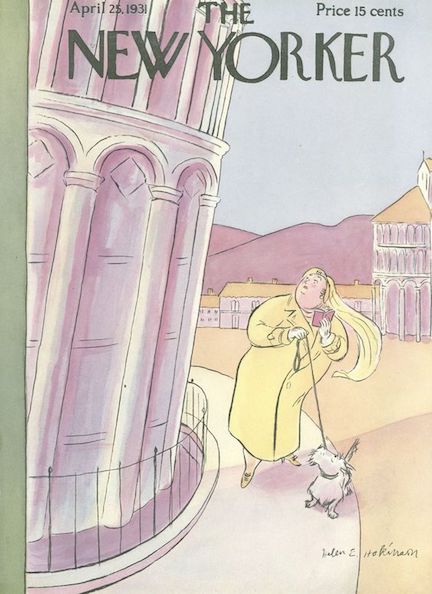
April 25, 1931 cover by Helen Hokinson.

New Yorker film critic John Mosher opened his “Current Cinema” column with some musings about violence and “morals” in underworld films, declaring that until newspapers relegated sensational crime stories to the back pages, the public would be drawn to similar fare at the movies.

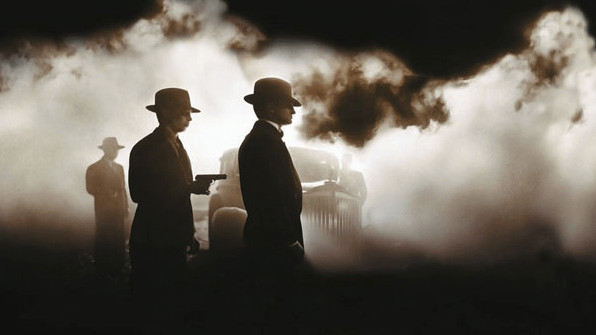
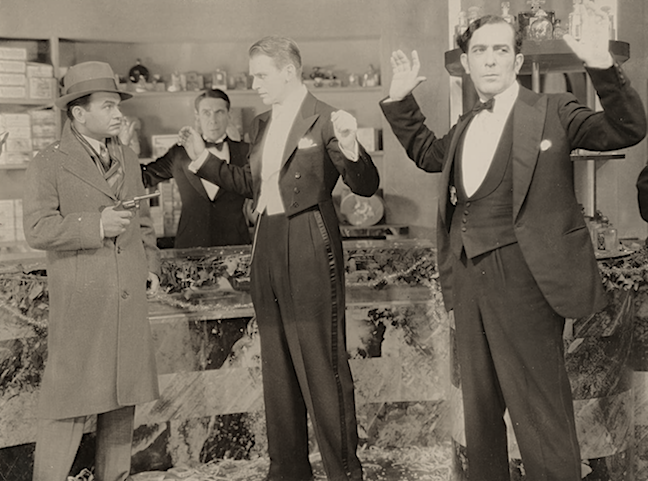
GIVING THE PEOPLE WHAT THEY WANT…Edward G. Robinson (left) played a hoodlum hoping to make the big time in 1931’s Little Caesar, a film that defined the gangster genre for decades to come. (IMDB)

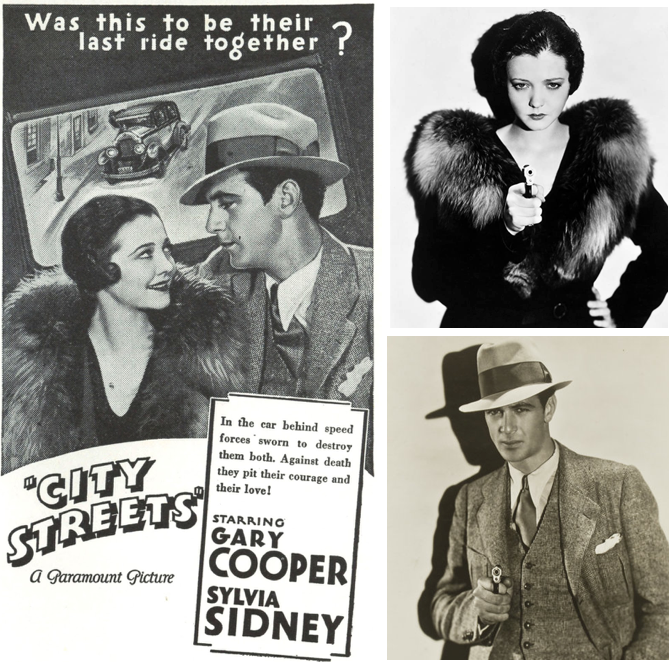
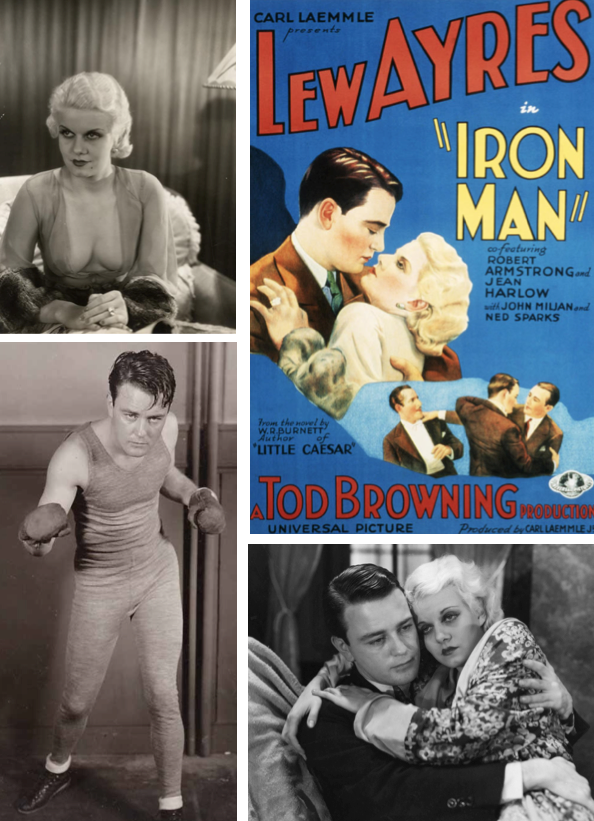
Mosher noted that two of the more prominent gangster films currently making the circuit weren’t much to fuss about—City Streets, the “more pretentious” of the two movies, featured rising stars Gary Cooper and Sylvia Sidney. The prizefighting picture Iron Man featured another popular pair of actors, Lew Ayers and Jean Harlow. Mosher observed that no amount of camera tricks could make the slight Ayers look like a husky fighter. As for Harlow, Mosher found it distressing that it was her “platinum blonde” status, rather than her acting, that landed her in the picture.

WHO CARES?…That was the conclusion of critic John Mosher after sitting through the “pretentious” City Streets. At right, publicity photos for lead actors Sylvia Sidney and Gary Cooper. (IMDB)
NO, NOT THAT IRON MAN…Jean Harlow, top, was known for attributes other than her acting, according to critic John Mosher. As for her co-star, Lew Ayers, a few weeks in the gym and some protein shakes might have made for a more plausible prize fighter. (IMDB)

 *  *  *

Fashion of a Different Fashion

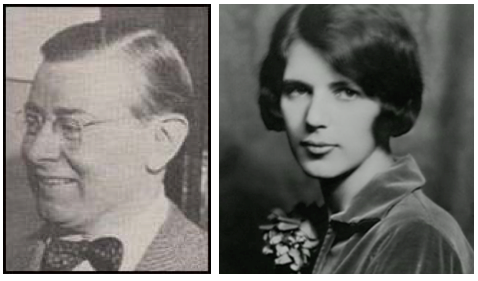
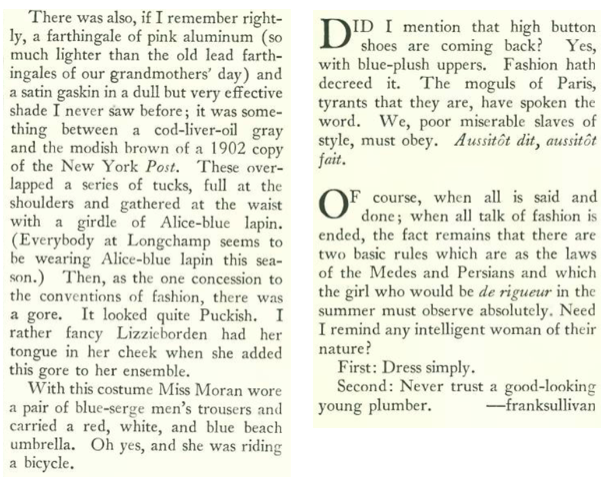
A New Yorker contributor since 1925 and denizen of the Algonquin Round Table, Frank Sullivan was a jolly soul known for his gentle wit and spoofs of cliches. His latest target was Lois Long’s fashion column “On and Off the Avenue,” penning a spoof that was indistinguishable from the original save for the change of one word in the title. Long’s actual column appeared in the magazine a few pages later, so no doubt a few readers started reading Sullivan’s spoof before realizing they had been had. I am among them. Some excerpts:

HE TOOK A FASHION TO FASHION…A wit herself, Lois Long no doubt enjoyed Frank Sullivan’s spoof of her fashion column. (Wikipedia/PBS)

Sullivan probably had a little extra time on his hands after the folding of the New York World newspaper, to which he contributed two or three humor columns a week before the grand old paper folded for good in February 1931. And so we have Sullivan again in the April 25 issue, and his “report” on the annual meeting of the “International Association of Girls Who Have Danced with the Prince of Wales.” Excerpts:

HOOFER…Apparently the Prince of Wales (Edward VIII), shown here in 1924, danced with many a lady before he abdicated the throne and married Wallis Simpson. (Pinterest)

 *  *  *

Getting High in Manhattan

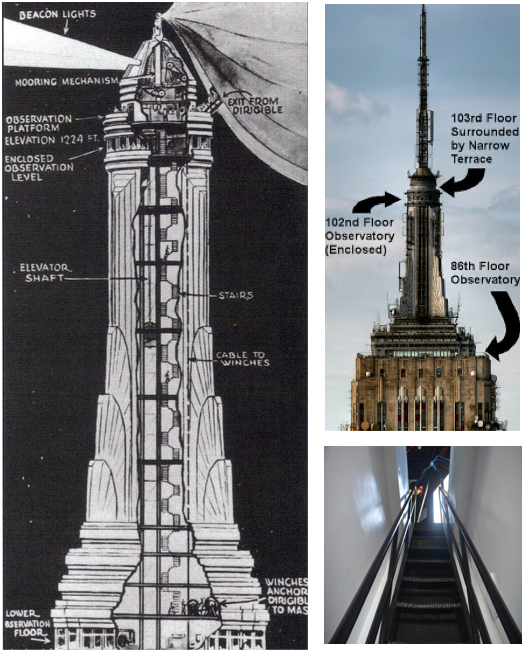
E.B. White enthusiastically embraced many aspects of modern life, from the wonder of air travel to the spectacle of buildings climbing ever higher into the clouds above Manhattan. It seemed whenever someone was needed to report on a flight or check out progress on the latest skyscraper, White was there, eager to climb into cockpits or onto scaffolds to get a better a look at his fair city. In “The Talk of the Town” White recalled his visit to (almost) to the very top of the Empire State Building, which was to open on May 1, 1931.

QUITE A SALTSHAKER…As E.B. White noted, the mooring mast atop the Empire State Building might have looked like a mere “saltcellar” from the ground, but in reality was as tall as a 20-story building, so quite a climb. Image at left shows inner stairwell winding to the top; bottom right, stairs to the 103rd floor of the Empire State Building. (Modern Mechanix/Evan Bindelglass-CBSNewYork)

 *  *  *

From Our Advertisers

With summer on the way B. Altman’s touted its new line of wool bathing suits for the kiddies…I frankly can’t imagine wearing wet wool in the summer, at least not voluntarily…

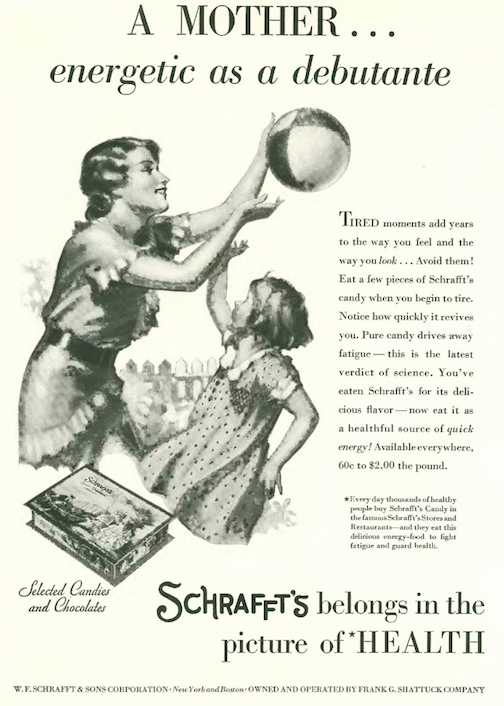
…hey, here’s an idea if you want to keep up with the little brats…eat some candy…according to Schrafft’s, it’s HEALTHY…

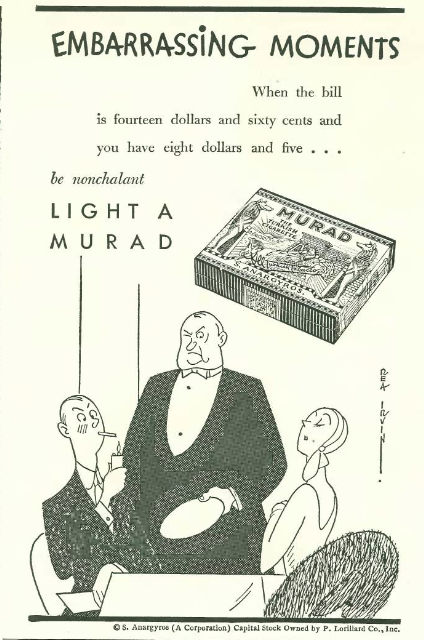
…on to our illustrators and cartoonists, another fine moment in smoking thanks to Rea Irvin

Ralph Barton introduced us to his latest “Hero of the Week”…

…and his news summary in graphic form…

Helen Hokinson observed some subway etiquette…

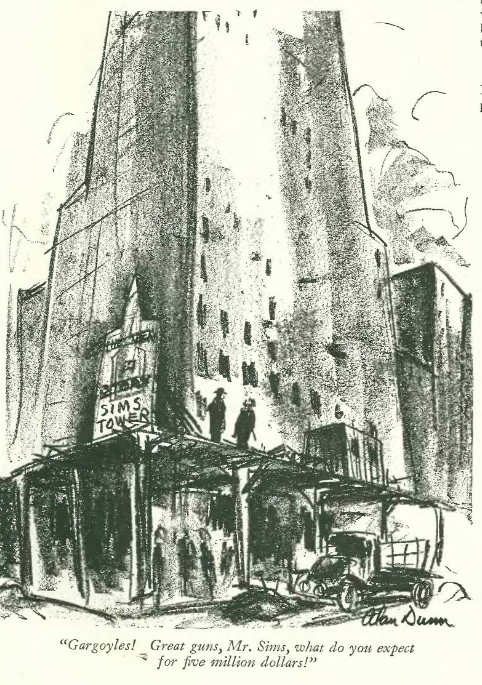
Alan Dunn found a developer looking for some extras…

Bruce Bairnsfather offered a study in contrasts…

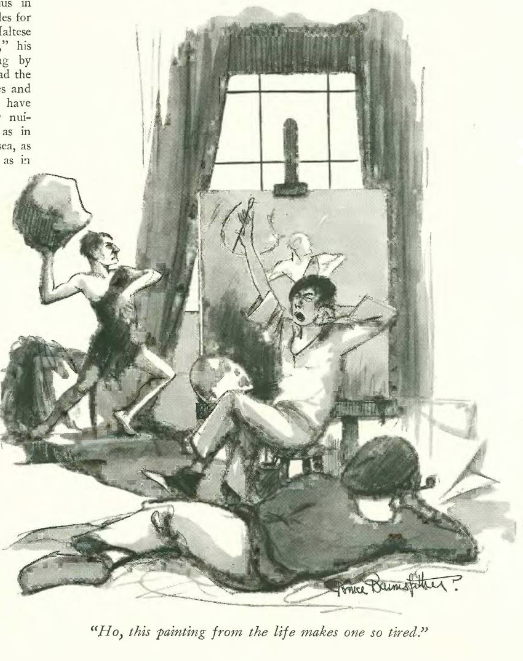
C.W. Anderson, and another example of an artist’s struggle…

…and we end with Otto Soglow and his Little King, a strip that would become a nationally syndicated hit…

Next Time: From Bad to Awful…