Keeping Their Cool

The heat came early to New York in June 1933, so folks flocked to air-conditioned cinemas or sought the cooling breezes of rooftop cafes and dance floors. And thanks to FDR, there was legal beer to be quaffed at various beer gardens popping up all over town.
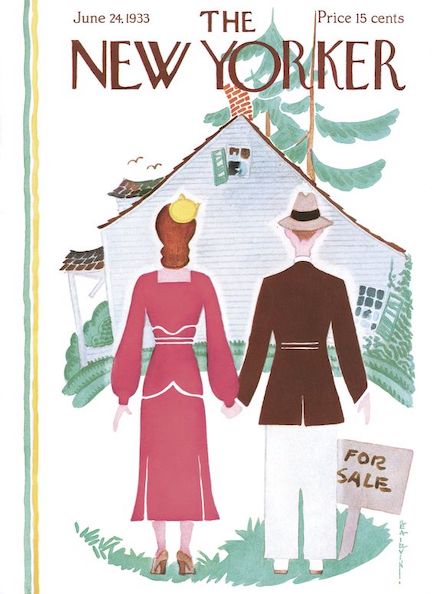
June 24, 1933 cover by Rea Irvin. Providing a bookend to Constantin Alajalov’s June bride cover (May 27), Irvin gave us the newlyweds now contemplating a fixer-upper.

Lois Long kept her cool on the beach or at home with a cold Planters’ Punch, but one gets restless, and Ethel Waters was at the Cotton Club, so Long headed out into the night; an excerpt from her column “Tables for Two”…

STORMY WEATHER AHEAD…Ethel Waters was “tops” during a June 1933 performance at the Cotton Club, according to nightlife correspondent Lois Long. Left, Waters circa 1930. At right, the Cotton Club in the early 1930s. (IMDB/Britannica)
SHOWER THE PEOPLE…Children gather around a center stand sprinkler (connected to a fire hydrant) on a Harlem street in 1933. (stuffnobodycaresabout.com)
POP-UP PLAYGROUND…Play street and street shower alongside the Queensboro Bridge, June 22, 1934. (NYC Municipal Archives)

 * * *

From Our Advertisers

Legal beer and hot summer days combined to bring some much-needed advertising revenue to The New Yorker

…here we have dear old dad telling the young ‘uns (all in formal wear, mind you) about the good old days before Prohibition took away his favorite tipple…

…notable about the magazine’s first beer ads was the target market…this is akin to the cigarette manufacturers, who were also targeting women as a new growth market for their products…curious how this PBR ad is illustrated…is she getting ready to drink the beer, or serve it?…

…also joining the party were the folks who made mixers like White Rock mineral water…note the reference at bottom right to the anticipated repeal of the 18th Amendment…

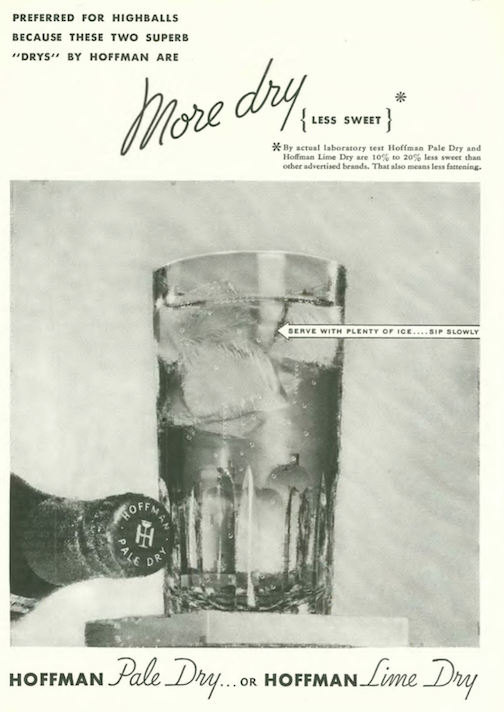
…the purveyors of Hoffman’s ginger ale were less subtle, encouraging drinkers to mix those highballs right now

…you could enjoy that cool one while sitting in front of a Klenzair electric fan, which was probably nothing like riding a dolphin—a strange visual metaphor, but then again perhaps something else is being suggested here besides electric fans…

…no doubt Lois Long took in one of these breezy performances on the rooftop of the Hotel Pennsylvania…
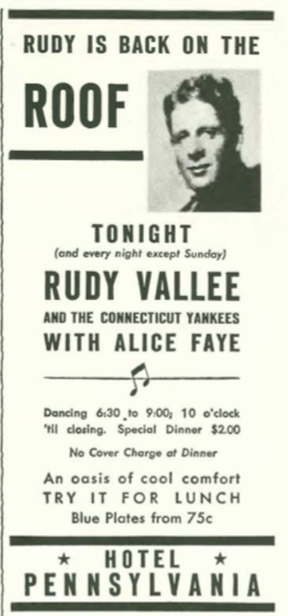
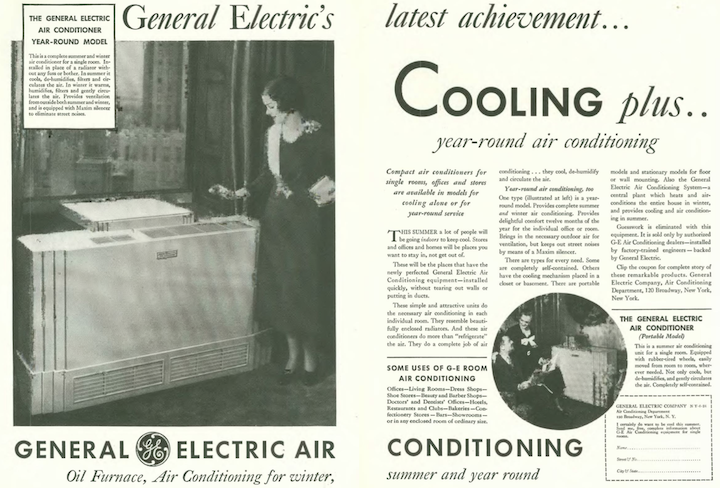
…an evening with Rudy Vallée would have been a lot cheaper than one of these “compact” air conditioners, available to only the very wealthy…
…but you didn’t need to be J.P. Morgan to own a Lektrolite lighter, which was kind of clever…this flameless lighter contained a platinum filament that would glow hot after being lowered into reactive chemicals in the lighter’s base…

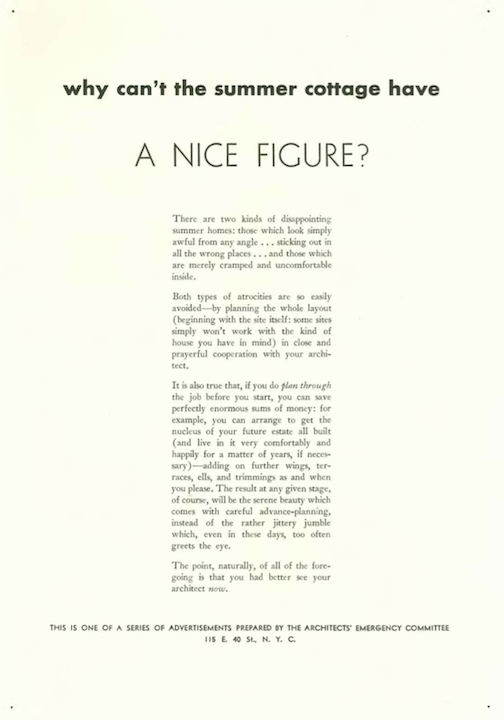
…another ad from the Architects’ Emergency Committee, which looked like something an architect would design…
…our final June 24 ad told readers about the miracle of Sanforizing, which was basically a pre-shrinking technique, like pre-washed jeans…

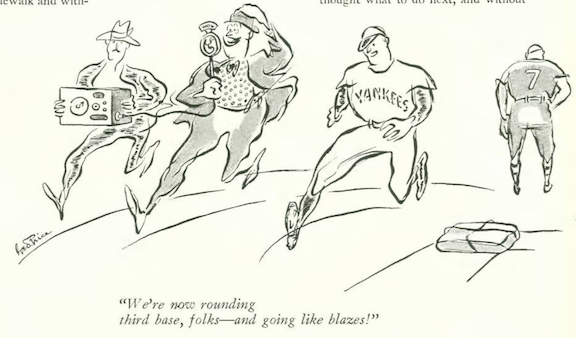
…we kick off our cartoons with George Price at the ball game…
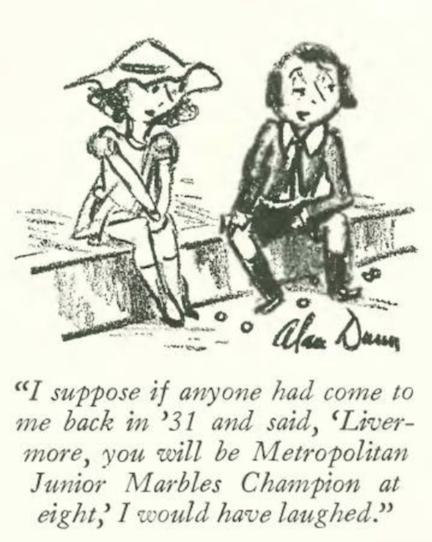
Alan Dunn was in William Steig’s “Small Fry” territory with this precocious pair…
James Thurber brought us back to his delightfully strange world…

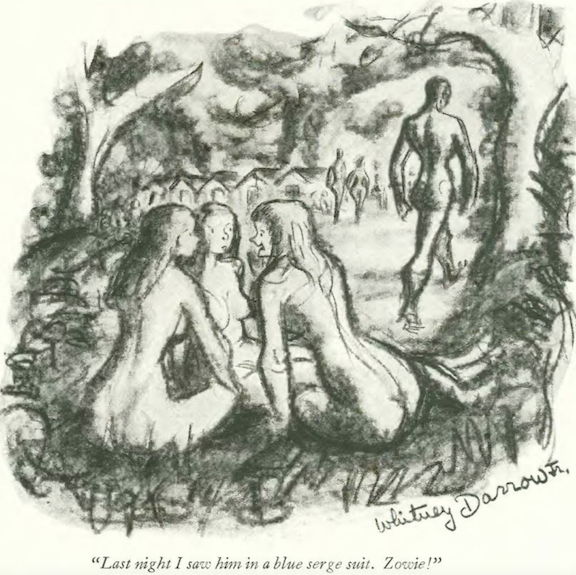
…and Whitney Darrow Jr gave us a trio at a nudist colony dressing a man with their eyes…
…we move along to July 1, 1933…

July 1, 1933 cover by Helen Hokinson.

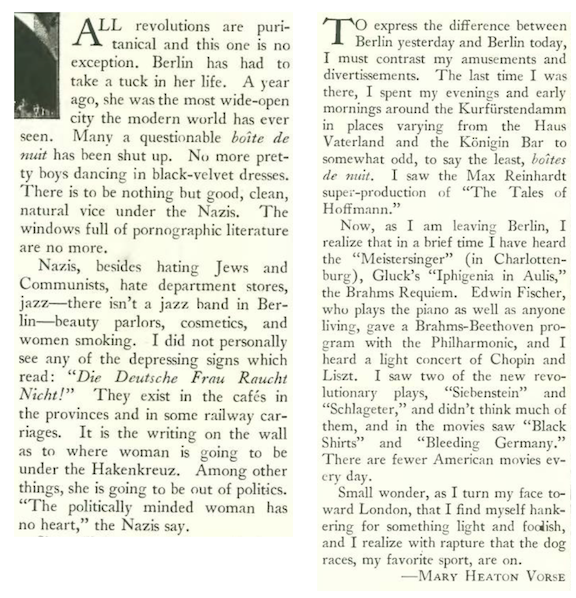
Where in this issue we find the Nazis not keeping their cool. In an article titled “Unter Dem Hakenkreuz” (“Under the Swastika”) American journalist and activist Mary Heaton Vorse commented on the changes taking place in Berlin, where the vice, decadence and other freedoms of the Weimar years had been swept away, including women’s rights…an excerpt:
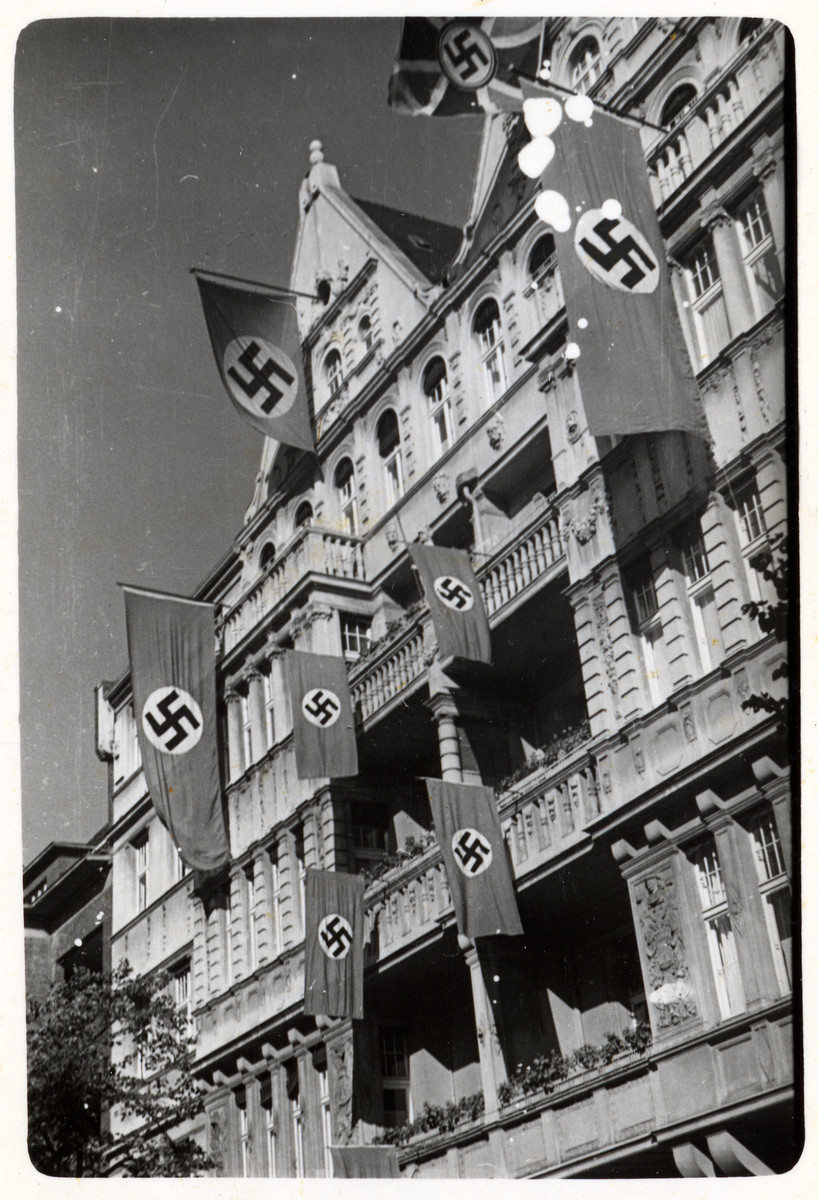
SIT UP STRAIGHT AND PROCREATE…Swastika flags hang from a Berlin building in the 1930s. In Hitler’s Germany, women of child-bearing age were expected to produce lots of babies and not much else. (collections.ushmm.org)

 * * *

Some Strings Attached

Back in the states, Alvin Johnston published the first installment of a two-part profile on John P. O’Brien (1873–1951) who served as mayor of New York from January to December 1933, the second of two short-term mayors to serve between the disgraced and deposed Jimmy Walker and the reformer Fiorello LaGuardia. Considered the last of the mayoral puppets of Tammany Hall, he was known for his brief, heartless, and clueless reign during one of the worst years of the Depression; while unemployment was at 25 percent, O’Brien was doling out relief funds to Tammany cronies. A brief excerpt (with Abe Birnbaum illustration):

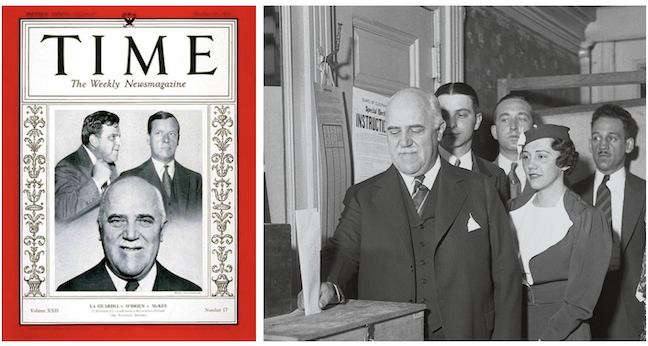
A PIOUS, LABORIOUS DULLARD and “a hack given to malapropisms” is how writer George Lankevich describes John P. O’Brien. According to Lankevich, to a crowd in Harlem O’Brien proudly proclaimed, “I may be white but my heart is as black as yours.” (TIME)

 * * *

That Pepsodent Smile

The author James Norman Hall (1887–1951), known for the trilogy of novels that included Mutiny on the Bounty, offered these sobering thoughts about a famed actor he spotted on a South Pacific holiday:
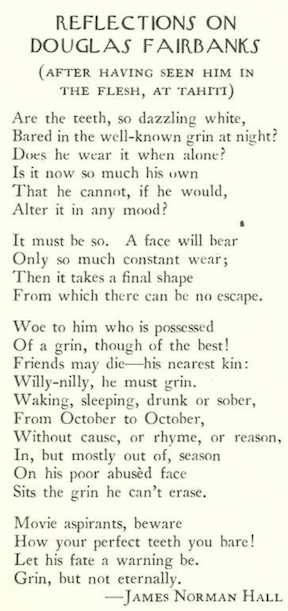
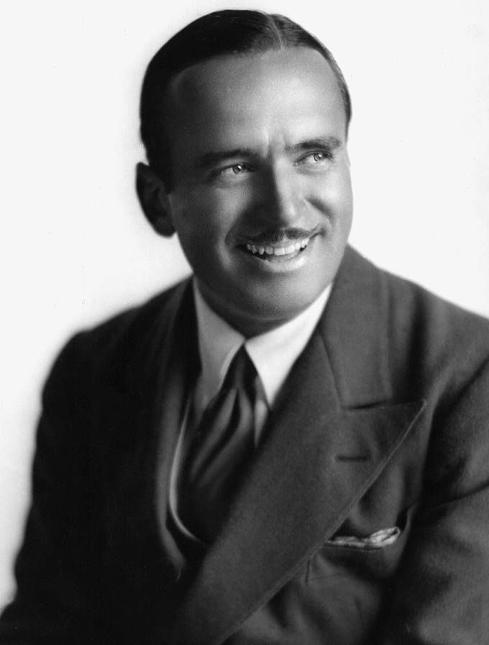
IT ISN’T EASY BEING ME…Fifty-year-old Douglas Fairbanks Sr, teeth and all, was apparently looking worse for the wear when he was spotted by writer James Norman Hall in Tahiti. His glory days of the Silent Era behind him, Fairbanks would die in 1939 at age 56. (fineartamerica.com)

 * * *

More From Our Advertisers

More cool ones for those hot summer days courtesy of Schaefer…
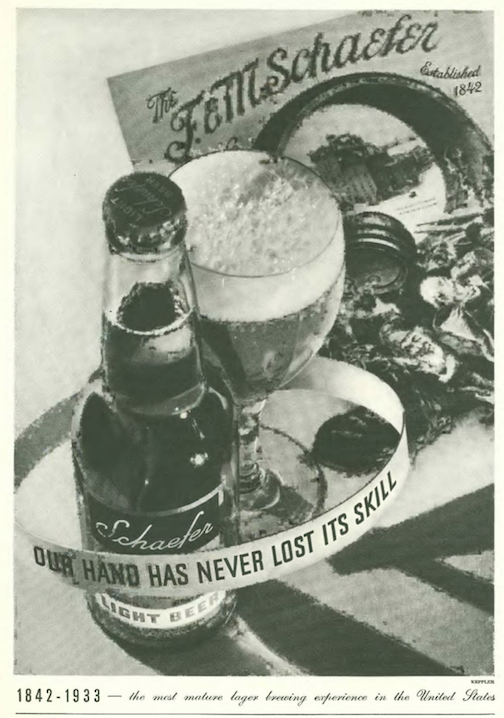
…and Rheingold, here served by a sheepish-looking woman who doubtless wished that the tray supported champagne or cocktail glasses…and leave it to the Dutch to be one of the first countries to get their foot into the import market…when I was in college this was as good as it got, beer-wise…

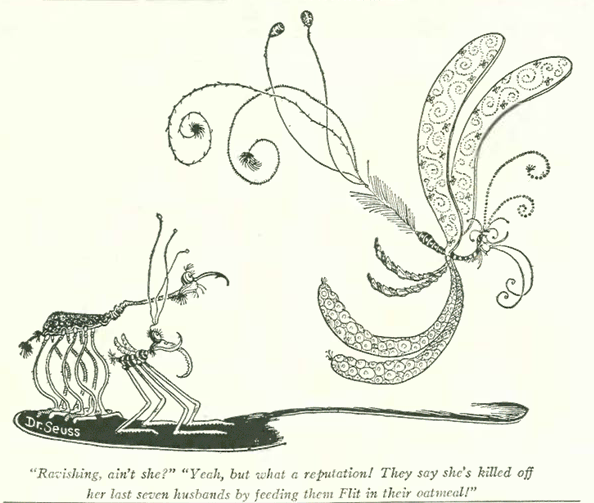
Dr. Seuss again for Flit, and even though this is a cartoon, it demonstrates how in those days no one really cared if you sprayed pesticides near your breakfast, or pets, or kids…
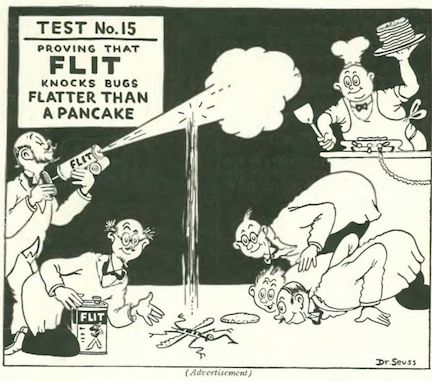
…here’s one of just four cartoons contributed to The New Yorker in the early 1930s by Walter Schmidt

Otto Soglow’s Little King found an opportunity to stop and smell the flowers…

Mary Petty gave us two examples of fashion-conscious women…

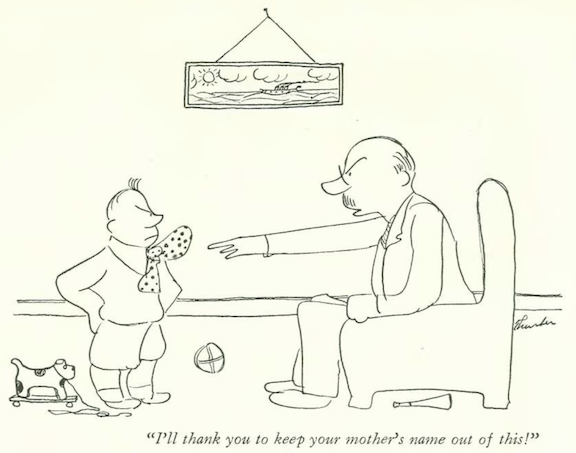
James Thurber explored the nuances of parenting…
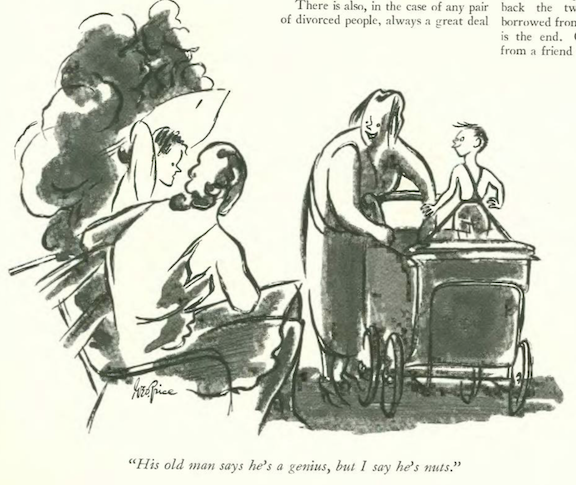
…and we close with George Price, master of oddities…
Next Time: The Night the Bed Fell…

Making Hays

The name Will Hays will always be linked to the Motion Picture Production Code, a set of guidelines for self-censorship that studios adopted to avoid government intervention.

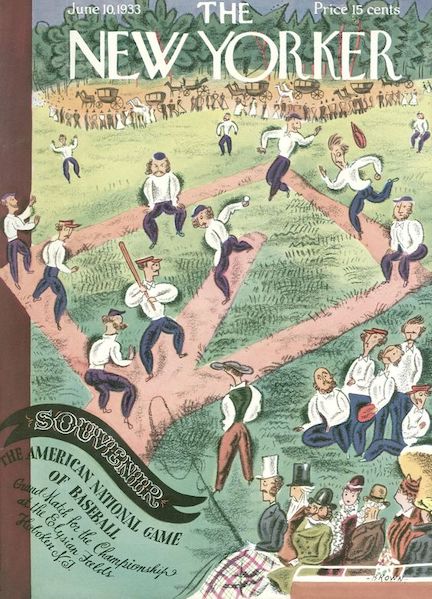
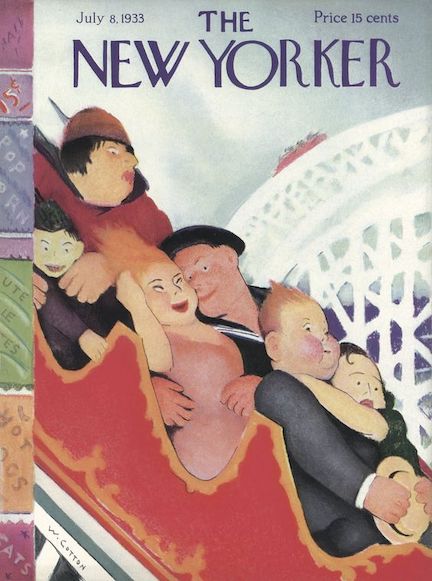
June 10, 1933 cover by Harry Brown.

Hays, however, played both sides in the culture wars. A Republican politician, Hays (1879–1954) managed the 1920 election of Warren G. Harding before moving on to Postmaster General and then chairman of the Motion Picture Producers and Distributors of America. During the so-called pre-Code era, roughly 1930 to 1934, the Production Code was barely enforced, giving filmmakers the freedom to explore themes ranging from prostitution to gangster violence. When Alva Johnston wrote a two-part profile on Hays for The New Yorker, pressure from Catholic Church and other morality groups was building for Hays to strictly enforce the Code, or else. An excerpt:

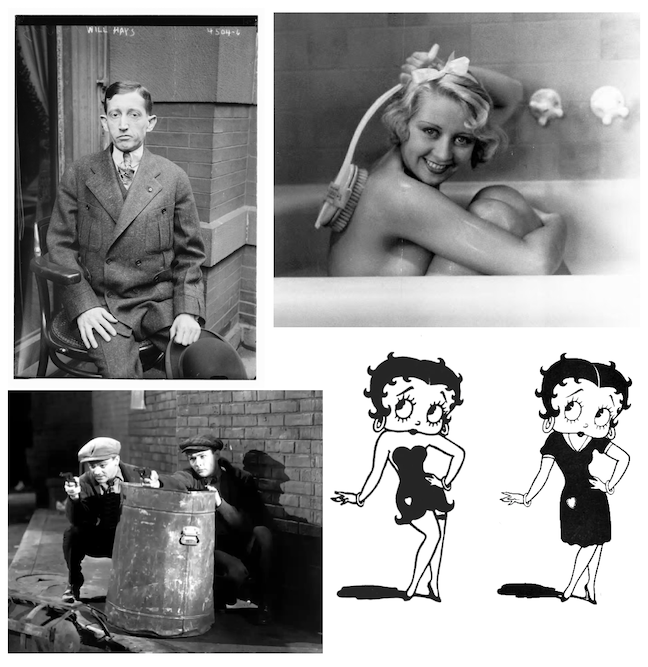
CLEAN IT UP, JOAN…Will Hays (top left) felt pressure in 1933 to start seriously enforcing the Production Code, and scenes such as the one at top right from Blonde Crazy (1931) with Joan Blondell would probably not pass muster after 1934; the Hays Code would also lengthen the animated Betty Boop’s skirts, and tone down gratuitous violence (James Cagney and Edward Woods in 1931’s Public Enemy). (Wikimedia/pre-code.com/Warner Brothers)

 * * *

The Trouble With Money

In their investigation of the probable causes of the 1929 market crash, the Senate Banking and Currency Committee summoned J.P. Morgan Jr (1867–1943) on June 1, 1933, to testify on questionable banking practices. Committee counsel Ferdinand Pecora (1882–1971) set out to prove, among other things, that Morgan sold stock below market price to some of his cronies. Pecora also learned that Morgan and many of his partners paid no income tax in 1931 and 1932, big news to Americans still suffering from the effects of the Great Depression. E.B. White made these observations:

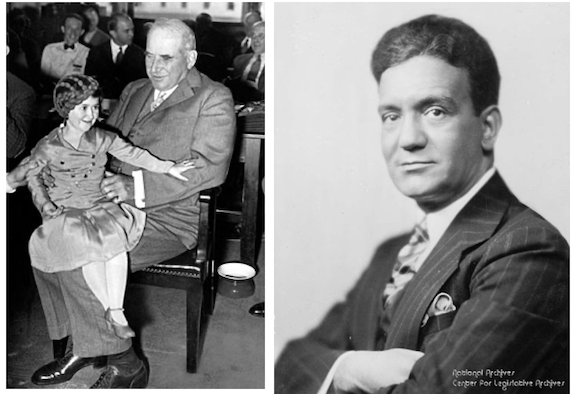
Although not mentioned by White, the hearing began with an odd little sideshow. Writing for the U.S. Capitol Historical Society blog, Joanna Hallac notes that because the hearings were slow to get started, newspaper reporters grew desperate to get something for the evening papers. Then one enterprising reporter, Ray Tucker, spotted circus dwarf Lya Graf with her agent, Charles Leef, outside of the hearing room (the Barnum & Bailey Circus was in town) and suggested Graf meet the famed banker. Hallac writes: “Although he was initially startled, Morgan was genial and rose and shook her hand. Naturally, the photographers were stepping all over each other to get a picture of the exchange. Leef, seeing a perfect press opportunity for himself and the circus, waited for Morgan to sit down and then scooped up Graf and placed her in J.P. Morgan’s lap. Morgan apparently laughed and had a brief exchange with the demure lady, in which he told her he had a grandchild bigger than her.”

THE LIGHTER SIDE OF FINANCE…Before being grilled by Senate counsel Ferdinand Pecora at a June 1, 1933 banking hearing,  J.P. Morgan Jr was paid a surprise visit by Lya Graf, a Barnum & Bailey circus dwarf. At right, Pecora, circa 1933. Sadly, Graf, who was German, perished in a concentration camp after she returned to her homeland in 1935. She was condemned to death in 1937 for being half Jewish and “abnormal.” (New York Magazine/Wikipedia)

 * * *

Single Member Plurality

Among other attributes, E.B. White was known for his use of the first person plural, the editorial or clinical “we.” White himself offered this insight:

I, ME, MINE…E.B. White at work in 1945. (Britannica.com)

 * * *

Uncle Tom, Revived

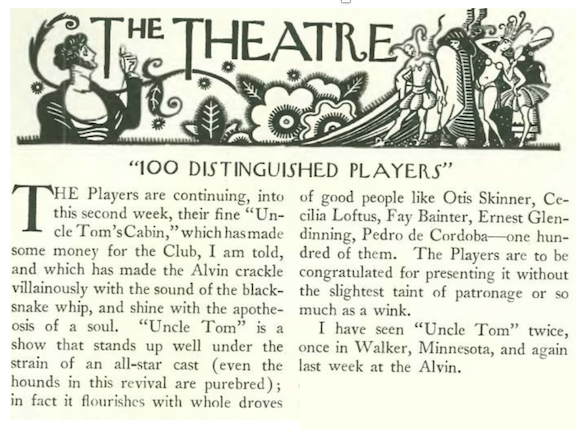
Plays based on Harriet Beecher Stowe’s 1852 novel Uncle Tom’s Cabin were wildly popular throughout the late 19th and early 20th centuries, but by the 1930s the story seemed antiquated and no longer relevant. That didn’t stop the Players (a Gramercy park actors club) from mounting a 1933 Broadway revival that proved popular with audiences and a New Yorker stage critic, namely E.B. White, sitting in for Robert Benchley…an excerpt…

SAY UNCLE…Otis Skinner (1858–1942), a beloved broadway actor, portrayed Uncle Tom in the 1933 Broadway revival. The all-white cast performed in blackface.

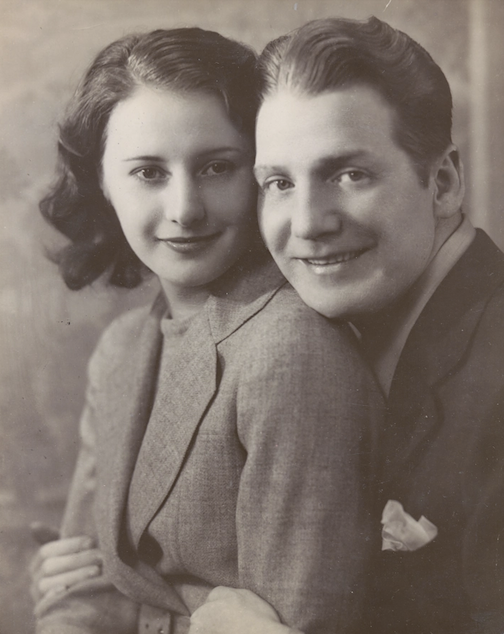
…on the other hand, White found the Frank Faye/Barbara Stanwyck play Tattle Tales tedious, a thin veneer over the stars’ crumbling marriage off-stage…

THAT’S ALL, FOLKS…Publicity photo of Barbara Stanwyck and Frank Faye for the Broadway production of Tattle Tales at the Broadhurst Theatre. The co-stars’ real-life marriage supposedly inspired the 1937 film A Star is Born (as well as subsequent remakes). As Stanwyck’s star rose, Faye’s faded—his heavy drinking and abuse led to their 1935 divorce. The play itself closed after 28 performances. (IBDB)

 * * *

Frothy Air

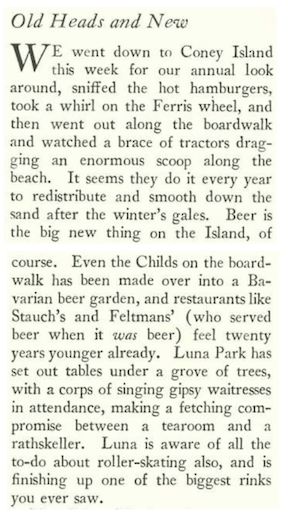
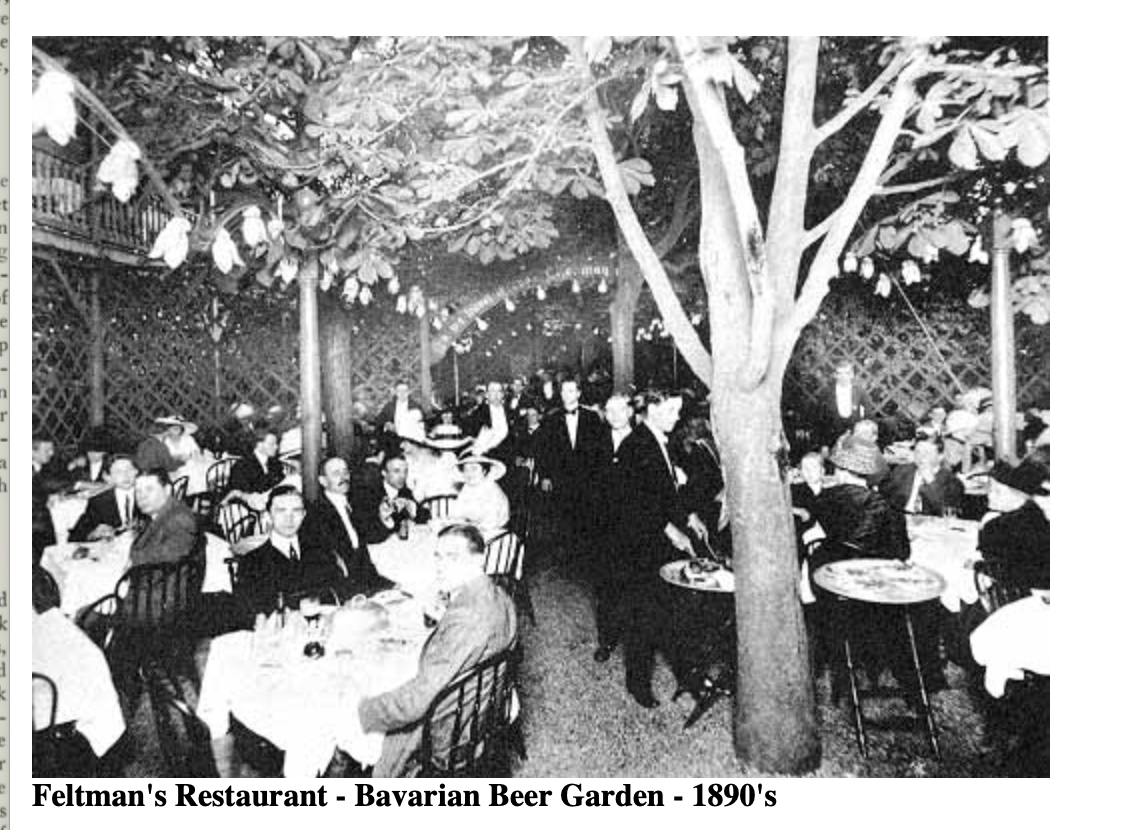
E.B. White (via “The Talk of the Town”) took a stroll through Coney Island and found the place somewhat revived, perhaps thanks to the return of legal beer and Bavarian-style beer gardens…

RECALLING THE GOOD OLD DAYS…Feltman’s Restaurant on Coney Island operated this popular Bavarian Beer Garden in 1890s. (Westland.net)

 * * *

Peace, He Said

Adolf Hitler was talking peace, but the French weren’t buying it according to The New Yorker’s Paris correspondent Janet Flanner—in just seven years her beloved City of Light would fall to the Nazis…

IF YOU CAN’T SAY SOMETHING NICE…Adolf Hitler makes his first radio broadcast as German Chancellor, February 1933. Hitler spoke of peace in Europe while preparing his country for war. (Detail of image courtesy Bundesarchiv)

…speaking of Janet Flanner, apparently her “Paris Letter” implied that the author Edna Ferber had married. Ferber offered this correction, in good humor:

 * * *

From Our Advertisers

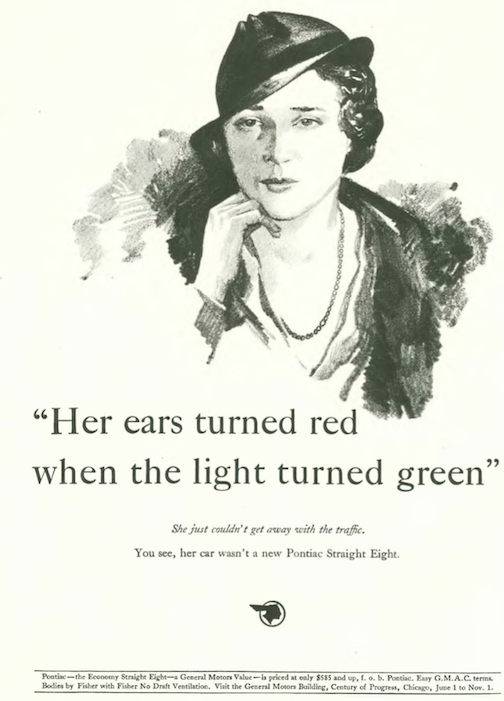
Class anxieties were (and still are) gold to Madison Avenue—look at this poor woman, pondering her very existence, lacking as she did the horsepower to lay some rubber at a green light…

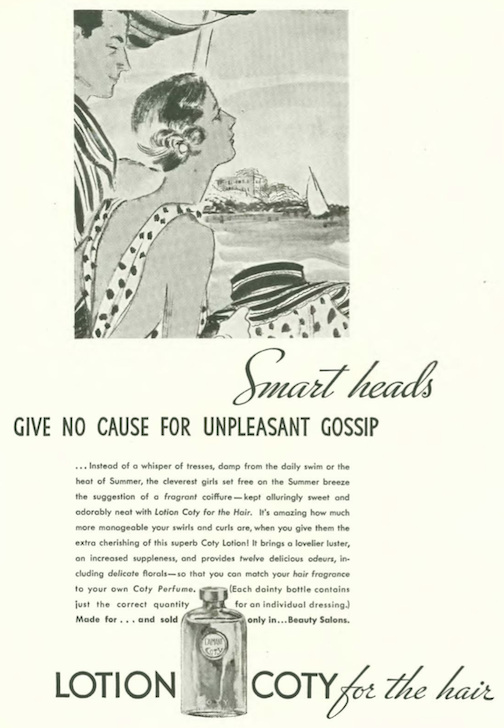
…or this woman, who thought ahead and made sure she had some hair lotion to ward off cackles from the beach harpies…

…on the other hand, this cyclist seems to care less about appearances as she races toward us with a crazed smile, half-human, half-illustration…

…and then there’s this fellow, playing it cool in a white linen suit, which for a sawbuck seems like a bargain, even in 1933…

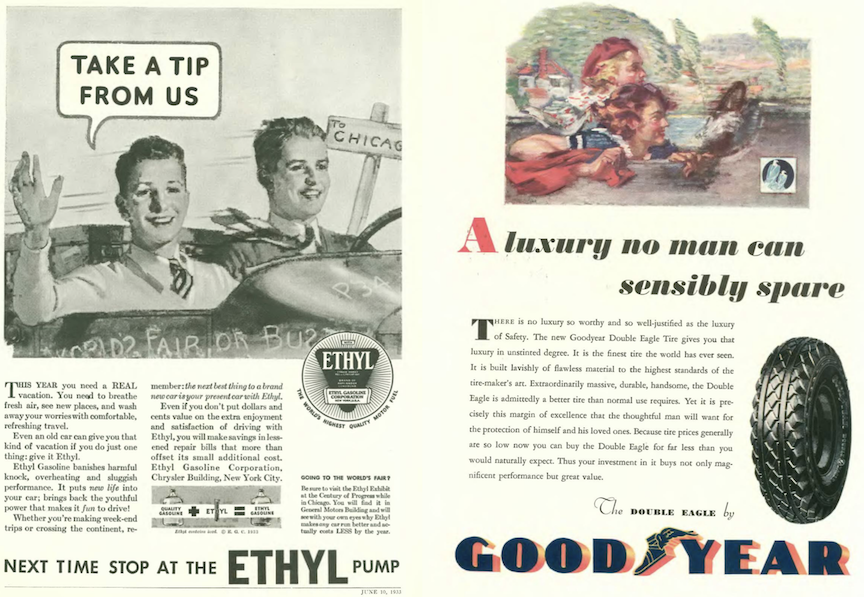
…the last two pages of the magazine featured friends racing to some swell destination…the lads at left are being propelled to the 1933 Chicago World’s Fair thanks to the wonders of leaded gasoline, while the women at right seem to be doing at least eighty…note neither car has a windshield, so you wonder how many bugs they will pick out of their teeth…

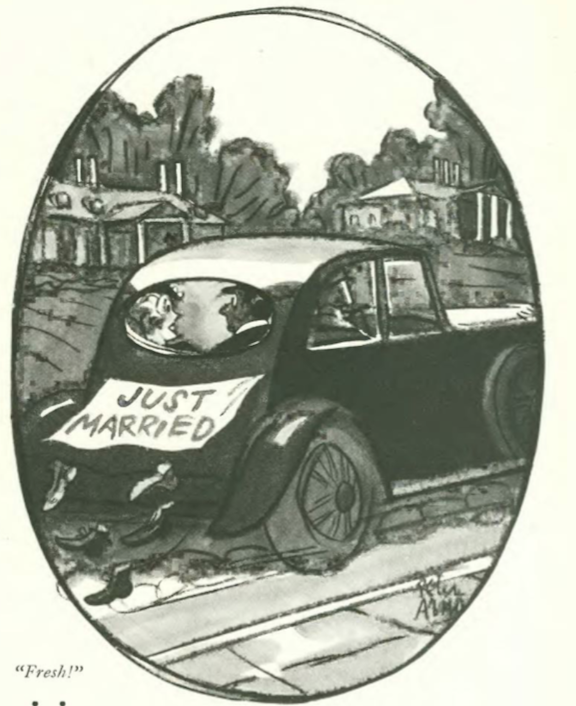
…an apt segue to our cartoons, where Peter Arno showed us a couple going nowhere fast…

Otto Soglow’s Little King had his own marital situation to ponder after a visit from a sultan…

…a very unusual cartoon from Helen Hokinson, who rarely delved into serious socio-political issues (although her captions were often provided by others at The New Yorker)…this cartoon referred to a cause célèbre of the 1930s, the case of the prejudicial sentences of the Scottsboro boys that recalled the Tom Mooney frame-up two decades earlier…

…on to lighter topics, Robert Day checked in on the progress at Mt. Rushmore…

George Price also went aloft for a challenge…

…and Carl Rose found this dichotomy in the conquest of nature…

…on to June 17, 1933…

June 17, 1933 cover by Perry Barlow.

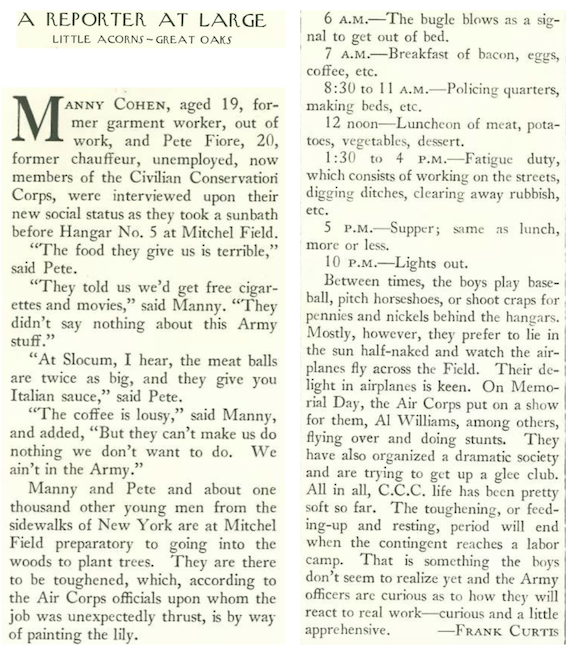
…where Frank Curtis reported on the military-style schedule that put young men to work for the Civilian Conservation Corps…excerpts:

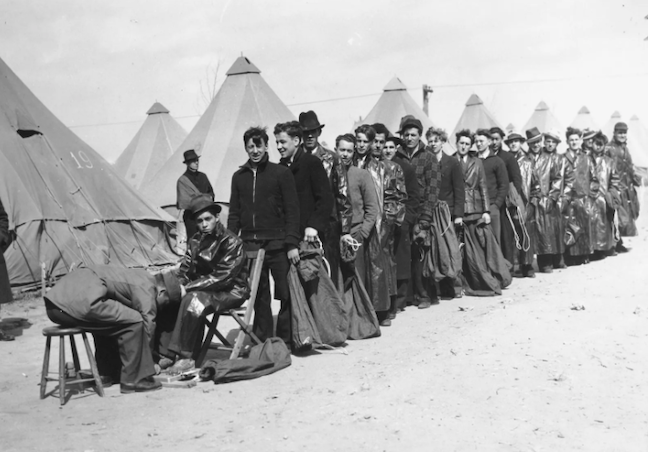
MARCHING ORDERS…New members of the Civilian Conservation Corps waiting to be fitted for shoes at Camp Dix, New Jersey, 1935. (Encyclopædia Britannica, Inc.)

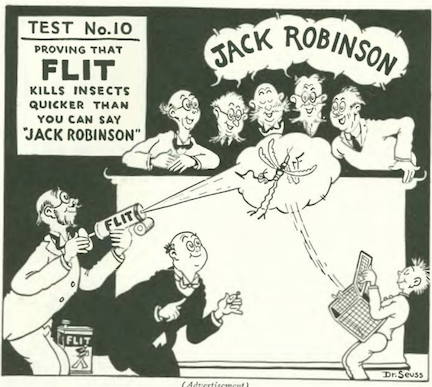
…just one ad from this issue, another Flit entry from Dr. Seuss, who wouldn’t publish his first book until 1937…

…our cartoons are courtesy Otto Soglow, with some bedside manner…

Kemp Starrett set up what should prove to be an interesting evening…

Gluyas Williams considered the woes of J.P. Morgan Jr

…and we close with another from George Price, doing some tidying up…

Next Time: Home Sweet Home…

Rebirth of a Nation?

As we enter the summer months we find the recurring themes of June brides…and German Nazis…

May 27, 1933 cover by Constantin Alajalov.

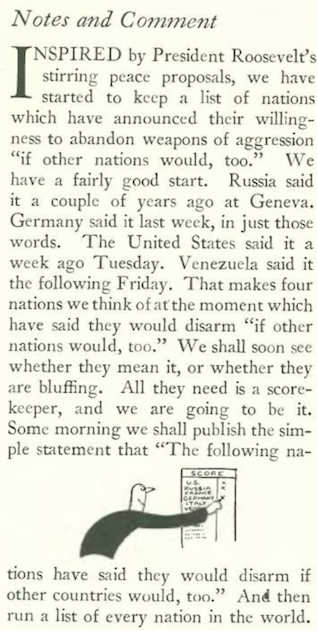
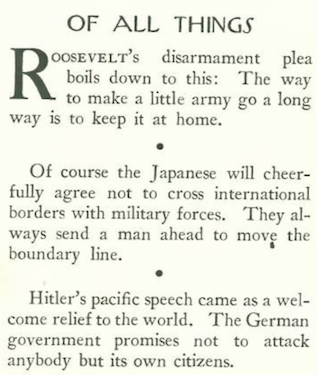
Those Nazis were on the mind of U.S. President Franklin D. Roosevelt when he wrote to the sixty participating nations at the Geneva Disarmament Conference, imploring them to eliminate all weapons of offensive warfare. As we now know, it was a plea that mostly fell on deaf ears, notably those of the leaders of Japan and Germany. E.B. White offered this observation:

GIVE PEACE A CHANCE?…Sixty countries sent delegates to the Geneva Disarmament Conference in 1932–33. Germany was represented by Nazi Minister of Public Enlightenment and Propaganda Joseph Goebbels (front row, center), that is until his country pulled out of the conference and continued its massive arms buildup. (Library of Congress)

Howard Brubaker was also keeping an eye on FDR’s efforts to hold off the rising powers in Europe and Asia…

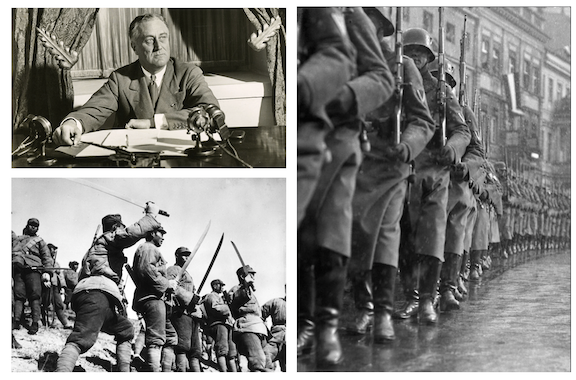
WAR AND PEACE…On May 16, 1933, Franklin D. Roosevelt pleaded with the world’s nations to consider total disarmament of all offensive weapons. In the meantime, Adolf Hitler led the rapid rearmament of Germany (right) while Chinese soldiers (below) did what they could to counter the latest Japanese offensive—the invasion of Jehol Province. (Wikimedia/Pinterest)

*  *  *

Writer of Lost Causes

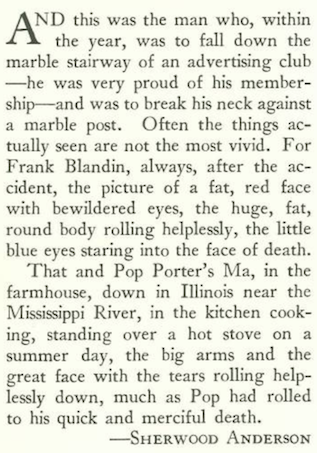
The short story “Pop” would be Sherwood Anderson’s first contribution to The New Yorker. Anderson was known for his stories about loners and losers in American life, including Pop Porter, whose sad, drunken death is described in the closing lines:

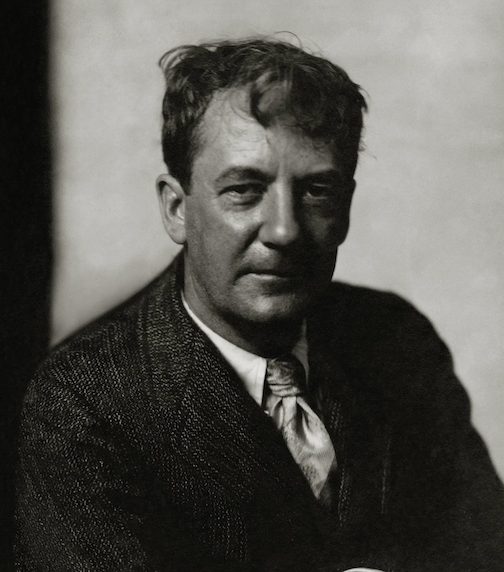
NO EXIT…Best known for his 1919 novel Winesburg, Ohio, Sherwood Anderson (1876–1941) took an unsentimental view of American life. He would contribute six short stories to The New Yorker from 1933 to 1936. Photo above by Edward Steichen, circa 1926. (The New York Times)

*  *  *

From Our Advertisers

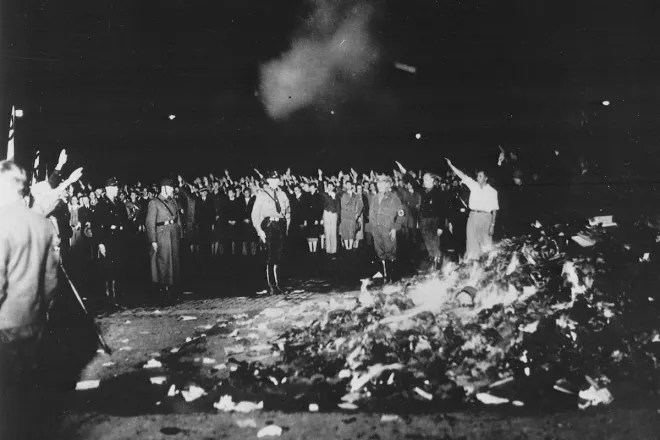
The German Tourist Information Office welcomed visitors to “witness the rebirth of a nation,” promising a land of “new ideas and broader visions” that would bestow on travelers “undying memories endlessly renewed”…

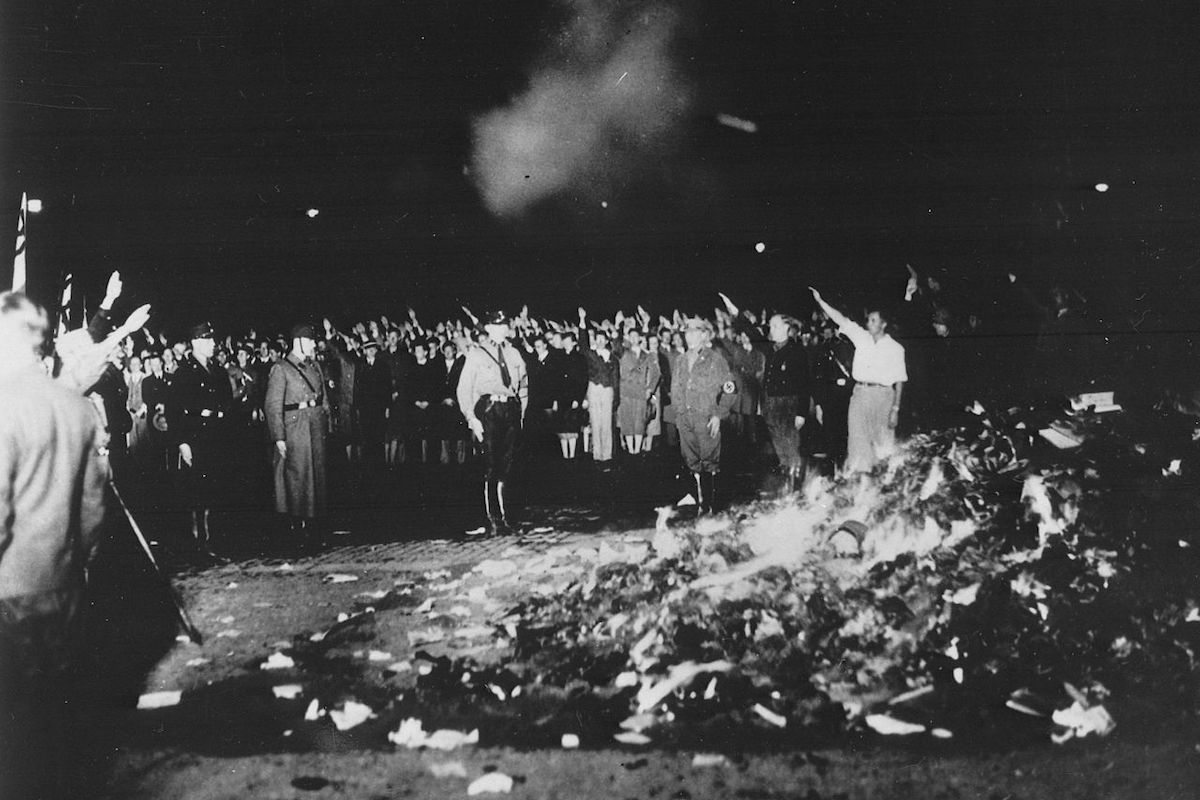
…Those “undying memories” might have included massive, country-wide book burnings that took place on May 10, 1933, when students in 34 university towns across Germany burned more than 25,000 “un-German” books…

FANNING FLAMES OF HATE…On May 10, 1933, student supporters of the Nazi Party burned thousands of volumes of “un-German” books in the square in front of the Berlin State Opera. (Bundesarchiv)

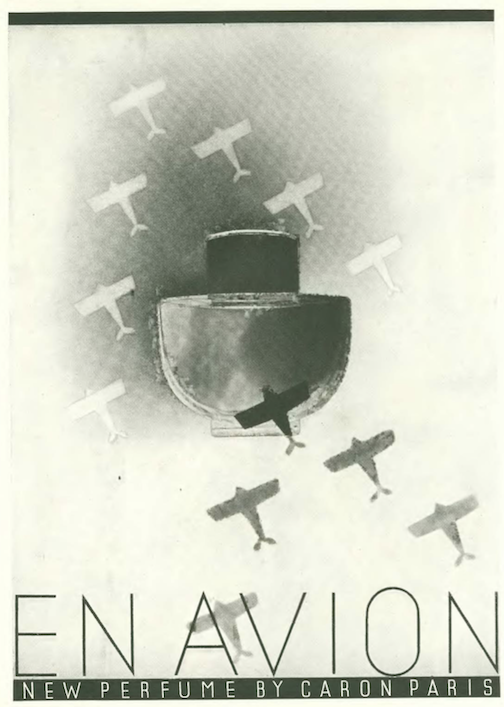
…knowing where all of this would lead, it is hard to look at this next ad and not think of the Luftwaffe raining death from the skies later in that decade…

…so for the time being we’ll turn to something less menacing, like checkered stockings, here resembling one of John Held Jr’s woodcuts…

…and this crudely illustrated ad (which originally appeared in one column)…call your buddy a fatso and the next thing you know he’s moving to Tudor City…

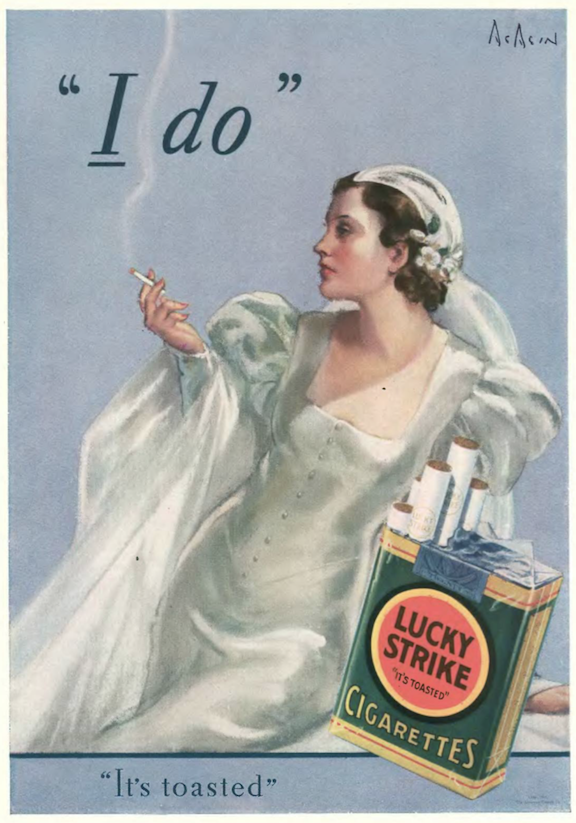
…and from the makers of Lucky Strikes, a back cover ad that provided a thematic bookend to Constantin Alajalov’s cover art…

James Thurber kicks off the cartoons with this sad clown…

…atop the Empire State Building, Daniel ‘Alain’ Brustlein found more than just a view of the city (it’s former governor Al Smith!)…

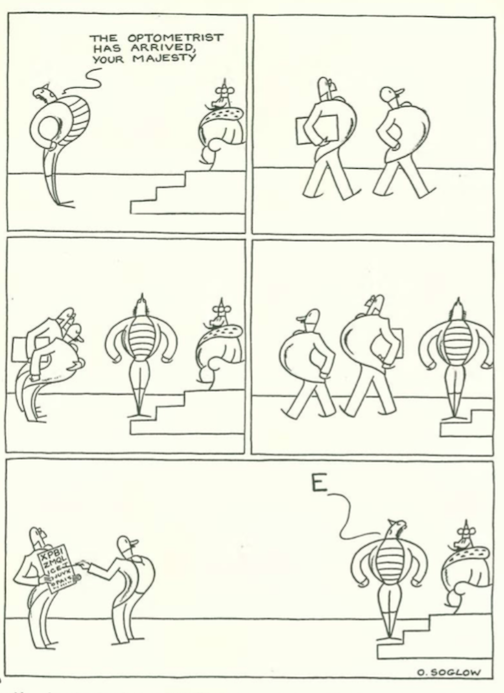
Otto Soglow’s Little King got his vision checked, in his own way…

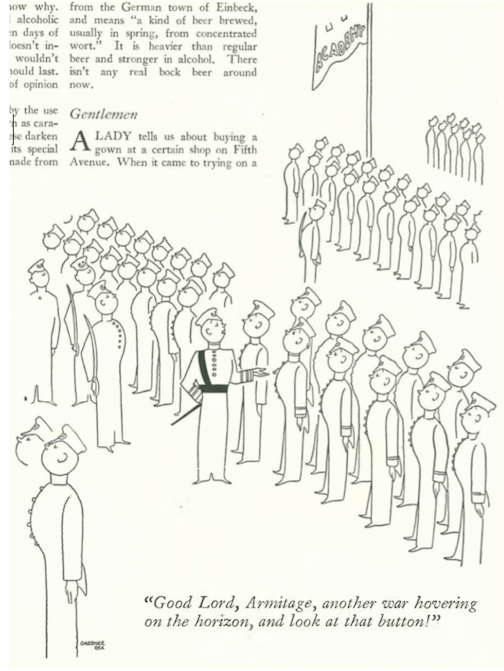
…a loose button threatened to bring down a nation…per Gardner Rea

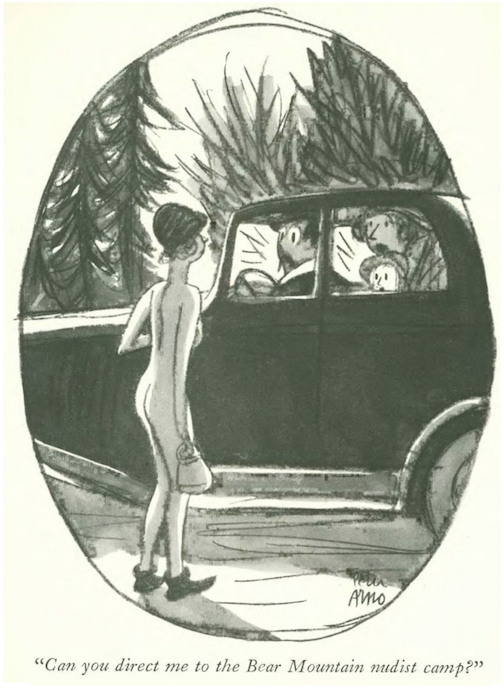
…and we take a leisurely Sunday drive, Peter Arno style…

…on to the June 3, 1933 issue…

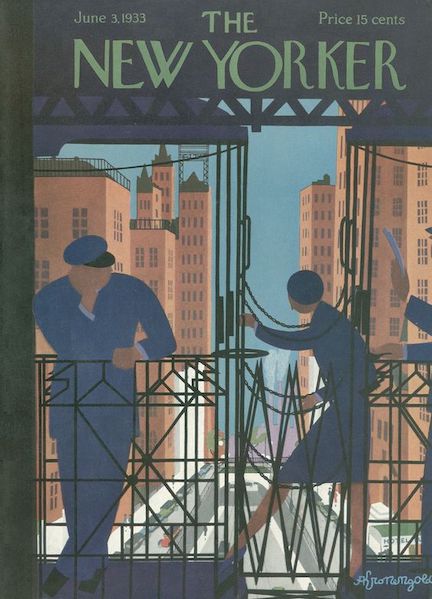
June 3, 1933 cover by Adolph K. Kronengold.

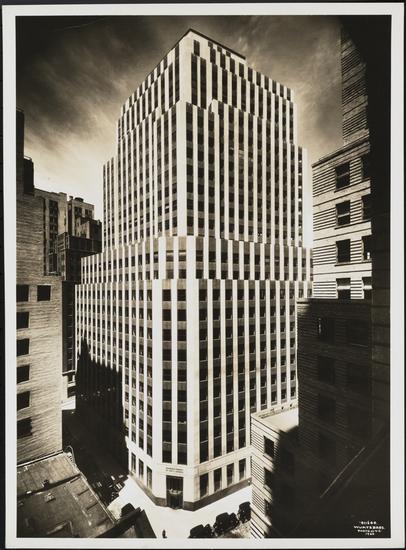
…where we appropriately look to the skyline, which was giving Lewis Mumford a crick in the neck…

THAT’LL DO…Lewis Mumford was not a fan of giant skyscrapers, but when the architects of the Empire State Building turned their attention to the Insurance Company of North America building at 99 John Street, Mumford found a design that could serve as a model for future business buildings. (Museum of the City of New York)
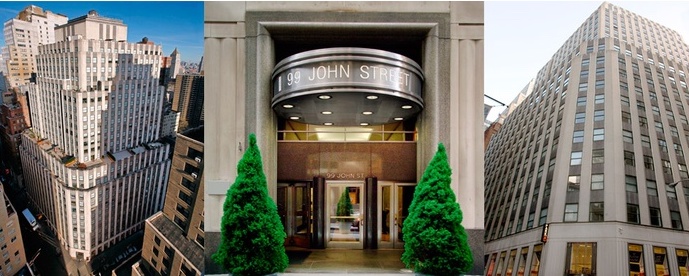
CONVERSION THERAPY…the Insurance Company of North America building now houses modern loft condominiums known as 99 John Deco Lofts. (nest seekers.com).

Later in the column Mumford called skyscrapers “insupportable” luxuries, arguing instead for long, shallow buildings rising no more than ten stories.

*  *  *

The Stars Align

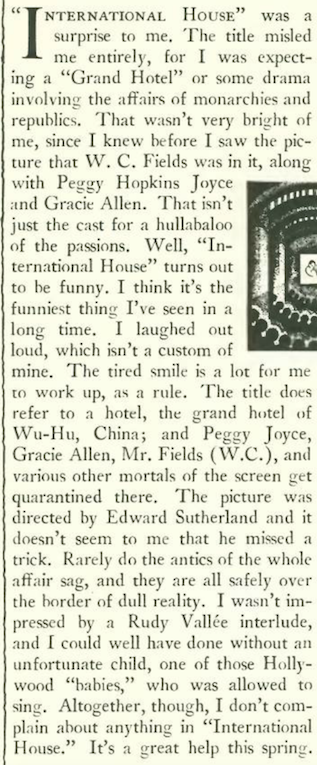
Film critic John Mosher was delightfully surprised by International House, a film loaded with some of the era’s top comedic stars along with other entertainers.

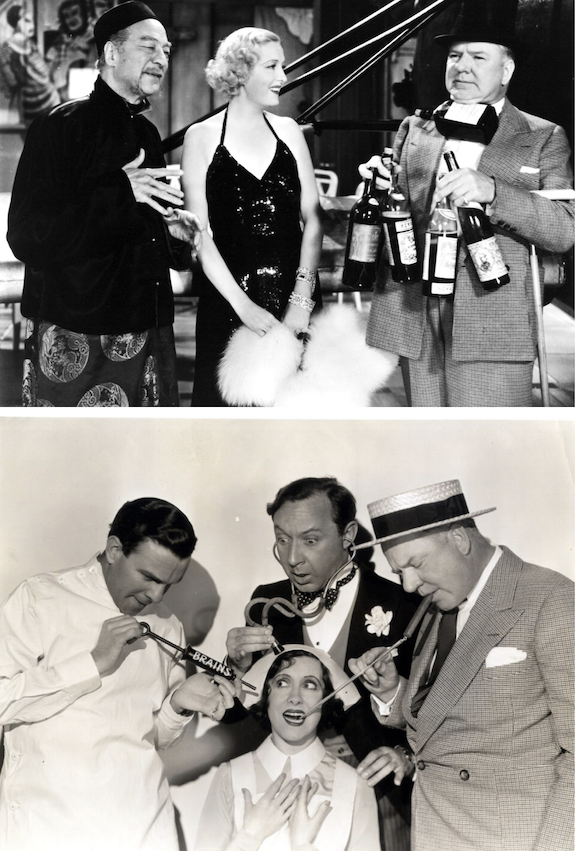
CLUTCH THOSE PEARLS…The risqué subject matter of International House had the Legion of Decency up in arms, but it left critic John Mosher in stitches thanks to the antics of Edmund Breese, Peggy Hopkins and W.C. Fields (top photo). Below, a publicity photo for International House with George Burns, Gracie Allen, Franklin Pangborn and W.C. Fields. (IMDB)

The film featured an array of entertainers including Peggy Hopkins (more famous as a real-life golddigger than an actress), the comedy duo Burns and Allen, W.C. Fields, Bela Lugosi, Cab Calloway, Rudy Valley and Baby Rose Marie.

ALL THE WORLD’S A STAGE…Ten-year-old Rose Marie Mazzetta, known in 1933 as the child performer Baby Rose Marie, sings a number atop a piano in a scene from International House. Thirty years later Rose Marie would appear on The Dick Van Dyke Show as television comedy writer Sally Rogers, pictured here with co-stars Dick Van Dyke and Morey Amsterdam. (WSJ/LA Times)
*  *  *
The New Germany, Part II
The June 3 “Out of Town” column took a look at life in Berlin as well as the 1933 Chicago World’s Fair. The piece is signed “A.L.”, leading me to believe it might be A.J. Liebling (author of the terrific Between Meals), but he didn’t start at The New Yorker until 1935. At any rate the article seems to dismiss the crackdown on Berlin’s cultural life as a mere inconvenience.

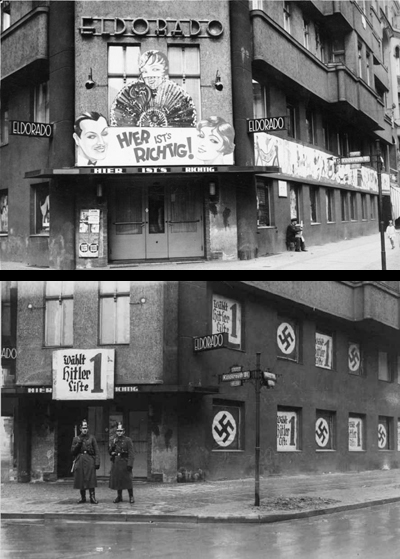
NEW THEME, NEW OWNERSHIP…The article mentions the closing of the Eldorado night club in Berlin, famed for its drag shows and other naughty diversions. Images above show the before and after the Nazis redecorated. (lonesomereader.com)

*  *  *

From Our Advertisers

More propaganda from Germany, where everything is sweet and bright away from the din of the city and the sound of marching jackboots and the crash of broken glass…


…an unusual ad from Cadillac, which barely mentions the automobile but goes full bore on the June bride theme…

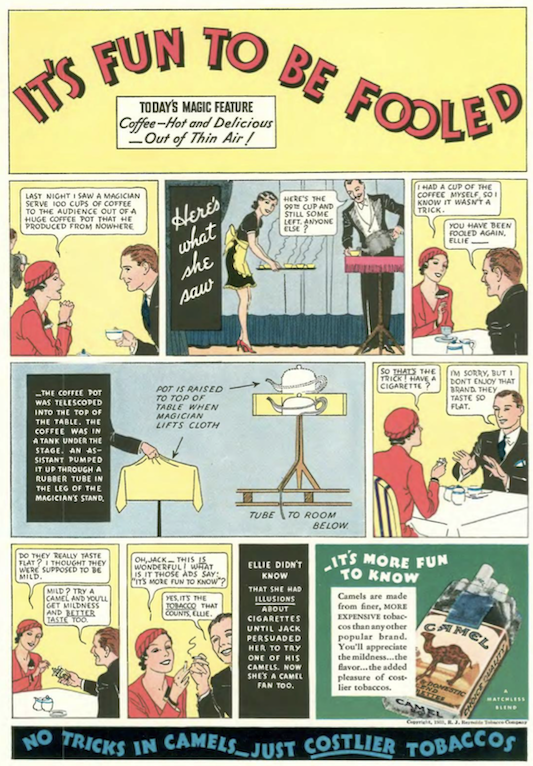
…the folks at Camel went full color in their latest installment of “It’s Fun to be Fooled”…in this strip Jack gets his friend Ellie hooked on his cigarette brand…

…looking for fresher air, well you could get a window air conditioner from the folks at Campbell Metal Window Corporation…however, these units were only available to the very wealthy, roughly costing more than $25,000 apiece (more than half a million today)…

…better to take a drive a catch the breeze with this smart pair…

…and fight off those pesky bugs with a blast of Flit, as illustrated by Dr. Seuss before he became a children’s author…

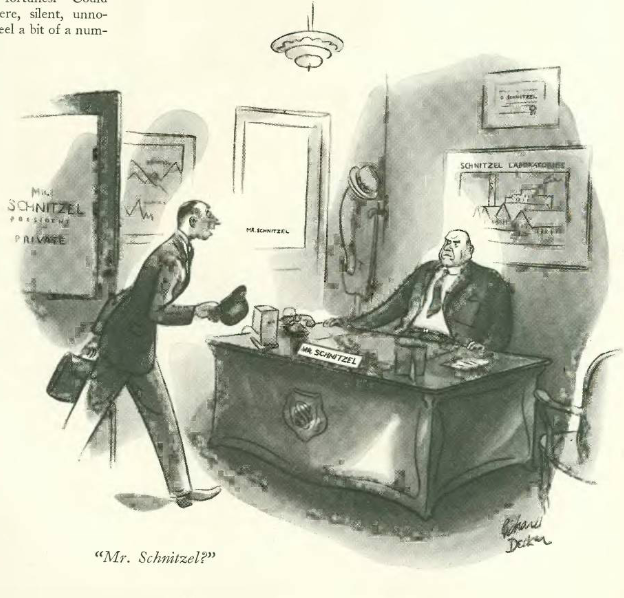
Richard Decker picked up some extra cash illustrating this ad for Arrow shirts…

…which segues to our other New Yorker cartoonists, such as H.O. Hoffman…

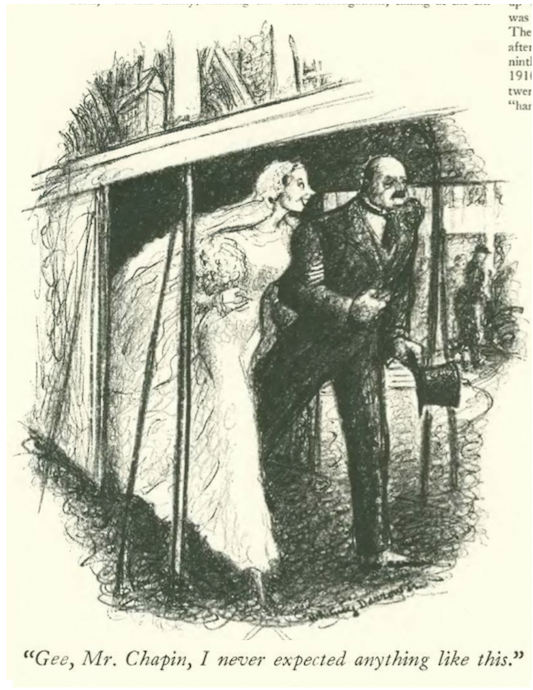
…and yet another bride, with sugar daddy, courtesy of Whitney Darrow Jr

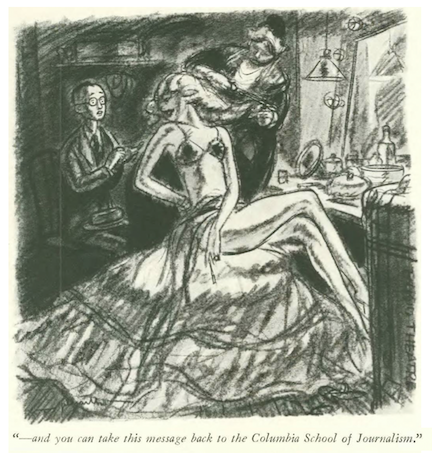
William Crawford Galbraith continued his exploration into the lives of showgirls…

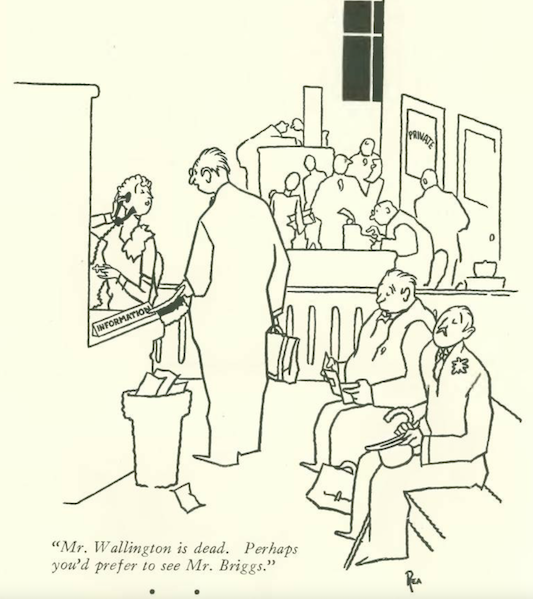
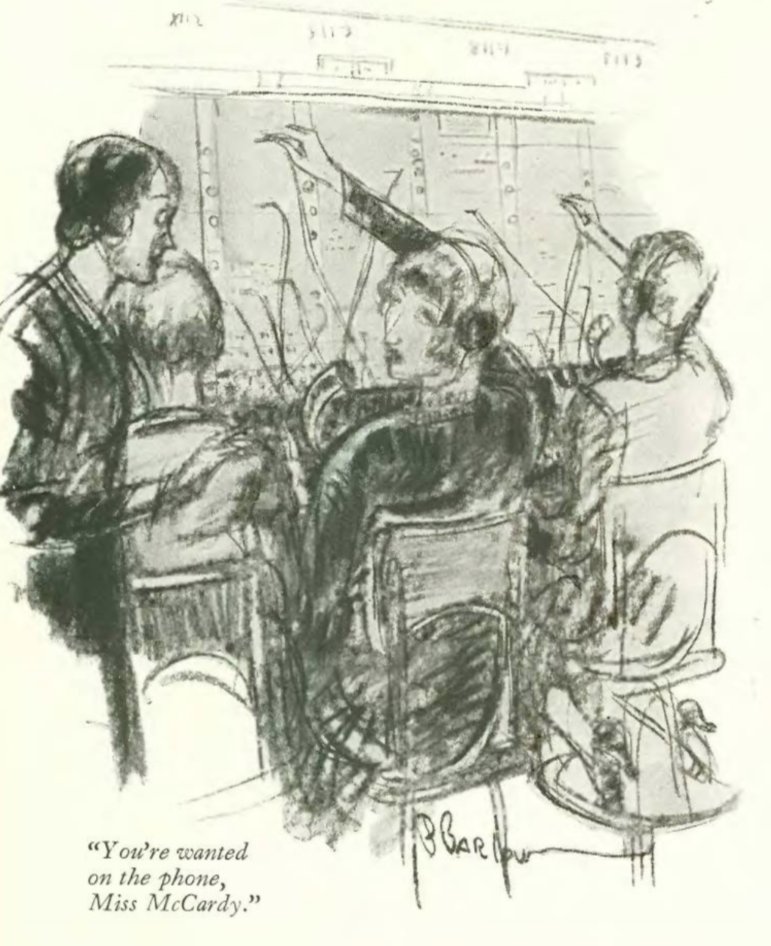
Gardner Rea gave us this helpful switchboard operator…

Carl Rose showed us how the posh set got into the spirit of the Depression-era farm program…

George Price was getting into familiar domestic territory…

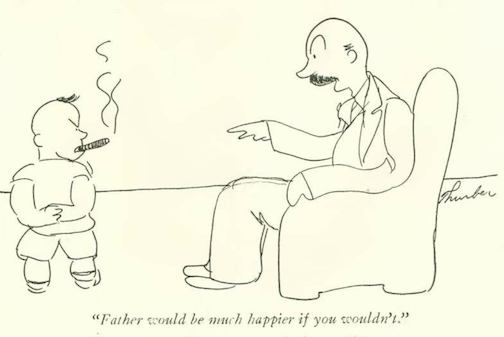
…and on this Father’s Day, we close with some fatherly advice from James Thurber

Next Time: Making Hays…


Asphalt Jungle

The zoos of yesteryear were joyless places, that is, if you were one of the animals. Children squealed with fear and delight at the sight of a caged lion, and many an adult had fun tossing peanuts at elephants or teasing enraged gorillas locked behind bars; but if you were a zoo animal in 1931, life was endless hours of boredom, sprinkled with moments of terror and humiliation.

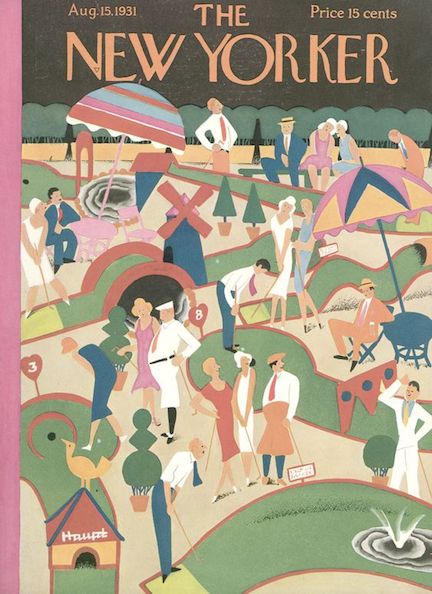
Aug. 15, 1931 cover by Theodore Haupt.

It is instructive to look back 89 years and see how far we’ve come, and how far we still have to go, to see our fellow creatures as more than curiosities and amusements to be captured and gawked at, and to see their environments as something to be preserved, not only for their survival but for ours as well.

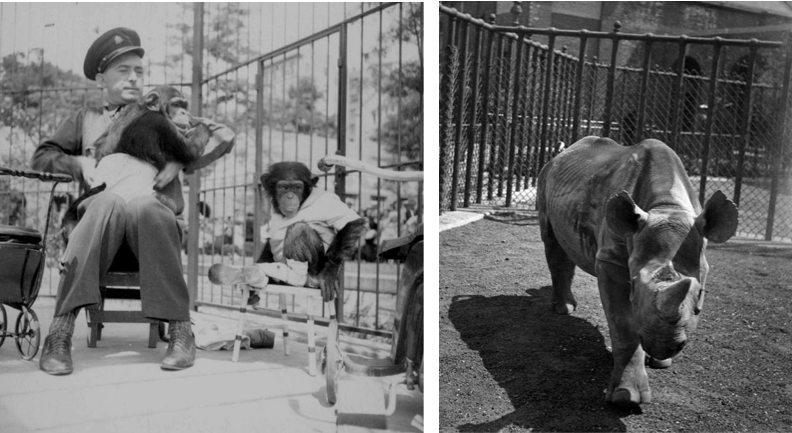
LIFE BEHIND BARS…Left, a zookeeper with chimps at the Central Park Zoo, 1936. Right, a rhino paces in a barred enclosure, 1937. (nycgovparks.org)

E.B. White paid a visit to the Central Park Zoo, and found it wanting in a number of respects:

Many zoos back then were more collections of curiosities than places where you could learn about various habitats. So when David Sarnoff, president of RCA, bagged a live opossum in the South, the critter was given a new home in an antelope enclosure, per this item in the Dec. 20, 1931 New York Times:

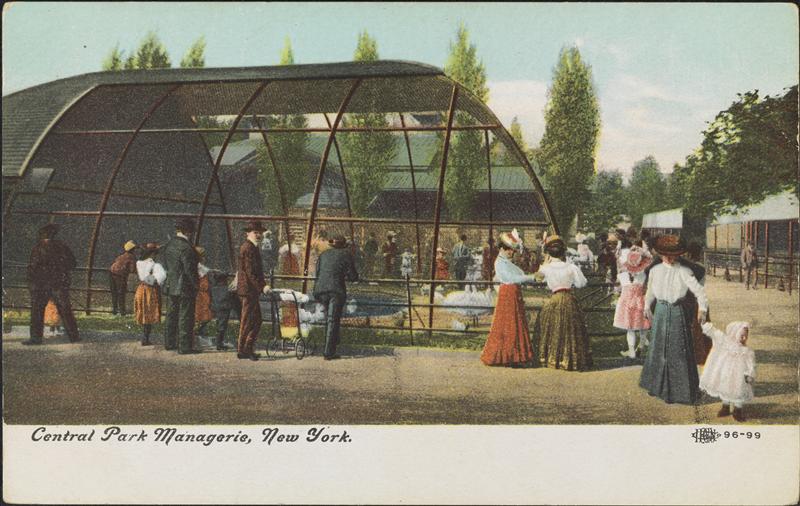
The Central Park Zoo was established in the 1860s as a “menagerie” behind the Arsenal, and by the turn of the century attracted millions of visitors to its displays of exotic animals.

GETTING AWAY FROM IT ALL…Postcard image of the Menagerie in Central Park, New York, 1905. (Museum of the City of New York—MCNY)
ANIMAL ATTRACTION…Postcard image of folks enjoying caged birds at the Menagerie, 1905. (MCNY)
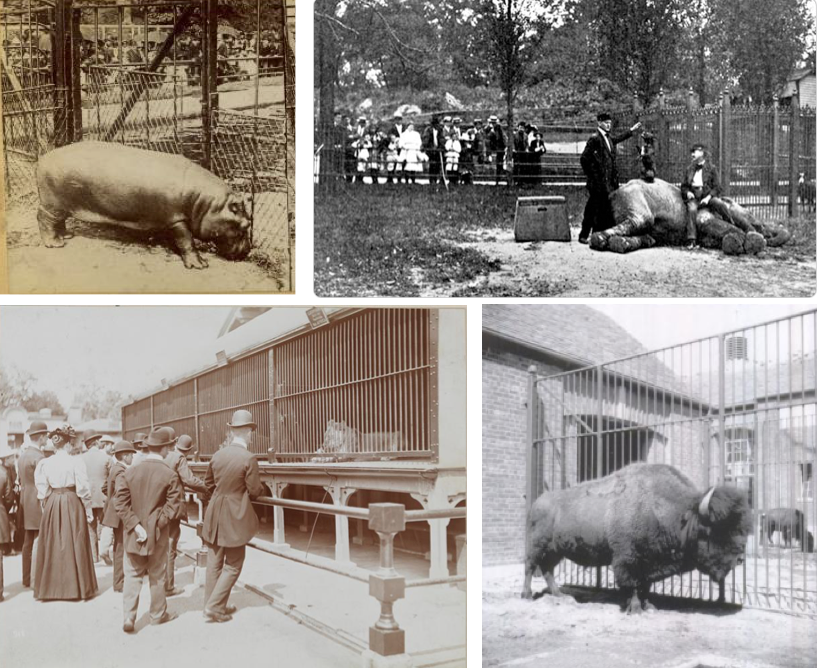
O GIVE ME A HOME…In the early days of zoos, animals were presented in cages and fenced enclosures with no hint as to what their natural habitat might look like. Clockwise, from top left, “Fatima” the hippo, image from an 1896 stereograph card; a 1911 photo of a trainer and a dog perched on top of a hapless elephant; a bull bison around the turn of the century; a group of people observe animals in cages at the Central Park Menagerie, 1895. (Library of Congress/nycgovparks.org/MCNY)

 *  *  *

He’s Your Future

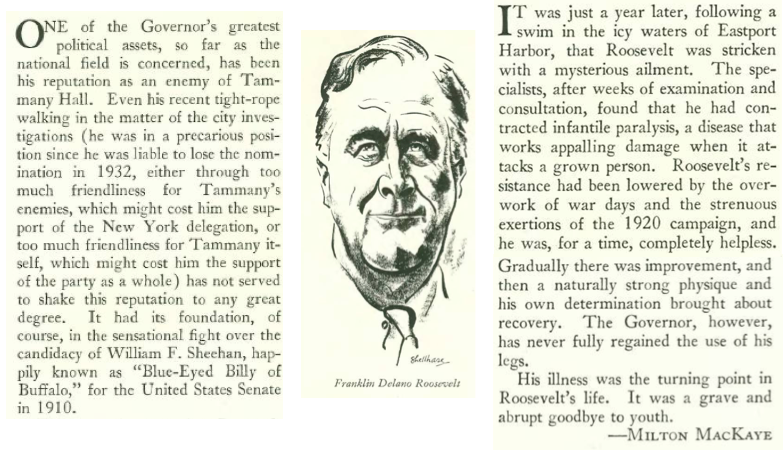
The New Yorker featured two-part profile of the governor of New York, Franklin D. Roosevelt, who unbeknownst to writer Milton MacKaye would soon become the next president of the United States. Two excerpts (not continuous)…

  *  *  *

From Our Advertisers

Ah yes, the first time I visited the Empire State Building’s observation deck (in the 1970s) a heavy smog enveloped the city (the air is much cleaner today). I like how the promoters spin disappointment into an opportunity — “The mysterious beauty of the city has a million constantly changing aspects”…

…if you were looking for bluer skies, Bermuda could have been an option if you had the means…

…or you could have stayed closer to home at a Long Island beach resort, as Helen Hokinson illustrated, and as we segue into our cartoons…

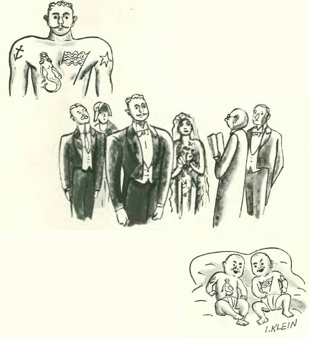
Isadore Klein gave us a very unscientific, albeit humorous view of genetics…

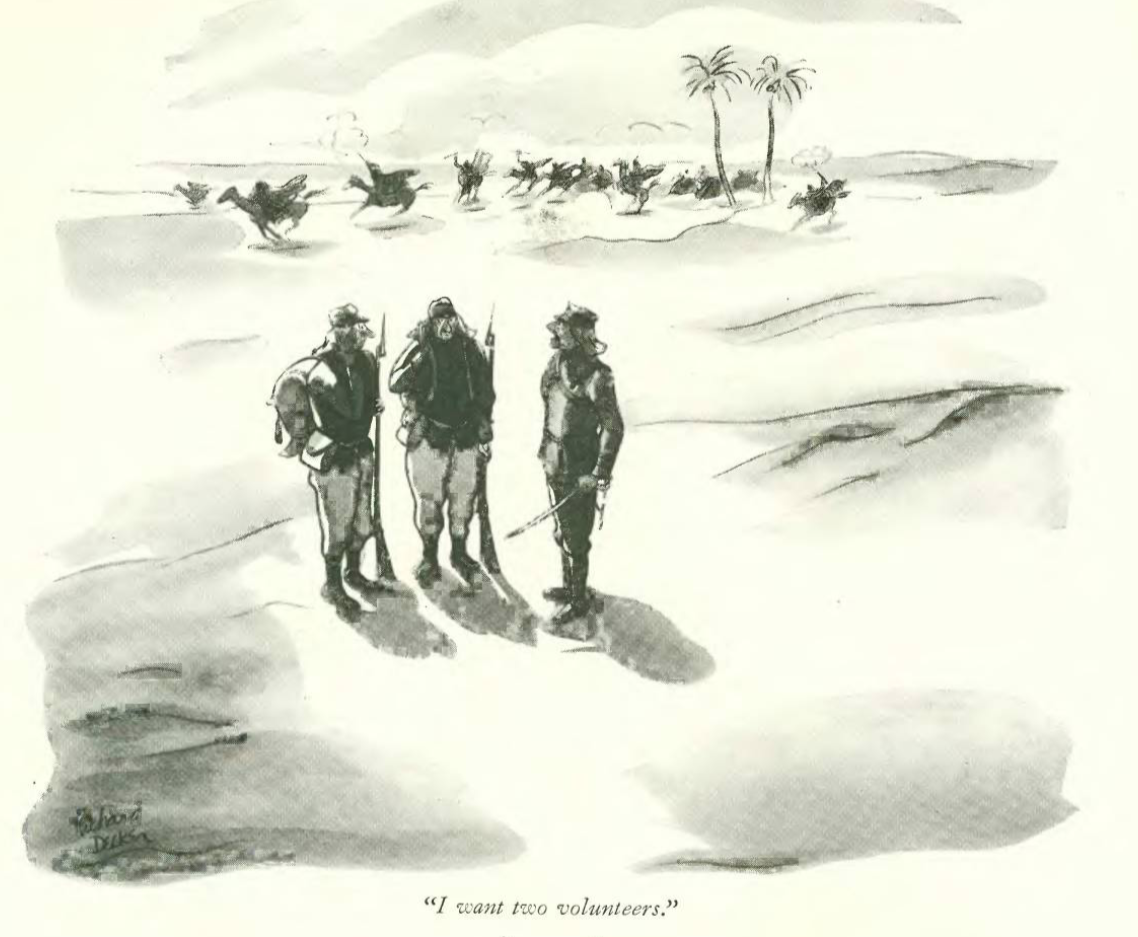
Richard Decker redefined the meaning of “volunteers”…

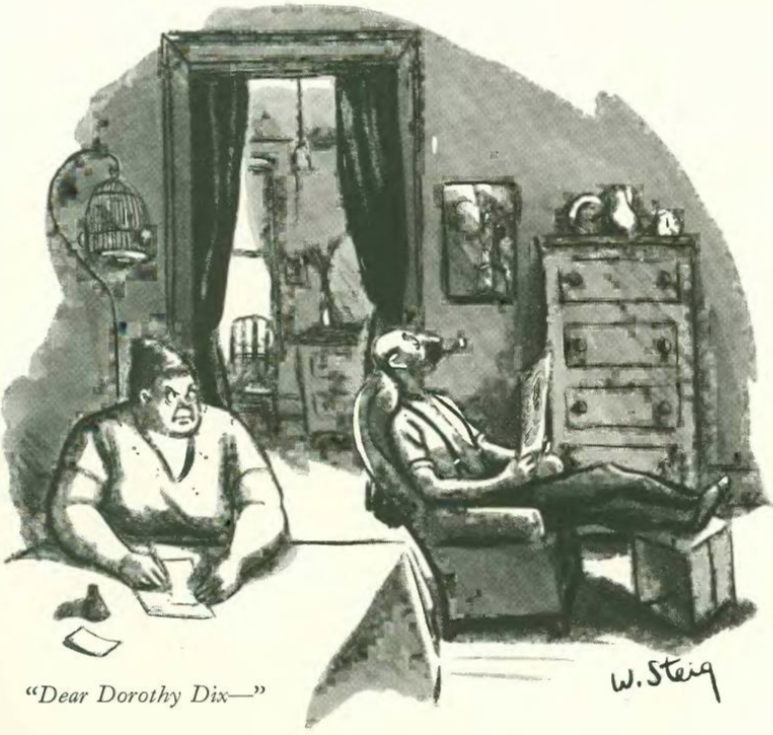
…and William Steig summoned the advice of Dorothy Dix, a forerunner of “Dear Abby” who was the most widely read female journalist of her time…

We move on to the Aug. 22, 1931 issue…

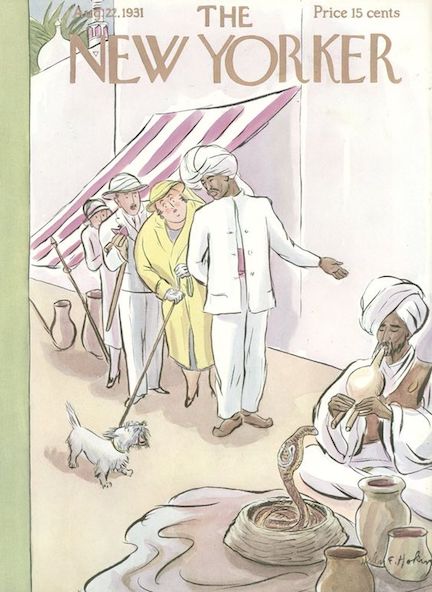
Aug. 22, 1931 cover by Helen Hokinson.

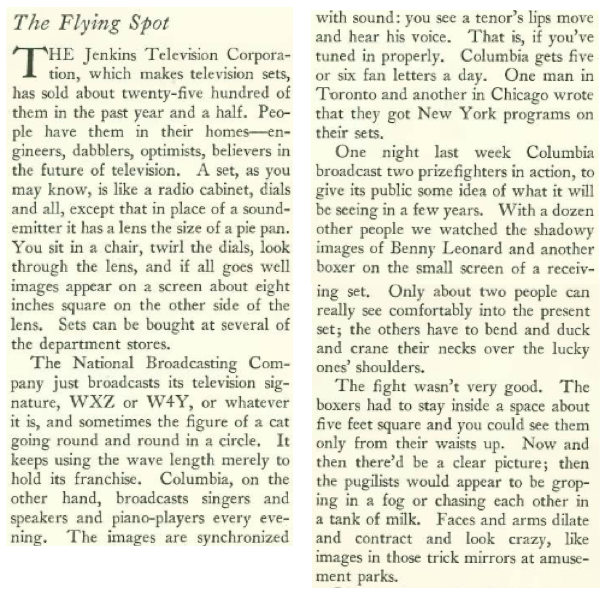
…in which James Thurber wrote about his experience with early television in “The Talk of the Town”…

NO CABLE BILL, YET…Charles Francis Jenkins demonstrates his “Radiovisor” console television in 1929. At right, the inner workings featured a rotating disc punctured with tiny holes, each projecting a line across the glass screen to compose an image. As Thurber noted, the pictures commonly were too dark for viewers to see anything more than silhouettes. Not to mention Thurber’s eyesight was also terrible. (earlytelevision.org)

 *  *  *

The Other Moving Pictures

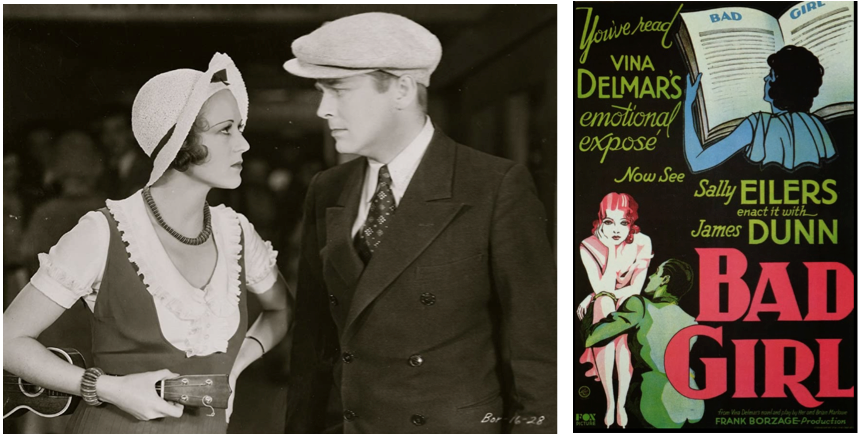
The movies still had nothing to fear from television in 1931, and Hollywood continued to draw large audiences to “Pre-Code” films that featured doses of sex and violence. Novelist Viña Delmar gained famed in 1928 with her suggestively titled book Bad Girl, so when it was adapted into a film, audiences came running—even if the screen adaptation proved to be a bit tamer than the novel that inspired it. Critic John Mosher observed:

I’M JUST A LITTLE BAD…Sally Eilers played the title character in Bad Girl with co-star James Dunn. The film won two Oscars in 1932 for Best Director (Frank Borzage) and Best Writing, Adaptation (Edwin J. Burke). (IMDB)

 *  *  *

Chic Chapeau

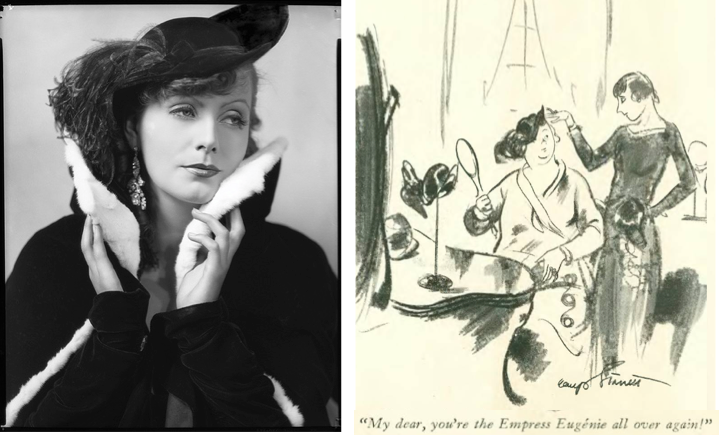
The Empress Eugénie hat was named for 19th century French empress Eugénie de Montijo, who was known as a fashion trendsetter. The hat was revived in 1930 after Greta Garbo was seen wearing a version of one in the popular film Romance. E.B. White was not exaggerating when he noted (in his “Notes and Comment”) that the jaunty hat was seen on “every other head” in the city.
 

LOOK WHAT YOU STARTED…Greta Garbo sported an Empress Eugénie hat in the 1930 film Romance, setting off a fashion craze that persisted through much of the decade. At right, Kemp Starrett referenced the trend in this Aug. 8, 1931 cartoon in The New Yorker. (Pinterest)

 *  *  *

From Our Advertisers

Speaking of trends, these “roughies” were all the rage among the young folks, in the dorms and on the beach…

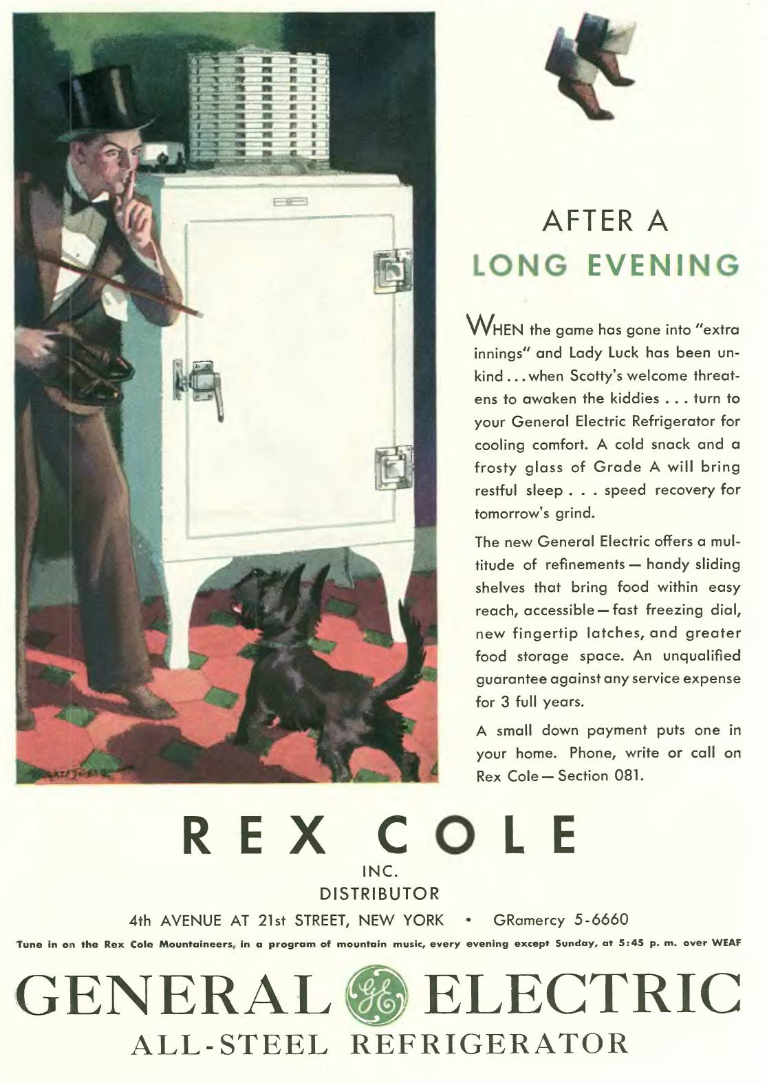
…one trend I wasn’t aware still persisted in 1931 was a top hat and tails for an evening out among the smart set…

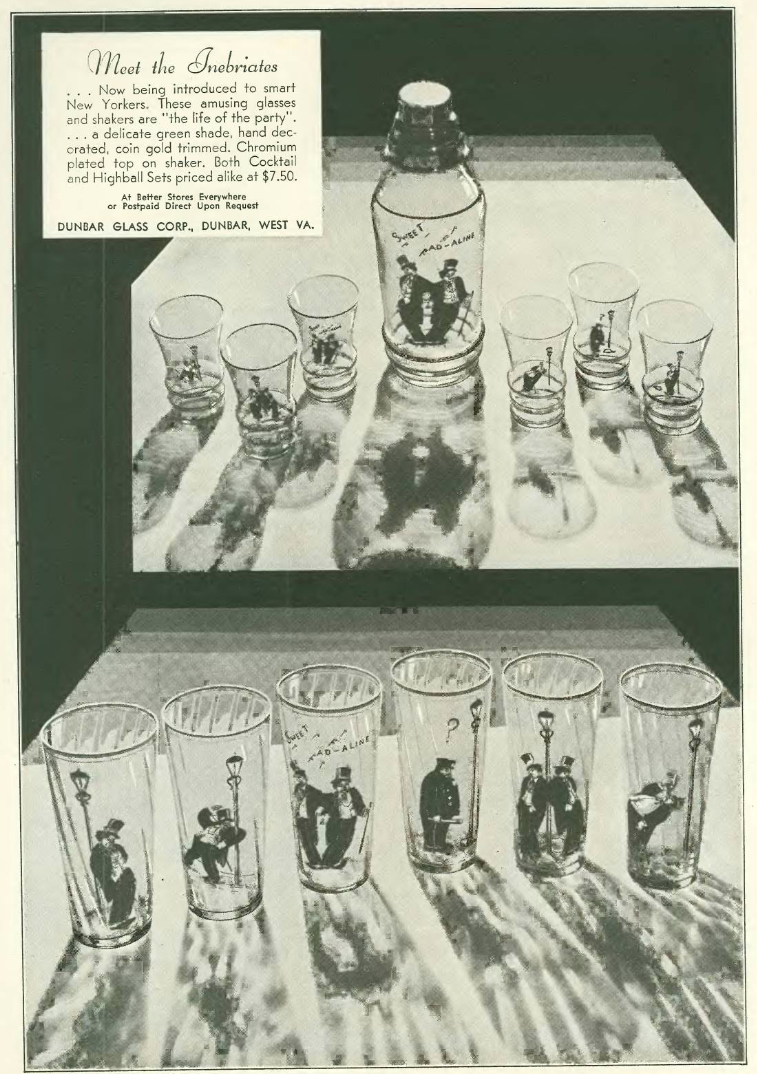
…according to this ad, if you were a “smart” and fashionable New Yorker, then you needed an “Inebriates” themed cocktail set…

…examples of the glassware for sale on Worthpoint…

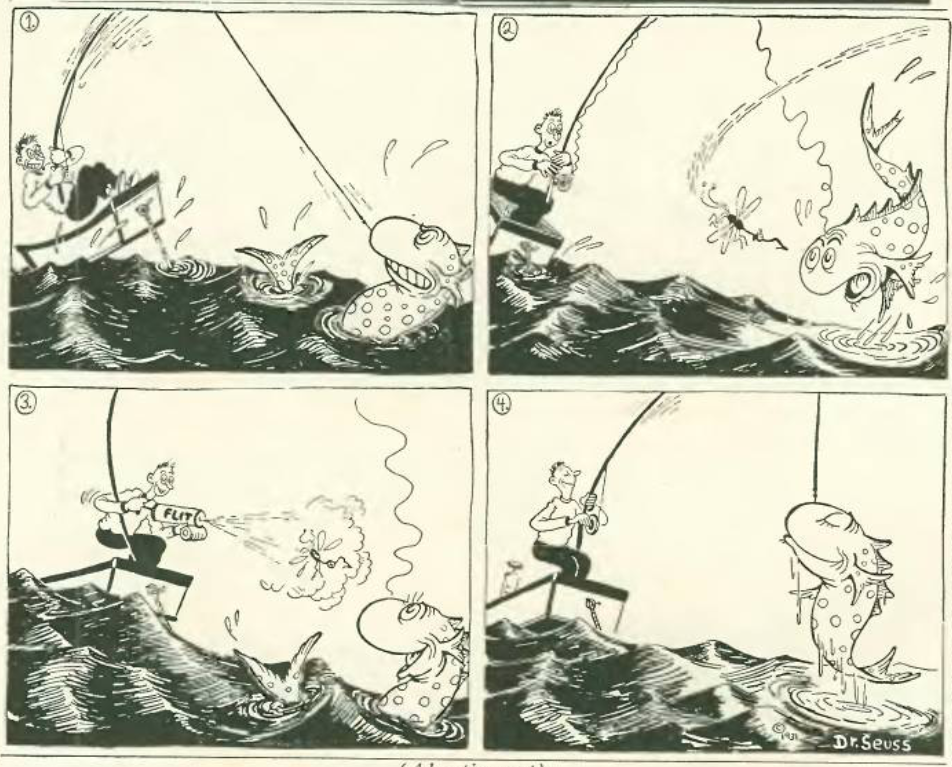
Dr. Seuss was still busy selling pesticide with this four-panel ad…

…on to the cartoons, we start with James Thurber

…and Rea Irvin continued to experiment with various motifs, this time an Egyptian-themed cartoon referencing the “wine bricks” sold by enterprising vineyards during Prohibition…

Peter Arno found a big surprise during a mansion tour…

…and we end with Otto Soglow

…and Richard Decker…both cartoons reminded me of Al Jaffee’s Snappy Answers to Stupid Questions

…I grew up reading Mad magazine, and always looked forward to Jaffee’s fold-ins…he just retired from Mad at the young age of 99, so we conclude with one of his Snappy Answers panels from Mad #98, Oct. 1965…

Next Time: Unnatural History…


The High Place

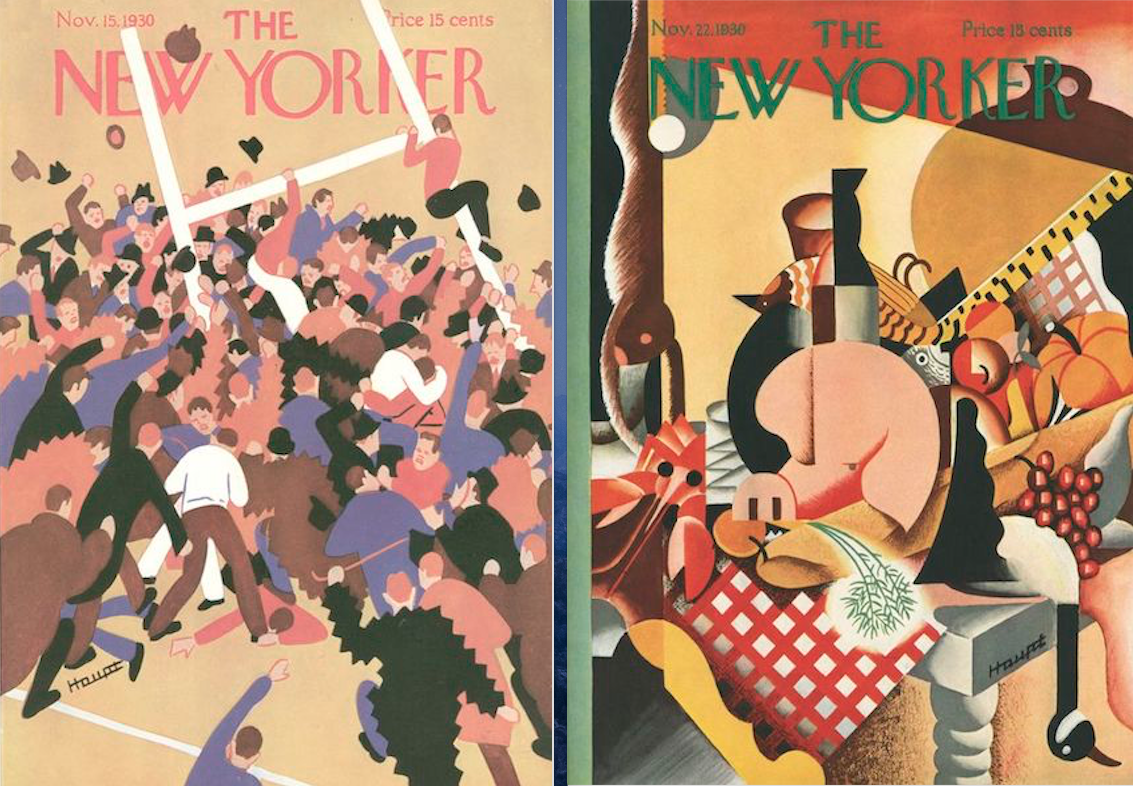
For this installment we look at two issues, Nov. 15 and 22, both featuring covers by Theodore Haupt that celebrated two autumn rituals: football and Thanksgiving.

Let’s begin with the Nov. 22 issue, which climbed to the highest place in Manhattan — no, not the Chrysler Building, but the nearby Empire State Building — with E.B. White admiring the commanding view:

Before the Empire State Building could go up, the old Waldorf-Astoria hotel had to come down. As White observed, the old hotel was built so soundly that it was too costly to deconstruct and salvage. Most of it ended up on the bottom of the ocean.

DOWN IN DAVY JONES’ LOCKER lie the remains of the old Waldorf-Astoria Hotel, which stood for just 36 years before it was razed to make room for the Empire State Building. At right, one of the hotel’s lobbies, and the Grand Ballroom. (nyc-architecture.com/Pinterest)
A LOT OF HOT AIR…Top images: The fabled “mooring mast,” described by E.B. White in his New Yorker brief, as imagined in composite images (old-time Photoshop). In reality, the morning mast never worked; bottom right, a cutaway view of the mast featured in Popular Mechanics; bottom left, New York Times photo from March 22, 1931, announcing the completion of the Empire State Building, just 17 months after the Waldorf-Astoria began coming down. (Keith de Lellis Gallery, rarehistoricalphotos.com/Google Books/The New York Times)
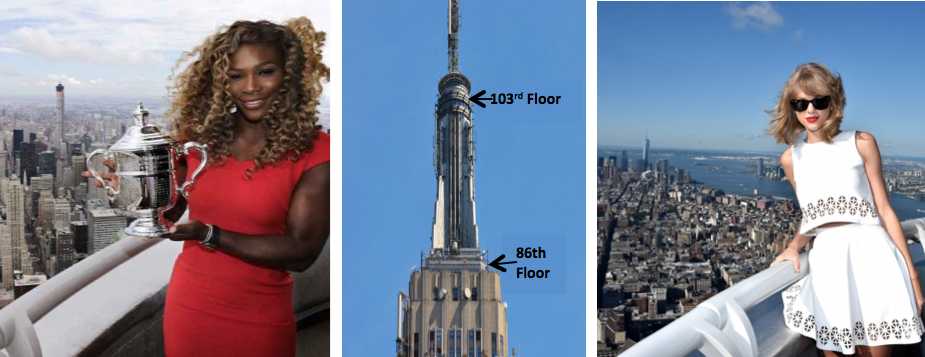
SURVEYING THEIR KINGDOM…Most visitors to the Empire State Building can only go as high as the 86th floor observation deck. However, if you are a VIP like Serena Williams or Taylor Swift, you can get your picture snapped on the 103rd. (Associated Press/Empire State Building/Evan Bindelglass, CBSNewYork)

*  *  *

Sore Winner

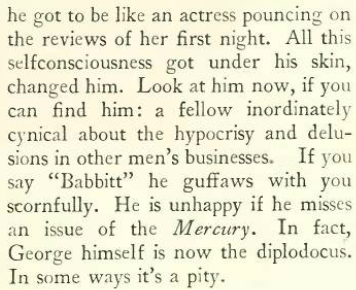
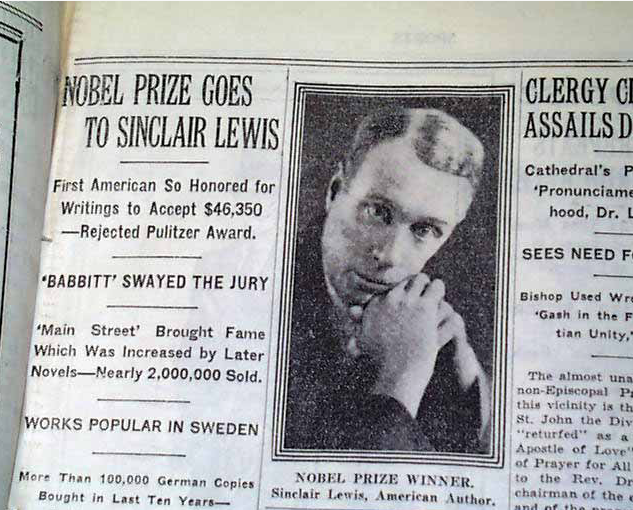
Sinclair Lewis famously declined the Pulitzer Prize for his 1925 novel Arrowsmith, upset that his 1920 novel Main Street had not previously won the prize. But when the Swedish Academy came calling with a Nobel Prize in Literature in 1930, he happily accepted. According to “The Talk of the Town,” this award also seemed a bit tardy, since Lewis’s small town booster archetype, George F. Babbitt, did not fit the dour days of the Great Depression. But it turned out that the 1922 novel Babbitt was ultimately what swayed the Nobel jury:

BOOST FROM A BOOSTER…George F. Babbitt helped make Sinclair Lewis famous, and landed him a Nobel. (NYT, NOVEMBER 6, 1930)

 *  *  *

Not So Sweet

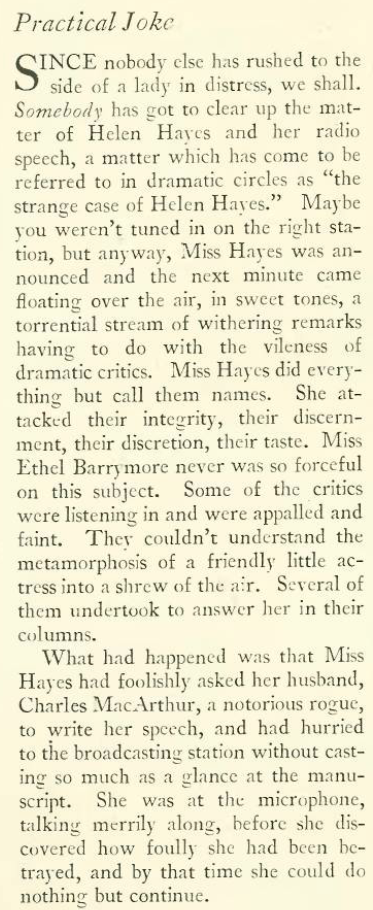
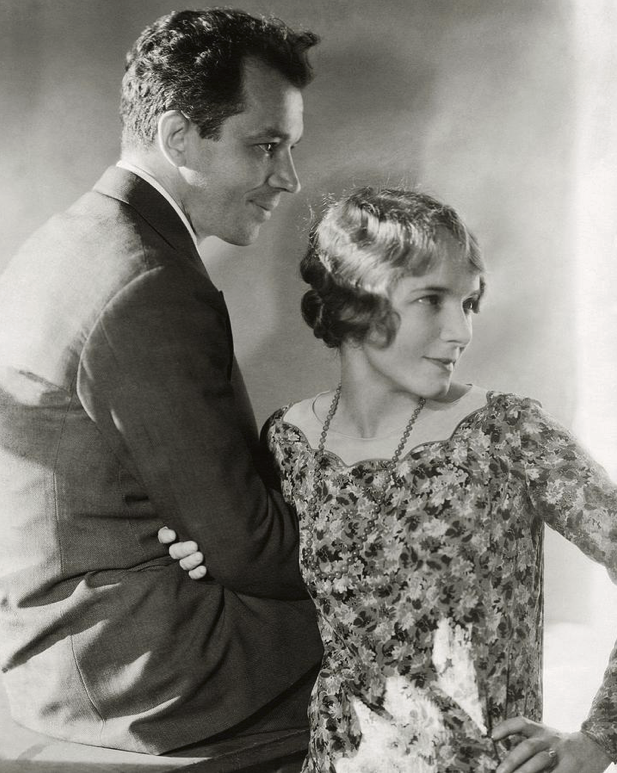
Those of a certain age might remember Helen Hayes as a sweet old lady who appeared on a number of TV shows in the 1970s and 80s, or as the mother in real life of James MacArthur, Disney teen star and later the portrayer of Danny “Book ’em Danno” Williams on the original Hawaii 5-0 TV series. Hayes was married to playwright Charles MacArthur, and “The Talk of the Town” takes it from there…

CREATIVE TYPES…The engaged couple Charles MacArthur and Helen Hayes posed for photographer Edward Steichen for this Jan. 1, 1929 image featured in Vanity Fair magazine. (Condé Nast)

 *  *  *

Ain’t It Grand

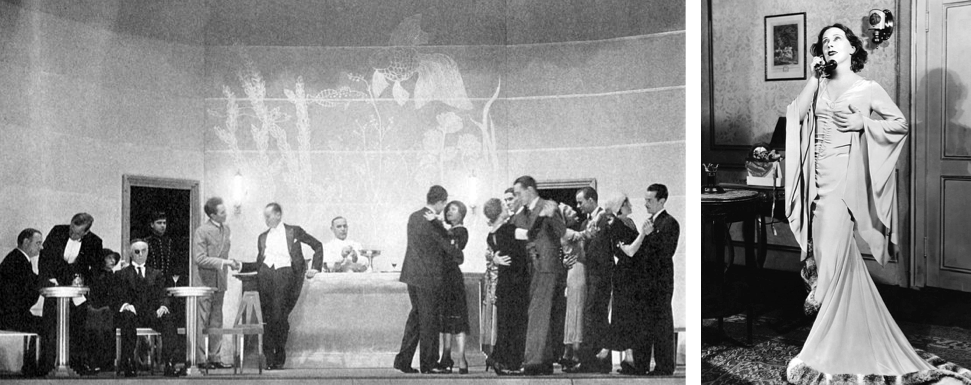
Grand Hotel opened at the National Theatre on Nov. 13, 1930 to strong reviews, including the one below by Robert Benchley that he filed for The New Yorker. The play, adapted from the 1929 novel Menschen im Hotel by Austrian writer Vicki Baum, would prove to be a smash on Broadway and again on the silver screen in a star-studded 1932 film featuring Greta Garbo, John Barrymore, and Joan Crawford.

THE STARS ALIGN…Left, promotional photograph of the original Broadway production of Grand Hotel. At right, Eugenie Leontovich portrayed fading Russian ballerina Grusinskaya in the play. The role would go to Greta Garbo in the 1932 film adaptation. (Theatre Magazine, February 1931/Wikipedia)

…and while we are on the subject of Broadway, the theater review section also featured this Al Frueh illustration promoting a noted production of Twelfth Night at the Maxine Elliott…

Program for the production featuring Jane Cowl. (Playbill)

 *  *  *

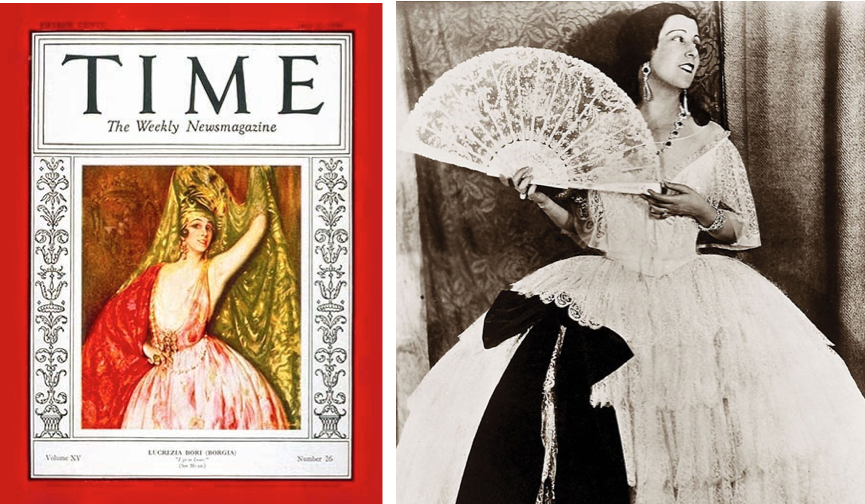
There were also big doings at the Met, where Spanish lyric soprano Lucrezia Bori (1887-1960) wowed audiences with her portrayal of Violetta in La Traviata.

SHE HAD SOME PIPES…right, lyric soprano Lucrezia Bori on the cover of the June 30, 1930 edition of Time magazine. At right, promotional photo of Bori circa 1930. (Time/Wikipedia)

 *  *  *

Bounty of Blessings

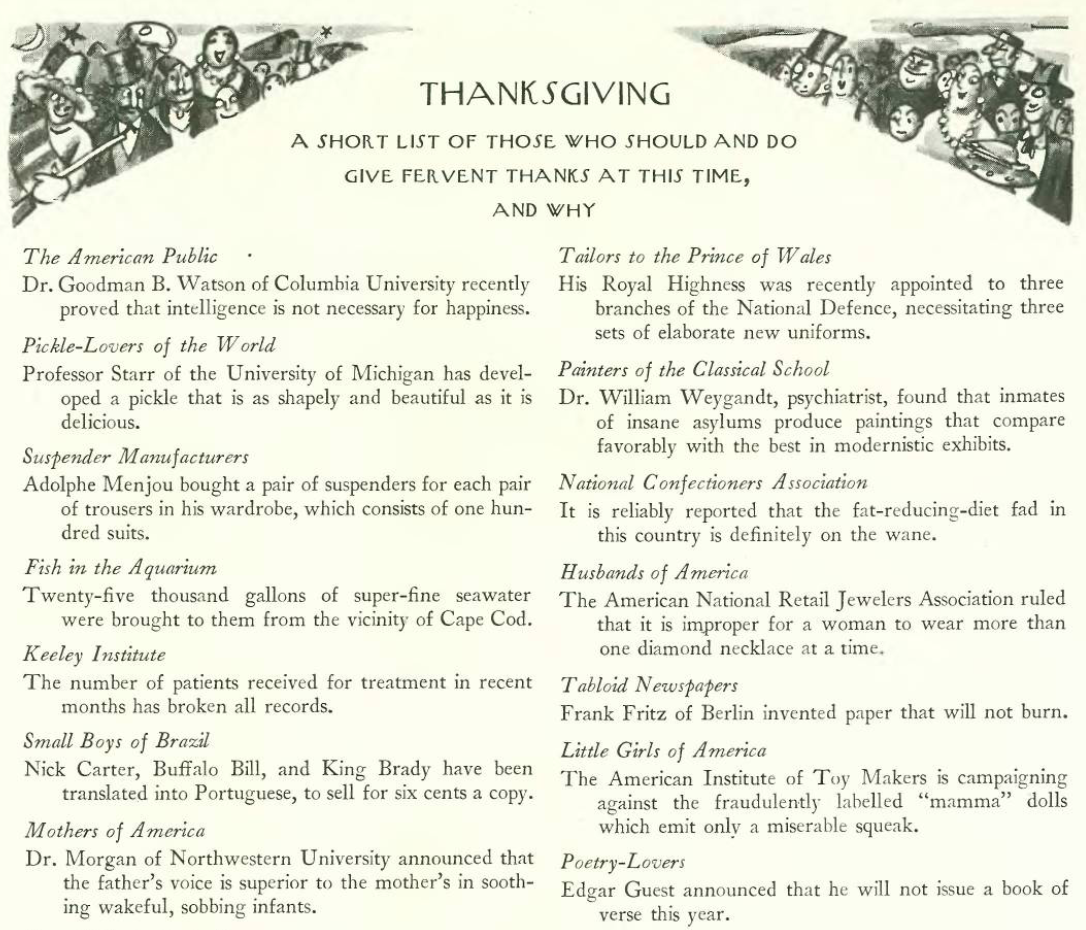
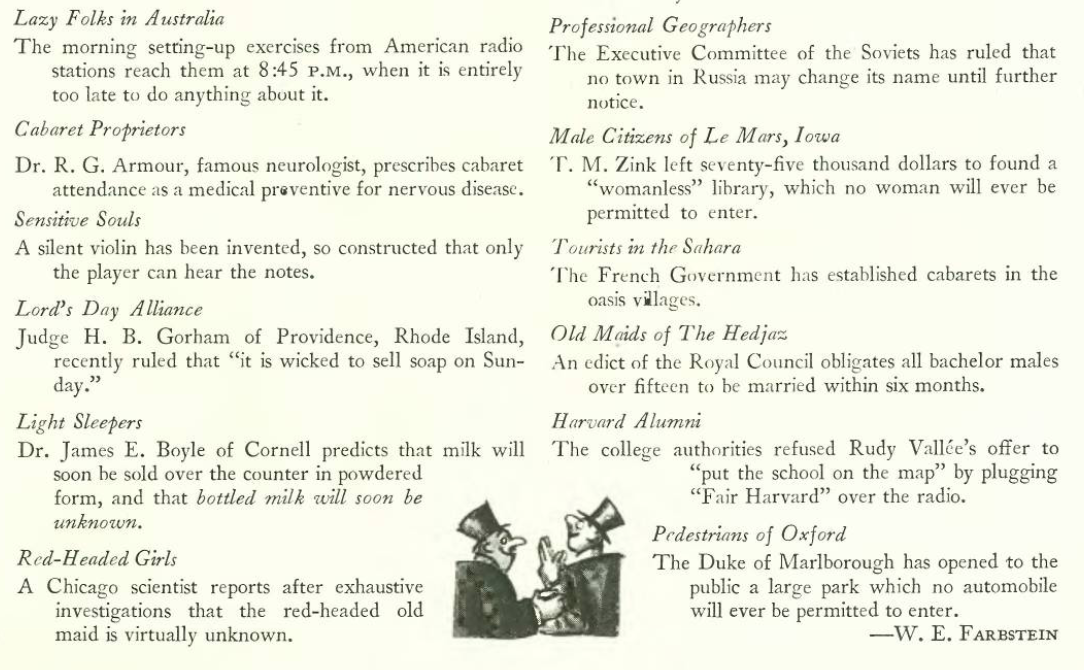
Humorist W. E. Farbstein gave readers plenty to be thankful for in this tribute to the Thanksgiving holiday…

 *  *  *

From Our Advertisers

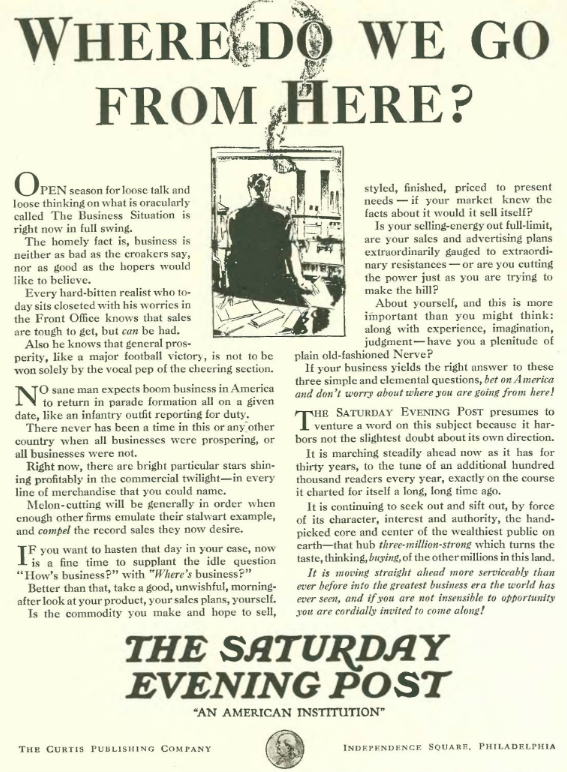
Occasionally advertisements acknowledged the reality of the Great Depression, including this one from The Saturday Evening Post that offered encouraging words to prospective readers…

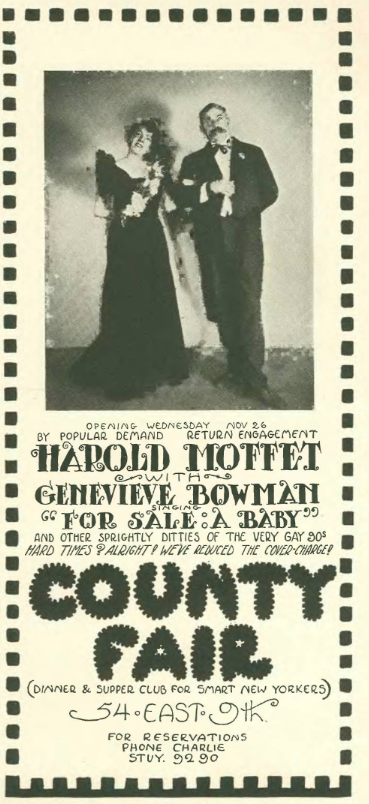
…County Fair, a Greenwich Village country-themed nightclub, offered the diversion of Moffatt and Bowman to take audiences’ minds off of hard times…

…and for all the supposed sophistication of New Yorker readers, there were still plenty of back page ads offering nostrums laced with superstition…

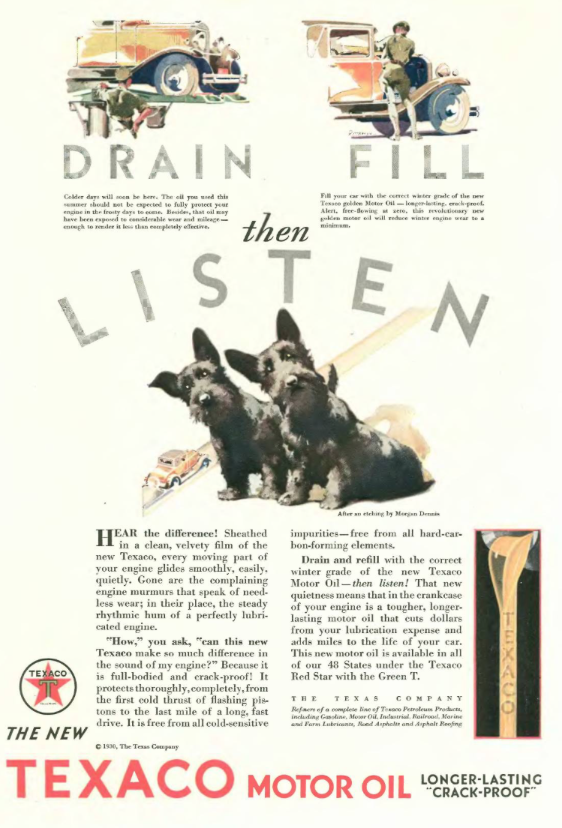
…some of the more colorful, spritely ads from the era were offered up by the producers of Texaco Motor Oil…

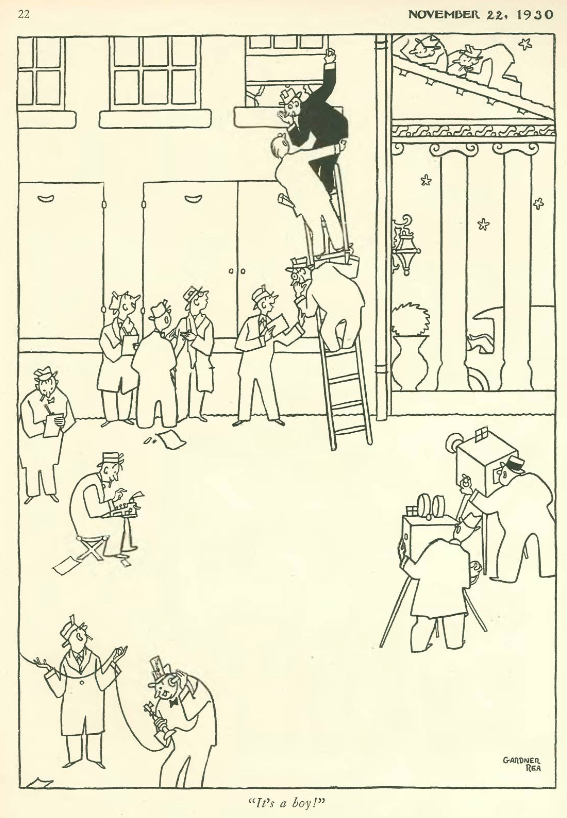
…our cartoons are by Gardner Rea

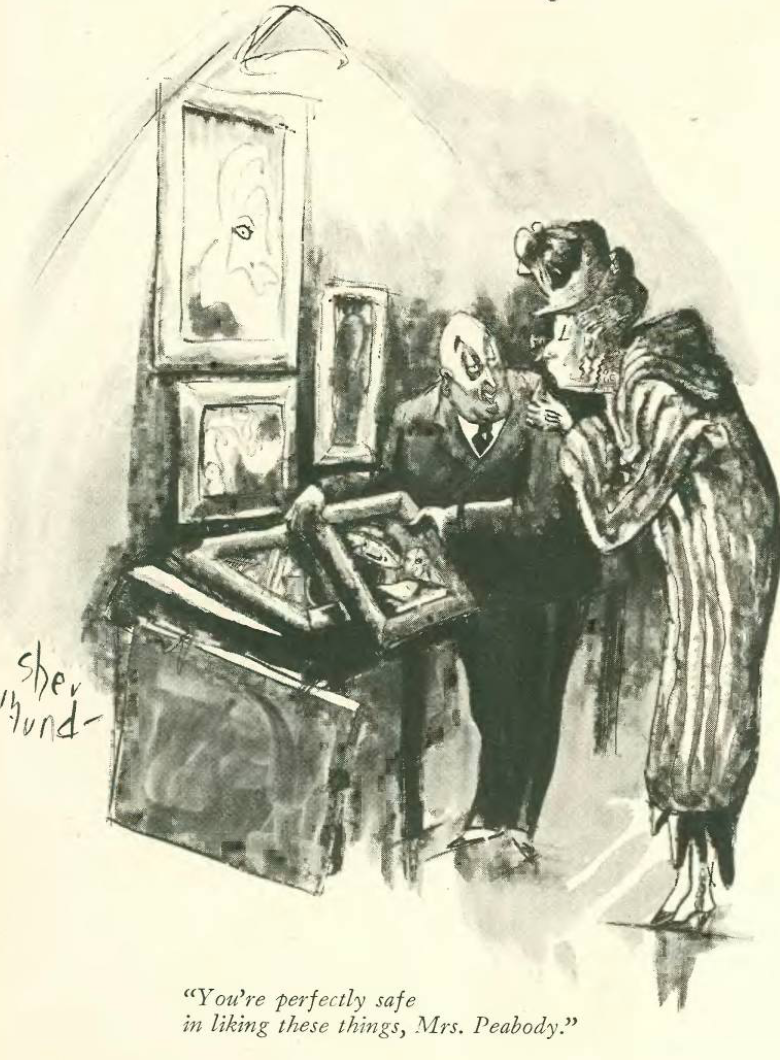
Barbara Shermund

William Crawford Galbraith

…and Perry Barlow

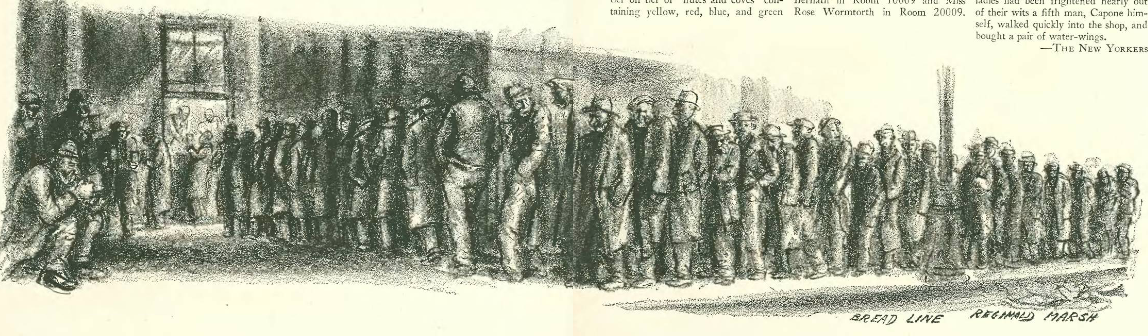
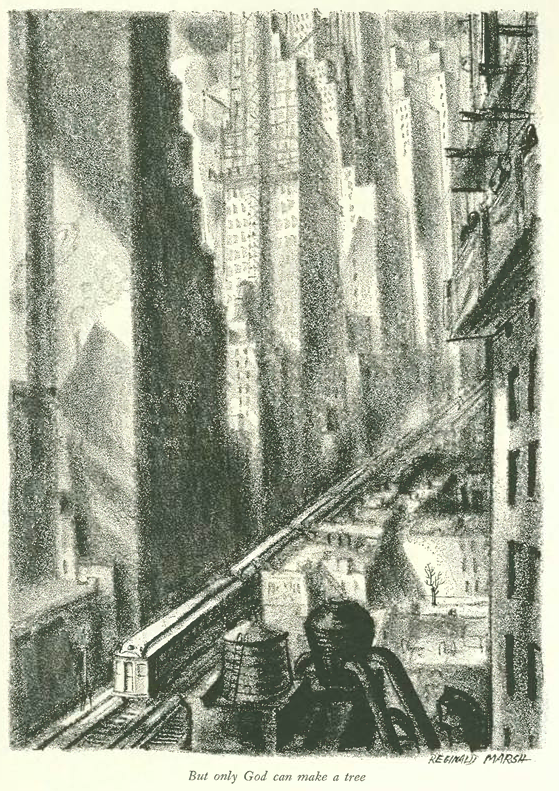
…and for another reminder of reality in the city, this sketch that ran along the bottom of “The Talk of the Town,” by Reginald Marsh

…and now we step back to the Nov. 15 issue, where E.B. White offered a less somber take on the Great Depression…

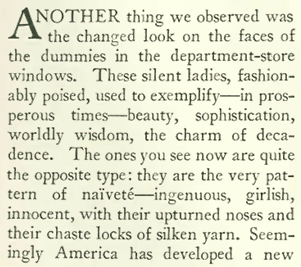
…White also noted a change on the faces of storefront mannequins…

YIN AND YANG…The worldly pose of a Roaring Twenties mannequin, and a more wholesome look for the leaner times in the 1930s. (Pinterest)

 * * *

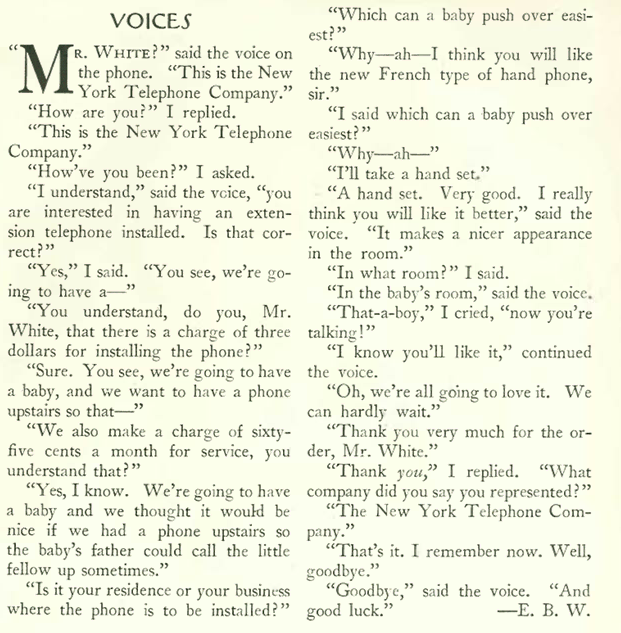
Playing Telephone

Long, long before cell phones, telephones were heavy stationary devices that required a certain amount of planning before installation, as E.B. White explains:

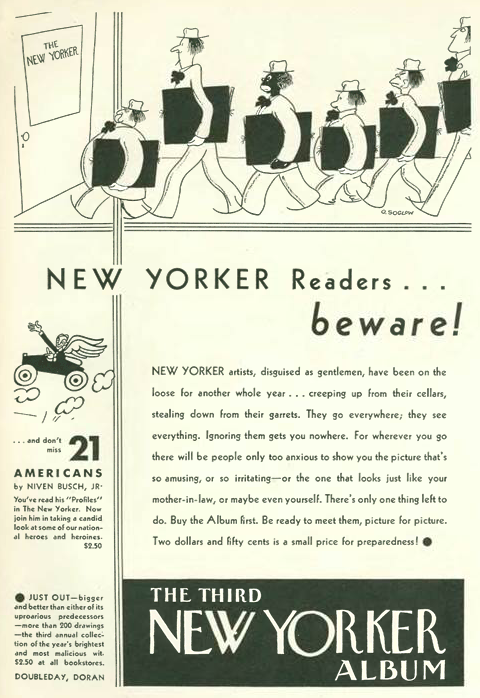
On to our Nov. 15 ads, we have this announcement for The Third New Yorker Album…with illustration by Otto Soglow

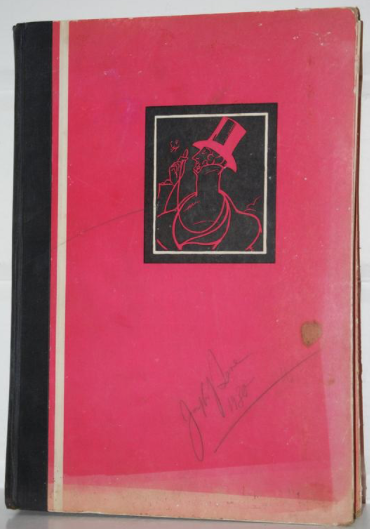
…here is what the album looked like…

…and a couple of inside pages…

(Etsy)

…one of the contributors to the album was Rea Irvin, founding illustrator for The New Yorker, here doing some business with Murad cigarettes…also another Flit insecticide ad by Dr. Seuss

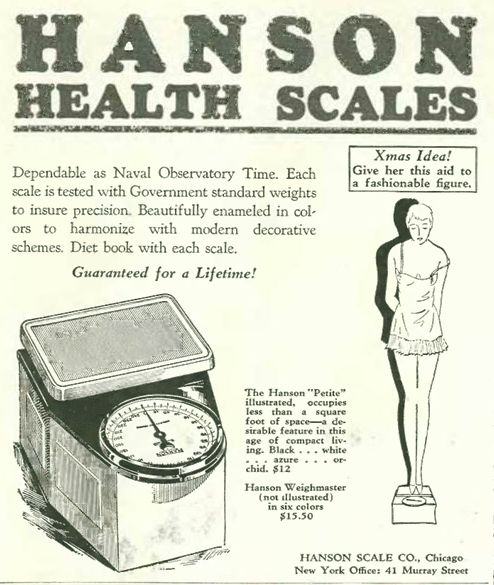
…Christmas ads began appearing in the magazine, including this one for Hanson scales…pity the poor chap (and his wife) who actually thought this might be a suitable present for Christmas, or any occasion for that matter…

…and with Prohibition still in force, advertisers found other uses to promote their products…

…on to our cartoons, Leonard Dove illustrated a couple who didn’t get away with the ruse…

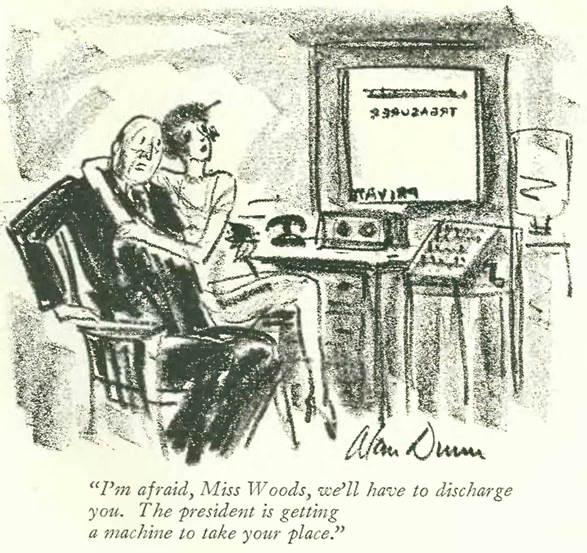
… Alan Dunn depicted what was considered typical office behavior in the 1930s…

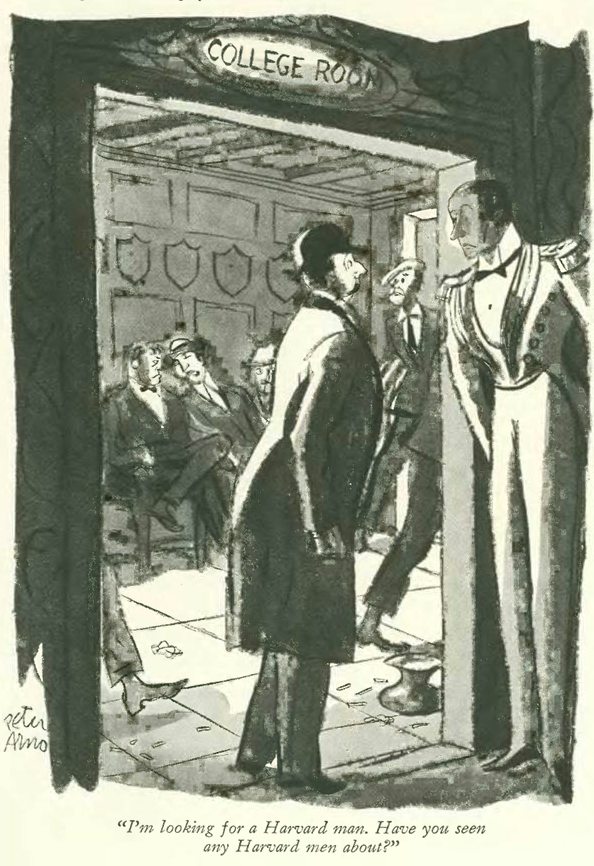
...Peter Arno visited the Harvard Club…

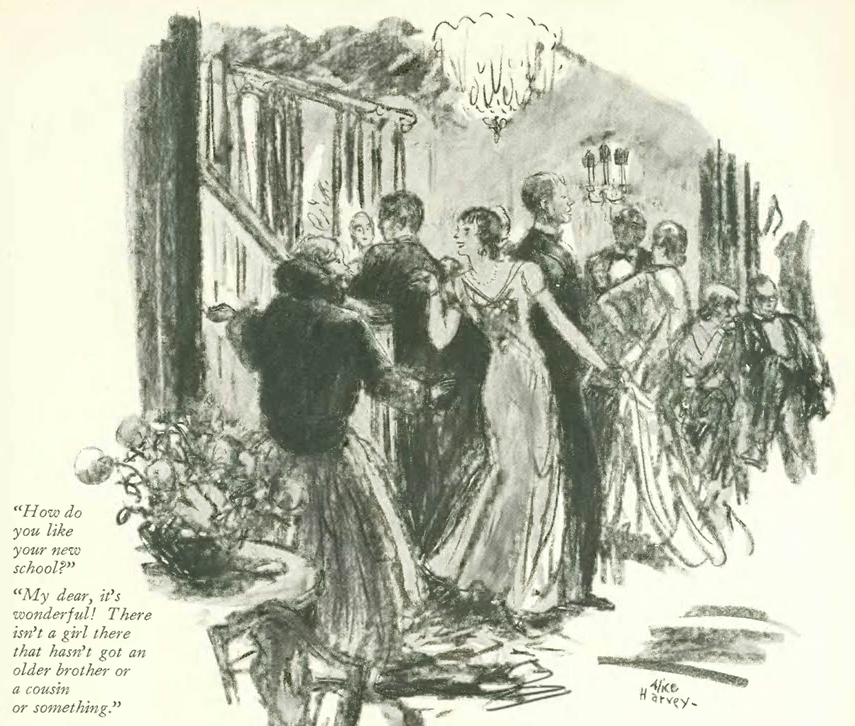
Alice Harvey also explored the college scene…

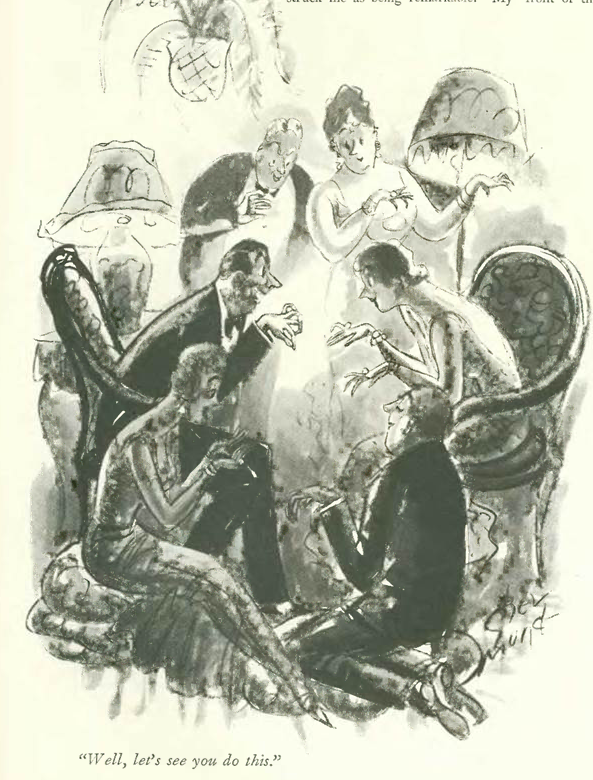
…some parlor games with Barbara Shermund

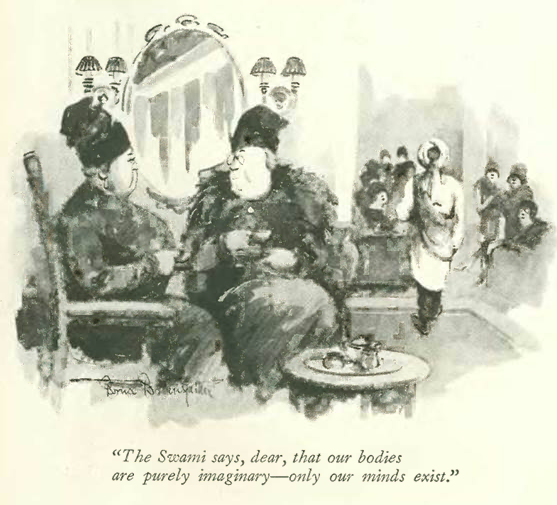
……Bruce Bairnsfather, and some existentialist chat at tea time…

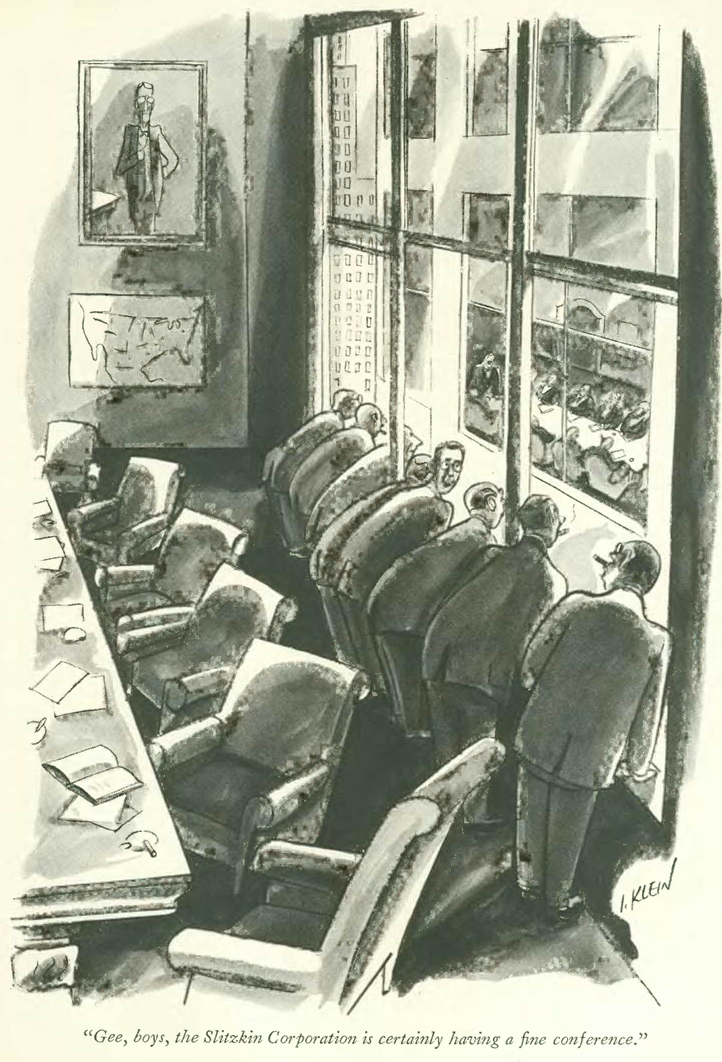
…and we close with Isadore Klein, and the world of corporate competition…

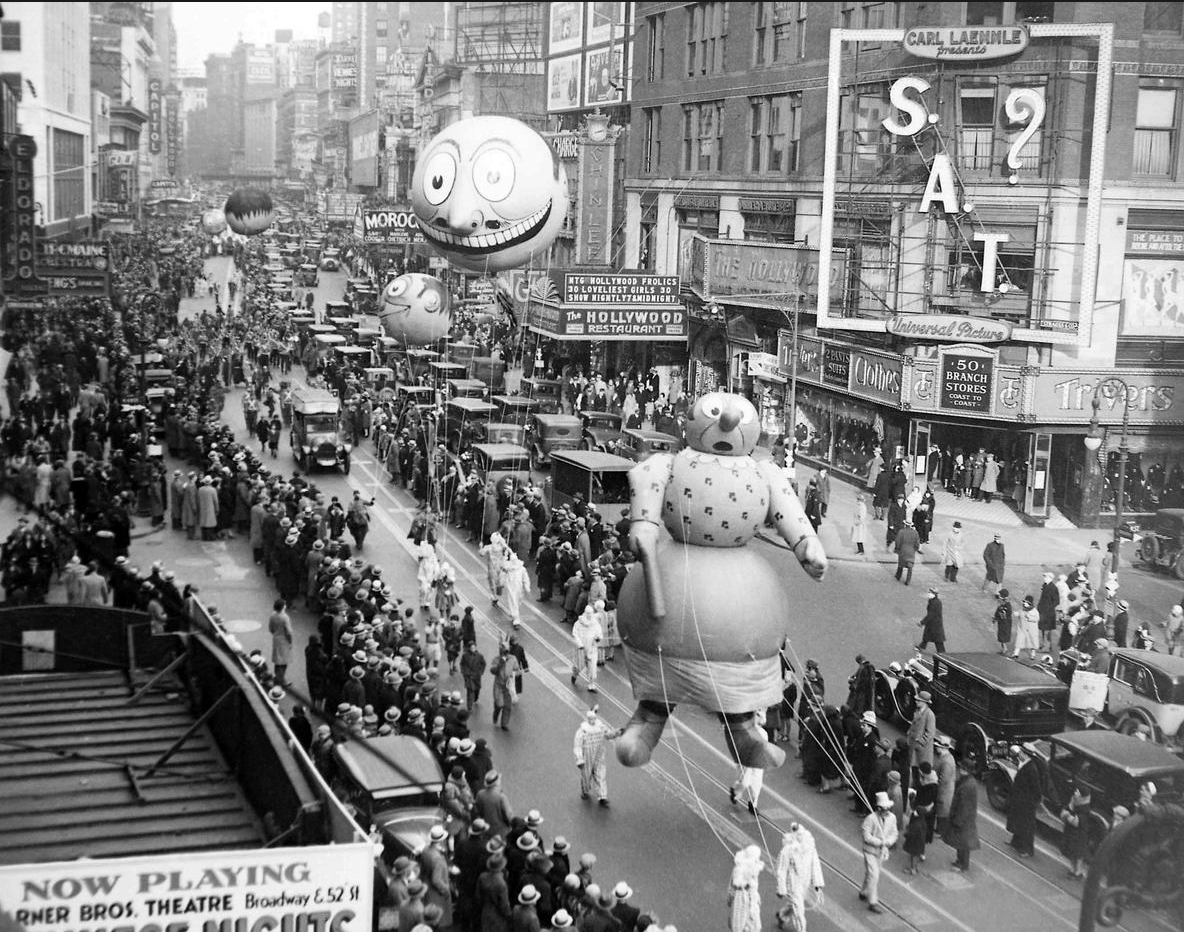
…and a Happy Thanksgiving, from the Macy’s Thanksgiving Parade 89 years ago, Nov. 27, 1930…

(CBS/Associated Press)

Next Time: The Future Was a Silly Place…


Leatherheads

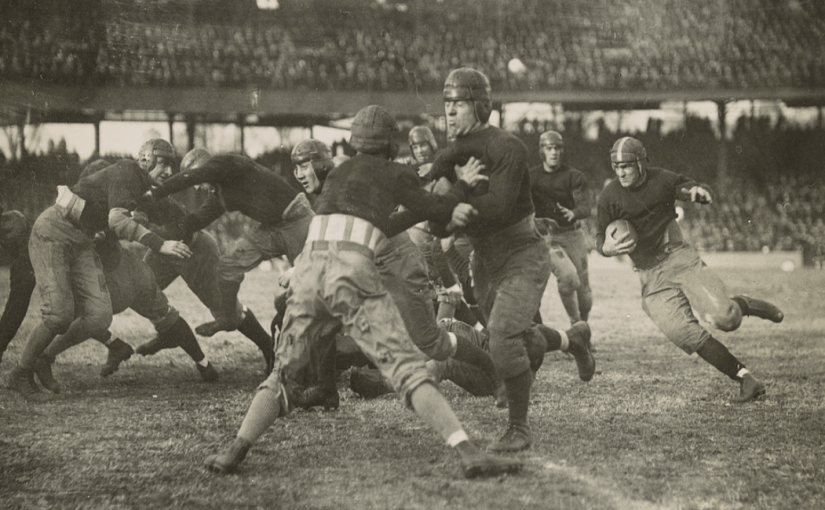
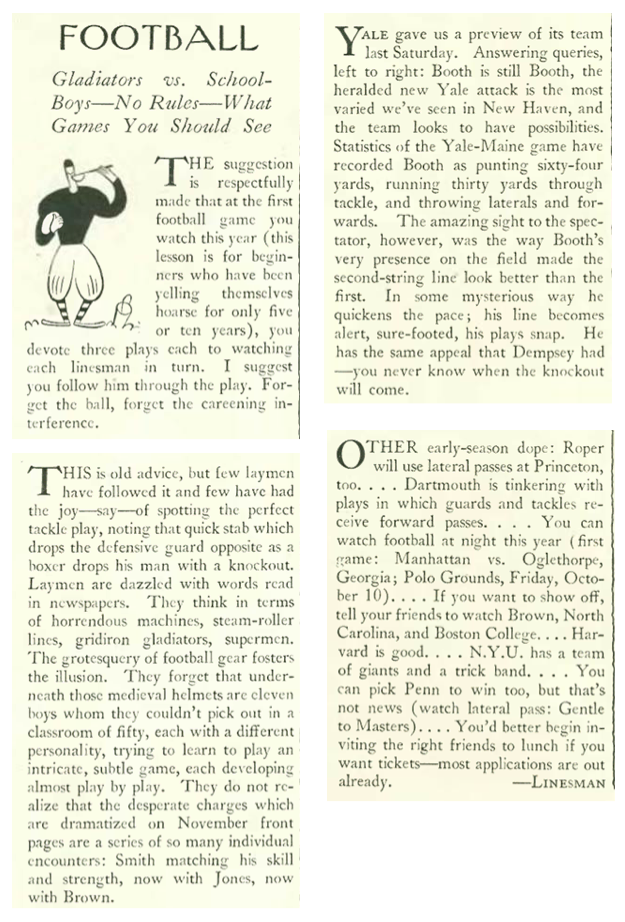
One thing you won’t see in today’s New Yorker magazine is extensive coverage of college football (more likely you’ll see an indictment of the game). In the magazine’s first years, however, that sport was enthusiastically embraced.

Oct. 4, 1930 cover by Rea Irvin.

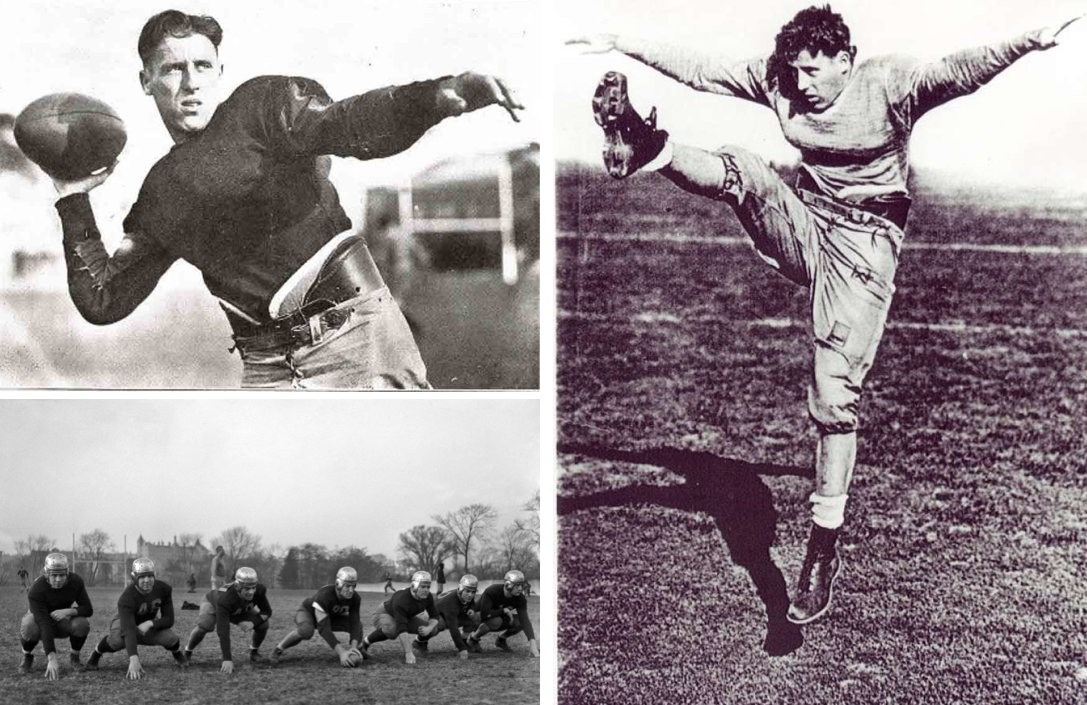
A writer identified by the alias “Linesman” assessed the early season’s prospects, and noted the return of Yale’s Albie Booth (1908–1959) to the field. Booth became famous during the previous season for his spectacular play against Army: Booth led Yale to an upset victory by scoring all of the team’s points (two rushing touchdowns, a 65-yard punt return for a touchdown, and three extra point kicks). Newsreels featuring the game sported the caption, “Booth 21, Army 13.”

GOOD THINGS COME IN SMALL PACKAGES…Top and left, only 5 feet 6 inches tall and 144 pounds, Albie Booth nevertheless could do it all on offense – running, passing, kicking. He was elected to the College Football Hall of Fame in 1966. Bottom, left, Fordham’s famed “Seven Blocks of Granite,” in 1936. In the days before he became a legendary coach, Vince Lombardi  served as one of those seven blocks (he is third from the left). (footballfoundation.org/yaledailynews.com/Associated Press)

 *  *  *

Foul Ball

While The New Yorker geared up to cover the college football season (as well as everything from Badminton to yacht racing), it continued to ignore professional baseball, mentioning its existence only in passing, such as this observation shared by Howard Brubaker in “Of All Things”…

Footnote: Simeon Fess (1861-1936) was a Republican Senator from Ohio known as an apologist for a very unpopular Republican Party.

  *  *  *

Not For The Kiddies

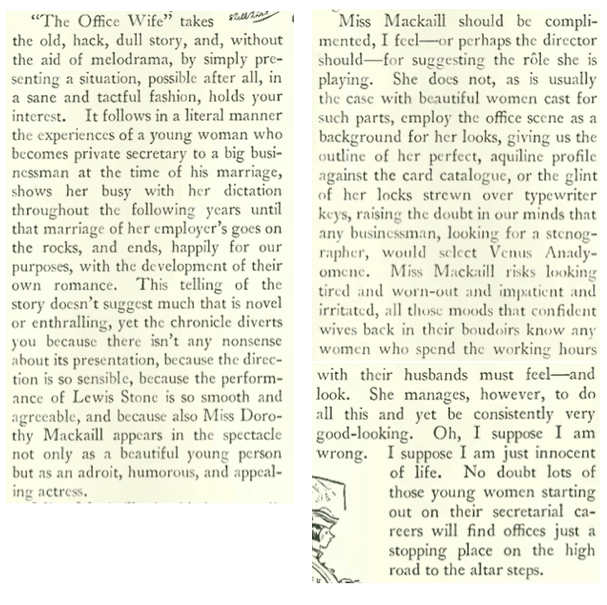
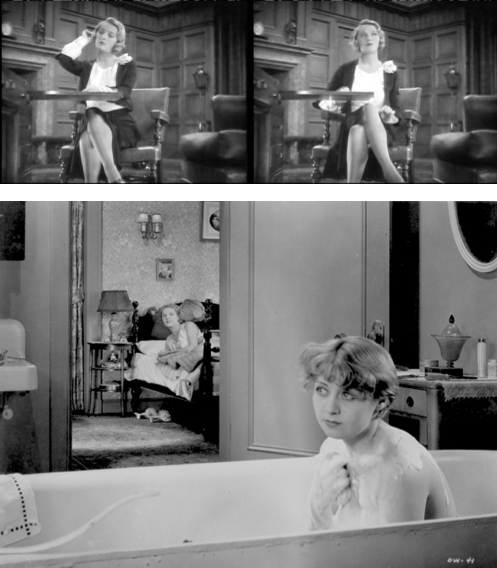
The Office Wife was a romantic drama featuring such “pre-Code” themes as infidelity and workplace hanky-panky. The film was the talking picture debut of Joan Blondell, who would become a big star in the 1930s and enjoy a long career that would include numerous appearances on television through the 1970s. Here are excerpts from John Mosher’s review of the film:

SHE TALKS! SHE BATHES! At top, Anne Murdock (Dorothy Mackaill) practices her charms in The Office Wife. Below, Anne’s younger sister Katherine (Joan Blondell) has a soak in the tub. It would be Blondell’s talking picture debut. (11east14thstreet.com/classicmoviefavorites.com)
SEX SELLS…Warner Brothers played up the salacious aspects of The Office Wife to generate interest among movie theater operators. (Pinterest)

While Joan Blondell was on the verge of a meteoric rise, one of the silent era’s biggest stars and sex symbols, Clara Bow (known as the “It Girl,”) was seeing her popularity wane in the sound era. After Her Wedding Night (reviewed here by Mosher) she would make just four more films before she would retire from the pictures at the ripe age of 28.

DOWN BUT NOT OUT…From left, Richard ‘Skeets’ Gallagher, Ralph Forbes and Clara Bow observe the hijinks of Charles Ruggles in 1930’s Her Wedding Night. Bow’s enormous popularity would quickly wane in the era of talking pictures. (IMDB)

*   *   *

Twin Peaks

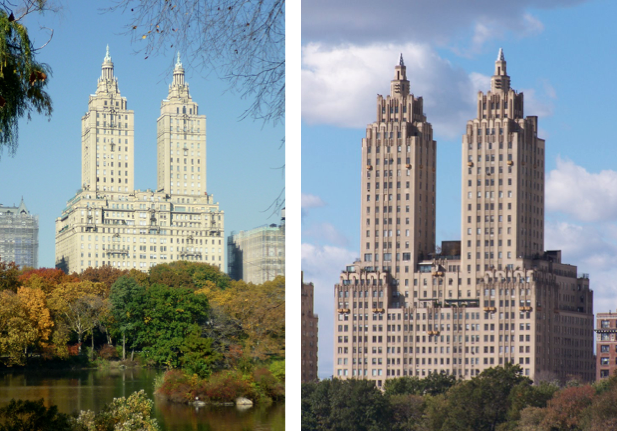
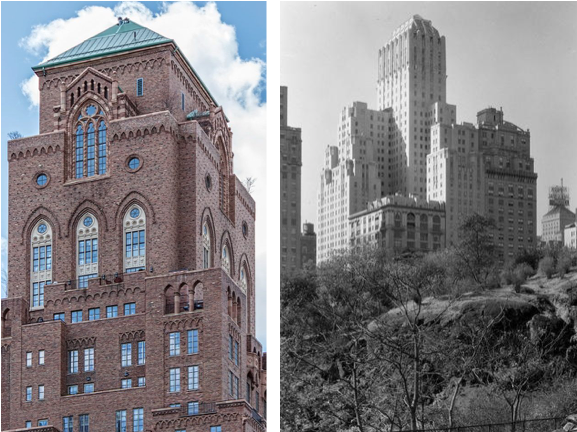
Architecture critic George Chappell chronicled the latest changes to the skyline surrounding Central Park, most notably Emery Roth’s landmark San Remo and El Dorado.

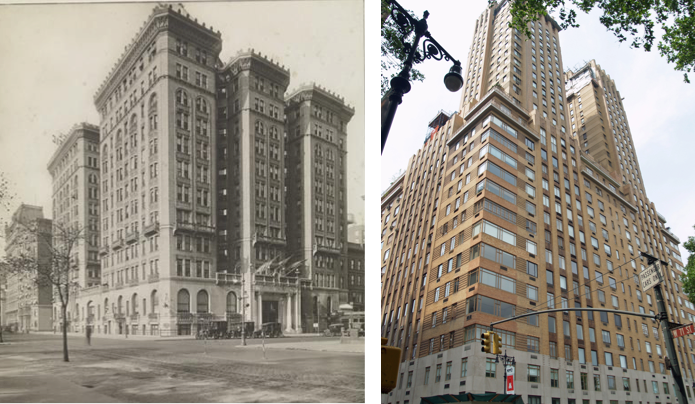
THIS TOWN AIN’T BIG ENOUGH FOR THE TWO OF US…New York’s original Hotel Majestic (left) stood for just 35 years before it was razed to make way for its bigger Art Deco successor, at right. (Pinterest/Wikipedia)
FRATERNAL TWINS…Architect Emery Roth designed both the San Remo at 145 Central Park West (left) and the El Dorado at 300 Central Park West. (Wikipedia/mapio.net)

 *  *  *

From Our Advertisers

“Cultural hotels” of the 1920s and 30s catered to college students as well as young professionals engaged in music or the visual arts. Two of these hotels shared the Barbizon name, and one in particular on East 63rd Street served as a combination charm school and dorm for young women who wanted a safe New York retreat while they pursued school or professional opportunities. For decades it would be home to many celebrities including Candice Bergen, Joan Crawford, Cybill Shepherd, Joan Didion, and Grace Kelly…

CULTURAL SIBLINGS…Opened in 1927, The Barbizon at 140 East 63rd Street (left) served for many decades as a female-only residential hotel, housing many celebrities before they became famous including Candice Bergen, Joan Crawford, Cybill Shepherd, Joan Didion, and Grace Kelly. At right, the Barbizon-Plaza, which opened in May 1930, was noted as the first music-art residence center in the U.S. (newyorkitecture.com/Museum of the City of New York)

…of course not everyone could afford the excitement of life among the rich and famous…some had to settle for lesser thrills…

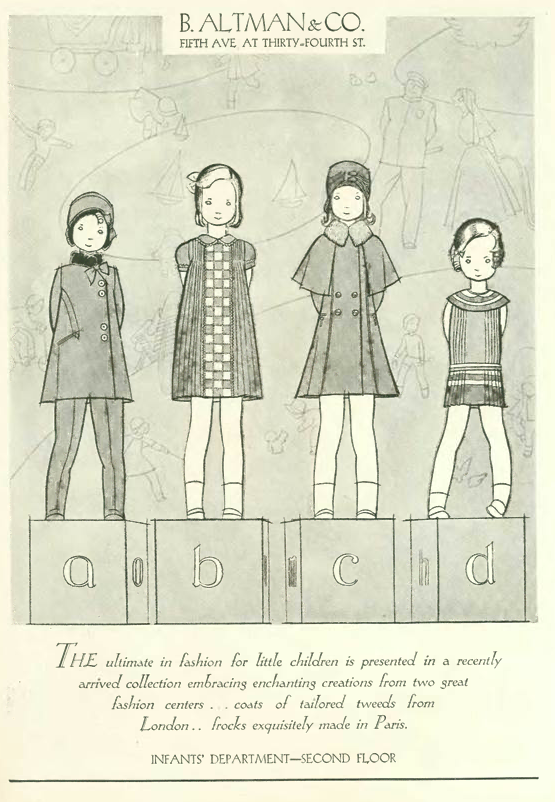
…on the other hand, these posh tots appeared to be destined for the Barbizon crowd…you can even sense that feeling of entitlement in their vacant little eyes…

…and for something completely different, another weird Flit ad, with Dr. Seuss

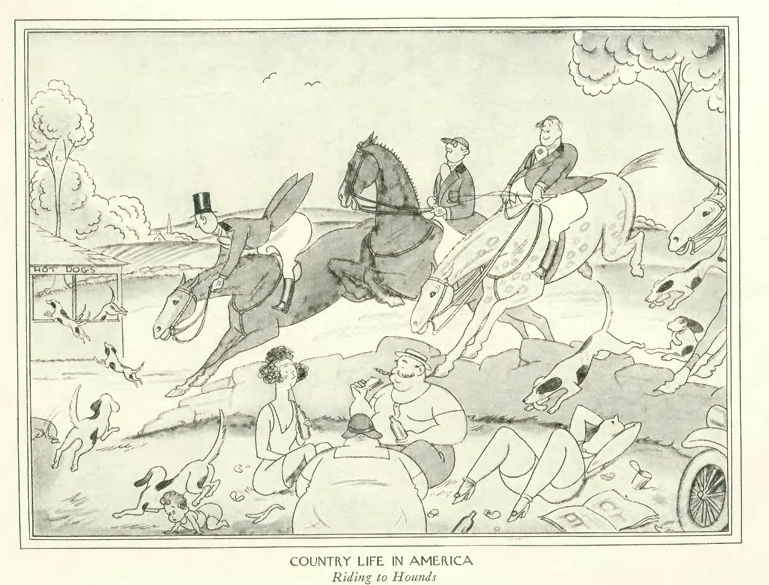
…on to our cartoons, another day in the country with Rea Irvin

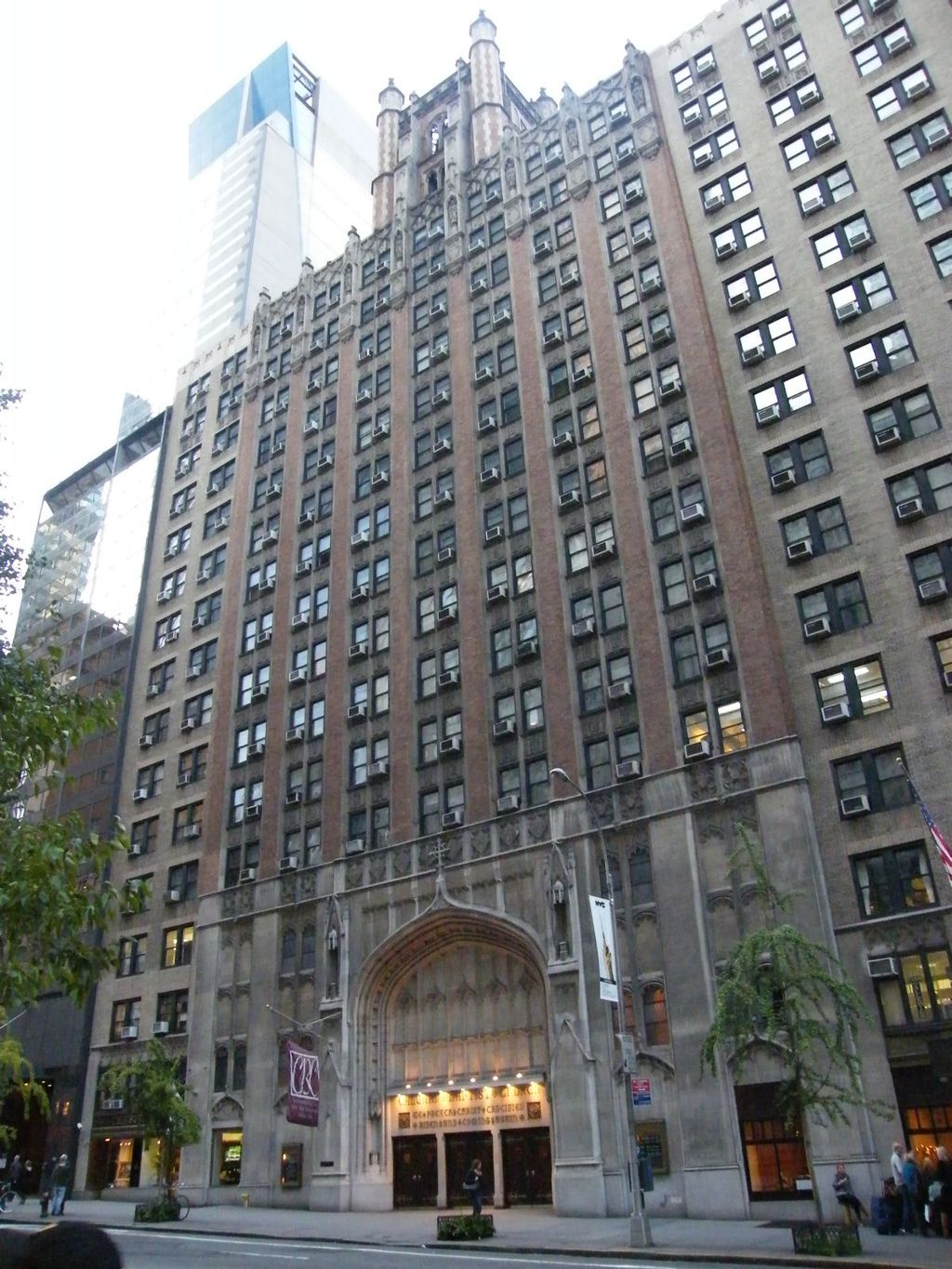
Alan Dunn found a young couple living above one of the city’s “skyscraper churches,” the result of valuable Manhattan church property being developed into a combinations of churches and hi-rise apartments…

…an example of a “skyscraper church” is Calvary Baptist Church at 123 West 57th…

(Wikipedia)

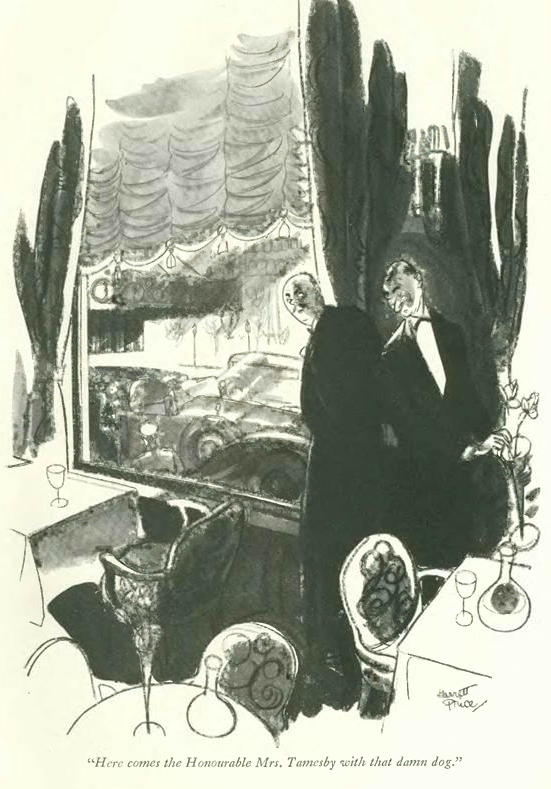
…closer to the street, we have a couple of high society waiters with low opinions of man’s best friend, courtesy Garrett Price

Barbara Shermund looked in on some gossip (paying special attention to the smoking habits of the smart set)…

…and we end with Robert Love’s sole contribution to The New Yorker

Next Time: Will It Play In Peoria?…

Hell’s Angels

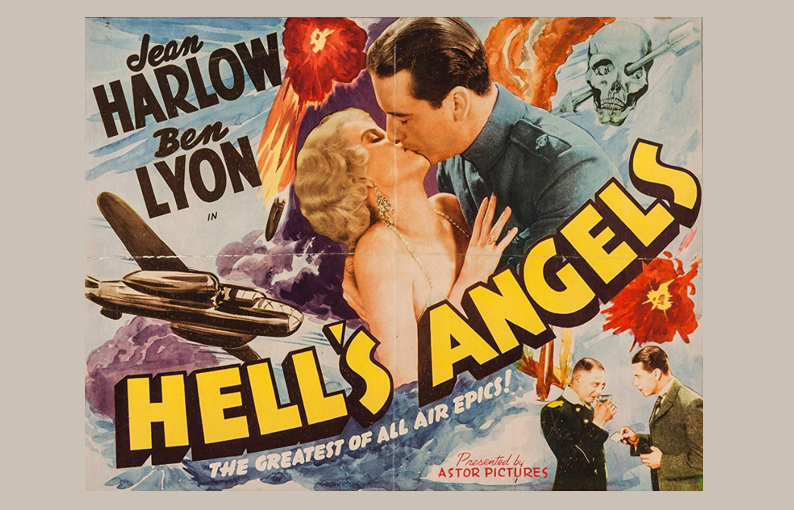
Among the films in 1930 that marked a new era in motion pictures was Howard Hughes’s epic war film Hell’s Angels. 

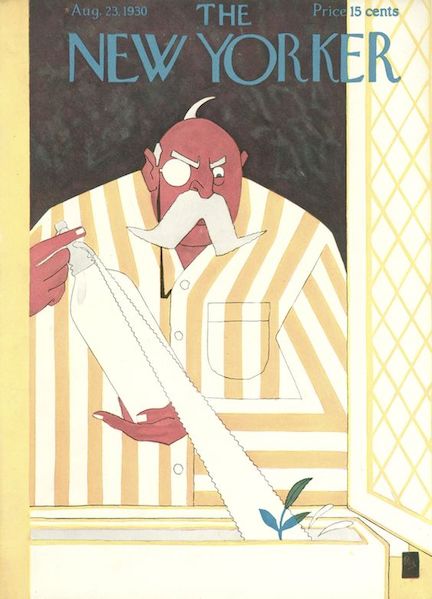
August 23 cover by Gardner Rea.

Originally shot as a silent, Hughes (1905-1976) retooled the film, and over a period of three years (1927-30) poured much of his own money into making what many consider to be Hollywood’s first sound action movie. The film also introduced audiences to 19-year-old Jean Harlow (1911-1937), handpicked by Hughes to replace Norwegian actress Greta Nissen in the lead role (Nissen’s accent posed a problem for the talkies). The film would make Harlow an instant star, propelling her to worldwide fame as the “Platinum Blonde” sex symbol of the 1930s.

Beset by delays due to Hughes’s incessant tinkering, the movie was famously expensive. For example, a total 137 pilots were used in just one flying scene at the end of the film. In addition to monetary costs, the filming also claimed the lives of three pilots and a mechanic, and Hughes himself would fracture his skull during a stunt flying attempt.

PRE-CODE…Before Will Hays imposed his moral code on Hollywood, films in the early thirties were frank with sexual references, as the image at left attests. When Howard Hughes switched the filming of Hell’s Angels to sound, he replaced Norwegian actress Greta Nissen with 19-year-old Jean Harlow (seen with co-star Ben Lyon). Harlow’s first major film appearance would make her an overnight star; at right, Frank Clarke and Roy Wilson flying an S.E.5A (front) and a Fokker D.VII (back, note camera) in the filming of Hell’s Angels. (Wikipedia)

The New Yorker’s John Mosher found the action scenes enticing, but the acting left something to be desired…

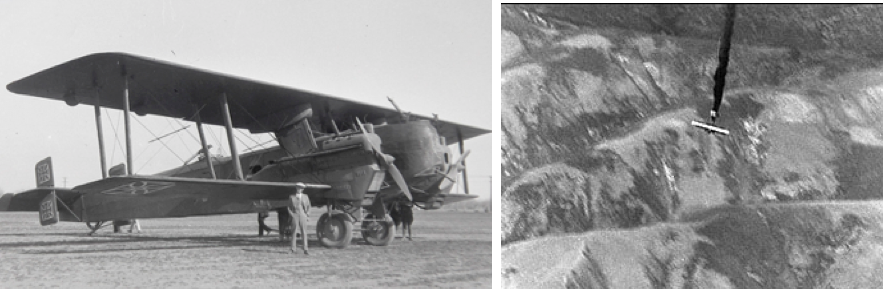
COSTLY VENTURE …This Sikorsky S-29A (left), repainted to represent a German Gotha bomber, would crash into the California hills during filming (right), killing mechanic Phil Jones, who failed to bail out along with the pilot. (Northrop Grumman)
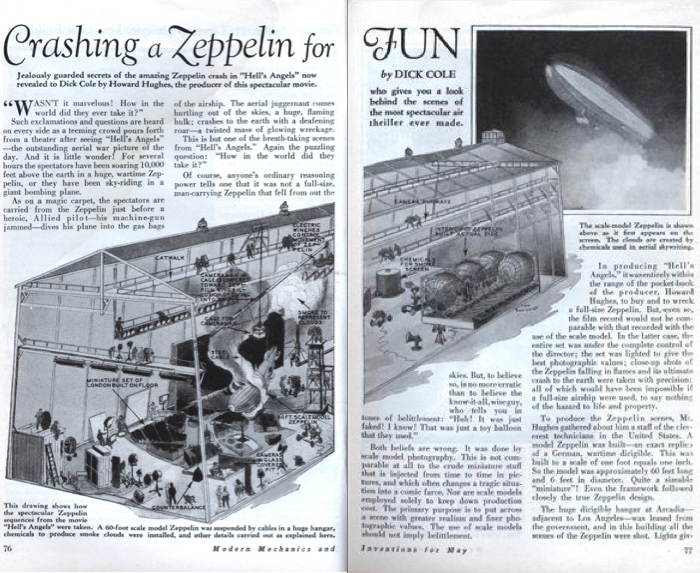
GEE WHIZ…The media often reported on the progress of the film, such as in this May 1930 article in Modern Mechanics and Inventions that detailed a $1 million sequence in which a fighter dives his plane into the top of a Zeppelin, causing it to explode and crash to earth. (Modern Mechanix)

We skip ahead briefly to the Aug. 30 issue, in which “The Talk of Town” featured a mini profile of Howard Hughes and his film. Note how Hughes’s extravagance is described through his frequent use of long-distance telephone calls:

A STAR IS BORN…19-year-old Jean Harlow and Ben Lyon in 1930’s Hell’s Angels. (IMDB/Pinterest)

*  *  *

A Whale of a Movie

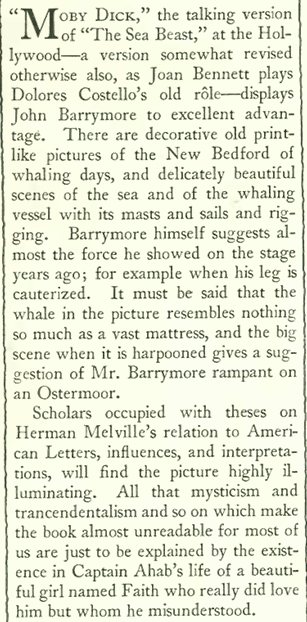
Critic John Mosher also took in a film adaptation of Herman Melville’s Moby Dick, a very loose adaptation that excluded the novel’s central character, Ishmael, and invented a love story for the maniacal Capt. Ahab…

A WHALE OF A STORY…From left, Noble Johnson as Queequeg, John Barrymore as Ahab, and Walter Long as Stubbs in 1930’s Moby Dick. At right, top, the whale puts the hurt on a boat; bottom, Joan Bennett as Faith, a contrived love interest for the old salt. (IMDB)

 *  *  *

Daily Dazzle

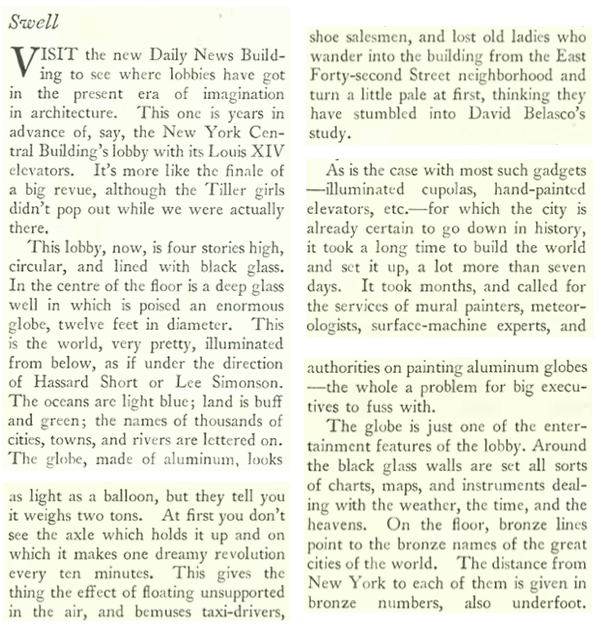
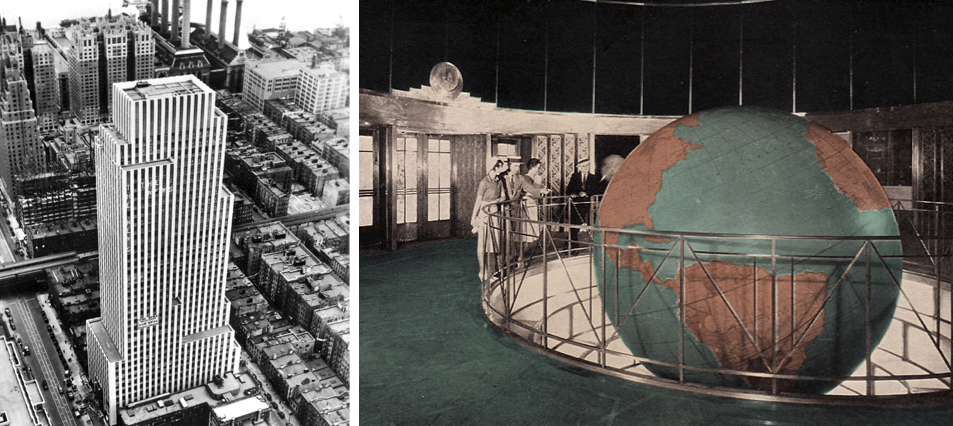
“The Talk of the Town” gushed over the lobby of the new Daily News Building, likening it to the glitz of a Broadway revue:

HOME FOR CLARK KENT…The Daily News Building served as the model for the headquarters of the fictional Daily Planet, the building where Superman worked as mild-mannered Clark Kent; at right, an image from 1941 of the lobby, dominated by the world’s largest indoor globe. (Wikipedia/Public Domain)
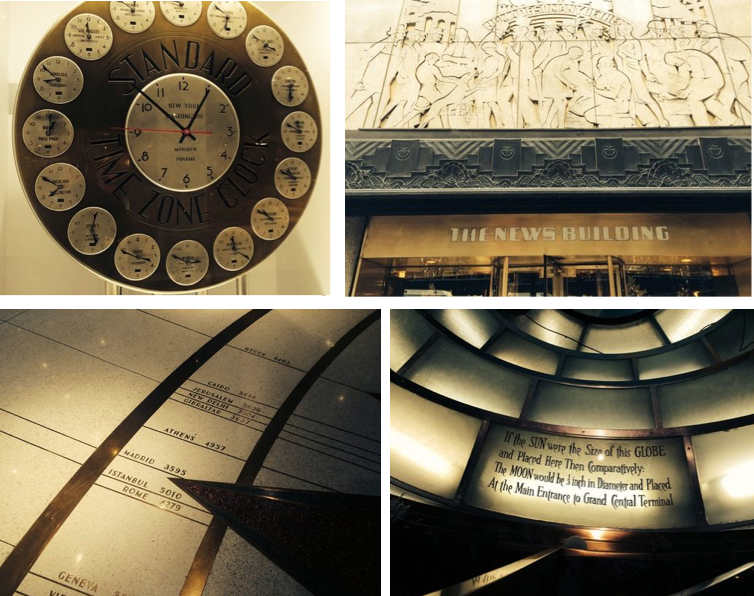
A LOBBY FOR LEARNING…The lobby includes an array of clocks, top left, that give the time in various global destinations. (Luke J. Spencer via atlasobscura.com)

 *  *  *

A Busboy’s Dream

Charles Pierre Casalasco left his life as a busboy in Corsica and studied haute cuisine in Paris before arriving at the shores of Manhattan in the early 1900s. He became a renowned headwaiter who by 1929 garnered enough financial backing from New York’s most powerful families to construct the exclusive Hotel Pierre. Writing under her pseudonym, “Penthouse,” New Yorker columnist Marcia Davenport described the building’s apartments to eager readers:

FUN WHILE IT LASTED…The 41-story, 714-room Hotel Pierre officially opened in October 1930 to great fanfare. The party would be short-lived, as the deepening Depression would force the hotel into bankruptcy just two years later. At right, photo of the Rotunda, before a 2017 remodeling. (New York Public Library)

 *  *  *

So Much For Title IX

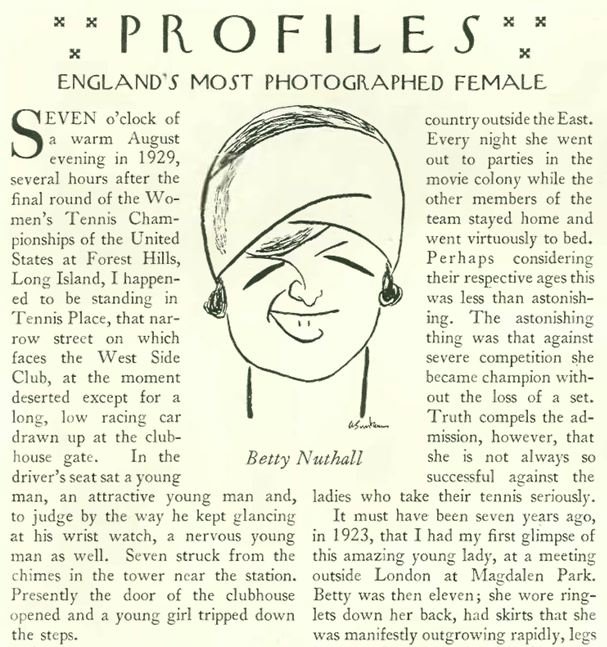
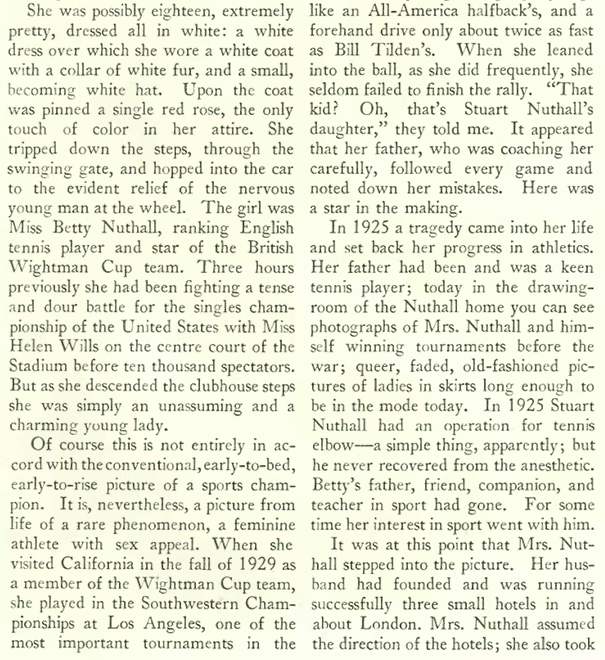
Then as now, women athletes were held to a separate set of standards, not only judged for their athletic abilities, but also for their “sex appeal,” as John Tunis suggests more than a few times in his profile of English tennis champion Betty Nuthall (1911-1983). Excerpts:

HOW’S THAT BACKHAND?…Betty Nuthall greets American tennis star Bill Tilden in September 1930; on the cover of Time after winning the 1930 U.S. Open. (Digital Commonwealth/Time Inc.)

 *  *  *

Free Expression

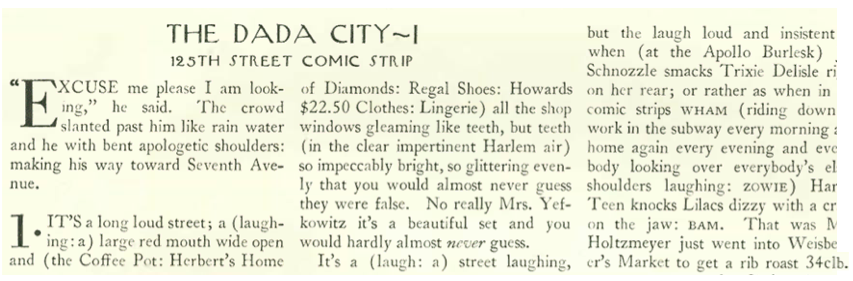
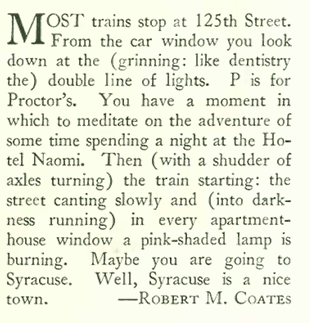
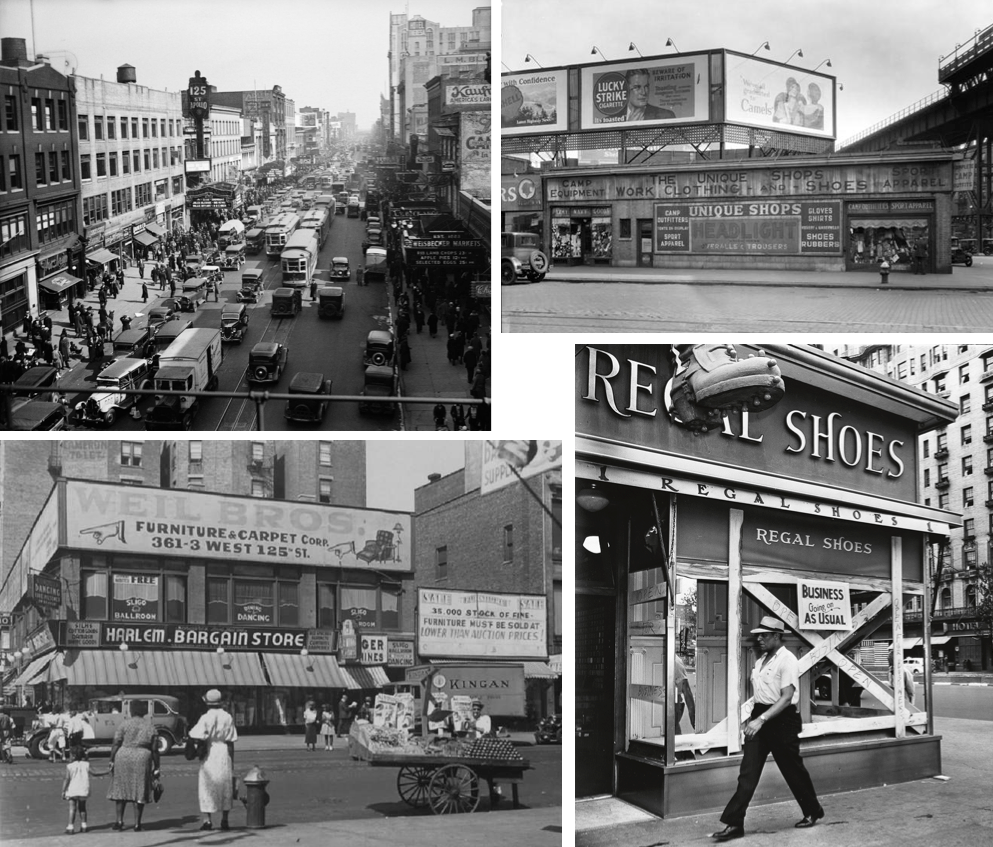
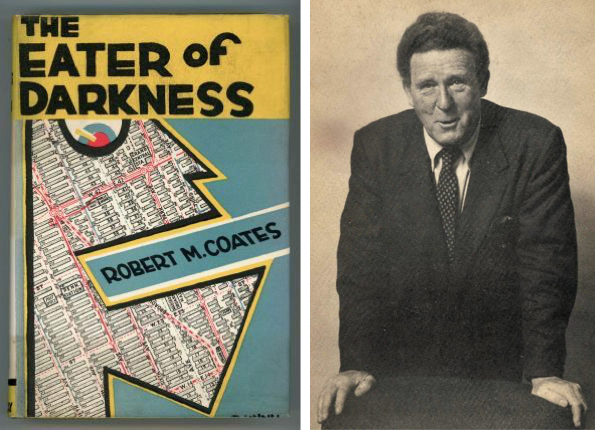
Robert Myron Coates (1897–1973) was a writer of experimental, expressionistic novels who later became a longtime art critic for The New Yorker (he is credited with coining the term “abstract expressionism” in 1946). In the Aug. 23 issue he contributed the first installment of “Dada City,” here describing street life in Harlem. Excerpts:

STREET LIFE…Scenes around Harlem’s 125th Street, clockwise from top left: the Apollo Theatre marquee punctuates a busy street scene in 1935; NW corner of 125th and Broadway, 1930; Regal Shoes storefront, 1940s, photo by Weegee; 125th and St. Nicholas Avenue in 1934. (Skyscraper City/Museum of the City of New York)
AMERICAN ORIGINAL…Robert M. Coates’s The Eater of Darkness (1926) has been called the first surrealist novel in English. (Goodreads)

 *  *  *

From Our Advertisers

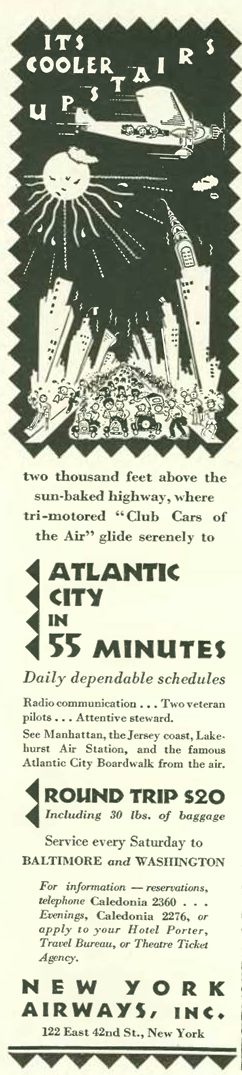
New Yorkers who were still enduring the brutal summer of 1930 could find relief, if they could afford it, on a New York Airways flight…

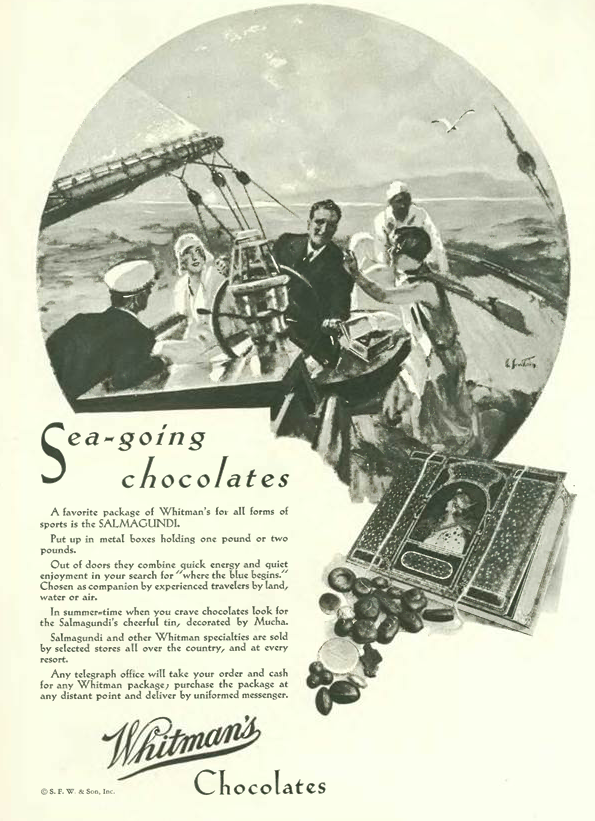
…or if you had the means, you could take your yacht out to sea, like this chap in a coat and tie who calmly steers with one hand while offering a box of chocolates to his guests with the other…

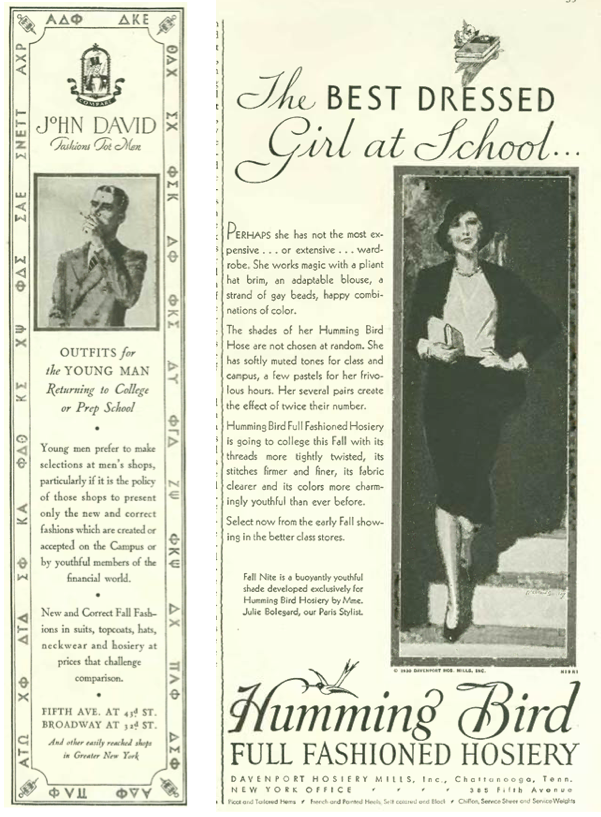
…our sailor wasn’t the only one dressed to nines…here are two ads offering suggestions to young folks returning to college or prep school…

…for comparison, this is how a group of college students at Columbia University dress today…

(Columbia University)

Dr. Seuss continued to crank out drawings on behalf of Flit insecticide…

…and on to cartoons, yet another rerun (the sixth) of this Peter Arno drawing with a new caption (Dorothy Dix was a popular advice columnist)…

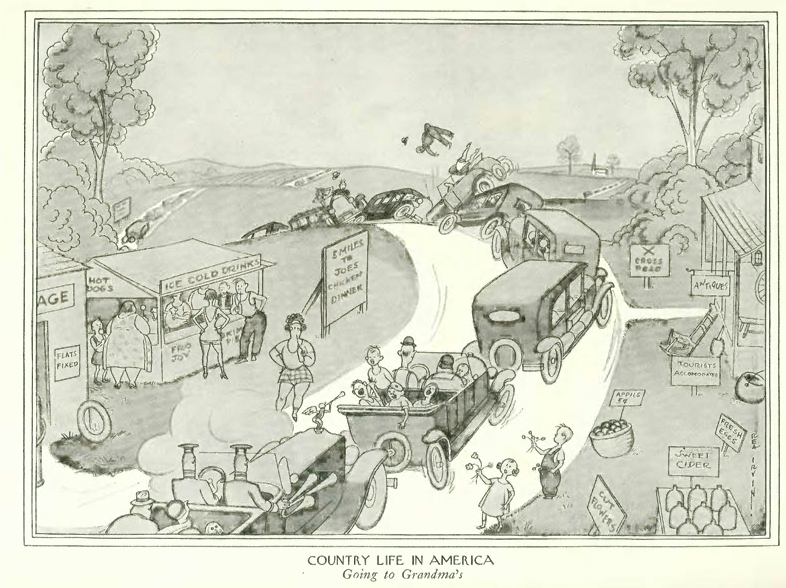
…and another look at country life courtesy Rea Irvin (originally printed sideways on a full page)…

…and another country scene, this time among the toffs, thanks to Garrett Price

…back in the city, some parlor room chatter as depicted by Barbara Shermund

…downtown, Isadore Klein looked at the economic challenges of peep shows…

…and we close with this reflection on city life, by Reginald Marsh

Next Time: Marble Halls…

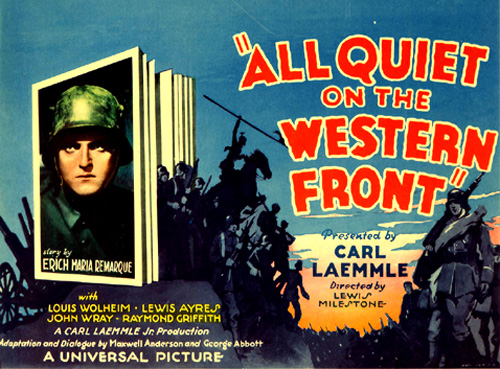
All Quiet on the Western Front

Still considered one of the greatest anti-war films ever made, All Quiet on the Western Front opened in New York on April 29, 1930 to strong reviews. Based on Erich Maria Remarque’s novel of the same name, the film’s depictions of the horrors of war were so realistic and harrowing that it was banned in a number of countries outside of the U.S.

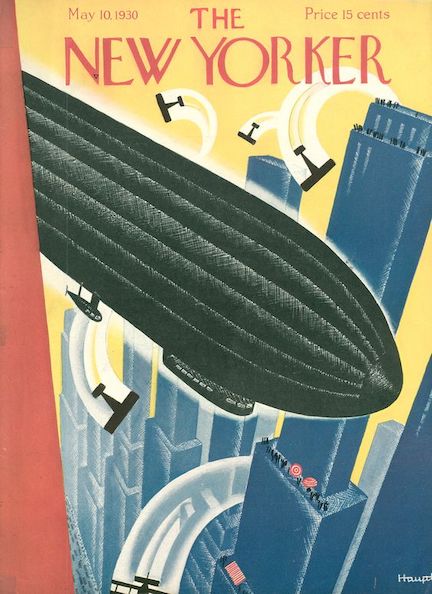
May 10, 1930 cover by Theodore Haupt.

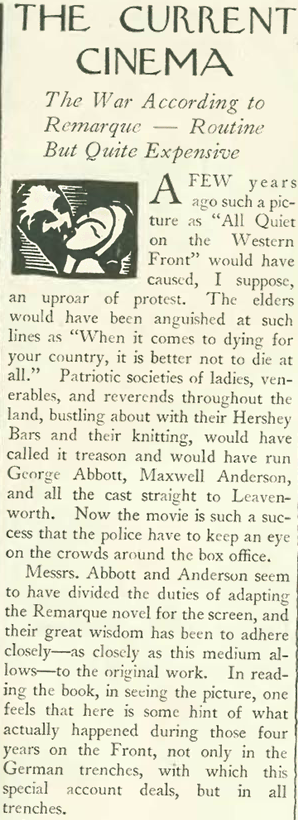
Banned, that is, by nations gearing up for war. In Germany, Nazi brownshirts disrupted viewings during its brief run in that country, tossing smoke bombs into cinemas among other acts of mayhem. Back in the U.S., The New Yorker’s John Mosher attended a screening at a “packed” Central Theatre:

WAR IS HELL…Clockwise, from top left, movie poster for 1930’s All Quiet on the Western Front; German soldier Paul Bäumer (Lew Ayres), falls into a shell crater with a French soldier and draws his knife; in one of the most moving scenes in cinema, Bäumer is forced to spend the night in the crater, where he vainly tries to safe the life of the Frenchman he has mortally wounded; a German soldier crawls through the mud in a German training camp. (IMDB/Universal).

Mosher found the film’s adaption from the novel wanting in places, but overall praised the acting and the quality of the picture…

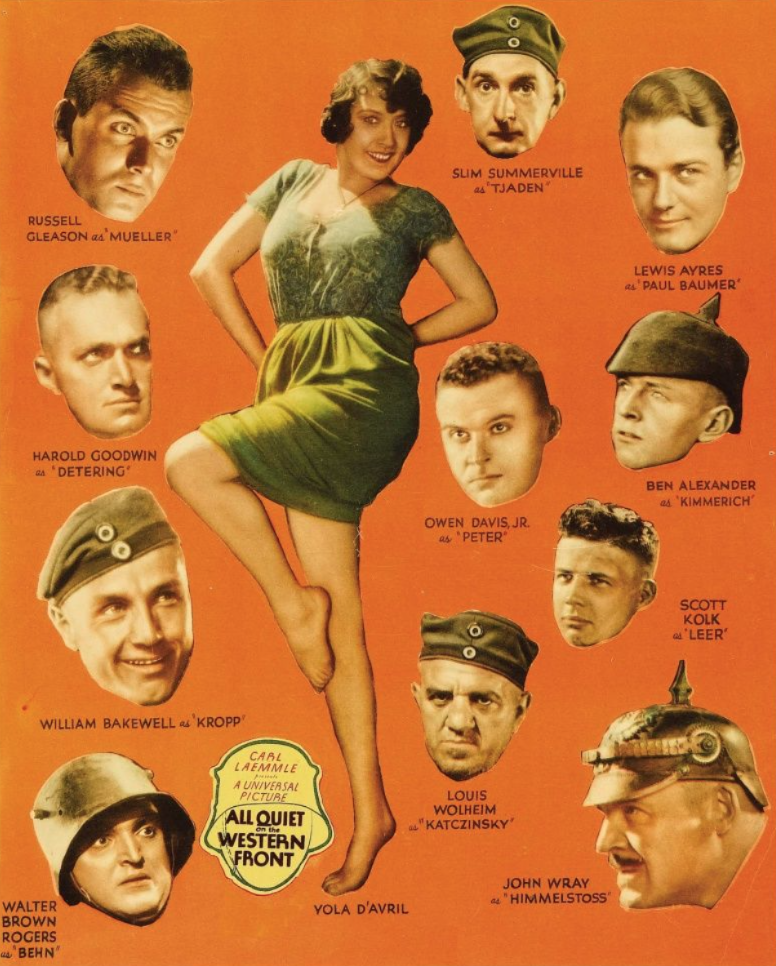
…and just in case some audiences were put off by the blood and guts, Universal promoted other themes on its lobby cards…

(IMDB)

 *  *  *

More Than a Stunt

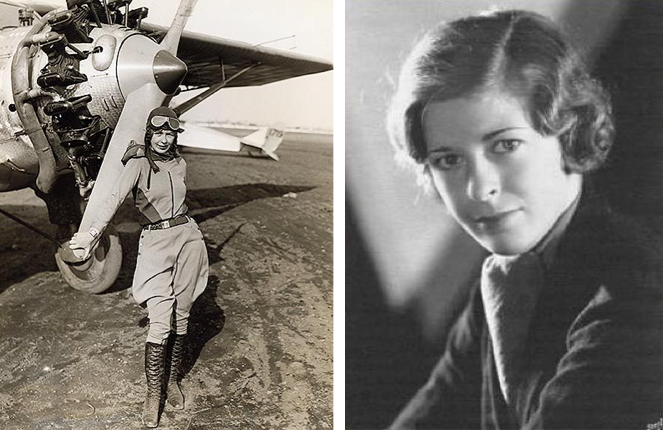
In her profile of aviator Elinor Smith (1911-2010), writer Helena Huntington Smith took great pains to distinguish Elinor from other “lady fliers” who were little more than passengers in various flying exploits. Like Amelia Earhart, Smith had the bona fides of a true aviator: in 1927 she become the youngest licensed pilot in the world at age 16, learning stunt flying at an early age. When she was 17 she smashed the women’s flying endurance record by soloing 26½ hours, and in the following month set a woman’s world speed record of 190.8 miles per hour. In March 1930 she set a women’s world altitude record of 27,419 feet (8,357 m), breaking that record in 1931 with a flight reaching 32,576 feet. Smith would continue to fly well into old age. In 2000 she flew NASA’s Space Shuttle vertical motion simulator and became the oldest pilot to succeed in a simulated shuttle landing. In 2001 (at age 89) she would pilot an experimental flight at Langley AFB. An excerpt from the profile:

HEAD IN THE CLOUDS…Elinor Smith’s flying career would extend from age 16 and into her 90s. At left, Smith poses in Long Island with the Bellanca monoplane she used to beat the solo flight record in 1929. Right, portrait of Smith circa 1930s. (findagrave.com)

 *  *  *

I’d Rather Be in Philadelphia

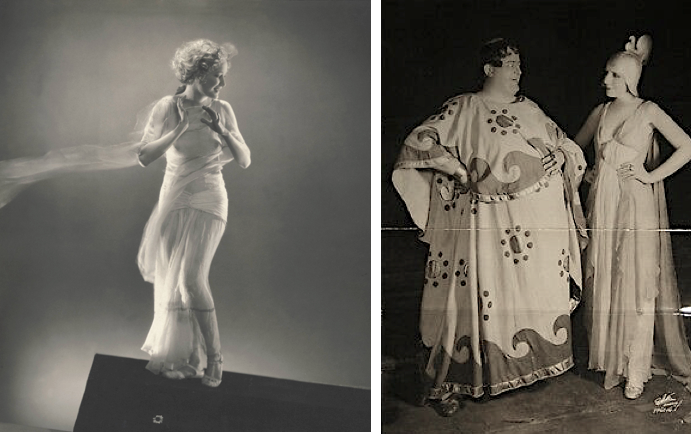
Theatre critic Robert Benchley was over the moon regarding a performance of Lysistrata staged by the Philadelphia Theatre Association. Benchley suggested the Philadelphians had “put New York to shame” in staging such a “festival of beauty and bawdiness…never seen on an American stage before.”

NO MORE HANKY PANKY…Left, actress Miriam Hopkins in Aristophanes’ Lysistrata, as photographed by Edward Steichen; at right, Sydney Greenstreet with unidentified actress from the 1930 Philadelphia production of Lysistrata. (timeline.com)

Benchley praised the seemingly advanced tastes of Philadelphia audiences as he continued to the lament the fact that the City of Brotherly Love had beaten New York to the punch with the staging of the play. He needn’t have worried much longer; the play would open on Broadway on June 5, 1930, at the 44th Street Theatre.

LOVER COME BACK…Production photograph for Norman-Bel Geddes’s staging for Lysistrata, titled “the women of Greece return to their men.” (hrc.utexas.edu)

While we are on the subject of theater, Constantin Alajálov provided this lovely illustration of Anton Chekhov’s Uncle Vanya for The New Yorker’s theater review section…

 *  *  *

Make ‘Em Dance, Boys

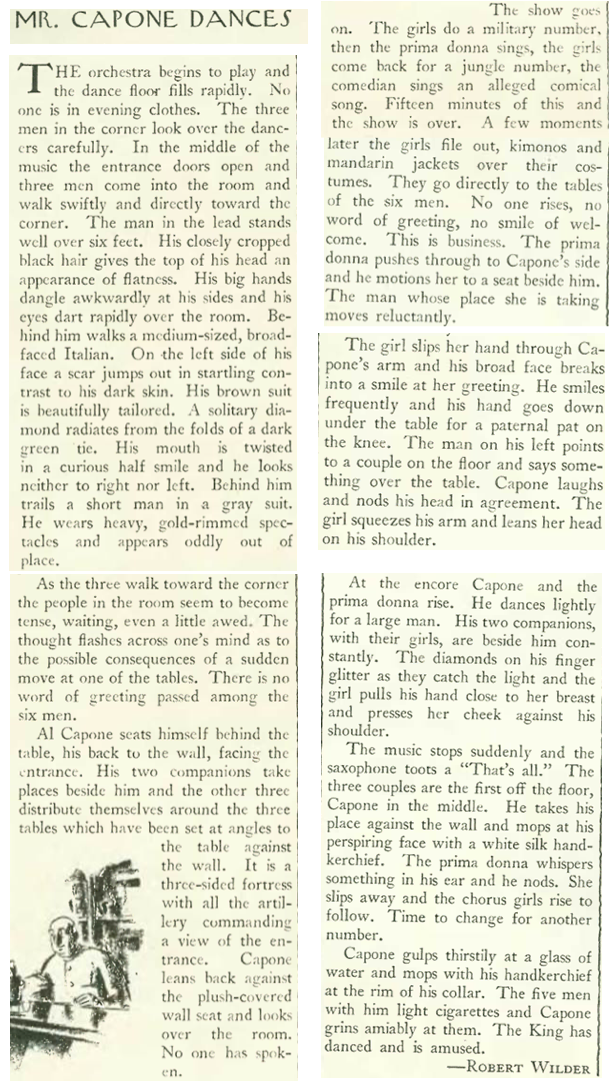
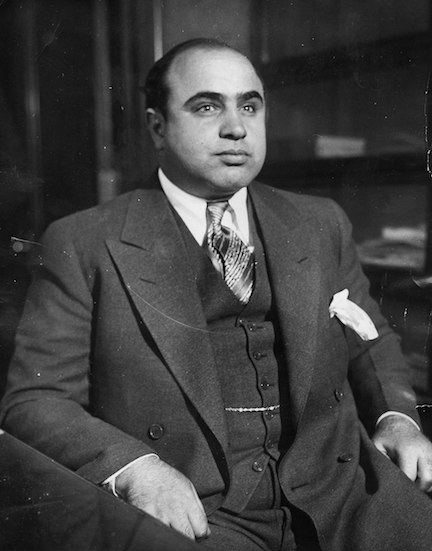
The author Robert Wilder contributed this interesting casual about the appearance of gangster Al Capone at a Chicago nightclub. Excerpts:

LIGHT ON HIS FEET…Al Capone in 1930. (Wikipedia)

 *  *  *

You Say You Want a Revolution?

Alva Johnston offered his thoughts on how America could stage its own “Red Revolution,” given that Russia and several European countries had already experienced communist uprisings of their own, and also given that New York Police Commissioner Grover Whalen, always in search of problems that didn’t exist, had announced a new “Red Scare” in his fight against communism.

Tongue firmly in cheek, Johnston suggested how American know-how could be brought to bear in inciting a Red Terror. An excerpt:

YANKEE INGENUITY…Alva Johnston, left, offered some innovative ideas for a uniquely American “Red Revolution.” At right, soldiers stand behind a barricade during Germany’s communist Spartacist uprising of January 1919. (Wikipedia)

 *  *  *

Speaking of Revolutionaries

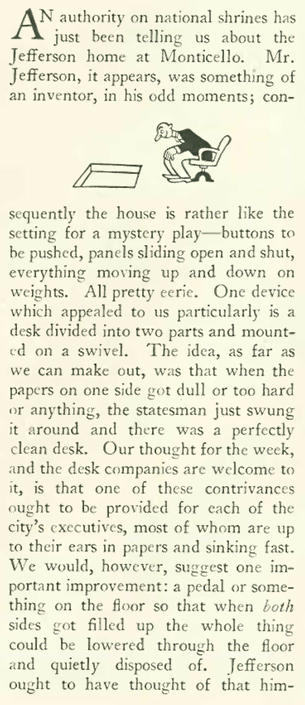
Thomas Jefferson’s home at Monticello is one of America’s most-visited historical sites, but in 1930 it was still something of a regional curiosity, having only been acquired in 1923 for the purposes of turning it into a public museum. Although Jefferson is well known today for his various inventions at Monticello, E.B. White was just learning about this side of the president in his weekly “Notes and Comment” dispatch:

THIS OLD HOUSE…Left, a combination of neglect and Civil War vandalism left Thomas Jefferson’s Monticello enmeshed in weeds and in a state of near collapse by the 1870s. At right, students of the University of Virginia pose outside Monticello in 1930. (UVA/Hulton Archive)

 *  *  *

Play Ball?

We are well into the spring of 1930, yet The New Yorker stood firm in its complete lack of baseball coverage. As I’ve noted before, the magazine covered virtually every sport from horse racing to rowing to badminton, and even lowered itself to regular features on college football and professional hockey, but not a line on baseball, save for an occasional note about the antics of Babe Ruth or the homespun goodness of Lou Gehrig. There were signs, however, that baseball was being played in a city blessed with three major league teams; we do find game times in the “Goings On About Town” section, as well as occasional baseball-themed filler art, and a comic panel in the May 10 issue by Leonard Dove:

From Our Advertisers

We begin with an endorsement for Chase & Sanborn coffee by the soprano Alma Gluck, wife of famed violinist and composer Efrem Zimbalist Sr. Originally I thought she was enjoying coffee with a sister in law named “Mrs. Zimbalist,” but as reader Frank Wilhoit astutely points out, the “Alma Gluck” (celebrity) and “Mrs. Zimbalist” (housewife) are alternate personae of the same individual. And now that I look at the ad again, the clothes and hair styles are identical. I will try to locate a clearer image of the ad…

…and from the makers of White Rock we have a group of swells and their airborne friends enjoying some bubbles that are doubtless mixed with illegal hootch…

Dr. Seuss continued to offer his artistry on behalf of Flit insecticide…

…and on to our cartoons, Peter Arno illustrated the hazards of the road…

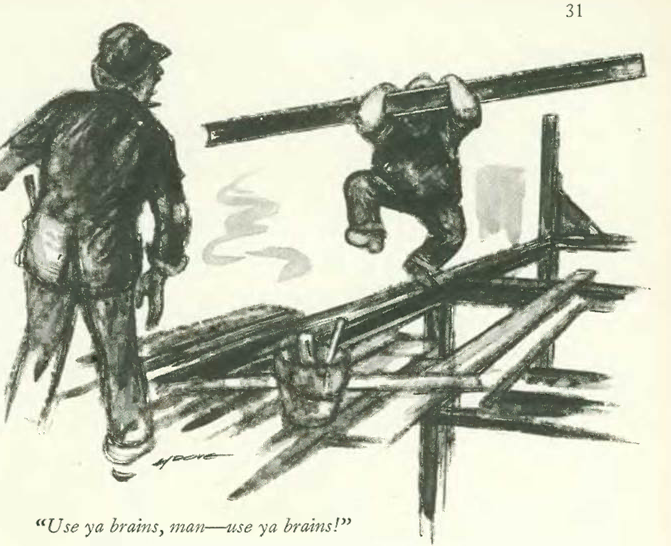
…while Leonard Dove explored the hazards high above the streets of Manhattan…

Constantin Alajálov explored an odd encounter in a park…

Isadore Klein mused on the tricks of mass transit…

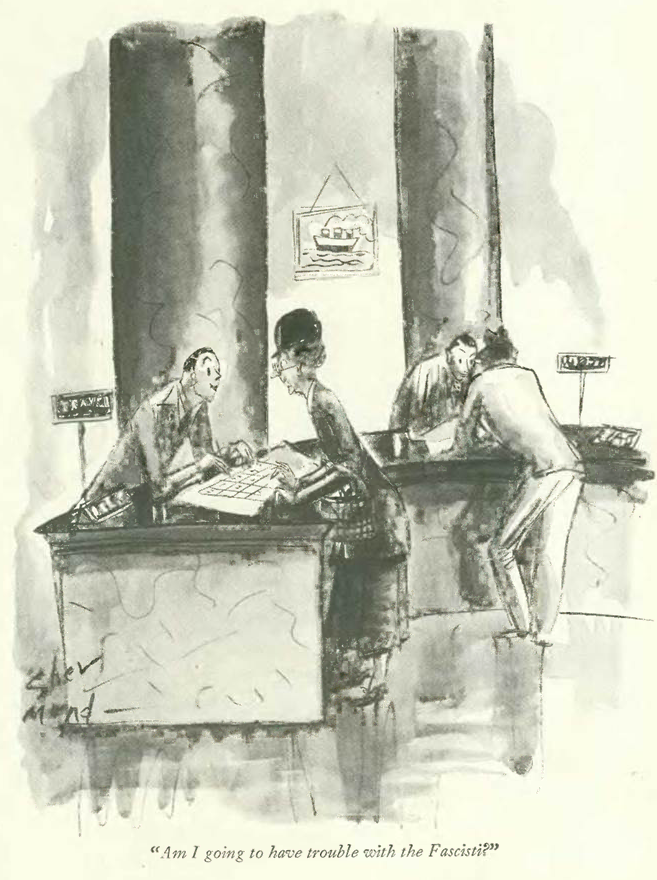
…and two from Barbara Shermund, who looked in on one tourist’s plans for a trip to Mussolini’s Italy…

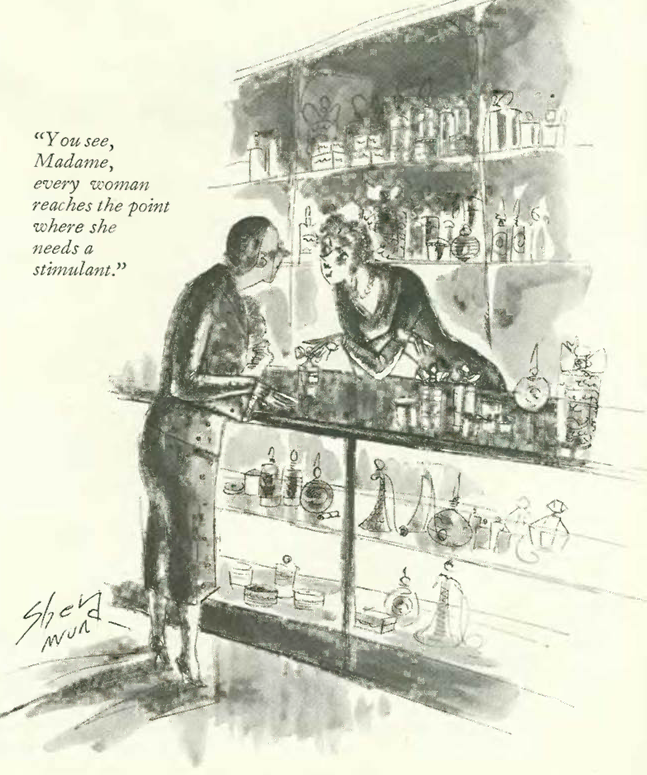
…and some helpful advice at a perfume counter…

Next Time: Red Alert…


Strike Up the Band!

Before we launch into the Jan. 25 issue, the rendering of the old New York Aquarium in this Sue Williams cover bears some consideration.

Jan. 25, 1930 cover by Sue Williams.

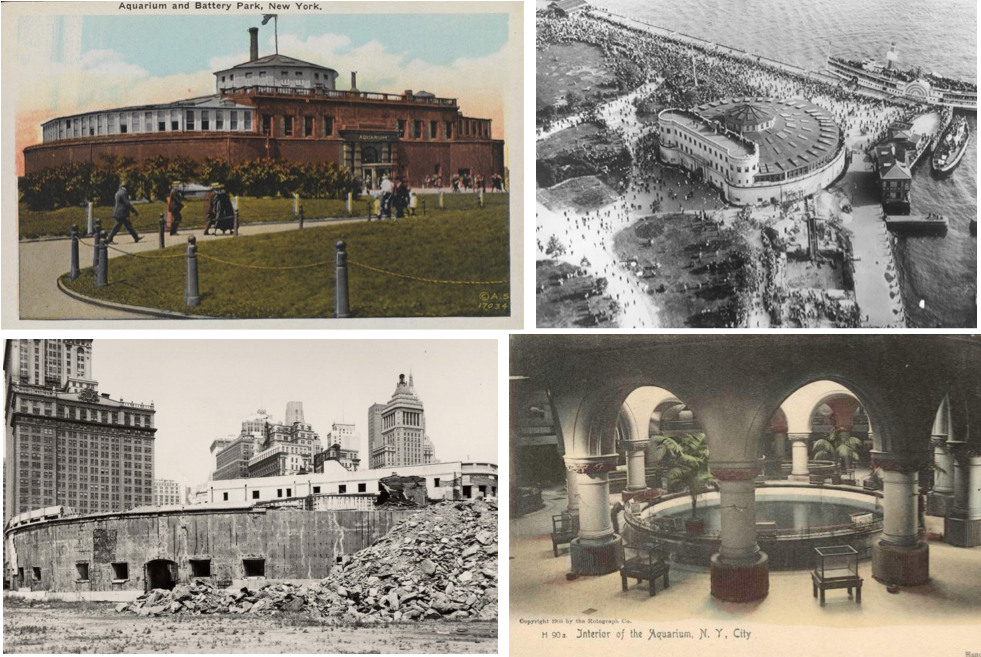
The aquarium was housed within the historic walls the South West Battery, constructed off the tip of Manhattan between 1808 and 1811 as a defense against the British. Renamed Castle Clinton in 1817 (in honor of former Mayor/Governor Dewitt Clinton), it was deeded to the city in 1823 to be used as an entertainment center. From 1855 to 1890 it served as an immigrant landing depot, then remodeled in 1896 (by the architectural firm McKim, Mead, and White) to become the popular New York City Aquarium.

FISH OUT OF WATER…Postcard image of the New York City Aquarium from the early 1900s; aerial view of the aquarium circa 1934; postcard image of aquarium interior; demolition of the aquarium in 1941, on orders from city planner Robert Moses. (thebattery.org/nycgovparks.org)

Although the aquarium proved to be a cultural and educational magnet, it stood in the way of master planner Robert Moses’s designs to build a bridge from The Battery to Brooklyn. After residents, preservationists and even Eleanor and President Franklin Roosevelt protested, the city opted instead to construct a tunnel under the East River. Nevertheless, Moses managed to get the aquarium knocked down before demolition was halted by the outbreak of World War II. After the war, Congress passed a bill declaring the site a National Monument, and preserved the walls of Castle Clinton.

HIGH AND DRY…Until it was demolished in 1941, the New York City Aquarium occupied the space in the center of Castle Clinton, which was added to National Register of Historic Places in 1966. (nps.gov)

 *  *  *

Now, About That Band…

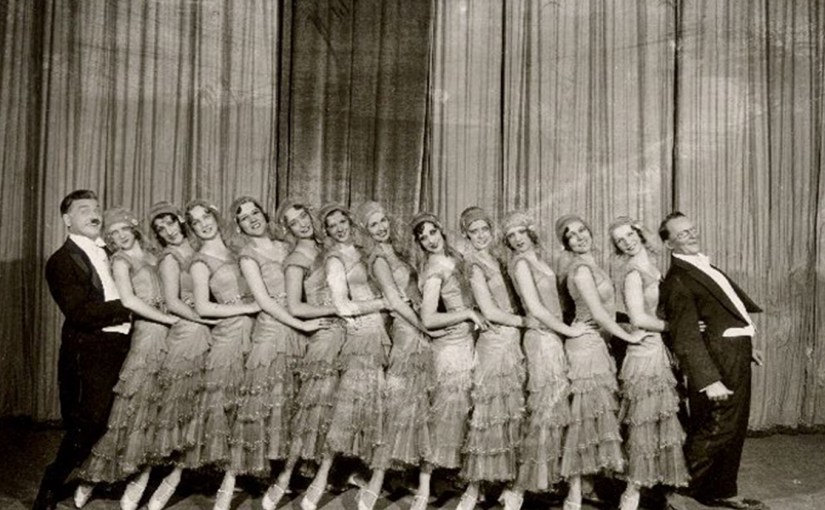
A play that satirized America’s enthusiasm for war—Strike Up the Band—was loved by critics but spurned by audiences when it opened in Philadelphia in 1927. Written by George S. Kaufman, with music and lyrics by George and Ira Gershwin, the play had the pedigree for success, but audiences weren’t quite ready for a show that poked fun at the U.S. military just nine years after the end of World War I (in the original play, America is goaded into declaring war on Switzerland by an American cheese tycoon).

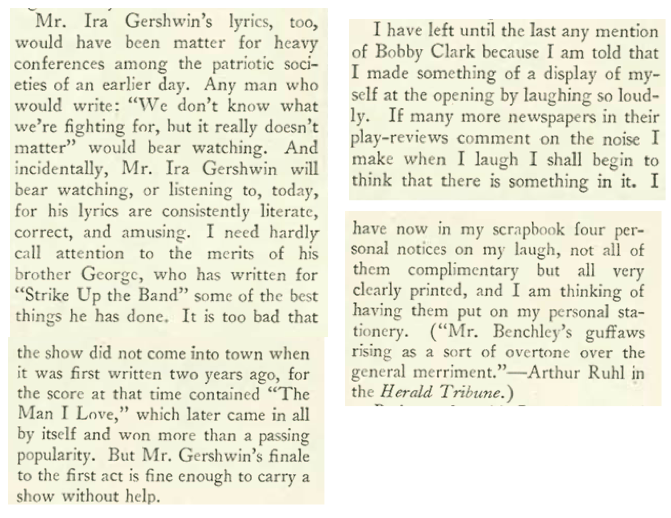
Enter lyricist Morrie Ryskind, who reworked the script, softening its political message and remaking the war plot into a dream sequence. The revised play proved to a be hit, running for 191 performances at the Times Square Theatre. It also introduced a number of popular songs, including “The Man I Love” and “Strike Up the Band.” Robert Benchley was on hand for opening night:

TEAMWORK…Clockwise, from top, Ira (left) and George Gershwin at work circa 1930; lyricist Morrie Ryskind, who softened the tone of George S. Kaufman’s original script. (U of Michigan/Wikipedia)

Benchley noted that the antics of comedian Bobby Clark caused him to laugh so loud that his guffaws were even noted in the Herald Tribune’s review:

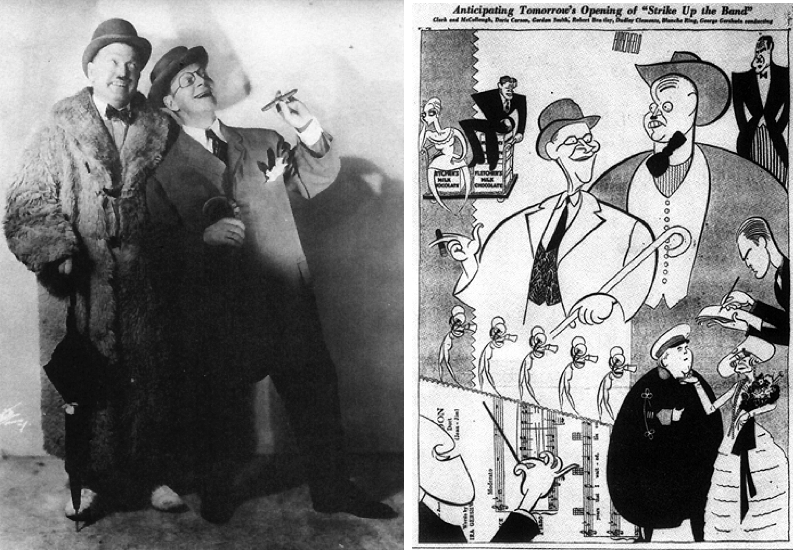
MAKE ‘EM LAUGH…The comedy team of Paul McCullough (left) and Bobby Clark were one of the play’s big draws. At right, Herald-Tribune illustration by Al Hirschfeld announcing the Broadway opening of Strike Up the Band. (aaronneathery.org)

 *  *  *

Duncan Yo-Yos

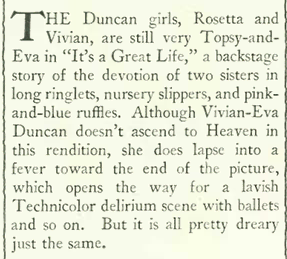
We’ve seen the Duncan Sisters (Rosetta and Vivian) before in this blog, the sister vaudeville act that became famous with the 1923 hit musical Topsy and Eva, which inspired a silent 1927 film starring the duo. They were back on the screen in late 1929 with It’s a Great Life, which The New Yorker’s John Mosher found to be “pretty dreary”…

NOT SO GREAT, THIS…Clockwise from top, promotional poster for It’s a Great Life; a scene from a dance number in the film; Rosetta (in blackface) and Vivian Duncan as Topsy and Eva (characters derived from the novel Uncle Tom’s Cabin). It’s a Great Life flopped at the box office, along with the Duncan’s brief movie careers. In the years to follow the duo would became popular nightclub entertainers and would continue to perform their Topsy and Eva routine even though appearing in blackface was increasingly considered offensive. (Wikipedia/freewebs.com)

 *  *  *

Miracle Worker

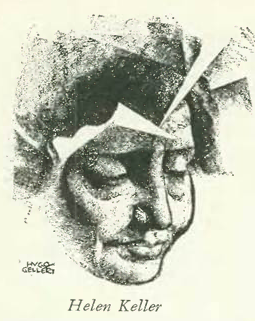
The New Yorker profile, written by Robert Coates, featured Helen Keller (with illustration by Hugo Gellert). A brief excerpt:

 *  *  *

From Our Advertisers

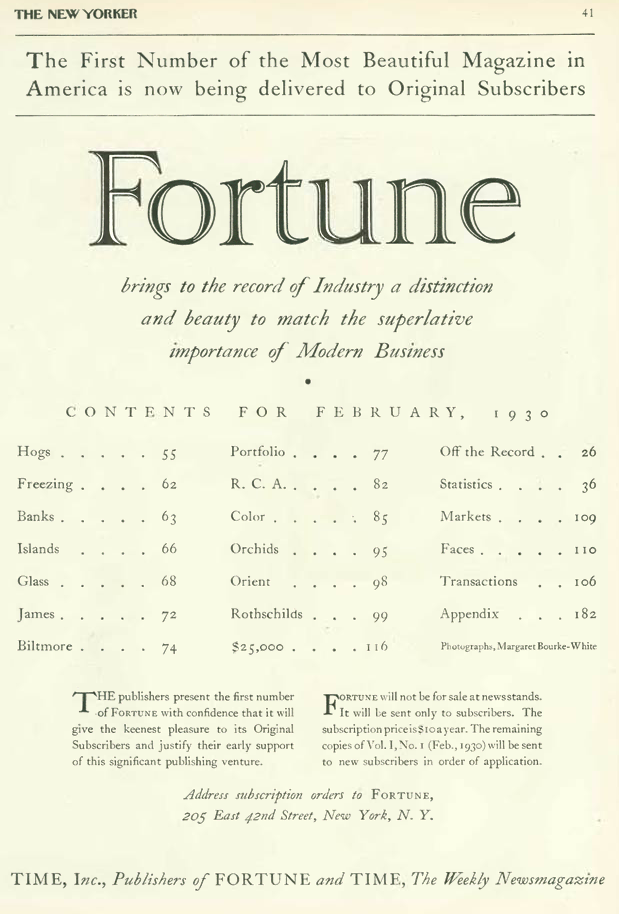
Advertisers in the Jan. 25 issue included the new Fortune magazine, which announced its first issue with this full-page ad:

…the table of contents is fascinating, spare in descriptions of everything from “Hogs” to “Orchids”…

From left, issue No. 1, February 1930; table contents for the issue; a prototype of the magazine, September 1929. (Fortune)

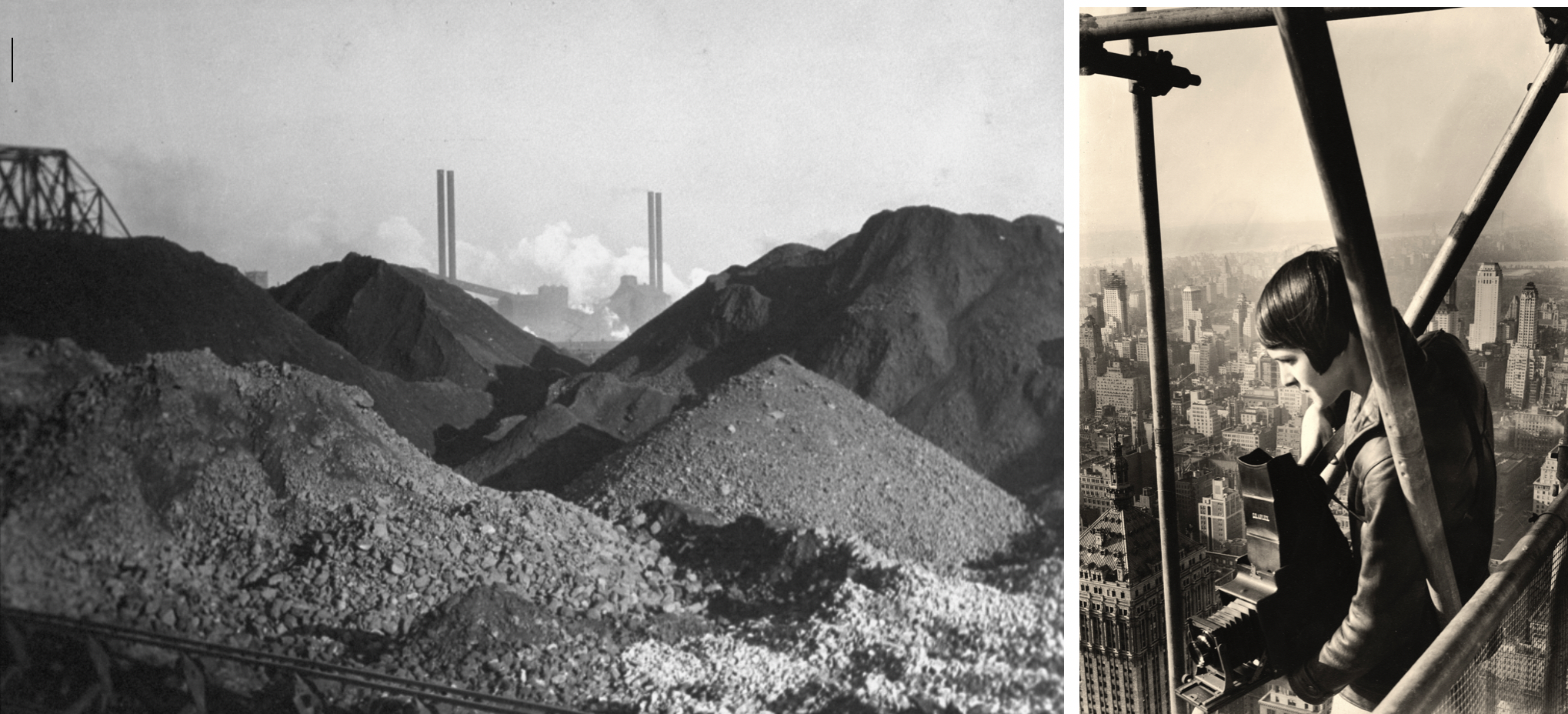
…also listed in the new magazine’s table of contents was the name of a 24-year-old photographer, Margaret Bourke-White

A photo of coal piles by Margaret Bourke-White in the first issue of Fortune magazine. At right, Bourke-White photographing atop a skyscraper circa 1930. (Fortune)

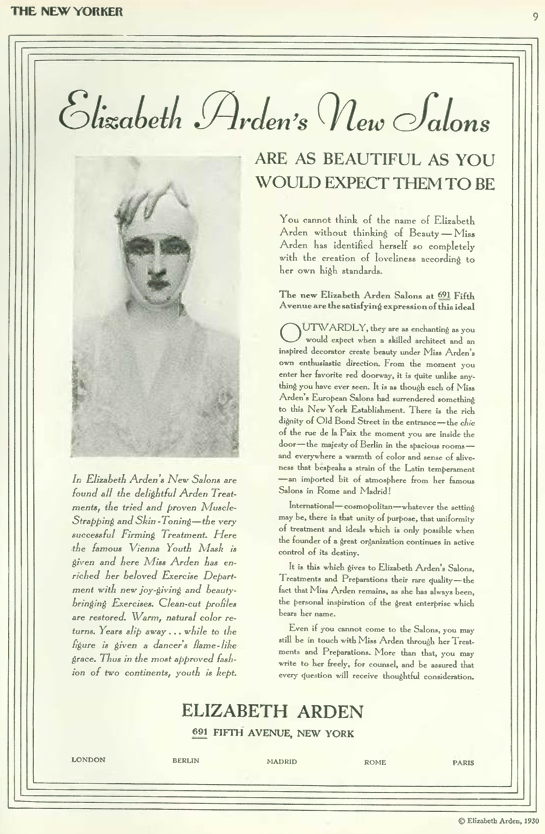
…on to our other advertisements, we have this entry from Elizabeth Arden…ads from this salon chain in the 1920s and 30s featured this ubiquitous image of a woman with a distant stare, her head tightly bound — mummy-like — as part of a firming treatment called “muscle-strapping”…

…in contrast to the rather cold, clinical look of the Elizabeth Arden ad, the Primrose House appealed more to social climbing than skin toning…

…while the makers of Pond’s cold cream continued to draw from their stable of debutantes and society ladies to move their product…

…long before there was Joe Camel, R.J. Reynolds also appealed to social climbers with a series of ads beautifully illustrated by fashion artist Carl Erickson

…society’s smokers were advised to pack a tube of Bost toothpaste, or have their French maid do it for them…

…and once again we have an ad by Dr. Seuss for Flit insecticide that is very much of its time…

…as is this cartoon by Isadore Klein, perhaps the first in The New Yorker that depicted African Americans as something other than minstrel show stereotypes. Nevertheless, the rendering is still a bit crude — especially the boy’s face — as is the idea behind the “joke” —  that a black boy could actually aspire to be a great violinist like Jascha Heifetz

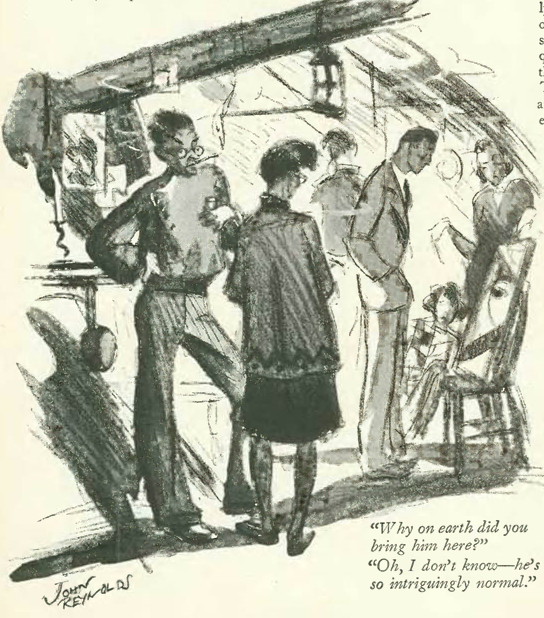
John Reynolds explored a less troubling juxtaposition among the bohemian set…

…and we end with this peek into society life courtesy Barbara Shermund… 

Next Time: The Wild Kingdom…


A Carnival in the Air

When Charles Lindbergh gunned his Wright Whirlwind engine on Roosevelt Field and took to the skies on his historic flight, he sparked such an interest in flying that just two years later that very same field was hosting huge weekend crowds that came to marvel at the airborne wonders of a new age.

August 31, 1929 cover by Theodore Haupt.

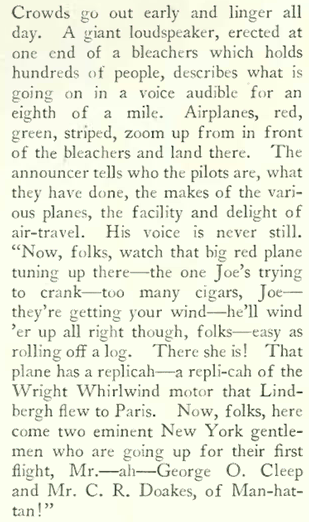
Writing for “The Talk of the Town,” James Thurber was on hand to take in the spectacle, noting how the announcer sold air-mindedness to the mob “in great clamorous phrases and resonant assurances.” Among those taking their first flight was a “Mr. Galleger, aged 101.” Thurber also observed:

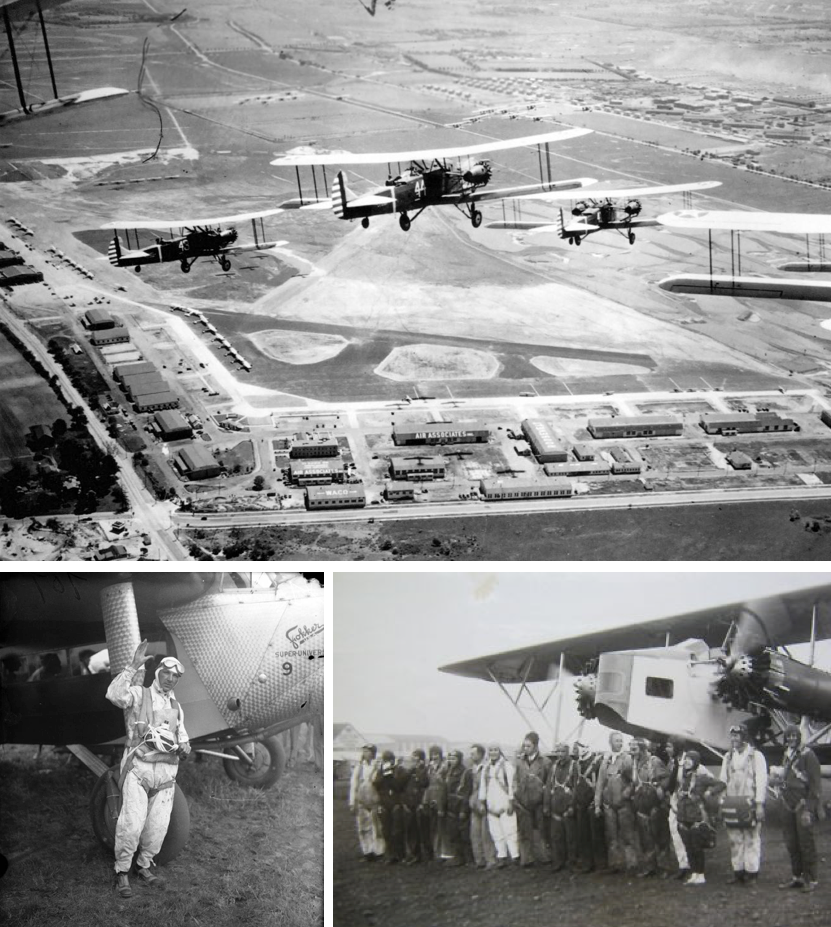
AIRBORNE SPECTACLES…Clockwise, from top, a 1931 aerial view looking southeast at a group of Army twin-engine biplane bombers overflying Roosevelt Field; parachute records were broken when 14 men and 2 women leaped from a Sikorsky bombing plane at Roosevelt Field in November 1929 (in the photo they seem to be standing precariously close to the plane’s whirling blades); Jack Cope waved to onlookers in Chicago before he performed a 15,000 foot jump in 1929. (tripod.com/Worthpoint/Chicago Tribune)

Although there were thrills galore up in the sky, Thurber seemed equally impressed by the spectacle on the ground…

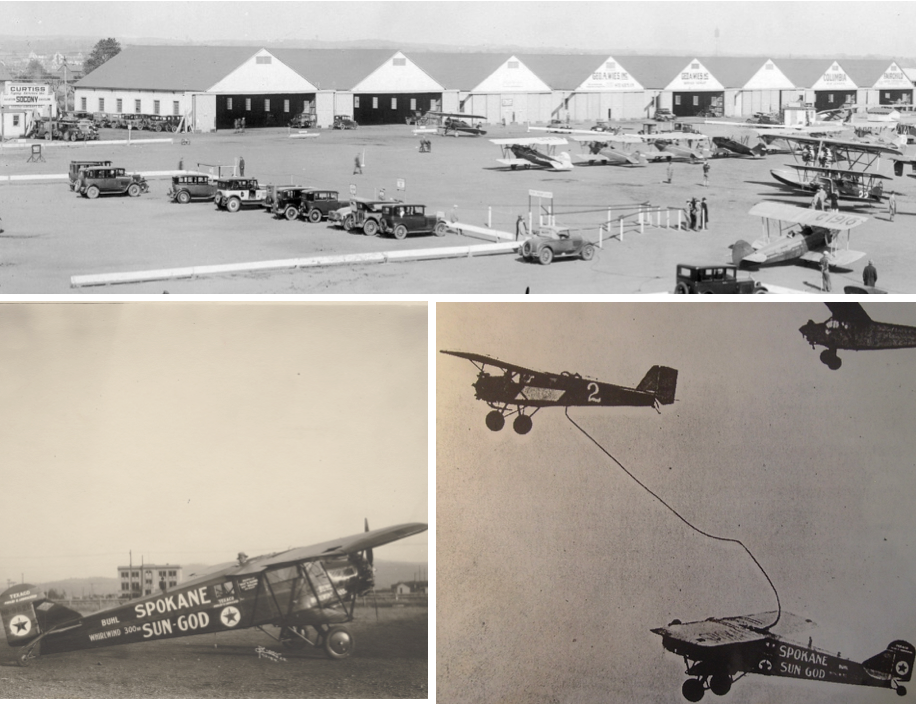
THE SUN GOD…Clockwise, from top, a 1928 photo of biplanes lined up by a row of hangars at Roosevelt Field; the spectacle of mid-air refueling was demonstrated above Roosevelt Field by Texaco Oil’s Spokane Sun God. (Tom Heitzman/barnstmr.blogspot.com/Wikipedia)

One of the big attractions was Texaco Oil’s Spokane Sun God, which traveled around the country to demonstrate the art of mid-air refueling. Note in the excerpt below (second paragraph) how the Sun God’s pilot communicated with his ground crew: He tossed some notes—tied to a heavy piece of lead(!)—out of the airplane’s window. It nearly landed in a crowd of onlookers…

AND HOW WAS YOUR DAY?…For some perspective, the first attempt at refueling in mid-air was made in 1921. In the photo above, Wesley May climbs from the lower biplane to the upper while carrying a 5-gallon can of fuel strapped to his back. After lifting himself onto the wing, he worked his way between the wings and into the cockpit. He then poured the fuel into the engine. (Seattle Museum of Flight) 

*  *  *

Falling Short

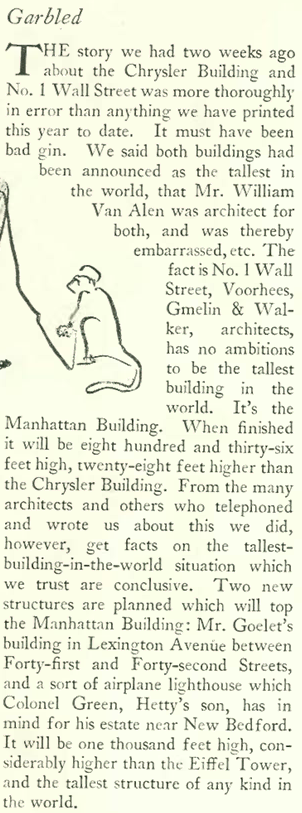
As I noted in a previous post (The Last Summer), the race to build the tallest building was erroneously reported by The New Yorker as a man against himself (namely, architect William Van Allen). In the Aug. 31 issue, the magazine’s “Talk of the Town” corrected the error, and added another curious note about another plan to build an “airplane lighthouse” taller than the Eiffel Tower…

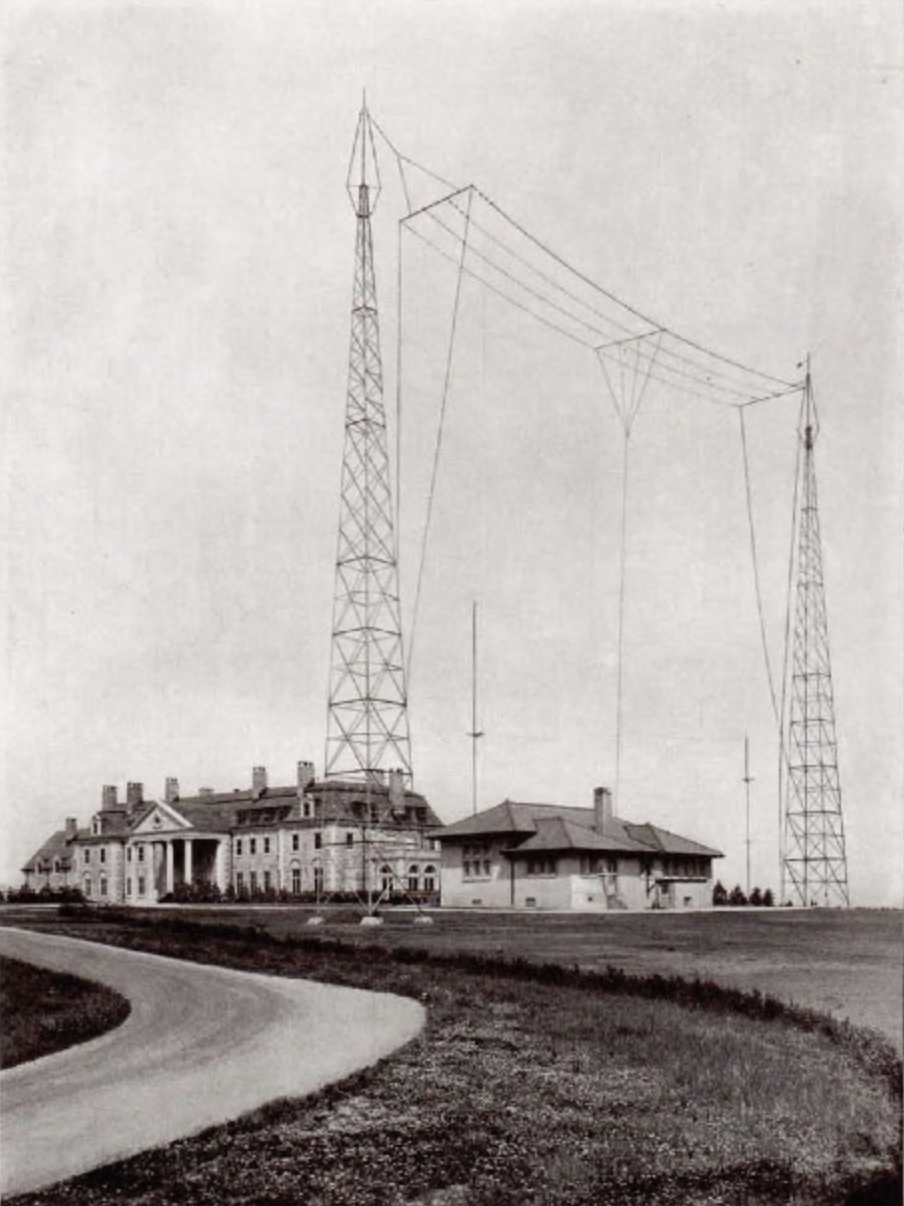
As noted above, Col. Edward Howland Robinson Green (son of the notorious miser Hetty Green) wanted to build a thousand-foot tower on his estate in Massachusetts. Here is what he settled for instead:

WORK-LIFE BALANCE…Edward Green, radio enthusiast and son of the miserly Hetty Green, erected huge radio towers at his Massachusetts estate in the 1920s to operate an early broadcast station, WMAF. (Wikipedia)

 * * *

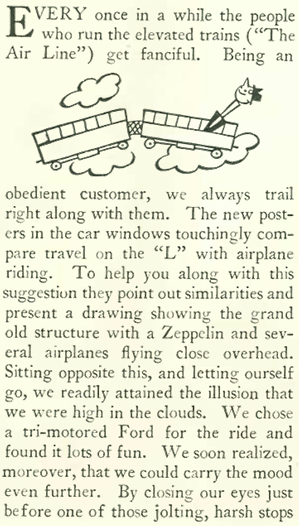
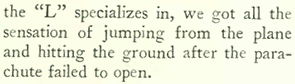
When Trains Fly

Cashing in on the enthusiasm over aviation, the City of New York promoted its elevated train system as an “Air Line.” According to “Talk”…

Click on the video below to take a ride on the “L”. Most of the 1929 footage begins at 4:47…

* * *

Haw Haw

One more “Talk” item: a self-referential piece in which The New Yorker pondered its “mission” as a humor magazine…

* * *

Audax Minor

For more than five decades, George Francis Trafford Ryall (1887-1979) wrote the horse racing column for the New Yorker under the pseudonym Audax Minor. He published his first column on July 10, 1926, and his last on Dec. 18, 1978. He was the writer of longest record at the magazine when he died at age 92 in 1979 (52 years, a record that has been shattered by the nearly 98-year-old Roger Angell, who has published in the New Yorker from 1944 to 2018).

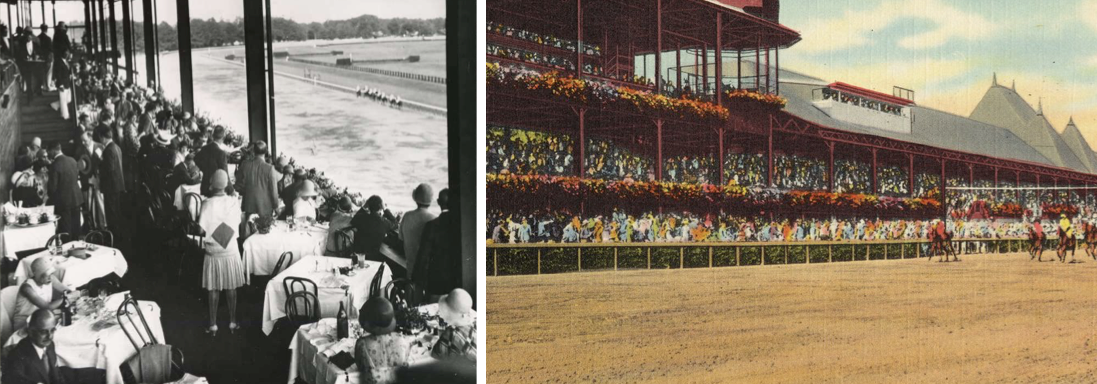
According to Ryall’s obituary in the New York Times, he adopted the nom de plume Audax Minor in a nod to Arthur F. B. Portman, who wrote about racing in England under the name of Audax Major. Ryall’s writing was so entertaining that many of his readers had never even been to a racetrack. According to Brendan Gill in his book, Here at the New Yorker, “(Ryall’s) world is a romantic fiction and they (the readers) are grateful when they learn that, with his green tweeds, his binoculars hung smartly athwart his chest, and his jaunty stride, Ryall resembles a character out of some sunny Edwardian novel.” An excerpt of his column from the Aug. 31 issue, with illustrations by Johan Bull:

A DAY AT THE RACES…At left, a crowded second floor dining area in the clubhouse at Saratoga, 1929; a postcard image of the track, with expanded clubhouse at left, circa 1929. (Saratoga Springs Historical Museum/Boston Public Library)

 *  *  *

Shut Out

As I’ve noted before, the New Yorker covered nearly every imaginable sport except baseball. Here is a rare mention of the game in Howard Brubaker’s “Of All Things” column:

The Cubs would win the NL pennant, but they would fall to the Philadelphia Athletics in the 1929 World Series.

Rough and Ready

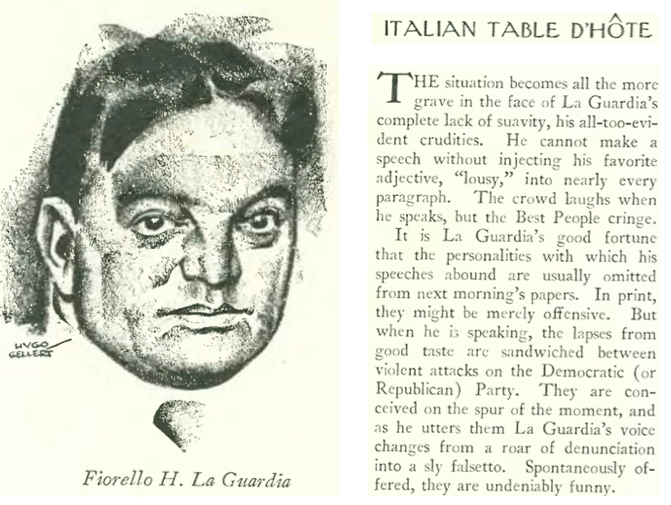
When Fiorello La Guardia challenged incumbent Jimmy Walker for New York City mayor in 1929, the city’s voters were presented with two colorful candidates who could not have been more different in their styles. Walker, a product of Tammany Hall, was a svelte dandy with a taste for the refined, whereas the reform-minded La Guardia was often coarse and unkempt. If they had anything in common, it was their dislike of Prohibition. La Guardia was featured in the Aug. 31 profile, written by Henry F. Pringle. Some excerpts:

JUST TRY TO STOP ME…Congressman Fiorello La Guardia pouring beer in his office during Prohibition, when he served New York’s 20th district in U.S. House of Representatives. (La Guardia Wagner Archives)

 *  *  *

Praise for the King

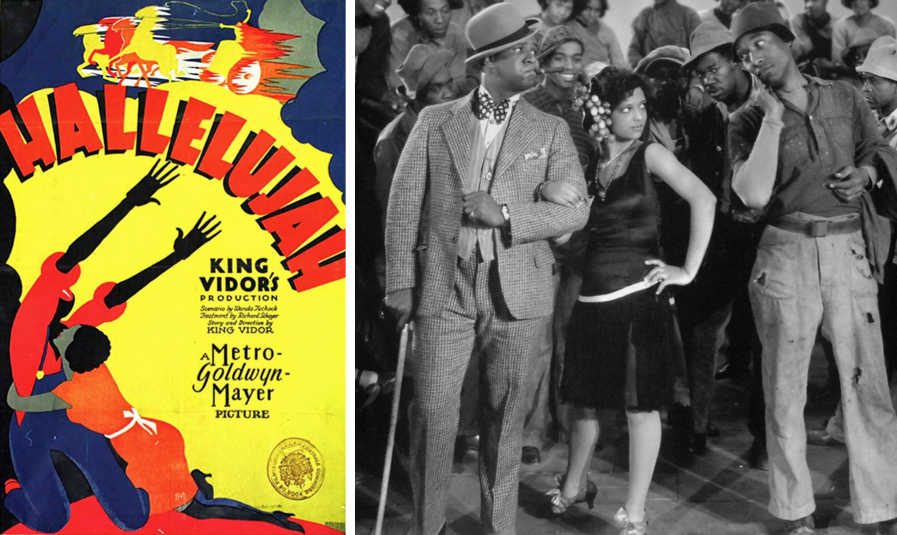
The New Yorker’s film critic John Mosher found most of Hollywood’s output to be pedestrian, but occasionally he saw a bright spot, including King Vidor’s latest production, Hallelujah:

William E. Fountaine, Nina Mae McKinney and Daniel Haynes in Hallelujah. The 17-year-old McKinney was the first African-American actress to hold a principal role in a mainstream film, and the first African-American actor to sign a long-term contract with a major studio—MGM. (IMDB)

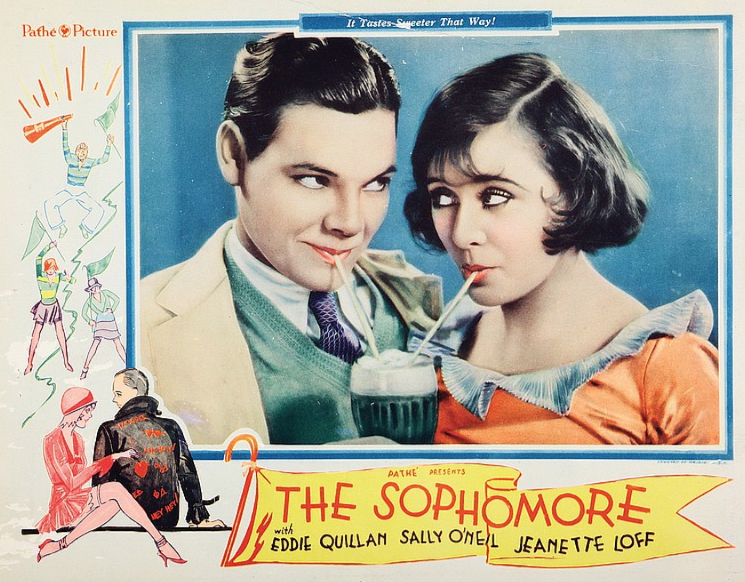
As for another film, Paramount’s The Sophomore, Mosher probably felt a bit obligated to say something nice, since it was a derived from a story by humorist Corey Ford, an early contributor to The New Yorker and part of the Algonquin Round Table orbit:

BOY MEETS GIRL…Lobby card for The Sophomore. (IMDB)

 *  *  *

A Bright Interval

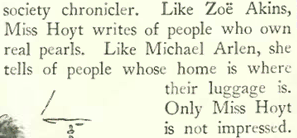
The New Yorker gave a brief but approving mention of Nancy Hoyt’s latest book, Bright Intervals, in its book review section…

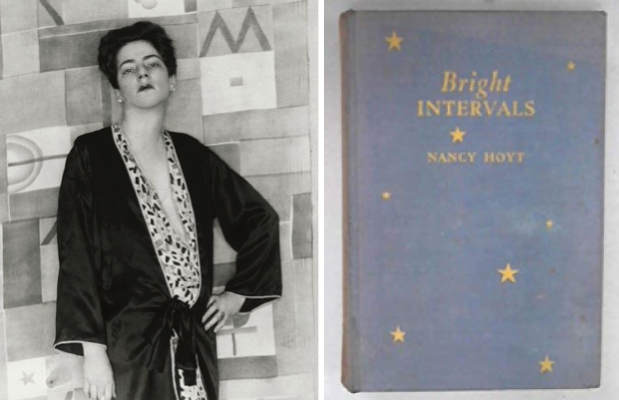
Hoyt was a member of a socially prominent but deeply troubled family that included her recently deceased sister, the poet and writer Elinor Wylie (I wrote about the Hoyt family in my post Generation of Vipers). Characters in Hoyt’s novels often resembled the women in her family.

Nancy Hoyt in an undated photo by Sherril Schell. (Conde Nast/Amazon)

 *  *  *

From Our Advertisers

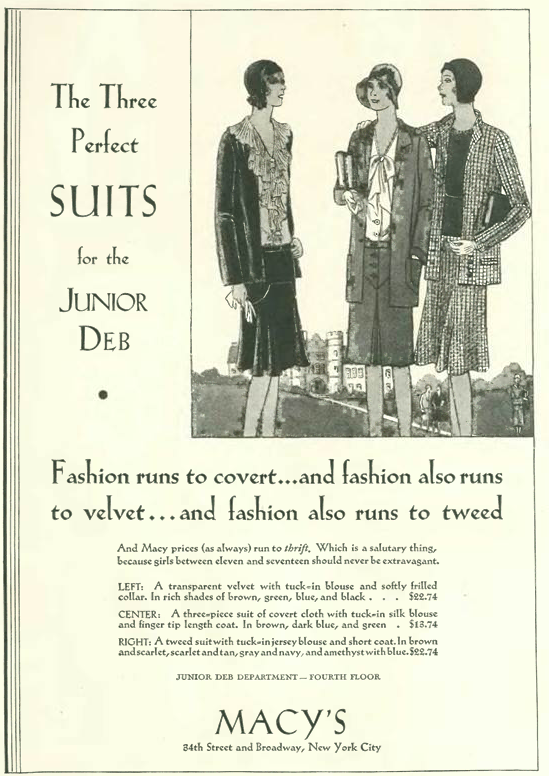
It was back to college time, and Macy’s had a thrifty new fall lineup ready for the “Junior Deb”…

…and on the less thrifty side, Best & Company offered these new looks for fall…
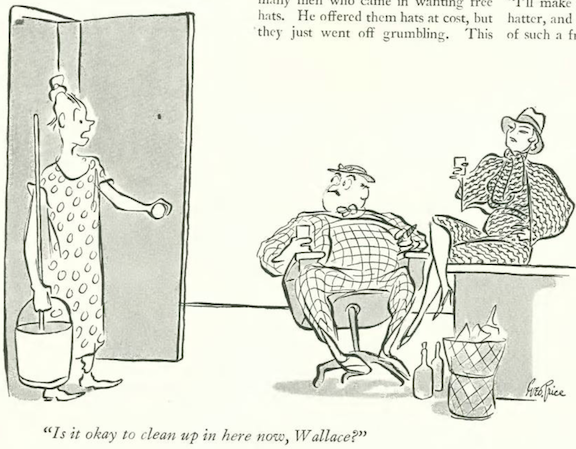
…note in the above ad that the first model is Virginia Maurice, the very same model we encountered in a recent post (The Last Summer) posing for Chesterfield cigarettes…

Model Virginia Maurice posed for this 1929 Chesterfield ad, illustrated by artist Charles Edward Chambers.

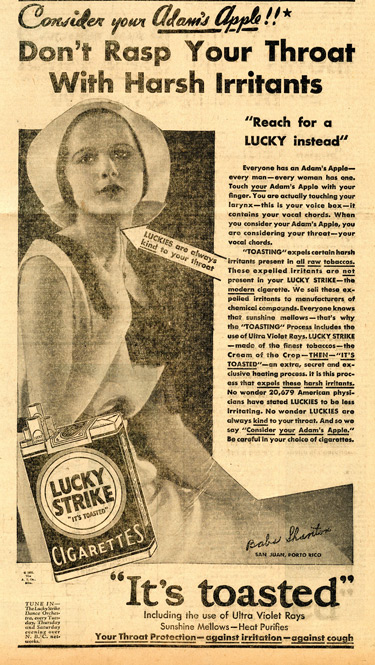
…the other model in the Best & Company ad, Babs Shanton, also wasn’t averse to taking money from the tobacco companies…
Undated newspaper ad for Lucky Strikes featuring Babs Shanton, a sometime performer with the Ziegfeld Follies and a singer with the Lucky Strike Dance Orchestra. (Stanford University)

…the makers of Studebakers tried to add sex appeal in this ad for their President Roadster. The artist was obviously challenged to work all of the necessary elements into the picture—car, swimming pool, diving board—not to mention the block of superfluous text where the steps to this impossibly long diving board should have been located…

…and sex not only sold cars…its also sold printing services…

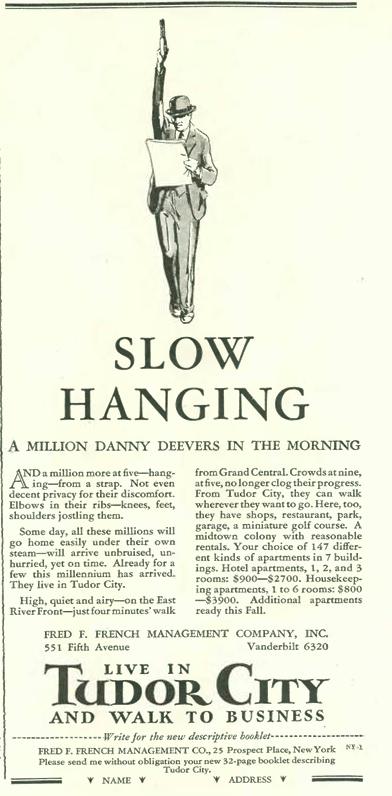
…instead of sex, the promoters of Tudor City chose strangulation to get their pitch across, equating a man’s daily train commute to death at the gallows (“Danny Deevers” refers to a character in a Rudyard Kipling poem who is hanged for murder)…

…the gawkers at Roosevelt Field weren’t the only folks with their heads in the clouds…an ad for Flit insecticide by Dr. Seuss…

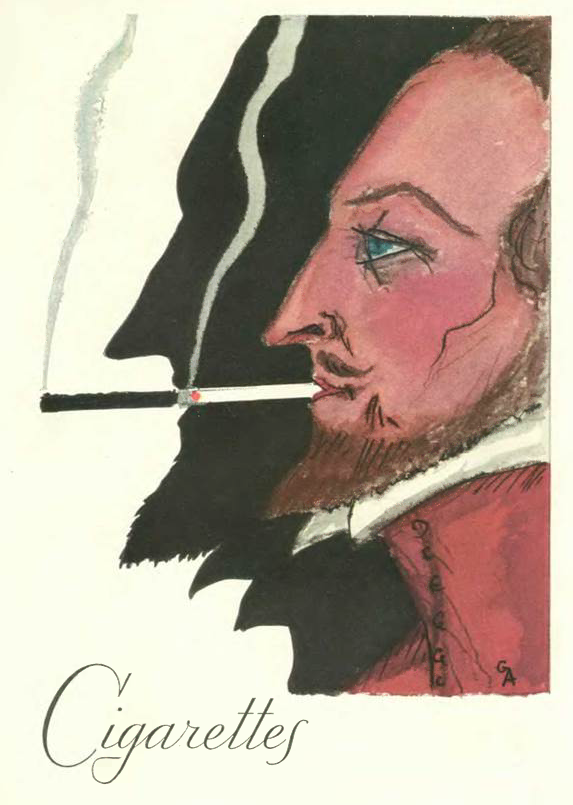
…this ad for Raleigh cigarettes, which appeared on the back cover of the Aug. 31 issue, assumed that folks were so familiar with their mascot that no further explanation was needed…

…here is a 1929 ad from House Beautiful that featured the same mascot with the Van Dyke beard…both ads were rendered by French illustrator Guy Arnoux

…on to our cartoonists…Helen Hokinson contributed this two-page spread on the challenges of visiting an old friend (click to enlarge)

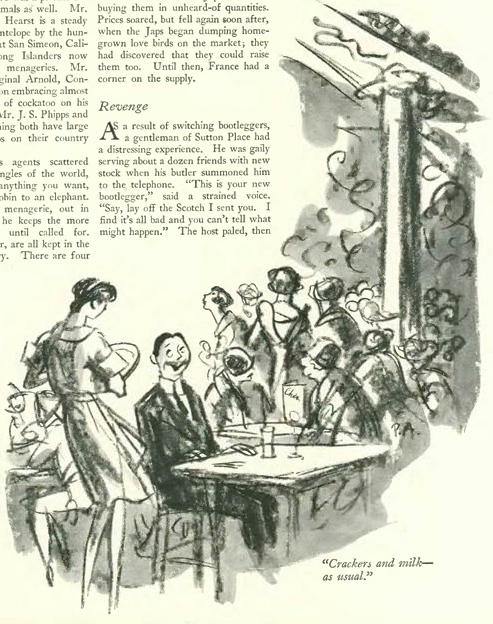
Peter Arno looked in on a cheapskate at a posh restaurant…

Bruce Bairnsfather visited the talkies…

Justin Herman examined the literary life of the street…

Carl Kindl explored an awkward moment from the annals of technological advancements…

…and Isadore Klein illustrated the hazards of the tonsorial trade…

Next Time: The Last Hurrah…