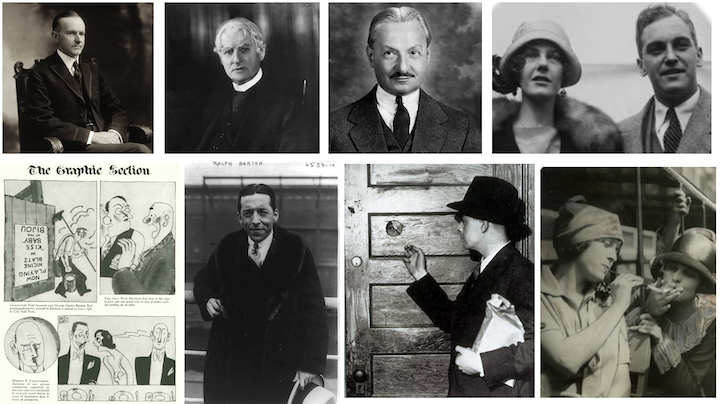
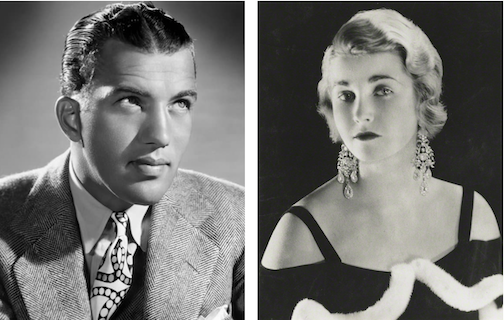
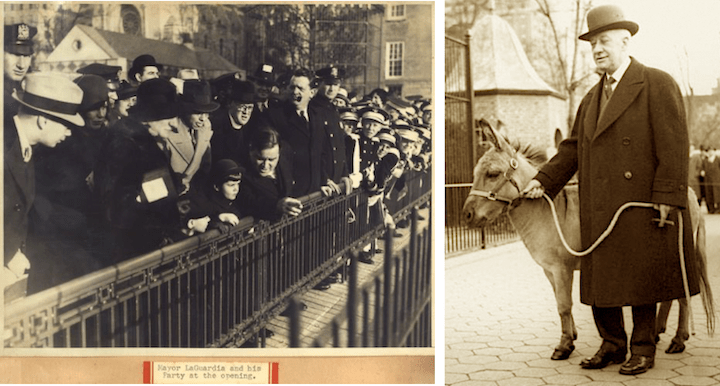
Above: The Dec. 2, 1934 opening of the reconstructed Central Park Menagerie drew such luminaries as Mayor Fiorello La Guardia, pictured at left with his family, and, at right, former New York Governor Al Smith, who was designated honorary zookeeper. Smith, who, lived across from the zoo at 820 Fifth Avenue, poses with two donkeys at the Menagerie in 1940. (New York Parks Archive)
The Central Park Zoo was not part of the original Olmstead-Vaux plan for the park, but beginning in 1859 it evolved spontaneously as a menagerie located near the Arsenal; its odd collection of animals included exotic pets donated as gifts, and other random creatures including a bear, a monkey, a peacock and some goldfish.
Dec. 1, 1934 cover by Leonard Dove.
The menagerie accepted animals of all kinds, even sick ones, and by the 1920s the quality of the animals as well as the hodgepodge of buildings had degraded significantly (the lion house had to be guarded to prevent the animals from escaping their rotting quarters). In early 1934 Parks Commissioner Robert Moses addressed the adverse conditions in the menagerie, putting a redesign on a fast track and insisting that only healthy animals, in more humane settings, would be displayed.
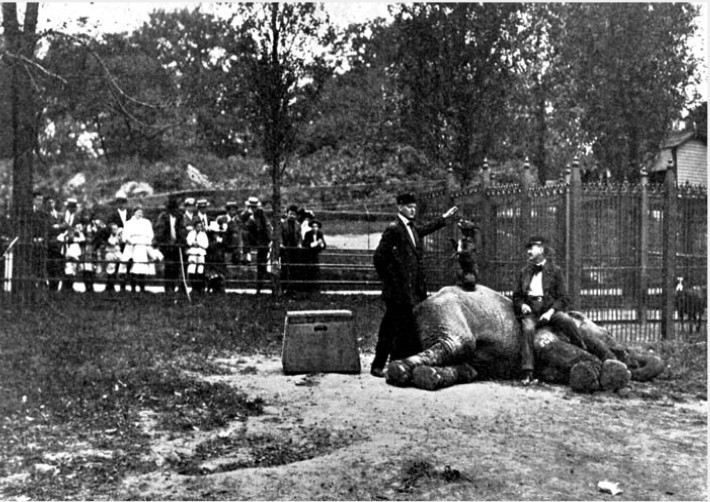
DUMBOS…According to a 1911 Department of Parks Annual Report, the menagerie at Central Park submitted animals to questionable treatment, as suggested by this photo of a trainer and a dog perched on top of an elephant. (nycgovparks.org)
Built of brick and limestone, the new zoo was designed in just sixteen days by an in-house team led by architect Aymar Embury II. Construction on the roughly six-acre zoo took just eight months, employing federally financed Works Progress Administration (WPA) labor.
MOSES PARTS THE RED TAPE…Robert Moses wasted no time after his appointment as parks commissioner (in January 1934) to get rolling on the menagerie makeover—it took just eight months to complete the new zoo. Clockwise, from top left, invitation to the opening celebration of the Central Park Menagerie—12,000 invited guests attended the opening, while another 25,000 lined Fifth Avenue hoping to be admitted; the popular sea lion pool was a central attraction on opening day (it is one of several elements from the 1934 zoo that still exists); conditions had improved for elephants and other animals, but they were still far from ideal; aerial view of the zoo as it neared completion on Oct. 9, 1934. (nycma.lunaimaging.com/digitalcollections.nypl.org)
Much ado was made of Al Smith’s appointment as “Honorary Night Superintendent”—in these clips from the Dec. 3 New York Times, Smith gave a brief “lecture” about the zoo’s bison, to which he offered a slice of bread…
(Excerpts from The New York Times via the TimesMachine)
* * *
From Our Advertisers
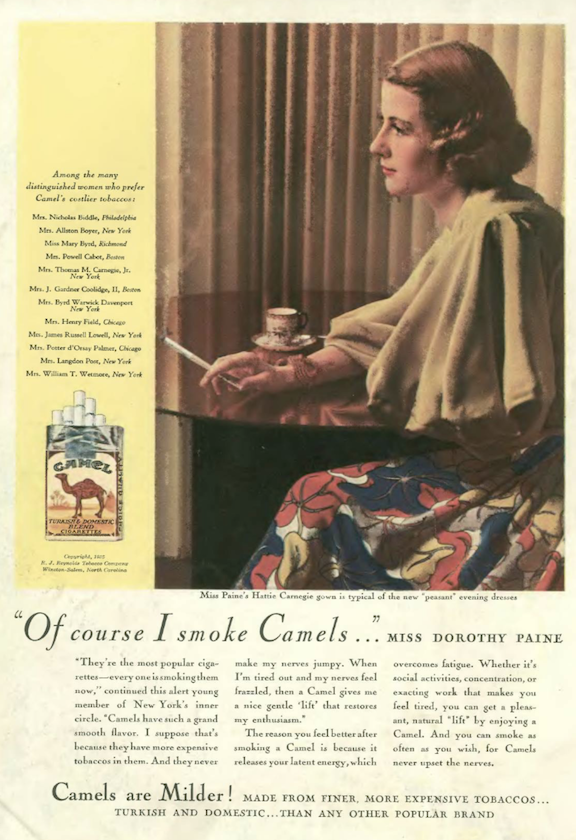
R.J. Reynolds continued to roll out its list of distinguished women who preferred their Camel cigarettes: “Mrs. Allston Boyer” nee Charlotte Young was a model with the John Robert Powers agency who was married to resorts planner Allston Boyer from 1934 to 1939. Young (1914–2012) would later marry New York Times Moscow correspondent Harrison Salisbury, and the two would embark on lengthy journeys throughout Asia, including a grueling 7,000-mile journey retracing the route of The Long March that Charlotte recounted in one of her seven travel books. Whether she continued her Camel habit is unknown, but she did live 98 years…
…a house ad from The New Yorker celebrated the holiday season with special Christmas rates (and Julian de Miskey embellishments)…
…Rea Irvin continued to have fun with the federal government’s new food and drug labeling standards…
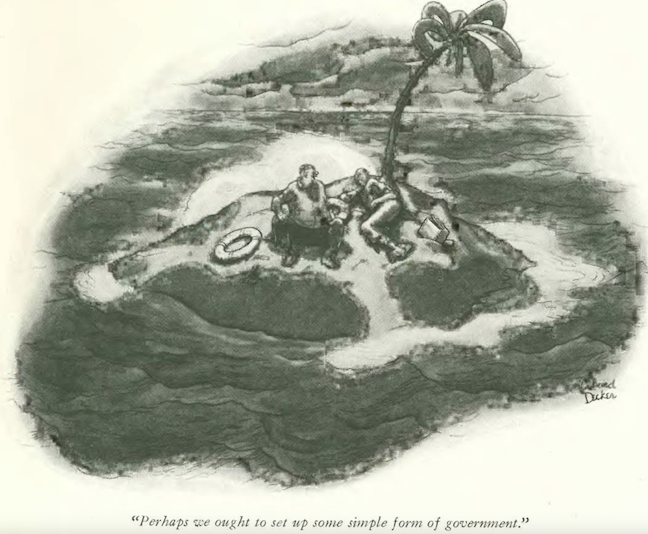
…while Richard Decker had these two castaways contemplating a simpler form of government…
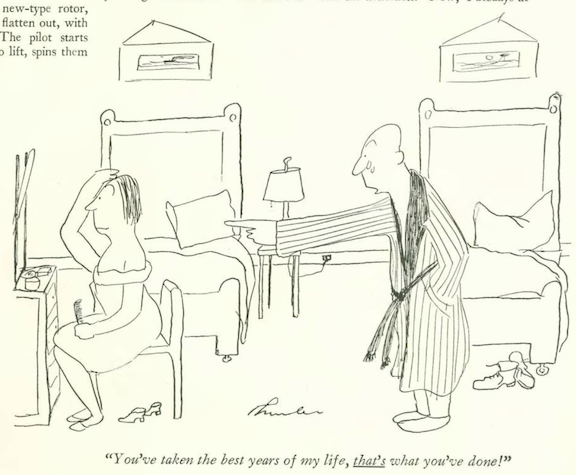
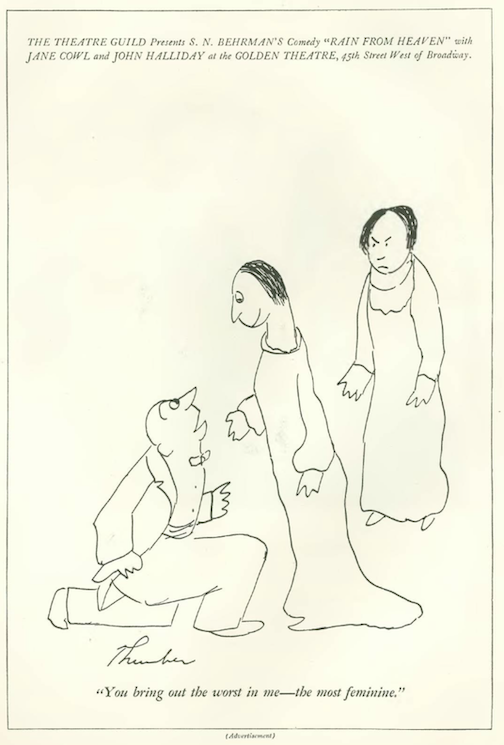
…and James Thurber continued to stir up trouble among the sexes…
…on to Dec. 8, 1934…
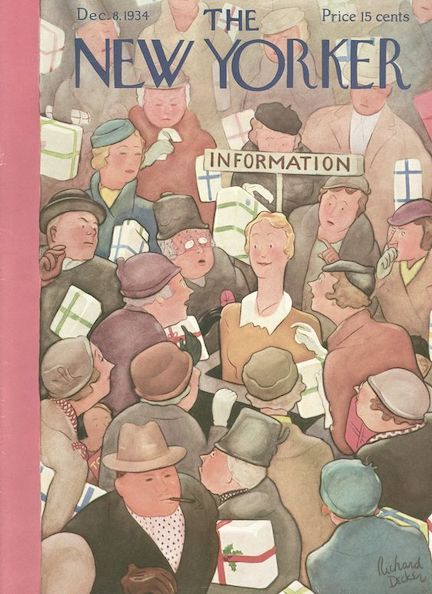
Dec. 8, 1934 cover by Richard Decker.
…which featured (on page 135) a handwritten letter from Kewpie Doll inventor Rose O’Neill, who commented on her recent New Yorker profile…
…here is an excerpt from the Nov. 24 profile referenced by O’Neill:
…and on to our advertisements from the Dec. 8 issue, including another Julian de Miskey-illustrated house ad…
…the clever folks at Heinz enlisted the talents of Carl Rose for a play on his famous Dec. 8, 1928 New Yorker cartoon…
…a closer look at the illustration (note the mother’s softer, more conservative appearance, five years removed from her flapper days; the child hasn’t changed a bit, except now we can see her face)…
…and the 1928 original, with caption by E.B. White…
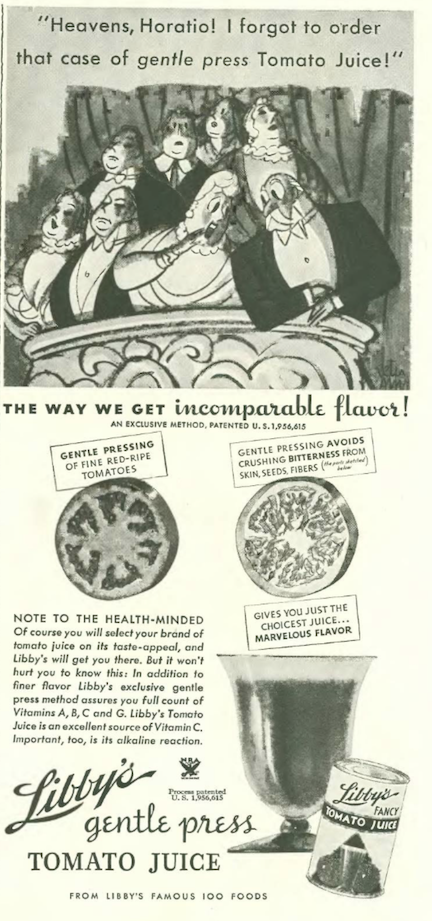
…Peter Arno also popped up in the advertising section on behalf of Libby’s…
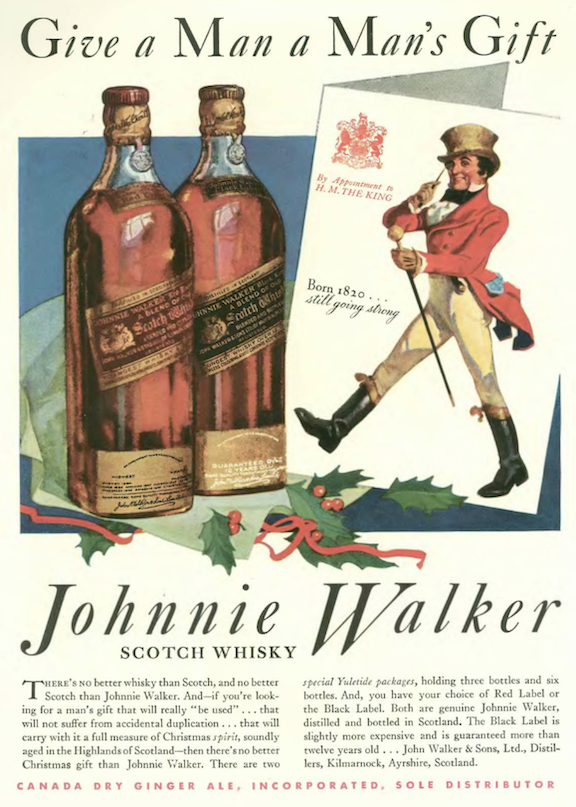
…the magazine grew thicker with many Christmas-themed ads, including this one from Johnnie Walker…
…Marlboro continued to take out these modest, back-page ads aimed at tobacco’s growth market—women smokers…
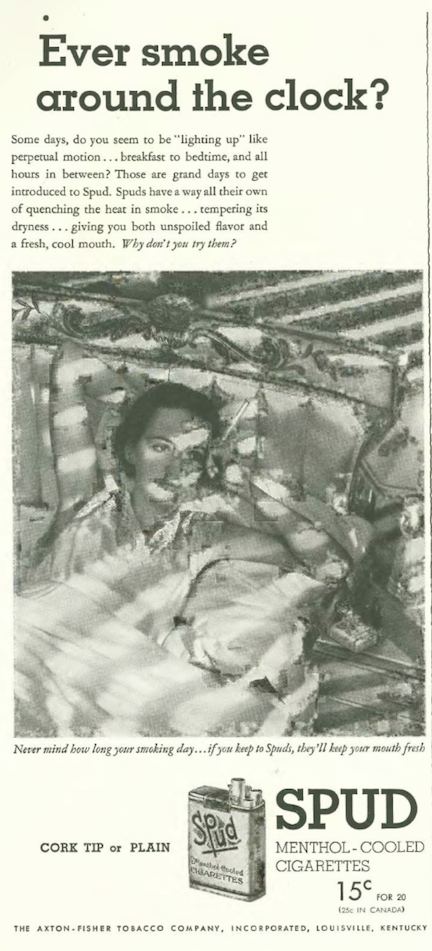
…the makers of Spud menthol cigarettes continued their campaign to encourage chain-smoking with this rather depressing image…
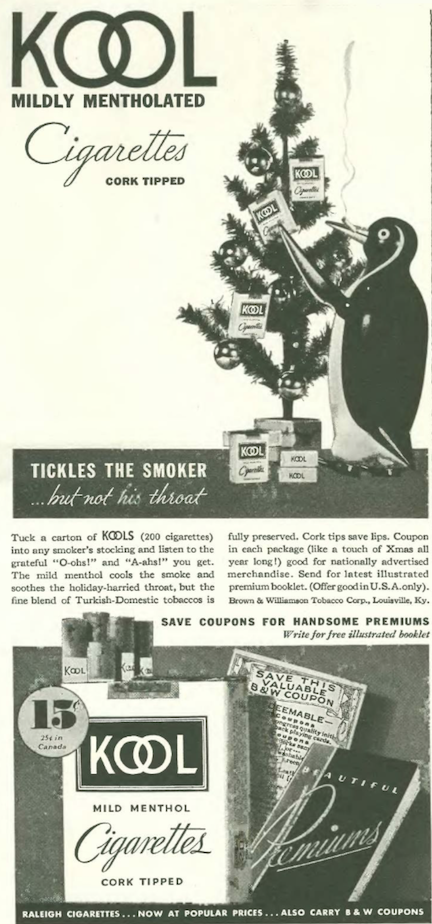
…while Spud’s new competitor in menthol cigs, KOOL, kept things simple with their smoking penguin mascot and valuable coupons for keen merchandise…
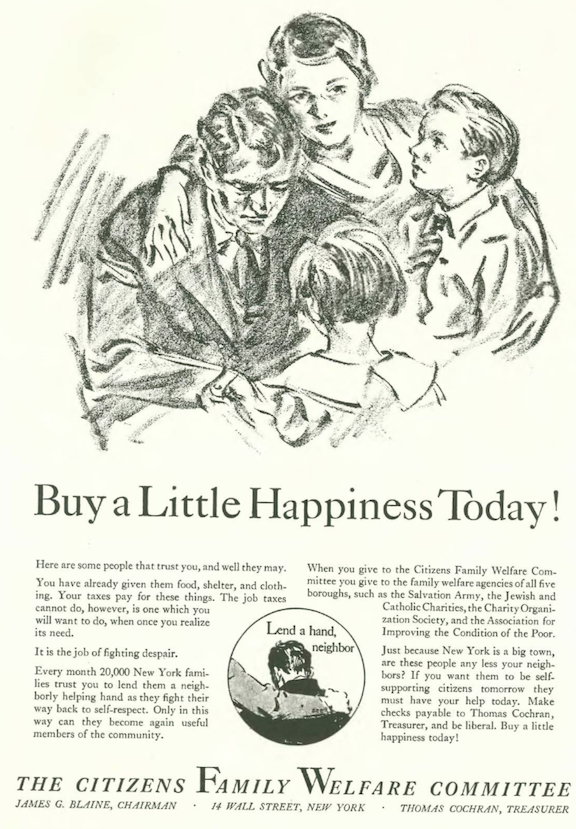
…the Citizens Family Welfare Committee offered this reminder that the Depression was still very much a challenge for 20,000 New York families…
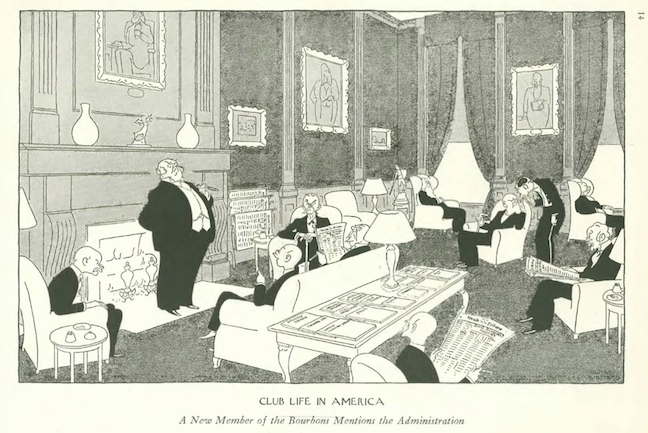
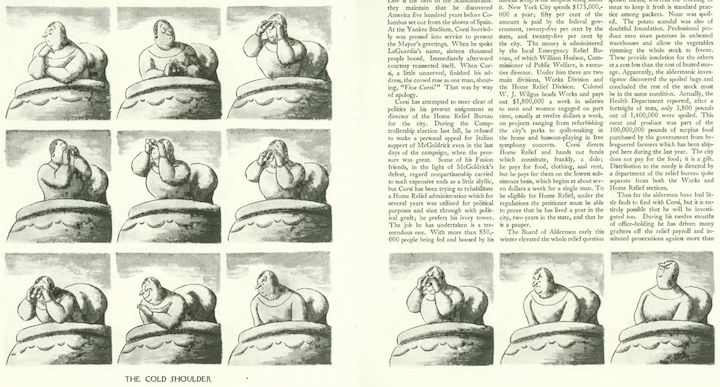
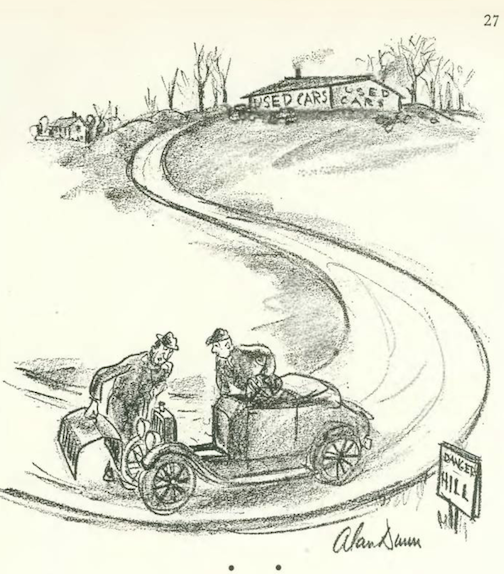
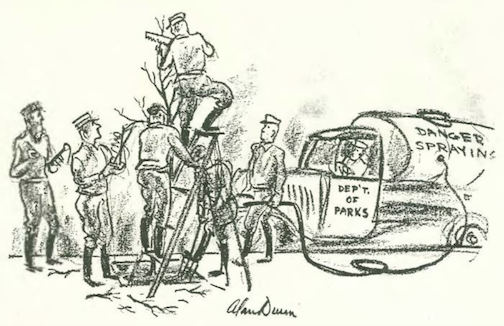
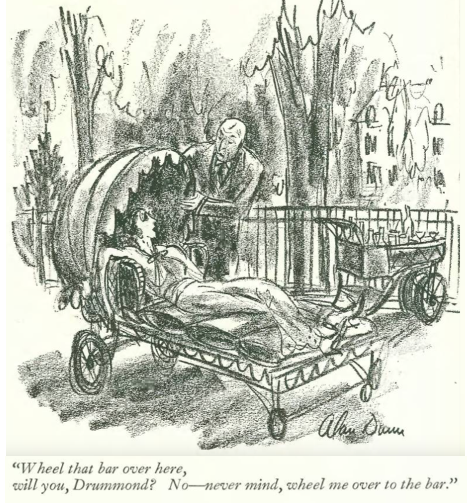
…on to our cartoonists, beginning with Alan Dunn’s rather dim view of Robert Moses’s generously funded parks department…
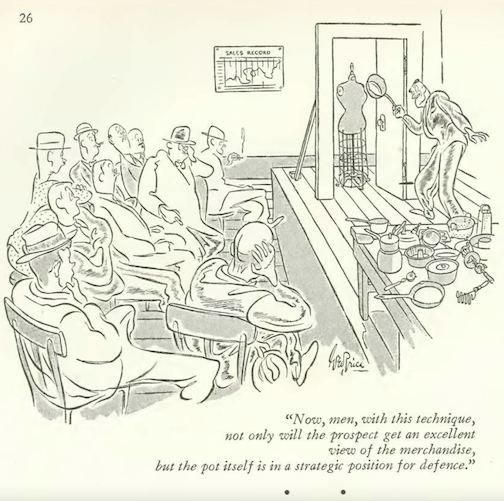
…George Price gave us the latest update on his floating man, who had been up in the air since the Sept. 22 issue…
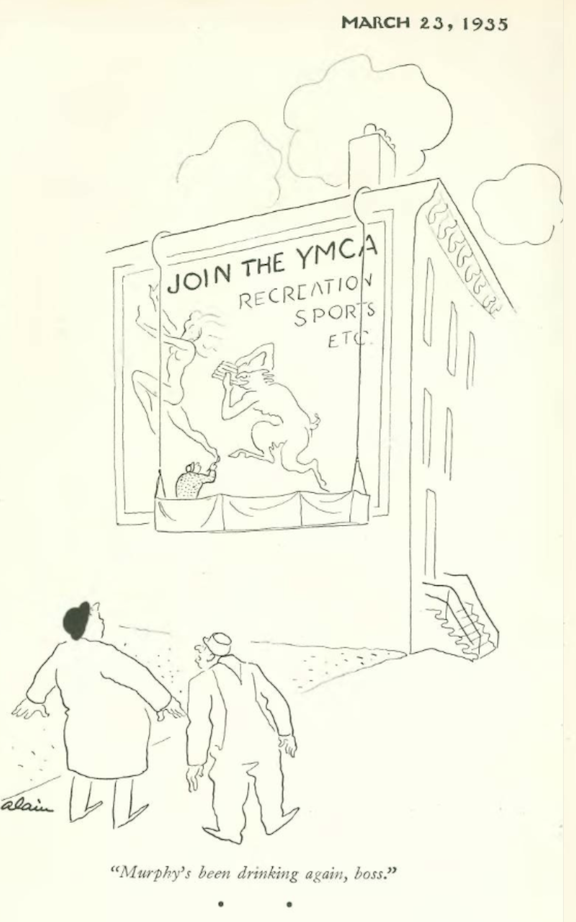
…Daniel ‘Alain’ Brustlein marked the season with dueling Santas from Macy’s and Gimbel’s…
…and we end with James Thurber, and some reverse psychology…
Above, left, a 1935 portrait of Gertrude Stein by Carl Van Vechten; right, Gertrude Stein and Alice B. Toklas arriving in New York aboard the French Line’s SS Champlain in 1934. (Library of Congress/AP)
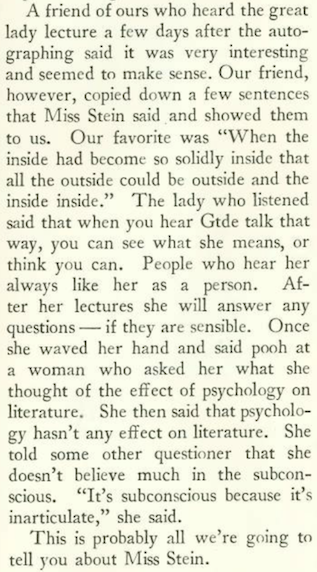
Much of America’s literary world was abuzz about the arrival of Gertrude Stein in New York after her nearly three-decade absence from the States. Audiences were mostly receptive to Stein’s lectures, even if they were largely unintelligible, but The New Yorker would have none of it.
Nov. 17, 1934 cover by Rea Irvin.
Stein (1874–1946) visited the U.S. at the urging of friends who suggested that a lecture tour might help her gain an American audience for her work. She crisscrossed the country for 191 days, delivering seventy-four lectures in thirty-seven cities.
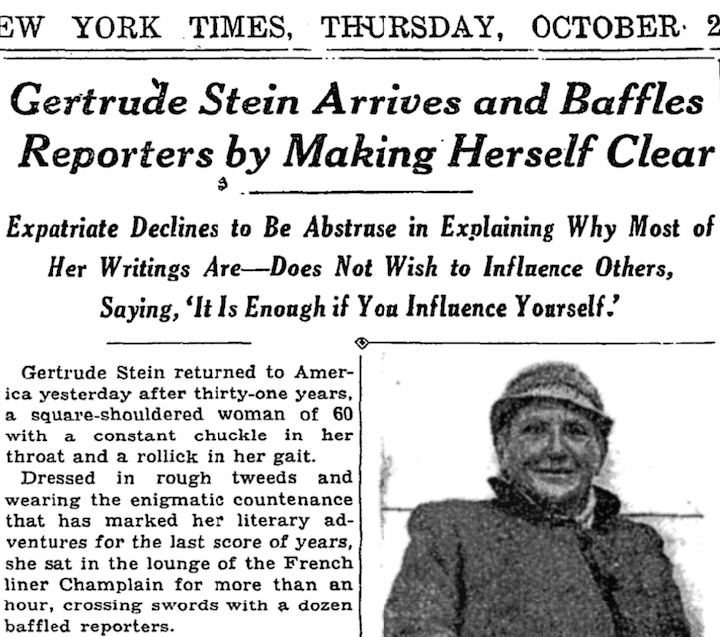
Writing for the Smithsonian Magazine (October 2011), Senior Editor Megan Gambino notes that publishing houses regarded Stein’s writing style as incomprehensible (Gambino writes that shortly after her arrival in the U.S., “psychiatrists speculated that Stein suffered from palilalia, a speech disorder that causes patients to stutter over words or phrases”), but in 1933 “she at last achieved the mass appeal she desired when she used a clearer, more direct voice” in The Autobiography of Alice B. Toklas. However, Stein was still best known in the U.S. for her “insane” writings, as one New York Times reporter described Stein’s work upon the writer’s arrival in New York. Excerpts from the Oct. 25, 1934 edition of the Times:
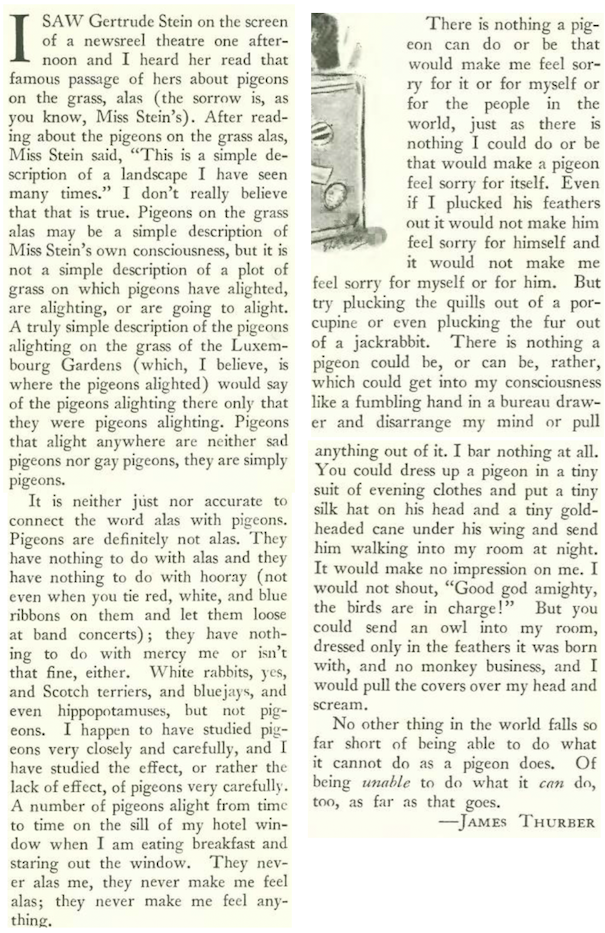
Stein had also achieved success in America via her libretto to Virgil Thomson’s opera Four Saints in Three Acts. Prior to her visit, Stein was featured in a newsreel reading the “pigeon” passage from the libretto, which James Thurber satirized in this piece titled “There’s An Owl In My Room.” Excerpts.
Here is a YouTube clip of the newsreel satirized by Thurber. Stein begins her “pigeon” reading at the 30-second mark:
If Thurber found the libretto ridiculous, it was an opinion not necessarily shared by audiences who attended Four Saints in Three Acts, which premiered in Hartford, Connecticut, before making a six-week run on Broadway.
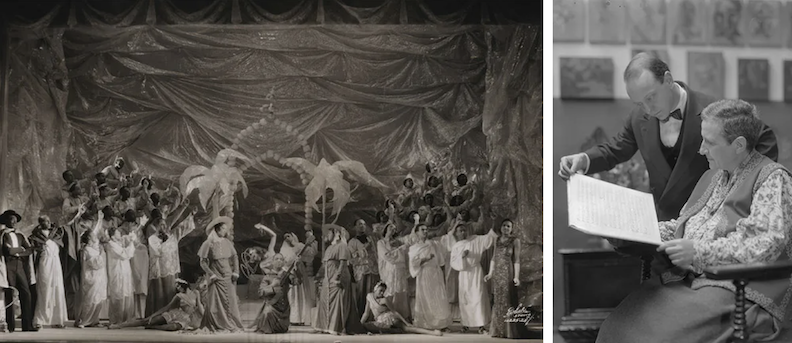
SAINTS AND PIGEONS…The original cast of Four Saints in Three Acts, onstage at the Wadsworth Atheneum, Hartford, 1934; at right, Gertrude Stein reviews the libretto for Four Saints with American composer Virgil Thomson, 1934. (Harold Swahn/Bancroft Library, UC Berkeley)
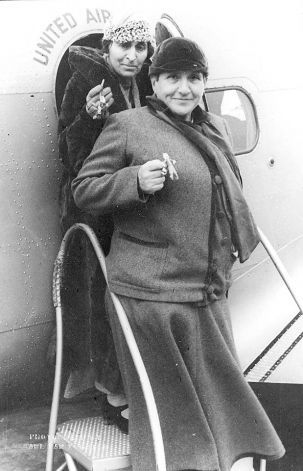
Since Stein had never seen the opera performed, writer and photographer Carl Van Vechten convinced Stein and Toklas to fly on an airplane for the first time in order to be able to see the play in Chicago.
FLIGHT INSURANCE…Stein and Toklas were anxious about flying, so Van Vechten gave each a small Zuni fetish—a good luck charm as they prepared to board their plane at Newark. (Boatwright Memorial Library, The University of Richmond)
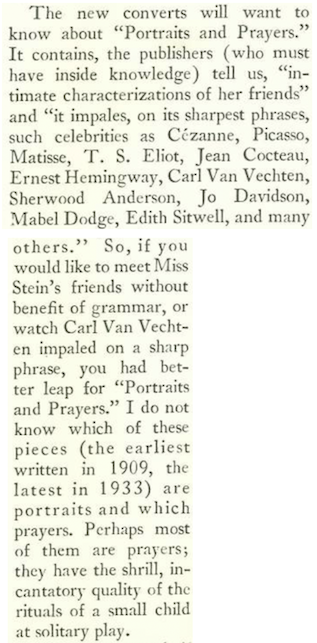
Thurber wasn’t the only New Yorker writer to throw shade on Stein’s visit. In his “Books” column, Clifton Fadiman described Stein as a “mamma of dada” and a “Keyserling in divided skirts” (Hermann Keyserling was a non-academic German philosopher known for his platitudinous, obscure writings). Excerpt:
Fadiman continued by excoriating Stein’s latest book, Portraits and Prayers, likening its “shrill, incantatory” quality to “the rituals of a small child at solitary play.”
* * *
Over the Rainbow
We leave Gertrude Stein for the time being and check in with Lois Long, who was sampling the fall attractions of the New York nightclub scene in “Tables for Two.” In these excerpts, the 32-year-old Long continued her pose as a much older woman (“about to settle down with a gray shawl”) as she bemoaned the bourgeoisie excess of places like the Colony, once known for its boho, speakeasy atmosphere. And then there was the Rainbow Room, with its organ blaring full blast to the delight of gawking tourists.
LOST IN NEW YORK…Lois Long lamented the demise of cafe life in Manhattan; from left, the Colony, circa 1940, which went from boho to upscale; the 21 Club, a favorite Prohibition-era haunt of Long’s where she was suddenly a nobody; and high above the city, the Rockefeller Center’s Rainbow Room, and its interminable organ music. (Pinterest/Alice Lum via Daytonian in Manhattan/nycago.org)
* * *
From Our Advertisers
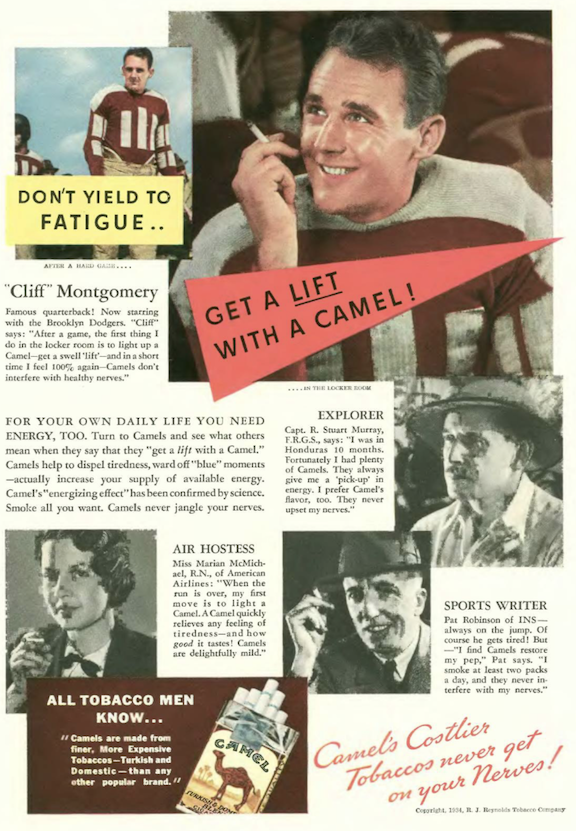
Just one ad from the Nov. 17 issue (more to come below)…the latest athlete to attest to the energizing effects of Camel cigarettes…Cliff Montgomery (1910–2005) was famed for a hidden ball trick play that led one of the greatest athletic upsets—Columbia’s 7-0 win over Stanford in the 1934 Rose Bowl. Montgomery would play one year with the NFL Brooklyn Dodgers, and would later earn a Silver Star for his heroism during World War II…
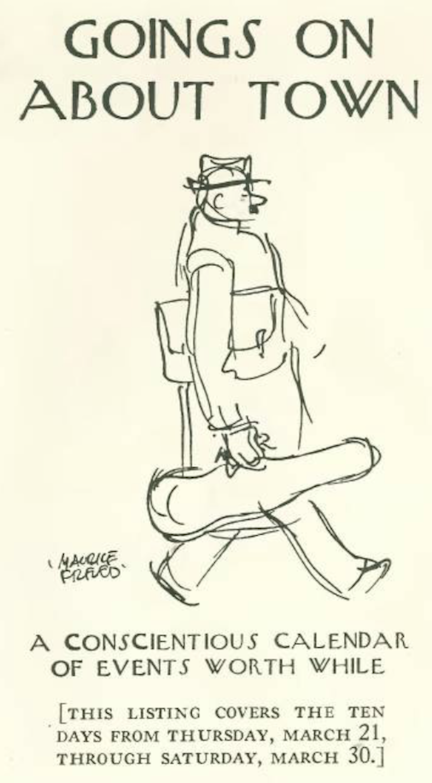
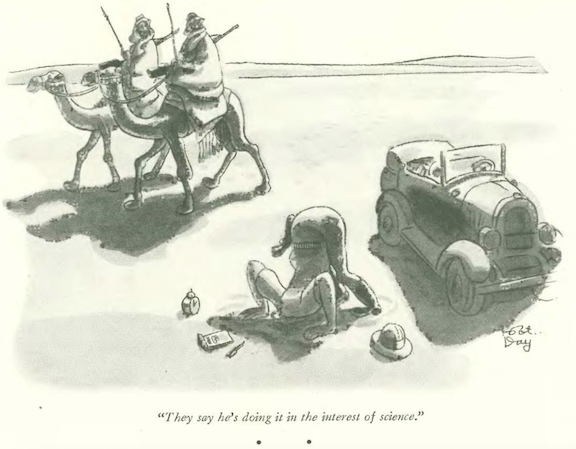
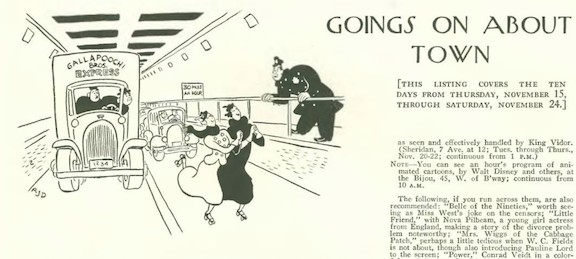
…on to our cartoonists, we begin with Robert Day’s jolly illustration for the “Goings On About Town” section…
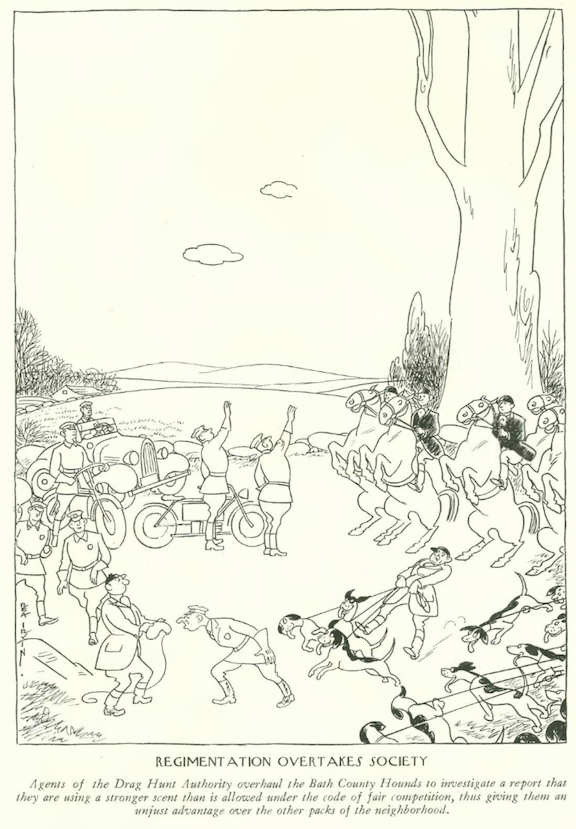
…Rea Irvin looked into fair play among the fox hunting set…
…Garrett Price gave us a tender moment among the bones at the American Museum of Natural History…
…and Peter Arno introduced two wrestlers to an unwelcoming hostess…
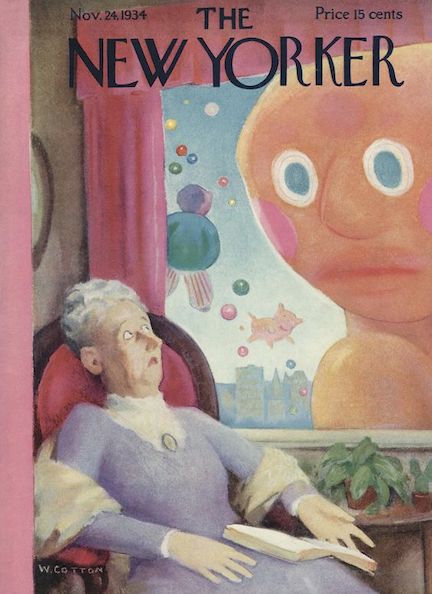
…on to Nov. 24, 1934 issue, and the perils of the Macy’s Thanksgiving Day Parade as illustrated on the cover by William Cotton…
Nov. 24, 1934 cover by William Cotton.
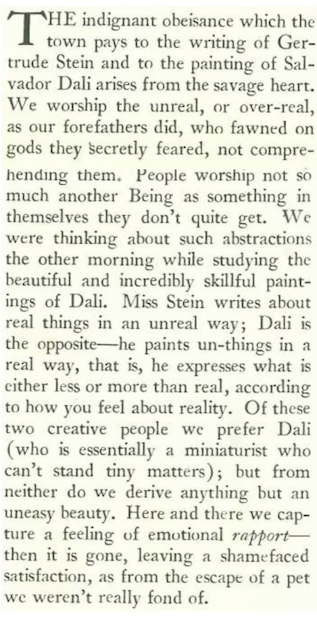
…where we find still more scorn being heaped upon Gertrude Stein. “The Talk of the Town” offered this observation (excerpt):
…and E.B. White had the last word on Stein in his Dec. 1, 1934 “Notes and Comment” column:
* * *
There Goes the Neighborhood
Returning to the Nov. 24 issue, Alberta Williams penned a lengthy “A Reporter at Large” column, titled “White-Collar Neighbors,” about the new Knickerbocker Village development in the Lower East Side. Real estate developer Fred French razed roughly one hundred buildings to build what has since been criticized as an example of early gentrification in Manhattan. Williams assessed the development after more than a year of construction, finding that despite federal funding, the leasing company had yet to rent any apartments “to Negroes or Orientals.” Although the development was meant to serve some of the families it displaced, the vast majority were forced to move back into slums due to escalating rents.
BREATHING ROOMS…Knickerbocker Village in 2019. To make way for the development, one hundred buildings were razed in the “Lung Block,” so named because of its high tuberculosis mortality rate. The development continues to be designated as affordable housing. (Wikipedia)
* * *
Dollmaker
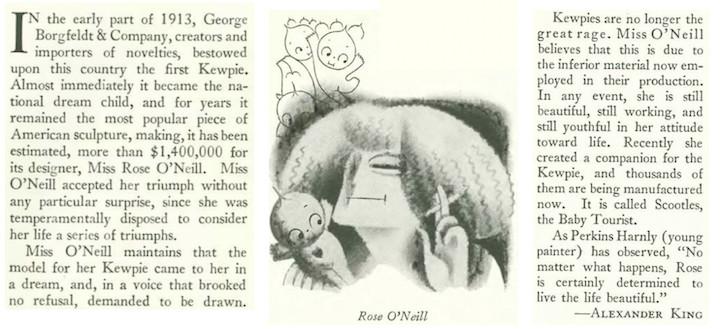
Raised in rural Nebraska, at an early age Rose O’Neill (1874–1944) demonstrated an artistic bent, and was already a published illustrator and writer when she drew her first images of “Kewpie” around the year 1908. A German doll manufacturer began producing a doll version of Kewpie in 1913, and they became an immediate hit, making O’Neill a millionaire and for a time the highest-paid female illustrator in the world. When Alexander King penned a profile of O’Neill, Kewpies were no longer the rage, but O’Neill was nevertheless determined to find success in a new doll line. Excerpts:
QP QUEEN…Clockwise from top left, Rose O’Neill circa 1910, just before her Kewpie dolls made it big; Kewpie doll in original box, undated; as the Kewpie craze faded in the 1930s, O’Neill tried to launch a new line called Little Ho Ho, a laughing baby Buddha, but before production plans were finalized the doll factory burned to the ground; a 1935 ad for a Rose O’Neill-branded “Scootles” doll, another attempt at a comeback. (Wikipedia/Pinterest/museumobscura.com)
* * *
Last Call
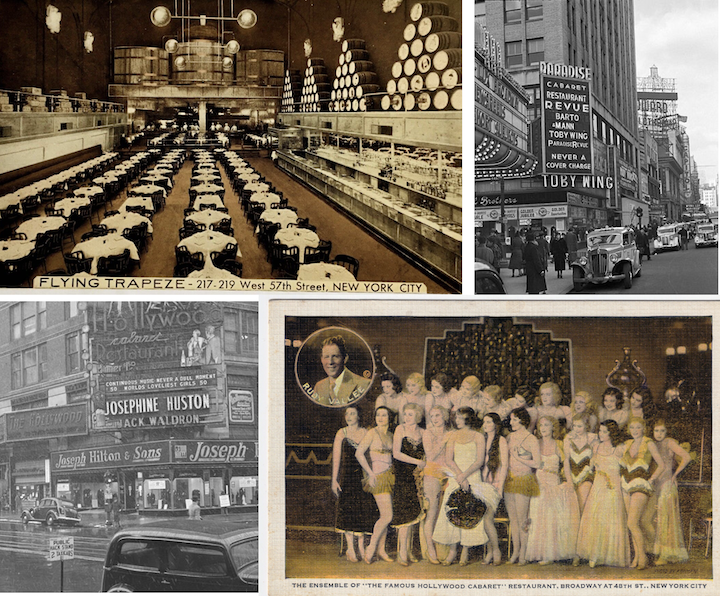
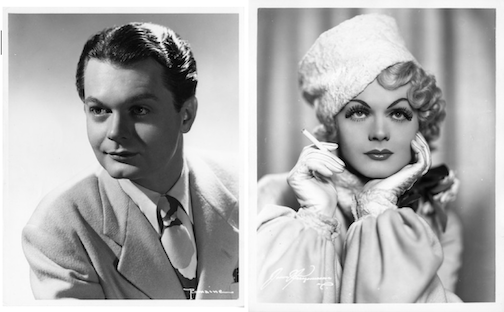
Lois Long was back with another installment of “Tables for Two” and in these excerpts she found the Central Park Casino a welcome place to hang out, apparently unaware that Parks Commissioner Robert Moses had already served an eviction notice to the Casino’s owners (Moses would tear down the Casino in 1936, mostly to settle a personal vendetta). Long also found respite at the Place Piquale, which featured the musical stylings of Eve Symington.
BYE BYE…The Central Park Casino was not long for the world when Lois Long paid an enjoyable visit in November 1934. Long also found a good time at the Place Piquale, which featured the “startling,” deep voice of cabaret singer Eve Symington. (centralpark.org/Pinterest)
At the Place Piquale, Long was “grateful” to see that silent film star Louise Brooks was also a good dancer. An icon of Jazz Age flapper culture, Brooks loathed the Hollywood scene and the mediocre roles it offered, and after a stint making films in Europe she returned to the States, appearing in three more films before declaring bankruptcy in 1932. A former dancer for the Ziegfeld Follies, Brooks had turned back to dancing in nightclubs to make a living.
IT’S A LIVING…Promotional photo for the Place Piquale featuring Louise Brooks (sans her familiar flapper bob) and Dario in “Spectacular Interpretive Dances,” April 17, 1934. (books0977.tumblr.com)
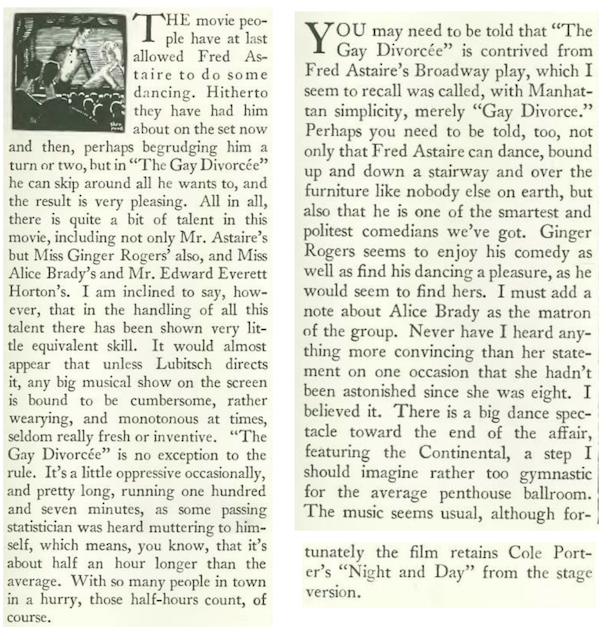
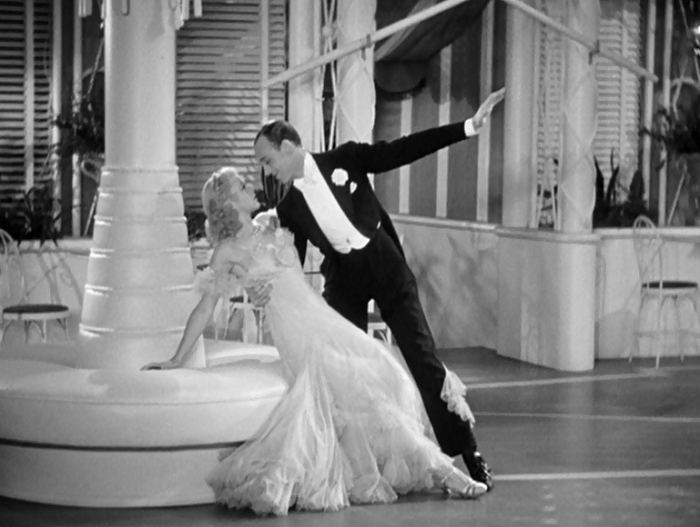
…and dance remains a theme with John Mosher’s film review of the Fred Astaire and Ginger Roger musical The Gay Divorcee, which was based on the 1932 Broadway musical Gay Divorce starring Astaire and Claire Luce.
YOU WILL HAVE TO DANCE BACKWARD, IN HEELS…Ginger Rogers and Fred Astaire trip the light fantastic in The Gay Divorcee. (precode.com)
* * *
Using Her Heads
Clifton Fadiman praised Peggy Bacon’s collection of caricatures, Off With Their Heads!, which included drawings of fellow New Yorker contributors as well as various Algonquin Hotel acolytes. Excerpt:
HEAD HUNTER…Peggy Bacon offered up caricatures of forty celebrities in her new book, Off With Their Heads! Bacon (1895–1987) contributed cartoons as well as poetry and fiction to The New Yorker from 1927 to 1950. Clockwise, from top left, title page with Bacon’s self-portrait; undated photo of Bacon, likely circa 1930; caricatures of Dorothy Parker, Carl Sandburg and Heywood Broun. (villagepreservation.org/printmag.com/Wikipedia–Peter A. Juley & Son)
* * *
More From Our Advertisers
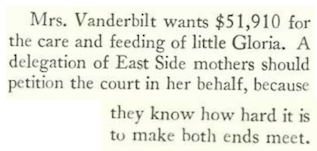
“Beautiful Vanderbilts” Mrs. Reginald Vanderbilt and Miss Frederica Vanderbilt Webb wowed one unnamed dermatologist who discovered that both had 20-year-old skin even though they were seven years apart! “Mrs. Reginald” was Gloria Morgan Vanderbilt, who was thirty when this ad was produced (Miss Frederica was apparently twenty-three). We’ve met Gloria Morgan Vanderbilt before, shilling for Pond’s—she was the maternal grandmother of television journalist Anderson Cooper, and earned her “bad mom” rep from Vanderbilt vs. Whitney, one of America’s most sensational custody trials…
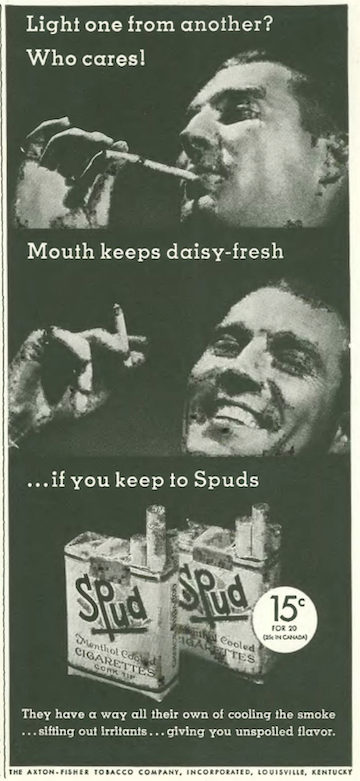
…we move from skin care to who cares…in this case how many Spud cigs you smoke…hell, smoke three packs a day if you like, the cooling menthol will always keep you feeling fresh even as your lungs gradually darken and shrivel up…
…and here’s a lesson from the makers of Inecto hair dye, no doubt a company solely run by men, who schooled wives with the advice that you’d better color that gray hair pronto or your hubby will kick you to the curb…
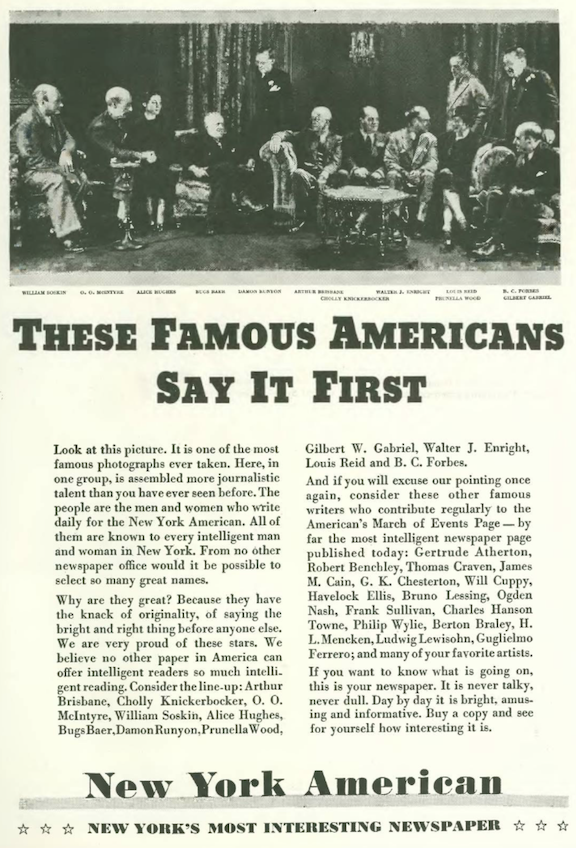
…the New York American was a Hearst broadsheet known for its sensationalism, however it did claim Damon Runyon, Alice Hughes, Robert Benchley and Frank Sullivan among its contributors…the morning American merged with the New York Evening Journal to form the American and Evening Journal in 1937. That paper folded in 1966…
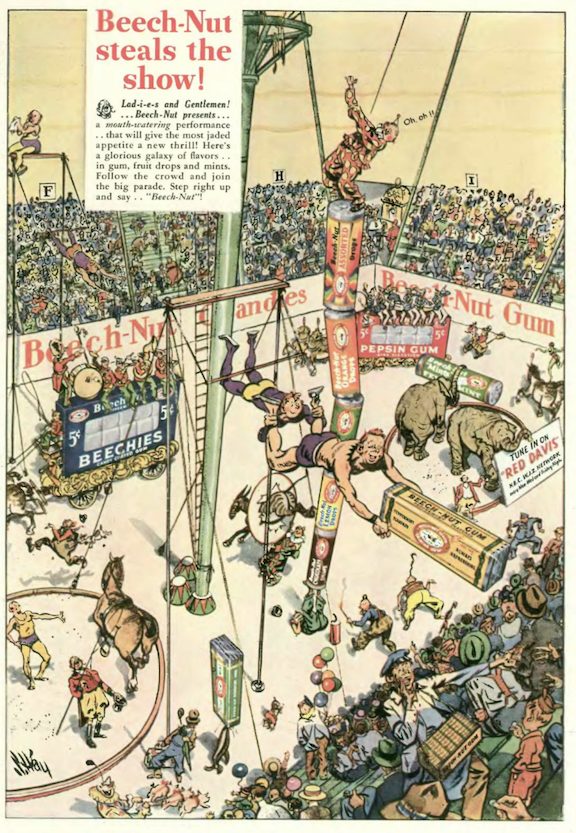
…illustrator Stuart Hay drew up this full page ad for the makers of Beech-Nut candy and chewing gum…when I was a kid we used to call this “grandpa gum”…
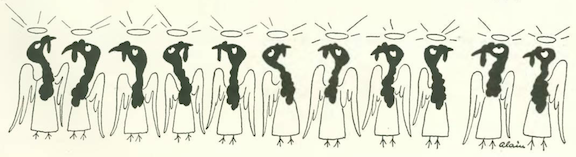
…on to our cartoonists, we begin with a Thanksgiving spot by Alain (Daniel Brustlein)…
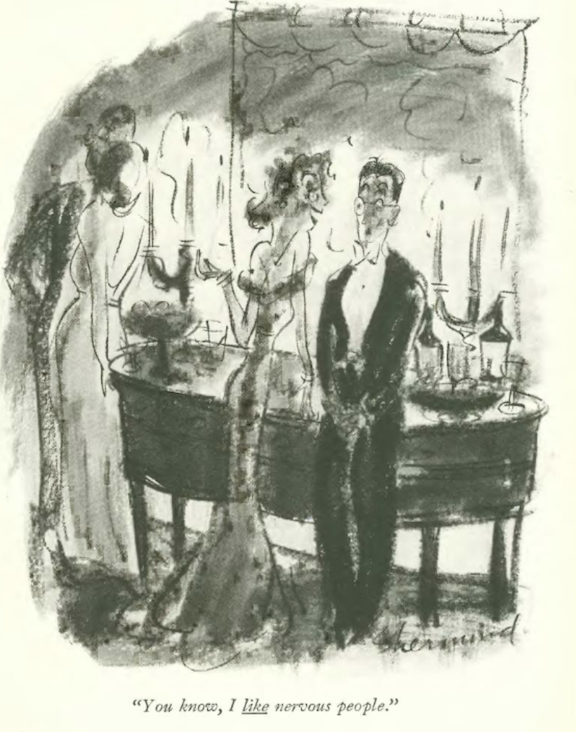
…Barbara Shermund delivered another life of the party…
…George Price was finally bringing his floating man back to earth…
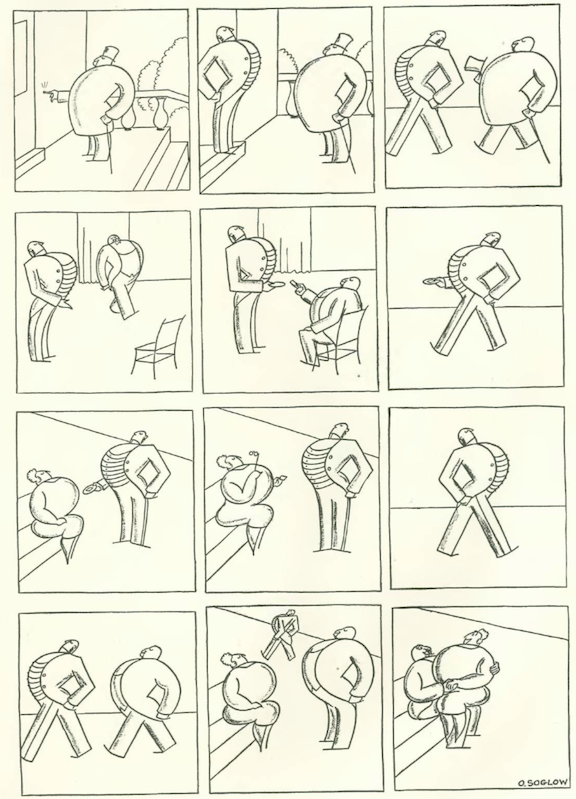
…Otto Soglow gave us an unlikely detour…
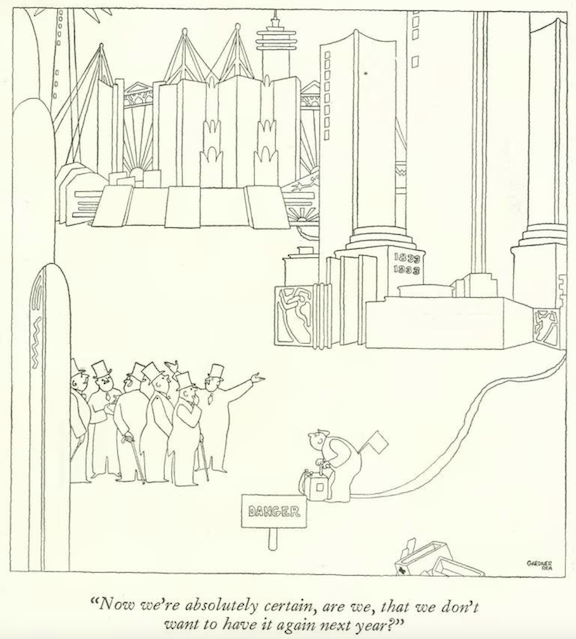
…Gardner Rea signaled the end to the 1933-34 Chicago World’s Fair…with a boom…
…Leonard Dove dialed up a familiar trope…
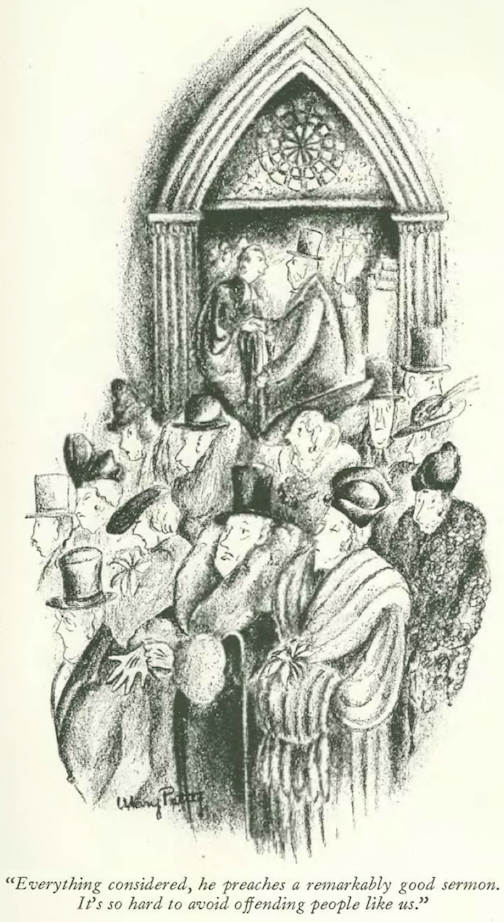
…and we close on a more pious note, with Mary Petty…
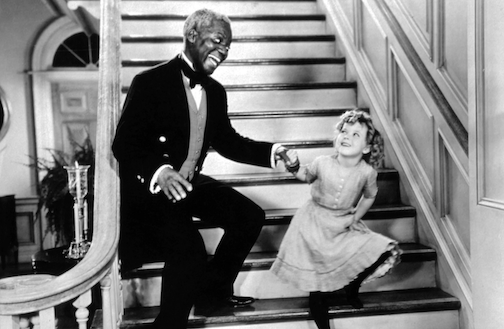
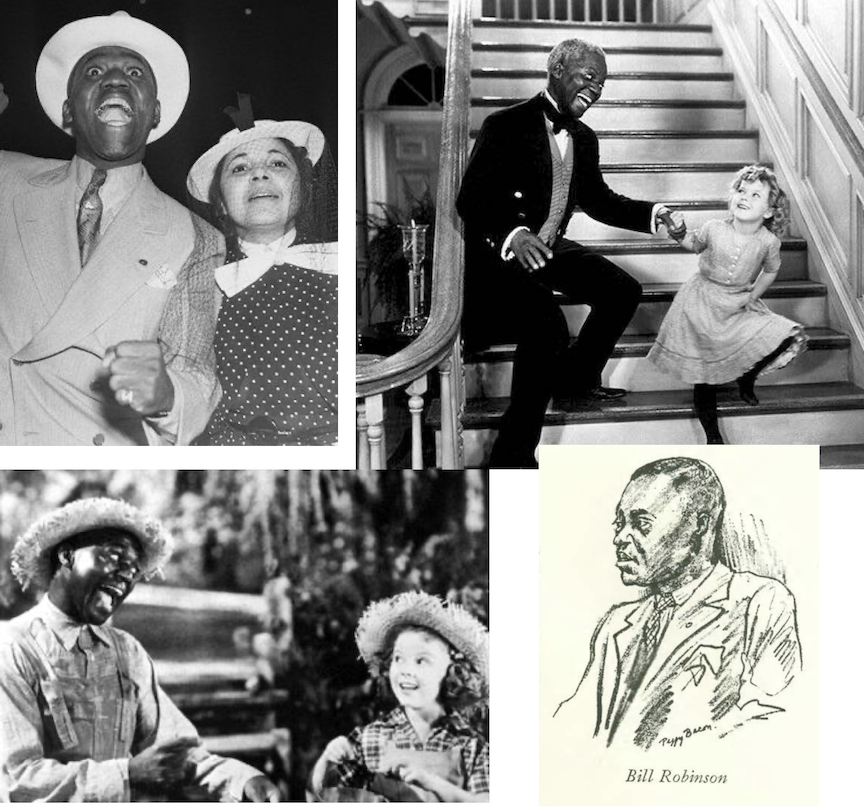
Above: Bill "Bojangles" Robinson demonstrating his famous stair dance, which involved a different rhythm and pitch for each step. At left, Robinson in Broadway's Blackbirds of 1928; at right, publicity photo circa 1920s. (Vandamm collection, New York Public Library/bet.com)
Bill “Bojangles” Robinson (1878–1949) is considered one of the greatest tap dancers of all time, introducing a style of remarkable lightness and complexity that was perhaps best represented by his famous stair dance.
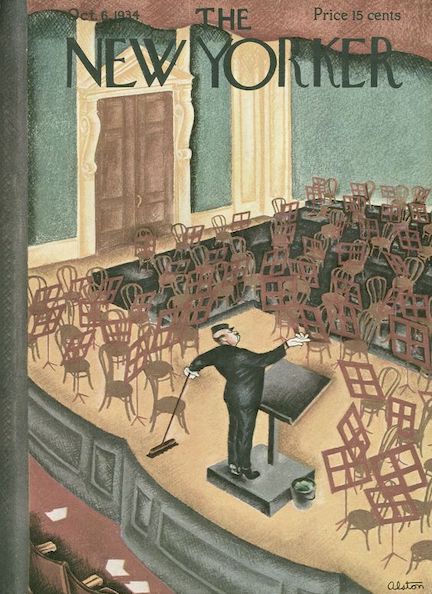
Oct. 6, 1934 cover by Charles Alston. This was Alston’s only New Yorker cover. Active in the Harlem Renaissance, Alston was also a painter, sculptor and muralist (see more on Alston at the conclusion of this post).
St. Clair McElway wrote about the 57-year-old Robinson in a two-part profile that examined his personal life and habits, including his propensity for getting shot. Two brief excerpts:
The New Yorker profile coincided with Robinson’s rising career in films, including four he made with Shirley Temple. For the 1935 film The Little Colonel, Robinson taught the stair dance to the child star, modifying his routine to mimic her movements. Robinson and Temple became the first interracial dance partners in Hollywood history (however, the step dance scene was cut from the film shown to Southern audiences). Temple and Robinson, who became lifelong friends, also appeared together in 1935’s The Littlest Rebel, 1938’s Rebecca of Sunnybrook Farm and 1938’s Just Around the Corner.
DANCING WITH THE STAIRS…Bill Robinson was also known as Bojangles, a nickname from his childhood in Richmond, Virginia. Clockwise, from top left, with his second wife Fannie Clay in 1933; performing the stair dance with Shirley Temple in The Little Colonel (1935); profile illustration by Peggy Bacon; Robinson with Temple in 1938’s Rebecca of Sunnybrook Farm. (blackpast.org/Wikipedia)
Robinson is remembered for his generous support of fellow dancers including Fred Astaire, Eleanor Powell, Lena Horne, Sammy Davis Jr and Ann Miller, as well as his support for the career of 1936 Olympics star Jesse Owens.
FAST IN BOTH DIRECTIONS…Robinson befriended Jesse Owens (left) after the track & field great returned from the 1936 Olympics (where Owens won four golds). Known for his generosity to his friends, Robinson helped Owens establish a successful post-Olympics career. Robinson himself was also something of a runner, having set the world record for running backward in 1922 (100 yards in 13.5 seconds). (Public domain image)
Although Robinson was the highest paid black performer of his time, his generosity with friends as well as his gambling habits left him penniless at his death from heart failure in 1949. Longtime friend Ed Sullivan paid for Robinson’s funeral, and more than 30,000 filed past his casket to pay their respects.
I’VE STILL GOT IT…Bill Robinson with Lena Horne in 1943’s Stormy Weather, a film loosely based on Robinson’s own life. (MoMA)
* * *
In a Romantic Mood
That is how St. Clair McKelway found Hollywood in two of its latest offerings, The Barretts of Wimple Street and Caravan. To his relief, he found the Hollywood version of Barretts quite “sensible”…
LET’S BE SENSIBLE…The Barretts of Wimpole Street (1934) starred Fredric March and Norma Shearer in the lead roles. (TCM)
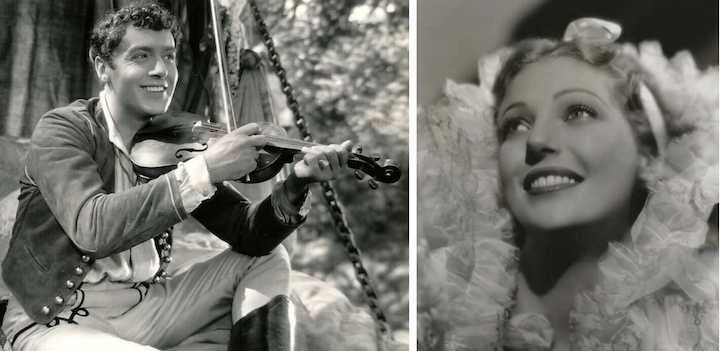
…as for Caravan, McKelway wrote that he’d “never seen a picture with so much grinning in it.” He found the “peculiar, unreal gleam” of the actors’ teeth a real distraction in closeup shots.
THAT PEPSODENT SMILE…Charles Boyer and Loretta Young showed off their pearly whites in 1934’s Caravan. (IMDB/TCM)
* * *
From Our Advertisers
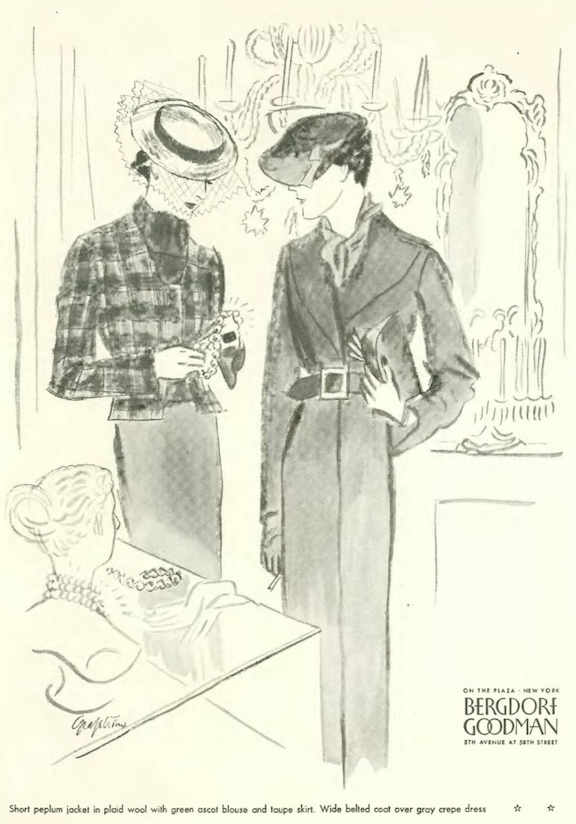
The Oct. 6 issue opened with a study in contrasts: an image of two Civil War veterans swapping stories over whiskey on the inside front cover, paired with an illustration of a lithe model sheathed in the latest fashion from Bergdorf…
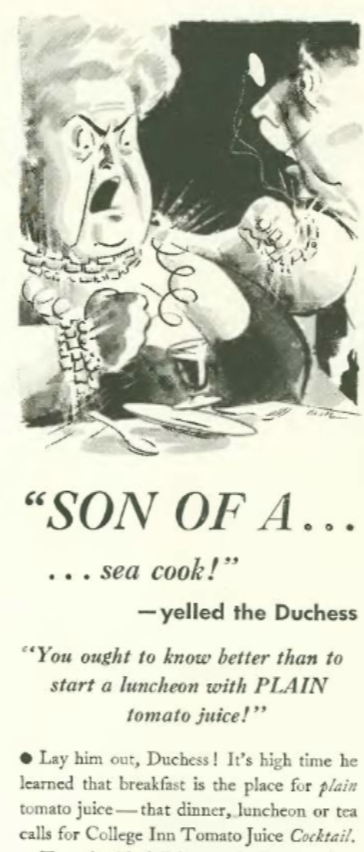
…the folks at Campbell’s continued to suggest that their canned soup was a delight of the elite…
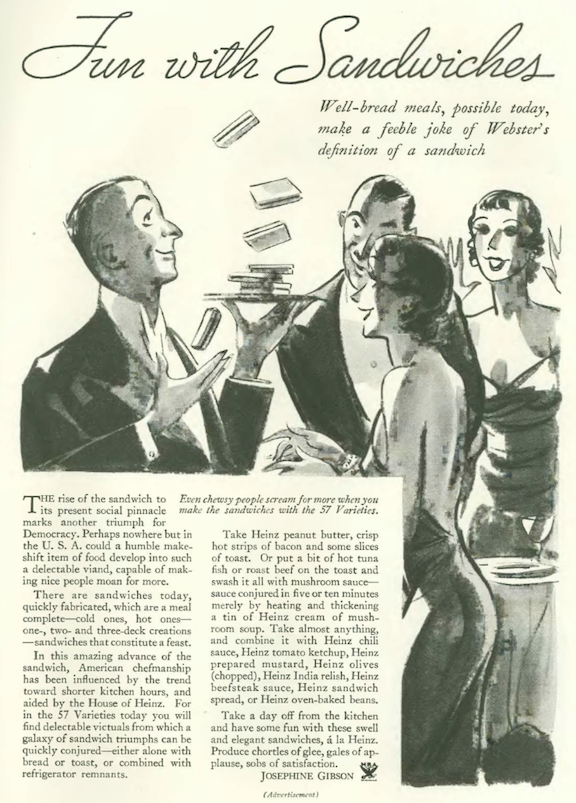
…Heinz took a similar tack, showing the smart set having fun with their sandwich spreads…
…Lord & Taylor touted its “tomorrow look” in furniture…
…R.J. Reynolds continued its series of “distinguished women who preferred Camel’s “costlier tobaccos,” adding to their growing list a the “charming debutante” Evelyn Cameron Watts, who later became Evelyn Watts Fiske (1915–1976)…
…in contrast to Camel’s fashionable ads, the upstart menthol brand Kool offered a series of cheap, back-page ads featuring a smoking penguin, here in the Halloween spirit (detail)…
…another recurring back page ad was this weird spot from Satinmesh, a product that apparently helped close a woman’s “gaping pores”…those pores apparently prompted one man to ponder the eternal why…
…on to our cartoonists, we begin with a two-page spot by Carl Rose…
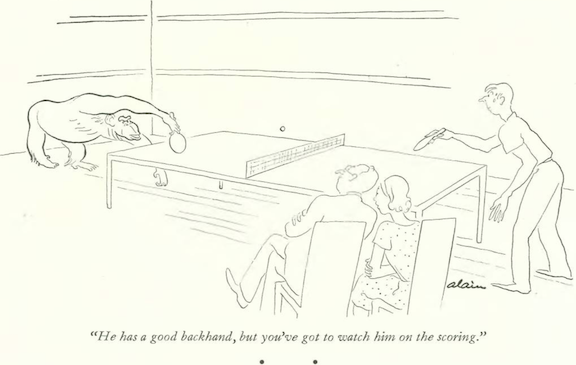
…James Thurber spiced up a game of ping-pong…
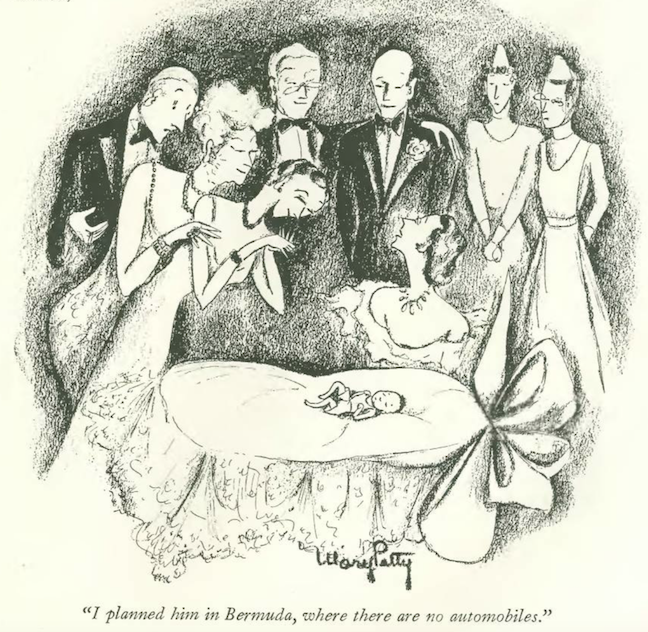
…Mary Petty explored the miracle of birth…
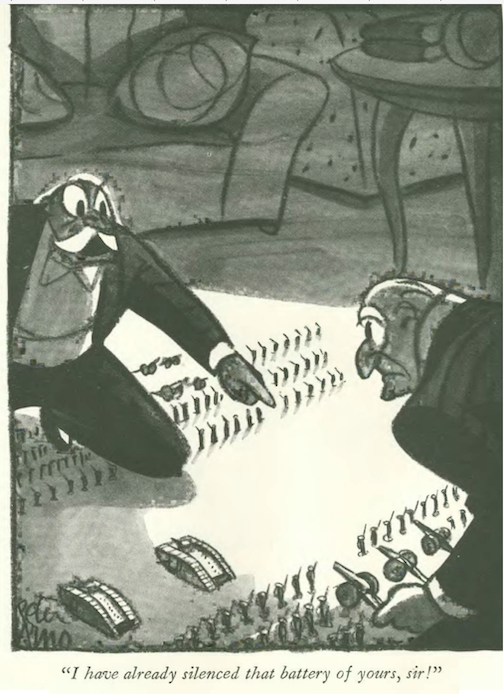
…Peter Arno discovered you’re never too old to play with toys…
…Garrett Price offered a young man’s perspective on a father’s avocation…
…Alain (Daniel Brustlein) gave us a disappointed plutocrat on vacation in Mexico…
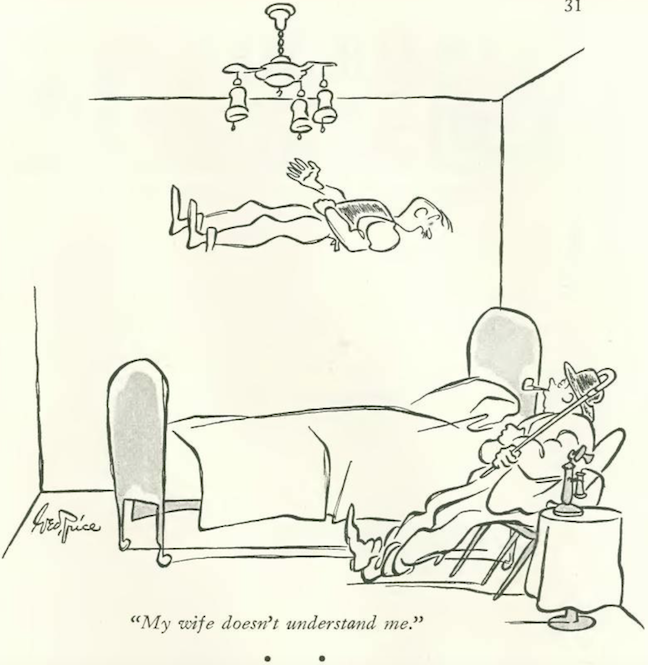
…George Price continued to mine the humor of his “floating man” series…
…and contributed a second cartoon that featured some office hijinks…
…and Otto Soglow returned without The Little King, offering in its stead the closest thing to royalty in America…
Before we sign off, a note on the Oct. 6 cover artist, Charles Henry Alston (1907–1977). A Harlem-based painter, sculptor, illustrator, muralist and teacher, Alston was active in the Harlem Renaissance and was the first Black supervisor for the Works Progress Administration’s Federal Art Project. In 1990, Alston’s bust of Martin Luther King Jr. became the first image of an African American displayed at the White House.
Clockwise, from top left, Charles Henry Alston’s 1970 bust of Martin Luther King Jr; Walking 1958; Andrew Herman photo of Alston, 1939; Midnight Vigil, 1936. (Smithsonian/Wikipedia/Columbia.edu)
During the roughly thirteen years of Prohibition, many Americans had forgotten how to mix a decent cocktail; the concoctions they devised during those dry years were often created to mask the taste of bootleg liquor—sales of Coca-Cola steadily increased throughout the 1920s in part because it made ardent spirits such as rum and whisky a bit more palatable.
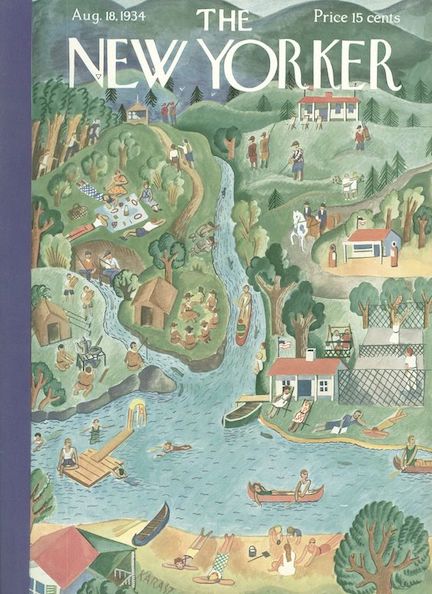
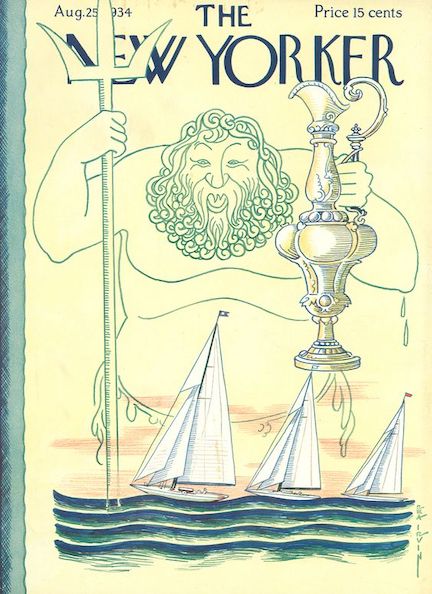
August 18, 1934 cover by Ilonka Karasz.
Donald Barr Chidsey examined the phenomenon in “The Talk of the Town,” visiting with traumatized bartenders around Manhattan:
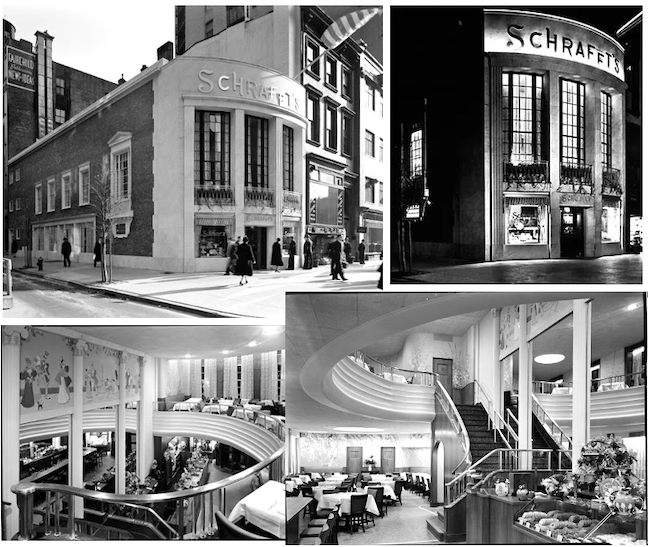
LOST ART…Donald Barr Chidsey relayed the horror of a customer at Sherry’s (top left, photo of the 300 Park Avenue entrance, c. 1925) who asked for ice cream in his rum punch; directly across the street from Sherry’s was the Waldorf Astoria (top right), where a customer asked for a drink of half ice cream, half Coca-Cola; bottom images are from Albert Crockett’sThe Old Waldorf-Astoria Bar Book—as to what one gathers from Chidsey’s account, more than a few people needed to check the “Glossarial” to get reacquainted with the spirit world. (Museum of the City of New York/kitchenartsandletters.com)CUBA LIBRE…According to Chidsey, the go-to for women patrons at the Hotel Weylin was a Barcardi and Coke; at left, Hotel Weylin in 1935; at right, lobby card featuring entertainment at the Weylin Bar, circa 1930s. (Museum of the City of New York/ebay)THE LAST STRAW…Chidsey wrote of an alarming trend among patrons at Schrafft’s who demanded straws in their Tom Collinses. The sleek, art moderne Schrafft’s at 61 Fifth Avenue was among more than two-dozen Schrafft’s locations in New York City in the 1930s. Known for cleanliness and home-style cooking, target clientele were middle-class women. (Architectural Record photos via daytoninmanhattan.blogspot.com)
* * *
From Our Advertisers
Speaking of Schrafft’s, here is their advertisement from the Aug. 18 issue, offering breakfasts ranging from 35 to 75 cents that apparently were the stuff of O. Henry’s dreams…
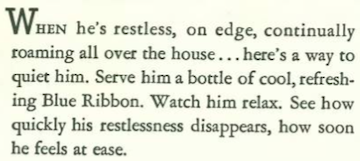
…what is a woman to do with a restless husband?…drawing on the wisdom of the ages, she hands him a beer and coaxes him into his easy chair…this ad encouraged women to “always keep a few bottles in your refrigerator”…in other words, keep ’em coming until he settles into a manageable stupor…
…and see just how easily he slips away, leaving you with a few moments to yourself…
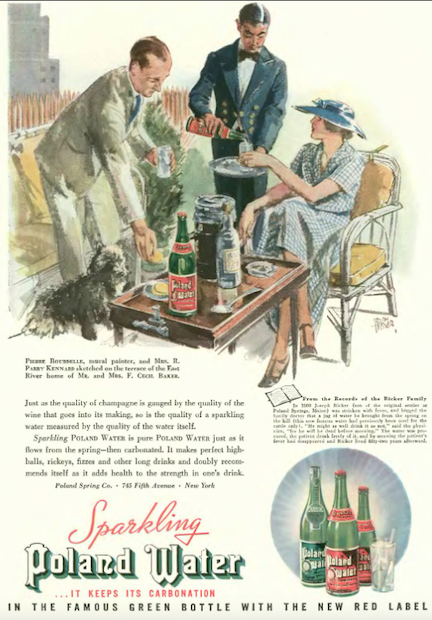
…if highballs were more to your taste, the folks at Poland Water stood ready to help…
…R.J. Reynolds claimed their Camels could solve all sorts of life challenges…we’ve seen ads claiming that Camels soothed “jangled nerves” and helped one relax, but apparently they also could give you energy and pep, at least that is what tennis star Ellsworth Vines, Jr claimed…
…lots of color in the ads for the Aug. 18 issue…here the folks at Buick featured a woman in a red dress serving as an exclamation point to their automobile, which was no ordinary motorcar, but rather a “congenial companion, alive with good-natured personality”…
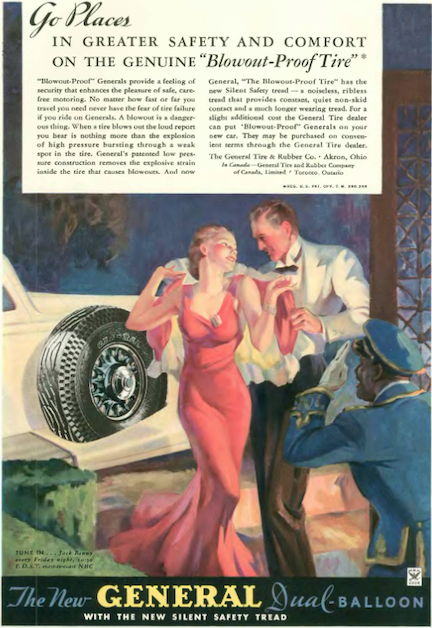
…the folks at General Tire went one better, making their tires the star attraction…those tires look so attractive it seems almost a shame to dirty them on the road…
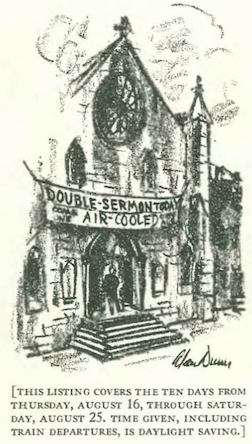
…on to our cartoons, we cool off with this spot in the opening pages by Alan Dunn…
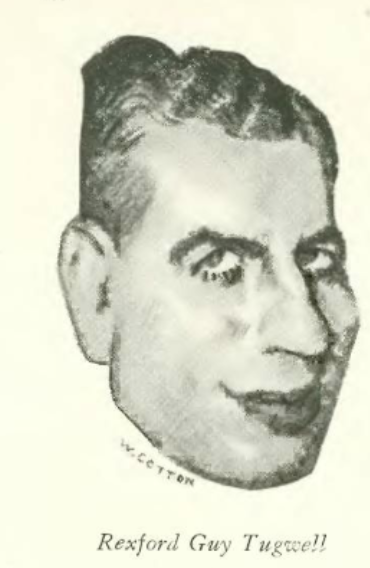
…William Cotton contributed this caricature of New Deal Administrator Hugh Samuel Johnson that accompanied a three-part profile…
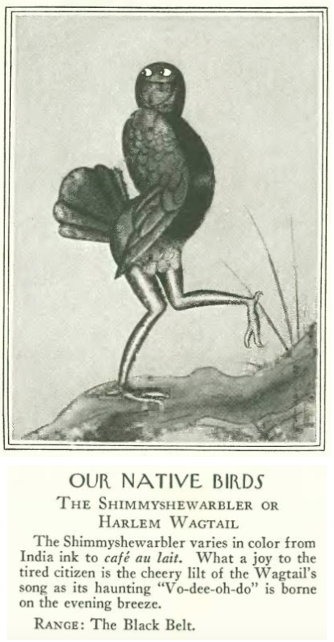
…Rea Irvin offered up a bird of a different feather…
…Robert Day gave us this master of understatement…
…Alan Dunn again, examining the trials and tribulations of the leisure classes…
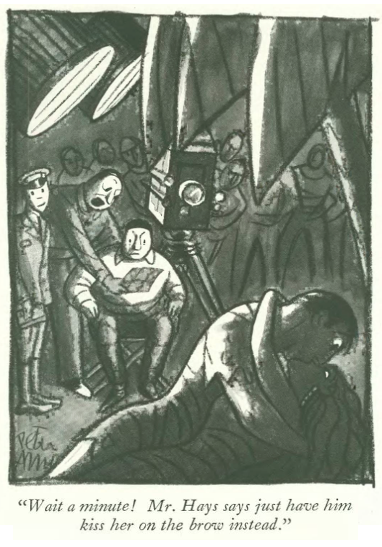
…Peter Arno offered this take on the Hays Code (after politician Will Hays), which was going into effect after the brief “Pre-Code” period (roughly 1930 to 1934) during which filmmakers felt freer to explore themes featuring sex and violence…
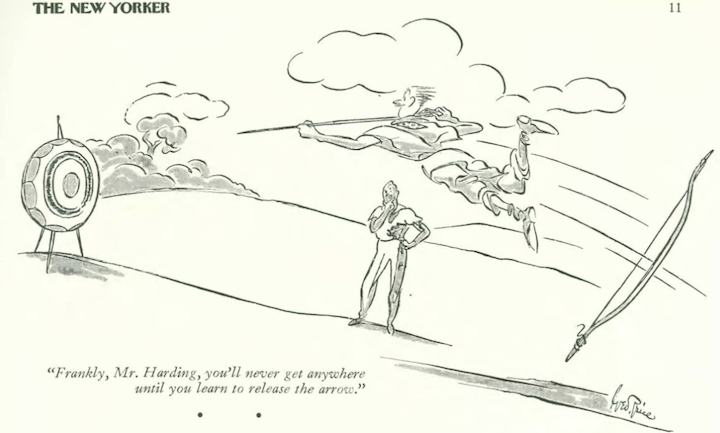
…George Price gave us a man have trouble hitting his mark…
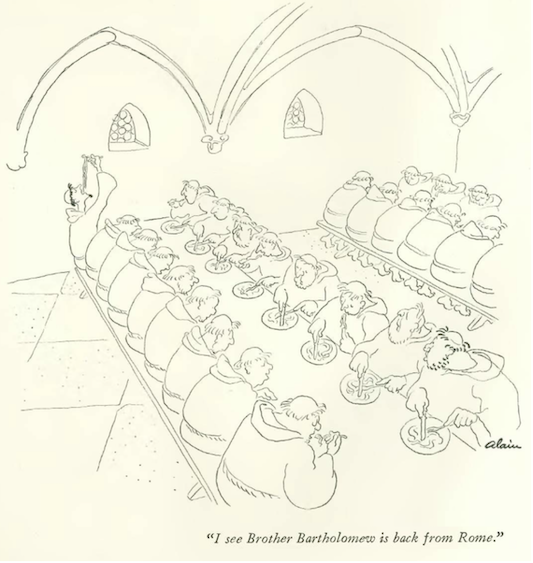
…Alain (Daniel Brustlein) contributed a cartoon with a talking animal, common today but rare in the early New Yorker…
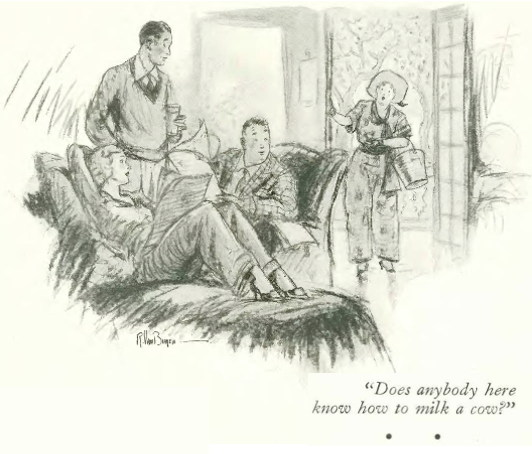
…Raeburn Van Buren was also down on the farm…I think we know the answer to this woman’s query…
…and we close with James Thurber, where mixed doubles were naturally fraught with peril…
Photo above circa 1930 via mensfashionmagazine.com.
Lois Long took a break from reviewing the latest fashions to offer some thoughts on the relations between men and women, and more specifically, what was expected of women if they ever hoped to land the type of man who represented a “potential Future” for them.
August 4, 1934 cover by Otmar. Likely Otmar Gaul, sometimes spelled “Ottmar.”
Based on what we know about Long, this column has a strong “tongue-in-cheek” quality. It should also be noted that the 32-year-old Long had been divorced from cartoonist Peter Arno for three years, and was possibly contemplating the dating scene (she would marry newspaper ad man Donaldson Thorburn in 1938). In this excerpt, Long dispelled the notion that “the brutes” never notice a woman’s appearance:
THEY MIGHT BE BRUTES, but they notice the little things, according to Lois Long. (fashionhistory.fitnyc.edu)
SEEING RED…According to Long, discerning men preferred women in brimmed hats (actress Sylvia Sidney models above), but found red fingernails to be disturbing. (glamourdaze.com/vintagehairstyling.com)SEEING RED in women’s clothes, however, wasn’t a problem, according to Long, who wrote that men liked to see women in bright, tropical colors. (clickamericana.com)
Long concluded that in the end, it didn’t matter what men thought about women’s clothes, but letting them “yap” about such things was a good way for them to blow off some steam.
Check out these patronizing examples from an illustrated guide for women published in 1938 by Click Parade magazine. It gives us some idea of what Long, and millions of other women, were up against…
(dailymail.co.uk)
* * *
Fifth Avenue Remnant
The first years of The New Yorker coincided with some of the most transformational years in Manhattan’s urban fabric, including the replacement of Gilded Age mansions with upscale commercial buildings. One of the last remaining mansions was the Wendel house, featured in “The Talk of the Town.”
A ONCE GRAND MANSION becomes diminished as the city grows around it. At left, the Wendel mansion as it appeared circa 1901; at right, shorn of its balconies and shutters, the mansion shrinks in contrast to the city around it, circa 1930. (Wendel Family Papers, Special Collections and Archives, Drew University Library)WHAT HO!…A “very British-looking” zinc-lined bathtub (with shower) was state-of-the-art when installed at the Wendel mansion. (New York Public Library)BARELY A MEMORY….The glass-and-steel structure towering above the former Knox Hat Building sits on the site of the Wendel mansion. (Photo by Nicolson & Gallowy via Daytonian in Manhattan)
In his “Notes and Comment,” E.B. White noted the spurious nature of cinema newsreels, including one featuring the case of Thalia Massie, a navy wife stationed in Hawaii whose immature behavior and trail of lies would implicate five men in a crime they could not have committed (one would even be killed by vigilantes) and would cast Hawaii into a state of racial turmoil. (You can read more about it at the PBS site for American Experience.
FATAL FEMME…Thalie Massie, circa 1930. (Library of Congress)
* * *
Blunders, Part II
Howard Brubaker commented on the twentieth anniversary of the outbreak of the Great War. Today we call it World War I, and as we know, the blunders did not cease with the Armistice.
* * *
RIP Madame Curie
Janet Flanner, Paris correspondent for The New Yorker, noted the passing of Marie Curie, a pioneer in field of radioactivity.
THE CURIE CURE…Marie Curie and daughter Irène, 1925. (Wikipedia)
* * *
From Our Advertisers
The folks at Chrysler were trying every angle to get car buyers interested in the Airflow—although the car offered a number of advanced features, consumers just weren’t ready for its radical aerodynamic design…note how the ad downplays the car’s sweeping curves…
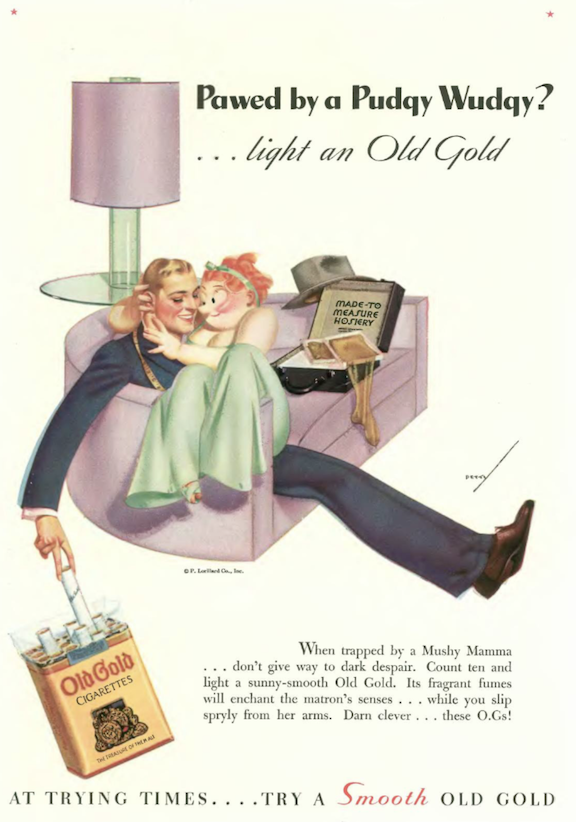
…and we have more deception from the cigarette industry, including claims that cigarettes gave you more energy and improved the performance of top athletes…
…the makers of Chesterfields gave us this sunny picture of health…indeed, there was sunshine in every pack…
…The Brown & Williamson Tobacco Company launched KOOL cigarettes in 1933 as the sole competitor to the other menthol brand, Spud, which was a big advertiser in the early New Yorker. Maybe it was the coupons, or the modern brand name, that helped KOOL knock Spud from the market by the 1940s. As for those coupons, it appears each pack contained only one of them…
…so you would have to smoke a ton of those things to get one of these swell prizes…
…early Budweiser ads often featured images of the Old South…here they conjured up the ghost of Mark Twain (who had been dead only 24 years), putting the great humorist and writer on par with their bottled beer…
…Canada Dry didn’t have Mark Twain, but what they did have was a beer (Hupfel’s) lacking “that queer yeasty taste that beer usually has”…
…a couple of ads from the back pages featured, at left, an ad for a pre-mixed Tom Collins, which must have been awful, and at right, a spot for Bacardi rum, which was actually made in Cuba before the revolution…
…on to our cartoons, we begin with Alain (Daniel Brustlein) and some not-so-intrepid mountain climbers…
…Otto Soglow’s Little King sought a glimpse of the street life…
…William Steig took a dip with his Small Fry…
…Isadore Klein gave us a glimpse of sensationalist radio reporting…
…and we close with Richard Decker, and a game of charades…
Above: Al Smith waving to crowds on arrival at Chattanooga, Tennessee during his presidential campaign in 1928. (Museum of the City of New York)
It’s hard to not like Al Smith, the governor of New York from 1923 to 1928, a man who avoided the temptations of political power and stayed true to his working class roots of the Lower East Side.
July 14, 1934 cover by Rea Irvin.
The son of Irish, Italian and German immigrants, Alfred Emanuel Smith (1873–1944) was raised in the Tammany Hall-dominated Fourth Ward, and although he was indebted to Tammany’s political machine throughout much of his professional life (including stints in the New York State Assembly and as York County Sheriff, President of the Board of Alderman, and finally Governor) he remained untarnished by corruption. Smith’s unsuccessful bid for the U.S. presidency in 1928 put an end to his political life, but there was still much to do, as “The Talk of the Town” explained:
HALL MONITORS…At left, Charles “Silent Charlie” Murphy with Al Smith in 1915. Murphy was the longest-serving head of Tammany Hall (1902 to 1924), and was known for transforming Tammany’s image from one of corruption to semi-respectability; at right, in 1929, Smith greets Franklin D. Roosevelt, who had just succeeded him as governor. (Library of Congress/Wikipedia)
Smith first sought the Democratic presidential nomination in 1924. According to historian Robert Slayton, Smith advanced the cause of civil liberty by decrying lynching and racial violence at the 1924 Democratic National Convention, where Franklin D. Roosevelt delivered the nominating speech for Smith and saluted him as “the Happy Warrior of the political battlefield.”
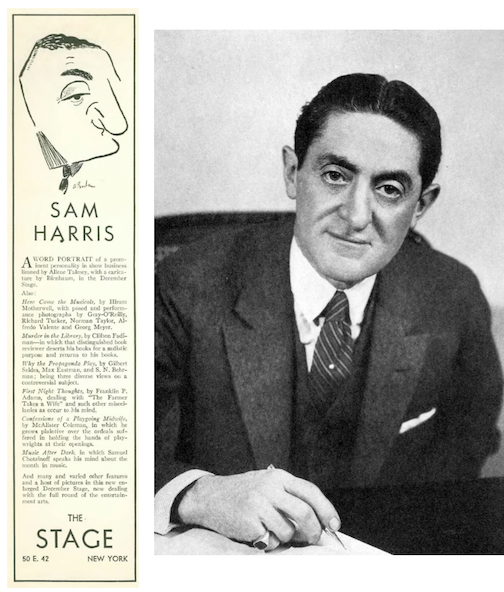
Following his 1928 presidential election loss to Herbert Hoover, Smith became president of Empire State, Inc., the corporation that built and also operated the Empire State Building, which was then the tallest building in the world. Smith was also known for his fondness of animals, and in 1934 Parks Commissioner Robert Moses made Smith “Honorary Night Zookeeper” of the renovated Central Park Zoo. Smith was given keys to the zoo and often took guests to see the animals after hours. According to Rebekah Burgess of the NYC Department of Parks and Recreation, “As a resident of 820 Fifth Avenue, directly across the street from the entrance of the Central Park Zoo, Smith was known to appear with snacks for the animals or to launch into impromptu lectures for visitors. Al Smith took his honorary title to heart. Throughout the rest of his life, Smith could often be found attending to the animals at the zookeepers’ sides during open hours. At night, Smith visited with guests, or more often, one-on-one with the animals.”
Smith was also a humanitarian, and in addition to advocating for the working class, he was an early critic of the Nazi regime in Germany, vigorously supporting the Anti-Nazi boycott of 1933. Here is another excerpt from the “Talk” piece:
LIFE OUTSIDE THE OFFICE…Scenes of post-political life, clockwise from top left: Al Smith fishing in 1933; with his family at the May 1, 1931 opening of the Empire State Building—Smith’s grandchildren cut the ribbon; golfing in 1930 with baseball great Babe Ruth in Coral Gables, Florida; with Rosie, the hippopotamus, at the Central Park Zoo, 1928. (Museum of the City of New York/Wikipedia)
* * *
Culture Club
In the Nov. 9, 1929 issue of The New YorkerMurdock Pemberton hailed the opening of the Roerich Museum. For the July 14, 1934 issue, “The Talk of the Town” took another look. A brief excerpt:
MORE THAN A BUILDING…”The Talk of the Town” noted the changing shades of the art deco landmark Master Building on Riverside Drive (left, in 1929) which originally housed the Nicholas Roerich Museum. Today the Roerich is located in this brownstone at 319 West 107th. (Wikipedia)FOOTNOTES FROM A FULL LIFE…Two of Nicholas Roerich’s paintings from the 1920s: at top, Remember, 1924; below, Drops of Life, 1924. (roerich.org)
* * *
Itinerant Showman
Alva Johnston filed the first installment of a three-part profile of famed sports promoter Jack Curley (1876–1937). A brief excerpt:
FIGHT CLUB…Sports promoter Jack Curley (left) with boxing manager Eddie Kane, circa 1920. (Library of Congress)
* * *
Over There
In his column “Of All Things,” Howard Brubaker made this brief mention of the “Night of the Long Knives;” on June 30, 1934 Adolf Hitler ordered SS guards to murder the leaders of the paramilitary SA along with hundreds of other perceived or imagined opponents.
Here is a clip from the front page of The New York Times, July 3, 1934:
(The New York Times)
* * *
Pimm’s and Soda
July in England meant Wimbledon, and The New Yorker was there to observe the “snobbish and sacred” rite…
WATCH THE BOUNCING BALL…British tennis great Fred Perry (left) and Australian Jack Crawford before their men’s singles final at the 1934 Wimbledon tournament, which Perry won. Perry would claim three consecutive titles between 1934 and 1936. (Image: Mirrorpix)
* * *
Midsummer Dreams
In the summertime (and before widespread use of air conditioning) stage entertainments such as theater and musical performances took to the outdoors during their off-season, seeking the evening cool of intimate rooftops or large, open venues such as Lewisohn Stadium, A brief excerpt describing a performance of Samson et Dalila:
EVENING SHADE: Andre Kostelanetz conducts at Lewisohn Stadium in 1939. The stadium was demolished in 1973 to make way for City College of New York’s North Academic Center. (PressReader.com)
* * *
From Our Advertisers
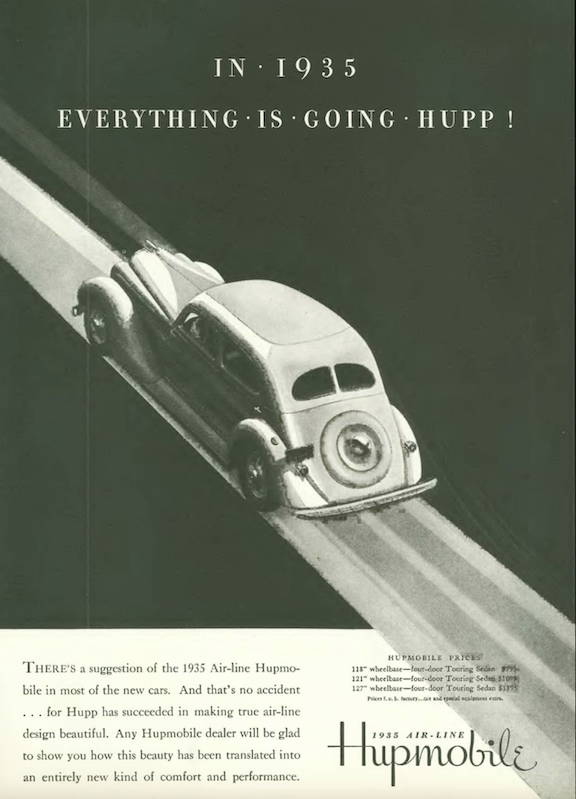
The folks at struggling carmaker Hupmobile took out this bold, full-page ad to tout their flashy “Aero-Dynamic” by noted designer Raymond Loewy…
…this ad from Harriet Hubbard Ayer was bold in a very different way, essentially calling some women ugly unless they used the company’s “beauty preparations”…
…consommé, a clear soup that was particularly popular among the upper classes, offered up some keen competition between two food giants…here Heinz enlisted the help of William Steig to move their product…
…while the folks at Campbell’s offered up this lovely patio setting for their “invigorating” consommé…
…meanwhile, White Rock mineral water could be found on patios all over Manhattan, as this ad attested…
…this is a reminder that most city folks had their milk and other dairy products delivered in the early part of the 20th century…by the early 1960s about 30 percent of consumers still had their milk delivered, dropping to 7 percent by 1975 and .4 percent by 2005…
…affordable home air-conditioning wouldn’t be available to the masses until after World War II…this unit (designed for a single room) from Frigidaire retailed for $340 (a little less than $8,000 today)…
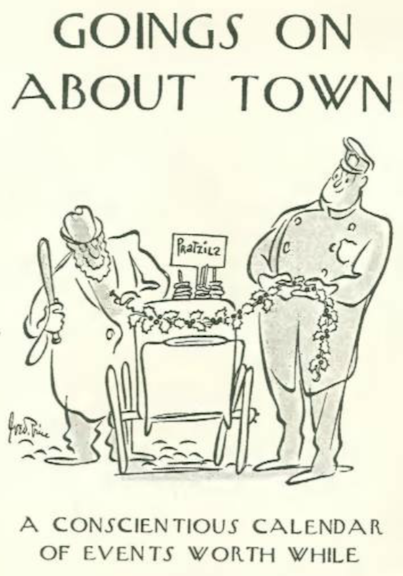
…on to our cartoonists, we begin with Robert Day in the “Goings On’ section…
…Day again, exploring the baffling, glassy interiors of modern restaurants…
…the birdwatching continued with Rea Irvin…
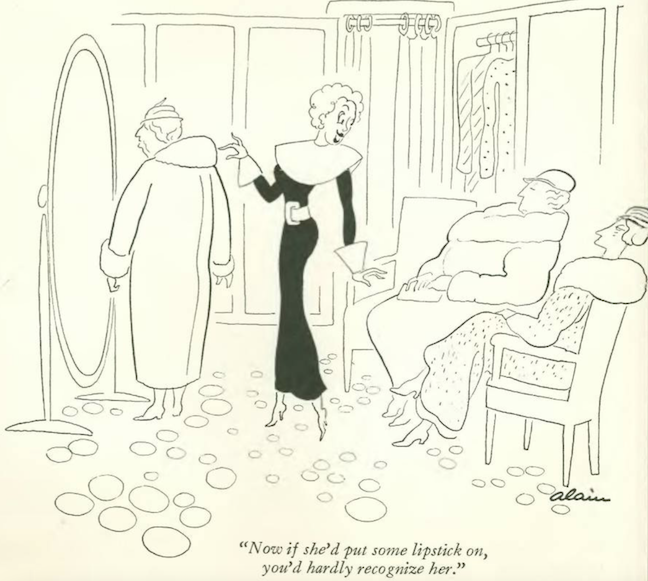
…Alain (Daniel Brustlein) gave us a swimming somnambulist…
…Helen Hokinson explored the paranormal, via domestic plumbing…
…and we close with James Thurber, and the missing Dr. Millmoss…
Power broker Robert Moses always made sure he was few steps ahead of any possible opposition to his grand development plans in and around New York City. That included the yacht clubbers along the Hudson River, who were more or less erased from the scene by Moses in one fell swoop.
May 19, 1934 cover by Ilonka Karasz.
The Upper West Side’s Columbia Yacht Club probably thought it was just swell that the city was dumping waste and rock along the shores of the Hudson River, since it eventually created driveway access for members who previously had to access the club via a footbridge over the New York Central’s tracks. What hadn’t occurred to them was that nearly 25 years-worth of infill had also created a new strip of land that extended from 79th to 96th street, land that Moses envisioned as an expansion of Riverside Park (and the abrupt end of the West Side yacht club scene). “The Talk of the Town” explained:
LOCATION, LOCATION…Two views of the Columbia Yacht Club at West 86th Street, circa 1930. The club was razed to make room for Robert Moses’s expansion of Riverside Park. Moses’s ambitious project, which cost twice as much as Hoover Dam, put the train tracks underground and topped the park with the Henry Hudson Parkway. (newyorktoursbygary.blogspot.com/NYPL Digital Collections)HEADS UP…Elsie Henneman dives into the water near the Hudson River Yacht Club, circa 1930. Located at the foot of West 74th Street, the club moved onto a barge at 145th Street to escape Moses’s park expansion plans, but it was eventually banished from the West Side. (Reddit)
* * *
Ode to the Road
We now shift gears to E.B. White, who was poetically inspired by an advertisement in the Herald Tribune that featured Prince Alexis A. Droutzkoy (a member of the exiled White Russian colony in New York) praising the “magic silence” of the new “Dodge Six” automobile:
SILENCE OF THE CAMS…The 1934 Dodge Six. (detail from a vintage ad)
* * *
Führer’s Filmmaker
The ability (or inability) to separate art from an artist’s personal conduct or beliefs has been a particular topic of the last two decades, given the litany of stars who have been “cancelled” despite the quality or importance of their work. The work of German filmmaker Leni Riefenstahl (1902–2003), still debated nearly ninety years after her collaboration with Nazi leaders, demonstrates the fine line many a film historian or critic must walk when assessing the career of an innovative artist (for an American example, see filmmaker D. W. Griffith). Riefenstahl’s 1932 film, The Blue Light (Das blaue Licht), made prior to her Nazi collaborations, was praised for its beauty by American critics, including the New Yorker’sJohn Mosher, when it was released in the U.S. in 1934.
The Blue Light also captivated Adolf Hitler, who saw the attractive and athletic Riefenstahl as an ideal of Aryan womanhood. A subsequent meeting with Hitler would result in Riefenstahl’s controversial 1935 Nazi propaganda film Triumph of the Will (Triumph des Willens). We will explore that film, and Riefenstahl’s role, in a later post.
CAREER MOVE…Clockwise, from top left, Leni Riefenstahl demonstrated her acting ability, athleticism and filmmaking talents in 1932’s The Blue Light (Das blaue Licht); Riefenstahl filming in Nuremberg during the 1934 Nazi Party congress—the footage was used in 1935 Nazi propaganda film Triumph of the Will; working at a film cutting table, 1935; with Adolf Hitler at Nuremberg, 1934. (IMDB/Library of Congress/UTK Cinema Studies/The Irish Times)HI HITLER…Nazi propaganda minister Joseph Goebbels and Adolf Hitler pay a visit to Leni Riefenstahl at her Berlin estate, circa 1937. (Roger-Viollet)
* * *
From Our Advertisers
We begin with more Carl “Eric” Erickson-inspired artwork, here promoting the bygone elegance of transatlantic travel…
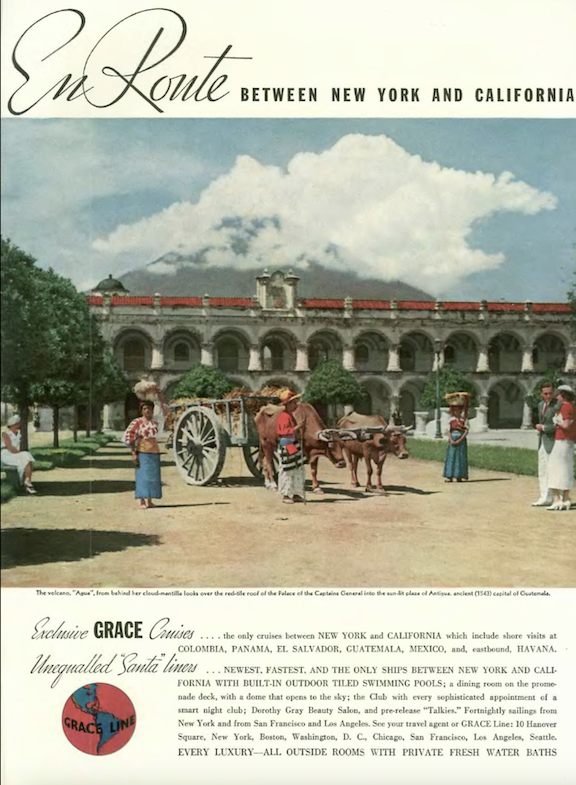
…perhaps a bit less upscale but still pretty nice, the “Santa” line of ships operated by the Grace Line between New York and Latin America included air-conditioned interiors paneled with aluminum (a fireproofing measure) and spacious cabins with private baths that faced to outside…
…this ad must have been a happy sight to folks who had to endure more than a decade of bootleg Scotch during Prohibition…
…Smirnoff vodka had its origins in 1860s Russia, capturing two-thirds of the Moscow market by the mid-1880s…forced to leave Russia in 1904 after the Tsar nationalized the Russian vodka industry…Smirnoff relocated to Turkey, then Poland, and then Paris, each time with limited success…at the end of Prohibition the brand relocated once again to a distillery in Bethel, Connecticut, hence this advertisement…
…the habanero pepper has been used to infuse everything from tequila to vodka to whiskey…this particular product was marketed as something new that could be mixed with a variety of spirits or topped up with club soda or ginger ale…
…I include this ad from the maker of Spud cigarettes for its sheer audacity…it claims your mouth will feel dewdrop fresh after an entire day of smoking menthols…
…stunt driver Billy Arnold was one of the “Hell-Drivers” Chrysler employed to tout the safety of its low-priced Plymouths at promotional events…
…including Chicago’s “Century of Progress”…below, a crowd watches Arnold take his Plymouth for a roll and emerge unscathed…
…the folks at Redi-Spred employed a murder theme to promote their “Pâté de Foie”…which foie was used…duck, goose or lord knows what, is not specified…
…the signature is muddled, but this looks like another illustration by Herbert Roese, who never published a cartoon in the New Yorker but sure had its style down, especially Peter Arno’s…
…Harold Ross’s high school friend and cartoonist John Held Jr. was a frequent contributor to the New Yorker from 1925 to 1932 (he also contributed to Life, Vanity Fair, Harper’s Bazaar), but when demand for his Jazz Age cartoons and illustrations fell off in the 1930s, he turned to painting and illustrating children’s books. So it was a surprise to catch this glimpse of Held’s work in a one-column ad promoting a Held-drawn map of New England inns…
…speaking of elusive illustrators, I am often challenged to discover the identities of spot illustrators in the early issues…this one appears to be signed by “Maurice Dreco”…
…the signature on this one looks like “Saphire,” but again, it is not clear…
…but there is no doubt this little gem is by Daniel ‘Alain’ Brustlein…
…which leads us to Richard Decker, and a hostage situation gone flat…
…and Decker again, with a back-handed compliment…
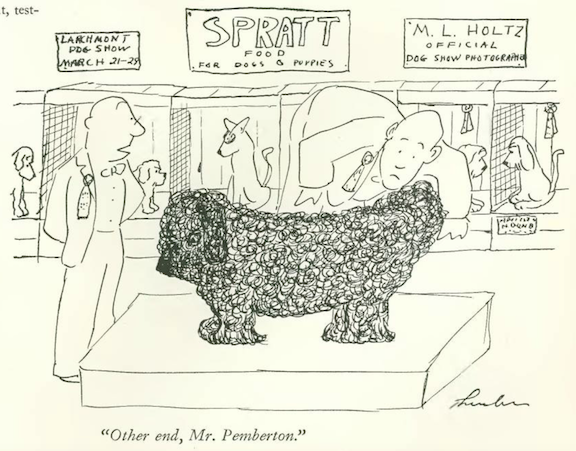
…James Thurber was in his familiar world of dogs and battling sexes…
…Mary Petty found some good news on the dentistry front…
…Otto Soglow’s Little King believed more is merrier…
…and we close with William Crawford Galbraith, and a wedding day surprise…
Above: British architect Norman Foster's 2010 recreation of R. Buckminster Fuller's 1933 Dymaxion car. (Wikipedia)
Despite the limitations of 1930s technology, a few architects and designers were hell-bent on building a streamlined future that until then was mostly the stuff of movies and science fiction magazines.
May 5, 1934 cover by Rea Irvin.
One of them was R. Buckminster Fuller (1895–1983), architect, designer, and futurist probably best known today as the inventor of the geodesic dome (think Disney’s Epcot Center). In the 1930s Fuller was all about a concept he called Dymaxion. Derived from the words dynamic, maximum, and tension, when applied to architecture and design it would supposedly deliver maximum gain from minimal energy input. The writer of the New Yorker article (pseud. “Speed”) was fascinated by the Dymaxion’s motorboat-type steering, no coincidence since Fuller intended to adapt his futuristic car for use on and under the water, as well as in the air.
THE SHAPE OF THINGS TO COME…Clockwise, from top left: Workers at a Bridgeport, Conn., plant creating the first of three Dymaxion cars; the Dymaxion at Chicago’s 1933 Century of Progress exposition—the car was involved in a fatal accident at the fair; interior view of the Dymaxion; using the same engine and transmission as a Ford sedan (pictured), the Dymaxion offered three times the interior volume with half the fuel consumption and a 50 percent increase in top speed. (Buckminster Fuller Institute/Poet Architecture)THINKING WITHOUT THE BOX…In 1927 R. Buckminster Fuller (pictured) developed a Dymaxion House, a “Dwelling Machine” that would be the last word in self-sufficiency. Although the aluminum house was intended to be mass-produced, flat-packaged and shipped throughout the world, the design never made it to market (however its ideas influenced other architects); at right, a Fuller geodesic dome at Disney’s Epcot Center in Florida. (archdaily.com/Wikipedia)
The 1933 Century of Progress exposition in Chicago was supposed to be a major showcase for Fuller, but when professional driver Francis Turner was killed while demonstrating the first prototype of the Dymaxion, the car’s prospects dimmed considerably. According to an article by Stephanie d’Arc Taylor (cnn.com Oct. 30, 2019), during the demonstration a local politician tried to drive his own car close to the Dymaxion—to get a better look—and ended up crashing into the unwieldy prototype, which rolled over, killing the driver and injuring its passengers. “The politician’s car was removed from the fracas before police arrived, so the Dymaxion was blamed for the accident,” writes Taylor, who notes that the rear wheel–powered car, though unconventional, was not necessarily the problem. However, “the thing that made the Fuller death-mobile singularly deadly was the fact it was also steered by the rear wheel, making it hard to control and prone to all kinds of terrifying issues.”
That history did not stop architect Norman Foster from building a replica of the Dymaxion in 2010. Foster worked with Fuller from 1971 to 1983, and considers Fuller a design hero.
GIVING IT ANOTHER GO…Architect Norman Foster with his 2010 recreation of the Dymaxion. To build a new Dymaxion, Foster sent a restorer to the National Automobile Museum in Reno, Nevada (home of the only surviving Dymaxion, Car No. 2), and after thousands of photos and measurements Foster had the car recreated using only materials available in 1933: Foster’s Dymaxion consists of an ash frame sheathed in hand-beaten aluminum, mounted on the chassis of an old 1934 Ford Tudor Sedan. (CNN/The Guardian)
According to Taylor, Foster cleaved so closely to Fuller’s original designs that he refers to his creation as a fourth genuine Dymaxion—not a replica. “The car is such a beautiful object that I very much wanted to own it, to be able to touch as well as contemplate the reality for its delight in the same spirit as a sculpture,” said Foster. “Everything in (the car) was either made in 1934, or recreated using techniques and materials that Bucky would have had access to in that period.”
* * *
Meanwhile, At The Tracks…
If Fuller’s attempt at the streamlined future was a bit of bust, the Burlington railroad was making a splash with its gleaming new Zephyr. E.B. White reported:
ZOOM ZOOM…The Burlington Zephyr set a speed record for travel between Denver and Chicago when it made a 1,015.4-mile (1,633 km) non-stop “Dawn-to-Dusk” dash in 13 hours 5 minutes at an average speed of almost 78 mph (124 km/h). In one section of the run it reached a speed of 112.5 mph. Following a promotional tour that included New York, it was placed in regular service between Kansas City, Missouri, and Omaha and Lincoln, Nebraska, on November 11, 1934. Other routes would be added later in the Midwest and West. (BNSF)
…we continue with E.B. White, here with some observations regarding Mother’s Day and bank robber/murderer John Dillinger, who had escaped from prison in March 1934 and was on the FBI’s Most Wanted List…
I REMEMBER MAMA…John Dillinger posed with Lake County prosecutor Robert Estill, left, in the jail at Crown Point, Ind. while he awaited his trial for murder in January 1934. Dillinger would escape from the jail in March and would be on the lam until July, when FBI agents would gun him down outside a Chicago movie theatre. (NY Daily News)
…and a last word from White, about an important change at Radio City:
* * *
Voice In The Wilderness
A combination of newsreel footage, documentary, and reenactment, Cornelius Vanderbilt Jr’sHitler’s Reign of Terror played to capacity crowds for two weeks in New York City, despite the refusal of the state’s censor to license the film. Disinherited by his parents when he became a newspaper publisher, Vanderbilt was a determined journalist, covertly filming scenes in Nazi Germany and even briefly encountering Adolf Hitler outside the Reichstag, where Vanderbilt yelled to Der Führer, “And what about the Jews, Your Excellency?” (Hitler ignored the question and referred Vanderbilt to one of his lackeys). Unfortunately, Vanderbilt wasn’t much of a filmmaker, and although he warned Americans about the emerging threat in Germany, few took the film, or his warning, seriously, including John Mosher:
UNHEEDED…Audiences flocked to see Cornelius Vanderbilt Jr’sHitler’s Reign of Terror, but critics dismissed the rather amateurish film—Film Daily scoffed at the film’s prediction that Hitler’s Germany was a future threat to world peace; at right, in the film Vanderbilt confronted “Hitler” in a recreation. (TMDB/Library of Congress)
* * *
From Our Advertisers
It wouldn’t seat eleven people like a Dymaxion, but a Body by Fisher (coach builder to General Motors) certainly impressed this young woman…but better check with the hubby just in case…
…in this next ad, we find what looks like the same woman, perhaps celebrating her decision with a nice smoke…
…this spot seems out of place in the New Yorker, like it snuck over from Better Homes & Gardens...
…on to our cartoons…with James Thurber’s war of the sexes over, life returned to normal…
…and both sides shared in the gloom of a rainy afternoon…
…by contrast, Perry Barlow brightened things up with this life of the party…
…but a good time doesn’t always translate over the airwaves, per George Price…
…Alain illustrated the consequences of losing one’s nest egg…
…Peter Arno didn’t leave any room for dessert…
…and Charles Addams returned, a macabre cast of characters still percolating in his brain…
…on to May 12, 1934…
May 12, 1934 cover by Leonard Dove.
…and back to the movies, this time critic John Mosher found more cheery fare in 20th Century, a pre-Code screwball comedy directed by Howard Hawks and starring John Barrymore and Carole Lombard. Battling alcohol abuse since age 14, Barrymore nevertheless managed to display his rare genius as a comedian and turned in what is considered to be his last great film performance.
GETTING HER KICKS…Top, Carole Lombard delivers a swift one to John Barrymore in the screwball comedy 20th Century. Below, director Howard Hawks with the cast. (greenbriarpictureshows.blogspot.com)
* * *
Playing the Ponies
Horse racing correspondent George F. T. Ryall (pseud. “Audax Minor”) considered a losing wager at the Kentucky Derby in his column, “The Race Track.”
A HORSE OF COURSE…Jockey Mack Garner rode Cavalcade to victory at the 1934 Kentucky Derby. (Appanoose County Historical Society)
* * *
More From Our Advertisers
We begin with Camel cigarette endorsers Alice and Mary Byrd, residents of Virginia’s famous Brandon plantation and cousins of Virginia Senator and Governor Harry F. Byrd, known for his fights against the New Deal and his “massive resistance” to federally mandated school desegregation...
…also to the manor born, Whitney Bourne, a New York deb who would go on to a brief stage and film career that would end when she married her first husband (diplomat Stanton Griffis) in 1939…
AN EYE FOR STYLE…Whitney Bourne in a scene with Solly Ward in 1937’s Flight From Glory. Named in 1933 as one of America’s best dressed women, Bourne was a noted New York socialite, skier, golfer and tennis player as well as an occasional actress.
…we move along from the effervescent Whitney Bourne to the sparkling waters of Perrier…
…Gardner Rea followed other New Yorker cartoonists by illustrating an ad for Heinz…
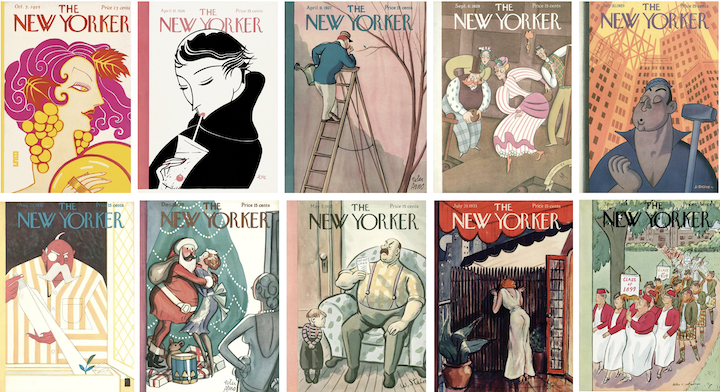
…which brings is to more cartoons, where according to Richard Decker, the move to streamlined trains wasn’t welcomed by everyone…
…Carl Rose illustrated this two-page spread with an imagined right-wing response to the recent left-wing May Day parades…
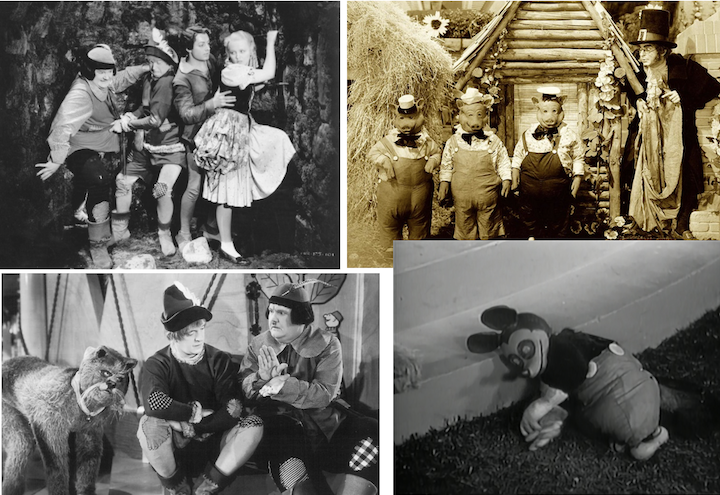
…William Steig eavesdropped onto a saucy little conversation…
…Barbara Shermund continued her explorations into the trials of the modern woman…
…James Thurber was back to his old tricks…
…and we conclude our cartoons with Eli Garson, and a new perspective…
Before I close, a bit of housekeeping. The first issues in 1925 sometimes ended “The Talk of the Town” with…
…but on May 23, 1925, “Talk” signed off with —The New Yorkers. That continued until the March 31, 1934 issue (below), the last time the New Yorker signed off “The Talk of the Town” with —The New Yorkers:
Above: A scene from Mary Pickford’s 1922 film Tess of the Storm Country. (Library of Congress)
In today’s celebrity-saturated culture it is difficult to find a parallel to silent film star Mary Pickford, who was dubbed Queen of the Movies more than a century ago. Indeed, during the 1910s and 1920s Pickford was regarded as the most famous woman in the world.
April 7, 1934 cover by Rea Irvin.
Pickford was also known as “America’s Sweet” for her portrayal of gutsy but tenderhearted heroines. In real life she was also a gutsy and shrewd businesswoman who co-founded United Artists in 1919 with Charlie Chaplin, Douglas Fairbanks, and director D. W. Griffith. Commanding a salary only rivaled by Chaplin, her stardom only grew when she married Fairbanks in 1920, forming the first celebrity supercouple; together they ruled Hollywood from their Beverly Hills mansion, Pickfair (apparently staging dull affairs, per the “Profile” excerpt below).
The end of the silent era also put an end to Pickford’s stardom, as well as to her fairytale marriage to Fairbanks. Margaret Case Harriman’s profile of Pickford, simply titled “Sweetheart,” gave readers a glimpse into the decline of a silent superstar. Excerpts:
SINGULAR STAR…Clockwise, from top left, Mary Pickford in a publicity photo, circa 1910; Pickford visits close friend and screenwriter Frances Marion during filming of Straight is the Way (1921); Douglas Fairbanks and Pickford in the early 1920s; Pickford with a movie camera in 1916—in addition to being a shrewd businesswoman, she was also skilled behind the camera. (thehollywoodtimes.today/Time/Library of Congress)
Harriman concluded her profile with some thoughts on Pickford’s future:
THE SOUND BARRIER…With the advent of sound movies Mary Pickford turned to writing books and serving various charities. From left, sharing ice cream with rising star Bing Crosby in 1934; center, Al Frueh’s caricature of Pickford for the profile; Pickford in a 1934 promotional picture supporting The Salvation Army. (Pinterest/Library of Congress)
A note on the profile’s writer, Margaret Case Harriman (1904-1966), who doubtless sharpened her people-watching skills at the Hotel Algonquin (famed birthing ground of the New Yorker), which was owned by her father, Frank Case. Douglas Fairbanks was one of Case’s best friends, and Harriman knew both Fairbanks and Pickford well, since they often stayed at the hotel.
HOME SWEET HOME…Margaret Case Harriman, photographed May 31, 1937 by Carl Van Vechten. Harriman was born in 1904 in room 1206 of the Hotel Algonquin, which was owned by her father, Frank Case. (Philadelphia Museum of Art)
* * *
Master of Masters
The founder of perhaps the world’s most prestigious golf tournament was an amateur and a working lawyer by profession. When Bobby Jones (1902–1971) co-founded the Masters Tournament in 1934 with investment dealer Clifford Robert, it was called the Augusta National Invitation Tournament (it was Robert’s idea to call it The Masters, a name Jones thought immodest). Jones dominated top-level amateur competition from the early 1920s through 1930—the year he achieved a Grand Slam by winning golf ’s four major tournaments in the same year. However, by the 1934 Jones’s skills began to wane. The New Yorker had little to say about the first Masters (it wasn’t a big deal yet), other than Howard Brubaker making this observation in “Of All Things”…
A SWING INTO HISTORY…Bobby Jones (center) drives during the first-ever Masters Tournament in Augusta, Georgia on March 22, 1934. (augusta.com)
* * *
From Our Advertisers
Wanna get away? This colorful advertisement beckoned New Yorker readers to take the next boat to sunny Bermuda…
…while the Grace Line offered a southern cruise through the Panama Canal…
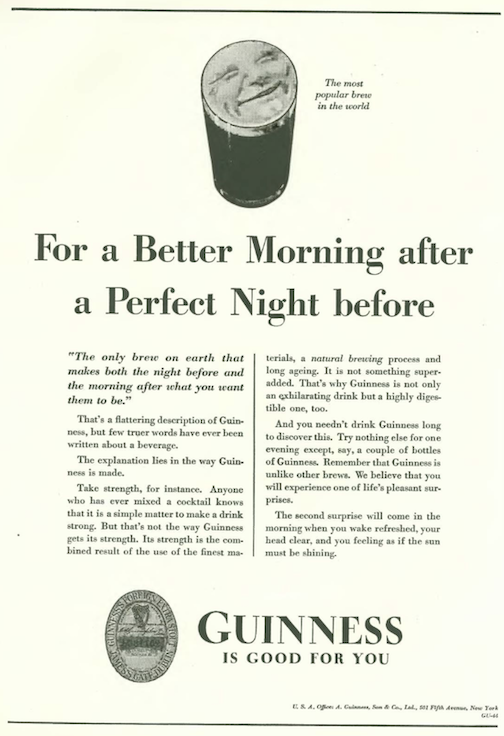
…but who needed to travel when you could enjoy a beer that was beloved the world over?…
…Mrs. Potter d’Orsay PalmerneeMaria Eugenia Martinez de Hoz was content to stay home in Chicago and smoke a few Camels, apparently…
…we’ve encountered her before—she appeared in a Ponds ad (below) in the Aug. 8, 1931 issue of the New Yorker, where we learned she was wife No. 2 of Potter d’Orsay Palmer, son of the wealthy family of Chicago Palmer House fame…they would divorce in 1937, and the playboy Potter would marry two more times before dying of a cerebral hemorrhage in May 1939—following a drunken brawl in Sarasota, Florida with a meat cutter called Kenneth Nosworthy. Maria Eugenia would remarry and return to her homeland of Argentina to raise a family…
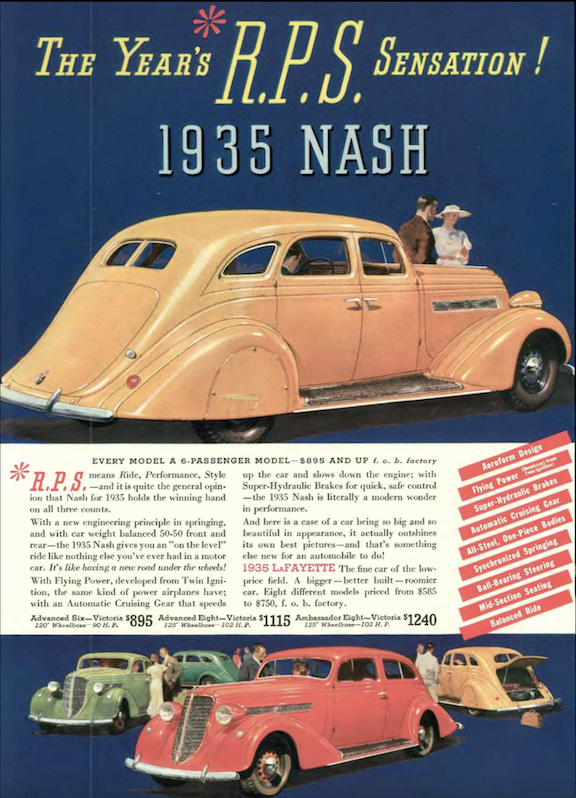
…this ad from Nash looks like a scene from Attack of the 50 Foot Woman, if she had a car to match, that is…
…the Cadillac V-16 was a truly massive automobile, but in contrast to the Nash ad, you can barely see the car as it approaches from the vanishing distance…
…E. Simms Campbell got in on the advertising game with this spot that features contrasting images of storm and calm…
…James Thurber offered this cartoon on behalf of Heinz soups…
…and Thurber again, as we kick off the cartoons with the ongoing battle…
…Adolph Schus made a rare appearance in the New Yorker…according to Ink Spill, he also contributed a cartoon on March 19, 1938, and was editor of Pageant Magazine in 1945…
…Gluyas Williams looked in on the sorrows of moneyed classes…
…Helen Hokinson’s “girls” were in search of lunch, and propriety…
…and Leonard Dove gave us a renter surprised by something not included in his lease…
…on to April 14, 1934…
April 14, 1934 cover by Harry Brown.
…and book reviewer Clifton Fadiman, who found F. Scott Fitzgerald’s literary gifts “bewilderingly varied”…
A NOT-SO-TENDER RECEPTION…F. Scott Fitzgerald’s status as a symbol of Jazz Age excess hurt his career during the Depression years. Tender Is the Night received mixed reviews, which didn’t help his alcoholism and deteriorating health. When Carl Van Vechten took this photo of Fitzgerald in June 1937, the author had a little over three years to live. (Wikipedia)
…speaking of F. Scott Fitzgerald, fellow author Ernest Hemingway defended Fitzgerald’s writing, arguing that criticism of his Jazz Age settings stemmed from superficial readings. One then wonders what Hemingway thought of E.B. White’s poetic “tribute” to his big game hunting excursions…
I ONLY SHOOT STRANGERS…Author Ernest Hemingway poses with a lion shot during a safari in Africa in 1934. (MPR News)
* * *
From History’s Ash Heap
Various reference sources cite “freak shows” as a normal part of American culture in the late 19th to the early 20th centuries, but I have to admit I saw exhibits at state fairs of half-ton humans and conjoined twins when I was a kid in the 1970s (not to mention things in jars at a carnival in St. Louis that should have been given a decent burial).
When Alva Johnston penned the first installment of a three-part profile series titled “Sideshow People,” such attractions could be found across the U.S. and Europe—Coney Island featured “Zip the Pinhead,” who was actually William Henry Johnson (1842–1926), one of six children born to former slaves living in New Jersey. His desperately poor parents agreed to allow P.T. Barnum to display him at a museum and at circus performances billed as a missing link, a “What-Is-It” supposedly caught in Africa.
FOR THE SUCKERS…P.T. Barnum exhibited William Henry Johnson as a “wild man”, a “What-Is-It” that subsisted on raw meat, nuts, and fruit, but was learning to eat more civilized fare such as bread and cake. Note the difference between the poster depiction at left and the actual man. Civil War-era photo at right by Mathew Brady’s photography studio in New York City. (National Portrait Gallery)
* * *
Floating and Sinking
As much as New Yorker cartoonists (and E.B. White) liked to take pokes at Chrysler’s futuristic Airflow, there was much to be admired by the innovations the car represented. Unfortunately, the car’s design was too advanced for the buying public, and despite a big manufacturing and sales push by Chrysler the car was shelved by late 1936.
Writing for Time, Dan Neil noted the Airflow’s spectacularly bad timing. “Twenty years later, the car’s many design and engineering innovations — the aerodynamic singlet-style fuselage, steel-spaceframe construction, near 50-50 front-rear weight distribution and light weight—would have been celebrated. As it was, in 1934, the car’s dramatic streamliner styling antagonized Americans on some deep level, almost as if it were designed by Bolsheviks.”
SEEMED LIKE A GOOD IDEA. A restored 1934 Airflow. (Hagerty Media)
* * *
More From Our Advertisers
Maybe the buying public wasn’t ready for a car with a sloping hood and embedded headlights, but the folks at Cadillac were eager to unveil concepts for the new streamlined La Salle, which retained the familiar bullet headlights so as not to alarm consumers too much…
…and here’s a lovely image from Goodyear…I assume this woman is merely resting in a rumble seat, since this pose would not be possible above 25 mph…
…full-bleed color ads were coming into their own, as demonstrated by this stylish entry from the purveyors of silk garments…
…on the other hand, our well-heeled friends at Ponds stuck with the tried and true copy-heavy approach…here they offer the flawless features of Anne Gould (1913–1962), granddaughter of Gilded Age robber baron Jay Gould…
…R.J. Reynolds continued their campaign to convince us that Camels bring success to the average Joe and the champion athlete…
…the makers of Old Gold opted for the super creepy approach, asking entertainer Jimmy Durante to shove a pack of smokes into the face of what appears to be a teenager…
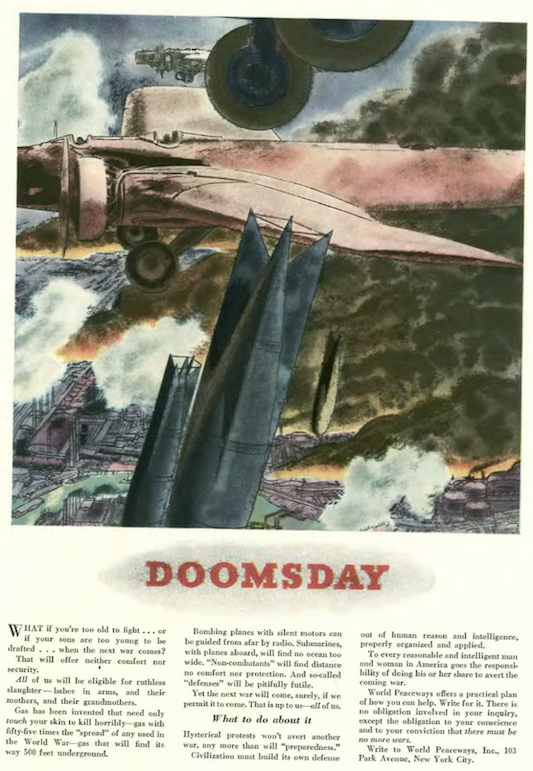
…here’s another ad from World Peaceways, reminding us of the futility of war…
…speaking of futility, you could visit the USSR, which doubtless took great pains to steer tourists away from mass starvation in Ukraine and mass executions of Stalin’s many “enemies”…
…while folks in the USSR were worshiping Lenin and Stalin, Americans were rightly transfixed by the miracle of Kellogg’s Corn Flakes…a producer of industrial and advertising films, Castle Films would become a subsidiary of Universal and would go on to make a line of science-fiction and horror films including The Wolf Man, The Mummy, and Creature from the Black Lagoon.
…on to our cartoons, Alain took on the recent MoMA exhibition of “Machine Art”…
…and speaking of machine art, George Price was to latest cartoonist to take a crack at the Airflow…
…James Thurber offered this bit of spot art for the opening pages…
…and returned to a somber scene on the battlefield of the sexes…
Above, at left, self-aligning ball bearing from SKF Industries, featured in MoMA's 1934 Exhibition of Machine Art; at right, judges for the exhibit were aviator Amelia Earhart and professors John Dewey and Charles R. Richards, holding first, second and third prizes, respectively. (MoMA)
The notion that machine-made objects have aesthetic value has been with us for some time, dating back to avant-garde movements of the early 20th century such as Futurism, which influenced other schools, including the Bauhaus and De Stijl. However, the idea that a museum would display a propeller or a vacuum cleaner as a work of art was startling to many in 1934.
March 17, 1934 cover by Rea Irvin.
It had been a little over twenty years since New York art patrons experienced their first shock of the new at the 1913 Armory Show. By 1929 the city had established the Museum of Modern Art, which opened the exhibition Machine Art on March 5, 1934, at MoMA’s second location—the old Barbour mansion at 11 West 53rd Street (razed in the late 1930s and replaced by today’s museum).
Novelist and art critic Robert M. Coates (1897–1973) paid a visit to the Machine Art exhibition and wrote of the experience in “The Talk of the Town.” Coates was no stranger to the avant garde, having himself embraced literary innovation and experimentation as a novelist. James Thurber is credited with bringing Coates to TheNew Yorker in 1927—the two became close friends—and Coates would stay forty years with the magazine. Excerpts:
EXTRAORDINARY ORDINARY…Clockwise, from top left: According to MoMA director Alfred H. Barr, Jr, the 1934 Machine Art exhibition celebrated the machine’s abstract and geometric beauty; MoMA found its second home—the Barbour mansion at 11 West 53rd Street—in 1932; sign on West 53rd advertising the exhibition; outboard propeller by Aluminum Company of America (Alcoa); collection of scientific beakers and flasks from Corning Glass Works. (MoMA)KA-CHING!…Machine Art featured Model 1934 from National Cash Register; at right, Electrochef range, model B-2, designed by Emil Piron for Electromaster Inc. Objects featured in the exhibition were selected by noted architect Phillip Johnson, who was the founding chairman (1932-34) of the museum’s Department of Architecture. (MoMA)IN A NEW LIGHT…Springs and wires took on new perspectives at the Machine Art exhibition. From left, the apparent first-prize winner (based on the photo of Earhart at the top of this entry)—a section of a large spring; cross-section of wire rope; and typewriter carriage and motor springs, all produced by American Steel & Wire Company, a subsidiary of US Steel. (MoMA)
* * *
Salad Days
Swiss-American restaurateur Oscar Tschirky (1866-1943), who was known throughout the world as Oscar of the Waldorf, worked as maître d’hôtel of the Waldorf Astoria in New York City from 1893 to 1943. He is credited with having created the Waldorf salad, along with any number of cocktail recipes. “The Talk of the Town” noted his latest concoction:
WINNING OSCAR…From 1893 to 1943 Oscar Tschirky was the Waldorf-Astoria’s public face and a gracious host who made both the great and the not-so-great feel welcome. At left, in 1923; at right, Tschirky samples the first shipment of beer to arrive at the Waldorf-Astoria when the brew became legal again in April 1933. (Library of Congress/Karl Schriftgiesser)
* * *
Unburdened
In the March 17 issue, writer and poet Langston Hughes (1901–1967) published the first of three fiction pieces that would appear in The New Yorker (one posthumously in 2016). In the short story “Why, You Reckon,” Hughes tells the tale of two hungry Black men who rob a rich white man by pushing him into a basement coal bin—one of the Black men takes the white man’s money, jewelry, shoes and overcoat, then rushes off, leaving his companion without any of the loot. To the companion’s surprise and befuddlement, the white man is left excited by the incident, because it is the first real thing that has happened to him. Here are the final lines of the story:
HARLEM RENAISSANCE LEADER Langston Hughes in a 1936 photo by Carl Van Vechten. A prolific writer and poet, Hughes published three short stories and three poems in The New Yorker. (Wikipedia)
* * *
From Our Advertisers
New Yorker ad sales were booming, and blooming with color…we kick it off with this ad from Coty touting “3 New Boxes for Face Powder!”…so why are there four boxes in the ad?…
…the obvious answer to the question posed below would be “wealth and privilege…and youth”…the “Eleanor Roosevelt” featured in this Pond’s ad is obviously not the wife of FDR, but rather Eleanor Katherine Roosevelt, the teenaged daughter of Assistant Secretary of the Navy Henry Latrobe Roosevelt…
…speaking of the high seas, I have to admit I sigh a little when I see ads like this, obviously staged, but suggest a style of travel that is as extinct as the T. Rex…
…perhaps those folks on the boat were enjoying a splash of Perrier in their evening cocktails…
…or maybe the domestic White Rock was on ice…why is the rich old coot so much shorter than his wife?…I guess it emphasizes her relative youthfulness and her maternal obligations to a child-like older man…
…their proportions are similar to Jiggs and Maggie, but that’s another story…
…R.J. Reynolds was back with their “jangled nerves” theme on behalf of Camel cigarettes…
…maybe your tires will hold, but have you checked your brakes lately?…
…in the 1930s the anti-war organization World Peaceways ran a series of provoking ads on the artificial glories of war…some magazines, including The New Yorker, ran these ads free of charge or at reduced rates…
…a closer view of the explanatory copy at the bottom of the ad…
…speaking of war, James Thurber opens our cartoons on a Connecticut battlefield…
…Al Frueh contributed this illustration for a two-part profile of entertainer and theatrical producer George M. Cohan…
…Alain (Daniel Brustlein) offered this spot art for the opening calendar section…
…Peter Arno gave us two fellows on thin ice…
…cartoonist Gregory d’Alessio made his first appearance in The New Yorker…
…Barbara Shermund was back with some tax advice…
…which this gentleman (by Alain) might have found useful…
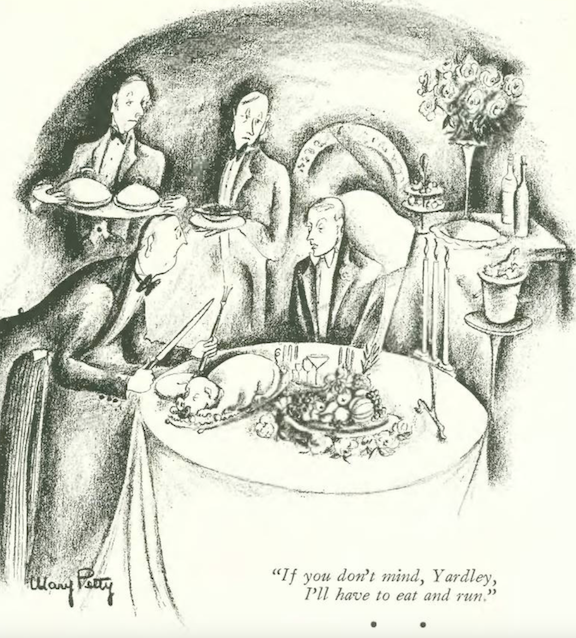
…and we close with Mary Petty, and a little brown-noser with a taste for greens…