Hays Hokum

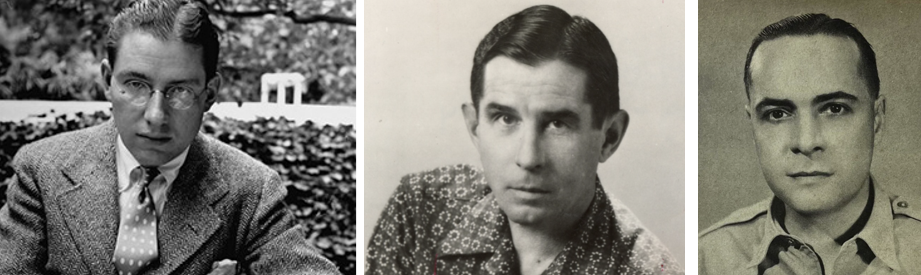
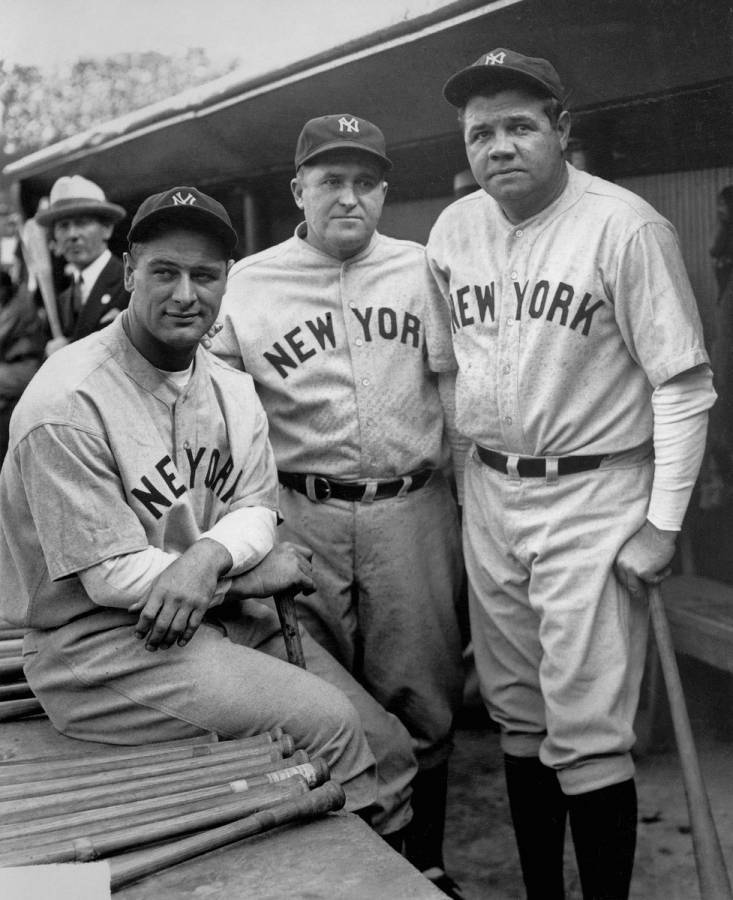
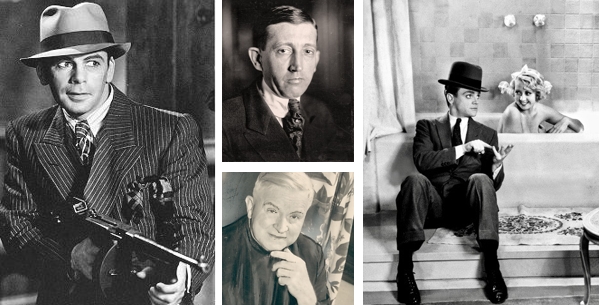
Above: Will Hays (center, top) was the enforcer and Fr. Daniel A. Lord was the author of the Production Code that was rigidly enforced beginning in 1934. They and others were responding to the sex, violence and other forms of "immorality" in such films as 1932's "Scarface" (with Paul Muni, pictured at left) and 1931's "Blonde Crazy" with James Cagney and Joan Blondell. (Wikipedia/cinemasojourns.com)

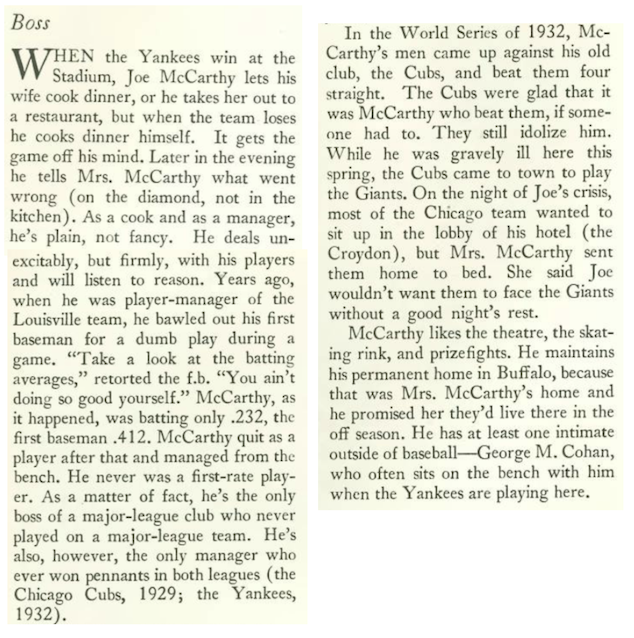
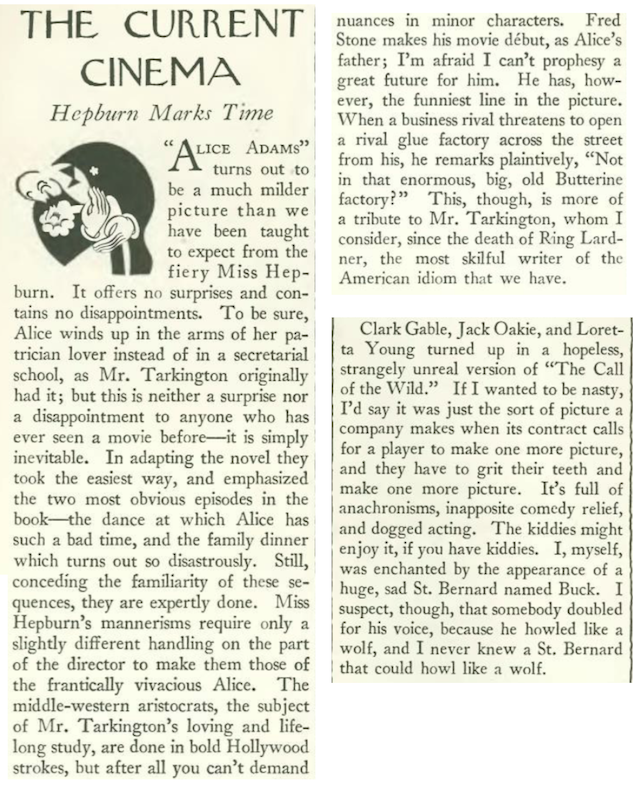
With the Production Code fully enforced, New Yorker film critic John Mosher found even less to get excited about during his visits to Manhattan’s cinemas.

August 17, 1935 cover by Julian de Miskey. He contributed 62 covers to the magazine, as well as 82 cartoons from 1925 to 1962.

The Motion Picture Production Code—a set of industry guidelines for the self-censorship of content—had been around for awhile, but it was mostly ignored until June 13, 1934, when an amendment to the Code required all films released  to obtain a certificate of approval. Hoping to avoid government censorship and preferring self-regulation, studios adopted the Code.

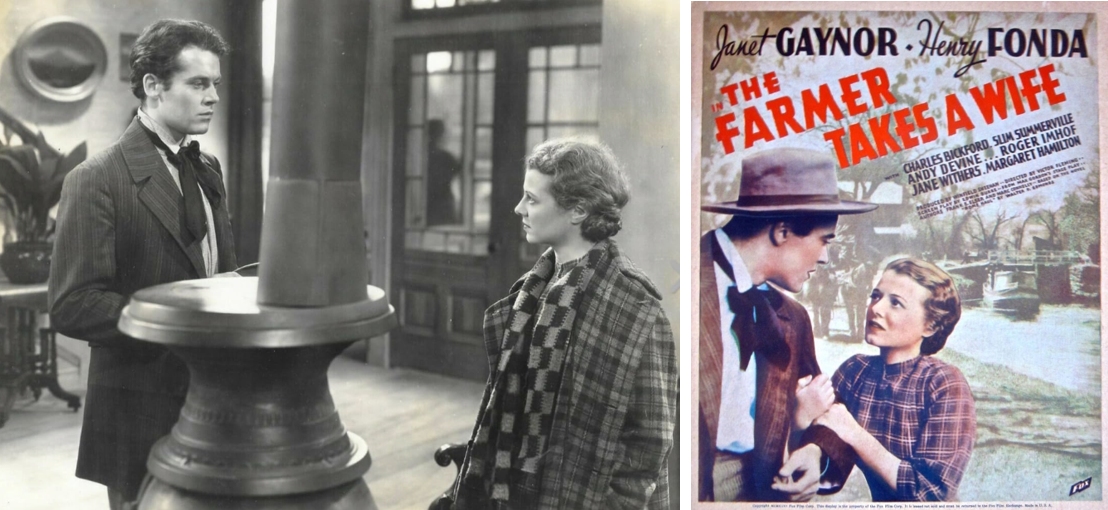
The Code’s effects were felt in such films as The Farmer Takes a Wife, a romantic comedy about a Erie Canal boatman, portrayed by Henry Fonda, who dreams of becoming a farmer (a role reprised by Fonda from the Broadway production of the same name; it was Fonda’s first break in films). Mosher was pleased by Fonda’s performance, but found the film adaptation to be corny and phony, filled with “bastard” dialect and schmaltzy musical numbers. “It is the sort of thing which is okayed by Purity Leagues…” Mosher concluded.

SILVER SCREEN DEBUT…Boatman Dan Harrow (Henry Fonda) woos barge cook Molly Larkins (Janet Gaynor) in a scene from A Farmer Takes a Wife. While it was Fonda’s film debut, Gaynor was an established star known for playing sweet, wholesome characters. One of the few actresses who made a successful transition to sound movies in the late 1920s, Gaynor was the number-one draw at the box office in 1935. (IMDB)
STILL KEEPING IT CLEAN…The Code was still in force when The Farmer Takes a Wife was remade in 1953; however, nineteen years after the Code took effect there was a notable easing of restrictions, as can be seen in the generous display of Betty Grable’s famous gams (seen here with Thelma Ritter). (IMDB/Wikipedia)

To get a clearer idea of what the Code did to the pictures, compare the scene from 1934’s Tarzan and His Mate (left), which was released two months before the Code went into effect, and Tarzan Escapes (right), from 1936.

CLOTHED IN THE CODE…Johnny Weissmuller and Maureen O’Sullivan appeared together in six Tarzan films. In their second outing, 1934’s Tarzan and His Mate, O’Sullivan wore a skimpy halter-top and loincloth (left) and was shown sleeping and swimming in the nude. In their next film, 1936’s Tarzan Escapes (right); Jane is more chastely clad. (mikestakeonthemovies.com/rottentomatoes.com)

 * * *

Noted and Notorious

In his weekly column “Of All Things,” Howard Brubaker offered wry observations on the passing scene, including this latest brief that described the rise and fall of a very unlikely quartet of celebrities.

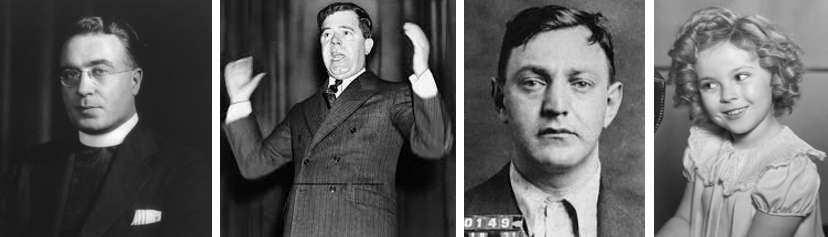
DEMOGOGUES, DUTCH & DIMPLES…(Left to right) Support appeared to be on the wane for radio priest and demagogue Father Charles Coughlin and fellow-fascist Louisiana Sen. Huey Long, while stock was on the rise for mobster Dutch Schultz, who successfully swayed public opinion (while under indictment for tax evasion) by generously donating to various charities. Shirley Temple continued to charm audiences, her films ranking number-one at the box office in 1935 (as well as in 1936, 1937, and 1938). The year 1935 would also be the last for Long and Schultz–both would be assassinated. (Wikipedia)

 * * *

Titlemania

Lacking the strictures of Old World caste systems, Americans have had an anxious relationship with class signifiers. In a land where trade schools become universities overnight and their faculty members refer to one another as “doctor,” there is much confusion and hand-wringing in the honorifics trade. H.L. Mencken examined the proliferation of titles in his country, freely handed out without regard to merit. Excerpts:

 * * *

From Our Advertisers

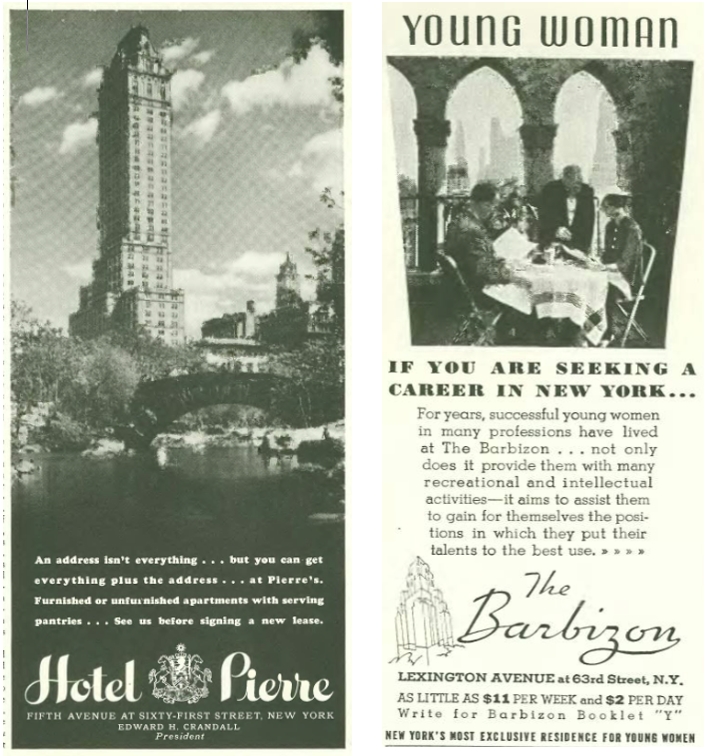
The back of the book was where one could find advertisements for upscale urban living, including these two touting the advantages of the Hotel Pierre and The Barbizon…

…In a joint venture with a group of Wall Street financiers, the former busboy-turned restauranteur Charles Pierre opened the Hotel Pierre in 1930—not the most auspicious time to open a luxury hotel as markets continued to collapse…the Pierre went into bankruptcy in 1932 and was later purchased by oilman J. Paul Getty…the legendary Barbizon Hotel for Women, completed in 1927, was designed as a safe and respectable haven for women seeking to pursue careers in New York, especially in the arts, and would host numerous famous women through the 1970s…

At left, the Barbizon in 1927; right, the Hotel Pierre circa 1930. (loc.gov)

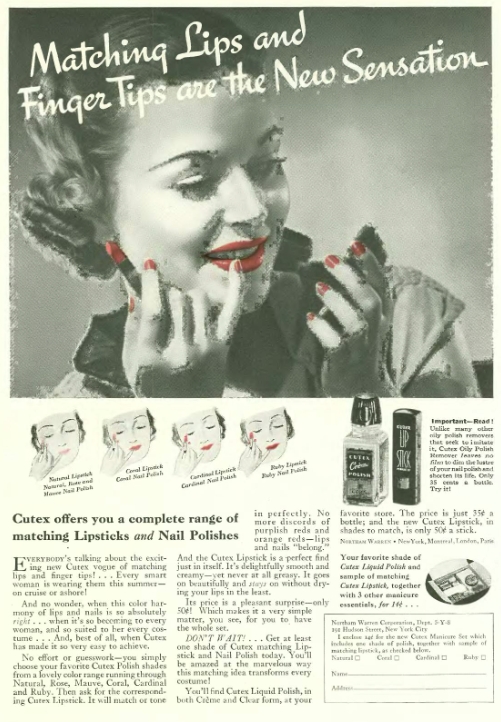
…like the tobacco companies, brewers targeted women as a growth market for a product mostly associated with men…

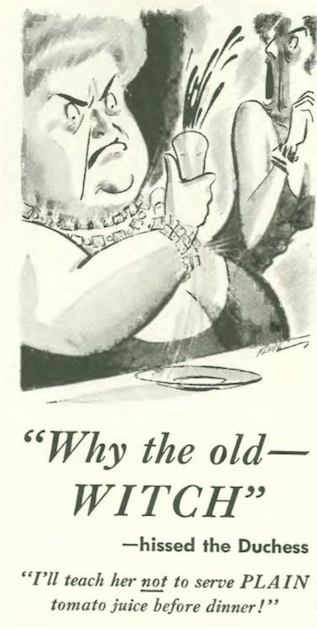
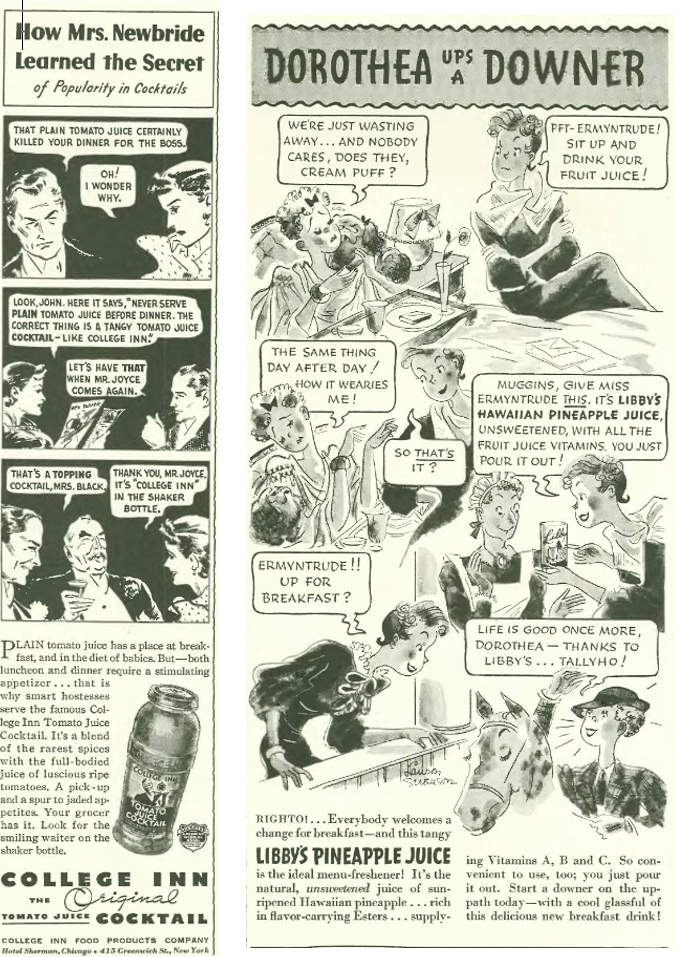
…the makers of juices, meanwhile, created comic strips to promote their products…College Inn still went negative with their ads—recall the violent outbursts of the Duchess…

…here a spiteful husband blames his wife’s choice of tomato juice for his lack of success with the boss…Libby’s, on the other hand, promoted their pineapple juice as a surefire cure for a young woman’s ennui…

…notable in these somewhat thin, late summer issues is the lack of full-color ads…this was on the back inside cover…

…Flit and Dr. Seuss continued to be a weekly presence…

…which brings us to our cartoonists, and a spot drawing by Constantin Alajalov

…also a modest spot by Robert Day, keeping us cool with this polar bear…

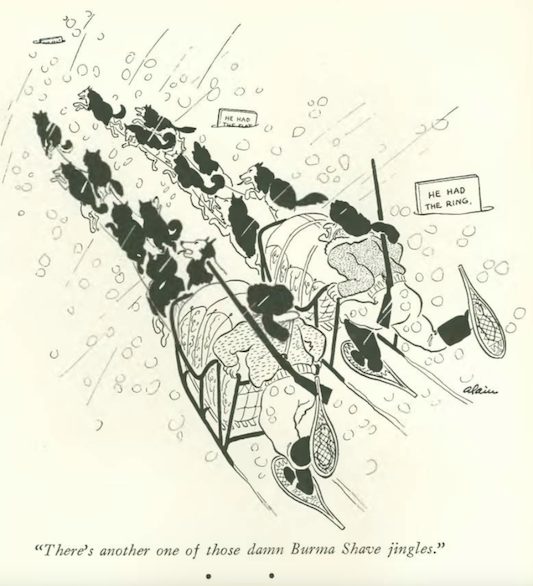
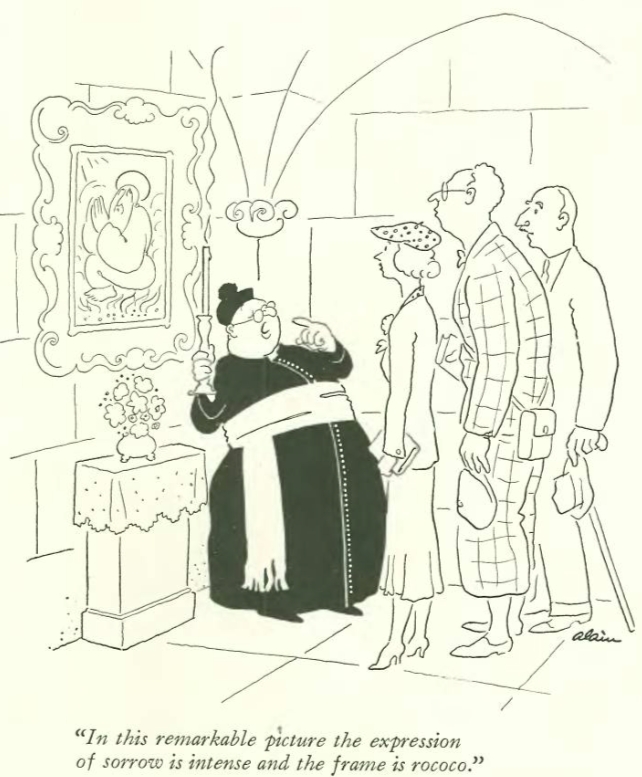
Alain offered a short course in art appreciation…

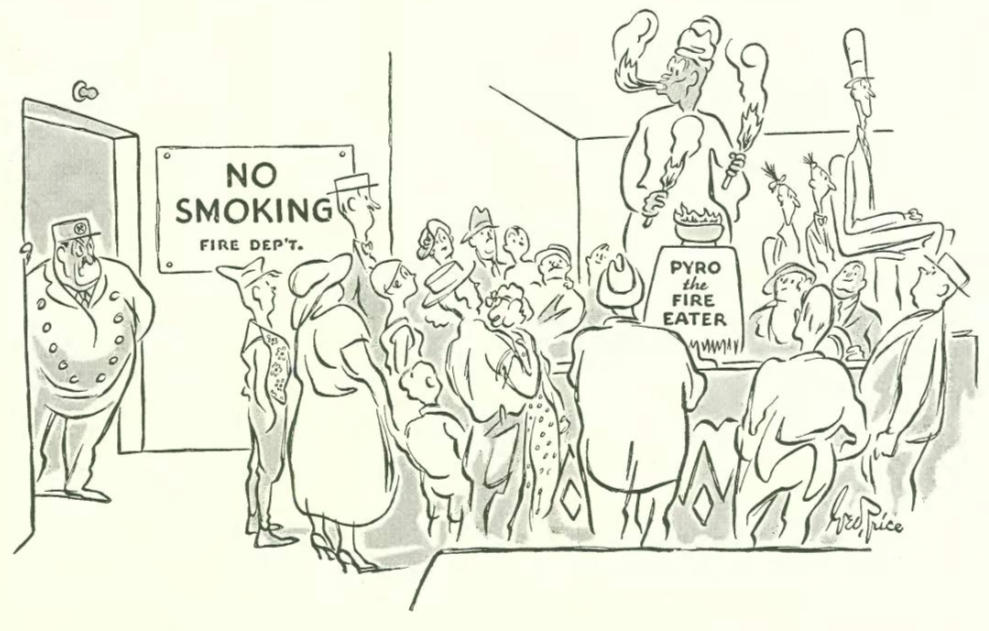
George Price ran afoul of the fire code…

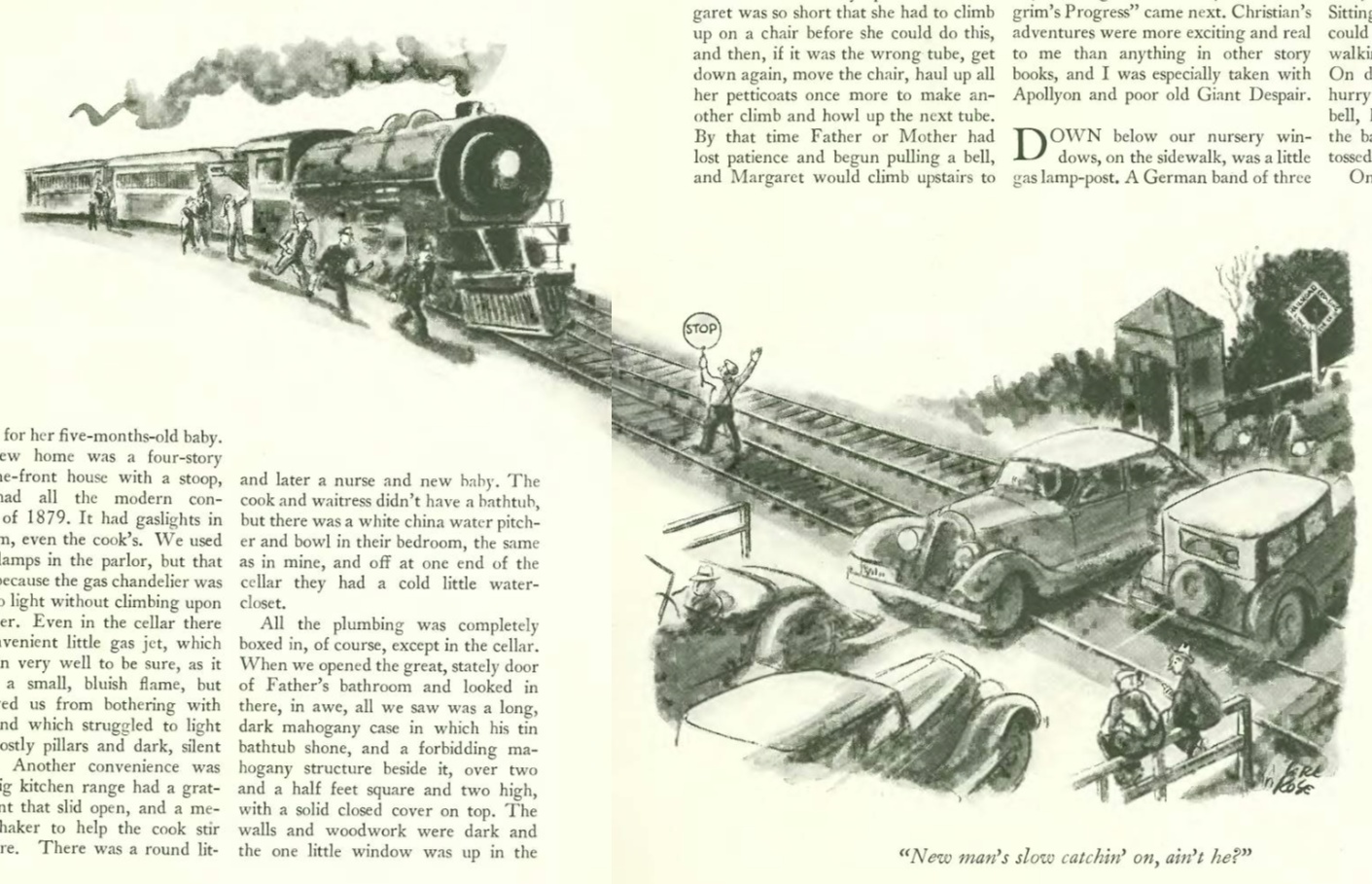
Carl Rose ran his tracks across this two-page spread…

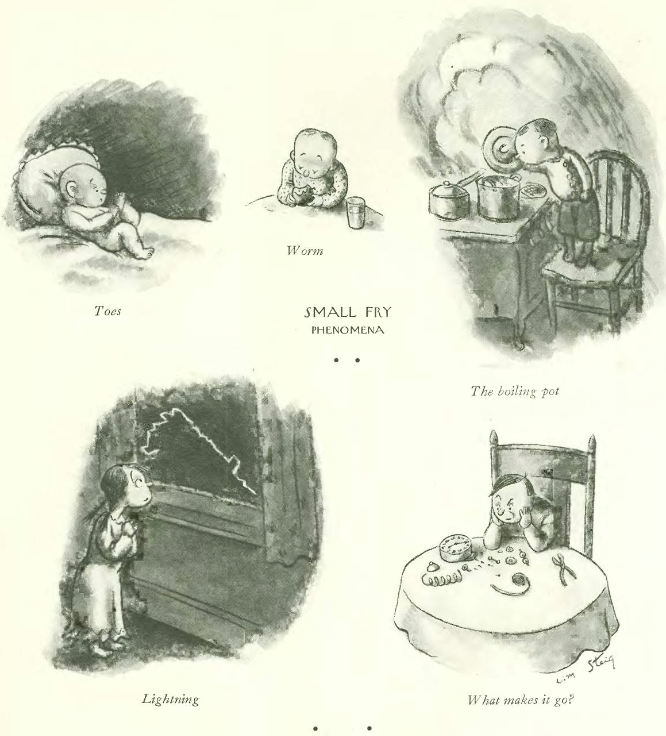
William Steig gave us the small fry’s perspective on the world’s wonders…

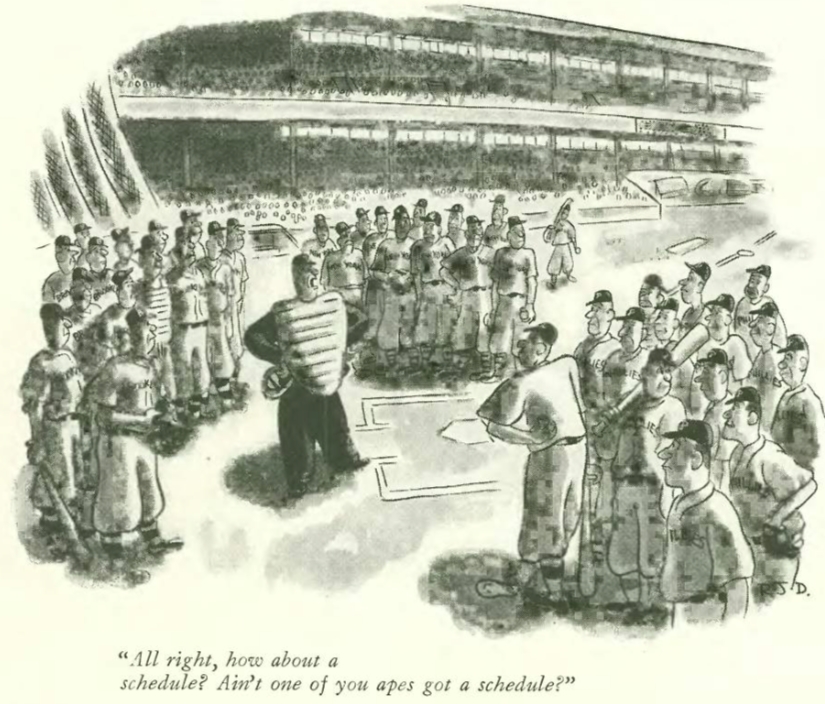
…a rare appearance of baseball in the magazine, thanks to Robert Day...

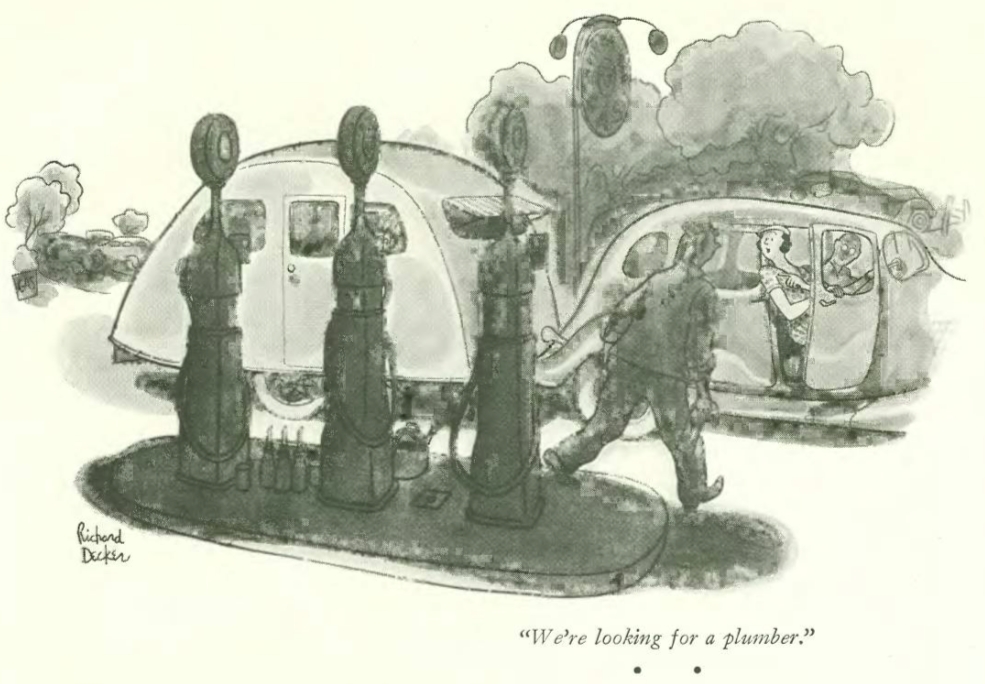
Richard Decker brought a modern world challenge to one filling station…

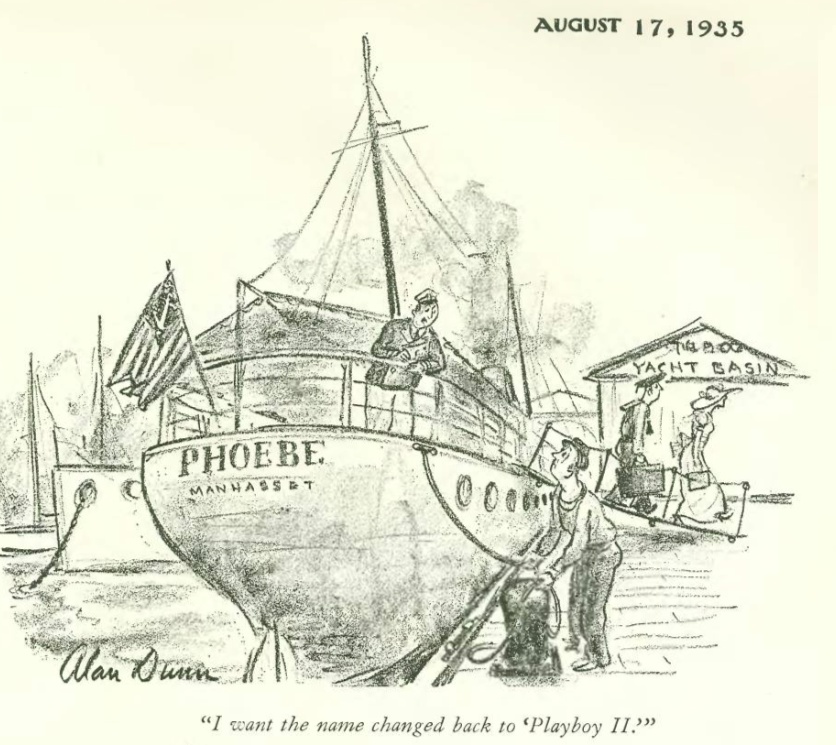
…A sailor’s return to bachelorhood required a new paint job, per Alan Dunn

…and who else but Charles Addams would circle vultures over an amusement park?…

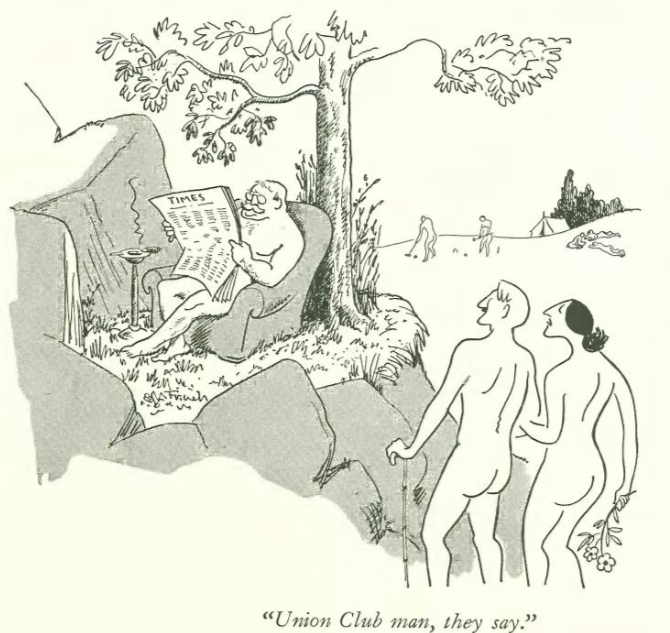
…and we close with Al Frueh, and a Union Club member not concerned with a dress code…

Next Time: The Din and Bustle…


A Double-Header

Heading into the dog days of summer we take a look at the last two issues of July 1935, both somewhat scant in editorial content but still offering up fascinating glimpses of Manhattan life ninety years ago.

July 20, 1935 cover by William Crawford Galbraith. He contributed seven covers and 151 cartoons to the magazine.

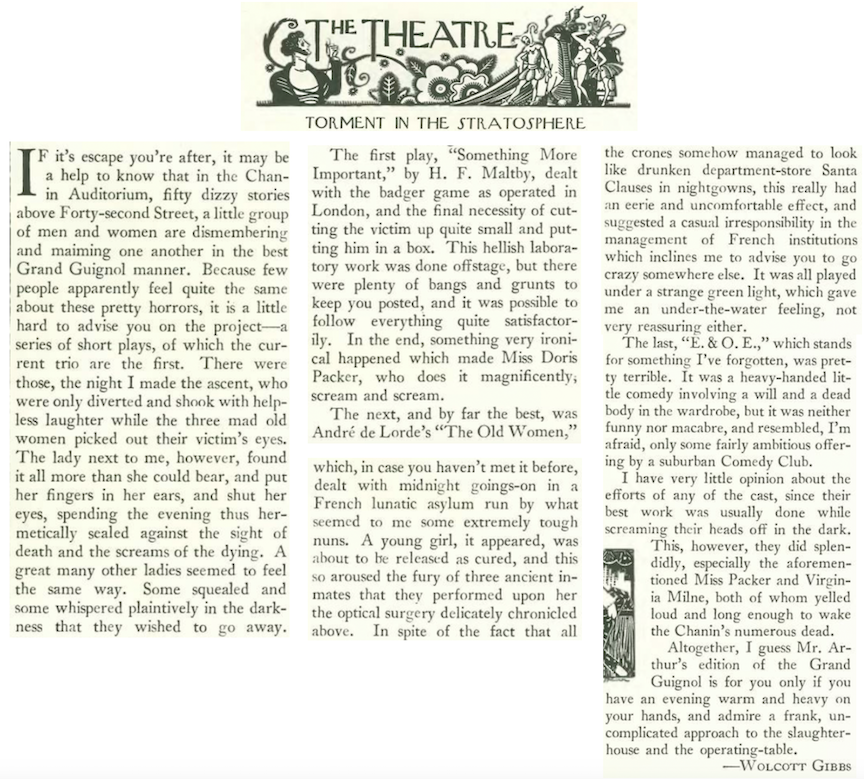
That includes the observations of theatre critic Wolcott Gibbs and film critic John Mosher, both escaping the summer heat to take in some very different forms of entertainment.

Gibbs found himself “fifty dizzy stories above Forty-second Street” in the Chanin Building’s auditorium, where he experienced New York’s take on Le Théâtre du Grand-Guignol. Founded in Paris by Oscar Méténier in 1897, Grand Guignol featured realistic shows that enacted, in gory detail, the horrific existence of the disadvantaged and working classes. It seems audiences were drawn to the shows more out of prurient interest (or sadistic pleasure) than for any desire to help the underclasses.

NOT FOR THE FAINT OF HEART…Wolcott Gibbs recommended the Grand-Guignol only for those who “admire a frank, uncomplicated approach to the slaughterhouse and the operating table.” (Image: Wikipedia)
PRETTY HORRORS…Clockwise from top left, the original Théâtre du Grand-Guignol, in the Pigalle district of Paris–it operated from 1897 until 1962, specializing in horror theatre; a poster from one of its productions; New York’s Chanin building, circa 1930s; the Chanin’s auditorium “fifty dizzy stories above 42nd Street”; fake blood applied to an actress’ neck before a scene from The Hussy; Wolcott Gibbs described a madhouse scene from André de Lorde’s The Old Women, which depicted the fury of ancient inmates performing “optical surgery” on a young woman. (thegrandguignol.com/Wikipedia/NYPL/props.eric-hart.com)

 * * *

Popeye to the Rescue

With the Hays Code in effect you wouldn’t see anything like the Grand-Guignol on the silver screen. Indeed, with the exception of a Popeye cartoon, critic John Mosher found little to get excited about at the movies. He did, however, enjoy the air conditioning that offered a break from the hot city streets.

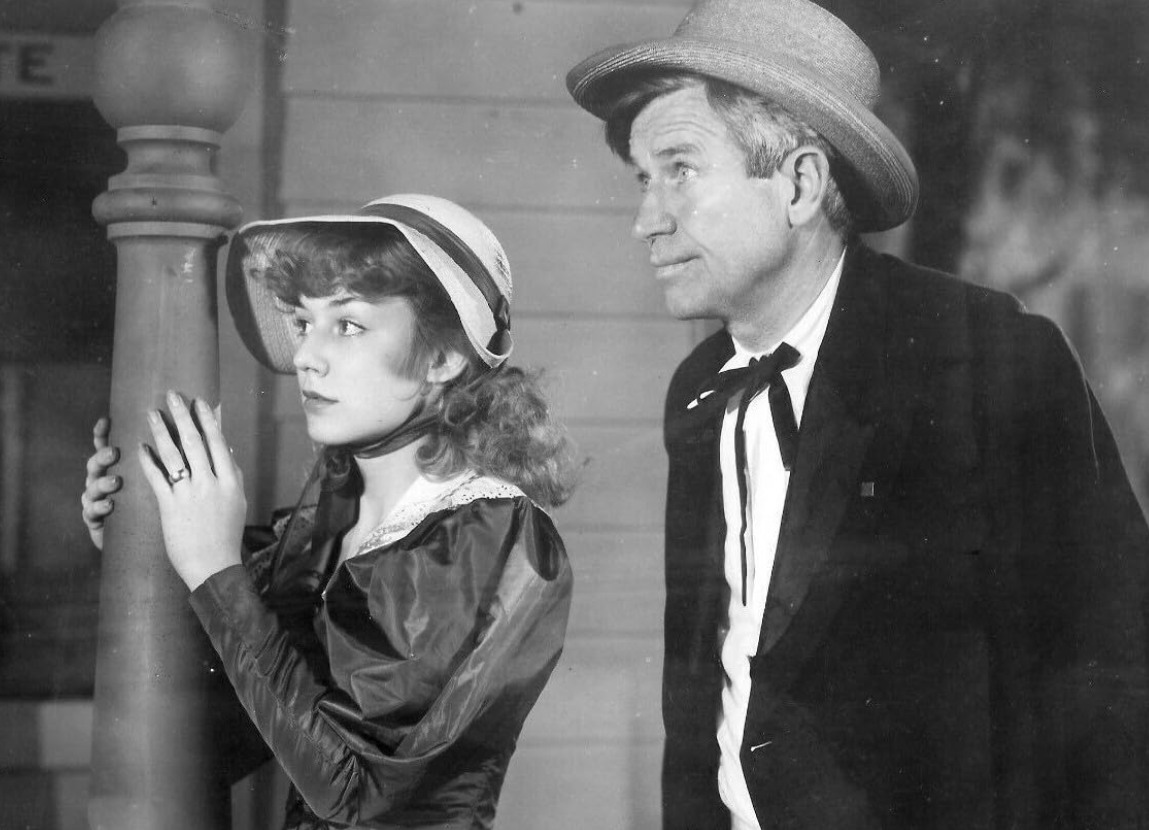
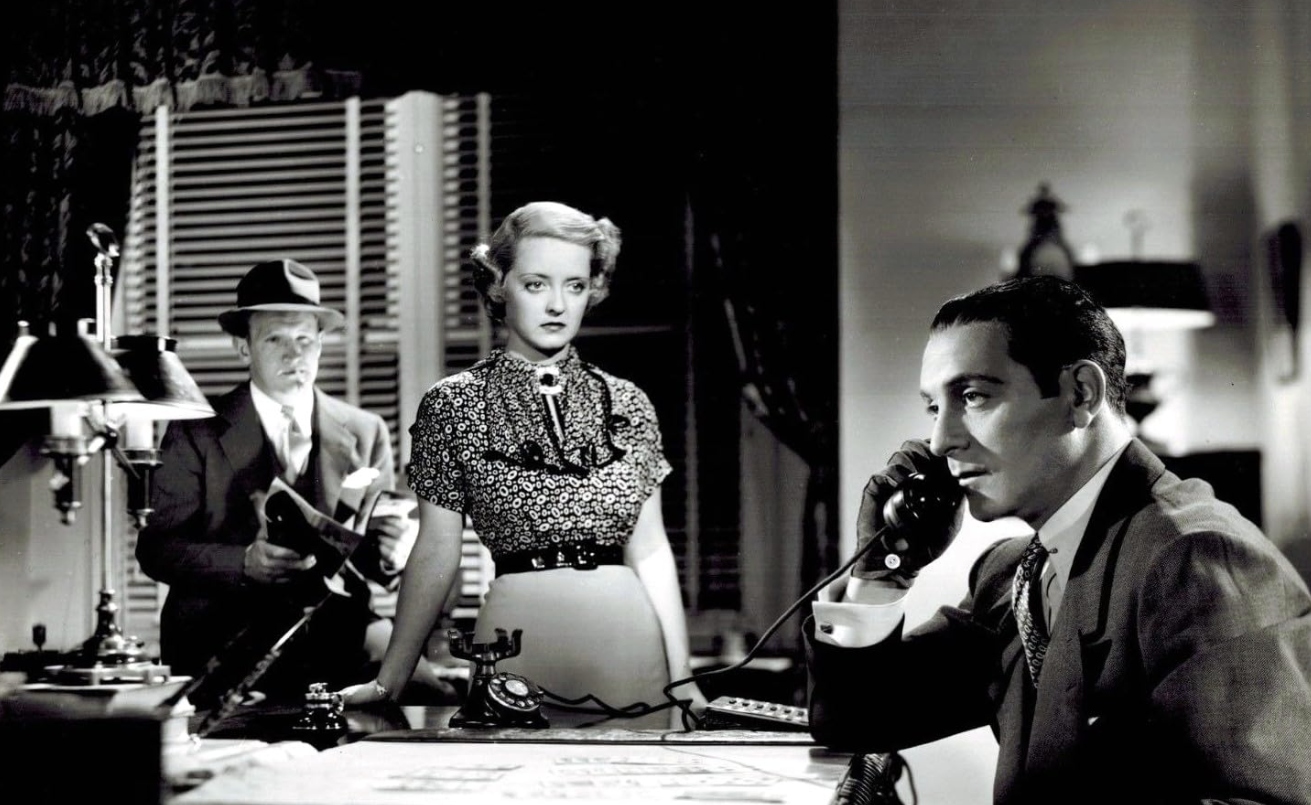
THEY ALL COULD HAVE USED SOME SPINACH…Clockwise, from top left, Popeye and Bluto strike an unlikely partnership in Dizzy Divers; Bette Davis and George Brent in Front Page Woman; Will Rogers and Billie Burke in Doubting Thomas; James Blakeley and Ida Lupino in Paris in Spring. (brothersink.com / rottentomatoes.com / cometoverhollywood.com / classiccartooncorner.substack.com)

 * * *

From Our Advertisers

Just a few ads from this issue, first, a jolly appeal from one of the magazine’s newer advertisers, the makers of the French apertif Dubonnet…

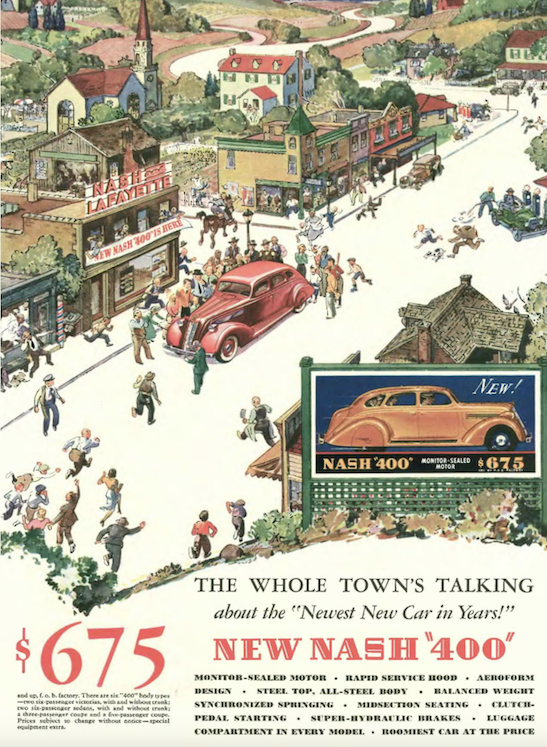
…by contrast, this quaint slice of Americana from Nash…

…and a shot of pesticide from Dr. Seuss

…our cartoonists include Constantin Alajalov, contributing this bit of spot art to the opening pages…

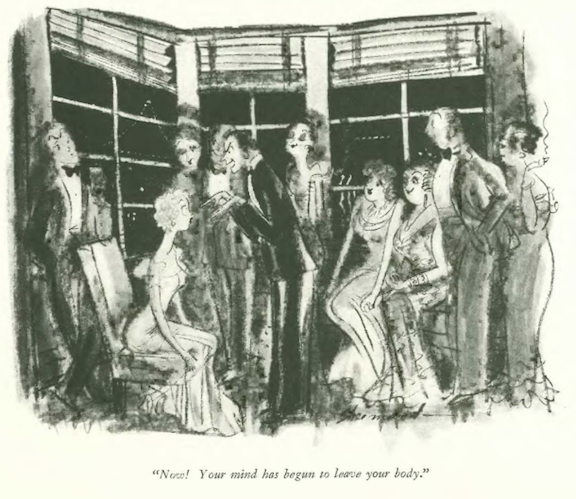
Barbara Shermund explored the world of hypnotic suggestion…

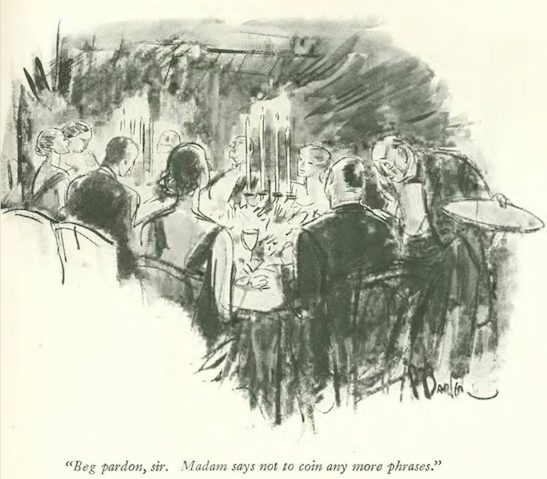
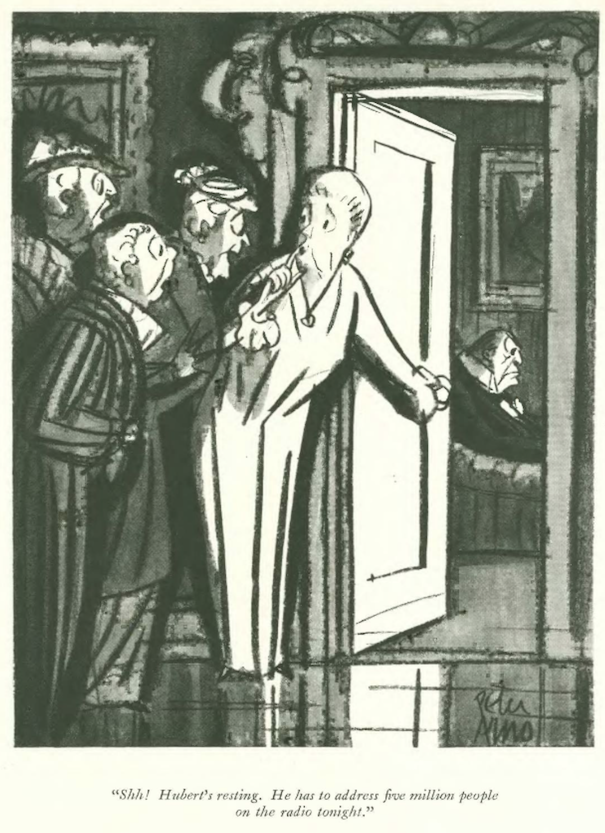
Peter Arno prepared to address the nation…

William Steig checked the weather forecast…

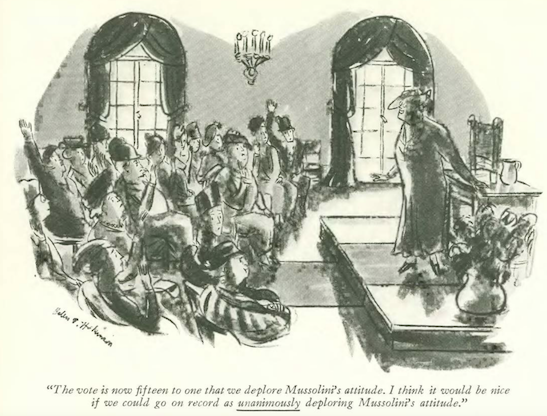
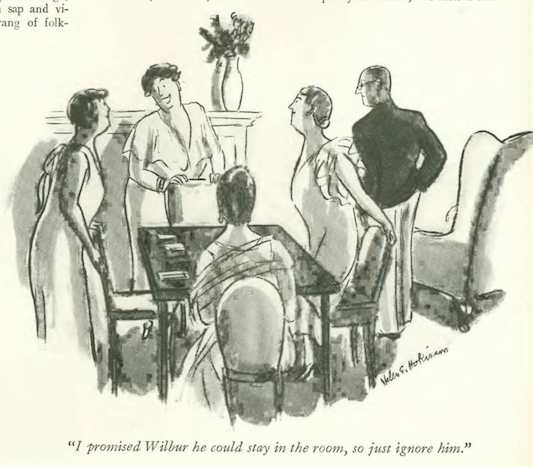
Helen Hokinson’s girls questioned the burden of a lei…

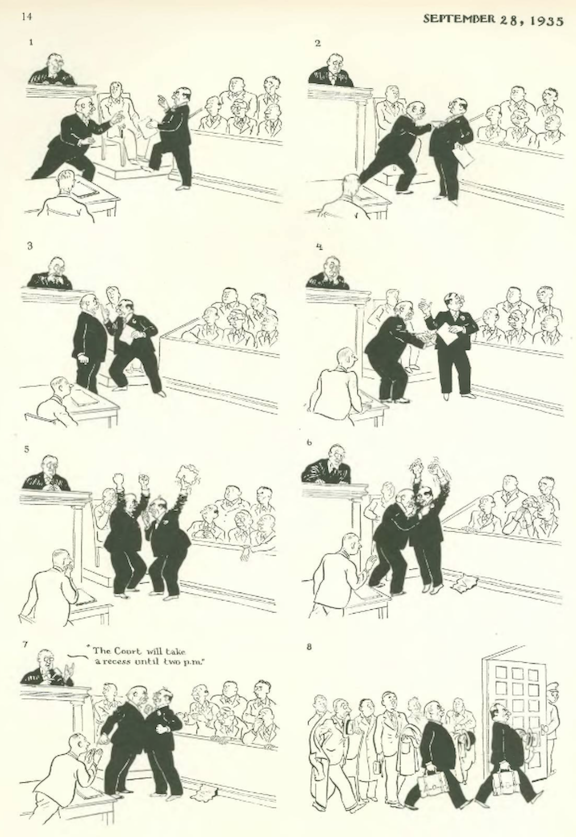
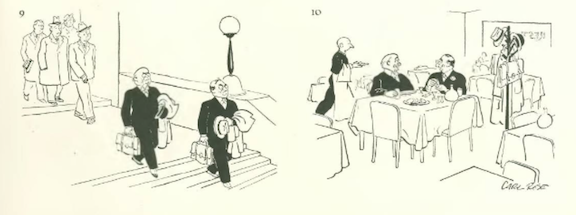
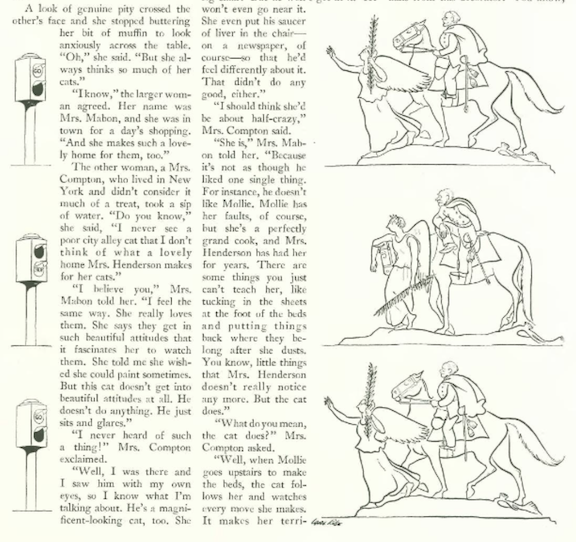
Carl Rose found himself on opposite sides of the page in this unusual layout

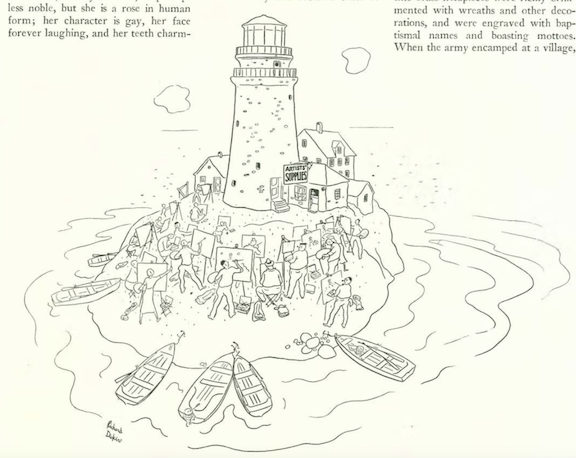
Richard Decker joined the crowd in a lighthouse rendering…

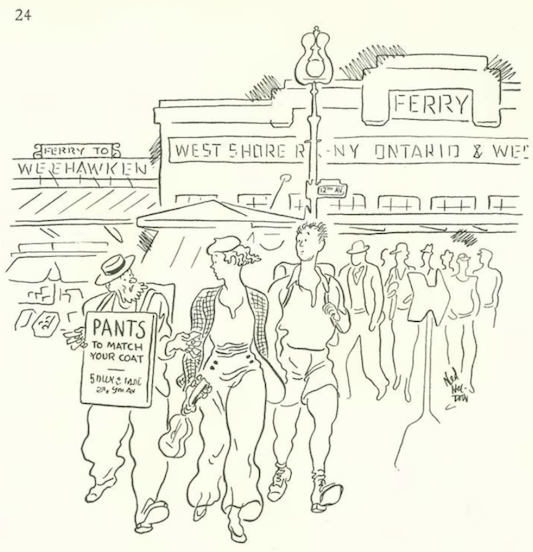
Ned Hilton reminds us that it was unusual for women to wear trousers ninety years ago…

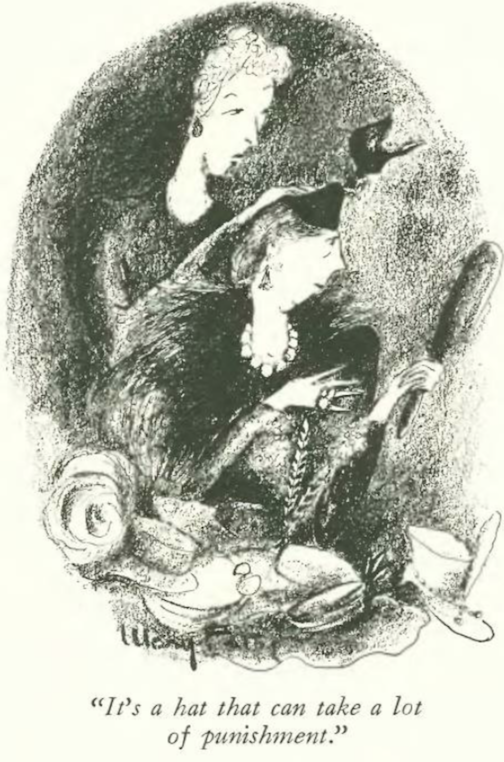
Mary Petty examined the complications of marital discord…

…and Charles Addams shone a blue light on a YMCA lecture…

…on to July 27, 1935, with a terrific summertime cover by William Steig

July 27, 1935 cover by William Steig, one of his 117 covers for the magazine.

E.B. White (in “Notes and Comment”) was ahead of his time in suggesting that the city needed to build “bicycle paths paralleling motor highways” and invest in more pedestrian pathways.

NEW YORK’S FINEST…Doris Kopsky, who trained in Central Park, won the first Amateur Bicycle League of America Women’s Championship in 1937. Bicycle races were a big draw in the 1930s. (crca.net)

 * * *

Breaking News

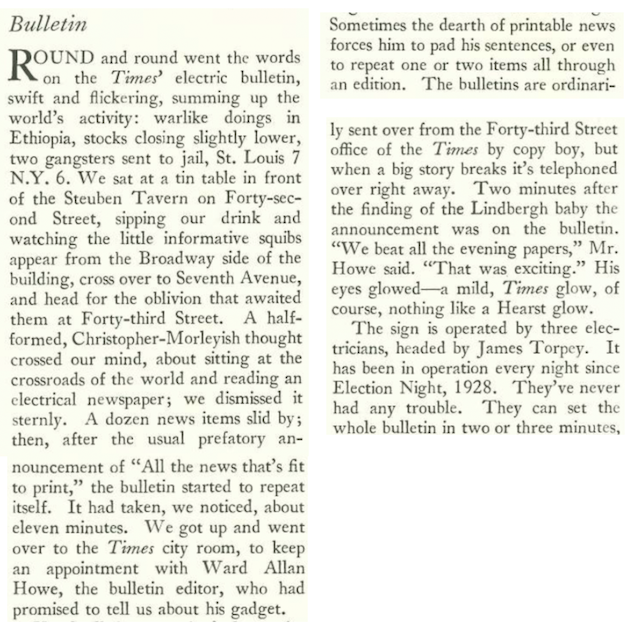
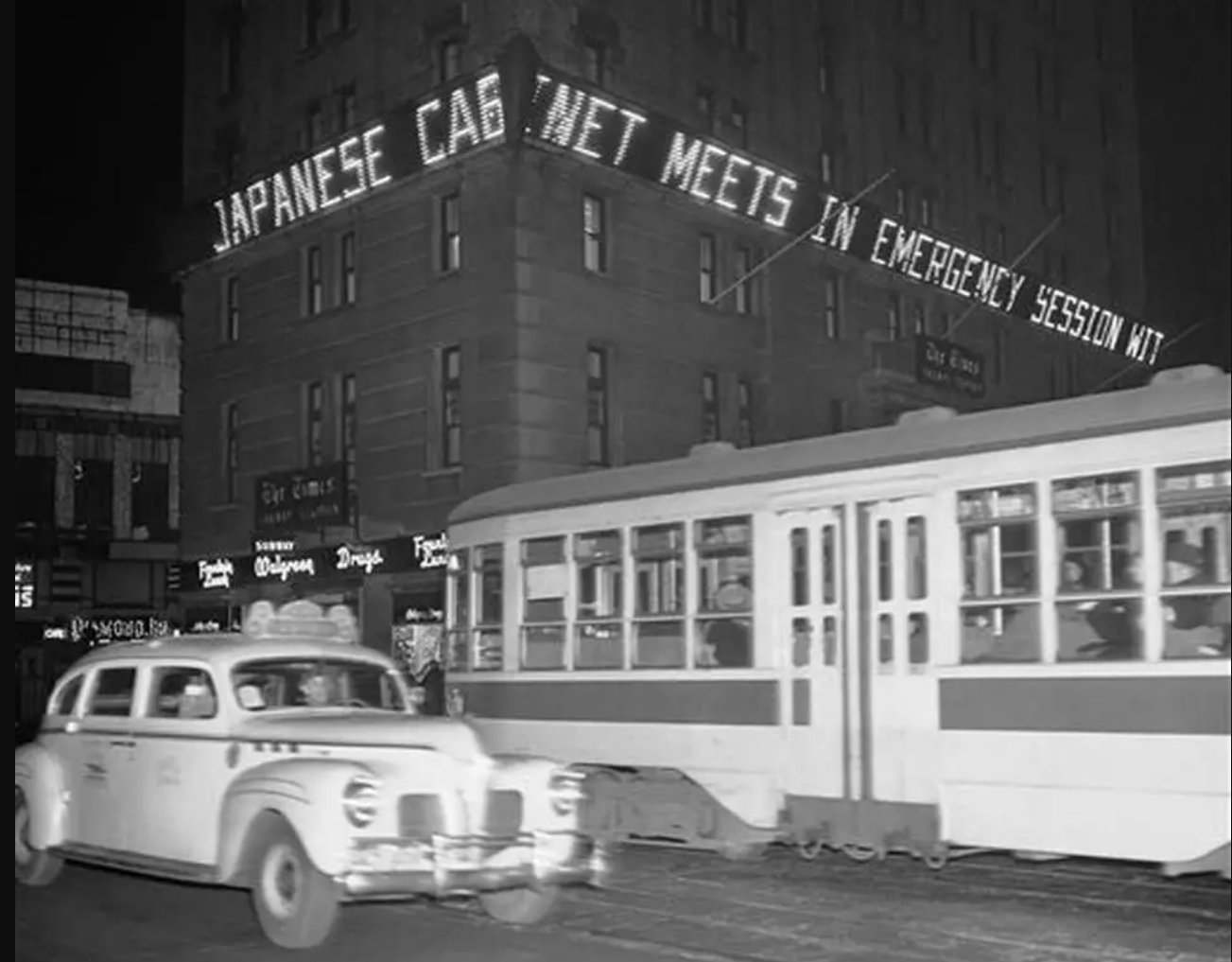
“The Talk of the Town” checked in on the New York Times’ “electric bulletin,” commonly known as “The Zipper.” Excerpt:

NIGHT CRAWLER…Launched in 1928, the Times Square “Zipper” kept New Yorkers apprised of breaking news. (cityguideny.com)

 * * *

Dog Knots

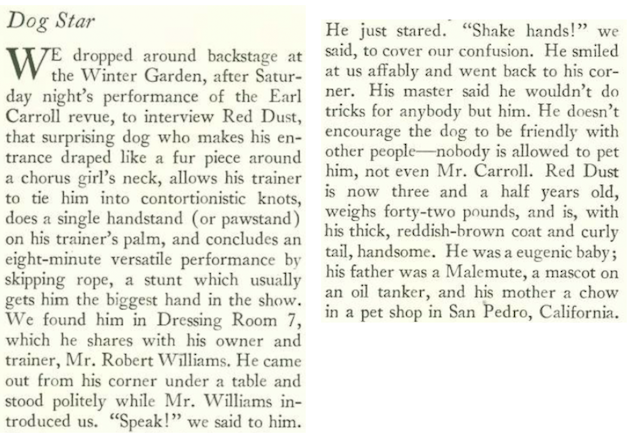
“Talk” also took a look backstage at the Winter Garden, where burlesque performers shared the stage with a contortionist dog called “Red Dust.” Excerpt:

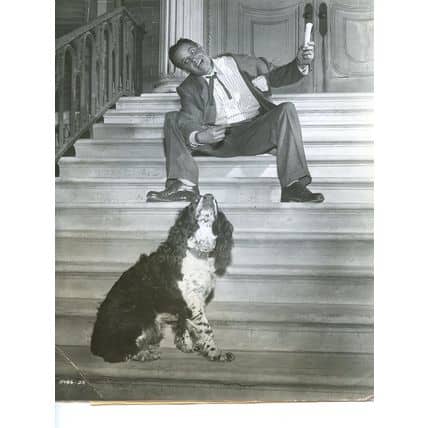
WOOF…Famed animal trainer Robert “Bob” Williams with one of his pupils. The dog in the photo is misidentified as Red Dust (he was actually a Malemute/chow mix).

 * * *

Suddenly Famous

Charles Butterworth (1896-1946) earned a law degree from Notre Dame before becoming a newspaper reporter. But his life would take on a new twist in 1926 when he delivered his comical “Rotary Club Talk” at J.P. McEvoy’s Americana revue in 1926. Hollywood would come calling in the 1930s, and his doleful-looking, deadpan characters would become familiar to movie audiences through a string of films in the thirties and forties. Alva Johnston profiled Butterworth in the July 27 issue. Here are brief excerpts:

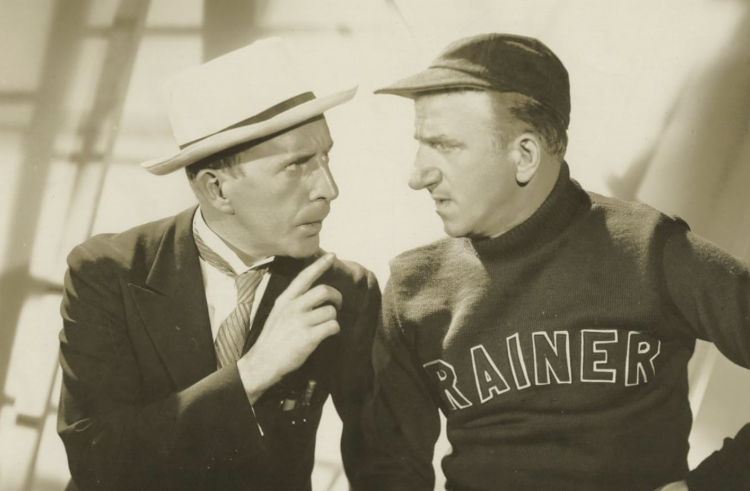
Charles Butterworth (left) and Jimmy Durante in Student Tour (1934). A bit of trivia: Butterworth’s distinctive voice was the inspiration for the Cap’n Crunch commercials voiced by Daws Butler beginning in the early 1960s. Butterworth’s life was cut short in 1946 when he crashed his imported roadster into a lamppost on Sunset Boulevard. (Detail from film still via IMDB)

 * * *

Noisy Neighborhood

The “Vienna Letter” (written by “F.S.”–possibly Frank Sullivan) noted the rumblings of fascism in a grand old European city known for its many cultural delights as well as its many factions that included Nazis, Socialists and Communists (and no doubt a few Royalists). An excerpt:

CALM BEFORE THE STORM…Vienna in 1935, less than three years before the Anschluss, when Nazi Germany annexed Austria. (meisterdrucke.us)

 * * *

Ex Machina

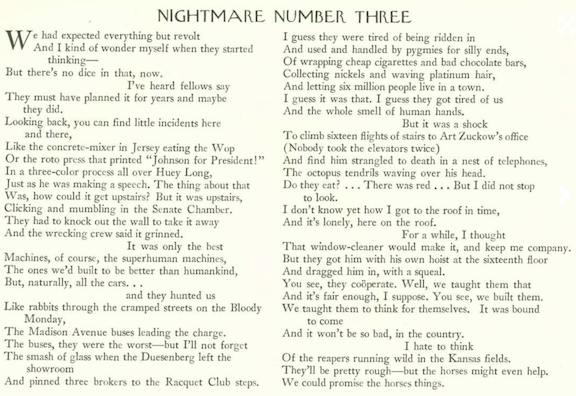
The Pulitzer Prize-winning poet and author Stephen Vincent Benét (1898-1943) penned this poem for The New Yorker that is somewhat appropriate to our own age and our fears of the rise of A.I. In “Nightmare Number Three,” Benét described a dystopian world where machines have revolted against humans.

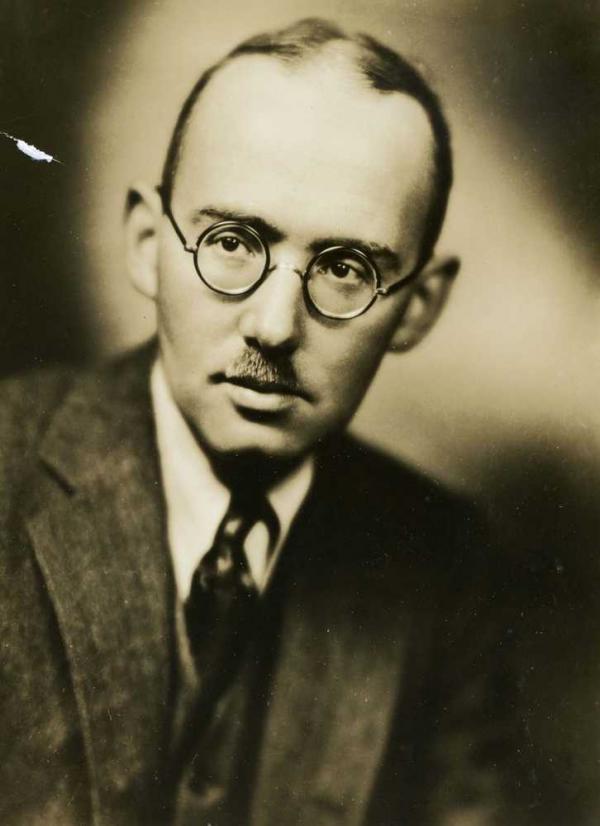
BOTH CLASSY AND FOLKSY is how some today describe Stephen Vincent Benét, who in 1928 wrote a book-length narrative poem of the American Civil War, John Brown’s Body, for which he received the Pulitzer Prize for Poetry. He was also know for such short stories as The Devil and Daniel Webster, published in 1936. (mypoeticside.com)

 * * *

From Our Advertisers

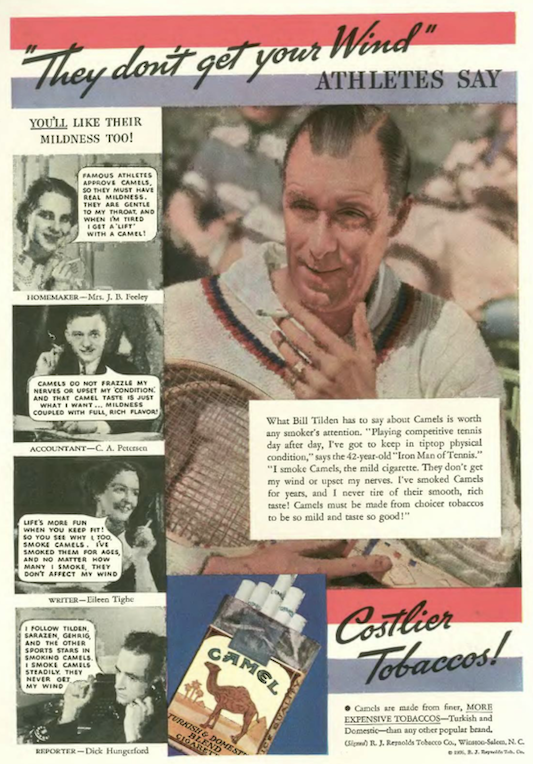
We begin with more extraordinary claims from R.J. Reynolds, who convinced a lot of folks that drawing smoke into your lungs actually improved your athletic stamina…

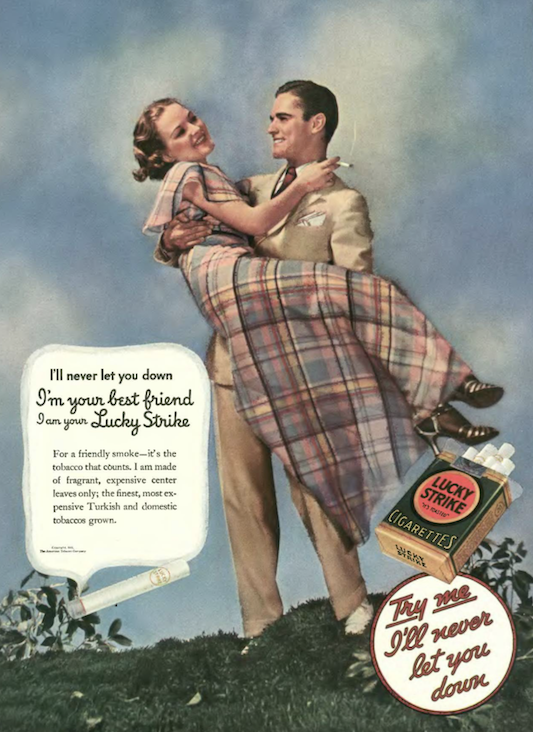
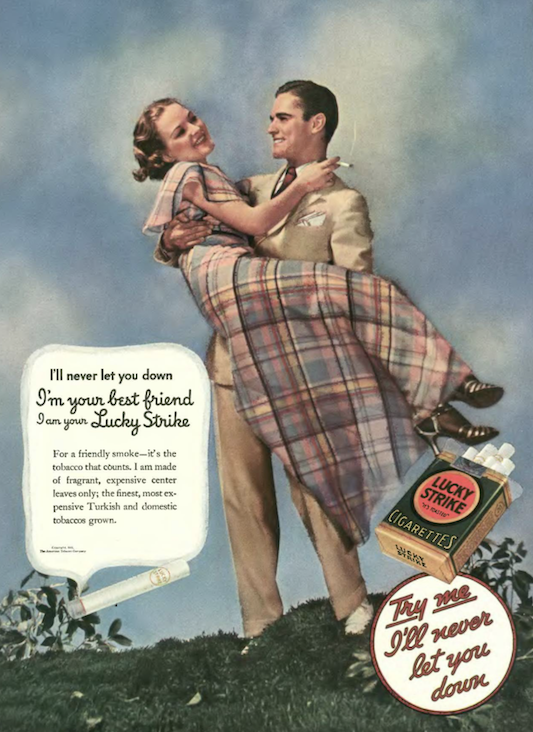
…the makers of Lucky Strike, on the other hand, stuck with images of nature and romance to suggest the joys of inhaling tar and nicotine…

…General Tire took a cue from Goodyear, suggesting that an investment in their “Blowout-Proof Tires” was an investment in the very lives of a person’s loved ones (even though they apparently drove to the beach without seatbelts or even a windshield)…

…another colorful advertisement from the makers of White Rock, who wisely tied their product to ardent spirits as liquor consumption continued to rebound from Prohibition…

…I toss this in for the lovely rendering on behalf of Saks…it looks like the work of illustrator Carl “Eric” Erickson, but he had many imitators…

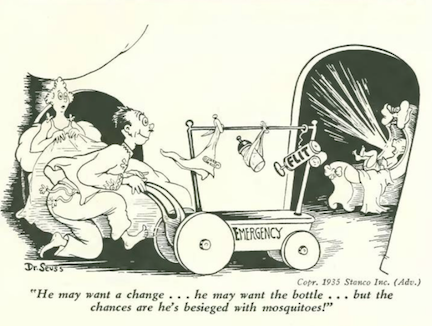
…we do, however, know the identity of this artist, and his drawings on behalf of the pesticide Flit, which apparently in those days of innocence was thought appropriate for use around infants…

…great spot drawing in the opening pages…I should know the signature but it escapes me at the moment…

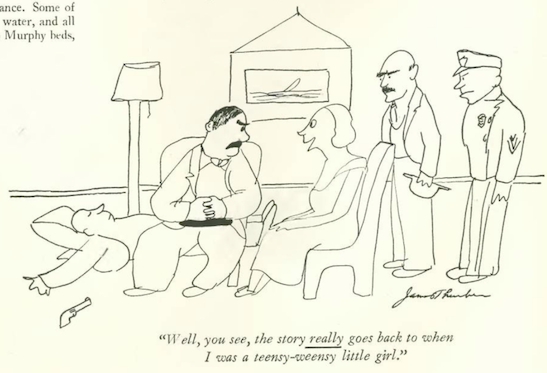
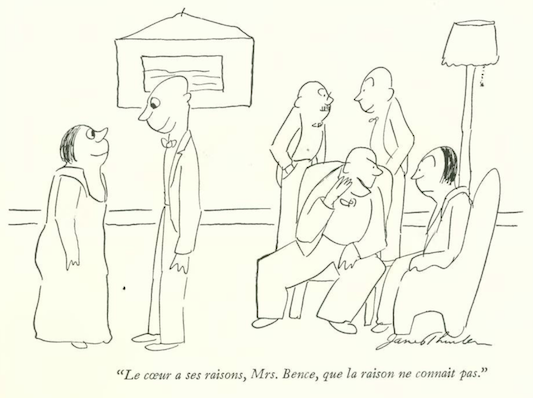
James Thurber quoted Blaise Pascal for this tender moment ( “The heart has its reasons, of which reason knows nothing”)…

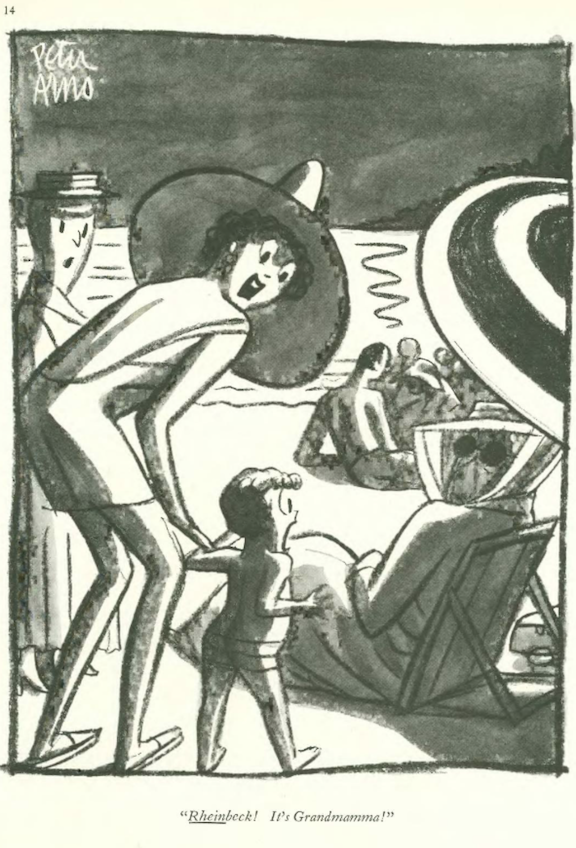
Peter Arno illustrated the horrors of finding one’s grandmother out of context…

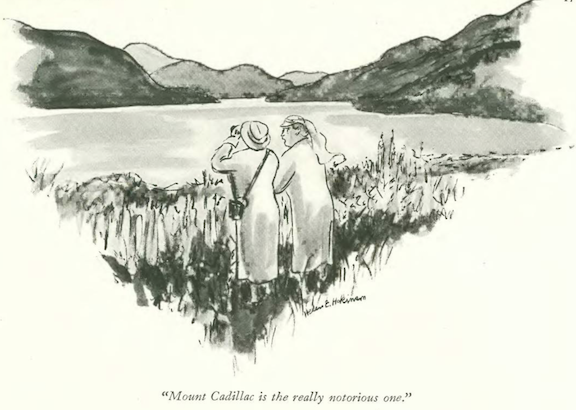
Helen Hokinson’s girls employed a malaprop to besmirch the good name of an innocent mountain…

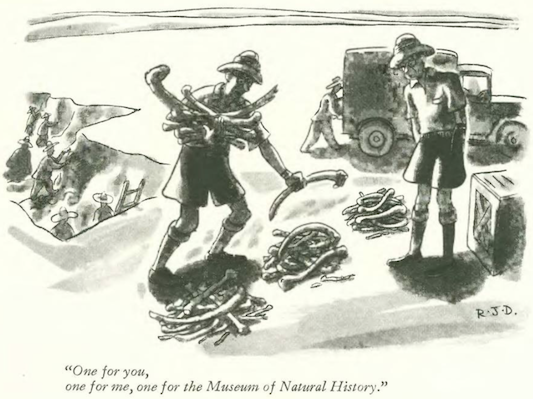
Richard Decker discovered the missing link(s) with two archeologists…

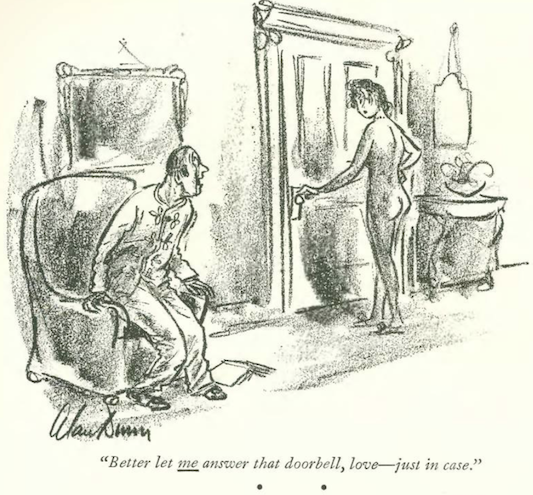
Alan Dunn narrowly averted a surprise greeting…

George Price added a new twist to a billiards match…

…Price again, at the corner newstand…

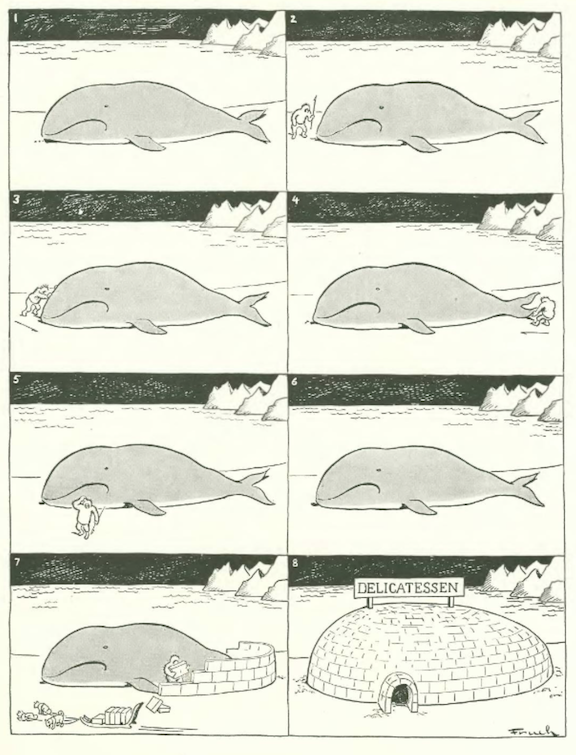
Al Frueh bit off more than he could chew…

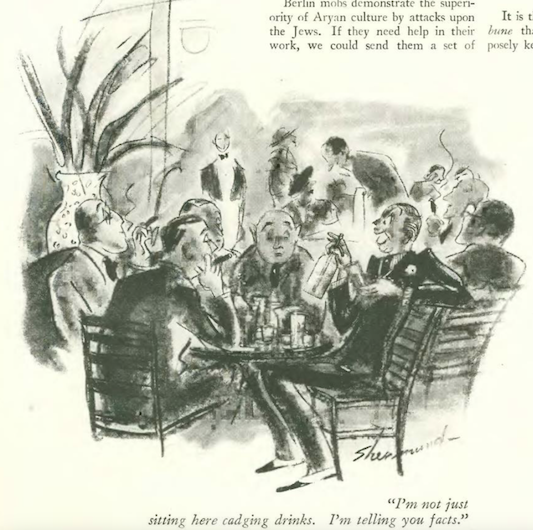
…and we close with Barbara Shermund, and a prattling mooch…

Next Time: La Marseillaise…

The Cowboy Philosopher

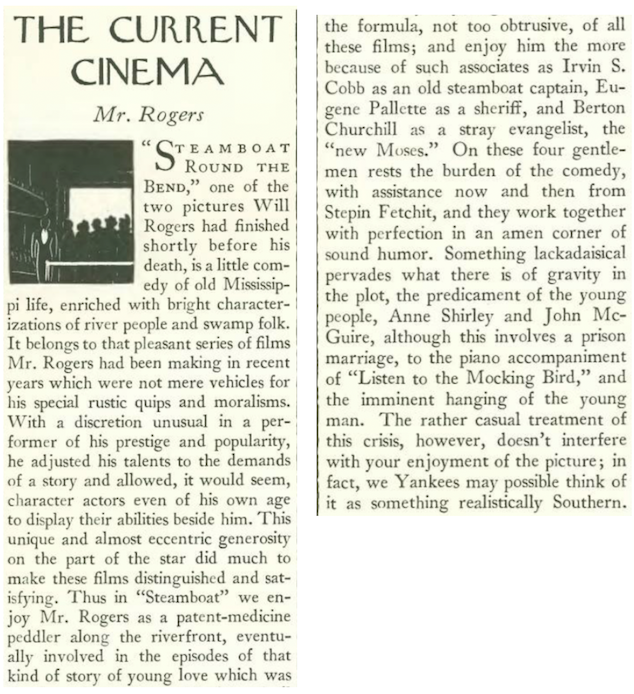
William Penn Adair Rogers, aka Will Rogers (1879–1935), was a man of many talents. Today he is mostly referred to as a humorist, but he was also an actor, a social and political commentator, a trick roper and a vaudeville performer. To Americans he was a national icon.

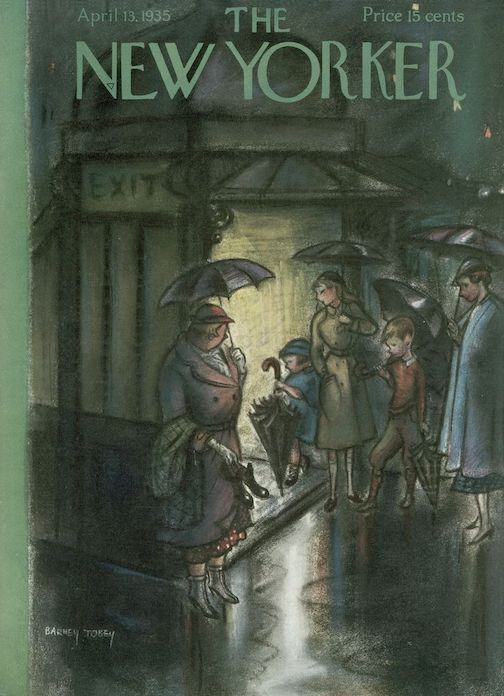
April 13, 1935 cover by Barney Tobey.

Rogers was also internationally famous, having traveled around the world three times and appearing in 71 films (50 of those silent). He also wrote more than 4,000 newspaper columns—nationally syndicated by The New York Times—that reached 40 million readers, and there were also magazine articles, radio broadcasts and personal appearances. He seemed to be everywhere.

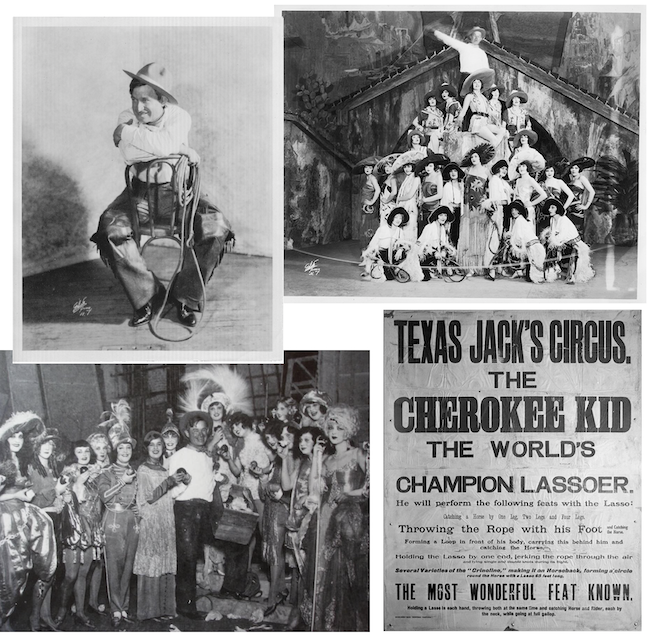
ROPING THEM IN…In 1902, Will Rogers joined Texas Jack’s Wild West Show & Circus in South Africa as the “Cherokee Kid”—he was born as a citizen of the Cherokee Nation, in the Indian Territory that is now part of Oklahoma. By 1910, he had created a sensational vaudeville act by mixing trick roping with witty monologues. Clockwise, from top left, Rogers in a publicity photo from 1916, the year he joined the Ziegfeld Follies; on stage with the Follies in 1924; poster from his circus days; backstage with the 1924 Follies cast. (National Portrait Gallery)
MULTIMEDIA MULTI-TALENT…Left, Rogers catches a few moments to write one of his 4,000 nationally syndicated newspaper columns; from 1929 to 1935 he used the exciting new medium of radio to broadcast his newspaper pieces. His weekly Sunday evening show, The Gulf Headliners, sponsored by Gulf Oil, ranked among the top radio programs in the country. (National Portrait Gallery)

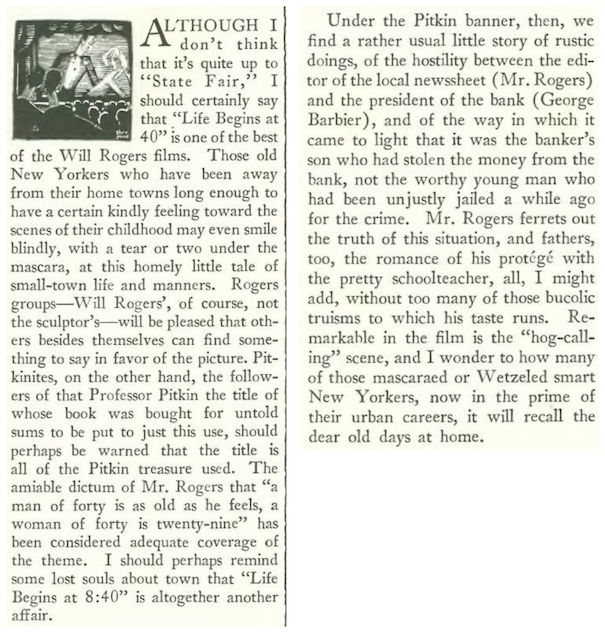
When John Mosher reviewed Rogers’ latest film, Life Begins At Forty, he found it to be one of Rogers’ best. It would also prove to be one of his last. On August 15, 1935, a small airplane carrying Rogers and aviator Wiley Post would crash on takeoff near Point Barrow, Alaska, claiming the lives of both men. Rogers would appear in three more films in 1935, the last two posthumously.

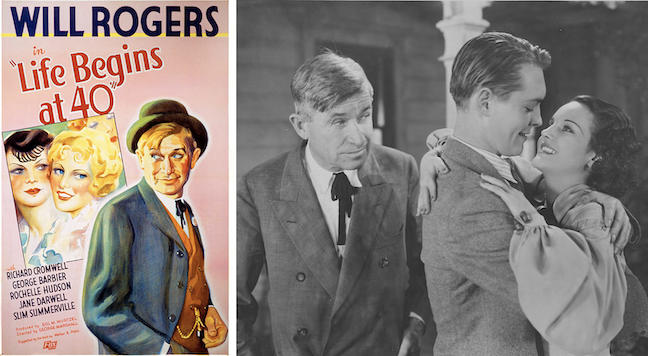
THAT’S LIFE…Will Rogers with Richard Cromwell and Rochelle Hudson in Life Begins at 40. Rogers’ film took its title from a 1932 self-help book by Walter B. Pitkin. Pitkin maintained that keeping a positive attitude toward life could give a person many fulfilling years after age 40. By the time of his death in 1935, the 55-year-old Rogers was Hollywood’s highest paid actor. (Wikipedia/IMDB)

 * * *

Not Toying Around

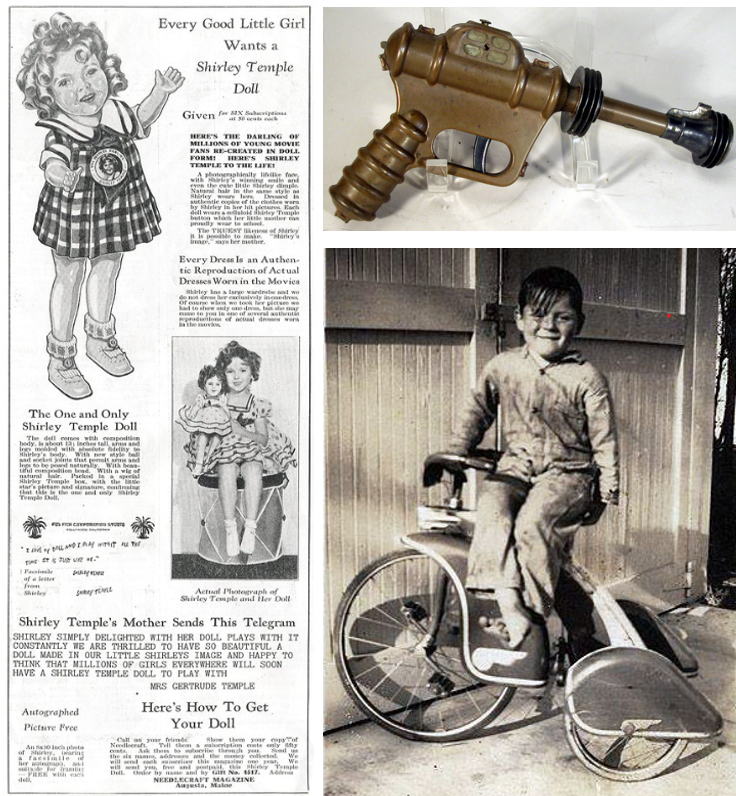
“The Talk of the Town” looked in on the serious business of toymakers, with 1935 being the year of streamlined tricycles, Buck Rogers disintegrator pistols, and, of course, Shirley Temple dolls.

RIVALED ONLY BY MICKEY MOUSE, Shirley Temple was the most popular celebrity to endorse merchandise for children and adults, including the “one and only” Shirley Temple Doll (left, ad from 1935); the Buck Rogers XZ-38 Disintegrator Pistol (top) was produced in 1935 by Daisy, and was available in both copper and nickel finishes–it was also offered as a premium from Cream of Wheat cereal; at bottom, the American National Streamline Velocipede Tricycle (1935), just one example of the hundreds of products receiving the streamlining treatment in the 1930s. (flickr/airandspace.si.edu/onlinebicyclemuseum.co.uk)

 * * *

Literary Spirits

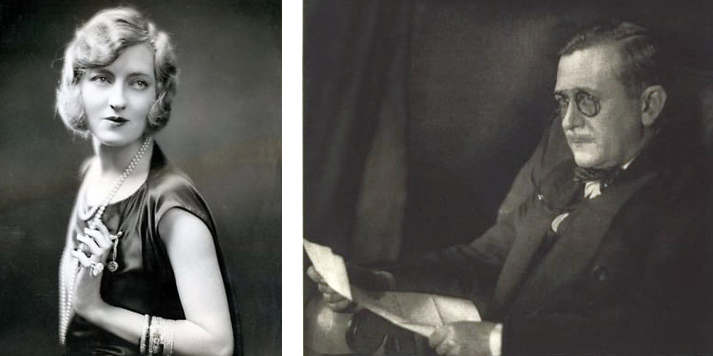
E.B. White welcomed the return of literary tea party, which thanks to the repeal of the 18th Amendment had been re-dubbed the “literary cocktail party.” He shared his thoughts in “Notes and Comment”…

AMUSING MUSES…Actress, writer and socialite Peggy Hopkins Joyce hosted literary “teas” in the 1920s, while former Cosmopolitan editor Ray Long inspired a book on adventures in the South Seas shortly before his death; from left, Joyce in 1923; photogravure of Long, 1925. (Wikipedia/photogravure.com)

 * * *

Proto Feminist

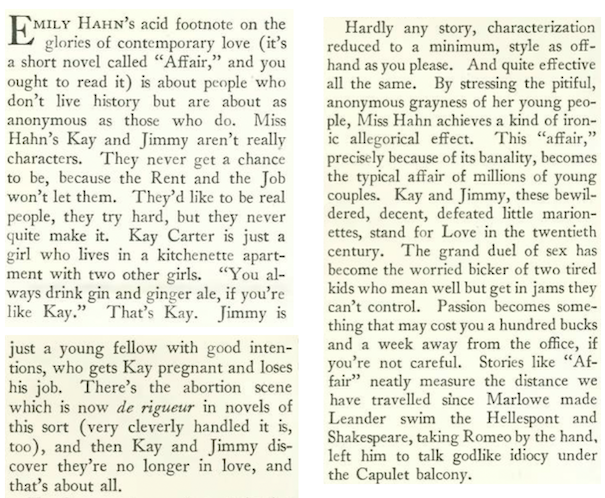
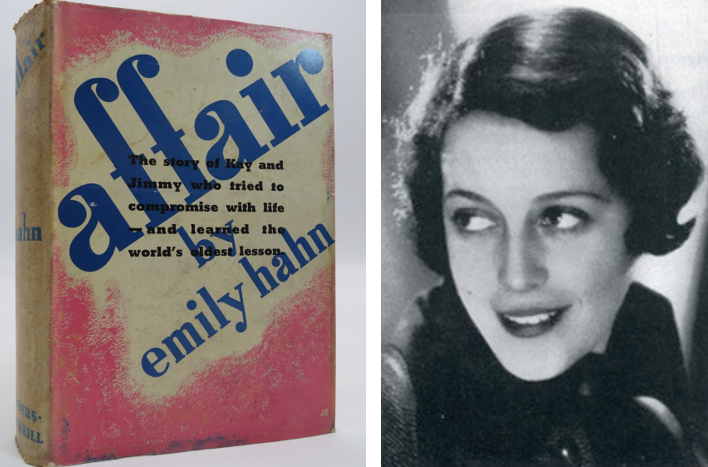
Emily Hahn was one of the more lively figures in The New Yorker’s stable of journalists and writers, leading an adventurous life that included a hike across Central Africa in the 1930s and getting into all kinds of trouble during the Japanese invasion of China. According to Roger Angell, Hahn was, “in truth, something rare: a woman deeply, almost domestically, at home in the world. Driven by curiosity and energy, she went there and did that, and then wrote about it without fuss.” It is no surprise that Hahn’s latest novel, Affair, didn’t shy away from topics like abortion. According to reviewer Clifton Fadiman, the novel’s “anonymous grayness” exposed the banality of love in the twentieth century.

If Hollywood is looking for a new biopic, Hahn would make a fascinating subject (Kristen Stewart would be perfect for the part). According to IMDB, there is an “Untitled Emily ‘Mickey’ Hahn Project”—a TV series—that has been in development since 2022, but so far nothing has come of it.

DOWN ON LOVE?…Emily Hahn’s 1935 novel Affair exposed the banality of love in the twentieth century. (abebooks.com/susanbkason.com)

 * * *

From Our Advertisers

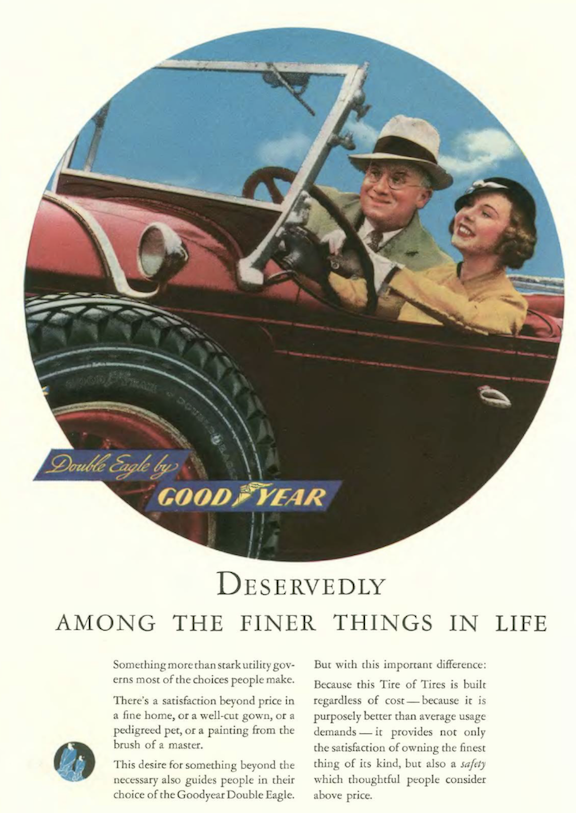
We begin with this advertisement from Goodyear, featuring what appears to be a father teaching his daughter how to drive, or in this case, fly, just like Chitty Chitty Bang Bang…

…and we stay airborne with the makers of the streamlined Nash, who claimed their automobile had “flying power”…

…and we return to earth with Cadillac’s budget model, the LaSalle, which featured “flashing performance”…

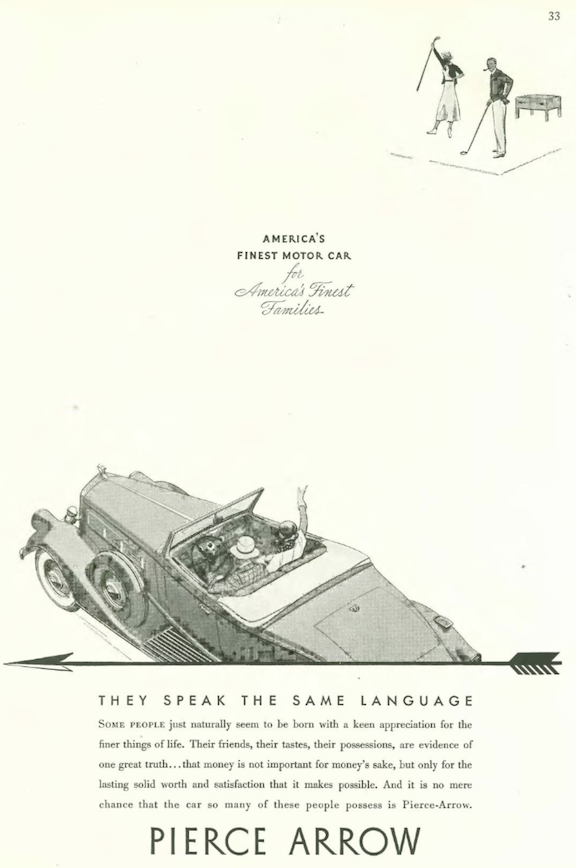
…by contrast, Pierce Arrow took a minimalist approach, gimmicks and splashy colors being reserved for the lower orders…

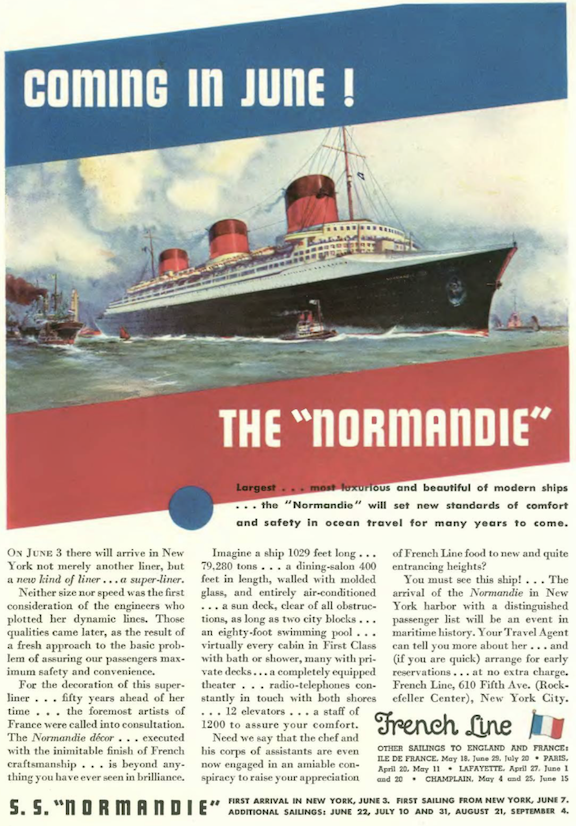
…one of the world’s most iconic ocean liners took to the sea with much fanfare in 1935. The SS Normandie was the largest and fastest passenger ship afloat; it remains the most powerful steam turbo-electric-propelled passenger ship ever built…

…if you happened to smoke Webster cigars, it could have been a sign that you were favored by the heavens…

…the “20-year rule” in fashion suggests that trends have a tendency to re-emerge every two decades, and that seems to be the case here…

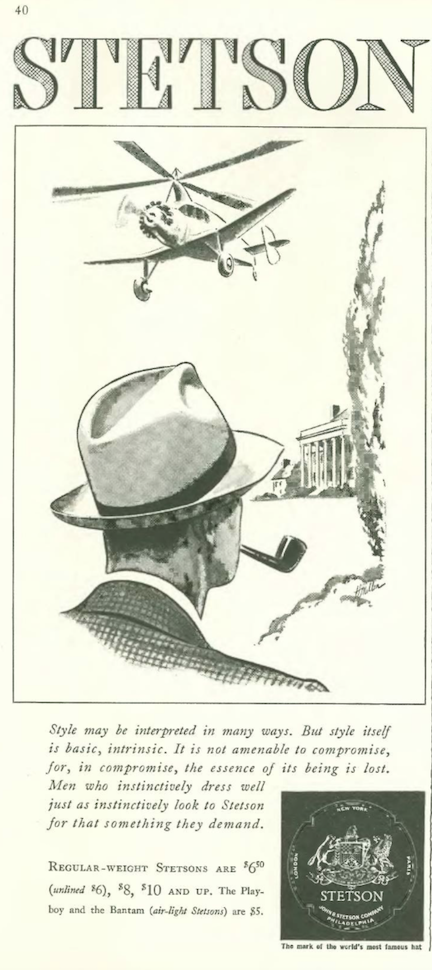
…this next ad tells us everything we need to know about the Stetson wearer: he is a wealthy country gentleman who values tradition but who is also a man of the future…from the 1920s to midcentury the autogyro was thought to be the answer to the long-dreamed of flying car…

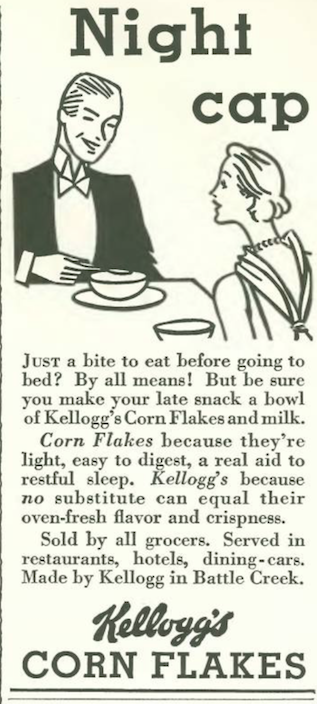
…whoever coined the term “night cap” probably wasn’t thinking about cold cereal…

…although Harold Ross’s old high school friend, John Held Jr., contributed many woodcut-style cartoons and faux maps to The New Yorker from 1925 to 1932, Held was more famous for his shingle-bobbed flappers and their slick-haired boyfriends in puffy pants, a style more apparent in this ad for Peychaud’s Bitters (the original was a one-column ad, split here for clarity)…

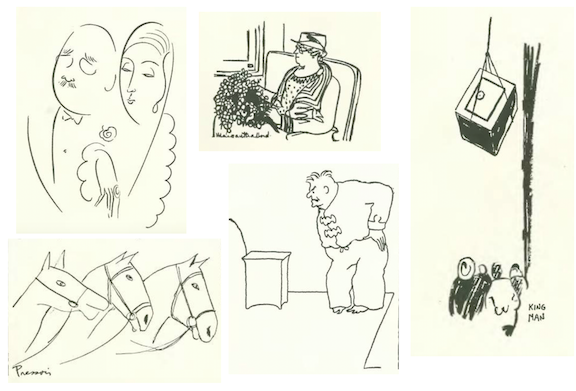
…Held provides a segue to our illustrators and cartoonists, beginning with a sampling of spot art from the April 13 issue…

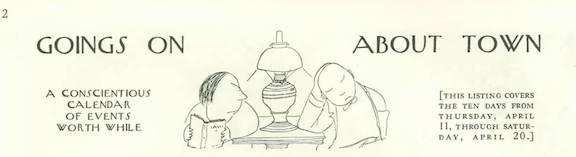
James Thurber got things going on page 2…

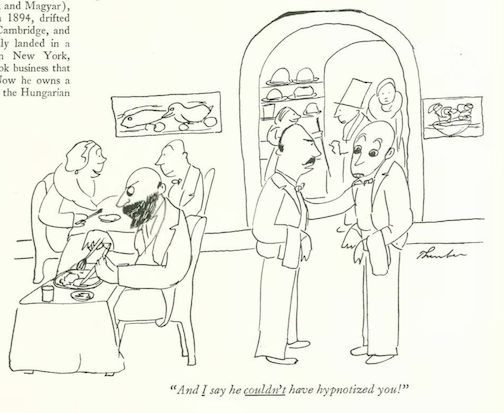
…and also contributed this observation of the hypnotic arts…

Otto Soglow did some careful surveying (this originally appeared across two pages)…

Alain looked in on some Vatican gossip…

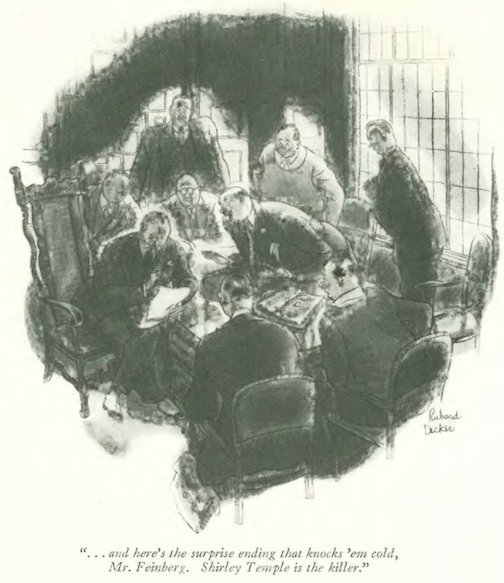
Richard Decker pitched a Shirley Temple murder caper…

Carl Rose gave us a sweet send-off…

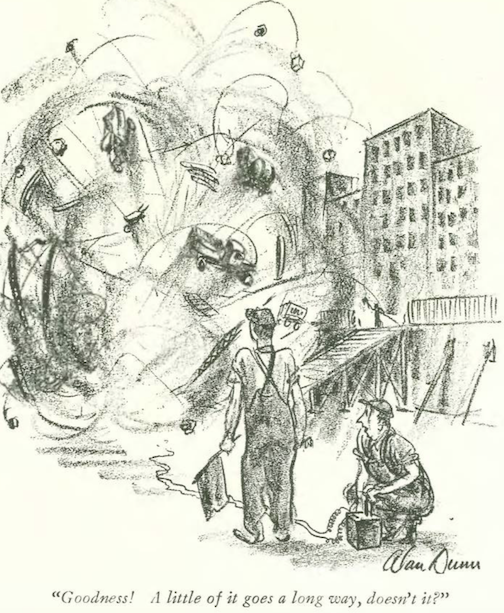
…and we close out with a big bang, courtesy of Alan Dunn

Next Time: Terse Verse…


It’s a Gift

Above: Charles Sellen as Mr. Muckle and W.C. Fields as shopkeeper Harold Bissonette in the 1934 film It's a Gift.

Rea Irvin featured the New York Auto Show on the cover of Jan. 12, 1935 issue—the extravaganza of cars at the Grand Central Palace was one place New Yorkers could go to chase away the winter blues. The other was at one of the city’s RKO theatres, where a classic W.C. Fields comedy was gracing the silver screen.

Jan. 12, 1935 cover by Rea Irvin.

It’s a Gift was a showcase of Fields’ vaudevillian talents, tied together in a story about grocer Harold Bissonette (Fields) whose various tribulations included a pompous wife (who insisted on pronouncing the surname “biss-on-ay”), bratty children, and challenging customers (the hilarious Charles Sellen as Mr. Muckle). Writing for BFI Film Classics, Simon Louvish calls the film a chronicle of the “many titanic struggles between Harold Bissonnette and the universe. There will be battle of wills between father and daughter, between male and female, between man and a variety of uncontrollable objects.” Here is John Mosher’s review for The New Yorker.

HAROLD VS. THE WORLD…Clockwise, from top left, W.C. Fields as grocer Harold Bissonette; Fields with Kathleen Howard as wife Amelia Bissonette; Bissonette is relegated to the back porch in search of some rest; Charles Sellon as one of Bissonette’s more challenging customers, Mr. Muckle. (IMDB/TCM/filmfanatic.org/YouTube)
BABY BLUES…Two-year old Baby LeRoy (Ronald Le Roy Overacker) played the annoying foil to W.C. Fields in three films, including It’s a Gift (left, with Fields and Tammany Young). James Curtis’s W.C. Fields: A Biography (2003) quotes director Norman McLeod: “[Fields] used to swear at the baby so much in front of the camera that I sometimes had to cut off the ends of the scenes in which they appeared.” Fields’ popular persona was a man who hated dogs and kids, but a studio photo taken during the filming of It’s a Gift (right) seems to show another side. Perhaps. (Pinterest/citizenscreen.com)

 * * *

By Another Name

E.B. White led off his column with a note about Persia, which had officially changed its name to Iran. To mark the new year, Reza Shah had officially asked foreign delegates to use the new term, which referred to the native name of the people who inhabited the region.

 * * *

Hot Rods

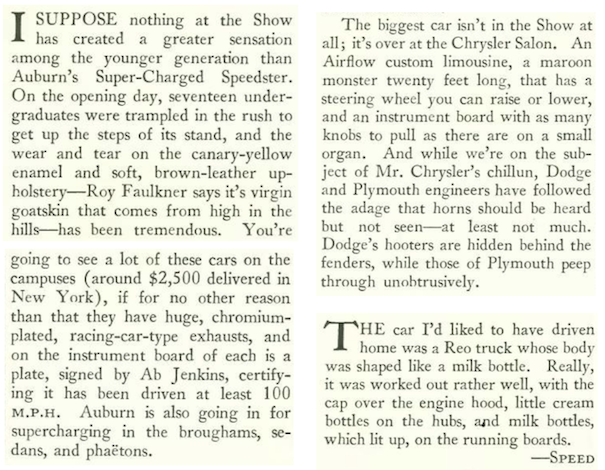
The New Yorker was back at the auto show, where correspondent “Speed” noted the appeal of the Auburn Speedster to a college-age crowd. The $2,500 price tag (equivalent to about $55k today) was apparently within reach for some of the lads at Columbia and other Ivies. Speed also admired the limousine version of the Chrysler Airflow, but the real car of his desires was a bottle-shaped milk truck.

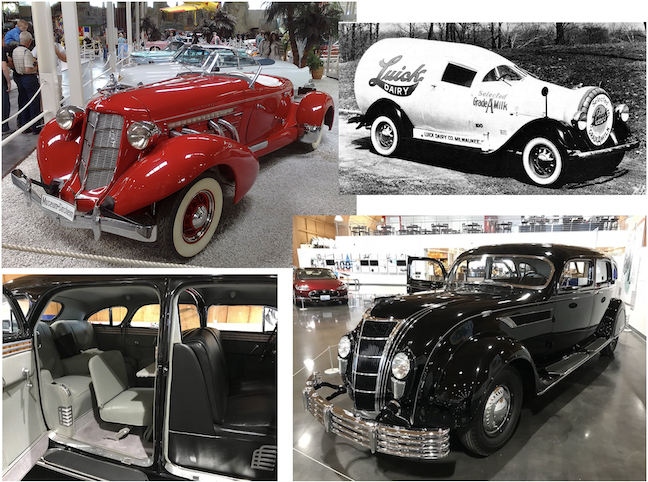
INSTANT CLASSIC…The New Yorker predicted that the Auburn Speedster 851, which came to be known as the “Hollywood Car,” would be popular among lads on college campuses. Despite its technical advancement (it could do 100 mph) and beautiful lines, it would prove to be Auburn’s final production model. (Wikipedia)
RARITIES…Clockwise, from top left: Boattail version of the Auburn Speedster 851, of which only 143 were built; REO milk bottle truck, circa 1930; 1935 Chrysler CW Airflow Limousine—only fifteen of these massive cars were built. (Wikipedia/Pinterest/Donald Pittenger@carstylecritic.blogspot.com)

 * * *

From Our Advertisers

The proprietors of Essex House tapped into the popularity of the Auto Show to market their economical, yet deluxe accommodations…

…the anti-war group World Peaceways continued its ad campaign with this image of the “most powerful man in America,” that is, the average citizen who should not be tricked into “the absurd business of war”…

…United Airlines used the endorsement of journalist and radio commentator Edwin C. Hill to tout the safety and comfort of its airliners…

…at the time, United’s flagship airplane was the Boeing 247…

Interior and exterior of the Boeing 247. (Library of Congress/Wikipedia)

…”Mrs. William LaVarre” (Alice Lucille Elliott) was the latest adventurous soul to endorse the energizing effects of Camel cigarettes…

…it was no coincidence that the Camel and Chesterfield ads both featured women, the tobacco companies’ biggest growth market in the 1930s…

…on to our cartoons, we go bowling in this spot by George Shellhase

…a doctor’s bedside manner, in James Thurber’s world of the battling sexes…

…two of Helen Hokinson’s “Girls” were left breathless by the exploits of Elias Burton Holmes, an American photographer and filmmaker who apparently coined the term “travelogue”…

…for this next cartoon by Robert Day, a snippet from the Auto Show will shed some light…

…and we close with Carl Rose, and some hijinks among the statuary…

Next Time: Everything’s Jake…

Music in the Air

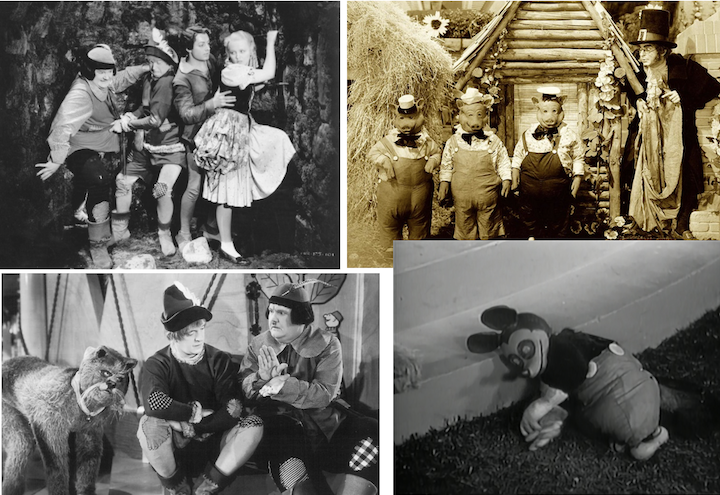
Above: The Cat and the Fiddle (Pete Gordon) and Mickey Mouse (a monkey in a very creepy costume) were featured in 1934's Babes In Toyland.

We close out the old year and ring in the new with a bit of song and dance from three musicals that entertained New Yorkers in the waning days of 1934.

Dec. 22, 1934 cover by Arnold Hall.

The work of composer Jerome Kern and lyricist Oscar Hammerstein II were prominent in two of those films, adapted from successful Broadway productions—the romantic comedy Music in the Air and the sentimental Sweet Adeline. Success on the stage did not necessarily translate to the screen in either case, according to critic John Mosher.

SOUR NOTES…The famed silent movie star Gloria Swanson showed off her singing chops in Music in the Air, but it wasn’t enough to save the film from becoming a box office failure. The film centered on the stormy relationship between opera star Frieda Hotzfelt (Swanson) and librettist Bruno Mahler (John Boles, pictured). (TCM)
TALL ORDER…For those who recalled Helen Morgan’s tragedy-tinged Broadway performance as Addie in Sweet Adeline, Irene Dunn’s more comical take, although delivered with authority, could not hold up the pallid performances of her co-stars, including Donald Woods, right. (TCM)

And there was Babes in Toyland, a Hal Roach film headlined by the comedy duo Stan Laurel and Oliver Hardy. The film was well received by critics, including Mosher, who wrote that Babes in Toyland “was far more successful than [1933’s] Alice in Wonderland, and the children will probably be far less bored by it than they generally are by those films designed especially for them.” However, similar to Alice the costumes seem creepily crude, such as the weird rubber pig costumes and the almost terrifying Mickey Mouse, portrayed by a hapless monkey dressed to resemble the big-eared icon. It was apparently the first and last time Walt Disney allowed the Mickey Mouse character to be portrayed outside of a Disney film. No wonder.

Clockwise, from top left, Stan Laurel and Oliver Hardy with Felix Knight (Tom-Tom) and Charlotte Henry (Bo-Peep); the Three Little Pigs with the villain Silas Barnaby, portrayed by Henry Brandon; a very creepy Mickey Mouse (a monkey in costume); and Laurel and Hardy with The Cat and the Fiddle (Pete Gordon). (eofftvreview.wordpress.com/psychotronicaredux.wordpress.com/YouTube/MUBI)

 * * *

Alms for the Poor

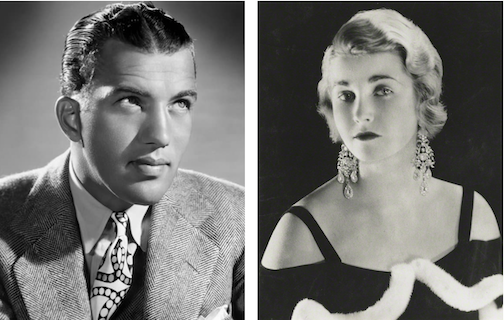
Woolworth store heiress Barbara Hutton was one of the richest women in the world in the 1930s, and her lavish lifestyle in the midst of Depression attracted the attention, and the ire, of newspaper columnist Ed Sullivan. In his “Notes and Comment,” E.B. White made this observation:

COUGH IT UP, LADY…Ed Sullivan, who in 1934 was a well-known Daily News show business columnist, thought Woolworth dime store heiress Barbara Hutton should show more concern for the needy. Known for her lavish spending during the Great Depression, in 1934 Hutton was married to a self-styled Georgian prince named Alexis Mdivani—Mdivani would be the first of Hutton’s seven husbands. Sullivan would go on to greater fame on television with the Ed Sullivan Show. (clickamericana.com/npg.org.uk)

 * * *

Oh Baby

Most of us know something about the weird and somewhat tragic tale of the Dionne quintuplets, raised from infancy before the public gaze and exploited to sell everything from dolls and books to soap and toothpaste. When E.B. White made this brief mention in his “Notes and Comment,” the story of the quintuplets was still a jolly one, and their delivering physician, Dr. Allan Roy Dafoe had gone from being a country doctor to one of North America’s most trusted medical authorities. Dafoe would become the childrens’ guardian and impresario, and make a fortune marketing their story and images.

QUINTUPLE YOUR MONEY…After he delivered the Dionee quintuplets, Dr. Allan Roy Dafoe went from being a country doctor to one of North America’s most trusted medical authorities. That later translated into big profits from companies eager to cash in on the quint’s popularity, as these 1937 ads attest. (Pinterest)

 * * *

In the Year 2400

“The Talk of the Town” examined the “Buck Rogers” craze, fed by a cartoon strip, a radio show, and an array of toys.

YESTERDAY’S TOMORROW…A Buck Rogers “pop-up” book was just one of the many formats that could be consumed by avid followers of the early sci-fi hero. Also pictured are a themed pocket watch and the “must have” sci-fi toy of 1934, Buck’s XZ-31 Rocket Pistol. (Pinterest/Bullock Museum)

 * * *

What’s It All About, Alfie?

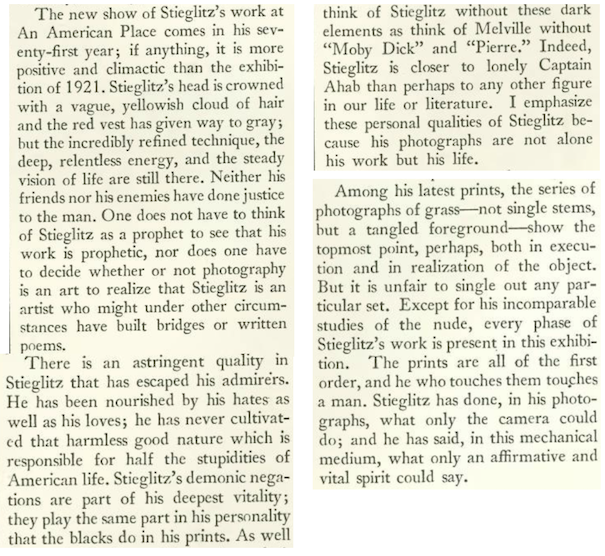
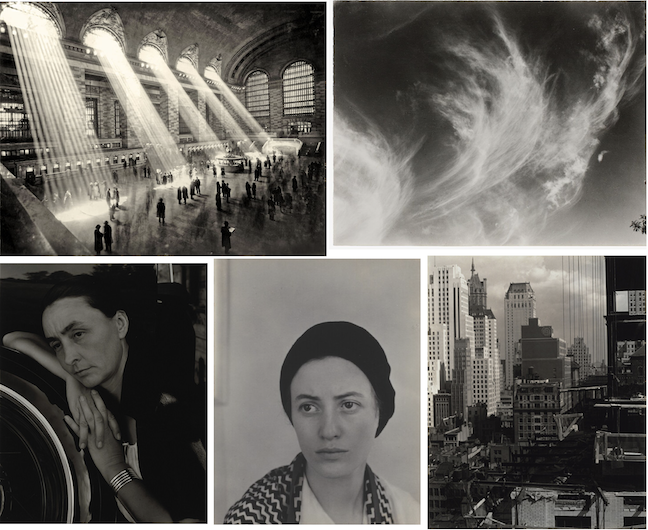
Art and architecture critic Lewis Mumford offered praise for Alfred Stieglitz’s latest exhibition at the photographer’s gallery, An American Place. Mumford noted Stieglitz’s “astringent quality” that rose above the philistine tastes and “stupidities” of American life.

LIFE AND WORK INTERTWINED…Clockwise, from top left: Alfred Stieglitz’s famed 1930 image of Grand Central Terminal; one of the photographer’s many images of clouds under the title Equivalent, 1930; image taken from Stieglitz’s studio/gallery window titled From My Window at An American Place, North, 1931; Dorothy Norman, circa 1931; Georgia O’Keeffe, 1933. Stieglitz, who was married to Georgia O’Keeffe, became Dorothy Norman’s mentor and lover in the late 1920s. (National Gallery of Art/Art Institute of Chicago)

 * * *

From Our Advertisers

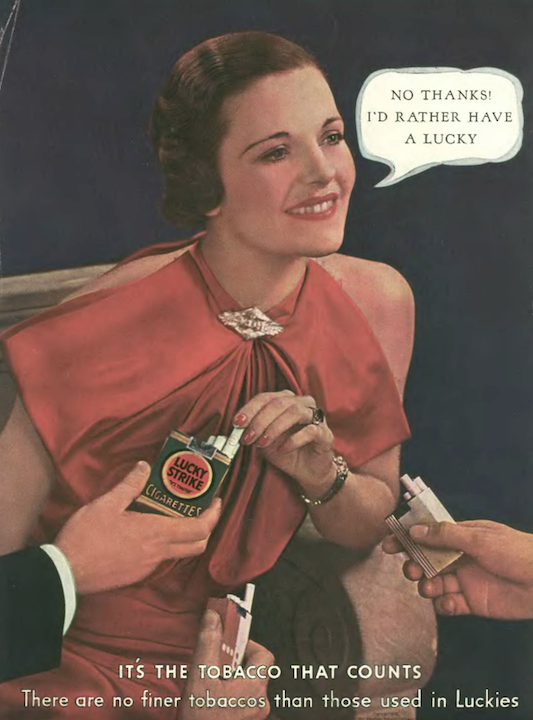
The back cover of The New Yorker was coveted by tobacco companies, the makers of Camels and Lucky Strikes (seen here) both featuring sumptuous photos of stylish women using their product, women being a key growth market for the companies…

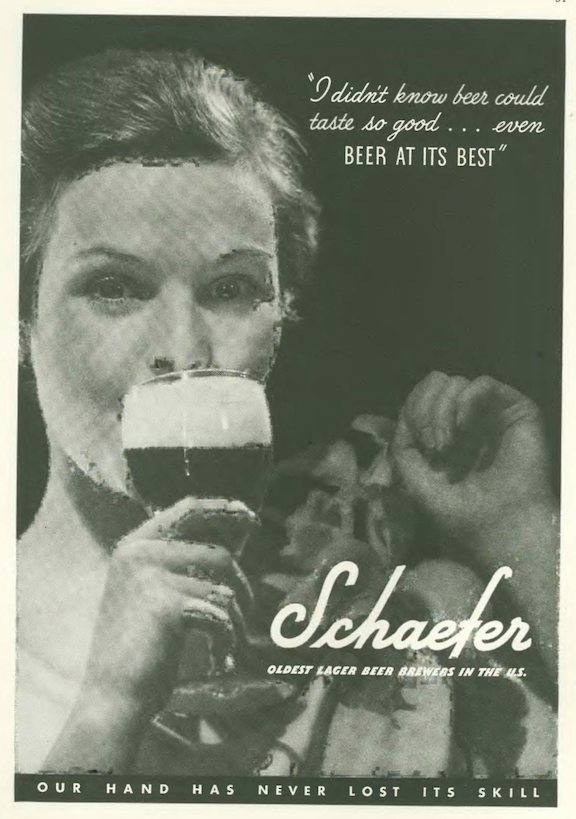
…same for the brewers, who also sought out female consumers to bolster sales of their brands…

…Ponds continued to roll out the seeming legions of socialites and lower-tier royalty to sell their jars of cold cream…

…the magazine’s ads were often directed at middlebrow class anxieties, as we see here…

…by constrast, this ad from Bonwit Teller (graced by fashion illustrator W. Mury) took us out of the stuffy parlor and onto the beckoning beaches of the Caribbean…

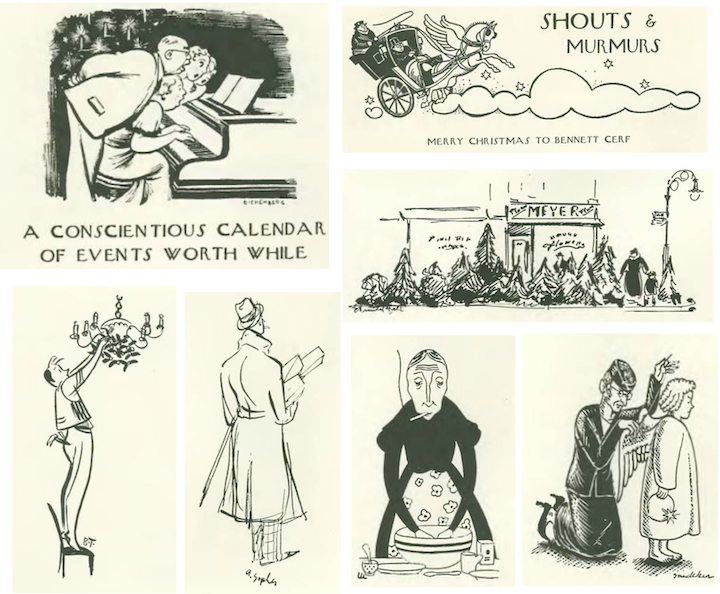
…we move on to our cartoonists…all of the spot illustrations in the issue were holiday-themed, and here are a few choice examples…
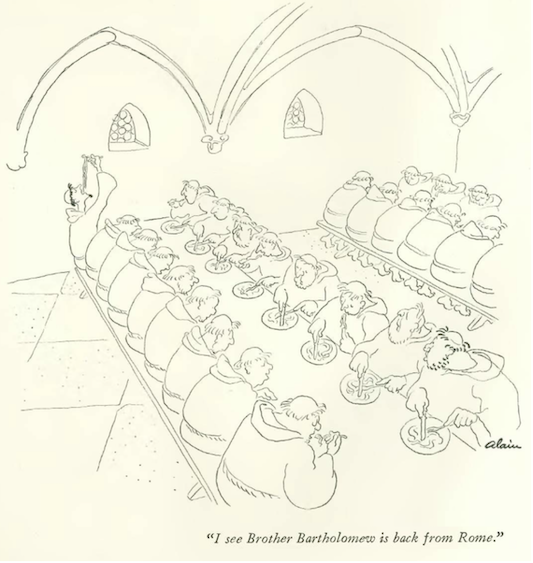
Daniel ‘Alain’ Brustlein introduced a bit of color to a monastery’s dining hall…

James Thurber continued to explore the dynamics between the sexes…
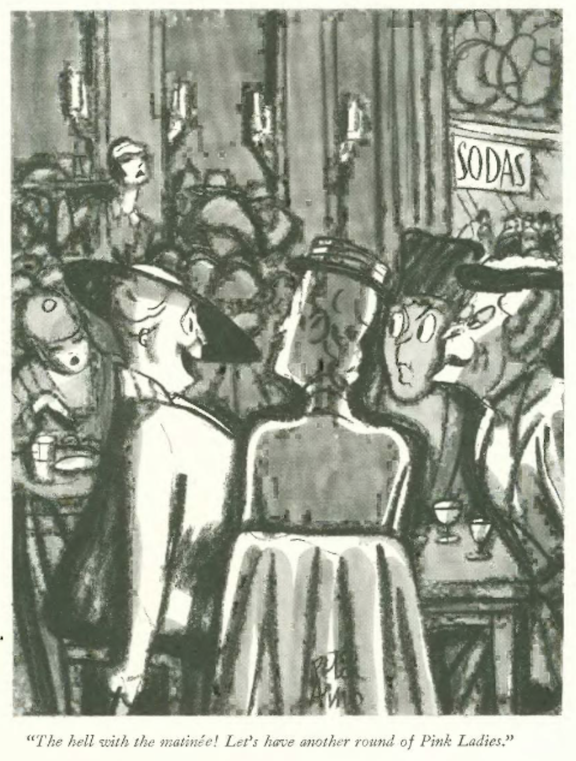
Barbara Shermund did a bit of dreaming with her modern women…

Carl Rose gave us Christmas cheer, with some reservations…

…and lastly, Perry Barlow with something for the holiday procrastinator…
Next Time: Farewell to 1934…


Al’s Menagerie

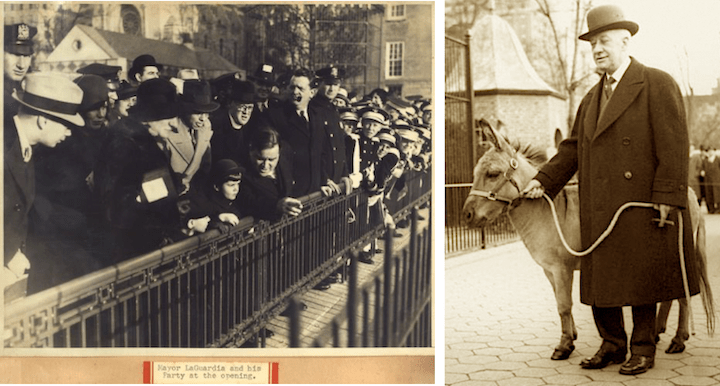
Above: The Dec. 2, 1934 opening of the reconstructed Central Park Menagerie drew such luminaries as Mayor Fiorello La Guardia, pictured at left with his family, and, at right, former New York Governor Al Smith, who was designated honorary zookeeper. Smith, who, lived across from the zoo at 820 Fifth Avenue, poses with two donkeys at the Menagerie in 1940. (New York Parks Archive)

The Central Park Zoo was not part of the original Olmstead-Vaux plan for the park, but beginning in 1859 it evolved spontaneously as a menagerie located near the Arsenal; its odd collection of animals included exotic pets donated as gifts, and other random creatures including a bear, a monkey, a peacock and some goldfish.

Dec. 1, 1934 cover by Leonard Dove.

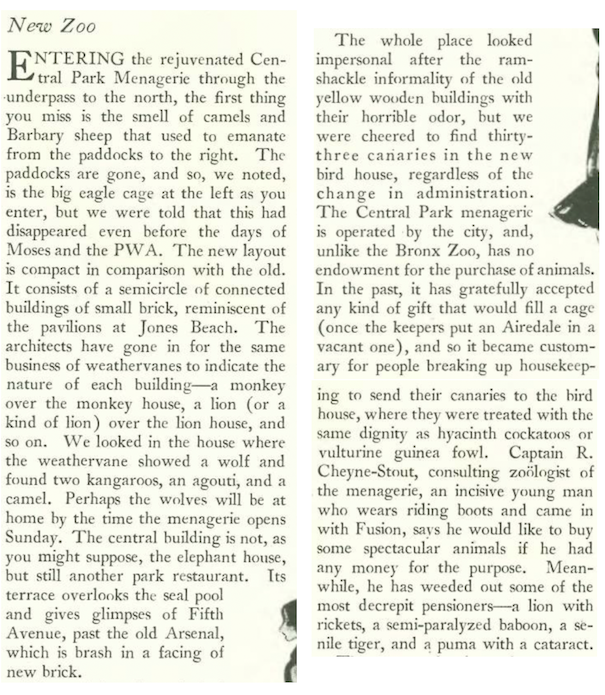
The menagerie accepted animals of all kinds, even sick ones, and by the 1920s the quality of the animals as well as the hodgepodge of buildings had degraded significantly (the lion house had to be guarded to prevent the animals from escaping their rotting quarters). In early 1934 Parks Commissioner Robert Moses addressed the adverse conditions in the menagerie, putting a redesign on a fast track and insisting that only healthy animals, in more humane settings, would be displayed.

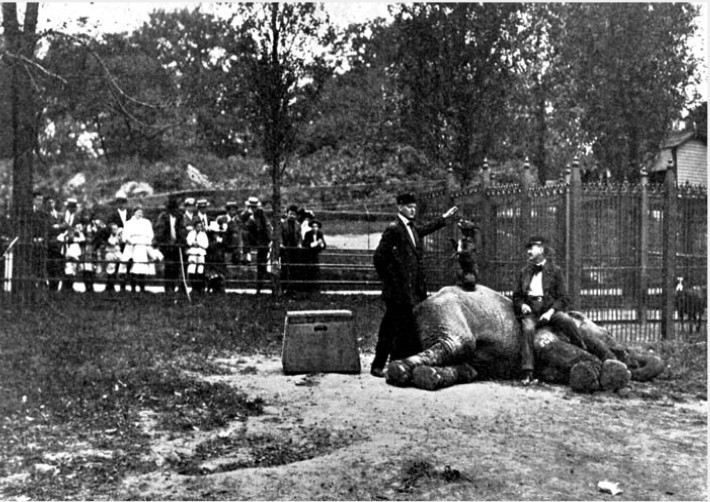
DUMBOS…According to a 1911 Department of Parks Annual Report, the menagerie at Central Park submitted animals to questionable treatment, as suggested by this photo of a trainer and a dog perched on top of an elephant. (nycgovparks.org)

Built of brick and limestone, the new zoo was designed in just sixteen days by an in-house team led by architect Aymar Embury II. Construction on the roughly six-acre zoo took just eight months, employing federally financed Works Progress Administration (WPA) labor.

MOSES PARTS THE RED TAPE…Robert Moses wasted no time after his appointment as parks commissioner (in January 1934) to get rolling on the menagerie makeover—it took just eight months to complete the new zoo. Clockwise, from top left, invitation to the opening celebration of the Central Park Menagerie—12,000 invited guests attended the opening, while another 25,000 lined Fifth Avenue hoping to be admitted; the popular sea lion pool was a central attraction on opening day (it is one of several elements from the 1934 zoo that still exists); conditions had improved for elephants and other animals, but they were still far from ideal; aerial view of the zoo as it neared completion on Oct. 9, 1934. (nycma.lunaimaging.com/digitalcollections.nypl.org)

Much ado was made of Al Smith’s appointment as “Honorary Night Superintendent”—in these clips from the Dec. 3 New York Times, Smith gave a brief “lecture” about the zoo’s bison, to which he offered a slice of bread…

(Excerpts from The New York Times via the TimesMachine)

 * * *

From Our Advertisers

R.J. Reynolds continued to roll out its list of distinguished women who preferred their Camel cigarettes: “Mrs. Allston Boyer” nee Charlotte Young was a model with the John Robert Powers agency who was married to resorts planner Allston Boyer from 1934 to 1939. Young (1914–2012) would later marry New York Times Moscow correspondent Harrison Salisbury, and the two would embark on lengthy journeys throughout Asia, including a grueling 7,000-mile journey retracing the route of The Long March that Charlotte recounted in one of her seven travel books. Whether she continued her Camel habit is unknown, but she did live 98 years…

…a house ad from The New Yorker celebrated the holiday season with special Christmas rates (and Julian de Miskey embellishments)…

Rea Irvin continued to have fun with the federal government’s new food and drug labeling standards…

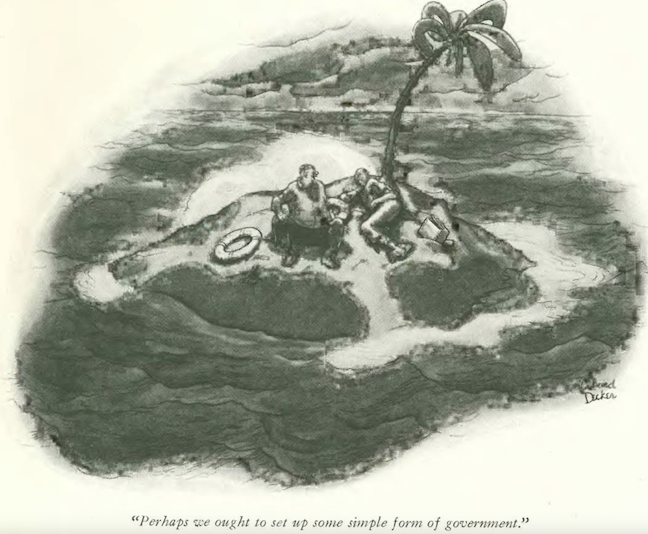
…while Richard Decker had these two castaways contemplating a simpler form of government…

…and James Thurber continued to stir up trouble among the sexes…

…on to Dec. 8, 1934…

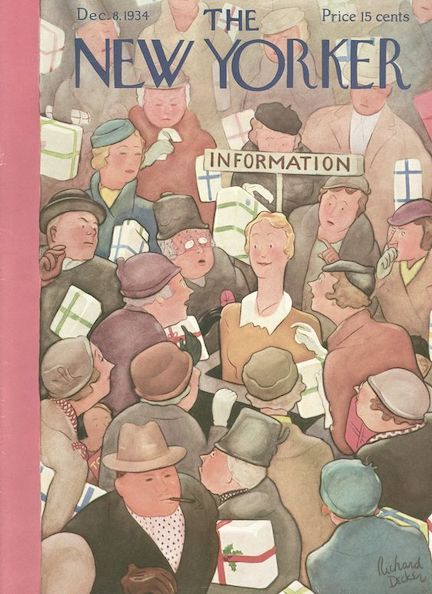
Dec. 8, 1934 cover by Richard Decker.

…which featured (on page 135) a handwritten letter from Kewpie Doll inventor Rose O’Neill, who commented on her recent New Yorker profile…

…here is an excerpt from the Nov. 24 profile referenced by O’Neill:

…and on to our advertisements from the Dec. 8 issue, including another Julian de Miskey-illustrated house ad…

…the clever folks at Heinz enlisted the talents of Carl Rose for a play on his famous Dec. 8, 1928 New Yorker cartoon…

…a closer look at the illustration (note the mother’s softer, more conservative appearance, five years removed from her flapper days; the child hasn’t changed a bit, except now we can see her face)…

…and the 1928 original, with caption by E.B. White

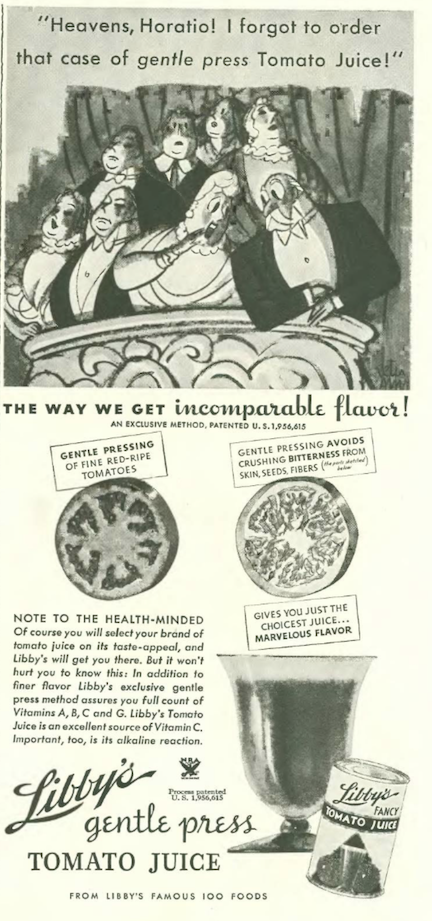
Peter Arno also popped up in the advertising section on behalf of Libby’s…
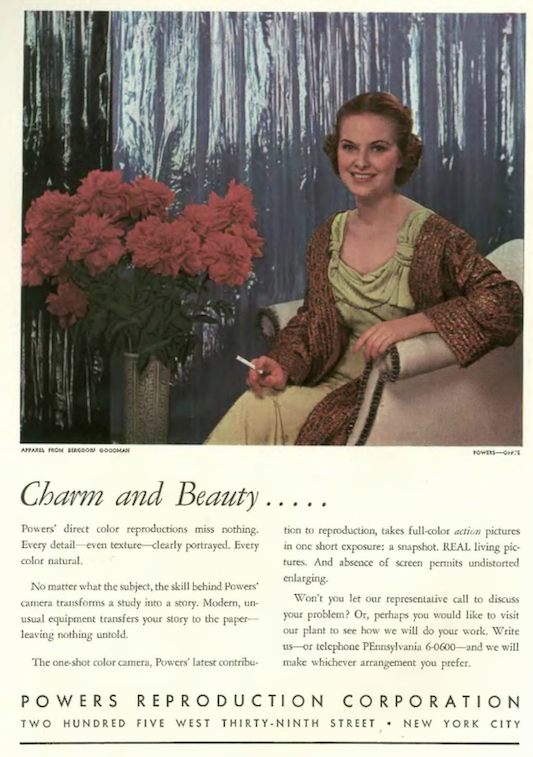
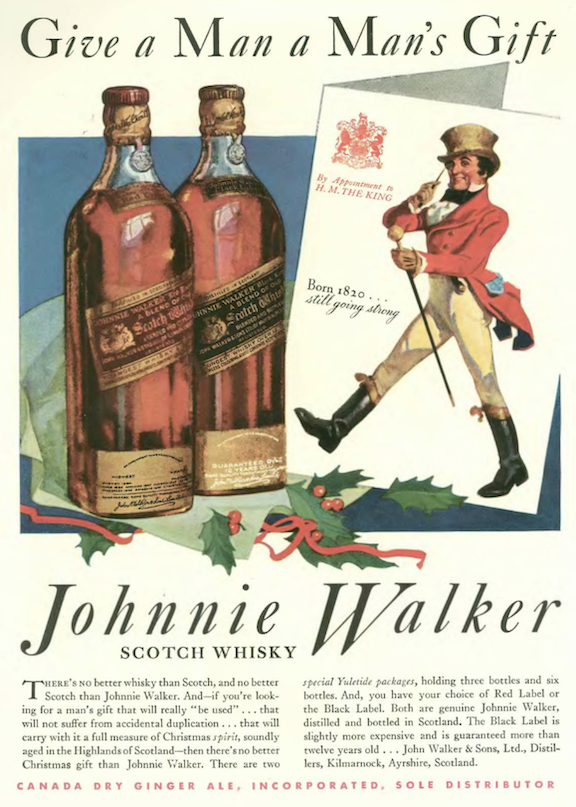
…the magazine grew thicker with many Christmas-themed ads, including this one from Johnnie Walker…
…Marlboro continued to take out these modest, back-page ads aimed at tobacco’s growth market—women smokers…

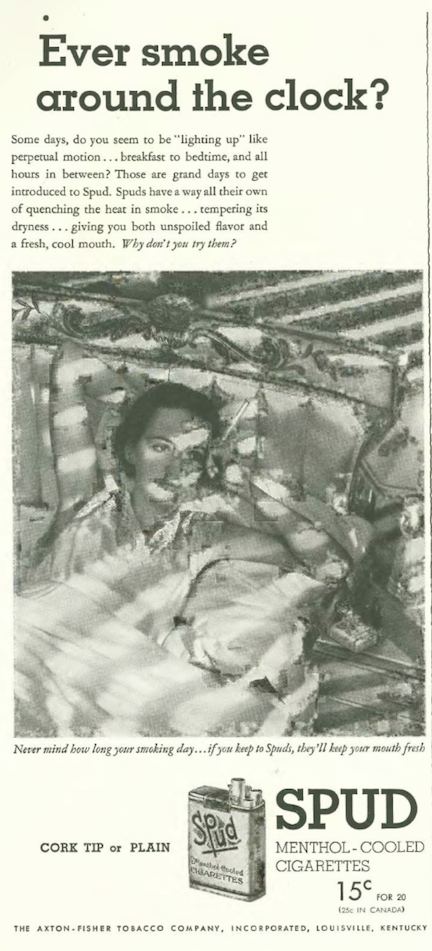
…the makers of Spud menthol cigarettes continued their campaign to encourage chain-smoking with this rather depressing image…

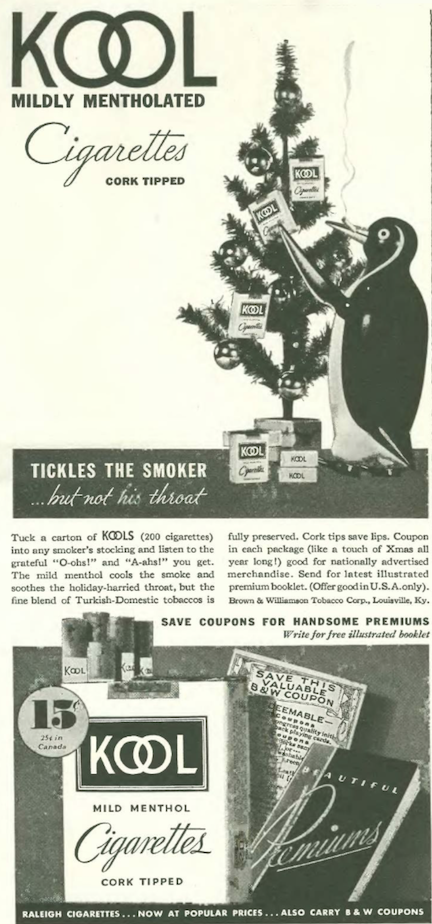
…while Spud’s new competitor in menthol cigs, KOOL, kept things simple with their smoking penguin mascot and valuable coupons for keen merchandise…

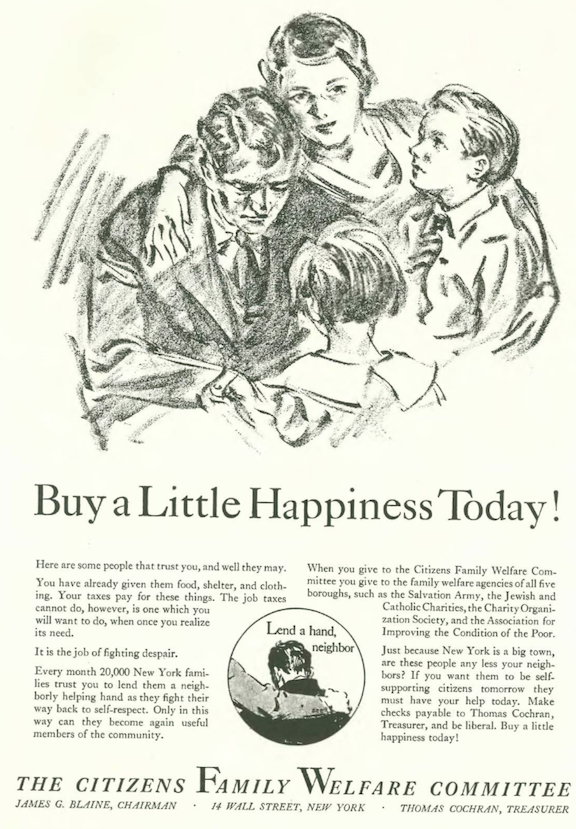
…the Citizens Family Welfare Committee offered this reminder that the Depression was still very much a challenge for 20,000 New York families…

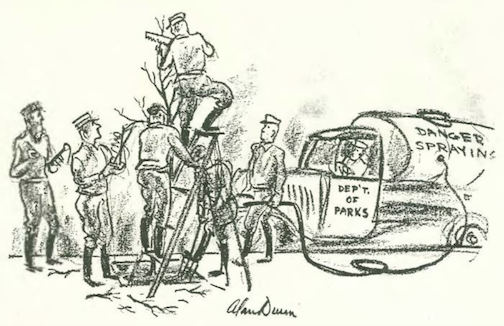
…on to our cartoonists, beginning with Alan Dunn’s rather dim view of Robert Moses’s generously funded parks department…

George Price gave us the latest update on his floating man, who had been up in the air since the Sept. 22 issue…

Daniel ‘Alain’ Brustlein marked the season with dueling Santas from Macy’s and Gimbel’s…

…and we end with James Thurber, and some reverse psychology…

Next Time: An Industrial Classicist…

Bojangles

Above: Bill "Bojangles" Robinson demonstrating his famous stair dance, which involved a different rhythm and pitch for each step. At left, Robinson in Broadway's Blackbirds of 1928; at right, publicity photo circa 1920s. (Vandamm collection, New York Public Library/bet.com)

Bill “Bojangles” Robinson (1878–1949) is considered one of the greatest tap dancers of all time, introducing a style of remarkable lightness and complexity that was perhaps best represented by his famous stair dance.

Oct. 6, 1934 cover by Charles Alston. This was Alston’s only New Yorker cover. Active in the Harlem Renaissance, Alston was also a painter, sculptor and muralist (see more on Alston at the conclusion of this post).

St. Clair McElway wrote about the 57-year-old Robinson in a two-part profile that examined his personal life and habits, including his propensity for getting shot. Two brief excerpts:

The New Yorker profile coincided with Robinson’s rising career in films, including four he made with Shirley Temple. For the 1935 film The Little Colonel, Robinson taught the stair dance to the child star, modifying his routine to mimic her movements. Robinson and Temple became the first interracial dance partners in Hollywood history (however, the step dance scene was cut from the film shown to Southern audiences). Temple and Robinson, who became lifelong friends, also appeared together in 1935’s The Littlest Rebel, 1938’s Rebecca of Sunnybrook Farm and 1938’s Just Around the Corner. 

DANCING WITH THE STAIRS…Bill Robinson was also known as Bojangles, a nickname from his childhood in Richmond, Virginia. Clockwise, from top left, with his second wife Fannie Clay in 1933; performing the stair dance with Shirley Temple in The Little Colonel (1935); profile illustration by Peggy Bacon; Robinson with Temple in 1938’s Rebecca of Sunnybrook Farm. (blackpast.org/Wikipedia)

Robinson is remembered for his generous support of fellow dancers including Fred Astaire, Eleanor Powell, Lena Horne, Sammy Davis Jr and Ann Miller, as well as his support for the career of 1936 Olympics star Jesse Owens.

FAST IN BOTH DIRECTIONS…Robinson befriended Jesse Owens (left) after the track & field great returned from the 1936 Olympics (where Owens won four golds). Known for his generosity to his friends, Robinson helped Owens establish a successful post-Olympics career. Robinson himself was also something of a runner, having set the world record for running backward in 1922 (100 yards in 13.5 seconds). (Public domain image)

Although Robinson was the highest paid black performer of his time, his generosity with friends as well as his gambling habits left him penniless at his death from heart failure in 1949. Longtime friend Ed Sullivan paid for Robinson’s funeral, and more than 30,000 filed past his casket to pay their respects.

I’VE STILL GOT IT…Bill Robinson with Lena Horne in 1943’s Stormy Weather, a film loosely based on Robinson’s own life. (MoMA)

 * * *

In a Romantic Mood

That is how St. Clair McKelway found Hollywood in two of its latest offerings, The Barretts of Wimple Street and Caravan. To his relief, he found the Hollywood version of Barretts quite “sensible”…

LET’S BE SENSIBLE…The Barretts of Wimpole Street (1934) starred Fredric March and Norma Shearer in the lead roles. (TCM)

…as for Caravan, McKelway wrote that he’d “never seen a picture with so much grinning in it.” He found the “peculiar, unreal gleam” of the actors’ teeth a real distraction in closeup shots.

THAT PEPSODENT SMILE…Charles Boyer and Loretta Young showed off their pearly whites in 1934’s Caravan. (IMDB/TCM)

 * * *

From Our Advertisers

The Oct. 6 issue opened with a study in contrasts: an image of two Civil War veterans swapping stories over whiskey on the inside front cover, paired with an illustration of a lithe model sheathed in the latest fashion from Bergdorf…

…the folks at Campbell’s continued to suggest that their canned soup was a delight of the elite…

…Heinz took a similar tack, showing the smart set having fun with their sandwich spreads…

…Lord & Taylor touted its “tomorrow look” in furniture…

…R.J. Reynolds continued its series of “distinguished women who preferred Camel’s “costlier tobaccos,” adding to their growing list a the “charming debutante” Evelyn Cameron Watts, who later became Evelyn Watts Fiske (1915–1976)…

…in contrast to Camel’s fashionable ads, the upstart menthol brand Kool offered a series of cheap, back-page ads featuring a smoking penguin, here in the Halloween spirit (detail)…

…another recurring back page ad was this weird spot from Satinmesh, a product that apparently helped close a woman’s “gaping pores”…those pores apparently prompted one man to ponder the eternal why

…on to our cartoonists, we begin with a two-page spot by Carl Rose

James Thurber spiced up a game of ping-pong…

Mary Petty explored the miracle of birth…

Peter Arno discovered you’re never too old to play with toys…

Garrett Price offered a young man’s perspective on a father’s avocation…

Alain (Daniel Brustlein) gave us a disappointed plutocrat on vacation in Mexico…

George Price continued to mine the humor of his “floating man” series…

…and contributed a second cartoon that featured some office hijinks…

…and Otto Soglow returned without The Little King, offering in its stead the closest thing to royalty in America…

Before we sign off, a note on the Oct. 6 cover artist, Charles Henry Alston (1907–1977). A Harlem-based painter, sculptor, illustrator, muralist and teacher, Alston was active in the Harlem Renaissance and was the first Black supervisor for the Works Progress Administration’s Federal Art Project. In 1990, Alston’s bust of Martin Luther King Jr. became the first image of an African American displayed at the White House.

Clockwise, from top left, Charles Henry Alston’s 1970 bust of Martin Luther King Jr; Walking 1958; Andrew Herman photo of Alston, 1939; Midnight Vigil, 1936. (Smithsonian/Wikipedia/Columbia.edu)

For more on Charles Alston, read “The Painter Who Wouldn’t Be Pigeonholed” in Columbia College Today.

Next Time: The Age of Giants…

His Five Cent’s Worth

Above: Final Design of Grand Central Terminal, ca. 1910. (New York Transit Museum)

The heat wave of 1934 spread misery from the Midwest to the East Coast. The temperature in New York City hit 101 degrees F (38.3 C) on June 29, and July recorded at least ten days of temps in the mid- to upper 90s. It must have been miserable in the days before air-conditioning, and since no adult would dare be seen in public wearing shorts and a t-shirt, an outing on a crowded tour boat, as illustrated below by William Cotton, must have been hellish.

July 21, 1934 cover by William Cotton.

…putting a fine point on it, recall this wryly captioned cartoon from the June 30 issue by Garrett Price

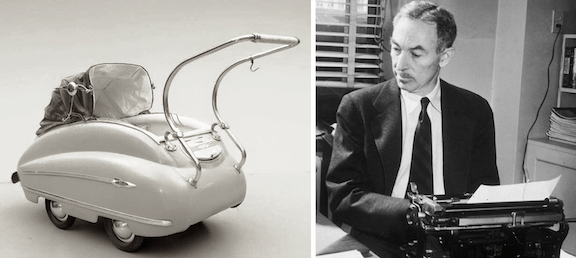
…but let us move ahead to the July 28 issue, where E.B. White was hopefully keeping his cool in the men’s waiting room at Grand Central Station, where he plunked down a nickel to cool his heels in the “middle class” section, where he observed side attractions including a vending machine that dispensed handkerchiefs and a coin-operated peep show featuring burlesque star Sally Rand.

NO MASHERS ALLOWED…Separate men’s and ladies’ rooms were available in three classes at Grand Central Station—free, five cents and ten cents. Top, the Ladies’ room, Grand Central Terminal (Central Lines), and below, a men’s room at the station. A nickel back then was worth about a dollar today. (Library of Congress)
NICKEL AND DIMED…Machines similar to these could be found in some men’s waiting rooms at train stations in the 1930s. (pinballhistory.com/comics.ha.com)

…White referred to a peep show that featured famed fan dancer Sally Rand

DOING HER DEEP KNEE BENDS…Sally Rand in the 1930s. (www.vintag.es)

White also commented on the growing number of travelers, still pinched by the Depression, opting for the free section:

We settle in with the June 21 issue (which leads this post) with White once again, this time enjoying a drive to Stamford, Conn., where he admired the “splendor” of the Condé Nast printing plant (apparently the plant also printed The New Yorker, although the magazine itself would not be acquired by Condé Nast’s parent company, Advance Publications, until 1985).

ONLY A MEMORY…Postcard image of the Condé Nast printing plant; at left, a relic of the long-gone plant, one of two pillars that flanked the road to the plant. (Greenwich Historical Society/greenwichtime.com)

 * * *

Disney’s Other Mouse

Film critic John Mosher was a fan of Disney’s “Silly Symphony” cartoon shorts, which were produced between 1929 and 1939. Animation, and especially color animation, was in its infancy, so these doubtless had an uplifting effect on many moviegoers.

DON’T CALL ME TINKERBELL…The Butterfly Fairy brought some Disney magic to 1934’s The Flying Mouse. (disney.fandom.com)

 * * *

The Great McGonigle

W.C. Fields appeared in more than a dozen silent films before making his first talkie, 1930’s The Golf Specialist, and it was in sound films that Fields was able to truly express his vaudevillian wit. It was also in the sound era that Fields teamed up with Baby LeRoy for three films (in 1933 and 1934), including The Old Fashioned Way, in which Fields portrayed “The Great McGonigle,” leader of a traveling (and perpetually underfunded) theater troupe who was always a step ahead of police and creditors. Critic John Mosher found the film’s riff on an old morality play, The Drunkard, to be a bit dated, but overall thought it a cheerful diversion.

HONK…Baby LeRoy, aka Ronald Le Roy Overacker (1932–2001), was just 16 months old when he became the youngest person ever put under term contract by a major studio. He is best known for his appearances in three W. C. Fields films: Tillie and Gus (1933), The Old Fashioned Way (1934) and It’s a Gift (1934). (Rotten Tomatoes/IMDB)

 * * *

From Our Advertisers

We begin with scientific proof (from a “famous research laboratory in New York”) that Camel cigarettes increased one’s flow of energy…

…if that crackpot claim doesn’t get you, here’s one that recommended downing a PBR before a big meeting, a sure remedy for that “listless, tired-out feeling”…

…of course we all know that a few sugary Cokes will get you going…back then they were taking it in six- and ten-ounce bottles, not 30- to 50-ounce Big Gulps…

…it’s not every day you see a dog food ad in The New Yorker…in the 1930s there was no secret to where ol’ Sparky ended up…

…popular were these Rockwellian ads that equated various products with happy and wholesome (and safe) living, in this case a massive “Dual-Balloon” tire that dominated this tableau featuring a stylish mommy and her little boy slumming with an old sea salt…

…the folks at Essex House hired an illustrator who did his or her best to channel Helen Hokinson and William Steig for this New Yorker ad…as we have seen before, Essex House ads walked a fine line between thrift and snob appeal…

…on to our cartoons, beginning with Ned Hilton, whose work appeared in The New Yorker from 1934 to 1957…

Mary Petty recorded some sweet nothings by the seaside…

George Price drifted along with two men and tuba…

Carl Rose revealed a modest side to life at a nudist colony…

…we know Clarence Day for his Life With Father series, but on occasion he also contributed illustrated poems such as this one from the July 21 issue…

…on to July 28…

July 28, 1934 cover by Adolph K. Kronengold.

…where we encounter more “scientific research” that encouraged folks to smoke…This ad was placed on the very last page of the July 28 issue by the Cigarette Research Institute, based in Louisville, Kentucky…

…the booklet was filled with “amazing facts” uncovered in a “scientific investigation,” facts did not address the health effects of smoking, but rather such important topics as how to hold a cigarette the right way and how to reduce staining on your teeth…it also helpfully debunked the notion that nicotine was a “dread demon”…

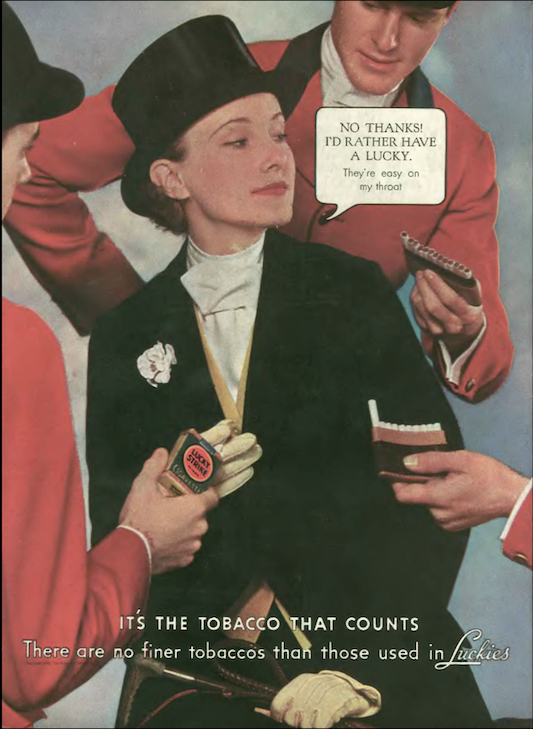
…take for example this woman smoking a Lucky…now she knew how to hold a cigarette!…

…the folks at Essex House were back, aggressively playing the class/caste card…apparently if you lived there you were entitled to kick your old friends to the curb…

…the antacid and pain reliever Bromo-Seltzer was ubiquitous in 1930s medicine cabinets, but after the recipe was changed in the 1970s (all Bromides were withdrawn from the U.S. market in 1975) the brand slowly fizzled away…

Mildred Oppenheim Melisse was a popular illustrator of ads for department stores and various household goods, including Cannon towels, here guaranteed to absorb even this man’s sweaty “flood”…

Dr. Seuss back again for Flit, once again having no issues mixing insecticide with food preparation…

Rea Irvin kicks off the cartoons with his Double Breasted Dowager…

Helen Hokinson found some misplaced pity at a garden party…

Garrett Price offered some unsolicited advice…

Reginald Marsh filled two pages with a scene from Central Park…

Robert Day looked for a unique experience at an auto camp…

…and we close with Barbara Shermund, and some alarming news on the domestic front…

Next Time: Men of Mystery…

A Tadpole on Wheels

Above: British architect Norman Foster's 2010 recreation of R. Buckminster Fuller's 1933 Dymaxion car. (Wikipedia)

Despite the limitations of 1930s technology, a few architects and designers were hell-bent on building a streamlined future that until then was mostly the stuff of movies and science fiction magazines.

May 5, 1934 cover by Rea Irvin.

One of them was R. Buckminster Fuller (1895–1983), architect, designer, and futurist probably best known today as the inventor of the geodesic dome (think Disney’s Epcot Center). In the 1930s Fuller was all about a concept he called Dymaxion. Derived from the words dynamic, maximum, and tension, when applied to architecture and design it would supposedly deliver maximum gain from minimal energy input. The writer of the New Yorker article (pseud. “Speed”) was fascinated by the Dymaxion’s motorboat-type steering, no coincidence since Fuller intended to adapt his futuristic car for use on and under the water, as well as in the air.

THE SHAPE OF THINGS TO COME…Clockwise, from top left: Workers at a Bridgeport, Conn., plant creating the first of three Dymaxion cars; the Dymaxion at Chicago’s 1933 Century of Progress exposition—the car was involved in a fatal accident at the fair; interior view of the Dymaxion; using the same engine and transmission as a Ford sedan (pictured), the Dymaxion offered three times the interior volume with half the fuel consumption and a 50 percent increase in top speed. (Buckminster Fuller Institute/Poet Architecture)
THINKING WITHOUT THE BOX…In 1927 R. Buckminster Fuller (pictured) developed a Dymaxion House, a “Dwelling Machine” that would be the last word in self-sufficiency. Although the aluminum house was intended to be mass-produced, flat-packaged and shipped throughout the world, the design never made it to market (however its ideas influenced other architects); at right, a Fuller geodesic dome at Disney’s Epcot Center in Florida. (archdaily.com/Wikipedia)

The 1933 Century of Progress exposition in Chicago was supposed to be a major showcase for Fuller, but when professional driver Francis Turner was killed while demonstrating the first prototype of the Dymaxion, the car’s prospects dimmed considerably. According to an article by Stephanie d’Arc Taylor (cnn.com Oct. 30, 2019), during the demonstration a local politician tried to drive his own car close to the Dymaxion—to get a better look—and ended up crashing into the unwieldy prototype, which rolled over, killing the driver and injuring its passengers. “The politician’s car was removed from the fracas before police arrived, so the Dymaxion was blamed for the accident,” writes Taylor, who notes that the rear wheel–powered car, though unconventional, was not necessarily the problem. However, “the thing that made the Fuller death-mobile singularly deadly was the fact it was also steered by the rear wheel, making it hard to control and prone to all kinds of terrifying issues.”

That history did not stop architect Norman Foster from building a replica of the Dymaxion in 2010. Foster worked with Fuller from 1971 to 1983, and considers Fuller a design hero.

GIVING IT ANOTHER GO…Architect Norman Foster with his 2010 recreation of the Dymaxion. To build a new Dymaxion, Foster sent a restorer to the National Automobile Museum in Reno, Nevada (home of the only surviving Dymaxion, Car No. 2), and after thousands of photos and measurements Foster had the car recreated using only materials available in 1933: Foster’s Dymaxion consists of an ash frame sheathed in hand-beaten aluminum, mounted on the chassis of an old 1934 Ford Tudor Sedan. (CNN/The Guardian)

According to Taylor, Foster cleaved so closely to Fuller’s original designs that he refers to his creation as a fourth genuine Dymaxion—not a replica. “The car is such a beautiful object that I very much wanted to own it, to be able to touch as well as contemplate the reality for its delight in the same spirit as a sculpture,” said Foster. “Everything in (the car) was either made in 1934, or recreated using techniques and materials that Bucky would have had access to in that period.”

 * * *

Meanwhile, At The Tracks…

If Fuller’s attempt at the streamlined future was a bit of bust, the Burlington railroad was making a splash with its gleaming new Zephyr. E.B. White reported:

ZOOM ZOOM…The Burlington Zephyr set a speed record for travel between Denver and Chicago when it made a 1,015.4-mile (1,633 km) non-stop “Dawn-to-Dusk” dash in 13 hours 5 minutes at an average speed of almost 78 mph (124 km/h). In one section of the run it reached a speed of 112.5 mph. Following a promotional tour that included New York, it was placed in regular service between Kansas City, Missouri, and Omaha and Lincoln, Nebraska, on November 11, 1934. Other routes would be added later in the Midwest and West. (BNSF)

…we continue with E.B. White, here with some observations regarding Mother’s Day and bank robber/murderer John Dillinger, who had escaped from prison in March 1934 and was on the FBI’s Most Wanted List…

I REMEMBER MAMA…John Dillinger posed with Lake County prosecutor Robert Estill, left, in the jail at Crown Point, Ind. while he awaited his trial for murder in January 1934. Dillinger would escape from the jail in March and would be on the lam until July, when FBI agents would gun him down outside a Chicago movie theatre. (NY Daily News)

…and a last word from White, about an important change at Radio City:

 * * *

Voice In The Wilderness

A combination of newsreel footage, documentary, and reenactment, Cornelius Vanderbilt Jr’s Hitler’s Reign of Terror played to capacity crowds for two weeks in New York City, despite the refusal of the state’s censor to license the film. Disinherited by his parents when he became a newspaper publisher, Vanderbilt was a determined journalist, covertly filming scenes in Nazi Germany and even briefly encountering Adolf Hitler outside the Reichstag, where Vanderbilt yelled to Der Führer, “And what about the Jews, Your Excellency?” (Hitler ignored the question and referred Vanderbilt to one of his lackeys). Unfortunately, Vanderbilt wasn’t much of a filmmaker, and although he warned Americans about the emerging threat in Germany, few took the film, or his warning, seriously, including John Mosher:

UNHEEDED…Audiences flocked to see Cornelius Vanderbilt Jr’s Hitler’s Reign of Terror, but critics dismissed the rather amateurish film—Film Daily scoffed at the film’s prediction that Hitler’s Germany was a future threat to world peace; at right, in the film Vanderbilt confronted “Hitler” in a recreation. (TMDB/Library of Congress)

 * * *

From Our Advertisers

It wouldn’t seat eleven people like a Dymaxion, but a Body by Fisher (coach builder to General Motors) certainly impressed this young woman…but better check with the hubby just in case…

…in this next ad, we find what looks like the same woman, perhaps celebrating her decision with a nice smoke…

…this spot seems out of place in the New Yorker, like it snuck over from Better Homes & Gardens...

…on to our cartoons…with James Thurber’s war of the sexes over, life returned to normal…

…and both sides shared in the gloom of a rainy afternoon…

…by contrast, Perry Barlow brightened things up with this life of the party…

…but a good time doesn’t always translate over the airwaves, per George Price

Alain illustrated the consequences of losing one’s nest egg…

Peter Arno didn’t leave any room for dessert…

…and Charles Addams returned, a macabre cast of characters still percolating in his brain…

…on to May 12, 1934…

May 12, 1934 cover by Leonard Dove.

…and back to the movies, this time critic John Mosher found more cheery fare in 20th Century, a pre-Code screwball comedy directed by Howard Hawks and starring John Barrymore and Carole Lombard. Battling alcohol abuse since age 14, Barrymore nevertheless managed to display his rare genius as a comedian and turned in what is considered to be his last great film performance.

GETTING HER KICKS…Top, Carole Lombard delivers a swift one to John Barrymore in the screwball comedy 20th Century. Below, director Howard Hawks with the cast. (greenbriarpictureshows.blogspot.com)

 * * *

Playing the Ponies

Horse racing correspondent George F. T. Ryall (pseud. “Audax Minor”) considered a losing wager at the Kentucky Derby in his column, “The Race Track.”

A HORSE OF COURSE…Jockey Mack Garner rode Cavalcade to victory at the 1934 Kentucky Derby. (Appanoose County Historical Society)

 * * *

More From Our Advertisers

We begin with Camel cigarette endorsers Alice and Mary Byrd, residents of Virginia’s famous Brandon plantation and cousins of Virginia Senator and Governor Harry F. Byrd, known for his fights against the New Deal and his “massive resistance” to federally mandated school desegregation...

…also to the manor born, Whitney Bourne, a New York deb who would go on to a brief stage and film career that would end when she married her first husband (diplomat Stanton Griffis) in 1939…

AN EYE FOR STYLE…Whitney Bourne in a scene with Solly Ward in 1937’s Flight From Glory. Named in 1933 as one of America’s best dressed women, Bourne was a noted New York socialite, skier, golfer and tennis player as well as an occasional actress.

…we move along from the effervescent Whitney Bourne to the sparkling waters of Perrier…

Gardner Rea followed other New Yorker cartoonists by illustrating an ad for Heinz…

…which brings is to more cartoons, where according to Richard Decker, the move to streamlined trains wasn’t welcomed by everyone…

Carl Rose illustrated this two-page spread with an imagined right-wing response to the recent left-wing May Day parades…

William Steig eavesdropped onto a saucy little conversation…

Barbara Shermund continued her explorations into the trials of the modern woman…

James Thurber was back to his old tricks…

…and we conclude our cartoons with Eli Garson, and a new perspective…

Before I close, a bit of housekeeping. The first issues in 1925 sometimes ended “The Talk of the Town” with…

…but on May 23, 1925, “Talk” signed off with —The New Yorkers. That continued until the March 31, 1934 issue (below), the last time the New Yorker signed off “The Talk of the Town” with —The New Yorkers:

Next Time: Moses Parts a Yacht Club…


And Now We Are Nine

Above: It took a few issues for the editors to sort out regular features and their order of appearance. The opening section of Issue No. 1 featured the famous Rea Irvin masthead that would introduce “The Talk of Town” for many issues to come. In Issue No. 1, however, “Of All Things” appeared first under the masthead, followed by “The Talk of the Town." Let us hope the magazine restores the original Rea Irvin masthead for its 100th anniversary.

Despite the lingering Depression The New Yorker entered its ninth year on strong financial footing. With nearly equal numbers of subscribers and single copy sales, circulation would approach 125,000 in 1934, with more than $2.2 million in advertising income.

Feb. 17, 1934 cover by Rea Irvin (naturally).

In his “Notes and Comment,” E.B. White commented on the “more vigorous times” the magazine was enjoying, declaring “it is fine to be nine.”

THE NEW YORKER SEVEN…In 1924, baking product heir Raoul Fleischmann put up $25,000 to help Harold Ross get his new magazine off the ground. To assuage Fleischmann’s doubts regarding his investment, Ross persuaded some of his Algonquin Round Table cronies to appear on the magazine’s purely ceremonial masthead. The seven who appeared on the first masthead were, from top left, Ralph Barton, Marc Connelly, Rea Irvin, and George S. Kaufman; bottom row, from left, are Alice Duer Miller, Dorothy Parker, and Alexander Woollcott.

 * * *

Daffy Dilettante 

Another Algonquin Round Table crony, Harpo Marx, was a skilled artist when it came to comedy, pantomime, or the harp, but when he decided to take up a brush and palette he struggled to properly paint a female nude. In this account from “The Talk of the Town,” Harpo eventually abandoned his painting and switched places with the model.

BRUSHING UP ON HIS ART…Undated photo of Harpo Marx putting finishing touches on his painting of an accordion player; Harpo was a one of the Algonquin Round Table originals: a 1919 photo features (standing, left to right) Art Samuels and Harpo Marx; (sitting) Charles MacArthur, Dorothy Parker, and Alexander Woollcott. (Twitter/Wikipedia)

 * * *

Ode to Faraway Lands

A renowned author of children’s poetry, David McCord (1897-1997), was also a frequent contributor to The New Yorker for thirty years (1926-56). For the Feb. 17 issue he penned these sonnets to the Baedeker travel guide.

 * * *

Wimpy Vernacular

Architecture, art and cultural critic Lewis Mumford paused in his criticism of everything from liquor stores to cheap restaurants to offer some surprising praise to his city’s “black-and-white hamburger palaces.”

RED MEAT RIVALS White Tower and White Castle vied for customers in 1930s New York. Above, a 1933 photo of a White Tower in the 200 block of 2nd Avenue; below, a circa 1930 photo of a White Castle in the Bronx. (gothamist.com/Cision)

 * * *

From Our Advertisers

Advertising income reached an all-time high at The New Yorker in 1934, and it showed with the numerous color ads enticing travel to Bermuda…

…or to the French wine country…

…Hiram Walker presented their Canadian Club whisky on what appeared to be a cloth napkin…

…artist Hans Flato continued his unusual Ruppert’s Beer series of mannequin people (and dogs) going about their lives stuck to yellow discs…

…according to the Ruppert’s ad, for six bottle caps you could get a tin coaster like those pictured below…

(1stdibs.com)

…from magicians and salesmen to sportsmen and high society, the folks pushing Camel cigarettes seemed to try every angle to get their product into the mouths of as many consumers as possible…

…the makers of Spud menthol cigarettes, on the other hand, tried a little humor to get smokers hooked on their “mouth happiness”…

…as one of the world’s most popular car brands, Chevrolet has long been considered a car for the masses, although this ad campaign launched in 1934 suggested that the ubiquitous Chevy was just the car for a connoisseur of the finer things…

…the staid luxury auto maker Pierce Arrow broke with tradition by placing this very modern, minimalist ad…

…the folks at Steinway also adopted a modern look with this single column ad touting the durability of their grand pianos…

…The Viking Press took out this full-page ad to announce the publication of Alexander Woollcott’s While Rome Burns, a collection of some of Woollcott’s writings for The New Yorker and other magazines…

…according to the ad, for six bucks you could get one of 500 limited edition signed copies…as of this writing, the inscribed and signed edition below was available for $350…

(capitolhillbooks-dc.com)

…on to our cartoonists, Al Frueh offered up this interpretation of Ziegfeld entertainers Willie Howard and Fannie Brice

Helen Hokinson took the plunge with 1930s water aerobics…

Kemp Starrett demonstrated how beauty is in the eye of the beholder…

Reginald Marsh returned, taking temporary leave from life on the streets to look at life above the streets…

James Thurber’s “War Between Men And Women” took some new twists…

…and we end with Carl Rose, and one man’s solution to being stuck in the middle…

Next Time: Rocky’s Cover-up…