On Catfish Row

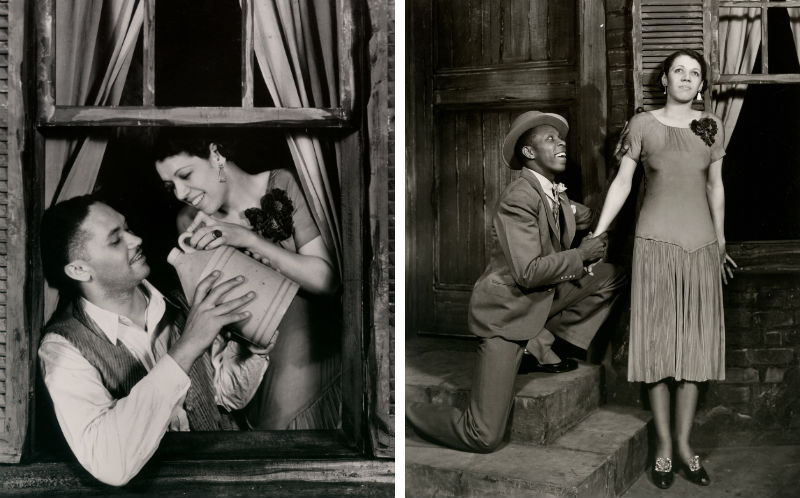
Above: Left image: Todd Duncan (Porgy) and Anne Brown (Bess), in the 1935 Broadway production of Porgy and Bess. Right image: John Bubbles (Sportin’ Life) and Brown. (Photos courtesy the Ira & Leonore Gershwin Trusts)

The 1935 Broadway production of Porgy and Bess is widely regarded as one of the most successful American operas of the twentieth century, but when it opened at the Alvin Theatre on Oct. 10, 1935, reviews were mixed, including the one penned by Wolcott Gibbs.

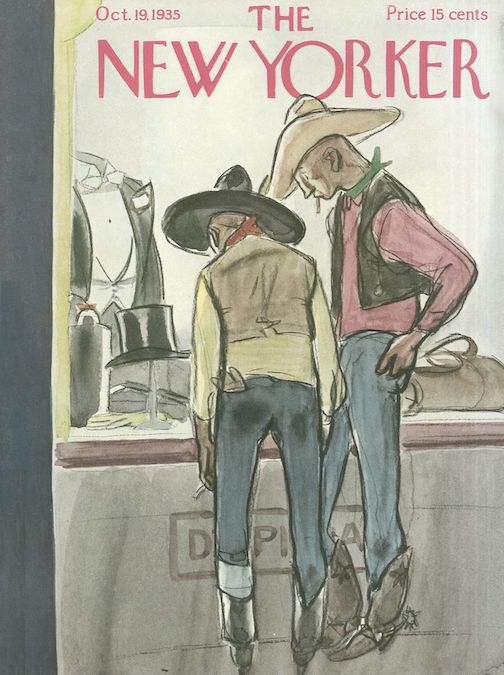
October 19, 1935 cover by William Crawford Galbraith. The New York Times (Oct. 9, 1935) made this observation about the rodeo at Madison Square Garden: “New York, which for several days has been vaguely aware of an impending rodeo because of a profusion of ten-gallon hats along Eighth Avenue and a sign in a beauty parlor, ‘Welcome, Cowgirls,’ will see the real thing this morning.”

Now you would think a work by composer George Gershwin, with a libretto written by DuBose Heyward (author of the 1925 novel Porgy) and lyricist Ira Gershwin, would be a sure hit. Some critics did praise the production, which ran for 124 performances, but others criticized themes and characterizations of Black Americans that were created by white artists.

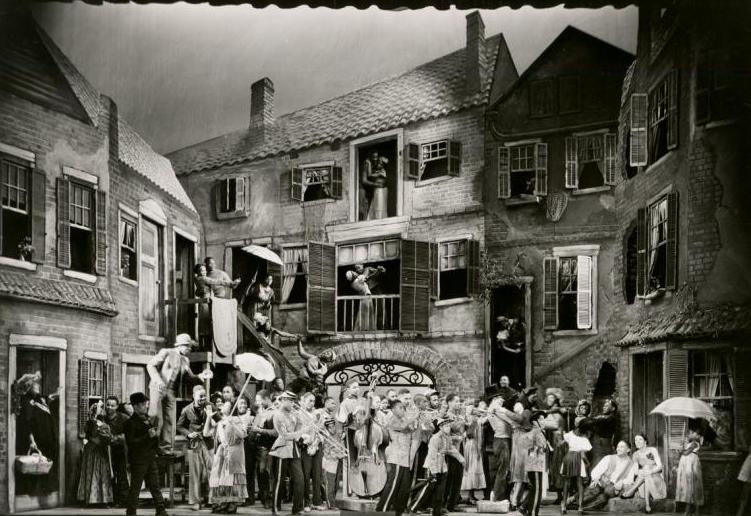
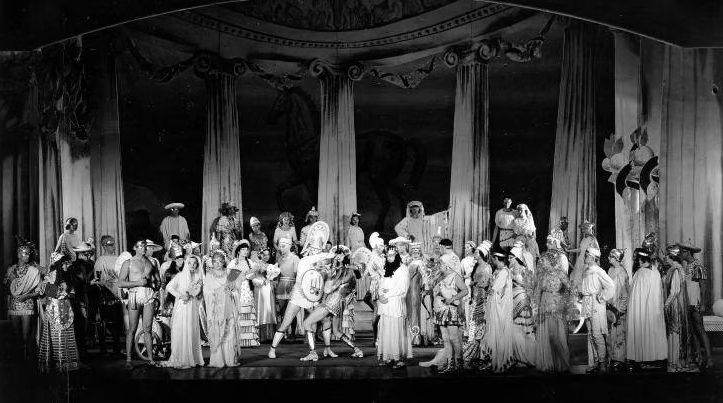
MIXED REVIEWS…The original Catfish Row set for Porgy and Bess as seen at Broadway’s Alvin Theatre (now the Neil Simon Theatre) in 1935. (Billy Rose Theatre Collection, New York Public Library Digital Gallery)

This wasn’t the first time Porgy was adapted to the stage. It was originally produced in 1927 by Heyward and his wife, Dorothy, at the Guild Theatre in New York. The Heywards insisted on an African-American cast—an unusual decision at the time—and enlisted newcomer Rouben Mamoulian to direct. The play ran a total of fifty-five weeks.

ORIGIN STORY: Porgy: A Play in Four Acts, was a 1927 play by Dorothy Heyward and DuBose Heyward, adapted from the short novel by DuBose. (Wikiwand)

Gibbs preferred the original Porgy to the Gershwin–Heyward production, admitting that he simply did not care for “the operatic form of singing a story.”

continued…

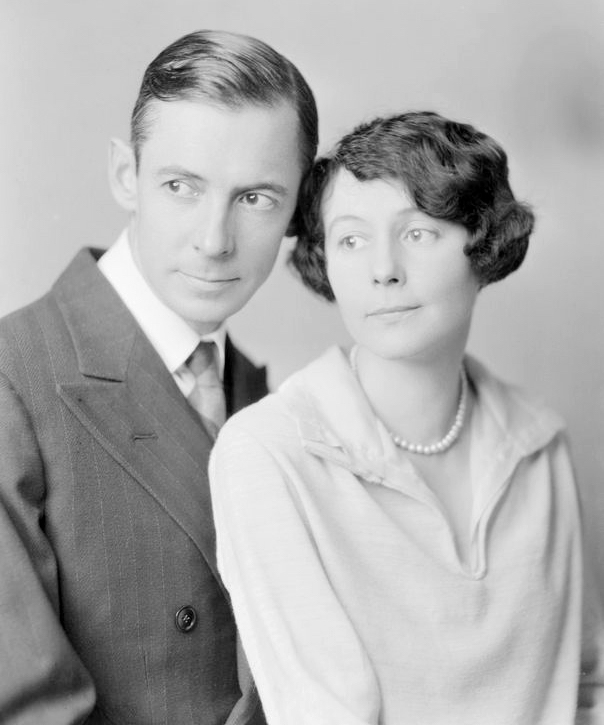
TAKING THEIR BOWS…George Gershwin greets an audience after a performance of Porgy and Bess. Behind Gershwin are his brother, Ira Gershwin (left), and librettist and Porgy author DuBose Heyward (partially hidden, at right). (umich.edu)

The Moss Hart/Cole Porter musical comedy Jubilee! premiered at Broadway’s Imperial Theatre on Oct. 12, 1935, just two days after the Porgy and Bess premiere. Gibbs dubbed this show “heat-warming and beautiful.”

THE BEGUINE BEGINS…Inspired by the Silver Jubilee of Britain’s George V, the musical comedy Jubilee! told the story of a fictional royal family. The play featured such hit songs as “Begin the Beguine” and “Just One of Those Things,” which have become part of the American Songbook. (ovrtur.com)
ROYAL HIJINKS…At left, June Knight as Karen O’Kane and Charles Walters as Prince James in Jubilee!; at right, Mary Roland (the Queen) encounters “Mowgli” (Mark Plant) in Act I. (ovrtur.com)

Note: In the last issue (Oct. 12) we saw an ad for an around-the-world luxury cruise on the Franconia. Cole Porter and Moss Hart—with their families, friends, and assistants—sailed on a previous Franconia cruise, possibly in 1934, with the intention to write a new musical while on the trip. Apparently some of the songs and scenes in Jubilee! were inspired by their ports of call.

 * * *

Steering Clear

“The Talk of the Town” commented on the “steer-wrestlers” that were featured at the Madison Square Garden rodeo. Since steer-wrestling was also called “bulldogging,” it caused considerable consternation among New York animal lovers.

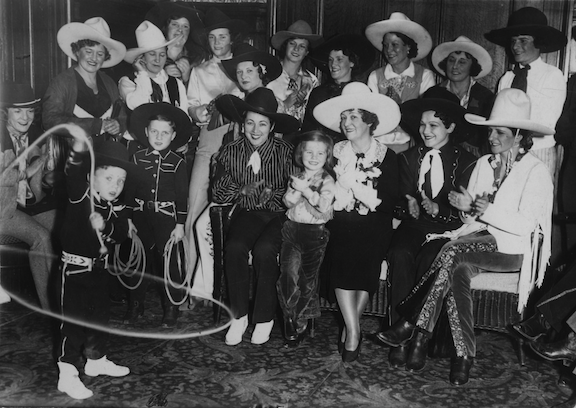
A BIG HOWDY…Cowgirls From the Madison Square Garden Rodeo With Millicent Hearst, 1932. (texashistory.unt.edu)

 * * *

Much Ado About FDR

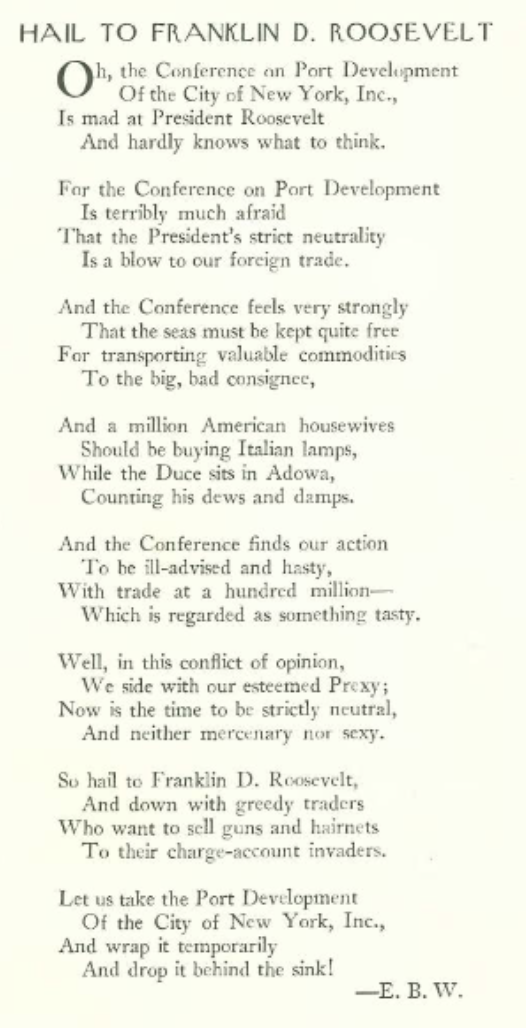
The Conference on Port Development of the City of New York took issue with President Franklin D. Roosevelt’s foreign trade policies, particularly his strict stance on neutrality, which the Conference believed was detrimental to foreign trade. This was likely related to the October 1935 Italian invasion of Ethiopia. E.B. White offered this satirical poem in reaction to the trade spat.

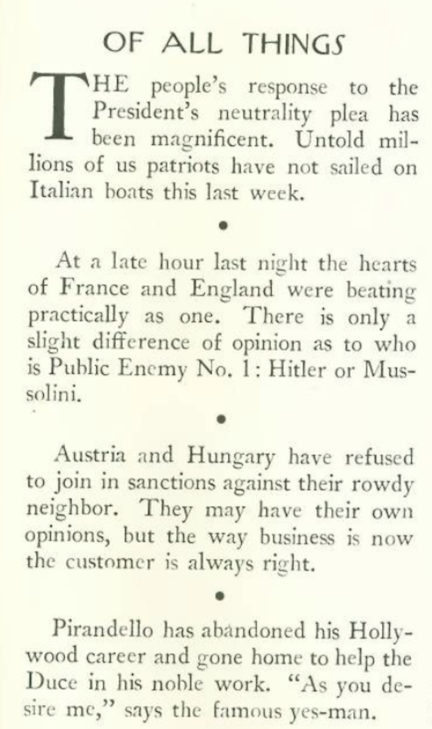
Howard Brubaker also chimed in on the trade issue, and on other unsettling developments in Europe:

 * * *

Puppy Love

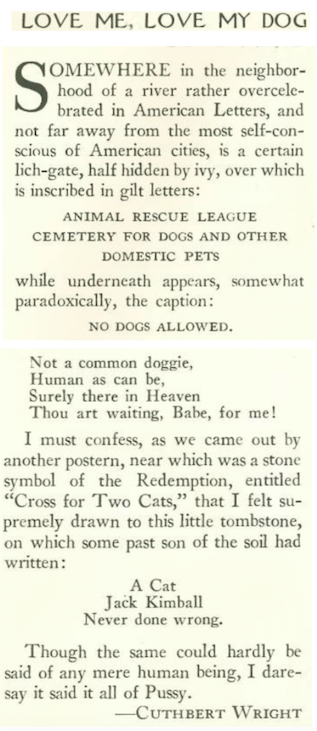
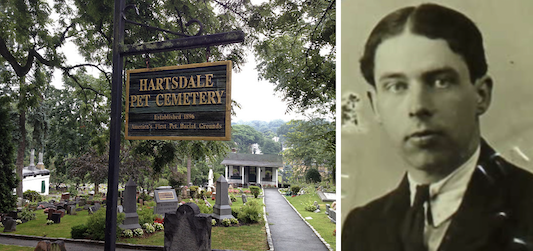
Critic and poet Cuthbert Wright (1892–1948) was moved to write poetry after visiting a dog cemetery that also welcomed animals of all stripes. Here are excerpts of the opening and closing lines:

PET PROJECT…Cuthbert Wright was moved to verse after his visit to a pet cemetery, possibly the Hartsdale Pet Cemetery in Westchester. (Wikipedia/parenthetically.blogspot.com)

 * * *

Man and Machine

Art and culture critic Lewis Mumford is back this week, this time taking a look at the work of French artist Fernand Léger (1881–1955), who created a form of cubism known as “tubism,” regarded today as a forerunner of the pop art movement of the mid-1950s and the 1960s.

It is no surprise that the humanist Mumford, who sought an “organic balance” in everyday design, found Léger’s machine-like works alienating and sterile, representing an “aesthetic poverty.”

TOTALLY TUBULAR…Clockwise, from top left, works of Fernand Léger cited by Lewis Mumford: The City, 1919; photo of Léger, circa 1930s; from the 1918–1923 series Mechanical Elements, 1920; Composition in Blue, 1920–27. (Philadelphia Museum of Art/The Met Collection/Art Institute of Chicago, Charles H. and Mary F. S. Worcester Collection)

 * * *

Disappointment in O’Hara

That is how Clifton Fadiman titled his “Books” column after reviewing John O’Hara’s latest novel, Butterfield 8.

O’Hara (1905–1970) wasn’t just any old scribbler. A prolific short-story writer, he has often been credited with helping to invent The New Yorker’s short story style. Praised by the likes of F. Scott Fitzgerald and Ernest Hemingway, O’Hara cranked out two bestsellers before the age of thirty. One was the acclaimed Appointment in Samarra (which was praised by Fadiman). The other was BUtterfield 8, the novel Fadiman found disappointing (Hemingway, on the other hand, blurbed, “John O’Hara writes better all the time.”). Here are a couple of brief excerpts from Fadiman’s review:

Fadiman concluded his review with a note to the author: “Why not let Jean Harlow have it, Mr. O’Hara, and start a fresh page?”

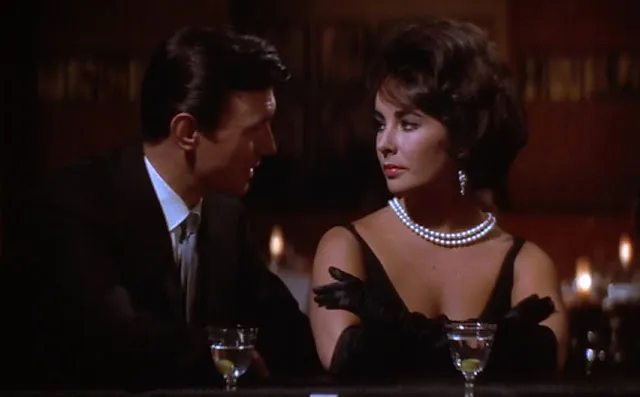
Well, Harlow didn’t get it, but twenty-five years later Elizabeth Taylor would reluctantly take on the role of Gloria Wandrous, and win the Academy Award for Best Actress.

YOU AGAIN?…Laurence Harvey and Elizabeth Taylor played on and off lovers in 1960’s Butterfield 8. John O’Hara did not participate in writing the adaptation, and the film’s plot bore only a slight resemblance to his novel. However, after the film’s release more than one million paperback copies of the novel were sold. (aiptcomics.com)

 * * *

At The Movies

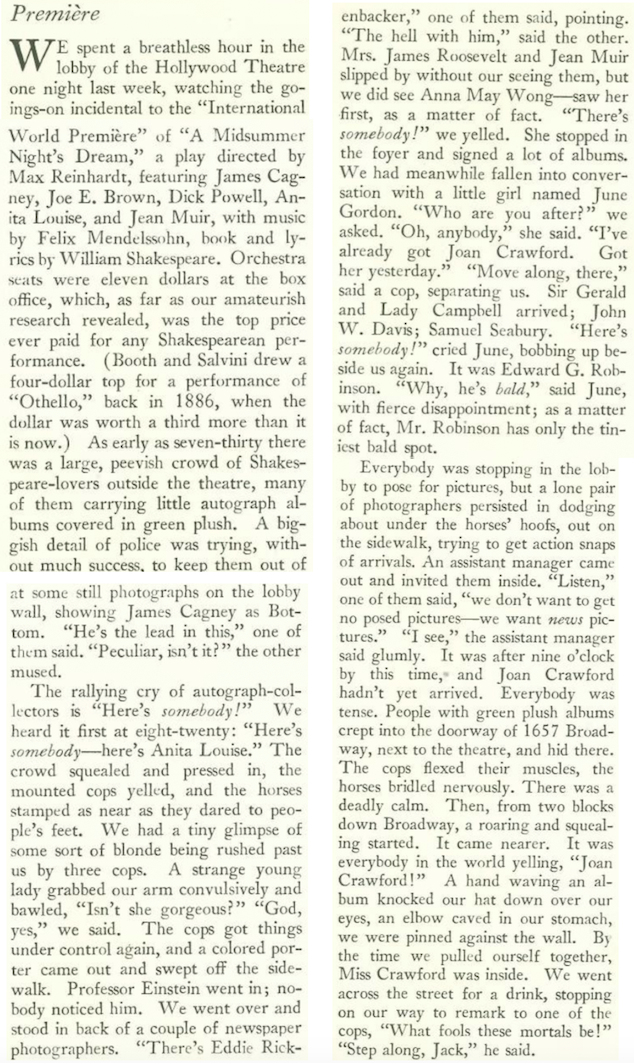
We begin this section with an excerpt from “The Talk of the Town,” which covered the “International World Première” of the Warner Brother’s adaptation of A Midsummer Night’s Dream. The film opened worldwide on October 9, 1935 in London, Sydney, Vienna and at New York’s Hollywood Theatre, where crowds turned out to get a glimpse of the stars.

RUBBERNECKERS…A Midsummer Night’s Dream premiere at the Hollywood Theatre in New York City on October 9, 1935. (britannica.com)

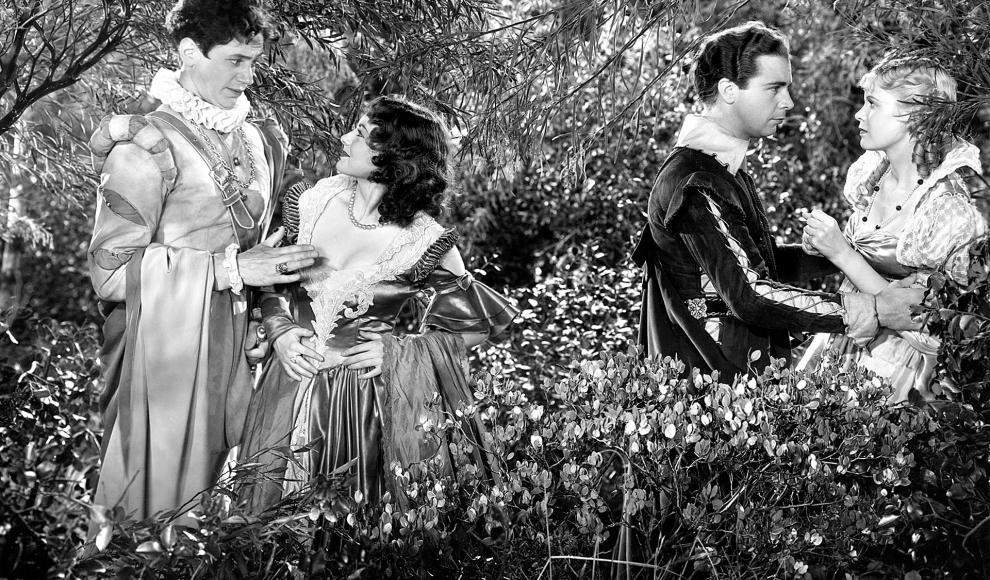
Film critic John Mosher praised Joe E. Brown’s performance as Flute, as well James Cagney’s portrayal of Bottom, and lauded the “magnificent group of clowns” that formed the remainder of The Players. Here are excerpts from his review (note I included the entirety of Otto Slogow’s delightful spot drawing):

THE LOVERS…Left to right: Ross Alexander (Demetrius), Olivia de Havilland (Hermia), Dick Powell (Lysander) and Jean Muir (Helena) meet cute and confused in A Midsummer Night’s Dream. (TCM.COM)
THE SEVEN STOOGES…Bottom (James Cagney) and his fellow Players prepare to perform a stage play about the death of Pyramus and Thisbe which turns into a farce. From left, in front, Joe E. Brown (Flute), Cagney, and Otis Harlan (Starveling); in the back are, from left, Hugh Herbert (Snout), Arthur Treacher (Epilogue) and Dewey Robinson (Snug) as The Players in A Midsummer Night’s Dream. Frank McHugh (Quince) can be seen behind the wall in back. (IMDB)
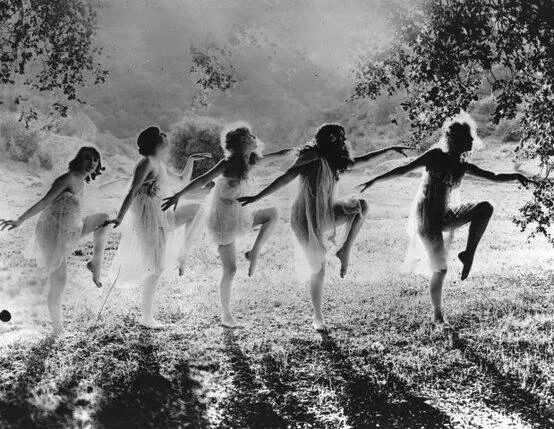
DANCING THE NIGHT AWAY…Fairie scene from A Midsummer Night’s Dream. (Facebook)

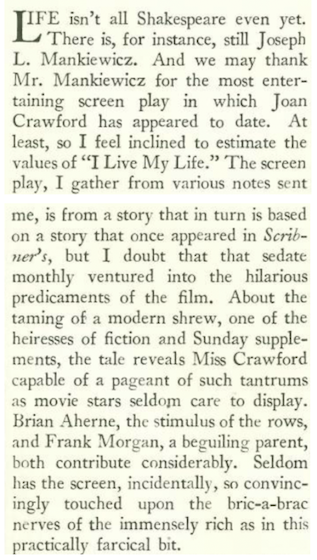
Mosher also reviewed the romantic comedy I Live My Life, which he found to be a satisfying satire on the lives of the rich.

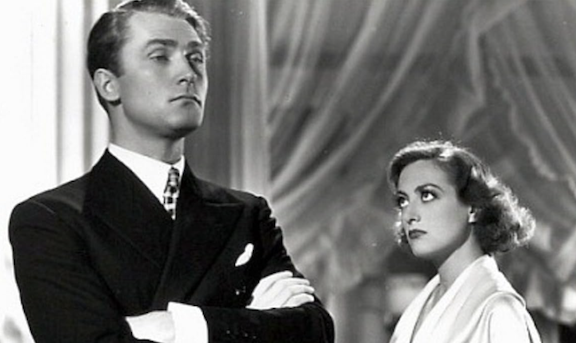
MATCHING WITS…Bored socialite Kay Bentley (Joan Crawford) has a tempestuous romance with idealistic archaeologist Terry O’Neill (Brian Aherne) in I Live My Life. (IMDB)

 * * *

From Our Advertisers

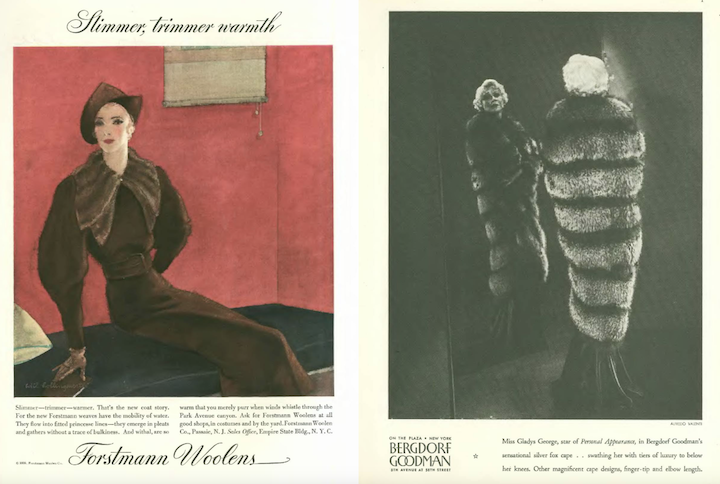
Readers ninety years ago opened the Oct. 19 issue to this two-page spread featuring the latest in fall/winter fashions…the ad on the right from Bergdorf Goodman featured stage and screen actress Gladys George donning a full-length silver fox fur…

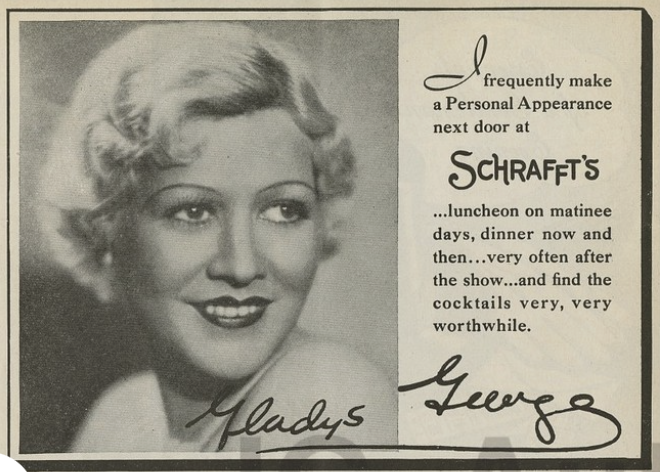
…George (1904–1954) was appearing at Henry Miller’s Theatre in the play Personal Appearance…she was featured in this testimonial ad for Schrafft’s in the theatre’s Playbill…

(playbill.com)

…the folks at Packard took out this colorful two-page spread to promote their more affordable model, the 120…the move to more affordable models helped the luxury carmaker weather the lean years of the Depression…

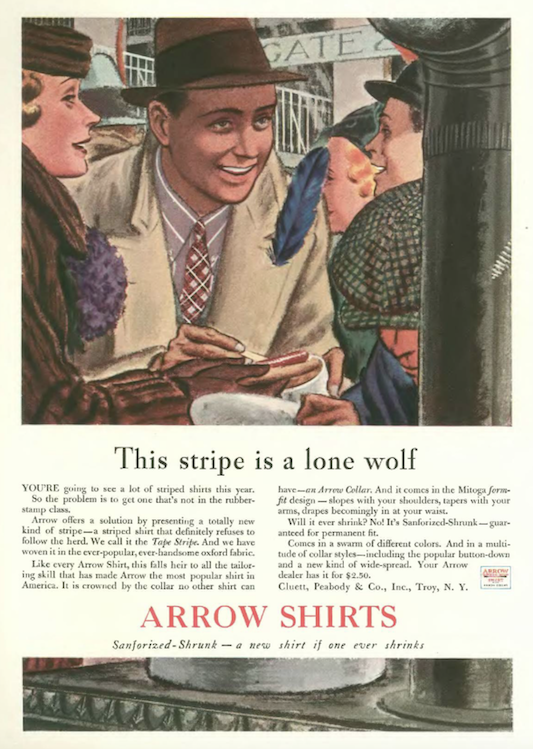
…there is a strange quality to these Arrow Shirt advertisements…what are the they looking at?…apparently something amusing as the man applies mustard to a hotdog, but it isn’t the vendor, who looks down at his cart…

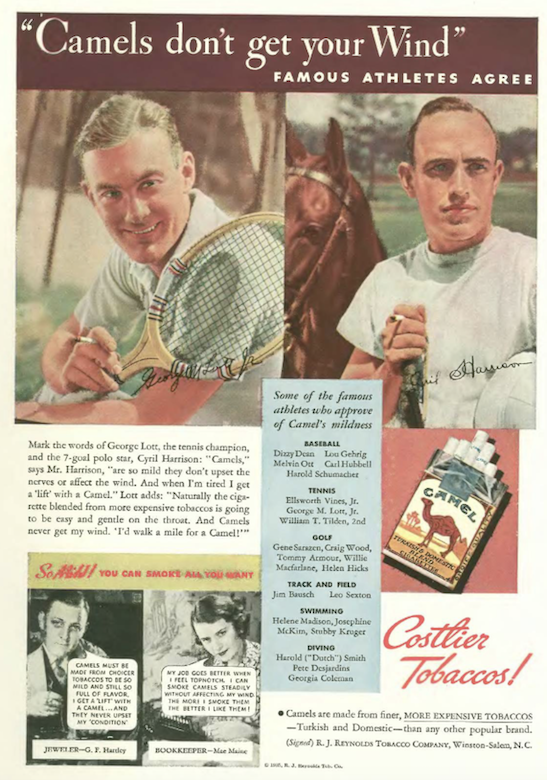
…R.J. Reynolds continued its Camel campaign featuring accomplished athletes who got a “lift” from smoking…the ad also included a couple of regular folks at the bottom, who claimed the cigarettes were so mild “You can smoke all you want”…

…Old Gold continued to enlist the talents of George Petty to illustrate their full-page ads…

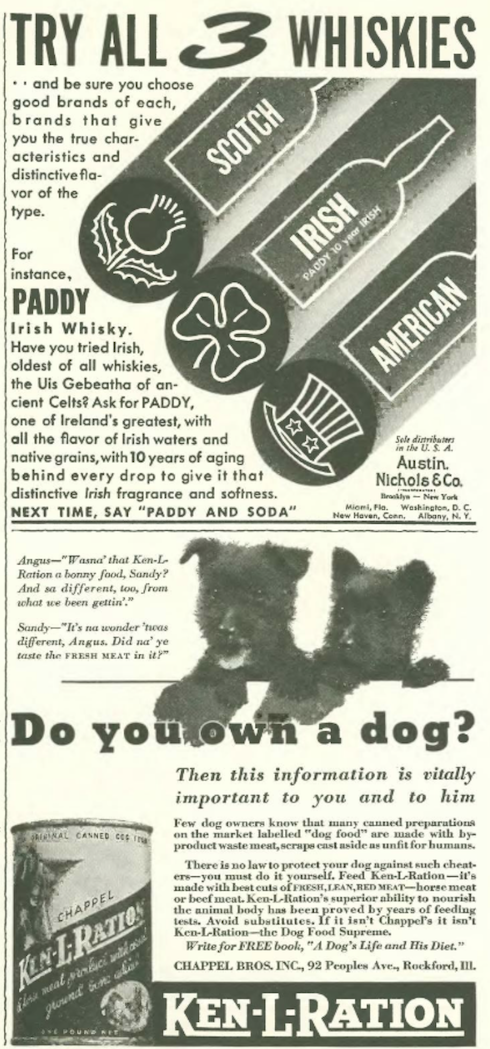
…here’s a couple of back of the book ads touting Irish whisky and Ken-L-Ration dog food…note how the Scottish terriers speak in “dialect”…Ken-L-Ration was a leading dog food brand in the 1930s, thanks to their use of horse meat rather than “waste meat”…

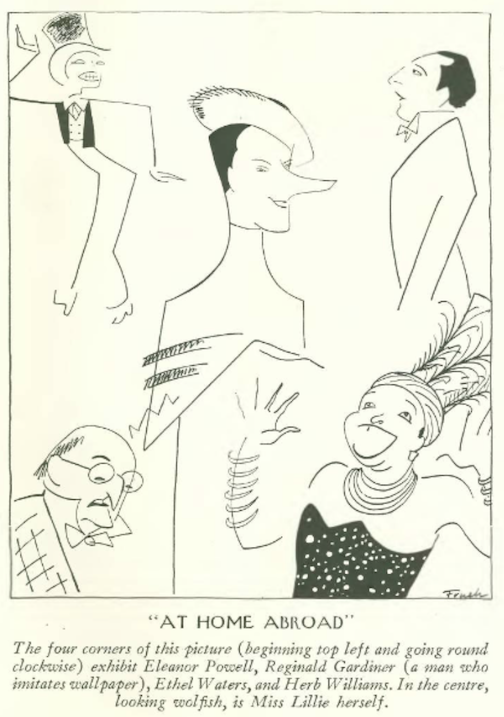
…on to our cartoonists, we start with Al Frueh enhancing the “Theatre” page…

James Thurber showed us a man at odds with the times…

Barbara Shermund kept us up to date on the modern woman…

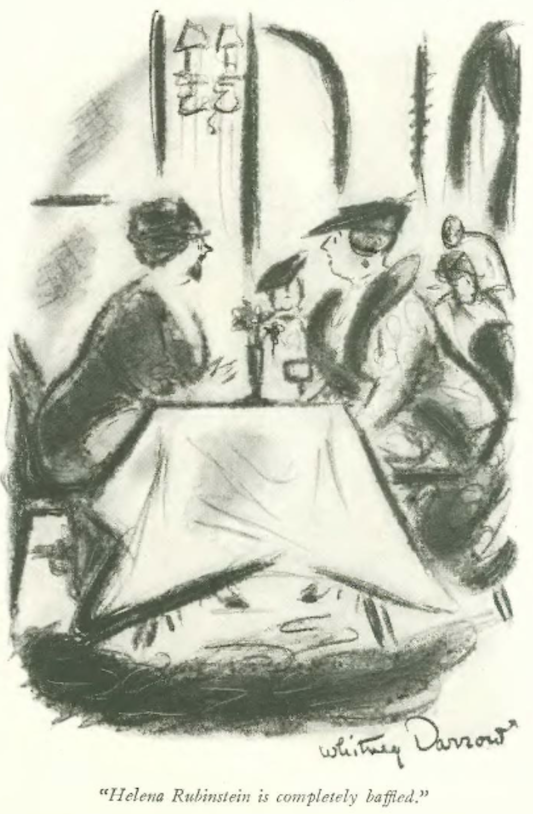
Whitney Darrow Jr offered a challenge to Helena Rubinstein (note the woman on the right—she could have been drawn by Helen Hokinson)…

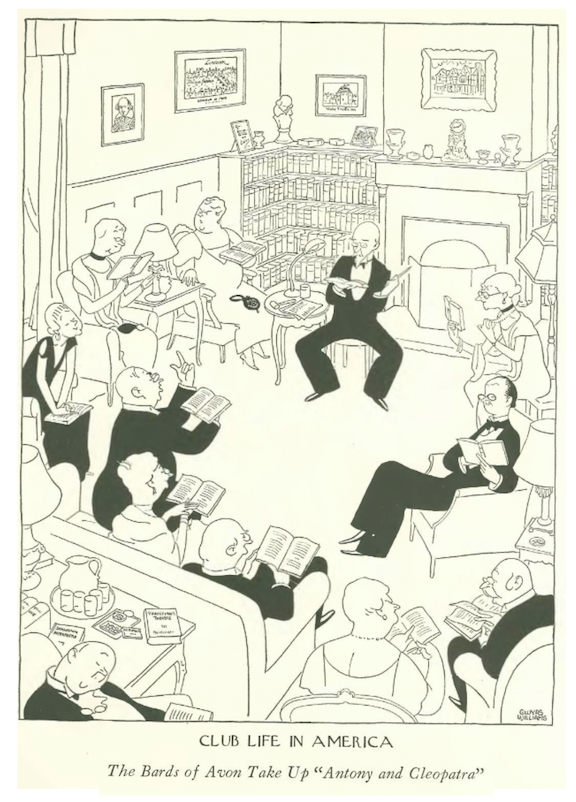
Gluyas Williams checked in on the lively proceedings of a book club…

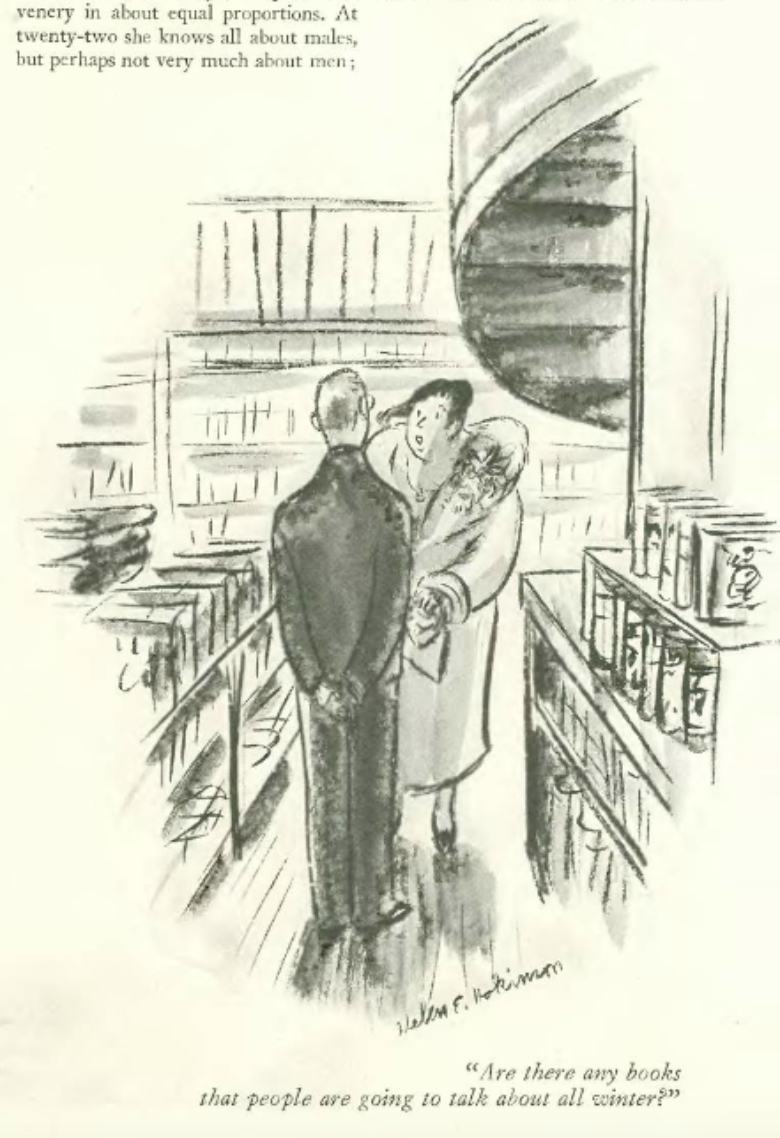
Helen Hokinson went looking for a good winter read…

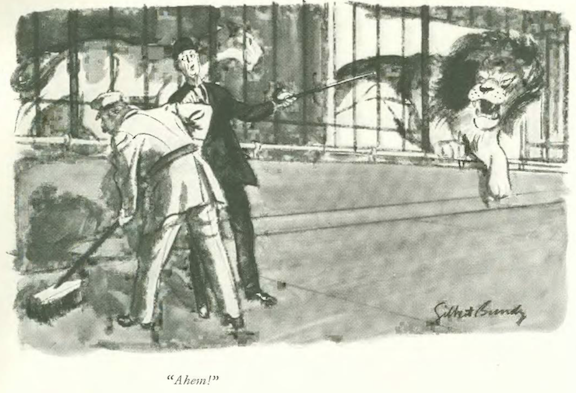
Gilbert Bundy offered an alarming scenario on the top of p. 31…

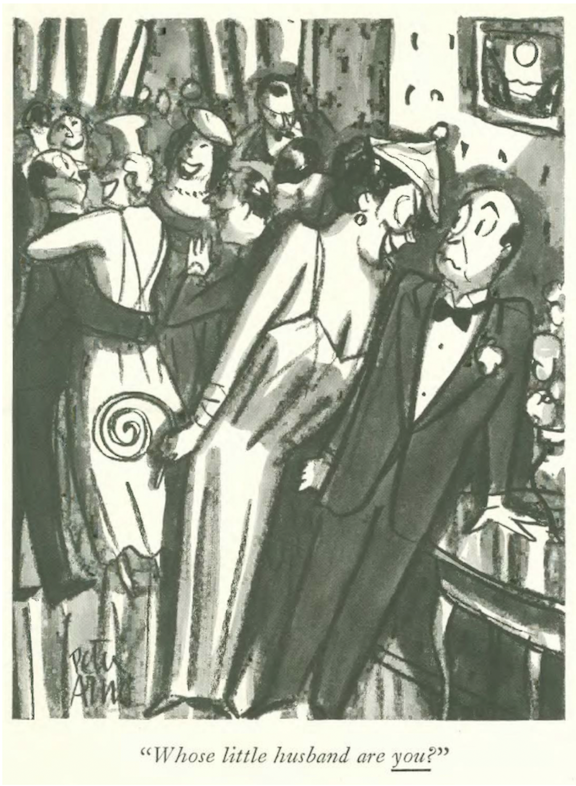
…and we close with Peter Arno, and an eye-raising encounter…

New Time: It Can’t Happen Here…

Looking For Mister Wrong

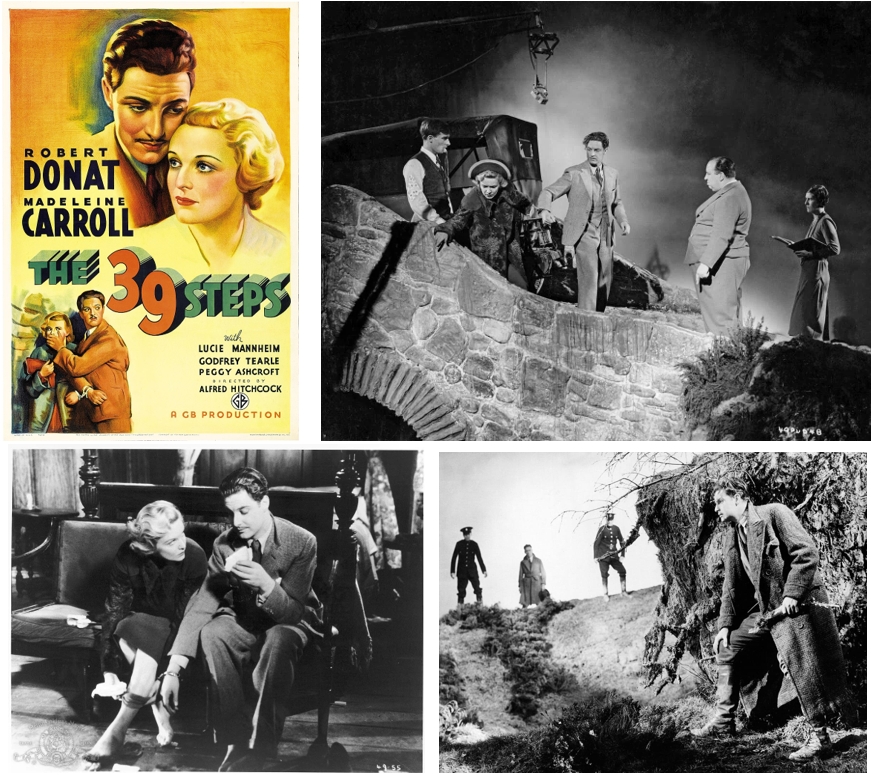
Widely acknowledged as a classic, The 39 Steps further solidified British director Alfred Hitchcock’s image as a master of suspense with American film audiences.

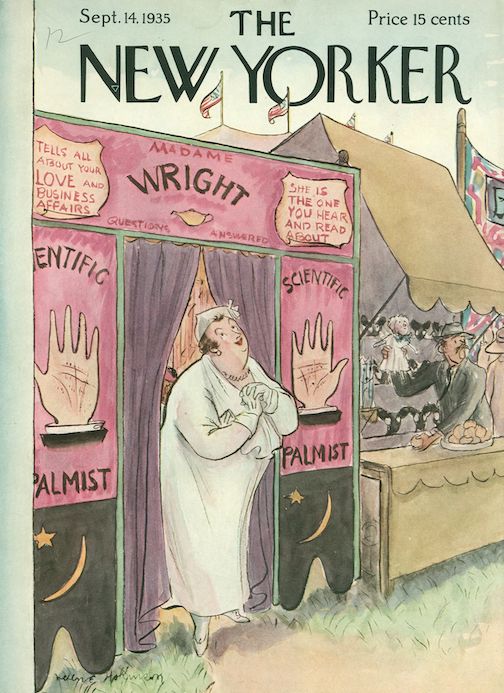
September 14, 1935 cover by Helen Hokinson. Over a twenty-year span, she contributed 68 covers and more than 1,800 cartoons to The New Yorker.

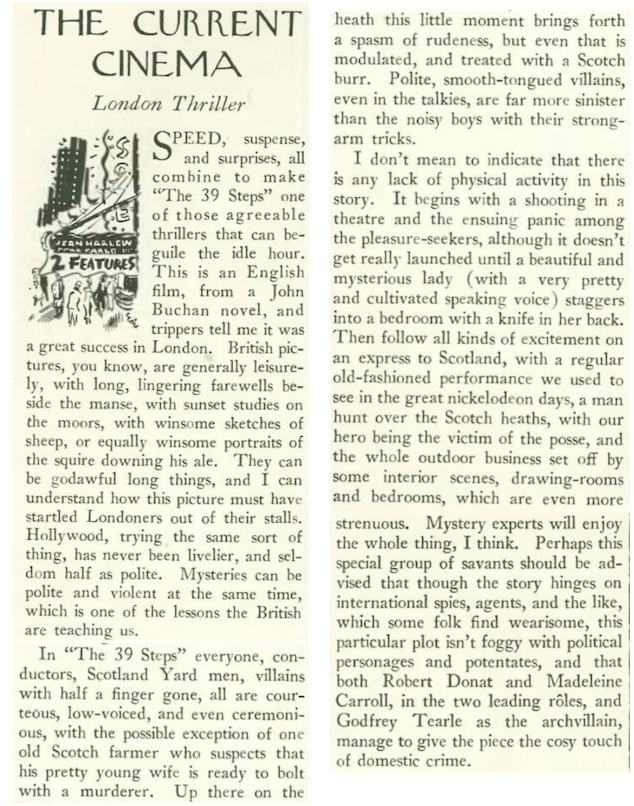
A successful follow up to 1934’s The Man Who Knew Too Much, Hitchcock’s The 39 Steps was conceived and cast by the Gaumont-British Picture Corporation as a vehicle to establish British films in America. The film also featured one of Hitchcock’s favorite plot devices—an innocent man forced to go on the run—seen in such notable films as 1942’s Saboteur and 1959’s North by Northwest. New Yorker film critic John Mosher was among the film’s many admirers:

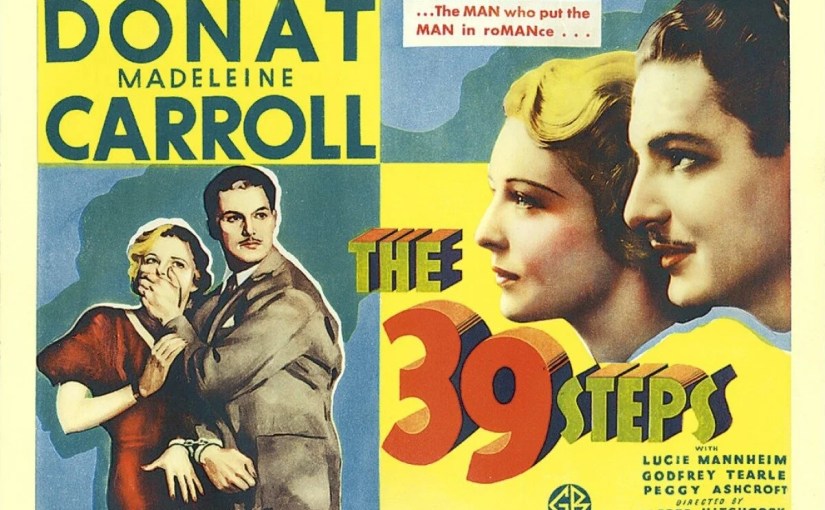
WE’LL TAKE THE STAIRS…Clockwise, from top left, poster for The 39 Steps; Alfred Hitchcock (second from right) directing the handcuffed Madeleine Carroll (as Pamela) and Robert Donat (as Richard Hannay) on the first day of filming; Hannay evades police on the heath; Pamela and Richard make the best of their predicament as handcuffed escapees. (Wikipedia/jimcarrollsblog.com/criterion.com)

 * * *

Pop-Up Stores

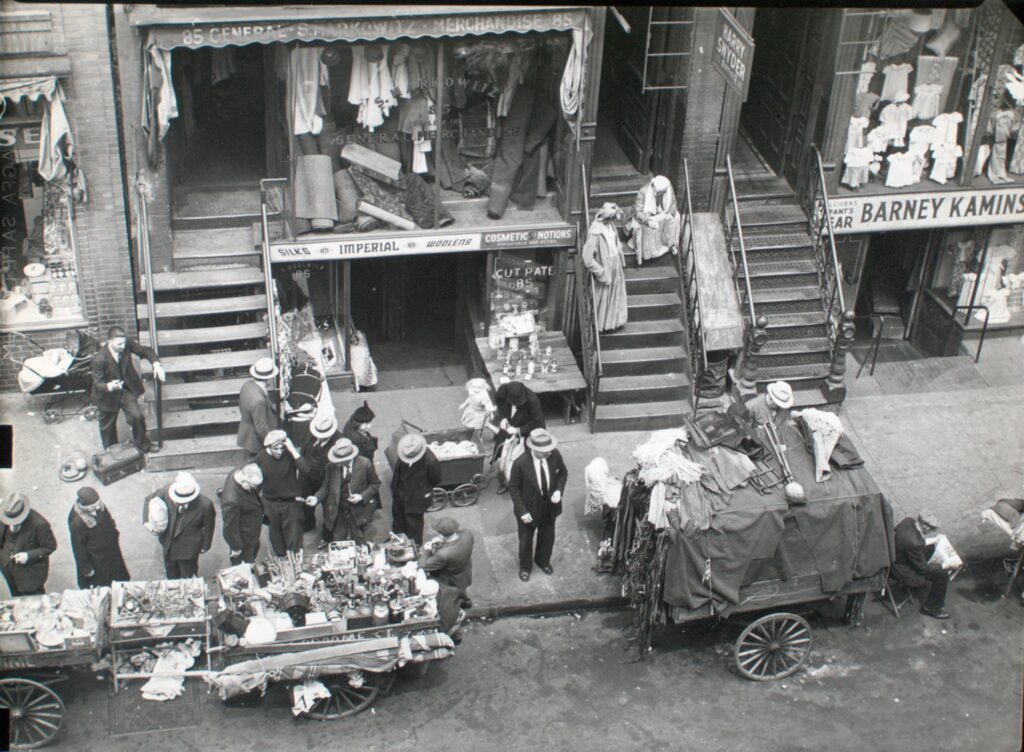
“The Talk of the Town” had a look at the “madhouse” on Nassau Street that daily erupted from noon to 2 p.m. as peddlers took over the street to hawk their wares.

IF WE DON’T HAVE IT, YOU DON’T NEED IT…Hester Street peddlers in 1936. Photo by Berenice Abbott. (boweryboyshistory.com)

* * *

Art of the Artless

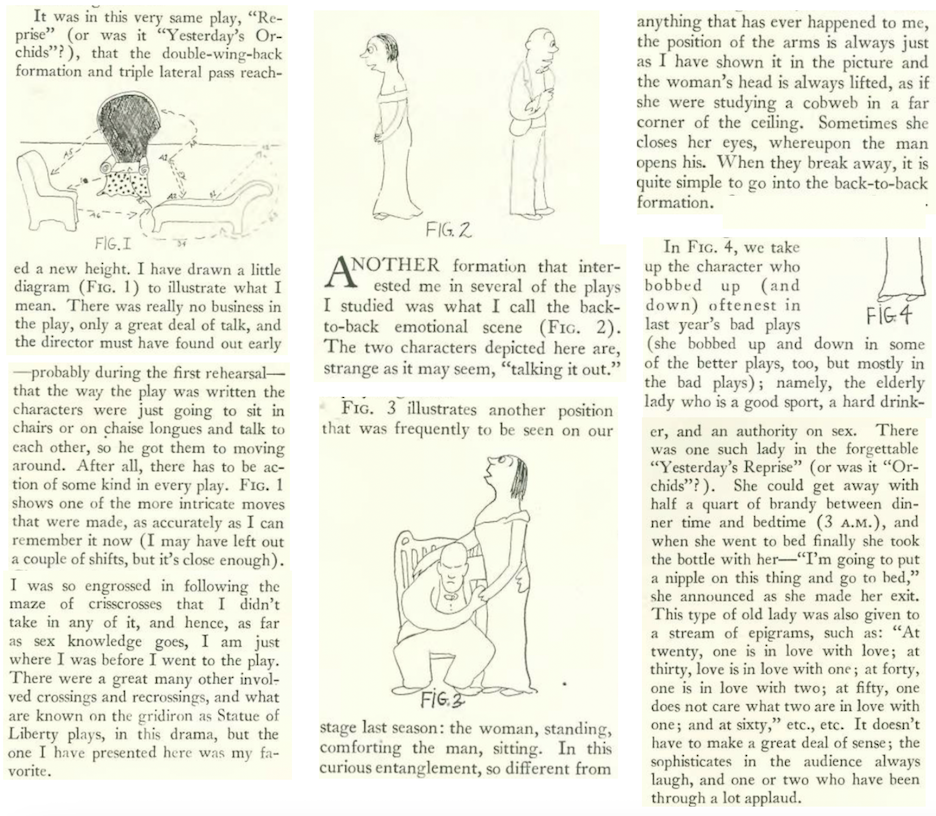
James Thurber dissected the workings of a “bad play,” examining varied techniques and familiar tropes. Excerpts:

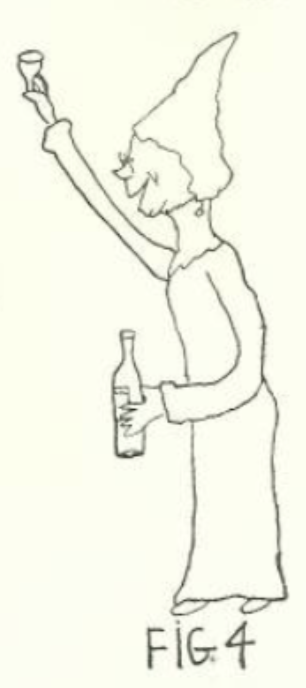
…below is the complete illustration for Fig. 4, which got cut off in the excerpt above…Thurber depicted “the elderly lady who is a good sport, a hard drinker, and an authority on sex.”

 * * *

The Petulant Painter

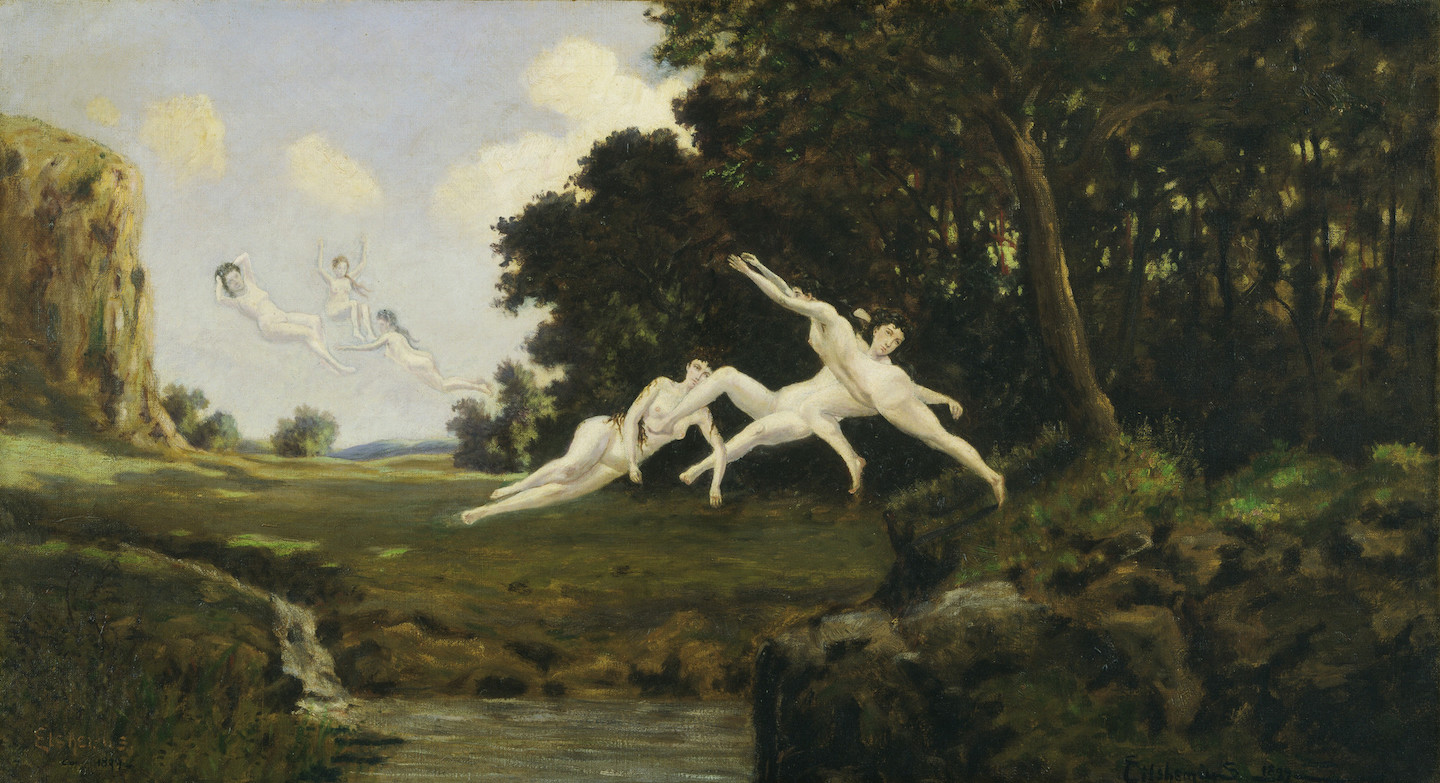
Known for a primitive style that included bizarre scenes of frolicking (or floating) voluptuous nudes, the painter Louis Michel Eilshemius (1864–1941) had a style all his own, and had no trouble telling anyone that his work was better than anything hanging in the finest museums (which would not consider him at all until after his death). In 1931 he began calling himself “Mahatma,” hence the title of this profile by Milton MacKaye (illustration by Hugo Gellert). Some brief excerpts:

IRASCIBLE RASCAL…Clockwise, from top left, Louis Michel Eilshemius in 1913; Standing and Reclining Nymphs (1908), Self-portrait (1915); Nymphs Sleeping (1920). Known for his numerous and vitriolic letters to newspaper editors, his letterheads would proclaim such accomplishments as “Educator, Ex-actor, Amateur All-around Doctor, Mesmerist-Prophet and Mystic, Reader of Hands and Faces, Linguist of 5 languages, Spirit-Painter Supreme.” He also claimed to be a world-class athlete and marksman as well as a musician who rivaled Chopin. (Wikipedia/Smithsonian American Art Museum/National Portrait Gallery)

Eilshemius regularly visited art galleries, loudly condemning the works on display. No wonder museums would not consider his odd paintings, which were probably best received by the French, including the artists Henri Matisse and Marcel Duchamp; the latter invited Eilshemius to exhibit with him in Paris in 1917.

Eilshemius’ mental stability had deteriorated substantially by the time MacKaye wrote the profile, which concluded with this sad, final accounting of the man’s life.

Eilshemius would die in the psychopathic ward of Bellevue Hospital in 1941. In the years since, his work has gained a wide audience and can be found in such collections as the Smithsonian, The Phillips Collection, MoMA and the Metropolitan Museum of Art.

SINGULAR VISION…Louis Michel Eilshemius, Afternoon Wind, 1899. (MoMA)

 * * *

In Good Company

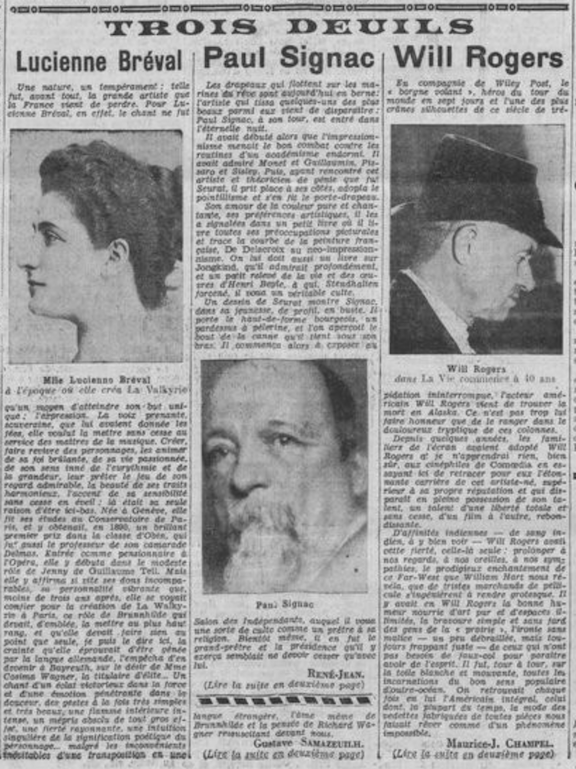
In her “Letter From Paris,” Janet Flanner noted that even the French honored the memory of Will Rogers, who had died in a plane crash with aviator Wiley Post on Aug. 15, 1935.

NOTED AND NOTABLE…As an example of Will Rogers’ worldwide fame, Janet Flanner noted that the Paris entertainment newspaper Comœdia published Rogers’ obituary next to that of famed neoimpressionist painter Paul Signac. The other obituary remembered the renowned Swiss soprano Lucienne Bréval. (gallica.bnf.fr via onlinebooks.library.upenn.edu)

 * * *

At the Movies

Coming down from The 39 Steps, John Mosher also sampled some of latest comedies gracing the silver screen…

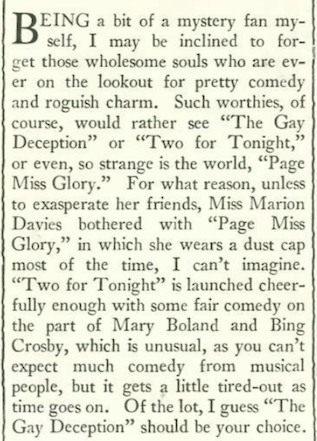
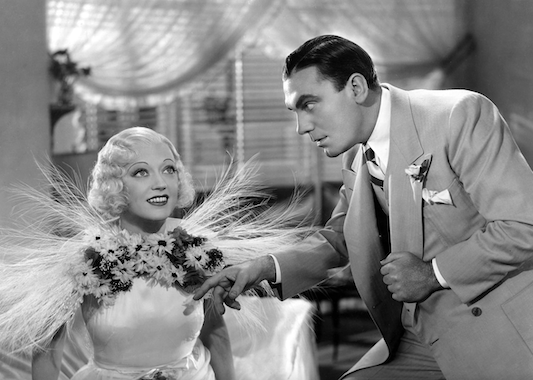
…Mosher didn’t understand why Marion Davies, nearing the end of her film career, even bothered to appear in the romantic comedy Page Miss Glory (although she was also the producer), in which she portrayed a country girl who stumbles into fame while working as a chambermaid in a luxury hotel…

JUST LIKE CINDERELLA…Marion Davies and Pat O’Brien in Page Miss Glory. (IMDB)

Two For Tonight featured a lot of fine crooning from Bing Crosby, and some hijinks, but fizzled out in the end…

Bing Crosby (right) takes aim in Two For Tonight. (IMDB)

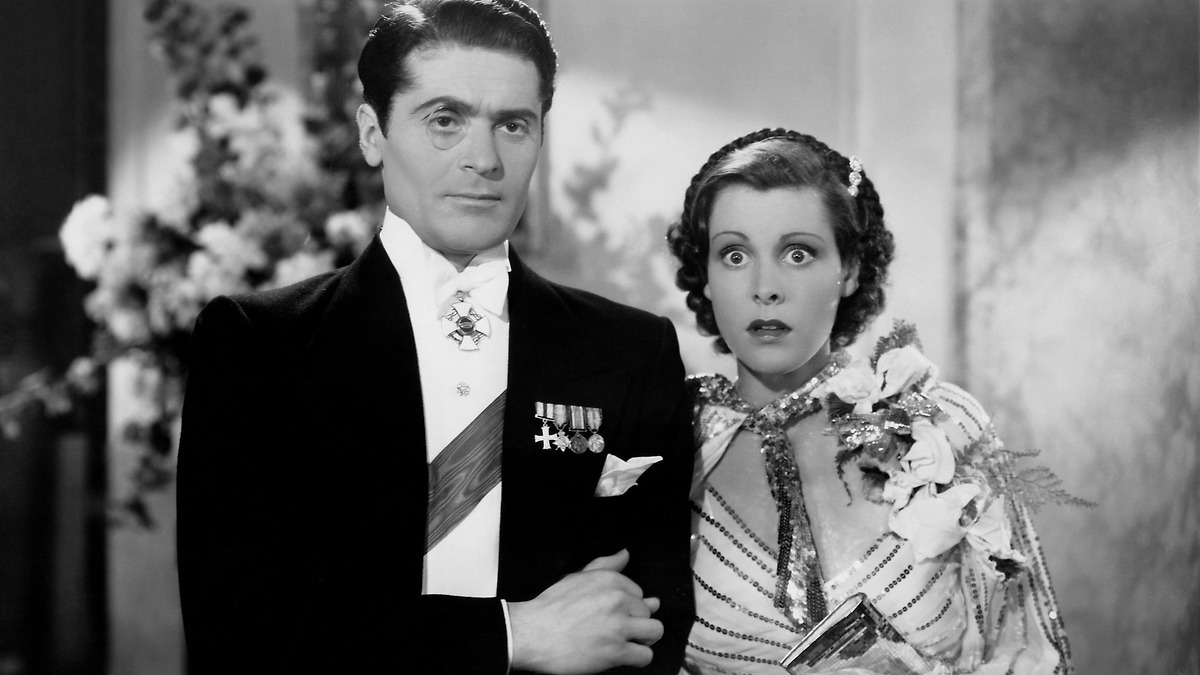
…of the three comedies, Mosher found The Gay Deception to be the most winning. Directed by William Wyler, the film featured a sweepstakes winner pretending to be a rich lady (Frances Dee) who encounters a prince masquerading as a bellboy (Francis Lederer)…hilarity ensued…

THE WYLER TOUCHWilliam Wyler’s The Gay Deception, starring Francis Lederer (left) and Frances Dee, anticipated Wyler’s 1953 Roman Holiday, also a tale about a royal wanting to be a normal person. (letterboxd.com)

 * * *

From Our Advertisers

We welcome fall with the latest fashion from Forstmann Woolens…

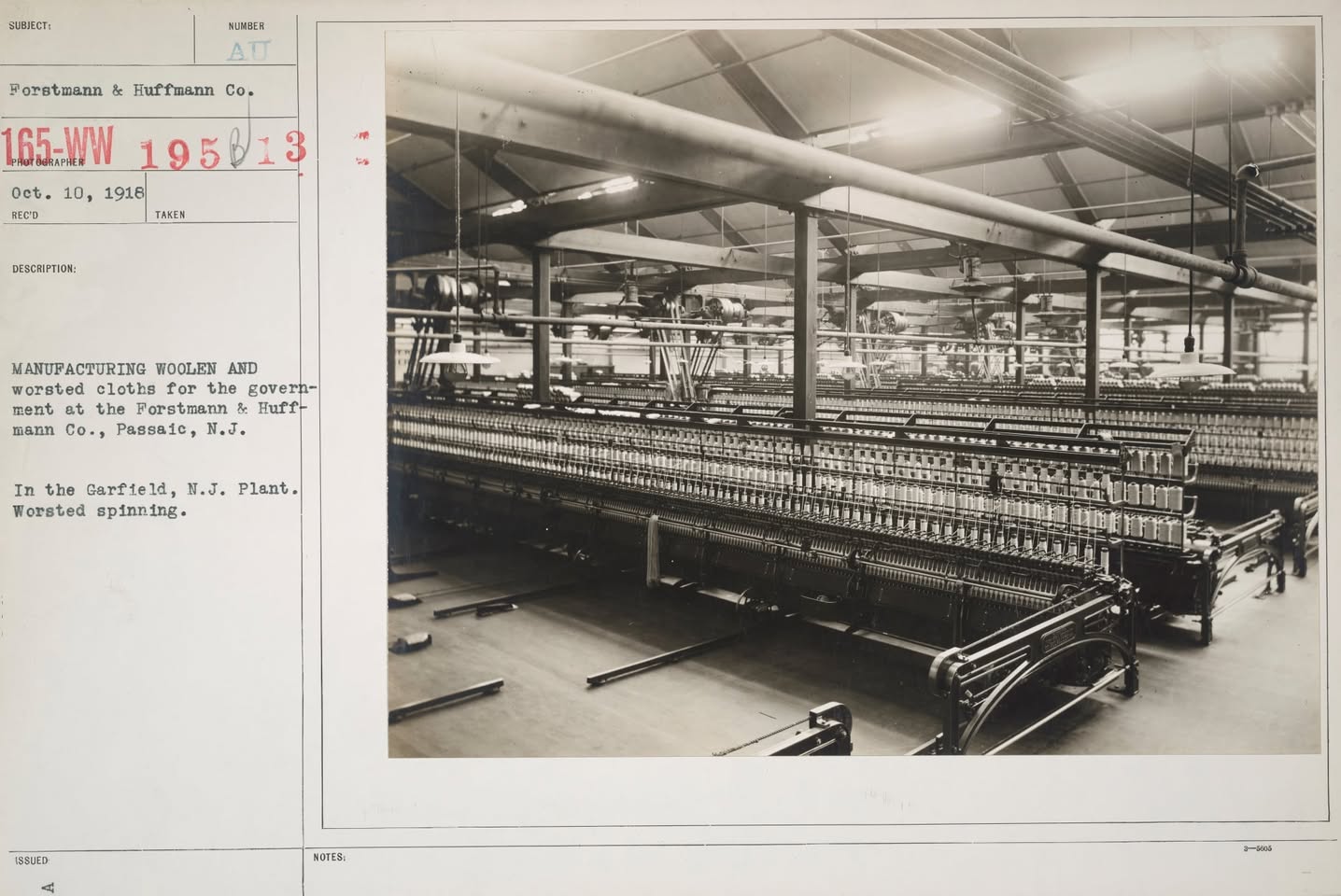
…and here is where those wool dresses were spun…

Image from the National Archives depicts the spinning room at Forstmann & Huffman in Passaic, N.J., 1918. The Passaic plant closed in 1958. (Historical Society of Garfield, NJ)

…the makers of leaded gasoline continued to promote their product in full-color spots…

…General Tire (like competitor Goodyear) played up the safety theme and potential perils to loved ones to tout their “blow-out proof” tires…

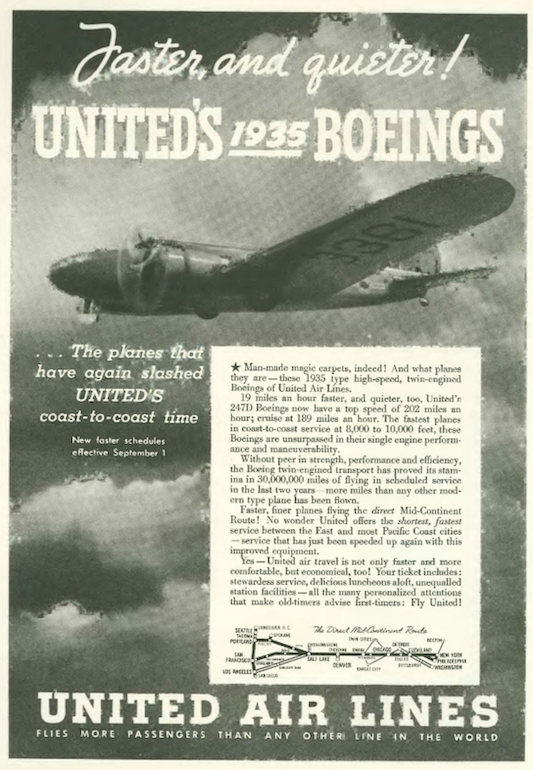
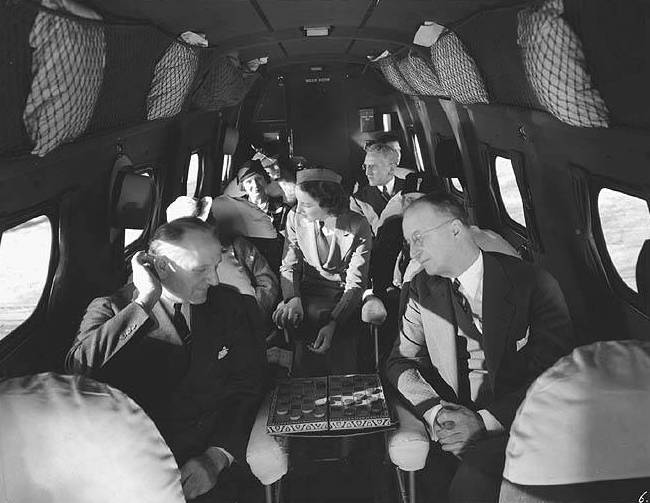
…like many advertisers in The New Yorker, United Air Lines appealed to the affluent, hoping some of them would take to the air, since only they could afford it…

…for reference…

COZY…Interior of the Boeing 247. (Wikimedia Commons)

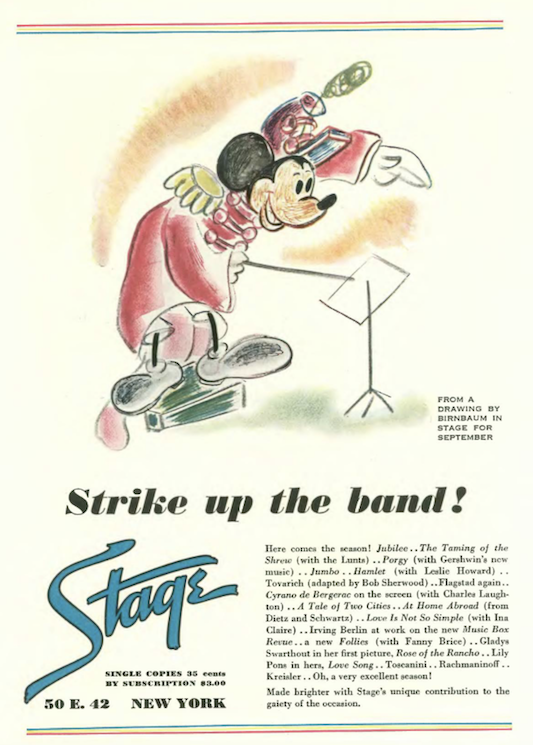
Abe Birnbaum, who contributed nearly 200 covers to the New Yorker, offered this rendition of Mickey Mouse to Stage magazine…

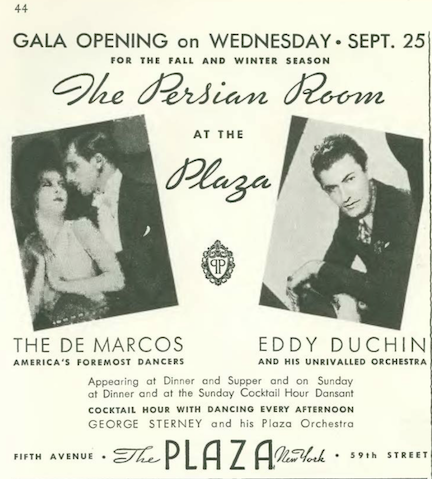
…heading to the back of the book we find the latest in entertainment at the Plaza…

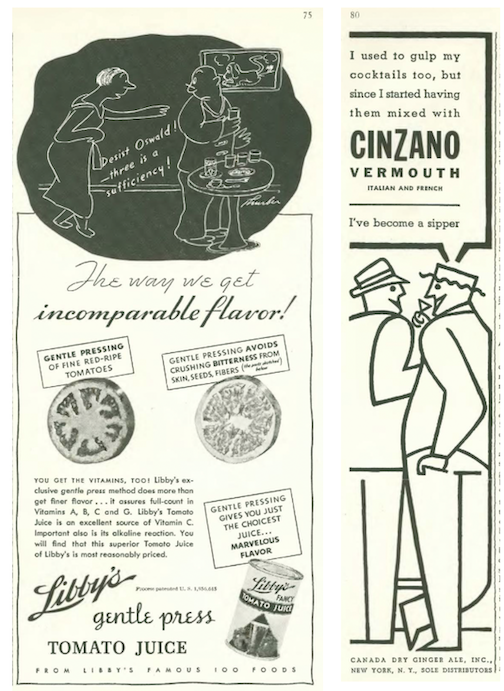
James Thurber contributed the drawing at left (rendered in negative) on behalf of Libby’s tomato juice on page 75, and page 80 featured the spare, modern lines of a Cinzano ad…

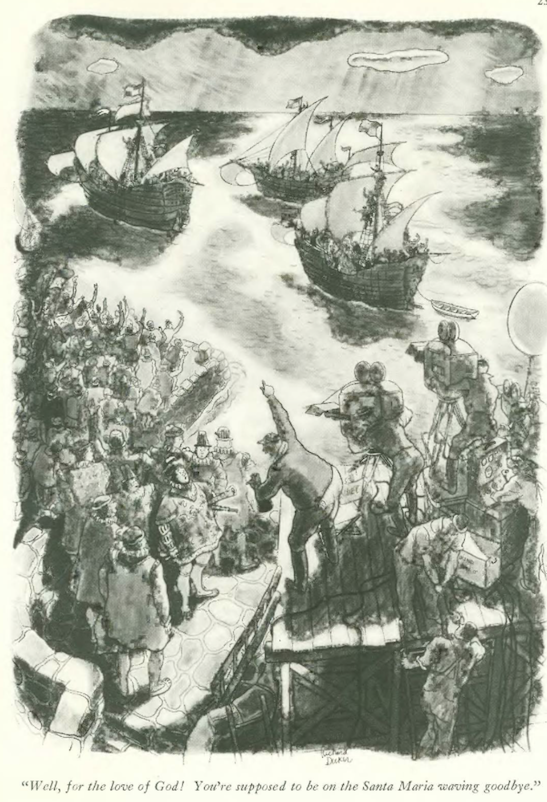
…our cartoonists include Richard Decker, on the set with a missing extra…

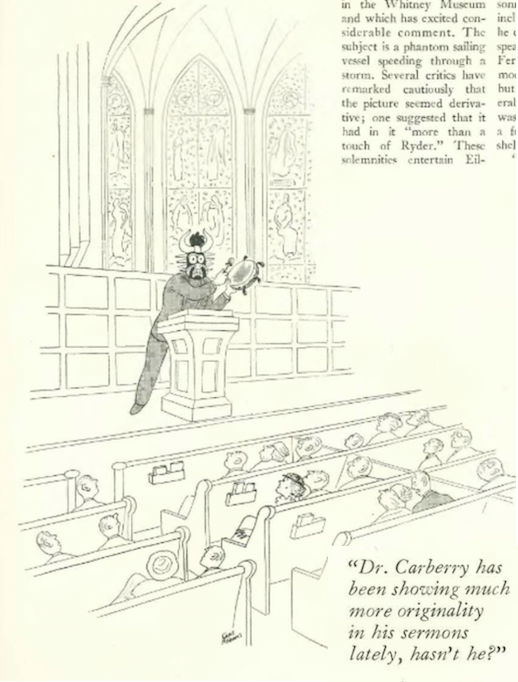
Charles Addams offered a new twist on the Sunday sermon…

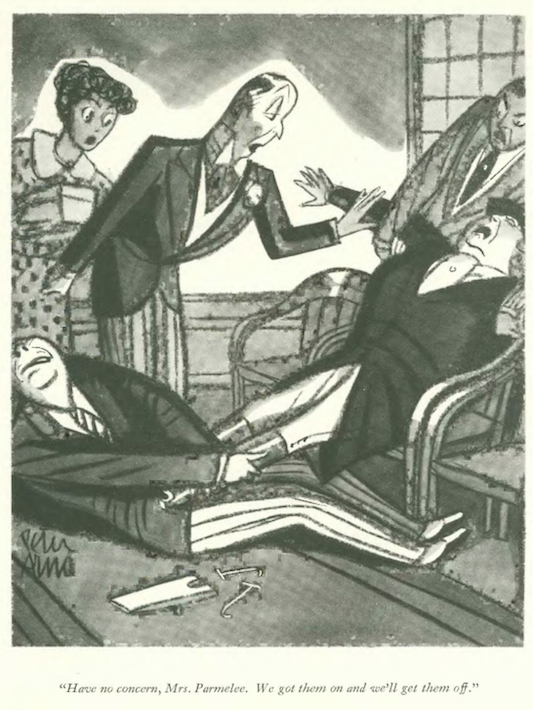
Peter Arno found an epic struggle in the shoe department…

Robert Day offered this energy-saving tip…

…and we close with Helen Hokinson, and a lively game of charades…

Next Time: All Dogs Go to Heaven…

Wining & Dining

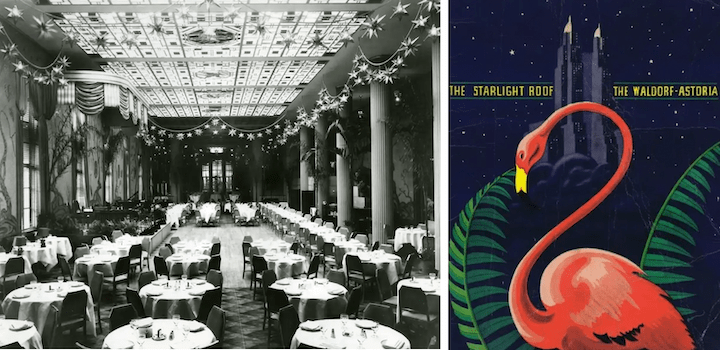
Above: The Waldorf-Astoria's Starlight Roof, and a 1930s menu cover. (Facebook/Pinterest)

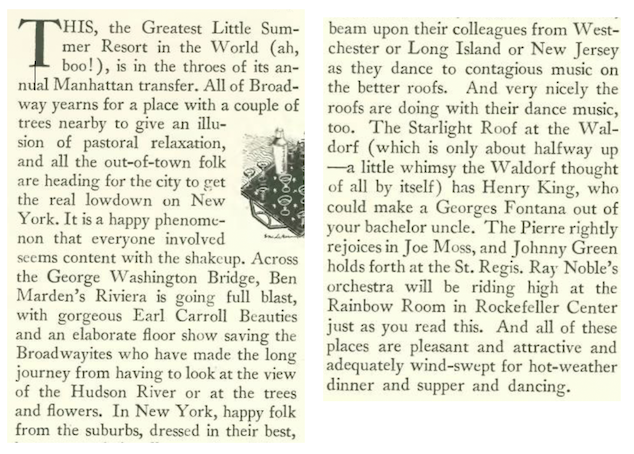
With summer approaching, the rooftop restaurants were in full swing, and Lois Long continued her exploration of favorite haunts, including one nightclub that drew many Manhattanites across the Hudson to the cliffs of the New Jersey Palisades.

June 1, 1935 Cover by Rea Irvin.

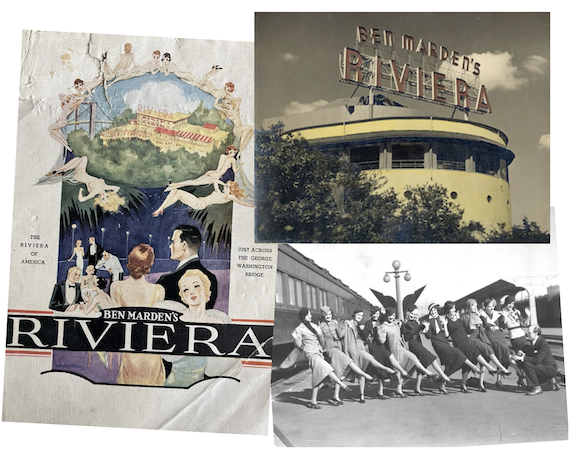
Ben Marden couldn’t wait for the official end of Prohibition when he opened his Riviera Night Club in Fort Lee in 1931. The frequent site of raids until the repeal of the 18th Amendment, the Riviera continued to be a place well known to Bergen County police thanks to clientele that included racketeers and other unsavory types. But to New Yorkers like Long, it was a break from the din of the city to the relative green of the Garden State. Long wrote:

The Riviera closed during the first years of World War II, but it reopened in 1945 after Bill Miller bought it from Marden and apparently cleaned it up. It then attracted the likes of Frank Sinatra, Dean Martin, Jerry Lewis, Martha Rae, Sammy Davis, Jr., and Pearl Bailey until it closed in 1953. It was demolished the following year.

THEY HAD FOOD, TOO…Clockwise, from left, the1936 spring menu cover of Ben Marden’s Riviera featured an illustration of the original Riviera (ringed by nude showgirls), which burned to the ground on Thanksgiving night, 1936; the building that replaced it was called an architectural wonder with its retractable roof, rotating stage, and glass windows that slid down to the floor; Earl Carroll and his “Beauties” performed at the Riviera in 1935–they are pictured here at a train station in Los Angeles, 1934. (ebay.com/patch.com/lapl.org)

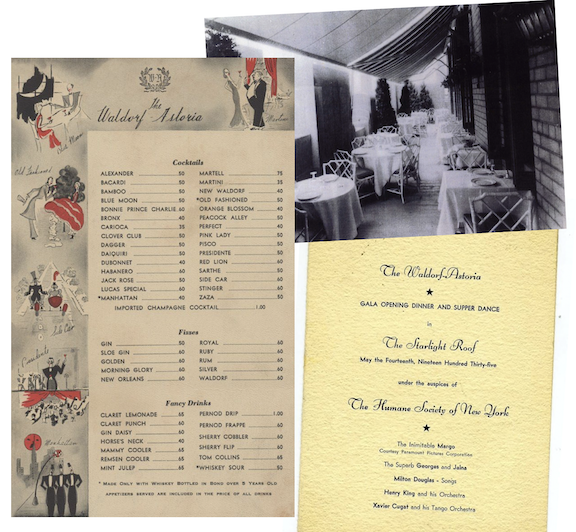
Long also stayed in town to visit the Waldorf-Astoria’s Starlight Roof.

WITH THE STARS, UNDER THE STARS…Clockwise, from left, cocktail menu from the Waldorf’s Starlight Roof, 1935; outdoor seating on the Starlight Roof Terrace; special menu for the Gala Opening Dinner and Supper Dance on the Starlight Roof, May 14, 1935. It was a favorite destination of Frank Sinatra, Cole Porter, Katharine Hepburn, and Ella Fitzgerald, among others. (Pinterest)

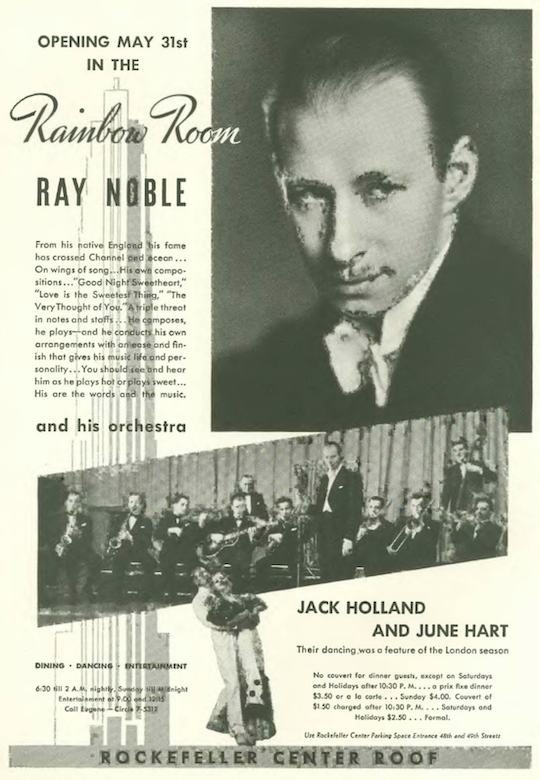
Long also mentioned the appearance of Ray Noble in the Rockefeller Center’s Rainbow Room. This full-page ad appeared in the June 1 issue:

Other summer season attractions were advertised in numerous back-of-the-book, one-column advertisements:

…and at the bottom of page 64…

Wining and dining were also the topic of the profile, a two-parter penned by Margaret Case Harriman, who took a look at New York’s famed Colony Restaurant.

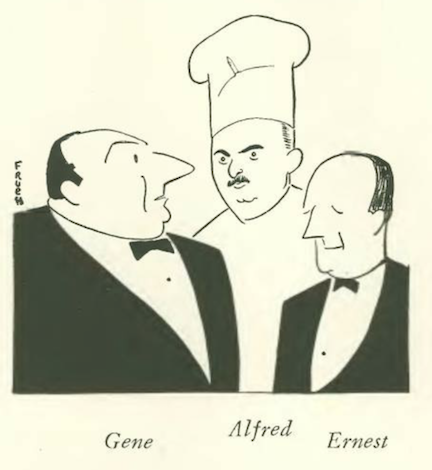
ORIGINAL TRIO…Al Frueh’s caricatures of the Colony’s owners/headwaiters Gene Cavallero and Ernest Cerutti, who flank chef Alfred Hartmann, who was also part owner until he sold his interest to the other two in 1927 and retired to a farm in France. Harriman wrote that Cavallero and Cerutti were “born headwaiters—suave, solicitous, infallible.”
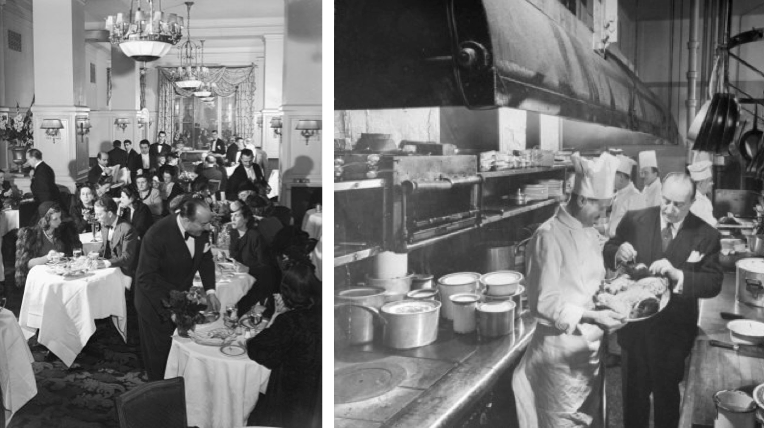
A PLACE TO BE SEEN…From the 1920s to the 1960s New York’s café society dined at the Colony. Rian James, in Dining In New York (1930) wrote “the Colony is the restaurant of the cosmopolite and the connoisseur; the rendezvous of the social register; the retreat of the Four Hundred.” Critic George Jean Nathan said the Colony was one of “civilization’s last strongholds in the department of cuisine.” Photo at left of the dining room around 1940; at right, co-owner Eugene Cavallero consults with a chef. (lostpastremembered.blogspot.com)

 * * *

The Business of News

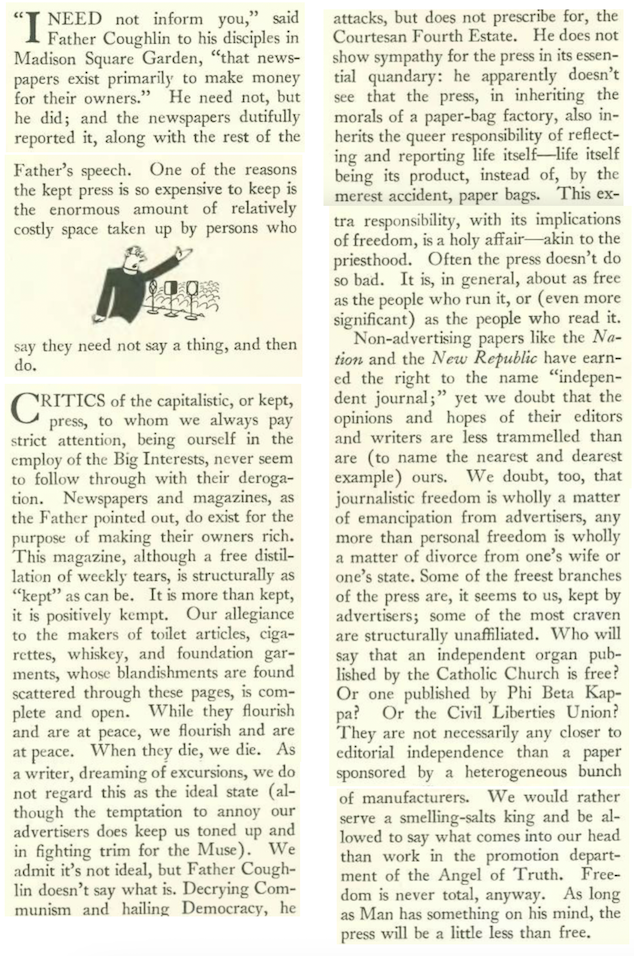
In his “Notes and Comment,” E.B. White contemplated the meaning of a free press, noting that nearly all media was at the mercy of advertisers. That included The New Yorker, which owed allegiance “to the makers of toilet articles, cigarettes, whiskey, and foundation garments.”

* * *

Cat Lady

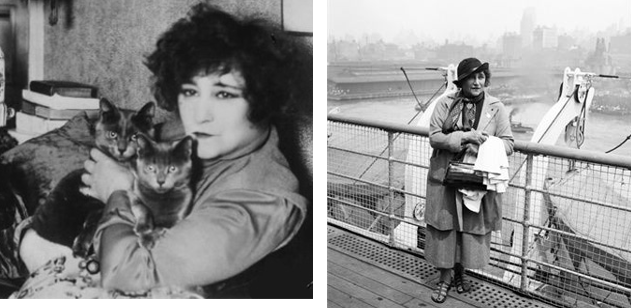
“The Talk of the Town” anticipated the arrival of French writer Colette (1873-1954) aboard the S.S. Normandie. This excerpt makes note of her high standing in society as well as her love of cats.

SHE ONCE OWNED AN OCELOT….Colette with her cats in an undated photo; at right, entering New York Harbor on the S.S. Normandie, 1935. (Pinterest)


 * * *

Public Artists

“The Talk of the Town” noted the latest Washington Square Outdoor Art Exhibition…

LENDING THEIR TALENTS…New Yorker cartoonists who helped promote the Outdoor Art Exhibition in Washington Square included James Thurber, Otto Soglow, and William Steig.

 * * *

Cutting Remarks

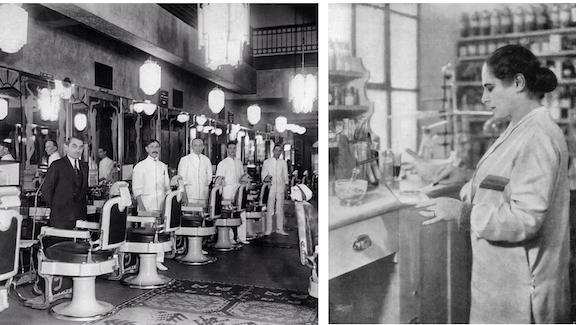
S.J. Perelman offered his thoughts on the decline of the tonsorial arts. In this excerpt, he sees his beloved Italian barber give way to a “knifelike individual in a surgical apron.” Excerpts:

IT’S A SCIENCE NOW, SIDNEY…S.J. Perelman worried about the displacement of Italian barbershops by cosmetologists in “surgical aprons,” such as the one modeled by Helena Rubinstein at right. (Pinterest)

* * *

Even Those Eyes Couldn’t Help

Film critic John Mosher was sad to report that disappointment was in store for moviegoers who enjoyed seeing Bette Davis in Of Human Bondage. Her latest flick, The Girl from 10th Avenue, featured Davis murmuring “gentle nothings of a vaguely noble monotony.”

GET ME OUT OF THIS PICTURE…Left, Bette Davis with Ian Hunter in the uninspired The Girl from 10th Avenue; at right, screen shot of Davis in 1934’s Of Human Bondage, the film that made Davis a star.  (thefilmexperience.net)

Other items in the editorial section included a casual by Dorothy Parker’s husband Alan Campbell (titled “Loyalty at Pool-Wah-Met”), and Morris Markey examined the Christian Science movement inspired of Mary Baker Eddy, in “A Reporter at Large” piece titled “But Thinking Makes It So.”

 * * *

From Our Advertisers

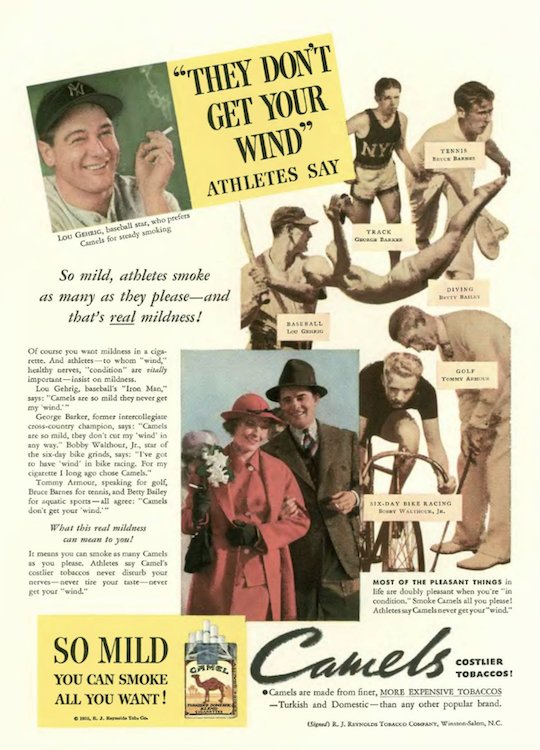
We begin with an advertising theme common through midcentury, namely, that you could smoke certain brands as much as you liked and still be a star athlete (as opposed to a wheezing husk of a human being)…

…not only did these cigarettes “steady your nerves” and preserve your “wind,” they also made for sweet, romantic moments…

…in between puffs you could also enjoy breathing in fumes from leaded gasoline…lead pollution increased by more than 625 times previous levels after leaded fuels were introduced in 1924…

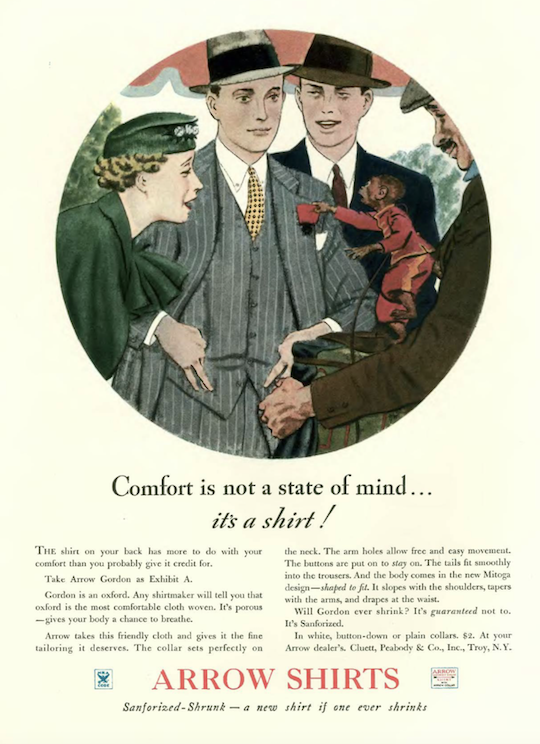
…although they were being outlawed by New York Mayor Fiorello Henry La Guardia, an organ grinder nevertheless made an appearance in an Arrow Shirt ad that offered a lighthearted moment for all involved (except for the dude on ketamine)…

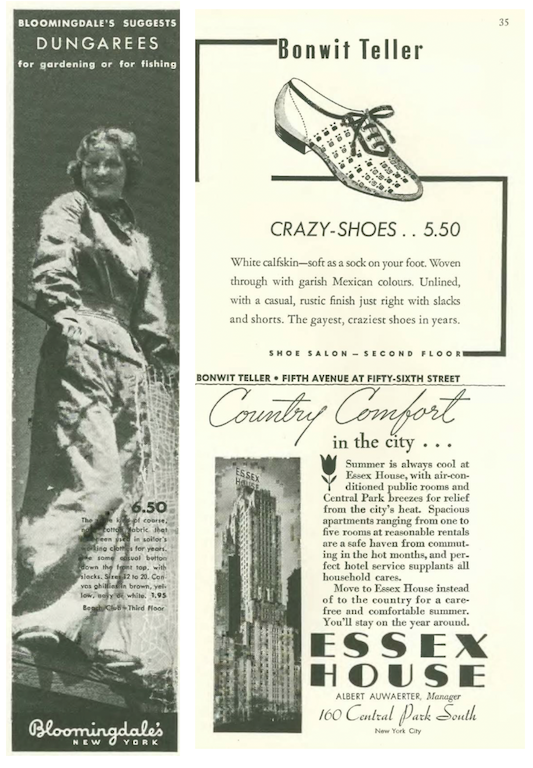
…when jeans were called “dungarees” they were reserved for gardening or fishing…at right you could land a pair of “Crazy Shoes” woven with “garish Mexican colours” for five-and-a-half bucks…

…the makers of White Rock kept it cool with this minimalist ad…

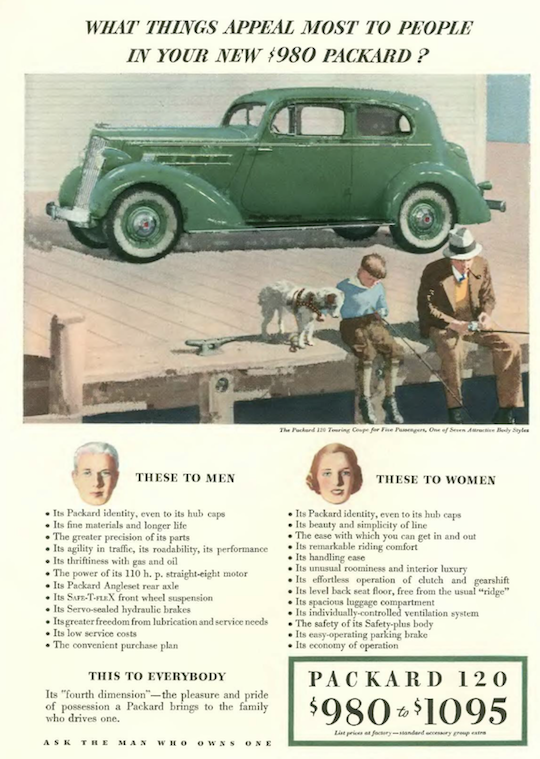
…luxury automaker Packard continued to hang on through the Depression by offering a downscale version…it appears their demographic was middle-aged men and women who still preferred the finer things even if they couldn’t afford them…

…now the property of Hearst, Otto Soglow’s Little King could still appear in The New Yorker via the advertising sections…

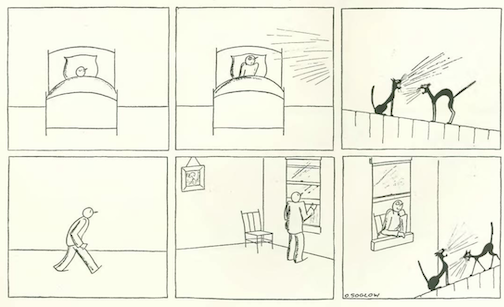
…and Soglow continued his contribution to the magazine’s cartoons with other multi-panel subjects…

James Thurber kicked off the cartoonists with this tender spot…

…and contributed this cartoon…

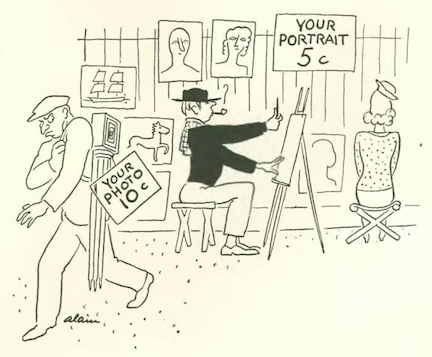
Alain found competition in the portrait trade…

George Price was still afloat…

Charles Addams was tied up with the sculptural arts…

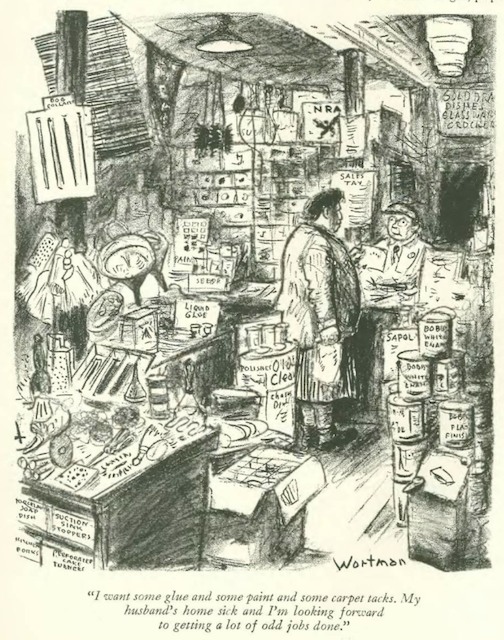
Denys Wortman shopped for DIY projects…

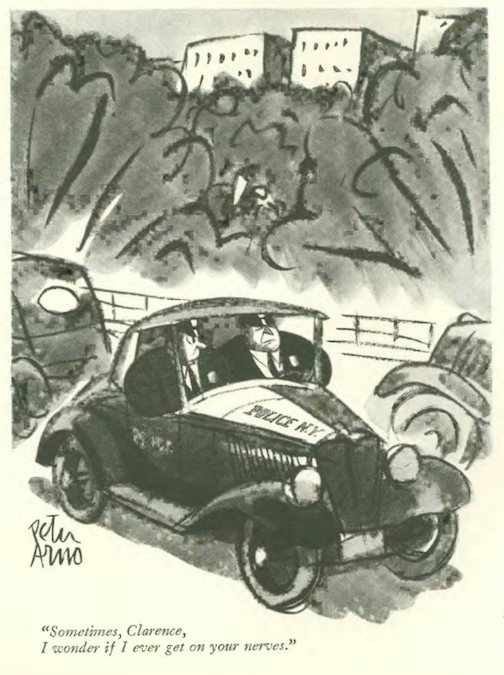
Peter Arno found a sensitive side in one member of the NYPD…

Mary Petty made some alterations…

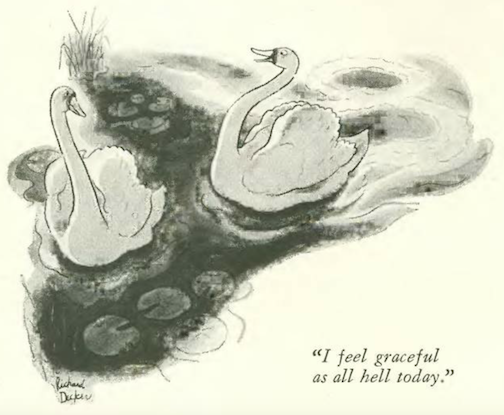
…and we close with this terrific cartoon by Richard Decker

Next Time: Not a Square Deal…


The Royal Treatment

Above: King George V and Queen Mary posed for portraits by John St Helier Lander to commemorate the king’s Silver Jubilee in 1935. (Wikipedia) 

The British Royal Family has never been my cup of tea, but its hard to deny their influence on world affairs, even if today it is mostly ceremonial. The king and queen were also figureheads back in 1935, however they could still claim to lead a vast empire, albeit one badly fraying at the seams.

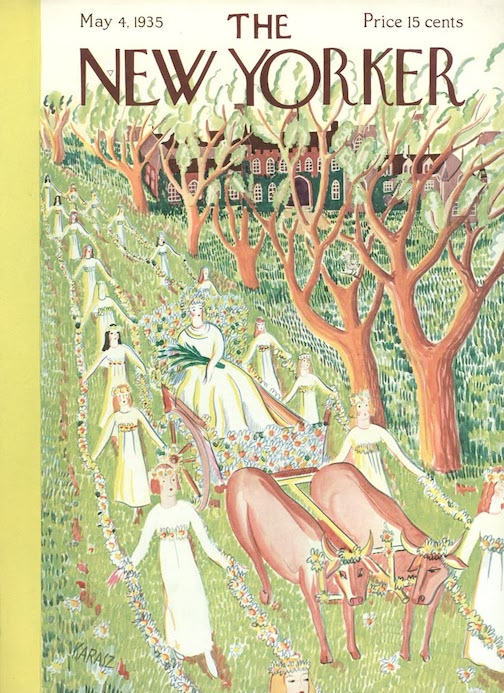
May 4, 1935 cover by Ilonka Karasz.

Then as now, the power of the royals lay largely in their ability to boost the political and economic fortunes of their island nation. Such was observed by The New Yorker’s Paris correspondent Janet Flanner, who penned a two-part profile of Queen Mary (nee Mary of Teck or more formally Victoria Mary Augusta Louise Olga Pauline Claudine Agnes; Queen of the United Kingdom and the British Dominions, and Empress of India). Flanner wrote the profile of Queen Mary (1867-1953) in anticipation of the Silver Jubilee of her husband, King-Emperor George V (1865-1936). Excerpts:

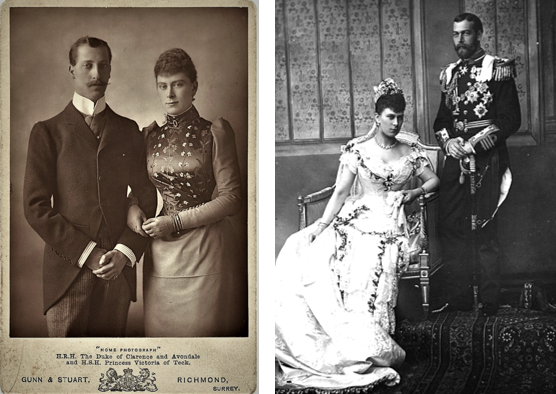
A DEB AND A DUKE…In 1886 Mary was a an unmarried British princess who was not descended from Queen Victoria, so she was a suitable candidate for the royal family’s most eligible bachelor, Mary’s second cousin Prince Albert Victor, Duke of Clarence and Avondale. In early December 1891 Albert Victor (left photo) proposed marriage to Mary, but he died six weeks later in the Russian flu pandemic. Less than two years later (July 1893) Albert Victor’s brother, Prince George, Duke of York, would wed Mary—at right, their wedding day photo. (Wikipedia)

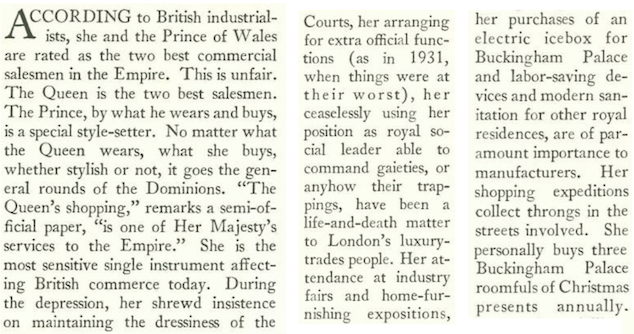
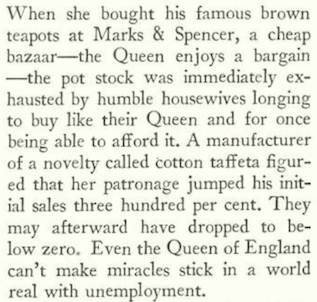
Flanner noted that the King George V and Queen Mary were rated by British industrialists as the Empire’s “two best salesmen,” however it was Mary who proved the most influential whether she was buying a hat or a refrigerator. Excerpts:

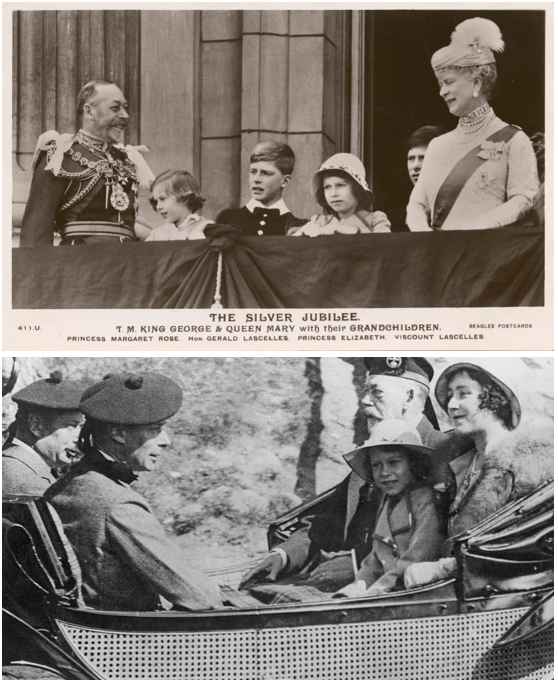
SILVER AND GOLD…Top photo: to mark the king’s Silver Jubilee on May 6, 1935, King George V and Queen Mary greet their subjects from a balcony at Buckingham Palace with their grandchildren, (from left) Princess Margaret Rose, Hon. Gerald Lascelles, Princess Elizabeth, and Viscount Lascelles. Below, King George V, the Duke and Duchess of York, and Princess Elizabeth take a trip in the royal carriage, 1933. The Duke and Duchess would succeed the throne upon the death of King George in 1936 and the abdication of the Duke’s brother, Edward, that same year. (Reddit/Town & Country)

Naturally, not everyone in the kingdom was thrilled by the Silver Jubilee…

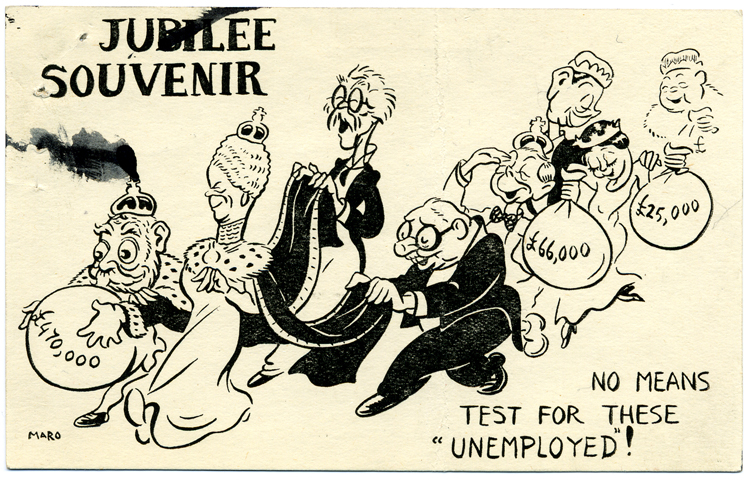
OPPOSING VIEWPOINT…The anti-monarchist cartoonist Desmond Rowney commemorated the Silver Jubilee with this cartoon in the Daily Worker. The public expense for the Silver Jubilee in the midst of a financial depression caused some controversy. (National Archives UK)

 * * *

Corn-fed Canvasses

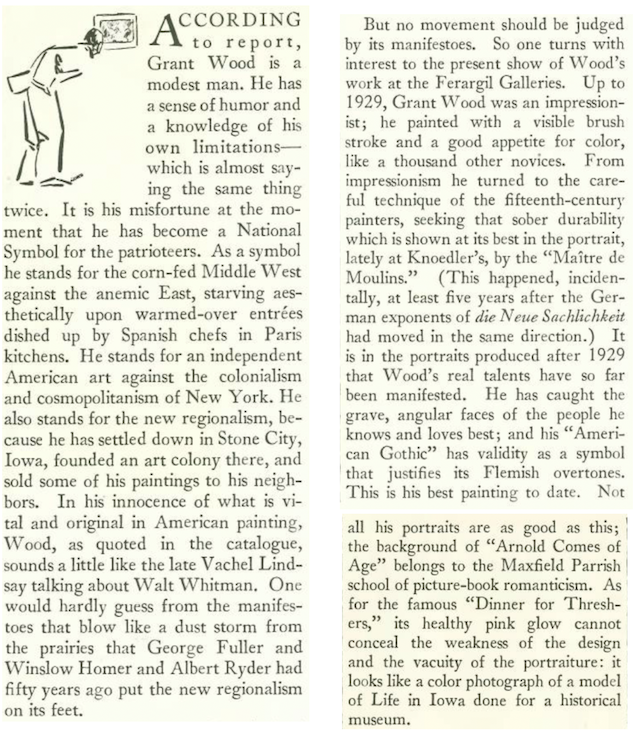
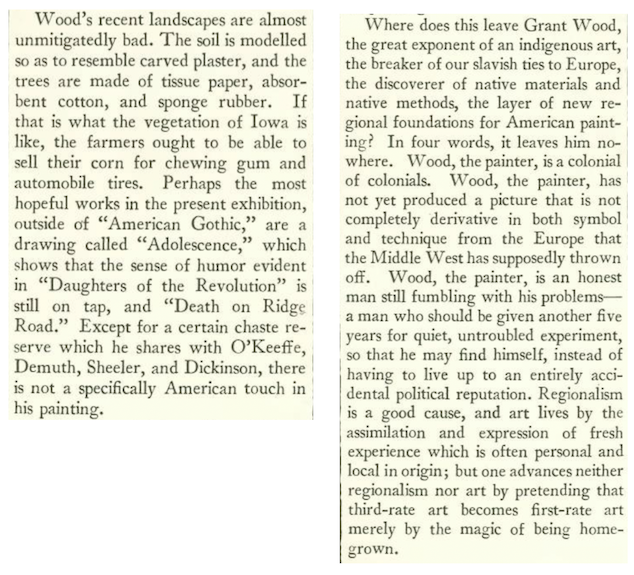
Critic Lewis Mumford, like many East Coast intellectuals, was allergic to the over-patriotic and the sentimental, so when it came to assessing the work of the regionalist painter Grant Wood (1891-1942), Mumford found himself perplexed but hopeful that Wood would one day “find himself” and produce “first rate” art.

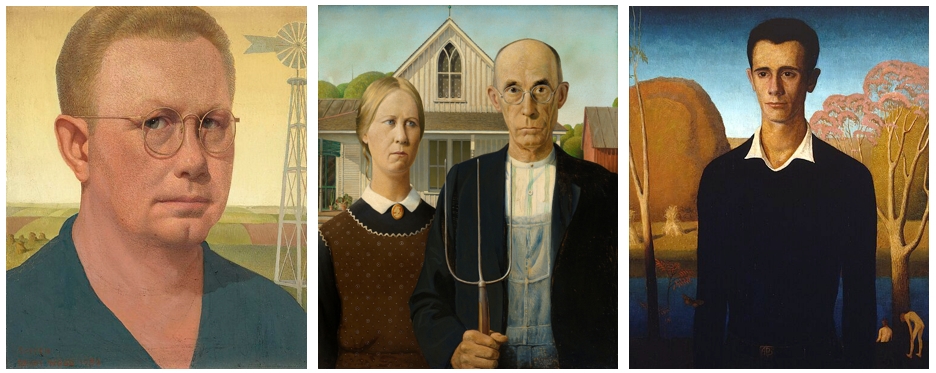
FLANKING THE ICONIC painting American Gothic (1930) are Grant Wood’s Self Portrait (1932) and, at right, Arnold Comes of Age (1930). Lewis Mumford considered American Gothic to be Wood’s best work. (figgeartmuseum.org/whitney.org/sheldonartmuseum.org)

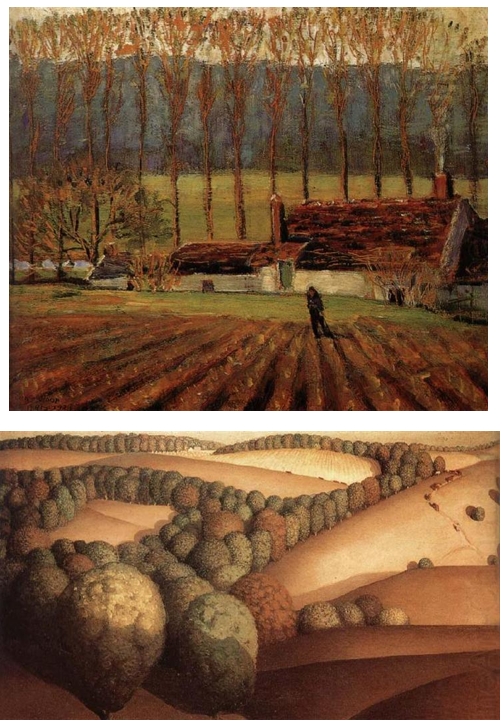
Mumford did not mince words, however, when it came to Wood’s contemporary landscapes, which he called “unmitigatedly bad…If that is what the vegetation of Iowa is like, the farmers ought to be able to sell their corn for chewing gum…”

BUBBLEGUM TREES…From 1919 to 1925, Grant Wood taught junior high art in Cedar Rapids, Iowa. The seasonal nature of teaching allowed Wood to take summer trips to Europe to study art, and his early work showed strong post-impressionist influences, including his impressionistic Vegetable Farm (top) from 1924; below, Mumford thought Grant’s later landscapes looked like they were made of cotton and sponge rubber, including Near Sundown, from 1933. (wikiart.org)
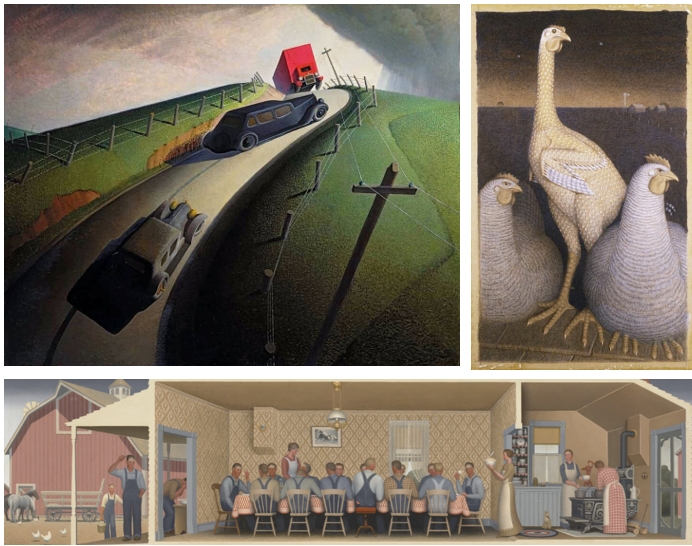
HOPE AND NOPE…Mumford wrote that Wood’s more “hopeful” works included, top left, Death on Ridge Road and, top right, Adolescence. On the other hand, he found the portraiture in Dinner for Threshers (bottom) vacuous, suggesting “a color photograph of a model of Life in Iowa done for a historical museum.” (wikiart.org/figgeartmuseum.org)

 * * *

Daring Young Man

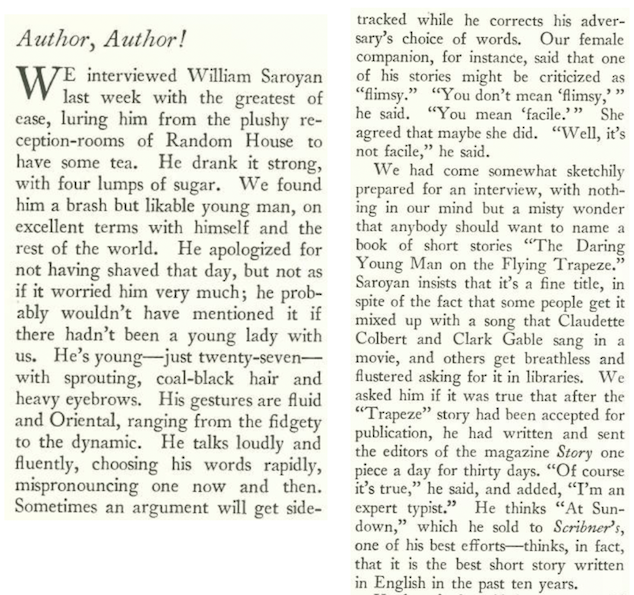
“The Talk of the Town” paid a visit to William Saroyan (1908–1981), an Armenian-American novelist, playwright, and short story writer who would go on to receive a Pulitzer Prize for Drama in 1940 and a 1943 Academy Award for Best Story for the film The Human Comedy. An excerpt:

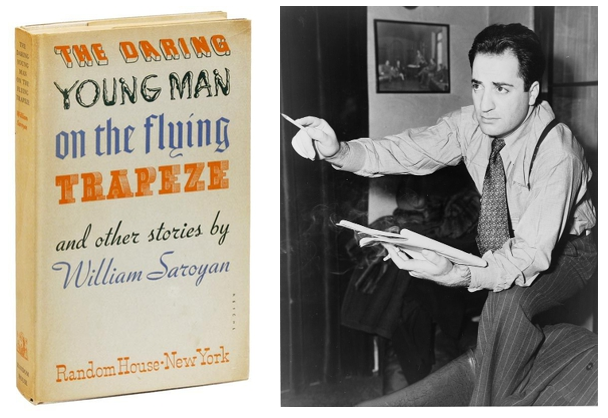
HIGH WIRE ACT…The Daring Young Man on the Flying Trapeze and Other Stories (1934) was the first collection of 26 short stories by William Saroyan (pictured here in 1940). The book became an immediate bestseller. (Wikipedia)

 * * *

Not Long For Long

In his column “Of All Things,” Howard Brubaker noted that the “loose talk” of Huey Long, a U.S. Senator from Louisiana and prominent critic of the New Deal, could be squelched by a Senate vote. As it turned out, it wouldn’t be necessary; Long was felled by an assassin’s bullet four months later.

 * * *

Ode to Abode

E.B. White turned to verse to offer his thoughts on where one should live:

 * * *

Tough Guys

After a musical comedy, a Shakespeare adaptation (A Midsummer Night’s Dream), and another comedy, James Cagney returned to familiar form with an exciting crime drama, G Men. Critic John Mosher was pleased that Cagney was back to tap-dancing with machine guns rather than showgirls.

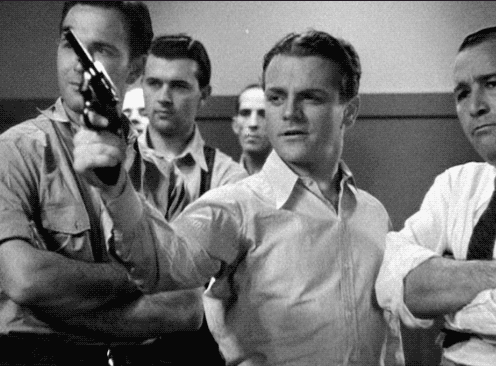
CRIME PAYS…AT THE BOX OFFICE… James Cagney takes aim at his new role as a federal agent James “Brick” Davis in G Men. With the Hays Code in force, Warner Brothers made the film to counteract what many leaders claimed was a disturbing trend of glorifying criminals in gangster films. (Still from film)

 * * *

From Our Advertisers

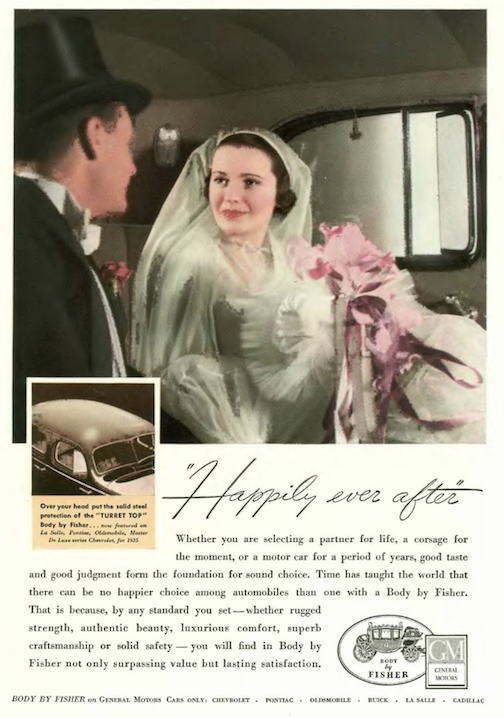
According to General Motors’ Fischer division, good taste was in order whether you were choosing a spouse or an automobile…

New Yorker ads continued to display bright colors to sell everything from cars to whiskey to sparkling water (with apparent health benefits)…

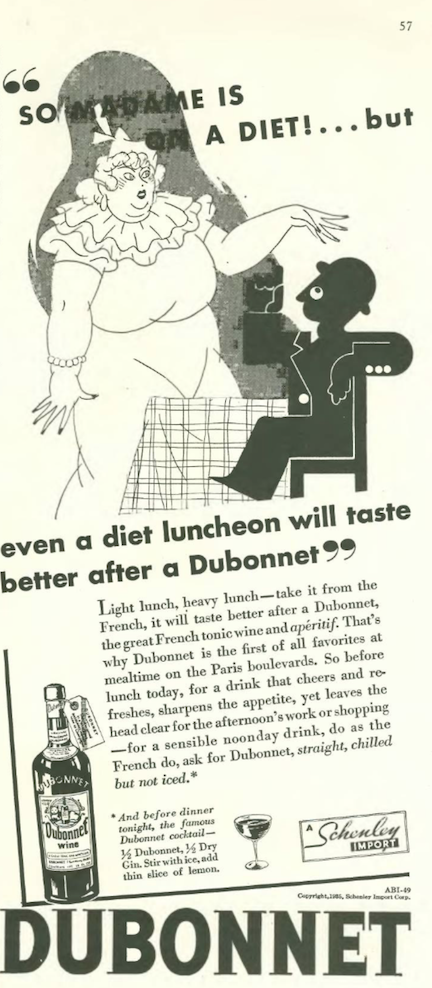
…the shadowy Dubonnet mascot was back, here making the claim (against the wisdom of the ages) that a lunchtime drink will clear your head for the afternoon ahead…

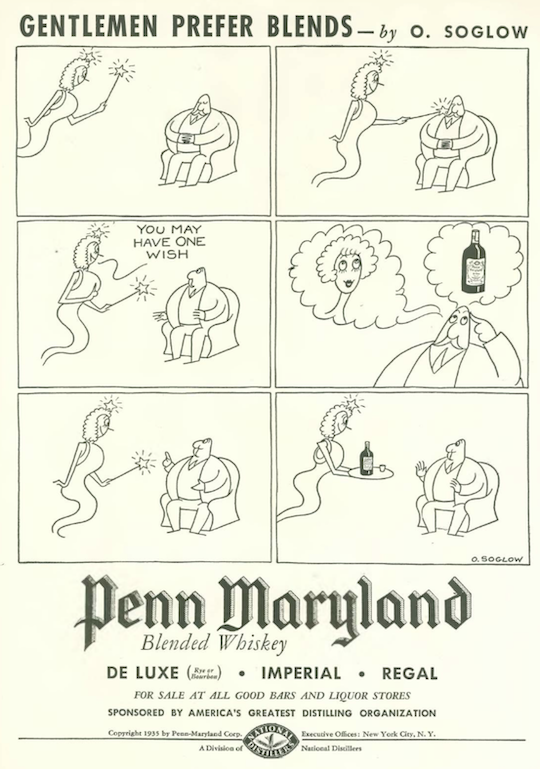
…no health claims here from Penn Maryland, just pure magic as depicted by Otto Soglow

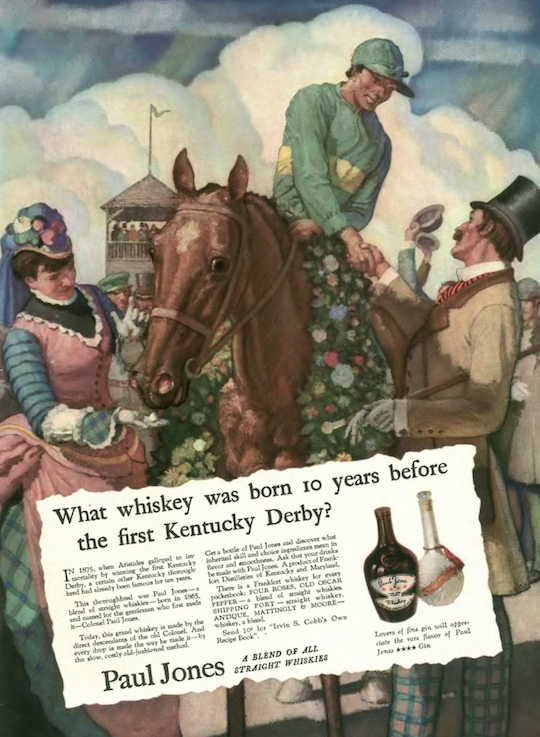
…and what goes better with whiskey than the Kentucky Derby…

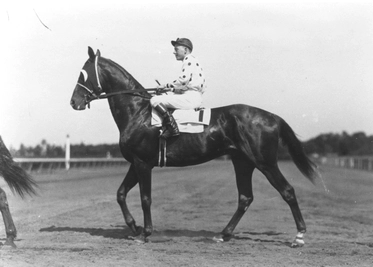
…the 1935 Kentucky Derby was won by Omaha, a three-year-old Thoroughbred; he was the third horse to ever win the Triple Crown (Omaha was the son of Gallant Fox, the 1930 U.S. Triple Crown winner)…

Omaha in 1935 (Wikipedia)

…on the subject of Thoroughbreds, Camel offered up testimonials from top athletes in a variety of sports…they all agreed that the cigarettes “don’t get your wind”…so what did that mean?…according to R.J. Reynolds, “It means you can smoke Camels all you want”…

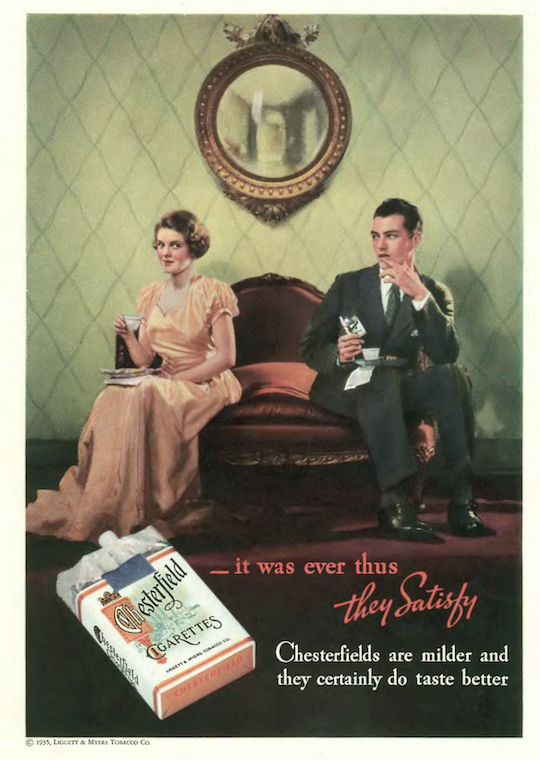
…Camels also calmed the nerves, and so apparently did Chesterfields…

…on to our cartoonists, we begin with a spot by Charles Addams at the top of page 2…

…later in the issue James Thurber contributed this drawing to stretch across the bottom of page 62 (“On and Off the Avenue”)…

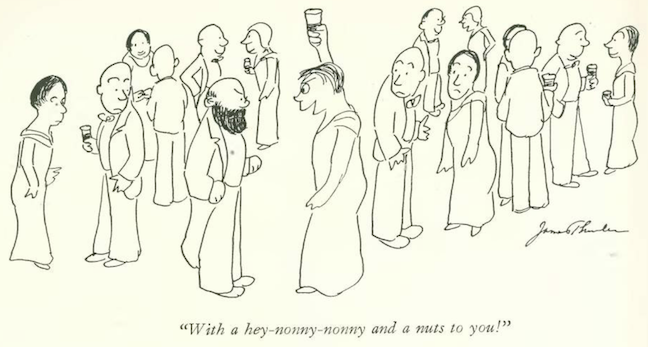
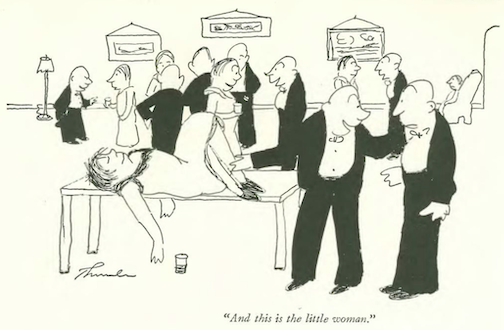
…Thurber again, with the life of the party…

William Steig offered up a page-full of wits…

…plus one more on the preceding page…

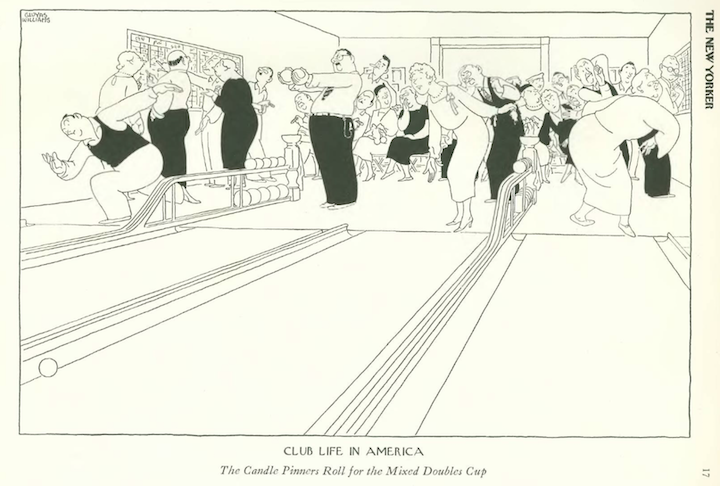
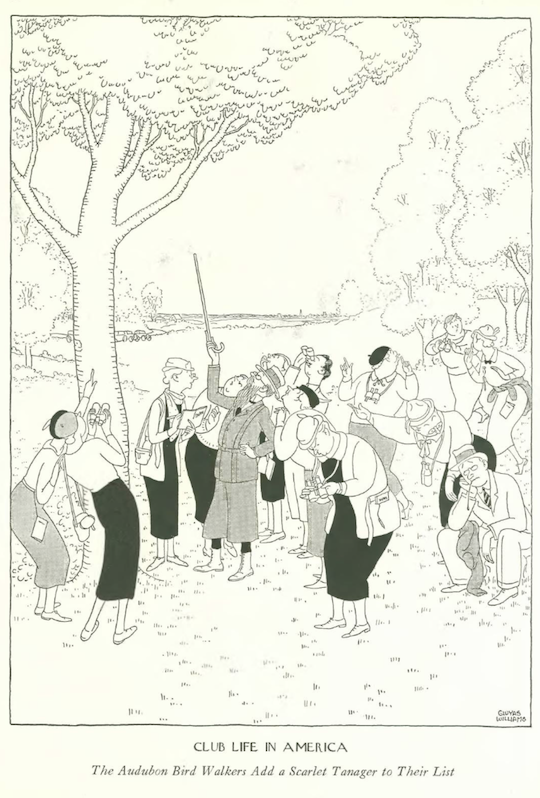
Gluyas Williams continued to follow the strange ways of club life in America…

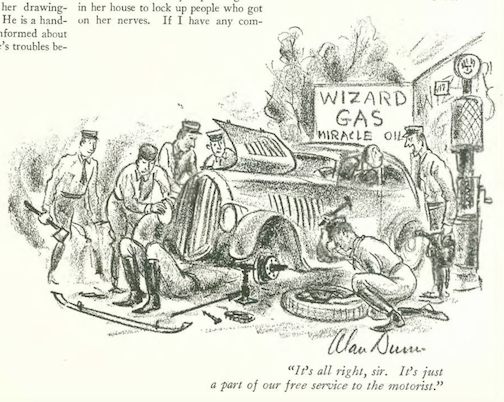
…and we close with Alan Dunn, and service with a smile…

Next Time: What’s In a Name?…


The Lighter Side of George Grosz

Above: Landscape in Bayside, 1935, by George Grosz (Phillips Collection)

Knowing that the Nazis would not look kindly on his art, George Grosz took a job teaching drawing in New York in 1932, and by 1933 he had become a permanent resident of the city.

March 30, 1935 cover by Garrett Price celebrated the traditional “Bock” beer of spring.

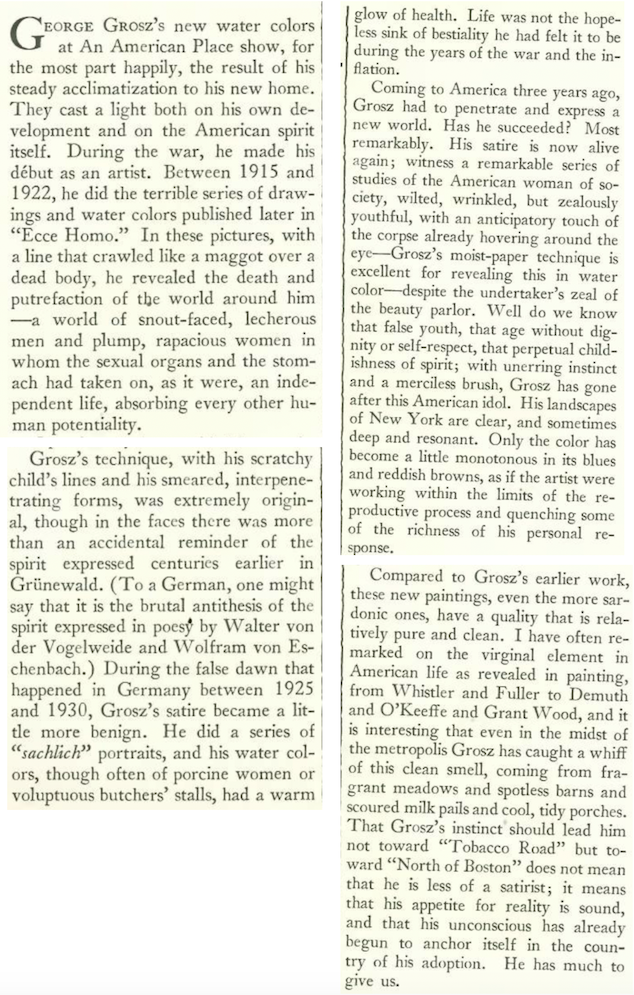
Grosz (1893–1959) was overwhelmed by the size and pace of his adopted city, and for the most part he left behind his bitter caricatures and paintings of Berlin’s Weimar years and turned to other subjects, including landscapes and New York’s urban life. Critic Lewis Mumford took in a show of Grosz’s new water colors at An American Place, a small gallery run by photographer and art dealer Alfred Stieglitz. 

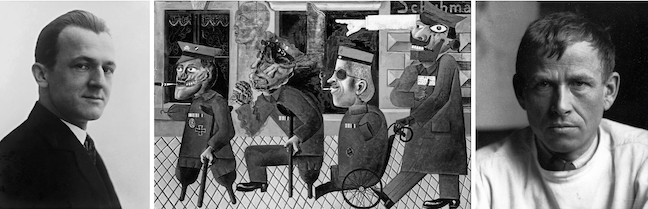
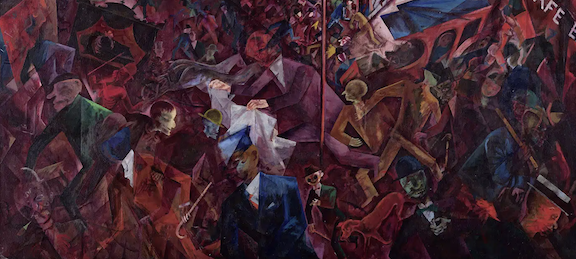
THE NEW OBJECTIVITY…George Grosz (left, circa 1921), was not alone in his harsh depictions of war and of German society during the Weimar Republic. Other key figures in the New Objectivity (Neue Sachlichkeit) movement included Max Beckmann and Otto Dix (right, circa 1929). Dix’s oil on canvas War Cripples (Kriegskrüppel), 1920, which is pictured above, was exhibited at the First International Dada Fair in Berlin in 1920. Only black and white images exist of the painting, which is believed to have been destroyed by Nazis who condemned it as degenerate art. (Wikimedia Commons/CUNY)

OH THE HUMANITY…Three selections from the “Ecco Homo” series by George Grosz. From left, Gruß aus Sachsen (Greetings from Saxony) 1920; Nachts, (At Night) 1919; and Schwere Zeiten (Hard Times) 1919. Grosz took a dim view of the corruption and moral decline he found in Weimar Berlin. (MoMA)
SEEING RED…Detail from George Grosz’s Metropolis, Oil on Canvas, 1916-1917. A blood-like shade of red could be seen in many of the artist’s paintings during World War I and the Weimar Republic. In this painting and in others, death is omnipresent. (Thyssen-Bornemisza Museum, Madrid)
A SOFTER SIDE could be found in George Grosz’s later watercolors, although he hadn’t entirely lost his sense of the satirical, or his taste for red paint. From left, Street in Harlem, circa mid-1930s; Ehepaar (A Married Couple), 1930; Central Park at Night, 1936. (Phillips Collection/Tate Gallery/Art Institute Chicago)
 * * *
Not the Bee’s Knees
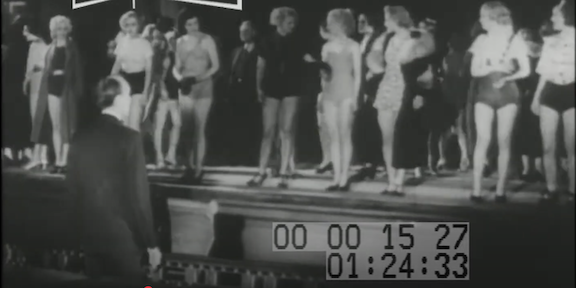
For all the progressive thinking that was on display in the early New Yorker, we also reminded that it was also a creature of its time in 1935. Here are excerpts from a lengthy “Talk of the Town” entry that described the sad winnowing process of Broadway revue producer Earl Carroll

JUDGEMENT DAY…Here is a screenshot from a short film featuring the 1935 audition described in the “Talk” segment. At left is Earl Carroll. You can watch the film here. (YouTube)

 * * *

Too Little For Too Much

Film critic John Mosher gave Alfred Hitchcock’s 1934 version of The Man Who Knew Too Much just five lines in his review. He described it as “one of those preposterous adventure stories which Englishmen are always writing…” The film, however, was an international success, and it would define the rest of Hitchcock’s career as a director of thrillers with a unique sense of humor.

A HAPPY, CAREFREE HOUR is how critic John Mosher described his experience watching 1934’s The Man Who Knew Too Much. Clockwise, from top right, director Alfred Hitchcock with the film’s German star, Peter Lorre, who learned his part phonetically; Lorre and Cicely Oates; Edna Best did her best at playing a grieving mother. The film was remade by Paramount in 1956, starring James Stewart and Doris Day. (Wikipedia/aurorasginjoint.com/IMDB)

 * * *

Dizzy Nor Dazzled

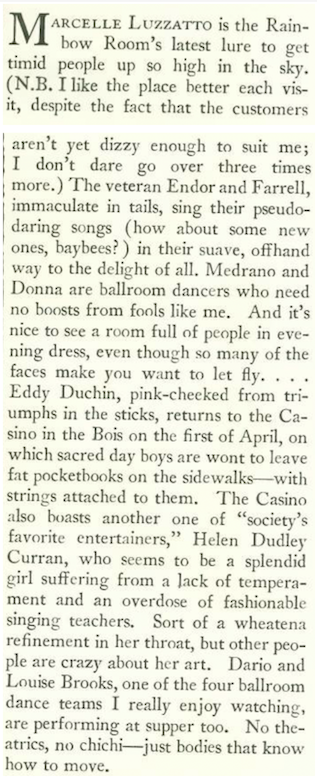
In 1935 Lois Long had been divorced from cartoonist Peter Arno for about four years, and she was the mother of six-year-old daughter from that marriage. That didn’t keep her from sampling the city’s night life, but the days of speakeasies and drinking sessions that lasted into the wee hours were over for the 34-year-old Long. For her “Tables for Two” column she took the elevator up to the 65th floor of 30 Rockefeller Plaza to take in the entertainment at the Rainbow Room…as well as the pedestrian crowd…

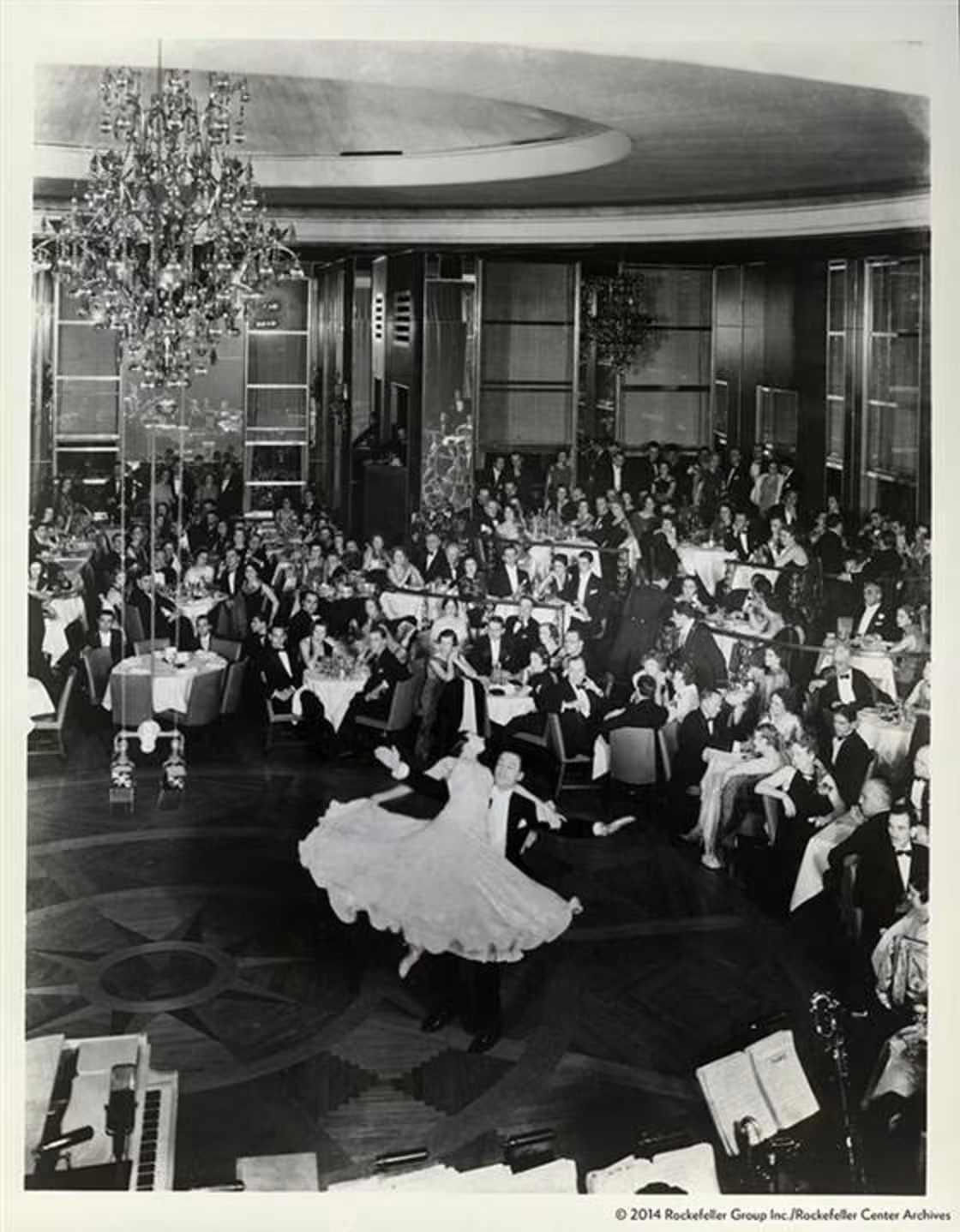
WHAT A WHIRL…Above, diners watch a performance by ballroom dancers Lydia and Joresco in the then newly opened Rainbow Room in 1934. Lois Long enjoyed the Rainbow Room in its 1930s heyday, but she missed her old speakeasy crowd, noting that the Rainbow Room’s customers weren’t “dizzy enough” to suit her tastes. (Rockefeller Center Archives)

…her speakeasy days were over, but it appears Long still enjoyed a bit of indulgence…here is how she concluded her column:

 * * *

From Our Advertisers

Step into a crowded mid-century elevator and you were bound to catch a whiff of the menthol-tinged scent of Aqua Velva, not objectionable if properly applied…

…speaking of menthol, the makers of Spud cigarettes were now competing with upstart menthol cigarette makers including Kool…this ad has all kinds of problems, including the suggestion that the occasional Spud not only inspires one’s nuptials, but also ensures marital bliss, as well as a lifetime of chain-smoking…

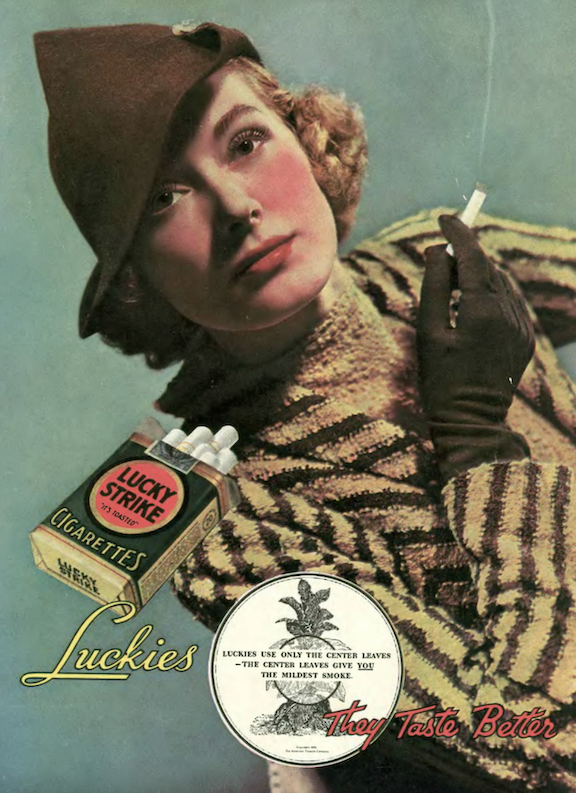
…Luckies, on the other hand, continued to appeal to the modern woman, and what impressionable young woman wouldn’t be inclined to pick up the habit to complete her ensemble?…

…the makers of College Inn tomato juice gave their raving Duchess the week off, but we get another old sourpuss in the form of a “Dowager” who demands that her servant remove a glass of what very well could have been tomato juice…enter the old bat’s niece, Dorothea, who suggests that the cook, Clementina, serve some Libby’s pineapple juice instead, probably spiked with vodka given the Dowager’s sudden change of demeanor…

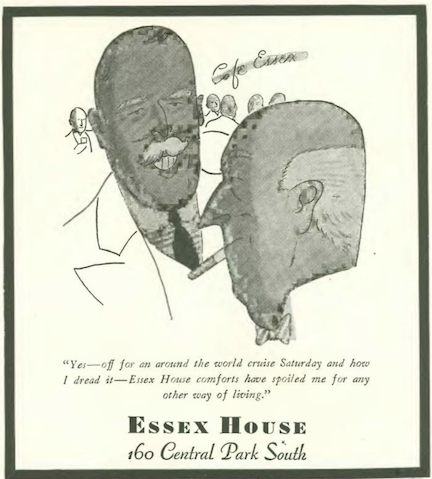
…Essex House continued their class-ridden ad campaign, this time with some stuff-shirt dreading his world cruise

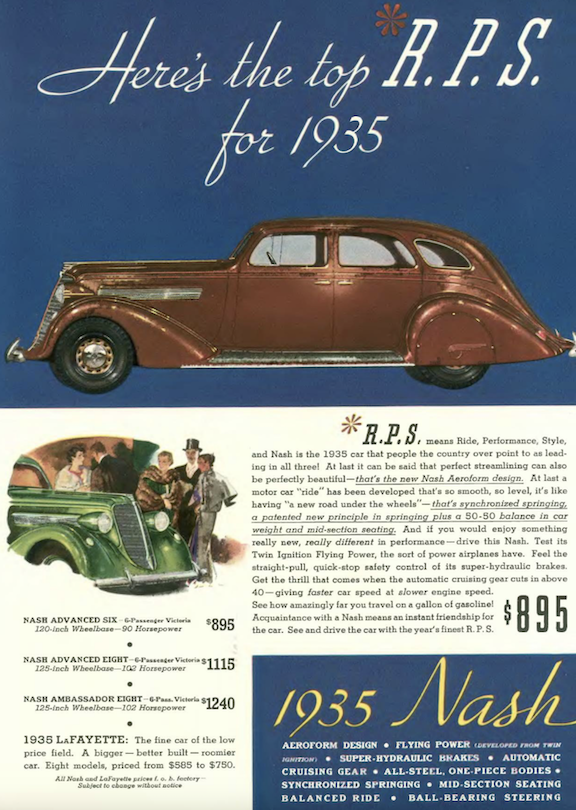
…carmakers continued to emphasize economy and price to move their latest models, including the 1935 Nash with “Aeroform Design”…

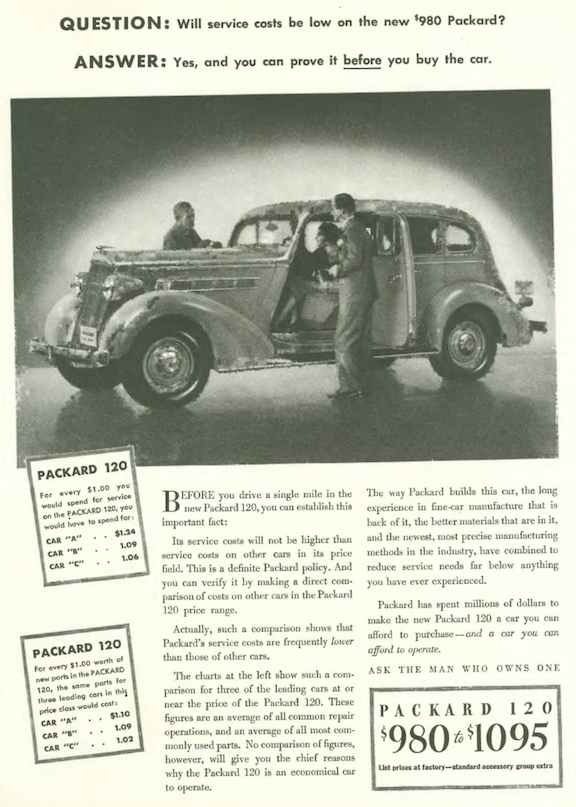
…last week I noted that Packard was doubling down on promoting the elite status of its premium automobile; however, the carmaker did introduce a “120” that cost a fraction of its luxury models and helped the company’s bottom line…


…Packard’s competition was Lincoln and Cadillac, among other luxury brands, but Pierce Arrow represented the pinnacle of luxury and craftsmanship, the American equivalent of Rolls Royce…unlike the other luxury brands, Pierce Arrow did not offer a lower-priced car, and the company folded it 1938…

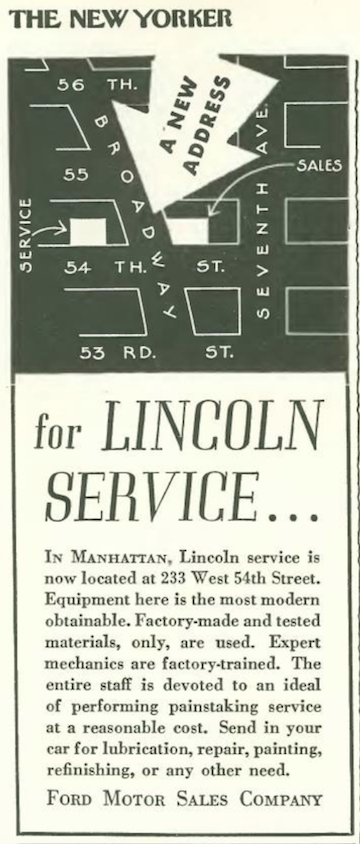
…speaking of luxury cars, if you owned a Lincoln, this little ad tucked into the top corner of page 55 showed you were to go to get a tune-up…

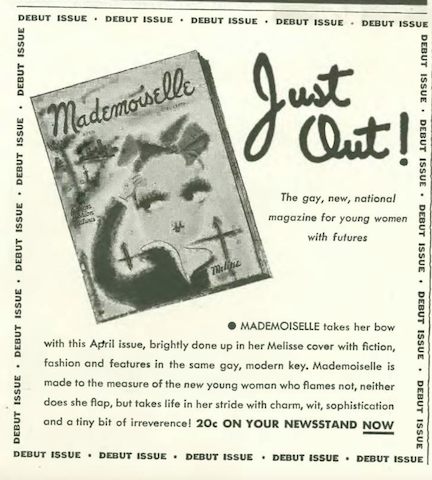
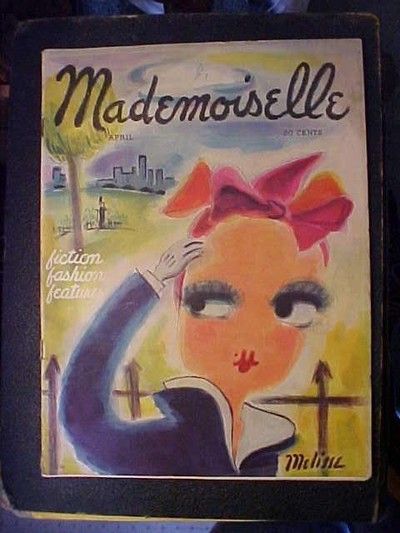
…the publishers at Street & Smith announced the launch of a new fashion magazine, Mademoiselle, a seemingly daring move in Depression America…the cover featured an illustration by Melisse (aka Mildred Oppenheim Melisse)…the magazine was later acquired by Condé Nast, and folded in November 2001…

Mildred Oppenheim Melisse’s cover for the debut issue of Mademoiselle, April 1935. Melisse also supplied the cover art for the May and June issues that year. (Pinterest)

Otto Soglow was on his way to becoming a wealthy man thanks to his “Little King” cartoon…William Randolph Hearst lured Soglow and the cartoon away from The New Yorker in 1934, so the only way the wee potentate could appear in the magazine was in an ad, like this one for Bloomingdale’s…

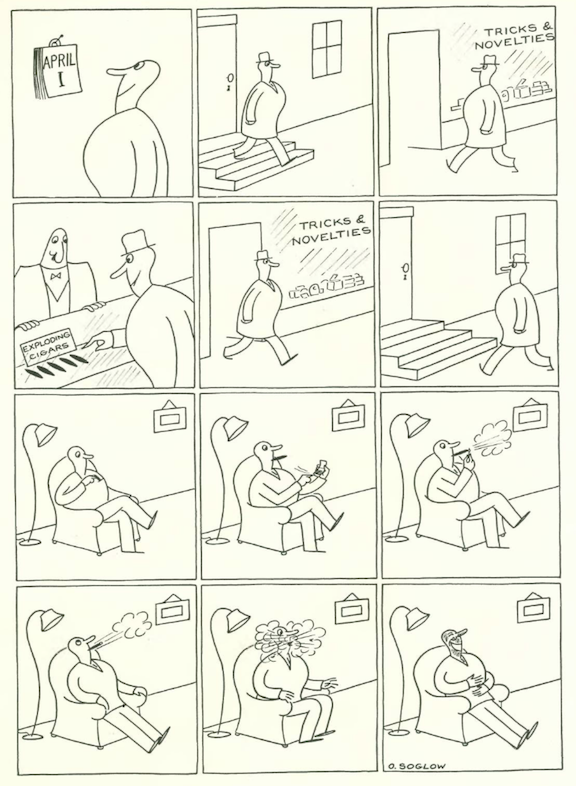
…Soglow continued to contribute to The New Yorker, and we kick off our cartoons with an April Fool’s joke…

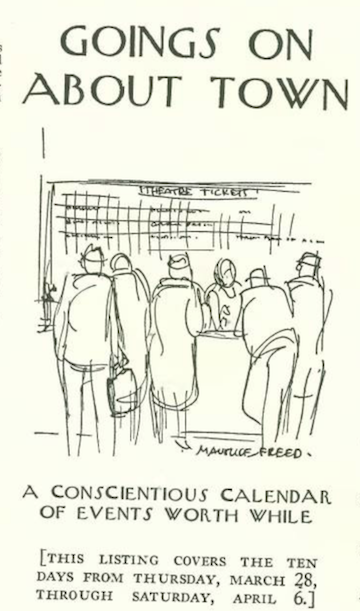
…for the second week in a row Maurice Freed supplied the opening spot art for “Goings On About Town”…

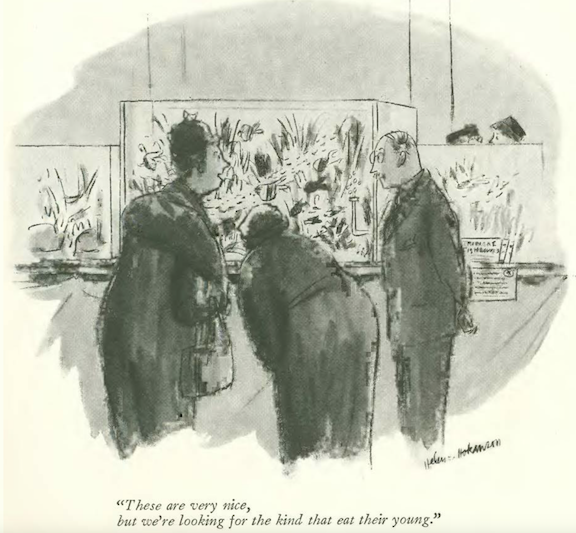
Helen Hokinson was on the hunt for some predatory fish…

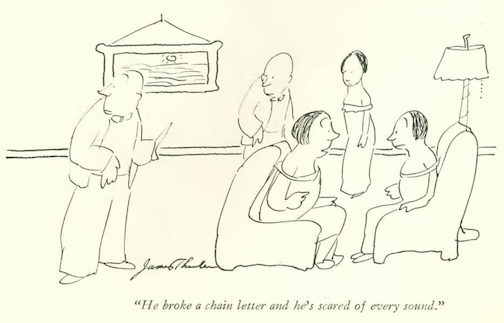
James Thurber looked in on the nudist fad that emerged in the 1930s…

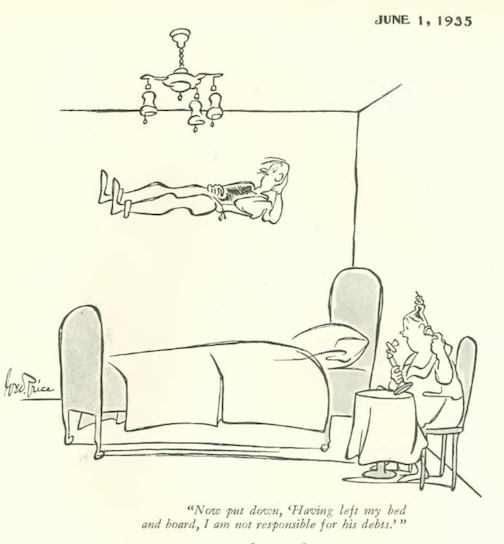
…and we close with George Price, an some alarming bedside manners…

Next Time: Keep Calm and Carry On…

Music in the Air

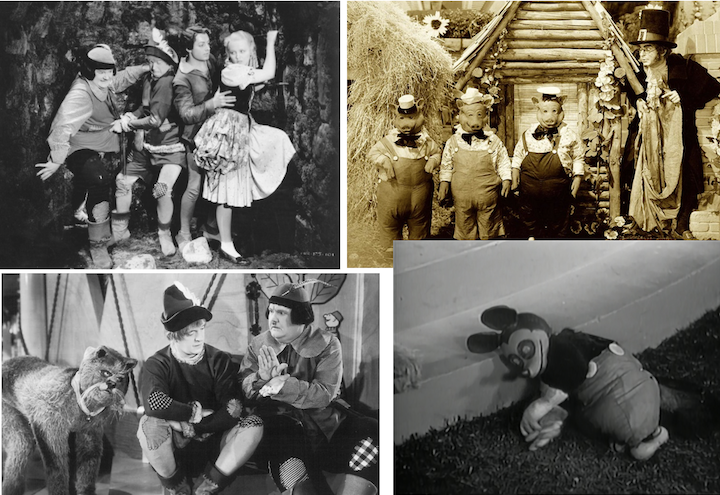
Above: The Cat and the Fiddle (Pete Gordon) and Mickey Mouse (a monkey in a very creepy costume) were featured in 1934's Babes In Toyland.

We close out the old year and ring in the new with a bit of song and dance from three musicals that entertained New Yorkers in the waning days of 1934.

Dec. 22, 1934 cover by Arnold Hall.

The work of composer Jerome Kern and lyricist Oscar Hammerstein II were prominent in two of those films, adapted from successful Broadway productions—the romantic comedy Music in the Air and the sentimental Sweet Adeline. Success on the stage did not necessarily translate to the screen in either case, according to critic John Mosher.

SOUR NOTES…The famed silent movie star Gloria Swanson showed off her singing chops in Music in the Air, but it wasn’t enough to save the film from becoming a box office failure. The film centered on the stormy relationship between opera star Frieda Hotzfelt (Swanson) and librettist Bruno Mahler (John Boles, pictured). (TCM)
TALL ORDER…For those who recalled Helen Morgan’s tragedy-tinged Broadway performance as Addie in Sweet Adeline, Irene Dunn’s more comical take, although delivered with authority, could not hold up the pallid performances of her co-stars, including Donald Woods, right. (TCM)

And there was Babes in Toyland, a Hal Roach film headlined by the comedy duo Stan Laurel and Oliver Hardy. The film was well received by critics, including Mosher, who wrote that Babes in Toyland “was far more successful than [1933’s] Alice in Wonderland, and the children will probably be far less bored by it than they generally are by those films designed especially for them.” However, similar to Alice the costumes seem creepily crude, such as the weird rubber pig costumes and the almost terrifying Mickey Mouse, portrayed by a hapless monkey dressed to resemble the big-eared icon. It was apparently the first and last time Walt Disney allowed the Mickey Mouse character to be portrayed outside of a Disney film. No wonder.

Clockwise, from top left, Stan Laurel and Oliver Hardy with Felix Knight (Tom-Tom) and Charlotte Henry (Bo-Peep); the Three Little Pigs with the villain Silas Barnaby, portrayed by Henry Brandon; a very creepy Mickey Mouse (a monkey in costume); and Laurel and Hardy with The Cat and the Fiddle (Pete Gordon). (eofftvreview.wordpress.com/psychotronicaredux.wordpress.com/YouTube/MUBI)

 * * *

Alms for the Poor

Woolworth store heiress Barbara Hutton was one of the richest women in the world in the 1930s, and her lavish lifestyle in the midst of Depression attracted the attention, and the ire, of newspaper columnist Ed Sullivan. In his “Notes and Comment,” E.B. White made this observation:

COUGH IT UP, LADY…Ed Sullivan, who in 1934 was a well-known Daily News show business columnist, thought Woolworth dime store heiress Barbara Hutton should show more concern for the needy. Known for her lavish spending during the Great Depression, in 1934 Hutton was married to a self-styled Georgian prince named Alexis Mdivani—Mdivani would be the first of Hutton’s seven husbands. Sullivan would go on to greater fame on television with the Ed Sullivan Show. (clickamericana.com/npg.org.uk)

 * * *

Oh Baby

Most of us know something about the weird and somewhat tragic tale of the Dionne quintuplets, raised from infancy before the public gaze and exploited to sell everything from dolls and books to soap and toothpaste. When E.B. White made this brief mention in his “Notes and Comment,” the story of the quintuplets was still a jolly one, and their delivering physician, Dr. Allan Roy Dafoe had gone from being a country doctor to one of North America’s most trusted medical authorities. Dafoe would become the childrens’ guardian and impresario, and make a fortune marketing their story and images.

QUINTUPLE YOUR MONEY…After he delivered the Dionee quintuplets, Dr. Allan Roy Dafoe went from being a country doctor to one of North America’s most trusted medical authorities. That later translated into big profits from companies eager to cash in on the quint’s popularity, as these 1937 ads attest. (Pinterest)

 * * *

In the Year 2400

“The Talk of the Town” examined the “Buck Rogers” craze, fed by a cartoon strip, a radio show, and an array of toys.

YESTERDAY’S TOMORROW…A Buck Rogers “pop-up” book was just one of the many formats that could be consumed by avid followers of the early sci-fi hero. Also pictured are a themed pocket watch and the “must have” sci-fi toy of 1934, Buck’s XZ-31 Rocket Pistol. (Pinterest/Bullock Museum)

 * * *

What’s It All About, Alfie?

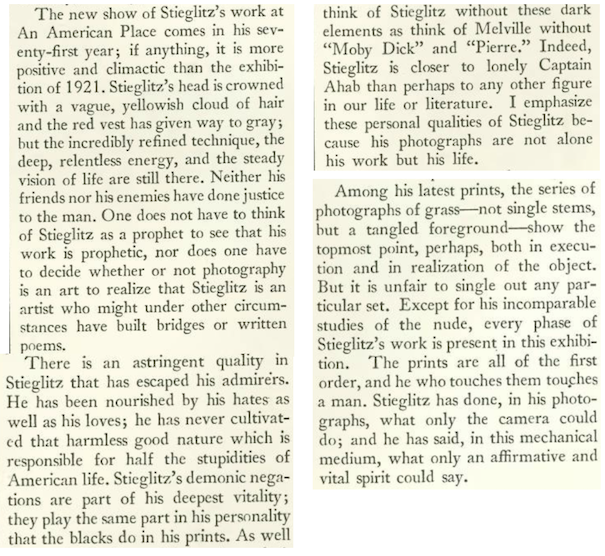
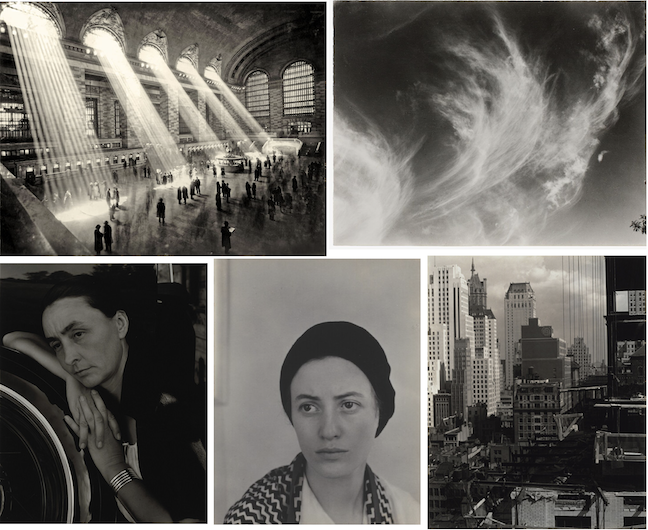
Art and architecture critic Lewis Mumford offered praise for Alfred Stieglitz’s latest exhibition at the photographer’s gallery, An American Place. Mumford noted Stieglitz’s “astringent quality” that rose above the philistine tastes and “stupidities” of American life.

LIFE AND WORK INTERTWINED…Clockwise, from top left: Alfred Stieglitz’s famed 1930 image of Grand Central Terminal; one of the photographer’s many images of clouds under the title Equivalent, 1930; image taken from Stieglitz’s studio/gallery window titled From My Window at An American Place, North, 1931; Dorothy Norman, circa 1931; Georgia O’Keeffe, 1933. Stieglitz, who was married to Georgia O’Keeffe, became Dorothy Norman’s mentor and lover in the late 1920s. (National Gallery of Art/Art Institute of Chicago)

 * * *

From Our Advertisers

The back cover of The New Yorker was coveted by tobacco companies, the makers of Camels and Lucky Strikes (seen here) both featuring sumptuous photos of stylish women using their product, women being a key growth market for the companies…

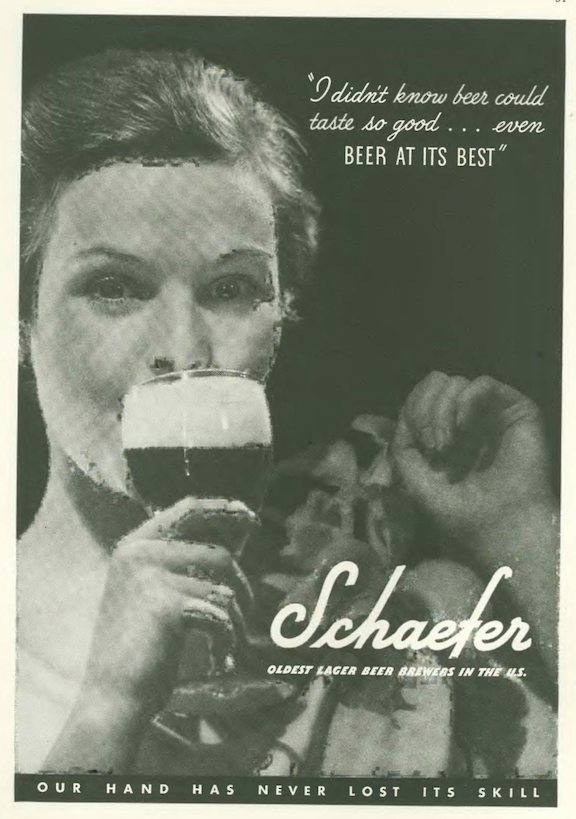
…same for the brewers, who also sought out female consumers to bolster sales of their brands…

…Ponds continued to roll out the seeming legions of socialites and lower-tier royalty to sell their jars of cold cream…

…the magazine’s ads were often directed at middlebrow class anxieties, as we see here…

…by constrast, this ad from Bonwit Teller (graced by fashion illustrator W. Mury) took us out of the stuffy parlor and onto the beckoning beaches of the Caribbean…

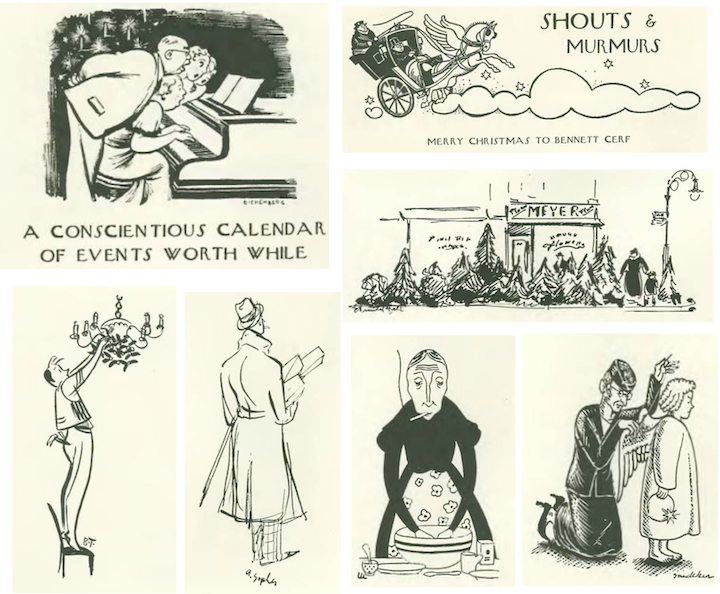
…we move on to our cartoonists…all of the spot illustrations in the issue were holiday-themed, and here are a few choice examples…

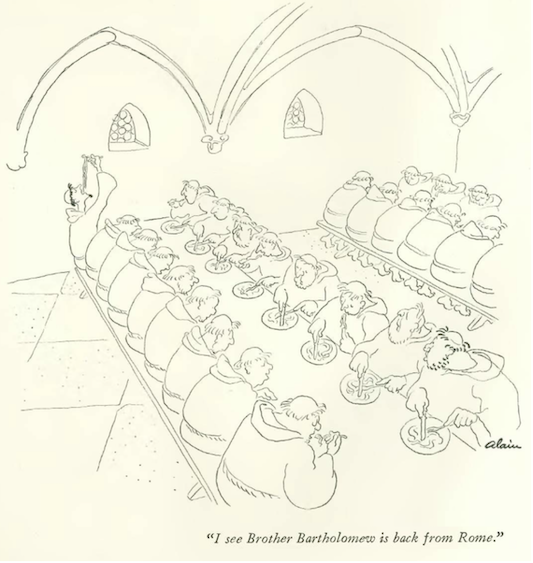
Daniel ‘Alain’ Brustlein introduced a bit of color to a monastery’s dining hall…

James Thurber continued to explore the dynamics between the sexes…

Barbara Shermund did a bit of dreaming with her modern women…

Carl Rose gave us Christmas cheer, with some reservations…

…and lastly, Perry Barlow with something for the holiday procrastinator…

Next Time: Farewell to 1934…


The Happy Warrior

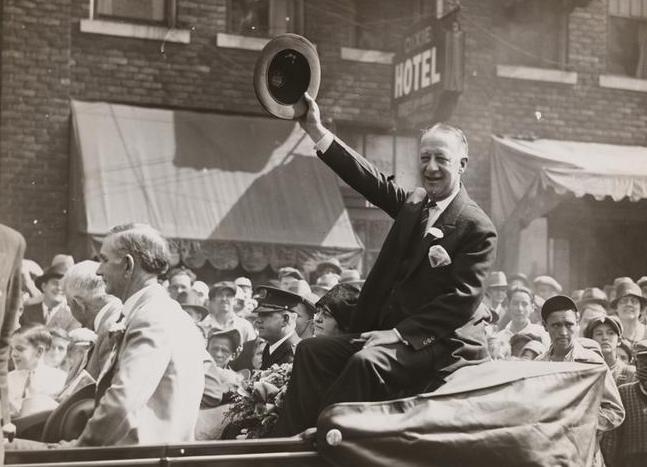
Above: Al Smith waving to crowds on arrival at Chattanooga, Tennessee during his presidential campaign in 1928. (Museum of the City of New York)

It’s hard to not like Al Smith, the governor of New York from 1923 to 1928, a man who avoided the temptations of political power and stayed true to his working class roots of the Lower East Side.

July 14, 1934 cover by Rea Irvin.

The son of Irish, Italian and German immigrants, Alfred Emanuel Smith (1873–1944) was raised in the Tammany Hall-dominated Fourth Ward, and although he was indebted to Tammany’s political machine throughout much of his professional life (including stints in the New York State Assembly and as York County Sheriff, President of the Board of Alderman, and finally Governor) he remained untarnished by corruption. Smith’s unsuccessful bid for the U.S. presidency in 1928 put an end to his political life, but there was still much to do, as “The Talk of the Town” explained:

HALL MONITORS…At left, Charles “Silent Charlie” Murphy with Al Smith in 1915. Murphy was the longest-serving head of Tammany Hall (1902 to 1924), and was known for transforming Tammany’s image from one of corruption to semi-respectability; at right, in 1929, Smith greets Franklin D. Roosevelt, who had just succeeded him as governor. (Library of Congress/Wikipedia)

Smith first sought the Democratic presidential nomination in 1924. According to historian Robert Slayton, Smith advanced the cause of civil liberty by decrying lynching and racial violence at the 1924 Democratic National Convention, where Franklin D. Roosevelt delivered the nominating speech for Smith and saluted him as “the Happy Warrior of the political battlefield.”

Following his 1928 presidential election loss to Herbert Hoover, Smith became president of Empire State, Inc., the corporation that built and also operated the Empire State Building, which was then the tallest building in the world. Smith was also known for his fondness of animals, and in 1934 Parks Commissioner Robert Moses made Smith “Honorary Night Zookeeper” of the renovated Central Park Zoo. Smith was given keys to the zoo and often took guests to see the animals after hours. According to Rebekah Burgess of the NYC Department of Parks and Recreation, “As a resident of 820 Fifth Avenue, directly across the street from the entrance of the Central Park Zoo, Smith was known to appear with snacks for the animals or to launch into impromptu lectures for visitors. Al Smith took his honorary title to heart. Throughout the rest of his life, Smith could often be found attending to the animals at the zookeepers’ sides during open hours. At night, Smith visited with guests, or more often, one-on-one with the animals.”

Smith was also a humanitarian, and in addition to advocating for the working class, he was an early critic of the Nazi regime in Germany, vigorously supporting the Anti-Nazi boycott of 1933. Here is another excerpt from the “Talk” piece:

LIFE OUTSIDE THE OFFICE…Scenes of post-political life, clockwise from top left: Al Smith fishing in 1933; with his family at the May 1, 1931 opening of the Empire State Building—Smith’s grandchildren cut the ribbon; golfing in 1930 with baseball great Babe Ruth in Coral Gables, Florida; with Rosie, the hippopotamus, at the Central Park Zoo, 1928. (Museum of the City of New York/Wikipedia)

 * * *

Culture Club

In the Nov. 9, 1929 issue of The New Yorker Murdock Pemberton hailed the opening of the Roerich Museum. For the July 14, 1934 issue, “The Talk of the Town” took another look. A brief excerpt:

MORE THAN A BUILDING…”The Talk of the Town” noted the changing shades of the art deco landmark Master Building on Riverside Drive (left, in 1929) which originally housed the Nicholas Roerich Museum. Today the Roerich is located in this brownstone at 319 West 107th. (Wikipedia)
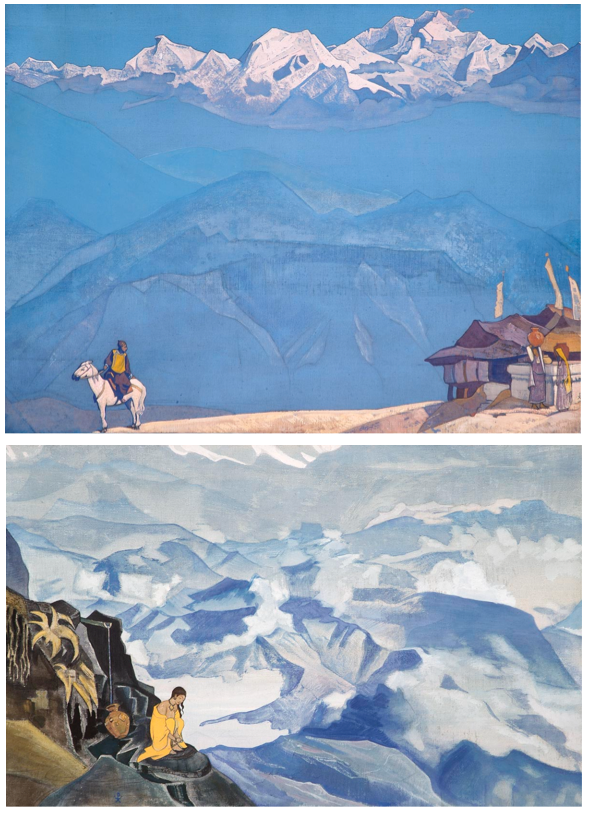
FOOTNOTES FROM A FULL LIFE…Two of Nicholas Roerich’s paintings from the 1920s: at top, Remember, 1924; below, Drops of Life, 1924. (roerich.org)

 * * *

Itinerant Showman

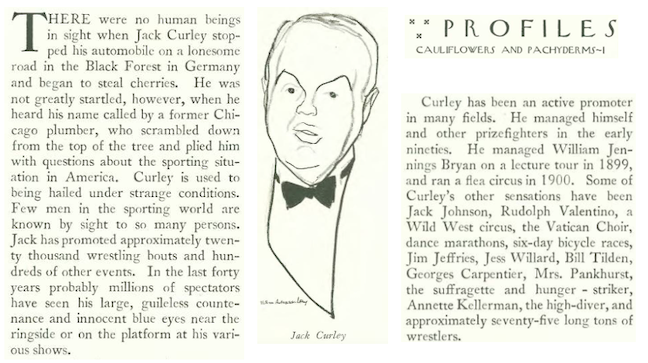
Alva Johnston filed the first installment of a three-part profile of famed sports promoter Jack Curley (1876–1937). A brief excerpt:

FIGHT CLUB…Sports promoter Jack Curley (left) with boxing manager Eddie Kane, circa 1920. (Library of Congress)

 * * *

Over There

In his column “Of All Things,” Howard Brubaker made this brief mention of the “Night of the Long Knives;” on June 30, 1934 Adolf Hitler ordered SS guards to murder the leaders of the paramilitary SA along with hundreds of other perceived or imagined opponents.

Here is a clip from the front page of The New York Times, July 3, 1934:

(The New York Times)

 * * *

Pimm’s and Soda

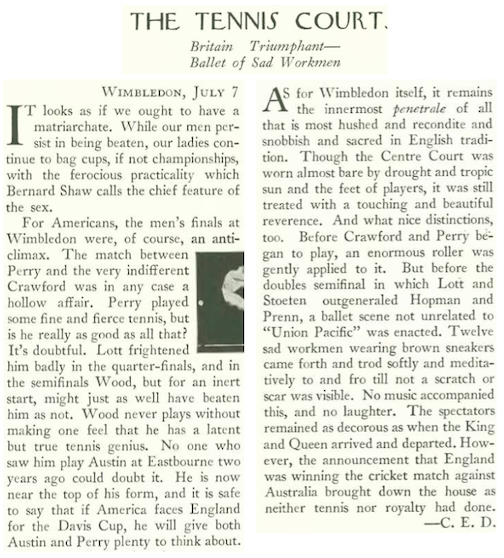
July in England meant Wimbledon, and The New Yorker was there to observe the “snobbish and sacred” rite…

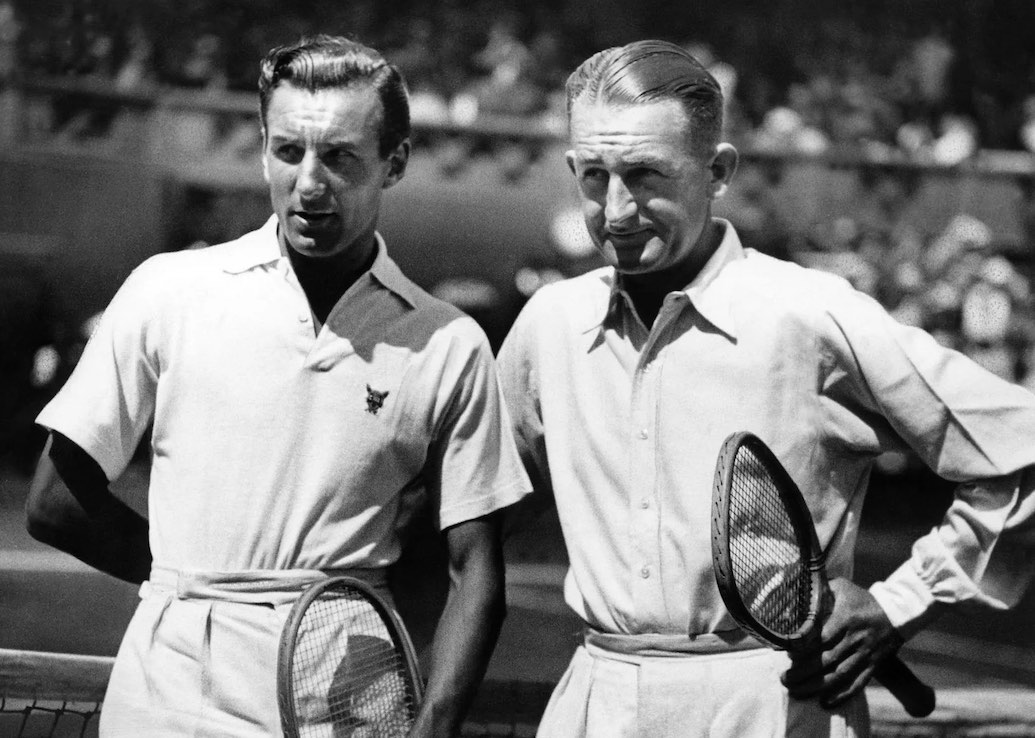
WATCH THE BOUNCING BALL…British tennis great Fred Perry (left) and Australian Jack Crawford before their men’s singles final at the 1934 Wimbledon tournament, which Perry won. Perry would claim three consecutive titles between 1934 and 1936. (Image: Mirrorpix)

 * * *

Midsummer Dreams

In the summertime (and before widespread use of air conditioning) stage entertainments such as theater and musical performances took to the outdoors during their off-season, seeking the evening cool of intimate rooftops or large, open venues such as Lewisohn Stadium, A brief excerpt describing a performance of Samson et Dalila:

EVENING SHADE: Andre Kostelanetz conducts at Lewisohn Stadium in 1939. The stadium was demolished in 1973 to make way for City College of New York’s North Academic Center. (PressReader.com)

 * * *

From Our Advertisers

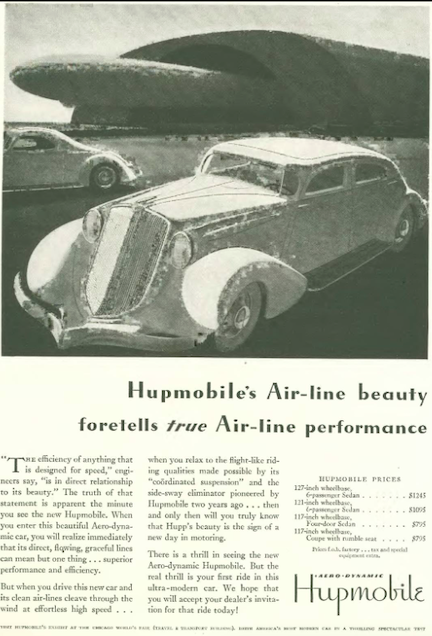
The folks at struggling carmaker Hupmobile took out this bold, full-page ad to tout their flashy “Aero-Dynamic” by noted designer Raymond Loewy

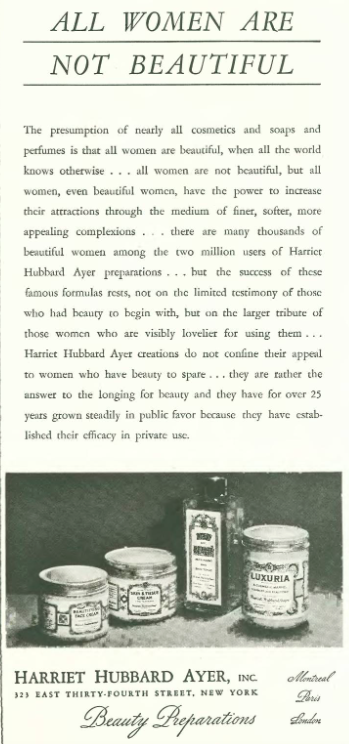
…this ad from Harriet Hubbard Ayer was bold in a very different way, essentially calling some women ugly unless they used the company’s “beauty preparations”…

…consommé, a clear soup that was particularly popular among the upper classes, offered up some keen competition between two food giants…here Heinz enlisted the help of William Steig to move their product…

…while the folks at Campbell’s offered up this lovely patio setting for their “invigorating” consommé…

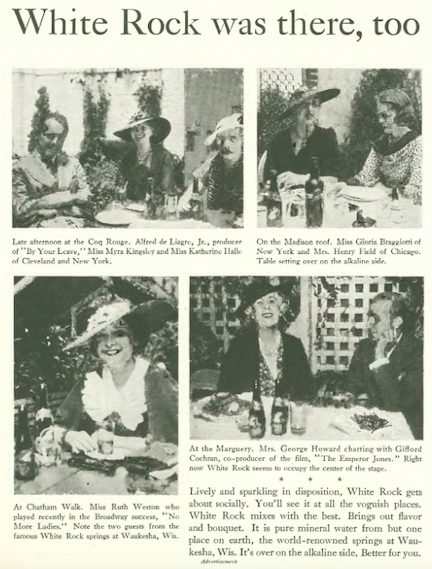
…meanwhile, White Rock mineral water could be found on patios all over Manhattan, as this ad attested…

…this is a reminder that most city folks had their milk and other dairy products delivered in the early part of the 20th century…by the early 1960s about 30 percent of consumers still had their milk delivered, dropping to 7 percent by 1975 and .4 percent by 2005…

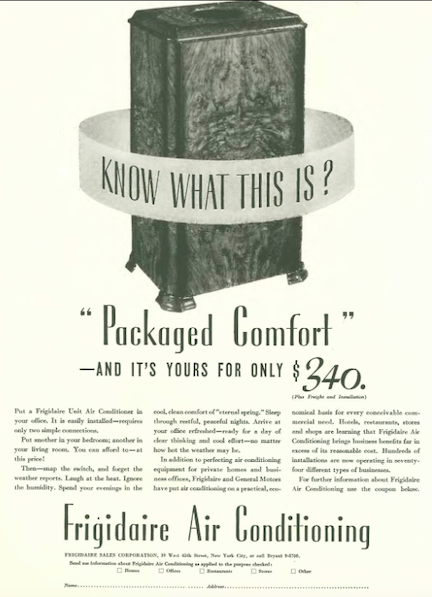
…affordable home air-conditioning wouldn’t be available to the masses until after World War II…this unit (designed for a single room) from Frigidaire retailed for $340 (a little less than $8,000 today)…

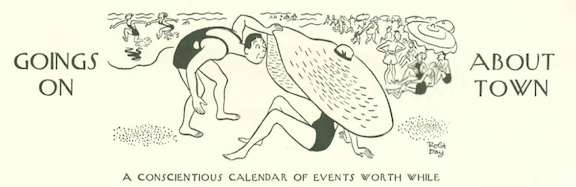
…on to our cartoonists, we begin with Robert Day in the “Goings On’ section…

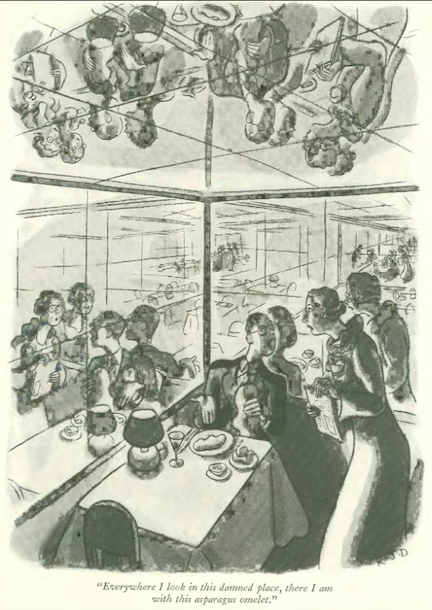
…Day again, exploring the baffling, glassy interiors of modern restaurants…

…the birdwatching continued with Rea Irvin

Alain (Daniel Brustlein) gave us a swimming somnambulist…

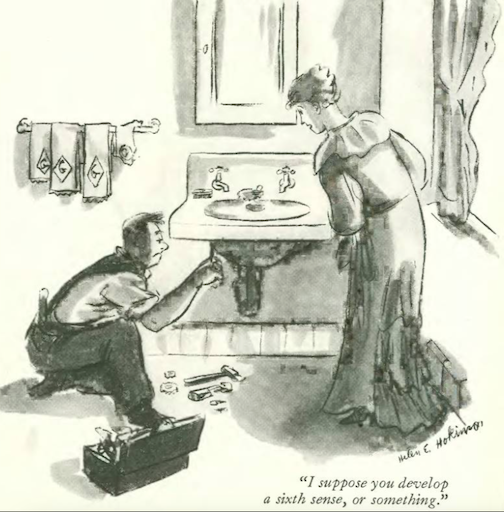
Helen Hokinson explored the paranormal, via domestic plumbing…

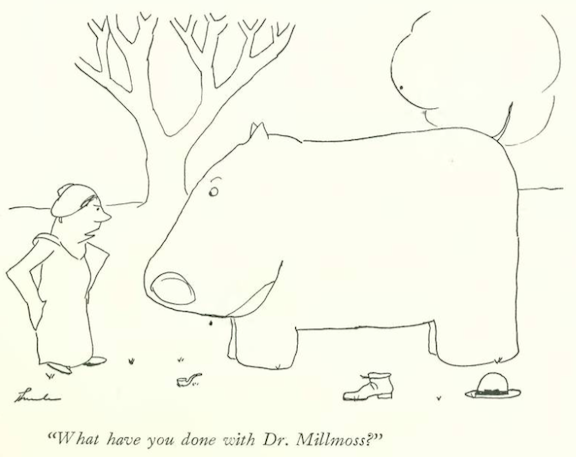
…and we close with James Thurber, and the missing Dr. Millmoss…

Next Time: His Five Cent’s Worth…

Through the Looking Glass

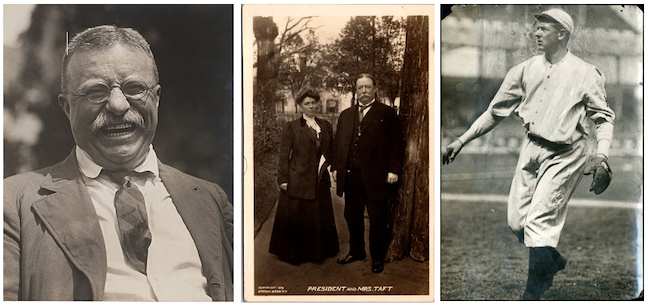
Above, from left: When Teddy Roosevelt announced in 1912 that he would run for president against his former VP, William Howard Taft, Brown Brothers sent photographer Charles Duprez to Oyster Bay to take this famous photo; President Taft and his wife, Helen “Nellie” Taft, in 1909; famed New York Giants pitcher Christy Mathewson warms up before a game, circa 1912. (liveauctioneers.com/cabinetcardgallery.com/psacard.com)

Before there were photo agencies like Magnum or archives such as Getty Images there was a company named Brown Brothers, the world’s first stock photo agency founded by Arthur and Charles Brown in New York City in 1904.

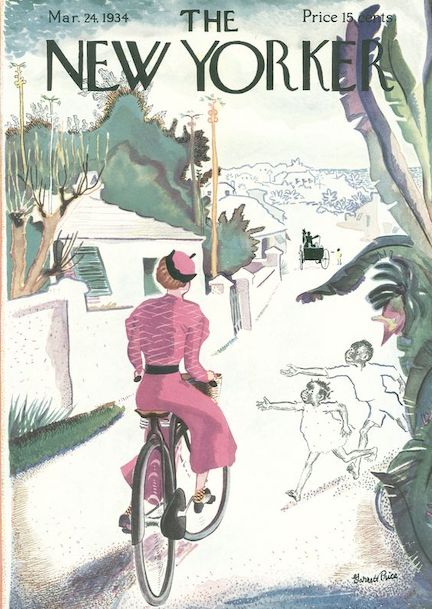
March 24, 1934 cover by Garrett Price.

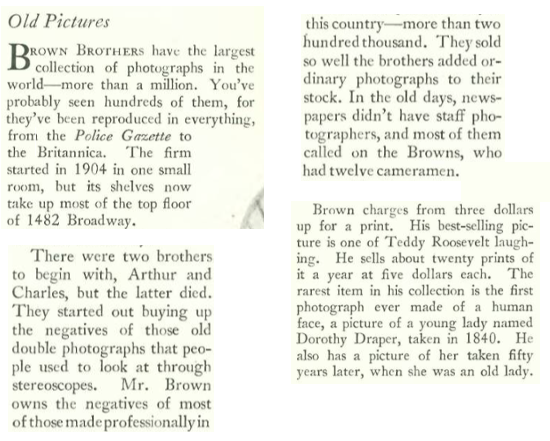
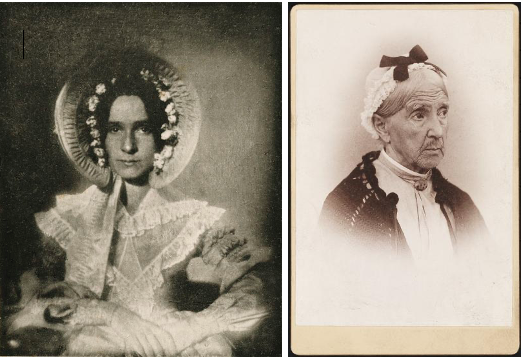
“The Talk of the Town” looked in on Brown Brothers, “the largest collection of photographs in the world—more than a million,” including a famous image of Teddy Roosevelt and the first photographic portrait of a woman’s face.

Brown Brothers photos could be seen everywhere in the early 20th century—their staff of twelve photographers provided images to New York newspapers at a time when the technology for publishing photos in the dailies was in its infancy and most papers didn’t employ staff photographers. Even the venerable New York Times hired the Browns to cover news events until they established their own team of photographers.

LITTLE DID DOROTHY DRAPER KNOW that she would become world famous when she sat for this photo (left) taken by her brother Dr. John W. Draper in his Washington Square studio at NYU in 1839 or 1840. Dorothy had to sit unblinking for the 65-second exposure—apparently her brother dusted her face with white flour to enhance the contrast. The Drapers still go down in history as creators of the oldest photo of a woman; at right, Dorothy Draper in the 1890s, in a photograph taken by her nephew. (boweryboyshistory.com/MCNY)
ONE IN A MILLION…The early 20th century image at left is just one of as many as three million images amassed in the Brown Brothers archive; at right, a Brown Brothers archivist at work. (Pinterest/sportscollectorsdigest.com)

Note: The Brown Brothers’ archive of photos and negatives went up for sale in 2014, and was ultimately acquired by Leland’s in 2020.

 * * *

De Terraplane!

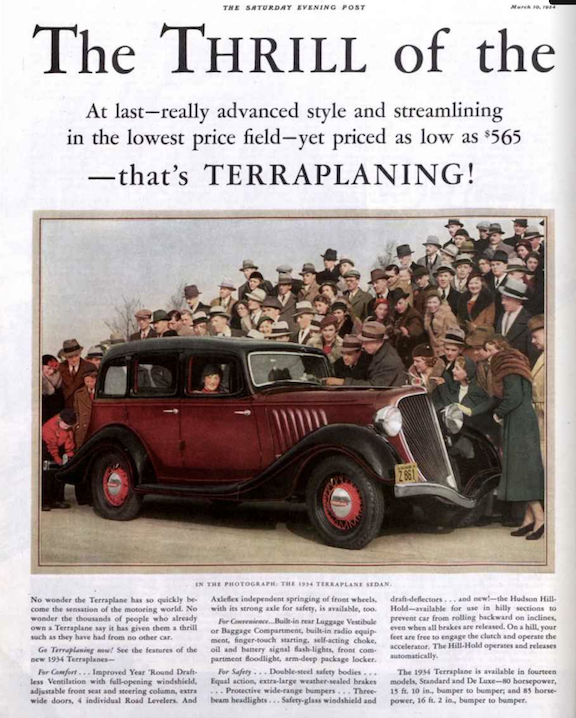
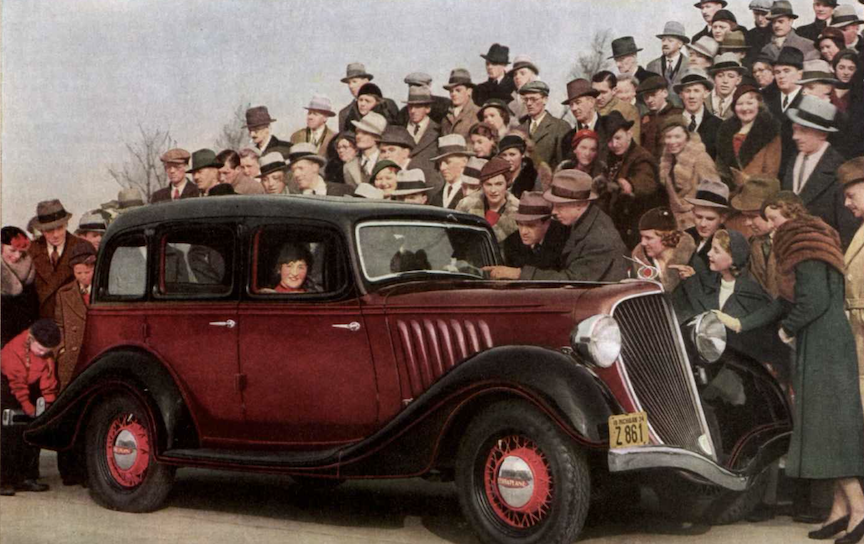
E.B. White (in “Notes and Comment”) was also looking at a photo, or rather scrutinizing one that was featured in a Saturday Evening Post advertisement for Hudson’s Terraplane:

…here is the ad from the Post

…and a closer look at the image, which had White seeing double.

(Both images courtesy The Saturday Evening Post)

 * * *

Escape Artist

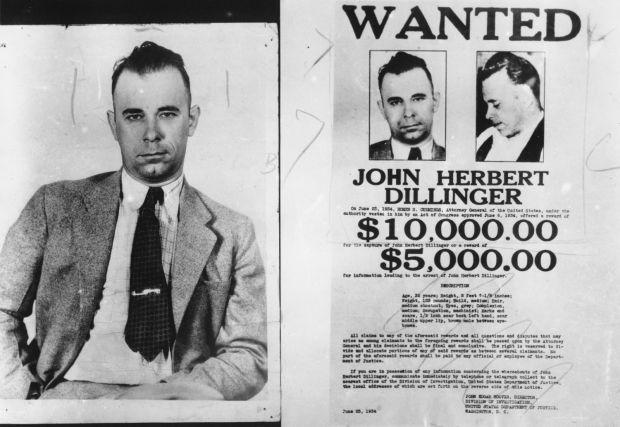
In his “Of All Things” column, Howard Brubaker included the following item about a new telescope, ostensibly to set up a quip about John Dillinger’s recent prison break (his second):

YOUR DAYS ARE NUMBERED…The FBI issued this “Wanted” poster of gangster John Dillinger— “Public Enemy No. 1″—in June 1934. The Feds gunned him down a month later. (AP Photo)

 * * *

Playing Nice

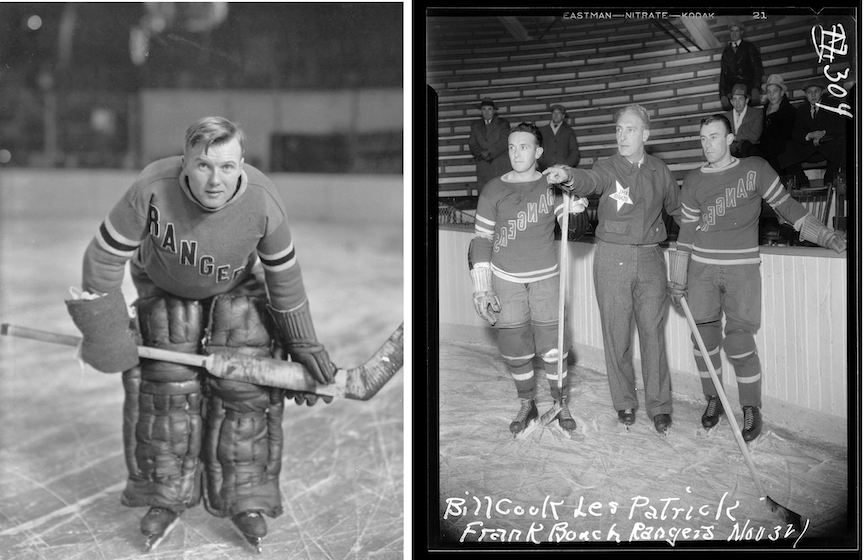
The New Yorker commented on the trend toward fewer fights in the world of hockey, and although fighting in general ebbed a bit through mid-century, it nevertheless remained a staple of the game. Indeed the New York Rangers founder, Tex Rickard, who also promoted boxing at Madison Square Garden, knew quite well that hockey fights were one reason folks attended the games.

FACE OFF?…At left, goaltender Andy Aitkenhead of the New York Rangers padded his legs and arms but put his clean-shaven mug on the line in December 1934— it wasn’t until 1959, 42 years into the NHL’s existence, that a league goalie wore a mask on the ice. At right, New York Rangers captain Bill Cook (right) flanks coach and manager Lester Patrick alongside Frank Boucher on the ice at the Chicago Stadium in November of 1934. (Pinterest)

 * * *

From Our Advertisers

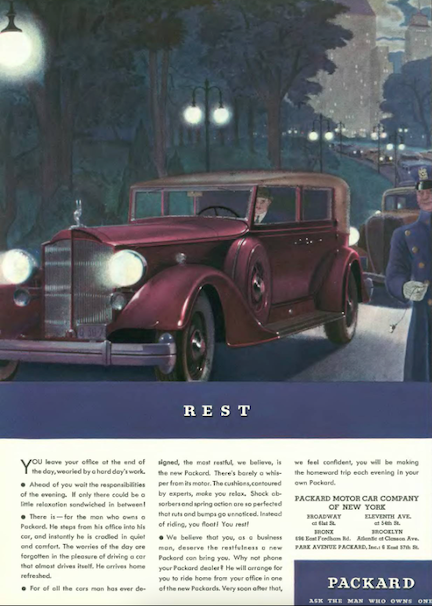
We begin with this sumptuous ad from Packard, appealing to those who could afford to own this luxury brand…

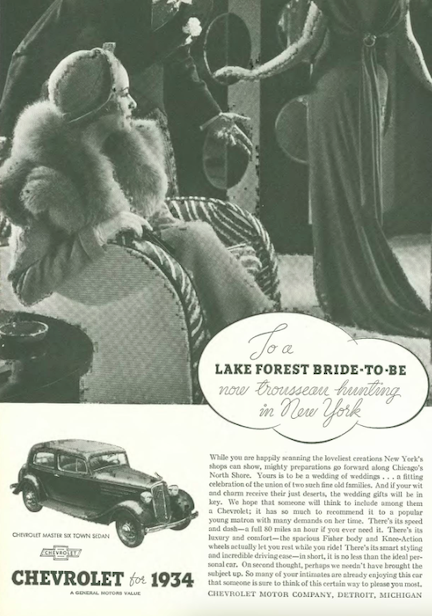
…if you couldn’t afford a Packard, you could rest assured that even a well-heeled deb could be happy with a Chevy…

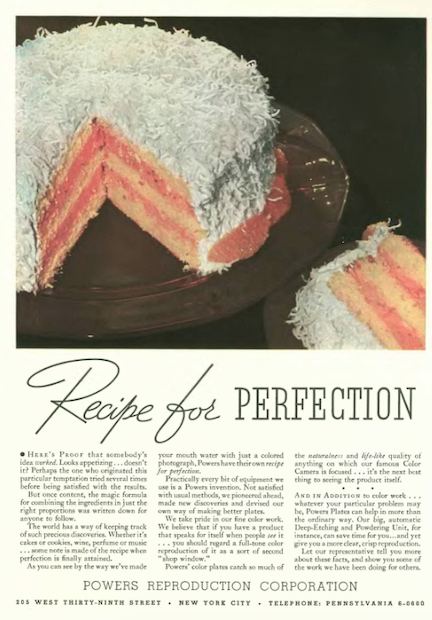
…the folks at Powers Reproduction continued to tout the wonders of their color photography, even if their cake looked less than appetizing…

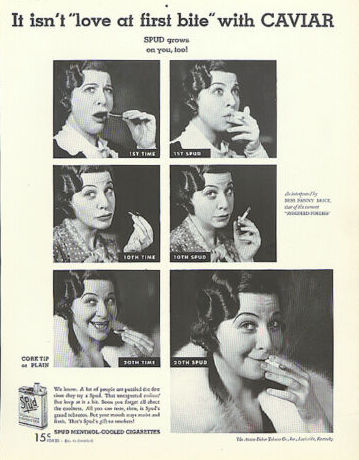
Fanny Brice was appearing with the 1934 Ziegfeld Follies on Broadway, so the folks at Spud jumped on her celebrity bandwagon…

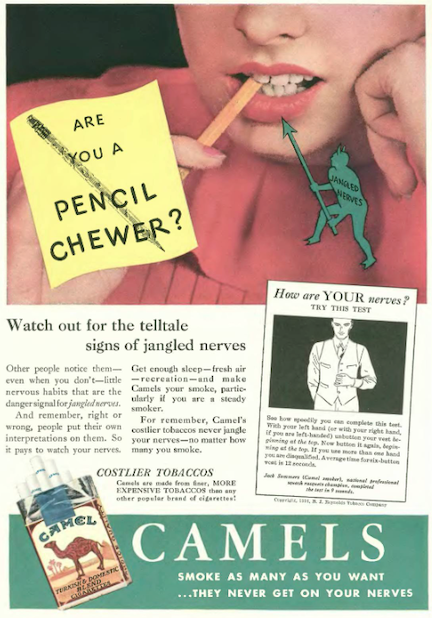
…while R.J. Reynolds was suggesting we replace our chewed up pencils with a nice Camel cigarette…now, don’t you feel better?…

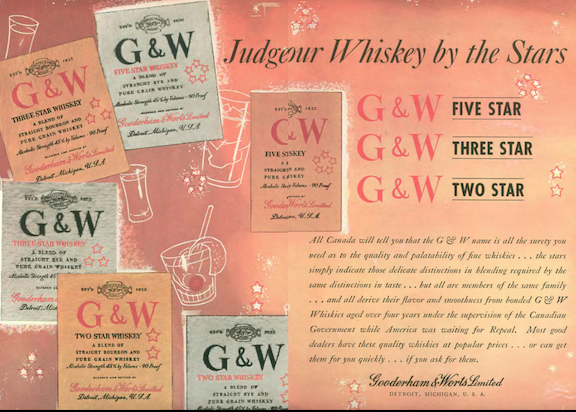
…the Canadian distillery giant Gooderham & Worts offered all sorts of options to calm our jangled nerves in this two-page spread…

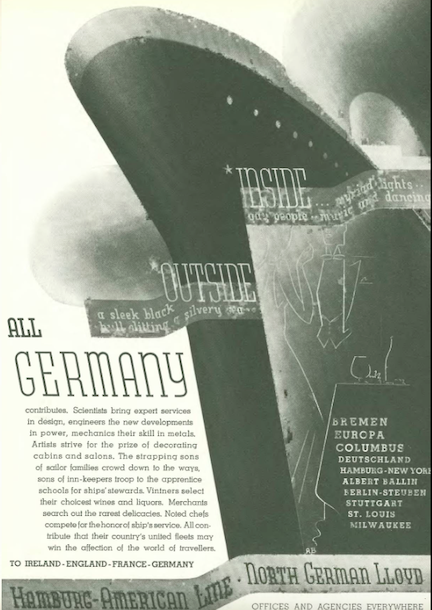
…while the Germans continued to entice us onto their cruise ships perfected by science and featuring “the strapping sons of sailor families”…hmmm…

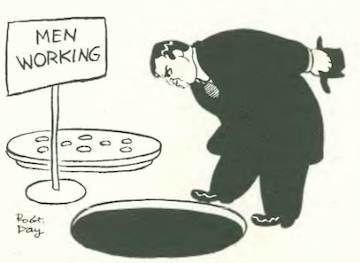
…in 1934 the New Yorker began featuring mostly wordless cartoons on the opening page of “The Talk of the Town,” including this one by Robert Day featuring Mayor Fiorello LaGuardia checking up on city employees…

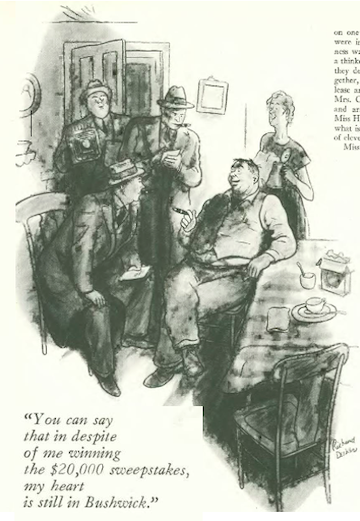
Richard Decker gave us an Irish Sweepstakes winner from Brooklyn who displayed some modesty and media savvy…

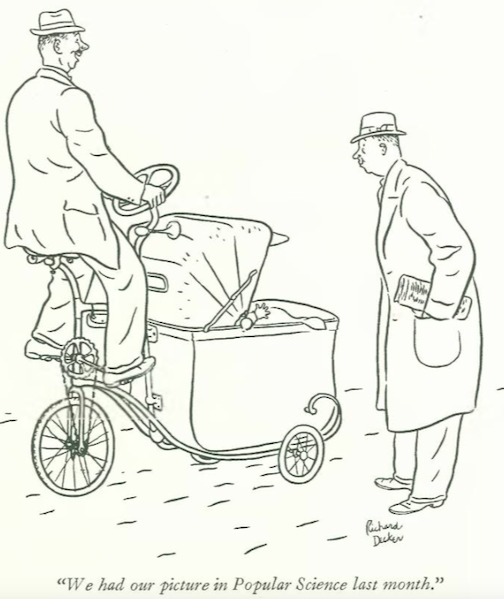
…Decker again, with the latest in perambulators…

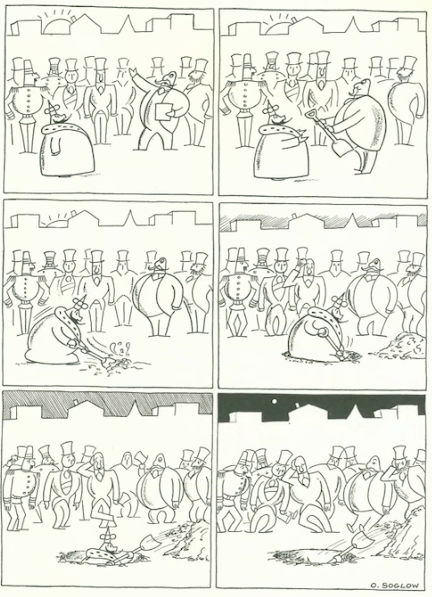
Otto Soglow’s Little King put his back into a ceremonial groundbreaking…

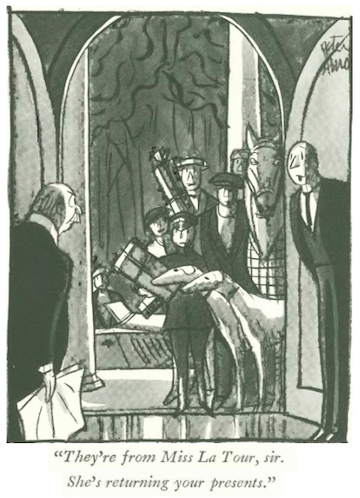
Peter Arno’s sugar daddy received some not-so-happy returns…

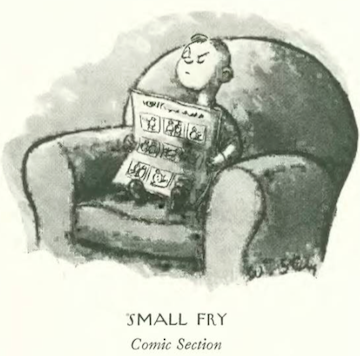
…one of William Steig’s “Small Fry” was doing some serious reading…

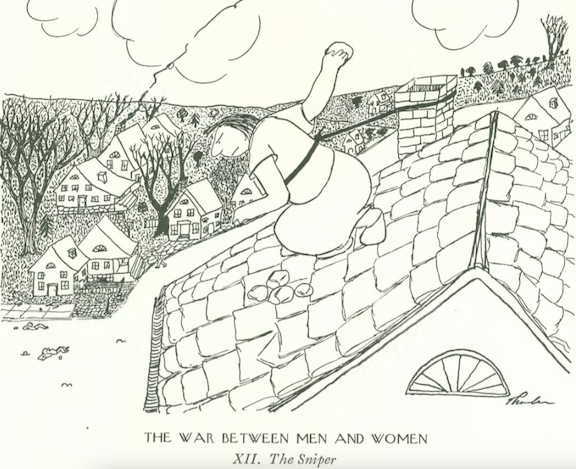
…and James Thurber’s war continued from the rooftops…

…on to March 31, 1934…

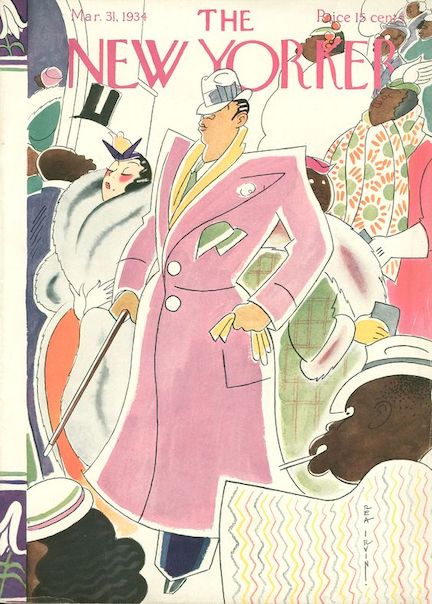
March 31, 1934 cover by Rea Irvin.

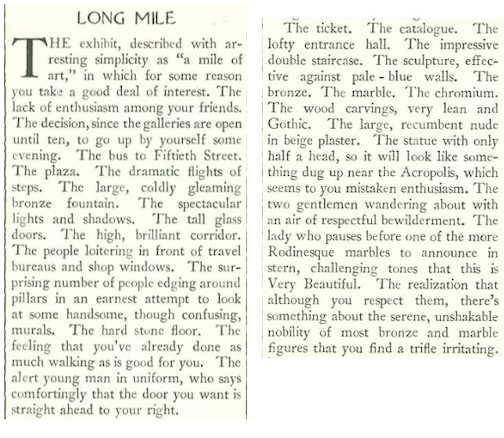
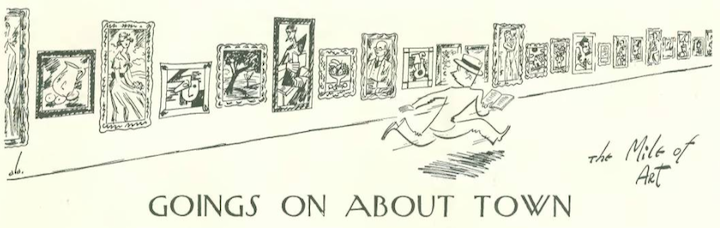
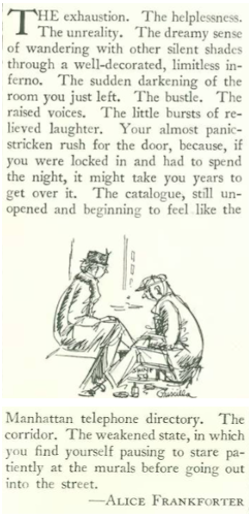
…where we find Alice Frankforter covering an exhibition dubbed “A Mile of Art.” I’m guessing critic Lewis Mumford passed on this opportunity to offer some blistering commentary. As for Frankforter, she found the spectacle puzzling, if not irritating. An excerpt:

Constantin Alajalov offered his perspective on the art world stunt with this bit of spot art…

…and more from Frankforter, now reaching a state of exhaustion and near-delirium as she approached the end of the exhibit:

 * * *

Biblical Babbitts

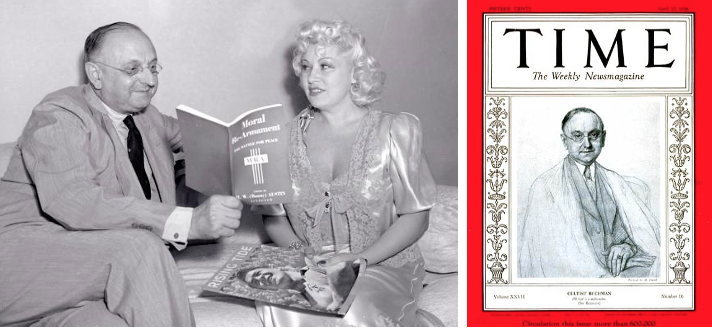
Frank Buchman’s First Century Christian Fellowship (aka the Oxford Group) meeting in New York featured a lot of people chuckling and bubbling, but all that forced conviviality left critic Edmund Wilson feeling “quite morose.” Writing for the “A Reporter at Large” column, Wilson looked in on the group as they awaited Buchman’s arrival at a preliminary rally. The column was subtitled, “Saving the Better Classes and Their Butlers.” An excerpt:

Like other critics at the time, Wilson saw “Buchmanism” as bourgeois optimism and boosterism, interested more in converting the souls of the wealthy and celebrated rather than serving the needs of poor.

ODD COUPLE…Frank Buchman liked to be seen with the rich and famous. In 1939 he asked for a half hour of Mae West’s time, ostensibly to get this photo of him sharing some wisdom from his “Moral Re-assessment” booklet. West seems less than enamored by the encounter, regarding Buchman as some sort of alien creature; right, Buchman on the cover of April 20, 1936 edition of Time, which identified him as “Cultist Buchman.” (maewest.blogspot.com/Time)

 * * *

Carnegie’s Couture

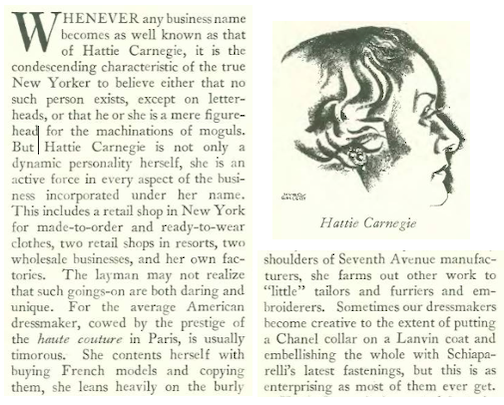
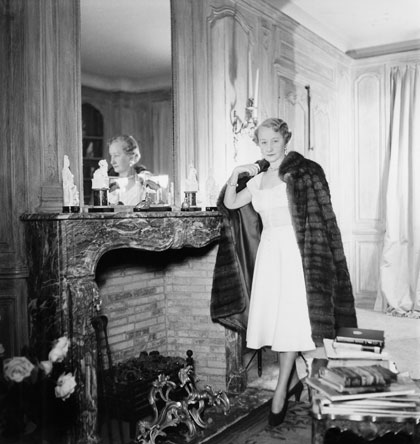
Vogue magazine fashion editor Nancy Hardin and the New Yorker’s fashion editor Lois Long teamed up on a profile about Hattie Carnegie (1889 -1956) titled “Luxury, Inc.” Born Henrietta Kanengeiser in Vienna, Carnegie immigrated with her family to New York in 1900; nine years later she adopted the name “Carnegie” after Andrew Carnegie, the richest person in America. Through hard work and an inherent instinct for what American women desired, she built a fashion design business that thrived in Depression and catered to stars and celebrities including Tallulah Bankhead, Joan Fontaine, Lucille Ball, and Joan Crawford. An excerpt, with illustration by Hugo Gellert:

FUR SURE…Hattie Carnegie posing for a 1951 Vogue magazine photo. (Vogue)

 * * *

Steampunk Dream

In my previous entry I featured Robert Coates’s observations on the new Machine Art exhibition at the Museum of Modern Art. For the March 31 issue critic Lewis Mumford, celebrant of the simple and unpretentious, waxed nostalgic over the novel exhibit:

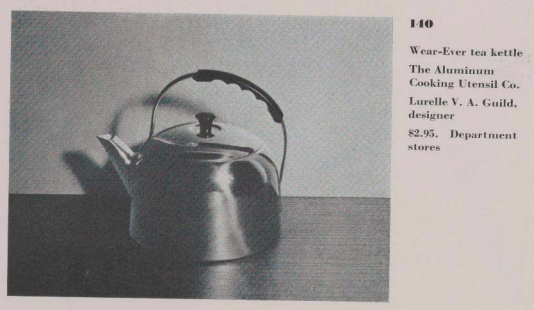
I’M A LITTLE TEAPOT that made a big advance in the design world, according to critic Lewis Mumford. (MoMA)

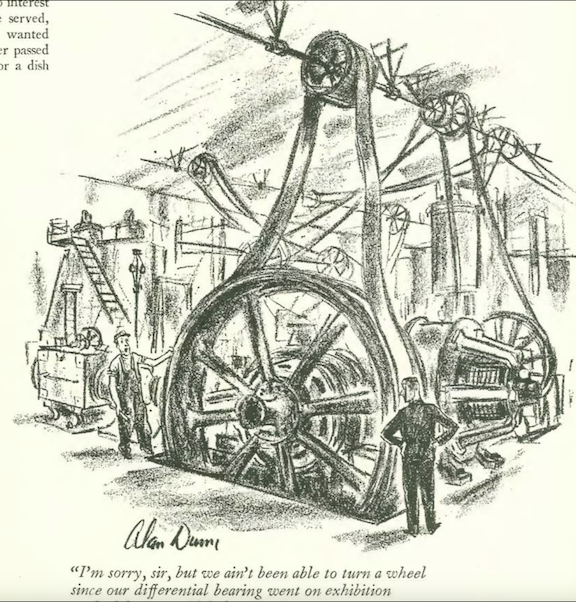
Alan Dunn was also inspired by the exhibit, as evidenced in this cartoon from the April 7 issue…

 * * *

More From Our Advertisers

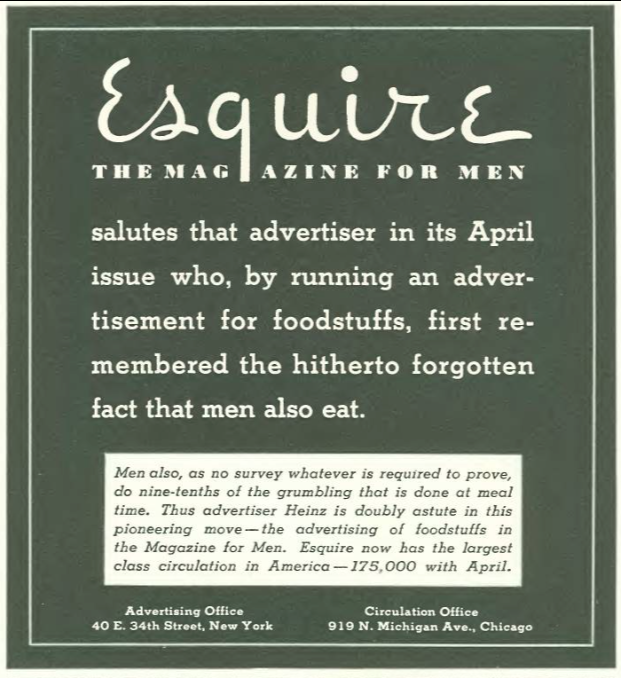
Founded in October 1933, the men’s magazine Esquire took off with a bang, and the publishers were not shy about boasting of its early success…

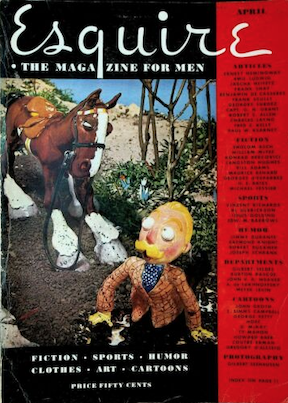
…cover of the April 1934 issue, featuring the mustachioed mascot Esky…based on a drawing by cartoonist E. Simms Campbell, Esky was featured on the cover in various situations until 1961…

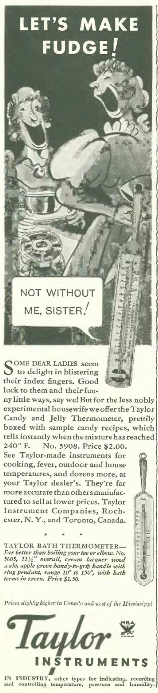
Peter Arno’s “Whoops Sisters” appeared sixty-three times in the New Yorker between 1926 and 1927 before Arno retired them (they occasionally popped up in other publications, and in a 1931 Cunard ad)…it seems odd that they would make an appearance in a cheap thermometer ad in 1934…at any rate, it is difficult to tell if this is by Arno or by a clever forger…

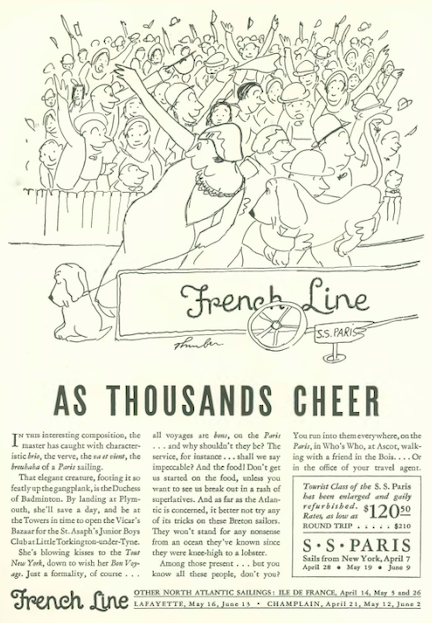
…there’s no mistaking the cartoonist behind this ad…

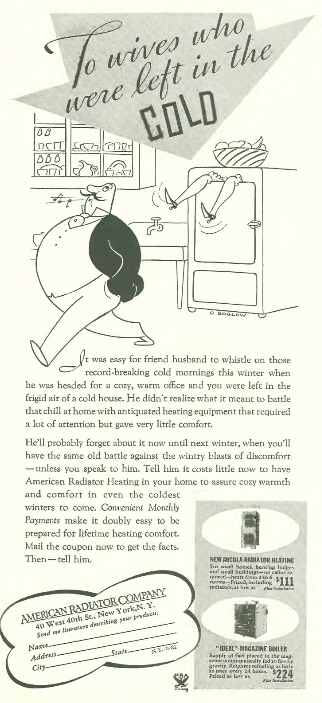
…and this one by Otto Soglow

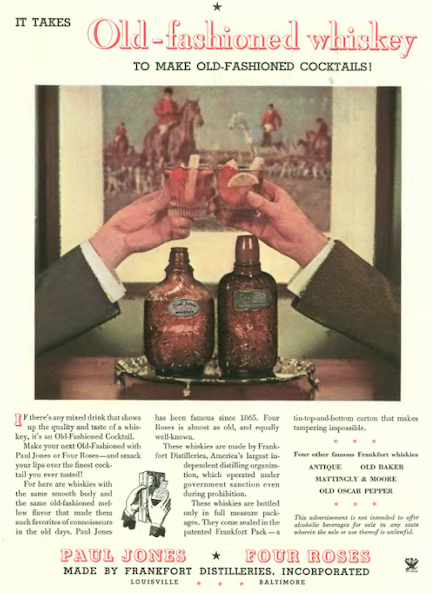
…and we close our advertising section by raising a glass to Frankfort Distilleries…

…on to our March 31 cartoons, and a lineup of New Yorker regulars Abe Birnbaum

Barbara Shermund

Mary Petty

…and James Thurber, with a break in the battle…

Next Time: America’s Sweetheart…

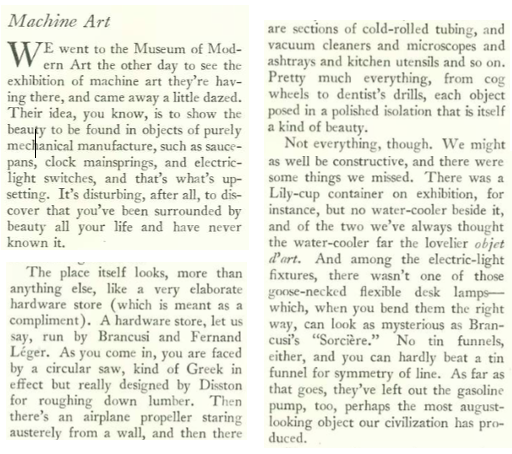
Art of the Machine

Above, at left, self-aligning ball bearing from SKF Industries, featured in MoMA's 1934 Exhibition of Machine Art; at right, judges for the exhibit were aviator Amelia Earhart and professors John Dewey and Charles R. Richards, holding first, second and third prizes, respectively. (MoMA)

The notion that machine-made objects have aesthetic value has been with us for some time, dating back to avant-garde movements of the early 20th century such as Futurism, which influenced other schools, including the Bauhaus and De Stijl. However, the idea that a museum would display a propeller or a vacuum cleaner as a work of art was startling to many in 1934.

March 17, 1934 cover by Rea Irvin.

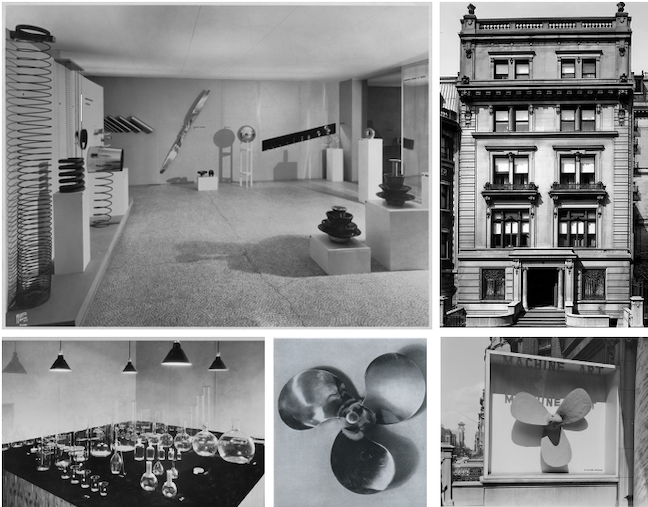
It had been a little over twenty years since New York art patrons experienced their first shock of the new at the 1913 Armory Show. By 1929 the city had established the Museum of Modern Art, which opened the exhibition Machine Art on March 5, 1934, at MoMA’s second location—the old Barbour mansion at 11 West 53rd Street (razed in the late 1930s and replaced by today’s museum).

Novelist and art critic Robert M. Coates (1897–1973) paid a visit to the Machine Art exhibition and wrote of the experience in “The Talk of the Town.” Coates was no stranger to the avant garde, having himself embraced literary innovation and experimentation as a novelist. James Thurber is credited with bringing Coates to The New Yorker in 1927—the two became close friends—and Coates would stay forty years with the magazine. Excerpts:

EXTRAORDINARY ORDINARY…Clockwise, from top left: According to MoMA director Alfred H. Barr, Jr, the 1934 Machine Art exhibition celebrated the machine’s abstract and geometric beauty; MoMA found its second home—the Barbour mansion at 11 West 53rd Street—in 1932; sign on West 53rd advertising the exhibition; outboard propeller by Aluminum Company of America (Alcoa); collection of scientific beakers and flasks from Corning Glass Works. (MoMA)
KA-CHING!…Machine Art featured Model 1934 from National Cash Register; at right, Electrochef range, model B-2, designed by Emil Piron for Electromaster Inc. Objects featured in the exhibition were selected by noted architect Phillip Johnson, who was the founding chairman (1932-34) of the museum’s Department of Architecture. (MoMA)
IN A NEW LIGHT…Springs and wires took on new perspectives at the Machine Art exhibition. From left, the apparent first-prize winner (based on the photo of Earhart at the top of this entry)—a section of a large spring; cross-section of wire rope; and typewriter carriage and motor springs, all produced by American Steel & Wire Company, a subsidiary of US Steel. (MoMA)

* * *

Salad Days

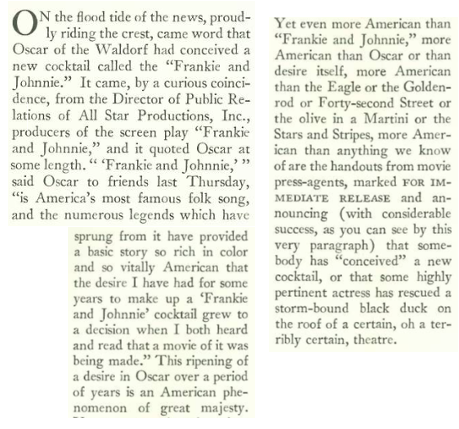
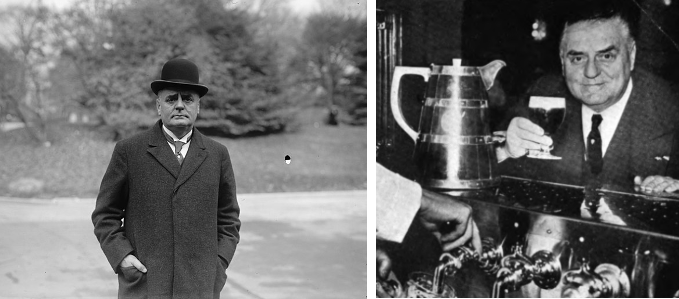
Swiss-American restaurateur Oscar Tschirky (1866-1943), who was known throughout the world as Oscar of the Waldorf, worked as maître d’hôtel of the Waldorf Astoria in New York City from 1893 to 1943. He is credited with having created the Waldorf salad, along with any number of cocktail recipes. “The Talk of the Town” noted his latest concoction:

WINNING OSCAR…From 1893 to 1943 Oscar Tschirky was the Waldorf-Astoria’s public face and a gracious host who made both the great and the not-so-great feel welcome. At left, in 1923; at right, Tschirky samples the first shipment of beer to arrive at the Waldorf-Astoria when the brew became legal again in April 1933. (Library of Congress/Karl Schriftgiesser)

 * * *

Unburdened

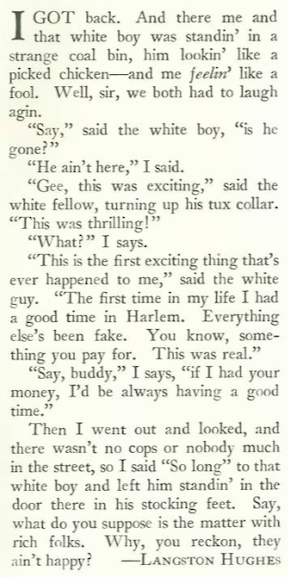
In the March 17 issue, writer and poet Langston Hughes (1901–1967) published the first of three fiction pieces that would appear in The New Yorker (one posthumously in 2016). In the short story “Why, You Reckon,” Hughes tells the tale of two hungry Black men who rob a rich white man by pushing him into a basement coal bin—one of the Black men takes the white man’s money, jewelry, shoes and overcoat, then rushes off, leaving his companion without any of the loot. To the companion’s surprise and befuddlement, the white man is left excited by the incident, because it is the first real thing that has happened to him. Here are the final lines of the story:

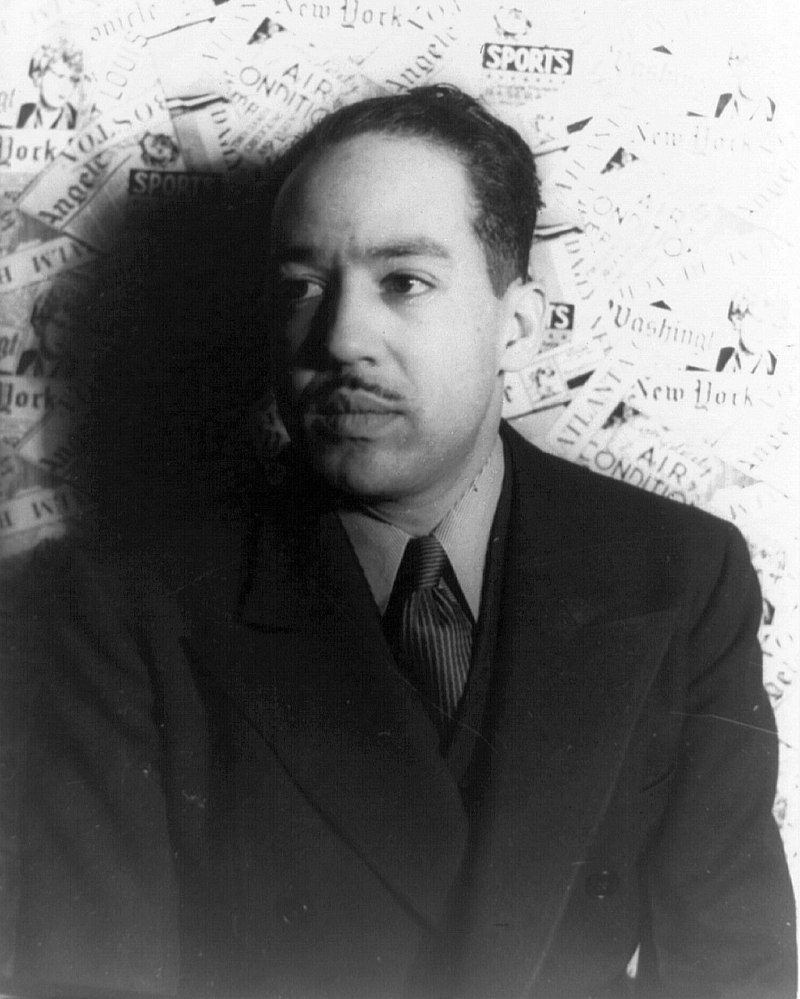
HARLEM RENAISSANCE LEADER Langston Hughes in a 1936 photo by Carl Van Vechten. A prolific writer and poet, Hughes published three short stories and three poems in The New Yorker.  (Wikipedia)

 * * *

From Our Advertisers

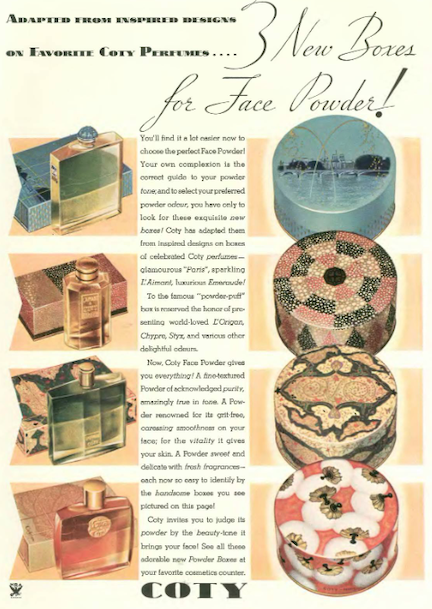
New Yorker ad sales were booming, and blooming with color…we kick it off with this ad from Coty touting “3 New Boxes for Face Powder!”…so why are there four boxes in the ad?…

…the obvious answer to the question posed below would be “wealth and privilege…and youth”…the “Eleanor Roosevelt” featured in this Pond’s ad is obviously not the wife of FDR, but rather Eleanor Katherine Roosevelt, the teenaged daughter of Assistant Secretary of the Navy Henry Latrobe Roosevelt

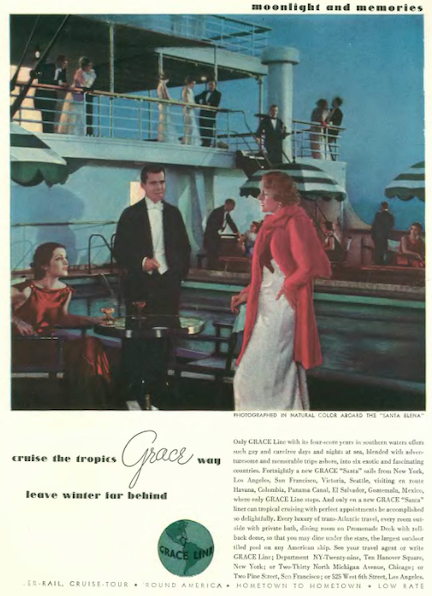
…speaking of the high seas, I have to admit I sigh a little when I see ads like this, obviously staged, but suggest a style of travel that is as extinct as the T. Rex…

…perhaps those folks on the boat were enjoying a splash of Perrier in their evening cocktails…

…or maybe the domestic White Rock was on ice…why is the rich old coot so much shorter than his wife?…I guess it emphasizes her relative youthfulness and her maternal obligations to a child-like older man…

…their proportions are similar to Jiggs and Maggie, but that’s another story…

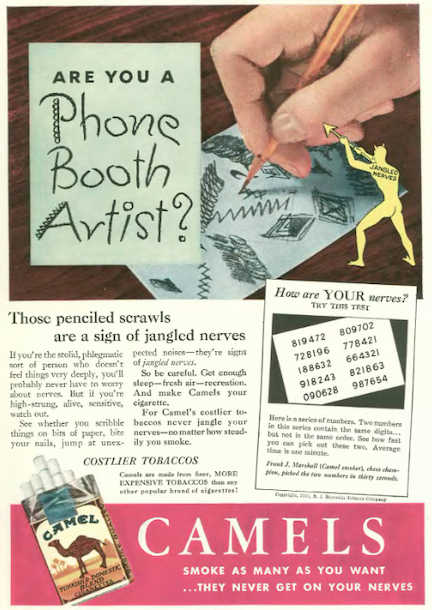
…R.J. Reynolds was back with their “jangled nerves” theme on behalf of Camel cigarettes…

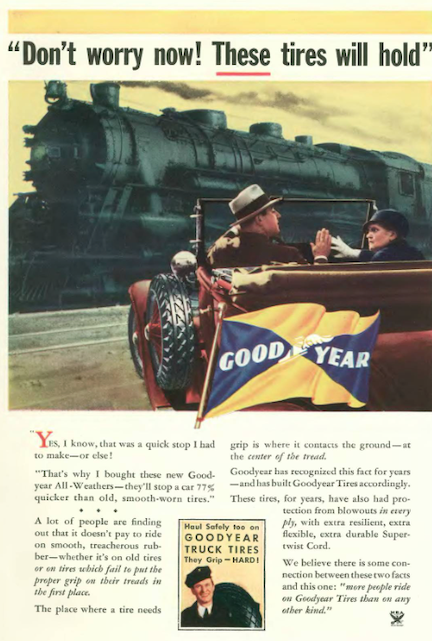
…maybe your tires will hold, but have you checked your brakes lately?…

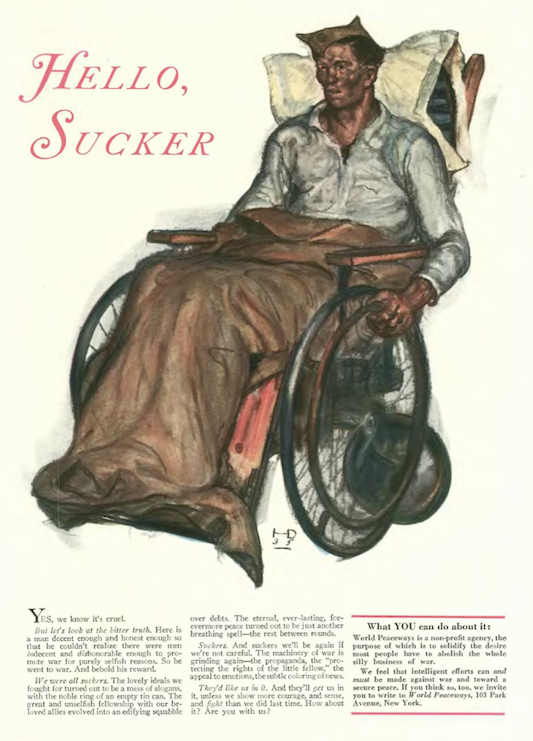
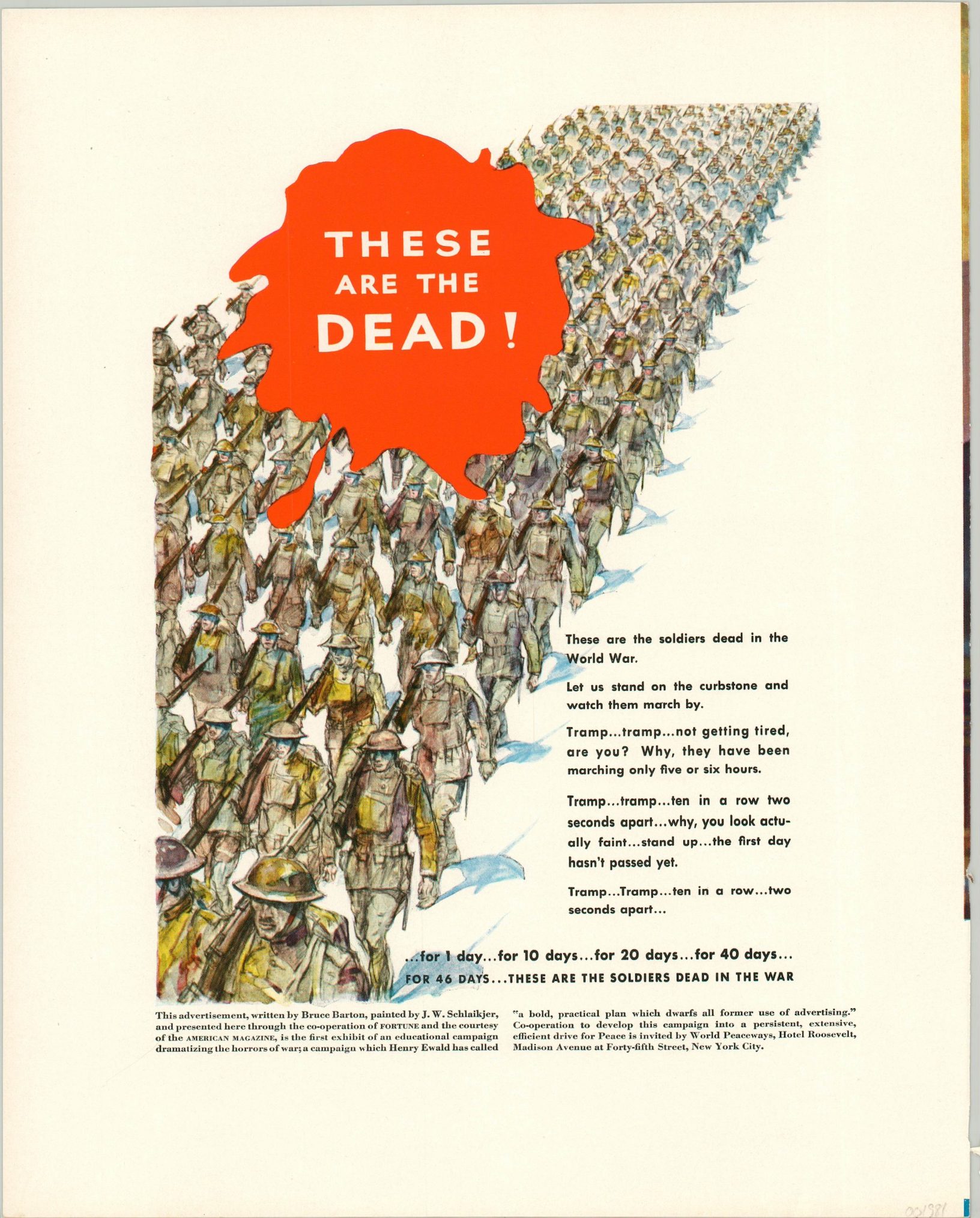
…in the 1930s the anti-war organization World Peaceways ran a series of provoking ads on the artificial glories of war…some magazines, including The New Yorker, ran these ads free of charge or at reduced rates…

…a closer view of the explanatory copy at the bottom of the ad…

…speaking of war, James Thurber opens our cartoons on a Connecticut battlefield…

Al Frueh contributed this illustration for a two-part profile of entertainer and theatrical producer George M. Cohan

Alain (Daniel Brustlein) offered this spot art for the opening calendar section…

Peter Arno gave us two fellows on thin ice…

…cartoonist Gregory d’Alessio made his first appearance in The New Yorker

Barbara Shermund was back with some tax advice…

…which this gentleman (by Alain) might have found useful…

…and we close with Mary Petty, and a little brown-noser with a taste for greens…

Next Time: Through the Looking Glass…


Rocky’s Cover-Up

On April 28, 1933, just two days before the RCA Building was to open to new tenants, artist Diego Rivera added a portrait of Vladimir Lenin to the mural he was painting in the building’s lobby.

Feb. 24, 1934 cover by Garrett Price.

When Nelson Rockefeller asked Rivera to replace Lenin with a portrait of an “everyman,” Rivera refused, stating that he would prefer to see the whole mural destroyed than to alter it. Two weeks later Rivera was paid and dismissed from the job; carpenters immediately covered the mural in a white cloth. Fast forward to Saturday, February 10, 1934, when workers showed up late in the evening and began chipping away at the plaster bearing the mural, reducing Rivera’s artwork to dust. E.B. White, in his “Notes and Comment,” had this to say about that fateful night:

DUST TO DUST…Diego Rivera working on his mural, Man at the Crossroads, in the RCA Building lobby in 1933. At right, workers quickly covered up the mural after Rivera was dismissed from the job. One of Rivera’s artist assistants, Lucienne Bloch, clandestinely took the photo before she was escorted from the building. (Wikipedia/6sqft.com)
ARTEM INTERRUPTUS…Mexican artist Diego Rivera stands with a copy of the mural he painted at Rockefeller Center that was eventually destroyed. (A. Estrada /Courtesy of Museo Frida Kalho)

Rea Irvin shared his own thoughts on the issue with this illustration below, which referenced the hateful rhetoric of Charles Coughlin, a Canadian-American Catholic priest and populist leader and one of the first public figures to make effective use of the airwaves to spew his invective.

FAMILIAR RING…Charles Coughlin, a Catholic priest and populist leader, promoted antisemitic and pro-fascist views while also acting as a champion to the poor and a foe of big business. In the midst of the Depression he spoke to the hopes and fears of lower-middle class Americans throughout the U.S. One supporter recalled: “When he spoke it was a thrill like Hitler. And the magnetism was uncanny. It was so intoxicating, there’s no use saying what he talked about…” (BBC/NPR)

* * *

Dog Days

E.B. White also chimed in about boorish behavior he witnessed at the Westminster Kennel Club show at Madison Square Garden. Terriers had dominated Westminster; the fox terrier that ultimately won the 1934 competition represented the 21st terrier of any type to win Best of Show since that category was introduced in 1907.

YOU AGAIN? Ch Flornell Spicy Bit of Halleston, a Wire Fox Terrier, took Best of Show at Madison Square Garden in 1934. (westminsterkennelclub.org)

 * * *

Anybody Home?

After the wealthy owner of the New York World, Joseph Pulitzer, died in 1911, his family moved out of his lavish East 73rd Street mansion, which was designed by Stanford White to resemble an Italian palazzo. The building sat empty until 1930, when investors planned to knock it down and replace it with an apartment building. The Depression foiled their plans, and another attempt to raze the mansion in the 1950s also miraculously failed, and the building was eventually converted into a co-op with sixteen apartments. Writing in “The Talk of the Town,” James Thurber pondered the Pulitzer mansion’s expected fate. An excerpt:

THEN AND NOW…With so many buildings reduced to dust these days in NYC, it’s good to see the Pulitzer mansion still standing. You can buy one of its sixteen apartments for roughly $6 million, if and when they become available. (ephemeralnewyork.wordpress.com)

 * * *

From Our Advertisers

The makers of Camel cigarettes combined three previous ads into one, featuring endorsements from society matrons in Boston, Washington, D.C., and New York…
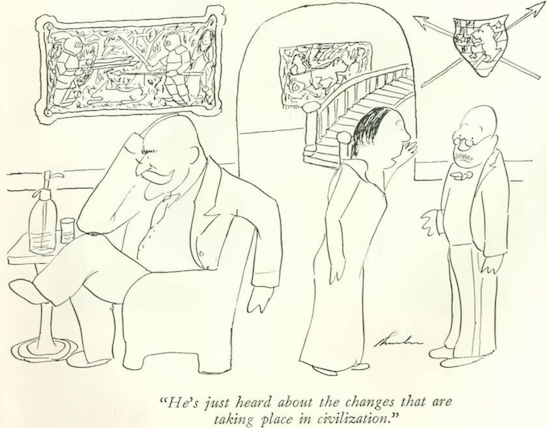
…while Fanny Brice and the cast of the 1934 Ziegfeld Follies offered a chorus of endorsements for Lux detergent in this two-page spread…

…the Graham-Paige Motors Corporation is long gone, but in the early 1930s the company was still going strong, introducing many innovations (described in the ad below) that would be copied by other carmakers…
…in the 1930s an exiled Russian noble, Count Alexis de Sakhnoffsky, was known for his streamlined automobile designs…he influenced the look of the 1934 Nash Ambassador Eight, which was touted here as the choice of the budget-minded toff…note how the illustrator exaggerated the car’s length in this ad…

…as compared to an actual model of a Nash Eight…

A restored 1934 Nash Ambassador Eight. (classiccars.com)

…on to our cartoonists, Alan Dunn floated above the “Goings On About Town” section…

William Steig gave us a tactless grocer…

Howard Baer offered up some finer points from Madison Avenue…

Gardner Rea illustrated a very special delivery…

…and James Thurber’s war continued to be waged on a snowy battlefield…

…on to our March 3, 1934 issue…

March 3, 1934 cover by Harry Brown.

…which featured a profile of singer Kate Smith (1907–1986), written by none other than Joseph Mitchell (1908-1996), who began his career at The New Yorker in 1933. Smith was an American contralto often referred to as “The First Lady of Radio,” well known for her renditions of When the Moon Comes over the Mountain and Dream a Little Dream of Me. She was enormously popular during World War II for her rendition of God Bless America among other patriotic tunes.

Smith got her start in New York in 1926 when she appeared on Broadway in Honeymoon Lane. That year also saw the emergence of countless humiliating wisecracks about her weight that would dog her long career. A reviewer in The New York Times (Oct. 31, 1926) wrote, “A 19-year-old girl, weighing in the immediate neighborhood of 200 pounds, is one of the discoveries of the season…” In 1930, when Smith appeared in George White’s Flying High, she served as the butt of Bert Lahr’s often cruel jokes about her size.

An excerpt from the opening lines of Mitchell’s profile:

RISING STAR…At left, Kate Smith performing in the 1932 Paramount Pictures musical, Hello Everybody!; at right, on the cover of the October 1934 issue of Radio Mirror. (medium.com)

Toward the conclusion of the profile Mitchell suggested that Smith’s future was “doubtful.” She would prove that prediction wrong, however…

…23 years after her death her rendition of God Bless America would be discontinued pretty much everywhere when it was revealed that in the early 1930s she recorded such songs as That’s Why Darkies Were Born and Pickaninny Heaven (which was featured in Hello, Everybody!).

CANCELLED STAR…Since the late 1960s a rendition of God Bless America by Kate Smith served as a good luck charm for the Philadelphia Flyers hockey team. “The team began to win on nights the song was played,” The New York Times wrote in Smith’s 1986 obituary. Smith sang the tune live during game six of the 1974 Stanley Cup finals, which the Flyers went on to win against the Boston Bruins. When Smith’s racist songs were rediscovered in 2019, a statue of the singer that stood outside the Flyers’ arena was covered and ultimately removed. (Daily Mail)

A note on Joseph Mitchell, whose first credited piece in The New Yorker was a Nov. 11, 1933 “A Reporter at Large” column titled “They Got Married in Elkton.” The article described a small Maryland border town that became known for discrete “quicky” marriages. Mitchell would become known for his finely crafted character studies and expressive stories found in commonplace settings. His 1943 McSorley’s Wonderful Saloon is a prime example.

MAN ABOUT TOWN…At left, Joseph Mitchell circa 1930, wearing a brown fedora he was rarely seen without; at right, Mitchell in Lower Manhattan near the old Fulton Fish Market, as photographed by his wife, Therese Mitchell, circa 1950. (Estate of Joseph Mitchell)

 * * *

Acquired Taste

Occasionally New Yorker film critic John Mosher found himself at odds with other reviewers, and such was the case when Mosher sat down to watch Frank Capra’s It Happened One Night. While he described the 1934 pre-Code romantic comedy as “nonsense” and “dreary,” other critics found it generally enjoyable, and although it took audiences awhile to catch on, the film eventually became a smash hit.

In all fairness to Mosher, even the film’s co-star, Claudette Colbert, complained to a friend after the film wrapped, “I just finished the worst picture in the world.” As it turned out, It Happened One Night became the first of only three films to win all five major Academy Awards: Best Picture, Best Director, Best Actor, Best Actress, and Best Adapted Screenplay. It is now widely considered one of the best films ever made. Go figure.

Back to Mosher, who thought so little of the film he didn’t even lead his column with the picture’s review:

PRE-CODE AND TOPLESS…An heiress (Claudette Colbert) and a reporter (Clark Gable) find themselves hitchhiking (and sharing a motel room) after their bus breaks down in It Happened One Night. The film famously featured a scene in which co-star Gable undresses for bed and takes off his shirt to reveal that he is bare-chested. An urban legend claims that, as a result, sales of men’s undershirts declined noticeably. (IMDB)

 * * *

More From Our Advertisers

If you wanted luxury with the price, you could buy a Nash Ambassador Eight for $1,800 (about thousand less than other luxury models) or opt for Studebaker’s Berline Limousine, practically a steal at $1,295…

…or you could opt for this fancy-looking Buick with “Knee-Action wheels”…Knee Action was a GM marketing term for independent front suspension, which made for a smoother ride…

…always colorful, the makers of Cinzano vermouth made their splash in The New Yorker

…the folks at Lucky Strike continued their theme of colorful ads featuring attractive women enjoying their cigs…

…on to our cartoonists, Leonard Dove illustrated a domestic spat…

Mary Petty captured a romantic interlude on the dance floor…

…and James Thurber introduced a new twist—espionage—into his “war”…

Next Time: The Power Broker…