Before we launch into the Jan. 25 issue, the rendering of the old New York Aquarium in this Sue Williams cover bears some consideration.
Jan. 25, 1930 cover by Sue Williams.
The aquarium was housed within the historic walls the South West Battery, constructed off the tip of Manhattan between 1808 and 1811 as a defense against the British. Renamed Castle Clinton in 1817 (in honor of former Mayor/Governor Dewitt Clinton), it was deeded to the city in 1823 to be used as an entertainment center. From 1855 to 1890 it served as an immigrant landing depot, then remodeled in 1896 (by the architectural firm McKim, Mead, and White) to become the popular New York City Aquarium.
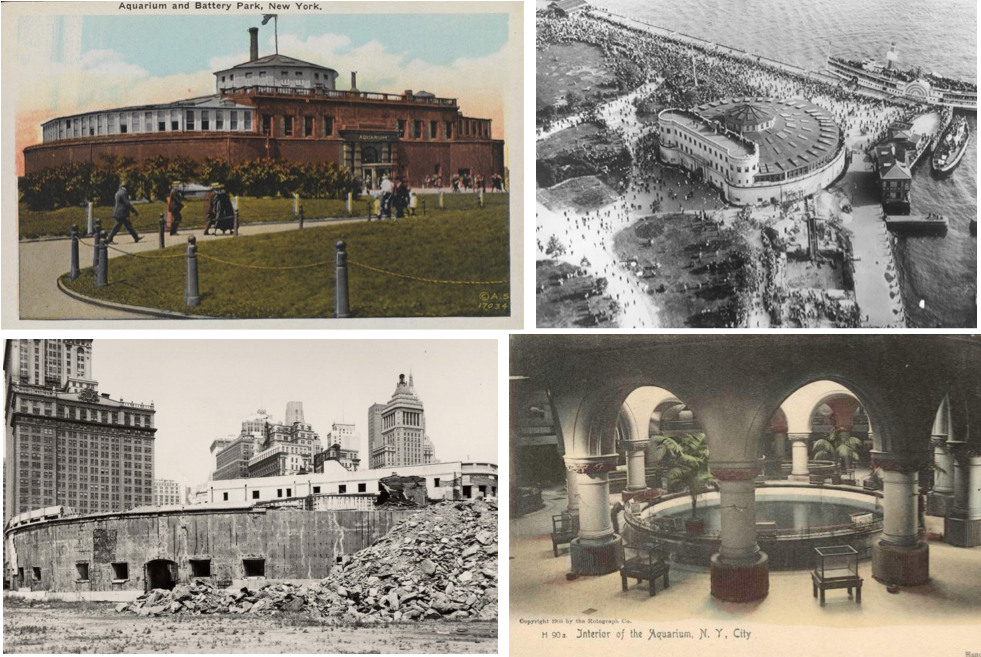
FISH OUT OF WATER…Postcard image of the New York City Aquarium from the early 1900s; aerial view of the aquarium circa 1934; postcard image of aquarium interior; demolition of the aquarium in 1941, on orders from city planner Robert Moses. (thebattery.org/nycgovparks.org)
Although the aquarium proved to be a cultural and educational magnet, it stood in the way of master planner Robert Moses’s designs to build a bridge from The Battery to Brooklyn. After residents, preservationists and even Eleanor and President Franklin Roosevelt protested, the city opted instead to construct a tunnel under the East River. Nevertheless, Moses managed to get the aquarium knocked down before demolition was halted by the outbreak of World War II. After the war, Congress passed a bill declaring the site a National Monument, and preserved the walls of Castle Clinton.
HIGH AND DRY…Until it was demolished in 1941, the New York City Aquarium occupied the space in the center of Castle Clinton, which was added to National Register of Historic Places in 1966. (nps.gov)
* * *
Now, About That Band…
A play that satirized America’s enthusiasm for war—Strike Up the Band—was loved by critics but spurned by audiences when it opened in Philadelphia in 1927. Written by George S. Kaufman, with music and lyrics by George and Ira Gershwin, the play had the pedigree for success, but audiences weren’t quite ready for a show that poked fun at the U.S. military just nine years after the end of World War I (in the original play, America is goaded into declaring war on Switzerland by an American cheese tycoon).
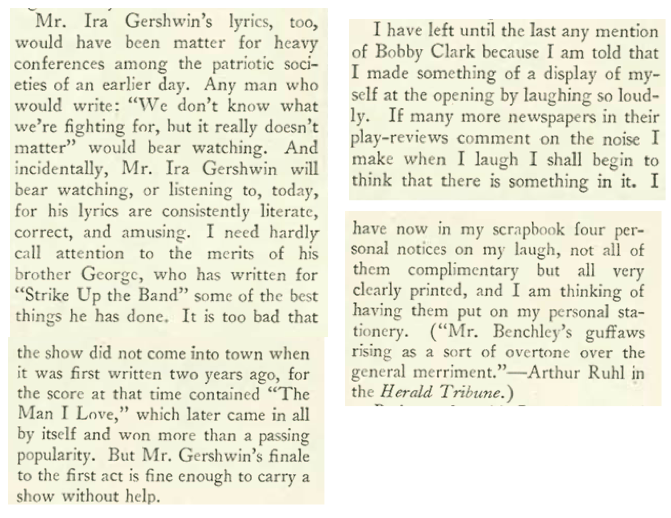
Enter lyricist Morrie Ryskind, who reworked the script, softening its political message and remaking the war plot into a dream sequence. The revised play proved to a be hit, running for 191 performances at the Times Square Theatre. It also introduced a number of popular songs, including “The Man I Love” and “Strike Up the Band.” Robert Benchley was on hand for opening night:
TEAMWORK…Clockwise, from top, Ira (left) and George Gershwin at work circa 1930; lyricist Morrie Ryskind, who softened the tone of George S. Kaufman’s original script. (U of Michigan/Wikipedia)
Benchley noted that the antics of comedian Bobby Clark caused him to laugh so loud that his guffaws were even noted in the Herald Tribune’s review:
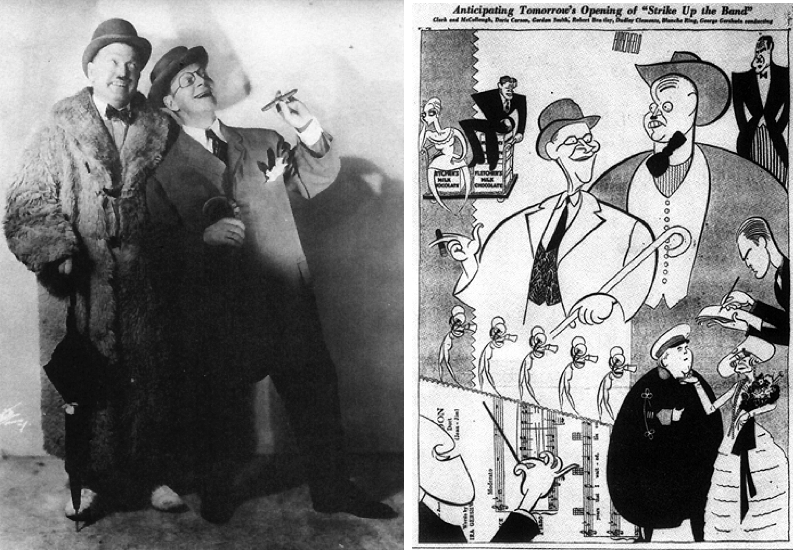
MAKE ‘EM LAUGH…The comedy team of Paul McCullough (left) and Bobby Clark were one of the play’s big draws. At right, Herald-Tribune illustration by Al Hirschfeld announcing the Broadway opening of Strike Up the Band. (aaronneathery.org)
* * *
Duncan Yo-Yos
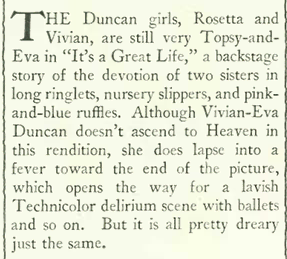
We’ve seen the Duncan Sisters (Rosetta and Vivian) before in this blog, the sister vaudeville act that became famous with the 1923 hit musical Topsy and Eva, which inspired a silent 1927 film starring the duo. They were back on the screen in late 1929 with It’s a Great Life, which TheNew Yorker’sJohn Mosher found to be “pretty dreary”…
NOT SO GREAT, THIS…Clockwise from top, promotional poster for It’s a Great Life; a scene from a dance number in the film; Rosetta (in blackface) and Vivian Duncan as Topsy and Eva (characters derived from the novel Uncle Tom’s Cabin). It’s a Great Life flopped at the box office, along with the Duncan’s brief movie careers. In the years to follow the duo would became popular nightclub entertainers and would continue to perform their Topsy and Eva routine even though appearing in blackface was increasingly considered offensive. (Wikipedia/freewebs.com)
* * *
Miracle Worker
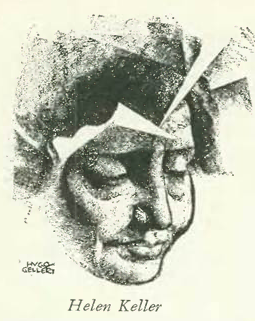
TheNew Yorker profile, written by Robert Coates, featured Helen Keller (with illustration by Hugo Gellert). A brief excerpt:
* * *
From Our Advertisers
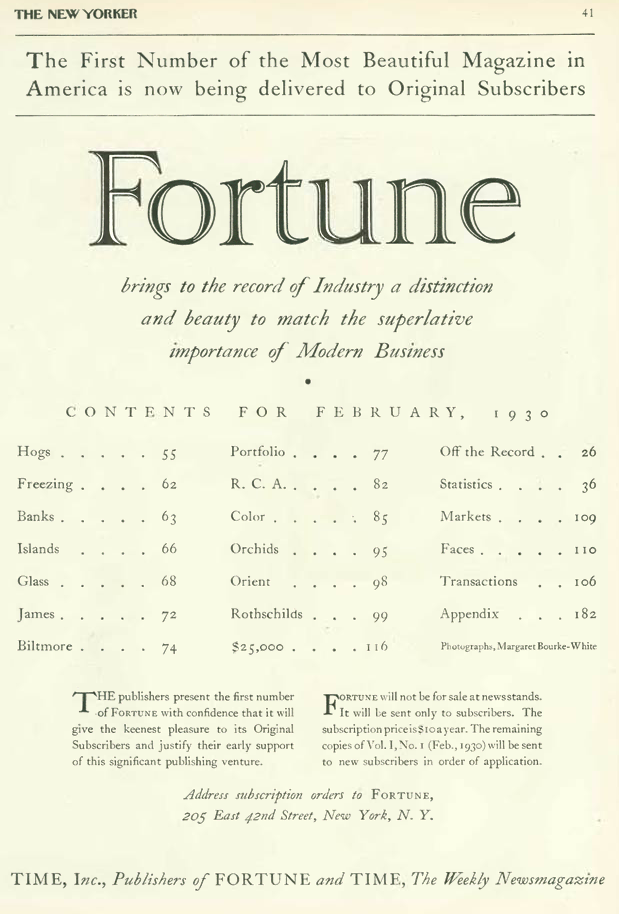
Advertisers in the Jan. 25 issue included the new Fortune magazine, which announced its first issue with this full-page ad:
…the table of contents is fascinating, spare in descriptions of everything from “Hogs” to “Orchids”…
From left, issue No. 1, February 1930; table contents for the issue; a prototype of the magazine, September 1929. (Fortune)
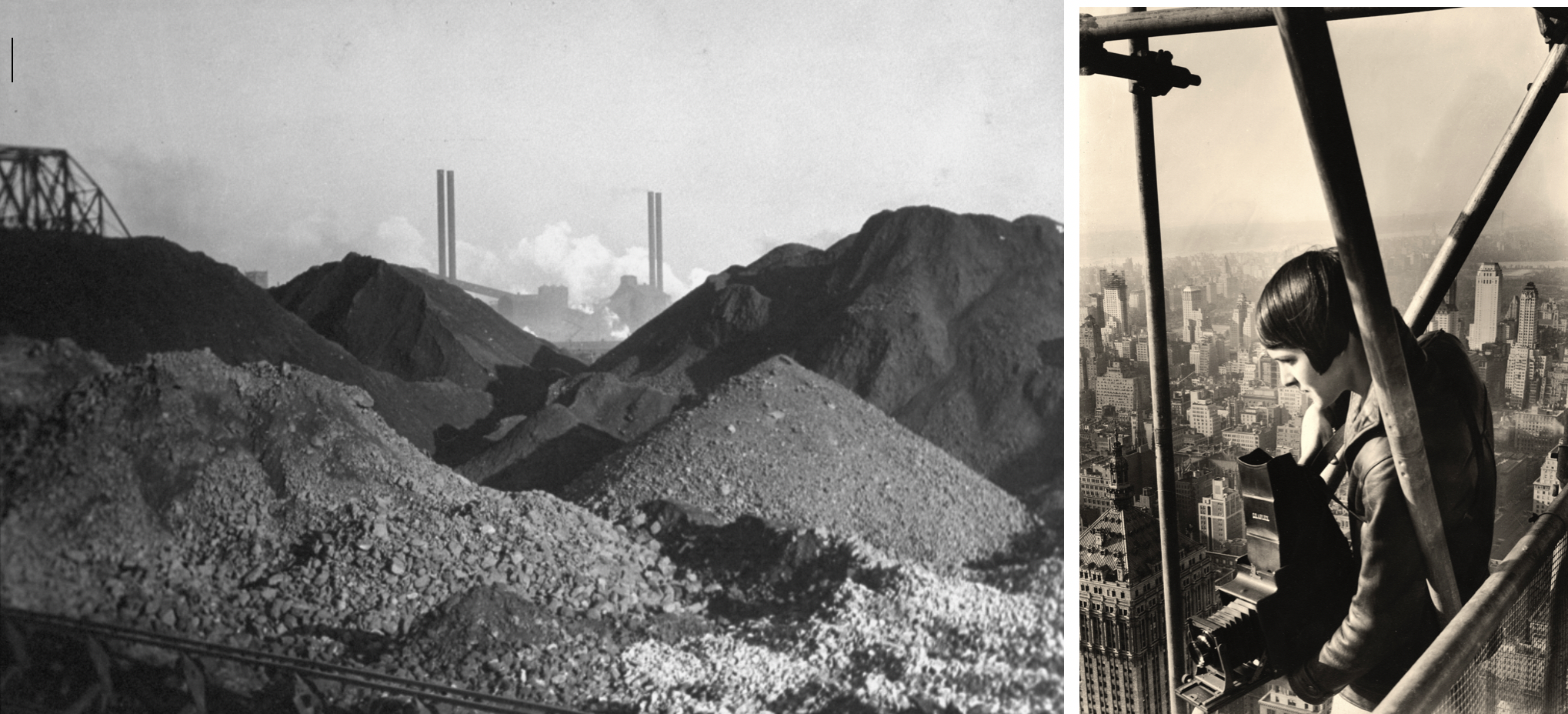
…also listed in the new magazine’s table of contents was the name of a 24-year-old photographer, Margaret Bourke-White…
A photo of coal piles by Margaret Bourke-White in the first issue of Fortune magazine. At right, Bourke-White photographing atop a skyscraper circa 1930. (Fortune)
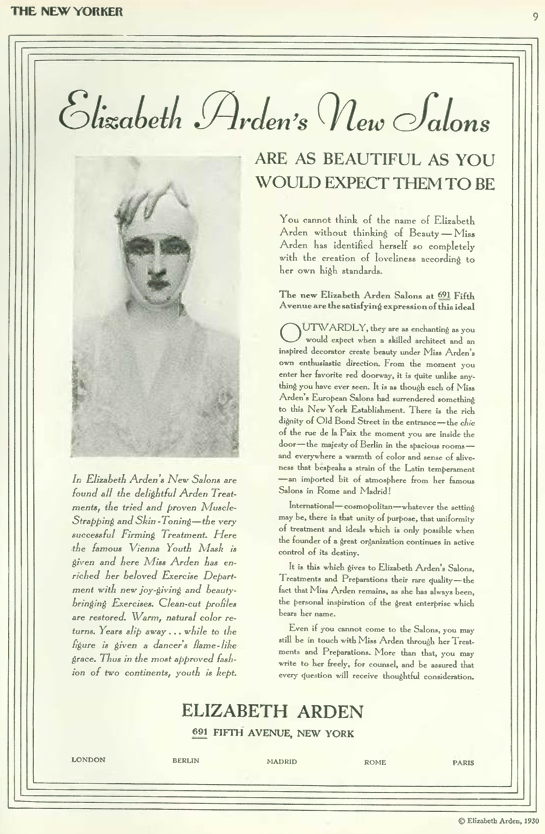
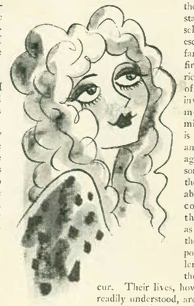
…on to our other advertisements, we have this entry from Elizabeth Arden…ads from this salon chain in the 1920s and 30s featured this ubiquitous image of a woman with a distant stare, her head tightly bound — mummy-like — as part of a firming treatment called “muscle-strapping”…
…in contrast to the rather cold, clinical look of the Elizabeth Arden ad, the Primrose House appealed more to social climbing than skin toning…
…while the makers of Pond’s cold cream continued to draw from their stable of debutantes and society ladies to move their product…
…long before there was Joe Camel, R.J. Reynolds also appealed to social climbers with a series of ads beautifully illustrated by fashion artist Carl Erickson…
…society’s smokers were advised to pack a tube of Bost toothpaste, or have their French maid do it for them…
…and once again we have an ad by Dr. Seuss for Flit insecticide that is very much of its time…
…as is this cartoon by Isadore Klein, perhaps the first in The New Yorker that depicted African Americans as something other than minstrel show stereotypes. Nevertheless, the rendering is still a bit crude — especially the boy’s face — as is the idea behind the “joke” — that a black boy could actually aspire to be a great violinist like Jascha Heifetz…
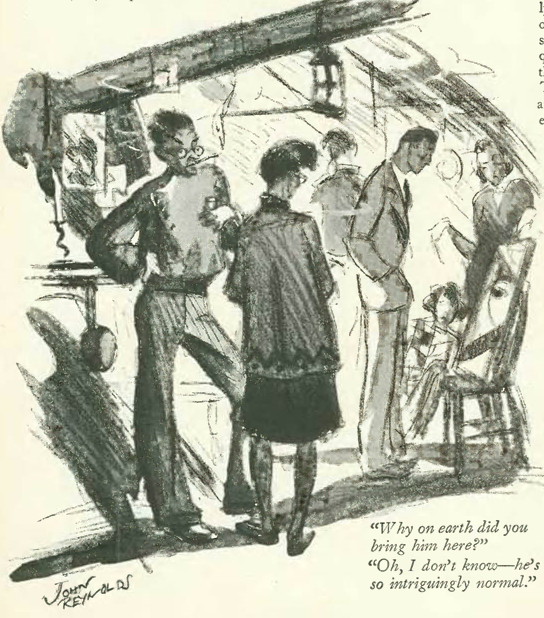
…John Reynolds explored a less troubling juxtaposition among the bohemian set…
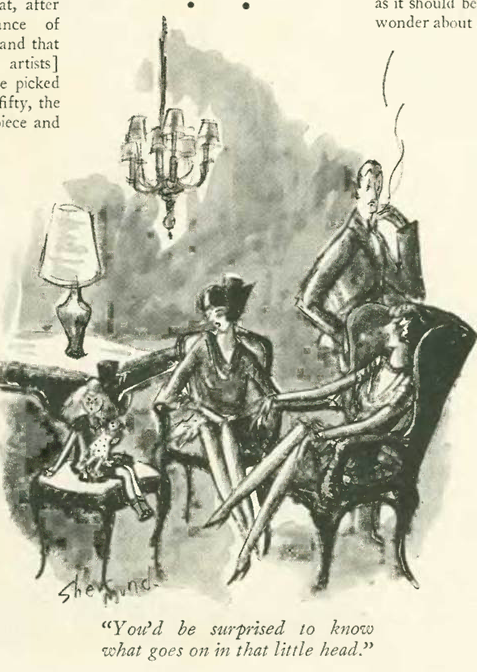
…and we end with this peek into society life courtesy Barbara Shermund…
The New Yorker offices at 25 West 45th Street were a long walk from Wall Street, but the panic that gripped the city beginning on Oct. 24 spread quickly through the borough. What the panic was about, however, wasn’t exactly clear.
Nov. 2, 1929 cover by Constantin Alajalov.
There was fear in the air, and a hint of doom, when E.B. White submitted his “Notes and Comment” section for the Nov. 2 issue. Having filed his column sometime between October 24 (“Black Thursday”) and October 29, 1929 (“Black Tuesday”), he weighed the mood of his city against the reassurances offered by politicians, bankers and pundits…
TELLERS OF TALES…As the New York Stock Exchange headed toward collapse, President Herbert Hoover, Thomas Lamont (head of the Morgan Bank) and prominent journalist Arthur Brisbane offered assurances that all was well. (Wikipedia/bhg.com)
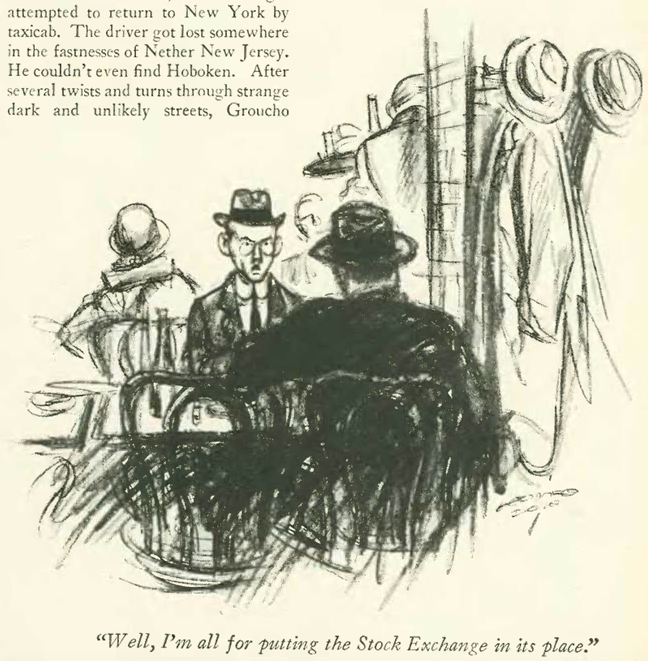
…and expressed schadenfreude over “a fat land quivering in paunchy fright” and some satisfaction in confirming his suspicions that “our wise and talky friends” on Wall Street really didn’t know what they were talking about:
THEY MADE A MESS OF THE ECONOMY, TOO…Sweeping the floor of the New York Stock Exchange after the Wall Street crash of 1929. (Wikipedia)
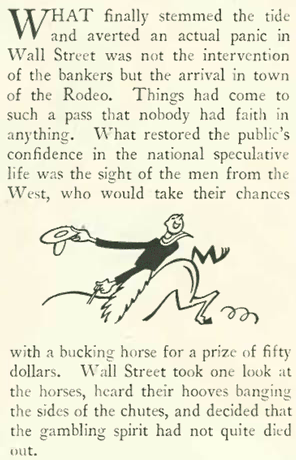
It seems White might have believed the worst was over, and that Wall Street would get back to its gambling spirit…
TALES OF TWO CITIES…The Brooklyn Daily Eagle proclaimed panic in its late edition on “Black Thursday,” Oct. 24; however, a day after the “Black Tuesday” crash of Oct. 29, The New York Times offered a more optimistic outlook for the days ahead.
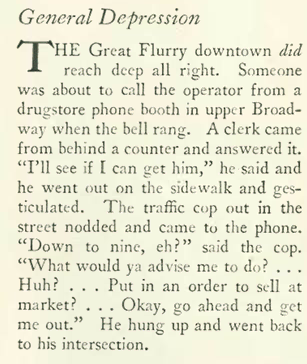
In “The Talk of Town” we find the first use of the word “Depression” in The New Yorker as it is related to the economic collapse…
BUSTED…Crowds gather on Wall Street following news of the stock market crash. (Library of Congress)
* * *
Mr. Blue Sky
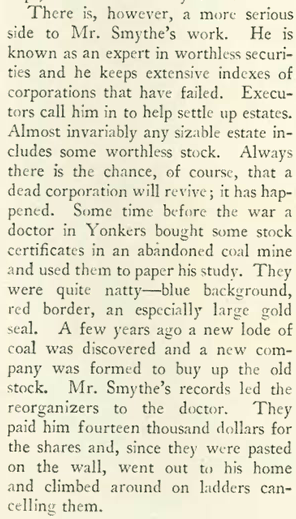
On the subject of stocks, “Talk” also featured this mini profile (written by Robert Coates) of Roland Mulville Smythe (1855-1930), who specialized in buying and selling old and obsolete stocks. Nicknamed “No Telephone” Smythe for his dislike of the device, he began his trade in obsolete securities and banknotes sometime around 1880…
MARKET GLEANER…Title page of Roland Smythe’s 1929 book, Valuable Extinct Securities. The notation beneath his portrait reads “No Telephone.” (worthpoint.com)
Coates told the story of a Yonkers doctor who used what he thought were worthless stock certificates (from an abandoned coal mine) to paper the walls of his study. Thanks to Smythe’s meticulous record-keeping, when a new lode was discovered at the mine, the doctor learned his wallpaper was worth $14,000 (equivalent to about $200,000 today)…
WALL STREET JUNKER…Share bought by Roland M. Smythe in 1899 and signed by him on the reverse side. At right, unusual obituary headline for an unusual man. (scripophily.org)
…Coates concluded by describing Smythe’s aversion to the telephone, and his talent for bowling…
* * *
Rise of the Machine
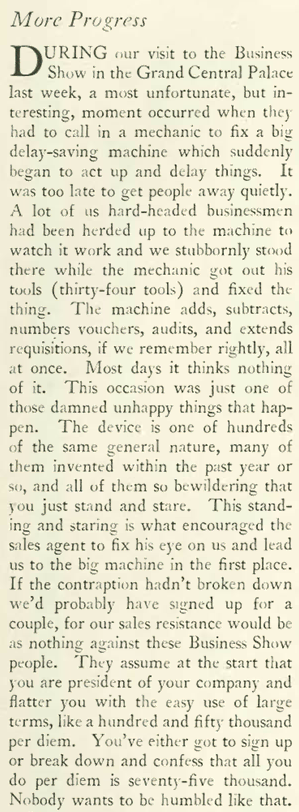
Ironically, the National Business Show was staging a big exhibition in Midtown while the economy was collapsing Downtown. James Thurber was on hand at the Grand Central Palace to take in the wonders of the machine age…
NOT MY TYPE…Manufacturers of the Underwood typewriter staged a typing competition at the 1929 National Business Show at the Grand Central Palace. From left are George Hossfield, Stella Willins (with her typewriter “Timmy”), Irma Wright and Albert Tangora. Hossfield, the men’s champion, could type 157 words a minute. The women’s champion — and the world’s champion typist of the 1930s — Willins once typed 128 words a minute for an entire hour without a mistake. She could type 240 words per minute from memorized lines. (oztypewriter.blogspot.com)
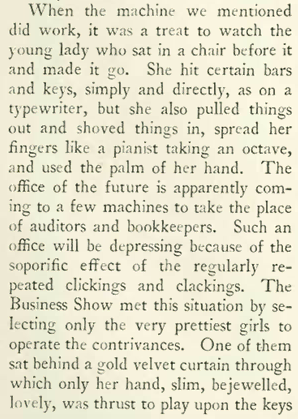
…Thurber seemed as impressed by the machines as by the “very prettiest girls” who were on hand to demonstrate them…
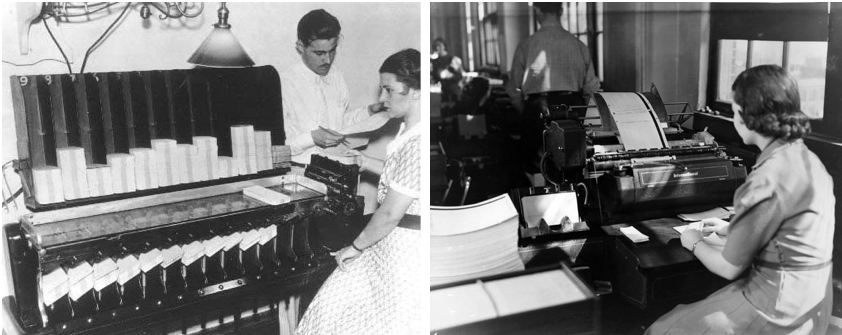
LOOKS COMPLICATED…At left, National Cash Register touted its business machines in this ca. 1930 ad; at right, a woman demonstrates a mimeograph machine in the 1920s. (Pinterest)SHOCK OF THE NEW…At left, these young operators contemplate the operation of an IBM Type 80 horizontal Hollerith card sorter. The woman appears less than thrilled by the mechanical beast; at right, a woman operates a IBM 405 Alphabetic Accounting Machine, ca. 1934. It could process 150 cards a minute and keep track of multiple sums while printing data on continuous-sheet forms. (officemuseum.com/computerhistory.org)
* * *
What a Strange Trip It’s Been
This brief “Talk” entry by Alfred Richman related a story from a traveling salesman just returned from Moscow. Among the highlights of his visit was a Soviet movie that “featured” America’s Sweetheart, Mary Pickford, in the title role…
In the 1920s, silent film stars Mary Pickford and Douglas Fairbanks were perhaps the most famous couple in the world. That included in the Soviet Union, where moviegoers preferred American films over their own avant-garde fare (while on the other hand, the New Yorker found Soviet films to be far more advanced than Hollywood’s). While vacationing in Moscow in 1926, Pickford and Fairbanks visited a Russian film studio with director Sergei Komarov, who cleverly captured enough footage of the two to weave them into a silent comedy titled A Kiss from Mary Pickford (Potseluy Meri Pikford). The film was a spoof on Hollywood fame, finding humor in a loveless man’s chance meeting (and kiss) with Mary Pickford, and his sudden and unexpected attractiveness to the opposite sex.
FUN WHILE IT LASTED…At left, Soviet film poster for Sergei Komarov’sA Kiss From Mary Pickford, featuring Russian actors Anel Sudakevich and Igor Ilyinsky (in the center photos) with various cameos by Mary Pickford and Douglas Fairbanks; at top, Soviet movie posters featuring Fairbanks and Pickford; bottom right, the couple feted by Russian fans, who presented Pickford with the headdress. The year 1929 would mark the end of such films in the Soviet Union — as Stalin began forced collectivization, he declared that Soviet cinema should only satisfy “the basic demands of the proletarian collective farm mass viewer.” Remarkably, Komarov and the actors Sudakevich and Ilyinsky would survive the years of Stalinist terror that would follow, even living to old age. (IMDB/transmediale.de/Facebook fan site)
* * *
Fire and Ice
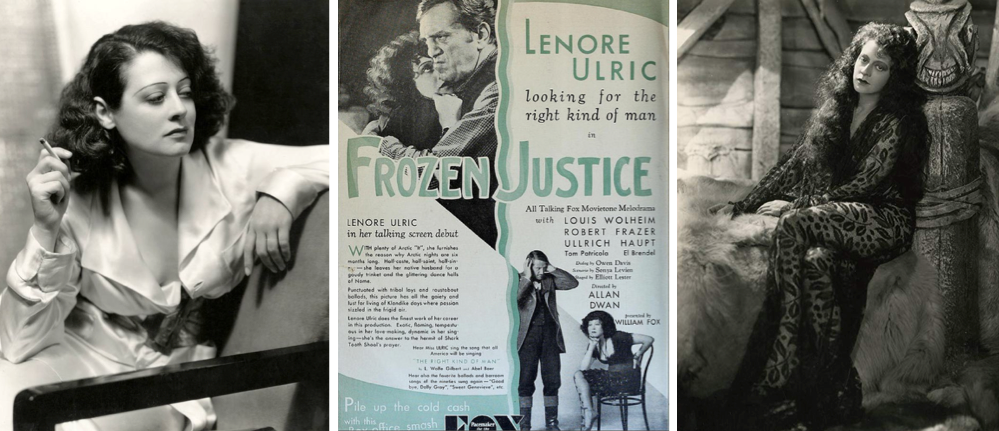
Back stateside, New Yorker film critic John Mosher took in the talking film debut of the hugely popular stage actress Lenore Ulric (1892-1970). Known on Broadway for her portrayals of fiery women, she tried, it seems unsuccessfully, to bring some of that heat to Frozen Justice, which was set in Alaska during the Klondike Gold Rush…
FEMME FATALE…Lenora Ulric, who made less than 20 films, was known for her work on the stage. At left, Ulric taking a break from her Broadway work in the early 1930s; center, magazine ad for Frozen Justice; at right, Ulric as the half-Eskimo Talu in Frozen Justice. (Pinterest/IMDB)
* * *
Right Ho, Plummie (CORRECTION: Not So, Plummie)
I incorrectly attributed this poem in the Nov. 2 issue to British humorist P.G. Wodehouse…
…thankfully, an alert reader kindly pointed out that “Ode to Peter Stuyvesant” isn’t by Wodehouse, but by another person with the initials P.G.W. — Philip G. Wylie.
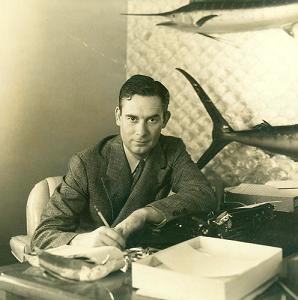
HE COULD BE FUNNY, TOO…Short story writer, screenwriter and satirist Philip G. Wylie in an undated photo. (Wikipedia)
* * *
From Our Advertisers
We begin with the back pages, where toaster wars were being waged by the makers of the “Toastmaster” and Thomas Edison’s “Automaticrat”…
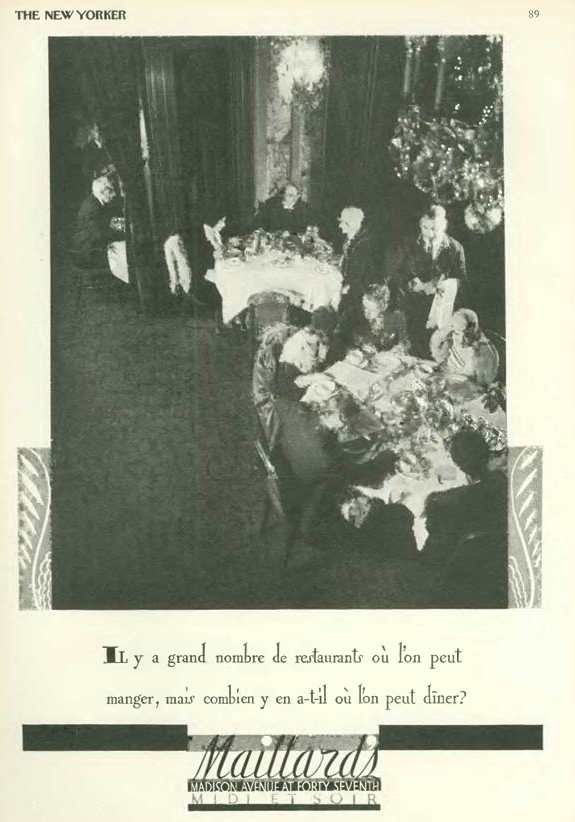
…for some in the posh set, the days of fine dining at places like Maillard’s (with this all-French ad) would be coming to an end thanks to the market crash…actually, Maillard’s itself would come to an end in the 1930s, thanks to the Depression…
…stage, film (and later television) actress and dancer Queenie Smith was the latest celeb to tout the wonders of Lux Toilet Soap…
Queenie Smith circa 1930. (IMDB)
…here’s an unusual way to sell shock absorbers…I’m wondering if this is supposed to be a sugar daddy and a chorus girl trying to make hay in the back seat of a car without Houdaille shocks…
…a couple more ads from the back pages, the ones on the left appeal to women’s fitness, while the ad on the right tries its best to push a product that was fast going the way of the horse and buggy. Spats — devised in the late 19th century to protect one’s shoes and socks (then called stockings) — went out of fashion in the 1930s, no doubt because most streets were now paved and you didn’t have to worry about a passing wagon splashing mud and horseshit all over your shoes and ankles…
…and indeed, now you could have Goodrich Zippers, in smart new colors…
…and speaking of colors, a couple of richly toned ads for Arrow Shirts…
…and Camel cigarettes…
…on to our illustrators and cartoonists…spot drawings — sprinkled throughout the magazine — were often a foot in the door for aspiring contributors (Peter Arno and Charles Addams are just two examples). Below is a collection of spot drawings from the Nov. 2 issue, mostly from established artists including Barbara Shermund, Alice Harvey, Julian De Miskey, Gardner Rea, Johan Bull and I. Klein. The New Yorker also recycled old cartoons for spots, including the illustration below (third row, second one down) by Shermund of the young woman on telephone, which originally appeared in the July 16, 1927 issue with the caption, “Hold the line a minute, dear—I’m trying to think what I have on my mind.”
…Arno continued to provide illustrations for Elmer Rice’s serialized novel, A Voyage to Purilia…
…and Julian De Miskey illustrated G. Marston’s entry for the ongoing “That Was New York” column…
…our cartoons come from Barbara Shermund…
…Gardner Rea, having a political moment…
…for reference, a photo of Mayor Jimmy Walker…
brookstonbeerbulletin.com
…Shermund again, on the joys of parenthood…
…Peter Arno’s take on Jazz Age chivalry…
…and perhaps the timeliest entry of all, from Leonard Dove…
Although artist Georgia O’Keeffe has long been celebrated for her desert imagery and interpretations of natural forms, during the 1920s her heart was very much in New York City.
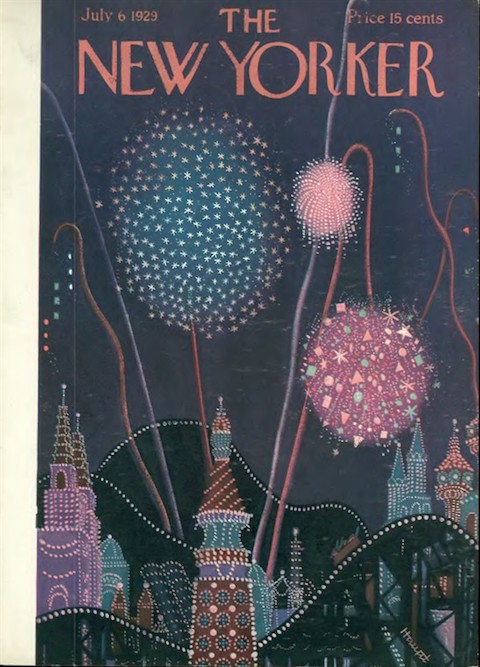
July 6, 1929 cover by Theodore Haupt.
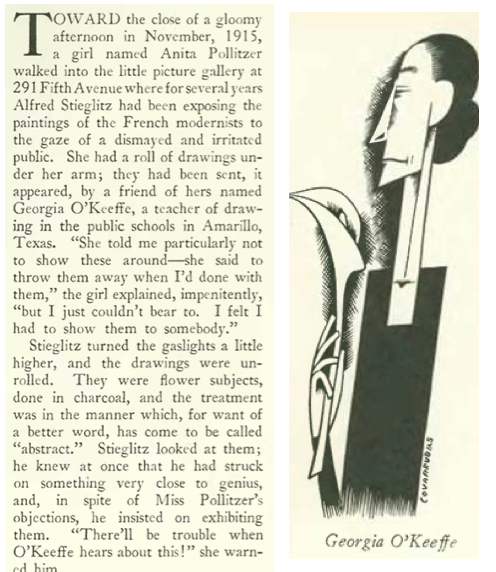
And New York City was where it all began for O’Keeffe (1887-1986). In January 1916, the famed photographer Alfred Stieglitz (1864-1946) was shown a portfolio of charcoal drawings by O’Keeffe’s friend, Anita Pollitzer. Stieglitz was so impressed that he immediately made plans to exhibit the drawings—without O’Keeffe’s permission. The longtime art critic for TheNew Yorker, Robert Coates, told the story in the opening lines of his July 6 profile piece on the artist:
O’Keeffe moved from Texas to New York in 1918, and she and Stieglitz would marry in 1924, a marriage that would last until his death in 1946 (despite the fact he took a longtime lover, 22-year-old Dorothy Norman, in 1927).
TWO OF A KIND…Alfred Stieglitz, left, photographed by Paul Strand at Lake George, New York, in 1929. Exhausted and depressed, Stieglitz had retreated to the lake for the summer after learning that his exhibition space in the Anderson Galleries, which he called “The Room,” would be demolished along with the gallery building. ∞ Center, a photo Stieglitz had attached to a July 10, 1929 letter to O’Keeffe, who had begun spending summers painting in New Mexico. Below the photograph he wrote, “I have destroyed 300 prints to-day. And much more literature. I haven’t the heart to destroy this…” ∞ O’Keeffe in a 1929 photograph by Stieglitz, after her return from New Mexico. (aperture.org/Yale Beinecke Library/flashbak.com) click to enlarge
Following O’Keeffe’s first exhibition at the 291 gallery, Stieglitz established a firm hold over the display and sale of her work:
During the 1920s O’Keeffe found much inspiration on the streets of Manhattan, and particularly in the proximity of the Shelton Hotel, where she lived from 1925 to 1936. The Shelton, which opened in Midtown in 1924 as the tallest hotel in the world, provided a perfect vantage point for O’Keeffe to observe city life:
EYE OF THE BEHOLDER…Georgia O’Keeffe was captivated by her adopted city, particularly views from and around New York’s Shelton Hotel, where she lived from 1925 to 1936. Top row, from left: New York Street with Moon (1925) ∞ New York Street No. 1 (1926) ∞ Shelton Hotel New York No. 1 (1926) ∞ The Shelton with Sunspots (1926) ∞East River From the Shelton (1926) || Bottom row, from left: New York Night (1929) ∞Radiator Building – Night, New York (1927) ∞ East River From the 30th Story of the Shelton Hotel (1928) ∞ Ritz Tower, Night (1928). (museothyssen.org/okeeffemuseum.org/curiator.com/virginia.edu/isak.typepad.com/ theartstack.com (2)/ephemeralnewyork.wordpress.com/artnet.com) click to enlarge
* * *
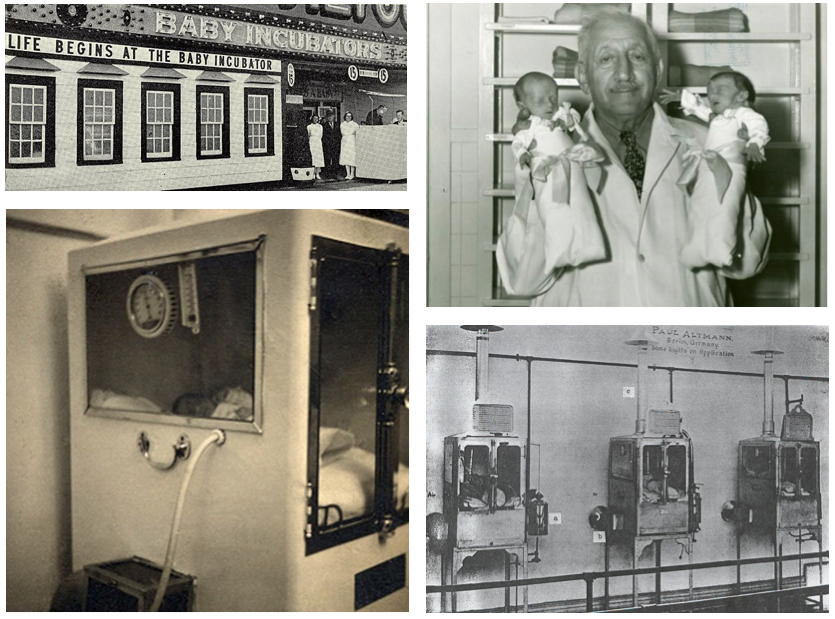
During the early decades of the 20th century Martin Couney (1870-1950) was renowned for his baby incubator exhibits at various world’s fairs and for his long-standing display of incubating babies at New York’s Coney Island, wedged between the usual sideshow attractions of freaks and burlesques. Couney charged visitors 25 cents to view the infants (in order that their parents would not have to pay for their medical care). “The Talk of the Town” looked in on Couney…
I’M NOT A DOCTOR. I JUST PLAY ONE IN REAL LIFE…Clockwise, from top left, Incubator display building on Coney Island circa 1920s; Martin Couney with babies in undated photo; Couney’s early infant incubators in operation at the Trans-Mississippi Exposition in Omaha, 1898; the infant Beth Allen in a Coney Island incubator, 1941. (NPR/New York Public Library Digital Collections/Beth Allen)
Although many physicians at the time reviled Couney as a showman and a quack (he was most likely not a trained medical doctor), he nevertheless saved the lives of thousands of infants who would have died if left to the care of hospitals that were slow to catch on to this lifesaving device (they weren’t widely adopted until after Couney’s death in 1950). The “Talk” article credited Couney for saving “about six thousand lives.” Many of those babies went on to live long and healthy lives:
SEEING IS BELIEVING…Beth Allen (pictured, at left, in 2016, and as an infant in the photo montage above) was born three months premature in Brooklyn in 1941. Her mother initially rejected putting Beth in one of Couney’s Coney Island incubators, but her father persuaded Martin Couney to talk to his wife, who acquiesced. At right,Lucille Horn (pictured with daughter Barbara in 2015) was given little hope by doctors when she was born premature in 1920. The hospital staff told her father that they didn’t have a place for her, and that she had no chance of survival. Nevertheless, her father grabbed a blanket to wrap her in, hailed a taxicab and took her to Couney’s infant exhibit at Coney Island. Barely 2 pounds in 1920, she lived to age 96. (AP/NPR StoryCorps)
* * *
The Electric Company
The 1920’s saw an explosion of labor-saving electric appliances, ranging from electric fans and irons to vacuum cleaners and refrigerators. The decade also saw a massive proliferation of electric lights, and the huge power plants that would be needed to keep everything running. “Talk” looked in on the Edison Company’s East River power plant to see how it all worked:
STILL HUMMING…Edison’s East River power plant (now ConEd), entered service in 1926 and is still in operation today (with a number of updates and additions over the years). At right, a 1920s view of the Broadway lights (newtownpentacle.com/Museum of the City of New York)
The opening of the Edison plant on the East River was a big deal in 1926. According to the ConEd website, “the six-story boilers installed at Fourteenth Street and East River were so large that a luncheon for nearly 100 people was served inside one of them before the renovated station went into operation… during the opening day ceremony in 1926, Queen Marie of Rumania flipped the switch to start the 100,000 horsepower turbine generator.”
“Talk” also offered some interesting insights into the plant’s complex operations, including an unusual storm warning system:
YOU GET THE IDEA…A Philadelphia Electric Company control room in the 1920s. New York’s was undoubtedly much larger. (IEEE Computer Society)
* * *
From Our Advertisers
Fleischmann Yeast was a regular advertiser in TheNew Yorker for a good reason: Raoul Fleischmann (of the New York yeast and baking giant) hated the baking business but loved hanging out with the Algonquin Round Table crowd, which included New Yorker founding editor Harold Ross. When the fledging magazine nearly went belly up in 1925, Fleischmann kicked in the money (and on a number of occasions thereafter) to keep it going. Hence the “free” advertising he received for his product, touted not as a baking aid, but rather as a cure for constipation and other intestinal turmoils. In this ad, a physician who “treated German Royalty” endorsed the generous consumption of yeast cakes…
…a footnote on the Fleischmann ad: Dr. Kurt Henius (1882-1947) was a doctor of medicine and a professor on the Friedrich-Wilhelms (now Humboldt) University medicine faculty at the Charité hospital in Berlin, Germany. Because he was Jewish, he was dismissed from the university in 1935, and in 1939 he fled from the Nazis to safety in Luxembourg, where he died in 1947.
* * *
During prohibition we see plenty of ads in TheNew Yorker for ginger ale and sparkling water, but this one for Pabst Blue Ribbon beer caught my eye. This was, of course, “near-beer,” with an alcohol content of 0.5%…
According to Forbes magazine, the few breweries that managed to survive during Prohibition made everything from ceramics and ice cream to the barely alcoholic near beer. Pabst also turned to making cheese, which was aged in the brewery’s ice cellars. The brand, “Pabst-ett,” was sold to Kraft in 1933 at the end of Prohibition…
(Courtesy Pabst Blue Ribbon)
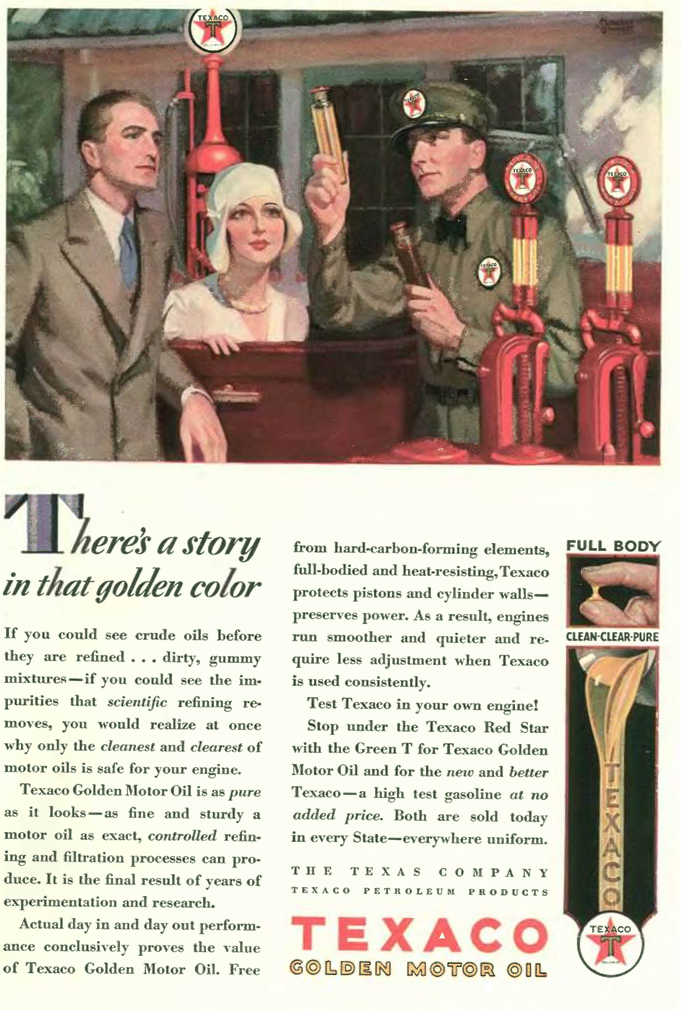
…and this colorful ad comes courtesy of Texaco. Did you ever see two young people more enamored with petroleum products?…
…before we get to the cartoons, here is a two-page illustration in the July 6 issue by Constantin Alajalov (click to enlarge)…
…this peek into the world of trolley car conductors appears to be by Perry Barlow…
…and finally, Peter Arno revealed the thankless work of one stuntman…









































 A New Yorker State of Mind