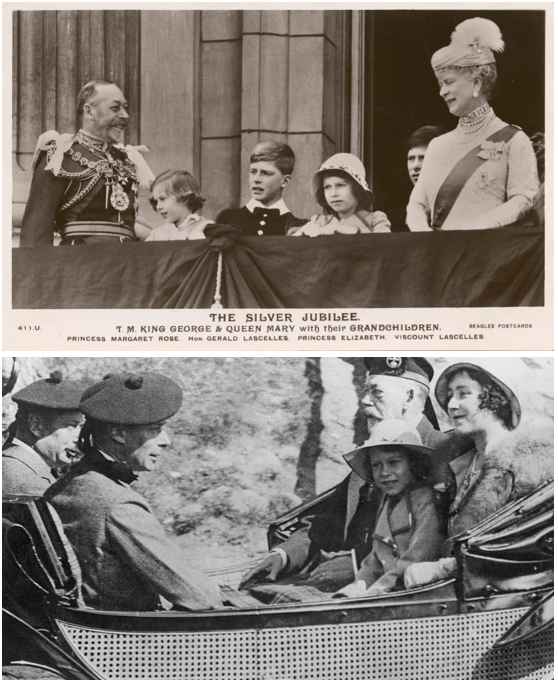
Above: King George V and Queen Mary posed for portraits by John St Helier Lander to commemorate the king’s Silver Jubilee in 1935. (Wikipedia)
The British Royal Family has never been my cup of tea, but its hard to deny their influence on world affairs, even if today it is mostly ceremonial. The king and queen were also figureheads back in 1935, however they could still claim to lead a vast empire, albeit one badly fraying at the seams.
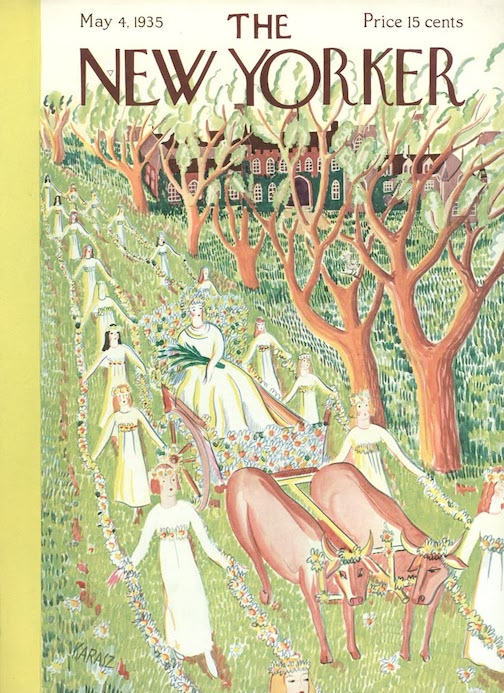
May 4, 1935 cover by Ilonka Karasz.
Then as now, the power of the royals lay largely in their ability to boost the political and economic fortunes of their island nation. Such was observed by The New Yorker’s Paris correspondent Janet Flanner, who penned a two-part profile of Queen Mary (nee Mary of Teck or more formally Victoria Mary Augusta Louise Olga Pauline Claudine Agnes; Queen of the United Kingdom and the British Dominions, and Empress of India). Flanner wrote the profile of Queen Mary (1867-1953) in anticipation of the Silver Jubilee of her husband, King-Emperor George V (1865-1936). Excerpts:
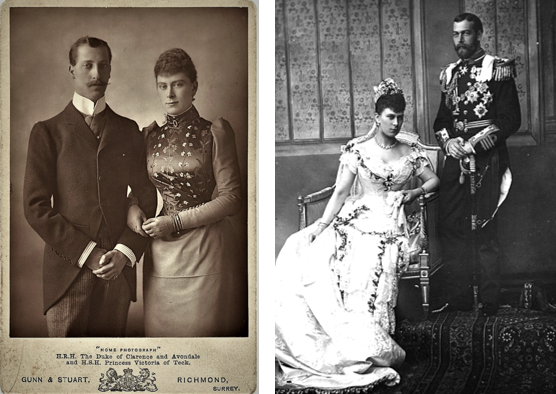
A DEB AND A DUKE…In 1886 Mary was a an unmarried British princess who was not descended from Queen Victoria, so she was a suitable candidate for the royal family’s most eligible bachelor, Mary’s second cousin Prince Albert Victor, Duke of Clarence and Avondale. In early December 1891 Albert Victor (left photo) proposed marriage to Mary, but he died six weeks later in the Russian flu pandemic. Less than two years later (July 1893) Albert Victor’s brother, Prince George, Duke of York, would wed Mary—at right, their wedding day photo. (Wikipedia)
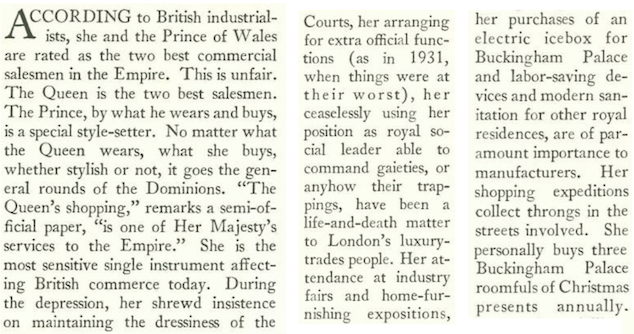
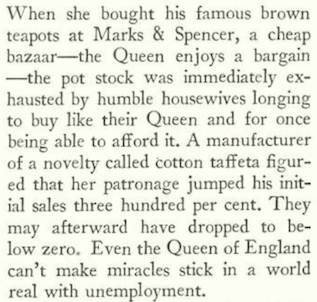
Flanner noted that the King George V and Queen Mary were rated by British industrialists as the Empire’s “two best salesmen,” however it was Mary who proved the most influential whether she was buying a hat or a refrigerator. Excerpts:
SILVER AND GOLD…Top photo: to mark the king’s Silver Jubilee on May 6, 1935, King George V and Queen Mary greet their subjects from a balcony at Buckingham Palace with their grandchildren, (from left) Princess Margaret Rose, Hon. Gerald Lascelles, Princess Elizabeth, and Viscount Lascelles. Below, King George V, the Duke and Duchess of York, and Princess Elizabeth take a trip in the royal carriage, 1933. The Duke and Duchess would succeed the throne upon the death of King George in 1936 and the abdication of the Duke’s brother, Edward, that same year. (Reddit/Town & Country)
Naturally, not everyone in the kingdom was thrilled by the Silver Jubilee…
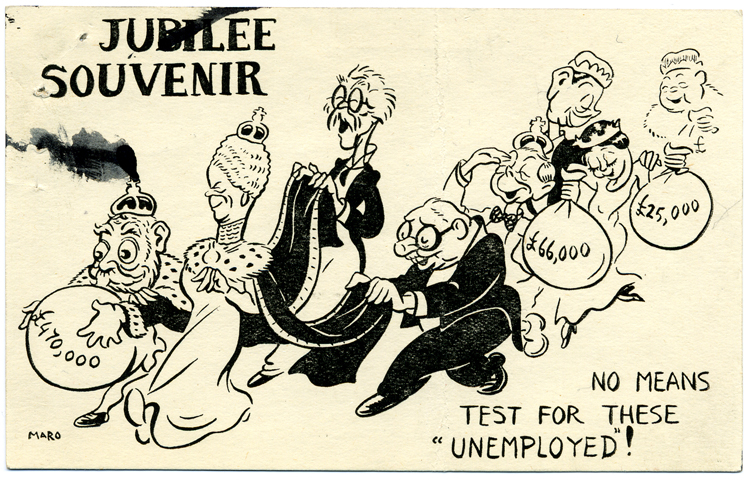
OPPOSING VIEWPOINT…The anti-monarchist cartoonist Desmond Rowney commemorated the Silver Jubilee with this cartoon in the Daily Worker. The public expense for the Silver Jubilee in the midst of a financial depression caused some controversy. (National Archives UK)
* * *
Corn-fed Canvasses
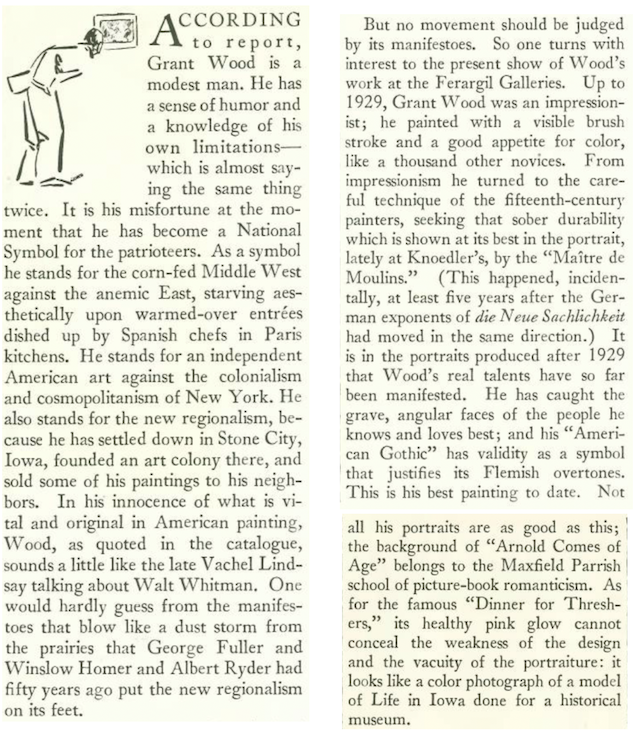
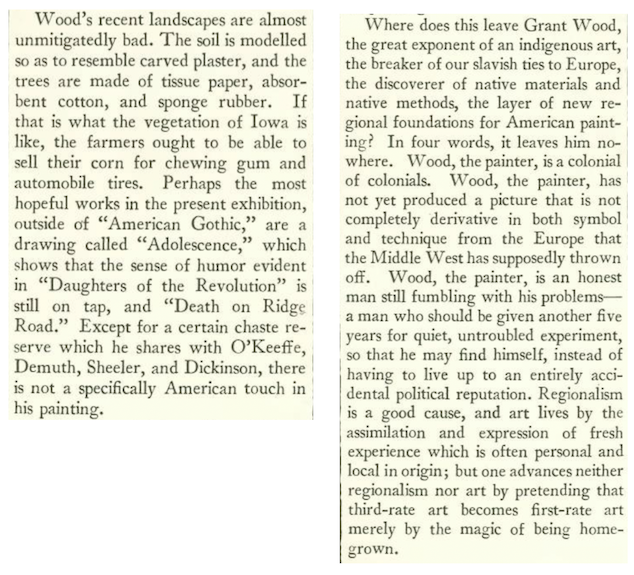
Critic Lewis Mumford, like many East Coast intellectuals, was allergic to the over-patriotic and the sentimental, so when it came to assessing the work of the regionalist painter Grant Wood (1891-1942), Mumford found himself perplexed but hopeful that Wood would one day “find himself” and produce “first rate” art.
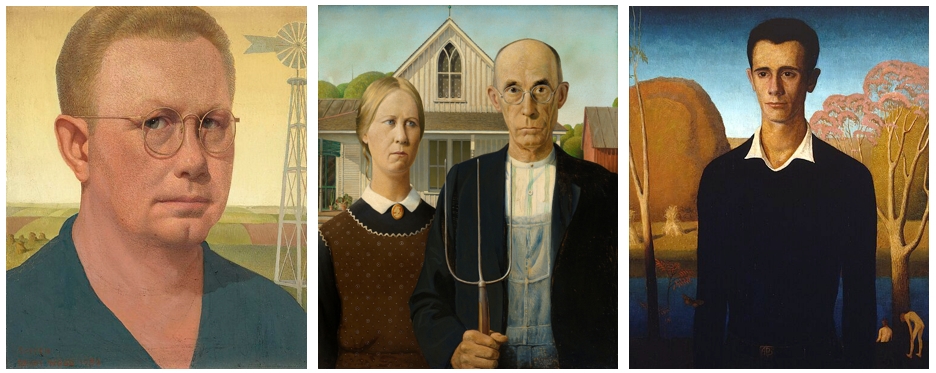
FLANKING THE ICONIC painting American Gothic (1930) are Grant Wood’s Self Portrait (1932) and, at right, Arnold Comes of Age (1930). Lewis Mumford considered American Gothic to be Wood’s best work. (figgeartmuseum.org/whitney.org/sheldonartmuseum.org)
Mumford did not mince words, however, when it came to Wood’s contemporary landscapes, which he called “unmitigatedly bad…If that is what the vegetation of Iowa is like, the farmers ought to be able to sell their corn for chewing gum…”
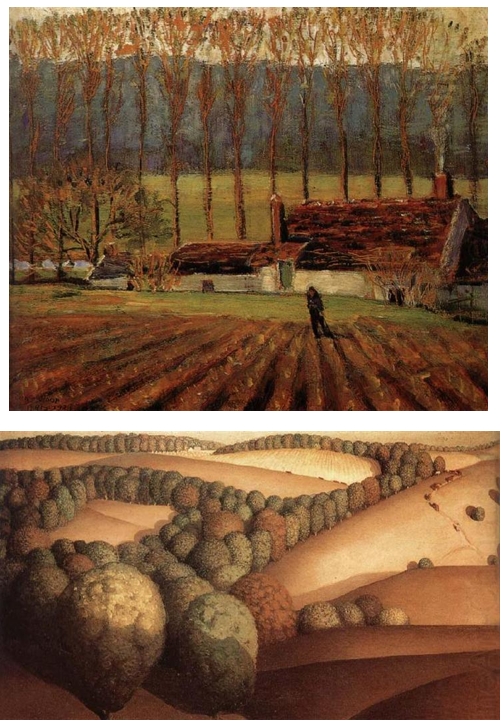
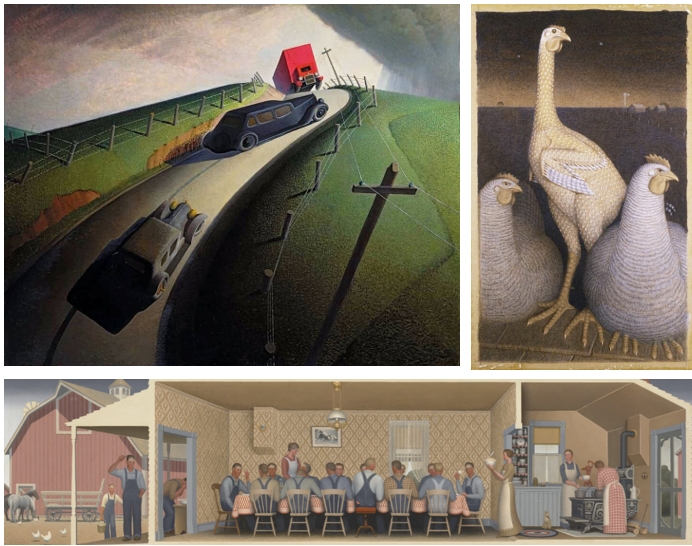
BUBBLEGUM TREES…From 1919 to 1925, Grant Wood taught junior high art in Cedar Rapids, Iowa. The seasonal nature of teaching allowed Wood to take summer trips to Europe to study art, and his early work showed strong post-impressionist influences, including his impressionistic Vegetable Farm (top) from 1924; below, Mumford thought Grant’s later landscapes looked like they were made of cotton and sponge rubber, including Near Sundown, from 1933. (wikiart.org)HOPE AND NOPE…Mumford wrote that Wood’s more “hopeful” works included, top left, Death on Ridge Road and, top right, Adolescence. On the other hand, he found the portraiture in Dinner for Threshers (bottom) vacuous, suggesting “a color photograph of a model of Life in Iowa done for a historical museum.” (wikiart.org/figgeartmuseum.org)
* * *
Daring Young Man
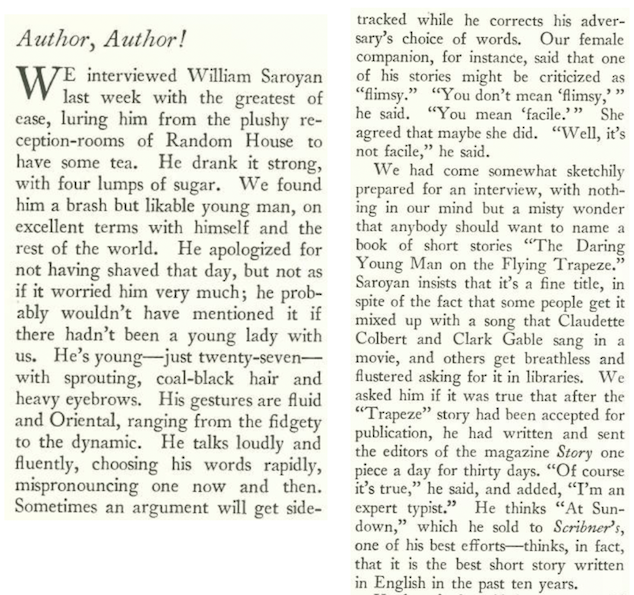
“The Talk of the Town” paid a visit to William Saroyan (1908–1981), an Armenian-American novelist, playwright, and short story writer who would go on to receive a Pulitzer Prize for Drama in 1940 and a 1943 Academy Award for Best Story for the film The Human Comedy. An excerpt:
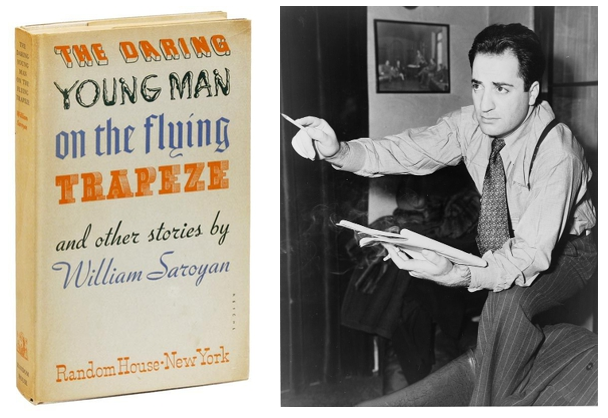
HIGH WIRE ACT…The Daring Young Man on the Flying Trapeze and Other Stories (1934) was the first collection of 26 short stories by William Saroyan (pictured here in 1940). The book became an immediate bestseller. (Wikipedia)
* * *
Not Long For Long
In his column “Of All Things,” Howard Brubaker noted that the “loose talk” of Huey Long, a U.S. Senator from Louisiana and prominent critic of the New Deal, could be squelched by a Senate vote. As it turned out, it wouldn’t be necessary; Long was felled by an assassin’s bullet four months later.
* * *
Ode to Abode
E.B. White turned to verse to offer his thoughts on where one should live:
* * *
Tough Guys
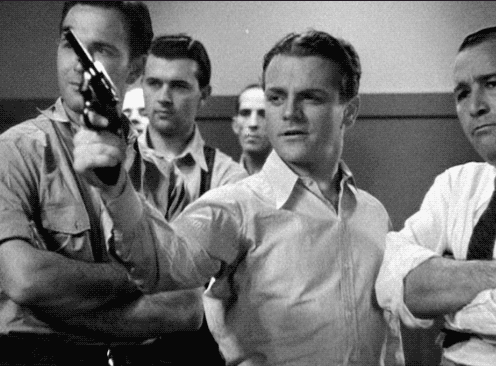
After a musical comedy, a Shakespeare adaptation (A Midsummer Night’s Dream), and another comedy, James Cagney returned to familiar form with an exciting crime drama, G Men. Critic John Mosher was pleased that Cagney was back to tap-dancing with machine guns rather than showgirls.
CRIME PAYS…AT THE BOX OFFICE… James Cagney takes aim at his new role as a federal agent James “Brick” Davis in G Men. With the Hays Code in force, Warner Brothers made the film to counteract what many leaders claimed was a disturbing trend of glorifying criminals in gangster films. (Still from film)
* * *
From Our Advertisers
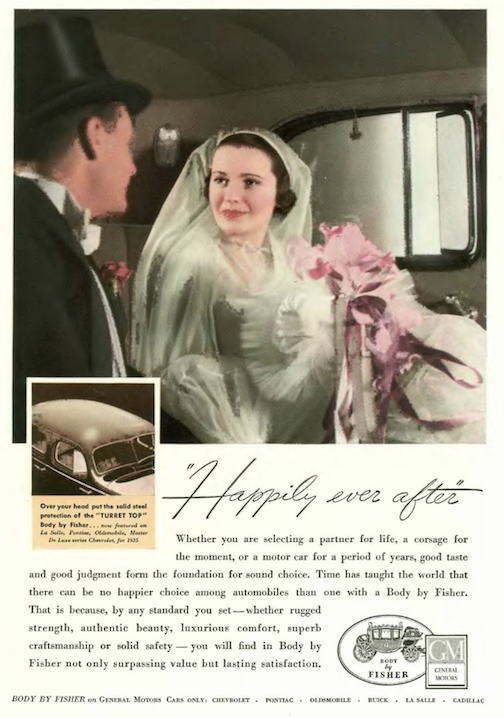
According to General Motors’ Fischer division, good taste was in order whether you were choosing a spouse or an automobile…
…New Yorker ads continued to display bright colors to sell everything from cars to whiskey to sparkling water (with apparent health benefits)…
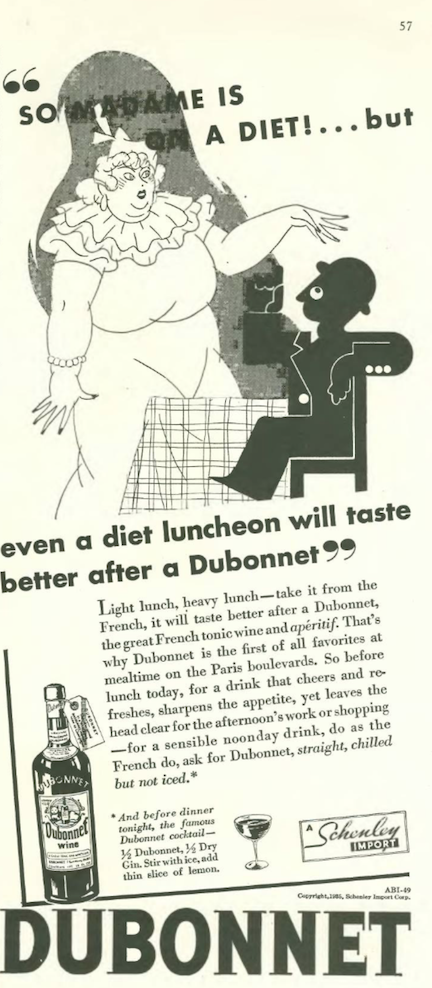
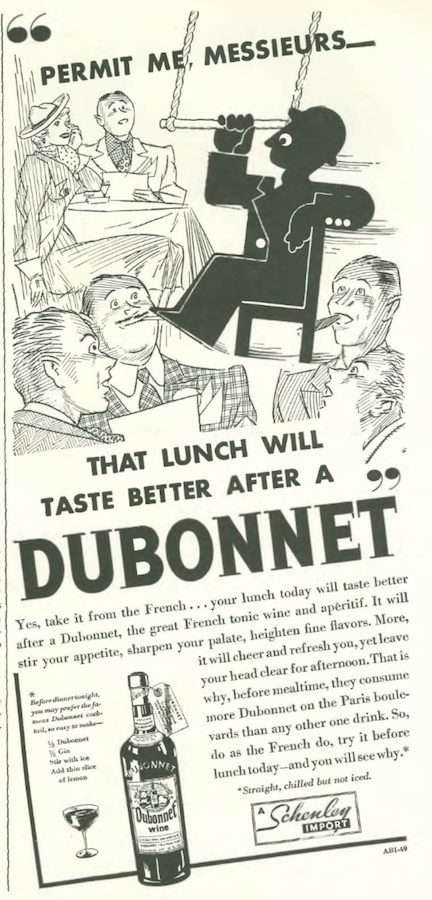
…the shadowy Dubonnet mascot was back, here making the claim (against the wisdom of the ages) that a lunchtime drink will clear your head for the afternoon ahead…
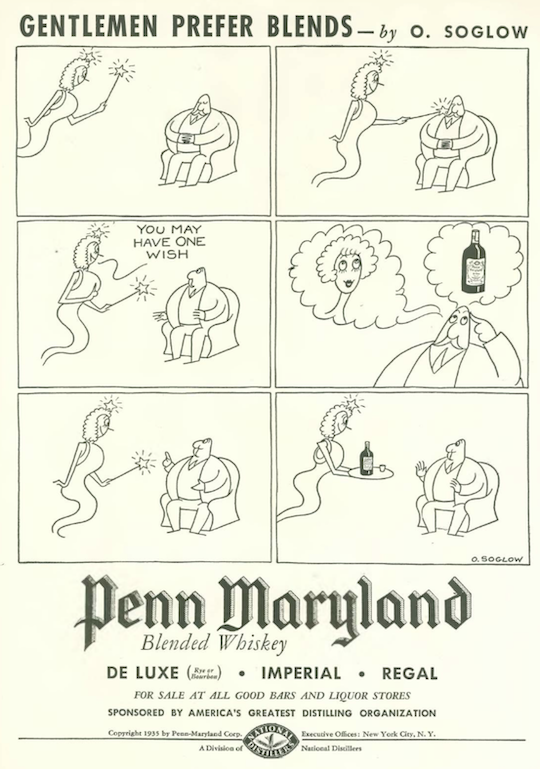
…no health claims here from Penn Maryland, just pure magic as depicted by Otto Soglow…
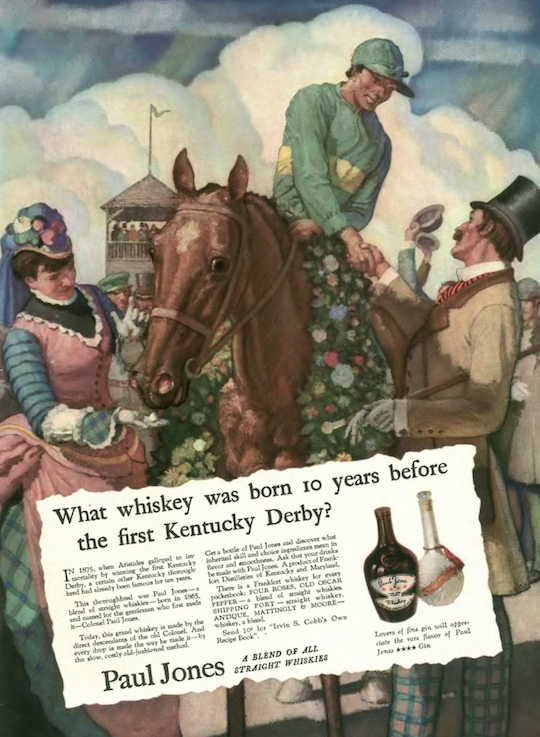
…and what goes better with whiskey than the Kentucky Derby…
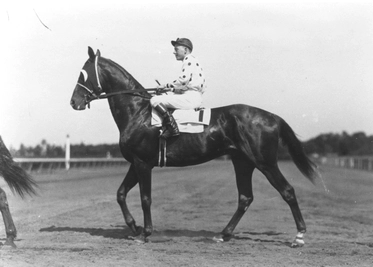
…the 1935 Kentucky Derby was won by Omaha, a three-year-old Thoroughbred; he was the third horse to ever win the Triple Crown (Omaha was the son of Gallant Fox, the 1930 U.S. Triple Crown winner)…
Omaha in 1935 (Wikipedia)
…on the subject of Thoroughbreds, Camel offered up testimonials from top athletes in a variety of sports…they all agreed that the cigarettes “don’t get your wind”…so what did that mean?…according to R.J. Reynolds, “It means you can smoke Camels all you want”…
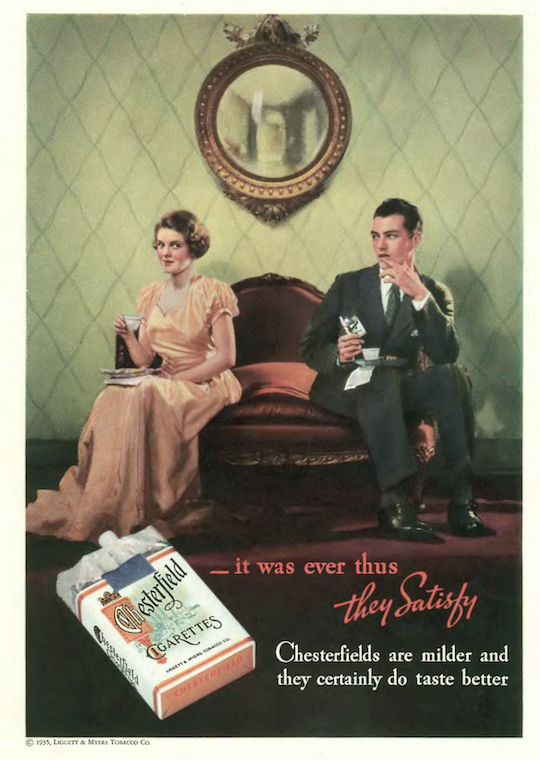
…Camels also calmed the nerves, and so apparently did Chesterfields…
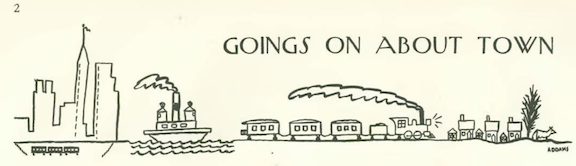
…on to our cartoonists, we begin with a spot by Charles Addams at the top of page 2…
…later in the issue James Thurber contributed this drawing to stretch across the bottom of page 62 (“On and Off the Avenue”)…
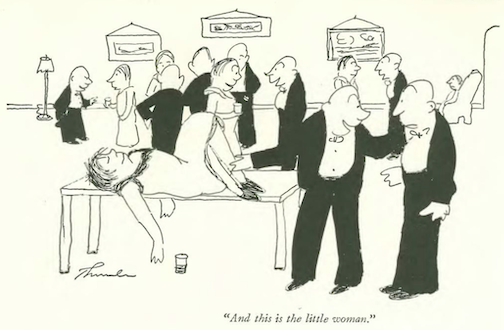
…Thurber again, with the life of the party…
…William Steig offered up a page-full of wits…
…plus one more on the preceding page…
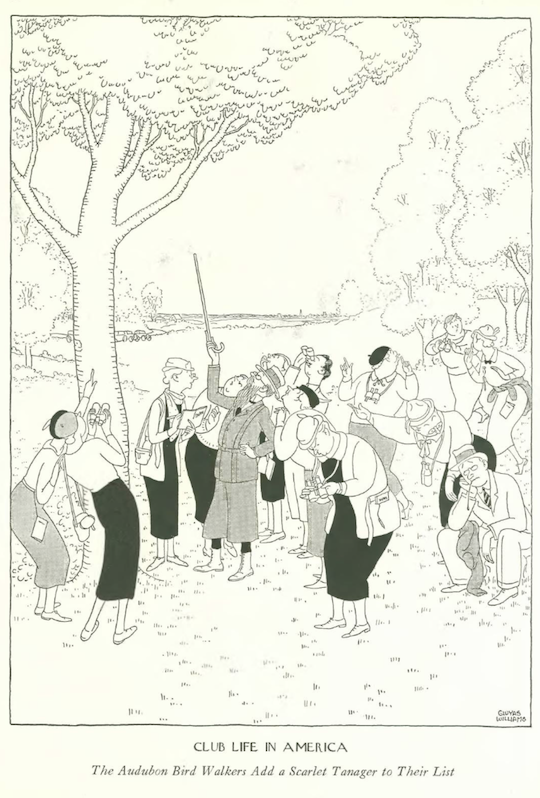
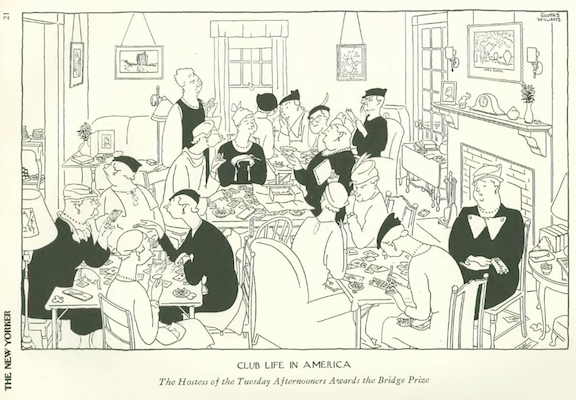
…Gluyas Williams continued to follow the strange ways of club life in America…
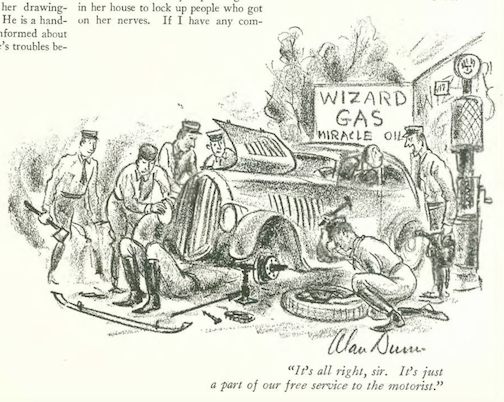
…and we close with Alan Dunn, and service with a smile…
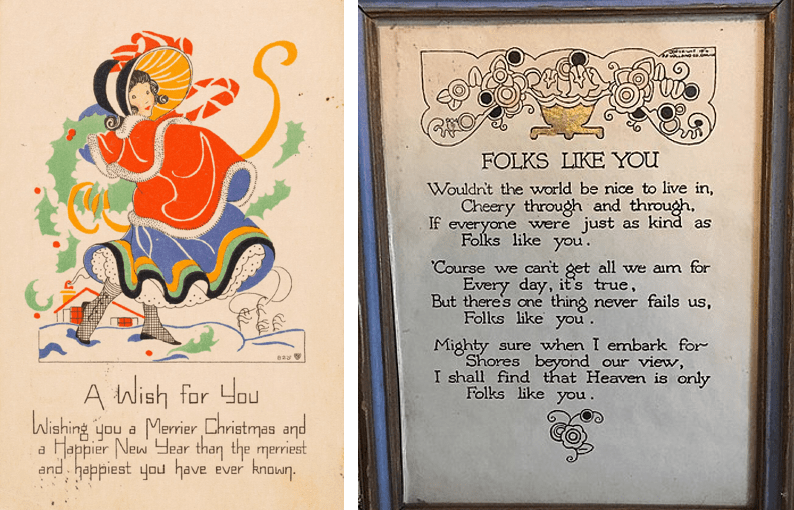
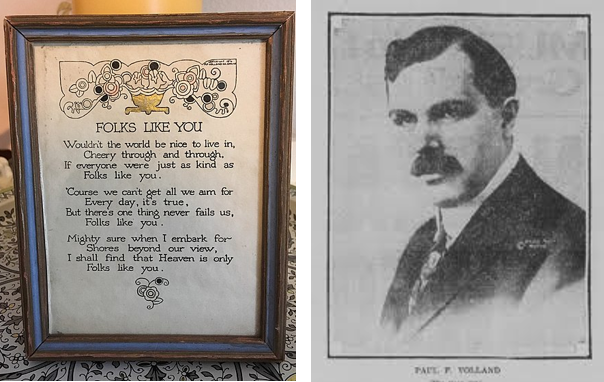
Above: Holiday greeting card circa 1920 (left) and framed poetry (1916) from the P.F. Volland Company, which rejected E.B. White's attempt at a get-well card. (Newberry Library/Wikipedia)
A deep reading of The New Yorker’s back issues can lead a person down some interesting rabbit holes as well as to new insights. For instance, who knew that the greeting card business could lead to murder?
April 20, 1935 cover by William Cotton.
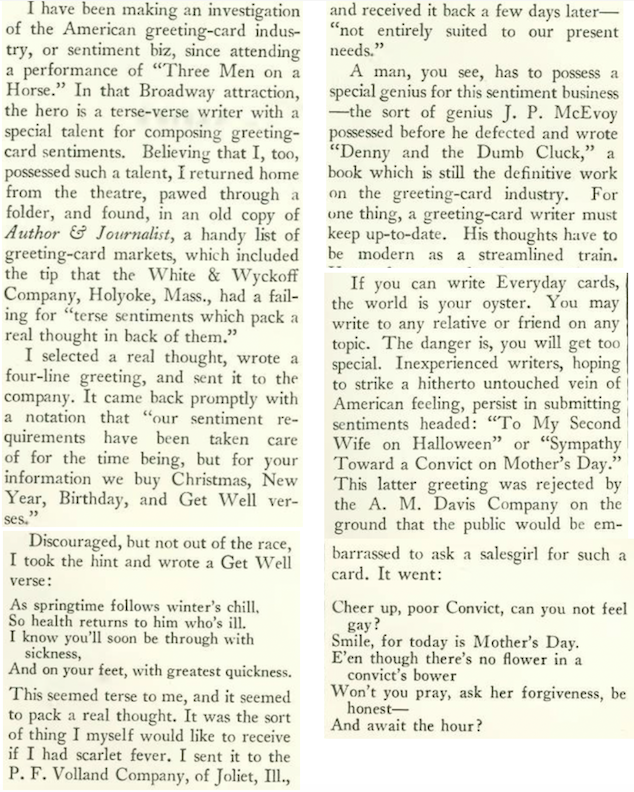
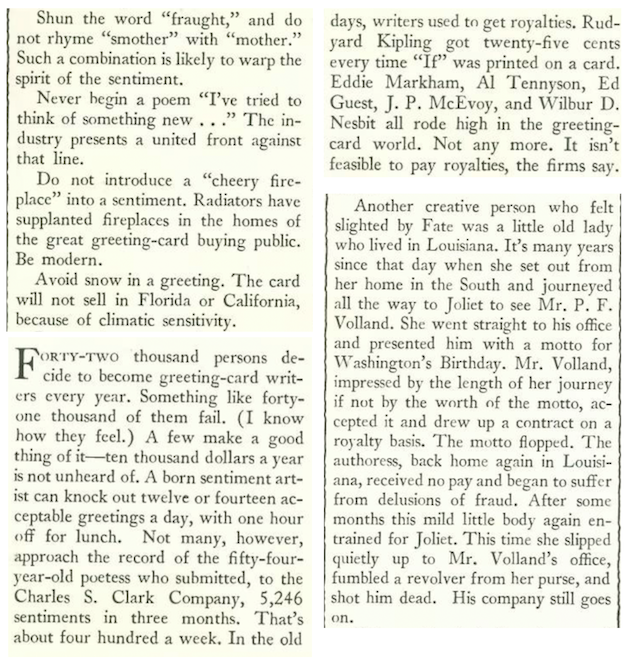
Writing for the occasional feature “Onward And Upward With The Arts,” E.B. White examined the hardboiled world of the “sentiment biz,” a world in which each year 42,000 eager writers elbowed their way into a few hundred positions, and even a smaller number made a decent living at it. To test his own mettle at the craft, White submitted a get-well message to the P. F. Volland Company.
A JOB TO DIE FOR…Paul Frederick Volland (1875-1919) founded his greeting card company in 1908, producing sheet music, children’s books, calendars, cookbooks, and framed poetry such as the example at left, from 1916. On May 5, 1919, Volland was shot and killed in his office by an elderly contributor, Vera Trepagnier, after a dispute about compensation over her miniature of George Washington. The company continued until 1959. (Wikipedia)HACK RACKET…One of the more illustrious contributors to the Volland Company was J.P. McEvoy (1894-1958). Despite his generous salary, he hated working for Volland. His 1930 novel Denny and the Dumb Cluck satirized the greeting-card business and his experiences with Volland. In an author’s note, McEvoy wrote that “among other minor atrocities I have compiled 47,888 variations of Merry Christmas…” (Wikipedia/Pinterest)
The Volland Company employed scores of artists and writers including L. Frank Baum, Edgar Rice Burroughs, John Held Jr, Ring Lardner, Robert Louis Stevenson, and J.P. McEvoy—a writer little known today, McEvoy was influential in the 1920s and 30s, writing everything from children’s tales (he likely inspired Raggedy Ann) to short stories, novels and comic strips, including the popular Dixie Dugan. He also wrote a hit Broadway play, and several of his stories were turned into movies, including W.C. Fields’ 1934 classic It’s a Gift.
White also offered some “tips” on sentiment writing, suggesting that one avoid rhyming words such as “smother” and “mother”…
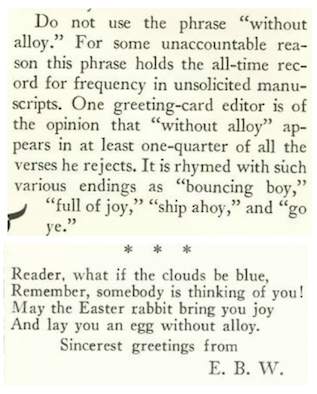
…he also cautioned about the use of certain phrases, and concluded with a cheeky Easter poem of his own…
* * *
More Thoughts From E.B.W.
White occasionally led off his column with observations on the passing scene, in this case springtime happenings in the city and beyond…
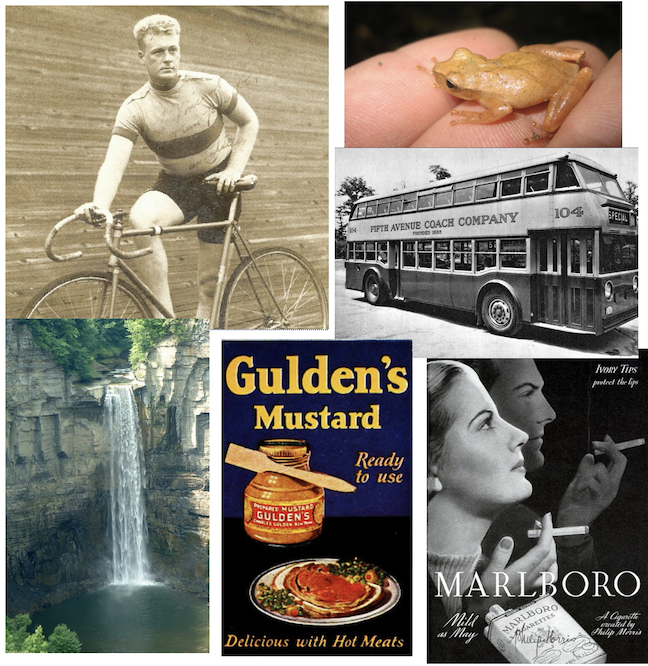
SIGNS OF SPRING…E.B. White looked around for signs of spring and found, among other things, the bicycle drills of the League of American Wheelmen (top left, professional bike racer Vincent Seifred rode for the the Empire City Wheelmen in the 1930s); top right, tiny spring peepers were for sale as pets at Macy’s; the Fifth Avenue Coach Company switched sponsors, from Marlboro to Gulden’s; White noted freshets (spring meltwater) in the hills—image is from New York’s Finger Lakes. (crca.net/paherps.com/aldenjewell-flickr.com/nygeo.org)
* * *
Star Struck
“The Talk of Town” anticipated the completion of the Hayden Planetarium at the American Museum of Natural History. When it opened in October 1935, it was only the fourth planetarium in the United States. Excerpts:
The profile by Meyer Berger looked at the life of a “chiseller,” that is, someone who lived day to day by skimming off the labors of others. Today it is mostly done digitally, but in 1935 the mechanical world could be manipulated by a handful of slugs. Excerpts:
* * *
From Our Advertisers
We begin with an elegant evening, the men in white tie, the women in their finest gowns, all preparing to partake of some canned soup…
…there were many ads with Easter themes to move the merch…
…here’s a detail from an Easter-themed ad for neckties, a retired Colonel, presumably, proudly strutting in the Easter Parade with his crop and monocle as he elbows aside his chauffeur and granddaughter…
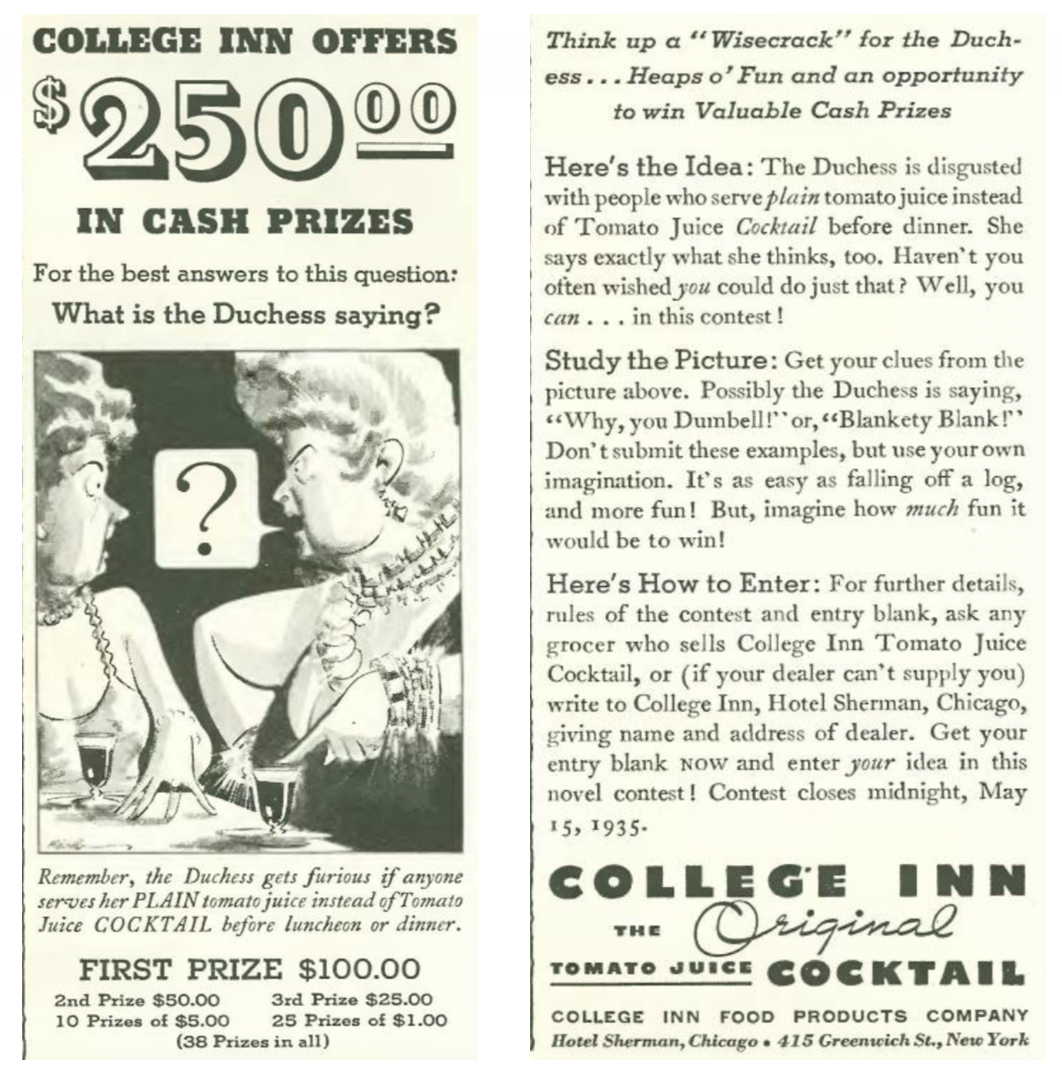
…the Duchess returns, and she’s still pissed about her tomato juice…I wish I could have entered this contest…
…the Dubonnet mascot, Dubo-Dubon-Dubonnet, made a startling appearance in this ad…the creation of French graphic designer Adolphe Mouron Cassandre, Paul Rand took over the drawing of Dubonnet Man when the liquor came to the United States…
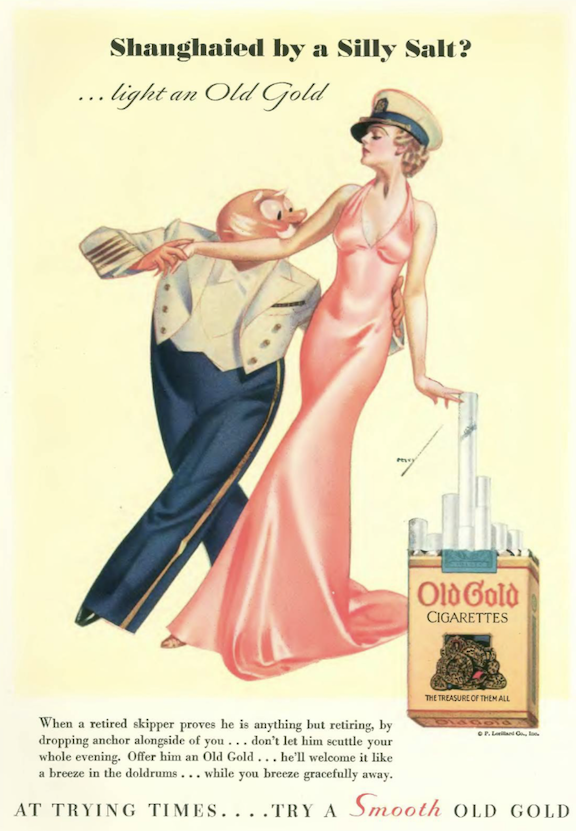
…Old Gold continued its campaign (illustrated by pin-up artist George Petty) featuring a homely, clueless sugar daddy…
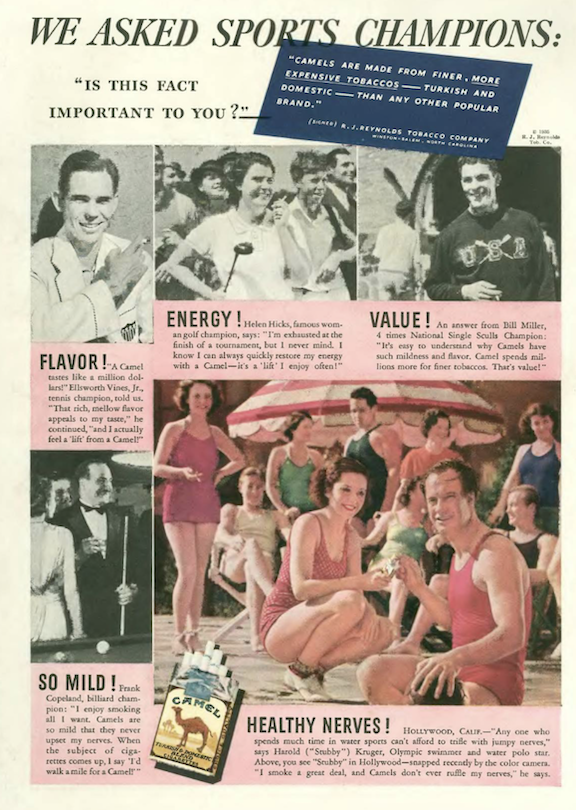
…while Camel turned out another group of “sports champions” who testified to the energizing effects of cigarettes…
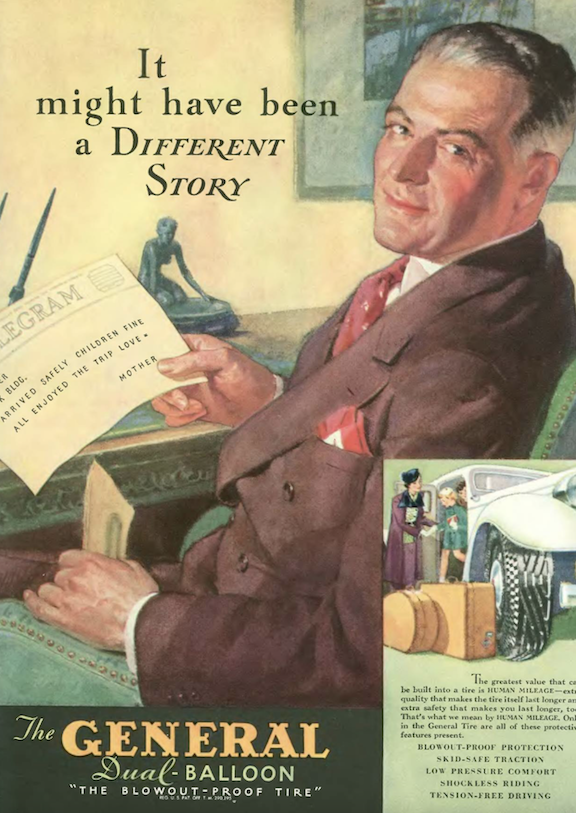
…another grim message from General Tire…this time featuring dear old dad, contemplating a different fate for his wife and children…
…recall the General ad from March 23…
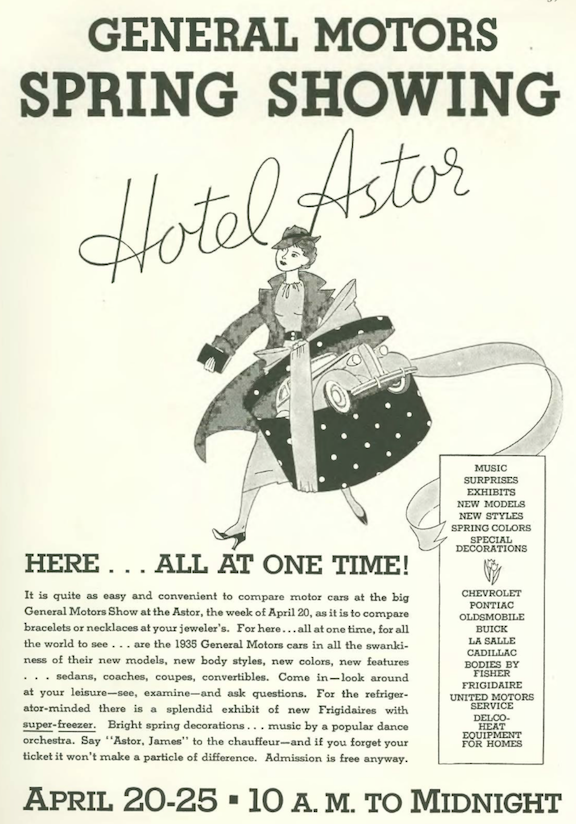
…General Motors was touting its lineup of 1935 models at the Hotel Astor…
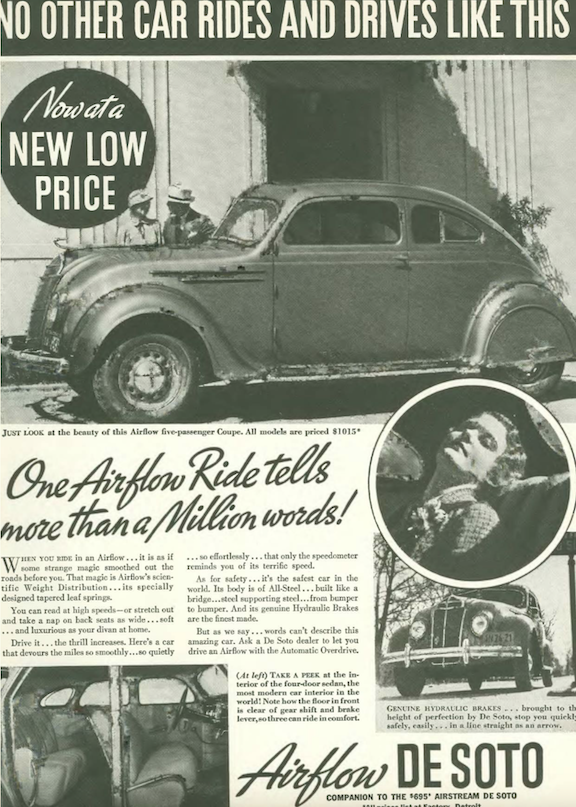
…Chrysler was known as an innovator, introducing radical designs like the Airflow, but consumers weren’t ready for the ultra-streamlined model, even if it did ride so smoothly that one could apparently lose consciousness…
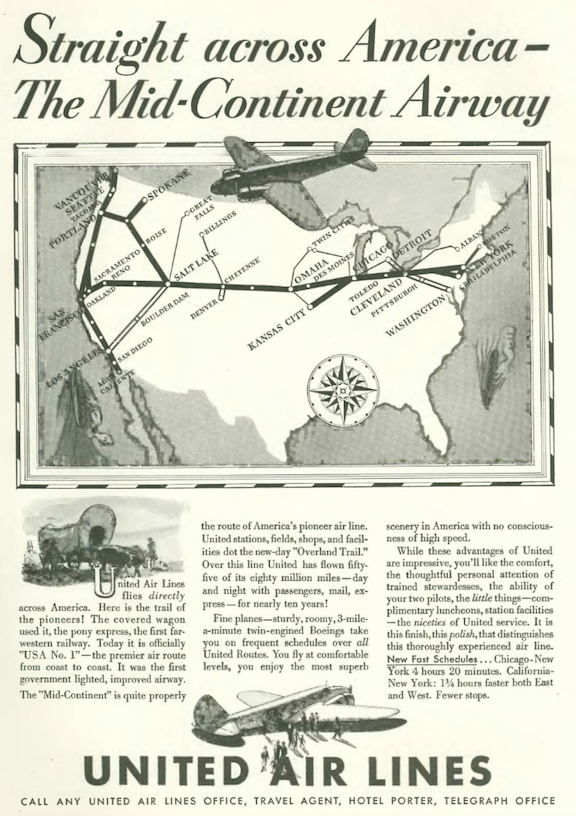
…if a car trip was not your thing, you could fly across America, with a few stops…
…and we fly into our cartoons, where we keep up to date with Otto Soglow…
…George Price was still up in the air with this fellow…
…Gluyas Williams continued to look at club life with this cartoon which originally ran sideways on page 21…
…compliments to the cook, from Syd Hoff…
…Walter Lippmann put the scare in this James Thurber subject…
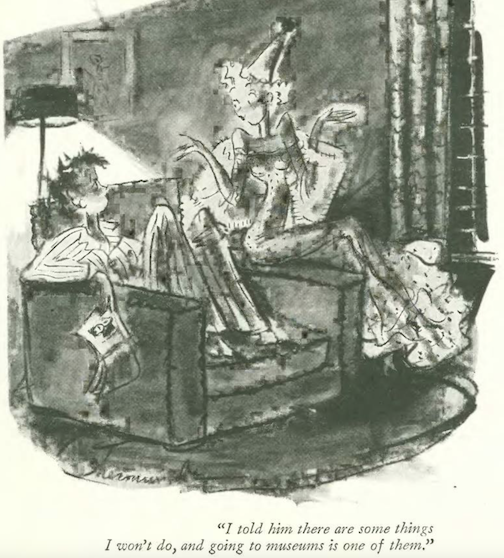
…and we end with Barbara Shermund, and one young woman who won’t be visiting the new planetarium…
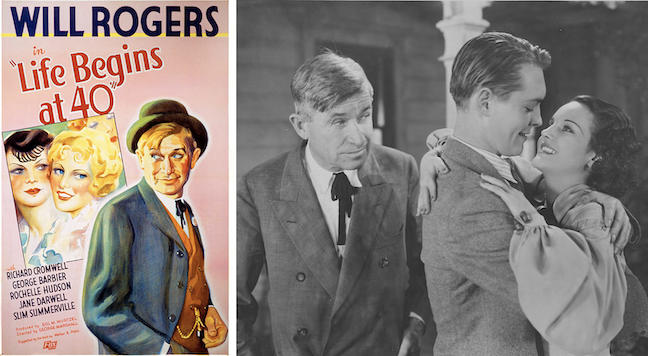
William Penn Adair Rogers, aka Will Rogers (1879–1935), was a man of many talents. Today he is mostly referred to as a humorist, but he was also an actor, a social and political commentator, a trick roper and a vaudeville performer. To Americans he was a national icon.
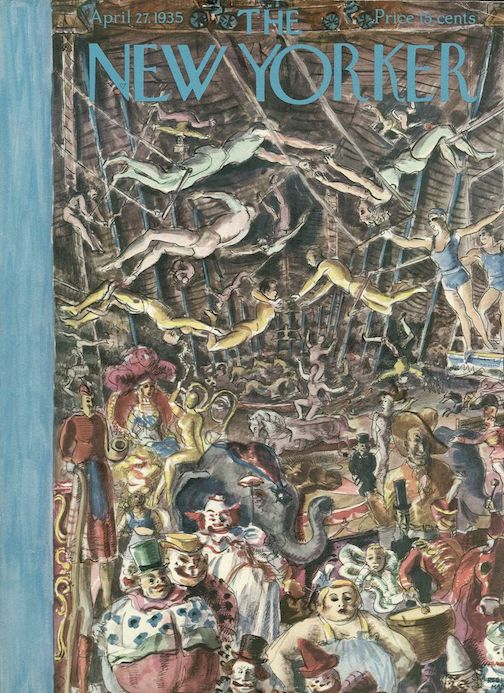
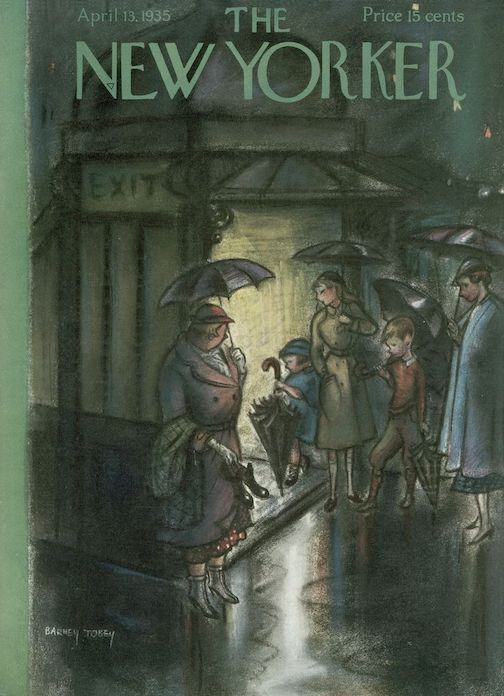
April 13, 1935 cover by Barney Tobey.
Rogers was also internationally famous, having traveled around the world three times and appearing in 71 films (50 of those silent). He also wrote more than 4,000 newspaper columns—nationally syndicated by The New York Times—that reached 40 million readers, and there were also magazine articles, radio broadcasts and personal appearances. He seemed to be everywhere.
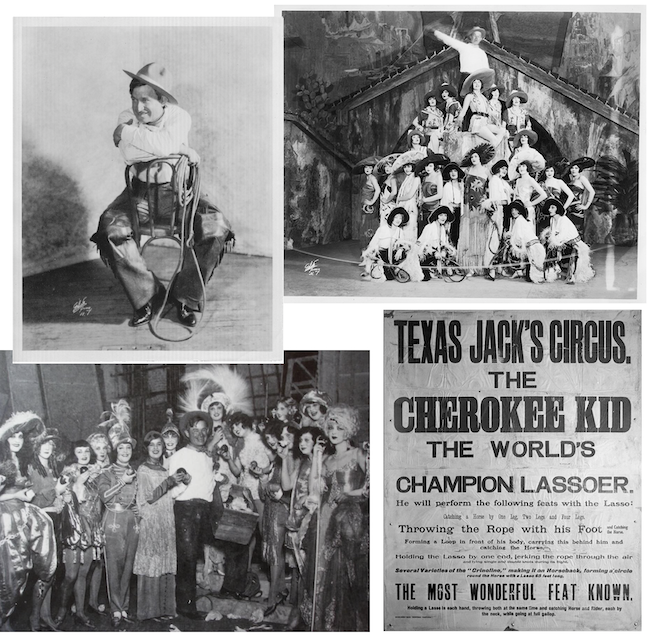
ROPING THEM IN…In 1902, Will Rogers joined Texas Jack’s Wild West Show & Circus in South Africa as the “Cherokee Kid”—he was born as a citizen of the Cherokee Nation, in the Indian Territory that is now part of Oklahoma. By 1910, he had created a sensational vaudeville act by mixing trick roping with witty monologues. Clockwise, from top left, Rogers in a publicity photo from 1916, the year he joined the Ziegfeld Follies; on stage with the Follies in 1924; poster from his circus days; backstage with the 1924 Follies cast. (National Portrait Gallery)MULTIMEDIA MULTI-TALENT…Left, Rogers catches a few moments to write one of his 4,000 nationally syndicated newspaper columns; from 1929 to 1935 he used the exciting new medium of radio to broadcast his newspaper pieces. His weekly Sunday evening show, The Gulf Headliners, sponsored by Gulf Oil, ranked among the top radio programs in the country. (National Portrait Gallery)
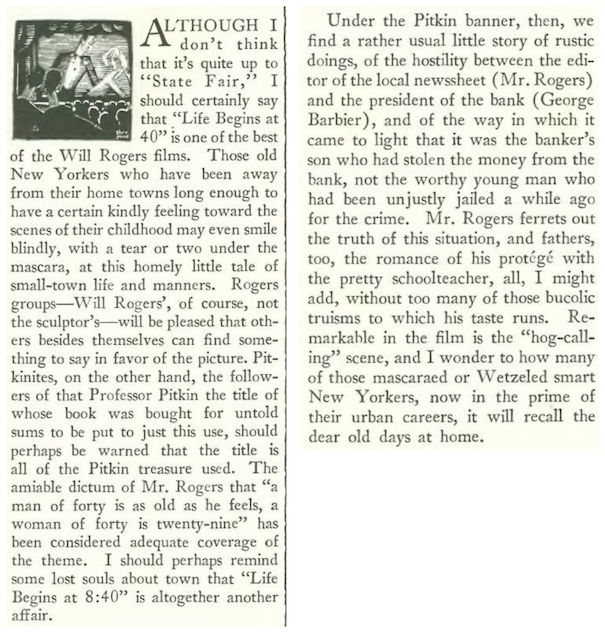
When John Mosher reviewed Rogers’ latest film, Life Begins At Forty, he found it to be one of Rogers’ best. It would also prove to be one of his last. On August 15, 1935, a small airplane carrying Rogers and aviator Wiley Post would crash on takeoff near Point Barrow, Alaska, claiming the lives of both men. Rogers would appear in three more films in 1935, the last two posthumously.
THAT’S LIFE…Will Rogers with Richard Cromwell and Rochelle Hudson in Life Begins at 40. Rogers’ film took its title from a 1932 self-help book by Walter B. Pitkin. Pitkin maintained that keeping a positive attitude toward life could give a person many fulfilling years after age 40. By the time of his death in 1935, the 55-year-old Rogers was Hollywood’s highest paid actor. (Wikipedia/IMDB)
* * *
Not Toying Around
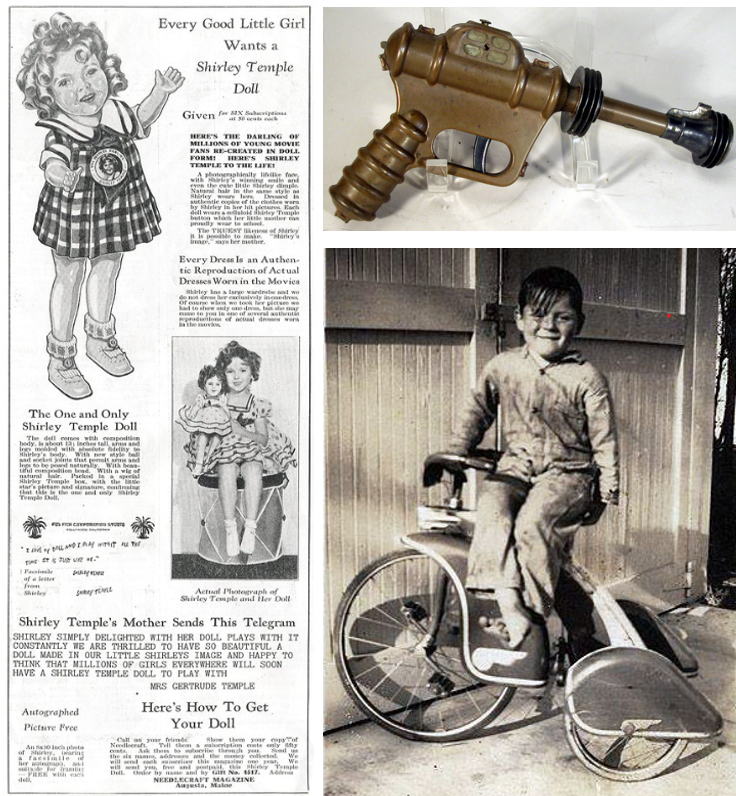
“The Talk of the Town” looked in on the serious business of toymakers, with 1935 being the year of streamlined tricycles, Buck Rogers disintegrator pistols, and, of course, Shirley Temple dolls.
RIVALED ONLY BY MICKEY MOUSE, Shirley Temple was the most popular celebrity to endorse merchandise for children and adults, including the “one and only” Shirley Temple Doll (left, ad from 1935); the Buck Rogers XZ-38 Disintegrator Pistol (top) was produced in 1935 by Daisy, and was available in both copper and nickel finishes–it was also offered as a premium from Cream of Wheat cereal; at bottom, the American National Streamline Velocipede Tricycle (1935), just one example of the hundreds of products receiving the streamlining treatment in the 1930s. (flickr/airandspace.si.edu/onlinebicyclemuseum.co.uk)
* * *
Literary Spirits
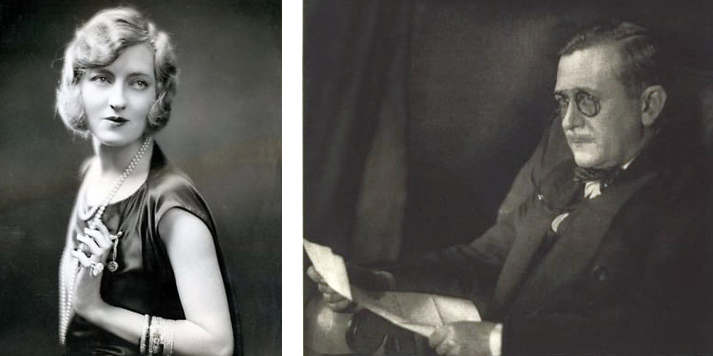
E.B. White welcomed the return of literary tea party, which thanks to the repeal of the 18th Amendment had been re-dubbed the “literary cocktail party.” He shared his thoughts in “Notes and Comment”…
AMUSING MUSES…Actress, writer and socialite Peggy Hopkins Joyce hosted literary “teas” in the 1920s, while former Cosmopolitan editor Ray Long inspired a book on adventures in the South Seas shortly before his death; from left, Joyce in 1923; photogravure of Long, 1925. (Wikipedia/photogravure.com)
* * *
Proto Feminist
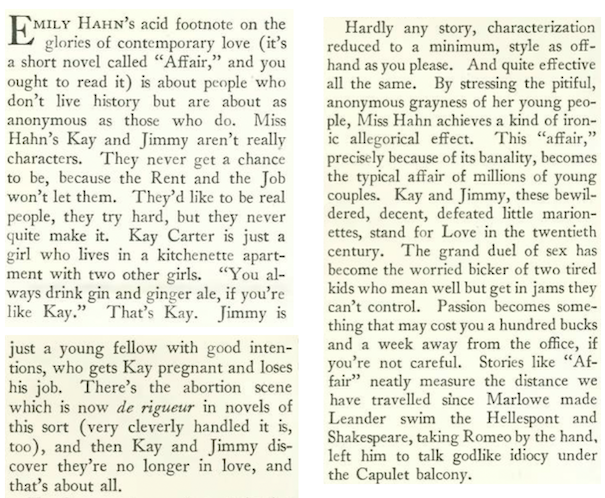
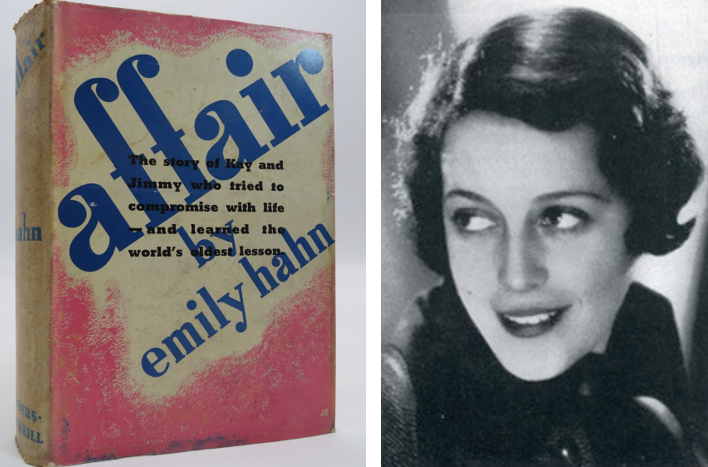
Emily Hahn was one of the more lively figures in The New Yorker’s stable of journalists and writers, leading an adventurous life that included a hike across Central Africa in the 1930s and getting into all kinds of trouble during the Japanese invasion of China. According to Roger Angell, Hahn was, “in truth, something rare: a woman deeply, almost domestically, at home in the world. Driven by curiosity and energy, she went there and did that, and then wrote about it without fuss.” It is no surprise that Hahn’s latest novel, Affair, didn’t shy away from topics like abortion. According to reviewer Clifton Fadiman, the novel’s “anonymous grayness” exposed the banality of love in the twentieth century.
If Hollywood is looking for a new biopic, Hahn would make a fascinating subject (Kristen Stewart would be perfect for the part). According to IMDB, there is an “Untitled Emily ‘Mickey’ Hahn Project”—a TV series—that has been in development since 2022, but so far nothing has come of it.
DOWN ON LOVE?…Emily Hahn’s 1935 novel Affair exposed the banality of love in the twentieth century. (abebooks.com/susanbkason.com)
* * *
From Our Advertisers
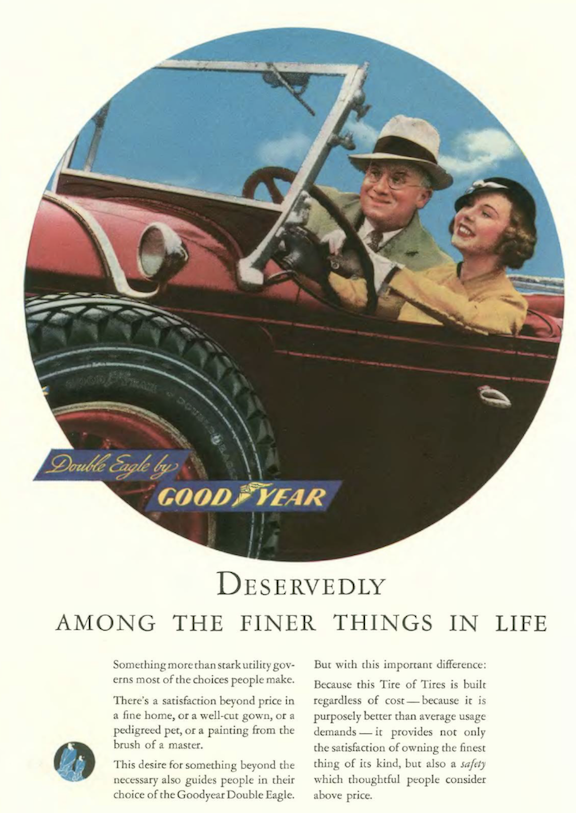
We begin with this advertisement from Goodyear, featuring what appears to be a father teaching his daughter how to drive, or in this case, fly, just like Chitty Chitty Bang Bang…
…and we stay airborne with the makers of the streamlined Nash, who claimed their automobile had “flying power”…
…and we return to earth with Cadillac’s budget model, the LaSalle, which featured “flashing performance”…
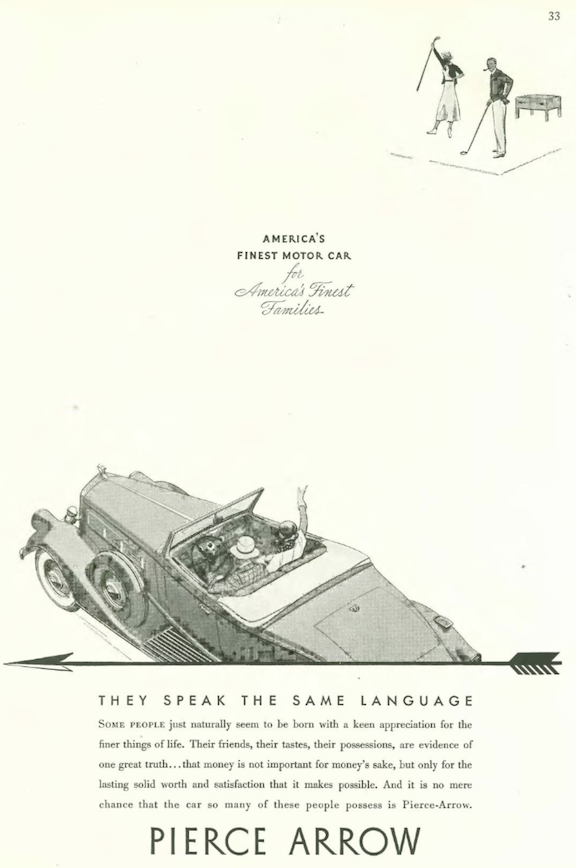
…by contrast, Pierce Arrow took a minimalist approach, gimmicks and splashy colors being reserved for the lower orders…
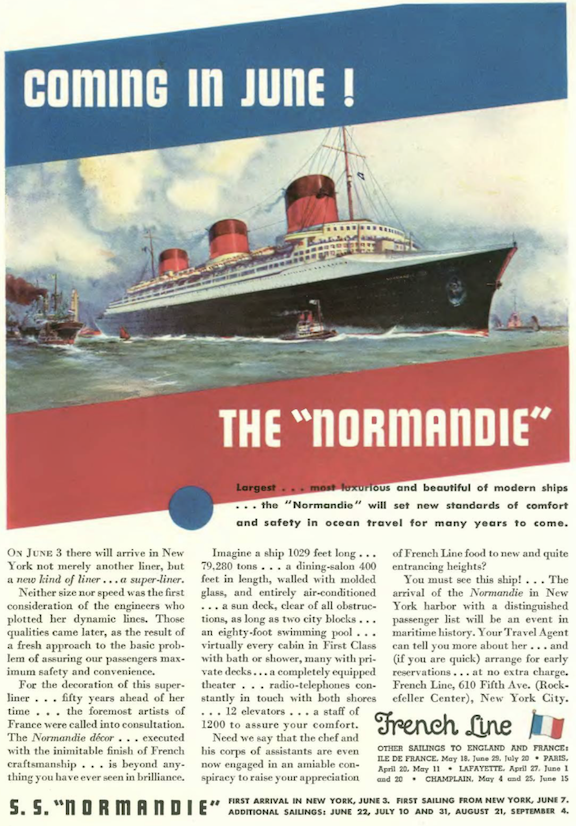
…one of the world’s most iconic ocean liners took to the sea with much fanfare in 1935. The SS Normandie was the largest and fastest passenger ship afloat; it remains the most powerful steam turbo-electric-propelled passenger ship ever built…
…if you happened to smoke Webster cigars, it could have been a sign that you were favored by the heavens…
…the “20-year rule” in fashion suggests that trends have a tendency to re-emerge every two decades, and that seems to be the case here…
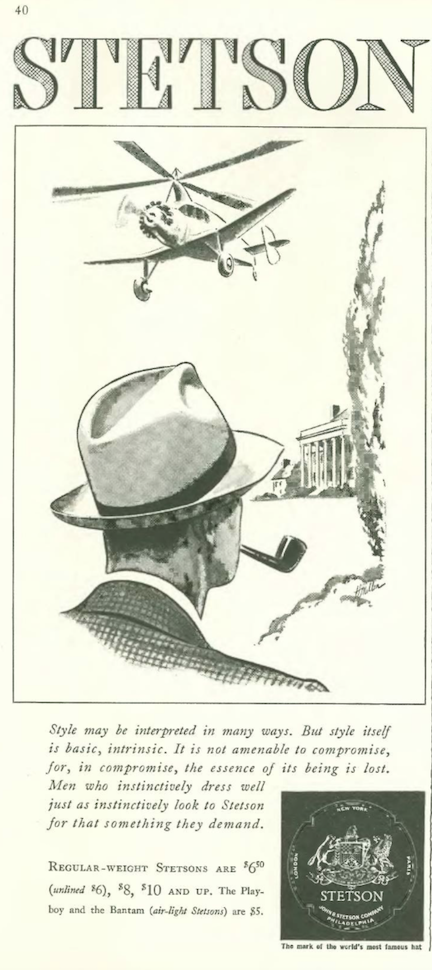
…this next ad tells us everything we need to know about the Stetson wearer: he is a wealthy country gentleman who values tradition but who is also a man of the future…from the 1920s to midcentury the autogyro was thought to be the answer to the long-dreamed of flying car…
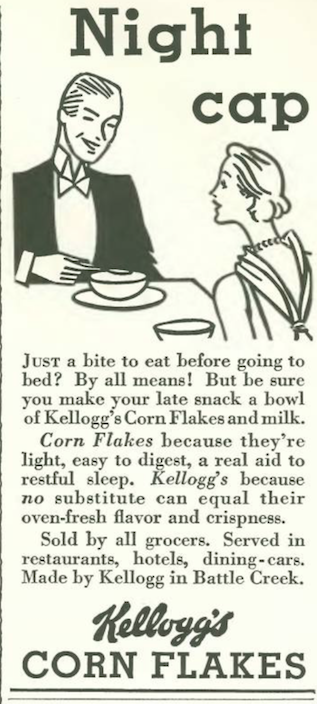
…whoever coined the term “night cap” probably wasn’t thinking about cold cereal…
…although Harold Ross’s old high school friend, John Held Jr., contributed many woodcut-style cartoons and faux maps to The New Yorker from 1925 to 1932, Held was more famous for his shingle-bobbed flappers and their slick-haired boyfriends in puffy pants, a style more apparent in this ad for Peychaud’s Bitters (the original was a one-column ad, split here for clarity)…
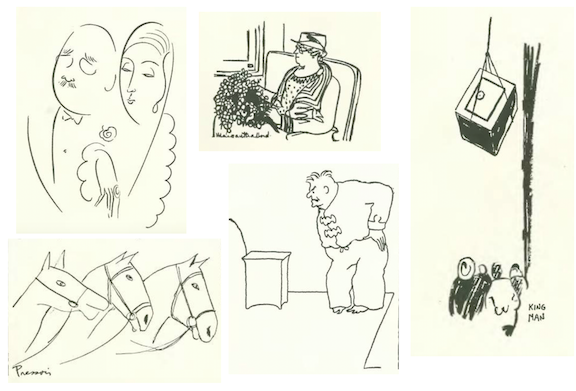
…Held provides a segue to our illustrators and cartoonists, beginning with a sampling of spot art from the April 13 issue…
…James Thurber got things going on page 2…
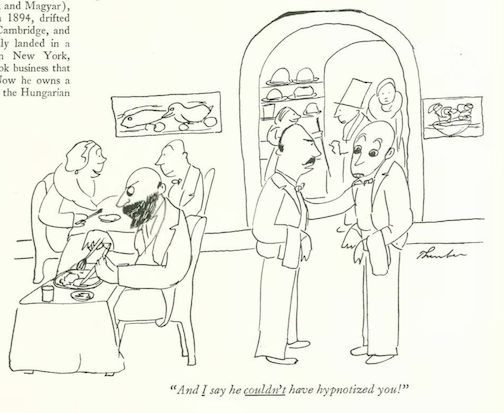
…and also contributed this observation of the hypnotic arts…
…Otto Soglow did some careful surveying (this originally appeared across two pages)…
…Alain looked in on some Vatican gossip…
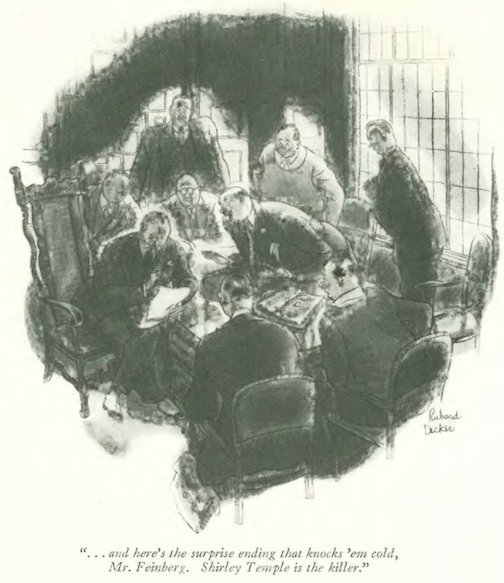
…Richard Decker pitched a Shirley Temple murder caper…
…Carl Rose gave us a sweet send-off…
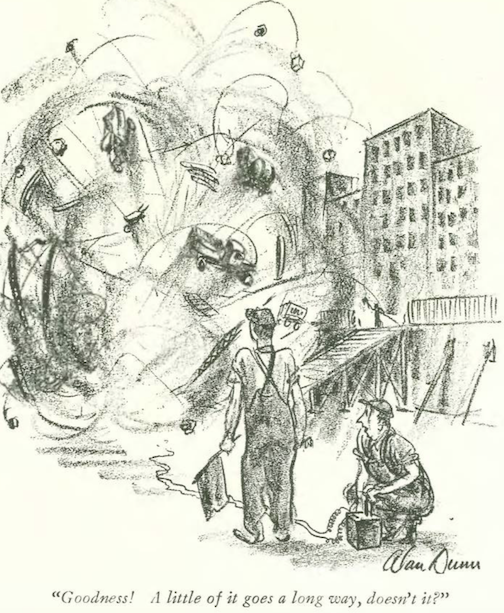
…and we close out with a big bang, courtesy of Alan Dunn…
Above: Landscape in Bayside, 1935, by George Grosz (Phillips Collection)
Knowing that the Nazis would not look kindly on his art, George Grosz took a job teaching drawing in New York in 1932, and by 1933 he had become a permanent resident of the city.
March 30, 1935 cover by Garrett Price celebrated the traditional “Bock” beer of spring.
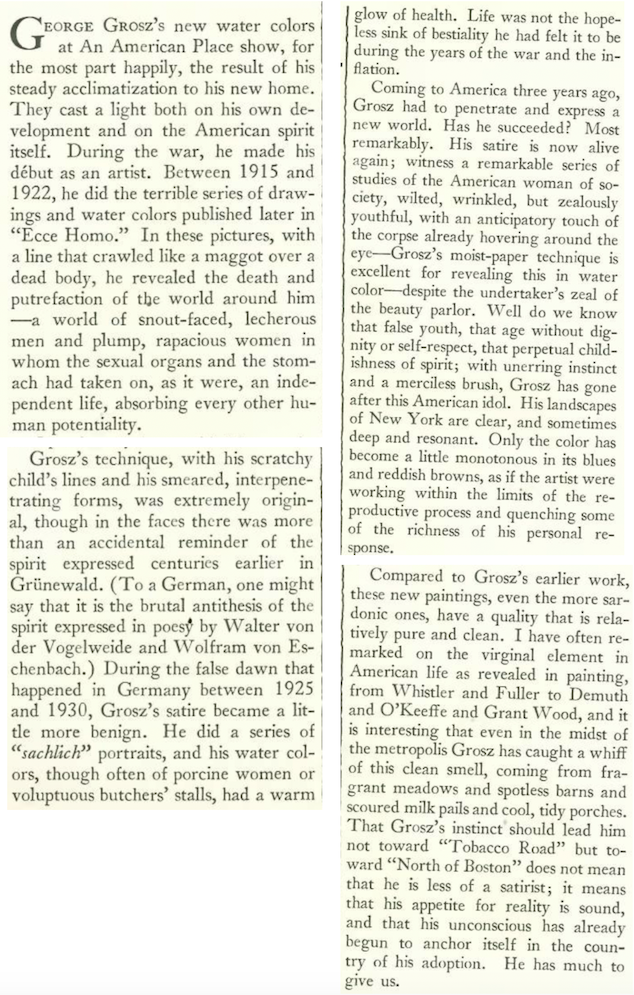
Grosz (1893–1959) was overwhelmed by the size and pace of his adopted city, and for the most part he left behind his bitter caricatures and paintings of Berlin’s Weimar years and turned to other subjects, including landscapes and New York’s urban life. Critic Lewis Mumford took in a show of Grosz’s new water colors at An American Place, a small gallery run by photographer and art dealer Alfred Stieglitz.
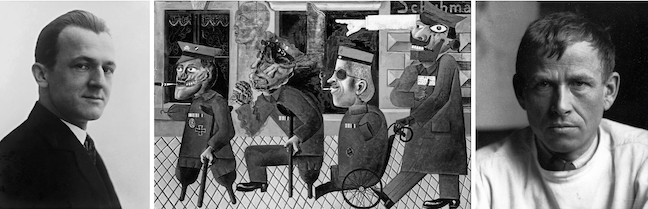
THE NEW OBJECTIVITY…George Grosz (left, circa 1921), was not alone in his harsh depictions of war and of German society during the Weimar Republic. Other key figures in the New Objectivity (Neue Sachlichkeit) movement included Max Beckmann and Otto Dix (right, circa 1929). Dix’s oil on canvas War Cripples (Kriegskrüppel), 1920, which is pictured above, was exhibited at the First International Dada Fair in Berlin in 1920. Only black and white images exist of the painting, which is believed to have been destroyed by Nazis who condemned it as degenerate art. (Wikimedia Commons/CUNY)
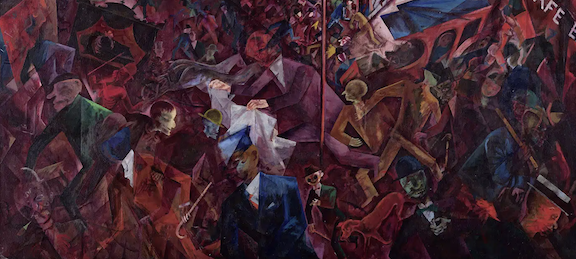
OH THE HUMANITY…Three selections from the “Ecco Homo” series by George Grosz. From left, Gruß aus Sachsen (Greetings from Saxony) 1920; Nachts, (At Night) 1919; and Schwere Zeiten (Hard Times) 1919. Grosz took a dim view of the corruption and moral decline he found in Weimar Berlin. (MoMA)SEEING RED…Detail from George Grosz’sMetropolis, Oil on Canvas, 1916-1917. A blood-like shade of red could be seen in many of the artist’s paintings during World War I and the Weimar Republic. In this painting and in others, death is omnipresent. (Thyssen-Bornemisza Museum, Madrid)A SOFTER SIDE could be found in George Grosz’s later watercolors, although he hadn’t entirely lost his sense of the satirical, or his taste for red paint. From left, Street in Harlem, circa mid-1930s; Ehepaar (A Married Couple), 1930; Central Park at Night, 1936. (Phillips Collection/Tate Gallery/Art Institute Chicago)
* * *
Not the Bee’s Knees
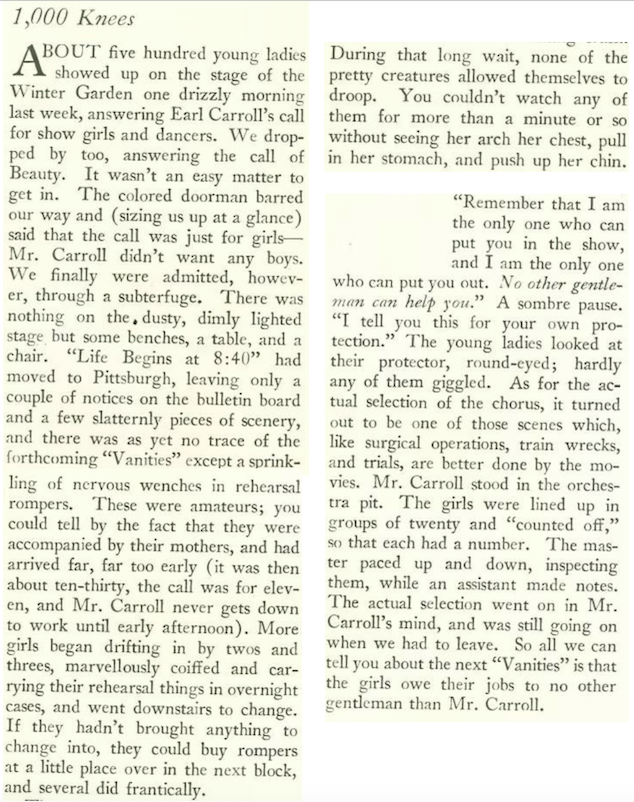
For all the progressive thinking that was on display in the early New Yorker, we also reminded that it was also a creature of its time in 1935. Here are excerpts from a lengthy “Talk of the Town” entry that described the sad winnowing process of Broadway revue producer Earl Carroll…
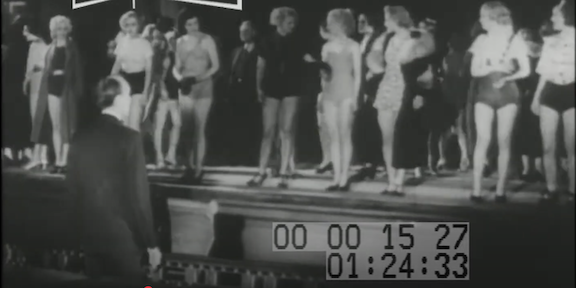
JUDGEMENT DAY…Here is a screenshot from a short film featuring the 1935 audition described in the “Talk” segment. At left is Earl Carroll. You can watch the film here. (YouTube)
* * *
Too Little For Too Much
Film critic John Mosher gave Alfred Hitchcock’s 1934 version of The Man Who Knew Too Much just five lines in his review. He described it as “one of those preposterous adventure stories which Englishmen are always writing…” The film, however, was an international success, and it would define the rest of Hitchcock’s career as a director of thrillers with a unique sense of humor.
A HAPPY, CAREFREE HOUR is how critic John Mosher described his experience watching 1934’s The Man Who Knew Too Much. Clockwise, from top right, director Alfred Hitchcock with the film’s German star, Peter Lorre, who learned his part phonetically; Lorre and Cicely Oates; Edna Best did her best at playing a grieving mother. The film was remade by Paramount in 1956, starring James Stewart and Doris Day. (Wikipedia/aurorasginjoint.com/IMDB)
* * *
Dizzy Nor Dazzled
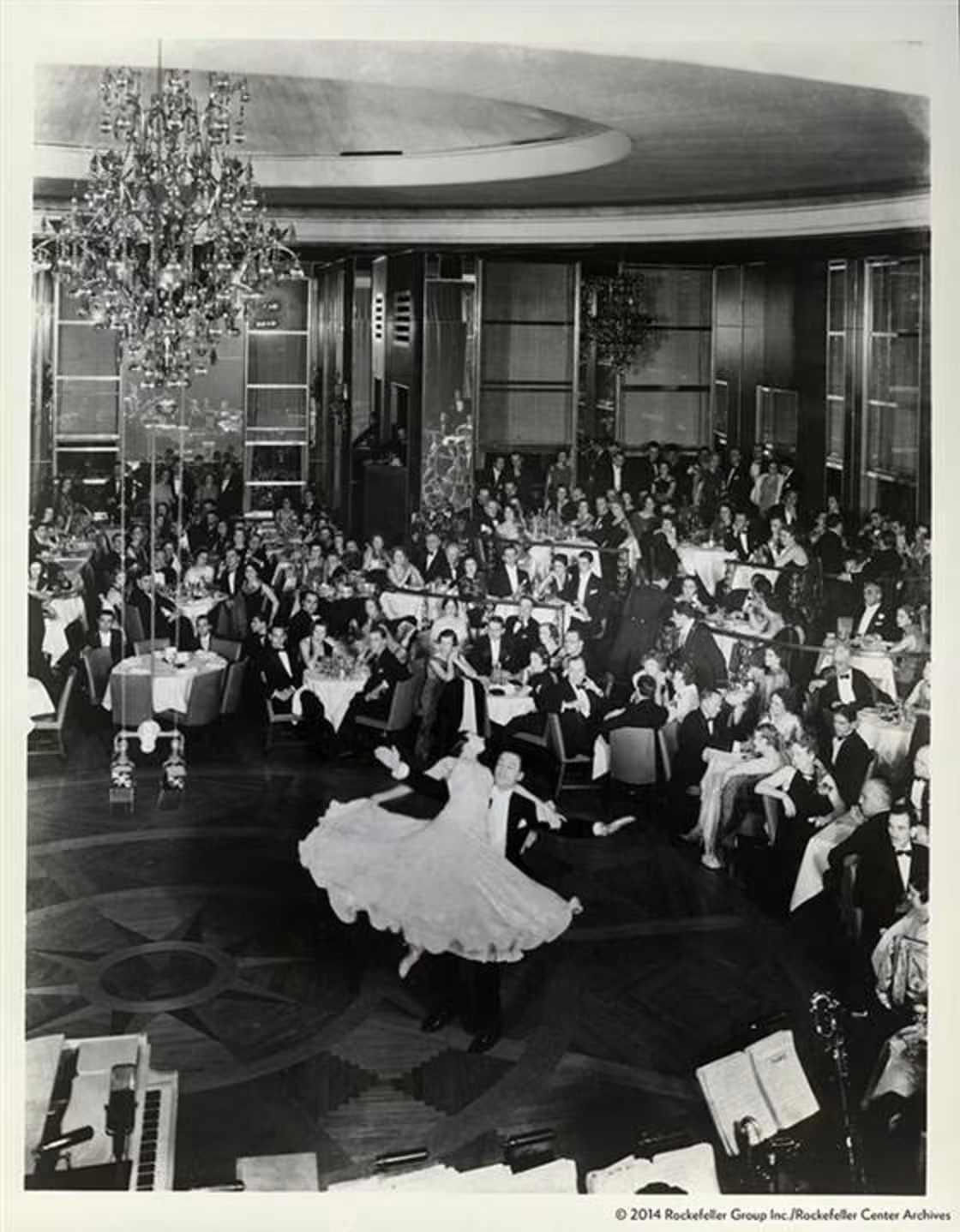
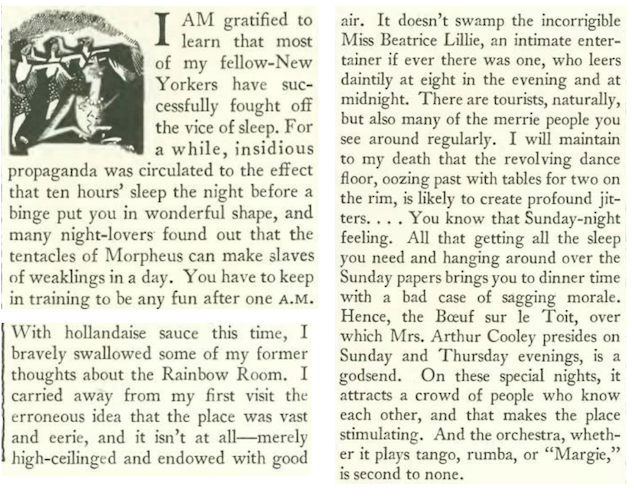
In 1935 Lois Long had been divorced from cartoonist Peter Arno for about four years, and she was the mother of six-year-old daughter from that marriage. That didn’t keep her from sampling the city’s night life, but the days of speakeasies and drinking sessions that lasted into the wee hours were over for the 34-year-old Long. For her “Tables for Two” column she took the elevator up to the 65th floor of 30 Rockefeller Plaza to take in the entertainment at the Rainbow Room…as well as the pedestrian crowd…
WHAT A WHIRL…Above, diners watch a performance by ballroom dancers Lydia and Joresco in the then newly opened Rainbow Room in 1934. Lois Long enjoyed the Rainbow Room in its 1930s heyday, but she missed her old speakeasy crowd, noting that the Rainbow Room’s customers weren’t “dizzy enough” to suit her tastes. (Rockefeller Center Archives)
…her speakeasy days were over, but it appears Long still enjoyed a bit of indulgence…here is how she concluded her column:
* * *
From Our Advertisers
Step into a crowded mid-century elevator and you were bound to catch a whiff of the menthol-tinged scent of Aqua Velva, not objectionable if properly applied…
…speaking of menthol, the makers of Spud cigarettes were now competing with upstart menthol cigarette makers including Kool…this ad has all kinds of problems, including the suggestion that the occasional Spud not only inspires one’s nuptials, but also ensures marital bliss, as well as a lifetime of chain-smoking…
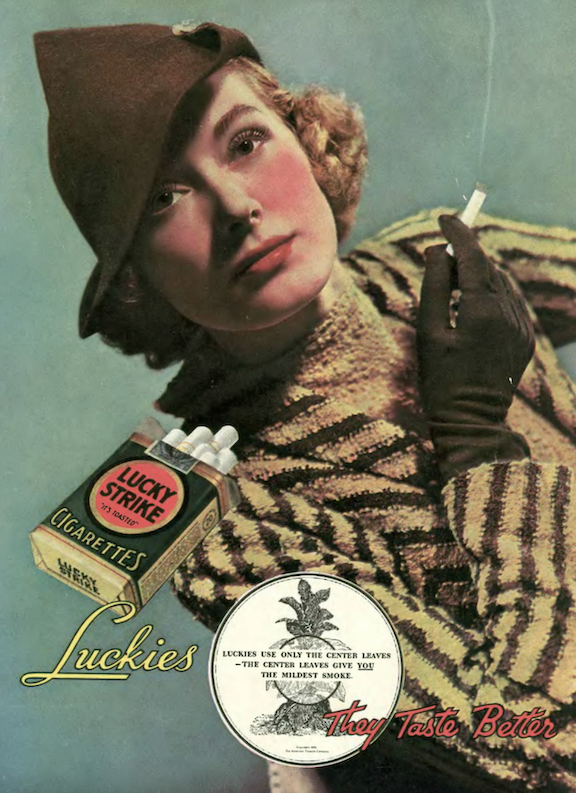
…Luckies, on the other hand, continued to appeal to the modern woman, and what impressionable young woman wouldn’t be inclined to pick up the habit to complete her ensemble?…
…the makers of College Inn tomato juice gave their raving Duchess the week off, but we get another old sourpuss in the form of a “Dowager” who demands that her servant remove a glass of what very well could have been tomato juice…enter the old bat’s niece, Dorothea, who suggests that the cook, Clementina, serve some Libby’s pineapple juice instead, probably spiked with vodka given the Dowager’s sudden change of demeanor…
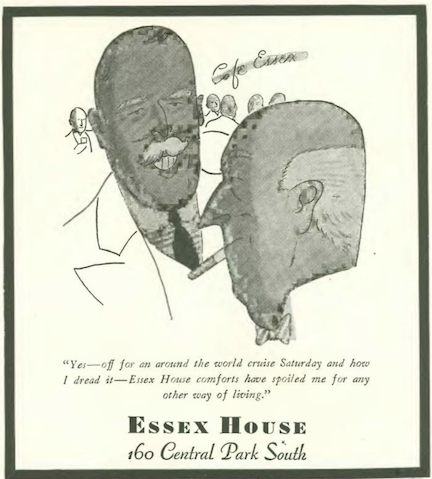
…Essex House continued their class-ridden ad campaign, this time with some stuff-shirt dreading his world cruise
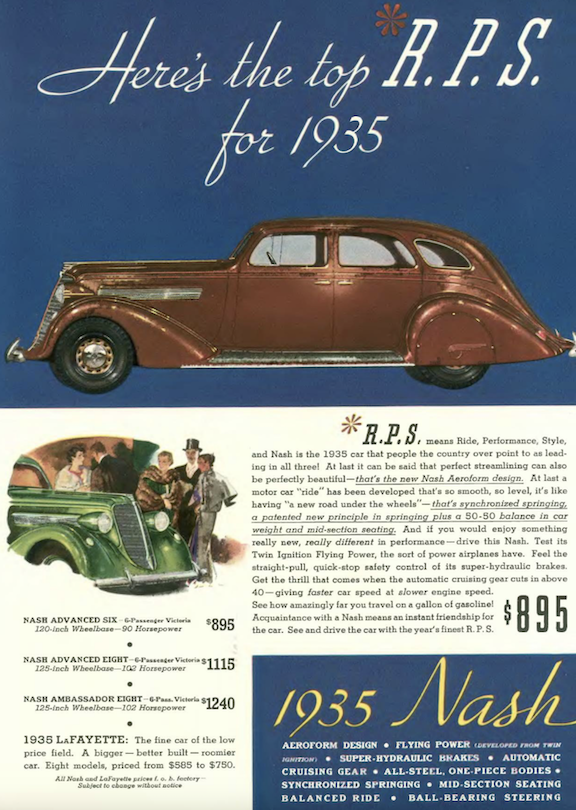
…carmakers continued to emphasize economy and price to move their latest models, including the 1935 Nash with “Aeroform Design”…
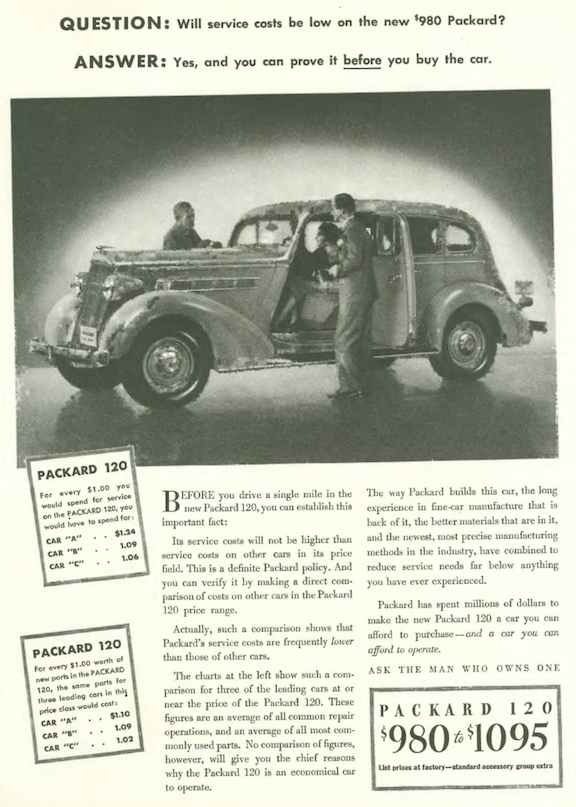
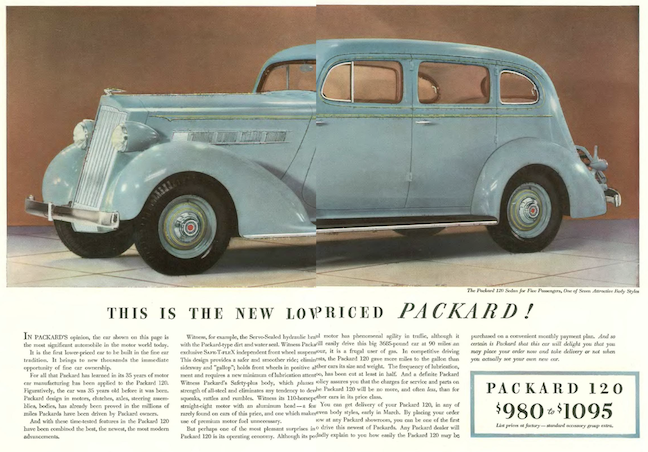
…last week I noted that Packard was doubling down on promoting the elite status of its premium automobile; however, the carmaker did introduce a “120” that cost a fraction of its luxury models and helped the company’s bottom line…
…Packard’s competition was Lincoln and Cadillac, among other luxury brands, but Pierce Arrow represented the pinnacle of luxury and craftsmanship, the American equivalent of Rolls Royce…unlike the other luxury brands, Pierce Arrow did not offer a lower-priced car, and the company folded it 1938…
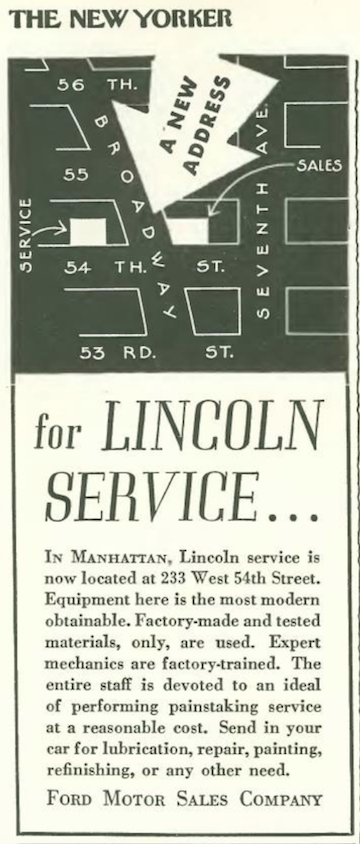
…speaking of luxury cars, if you owned a Lincoln, this little ad tucked into the top corner of page 55 showed you were to go to get a tune-up…
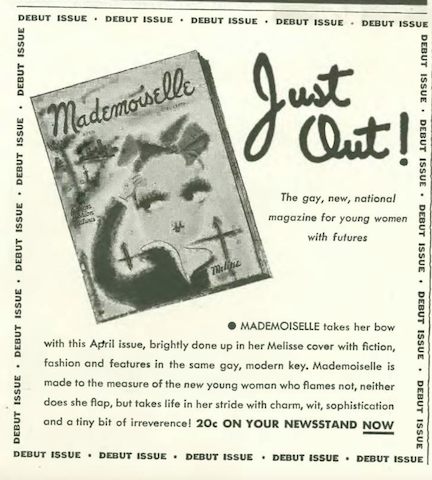
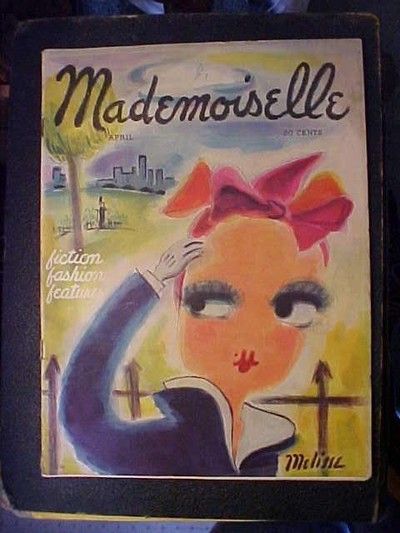
…the publishers at Street & Smith announced the launch of a new fashion magazine, Mademoiselle, a seemingly daring move in Depression America…the cover featured an illustration by Melisse (aka Mildred Oppenheim Melisse)…the magazine was later acquired by Condé Nast, and folded in November 2001…
Mildred Oppenheim Melisse’s cover for the debut issue of Mademoiselle, April 1935. Melisse also supplied the cover art for the May and June issues that year. (Pinterest)
…Otto Soglow was on his way to becoming a wealthy man thanks to his “Little King” cartoon…William Randolph Hearst lured Soglow and the cartoon away from The New Yorker in 1934, so the only way the wee potentate could appear in the magazine was in an ad, like this one for Bloomingdale’s…
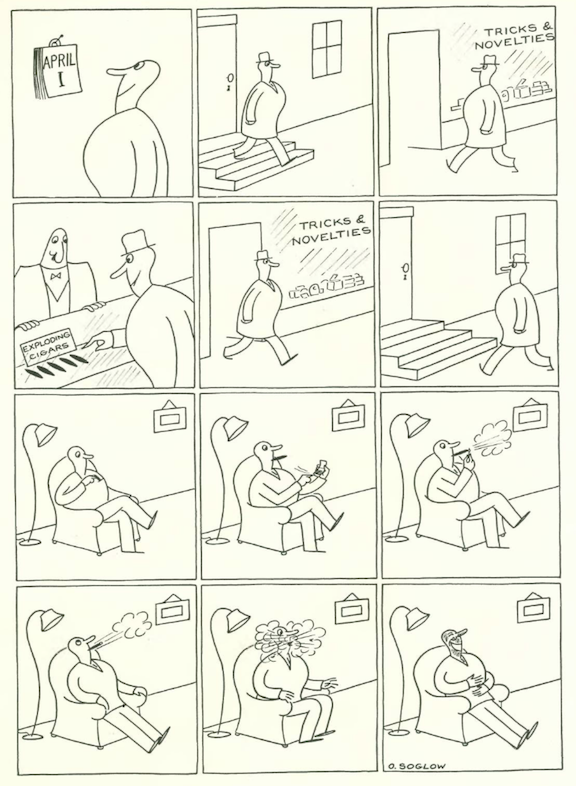
…Soglow continued to contribute to The New Yorker, and we kick off our cartoons with an April Fool’s joke…
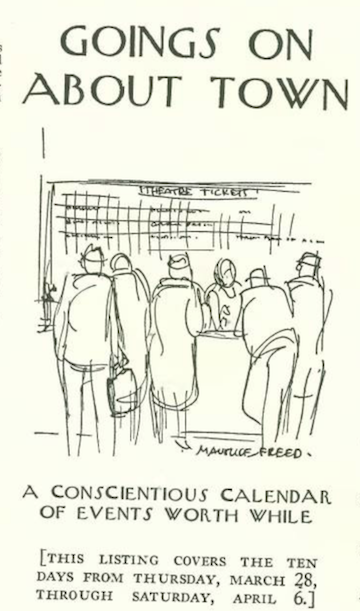
…for the second week in a row Maurice Freed supplied the opening spot art for “Goings On About Town”…
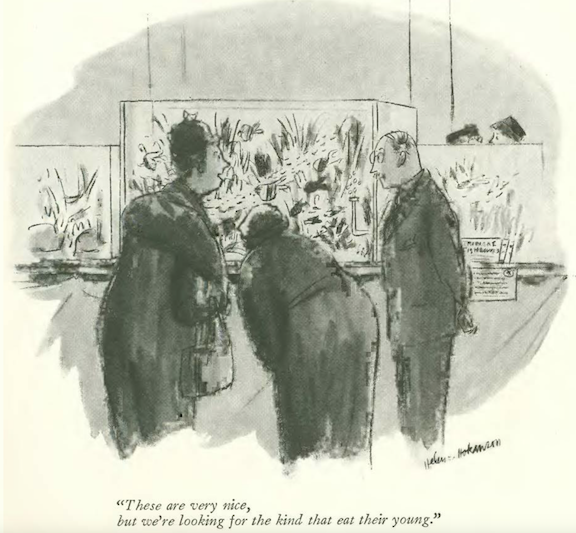
…Helen Hokinson was on the hunt for some predatory fish…
…James Thurber looked in on the nudist fad that emerged in the 1930s…
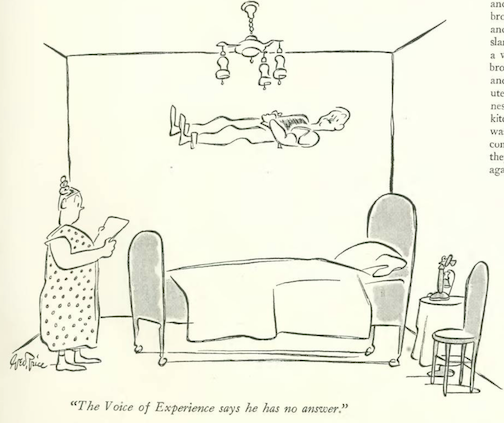
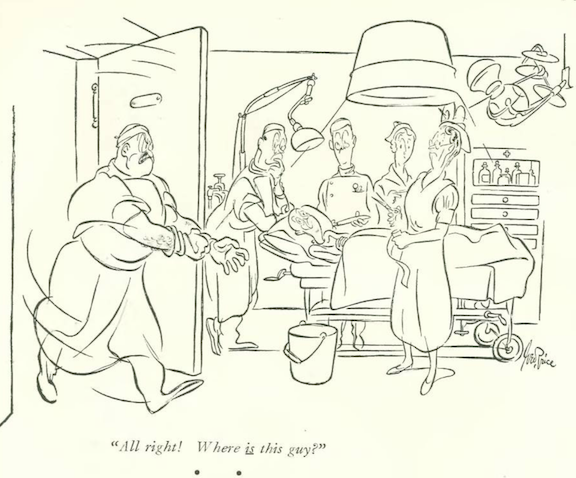
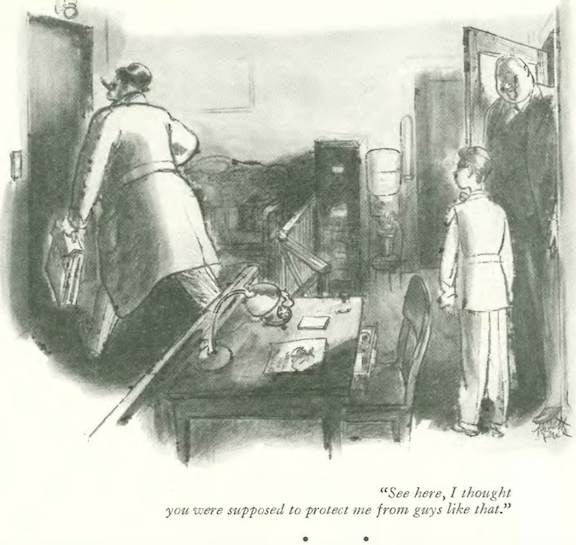
…and we close with George Price, an some alarming bedside manners…
With this post (No. 413), we mark the tenth anniversary of The New Yorker. Since I began A New Yorker State of Mind in March 2015, I’ve attempted to give you at least a sense of what the magazine was like in those first years, as well as the historical events that often informed its editorial content as well as its famed cartoons. Those times also informed the advertisements; indeed, in some cases the ads give us a better idea of who was reading the magazine, as well as their changing tastes and buying power as we moved from the Roaring Twenties to the Depression, and from Prohibition into Repeal.
I have also chosen this time to go on hiatus, and hopefully resume this blog when The New Yorker celebrates its centennial next February (this site will remain active and available, and I will continue to monitor comments and messages). Let us hope that the editors use the original Rea Irvin cover for that occasion, and restore his masthead above “The Talk of the Town” section. Perhaps some enterprising soul could start a petition.
Feb. 16, 1935 cover by Rea Irvin.
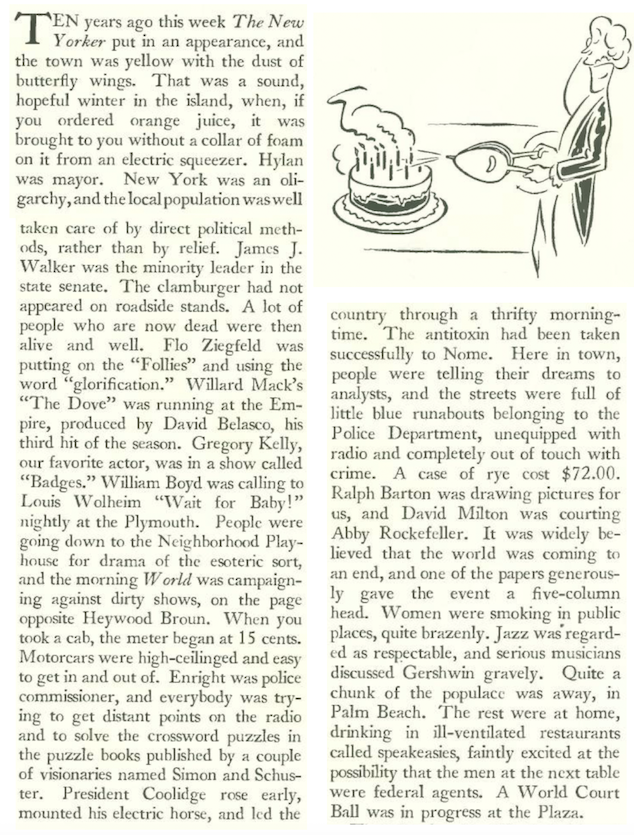
Moving on to the tenth anniversary issue, we find E.B. White recalling the world of The New Yorker’s first days. Given the massive economic and societal shifts that occurred from 1925 to 1935, those first days seemed distant to White, who felt old, “not in years but events.”
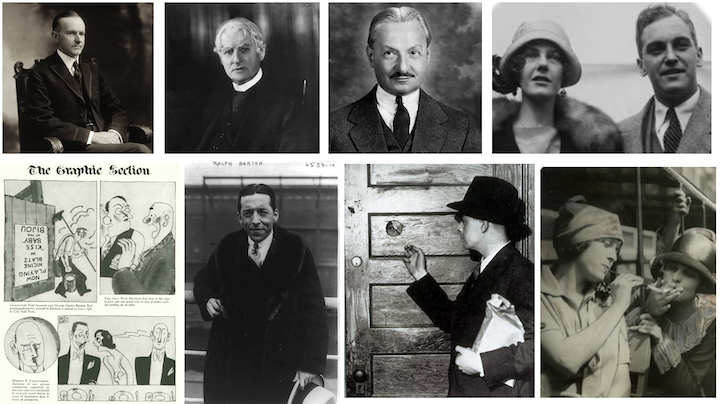
DAYS OF YORE…E.B. White noted the many changes that had taken place during The New Yorker’s first ten years, including, clockwise from top left, the passing of 1920s notables such as President Calvin Coolidge and two very different theatre impresarios—David Belasco and Flo Ziegfeld; White also recalled the much-publicized 1925 wedding of Abby Rockefeller to David Milton, the throngs of women who took to smoking in public in the 1920s and the drinkers who took their activities behind closed doors; and one of the early magazine’s beloved contributors, Ralph Barton, who offered his whimsical take on the news in “The Graphic Section” as well as in other illustrated features. (Wikipedia/Wikitree/Ephemeral New York)
White also noted a new craze that had originated around the same time as the birth of The New Yorker…
TWO ACROSS…Max Schuster and Richard Simon of Simon & Schuster, with their first crossword book, 1924. (americanbusinesshistory.org)
White concluded with these parting words, tinged with world-weariness, writing “More seems likely to happen.” One wonders if he imagined The New Yorker at 100, which in our day is just around the corner. Like White, many us have grown weary of this angry world, where indeed more seems likely to happen. Let us hope it is for the best.
Now, some unfinished business. We need to look at the previous issue, Feb. 9, 1935, before we close out the decade.
Feb. 9, 1935 cover by William Cotton.
We stay on the lighter side, joining critic John Mosher at the local cinema to appreciate Leslie Howard’s dashing performance in The Scarlet Pimpernel…
WORKING OVERTIME…Leslie Howard and Merle Oberon in The Scarlet Pimpernel. Howard portrayed an aristocrat who leads a double life, publicly appearing as a dandy while secretly rescuing French nobles from Robespierre’s Reign of Terror. (PBS)
* * *
From Our Advertisers
Cigarette manufacturers employed every angle from sex to health claims to move their product…not to be left out of any niche market, Chesterfield even went after the little old ladies…
…by contrast, the makers of Old Gold cigarettes featured a clueless sugar daddy and his leggy mistress in a series of ads drawn by famed pin-up artist George Petty…
…Otto Soglow would do well with advertisers during his career, promoting everything from whiskey to Pepsi and Shredded Wheat to department stores…in this case Bloomingdale’s…after William Randolph Hearst’s King Features Syndicate wrested The Little King away from The New Yorker in September 1934, this was the only way you would see the harmless potentate in the magazine…
…another New Yorker artist earning some ad dollars on the side was Constantin Alajalov, here adding a stylish flair for Coty…
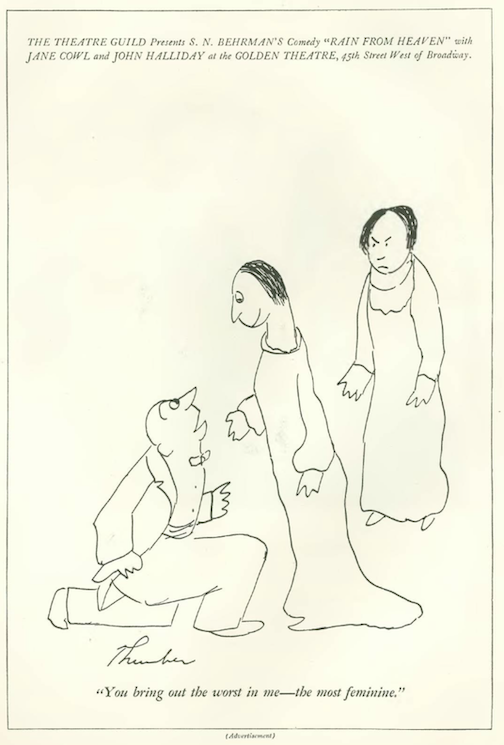
…and then there’s James Thurber, who continued to contribute his talents on behalf of the Theatre Guild…
…and we move along to the Feb. 9 cartoons, with Thurber again…
…the issue also featured two by George Price…
…and Howard Baer supplied some life to this little party…
…now let’s return to the Feb. 15, 1935 issue…
…where John Mosher was back at the cinema, this time enjoying the story of a “beautiful stenographer”…
POPCORNY…Fred MacMurray and Claudette Colbert meet cute over popcorn in the romantic comedy The Gilded Lily. It was MacMurray’s second credited screen role, and it was the first of seven films in which Colbert and MacMurray would star together. (Wikipedia)
* * *
More From Our Advertisers
In its bid for survival during the Depression, the luxury brand Packard introduced its first car under $1000, the 120. Sales more than tripled in 1935 and doubled again in 1936…
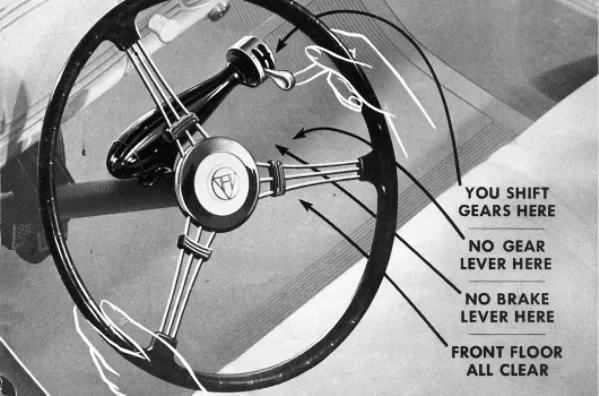
…meanwhile, Hudson was hanging in there with innovations such as the “Electric Hand”…it was not a true automatic transmission, but it did allow drivers to shift gears near the steering wheel…
…as demonstrated here…
…whatever you were driving, Goodyear claimed it would keep you the safest with their “Double Eagles”…
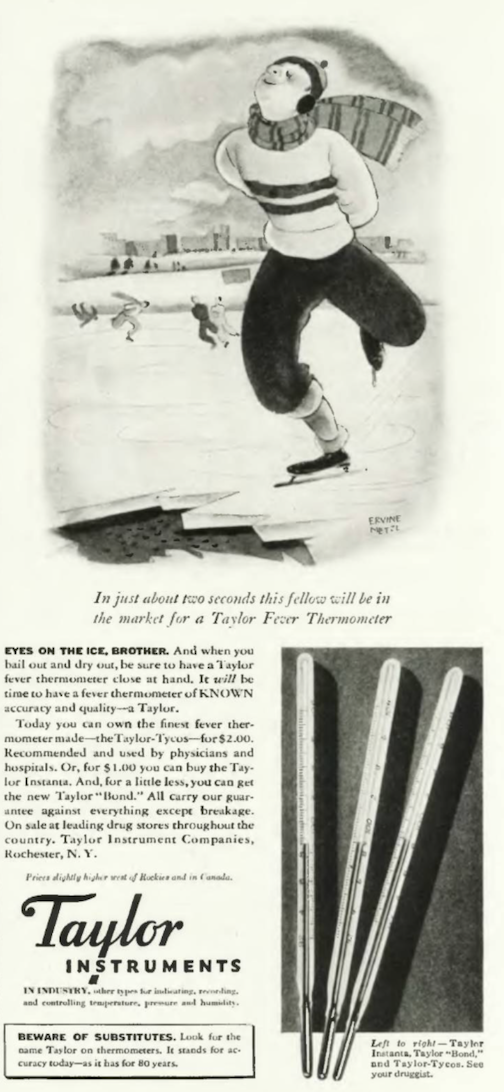
…I include this ad for Taylor Instruments because it features an illustration by Ervine Metzl, who would become known for his posters and postage stamp designs…
…Metzl’s design of a three-cent stamp commemorating the 1957–1958 International Geophysical Year…
…on to our cartoonists, we begin with this Deco-inspired artwork by an unidentified illustrator…
…one of Helen Hokinson’s “girls” was going about her daily rounds…
…Garrett Price gave us a gatekeeper not quite up to his task…
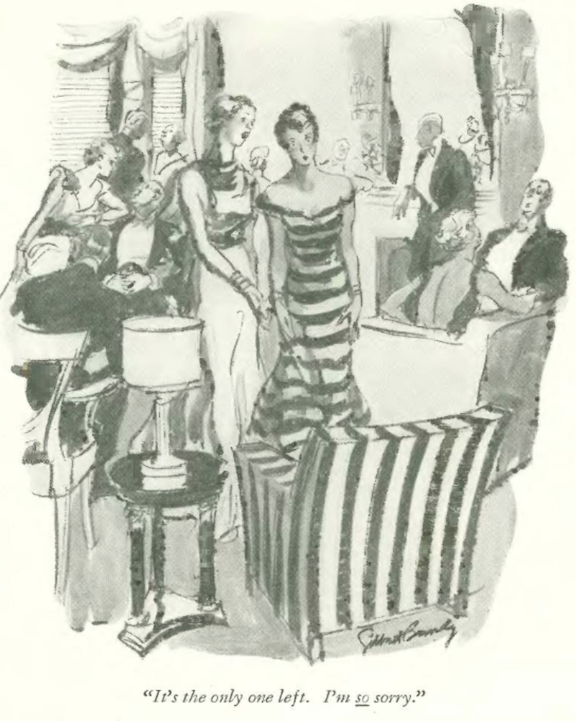
…Gilbert Bundy was seeing stripes rather than stars…
…while James Thurber’s medium was getting in touch with an equine spirit…
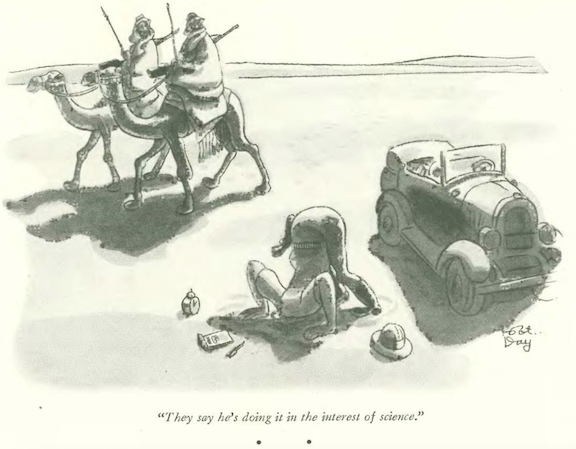
…scientific inquiry knew no bounds in Robert Day’s world….
…and in the world of Alain (aka Daniel Brustlein), old habits died hard…
…and we close with Peter Arno, at his risqué best…
Above: W.C. Fields was a well-known juggler and vaudeville performer decades before he became even more famous in the movies of the 1930s.
William Claude Dukenfield was a vaudeville juggler who distinguished himself from other “tramp acts” by adding sarcastic asides to his routines. Internationally known for his juggling skills, by the turn of the century the man who billed himself as “The Eccentric Juggler” would become much better known by another name: W.C. Fields.
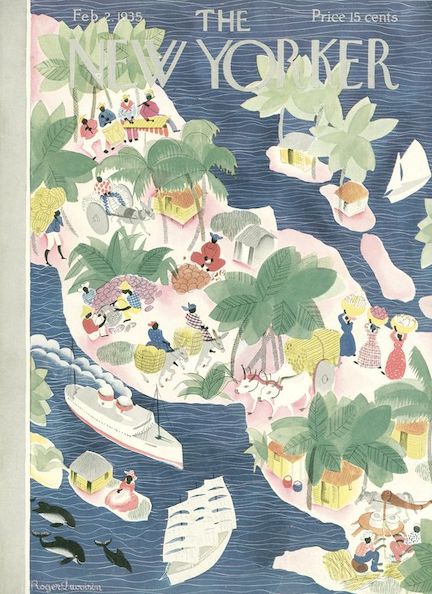
Feb. 2, 1935 cover by Roger Duvoisin.
In the first of a three-part profile, Alva Johnston pondered the secret behind Fields’ genius, an “inborn nonchalance” that he considered “the rarest of gifts.” Johnston surmised that some of that genius derived from the volatile relationship Fields had with his father, and the street-smarts he gained as a runaway at age eleven. It is no surprise, however, that these childhood stories of hardship were significantly embellished by the great wit himself.
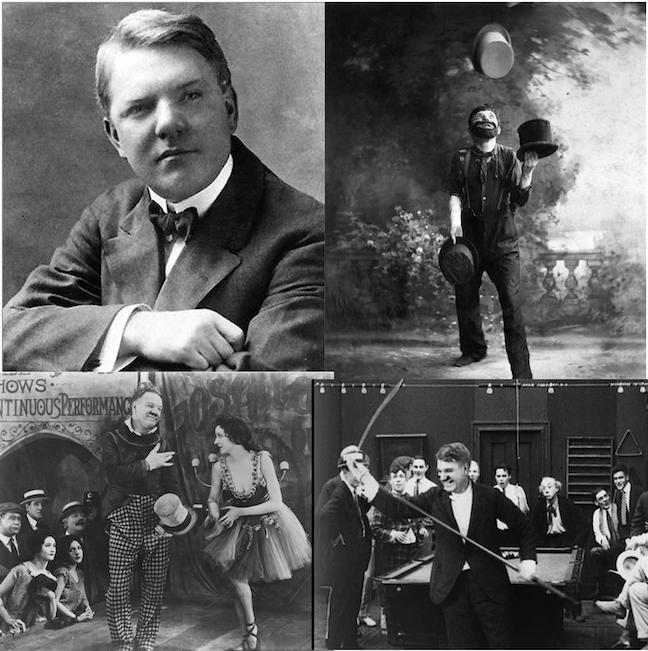
A STAR IS FORMED…Clockwise, from top left, W.C. Fields in his youth; Fields was an internationally known juggler, seen here in his vaudeville days in the early 1900s; Fields made his screen debut in 1915, seen here in his second film, Pool Sharks (1915); Fields with Carol Dempster in Sally of the Sawdust, a 1925 silent comedy film directed by D. W. Griffith. (Pinterest/YouTube)
Johnston also described Fields’ acting style and demeanor, noting that the actor’s asides were likely inspired by his mother, Kate Spangler Felton, who was known for her doorstep witticisms.
NINETEEN THIRTY-FIVE WAS A GOOD YEAR for W.C. Fields, who starred in It’s a Gift (right), released the previous December, and in the 1935 screen adaptation of Charles Dickens’sDavid Copperfield, as the character Wilkins Micawber. (MGM/IMDB)
* * *
Macabre Diversions
In the days before television and the internet, folks got their dose of the sensational and macabre from the tabloids, or, on occasion, in real life. Before crime or accident scene investigations became more sophisticated, it was not uncommon for crowds to mob grisly death scenes, including the car containing the bullet-riddled bodies of notorious bank robbers Bonnie Parker and Clyde Barrow. Their Ford automobile, pocked with 112 bullet holes, became a popular traveling attraction at fairs, amusement parks, and, in February 1935, at a car dealer’s showroom in Missouri. E.B. White explained:
BEFORE THE INTERNET, folks got their ghoulish thrills by rubbernecking at famous crime scenes. At left, a crowd gathers around the bullet-riddled car belonging to Bonnie and Clyde. According to one account, at the scene of the police ambush on Louisiana State Highway 154, nearly everyone collected souvenirs including shell casings and bloody pieces of clothing from Bonnie and Clyde. One man even tried to collect Clyde’s left ear with a pocket knife; at right, unidentified man standing next to the “death car.” (KXAN/unt.edu)
* * *
Saar Kraut
Janet Flanner mused on the recent plebiscite in the Saarland, which following World War I was seized from Germany and placed under the governance of a League of Nations commission. Much to the dismay of the French, the majority German population voted to return the Saar region to Germany, and its Nazi leadership.
* * *
Over the Rainbow
In a previous column, Lois Long took aim at the Rockefeller Center’s new Rainbow Room, dismissing it as a tourist trap filled with interminable strains of organ music. In her latest column, Long retracted some of that vitriol, finding the entertainment (and, one supposes, the food) more to her liking.
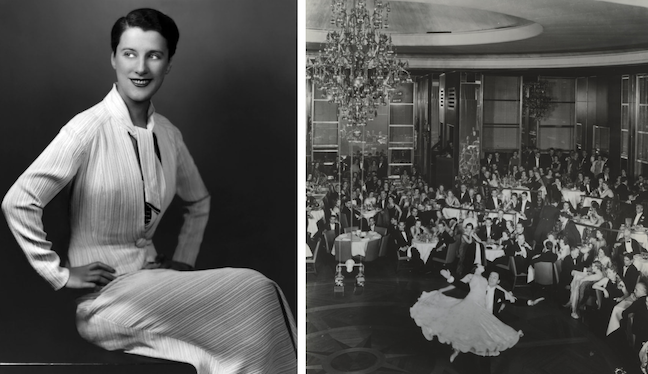
THE ‘INCORRIGIBLE’ Beatrice Lillie (left) delighted Lois Long and audiences in the Rainbow Room on the 65th floor of Rockefeller Center; at right, ballroom dancers Lydia and Joresco take to the floor in the then newly opened Rainbow Room, 1934. (Pinterest/#rainbowroomnyc)
* * *
From Our Advertisers
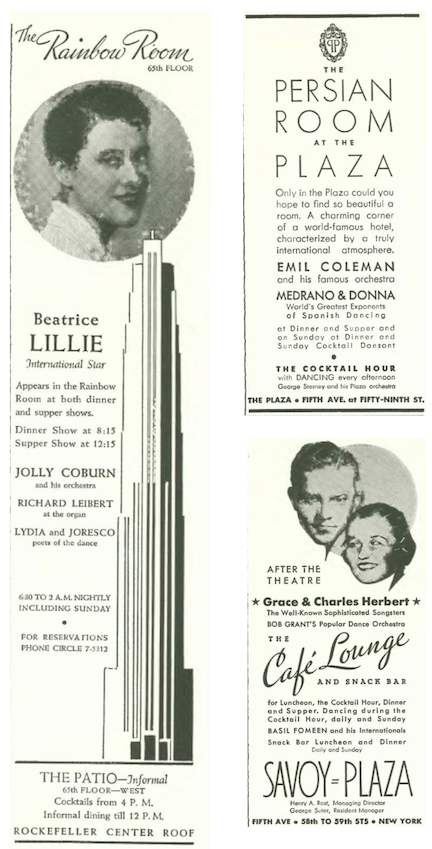
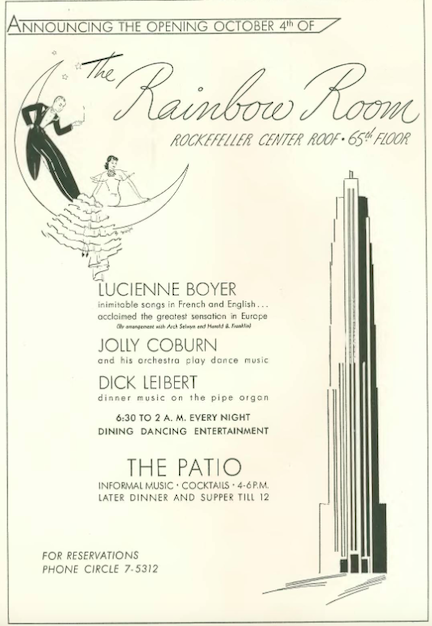
As Lois Long mentioned in “Tables for Two,” British actress and singer Beatrice Lillie was appearing at in the Rainbow Room on the 65th floor of Rockefeller Center; according to the ad below, also featured were ballroom dancers Lydia and Joresco and bandleader Jolly Corburn…
…at first I though this was Alfred Lunt and Lynn Fontanne shilling for Luckies, but the resemblance isn’t quite there, plus I’m not aware of the Broadway legends ever endorsing any product, let alone cigarettes…
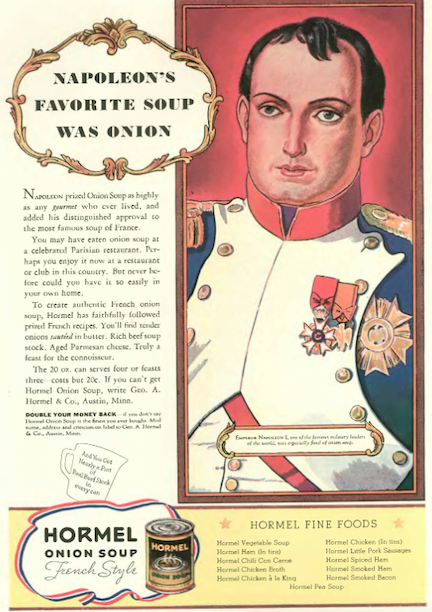
…the folks at Hormel continued to feature notable Frenchmen who were known to enjoy French onion soup, although this particular image doesn’t do much for one’s appetite…
…the Bermuda Trade Development Board continued to feature colorful ads that enticed New Yorkers away from the late winter blahs…
…this ad for Schaefer is a bit odd…I guess the artist wanted to suggest a handbill, and therefore tilted the image it at an angle, unsuccessfully, one might add…
…The Theatre Guild once again called upon the talents of James Thurber to advertise their latest production…
…which segues into our cartoons, with Thurber once more…
…Al Frueh did his part to promote the stage with this illustration for the theatre section…
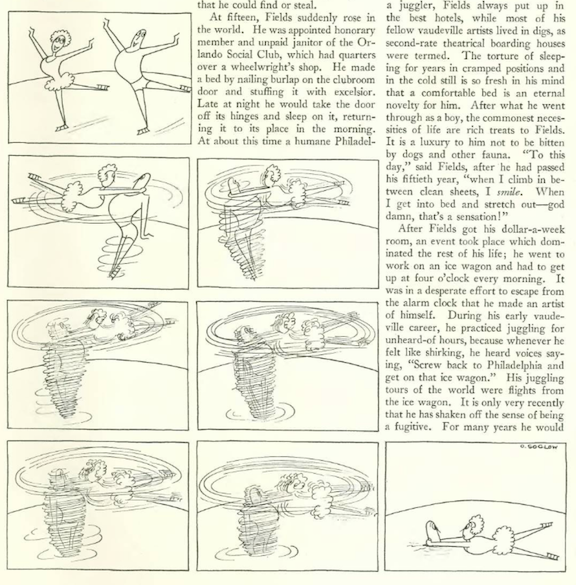
…Otto Soglow offered his spin on pairs figure skating…
…Gardner Rea explored the world of art appreciation…
…Helen Hokinson aptly supplied this cartoon for Lois Long’s fashion column…
…Whitney Darrow Jr. showed us the consequences of classified advertising…
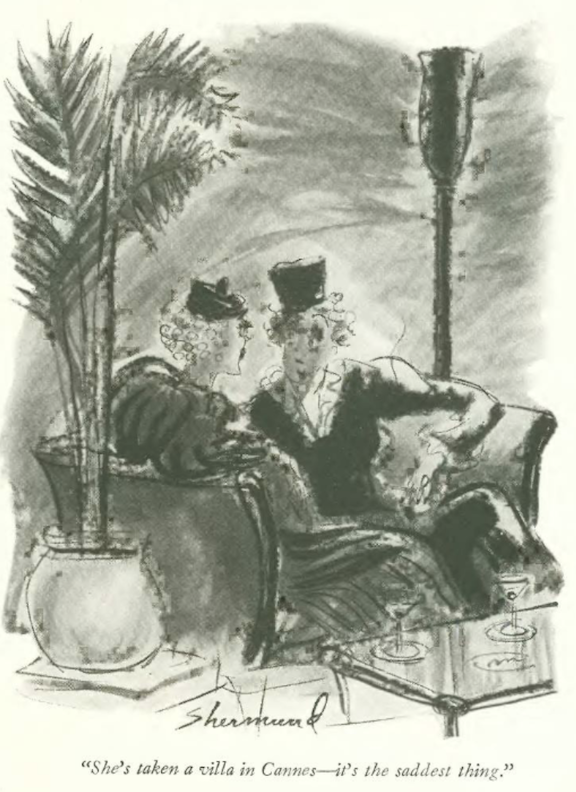
…Barbara Shermund clued us in on the latest gossip…
…and we close with Peter Arno, and one butcher’s cold greeting…
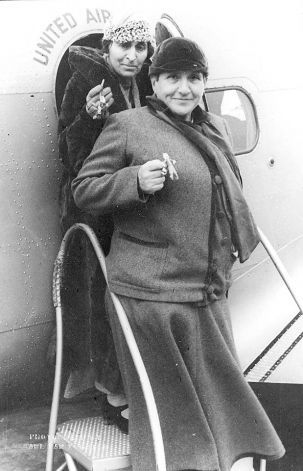
Above, left, a 1935 portrait of Gertrude Stein by Carl Van Vechten; right, Gertrude Stein and Alice B. Toklas arriving in New York aboard the French Line’s SS Champlain in 1934. (Library of Congress/AP)
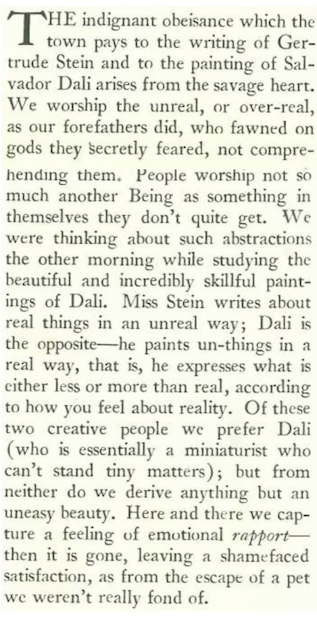
Much of America’s literary world was abuzz about the arrival of Gertrude Stein in New York after her nearly three-decade absence from the States. Audiences were mostly receptive to Stein’s lectures, even if they were largely unintelligible, but The New Yorker would have none of it.
Nov. 17, 1934 cover by Rea Irvin.
Stein (1874–1946) visited the U.S. at the urging of friends who suggested that a lecture tour might help her gain an American audience for her work. She crisscrossed the country for 191 days, delivering seventy-four lectures in thirty-seven cities.
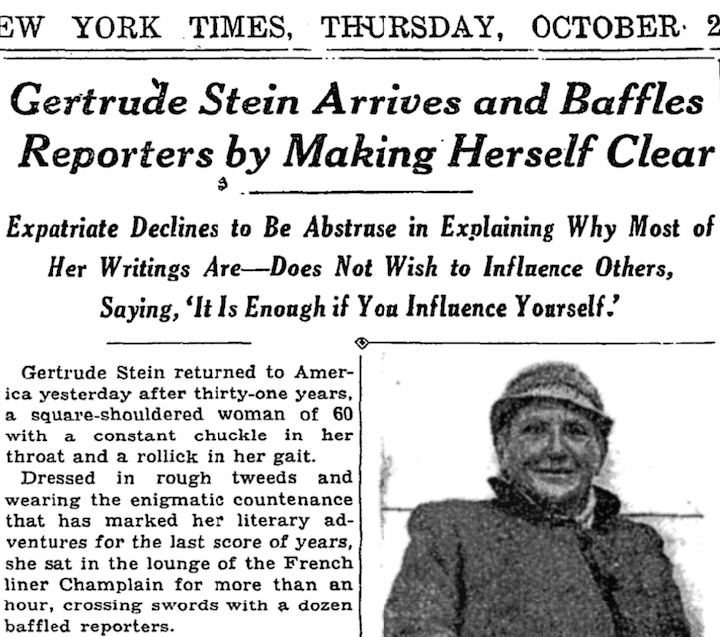
Writing for the Smithsonian Magazine (October 2011), Senior Editor Megan Gambino notes that publishing houses regarded Stein’s writing style as incomprehensible (Gambino writes that shortly after her arrival in the U.S., “psychiatrists speculated that Stein suffered from palilalia, a speech disorder that causes patients to stutter over words or phrases”), but in 1933 “she at last achieved the mass appeal she desired when she used a clearer, more direct voice” in The Autobiography of Alice B. Toklas. However, Stein was still best known in the U.S. for her “insane” writings, as one New York Times reporter described Stein’s work upon the writer’s arrival in New York. Excerpts from the Oct. 25, 1934 edition of the Times:
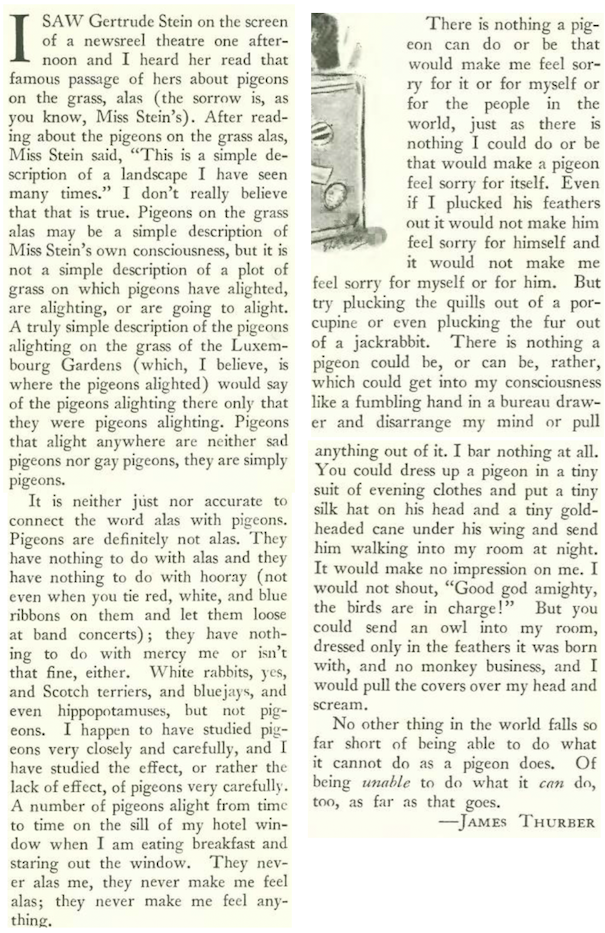
Stein had also achieved success in America via her libretto to Virgil Thomson’s opera Four Saints in Three Acts. Prior to her visit, Stein was featured in a newsreel reading the “pigeon” passage from the libretto, which James Thurber satirized in this piece titled “There’s An Owl In My Room.” Excerpts.
Here is a YouTube clip of the newsreel satirized by Thurber. Stein begins her “pigeon” reading at the 30-second mark:
If Thurber found the libretto ridiculous, it was an opinion not necessarily shared by audiences who attended Four Saints in Three Acts, which premiered in Hartford, Connecticut, before making a six-week run on Broadway.
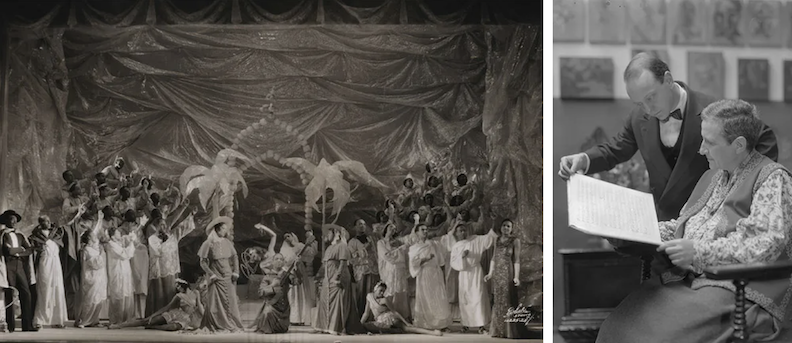
SAINTS AND PIGEONS…The original cast of Four Saints in Three Acts, onstage at the Wadsworth Atheneum, Hartford, 1934; at right, Gertrude Stein reviews the libretto for Four Saints with American composer Virgil Thomson, 1934. (Harold Swahn/Bancroft Library, UC Berkeley)
Since Stein had never seen the opera performed, writer and photographer Carl Van Vechten convinced Stein and Toklas to fly on an airplane for the first time in order to be able to see the play in Chicago.
FLIGHT INSURANCE…Stein and Toklas were anxious about flying, so Van Vechten gave each a small Zuni fetish—a good luck charm as they prepared to board their plane at Newark. (Boatwright Memorial Library, The University of Richmond)
Thurber wasn’t the only New Yorker writer to throw shade on Stein’s visit. In his “Books” column, Clifton Fadiman described Stein as a “mamma of dada” and a “Keyserling in divided skirts” (Hermann Keyserling was a non-academic German philosopher known for his platitudinous, obscure writings). Excerpt:
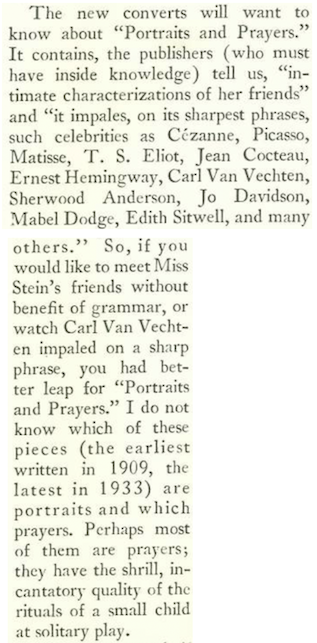
Fadiman continued by excoriating Stein’s latest book, Portraits and Prayers, likening its “shrill, incantatory” quality to “the rituals of a small child at solitary play.”
* * *
Over the Rainbow
We leave Gertrude Stein for the time being and check in with Lois Long, who was sampling the fall attractions of the New York nightclub scene in “Tables for Two.” In these excerpts, the 32-year-old Long continued her pose as a much older woman (“about to settle down with a gray shawl”) as she bemoaned the bourgeoisie excess of places like the Colony, once known for its boho, speakeasy atmosphere. And then there was the Rainbow Room, with its organ blaring full blast to the delight of gawking tourists.
LOST IN NEW YORK…Lois Long lamented the demise of cafe life in Manhattan; from left, the Colony, circa 1940, which went from boho to upscale; the 21 Club, a favorite Prohibition-era haunt of Long’s where she was suddenly a nobody; and high above the city, the Rockefeller Center’s Rainbow Room, and its interminable organ music. (Pinterest/Alice Lum via Daytonian in Manhattan/nycago.org)
* * *
From Our Advertisers
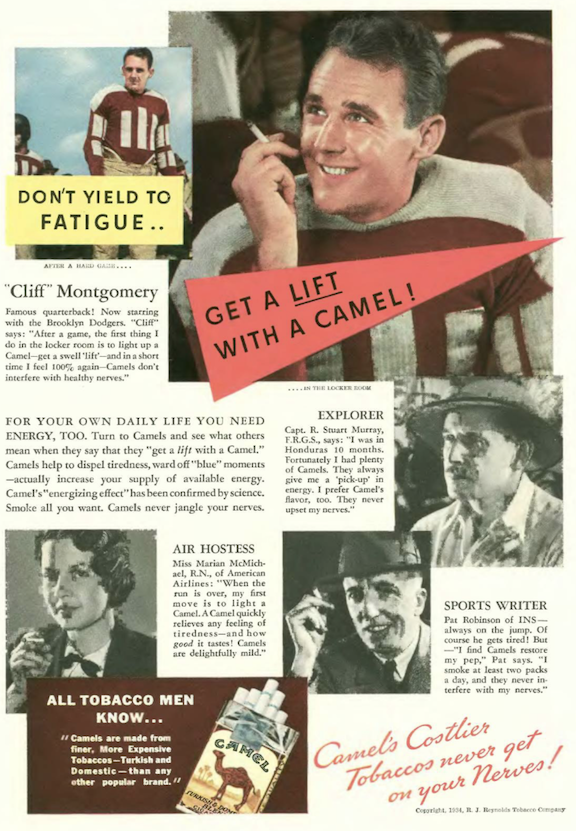
Just one ad from the Nov. 17 issue (more to come below)…the latest athlete to attest to the energizing effects of Camel cigarettes…Cliff Montgomery (1910–2005) was famed for a hidden ball trick play that led one of the greatest athletic upsets—Columbia’s 7-0 win over Stanford in the 1934 Rose Bowl. Montgomery would play one year with the NFL Brooklyn Dodgers, and would later earn a Silver Star for his heroism during World War II…
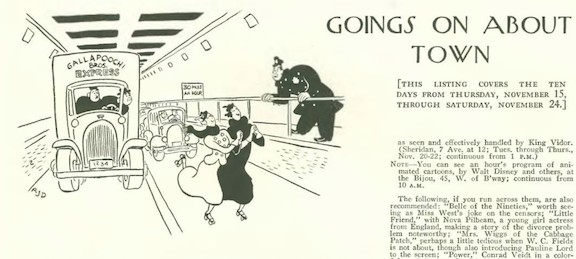
…on to our cartoonists, we begin with Robert Day’s jolly illustration for the “Goings On About Town” section…
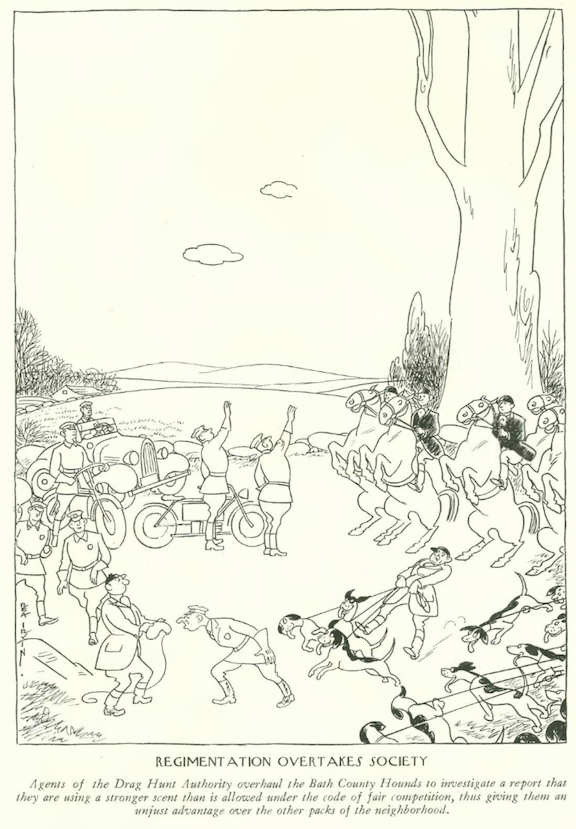
…Rea Irvin looked into fair play among the fox hunting set…
…Garrett Price gave us a tender moment among the bones at the American Museum of Natural History…
…and Peter Arno introduced two wrestlers to an unwelcoming hostess…
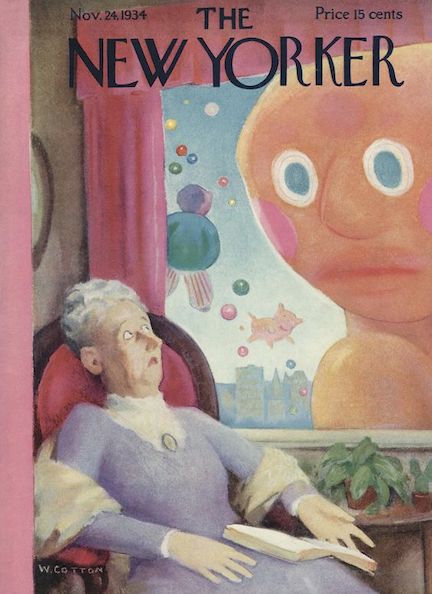
…on to Nov. 24, 1934 issue, and the perils of the Macy’s Thanksgiving Day Parade as illustrated on the cover by William Cotton…
Nov. 24, 1934 cover by William Cotton.
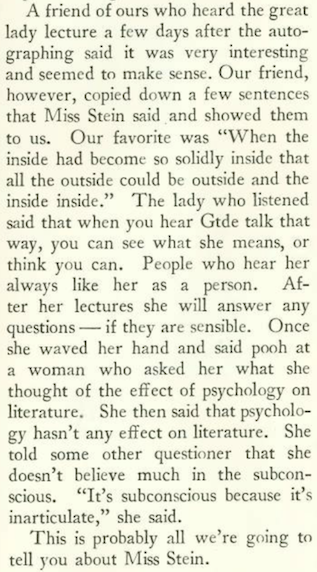
…where we find still more scorn being heaped upon Gertrude Stein. “The Talk of the Town” offered this observation (excerpt):
…and E.B. White had the last word on Stein in his Dec. 1, 1934 “Notes and Comment” column:
* * *
There Goes the Neighborhood
Returning to the Nov. 24 issue, Alberta Williams penned a lengthy “A Reporter at Large” column, titled “White-Collar Neighbors,” about the new Knickerbocker Village development in the Lower East Side. Real estate developer Fred French razed roughly one hundred buildings to build what has since been criticized as an example of early gentrification in Manhattan. Williams assessed the development after more than a year of construction, finding that despite federal funding, the leasing company had yet to rent any apartments “to Negroes or Orientals.” Although the development was meant to serve some of the families it displaced, the vast majority were forced to move back into slums due to escalating rents.
BREATHING ROOMS…Knickerbocker Village in 2019. To make way for the development, one hundred buildings were razed in the “Lung Block,” so named because of its high tuberculosis mortality rate. The development continues to be designated as affordable housing. (Wikipedia)
* * *
Dollmaker
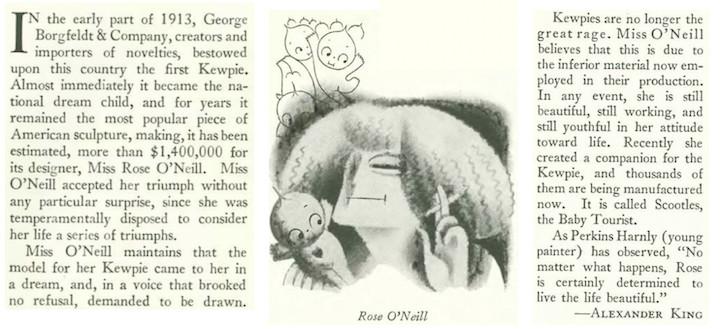
Raised in rural Nebraska, at an early age Rose O’Neill (1874–1944) demonstrated an artistic bent, and was already a published illustrator and writer when she drew her first images of “Kewpie” around the year 1908. A German doll manufacturer began producing a doll version of Kewpie in 1913, and they became an immediate hit, making O’Neill a millionaire and for a time the highest-paid female illustrator in the world. When Alexander King penned a profile of O’Neill, Kewpies were no longer the rage, but O’Neill was nevertheless determined to find success in a new doll line. Excerpts:
QP QUEEN…Clockwise from top left, Rose O’Neill circa 1910, just before her Kewpie dolls made it big; Kewpie doll in original box, undated; as the Kewpie craze faded in the 1930s, O’Neill tried to launch a new line called Little Ho Ho, a laughing baby Buddha, but before production plans were finalized the doll factory burned to the ground; a 1935 ad for a Rose O’Neill-branded “Scootles” doll, another attempt at a comeback. (Wikipedia/Pinterest/museumobscura.com)
* * *
Last Call
Lois Long was back with another installment of “Tables for Two” and in these excerpts she found the Central Park Casino a welcome place to hang out, apparently unaware that Parks Commissioner Robert Moses had already served an eviction notice to the Casino’s owners (Moses would tear down the Casino in 1936, mostly to settle a personal vendetta). Long also found respite at the Place Piquale, which featured the musical stylings of Eve Symington.
BYE BYE…The Central Park Casino was not long for the world when Lois Long paid an enjoyable visit in November 1934. Long also found a good time at the Place Piquale, which featured the “startling,” deep voice of cabaret singer Eve Symington. (centralpark.org/Pinterest)
At the Place Piquale, Long was “grateful” to see that silent film star Louise Brooks was also a good dancer. An icon of Jazz Age flapper culture, Brooks loathed the Hollywood scene and the mediocre roles it offered, and after a stint making films in Europe she returned to the States, appearing in three more films before declaring bankruptcy in 1932. A former dancer for the Ziegfeld Follies, Brooks had turned back to dancing in nightclubs to make a living.
IT’S A LIVING…Promotional photo for the Place Piquale featuring Louise Brooks (sans her familiar flapper bob) and Dario in “Spectacular Interpretive Dances,” April 17, 1934. (books0977.tumblr.com)
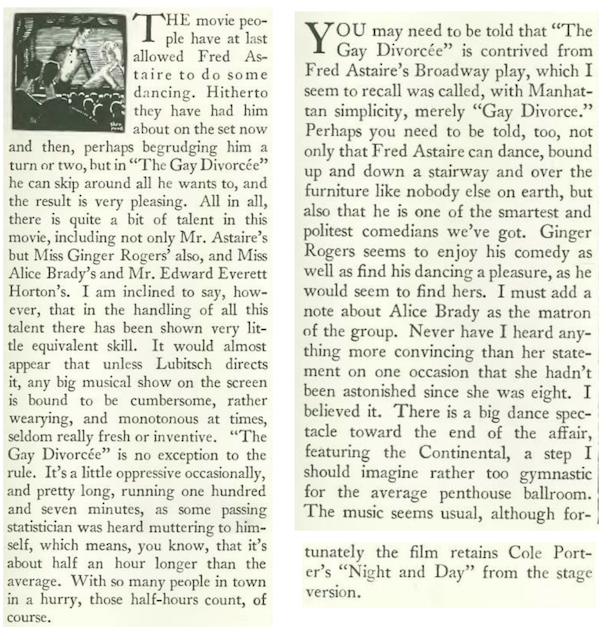
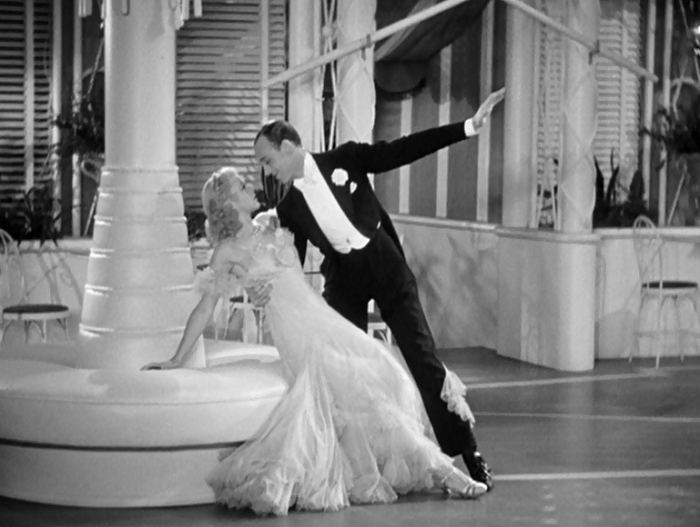
…and dance remains a theme with John Mosher’s film review of the Fred Astaire and Ginger Roger musical The Gay Divorcee, which was based on the 1932 Broadway musical Gay Divorce starring Astaire and Claire Luce.
YOU WILL HAVE TO DANCE BACKWARD, IN HEELS…Ginger Rogers and Fred Astaire trip the light fantastic in The Gay Divorcee. (precode.com)
* * *
Using Her Heads
Clifton Fadiman praised Peggy Bacon’s collection of caricatures, Off With Their Heads!, which included drawings of fellow New Yorker contributors as well as various Algonquin Hotel acolytes. Excerpt:
HEAD HUNTER…Peggy Bacon offered up caricatures of forty celebrities in her new book, Off With Their Heads! Bacon (1895–1987) contributed cartoons as well as poetry and fiction to The New Yorker from 1927 to 1950. Clockwise, from top left, title page with Bacon’s self-portrait; undated photo of Bacon, likely circa 1930; caricatures of Dorothy Parker, Carl Sandburg and Heywood Broun. (villagepreservation.org/printmag.com/Wikipedia–Peter A. Juley & Son)
* * *
More From Our Advertisers
“Beautiful Vanderbilts” Mrs. Reginald Vanderbilt and Miss Frederica Vanderbilt Webb wowed one unnamed dermatologist who discovered that both had 20-year-old skin even though they were seven years apart! “Mrs. Reginald” was Gloria Morgan Vanderbilt, who was thirty when this ad was produced (Miss Frederica was apparently twenty-three). We’ve met Gloria Morgan Vanderbilt before, shilling for Pond’s—she was the maternal grandmother of television journalist Anderson Cooper, and earned her “bad mom” rep from Vanderbilt vs. Whitney, one of America’s most sensational custody trials…
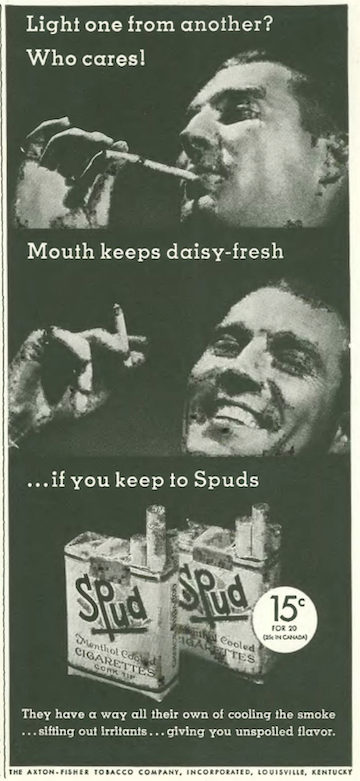
…we move from skin care to who cares…in this case how many Spud cigs you smoke…hell, smoke three packs a day if you like, the cooling menthol will always keep you feeling fresh even as your lungs gradually darken and shrivel up…
…and here’s a lesson from the makers of Inecto hair dye, no doubt a company solely run by men, who schooled wives with the advice that you’d better color that gray hair pronto or your hubby will kick you to the curb…
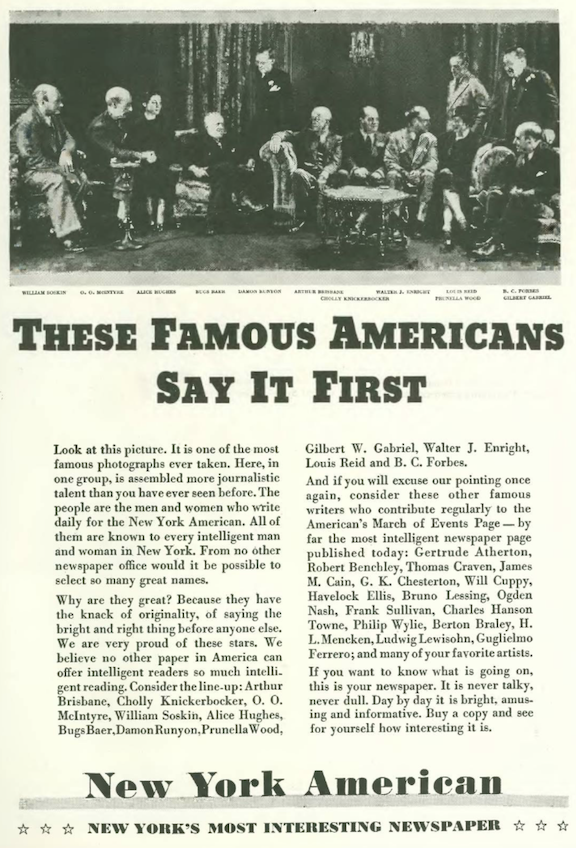
…the New York American was a Hearst broadsheet known for its sensationalism, however it did claim Damon Runyon, Alice Hughes, Robert Benchley and Frank Sullivan among its contributors…the morning American merged with the New York Evening Journal to form the American and Evening Journal in 1937. That paper folded in 1966…
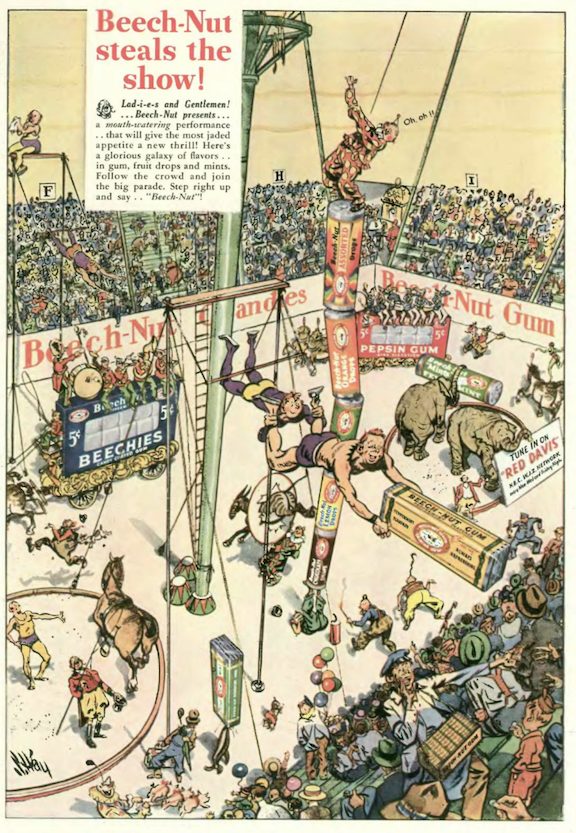
…illustrator Stuart Hay drew up this full page ad for the makers of Beech-Nut candy and chewing gum…when I was a kid we used to call this “grandpa gum”…
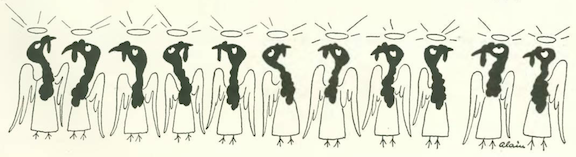
…on to our cartoonists, we begin with a Thanksgiving spot by Alain (Daniel Brustlein)…
…Barbara Shermund delivered another life of the party…
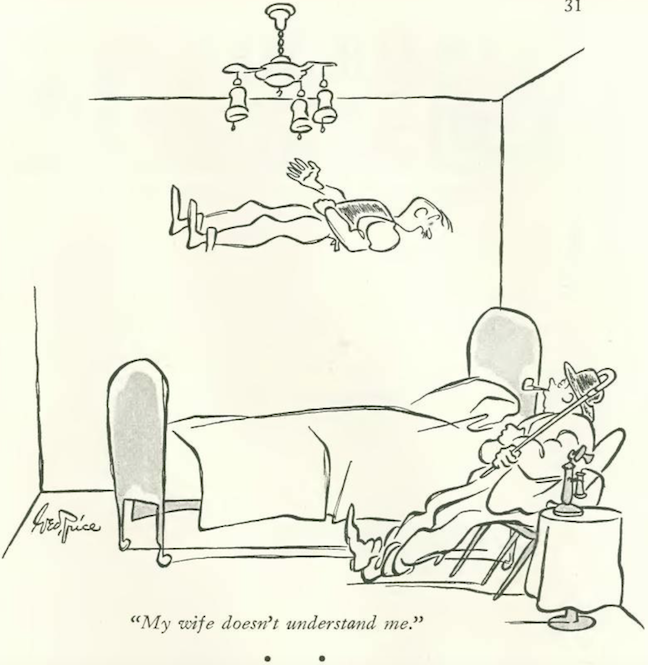
…George Price was finally bringing his floating man back to earth…
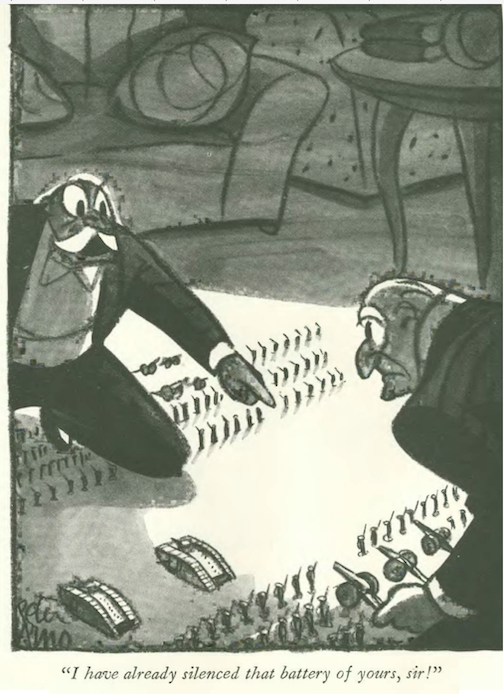
…Otto Soglow gave us an unlikely detour…
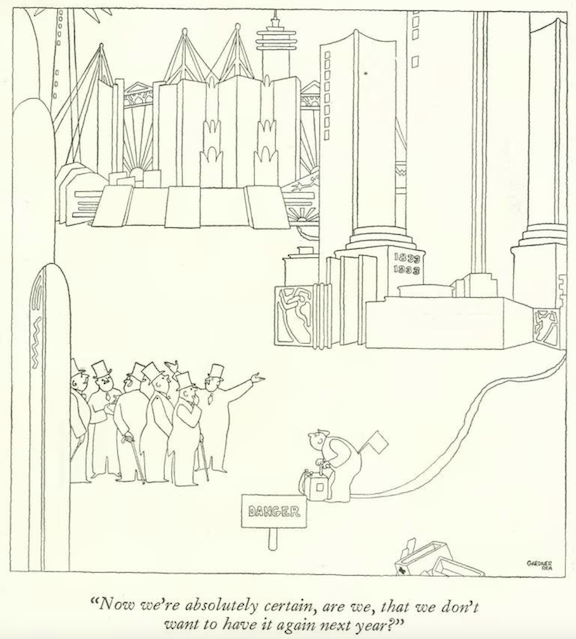
…Gardner Rea signaled the end to the 1933-34 Chicago World’s Fair…with a boom…
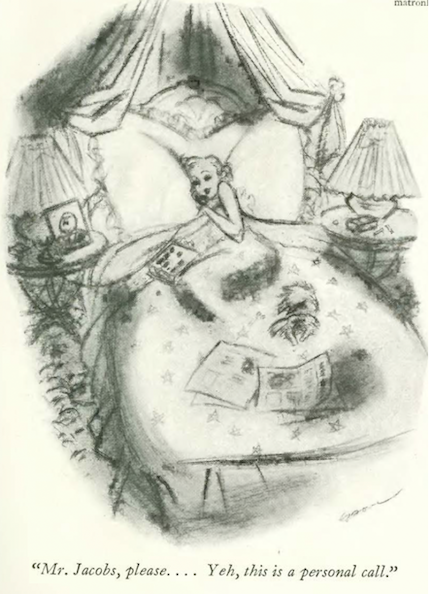
…Leonard Dove dialed up a familiar trope…
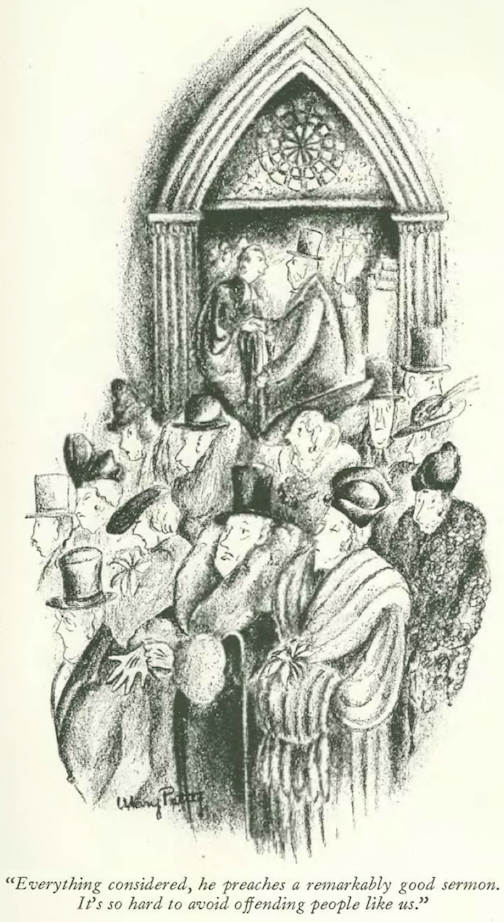
…and we close on a more pious note, with Mary Petty…
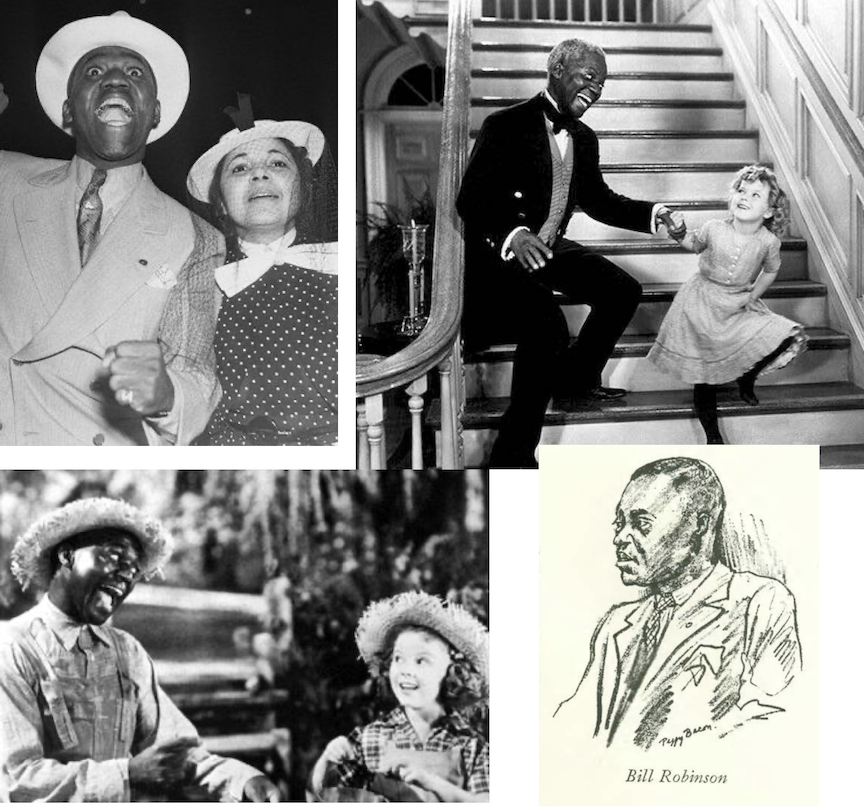
Above: Bill "Bojangles" Robinson demonstrating his famous stair dance, which involved a different rhythm and pitch for each step. At left, Robinson in Broadway's Blackbirds of 1928; at right, publicity photo circa 1920s. (Vandamm collection, New York Public Library/bet.com)
Bill “Bojangles” Robinson (1878–1949) is considered one of the greatest tap dancers of all time, introducing a style of remarkable lightness and complexity that was perhaps best represented by his famous stair dance.
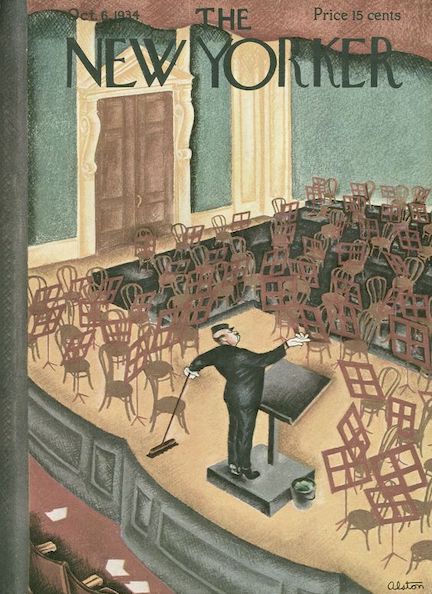
Oct. 6, 1934 cover by Charles Alston. This was Alston’s only New Yorker cover. Active in the Harlem Renaissance, Alston was also a painter, sculptor and muralist (see more on Alston at the conclusion of this post).
St. Clair McElway wrote about the 57-year-old Robinson in a two-part profile that examined his personal life and habits, including his propensity for getting shot. Two brief excerpts:
The New Yorker profile coincided with Robinson’s rising career in films, including four he made with Shirley Temple. For the 1935 film The Little Colonel, Robinson taught the stair dance to the child star, modifying his routine to mimic her movements. Robinson and Temple became the first interracial dance partners in Hollywood history (however, the step dance scene was cut from the film shown to Southern audiences). Temple and Robinson, who became lifelong friends, also appeared together in 1935’s The Littlest Rebel, 1938’s Rebecca of Sunnybrook Farm and 1938’s Just Around the Corner.
DANCING WITH THE STAIRS…Bill Robinson was also known as Bojangles, a nickname from his childhood in Richmond, Virginia. Clockwise, from top left, with his second wife Fannie Clay in 1933; performing the stair dance with Shirley Temple in The Little Colonel (1935); profile illustration by Peggy Bacon; Robinson with Temple in 1938’s Rebecca of Sunnybrook Farm. (blackpast.org/Wikipedia)
Robinson is remembered for his generous support of fellow dancers including Fred Astaire, Eleanor Powell, Lena Horne, Sammy Davis Jr and Ann Miller, as well as his support for the career of 1936 Olympics star Jesse Owens.
FAST IN BOTH DIRECTIONS…Robinson befriended Jesse Owens (left) after the track & field great returned from the 1936 Olympics (where Owens won four golds). Known for his generosity to his friends, Robinson helped Owens establish a successful post-Olympics career. Robinson himself was also something of a runner, having set the world record for running backward in 1922 (100 yards in 13.5 seconds). (Public domain image)
Although Robinson was the highest paid black performer of his time, his generosity with friends as well as his gambling habits left him penniless at his death from heart failure in 1949. Longtime friend Ed Sullivan paid for Robinson’s funeral, and more than 30,000 filed past his casket to pay their respects.
I’VE STILL GOT IT…Bill Robinson with Lena Horne in 1943’s Stormy Weather, a film loosely based on Robinson’s own life. (MoMA)
* * *
In a Romantic Mood
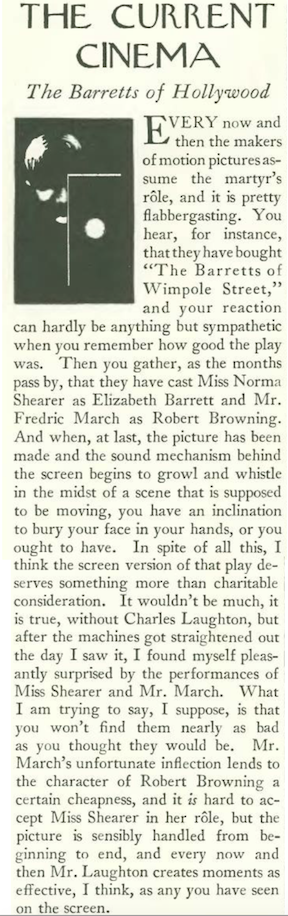
That is how St. Clair McKelway found Hollywood in two of its latest offerings, The Barretts of Wimple Street and Caravan. To his relief, he found the Hollywood version of Barretts quite “sensible”…
LET’S BE SENSIBLE…The Barretts of Wimpole Street (1934) starred Fredric March and Norma Shearer in the lead roles. (TCM)
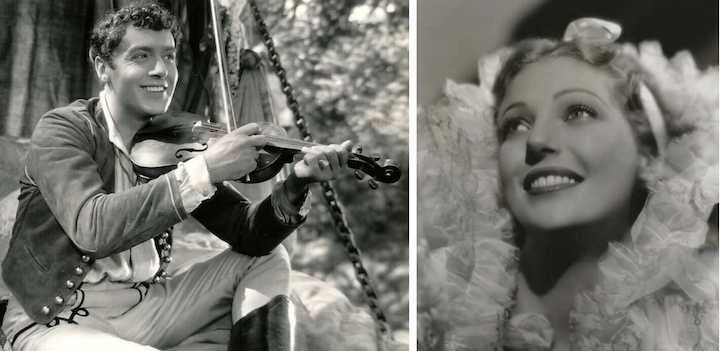
…as for Caravan, McKelway wrote that he’d “never seen a picture with so much grinning in it.” He found the “peculiar, unreal gleam” of the actors’ teeth a real distraction in closeup shots.
THAT PEPSODENT SMILE…Charles Boyer and Loretta Young showed off their pearly whites in 1934’s Caravan. (IMDB/TCM)
* * *
From Our Advertisers
The Oct. 6 issue opened with a study in contrasts: an image of two Civil War veterans swapping stories over whiskey on the inside front cover, paired with an illustration of a lithe model sheathed in the latest fashion from Bergdorf…
…the folks at Campbell’s continued to suggest that their canned soup was a delight of the elite…
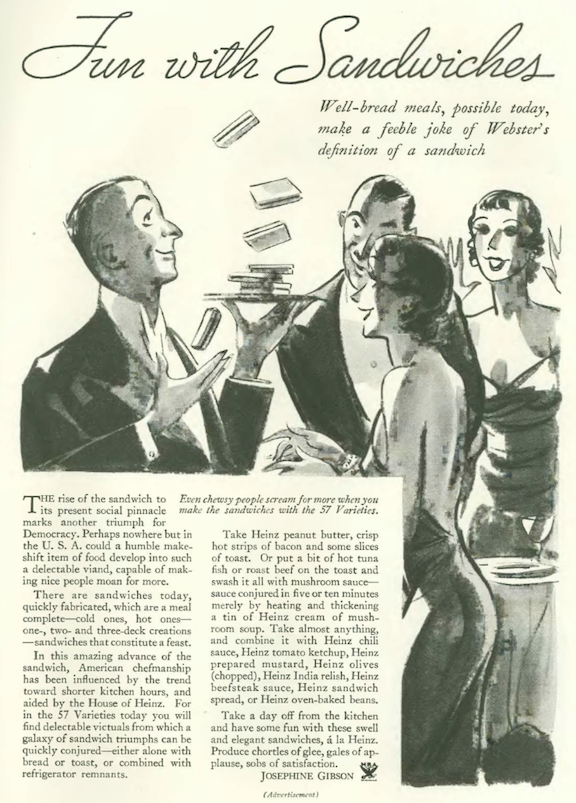
…Heinz took a similar tack, showing the smart set having fun with their sandwich spreads…
…Lord & Taylor touted its “tomorrow look” in furniture…
…R.J. Reynolds continued its series of “distinguished women who preferred Camel’s “costlier tobaccos,” adding to their growing list a the “charming debutante” Evelyn Cameron Watts, who later became Evelyn Watts Fiske (1915–1976)…
…in contrast to Camel’s fashionable ads, the upstart menthol brand Kool offered a series of cheap, back-page ads featuring a smoking penguin, here in the Halloween spirit (detail)…
…another recurring back page ad was this weird spot from Satinmesh, a product that apparently helped close a woman’s “gaping pores”…those pores apparently prompted one man to ponder the eternal why…
…on to our cartoonists, we begin with a two-page spot by Carl Rose…
…James Thurber spiced up a game of ping-pong…
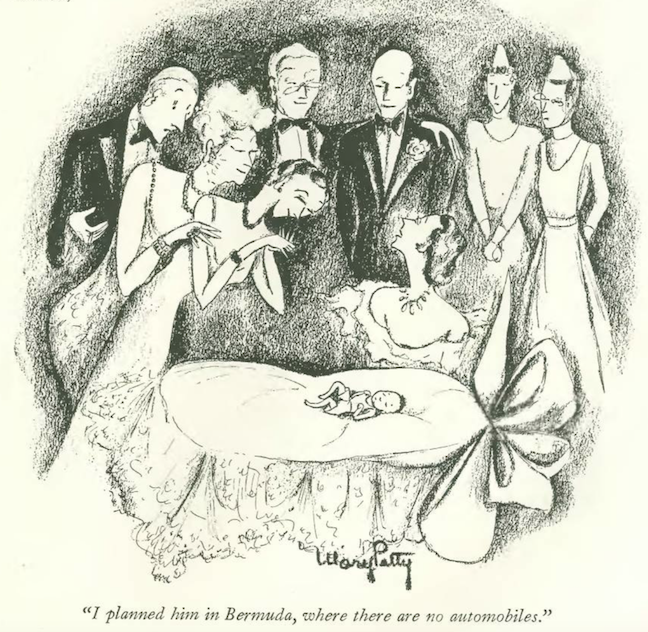
…Mary Petty explored the miracle of birth…
…Peter Arno discovered you’re never too old to play with toys…
…Garrett Price offered a young man’s perspective on a father’s avocation…
…Alain (Daniel Brustlein) gave us a disappointed plutocrat on vacation in Mexico…
…George Price continued to mine the humor of his “floating man” series…
…and contributed a second cartoon that featured some office hijinks…
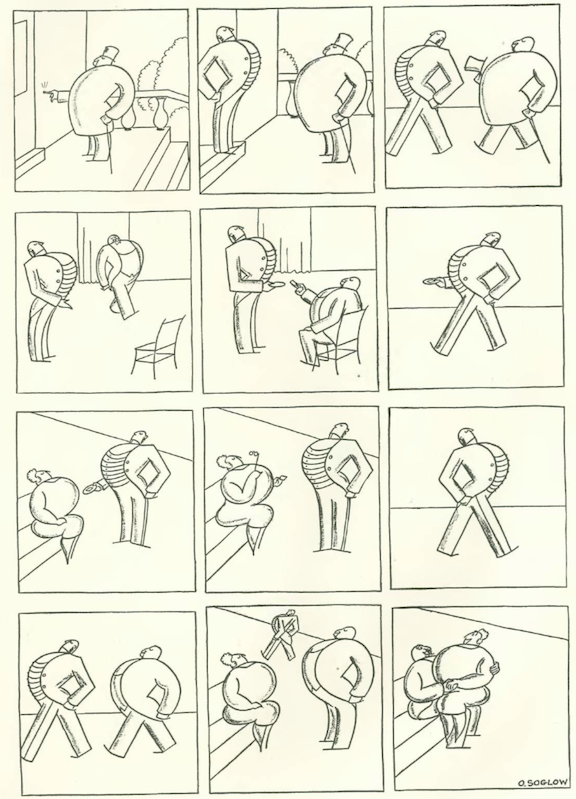
…and Otto Soglow returned without The Little King, offering in its stead the closest thing to royalty in America…
Before we sign off, a note on the Oct. 6 cover artist, Charles Henry Alston (1907–1977). A Harlem-based painter, sculptor, illustrator, muralist and teacher, Alston was active in the Harlem Renaissance and was the first Black supervisor for the Works Progress Administration’s Federal Art Project. In 1990, Alston’s bust of Martin Luther King Jr. became the first image of an African American displayed at the White House.
Clockwise, from top left, Charles Henry Alston’s 1970 bust of Martin Luther King Jr; Walking 1958; Andrew Herman photo of Alston, 1939; Midnight Vigil, 1936. (Smithsonian/Wikipedia/Columbia.edu)
Above: Newsreel cameramen perch on boards resting on a windowsill to get a birds-eye view of a passing parade, circa 1930. (Public Domain Image)
We marvel at, and sometimes decry, today’s instantaneous news coverage of wars, disasters and the like, but ninety years ago newsreel crews did a remarkable job of filming and delivering the latest news to thousands of theaters across the U.S. and around the world.
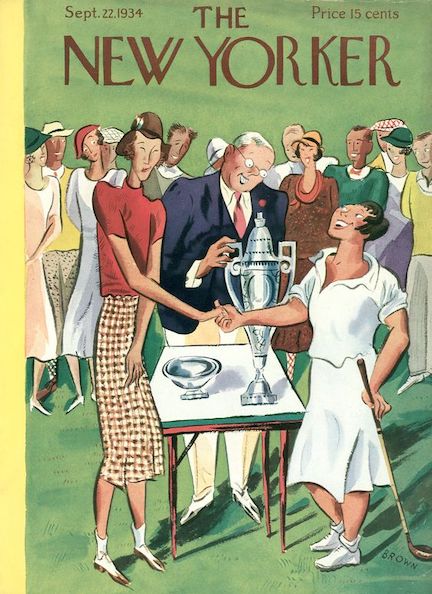
Sept. 22, 1934 cover by Harry Brown.
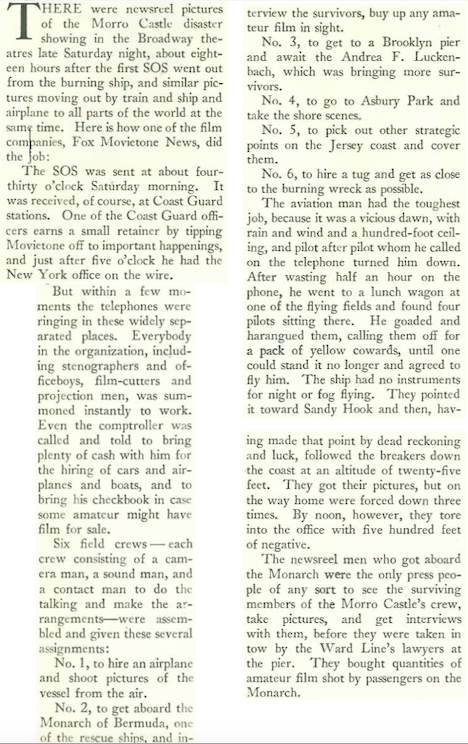
In his “A Reporter at Large” column, Morris Markey penned a lengthy account of Fox Movietone’s coverage of the SS Morro Castle disaster. En route from Havana to New York City on Sept. 8, 1934, the luxury liner caught fire near the New Jersey coast. Due to the ship’s design and the ineptitude of the crew, the blaze claimed 137 lives. Markey described how newsreel crews—with their bulky cameras and sound equipment—went into action, including a cameraman who “goaded” a pilot into taking him aloft through vicious weather conditions.
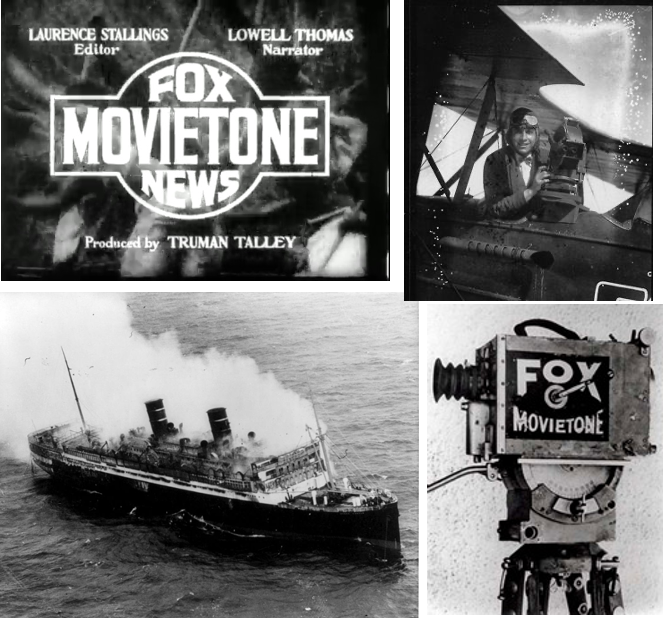
GUTS AND INGENUITY took newsreel reporters to places high and low. Clockwise, from top left, title card from a 1935 Fox Movietone newsreel; Jack Lieb goes aloft to get capture newsreel footage in an undated photo—Lieb was a cameraman for Hearst’s News of the Day; a 1930s Fox Movietone camera; the SS Morro Castle ablaze off the New Jersey Coast on Sept. 8, 1934. (Wikipedia/Lieb photo Courtesy of Bette Marshall via unwritten-record.blogs.archives.gov)
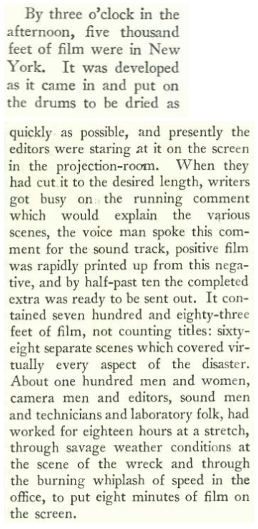
Somehow the cameraman aboard the airplane (which was forced down by weather three times) was able to get his footage to the Movietone office by noon, less than seven hours after the office first received word of the disaster. By three o’clock, five thousand feet of film from all sources was being developed.
UP NORTH AND DOWN UNDER…Movietone news had crews stationed around the world, including field staff in Sydney (top, from 1938), and in Toronto, circa 1930. (Nat’l Library of Australia/City of Toronto Archives)
Markey concluded with this observation about the “rugged” and persistent newsreel cameramen:
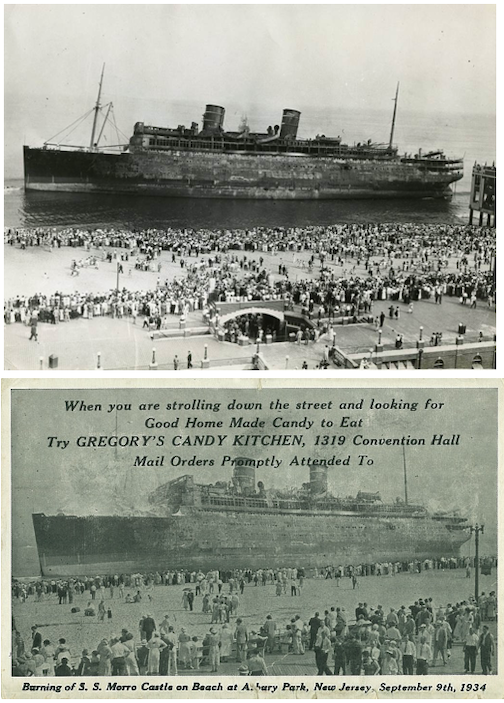
In the aftermath of the Morro Castle disaster, a scene of enormous tragedy was turned into a tourist attraction…
GAWKERS AND HAWKERS…The charred hulk of the SS Morro Castle came to rest on the shore near the Asbury Park boardwalk, which became a popular spot for souvenir salesmen and photo-ops. Tourists flocked to the site from September 1934 to March 1935, when the ship was finally towed away. Note the postcard (bottom) advertising homemade candy over an image of the charred ship. (ripleys.com/side-o-lamb.com)
Fox Movietone News produced sound newsreels from 1928 to 1963, and in the UK as British Movietone News…here is Movietone footage of the Morro Castle disaster, as presented by British Movietone in 1934:
* * *
Up In The Old Hotels
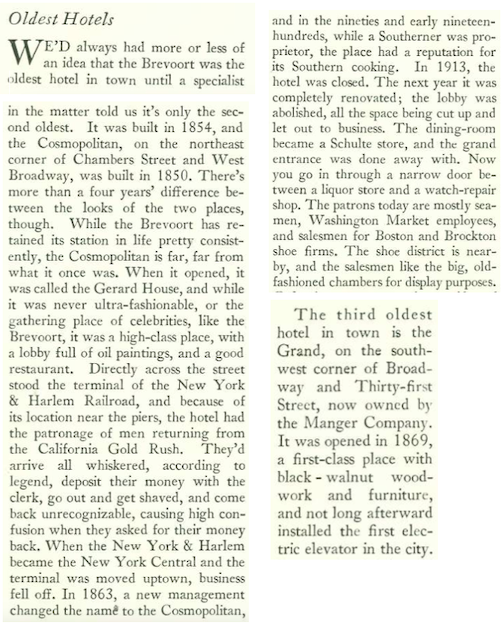
Last week “The Talk of the Town” looked in on one of Manhattan’s oldest saloons, McSorley’s. For the Sept. 22 “Talk” the subject was “Oldest Hotels,” two of which, The Cosmopolitan and The Grand, remarkably survive to this day.
HANGING IN THERE…The 1845 Brevoort House hotel at 15 Fifth Avenue (top left) was torn down in 1952, however the 1868 Grand Hotel (right) at 1232–1238 Broadway and the 1845 Cosmopolitan Hotel (below, left) at Chambers Street and West Broadway still stand today. (Museum of the City of New York / Chester Higgins Jr. for The New York Times)
* * *
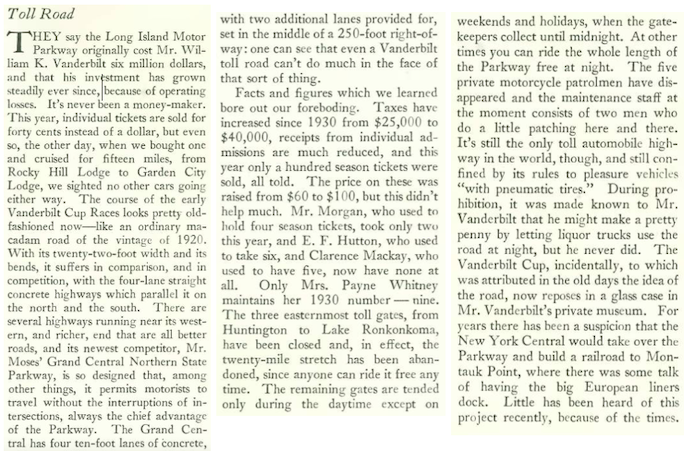
The Six-Million Dollar Road
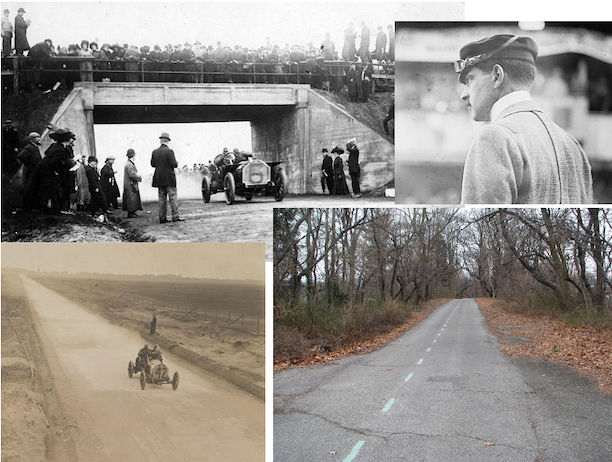
The first roadway designed exclusively for automobile use was likely the Long Island Motor Parkway, privately built by William Kissam Vanderbilt II because he wanted a road suitable for auto racing. He established the Vanderbilt Cup races on local roads in 1904, but after two spectators were killed and many others injured, in 1908 he began building what would become a 45-mile (72 km) toll road from Queens to Lake Ronkonkoma. After two mechanics were killed in a 1910 race, the New York Legislature banned racing on the road, which the state took over in 1938.
ROAD WARRIOR…William Kissam Vanderbilt II (top right) staged his Vanderbilt Cup Races on his private road until a fatal accident put a stop to the fun in 1910; At bottom right, a surviving section of the road today. Most of the road in Queens is a bicycle trail, and other segments still serve as parts of a county road. (nyheritage.org/Wikipedia-Steve Nowotarski/ny1.com)
* * *
From Our Advertisers
I have nothing against accordion music, despite years of exposure to Lawrence Welk during my youth, but I find it hard to believe that a Park Avenue socialite (identified here as Mrs. René Du Champ Bellinger) would contemplate tormenting her posh friends with a Hohner squeezebox…
…Esquire magazine was barely a year old when it posted this ad in The New Yorker…its appeal to men (and their anxieties) keeps it going today…
…it’s interesting how companies in the 19th century and on through the 1950s featured idealized, bird’s eye images of their factories in advertising, doubtless believing that consumers associated size (and smokestacks) with prosperity, and therefore a quality product…
…White Rock, however, has used the image of the Greek goddess Psyche for more than a century to promote the purity of its spring water…
…purity was also the main point of this ad from Daggett & Ramsdell, who hawked their wares to the Park Avenue set…after more than 130 years D&G is still in the beauty business…
…this next ad is almost unbelievable…single rooms starting at $5, double rooms $7, and a whole suite for $10…at the Plaza…okay, $10 is roughly equivalent to $225 today, but half of that could get you a single…
…and yet another unlikely claim from R.J. Reynolds regarding the energizing qualities of their Camel cigarettes…it seems the last thing you would need while climbing a mountain is smoke in your already over-taxed lungs…
…however, let’s give proper due to Georgia Engelhard (1906–1986), who scandalized the mountaineering world by ditching the Victorian climbing skirt in favor of a pair of climbing pants. Engelhard was the first female climber to ascend many of the peaks in the Rockies…
Georgia Engelhard in a 1922 photo attributed to her friend Alfred Stieglitz. (nga.gov)
…it seemed like nearly everyone smoked in the 1930s, even in ads that had nothing to do with tobacco companies (detail)…
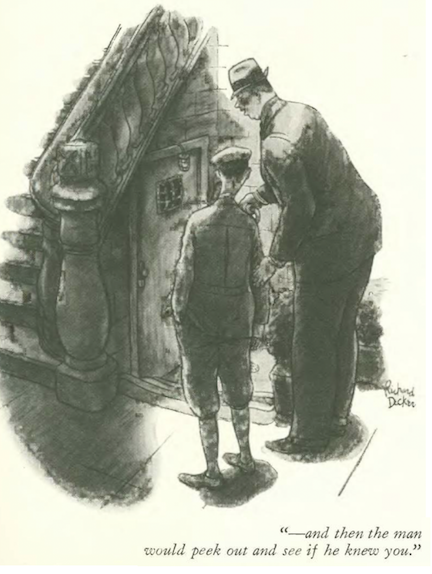
…on to our cartoons, we begin with Richard Decker and some retail competition…
…George Price drew up a curiosity even Robert Ripley couldn’t believe…
…Robert Day examined advances in evolutionary science…
…E. Simms Campbell offered up this abbreviated love story…
…Peter Arno gave us a director with a god complex…
…and one from Ned Hilton, and a new perspective on flying…
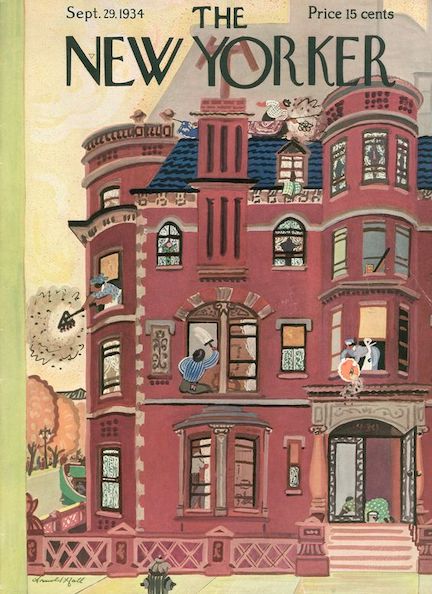
…on to Sept. 29, 1934, with a cover by Arnold Hall, who produced at least twelve covers for The New Yorker between 1933 and 1939…
Sept. 29, 1934 cover by Arnold Hall.
…and we go straight to ads, beginning with this alarming image that greeted readers on the inside cover…why would this prompt anyone to purchase a can of onion soup?…
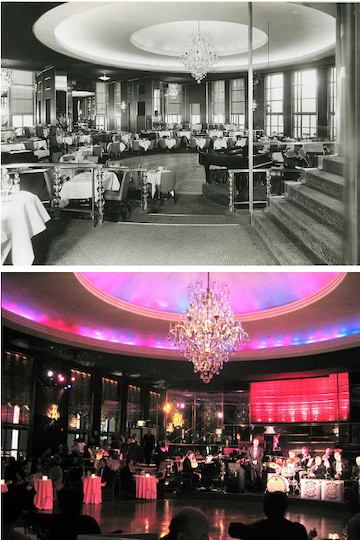
…the Rainbow Room on the 65th floor of Rockefeller Center opened in 1934, and it quickly became a focal point for the city’s elite…
Above, the dining room at the Rainbow Room, 1934, and below, in 2004. (Library of Congress/Wikipedia)
…Lucky Strike continued its series of ads featuring fashionable women looking smart with their product…
…our cartoons include this spot illustration by Otto Soglow, who did spots for The New Yorker for many years…although Soglow’s Little King moved to the Hearst newspapers, he continued to contribute cartoons to The New Yorker until 1974…
…George Price continued to explore life as a levitating man…
…the enforcement of the Hays Code had this teen in a “fix,” per James Thurber…
…Gluyas Williams continued his exploration of various crises, this time in the music world…
…Alan Dunn gave us a glimpse of civilization via the pharaonic sculptures that were emerging on the face of Mt. Rushmore…
…and we close with the wonderful wit of Barbara Shermund…
Sigmund Gottfried Spaeth (1885–1965) sought to popularize classical music and improve the musical tastes of the masses by meeting the public wherever he could find them, from vaudeville halls to national radio broadcasts.
September 1, 1934 cover by William Steig.
Born in a line of three generations of Lutheran clergymen, Spaeth chose a different path and became a musicologist who sought to de-mystify classical music, often demonstrating how popular melodies had origins in earlier music. He also had strong opinions about lyrics in popular music, demonstrating his distaste for “the lyric school of self-pity” in this “Onward and Upward” column. Excerpts:
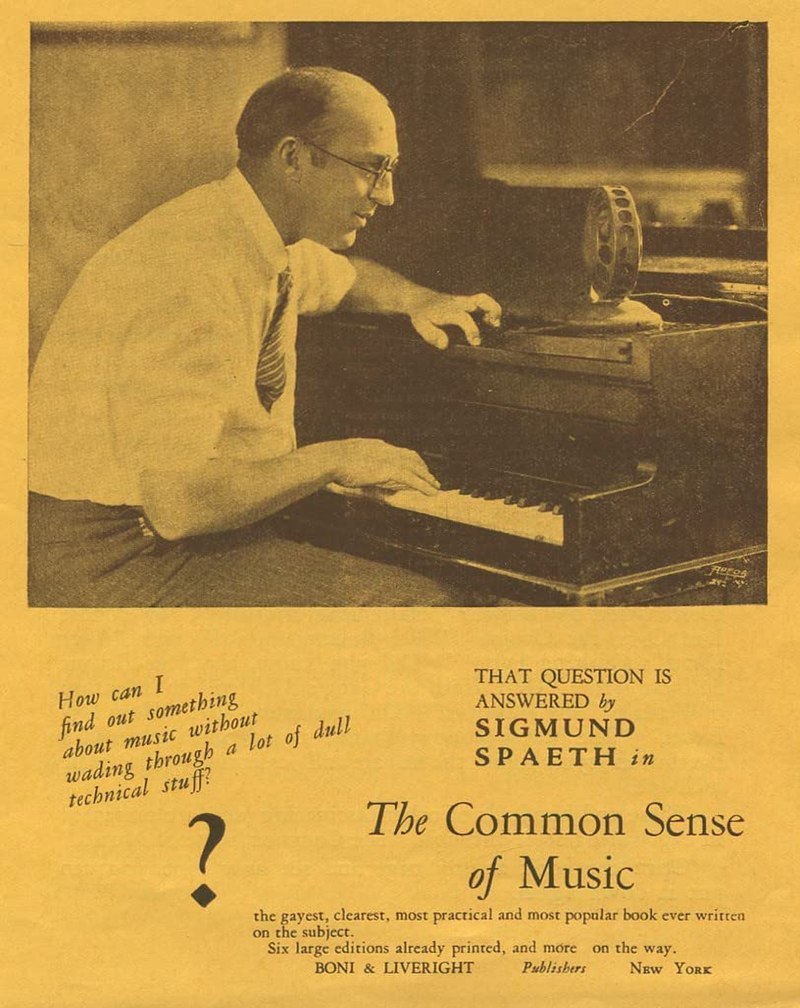
BRINGING MUSIC AND LIGHT…Sigmund Spaeth found much to dislike in the world of popular music, but he was never stuffy in his approach to music appreciation. At right, Spaeth appeared in vaudeville-style shows (and for many years on the radio) as “The Tune Detective,” wearing a deerstalker cap, cape, and checked tweeds in imitation of Sherlock Holmes. He hoped to demonstrate to a wide audience that all music was essentially based on a set of simple principles. (sinfonia.org/wnyc.org)HAVE NO FEAR…Spaeth wrote a popular syndicated newspaper column, “Music for Everybody,” and contributed articles to many periodicals during his career. With his first book in 1925, The Common Sense of Music, and others that followed, Spaeth sought to de-mystify music for a general audience. (Wikimedia Commons)OH LIGHTEN UP…Spaeth detected a cynical note in Bing Crosby’s (left) sob song, “I Cried for You,” and noted Irving Berlin’s latest contribution to the “sob symposium,” “I Never Had a Chance.” (Wikipedia/digitalcommons.library.umaine.edu/britannica.com)
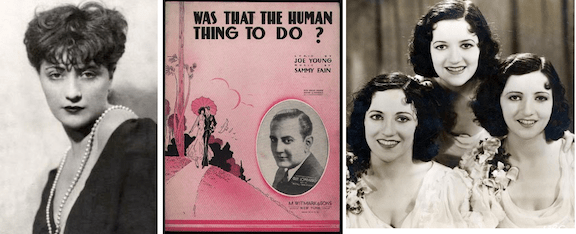
Spaeth noted that not all sad songs were dripping in artificial self-pity, citing Helen Morgan’s “Why Was I Born?” as an example of a song modeled on “the legitimate blues,” marked by “a sincerity of expression in everyday language”…
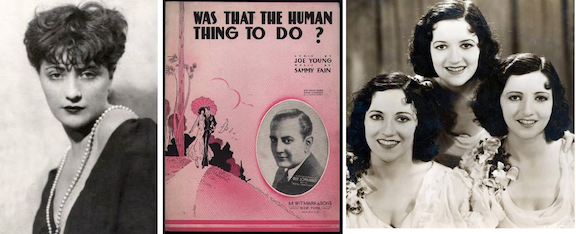
RIGHT AND WRONG…Spaeth acknowledged the “sincerity of expression” in Helen Morgan’s (left) torch songs, while at the other extreme he suggested that the authors of “Was That the Human Thing to Do?” (Sammy Fain and Joe Young) be boiled alive in their own tears. The song was popularized by The Boswell Sisters, a beloved New Orleans trio in the early 1930s. (findagrave.com/amazon.com/genius.com)
* * *
Off to the Races
In his column, “Of All Things,” Howard Brubaker commented on the apparent competition and contrast between Alexander Woollcott’s book, While Rome Burns, and another with a rosier title, The Coming of the American Boom. It appears Woollcott’s book won out, at least in the long run, as I can find no trace of the Boom book, or its author.*
* One of our kind readers has identified the author: “The Coming American Boom” was written by Lawrence Lee Bazley Angas and published by Simon and Schuster in 1934. In 1939, Time noted that “Major Lawrence Lee Bazley (‘Boom’) Angas is a pink & white Britisher with a reputation for making daring predictions which have sometimes come true…. He won his nickname with a much-publicized booklet, The Coming American Boom, which heralded his arrival in the U.S. in 1934.”
Speaking of rosy outlooks, E.B. White offered some parting thoughts on Chicago’s World’s Fair, called “A Century of Progress.” Rather than focus on the grandiose exhibits, White wryly noted other signs of progress at the fair, as recounted from a letter he received from his nephew.
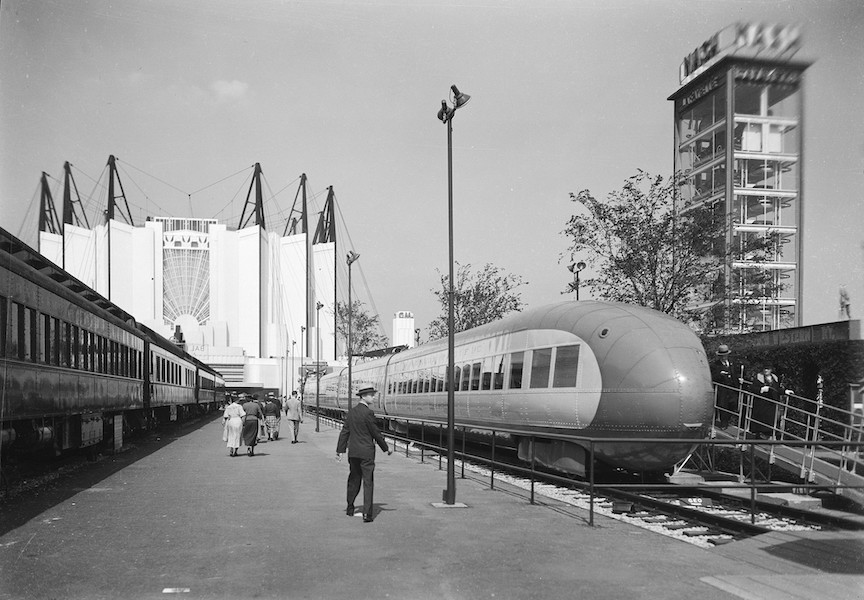
The Chicago World’s Fair featured all sorts of modern wonders “dedicated to the ideal of scientific advance”…
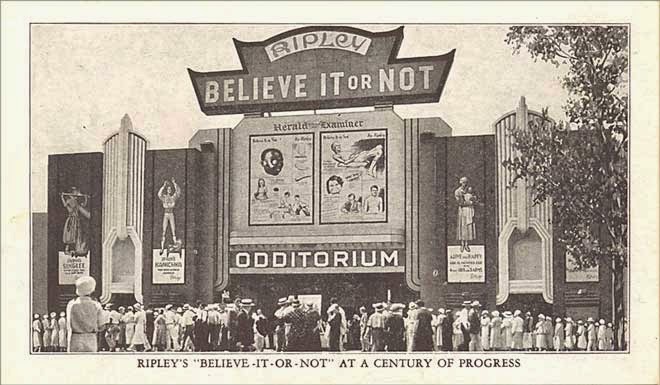
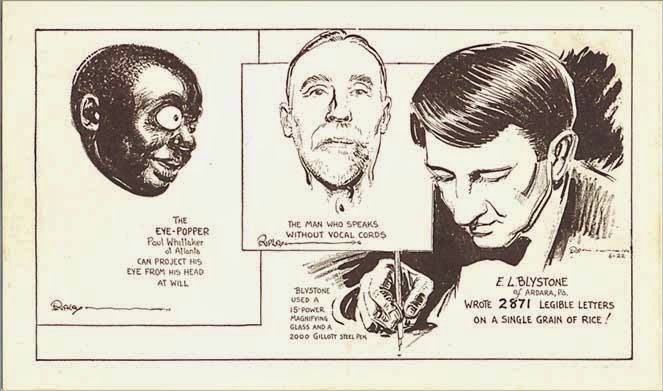
…but as with any World’s Fair, it also catered to the baser interests of the masses, with attractions such as Robert Ripley’sBelieve It Or Not “Odditorium,” which was essentially a P.T. Barnum-style freak show…
…Ripley’s syndicated newspaper feature included these Odditorium attractions…
…White made light of exhibitions displaying such signs of progress as how to brush your teeth, and more examples of human freakdom…
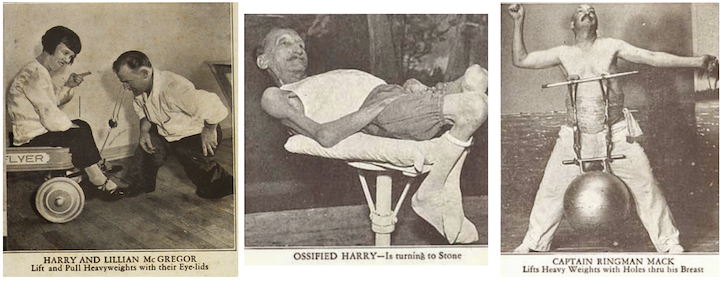
…White’s nephew wrote of a man who could pull a wagon (containing his wife) with his eyelids, an apparently arthritic fellow who was “turning to stone,” and a man who could support heavy weights with his pierced breasts…
(all images courtesy postcardy.blogspot.com)
* * *
Letter From Paris
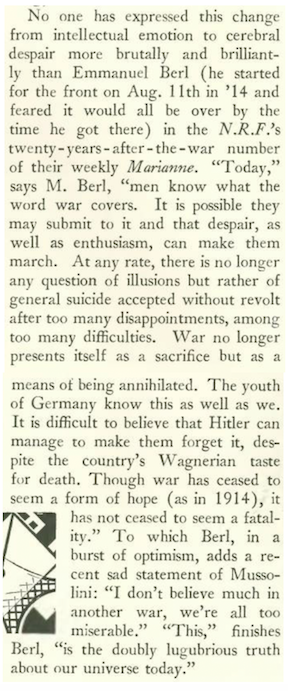
Paris correspondent Janet Flanner wrote that August 1934 was a “month of memories” as it marked the twentieth anniversary of the outbreak of the Great War, which we now call World War I. Flanner wrote about a new attitude that had arisen in those two decades, “a new attitude not only toward the last war but toward the next (which, ironically enough, seems increasingly inevitable to France since the death of the enemy warrior, von Hindenburg).” She continued with these observations made by French journalist and historian Emmanuel Berl (1892–1976), who wrote that as a result of the Great War, the youth in both France and Germany held few heroic illusions about war, seeing it not as a sacrifice but rather “as a means of being annihilated.”
SO MUCH FOR THE HEROICS…A refugee family returning to Amiens, France, looking at the ruins of a house on Sept. 17, 1918. Top right, Janet Flanner in 1940; below, Emmanuel Berl. (iwm.org.uk/Flanner photo copyright Estate of George Platt Lynes/Berl photo courtesy Joël Chirol)
* * *
From Our Advertisers
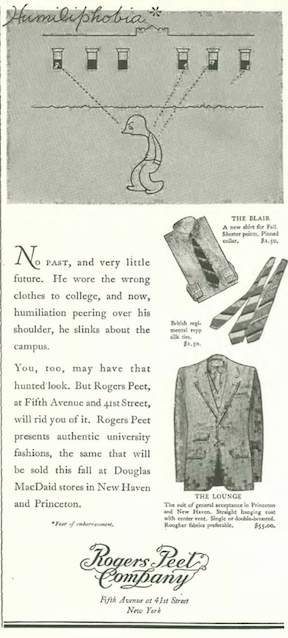
Clothing company Rogers Peet used the threat of humiliation to encourage young men to stock up on “authentic university fashions” before returning to campus…
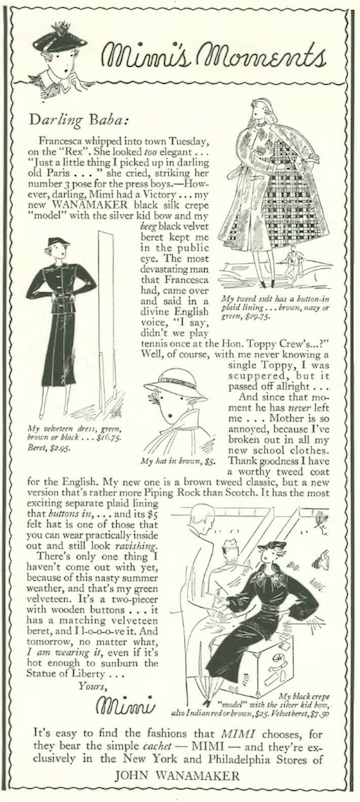
…the Wanamaker department store took a different approach, offering up new styles with a heavy English accent (I say, didn’t we play tennis once at the Hon. Toppy Crew’s?)…
…the makers of Goodyear tires offered up this disturbing image to boost sales…
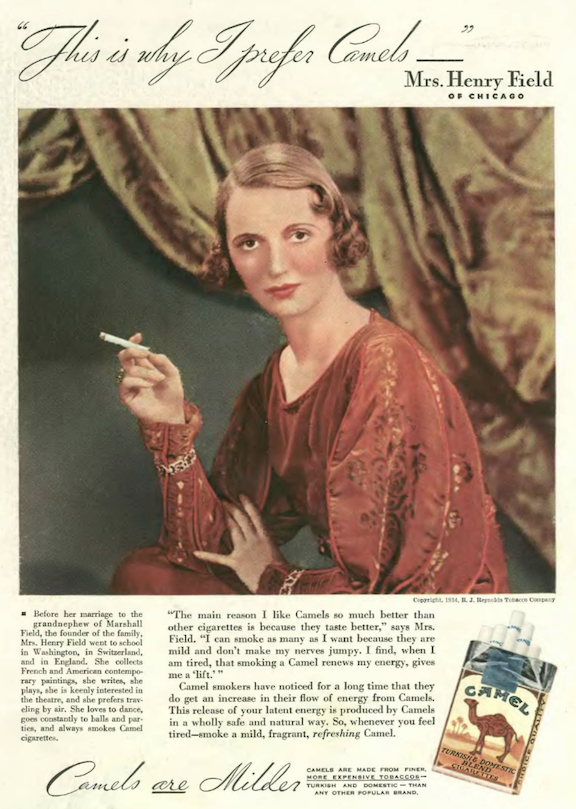
…this ad told us that “Mrs. Henry Field” collected fine art, loved to go to parties, and “always smoked Camel cigarettes”…I am unaware of the fate of Mrs. Henry Field, married to the grandnephew of Marshall Field, but this unseemly image suggests she was replaced by a wax figure before the photo was taken…
…on to our cartoons, we begin with spot illustrations from (clockwise, from top) Victor De Pauw, Abe Birnbaum, and an unidentified illustrator who offered this suggestion for beating the late summer heat…
…we move along to Alan Dunn and a record-seeking pooch…
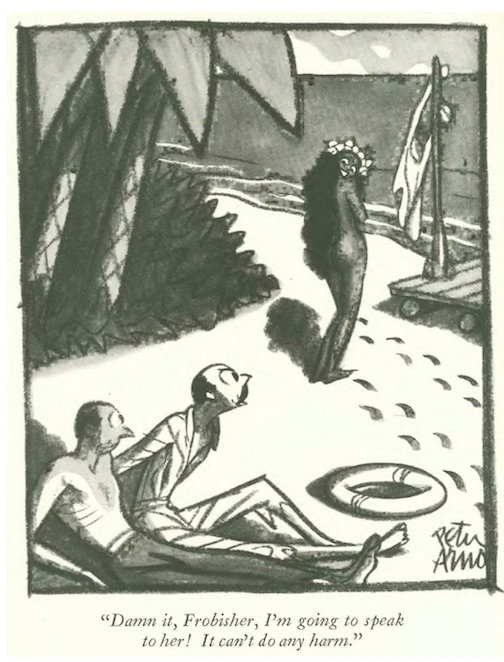
…Peter Arno with a very Arno-esque take on the stranded island trope…
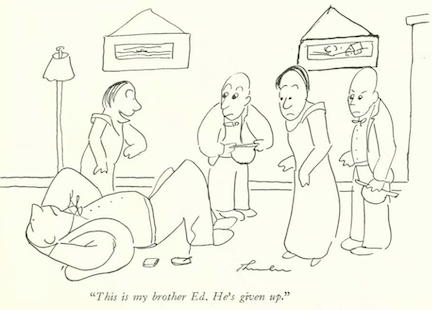
…James Thurber gave us a man who was done making decisions…
…Richard Decker offered up this living history demonstration…
…George Price gave us two tropes for the price of one…
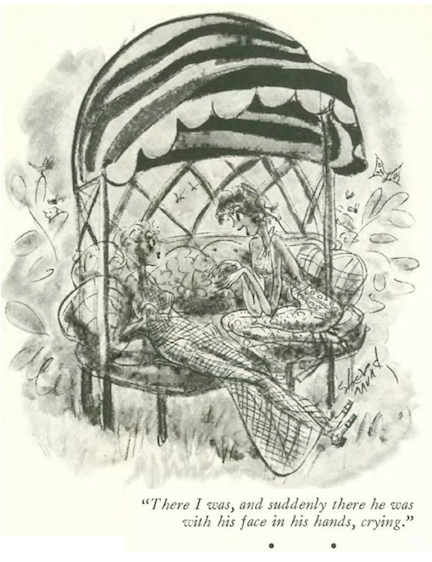
…Barbara Shermund gave us another glimpse into the lives of modern women…
…Rea Irvin continued his exploration of Manhattan’s fauna…
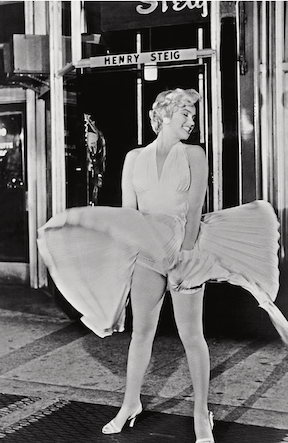
…our next cartoon is by Henry Steig, who used the pseudonym Henry Anton to avoid being confused with his brother, William Steig (featured on this issue’s cover)…unlike his brother, Henry was also a jazz musician, a sculptor and painter, a photographer, and a novelist…that is before he became a noted jeweler…
…Henry Steig’s jewelry shop at 590 Lexington Avenue can be glimpsed in the background of the famous subway vent scene from 1955’s The Seven Year Itch featuring Marilyn Monroe…
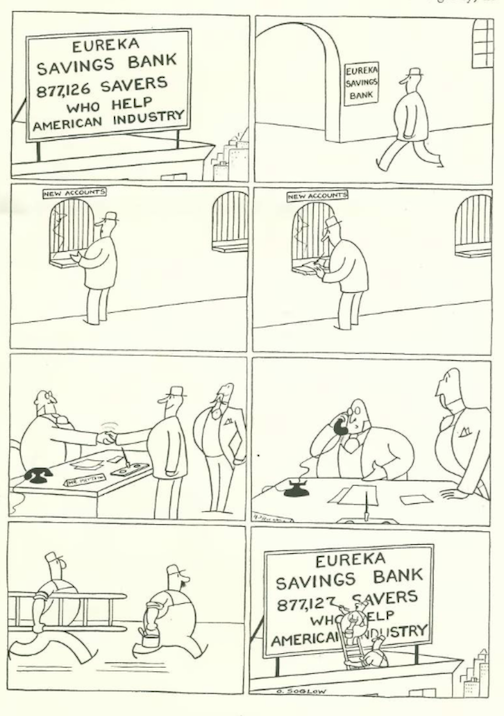
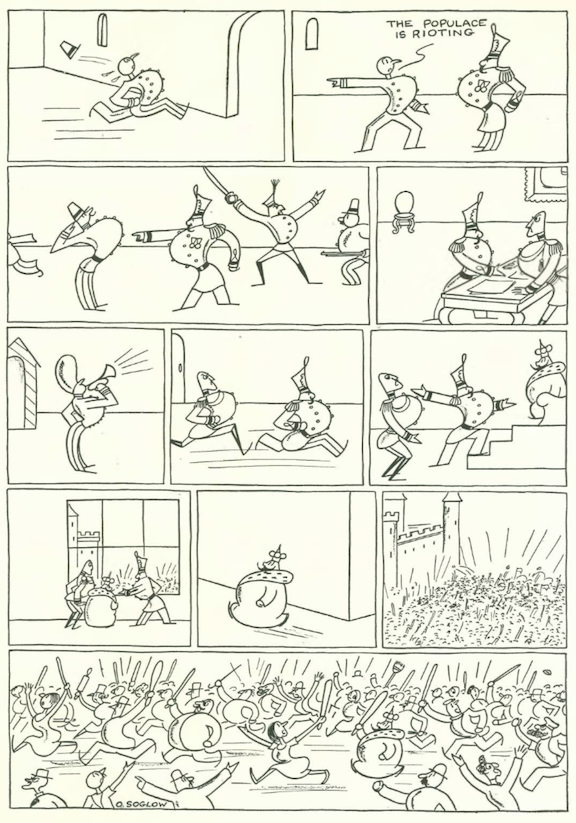
…and we close with Otto Soglow, and the last appearance his “Little King” in The New Yorker...William Randolph Hearst had lured Soglow away for his King Features Syndicate, debuting The Little King in his newspapers on September 9, 1934, where it would run until Soglow’s death in 1975…Soglow, however, would continue contributing cartoons of other themes to The New Yorker until 1974…

























































































































 A New Yorker State of Mind