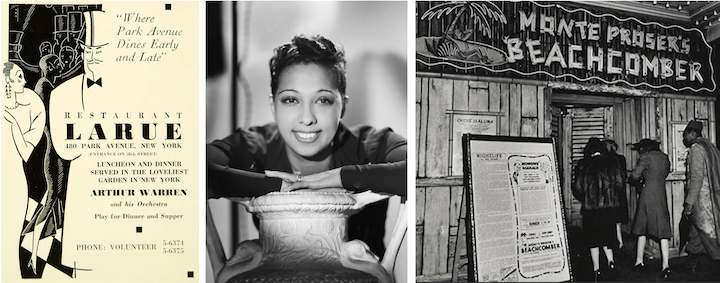
Above: Nightlife correspondent Lois Long checked out the latest clubs as well as old-time favorites in her column "Tables for Two." From left, advertisement for Restaurant Larue; Josephine Baker in 1937; and the entrance to Monte Proser's Beachcomber, an early iteration of the tiki bar that would become ubiquitous in midcentury America. (eBay.com/Wikipedia/mytiki.life)
Part three of Janet Flanner’s profile of Adolf Hitler can be found below, but it’s time to lead with something more pleasant, namely Manhattan nightlife through the eyes of Lois Long.
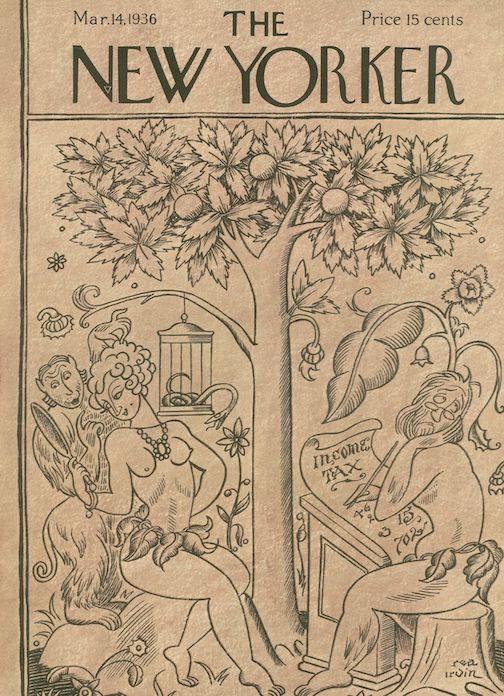
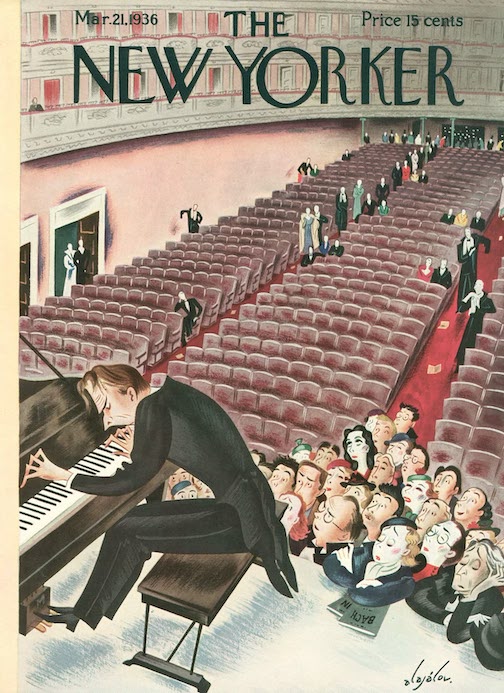
March 14, 1936 cover by Rea Irvin.
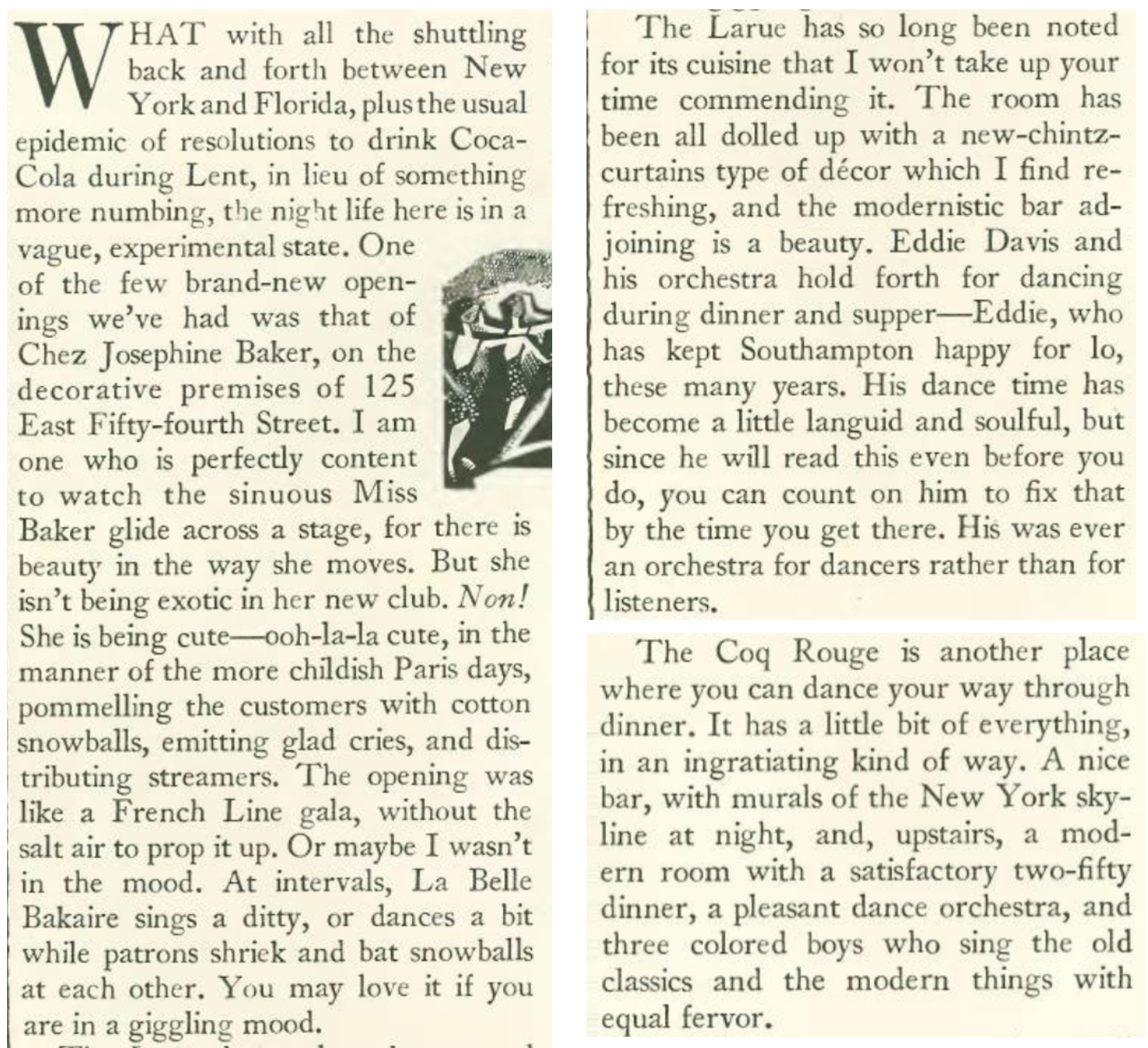
In her “Tables for Two” column headlined “Nostalgic Notes,” Long checked out the new Chez Josephine Baker, the garden-like delights of Restauarnt Larue, and the French-themed Le Coq Rouge.
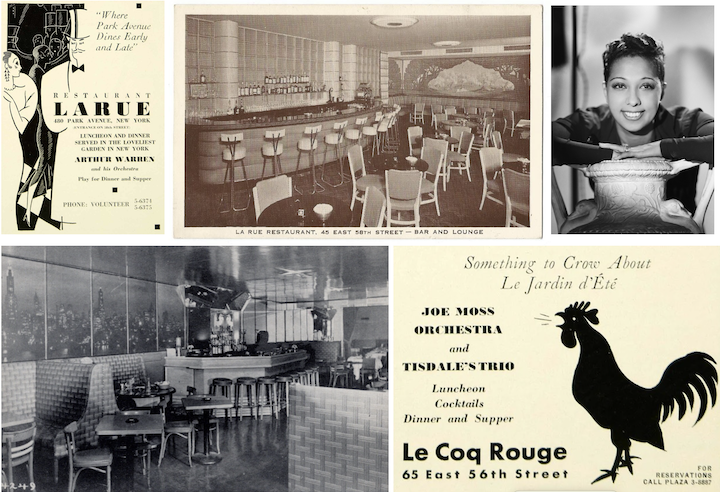
NEW NIGHTLIFE…Clockwise from top left, ad for Restaurant Larue; 1930s postcard showing interior of Larue; Josephine Baker, proprietor of Chez Josephine Baker; ad for Le Coq Rouge; interior of Le Coq Rouge, 1930s. (eBay/Wikipedia)
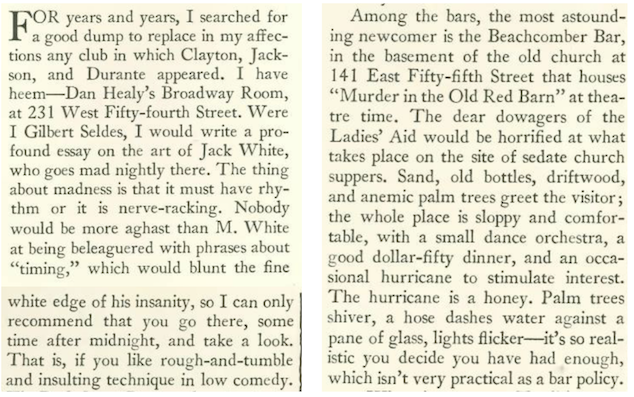
Long also noted the Beachcomber Bar, which originated in the basement of an old church, and actor Dan Healy’sBroadway Room.
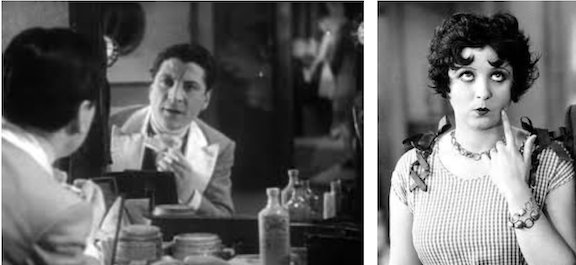
MAN ABOUT TOWN…Dan Healy was a well-known master of ceremonies in the Manhattan nightlife scene. He married the famed “boop-boop-a-doop” singer (and possible Betty Boop inspiration) Helen Kane in 1939—they later opened a New York restaurant together called Healy’s Grill. (whosdatedwho.com/Facebook)
* * *
Bummed Out
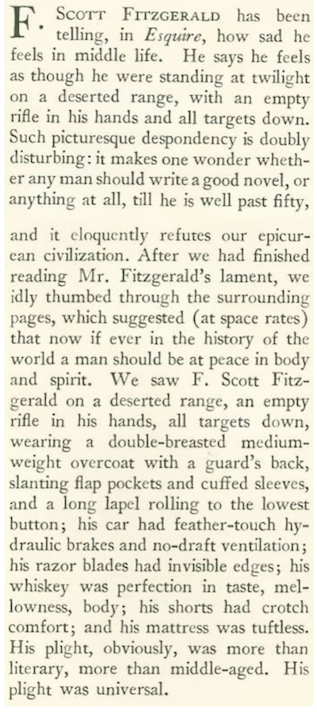
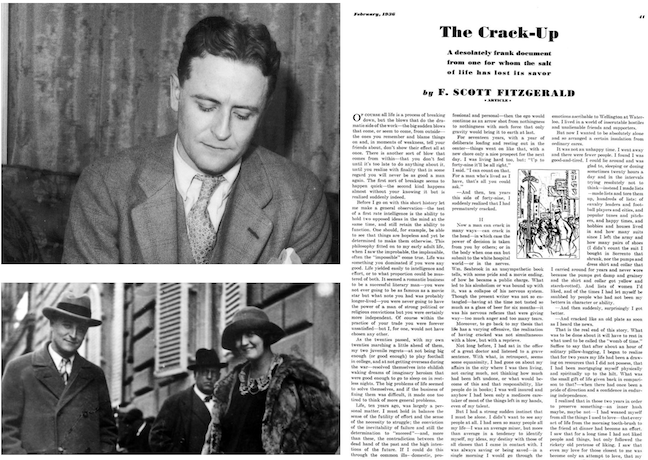
E.B. White (in “Notes and Comment”) referred to confessional essays published in Esquire magazine by F. Scott Fitzgerald that frankly described his struggles with alcoholism and the decline of his literary reputation. The confessional tone of the essays (three in all, published in February, March and April 1936) proved controversial at the time.
In his first essay, “The Crack-Up,” Fitzgerald famously observed that “the test of a first-rate intelligence is the ability to hold two opposed ideas in the mind at the same time, and still retain the ability to function.”
A CRY FOR HELP?…At left, F. Scott Fitzgerald in the 1930s (top), and, apparently during happier days (below, with wife Zelda); at right, the opening page of “The Crack-Up.” (esquire.com/pbs.org)
* * *
Say What?
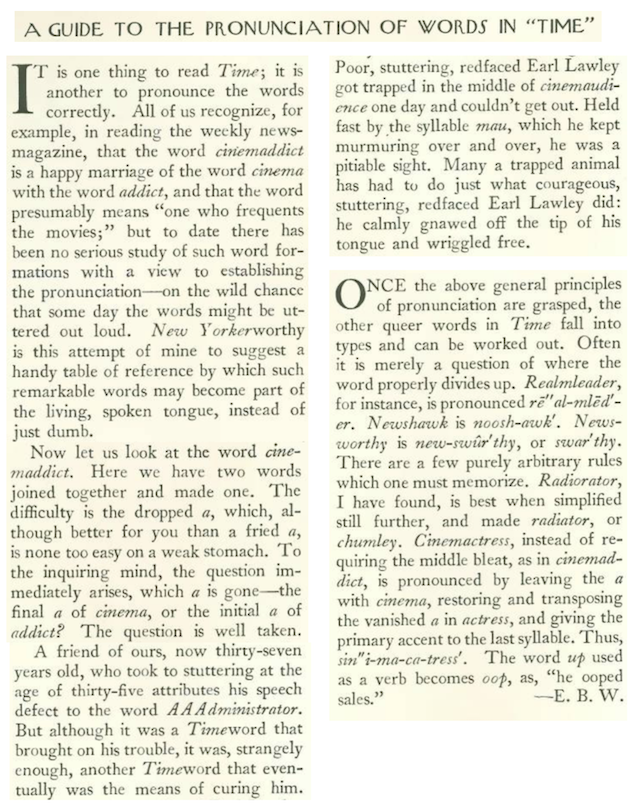
New Yorker writers rarely missed an opportunity to poke fun of Time magazine’s unique ways with the English language. E.B. White again, in an excerpt:
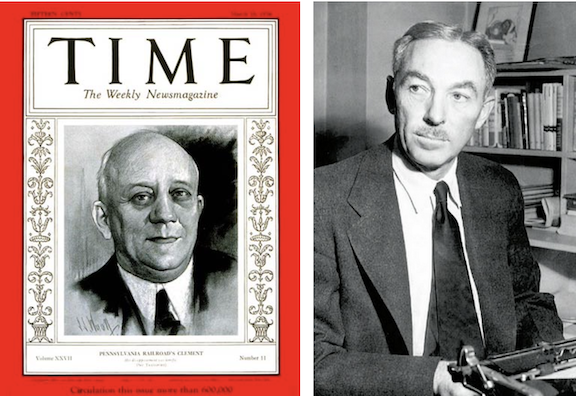
TIMEWORDS…The March 16, 1936 issue of Time, and E.B. White. (time.com/imdb.com)
* * *
Dying to Know
“The Talk of the Town” made brief mention of a rumor regarding Woolworth heiress Barbara Hutton’s health. Reports of her demise were premature; she died in 1979.
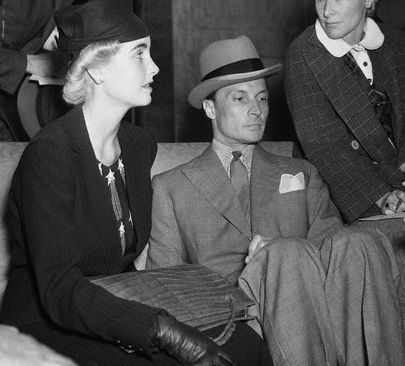
HANGING IN THERE…Barbara Hutton with husband no. 2, Count Kurt von Haugwitz-Reventlow, circa 1936. Hutton married seven times, including a brief marriage to actor Cary Grant, who was husband no. 3. (whosdatedwho.com)
* * *
Part Three
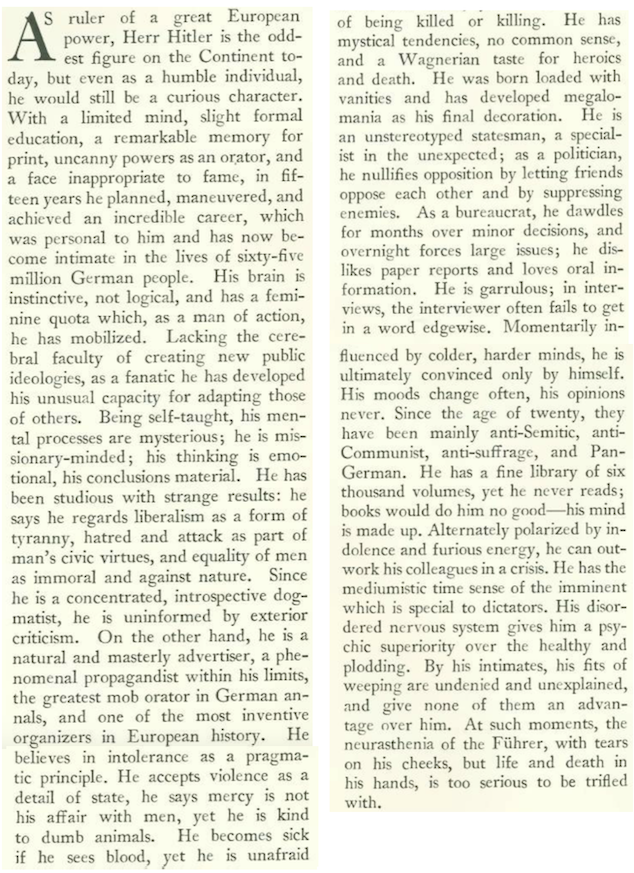
Janet Flanner completed her three-part profile of Adolf Hitler by looking into the man’s mind, if that was even possible.
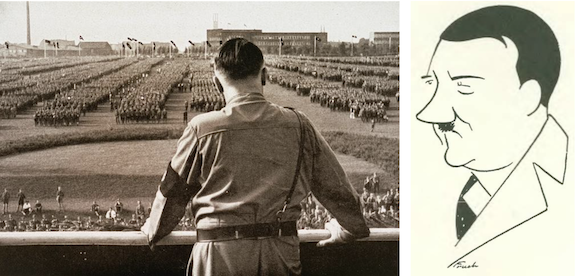
OBEDIENT MASSES…Nazi dictator Adolf Hitler addresses soldiers at a rally in Dortmund, Germany, 1933. (encyclopedia.ushmm.org)
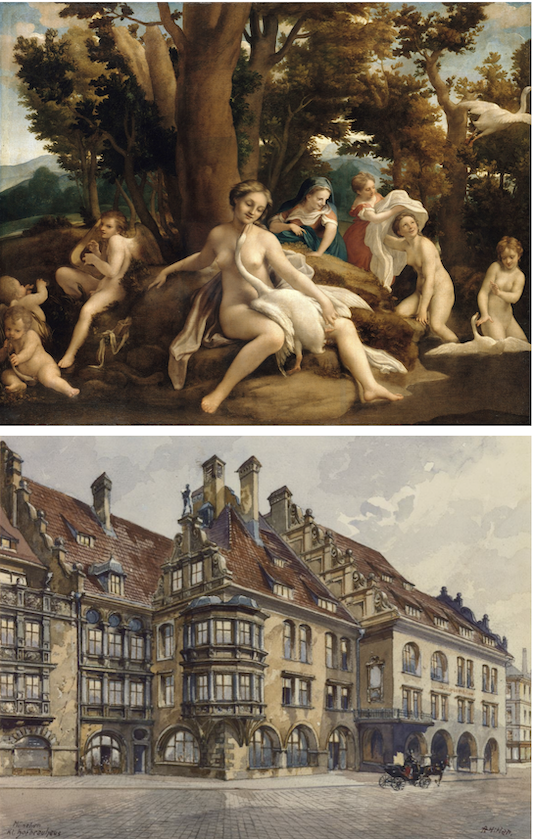
Flanner also noted the Führer’s early days as an unsuccessful painter, and an odd wedding gift to his buddy Hermann Göring:
GOOSED…Top, Adolf Hitler presented a specially painted copy of Correggio’s Leda with the Swan as a wedding gift to Hermann Göring and actress Emmy Sonnemann on April 10, 1935; below, Hitler painted this watercolor during his pre-WWI time in Munich, from May 1913 to August 1914. (Wikipedia)
* * *
China Syndrome
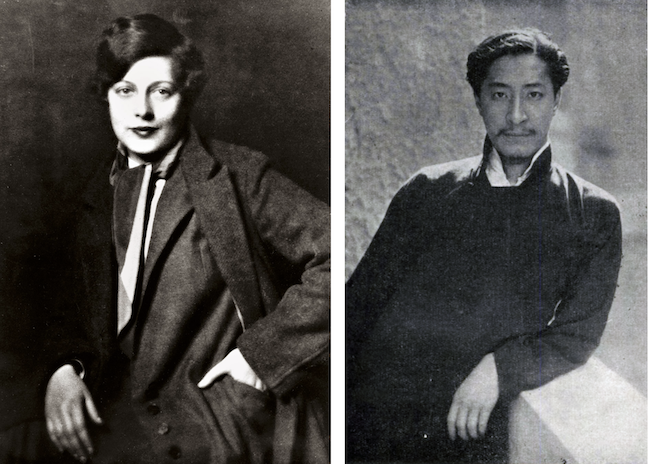
Supporting herself as a writer for The New Yorker, Emily Hahn’s years in Shanghai, China (1935 to 1941) were tumultuous. Living in the city’s red light district, she became romantically involved with the Chinese poet and publisher Shao Xunmei (aka Sinmay Zau) and became addicted to opium. In this excerpted short essay, Hahn described her literary encounters with Shao Xunmei (here referred to as “Pan Heh-ven”) and a passel of translators.
ENOUGH OF THAT…Emily Hahn became romantically involved with the Chinese poet and publisher Shao Xunmei (aka Sinmay Zau), but ultimately left him in order to break her opium addiction. (Wikipedia)
* * *
At the Movies
Critic John Mosher did his best to stay awake during the latest fare from Hollywood…
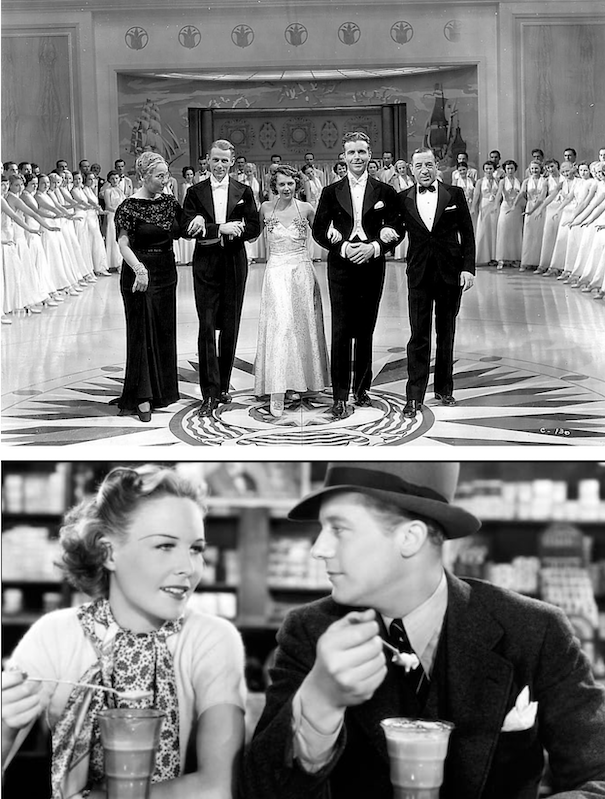
SPECIOUS SPECTACLE…Top, from left, Louise Fazenda, Paul Draper, Ruby Keeler, Dick Powell and Hugh Herbert in Colleen; below, Wendy Barrie and Gene Raymond in Love on a Bet. (cometoverhollywood.com/imdb.com)
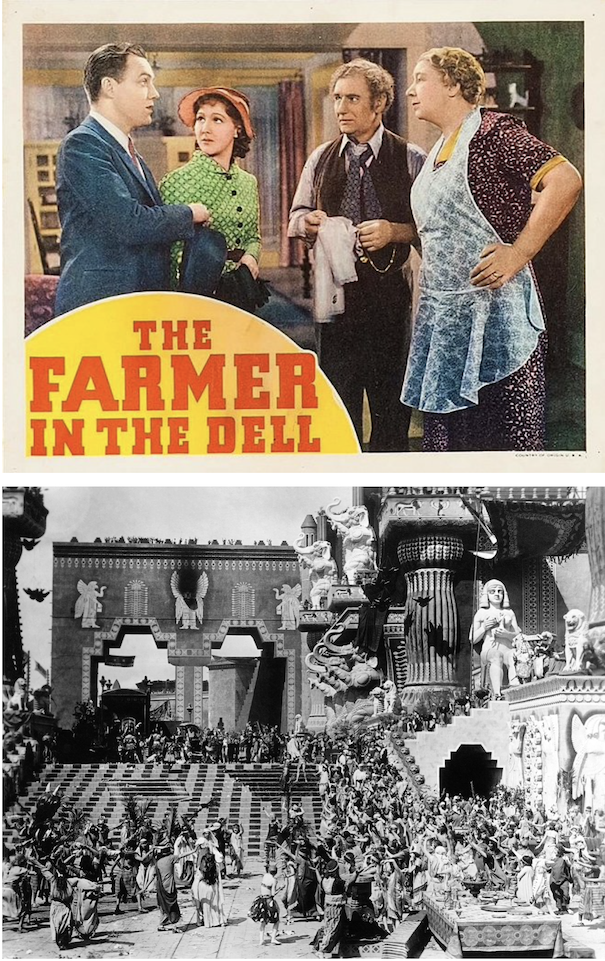
Mosher also commented on a film he walked out on (The Farmer in the Dell), and considered the twentieth anniversary of Intolerance, a 1916 drama that had become a “cheap amusement.”
HO HUM…Critic John Mosher walked out of The Farmer in the Dell, mostly due to boredom—above, Frank Albertson, Jean Parker, Fred Stone and Esther Dale in the romcom The Farmer in the Dell; below, scene from D.W. Griffith’s epic silent film from 1916, Intolerance. (imdb.com/cinemafromthespectrum.com)
* * *
From Our Advertisers
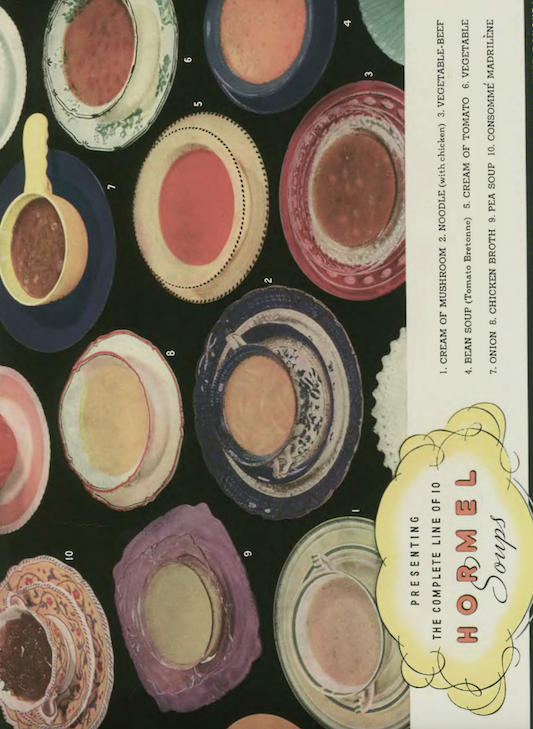
The folks at Hormel once again claimed the inside front cover with this array of soups featured sideways, in full color…
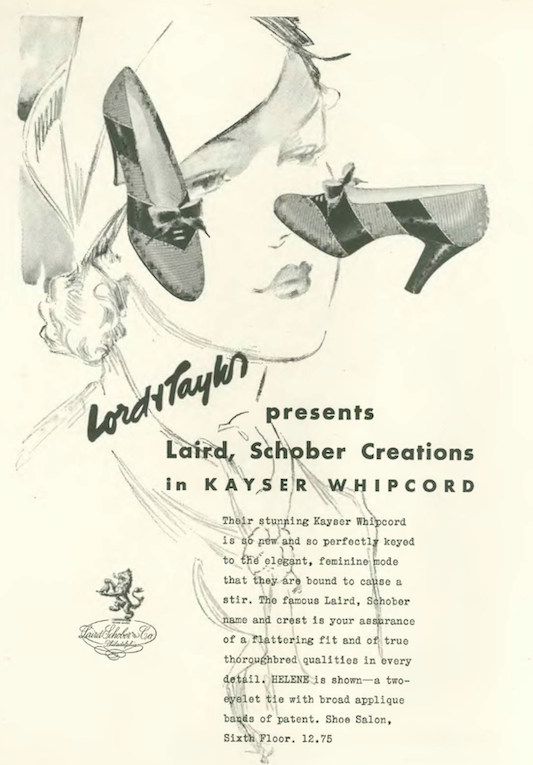
…the illustrator of this Lord & Taylor advertisement hoped to superimpose a pair of shoes over a woman’s face, with less than convincing results…
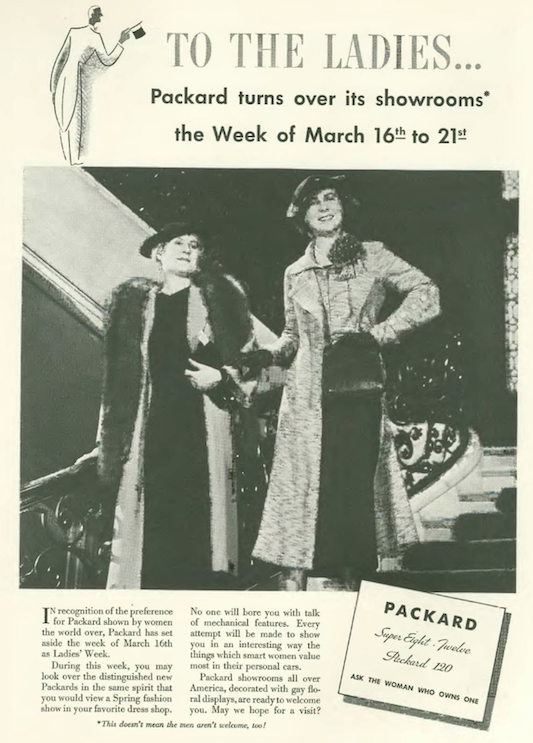
…the makers of Packard automobiles sent a condescending message “To The Ladies,” promising not to “bore them” with talk of mechanical features…
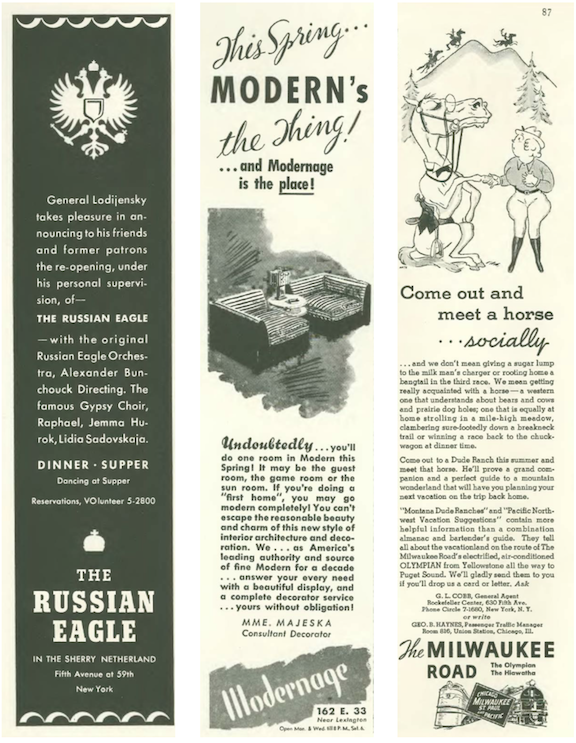
…a sampling of one-column ads featured, from left, the renowned Russian Eagle cafe-bar at the Sherry-Netherland, the Modernage furniture store on East 33rd, and the Milwaukee Road railroad, which offered adventure at such places as a Montana dude ranch…
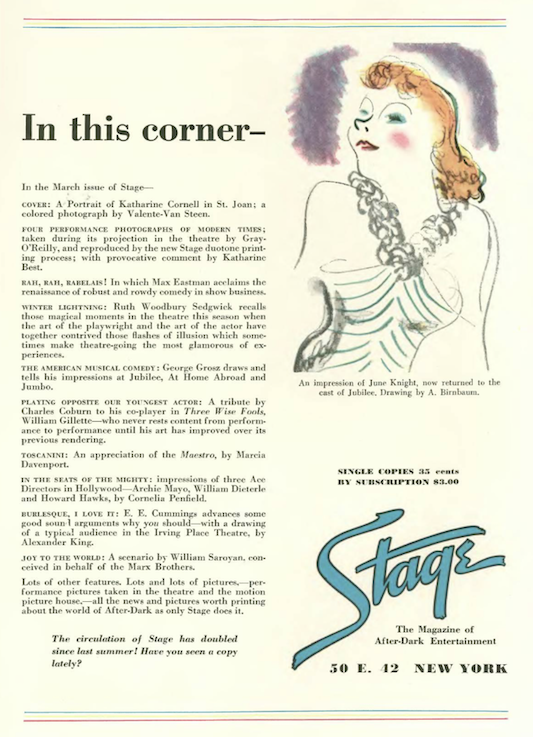
…the inside back cover featured this drawing of actress/dancer/singer June Knight by Abe Birnbaum…
…Birnbaum was a terrific artist, but his portrait of Knight was not terribly flattering…this is what she looked like in the 1930s…
June Knight (1913–1987) circa 1930s. (reddit.com)
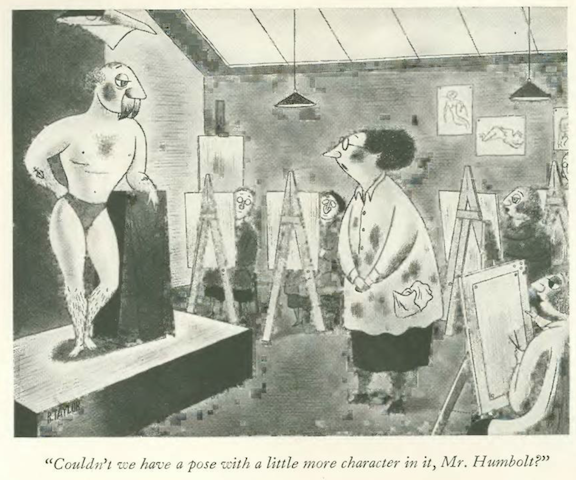
…on to the cartoons, we kick off the issue with Canadian cartoonist Richard Taylor…
…and Taylor again, striking a pose…
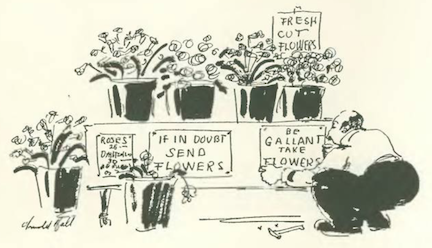
…Arnold Hall contributed an example of floral marketing…
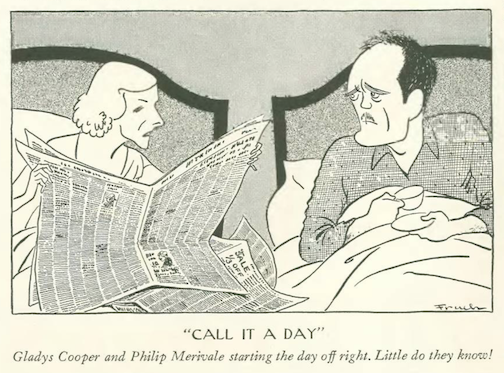
…Al Frueh contributed to “The Theatre” section…
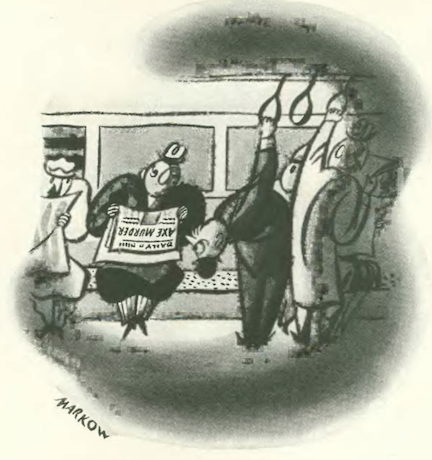
…Jack Markow did some rubbernecking…
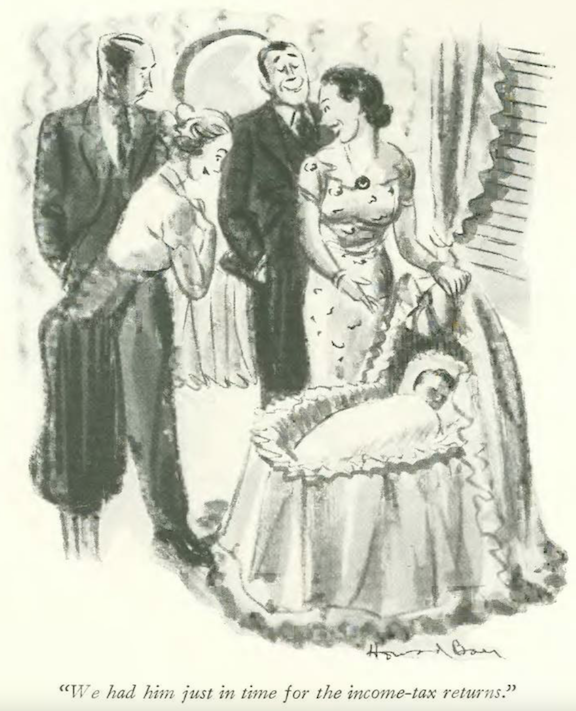
…Howard Baer welcomed a new tax deduction to the world…
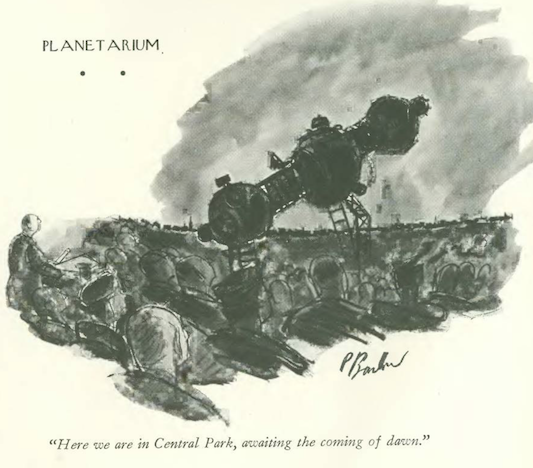
…Perry Barlow drew up impressions of a field trip to the Hayden Planetarium…
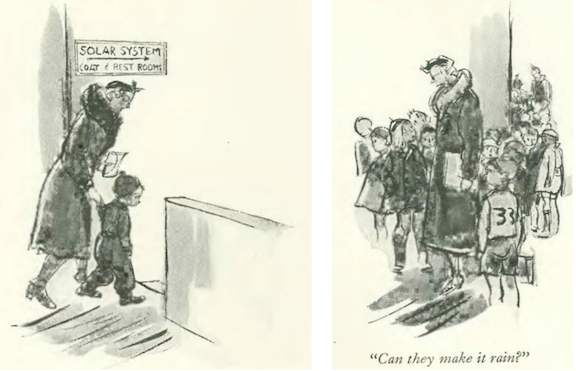
…Barlow again…
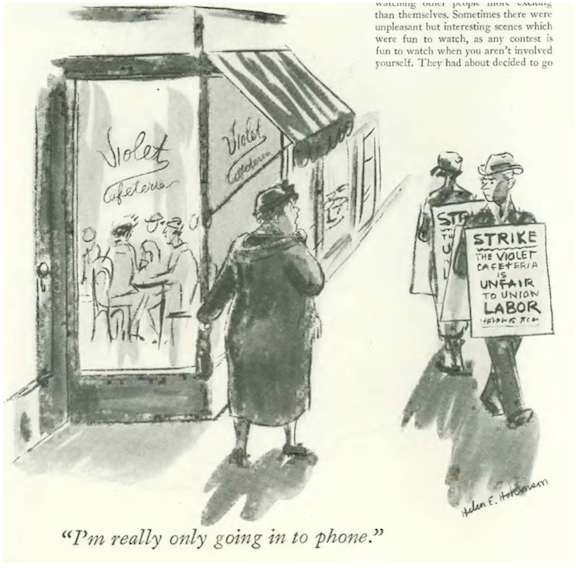
…one of Helen Hokinson’s “girls” explained herself…
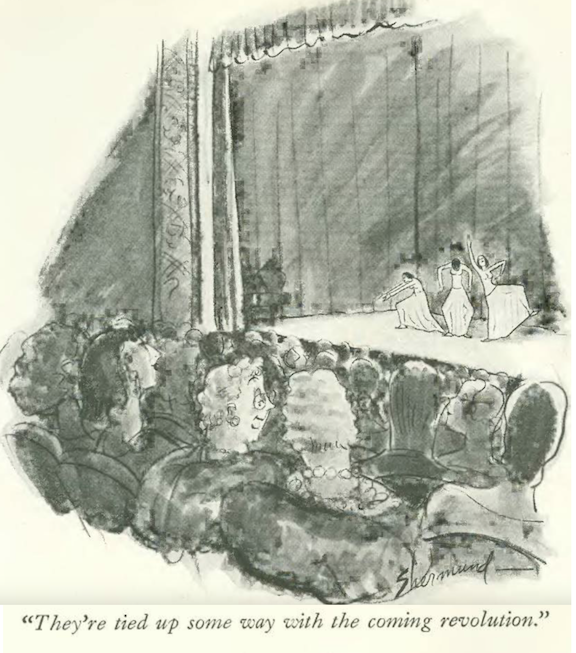
…Barbara Shermund interpreted modern dance…
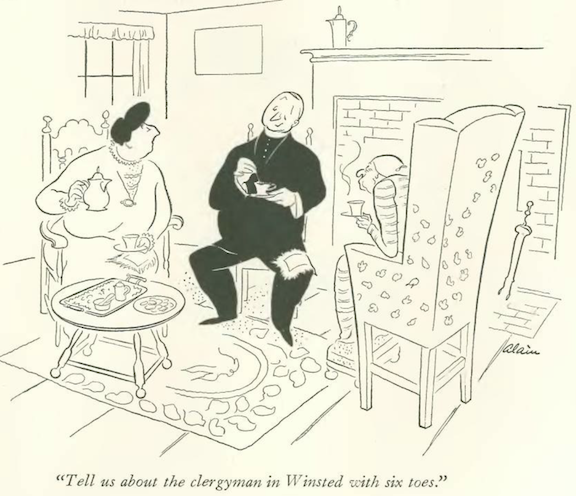
…Alain sought some dish over tea with the vicar…
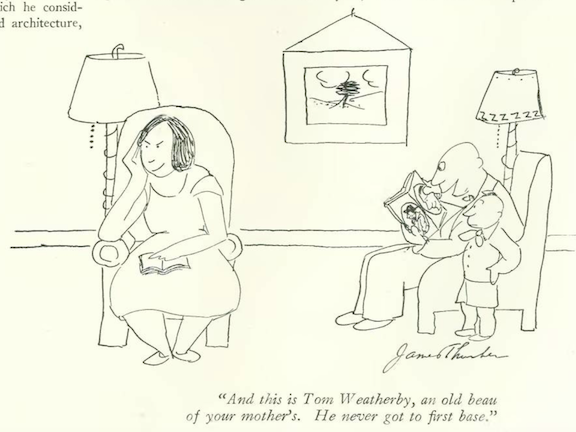
…and we close with James Thurber, and a penny for her thoughts…
Above: New Year’s Eve at the “El Morocco” Night Club at 154 E. 54th Street, New York, 1935. (Posted on Reddit)
Lois Long took her nightlife seriously, and when it didn’t live up to her standards—defined by the wild speakeasy nights she wrote about after joining The New Yorker in 1925 —she was crestfallen, to say the least.
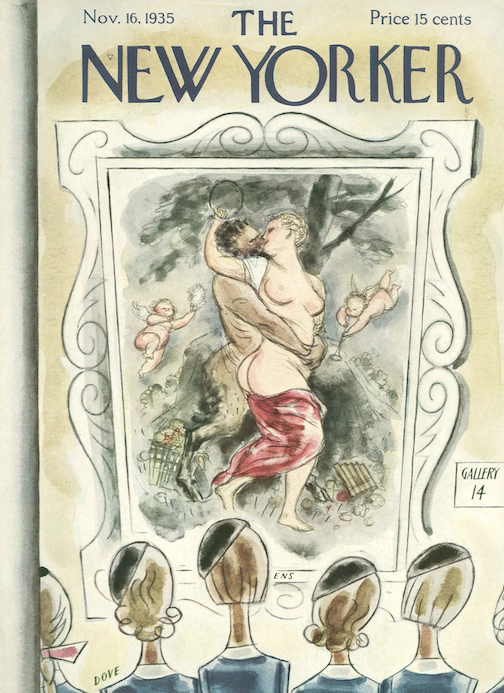
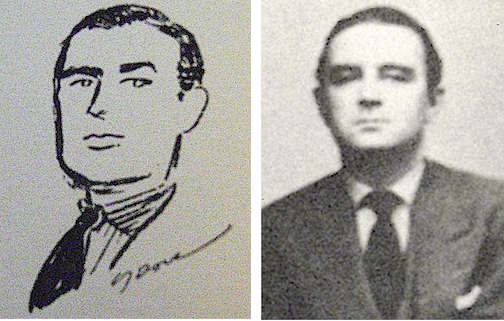
November 16, 1935 cover by Leonard Dove. This is one of Dove’s fifty-seven New Yorker covers; he also contributed 717 cartoons to the magazine.Above: Leonard Dove’s self portrait, 1941; photo: 1947. Born 1906, Great Yarmouth, England. Died, Gramercy Hotel, New York City, 1972. (Thanks to Michael Maslin’s indispensable Ink Spill)
*
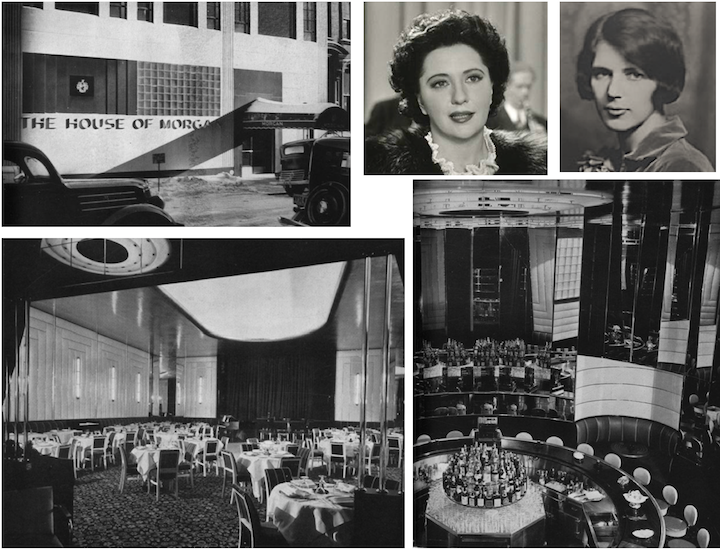
When Long joined The New Yorker she was a 23-year-old Vassar graduate, and at age 34 she was not expecting to re-live those heady days; but nightlife in 1935 made her wonder where all the interesting people had gone. Instead of the smart and beautiful speakeasy set, she found people who couldn’t hold a conversation, who cared more about being mentioned in the newspapers by “Cholly Knickerbocker” (a pseudonym used by society columnists)—they simply lacked the “sparkle” she so craved. In this excerpt from her column, “Tables for Two,” she explained:
ALL SHOW, NO GO…Lois Long recalled the heady days of the original torch singer Helen Morgan, but her new club, The House of Morgan, offered up tired vaudeville instead of the singer herself. Above, images of the club from Christopher Connelly’sThe Helen Morgan Page. Top, center, detail of Morgan from the 1935 film Sweet Music. Next to Morgan is a photo of Long from the PBS documentary Prohibition. (helen-morgan.net/PBS.org)
* * *
At the Movies
Our film critic John Mosher was in good spirits after taking in MGM’s Mutiny on the Bounty, and especially the inspired performance by Charles Laughton as the cruel, tyrannical Captain Bligh…
LET’S HAVE A STARING CONTEST…Clark Gable (left) portrayed Fletcher Christian, the Bounty’s executive officer, who disapproved of the cruel leadership of Captain Bligh, portrayed by Charles Laughton (right) in Mutiny on the Bounty. (theoscarbuzz.com)
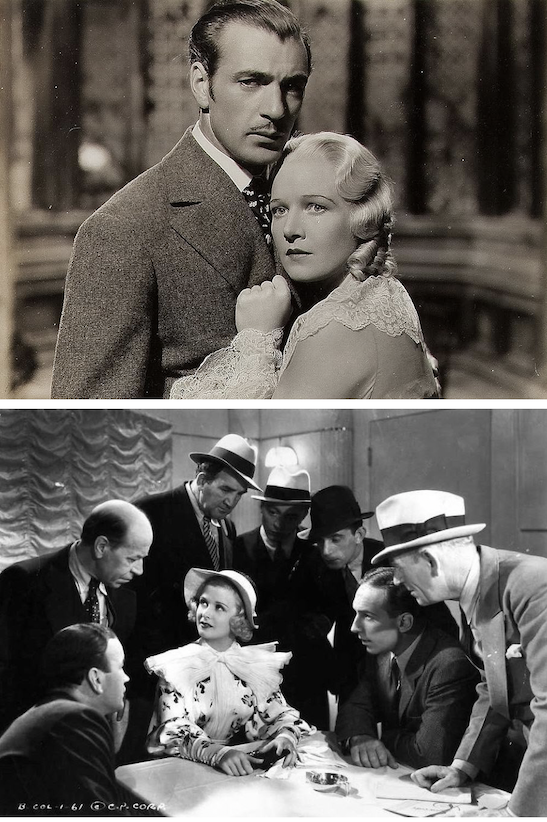
…two other pictures reviewed by Mosher were less than inspired, but at least the George Raft/Joan Bennett gangster film, She Couldn’t Take It, offered a car chase, and the occasional surprise.
STERILITY ISSUES…Top, Gary Cooper and Ann Harding needed a bit more life in Peter Ibbetson; at least Joan Bennett (bottom photo) found some action in She Couldn’t Take It. (IMDB)
* * *
From Our Advertisers
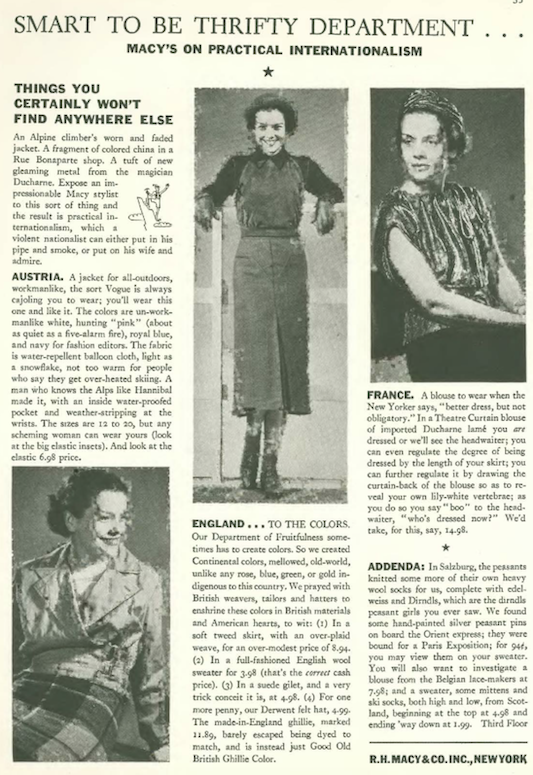
Not all fashion advertisements in The New Yorker were aimed at the posh set…Macy’s offered some thrifty selections, including a French-inspired “Theatre Curtain Blouse” that could be opened in the back “so as to reveal your own lily-white vertebrae”…
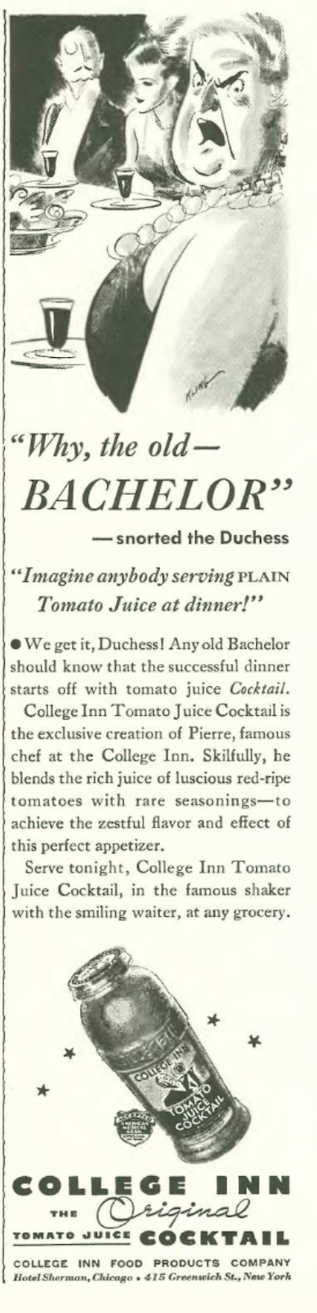
…I am puzzled by the “Duchess” types that appeared in food and beverage ads in the back of the magazine…we’ve seen some angry duchesses in ads for tomato and pineapple juice, and here we have one who has stooped so low as to shell her own peas…
…a side note, the Duchess’s peas came in a can bearing the old Green Giant logo, a savage, bearskin-clad figure…he was redesigned by ad executive Leo Burnett in 1935 to become the friendlier “Jolly Green Giant”…
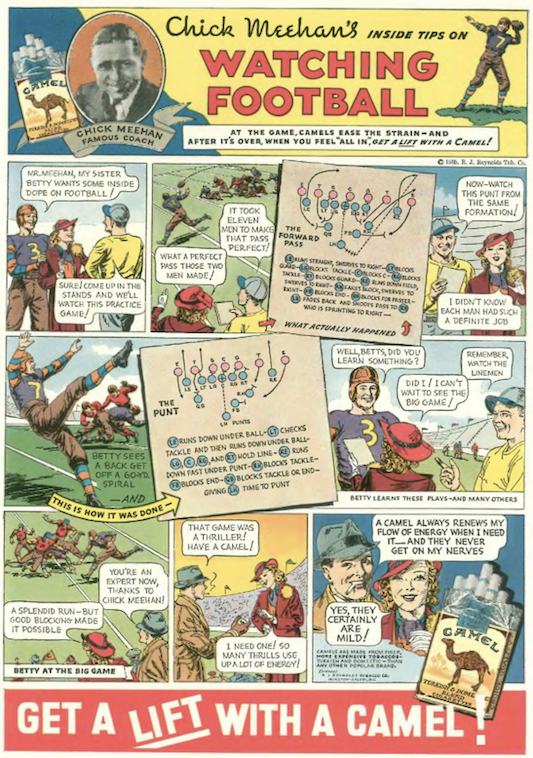
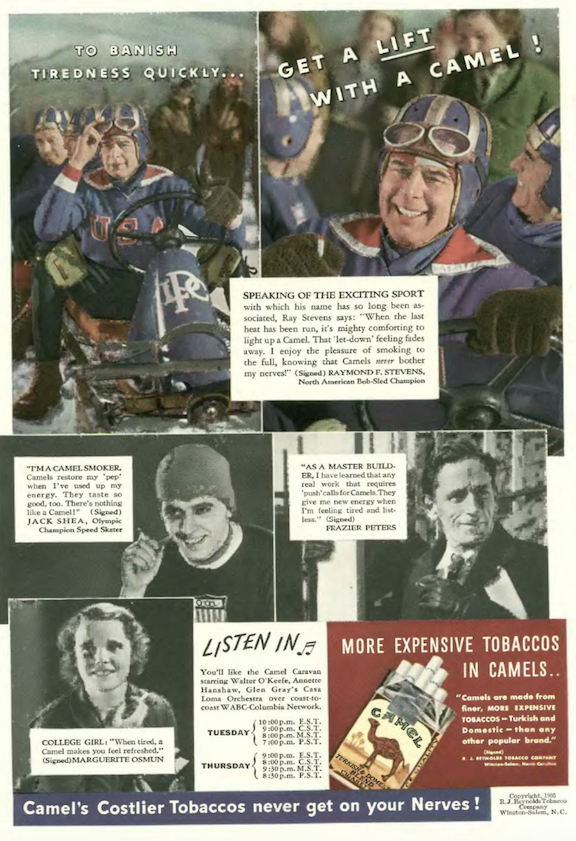
…the makers of Camels presented football coach Chick Meehan in cartoon form to extol the wonders of football and smoking to a young woman…Meehan coached football at Syracuse, NYU and Manhattan College…
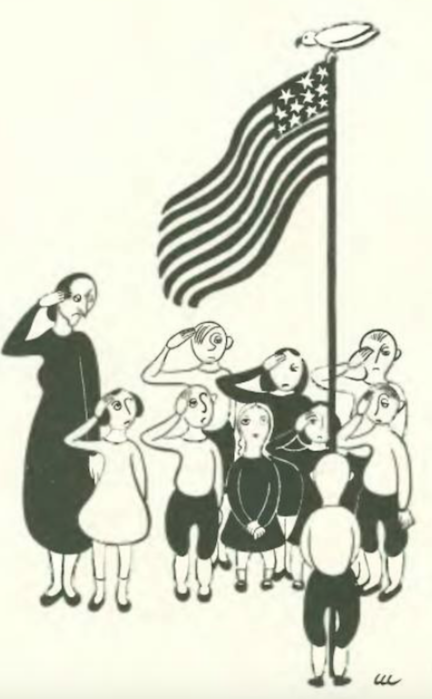
…the football theme segues to our cartoon section, beginning with this spot art by James Thurber…
…Christina Malman’s spot drawings could now be found in every issue, and usually more than one…
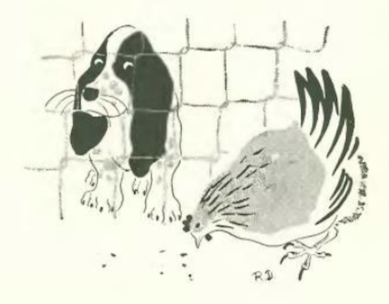
…this one by Robert Day also caught my eye, maybe because I like chickens, and dogs too…
…Day again, on the streets of Manhattan…
…Barbara Shermund showed us a wolf in wolf’s clothing…
…Alan Dunn seemed to be channelling Barbara Shermund here…or maybe Dunn’s wife Mary Petty had some influence…
…William Crawford Galbraith eavesdropped on some wagering waiters…
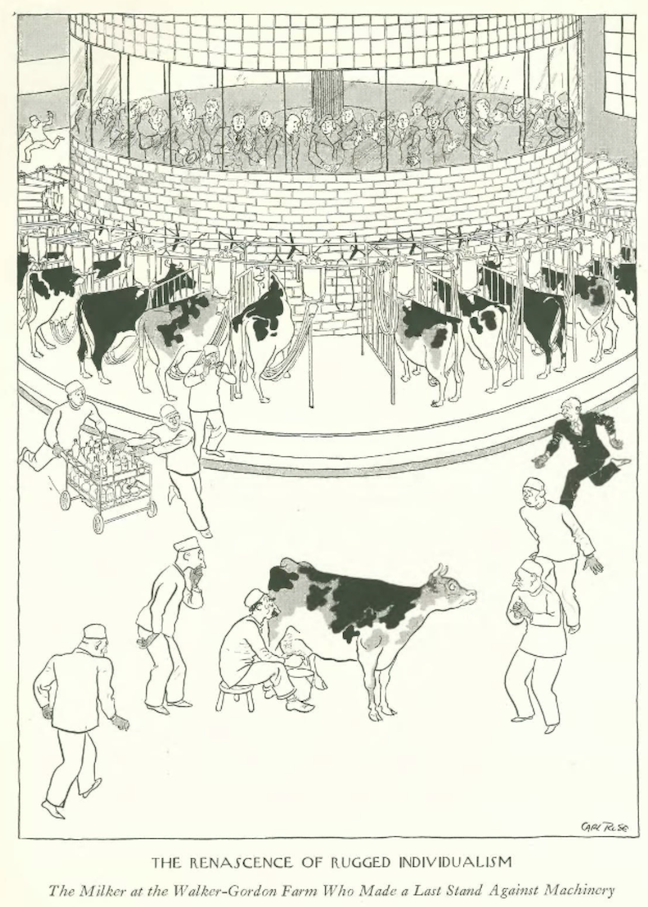
…Carl Rose found an outlier at the modern Walker-Gordon Dairy Farm…
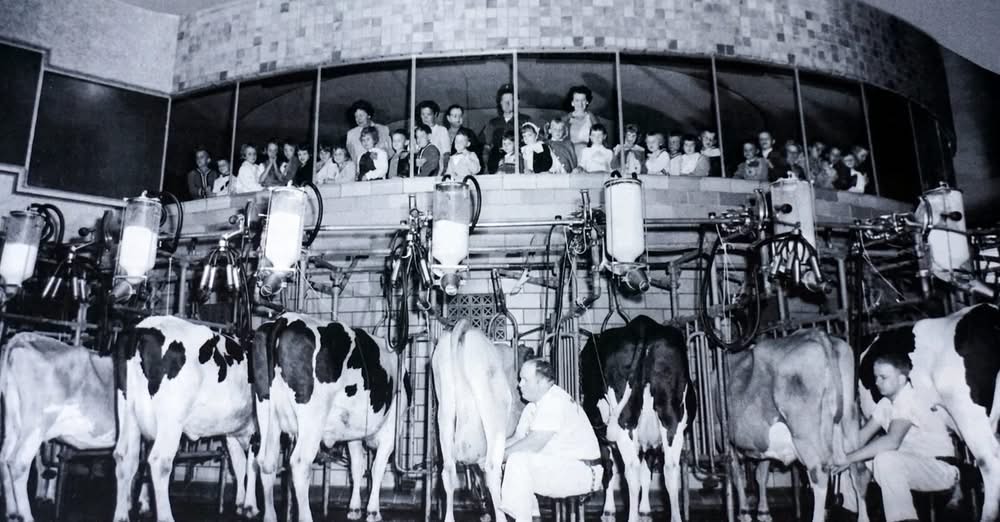
…The Rotolactor featured in Rose’s cartoon was a mostly automatic machine used for milking a large number of cows successively on a rotating platform…first used at the Walker-Gordon Laboratories and Dairy in Plainsboro, New Jersey (pictured below), the Rotolactor held fifty cows at a time, and hosted about 250,000 visitors annually…
(rawmilkinstitute.org)
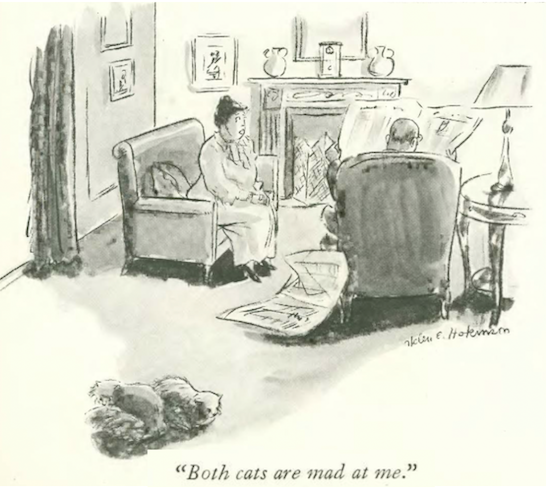
…and we go from cows to cats, courtesy Helen Hokinson…
…and Charles Addams booked an unusual perp…
…on to the November 23 issue…
November 23, 1935 cover by Antonio Petruccelli. Petruccelli (1907-1994) began his career as a textile designer, becoming a freelance illustrator in 1932 after winning several House Beautiful cover contests. This is one of four covers he produced for The New Yorker.Antonio Petruccelli. Here are samples of Petruccelli’s remarkable work.(Helicline Fine Art)
*
Worth the Wait
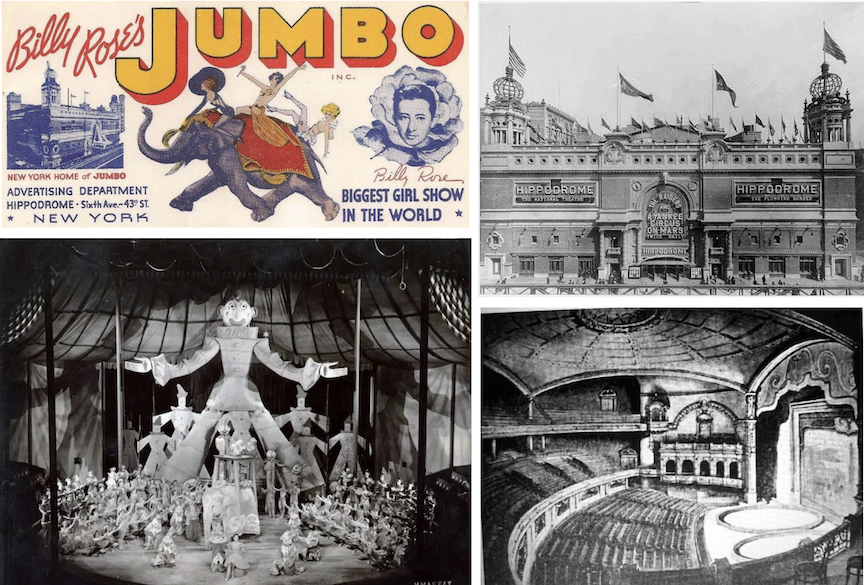
The highly-anticipated circus-themed spectacle Jumbo finally opened at the Hippodrome. In his That’s Entertainment! blog, Jackson Upperco observes that Billy’s Rose’sJumbo was “more circus than musical comedy,” a production that “was largely an excuse for Mr. Rose to present a circus.” It was headlined by comedian Jimmy Durante and bandleader Paul Whiteman, with a score by Rodgers & Hart. Here are excerpts from a review by Wolcott Gibbs:
JUMB0-SIZED ENTERTAINMENT…Clockwise, from top left, Hippodrome billboard promoting Jumbo; built in 1905, the Hippodrome provided entertainment to thousands who couldn’t afford a Broadway ticket; a circus tent was erected inside the 5,300-seat theatre for the spectacle; Jumbo was one of the most expensive theatrical events of the first half of the 20th century. (Facebook/Library of Congress/Broadway Magazine/jacksonupperco.com)
* * *
At the Movies
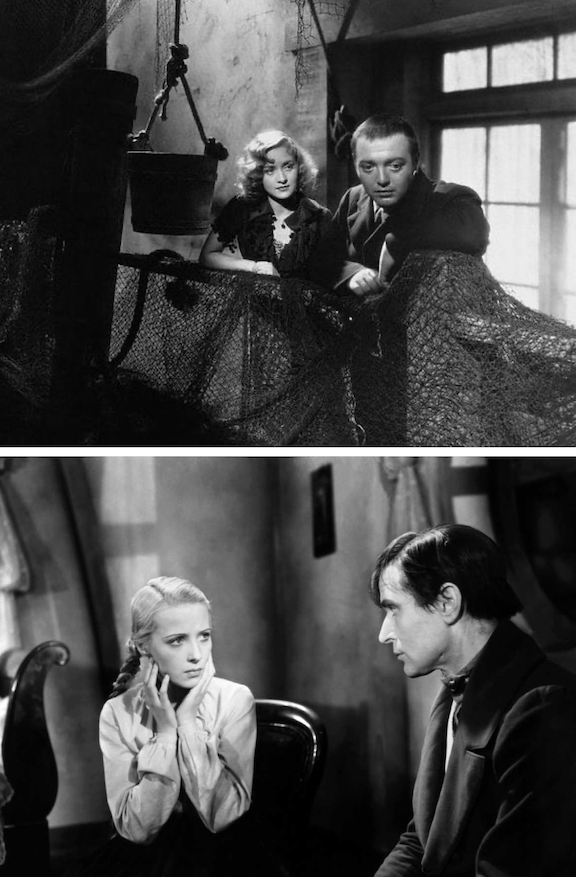
Fyodor Dostoevsky’s 1866 novel Crime and Punishment was adapted to film by both French and American producers in 1935, but critics including The New Yorker’sJohn Mosher mostly preferred the French version, titled Crime et châtiment.
DOUBLE FEATURE…American and French producers each turned out a film adaption of Fyodor Dostoevsky’s novel Crime and Punishment. Top photo, Marian Marsh as Sonya and Peter Lorre as Roderick Raskolnikov in Columbia’s Crime and Punishment; bottom photo, Madeleine Ozeray as Sonia and Pierre Blanchar as Rodion Raskolnikov in Crime et châtiment.(silverscreenmodes.com/SensCritique.com)
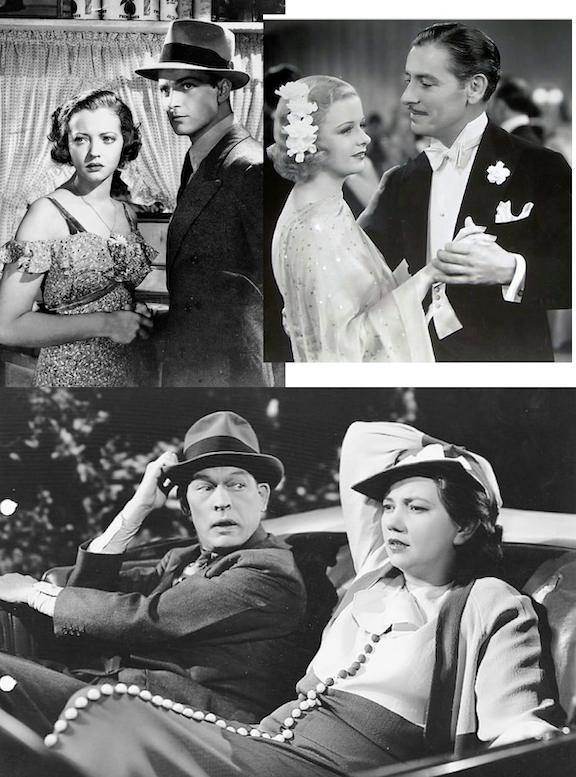
…Mosher reviewed another crime thriller, Mary Burns, Fugitive, but found some comic relief in two other films…
BAD CHOICE IN BOYFRIENDS was the theme of Mary Burns, Fugitive, starring (top left) Sylvia Sidney and Alan Baxter; top right, Joan Bennett and Ronald Colman in the romcom The Man Who Broke the Bank at Monte Carlo; bottom, Fred Allen and Patsy Kelly provided some laughs in musical comedy Thanks a Million. (IMDB)
* * *
From Our Advertisers
Readers of the Nov. 23 issue opened to this lovely image…
…which sharply contrasted with the clunky Plymouth ad on the opposite page…
…not so clunky was this colorful illustration promoting Cadillac’s economy model, the La Salle…
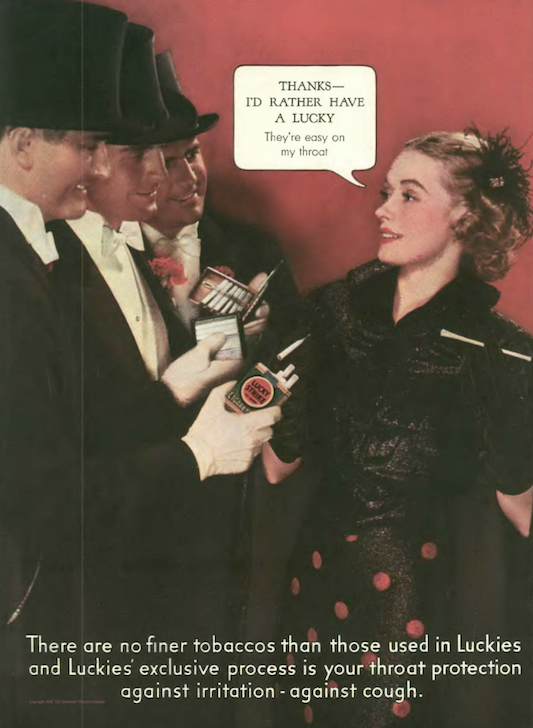
…the back cover was no surprise, with yet another glamorous cigarette ad…
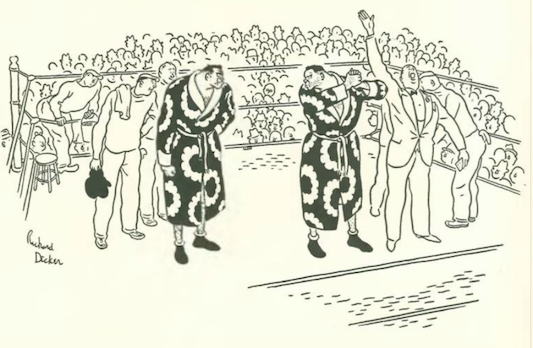
…our cartoonists included Richard Decker, and a fashion faux pas to open a boxing match…
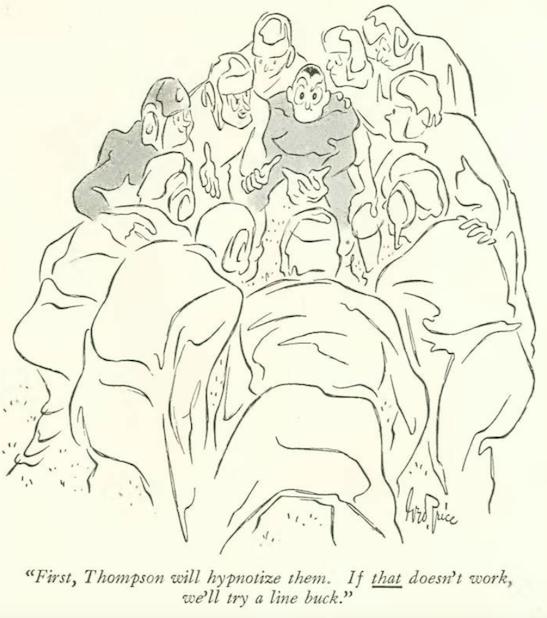
…George Price eavesdropped into some football strategy…
…Carl Rose spotted a canine unbeliever…
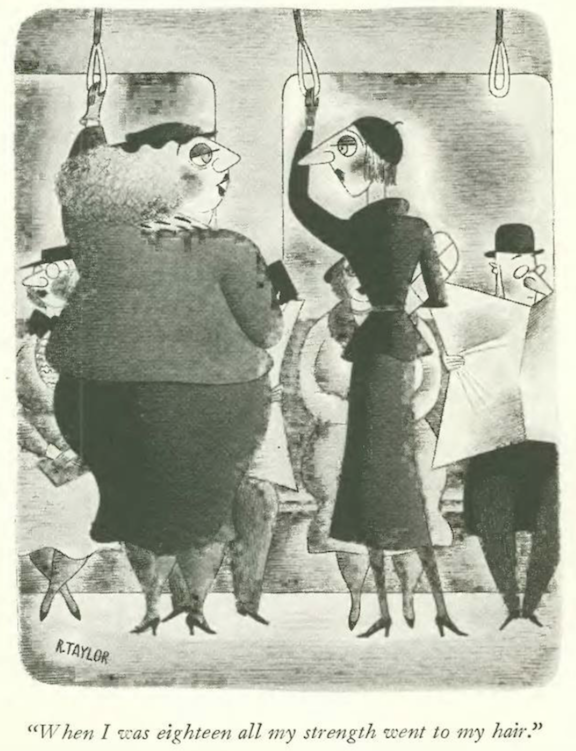
…Richard Taylor was back with his distinctive style…
…Al Frueh continued to illustrate the latest fare on Broadway…
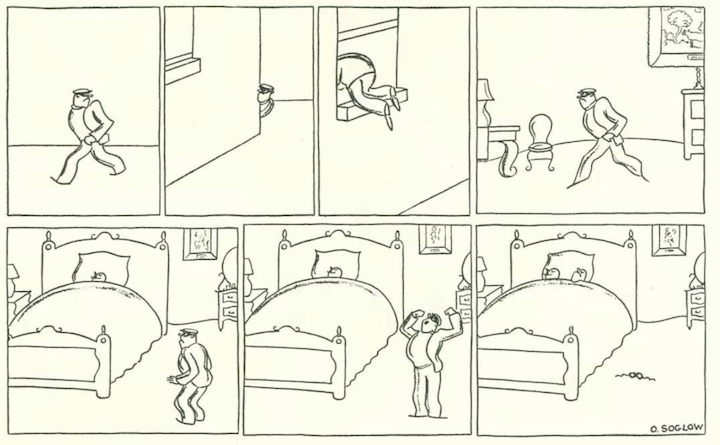
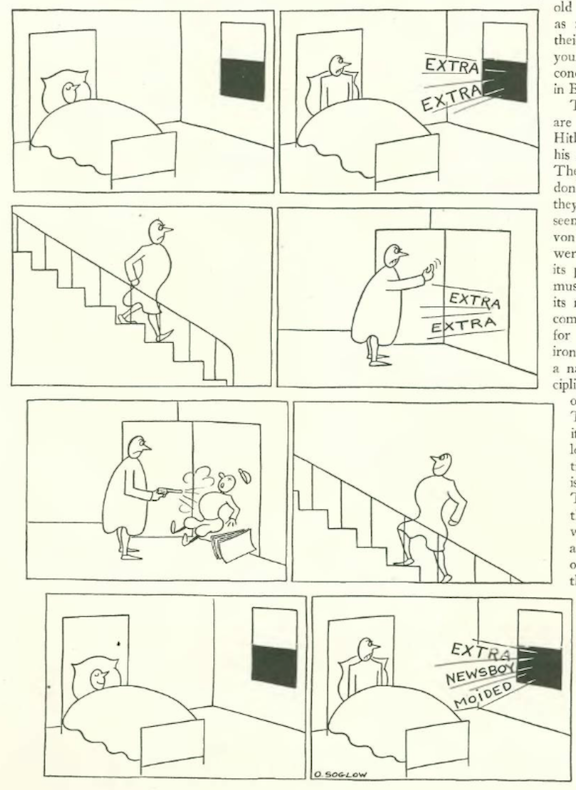
…Otto Soglow crept in for a snooze…
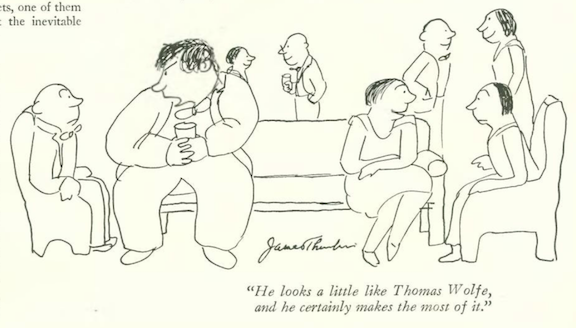
…and we close with James Thurber, and some literary cosplay…
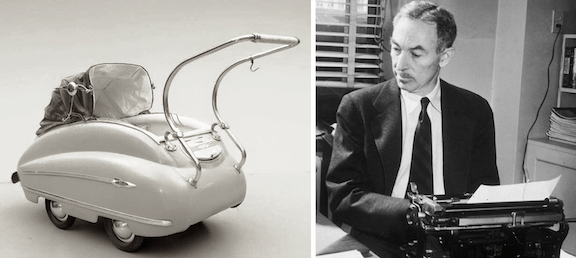
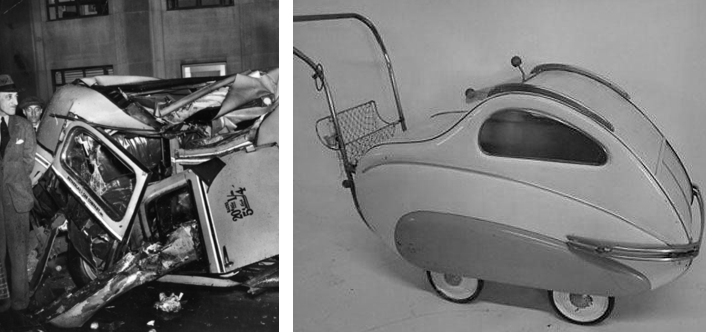
Above: Among E.B. White's notable happenings in the fall of 1935 was a streamlined baby carriage for the toddler of tomorrow. (Pinterest)
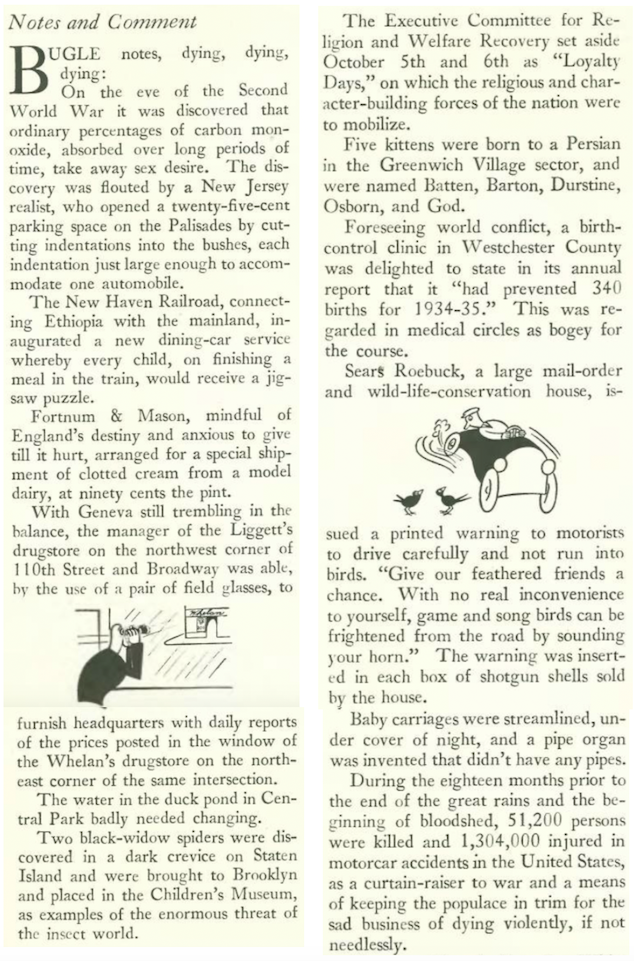
Occasionally, E.B. White would allow his seemingly random thoughts to fill out his “Notes and Comment” column, observing in no particular order various happenings of the day.
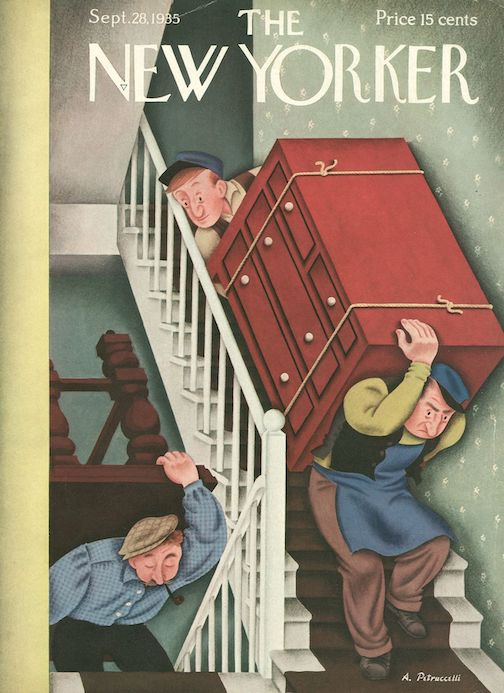
Sept. 28, 1935 cover by Antonio Petruccelli, who began his career as a textile designer. In addition to four New Yorker covers, Petruccelli (1907-1994) illustrated twenty-four Fortune magazine covers as well as several covers for House Beautiful, Collier’s, Life and other magazines.
What he accomplished, however, was a collection of snapshots of life in Manhattan and abroad. Here is the first part of E.B. White’s “Notes and Comment” for Sept. 28…
PERENNIAL PROBLEM…E.B. White noted that more than 51,000 Americans died in car accidents in an 18-month span, a number that is oddly similar to today’s statistics (although the U.S. has more than double the population today). At left, photo by Weegee (aka Arthur Fellig) of a wrecked taxicab in New York City, circa 1930s; at right, a streamlined baby buggy, 1930s. (Instagram/Pinterest)
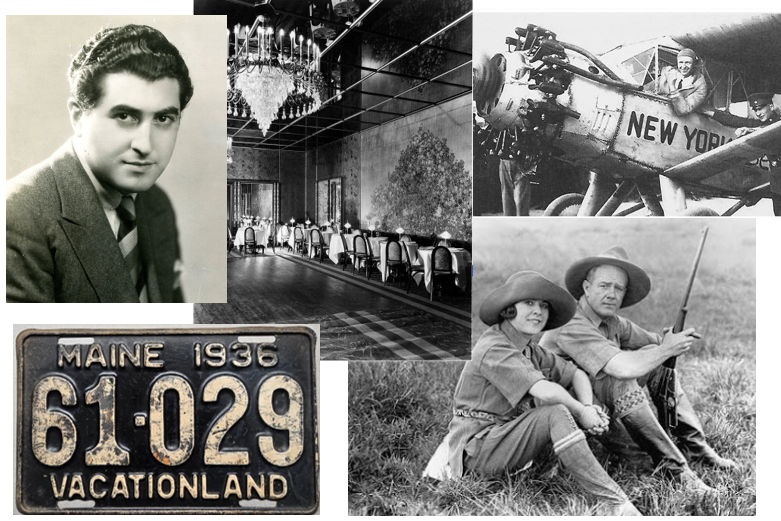
…White also noted a number of cultural events, from airmailed lobsters to a new slogan for the State of Maine…
HODGEPODGE…Clockwise, from top left, Leo Reisman brought the sound of music to the beautiful Central Park Casino ballroom (adjoining photo), which was designed by Joseph Urban; in 1927 Clarence Chamberlain became the second man to pilot a fixed-wing aircraft across the Atlantic and the first to carry a transatlantic passenger—in 1935 he accepted a contract from boxer/restauranteur Jack Dempsey to fly two-hundred Maine lobsters to NYC; safari film celebrities Osa and Martin Johnson bought a picnic basket at Abercrombie & Fitch; the state of Maine announced plans to add “Vacationland” to license plates—a slogan still in use today. (IMDB/centralpark.org/alchetron.com/ebay)
* * *
Class Acts
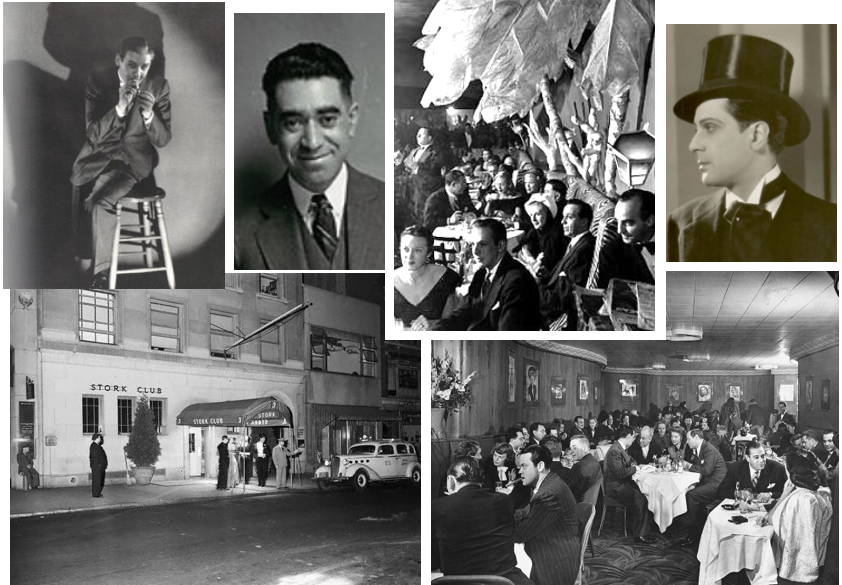
Lois Long continued to chronicle the nightlife scene in her “Tables For Two” column, observing the efforts of nightclub impresarios to promote their establishments as epitomes of sophistication.
WHY GO HOME?…Lois Long noted the many reasons why New Yorkers might stay out into the wee hours. Clockwise, from top left: Gossip columnist Walter Winchell as photographed by Edward Steichen in 1930; nightclub impersario and former Village speakeasy king Barney Gallant; the exclusive confines of El Morocco; Romanian-born American crooner and actor Georges Metaxa made the society ladies swoon at the Stork Club; the Stork Club’s Cub Room in 1944 occupied by Orson Welles (left) among other notables; entrance to the club, 1930s. (CondeNast/boweryboyshistory.com/Pinterest/Wikipedia/NYPL)
* * *
From Rough to Refined
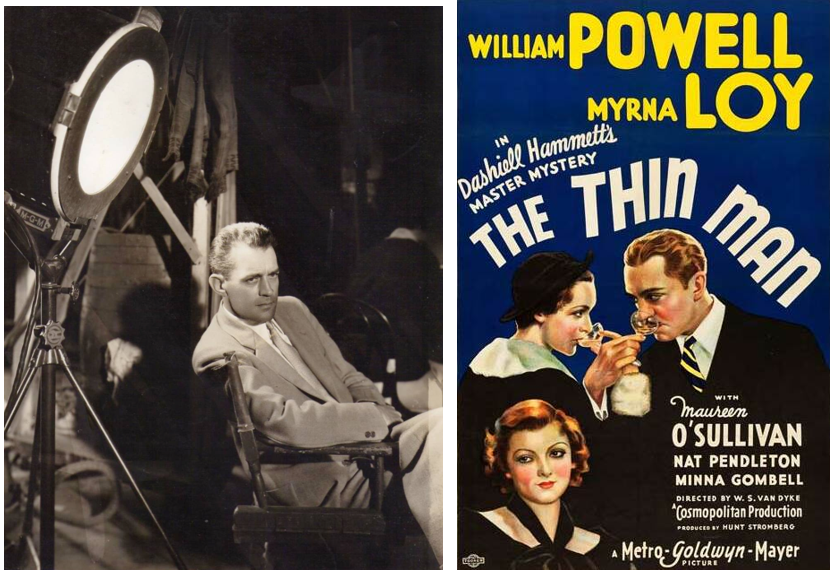
Alva Johnston profiled acclaimed film director W.S. Van Dyke (1889–1943), whom Johnston portrayed as a tough guy who slipped effortlessly from the rough and tumble world of Westerns to the sophisticated heights of high society films such as 1934’s The Thin Man.
LOW TO HIGH…W.S. Van Dyke moved from making Westerns to more sophisticated fare including 1934’s The Thin Man. (Facebook/Wikipedia)
* * *
Silly Mystification
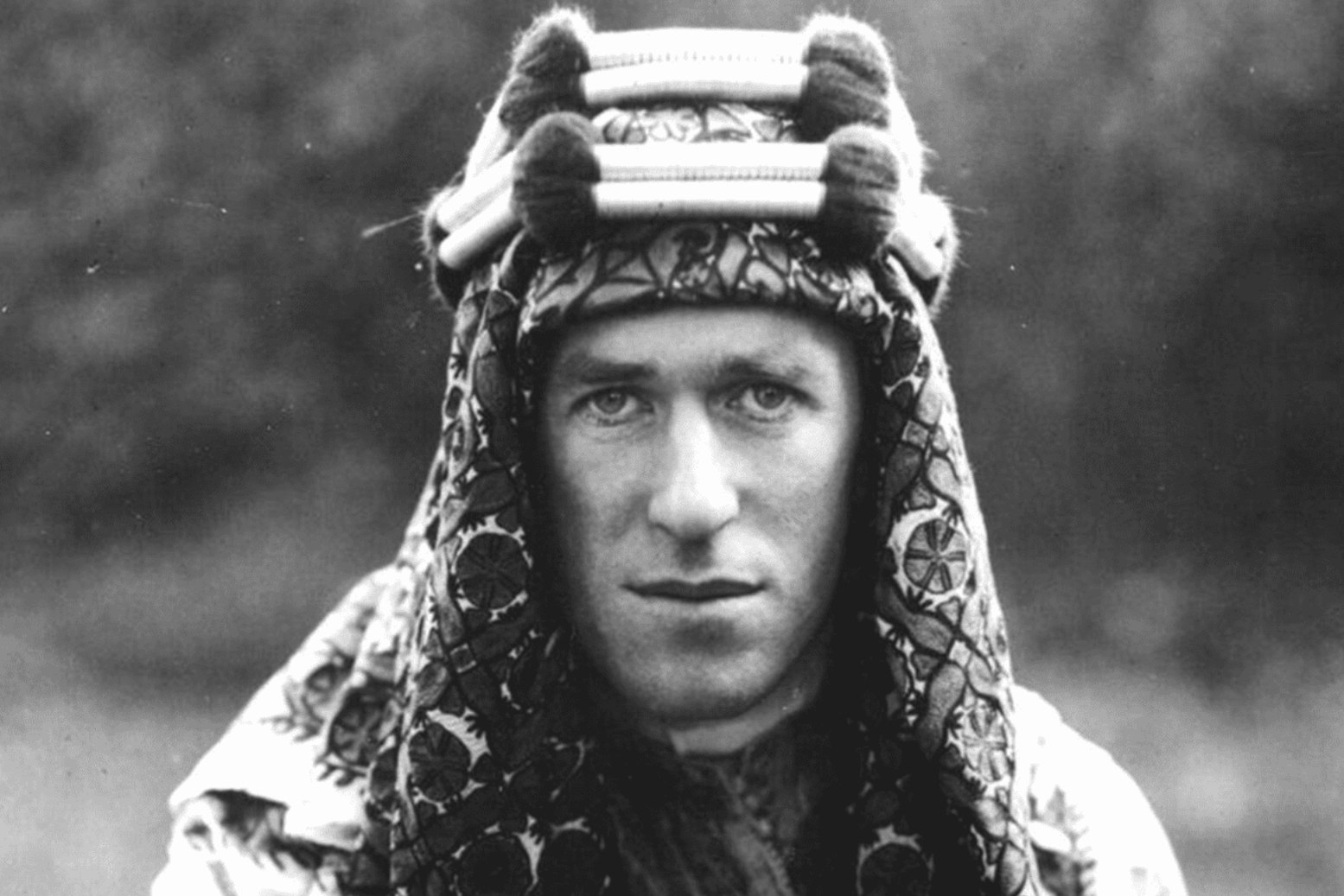
Book reviewer Clifton Fadiman began his review of T.E. Lawrence’sSeven Pillars of Wisdom by first clearing the air about the enigmatic writer and diplomat who had recently died in a motorcycle accident. “Wittingly or unwittingly, willingly or unwillingly, he exhaled during his lifetime a vapor of silly mystification,” Fadiman wrote about Lawrence, who was known to embellish accounts of his adventures in the Arab world. Here is an excerpt of the review:
LITERARY COSPLAY…T.E. Lawrence (1888-1935) in an undated photo. Writing for the New Criterion,David Fromkin noted the importance of Lawrence’s prestige to the British Empire. “T. E…was of his time and ours. Of all the public figures of the twentieth century, across a wide range of interests, issues, and attitudes, he best expresses the century. ” (The New Criterion)
* * *
At the Movies
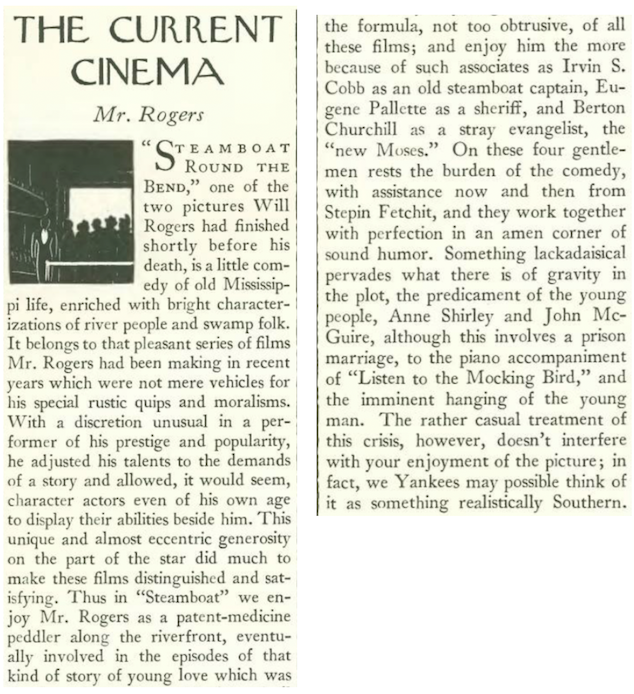
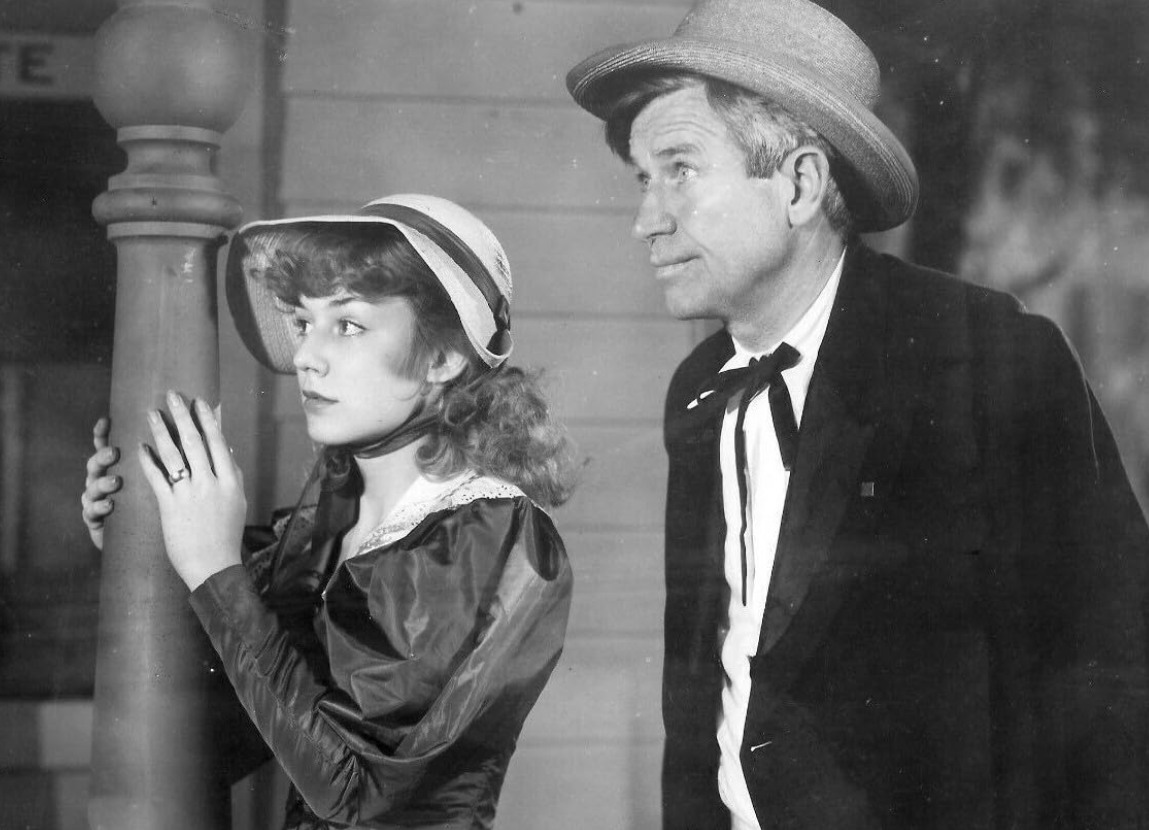
Critic John Mosher reviewed one of Will Rogers’ final films, Steamboat Round the Bend, released just weeks after Rogers’ death in an Alaska plane crash. Mosher found the film “satisfying.”
SOUTHERN CHARM was laid on thick in Steamboat Round the Bend, which featured Anne Shirley and Will Rogers in one of his final film roles (Rogers filmed In Old Kentucky before Steamboat, but In Old Kentucky wasn’t released until Nov. 22, 1935).
Mosher also took in another “revue” film, Broadway Melody of 1936, which served as a showcase of MGM’s star power.
THE MGM STABLE OF STARS showcased in Broadway Melody of 1936 included, at top, the elegant Eleanor Powell; below, Powell (left) joins brother-sister dancing team Buddy and Vilma Ebsen in a down-home skit. Buddy Ebsen’s “carefully preserved homeliness” (quoting John Mosher) served him well 27 years later when he was cast as Jed Clampett in TV’s The Beverly Hillbillies. (IMDB)
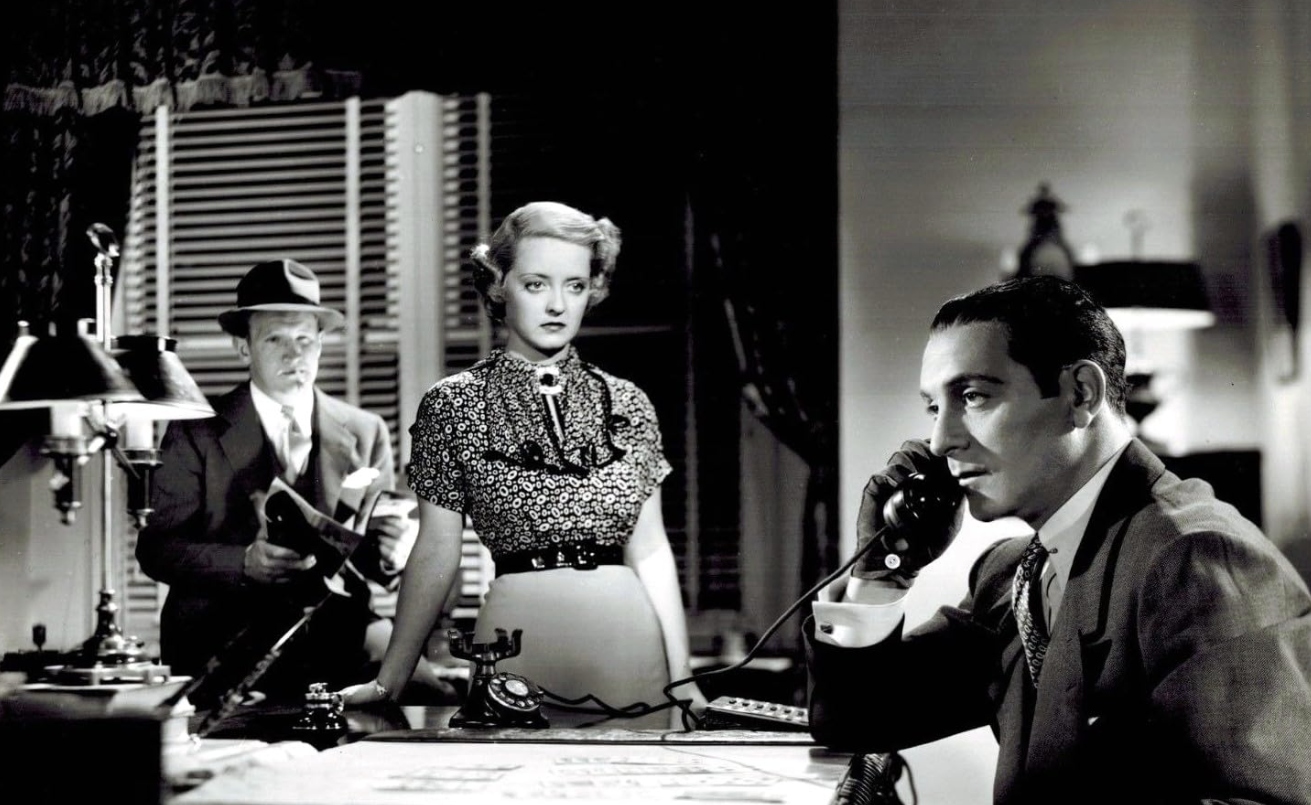
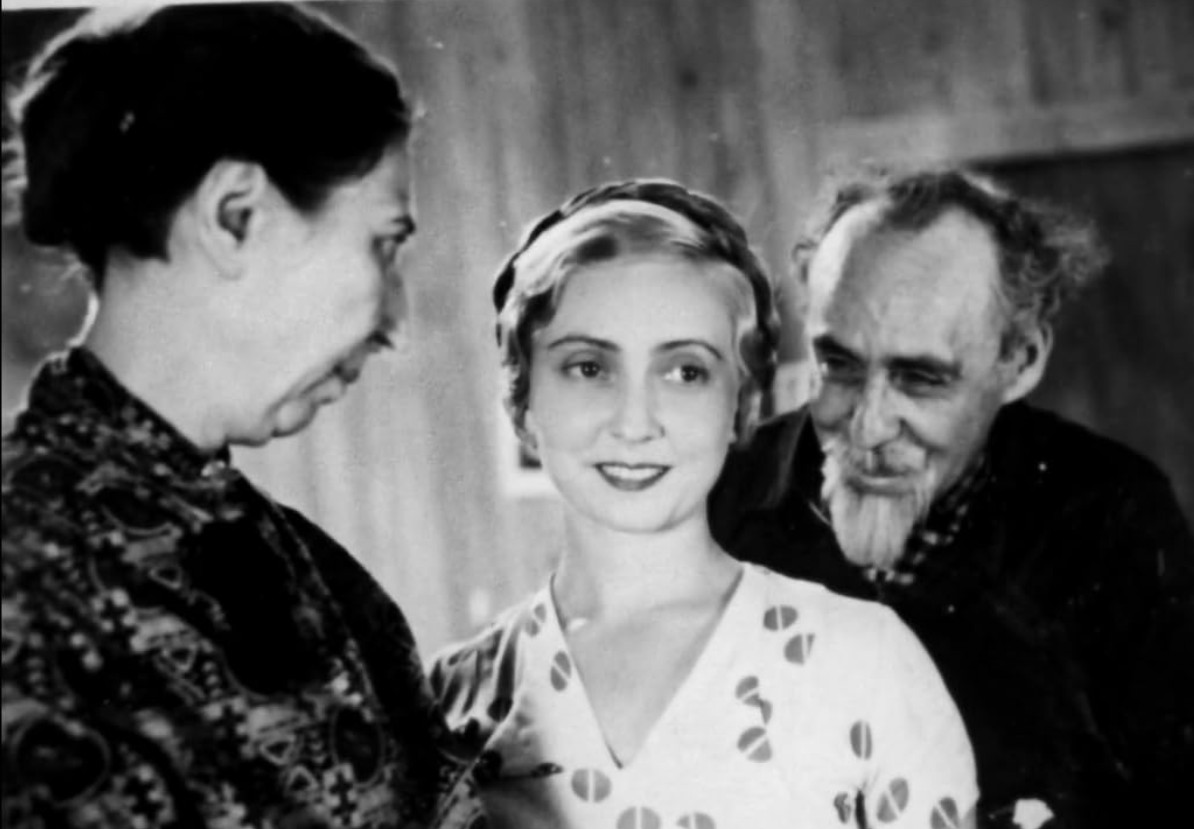
Mosher also endured a “perfunctory” performance by Bette Davis in Special Agent, and a “mousy” Madeleine Renaud in Maria Chapdelaine.
PHONING IT IN…Joe Sawyer, Bette Davis and Ricardo Cortez in Special Agent. (IMDB)NOT GAGA-WORTHY…Critic John Mosher thought French actress Madeleine Renaud (center) was too “mousy” to be cast against the rugged beauty of the Canadian frontier in 1934’s Maria Chapdelaine. Based on a romance novel written in 1913 by the French writer Louis Hémon, the film cast Renaud as a young woman enduring the hardships of rural Quebec while she is pursued by three suitors. An IMDB reviewer writes that this early Julien Duvivier film “is mostly of pictorial interest: the location shooting in Quebec is impressive, but the story is thin-to-nonexistent. Madeleine Renaud is cute but not magnetic enough to have three men going absolutely gaga over her.” (IMDB)
* * *
From Our Advertisers
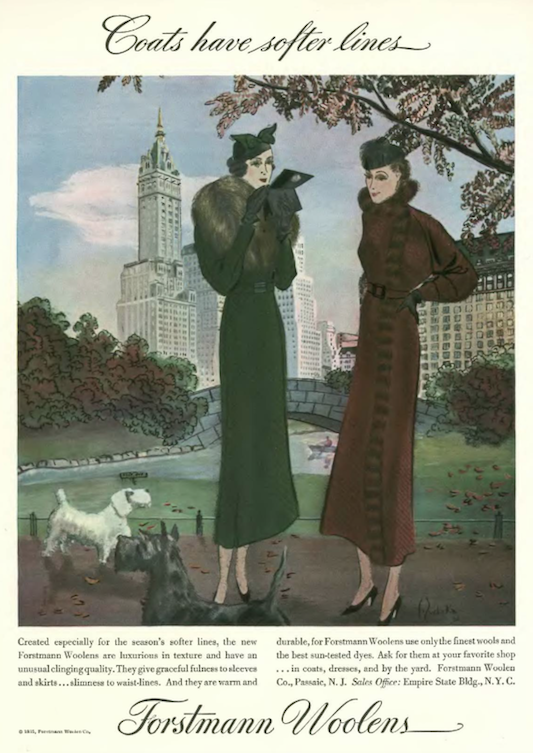
Forstmann Woolens kicks off our advertisements with this image of attenuated women posed in the autumnal landscape of Central Park…
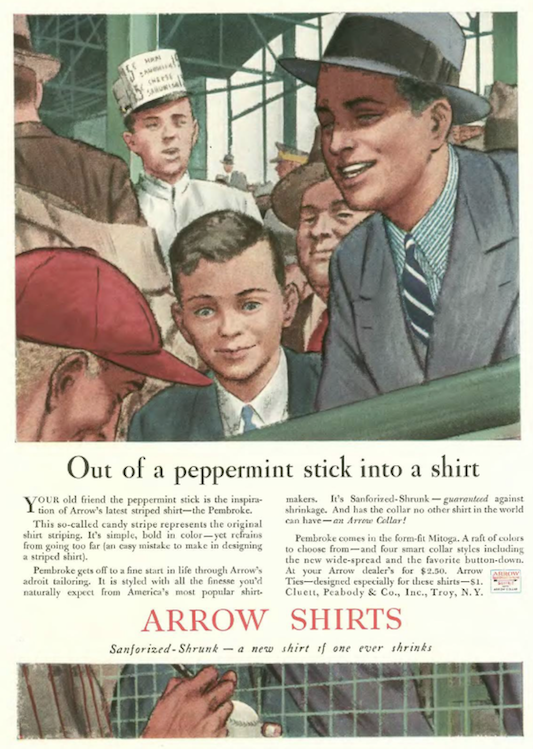
…what is notable about this Arrow Shirts ad is the formal attire of father and son at a baseball game, not at all unusual in 1935…
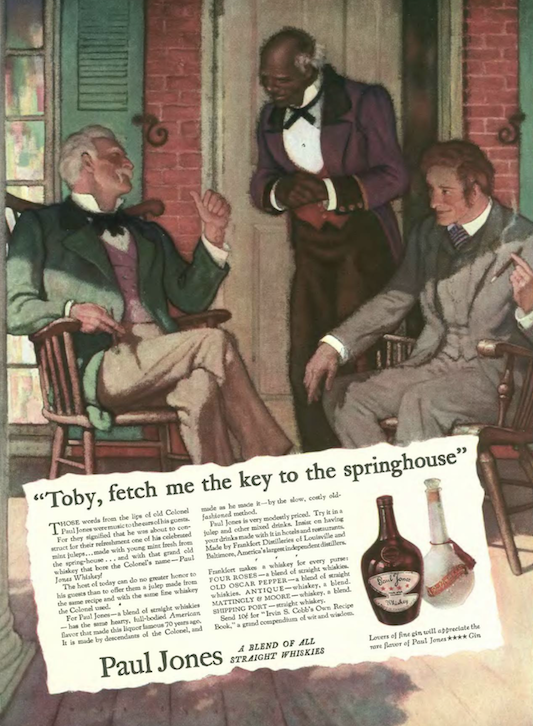
…Seagram’s continued its aggressive campaign to promote its lineup of seven “masterpieces”…
…Coca-Cola also had a substantial war chest, marketing its product for home consumption, which still seemed to be somewhat novel…
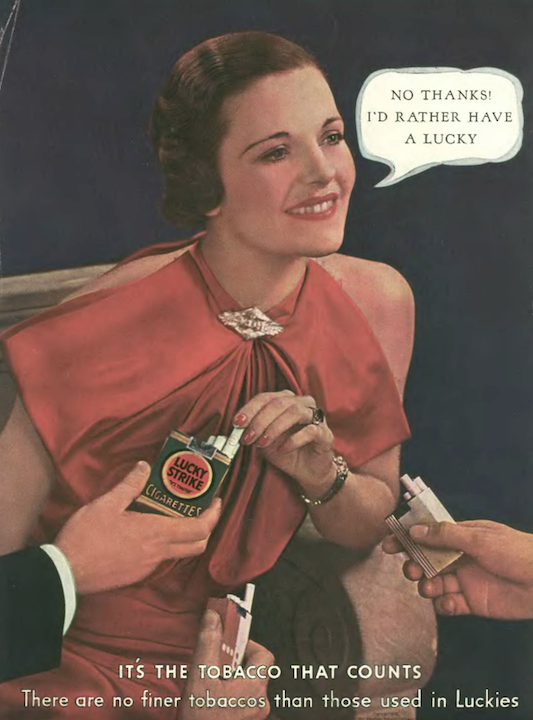
…the back page ad went to the makers of Lucky Strike, pursuing that growing market of women smokers…
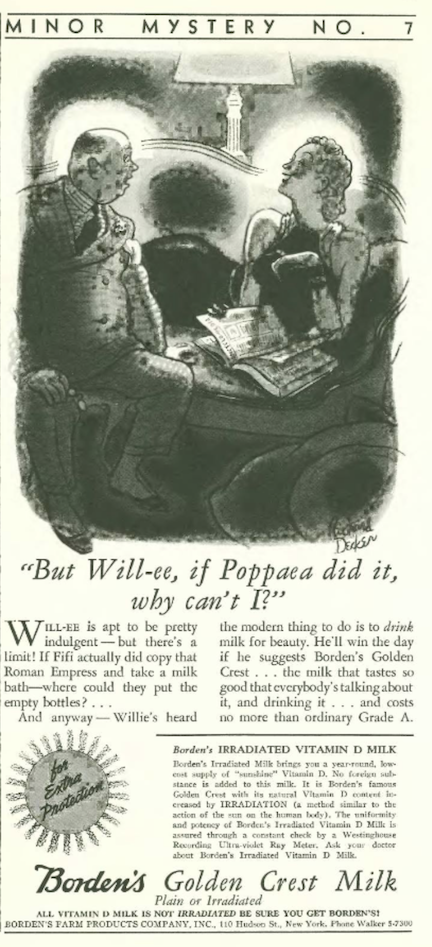
…Richard Decker drew up an ad for a more wholesome product…
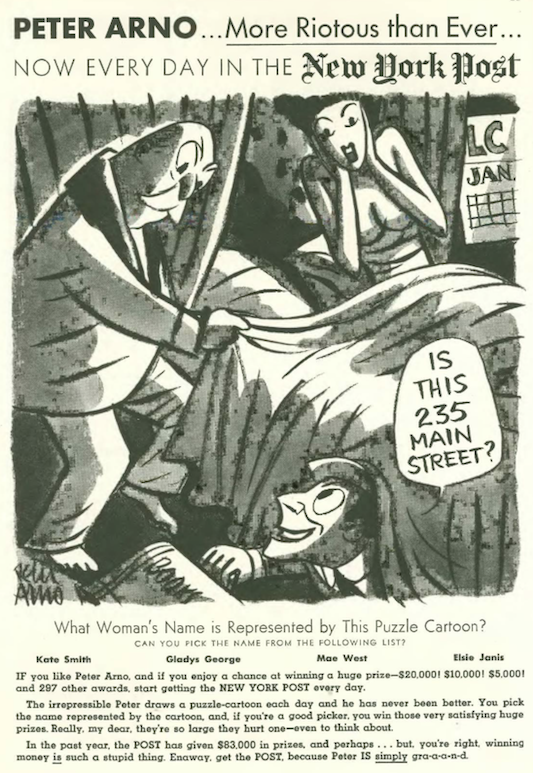
…while Peter Arno put pen to paper to promote his “puzzle-cartoons” in the New York Post…
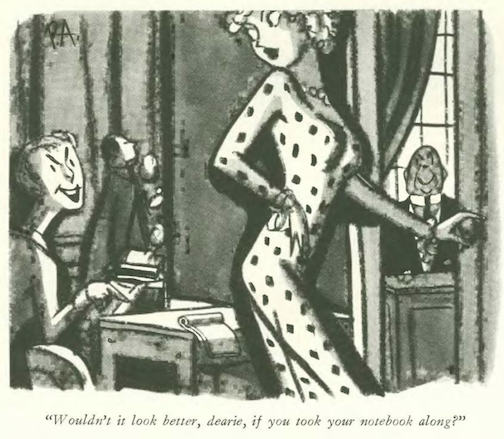
…which segues to our cartoon section, and Arno again with some office hijinks…
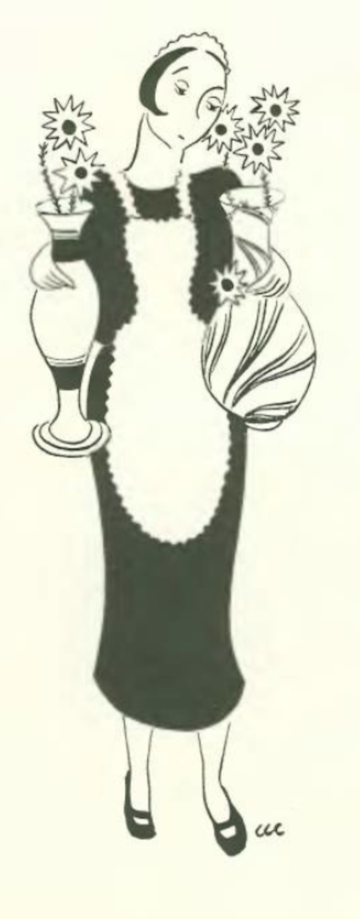
…Christina Malman’s wonderfully unique spot art was making regular appearances in the magazine’s pages…
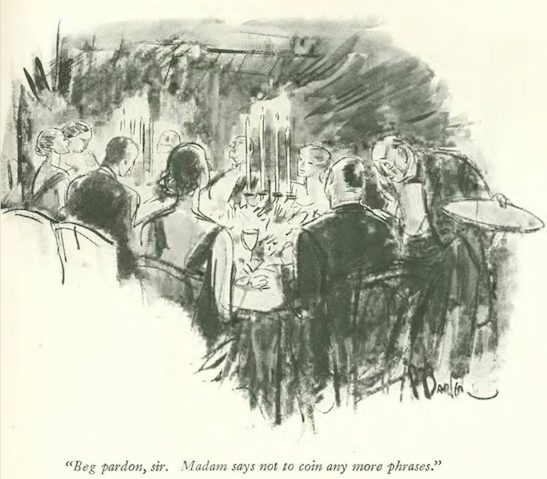
…Perry Barlow served up some dinnertime etiquette…
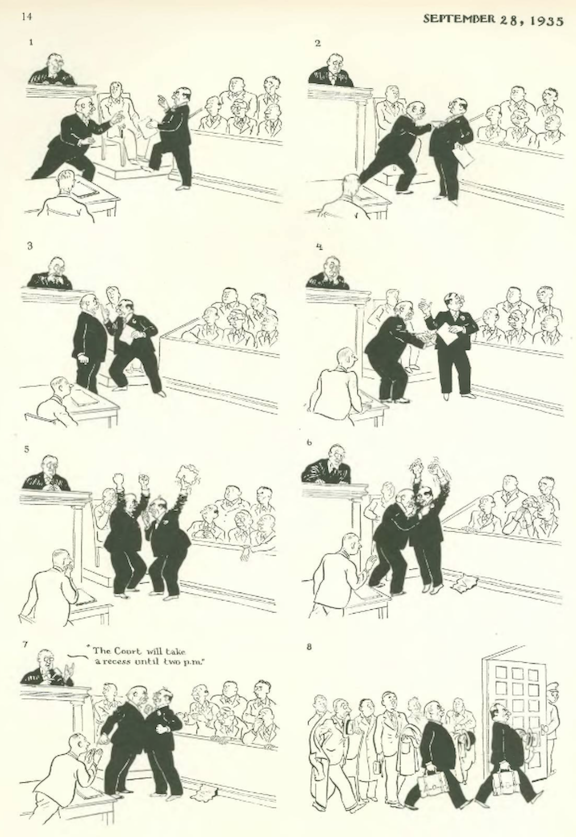
…Carl Rose found order in the court…
…James Thurber continued to mesmerize…
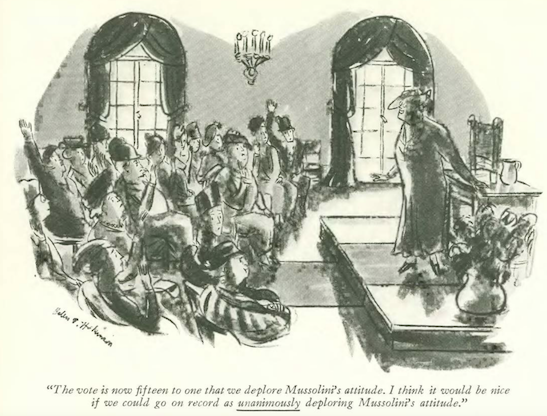
…Helen Hokinson’s Ladies Club took a stand against fascism…
…Alan Dunn looked in on a polite perp…
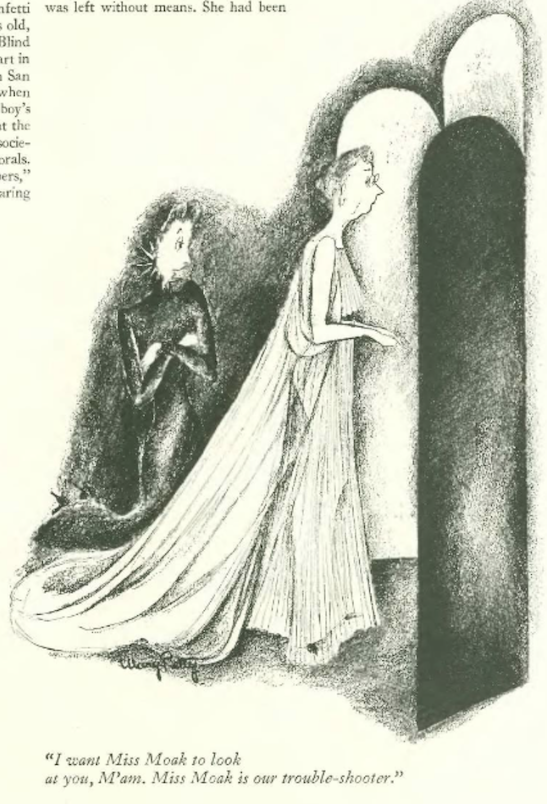
…Mary Petty encountered a challenge in a dress shop…
…Gilbert Bundy revealed an odd duck among the fox hunters…
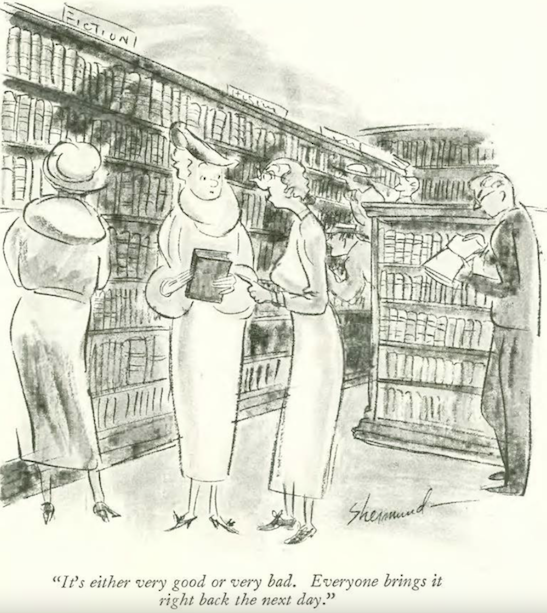
…and we close with Barbara Shermund, ready to curl up with a good (or bad) book…
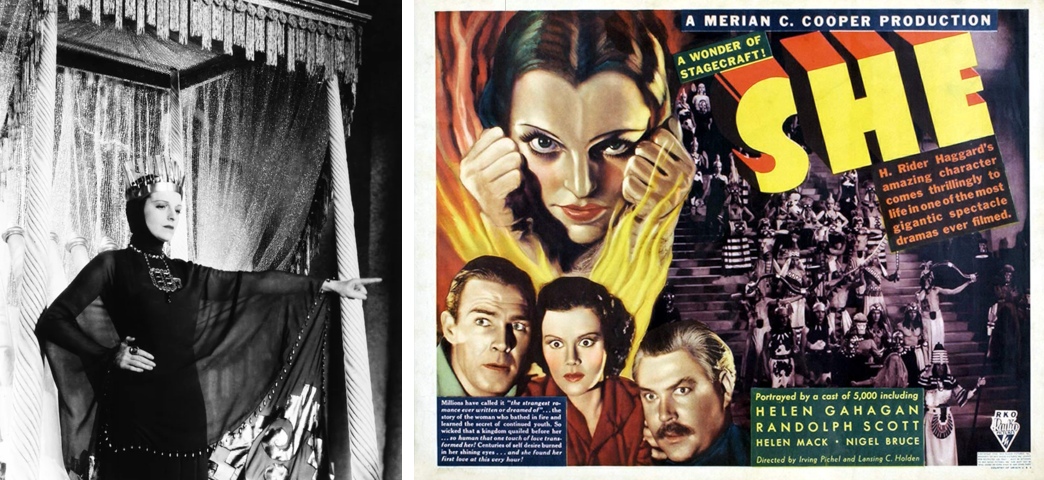
The 1935 film She was one of those old movies you’d see on television during the 1970s when there were only three or four channels (plus UHF) and local stations would tap into the “B” movie vault to fill airtime. One of those films was She.
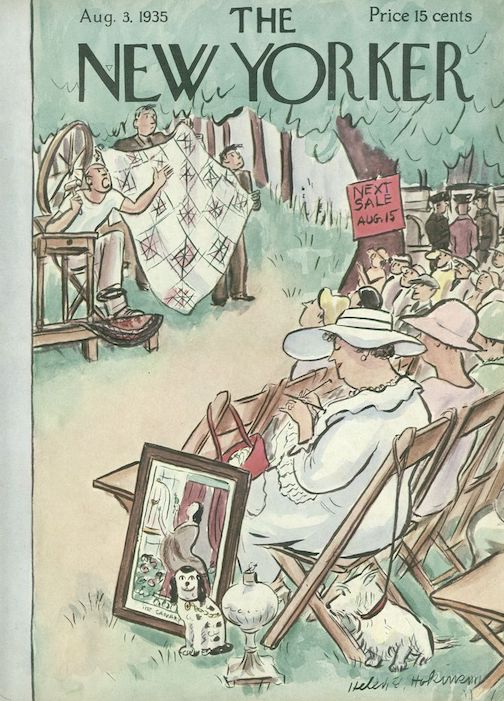
August 3, 1935 cover by Helen Hokinson.
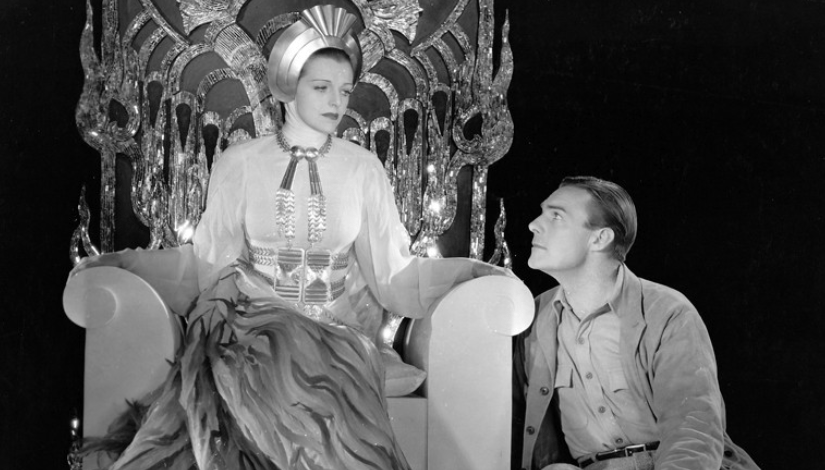
Film critic John Mosher felt a bit sorry for Helen Gahagan, who portrayed “She Who Must Be Obeyed” (aka “She”)—an immortal who ruled an exotic, lost civilization near the Arctic Circle. The challenge for Gahagan was to seem imperious before her co-stars Randolph Scott and Helen Mack, who seemed more suited to the high school hijinks of an Andy Hardy picture. The film was a pretty standard adventure tale, in the mold of producer Marian C. Cooper’s 1933 King Kong, with two explorers falling in love during a perilous journey.
ARCHETYPE…At left, Helen Gahagan as “She” (Who Must Be Obeyed). Her costume possibly inspired the Evil Queen in Disney’s 1937 animated Snow White and the Seven Dwarfs. At right, lobby card that promoted the film. (Scifist.net/Reddit)WHEN YOU PLAY WITH FIRE…She Who Must Be Obeyed (Helen Gahagan), believing that the explorer Leo Vincey (Randolph Scott) was a reincarnation of his ancestor (whom she loved), and jealous of his girlfriend Tanya (Helen Mack), invites Leo to join her in the eternal flame. Unfortunately, her re-entry into the flame that gave her immortality turned her into a dying, withered crone. (The Nitrate Diva/Scifist.net)
The 1887 H. Rider Haggard novel, She, inspired eponymous silent films in 1908, 1911, 1916, 1917, and 1925. The 1935 film reviewed here received tepid reviews and lost money on its first release, however in a 1949 re-release it fared much better. She was re-made in 1965 with Ursula Andress in the lead role, and again in 1984 in a post-apocalyptic film that had virtually nothing to do with Haggard’s novel.
SHE THROUGH THE YEARS…Clockwise, from top left, “She” (Marguerite Snow) offers a dagger to Leo Vincey (James Cruze) in a 1911 two-reel (24 min.) adaptation; Valeska Suratt as “She” in the 1917 film (now lost); Betty Blythe took the title role in the 1925 production, considered to be the most faithful to the 1887 H. Rider Haggard novel; Sandahl Bergman appeared dressed for a Jazzercise video in the 1984 post-apocalyptic She; and finally, Ursula Andress and John Richardson in the 1965 CinemaScope production of She. (Wikipedia / digitalcollections.lib.washington.edu / cultcelebrities.com / Reddit)
* * *
Colonial Ambitions
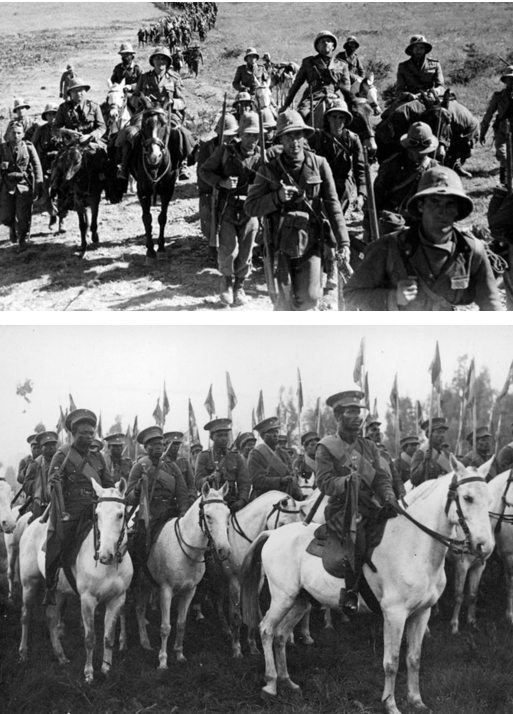
With most of Africa carved up by other European powers (Britain, France, Belgium etc.) in the 19th century, Italy set its sights on Ethiopia, which by the end of the 19th century was the only independent country left on the continent. Ethiopia fought off Italy’s first attempt at conquest in the Battle of Adwa (1896), but with the rise of fascist dictator Benito Mussolini, Italy paid a return visit, this time with heavy artillery and airstrikes that included chemical weapons. E.B. White tried to make sense of this latest invasion in his opening comments.
THOSE GUYS AGAIN…Italy invaded Ethiopia on October 3, 1935, a significant act of aggression in the lead up to World War II. Despite facing a technologically superior Italian army (top) equipped with modern weapons, including tanks, aircraft, and chemical weapons, the Ethiopian forces (bottom photo) mounted a strong resistance. (Wikipedia)
In his weekly column, Howard Brubaker mused on the Italian aggressions and other rumblings of the coming European war.
* * *
Author, Author
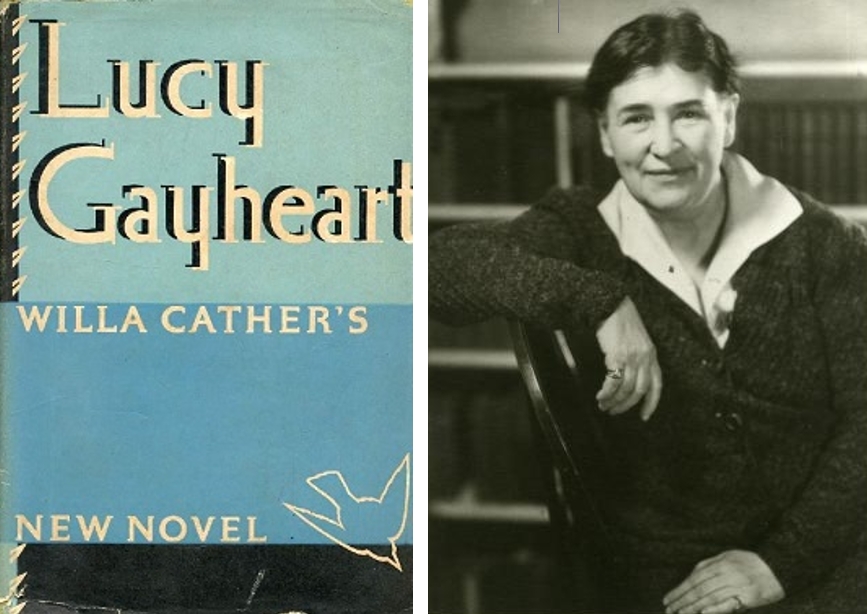
The writer Willa Cather was a favorite of New Yorker critics, including Clifton Fadiman, however her latest novel was a bit too mild for his tastes.
HERE’S LUCY…Clifton Fadiman confessed he was “mortified” to admit that he found Willa Cather’s latest novel a bit too gentle. At right, portrait of Cather on her birthday, December 7, 1936. (willacather.org)
* * *
From Our Advertisers
We begin with more fearmongering from the folks at Goodyear, who offered weekly reminders of the perils of not choosing their all-weather tires…
…the Liggett and Myers Tobacco Company conjured up this “naughty maiden” to encourage even timid souls to take up the habit…
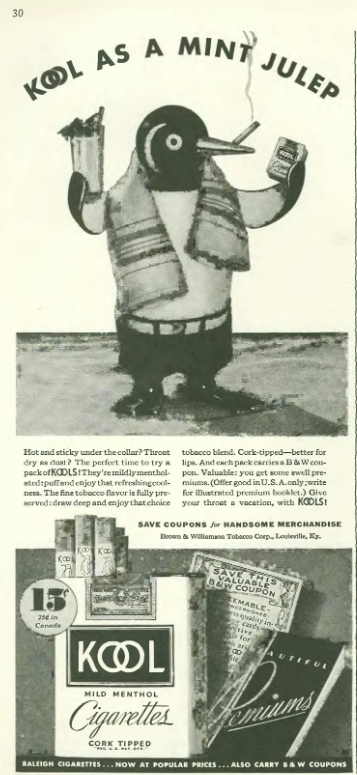
…on the other hand, the makers of the upstart KOOL brand kept it simple with their chain-smoking penguin, who was grabbing ever more market share from rival menthol pusher SPUD…
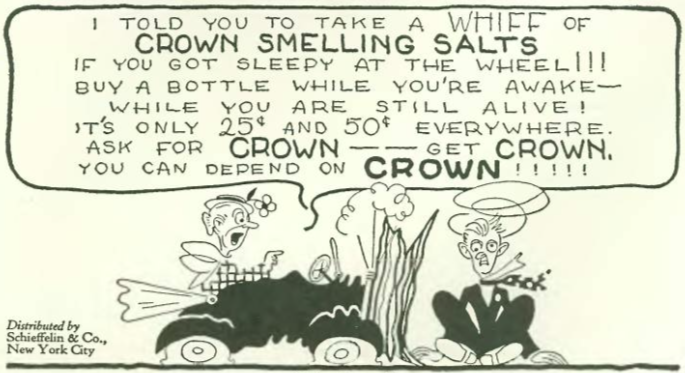
…ads in the back of the book offered up even less sophisticated products, such as Crown Smelling Salts…
…while Dr. Seuss and Norman Z. McLeod continued to make a living with their distinctive illustrations…
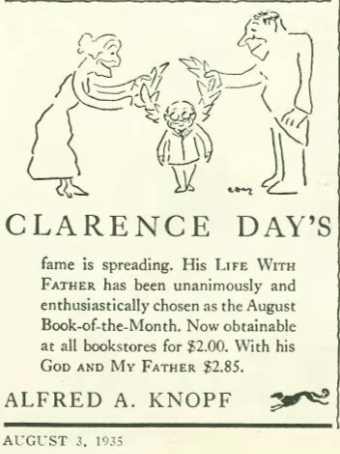
…at the very back of the magazine, this tiny ad from Knopf promoted Clarence Day’sLife With Father, published just months before Day’s death on Dec. 28…
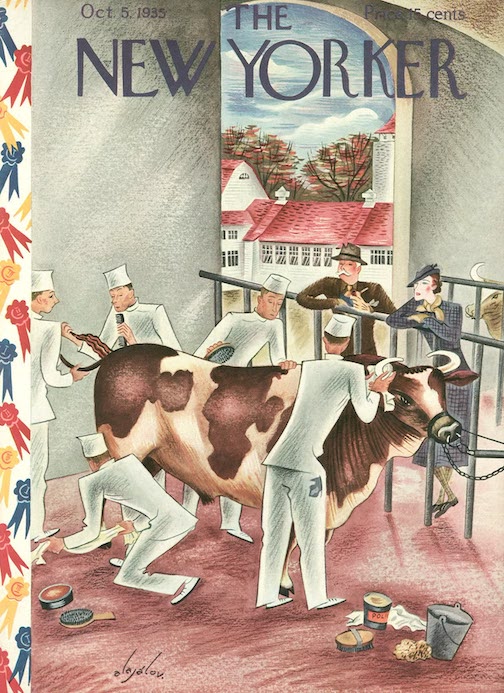
…which brings us to our cartoonists…Constantin Alajalov kicked us off with this happy number…
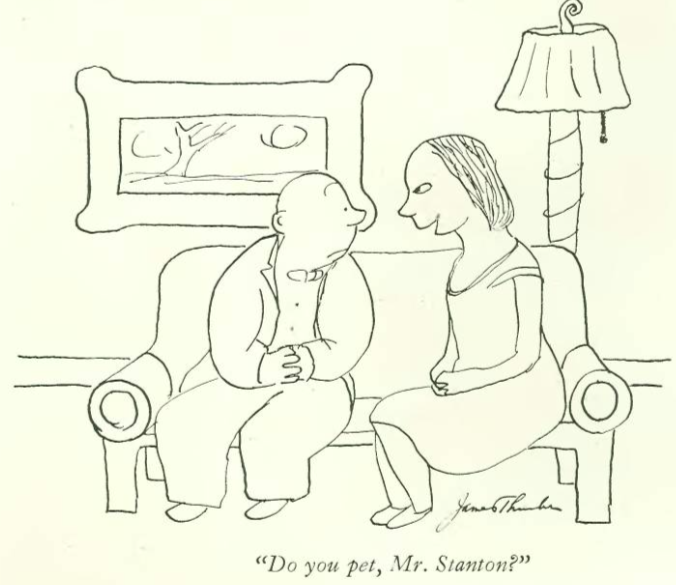
…James Thurber found steamy goings on in the parlor…
…Charles Addams came down to earth with this pair…
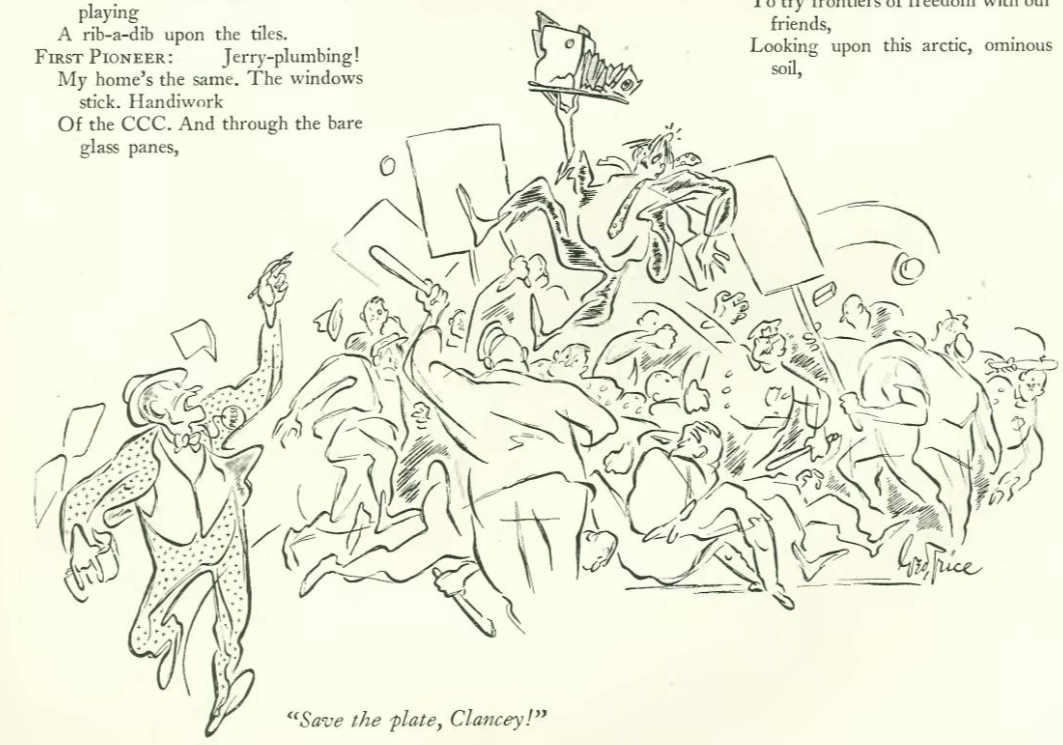
…George Price showed us the rough and tumble of news reporting…
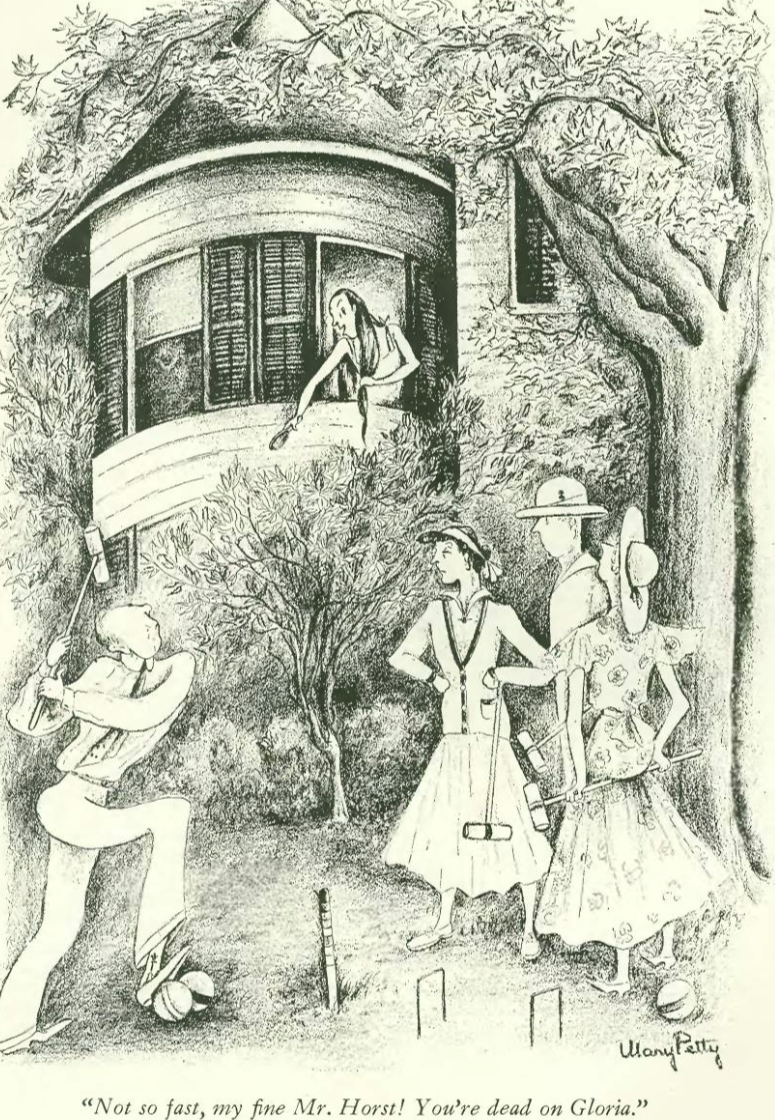
…Mary Petty contributed this sumptuous drawing of a croquet match…
…Helen Hokinson was in a transcendental mood…
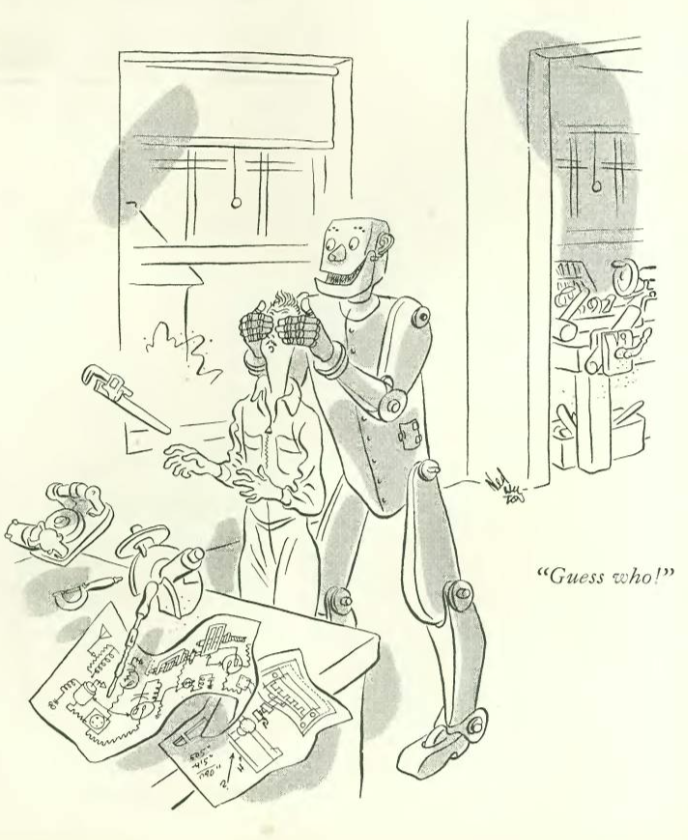
…and Ned Hilton had a big surprise for one garage tinkerer…
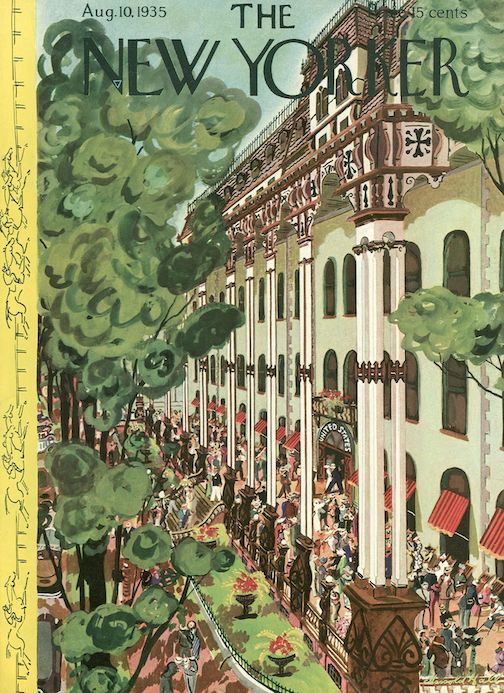
…on to August 10 and a rich summer scene by Arnold Hall:
August 10, 1935 cover by Arnold Hall.
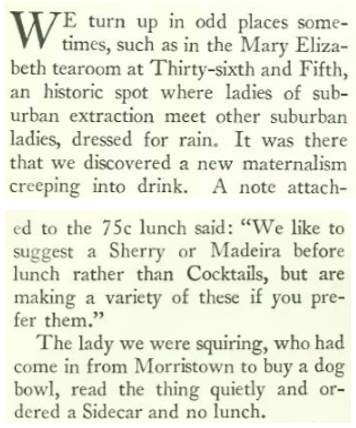
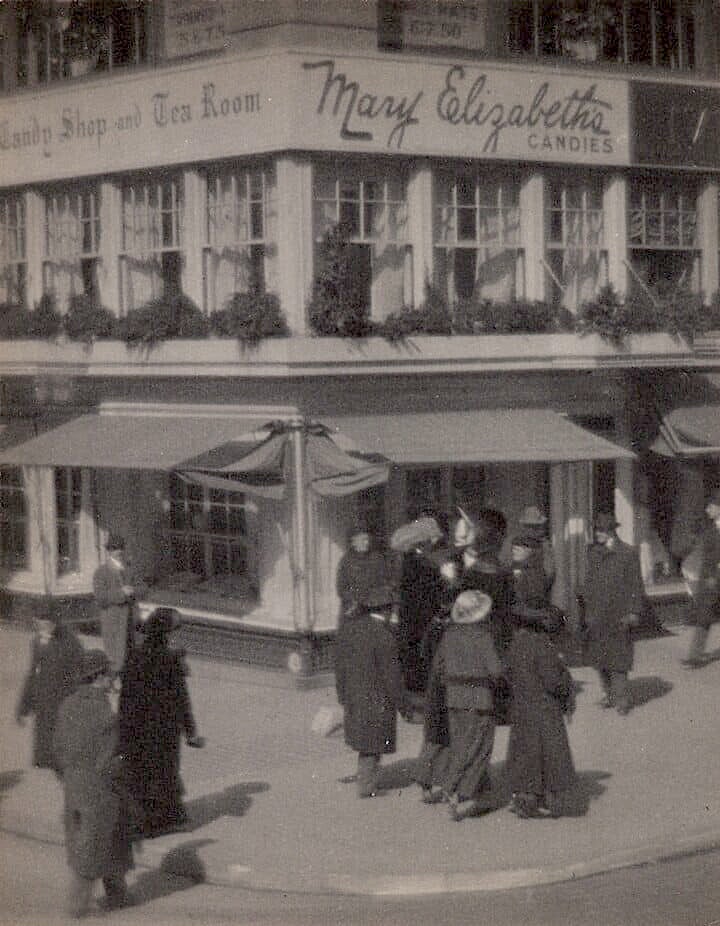
“The Talk of the Town” checked the lunch crowd at Mary Elizabeth’s Tea Room, where some preferred to drink their lunch.
TEA AND SWEETS (and cocktails) were among the offerings at Mary Elizabeth’s Tea Room at 36th and Fifth, seen here circa 1912. (Photo by Karl Struss via Facebook)
* * *
Comic Relief
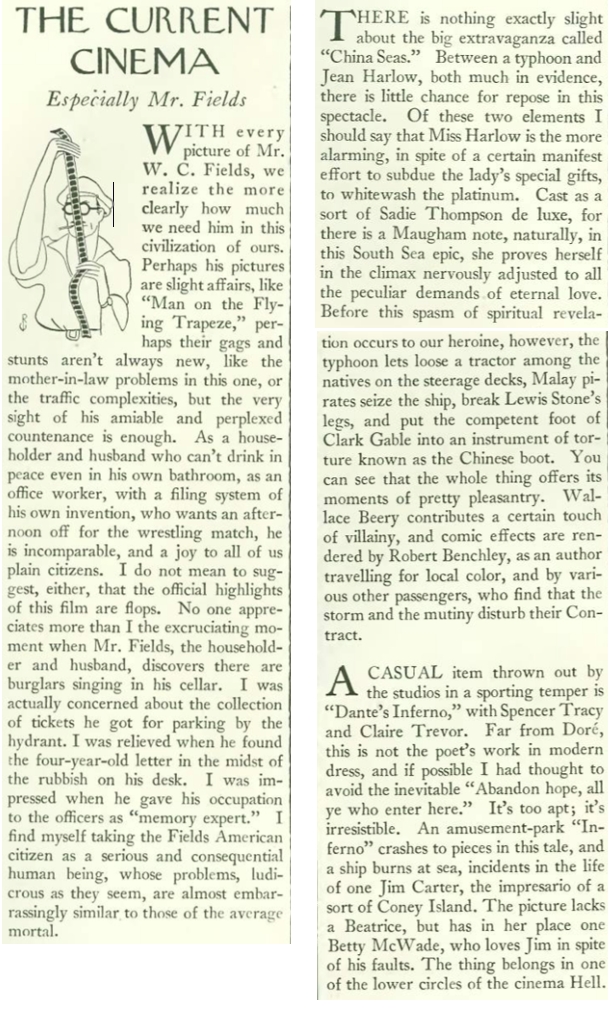
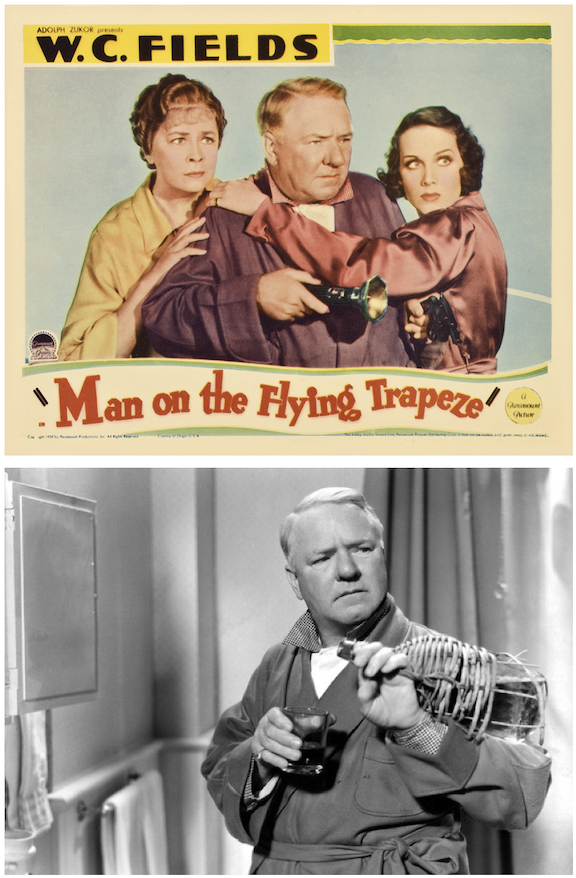
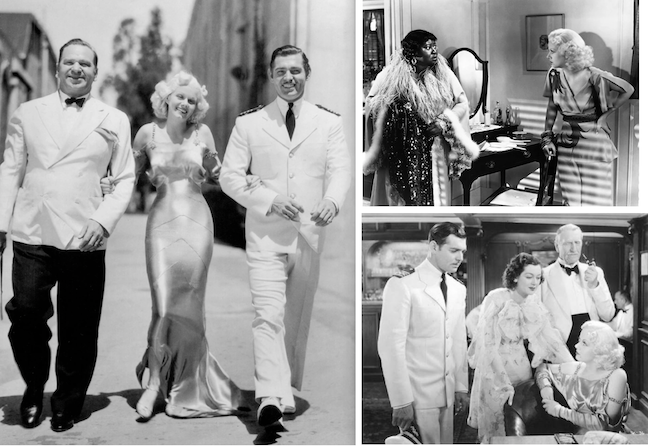
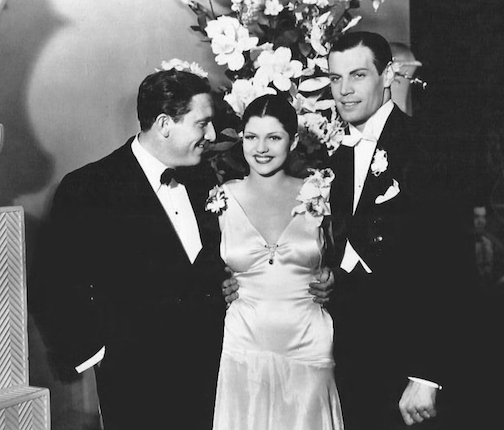
Film critic John Mosher offered an appreciation of W.C. Fields, noting that civilization needed films like Man on the Flying Trapeze during those hard years. Mosher also found some worthy distractions in the Jean Harlow vehicle China Seas, but was prepared to consign Spencer Tracey’s latest offering to the “lower circles of cinema hell.”
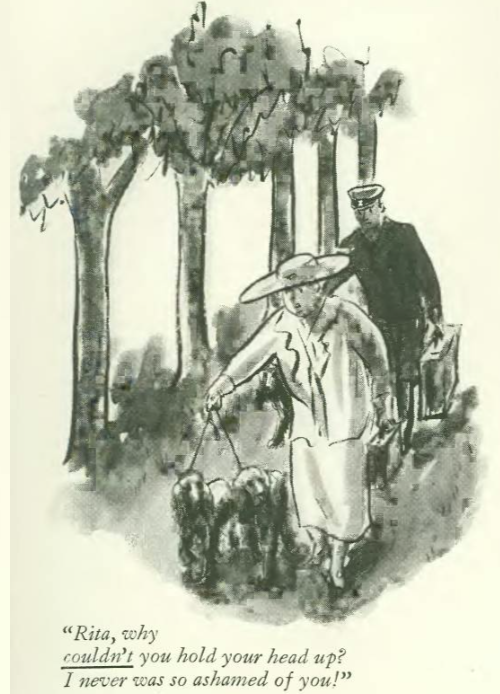
ANSWERING HIS NATION’S CALL…W.C. Fields brought joy to millions during the Depression in movies such as Man on the Flying Trapeze. Above, from left, Kathleen Howard, Fields, and Mary Brian. (IMDB/Rotten Tomatoes)SHORE LEAVE…At left, Wallace Beery, Jean Harlow, and Clark Gable on the set of China Seas; top right, Hattie McDaniel with Harlow in a scene from the film; below, Gable, Rosalind Russell, and C. Aubrey Smith with Harlow in China Seas. (musingsofaclassicfilmaddict.wordpress.com / Pinterest)FRESH FACE…Cinema newcomer Rita Hayworth was credited as Rita Cansino (she was born Margarita Carmen Cansino) in Dante’s Inferno. Here she is flanked by Spencer Tracy and Gary Leon. Dante’s Inferno was Spencer Tracy’s final film for 20th Century Fox. It was at MGM where his career really took off. (IMDB)
* * *
All Wet
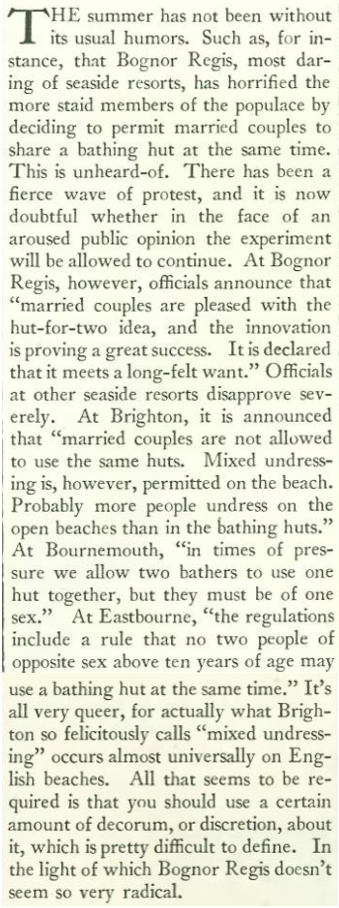
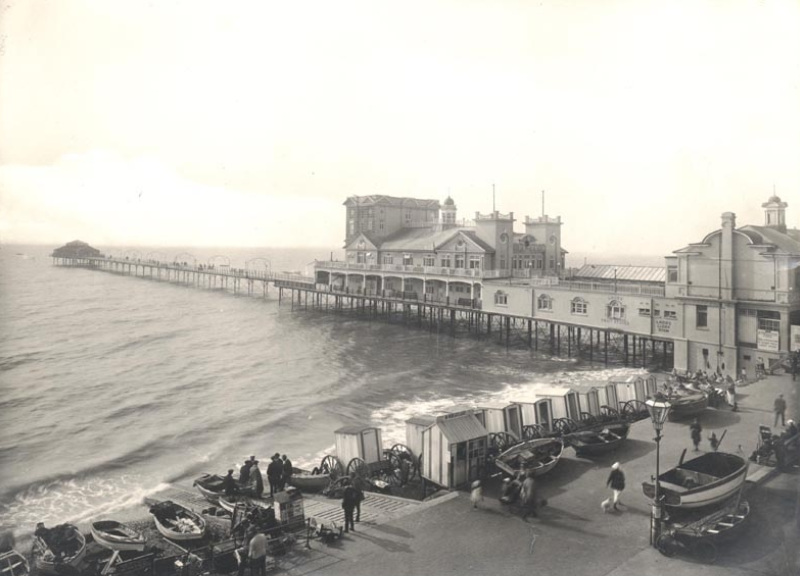
In his London Letter, Conrad Aiken (pen name Samuel Jeake Jr) examined the priggish ways of England’s seaside resorts.
SITE OF SCANDAL…Bathing huts at Bognor Regis, circa 1921. (bognorregistrails.co.uk)
* * *
Beware the Bachelor
In her “Tables for Two” column, Lois Long examined some of the city’s seasonal escapes for “summer bachelors.”
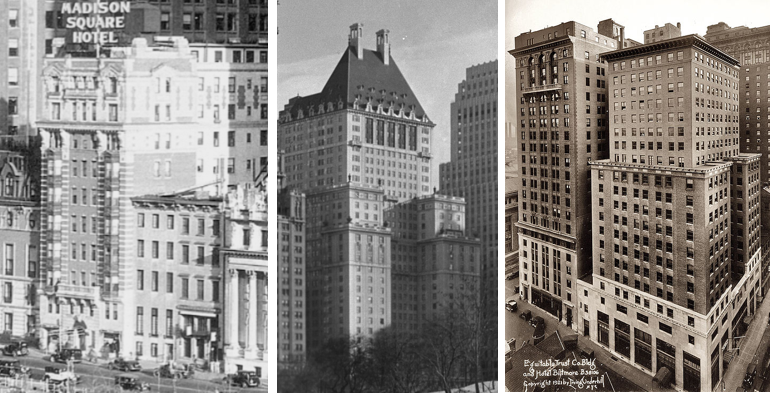
GHOSTS OF THE PAST…Lois Long recommended the air-conditioned lounges of the Madison Square Hotel and the Savoy Plaza (center) or the cooling breezes of the Biltmore roof (right), which featured music by Morton Downey. Sadly, all three of these beautiful buildings have been demolished. (geographicguide.com/Wikipedia)
Other more casual venues recommended by Long included Nick’s Merry-Go-Round…
…a menu from Nick’s dated 1937…
(nypl.org)
…and its cryptic back cover…
From Our Advertisers
…speaking of the Biltmore and Morton Downey, we kick off our advertising section…
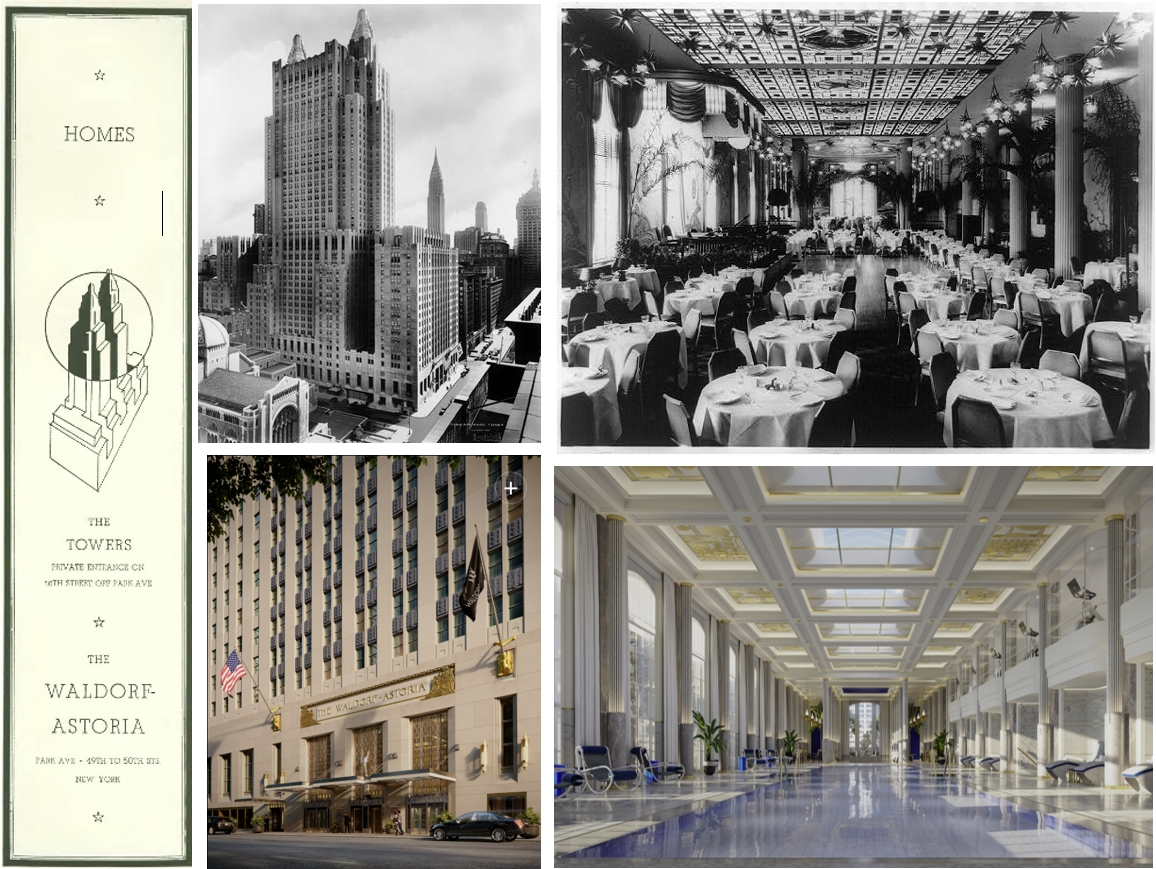
…the ad on the left announced the private residences at the Waldorf-Astoria…
Clockwise, from top left, the Waldorf Astoria circa 1930; the Waldorf’s Starlight Roof in the 1930s; after eight years and billions in restorations and renovations, the hotel has seen many changes including the transformation of the Starlight Roof into a swimming pool. Decades of grime were also cleaned from the building’s exterior. (mcny.org/loc.gov/som.com)
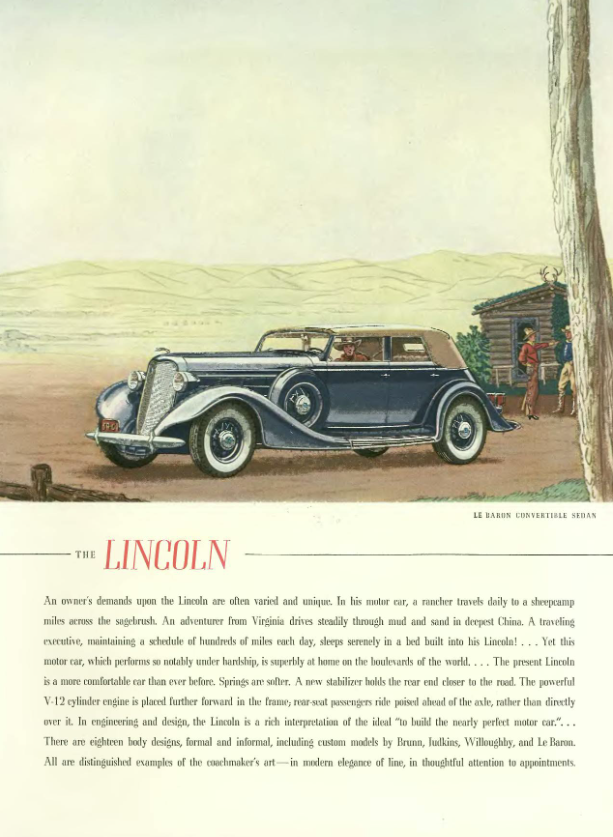
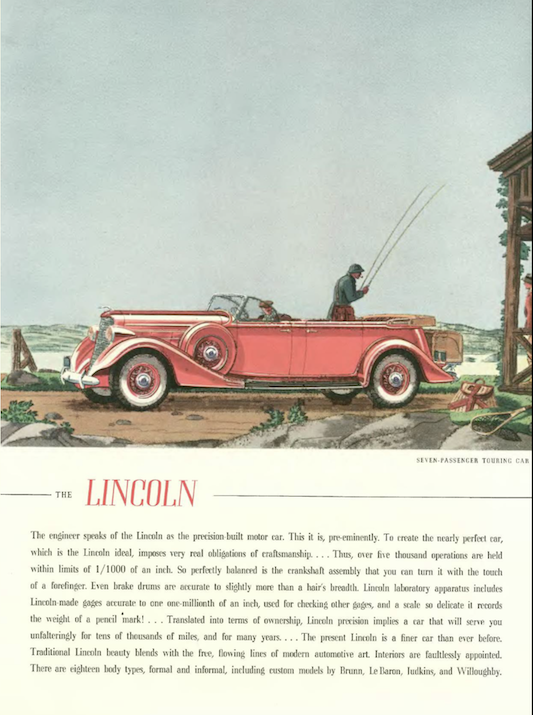
…another ad from the makers of Lincoln suggesting that the market for their luxury auto wasn’t confined to citified execs…
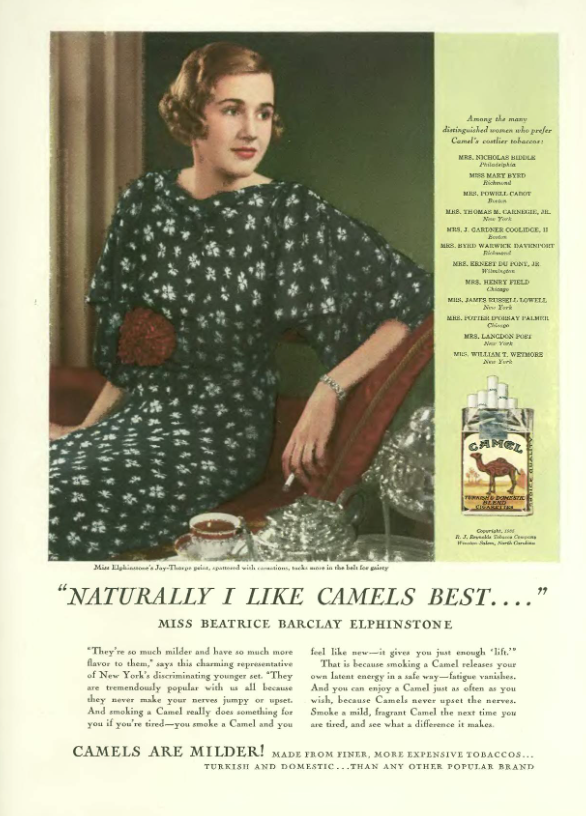
…the Camel folks introduced us to their latest society shill…
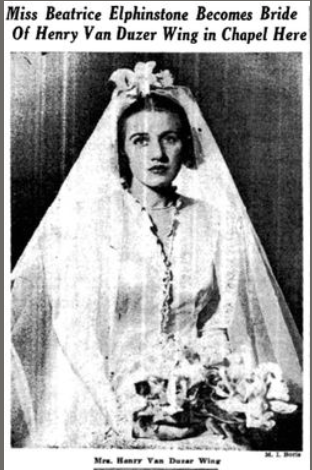
…I didn’t find much about Beatrice Barclay Elphinstone (1916-1977), described in the Camel ad as a “charming representative of New York’s discriminating younger set”…she did make the Times‘ Dec. 10, 1937 society wedding announcements, however…
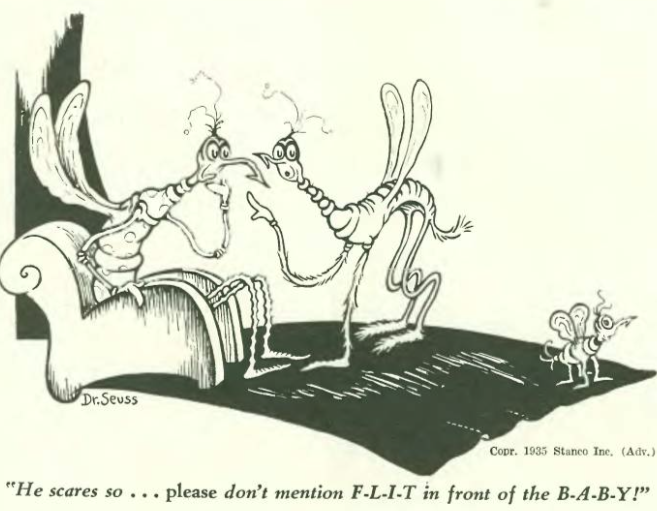
…Dr. Seuss was back with another twist on Flit insecticide…
…on to our illustrators and cartoonists, a nice charcoal by Hugo Gellert for a profile titled “Yankee Horse Trader,” written by Arthur C. Bartlett…the harness horse racing legend Walter Cox (1868-1941) was known in New England as “the king of the half-milers”…
…James Thurber contributed this cat and dog face-off to the opening pages…
…Helen Hokinson offered her perspectives on the summer dog show across pages 16-17…
…and for a closer look…
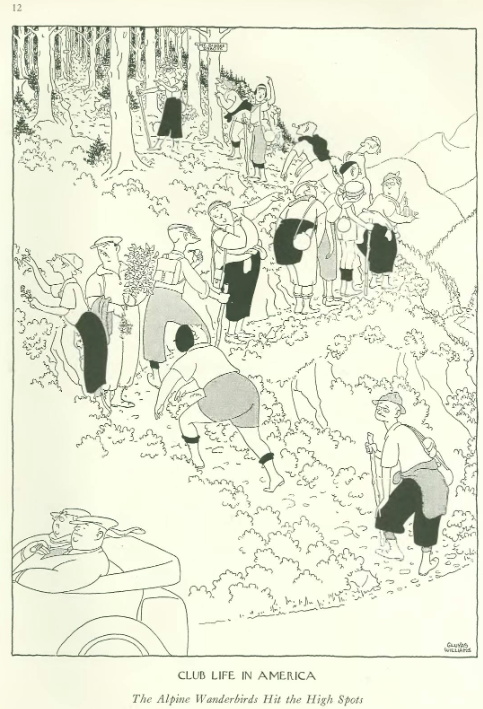
…Gluyas Williams went back to nature in his “Club Life” series…
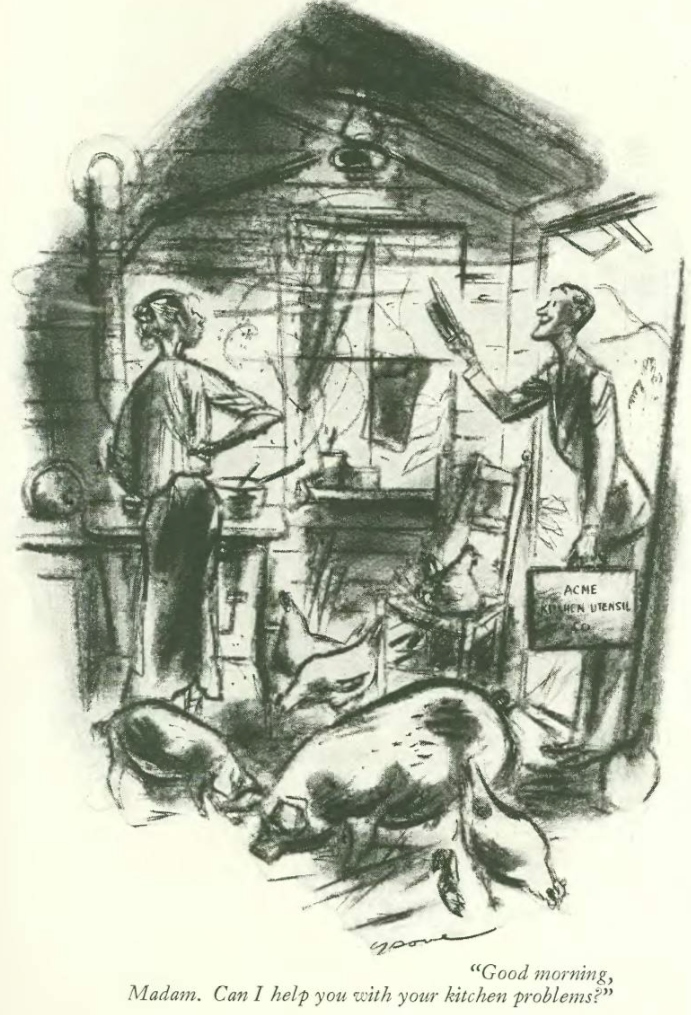
…Leonard Dove introduced us to an undaunted salesman…
…in the world of George Price, crime didn’t pay…
…Barbara Shermund gave us a rare glimpse into the secret lives of men…
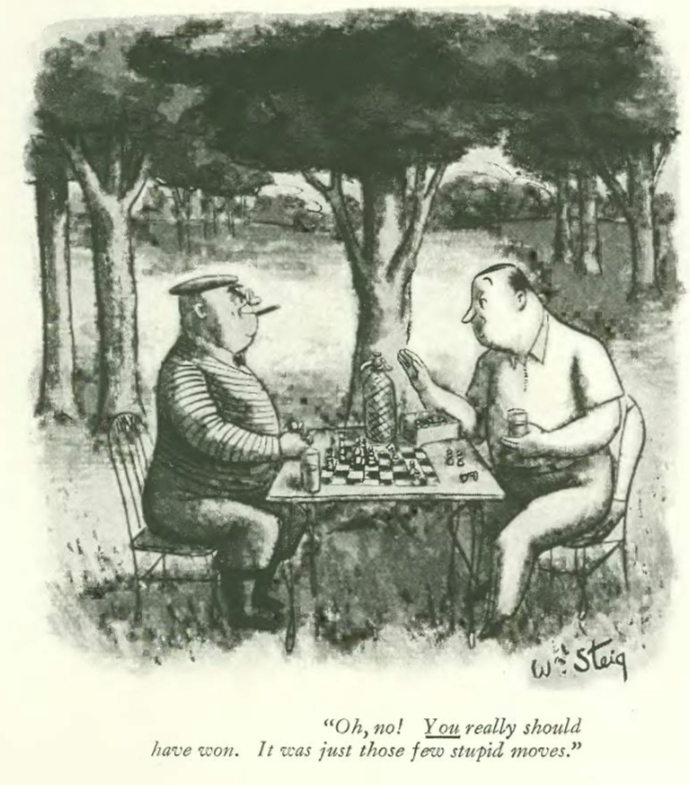
…patronizing words were unwelcome at this chess match, per William Steig…
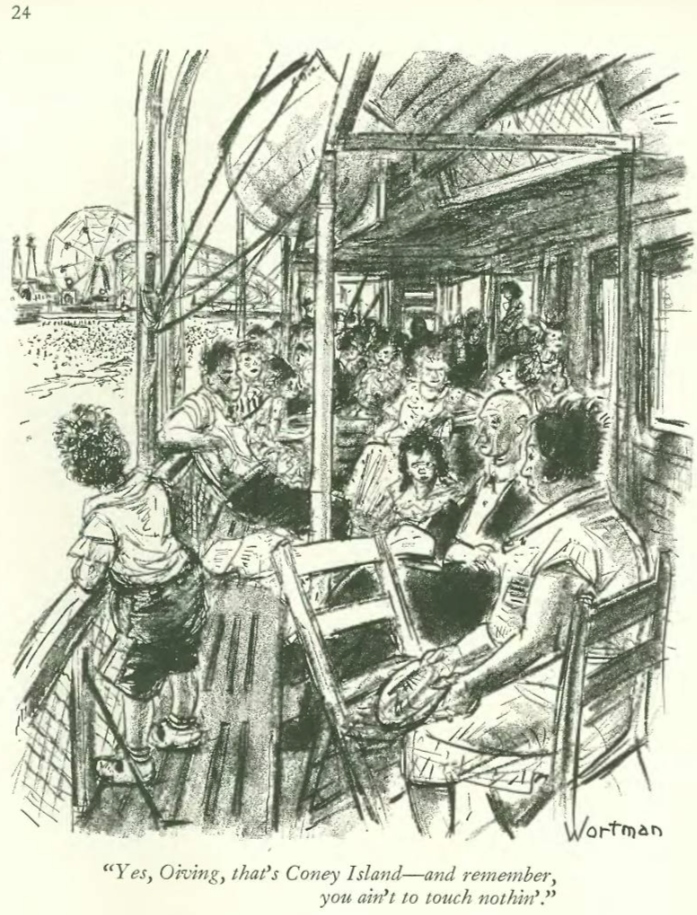
…Denys Wortman took us on a family outing…
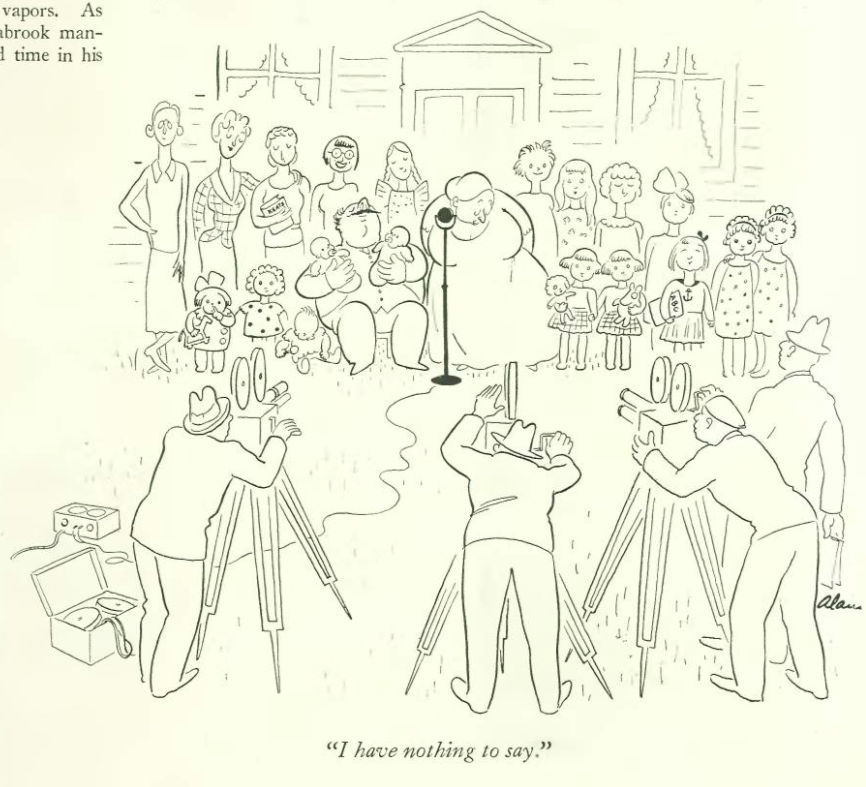
…and we close with Alain, and a mother of multiples…except words…
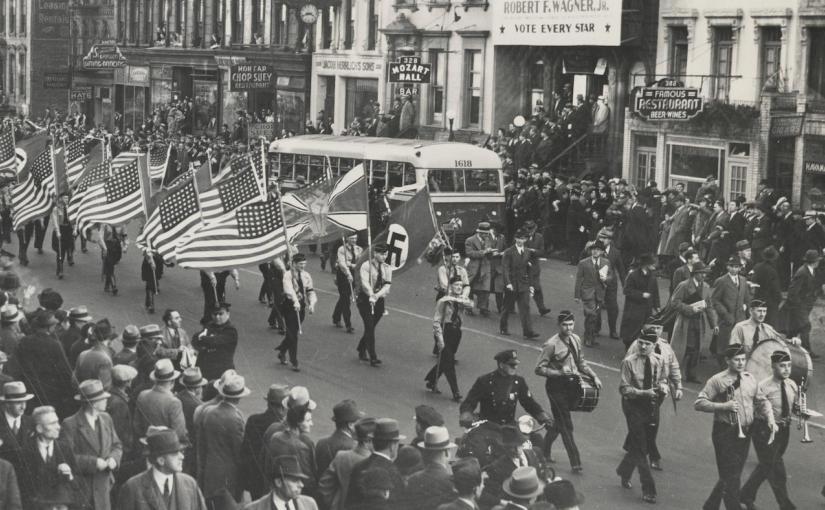
Above: A German American Bund parade in New York City on East 86th Street. Oct. 30, 1937. (Library of Congress)
Among the many ethnic enclaves of 1930s New York City was a neighborhood that was feeling the influence of world events, and not necessarily in a good way.
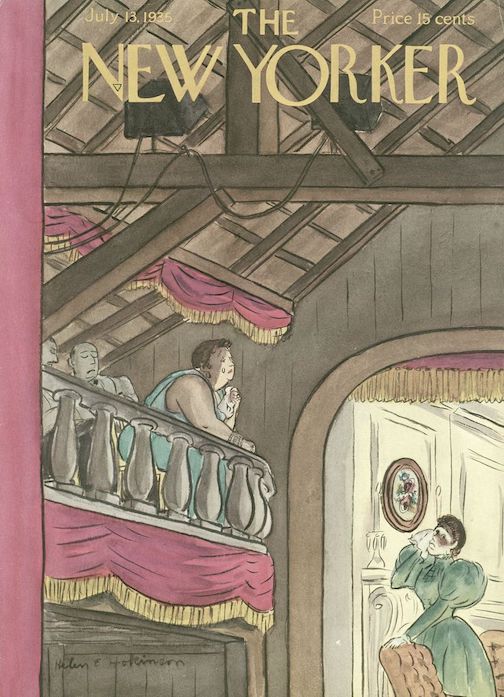
July 13, 1935 cover by Helen Hokinson. One of the first cartoonists to be published in The New Yorker, she appeared in the magazine for the first time in the July 4, 1925 issue. She contributed 68 covers and more than 1,800 cartoons to the magazine.
Journalist Chester L. Morrison looked at life among German immigrants on the Upper East Side for “A Reporter at Large.” Under the title “Muenchen Im Kleinen” (Little Munich), Morrison examined the everyday life of the Yorkville district between East 79th and East 96th streets.
Germans had settled in New York City almost from its first days, and by 1885 the city had the third-largest German-speaking population in the world, outside of Vienna and Berlin, the majority settling in what is today the East Village. Following the General Slocum disaster in 1904, German settlement migrated to Yorkville, which was commonly referred to as Germantown. Here are excerpts of Morrison’s observations:
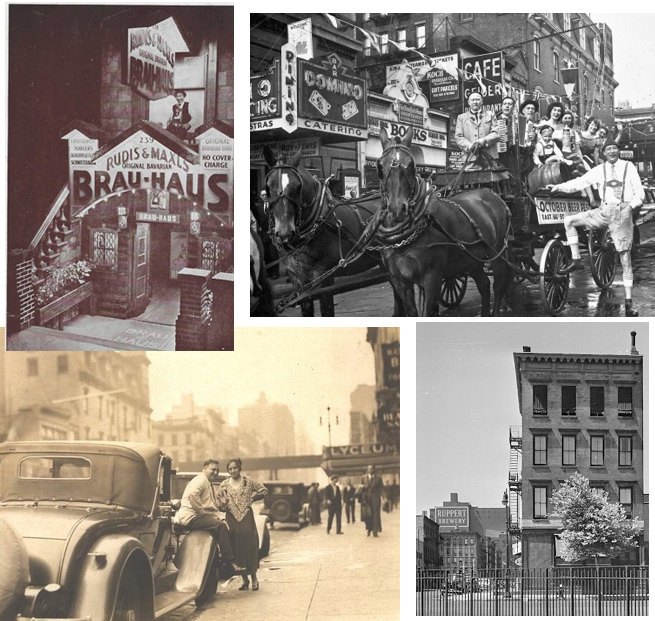
ENCLAVE…Clockwise, from top left, Rudi and Maxl’s Brau-Haus at 239 East 86th; Oktoberfest celebration in Yorkville, undated; Walker Evans photo with Rupert Brewery sign in the background; the Yorkville neighborhood in the 1930s with the old Third Avenue El in the background. (postcardhistory.net/boweryboyshistory.com/metmuseum/gothamcenter.org)
With the rise of the Nazi Party in Germany in the 1930s, a pro-Hitler group called the German-American Bund began to organize street rallies and marches on 86th Street and on 2nd Avenue. Although they represented a minority of German settlers, the Bund made itself visible in parades and other public events that culminated in a mass demonstration at Madison Square Garden in 1939. The Bund also organized training camps for young men outside of the city, such as Camp Siegfried in Yaphank, L.I.
Morrison noted that Yorkville homes looked like many others across the city, that is until you saw the pictures on their walls.
SCOUT’S HONOR?…At a German-American Bund camp in Andover, New Jersey, young campers stand at attention as the American flag and the German-American Youth Movement flag are lowered at sundown, July 21, 1937. (AP)THE MADNESS OF CROWDS…A German-American Bund color guard marches through Madison Square Garden, Feb. 20, 1939. (AP)
* * *
Garden Varieties
Now for a palate cleanser as we turn to Lois Long and her “Tables For Two” column, in which she examined the confluence of hotel gardens and marriage proposals. Excerpts:
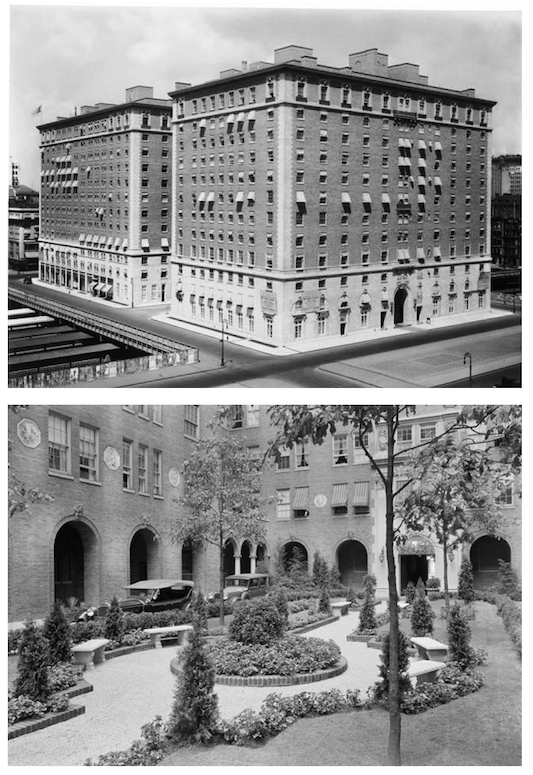
OASIS…Lois Long recommended the Hotel Marguery’s formal garden as a place to “fritter away” an afternoon. The hotel was demolished in 1957 to make way for the Union Carbide Building. (Museum of the City of New York)A COOL, SWISS CHALET was how Long described the new Alpine Room in the basement of the Gotham Hotel. (daytoninmanhattan.blogspot.com)
Long continued as she set her sights on Brooklyn…
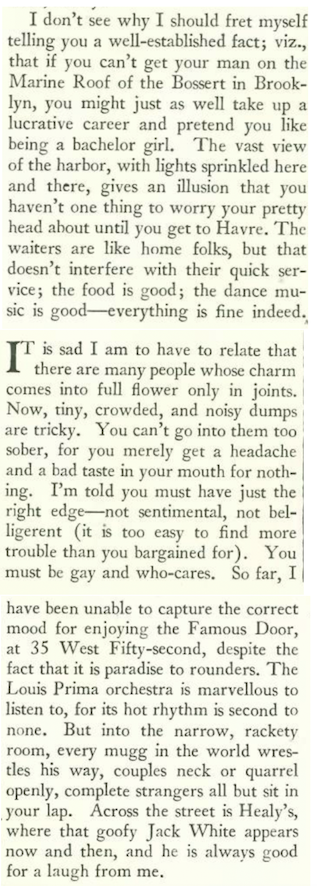
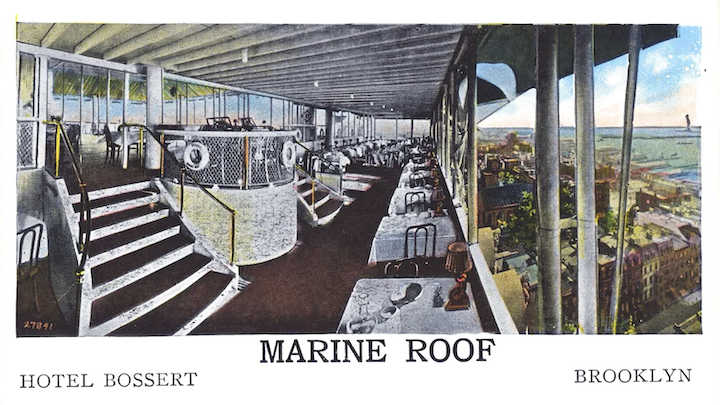
HE WILL LIKELY SAY YES, according to Long, if you got your beau to accompany you to the roof of the Hotel Bossert in Brooklyn. (brownstoner.com)THE TUNEFUL SURROUNDINGS of the Famous Door were a bit too crowded for Long, however this group seems to have had plenty of room to enjoy the greats Ben Webster, Eddie Barefield, Buck Clayton, and Benny Morton on stage at the Famous Door in 1947. (Wikipedia)
* * *
Monster Mash-up
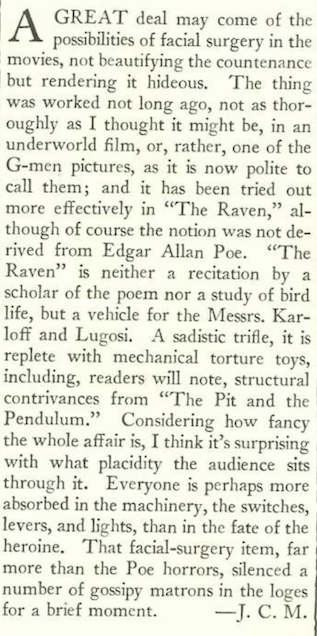
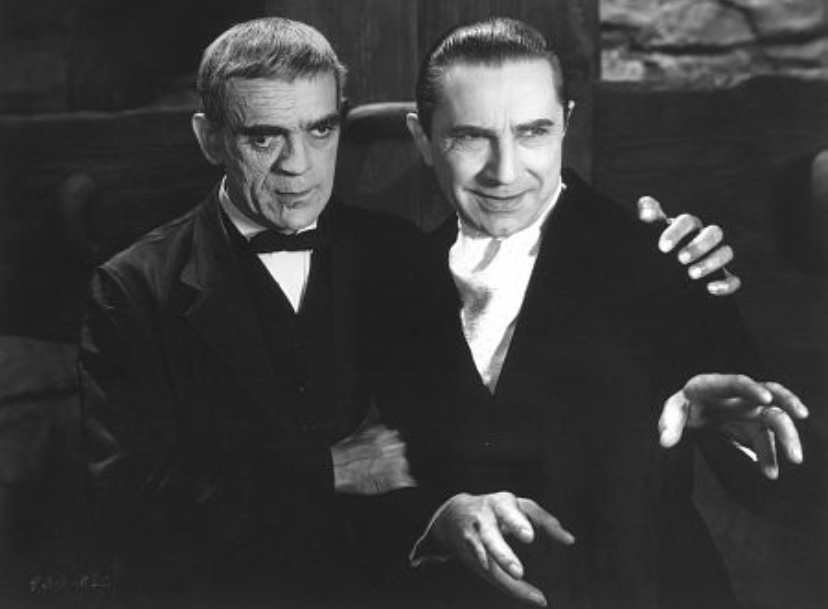
Boris Karloff and Bela Lugosi are synonymous with 1930s monster flicks (they did eight together) but their latest outing, The Raven, left critic John Mosher wondering where the Poe was in the midst of this “sadistic trifle.”
BUDDY FILM…The Raven (which had almost nothing to do with Edgar Allen Poe’s famous narrative poem) was the third of eight films that featured Boris Karloff and Bela Lugosi. According to film historian Karina Longworth, thanks to a wave of monster movie hits in the 1930s, these two middle-aged, foreign, struggling actors became huge stars. (cerealatmidnight.com)TYPECAST? WHO CARES?…Bela Lugosi and Boris Karloff in 1932. Despite being monster movie rivals, the two seemed get along well off-screen, perhaps appreciating their mutual good fortune. (beladraculalugosi.wordpress.com)
* * *
Ode to Education
Clarence Day, best known for his Life With Father stories, also contributed a number of cartoons to The New Yorker that were accompanied by satirical poems…here he examines attempts at education in the arts and sciences…
* * *
From Our Advertisers
We start at the back of the book, and a couple of one-column ads (appearing on the opposite sides of the same page) that catered to very different clientele…
…the makers of Lincoln luxury cars knew the type of client they were fishing for here…
…pin-up artist George Petty continued exploring his beauty and the beast theme on behalf of Old Gold cigarettes…
…and Camel offered more reasons why you should smoke your way to athletic glory…
…this inside back cover advertisement reminds us that we are indeed back in 1935…
…as does this one from Dr. Seuss, with a shot of insecticide for a talking toddler…
…on to our cartoonists, beginning with Charles Addams and some Navy hijincks…
…Gluyas Williams offered his latest take on American club life…
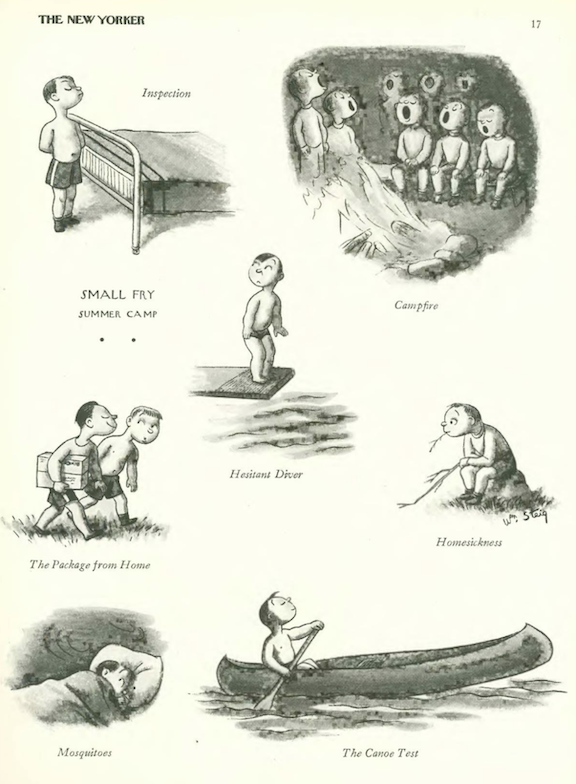
…William Steig took us to summer camp…
…Otto Soglow looked for a good night’s rest…
…Mary Petty explored the latest in bathing fashions…
…Perry Barlow introduced us to some proud parents…
…and to close with Helen Hokinson, who showed us some innocents abroad…
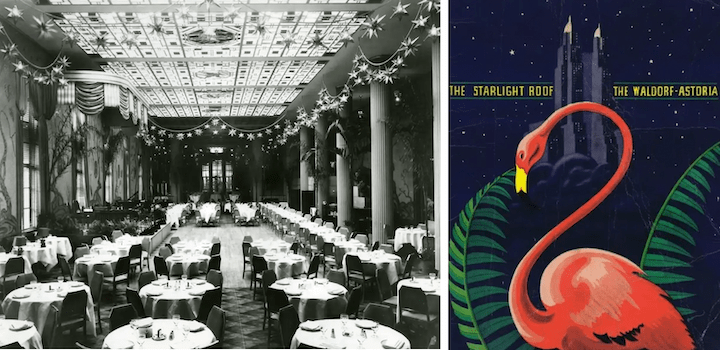
Above: The Waldorf-Astoria's Starlight Roof, and a 1930s menu cover. (Facebook/Pinterest)
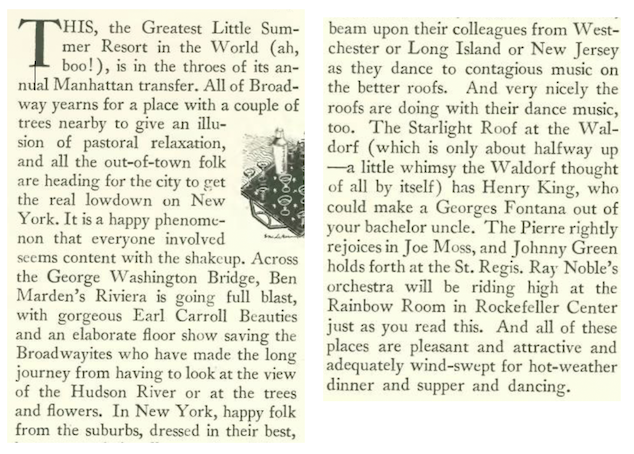
With summer approaching, the rooftop restaurants were in full swing, and Lois Long continued her exploration of favorite haunts, including one nightclub that drew many Manhattanites across the Hudson to the cliffs of the New Jersey Palisades.
June 1, 1935 Cover by Rea Irvin.
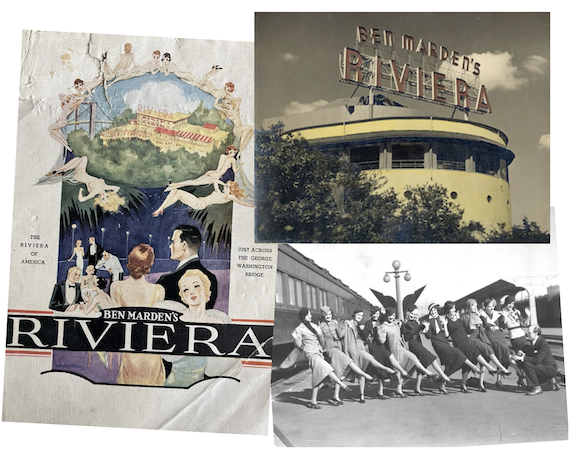
Ben Marden couldn’t wait for the official end of Prohibition when he opened his Riviera Night Club in Fort Lee in 1931. The frequent site of raids until the repeal of the 18th Amendment, the Riviera continued to be a place well known to Bergen County police thanks to clientele that included racketeers and other unsavory types. But to New Yorkers like Long, it was a break from the din of the city to the relative green of the Garden State. Long wrote:
The Riviera closed during the first years of World War II, but it reopened in 1945 after Bill Miller bought it from Marden and apparently cleaned it up. It then attracted the likes of Frank Sinatra, Dean Martin, Jerry Lewis, Martha Rae, Sammy Davis, Jr., and Pearl Bailey until it closed in 1953. It was demolished the following year.
THEY HAD FOOD, TOO…Clockwise, from left, the1936 spring menu cover of Ben Marden’s Riviera featured an illustration of the original Riviera (ringed by nude showgirls), which burned to the ground on Thanksgiving night, 1936; the building that replaced it was called an architectural wonder with its retractable roof, rotating stage, and glass windows that slid down to the floor; Earl Carroll and his “Beauties” performed at the Riviera in 1935–they are pictured here at a train station in Los Angeles, 1934. (ebay.com/patch.com/lapl.org)
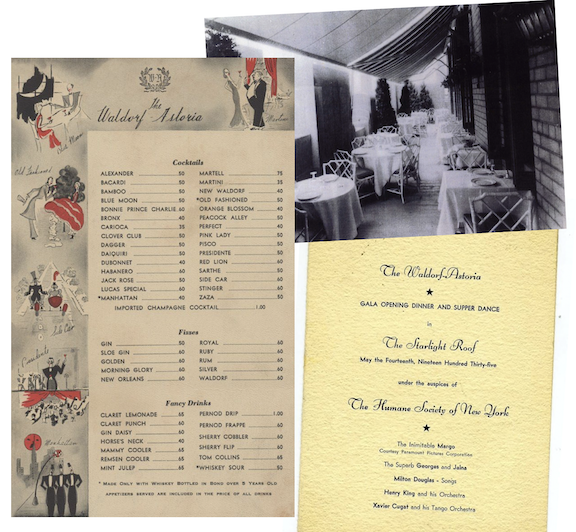
Long also stayed in town to visit the Waldorf-Astoria’s Starlight Roof.
WITH THE STARS, UNDER THE STARS…Clockwise, from left, cocktail menu from the Waldorf’s Starlight Roof, 1935; outdoor seating on the Starlight Roof Terrace; special menu for the Gala Opening Dinner and Supper Dance on the Starlight Roof, May 14, 1935. It was a favorite destination of Frank Sinatra, Cole Porter, Katharine Hepburn, and Ella Fitzgerald, among others. (Pinterest)
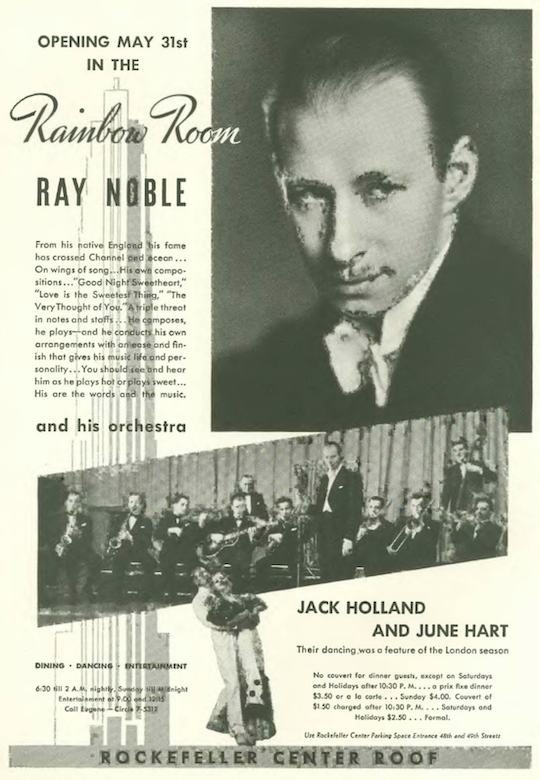
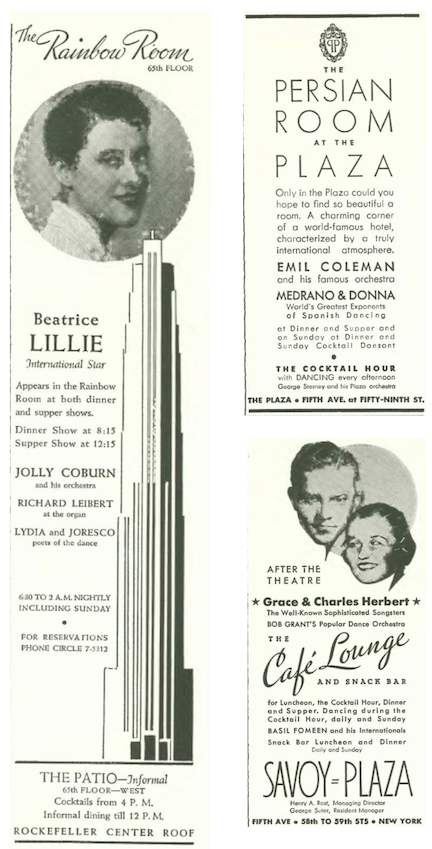
Long also mentioned the appearance of Ray Noble in the Rockefeller Center’s Rainbow Room. This full-page ad appeared in the June 1 issue:
Other summer season attractions were advertised in numerous back-of-the-book, one-column advertisements:
…and at the bottom of page 64…
Wining and dining were also the topic of the profile, a two-parter penned by Margaret Case Harriman, who took a look at New York’s famed Colony Restaurant.
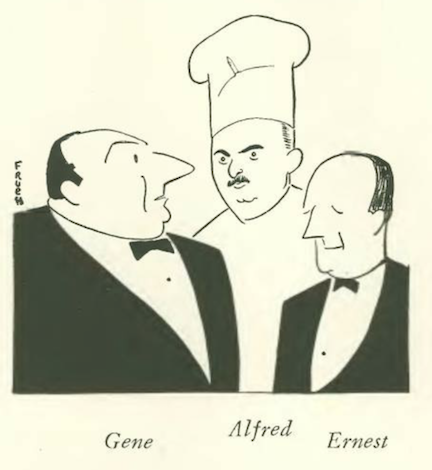
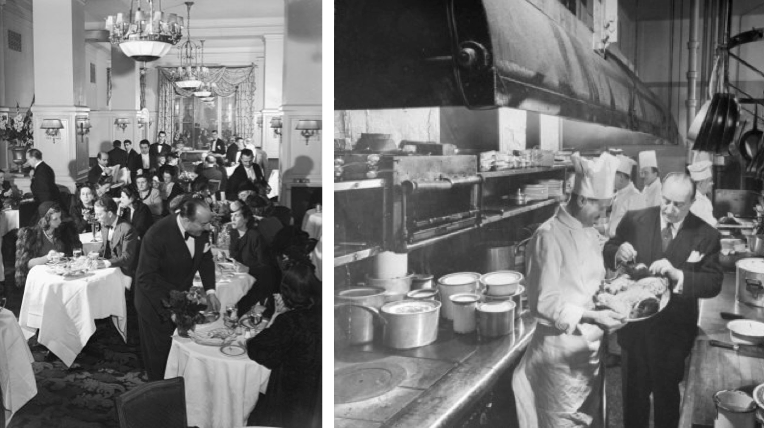
ORIGINAL TRIO…Al Frueh’s caricatures of the Colony’s owners/headwaiters Gene Cavallero and Ernest Cerutti, who flank chef Alfred Hartmann, who was also part owner until he sold his interest to the other two in 1927 and retired to a farm in France. Harriman wrote that Cavallero and Cerutti were “born headwaiters—suave, solicitous, infallible.”A PLACE TO BE SEEN…From the 1920s to the 1960s New York’s café society dined at the Colony. Rian James, in Dining In New York (1930) wrote “the Colony is the restaurant of the cosmopolite and the connoisseur; the rendezvous of the social register; the retreat of the Four Hundred.” Critic George Jean Nathan said the Colony was one of “civilization’s last strongholds in the department of cuisine.” Photo at left of the dining room around 1940; at right, co-owner Eugene Cavallero consults with a chef. (lostpastremembered.blogspot.com)
* * *
The Business of News
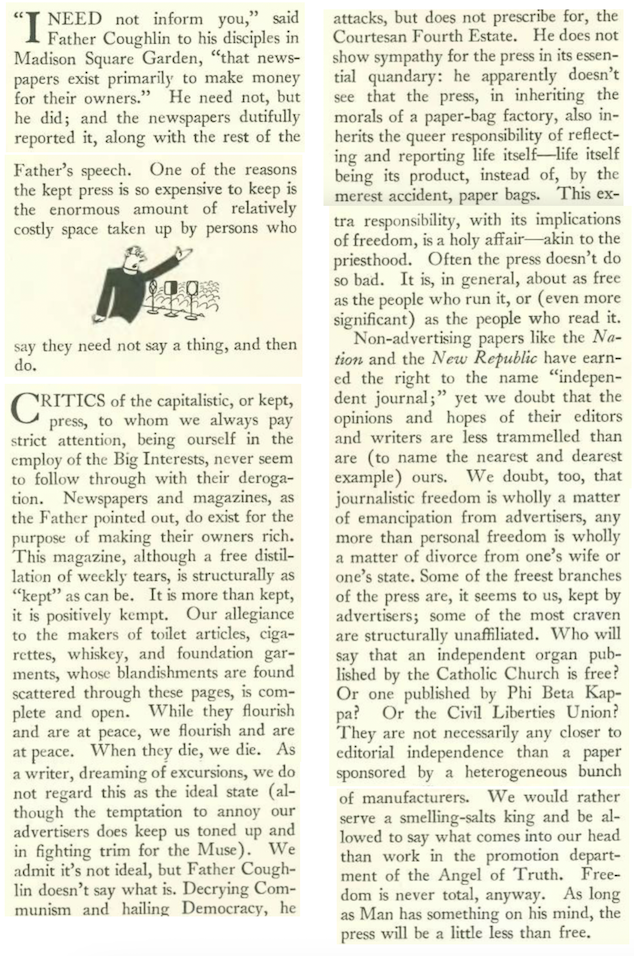
In his “Notes and Comment,” E.B. White contemplated the meaning of a free press, noting that nearly all media was at the mercy of advertisers. That included The New Yorker, which owed allegiance “to the makers of toilet articles, cigarettes, whiskey, and foundation garments.”
* * *
Cat Lady
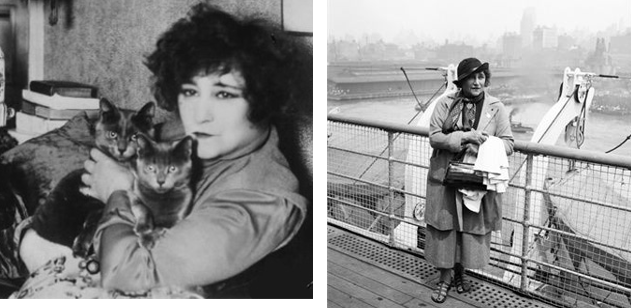
“The Talk of the Town” anticipated the arrival of French writer Colette (1873-1954) aboard the S.S. Normandie. This excerpt makes note of her high standing in society as well as her love of cats.
SHE ONCE OWNED AN OCELOT….Colette with her cats in an undated photo; at right, entering New York Harbor on the S.S. Normandie, 1935. (Pinterest)
* * *
Public Artists
“The Talk of the Town” noted the latest Washington Square Outdoor Art Exhibition…
LENDING THEIR TALENTS…New Yorker cartoonists who helped promote the Outdoor Art Exhibition in Washington Square included James Thurber, Otto Soglow, and William Steig.
* * *
Cutting Remarks
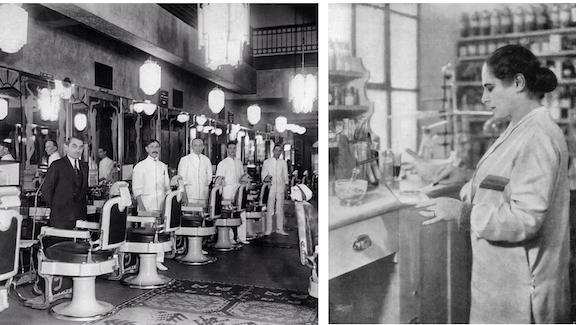
S.J. Perelman offered his thoughts on the decline of the tonsorial arts. In this excerpt, he sees his beloved Italian barber give way to a “knifelike individual in a surgical apron.” Excerpts:
IT’S A SCIENCE NOW, SIDNEY…S.J. Perelman worried about the displacement of Italian barbershops by cosmetologists in “surgical aprons,” such as the one modeled by Helena Rubinstein at right. (Pinterest)
* * *
Even Those Eyes Couldn’t Help
Film critic John Mosher was sad to report that disappointment was in store for moviegoers who enjoyed seeing Bette Davis in Of Human Bondage. Her latest flick, The Girl from 10th Avenue, featured Davis murmuring “gentle nothings of a vaguely noble monotony.”
GET ME OUT OF THIS PICTURE…Left, Bette Davis with Ian Hunter in the uninspired The Girl from 10th Avenue; at right, screen shot of Davis in 1934’s Of Human Bondage, the film that made Davis a star. (thefilmexperience.net)
Other items in the editorial section included a casual by Dorothy Parker’s husband Alan Campbell (titled “Loyalty at Pool-Wah-Met”), and Morris Markey examined the Christian Science movement inspired of Mary Baker Eddy, in “A Reporter at Large” piece titled “But Thinking Makes It So.”
* * *
From Our Advertisers
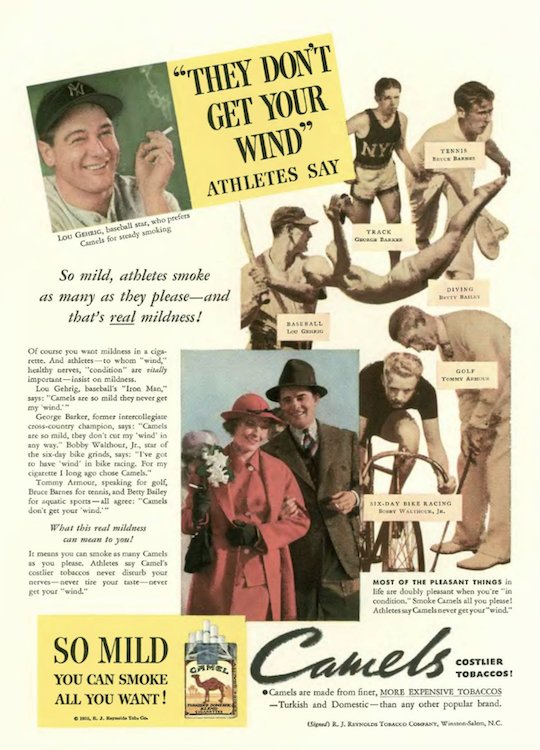
We begin with an advertising theme common through midcentury, namely, that you could smoke certain brands as much as you liked and still be a star athlete (as opposed to a wheezing husk of a human being)…
…not only did these cigarettes “steady your nerves” and preserve your “wind,” they also made for sweet, romantic moments…
…in between puffs you could also enjoy breathing in fumes from leaded gasoline…lead pollution increased by more than 625 times previous levels after leaded fuels were introduced in 1924…
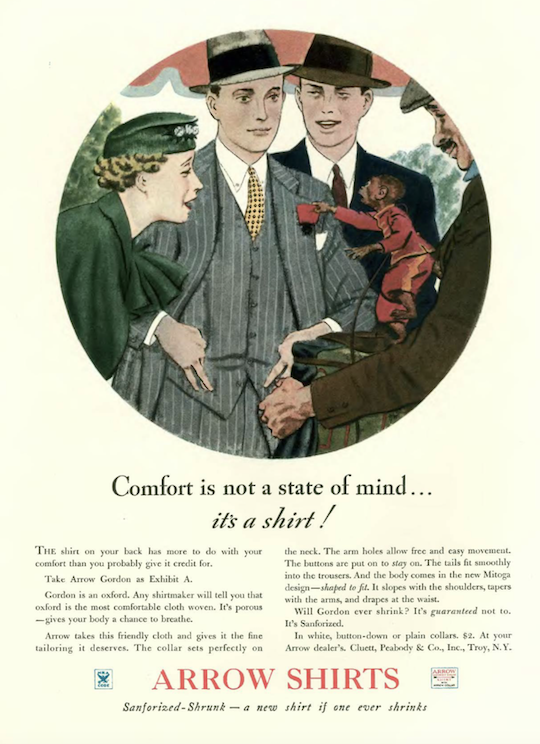
…although they were being outlawed by New York Mayor Fiorello Henry La Guardia, an organ grinder nevertheless made an appearance in an Arrow Shirt ad that offered a lighthearted moment for all involved (except for the dude on ketamine)…
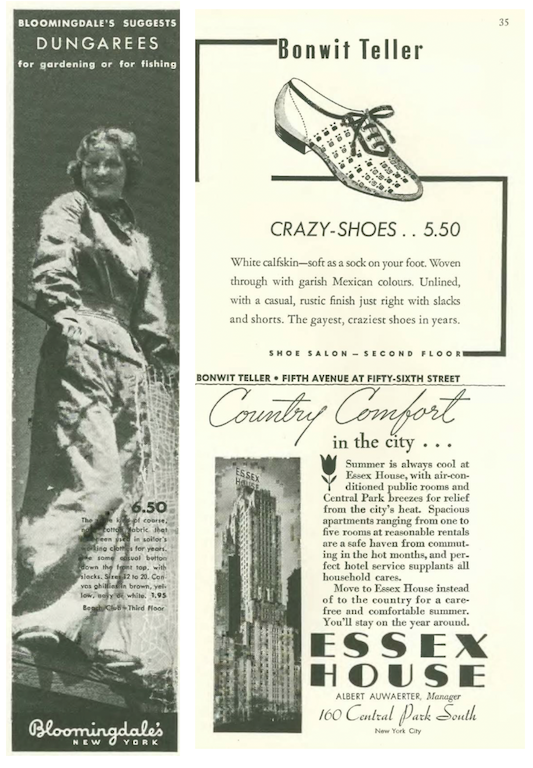
…when jeans were called “dungarees” they were reserved for gardening or fishing…at right you could land a pair of “Crazy Shoes” woven with “garish Mexican colours” for five-and-a-half bucks…
…the makers of White Rock kept it cool with this minimalist ad…
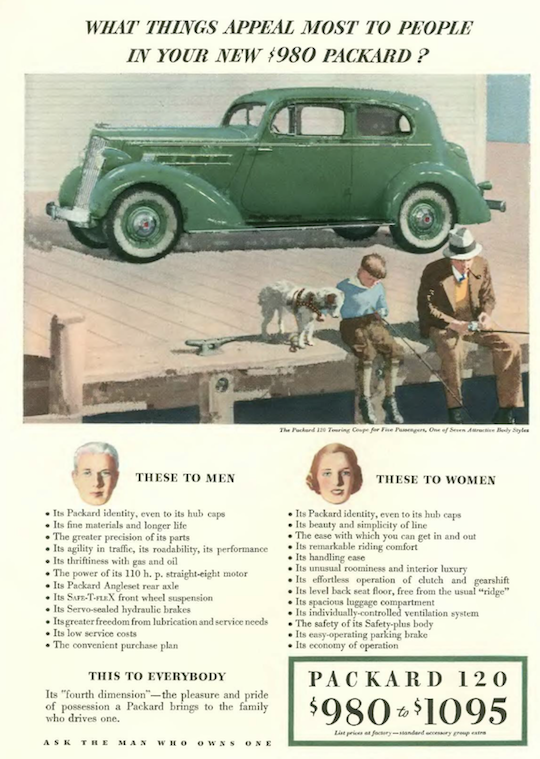
…luxury automaker Packard continued to hang on through the Depression by offering a downscale version…it appears their demographic was middle-aged men and women who still preferred the finer things even if they couldn’t afford them…
…now the property of Hearst, Otto Soglow’s Little King could still appear in The New Yorker via the advertising sections…
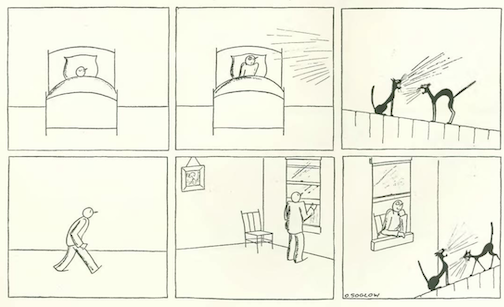
…and Soglow continued his contribution to the magazine’s cartoons with other multi-panel subjects…
…James Thurber kicked off the cartoonists with this tender spot…
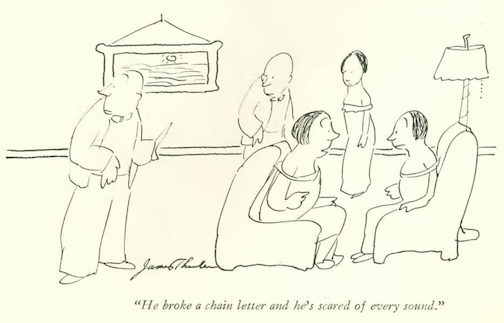
…and contributed this cartoon…
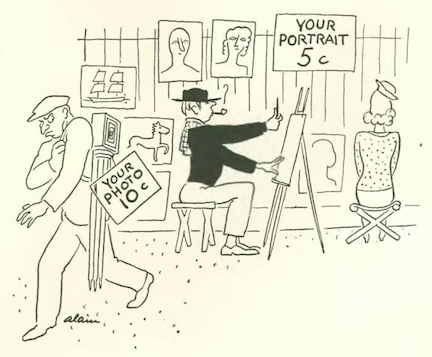
…Alain found competition in the portrait trade…
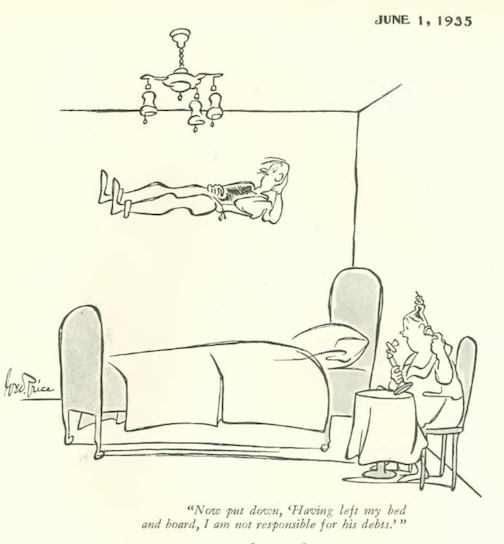
…George Price was still afloat…
…Charles Addams was tied up with the sculptural arts…
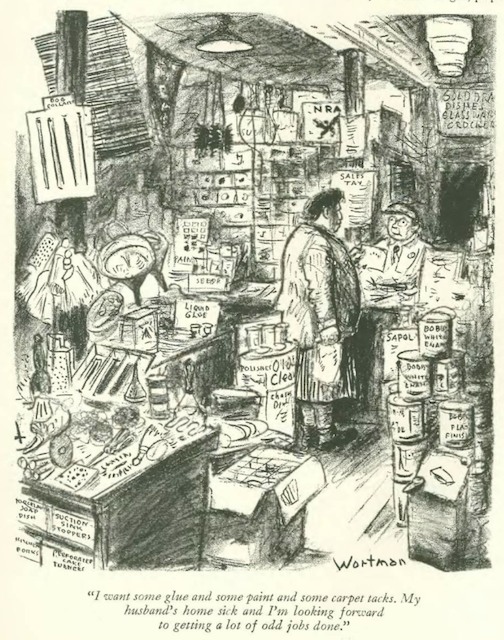
…Denys Wortman shopped for DIY projects…
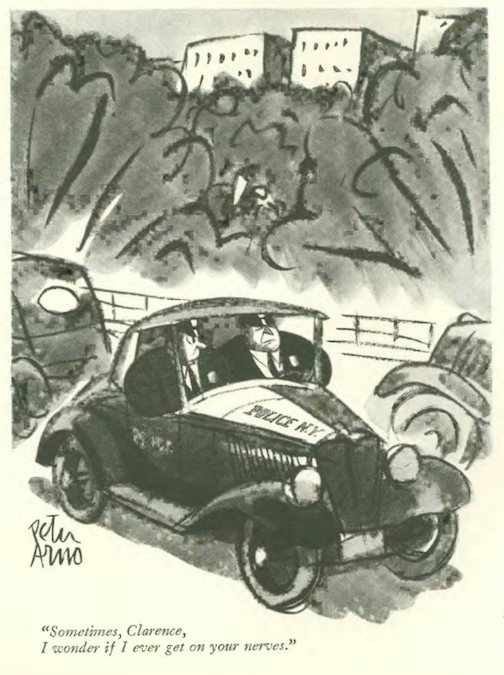
…Peter Arno found a sensitive side in one member of the NYPD…
…Mary Petty made some alterations…
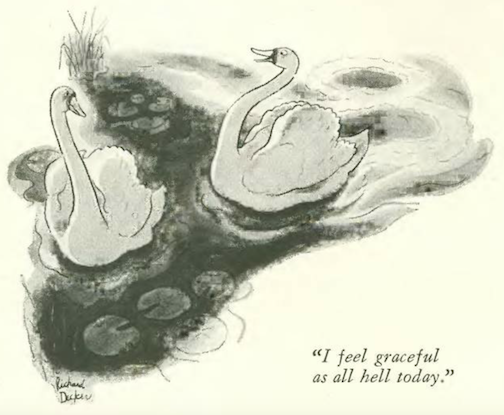
…and we close with this terrific cartoon by Richard Decker…
Above: Landscape in Bayside, 1935, by George Grosz (Phillips Collection)
Knowing that the Nazis would not look kindly on his art, George Grosz took a job teaching drawing in New York in 1932, and by 1933 he had become a permanent resident of the city.
March 30, 1935 cover by Garrett Price celebrated the traditional “Bock” beer of spring.
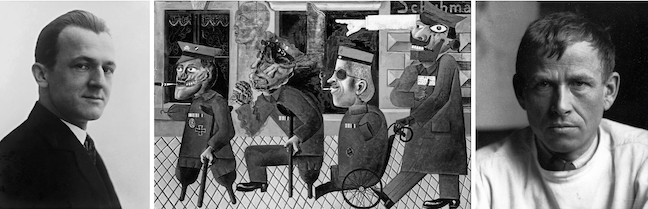
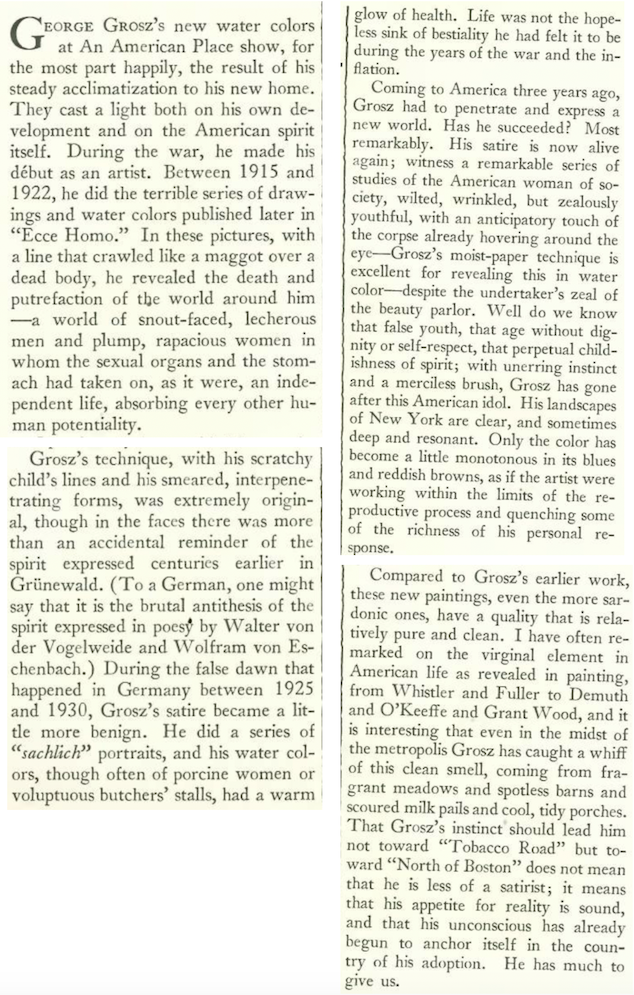
Grosz (1893–1959) was overwhelmed by the size and pace of his adopted city, and for the most part he left behind his bitter caricatures and paintings of Berlin’s Weimar years and turned to other subjects, including landscapes and New York’s urban life. Critic Lewis Mumford took in a show of Grosz’s new water colors at An American Place, a small gallery run by photographer and art dealer Alfred Stieglitz.
THE NEW OBJECTIVITY…George Grosz (left, circa 1921), was not alone in his harsh depictions of war and of German society during the Weimar Republic. Other key figures in the New Objectivity (Neue Sachlichkeit) movement included Max Beckmann and Otto Dix (right, circa 1929). Dix’s oil on canvas War Cripples (Kriegskrüppel), 1920, which is pictured above, was exhibited at the First International Dada Fair in Berlin in 1920. Only black and white images exist of the painting, which is believed to have been destroyed by Nazis who condemned it as degenerate art. (Wikimedia Commons/CUNY)
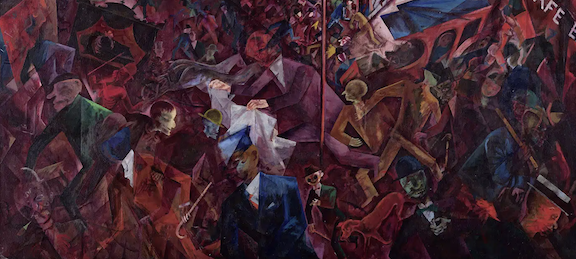
OH THE HUMANITY…Three selections from the “Ecco Homo” series by George Grosz. From left, Gruß aus Sachsen (Greetings from Saxony) 1920; Nachts, (At Night) 1919; and Schwere Zeiten (Hard Times) 1919. Grosz took a dim view of the corruption and moral decline he found in Weimar Berlin. (MoMA)SEEING RED…Detail from George Grosz’sMetropolis, Oil on Canvas, 1916-1917. A blood-like shade of red could be seen in many of the artist’s paintings during World War I and the Weimar Republic. In this painting and in others, death is omnipresent. (Thyssen-Bornemisza Museum, Madrid)A SOFTER SIDE could be found in George Grosz’s later watercolors, although he hadn’t entirely lost his sense of the satirical, or his taste for red paint. From left, Street in Harlem, circa mid-1930s; Ehepaar (A Married Couple), 1930; Central Park at Night, 1936. (Phillips Collection/Tate Gallery/Art Institute Chicago)
* * *
Not the Bee’s Knees
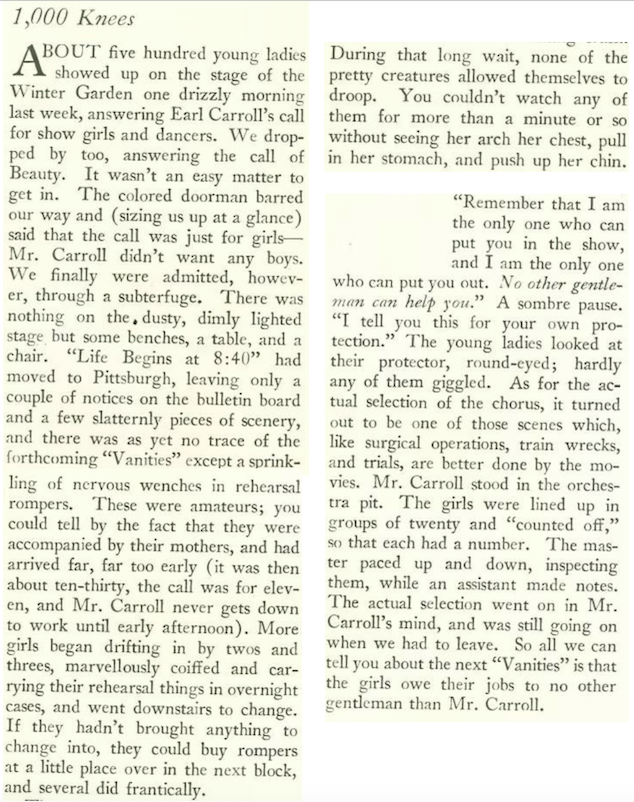
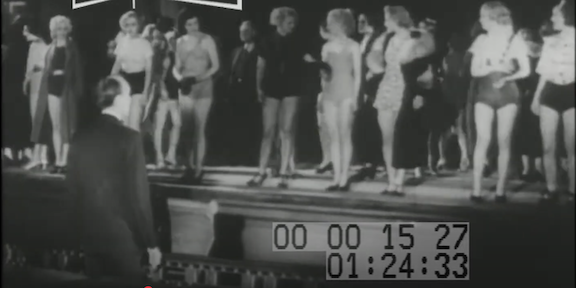
For all the progressive thinking that was on display in the early New Yorker, we also reminded that it was also a creature of its time in 1935. Here are excerpts from a lengthy “Talk of the Town” entry that described the sad winnowing process of Broadway revue producer Earl Carroll…
JUDGEMENT DAY…Here is a screenshot from a short film featuring the 1935 audition described in the “Talk” segment. At left is Earl Carroll. You can watch the film here. (YouTube)
* * *
Too Little For Too Much
Film critic John Mosher gave Alfred Hitchcock’s 1934 version of The Man Who Knew Too Much just five lines in his review. He described it as “one of those preposterous adventure stories which Englishmen are always writing…” The film, however, was an international success, and it would define the rest of Hitchcock’s career as a director of thrillers with a unique sense of humor.
A HAPPY, CAREFREE HOUR is how critic John Mosher described his experience watching 1934’s The Man Who Knew Too Much. Clockwise, from top right, director Alfred Hitchcock with the film’s German star, Peter Lorre, who learned his part phonetically; Lorre and Cicely Oates; Edna Best did her best at playing a grieving mother. The film was remade by Paramount in 1956, starring James Stewart and Doris Day. (Wikipedia/aurorasginjoint.com/IMDB)
* * *
Dizzy Nor Dazzled
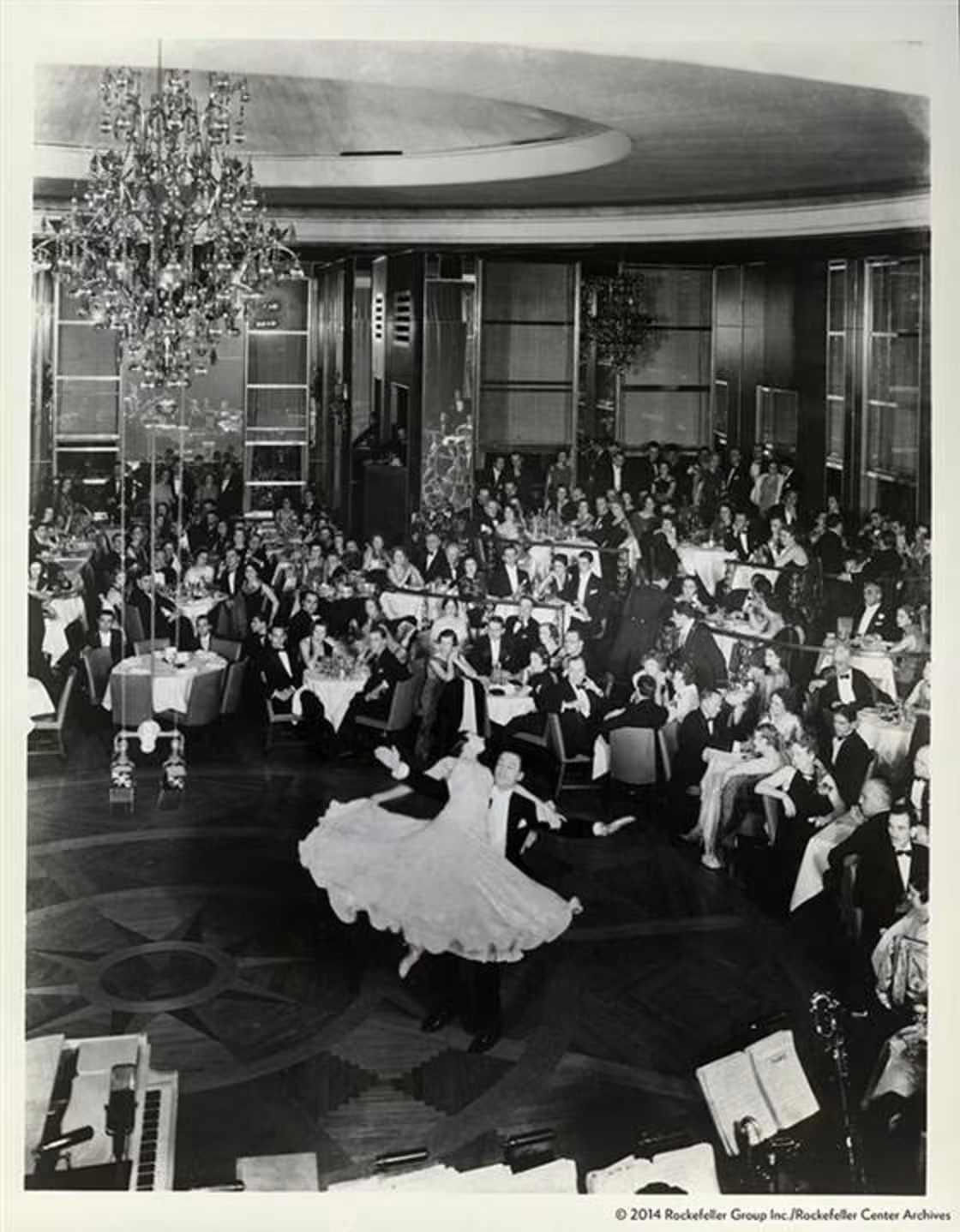
In 1935 Lois Long had been divorced from cartoonist Peter Arno for about four years, and she was the mother of six-year-old daughter from that marriage. That didn’t keep her from sampling the city’s night life, but the days of speakeasies and drinking sessions that lasted into the wee hours were over for the 34-year-old Long. For her “Tables for Two” column she took the elevator up to the 65th floor of 30 Rockefeller Plaza to take in the entertainment at the Rainbow Room…as well as the pedestrian crowd…
WHAT A WHIRL…Above, diners watch a performance by ballroom dancers Lydia and Joresco in the then newly opened Rainbow Room in 1934. Lois Long enjoyed the Rainbow Room in its 1930s heyday, but she missed her old speakeasy crowd, noting that the Rainbow Room’s customers weren’t “dizzy enough” to suit her tastes. (Rockefeller Center Archives)
…her speakeasy days were over, but it appears Long still enjoyed a bit of indulgence…here is how she concluded her column:
* * *
From Our Advertisers
Step into a crowded mid-century elevator and you were bound to catch a whiff of the menthol-tinged scent of Aqua Velva, not objectionable if properly applied…
…speaking of menthol, the makers of Spud cigarettes were now competing with upstart menthol cigarette makers including Kool…this ad has all kinds of problems, including the suggestion that the occasional Spud not only inspires one’s nuptials, but also ensures marital bliss, as well as a lifetime of chain-smoking…
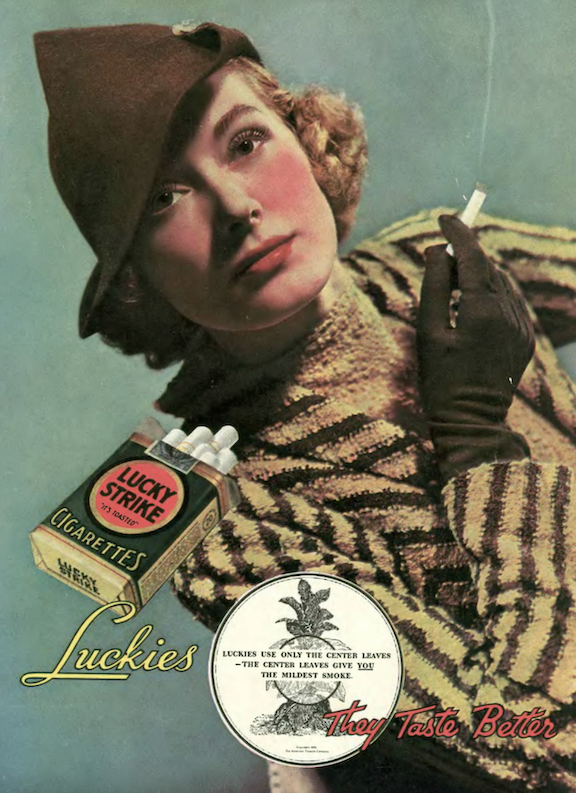
…Luckies, on the other hand, continued to appeal to the modern woman, and what impressionable young woman wouldn’t be inclined to pick up the habit to complete her ensemble?…
…the makers of College Inn tomato juice gave their raving Duchess the week off, but we get another old sourpuss in the form of a “Dowager” who demands that her servant remove a glass of what very well could have been tomato juice…enter the old bat’s niece, Dorothea, who suggests that the cook, Clementina, serve some Libby’s pineapple juice instead, probably spiked with vodka given the Dowager’s sudden change of demeanor…
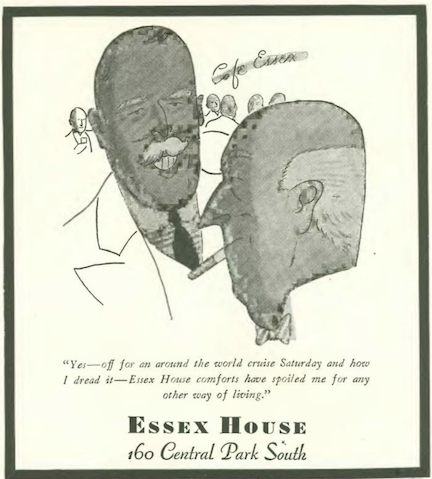
…Essex House continued their class-ridden ad campaign, this time with some stuff-shirt dreading his world cruise
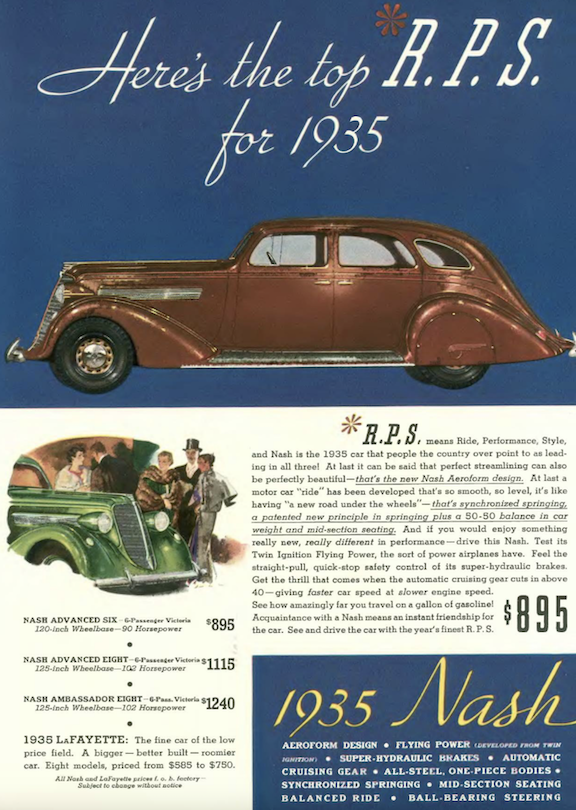
…carmakers continued to emphasize economy and price to move their latest models, including the 1935 Nash with “Aeroform Design”…
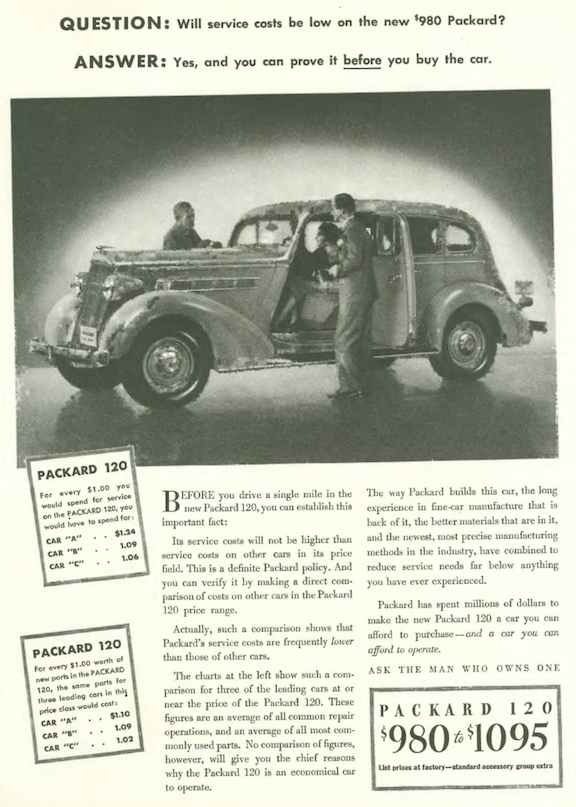
…last week I noted that Packard was doubling down on promoting the elite status of its premium automobile; however, the carmaker did introduce a “120” that cost a fraction of its luxury models and helped the company’s bottom line…
…Packard’s competition was Lincoln and Cadillac, among other luxury brands, but Pierce Arrow represented the pinnacle of luxury and craftsmanship, the American equivalent of Rolls Royce…unlike the other luxury brands, Pierce Arrow did not offer a lower-priced car, and the company folded it 1938…
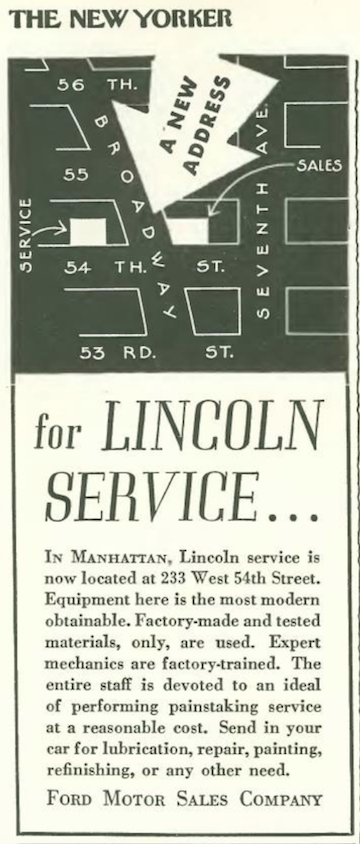
…speaking of luxury cars, if you owned a Lincoln, this little ad tucked into the top corner of page 55 showed you were to go to get a tune-up…
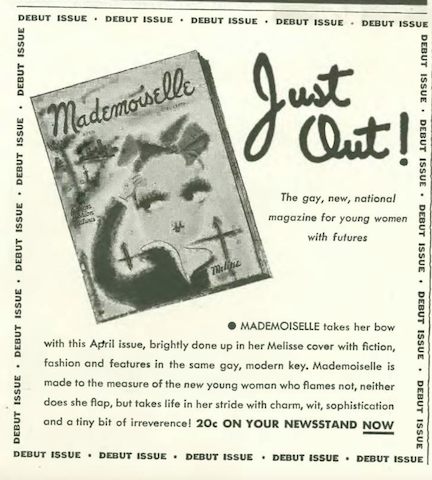
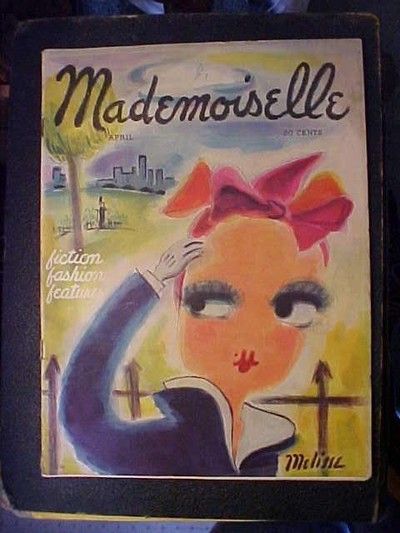
…the publishers at Street & Smith announced the launch of a new fashion magazine, Mademoiselle, a seemingly daring move in Depression America…the cover featured an illustration by Melisse (aka Mildred Oppenheim Melisse)…the magazine was later acquired by Condé Nast, and folded in November 2001…
Mildred Oppenheim Melisse’s cover for the debut issue of Mademoiselle, April 1935. Melisse also supplied the cover art for the May and June issues that year. (Pinterest)
…Otto Soglow was on his way to becoming a wealthy man thanks to his “Little King” cartoon…William Randolph Hearst lured Soglow and the cartoon away from The New Yorker in 1934, so the only way the wee potentate could appear in the magazine was in an ad, like this one for Bloomingdale’s…
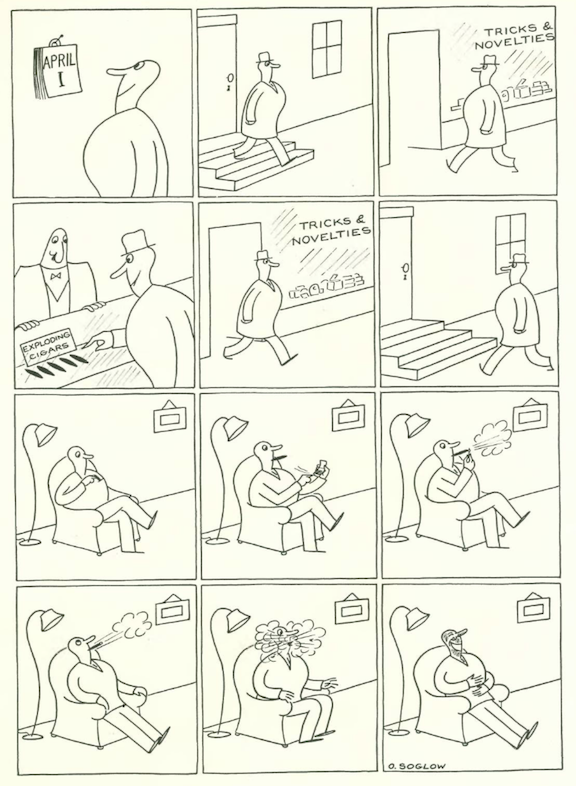
…Soglow continued to contribute to The New Yorker, and we kick off our cartoons with an April Fool’s joke…
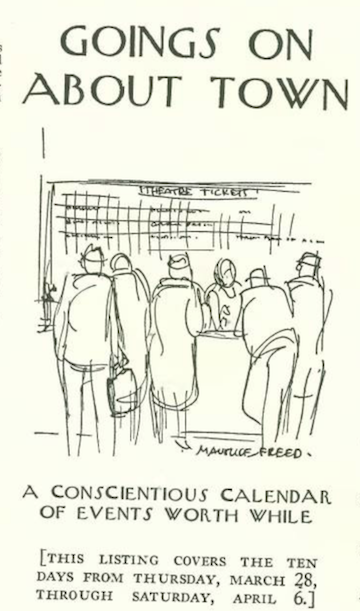
…for the second week in a row Maurice Freed supplied the opening spot art for “Goings On About Town”…
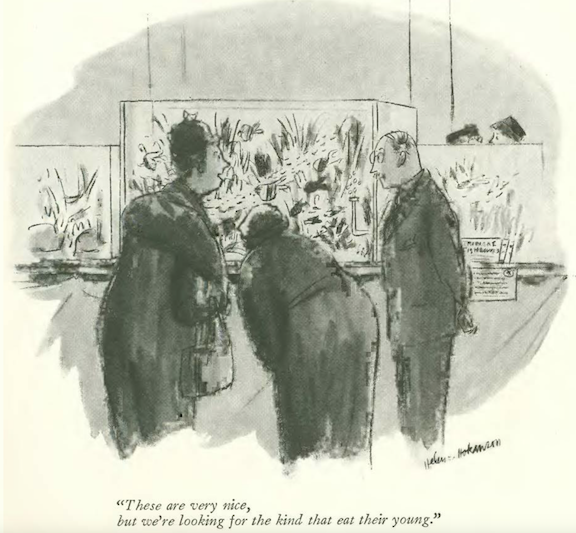
…Helen Hokinson was on the hunt for some predatory fish…
…James Thurber looked in on the nudist fad that emerged in the 1930s…
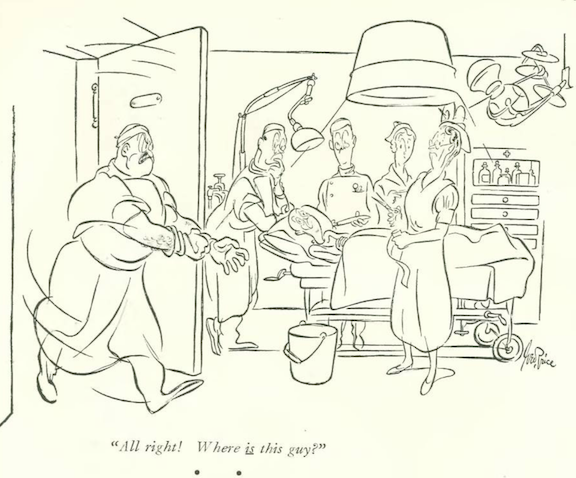
…and we close with George Price, an some alarming bedside manners…
Above: A bull terrier in the early 1900s. (Westminster Kennel Club)
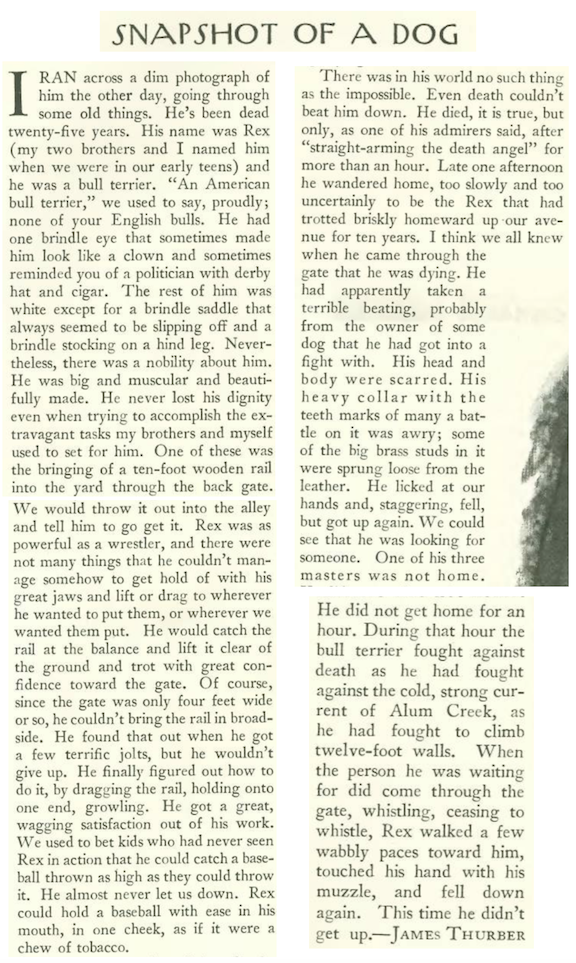
For dog lovers, or really for anyone with a heart, James Thurber’s “Snapshot of a Dog” is a moving tribute to a childhood pet, a bull terrier named Rex.
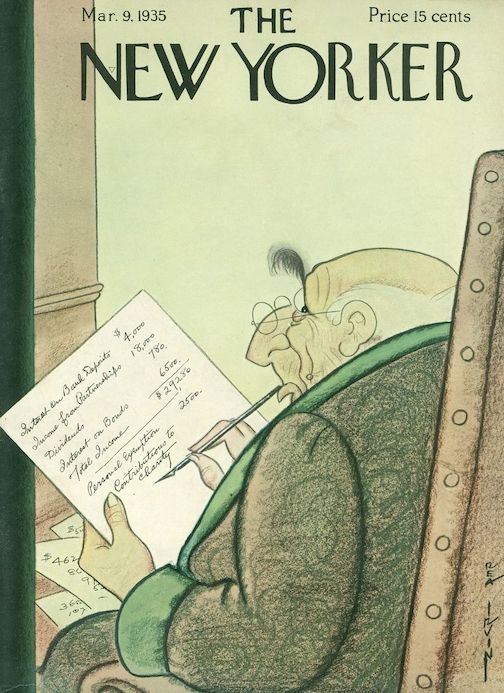
March 9, 1935 cover by Rea Irvin.
“Snapshot of a Dog” was reprinted almost two decades later in Our Dogs, A Magazine For Dog Lovers, which featured cover stories of various celebrities and their dogs. I recall reading “Snapshot” as a child in an anthology belonging to my parents; it affected me deeply then and still does today. Grab your hankies—here are excerpts from the first and last sections of the story:
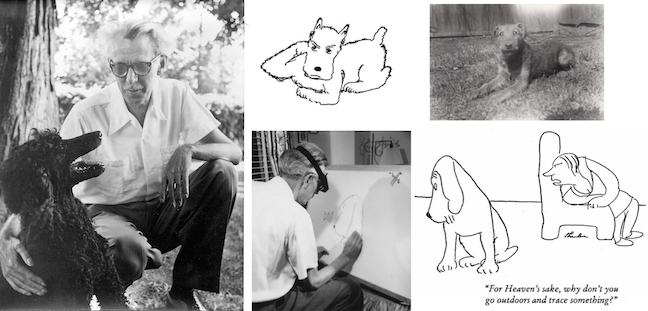
FAITHFUL FRIENDS…Clockwise, from left, James Thurber with his beloved Christabel; Thurber’s illustration of a childhood pet, a terrier named “Muggs” from the story “The Dog That Bit People” (1933); photograph of the real Muggs; dogs appear in many of Thurber’s cartoons as a stoic presence among maladjusted humans; Thurber at work on one of his dogs in an undated photo. (thurberhouse.org/ohiomemory.org/jamesthurber.org)
* * *
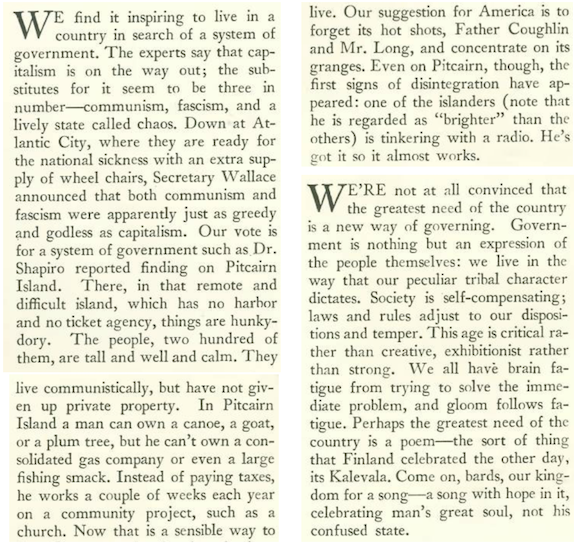
Searching For the American Way
Ninety years ago E.B. White (in “Notes and Comment”) offered some thoughts on America’s system of government, and the country’s need for a song of hope…
…White also commented on a distasteful development at the old Round Table haunt, the Algonquin Hotel…
MAYBE USE THE BACK DOOR…Entrance to the Hotel Algonquin, early 1930s. (Hotel Algonquin)
…In her column “Tables for Two,” Lois Long took issue with folks who were yapping about couvert charges, and offered a simple solution…
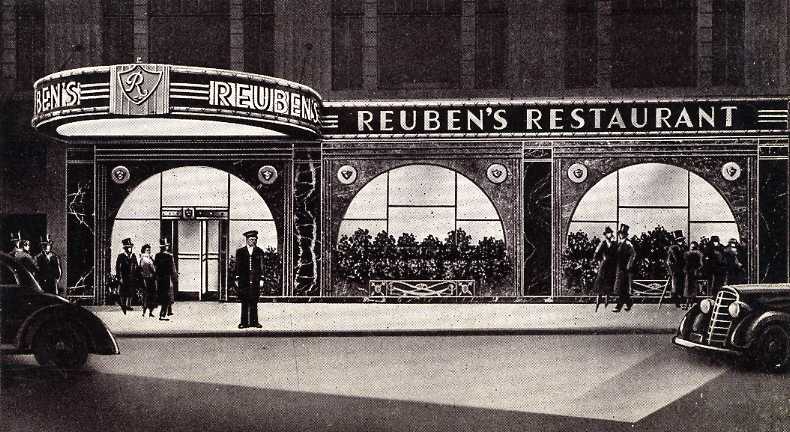
…following Long’s “On and Off the Avenue” column were several restaurant reviews signed “S.H.”…here the writer visited the home of the Reuben sandwich…
KNOWN FOR ITS EPONYMOUS SANDWICH, Reuben’s also offered a Georgie Jessel (sturgeon and Swiss) and an Al Jolson (raw beef). (restaurant-ingthroughhistory.com/tag/reubens)
* * *
Getting Their Kicks
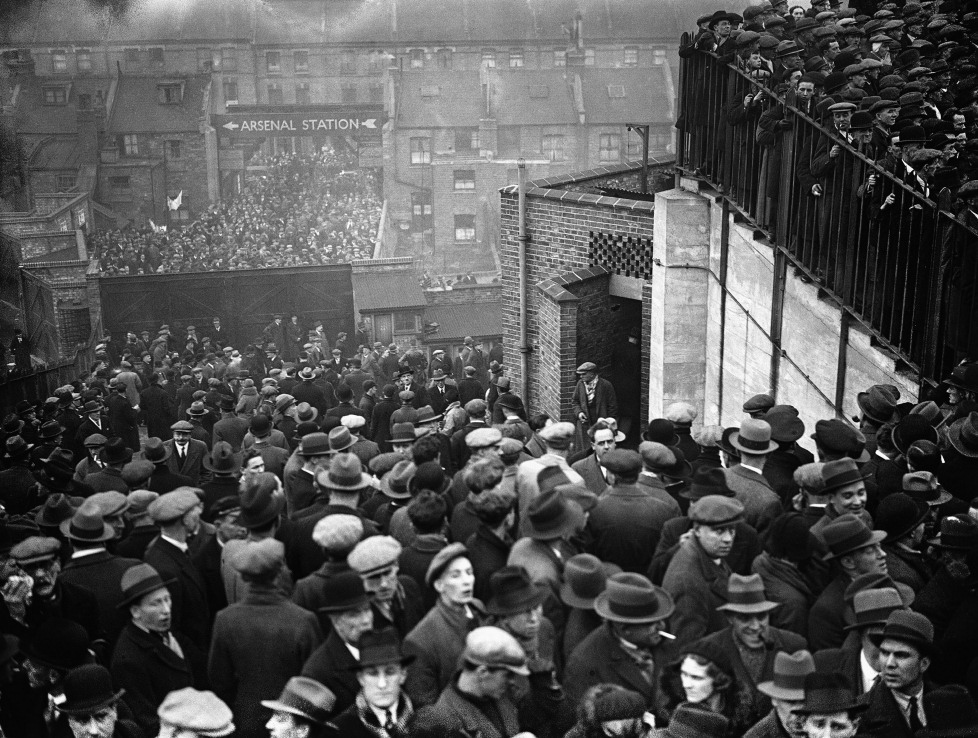
Professional football has been played in the UK since the 1870s, and by the early 20th century the sport drew massive crowds (the 1923 FA Cup final at Wembley Stadium drew an estimated 300,000). This excerpt from “London Letter” correspondent Samuel Jeake, Jr. (aka Conrad Aiken) offered a glimpse into the sport in 1935:
DOWN IN FRONT…Spectators in a crush at Highbury ground in London when a huge crowd turned up for the Arsenal versus Tottenham Hotspur match in January 1934. (Photo by A. Hudson/blog.woolwicharsenal.co.uk)
* * *
Endurance Test
Thomas Wolfe (1900-1938) published a number of novellas as well as plays and stories during his short life, but he only published two novels before his death in 1938 (others would be published posthumously). Wolfe’s second novel, the autobiographical Of Time and the River, would be well received by New Yorker critic Clifton Fadiman. Here is an excerpt from Fadiman’s lengthy review:
KNOCKOUT…Clifton Fadiman, right, wrote that Thomas Wolfe’s energetic writing could leave one feeling “punch-drunk.” (biblio.com/Wikipedia)
* * *
From Our Advertisers
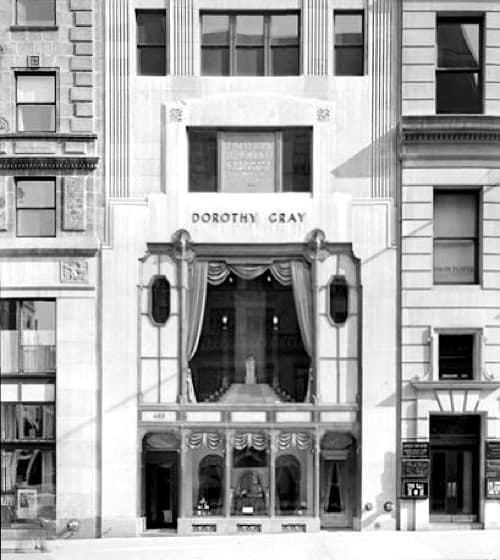
We begin with two pioneers in the cosmetics industry…Dorothy Gray salons set the springtime mood with this advertisement on the inside front cover…
…Dorothy Gray (1886-1968), a.k.a. Dorothy Cloudman, sold her business in 1927 to Lehn & Fink, a New York-based pharmaceutical company best known as the maker of Lysol. In 1929, the company opened a flagship salon and executive offices in the new Dorothy Gray Building at 683 Fifth Avenue…
Dorothy Gray Building at 683 Fifth Avenue (cosmeticsandskin.com)
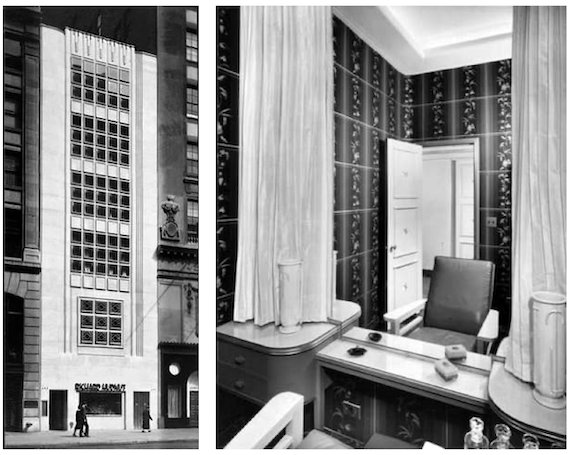
…Richard Hudnut (1855-1928) began working in his father’s drug store in 1873, and in 1899 opened his own pharmacy on Broadway. Hudnut, who promoted his perfumes and cosmetics by distributing booklets detailing his preparations, sold his company in 1916 to William R. Warner, which eventually became Pfizer…
Hudnut is recognized as the first American to achieve international success in cosmetics manufacturing. Part of that success was Du Barry, a premium perfume he created in 1902. It was used to scent a variety of products.
At left, the narrow Hudnut Building at 693 Fifth Avenue, designed by Ely Jacques Kahn and Eliel Saarinen. The Elizabeth Arden salon was next door. At right, salon treatment room in the Hudnut building.(cosmeticsandskin.com)
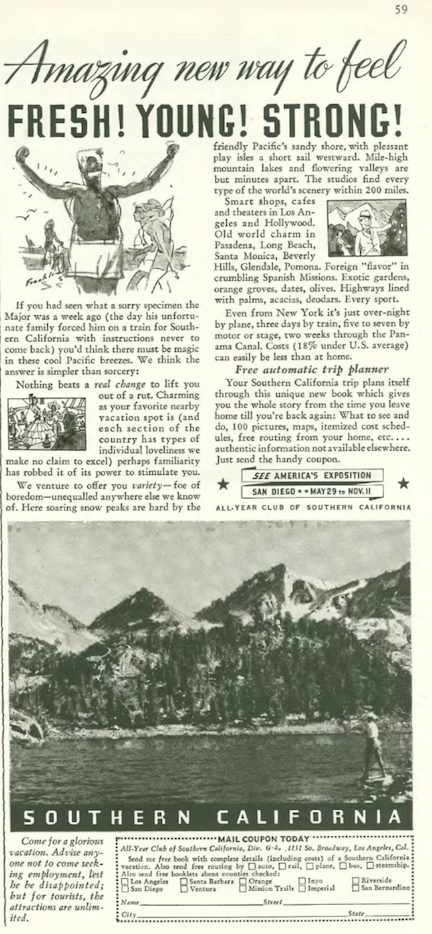
…if salon treatments weren’t your thing, you could revive by taking a trip to sunny Southern California…just look what it did for the old Major…
…the makers of Camel cigarettes offered an even quicker and cheaper way to feel invigorated…
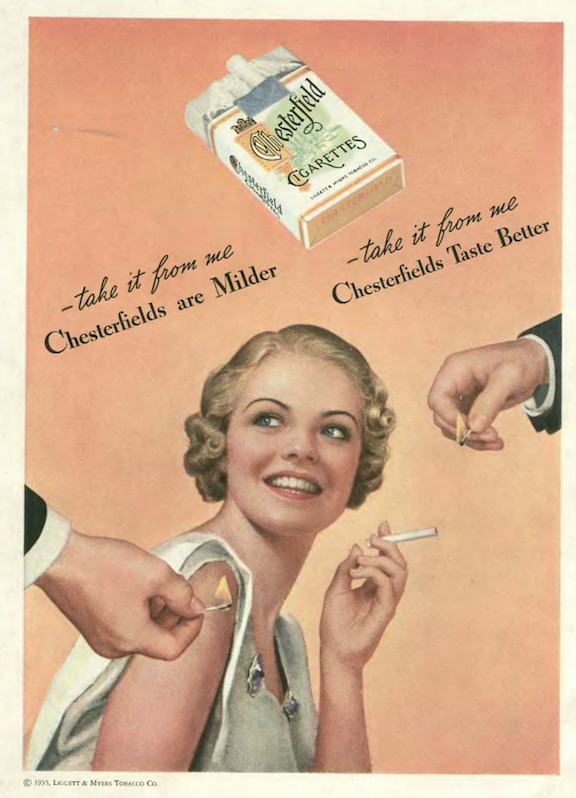
…the back cover continued to be dominated by tobacco companies targeting women smokers…this week Chesterfield got in on the act…
…on to our cartoonists, we begin with James Thurber at the top of page 2 to kick off “Goings On About Town”…
…and Thurber again, with the ultimate party pooper…
…George Price graced the bottom of “Goings On” on page 4 with this whimsy…
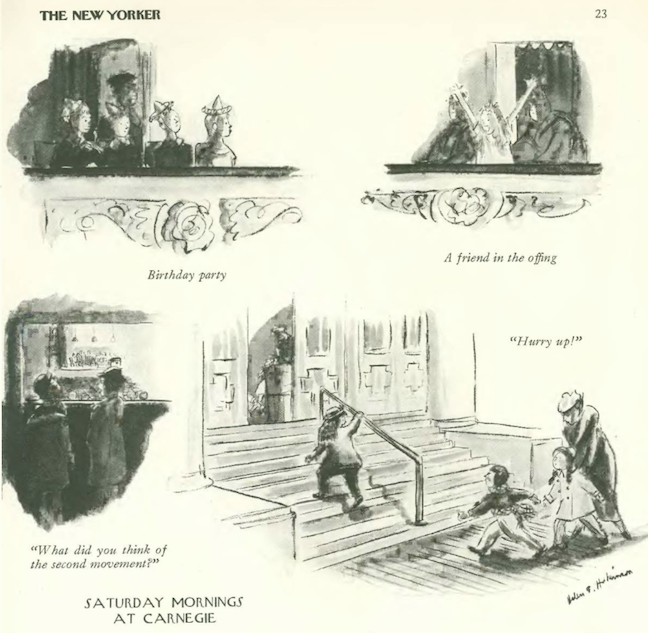
…Helen Hokinson looked in on a children’s concert…
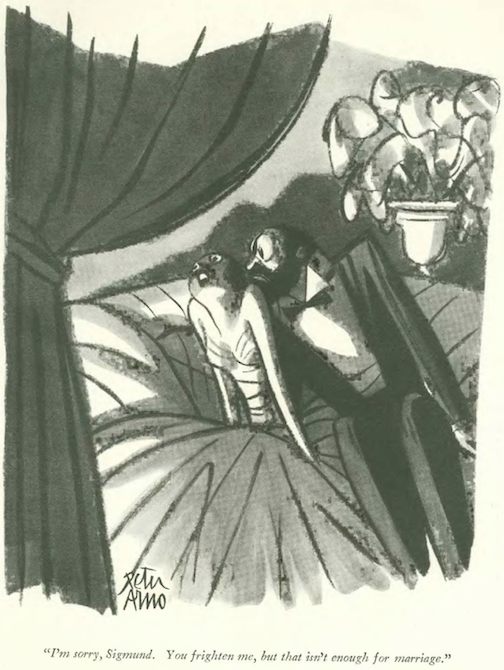
…there was another quarrel among lovers via Peter Arno…
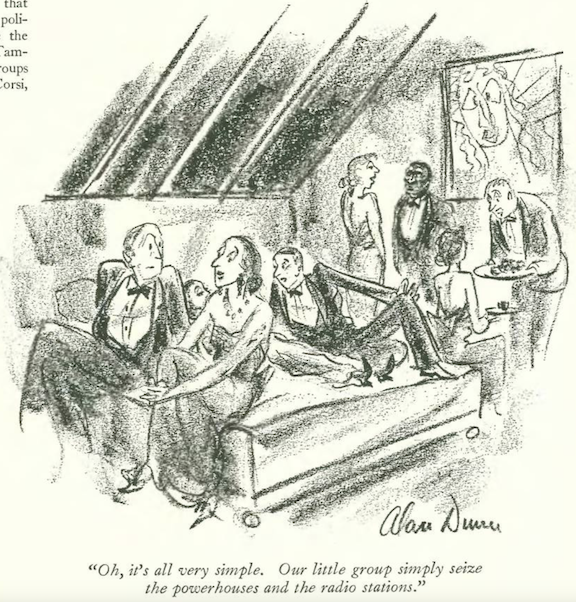
…revolution was in the air at Alan Dunn’s cocktail party…
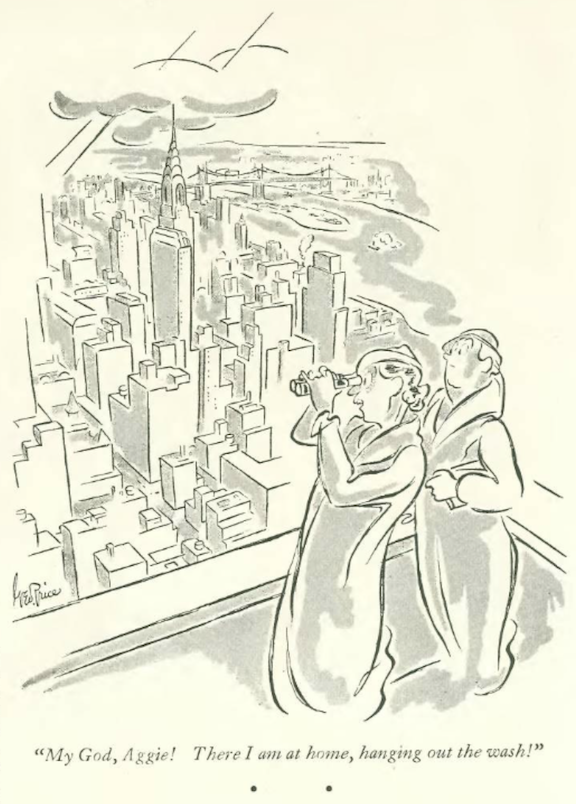
…George Price again, with two women who found a new perspective atop the Empire State Building…
…and we close with Syd Hoff, and an unexpected bundle of joy…
ABOVE: E.B. White presented us with a mixed bag of February happenings, from the comings and goings of Neily Vanderbilt to the Macon disaster and the economic power of Mickey Mouse.
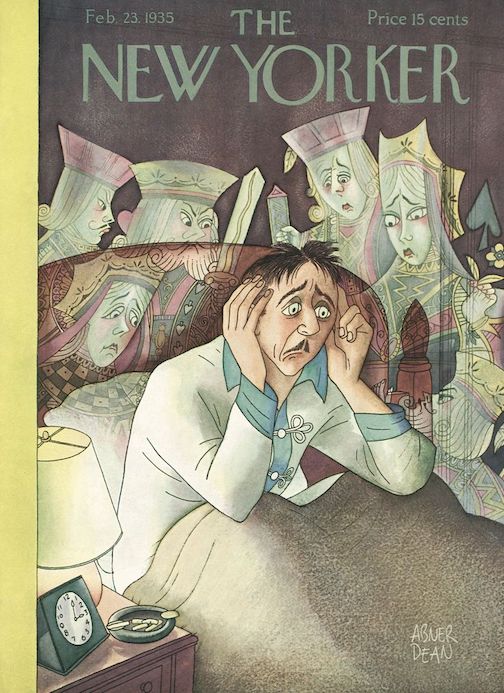
The title for this entry comes from E.B. White’s “Notes and Comment” column, which kicked off the Feb. 23, 1935, issue with a quick rundown of February events.
Feb. 23, 1935 cover by Abner Dean.
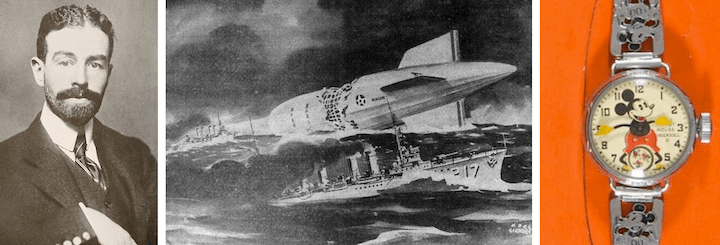
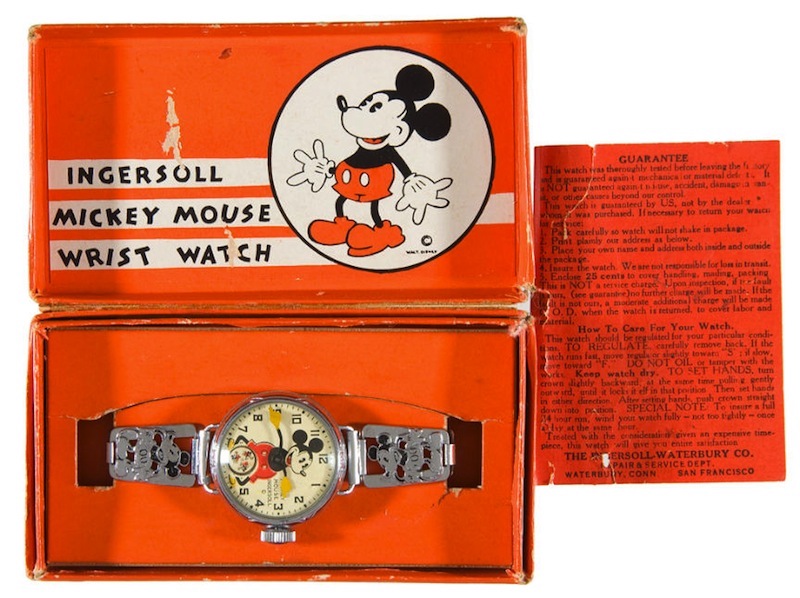
February notably marked the end of the Bruno Hauptmann trial. Convicted of the abduction and murder of the infant son of Charles and Anne Morrow Lindbergh, Hauptmann would go to the electric chair on April 3, 1936. White also noted the return of Admiral Richard Byrd from his second Antarctic expedition, the demise of the U.S. Navy airship U.S.S. Macon, and the economic miracle of the Mickey Mouse watch.
FLYING AIRCRAFT CARRIER…The US Navy’s 785-foot rigid airship USS Macon could launch and retrieve up to five airplanes in mid-flight. Known as “parasitic fighters, the Sparrowhawks were hung from a rail system inside the airship. On Feb. 12, 1935 the Macon crashed in a storm off the coast Point Sur, California. Only two of the 66 crew were lost. Photos above, clockwise from top left, show the deployment of a Sparrowhawk; the USS Macon over New York City in 1933; crew pose for a photo in the dirigible’s hanger; photo from the wreckage discovered in 2006—the pre-1941 pattern U.S. roundel emblem still recognizable. Sky-hook also visible. (sanctuaries.noaa.gov/macon/Sunnyvale Historical Society)TIME WAS RUNNING OUT for the Ingersoll Waterbury Company (now known as Timex) during the Great Depression. It was saved from bankruptcy, in part, by the introduction of the Mickey Mouse watch. (connecticuthistory.org)
White also made note of the comings and goings of Cornelius “Neily” Vanderbilt III (1873–1942), who was saying farewell to Fifth Avenue (although he would return to live out his life there), while New Yorkers were apparently saying farewell to the Park Avenue Tunnel (aka Murray Hill Tunnel). After more than 190 years it is still there, now serving a single lane of northbound traffic from 33rd to 40th Street.
TUNNEL VISION…Park Avenue Tunnel in 1890 (top) and in 2013 during a Voice Tunnel art installation. The nearly two-century old tunnel was made open to pedestrians for the first time in coordination with the annual Summer Streets event which began in 2013. (viewing.nyc/Wikipedia)
* * *
Getting An Earful
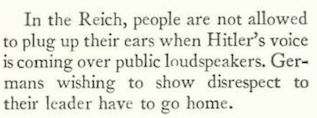
Howard Brubaker, in his column “Of All Things,” made this observation of deepening repression taking place in Nazi Germany…
* * *
Try Our Knockout Cheesecake
Lois Long continued her chronicle of New York night life, in this excerpt making note of the celebrity gawkers at Jack Dempsey’s tavern/restaurant near Madison Square Garden. Apparently Dempsey’s place was renown for its cheesecake…
PLEASED AS PUNCH…Heavyweight boxing champ Jack Dempsey opened his restaurant at 50th Street and Eighth Avenue in 1935 (bottom photo) before moving to Broadway’s Brill Building in 1937 (top). According to Ephemeral New York, “In the restaurant’s early years, Dempsey was known to hold court at a table, a legendary figure greeting customers and glad-handling guests.” (Ephemeral New York)
* * *
From Our Advertisers
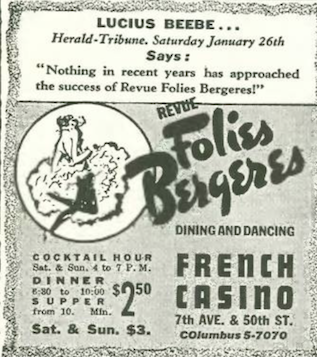
The refurbished Earl Carroll Theatre (7th Ave. and 50th St.) opened as the French Casino late in 1934. The art deco theatre’s first show was the Revue Folies Bergères, promoted here in this small ad on page 54 in the Feb. 23 issue…
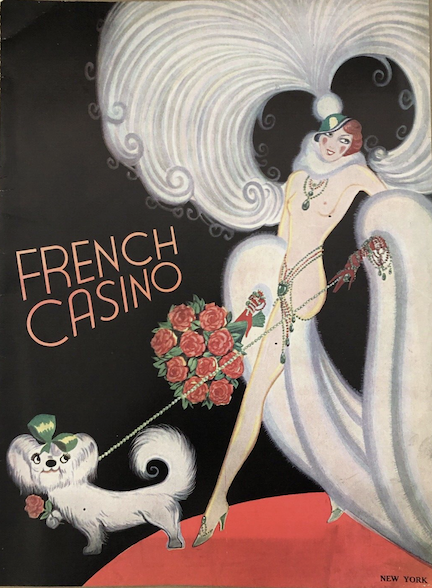
…the menu’s cover suggests patrons weren’t there for the cheesecake (yes, there is a pun, but I’m not touching it)…
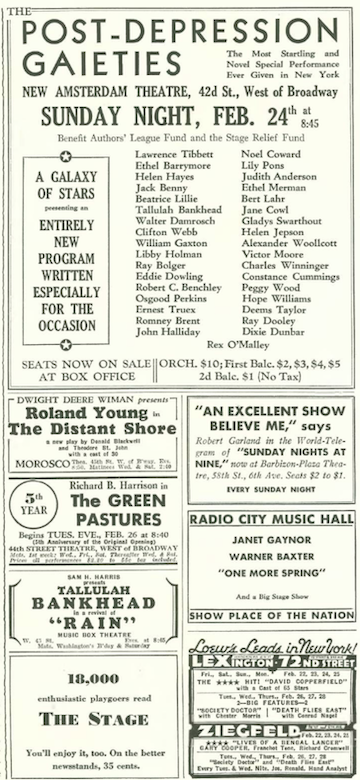
…another ad in the back pages touted the “Post-Depression Gaities” at the New Amsterdam Theatre with an impressive roster of stars including New Yorker notables Robert Benchley and Alexander Woollcott…
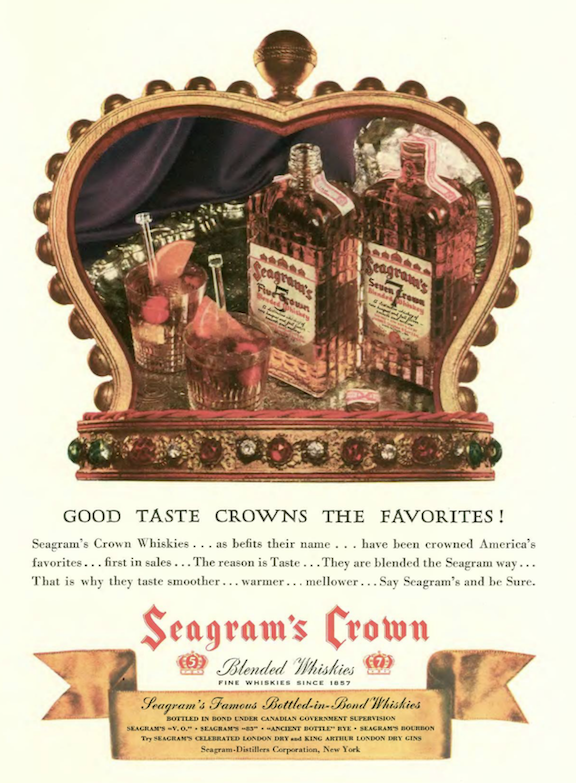
…following Prohibition, Seagram introduced two blended whiskies—5 Crown and 7 Crown. Seagram 5 Crown was discontinued in 1942, while Seagram 7 would go to become the first million case brand in U.S. history…
…this one-column ad caught my eye for the rendering of the stereotypic ill-tempered matron, here having a fit over tomato juice…
…coming from an old and influential New York family, it’s hard to believe Elizabeth West Post Van Rensselaer thought about Campbell’s soup when her daughter, Elizabeth, fell seriously ill…at any rate, something must have worked because her daughter lived until 2001…
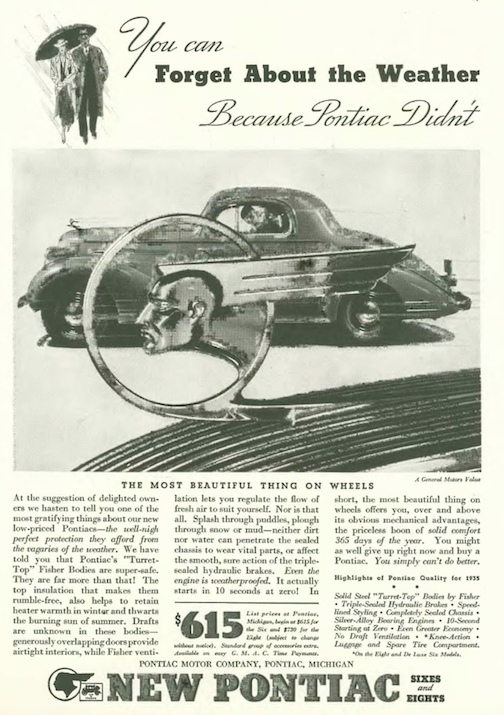
…For a time “Chief Pontiac” served as a logo for the Pontiac line of automobiles, discontinued by GM in 2010…
…many automobile advertisements of this era emphasized safety, none more prominent than the “Body by Fisher” ads that frequently featured happy little children…oddly, no one had yet considered seat belts, car seats or other safety measures we now take for granted…
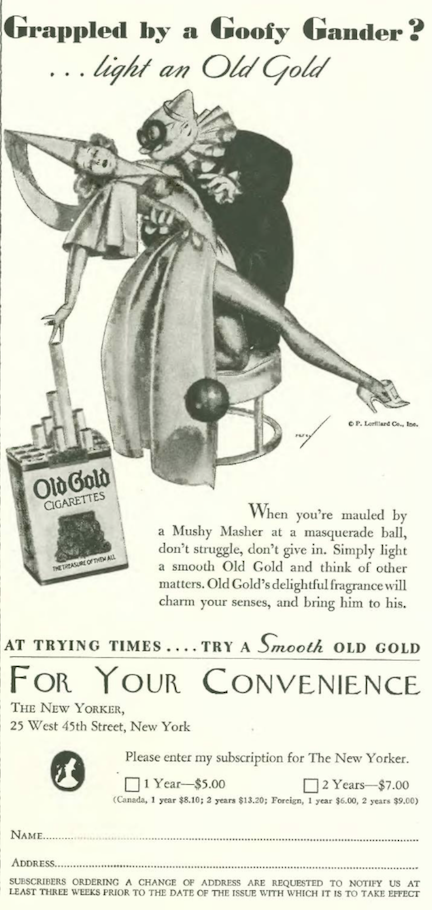
…the makers of Old Gold cigarettes (Lorillard) ran a series of ads featuring a sugar daddy and his leggy mistress…they were drawn by George Petty (1884–1975), famed for his “pin-up girls”…as an added bonus below the ad, you could renew your New Yorker subscription—two years for seven bucks…
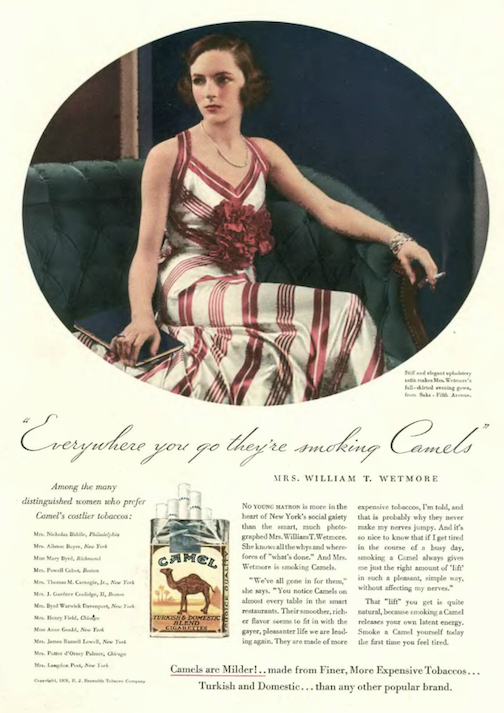
…the makers of Camels kept it classy with their continuing series of society women enjoying their unfiltered “Turkish & Domestic” blend…
…the “young matron” in the ad, the Sydney, Australia-born Joan (Deery) Wetmore (1911-1989), was indeed “much-photographed,” and was a favorite of Vogue photographer Edward Steichen:
Detail from a Steichen photo of Joan Wetmore, taken in Rockefeller Center’s Rainbow Room, 1934. (Condé Nast)
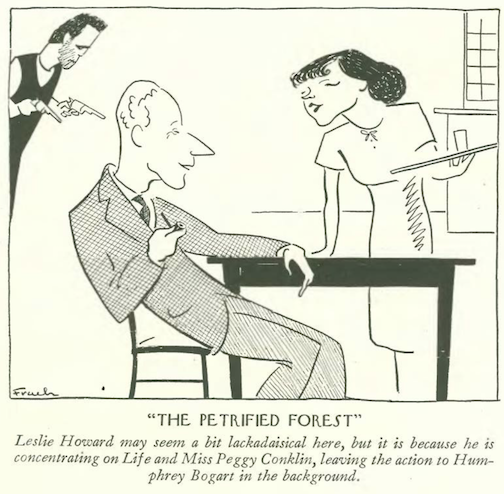
…on to our cartoonists, Al Frueh illustrated Humphrey Bogart as the coldblooded killer Duke Mantee in the 1935 play The Petrified Forest; the 1936 film adaptation would be Bogart’s breakout role in the movies…
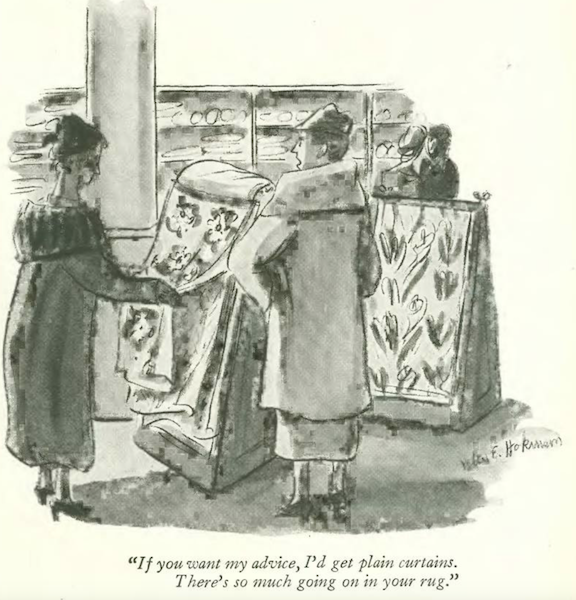
…Helen Hokinson went shopping for drapes…
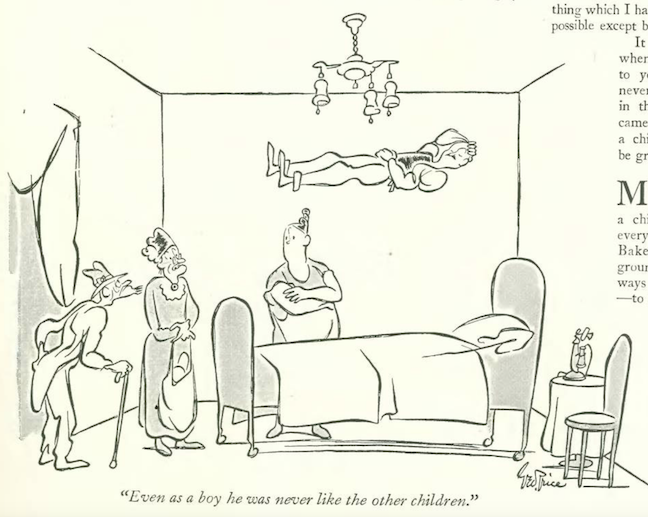
…George Price was all tied in knots…
…and still up in the air…
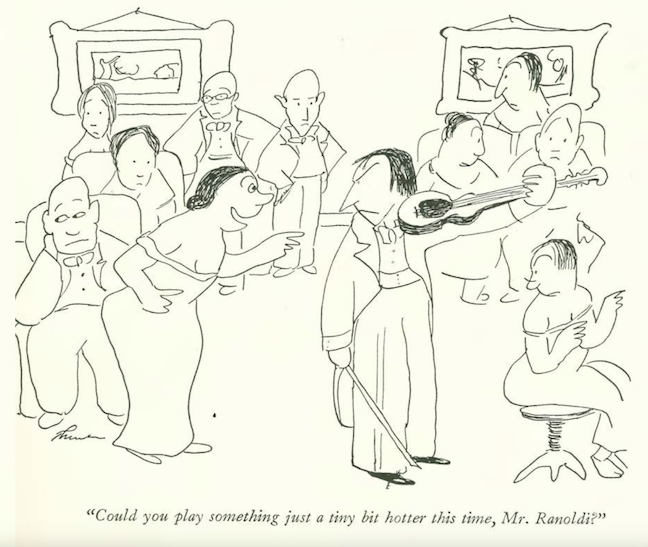
…Barbara Shermund dreamed of Venice…
…James Thurber gave us the life of the party…
…and we close with Leonard Dove, and some unexpected party life…
Above: W.C. Fields was a well-known juggler and vaudeville performer decades before he became even more famous in the movies of the 1930s.
William Claude Dukenfield was a vaudeville juggler who distinguished himself from other “tramp acts” by adding sarcastic asides to his routines. Internationally known for his juggling skills, by the turn of the century the man who billed himself as “The Eccentric Juggler” would become much better known by another name: W.C. Fields.
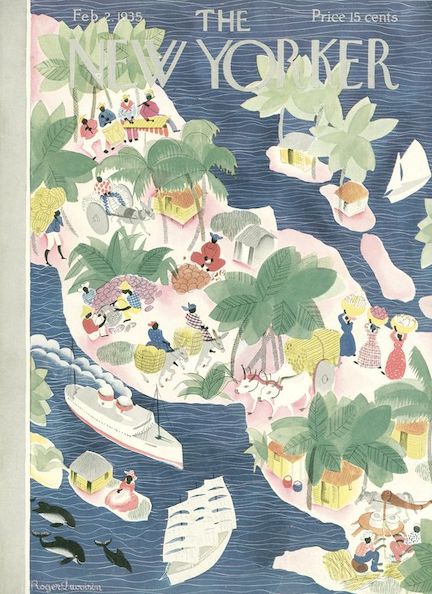
Feb. 2, 1935 cover by Roger Duvoisin.
In the first of a three-part profile, Alva Johnston pondered the secret behind Fields’ genius, an “inborn nonchalance” that he considered “the rarest of gifts.” Johnston surmised that some of that genius derived from the volatile relationship Fields had with his father, and the street-smarts he gained as a runaway at age eleven. It is no surprise, however, that these childhood stories of hardship were significantly embellished by the great wit himself.
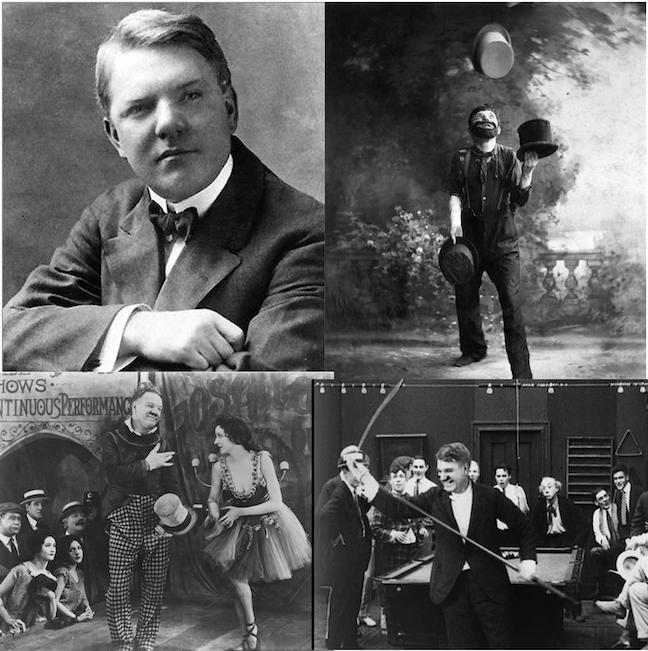
A STAR IS FORMED…Clockwise, from top left, W.C. Fields in his youth; Fields was an internationally known juggler, seen here in his vaudeville days in the early 1900s; Fields made his screen debut in 1915, seen here in his second film, Pool Sharks (1915); Fields with Carol Dempster in Sally of the Sawdust, a 1925 silent comedy film directed by D. W. Griffith. (Pinterest/YouTube)
Johnston also described Fields’ acting style and demeanor, noting that the actor’s asides were likely inspired by his mother, Kate Spangler Felton, who was known for her doorstep witticisms.
NINETEEN THIRTY-FIVE WAS A GOOD YEAR for W.C. Fields, who starred in It’s a Gift (right), released the previous December, and in the 1935 screen adaptation of Charles Dickens’sDavid Copperfield, as the character Wilkins Micawber. (MGM/IMDB)
* * *
Macabre Diversions
In the days before television and the internet, folks got their dose of the sensational and macabre from the tabloids, or, on occasion, in real life. Before crime or accident scene investigations became more sophisticated, it was not uncommon for crowds to mob grisly death scenes, including the car containing the bullet-riddled bodies of notorious bank robbers Bonnie Parker and Clyde Barrow. Their Ford automobile, pocked with 112 bullet holes, became a popular traveling attraction at fairs, amusement parks, and, in February 1935, at a car dealer’s showroom in Missouri. E.B. White explained:
BEFORE THE INTERNET, folks got their ghoulish thrills by rubbernecking at famous crime scenes. At left, a crowd gathers around the bullet-riddled car belonging to Bonnie and Clyde. According to one account, at the scene of the police ambush on Louisiana State Highway 154, nearly everyone collected souvenirs including shell casings and bloody pieces of clothing from Bonnie and Clyde. One man even tried to collect Clyde’s left ear with a pocket knife; at right, unidentified man standing next to the “death car.” (KXAN/unt.edu)
* * *
Saar Kraut
Janet Flanner mused on the recent plebiscite in the Saarland, which following World War I was seized from Germany and placed under the governance of a League of Nations commission. Much to the dismay of the French, the majority German population voted to return the Saar region to Germany, and its Nazi leadership.
* * *
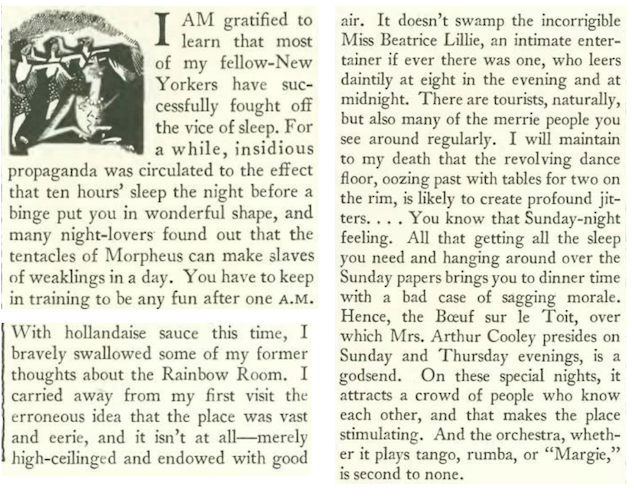
Over the Rainbow
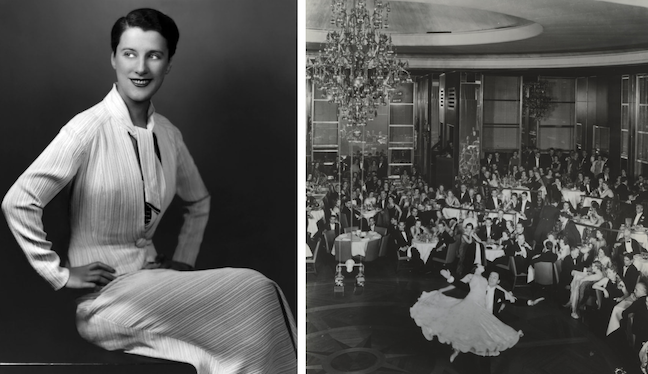
In a previous column, Lois Long took aim at the Rockefeller Center’s new Rainbow Room, dismissing it as a tourist trap filled with interminable strains of organ music. In her latest column, Long retracted some of that vitriol, finding the entertainment (and, one supposes, the food) more to her liking.
THE ‘INCORRIGIBLE’ Beatrice Lillie (left) delighted Lois Long and audiences in the Rainbow Room on the 65th floor of Rockefeller Center; at right, ballroom dancers Lydia and Joresco take to the floor in the then newly opened Rainbow Room, 1934. (Pinterest/#rainbowroomnyc)
* * *
From Our Advertisers
As Lois Long mentioned in “Tables for Two,” British actress and singer Beatrice Lillie was appearing at in the Rainbow Room on the 65th floor of Rockefeller Center; according to the ad below, also featured were ballroom dancers Lydia and Joresco and bandleader Jolly Corburn…
…at first I though this was Alfred Lunt and Lynn Fontanne shilling for Luckies, but the resemblance isn’t quite there, plus I’m not aware of the Broadway legends ever endorsing any product, let alone cigarettes…
…the folks at Hormel continued to feature notable Frenchmen who were known to enjoy French onion soup, although this particular image doesn’t do much for one’s appetite…
…the Bermuda Trade Development Board continued to feature colorful ads that enticed New Yorkers away from the late winter blahs…
…this ad for Schaefer is a bit odd…I guess the artist wanted to suggest a handbill, and therefore tilted the image it at an angle, unsuccessfully, one might add…
…The Theatre Guild once again called upon the talents of James Thurber to advertise their latest production…
…which segues into our cartoons, with Thurber once more…
…Al Frueh did his part to promote the stage with this illustration for the theatre section…
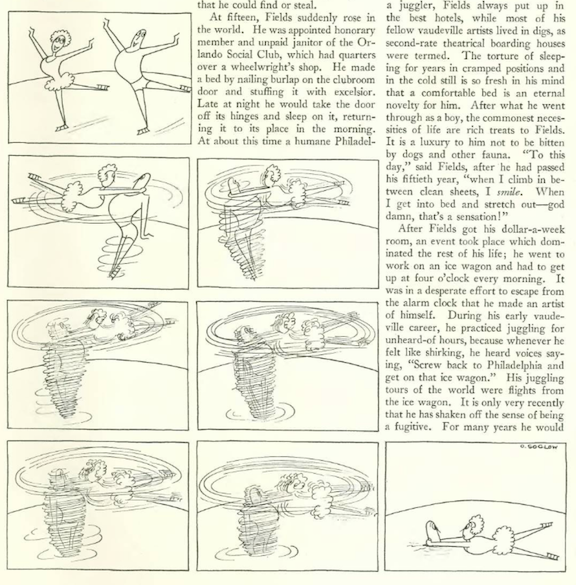
…Otto Soglow offered his spin on pairs figure skating…
…Gardner Rea explored the world of art appreciation…
…Helen Hokinson aptly supplied this cartoon for Lois Long’s fashion column…
…Whitney Darrow Jr. showed us the consequences of classified advertising…
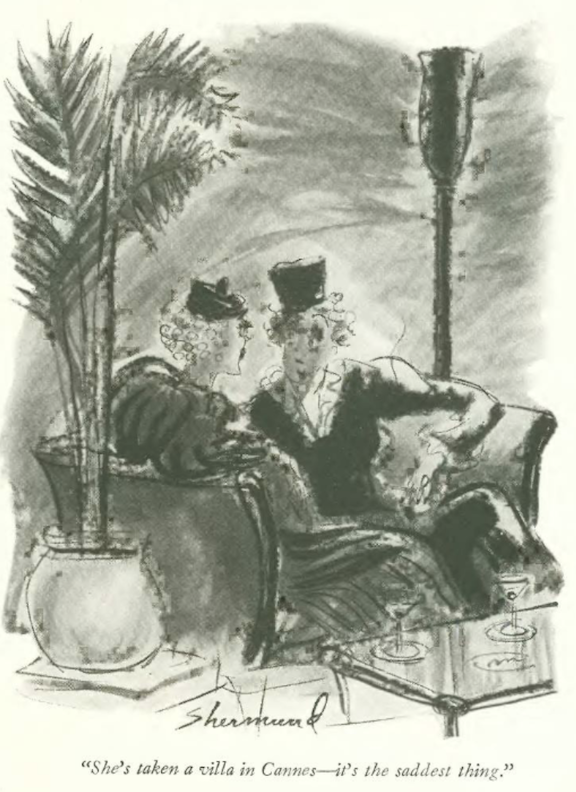
…Barbara Shermund clued us in on the latest gossip…
…and we close with Peter Arno, and one butcher’s cold greeting…





















































































































 A New Yorker State of Mind