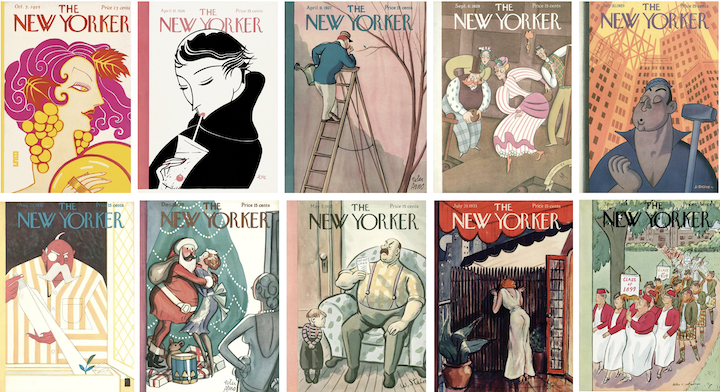
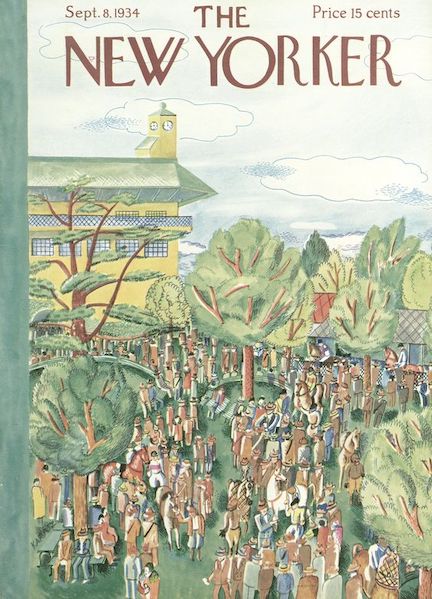
With this post (No. 413), we mark the tenth anniversary of The New Yorker. Since I began A New Yorker State of Mind in March 2015, I’ve attempted to give you at least a sense of what the magazine was like in those first years, as well as the historical events that often informed its editorial content as well as its famed cartoons. Those times also informed the advertisements; indeed, in some cases the ads give us a better idea of who was reading the magazine, as well as their changing tastes and buying power as we moved from the Roaring Twenties to the Depression, and from Prohibition into Repeal.
I have also chosen this time to go on hiatus, and hopefully resume this blog when The New Yorker celebrates its centennial next February (this site will remain active and available, and I will continue to monitor comments and messages). Let us hope that the editors use the original Rea Irvin cover for that occasion, and restore his masthead above “The Talk of the Town” section. Perhaps some enterprising soul could start a petition.
Feb. 16, 1935 cover by Rea Irvin.
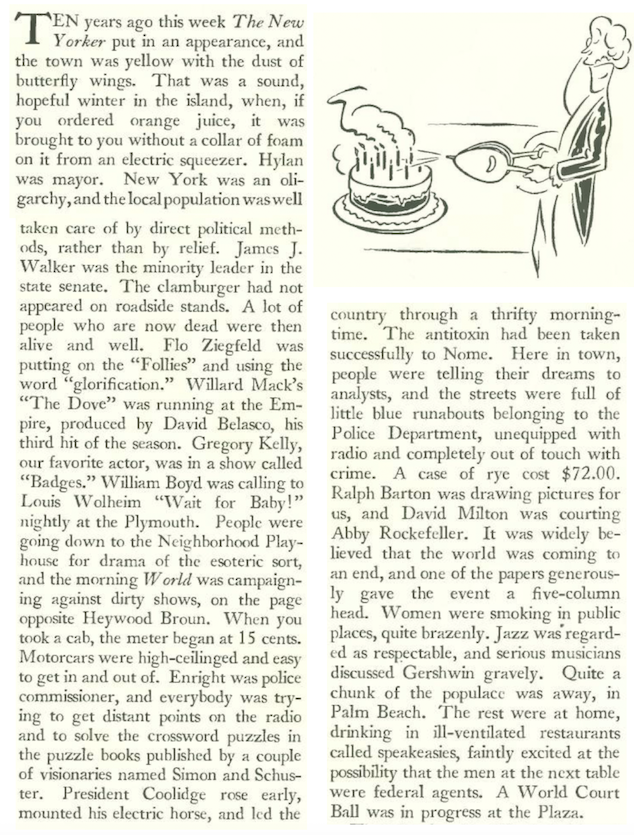
Moving on to the tenth anniversary issue, we find E.B. White recalling the world of The New Yorker’s first days. Given the massive economic and societal shifts that occurred from 1925 to 1935, those first days seemed distant to White, who felt old, “not in years but events.”
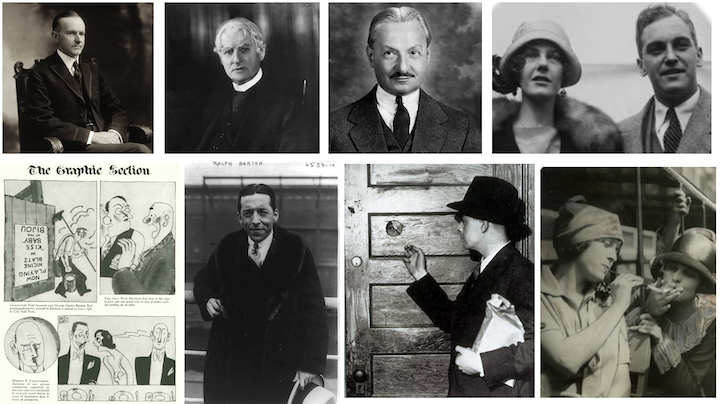
DAYS OF YORE…E.B. White noted the many changes that had taken place during The New Yorker’s first ten years, including, clockwise from top left, the passing of 1920s notables such as President Calvin Coolidge and two very different theatre impresarios—David Belasco and Flo Ziegfeld; White also recalled the much-publicized 1925 wedding of Abby Rockefeller to David Milton, the throngs of women who took to smoking in public in the 1920s and the drinkers who took their activities behind closed doors; and one of the early magazine’s beloved contributors, Ralph Barton, who offered his whimsical take on the news in “The Graphic Section” as well as in other illustrated features. (Wikipedia/Wikitree/Ephemeral New York)
White also noted a new craze that had originated around the same time as the birth of The New Yorker…
TWO ACROSS…Max Schuster and Richard Simon of Simon & Schuster, with their first crossword book, 1924. (americanbusinesshistory.org)
White concluded with these parting words, tinged with world-weariness, writing “More seems likely to happen.” One wonders if he imagined The New Yorker at 100, which in our day is just around the corner. Like White, many us have grown weary of this angry world, where indeed more seems likely to happen. Let us hope it is for the best.
Now, some unfinished business. We need to look at the previous issue, Feb. 9, 1935, before we close out the decade.
Feb. 9, 1935 cover by William Cotton.
We stay on the lighter side, joining critic John Mosher at the local cinema to appreciate Leslie Howard’s dashing performance in The Scarlet Pimpernel…
WORKING OVERTIME…Leslie Howard and Merle Oberon in The Scarlet Pimpernel. Howard portrayed an aristocrat who leads a double life, publicly appearing as a dandy while secretly rescuing French nobles from Robespierre’s Reign of Terror. (PBS)
* * *
From Our Advertisers
Cigarette manufacturers employed every angle from sex to health claims to move their product…not to be left out of any niche market, Chesterfield even went after the little old ladies…
…by contrast, the makers of Old Gold cigarettes featured a clueless sugar daddy and his leggy mistress in a series of ads drawn by famed pin-up artist George Petty…
…Otto Soglow would do well with advertisers during his career, promoting everything from whiskey to Pepsi and Shredded Wheat to department stores…in this case Bloomingdale’s…after William Randolph Hearst’s King Features Syndicate wrested The Little King away from The New Yorker in September 1934, this was the only way you would see the harmless potentate in the magazine…
…another New Yorker artist earning some ad dollars on the side was Constantin Alajalov, here adding a stylish flair for Coty…
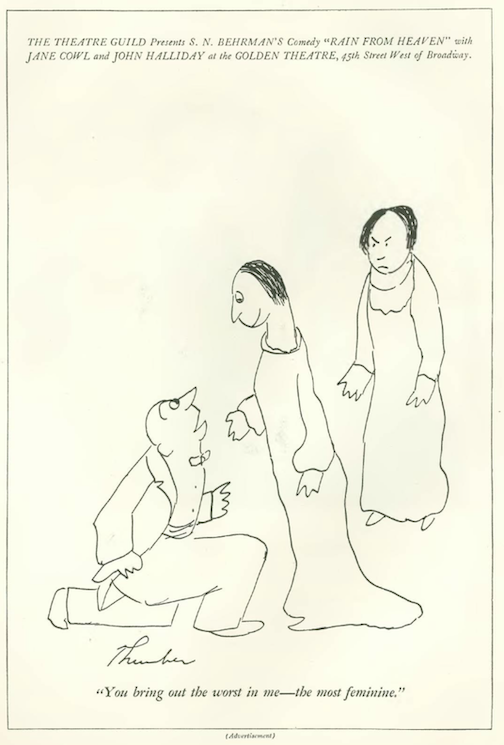
…and then there’s James Thurber, who continued to contribute his talents on behalf of the Theatre Guild…
…and we move along to the Feb. 9 cartoons, with Thurber again…
…the issue also featured two by George Price…
…and Howard Baer supplied some life to this little party…
…now let’s return to the Feb. 15, 1935 issue…
…where John Mosher was back at the cinema, this time enjoying the story of a “beautiful stenographer”…
POPCORNY…Fred MacMurray and Claudette Colbert meet cute over popcorn in the romantic comedy The Gilded Lily. It was MacMurray’s second credited screen role, and it was the first of seven films in which Colbert and MacMurray would star together. (Wikipedia)
* * *
More From Our Advertisers
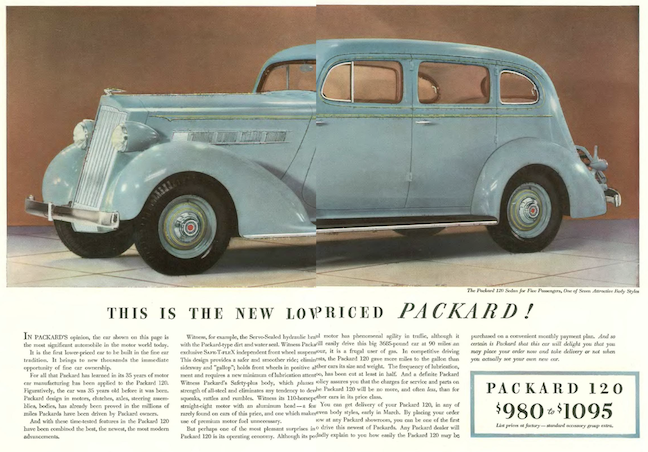
In its bid for survival during the Depression, the luxury brand Packard introduced its first car under $1000, the 120. Sales more than tripled in 1935 and doubled again in 1936…
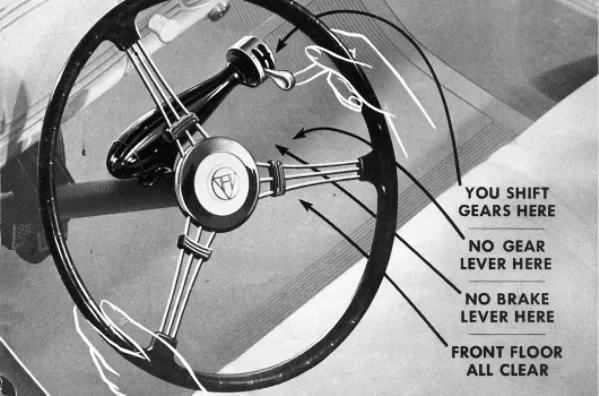
…meanwhile, Hudson was hanging in there with innovations such as the “Electric Hand”…it was not a true automatic transmission, but it did allow drivers to shift gears near the steering wheel…
…as demonstrated here…
…whatever you were driving, Goodyear claimed it would keep you the safest with their “Double Eagles”…
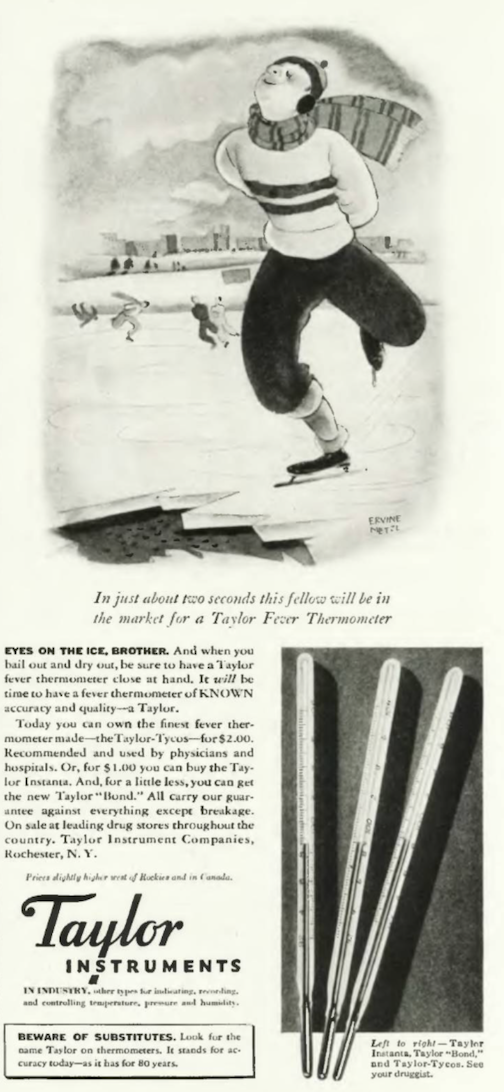
…I include this ad for Taylor Instruments because it features an illustration by Ervine Metzl, who would become known for his posters and postage stamp designs…
…Metzl’s design of a three-cent stamp commemorating the 1957–1958 International Geophysical Year…
…on to our cartoonists, we begin with this Deco-inspired artwork by an unidentified illustrator…
…one of Helen Hokinson’s “girls” was going about her daily rounds…
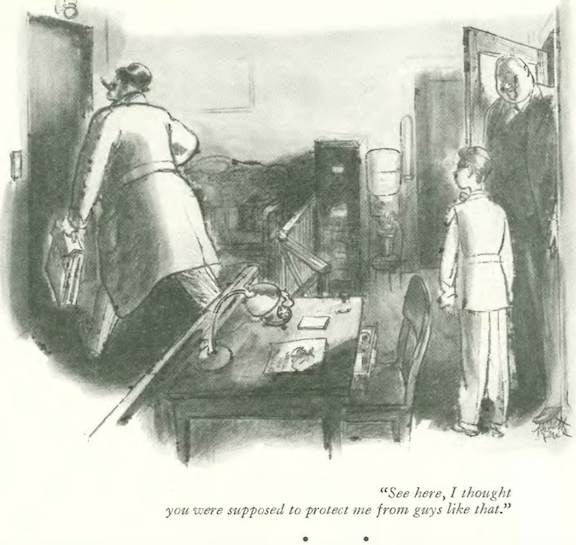
…Garrett Price gave us a gatekeeper not quite up to his task…
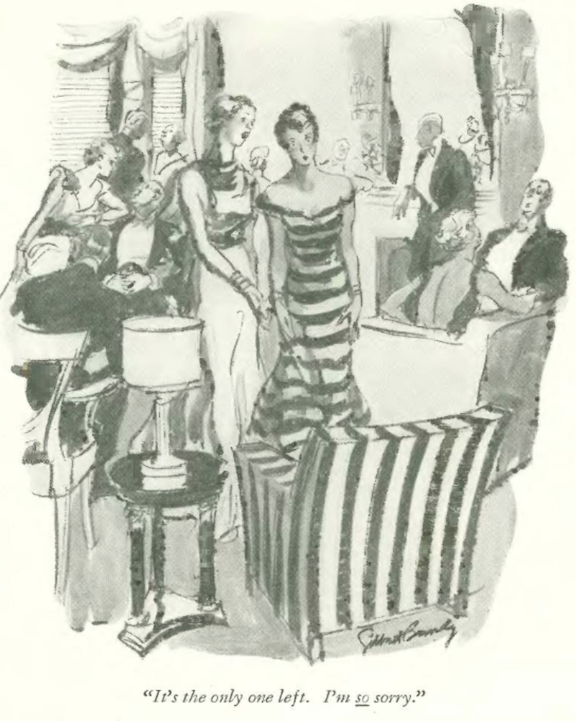
…Gilbert Bundy was seeing stripes rather than stars…
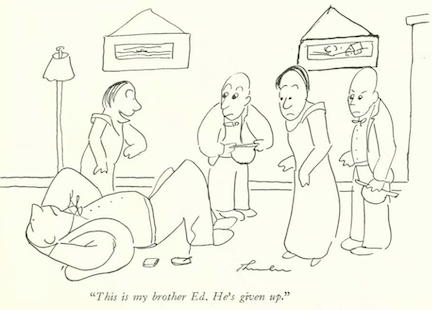
…while James Thurber’s medium was getting in touch with an equine spirit…
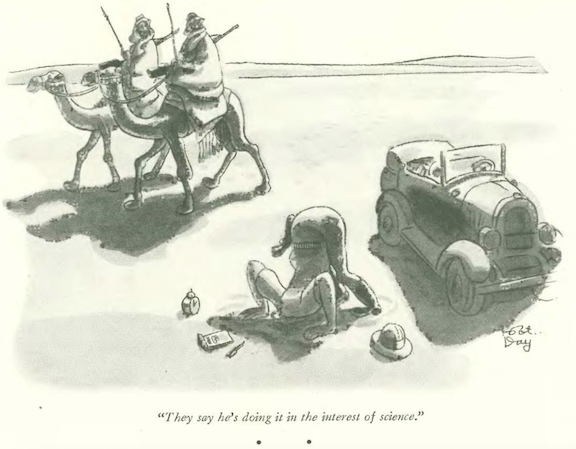
…scientific inquiry knew no bounds in Robert Day’s world….
…and in the world of Alain (aka Daniel Brustlein), old habits died hard…
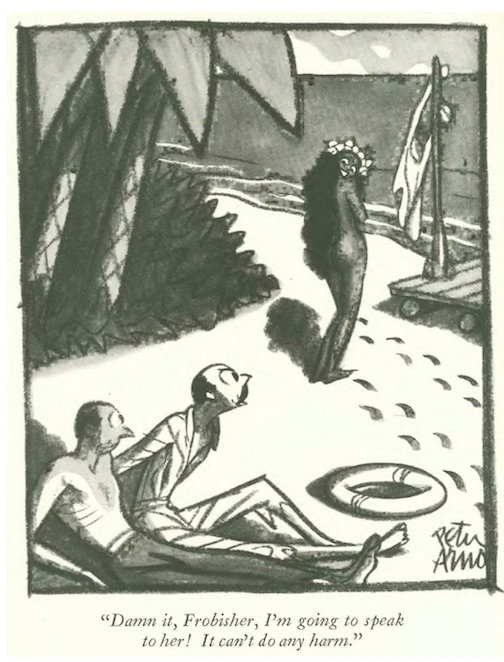
…and we close with Peter Arno, at his risqué best…
Above: Charles Sellen as Mr. Muckle and W.C. Fields as shopkeeper Harold Bissonette in the 1934 film It's a Gift.
Rea Irvin featured the New York Auto Show on the cover of Jan. 12, 1935 issue—the extravaganza of cars at the Grand Central Palace was one place New Yorkers could go to chase away the winter blues. The other was at one of the city’s RKO theatres, where a classic W.C. Fields comedy was gracing the silver screen.
Jan. 12, 1935 cover by Rea Irvin.
It’s a Gift was a showcase of Fields’ vaudevillian talents, tied together in a story about grocer Harold Bissonette (Fields) whose various tribulations included a pompous wife (who insisted on pronouncing the surname “biss-on-ay”), bratty children, and challenging customers (the hilarious Charles Sellen as Mr. Muckle). Writing for BFI Film Classics, Simon Louvish calls the film a chronicle of the “many titanic struggles between Harold Bissonnette and the universe. There will be battle of wills between father and daughter, between male and female, between man and a variety of uncontrollable objects.” Here is John Mosher’s review for The New Yorker.
HAROLD VS. THE WORLD…Clockwise, from top left, W.C. Fields as grocer Harold Bissonette; Fields with Kathleen Howard as wife Amelia Bissonette; Bissonette is relegated to the back porch in search of some rest; Charles Sellon as one of Bissonette’s more challenging customers, Mr. Muckle. (IMDB/TCM/filmfanatic.org/YouTube)BABY BLUES…Two-year old Baby LeRoy (Ronald Le Roy Overacker) played the annoying foil to W.C. Fields in three films, including It’s a Gift (left, with Fields and Tammany Young). James Curtis’sW.C. Fields: A Biography (2003) quotes director Norman McLeod: “[Fields] used to swear at the baby so much in front of the camera that I sometimes had to cut off the ends of the scenes in which they appeared.” Fields’ popular persona was a man who hated dogs and kids, but a studio photo taken during the filming of It’s a Gift (right) seems to show another side. Perhaps. (Pinterest/citizenscreen.com)
* * *
By Another Name
E.B. White led off his column with a note about Persia, which had officially changed its name to Iran. To mark the new year, Reza Shah had officially asked foreign delegates to use the new term, which referred to the native name of the people who inhabited the region.
* * *
Hot Rods
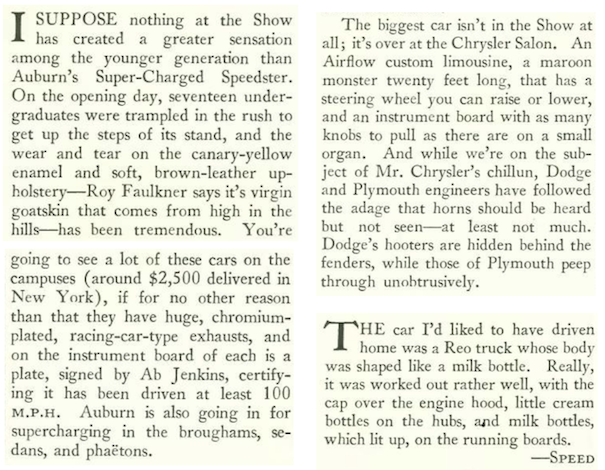
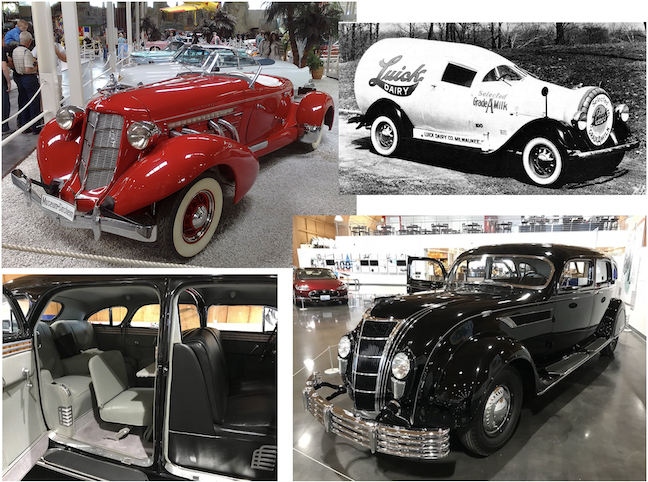
The New Yorker was back at the auto show, where correspondent “Speed” noted the appeal of the Auburn Speedster to a college-age crowd. The $2,500 price tag (equivalent to about $55k today) was apparently within reach for some of the lads at Columbia and other Ivies. Speed also admired the limousine version of the Chrysler Airflow, but the real car of his desires was a bottle-shaped milk truck.
INSTANT CLASSIC…The New Yorker predicted that the Auburn Speedster 851, which came to be known as the “Hollywood Car,” would be popular among lads on college campuses. Despite its technical advancement (it could do 100 mph) and beautiful lines, it would prove to be Auburn’s final production model. (Wikipedia)RARITIES…Clockwise, from top left: Boattail version of the Auburn Speedster 851, of which only 143 were built; REO milk bottle truck, circa 1930; 1935 Chrysler CW Airflow Limousine—only fifteen of these massive cars were built. (Wikipedia/Pinterest/Donald Pittenger@carstylecritic.blogspot.com)
* * *
From Our Advertisers
The proprietors of Essex House tapped into the popularity of the Auto Show to market their economical, yet deluxe accommodations…
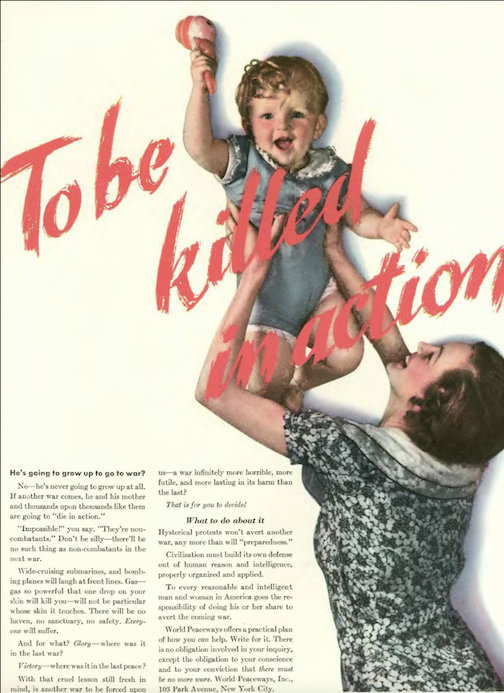
…the anti-war group World Peaceways continued its ad campaign with this image of the “most powerful man in America,” that is, the average citizen who should not be tricked into “the absurd business of war”…
…United Airlines used the endorsement of journalist and radio commentator Edwin C. Hill to tout the safety and comfort of its airliners…
…at the time, United’s flagship airplane was the Boeing 247…
Interior and exterior of the Boeing 247. (Library of Congress/Wikipedia)
…”Mrs. William LaVarre” (Alice Lucille Elliott) was the latest adventurous soul to endorse the energizing effects of Camel cigarettes…
…it was no coincidence that the Camel and Chesterfield ads both featured women, the tobacco companies’ biggest growth market in the 1930s…
…on to our cartoons, we go bowling in this spot by George Shellhase…
…a doctor’s bedside manner, in James Thurber’s world of the battling sexes…
…two of Helen Hokinson’s “Girls” were left breathless by the exploits of Elias Burton Holmes, an American photographer and filmmaker who apparently coined the term “travelogue”…
…for this next cartoon by Robert Day, a snippet from the Auto Show will shed some light…
…and we close with Carl Rose, and some hijinks among the statuary…
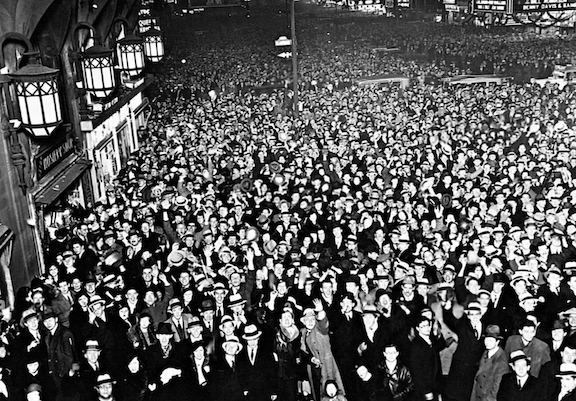
Above: Ringing in the New Year at Times Square, 1934.
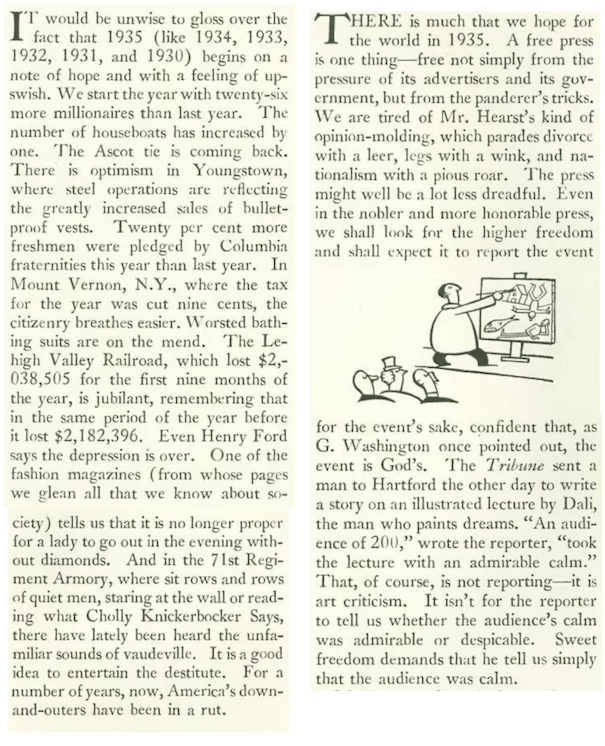
We bid adieu to 1934 with some odds and ends, beginning with E.B. White’s observations for the upcoming year, which if anyone had noticed the uptick in Ascot tie purchases, just might be a bit rosier than previous years of the decade.
Dec. 29, 1934 cover by S. Liam Dunn.
White was also hopeful for a new year with a less dreadful press, particularly the pandering type promulgated by William Randolph Hearst.
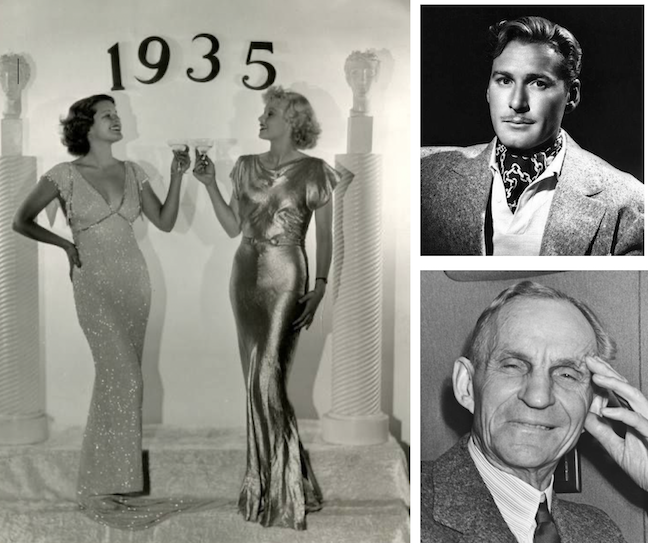
GOOD RIDDANCE…E.B. White wryly noted the positive signs heading into 1935. While actresses Billie Seward and Lucille Ball rang in the New Year, Erroll Flynn was sporting an ascot tie and Henry Ford was proclaiming that the Depression was over. (Pinterest)
* * *
Dr. Peeper
“The Talk of the Town” noted that Dr. Allan Dafoe, the country doctor who gained fame for delivering the Dionne Quintuplets, expressed a desire to see Sally Rand perform her bubble dance during his visit to Gotham. “Talk” also looked in on the some of the technical aspects of the burlesque dancer’s signature act:
DON’T BURST MY BUBBLE…Dr. Allan Dafoe of Dionne Quintuplet fame looked forward to taking in the sights of New York, including Sally Rand’s famed bubble dance. (Image from the 1936 book The Country Doctor/Sally Rand via stuffnobodycaresabout.com)
* * *
Leading Ladies
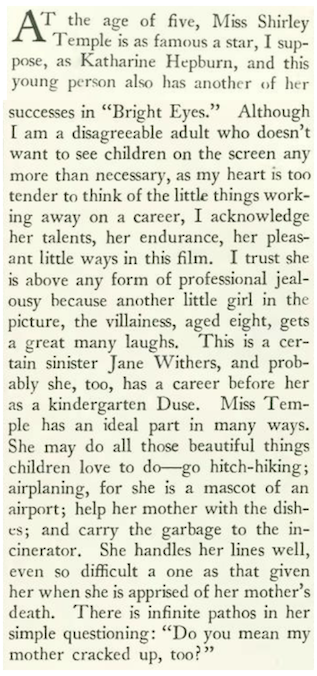
Film Critic John Mosher noted the continued rise of two leading female stars, twenty-seven-year-old Katharine Hepburn and six-year-old Shirley Temple. Mosher recalled Hepburn’s recent performance in Little Women, and proclaimed that she “succeeds again” in The Little Minister.
OPPORTUNITY KNOCKS...Katharine Hepburn and John Beal in The Little Minister. Hepburn portrayed Babbie, a member of the nobility who disguises herself as a gypsy to protect villagers from a tyrannical lord. In the process she falls in love with the good Rev. Gavin Dishart (Beal). (IMDB)
Although Mosher admitted he was a “disagreeable adult” who doesn’t enjoy seeing children on the screen “more than necessary,” he acknowledged Shirley Temple’s talents as well as those of child actor Jane Withers in Bright Eyes.
BRIGHT EYES, BRIGHT STARS…Jane Withers, Shirley Temple, and Terry in Bright Eyes. (IMDB)
* * *
That Youthful Feeling
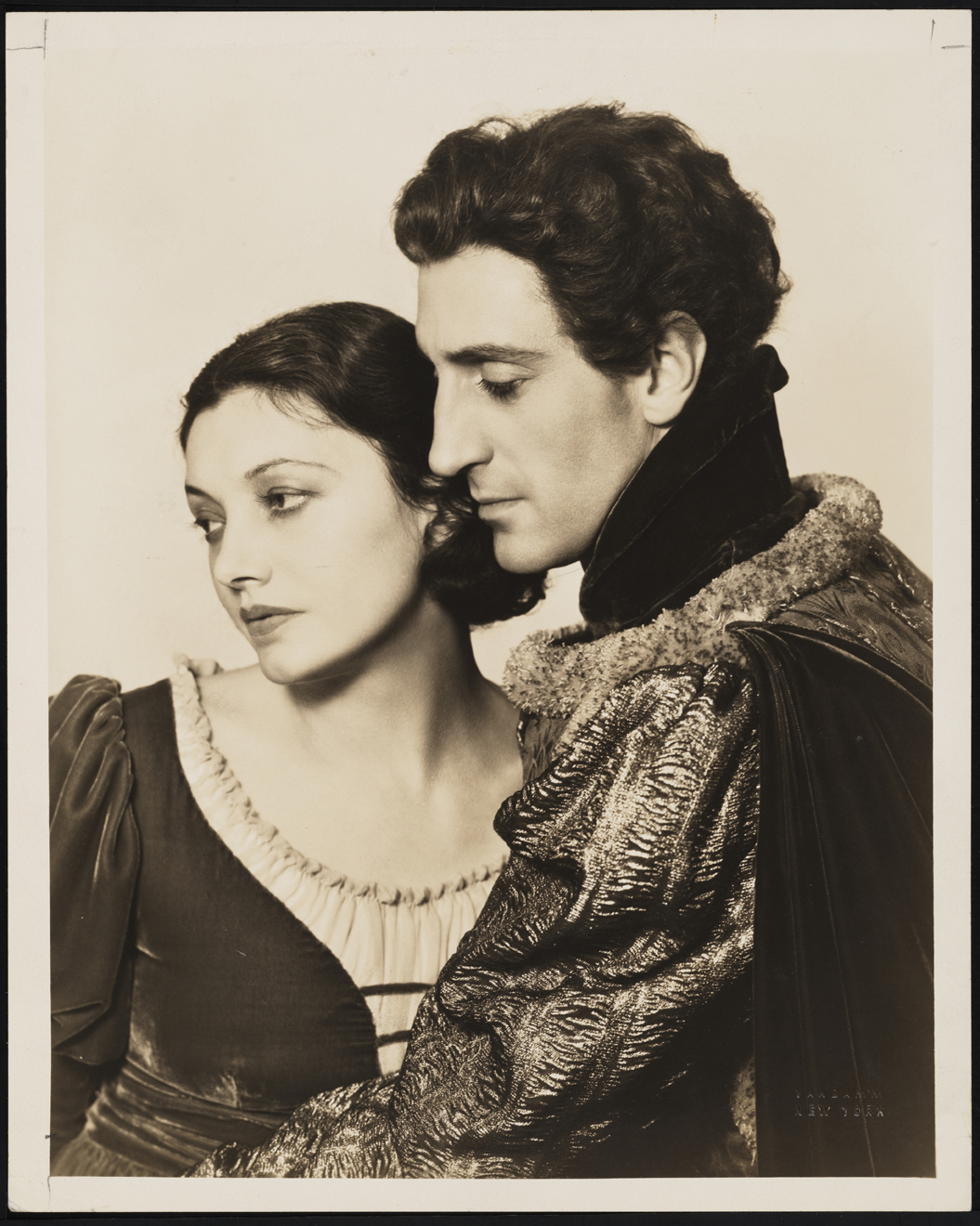
Given that William Shakespeare’s star-crossed lovers Romeo and Juliet were mere teenagers (the ages 13 and 16 were given to Juliet and Romeo, respectively), many productions featured actors more than twice that age. That was the case in 1933 when the play was revived by actress Katharine Cornell and her director husband Guthrie McClintic, who took the play on a seven-month nationwide tour before it was revised and opened on Broadway in December 1934. Critics dubbed the 41-year-old Cornell “the greatest Juliet of her time,” and it seems Robert Benchley heartily agreed in this excerpt from his stage review:
AGE IS JUST A NUMBER…The 41-year-old Katharine Cornell and 42-year-old Basil Rathbone in a promotional photo for Romeo and Juliet. Cornell was the first performer to receive the Drama League’s Distinguished Performance Award, which became the oldest and most exclusive theatrical honor in North America. (Vandamm photo, Museum of the City of New York)
* * *
The New Yorkiest Place
In 1930 gossip columnist Walter Winchell called the new Stork Club “New York’s New Yorkiest place on W. 58th,” and when it relocated to 3 East 53rd Street in 1934 it further defined itself as the ultimate New York night club. In her “Tables for Two” column, Lois Long found the new location much to her liking. An excerpt:
THE STORK DELIVERS…The Stork Club truly became the New Yorkiest nightclub when it relocated to 3 East 53rd Street in 1934. Clockwise, from top left: the club entrance in the 1930s; Cary Grant was one of the many celebrities who favored the nightclub, circa 1935; a 1930’s club menu; Lita Grey, the former teen bride of actor Charlie Chaplin, was a featured singer at the club during Lois Long’s visit. (Gibbes Museum of Art/Pinterest/vintagemenuart.com/IMDB)
* * *
So Long?
Clarence Day, best known for his Life with Father stories, also contributed a number of cartoons to the magazine, accompanied by satirical poems and humorous shorts. Day would die at the tender age of 61—after a bout with pneumonia—in December 1935, about a year after this cartoon was published in The New Yorker. I assume he was signing off from the magazine in order to arrange publication of his Life with Father book, which was published shortly after his death.
* * *
From Our Advertisers
Sunny California beckoned those who had the means and leisure to head to warmer climes during the New York winter…
…for those who stayed behind, they could wrap themselves in a chic winter coat such as this one sported by Camel endorser Mrs. Langdon Post (Janet Kirby)…
…another colorful ad with a not-so-colorful message from World Peaceways, a 1930s anti-war organization that characterized soldiers (and future soldiers, seen here) as pawns in the corrupt games of the rich and powerful…
…the distributors of French champagne rang in the New Year by suggesting that Doyen was worth your very last cent…
…we kick off our cartoons by welcoming the New Year with George Price…
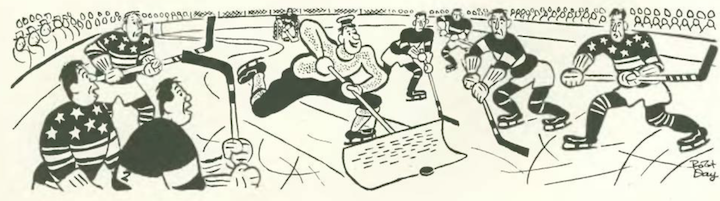
…Robert Day contributed a spot drawing that offered a new twist to ice hockey…
…I should know this artist, but it escapes me for the moment…nevertheless, a great illustration to stretch across the bottom of an opening page…
…a closeup of the signature…
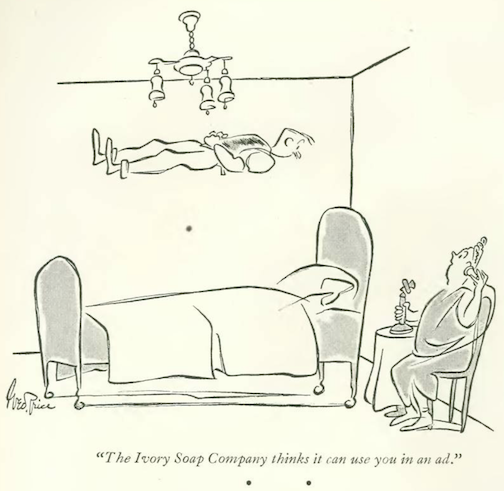
…another from George Price, still up in the air in the final issue of 1934…
…Garner Rea introduced us to the life of the party…
…”Miss Otis Regrets” is a 1934 Cole Porter song about the lynching of a society woman after she murders her unfaithful lover. Porter wrote the song as a parody of a sad cowboy song he heard on the radio. The song was further workshopped for fun at “smart set” cocktail parties…on to our next cartoon, and a moment of keen insight from James Thurber…
…Garrett Price went on the town with some students of anatomy…
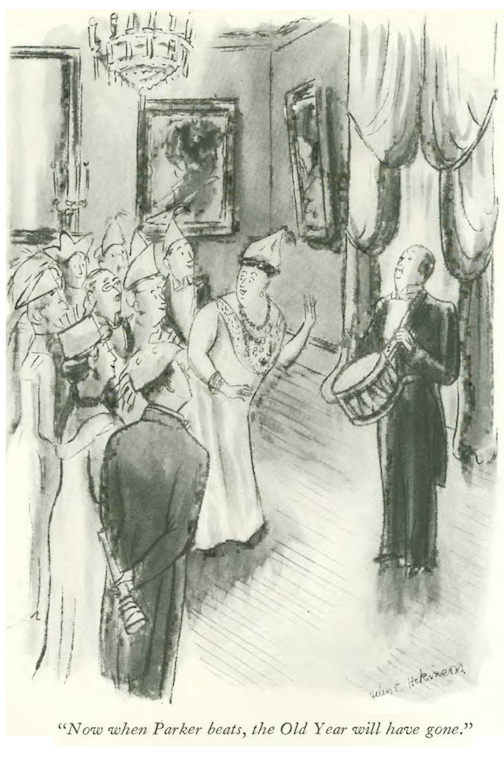
…and we say Happy New Year with the help of Helen Hokinson…
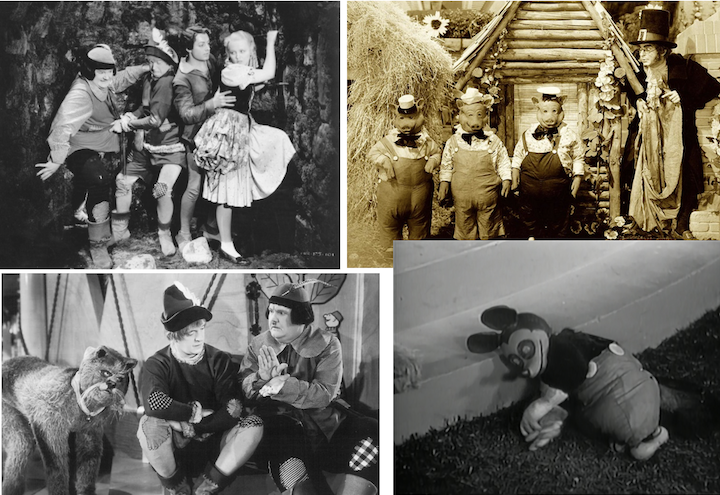
Above: The Cat and the Fiddle (Pete Gordon) and Mickey Mouse (a monkey in a very creepy costume) were featured in 1934's Babes In Toyland.
We close out the old year and ring in the new with a bit of song and dance from three musicals that entertained New Yorkers in the waning days of 1934.
Dec. 22, 1934 cover by Arnold Hall.
The work of composer Jerome Kern and lyricist Oscar Hammerstein II were prominent in two of those films, adapted from successful Broadway productions—the romantic comedy Music in the Air and the sentimental Sweet Adeline. Success on the stage did not necessarily translate to the screen in either case, according to critic John Mosher.
SOUR NOTES…The famed silent movie star Gloria Swanson showed off her singing chops in Music in the Air, but it wasn’t enough to save the film from becoming a box office failure. The film centered on the stormy relationship between opera star Frieda Hotzfelt (Swanson) and librettist Bruno Mahler (John Boles, pictured). (TCM)TALL ORDER…For those who recalled Helen Morgan’s tragedy-tinged Broadway performance as Addie in Sweet Adeline, Irene Dunn’s more comical take, although delivered with authority, could not hold up the pallid performances of her co-stars, including Donald Woods, right. (TCM)
And there was Babes in Toyland, a Hal Roach film headlined by the comedy duo Stan Laurel and Oliver Hardy. The film was well received by critics, including Mosher, who wrote that Babes in Toyland “was far more successful than [1933’s] Alice in Wonderland, and the children will probably be far less bored by it than they generally are by those films designed especially for them.” However, similar to Alice the costumes seem creepily crude, such as the weird rubber pig costumes and the almost terrifying Mickey Mouse, portrayed by a hapless monkey dressed to resemble the big-eared icon. It was apparently the first and last time Walt Disney allowed the Mickey Mouse character to be portrayed outside of a Disney film. No wonder.
Clockwise, from top left, Stan Laurel and Oliver Hardy with Felix Knight (Tom-Tom) and Charlotte Henry (Bo-Peep); the Three Little Pigs with the villain Silas Barnaby, portrayed by Henry Brandon; a very creepy Mickey Mouse (a monkey in costume); and Laurel and Hardy with The Cat and the Fiddle (Pete Gordon). (eofftvreview.wordpress.com/psychotronicaredux.wordpress.com/YouTube/MUBI)
* * *
Alms for the Poor
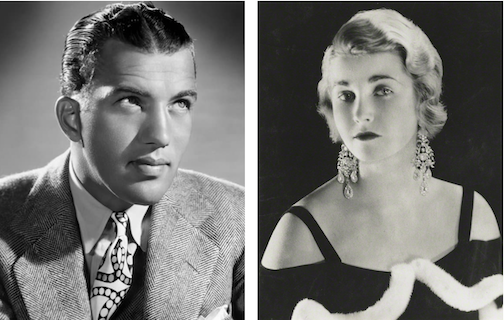
Woolworth store heiress Barbara Hutton was one of the richest women in the world in the 1930s, and her lavish lifestyle in the midst of Depression attracted the attention, and the ire, of newspaper columnist Ed Sullivan. In his “Notes and Comment,” E.B. White made this observation:
COUGH IT UP, LADY…Ed Sullivan, who in 1934 was a well-known Daily News show business columnist, thought Woolworth dime store heiress Barbara Hutton should show more concern for the needy. Known for her lavish spending during the Great Depression, in 1934 Hutton was married to a self-styled Georgian prince named Alexis Mdivani—Mdivani would be the first of Hutton’s seven husbands. Sullivan would go on to greater fame on television with the Ed Sullivan Show. (clickamericana.com/npg.org.uk)
* * *
Oh Baby
Most of us know something about the weird and somewhat tragic tale of the Dionne quintuplets, raised from infancy before the public gaze and exploited to sell everything from dolls and books to soap and toothpaste. When E.B. White made this brief mention in his “Notes and Comment,” the story of the quintuplets was still a jolly one, and their delivering physician, Dr. Allan Roy Dafoe had gone from being a country doctor to one of North America’s most trusted medical authorities. Dafoe would become the childrens’ guardian and impresario, and make a fortune marketing their story and images.
QUINTUPLE YOUR MONEY…After he delivered the Dionee quintuplets, Dr. Allan Roy Dafoe went from being a country doctor to one of North America’s most trusted medical authorities. That later translated into big profits from companies eager to cash in on the quint’s popularity, as these 1937 ads attest. (Pinterest)
* * *
In the Year 2400
“The Talk of the Town” examined the “Buck Rogers” craze, fed by a cartoon strip, a radio show, and an array of toys.
YESTERDAY’S TOMORROW…A Buck Rogers “pop-up” book was just one of the many formats that could be consumed by avid followers of the early sci-fi hero. Also pictured are a themed pocket watch and the “must have” sci-fi toy of 1934, Buck’s XZ-31 Rocket Pistol. (Pinterest/Bullock Museum)
* * *
What’s It All About, Alfie?
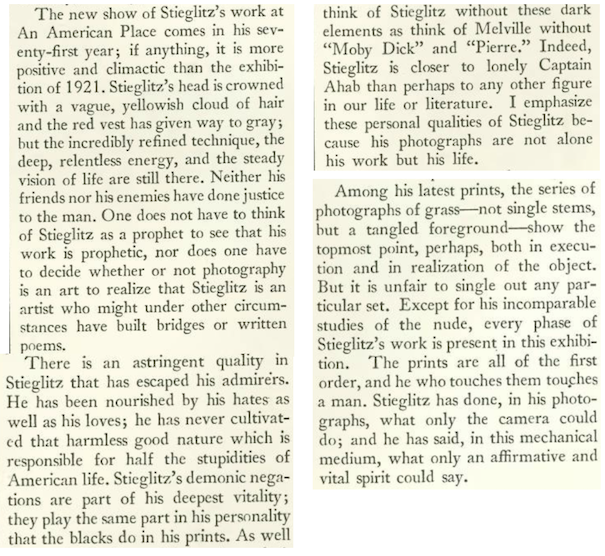
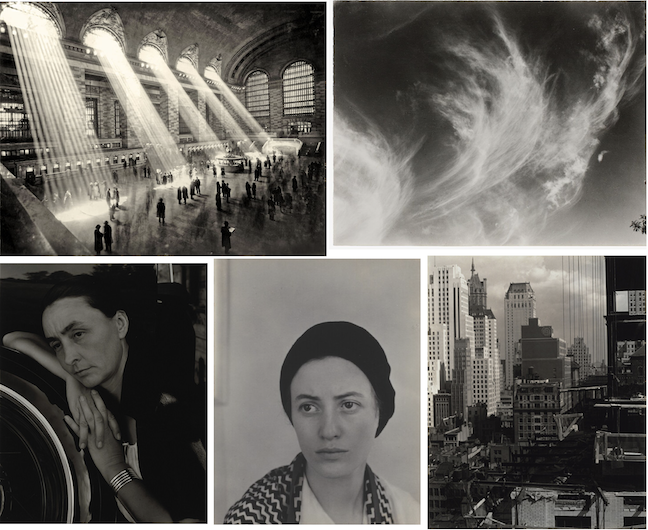
Art and architecture critic Lewis Mumford offered praise for Alfred Stieglitz’s latest exhibition at the photographer’s gallery, An American Place. Mumford noted Stieglitz’s “astringent quality” that rose above the philistine tastes and “stupidities” of American life.
LIFE AND WORK INTERTWINED…Clockwise, from top left: Alfred Stieglitz’s famed 1930 image of Grand Central Terminal; one of the photographer’s many images of clouds under the title Equivalent, 1930; image taken from Stieglitz’s studio/gallery window titled From My Window at An American Place, North, 1931; Dorothy Norman, circa 1931; Georgia O’Keeffe, 1933. Stieglitz, who was married to Georgia O’Keeffe, became Dorothy Norman’s mentor and lover in the late 1920s. (National Gallery of Art/Art Institute of Chicago)
* * *
From Our Advertisers
The back cover of The New Yorker was coveted by tobacco companies, the makers of Camels and Lucky Strikes (seen here) both featuring sumptuous photos of stylish women using their product, women being a key growth market for the companies…
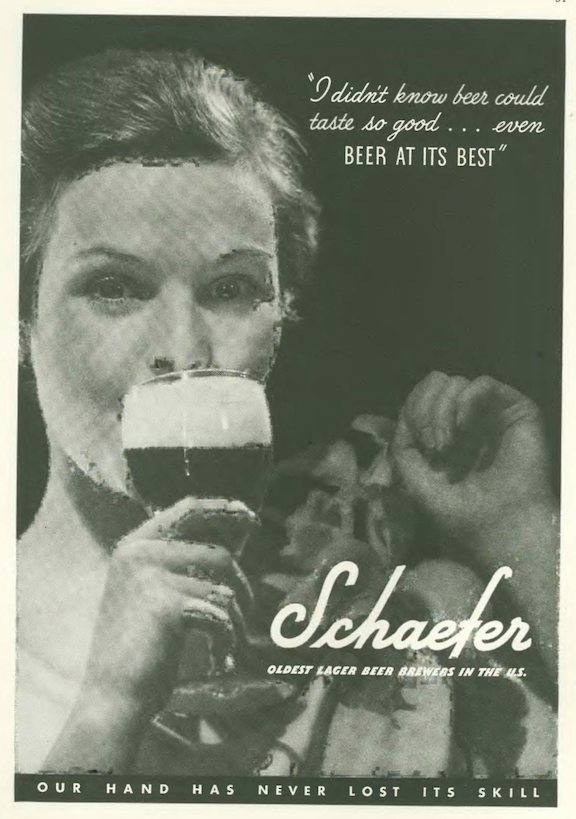
…same for the brewers, who also sought out female consumers to bolster sales of their brands…
…Ponds continued to roll out the seeming legions of socialites and lower-tier royalty to sell their jars of cold cream…
…the magazine’s ads were often directed at middlebrow class anxieties, as we see here…
…by constrast, this ad from Bonwit Teller (graced by fashion illustrator W. Mury) took us out of the stuffy parlor and onto the beckoning beaches of the Caribbean…
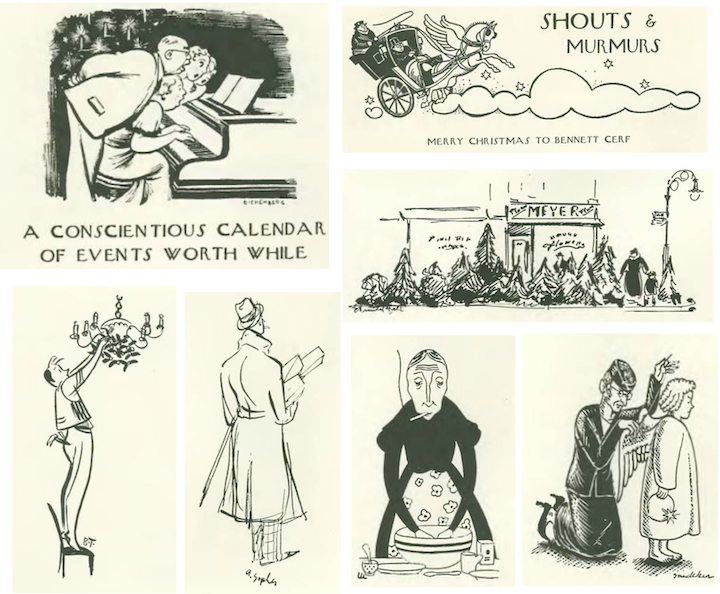
…we move on to our cartoonists…all of the spot illustrations in the issue were holiday-themed, and here are a few choice examples…
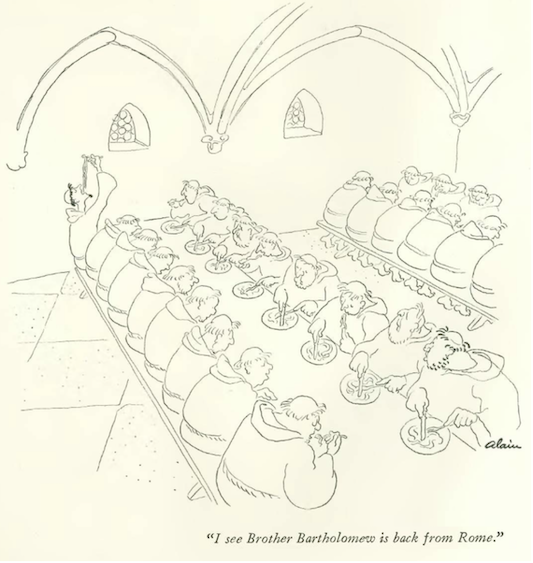
…Daniel ‘Alain’ Brustlein introduced a bit of color to a monastery’s dining hall…
…James Thurber continued to explore the dynamics between the sexes…
…Barbara Shermund did a bit of dreaming with her modern women…
…Carl Rose gave us Christmas cheer, with some reservations…
…and lastly, Perry Barlow with something for the holiday procrastinator…
Above, left, a 1935 portrait of Gertrude Stein by Carl Van Vechten; right, Gertrude Stein and Alice B. Toklas arriving in New York aboard the French Line’s SS Champlain in 1934. (Library of Congress/AP)
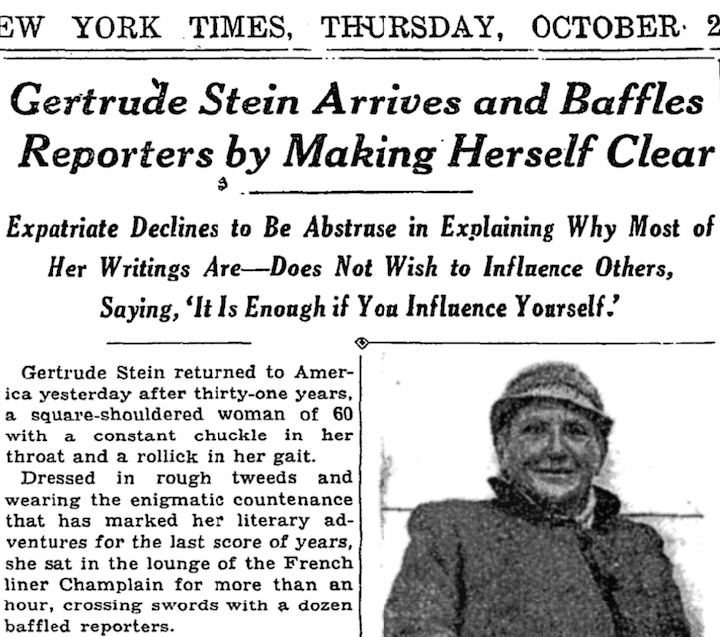
Much of America’s literary world was abuzz about the arrival of Gertrude Stein in New York after her nearly three-decade absence from the States. Audiences were mostly receptive to Stein’s lectures, even if they were largely unintelligible, but The New Yorker would have none of it.
Nov. 17, 1934 cover by Rea Irvin.
Stein (1874–1946) visited the U.S. at the urging of friends who suggested that a lecture tour might help her gain an American audience for her work. She crisscrossed the country for 191 days, delivering seventy-four lectures in thirty-seven cities.
Writing for the Smithsonian Magazine (October 2011), Senior Editor Megan Gambino notes that publishing houses regarded Stein’s writing style as incomprehensible (Gambino writes that shortly after her arrival in the U.S., “psychiatrists speculated that Stein suffered from palilalia, a speech disorder that causes patients to stutter over words or phrases”), but in 1933 “she at last achieved the mass appeal she desired when she used a clearer, more direct voice” in The Autobiography of Alice B. Toklas. However, Stein was still best known in the U.S. for her “insane” writings, as one New York Times reporter described Stein’s work upon the writer’s arrival in New York. Excerpts from the Oct. 25, 1934 edition of the Times:
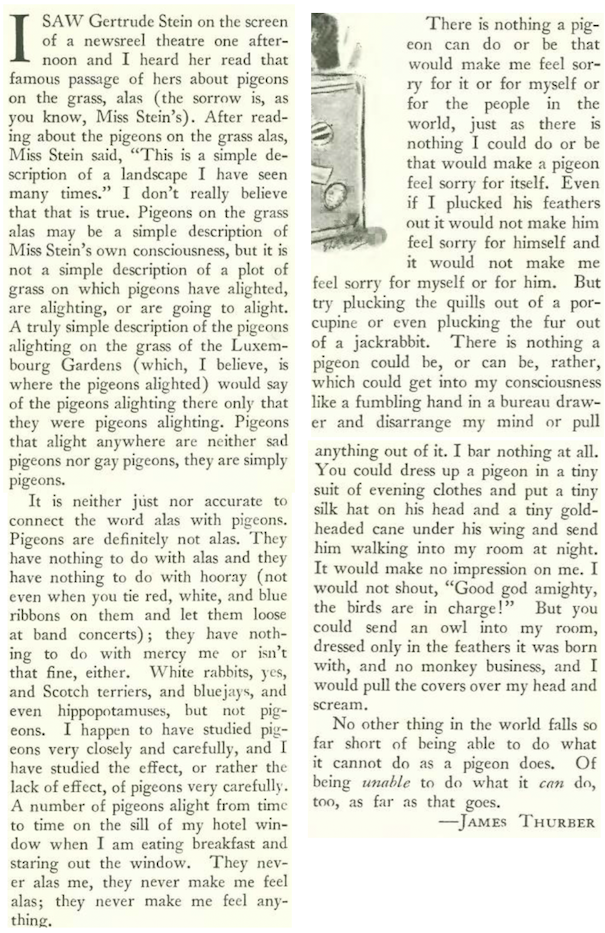
Stein had also achieved success in America via her libretto to Virgil Thomson’s opera Four Saints in Three Acts. Prior to her visit, Stein was featured in a newsreel reading the “pigeon” passage from the libretto, which James Thurber satirized in this piece titled “There’s An Owl In My Room.” Excerpts.
Here is a YouTube clip of the newsreel satirized by Thurber. Stein begins her “pigeon” reading at the 30-second mark:
If Thurber found the libretto ridiculous, it was an opinion not necessarily shared by audiences who attended Four Saints in Three Acts, which premiered in Hartford, Connecticut, before making a six-week run on Broadway.
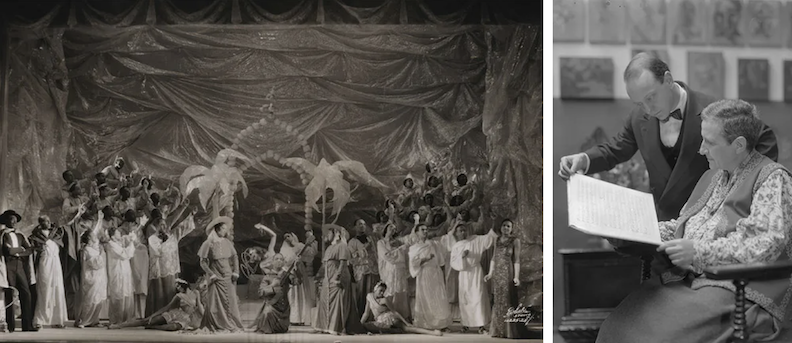
SAINTS AND PIGEONS…The original cast of Four Saints in Three Acts, onstage at the Wadsworth Atheneum, Hartford, 1934; at right, Gertrude Stein reviews the libretto for Four Saints with American composer Virgil Thomson, 1934. (Harold Swahn/Bancroft Library, UC Berkeley)
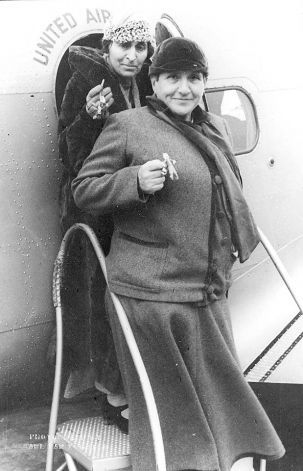
Since Stein had never seen the opera performed, writer and photographer Carl Van Vechten convinced Stein and Toklas to fly on an airplane for the first time in order to be able to see the play in Chicago.
FLIGHT INSURANCE…Stein and Toklas were anxious about flying, so Van Vechten gave each a small Zuni fetish—a good luck charm as they prepared to board their plane at Newark. (Boatwright Memorial Library, The University of Richmond)
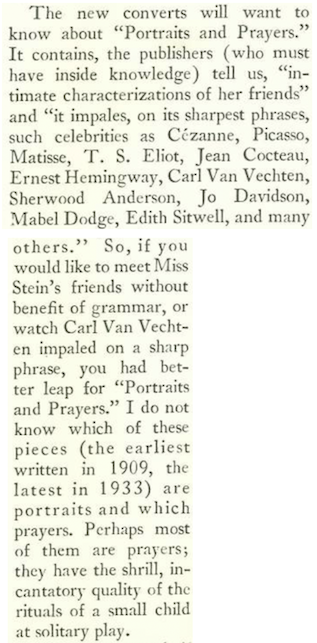
Thurber wasn’t the only New Yorker writer to throw shade on Stein’s visit. In his “Books” column, Clifton Fadiman described Stein as a “mamma of dada” and a “Keyserling in divided skirts” (Hermann Keyserling was a non-academic German philosopher known for his platitudinous, obscure writings). Excerpt:
Fadiman continued by excoriating Stein’s latest book, Portraits and Prayers, likening its “shrill, incantatory” quality to “the rituals of a small child at solitary play.”
* * *
Over the Rainbow
We leave Gertrude Stein for the time being and check in with Lois Long, who was sampling the fall attractions of the New York nightclub scene in “Tables for Two.” In these excerpts, the 32-year-old Long continued her pose as a much older woman (“about to settle down with a gray shawl”) as she bemoaned the bourgeoisie excess of places like the Colony, once known for its boho, speakeasy atmosphere. And then there was the Rainbow Room, with its organ blaring full blast to the delight of gawking tourists.
LOST IN NEW YORK…Lois Long lamented the demise of cafe life in Manhattan; from left, the Colony, circa 1940, which went from boho to upscale; the 21 Club, a favorite Prohibition-era haunt of Long’s where she was suddenly a nobody; and high above the city, the Rockefeller Center’s Rainbow Room, and its interminable organ music. (Pinterest/Alice Lum via Daytonian in Manhattan/nycago.org)
* * *
From Our Advertisers
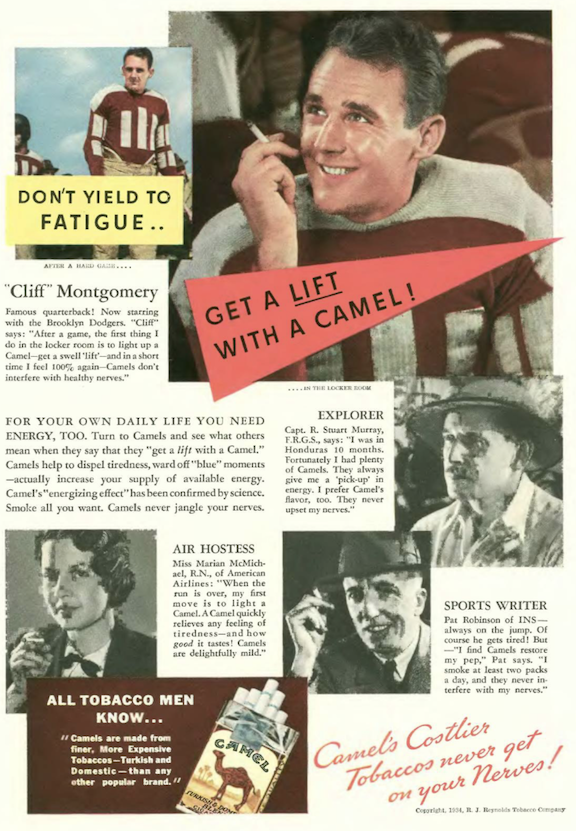
Just one ad from the Nov. 17 issue (more to come below)…the latest athlete to attest to the energizing effects of Camel cigarettes…Cliff Montgomery (1910–2005) was famed for a hidden ball trick play that led one of the greatest athletic upsets—Columbia’s 7-0 win over Stanford in the 1934 Rose Bowl. Montgomery would play one year with the NFL Brooklyn Dodgers, and would later earn a Silver Star for his heroism during World War II…
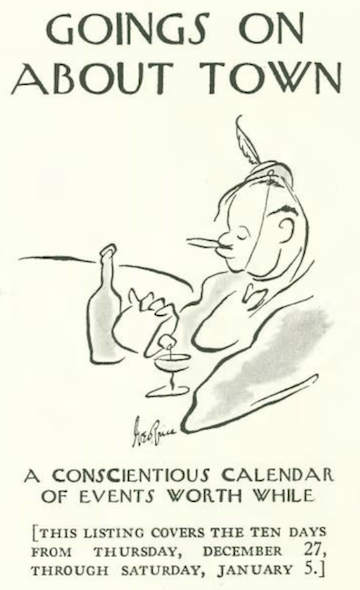
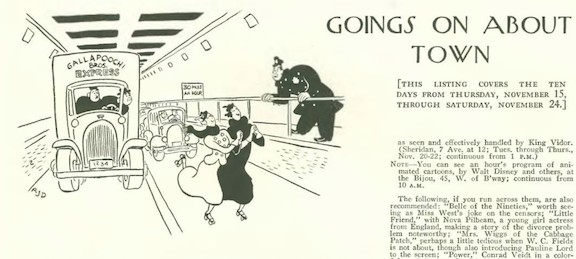
…on to our cartoonists, we begin with Robert Day’s jolly illustration for the “Goings On About Town” section…
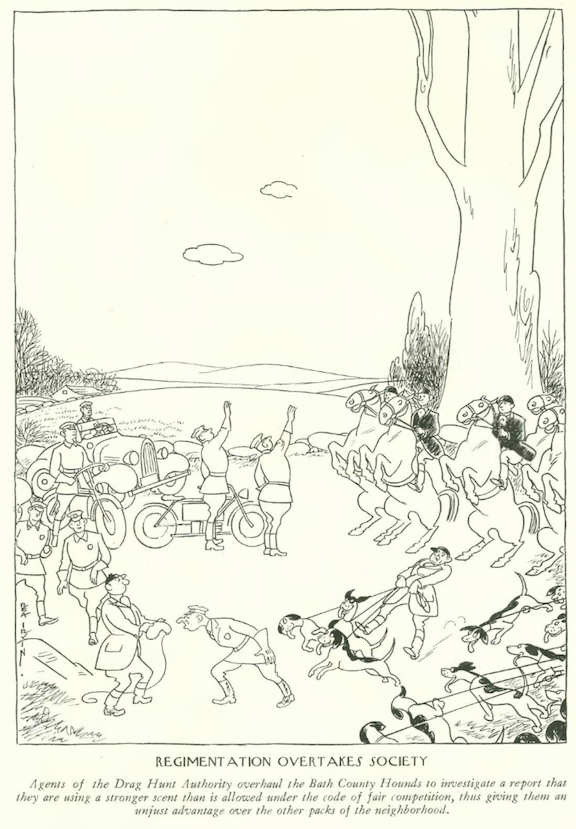
…Rea Irvin looked into fair play among the fox hunting set…
…Garrett Price gave us a tender moment among the bones at the American Museum of Natural History…
…and Peter Arno introduced two wrestlers to an unwelcoming hostess…
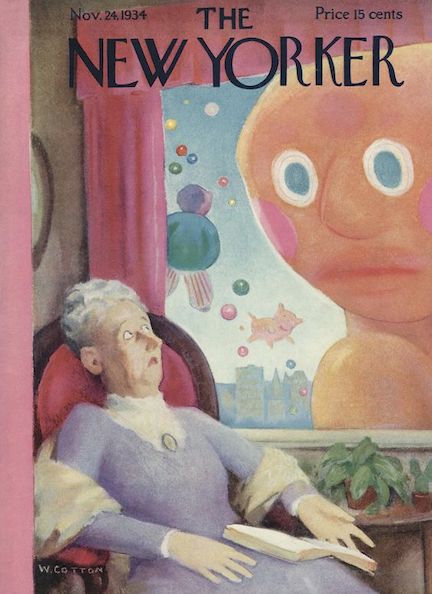
…on to Nov. 24, 1934 issue, and the perils of the Macy’s Thanksgiving Day Parade as illustrated on the cover by William Cotton…
Nov. 24, 1934 cover by William Cotton.
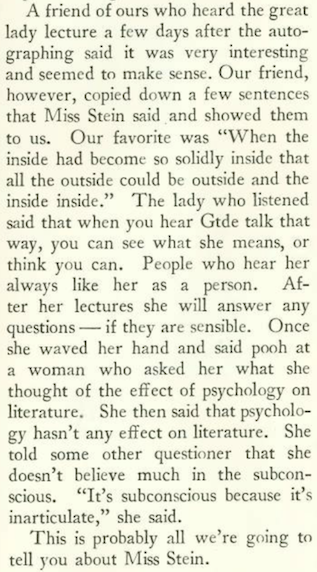
…where we find still more scorn being heaped upon Gertrude Stein. “The Talk of the Town” offered this observation (excerpt):
…and E.B. White had the last word on Stein in his Dec. 1, 1934 “Notes and Comment” column:
* * *
There Goes the Neighborhood
Returning to the Nov. 24 issue, Alberta Williams penned a lengthy “A Reporter at Large” column, titled “White-Collar Neighbors,” about the new Knickerbocker Village development in the Lower East Side. Real estate developer Fred French razed roughly one hundred buildings to build what has since been criticized as an example of early gentrification in Manhattan. Williams assessed the development after more than a year of construction, finding that despite federal funding, the leasing company had yet to rent any apartments “to Negroes or Orientals.” Although the development was meant to serve some of the families it displaced, the vast majority were forced to move back into slums due to escalating rents.
BREATHING ROOMS…Knickerbocker Village in 2019. To make way for the development, one hundred buildings were razed in the “Lung Block,” so named because of its high tuberculosis mortality rate. The development continues to be designated as affordable housing. (Wikipedia)
* * *
Dollmaker
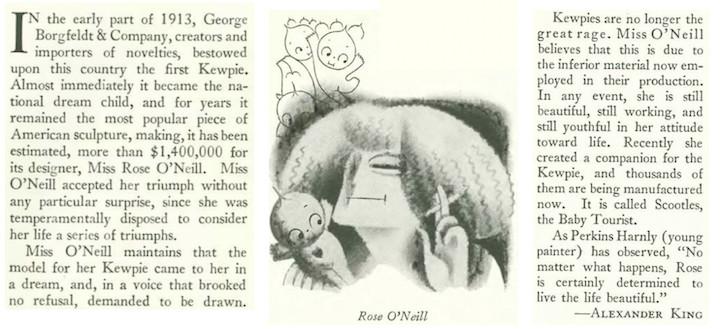
Raised in rural Nebraska, at an early age Rose O’Neill (1874–1944) demonstrated an artistic bent, and was already a published illustrator and writer when she drew her first images of “Kewpie” around the year 1908. A German doll manufacturer began producing a doll version of Kewpie in 1913, and they became an immediate hit, making O’Neill a millionaire and for a time the highest-paid female illustrator in the world. When Alexander King penned a profile of O’Neill, Kewpies were no longer the rage, but O’Neill was nevertheless determined to find success in a new doll line. Excerpts:
QP QUEEN…Clockwise from top left, Rose O’Neill circa 1910, just before her Kewpie dolls made it big; Kewpie doll in original box, undated; as the Kewpie craze faded in the 1930s, O’Neill tried to launch a new line called Little Ho Ho, a laughing baby Buddha, but before production plans were finalized the doll factory burned to the ground; a 1935 ad for a Rose O’Neill-branded “Scootles” doll, another attempt at a comeback. (Wikipedia/Pinterest/museumobscura.com)
* * *
Last Call
Lois Long was back with another installment of “Tables for Two” and in these excerpts she found the Central Park Casino a welcome place to hang out, apparently unaware that Parks Commissioner Robert Moses had already served an eviction notice to the Casino’s owners (Moses would tear down the Casino in 1936, mostly to settle a personal vendetta). Long also found respite at the Place Piquale, which featured the musical stylings of Eve Symington.
BYE BYE…The Central Park Casino was not long for the world when Lois Long paid an enjoyable visit in November 1934. Long also found a good time at the Place Piquale, which featured the “startling,” deep voice of cabaret singer Eve Symington. (centralpark.org/Pinterest)
At the Place Piquale, Long was “grateful” to see that silent film star Louise Brooks was also a good dancer. An icon of Jazz Age flapper culture, Brooks loathed the Hollywood scene and the mediocre roles it offered, and after a stint making films in Europe she returned to the States, appearing in three more films before declaring bankruptcy in 1932. A former dancer for the Ziegfeld Follies, Brooks had turned back to dancing in nightclubs to make a living.
IT’S A LIVING…Promotional photo for the Place Piquale featuring Louise Brooks (sans her familiar flapper bob) and Dario in “Spectacular Interpretive Dances,” April 17, 1934. (books0977.tumblr.com)
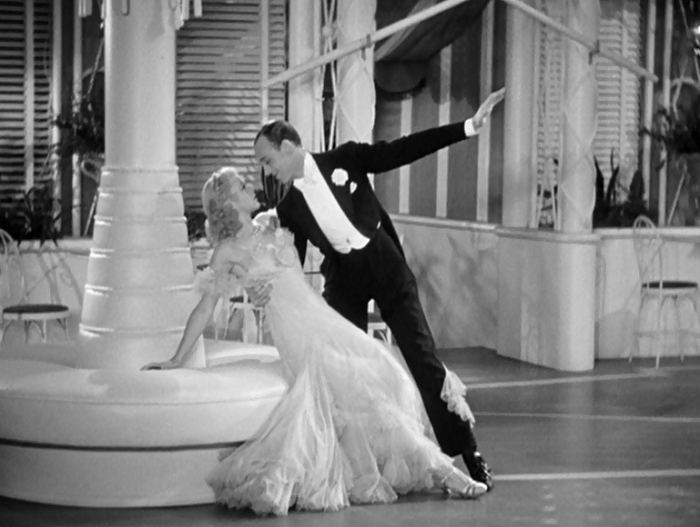
…and dance remains a theme with John Mosher’s film review of the Fred Astaire and Ginger Roger musical The Gay Divorcee, which was based on the 1932 Broadway musical Gay Divorce starring Astaire and Claire Luce.
YOU WILL HAVE TO DANCE BACKWARD, IN HEELS…Ginger Rogers and Fred Astaire trip the light fantastic in The Gay Divorcee. (precode.com)
* * *
Using Her Heads
Clifton Fadiman praised Peggy Bacon’s collection of caricatures, Off With Their Heads!, which included drawings of fellow New Yorker contributors as well as various Algonquin Hotel acolytes. Excerpt:
HEAD HUNTER…Peggy Bacon offered up caricatures of forty celebrities in her new book, Off With Their Heads! Bacon (1895–1987) contributed cartoons as well as poetry and fiction to The New Yorker from 1927 to 1950. Clockwise, from top left, title page with Bacon’s self-portrait; undated photo of Bacon, likely circa 1930; caricatures of Dorothy Parker, Carl Sandburg and Heywood Broun. (villagepreservation.org/printmag.com/Wikipedia–Peter A. Juley & Son)
* * *
More From Our Advertisers
“Beautiful Vanderbilts” Mrs. Reginald Vanderbilt and Miss Frederica Vanderbilt Webb wowed one unnamed dermatologist who discovered that both had 20-year-old skin even though they were seven years apart! “Mrs. Reginald” was Gloria Morgan Vanderbilt, who was thirty when this ad was produced (Miss Frederica was apparently twenty-three). We’ve met Gloria Morgan Vanderbilt before, shilling for Pond’s—she was the maternal grandmother of television journalist Anderson Cooper, and earned her “bad mom” rep from Vanderbilt vs. Whitney, one of America’s most sensational custody trials…
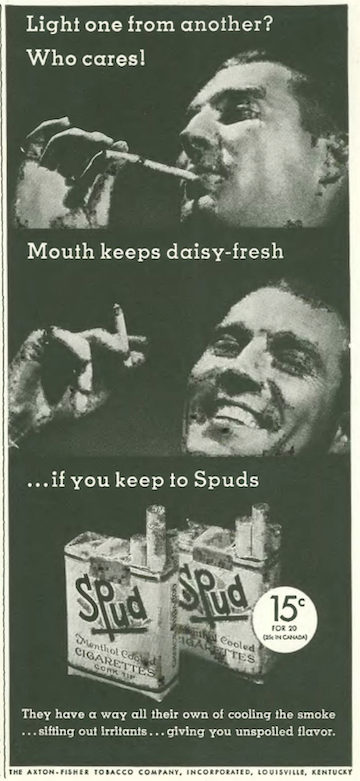
…we move from skin care to who cares…in this case how many Spud cigs you smoke…hell, smoke three packs a day if you like, the cooling menthol will always keep you feeling fresh even as your lungs gradually darken and shrivel up…
…and here’s a lesson from the makers of Inecto hair dye, no doubt a company solely run by men, who schooled wives with the advice that you’d better color that gray hair pronto or your hubby will kick you to the curb…
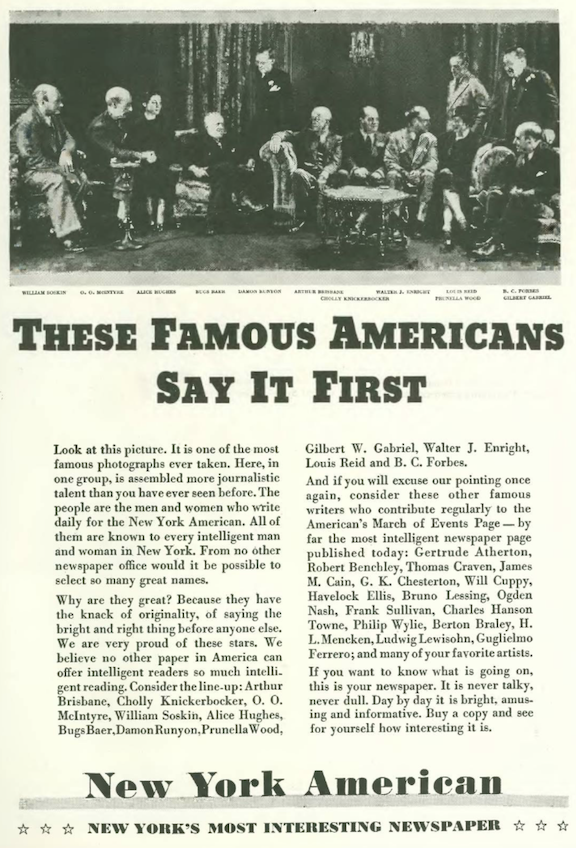
…the New York American was a Hearst broadsheet known for its sensationalism, however it did claim Damon Runyon, Alice Hughes, Robert Benchley and Frank Sullivan among its contributors…the morning American merged with the New York Evening Journal to form the American and Evening Journal in 1937. That paper folded in 1966…
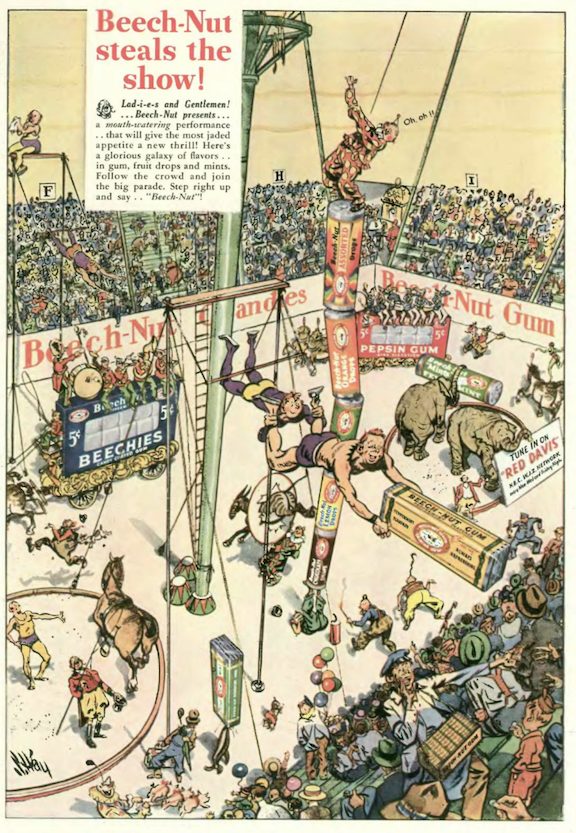
…illustrator Stuart Hay drew up this full page ad for the makers of Beech-Nut candy and chewing gum…when I was a kid we used to call this “grandpa gum”…
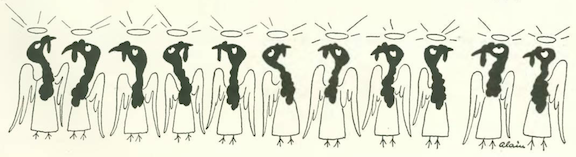
…on to our cartoonists, we begin with a Thanksgiving spot by Alain (Daniel Brustlein)…
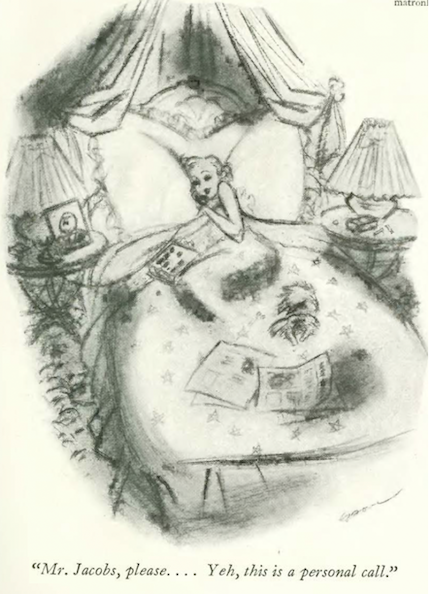
…Barbara Shermund delivered another life of the party…
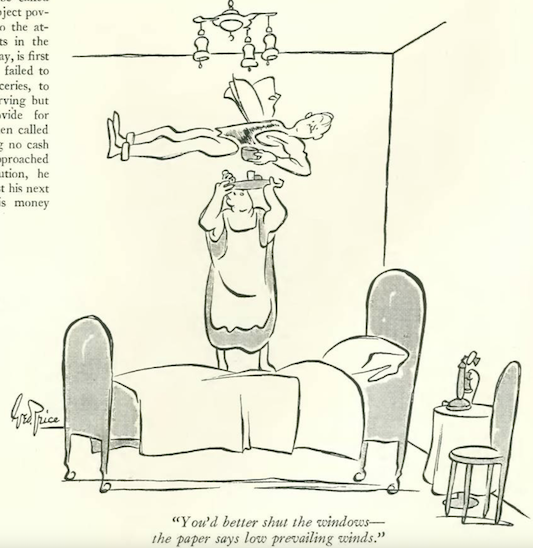
…George Price was finally bringing his floating man back to earth…
…Otto Soglow gave us an unlikely detour…
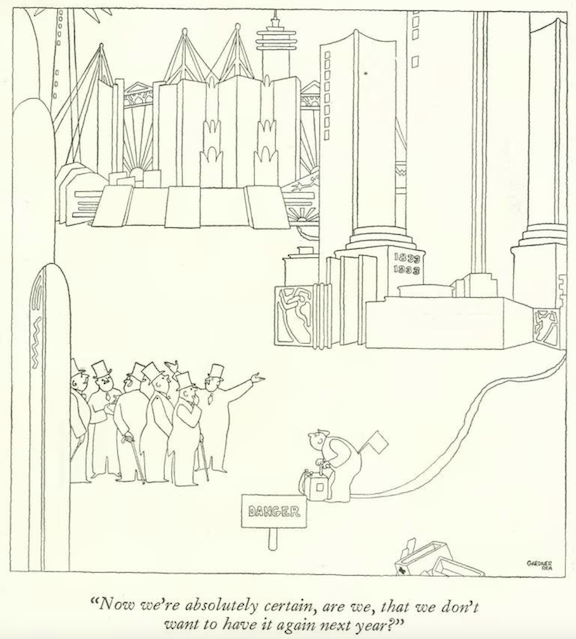
…Gardner Rea signaled the end to the 1933-34 Chicago World’s Fair…with a boom…
…Leonard Dove dialed up a familiar trope…
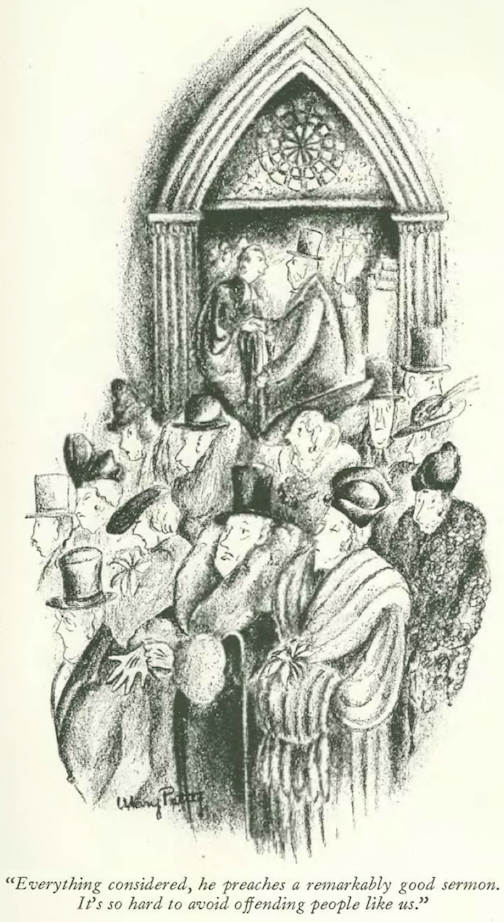
…and we close on a more pious note, with Mary Petty…
Otto Klemperer rehearsing at the Hollywood Bowl in September 1937. (Los Angeles Philharmonic)
The 20th century was an age of big personalities in classical music, among them Otto Klemperer (1885-1973), a German-born protégé of the composer and conductor Gustav Mahler. Klemperer was already an established conductor in opera houses around Germany when the rise of the Nazis prompted the maestro to emigrate with his family in 1933. He was soon appointed chief conductor of the Los Angeles Philharmonic.
Oct. 13, 1934 cover by Rea Irvin.
Klemperer also guest conducted a number of orchestras in the U.S., including the New York Philharmonic, where his larger than life presence caught the attention of “The Talk of the Town.” Excerpts:
MAESTRO…Top left, Otto Klemperer with Czech composer Leoš Janáček in 1927; at right, with Austrian-American classical pianist and composer Artur Schnabel in 1933; bottom photo, with wife Johanna Geisler, son Werner and daughter Lotte in Los Angeles, 1936. (operaplus.cz/Otto Klemperer Film Foundation/ottoklemperer.nl)
Lauded internationally as a great orchestral commander, in 1939 Klemperer would begin experiencing balance issues. After a tumor the size of a small orange was removed from his brain, he would be left partially paralyzed on his right side; bouts of depression and a manic phase would later land him in a mental hospital. However, by 1946 he would recover his health enough to return to conducting in a career that would last until 1971.
The conductor’s daughter, Lotte Klemperer (1923–2003), would serve as her father’s secretary, negotiator and administrator until his death in 1973. Otto’s son, Werner Klemperer (1920–2000), would become a stage, screen and television actor, most notably portraying Colonel Klink in the 1960s comedy Hogan’s Heroes. Although the role would garner Werner two Emmys, his father never fully understood the series or even the concept of a sitcom. Reluctant to pursue a musical career while his father was alive, Werner would later join the Metropolitan Opera Company in the 1970s, appear in Broadway musicals, and serve as a narrator with a number of American symphony orchestras.
TO THEM HE WAS DAD…At left, daughter Lotte Klemperer with her famous father in 1954. She would serve as his caretaker and business partner after her mother’s death in 1956. At right, son Werner Klemperer acted on Broadway and in films before taking on the role of the bumbling Colonel Klink in the 1960s comedy Hogan’s Heroes, which garnered the actor two Emmys. Although Werner Klemperer was musically inclined, he avoided work in music until the death of his father in 1973. (Otto Klemperer Film Foundation/CBS)
* * *
Vanished in the Haze
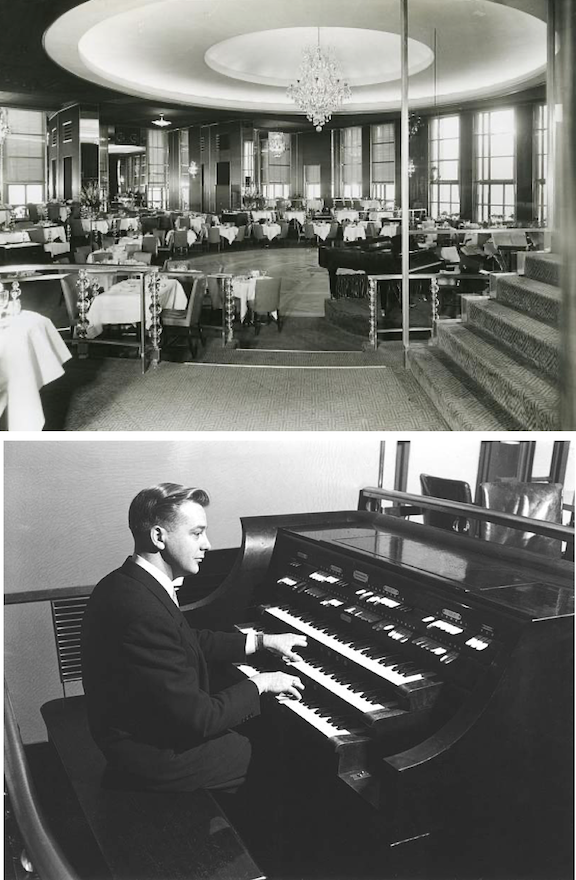
In his “Notes and Comment,” E.B. White lamented what appeared to be the transformation of the familiar night club; high above Manhattan in the Rockefeller Center’s Rainbow Room, the comforting haze of “cigarette smoke, talc, waiter’s venom” had been displaced by air conditioning, and to add to the horror, an organ had been installed that tinged the fox trot “with an odd piety.”
NOWHERE TO HIDE…E.B. White found the lack of haze in the new Rainbow Room disconcerting, not to mention the addition of a Wurlitzer organ, its wonders demonstrated here by organist Ray Bohr in 1934. (Library of Congress/nycago.org)
* * *
There Oughta Be a Law
While E.B. White was mourning the demise of the smoky nightclub, art and design critic Lewis Mumford continued his tirade against the pretentious and mediocre buildings that were popping up all over the city, including the new Federal Court Building on Centre Street that was, in Mumford’s words, a supreme example of bad design and fake grandeur.
A CRIMINAL CASE…Cass Gilbert’s Federal Courthouse building (United States courthouse) was completed in 1936, two years after Gilbert’s death. In 2001 it was designated as the Thurgood Marshall United States Courthouse. Critic Lewis Mumford called the design, which combined “two unlovely and unrelated forms”…”nothing short of a major crime.” (Wurts Brothers Photography Collection, National Building Museum)
* * *
Crime of the Century
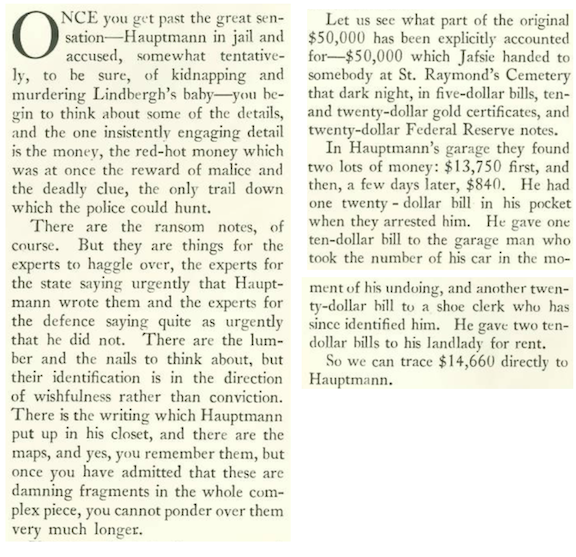
That is what the press called the kidnap and murder of the infant son of Charles Lindbergh and Anne Morrow. In September 1934 a German immigrant carpenter named Bruno Hauptmann was arrested for the crime, and a trial date was set for the following January. In his “A Reporter at Large” column, Morris Markey examined the ransom money trail that led to Hauptmann’s ultimate arrest. Excerpts:
DON’T SAY “CHEESE”…Bruno Hauptmann sits for a mug shot following his arrest for the abduction and murder of the 20-month-old son of Charles Lindbergh and Anne Morrow Lindbergh. (Leslie Jones, Boston Public Library)
* * *
Should Have Stayed Lost
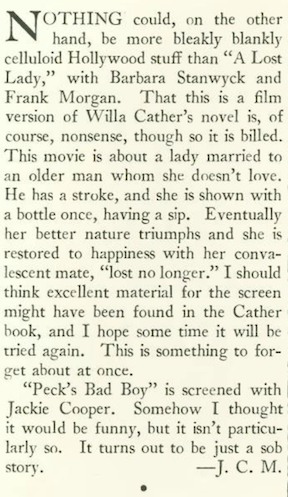
A film version of Willa Cather’s 1923 novel A Lost Lady was first made as a silent by Warner Brothers in 1924 (the film itself is lost) but in 1934 Warner had another go at the novel with a sound version starring starring Barbara Stanwyck, who was emerging as a major star. But Stanwyck’s talents could not overcome a script that critic John Mosher described as bleak, blank nonsense. Cather was so dismayed by the film that she refused to permit another adaptation of any of her novels during her lifetime.
LOST IN TRANSLATION…Barbara Stanwyck and Ricardo Cortez in A Lost Lady (1934). (IMDB)
* * *
From Our Advertisers
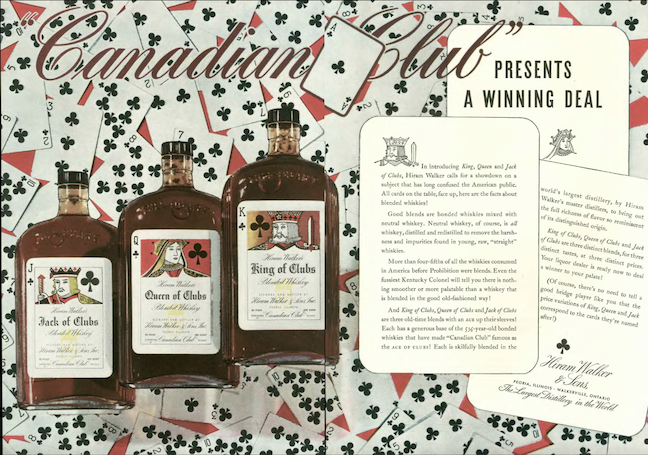
We kick off our sponsors with this two-page center spread from Hiram Walker & Sons, who introduced their new line of playing card-inspired whiskies…
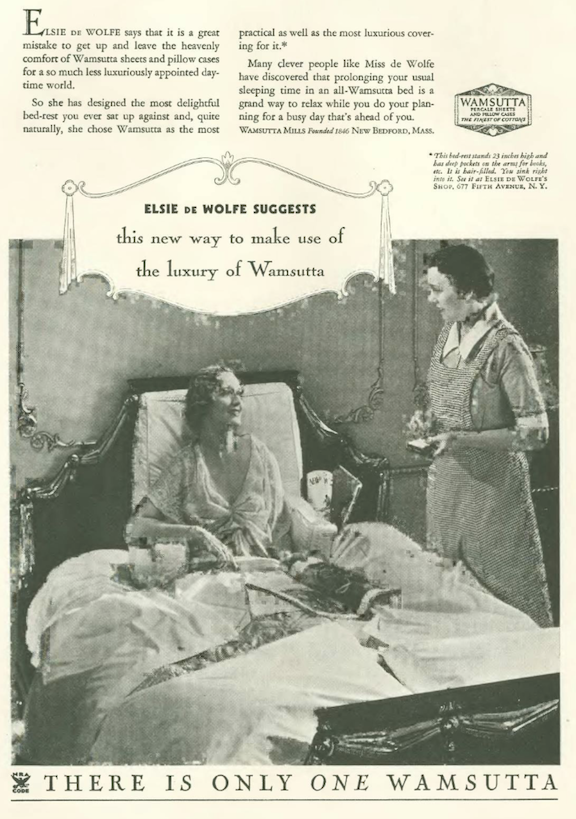
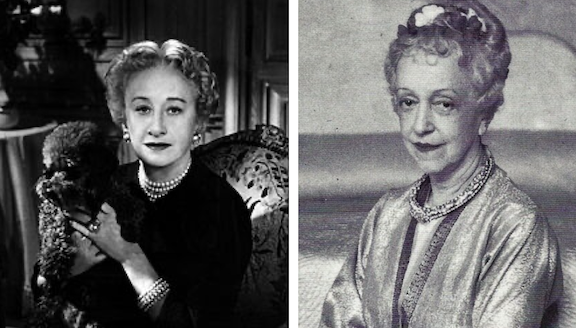
…the New Yorker’s Janet Flanner wrote in 1938 that Elsie de Wolfe invented interior design as a profession, so who was to argue with de Wolfe’s suggestion that the leisure class should linger in bed with the aid of a Wamsutta bed-rest…the small print beneath the logo indicated that the bed-rest was “hair-filled,” which I assume was horse hair, still used today in some luxury brands…
…if de Wolfe was queen of interior designers, then Hattie Carnegie was the “First Lady of Fashion,” or so this ad claimed…
…here are images of the two titans of fashion and good taste…
TASTEMAKERS…At left, Hattie Carnegie aka Henrietta Kanengeiser (1880-1956), and Elsie de Wolfe, aka Lady Mendl (1859–1950). (americacomesalive.com/bureauofinteriors.com)
…and speaking of fashion, here is a llama cloth coat from B. Altman, trimmed in silver raccoon, suitable for Yale football games…based on inflation, that coat today would set you back at least $2,000…
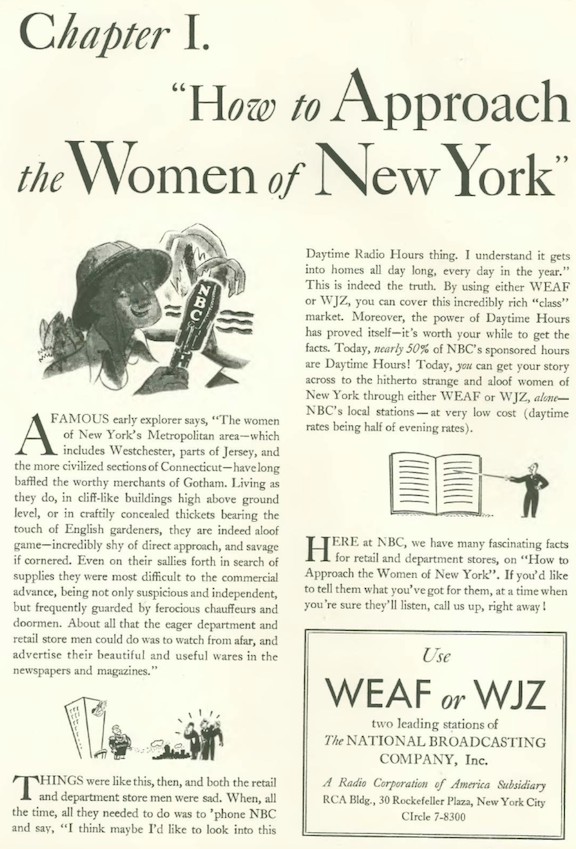
…this condescending ad offered merchants a way to reach the “hitherto strange and aloof women of New York” through daytime advertising…
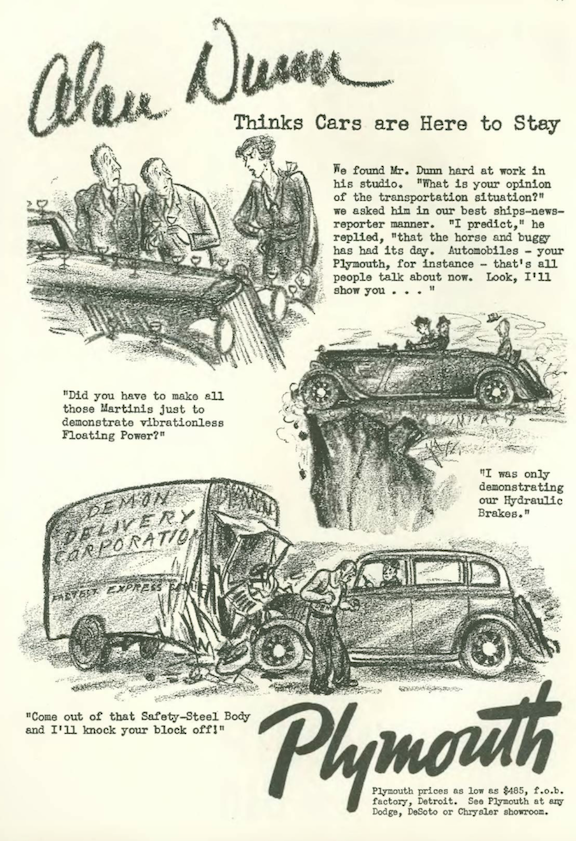
…Plymouth enlisted the talents of Alan Dunn to tout their car’s ride and durability…
…and on to our cartoonists, another from Dunn, a bit of spot art featuring a not so subtle commentary on Lawrence Lee Bazley Angas’s book The Coming American Boom…
…and some spot art from Isadore Klein…
…Miguel Covarrubias contributed to the theater review section…
…James Thurber entertained a house guest…
…George Price was still up in the air…
…Helen Hokinson took a spin with a celebrity look-alike…
…and Barbara Shermund offered another glimpse into the life of a modern woman…
…on to Oct. 20, 1934…
Oct. 20, 1934 cover by Helen Hokinson.
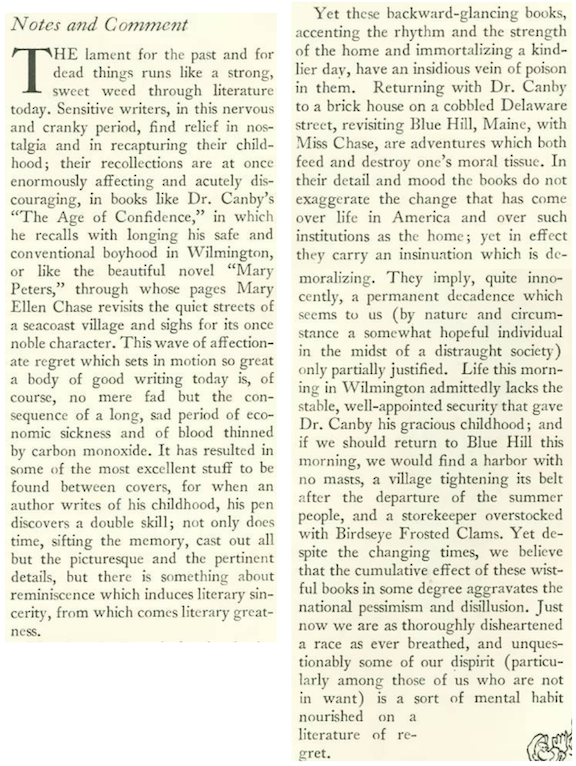
…in which E.B. White offered up a new lament, namely the pervasiveness of nostalgia and sentiment in contemporary literature…
HARKING BACK TO THOSE DAYS OF YORE…E.B. White simply had no stomach for the nostalgic stylings of Mary Ellen Chase (left) or Henry Seidel Canby, seen here on the cover of the May 19, 1924 issue of Time. (U of Maine/Time Inc)
* * *
Fifty Years Young
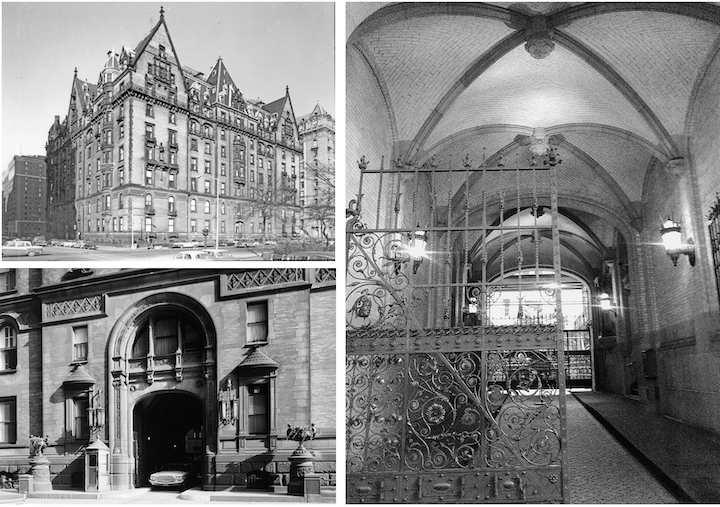
“The Talk of the Town” marked the Dakota’s 50th year at Central Park West, and made note of its loyal and prominent clientele…back in the day it served as a residence for actors such as Lillian Gish, Boris Karloff, and Teresa Wright, and in later years such luminaries as Lauren Bacall, Judy Garland, Rudolf Nureyev, and, of course, John Lennon and Yoko Ono.
THE STORIES IT COULD TELL…At left, the facade and main entrance of the Dakota in the 1960s; at right, inside the main entrance. (Pinterest/Wikipedia)
* * *
More From Our Advertisers
The Matson-Oceanic Line offered a “millionaire’s idea of a vacation” at an affordable price, and offered this sumptuous image as proof…
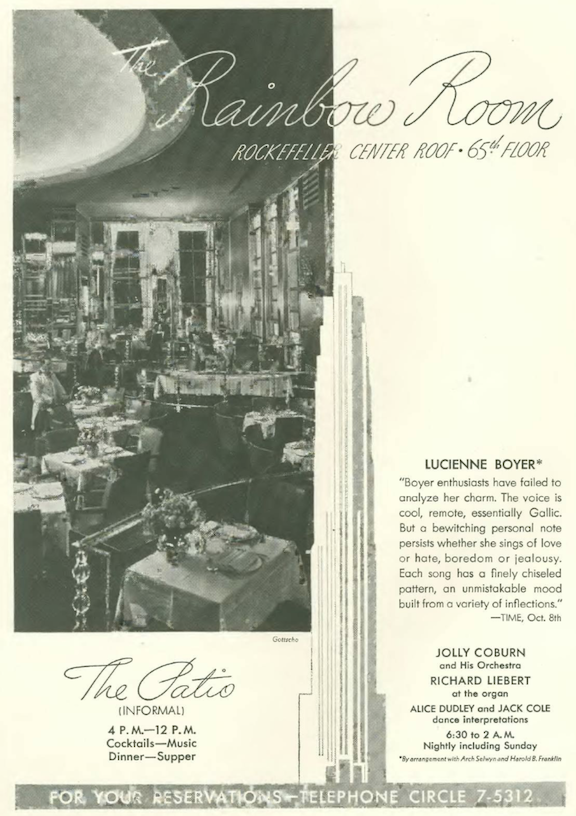
…E.B. White wasn’t crazy about the smokeless dazzle of the Rainbow Room, but it proved to be popular among the city’s elite…
…in case one was concerned about the provenance of one’s mink coat, Saks posted this helpful ad. Their high-end, natural-skin minks were priced at $8,000 (roughly $180,000 today); there was, however, a caveat regarding the cheaper models…
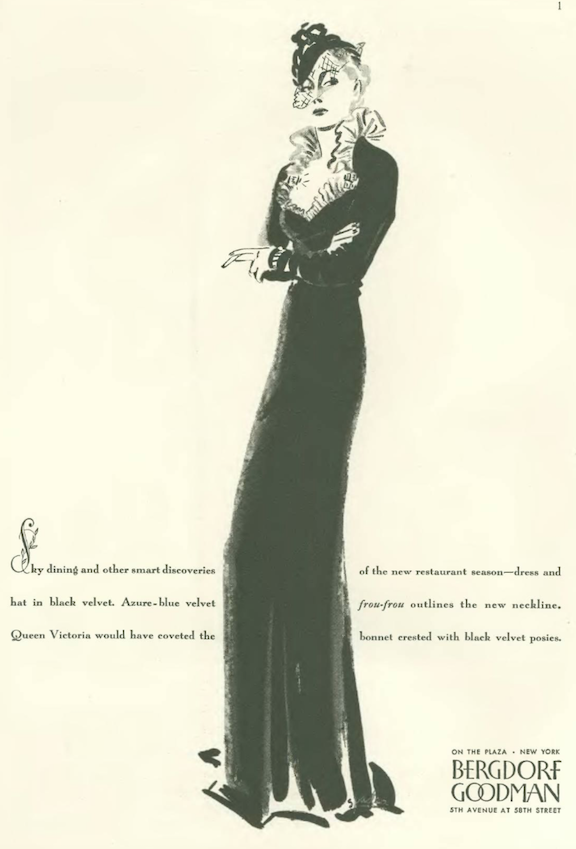
…Bergdorf Goodman offered up another ad featuring an impossibly attenuated model posed with a cigarette, her defiant gaze suggesting her modernity and individualism…
…Plymouth went back to the stable of New Yorker cartoonists, this time featuring the adventures of Helen Hokinson’s “girls”…
…and we segue to the rest of our cartoonists, including this spot by Constantin Alajalov…
…and this by George Price…
…who also gave us another update on the trials and tribulations of his floating man…
… James Thurber occasionally ignored scale in rendering his characters, which didn’t really matter in his strange world…
…Jack Markow had some bad news for two sign painters (the caption size is increased for readability)…
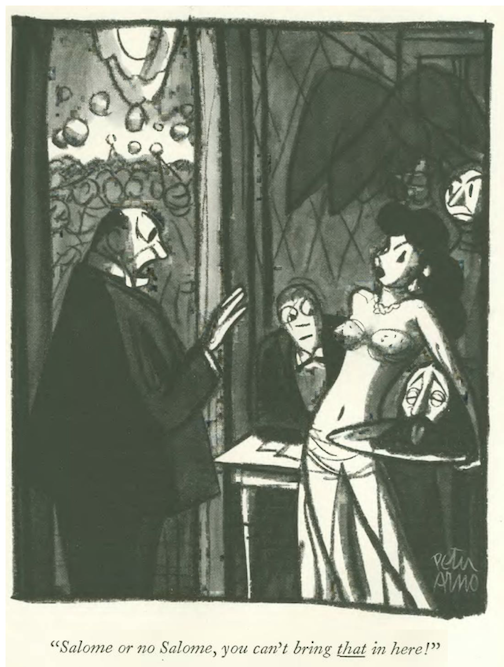
…and we close with Peter Arno, and the winner of most original Halloween costume…
…and before I go…this is being posted on Halloween, 2023, so here are a few images from 1934 to get you in the spirit, including a Saturday Evening Post cover, a 1934 party ideas magazine, and a page from Popular Mechanics featuring a smoking robot costume you could make yourself…in the 1930s, Popular Mechanics often featured Halloween party ideas that were downright lethal, usually involving electric shocks, pistols loaded with blanks, that sort of thing.
Sigmund Gottfried Spaeth (1885–1965) sought to popularize classical music and improve the musical tastes of the masses by meeting the public wherever he could find them, from vaudeville halls to national radio broadcasts.
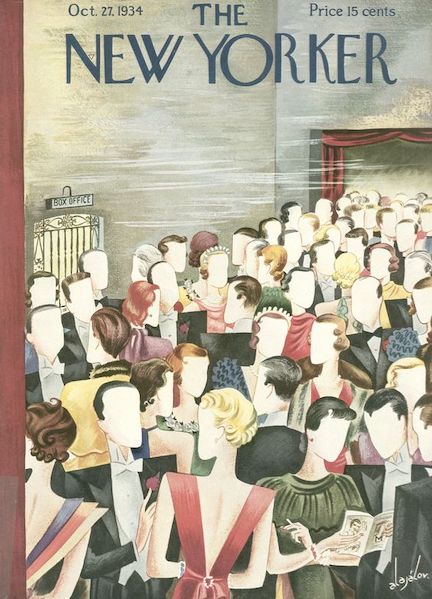
September 1, 1934 cover by William Steig.
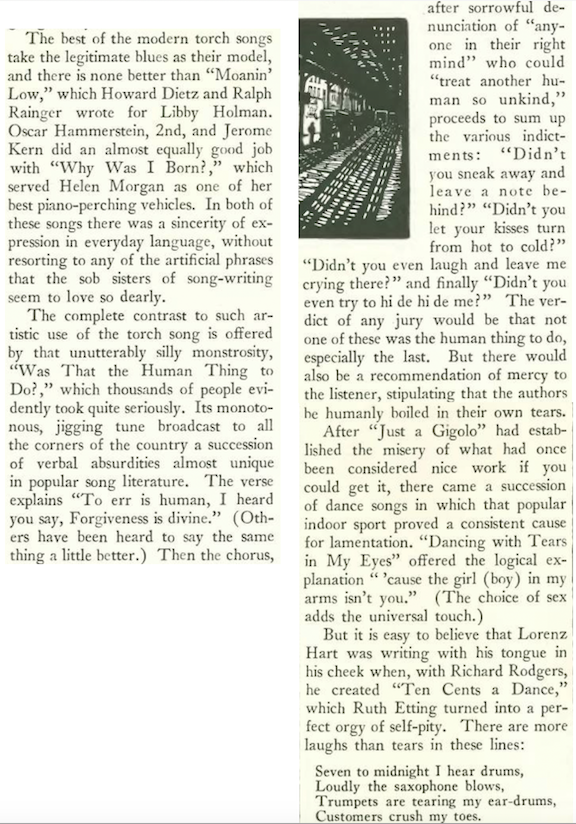
Born in a line of three generations of Lutheran clergymen, Spaeth chose a different path and became a musicologist who sought to de-mystify classical music, often demonstrating how popular melodies had origins in earlier music. He also had strong opinions about lyrics in popular music, demonstrating his distaste for “the lyric school of self-pity” in this “Onward and Upward” column. Excerpts:
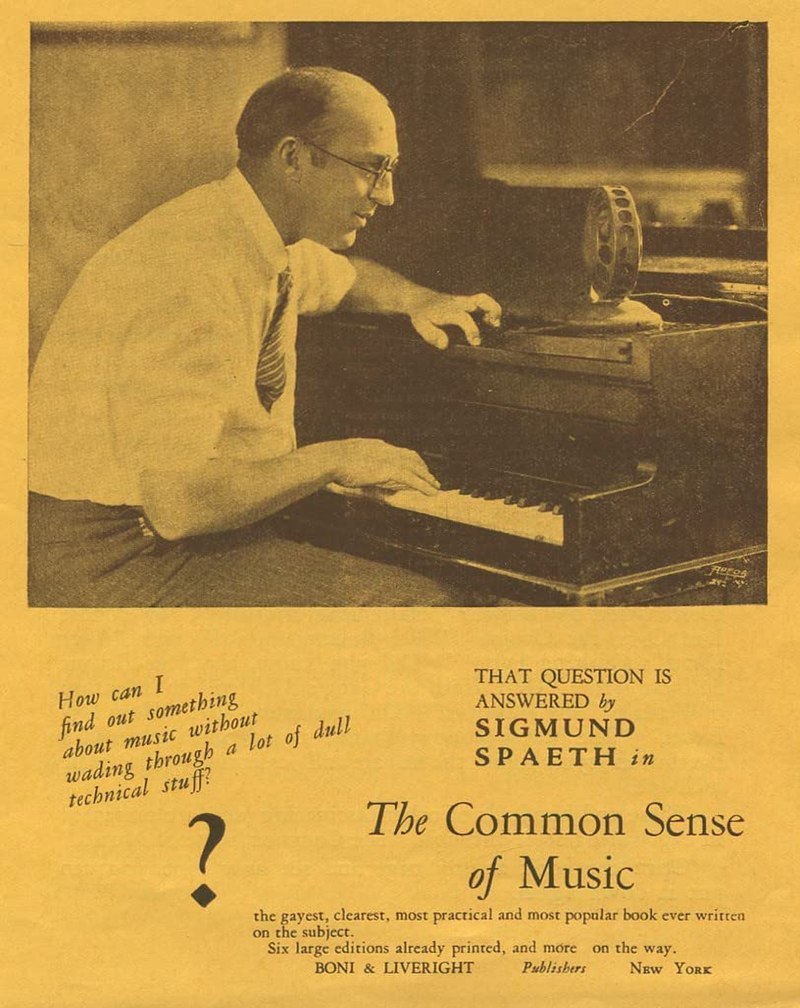
BRINGING MUSIC AND LIGHT…Sigmund Spaeth found much to dislike in the world of popular music, but he was never stuffy in his approach to music appreciation. At right, Spaeth appeared in vaudeville-style shows (and for many years on the radio) as “The Tune Detective,” wearing a deerstalker cap, cape, and checked tweeds in imitation of Sherlock Holmes. He hoped to demonstrate to a wide audience that all music was essentially based on a set of simple principles. (sinfonia.org/wnyc.org)HAVE NO FEAR…Spaeth wrote a popular syndicated newspaper column, “Music for Everybody,” and contributed articles to many periodicals during his career. With his first book in 1925, The Common Sense of Music, and others that followed, Spaeth sought to de-mystify music for a general audience. (Wikimedia Commons)OH LIGHTEN UP…Spaeth detected a cynical note in Bing Crosby’s (left) sob song, “I Cried for You,” and noted Irving Berlin’s latest contribution to the “sob symposium,” “I Never Had a Chance.” (Wikipedia/digitalcommons.library.umaine.edu/britannica.com)
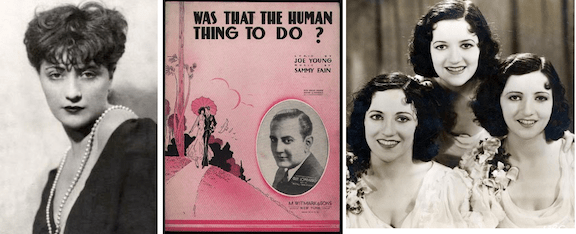
Spaeth noted that not all sad songs were dripping in artificial self-pity, citing Helen Morgan’s “Why Was I Born?” as an example of a song modeled on “the legitimate blues,” marked by “a sincerity of expression in everyday language”…
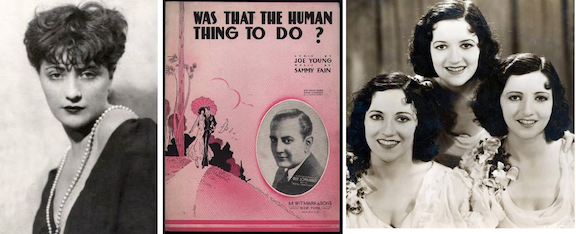
RIGHT AND WRONG…Spaeth acknowledged the “sincerity of expression” in Helen Morgan’s (left) torch songs, while at the other extreme he suggested that the authors of “Was That the Human Thing to Do?” (Sammy Fain and Joe Young) be boiled alive in their own tears. The song was popularized by The Boswell Sisters, a beloved New Orleans trio in the early 1930s. (findagrave.com/amazon.com/genius.com)
* * *
Off to the Races
In his column, “Of All Things,” Howard Brubaker commented on the apparent competition and contrast between Alexander Woollcott’s book, While Rome Burns, and another with a rosier title, The Coming of the American Boom. It appears Woollcott’s book won out, at least in the long run, as I can find no trace of the Boom book, or its author.*
* One of our kind readers has identified the author: “The Coming American Boom” was written by Lawrence Lee Bazley Angas and published by Simon and Schuster in 1934. In 1939, Time noted that “Major Lawrence Lee Bazley (‘Boom’) Angas is a pink & white Britisher with a reputation for making daring predictions which have sometimes come true…. He won his nickname with a much-publicized booklet, The Coming American Boom, which heralded his arrival in the U.S. in 1934.”
Speaking of rosy outlooks, E.B. White offered some parting thoughts on Chicago’s World’s Fair, called “A Century of Progress.” Rather than focus on the grandiose exhibits, White wryly noted other signs of progress at the fair, as recounted from a letter he received from his nephew.
The Chicago World’s Fair featured all sorts of modern wonders “dedicated to the ideal of scientific advance”…
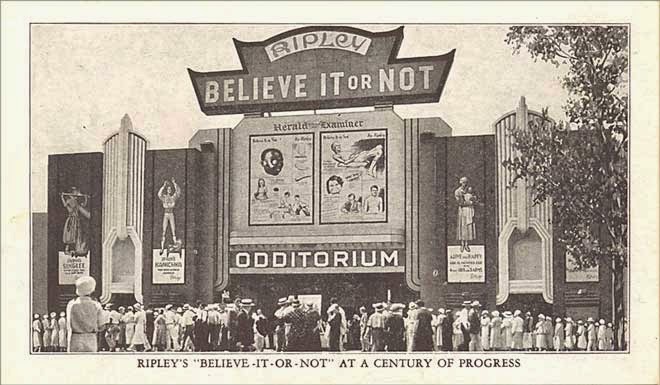
…but as with any World’s Fair, it also catered to the baser interests of the masses, with attractions such as Robert Ripley’sBelieve It Or Not “Odditorium,” which was essentially a P.T. Barnum-style freak show…
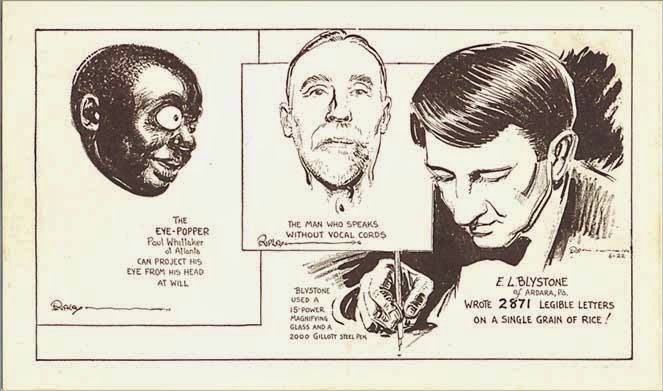
…Ripley’s syndicated newspaper feature included these Odditorium attractions…
…White made light of exhibitions displaying such signs of progress as how to brush your teeth, and more examples of human freakdom…
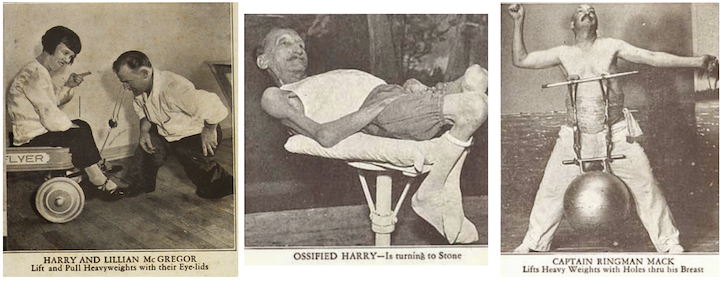
…White’s nephew wrote of a man who could pull a wagon (containing his wife) with his eyelids, an apparently arthritic fellow who was “turning to stone,” and a man who could support heavy weights with his pierced breasts…
(all images courtesy postcardy.blogspot.com)
* * *
Letter From Paris
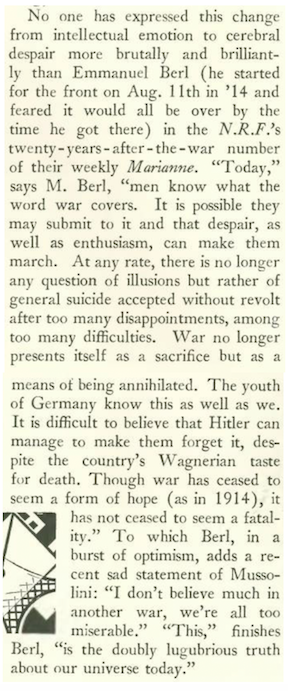
Paris correspondent Janet Flanner wrote that August 1934 was a “month of memories” as it marked the twentieth anniversary of the outbreak of the Great War, which we now call World War I. Flanner wrote about a new attitude that had arisen in those two decades, “a new attitude not only toward the last war but toward the next (which, ironically enough, seems increasingly inevitable to France since the death of the enemy warrior, von Hindenburg).” She continued with these observations made by French journalist and historian Emmanuel Berl (1892–1976), who wrote that as a result of the Great War, the youth in both France and Germany held few heroic illusions about war, seeing it not as a sacrifice but rather “as a means of being annihilated.”
SO MUCH FOR THE HEROICS…A refugee family returning to Amiens, France, looking at the ruins of a house on Sept. 17, 1918. Top right, Janet Flanner in 1940; below, Emmanuel Berl. (iwm.org.uk/Flanner photo copyright Estate of George Platt Lynes/Berl photo courtesy Joël Chirol)
* * *
From Our Advertisers
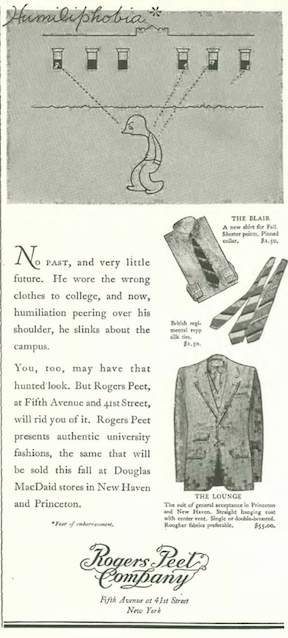
Clothing company Rogers Peet used the threat of humiliation to encourage young men to stock up on “authentic university fashions” before returning to campus…
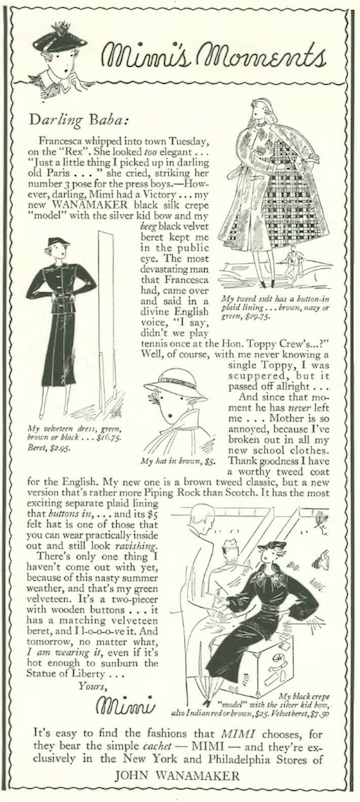
…the Wanamaker department store took a different approach, offering up new styles with a heavy English accent (I say, didn’t we play tennis once at the Hon. Toppy Crew’s?)…
…the makers of Goodyear tires offered up this disturbing image to boost sales…
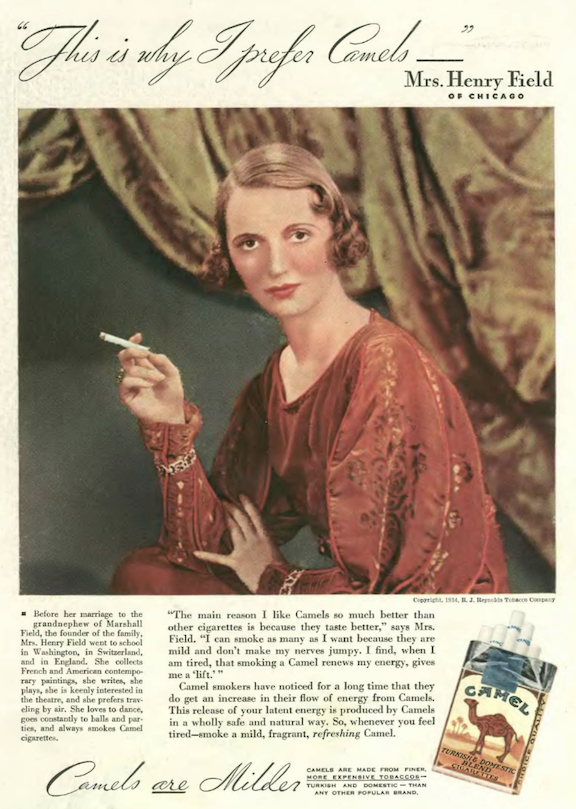
…this ad told us that “Mrs. Henry Field” collected fine art, loved to go to parties, and “always smoked Camel cigarettes”…I am unaware of the fate of Mrs. Henry Field, married to the grandnephew of Marshall Field, but this unseemly image suggests she was replaced by a wax figure before the photo was taken…
…on to our cartoons, we begin with spot illustrations from (clockwise, from top) Victor De Pauw, Abe Birnbaum, and an unidentified illustrator who offered this suggestion for beating the late summer heat…
…we move along to Alan Dunn and a record-seeking pooch…
…Peter Arno with a very Arno-esque take on the stranded island trope…
…James Thurber gave us a man who was done making decisions…
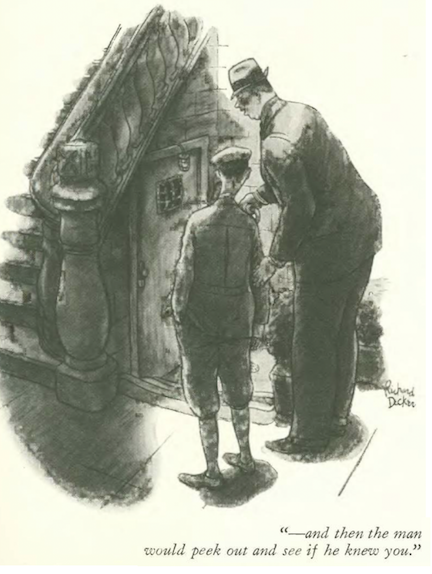
…Richard Decker offered up this living history demonstration…
…George Price gave us two tropes for the price of one…
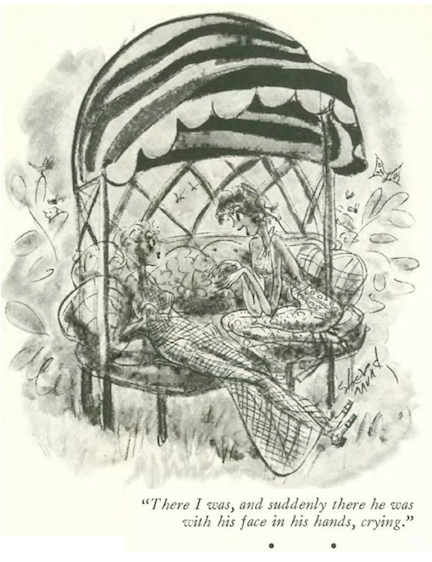
…Barbara Shermund gave us another glimpse into the lives of modern women…
…Rea Irvin continued his exploration of Manhattan’s fauna…
…our next cartoon is by Henry Steig, who used the pseudonym Henry Anton to avoid being confused with his brother, William Steig (featured on this issue’s cover)…unlike his brother, Henry was also a jazz musician, a sculptor and painter, a photographer, and a novelist…that is before he became a noted jeweler…
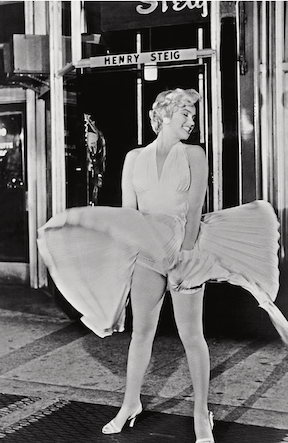
…Henry Steig’s jewelry shop at 590 Lexington Avenue can be glimpsed in the background of the famous subway vent scene from 1955’s The Seven Year Itch featuring Marilyn Monroe…
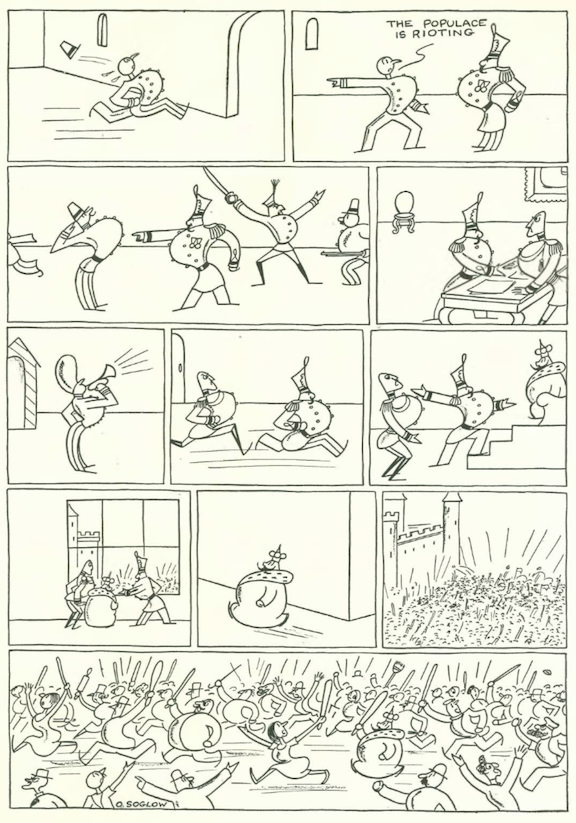
…and we close with Otto Soglow, and the last appearance his “Little King” in The New Yorker...William Randolph Hearst had lured Soglow away for his King Features Syndicate, debuting The Little King in his newspapers on September 9, 1934, where it would run until Soglow’s death in 1975…Soglow, however, would continue contributing cartoons of other themes to The New Yorker until 1974…
Photo above circa 1930 via mensfashionmagazine.com.
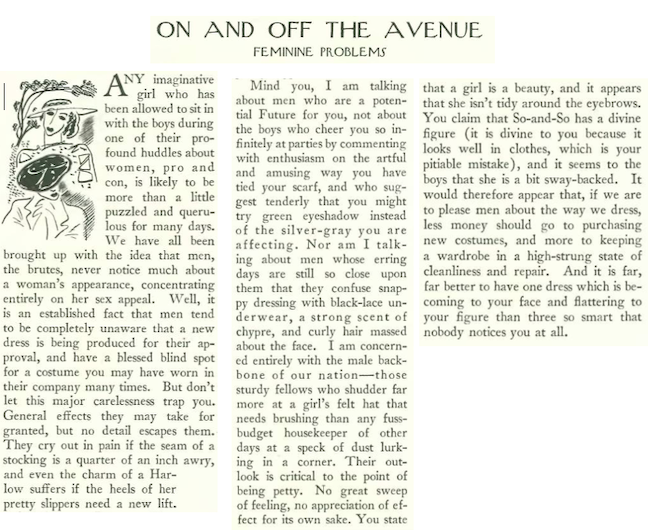
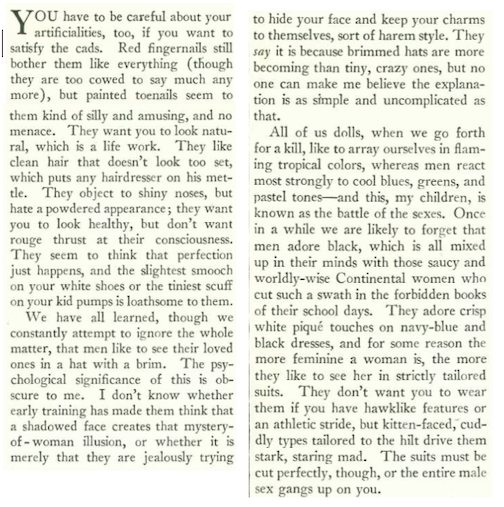
Lois Long took a break from reviewing the latest fashions to offer some thoughts on the relations between men and women, and more specifically, what was expected of women if they ever hoped to land the type of man who represented a “potential Future” for them.
August 4, 1934 cover by Otmar. Likely Otmar Gaul, sometimes spelled “Ottmar.”
Based on what we know about Long, this column has a strong “tongue-in-cheek” quality. It should also be noted that the 32-year-old Long had been divorced from cartoonist Peter Arno for three years, and was possibly contemplating the dating scene (she would marry newspaper ad man Donaldson Thorburn in 1938). In this excerpt, Long dispelled the notion that “the brutes” never notice a woman’s appearance:
THEY MIGHT BE BRUTES, but they notice the little things, according to Lois Long. (fashionhistory.fitnyc.edu)
SEEING RED…According to Long, discerning men preferred women in brimmed hats (actress Sylvia Sidney models above), but found red fingernails to be disturbing. (glamourdaze.com/vintagehairstyling.com)SEEING RED in women’s clothes, however, wasn’t a problem, according to Long, who wrote that men liked to see women in bright, tropical colors. (clickamericana.com)
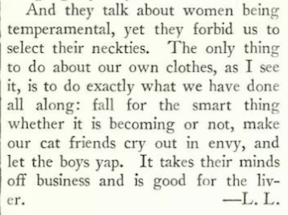
Long concluded that in the end, it didn’t matter what men thought about women’s clothes, but letting them “yap” about such things was a good way for them to blow off some steam.
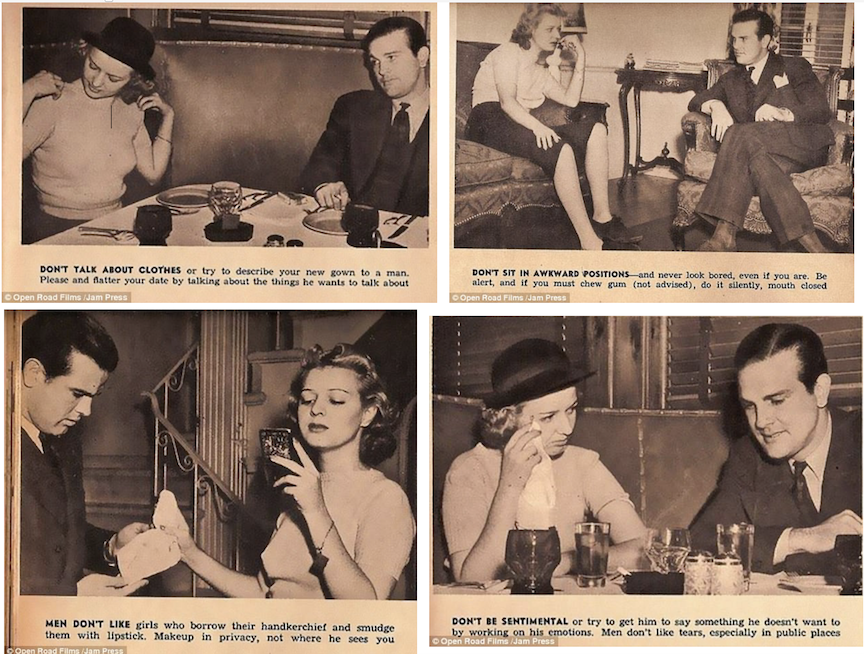
Check out these patronizing examples from an illustrated guide for women published in 1938 by Click Parade magazine. It gives us some idea of what Long, and millions of other women, were up against…
(dailymail.co.uk)
* * *
Fifth Avenue Remnant
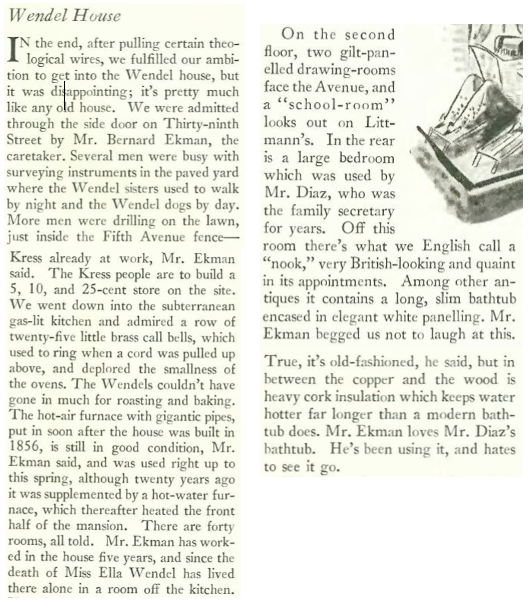
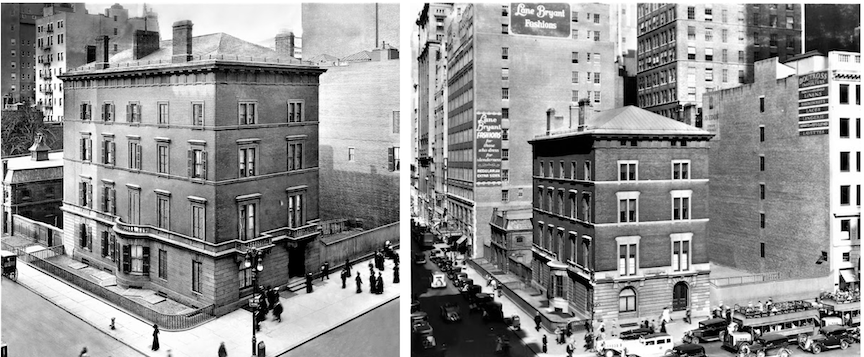
The first years of The New Yorker coincided with some of the most transformational years in Manhattan’s urban fabric, including the replacement of Gilded Age mansions with upscale commercial buildings. One of the last remaining mansions was the Wendel house, featured in “The Talk of the Town.”
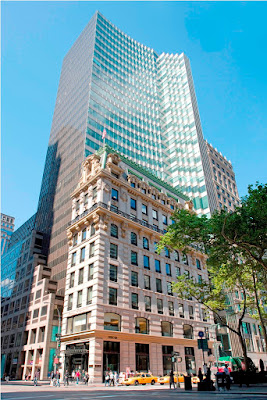
A ONCE GRAND MANSION becomes diminished as the city grows around it. At left, the Wendel mansion as it appeared circa 1901; at right, shorn of its balconies and shutters, the mansion shrinks in contrast to the city around it, circa 1930. (Wendel Family Papers, Special Collections and Archives, Drew University Library)WHAT HO!…A “very British-looking” zinc-lined bathtub (with shower) was state-of-the-art when installed at the Wendel mansion. (New York Public Library)BARELY A MEMORY….The glass-and-steel structure towering above the former Knox Hat Building sits on the site of the Wendel mansion. (Photo by Nicolson & Gallowy via Daytonian in Manhattan)
In his “Notes and Comment,” E.B. White noted the spurious nature of cinema newsreels, including one featuring the case of Thalia Massie, a navy wife stationed in Hawaii whose immature behavior and trail of lies would implicate five men in a crime they could not have committed (one would even be killed by vigilantes) and would cast Hawaii into a state of racial turmoil. (You can read more about it at the PBS site for American Experience.
FATAL FEMME…Thalie Massie, circa 1930. (Library of Congress)
* * *
Blunders, Part II
Howard Brubaker commented on the twentieth anniversary of the outbreak of the Great War. Today we call it World War I, and as we know, the blunders did not cease with the Armistice.
* * *
RIP Madame Curie
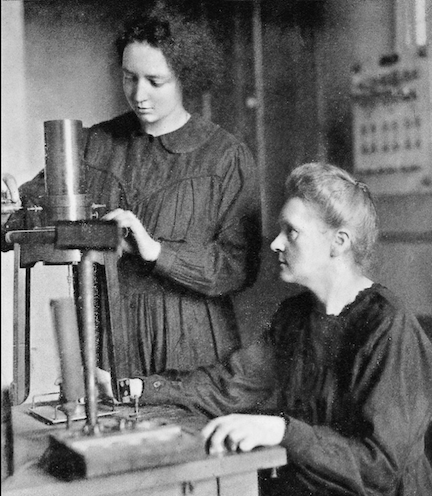
Janet Flanner, Paris correspondent for The New Yorker, noted the passing of Marie Curie, a pioneer in field of radioactivity.
THE CURIE CURE…Marie Curie and daughter Irène, 1925. (Wikipedia)
* * *
From Our Advertisers
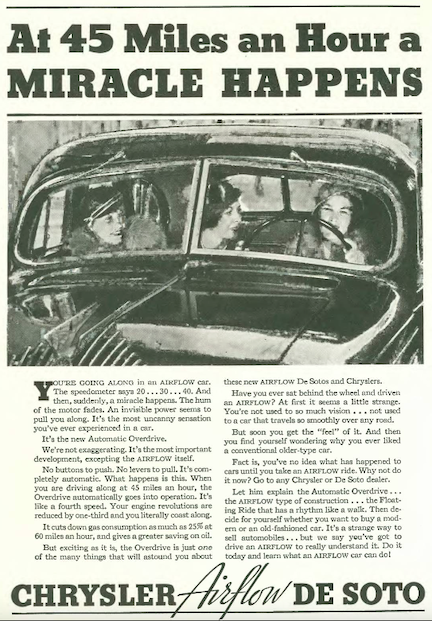
The folks at Chrysler were trying every angle to get car buyers interested in the Airflow—although the car offered a number of advanced features, consumers just weren’t ready for its radical aerodynamic design…note how the ad downplays the car’s sweeping curves…
…and we have more deception from the cigarette industry, including claims that cigarettes gave you more energy and improved the performance of top athletes…
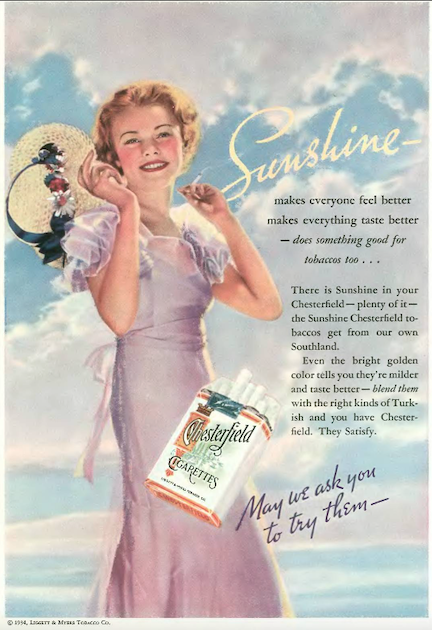
…the makers of Chesterfields gave us this sunny picture of health…indeed, there was sunshine in every pack…
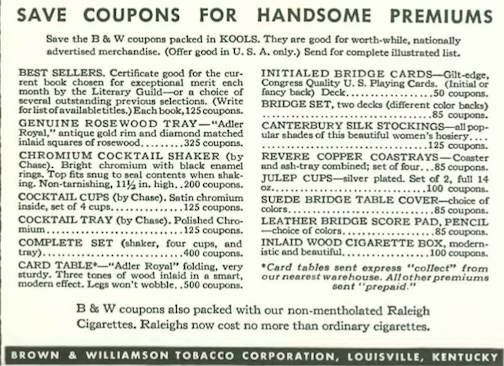
…The Brown & Williamson Tobacco Company launched KOOL cigarettes in 1933 as the sole competitor to the other menthol brand, Spud, which was a big advertiser in the early New Yorker. Maybe it was the coupons, or the modern brand name, that helped KOOL knock Spud from the market by the 1940s. As for those coupons, it appears each pack contained only one of them…
…so you would have to smoke a ton of those things to get one of these swell prizes…
…early Budweiser ads often featured images of the Old South…here they conjured up the ghost of Mark Twain (who had been dead only 24 years), putting the great humorist and writer on par with their bottled beer…
…Canada Dry didn’t have Mark Twain, but what they did have was a beer (Hupfel’s) lacking “that queer yeasty taste that beer usually has”…
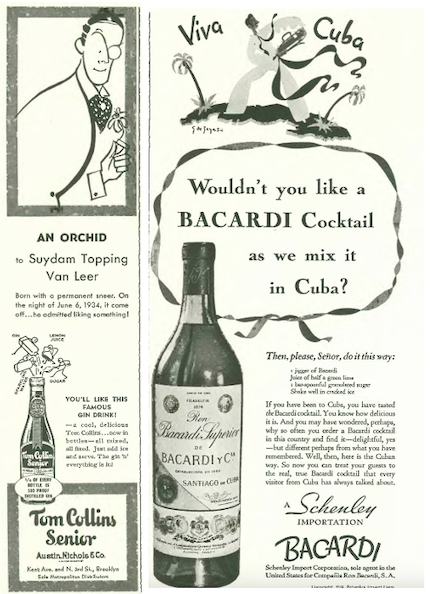
…a couple of ads from the back pages featured, at left, an ad for a pre-mixed Tom Collins, which must have been awful, and at right, a spot for Bacardi rum, which was actually made in Cuba before the revolution…
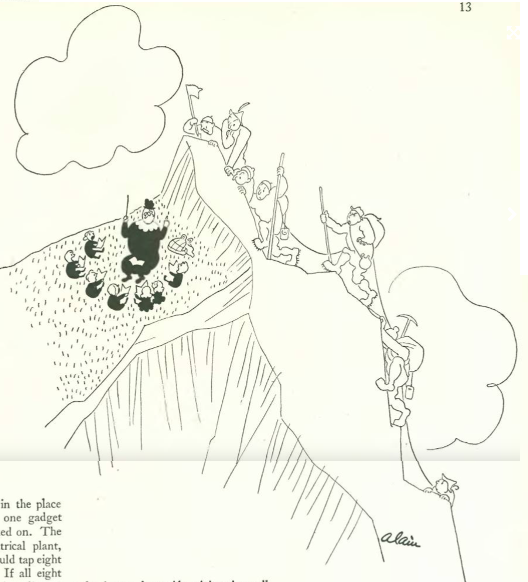
…on to our cartoons, we begin with Alain (Daniel Brustlein) and some not-so-intrepid mountain climbers…
…Otto Soglow’s Little King sought a glimpse of the street life…
…William Steig took a dip with his Small Fry…
…Isadore Klein gave us a glimpse of sensationalist radio reporting…
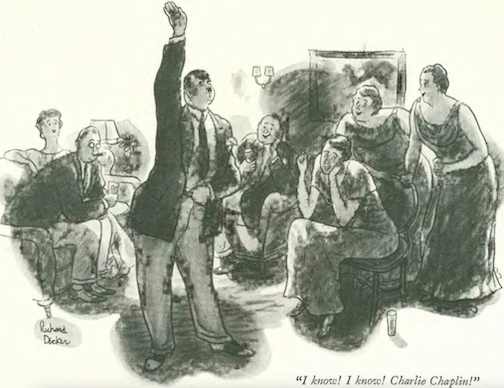
…and we close with Richard Decker, and a game of charades…
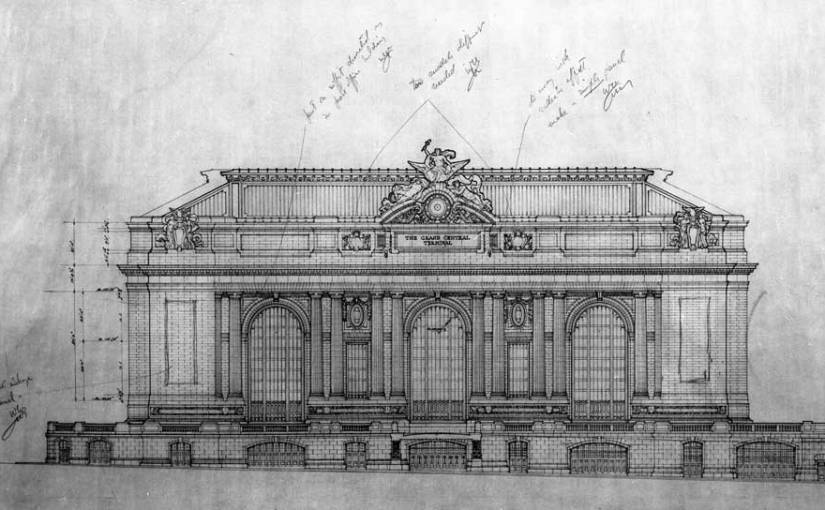
Above: Final Design of Grand Central Terminal, ca. 1910. (New York Transit Museum)
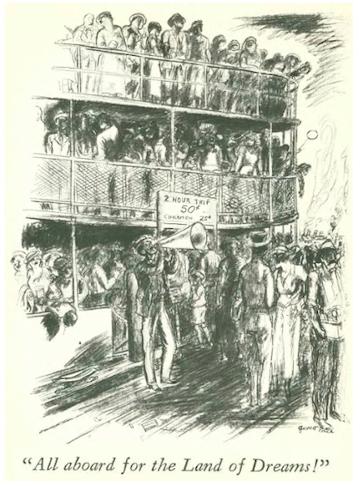
The heat wave of 1934 spread misery from the Midwest to the East Coast. The temperature in New York City hit 101 degrees F (38.3 C) on June 29, and July recorded at least ten days of temps in the mid- to upper 90s. It must have been miserable in the days before air-conditioning, and since no adult would dare be seen in public wearing shorts and a t-shirt, an outing on a crowded tour boat, as illustrated below by William Cotton, must have been hellish.
July 21, 1934 cover by William Cotton.
…putting a fine point on it, recall this wryly captioned cartoon from the June 30 issue by Garrett Price…
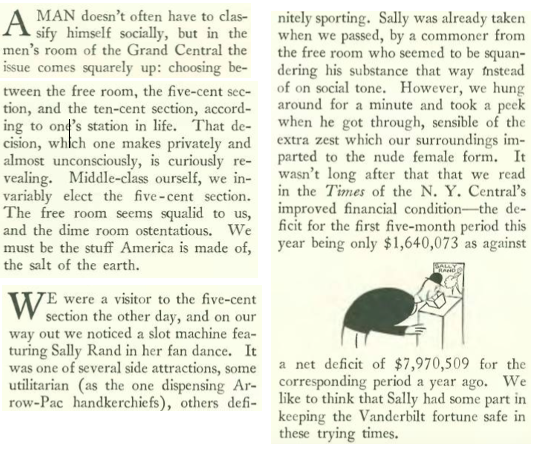
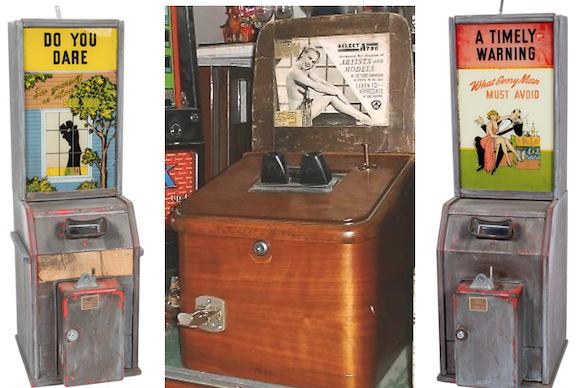
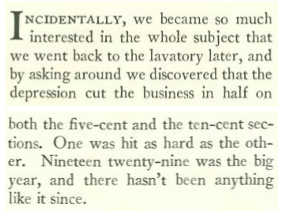
…but let us move ahead to the July 28 issue, where E.B. White was hopefully keeping his cool in the men’s waiting room at Grand Central Station, where he plunked down a nickel to cool his heels in the “middle class” section, where he observed side attractions including a vending machine that dispensed handkerchiefs and a coin-operated peep show featuring burlesque star Sally Rand.
NO MASHERS ALLOWED…Separate men’s and ladies’ rooms were available in three classes at Grand Central Station—free, five cents and ten cents. Top, the Ladies’ room, Grand Central Terminal (Central Lines), and below, a men’s room at the station. A nickel back then was worth about a dollar today. (Library of Congress)NICKEL AND DIMED…Machines similar to these could be found in some men’s waiting rooms at train stations in the 1930s. (pinballhistory.com/comics.ha.com)
…White referred to a peep show that featured famed fan dancer Sally Rand…
DOING HER DEEP KNEE BENDS…Sally Rand in the 1930s. (www.vintag.es)
White also commented on the growing number of travelers, still pinched by the Depression, opting for the free section:
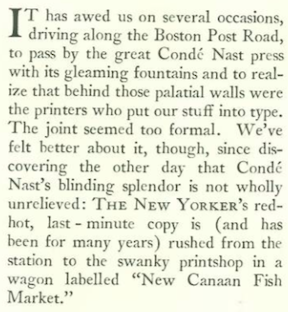
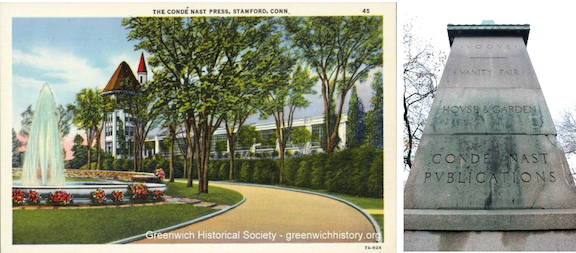
We settle in with the June 21 issue (which leads this post) with White once again, this time enjoying a drive to Stamford, Conn., where he admired the “splendor” of the Condé Nast printing plant (apparently the plant also printed The New Yorker, although the magazine itself would not be acquired by Condé Nast’s parent company, Advance Publications, until 1985).
ONLY A MEMORY…Postcard image of the Condé Nast printing plant; at left, a relic of the long-gone plant, one of two pillars that flanked the road to the plant. (Greenwich Historical Society/greenwichtime.com)
* * *
Disney’s Other Mouse
Film critic John Mosher was a fan of Disney’s “Silly Symphony” cartoon shorts, which were produced between 1929 and 1939. Animation, and especially color animation, was in its infancy, so these doubtless had an uplifting effect on many moviegoers.
DON’T CALL ME TINKERBELL…The Butterfly Fairy brought some Disney magic to 1934’s The Flying Mouse. (disney.fandom.com)
* * *
The Great McGonigle
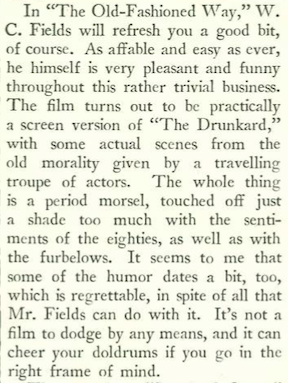
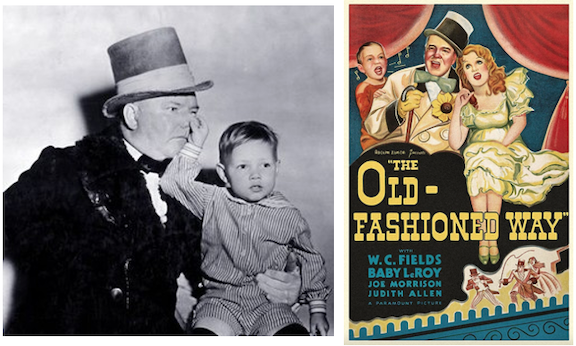
W.C. Fields appeared in more than a dozen silent films before making his first talkie, 1930’s The Golf Specialist, and it was in sound films that Fields was able to truly express his vaudevillian wit. It was also in the sound era that Fields teamed up with Baby LeRoy for three films (in 1933 and 1934), including The Old Fashioned Way, in which Fields portrayed “The Great McGonigle,” leader of a traveling (and perpetually underfunded) theater troupe who was always a step ahead of police and creditors. Critic John Mosher found the film’s riff on an old morality play, The Drunkard, to be a bit dated, but overall thought it a cheerful diversion.
HONK…Baby LeRoy, aka Ronald Le Roy Overacker (1932–2001), was just 16 months old when he became the youngest person ever put under term contract by a major studio. He is best known for his appearances in three W. C. Fields films: Tillie and Gus (1933), The Old Fashioned Way (1934) and It’s a Gift (1934). (Rotten Tomatoes/IMDB)
* * *
From Our Advertisers
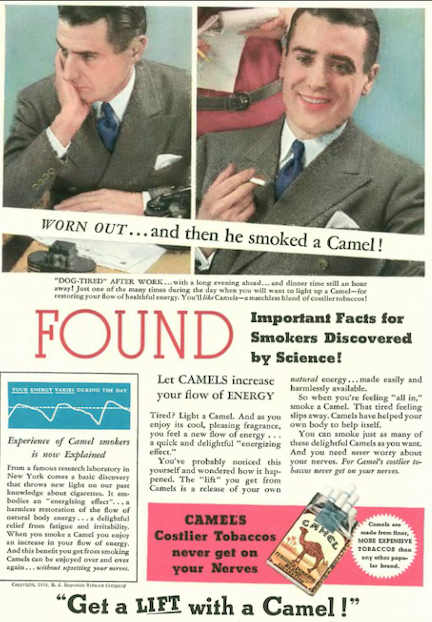
We begin with scientific proof (from a “famous research laboratory in New York”) that Camel cigarettes increased one’s flow of energy…
…if that crackpot claim doesn’t get you, here’s one that recommended downing a PBR before a big meeting, a sure remedy for that “listless, tired-out feeling”…
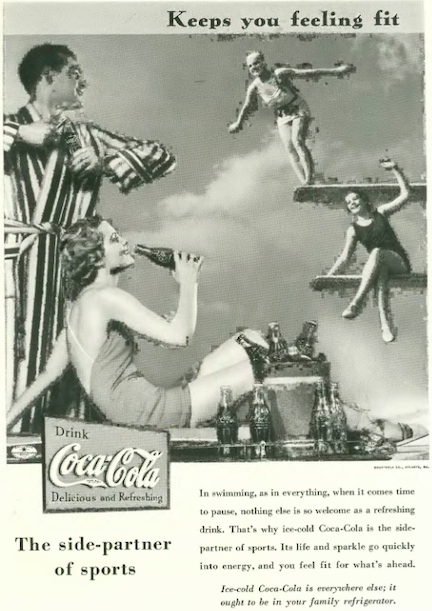
…of course we all know that a few sugary Cokes will get you going…back then they were taking it in six- and ten-ounce bottles, not 30- to 50-ounce Big Gulps…
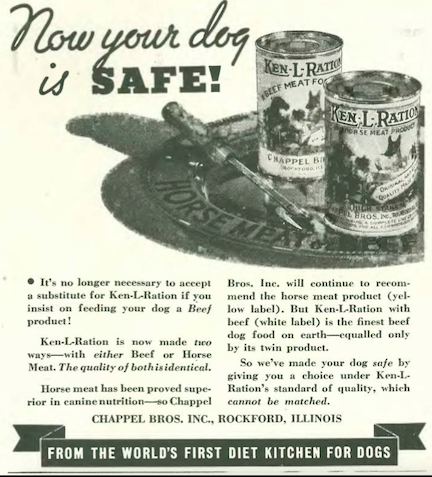
…it’s not every day you see a dog food ad in The New Yorker…in the 1930s there was no secret to where ol’ Sparky ended up…
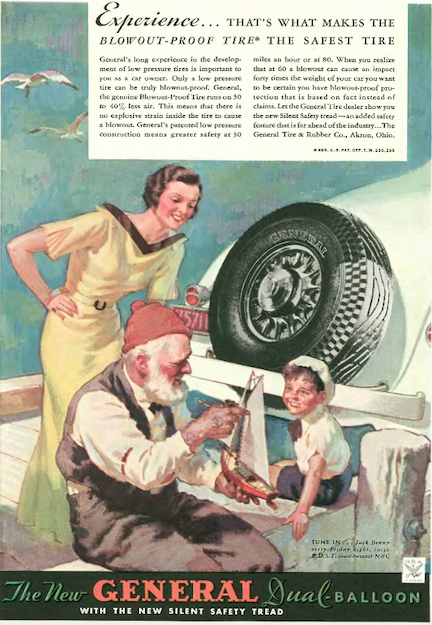
…popular were these Rockwellian ads that equated various products with happy and wholesome (and safe) living, in this case a massive “Dual-Balloon” tire that dominated this tableau featuring a stylish mommy and her little boy slumming with an old sea salt…
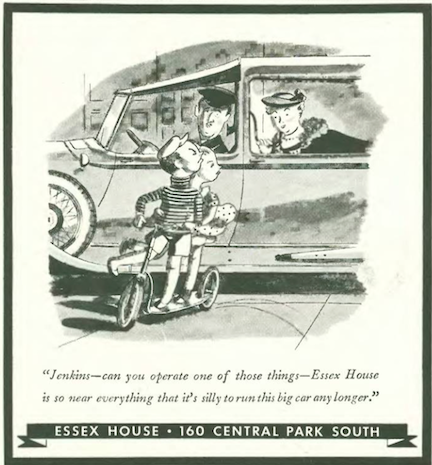
…the folks at Essex House hired an illustrator who did his or her best to channel Helen Hokinson and William Steig for this New Yorker ad…as we have seen before, Essex House ads walked a fine line between thrift and snob appeal…
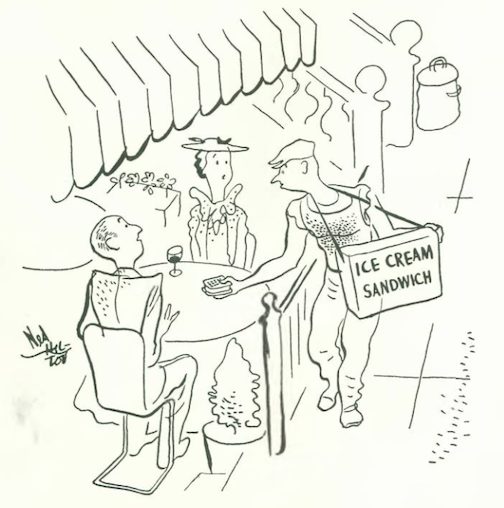
…on to our cartoons, beginning with Ned Hilton, whose work appeared in The New Yorker from 1934 to 1957…
…Mary Petty recorded some sweet nothings by the seaside…
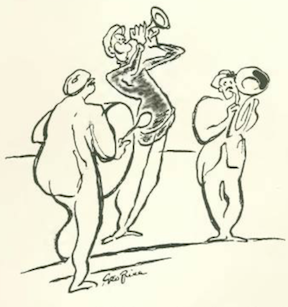
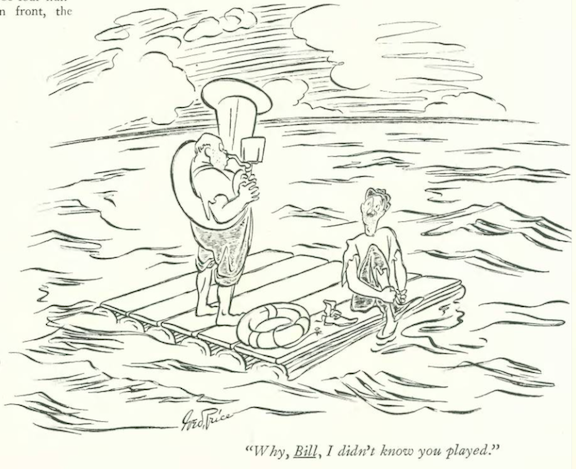
…George Price drifted along with two men and tuba…
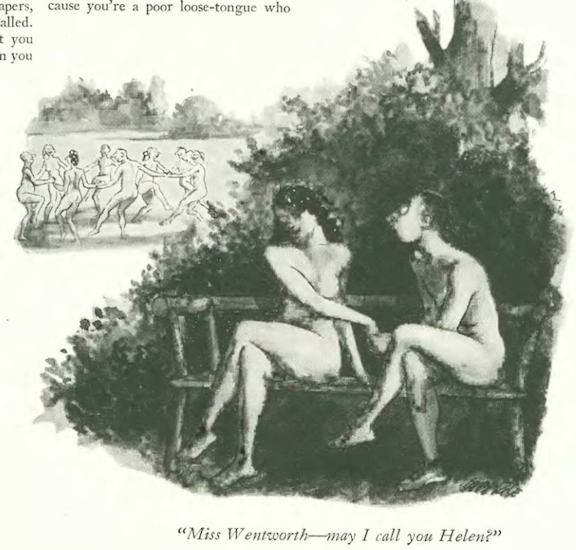
…Carl Rose revealed a modest side to life at a nudist colony…
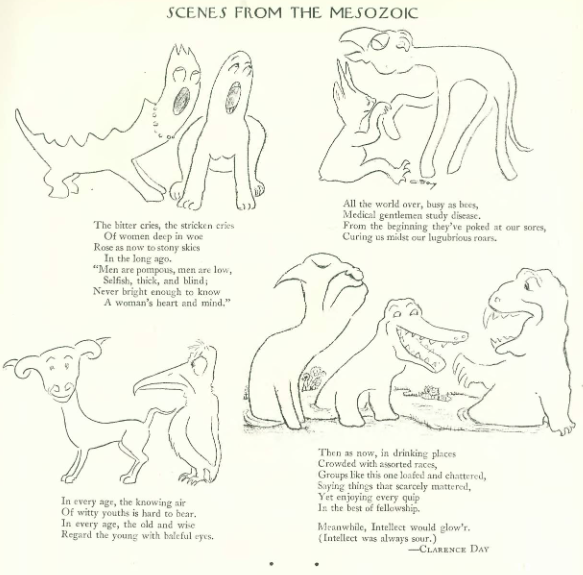
…we know Clarence Day for his Life With Father series, but on occasion he also contributed illustrated poems such as this one from the July 21 issue…
…on to July 28…
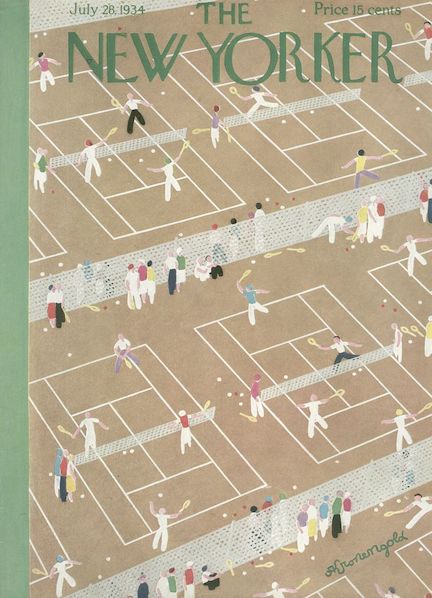
July 28, 1934 cover by Adolph K. Kronengold.
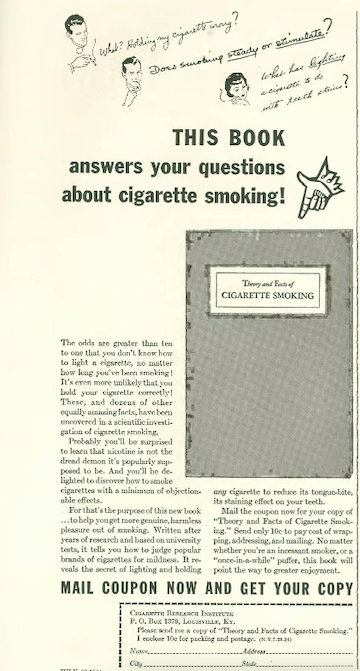
…where we encounter more “scientific research” that encouraged folks to smoke…This ad was placed on the very last page of the July 28 issue by the Cigarette Research Institute, based in Louisville, Kentucky…
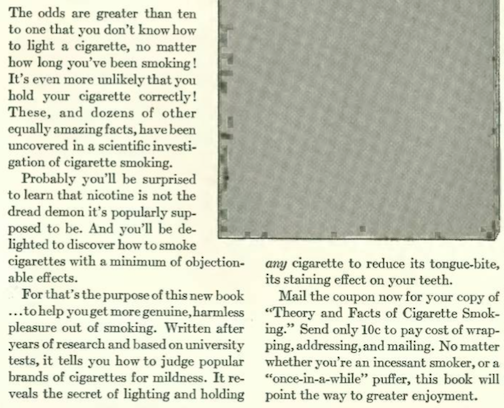
…the booklet was filled with “amazing facts” uncovered in a “scientific investigation,” facts did not address the health effects of smoking, but rather such important topics as how to hold a cigarette the right way and how to reduce staining on your teeth…it also helpfully debunked the notion that nicotine was a “dread demon”…
…take for example this woman smoking a Lucky…now she knew how to hold a cigarette!…
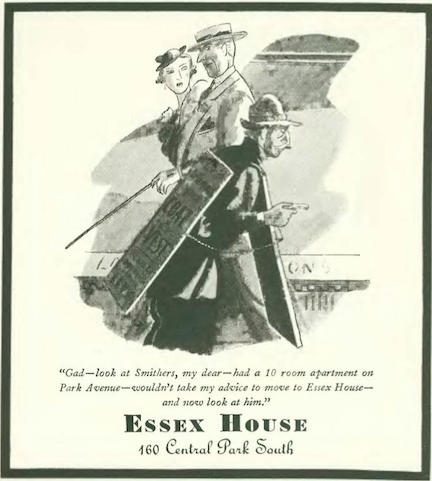
…the folks at Essex House were back, aggressively playing the class/caste card…apparently if you lived there you were entitled to kick your old friends to the curb…
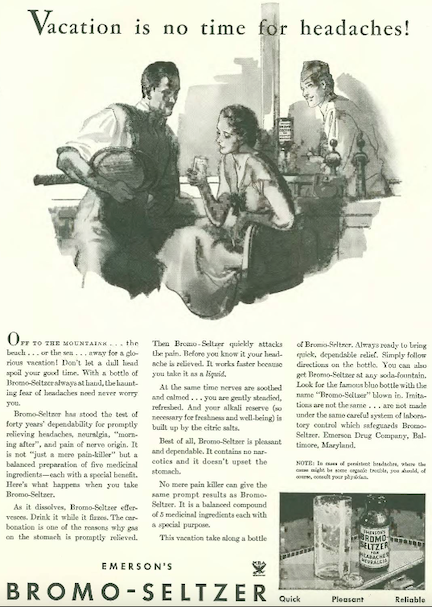
…the antacid and pain reliever Bromo-Seltzer was ubiquitous in 1930s medicine cabinets, but after the recipe was changed in the 1970s (all Bromides were withdrawn from the U.S. market in 1975) the brand slowly fizzled away…
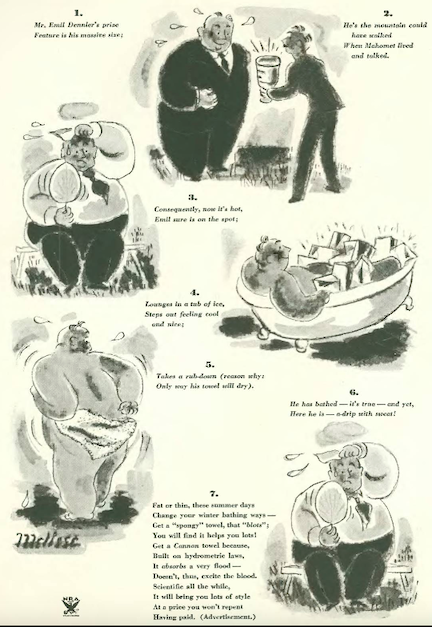
…Mildred Oppenheim Melisse was a popular illustrator of ads for department stores and various household goods, including Cannon towels, here guaranteed to absorb even this man’s sweaty “flood”…
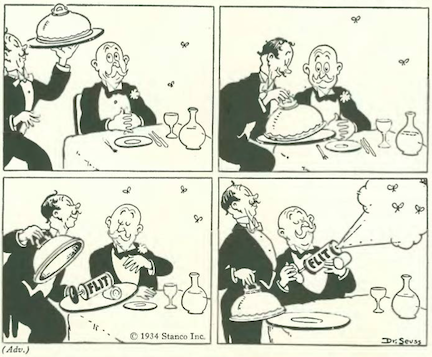
…Dr. Seuss back again for Flit, once again having no issues mixing insecticide with food preparation…
…Rea Irvin kicks off the cartoons with his Double Breasted Dowager…
…Helen Hokinson found some misplaced pity at a garden party…
…Garrett Price offered some unsolicited advice…
…Reginald Marsh filled two pages with a scene from Central Park…
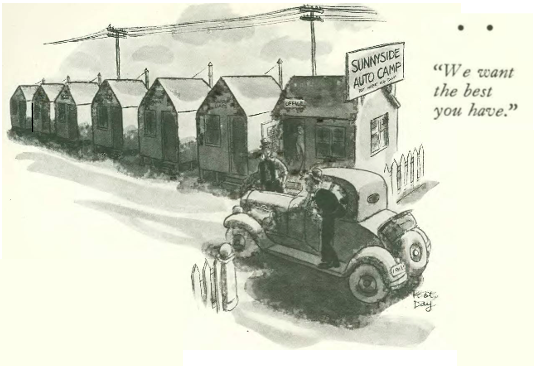
…Robert Day looked for a unique experience at an auto camp…
…and we close with Barbara Shermund, and some alarming news on the domestic front…
Above: Illustration of the Dorchester Hotel’s ballroom in the 1930s. (dorchestercollection.com)
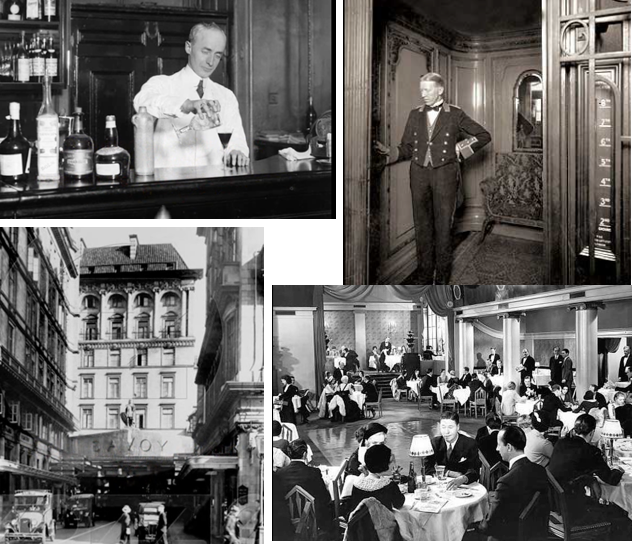
Lois Long took her nightlife column, “Tables for Two,” to London and its famed nightclub scene, where everyone from British royalty to gangsters reveled in a boozy, bohemian scene.
July 7, 1934 cover by Ilonka Karasz.
Prince Edward, a well-known party animal (who would serve as king for less than a year and abdicate in 1936) was known to get up on the stage of the Embassy Club and perform drum solos, while at the Savoy his fellow toffs would sip Champagne and glide in elegant dress across the dance floor. London nightlife included a lively jazz scene in edgy Soho basement clubs, featuring such greats as Duke Ellington, Louis Armstrong and Dizzy Gillespie.
Long hoped that the visit to London, her first in eight years, would give her some much-needed rest and a change of scene. What she found instead was a red-hot, all-night party, where the smart set took dinner near midnight and danced until dawn.
SAVVY SAVOY….Clockwise from top left, the famed Savoy bartender Harry Craddock, credited with inventing the White Lady and the Corpse Reviver, at the Savoy’s American Bar in the 1930s; a Savoy elevator operator in 1926; diners at the Savoy circa 1930s; Savoy entrance. (madamgenevaandgent.co.uk/The Savoy/YouTube)LONDON SWINGS…More Lois Long haunts in London included, clockwise from top left, the Dorchester Hotel; the crowded dance floor at the Monseigneur with Roy Fox and his Orchestra (photo from 1932); patrons kicking up their heels at the Embassy Club on Old Bond Street; the Café de Paris, where American actress Louise Brooks demonstrated a new dance craze, The Charleston, in 1924. (dorchestercollection.com/albowlly.club/lucyjanesantos.com/Wikipedia)
* * *
Misery Loves Company
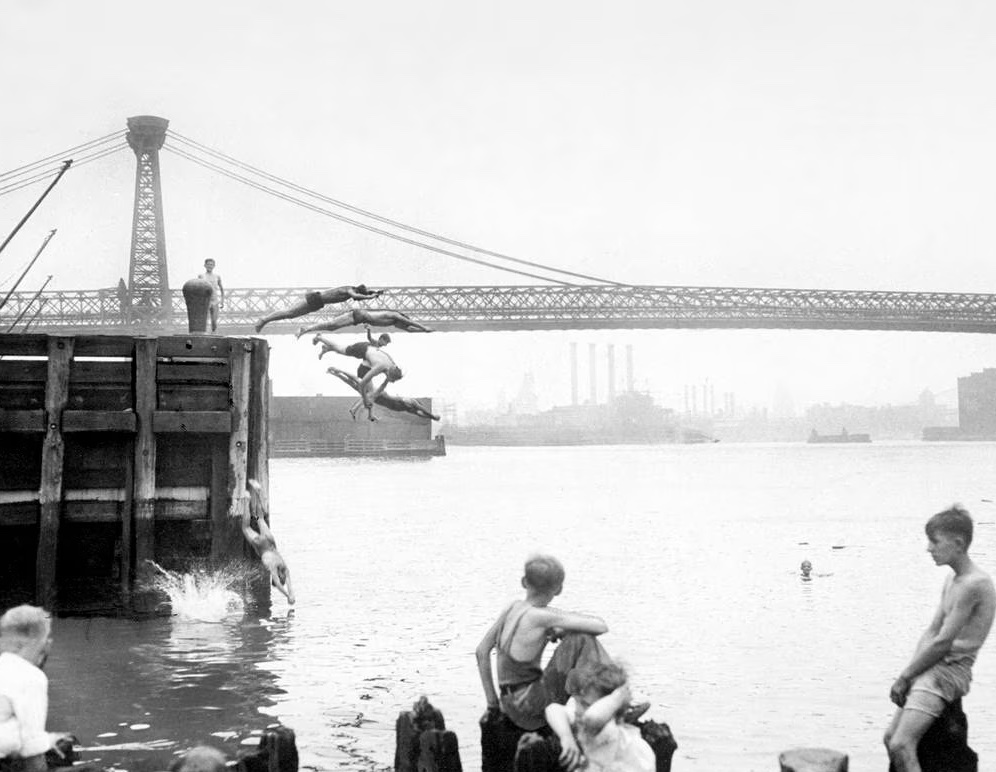
In his “Notes and Comment,” E.B. White observed that almost everyone was “made miserable” by the Depression, but if one looked around there were signs that things weren’t so bad after all.
REASON FOR CHEER…For those still feeling blue about the Depression, E.B. White suggested watching kids cool off at a pier, such as these lads seen diving into the East River on the Lower East Side on July 3, 1935. (Jack Gordon/New York Daily News)
* * *
He Came Up a Bit Short
Howard Brubaker, in his column “Of All Things,” made this observation about Adolf Hitler’s prediction that Nazism would endure a thousand years.
And now a retreat into the cool darkness of the cinema, where John Mosher singled out Bette Davis’s performance in Of Human Bondage…Mosher’s instincts were correct—the film proved to be Davis’s breakout role on her road to major stardom.
ROAD TO RUIN…Bette Davis wowed the critics with her portrayal of a tearoom waitress who seduces a young medical student (Leslie Howard) and leads him down a path of self-destruction. The film was based on the 1915 novel by W. Somerset Maugham. (IMDB)
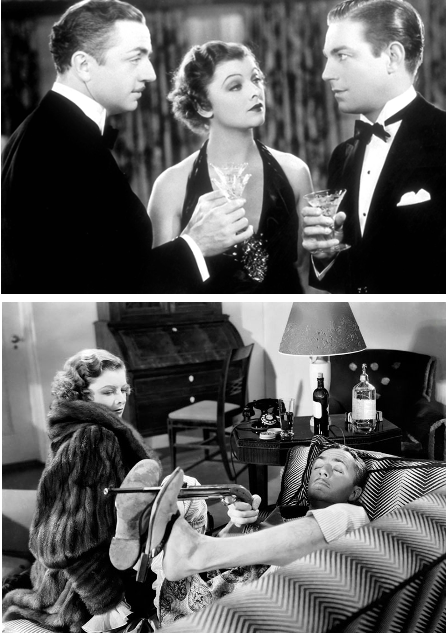
Mosher also took in the “bright” performances of William Powell and Myrna Loy in The Thin Man, a pre-Code comedy-mystery based on the Dashiell Hammett novel by the same name. Powell and Loy portrayed Nick and Nora Charles, who added spice to their leisurely lives through numerous cocktails, flirtatious banter, and crime-solving. Critics loved the film, as did audiences, spawning five sequels from 1936 to 1947.
CHEERS…Top photo: Nick and Nora Charles (William Powell and Myrna Loy) enjoy a drink with their client’s fiancee (Henry Wadsworth) in The Thin Man (1934); Bottom photo: Charles takes aim at a Christmas ornament (with a BB gun) while Nora enjoys the comforts of her new fur coat in a scene from The Thin Man. (Daily Beast/Austin Chronicle)
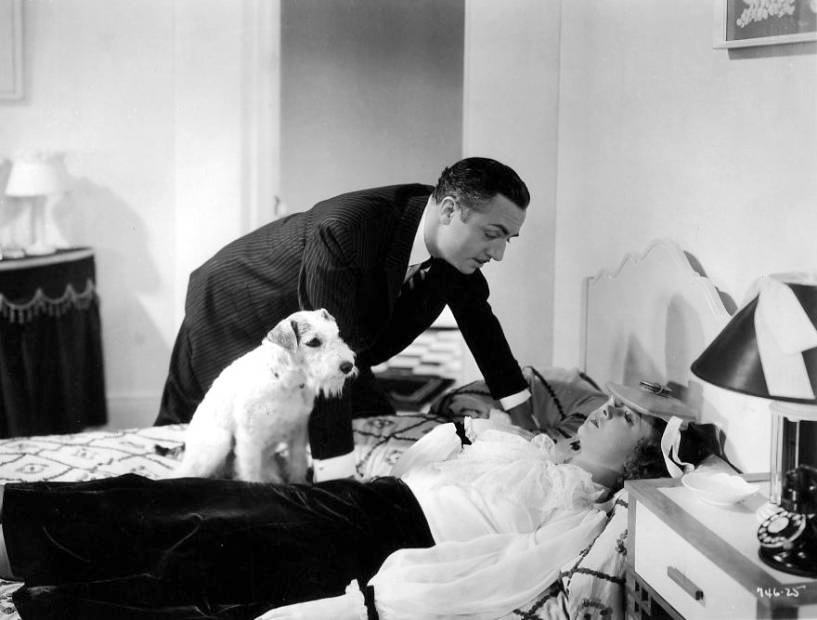
Another star of the show was Asta, the Charles’s wire fox terrier. Asta was portrayed by Skippy, a dog actor who not only appeared in The Thin Man films but also acted alongside Cary Grant in 1937’s The Awful Truth and in 1938’s Bringing Up Baby. Skippy appeared in three Thin Man movies and in more than twenty films altogether between 1932 and 1941. Being an actor in the film must have been good for one’s health: Powell lived 91 years, Loy 88 years, and Skippy, 20 years—a good long life for any pooch.
ROUGH NIGHT…Nick (William Powell) and Asta (Skippy) tend to Nora (Myrna Loy), who nurses a hangover in The Thin Man. (Wikipedia)
* * *
From Our Advertisers
While Chrysler’s styling of their streamlined Airflow proved to be too far advanced for the buying public (the Depression didn’t help), Studebaker’s own foray into the streamlined future caused a sensation…
…thanks to Studebaker’s brief merger with Pierce-Arrow (1928–33), Studebaker’s designers took cues from Pierce’s streamlined 1933 Silver Arrow and created more than 800 cars with “Year-Ahead” design features—the positive reception convinced the company to continue the style in 1935…here is a top-of-the-line 1934 President Land Cruiser…
1934 Studebaker President Land Cruiser with “Year-Ahead” design features, yet not as radical as Chrysler’s Airflow. (hemmings.com)
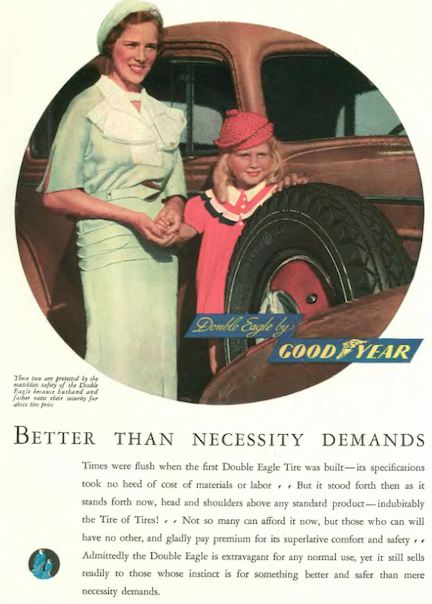
…we continue with those round rubber things that held the cars up…a lot of tire ads in the 1930s emphasized safety—blowouts were common back then…funny how it took nearly four decades to add seat belts to cars…those tires wouldn’t help much in a head-on collision, especially with your kid standing on the from seat…
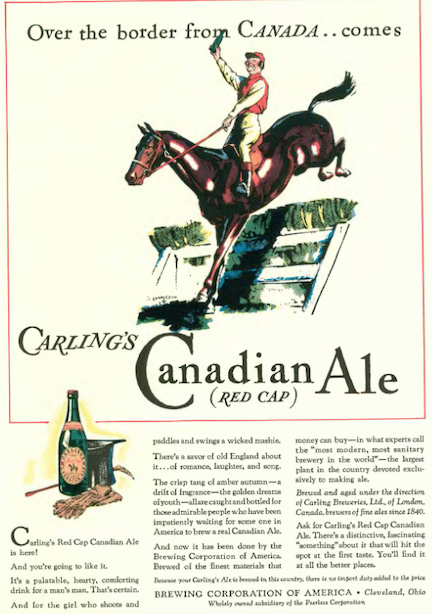
…now let’s cool off with crisp Canadian Ale, thanks to Carling’s entry into the American market…
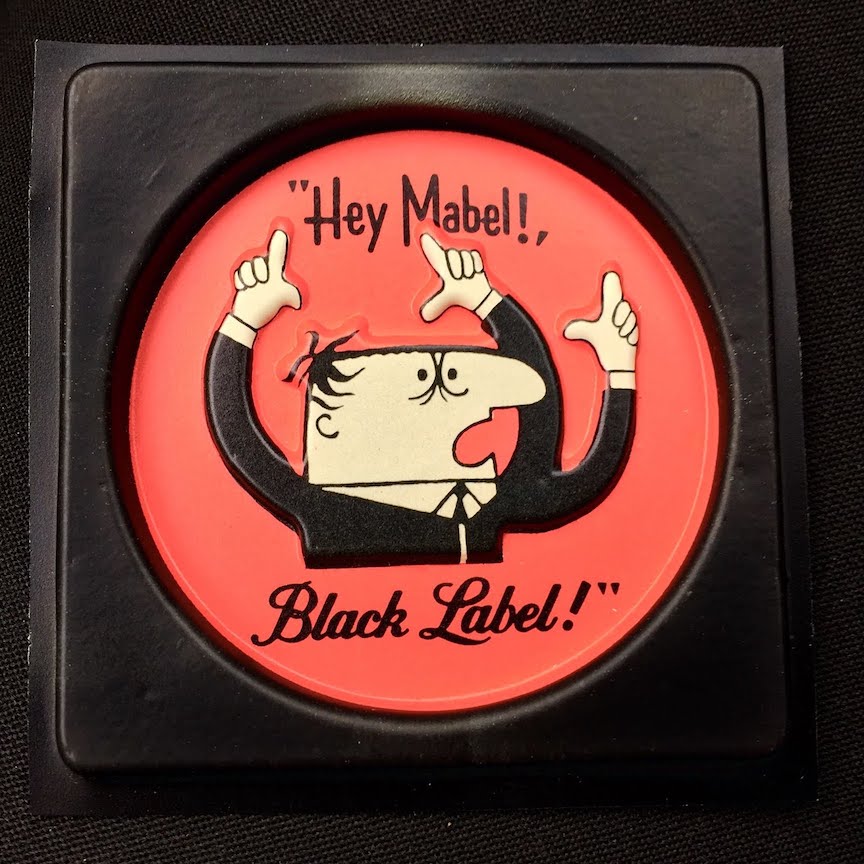
…Carling’s Black Label beer was popular in the states…my parents had a set of these coasters with the Black Label tagline…
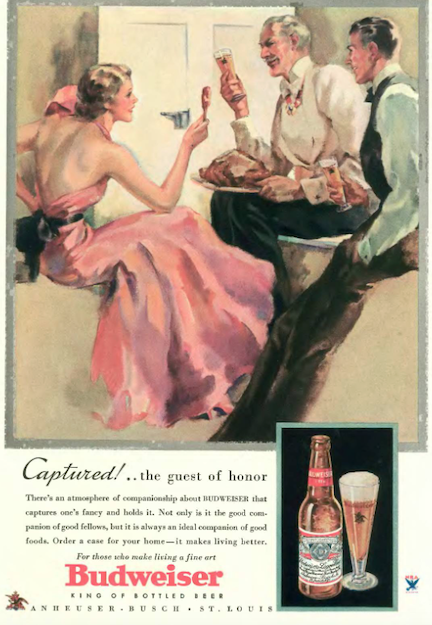
…Budweiser continued its artful series of ads featuring the well-heeled enjoying its product…here it appears old dad (wearing some kind of medal) is getting to know his daughter-in-law over some cold chicken…”hey boy, she’s one of us!”…
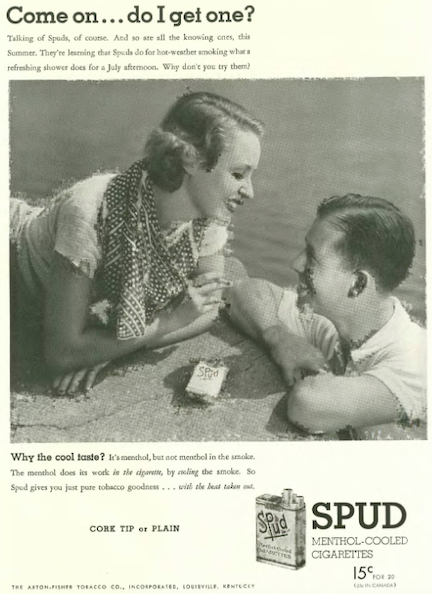
…and we move on to three very different approaches to selling cigarettes, beginning with Spud, continuing its message that menthol cigarettes are as refreshing as a shower on a July afternoon…
…a close up of the message…
…Camel, on the other hand, continued its campaign against irritability…it apparently did wonders for this woman, who seems to be on something more than nicotine…
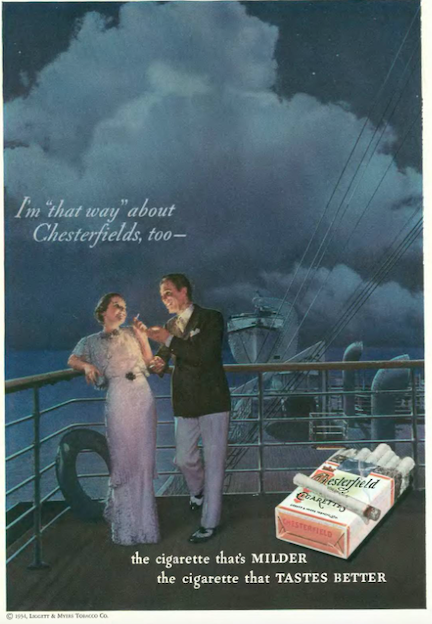
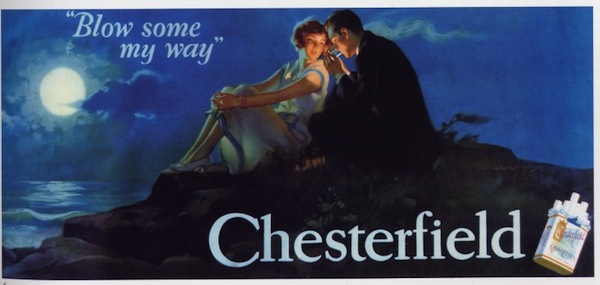
…and from the people who brought us the tagline “blow some my way” in 1928 (as a way to encourage women to take up the habit), by 1934 she is owning that cigarette, and apparently setting some ground rules with the gentleman…
…contrast with the more submissive pose in the Chesterfield ad from the late 1920s…
…on to our cartoons, we begin with spot art by Alan Dunn, which appears to have originated as a captioned cartoon…
…William Steig offered up this bit of art for a profile of an “insurance man” by St. Clair McKelway…
…Helen Hokinson drew up a full page of cartoons along the theme of outdoor dining…
…we continue Rea Irvin’s series on native birds…
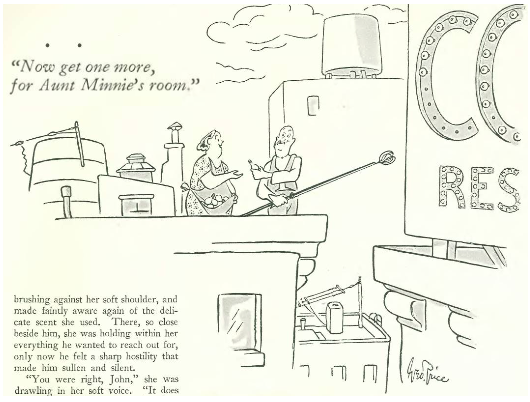
…George Price found a way to save on the cost of light bulbs…
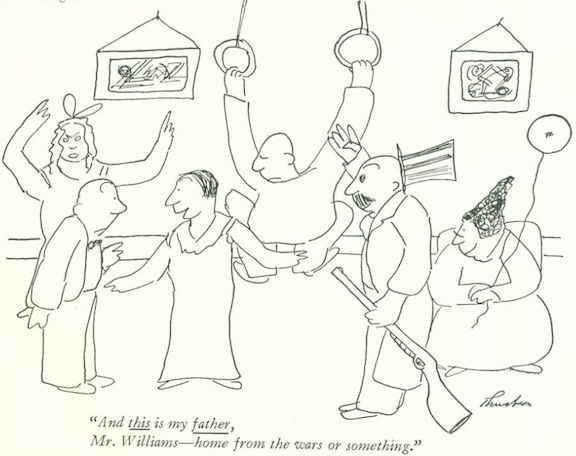
…and we close with James Thurber, and a welcome to the family…































































































































 A New Yorker State of Mind