A Return to Coney

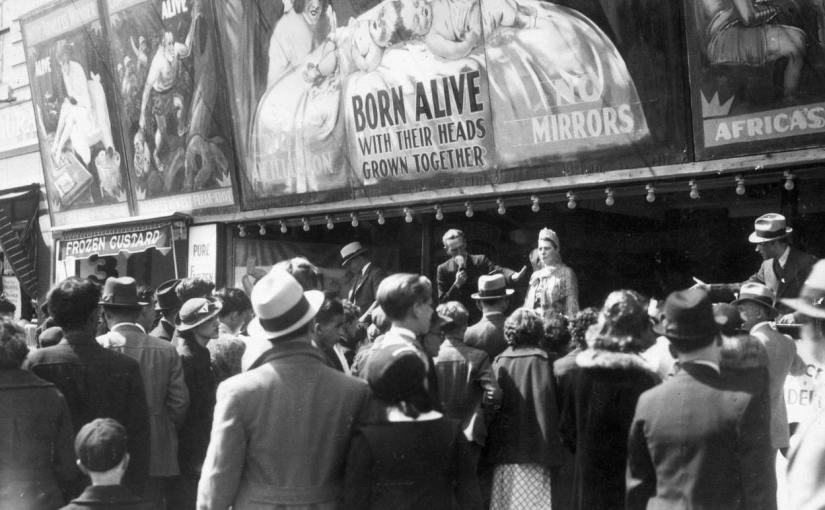
Above: Coney Island "freak" show, summer of 1935. (seeoldnyc.com)

It has been about a year since we’ve visited Coney Island, and with summer upon us (and upon 1935 New York) let’s have a look at “The Talk of the Town” and see the latest attractions.

June 15, 1935 cover by Garrett Price. Price (1897–1979) illustrated 100 covers for the magazine.
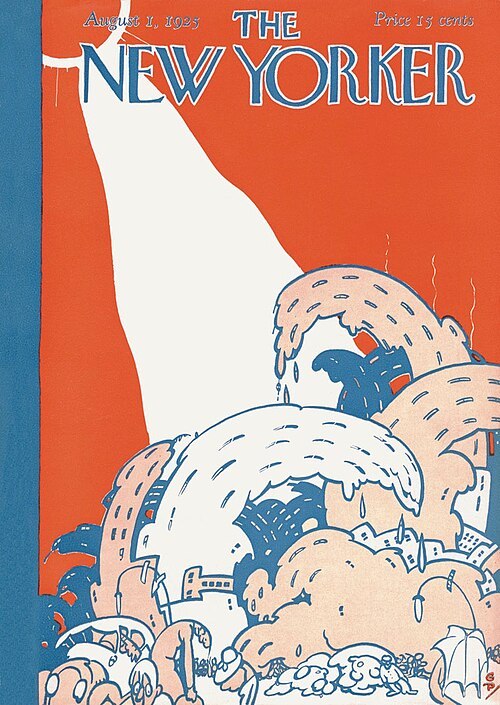
Garrett Price’s first New Yorker cover, “Heat Wave,” Aug. 1, 1925.

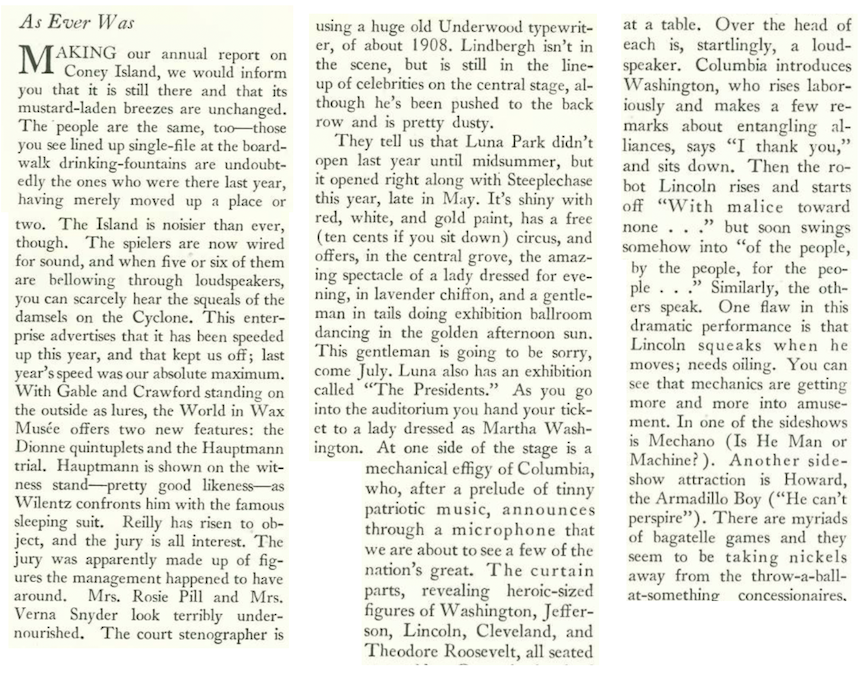
This lengthy “Talk” entry (excerpted), attributed to Clifford Orr, noted that much was unchanged, including the “mustard-laden breezes.” The place was noisier, however, with carnival barkers increasing their range through loudspeakers.
THE HIGH AND LOWS of society were on display in various attractions at Coney Island. Clockwise from top left, gawkers gather at Coney Island freak show, which included the “Armadillo Boy,” August 5, 1935; strollers near the Virginia Reel and Wonder Wheel, circa 1935; Borden’s frozen custard stand, 1930s; couple have a nap on the beach, circa 1935. (seeoldnyc.com)
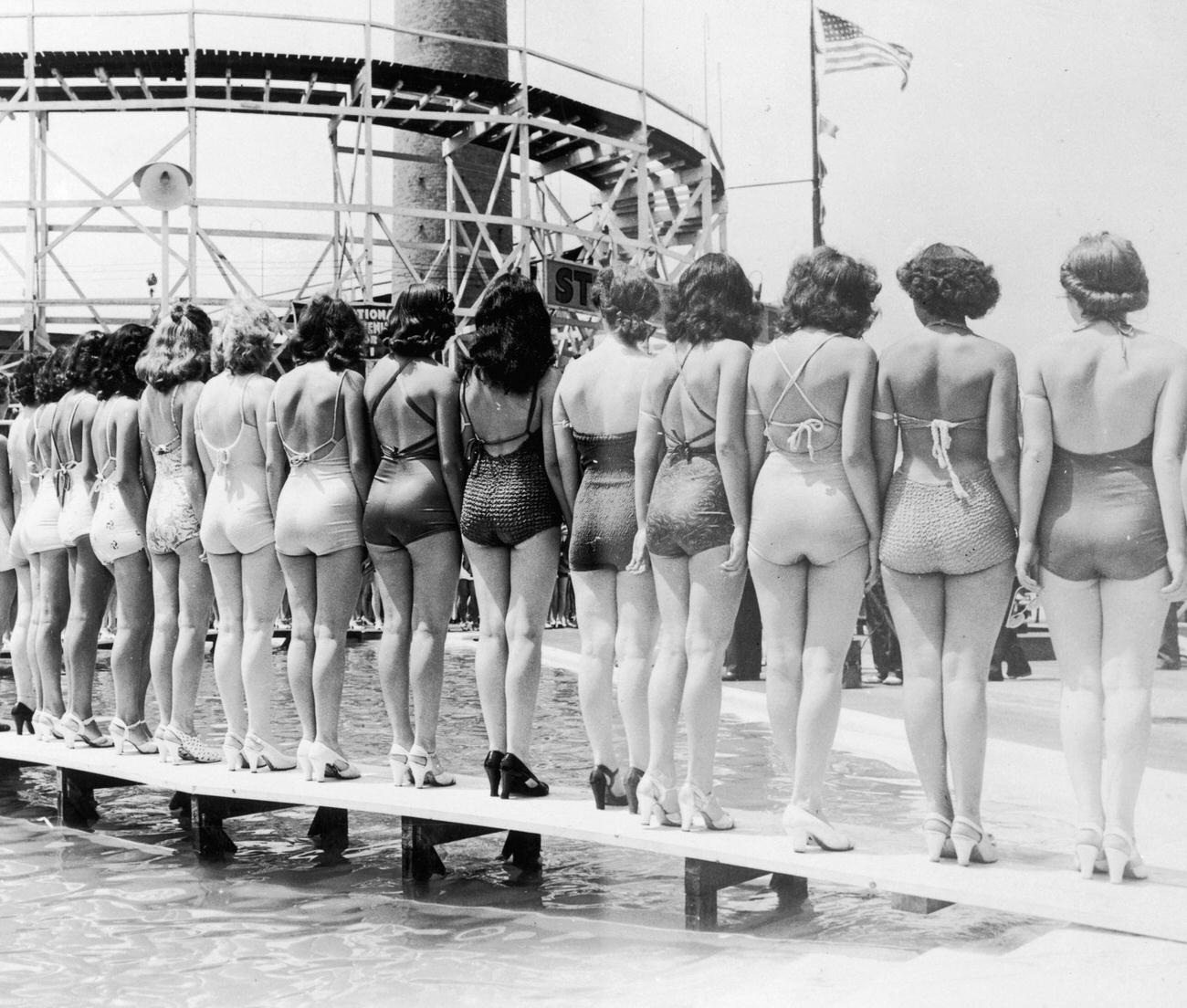
LINEUP…Beauty contests near the Steeplechase, like this one in 1935, were a common sight at Coney Island. (seeoldnyc.com)
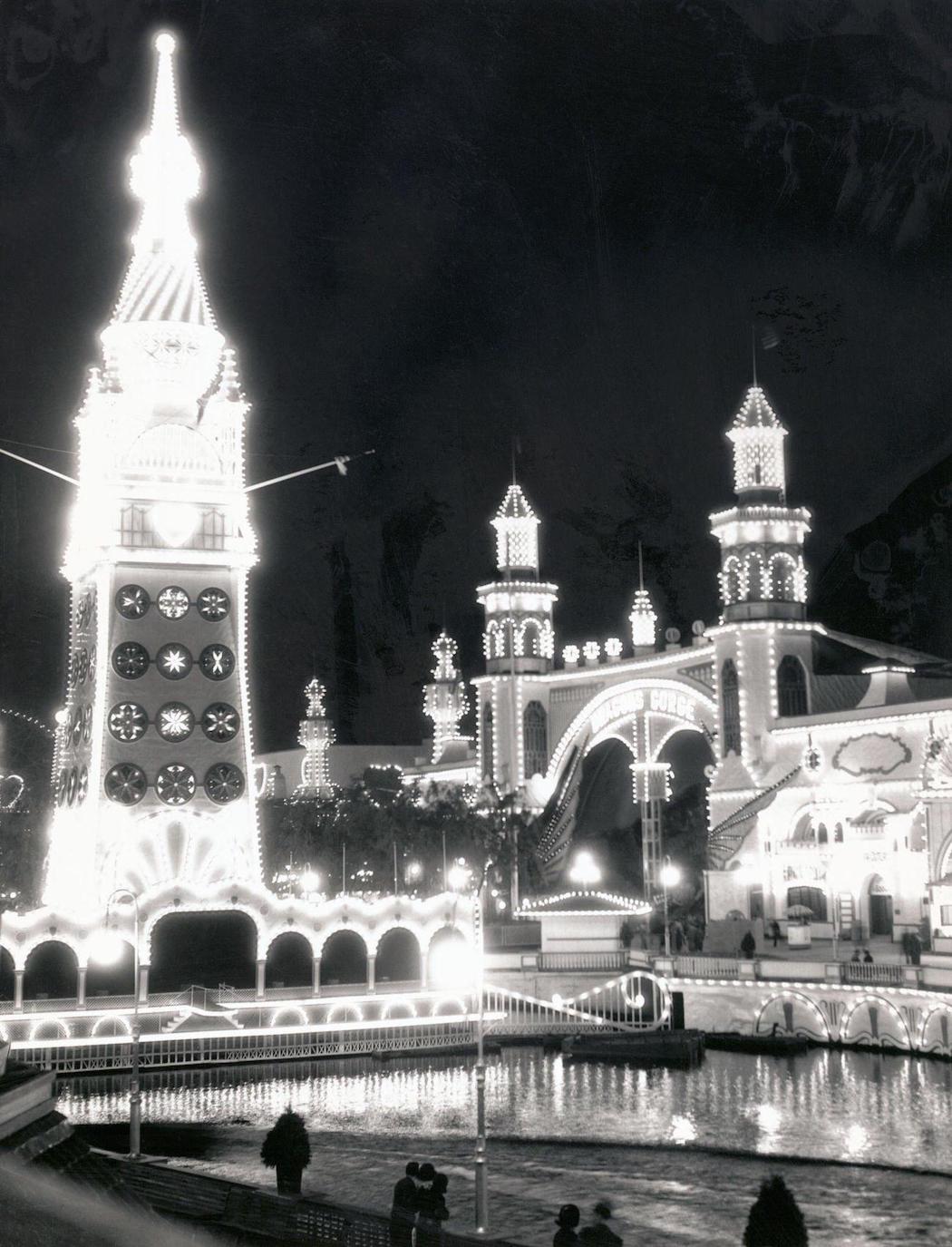
LIKE MOTHS TO THE FLAME, the dazzling lights drew thousands to Coney Island’s Luna Park in the 1930s. (seeoldnyc.com)
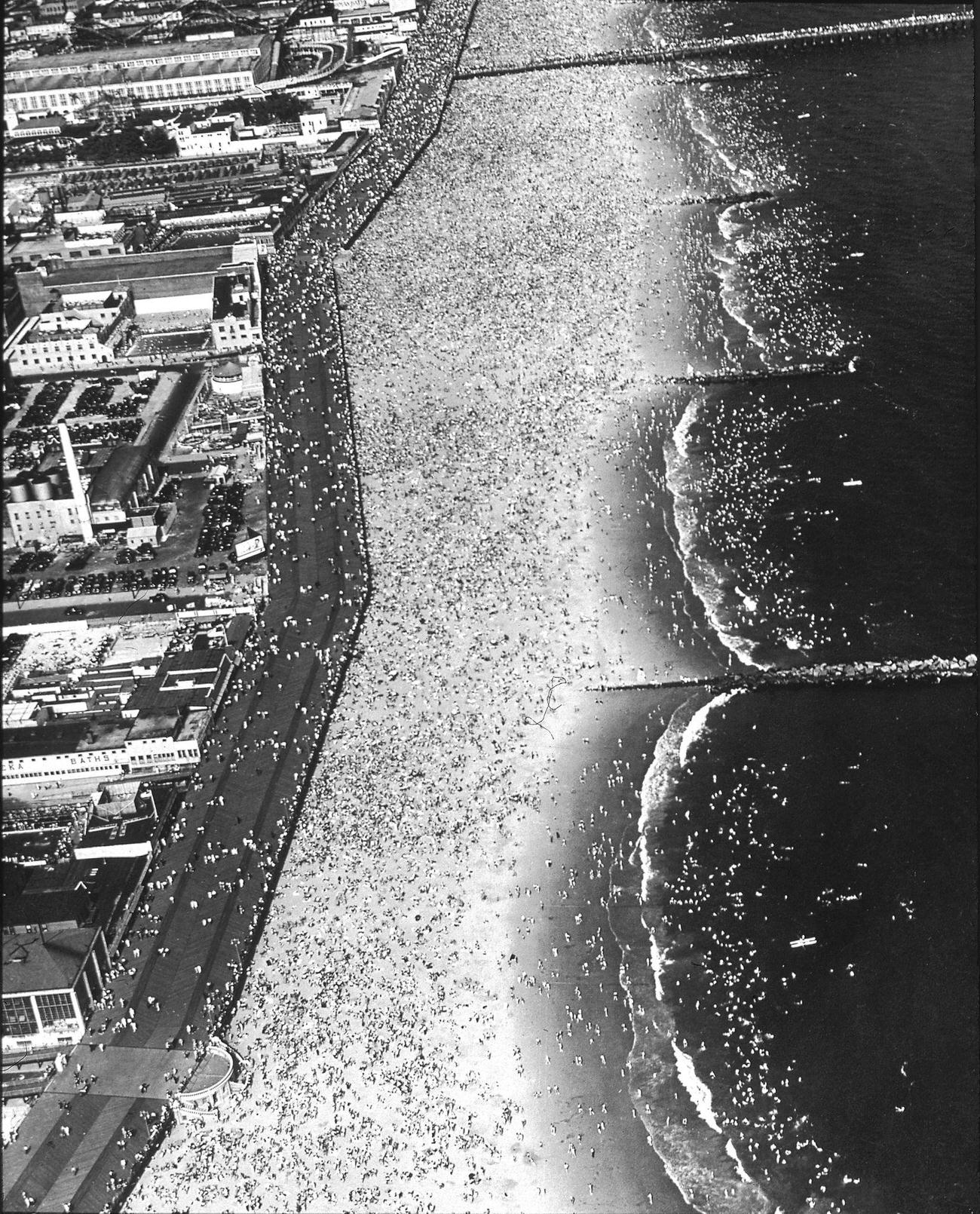
THEY LOOK LIKE…ANTS…Aerial view of the beach in 1935. The Steeplechase ride is at the top left. (seeoldnyc.com)

 * * *

Ship Ahoy

E.B. White (in “Notes and Comment”) mentioned that he danced aboard the newly arrived S.S. Normandie (presumably with Katharine White) while it was docked at Pier 88.

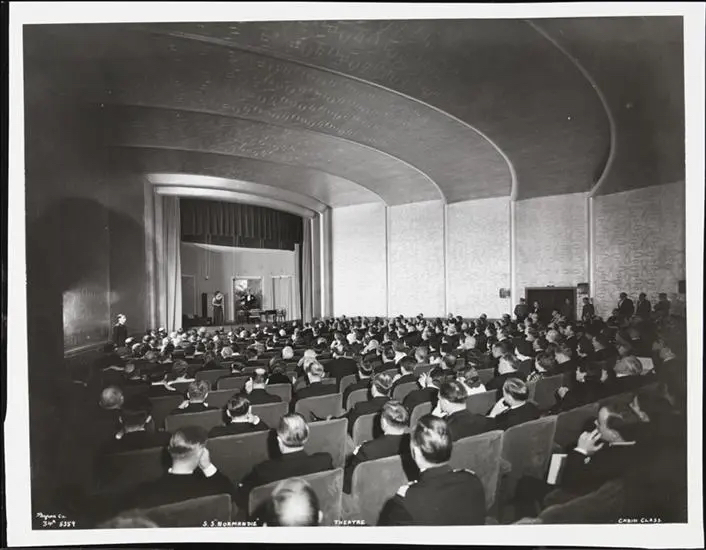
GROOVY…E.B. White noted the “luminous grooves” of the S.S. Normandie’s theatre. (drivingfordeco.com)
JUGGERNAUT…The S.S. Normandie docked at New York’s Pier 88 after completing her maiden voyage on June 3, 1935. Note the paint chipped from the hull, the result of the ship’s record-breaking speed. (yesterdaystrails.wordpress.com)

 * * *

Another Freak Show

Theatre critic Wolcott Gibbs found Earl Carroll’s latest stage production to be nothing more than a “vulgar assortment of comedians, jugglers, and performing dogs,” accompanied by “very lovely and disarming” young ladies who chanted their lines “in high childish voices.” One skit apparently featured Abe Lincoln with “fifty-six young ladies in cellophane hoopskirts.” Too bad no one filmed that performance.

HOLDING IT TOGETHER…Gibbs noted that comedian Ken Murray carried most of the show’s comedy (Murray had found success on the New York stage after appearing in Carroll’s Vanities on Broadway in 1935); Sibyl Bowen was known for her impersonations of famous women. In Sketchbook she portrayed Martha Washington, among others. (eBay/entertainment.ie)

 * * *

Weathering the Field

Like the recent 2025 U.S. Open at Oakmont (won by J.J. Spaun), ninety years ago Oakmont was also plagued by bad weather, and it also featured a tournament winner who outplayed the top golfers in the field. Excerpt:
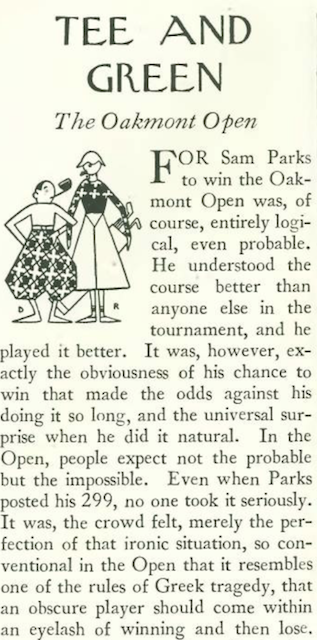
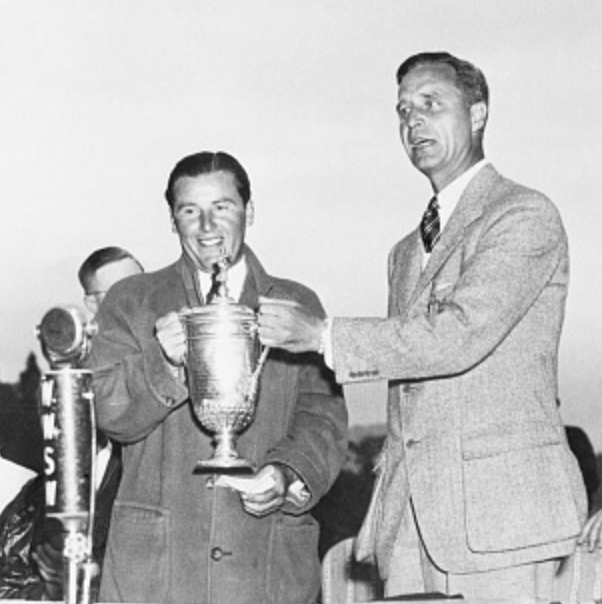
WHY NOT ME?…Sam Parks Jr. (left) was considered an unlikely winner of the 1935 U.S. Open after competing with Hall of Famers at Oakmont. A 25-year-old club pro from Pittsburgh who played on the winter tour without ever winning, he bested a field that included Walter Hagen, Gene Sarazen, Denny Shute and Horton Smith. His secret? For months leading up to the U.S. Open, Parks played nine holes at Oakmont every morning before going to work at nearby South Hills Country Club. He knew the course like the back of his hand. (progolfweekly.com)

* * *

Straight From the Headlines

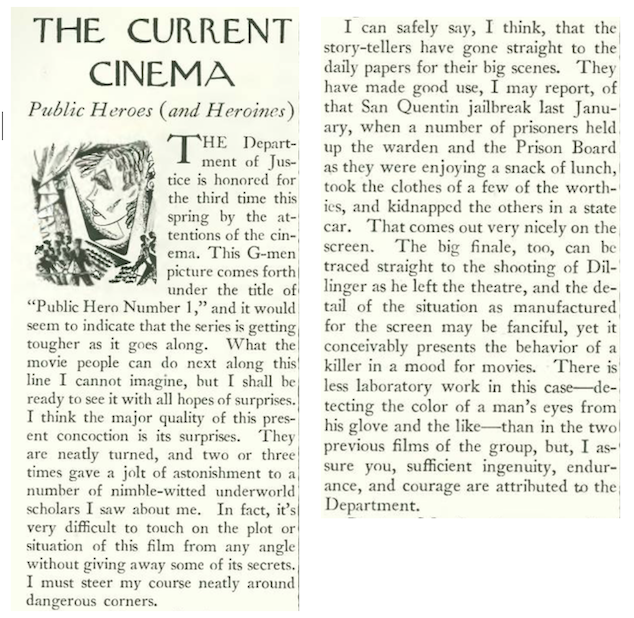
Film critic John Mosher noted how the storylines in latest “G-men” pictures seemed to be taken directly from the daily papers. Public Hero Number 1 was no exception.
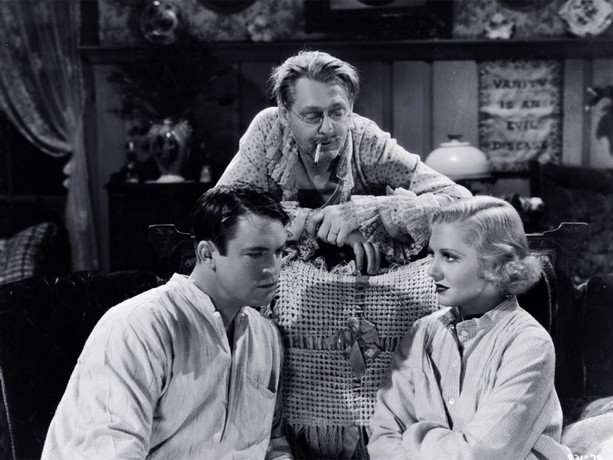
THE GOOD GUYS…from left, Chester Morris, Lionel Barrymore and Jean Arthur in Public Hero Number 1. One effect of the Hays Code was to replace gangster films—which some believed glorified criminals—with films that depicted the dedication and courage of law enforcement officers. (Rotten Tomatoes)

Mosher suggested moviegoers would get more pleasure out of Public Hero Number 1 than from Our Little Girl, which seems an unfair comparison since gunplay was rare in a Shirley Temple flick.

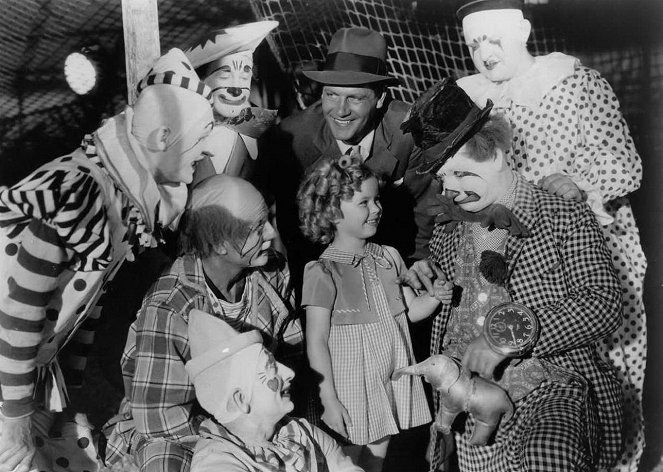
NO GUNS, JUST SOME SCARY CLOWNS…Joel McCrea and Shirley Temple in Our Little Girl. (csfd.sk/film)

 * * *

Speaking Brooklynese

The June 15 issue featured Thomas Wolfe’s classic short story, “Only the Dead Know Brooklyn.” Written entirely in “Brooklynese” dialect, the simple plot features four men standing on a subway platform arguing about how to get to “Bensonhoist.” The story (seemingly told to the author himself) recalls the existential themes of Wolfe’s contemporary, the Irish writer Samuel Beckett. Here is an excerpt, the second paragraph of the story:

So like I say, I’m waitin’ for my train t’ come when I sees dis big guy standin’ deh—dis is duh foist I eveh see of him. Well, he’s lookin’ wild, y’know, an’ I can see dat he’s had plenty, but still he’s holdin’ it; he talks good an’ is walkin’ straight enough. So den, dis big guy steps up to a little guy dat’s standin’ deh, an’ says, “How d’yuh get t’ Eighteent’ Avenoo an’ Sixty-sevent’ Street?” he says.

GONE TOO SOON…Portrait of Thomas Wolfe taken by Carl Van Vechten in 1937. He died the next year, eighteen days before his 38th birthday. (Library of Congress)

 * * *

From Our Advertisers

We begin with this two-page spread—what readers of the June 15 issue would have seen after turning the cover page…
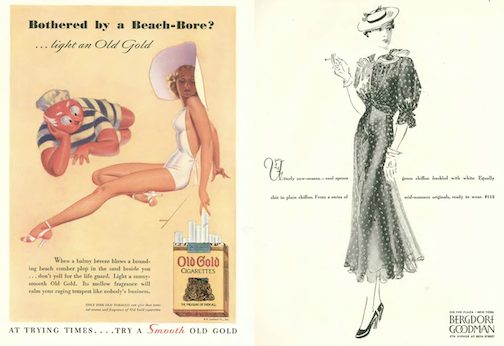
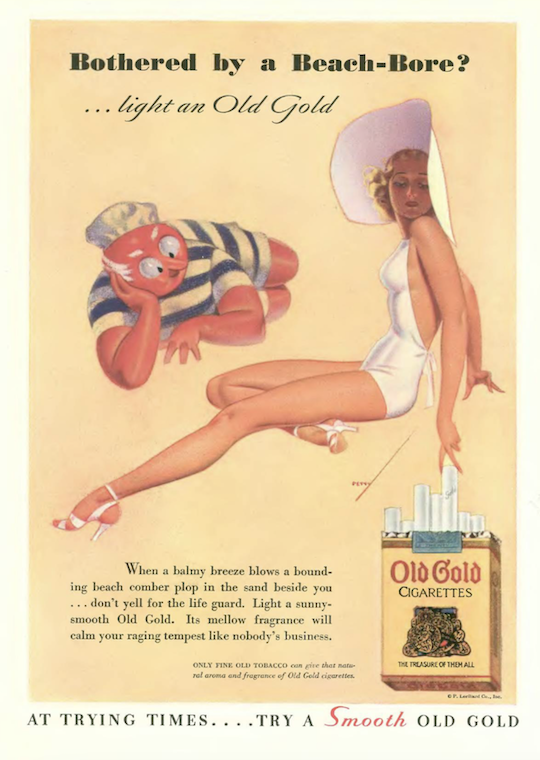
…the inside cover ad was part of an ongoing series of spots for Old Gold cigarettes illustrated by pin-up artist George Petty…almost all of the ads featured a fat, homely man (possibly a sugar daddy) mooning over a leggy blonde who relieves the tedium by reaching for an oversized cigarette…
…the ad on the facing page couldn’t be more different, except for the fact the woman is smoking, suggesting, of course, sophistication when paired with the latest fashions from Bergdorf Goodman…

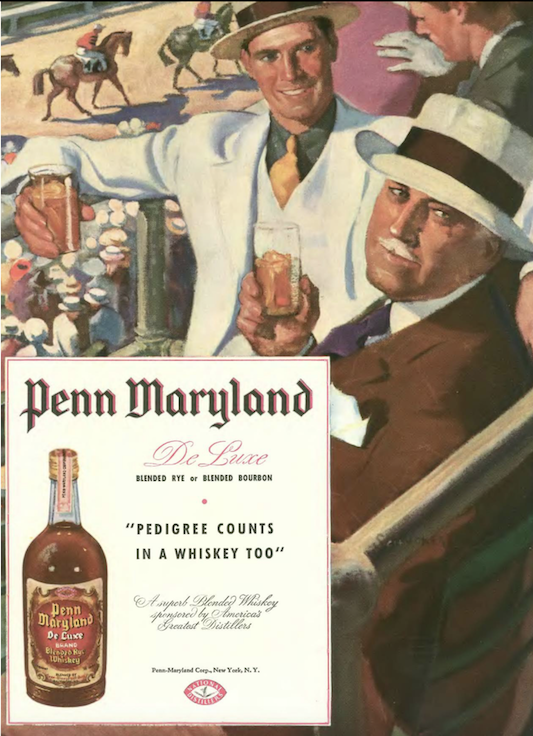
…on the back cover we find these swells enjoying a belt at the horse races…
…while on the back cover, Camel gathered together all of its recent society endorsers for another round of shilling for R. J. Reynolds…

…swells and society women were the only persons (along with celebrities) who could afford to take this early version of a “red eye” to L.A. or San Francisco…it was not all that cushy, however…airliners were loud, cold, and not pressurized, so they flew at low altitudes and were often bounced about by the weather. The Boeing 247 also required several stops for refueling…
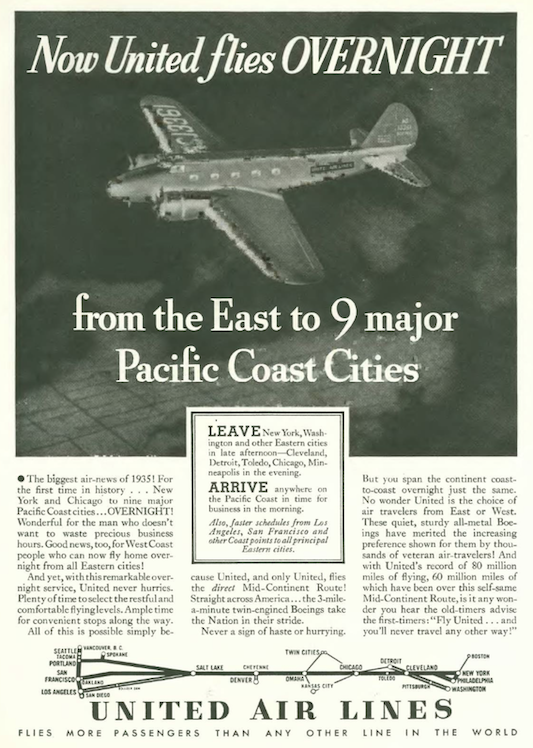
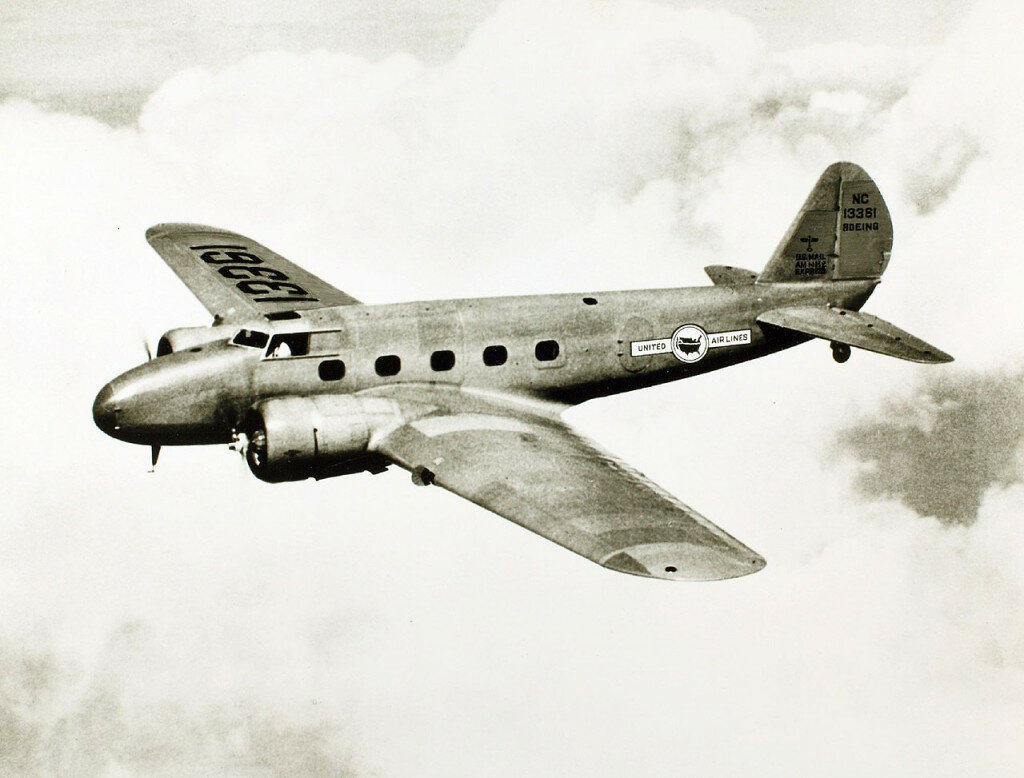
‘OL SPEEDY…This Boeing 247 was featured in the above ad. One of the first all-metal airliners, the 247 was considered revolutionary when introduced in 1933—United Airlines boasted that it cruised at speeds of three miles per minute and carried ten passengers across the country in twenty hours, cutting eight hours from previous travel times. Seven refueling stops included Cleveland, Chicago, Omaha, Cheyenne and Salt Lake City.  (Wikipedia)
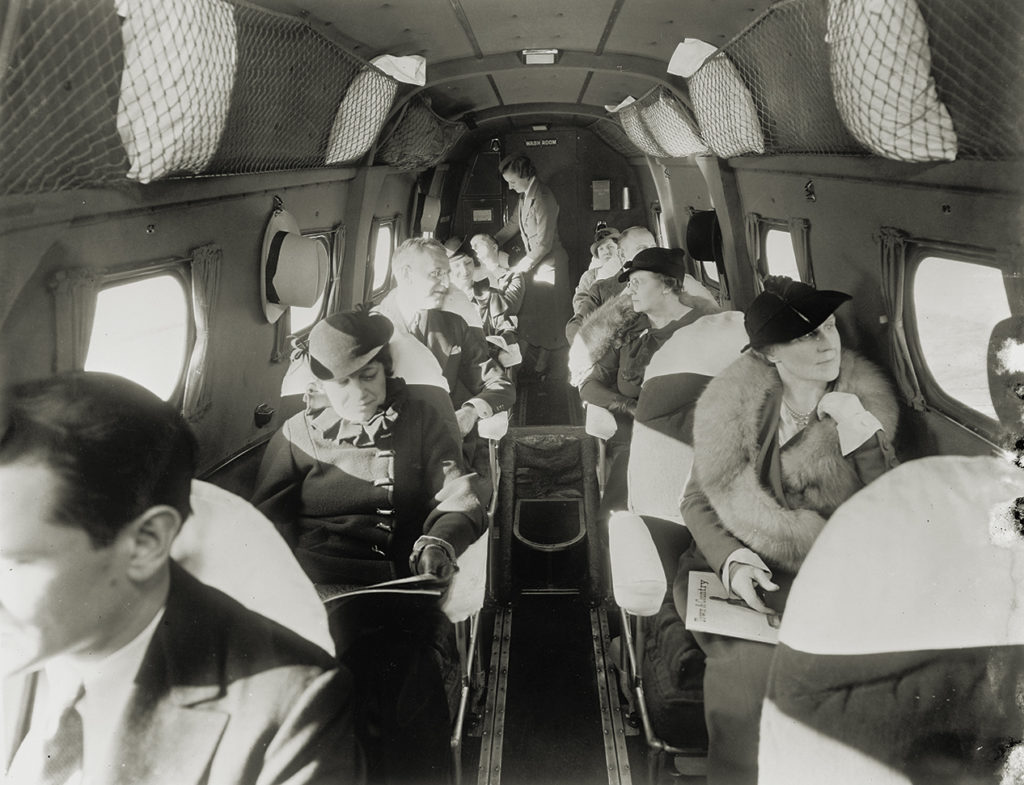
WATCH YOUR STEP…Interior of the Boeing 247. Note that the main wing ran through the cabin, so persons moving down the aisle had to step over it. (Library of Congress)

…we learn a lot about a 1930s New Yorker reader by looking at the advertisements…it doubtful the magazine had many truly upper-class readers—the barbarians were content to flip through a copy of Town & Country or similar undemanding fare…what we do have are striving “smart set” readers, some with the means to buy a luxury automobile, fly cross-country, or cruise on the Normandie, all things one would desire as a member of upper-middle class or even the educated bourgeoisie in the middle…this Campbell’s soup ad is for the latter…the upper-middles would sniff at canned soup, while the barbarians would probably eat whatever was set in front of them, since talking about food would be considered vulgar…

…Pabst Blue Ribbon beer has been around since 1844…in the 20th century it was increasingly associated with the working class and rednecks until the brand caught on with urban hipsters in the early 2000s…

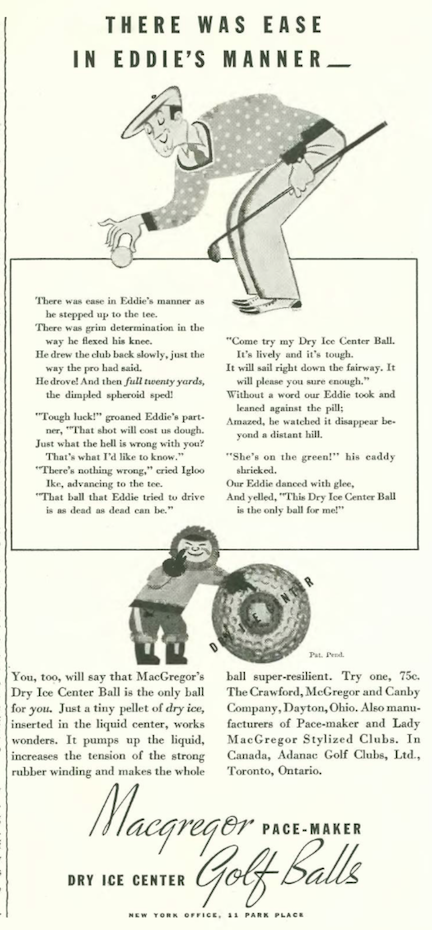
…in the May 25, 1935 issue we saw an ad promoting Walter Hagen’s “Honey Boy” golf balls, which contained real honey in their cores…the folks at MacGregor’s had a different idea—they inserted a pellet of dry ice into the center of their golf balls…what will they think of next?…
…we move on to our cartoonists, beginning with a James Thurber spot…
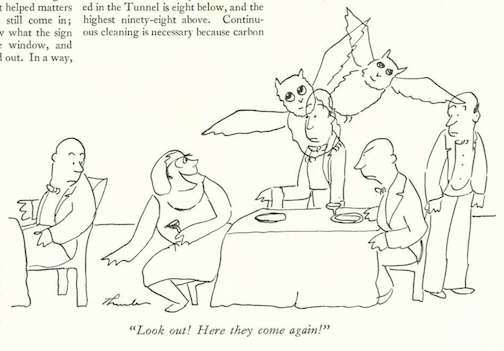
…and continuing with another Thurber classic…
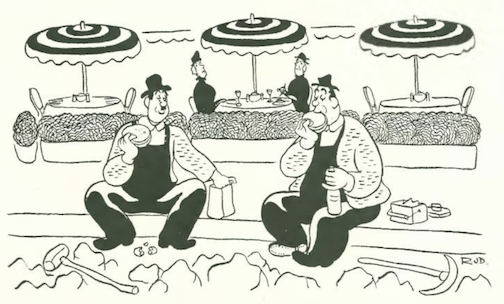
Robert Day took a lunch break in the opening pages…
Alan Dunn felt charitable while relaxing in Westchester…

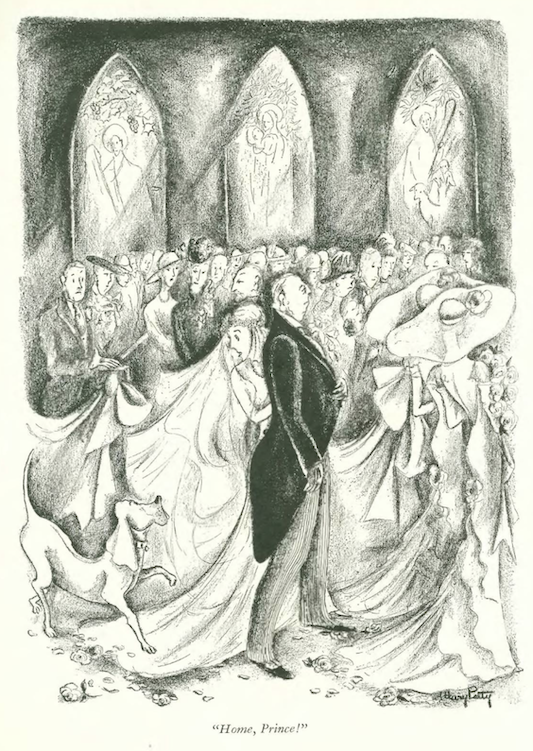
Mary Petty gave us a wedding guest that would not be out of place today…the caption reads, “Home, Prince!”…
Helen Hokinson went hog-wild in the garden…

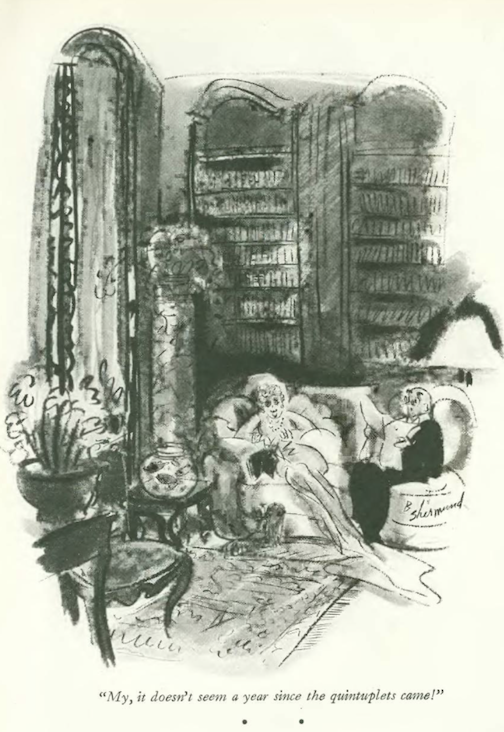
Barbara Shermund looked in on the idle thoughts of the idle rich…
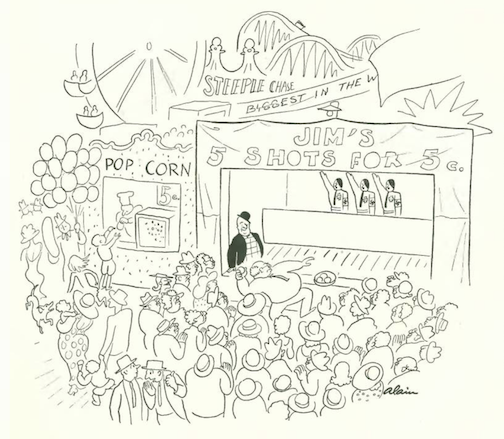
…and we close where we began, with Daniel Brustlein aka Alain at Coney Island…
Next Time: Thackeray, In Color…

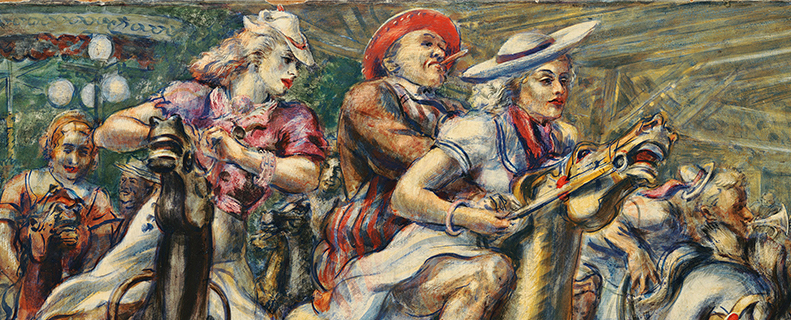
Coney Summertime

Above: Wooden Horses(detail) by Reginald Marsh, 1936. Marsh was a frequent visitor to Coney Island, a place that inspired numerous sketches and paintings. (Wadsworth Atheneum Museum of Art)

We officially kick off the summer with a visit to Coney Island, where “The Talk of the Town” took in the latest sights and amusements.

June 16, 1934 cover by Constantin Alajalov.

This excerpted “Talk” piece, attributed either to an “ 

CLANKITY CLANK…The mechanical man referred to in the “Talk” piece was likely similar to the one pictured above in this October 1933 feature in Popular Mechanics. Like many “robots” of that era, they were often pictured smoking cigarettes. (Google books)
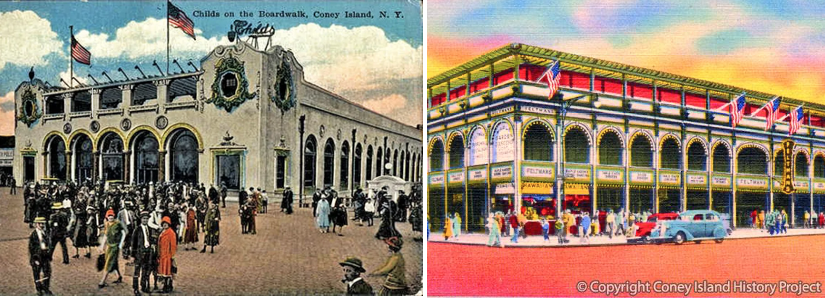
WET YOUR WHISTLE…Beer flowed up and down the boardwalk at Coney Island, but if you wanted something stronger you had to stop by the Half Moon Hotel or one of these establishments, Childs (left) or Feltmans’. (www.coneyislandhistory.org)
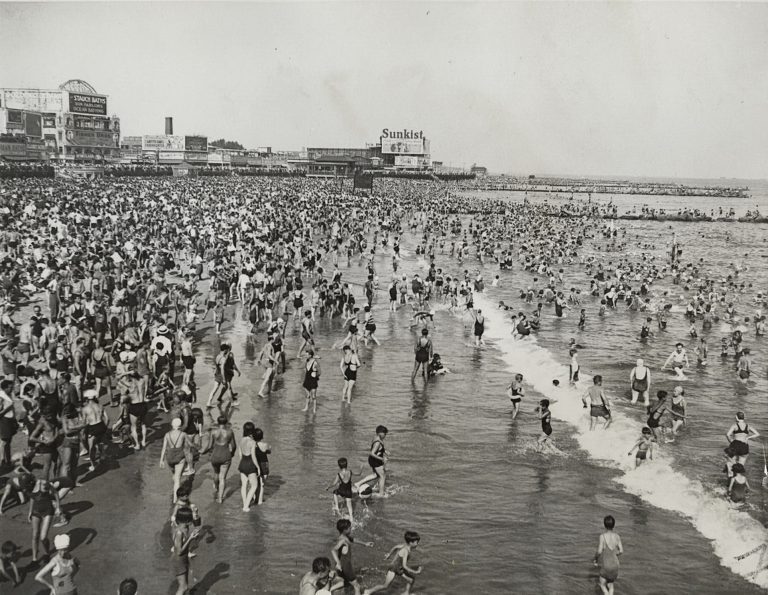
LEAVE SOME FOR ME…An estimated one million New Yorkers visited Coney Island on July 4, 1934 to get away from the heat of the city. (stuffnobodycaresabout.com)
DIFFERING INTERPRETATIONS…In his 1934 painting, Coney Island (left), artist Paul Cadmus portrayed beachgoers as ridiculous and uncouth rabble, while Cadmus’s friend and fellow artist Reginald Marsh took a somewhat kinder approach to the same subject in his 1936 Coney Island (right). (Jon F. Anderson, Estate of Paul Cadmus, licensed by VAGA, obtained via lacma.org / Syracuse University Art Collection)

Of course it wouldn’t be Coney Island without grisly wax museum scenes inspired by the latest sensational headlines…bank robber John Dillinger was still on the run, and “little June Robles” was finally free and apparently unharmed after being kidnapped and locked in a desert cage for 19 days…

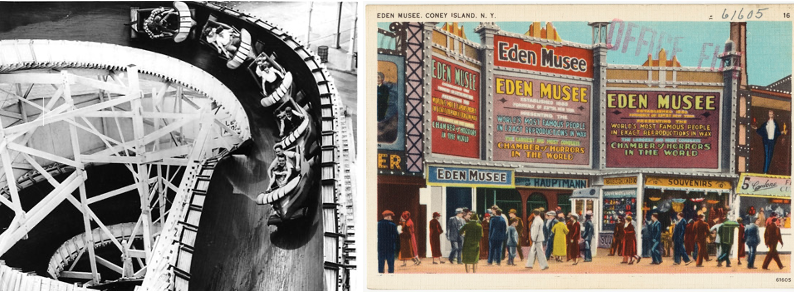
THANKS WINDY CITY…At left, the Chicago World’s Fair inspired Coney Island to build a trackless, bobsled-style “flying turns” coaster in Steeplechase Park (the wooden ride was destroyed by fire after only five years of operation). At right, a postcard image of the Eden Musee wax museum. (riverviewparkchicago.com / New York Public Library)
ON THE BOARDWALK…Another Coney scene by Reginald Marsh, titled Pip and Flip, 1932. (Terra Foundation for American Art, Chicago Daniel J. Terra Collection via artblart.com)

 * * *

Luck of the Irish

The Irish Hospitals’ Sweepstake (more commonly known as the Irish Sweepstakes) was established in 1930 to raise funding for hospitals in Ireland. Although lotteries were generally illegal in the U.S., millions of tickets were sold in the States, many of them in New York and New England. In his “Notes and Comment,” E.B. White wondered what would become of the lottery’s newest American winners, including former Ziegfeld Follies showgirl Alma Mamay, who won $152,000 in the Irish sweepstakes. White might have been pleased to know that Mamay moved to California, married a millionaire oil tycoon, and lived to the age of ninety-one.

CALIFORNY IS THE PLACE YOU OUGHTA BE..Ziegfeld Follies showgirl Alma Mamay took her Sweepstakes winnings and fled to California, where she married a millionaire oil tycoon. (ziegfeldfolliesgirls.com)

 * * *

Rugged Individual

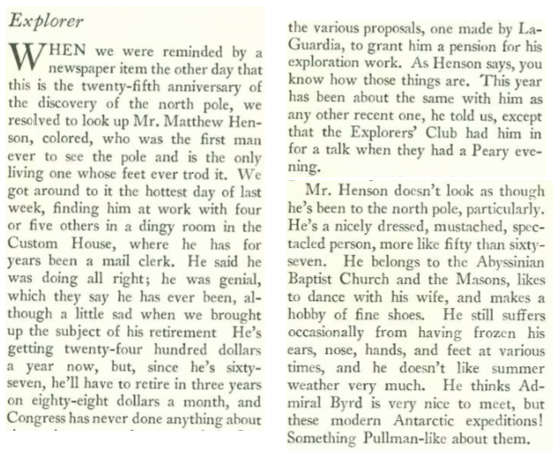
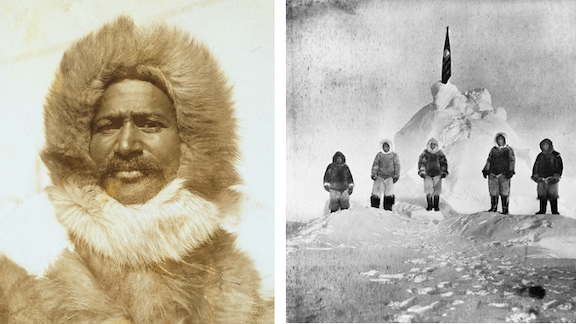
Matthew Alexander Henson (1866–1955) was an African American explorer who accompanied Polar explorer Robert Peary to the Arctic seven times, participating in a 1908–1909 expedition that arguably made Henson the first explorer to reach the geographic North Pole. “The Talk of the Town” caught up with Henson on the feat’s 25th anniversary.

GO NORTH YOUNG MAN…At left, Matthew Henson circa 1910. At right, photograph of Henson and four Inuit guides on the last stretch of their 1908–09 expedition, taken by Robert Peary at what they believed to be the North Pole. Henson (center) planted the flag. (Wikipedia)

 * * *

POTUS Profiled

Pulitizer Prize-winning historian Henry F. Pringle published the first installment of a three-part profile of President Franklin D. Roosevelt. In this excerpt Pringle writes about FDR’s sense of humor (illustration by William Cotton):

 * * *

Mattress Campers

The “About the House” column featured the latest in home-cooling devices. Couldn’t afford the zillions it would cost to install a home air-conditioner? Well the folks at Crosley—an electronics company known for its radios—offered a more affordable solution: an air-conditioned tent that could be erected over one’s bed for $150 (about $3,500 in today’s dollars):

Here is a 1934 ad for the contraption I found at worldradiohistory.com:

…and we continue with more from our advertisers, including the Broadway magazine The Stage, which offered up this idyllic scene showing what folks did in the days before air-conditioning…

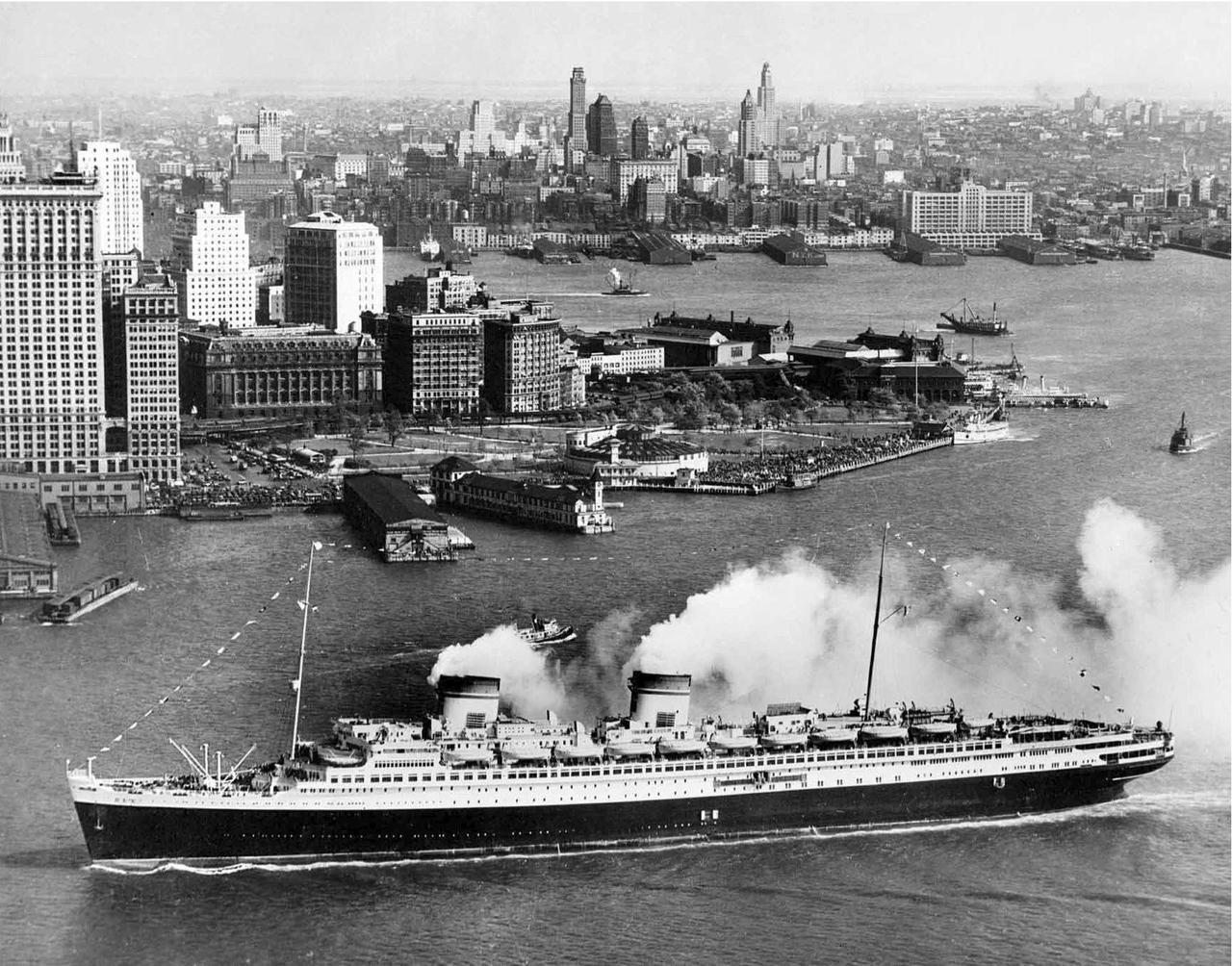
…you could also escape the heat by taking to the high seas aboard the Italian liner SS Rex

…seen below arriving in New York in this 1932 photo, the 911-foot SS Rex was the largest ship built in Italy before World War II…it was destroyed by the British RAF in 1944…

(adventures-of-the-blackgang.tumblr.com)

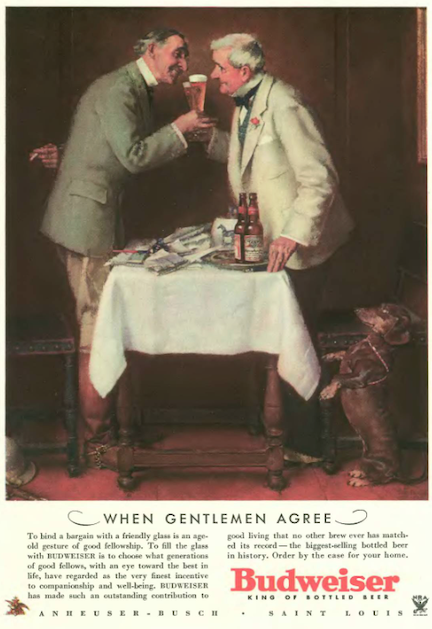
…you could also cool off like these two old gents, sharing a toast and some Budweisers…

…or you could get yourself a jug of applejack brandy and mix it 1:1 with pineapple juice…not sure who or what is being “saved” here…

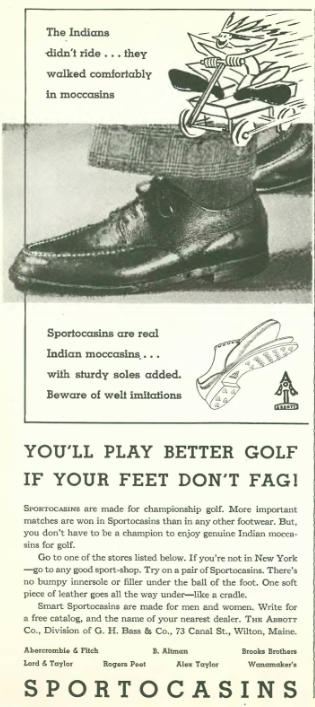
…long before there were Nikes or Adidas, golfers could hit the links in a pair of Sportocasins…

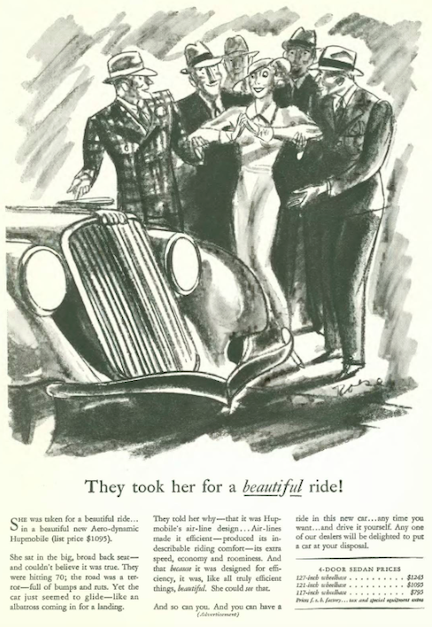
…Hupmobile was still hanging in there, enlisting the talents of illustrator Herbert Roese to extol the comforts and the beauty of its “air-line design”… it isn’t clear why it required five middle-aged men to take her on that beautiful ride…

…the real-life bellboy Johnny Roventini made his debut in the New Yorker as the spokesman for Phillip Morris cigarettes…

…Roventini (1910–1998), who stood less than four feet tall as an adult, was working as a bellboy at the New Yorker Hotel when he was discovered by an advertising executive in 1933. Apparently the exec had Roventini shout the line “Call for Philip Morris!” and learned the bellboy could repeatedly, and on cue, vocalize a perfect B-flat tone. Representing the company for more than forty years, he helped Lucille Ball and Desi Arnaz with the initial success of I Love Lucy (Philip Morris was the show’s sponsor)…

WHAT’S HIS LINE?…TV producers Mark Goodson, left, and Bill Todman greet Johnny Roventini during a 1952 radio broadcast of their quiz show, What’s My Line? The program’s sponsor was Phillip Morris. Note Goodson and Todman both hold cigarettes. (Wikipedia)

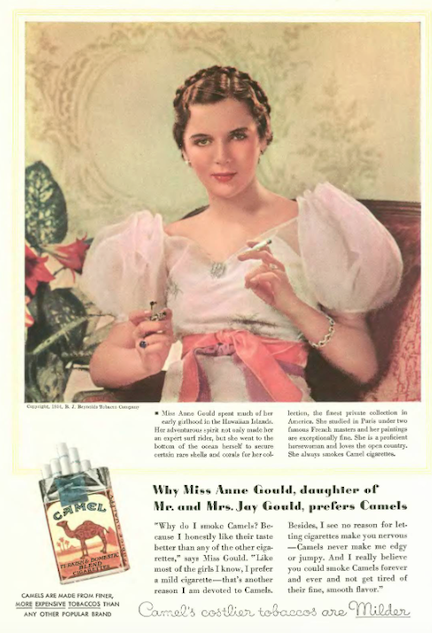
…by the looks of it, Anne Gould (heiress daughter of Jay Gould II and Anne Douglas Graham Gould) didn’t need anyone to tell her what to smoke…

…on to our cartoons, we continue our birdwatching with Rea Irvin…and we also get…

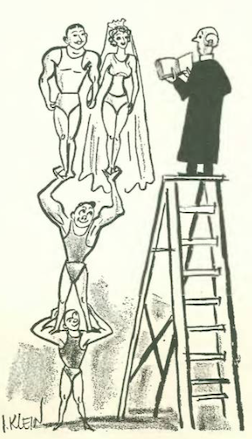
…high-flying nuptials with Isadore Klein

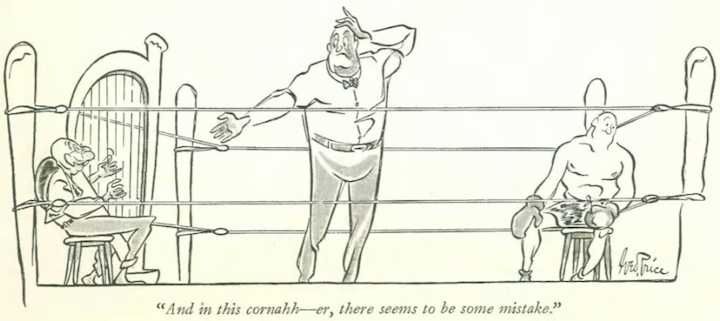
…a mismatch with George Price

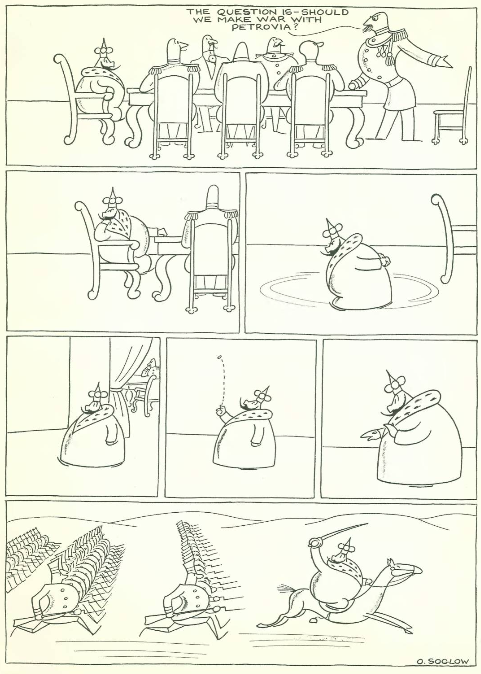
…the prospects for war with Otto Soglow

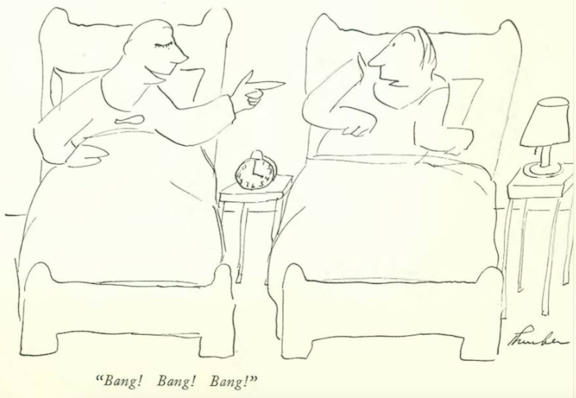
…marital bliss with James Thurber

…and a courtship scene, with an expiration date, from Mary Petty

Next Time: A Ring Ding…

Firecracker Lane

When fireworks were still allowed on the streets of New York City, Firecracker Lane was the place to go for all your pyrotechnic needs.

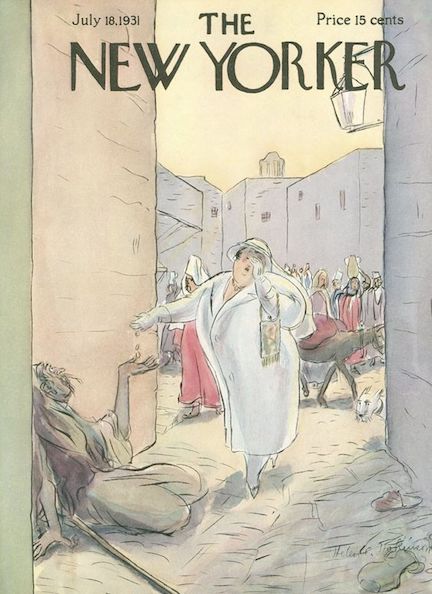
Theodore Haupt illustrated holiday travelers for the Fourth of July issue in 1931.

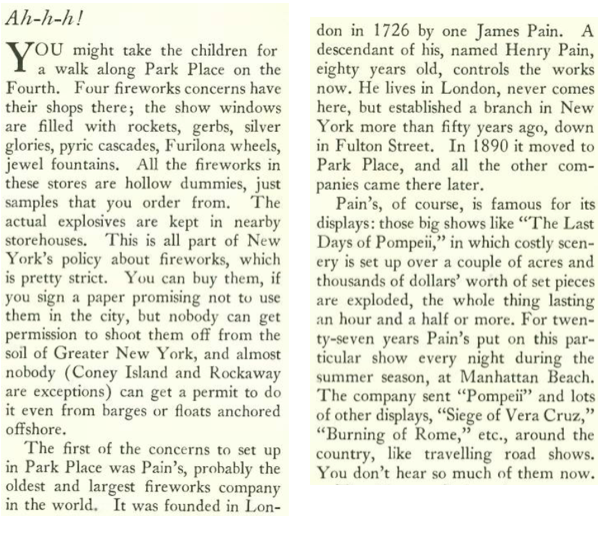
By 1931, however, fireworks had been banned across the greater New York City area, so customers visiting Firecracker Lane—a short row of sellers on Park Place between Broadway and Church Street—had to find a friendly burg beyond the metropolis to shoot off their Independence Day arsenals.

Before the city clamped down on the fun, Firecracker Lane did a bustling trade, and fireworks were even manufactured at sites around the metro area. But after a number of explosions and fires, the city closed down the fireworks factories, and by 1931 Fireworks Lane itself was on its last leg. “The Talk of the Town” visited what remained, and reminisced about the glory days.

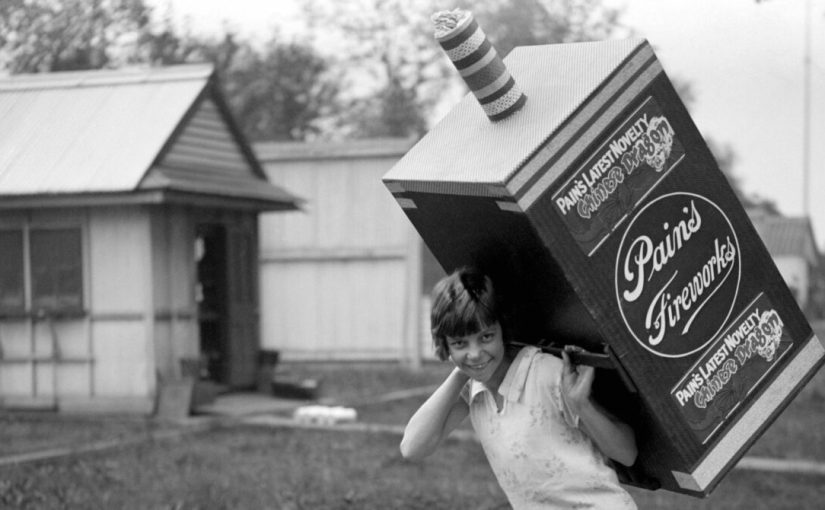
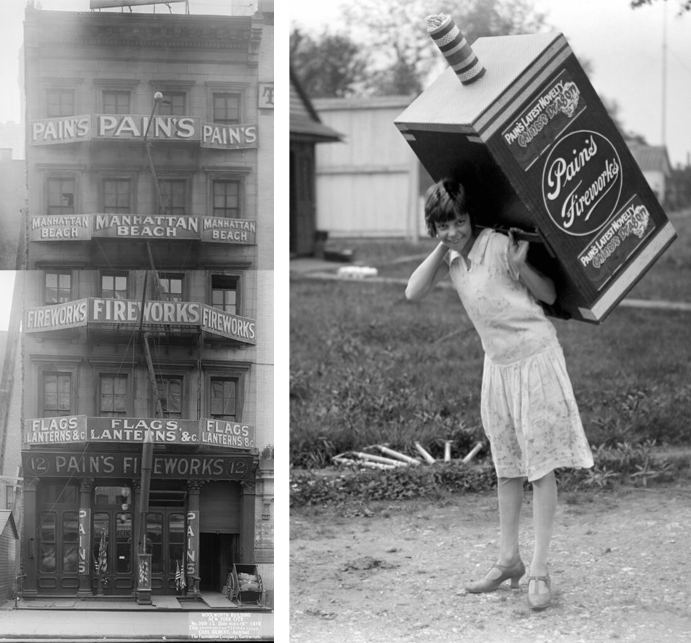
A STREET WITH SOME SIZZLE…The famed Pain’s Fireworks company occupied this building on Firecracker Lane, photo circa 1903. At right, a young woman promoting Pain’s latest novelty, the “Chinese Dragon,” in the 1920s. (Museum of the City of New York)
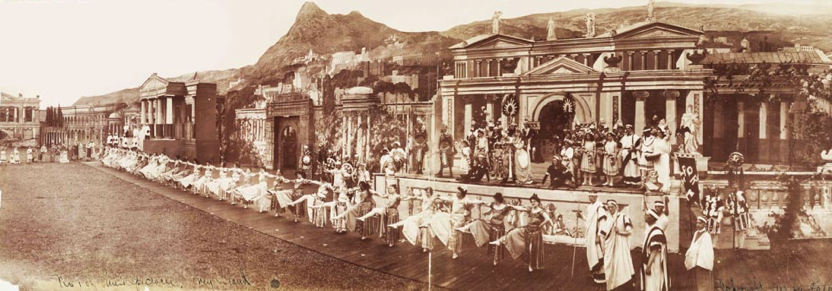
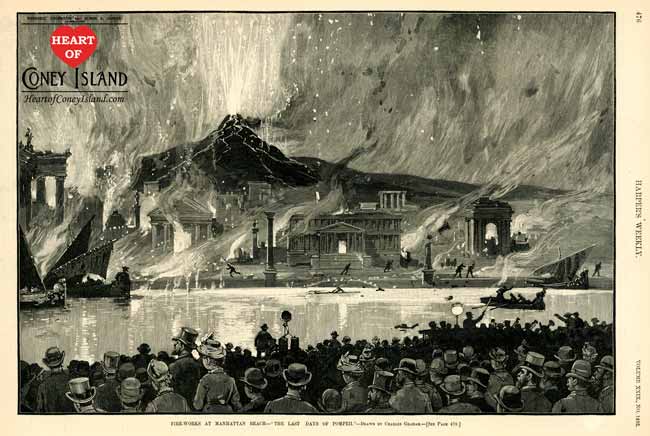
HAVING A BLAST…In the 19th and early 20th centuries, Pain’s staged massive themed fireworks displays, including the incredible The Last Days of Pompeii show on Manhattan Beach, seen here during its 1903 Season. (heartofconeyisland.com)
BEFORE THERE WERE MOVIES, entertainment companies were fond of putting on spectacular shows like The Last Days of Pompeii on Manhattan Beach. Illustration from an 1885 edition of Harper’s Weekly. (heartofconeyisland.com)
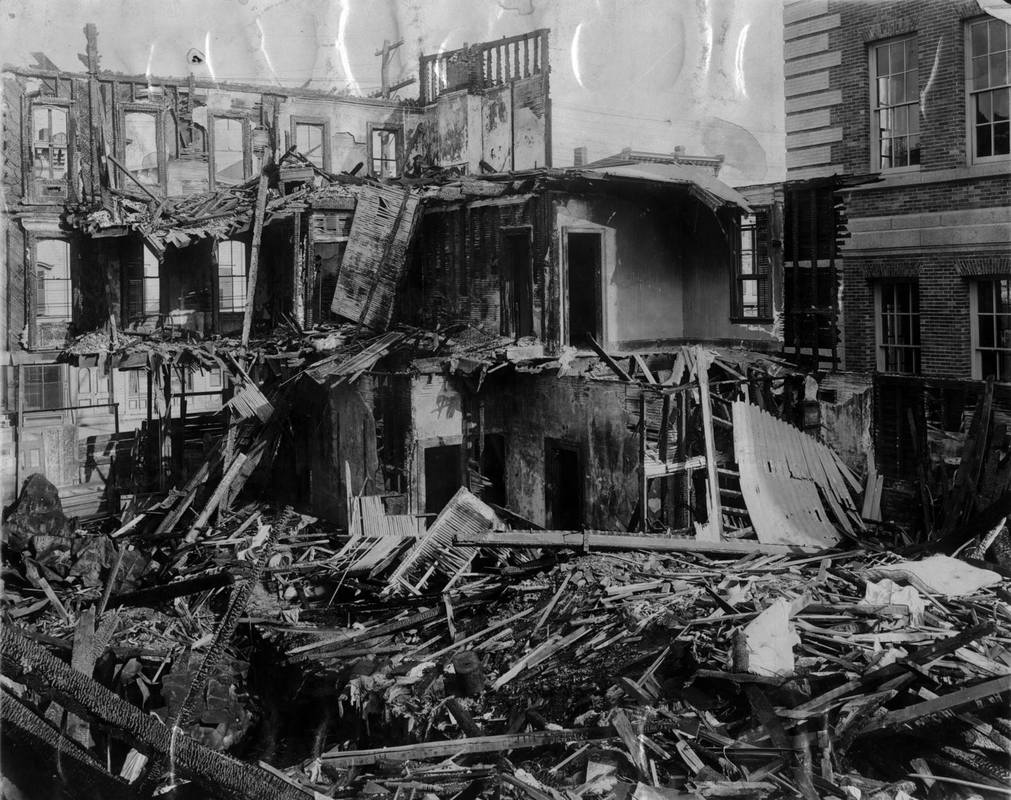
LOCATION, LOCATION…Explosions at fireworks factories in New York and New Jersey put an end to the manufacture of fireworks in the area by 1930. Above, a July 1901 explosion of a fireworks factory in a Paterson, N.J. tenement resulted in the deaths of 17 people who lived above factory. The New York Times reported “So great was the force of the blast, that a boy playing in the street a half a block away was lifted from his feet and hurled against an iron fence, and had one of his legs broken.” (Courtesy Paterson Fire History, via boweryboyshistory.com)

*  *  *

Not Mum on Mumford

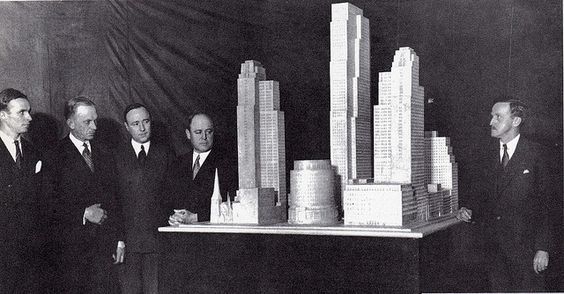
In the previous post we were introduced to critic Lewis Mumford, who excoriated plans for the new Radio City, now known as Rockefeller Center. In his “Notes and Comment,” E.B. White added his own two cents:

PERHAPS IT SHOULD HAVE BEEN A CAKE…Even the promoters of the Radio City project looked uncertain of their scheme in this March 1931 photo. (drivingfordeco.com)

*  *  *

From Our Advertisers

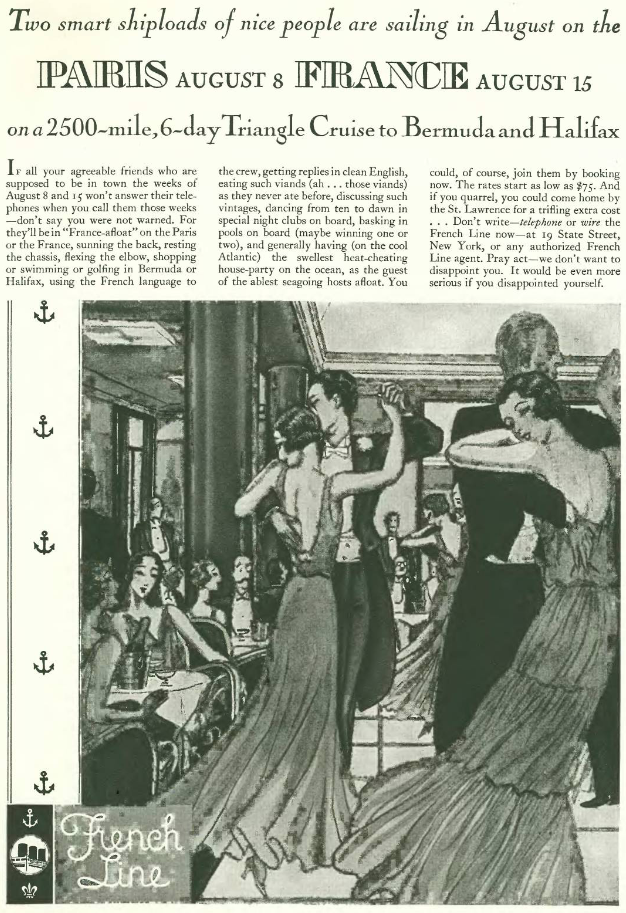
New Yorkers who wanted to get away from the steamy streets of Manhattan (almost no one had air conditioning in 1931) could catch the cooling breezes of the Atlantic on any number of cruise lines that plied the Eastern Seaboard and Canadian Maritimes during the summer…here the French Line offered a six-day “Triangle Cruise”…

…while Cunard offered a similar excursion (employing the cartooning skills of H.O. Hofman) that allowed passengers to “do the ocean” in just four days…

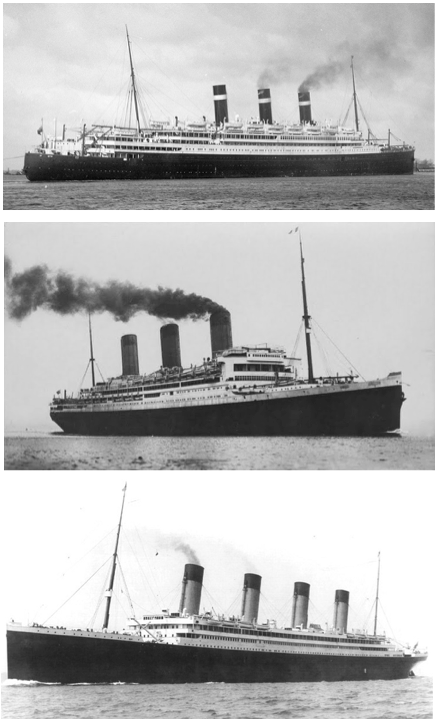
…to earn the ever-shrinking travel dollar during the Depression, both the Red Star and White Star lines offered their giant ocean liners for half- and full-week cruises to the Maritimes, Red Star even throwing in some on-board entertainment, claiming to be the first to do so “on any ocean”…

A SCRAPPED LOT…From top, the Belgenland, Majestic and Olympic. These great ships that once ferried passengers in high style between Europe and the States had been reduced to taking folks on short cruises and even one-day excursions due to the Depression. By the mid-1930s the Belgenland and Olympic (once the world’s largest ship) were sold for scrap. The Majestic was scuttled a few years later. (Wikipeda)

…I’m not sure where this pair is headed, but the angle suggests they just drove off a cliff…

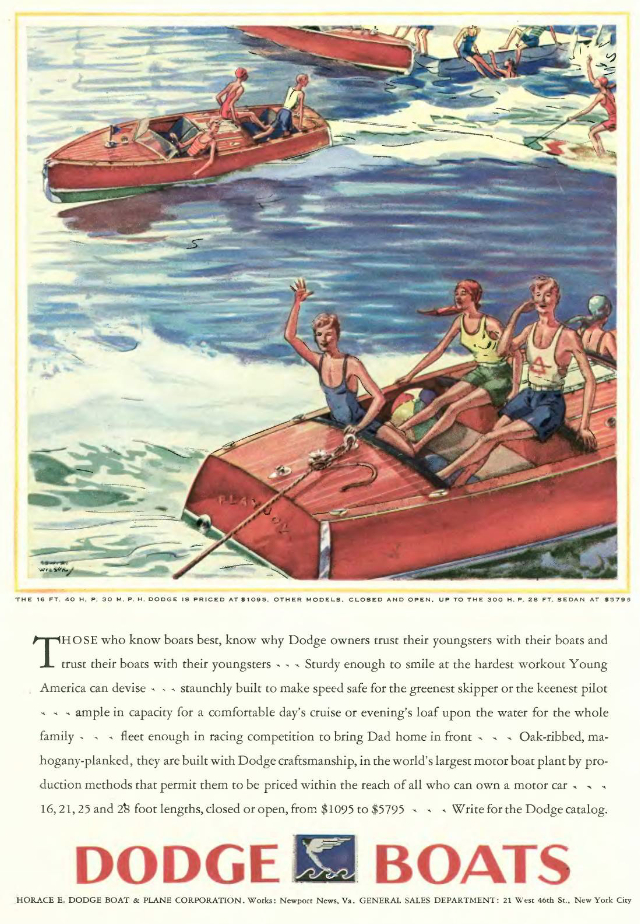
…if cliff diving wasn’t your thing, you could tool around in a bright red Dodge boat…

…or be easily amused like this guy on the right, who gets his jollies from the abundance of ice cubes in his fridge…

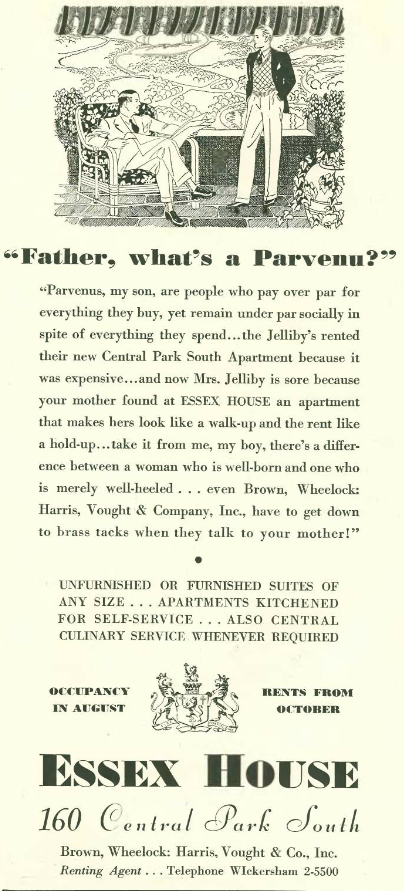
…over at Essex House we find a more reserved scene, the “well-born” father and son gloating over their Central Park view…

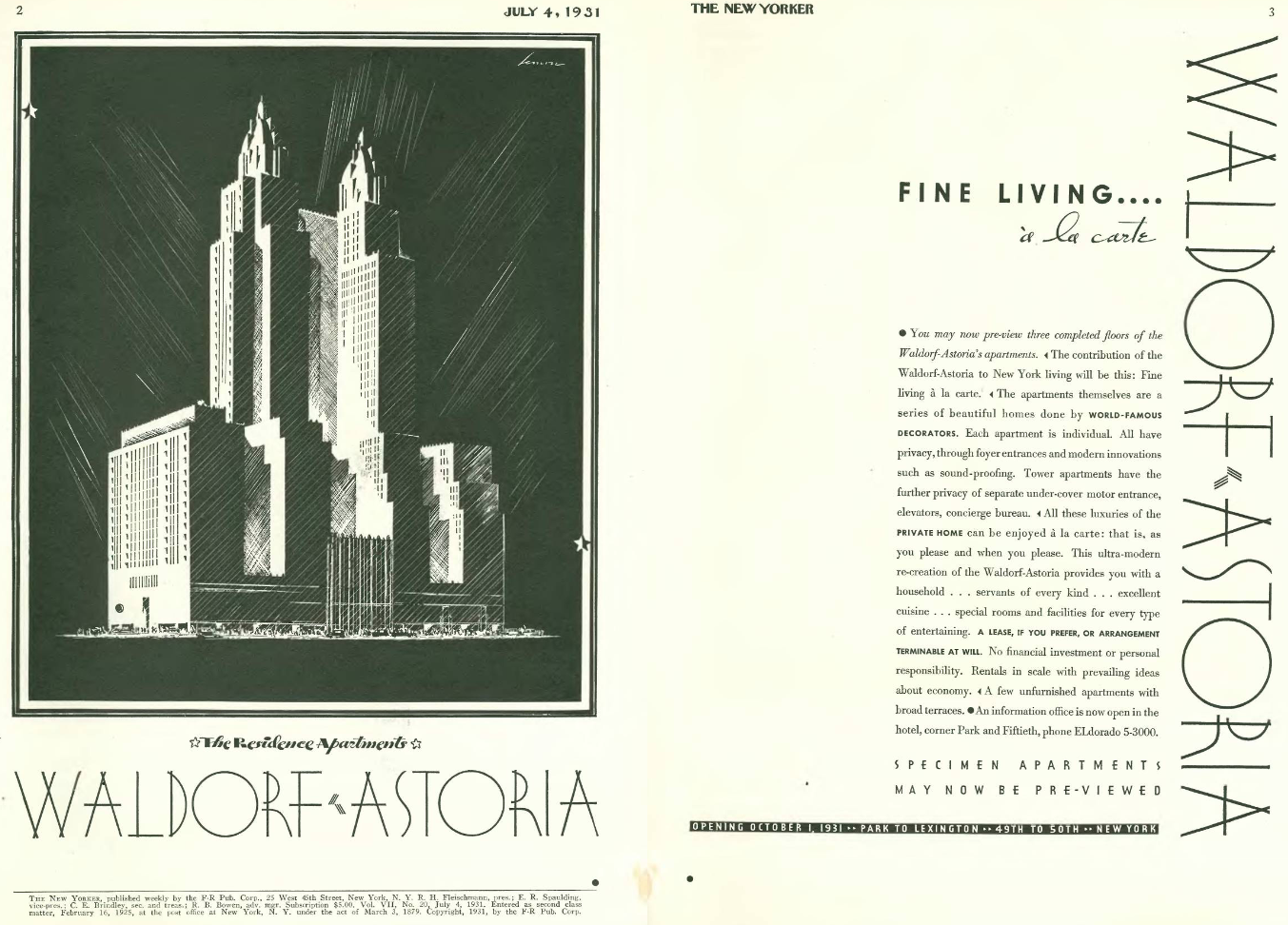
…the Essex House might have been “all that,” but Dad and Junior would have to reconsider their social rank against a newcomer — the Waldorf-Astoria, reborn on Park Avenue…

…on to our cartoons, this couple illustrated by Garrett Price might consider something with a larger balcony…

Otto Soglow’s Little King took his Little Prince out for some air…
Kemp Starrett showed us a chap who contemplated the passing of time along with the passing of his timepiece…
Isadore Klein updated the theme of a damsel in distress…

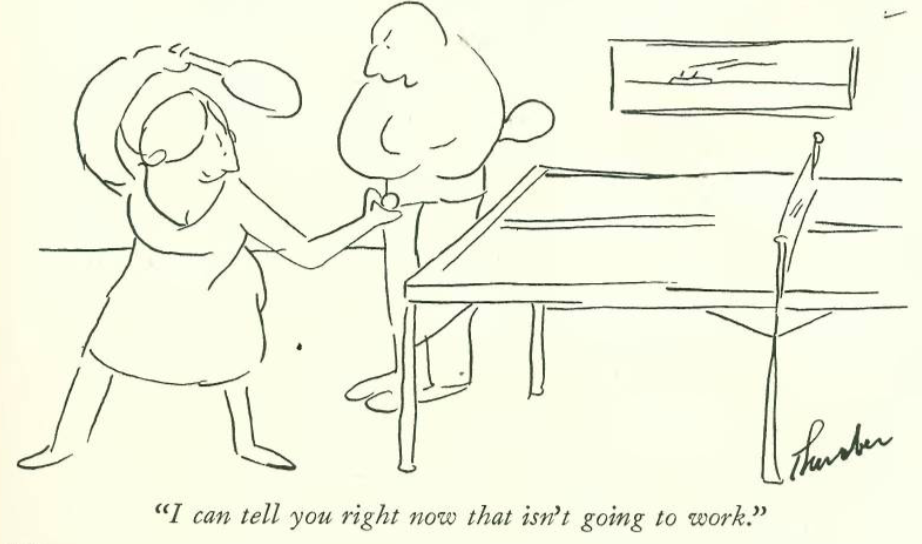
…the growing popularity of Ping-Pong gave James Thurber some material to explore the battle of the sexes…

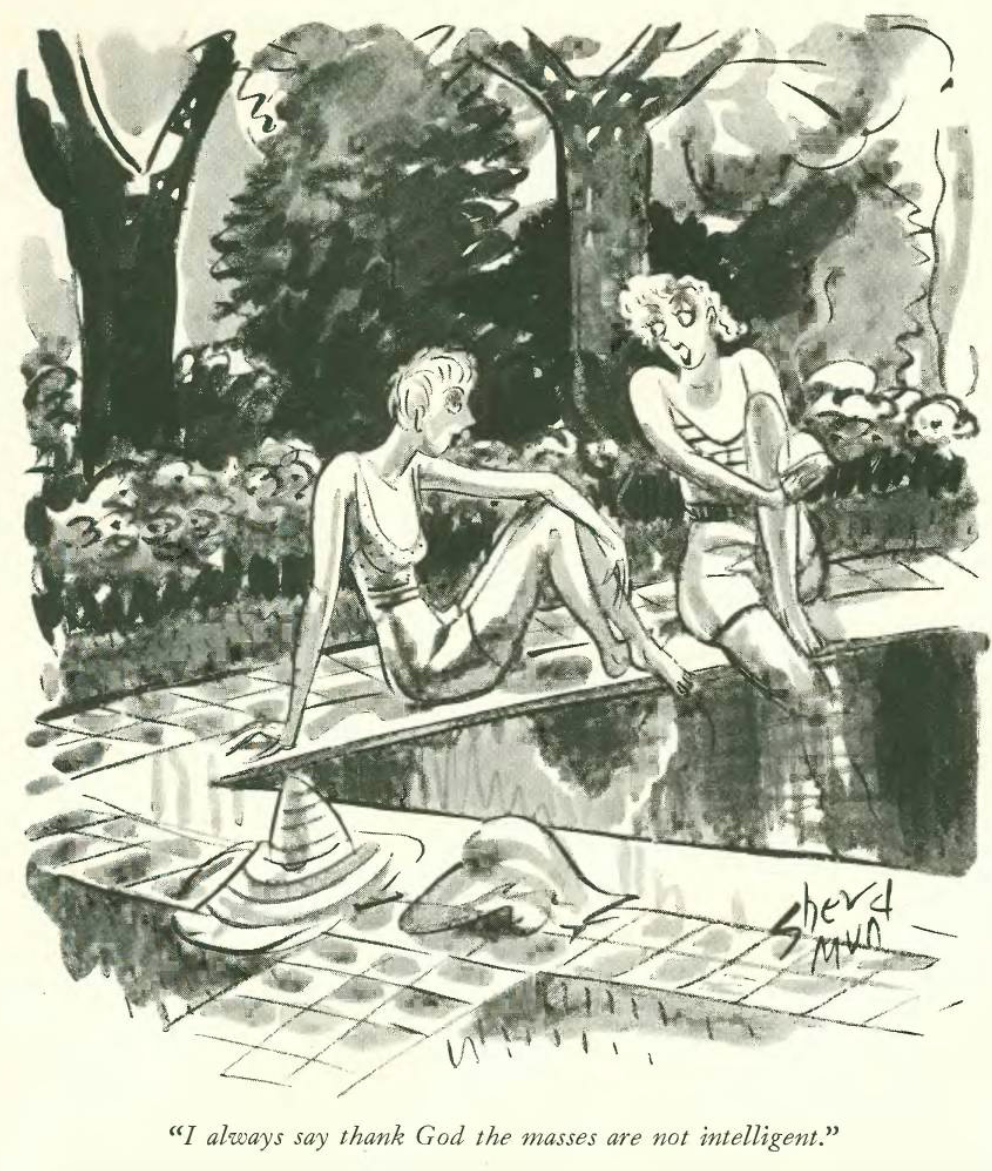
…and Barbara Shermund left us poolside with a couple of eggheads…

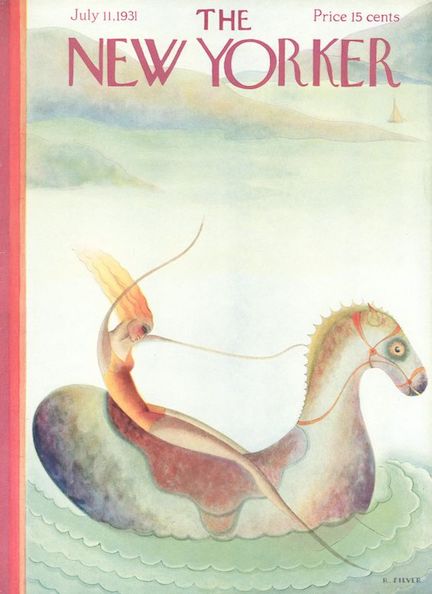
…on to our July 11, 1931 issue…

July 11, 1931 cover by Rose Silver.

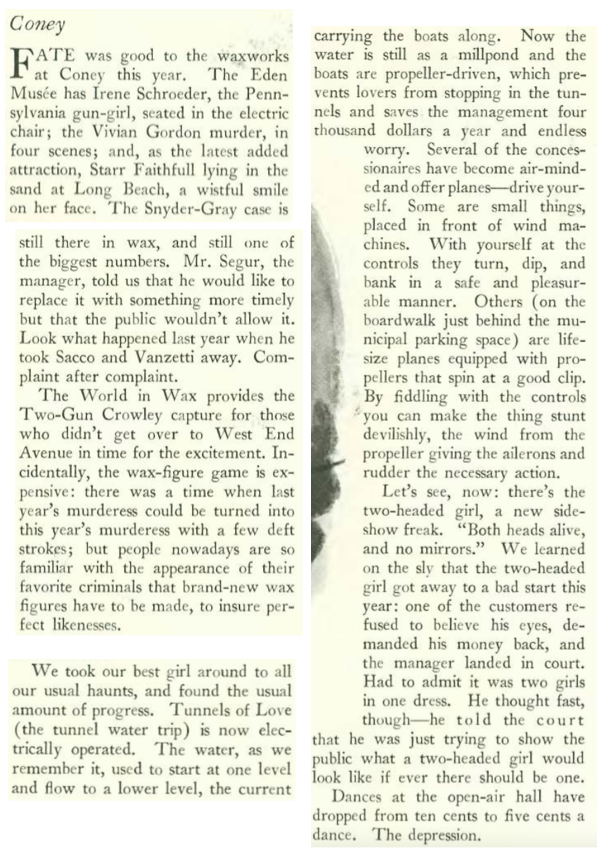
…we find E.B. White taking his sweetheart, Katharine Angell White (referred to here as his “best girl”) out for a date at Coney Island…

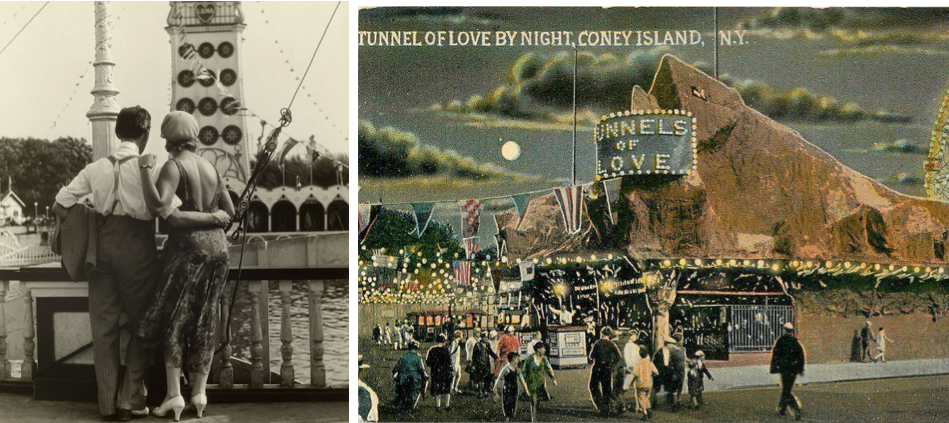
A PLACE FOR ROMANCE…It’s not them, but this couple visiting Coney Island in 1928 (photo by Walker Evans) will serve well as our stand-ins for E.B. and Katharine White on their date to Coney. At right, the famous “Tunnels of Love.” (Metropolitan Museum of Art/Pinterest)
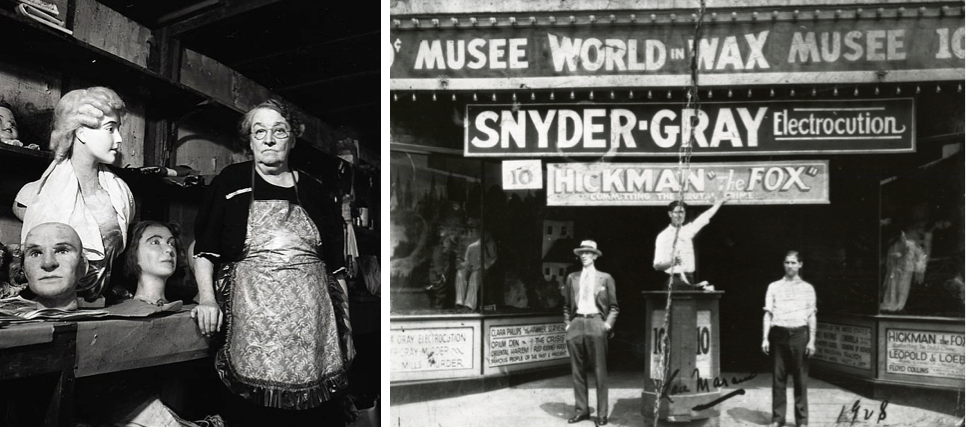
AND OTHER DIVERSIONS…Another famous and rather lurid Coney attraction was the wax museum, which featured dioramas based on headlines of the day. The biggest attractions were those featuring famous crime scenes, gruesome effects included. (Museum of the City of New York)
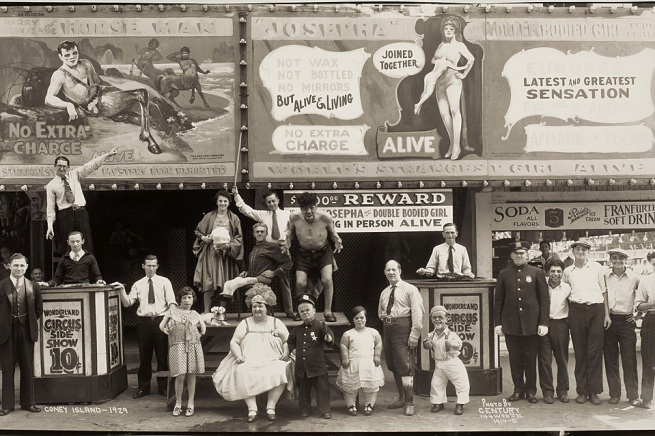
IT WAS A LIVING…Among other big attractions at Coney were the sideshow “freaks” White mentioned in his article. The photo above, from 1929, is by Edward J. Kelty. (artblart.com)

 *  *  *

On the Waterfront

The 1954 film by the same name featured the murderous mob boss Johnny Friendly (Lee J. Cobb) who ruled the waterfront’s stevedores with an iron fist. The reality was just as brutal, if not more so along the Brooklyn waterfront in the early 20th century, where the reign of a crime boss was as short as his life span. Alva Johnston reports:

TOUGH NEIGHBORHOOD…Midcentury view of the Brooklyn waterfront. (thenewyorkmafia.com)

Dinnie Meehan’s widow, Anna Lonergan, had the distinction of being shot at the side of two successive husbands; after Meehan was murdered, Anna married “White Hand” gangster Harry Reynolds. Johnston, who referred to Anna Lonergan as “the Brunhild of the longshore cycle,” concluded his piece with a look at the “last of the great leaders,” Red Donnelly, also known as “Cute Charlie”…

HARD KNOCKS…“Peg Leg” Lonergan was the final leader of the waterfront’s “White Hand Gang.” He was gunned down on Dec. 26, 1925, after a short reign as boss. He was just 25 years old when he died. (Pinterest)

 *  *  *

The Show Must Go On

With the glory days of vaudeville quickly receding into the past, Flo Ziegfeld was nevertheless determined to keep his “Follies” alive at his eponymous theatre. Robert Benchley stopped by for a look at the Ziegfeld Follies of 1931.

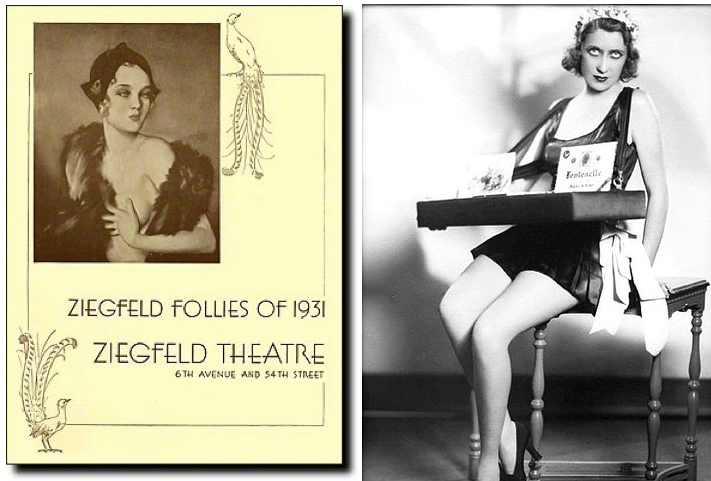
CARE FOR A SMOKE?…Program cover for the Ziegfeld Follies of 1931. At right, Ziegfeld star Ruth Etting, who portrayed a cigarette girl in the show’s “Club Piccadilly” skit. A note of trivia: Etting and I attended the same high school (but not at the same time!). (Playbill/Wikimedia Commons)
GLORY BE…Inside pages of the program featured some of the “Ziegfeld Beauties” appearing in the show. (Playbill)

 *  *  *

Gross

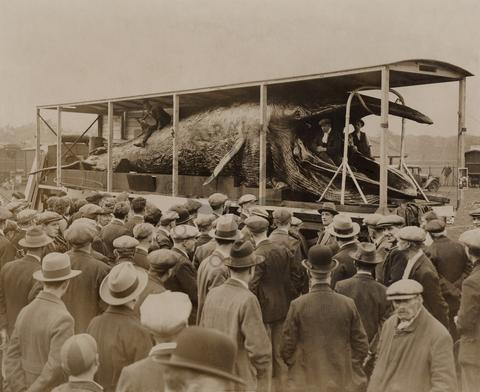
Back in the day some entrepreneurial types would kill a large whale, stuff it full of sawdust and formaldehyde, and then take it on the road to parade in front of gawkers with spare nickels in their pockets. E.B. White observed the fate of one such specimen:

YES, THIS WAS A THING…Before the days of Jacques Cousteau and Animal Planet, this is how some folks got their first and likely only look at a real whale, even if it was pumped full of sawdust and formaldehyde.

 *  *  *

From Our Advertisers

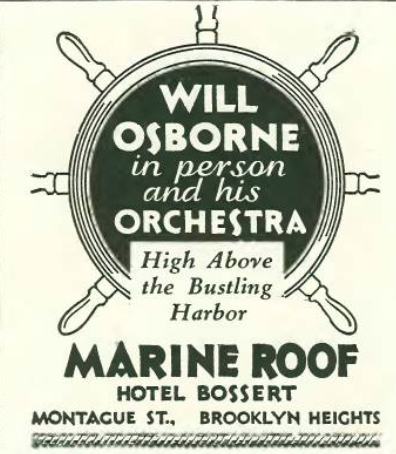
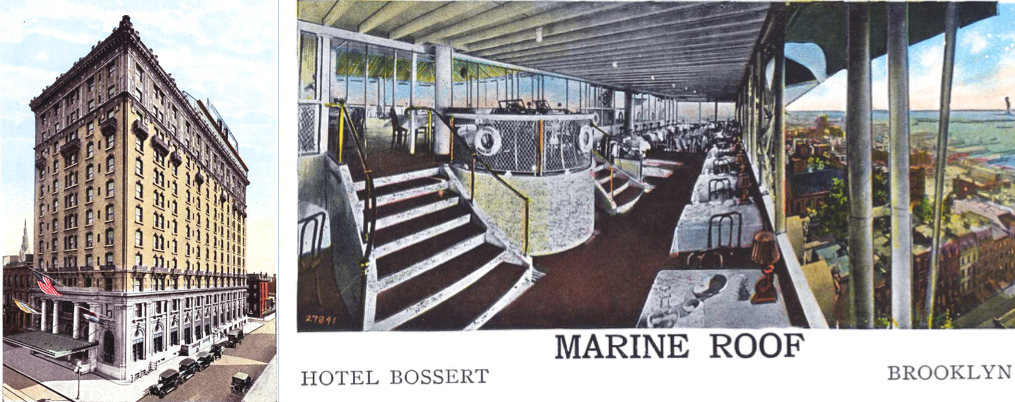
This small back page ad invited New Yorkers to the cooling breezes atop the Hotel Bossert in Brooklyn Heights, once referred to as the “Waldorf-Astoria of Brooklyn”…

Its rooftop restaurant — the Marine Roof — was a famous hangout. When the Brooklyn Dodgers won the World Series in 1955, this is where they celebrated…

(brownstoner.com)

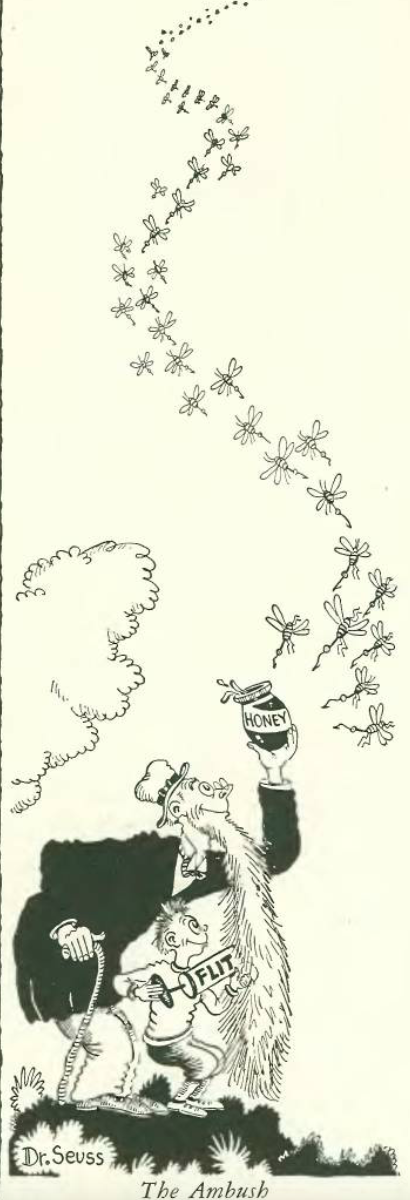
Dr. Seuss was still making a living illustrating advertisements for Flit insecticide…

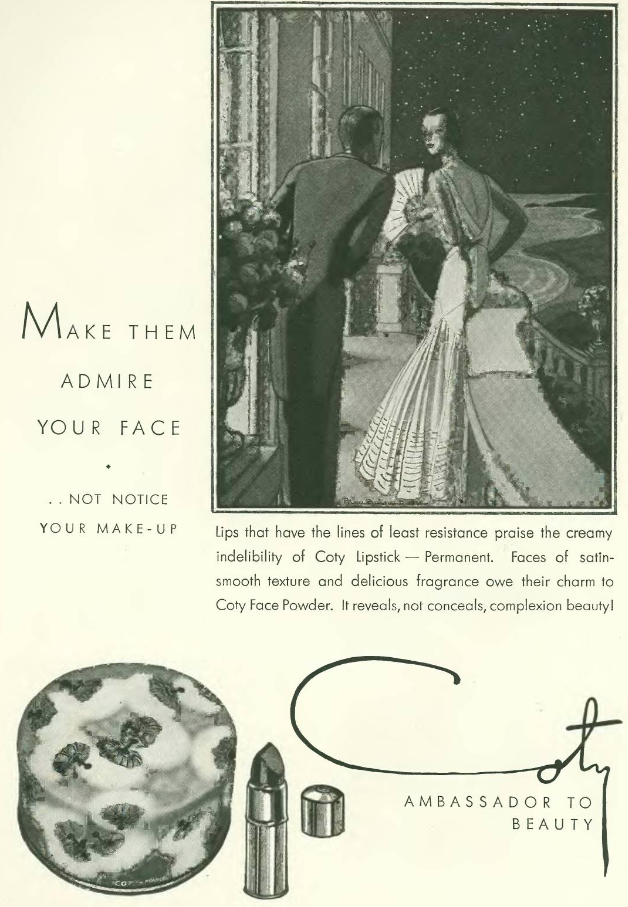
…”my eyes are up here”…says the woman who uses Coty brand lipstick…

…on to our cartoonists, we have Garrett Price also examining the challenges of playing Ping-Pong…

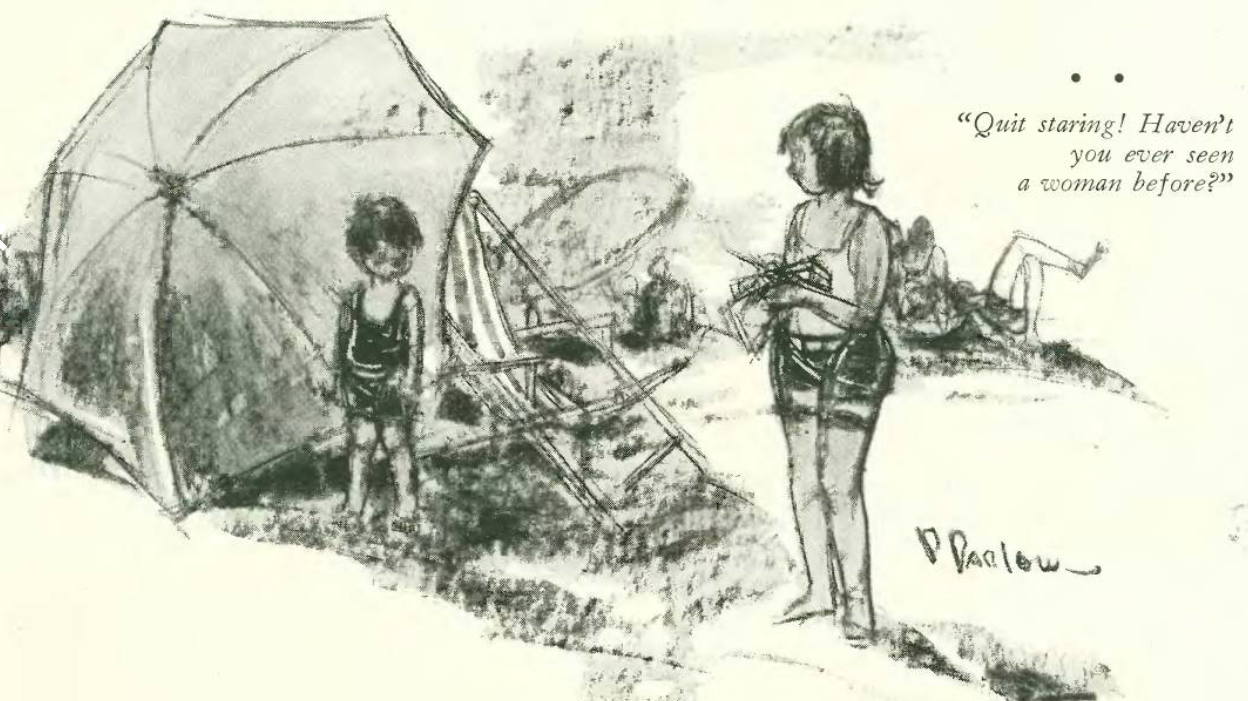
Perry Barlow was at the seaside with a precocious beach-goer…
Carl Rose showed us a Boy Scout after his encounter with the Red Menace…

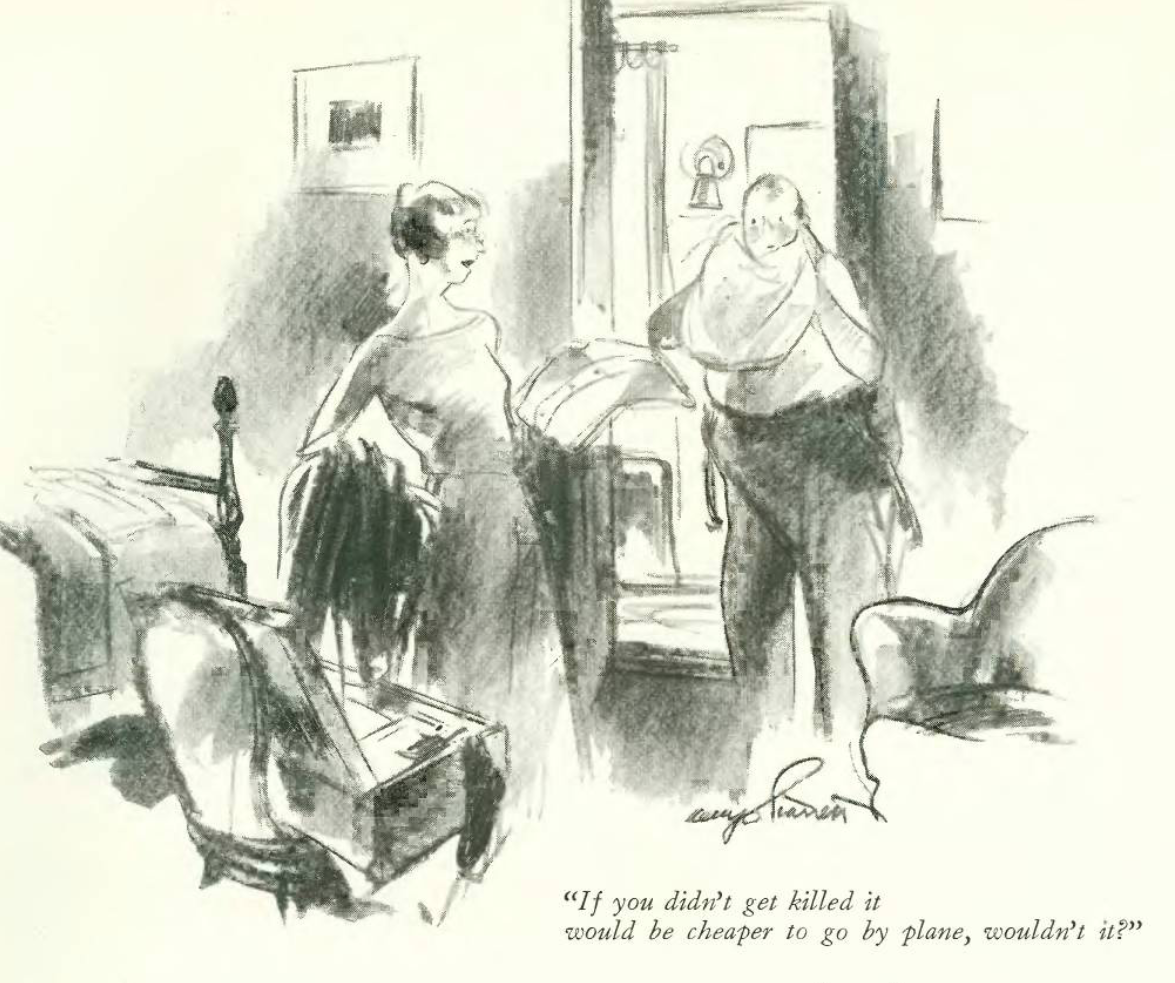
Kemp Starrett weighed the advantages of air travel…

Otto Soglow surprised us with this undercover operation…

…and we end with James Thurber, and the price of literary fame…

Next Time: The Black Eagle…


Down to Coney

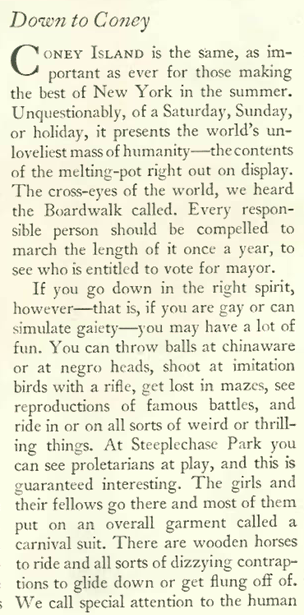
The New Yorker kicked off the summer season with a trip down to Coney Island. “The Talk of the Town” took in the various sights and amusements at the famed Steeplechase and Luna parks.

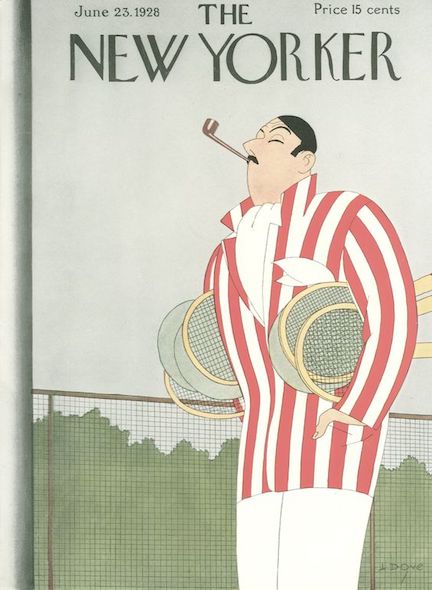
June 23, 1928 cover by Leonard Dove.

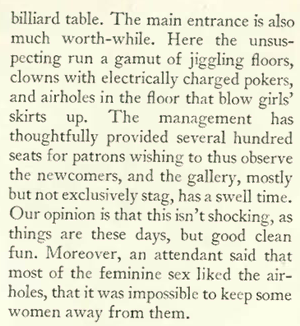
Attractions at Steeplechase Park included everything from racing wooden horses to a “human billiard table.” Less jolly diversions included air jets that blew up  women’s skirts and clowns who administered electric shocks to unsuspecting visitors (one more reason to fear them). And there was at least one racist game of skill…

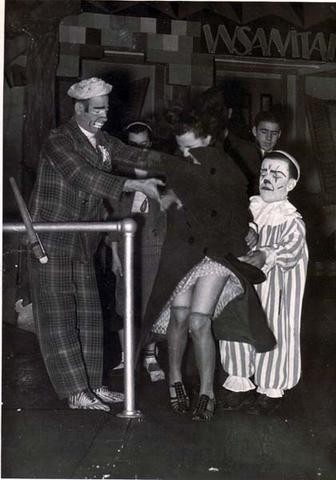
FEAR THE CLOWN…A photo from the 1940s shows a pair of clowns “help” a woman through the entrance to Steeplechase Park’s Insanitarium and Blowhole Theatre. Located in the Pavilion of Fun, visitors were led through Comedy Lane, which featured jets of compressed air intended to lift skirts. Clowns spanked patrons and even zapped them with a cattle prod. (Worthpoint.com)
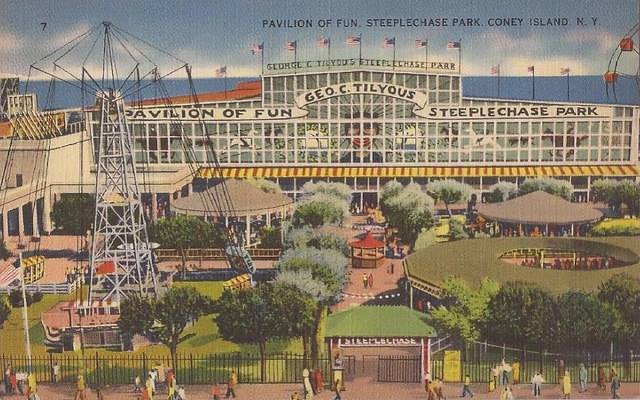
Clockwise, from upper left: A Steeplechase rider passes in front of the massive Pavilion of Fun; interior of the Pavilion of Fun; young women preparing to be spun around on the Human Billiard Table; scene from the 1928 Harold Lloyd movie Speedy filmed in the Pavilion of Fun (westland.net, CardCow, houseoftoomuchtrouble.tumblr.com, safetylast.tumblr.com) click to enlarge
OUT FOR A SPIN…Harold Lloyd and Ann Christy take a spin on the Pavilion of Fun’s Human Roulette Wheel in the 1928 film Speedy. (spellboundbymovies.com)
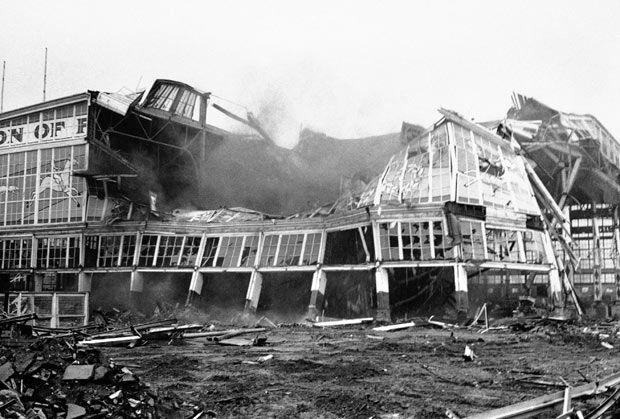
TRUMPED…Coney Island’s landmark Pavilion of Fun at Steeplechase Park was demolished in 1966 by developer Fred Trump, father of Donald Trump. The young Donald (19 at the time) was on hand for his father’s “Demolition Party,” which featured scantily clad models who paraded in front of the park and encouraged guests to throw bricks at the stained glass windows of the historic pavilion. Later that night Trump bulldozed the amusement park to the ground, thereby limiting any pending proceedings to declare the property a historic landmark. (Daily Telegraph/Untapped Cities)

Over at Luna Park there were more air holes to blow up women’s skirts and assorted freak shows. More wholesome entertainments included the famed Cyclone rollercoaster, which celebrated its 90th year of operation in 2017.

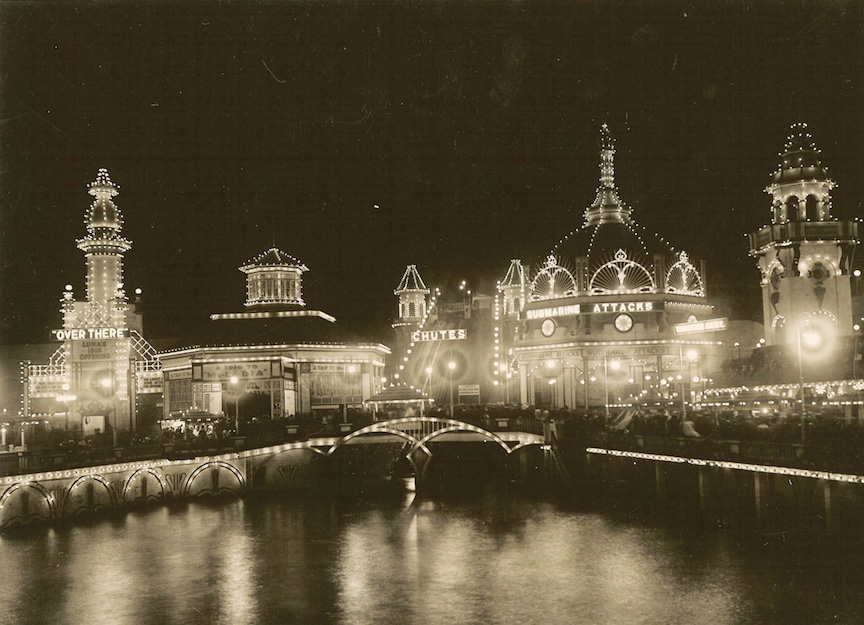
DREAMLAND…Luna Park at night in the 1920s. (carouselhistory.com)

 *  *  *

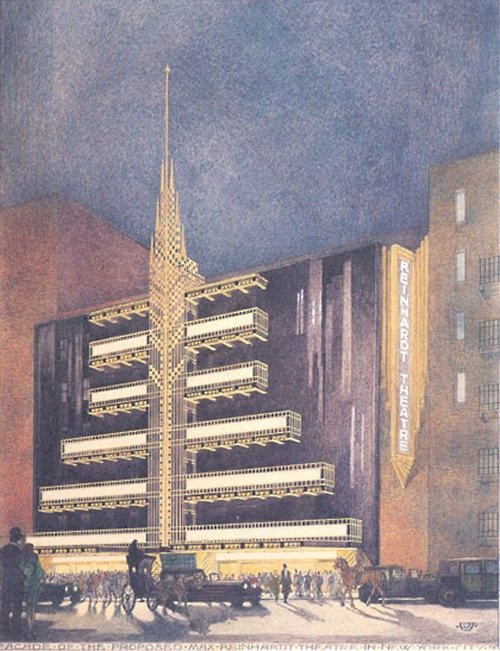
Writing for the June 23 “Talk of the Town,” Murdock Pemberton anticipated the construction of a new theatre to be developed by famed Austrian director/producer Max Reinhardt and designed by Austrian-American architect, illustrator and scenic designer Joseph Urban:

Unfortunately the market crash of 1929 put an end to the project, which would have looked like this had it been constructed:

DREAMLAND…Joseph Urban’s unbuilt Reinhardt Theatre. The innovative design incorporated the building’s fire escapes into its glimmering facade. (Columbia University)

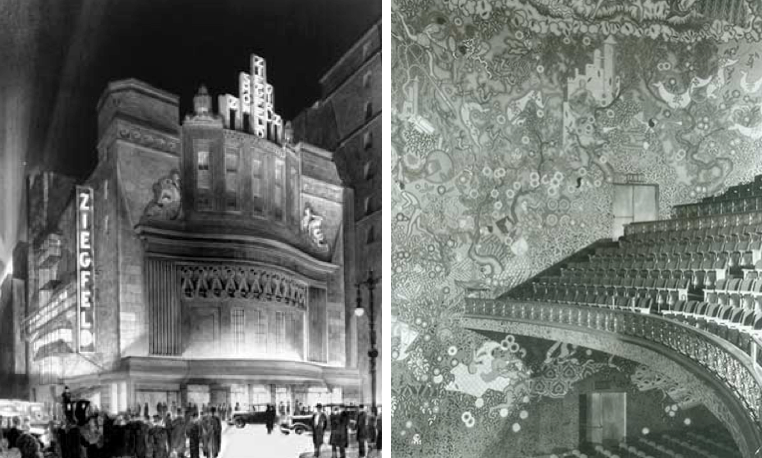
Urban designed innovative sets for clients ranging from the Metropolitan Opera to the Ziegfeld Follies (he also designed a theatre for Ziegfeld in 1927, see below). Although he is noted as one of the originators of American Art Deco, most of his architectural work in the United States has been demolished.

RARE REMNANT…Little remains of the work of Joseph Urban, one of the originators of American Art Deco. Fortunately the Tishman Auditorium at the New School still stands. (nycarchitecture.com)
ONLY A MEMORY…Most of Joseph Urban’s American work has been demolished, including his Ziegfield Theatre from 1927. (nyc-architecture.com)
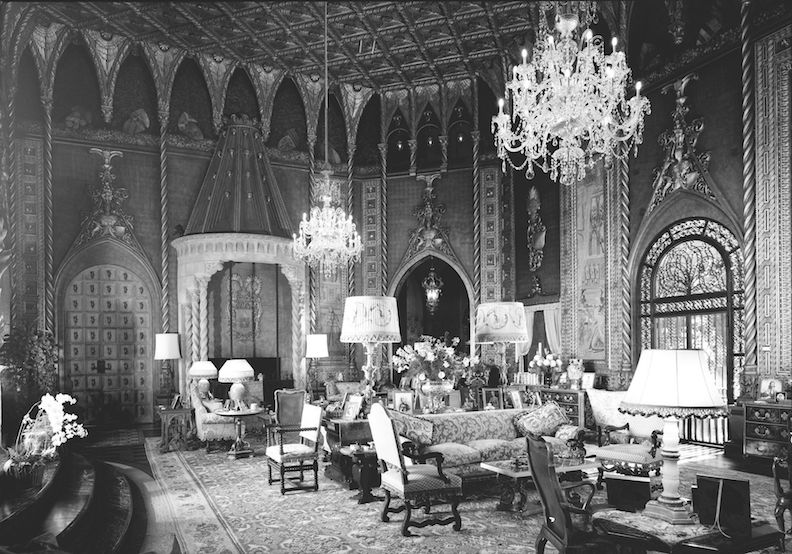
MAR-A-LAGO…Joseph Urban designed the interiors of one of America’s most famous mansions—Mar-a-Lago. Built from 1924 to 1927 by cereal heiress Marjorie Merriweather Post, it is now owned by Donald Trump and operated as a members-only club. (Wikipedia)

 *  *  *

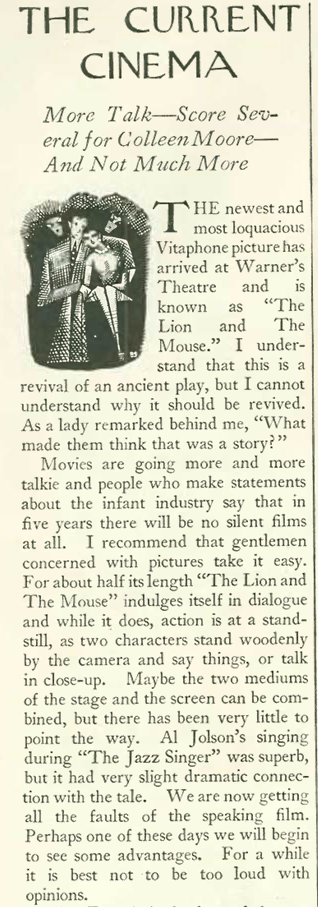
The New Yorker continued to struggle with the emergence of “talking pictures.” The critic “O.C.” found that the sound dialogue in The Lion and the Mouse did little to improve the picture:

The critic seemed to believe that sound pictures would take some time to catch on. Little did he know that Warner Brothers would announce later that summer (August 1928) that all of its films for the 1928-29 fiscal year would have sound. United Artists would make the same announcement in November 1928. In February 1929 Twentieth-Century Fox would make its final silent movie, and Columbia would release its last silent movie on April 1, 1929.

OH SHUT UP…Theatre card for The Lion and the Mouse. (Wikipedia)

The New Yorker still found happiness at the movies through the likes of actress Colleen Moore, who made a sweet little film called Happiness Ahead. 

A CASE OF THE HAPPIES…Colleen Moore strikes a contemplative pose in Happiness Ahead. (IMDB)

Colleen Moore was one of the most famous stars of the silent era who popularized the bobbed haircut and flapper style. Moore presented a more wholesome version of the flapper, in contrast to the more worldly Louise Brooks, another flapper icon of the Twenties.

VARIATIONS ON A THEME…Actresses Colleen Moore (left) and Louise Brooks defined flapper style in the 1920s. (dorineenvrac.wordpress.com / corvusnoir.com)

 *  *  *

From Our Advertisers

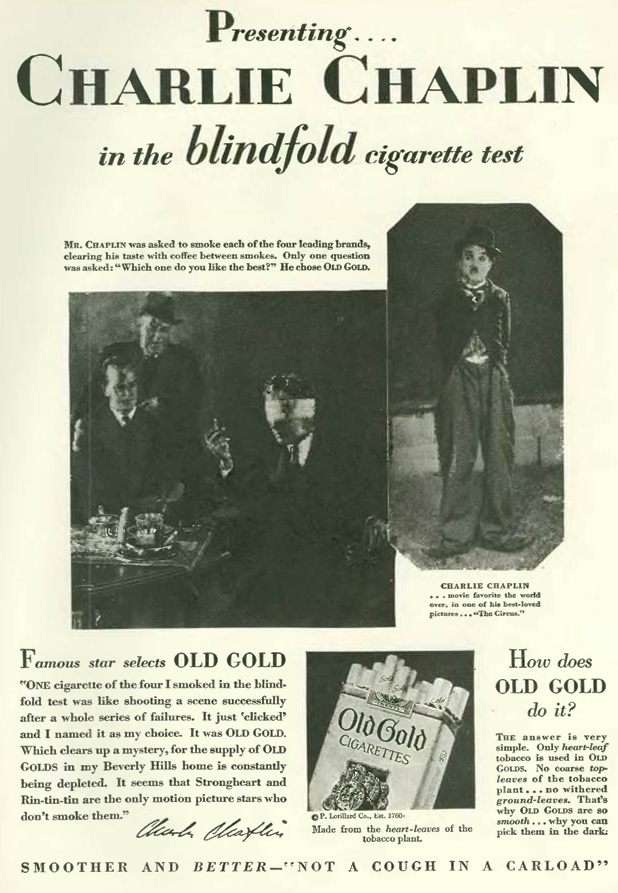
Continuing our series on celebrity endorsements of Old Gold cigarettes, none other than the Little Tramp stepped up to take the blindfold test (along with a pile of cash, no doubt):

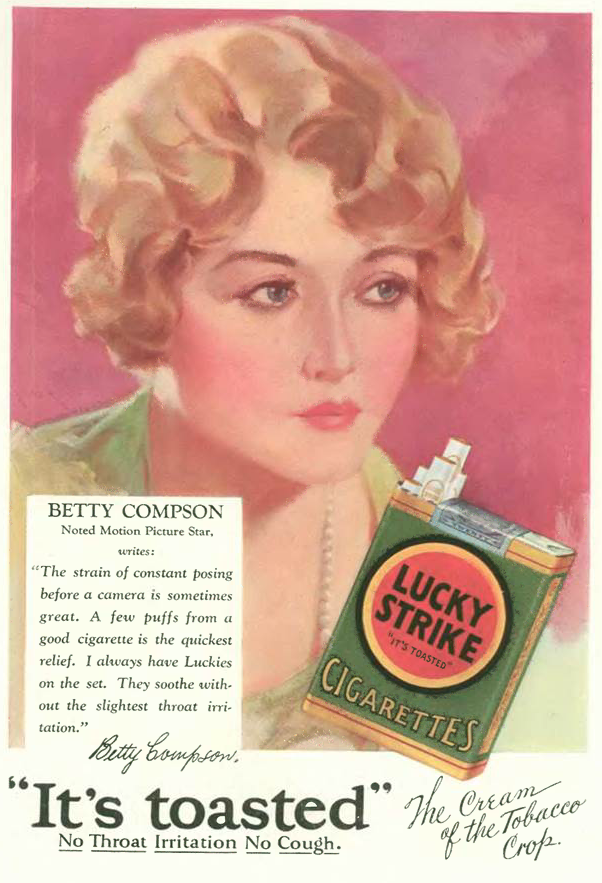
And if Old Gold is not to your taste, then why not enjoy the “toasted” pleasures of Lucky Strike? Actress Betty Compson found them indispensable when preparing for a big scene:

 *  *  *

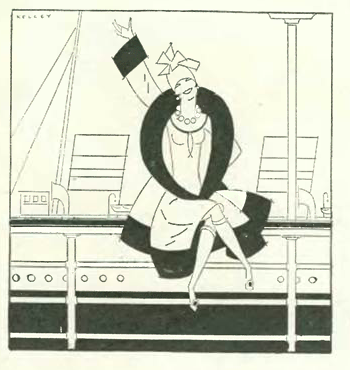
And now for something that caught my eye in the June 23 issue…a bit of filler art by Eldon Kelley that broke up some copy on page 34:

This particular illustration was also featured in one of The New Yorker’s earliest issues—March 21, 1925—in a two-part comic panel (below). I am puzzled why the magazine, flush with artistic talent by 1928, reused this Kelley illustration. Perhaps the layout editors figured since the readership was so small in March 1925, no one would notice.

Here’s an early contribution by Otto Soglow that is a far cry from his later minimalist cartoons…

And we leave with yet another look at some Jazz Age shenanigans, courtesy cartoonist Peter Arno:

Next Time: Summer Breeze…

Coney Island, 1927

The New Yorker welcomed spring with a cover featuring Peter Arno’s popular Whoops Sisters testing the waters at the beach…

37723304ec91b372ae19e57e36b4d4b9
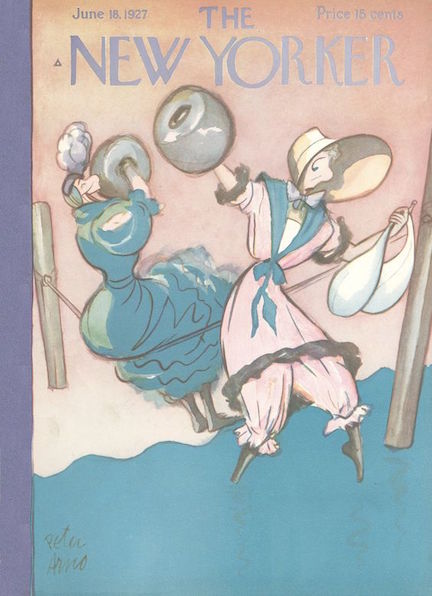
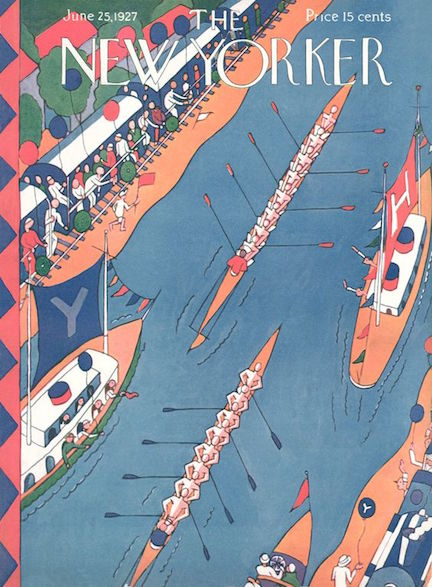
June 18, 1927 cover by Peter Arno, featuring his popular Whoops Sisters.

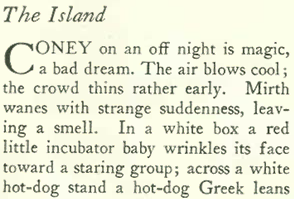
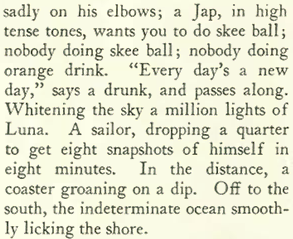
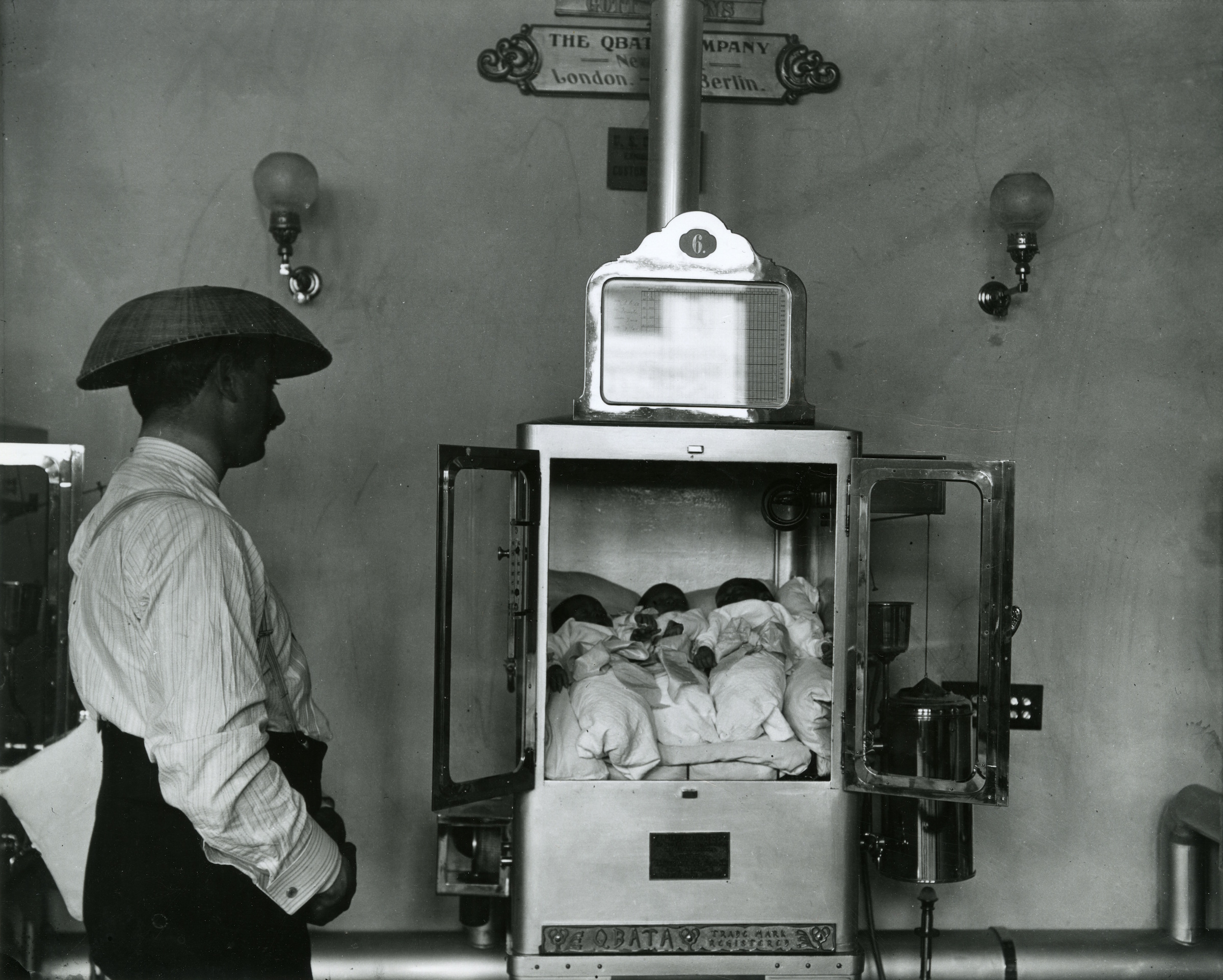
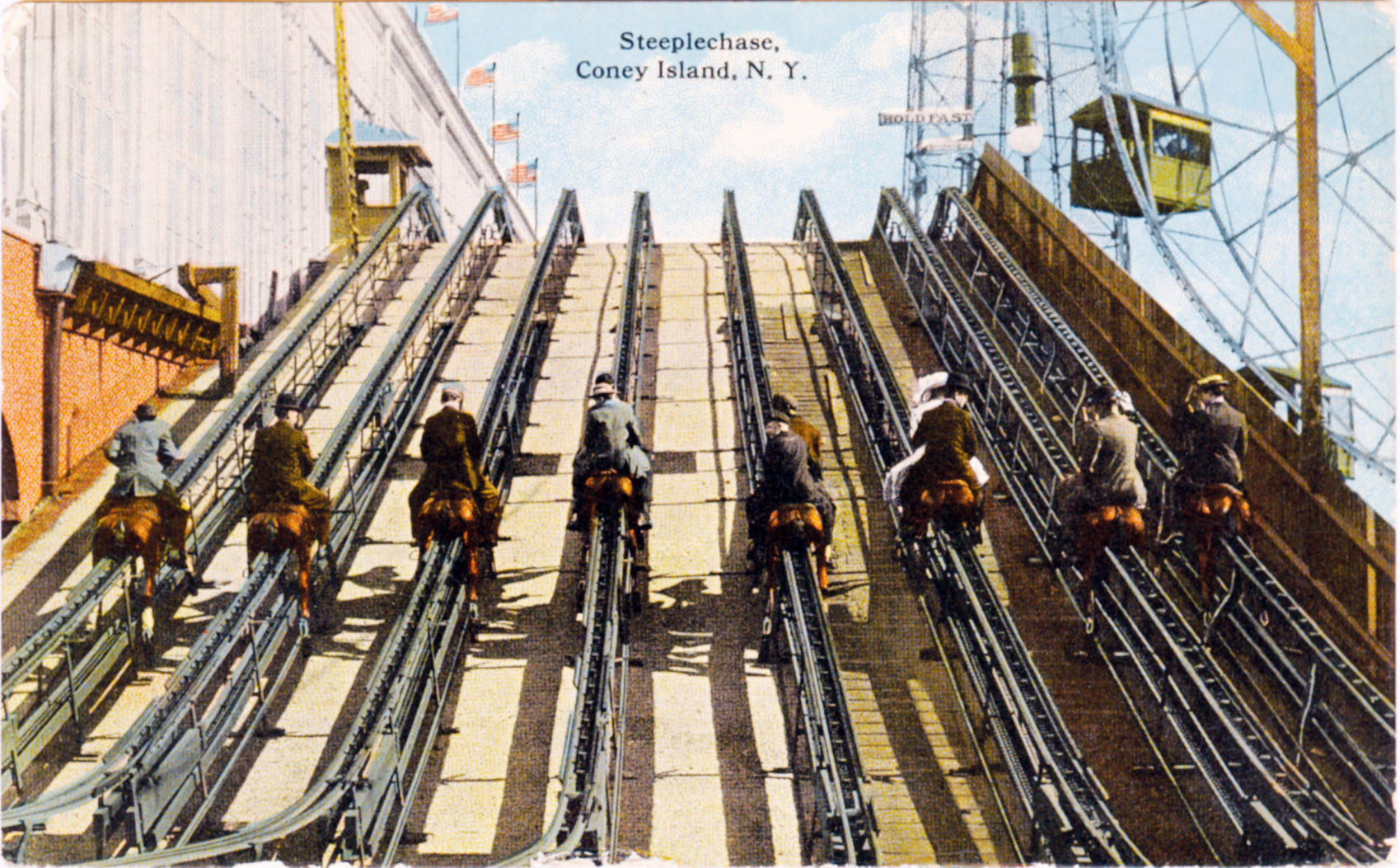
…and so was The New Yorker, on the south shores of Brooklyn to check out attractions old and new at Coney Island, paying a visit on an “off-day” to check out attractions ranging from incubating babies to the mechanical horse-race at the old Steeplechase:

screen-shot-2016-10-14-at-9-06-43-am

screen-shot-2016-10-14-at-9-06-52-am

78215d_incubatorbabies_alland2502
WEIRD BUT WORTH IT…Incubating babies on display at Coney Island in the early 1900s. At the time, most babies were born at home, so hospitals did not have incubators–considered to be untested (and expensive) equipment. Dr. Martin Couney featured the device in “incubator shows” at various World’s Fairs and as a permanent exhibit at Coney Island from 1903 to 1943. Although he found the public spectacle somewhat distasteful, Couney hoped the exhibits would prove that the new technology actually worked. Paying for staff and machinery through ticket sales, he saved the lives of perhaps 8,000 premature infants at Coney Island. (NY Historical Society)
feltmans_coney_island-3
BEFORE THERE WAS NATHAN’S…Feltmans hot dog stand, circa 1930s. Feltman’s began as a pushcart business on the sand dunes of Coney Island in 1867, operated by German immigrant Charles Feltman, considered the inventor of the hot dog on a bun. By 1920 Feltman’s Ocean Pavilion covered a whole city block and served more than five million customers a year. (digital commonwealth.org)
coney-island-steeplechase-postcard-ca-19152
OFF TO THE RACES…Riders astride mechanical horses prepare to compete in the popular Coney Island Steeplechase in this postcard image circa 1915. (carouselhistory.com)
cyclone-britanica
LANDMARK…Coney Island’s famed Cyclone roller coaster opened in 1927. (Encyclopedia Britannica)
romantic-luna-park-evening-coney-island-1920s
ONE MILLION lights brightened Coney Island’s Luna Park on a summer evening in the 1920s. (carouselhistory.com)

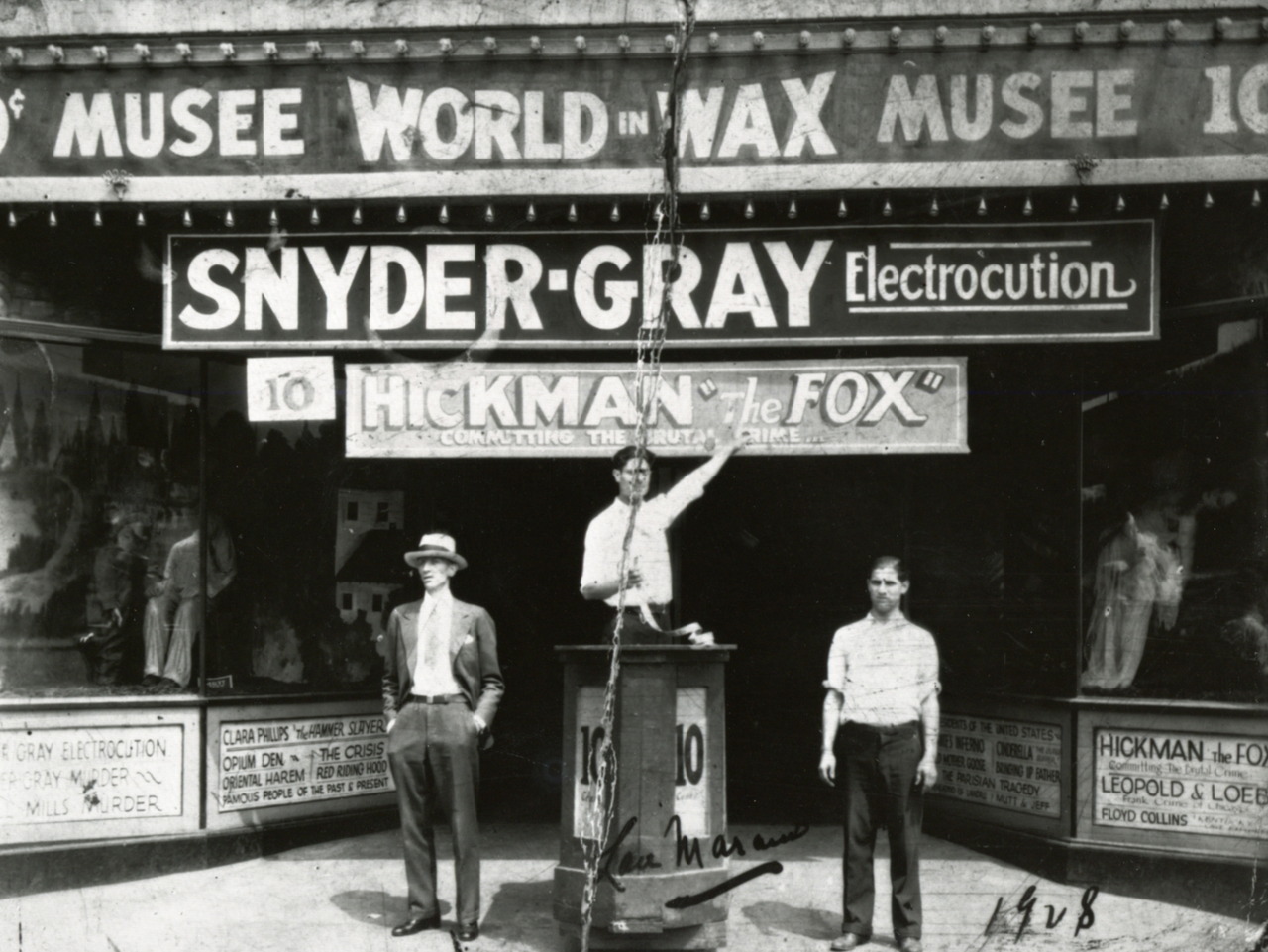
Of course not everything was as dazzling as Luna Park at night. Like any carnival, Coney Island had its share of barkers announcing everything from games of “chance” to freak shows and a wax museum that depicted–among other grisly sights–the murder of Albert Snyder by his wife, Ruth Snyder, and her lover, Judd Gray, and the subsequent execution of the notorious pair.

tumblr_m7qi19kprf1rpfjrbo1_1280
GET YOUR DIME’S WORTH…Barkers at Coney Island’s Eden Musee wax museum advertise the wax dummy recreation of the Ruth Snyder and Judd Gray executions, circa 1928. The Snyder-Gray murder trial of 1927 was a national media sensation. (houseoftoomuchtrouble.tumblr.com)

screen-shot-2016-10-14-at-9-07-16-am

screen-shot-2016-10-14-at-9-07-37-am

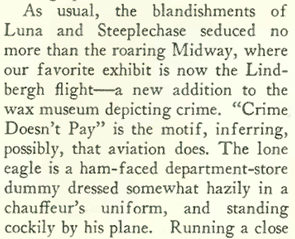
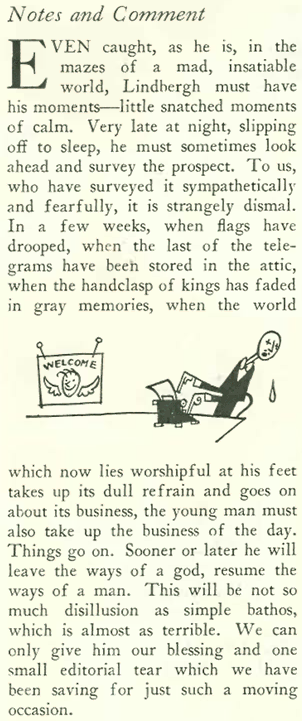
Charles Lindbergh, feted with his own wax image at Coney Island, was beginning to appear on the verge of a meltdown thanks to the relentless attention he was getting in the aftermath of his historic flight:

screen-shot-2016-10-14-at-9-02-29-am

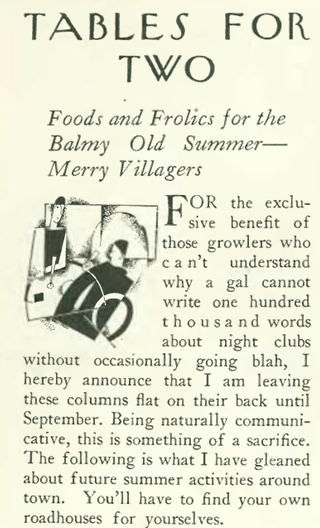
Lois Long also seemed at her wit’s end, abruptly announcing to readers that her nightlife column, “Tables for Two,” would go on hiatus for the summer. No doubt this was a relief to Long, who seemed to be growing weary of the nightclub scene and was doing double duty as fashion writer (“On and Off the Avenue”) for The New Yorker:

screen-shot-2016-10-14-at-12-25-49-pm

And perhaps there was another reason Long was taking a break–she would marry fellow New Yorker contributor and cartoonist Peter Arno on Aug. 13, 1927.

 *  *  *

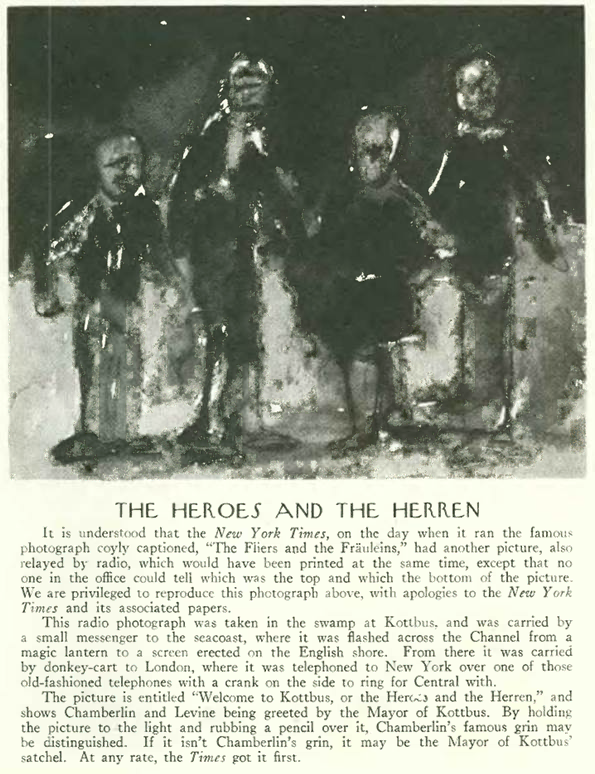
Always poised to take a poke at the newspaper media, The New Yorker had some fun with the New York Times’ attempt to reproduce an early wirephoto of Clarence Chamberlin, the second man to pilot a fixed-wing aircraft across the Atlantic from New York to Europe, while carrying the first transatlantic passenger, Charles Levine. The original photo apparently showed Chamberlain and Levine being greeted by the mayor of Kottbus, Germany:

screen-shot-2016-10-14-at-9-05-29-am

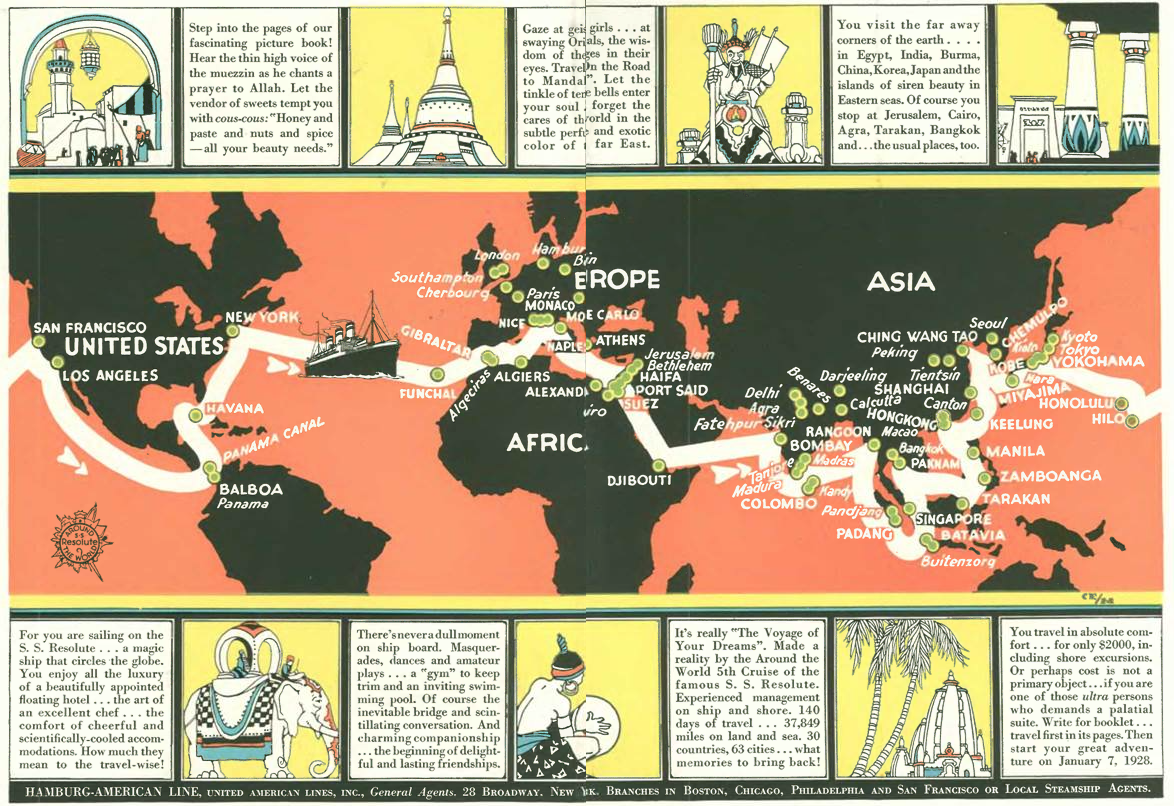
Charles Levine took a plane to Europe, but most still had to settle for the more leisurely pace of a steamship. Below is a two-page advertisement featured in the center of the June 18 issue for an around the world excursion on the Hamburg-American Line (click to enlarge):

screen-shot-2016-10-14-at-9-40-04-am

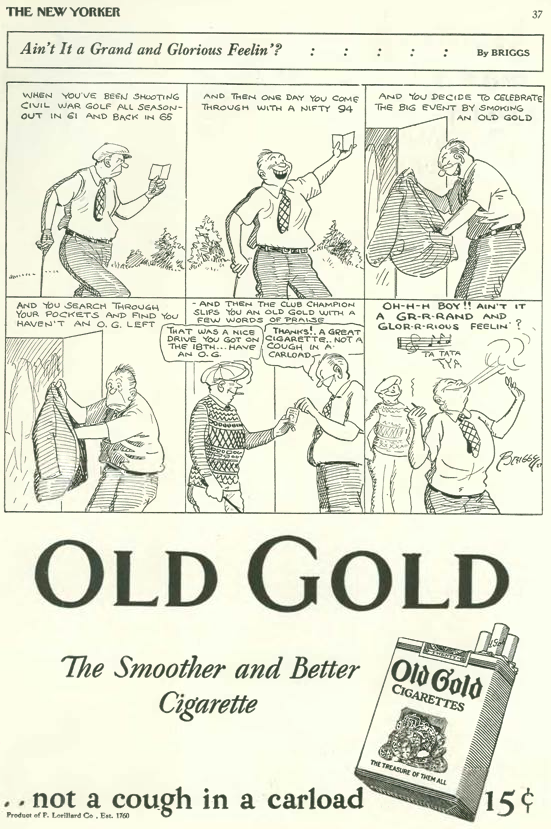
And finally, this advertisement in the back pages for Old Gold cigarettes, which claimed to be “coughless”….

screen-shot-2016-10-14-at-9-39-28-am

The artist for these Old Gold ads was Clare Briggs, an early American comic strip artist who rose to fame in 1904 with his strip A. Piker Clerk. Growing up in Lincoln, Nebraska gave Briggs the material he needed to depict Midwestern Americana, a style that would influence later cartoonists such as Frank King (Gasoline Alley).

Next Time: Île-de-France…

80c5240bf5ffaaff418de94b7e176525

After a Fashion

Screen Shot 2015-12-18 at 12.12.38 PM
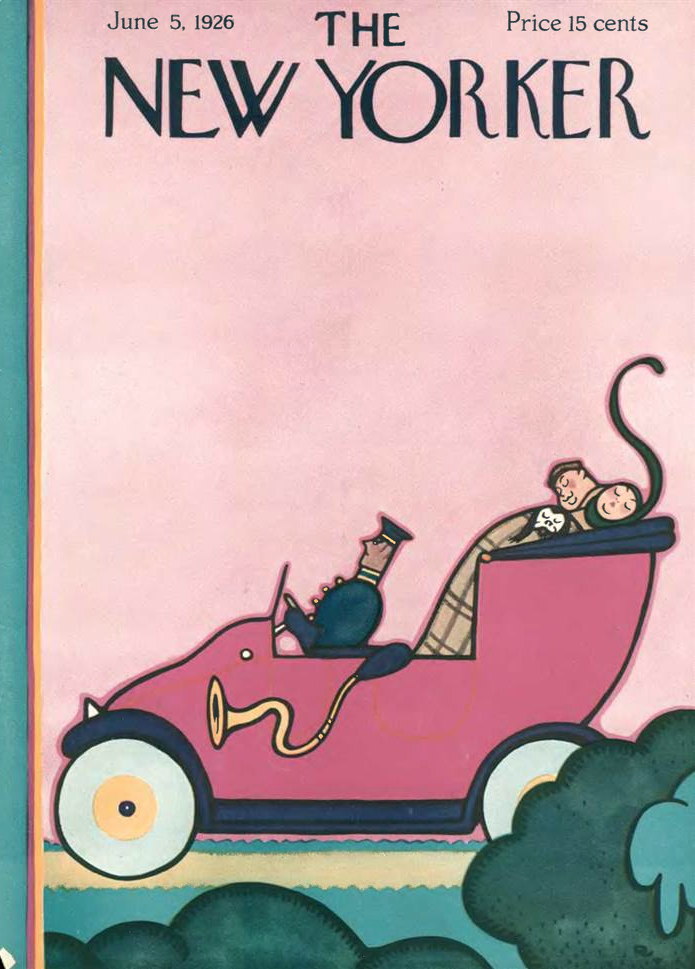
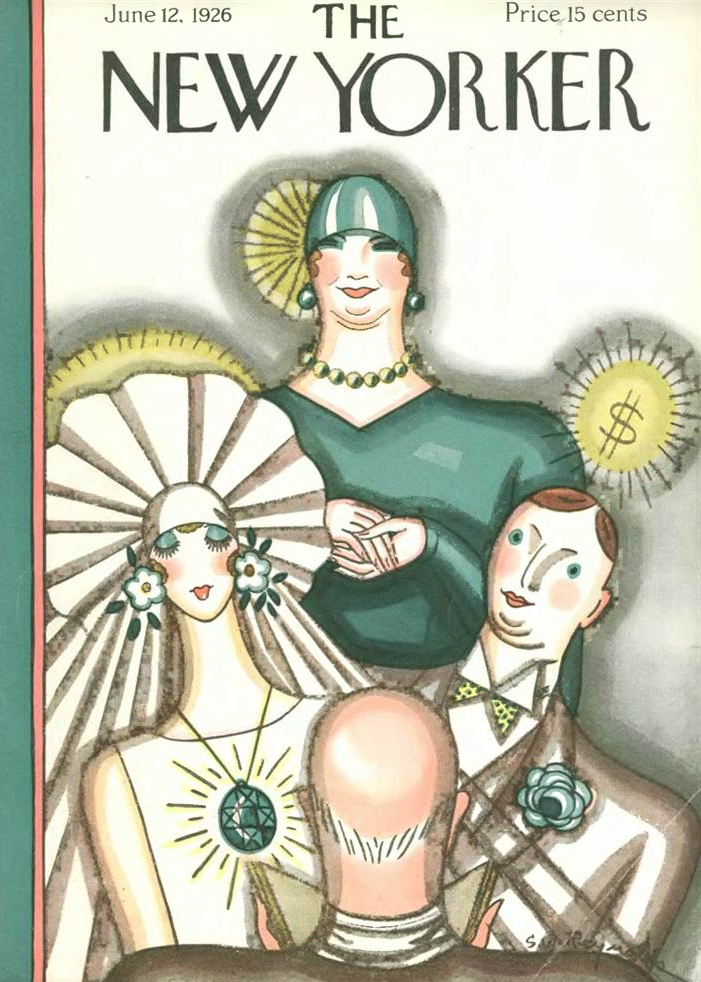
June 5, 1926 cover by Rea Irvin.

Fashion advertising in the early New Yorker can tell you a lot about the mood of the city’s smart set. As I’ve observed before, the magazine’s advertisements were rife with Anglo- and Francophile messaging, but they also reveal much about our changing times. A good example is the upscale retailer Abercrombie & Fitch, which these days uses the tagline “Authentic American clothing since 1892.”

In its early days, A&F was known as an elite outfitter of sporting and excursion goods, supplying aspiring country squires with expensive shotguns, fishing rods and the clothing and kit necessary for successful and stylish expeditions beyond the drawing room:

Screen Shot 2015-12-18 at 1.05.54 PM
“Sporting goods” meant something a bit different in 1926.

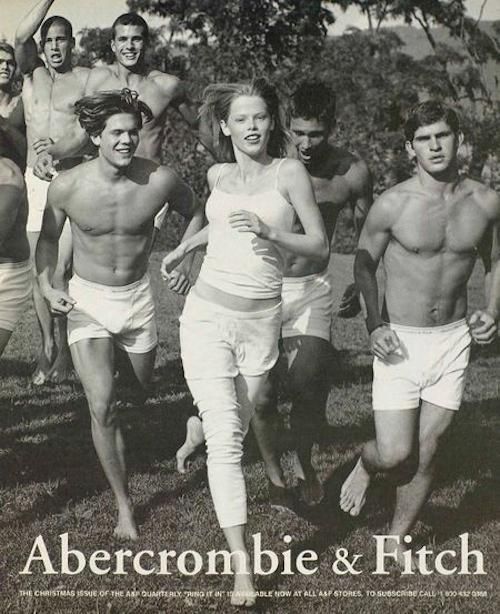
The company went bankrupt in 1976 and operated through mail order until 1988, when the The Limited clothing chain bought the name and operation and turned the focus to the young adult market:

2b1c597b0a5b09ca7477ead9ec5e2e64
Cover for A&F Fall/Winter 1998, photo by Bruce Weber. (Image Amplified)

Over the past couple of decades there’s been a lot of criticism regarding the abundance of A&L ads featuring shirtless, white men and the corresponding dearth of minority models. The newer ads feature a lot less skin and a sprinkling of minorities, but the product line is still a far cry from the one offered in 1926. Except for the elitist part.

As for other purveyors of fine fashion in the pages of The New Yorker, B. Altman made this stylish pitch for its line of bathing suits:

Screen Shot 2015-12-18 at 4.40.10 PM

And here’s an advertisement for Croydon Cravats, featuring the ubiquitous Father’s Day necktie:

Screen Shot 2015-12-18 at 4.48.08 PM

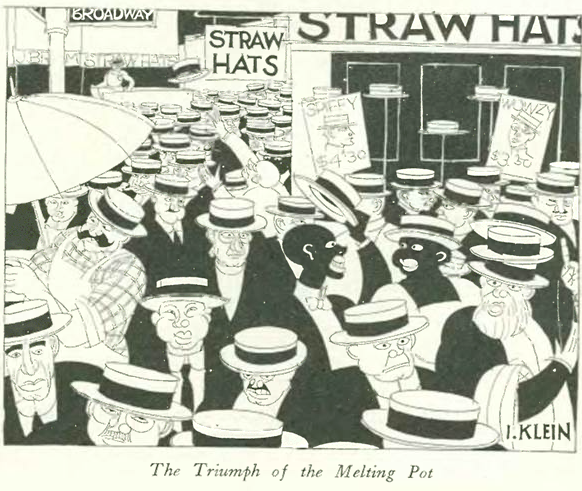
As for fashion in the comics, this drawing by Isadore Klein found humor in the multicultural appeal of the summer straw hat:

Screen Shot 2015-12-18 at 4.43.28 PM

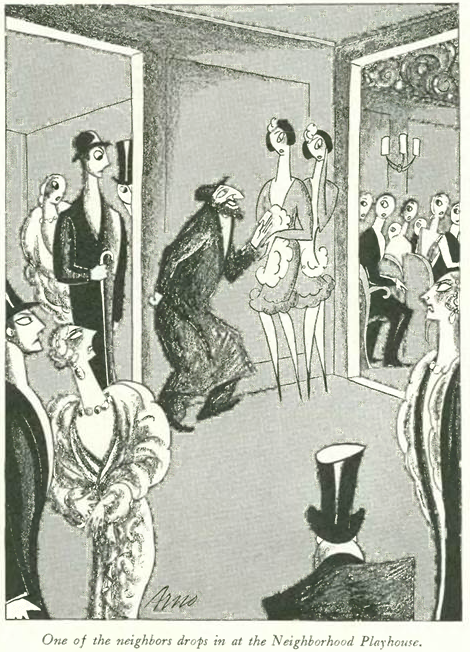
African Americans in the early New Yorker were nearly always depicted in minstrel-style blackface, and Jewish immigrants (such as the one Klein depicted at right) rarely lacked the Orthodox beard. Such is the case in this Peter Arno illustration where cultures clash rather than mix:

Screen Shot 2015-12-18 at 4.42.20 PM

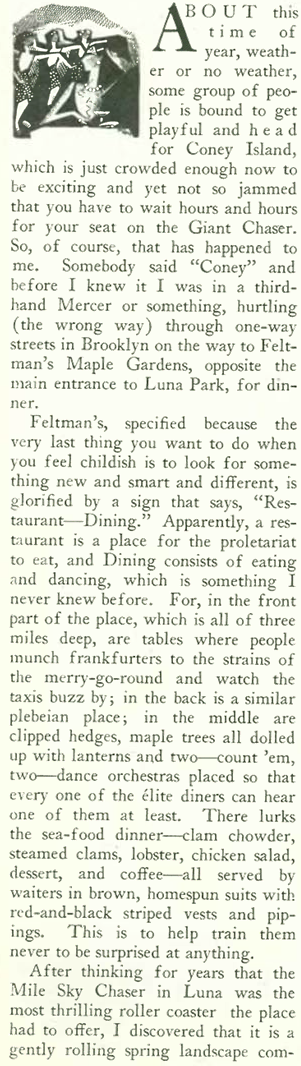
And let’s check in with the New Yorker’s fashion critic (and Arno’s soon-to-be wife) Lois Long, who slummed with the Proles at Coney Island:

Screen Shot 2015-12-18 at 4.45.44 PM

tumblr_lsv5w1uJwH1qgfx0uo1_500
CONEY CRONIES…(l to r) Silent film star Charlie Chaplin, Vanity Fair editor Frank Crowninshield, sculptor Helen Sardeau, Lois Long and screenwriter Harry D’Arrast pose in a Coney Island photo booth, 1925. Photo scanned from the book Flapper by Joshua Zeitz.

Finally, given the terrible circumstances in the Middle East and especially Syria, this small item in “Of All Things” is both timely and prescient:

Screen Shot 2015-12-18 at 4.43.07 PM

Next Time: Taxi Dancers…
Screen Shot 2015-12-18 at 4.38.53 PM