Conventional Follies of ’28

U.S. presidential elections have long provided fodder for the nation’s humorists, and the 1928 contest between Herbert Hoover and Al Smith was no exception.

March 31, 1928 cover by Theodore G. Haupt.

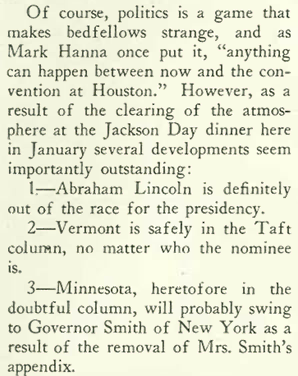
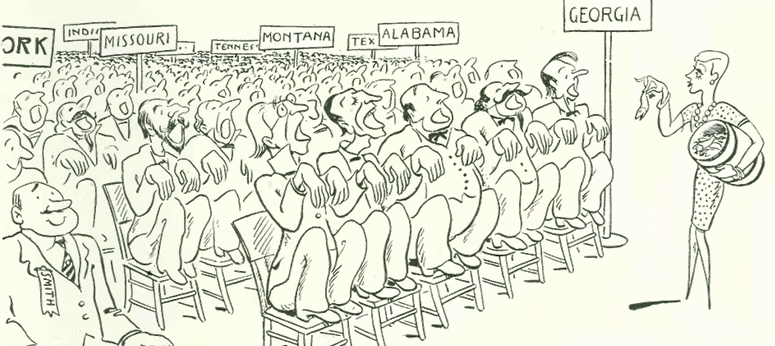
In the March 31, 1928 issue of the New Yorker writer Frank Sullivan and cartoonist Al Frueh took particular delight in skewering the party nominating conventions. As Sullivan observed:

Regarding item No. 3, Sullivan was referring to Minnesota’s famed Mayo Clinic, and the related pride that was doubtless associated with the removal of an appendix from Catherine Dunn, the wife of Al Smith, four-term governor of New York and nominee to lead the Democratic ticket.

The candidates could not have been more different. The first Catholic to be nominated for president, Smith was a crowd-loving, charismatic personality, a Tammany Hall politician and a committed “wet” who opposed Prohibition. He attracted strong support from Catholics, women, drinkers and those who were tired of the crime and corruption associated with dry America.

WET VS. WET BLANKET…The staid, “dry” Republican candidate Herbert Hoover (right) easily defeated the charismatic “wet” Democratic candidate Al Smith in the 1928 U.S. Presidential Election. (Wikipedia)

Hoover, on the other hand, was deliberately dull and humorless, as stiff as his heavily starched collars and committed to keeping the country dry. But the economy under fellow Republican Calvin Coolidge was booming, and it didn’t hurt that many Protestants believed the Catholic Church would dictate Al Smith’s policies if he were elected. Sullivan had some fun with this perceived religious prejudice:

In light of the recent 2016 elections and the prominence of “Islamophobia” in the political rhetoric, Sullivan’s joke regarding the role of “Mohammedans” in the 1928 election is noteworthy:

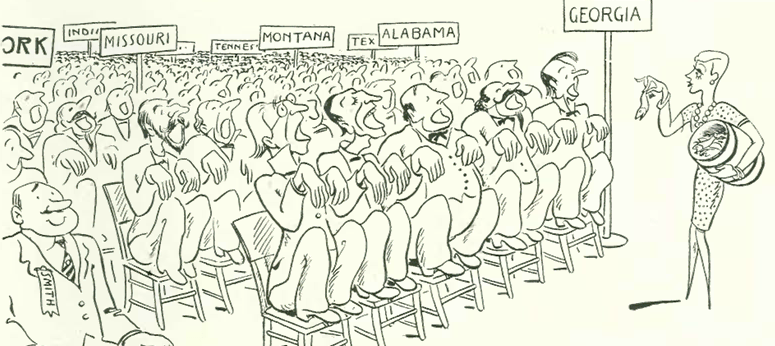
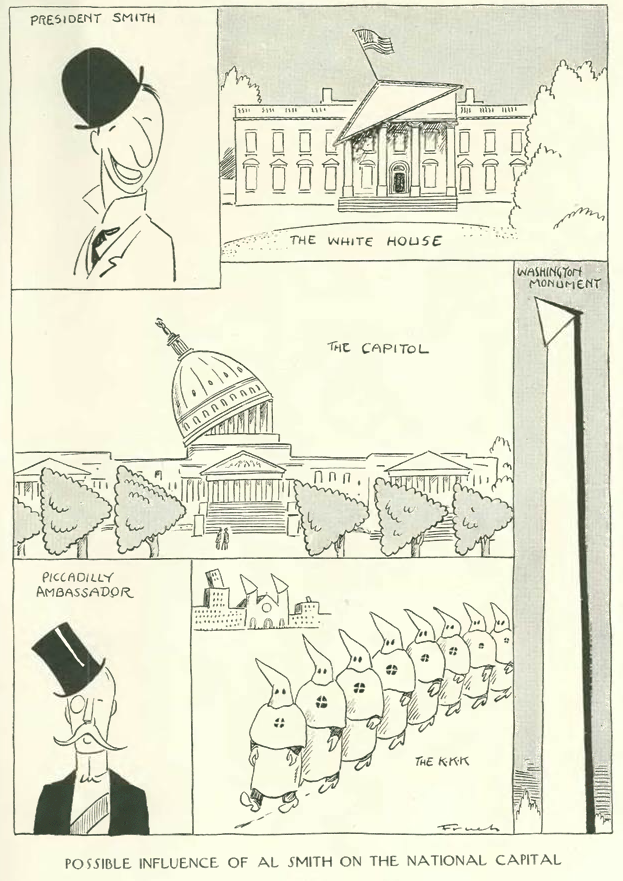
Illustrations by Al Frueh, both top and bottom, aptly captured the picture Sullivan painted of the nominating process:

Smith would lose in a landslide. Journalists at the time attributed his defeat to the three P’s: Prohibition, Prejudice and Prosperity. Rural voters, who favored Hoover, also had a bigger say than their urban brethren: Republicans would benefit from a failure to reapportion Congress and the electoral college following the 1920 census, which had registered a 15 percent increase in the urban population. After the election, Smith became the president of Empire State Inc., the corporation that would build the the Empire State Building in 1930-31.

In his piece Sullivan also took at parting shot at President Coolidge…

…as did cartoonist John Price in the same issue…

For reference, the image that inspired Price:

BIG CHIEF… Calvin Coolidge donned a headdress while being named an honorary Sioux chief (“Leading Eagle”) in Deadwood, South Dakota in the summer of 1927. (Associated Press)

 *  *  *

New Yorker Monotypes

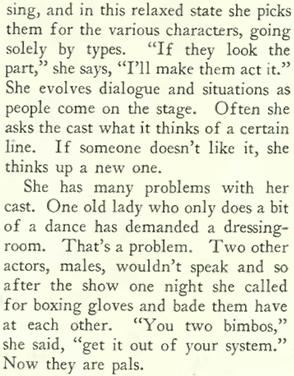
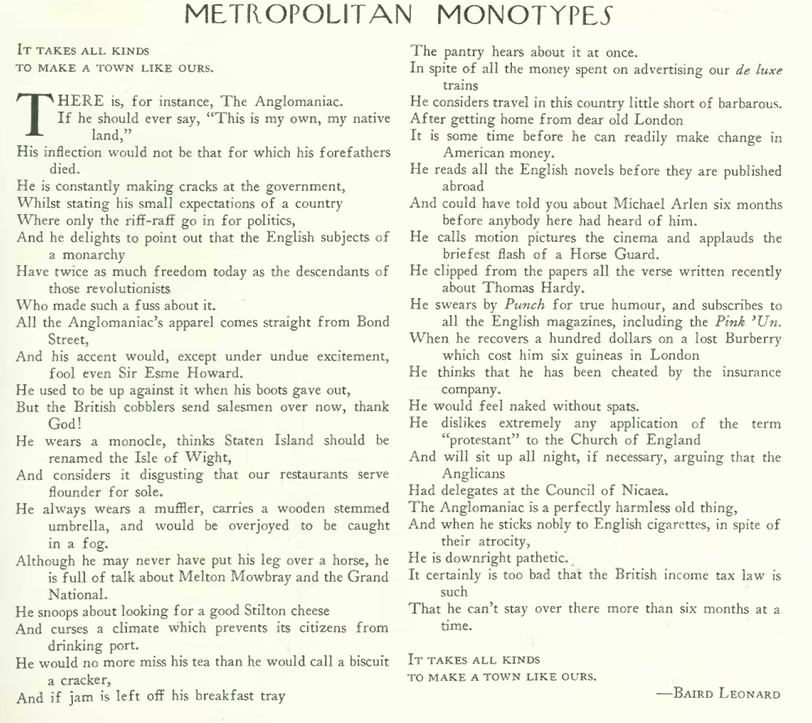
Another humorist who regularly contributed to The New Yorker was Baird Leonard, who beginning with the second issue of the magazine (Feb. 28, 1925) wrote a series titled “Metropolitan Monotypes.” Over five years and 36 installments Leonard wrote free-verse characterizations of various New York “types,” from debutantes to aesthetes to “The Anglomaniac” as described below in this installment from March 31, 1928:

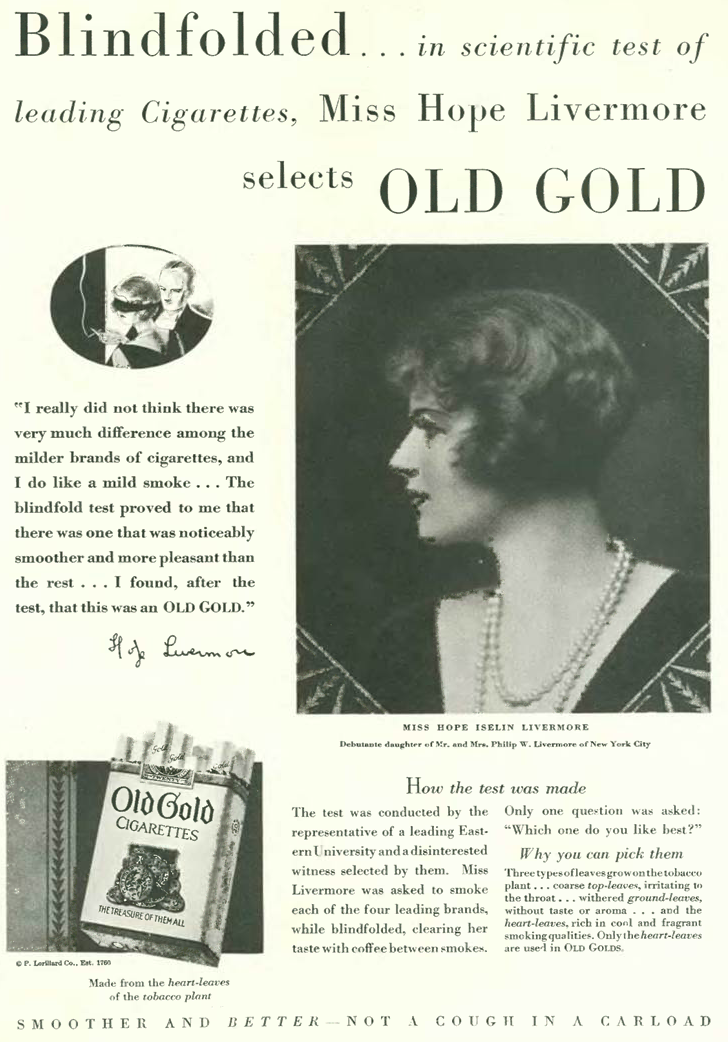
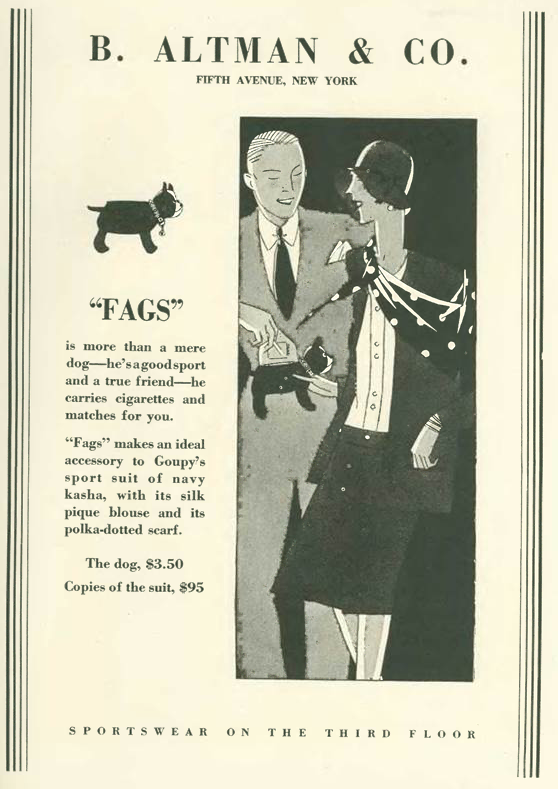
As noted before, Anglophilia oozed from The New Yorker ads, particularly those directed at the male reader (France was a common lure in ads for women). Every issue from the 1920s is rife with examples, but sticking to the March 31 issue we find this ad employing the British slang for cigarettes to market a silly, dog-shaped cigarette case to fashionable women:

In the same issue this ad from Macy’s appealed to participants of a famous cultural event for the posh set—the annual Easter Parade on Fifth Avenue. A tradition dating back to the 1870s, in its first decades the “parade” was a display of wealth and beauty, as the well-to-do strolled from church to church to check out various floral displays.

In 1928, the poor and middle classes were merely observers of the passing parade, perhaps hoping to learn something about the latest fashions. The April 14 “Talk of the Town” suggested as much:

And finally, our cartoon comes courtesy of Leonard Dove, who explores the lighter side of boxing…

Next Time: We Americans…

Amen Aimee

It what would become a longstanding tradition, The New Yorker marked its third anniversary by featuring the original Rea Irvin cover illustration from Issue No. 1. The New Yorker was a very different magazine by its third year, fat with advertising and its editorial content bolstered by such talents as Peter Arno, E.B. White and Dorothy Parker.

Feb. 25, 1928 cover by Rea Irvin.

Parker livened up the magazine’s books section, mincing few words as she took on writers both great and not so great.

In the latter category was Aimee Semple McPherson, a 1920s forerunner of today’s glitzy televangelists. In her column “Reading and Writing,” Parker took aim at McPherson — “Our Lady of the Loud-speaker” — who had just published a book titled In the Service of the King.

READY FOR MY CLOSEUP…Although she was an evangelical preacher, Aimee Temple McPherson was also considered one of the most glamorous women in 1920s America. (Foursquare Church)

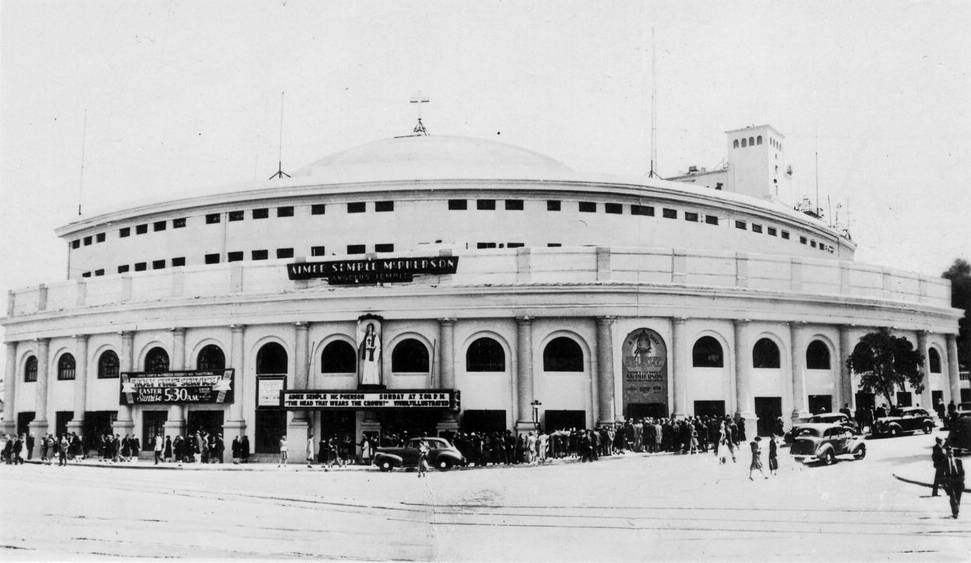
McPherson (1890–1944) was a Pentecostal-style preacher who practiced “speaking in tongues” and faith healing in her services, which drew huge crowds at revival events between 1919 and 1922. She took to the radio in the early 1920s and in 1923 she based her ministry in Los Angeles at her newly completed Angelus Temple, which served as the center of the International Church of the Foursquare Gospel.

McPherson’s book detailed her conversion and her various hardships, including her mysterious “kidnapping” in 1926. Parker was having none of it:

Parker was referring to events beginning on May 18, 1926, when the evangelist visited Venice Beach for a swim and went missing. Some thought she had drown, others claimed they saw a “sea monster” in the area. McPherson reemerged in June on the Mexico-Arizona border, claiming she had been kidnapped and held captive by three strangers.

Numerous allegations of illicit love affairs targeted McPherson during her years of fame, so some were inclined to believe she went missing in order to engage in a love affair with her sound engineer.

Upon her return to Los Angeles she was greeted by a huge crowd (est. 30,000 to 50,000) that paraded her back to the Angelus Temple. However many others in the city found McPherson’s homecoming gaudy and annoying. A grand jury was subsequently convened to determine if evidence of a kidnapping could be found, but the court soon turned its focus to McPherson herself to determine if she had faked the kidnapping. Parker thought the condition of the preacher’s shoes, after a long trek through the desert, were evidence enough of a sham:

THE MEGACHURCH IS BORN…Angelus Temple, completed in 1923, is the center of the International Church of the Foursquare Gospel founded by McPherson. It is still in active use. (Loyola Marymount University)
SPECTACLE…Aimee Semple McPherson surrounded by massed choirs at Angelus Temple for a musical requiem in 1929. (Los Angeles Public Library/Herald Examiner)
Aimee Semple McPherson (second from left) joins tambourine players in a service at Angelus Temple. McPherson produced weekly dramas, often major spectacles, illustrating various religious themes. (Los Angeles Public Library/Herald Examiner)

McPherson, who was married three times and twice divorced, died in September 1944 from an apparent overdose of sleeping pills. She was 53. Her son Rolf took over the ministry after her death. Today McPherson’s Foursquare Church has a worldwide membership of about 8 million, and is still based in Los Angeles.

But How Do I Look?

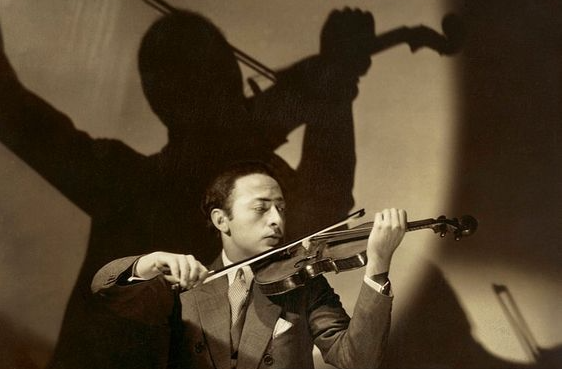
The Feb. 25 issue profiled the young Jascha Heifetz, a Russian-born violin prodigy who seemed more interested in how he looked than in how he performed. An excerpt:

SARTORIAL PERFECTION…Detail of a 1928 photo of 27-year-old Jascha Heifetz, taken by Edward Steichen. (Condé Nast)

 *  *  *

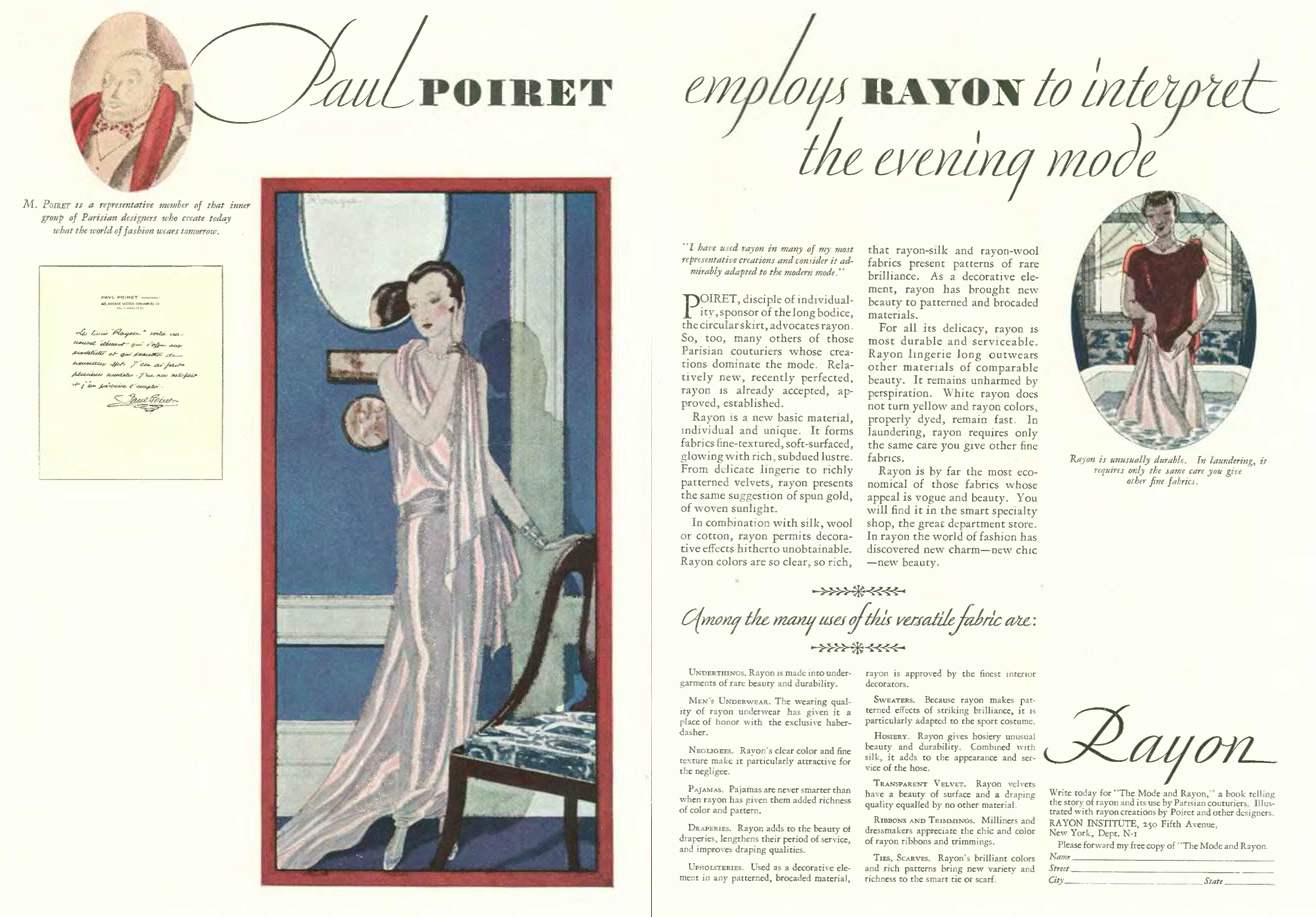
Speaking of fashion, one of the world’s greatest fashion designers, Paul Poiret, was seeing hard times in the late 1920s with his designs losing popularity in his native France and his formidable fashion empire on the brink of collapse. But Francophile New Yorkers, always hungry for French fashion, greeted Poiret with open arms when he arrived in the city in the fall of 1927.

It is something of a surprise, however, to find this advertisement in the Feb. 25 issue in which Poiret endorses Rayon, a man-made substitute for silk. We don’t usually associate synthetics with haute couture, but then again maybe Poiret just needed the money. Better living through chemistry, as they say…

(click to enlarge)

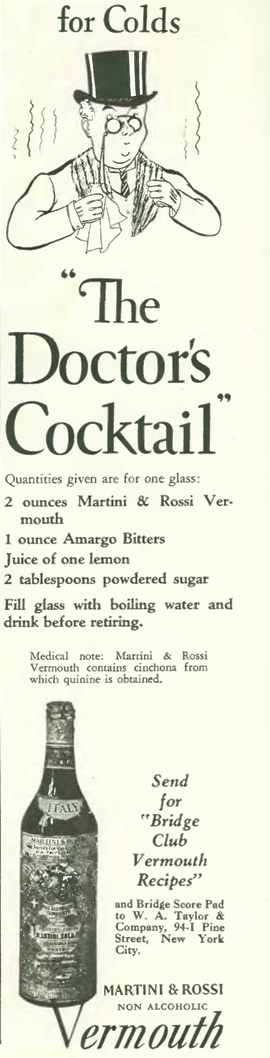
Also in the issue was a sad, Prohibition-era advertisement that extolled the virtues of an oxymoronic “non-alcoholic vermouth”…

And finally from the Feb. 25 issue, a cartoon by Carl Rose

 *  *  *

One-eyed Monster

In the March 3 issue “The Talk of the Town” discovered the miracle of television during a visit to the Bell Telephone laboratories.

March 3, 1928 cover by Peter Arno.

Lab researchers demonstrated a “receiving grid” with a tiny screen that displayed images broadcast across the expanse of an auditorium:

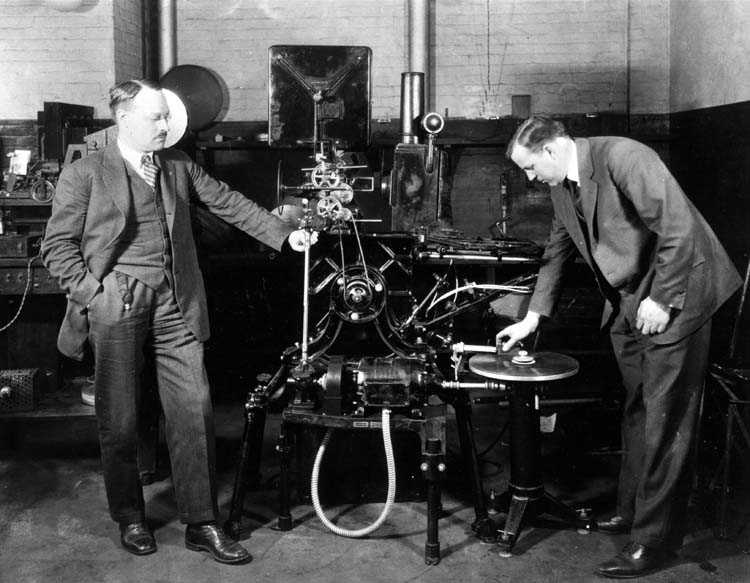
WE’LL CALL IT THE BOOB TUBE…Engineer and inventor Ernst Alexanderson (right) and the TV projector he used for early public demonstrations of television, circa 1928. (edisontechcenter.org)

Another glimpse into the future in the March 3 issue came courtesy illustrator Al Frueh, who offered this fanciful look at the skyscraper of tomorrow:

(click to enlarge)

 *  *  *

“Profile” featured the first installment of a four-part article (by Niven Busch Jr.) on a man who put America on wheels and into traffic jams. Excerpts:

Profile illustration by Al Frueh.

And finally, from W.P. Trent, an analogy that would take on new meaning after the market crash…

Next Time: To Bob, Or Not to Bob…


Odious Odes

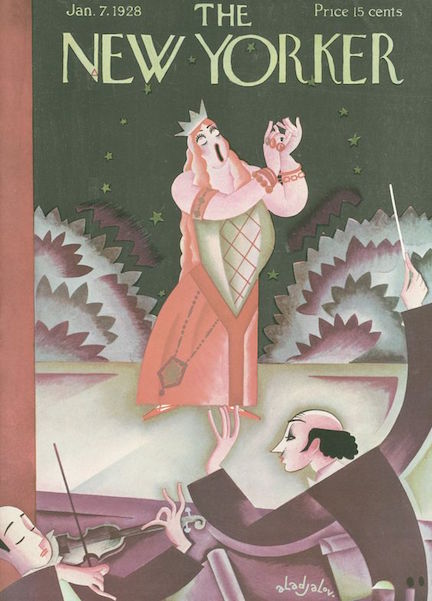
After his famous transatlantic flight, not only did Charles Lindbergh have to endure endless banquets and the sweaty crush of adoring crowds, but he also inspired a lot of kitsch, including some spectacularly bad poetry that Dorothy Parker could’t help but eviscerate in the Jan. 7, 1928 issue.

jan-7
January 7, 1928 cover by Constantin Alajalov.

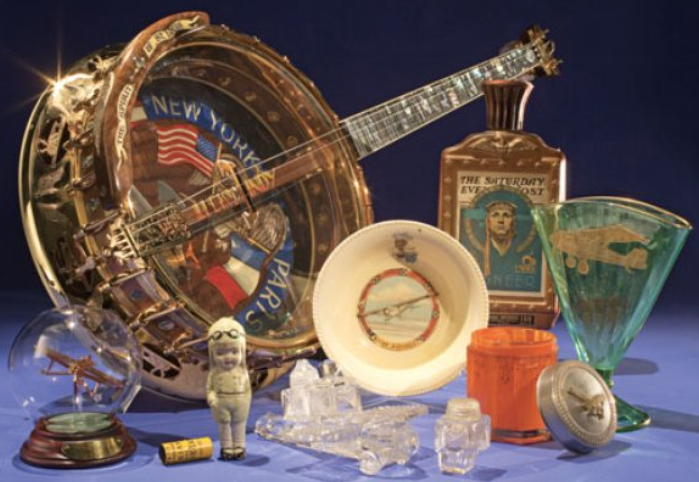
Before we tackle the poetry, here is a sampling of various Lindbergh memorabilia:

screen-shot-2017-02-10-at-3-47-31-pm
THEY’RE SELLING YOU…Assortment of Lindbergh souvenirs on display at the Smithsonian’s Air & Space Museum. (Eric Long/Smithsonian)
screen-shot-2017-02-10-at-1-48-58-pm
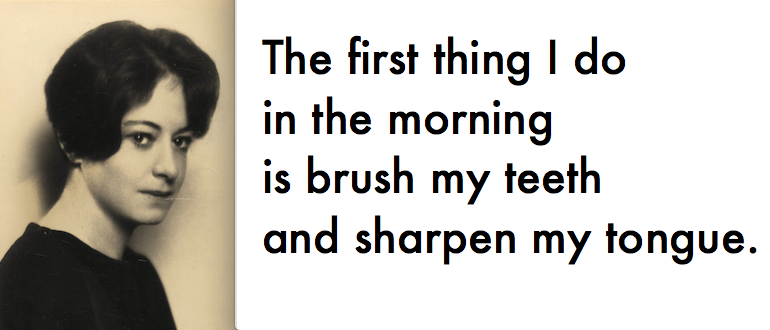
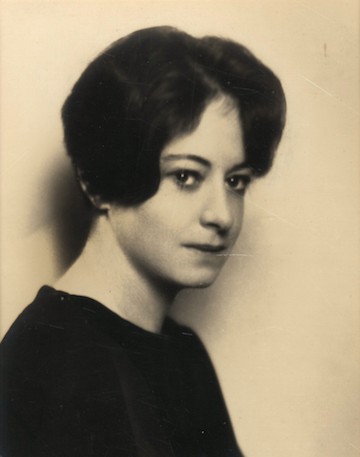
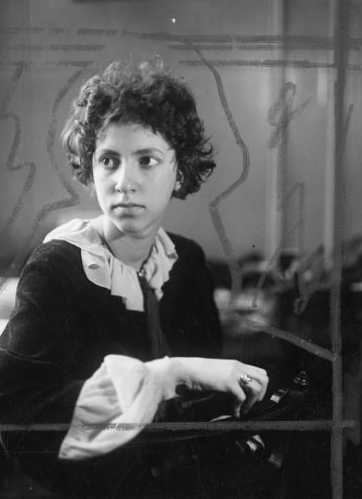
SHARPENED TONGUE…Dorothy Parker in 1928. (literaryladiesguide.com)

Parker led off her “Reading & Writing” column with this observation about the collapse of grammar and civilization in general…

screen-shot-2017-02-10-at-12-40-01-pm

…and offered two examples—chocolate-covered olives and a new book of poems dedicated to Charles Lindbergh’s heroic solo crossing of the Atlantic…

screen-shot-2017-02-10-at-12-41-54-pm

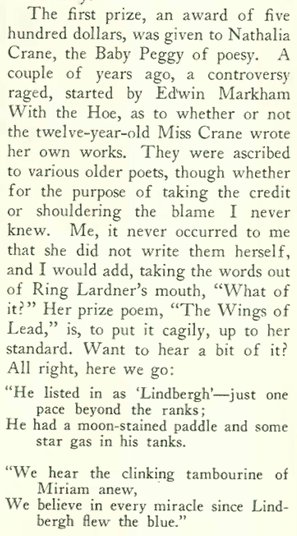
Parker’s comment about guiding a razor across her throat is a bit unnerving, considering she was chronically depressed and occasionally suicidal throughout her life. But then again, Parker didn’t like ugly things, including bad poetry, and especially bad poetry written by a twelve-year-old “prodigy,” in this case a one Nathalia Crane, who claimed the top prize in the Lindbergh collection. Parker observed:

screen-shot-2017-02-10-at-12-43-30-pm

Little Nathalia Crane (1913–1998) gained fame after the publication of her first book of poetry, The Janitor’s Boy, which she wrote at age ten. After her second book of poetry was published in 1925, American poet Edwin Markham suggested the poems were part of a hoax because they exhibited a maturity of thought beyond the reach of a mere child. (A sidebar: Parker referred to Nathalia as a “Baby Peggy of poesy.” Baby Peggy, whose real name was Diana Serra Cary, was a beloved child silent film star. Still alive at this writing, she is 99 years old–the last living film star of the silent era). Update: Diana Serra Cary, considered the last surviving person with a substantial career in silent films, died February 24, 2020, at age 101.

90-105, 5, "Crane, Nathalia"; "Famous as a child prodigy, Nathalia Clara Ruth Crane (1913-1998) published her first book at age ten and later became a professor of literature. This photograph was used to illustrate a news story about ""The four ages of behavior,"" declaring that Crane, "
BAD POET’S SOCIETY?…Nathalia Crane in 1925. She would publish ten volumes of poetry and three novels, and would go on to a long career as a professor of English at San Diego State University. (Wikipedia)

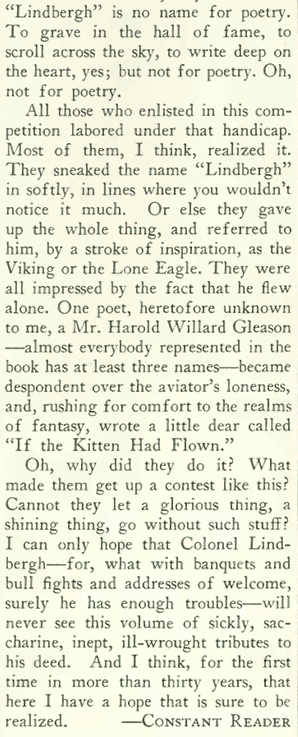
Parker observed that “Lindbergh” was not a name well suited to poetry, and concluded with the hope that the aviator would be spared from having to read the “sickly, saccharine, inept, ill-wrought tributes”…

screen-shot-2017-02-10-at-12-44-31-pm

Tilt Your Vote to Al

When New York Governor Al Smith announced his candidacy for U.S. President, New Yorker cartoonist Al Frueh had some fun with the governor’s habit of wearing his ever-present bowler hat at a tilt:

screen-shot-2017-02-10-at-12-15-51-pm

They Dropped Like Flies

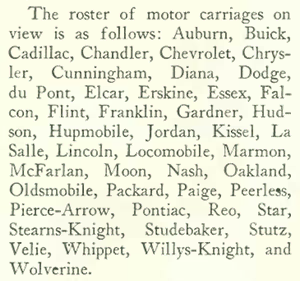
Nicholas Trott visited the 1928 New York Automobile Salon and rattled off this list of 43 car companies that would be displaying their shiny wares:

screen-shot-2017-02-10-at-12-29-32-pm

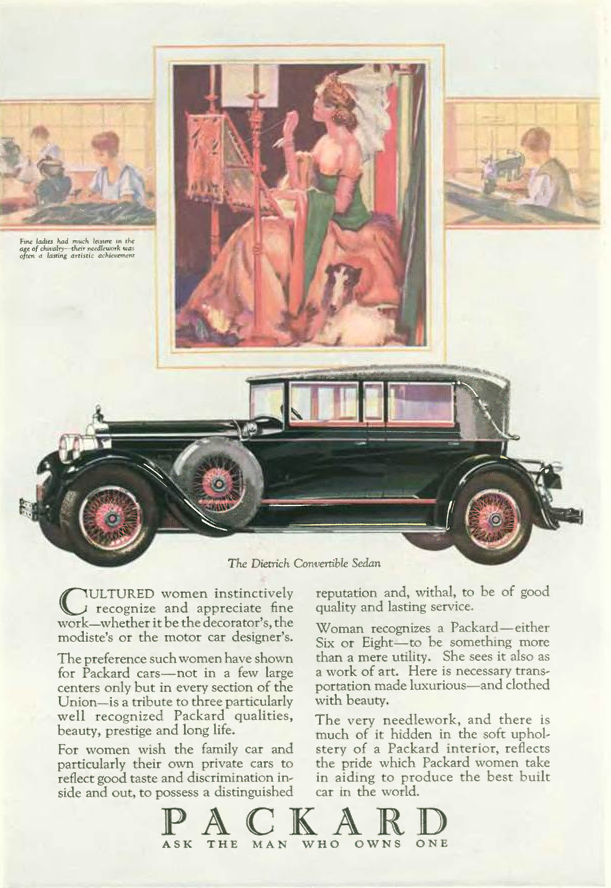
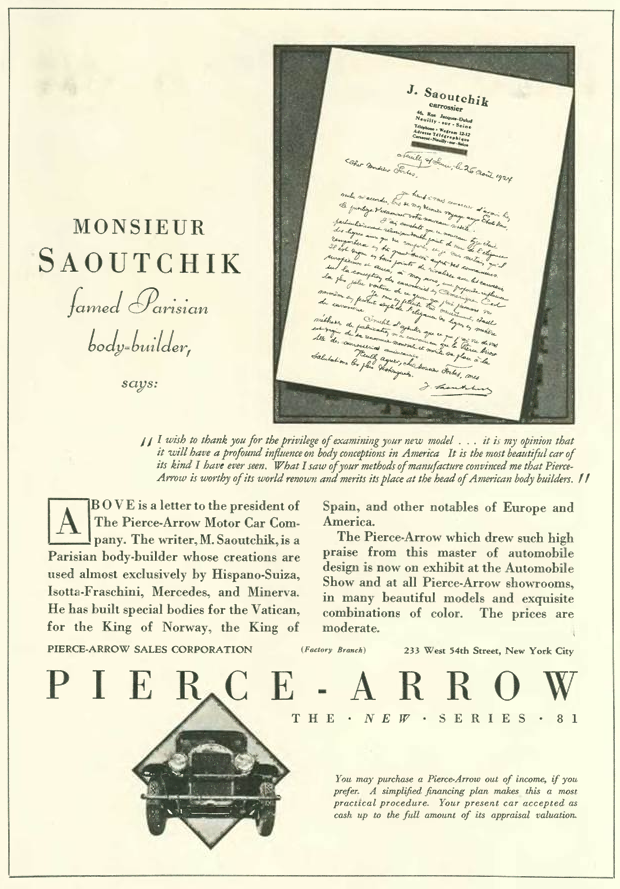
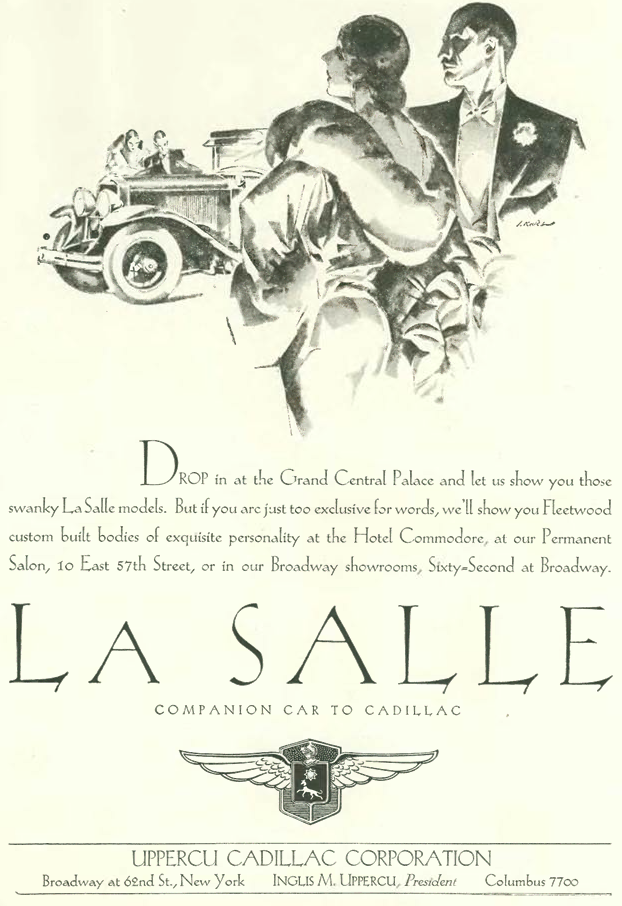
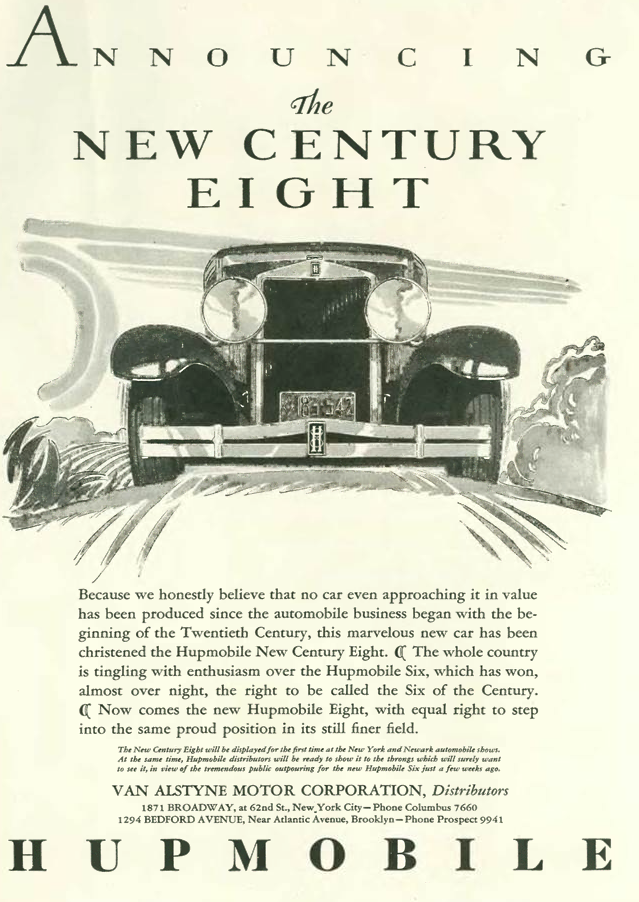
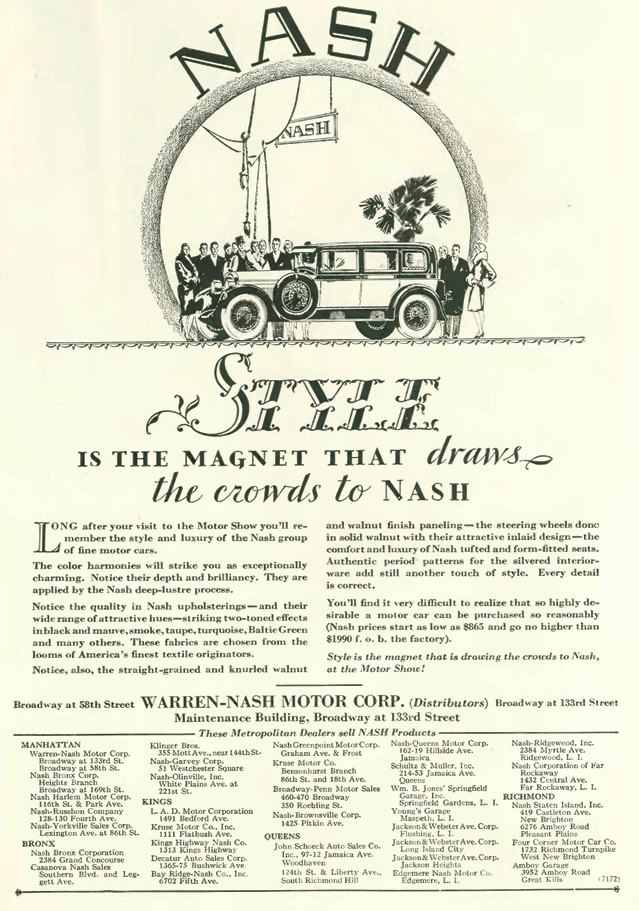
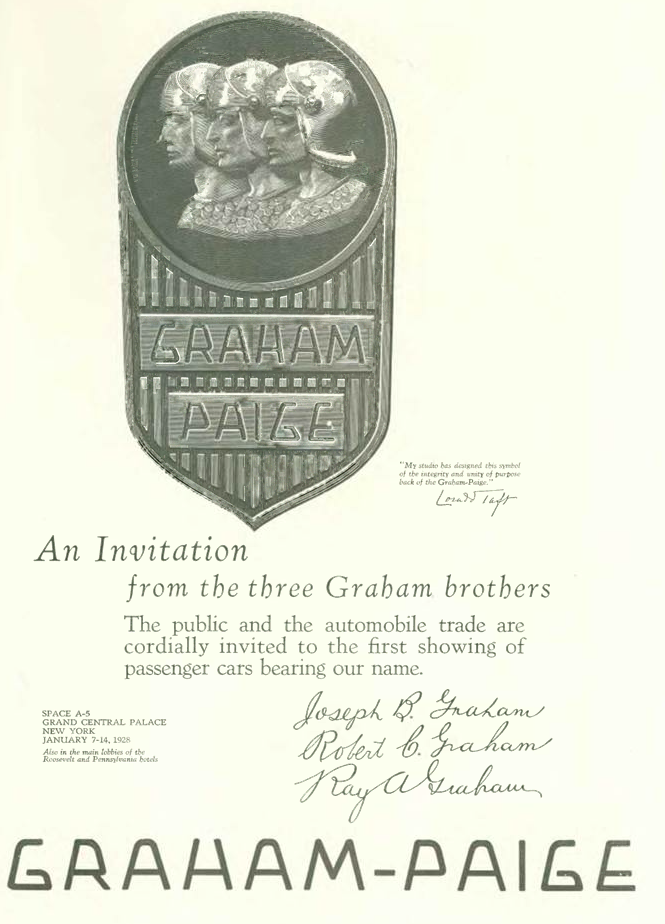
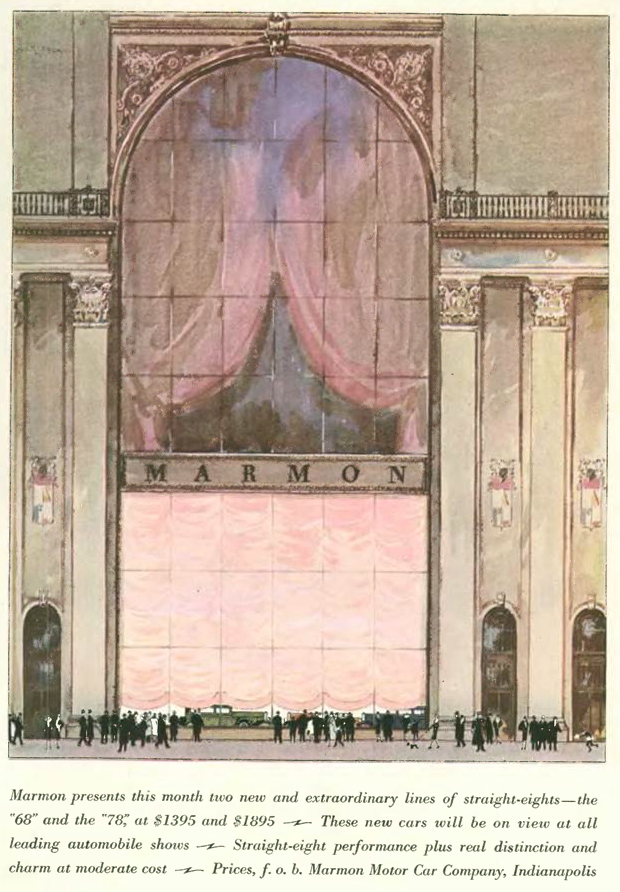
Of those 43 companies, only six are in operation today. Interestingly, the car ads that appeared in the Jan. 7 issue were mostly from companies that are long gone. Here is a sampling:

screen-shot-2017-02-10-at-12-31-07-pm

screen-shot-2017-02-10-at-12-31-24-pm

screen-shot-2017-02-10-at-12-32-00-pm

screen-shot-2017-02-10-at-12-30-41-pm

screen-shot-2017-02-10-at-12-32-24-pm

screen-shot-2017-02-10-at-12-32-45-pm

screen-shot-2017-02-10-at-12-33-28-pm

screen-shot-2017-02-10-at-12-46-47-pm

screen-shot-2017-02-10-at-12-47-05-pm

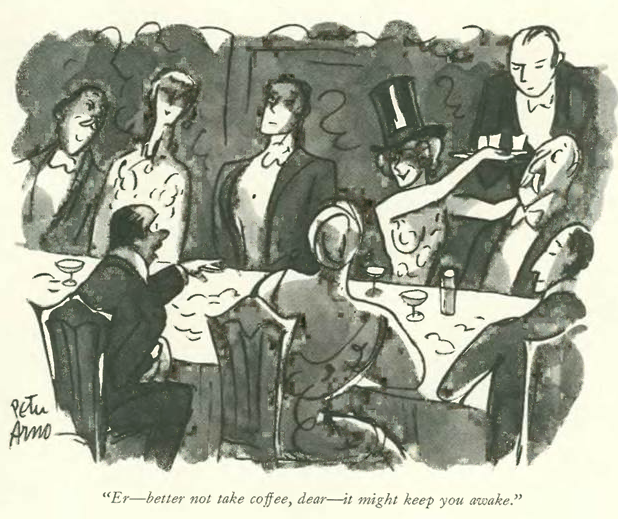
And finally, we close with Peter Arno and some dinner party hijinks…

screen-shot-2017-02-10-at-12-17-30-pm

Next Time: Guess Who’s Coming to Dinner…

d30ba2edfc3289f6c04c8dfd337ef06c

The Perfect Gift for 1927

We close out 1927 by looking at the final December issues, which grew fat with Christmas advertising catering to the tastes of New York’s smart set.

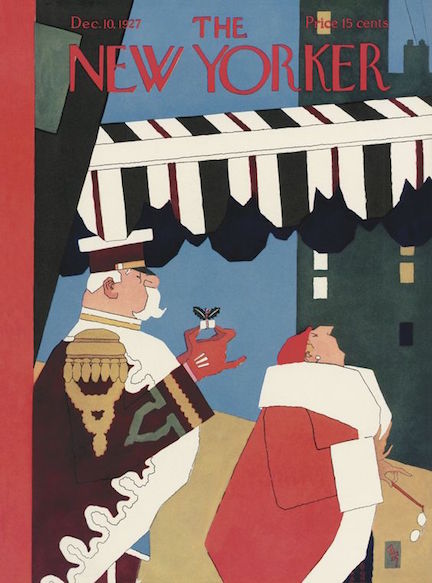
dec-10
December 10, 1927 cover by Gardner Rea.

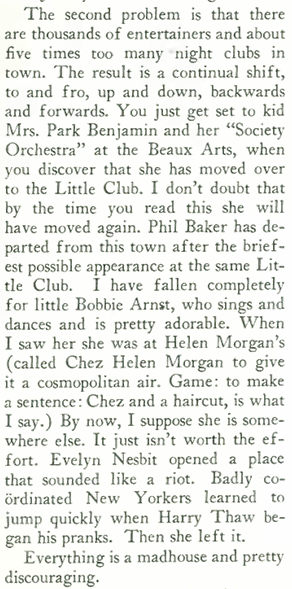
Before we jump to the ads, let’s look in on Lois Long, who in the Dec. 10 issue continued her lamentations regarding the quality of New York’s Prohibition-era night life and reminded readers that her job was far from a “soft snap”…

screen-shot-2017-02-06-at-10-03-06-am

The problem, as diagnosed by Long, was that there were not enough talented entertainers to fill the needs of an overabundance of nightclubs…

screen-shot-2017-02-06-at-10-04-09-am

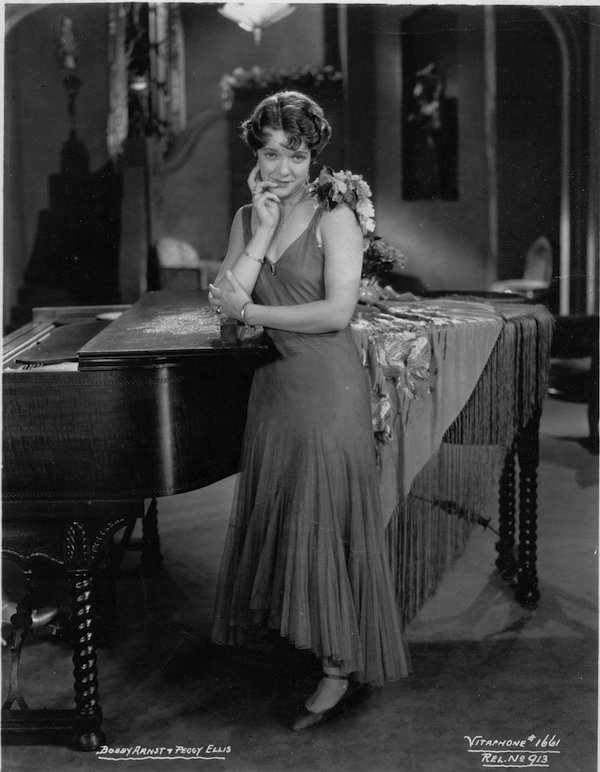
vit-94-bobbe-arnst1
LOIS THOUGHT BOBBIE ARNST WAS PRETTY SWELL when she appeared at Helen Morgan’s nightclub. A noted broadway singer and dancer, Arnst is pictured above in a publicity photo from the 1929 film Rhythms in Blue. (picking.com)
screen-shot-2017-02-07-at-12-33-26-pm
ON THE OTHER HAND…Evelyn Nesbit’s tearoom (and later speakeasy) couldn’t survive on notoriety alone. In the early 20th century Nesbit’s face was everywhere—from advertisements to calendars—but in 1906 her fame took a nasty turn when her jealous husband, Harry Thaw, shot and killed suspected lover and famed architect Stanford White at Madison Square Garden’s rooftop theatre. At left, Nesbit in 1900. At right, Nesbit in her tea room on West 52nd Street, near Broadway, circa 1922. (Library of Congress / restaurant-ingthroughhistory.com)

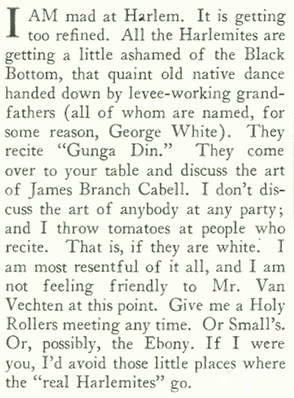
Long also railed against the white appropriation of Harlem entertainment, which she felt was draining the place of its soulfulness. In particular she called out writer and photographer Carl Van Vechten, who among white writers was the most prominent in intellectualizing the “Harlem Renaissance”…

screen-shot-2017-02-06-at-11-43-27-am

What to Buy in ’27

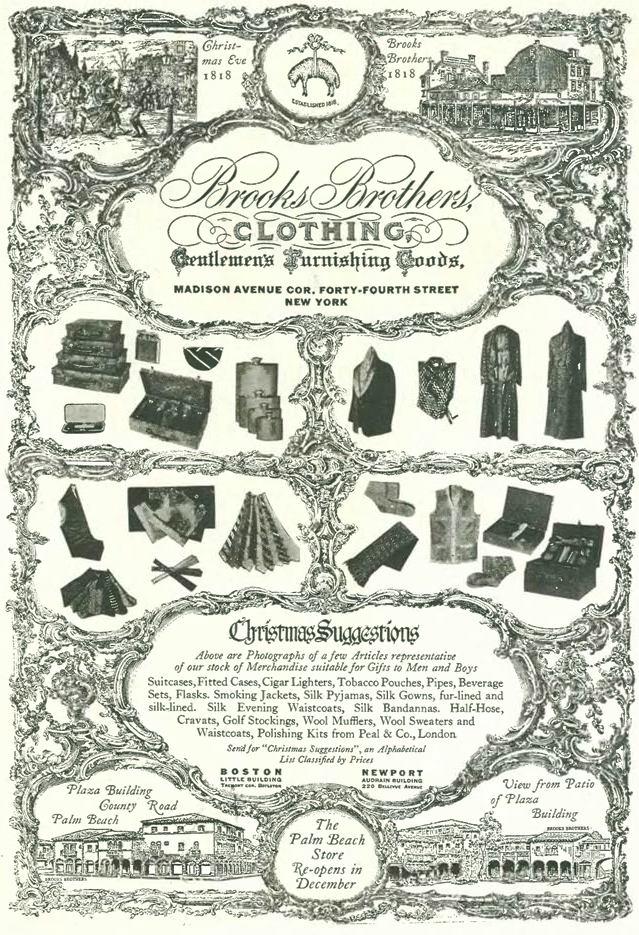
The Dec. 10 and Dec. 17 issues grew fat with holiday advertising, averaging 120+ pages as opposed to the usual 60 or so pages. The advertisements mostly appealed to upscale readers, ranging from this almost Victorian-style ad from the staid Brooks Brothers…

screen-shot-2017-02-06-at-9-46-21-am

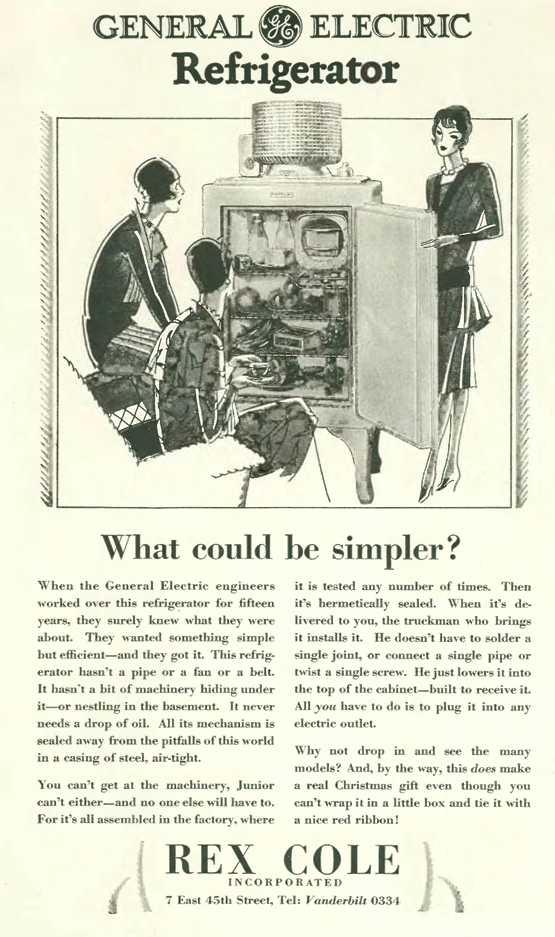
…to this ad from Rex Cole promoting the latest in modern conveniences…

screen-shot-2017-02-06-at-9-56-44-am

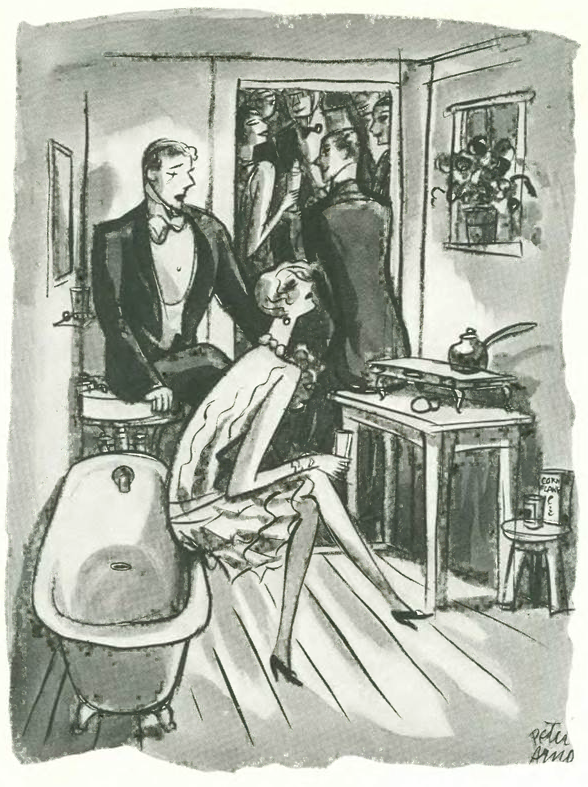
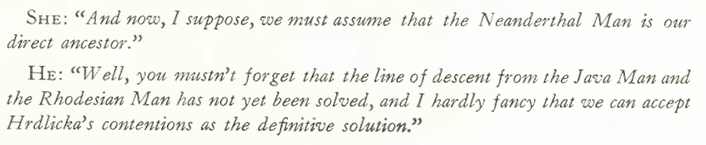
And I’ll toss in this cartoon from the Dec. 10 issue, in which Peter Arno allows us to listen in on an unlikely conversation between a couple of toffs…

screen-shot-2017-02-06-at-9-53-54-am

screen-shot-2017-02-06-at-9-54-11-am

Lois is Also Tired of the Holidays

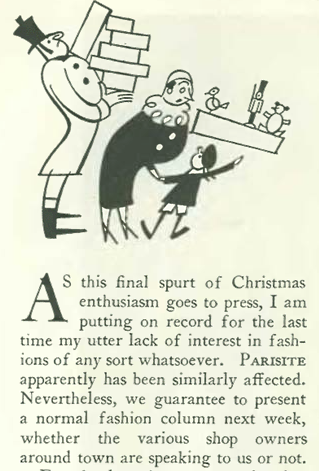
On to the Dec. 17 issue, in which Lois Long also shared with readers her weariness of Christmas shopping in her column, “On and Off the Avenue.”

dec-17
December 17, 1927 cover by Theodore G. Haupt.

The “Parisite” Long referred to in this excerpt was actually Elizabeth Hawes, who occasionally contributed to Long’s column (with cables sent from Paris) regarding the latest in French fashions. More on Hawes another time…

screen-shot-2017-02-06-at-12-11-30-pm

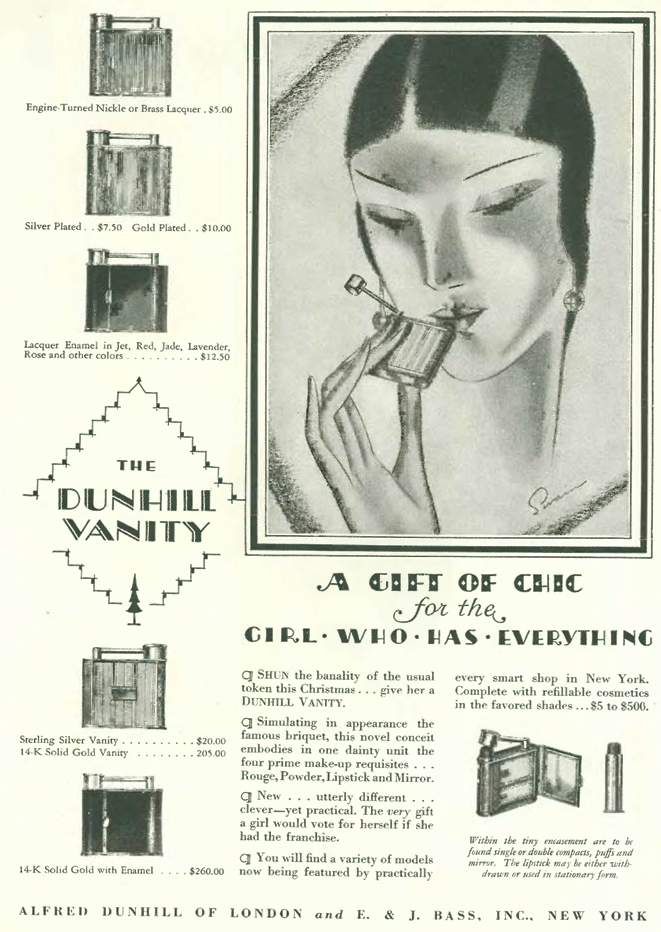
As for ads in the Dec. 17 issue, we get this one from Dunhill, maker of fine English cigarettes and accessories: a woman’s compact that resembles a lighter…

screen-shot-2017-02-06-at-12-07-21-pm

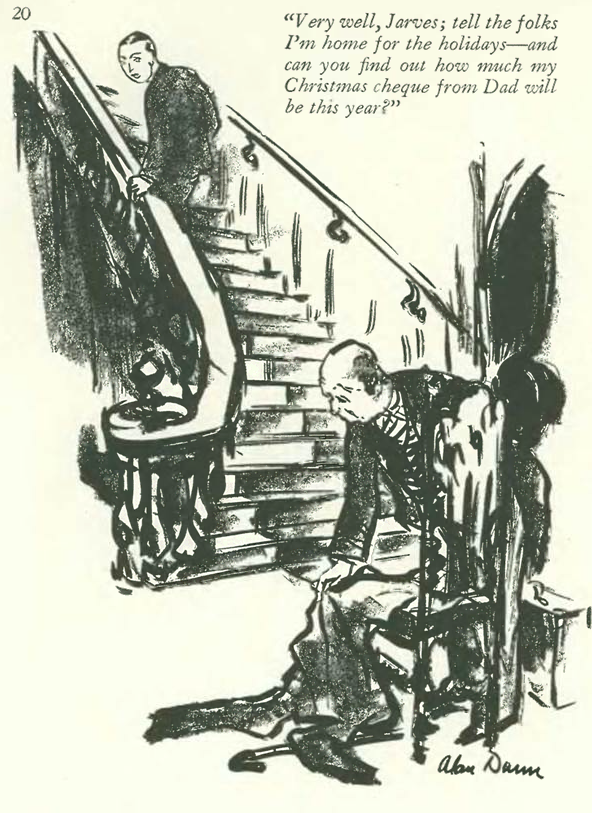
…and the same issue offers this glimpse into the life a spoiled rich kid, home from college for the holidays. The cartoon is by Alan Dunn, one of the most published New Yorker cartoonists (1,906 cartoons from 1926 to 1974)…

screen-shot-2017-02-06-at-11-52-12-am

With Christmas advertising over, the magazine’s page length dropped by half from the Dec. 17 to the Dec. 24 issue…

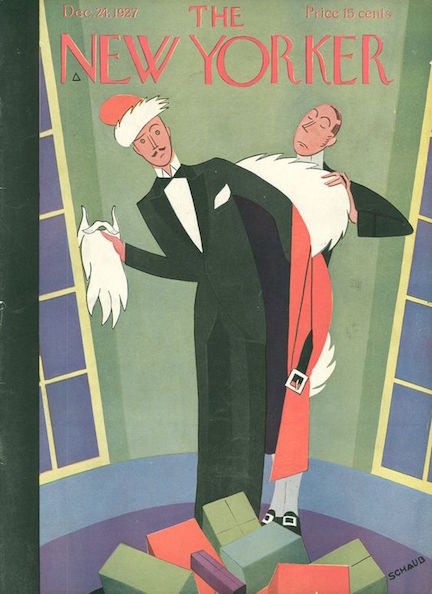
dec-24
December 24, 1927 cover by Andre De Schaub.

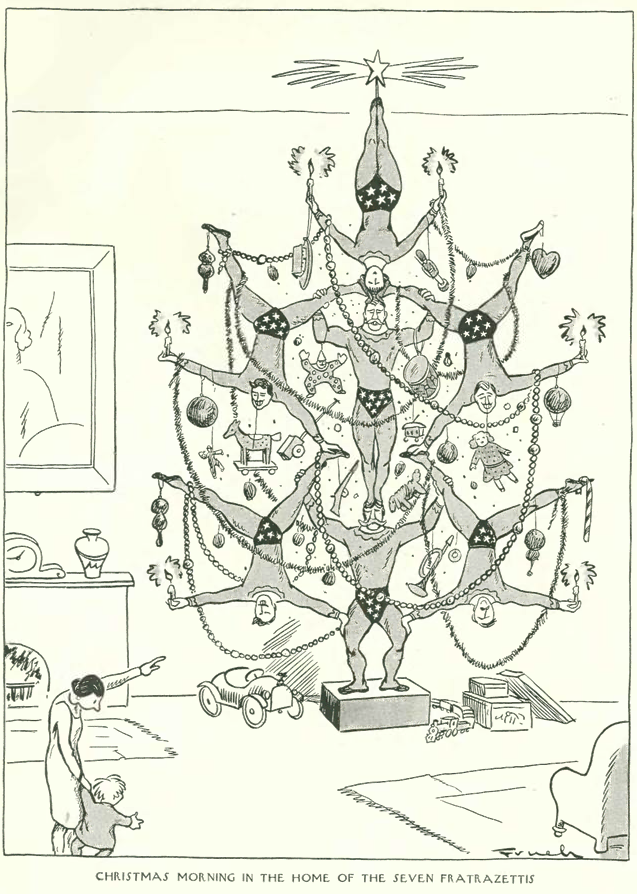
…in which we find this holiday-themed illustration by Al Frueh:

screen-shot-2017-02-06-at-12-26-56-pm

Why We Sing Auld Lang Syne

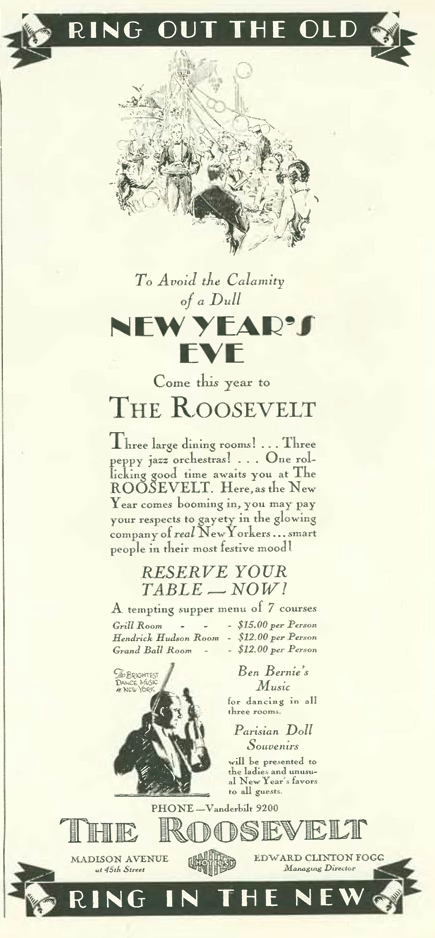
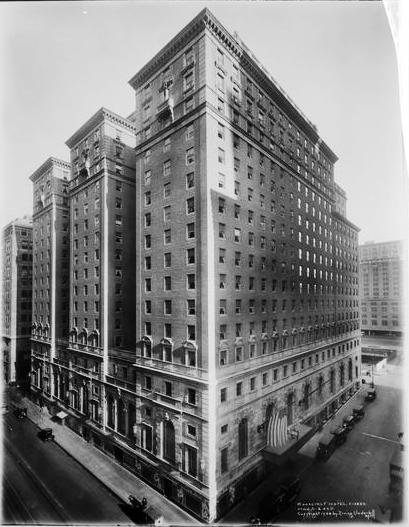
This advertisement in the Dec. 24 issue invited readers to celebrate the New Year at The Roosevelt Hotel…

screen-shot-2017-02-06-at-12-27-47-pm

roosevelt-hotel-1924
The Roosevelt Hotel after its completion in 1924 (Museum of the City of New York)
1387211957-0
AULD ACQUAINTANCE…If you want to know why we sing “Auld Lang Syne” on New Year’s Eve, you can thank Guy Lombardo and his Royal Canadian Band, which made the song a staple at his New Year’s performances beginning in 1929 at the Roosevelt Hotel. Their performance that night was broadcast on the radio before midnight Eastern time on CBS, then after midnight on NBC radio. (neatorama.com)

 *  *  *

Now Let’s Get Out of Here

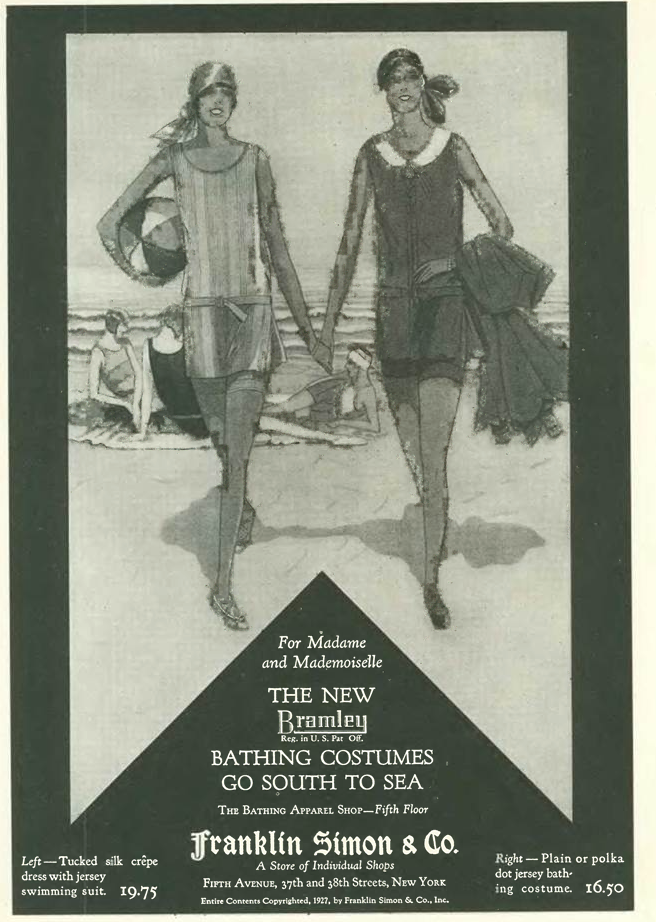
With the holidays out of the way, New Yorkers still faced a good three months of winter. That is, unless you were well-heeled enough to head south to Palm Beach. Considering the abundance of ads promoting travel to southern climes in the Dec. 24 and 31 issues, apparently many of the magazine’s readers possessed the means to do just that…

screen-shot-2017-02-06-at-12-29-05-pm

screen-shot-2017-02-06-at-12-29-15-pm

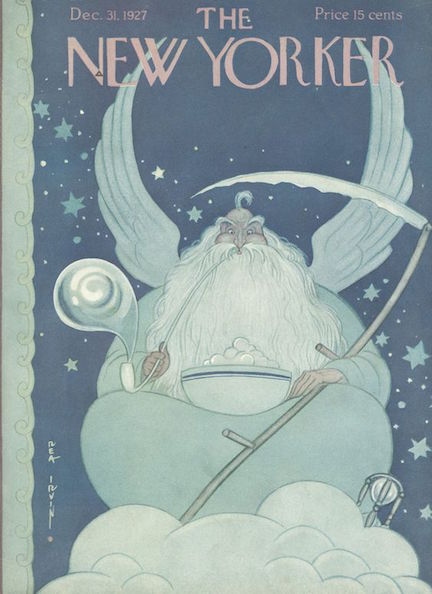
And we close this entry, and the year of 1927, with this cover…

dec-31
December 31, 1927 cover by Rea Irvin.

…and another tropical-themed advertisement, courtesy of Russeks…

screen-shot-2017-02-06-at-12-31-07-pm

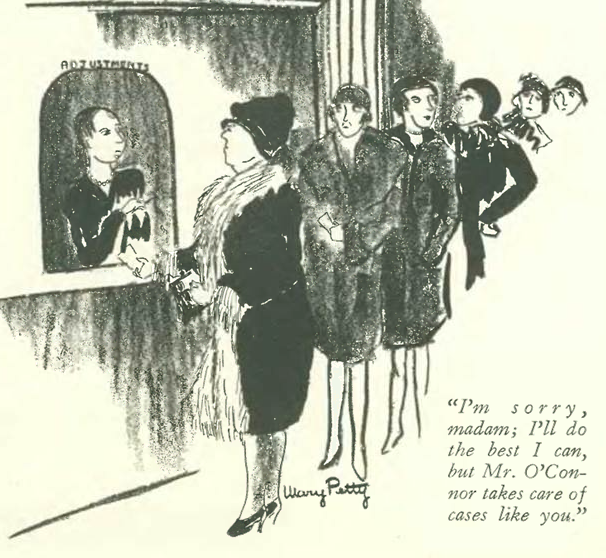
…and this cartoon by Mary Petty depicting those who were left behind, still returning their Christmas gifts…

screen-shot-2017-02-06-at-12-32-39-pm

Next Time: Odious Odes…

jan-7


All That Jazz

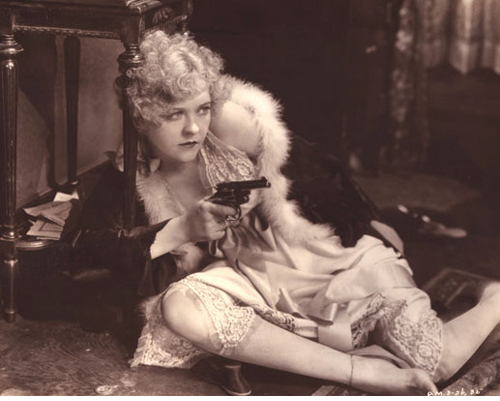
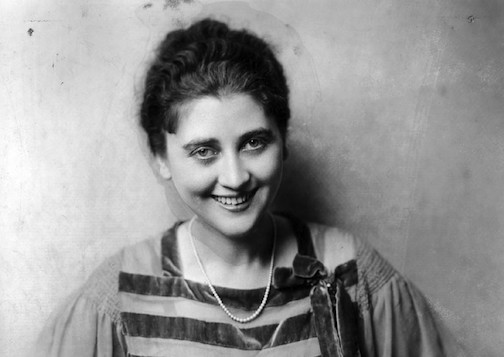
The New Yorker’s “Talk of the Town” editors were always in search of something to amuse, and in the Jan. 29, 1927 issue they found it in one Maurine Watkins, who wrote the Broadway hit musical Chicago (yes, THAT one) while still enrolled in her drama class at Yale:

Screen Shot 2016-06-21 at 12.08.32 PM

ct-flashback-chicago-murder-roxie-hart-fosse-yale-per-0315-jm-20150312
Maurine Watkins (Chicago Tribune)

Watkins transformed a brief career as a Chicago Tribune crime reporter into her Broadway success, thanks to her fondness for writing about murderers:

Screen Shot 2016-06-21 at 12.09.22 PM

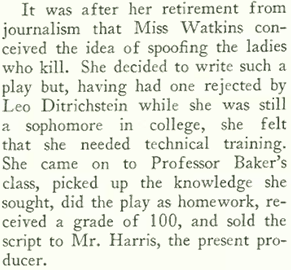
Chicago opened on Broadway in late December 1926 at the Sam Harris Theatre, where it ran for 172 performances. Watkins wrote the play as “homework” for her Yale drama class:

Screen Shot 2016-06-21 at 12.09.30 PM

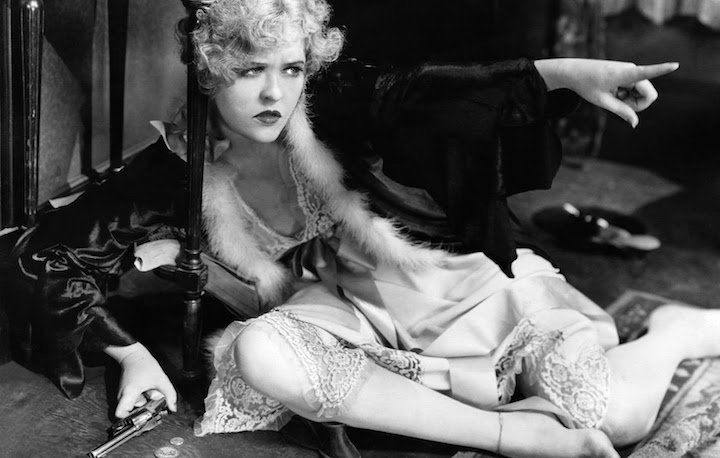
It didn’t take long for Hollywood to come calling, with Cecil B. DeMille producing a silent film version (directed by Frank Urson) in 1927.

phyllishaverroxie
Phyllis Haver as Roxie Hart from the 1927 film, Chicago. Ginger Rogers would play the role in the 1942 movie Roxie Hart, and Renée Zellweger would play the part in the 2002 film, Chicago. (chicagology)

Watkins would go on to write about twenty plays, moving on to Hollywood to write screenplays including the 1936 comedy Libeled Lady. She left Hollywood in the 1940s to be close to her parents in Florida. A lifelong Christian, Watkins spent much of her fortune funding the study of Greek and the Bible at some twenty universities, including Princeton. Following her death in 1969, her estate sold the rights to Chicago to famed choreographer and director Bob Fosse. Fosse would go on to develop Chicago: A Musical Vaudeville in 1975, which was revived in 1997 and turned into an Academy Award-winning film in 2002.

*   *   *

Winter doldrums had set into city, which was digging out of the latest snowstorm and leaving the “Talk” editors pining for spring.

b8a47deb10bba89d024899c9500bba81
January 29, 1927 cover by Ilonka Karasz.

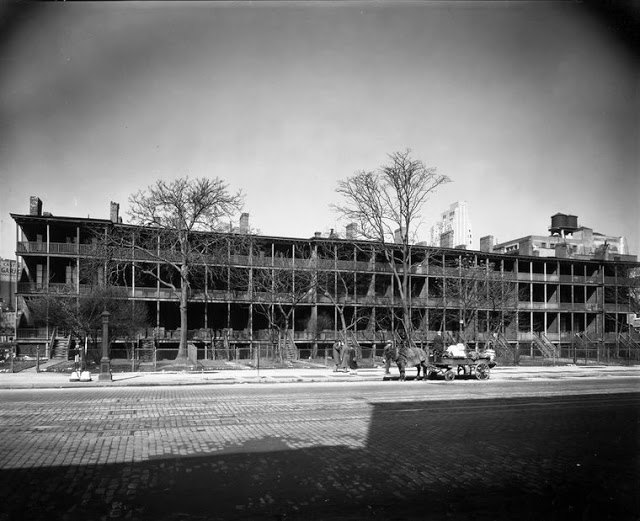
So it was unwelcome news that the green lawns along Cottage Row were to become the latest casualties of the booming city:

Screen Shot 2016-06-21 at 12.06.43 PM

According to the excellent blog Daytonian in Manhattan, around 1848 William Rhinelander filled the 7th Avenue block between 12th and 13th Streets with eleven three-story homes above “English basements.” The simple residences were intended for middle-class families and sat more than twenty feet back from the street, providing grassy lawns and garden space. During summer weather each floor had a deep veranda that provided shade and caught cooling breezes.

rhinelander row abbott March 30 1936
This 1936 photograph by Berenice Abbott shows the abandoned “Cottage Row.” (Library of Congress)

As it turned out, the green lawns won a brief reprieve: By the time developers got around to building an apartment on the site, the Depression hit and left Cottage Row standing for another ten years. It was demolished in 1937, replaced not by an apartment building but rather by a gas station and used car lot, which were replaced in 1964 by the Joseph Curran Building (now the Lenox Hill Healthplex):

Lenox-Hill-Exterior-1000x600
Today the Cottage Row site is occupied by the 1964 Joseph Curran Building (now the Lenox Hill Healthplex). Albert C. Ledner, a New Orleans architect, fancifully evoked seafaring themes in his design of the Curran Building, which originally housed the headquarters of the National Maritime Union. (MCD Magazine)

* * *

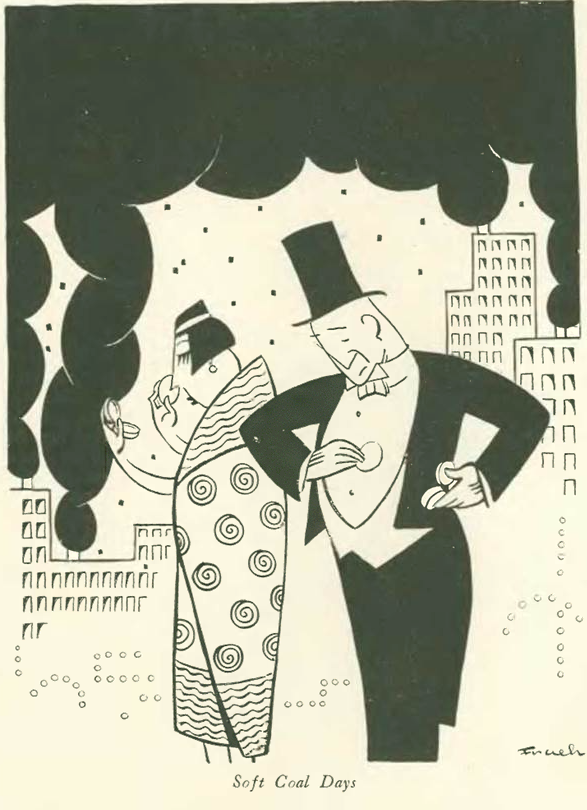
The winter drear was further compounded by the sooty smog that lingered over the city, fed by so many coal-fired furnaces. The “Talk” editors noted:

Screen Shot 2016-06-21 at 12.07.00 PM

Screen Shot 2016-06-21 at 12.06.53 PM

Screen Shot 2015-10-30 at 9.52.10 AM
A PERENNIAL NUISANCE…This Al Frueh drawing originally appeared in the Feb. 27, 1926 issue of the magazine.

To read more about “soft coal days,” see my previous post, “A Fine Mess.”

* * *


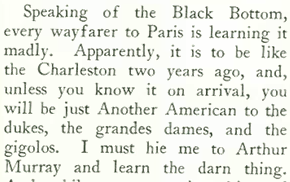
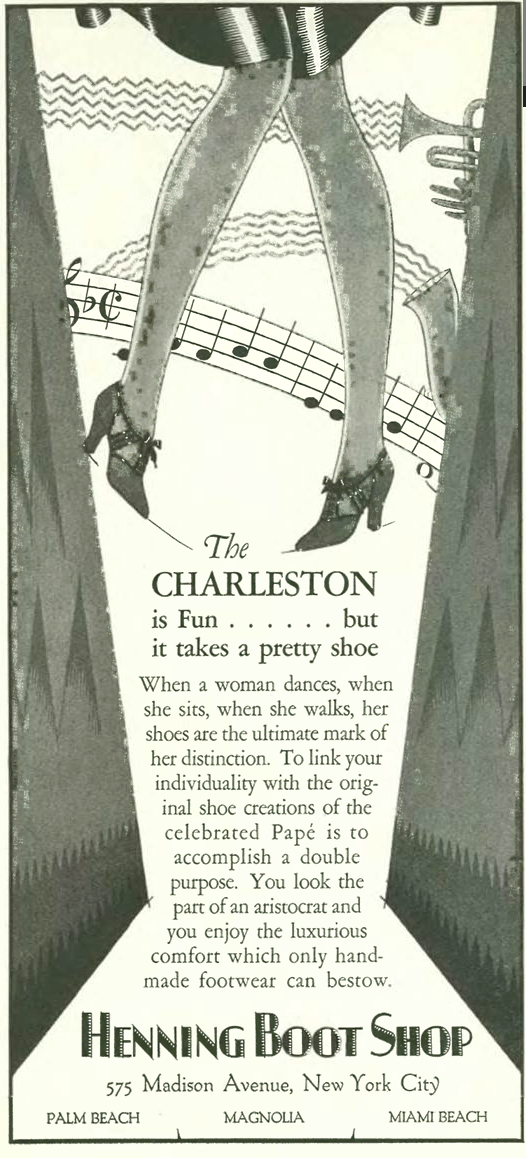
Columnist Lois Long (“Tables for Two”) was contemplating dance lessons to learn the “Black Bottom,” the dance craze that supplanted “The Charleston” in 1926.

Screen Shot 2016-06-21 at 12.17.23 PM

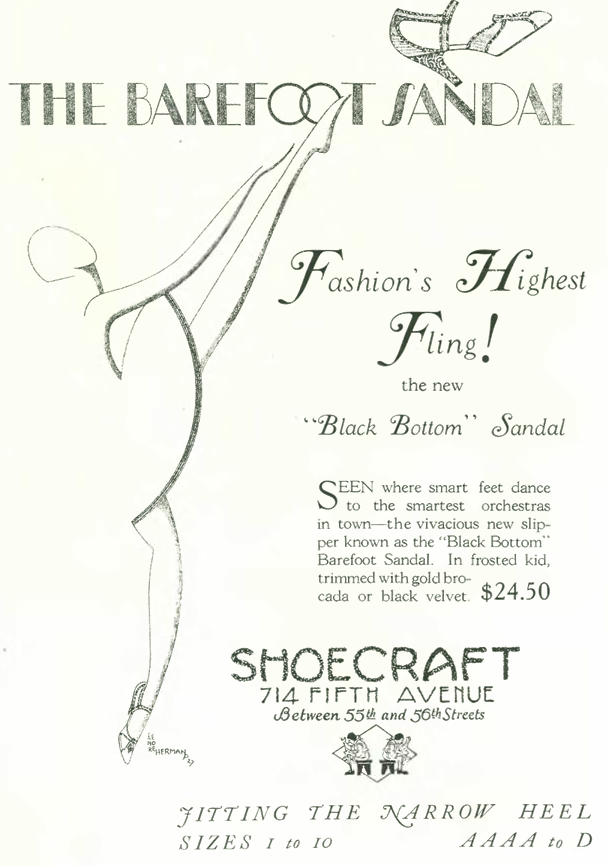
Apparently the dance called for special shoes, per this advertisement from the same issue:

Screen Shot 2016-06-21 at 11.53.19 AM

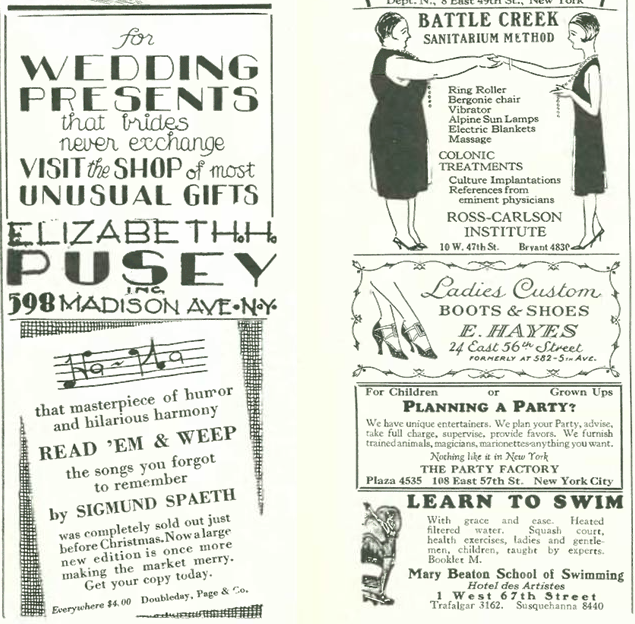
Up to now I’ve been posting images of often lavish ads featured mostly in the first sections of the magazine and on the front and back inside covers, but there were other, less expensive (and less artful) ads sprinkled in the back pages of the magazine, a tradition that continues to this day:

Screen Shot 2016-06-21 at 12.27.14 PM

Next Time: Spring Fever…

e4051b8c99ab27eb2272f12bb1634373


Fight Night in Philly

We skip ahead to the Oct. 2, 1926 issue to look at one of the big events of that year–the Dempsey-Tunney heavyweight prize fight (I’m not skipping issues…Sept. 25 appears later in this blog).
652f917918402a71eb86f6671c9f228a
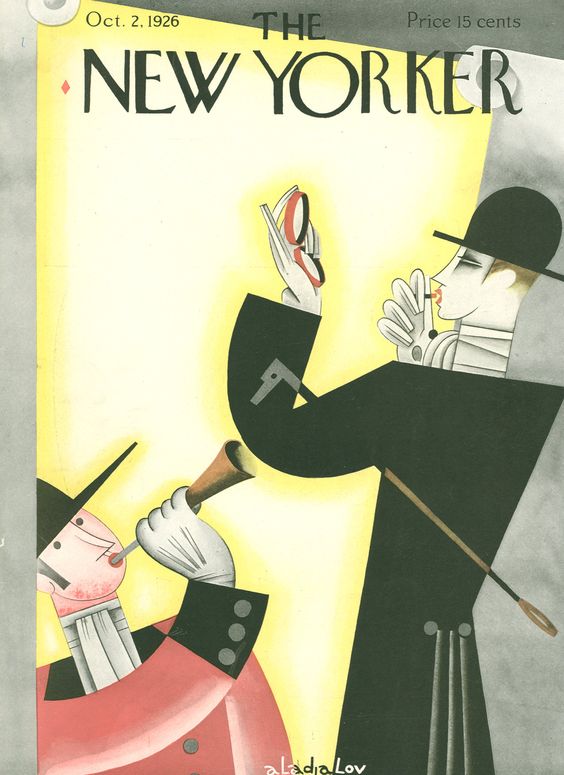
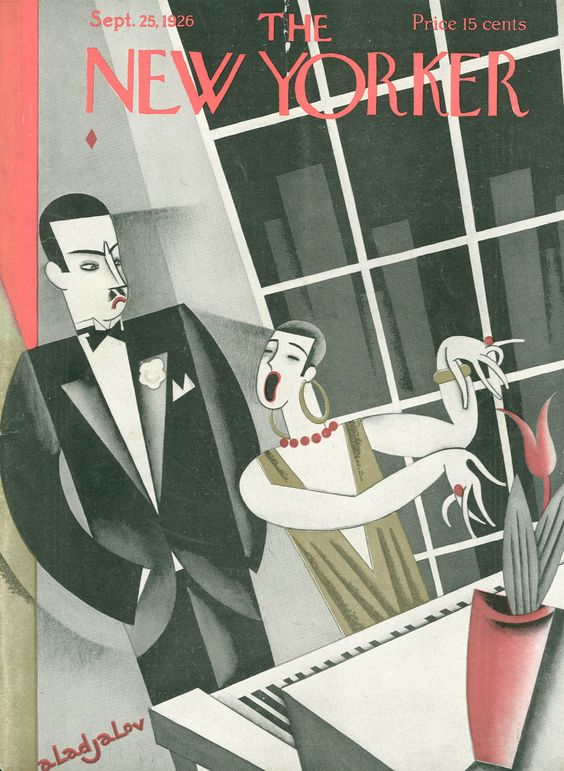
Oct. 2, 1926 – Issue # 85 – Cover by Constantin Alajalov. (Once again, note the ongoing comic reference to androgyny in 20’s fashion)
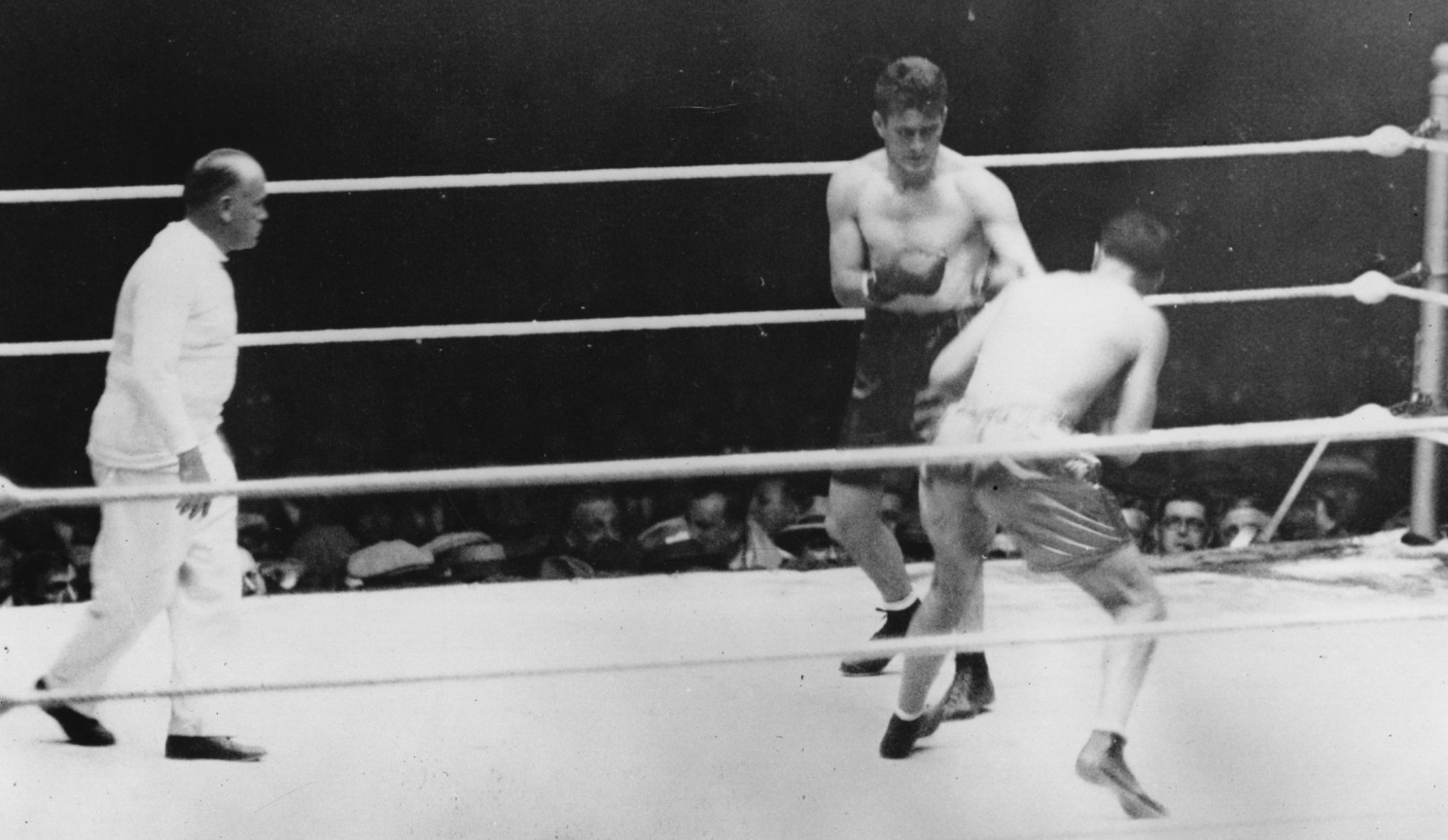
Heavyweight boxing was a big part of the American sports scene in the 1920s, and two giants of the sport, Jack Dempsey and Gene Tunney, dominated the headlines in the late 1920s thanks to much-heralded bouts in Philadelphia in 1926 and a rematch in Chicago the following year (which would include the famous “long count” incident).
Screen Shot 2016-02-26 at 12.30.40 PM
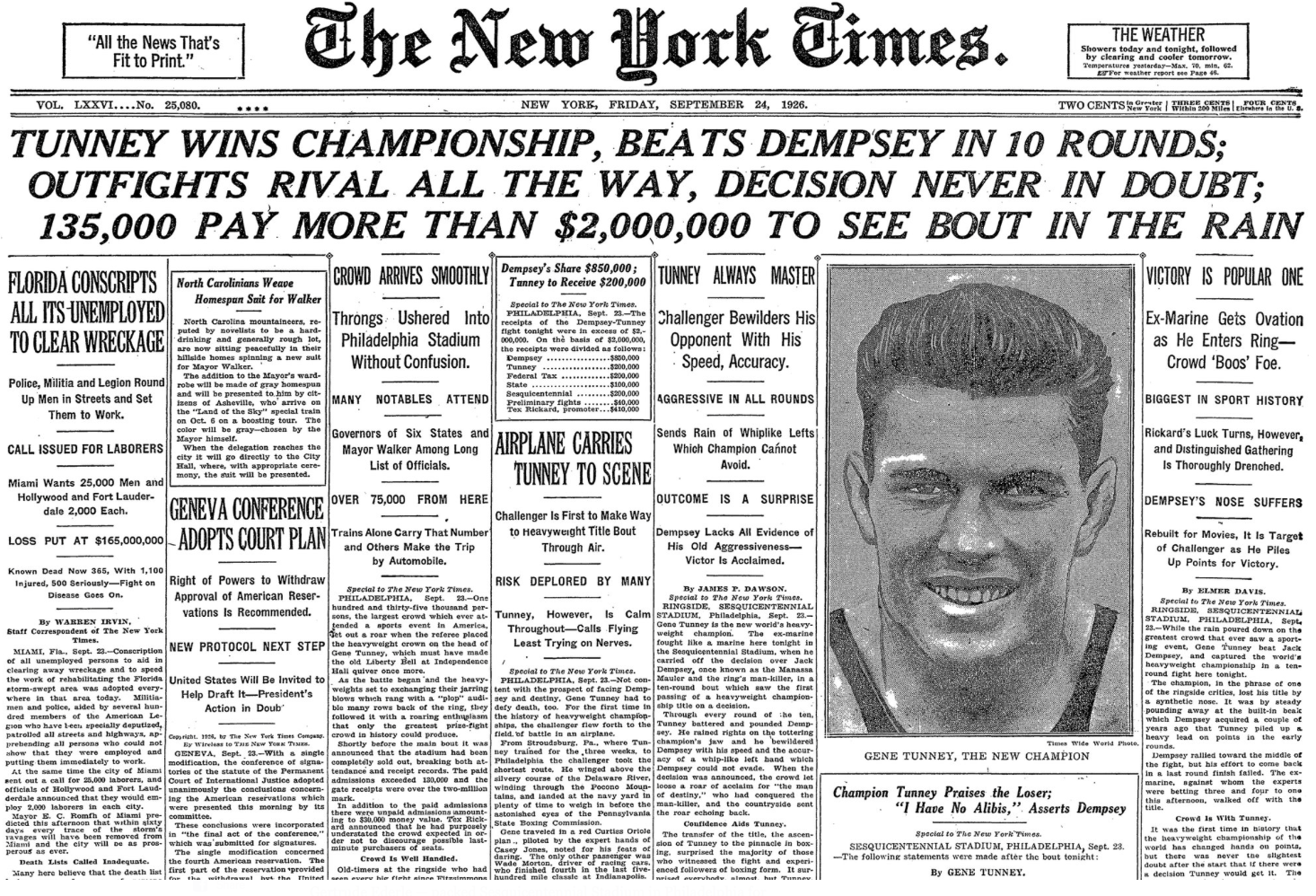
An estimated 135,000 fans packed Sesquicentennial Stadium in Philadelphia for the Dempsey-Tunney bout. (NYTimes)
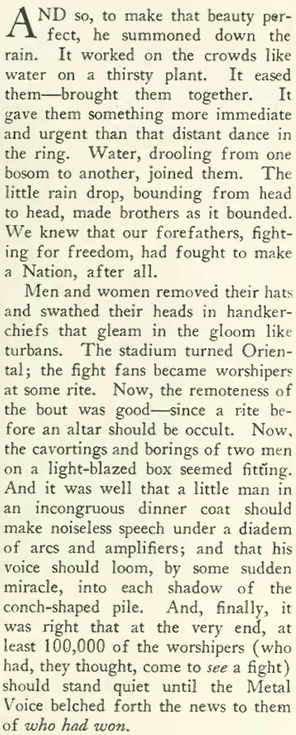
The New Yorker joined in on the hoopla, publishing a lengthy account of the match by Waldo Frank (aka “Search-light”), who trained his jaded eye on the whole affair:
Screen Shot 2016-02-25 at 4.28.32 PMScreen Shot 2016-02-25 at 4.28.39 PM
MediaStream.ashx
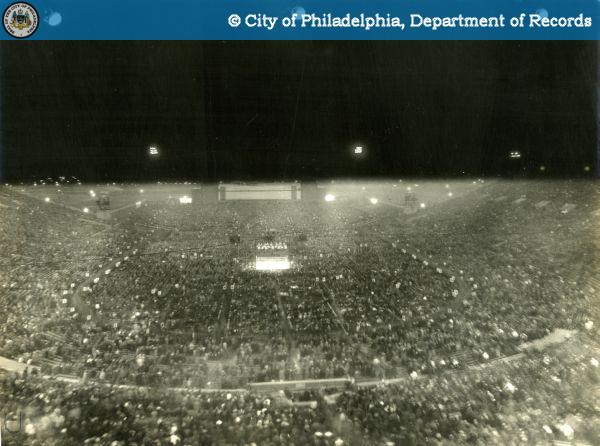
VIEW FROM THE CHEAP SEATS…a rain-soaked throng at the Dempsey-Tunney fight in Philadelphia. (City of Philadelphia)
According to the New York Times, the crowd included such notables as Charlie Chaplin, cowboy movie star Tom Mix and the English Channel swimmer Gertrude Ederle.
Screen Shot 2016-02-26 at 12.13.08 PM
Coverage of Tunney’s victory by unanimous decision took up three-quarters of the front page of The New York Times, and also filled most of pages 2 through 7. (The New York Times)
But in typical fashion, Waldo was less than dazzled, finding the rain an apt metaphor for a spectacle mostly unseen by those in attendance:
Screen Shot 2016-02-25 at 4.27.50 PM
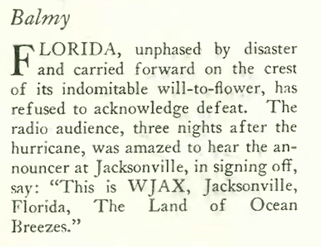
Never one to wallow in tragedy, the magazine made a brief (and oddly droll) reference in “The Talk of the Town” to a hurricane that hit Miami and its environs (it killed 372 people and injured more than 6,000):
Screen Shot 2016-02-25 at 4.16.52 PM
Other items of note in the issue included this examination of country vs. city life by cartoonist Barbara Shermund
Screen Shot 2016-02-25 at 4.21.56 PM
…and this cartoon by Al Frueh commenting on the challenges of Manhattan’s rapidly changing cityscape:
Screen Shot 2016-02-25 at 4.18.53 PM
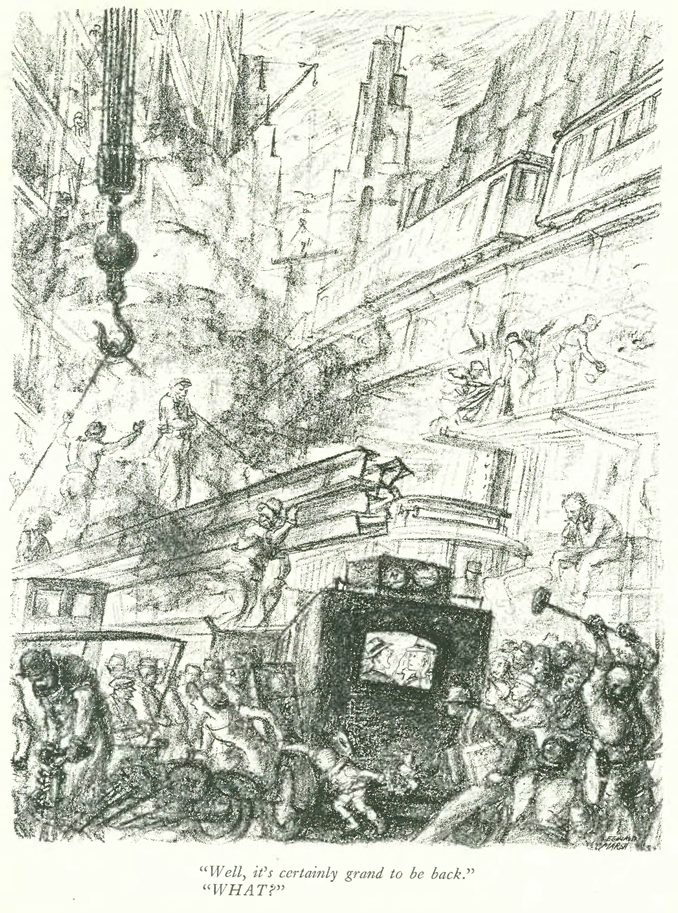
The changing city was also on the mind of Reginald Marsh in this illustration he contributed to the Sept. 25, 1926 issue of the magazine:
Screen Shot 2016-02-25 at 4.02.32 PM
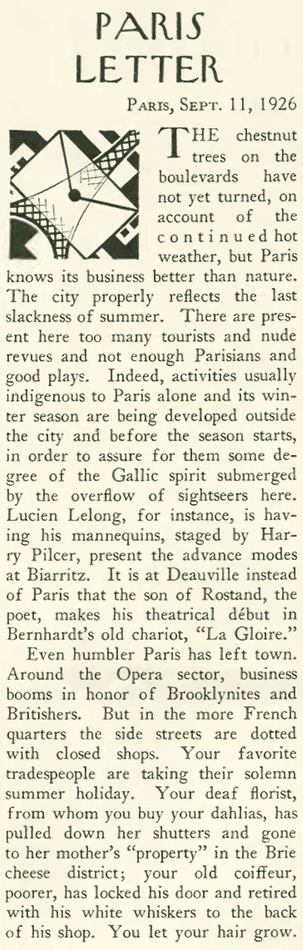
Back to the Sept. 25 issue, which featured an update from Paris correspondent Janet Flanner
d9f3d5507a7bade4fc28276d12a63260
Sept. 25, 1926 – Issue # 84 – Cover by Constantin Alajalov.
…who commented on the large number of American tourists crowding the city just as the locals were fleeing for their long, late summer holidays:
Screen Shot 2016-02-25 at 4.07.13 PM
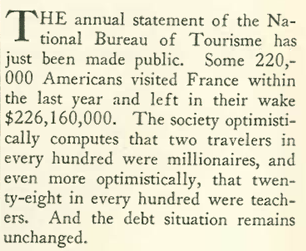
She offered some numbers to back up her observations:
Screen Shot 2016-02-25 at 4.07.43 PM
3333095832_f6a6fd78cb_o
Janet “Genêt” Flanner (right) and longtime companion Solita Solano (center) in Paris, 1921. Solano was a well-known writer and drama critic for the New York Tribune. (Vintage Everyday)

And finally, a cartoon by Rea Irvin exploring the trials of the idle rich:

Screen Shot 2016-02-25 at 4.01.32 PM
 Next Time: Do Gentlemen Prefer Blondes?
848d031119e0d470956ce963e6e7fb62

What to Drink During Prohibition

The Roaring Twenties were a strange confluence of the Puritan and libertine, perhaps best represented by Prohibition and the speakeasy night life it inspired. Many if not most of The New Yorker readers of the late 1920s were familiar with these establishments as well as with reliable bootleggers and rum runners. And for those of you following this blog we all know that “Tables for Two” columnist Lois Long was the voice of speakeasy and New York nightlife.

Screen Shot 2015-12-17 at 1.51.20 PM
May 29, 1926 cover by Stanley W. Reynolds.

Prohibition did not make consumption of alcohol illegal. The 18th Amendment prohibited the commercial manufacture and distribution of alcoholic beverages, but it did not prohibit their use.

So if you had a connection to a smuggler bringing whisky from Scotland via Canada, for example, you could enjoy a Scotch at home without too much trouble, although the prices could be high. “The Talk of the Town” editors regularly reported black market wine and liquor prices (I include an adjoining Julian de Miskey cartoon):

Screen Shot 2015-12-18 at 11.53.01 AM

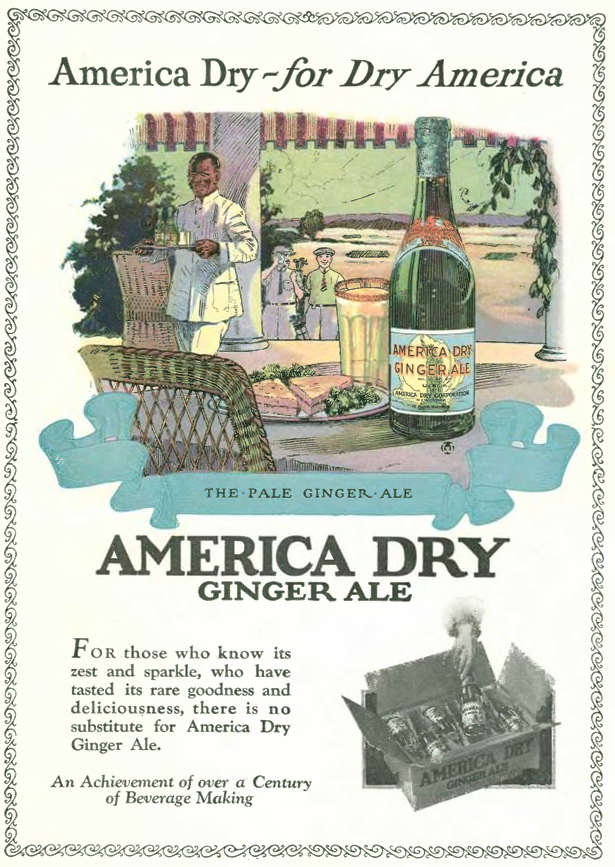
Note the mention of pocket flasks, which were an important item in a purse or vest pocket when one went to a nightclub or restaurant, where White Rock or some other sparkling water was sold as a mixer for whatever you happened to bring with you. You see a lot of this type of advertisement in the Prohibition-era New Yorker:

Screen Shot 2015-12-18 at 12.11.14 PM

I’ll bet those grinning golfers have something in their bags besides clubs.

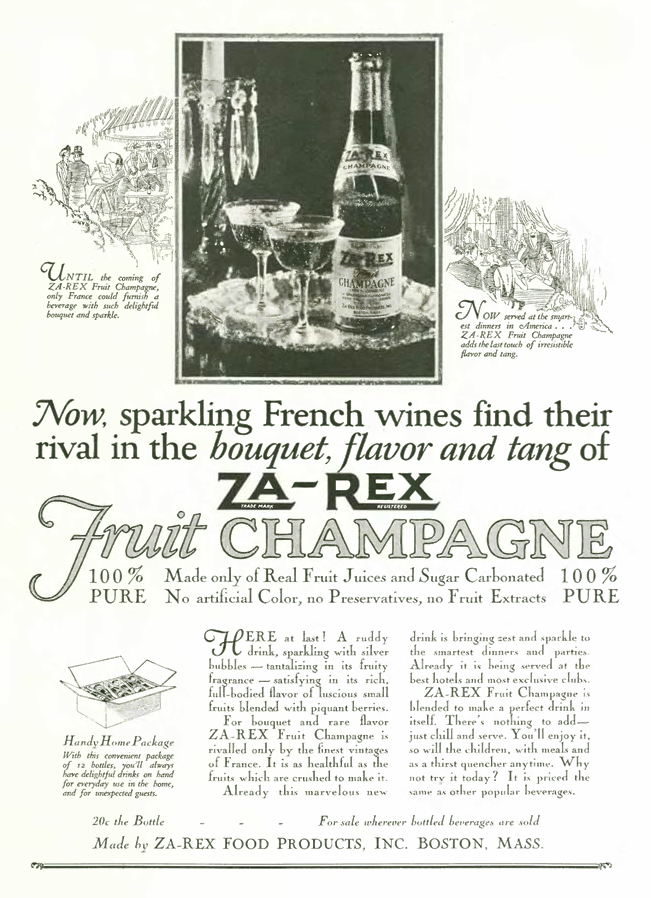
And then there were ads like these, which I find quite sad:

Screen Shot 2015-12-18 at 12.12.11 PM

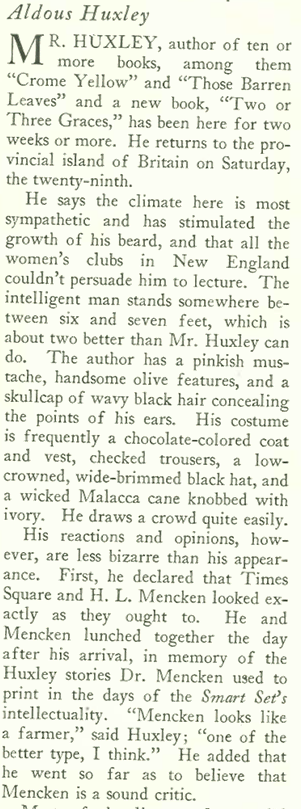
“The Talk of the Town” also commented on the recent visit of British writer Aldous Huxley, who told his New York hosts that he admired American writers Willa Cather and Sherwood Anderson, and he also had praise for writer and critic H.L. Mencken, whom he likened to a farmer “of the better type:”

Screen Shot 2015-12-18 at 11.48.18 AM

Aldous Huxley in the 1920s. (Biography.com)

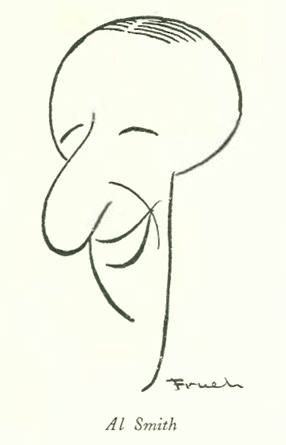
Other odds and ends from this issue…a clever drawing by Al Frueh for the “Profile” feature on New York Governor Al Smith:

Screen Shot 2015-12-18 at 12.06.42 PM

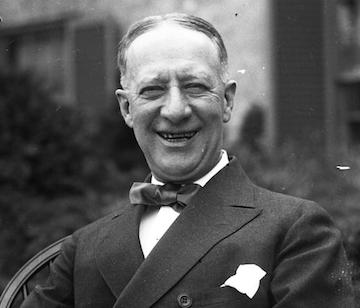
A photo of Al Smith for comparison:

al
New York Gov. Al Smith (IMDB)

And this bit from “Of All Things,” complete with bad pun/racial slur:

Screen Shot 2015-12-18 at 12.05.53 PM

New Yorker readers in 1926 had little reason to believe that in a decade Benito Mussolini would try to make good on his statement and join Adolf Hitler in the next world war.

Here’s a couple more ads from the issue that are signs of those times. Note the listing of Florida locations for those New Yorkers who were flocking to that new winter vacation destination:

Screen Shot 2015-12-18 at 12.09.48 PM

And this ad for an electric refrigerator…for those who could afford such newfangled things. The ice man was still plenty busy in 1926, but his days were numbered.

Screen Shot 2015-12-18 at 12.09.15 PM

And finally, a nod to springtime, and this excerpt of an illustration by Helen Hokinson for the “Talk” section:

Screen Shot 2015-12-18 at 12.07.27 PM

Next Time: After a Fashion…

Screen Shot 2015-12-18 at 12.12.38 PM

That Sad Young Man

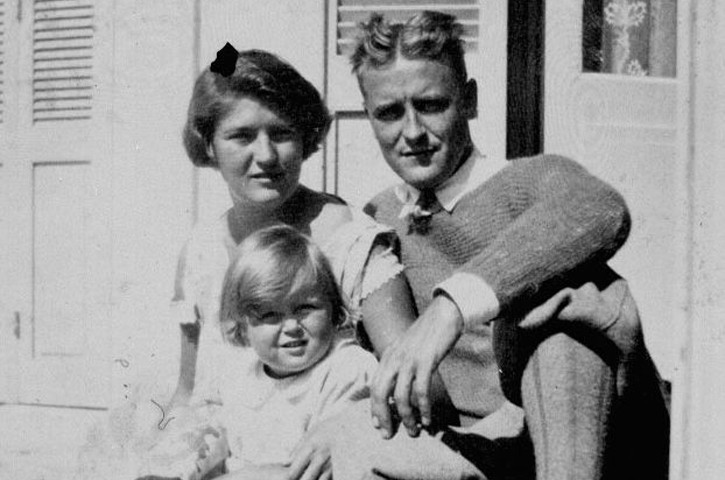
The “sad young man” in question was none other than F. Scott Fitzgerald, who was profiled by John Mosher (who would succeed Theodore Shane as film critic) in the April 17, 1926 issue of The New Yorker.

Screen Shot 2015-12-01 at 12.12.47 PM
April 17, 1926 cover by Clayton Knight.

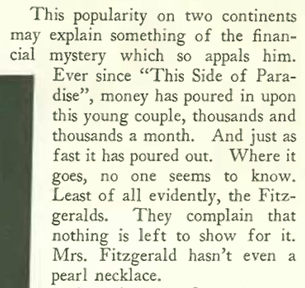
Mosher wrote that Scott believed he was “getting on in years,” even though he was only 29 years old and had recently published The Great Gatsby (which had received a brief, lukewarm review from The New Yorker in 1925). Mosher observed that the novelist and his wife, Zelda, famous on two continents and with money pouring in from the publication of This Side of Paradise, nevertheless complained of being broke:

Screen Shot 2015-12-10 at 9.16.00 AM

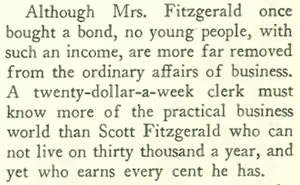
It was noted however that the couple had little financial sense:

Screen Shot 2015-12-10 at 9.16.24 AM

Mosher found Fitzgerald to be a grave, hardworking man, and seemed to sense the melancholy that would lead to madness (in Zelda’s case), alcoholism and an early grave (Fitzgerald would be dead in 14 years).

Screen Shot 2015-12-10 at 9.57.34 AM
Illustration of Fitzgerald by Victor De Pauw for the April 17 “Profile.”

In this issue we were also introduced to Peter Arno’s “Whoops Sisters,” although they are not yet identified here by that title:

Screen Shot 2015-12-10 at 9.22.43 AMAccording to New Yorker cartoonist Michael Maslin, “in 1925, The New Yorker published nine Arno drawings. In 1926, it ran seventy-two. The enormous jump was due to the wild success of two cartoon sisters Arno created: Pansy Smiff and Mrs. Abagail Flusser, otherwise known as The Whoops Sisters. The Sisters were not sweet little old ladies — they were naughty boisterous grinning “wink wink, nudge nudge” sweet little old ladies, their language laced with double entendres.”

Screen Shot 2015-12-10 at 9.27.23 AM
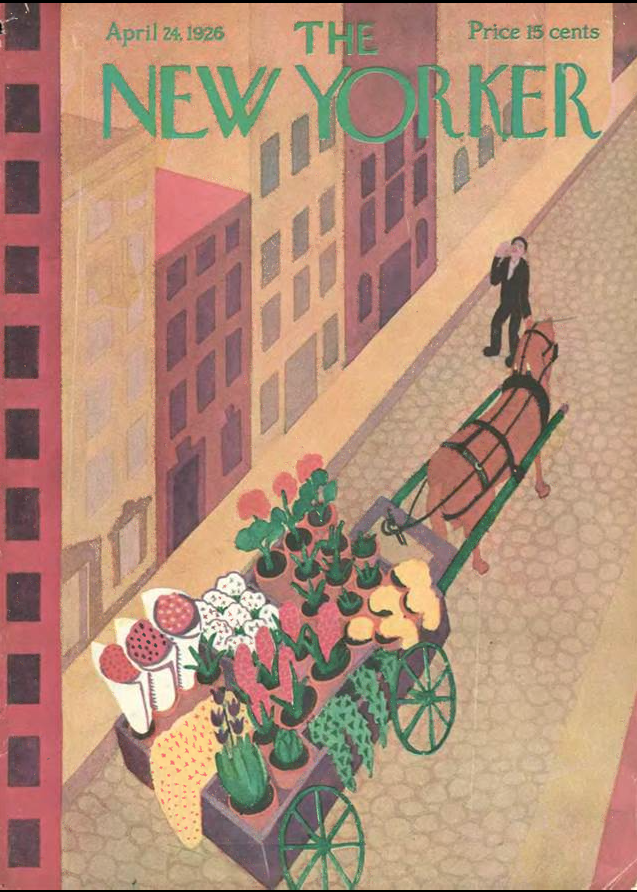
April 24, 1926 cover by Ilonka Karasz.

In the April 24, 1926 issue, the dyspeptic film critic Theodore Shane took aim at Cecil B. DeMille’s The Volga Boatman:

Screen Shot 2015-12-10 at 9.35.21 AM

00250
VOLGA HOKUM…Elinor Fair and Victor Varconi in The Volga Boatman. (Virtual History)

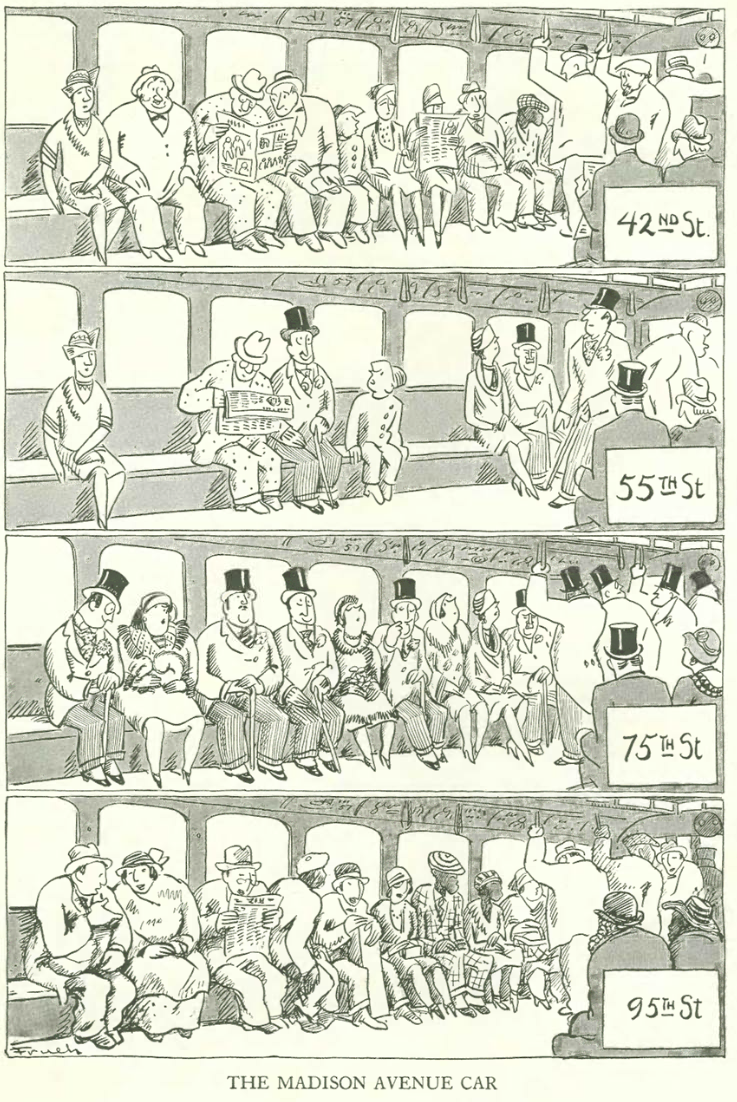
Also in this issue, Al Frueh’s interpretation of New York’s social strata via the city’s Madison Avenue train stops:

Screen Shot 2015-12-10 at 9.30.53 AM

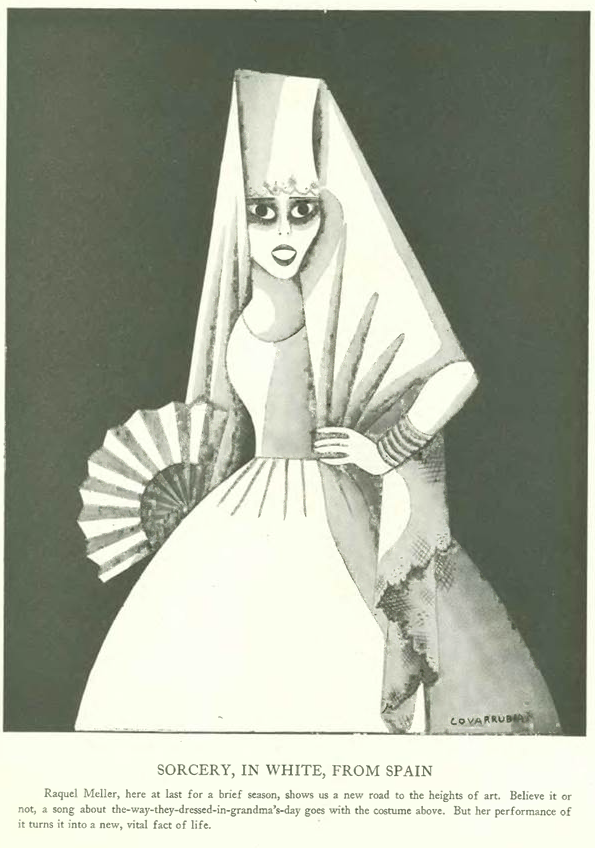
Near the theatre section, this illustration of famed Spanish singer and actress Raquel Meller, as rendered by Miguel Covarrubias:

Screen Shot 2015-12-10 at 9.32.18 AM

And a photo of Meller from the 1920s that looks like it could have been taken yesterday:

8635eeb0
(rameller.tripod.com)

An international star in the 1920s and 1930s, Meller appeared in several films and sang the original version of the well known song La Violetera.

Next Time: The Circus Comes to Town…

Screen Shot 2015-12-10 at 9.36.31 AM

Technicolor World

Screen Shot 2015-11-03 at 5.01.33 PM
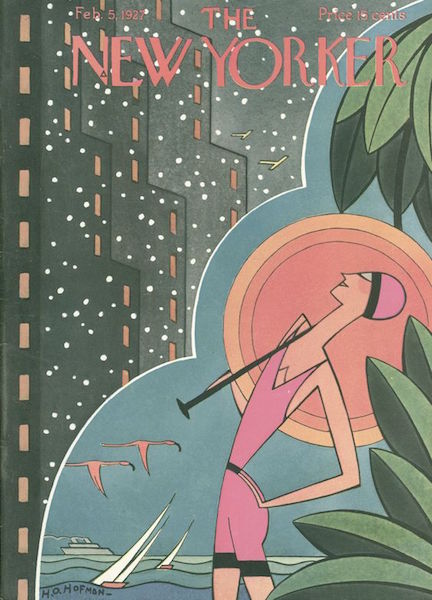
March 13, 1926 cover by H.O. Hofman.

Although the trade name “Technicolor” conjures up images of mid-century Hollywood, the process was actually invented in 1916 and developed over  subsequent decades.

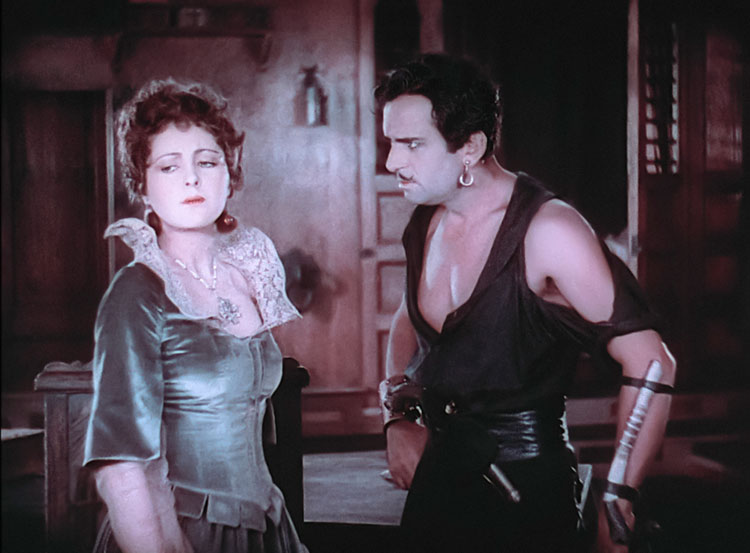
Early Technicolor was a complicated process, using a prism beam-splitter behind the camera lens to simultaneously expose two consecutive frames of a single strip of black-and-white negative–one behind a red filter, the other behind a green filter. A projectionist had to be highly skilled to keep the film aligned during its showing. The Black Pirate, however, used a later technique that cemented the two prints together, making for a thick film that was prone to bulging and distortion.

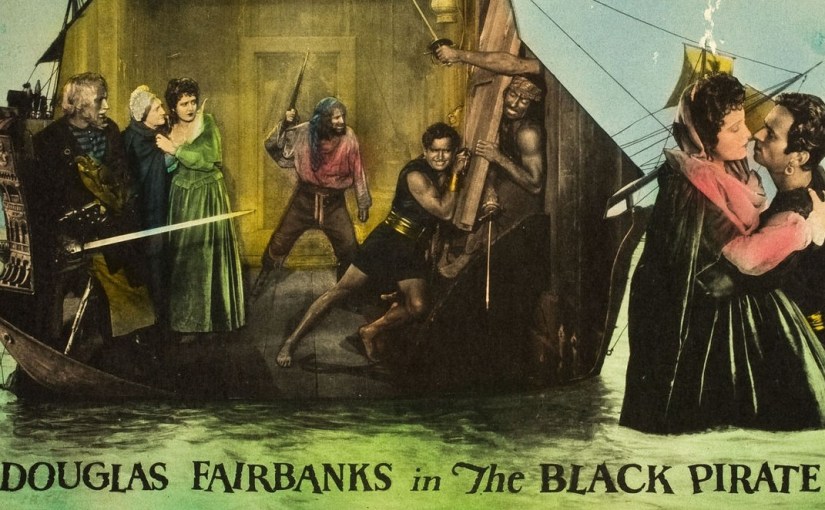
When the New Yorker’s Theodore Shane reviewed Douglas Fairbanks’ latest swashbuckler film, The Black Pirate, in the March 13, 1926 issue, it appeared that after ten years of development the Technicolor process had a long way to go:

Screen Shot 2015-11-13 at 10.51.29 AM

The-Black-Pirate-18117_1
DEAR, YOU LOOK A BIT PEAKY…Billy Dove and Douglas Fairbanks rendered in early Technicolor in The Black Pirate. (MovieMail.com)

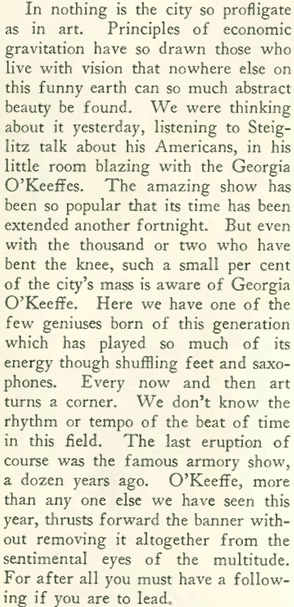
Art critic Murdock Pemberton wrote about the genius of the young artist Georgia O’Keeffe, whose work was on display at husband Alfred Stieglitz’s new exhibition space, the Intimate Gallery:

Screen Shot 2015-11-13 at 10.21.22 AM

hb_69.278.1
Georgia O’Keeffe’s Black Iris, 1926. (Metropolitan Museum of Art)

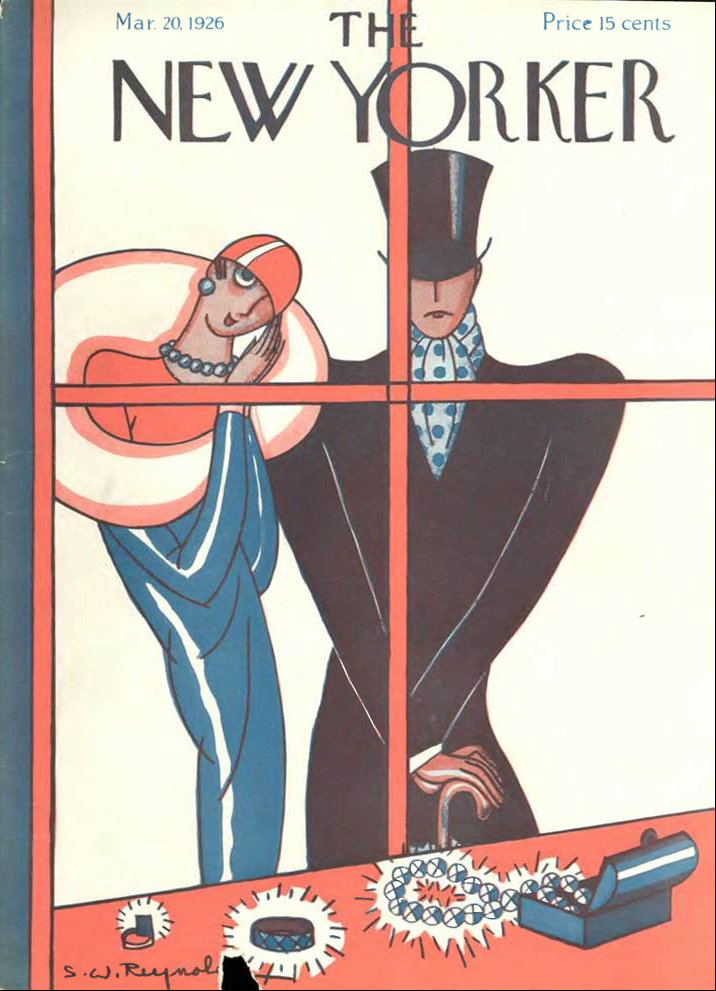
On to the March 20 issue, boldly illustrated by S.W. Reynolds, who contributed a number of deco-themed covers for the magazine:

Screen Shot 2015-11-13 at 10.40.51 AM
March 20, 1926 cover by S.W. Reynolds.

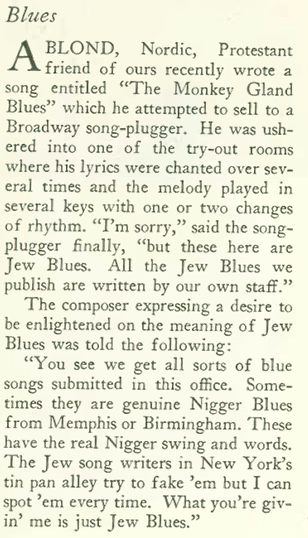
For all The New Yorker’s progressive wit and style, you are occasionally reminded that some of its sensibilities were still very much mired in those times. For example, this bit from the issue’s “The Talk of the Town” segment:

Screen Shot 2015-11-13 at 10.43.11 AM

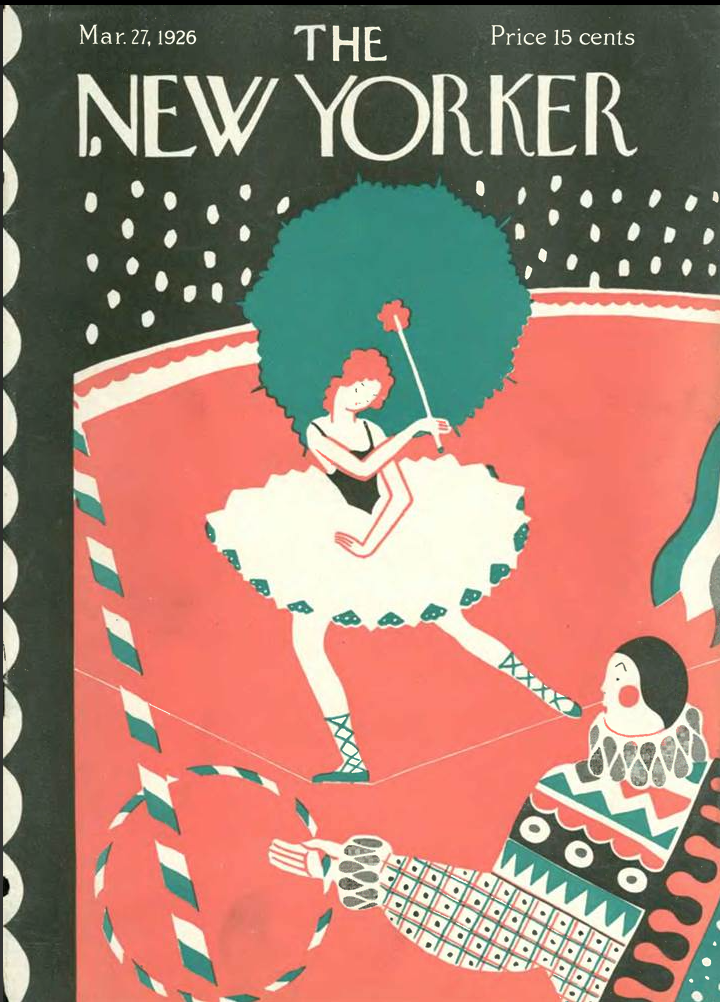
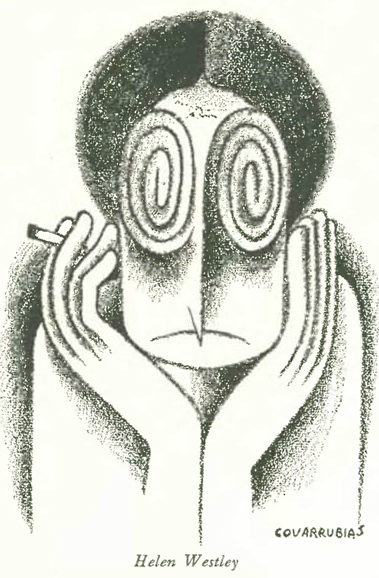
The March 27 issue offered a profile of actress Helen Westley, who was described by writer Waldo Frank (pen name “Search-light”) as “a goddess of our city” whose  “true value and her art (was) her personal life.”

Screen Shot 2015-11-13 at 10.53.18 AM
March 27 cover by Ilonka Karasz.

Wesley often played a stern, indomitable character who wore a hawk-like glare, and in her later years portrayed dour dowagers and no-nonsense matrons. Frank wrote that while Wesley was not a particularly good actress, she lived her life with a spirit for adventure and a need to plunge her fine-born, gracious manner into the “frowsy” world of Broadway.

Screen Shot 2015-11-13 at 2.04.52 PM
A Miguel Covarrubias rendering of Helen Wesley for the “Profiles” piece.

And to close, Al Frueh’s take on a day in the life of a doorman:

Screen Shot 2015-11-13 at 2.24.09 PM

Next Time: Parisians and Puritans…

Screen Shot 2015-11-13 at 2.25.59 PM

Life of a Rum Runner

Screen Shot 2015-10-30 at 10.13.15 AM
March 6 cover by S.W. Reynolds.

Although they didn’t know it, thirsty New Yorkers still had more than six and half of years of Prohibition to endure, and business was brisk for the rum runners who plied the coastal waters.

The March 6, 1926 issue featured the article “Rum Runners Must Live,” in which writer Emile C. Schnurmacher described the heroic efforts of bootleggers and rum runners in keeping New York’s countless speakeasies (and many home liquor cabinets) well stocked. Some 30,000 speakeasies were opened in New York City alone during the Prohibition era.

Schnurmacher described the risky game of running “overboard stuff:”

Screen Shot 2015-11-03 at 4.40.45 PM

Screen Shot 2015-11-03 at 4.40.57 PM

He told of how one rum-running boat, the Sea Bird, made its way through Flushing Bay (to pick up bootleg Scotch) while evading the Coast Guard:

Screen Shot 2015-11-03 at 4.49.39 PM

The boat later successfully delivered the “Scotch” near Yankee Stadium:

Screen Shot 2015-11-03 at 4.53.52 PM

“The Talk of the Town” offered its regular update on bootleg prices. The local “synthetic” gin was reported to be of better quality than the imports, surprising given that synthetics poisoned a good number of folks back then:

Screen Shot 2015-11-03 at 4.24.16 PM

The blog Speakeasy Science notes that during Prohibition, police department chemists, “analyzing the so-called gin in the Brooklyn bar and around the city, reported that much of it was industrial alcohol, re-distilled to try to remove the wood alcohol content. The re-distilling was not notably successful. The poisonous alcohol remained and there was more: the chemists had detected traces of kerosene and mercury, and disinfectants including Lysol and carbolic acid in the beverages.”

800px-McCoy
HE HAD THE GOOD STUFF…Not all bootleg was poison. Until he was busted in 1923 by government agents, one of the most famous purveyors to wealthy buyers was rum-runner William McCoy. (US Coast Guard)
Prohib_29
In order to destroy evidence, the crew of the rum-runner Linwood set fire to their vessel after being pursued by a patrol boat. (Photo circa 1923, U.S. Coast Guard)

In “Tables for Two,” Lois Long paid a visit to the Algonquin hotel and took some playful swipes at the denizens the famed Round Table:

Screen Shot 2015-11-03 at 4.56.54 PM

Screen Shot 2015-11-03 at 4.57.03 PM

fairbankssrdouglas02
IS THAT YOU DOUG? Silent screen star Douglas Fairbanks could relax unmolested in the quiet confines of the Algonquin. (Meredy.com)

At the movies, Theodore Shane took deadly aim at the silent film version of the opera La Bohème:

Screen Shot 2015-11-03 at 4.59.33 PM

Screen Shot 2015-11-03 at 4.59.41 PM

09195167aac69af7150fc7800c86c26a
A “pop-eyed” John Gilbert and Lillian Gish in the 1926 silent film version of La Bohème. (IMDB)

And finally, Al Frueh’s sympathetic take on the wintertime toils of the rich:

Screen Shot 2015-11-03 at 4.25.29 PM

Next time: A Technicolor World…

Screen Shot 2015-11-03 at 5.01.33 PM