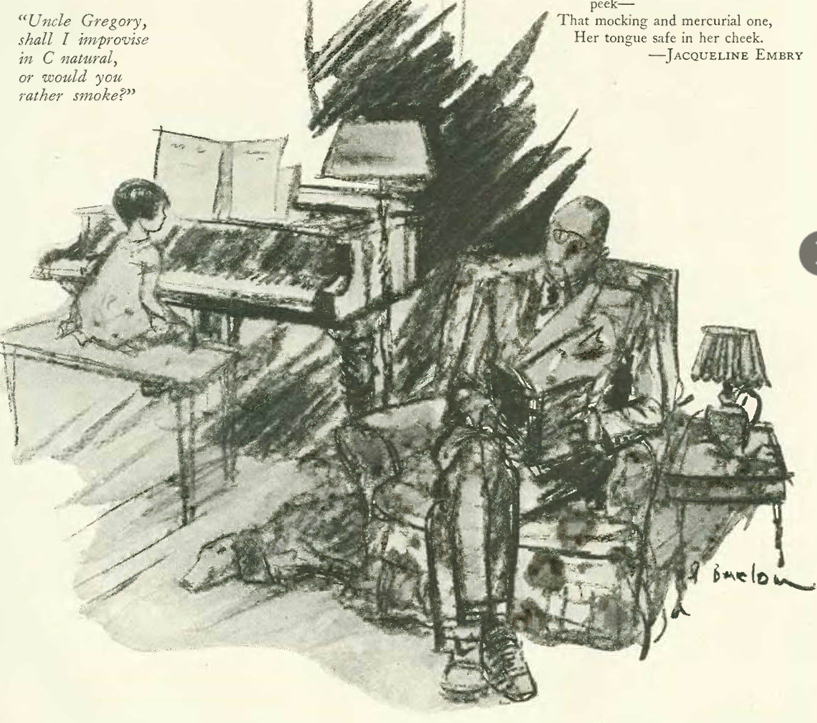
Mrs. Parker and the Vicious Writer

As a book reviewer for The New Yorker, Dorothy Parker could eviscerate any writer with the tip of her pen, and often did so.
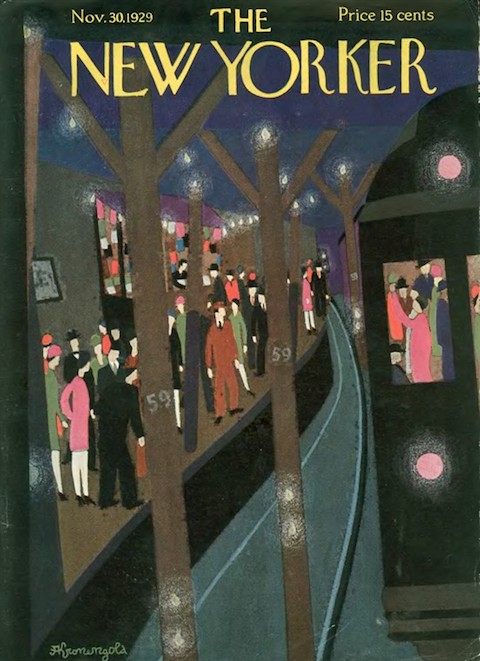
Nov. 30, 1929 cover by Adolph K. Kronengold.

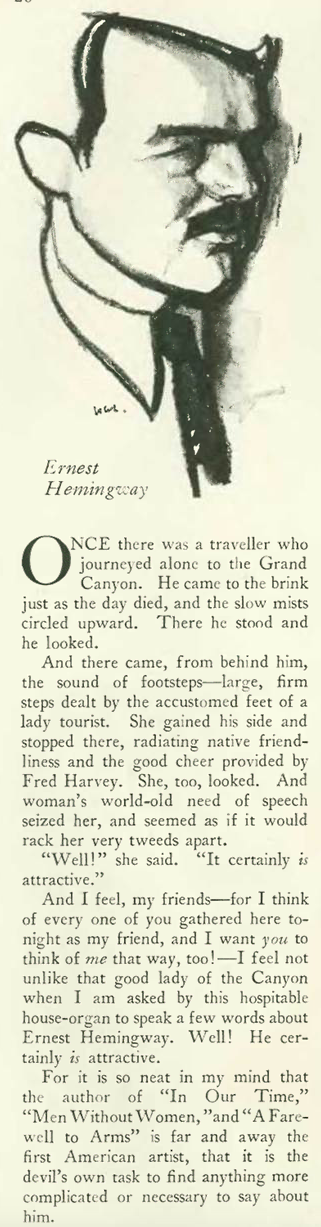
One writer, however, who received consistent praise from Parker was Ernest Hemingway, whom she first met in 1926. In the pages of the 1920s New Yorker, Parker particularly lauded Hemingway’s short story collections, In Our Time (1925) and Men Without Women (1927), which bookended his 1926 novel The Sun Also Rises (which Parker thought OK but overly hyped). When The New Yorker profiled Hemingway in the Nov. 30, 1929 issue, it naturally turned to Parker to do the honors (although Robert Benchley, a good friend of Hemingway’s, could have offered his own take on the author) :
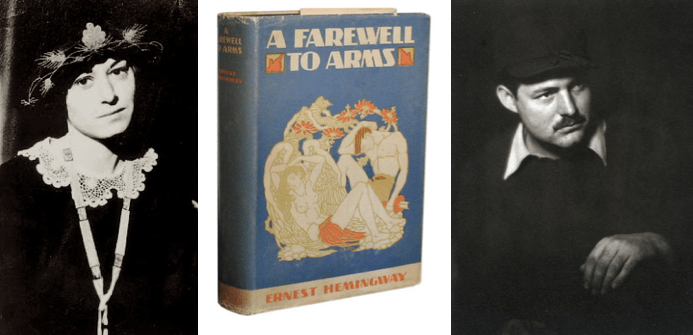
SHE’S A FAN…Dorothy Parker was a long-time admirer of the work of Ernest Hemingway. His last work of the 1920s, A Farewell to Arms, was serialized in Scribner’s Magazine and published in September 1929. The success of that book made Hemingway financially independent. (Mugar Library/Wikipedia)

During Hemingway’s Paris years Parker actually took a boat with him to France (in 1926, along with mutual friend Robert Benchley) and so got a firsthand taste of his bohemian adventures. By the time The New Yorker profiled Hemingway, the Jazz Age was dead and Paris’s so-called “Lost Generation” was a thing of the past. Indeed, Hemingway had already been in the States for more than a year, returning in 1928 with his second wife, Pauline Pfeiffer.

Biographer Jeffrey Meyers notes in his book Hemingway: A Biography, that Hemingway of the early Paris years was a “tall, handsome, muscular, broad-shouldered, brown-eyed, rosy-cheeked, square-jawed, soft-voiced young man,” features that were not lost on Parker:
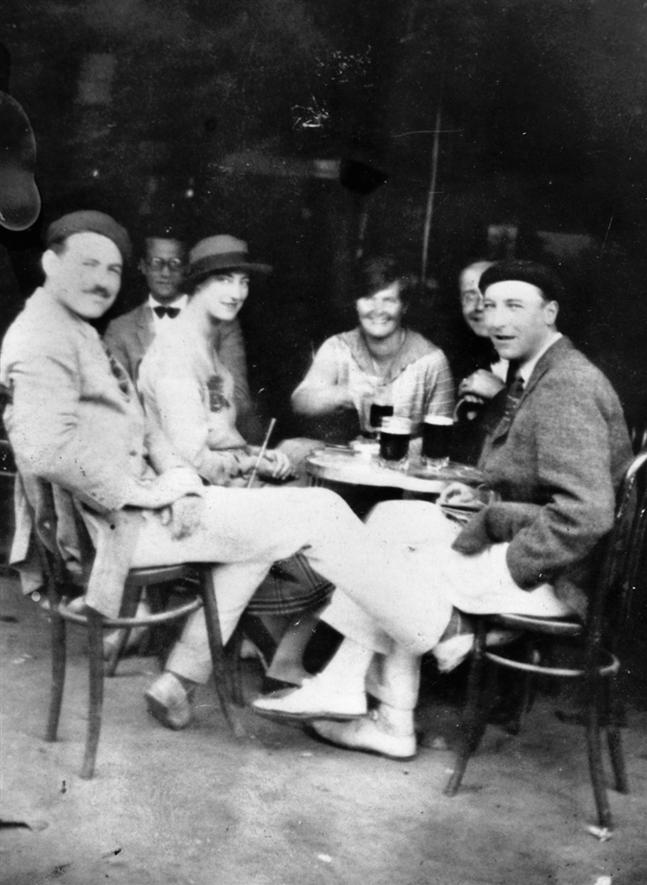
HE’S TAKING NOTES…Ernest Hemingway (left), with Harold Loeb, Lady Duff Twysden (in hat), Hemingway’s first wife Hadley Richardson, Donald Ogden Stewart (obscured), and Pat Guthrie (far right) at a café in Pamplona, Spain, July 1925. The group formed the basis for the characters in The Sun Also Rises: Twysden as Brett Ashley, Loeb as Robert Cohn, Stewart as Bill Gorton, and Guthrie as Mike Campbell. (Wikipedia)

…more from Parker on Hemingway’s magnetic appeal…
MAN ABOUT TOWN…Ernest Hemingway (far right) in 1926 in Paris, outside the city’s famous Shakespeare and Company bookshop. He is pictured here with Sylvia Beach (on his right), the shop’s founder. (Collection Lausat/Keyston-France/parisinsidersguide.com)

 *  *  *

Meet the Fokkers

In previous blogs we have established that E.B. White was an aviation enthusiast. He seems never to have missed an opportunity to catch a ride into the skies, so when pilots were conducting test flights of a prototype Fokker F-32 at New Jersey’s Teterboro field, he was there to file this brief for “The Talk of the Town”…
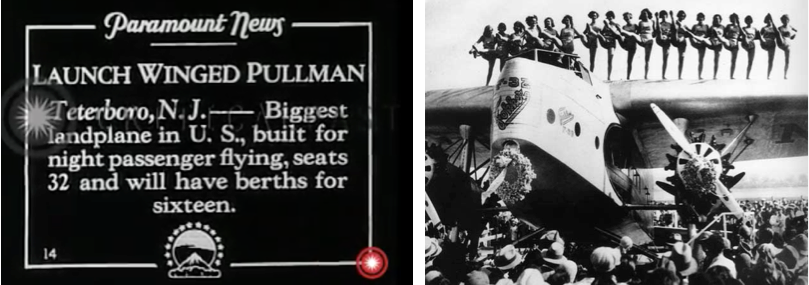
SKYTRAIN…Title card from a silent Paramount newsreel reporting on a November 1929 flight of the Fokker F-32 at Teterboro. Note how the title card uses a railroad reference (“Pullman”) as a descriptive for the passenger cabin. Indeed, early airplane passenger cabins were very much designed along the lines of Pullman cars. At right, a circa 1930 photo, possibly of a celebration of the plane’s arrival in Los Angeles. I imagine the FAA would not look kindly on this behavior today. (YouTube/petersonfield.org)

White’s enthusiasm for the aviation age is palpable in his description of the Fokker as it took off and climbed to a thousand feet:

ROUGHING IT…Passengers in Washington D.C. prepare to board what was perhaps the same plane White flew on at Teterboro. Note how they were required to walk across a muddy field to reach the plane’s entrance. The Fokker was the first four-engine commercial aircraft built in America and the largest land plane in the world at the time (there was a much larger amphibious German plane). At right, the plane’s four engines were configured back-to-back. (Wikipedia/petersonfield.org) click to enlarge

In line with The New Yorker’s stance of keeping things light, White described a scene just north of midtown, where a crowd had gathered near the site a plane crash. The pilot was killed, but a passenger managed to parachute to safety.

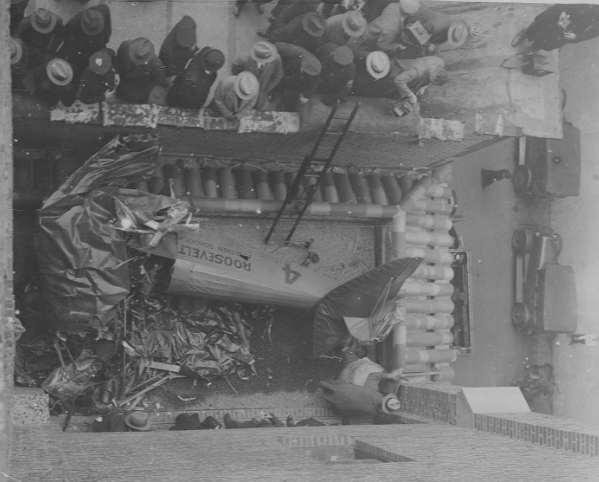
DOWN TO EARTH…Pilot Charles Reid died instantly when his plane slammed into a YMCA on 64th Street on Nov. 20, 1929. His passenger parachuted to safety. E.B. White referred to the crash in his “Talk” article. (digital-hagley-org)
Excerpt from a Nov. 21, 1929 New York Times account of the crash. (NYTimes archives)

Speaking of crashes, the Fokker on which E.B. White was a passenger crashed a week later (Nov. 27, 1929) during a certification flight from Roosevelt Field to Teterboro Airport. No one was killed, but the aircraft was destroyed. The design itself didn’t last much longer — considered underpowered for its size, and too expensive at the dawn of the Depression, it was phased out by the end of 1930.

Perhaps after all of that flying, White needed something to calm the nerves, a subject he addressed in his “Notes and Comment” column:

THE WOMAN’S HOUR, according to E.B. White in his “Notes and Comment” column. (vinepair.com)

 *  *  *

The Little Gallery That Could

“Talk,” via art critic Murdock Pemberton, had more to say about the new Museum of Modern Art, that is, not taking it very seriously…

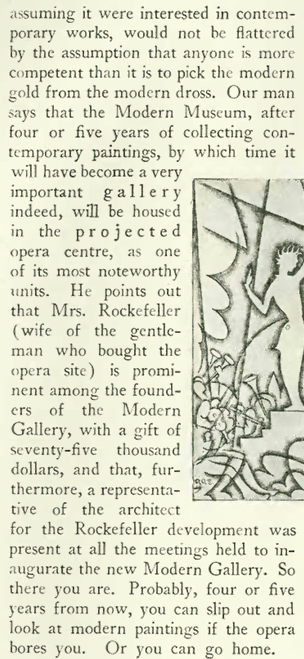
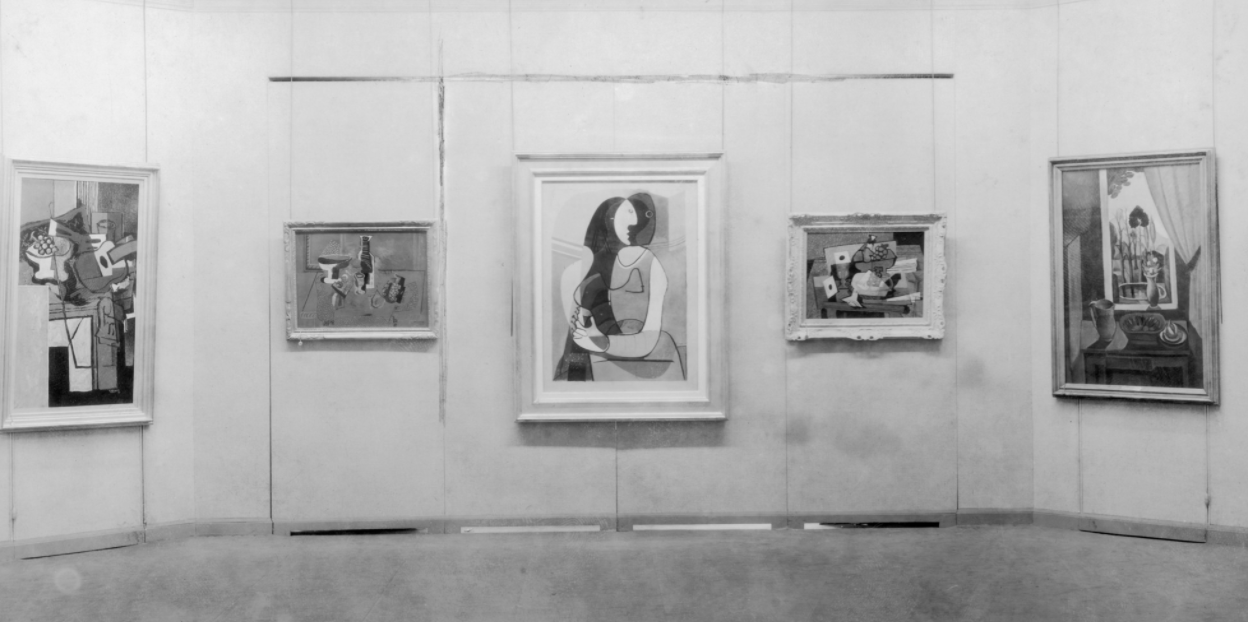
UPSTART…Although New Yorker art critic Murdock Pemberton seemed dismissive of the new Museum of Modern Art, its first month’s attendance was more than 47,000 visitors. Image above from the MoMA exhibition Painting in Paris, Jan. 19-March 2, 1930. (MoMA)

 *  *  *

Welcome to Thurber’s World

In 1931 James Thurber published his second book, The Owl in the Attic and Other Perplexities, which consisted of pieces he had done for the New Yorker, including eight stories (from Dec. 29, 1928 to Aug. 9, 1930) that featured the marital escapades of a couple in their middle thirties, the Monroes, modeled on Thurber’s real-life marriage to his wife, Althea.

The Nov. 30, 1929 issue included Thurber’s fifth installment of the Monroe saga, “Mr. Monroe Holds the Fort,” in which a fearful Mr. Monroe, left home alone (his wife was visiting her mother), imagines there are burglars in the house:
…like his famous character Walter Mitty, which Thurber would introduce in 1939, Mr. Monroe had an equally lively imagination…

The character of Mr. Monroe would see new life in the fall of 1969 when NBC  debuted My World… and Welcome to It, a half-hour sitcom based on James Thurber’s stories and cartoons. The actor William Windom portrayed John Monroe, a writer and cartoonist who worked for a magazine called The Manhattanite. In the show, Monroe’s daydreams and fantasies were usually based, if sometimes loosely, on Thurber’s writings.
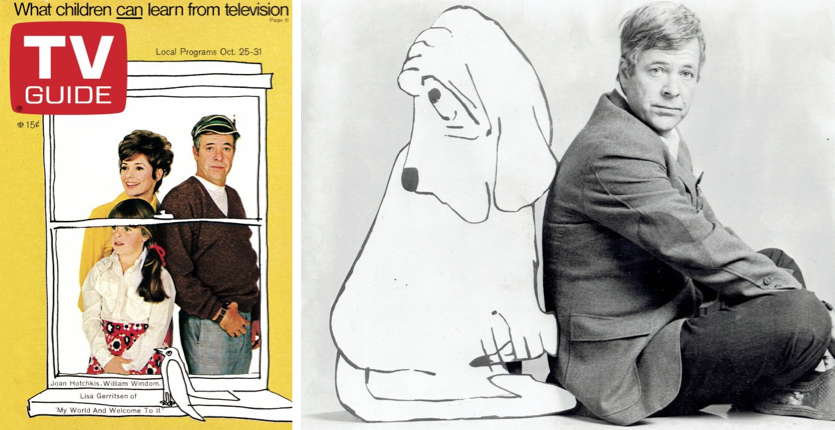
THURBER AS A SITCOM…The actor William Windom portrayed John Monroe, a writer and cartoonist who worked for a magazine called The Manhattanite, on the 1969-70 NBC sitcom My World… and Welcome to It. Joan Hotchkis played his wife Ellen, and Lisa Gerritsen portrayed his inquisitive daughter Lydia. (tvguidemagazine.com/sitcomsonline.com)
HOME SWEET HOME…Left, the opening credits for My World… and Welcome to It featured actor William Windom (as John Monroe) entering a animated house based on James Thurber’s famous “House and Woman” cartoon, which was originally featured in the March 23, 1935 issue of The New Yorker. (mikelynchcartoons.blogspot.com)

My World… and Welcome to It was cancelled after one season. Nevertheless, it would win two Emmys: one for Windom and another for Best Comedy Series.

 *  *  *

Thank Heaven for Maurice

Things were looking up a bit in the talking movie department thanks to the Ernst Lubitsch-directed The Love Parade, featuring recent French import Maurice Chevalier and Jeannette MacDonald. Film critic John Mosher observed:
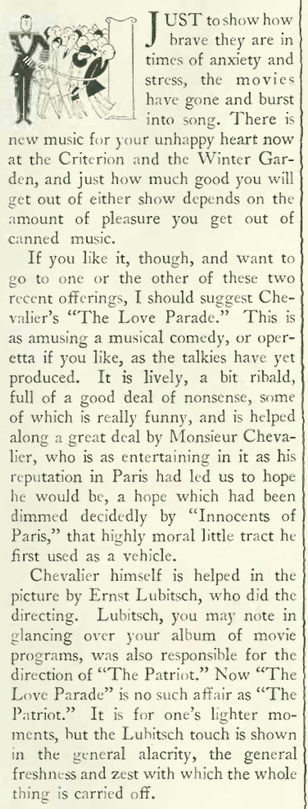
MUCH-NEEDED LAUGHS…Jeannette MacDonald and Maurice Chevalier in The Love Parade (1929), directed by Ernst Lubitsch. (MoMA)

Mosher was much less impressed by another musical, Show of Shows, featuring an all-star cast and Technicolor that added up to little more than a “stunt”…
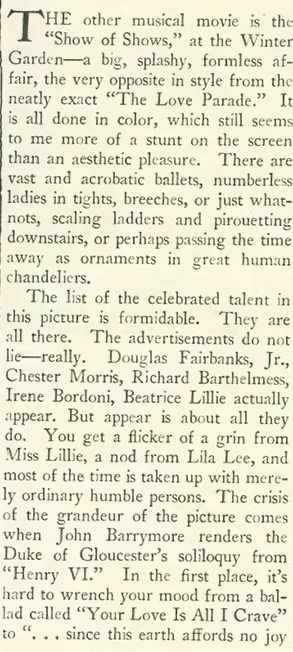
IS THAT ALL?…Warner Brothers Show of Shows offered “77 Hollywood Stars” and “1000 Hollywood Beauties” — 80 percent of it in Technicolor, but that wasn’t enough to impress The New Yorker’s film critic John Mosher. At right, Arte Frank Fay (l) and comic Sid Silvers in a color scene from the film. (IMDB)

 *  *  *

A Guide to Christmas Shopping, 1929

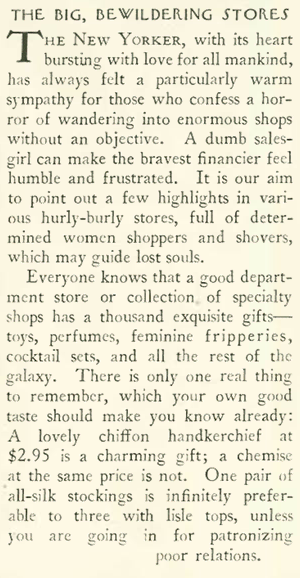
Lois Long’s fashion column, “On and Off the Avenue,” predictably grew in length as the Christmas holiday approached, and in the Nov. 30 issue she offered advice on how to go about one’s shopping duties. Some brief excerpts:

TRAILBLAZER…Lois Long guided New Yorker readers through a list of “big, bewildering stores” in her “On and Off the Avenue” column. At left, the B. Altman department store, circa 1920s. (thedepartmentstoremuseum.org/PBS)

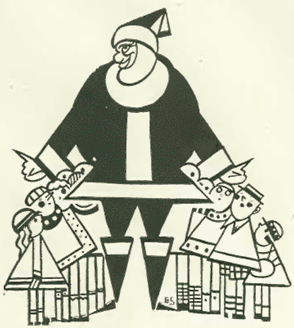
…Long’s column was peppered with holiday-themed spots, including this one by Julian DeMiskey

From Our Advertisers

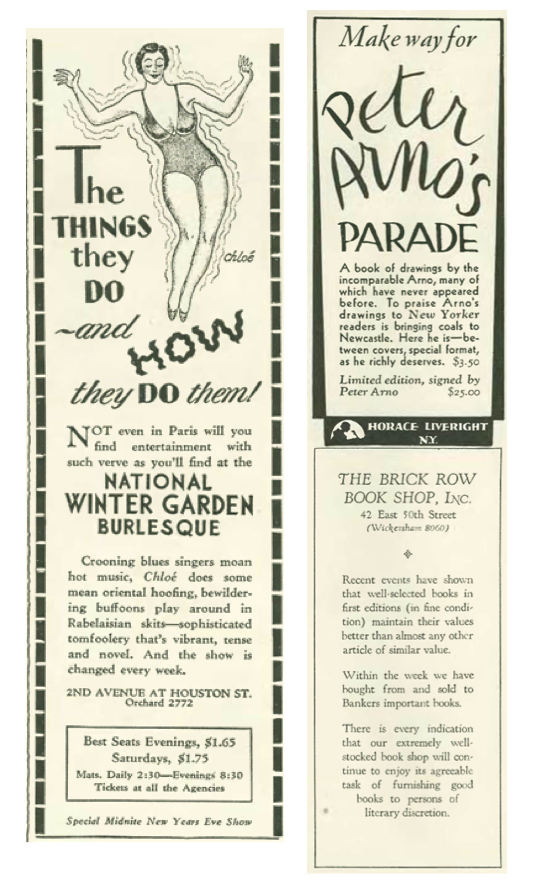
…we start with a couple of back page ads, including one from the National Winter Garden’s burlesque show and an ad announcing the imminent arrival of Peter Arno’s Parade (just $3.50, or signed by Arno himself for $25)…
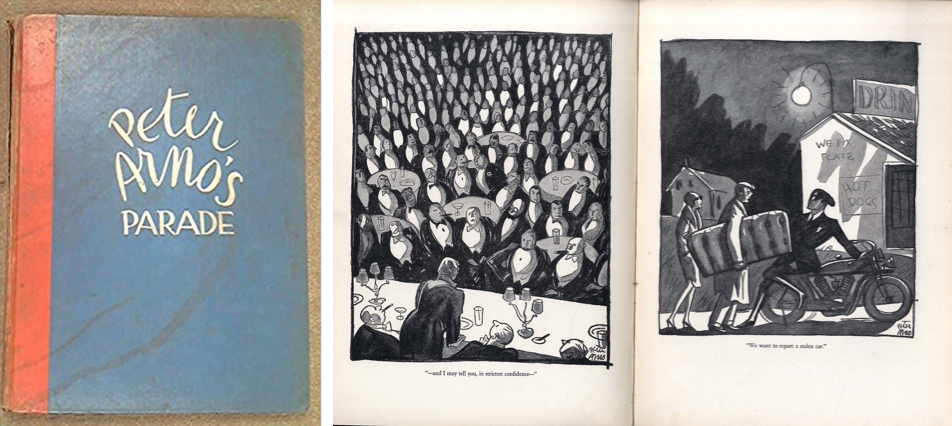
Cover and inside pages from Peter Arno’s Parade. (Amazon)

…another ad hailed the arrival of The New Yorker’s second album (read more about it here at Michael Maslin’s excellent Ink Spill)…
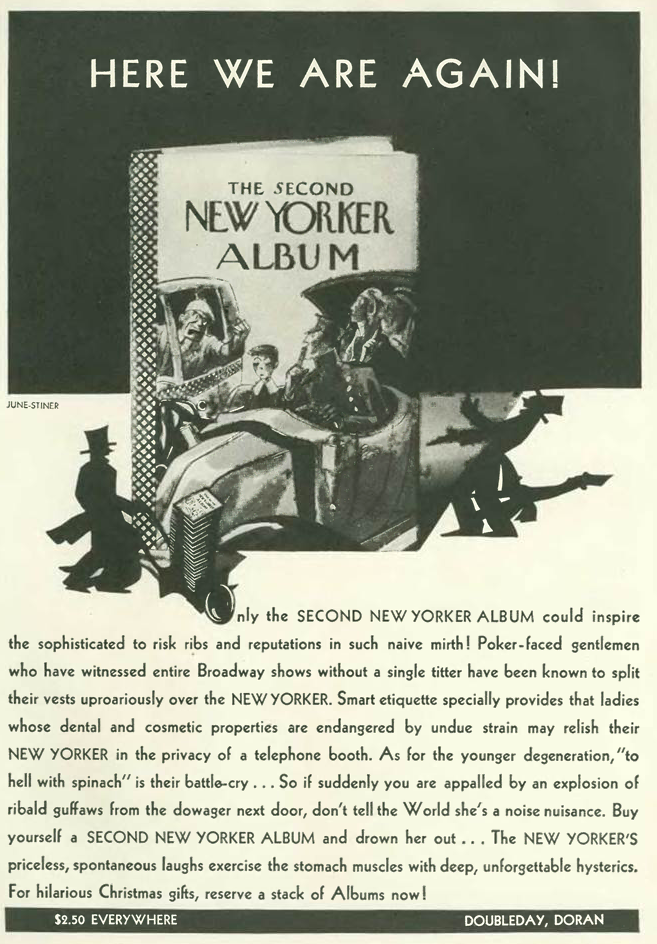
The first and second New Yorker albums. (pbase.com/michaelmaslin.com)

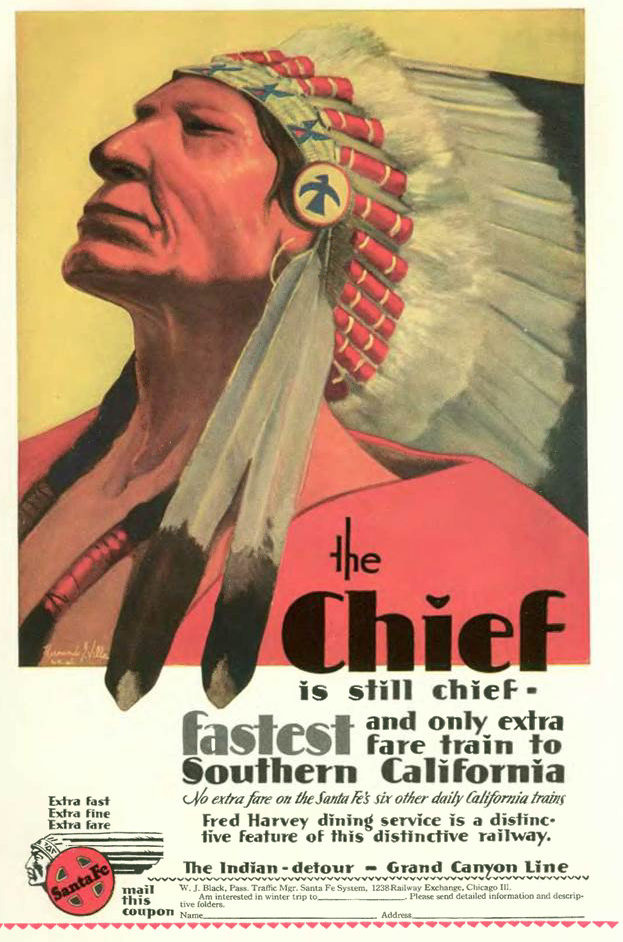
…other ads, in full color, featured cultural appropriation by the Santa Fe railroad…
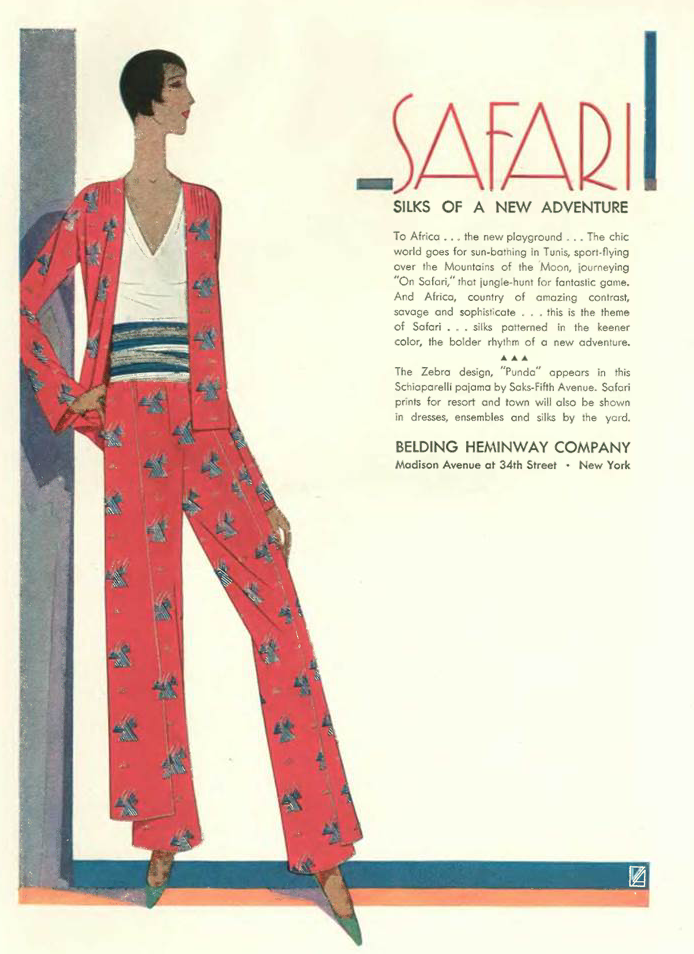
…bright silks available at the Belding Hemingway Company…
…silk stockings from Blue Moon…

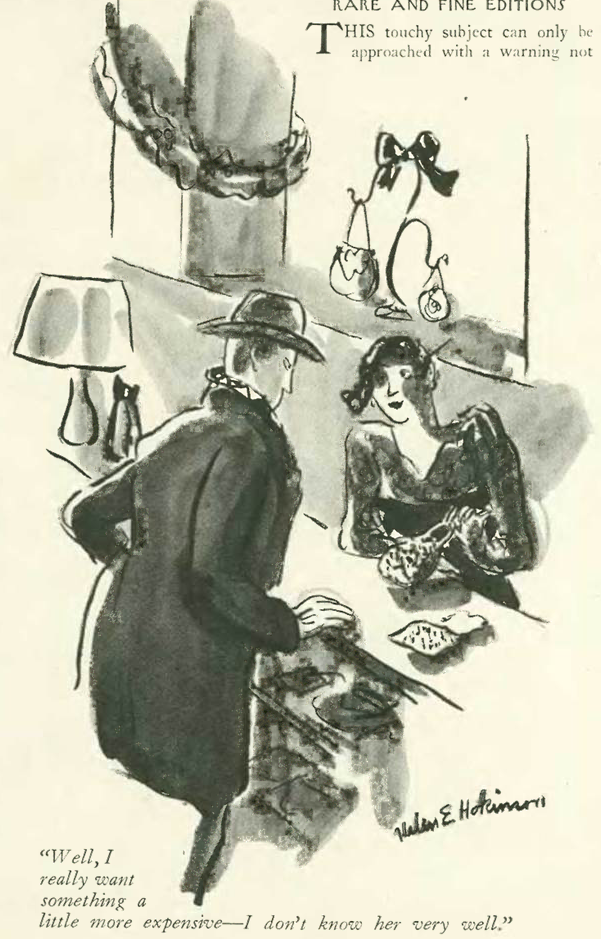
…for our cartoons, Helen Hokinson on the challenges of holiday shopping…
…Hokinson again, at tea with her ladies…

Barbara Shermund, and the miracle of broadcast radio crossed with the nuances of a dinner party…

…and Shermund again, with a hapless friend of a clueless family…

Next Time: Feeling the Holiday Pinch…


Race to the Sky

Almost ninety years after the lights went out on the Roaring Twenties, our collective imagination of New York City still harks back to that time…the sights and sounds of nightclubs and speakeasies and Broadway lights set to the tune of the Jazz Age.

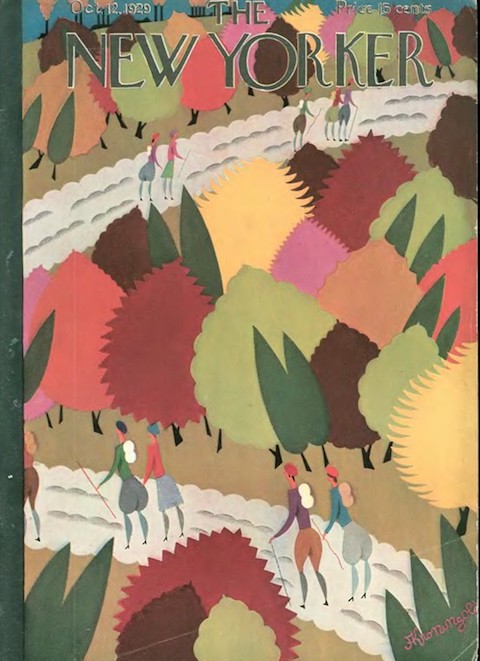
Oct. 12, 1929 cover by Adolph K. Kronengold.

And no wonder, since that decade made the city what it is today. Changing social mores, along with labor-saving electrical appliances and the ubiquitous automobile, altered the tempo of life. And this quickened pace was also reflected in the built environment, old landmarks reduced to rubble while gleaming skyscrapers rose up in their place seemingly overnight. A Victorian edifice like the Waldorf-Astoria — little more than 30 years old — seemed positively ancient to Jazz Age New Yorkers, who unceremoniously knocked it down to make way for what would become the city’s most iconic landmark.

New Yorker architecture critic George S. Chappell (aka “T-Square”) sensed that something big was on the horizon with his regular “Sky Line” updates on the city’s “tallest-building-in-the-world” contest. In the Oct. 12, 1929 issue he looked on admiringly as the Chrysler Building’s distinctive dome began to take shape:

IT’LL BE A SURPRISE…The Chrysler Building still lacked its gleaming art deco dome in this photo taken in the fall of 1929. At left is the Chanin Building, completed earlier that year. (reddit/adamunderhill.wordpress.com)

Chappell observed that the Chrysler Building’s claim as the world’s tallest would be short-lived, as plans for the Waldorf-Astoria site called for a much taller structure…

DOOMED…The old Waldorf-Astoria hotel (left), completed in 1897, was scarcely more than 30 years old when it was demolished to make way for the Empire State Building. The former governor of New York, Al Smith (inset) led the corporation that knocked down the old hotel and erected the world’s tallest building on the site. Demolition of the hotel began on October 1, 1929 (images at right). In his 2014 book The Empire State Building: The Making of a Landmark, John Tauranac observes the demolition was an arduous process, as the hotel had been constructed using more rigid material than what was found in earlier buildings. Those materials — granite, wood, and metals such as lead, brass, and zinc — were not in high demand. Most of the wood was deposited into a woodpile on nearby 30th Street or burned in a swamp. Other materials, including the granite and bronze, were dumped into the Atlantic near Sandy Hook, NJ. (New York Historical Society/New York Public Library Digital Gallery)
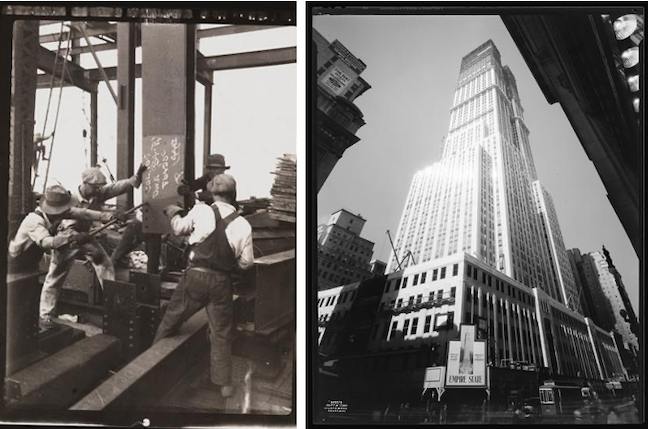
RISING FROM THE RUBBLE…The Empire State Building under construction in 1930. When completed in 1931, the 1,250 foot (1,454 with antenna) building would claim the title as the world’s tallest. It was something of a definitive victory, as the building held that record for nearly forty years. (Museum of the City of New York)

Although Al Smith’s building seemed assured to win the “world’s tallest” title, another giant was taking shape on the drawing boards…

LAND OF THE GIANTS…City Bank-Farmers Trust Building (left), now known as 20 Exchange Place, was originally designed in 1929 to be the world’s tallest building at 846 feet, but the realities of the Depression brought it down to a more modest 741 feet, making it the fourth-tallest building in New York when it was completed in 1931. At right, the 22-year-old Century Theatre on Central Park West was demolished to make way for Irwin Chanin’s Century Apartments, also completed in 1931. (Museum of the City of New York/nyc-architecture.com)

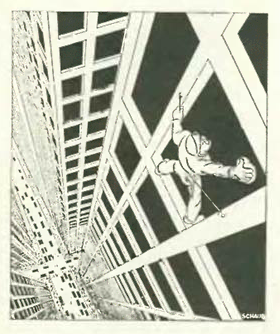
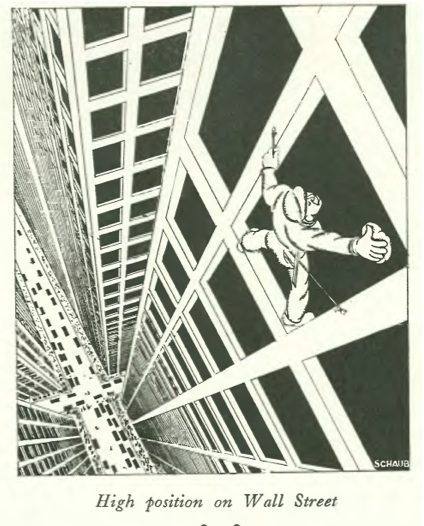
…while we are on the subject of skyscrapers, The New Yorker reprinted this illustration by Andre De Schaub to fill in a space at the bottom of page 54 in the Oct. 12 issue…

…the drawing originally appeared in the magazine three years earlier, as a cartoon in the October 16, 1926 issue. It included a caption: “High position on Wall Street” (thanks to Michael Maslin’s invaluable Ink Spill for helping me track this one down)…

As the demolition crews picked apart the old Waldorf, E.B. White wondered why more fanfare wasn’t attached to such occasions, whether they be demolitions or ribbon-cuttings…

NEEDS MORE HOOPLA…Al Smith with his wife Catherine Dunn Smith, and two of his grandchildren at the opening ceremony of the Empire State Building, May 1, 1931. President Herbert Hoover officially dedicated the building by pressing a button in the White House that turned on the building’s lights (it was merely symbolic; they were actually turned on by some unknown maintenance worker in New York). (Museum of the City of New York)

 *  *  *

A Novel Idea

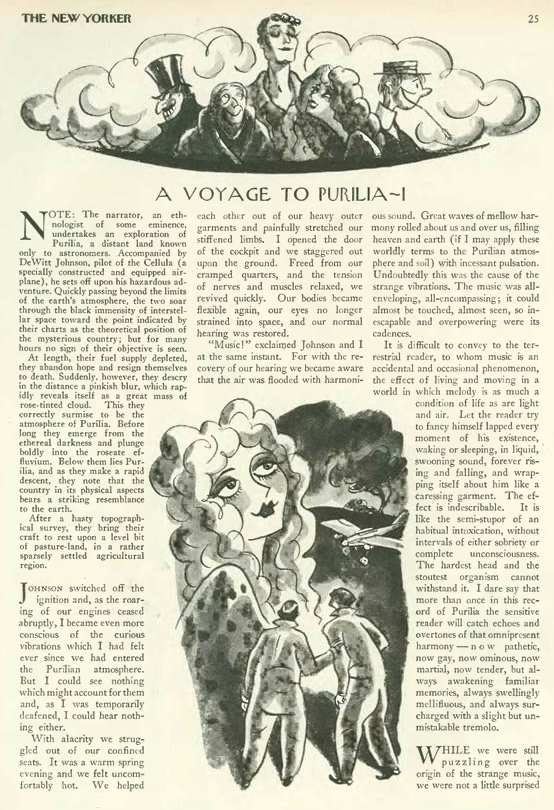
My last post featured a brief excerpt of an Oct. 5 theater review by Robert Benchley, who sized up Elmer Rice’s new play, See Naples and Die. Rice pops up again in the Oct. 12 issue, this time as the author of A Voyage to Purilia, the first novel serialized in The New Yorker. The novel was a satire on the silent film industry, set in the fictional land of Purilia. Here is the first page of the piece, with illustrations provided by Peter Arno:

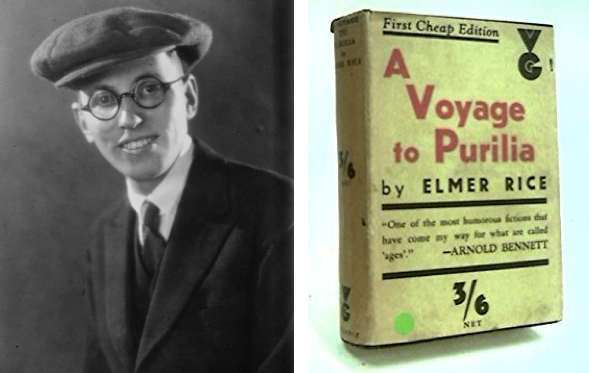
SENDING UP THE SILENTS…Elmer Rice in 1920; his satirical novel about the silent film industry, A Voyage to Purilla, was serialized in The New Yorker in 1929 and published the following year. It was re-published in the 1950s as a science fiction novel. (Wikipedia/Amazon)

 *  *  *

Siren Song

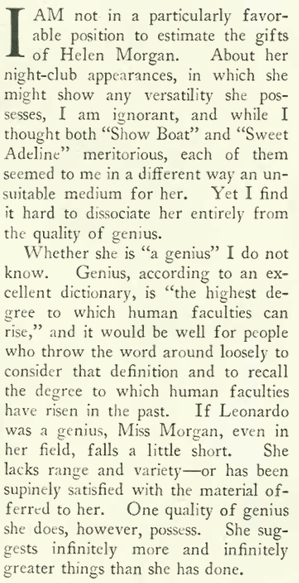
Writer and cultural critic Gilbert Seldes trained his discerning eye on the famed torch singer and speakeasy denizen Helen Morgan, attempting to understand the hard-living singer’s allure…

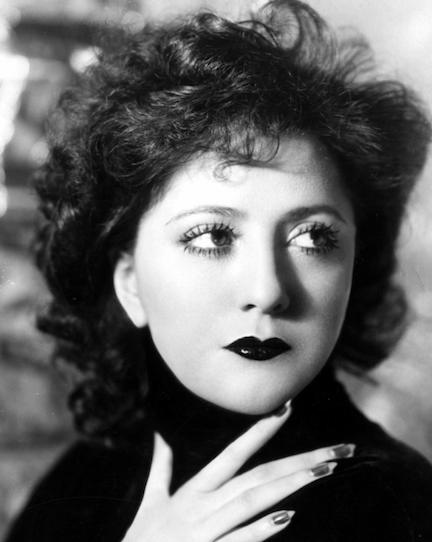
Helen Morgan, circa 1930. (masterworksbroadway.com)

RIGHT AT HOME…Helen Morgan made the draped-over-the-piano look of a torch singer her signature style. (Pinterest.UK)
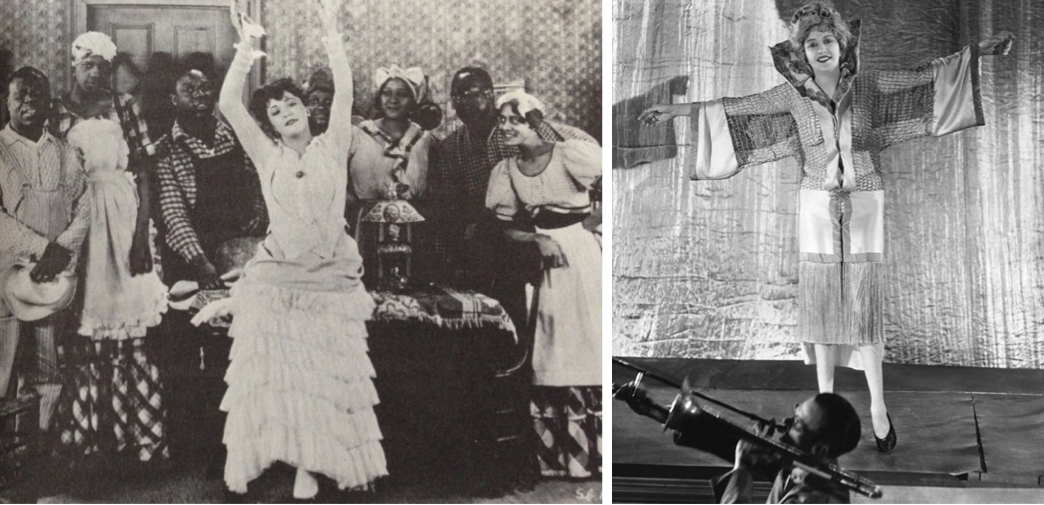
LIGHTING UP BROADWAY…Helen Morgan (left) as Julie LaVerne in the original Broadway cast of Show Boat, 1927. It was her best-known role. At right, Morgan in Applause, 1929. (Pinterest/IMDB)

Seldes struggled to understand Morgan’s appeal, which seemed to draw from an assemblage of personas…

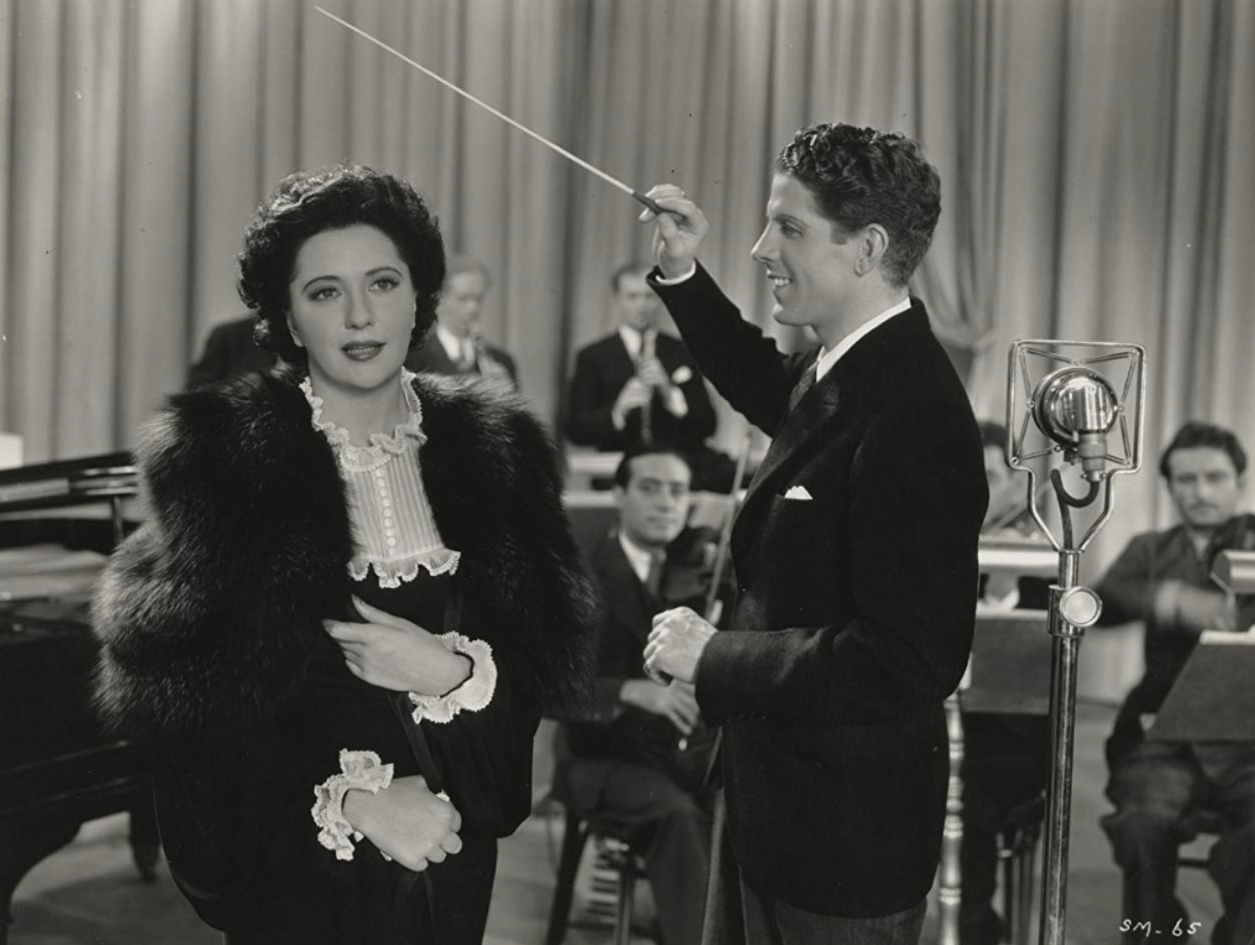
PLUMBING EMOTIONAL DEPTHS…Helen Morgan and Rudy Vallee in Sweet Music, 1935. (IMDB)

Seldes concluded that Morgan belonged with other artistic greats in her ability to create a sense of expectancy…

 *  *  *

The Invention of Distracted Driving

Writing in his “Motors” column, Nicholas Trott noted the advent of the car radio, a “new complication” to an “already over-elaborate existence.” Note that Trott viewed the car radio as something to be listened to while parked — car radios were fairly controversial back then, akin to driving while texting today.

EASY TO INSTALL…New Yorker automotive critic Nicholas Trott observed that cars were now being wired to receive radio sets (you still had to buy one and install it yourself). The system above featured battery-powered vacuum tubes, a dash-mounted dial and mono speaker. (hemmings.com)

 *  *  *

From Our Advertisers

To the refined owner of a Pierce-Arrow, a car radio would have been a crass novelty. After all, your driver was there to drive, and listen to your orders…

…unlike the Pierce-Arrow, which took pride in its heritage, the folks at Chrysler were known for their forward-thinking in design and technical innovation…

…on to some of the back page ads, we find appeals to flee the oncoming winter and escape to the golden sands of Waikiki…note the second ad, and its rather democratic invitation…

…and then we have the ads that hoped to catch the eye of the grasping Francophile, with delicacies from Louis Sherry or mock bubbly from the makers of applesauce…the second ad is particularly heartbreaking, the copy writer trying his or her best to conjure the glamour of Champagne from a bottle of apple juice. Zut!…

…fake Champagne isn’t for you? Well Leonard Dove offered us a salesman doing his best to sell a bottle of mock gin…

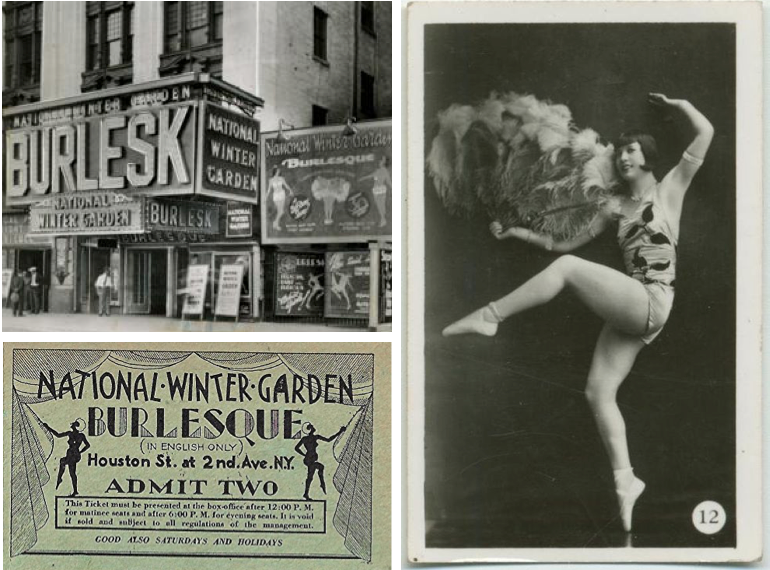
…returning to the ads, here’s one more from the back pages that references Harold Ross’s original prospectus for his magazine: “The New Yorker will be the magazine which is not edited for the old lady in Dubuque.” The ad is for Billy Minsky’s National Winter Garden, where the art of burlesque got its start. Despite the cheapness of the ad and the implied salaciousness, uptown New Yorkers loved “slumming” at Minsky’s burlesque, including artists and writers (Hart Crane even wrote a poem called “National Winter Garden”). No doubt a few New Yorker staffers found their way inside as well…

Clockwise from top left, Billy Minsky’s National Winter Garden; a 1920’s burlesque performer; a ticket for two to the show. (New York Post/Amazon/Pinterest)

…on to the illustrators and cartoonists, a nice street scene by Reginald Marsh

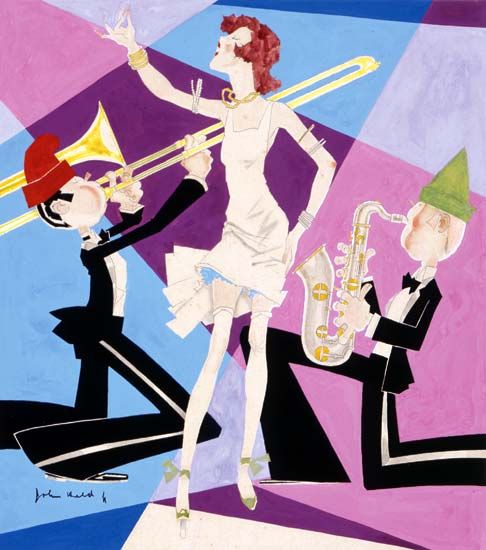
John Held Jr. contributed one of his famed “woodcuts” to the Oct. 12 issue. Held was an old childhood friend of New Yorker founding editor Harold Ross. It was Ross who encouraged Held to deviate from his popular flapper caricatures — he recalled how his friend had produced clever woodcuts in high school, and wanted something similar for his magazine…

A John Held Jr. illustration for Life magazine, 1927. (Library of Congress)

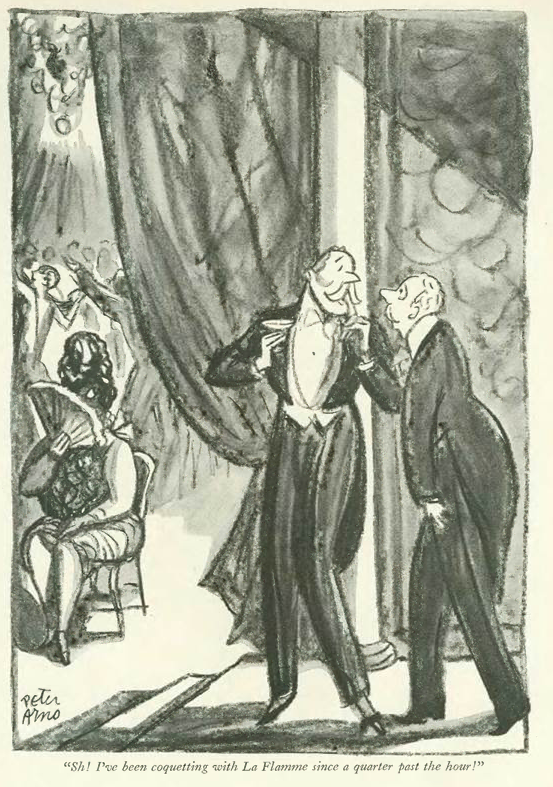
Peter Arno went behind the scenes at a posh nightclub (a familiar setting for Arno)…

Helen Hokinson found confusion at the elections…

Perry Barlow offered up this sweet slice of family life…

…and Denys Wortman illustrated the power of the pen…

Next Time: City of Glass…