Dog’s Best Friend

The “Profile” for the May 12, 1928 issue was unusual in that its subject was not a titan of industry, or a prominent politician, or noted artist, musician or literary figure, but rather a dog—an extraordinary animal named Egon who would be lost to history were it not for Alexander Woollcott writing about this particular German Shepherd and his exploits on the French Riviera.
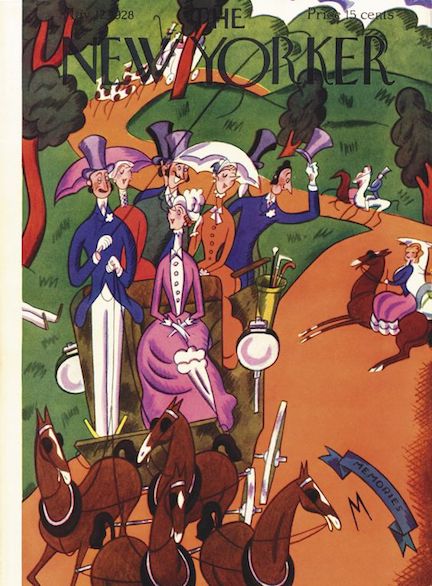
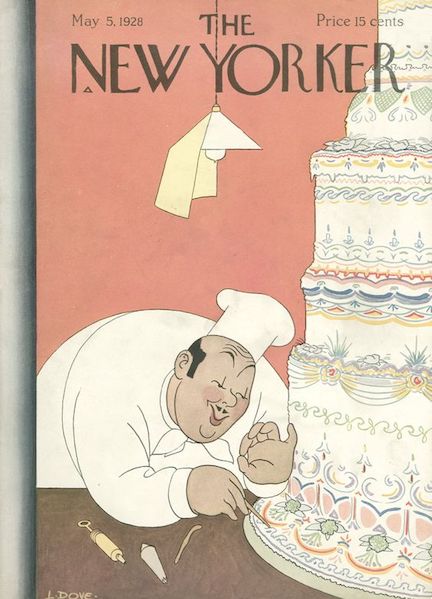
May 12, 1928 cover by Julian de Miskey.

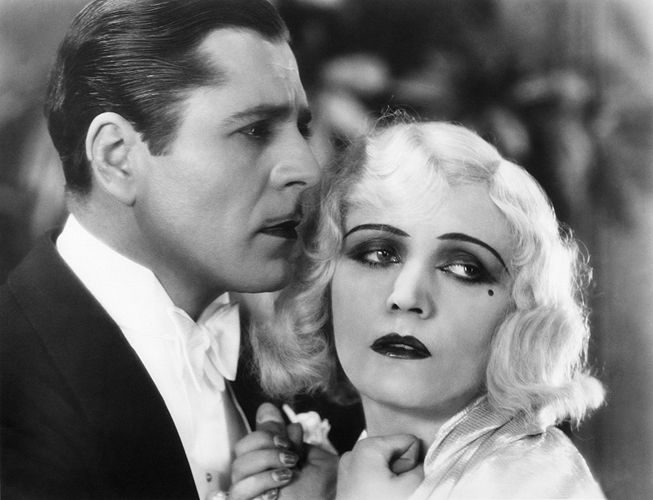
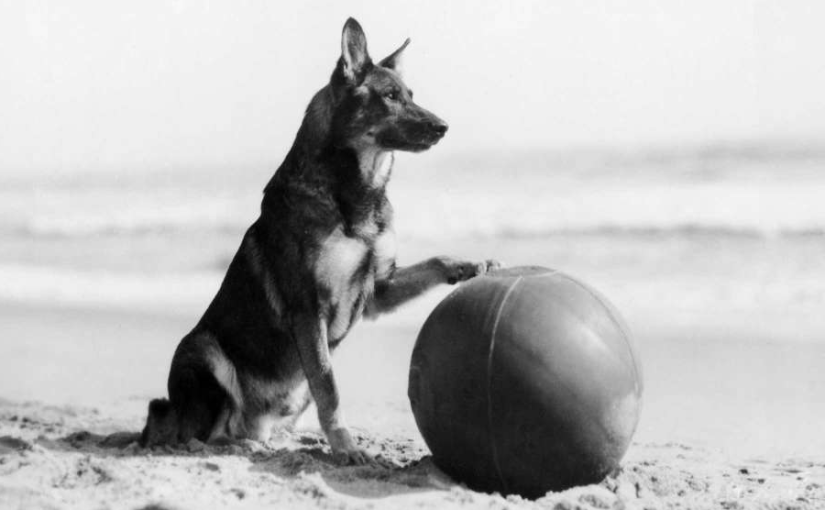
I should be clear that the dog featured at the top of this entry is not Egon, but a famous contemporary named Rin Tin Tin. It is said Egon could have enjoyed similar fame on the silver screen (Hollywood was looking for an animal to replace the aging canine superstar), but Egon’s owner, Benjamin Finney, had no interest in the limelight. So I couldn’t find any images of Egon save for this drawing that accompanied Woollcott’s essay:

Writing for the Huffington Post, Anne Margaret Daniel calls Egon Finney the “Jazz Age celebrity no one has noticed since his lifetime, but who is surely as interesting as many of his human contemporaries — and far more interesting than many of them.”

Woollcott would agree with that statement, given the opening paragraphs of his piece on Egon:
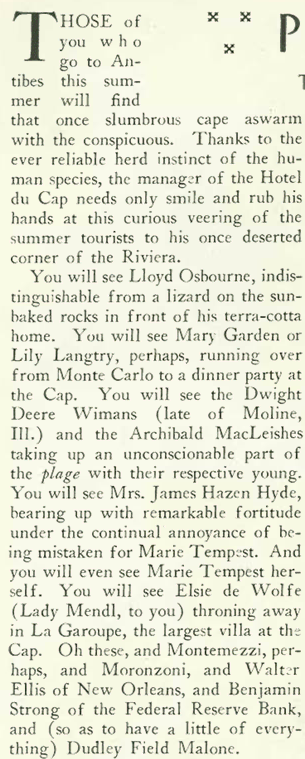
When Egon and Finney lived in Antibes in 1927 and 1928, Egon would give diving exhibitions off the rocks below the Hotel du Cap. According to Daniel, the dog also “availed himself of his owner’s surfboard, and water skis — possibly the first pair ever on the Riviera.” Egon was aided in his efforts by none other than the writer F. Scott Fitzgerald, who lived on the Riviera from 1925 to 1930.

DOG LOVERS…Alexander Woollcott, left, and Egon owner Benjamin Finney (boweryboyshistory.com/Sewanee University of the South)
HE TAUGHT A DOG TO WATER SKI, TOO…F. Scott Fitzgerald, wife Zelda and son Scottie in Antibes in 1926. Fitzgerald lived on the Riviera from 1925 to 1930, writing much of The Great Gatsby there. His last-completed novel, Tender Is The Night, was set on the Riviera. (The New York Times)

According to Daniel, Finney recalled that Egon’s physical design “made it difficult for him to get started (on the surfboard), but his friend Scott Fitzgerald was expert at giving him a hand… Firmly balanced, tail streaming in the wind, he was a noble sight — and he knew it.”

Because the dog outshone his owner, Woollcott headlined his profile, “The Owner of Ben Finney.” Egon died in 1934, and those very words are carved on his headstone, located in America’s first pet cemetery in Hartsdale, New York.

Someone He Could Finally Relate To…

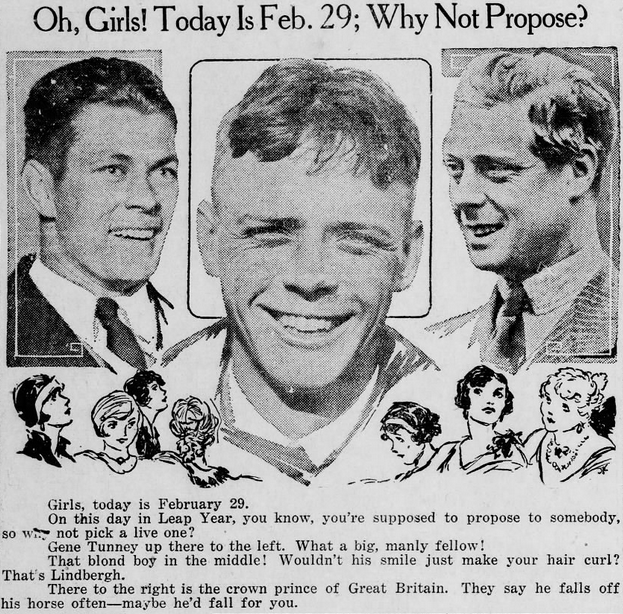
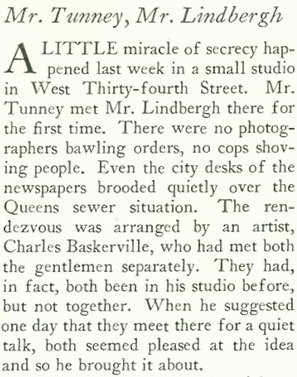
Charles Lindbergh was famously shy and crowd averse, so when the famed aviator met with the serious-minded boxing champ Gene Tunney, he found something of a kindred spirit. Writing for “The Talk of the Town,” Peter Vischer was there for all of the action:
NOWHERE TO HIDE…This item in the El Paso Evening Post (Feb. 29, 1928) was precisely the sort of thing both Gene Tunney and Charles Lindbergh detested. (Evening Post)

 *  *  *

From Our Advertisers…

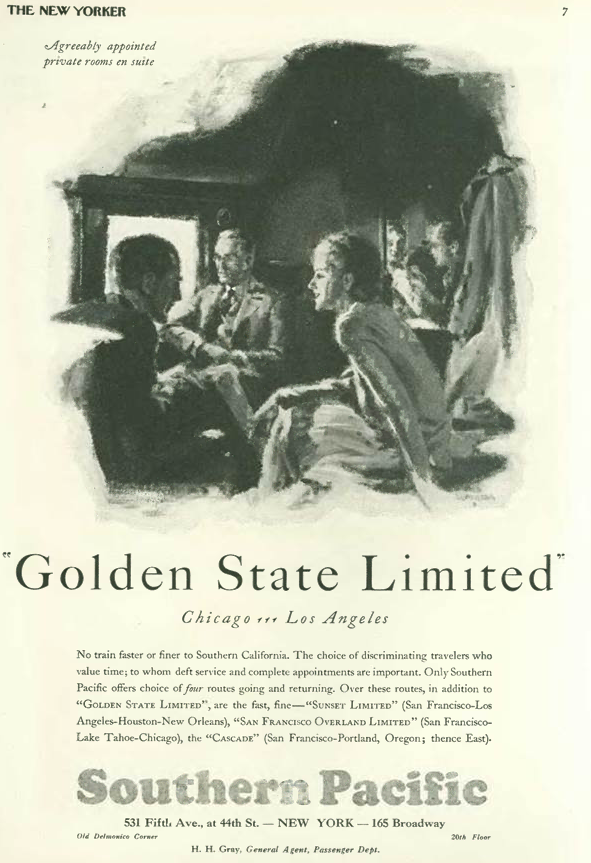
Beginning in 1924 the Southern Pacific’s Golden State Limited trains added modern and luxurious 3-compartment, 2-drawing room observation cars to their Pullman fleet. This advertisement in the May 12, 1928 New Yorker enticed affluent readers to take the 2,762 mile, 70-hour journey from Chicago to Los Angeles:
NOT THE WORST FOR WEAR…The Russian actress, singer and dancer Olga Baclanova exits the Golden State Limited in Los Angeles in July 1929 after a long journey from New York. Billed as “The Russian Tigress” who often portrayed an exotic blonde temptress, she is best known for her roles as Duchess Josiana in the silent The Man Who Laughs and as a circus trapeze artist in Tod Browning’s 1932 cult horror movie Freaks. (olgabaclanova.com)

As the fashion advertisements turned to summer, the May 12 issue featured no less than three separate ads for straw boaters…

Today’s ubiquitous polo shirt was an entirely new look for the summer of 1928. The shirt was designed by France’s seven-time Grand Slam tennis champion René Lacoste, who understandably found traditional “tennis whites” (starched, long-sleeved white button-up shirts with neckties) both cumbersome and uncomfortable. Lacoste first wore the polo at the 1926 U.S. Open, and in 1927 he placed the famous crocodile emblem on the left breast of his shirts. It didn’t take long for many imitators to hit the market. This ad from Wallach Brothers offered one version for $6, although I can’t imagine wool was the best material for this shirt (Lacoste used cotton in his).

No doubt B. Altman had June brides in mind for this advertisement featuring a deco bride of impossible proportions:

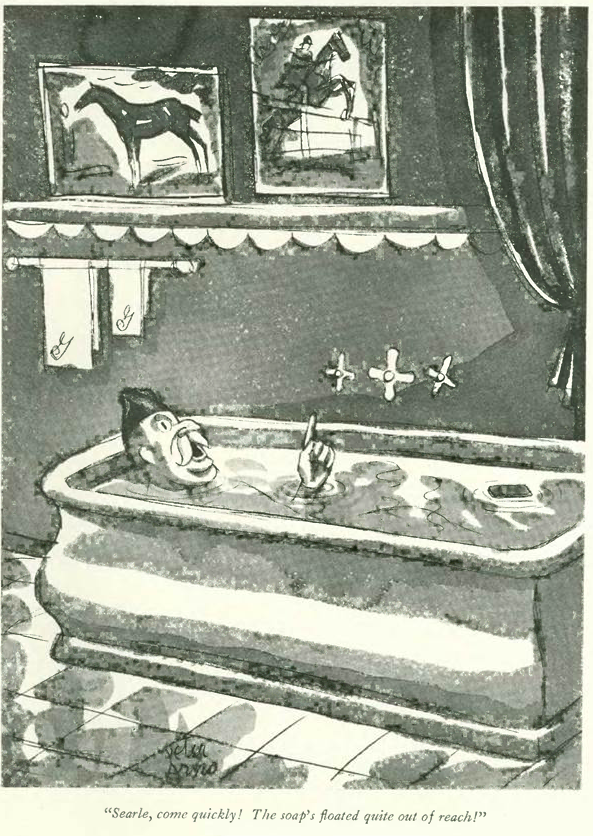
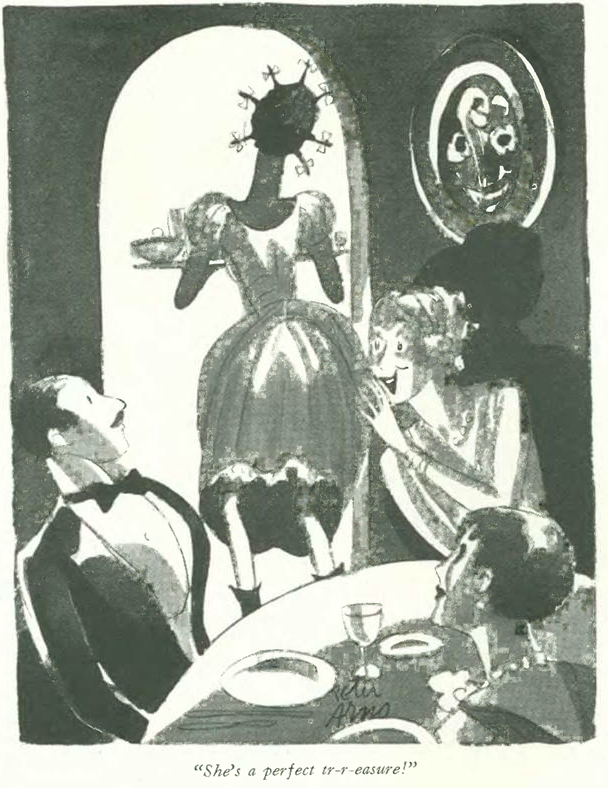
And our cartoon is once again from Peter Arno, who explored the not so subtle racism of the upper classes:
Next Time: Man About Town…

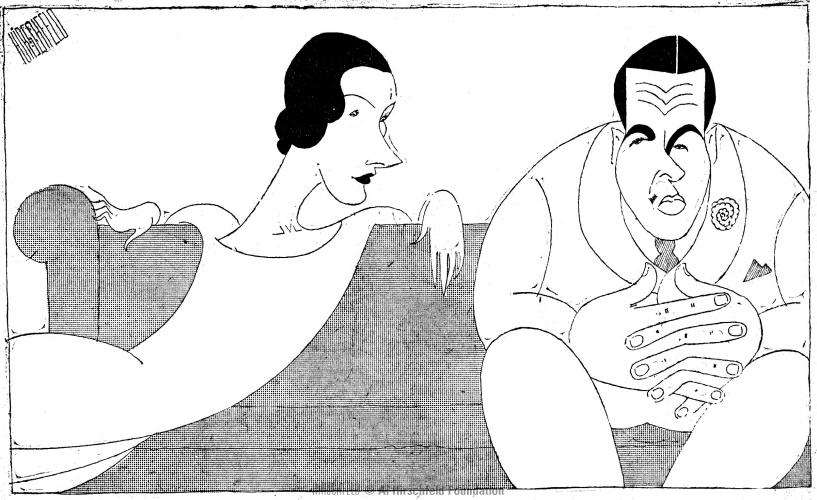
Back to Broadway

From the 1920s to the 1950s the husband-wife acting team of Alfred Lunt and Lynn Fontanne were the most celebrated couple on the Broadway stage, and even today many rank them as the greatest acting team in the history of American theatre.

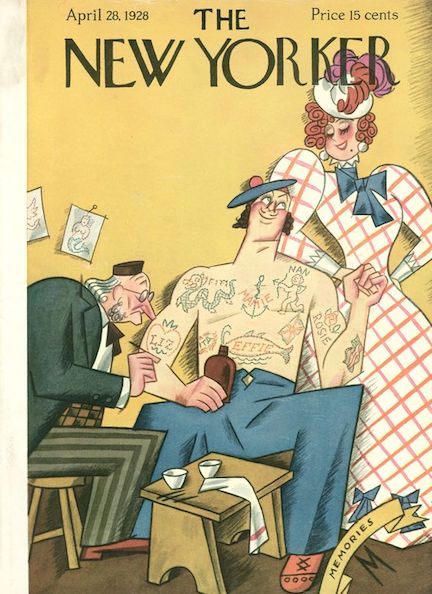
April 28, 1928 cover by Julian de Miskey.

Lunt (1892-1977) and Fontanne (1887-1983) were so inseparable as a team that it was virtually impossible to write about just one of them, as Timothy Vane discovered when he contributed this profile of Lunt to the April 28, 1928 issue of the New Yorker:

INSEPARABLE…The Lunts in the 1920s, as photographed by Nickolas Muray. In 1999 the U.S. Postal Service paid tribute to them with a first-class stamp. (Conde Nast/USPS)

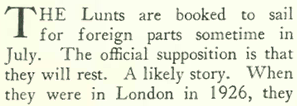
Vane described the couple’s tireless comings and goings, in which even a vacation abroad entailed preparations for future performances:

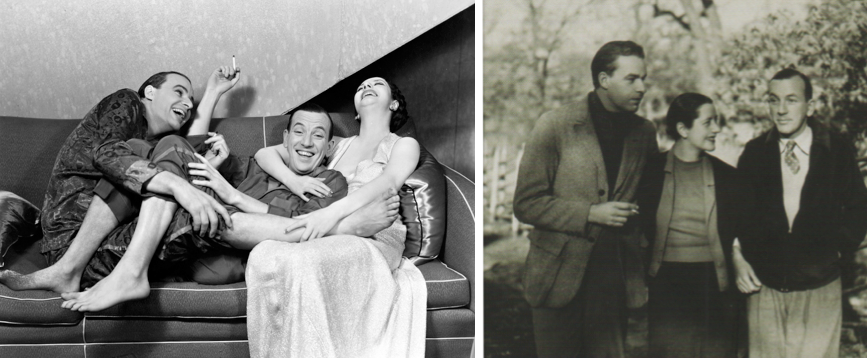
OLD FRIENDS…Noel Coward (center) Alfred Lunt and Lynn Fontanne in Coward’s 1932 play Design For Living. A close friend of Lunt and Fontanne, Coward enjoys a relaxing moment (right) at the couple’s “Ten Chimneys” estate in Lunt’s home state of Wisconsin. (Playbill/tenchimneys.org)
IT REALLY HAS TEN CHIMNEYS…At left, the main house at Lunt and Fontanne’s “Ten Chimneys.” At right, the estate’s ‘Falu-Red’ Cottage. The estate was named a National Historic Landmark in 2003. (tenchimneys.org)

Although it was long rumored that Lunt and Fontanne had a lavender marriage, the couple were truly inseparable during their 55-year union.

According to the Ten Chimneys Foundation, by the mid 1920s Lunt and Fontanne were the two most popular, critically acclaimed, and highest-paid stage actors in the country. Lunt and Fontanne also believed that creating great theatre with broad impact was far more important than money, so at the height of their careers they took enormous pay cuts to sign on with The Theatre Guild—a new company dedicated to performing avant-garde work by writers such as Ibsen and Shaw. Because they took such large cuts in salary, they were able to stipulate in their contracts that they only act together, rather than in separate plays. From 1928 until they retired in 1960, the Lunts never appeared on stage separately.

And Then There Were Hearst & Davies

Another famed duo of the 1920s, Marion Davies (1897-1961) and William Randolph Hearst (1863-1951), were perhaps a less successful partnership, and particularly so for Davies, who traded a promising career as a comedic actress for a romantic (and scandalous) relationship with the famed newspaper tycoon.

Davies was emerging as a talented film comedian when Hearst took over her career—financing her films, promoting her through his media empire, and, most critically, pressuring studios to cast her in historical dramas which were not her forté. This is why she is remembered today as Hearst’s mistress and the hostess of lavish events for the Hollywood elite at San Simeon, and not for her acting chops, which were considerable when she was given the chance. When Hearst did allow her to show her comedic side in The Patsy, even The New Yorker’s irascible critic “O.C.” took notice and offered rare praise:

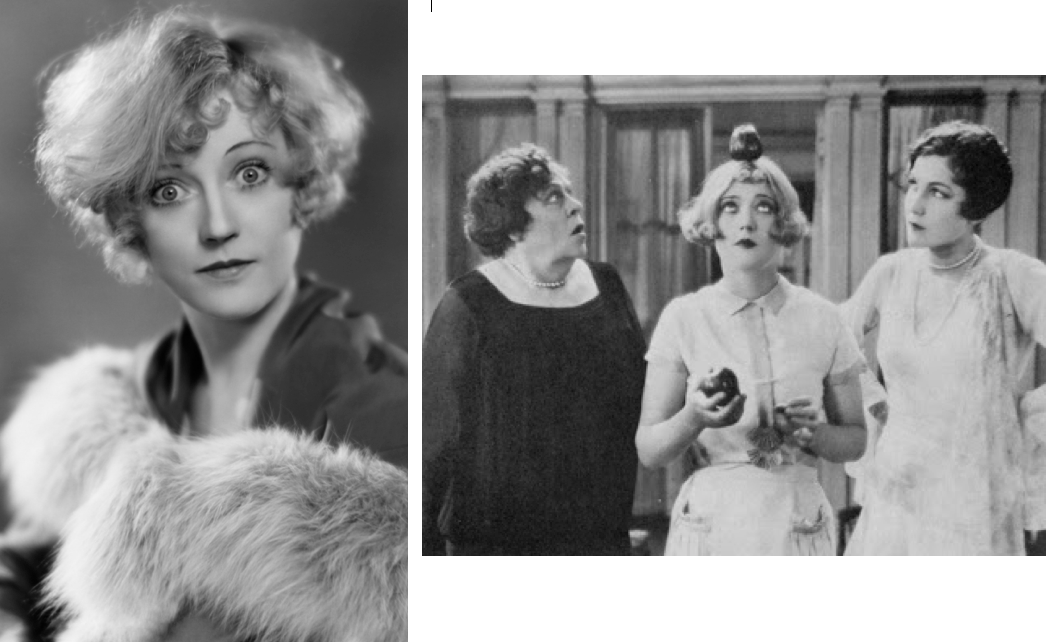
SHOWING HER FUN SIDE…Left, publicity photo of Marion Davies, late 1920s. At right, Patricia Harrington (Davies) vies for the attentions of her mother, Ma Harrington (Marie Dressler) and sister Grace Harrington (Jane Winton) in King Vidor’s 1928 hit comedy The Patsy. The film was co-produced by William Randolph Hearst along with Davies and Vidor.(silentlondon.co.uk/cinemaartscentre.org)

A 2012 review of The Patsy by the Cinema Arts Center (Long Island, NY), noted that “Davies radiates comic charm, highlighted by her dead-on impersonations of the three cinema divas, in this audience pleaser…Gloriously fun and frothy, The Patsy was the biggest hit of Davies’ career.”

One of the actresses parodied in The Patsy by Davies, Pola Negri, did not fare so well in O.C.’s crosshairs in her “stilted” Three Sinners.

PSSST…LIGHTEN UP, WILL YA?…Warner Baxter and Pola Negri in Three Sinners (1928). (Paramount)

 *  *  *

Another Bad Girl

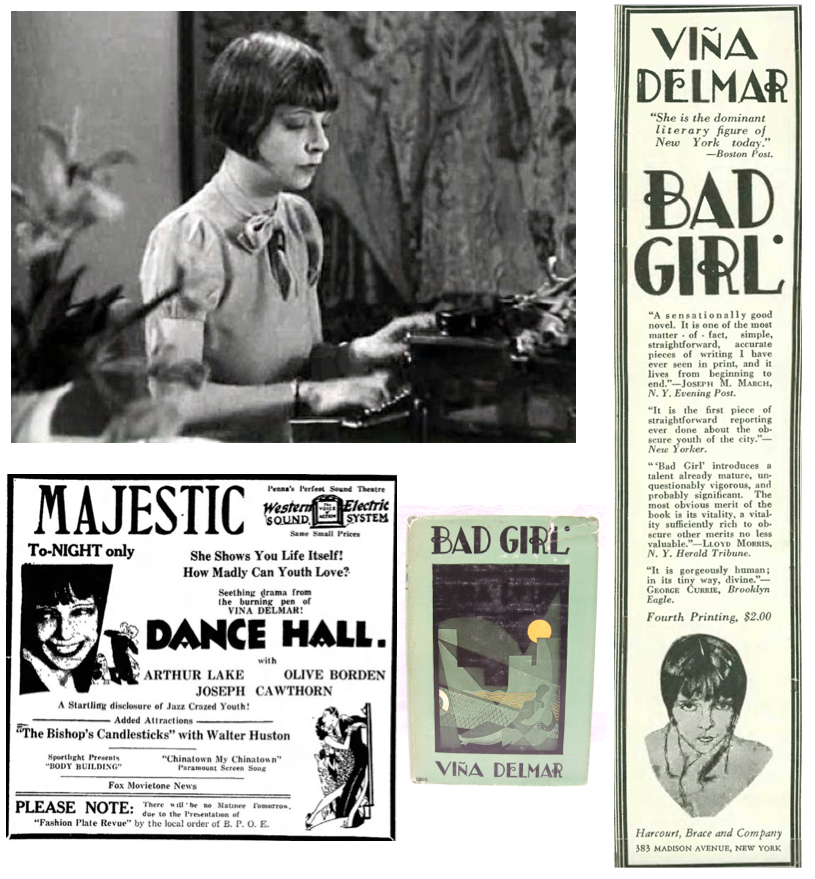
Not well known today, but after 1928 Viña Delmar (1903-1990) was practically a household name thanks to her breakthrough novel, Bad Girl, which she published at the tender age of 23. A cautionary tale about premarital sex and married life among the proles, the book was banned in Boston but was also the April 1928 selection by the Literary Guild. It was one the year’s best sellers.

On the heels of Bad Girl, in 1929 Delmar published two more books with risqué titles, Kept Woman and Loose Ladies. She would write a total of 23 novels between 1928 and 1976, and with her husband, Eugene, would write or adapt 18 plays that were produced as films. Among those was the screenplay to the acclaimed screwball comedy, The Awful Truth, for which she was nominated for a 1937 Academy Award.

BAD GIRL, GOOD SALES…Clockwise, from upper left: a screenshot of Viña Delmar from the trailer for 1934’s Sadie McKee, a film starring Joan Crawford based on Delmar’s 1933 short story “Pretty Sadie McKee”; an ad for Bad Girl in the April 28, 1928 New Yorker; original jacket cover for Bad Girl; a 1930 advertisement for the film Dance Hall, based on a 1929 Delmar short story. (Wikipedia/New Yorker/Amazon/immortalephemera.com)

*  *  *

And finally, our cartoon from April 28, 1928, courtesy Peter Arno:

Next Time: After Hours…

Guess Who’s Coming to Dinner

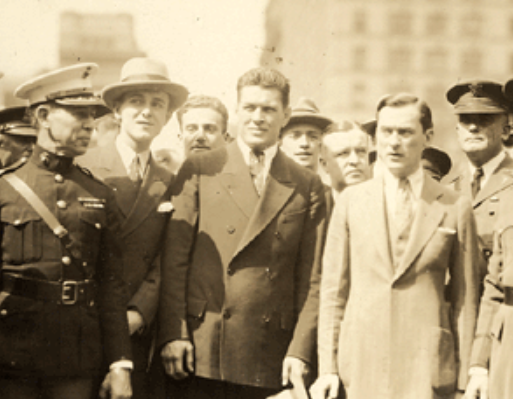
Gene Tunney was not your typical boxer. Holder of the heavyweight title from 1926 to 1928, he defeated his rival Jack Dempsey in 1926 and again in 1927 in the famous “Long Count Fight.” But Tunney was no Palooka—he preferred to be known as a cultured gentleman, and made a number of friends in the literary world including George Bernard Shaw, Ernest Hemingway and Thornton Wilder.

d30ba2edfc3289f6c04c8dfd337ef06c
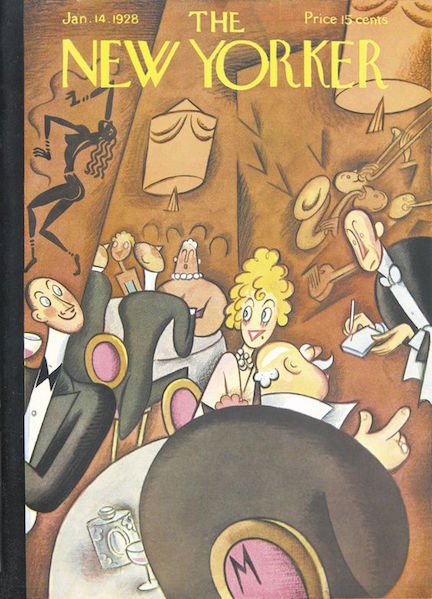
January 14, 1928 cover by Julian de Miskey.

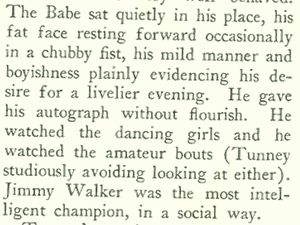
So when given the opportunity to say a few words, Tunney made the most of it, including at a dinner hosted by boxing and hockey promoter Tex Rickard to honor champions in various sports. The New Yorker’s E.B. White was there tell us about it:

screen-shot-2017-02-10-at-12-52-28-pm

d2cf24cb8345bcbf47135ea359d6eaa4
FETED FOR FEATS…World champion athletes are shown here from top row, left to right; Babe Ruth (baseball), Gene Tunney (boxing), Johnny Weissmuller (swimming), Bill Cook (hockey). On the bottom row is from left to right, Bill Tilden (tennis), Bobby Jones (golf), Fred Spencer and Charlie Winters (six-day bicycle race).

While Tunney was doubtless composing his thoughts at the banquet table, baseball legend Babe Ruth was wishing he could be someplace else…

screen-shot-2017-02-10-at-12-53-12-pm

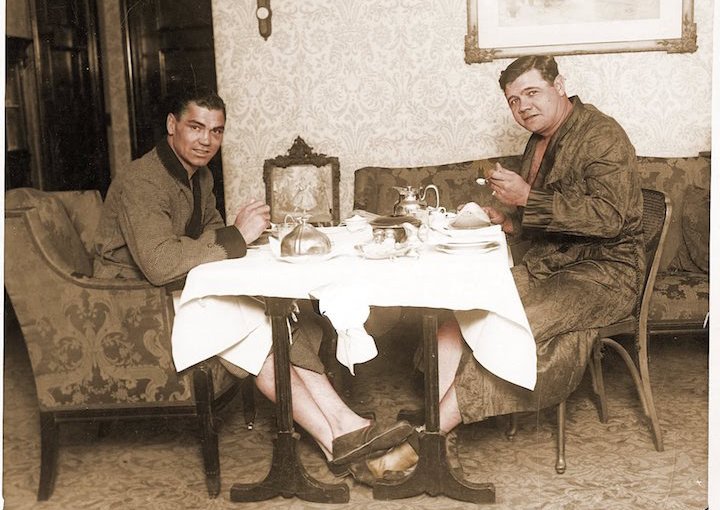
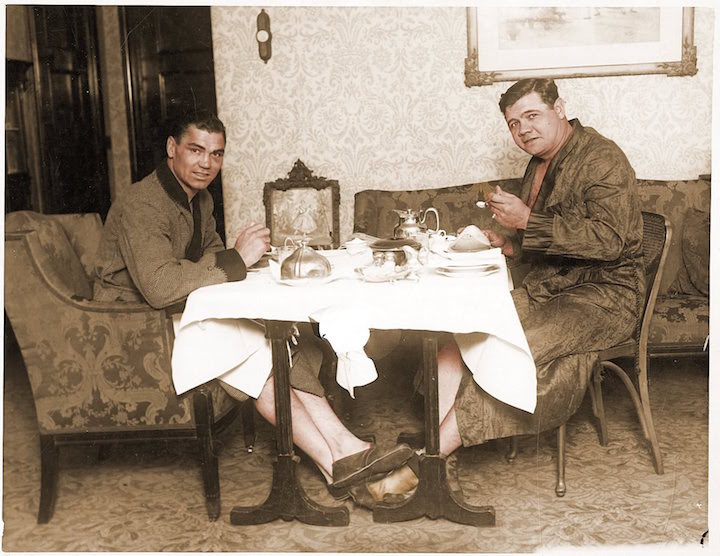
…like hanging out with his old buddy Jack Dempsey

ruthdempsey
BREAKFAST OF CHAMPIONS…Babe Ruth having breakfast with his friend, heavyweight boxing champion Jack Dempsey, at Ruth’s residence at the Ansonia Hotel in New York City, 1927. Dempsey reigned as the champ from 1919 until 1926, when he was defeated by Gene Tunney. (captainsblog.info)

Instead, the Babe would have to listen to a surprise speech by Tunney, who sought to prove to those in attendance that he had brains to match his brawn. No doubt to the relief of many in attendance, New York City’s flamboyant mayor, Jimmy Walker, was able to return the proceedings to party mode.

screen-shot-2017-02-10-at-12-54-25-pm

screen-shot-2017-02-14-at-3-00-04-pm
THAT’LL DO, GENE, THAT’LL DO…Newly crowned heavyweight boxing champion Gene Tunney (center) meets with New York City Mayor Jimmy Walker (right) at City Hall, September 1926. (josportsinc.com)

 *  *  *

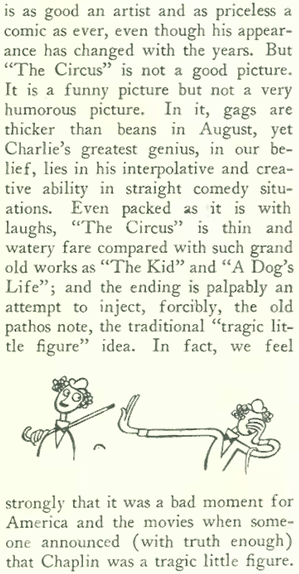
The New Yorker writers found little to like about Hollywood, but Charlie Chaplin could always be counted on to knock out a humorous film. At least most of the time. Here is what “The Talk of the Town” had to say about his latest, The Circus:

screen-shot-2017-02-10-at-12-48-54-pm

screen-shot-2017-02-10-at-12-49-02-pm

LIGHTEN UP, CHARLIE…Merna Kennedy, Charlie Chaplin and Harry Crocker in The Circus. (1928). (Turner Classic Movies)

 *  *  *

Give ‘Em Dirty Laundry

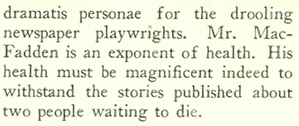
In these days of clickbait and other news designed to attract our prurient interest, we can look back 89 years a see that the tabloids were doing much of the same, particularly in Bernarr Macfadden’s New York Graphic, which was making the most of the final days of death row inmates Ruth Snyder and Judd Gray. “The Talk of the Town” (likely Robert Benchley) made this observation:

screen-shot-2017-02-10-at-12-49-34-pmscreen-shot-2017-02-10-at-12-49-56-pm

screen-shot-2017-02-14-at-4-48-21-pm
TSK, TSK…Evangelist Aimee Semple McPherson (left), received a tidy sum to write about convicted murderer Ruth Snyder for the New York Evening Graphic. (Wikipedia/Murderpedia)

Former lovers Snyder and Gray were sentenced to death in 1927 for the premeditated murder of Snyder’s husband (they went to the electric chair at Sing Sing prison on Jan. 12, 1928). Newspapers across the country sensationalized their trial, but the Graphic went the extra step by paying large sums to celebrity correspondents, including evangelist Aimee Semple McPherson, to write about the sordid case. Sister Aimee used her Graphic column to encourage young men to “want a wife like mother — not a Red Hot cutie.” Semple McPherson herself would later be accused of an affair, but then what else is new in the business of casting stones?

screen-shot-2017-02-15-at-10-57-28-am
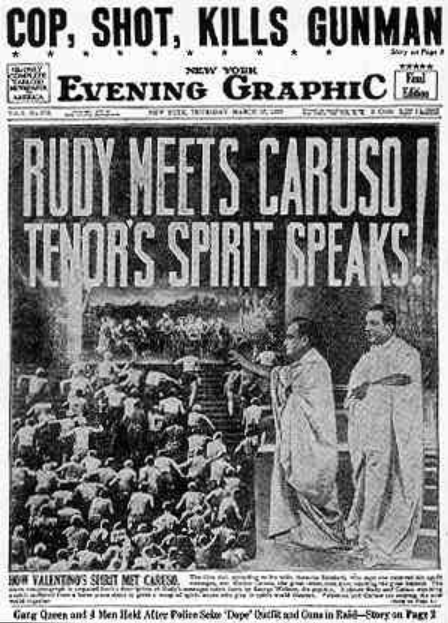
FAKE NEWS…Before the National Enquirer and Weekly World News (and Facebook, Twitter, Instagram etc.), Benarr Mcfadden’s Evening Graphic was the tabloid of choice among the less discerning. This issue from March 17, 1927, depicted silent actor Rudolph Valentino meeting the famed tenor Enrico Caruso in heaven. The Graphic was famous for these “Composographs,” — images cut and pasted together using the heads or faces of current celebrities and glued onto staged images created by employees in Macfadden’s studio. (bernarrmacfadden.com)

 *  *  *

Even His Skivvies?

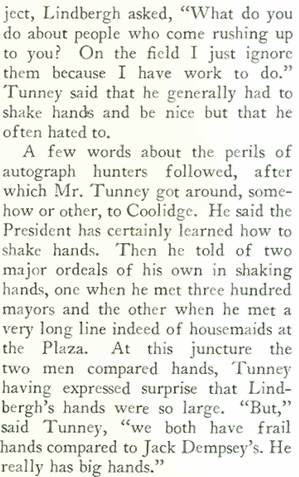
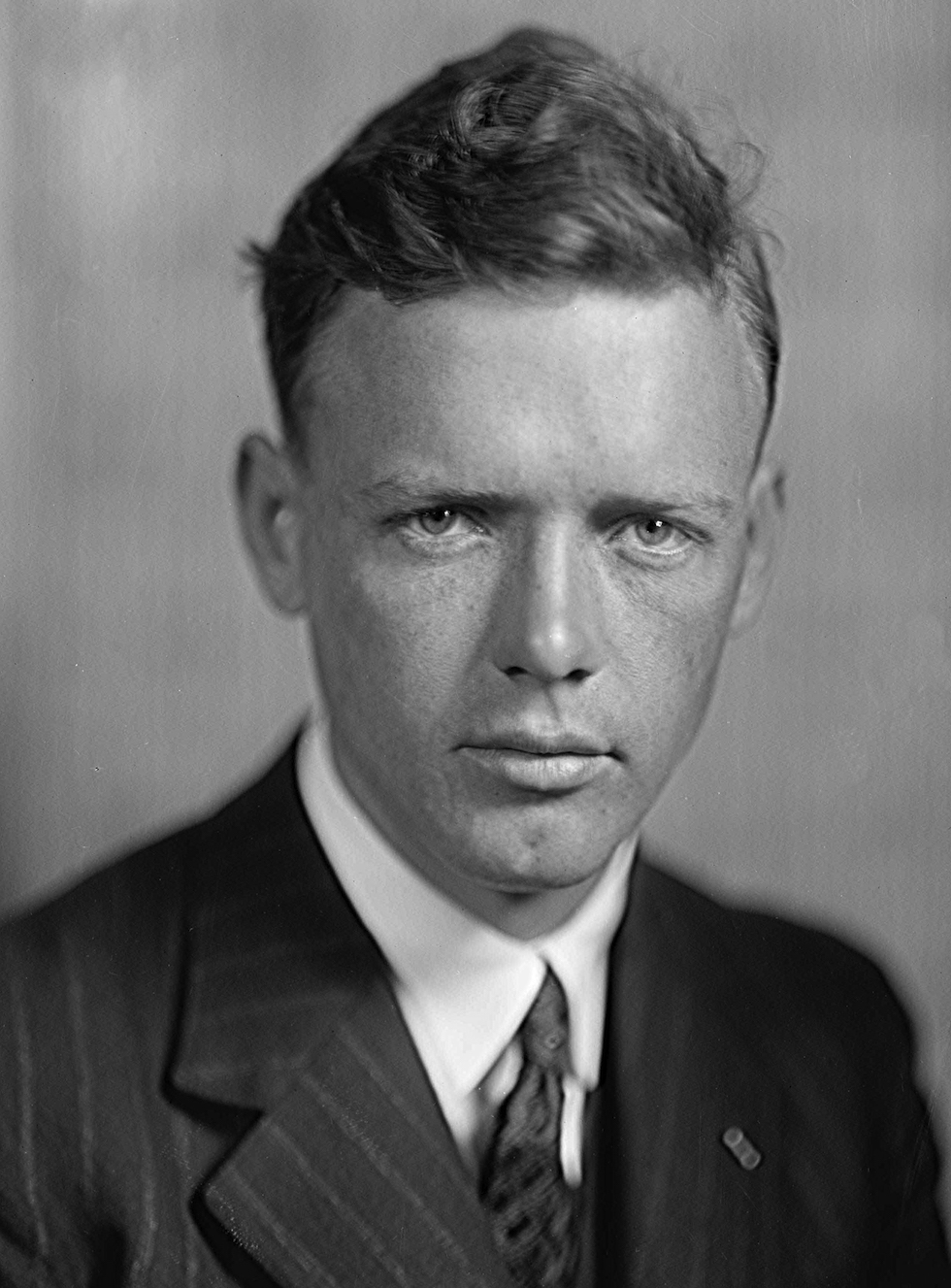
We can also look back 89 years and see that people were just as celebrity-crazed then as they are now. Charles Lindbergh could barely keep the clothes on his back while being pursued by adoring mobs, according to “The Talk of the Town”…

screen-shot-2017-02-10-at-12-50-39-pm

col_charles_lindbergh
KEEP YOUR HANDS OFF MY BVDS

 *  *  *

Kindred Spirits

Dorothy Parker wrote a vigorous, even impassioned defense of the late dancer Isadora Duncan in her column, “Reading and Writing.” Parker reviewed Duncan’s posthumously published autobiography, My Life, which she found “interesting and proudly moving” even if the book itself was “abominably written,” filled with passages of “idiotic naïveté” and “horrendously flowery verbiage.” In this “mess of prose” Parker also found passion, suffering and glamour—three words that Parker could have used to describe her own life.

Parker elaborated on the word “glamour,” which she thought had been cheapened in her day to something merely glittery and all surface. True glamour, wrote Parker, was that of Isadora Duncan, coming from her “great, torn, bewildered, foolhardy soul.” Parker concluded with this plea:

screen-shot-2017-02-10-at-1-06-00-pm

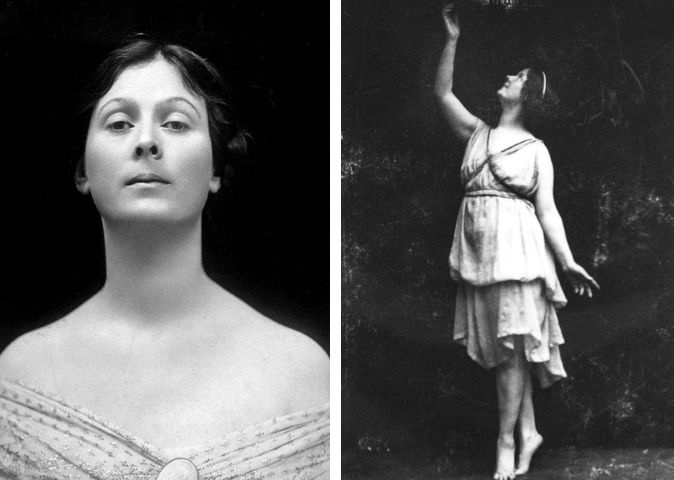
Isadora Duncan circa 1910 (left), and Duncan in a publicity photo circa 1903. (Wikipedia)

 *  *  *

New Kid on the Block

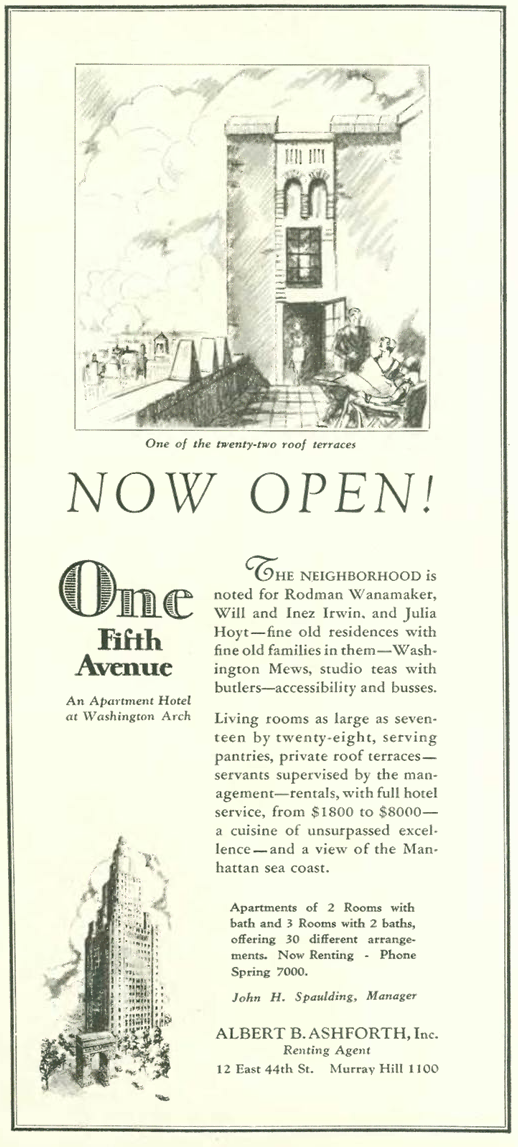
Yet another high-rise dwelling was available to Jazz Age New Yorkers—One Fifth Avenue in Greenwich Village. One Fifth Avenue was an apartment with the word “hotel” attached to justify its 27-story height. To meet zoning requirements, the apartments had “pantries” instead of kitchens. But then again, your “servant” would fetch your dinner anyway…

screen-shot-2017-02-10-at-1-00-01-pm

one-fifth-avenue-december-1928
GOING UP…The art deco landmark One Fifth Avenue signaled a dramatic change from the four-story mansions that once occupied the site.  (New York Public Library)

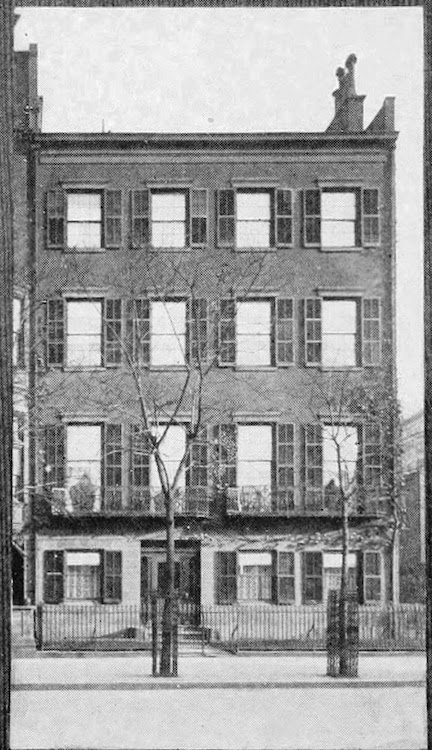
Historical note: One Fifth Avenue marked a dramatic change in the character of Washington Square, one of the most prestigious residential neighborhoods of early New York City. A previous occupant of the One Fifth Avenue site was the brownstone mansion of William Butler Duncan. In addition to One Fifth Avenue, the residences at 3, 5, and 7 Fifth Avenue were also demolished to make way for the new art deco “apartment hotel.”

01-fifth_william-butler-duncan
DUST TO DUST…The William Butler Duncan residence at One Fifth Avenue. (daytoninmanhattan)

*  *  *

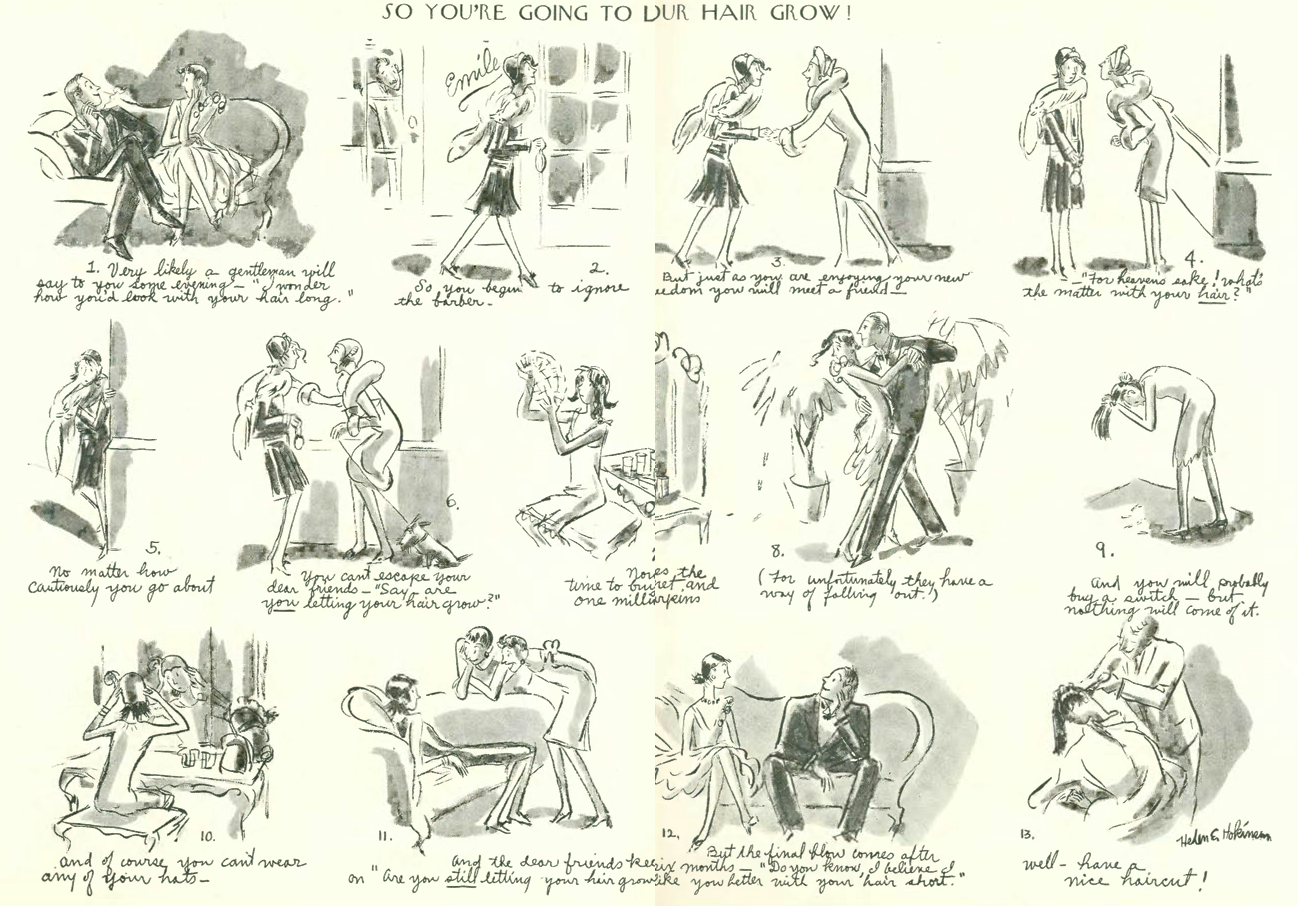
To close, a two-page spread by Helen Hokinson exploring one woman’s challenge with the “flapper bob” (sorry about the crease in the scan–that is how it is reproduced in the online archive). Click the image to enlarge.

screen-shot-2017-02-10-at-12-56-38-pm

And a bit of fun on the streetcar, courtesy of cartoonist Leonard Dove

screen-shot-2017-02-10-at-12-57-46-pm

…and a confession, from Otto Soglow…

Next Time: Machine Age Bromance…

986198649aa5ada2614b8158443db596


Mutt & Jeff

We close out November 1927 by looking at a hugely popular comic strip—Mutt & Jeff—that made cartoonist Bud Fisher both famous and wealthy.

screen-shot-2017-01-26-at-10-05-52-am
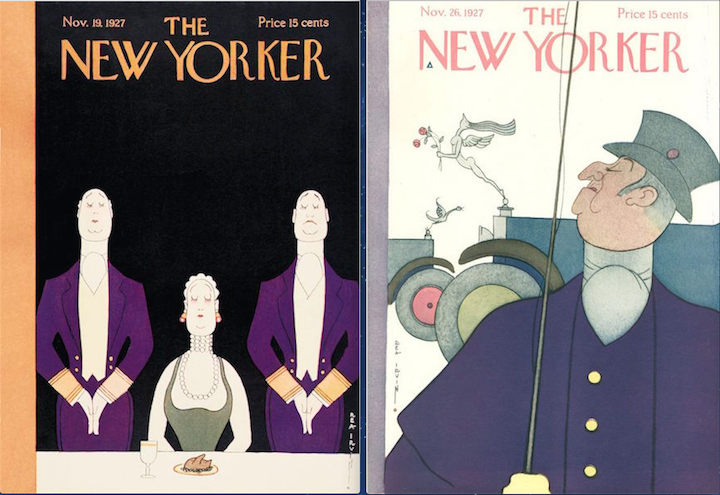
Nov. 19 and Nov. 26, 1927 covers by Rea Irvin.

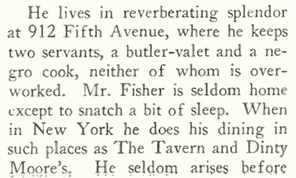
The editors of the Nov. 26, 1927 issue of The New Yorker thought Fisher interesting enough to feature in a lengthy “Profile,” written by Kelly Coombs. A brief excerpt:

screen-shot-2017-01-24-at-1-50-02-pm

screen-shot-2017-01-24-at-1-50-10-pm

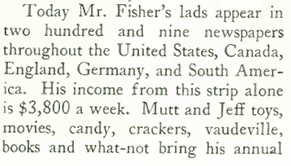
According to John Adcock’s terrific Yesterday’s Papers blog, by 1916 Bud Fisher was the highest paid cartoonist on earth. The New Yorker suggested his annual income was $300,000 (roughly equivalent to more than $4 million today). In addition to the strips, created by Fisher and a team of ghost illustrators/writers, Mutt & Jeff were featured in vaudeville engagements, theatrical shows, animated cartoons, comic books and toys.

muttmagicdark1380
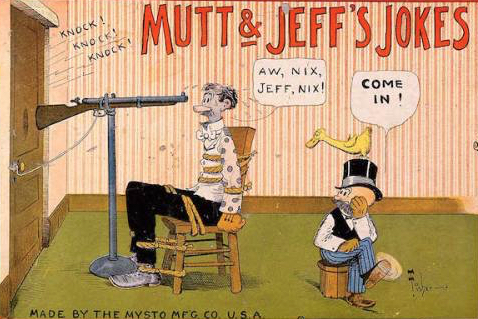
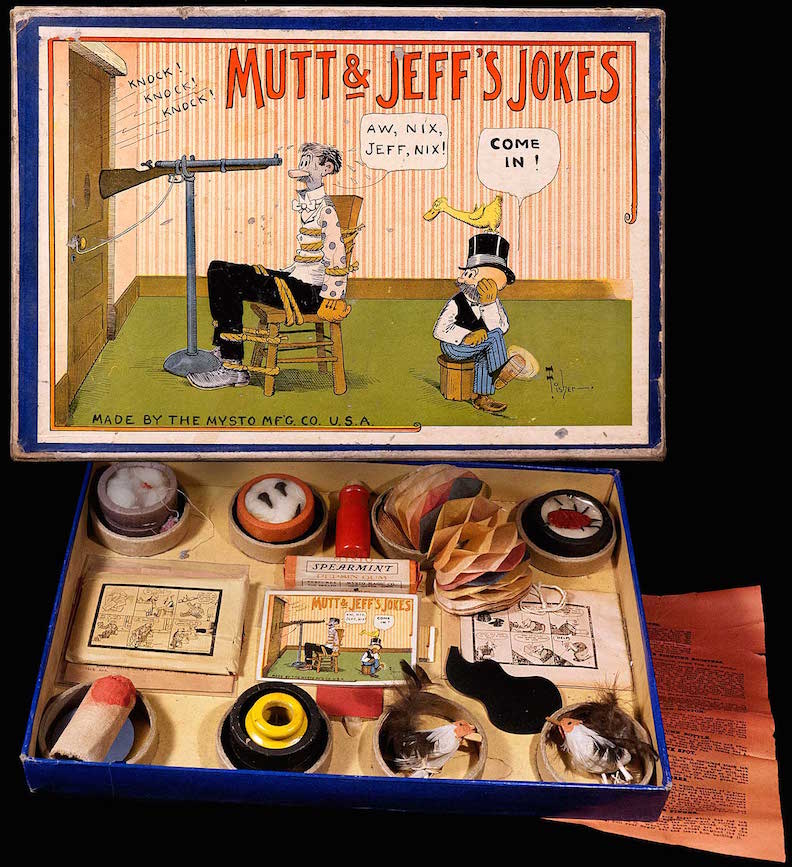
DIE LAUGHING…Mutt & Jeff themed toys included this joke kit from Mysto Manufacturing. I don’t quite get the joke featured on the cover, depicting Jeff’s casually twisted approach to murdering poor Mutt. (Copyright MEL BIRNKRANT via melbirnkrant.com—a truly amazing collection)
m902d5g
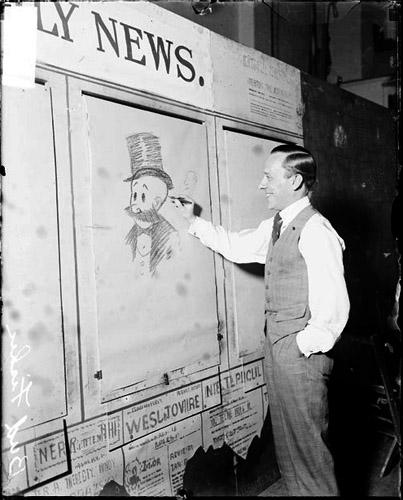
IT’S A LIVING…Harry Conway (Bud) Fisher, drawing a likeness of the character “Jeff” at a Chicago Daily News event in 1915. (Chicago History Museum)

Fisher began his career as a sports cartoonist for the San Francisco Chronicle and started his strip about “two mismatched tinhorns” in 1907. It went into syndication the following year. Mutt and Jeff, originally titled A. Mutt, is regarded as the first American newspaper cartoon published as a strip of panels, making it the first “comic strip.”

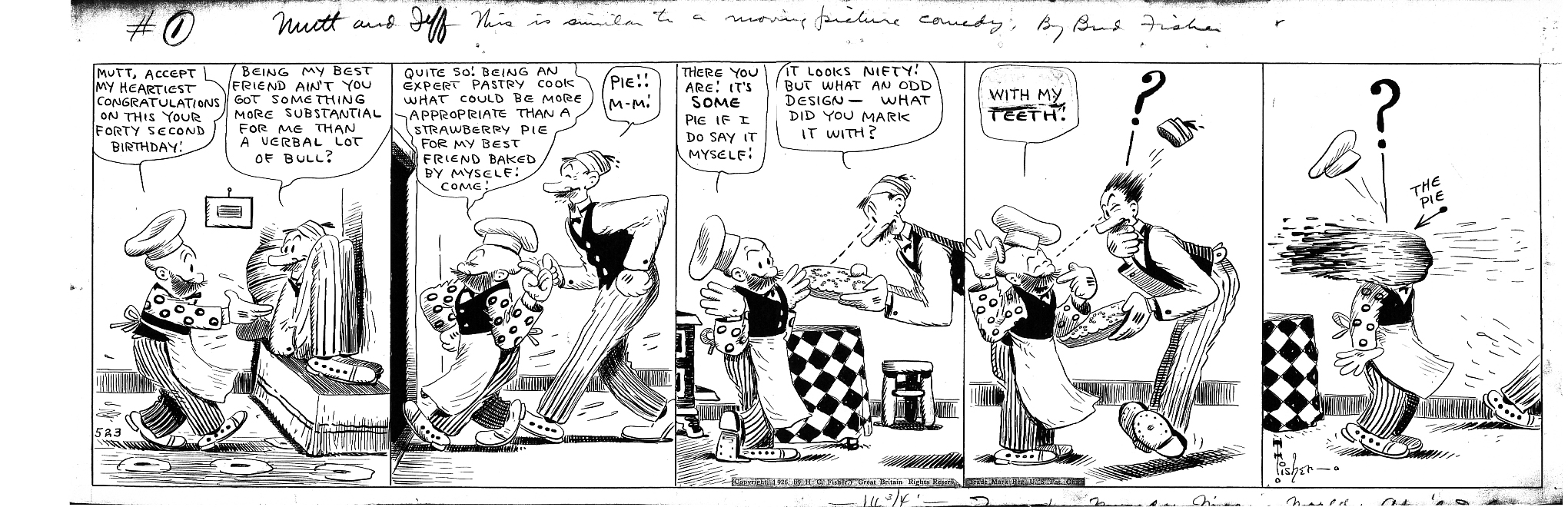
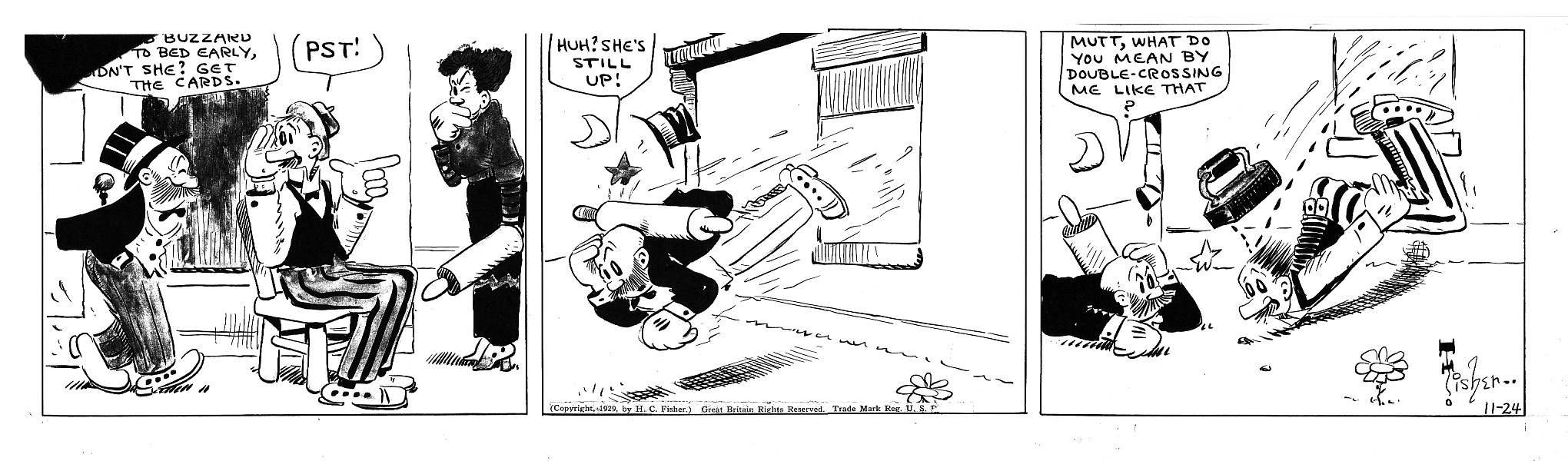
There was obviously a time when American readers thought Mutt & Jeff hilarious, but I don’t quite get its appeal. In this strip from 1926, Jeff gets a pie in the face. The giant question mark was frequently employed by Fisher, as were the dotted eye lines and explanatory arrows like the one in the last panel. No, Jeff didn’t get his brains blown out by Mutt. It is only a pie! Hah!

muttjeff052326b
Click on image to enlarge

Another visual cliché from comics of yore was the angry wife wielding a rolling pin. Apparently Jeff refers to Mutt’s wife as an “Old Buzzard” and assumes she is already in bed (sorry about the poor quality of the reproduction). Jeff subsequently gets whacked with the rolling pin, and Mutt takes it on the bean with a flatiron. That is quite a feat, throwing a grown man through a window while simultaneously hitting him on the head with a flatiron…
muttjeff112429a
Click on image to enlarge (Both strips courtesy University of Michigan)

The duo were also featured in more than 300 animated “half-reelers” produced between 1913 and 1926, including Mutt and Jeff: On Strike from 1920. The short film (which can be viewed here) even includes rare footage of Bud Fisher himself, since the story–sort of a film within a film–involves the penniless Mutt and Jeff going on strike after they see a movie featuring Fisher’s lavish home.

screen-shot-2017-01-26-at-12-50-34-pm
STRIKEBREAKER…Still images from the silent half-reeler, Mutt and Jeff: On Strike. Bud Fisher is shown at home discussing terms over the phone with his striking characters. They lose. (www.filmpreservation.org)

Coombs concluded the profile with these observations concerning Fisher’s personal habits:

screen-shot-2017-01-24-at-1-50-19-pm

screen-shot-2017-01-24-at-1-50-30-pm

Fisher employed a number of assistants on the strip, including George Herriman (Krazy Kat) and a high-school boy named Maurice Sendak (Where the Wild Things Are). When Fisher appeared to lose interest in the strip in the 1930s, assistant Al Smith took over and drew the strip for nearly fifty years (but Smith didn’t sign his own name on the strip until after Fisher’s death in 1954).

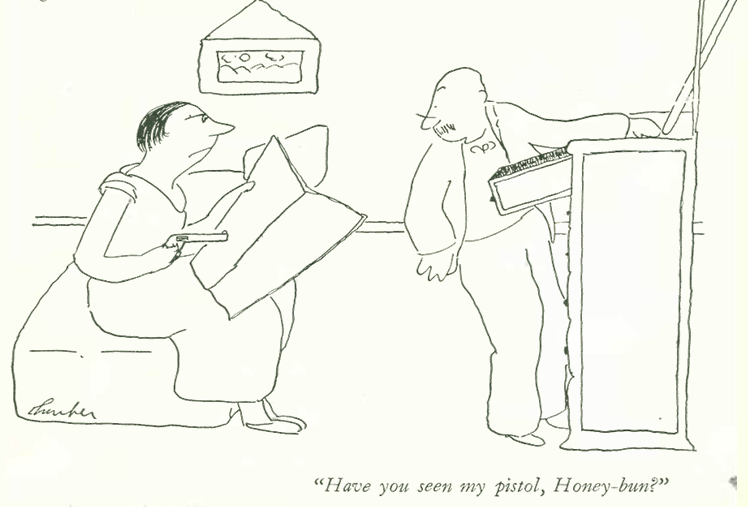
In Yesterday’s Papers, Adcock notes that Fisher “was the unlikeliest person you could think of to draw Mutt and Jeff…along with most of his contemporary cartoonist-journalists pals, (he) enjoyed fights, chorus girls, gambling, and saloons. Fisher liked to shoot up hotel rooms with his pistols, one of which was a gift from Pancho Villa, indoors when he was drunk.”

Heads in the Clouds

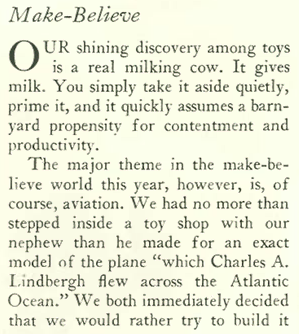
Thanks to the race to fly across the Atlantic, toy models of Charles Lindbergh’s Spirit of St. Louis and other planes were in high demand for the Christmas season, according to this item in the Nov. 26, 1927, “Talk of the Town:”

screen-shot-2017-01-24-at-1-42-51-pm

screen-shot-2017-01-24-at-1-42-56-pm

screen-shot-2017-01-27-at-9-48-40-am
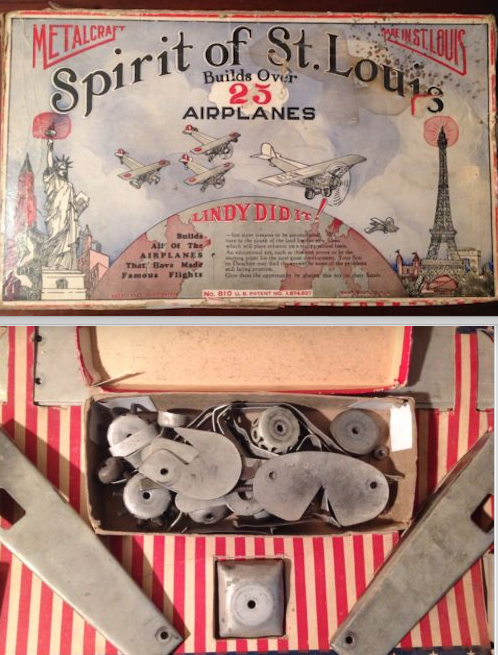
BUILT TO LAST…A Metalcraft model kit (box, upper image, contents below) from the late 1920s. It was all metal in the days before plastic model kits. (eBay)

 *  *  *

At a Loss For Words

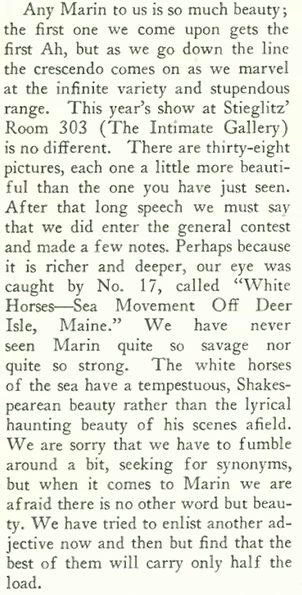
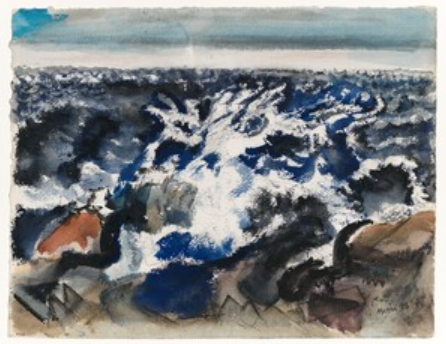
Jumping back to the Nov. 19, 1927 issue, we go from the low art of Bud Fisher to the high art of John Marin featured in “The Art Galleries” section. Art critic Murdock Pemberton wrote:

the-art-galleries-marin-1

screen-shot-2017-01-27-at-10-01-51-am
SAVAGE WORK…John Marin, White Horses – Sea Movement off Deer Isle, Maine, 1926. (Whitney Museum of American Art)

But perhaps “high art” is not an accurate description of Marin’s paintings, since Marin himself wasn’t into “highfalutin words” to describe his work…

marin-2-signed-mp

12032401444_4bb042eb04_b
HAUNTING BEAUTY…John Marin, Echo Lake Franconia Range White Mountain Country, 1927 (National Gallery of Art, Washington DC.)

 *  *  *

In the previous week’s issue (Nov. 12) the Marmon 8 was advertised as an ideal car for women. Not to be outdone, the folks at Buick shot back with this colorful ad in the Nov. 19 issue:

screen-shot-2017-01-24-at-1-19-18-pm

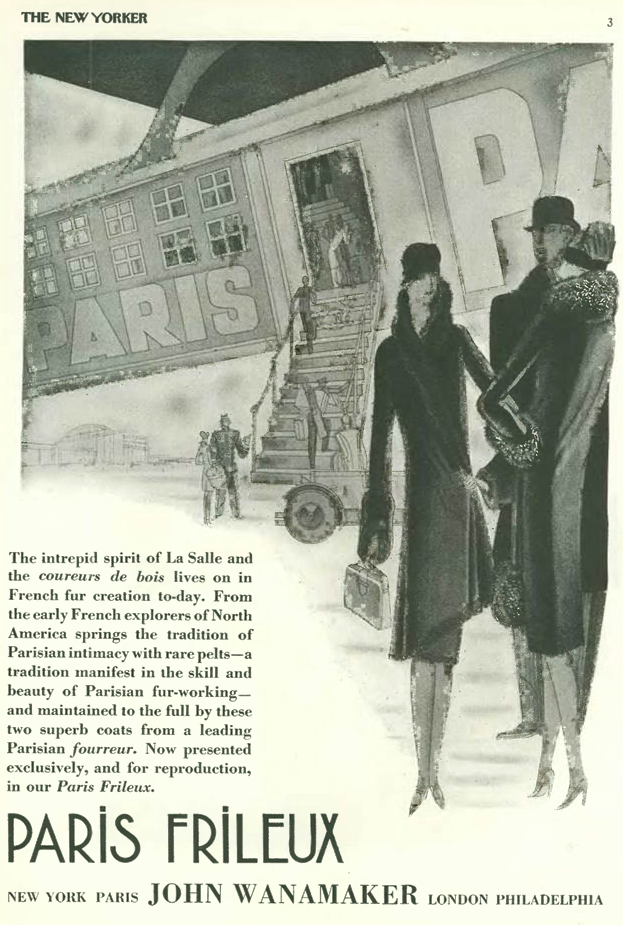
The Nov. 19 issue also featured this strange advertisement from the famed Wanamaker department store. Strange mainly because of the illustration, which features a fashionable woman departing a fanciful aircraft studded with mullioned windows(!) and a stairway that stretches to improbable depths…oh, and in case the reader might miss the snob appeal associated with French furs, the words Paris, Parisian or French are featured ten times…

screen-shot-2017-01-24-at-1-20-53-pm

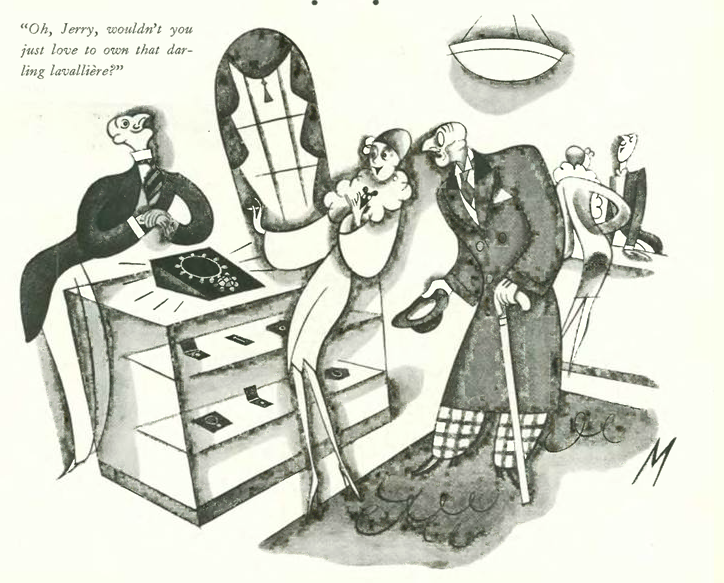
And finally, the ubiquitous New Yorker cartoon featuring the humorous mismatch of rich old sugar daddy and ditzy young mistress, courtesy of Julian de Miskey

screen-shot-2017-01-24-at-1-25-20-pm

Next Time: More Funny Business…

dec-3


You’ve Come a Long Way, Baby

Above: Noël Coward and Gertrude Lawrence in a 1930 performance of Coward's Private Lives. Encyclopedia Britannica.

Those of us who still remember cigarette ads on television will recognize the tagline that heads this blog–“You’ve come a long way, baby,” was the jingle for Virginia Slims–which in 1968 was a new, thin cigarette from Phillip Morris marketed specifically to women.

9983e8cd5c5a373ecc556a6012f32c9a
October 29, 1927 cover by Julian de Miskey.

The campaign launched by the Leo Burnett Agency sought to make Virginia Slims an “aspirational” brand for the liberated woman of the Swinging 60s…

1968-virginia-slims-ad
These ads from 1968 announced a new cigarette for the liberated woman. (flashbak.com)

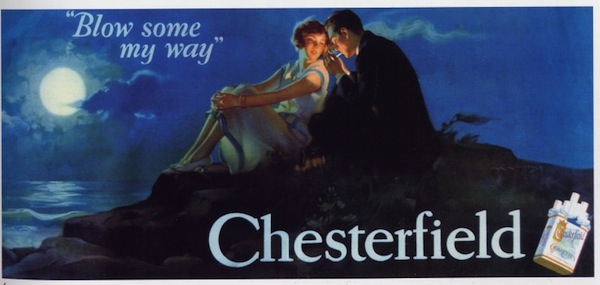
Forty years earlier, the folks at Liggett & Myers Tobacco Company also thought they could trade on the image of the Jazz Age’s liberated woman with this famous ad from 1926:

154997-chesterfield2
(History News Network)

Although the woman in the ad was not smoking, a taboo had been broken by merely suggesting she might be a smoker. The New Yorker first explored this topic in their July 24, 1926 issue, with this item in “The Talk of the Town”…

Screen Shot 2016-01-20 at 5.48.13 PM

In the Oct. 29, 1927 issue they returned to the topic in the “Talk” column, now that advertisers had gone a step further and actually depicted women with lighted cigarettes between their fingers:

screen-shot-2017-01-04-at-11-07-15-am

screen-shot-2017-01-04-at-3-17-10-pm
BRAZEN…Ads from 1927 depicting women smoking Old Gold and Marlboro cigarettes.

The Oct. 29, 1927, The New Yorker itself featured ads with women smokers, including this installment in a series for Old Gold by cartoonist Clare Briggs

screen-shot-2017-01-04-at-11-30-32-am

…and this ad for the tipless Smokador ashtray, which was featured in many issues of The New Yorker

screen-shot-2017-01-04-at-11-31-24-am

What Flattery Will Get You

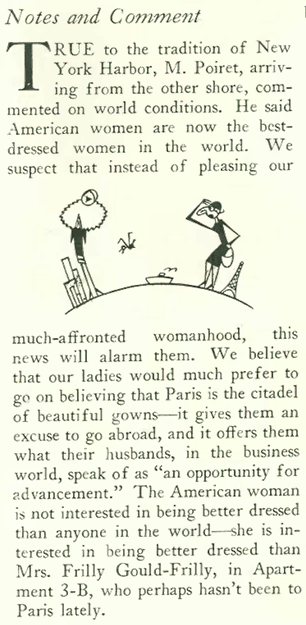
In addition to women smokers, The New Yorker was also agog about a visit to the city by the great French fashion designer Paul Poiret (1879–1944), who upon his arrival proclaimed American women to be the best-dressed in the world:

screen-shot-2017-01-04-at-11-09-18-am

screen-shot-2017-01-04-at-4-00-32-pm
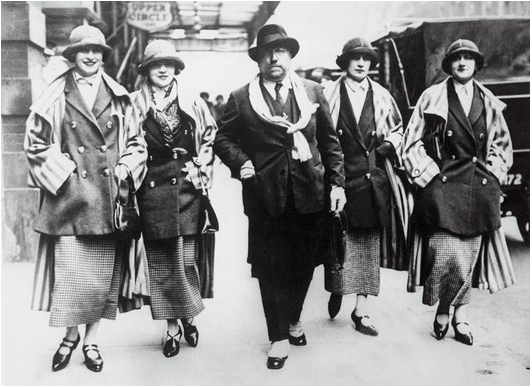
THE LIBERATOR…Paul Poiret on a stroll with models, circa 1930. Poiret led a fashion renaissance that introduced free-flowing dresses and “harem pants.” He is often credited with liberating women from the corset. (trendmano.blog.hu)

Perhaps Poiret’s flattery of American women could be attributed to the fact that his designs had lost popularity in France after World War I, and his fashion empire was on the brink of collapse. (Indeed, his fashion house would close in 1929). However today he is recognized as the first great modernist in fashion design, often compared to Pablo Picasso in terms of the contributions he made to his field.

The New Yorker took advantage of his visit to the city by featuring him in a lengthy profile in the Oct. 29 issue, written by Paris correspondent Janet Flanner under the pseudonym “Hippolyta.” Despite Poiret’s diminished presence in France, Flanner nevertheless understood his enormous contribution to modern fashion design. She concluded her profile with this observation:

screen-shot-2017-01-04-at-11-15-10-am

Something Fishy

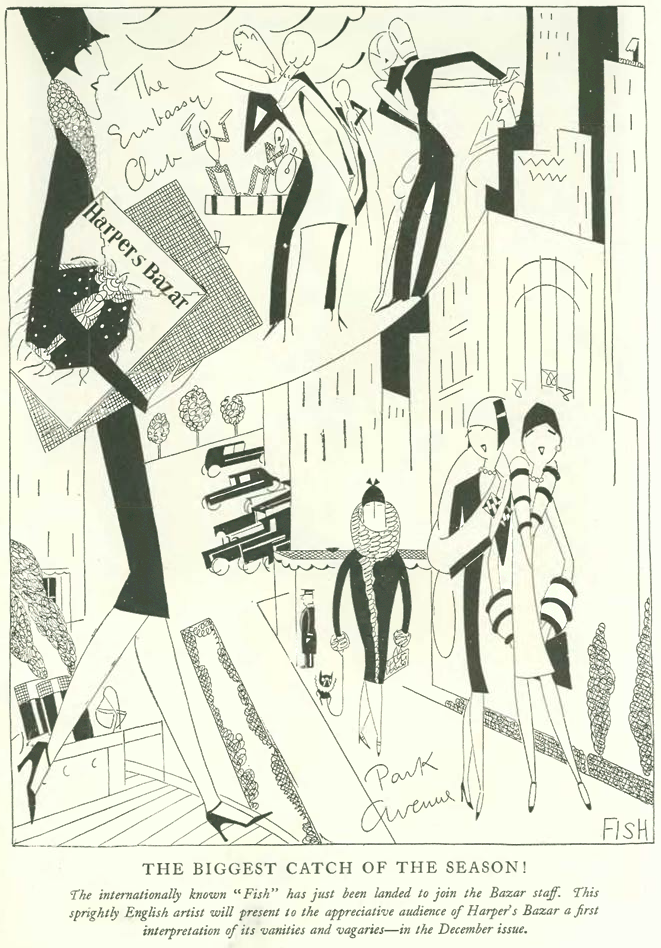
The New Yorker appealed to young, upscale urban dwellers, so it was no wonder that Harper’s Bazar advertised in the magazine, including this ad in the Oct. 29, 1927 issue that announced the debut in its pages of the English artist known as “Fish”…

screen-shot-2017-01-04-at-11-05-54-am

Anne Harriet Fish (1890-1964) was famed for her witty depictions of high society in Condé Nast’s Vanity Fair and The Tatler, where she began work in 1914. A rival “smart set” magazine, Harper’s Bazar, was eager to boast that it had finally “landed” the Fish.

6fb43ab16b45d6f41329fef80bd1baf0
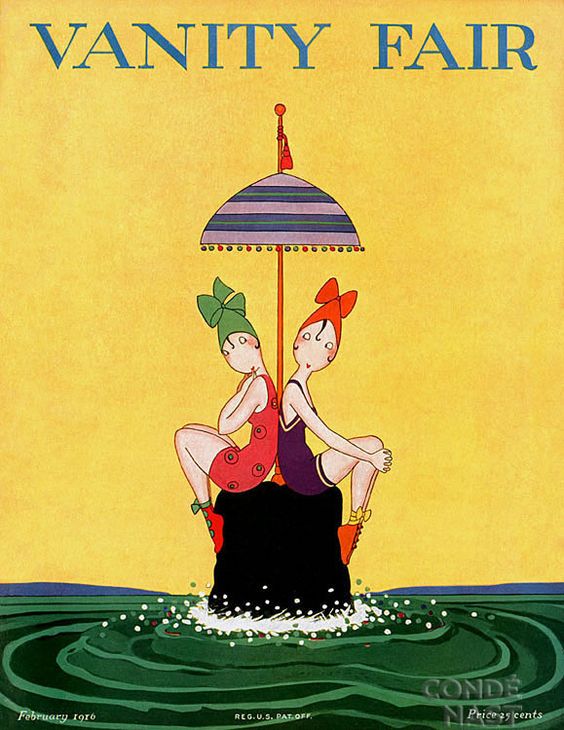
A February 1916 Vanity Fair cover by A. H. Fish. (Condé Nast)

 *  *  *

Broadway Ballet

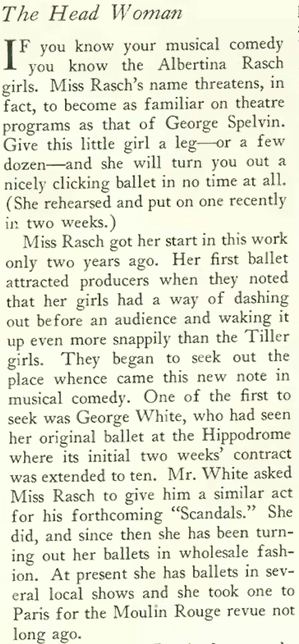
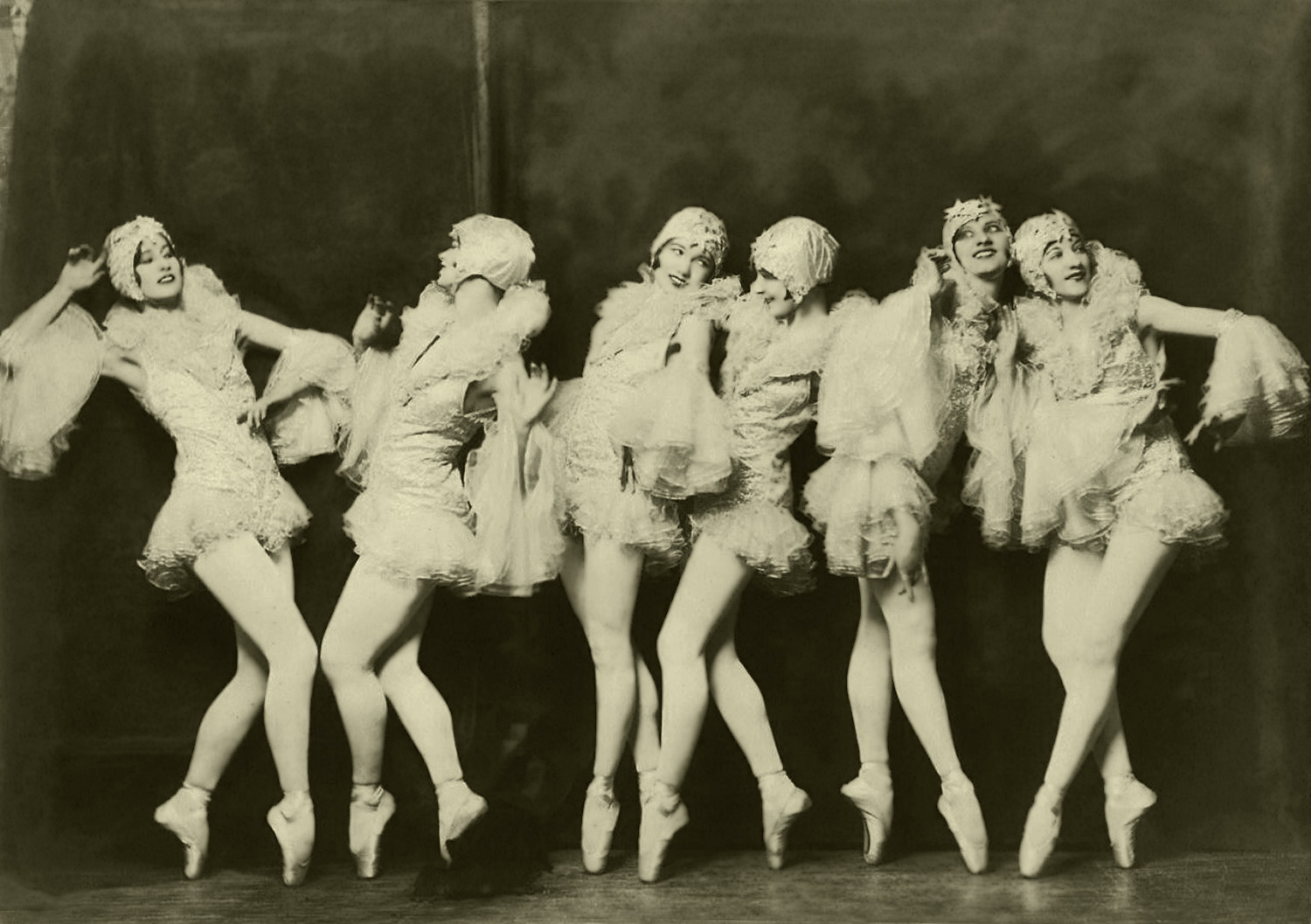
The Oct. 29 “Talk of the Town” noted that Albertina Rasch and her ballet dancers were making quite a splash on Broadway. Her success in staging dances for Flo Ziegfeld’s “Follies” and George White’s “Scandals” would lead to a career in Hollywood, where she would be instrumental in elevating the role of dance director to what we now call a choreographer. Among her many firsts, she is credited with helping to establish Cole Porter’s “Begin the Beguine” as a popular standard by incorporating it into a dance in the 1935 film Jubilee.

screen-shot-2017-01-04-at-11-11-00-am

The Albertina Rasch Dancers in costume for Rio Rita (1927). (songbook1.wordpress.com)

 *  *  *

Where Were You Last Year?

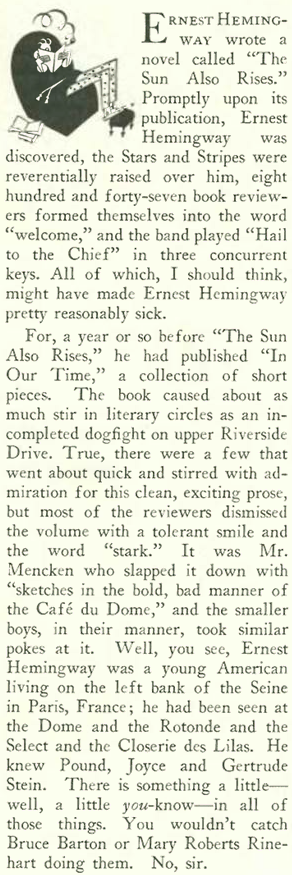
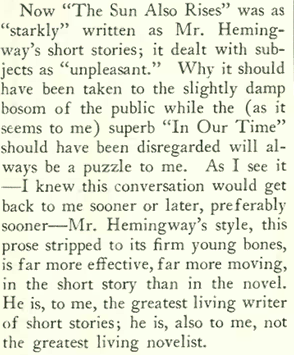
Writing under the pseudonym “Constant Reader,” Dorothy Parker penned a vigorous defense of Ernest Hemingway’s short fiction in the “Books” section of the Oct. 29 issue. Specifically she took issue with critics who continued to rave about Hemingway’s novel The Sun Also Rises, but mostly ignored a collection of short stories he had previously published under the title In Our Time.

screen-shot-2017-01-05-at-1-19-48-pm
HE’S PRETTY GOOD…Ernest Hemingway in 1927, shortly after publication of his novel The Sun Also Rises. At right, Dorothy Parker in the 1920s. (AP/Bookriot)

screen-shot-2017-01-04-at-11-38-39-am

constant-reader

And finally, Barbara Shermund explored the intersection of high culture and flapper culture in this cartoon…

screen-shot-2017-01-04-at-11-13-56-am

Next Time: Death Avenue Days…

8b6d47f5480e534755b5a03ab5ea97a4

Electric Wonders

While Europeans in the 1920s dealt with frayed economies and political strife in the wake of World War I , Americans enjoyed a period of relative peace and prosperity along with an array of new electrical gadgets people didn’t even know they needed.

6ed825c70c3fd789a666a63ecc376b5d
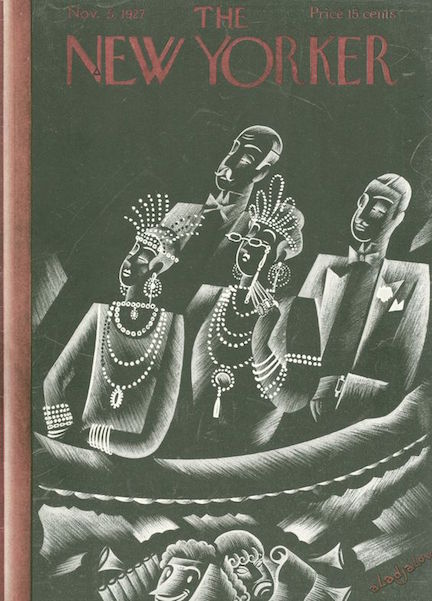
October 22, 1927 cover by Julian de Miskey.

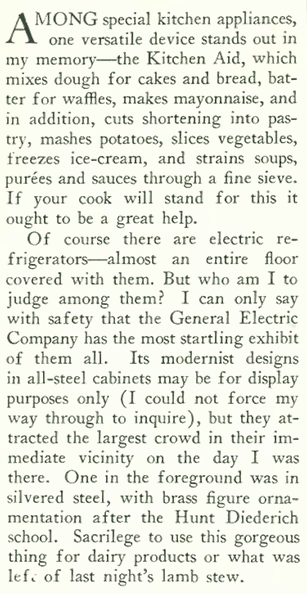
In the column “About The House,” The New Yorker wryly warned “timid souls” about the new push-button world they would encounter at the Electrical and Industrial Exposition at Grand Central Palace…

dffff4f6ca7374d0467ec29453344292
Poster advertising the Electrical and Industrial Exposition. (public domain image)

screen-shot-2017-01-03-at-9-51-20-am

screen-shot-2016-12-16-at-9-06-56-am
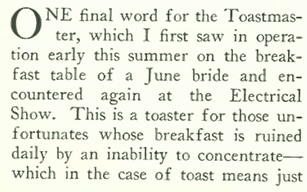
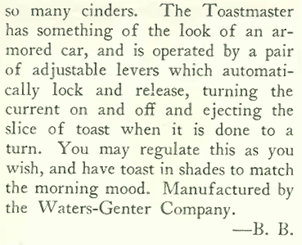
WILL WONDERS NEVER CEASE?…The New Yorker marveled over the latest electrical appliances on display at the Electrical and Industrial Exposition at Grand Central Palace including, clockwise from top left, the Toastmaster automatic toaster (which the magazine noted resembled an armored car), an electric washing machine, and the mighty Kitchen Aid mixer, which is still going strong in American kitchens today.

screen-shot-2017-01-03-at-9-52-15-am

ge
THE ICEMAN COMETH NOT…A saleswoman shows off the features of a GE Monitor Top Refrigerator on display at a product exhibition in the late 1920s. (Public Domain Image)

screen-shot-2017-01-03-at-9-53-04-am

screen-shot-2017-01-03-at-9-53-16-am

Nan’s No No

The New Yorker’s “Talk of the Town” featured one of the Roaring Twenties big scandals–Nan Britton’s affair with U.S. President Warren G. Harding (who died at age 57 in 1923) and the debate over the paternity of their love child, Elizabeth Ann. Britton had just published a “tell all” book, The President’s Daughter, which was bringing out the worst in a lot of people…

screen-shot-2017-01-03-at-10-26-29-am
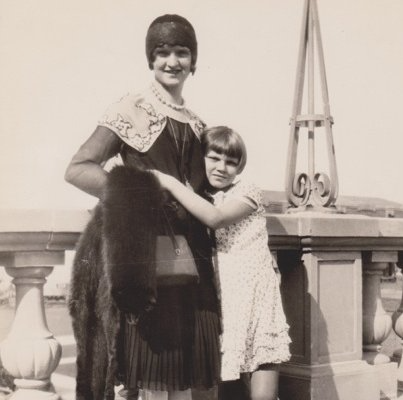
LIFE WITHOUT FATHER…Nan Britton with her 8-year-old daughter, Elizabeth Ann, in 1927. (New York Times/James Blaesing)

screen-shot-2017-01-03-at-10-47-43-am

screen-shot-2017-01-03-at-10-47-54-am

Although at the time Britton was denounced by many (including the Harding family) as a liar who was only out to get money from the President’s estate, genetic tests conducted in 2015 have confirmed that Elizabeth Ann was indeed Harding’s daughter. Britton died in 1991 at the age of 94. Elizabeth Ann would follow in 2005, at age 86.

Porgy Hits the Stage

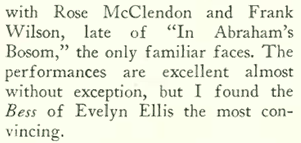
Porgy: A Play in Four Acts opened at the Guild Theatre, and New Yorker reviewer Charles Brackett was there to witness perhaps the first attempt at an authentic presentation of black culture on a Broadway stage. Based on a play by Dorothy and DuBose Hayward, the production was unusual for its time in featuring a cast of African American actors. The play would provide the basis of the libretto for the 1935 folk opera Porgy and Bess, which would feature George Gershwin’s famous score including the popular song “Summertime.” An excerpt from Brackett’s review, which included some unfortunate stereotypes…

screen-shot-2017-01-03-at-10-52-59-am

screen-shot-2017-01-03-at-10-53-09-am

porgy-verwayne-wilson-ellis
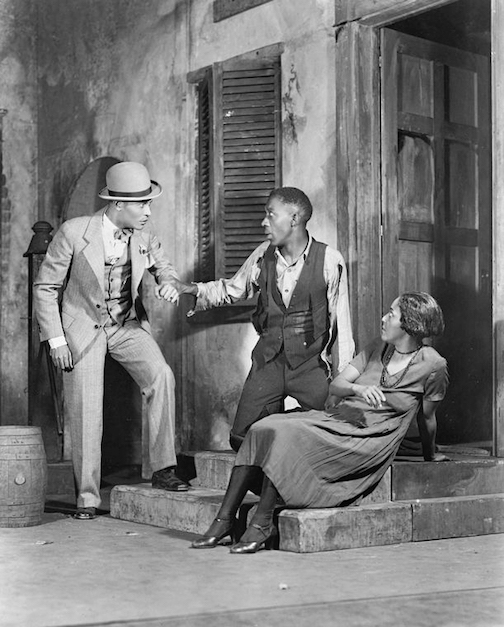
SOMETHING NEW ON BROADWAY…Percy Verwayne (Sporting Life), Frank Wilson (Porgy) and Evelyn Ellis (Bess) in Porgy: A Play in Four Acts. October 1929. (Wikipedia)

 *  *  *

Same to You, Fella

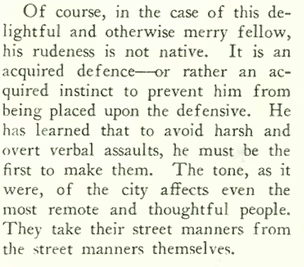
In his “Reporter at Large” column, Morris Markey sounded off on the rude behavior he had observed of late among his fellow New Yorkers. In relating a story about the crude behavior of a building’s security guard, Markey pondered the old nature vs. nurture question…

screen-shot-2017-01-03-at-10-54-54-am

Aw, Shucks…

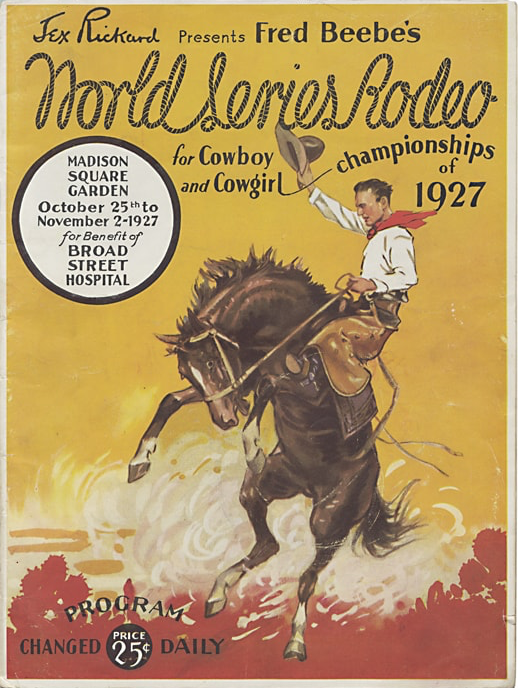
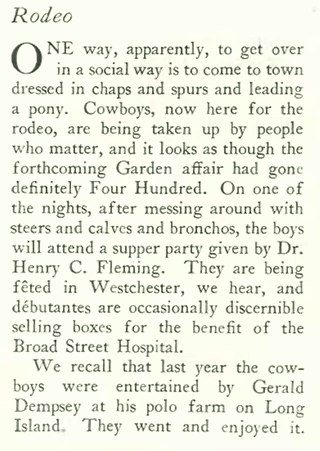
Not all New Yorkers were acting rudely. Some were even treating visiting rodeo cowboys with the utmost courtesy, as noted in the “The Talk of the Town,” although others found the sport to be brutal and unnecessary…

screen-shot-2017-01-03-at-1-30-42-pm
GIDDYAP…Program from the World Series Rodeo at Madison Square Garden, 1927. (Rare Americana)

screen-shot-2017-01-03-at-10-56-25-am

screen-shot-2017-01-03-at-10-56-33-am

1927 World Series Rodeo was produced by famed sports promoter, Tex Rickard, in Madison Square Garden as a benefit for the Broad Street Hospital.

The other World Series, the one concerning baseball, was still absent from the pages of The New Yorker, even though the 1927 Yankees would win a record 110 games and sweep the Pittsburgh Pirates in four games to win the World Series title…and Babe Ruth would hit a record 60 home runs.

As I’ve noted before, there was a lot of sports coverage in the early issues of The New Yorker, everything from polo to college football. As for the omission of the Yankees and baseball in general from the pages of the magazine, perhaps the editors felt the game was still tainted by the Black Sox scandal of 1919 and was not worthy of coverage.

How’s the Weather Up There?

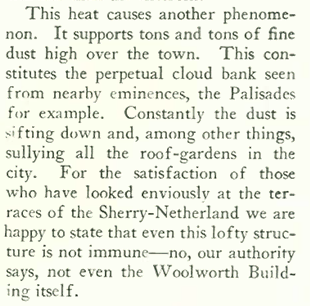
The city’s “heat affect” was another “Talk” topic, with editors noting that the city’s buildings and streets not only affected temperatures in the city, but also its air quality…

screen-shot-2017-01-03-at-10-57-05-am

maiakovskii-in-new-york
IN HIS ELEMENT…Futurist poet Vladimir Mayakovsky amid the dusty haze of New York City in 1925. (thecharnelhouse.org)

 *  *  *

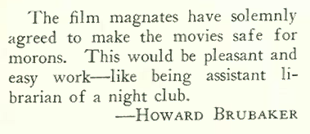
In “Of All Things,” Howard Brubaker chimed in on The New Yorker’s continuing criticism of Hollywood films, especially in the age of Will Hays and his continued attempts at film censorship…

screen-shot-2017-01-03-at-10-53-27-am

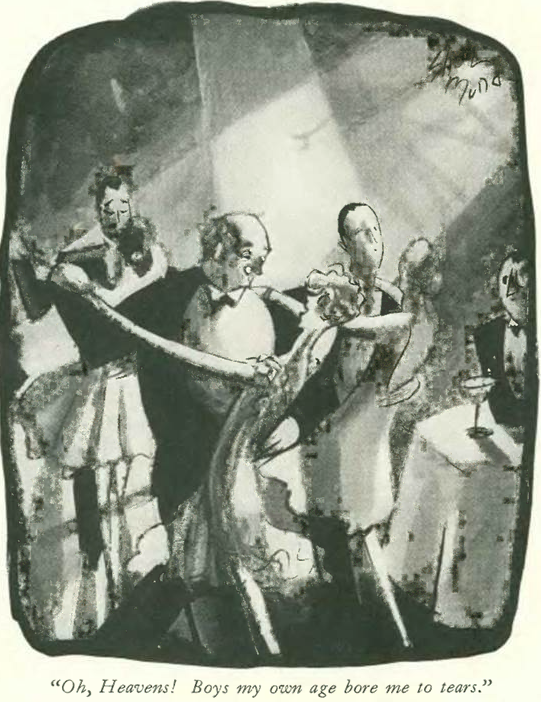
Finally, a couple of cartoons from the Oct. 22 issue, including this one by Barbara Shermund that explores one of the magazine’s continuing themes regarding life among the portly, middle-aged sugar daddies and their ditzy young mistresses…

screen-shot-2017-01-03-at-10-58-25-am

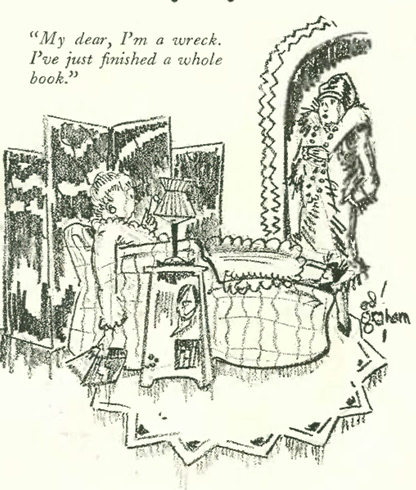
…and this jab at the dim-witted, idle rich by illustrator Ed Graham

screen-shot-2017-01-03-at-10-58-46-am

Next Time: You’ve Come a Long Way, Baby…

9983e8cd5c5a373ecc556a6012f32c9a


Wits of the Round Table

Two big voices from the famed Algonquin Round Table were prominently featured in the Oct. 1 and Oct. 8, 1927 issues of the New Yorker–journalist and champion of the underdog Heywood Broun wrote his own “Profile” under the title, “The Rabbit That Bit the Bulldog,” and Dorothy Parker served up biting satire in “Arrangement in Black and White,” a clever exposé of racism among the fashionably “open-minded” upper classes.

488a50459a792547010d30e8bfe5ddf4
October 1, 1927 cover by Gardner Rea.

The Rabbit That Bit the Bulldog

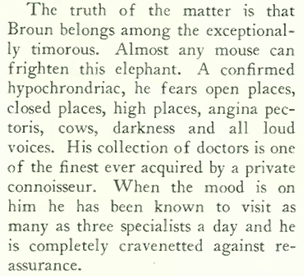
Hiding under the signature “R.A.”, Heywood Broun (1888–1939) was merciless as his own profiler, describing himself as a coward, hypochondriac, and a slob (there is truth to the latter, however, as friends often likened him to “an unmade bed”).

screen-shot-2016-12-08-at-9-06-52-am

Broun cut his teeth in journalism as a sportswriter and war correspondent. In 1921 he went to work for the New York World, where he penned his popular syndicated column “It Seems to Me.” Broun’s New Yorker “Profile” was written after he was fired from the World following a disagreement with his editor over his critical commentary on the sentencing of anarchists Sacco and Vanzetti. Broun would move on to The Nation, where he would write a regular column, “It Seems to Heywood Broun,” that would offer criticism on a number of topics including his former employer, the World.

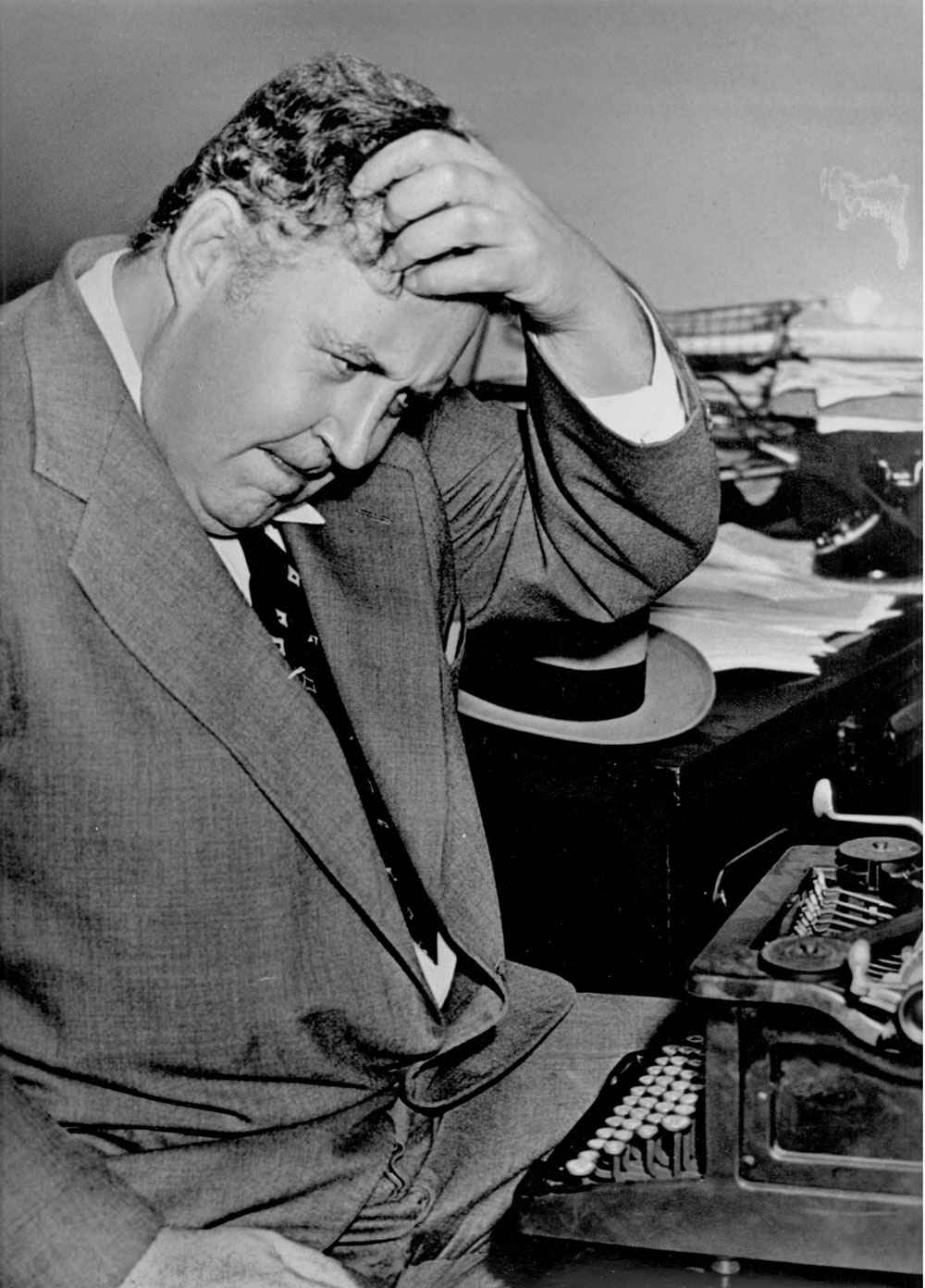
Heywood Broun. (Denver Newspaper Guild)

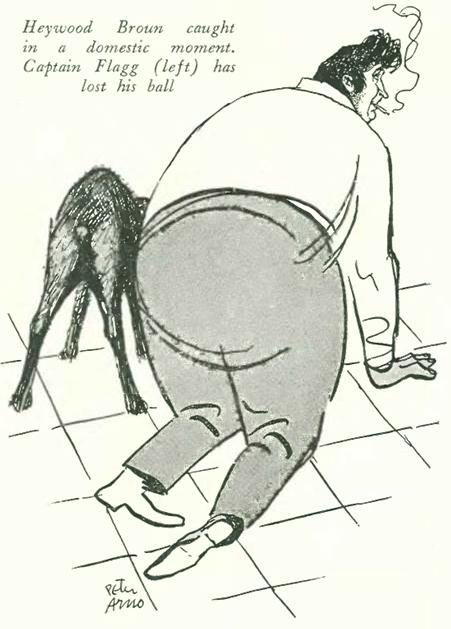
The New Yorker profile included this caricature by Peter Arno

screen-shot-2016-12-06-at-9-46-21-am

…a portrayal Broun claimed was inaccurate due to his “habitual stoop,” among other faults…

screen-shot-2016-12-06-at-9-52-23-am

screen-shot-2016-12-06-at-9-52-34-am

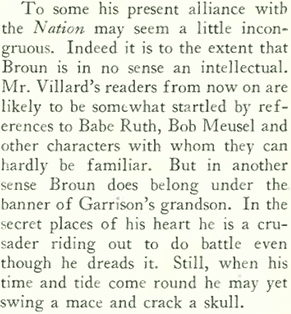
…and he mused about his future with the Nation, and how that august publication would square with his various foibles…

screen-shot-2016-12-06-at-9-52-45-am

…and as for his personal appearance and habits, Broun weighed in thusly…

screen-shot-2016-12-06-at-9-55-18-am

Broun married social activist Ruth Hale in 1917. A son born the following year, Heywood Hale Broun, would have a long and successful career as an author, sportswriter, commentator and actor.

*  *  *  *  *

The Long Count

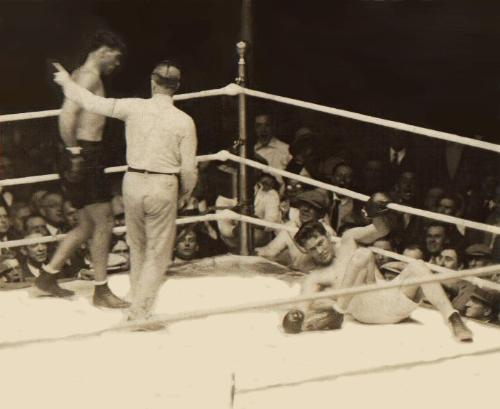
Oddly, The New Yorker had little to say about the famous Chicago rematch between heavyweight boxers Gene Tunney and Jack Dempsey, which Tunney won after the controversial “long count.” The fight took place under new rules that gave a fallen fighter ten seconds to rise to his feet, but the count would not begin until his opponent moved to a neutral corner.

tumblr_mti3g257h11rnxl9do1_500
DAZED AND CONFUSED…Referee Dave Barry motions Jack Dempsey to a neutral corner before he begins his count. Gene Tunney got back up and went on to win the fight. (Chicago Tribune archive photo)

Although Tunney dominated the fight, Dempsey unleashed a flurry in the seventh round that knocked Tunney to the canvas–it was the first time in Tunney’s career that he’d been knocked down. Instead of going immediately to a neutral corner, Dempsey just stood and observed his opponent for several seconds until finally retreating. Those extra seconds proved just enough time to allow Tunney to return to his feet and eventually win the bout. To one observer quoted in “The Talk of Town,” those extra seconds really dragged…

screen-shot-2016-12-06-at-9-44-49-am

screen-shot-2016-12-06-at-9-44-55-am

From the Ad Department

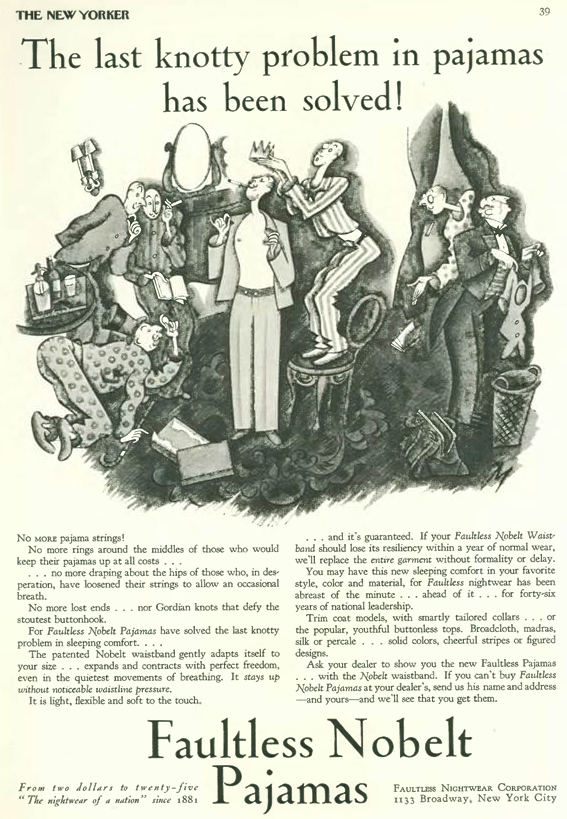
We feature this Julian de Miskey-illustrated advertisement for Faultless Nobelt Pajamas. Apparently these special PJs had some sort of newfangled rubber elastic band…

screen-shot-2016-12-06-at-9-57-42-am

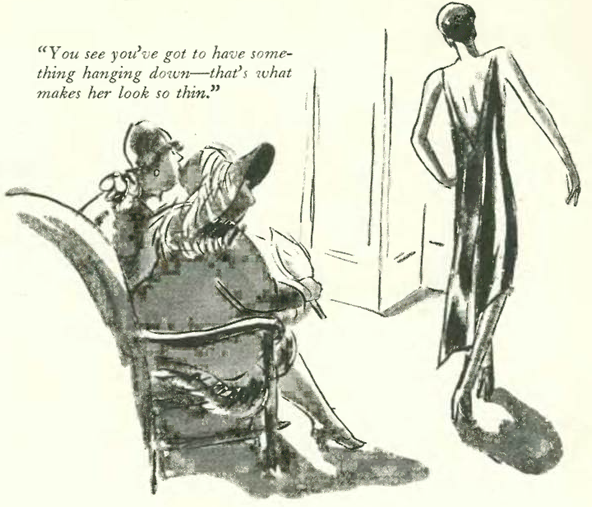
…and this cartoon from the Oct. 1 issue featured Helen Hokinson’s ditsy society women at New York’s Fashion Week…

screen-shot-2016-12-06-at-9-43-37-am

 *  *  *  *  *

Dorothy Takes On the Snobs

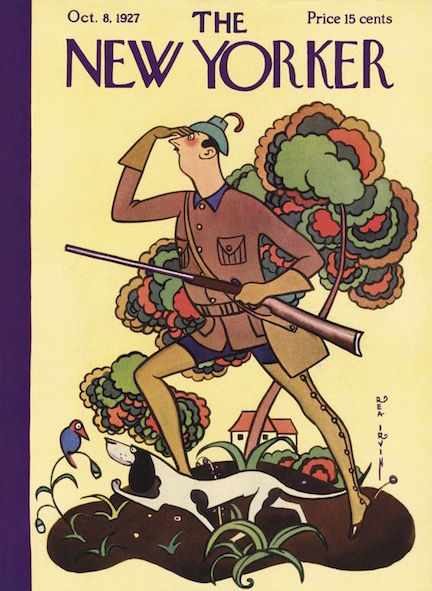
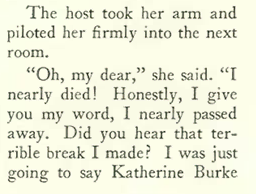
In the Oct. 8 issue, our other Round Table wit, Dorothy Parker, took aim at the less savory aspects of society women in her short fiction piece, “Arrangement in Black and White.”

f19964a9d1e1b6179fe2715bb3b1aa72
October 8, 1927 cover by Rea Irvin.

Parker began her piece by introducing us to a woman who enters a party wearing a wreath of “pink velvet poppies” in her golden hair. In short order she asks the party’s host to “pretty please” introduce her to the party’s guest of honor, an African American singer named Walter Williams.

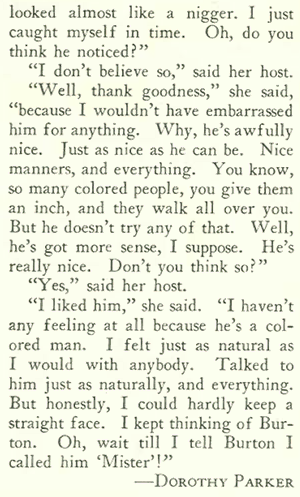
The woman with the pink velvet poppies goes on to tell her host that she came to the party alone because her husband, Burton, preferred not to socialize with “colored people”–but she however was “simply crazy” about some of them. “They’re just like children–just as easy-going, and always singing and laughing and everything.” Before she met the singer she observed to the host:

screen-shot-2016-12-06-at-1-18-25-pm

screen-shot-2016-12-06-at-1-19-09-pm

screen-shot-2016-12-06-at-1-16-57-pm
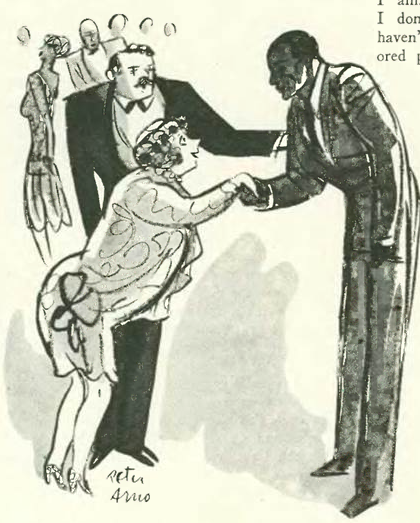
The woman with the pink velvet poppies meets the singer Walter Williams, as illustrated by Peter Arno.

Then the woman with the pink velvet poppies meets Walter Williams:

screen-shot-2016-12-06-at-1-19-42-pm

She continues to patronize the guest of honor, then notices a stage actress at the party:

screen-shot-2016-12-08-at-12-32-44-pm

Finally, the host guides the woman with the pink velvet poppies away from Walter Williams…

screen-shot-2016-12-06-at-1-21-59-pm

screen-shot-2016-12-06-at-1-22-30-pm

05325779fdf286303013d76dc9e89388
BITING WIT…Dorothy Parker in the 1920s.

We will see more of Dorothy Parker in issues to come as she continues to take aim at the pretentious, hypocritical, self-absorbed snobs of the Jazz Age and beyond.

Baseball’s Lament

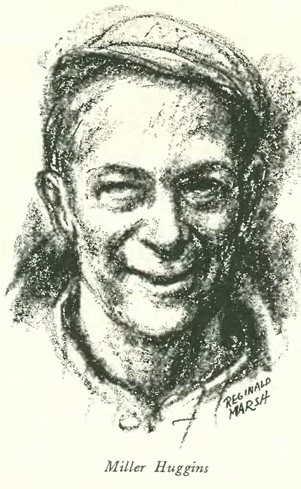
The Oct. 1 and 8 issues covered yacht racing, polo, tennis, golf and college football, but still no baseball. The 1927 New York Yankees would be one of the greatest teams of all time, but as the World Series commenced all we got from The New Yorker was a personality profile of Yankees manager Miller Huggins in the Oct. 8 issue (with a drawing by Reginald Marsh)…screen-shot-2016-12-06-at-1-24-05-pm

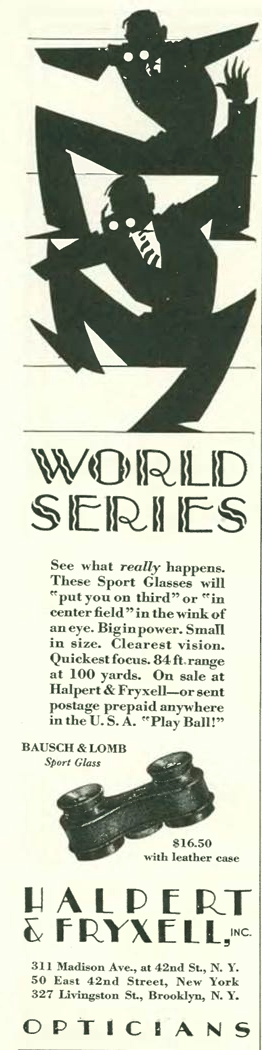
…and this advertisement for “Sport Glasses” for those attending the World Series…

screen-shot-2016-12-06-at-4-34-19-pm

Perhaps The New Yorker had no one on staff who could competently write about baseball. The strangest reference to the game was this article about polo, but for some reason it was illustrated with baseball images. Perhaps the editors felt sheepish about their lack of baseball coverage, and offered these illustrations by Howard Baer as a token acknowledgement…

screen-shot-2016-12-06-at-1-28-18-pm

At any rate, we end with this cartoon by Julien de Miskey, who like his colleagues explored the comic richness of wealthy old men paired with their young mistresses…

screen-shot-2016-12-06-at-1-16-04-pm

Next Time: The Ephemeral City…

f19964a9d1e1b6179fe2715bb3b1aa72


The Thurber Effect

We’ve looked at a number of artists and writers who were instrumental in giving The New Yorker its unique look and voice, but few were more influential than James Thurber, who contributed some of The New Yorker’s most memorable writings (“The Secret Life of Walter Mitty”) as well as some of its most enduring cartoons and illustrations.

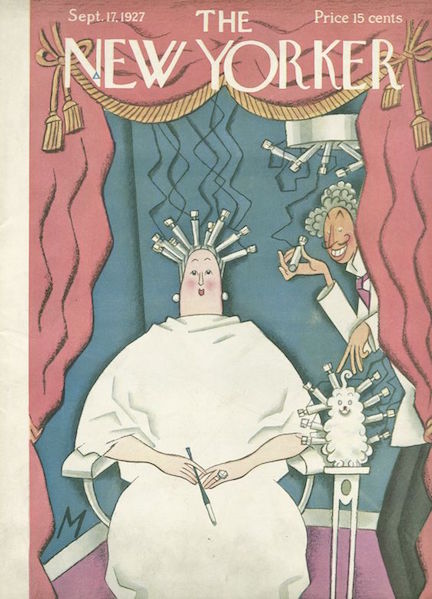
1ff86ce7dfa34152a1ab0aa892031914
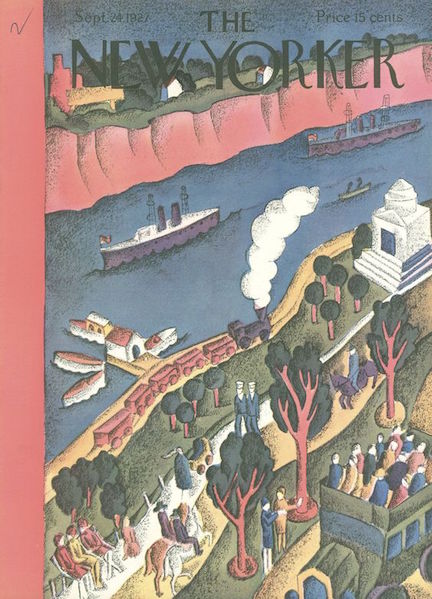
September 17, 1927 cover by Julian de Miskey.

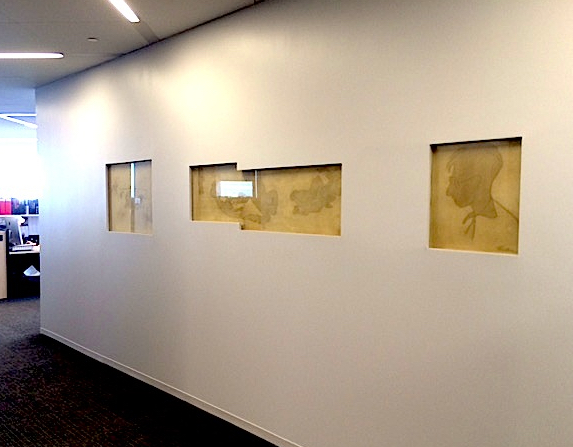
In fact, Thurber’s art is so ingrained in the New Yorker’s culture that the magazine goes to great lengths to preserve some of his office wall drawings, which move along with the magazine each time it relocates. On his website Ink Spill, New Yorker cartoonist Michael Maslin writes “When you move, it’s always reassuring unboxing something you love from the old place and setting it down in the new place.”

thurber-one-world-trade-center-ink-spill
ICONS…James Thurber’s wall drawings installed in The New Yorker offices at One World Trade Center (Michael Maslin, Ink Spill)

In 1991, when The New Yorker prepared to leave its longtime home at 25 West 43rd Street (where Thurber originally doodled on a plaster wall), conservators carved several drawings from the wall and mounted them in protective glass. The drawings were eventually installed at the magazine’s new offices across the street at 20 West 43rd St. They were moved again when The New Yorker relocated to 4 Times Square in 1999 and then once more in 2015 to their current location at One World Trade Center.

thurberwhite
NEW YORKER GIANTS…E.B. White and James Thurber in 1929. The two would share an office and become good friends. In 1929 they would collaborate on a best-selling book spoof, Is Sex Necessary? Or, Why You Feel the Way You Do. (xroads.virginia.edu)

Thurber joined the New Yorker staff in 1927, sharing an office “the size of a hall bedroom” with E. B. White, who had joined the magazine about a year earlier. According to Jon Michaud (in a June 2, 2010 New Yorker article), Thurber arrived at The New Yorker from Columbus, Ohio, via Paris, France, and a brief stint at the New York Evening Post. “Six months after he was hired, Thurber was transferred to ‘The Talk of the Town,’ where he found his feet as a reporter and did for that department what White did for ‘Notes and Comment’—he gave it an identity and a tone, which can still be heard in the magazine today.” This included introducing the convention of using the first person plural in “Talk” items.

james-thurber-2
James Thurber in undated photo. (thefamouspeople.com)

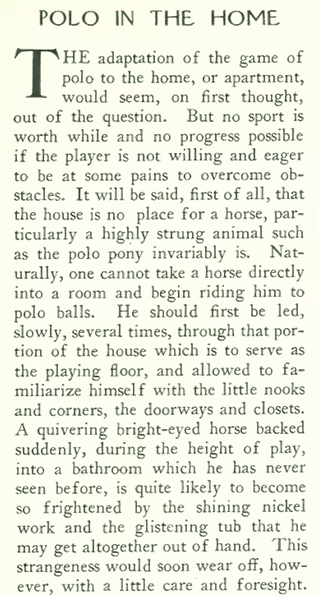
His contribution to the Sept. 17, 1927 issue was not anonymous, however, as Thurber prominently signed his entire name–James Grover Thurber–at the end of a humorous essay, “Polo In The Home.” An excerpt:

james-grover-thurber

 *  *  *  *  *

People in Glass Houses

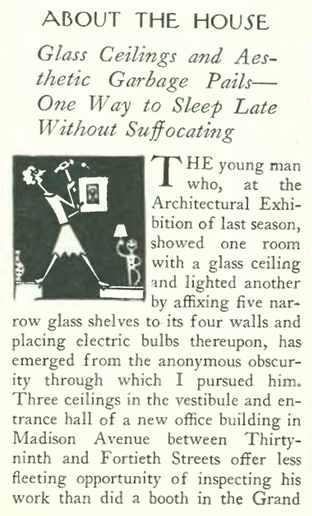
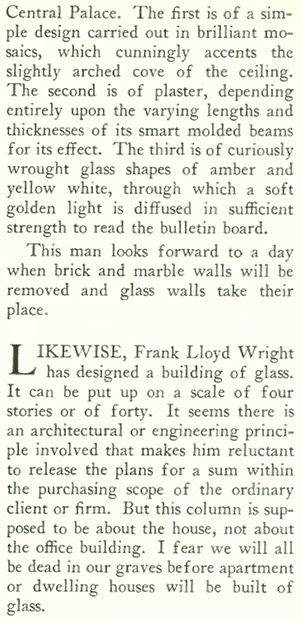
Writing in her “About the House” column, Muriel Draper examined new uses for glass in modern design and concluded that houses built of glass rather than stone belonged to a distant future.

screen-shot-2016-11-30-at-2-21-10-pm

screen-shot-2016-11-30-at-2-22-12-pm

Well, Muriel was almost right. Philip Johnson built his famous Glass House in New Canaan, Connecticut, in 1949. Muriel Draper died in 1952. I assume she visited the house or at least knew of it, since she and Johnson were in New York social orbits that often aligned, especially around the Harvard modernists.

glasshouse6atnight
PASS THE WINDEX…Architect Philip Johnson’s famed Glass House in New Canaan, Connecticut. (connecticutmag.com)

 *  *  *  *  *

So Much For Golf

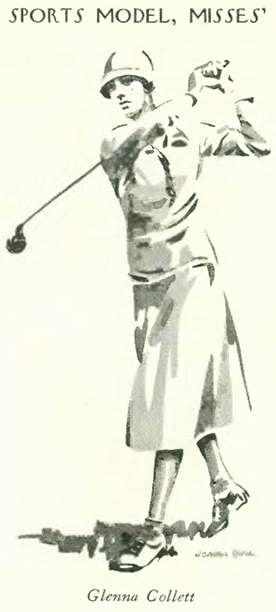
The Sept 17 issue also featured a profile of golfer Glenna Collett. Writer Niven Busch Jr. began by describing how Collett’s physical appearance compared with other women golfers and athletes. Yes, it was 1927. Title IX was still 45 years away. Here are the first two paragraphs, and an illustration for the profile by Johan Bull:

screen-shot-2016-11-30-at-2-19-32-pm

screen-shot-2016-11-30-at-2-19-44-pm

alchetron
I CAN GOLF, TOO…Golfer Glenna Collett in the late 1920s. (golfweek.usatoday.com)

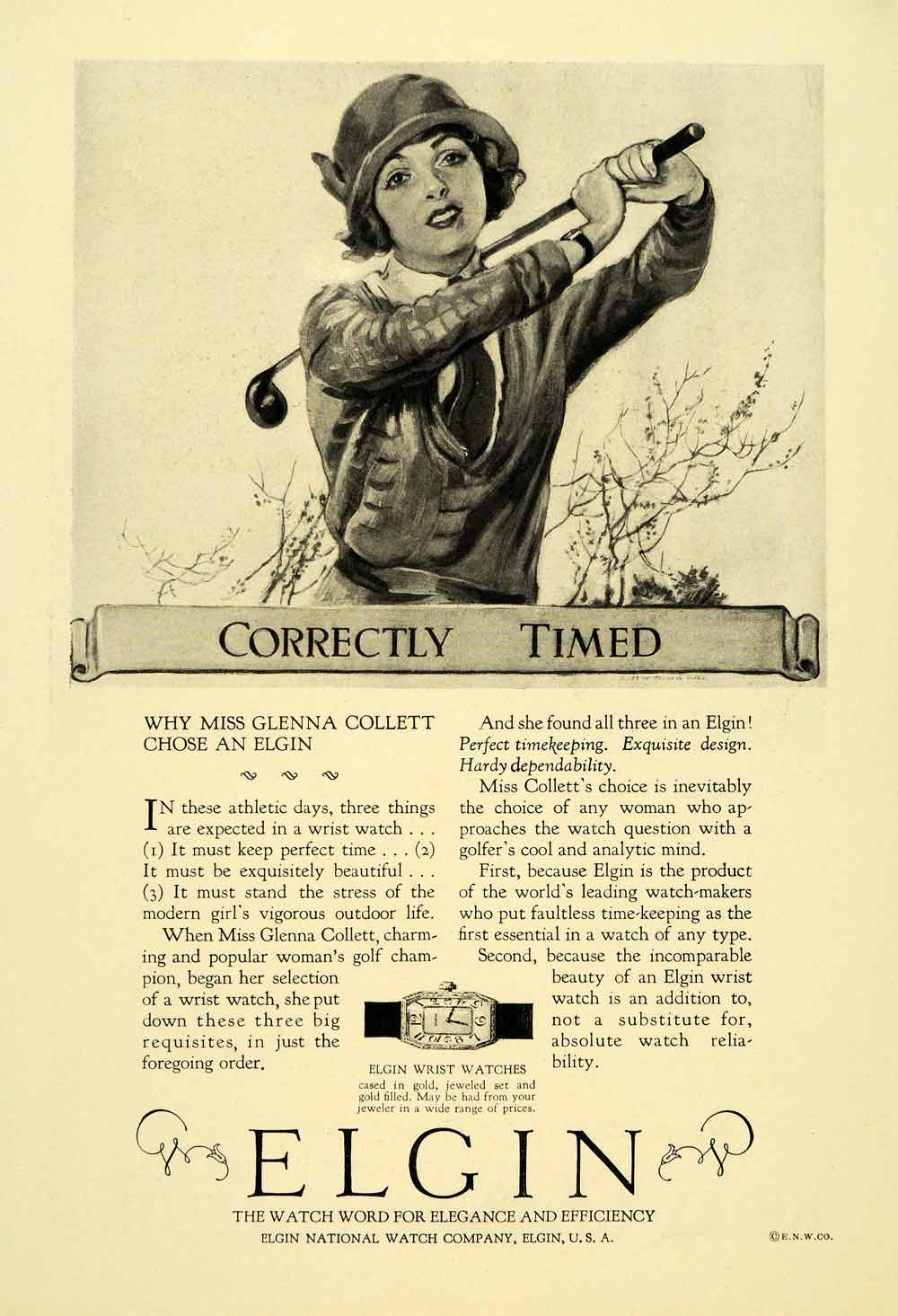
On the topic of physical appearance, it is interesting compare the above photograph of Collett with a rendering used in this 1925 Elgin watch ad (from another magazine). It looks nothing like Collett, not to mention the golf club she is holding would barely reach her knees let alone the ground.

period-paper
LOOK FAMILIAR?…The illustration for this advertisement is by James Montgomery Flagg, who in 1917 created the iconic “I Want You” Uncle Sam illustration for the U.S. Army. 

Finally, another look at the changing cityscape in this cartoon by H.O. Hofman:

screen-shot-2016-11-30-at-2-18-00-pm

Next Time: Flapper Fitness…

fd4accb02ed7d01ae3624ea180d47357


Office Romance

The New Yorker’s founder and editor, Harold Ross, did not approve of office romances. He had a magazine to run after all, and didn’t want any distractions from Cupid’s arrow.

30e6d833482958226738b30ce4244558
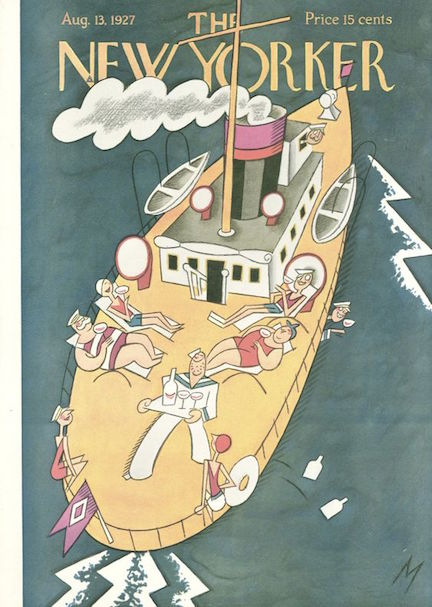
August 13, 1927 cover by Julian de Miskey.

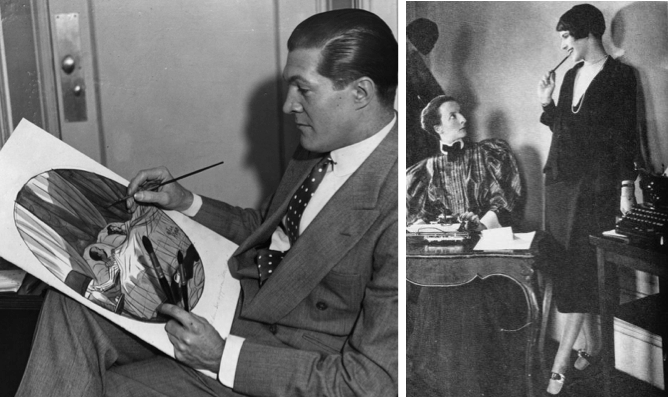
But then again, it seemed inevitable that Lois Long and Peter Arno–two of the magazine’s most lively personalities and important early contributors–would end up together. Arno cut a dashing figure as one The New Yorker’s most celebrated cartoonists. He often drew upon the same subject matter as Long, who covered the nightclub and speakeasy scene in her column, “Tables for Two” and in the process defined the lifestyle of the liberated flapper. Long is also credited with inventing the field of fashion writing and criticism with her other New Yorker column, “On and Off the Avenue.”

screen-shot-2016-11-16-at-9-33-38-am
OFFICE SWEETHEARTS… Arno and Long personified the witty, cosmopolitan image cultivated by The New Yorker. (Wall Street Journal, Wikipedia)

In Vanity Fair, Ben Schwartz (“The Double Life of Peter Arno,” April 5, 2016) wrote that Arno and Long “personified what people thought The New Yorker was, which was very fortunate…(Long was) tall, lanky, a Vassar grad with bobbed hair and a wicked sense of humor, a minister’s daughter to Arno’s judge’s son, and she matched him as a hell-raiser.” It was actually their raucous affair that set Ross on a “permanent scowl” regarding office romances.

Schwartz quotes Arno’s and Long’s daughter, Patricia (Pat) Arno, about her parents’ wild relationship: “There were lots of calls to (gossip columnist Walter) Winchell or some other columnist about nightclub fights…with my mother calling and saying, ‘Oh, please don’t print that about us,’ trying to keep their names out of the papers.”

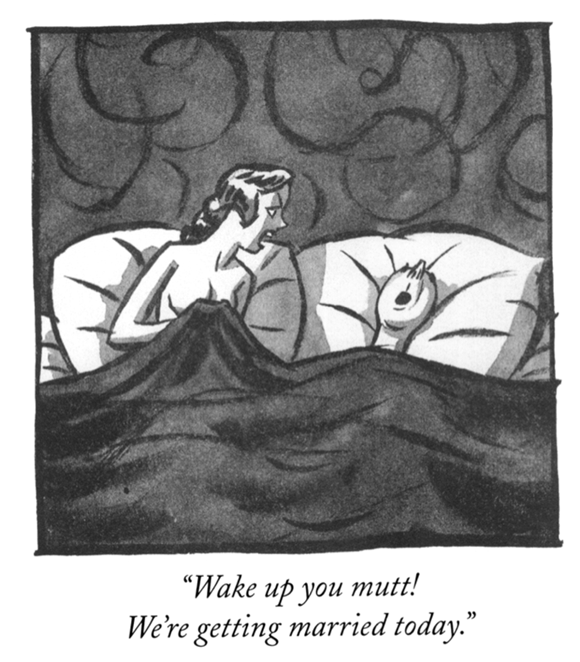
Schwartz suggests that Arno drew on personal experience when in 1930 he published Peter Arno’s Hullabaloo, a “collection of cartoons that included a set of racy drawings featuring a dashing couple much like himself and Long. In one, a nude woman, in bed, yells at her sleeping lover: ‘Wake up, you mutt! We’re getting married to-day.'”

favoritecartoon-4-580

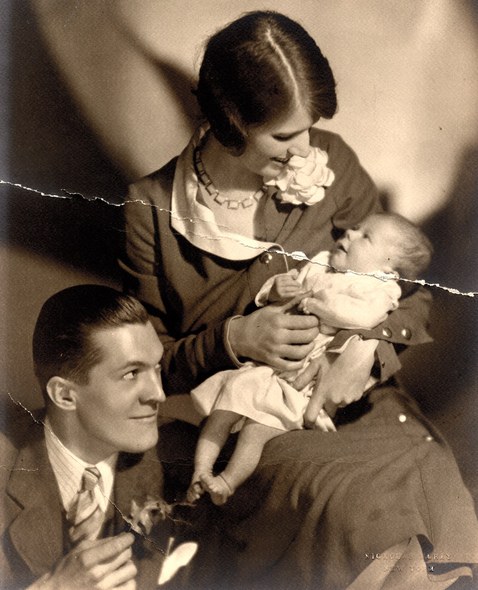
Long and Arno were married by her father, the Rev. Dr. William J. Long, at her parents’ home in Stamford, Conn., on August 13, 1927. Their daughter, Patricia, was born September 18, 1929.

According to Schwartz, Arno’s first three books sold well (Whoops Dearie! 1927, Parade 1929, and Hullabaloo 1930) “allowing the young family to move into an East Side penthouse. Their social circle included New Yorker staffers, the magazine’s owner, Raoul Fleischmann, publishers Condé Nast and Henry Luce, Kay Francis (Broadway actress, future Hollywood star and Long’s former roommate), and some of the city’s financial powers. ‘Once my mother was having trouble with her Plymouth,’ says Pat Arno, “and Walter Chrysler took off his evening coat, rolled up his sleeves, and fixed it himself.'”

kay-glam
STAR POWER…Actress Kay Francis, no stranger to wild living, was Lois Long’s longtime friend and also her roommate until Long married Peter Arno in 1927. (flickchick1953)
peter-arno-curtis-arnoux-peters-jr-cartoonist-ben-schwartz-07
HAPPY INTERLUDE…Arno and Long with their baby daughter, Patricia, in 1929. (Vanity Fair)

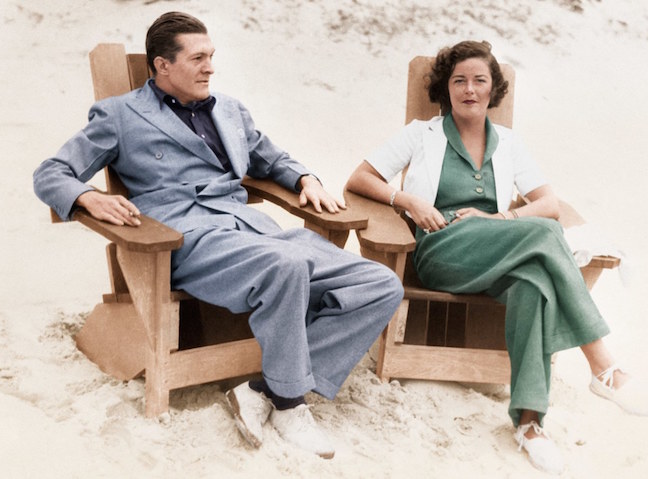
Less than two years after the birth of their daughter, Arno and Long would get a divorce in Reno on June 30, 1931. Arno later married debutante Mary Livingston Lansing in August 1935; they divorced in July 1939. After his divorce from Lansing, Arno moved to a farm near Harrison, New York, where he lived in seclusion, drawing for The New Yorker and enjoying music, guns, and sports cars. He died of emphysema on February 22, 1968 at the age of 64.

peter-arno-curtis-arnoux-peters-jr-cartoonist-ben-schwartz-11
Arno with second wife, debutante Mary Livingston “Timmie” Lansing, Winsted, Connecticut, 1939. (Digital Colorization by Lorna Clark)

In 1938 Long would marry Donaldson Thorburn, a newspaper and advertising man. After his death in 1952 she would marry Harold Fox, head of an investment brokerage firm. Long’s colleague at The New Yorker, Brendan Gill, described Fox as “a proper Pennsylvanian named Harold A. Fox.” They lived in an 1807 Pennsylvania-Dutch farmhouse, where Long delighted in the woods, farms and wildlife as well as in her two grandchildren—Andrea Long Bush and Katharine Kittredge Bush. In 1960 she wrote to her alma mater, Vassar College, that the “hectic fifteen years or so after graduation, when I thought I had New York City by the tail and was swinging it around my head, seem very far away. Thank God. I like things this way.” Long would continue working as a columnist for The New Yorker until the death of Harold Fox, in 1968. She died in 1974 at age 72.

screen-shot-2016-11-16-at-10-40-11-am
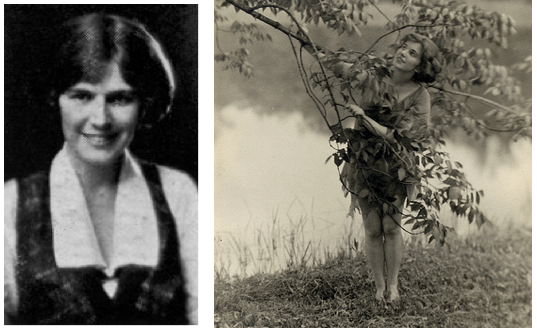
BEFORE IT ALL BEGAN…Left, Lois Long’s photo in Vassar’s yearbook, The Vassarion. At right, during her senior spring, Lois posed for a photo by Sunset Lake. Long studied English and French, graduating in1922 with an English major. (vcencyclopedia.vassar.edu)

*  *  *

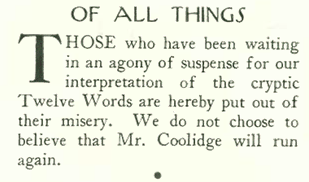
The big news in the Aug. 13, 1927 edition (the same date as the Long-Arno wedding) was President Calvin Coolidge’s brief, ambiguous announcement that he would not run for president. Almost everyone assumed he would run for a second term, given the booming economy in the age of “Coolidge Prosperity.”

Coolidge was summering in Black Hills when he gave his secretary, Everett Sanders, a piece of paper that read, “I do not choose to run for president in 1928.” Sanders then scheduled a midday press conference for August 2, 1927. At 11:30 a.m., Coolidge cut out strips of paper with this statement–I do not choose to runand at the conference handed each reporter one of the strips. Coolidge offered no further information, and only remarked, “There will be nothing more from this office today.” This led to considerable debate among the press as to intentions of the president. The New Yorker’s “Talk of the Town” mused…

screen-shot-2016-11-15-at-12-11-05-pm

…Howard Brubaker’s “Of All Things” column offered this wry observation…

screen-shot-2016-11-15-at-12-16-05-pm

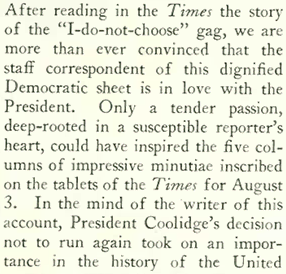
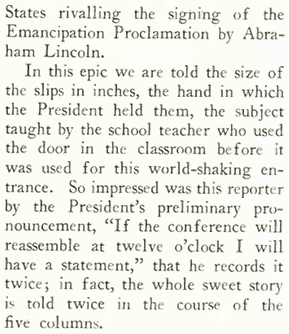
…while humorist Robert Benchley (writing under the pseudonym “Guy Fawkes”) in his “The Press in Review” column continued The New Yorker’s stinging attack on the media for its continued attempts to sensationalize events or impart personality traits on colorless newsmakers:

the-press-in-review

guy-fawkes

02-calvin-coolidge-cowboy_69085_600x450
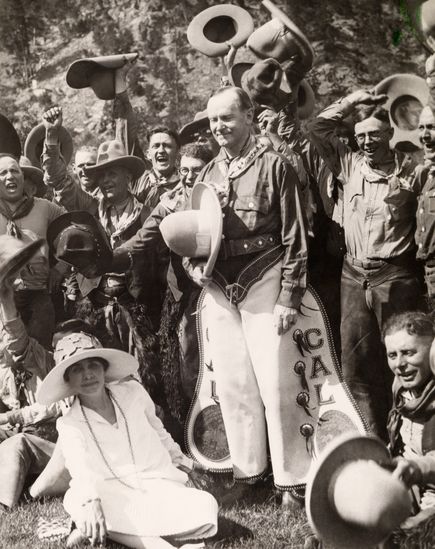
HAPPY TRAILS, CAL…No doubt the simple life of the Black Hills influenced Calvin Coolidge’s decision in 1927 to decline a second term as president. (Library of Congress)

Next Time: The Movies Take Wing…

31163f0a903d36d43f89b8495fe4e9a4


Summer in the City

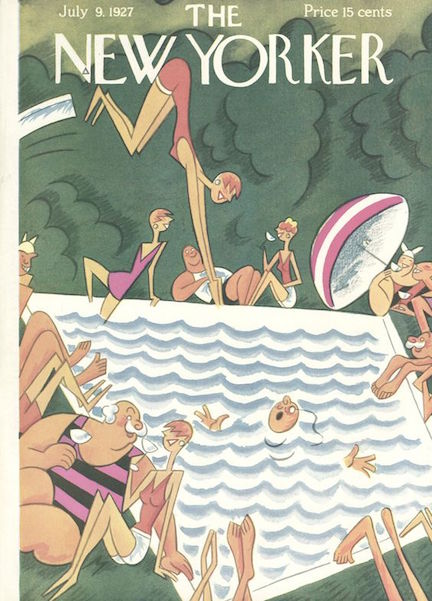
The July 1927 issues of the New Yorker were filled with news of yacht races, polo matches and golf tournaments as the city settled into the heart of the summer. The artist for the July 9 cover, Julian de Miskey, was in the summertime mood with this lively portrayal of Jazz Age bathers:

21b6fac0e9233b827d578cf6175dd79d
July 9, 1927 cover by Julian de Miskey. Born in Hungary in 1898, de Miskey emigrated to the United States in 1914.

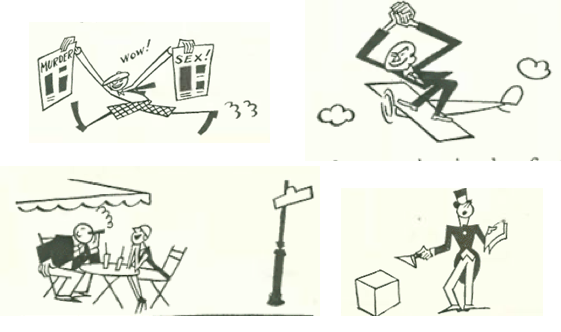
Although Julian de Miskey (1898–1976) was was one of the most prolific of the first wave of New Yorker artists, his work seems to be little known or appreciated. But more than forty years after his death his influence is still felt in the magazine, particularly in the spot illustrations and overall decorative style that grace the pages of “The Talk of the Town.”

Here is a sampling of de Miskey’s spot illustrations for “Talk” in the July 9 and July 16, 1927 issues…

screen-shot-2016-10-28-at-1-39-59-pm

…and here are examples of spot illustrations for some recent (Aug-Sept. 2016) New Yorker “Talk” sections, as rendered by Antony Huchette (which also reference Otto Soglow’s spot work for The New Yorker)…

screen-shot-2016-10-28-at-1-40-11-pm

De Miskey did it all–spots, cartoons, and dozens of covers. A member of the Woodstock Art Association, de Miskey was well known in the New York art circles of his day, rubbing elbows in the Whitney Studio Club in Manhattan with artists including Edward Hopper, Guy Pene du Bois, Mabel Dwight and Leon Kroll. De Miskey also illustrated and designed covers for a number of books, studied sculpture and created stage sets and costume designs.

screen-shot-2016-10-28-at-11-18-07-am
PROLIFIC…Julian de Miskey illustrated a number of children’s books, including Chúcaro: Wild Pony of the Pampa (1958-Newbery winner); The Trouble with Jenny’s Ear (1960); and Piccolo (1968) which was both written and illustrated by de Miskey.

The June 9 issue also featured this cartoon by de Miskey:

screen-shot-2016-10-28-at-10-18-17-am

 *  *  *

President Calvin Coolidge fled the bugs and heat of Washington, D.C. for cooler climes in the Black Hills of South Dakota. The New Yorker regularly mocked Coolidge’s dispatches from the Dakotas, including this item in “Of All Things”…

screen-shot-2016-10-28-at-10-16-24-am

02-calvin-coolidge-cowboy_69085_600x450
VAPID CITY…President Calvin Coolidge wears a cowboy hat and Western garb while on a two-month vacation in the Black Hills of South Dakota in 1927. (Library of Congress)

The magazine’s July 16 issue added this observation in “The Talk of the Town”…

screen-shot-2016-10-28-at-2-38-02-pm

Closer to home, M. Bohanan offered an urban sophisticate’s take on nature:

screen-shot-2016-10-28-at-10-16-49-am

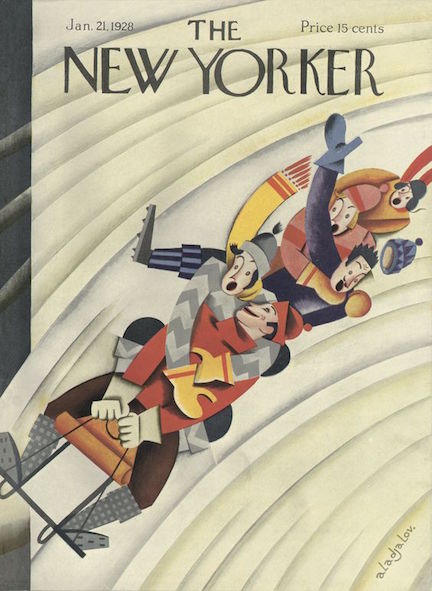
For those who couldn’t flee the city, respite was sought in Central Park, as illustrated by Constantin Alajalov for “The Talk of the Town…”

screen-shot-2016-10-28-at-10-14-08-am
click to enlarge

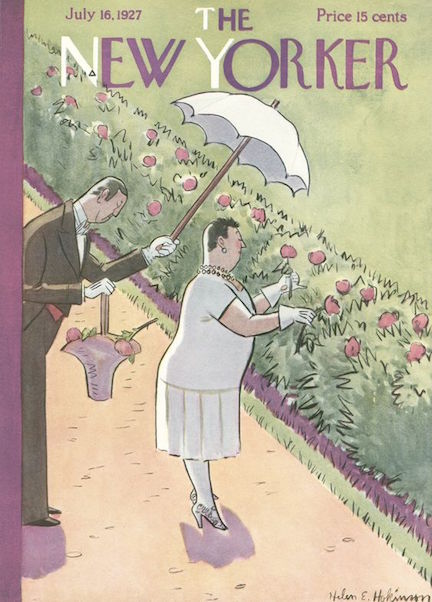
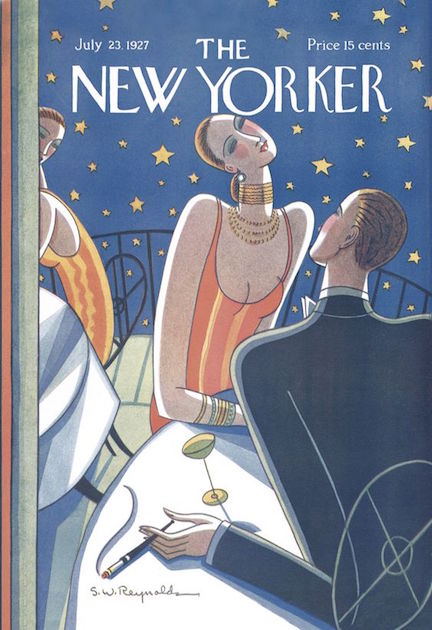
Summer themes continued with the July 16 issue, which featured a cover by Helen Hokinson depicting one of her favorite subjects–the plump society woman:

1f64e9e51d307bb03097744ebbb681f6
July 16, 1927 cover by Helen Hokinson.

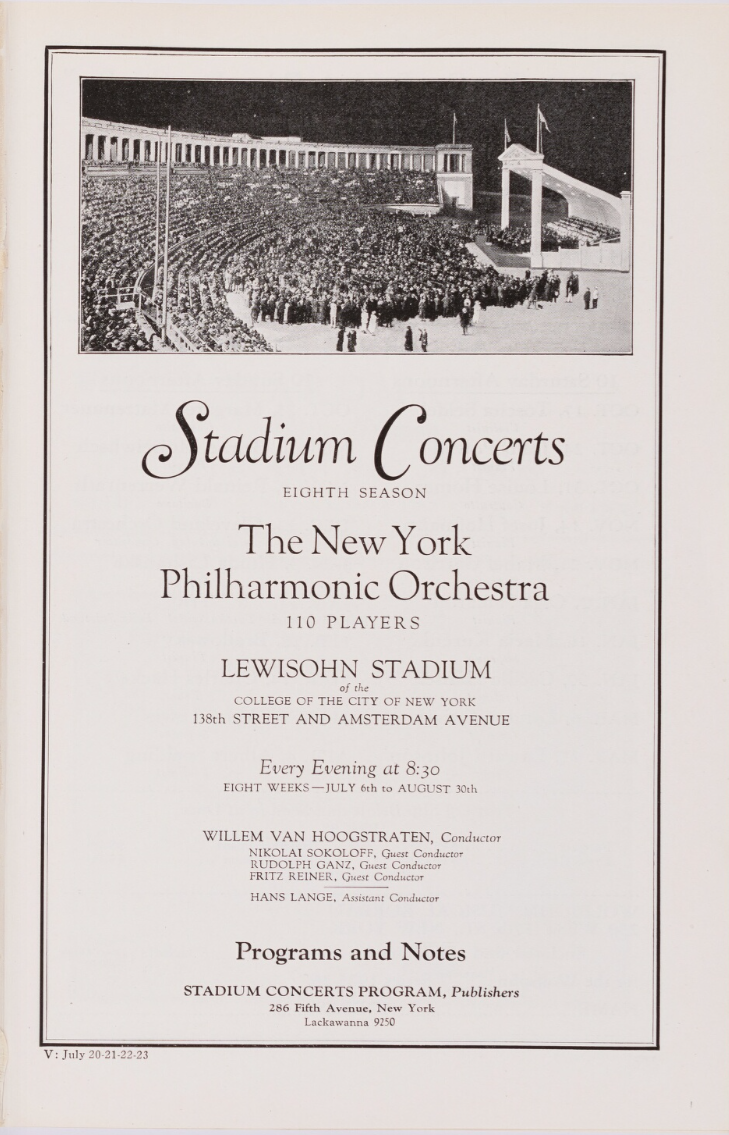
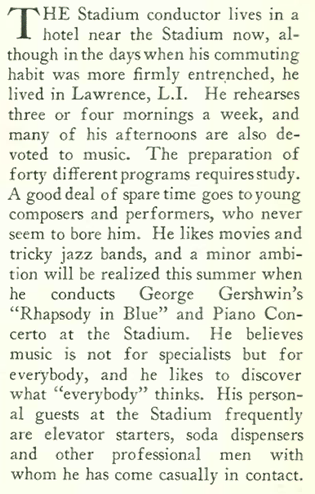
From 1918 to 1966, thousands of New Yorkers attended summer open-air concerts at Lewisohn Stadium, an amphitheater and athletic facility on the campus of the City College of New York. For many years Willem Van Hoogstraten conducted the nightly concerts, including the summer of 1927 when George Gershwin played his Rhapsody in Blue to adoring crowds.

summer-conerts
Performance at Lewisohn Stadium, located at 136th Street and Convent Avenue. (nyc-architecture.com)
1925
Program for the 1925 Stadium Concerts series.     (archives.nyphil.org)        Click to enlarge

screen-shot-2016-10-28-at-10-54-07-am

screen-shot-2016-10-28-at-10-54-40-am

serpico-1973
FINAL BOW…A still from the 1973 film Serpico, showing actors Al Pacino and Tony Roberts walking through the abandoned Lewisohn Stadium just before it was demolished. (YouTube)
110927-gon039-01
UGH…The Lewisohn Stadium site is now occupied by a City College of New York building with the inspiring name, “North Academic Center.” (nyc-architecture.com)

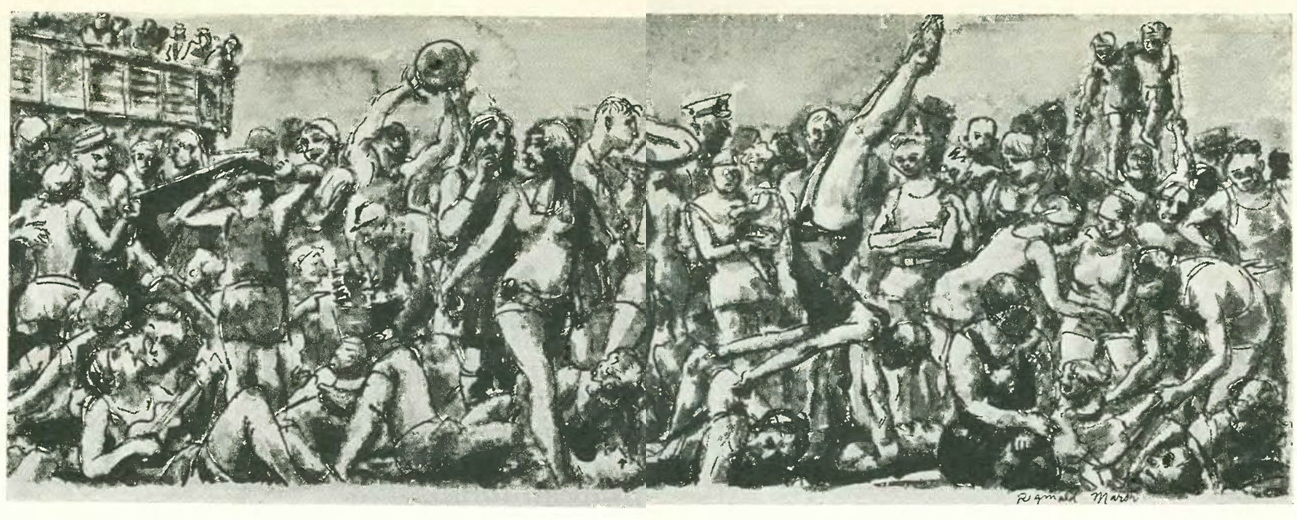
And finally, another illustration in the “Talk of the Town” of summer in the city, this a teeming Coney Island beach courtesy of Reginald Marsh

screen-shot-2016-10-28-at-10-24-00-am
click to enlarge

However, if you wanted to avoid the rabble at the beach, you could fly over them–in style, of course…

screen-shot-2016-10-28-at-10-23-20-am

Next Time: Picking on Charlie Chaplin…

5128947dc365cb603134bbb6e56f67aa