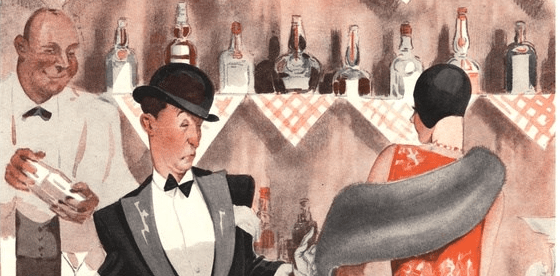
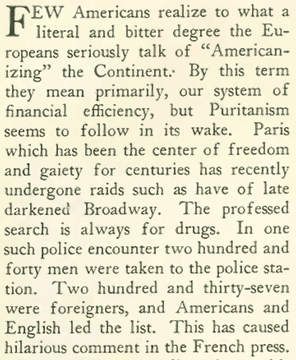
In her latest dispatch from Paris, correspondent Janet Flanner offered New Yorker readers a glimpse into the French mind, its fear of “Americanization” and its perception of America’s Puritanical attitudes behind Prohibition.
April 3, 1926 cover by Rea Irvin.
All the more reason the French were bemused by reports that American and English citizens led the lists of reported drug raids in the City of Light…
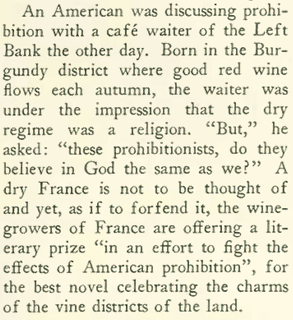
or that somehow Prohibition was a question of theological differences:
The April 3, 1926 issue also offered up some curious advertisements. Aiming square at the grasping Anglophilia of New Yorker readers, here’s a pitch for a used Rolls Royce:
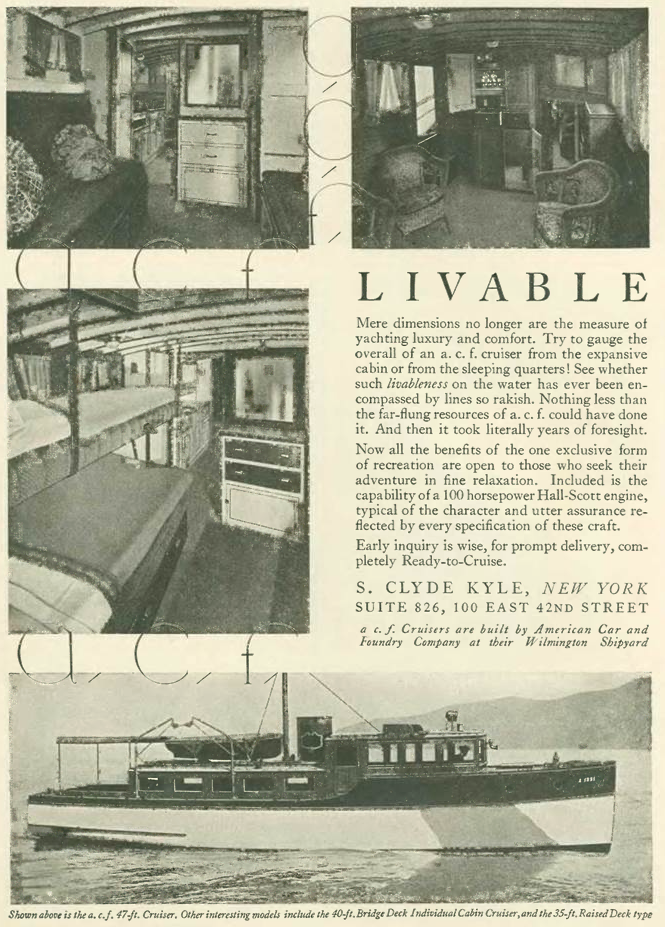
And with the money left over from your savings on the used Rolls, you could buy this 47-foot cruiser from the American Car and Foundry Company:
Moving along to the April 10, 1926 issue (cover designed by H.O. Hofman)…
April 10, 1926 cover by H.O. Hofman.
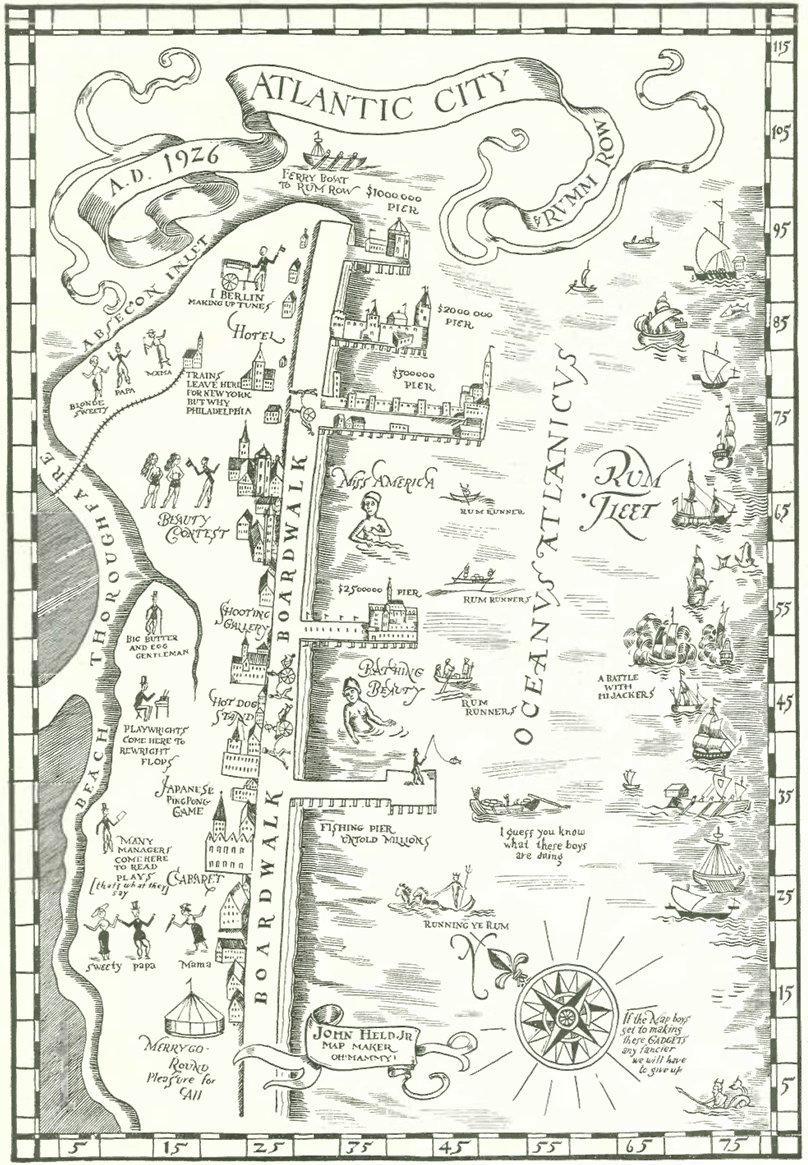
…I discovered this clever “map” by John Held Jr. For fans of “Boardwalk Empire” or other 1920s gangster-themed fare, Held’s map confirms it was no secret that Atlantic City was a major port for rum runners:
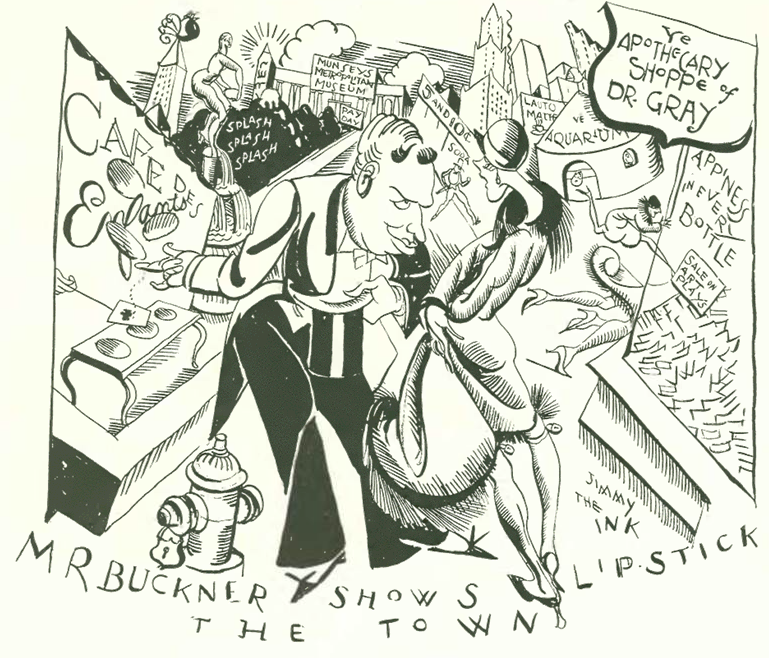
Also on the theme of Prohibition, cartoonist James Daugherty (Jimmy the Ink) had some fun with New Yorker colleague Lois Long (aka Lipstick) by pairing her with New York’s top Prohibition prosecutor Emory Buckner in this unlikely scenerio:
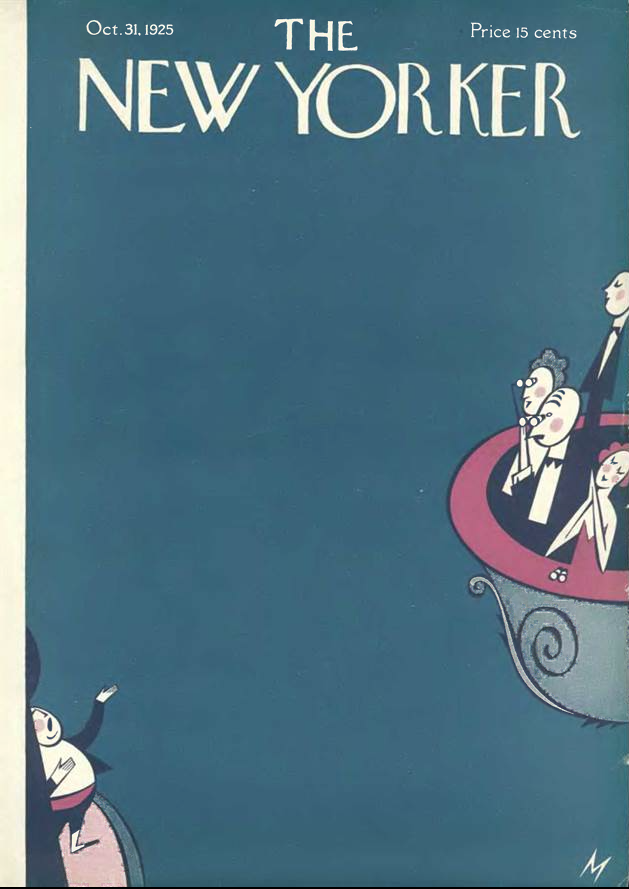
Note the lock on the fire hydrant. Padlocking restaurants and clubs suspected of selling alcohol was a favorite tactic of Buckner and his agents. Long famously took him task in her Oct. 31, 1925 “Tables for Two” column. You can read about it here in my previous post, “How Dry I Am.”
Mayor Jimmy Walker wasn’t known for being cerebral. But as the voters’ choice to lead the City of New York, he could not have been more well-suited (pun intended) to the zeitgeist of the final, dizzying, roaring years of The Jazz Age.
Walker was a flamboyant man-about-town, a clothes horse who was no stranger to speakeasies or the backroom politics of Tammany Hall.
As Jonathan Mahler wrote in New York magazine (April 1, 2012), Gentleman Jimmy “perfectly embodied that moment of indulgence: the public servant who favored short workdays and long afternoons at Yankee Stadium, who was loath to miss a big prizefight or Broadway premiere, who left his wife and Greenwich Village apartment for a chorus girl and a suite at the Ritz-Carlton.”
Not that there weren’t some concerns. “The Talk of the Town” offered this early observation of the incoming mayor:
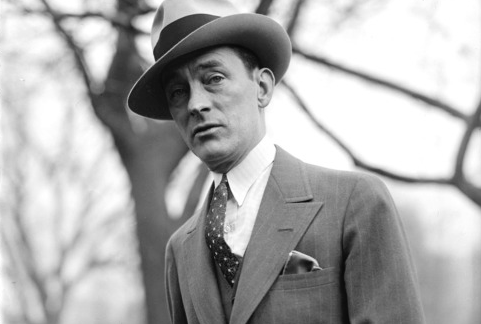
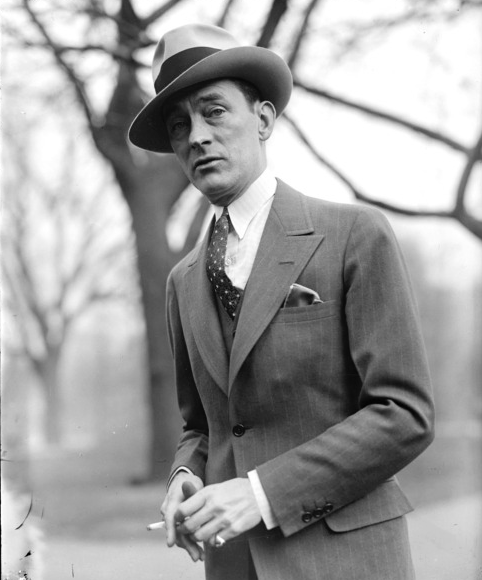
New York City Mayor Jimmy Walker during a visit to Boston. (Boston Public Library)
Mahler quoted a columnist from Walker’s time, who noted that “No man could hold life so carelessly without falling down a manhole before he is done.” And Walker would fall to scandal by 1932. But we will get to that. For now, it’s party time in Gotham.
The New Yorker continued to have fun with President Calvin Coolidge, publishing this cartoon by Isadore Klein that took a poke at Coolidge’s Thanksgiving Day Proclamation, in which Coolidge spoke at length about the nation’s abundance:
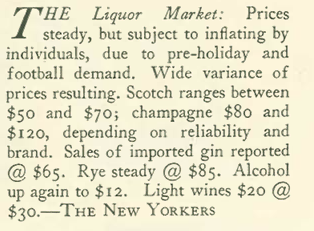
Talk also reported the latest bootleg prices in “The Liquor Market…”
“Profiles” examined the life of New York Times owner Adolph Ochs. The writer Elmer Davis observed that “More than any other newspaper owner, he is his paper, and his paper is himself…”
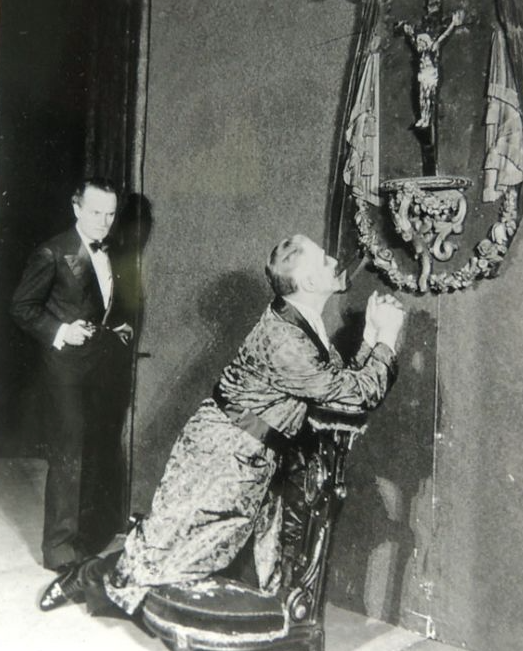
Detail from a lantern slide depicting Basil Sydney as Hamlet and Charles Waldron as Claudius in the Booth Theatre’s 1925 production of Hamlet in “modern dress.” (Graphic Arts Collection, Princeton)
In “The Theatre,” critic Herman J. Mankiewicz addressed criticisms of the Booth Theatre’s new approach to Hamlet, which was presented “in modern dress.” Mankiewicz wrote that the departure from traditional Elizabethan costumes had brought the play “into the open,” and that Basil Sydney was a “splendid” Hamlet.
In “Books,” reviewer Harry Este Dounce recommended Ford Madox Ford’sNo More Parades (“a fine display of virtuoso writing”) and Arthur Schnitzler’sFraulein Else (“a scintillant little firework”).
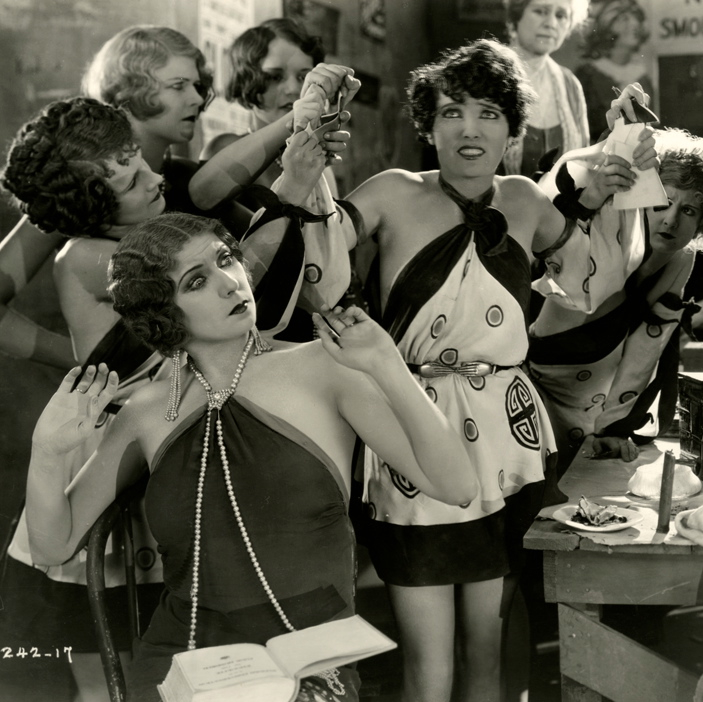
Lilyan Tashman, left, and Pauline Starke in Robert Z. Leonard’sBright Lights, 1925 (Tumblr)
In “Motion Pictures,” Theodore Shane panned the movie Lord Jim (based on the Joseph Conrad novel), but he enjoyed the “simple hokum tale” of Bright Lights and the “restrained” performance of Pauline Starke, “a perfect miniature Gloria Swanson.”
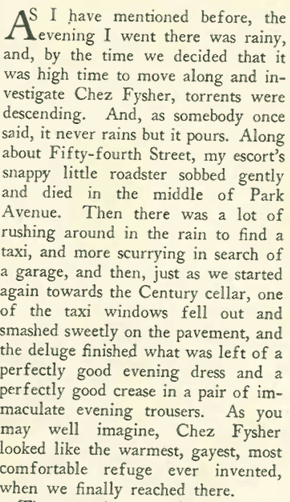
In “Tables for Two,” Lois Long despaired of finding a decent “swank dinner” on a rainy autumn evening, and finally headed to a Viennese restaurant (Frau Greta’s) for some German comfort food. The rain turned to torrents as she then headed out for some nightlife:
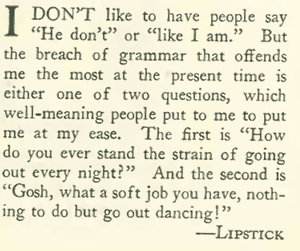
Long concluded her “Tables” column with this peevish note on “grammar:”
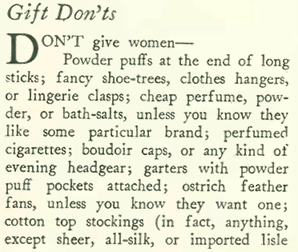
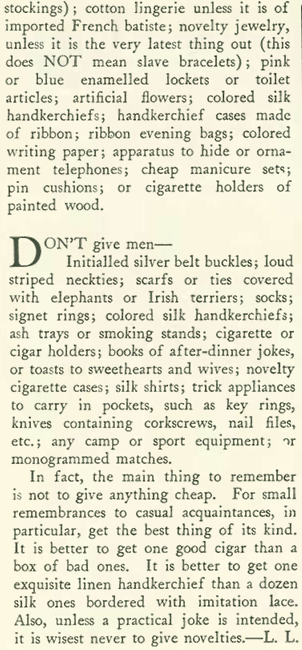
In her other column, “On And Off The Avenue,” Long wrote about the increasing popularity of New Yorkers traveling to Florida for the winter, and in anticipation of the Christmas holiday, offered this advice on what not to give as gifts:
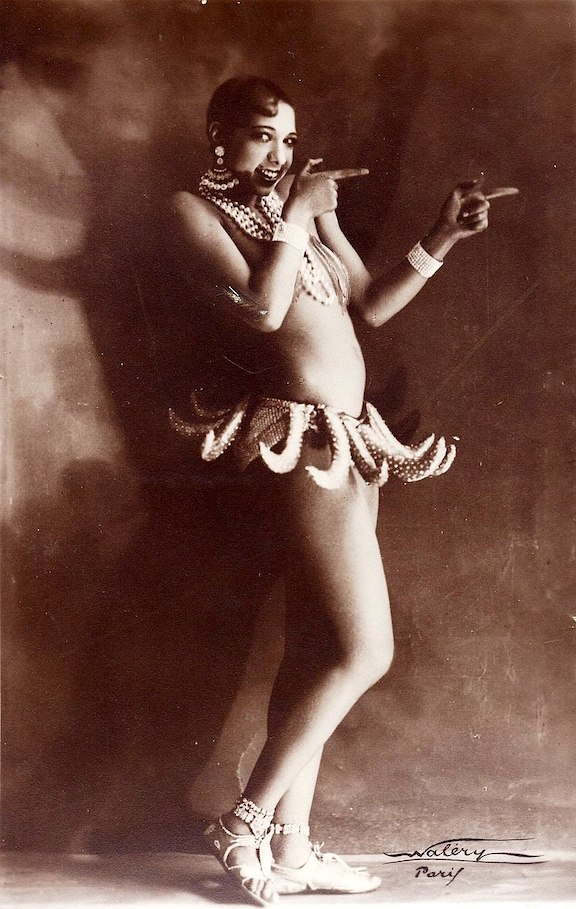
In her report from Paris, Janet Flanner commented on the popularity of Josephine Baker at the Champs Elysees Theater:
Josephine Baker in 1927. (Wikimedia Commons)
Flanner also commented on the growing appreciation of paintings by Henri Rousseau, who just a decade or so earlier was considered something of a joke among art circles:
Henri Rousseau’sThe Football Players, 1908. Today even Rosseau’s lesser-known works are valued in the millions (Wikimedia)
And finally, Julian de Miskey’s take on The Big Game:
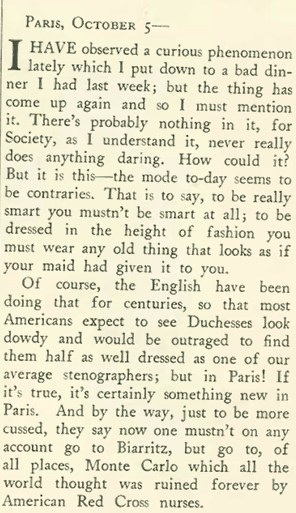
Apparently even Parisians have fashion lapses from time to time. Janet Flanner (Genêt) reported with some alarm a “curious phenomenon” from Paris in the Oct. 24, 1925 issue of The New Yorker.
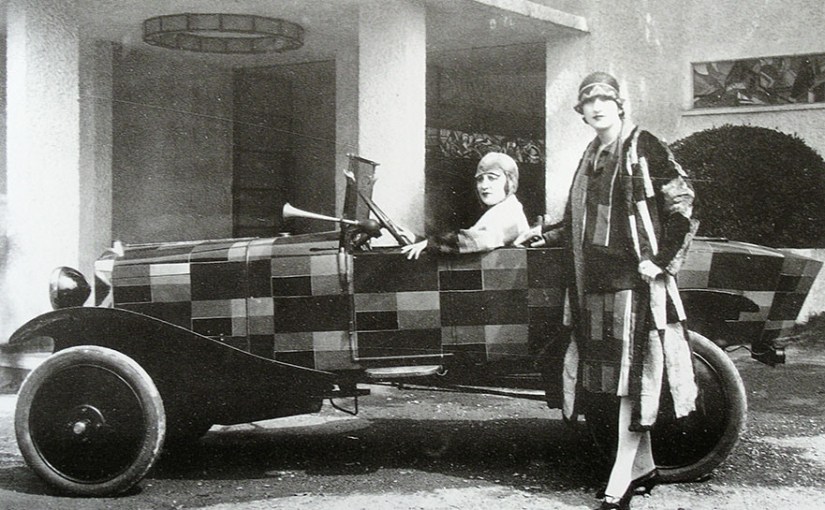
It seemed that the otherwise fashionable Parisians were slumming it a bit and had adopted a dowdy look previously associated with residents of the British Isles. (The un-dowdy image at the top of the page is French designer Sonia Delaunay and her matching Citroen in 1925).
Apparently such pedestrian tastes had also caused a shift from formerly fashionable travel destinations on the Atlantic coasts to Mediterranean destinations:
And to top things off, the French were agog over the latest Charlie Chaplin film, The Gold Rush (another French favorite of American clown-dom, Jerry Lewis, would be born the following year):
But then there was another new distraction in town, the Autumn Salon:
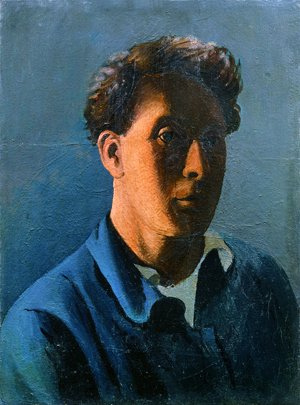
Pavel Tchelitchew, self-portrait, 1925 (Flickr)
Pavel Tchelitchew was known as a leader of “mystical surrealist” painting. He left his native Russia in 1920 and lived in Berlin before moving to Paris in 1923. There he became acquainted with Gertrude Stein and Edith Sitwell, the latter with whom he had a long-standing friendship.
The French were also on display in a comic piece by Theodore Shane, who also served as the magazine’s movie critic.
Shane wrote a piece titled “Fra~nce” in a style that suggested he was teaching children about France by dividing words into syllables (it was similar to a piece about Russia (“Rus~sia”) in the Aug. 29 issue, signed “Freudy”) Here’s a sample:
A full-page ad on the Page 1 announced the “The Midnight Open” event at The 19th Hole Club in the Hotel Roosevelt, with an impressive lineup of golf professionals such as Walter Hagen and Gene Sarazen and even “prominent amateurs” including Bobby Jones.
The Roosevelt Hotel, which opened in 1924 (Expedia)
I was surprised that the annual membership fee was advertised as only $10, which would roughly translate to $135 today—a bargain compared to what it costs today to join even the lowliest golf club.
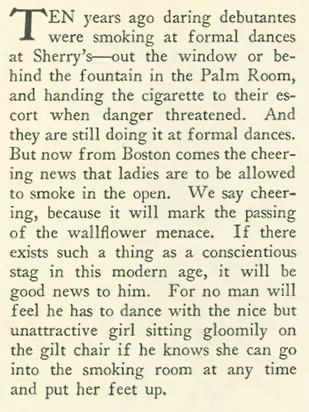
“Talk of the Town” welcomed news from Boston that “ladies are to be allowed to smoke in the open” in that city (drawing by Johan Bull):
In a feature “Our Collegiate Hilltop,” Elmer Davis wrote about the droves of college students who had taken over much of the available housing along Morningside, “a ghetto for the Nordic native-born.” Davis offered this lament about Columbia’s continued creep into the surrounding neighborhoods (with accompanying art by Helen Hokinson):
“Profiles” examined the life of “A Kind Man,” William Lyon Phelps. That title was not meant as a complement from writer Waldo Frank, but rather it was his “kindness” toward authors that caused him to praise books that were not worthy of praise and made him the personification of the “most American of disasters: the disaster of Good Intentions, when they are not fortified by intellectual hardness, when they are not drained of all sentimental juices.”
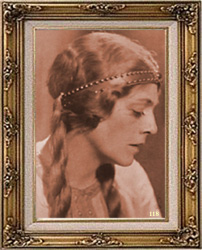
Ethel Barrymore in 1925 as Ophelia in Walter Hampden’s Production of Hamlet. (barrymorefamily.com)
In “The Theatre” Elsie Ferguson and Basil Rathbone were appearing in The Grand Duchess and the Waiter at the Lyceum (“an agreeable piece of work”), while Ethel Barrymore “wowed” critic Herman J. Mankiewicz with her performance as Ophelia in a revival of Hamlet at Walter Hampden’s Theatre.
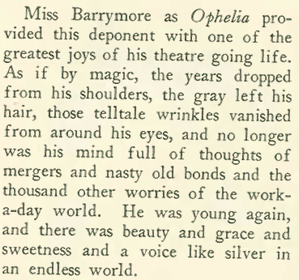
Or at least I think she wowed him. Mankiewicz knew and worked with the Barrymore family, and I wonder if his over-the-top style here is a wink to the fact that a 45-year-old Ethel was playing the part of a young virgin. Here’s an excerpt from the review:
I hate to jump ahead, but in the Nov. 14 issue, “Talk of the Town” offered this humorous anecdote from one of Barrymore’s performances:
In sporting news, John R. Tunis continued his coverage of rivalry matches staged at Yankee Stadium, this time the fiercely competitive Notre Dame vs Army matchup. Despite Notre Dame’s renown under Knute Rockne, Army was a worthy foe in the 1920s and in this particular matchup the Cadets blanked the Irish 27-0. The matchup between these teams was so popular that it was played at Yankee Stadium until 1947.
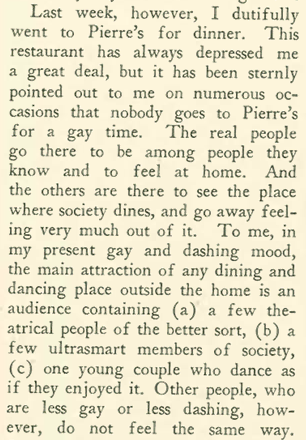
And finally, Lois Long sharpened her pencil and offered her thoughts on a dull dinner crowd at Pierre’s:
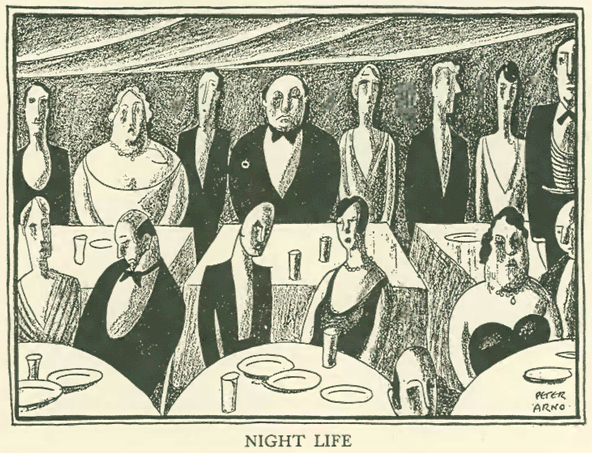
A drawing by Peter Arno (who would marry Long in 1927) in another section of the magazine seemed to refer to Long’s lament:
Long also offered some criticisms of a “new negro revue” that decidedly differed from the mainstream:
A great illustration by Julian de Miskey of the Bellows exhibition at the Met:
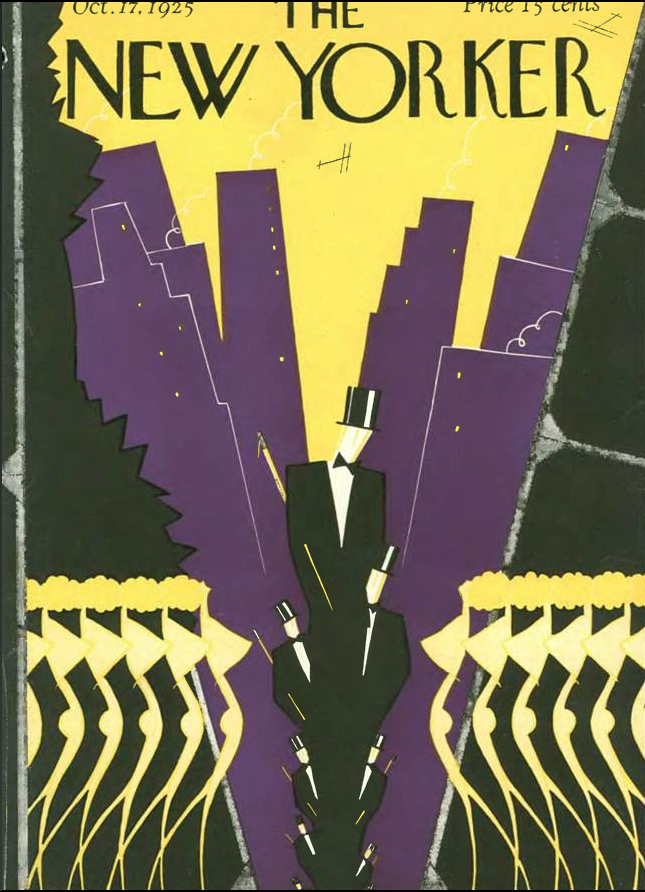
The Oct. 10, 1925 issue marked Janet Flanner’s first “Paris Letter” signed under the pen name Genêt.
The column, dated Sept. 25, noted that droves of American tourists were heading for the northern ports “carrying everything away that’s portable, and the American Express is hard pressed to find crates enough to house the antiques that are on their way to make American homes beautiful.”
Flanner also noted the huge attendance numbers at the Exhibition of the Decorative Arts, but she was no fan of the teeming masses: “More than ten million people have attended which, by the way, if you have been there, you will know, has been nine million nine hundred thousand too many for comfort.”
Postcard image of the International Exposition of Modern Industrial and Decorative Arts. The term “Art Deco,” which would be used to describe a prevailing design style of the Jazz Age, was derived by shortening the words Arts Décoratifs. (Flickr)Janet “Genêt” Flanner in Paris, 1928, in a photo by Berenice Abbott. (Wikipedia)
Persistent rainstorms that ruined the French wheat crop and inflicted major damage on the wine growing regions had also dampened the spirits of the French and tourists alike, so Flanner looked forward to the Autumn Salon which was “still to come as the big Fall event.” She also noted that James Joyces’s novel Ulysses, banned in the U.S., was already into its sixth French edition.
According to Ben Yagoda (About Town: The New Yorker and the World it Made), Flanner had first come to the attention of editor Harold Ross through his wife, Jane Grant, who was a friend of Flanner’s from the Lucy Stone League, an organization that fought for women to preserve their maiden names after marriage. Flanner would go on to work for The New Yorker for the next five decades.
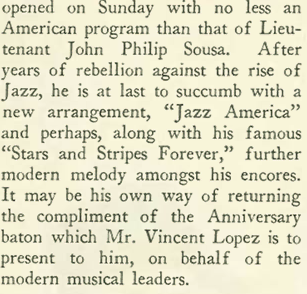
In “The Talk of the Town,” it was reported that Patricia Salmon was returning to Broadway “a more confident person” after enlarging her fame with performances “in the hinterland.” And in other show-biz news, the Masonic Order’s new Mecca Temple announced that it would open with an American program led by John Philip Sousa. It was also noted that the great Sousa had succumbed to the lure of jazz music:
The Mecca after its completion in late 1924. Known today as New York City Center, it is now home to the Alvin Ailey American Dance Theater, Manhattan Theatre Club, The Flamenco Festival, and the Martha Graham Dance Company among other groups. (nycago)
“Profiles” featured publisher and stage producer Horace B. Liverwright, the piece defiantly titled “One Hundred Per Cent American.” The social activist Waldo Frank (“Search-light”) wrote admiringly about this vocal campaigner against strict literary censorship, and observed that Liverwright possessed the soul of a poet who does what he likes, and this is what he likes above all: “that no hour be heavy, that no day and no deal be without its radiant wings.”
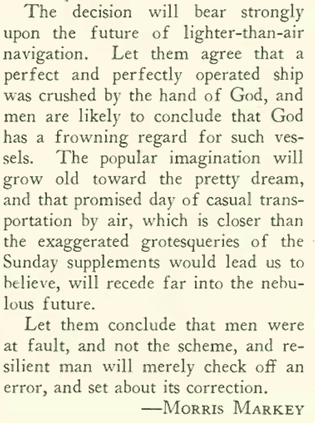
Morris Markey explored the Shenandoah airship disaster in greater detail in his “In the News” section, and hoped that the Navy’s inquiry into the crash would not deter further developments in airship travel:
In “Sports of the Week,” John R. Tunis wrote what would be the first of many articles in the magazine on college football, which featured prominently in the fall issues thanks to an ailing Babe Ruth and the slumping Yankees.
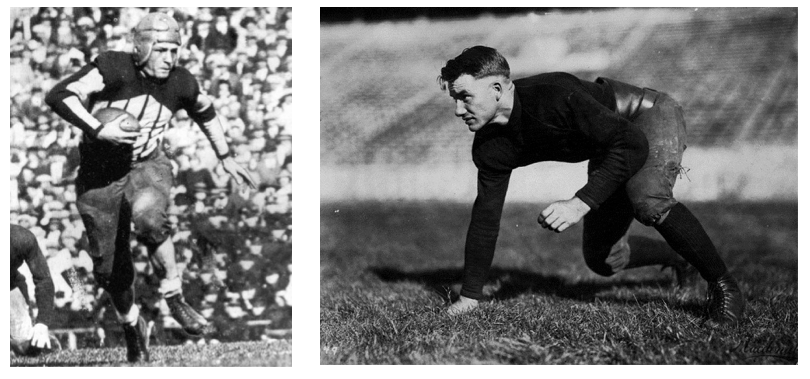
The lengthy article was an account of Nebraska’s 14-0 victory over Illinois in the Illini’s gleaming new stadium in Champaign. The match was billed as one of the major contests of the season, bringing together two All-American captains in a defensive slugfest: Red Grange of Illinois and Ed Weir of Nebraska.
Famed Illinois running back Red Grange (left) was held scoreless by fellow All-American Ed Weir and his Nebraska Cornhuskers in a much ballyhooed matchup of 1925.