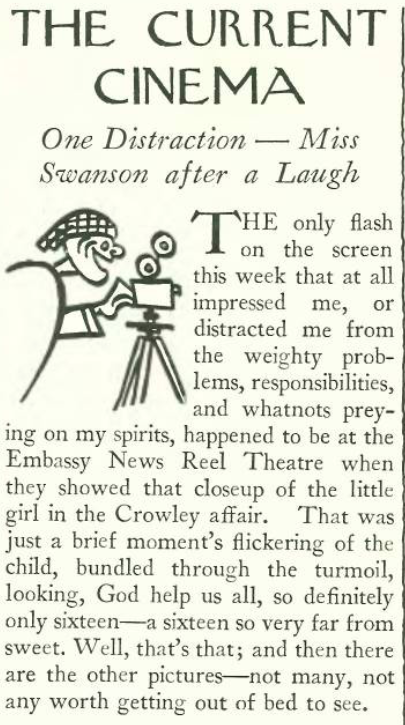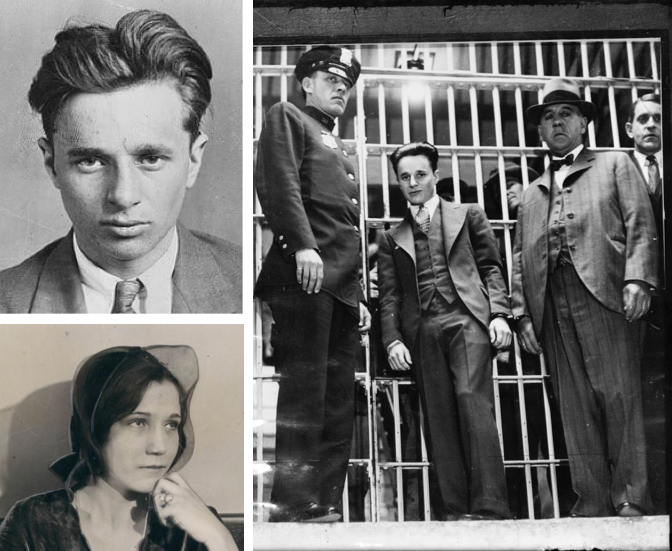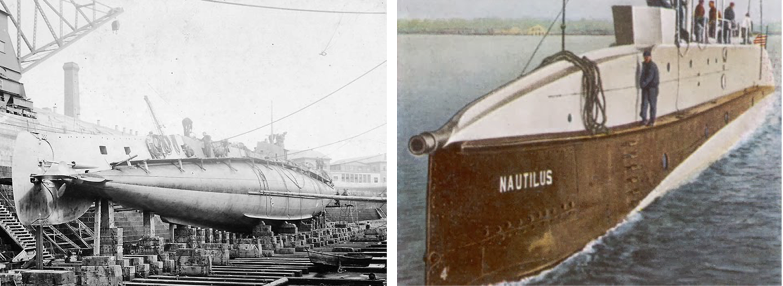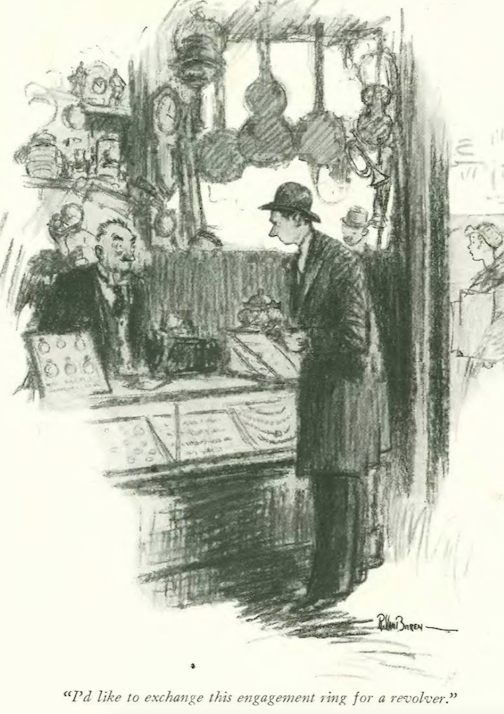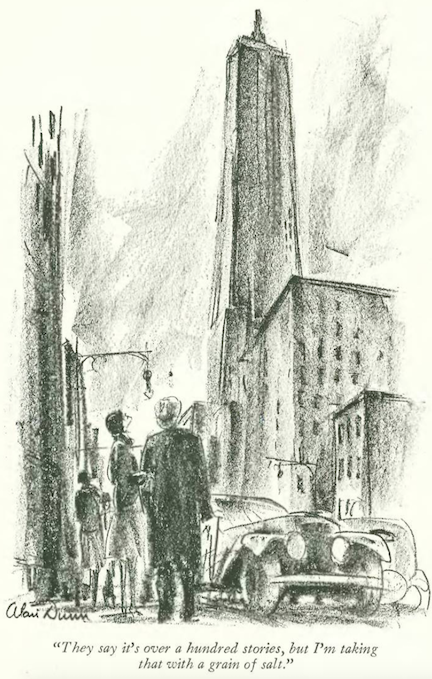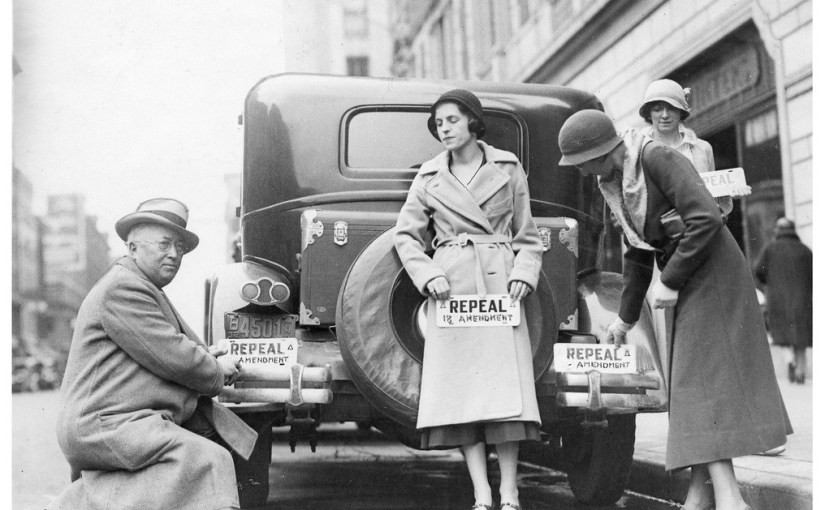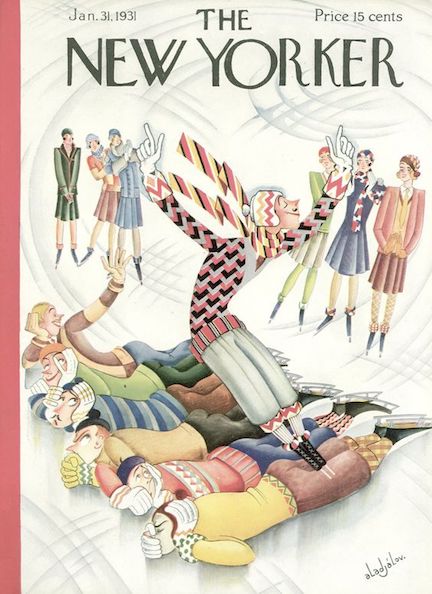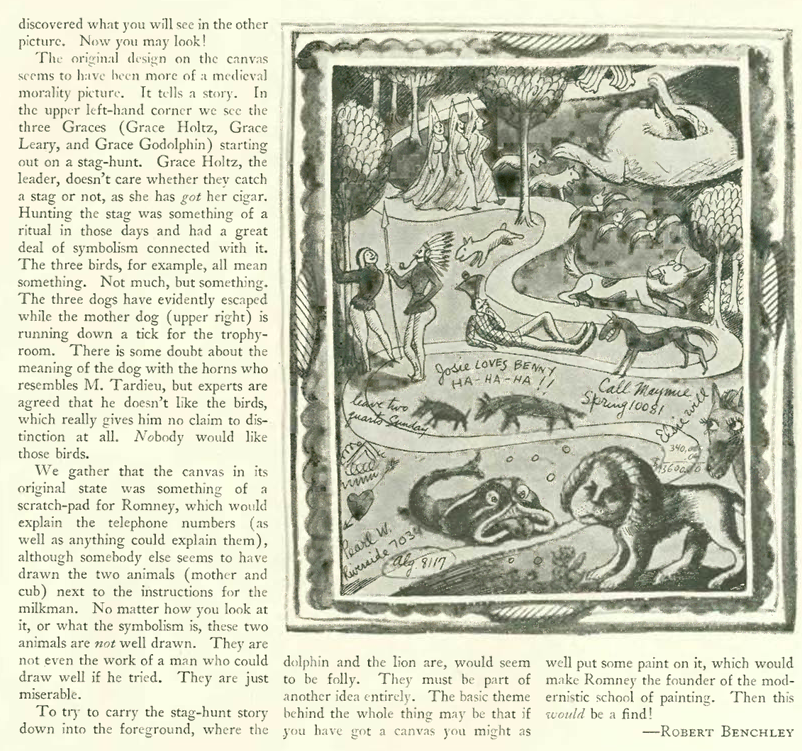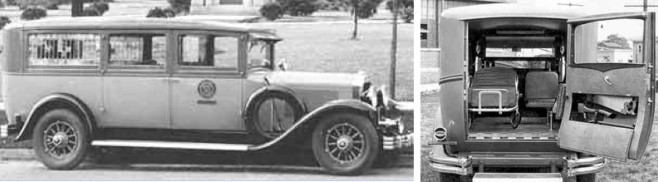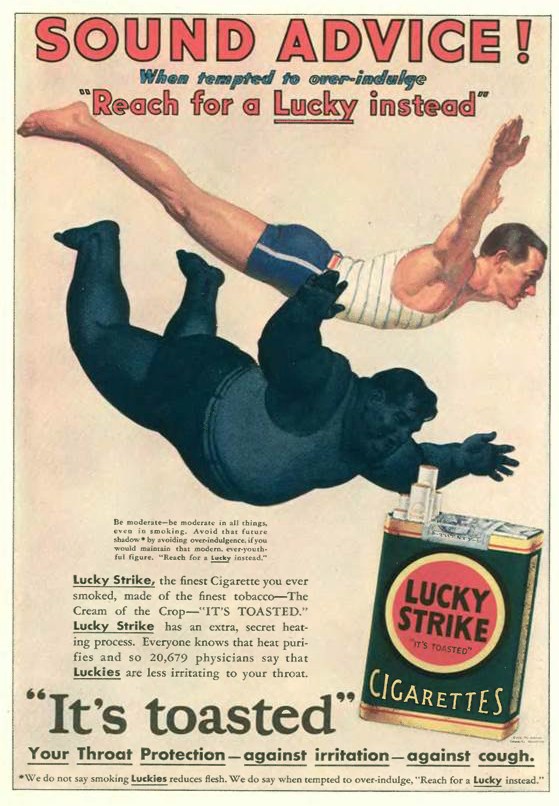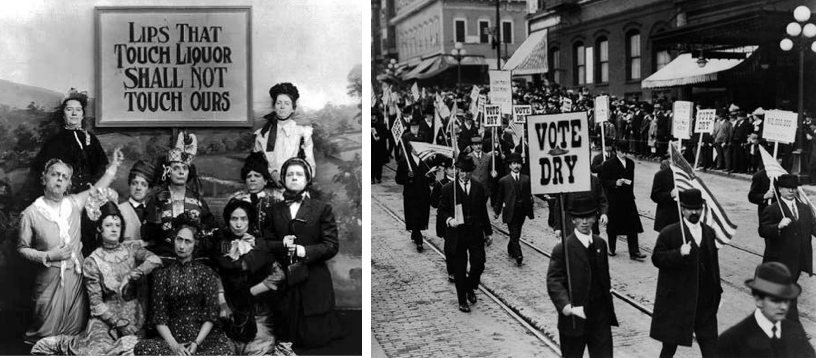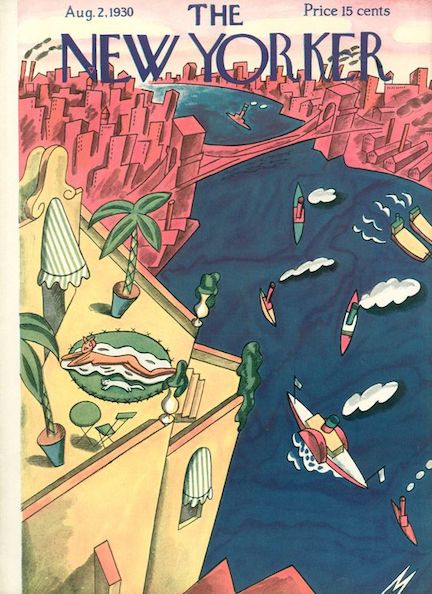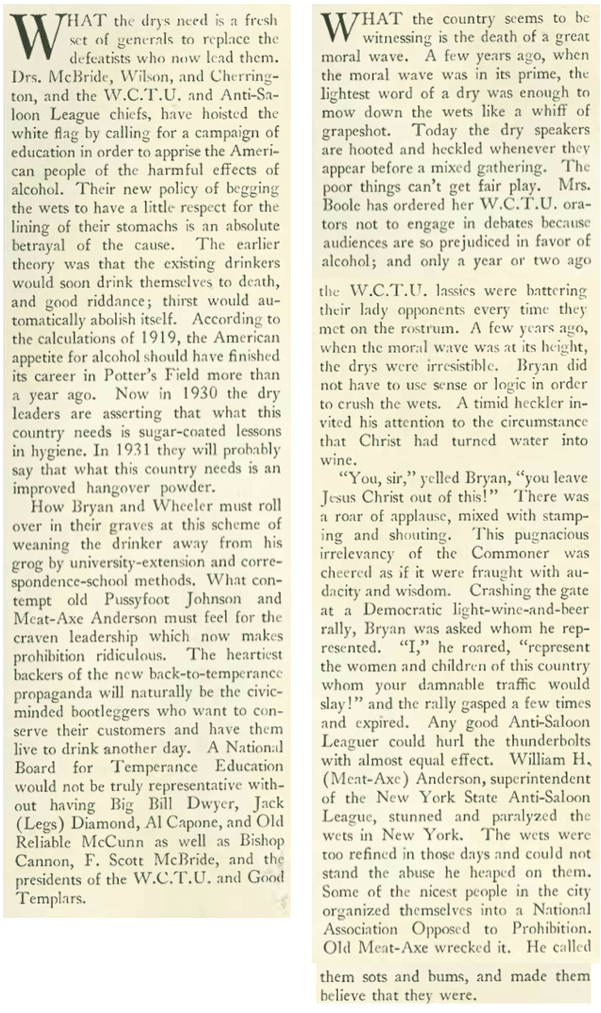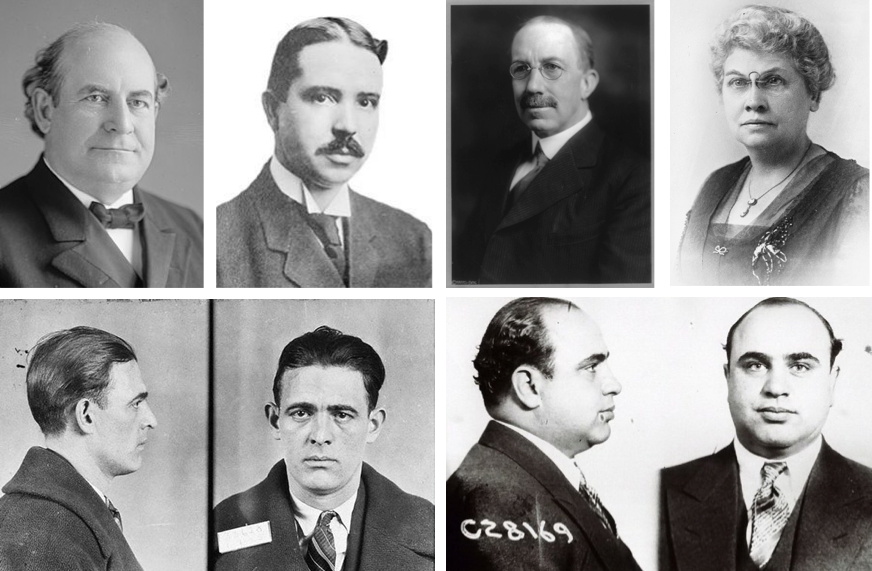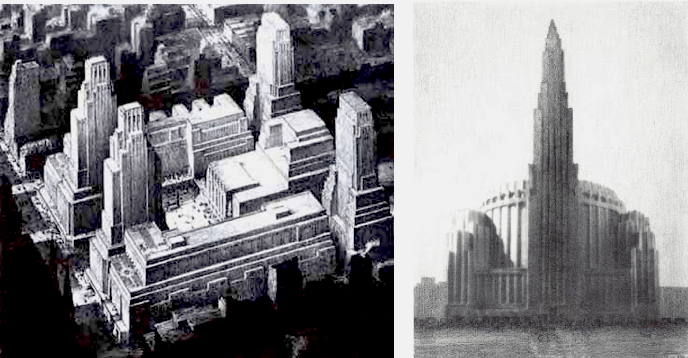
For the Byrds

Since time immemorial human beings have clung to the idea that unknown lands must surely contain vast mineral treasures.

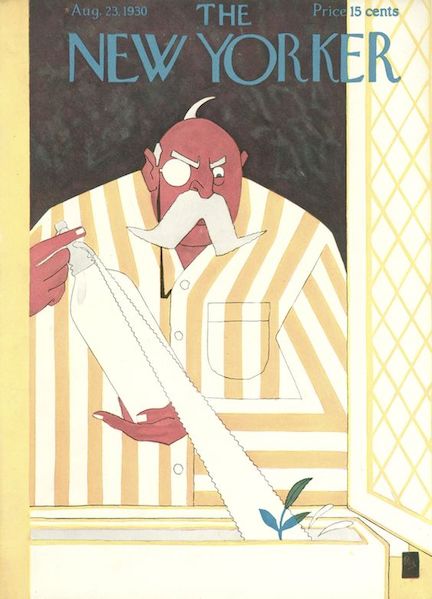
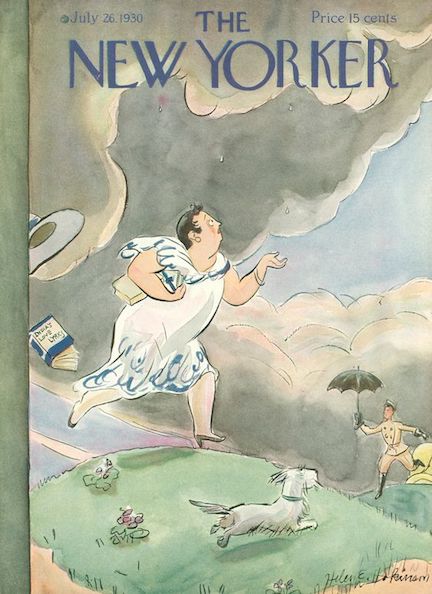
July 26, 1930 cover by Helen Hokinson.

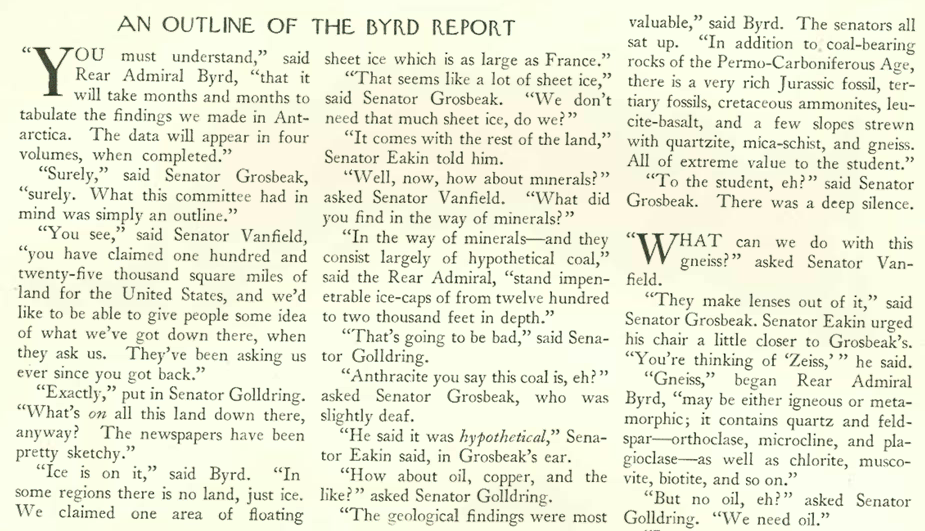
Such was the case when Admiral Richard Byrd returned from his Antarctic expedition, during which he conducted a number of geological studies. Ever ready to tweak a senator’s nose, The New Yorker’s James Thurber imagined an exchange between Byrd and a U.S. Senate subcommittee that was more interested in exploitable commodities than in scientific discoveries:

HMMM, NO OIL HERE…Richard Byrd’s expedition building their “Little America” encampment at the South Pole in 1928. (osu.edu)

One passage of particular interest in this imagined exchange dealt with the speed of climate change in relation to potential mineral extraction…

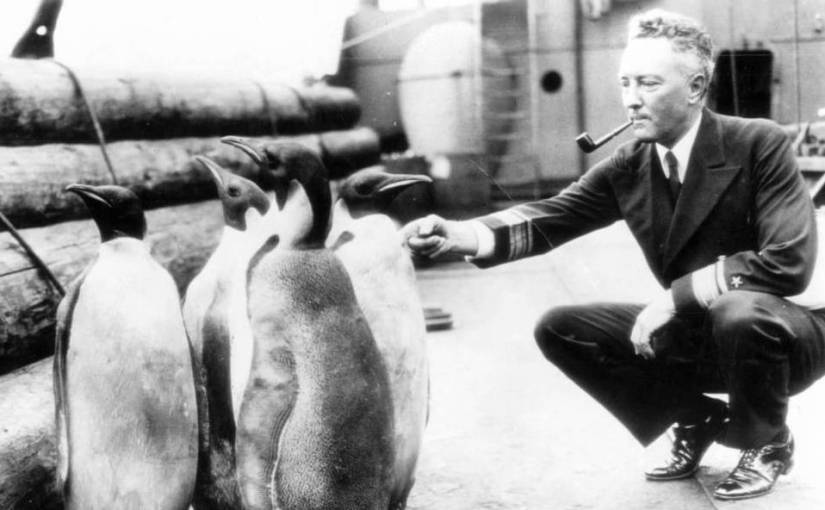
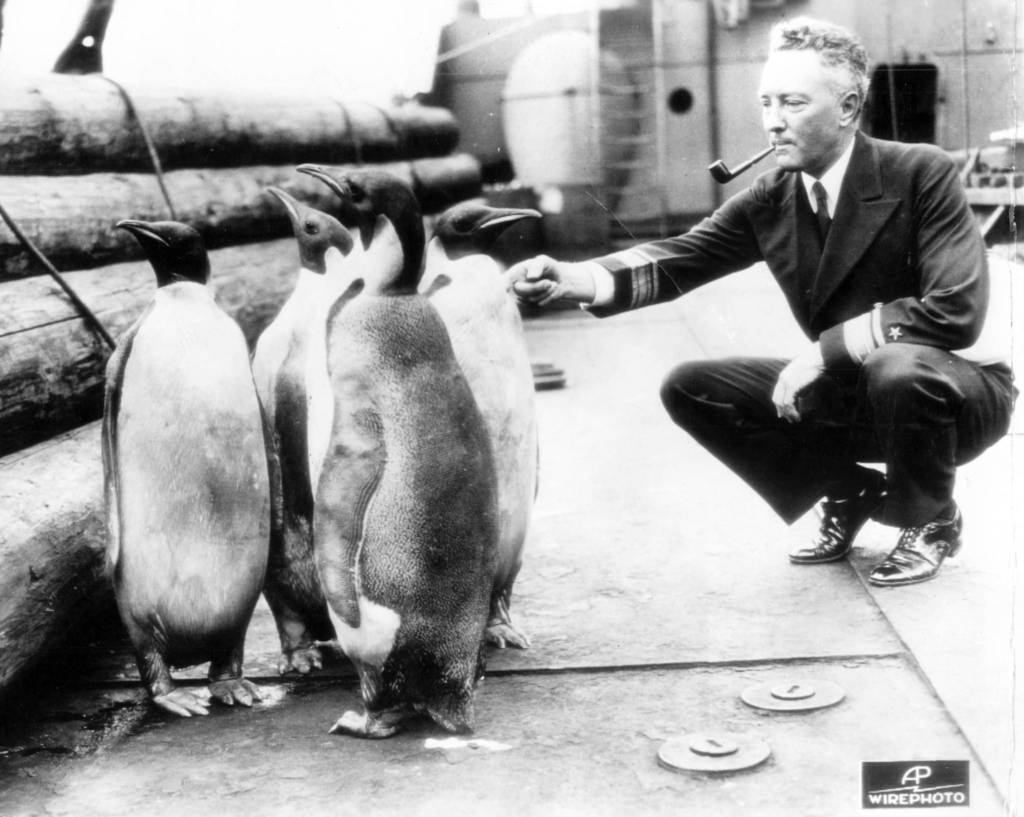
BIRDS MEET BYRD…Admiral Richard Byrd onboard the USS Bear during his second expedition to the South Pole. (Wikipedia)

 *  *  *

Before CNN

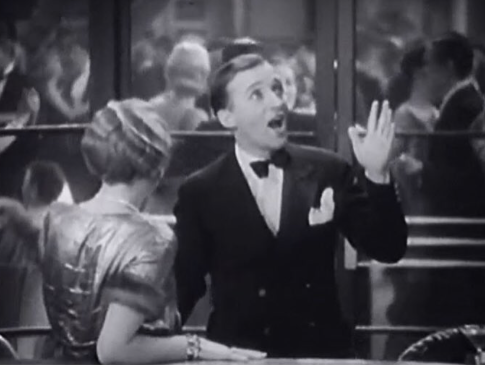
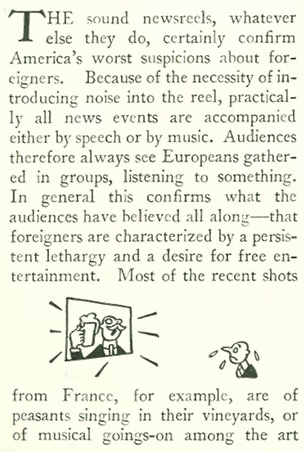
Newsreels came into their own with the advent of sound, offering moviegoers a selection of news stories from the around the world. In his “Notes and Comment,” E.B. White observed that newsreels depicted foreigners as people who just liked to hang out (note the racial slur directed at Latin Americans). White’s characterization of Germans as an indolent lot is also noteworthy, given the country was just two and half years away from Nazi takeover.

TANZEN UND TRINKEN…Kroll’s Biergarten in Berlin in September 1928; English visitors raise a glass at a beer hall in Hesse, 1929. (YouTube)

 *  *  *

Speaking of Slurs

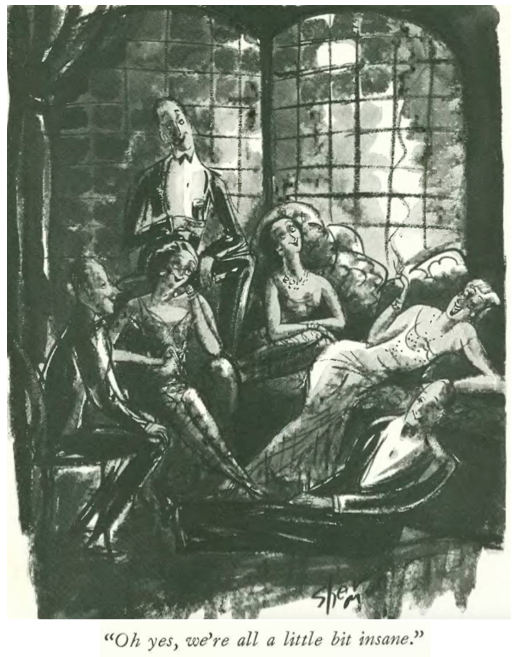
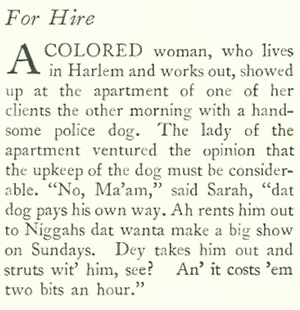
Here is what passed for a humorous anecdote in the July 26, 1930 “Talk of the Town”…

 *  *  *

Star Power

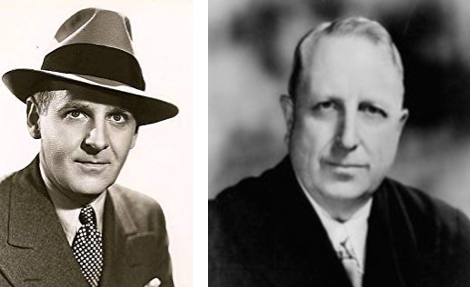
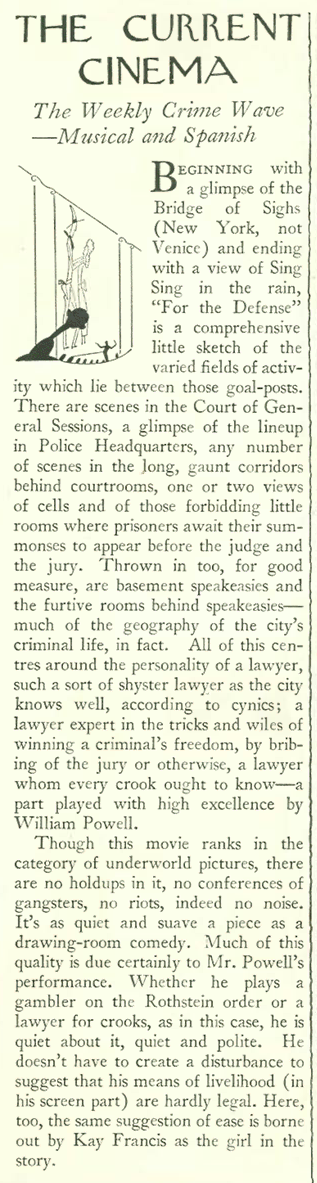
William Powell and Kay Francis were frequent co-stars, and would team up for the 1930 courtroom drama For the Defense. Powell and Francis would be two of Hollywood’s biggest stars in the 1930s.

LET’S MAKE A PICTURE…Frequent co-stars William Powell and Kay Francis in a publicity photo for 1930’s For the Defense. Francis was a longtime friend of The New Yorker’s Lois Long. (IMDB)

 *  *  *

From Our Advertisers

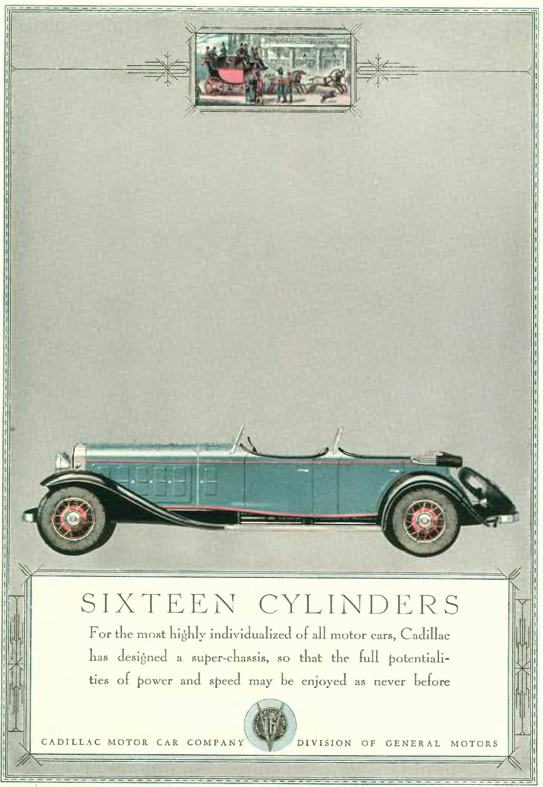
What Depression? As bread lines lengthened so did the “super-chassis” of this monster Cadillac…

…in contrast, this ad in the Aug. 2 issue questioned the necessity of a 4,000-pound car (or in the case of the 16-cylinder Cadillac, 6,500 pounds), and touted this “common sense” British import…imagine the America of today if this idea would have taken hold in the 1930s…

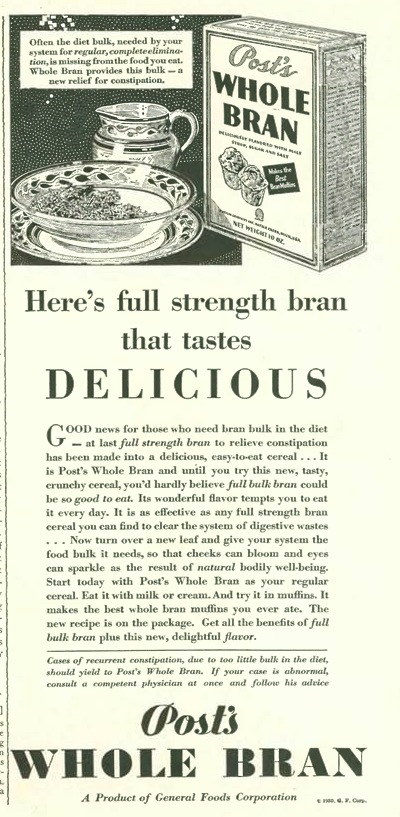
…we return to the June 26 issue to find an ad that would likely not appear in today’s New Yorker

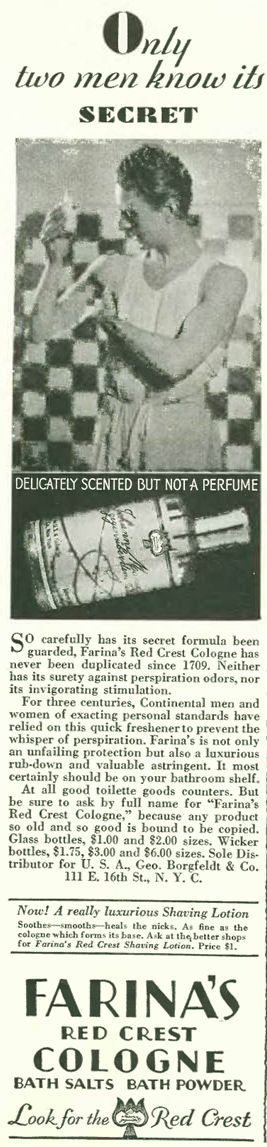
…another unlikely ad is this spot from the makers of Farina cologne featuring a skinflint applying the stuff to his armpit…yeah, I’ll take a bottle…

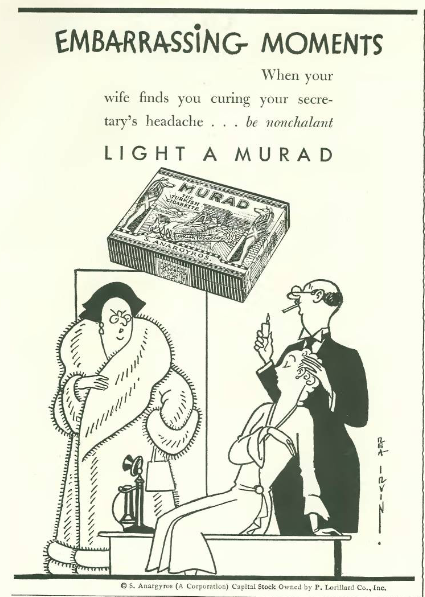
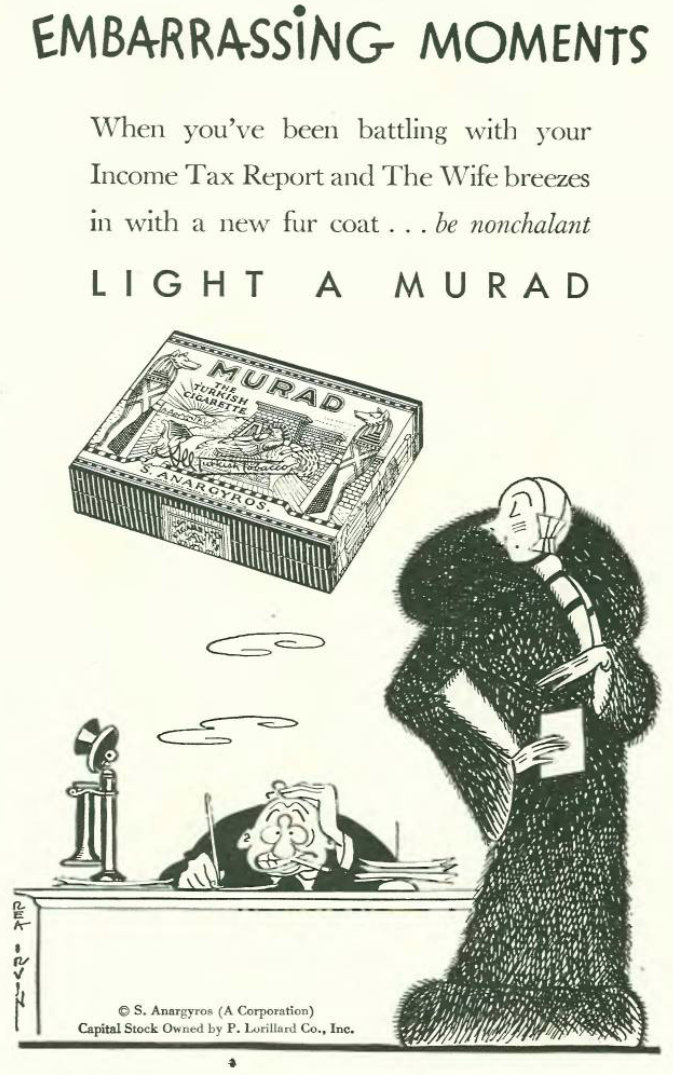
…and Rea Irvin continued his series of illustrations for Murad cigarettes…

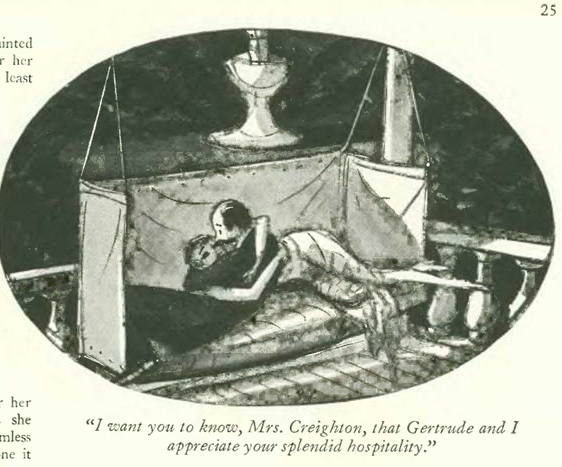
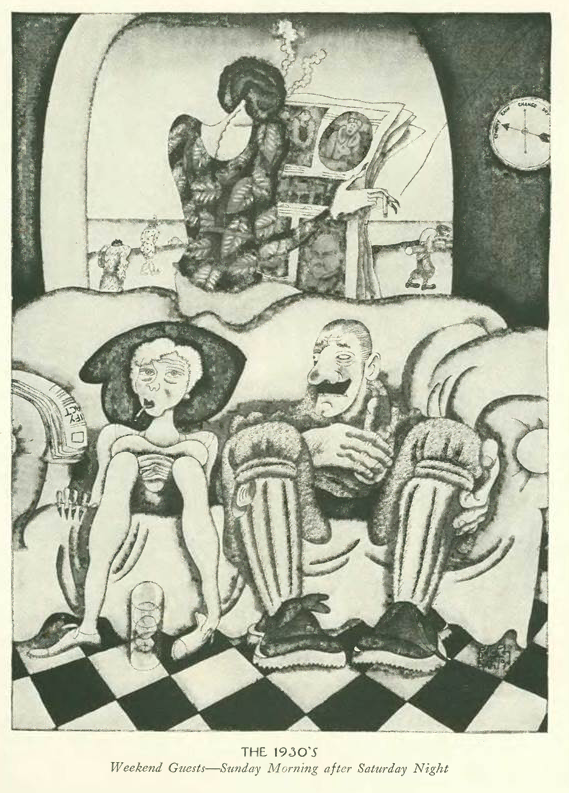
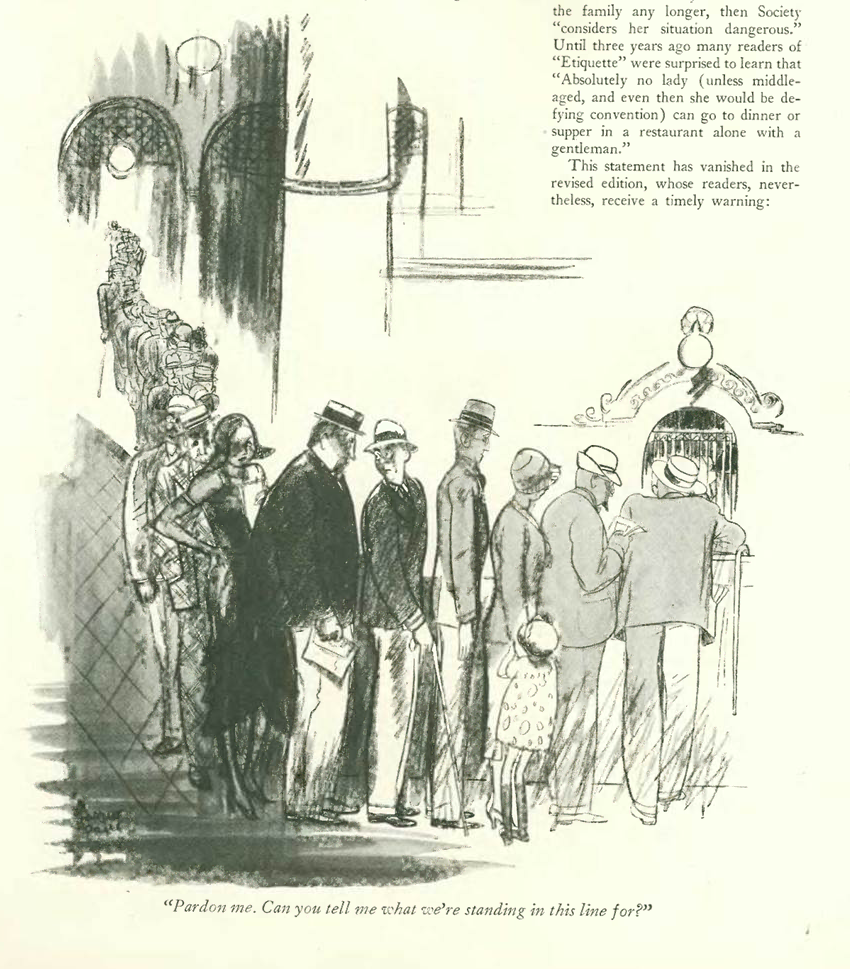
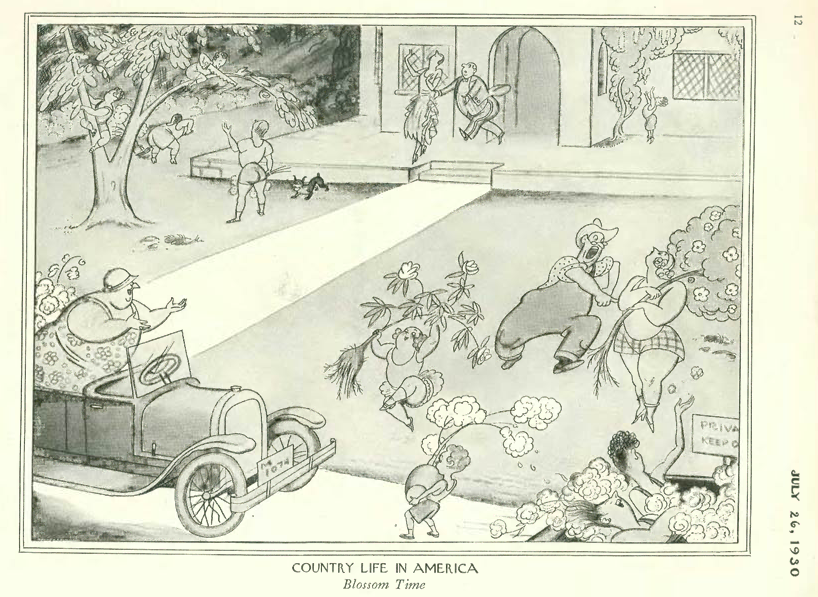
…in cartoons, Irvin gave us this interpretation of country life in a full-page panel originally featured sideways…these “Country Life in America,” scenes depicted common folks enjoying the outdoors at the expense of country squires…

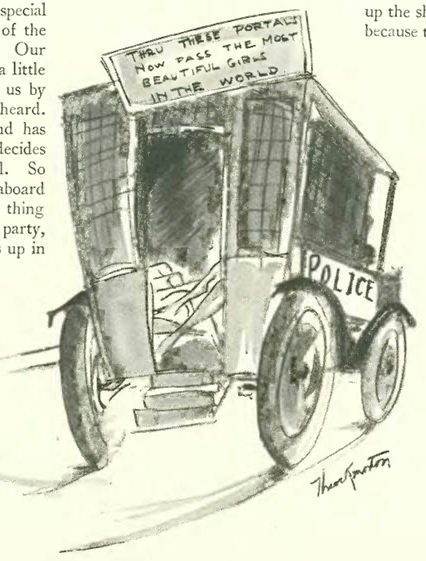
…and then we have the bohemian artist and set designer Cleon Throckmorton (1897-1965), with his one and only contribution to The New Yorker

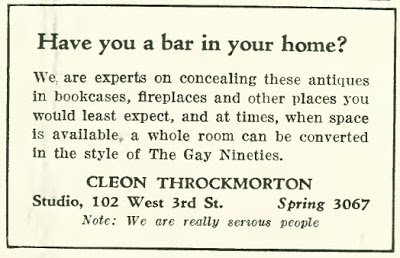
…in a previous issue (May 31, 1930) Throckmorton had placed this tiny, curious ad in a corner on page 46…

…and in the June 7, 1930 issue, he placed another ad in the bottom corner of page 94…

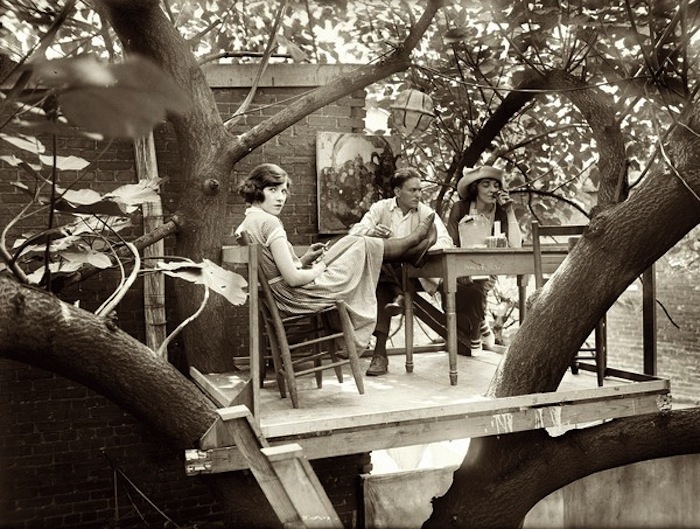
Cleon Throckmorton, well-known for his bohemian lifestyle, operated a backyard speakeasy called the Krazy Kat Club in Washington DC. He is pictured here (center) with a couple of “Klub” members in 1921. He was no slouch, however, designing 149 New York theatrical productions between 1920 and 1934. (messynessychic.com)

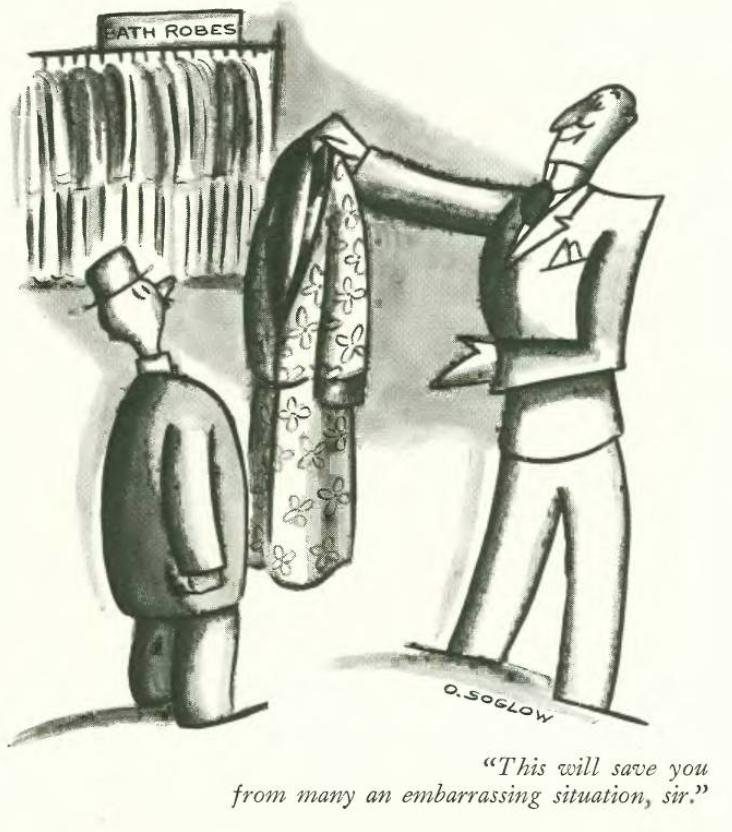
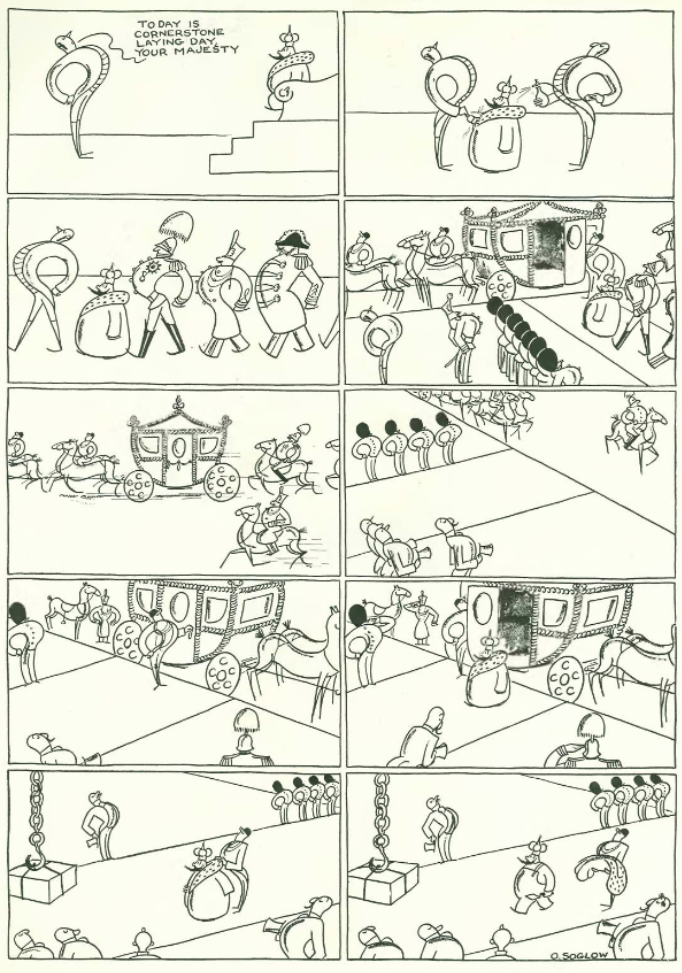
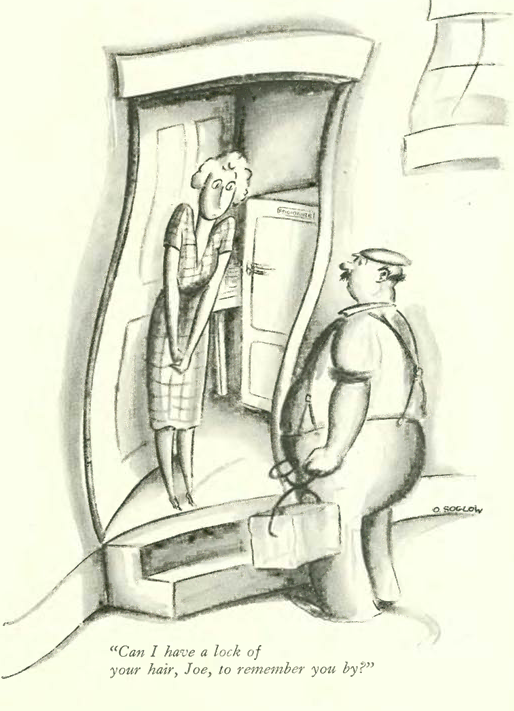
…back to our cartoons, we have Otto Soglow, who was going through a wavy period in his illustrations…

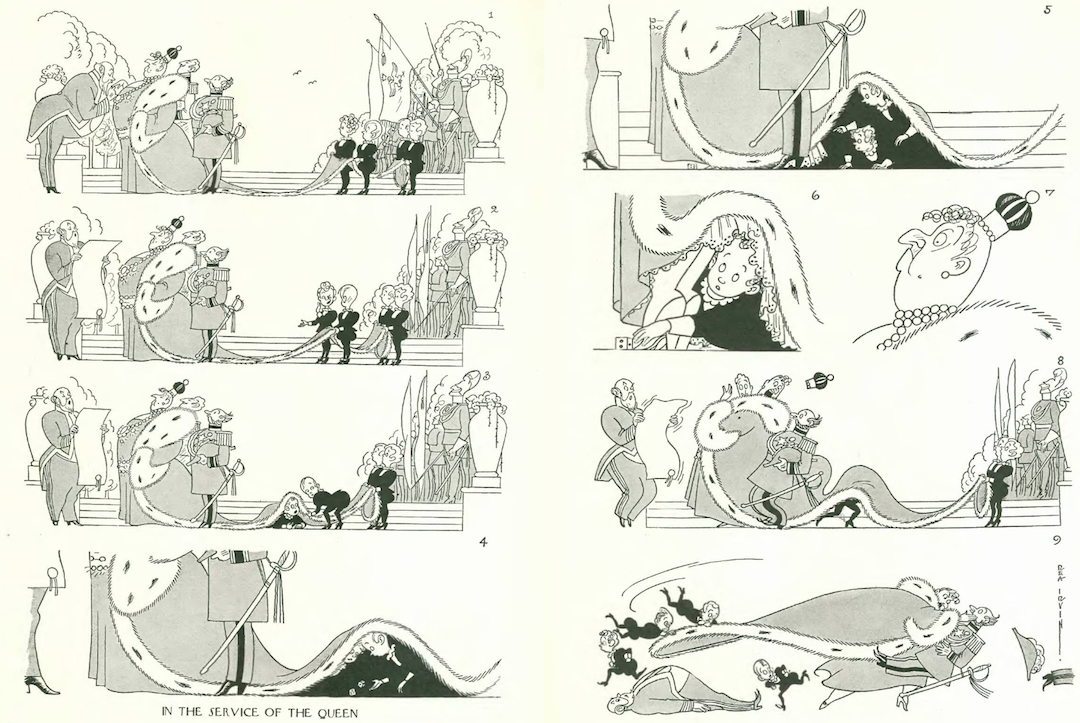
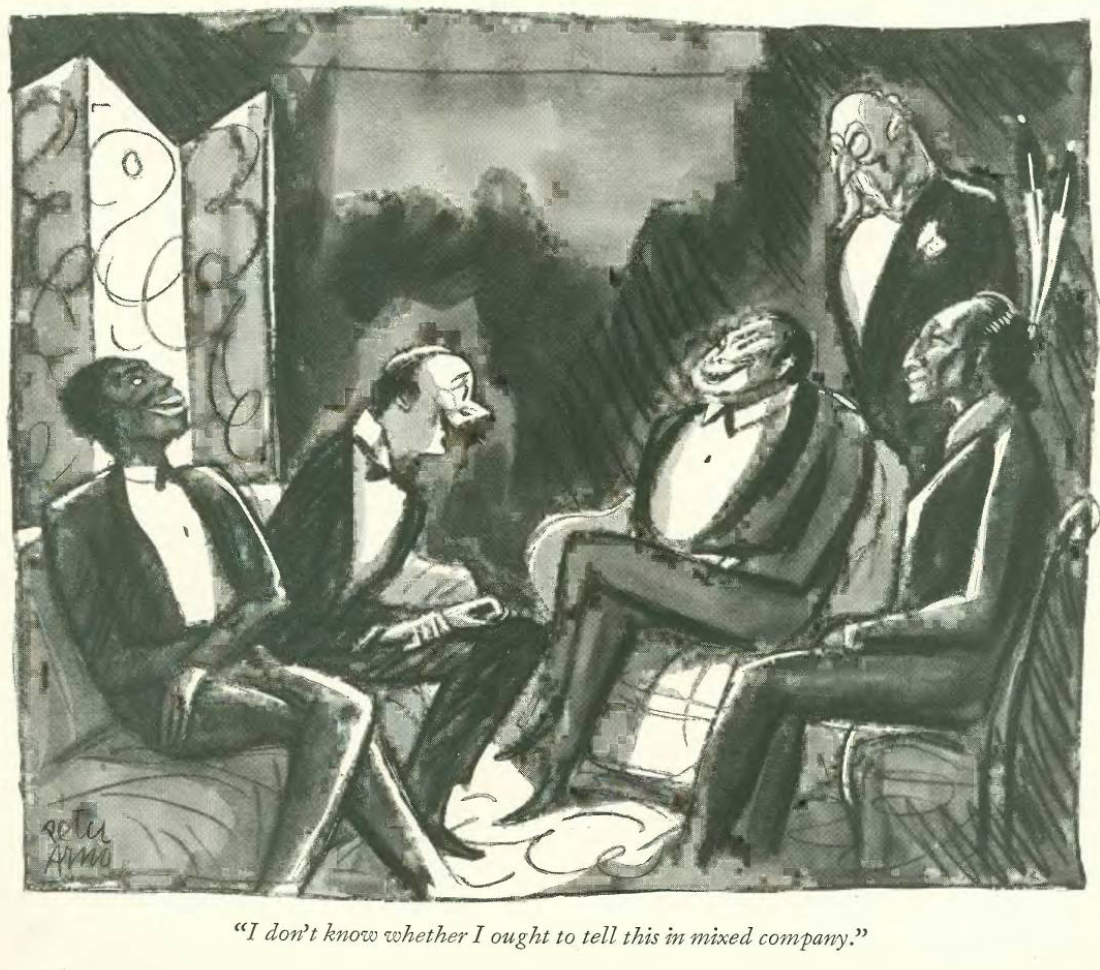
…Soglow would soon become famous for his Little King strip, but for now we’ll leave the king jokes to Peter Arno

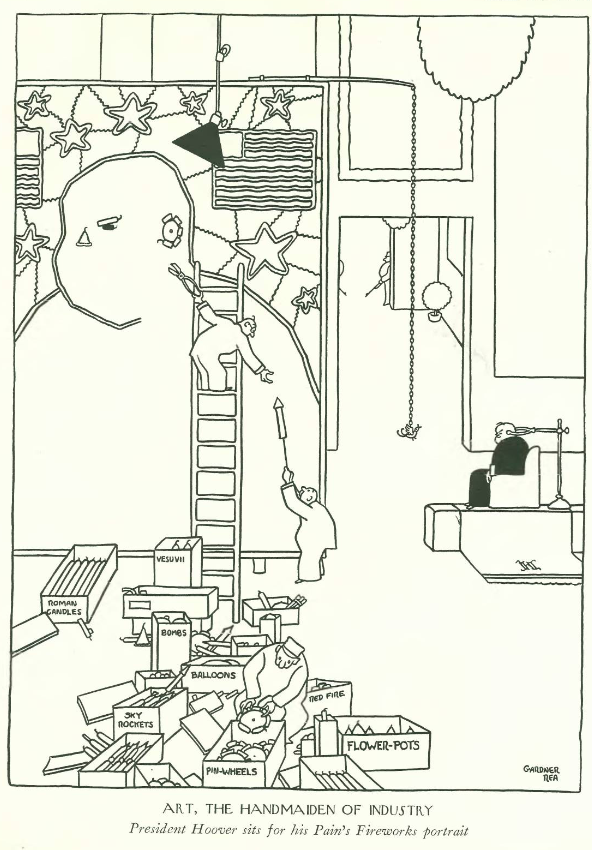
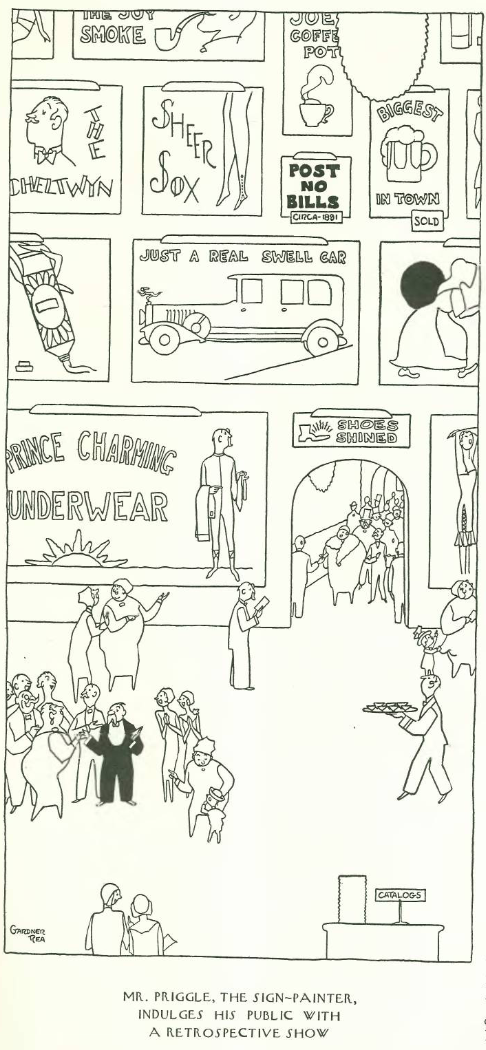
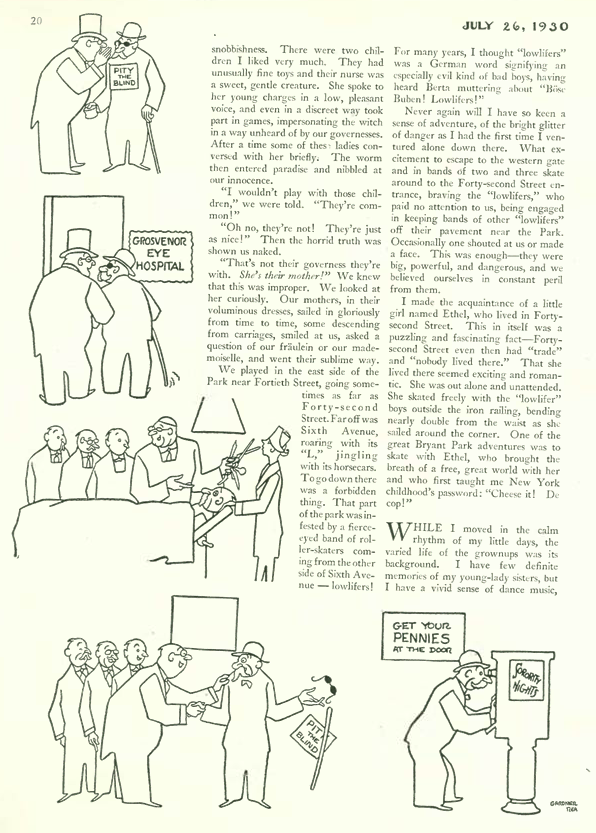
Gardner Rea contributed this series cartoon that slid around page 20…

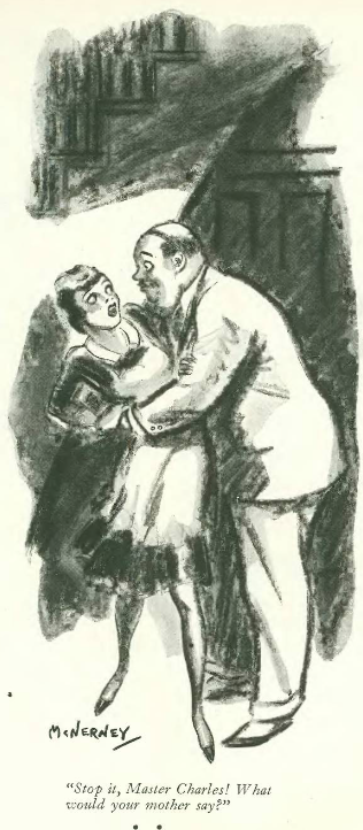
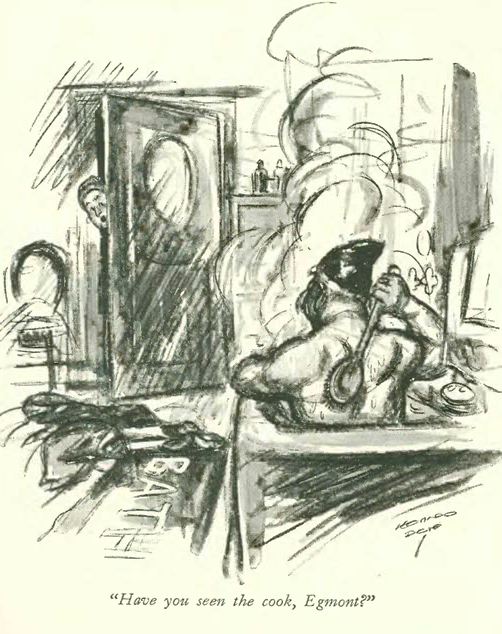
Leonard Dove looked in on a domestic scene…

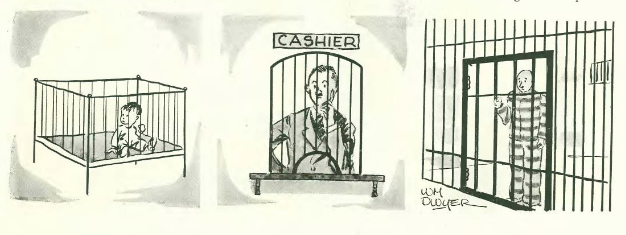
…and John Reehill contributed this weird little cartoon that reminded me a bit of the humor of Gahan Wilson

Next Time: The Drys Are All Wet…


The Little King

Like his New Yorker colleague Reginald Marsh, Otto Soglow trained in the “Ashcan School” of American art, and his early illustrations favored its gritty urban realism. He had his own life experience to draw upon, being born to modest means in the Yorkville district of Manhattan.

We look at two issues this week. At left, cover of March 31 issue by Peter Arno; at right, June 7 cover by Constantin Alajalov.

But Soglow (1900-1975) would soon abandon the gritty style in the work he contributed to the New Yorker…

RAGS TO RICHES…At left, Otto Soglow’s first cartoon in The New Yorker, Nov. 14, 1925, was rendered in the Ashcan style ; at right, an example of the sparer style he later adopted, one of his manhole series cartoons from March 2, 1929.

…and in the June 7, 1930 issue, Soglow would publish his first Little King strip, which would launch the 29-year-old into fame and fortune…
Did Soglow know he was on to something big with that first Little King cartoon? Well Harold Ross (New Yorker founding editor) liked what he saw, and asked Soglow to produce more. After building up an inventory over nearly ten months, Ross finally published a second Little King strip on March 14, 1931. It soon became a hit, catching the attention of William Randolph Hearst, who wanted the strip for his King Features Syndicate.

KING OF COMEDY…Otto Soglow working on an illustration for The Ambassador, a short-lived comic strip he created in 1933 for King Features Syndicate. The strip was replaced by The Little King in 1934 after Soglow fulfilled his contractual obligation to The New Yorker. (comicartfans.com)

After Soglow fulfilled his contractural obligation to The New Yorker, The Little King made its move to King Features on Sept. 9, 1934, and the strip ran until Soglow’s death in 1975. After his move to King Features, Soglow continued to contribute cartoons to The New Yorker, but with other themes.

Left, Soglow cartoon from the book Wasn’t the Depression Terrible? (1934); at right, King Features strip from Nov. 19, 1967. (Wikipedia/tcj.com)

You can read more about Soglow and The Little King in The Comics Journal.

 *  *  *

The Party’s Definitely Over

During the summer of 1925, a young writer at Vanity Fair named Lois Long would take over The New Yorker’s nightlife column, “When Nights Are Bold,” rename it “Tables For Two,” and set about giving a voice to the fledgling magazine as well as chronicling the city’s Jazz Age nightlife. There were accounts of Broadway actors mingling with flappers and millionaires at nightclubs and speakeasies, but Long also spoke out on issues such as Prohibition, taking the city’s leaders to task for raids on speakeasies and other heavy-handed tactics contrary to the spirit of the times. “Tables For Two” would go on hiatus with the June 7, 1930 issue, and appropriately so, as the deepening Depression gave the the city a decidedly different vibe. In her “final” column Long would write about the Club Abbey, a gay speakeasy operated by mobster Dutch Schultz

PARTIED OUT…In her final nightlife column, Lois Long wrote about the new Club Abbey in the basement of the Hotel Harding (left), which was operated by mobster Dutch Schultz (inset). The club’s emcee was Gene Malin (right), Broadway’s first openly gay drag performer. The club was short-lived (as were Schultz and Malin), closing in January 1931 following a mob brawl. (infamousnewyork.com/Pinterest)

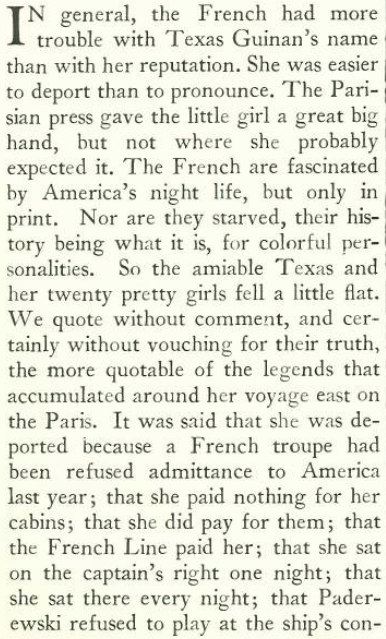
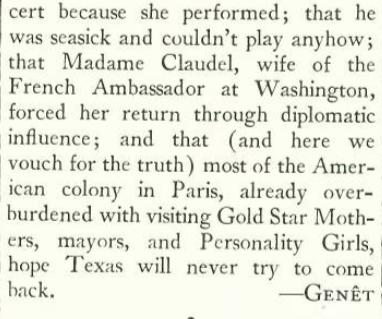
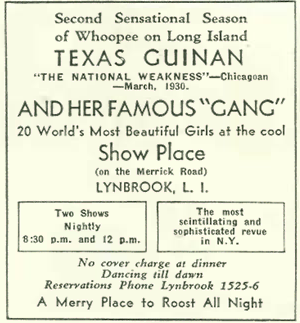
…and she would update her readers on “Queen of the Night Clubs” Texas Guinan, whose Club Intime was sold to Dutch Schultz and replaced by his Club Abbey…
FINAL ACT…Clockwise, from top left, Texas Guinan at Lynbrook, circa 1930; Joseph Urban murals on the rooftop of the St. Regis Hotel; Duke Ellington and his orchestra at the Cotton Club, circa 1930s.

Long’s column would signal a definitive end to whatever remained of the Roaring Twenties. It would also signal the end to some of those associated with those heady times. Texas Guinan’s Lynbrook plans would flop, and Gene Malin’s Club Abbey would close in less than a year. Both would both be dead by 1933—Malin would die in a car accident in 1933, and amoebic dysentery would claim Guinan that same year. Dutch Schultz would be gunned down by gangsters in 1935.

Lois Long, however, would continue to write for The New Yorker for another forty years, and would prove to be as innovative in her fashion column, “On and Off the Avenue,” as she was as a nightlife correspondent.

 *  *  *

Gone to the Dogs

In another installment of his pet advice column (June 7), James Thurber gave us one of his classic dogs…a disinterested bloodhound…

…while Thurber’s buddy and office mate E.B. White commented (in the March 31 issue) on a recent poll conducted among students at Princeton, discovering among other things that New Yorker cartoonist Peter Arno was preferred over the old masters…

FAN FAVORITES…The Princeton Class of 1930 named (from left) Rudyard Kipling, Lynn Fontanne and Peter Arno as favorite poet, actress and artist respectively in a student poll. (YouTube/Wikipedia/giam.typepad.com)

 *  *  *

We Like It Fine, Thank You

The New Yorker dedicated a full page of the March 31 issue to a tongue-in-cheek rebuttal directed at the New York Evening Journal, which had reprinted one of Peter Arno’s cartoons to illustrate the moral cost of Prohibition. I believe the author of the rebuttal is E.B. White (note how he refers to Arno as “Mr. Aloe”).

…also in the May 31 issue, Rea Irvin changed things up, at least temporarily, with some new artwork for the “Goings On About Town” section. The entries themselves were often clever, such as this listing for a radio broadcast: PRESIDENT HOOVER—Gettysburg speech. Similar to Lincoln’s but less timely…

*  *  *

From Our Advertisers

New Yorker cartoonists can be found throughout the advertisements — from left, Julian De Miskey, Rea Irvin and John Held, Jr

…and in the June 7 issue we find an unusual ad for a used car…a sign of the times, no doubt…

…before it was associated with Germany’s Nazi Party (especially after it seized power in 1933), for thousands of years the swastika had been widely used as a religious or good luck symbol…

…Actress Clara Bow was famously pictured sporting a “good luck” swastika as a fashion statement in this press photo from June 1928, unaware that in a few years the symbol would become universally associated with hate, death and war…

From an unidentified publication dated June 6, 1928. (@JoHedwig/Twitter)

…on to our cartoons, Isadore Klein illustrated a cultural exchange…
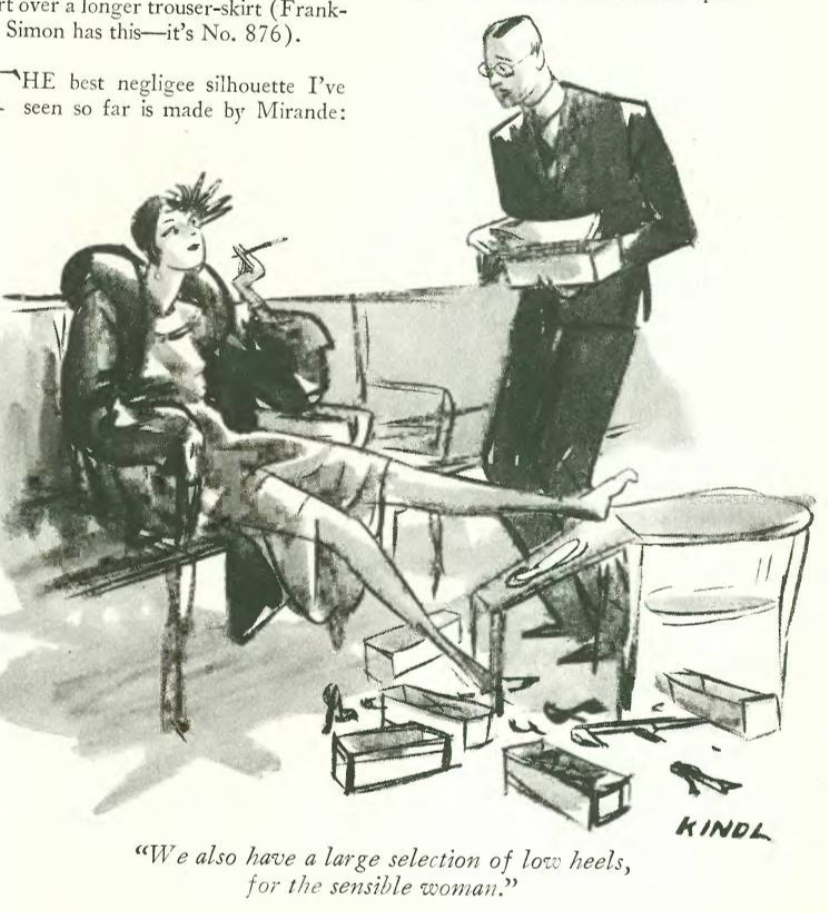
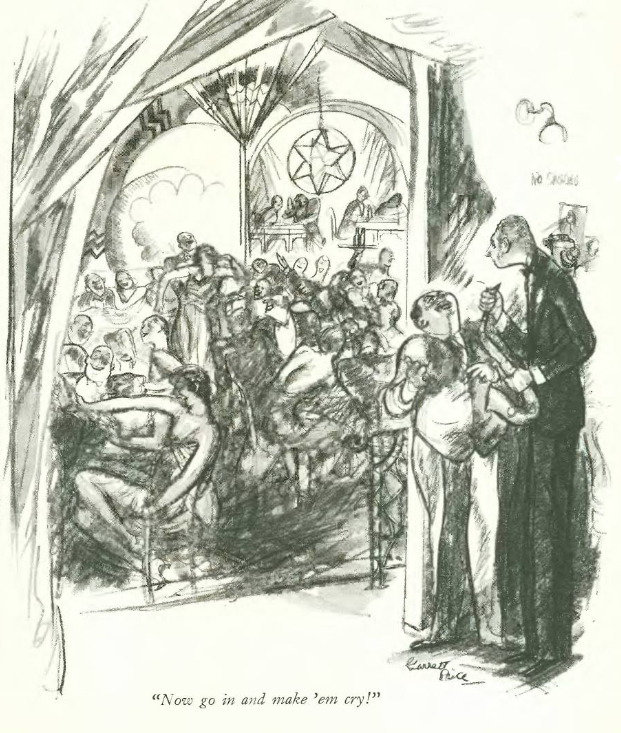
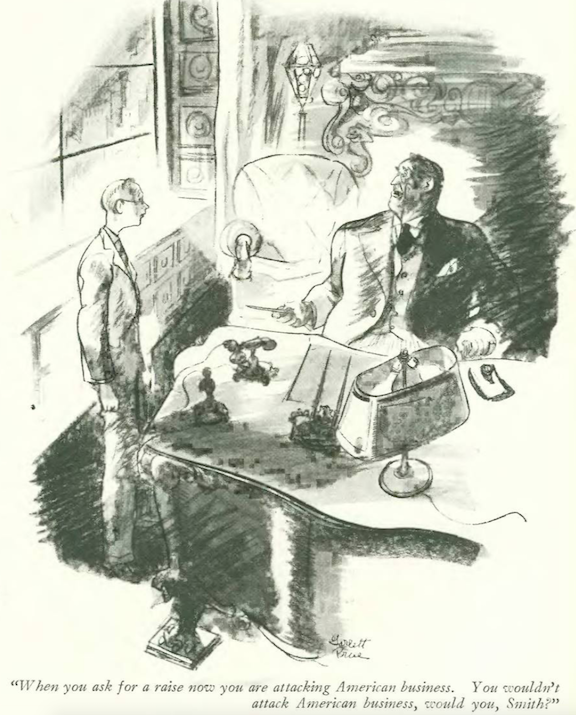
Garrett Price gauged the pain of a plutocrat…

Alan Dunn eavesdropped on some just desserts…

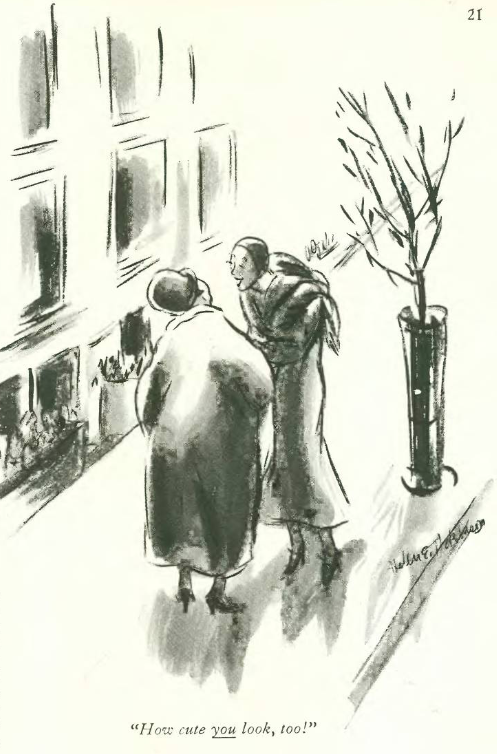
Helen Hokinson found humor in the mouths of babes…

…as did Alice Harvey

Leonard Dove examined one woman’s dilemma at a passport office…

…and Peter Arno, who found some cattiness at ringside…

Next Time: Germany’s Anti-Decor…


Red Alert

The New Yorker had a number of favorite punching bags, among them Grover Whalen (1886–1962), a product of Tammany Hall politics who in 1928 was appointed New York City Police Commissioner by another Tammany alumnus, Mayor Jimmy Walker.

May 17, 1930 cover by Rea Irvin.

Ironically, a mayor known for openly flouting prohibition laws had placed into office a man who would become known as a ruthless enforcer of those laws (excepting Mayor Walker, of course). Whalen was also known for fighting crimes that didn’t necessarily exist, including those committed by “Reds” organizing protests by the city’s growing numbers of unemployed.

In the May 10, 1930 issue, New Yorker writer Alva Johnston penned a tongue-in-cheek assessment of America’s “Red Revolution” (see previous post). In the following issue (May 17), Morris Markey took a few swipes at Whalen’s “Crimson Menace” in his “A Reporter At Large” column:

FLYING HIGH…Mayor Jimmy Walker (second from left) and his new Police Commissioner Grover Whalen (far right) visit Mitchell Field on Long Island in 1928; portrait of Whalen circa 1930. (Amazon/WNYC)

Whalen’s career as police commissioner came to an end around the time Markey’s column appeared. Whalen was under fire for how his police responded to an International Unemployment Day demonstration, where 1,000 baton-wielding police went to work on a crowd of more than 35,000 demonstrators. The New York Times reported: “From all parts of the scene of battle came the screams of women and cries of men with bloody heads and faces.”

IDLE HANDS…The International Unemployment Day demonstration in Union Square on March 6, 1930, turned ugly when a thousand baton-wielding police went to work on the protestors, identified by the New York Times as “Reds.” (libcom.org/The New York Times)

And in the May 24 issue, E.B. White took his own swipe at Whalen in his “Notes and Comment”…

In ensuing years Whalen found more peaceful pursuits, serving as New York City’s official greeter of dignitaries and organizer of ticker tape parades. In 1935 he was named president of the New York World Fair Corporation and became the face of the forward-looking 1939 New York World’s Fair.

DAWN OF A NEW DAY was the opening slogan for the 1939 World’s Fair. At left, preparing to lower the fair’s time capsule into it’s 5,000-year resting place are A.W. Robertson, Westinghouse Electric Company’s chairman of the board (left) and Grover Whalen, president of the New York World’s Fair; at right, the fair’s iconic symbols, the Trylon and Perisphere. (heinzhistorycenter.org/Flickr-Ricksoloway)

 *  *  *

It’s In The Stars

E.B. White led off his “Notes and Comment” with thoughts on the latest trends in product endorsement, including the use of astrology to boost the sales of toothpaste and perfume:

A FORTUNE IN TOOTHPASTE…The makers of Forhan’s Toothpaste promoted their Astrology Hour radio show in the Akron Beacon Journal, May 1931. At right, 1931 ad for Perfum Astrologique. (newspapers.com)
THAT WAS THEN…White actors Freeman Gosden and Charles Correll portrayed Amos ’n’ Andy on the radio from 1928 to 1960. Here they shill for Pepsodent toothpaste on circa 1930 stand-up cards. (thetimes.co.uk)

 *  *  *

More Advice on Troublesome Pets

The May 17 issue featured James Thurber’s latest advice on pet care:

…and this two-page illustration by Reginald Marsh ran along the bottom of “Talk.”

 *  *  *

A Fighter for Rights

The May 17 issue featured the first installment of a two-part profile on social reformer Samuel Untermyer (1858-1940) titled “Little Giant.” The profile’s author, Alva Johnston, praised Untermyer’s legacy, and chided New Yorkers for not giving him his proper due. Known for defending the public trust against powerful corporations, he laid the groundwork in the U.S. for the Federal Reserve Law, the Clayton Anti-Trust Law, the Federal Trade Commission Bill and the Securities and Exchange Act. A fierce defender of Jewish rights, Untermyer served as attorney for Herman Bernstein, who filed suit against automaker Henry Ford for anti-semitic articles published in Ford’s Dearborn Independent. 

Johnston concluded his two-part profile with these words:

BRING IT ON…Samuel Untermyer was known as a fierce defender of the public trust. At right, illustration that accompanied the New Yorker profile. (findagrave.com)

 *  *  *

From Our Advertisers

Julian De Miskey picked up some extra work with this illustration for Macy’s…

…while in cartoons, Barbara Shermund discovered the challenges of exercise by radio…

Helen Hokinson looked at another challenge…city driving…

Gardner Rea explored the mysteries of street food…

…and Peter Arno greeted one Manhattan couple at sunrise…

 *  *  *

On to the May 24, 1930 issue, with a lovely cover by Madeline Pereny…

May 24, 1930 cover by Madeline Pereny.

As construction continued on the Museum of the City of New York, The New Yorker’s architecture critic George Chappell liked what was taking shape:

THE STORY OF A CITY…The Museum of the City of New York opened its doors at 104th Street and Fifth Avenue in early 1932. (nyctourist.com/www.ennead.com)

 *  *  *

From Our Advertisers

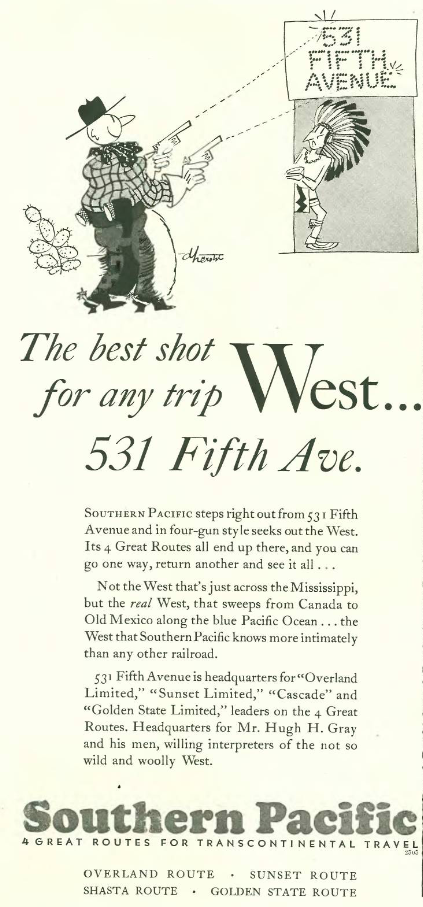
Travel by train in the States wasn’t always miserable as this ad attested…

…a bit of color courtesy the Lenthéric salon…

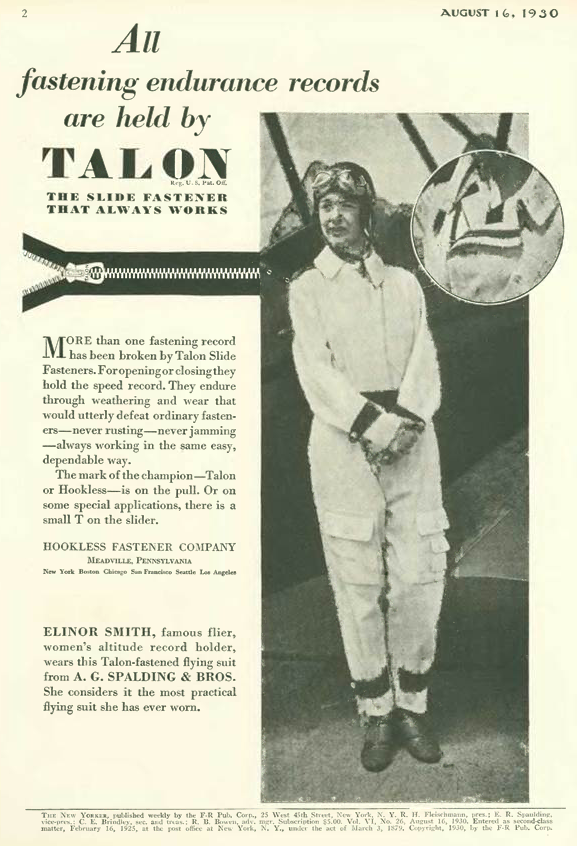
Fontaine Fox, best known for his long-running Toonerville Folks comics, contributed this cartoon on behalf of Talon Slide Fasteners, or “zippers” as they came to be known in the late 1920s and early 30s, when they were still something of a novelty…

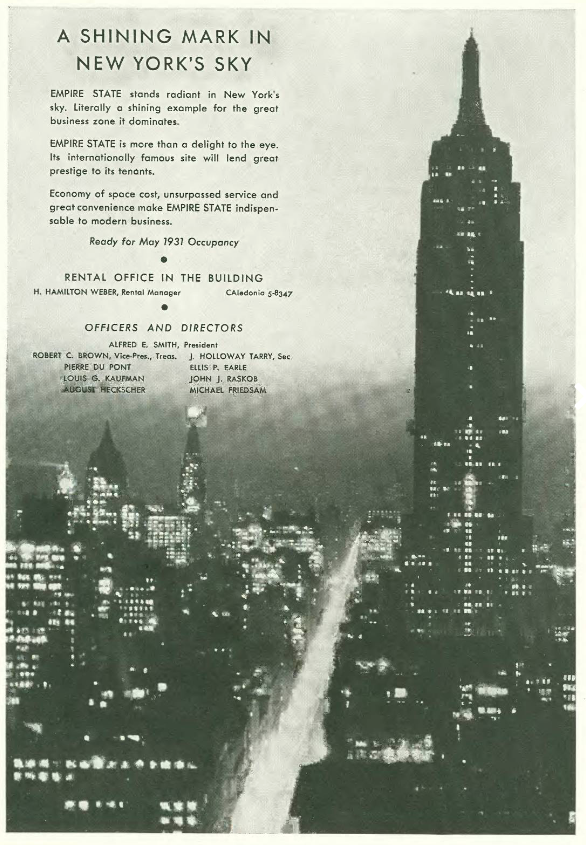
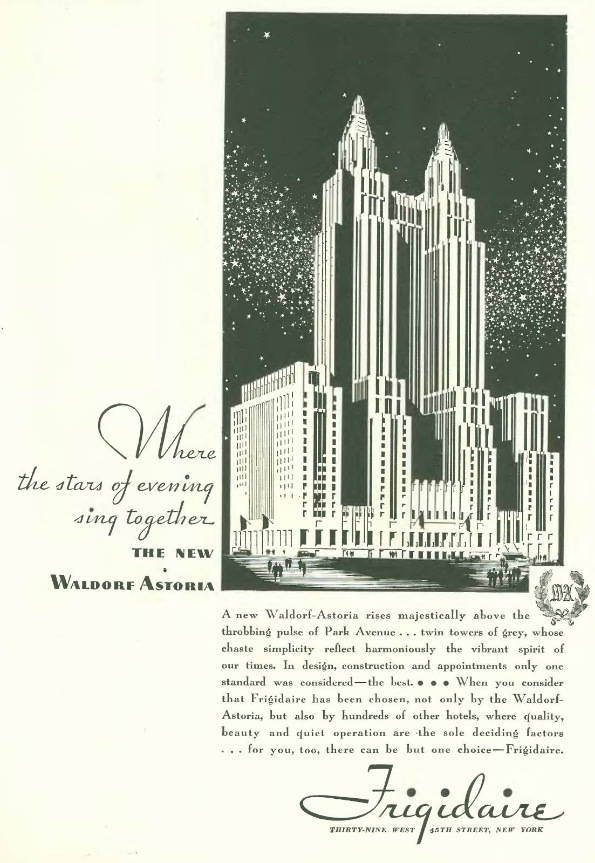
…I believe this is the first-ever image of the Empire State Building in The New Yorker, an artist’s rendering since the building wouldn’t be completed until the spring of 1931…note how this ad links the building’s site location to New York history and specifically the Astor family…

…here is how the Empire State Building looked in June 1930…

(New York Public Library)

…the old Waldorf-Astoria Hotel was torn down to make way for the Empire State Building, and that provides a nice segue to our cartoons…this one by Garrett Price featured a modest work crew contemplating the razing of a building that recalled the old hotel…

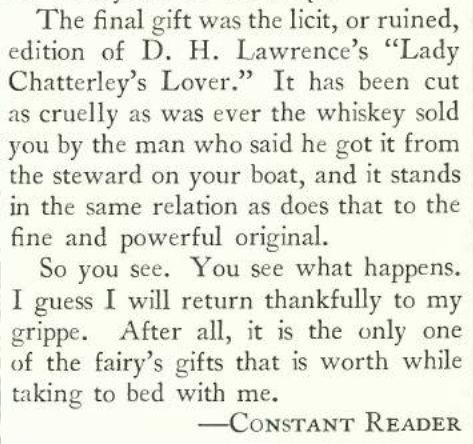
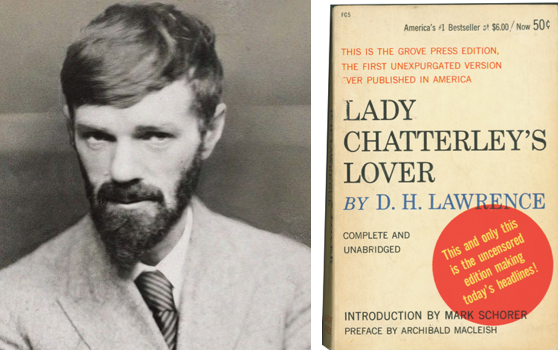
…across the pond, one of Helen Hokinson’s ladies was busy trying to procure a banned book…

…while William Crawford Galbraith gave us a young woman in search of a love song (with the help of a seriously timid man)…

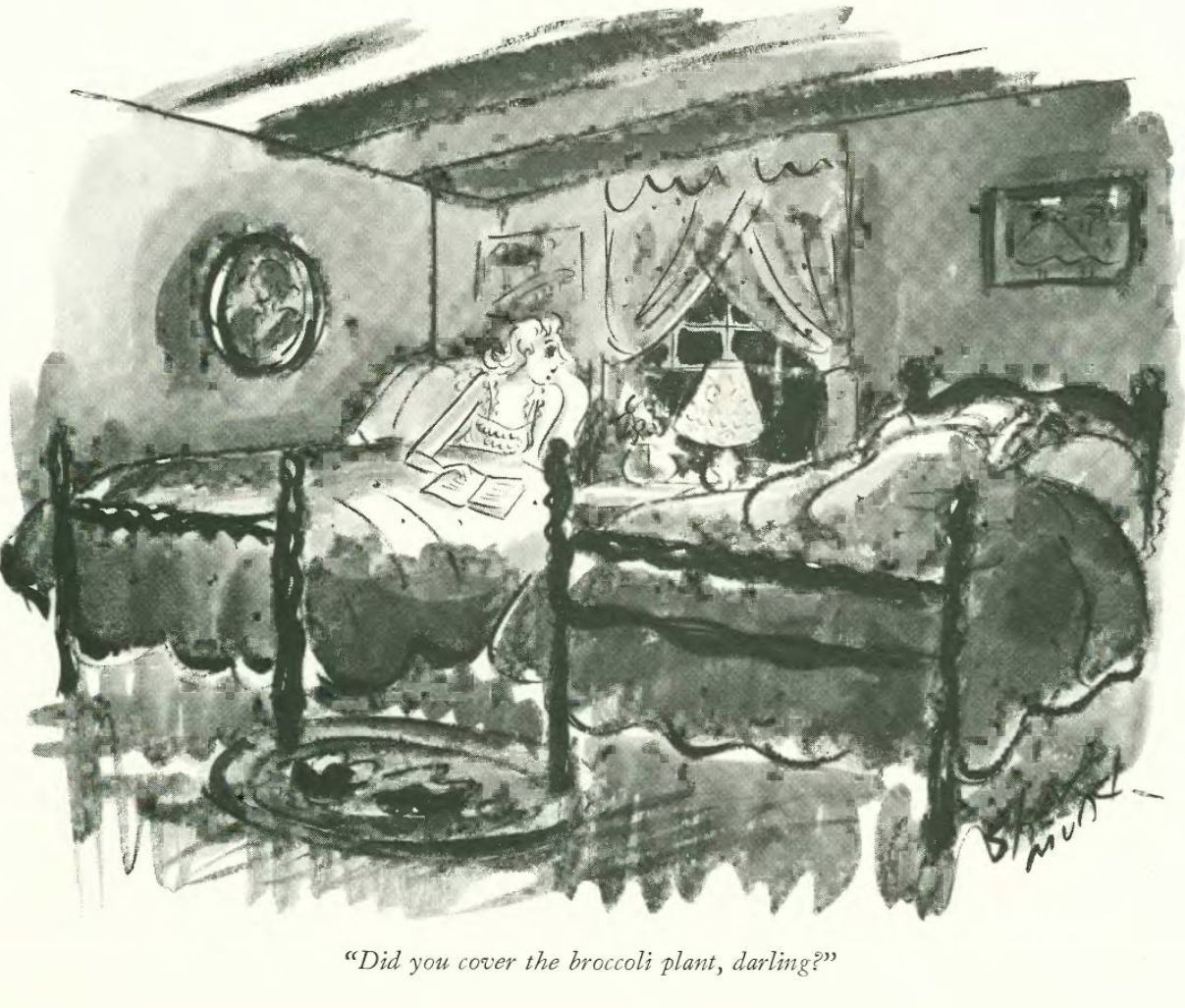
Barbara Shermund found some bedside humor…

…and Peter Arno took us back to the nightlife, with our familiar gold-digger and sugar daddy…

…and finally, over the course of twelve issues (Feb. 8 to May 10, 1930) Abe Birnbaum provided illustrations of New York’s “Restaurant Royalty.” These usually ran in or near “The Talk of the Town” section. Please click to enlarge.

Next Time: The Little King…


Minding the Gap

Tens of thousands of commuters daily cross the George Washington Bridge, but in the din of modern commuting few give nary a thought to a span that was once considered a modern marvel.

May 3, 1930 cover by Rose Silver.

Twice as long as any previous suspension bridge when it opened in 1931, the George Washington Bridge’s main span of 3,500 feet (1,100 m) would be the world’s longest until it was surpassed by San Francisco’s Golden Gate Bridge in 1937. The New Yorker’s “Talk of the Town” (entry most likely by E.B. White) checked on the bridge’s progress for the May 3 issue:

MEN OF STEEL…Some 107,000 miles of wire were used in cables made by John A. Roebling’s Sons Company for the George Washington Bridge — the same firm also supplied wire for the Brooklyn Bridge 60 years earlier (John Roebling and his son, Washington, also designed and built the Brooklyn Bridge). Clockwise, from top, employees of John A. Roebling’s Sons pose atop cable bundles; bottom right, the bridge’s four main cables were each composed of a single strand carried back and forth across the river 61 times. Each strand itself is a bundle of 434 individual wires; bottom left, worker poses atop completed cable. (Flickr/Pinterest)
BY ANY OTHER NAME…Known as the Hudson River Bridge during its construction, the George Washington Bridge opened to traffic in 1931. During the first full year of operation in 1932 more than 5.5 million vehicles used the original six-lane roadway — today it is the world’s busiest motor vehicle bridge, carrying more than 100 million vehicles per year. Although the steel towers are iconic today, the original plan called for them to be clad in stone. (Wikipedia)

 *  *  *

A Cabin in the Sky

Other signs of modern life were being seen in Midtown, where an “Aircraft Salon” hosted by the Aeronautical Chamber of Commerce was taking place at Madison Square Garden.

Nicholas Trott was on hand to take in the exhibits, noting that advances in aviation included the use of metal bodies (instead of fortified cloth) and greater attention to interior decoration:

SIGNED, SEALED, DELIVERED…An attendee of the New York Aircraft Salon received a special postal stamp, and an autograph from aviator Cy Caldwell, at the Madison Square Garden show. (Joe Krantz)

Trott noted that designs of passenger compartments, still in their infancy, suggested something between automobile and nautical motifs:

SORRY, NO HEADPHONES…Clockwise, from top left, a Curtiss Condor 18 and its interior appointments; a Fokker Trimotor featured dining in its cabin. As peaceful as the scene appears, the noise from the motors must have been unbearable. (Wikipedia/dutch-aviation.nl)

Trott also commented on the debate surrounding metal vs. fabric in the construction of airplanes. Before 1930 most planes were constructed of wood covered with fabric (which were much lighter than metal craft). Although as early as 1920 the National Advisory Committee for Aeronautics declared metal to be superior to wood, only five percent of aircraft in 1930 were of all-metal construction.

DON’T CALL ME WOODY…This eight-passenger Consolidated Fleetster was a rare example of metal construction in early 1930. The wings, however, were still fashioned from wood. (Aeronautical Chamber of Commerce 1931 Aircraft Yearbook)

 *  *  *

Road to Nowhere

The New Yorker’s enthusiasm for modern marvels did not extend to the West Side Highway, a project that would extend from the late 1920s to the early 1950s. Here is E.B. White’s take on the opening of the highway’s first section:

White’s observations were somewhat prescient — constructed in tight confines, the road’s on-ramps proved too narrow and the turns too tight for use by large trucks. The roadway also lacked proper maintenance, and just two decades after it was completed a section of the highway collapsed under the weight of an asphalt-laden truck. The roadway was demolished between 1977 and 1989. Read more here about the West Side Highway’s surprising history at the Museum of the City of New York.

THE ROAD NOT TAKEN, TAKEN…Left, West Side Express Highway and Piers 95-98, photographed by Berenice Abbott from 619 West 54th Street on Nov. 10, 1977; West Side Highway Ramp at 23rd Street reveals Art Deco ornamentation. Detail of photo by Jan Staller, 1978. (Museum of the City of New York)

 *  *  *

For Pet Lovers

Our latest installment of James Thurber’s “Our Pet Department” column…

 *  *  *

Hate Couture

The New Yorker’s Paris correspondent, Janet Flanner, using the pen name “Hippolyta,” contributed this profile of François Coty (1874-1934), a French perfumer and businessman. Flanner’s profile (the introduction included below) described Coty’s rags-to-riches rise in the perfume industry, and touched on his life as a sometime journalist and politician.

What doesn’t come across in the profile is Coty’s extreme right-wing stance on politics and his virulent anti-Semitism, which was often expressed in his newspaper, Figaro. Three years after Flanner’s profile Coty would co-found Solidarité Française, a fascist, paramilitary organization, and a year after that he would be dead of an aneurysm.

François Coty circa 1930. (aperfumeblog.com)

 *  *  *

From Our Advertisers

The New Yorker’s bottom line reaped benefits from the big aviation show at Madison Square Garden…

…and even if you weren’t selling airplanes or flying lessons, you could still get in on the action…

…also from the fashion world, this colorful entry from Onyx Hosiery…

…and this weird ad from Saks, advertising shoes and a party dress but dominated by a caricature of designer Joseph Hergesheimer

…on to our cartoons…Helen Hokinson paid a visit to the aviation show…

…on the domestic front, Garrett Price examined the challenges of home decor…

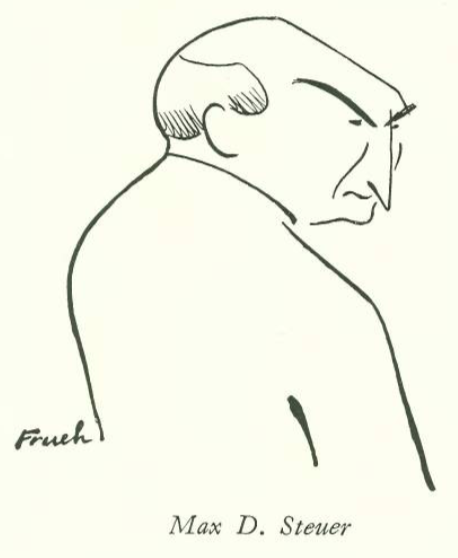
Al Frueh offered an ironic twist on a room with a view…

Peter Arno once again found humor in the partying life…

…as did Gardner Rea

Next Time: All Quiet on the Western Front…


Noblesse Oblige

Just three years before she would enter the White House as First Lady, Eleanor Roosevelt was familiar to some New Yorkers for her social work, but was known to most as the wife of the Governor of New York, Franklin D. Roosevelt.

This week we look at two issues, March 29 and April 5, 1930, both with covers by Rea Irvin.

In a profile featured the April 5 New Yorker, Helena Huntington Smith looked at the life of a woman who was a niece to former President Theodore Roosevelt and a fifth cousin (once removed) to her husband Franklin. A somewhat reluctant mother (who nevertheless had six children) in a marriage that was mostly a political arrangement, Eleanor devoted considerable time and energy to social causes. Below is a brief excerpt, accompanied by an illustration of Eleanor by Cyrus Baldridge.

ALBANY DAYS…Clockwise, from top left: Eleanor Roosevelt in 1933; Gov. Franklin Roosevelt, Eleanor, and their youngest son, John, in Albany in 1930; FDR being sworn in as Governor of New York, January 1929. (Wikipedia/Albany Group Archive)
IN HER ELEMENT…Eleanor Roosevelt with boy and girl scout volunteers at the University of Kentucky, July 1934. (eleanorroosevelt.org)

 *  *  *

No Laughing Matter

In a surprising twist, James Thurber took a hand at writing the “A Reporter at Large” column (titled “Cop Into College Man”) in the March 29 issue, visiting a new “Police College” in New York City. In this engaging piece, Thurber seemed thoroughly engrossed in the operation…

…and particularly in the mugshots of some of the city’s most notorious criminals, including gangster Jim Flanagan, “debonair in a Bangkok hat”…

…and in the college’s museum, filled with all manner of deadly implements…

PREPPING FOR PERPS…The April 1930 edition of Popular Science featured the opening of New York’s new Police College. (Modern Mechanix)

 *  *  *

Pluto’s Salad Days

In was something of a sensation in February 1930 when Clyde Tombaugh (1906-1997) discovered the then-planet Pluto at the Lowell Observatory in Arizona. Howard Brubaker in “Of All Things” (March 29) had this to say about the achievement:

JUST A SPECK…Clyde Tombaugh poses with the telescope through which he discovered the planet Pluto at the Lowell Observatory on Observatory Hill in Flagstaff, Ariz., 1931. At right, images of the planet (specks indicated by arrows) were all the proof Tombaugh needed to confirm his discovery. (AP/NASA)

Thanks to a 2015 flyby by NASA’s New Horizons spacecraft, we now have a better idea of what Pluto, now classified as a “dwarf planet,” actually looks like…

 *  *  *

Dandy Doodle Mayor

Fillmore Hyde, author (and four-time national amateur squash tennis champion), penned this ditty in the March 29 issue in tribute to New York City’s dandyish mayor…

HAT’S OFF…Mayor Jimmy Walker.

 *  *  *

Back for More

Also for the March 29 issue art critic Murdock Pemberton was back at the Museum of Modern Art — a new institution he met with skepticism when it opened in late 1929, but a place that was definitely growing on him as a destination to revel in the work of some of the world’s top modern artists, including the American Max Weber (1881-1961), whose retrospective was supposed to the big draw of MoMA’s latest show, but Pemberton seemed more impressed by French artist Aristide Maillol (1861-1944) and particularly by the Swiss-German Paul Klee (1879-1940).

AMERICAN CUBIST…Max Weber’s The Cellist, 1917, oil on canvas, was featured in Weber’s 1930 retrospective exhibition at the Museum of Modern Art; at right, Weber seated in front of Interior with Music (1930). (Brooklyn Museum/Smithsonian)
Aristide Maillol’s Crouching Woman, bronze, 1930. (MoMA)

Pemberton wrote that Klee’s show gave you “quite a feeling”…

Catalogs from Max Weber’s retrospective and Paul Klee’s exhibit at the Museum of Modern Art. (MoMA)

…and when he compared Klee’s work to that of the other artists, Pemberton saw something “more potent even than electricity…signposts toward a glorious future”…

A GLIMPSE OF THE FUTURE…From left, Paul Klee’s Actor’s Mask, 1924, oil on canvas mounted on board; Josef Albers’ 1929 photographic portrait of Klee, 1929; Klee’s In the Grass, 1930, oil on canvas. (MoMA/Guggenheim.org)
 A week later, writing for the April 5 issue, Pemberton penned this piece for “The Talk of Town” about the work habits of artist John Marin

OLD MAN AND THE SEA…John Marin in 1921, in a photograph by Alfred Stieglitz; Marin’s Bathers, 1932, oil on canvas. (mfa.org/Dallas Museum of Art)

 *  *  *

Who Needs a Vet?

The April 5 issue featured James Thurber’s latest installment of “Our Pet Department…

 *  *  *

Spend It Quickly

April 5’s “Talk” also featured this item about Al Capone’s release from prison in Philadelphia, lavishing money and gifts on prison employees as he made his exit from Eastern Penitentiary…

…it was no wonder, because officials at the prison didn’t treat Capone like some ordinary prisoner…

SALUTARY CONFINEMENT…Arrested outside a Philadelphia movie theater for carrying a concealed, unlicensed .38 caliber revolver, Al Capone was sentenced to a year in Eastern State Penitentiary. His last seven months were served in a cell (right) with fine furniture, oriental rugs, paintings, and a console radio, among other frills. (easternstate.org)

 *  *  *

This Al Could Sing

Upon the DVD release of Al Jolson’s 1930 film, Mammy, Dave Kehr of The New York Times wrote that Jolson was “Simultaneously one of the most significant and most embarrassing show business figures of the 20th century.”

That was not view of most audiences 89 years ago, when Jolson reigned as one of America’s most famous entertainers. In his review of Mammy for the April 5, 1930 issue of The New Yorker, critic John Mosher admitted that he didn’t care for minstrel shows depicted in the film, but not for any of the reasons we would cite today…

UGH…Clockwise from top left, Al Jolson and Lois Moran in Mammy; a studio promotional poster; Jolson as a minstrel performer in the film. (IMDB)

 *  *  *

From Our Advertisers

We have more racial stereotypes, this time to sell Stetson shoes…

Theodore Geisel (Dr. Seuss) continued to pay the bills by illustrating ads for Flit insecticide…

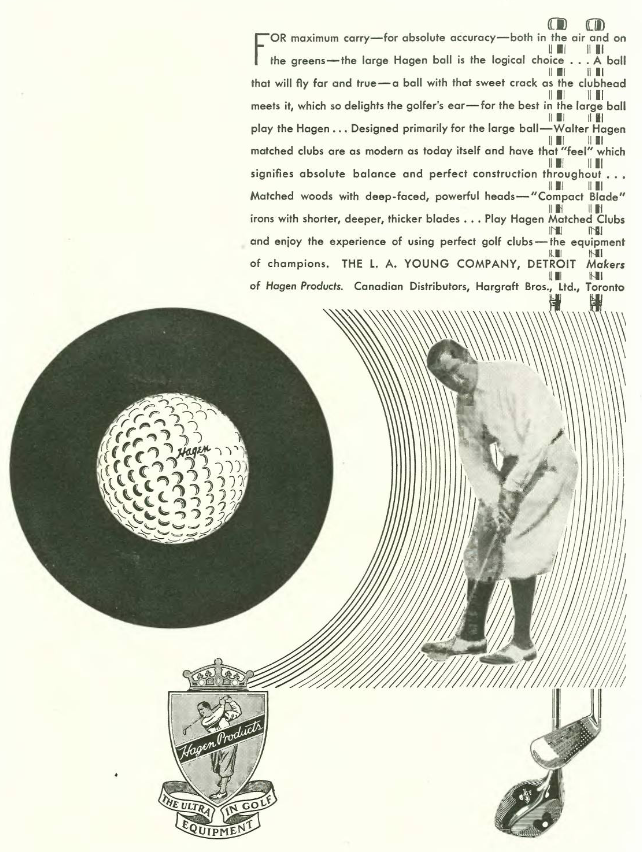
…while professional golfer Walter Hagen picked up some extra cash by launching his own line of golf underwear…

…Walter has been gone for fifty years, but you can still get his branded clothing from Dick’s Sporting Goods…

Julian De Miskey picked up some extra work illustrating this house ad for The New Yorker

…and then we have this spot from the American Austin Car Company, which produced cars licensed from the British Austin Motor Company from 1930 through 1934…interestingly, the ad doesn’t feature the car itself…

…which looked like this…

(theoldmotor.com)

…on to our cartoons, Alan Dunn looked in on a devoted listener of S. Parkes Cadman’s Sunday radio broadcast…Cadman (1864-1936) was a British-born clergyman whose NBC radio broadcasts reached millions of listeners across America…

…signs of spring were noted by Otto Soglow

Don Herold shared an observation on stage entertainments…

…William Crawford Galbraith found unrequited love at the circus…

…while Barbara Shermund found a more agreeable pairing at a Manhattan cocktail party…

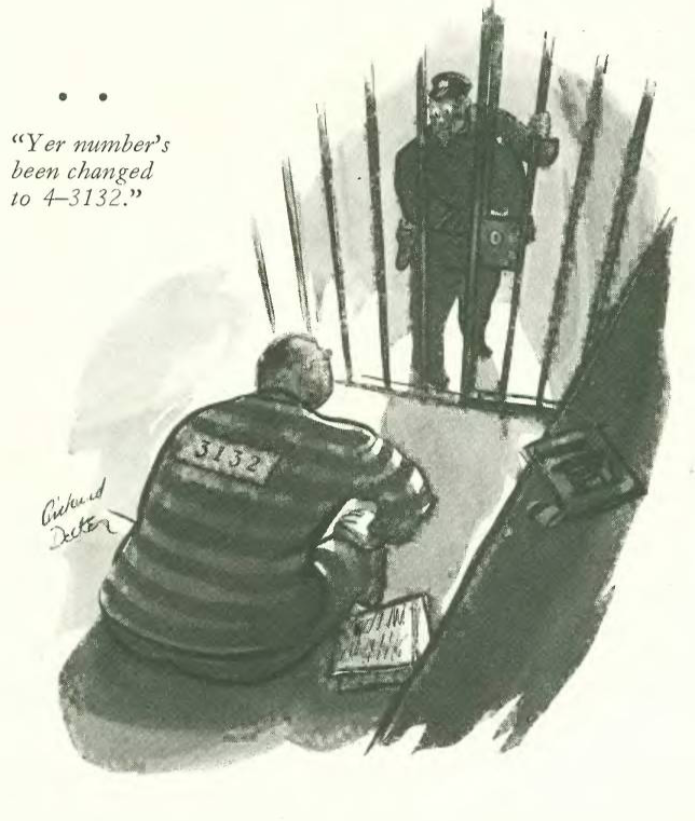
Garrett Price found humor in the growing numbers of the down and out…

…and Peter Arno turned in this epic two-pager that illustrated the challenges of filming in nature…(caption: “Well, we can’t start till we get that robin out of there.”)

Next Time: Hot Jazz in Stone and Steel…


The Lion Roars

It’s easy to get into the weeds while digging through The New Yorker archives, as it is filled with a richly interconnected cast of characters whose lives and work still resonate with us today.

March 15, 1930 cover by Rose Silver. (Please see note on this artist at the end of this blog entry)

A case in point is Bert Lahr (1895-1967), who at age 15 dropped out of high school and joined the vaudeville circuit, working his way up to top billing in Broadway musical comedies including 1930’s Flying High, which received an enthusiastic welcome from New Yorker critic Charles Brackett

…Brackett enjoyed the “feminine beauty” offered by a George White chorus that included the “Gale Quadruplets,” described in the Playbill as “The only Quadruplets in the world appearing on the stage”…

…although in fact the Gale Quadruplets were actually two sets of twins: June and Jane, and Jean and Joan (real names were Doris, Lenore, Helen and Lorraine Gilmartin). But I digress.

What really caught Brackett’s eye were the antics of Bert Lahr:

ONLY ONE BERT…Clockwise, from top left, publicity photo of Bert Lahr from the 1931 film version of Flying High; cover of the Apollo Theatre Playbill; the Gale Quadruplets, circa 1930; Lahr as the Cowardly Lion in the 1939 film The Wizard of Oz. (Everett/Playbill/Pinterest/Wikiwand)

The Gale Quadruplets are long forgotten, but the work of Bert Lahr still lives on thanks to his role as the Cowardly Lion in The Wizard of Oz (a film, incidentally, that was panned in 1939 by New Yorker critic Russell Maloney, who called it “a stinkeroo” that showed “no trace of imagination, good taste, or ingenuity”).

Lahr also connects us to today’s New Yorker magazine, where his son, John Lahr, has been a staff writer and critic since 1992. Lahr has written a number of stage adaptions (he won a Tony award in 2002, the first drama critic to do so) as well as nearly twenty books, including a 2017 biography of his father, Notes on a Cowardly Lion: The Biography of Bert Lahr.

DRAMATIC DUO…John Lahr with his father, Bert, backstage at the Belasco Theatre in the late 1940s; John Lahr today. (NY Times/Amazon)

 *  *  *

Greener Pastures

We remain on Broadway with another writer who was deeply connected to The New Yorker’s origins. Marc Connelly (1890-1980) was a playwright, director, producer and performer who collaborated with George S. Kaufman on five Broadway comedies in the 1920s. Connelly was also a founding member of the Algonquin Round Table, around which orbited a number of writers, critics and assorted wits who would help bring The New Yorker to life in 1925. Connelly was listed as an advisory editor on the masthead of the very first issue:

Connelly’s play, The Green Pastures (based on stories from the Old Testament), had just opened on Broadway, drawing much acclaim for both Connelly and actor Richard B. Harrison (1864-1935). “The Talk of the Town” looked in on the playwright and the actor:

DID YOU HEAR SOMETHING?...Richard B. Harrison (left) and unidentified actor in 1930’s The Green Pastures. At right, Wesley Hill as the Angel Gabriel. (blackarchives.org/ngv.vic.gov.au)
FINAL BOW…Richard B. Harrison in a 1930 publicity photo for the Broadway play, The Green Pastures. At right, Harrison on the cover of the March 4, 1935, Time magazine. He died of heart failure ten days after appearing on the cover. (Henrietta Alice Metcalf Collection/Time)

Connelly would receive the 1930 Pulitzer Prize for Drama for The Green Pastures. And nearly 60 years later he would be featured in a 1987 documentary about the Algonquin Round Table (The Ten-Year Lunch) as the Table’s last survivor. It would win an Academy Award for Best Documentary Feature. During his long career Connelly would act in 21 movies, including the 1960 romantic comedy Tall Story with Jane Fonda and Anthony Perkins. He also did some TV, included a stint from 1962 to 1964 as Judge Rampell in The Defenders.

HE COULD ACT TOO…Clockwise, from top left, Marc Connelly in a 1937 photo by Carl Van Vechten; a page from the Playbill for The Green Pastures; college student June Ryder (Jane Fonda) collides on campus with Professor Charles Osmond (Marc Connelly) in the 1960 romantic comedy Tall Story. (Wikipedia/Playbill/ridesabike.com)

Also in the “Talk of the Town” section of the March 15 issue was James Thurber’s latest installment of pet advice:

 *  *  *

Lipstick’s Lamentations

Once the place to read about wild speakeasies and other nighttime diversions of the Roaring Twenties, Lois Long’s “Tables for Two” column had quickly become anachronistic in the Depression years. Although the decade was still young, Long reminisced about her column’s “golden days” as if they had existed in some distant time, and lamented the state of the speakeasy; once a place for cheap and sordid frivolity, it had become staid and even snobbish…

THAT WAS THEN…Lois Long lamented the state of the speakeasy in 1930. Once sordid and given to frivolity, it had become a rather staid institution. (prohibition.themobmuseum.org/Time-Life)

…and Long described some of these new upscale speakeasies, where the oilcloth had been replaced with fine linen…

 *  *  *

Ozark Oeuvre

New Yorker art critic Murdock Pemberton, in his ongoing search for America’s best artists, took another look at that once “uncouth native” from the Ozarks, Thomas Hart Benton

PAINTING FROM THE SOIL…Cattle Loading, oil on canvas, by Thomas Hart Benton, 1930. It was one of the works viewed by critic Murdock Pemberton at the Delphic Studios in New York. (wahooart.com)

*  *  *

From Our Advertisers

We start off with a couple of two-page ads, the first featuring caricatures of George Gershwin and Alexander Woollcott as rendered by the great Miguel Covarrubias

click image to enlarge

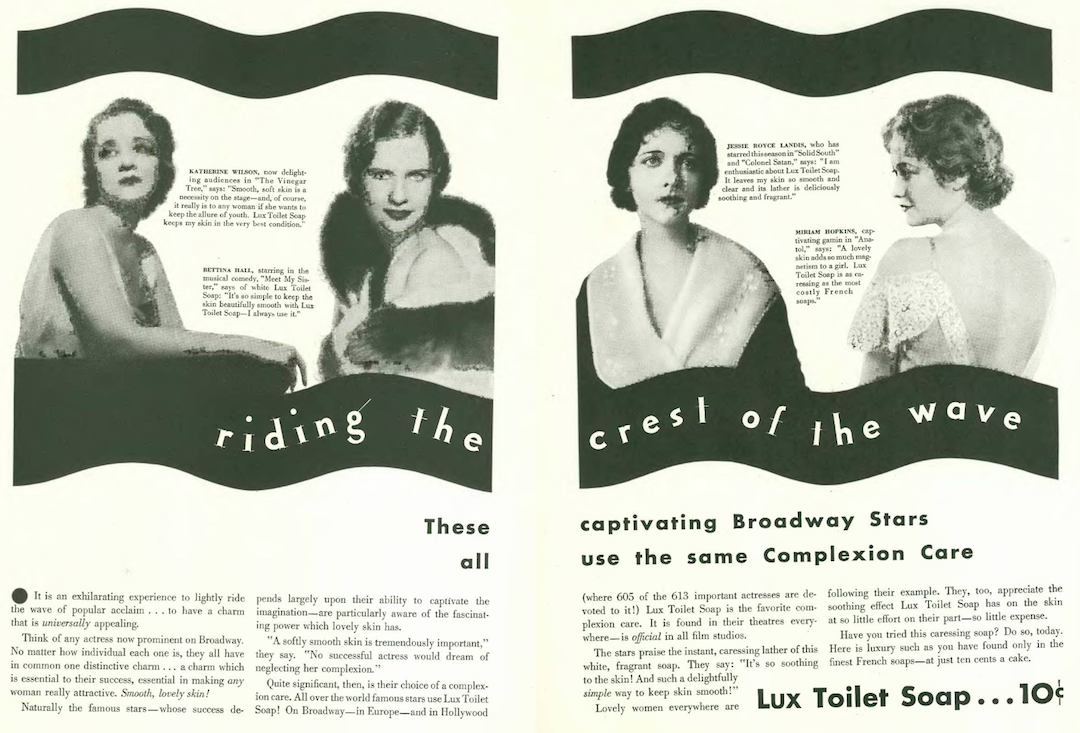
…and then we have this ad from the makers of Lux Toilet Soap, who must have had a bottomless advertising budget given all the splashy ads and celebrity endorsements…

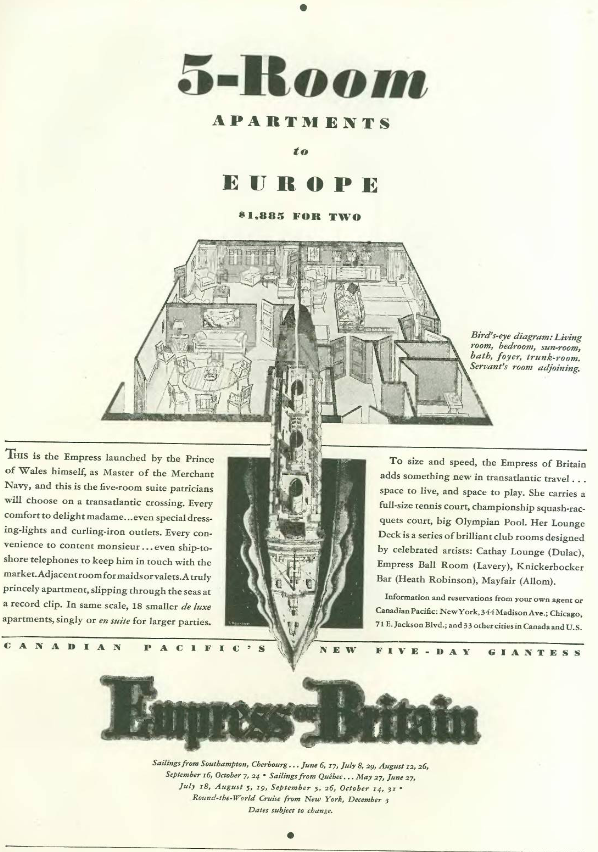
…in the ads we also find clashes between the old and new…the new being this art deco-styled appeal for the newest form of transportation…

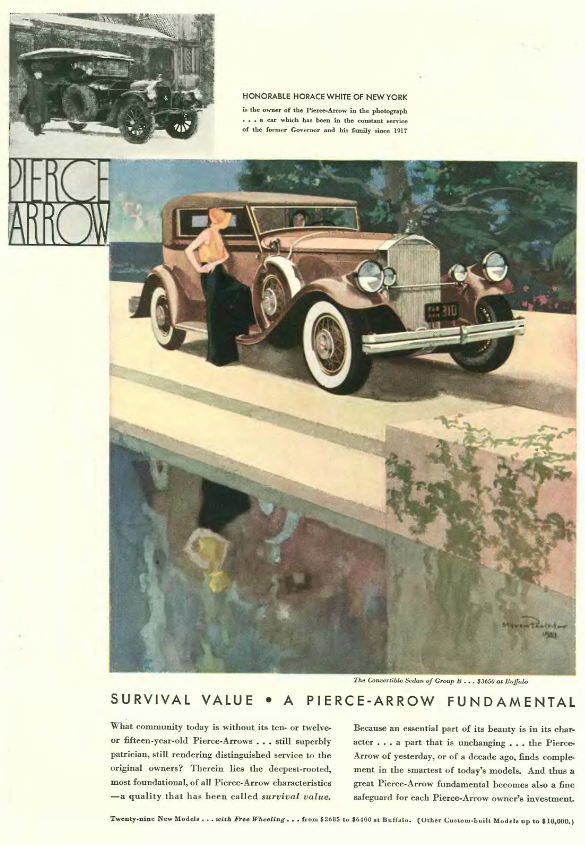
…and the old, the makers of the luxury car Pierce-Arrow, still harking back to its patrician origins (“The Tyranny of Tradition”)…the firm would not survive the lean years of the 1930s…

…and once again a colorful ad from Church using snob appeal to sell something as pedestrian as a toilet seat…”Toilet Seats For Better Bathrooms”…

…on to our cartoons, we have a voyeur’s perspective courtesy Helen Hokinson

…an exploration of the generation gap by Alice Harvey

…and this terrifically quaint encounter, rendered by Perry Barlow

…and before we go, a note about this week’s cover artist, Lisa Rhana, a.k.a. Rose Silver (1902-1985) who illustrated several New Yorker covers in the 1920s and early 30s. Her work is included in the permanent collections at the Whitney Museum, the Museum of the City of New York, and The Metropolitan Museum of Art, which holds this watercolor (left) that graced the cover of the Jan. 30, 1932 issue:

Next Time: Garbo Speaks…


Learning To Be Modern

On March 1, 1930, the Empire State Building was still just a bunch of sketches and blueprints, as was much of the yet-to-be-built modern cityscape of Manhattan. But as the Depression slowly worked its gnarled fingers into the American landscape, some still dreamed of the sleek, streamlined world to come.

March 1, 1930 cover by Rea Irvin.

The New Yorker’s architecture critic, George S. Chappell, kept readers apprised of changes on the city’s skyline, as well as of the trends in modern design that were being displayed at various exhibitions including one held annually by the city’s Architectural League. Chappell observed:

A GLIMPSE INTO THE FUTURE…Opening pages of the Architectural League’s 45th Annual Exhibition, featuring an image of the Empire State Building. Construction had just begun on the iconic building at the site of the old Waldorf-Astoria Hotel. (mullenbooks.com)

The exhibition featured a variety of projects, from the Aluminaire House in Long Island to Boardman Robinson’s murals in Pittsburgh to Bertram Goodhue’s Nebraska State Capitol featuring Lee Lawrie’s sculptures and friezes…

ECLECTIC…Model of the Aluminaire House erected in full scale for the 45th Annual Exhibition of the Architectural League of New York; Boardman Robinson’s The History of Trade murals in Kaufmann’s Department Store, Pittsburgh; detail of one of Boardman’s 10 murals displayed at Kaufmann’s; Lee Lawrie’s “The Sower,” a 19-foot-tall bronze statue mounted on top of Bertram Goodhue’s Nebraska State Capitol in Lincoln. In 1937 Lawrie would install his “Atlas” sculpture in front of Rockefeller Center. (archleague.org/archive.triblive.com/capitol.nebraska.gov)

 *  *  *

And Now For Something Old

While George Chappell contemplated the world to come, “The Talk of Town” looked back in time to Greenwich Village’s oldest drugstore…

FORM FOLLOWED FUNCTION…Quackenbush Pharmacy in 1930. Manager James Todd at right. (Library of Congress)

 *  *  *

Pet Project

The March 1 issue featured James Thurber’s second installment of “Our Pet Department”…

And while Thurber was doling out pet advice, his pal E.B. White was worrying over changes to the design of the Shredded Wheat box…

HORSELESS CARRIAGES replaced animal power on the packages of Shredded Wheat, much to the dismay of E.B. White. (oldshopstuff.com)

 *  *  *

A Prince of a Guy

A refugee from the Bolshevik Revolution, the Georgian Prince Matchabelli (Guéorgui Vassilievitch Matchabelli) was penniless when he landed on American shores in 1924. Two years later he launched a perfume business with three scents  — Ave Maria, Princess Norina, and Queen of Georgia — sold in bottles that were said to be small replicas of the Prince’s lost Georgian crown. “The Talk of the Town” paid the royal perfumer a visit for the March 1 issue:

HIS CROWNING ACHIEVEMENT…A bottle of Princess Norina perfume from 1926, and its creator, Prince Matchabelli. (Pinterest/Wikipedia)

Those who were around the late 1970s and 1980s no doubt recall the Prince Matchabelli Windsong Perfume commercials and the catchy tune that kind of stuck in your head (for better or worse)…

 *  *  *

Low Life Revue

Ben Hecht continued his exploration of the hardboiled world of journalists, bootleggers, nightclub singers and other lowlifes in his screenplay for Roadhouse Nights, a film that was apparently enjoyed by New Yorker film critic John Mosher. As for Hecht, an erstwhile member of the Algonquin Round Table and occasional contributor to The New Yorker in the 1920s, the film was just one of many to follow in a Hollywood career that the former Chicago journalist held in some disdain (see recent New Yorker article by David Denby)…

IT’S MOIDER, I SAY…Helen Morgan, Eddie Jackson Jimmy Durante, Fred Kohler, and Lou Clayton in 1930’s Roadhouse Nights. (IMDB)

 *  *  *

The Winds of Wynn

Ed Wynn wowed theater critic Robert Benchley in his portrayal of “Simple Simon” at the Ziegfeld Theatre. Wynn was one of the most popular comedians of his time, but is best known today for his portrayal of “Uncle Albert” in the 1964 Disney film Mary Poppins

AGELESS…Ed Wynn in Simple Simon, 1930; at right as Uncle Albert in 1964’s Mary Poppins. (secondhandsongs.com/Pinterest)

 *  *  *

He Was No Palooka

The March 1 and 9 issues of The New Yorker gave considerable ink to Niven Busch Jr’s success story of a middleweight prizefighter. Titled “K.O. Middleweight,” the two-part article was about Stanislas Kalnins, who went by the name K.O. Keenen because it would go over better with the large majority of Irishmen at the fights. Peter Arno provided the art for the piece:

From Our Advertisers

We have another ad from the Franklin motorcar company touting its air-cooled engines, which thanks to the Depression were not long for the world…

…Saks shamelessly appealed to the “poor” little rich girl in this ad aimed at aspiring debutantes…

…Lenthric perfumes offered this all-French ad to those seeking Continental refinement…

…and this ad from Talon, advertising “Slide Fasteners” before the word “zipper” came into common use…

Garrett Price was the latest New Yorker cartoonist to pick up some extra cash from G. Washington instant coffee…

…while John Held Jr. even lent his image (along with some drawings) to promote Chase and Sanborn’s coffee…

…this artist for Spud cigarettes borrowed Carl Erickson’s style from his famed Camel ads (see examples below)…

…examples of Carl “Eric” Erickson’s Camel ads from the late 1920s…

…and here we have another New Yorker cartoonist, Rea Irvin, helping the makers of Murad cigarettes move their product…

…Irvin also illustrated this cartoon for the March 1 issue…

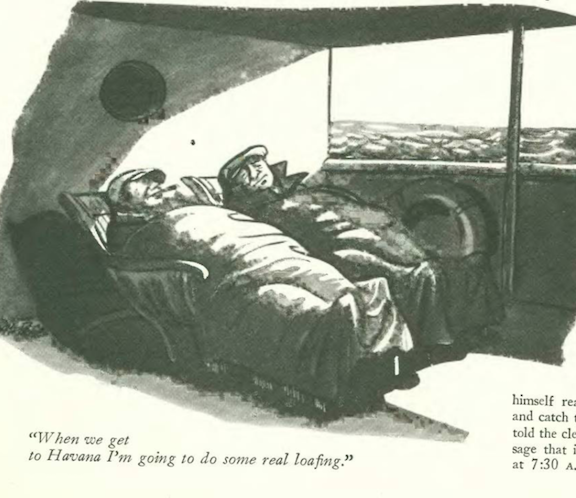
Reginald Marsh contributed these cartoons, no doubt based on a recent winter stay in sunny Havana (I’ve been to Sloppy Joe’s, and still looks pretty much like this)…

…back stateside, Peter Arno looked in on a cultural exchange…

…and we close with two from the issue by Barbara Shermund

Next Time: The Non-linear Man…

The Year of the Thurber

When the fifth anniversary issue of The New Yorker hit the newsstands in February 1930, the magazine was also setting down another milestone: its first-ever publication of a James Thurber cartoon* (*see comment section).

Feb. 22, 1930 cover by Rea Irvin.

Inserted into the top corner of page 25 (next to a short fiction piece by Emily Hahn), was Thurber’s first installment of his spoof on newspaper pet columns titled “Our Pet Department.”

Seeming a bit quizzical about his debut as a cartoonist, in February 1930 Thurber wrote to his friend Minnette Fritts Proctor (for whom he held lifelong romantic yearnings) that his drawings were “now coming into a strange sort of acclaim… The New Yorker is going to run a series of my animal pictures…and a concern wants me to do ads for it. Imagine!…I’m enclosing a few (pictures), which you can throw away. They’ll alarm you.”

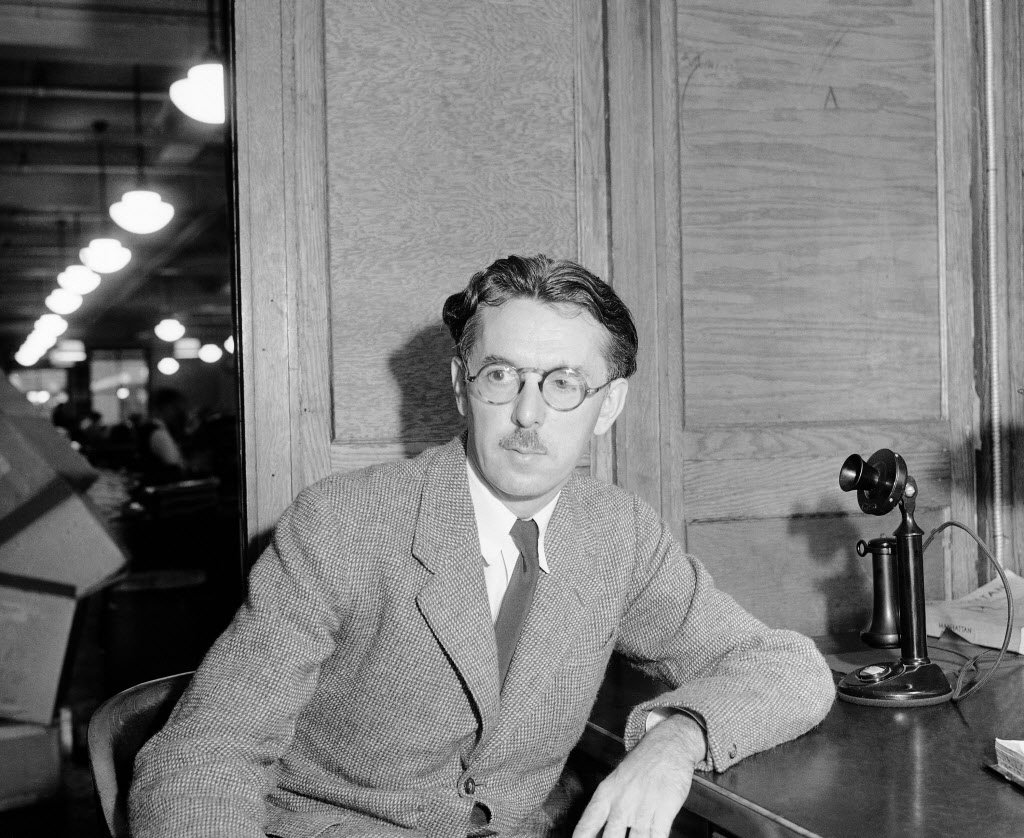
PET WHISPERER…James Thurber, already well established as a writer at The New Yorker, made his debut as a cartoonist for the magazine in its fifth anniversary issue. The brilliant “Our Pet Department” would run through the spring in the 14 installments. (thurberhouse.org)

Animals of all sorts would pop up in Thurber’s cartoons throughout the 1930s…

Clockwise from top left, cartoons from the following issues: Jan. 30, 1932; April 6, 1935; July 14, 1934; and Feb. 13, 1937.

…and his famous dogs would make frequent appearances, including on their own cover in 1946 to coincide with that year’s Westminster Kennel Club Dog Show…

Office mate, co-author and friend E.B. White, on the other hand, assumed his usual duty of marking the magazine’s anniversary in “Notes and Comment”…

FOOD FOR THOUGHT…As E.B. White pointed out in his “Notes and Comment,” there was another, earlier New Yorker published nearly a century earlier in the 1830s by Horace Greeley, who described his periodical as “A Weekly Journal of Literature, Politics, Statistics and General Intelligence.” Greeley published his New Yorker from 1834 to 1841. (rickgrunder.com)

…and contemplated his own magazine’s contributions to the advancement of civilization…

…and as E.B. White continued his tradition of marking the magazine’s anniversary, so too did Rea Irvin continue to mark the passage of time with a tip of the hat from Eustace Tilley…

…and most prominently The New Yorker marked each anniversary with a repeat of the original Rea Irvin cover (later with some slight alterations), a tradition that continued unbroken until 1994, when a series of parodied versions of Eustace Tilley began to appear on the cover. The classic Tilley cover reappeared in the 2000s and ran frequently during that decade, but sadly made its last appearance in 2011 (see below covers from the first issue and anniversary covers from 2011 and 2019). I hope to see the Irvin cover return next year, and most certainly for the 100th anniversary in 2025. You can read more about cover’s history in Michael Maslin’s indispensable Ink Spill.

 *  *  *

Drama Queen

Chinese opera star Mei Lanfang (1894-1961) was known as “Queen of Peking Opera” for his graceful stage portrayals of young and middle-aged women. Considered one of China’s greatest “Dan” performers (Dan is the general name for female roles), Mei had many admirers outside of China including Charlie Chaplin, Mary Pickford and Douglas Fairbanks, who welcomed Mei to Hollywood when he toured the U.S. in 1930. The New Yorker paid Mei a visit during his stay at the Plaza Hotel in Manhattan, recounted in these excerpts from “The Talk of the Town”…

QUEEN OF PEKING OPERA, Mei Lanfang, circa 1920, and as a “Dan” in Chinese opera, circa 1930s. (people.chinesecio.com/Wikimedia)

HE’S A FAN…Charlie Chaplin greets Mei Lanfang during a 1930 visit to Hollywood. At right, Mei with his family in the early 1940s. (thatsmags.com/Wikipedia)

 *  *  *

A Kitty With Claws

“The Talk of the Town” also featured Kitty Marion (1871-1944) in a mini-profile. The German-born Marion moved to London at age 15, where she gained some prominence as a music hall singer. She found greater fame, however, as an activist, first standing up for the rights of fellow women performers and later crusading for voting rights. In response to attacks on women protestors by police officers, Marion embraced militant activism, throwing bricks through the windows of offices and handling a number of arson and bombing attacks that were intended to harm property, not people. Arrested numerous times (and enduring 232 force-feedings while on hunger strikes) she emigrated to the U.S. after World War I and joined forces with birth control advocate Margaret Sanger. The New Yorker takes it from there…

TRANSATLANTIC ACTIVIST…A British Criminal Record Office mugshot of Kitty Marion, circa 1912; cover of Margaret Sanger’s Birth Control Review, November, 1923; Marion handing out copies of the Review on the streets of New York, 1915. (Wikipedia/Smith College/British Library)

 *  *  *

Going Deep With Noguchi

It’s hard to imagine modern decor without the influence of Isamu Noguchi, but before he inspired everything from coffee tables to lamps, he was a noted sculptor, and in 1930 he was best known for his portrait busts. New Yorker art critic Murdock Pemberton observed:

TWO HEADS ARE BETTER…Left to right, Isamu Noguchi’s portraits of architect/inventor Buckminster Fuller (1929, chrome-plated bronze) and the painter Marion Greenwood (1929, cast iron). Despite being three years short of the age requirement for a Guggenheim Fellowship, Noguchi was nevertheless awarded the grant to study stone and wood cutting and to gain “a better understanding of the human figure.” It appears the grant paid off handsomely. (noguchi.org/Smithsonian)
MODERN MASTER…Collection of Noguchi lamps available from the Noguchi Museum. At right, 1947 coffee table by Herman Miller, inspired by a 1939 Noguchi design. (noguchi.org/Wikipedia)

*  *  *

From Our Advertisers

The makers of Pond’s Cold Cream continued to roll out endorsements from  society figures, including a “Mrs. John Davis Lodge” (Francesca Bragiotti), described in this advertisement as possessing “starry wide dark eyes, hair golden as Melisande’s, and tea-rose skin”…

…for reference, Francesca Bragiotti’s wedding portrait, as featured in Vogue magazine, 1929…

…Doubleday Doran targeted the appropriate audience for its publication of The Second New Yorker Album, with cover illustration by Peter Arno

…and we have another lovely Camel ad from illustrator Carl “Eric” Erickson, who conjured up more Continental imagery as an inducement to take up a bad habit…

…in a recent post we looked at Don Dickerman, who operated themed restaurants in Greenwich Village. In the Feb. 22 issue he promoted his four restaurants in a series of ads (illustrated by Dickerman himself) that ran on four consecutive pages (72-75)…

…and Barbara Shermund illustrated this ad for Frigidare…

…Peck & Peck touted the “mannish lines” of its “Hillbilly” suits…

…no doubt influenced by trendsetters like Marlene Dietrich.

…and lest we forget that it’s 1930, a “Cowboys and Indians” mentality was rife in the advertising business, as seen in this ad from Mendel Trunx, proud of 20th century progress (“we’ve come a long way…”) and yet…well, read on…

…the mentality was still alive and well 30 years later, as seen in this ad from 1962…

…and coincidently, in the same issue we have this scene illustrated by Peter Arno mixing “Redskins” and luggage, in this case, a matron who means to summon the aid of a “red cap” baggage handler…

…other cartoons included this dramatic scene courtesy William Crawford Galbraith

…a rustic, slightly naughty woodcut by John Held Jr

…a peek at fashion trends by Helen Hokinson

…a look at social mores…from Alan Dunn

…and Alice Harvey

…and we end with Barbara Shermund, and a moment of art appreciation…

Next Time: Famous Friends…


Mrs. Parker and the Vicious Writer

As a book reviewer for The New Yorker, Dorothy Parker could eviscerate any writer with the tip of her pen, and often did so.

Nov. 30, 1929 cover by Adolph K. Kronengold.

One writer, however, who received consistent praise from Parker was Ernest Hemingway, whom she first met in 1926. In the pages of the 1920s New Yorker, Parker particularly lauded Hemingway’s short story collections, In Our Time (1925) and Men Without Women (1927), which bookended his 1926 novel The Sun Also Rises (which Parker thought OK but overly hyped). When The New Yorker profiled Hemingway in the Nov. 30, 1929 issue, it naturally turned to Parker to do the honors (although Robert Benchley, a good friend of Hemingway’s, could have offered his own take on the author) :

SHE’S A FAN…Dorothy Parker was a long-time admirer of the work of Ernest Hemingway. His last work of the 1920s, A Farewell to Arms, was serialized in Scribner’s Magazine and published in September 1929. The success of that book made Hemingway financially independent. (Mugar Library/Wikipedia)

During Hemingway’s Paris years Parker actually took a boat with him to France (in 1926, along with mutual friend Robert Benchley) and so got a firsthand taste of his bohemian adventures. By the time The New Yorker profiled Hemingway, the Jazz Age was dead and Paris’s so-called “Lost Generation” was a thing of the past. Indeed, Hemingway had already been in the States for more than a year, returning in 1928 with his second wife, Pauline Pfeiffer.

Biographer Jeffrey Meyers notes in his book Hemingway: A Biography, that Hemingway of the early Paris years was a “tall, handsome, muscular, broad-shouldered, brown-eyed, rosy-cheeked, square-jawed, soft-voiced young man,” features that were not lost on Parker:

HE’S TAKING NOTES…Ernest Hemingway (left), with Harold Loeb, Lady Duff Twysden (in hat), Hemingway’s first wife Hadley Richardson, Donald Ogden Stewart (obscured), and Pat Guthrie (far right) at a café in Pamplona, Spain, July 1925. The group formed the basis for the characters in The Sun Also Rises: Twysden as Brett Ashley, Loeb as Robert Cohn, Stewart as Bill Gorton, and Guthrie as Mike Campbell. (Wikipedia)

…more from Parker on Hemingway’s magnetic appeal…

MAN ABOUT TOWN…Ernest Hemingway (far right) in 1926 in Paris, outside the city’s famous Shakespeare and Company bookshop. He is pictured here with Sylvia Beach (on his right), the shop’s founder. (Collection Lausat/Keyston-France/parisinsidersguide.com)

 *  *  *

Meet the Fokkers

In previous blogs we have established that E.B. White was an aviation enthusiast. He seems never to have missed an opportunity to catch a ride into the skies, so when pilots were conducting test flights of a prototype Fokker F-32 at New Jersey’s Teterboro field, he was there to file this brief for “The Talk of the Town”…

SKYTRAIN…Title card from a silent Paramount newsreel reporting on a November 1929 flight of the Fokker F-32 at Teterboro. Note how the title card uses a railroad reference (“Pullman”) as a descriptive for the passenger cabin. Indeed, early airplane passenger cabins were very much designed along the lines of Pullman cars. At right, a circa 1930 photo, possibly of a celebration of the plane’s arrival in Los Angeles. I imagine the FAA would not look kindly on this behavior today. (YouTube/petersonfield.org)

White’s enthusiasm for the aviation age is palpable in his description of the Fokker as it took off and climbed to a thousand feet:

ROUGHING IT…Passengers in Washington D.C. prepare to board what was perhaps the same plane White flew on at Teterboro. Note how they were required to walk across a muddy field to reach the plane’s entrance. The Fokker was the first four-engine commercial aircraft built in America and the largest land plane in the world at the time (there was a much larger amphibious German plane). At right, the plane’s four engines were configured back-to-back. (Wikipedia/petersonfield.org) click to enlarge

In line with The New Yorker’s stance of keeping things light, White described a scene just north of midtown, where a crowd had gathered near the site a plane crash. The pilot was killed, but a passenger managed to parachute to safety.

DOWN TO EARTH…Pilot Charles Reid died instantly when his plane slammed into a YMCA on 64th Street on Nov. 20, 1929. His passenger parachuted to safety. E.B. White referred to the crash in his “Talk” article. (digital-hagley-org)
Excerpt from a Nov. 21, 1929 New York Times account of the crash. (NYTimes archives)

Speaking of crashes, the Fokker on which E.B. White was a passenger crashed a week later (Nov. 27, 1929) during a certification flight from Roosevelt Field to Teterboro Airport. No one was killed, but the aircraft was destroyed. The design itself didn’t last much longer — considered underpowered for its size, and too expensive at the dawn of the Depression, it was phased out by the end of 1930.

Perhaps after all of that flying, White needed something to calm the nerves, a subject he addressed in his “Notes and Comment” column:

THE WOMAN’S HOUR, according to E.B. White in his “Notes and Comment” column. (vinepair.com)

 *  *  *

The Little Gallery That Could

“Talk,” via art critic Murdock Pemberton, had more to say about the new Museum of Modern Art, that is, not taking it very seriously…

UPSTART…Although New Yorker art critic Murdock Pemberton seemed dismissive of the new Museum of Modern Art, its first month’s attendance was more than 47,000 visitors. Image above from the MoMA exhibition Painting in Paris, Jan. 19-March 2, 1930. (MoMA)

 *  *  *

Welcome to Thurber’s World

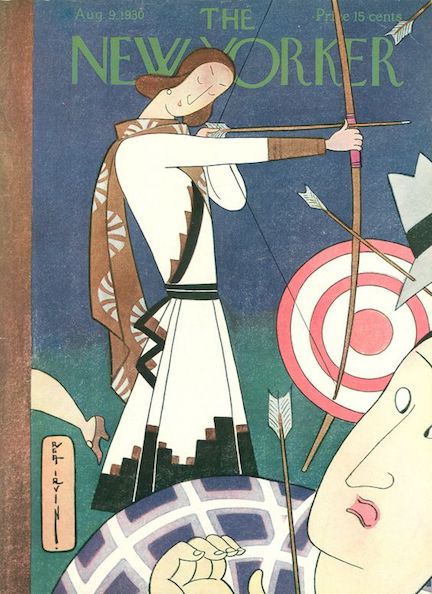
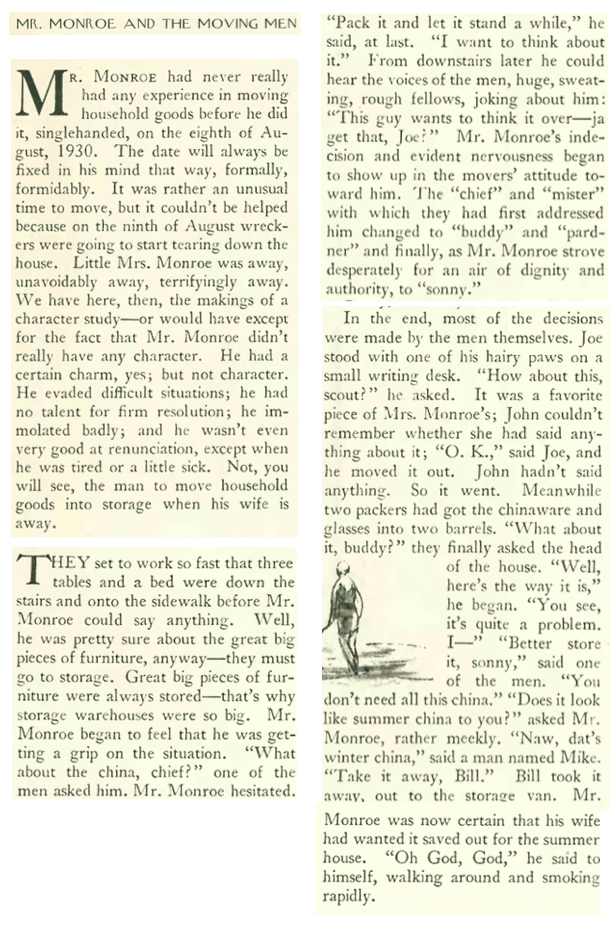
In 1931 James Thurber published his second book, The Owl in the Attic and Other Perplexities, which consisted of pieces he had done for the New Yorker, including eight stories (from Dec. 29, 1928 to Aug. 9, 1930) that featured the marital escapades of a couple in their middle thirties, the Monroes, modeled on Thurber’s real-life marriage to his wife, Althea.

The Nov. 30, 1929 issue included Thurber’s fifth installment of the Monroe saga, “Mr. Monroe Holds the Fort,” in which a fearful Mr. Monroe, left home alone (his wife was visiting her mother), imagines there are burglars in the house:

…like his famous character Walter Mitty, which Thurber would introduce in 1939, Mr. Monroe had an equally lively imagination…

The character of Mr. Monroe would see new life in the fall of 1969 when NBC  debuted My World… and Welcome to It, a half-hour sitcom based on James Thurber’s stories and cartoons. The actor William Windom portrayed John Monroe, a writer and cartoonist who worked for a magazine called The Manhattanite. In the show, Monroe’s daydreams and fantasies were usually based, if sometimes loosely, on Thurber’s writings.

THURBER AS A SITCOM…The actor William Windom portrayed John Monroe, a writer and cartoonist who worked for a magazine called The Manhattanite, on the 1969-70 NBC sitcom My World… and Welcome to It. Joan Hotchkis played his wife Ellen, and Lisa Gerritsen portrayed his inquisitive daughter Lydia. (tvguidemagazine.com/sitcomsonline.com)
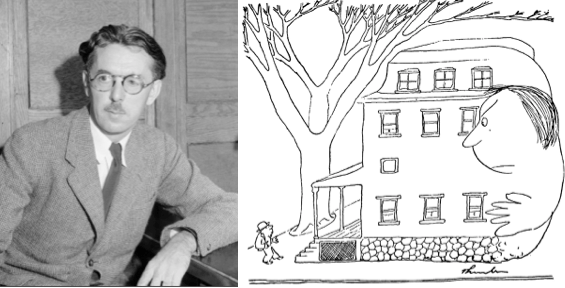
HOME SWEET HOME…Left, the opening credits for My World… and Welcome to It featured actor William Windom (as John Monroe) entering a animated house based on James Thurber’s famous “House and Woman” cartoon, which was originally featured in the March 23, 1935 issue of The New Yorker. (mikelynchcartoons.blogspot.com)

My World… and Welcome to It was cancelled after one season. Nevertheless, it would win two Emmys: one for Windom and another for Best Comedy Series.

 *  *  *

Thank Heaven for Maurice

Things were looking up a bit in the talking movie department thanks to the Ernst Lubitsch-directed The Love Parade, featuring recent French import Maurice Chevalier and Jeannette MacDonald. Film critic John Mosher observed:

MUCH-NEEDED LAUGHS…Jeannette MacDonald and Maurice Chevalier in The Love Parade (1929), directed by Ernst Lubitsch. (MoMA)

Mosher was much less impressed by another musical, Show of Shows, featuring an all-star cast and Technicolor that added up to little more than a “stunt”…

IS THAT ALL?…Warner Brothers Show of Shows offered “77 Hollywood Stars” and “1000 Hollywood Beauties” — 80 percent of it in Technicolor, but that wasn’t enough to impress The New Yorker’s film critic John Mosher. At right, Arte Frank Fay (l) and comic Sid Silvers in a color scene from the film. (IMDB)

 *  *  *

A Guide to Christmas Shopping, 1929

Lois Long’s fashion column, “On and Off the Avenue,” predictably grew in length as the Christmas holiday approached, and in the Nov. 30 issue she offered advice on how to go about one’s shopping duties. Some brief excerpts:

TRAILBLAZER…Lois Long guided New Yorker readers through a list of “big, bewildering stores” in her “On and Off the Avenue” column. At left, the B. Altman department store, circa 1920s. (thedepartmentstoremuseum.org/PBS)

…Long’s column was peppered with holiday-themed spots, including this one by Julian DeMiskey

From Our Advertisers

…we start with a couple of back page ads, including one from the National Winter Garden’s burlesque show and an ad announcing the imminent arrival of Peter Arno’s Parade (just $3.50, or signed by Arno himself for $25)…

Cover and inside pages from Peter Arno’s Parade. (Amazon)

…another ad hailed the arrival of The New Yorker’s second album (read more about it here at Michael Maslin’s excellent Ink Spill)…

The first and second New Yorker albums. (pbase.com/michaelmaslin.com)

…other ads, in full color, featured cultural appropriation by the Santa Fe railroad…

…bright silks available at the Belding Hemingway Company…

…silk stockings from Blue Moon…

…for our cartoons, Helen Hokinson on the challenges of holiday shopping…

…Hokinson again, at tea with her ladies…

Barbara Shermund, and the miracle of broadcast radio crossed with the nuances of a dinner party…

…and Shermund again, with a hapless friend of a clueless family…

Next Time: Feeling the Holiday Pinch…


Back to Business

Two weeks had passed since the “Black Tuesday” collapse of share prices on the New York Stock Exchange, but the New Yorker went about business as usual, E.B. White opening his “Notes and Comment” with a complaint — not about the economy — but about a marketing ploy that had New York University shilling magazines on behalf of Funk & Wagnalls.

Nov. 16, 1929 cover by Peter Arno. No doubt Arno drew inspiration from his own domestic situation (with wife and New Yorker columnist Lois Long and their infant daughter Patricia Arno).

White mocked the contents of a letter from NYU that promised a “free” education to subscribers of Funk & Wagnalls’ middlebrow Literary Digest. 

EASY-CHAIR EDUCATION…Founded in 1890 by Isaac Funk (of Funk & Wagnalls fame), the Literary Digest offered readers condensed articles from various American and European publications. The weekly magazine surpassed the one million circulation mark in 1927, but declined precipitously in 1936 after its famed (and usually reliable) presidential poll picked Alf Landon over FDR. It folded in 1938. (Pinterest)

White detailed how NYU’s director of public information promised untold riches to potential Literary Digest subscribers…

YOU CAN BE FAMOUS, FOR JUST PENNIES A DAY…E.B. White mocked an NYU letter that promoted its “hook-up” with the Literary Digest, wryly suggesting that recognition in NYU’s Hall of Fame for Great Americans was within reach of magazine subscribers. The photo above (circa 1935) shows the Hall of Fame’s colonnade, which half-encircled the university library (both designed by Stanford White) and housed 98 bronze busts. A financially strapped NYU sold its University Heights Campus, along with the Hall of Fame and library, to the City University of New York in 1973. (WPA photo via boweryboyshistory.com)

…and the not so subtle revelation that the “free” education came with a price:

Here’s Julian De Miskey’s illustration that accompanied White’s “Notes”…

 *  *  *

The Lighter Side of Bankruptcy

Evidence of the recent stock market crash was scant in the Nov. 16 issue, save for this blurb from Howard Brubaker

…and this short piece by Margaret Fishback, who took a characteristically lighthearted approach to the devastating news:

Fishback (1900-1985), a widely published poet and prose author from the late 1920s to the 1960s, was also a successful advertising copywriter for Macy’s and a number of other companies.

A WAY WITH WORDS…Margaret Fishback wrote a number of poetry and prose books, including Safe Conduct: When to Behave–and Why, a book of etiquette illustrated by The New Yorker’s Helen Hokinson. During the 1930s Fishback was reputed to be the world’s highest-paid female advertising copywriter. (necessaryfiction.com/Wikipedia)

*  *  *

We Stand Corrected

A correction of sorts was offered by Robert Benchley (aka “Guy Fawkes”) regarding one of his recent “Wayward Press” columns, in which the fatal crash of famed aviator Wilmer Stultz’s stunt plane was misattributed to drunkenness:

Following the above intro, Benchley included this letter from a representative of the Roosevelt Flying Corporation, John McK. Stuart, in which Stuart explained the real reason for the pilot’s fatal crash, and the source of a vicious rumor:

The cause of the crash, as reported in The New York Times, was attributed to two young men who begged for a ride on Stultz’s stunt plane, a Waco Taperwing, in the early afternoon of July 1, 1929. An investigation of the wreckage found shoes from both passengers jammed under a bar connected to the rudder, rendering it inoperable. In his letter, Stuart explained:

Apparently Stultz’s passengers had braced themselves during stunt maneuvers by jamming their feet under the rudder bar. According to the Times, after a couple of rolling stunts the plane began to climb again from about 200 feet when it rotated nose down and plunged into the ground. Both passengers were killed instantly. Stultz died shortly thereafter at a Long Island hospital.

BRIEF FLIGHT THROUGH LIFE…Clockwise, from top left, Wilmer Stultz (1900-1929) in undated photo; coverage of the fatal crash in the July 2, 1929 New York Times; Stultz, Amelia Earhart, and Lou Gordon feted in front of City Hall, New York City, following their successful flight across the Atlantic in June 1928. Stultz was the pilot of the Fokker Trimotor “Friendship,” aboard which Earhart became the first woman passenger to cross the Atlantic by airplane. Gordon served as the flight’s on-board mechanic. (Boston Public Library/New York Times/Amazon)

 *  *  *

Cowardly Attack

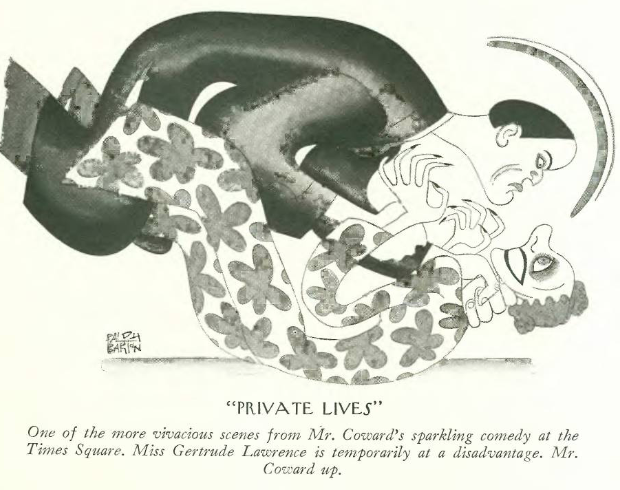
The acclaimed English playwright and composer Noël Coward was much beloved by The New Yorker, so it pained Robert Benchley to write an unflattering review of Coward’s operetta, Bitter Sweet:

IN THE SOPRANO KEY…British musical star Evelyn Laye (1900-1996) played the leading role of Sari in Noël Coward’s Broadway production of Bitter Sweet. (From The Bygone)

 *  *  *

Hat Shop Heroine

Another operetta — Mlle. Modiste — was getting a Broadway revival at Jolson’s 59th Street Theatre. Its star, Fritzi Scheff (1879-1954), was the subject of a short profile penned by Alison Smith. The operetta, written expressly for Scheff, premiered on Broadway in 1905 at the Knickerbocker Theatre, and enjoyed many revivals. Smith found that after nearly 25 years, Scheff still embodied the role of the hat shop girl who dreamed of being an opera singer. An excerpt:

From left, Fritzi Scheff in Mlle. Modiste (1905); Al Frueh’s caricature of Scheff for the profile; Scheff circa 1910. (Wikipedia/IMDB)

 *  *  *

Best of Both Worlds

Although the Gothic style was quickly falling out of fashion in the age of Art Deco, architecture critic George S. Chappell found much to admire in Schultze & Weaver’s new Hotel Lexington, part of the hotel construction boom in New York’s Midtown:

STILL ATTACHED TO THE EARTH…The Lexington today, now a Marriott property, at 511 Lexington Avenue and 48th Street. (ohrllc.com)

Chappell also admired the “smart” new Stewart Building, calling it the perfect setting for “feminine luxuries”…

Sadly, the Stewart Company folded just months after the opening of its new building, an early victim of the Depression. Bonwit Teller took over the building in 1930 and stayed until 1979. It was demolished in 1980 to make way for Trump Tower.

BYGONE ELEGANCE…Stewart and Company’s metal and ceramic 5th Avenue entrance, detail, 1929; Stewart Millinery Shop, 1929 (image from Vogue); detail from ornamental frieze above the 8th story, 1929. The building was demolished in 1980 to make way for Trump Tower. Neither the frieze nor the ornate ironwork were saved. (Museum of the City of New York/Vogue via drivingfordeco.com)

 *  *  *

A Survivor’s Tale

The New Yorker hailed Soviet writer Valentine Kataev’s debut novel, The Embezzlers, as “the first hearty and sane laugh that has been heard over the noise of Russian propaganda.” Published in 1926 and translated into English in 1929, the novel was a satire of bureaucracy in the new Soviet state. Remarkably, Kataev (1897-1986) was able to write challenging, satirical works throughout his long life and career without running afoul of Soviet authorities, or falling victim to Stalin’s terror campaigns:

SATIRICAL SOVIET…Valentine Kataev circa 1930. His 1926 debut novel, The Embezzlers, was a satire of Soviet bureaucracy. (russkiymir.ru)

Another title receiving a favorable review, Is Sex Necessary? — a spoof of popular sex manuals and how-to books — was co-written by The New Yorker’s James Thurber and E.B. White, with illustrations provided by Thurber.

HE CAN DRAW, TOO…Although James Thurber had yet to publish one of his drawings in The New Yorker, the book Is Sex Necessary? featured 42 of them, including the illustration at right that demonstrated the male greeting posture, and below, the posture of a man who could not discern the difference between love and passion. (brainpickings.org)

 *  *  *

Old News

Writer (and later screenwriter) David Boehm temporarily took over the history column “That Was New York” from playwright Russell Crouse and contributed the first in a series of articles featuring clippings from 18th century newspapers (with illustration by Julian De Miskey):

 *  *  *

From Our Advertisers

The Depression was coming, but you wouldn’t know it by the ads that appeared in the Nov. 16 issue, which featured the latest in resort wear, and holiday fashions for the maid…

…the Jay Thorpe store assumed some readers had $1,250 to spare for this coat and muff (equivalent to about $18,000 today), while Udall and Ballou jewelers offered a brooch for $9,000 (or nearly $130,000 today)…

…Saks offered a “simple little tailored bag” for $5, although the one pictured in the ad would set you back $500 ($7,200 today)…

…in this clever ad for Kayser silk hosiery, illustrator Ian Oliver drew a shelf from negative space to allow the model some room to lean…

…makers of the Ronson cigarette lighter found a new use for their product, adapting it to serve as a perfume atomizer…I wonder how many women accidentally lit their hair on fire, or took a shot of perfume to the eyes when they wished to have a smoke…

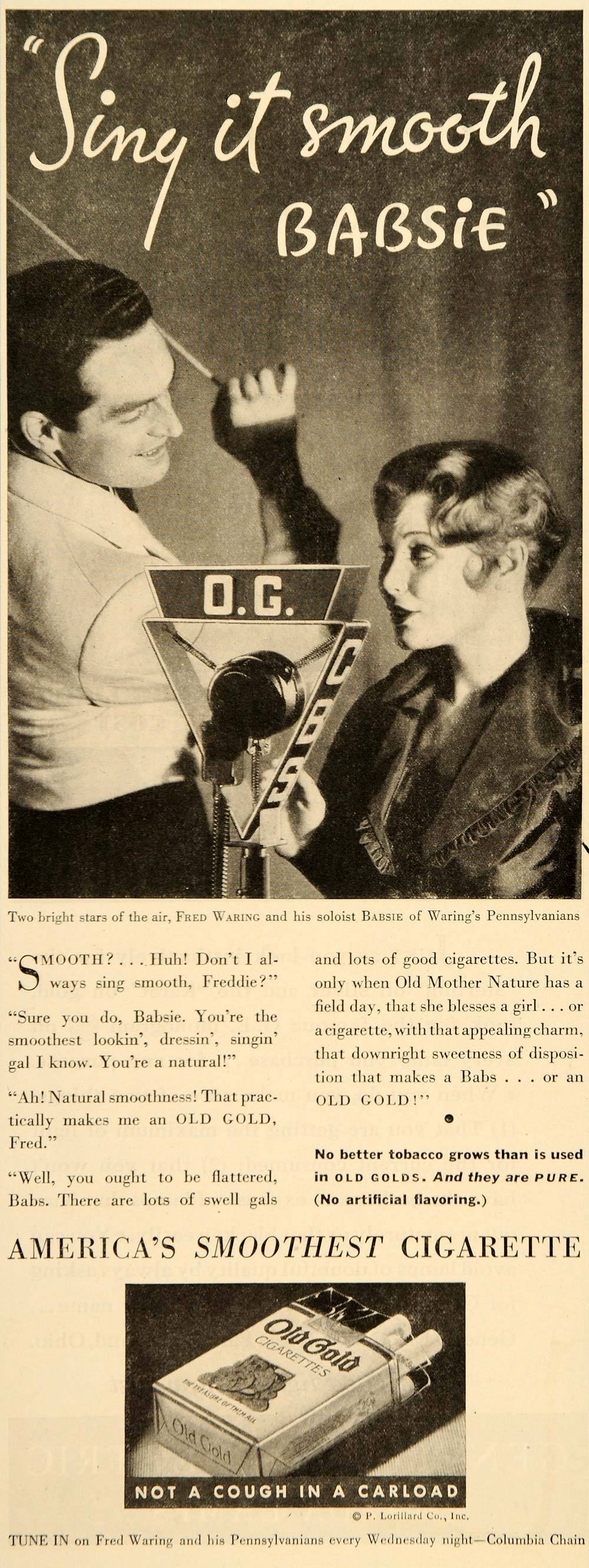
…while you had the lighter handy, you could light up an Old Gold, and thanks to the lack of truth-in-advertising standards, you could do it believing that you were also warding off a winter cold…

…from the back pages we have these gems from Brunswick records, and Reuben’s restaurant, which featured written testimonials from famous clientele including the “It Girl” actress Clara Bow, cartoonist Harry Hershfield, and playwright Noël Coward

Dr. Seuss offered his latest take on the uses of Flit insecticide, here sprayed directly into a user’s face for maximum benefit…

…our cartoons come courtesy of Gardner Rea, who looked in on an act of charity…

Reginald Marsh illustrated a new use for broadcast radio…

Barbara Shermund put the “idle” in “idle rich”…

Garrett Price gave us this lovely illustration of a casual reader…

…and Helen Hokinson went shopping with one of her society women…

Next Time: A Glimpse of the Future…