Broadacre City

Above: Detail from Spanish architect David Romero's computer-generated model of Frank Lloyd Wright's Broadacre City, complete with an "aerotor" flying car.

To be sure, architect Frank Lloyd Wright was a visionary, creating a uniquely American vernacular that influences architecture and design to this day. That might also true for his Broadacre City concept, which demonstrated how four square miles (10.3 km2) of countryside might be settled by 1,400 families. Wright unveiled this escape to the countryside in the middle of Manhattan.
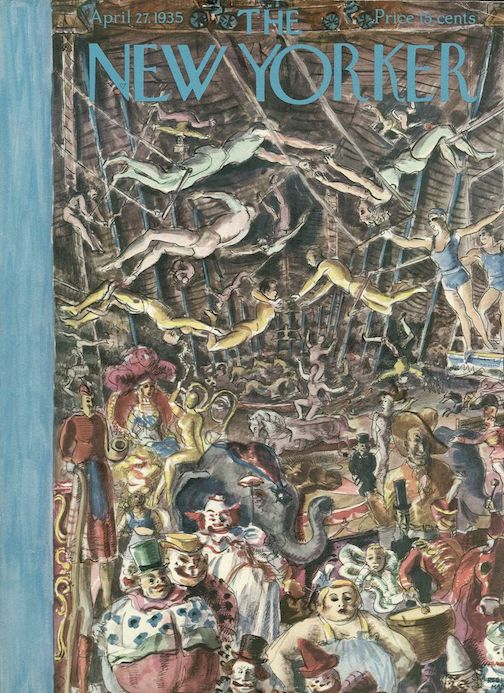
April 27, 1930 cover by Reginald Marsh.

On April 15, 1935, the Industrial Arts Exposition opened at Rockefeller Center, and Wright (1867-1959) was front and center with his audacious proposal to resettle the entire population of the United States onto individual homesteads. Critic Lewis Mumford observed that Wright “carries the tradition of romantic isolation and reunion with the soil” by putting every American family on a minimum of five acres of land.

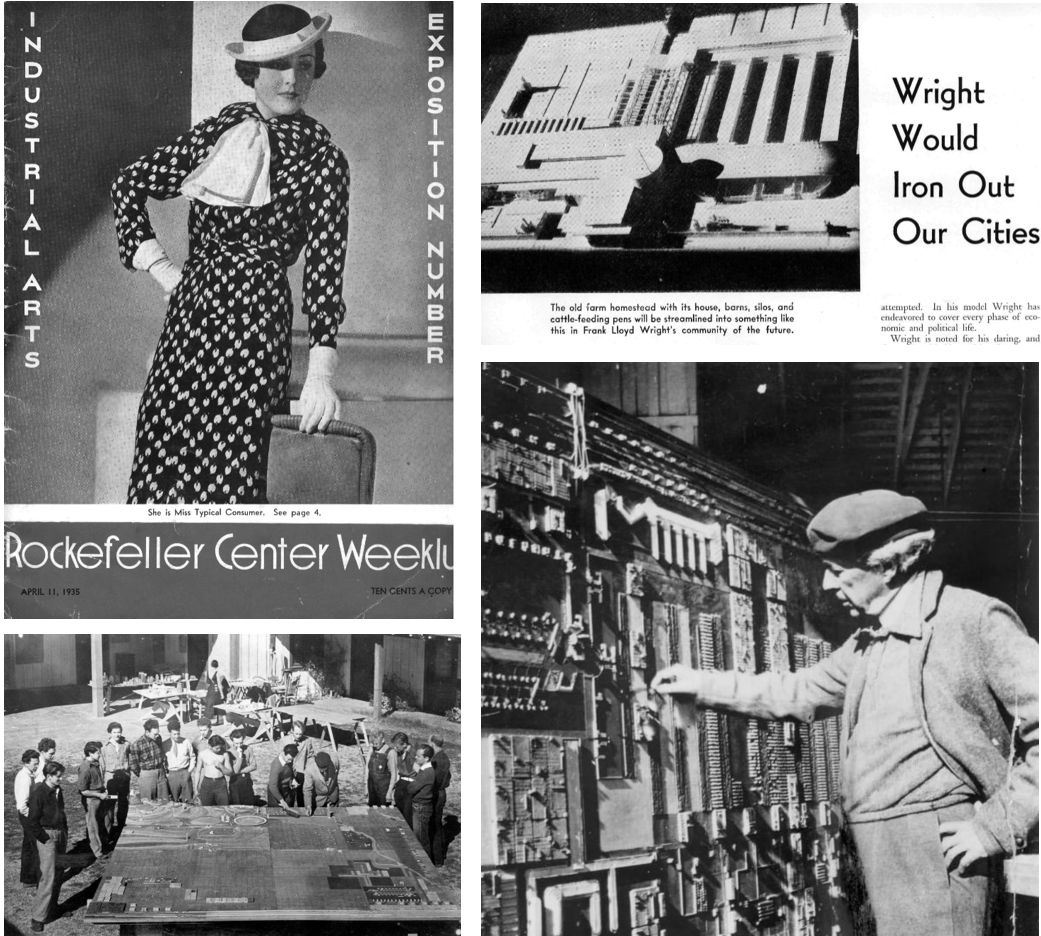
FLAT EARTH…Clockwise, from top left, cover of Rockefeller Center Weekly featuring the Industrial Arts Exposition—the model on the cover is identified as “Miss Typical Consumer”; detail from the magazine depicting a “streamlined farmstead” in Broadacre City; Frank Lloyd Wright examining the Broadacre City model, circa 1935; Wright students who crafted the 12×12-foot model, circa 1935. (digital.hagley.org/franklloydwright.org)

Wright first presented the idea of Broadacre City in his book The Disappearing City in 1932…

ROMANTIC ISOLATION…Broadacre City as depicted in Wright’s 1932 book The Disappearing City. (Wikipedia)

…note how the above drawing is reflected in one of Wright’s last designs, the Marin County Civic Center:

(visitmarin.org)

A detailed 12×12-foot scale model of Broadacre City—crafted by Wright’s student interns at Taliesin, was unveiled at the Industrial Arts Exposition:
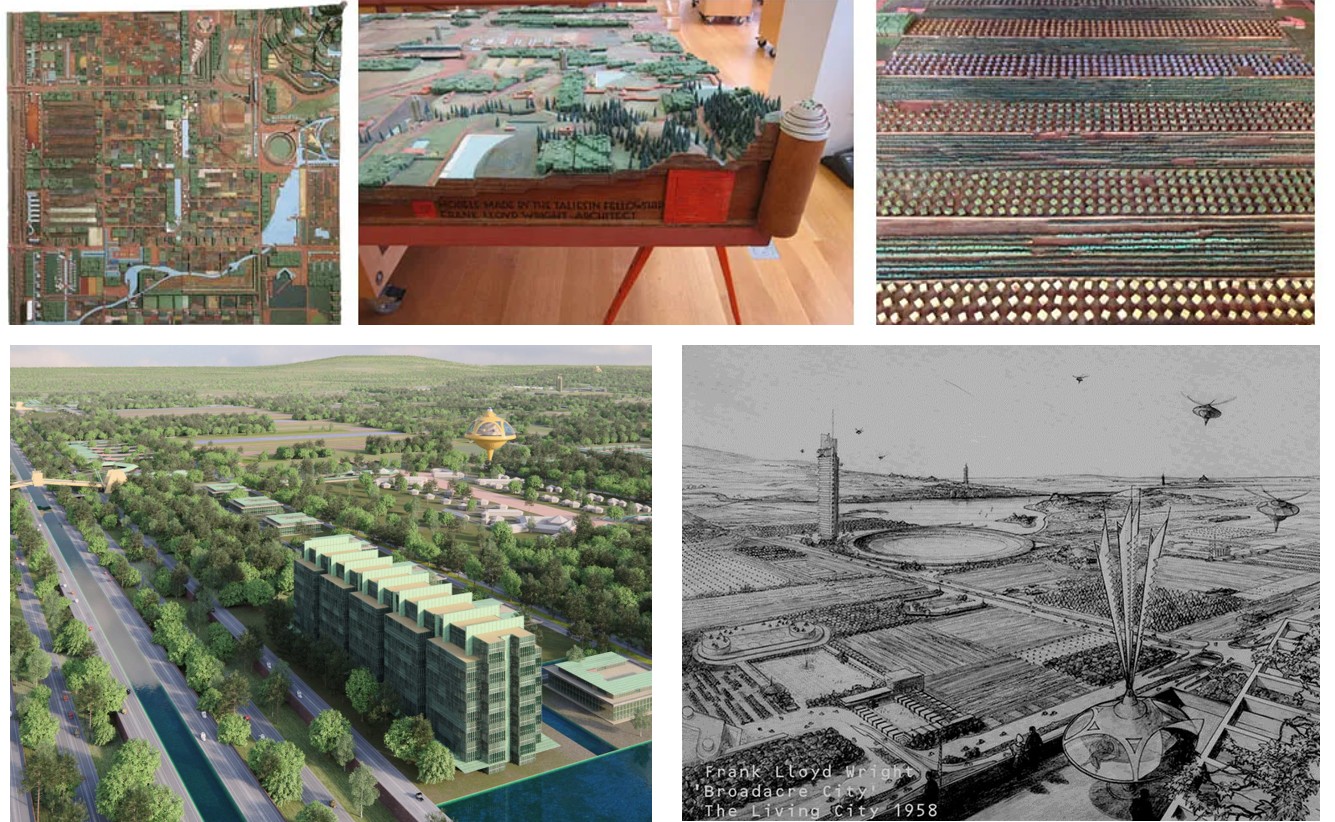
GREEN ACRES…The 12×12-foot model (top images) crafted by student interns who worked for Wright at Taliesin is now housed at the Museum of Modern Art (MoMA); bottom right, Wright’s rendering of Broadacre City, and at left, detail from Spanish architect David Romero’s computer-generated model of Broadacre City (more images below). (MoMA/David Romero via Smithsonian)

For the most part Mumford reacted favorably to Wright’s vision, which is no surprise considering that Mumford derided the dehumanizing skyscrapers popping up all over his city (including Rockefeller Center).

Despite his patrician demeanor, Wright envisioned an egalitarian Broadacre City, with every family having access to cars, telephones and other appliances. Power would come from solar and electric energy, and any technological advances would be applied at a local level toward the common good.

VIRTUAL REALITY…In 2018 Spanish architect David Romero created computer-generated models to see what Wright’s unrealized structures might have looked like. At left, cars (based on Wright concepts) in Broadacre City, and an aerial view featuring a tower that bears a strong resemblance to Wright’s 1956 Price Tower in Bartlesville, Oklahoma. Modeling Broadacre took Romero more than eight months to complete—it contains more than one hundred detailed buildings, one hundred ships, two hundred “aerotors” (based on the autogyros of the day), 5,800 cars, and more than 250,000 trees. (David Romero via Smithsonian and openculture.com)

What Mumford (and perhaps Wright) didn’t fully anticipate was the urban sprawl such a vision would help inspire, the suburban and exurban landscape that would lead to a car-dominated world of congested, multi-lane highways and housing developments that continue to encroach on our woodlands and wetlands. And we didn’t get those groovy aerotors either.

(Christoph Gielen, webcolby.edu)

 * * *

Little House on the Avenue

E.B. White, in his “Notes and Comment,” also offered some observations on housing trends, noting the manufactured “Motohome” displayed at Wanamaker’s as well as “America’s Little House,” plopped down at the corner of 39th and Park Avenue.
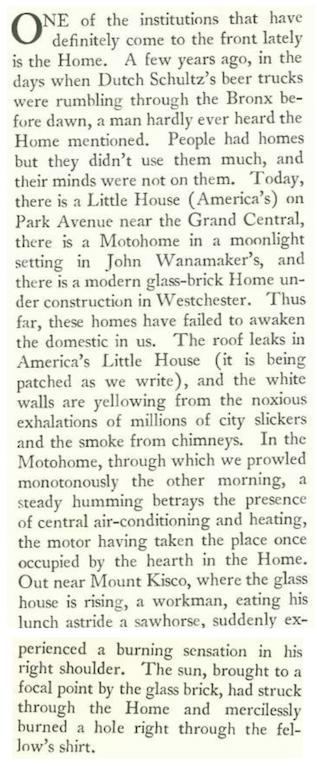
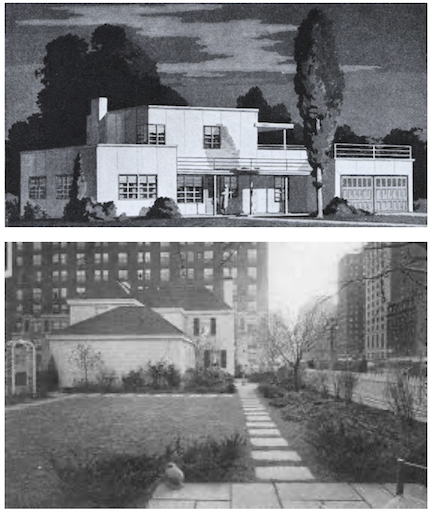
SETTING A STANDARD…Above, the factory-manufactured Motohome (above) was touted as the solution to the nation’s housing shortage. The federal Better Homes in America organization built a model house (“America’s Little House,” below) at 39th and Park Avenue to illustrate how standardized components and methods could make home improvement easier. (Google Books/Johns Hopkins)

* * *

Horsing Around

Although known for their nonchalance, New Yorkers could still find some enthusiasm when the circus came to town. “The Talk of the Town” looked in on the star of the circus, Dorothy Herbert (1910-1994), a trick rider with the Ringling Bros. and Barnum & Bailey Circus.
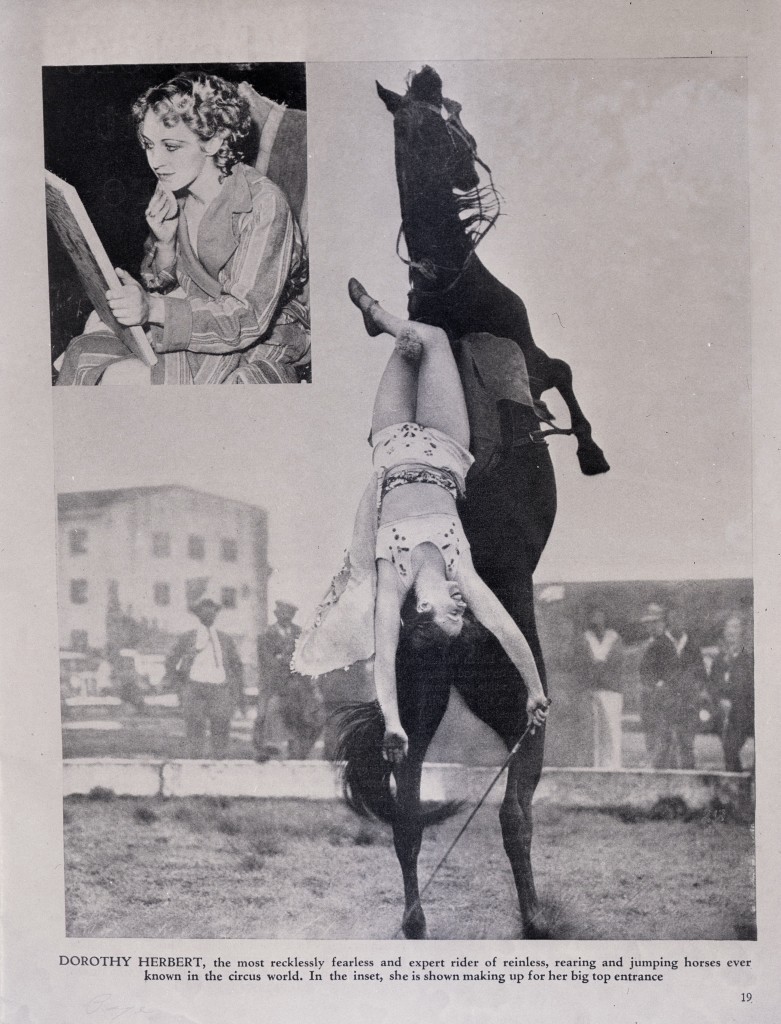
WHOA NELLY…One of Dorothy Herbert’s signature moves was her layback on a rearing horse. Here she demonstrates the move in 1939. (equineink.com)
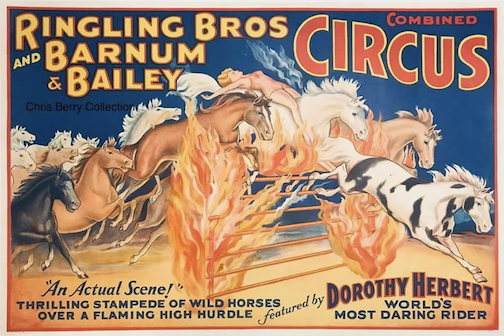
HOT STUFF…Circus poster touts Herbert’s ride over flaming hurdles in the company of twelve riderless horses. (circushistory.org)

 * * *

Don’t Call Him ‘Tiny’

He was known as “The Little Napoleon of Showmanship,” but there was nothing small about Billy Rose’s accomplishments as an impresario, theatrical showman, composer, lyricist and columnist. Here are excerpts from Alva Johnston’s profile:

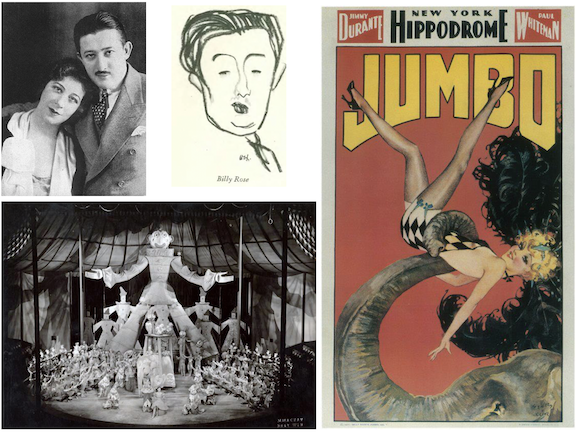
JUMBO-SIZED ENTERTAINMENT…Clockwise, from top left, Billy Rose and his first wife, comedian-actress Fanny Brice; illustration of Rose for the profile; poster announcing Rose’s 1935 stage spectacle Jumbo at the Hippodrome; described as more circus than musical comedy, Jumbo was one of the most expensive theatrical events of the first half of the 20th century. (jacksonupperco.com)

 * * *

On Guard

We shift gears and turn to more sobering events of the 1930s, namely the rise of fascism in Europe. In his column “Of All Things,” Howard Brubaker pondered the possibilities of fascism in his own country…

…meanwhile, Paris correspondent Janet Flanner was finding nothing funny about the uneasy calm among Parisians as war with Germany seemed likely.
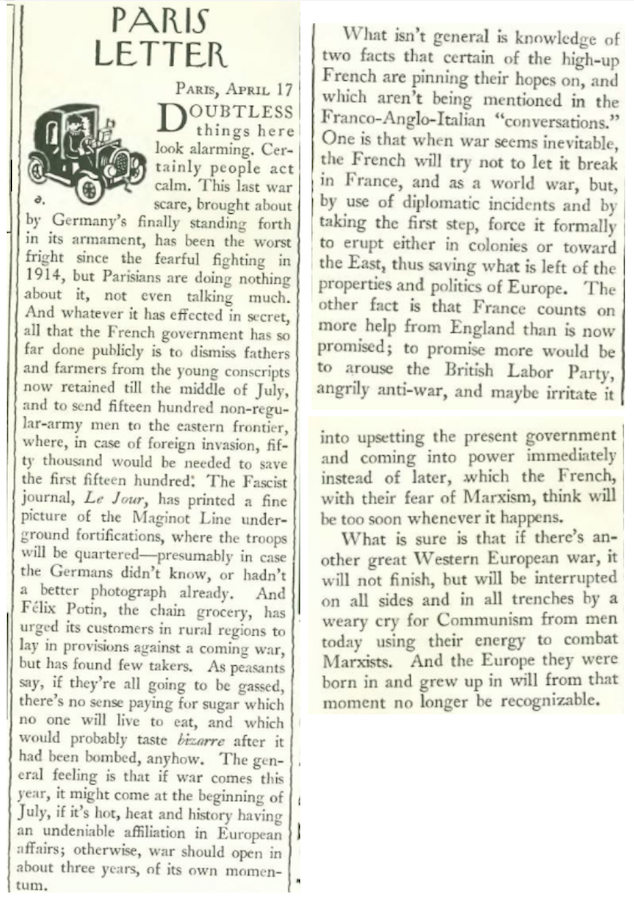
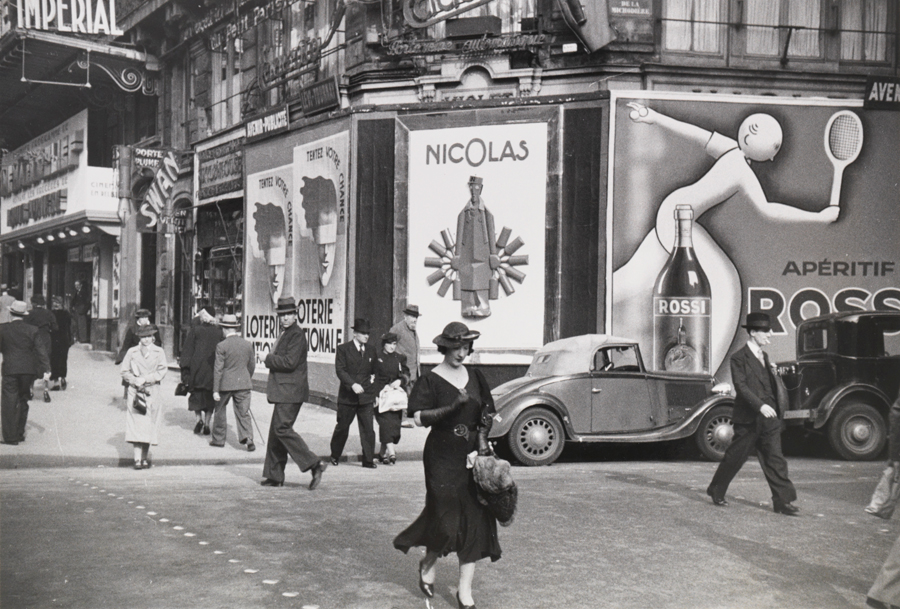
C’EST LA VIE…Janet Flanner found Parisians resigned to whatever fate awaited them in 1935. (unjourdeplusaparis.com)

Flanner also remarked on Leni Riefenstahl’s Nazi propaganda film Triumph des Willens (Triumph of the Will). Flanner’s assessment of this “best recent European pageant” wryly underscored the horrors the film portends.

 * * *

News From An Old Friend

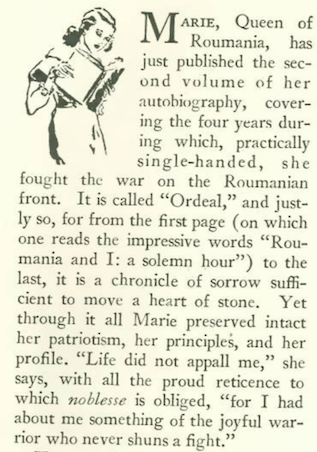
Longtime readers may recall one of my earliest entries on Queen Marie of Romania (1875-1938); the March 14, 1925 edition of The New Yorker (issue #4) found New Yorkers “agog” over her planned 1926 visit to the city. Her comings and goings were followed for a time (she also appeared in a Pond’s Cold Cream ad in the June 6, 1925 issue), but then she abruptly disappeared. Here she is again, courtesy of a glowing book review by Clifton Fadiman. An excerpt:
A PROGRESSIVE THINKER for her time, Marie of Romania was immensely popular in America. Born into the British royal family, she was the last queen of Romania from 1914 to 1927. At left, portrait from 1920; at right, during her 1926 visit to the States, Marie received a headdress from two American Indian tribes. They named her “Morning Star” and “Winyan Kipanpi Win”—“The Woman Who Was Waited For.” (Wikipedia/brilliantstarmagazine.org)

 * * *

From Our Advertisers

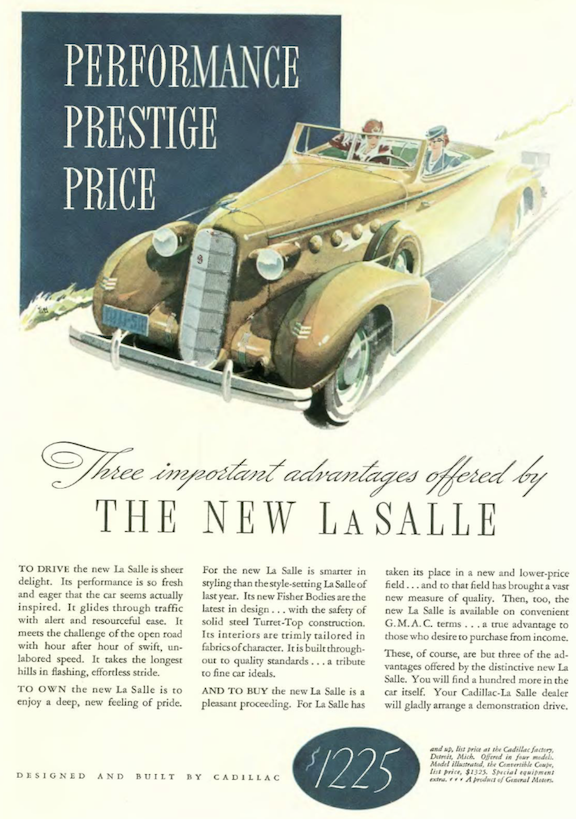
Although we’ve seen plenty of ads from prestige automakers such as Packard, it was clear that companies found their sweet spot in lower-priced models that still suggested “prestige”…here’s an example from Cadillac’s budget line LaSalle…
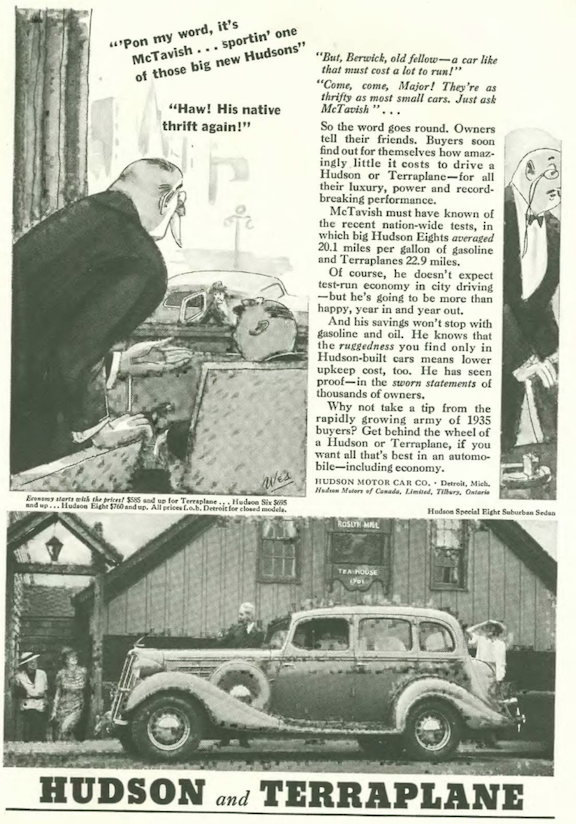
…for less than half the price of a LaSalle you could get behind the wheel of Hudson, its makers suggesting that prestige doesn’t preclude thrift…this ad seems to have been hastily produced–note the right side of ad, with just a slice of some toff squeezed next to the copy…
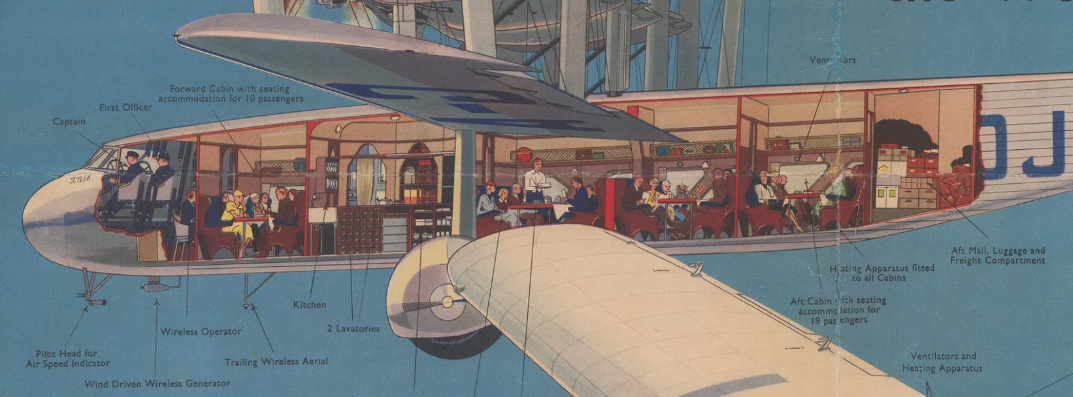
…this advertisement would only appeal to those who were among the tiny minority who could afford to fly…from 1924 to 1939 this early long-range airline served British Empire routes to South Africa, India, Australia and the Far East…

…for reference, detail below of a Scylla-class airliner used by Imperial Airways…
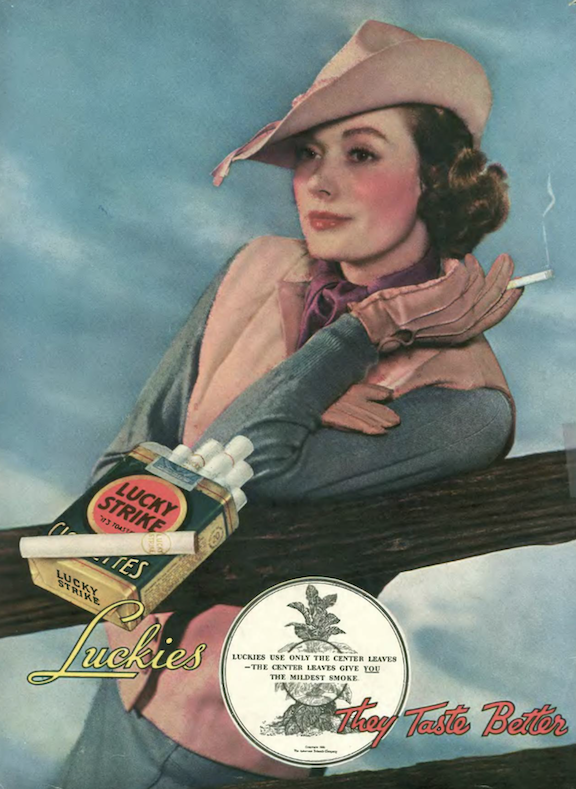
…and what would the back cover be without a photo of a stylish woman having a smoke?…
…a few advertisers referenced the circus in town to drum up business…

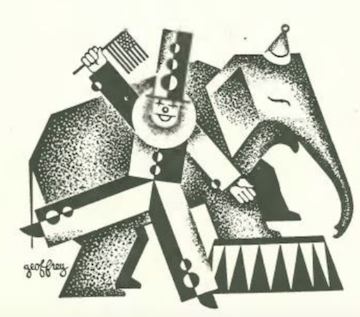
…and we segue to our cartoonists and illustrators, and this circus-themed spot from an illustrator signed “Geoffrey”…
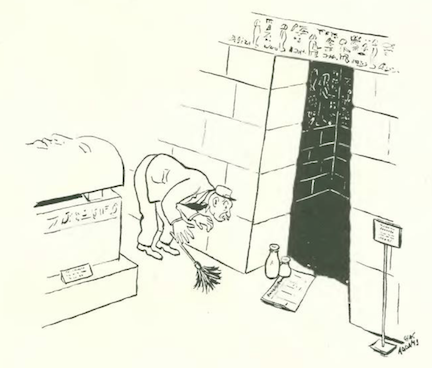
…a more familiar name is found at the bottom of page 4…namely Charles Addams…the milk order outside the tomb hints at things to come…
…Addams again, going from Bacchus to beige…

George Price, and well, you know…

Robert Day was aloft with a speculative builder…

William Steig typecast his Small Fry…

Leonard Dove made a sudden exit…

Gilbert Bundy found one old boy unaffected by spring fever…
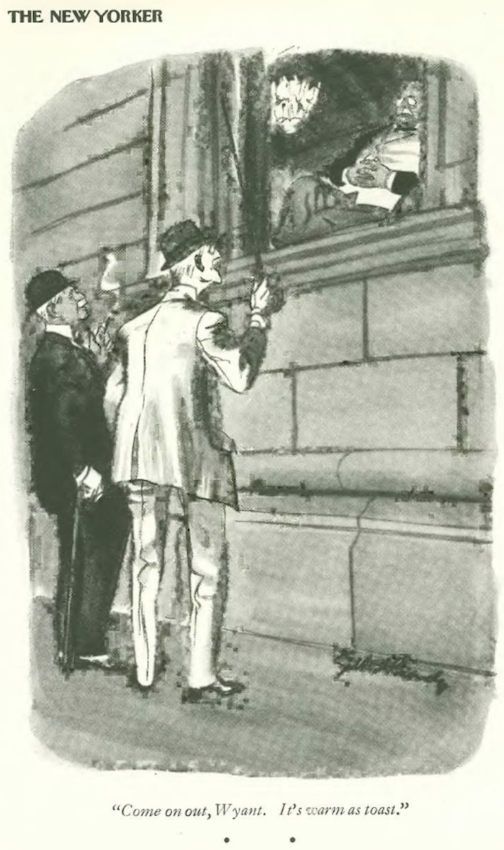
Alain channeled Barbara Shermund to give us this gem…
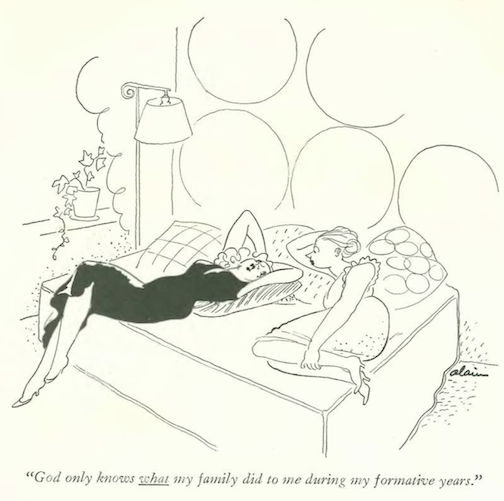
…and we close with a typical day in James Thurber’s world…

Next Time: The Royal Treatment…


MoMA Sees The Future

If you love modern architecture, then Feb. 10, 1932 should be an important date on your calendar, for on that date the Museum of Modern Art opened Modern Architecture: International Exhibition.

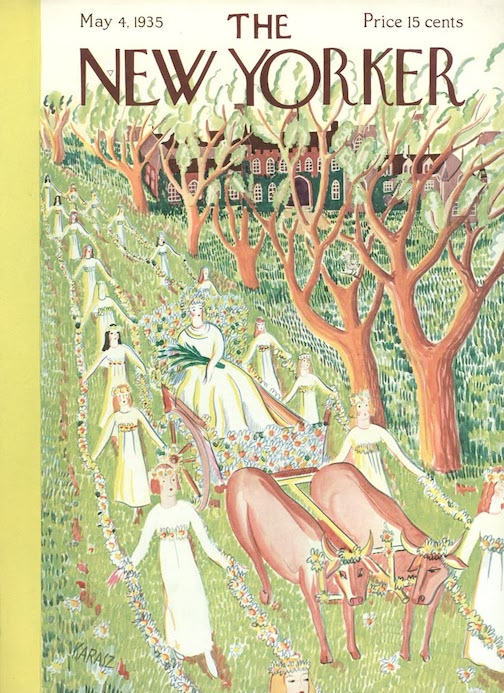
Feb. 27, 1932 cover by Leonard Dove.

Curated by Philip Johnson and Henry-Russell Hitchcock, the exhibition introduced 33,000 visitors (during the exhibition’s six-week run) to the “International Style,” an emerging architectural style that would utterly transform New York and thousands of cities around the world after the Second World War. In a catalogue prepared for the exhibition, Johnson and Hitchcock defined what this style was all about:

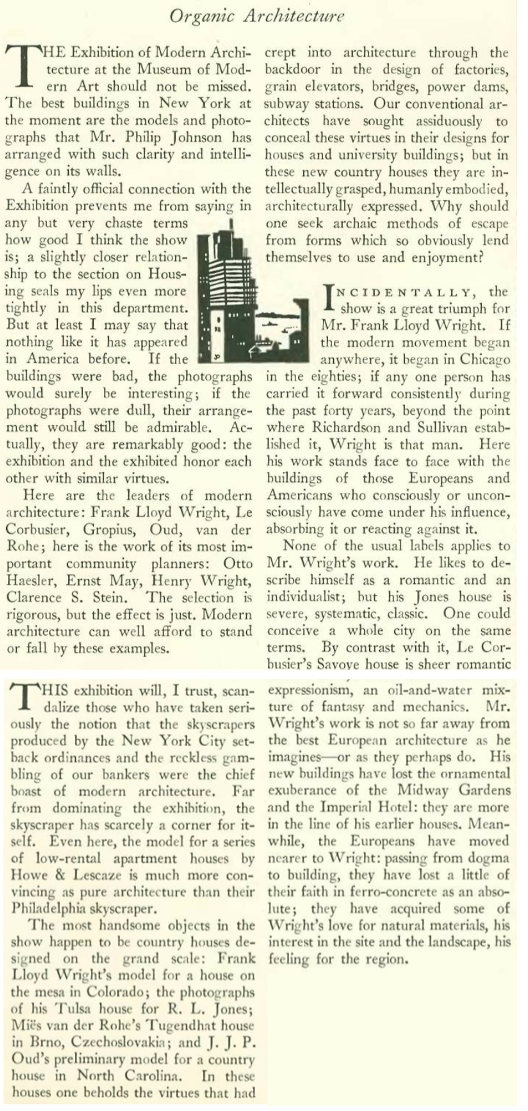
Architecture critic Lewis Mumford welcomed the exhibition, wryly noting that the “best buildings in New York” at the time were the models and photographs “arranged with such clarity and intelligence” by Philip Johnson on MoMA’s walls. An excerpt:

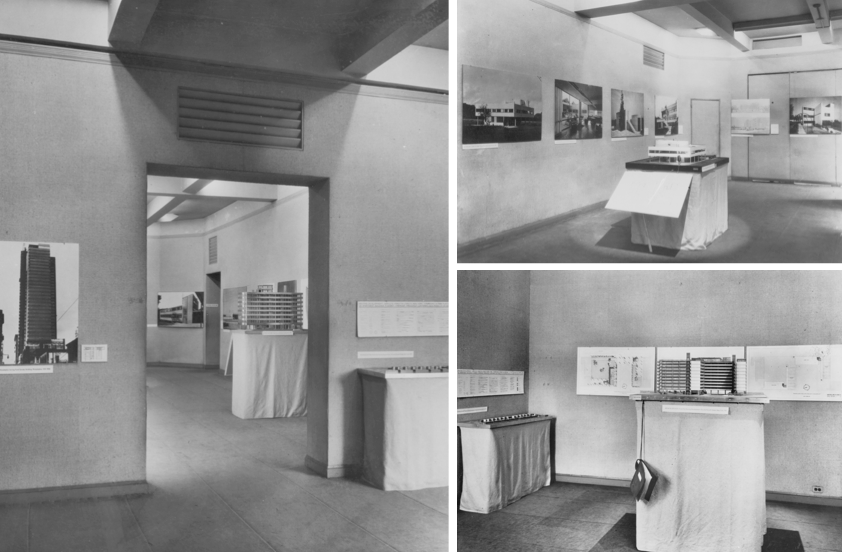
FORM FOLLOWED FUNCTION…MoMA’s Modern Architecture: International Exhibition, opened on Feb. 10, 1932 in the museum’s first home, New York’s Heckscher building on Fifth Avenue. There was nothing fancy about these gallery spaces, but the exhibits wowed The New Yorkers’s Lewis Mumford, including a model of Le Corbusier’s Villa Savoye at top right. (MoMA)
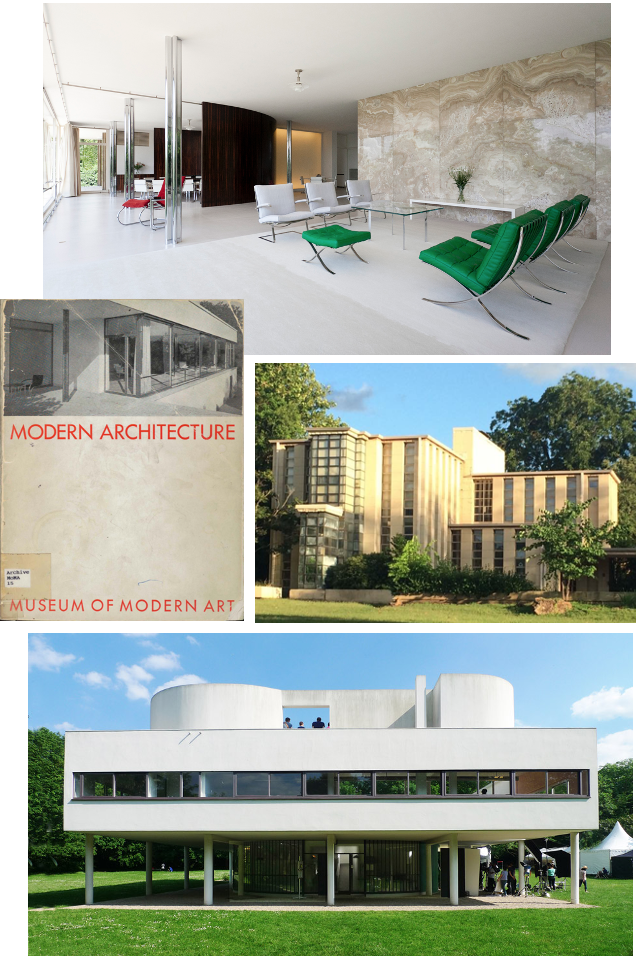
HANDSOME OBJECTS…was how Lewis Mumford described works in the exhibition he singled out for praise, including, from top, Mies van der Rohe’s 1930 Villa Tugendhat, Frank Lloyd Wright’s 1929 Jones residence in Tulsa, and Le Corbusier’s Villa Savoye. At left, the cover of the exhibition catalogue. (MoMA/Wikipedia/dezeen.com)

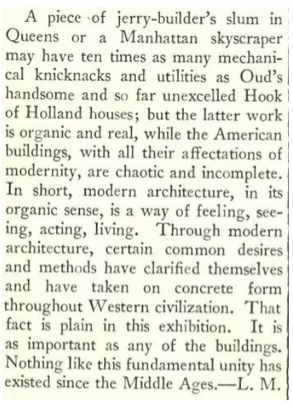
Mumford concluded his review with this bold observation:

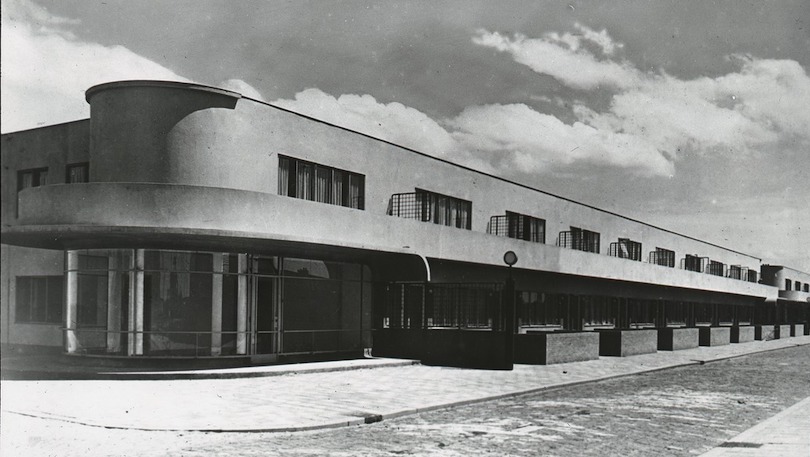
100 PERCENT ORGANIC…View of Hook of Holland housing complex in Rotterdam, designed by J.J.P. Oud, 1926-1927. (umass.edu)

 *  *  *

Out of the Trenches

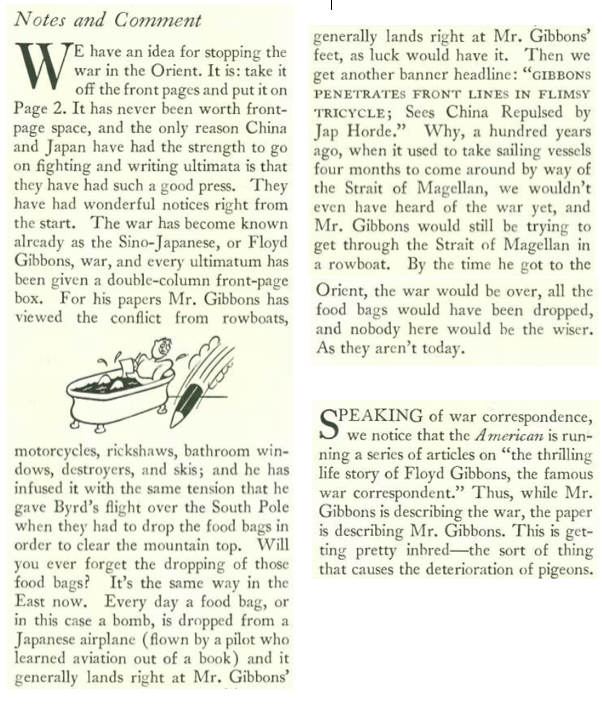
Floyd Gibbons (1887–1939) was a colorful, fast-talking war correspondent known for his derring-do as a reporter for the Chicago Tribune during World War I (losing an eye in an attempt to rescue an American marine) and later as a radio commentator and narrator of newsreels. His celebrity would even earn him a star on the Hollywood Walk of Fame. For all his death-defying exploits, Gibbons would die at home, of a heart attack, at the tender age of 52.

In his “Notes and Comment” column, E.B. White suggested that Gibbon’s fame had a little help from some friends…
Screen Shot 2021-03-22 at 10.15.43 AM

azu_ms413_b21_f40_drachmanmorocco4
IN HIS ELEMENT…Floyd Gibbons photographed in 1925 while in Morocco covering the Riff War. Seated to the left is journalist and author Rosemary Drachman, who covered the war with Gibbons. (University of Arizona Libraries)

 *  *  *

Love and War

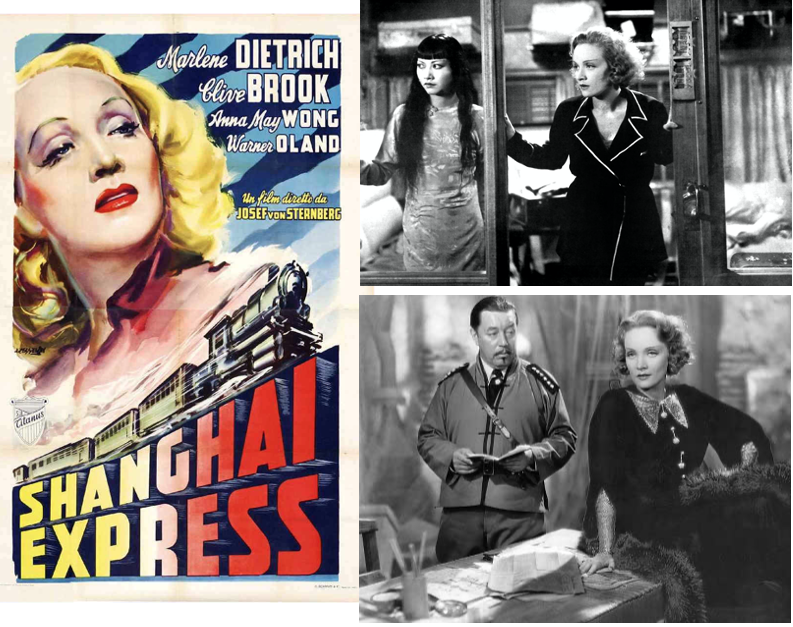
The fourth of seven films Josef von Sternberg and Marlene Dietrich made together, Shanghai Express was a critical success (nominated for three Oscars, winning one for cinematography) for Sternberg as well as for Dietrich and Anna May Wong. This pre-code drama was about a notorious woman (Dietrich, who else) who rides a train through the perils of a Chinese civil war with a British captain (Clive Brook) whom she loves. Critic John Mosher takes it from there:

Screen Shot 2021-03-22 at 9.44.59 AM

Screen Shot 2021-03-30 at 4.32.39 PM
LOOMING EVER LARGER…Marlene Dietrich’s image dominated this poster for Shanghai Express, which starred Dietrich and Anna May Wong (top right) as well as Clive Brook and Warner Oland. Oland, pictured at bottom right with Dietrich, was a (non-Asian) Swedish-American actor most remembered for playing Chinese and Chinese-American characters, including his role as Charlie Chan in 16 films between 1931 and 1937. (IMDB)

Dietrich and Wong were well acquainted when they came together to make Shanghai Express. It was rumored the two had a romantic relationship when Wong visited Europe in 1928, a rumor that tarnished Wong’s public image (but seemed to have little effect on Dietrich’s).

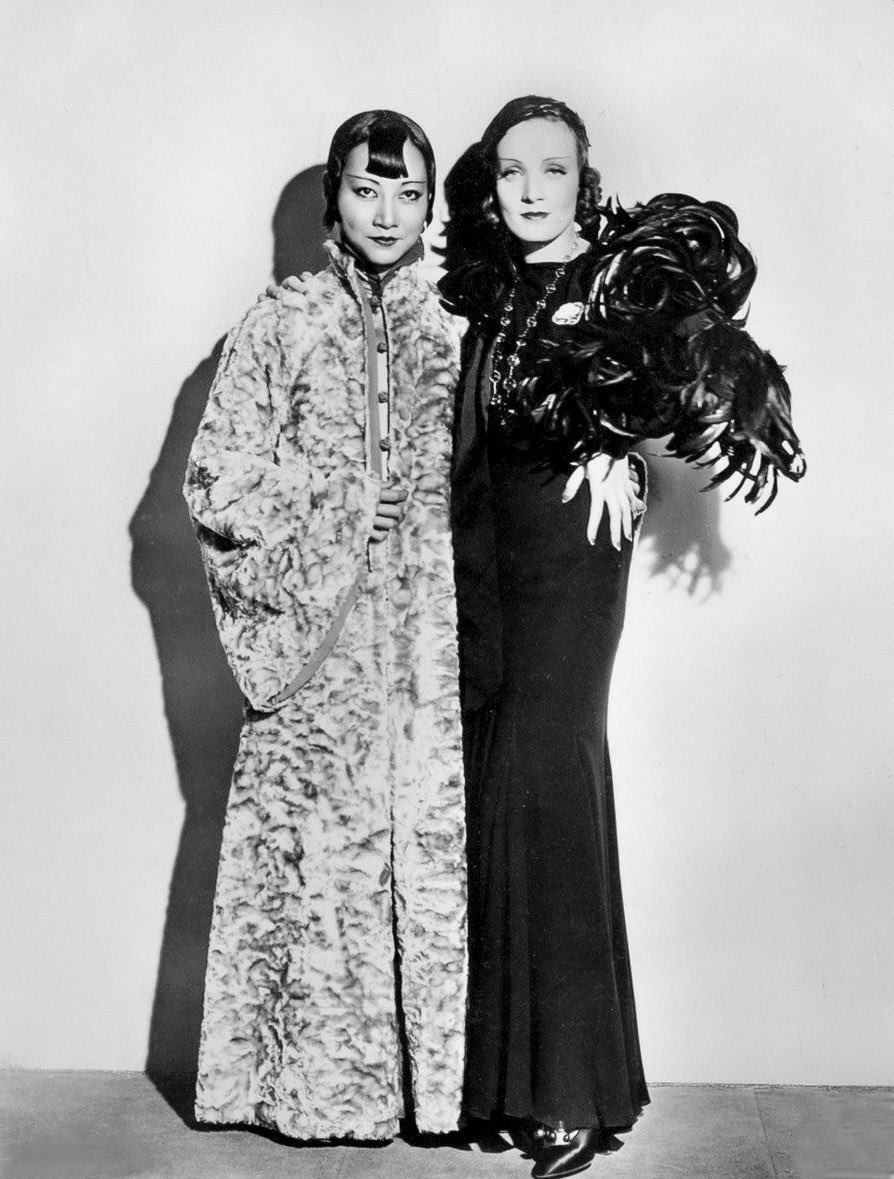
ALL DRESSED UP…Anna May Wong and Marlene Dietrich pose in Travis Banton costumes for 1932’s Shanghai Express. (Twitter)

 *  *  *

From Our Advertisers

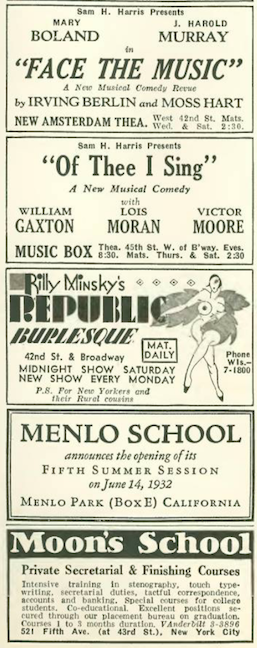
Looking at some advertisements from the Feb. 27 issue…here’s a clip from the back pages of some inexpensive sig ads promoting everything from Broadway to burlesque—Billy Minsky’s was by far the best known burlesque show in Manhattan. Note how the Minsky’s ad included the racy little drawing (hmmm, not for the kiddies) and the postscript at the bottom following “NEW SHOW EVERY MONDAY” — P.S. For New Yorkers and their Rural cousins… 

Screen Shot 2021-03-12 at 1.05.18 PM

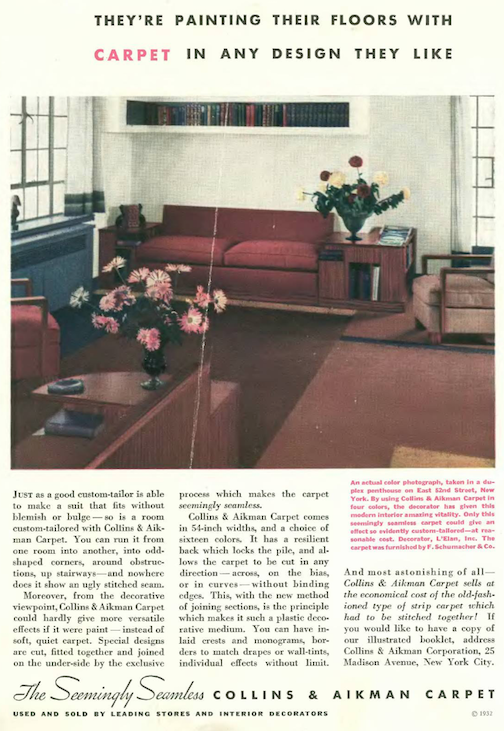
…MoMA wasn’t the only place you could find modern design, as this carpet ad suggested…

Screen Shot 2021-03-12 at 1.06.57 PM

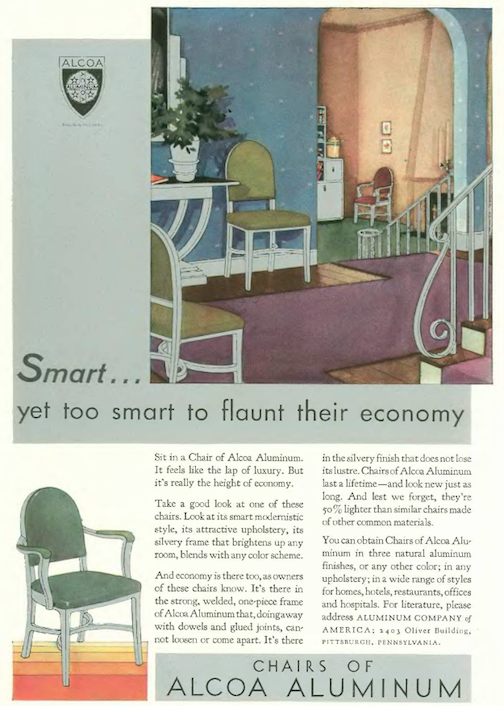
…the folks at Alcoa Aluminum were sticking with a more traditional look, even though they were marketing a very modern aluminum chair…you don’t see these much anymore…I mostly remember them reposing in rumpus rooms or church basements…

Screen Shot 2021-03-12 at 12.49.17 PM

…the makers of Nash automobiles were keeping with the times with new “Slip-Streamed” models “with lines and curves suggested by aeronautical design”

Screen Shot 2021-03-12 at 12.49.42 PM

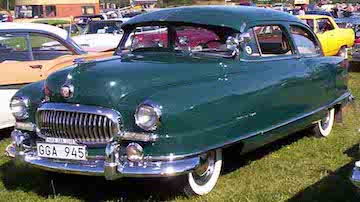
…my father’s first car was a used Nash — something similar to this 1951 Nash Statesman…

Nash_Stateman_2-Door_Sedan_1951

…Nash would acquire rival Hudson in 1954 to create American Motors Corporation, run by a man named George Romney (Mitt’s dad), who would make AMC a successful company before turning to politics (AMC would go on to make some truly weird, if not lovable vehicles, most notably the Gremlin)…and we segue into our cartoons with this ad for Sanka decaf coffee, illustrated by the New Yorker’s William Steig

Screen Shot 2021-03-12 at 12.59.44 PM

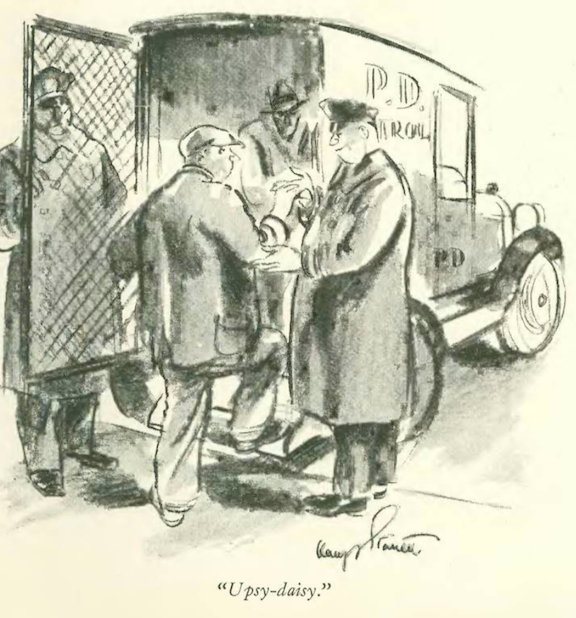
Kemp Starrett gave us a little paddy wagon humor…

Screen Shot 2021-03-12 at 12.57.08 PM

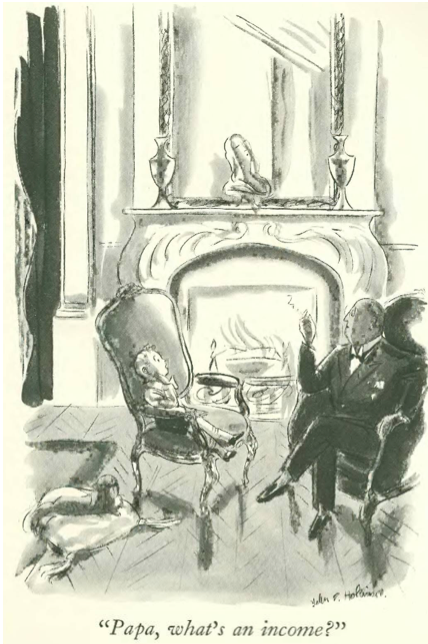
Helen Hokinson illustrated a tender moment between father and son…

Screen Shot 2021-03-22 at 10.19.15 AM

…and we close with James Thurber, and some wintertime fun…

Screen Shot 2021-03-12 at 12.53.54 PM

Next Time: The Milne Menace…


Aleck and Frank at Taliesin

From the late I.M. Pei to Frank Gehry, America has its share of “starchitects,” but only one architect in the history of the profession could claim to be a true household name: Frank Lloyd Wright. 

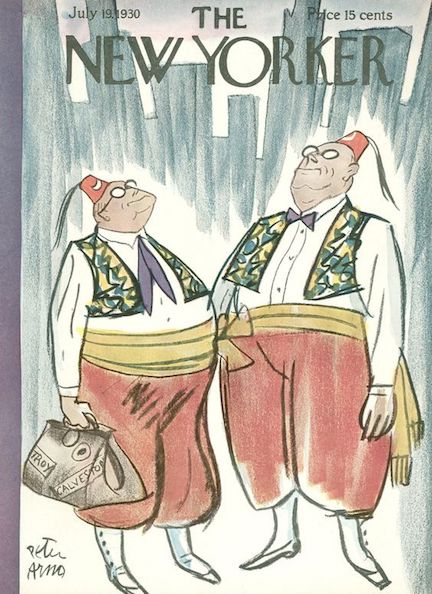
July 19, 1930 cover by Peter Arno.

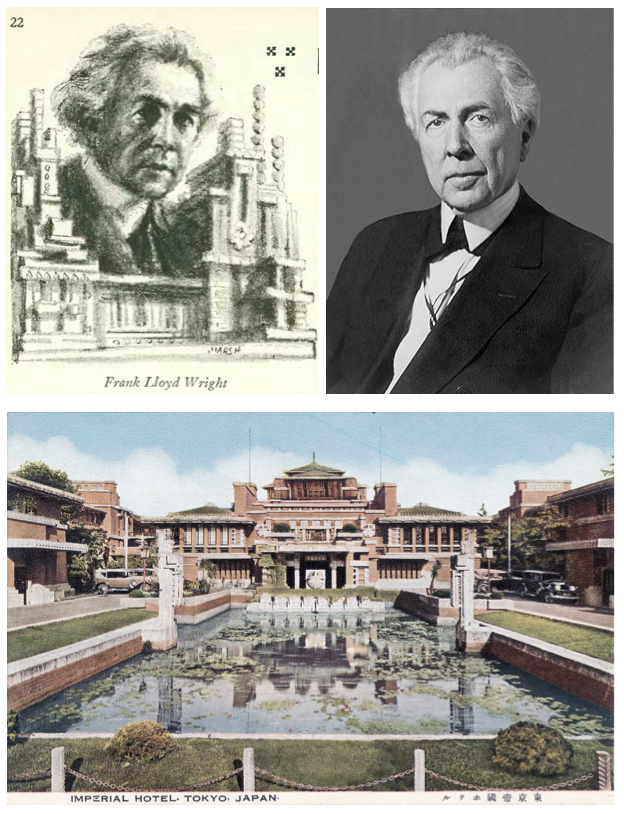
In a profile titled “The Prodigal Father,” Alexander Woollcott wrote about Wright’s “return” to American acceptance after nearly two decades of scandal and tragedy. Woollcott took great pains to defend Wright’s reputation, marred by his extramarital affair with Mamah Cheney, her murder in 1914 along with six others (including her children) at Wright’s Wisconsin home, Taliesin, and his subsequent remarriage, divorce, and remarriage that followed.

GONE BUT NOT FORGOTTEN…Clockwise, from top left, Reginald Marsh illustration for the profile; Frank Lloyd Wright, circa 1930; Tokyo’s Imperial Hotel, completed in 1923. Designed in the Maya Revival Style Wright favored throughout the 1920s, it was damaged by the 1923 Great Tokyo Earthquake just months after opening. It was demolished in 1967, however the iconic central lobby wing and the reflecting pool were disassembled and rebuilt near Nagoya. (Library of Congress/dezeen.com)

Note: Thanks to a reader’s correction (see comments at the bottom), the following has been revised:

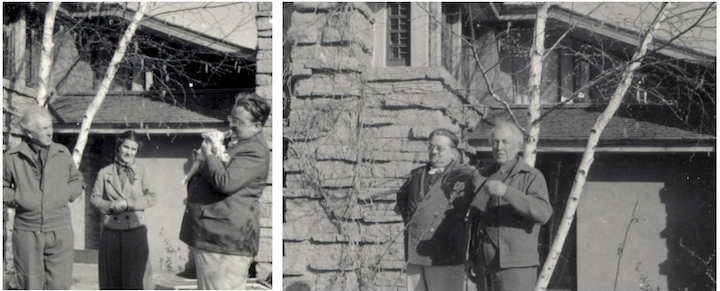
Woollcott also wrote of his visit to Taliesin (the third version of the house, after the first two were destroyed by fires). What stands out about this profile is Woollcott’s praise for the architect, a rare hagiography from a man renowned for his savage wit.

MEETING OF THE MINDS…Above and below are photographs from a autumn visit to Taliesin by Alexander Woollcott. From left are Olgivanna Lloyd Wright, Frank Lloyd Wright and Woollcott. Wright invited Woollcott to the estate in the late 1920s: “This note will be witless as usual, but grateful…. Dear Man, why don’t you come up here? Bring any friend up here with you. Both of you can find an admirable place to work here…” (Avery Architectural & Fine Arts Library, Columbia University, New York)

THIRD TIME’S A CHARM…The third version of Taliesin (built in 1925) is the one Woollcott would have visited in the late 1920s. (Wikipedia/Taliesin Preservation)

*  *  *

No Surprise Endings, Please

Although sometimes confused with Alexander Woollcott because of his first name, the timid, taciturn Wolcott Gibbs was a force at The New Yorker in his own right, perhaps even more so as he served the magazine from 1927 to 1958 as a jack-of-all-trades: copy editor, feature writer, theater critic, and overall wordsmith. So when the editors of The Writer’s Digest posed a question regarding The New Yorker’s policy for submissions, it was Gibbs who was tapped to compose a response, which was a particular challenge given the magazine didn’t have a clear set of editorial requirements. So Gibbs conjured up an “Answers-To-Hard-Questions Department,” and signed it “Mr. Winterbottom.” Some excerpts:

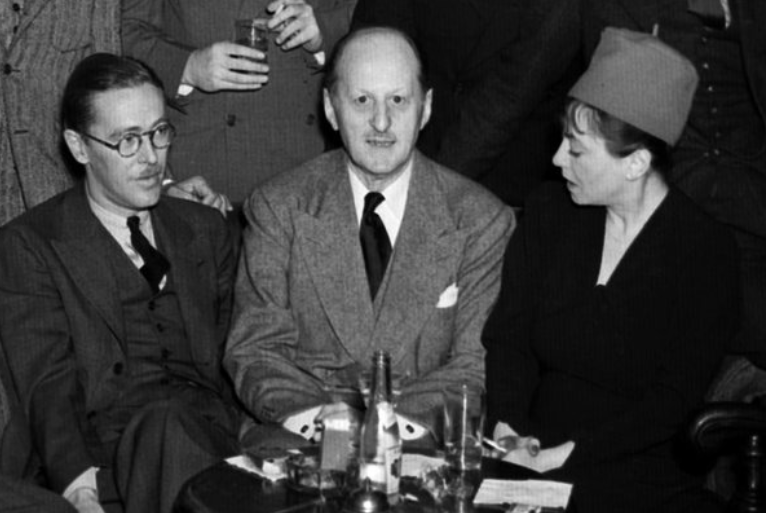
IN HIS ELEMENT…Wolcott Gibbs, left, relaxes at the Algonquin Hotel in 1937. At right is his New Yorker colleague Dorothy Parker. (Time)

 *  *  *

Munitions of Bremen

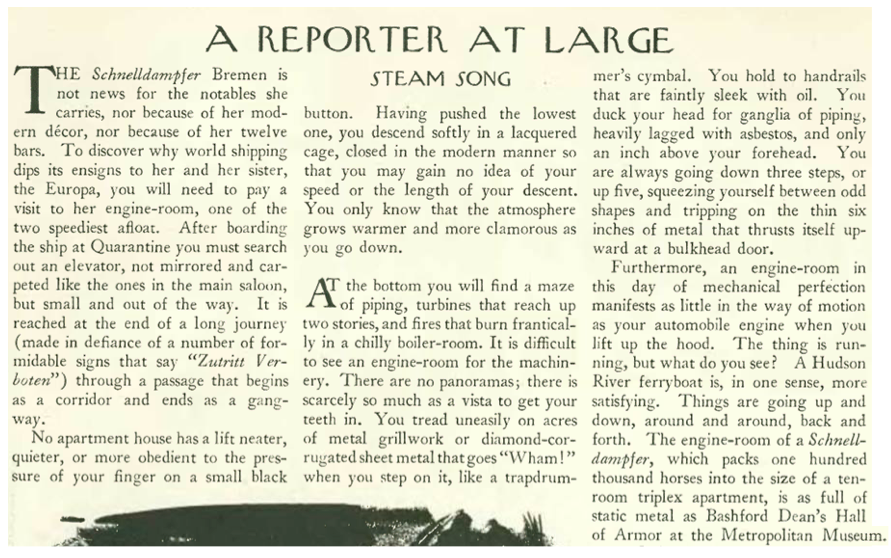
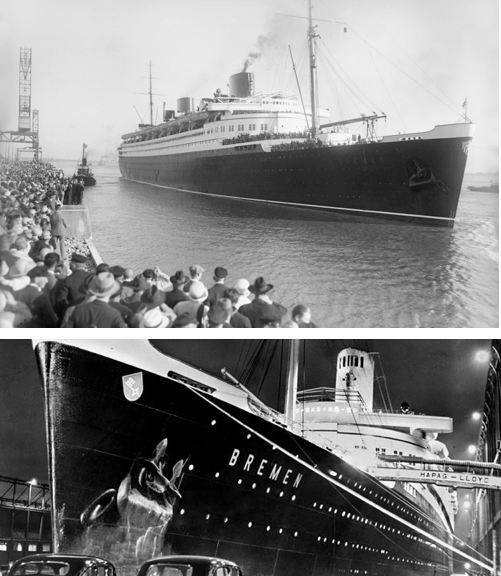
The German Ocean liner SS Bremen was one of the most technologically advanced ocean liners of its day, known for its speed and luxury. Author Eric Hodgins climbed aboard to file a report for the New Yorker, and in the excerpt below marveled at the “mechanical perfection” of the ship’s engine room:

PLOUGHSHARES INTO SWORDS…More than the length of three football fields, the streamlined SS Bremen, launched in 1928, was designed to have a cruising speed of  27.5 knots (50.9 km/h). After a 1941 fire, the ship was largely dismantled, its steel used to manufacture war munitions. (Wikipedia/greatoceanliners.com)

In 1941, while docked in Bremerhaven, a disgruntled crew member set fire to the ship, completely gutting its luxurious interior. During the war the ship was stripped of its steel for use in munitions, and in 1946 what remained was destroyed by explosives.

 *  *  *

From Our Advertisers

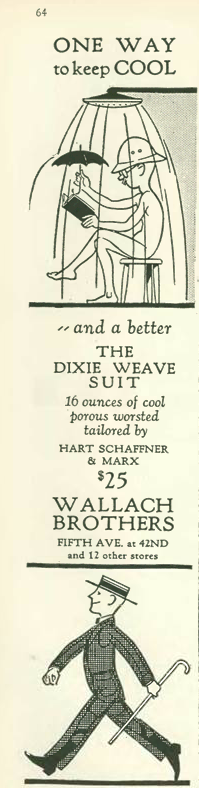
In my readings of recent issues I’ve noted numerous references to hot weather, and for good reason. The summer of 1930 would see record high temperatures and diminished rainfall that would usher in the “Dust Bowl” era of the 1930s. The Wallach Brothers adjusted by offering this “Dixie Weave Suit”…

…the hot weather also called for a tall glass of sparkling soda (mixed with your favorite bootleg beverage, of course)…

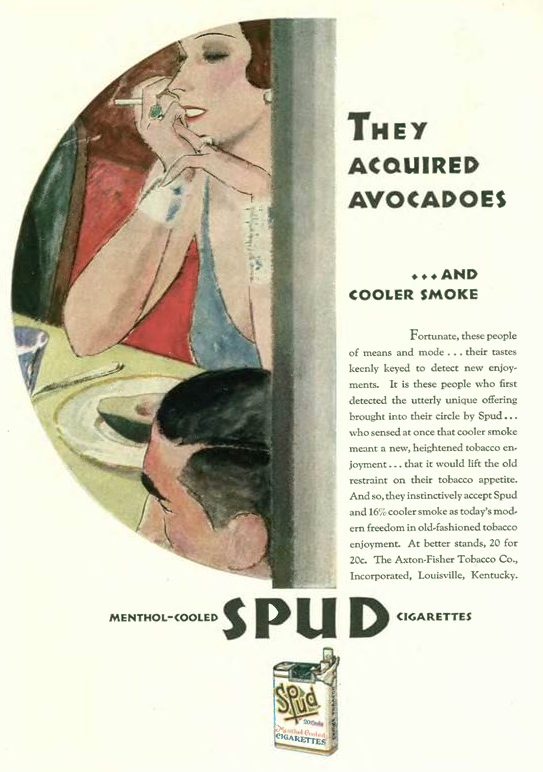
…smokers could keep cool by puffing on a Spud, the first menthol cigarette…

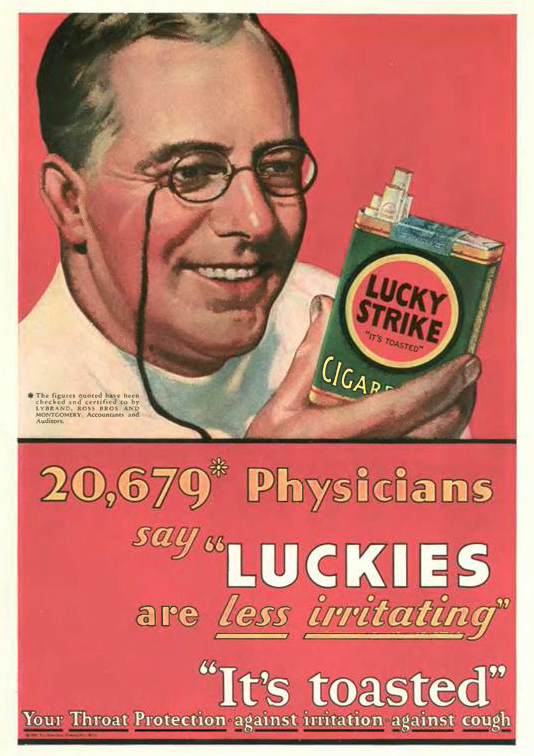
…or you could stick with your Luckies, endorsed by none other than this generic, genial doctor and some bogus survey…

…on to our cartoons…Isadore Klein showed us a downside of Edison’s invention…

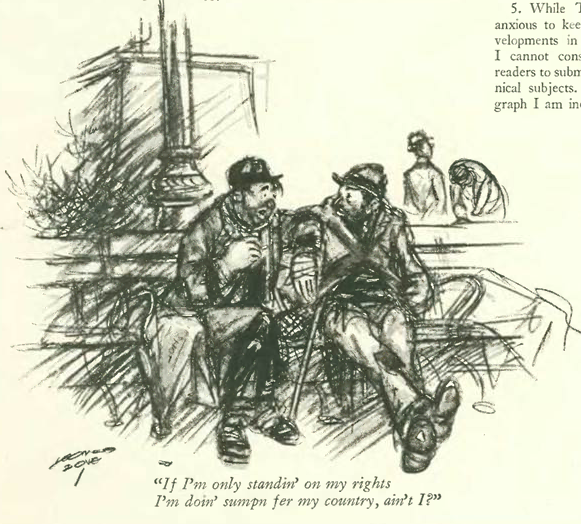
…and Leonard Dove gave us two gentlemen on the skids, a frequent sight in Depression-era New York…

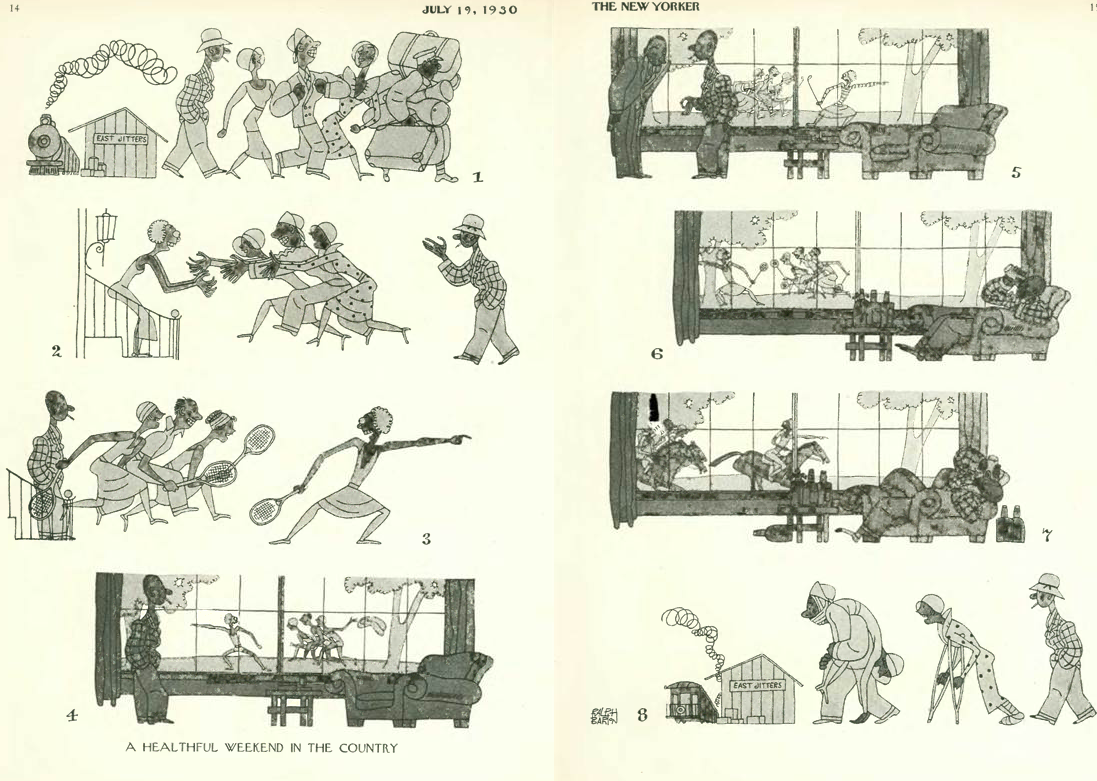
…after a long absence, we see suddenly see a flurry of activity from the pen of Ralph Barton, including this rare sequential cartoon…

…and with the hot summer New Yorkers took to the waters, at Coney Island with Denys Wortman

…and Southampton, with Helen Hokinson

Next Time: For the Byrds…


City of Glass

The New Yorker, via the pen of E.B. Whitelooked to the metropolis of the future in the Oct. 19, 1929 issue — to a city of glass towers that were ready to move from drafting table to reality. That is, until the stock market crash, just days away, which would put a heavy damper on those visions.

Oct. 19, 1929 cover by Rea Irvin.

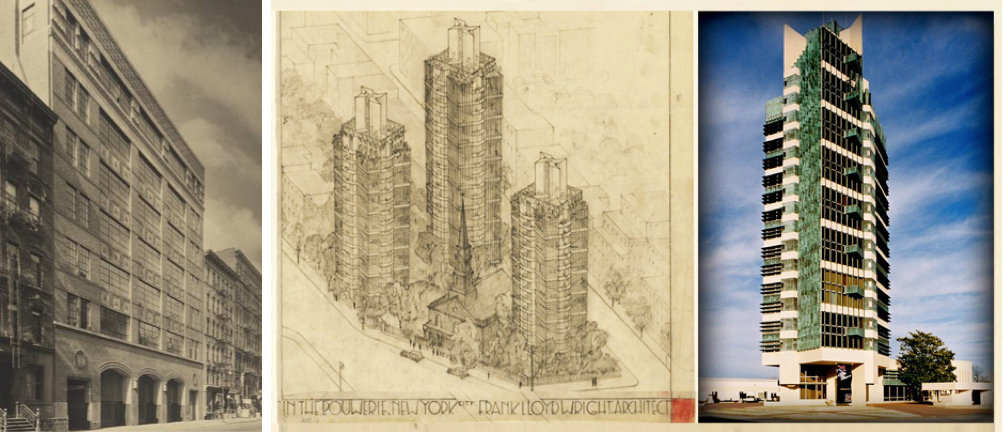
White reported in “The Talk of the Town” that several “all-glass” buildings were in the works, including “four apartment houses of glass” designed by Frank Lloyd Wright:

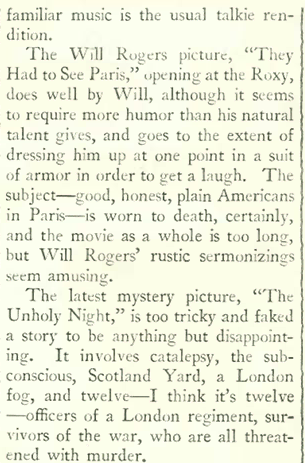
The 1926 Pinaud cosmetics factory designed by Ely Jacques Kahn and Albert-Buchman was poised to get a three-story addition (by Kahn) constructed entirely of glass block, but the market crash likely killed the project. The Depression probably didn’t help Wright’s project either, which would have constituted his first buildings in New York City, and the first with all-glass exteriors.

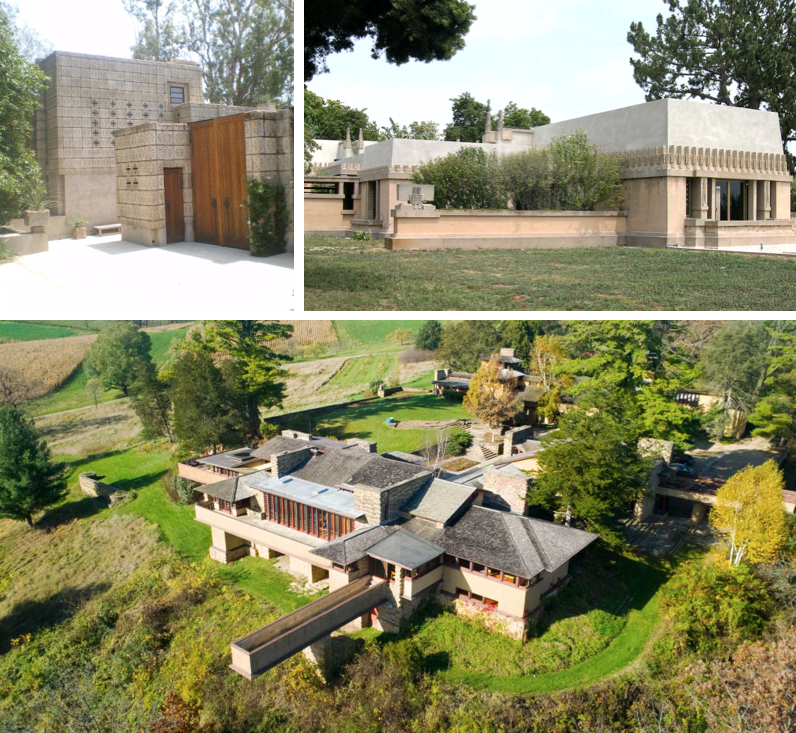
BEST-LAID PLANS…The 1926 Pinaud factory (left), now home to The School of Visual Arts, did not get its Ely Jacques Kahn-designed glass block addition in 1929; center and at right, Frank Lloyd Wright’s 1929 design for three skyscrapers surrounding St. Mark’s Church-in-the-Bowery. A single tower of similar design was eventually built in 1956—not in NYC—but out on the prairies in Bartlesville, Oklahoma. Click images to enlarge. (collectingvintagecompacts.blogspot.com; 6sqft.com)

Thanks to the Depression, and World War II, Gotham would have to wait 23 years for its houses of glass…

LATE ARRIVALS…Left, the 1952 Lever House, by Gordon Bunshaft and Natalie de Blois of SOM; right, the 1959 Seagram Building, by Mies van der Rohe. (Shorpy/ArchDaily)

and let’s not forget one of the most important post-war modernist statements to rise near the East River…

INTERNATIONAL STYLE…The 505-foot-tall United Nations Secretariat Building, constructed between 1947 and 1952. The building was designed by the Brazilian architect Oscar Niemeyer and the Swiss-French architect Le Corbusier. (United Nations)

 *  *  *

Rising From the Ashes

While most architects were looking to the future, some still gazed into the past, and in the case of Whitney Warren, rather bitterly. It was Warren who designed a new library in Louvain, Belgium, to replace one that was burned to ground by invading German troops during World War I. Around three hundred thousand books and a thousand manuscripts were destroyed in the fire, not to mention thousands of civilians who died during the invasion and occupation. The New Yorker seemed ready to forgive, but given the scale of the atrocity just fifteen years earlier, one could understand Warren’s obstinance:

And to add insult to injury, the second library designed by Warren was also destroyed by the Germans in the World War II. What stands today is a restoration of that building.

A TALE OF TWO LIBRARIES…Clockwise, from top left, a comparison of the Louvain university library in 1913, and after its destruction by the Germans in 1914 (the postcard photo at top right became almost instantly famous around the world). At bottom, left, the replacement designed by Warren, which was also destroyed by the Germans in World War II. Inset, Whitney Warren, circa 1915. (Associated Press/Wikipedia)

*  *  *

Belles Lettres? Non!

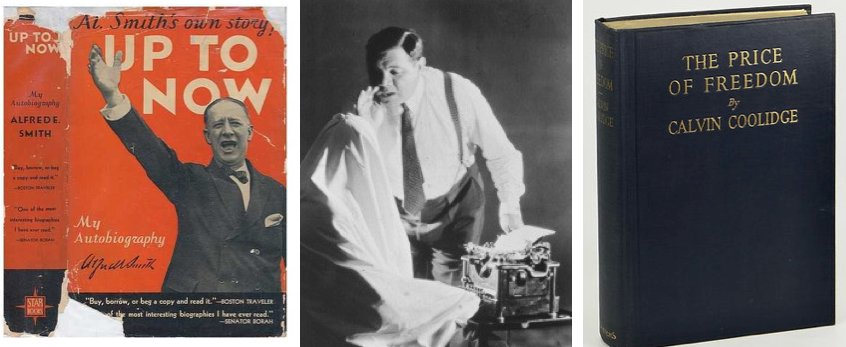
E.B. White, in his “Notes and Comment,” noted a new trend in the world of letters: celebrity authors. White lamented that the job of writing books and newspaper articles was being usurped by politicians, actors and athletes:

ASPIRING SCRIBBLERS…Former New York Gov. Al Smith, slugger Babe Ruth (dictating to his “ghost” writer) and former President Calvin Coolidge all got in on the act of book publishing. (Amazon/ourgame.mlblogs.com)

 *  *  *

Where Babies Come From

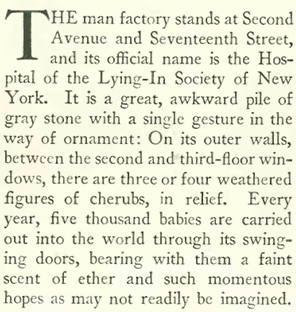
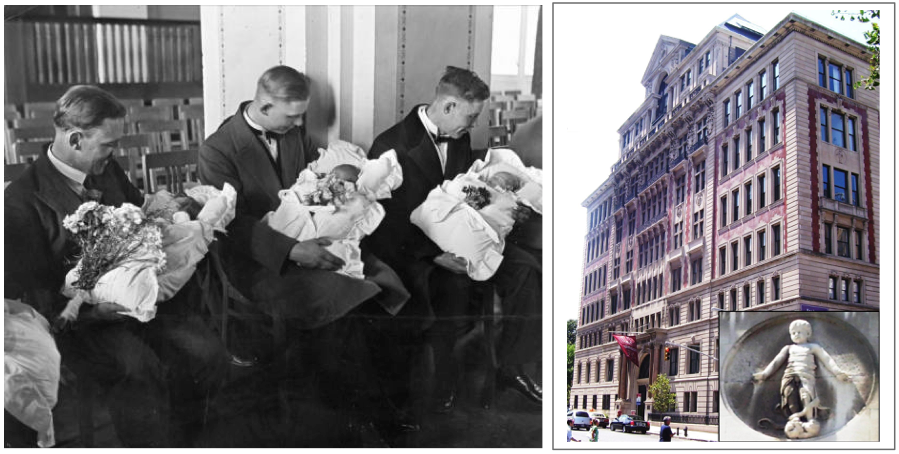
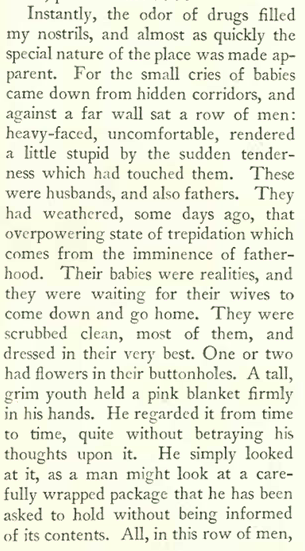
For his “A Reporter at Large” column, Morris Markey paid a visit to the Lying-In Society of New York, a maternity hospital now known as Rutherford Place. I include a few excerpts below to give some idea how times have changed in the past 89 years…

THE EASY PART…Fathers admire their newborns in this circa 1920s photo. At right, the building that housed the Lying-In Society of New York. Inset, one of the cherubs carved into the building’s facade. (Wikipedia)

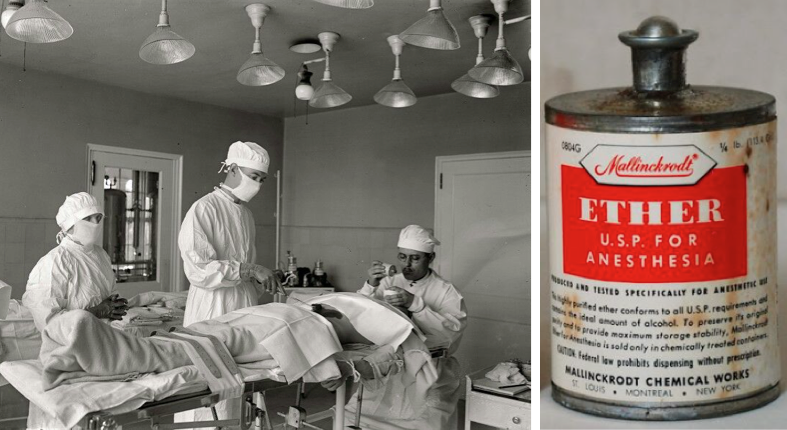
…imagine, if you will, the scent of ether (then commonly used as an anesthetic) and other drugs as you entered the hospital (no air-conditioning or HVAC to whisk those odors away!)…

NIGHTY NIGHT…Anesthesiologist administers ether and nitrous oxide to a patient before surgery in a Washington hospital, 1922. (Internet Archive: archive.org)

…not to mention the sweat of anxious fathers banished from delivery or recovery rooms…

WELCOME TO THE WORLD…Nurse learning to care for infants, Philadelphia General Hospital, c. 1930; nurses caring for infants at Long Hospital, Indiana University, in the 1920s. Note row of cribs fastened to the wall, which seemed to be a standard design back then. (upenn.edu/comet.soic.iupui.edu)

…or hospital stays for mothers that averaged ten days…

 *  *  *

Should Have Stayed Home

Dorothy Parker was dealing with a “baby’ of her in own, in this case a grown man with the conversational skills of brick wall. She related her experience in a casual titled, “But the One on the Right…” An excerpt:

Dorothy Parker, happily at home, in 1924. (New York Public Library)

 *  *  *

More Applause for Helen

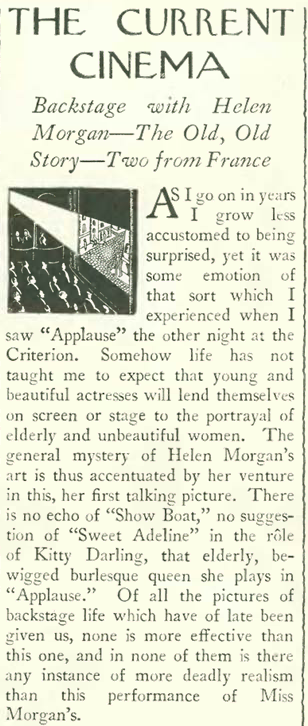
The New Yorker continued to shine an approving light on the work of nightclub singer Helen Morgan, this time in her first talking picture, Applause:

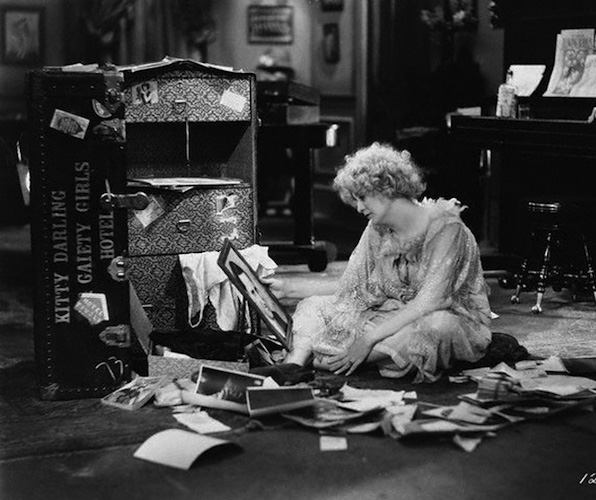
FALLING STAR…Helen Morgan (foreground, right) portrayed a fading burlesque star named Kitty Darling in 1929’s Applause, Morgan’s first all-talking picture. (MOMA)

On a sad note, Morgan’s real life had parallels to the film, including the abandonment of a child and a death due to alcohol and drugs — in the film Kitty overdoses on sleeping pills before a show; in real life Morgan would collapse onstage during a Chicago performance of George White’s Scandals. She would die of cirrhosis of the liver in 1941, at age 41.

IMITATING LIFE…Helen Morgan as Kitty Darling in Applause. Her best days behind her, Darling becomes an alcoholic who lives in the past. Sadly, Morgan’s real life had parallels to the movie. (art fuse.org)

There was no such applause from The New Yorker for another talkie, the screen adaptation of the popular Ziegfeld Broadway stage show Rio Rita:

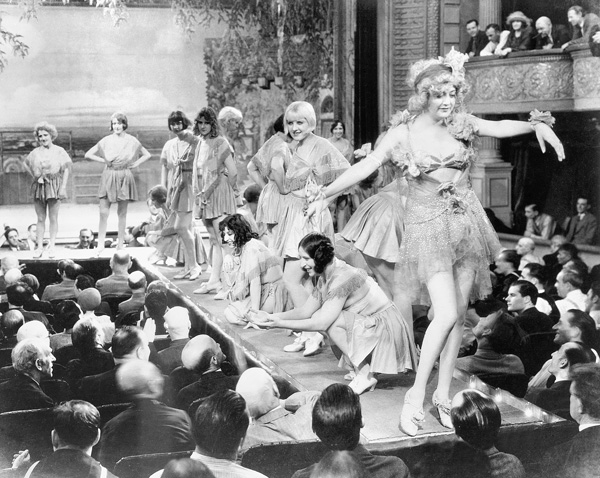
BEEN THERE, DONE THAT…Lobby Card for Rio Rita, featuring John Boles and Bebe Daniels. (IMDB)

 *  *  *

From Our Advertisers

The Stewart fashion shop on Fifth Avenue featured a series of attractive, modern ads, these two appearing in the Oct. 19 and 26 issues…

According to the terrific website Driving for Deco, “Stewart and Company broke away from the traditional department store layout. Instead of aisle after aisle of display cases the new store comprised many shops. These “shops” were not individually owned as in a present day mall. They were rooms or alcoves devoted to specific merchandise. The design of the shops and floors fell to several different interior design firms…”

Clockwise, from top, artist rending of the Stewart women’s shoe department; Stewart and Company building at 721 5th Avenue; Stewart Millinery Shop. (Vogue/Museum of the City of New York, all via drivingfordeco.com)

The Depression brought an end to Stewart and Company, which went out of business in the spring of 1930. Later that year Bonwit Teller opened in the former Stewart Building. They would close their doors to business 49 years later.

Sadly the building was demolished in 1980 to make way for a monument to a massive ego: Trump Tower.

Demolition of the former Stewart & Company building in 1980. The Rene Paul Chambellan bas-relief sculptures on the building’s facade were supposedly destined to the Metropolitan Museum of Art. Developer Donald Trump thought the removal of the sculptures was cost-prohibitive, so they were smashed by jackhammers. (drivingfordeco.com)

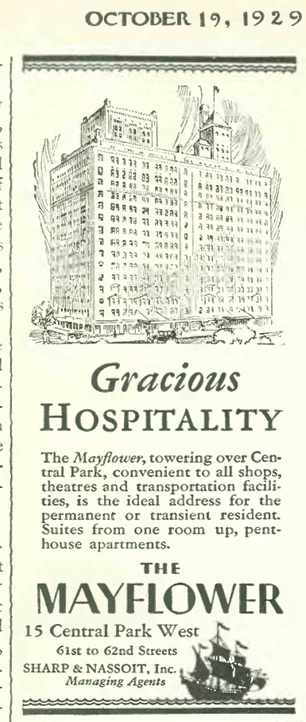
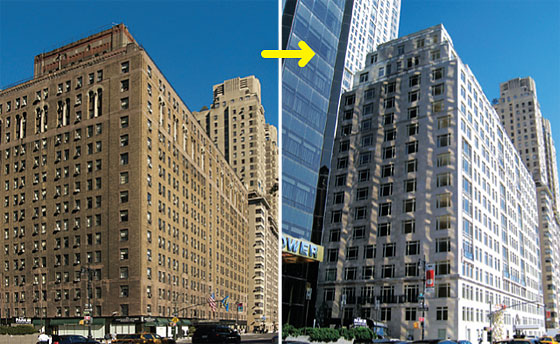
…back to the ads, we have another image of a building that is now but a ghost (I am writing this on Halloween)…

The Mayflower Hotel, left, a 1926 building designed by Emery Roth, was demolished in 2005 to make way for Robert A.M. Stern’s luxury condominiums, 15 Central Park West. (nymag.com)

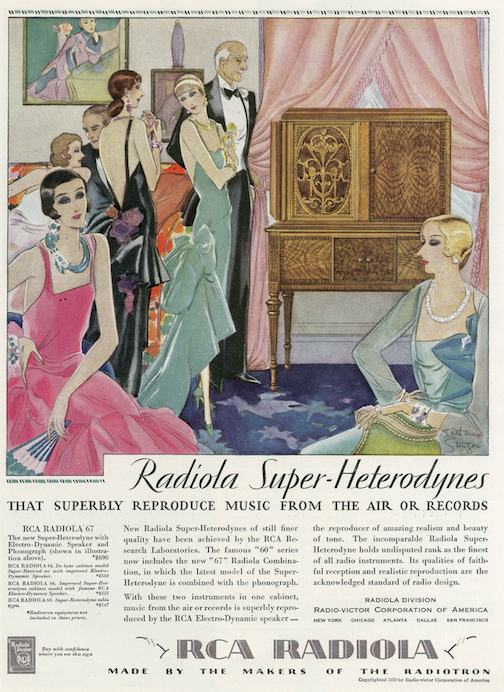
…speaking of luxury, these posh types seem to be almost lulled to sleep by RCA’s “Radiola Super-Heterodyne”…

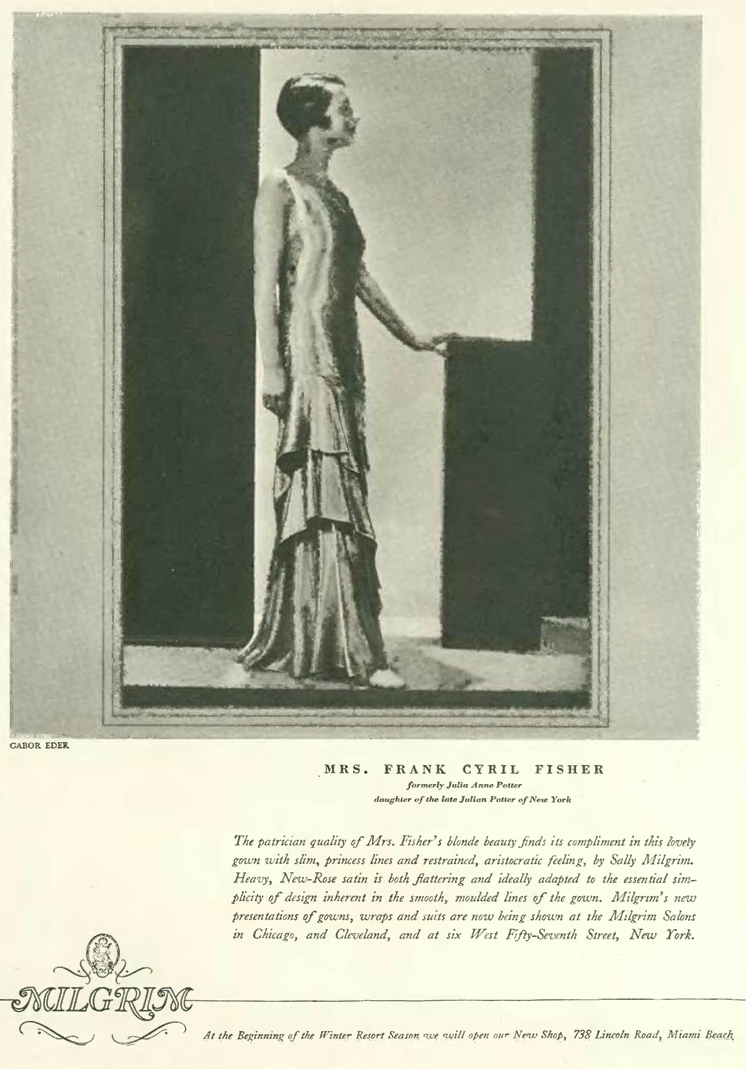
…and I throw in this ad from Milgrim for its use of the word “patrician” to appeal to the aristocratic yearnings of some New Yorker readers…

…perhaps those patricians would have preferred a move to “aristocratic” Scarsdale, as the middle ad below suggests, or perhaps they would have chosen something more “unusual” in East Orange…

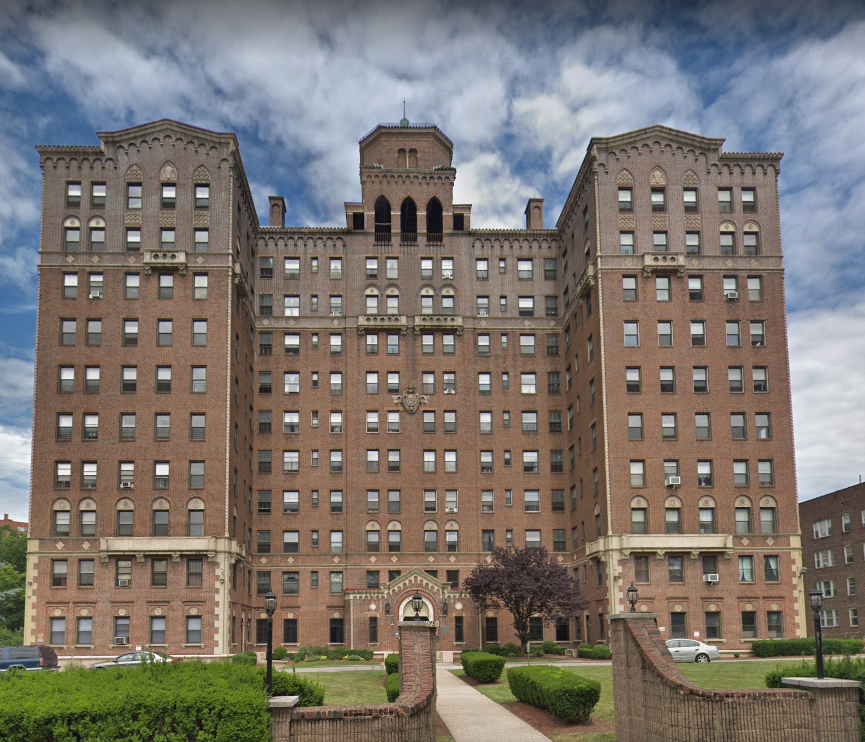
…for reference, here is a Google street view image of 75 Prospect in East Orange, New Jersey…

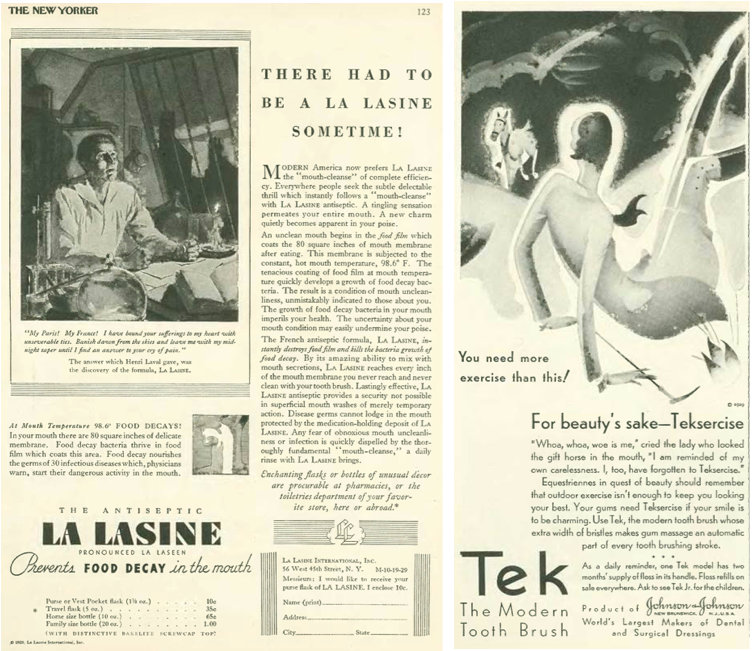
…and if you were of the upper classes, you probably would have wanted the latest in toothbrushes and “French” mouthwashes…

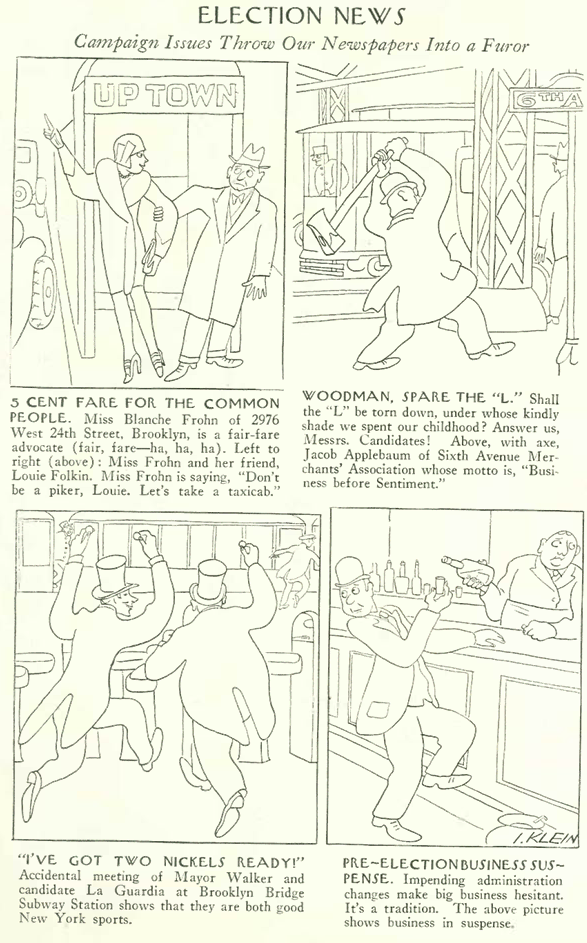
…on to our illustrators and cartoonists, Isadore Klein looked in on the elections…

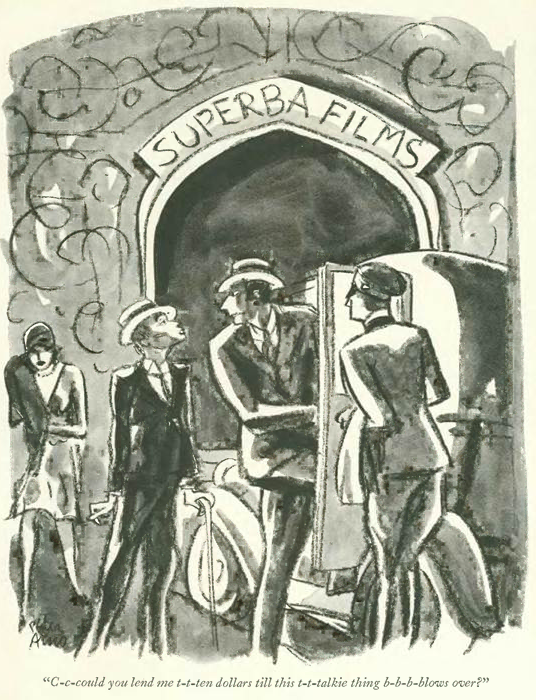
Peter Arno illustrated the plight of a hapless silent film actor…

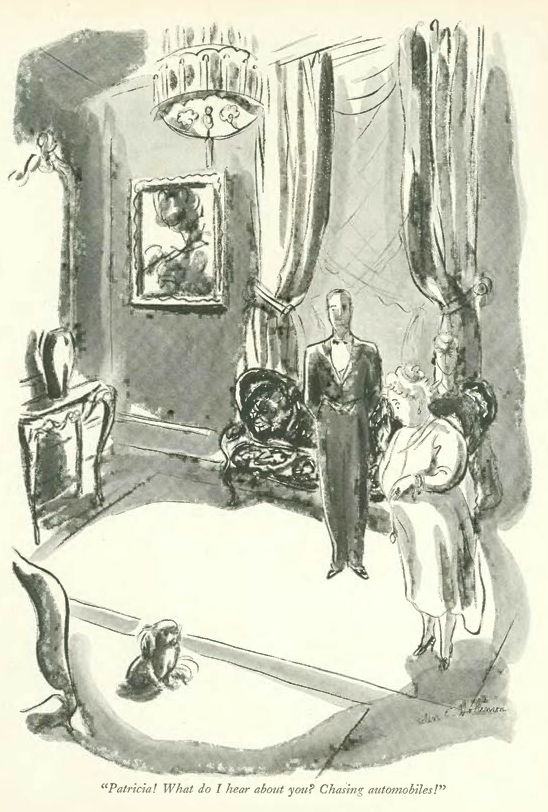
…and Helen Hokinson eavesdropped on a canine faux pas…

Next Time: Prelude to a Crash…