Picking on Pickford

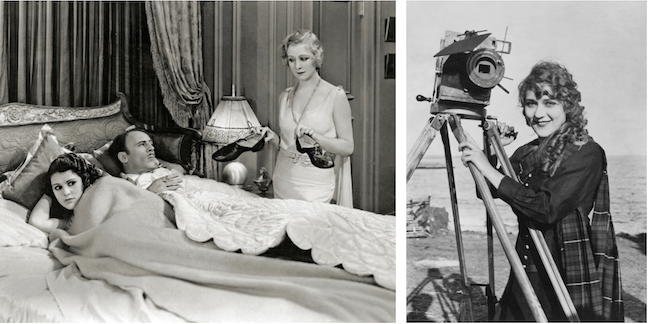
Above: Mary Pickford (right, from 1916) spoke out against salacious content in films, such as this scene from 1930's Madam Satan. (Wikipedia/mainemedia.edu)

James Thurber seemed to enjoy teasing silent film legend Mary Pickford in her new career as social commentator and author of spiritual articles and books. Having retired from acting in 1933, Pickford was also using her powerful position as a co-founder of United Artists to focus on the moral direction of the film industry.
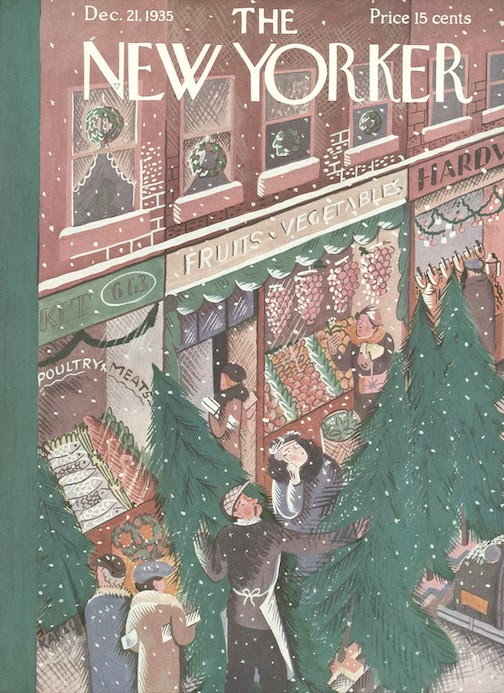
December 21, 1935 cover by Ilonka Karasz.

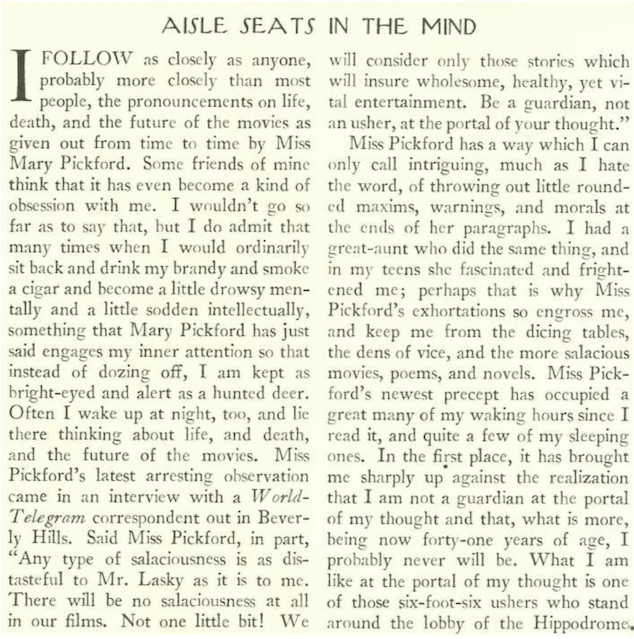
Back in the Sept. 21 issue of The New Yorker, Thurber took a humorous poke at Pickford’s Liberty magazine article on the afterlife, and found more fodder after Pickford, in an interview with the World-Telegram, criticized “salacious” films. “Be a guardian, not an usher, at the portal of your thought,” she advised. Thurber took the bait. Excerpts:
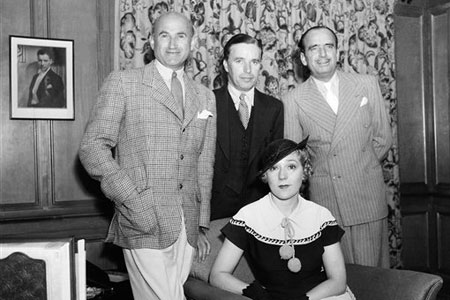
KEEPING IT CLEAN…From left, producer Samuel Goldwyn, actors Charlie Chaplin and Douglas Fairbanks Sr. pose behind Mary Pickford at a United Artists board meeting in Los Angeles, July 9, 1935. (AP)

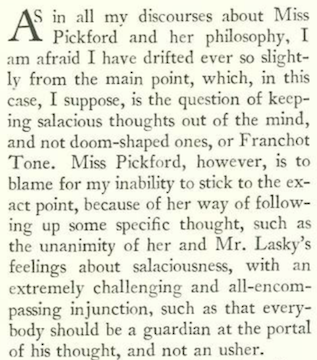
Thurber took particular pleasure in Pickford’s comments regarding the control of one’s dirty thoughts:
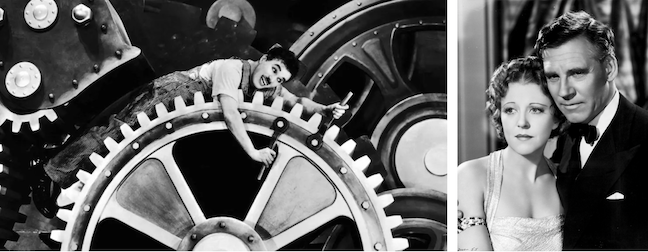
PICKFORD’S UNITED ARTISTS produced some memorable, non-salacious films in 1936, including Charlie Chaplin’s Modern Times, and the acclaimed Dodsworth starring Ruth Chatterton and Walter Huston as Fran and Sam Dodsworth. (Wikipedia)

Pickford had a strong ally in the Hays Code, a set of self-imposed censorship guidelines that would keep mainstream studio films relatively free of salacious content for the next thirty years.

 * * *

A White Christmas

E.B. White offered holiday greetings to everyone from drinkers of blended whiskey to the makers of red tape (plus a plug for New Yorker subscriptions)…
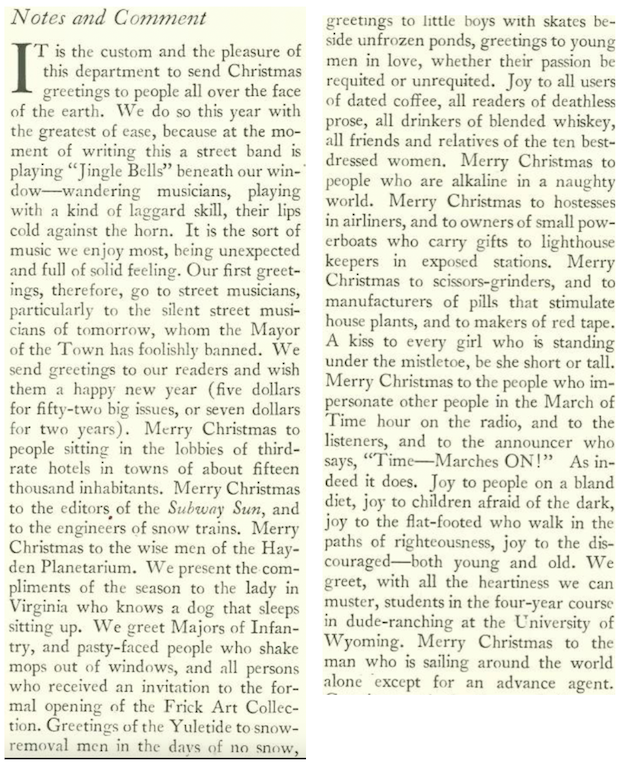
CHEERS AND JEERS…E.B. White sent holiday greetings to the men who were changing the Normandie’s massive propellers (from three- to four-blade), and probably wanted to give a lump of coal to Mayor Fiorello La Guardia for “foolishly” banning organ grinders from city streets. (ships nostalgia.com/ephemeralnewyork)

…and concluded with these words…

Otto Soglow added this bit of spot art to the bottom of White’s “Notes and Comment”…

 * * *

A Holiday Tradition

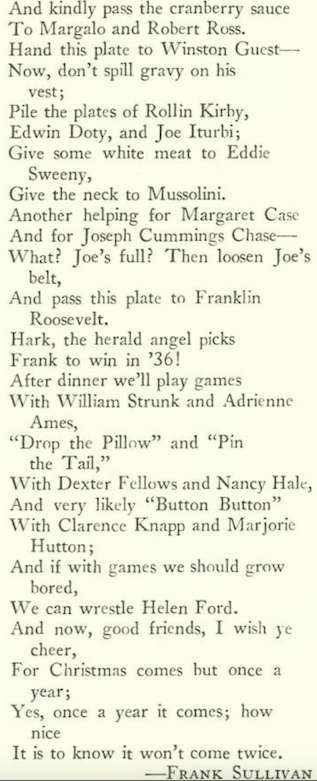
Page 21 featured Frank Sullivan’s annual Christmas poem (he wrote forty-two of them from 1932 to 1974)…
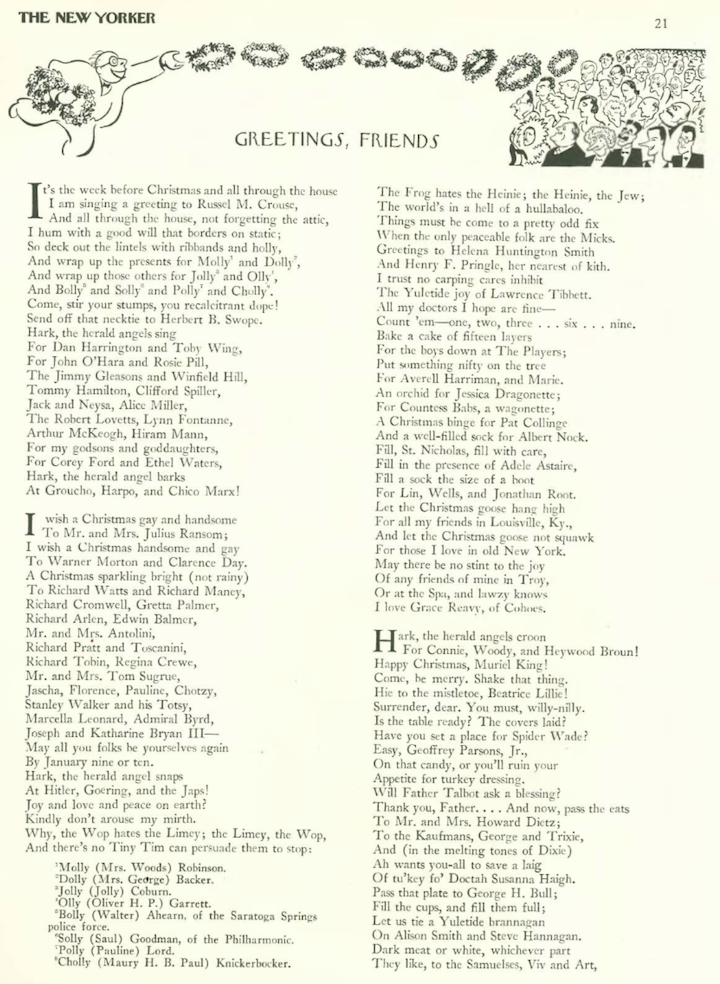
…which continued on page 22…
 * * *

Lost In Paradise

Robert Benchley did the honors as theatre critic for the Dec. 21 issue, enjoying an evening at Longacre Theatre with the richly endowed characters featured in Clifford Odets’ Paradise Lost.
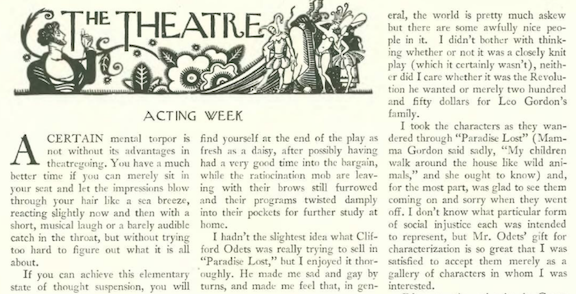
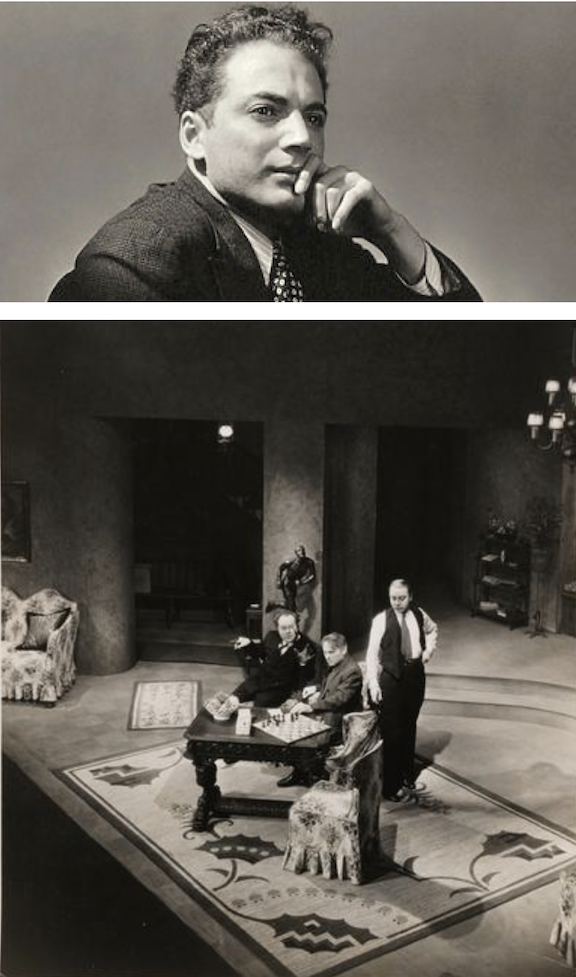
GREAT PLAY, WHATEVER IT MEANS…Robert Benchley thoroughly enjoyed Clifford Odets’ gallery of characters in Paradise Lost. Top, Odets circa 1930s; below, photo from the 1935-36 production at Broadway’s Longacre Theatre. (mcny.org)

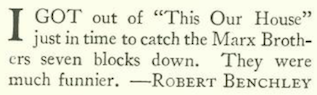
Apparently the rest of the Broadway fare was not so great, as Benchley fled Cort’s Theatre (it featured This Our House, which closed after just two performances) to catch A Night at the Opera with the Marx Brothers. 
 * * *

At the Movies

Benchley wasn’t the only one enjoying a night at the movies. Critic John Mosher found favor with German actor Emil Jannings’ latest flick, The Making of a King (Der alte und der junge König), calling the film “a sensible picture of the old bully,” namely the father of Frederick the Great.

LIGHTEN UP, FRED…Heinrich Marlow (left) and Emil Jannings in a scene from The Making of a King. The film depicted the turbulent relationship between Prussian King Friedrich Wilhelm I and his son, Crown Prince Friedrich. (IMDB)

Mosher found bright moments in Ginger Rogers’ latest film, but would have preferred another pairing with her fellow hoofer, Fred Astaire.
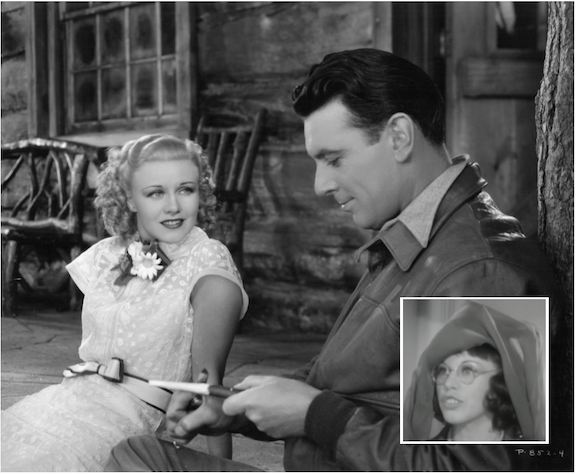
BETTER WITH FRED thought John Mosher of Ginger Rogers’s brave turn as an actress fleeing from her admiring fans in 1935’s In Person. Rogers donned eyeglasses, a wig, and fake teeth (inset) to portray the actress in hiding. She is pictured here in a scene with co-star George Brent. (IMDB)

Mosher was stimulated by The Great Impersonation, however, the “cordial” films about small town life and happy radio folk left him less than enthused.
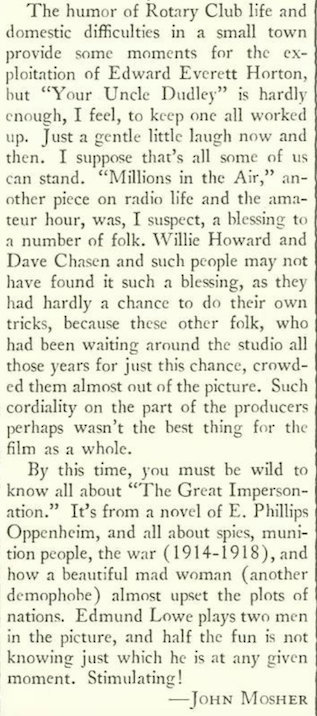
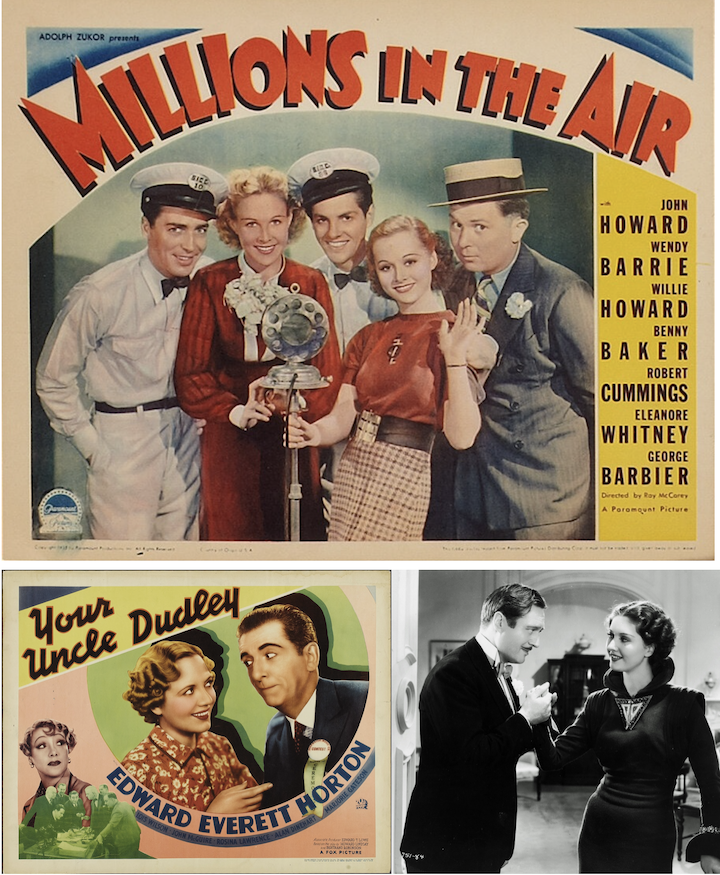
MORE SPIES, PLEASE…John Mosher didn’t get too excited over the standard fare offered in the films Millions in the Air and Your Uncle Dudley, however he found the performances of Edmund Lowe and Wera Engels (bottom right) in the spy caper The Great Impersonation to be most stimulating. (IMDB)

* * *

From Our Advertisers

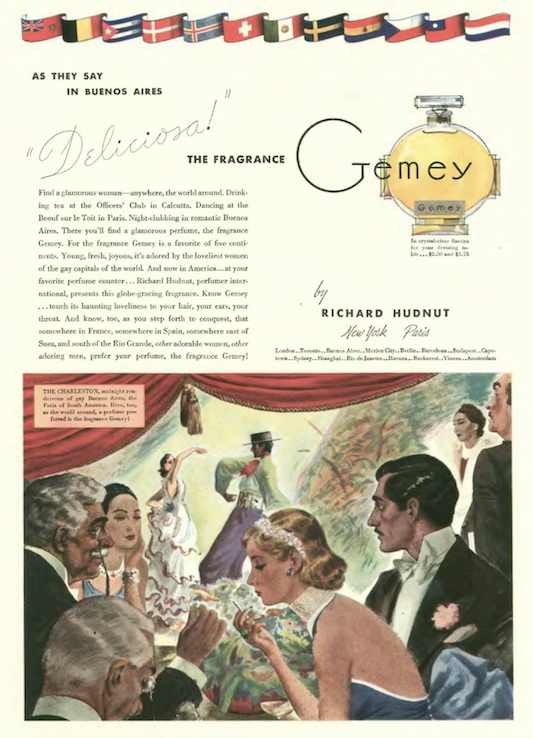
After touring France in the late 1870s, a New York drugstore owner named Richard Hudnut returned to the States determined to introduce French-style perfumes and cosmetics to American women. He soon transformed his drugstore into an elegant showroom, and in time became the first American to achieve international success in cosmetics…
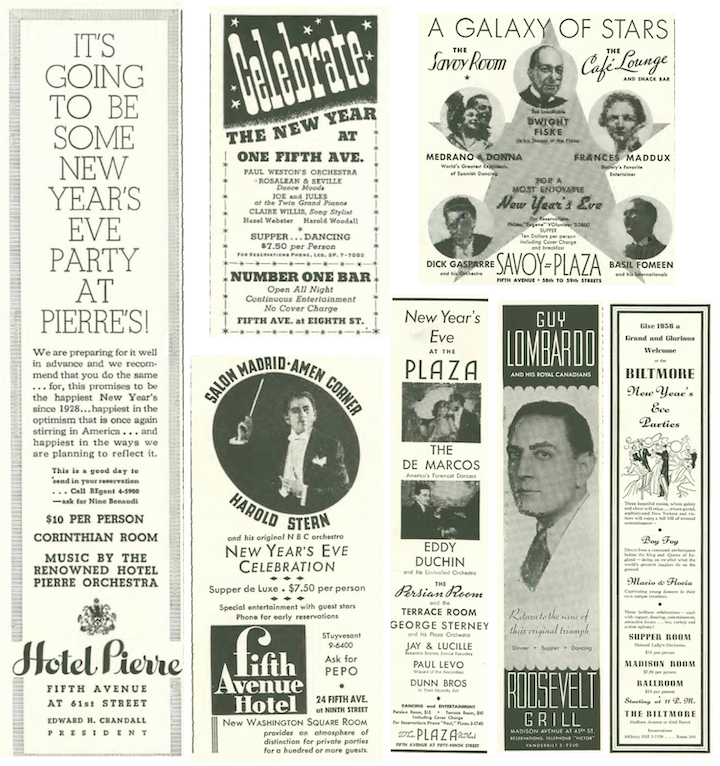
…advertisements for Christmas gifts mostly dropped out of the magazine, and the back of the book was filled with spots touting various New Year’s Eve entertainments…
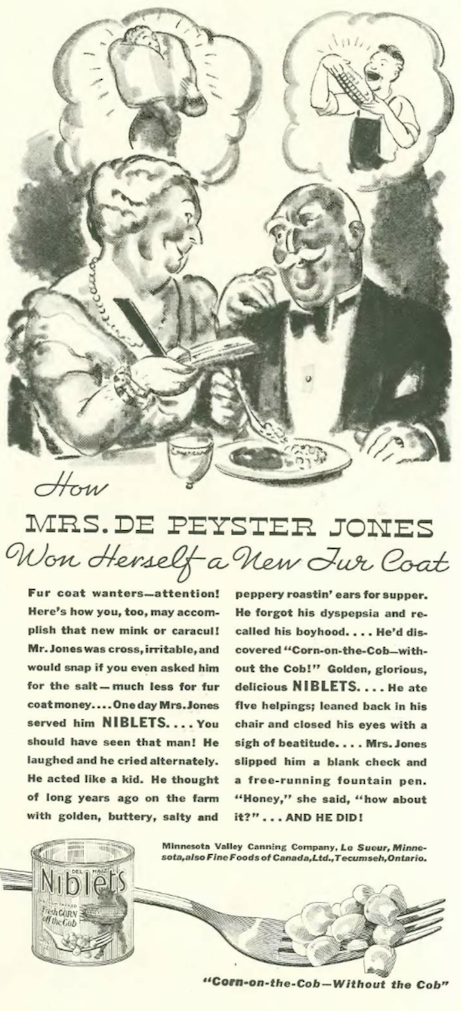
…in this ad from the Minnesota Valley Canning Company (renamed Green Giant in 1950), a robber baron’s humble roots, and his checkbook, are triggered by a can of corn…
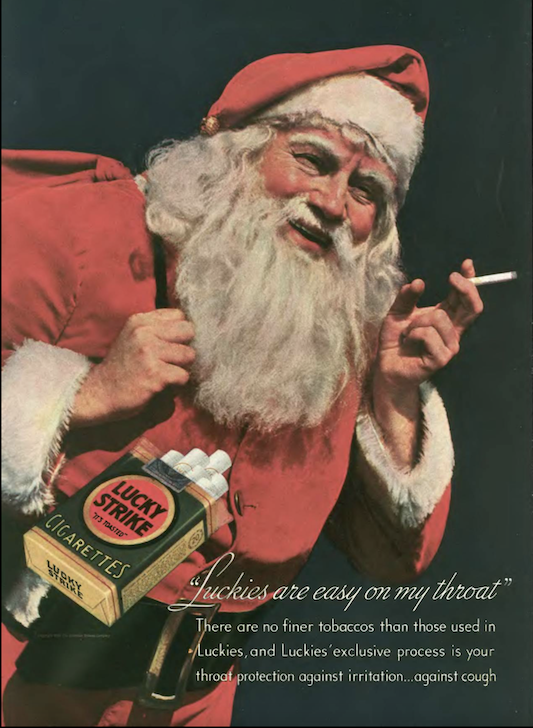
…thanks to the makers of Luckies, Jolly Old St. Nick was dropping more than soot down your chimney on Christmas Eve…
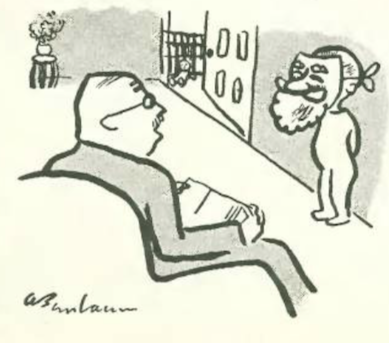
…we kick off our cartoons with this spot illustration by Abe Birnbaum

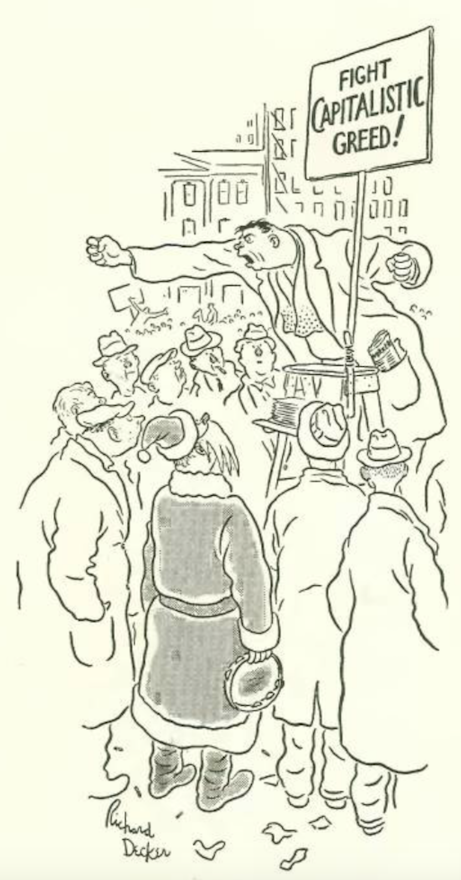
...Richard Decker gave us this caption-less appeal to the masses…
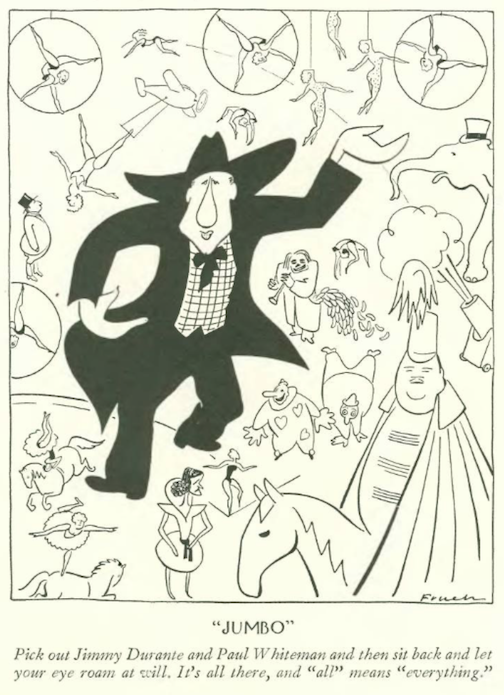
Al Frueh brightened up the “Theatre” section…
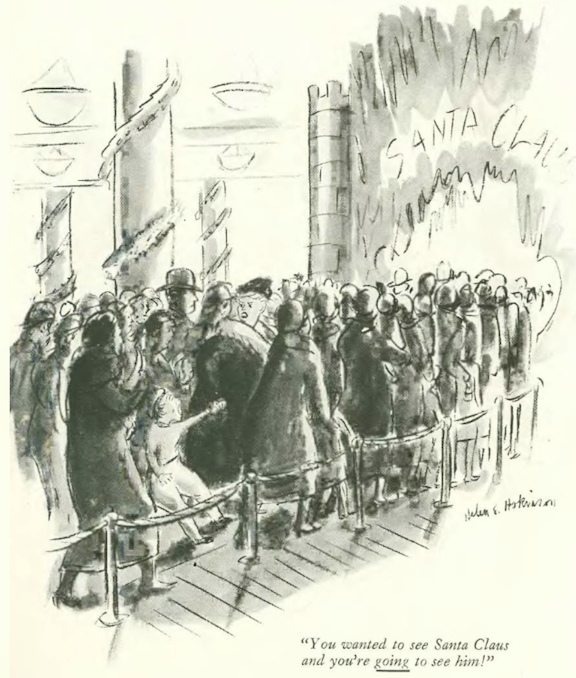
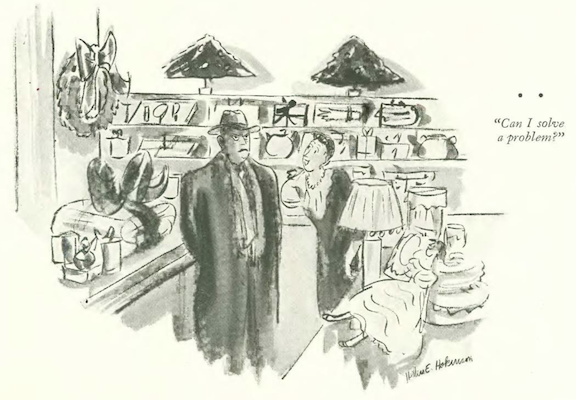
Helen Hokinson got in line at Macy’s…

…and found a challenge in the housewares department…(see Summer Pierre’s wonderful tribute to Hokinson and her observational forays into the city with James Reid Parker)…
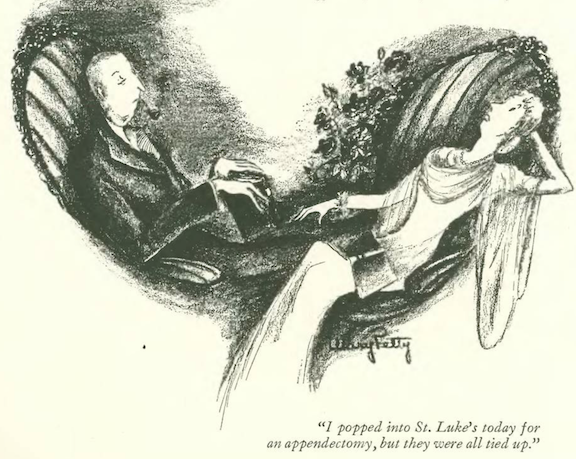
Mary Petty took the laid-back approach to a medical emergency…
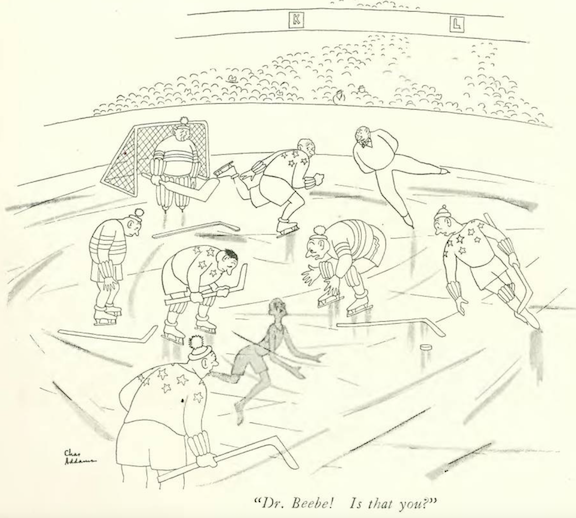
Charles Addams placed undersea explorer William Beebe in a precarious situation…
Alan Dunn diagnosed a bad a ticker at a watch shop…

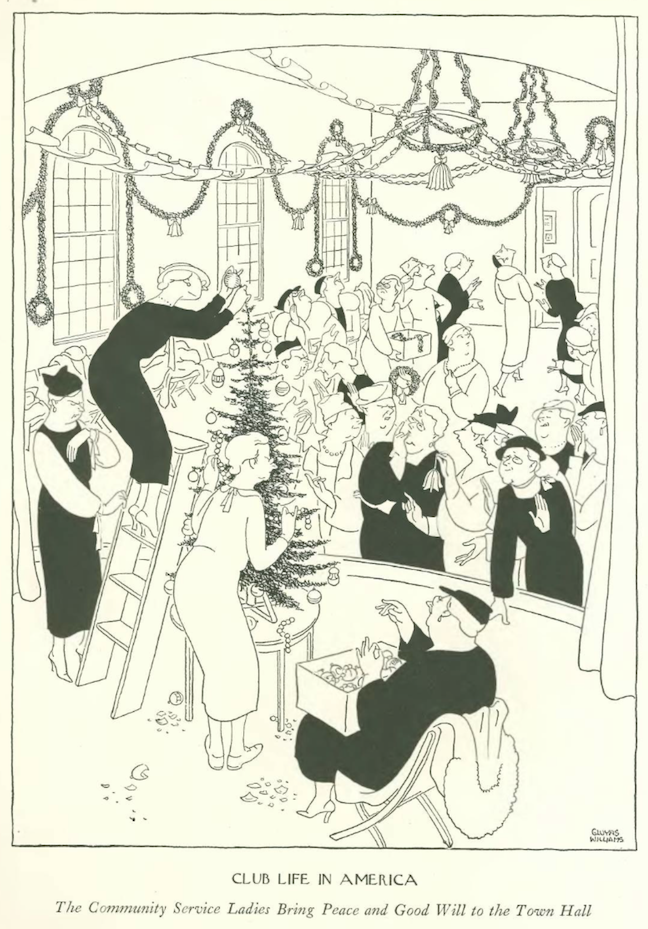
Gluyas Williams was back with another look at club life…
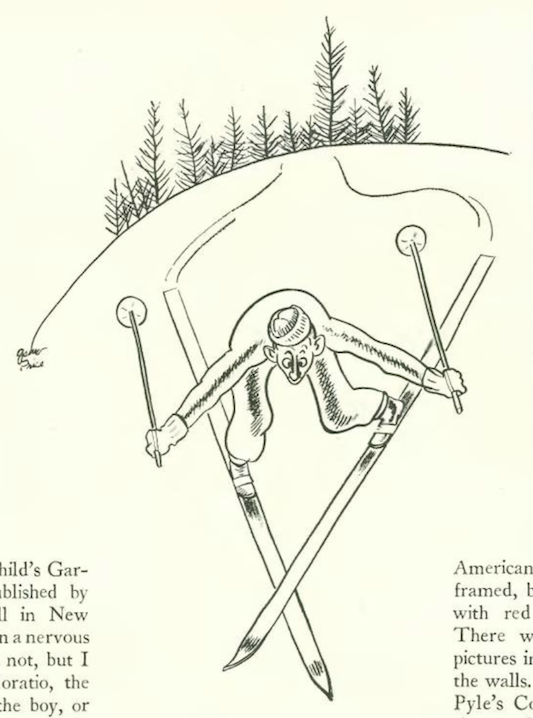
Garrett Price snowplowed his way onto the page…
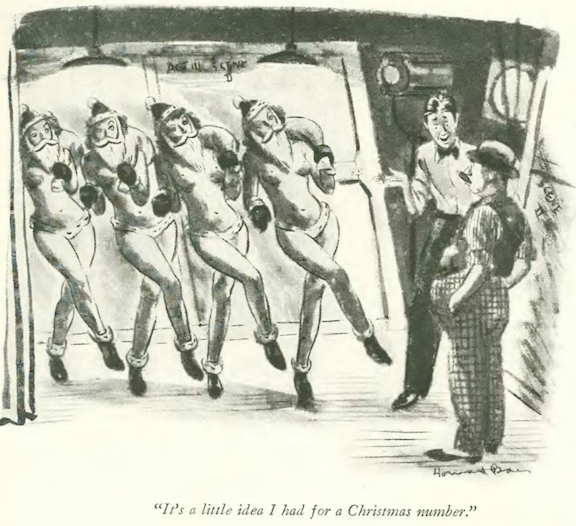
…it seems Howard Baer channeled Peter Arno for this one…
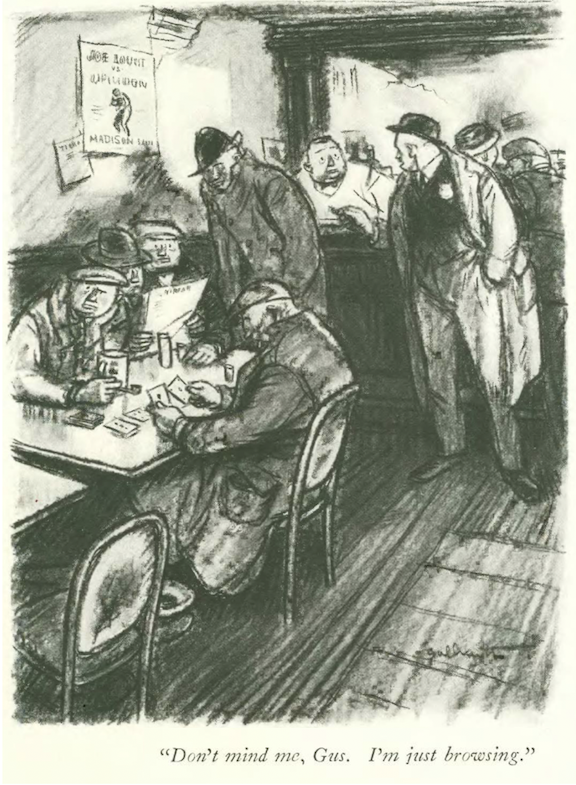
…and we close with William Crawford Galbraith, just doing a little browsing…
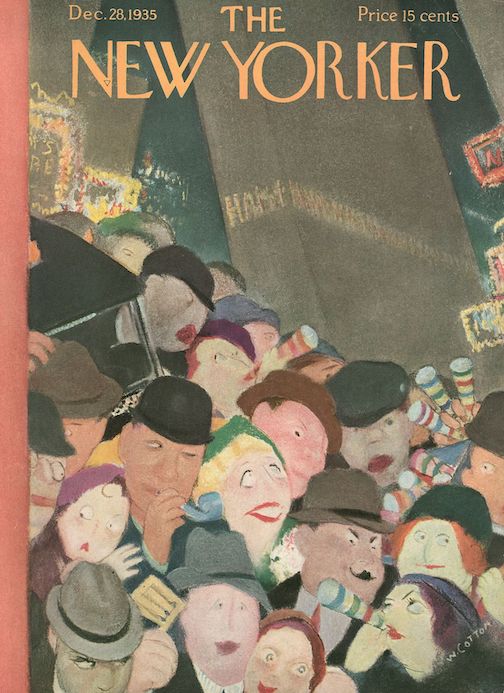
Next Time: Fracking the Frick…
A Blue Angel

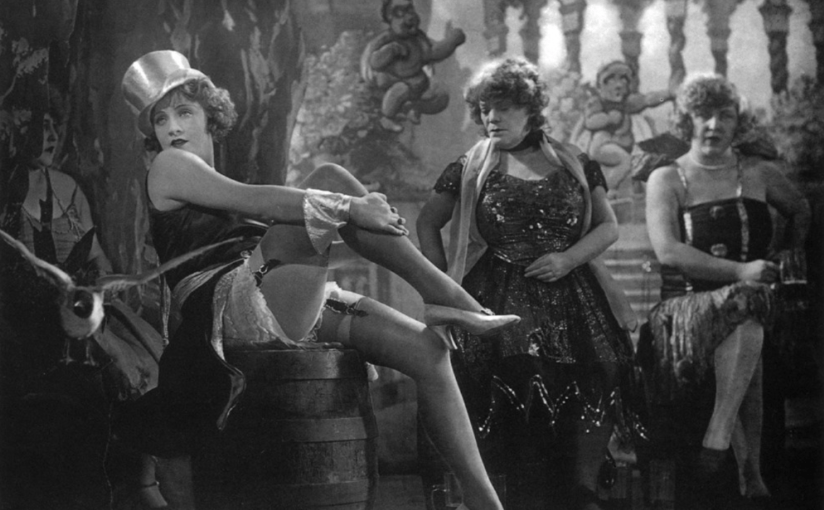
The German actor Emil Jannings was well-known to American audiences when The Blue Angel (Der blaue Engel) premiered at New York’s Rialto Theatre. Although the film was created as a vehicle for the Academy Award-winning Jannings (he won the Academy’s first-ever best actor award in 1929), it was the little-known Marlene Dietrich who stole the show and made it her ticket to international stardom.

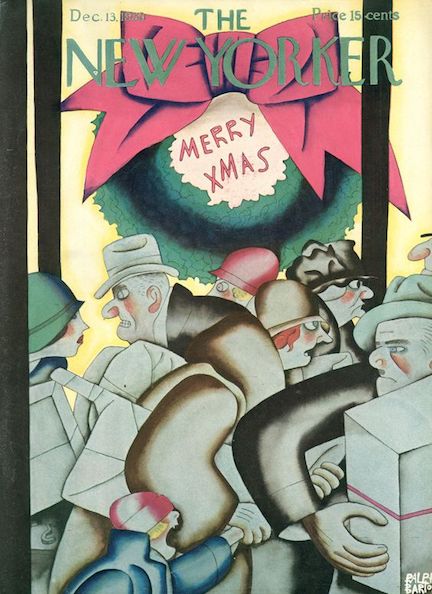
Dec. 13, 1930 cover by Ralph Barton, surprisingly his only cover for The New Yorker. The illustration sadly belies Barton’s state of mind at the time; he would take his own life the following spring.

New Yorker film critics, including John Mosher, generally found foreign films, particularly those of German or Russian origin, to be superior to the treacle produced in Hollywood, and Jannings was a particular favorite, delivering often heart-wrenching performances in such silent dramas as The Last Laugh (1924) and The Way of All Flesh (1927). In those films he depicted once-proud men who fell on hard times, and such was the storyline for The Blue Angel, in which a respectable professor falls for a cabaret singer and descends into madness.

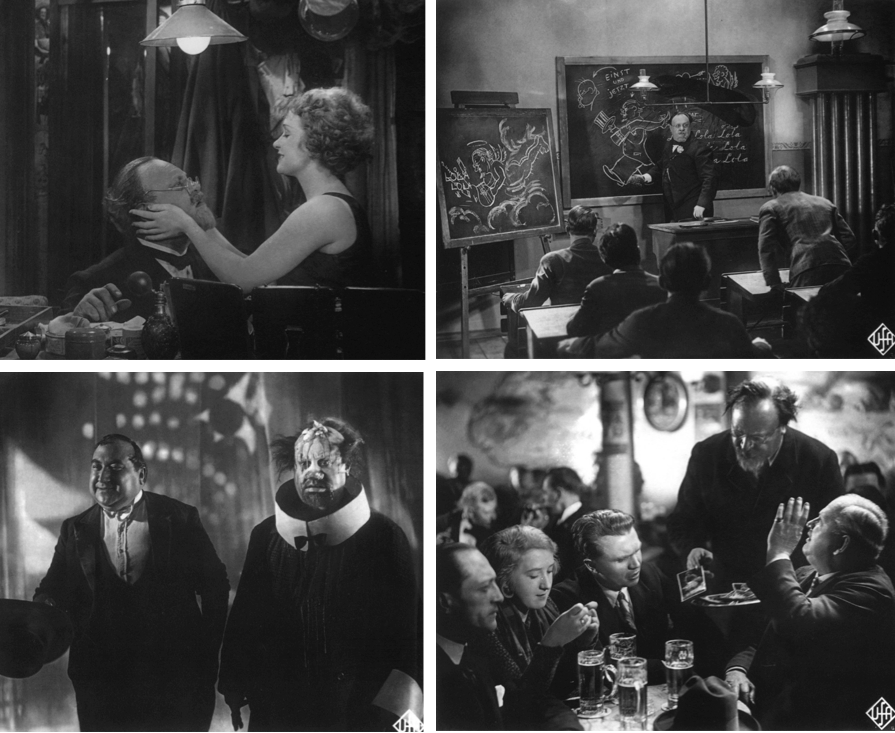
NO CONTEST…Emil Jannings had star billing for the English language version of Josef von Sternberg’s The Blue Angel, but it was Marlene Dietrich’s portrayal of cabaret singer Lola Lola that stole the show. (IMDB)

I was surprised by Mosher’s somewhat tepid review of this landmark film, which was shot simultaneously in German and English (with different supporting casts in each version). He referenced “bum dialogue,” which was doubtless the result of German actors struggling with English pronunciations. Filmed in 1929, it is considered to be Germany’s first “talkie.”

PRIDE BEFORE THE FALL…A proud and stern schoolmaster named Immanuel Rath (Emil Jannings) falls for cabaret singer Lola Lola (Marlene Dietrich), and from there his life unravels; he loses the respect of his pupils, then resigns his post to marry Lola. To make ends meet, Rath tries to sell racy photos of his wife, and then becomes a clown in her troupe and is regularly humiliated on stage. Destitute, he dies at the end of the film. (IMDB)

 *  *  *

All Wet

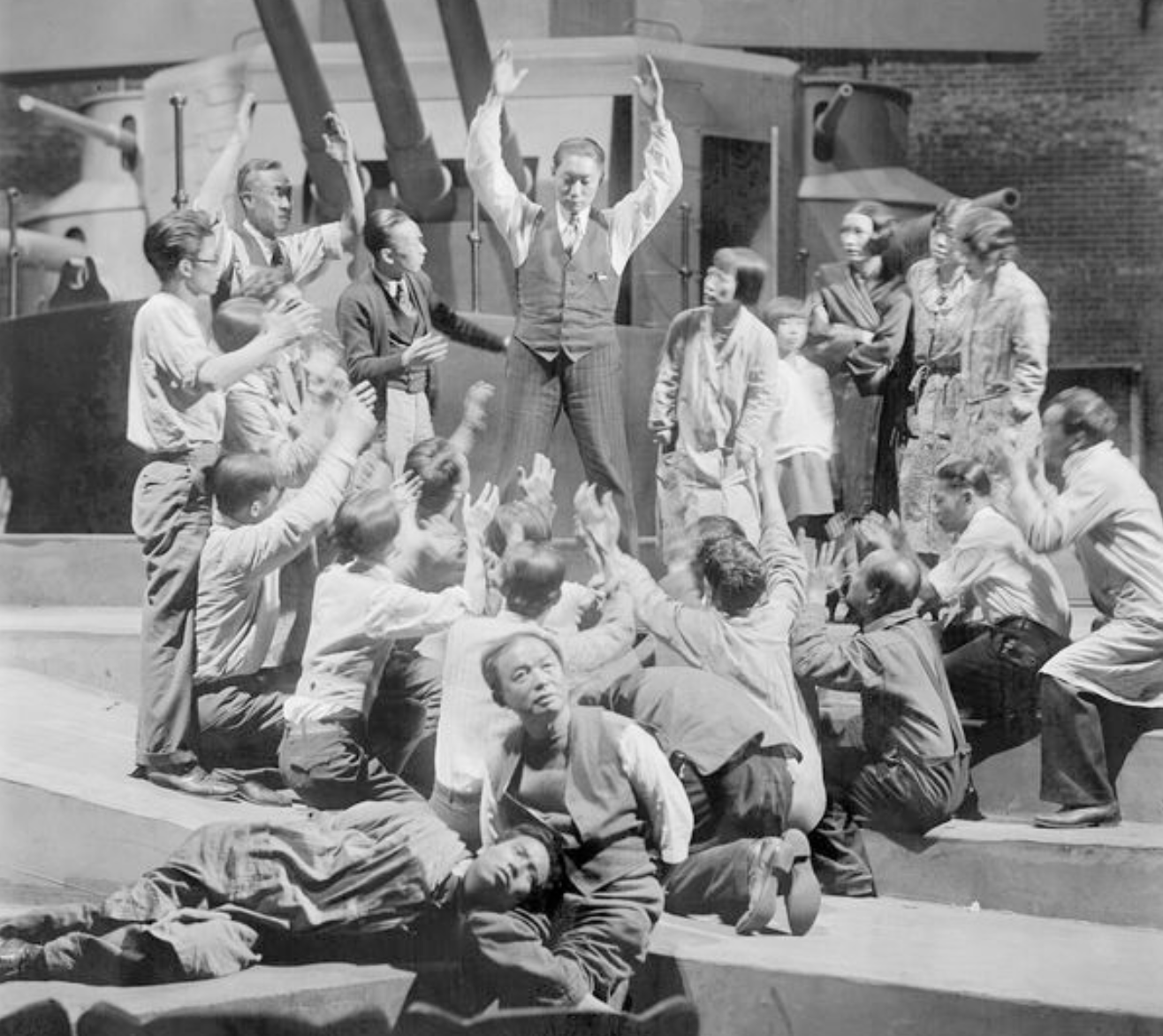
Sergei Tretyakov’s avant-garde play Roar China made an impression on The New Yorker for the striking realism of its set, which featured an 18,000-gallon tank of water onstage at the Martin Beck Theatre. “The Talk of the Town” described some of the demands of the production:

STAYING AFLOAT…The elaborate set for Roar China featured a model battleship in 18,000 gallons of water.
ROAR CHINA! was an anti-imperialist play depicting the Wanhsien Incident during the Chinese Civil War. Many in the Chinese cast members were non-professional actors. (New York Public Library)

  *  *  *

By Any Other Name

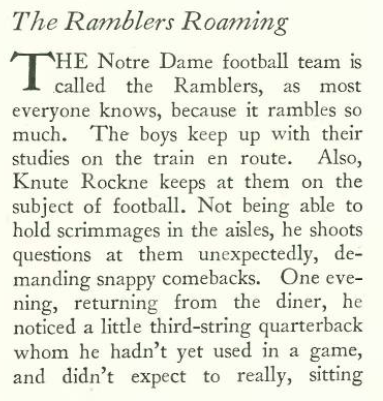
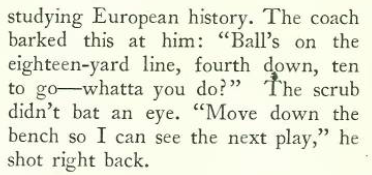
Like many college football teams in first decades of the 20th century, Notre Dame was referred to by a number of nicknames, including the “Fighting Irish.” In this “Talk of the Town” item, however, the team was known as the “Ramblers.” According to the University of Notre Dame, this nickname (along with “The Rovers”) was considered something of an insult: “(Knute) Rockne’s teams were often called the Rovers or the Ramblers because they traveled far and wide, an uncommon practice before the advent of commercial airplanes. These names were also an insult to the school, meant to suggest it was more focused on football than academics.”

RAMBLERS NO MORE…The 1930 National Champion Notre Dame football team. (nd.edu)

 *  *  *

The Wright Stuff

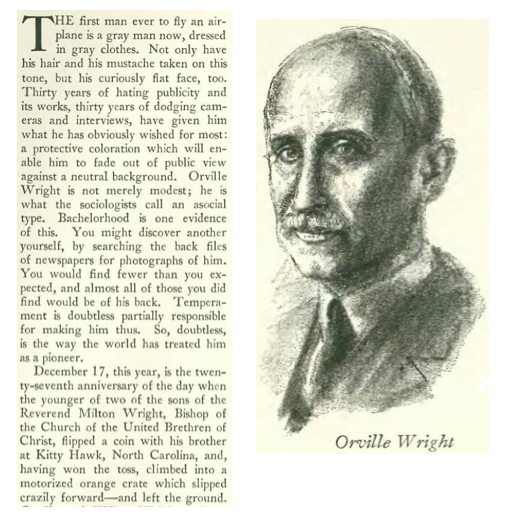
Eric Hodgins penned a profile of aviation pioneer Orville Wright, who just 27 years earlier made a historic “first flight” with his brother, Wilbur, at Kitty Hawk, North Carolina. An excerpt:

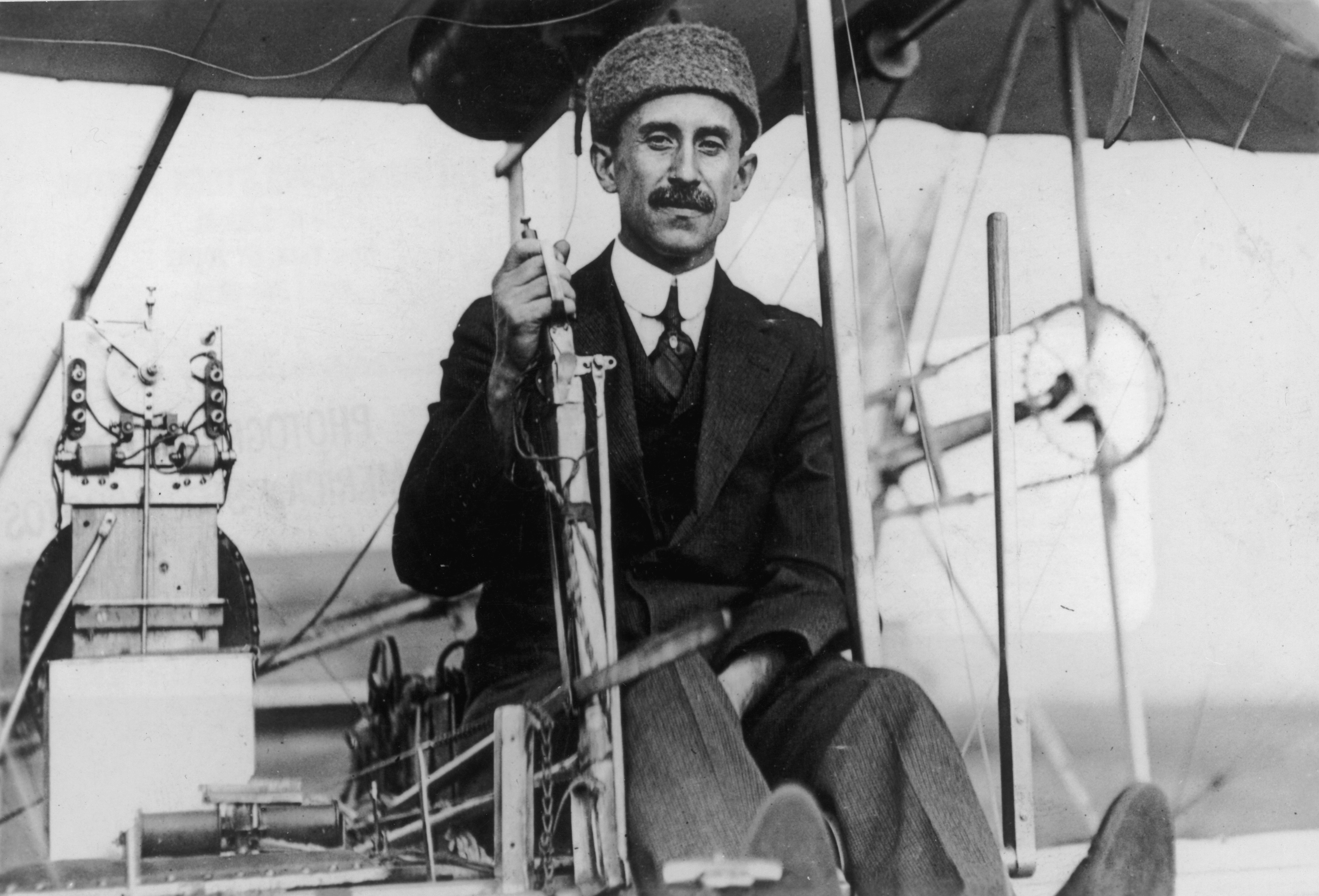
DRESSED FOR SUCCESS: Aviation pioneer Orville Wright (1871 – 1958) sits in one of his biplanes dressed in a three-piece suit and a cap, Dayton, Ohio, 1909. (ge.com)

 *  *  *

No Love Parade, This

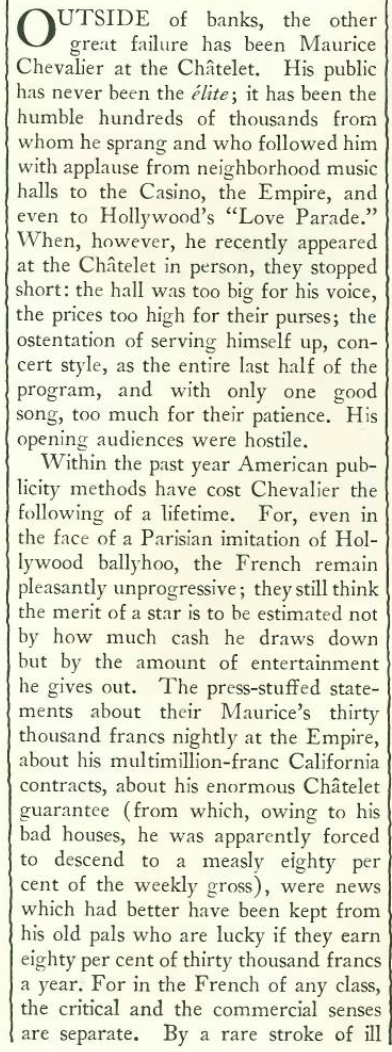
French singer and actor Maurice Chevalier made his Hollywood debut in 1928 and quickly soared to stardom in America. French audiences, however, were not so easily swayed, especially the elite patrons Chevalier faced, alone on the stage, at the cavernous Théâtre du Châtelet. Janet Flanner explained in this dispatch from Paris:

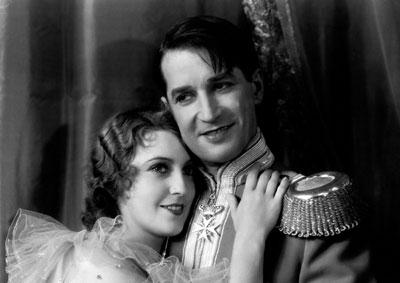
THEY LIKE ME IN TINSELTOWN…Jeanette MacDonald and Maurice Chevalier in The Love Parade (1929). (IMDB)
GULP…Maurice Chevalier faced a tough crowd — his compatriots — at Paris’s Théâtre du Châtelet. (en.parisinfo.com)

 *  *  *

Man’s Best Friend

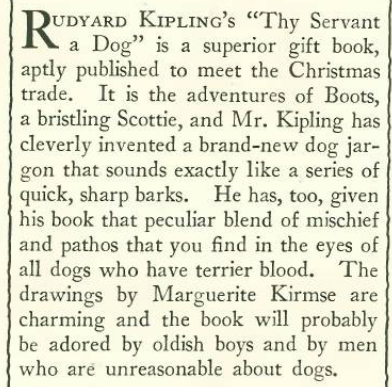
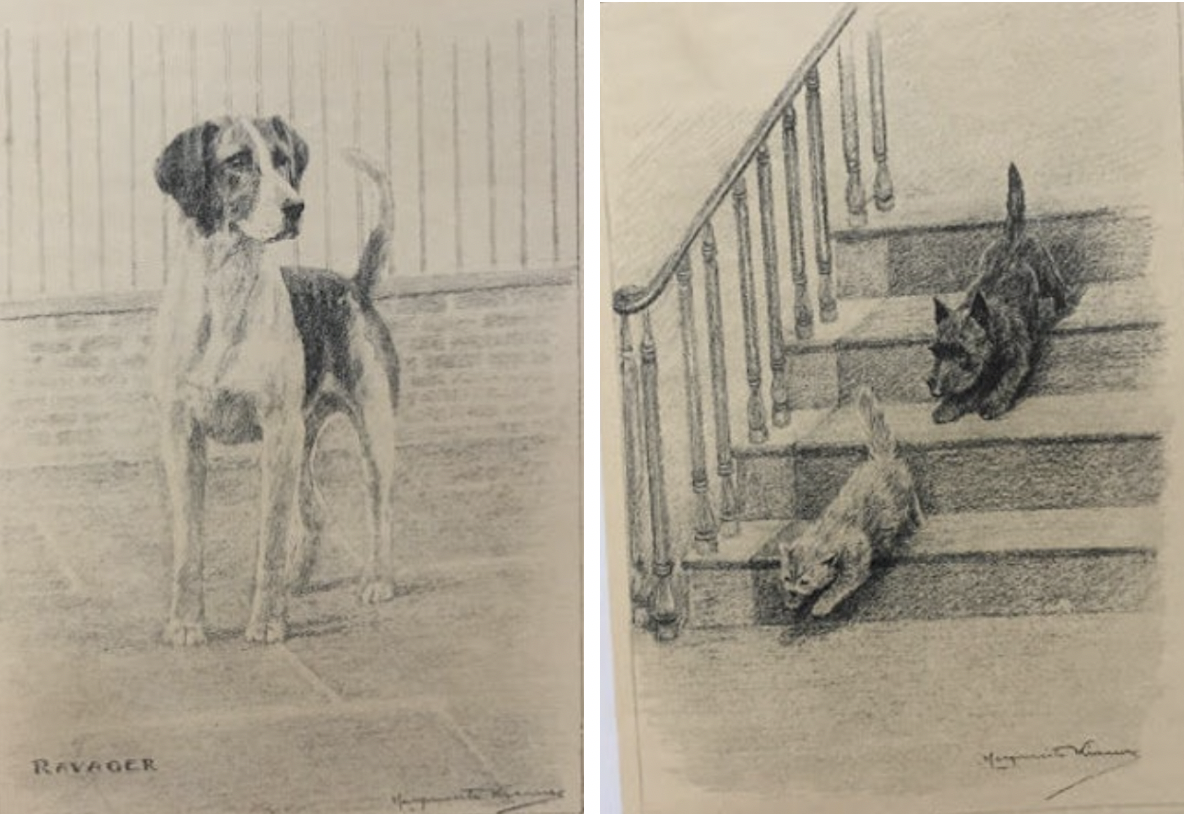
The New Yorker’s book section recommended the latest from Rudyard Kipling, Thy Servant a Dog…

WOOF…Illustrations for Rudyard Kipling’s Thy Servant a Dog, by Marguerite Kirmse. (Etsy)

 *  *  *

Fun and Games

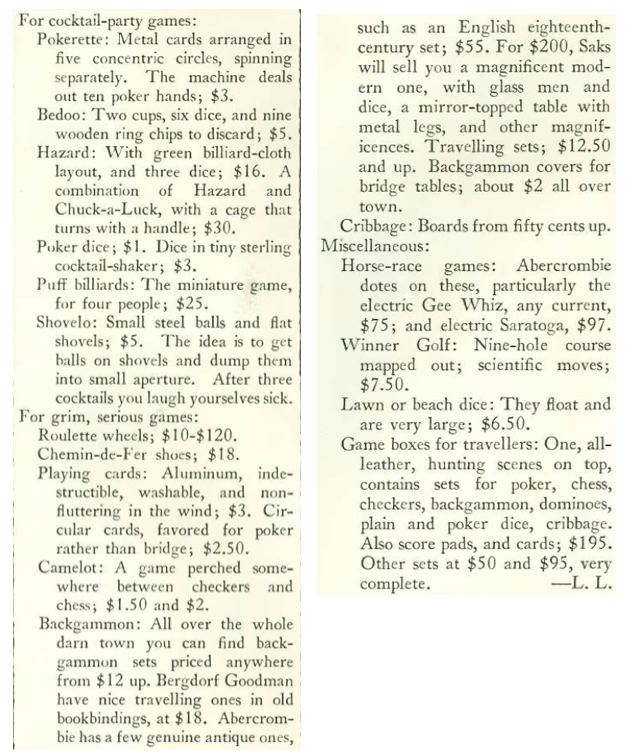
As an extension to her fashion column, Lois Long shared some recommendations for holiday cocktail-party games:

KEEPING THINGS MERRY…Pokerette and Gee-Wiz were popular cocktail party diversions during the Christmas season of 1930. (Worthpoint/Invaluable)

*  *  *

From Our Advertisers

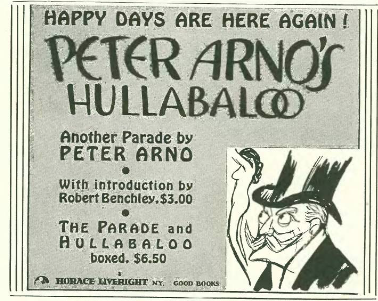
We start with this ad from Horace Liveright promoting Peter Arno’s third cartoon collection, Hullaballoo, featuring one of Arno’s leering old “Walruses”…

…Doubleday Doran offered a few selections for last-minute Christmas shoppers, led by the Third New Yorker Album

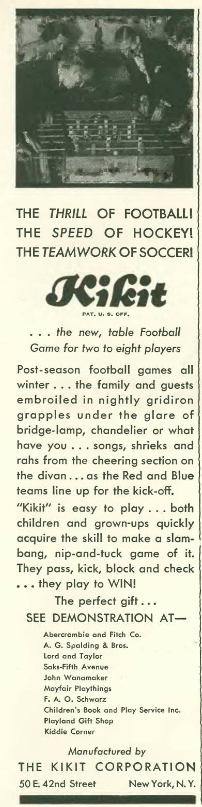
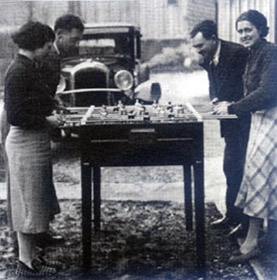
…The UK’s Harold Searles Thorton invented the table top game we now call “foosball” in 1921 and had it patented in 1923. Below is possibly the game’s first appearance in the U.S. — an ad for a “new” game called “Kikit.” Foosball would be slow to catch on, but would rapidly gain popularity in Europe in the 1950s and in the U.S. in the 1970s…

Early foosball players circa 1930. (foosball.org)

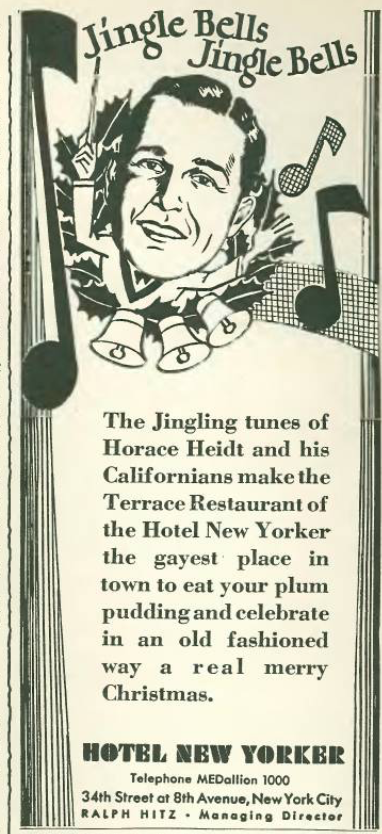
Horace Heidt and his Californians were doing their best to make the season bright at the Hotel New Yorker…

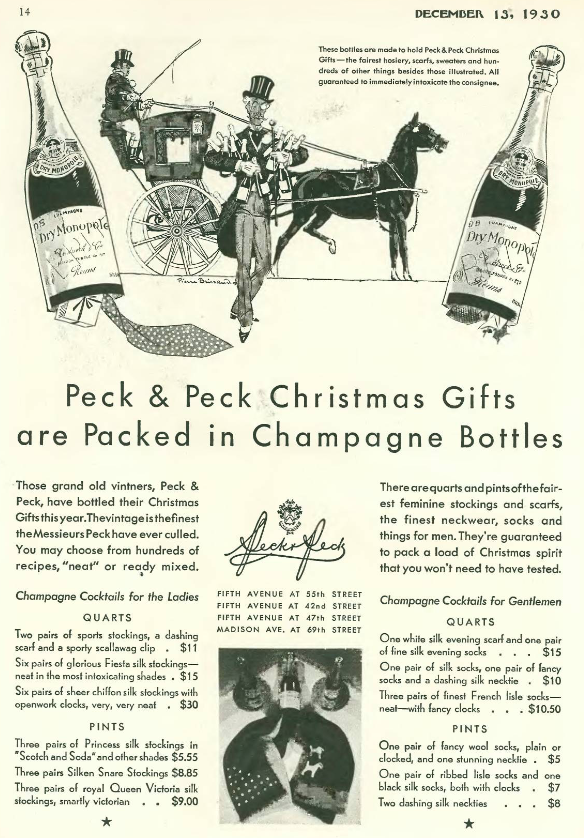
…Peck & Peck tried to make the most of Prohibition by stuffing scarves and other wares into empty Champagne bottles…

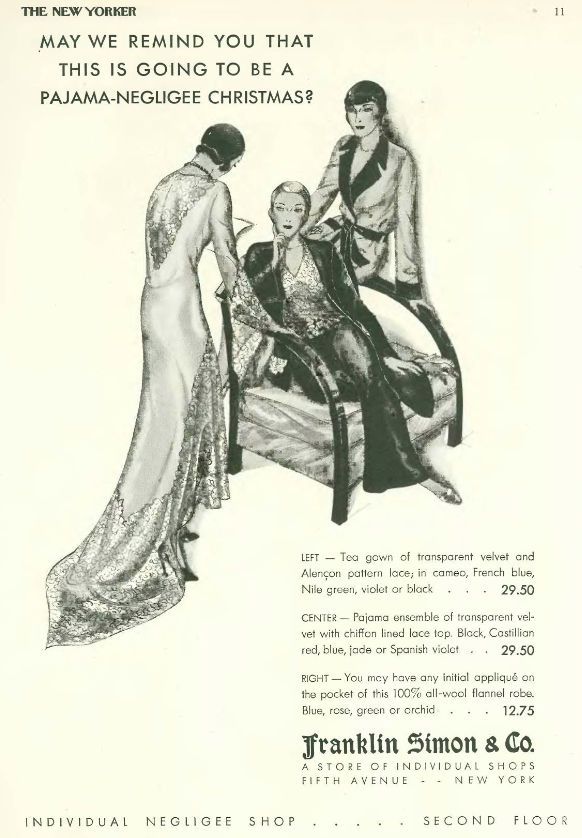
…and Franklin Simon reminded readers that it would be a “Pajama-Negligee Christmas,” whatever that meant…

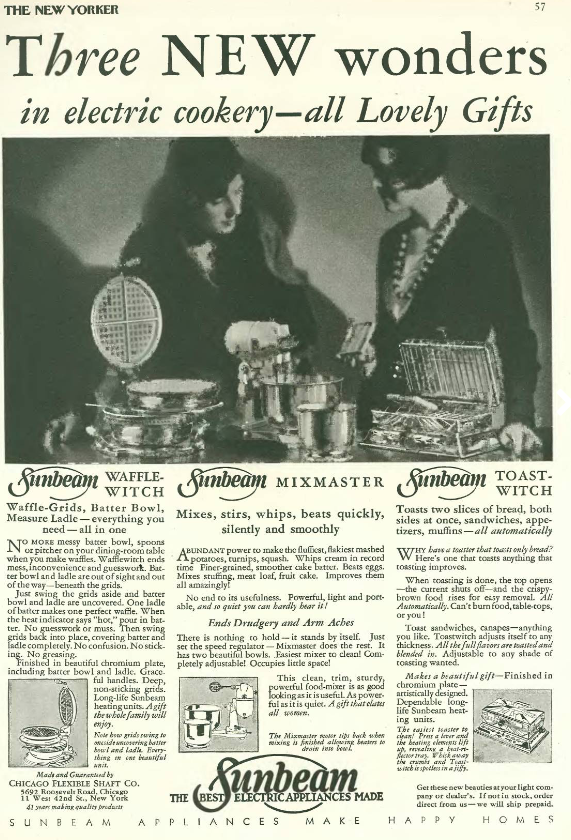
…pajamas and negligees were doubtless preferable, and more romantic, than this array of kitchen appliances…

…whatever the holiday revelry, the makers of Milk of Magnesia had our backs…

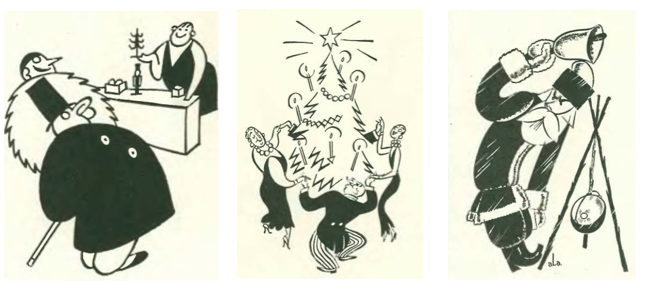
…on to our cartoonists, Julian De Miskey and Constantin Alajalov contributed spot drawings to mark the season…

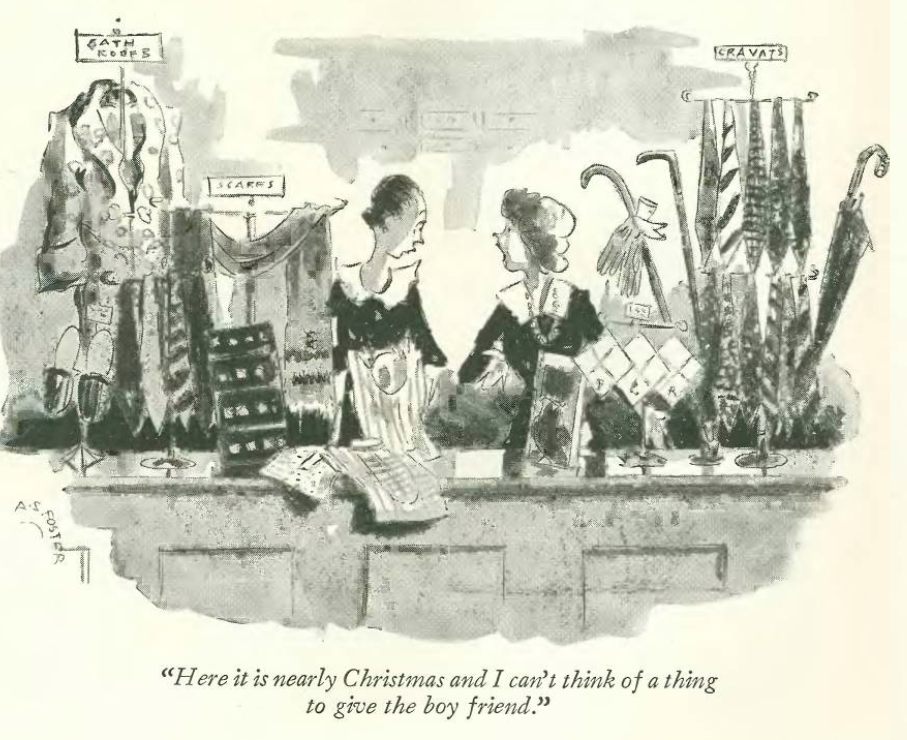
A.S. Foster contributed two cartoons to the issue…

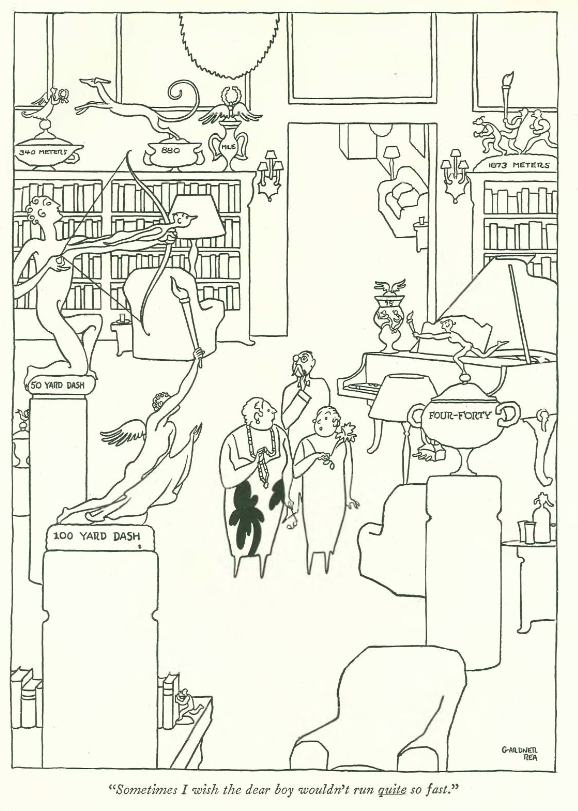
Gardner Rea, a full-pager…

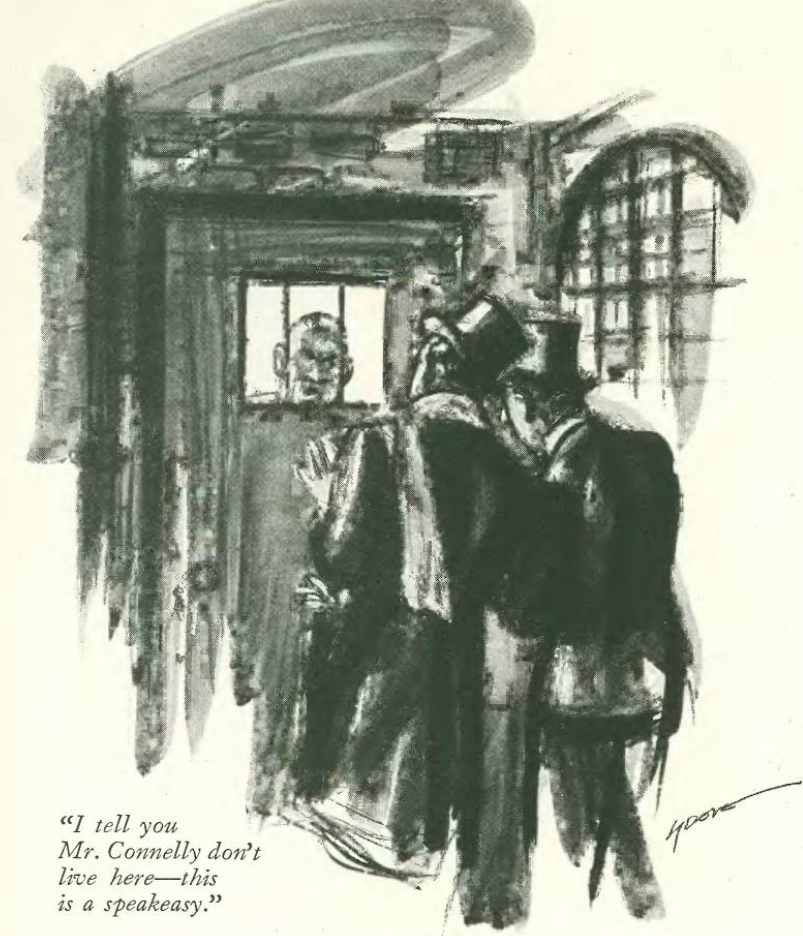
Leonard Dove, possibly having some fun with playwright Marc Connelly

Isadore Klein demonstrated the fun to be had with a kiddie scooter, before they had motors…

…and we close with John Reynolds, and some bad table manners…

Next Time: Happy Holidays…


Distant Rumblings

As I’ve previously noted, reading back issues of periodicals often gives one a feeling of omniscience; as I thumb through week after week of late 1920s New Yorkers, I realize that for all their cleverness and worldly wisdom, even that magazine’s writers and editors could not see with any clarity into the future. But neither can any of us…one wonders what readers 89 years hence will surmise from today’s magazines, that is, if our civilization lasts that long.

January 28, 1928 cover by Theodore G. Haupt.

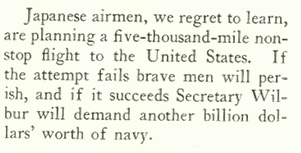
Howard Brubaker (in his column “Of All Things”) might have spotted something brewing on the horizon, even if it wouldn’t become perfectly clear until Dec. 7, 1941. Here is a clip from his Jan. 28, 1928 column in The New Yorker:

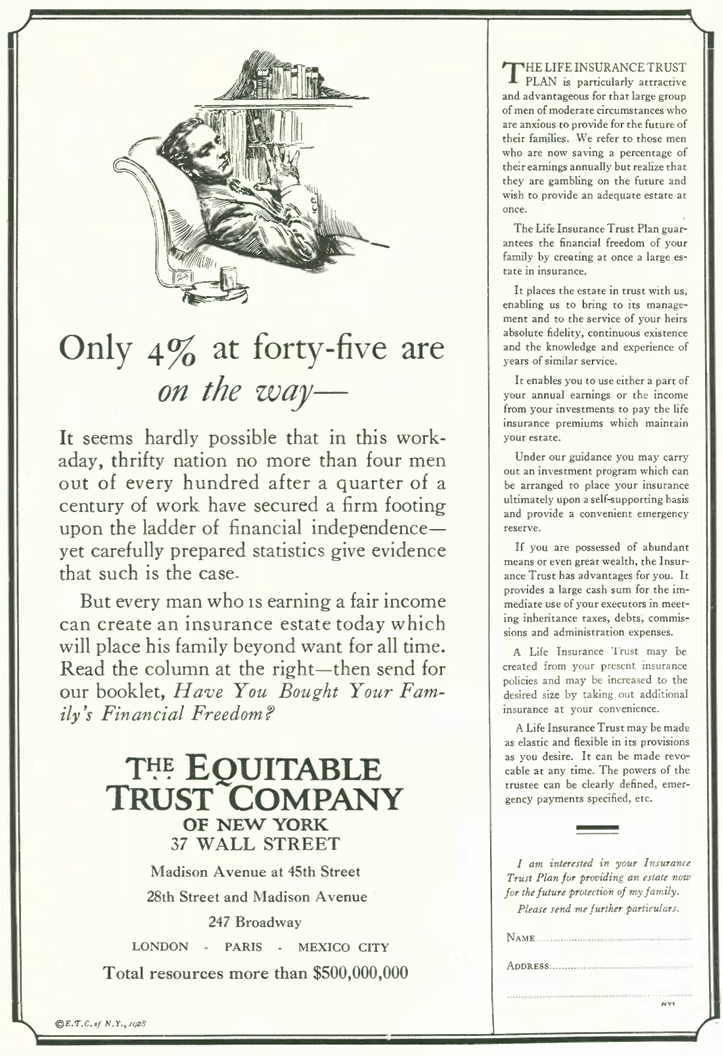
Two other major events in U.S. history, the Stock Market Crash of 1929 and the Great Depression that would follow, were less than two years away. But this was the Roaring Twenties, and some thought the fun would never end…except perhaps Equitable Trust, which placed this advertisement in the Jan. 28 issue:

Apparently the folks at Equitable Trust weren’t assured of their own financial freedom—after the Crash they would be acquired by Chase National Bank, making Chase the largest bank in the world at that time.

Despite the overheated economy of the 1920s, there still were plenty of poor and unemployed people in the city. One man, Urbain Ledoux (known as Mr. Zero in order to hide his identity), often arranged protests and demonstrations to bring attention to the poor and unemployed, and opened a number of bread lines and soup kitchens to feed the hungry, including the “Tub,” depicted in this two-page illustration by Constantin Alajalov along the bottom of the “Talk” section of the Jan. 28 issue (click image to enlarge).

 *  *  *

Not All Gloom and Doom

Hindsight also reveals the trajectory of the 20th century’s great accomplishments. Charles Lindbergh’s transatlantic flight in 1927, for example, fueled the imaginations of those who would usher in the jet age and space travel. Just 31 years after Lindbergh’s flight, the British Overseas Airways Corporation (BOAC) would begin operation of its first transatlantic passenger jet service. And only 42 years would separate Lindbergh’s flight from Neil Armstrong’s moonwalk.

JUST 31 YEARS would separate Lindbergh’s flight from the first transatlantic jet service. At left, the DeHavilland Comet 4 (1958), and at right, Lindbergh’s Spirit of St. Louis (1927). (warthunder.com/howstuffworks.com)

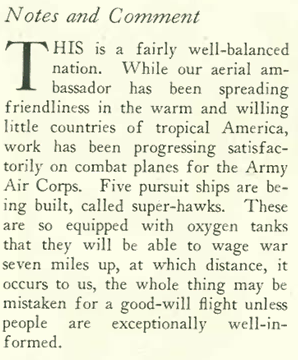
Like the rest of America, The New Yorker was an enthusiastic follower of developments in aviation after Lindbergh (the “aerial ambassador” referred to below). The January 28 “Talk of the Town” led with this item about pilots soaring to ever greater heights.

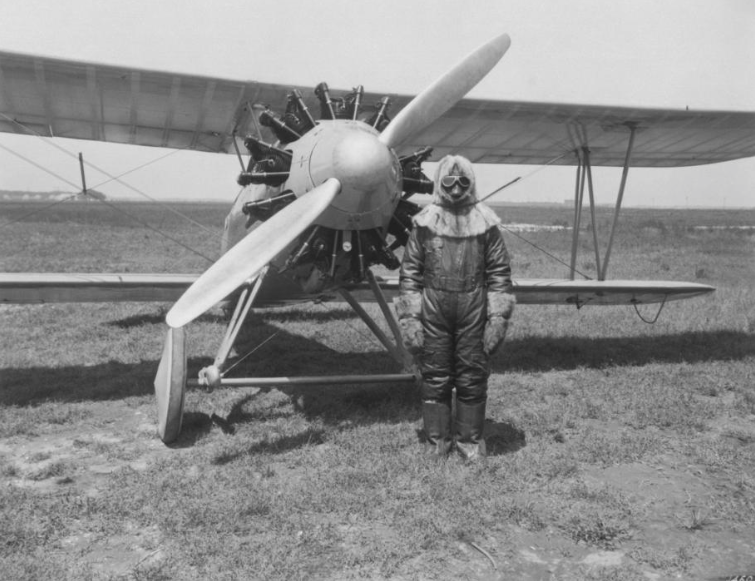
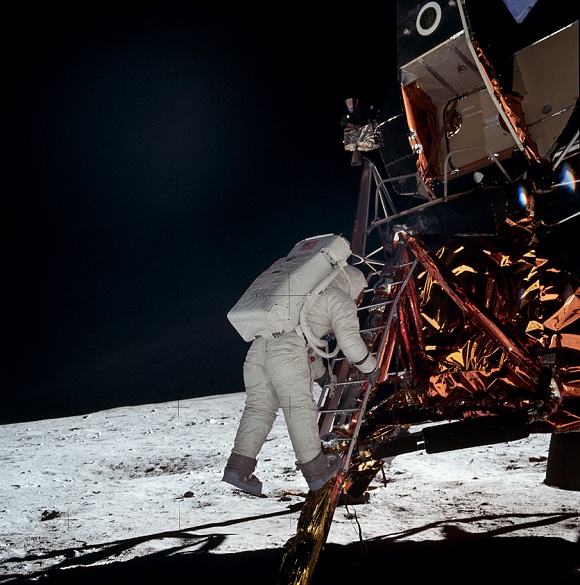
Consider that a mere 41 years separated this…

YETI, SET, GO!…A pilot in high altitude flying gear next to a Wright Apache biplane, January 1, 1928. In September 1926 the Apache set the world altitude record for seaplanes (38,500 ft) and in April 1930 it set the land-plane altitude record of 43,166 ft. (NASA)

…from this…

LEAVE THE FUR COAT AT HOME…The second man on the moon, Buzz Aldrin, prepares to step onto the lunar surface, July 20, 1969. (Neil Armstrong/NASA)

 *  *  *

While Back on Earth…

Big events in America always seem to involve the appearance of showgirls, whether it is the introduction of a new car or some techno gadget. As this “Talk” item indicates, much was the same 89 years ago…

 *  *  *

Silent Giant

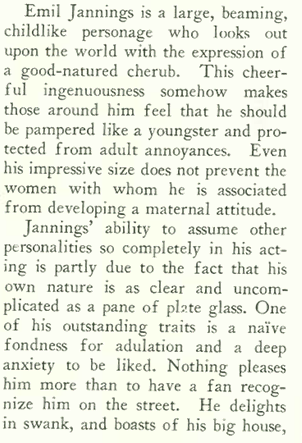
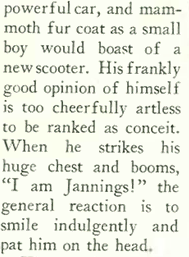
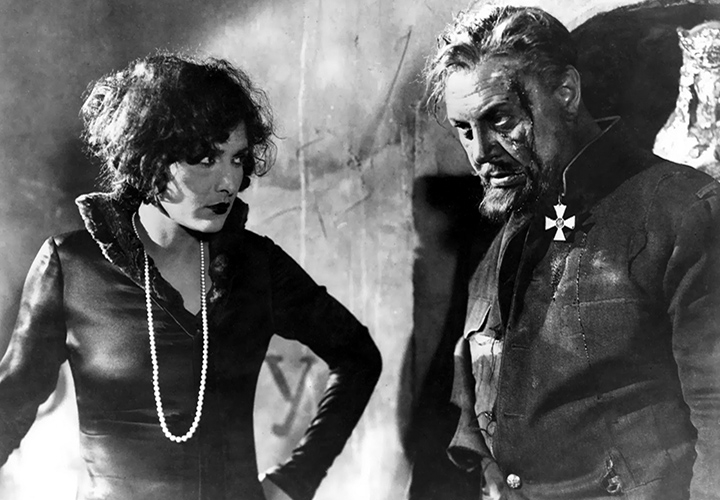
German film actor Emil Jannings was lauded for his performances on the screen in both Germany and America in films, and he was particularly adept at portraying of the pathos of middle-aged men. The New Yorker disliked most of Hollywood’s output (and usually praised the much-artier German films), so when Jannings landed on these shores he was lauded by the magazine, which dedicated a profile (written by Elsie McCormick) to him in the Jan. 28 issue, accompanied by a Hugo Gellert illustration. Some excerpts:

LIFE IS HARD…Evelyn Brent and Emil Jannings star in The Last Command. In the first Academy Awards, Jannings would win best actor for two films, The Last Command and The Way of All Flesh. (silentfilm.org)

At the first Academy Awards in 1929, Jannings would win a Best Actor Oscar for two of his 1928 films, The Last Command and The Way of All Flesh. An interesting side note from writer Susan Orlean: In her 2011 book, Rin Tin Tin: The Life and The Legend, Jannings was not actually the winner of the first best actor vote, but the runner-up. The famous dog actor Rin Tin Tin actually won the vote. The Academy, worried about not being taken seriously, gave the award to the human instead.

Janning’s thick German accent would bring his Hollywood career to an end with sound pictures. He would return to Germany, and during the Third Reich he would star in several films that promoted the Nazis. According to Wikipedia, the shooting of his last film, Wo ist Herr Belling? was aborted when Allied troops entered Germany in Spring 1945. Jannings reportedly carried his Oscar statuette with him as proof of his former association with Hollywood.

From the Advertising Department

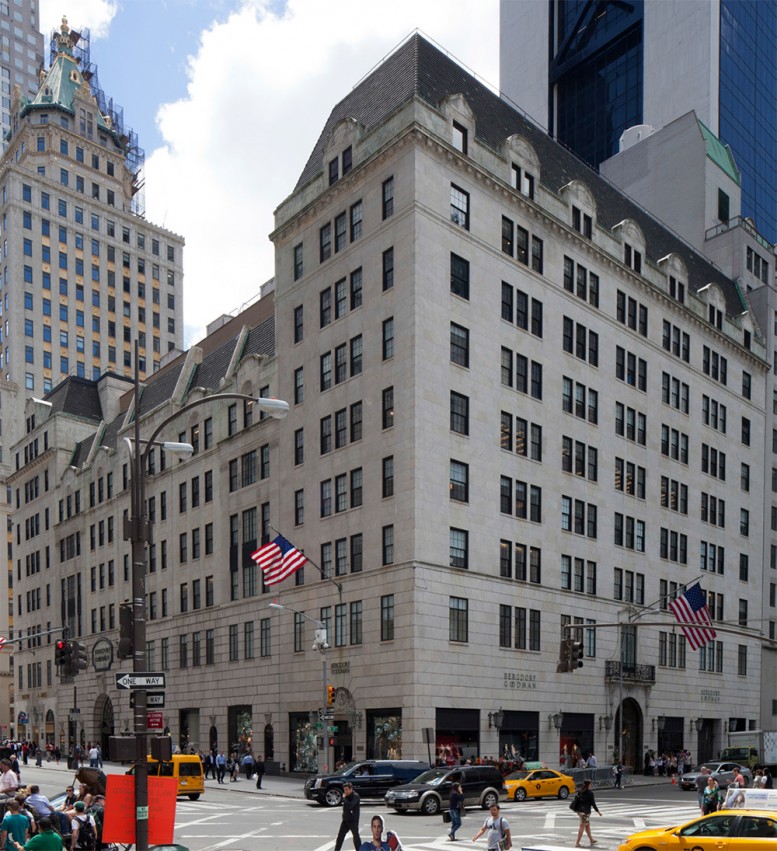
This advertisement from the Jan. 28 issue caught my eye because Bergdorf Goodman is one of the few stores in Manhattan still operating at its original site:

Bergdorf Goodman today. (Photo courtesy LPC)

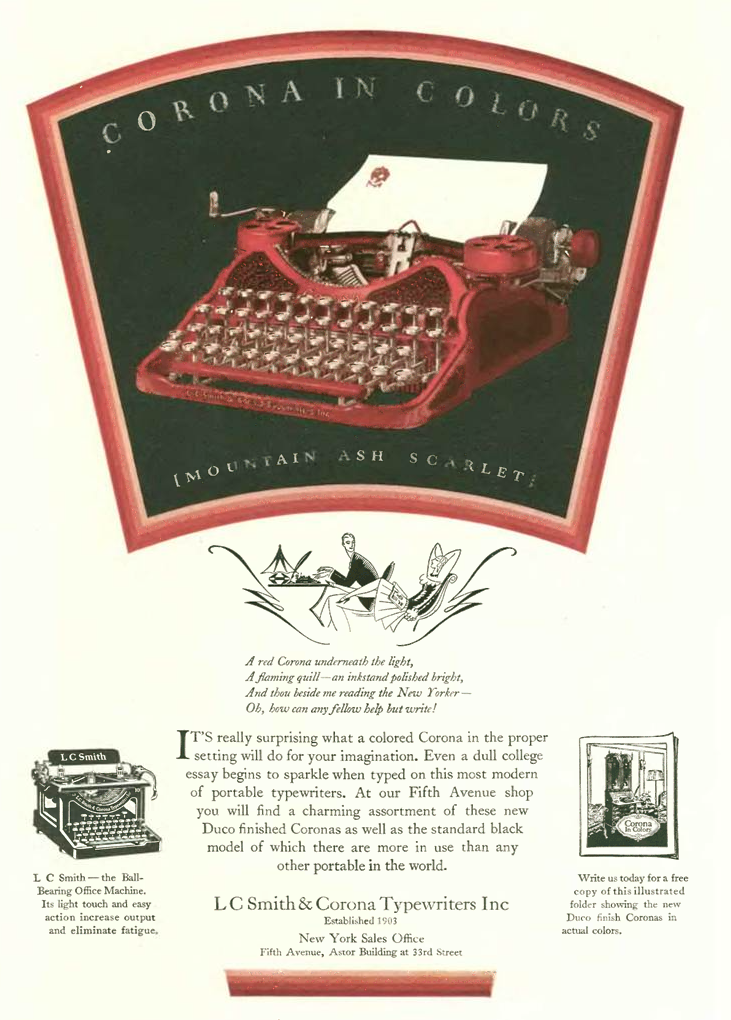
And here we have perhaps the iMac of its day, standing  apart from the competition with its colorful, bold new look…

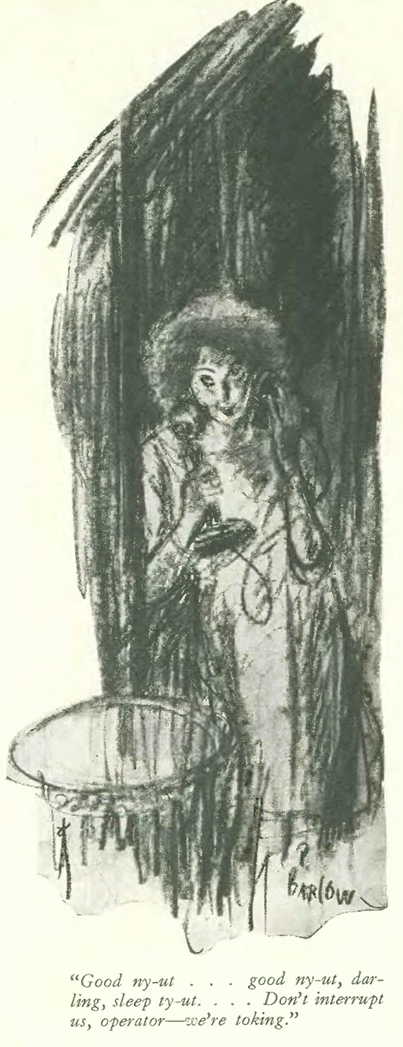
And finally, this early cartoon from longtime New Yorker cartoonist Perry Barlow having some fun at the expense of New York’s working class…
Next Time: Good Vibrations…


The Last Laugh

Screen Shot 2015-09-06 at 12.02.47 PM
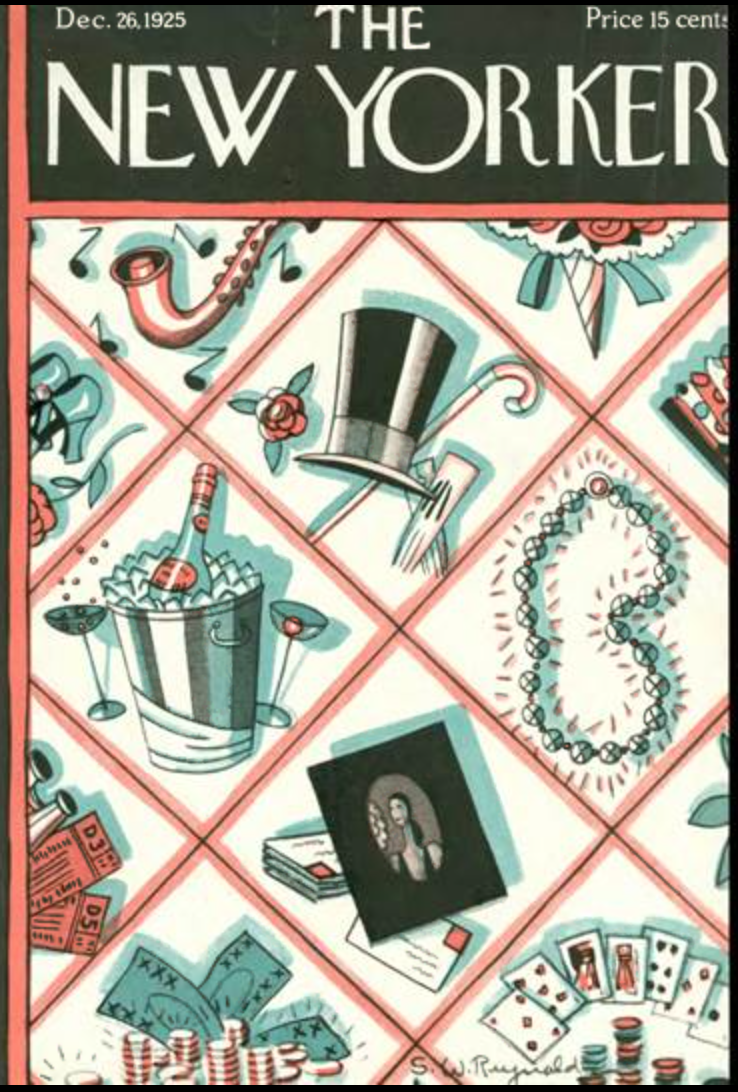
Dec. 26, 1925 cover by S.W. Reynolds

We close out The New Yorker’s first year with the magazine on firmer footing and many of its mainstay writers and artists firmly in place.

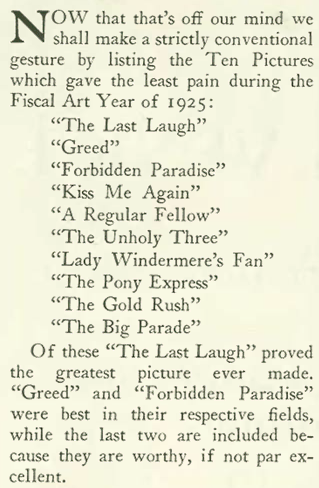
The Dec. 26, 1925 issue was the usual hodgepodge, but some writers did give a nod to the end of the year, including film critic Theodore Shane, who offered his list of the best ten moving pictures of 1925.

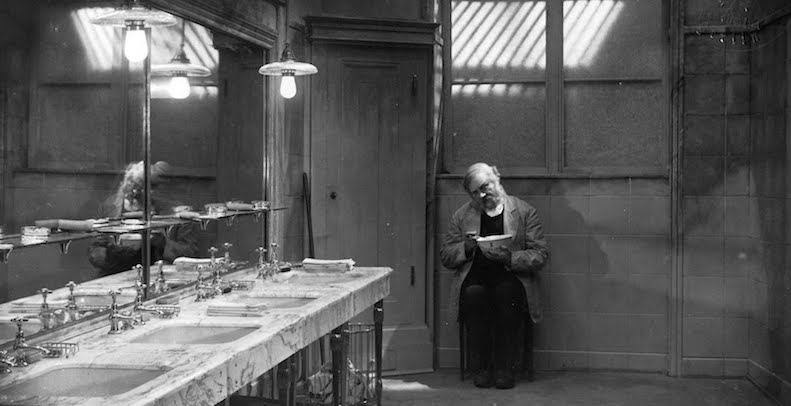
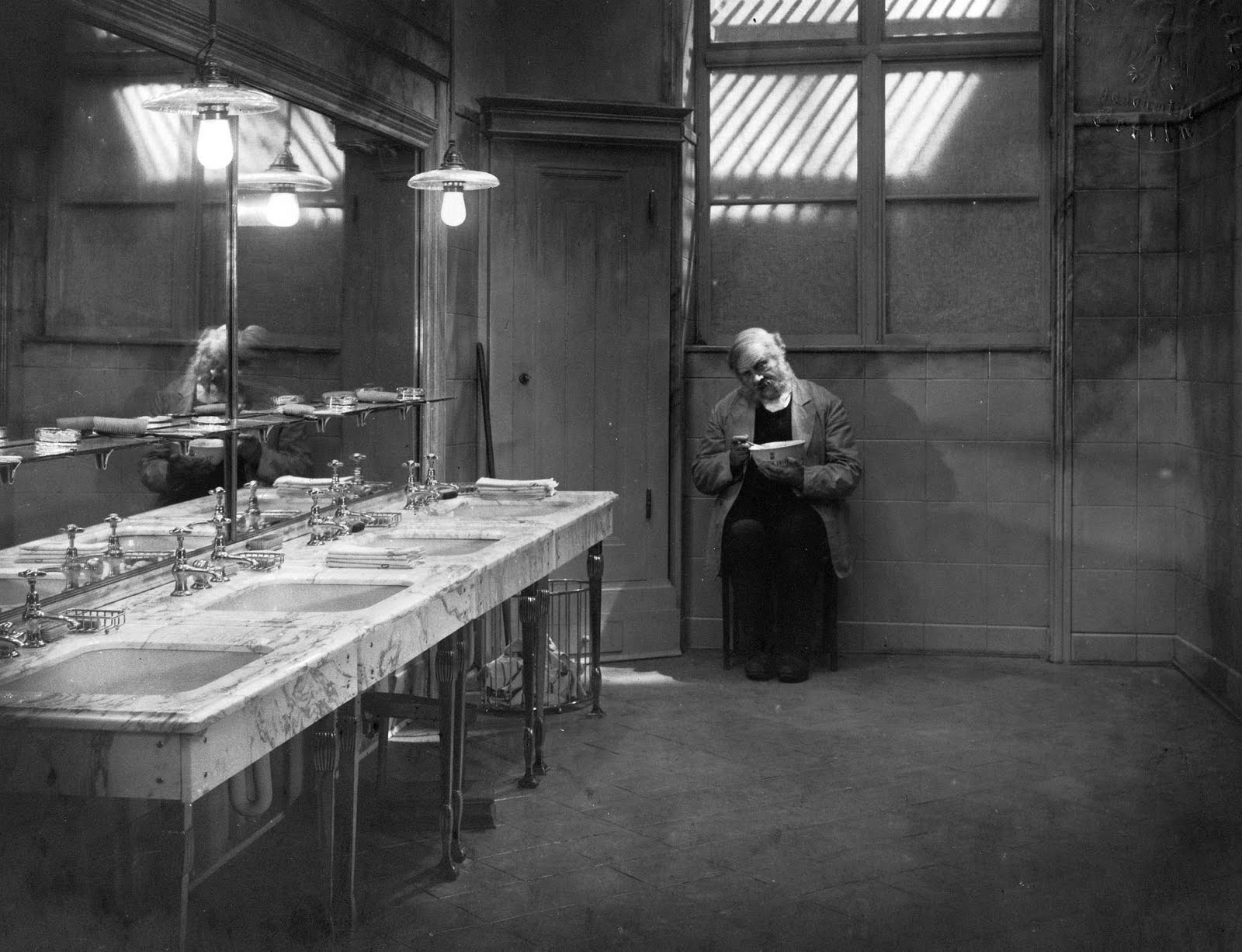
Shane’s favorite film by far was The Last Laugh, (the German title was Der letzte Mann, or The Last Man) a 1924 German film directed by F.W. Murnau and starring Emil Jannings (who would later win the first Academy Award for Best Actor in 1929). Shane referred to it as “the greatest picture ever made.” Released in the U.S. in 1925, the film was about a proud doorman who loses his job and tries to hide the fact from his friends and family. Shane usually reserved his highest praise for German cinema in his columns.

derletztemann2
Scene from The Last Laugh (1924) starring Emil Jannings. (Roger Ebert)

Shane’s complete list of the ten best movies of 1925:

Screen Shot 2015-09-09 at 12.26.59 PM

For the worst films of the year, Shane suggested a tie between Drusilla With a Million, Lord Jim, Joanna, the Million Dollar Girl or Stella Dallas.

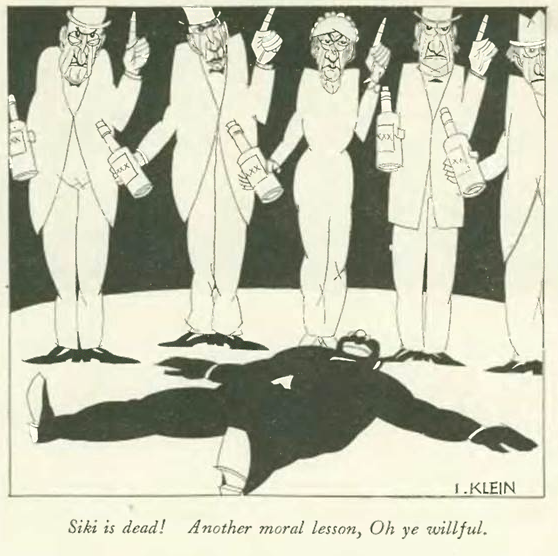
The New Yorker also commented on the murder of the irrepressible boxer Louis Mbarick Fall, popularly known as “Battling Siki.”

BattlingSiki
“Battling Siki” in his heyday. (Wikipedia)

Born in Senegal, he was a light heavyweight boxer from 1912–1925, and briefly reigned as a light heavyweight champion. Known for his heavy drinking and carousing, on the night of Dec. 15, 1925, he was found dead near his 42nd Street apartment. He had been shot twice in the back at close range. He was 28.

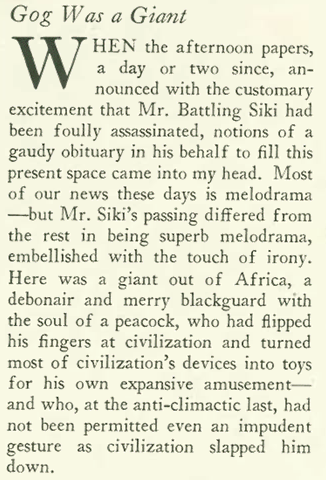
In his column, “A Reporter at Large,” Morris Markey offered this observation on Battling Siki’s passing:

Screen Shot 2015-09-09 at 12.47.15 PM

The cartoonist Isadore Klein, on the other hand, contributed this strange stand-alone illustration for “The Talk of the Town” section:

Screen Shot 2015-09-08 at 11.50.02 AM

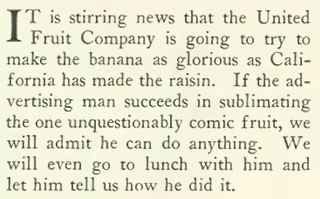
Also in “Talk” was this brief item about the United Fruit Company:

Screen Shot 2015-09-08 at 11.40.53 AM

United Fruit would be no laughing matter three years later with the Banana Massacre, which would claim the lives of an unknown number of workers who were striking for better working conditions in Columbia.

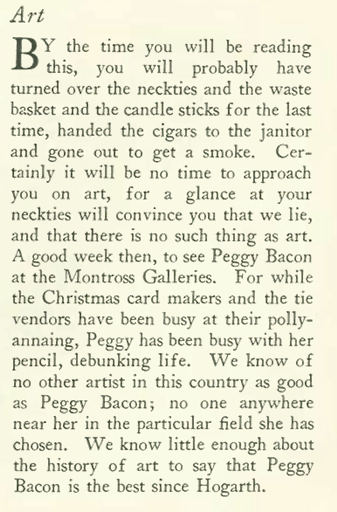
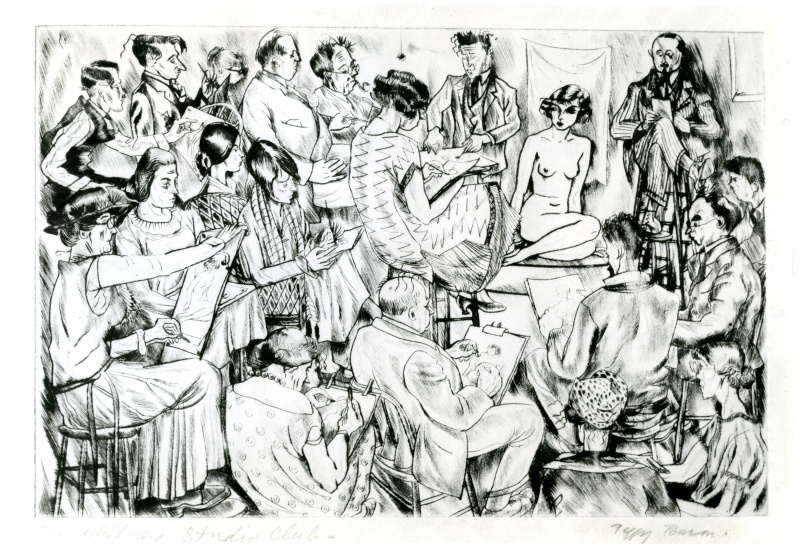
Art critic Murdock Pemberton offered a glowing review of an exhibit at the Montross Galleries by frequent New Yorker contributor Peggy Bacon:

Screen Shot 2015-09-09 at 12.19.40 PM

cc2_1540
Peggy Bacon, The Whitney Studio Club, 1925. (Whitney Museum of American Art)
Peggy_Bacon,_American_painter,_illustrator_and_printmaker,_1895-1987
Peggy Bacon (Smithsonian)

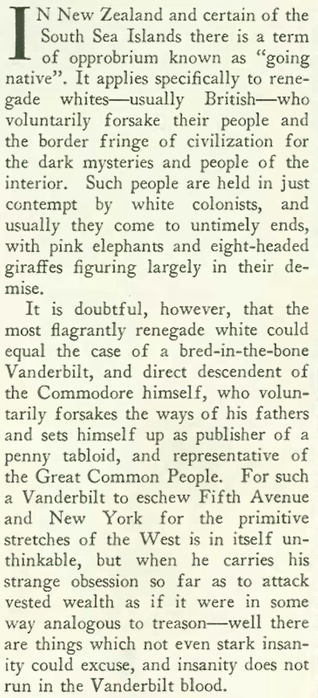
“Profiles” looked at Cornelius Vanderbilt Jr, “The Fifth Avenue Maverick.” William Boardman Knox wrote that the young Vanderbilt “is as alien to his blood as a marmoset to a gorilla.”

Screen Shot 2015-09-09 at 12.45.35 PM

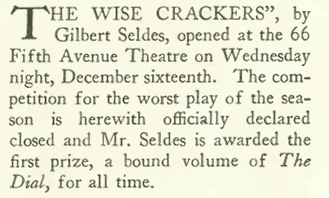
In the “The Theatre,” critic Herman J. Mankiewicz pulled no punches when he declared Gilbert Seldes’ play The Wise Crackers “the worst play of the season” (Seldes was himself a noted critic and sometime New Yorker contributor):

Screen Shot 2015-09-09 at 12.15.09 PM

What’s more, the play was about a group of literate New Yorkers who gather to exchange witty barbs and sarcastically comment on the doings of the day. In other words, it was inspired by the Algonquin Round Table, which famously included Mankiewicz as a member.

Another Round Table notable was Robert Benchley, who contributed this piece for the last issue of the year:

Screen Shot 2015-09-09 at 12.39.48 PM

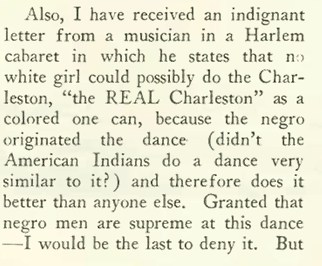
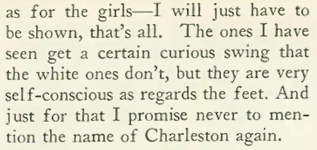
Lois Long offered her regrets for ever bringing up the subject of “The Charleston:”

Screen Shot 2015-09-21 at 6.19.44 PM

Screen Shot 2015-09-21 at 6.20.17 PM

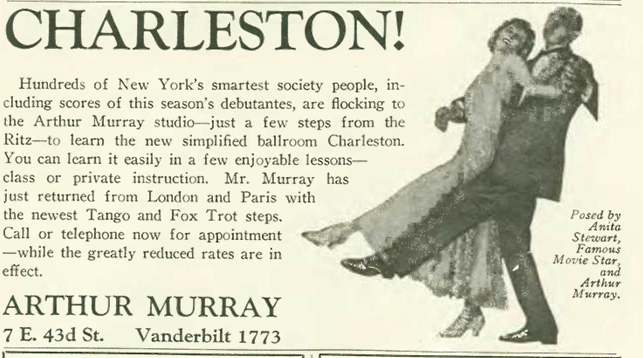
And just a few pages over, lessons were advertised for…The Charleston!

Screen Shot 2015-09-09 at 12.34.19 PM

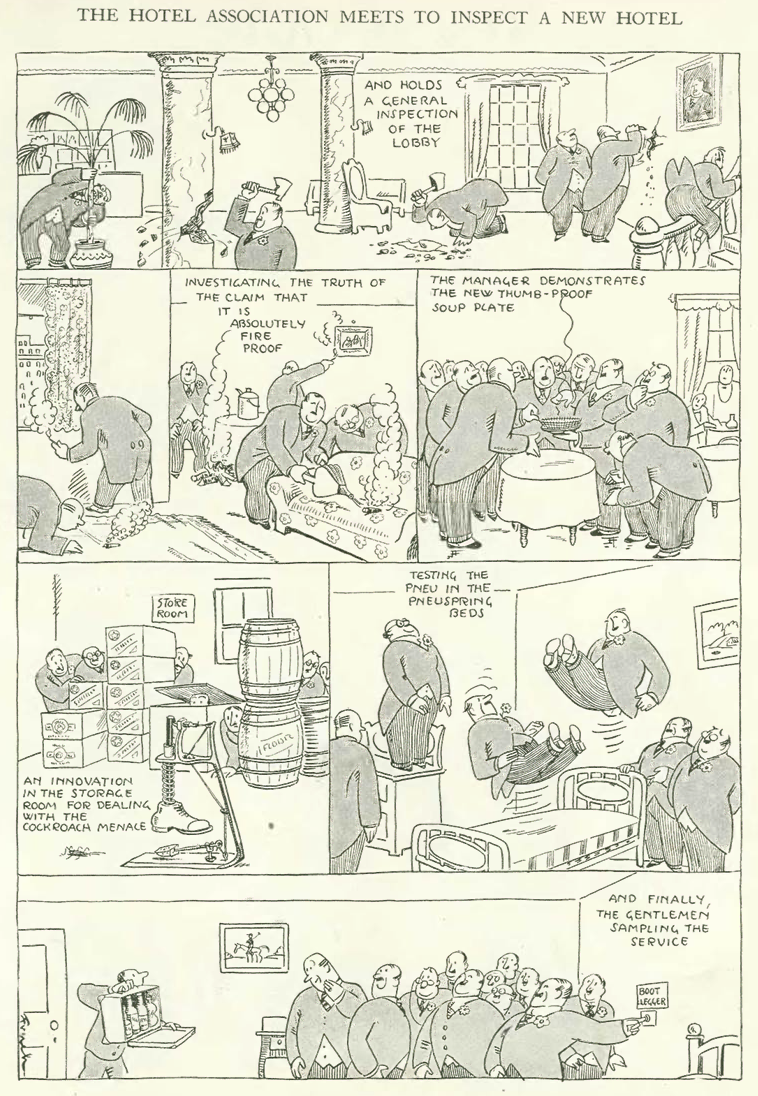
And to close, here’s a little fun with hotel inspectors, courtesy of Al Frueh:

Screen Shot 2015-09-21 at 12.52.41 PM

Next Time: Fun in the Sun…

Screen Shot 2015-09-09 at 12.47.57 PM