Race to the Sky

Almost ninety years after the lights went out on the Roaring Twenties, our collective imagination of New York City still harks back to that time…the sights and sounds of nightclubs and speakeasies and Broadway lights set to the tune of the Jazz Age.
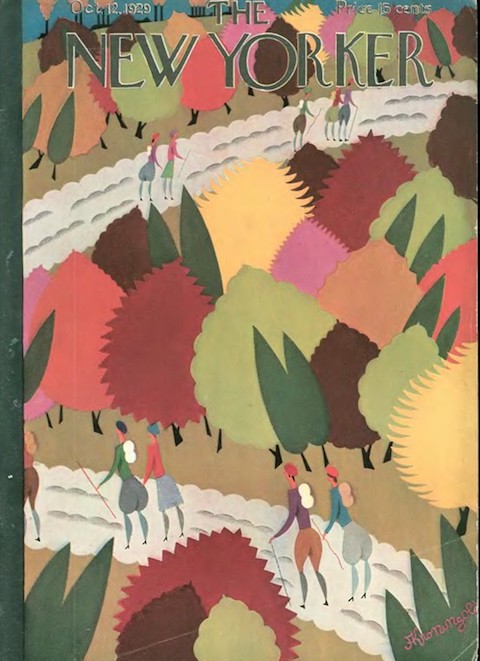
Oct. 12, 1929 cover by Adolph K. Kronengold.

And no wonder, since that decade made the city what it is today. Changing social mores, along with labor-saving electrical appliances and the ubiquitous automobile, altered the tempo of life. And this quickened pace was also reflected in the built environment, old landmarks reduced to rubble while gleaming skyscrapers rose up in their place seemingly overnight. A Victorian edifice like the Waldorf-Astoria — little more than 30 years old — seemed positively ancient to Jazz Age New Yorkers, who unceremoniously knocked it down to make way for what would become the city’s most iconic landmark.

New Yorker architecture critic George S. Chappell (aka “T-Square”) sensed that something big was on the horizon with his regular “Sky Line” updates on the city’s “tallest-building-in-the-world” contest. In the Oct. 12, 1929 issue he looked on admiringly as the Chrysler Building’s distinctive dome began to take shape:

IT’LL BE A SURPRISE…The Chrysler Building still lacked its gleaming art deco dome in this photo taken in the fall of 1929. At left is the Chanin Building, completed earlier that year. (reddit/adamunderhill.wordpress.com)

Chappell observed that the Chrysler Building’s claim as the world’s tallest would be short-lived, as plans for the Waldorf-Astoria site called for a much taller structure…

DOOMED…The old Waldorf-Astoria hotel (left), completed in 1897, was scarcely more than 30 years old when it was demolished to make way for the Empire State Building. The former governor of New York, Al Smith (inset) led the corporation that knocked down the old hotel and erected the world’s tallest building on the site. Demolition of the hotel began on October 1, 1929 (images at right). In his 2014 book The Empire State Building: The Making of a Landmark, John Tauranac observes the demolition was an arduous process, as the hotel had been constructed using more rigid material than what was found in earlier buildings. Those materials — granite, wood, and metals such as lead, brass, and zinc — were not in high demand. Most of the wood was deposited into a woodpile on nearby 30th Street or burned in a swamp. Other materials, including the granite and bronze, were dumped into the Atlantic near Sandy Hook, NJ. (New York Historical Society/New York Public Library Digital Gallery)
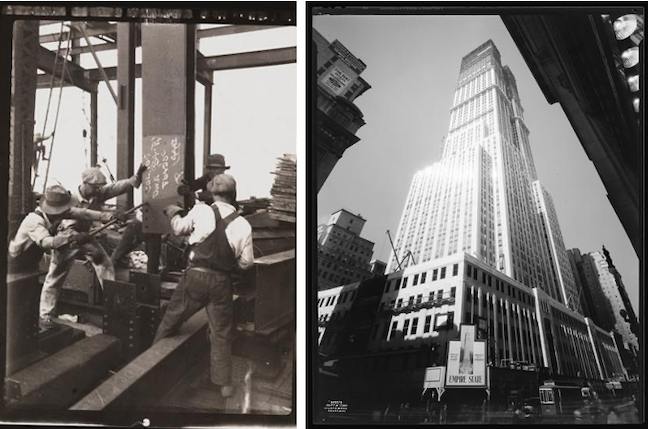
RISING FROM THE RUBBLE…The Empire State Building under construction in 1930. When completed in 1931, the 1,250 foot (1,454 with antenna) building would claim the title as the world’s tallest. It was something of a definitive victory, as the building held that record for nearly forty years. (Museum of the City of New York)

Although Al Smith’s building seemed assured to win the “world’s tallest” title, another giant was taking shape on the drawing boards…

LAND OF THE GIANTS…City Bank-Farmers Trust Building (left), now known as 20 Exchange Place, was originally designed in 1929 to be the world’s tallest building at 846 feet, but the realities of the Depression brought it down to a more modest 741 feet, making it the fourth-tallest building in New York when it was completed in 1931. At right, the 22-year-old Century Theatre on Central Park West was demolished to make way for Irwin Chanin’s Century Apartments, also completed in 1931. (Museum of the City of New York/nyc-architecture.com)

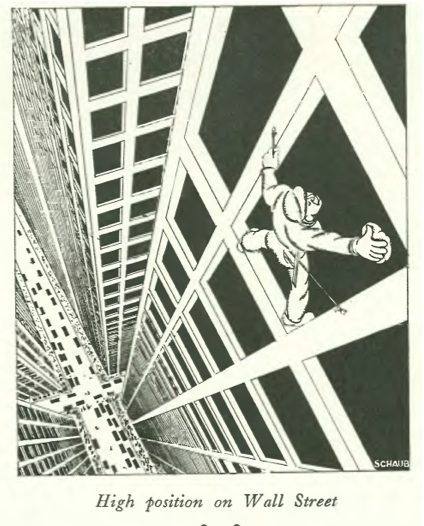
…while we are on the subject of skyscrapers, The New Yorker reprinted this illustration by Andre De Schaub to fill in a space at the bottom of page 54 in the Oct. 12 issue…
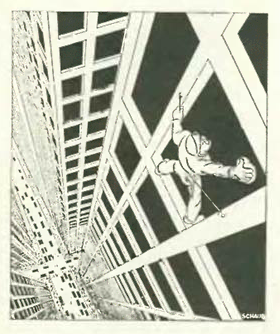
…the drawing originally appeared in the magazine three years earlier, as a cartoon in the October 16, 1926 issue. It included a caption: “High position on Wall Street” (thanks to Michael Maslin’s invaluable Ink Spill for helping me track this one down)…
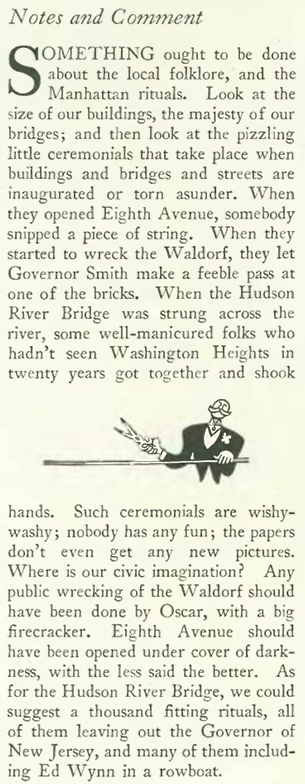
As the demolition crews picked apart the old Waldorf, E.B. White wondered why more fanfare wasn’t attached to such occasions, whether they be demolitions or ribbon-cuttings…
NEEDS MORE HOOPLA…Al Smith with his wife Catherine Dunn Smith, and two of his grandchildren at the opening ceremony of the Empire State Building, May 1, 1931. President Herbert Hoover officially dedicated the building by pressing a button in the White House that turned on the building’s lights (it was merely symbolic; they were actually turned on by some unknown maintenance worker in New York). (Museum of the City of New York)

 *  *  *

A Novel Idea

My last post featured a brief excerpt of an Oct. 5 theater review by Robert Benchley, who sized up Elmer Rice’s new play, See Naples and Die. Rice pops up again in the Oct. 12 issue, this time as the author of A Voyage to Purilia, the first novel serialized in The New Yorker. The novel was a satire on the silent film industry, set in the fictional land of Purilia. Here is the first page of the piece, with illustrations provided by Peter Arno:
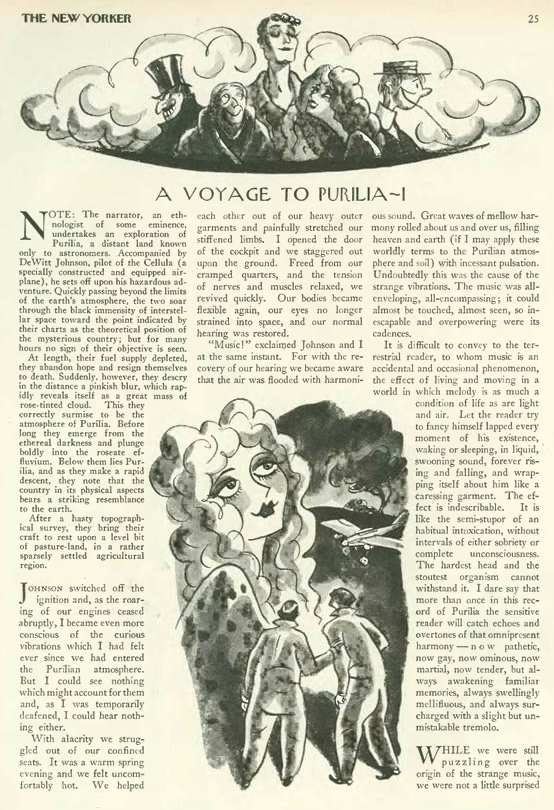
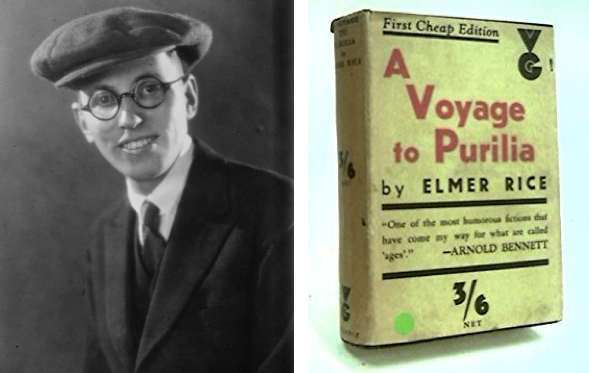
SENDING UP THE SILENTS…Elmer Rice in 1920; his satirical novel about the silent film industry, A Voyage to Purilla, was serialized in The New Yorker in 1929 and published the following year. It was re-published in the 1950s as a science fiction novel. (Wikipedia/Amazon)

 *  *  *

Siren Song

Writer and cultural critic Gilbert Seldes trained his discerning eye on the famed torch singer and speakeasy denizen Helen Morgan, attempting to understand the hard-living singer’s allure…

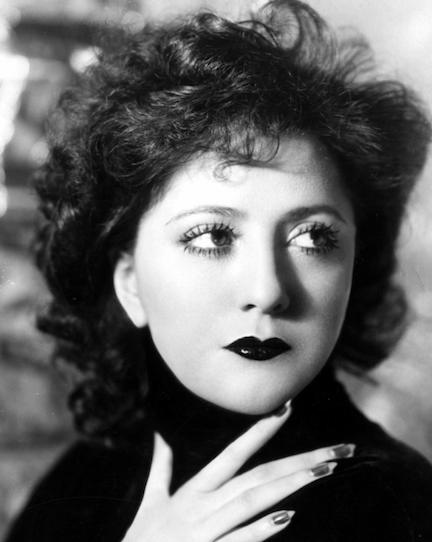
Helen Morgan, circa 1930. (masterworksbroadway.com)

RIGHT AT HOME…Helen Morgan made the draped-over-the-piano look of a torch singer her signature style. (Pinterest.UK)
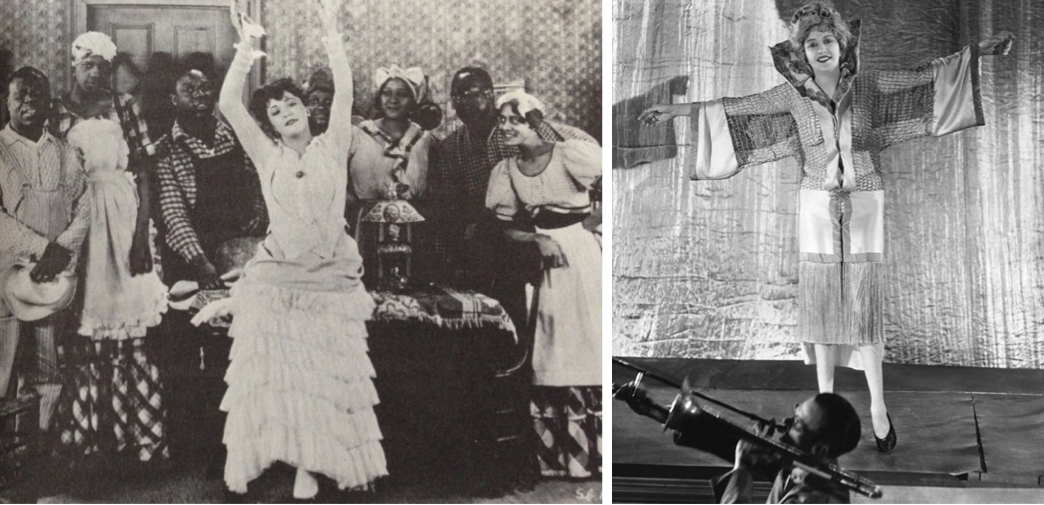
LIGHTING UP BROADWAY…Helen Morgan (left) as Julie LaVerne in the original Broadway cast of Show Boat, 1927. It was her best-known role. At right, Morgan in Applause, 1929. (Pinterest/IMDB)

Seldes struggled to understand Morgan’s appeal, which seemed to draw from an assemblage of personas…

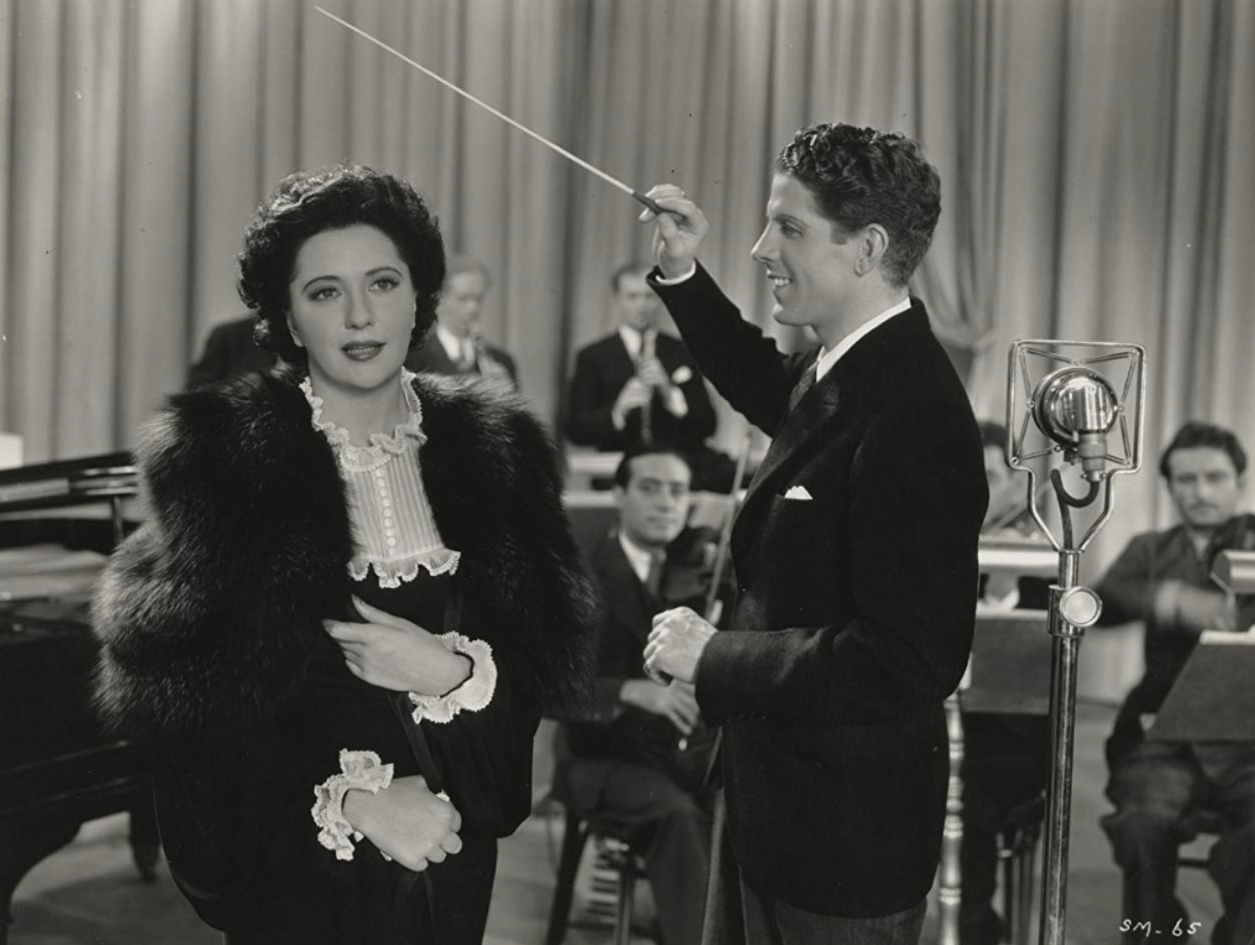
PLUMBING EMOTIONAL DEPTHS…Helen Morgan and Rudy Vallee in Sweet Music, 1935. (IMDB)

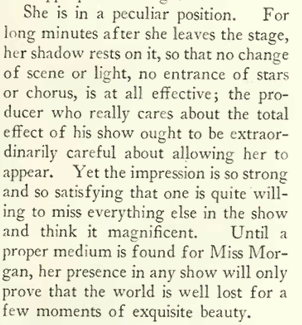
Seldes concluded that Morgan belonged with other artistic greats in her ability to create a sense of expectancy…
 *  *  *

The Invention of Distracted Driving

Writing in his “Motors” column, Nicholas Trott noted the advent of the car radio, a “new complication” to an “already over-elaborate existence.” Note that Trott viewed the car radio as something to be listened to while parked — car radios were fairly controversial back then, akin to driving while texting today.

EASY TO INSTALL…New Yorker automotive critic Nicholas Trott observed that cars were now being wired to receive radio sets (you still had to buy one and install it yourself). The system above featured battery-powered vacuum tubes, a dash-mounted dial and mono speaker. (hemmings.com)

 *  *  *

From Our Advertisers

To the refined owner of a Pierce-Arrow, a car radio would have been a crass novelty. After all, your driver was there to drive, and listen to your orders…

…unlike the Pierce-Arrow, which took pride in its heritage, the folks at Chrysler were known for their forward-thinking in design and technical innovation…

…on to some of the back page ads, we find appeals to flee the oncoming winter and escape to the golden sands of Waikiki…note the second ad, and its rather democratic invitation…

…and then we have the ads that hoped to catch the eye of the grasping Francophile, with delicacies from Louis Sherry or mock bubbly from the makers of applesauce…the second ad is particularly heartbreaking, the copy writer trying his or her best to conjure the glamour of Champagne from a bottle of apple juice. Zut!…

…fake Champagne isn’t for you? Well Leonard Dove offered us a salesman doing his best to sell a bottle of mock gin…

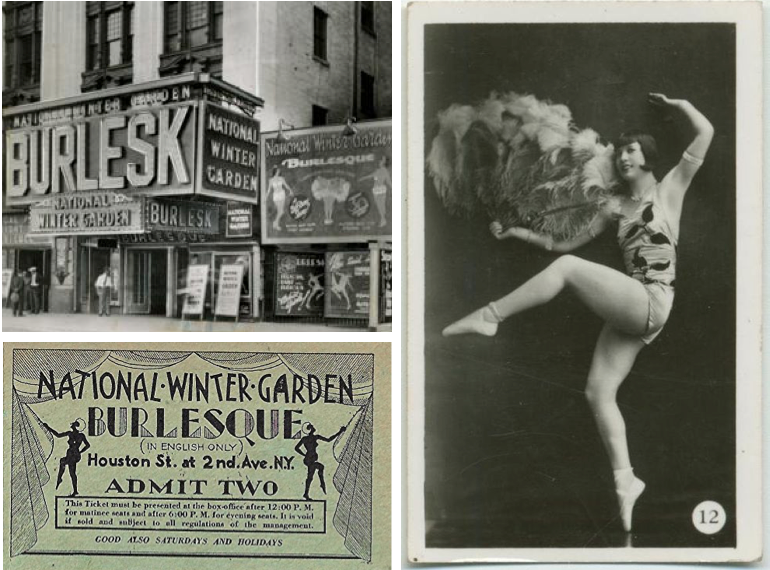
…returning to the ads, here’s one more from the back pages that references Harold Ross’s original prospectus for his magazine: “The New Yorker will be the magazine which is not edited for the old lady in Dubuque.” The ad is for Billy Minsky’s National Winter Garden, where the art of burlesque got its start. Despite the cheapness of the ad and the implied salaciousness, uptown New Yorkers loved “slumming” at Minsky’s burlesque, including artists and writers (Hart Crane even wrote a poem called “National Winter Garden”). No doubt a few New Yorker staffers found their way inside as well…

Clockwise from top left, Billy Minsky’s National Winter Garden; a 1920’s burlesque performer; a ticket for two to the show. (New York Post/Amazon/Pinterest)

…on to the illustrators and cartoonists, a nice street scene by Reginald Marsh

John Held Jr. contributed one of his famed “woodcuts” to the Oct. 12 issue. Held was an old childhood friend of New Yorker founding editor Harold Ross. It was Ross who encouraged Held to deviate from his popular flapper caricatures — he recalled how his friend had produced clever woodcuts in high school, and wanted something similar for his magazine…

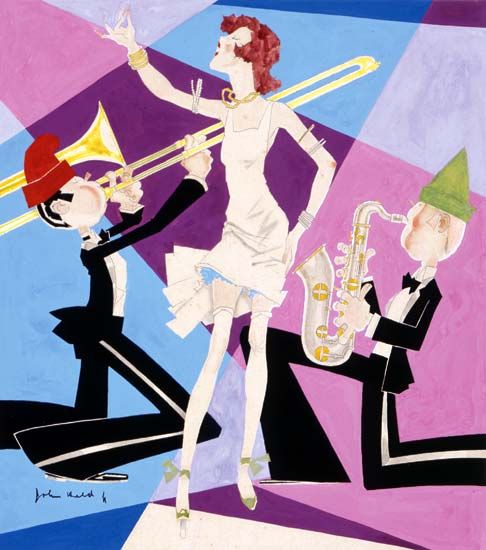
A John Held Jr. illustration for Life magazine, 1927. (Library of Congress)

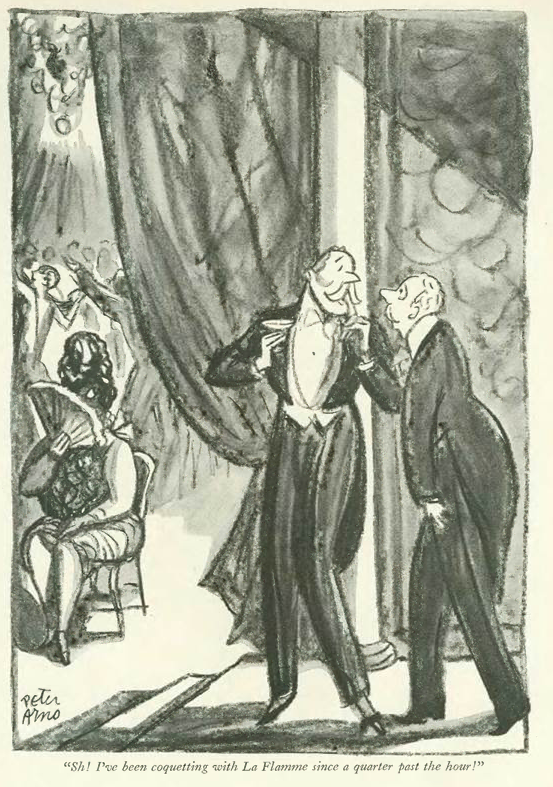
Peter Arno went behind the scenes at a posh nightclub (a familiar setting for Arno)…
Helen Hokinson found confusion at the elections…

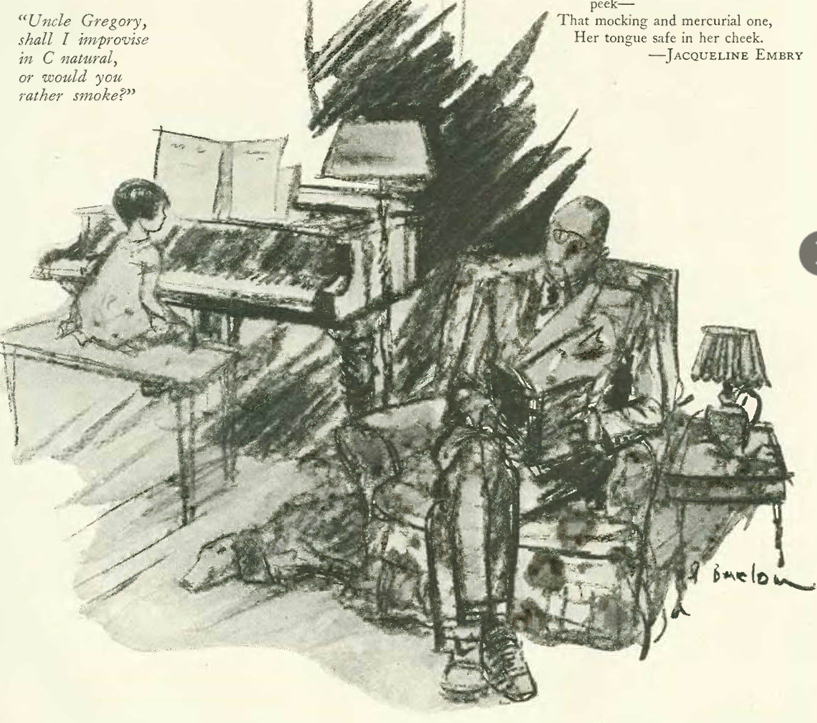
Perry Barlow offered up this sweet slice of family life…
…and Denys Wortman illustrated the power of the pen…

Next Time: City of Glass…

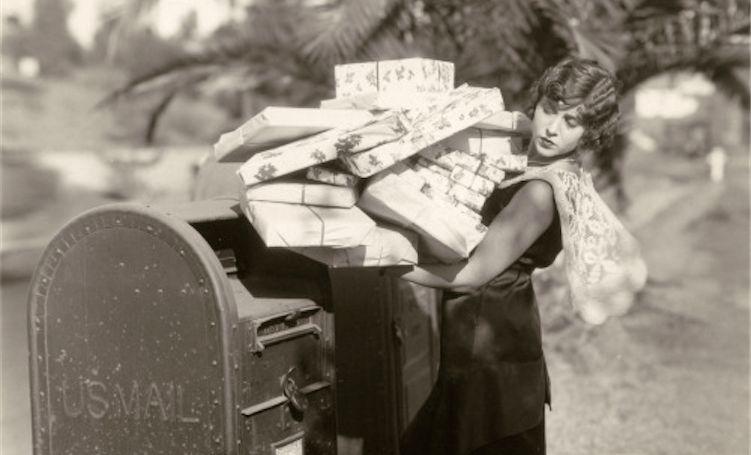
The Perfect Gift for 1927

We close out 1927 by looking at the final December issues, which grew fat with Christmas advertising catering to the tastes of New York’s smart set.

dec-10
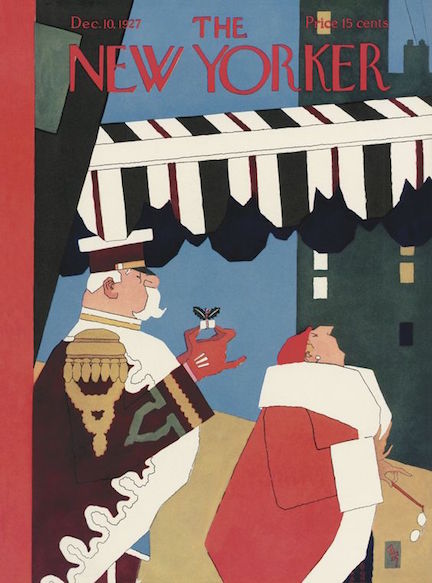
December 10, 1927 cover by Gardner Rea.

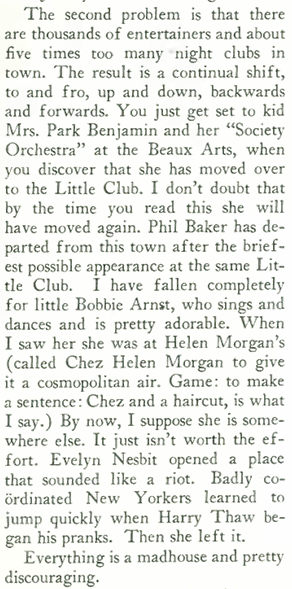
Before we jump to the ads, let’s look in on Lois Long, who in the Dec. 10 issue continued her lamentations regarding the quality of New York’s Prohibition-era night life and reminded readers that her job was far from a “soft snap”…

screen-shot-2017-02-06-at-10-03-06-am

The problem, as diagnosed by Long, was that there were not enough talented entertainers to fill the needs of an overabundance of nightclubs…
screen-shot-2017-02-06-at-10-04-09-am

vit-94-bobbe-arnst1
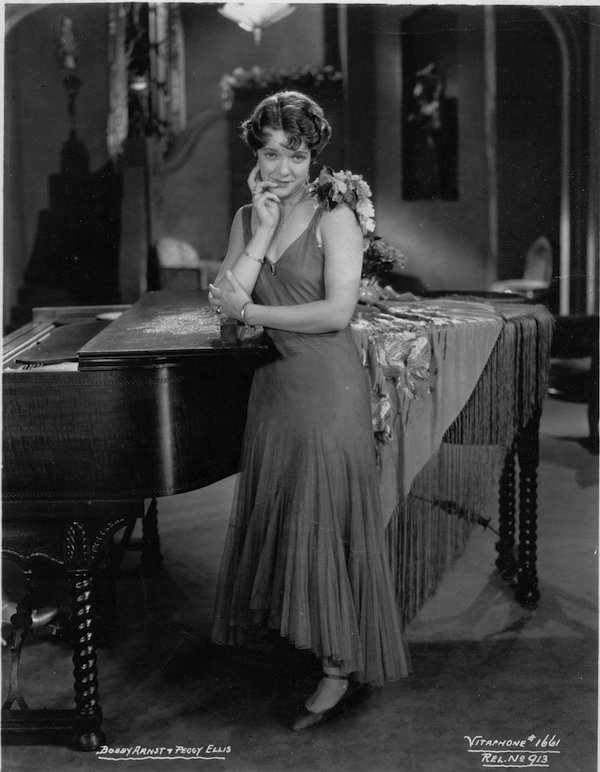
LOIS THOUGHT BOBBIE ARNST WAS PRETTY SWELL when she appeared at Helen Morgan’s nightclub. A noted broadway singer and dancer, Arnst is pictured above in a publicity photo from the 1929 film Rhythms in Blue. (picking.com)
screen-shot-2017-02-07-at-12-33-26-pm
ON THE OTHER HAND…Evelyn Nesbit’s tearoom (and later speakeasy) couldn’t survive on notoriety alone. In the early 20th century Nesbit’s face was everywhere—from advertisements to calendars—but in 1906 her fame took a nasty turn when her jealous husband, Harry Thaw, shot and killed suspected lover and famed architect Stanford White at Madison Square Garden’s rooftop theatre. At left, Nesbit in 1900. At right, Nesbit in her tea room on West 52nd Street, near Broadway, circa 1922. (Library of Congress / restaurant-ingthroughhistory.com)

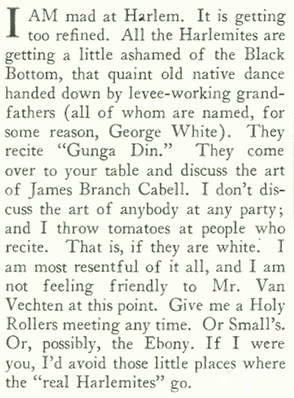
Long also railed against the white appropriation of Harlem entertainment, which she felt was draining the place of its soulfulness. In particular she called out writer and photographer Carl Van Vechten, who among white writers was the most prominent in intellectualizing the “Harlem Renaissance”…
screen-shot-2017-02-06-at-11-43-27-am

What to Buy in ’27

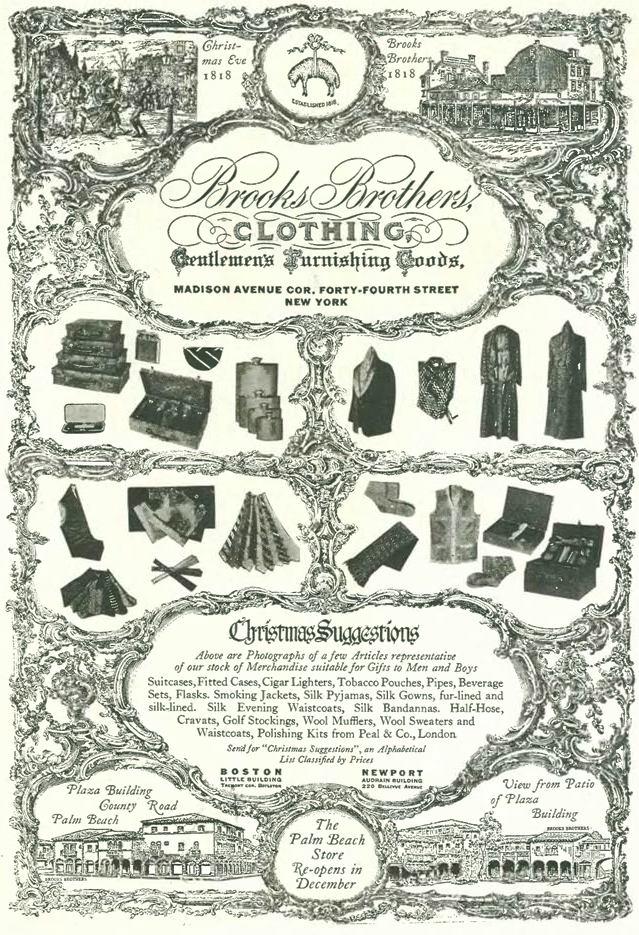
The Dec. 10 and Dec. 17 issues grew fat with holiday advertising, averaging 120+ pages as opposed to the usual 60 or so pages. The advertisements mostly appealed to upscale readers, ranging from this almost Victorian-style ad from the staid Brooks Brothers…

screen-shot-2017-02-06-at-9-46-21-am

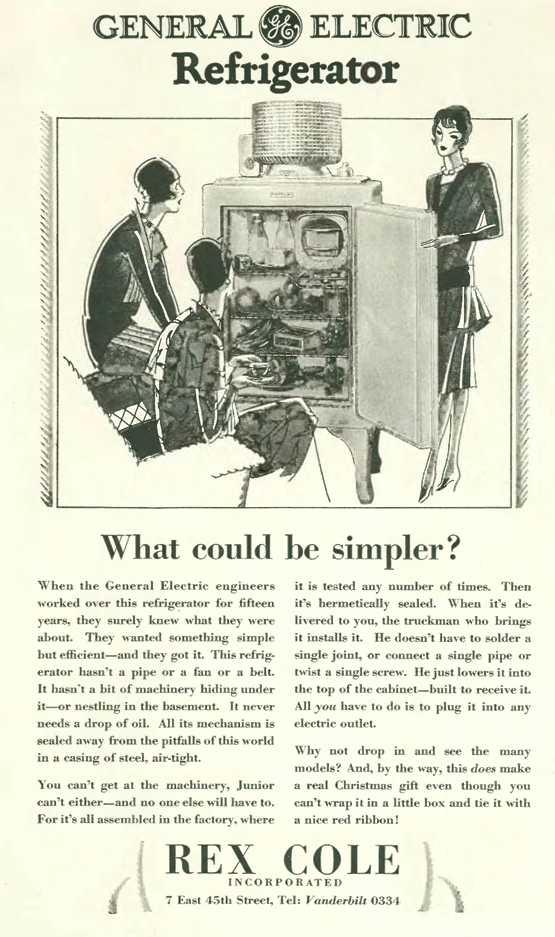
…to this ad from Rex Cole promoting the latest in modern conveniences…

screen-shot-2017-02-06-at-9-56-44-am

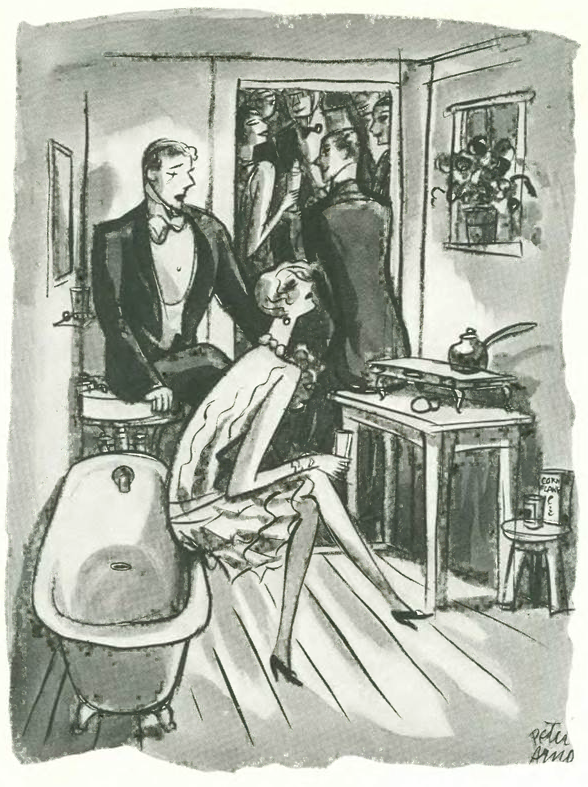
And I’ll toss in this cartoon from the Dec. 10 issue, in which Peter Arno allows us to listen in on an unlikely conversation between a couple of toffs…

screen-shot-2017-02-06-at-9-53-54-am

screen-shot-2017-02-06-at-9-54-11-am

Lois is Also Tired of the Holidays

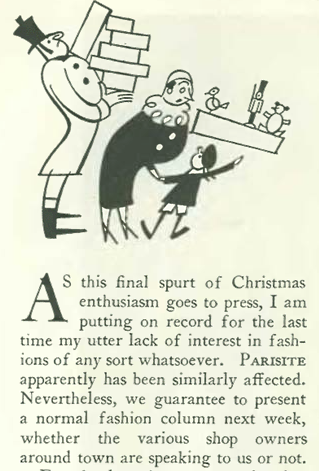
On to the Dec. 17 issue, in which Lois Long also shared with readers her weariness of Christmas shopping in her column, “On and Off the Avenue.”

dec-17
December 17, 1927 cover by Theodore G. Haupt.

The “Parisite” Long referred to in this excerpt was actually Elizabeth Hawes, who occasionally contributed to Long’s column (with cables sent from Paris) regarding the latest in French fashions. More on Hawes another time…

screen-shot-2017-02-06-at-12-11-30-pm

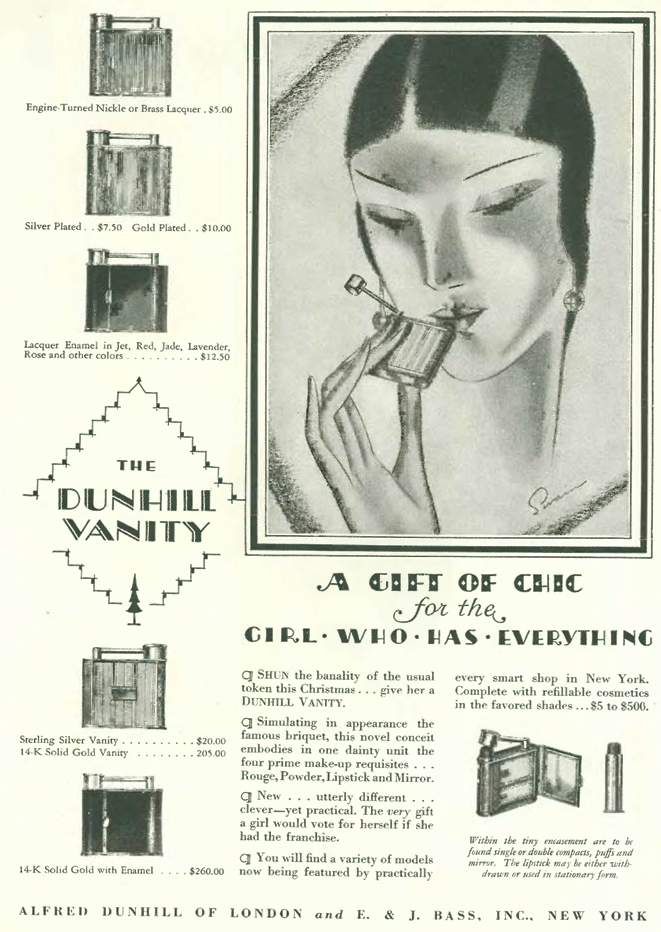
As for ads in the Dec. 17 issue, we get this one from Dunhill, maker of fine English cigarettes and accessories: a woman’s compact that resembles a lighter…

screen-shot-2017-02-06-at-12-07-21-pm

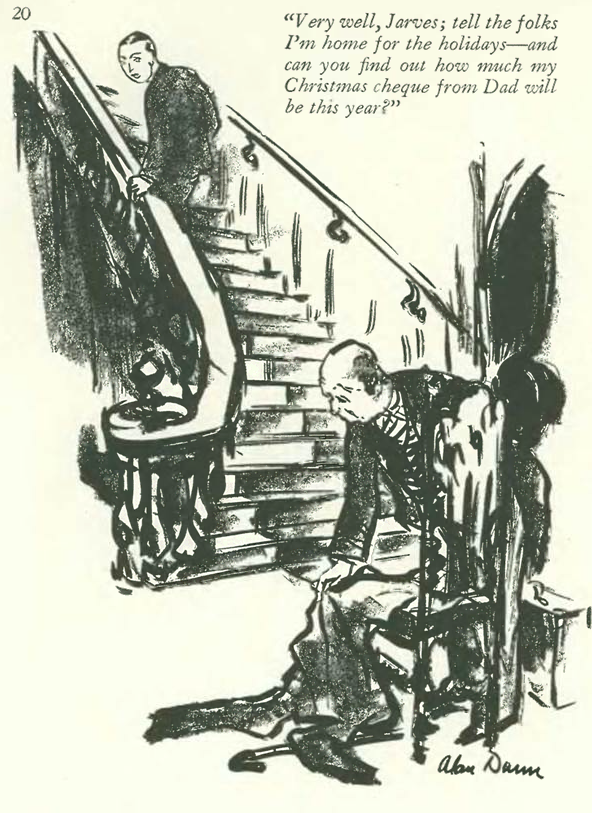
…and the same issue offers this glimpse into the life a spoiled rich kid, home from college for the holidays. The cartoon is by Alan Dunn, one of the most published New Yorker cartoonists (1,906 cartoons from 1926 to 1974)…

screen-shot-2017-02-06-at-11-52-12-am

With Christmas advertising over, the magazine’s page length dropped by half from the Dec. 17 to the Dec. 24 issue…

dec-24
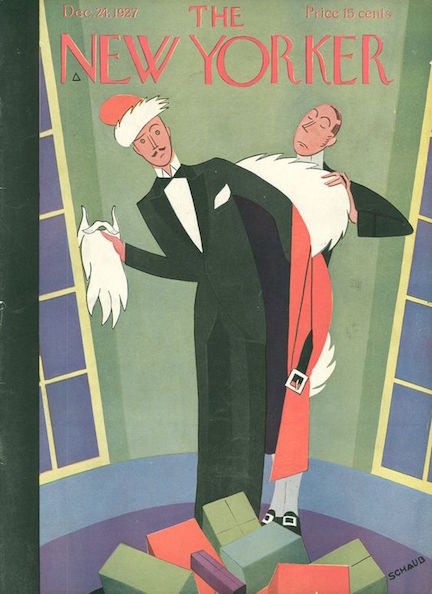
December 24, 1927 cover by Andre De Schaub.

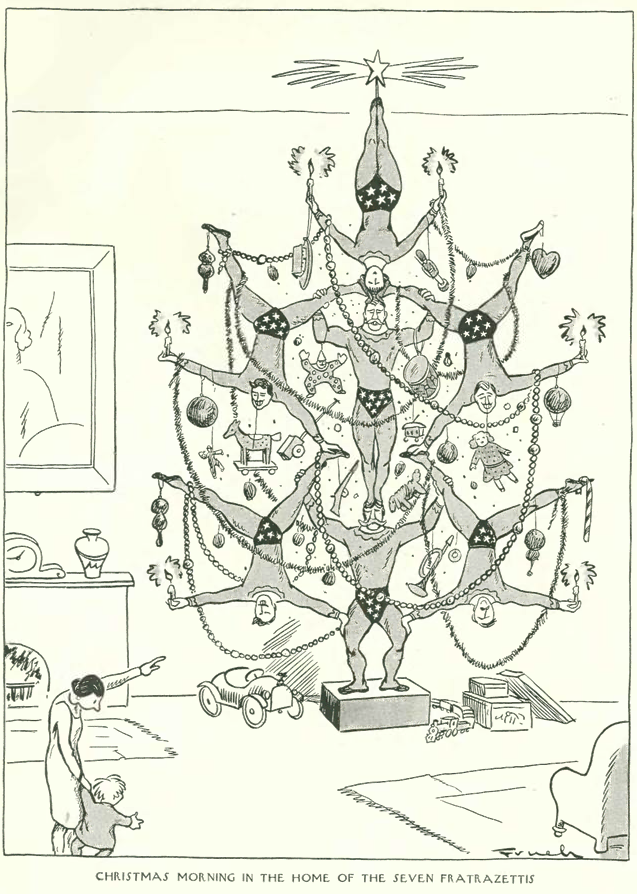
…in which we find this holiday-themed illustration by Al Frueh:

screen-shot-2017-02-06-at-12-26-56-pm

Why We Sing Auld Lang Syne

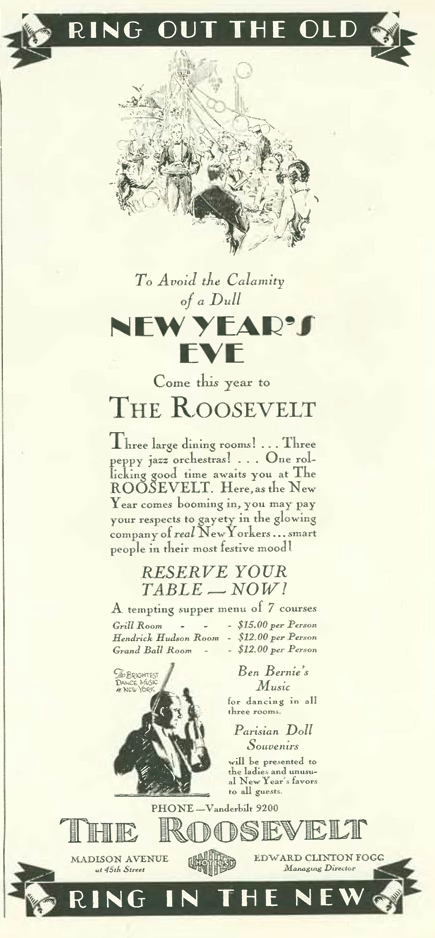
This advertisement in the Dec. 24 issue invited readers to celebrate the New Year at The Roosevelt Hotel…

screen-shot-2017-02-06-at-12-27-47-pm

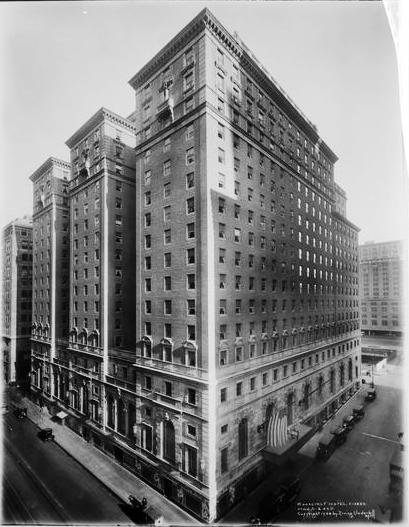
roosevelt-hotel-1924
The Roosevelt Hotel after its completion in 1924 (Museum of the City of New York)
1387211957-0
AULD ACQUAINTANCE…If you want to know why we sing “Auld Lang Syne” on New Year’s Eve, you can thank Guy Lombardo and his Royal Canadian Band, which made the song a staple at his New Year’s performances beginning in 1929 at the Roosevelt Hotel. Their performance that night was broadcast on the radio before midnight Eastern time on CBS, then after midnight on NBC radio. (neatorama.com)

 *  *  *

Now Let’s Get Out of Here

With the holidays out of the way, New Yorkers still faced a good three months of winter. That is, unless you were well-heeled enough to head south to Palm Beach. Considering the abundance of ads promoting travel to southern climes in the Dec. 24 and 31 issues, apparently many of the magazine’s readers possessed the means to do just that…

screen-shot-2017-02-06-at-12-29-05-pm

screen-shot-2017-02-06-at-12-29-15-pm

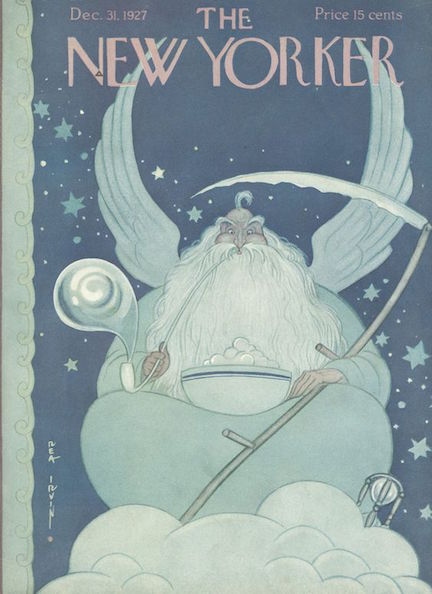
And we close this entry, and the year of 1927, with this cover…

dec-31
December 31, 1927 cover by Rea Irvin.

…and another tropical-themed advertisement, courtesy of Russeks…

screen-shot-2017-02-06-at-12-31-07-pm

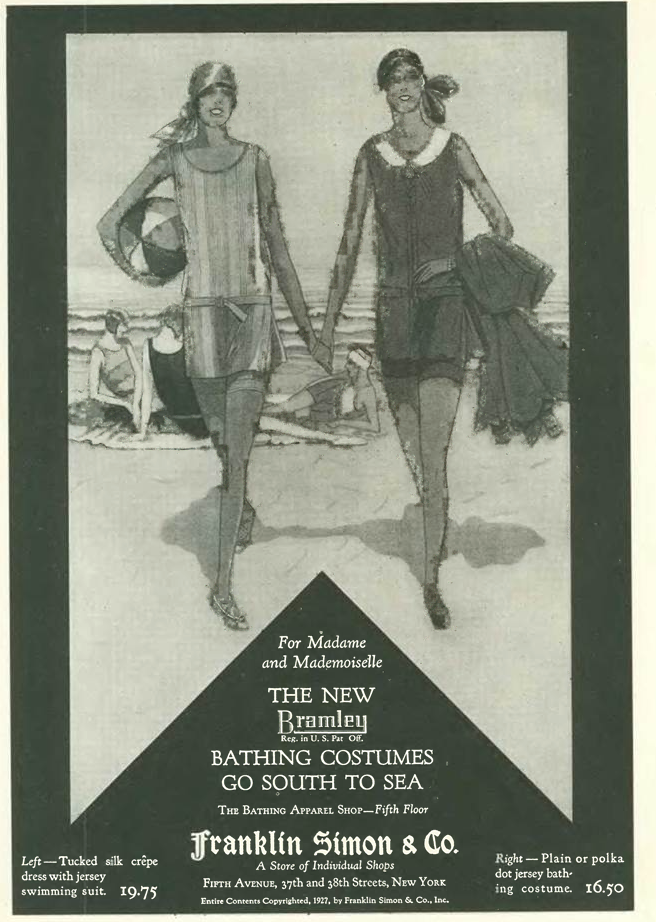
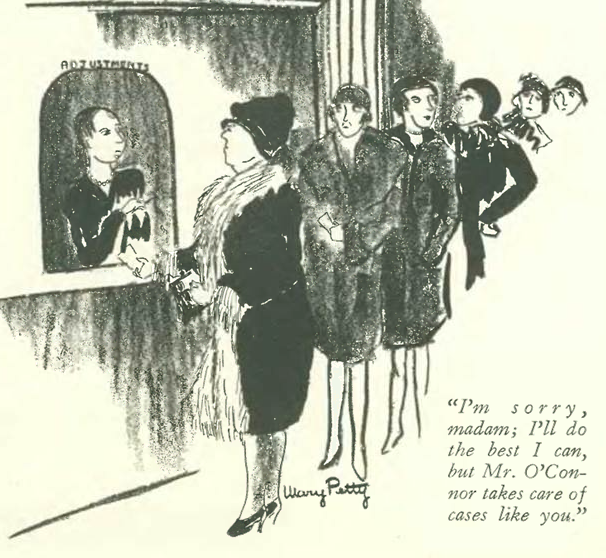
…and this cartoon by Mary Petty depicting those who were left behind, still returning their Christmas gifts…

screen-shot-2017-02-06-at-12-32-39-pm

Next Time: Odious Odes…

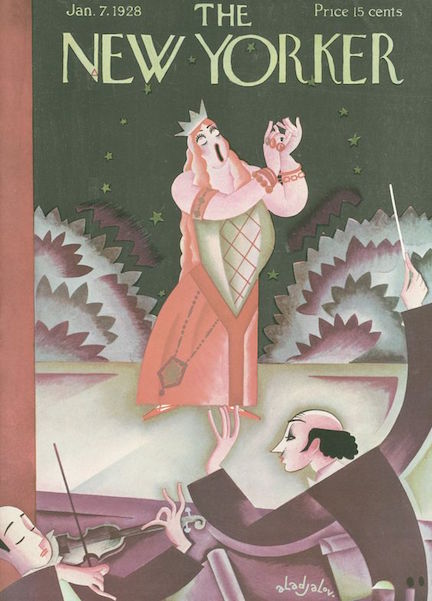
jan-7


Upstairs, Downstairs

As the New Yorker was a magazine of the city’s new money smart set, it poked fun at their faddish tastes and patronizing attitudes while at the same time feeding their Anglophilia and WASPish sense of superiority.

015737c92d9c339b44b3805c311dd478
January 22, 1927 cover by Andre De Schaub.

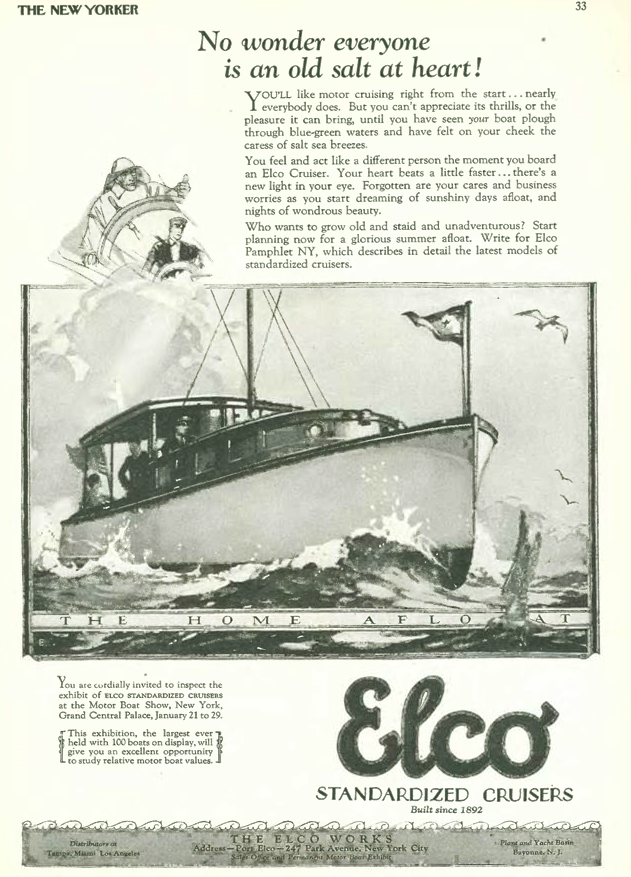
The magazine’s pages were filled with ads for English-style clothes, French perfumes and expensive cars. And in the Jan. 22 issue there were many ads for the motorboats that had displaced the automobile show at Grand Central Palace:

Screen Shot 2016-06-14 at 9.25.59 AM

It is important to note that this ad is an appeal to new money; old money would have found this motorized vessel quite vulgar.

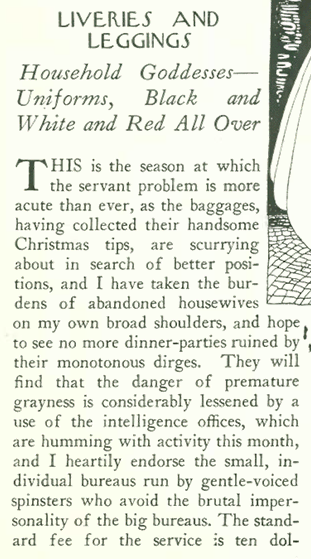
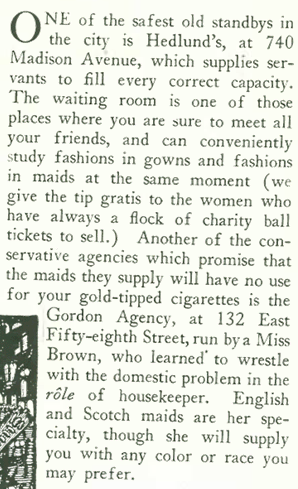
As it were, the new money needed some guidance if they hoped to live a lifestyle of ease and sophistication. And thus the issue’s “On and Off the Avenue” column, guest-written by Gretta Palmer (Lois Long took the week off), offered advice on how to hire and clothe the help:

Screen Shot 2016-06-14 at 9.27.59 AMScreen Shot 2016-06-14 at 9.28.35 AM

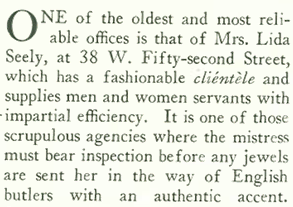
Perhaps you wanted a proper English butler. Lida Seely had your man:

Screen Shot 2016-06-14 at 9.28.53 AM

Or a Scotch maid, or choose from a selection of “any color or race”…

Screen Shot 2016-06-14 at 9.30.18 AM

In case you found that last sentence a bit callous, Gretta reassured:

Screen Shot 2016-06-14 at 9.30.55 AM

Screen Shot 2016-06-14 at 9.31.27 AM

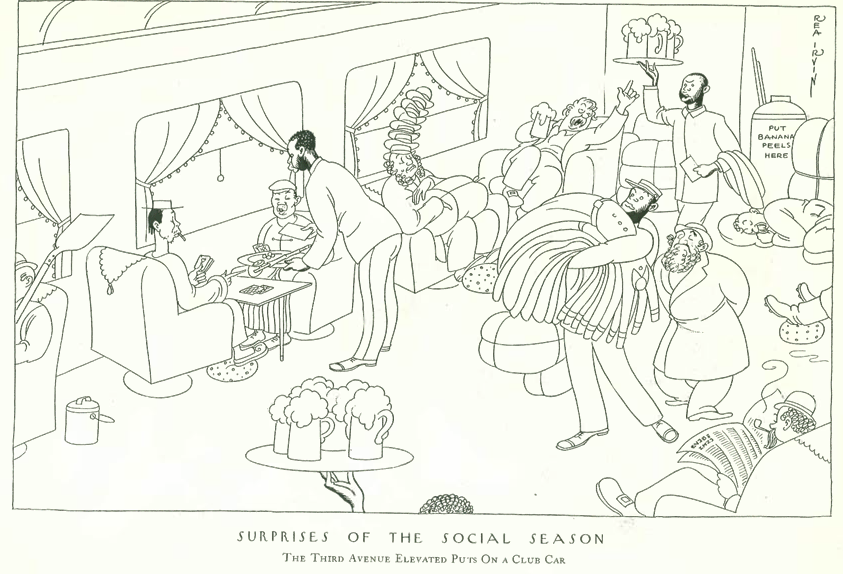
The issue also featured a cartoon by Rea Irvin (displayed full-page, sideways in the original magazine) depicting the “lower orders” aping the lifestyle of the upper classes. Note that of all the racial and ethnic types shown here, only Blacks remain in the servant class.

Screen Shot 2016-06-14 at 9.18.03 AM

As I noted in a previous post, “Race Matters,” the New Yorker of the 1920s was decidedly mainstream in engaging in casual bigotry common in those days, including treating blacks as racial “others.” There is, perhaps, a subtle jab here by Irvin at the pretensions of the uppers, but he’s not around anymore to clarify this.

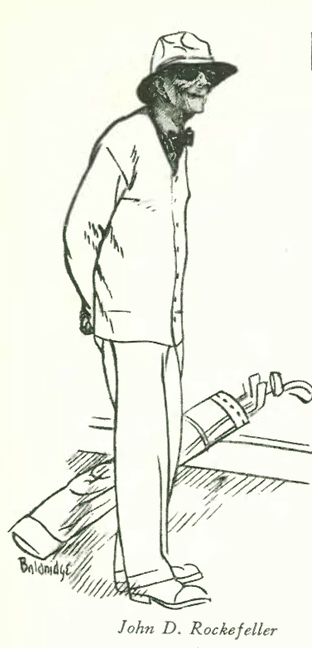
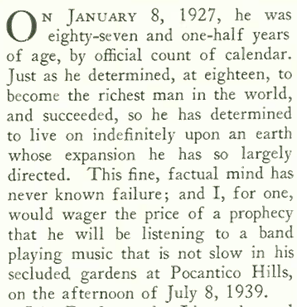
The issue also featured the first of a series of articles (“Profiles”) on the 87-year-old John D. Rockefeller. A brief excerpt, with illustration by Cyrus Baldridge:

Screen Shot 2016-06-14 at 9.19.18 AM

Rockefeller

The writer’s prediction wasn’t too far off: Rockefeller would live another ten years, and die at age 97 in 1937. His grandson, David Rockefeller, apparently inherited both his money and his genes: he recently celebrated his 101st birthday (update: David Rockefeller died in 2017 at age 101).

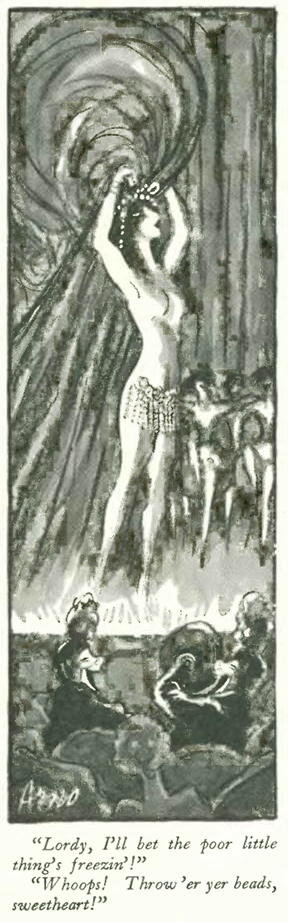
Finally, a cartoon by Peter Arno, famed for his drawings of women, usually scantily clad. Here we see an early example in one of his “Whoops Sisters” panels:

Screen Shot 2016-06-14 at 9.22.05 AM

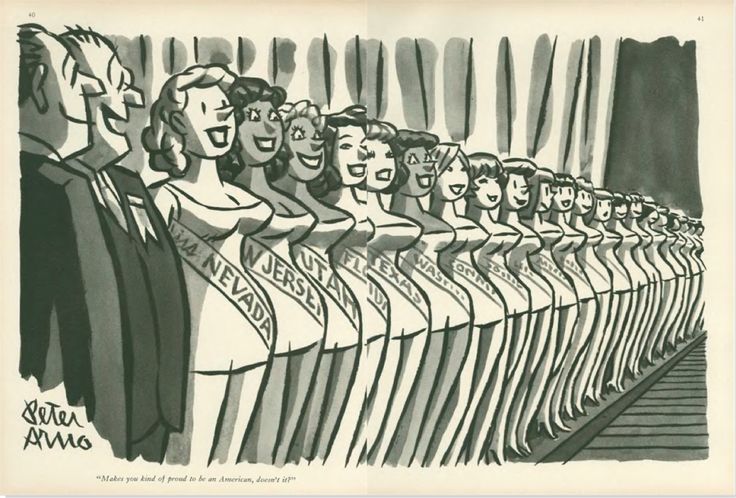
By comparison, here is a cartoon by Arno 33 years later, from the September 10, 1960 issue of the New Yorker:

869a0a6de1edde2e7479b79d285bd73a
Caption: “Makes you kind of proud to be an American, doesn’t it?”

Next Time: All That Jazz…

b8a47deb10bba89d024899c9500bba81

A Royal Flush

Perhaps because they’ve never had a monarchy, Americans have always been a little nuts over European royalty, even the lesser kings and queens.

Screen Shot 2016-03-31 at 9.58.22 AM
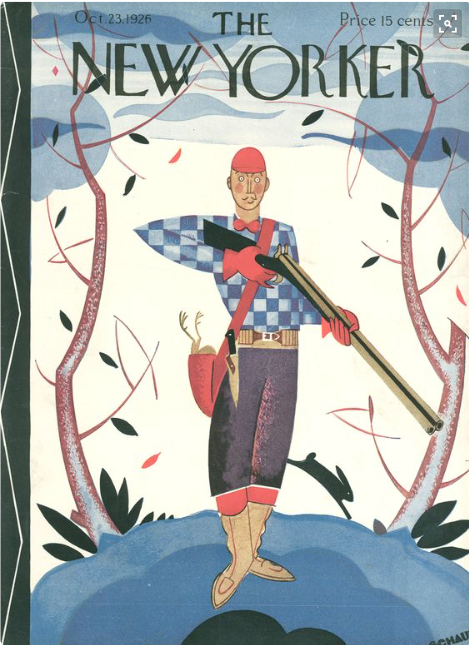
October 23, 1926 cover by Andre De Schaub.

In the lesser category was the Queen Marie of Romania, whose name and exploits appeared frequently in the pages of the early New Yorker. As early as Issue #4 (March 14, 1925), the magazine was reporting that New Yorkers were “agog” about a possible visit from Her Majesty, and that the North American Newspaper Alliance had offered her a contract to write her impressions of the United States.

queen-marie-of-romania-photo-232
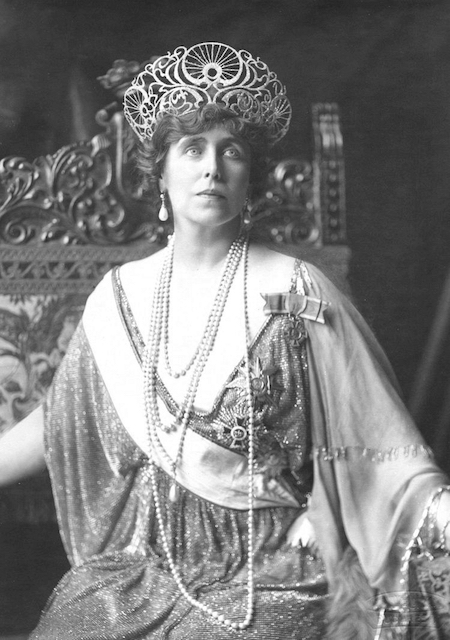
Queen Marie of Romania (Library of Congress)

The Queen filled the pages of both the Oct. 23 and Oct. 30 issues as she finally made her way to the American shores. “Of All Things” observed…

1
“Trudy” referred to above was New Yorker Gertrude Ederley, still basking in her fame as the first woman to swim the English Channel.

Now some background on The Queen: She born into the British royal family, titled Princess Marie of Edinburgh at birth. After refusing a proposal from her cousin (the future King George V), she was chosen as the future wife of Crown Prince Ferdinand of Romania, the heir apparent of King Carol I, in 1892. She was the last Queen consort of Romania, and her trip to the U.S. would prove to be the last months of her reign (her husband, Crown Prince Ferdinand, would die shortly after her return). Her 5-year-old grandson, Michael, the son of Prince Carol, would ascend to the throne, only to be usurped by his father in 1930 (at this writing Michael is still living. He is currently 94 years old).

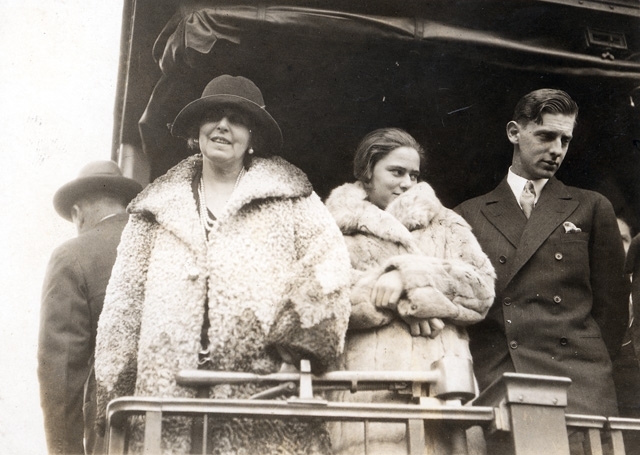
Things seemed fairly rosy in October 1926, as Americans awaited the queen and two of her children, Prince Nicholas and Princess Ileana, who were said to be seeking matrimonial matches in the States.

1926-1
Queen Marie, Princess Ileana, and Prince Nicholas of Romania on their American tour, 1926. (Henley Hamilton)

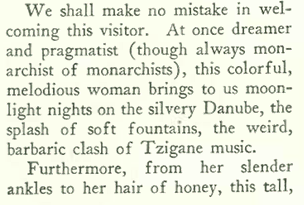
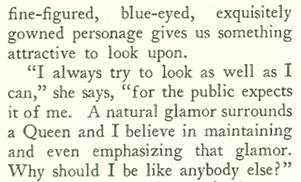
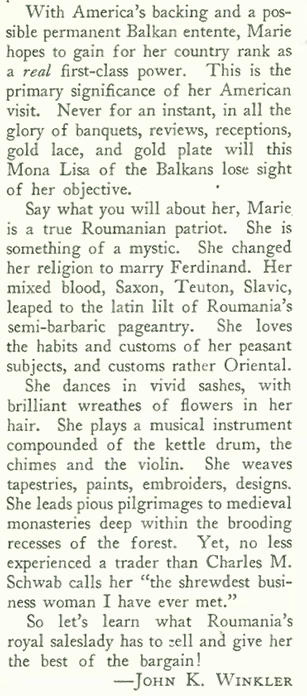
The issue’s “Profile” by John Winkler featured a mostly glowing account of Queen Marie…

2

3

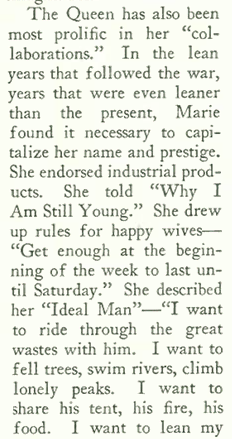
…although it was noted that Queen has to stoop to writing articles and endorsing products for a little extra cash…

4

5

Screenshot 2015-04-21 13.18.41
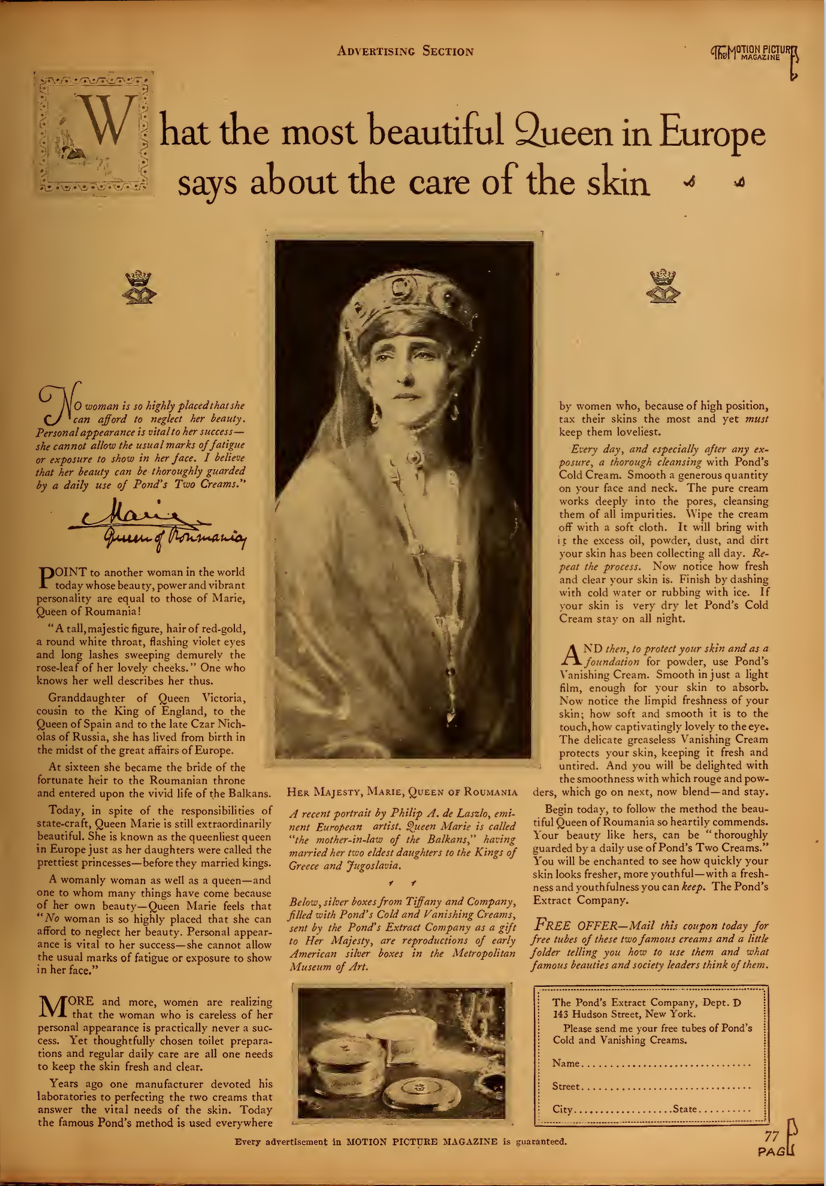
The “Queen of Roumania” and her Pond’s Cold Cream endorsement were featured in this April 1925 ad in Motion Picture magazine. (Image scan)

And the Queen would also be seeking a few bucks from Uncle Sam…

6

The Queen’s visit was even on the mind of one cartoonist (still trying ID):

Screen Shot 2016-04-01 at 1.27.00 PM

The following week, in the Oct. 30, 1926 issue…

a3dbcac2108e4dce47a2ca56e55b1e62
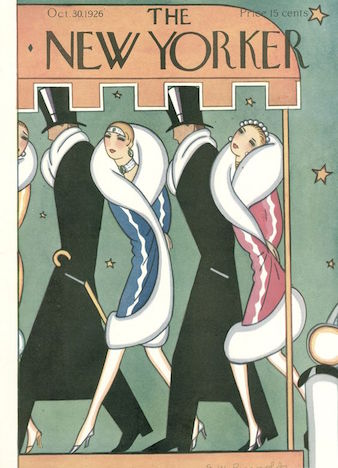
October 30, 1926 cover by Stanley W. Reynolds.

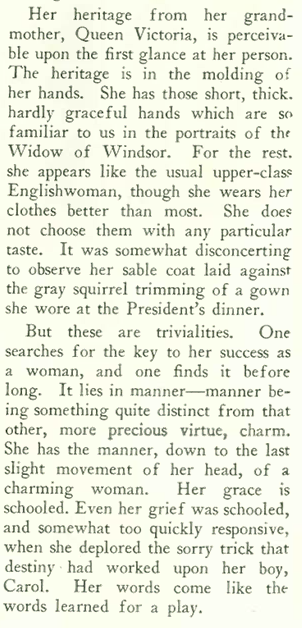
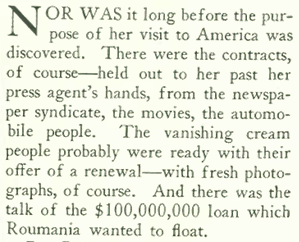
…the magazine offered an account of the Queen’s arrival, courtesy of writer Morris Markey:

1

Note the observation about the “sorry trick” played on the Queen’s son, Carol. Markey is referring the fact that Carol had waived his rights to succession. Little did anyone know that “her boy” would one day seize the throne and work to discredit her name.

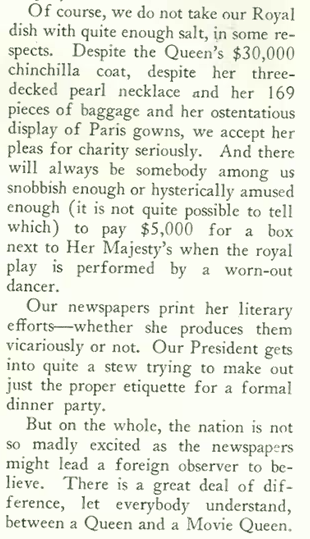
Markey also wryly noted the Queen’s objective to gain financial support from the U.S., even if her outstretched hand was covered in jewels:

S2

3

No Movie Queen, but she did have a flair for theatrics…

qmf20
(Kent State University)

Next Time: Fun With Harold…

Screen Shot 2016-04-01 at 3.03.49 PM