Comfort Food

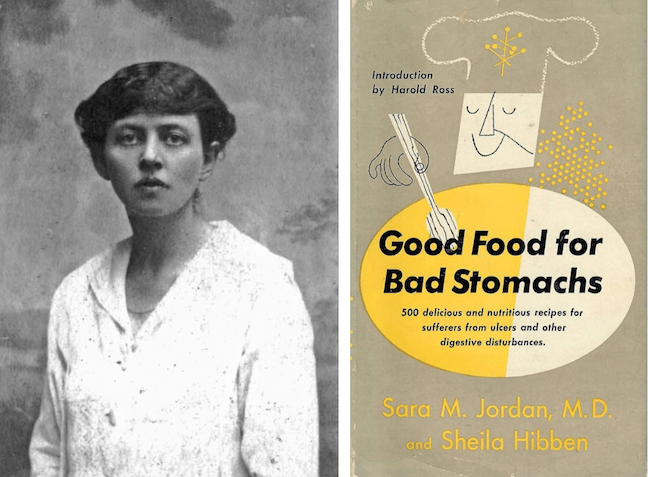
Above: Sheila Hibben became The New Yorker's first food critic in 1934. She also wrote several cookbooks, including Good Food for Bad Stomachs, a book that was suggested by New Yorker founder and editor Harold Ross. Hibben was a pioneering advocate for American regional dishes, and despised food snobbery (she wanted to banish the word "gourmet" from the English language). (Wikipedia/Amazon)

Long overdue is a look at The New Yorker’s first food critic, Sheila Hibben, who wrote frankly about the dining scene in her restaurant reviews and in her column “Markets and Menus.” Decades ahead of her time, she drew attention to America’s regional dishes, persuading readers to embrace the comforts of humble, practical recipes during the lean years of the Depression and the Second World War.
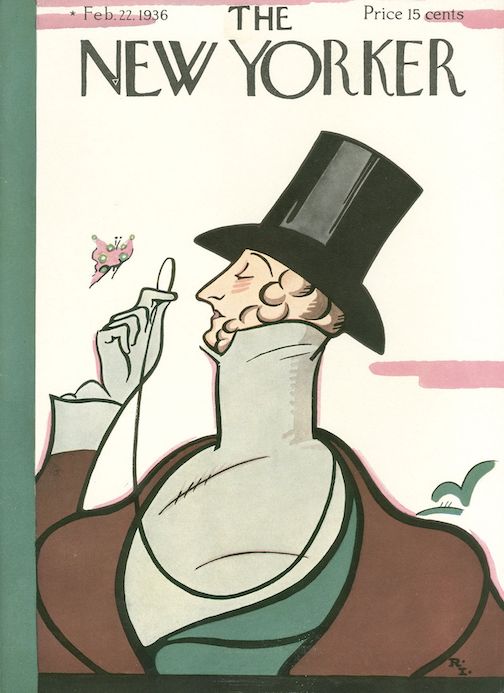
Eleventh anniversary cover by Rea Irvin, February 22, 1936.

Born Cecile Craik, Hibben (1888–1964) detested food snobbery, and through her pioneering work “persuaded housewives to be proud of their American culinary identity, to embrace traditional regional cuisines, and to reject fancier fare for the sake of fashion,” observed Meaghan Elliott in her 2021 dissertation at the University of New Hampshire.

In addition to her “Markets and Menus” column and restaurant reviews, Hibben also wrote several books including Good Food for Bad Stomachs, which was inspired by New Yorker founder and editor Harold Ross. Plagued by ulcers and discouraged by his limited diet, Ross encouraged his gastroenterologist, Sara Murray Jordan, to write a cookbook with Hibben. Good Food for Bad Stomachs was published in 1951, with a laudatory foreword by Ross, who unfortunately did not have long to enjoy the recipes, dying of heart and lung problems that same year.
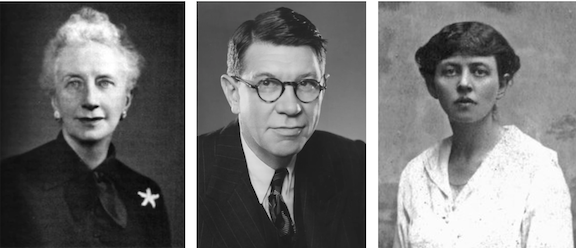
DYSPEPTIC DIETER Harold Ross brought together the talents of his gastroenterologist Sara Murray Jordan, left, with his magazine’s food critic, Sheila Hibben, to publish Good Food for Bad Stomachs. (Wikipedia/The New Yorker)

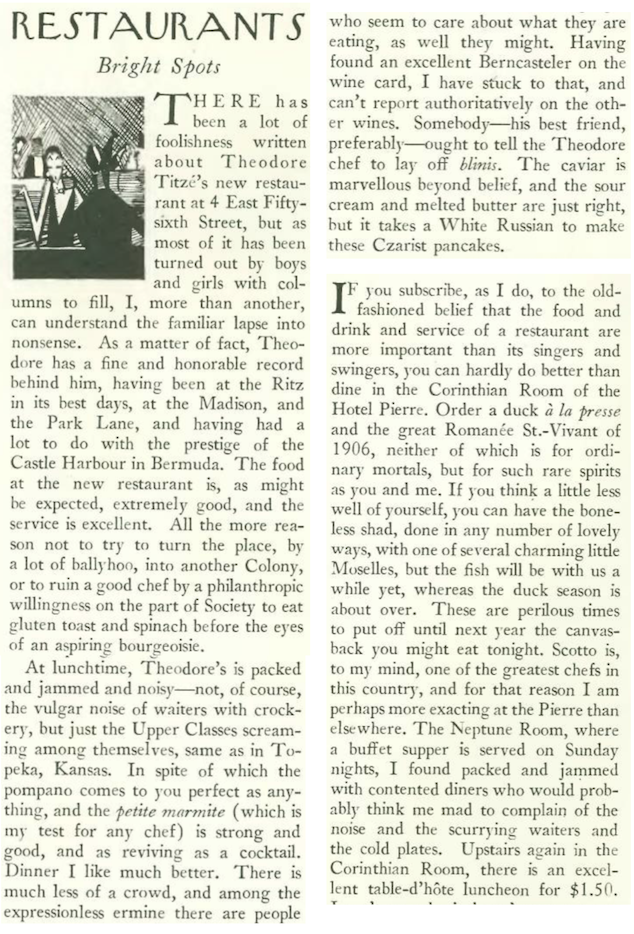
Here are excerpts from Hibben’s “Restaurants” column for the Feb. 22 issue, featuring her takes on a couple of the city’s finer dining establishments, including Theodore Titze’s restaurant on East 56th and the famed fare of Charles Scotto at the Hotel Pierre:
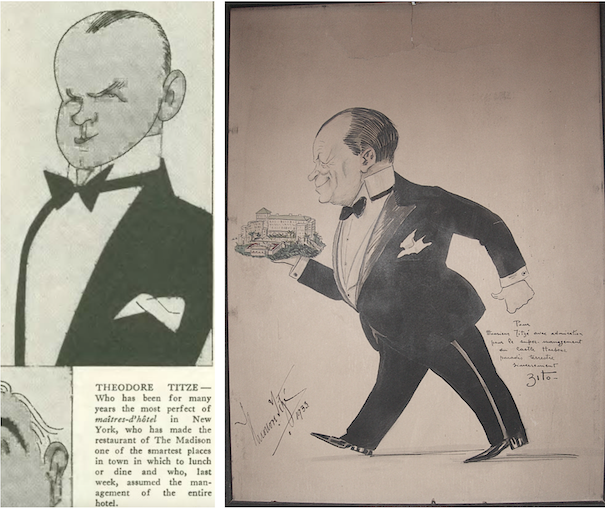
KNOWN AS THEODORE OF THE RITZ, the German-born Theodore Titze (1879–1953) was a well-known maitre d’hotel—at left, Ralph Barton featured Titze as one of his “Heroes of the Week” in the Dec. 12, 1925 issue of The New Yorker; at right, a 1933 drawing of Titze by the cartoonist Vinzento Zito—the image refers to Titze’s 1931 departure from New York to take charge of the Castle Harbor Hotel in Bermuda. He later operated other properties in Bermuda before opening Theodore’s at 4 East Fifty-sixth Street. (wikitree.com)
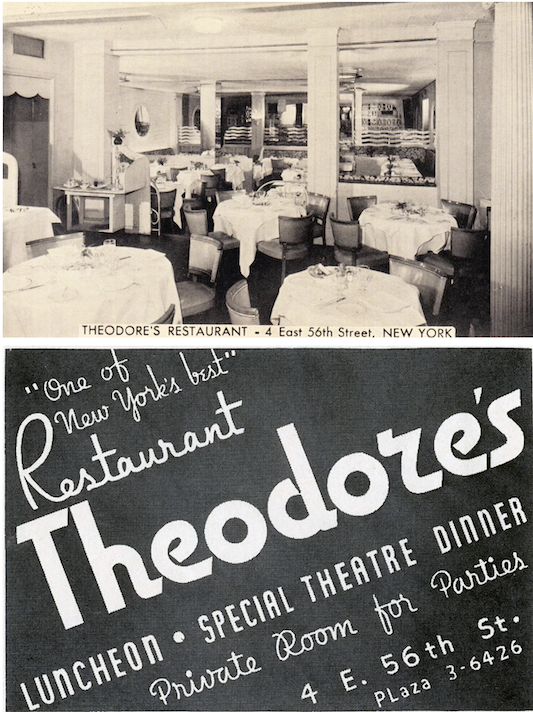
CAN’T MISS IT…Top, postcard image of Theodore’s Restaurant; below, ad for Theodore’s in Stage magazine, February 1938. (Etsy.com)

Hibben also wrote about the excellent fare at the Hotel Pierre, where Chef Charles Scotto, an early protégé of the legendary Chef Auguste Escoffier, reigned supreme.
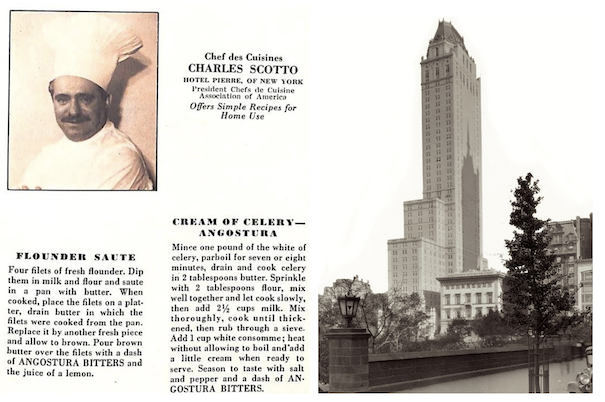
CREAM OF THE CROP…At left, a page from the 1934 booklet Angostura Recipes featuring a recipe by famed Chef Charles Scotto (1887–1937). At right, undated image of the Hotel Pierre. (The Cary Collection/geographicguide.com)

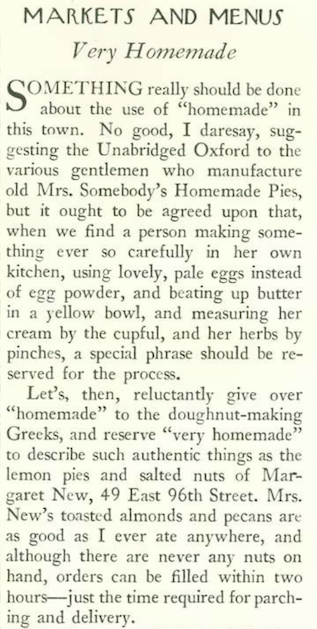
From 1934 to 1962 Hibben wrote the “Markets and Menus” column, which appeared in rotation with several other columns that were tacked onto Lois Long’s weekly “On and Off the Avenue.” Here is an excerpt from Hibben’s Feb. 1, 1936 column:
 * * *

Not Music to His Ears

In his “Notes and Comment,” E.B. White took issue with “the fascism of music” in public places including Grand Central Station and the Central Park skating pond.
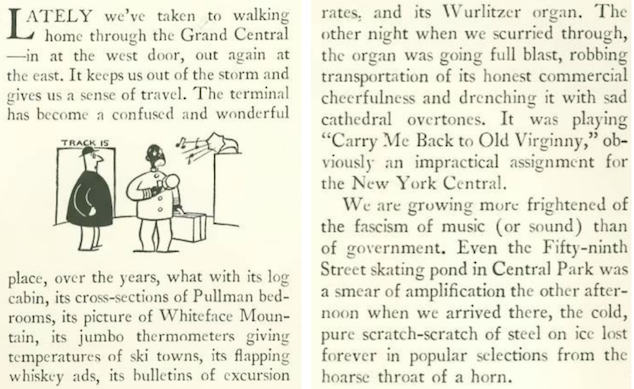
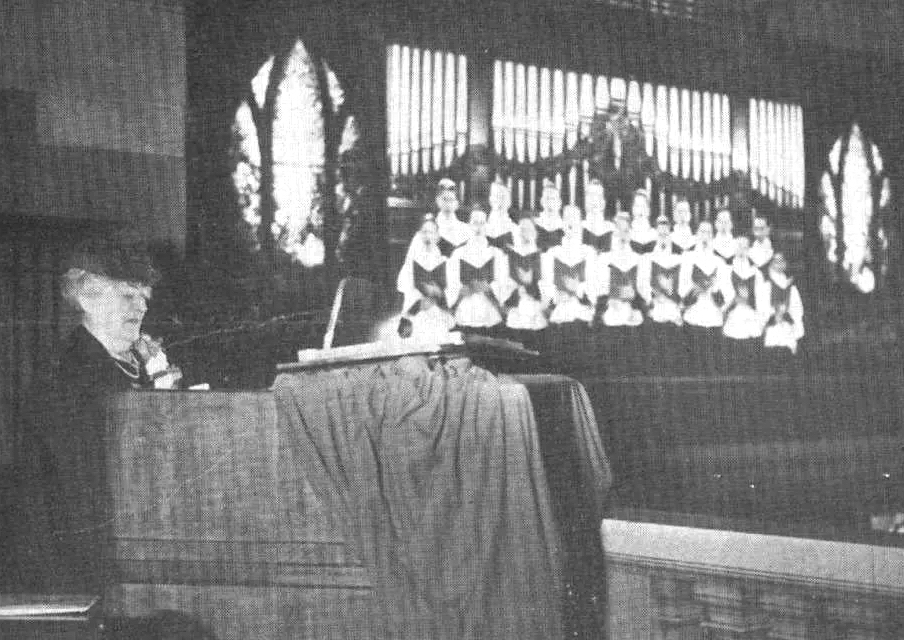
SAD CATHEDRAL OVERTONES is how E.B. White described the organ music of Mary Lee Read, who played organ in Grand Central’s north gallery from 1928 until the late 1950s. On the day after Pearl Harbor was attacked she played “The Star-Spangled Banner;” activity on the concourse ground to a halt, causing commuters to miss their trains. She was forbidden from playing the song after that. She has also been credited with saving the life of a man who was planning to commit suicide until he heard her play a moving hymn. (marthahallkelly.com)

 * * *

At the Movies

Paul Muni was considered one of the best actors of the 1930s, his talents so appreciated by Warner Brothers that he was allowed to choose his own roles, including the lead in The Story of Louis Pasteur. It was a good choice, as it landed him a Best Actor Oscar in 1936. New Yorker critic John Mosher had these observations:
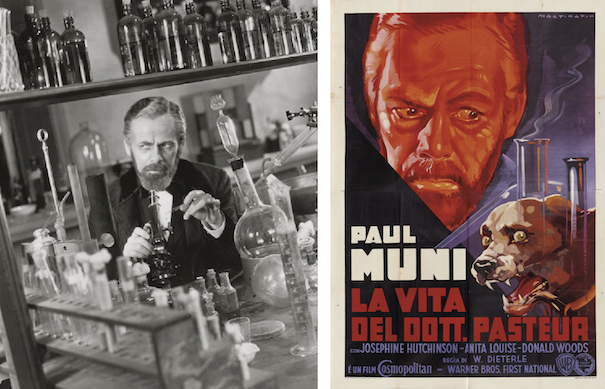
HE’S ON TO SOMETHING…Paul Muni in The Story of Louis Pasteur. One of the best posters for the film was the Italian version at right, the rabid dog promising some some real drama. Muni won the Best Actor Oscar of his portrayal of Pasteur. (researchgate.net/imdb.com)

Mosher also took in The Prisoner of Shark Island, featuring Warren Baxter as a man falsely accused of complicity in the assassination of President Abraham Lincoln.
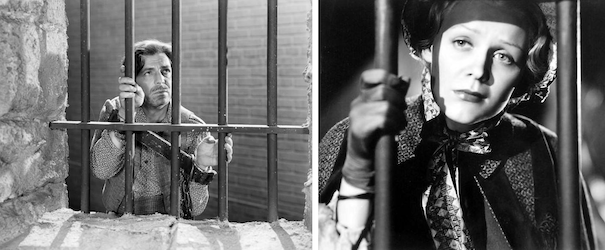
I DIDN’T DO IT…Warren Baxter and Gloria Stuart in The Prisoner of Shark Island. Moviegoers today will remember Stuart (1910–2010) in her portrayal of the aged Rose in 1997’s Titanic. Stuart’s film career would span more than seventy years, 1932–2004. (mubi.com/imdb.com)

Mosher found much to like in a Soviet film about the struggles and hardships of three childhood friends from Petrograd who become nurses to serve the cause of the Bolshevik Revolution.
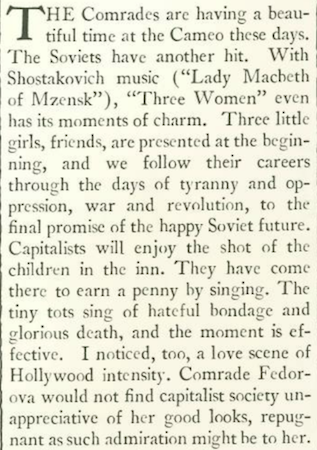
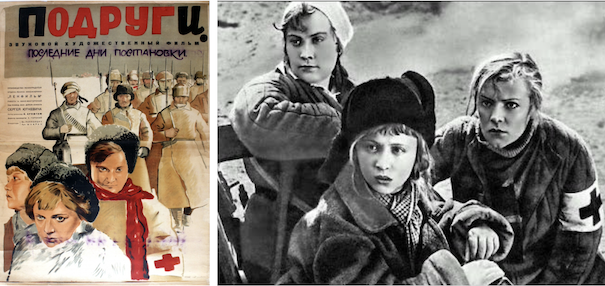
SOVIET SISTERHOOD…At right, Irina Zarubina, Yanina Zhejmo and Zoya Fyodorova in 1936’s Three Women. It was released in the Soviet Union as Girl Friends (Podrugi).

 * * *

From Our Advertisers

If you wanted to visit the land of the Soviet film, Three Women, you could have hopped onto this Reliance cruise to Russia as well as to the Summer Olympics in Berlin…in just a little over three years the Germans would invade Poland and these “wonderlands” would become a living hell for many…
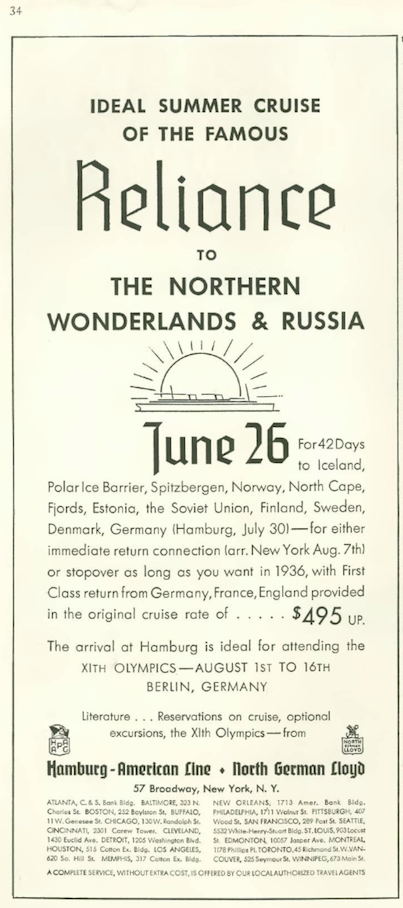
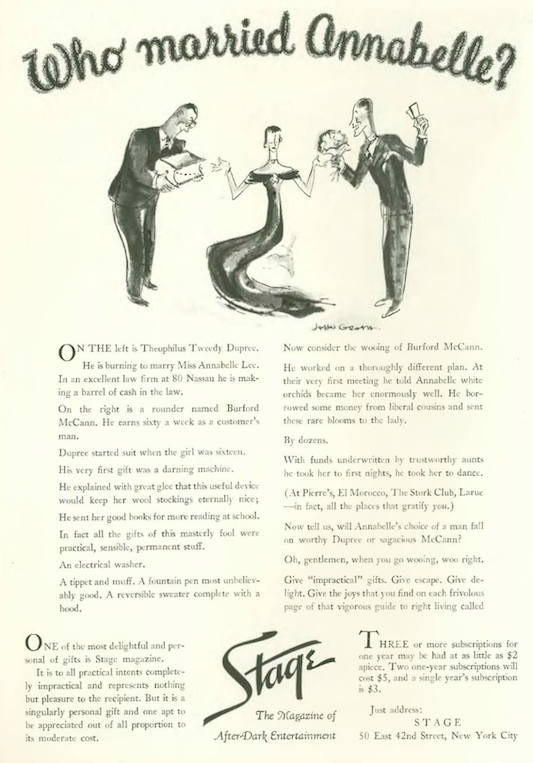
John Groth, who would contribute cartoons to The New Yorker in the 1940s, provided this illustration for a Stage magazine ad…
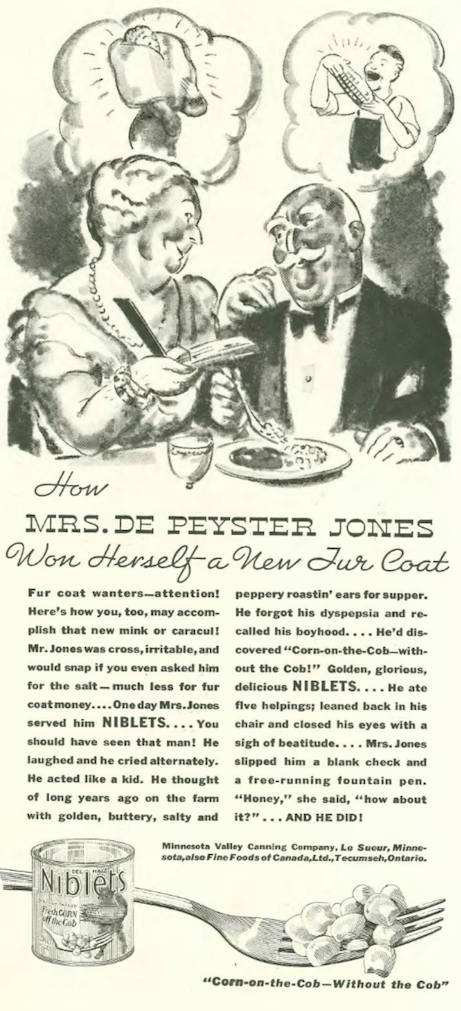
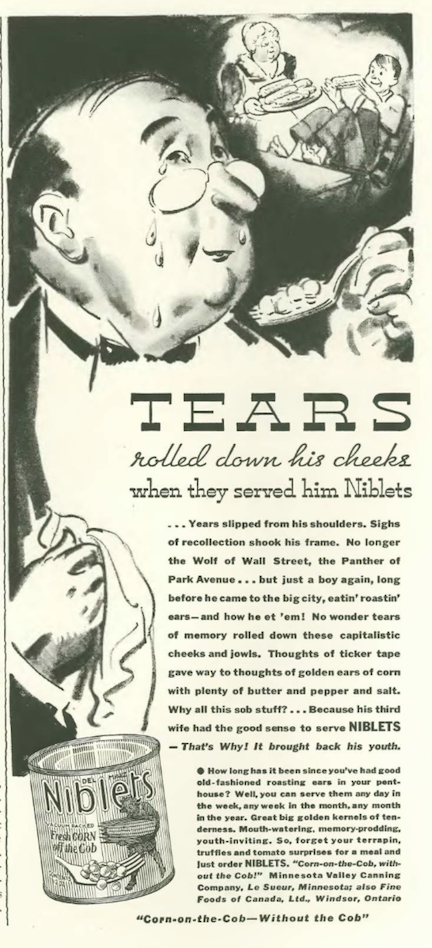
…the folks at Minnesota Valley Canning Company continued the theme of a rich man returning to his humble roots via canned Green Giant vegetables…here the man is brought to tears over “Niblets”…
…as you might recall, it was a wealthy “Major” who recently sought to rekindle lost youth through fresh peas (also found in a Green Giant can)…

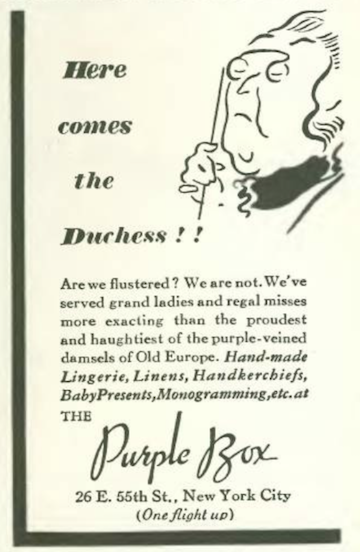
…and what’s the deal with the Duchess trope found in so many ads?…she has been featured in a Green Giant ad for peas, as well as in ads for tomato and grapefruit juice…
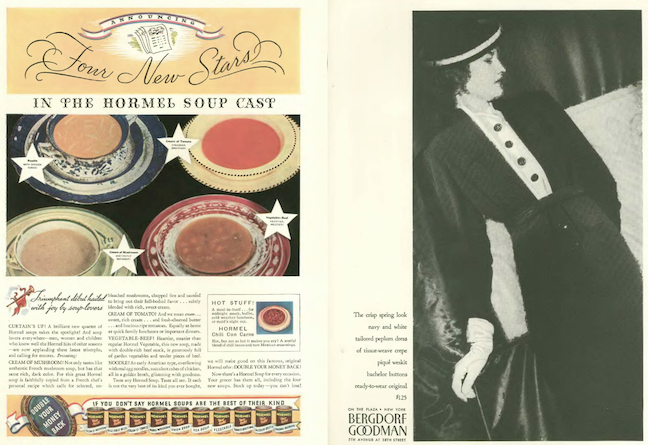
…the magazine’s opening spread once again featured the odd juxtaposition of canned soup and high fashion…
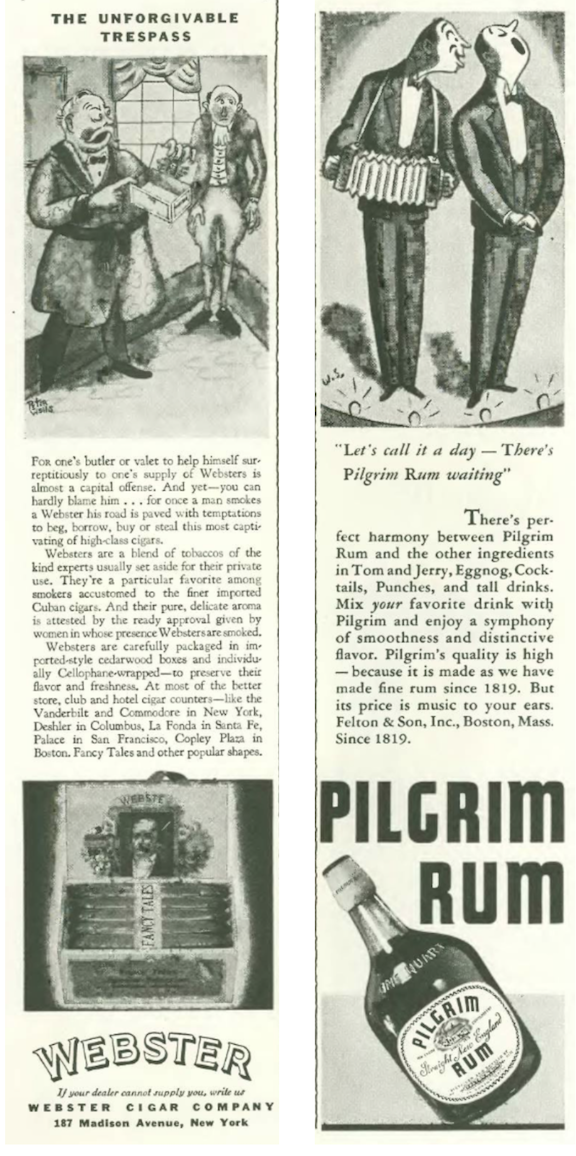
…one-column ads in the back of the book featured illustrations by Peter Wells (at left), and William Steig

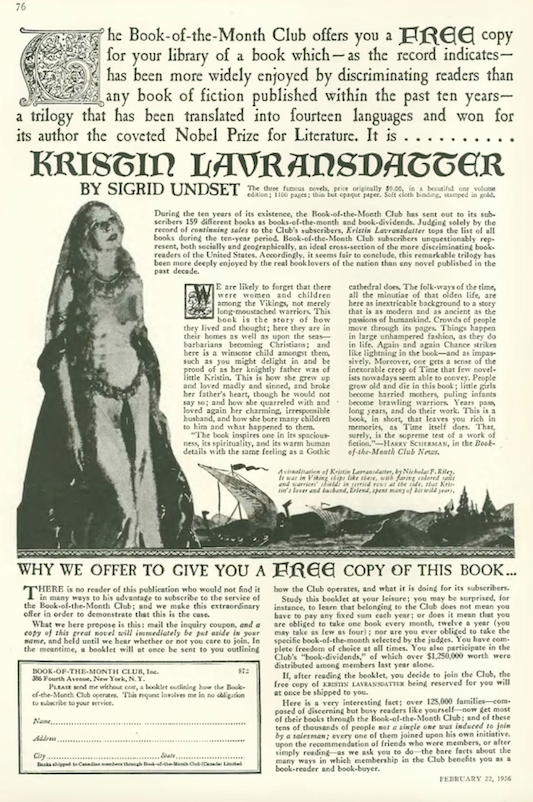
…Book-of-the-Month Club enticed new members with a FREE copy of the Nobel Prize-winning trilogy Kristin Lavransdatter by Danish-Norwegian author Sigrid Undset

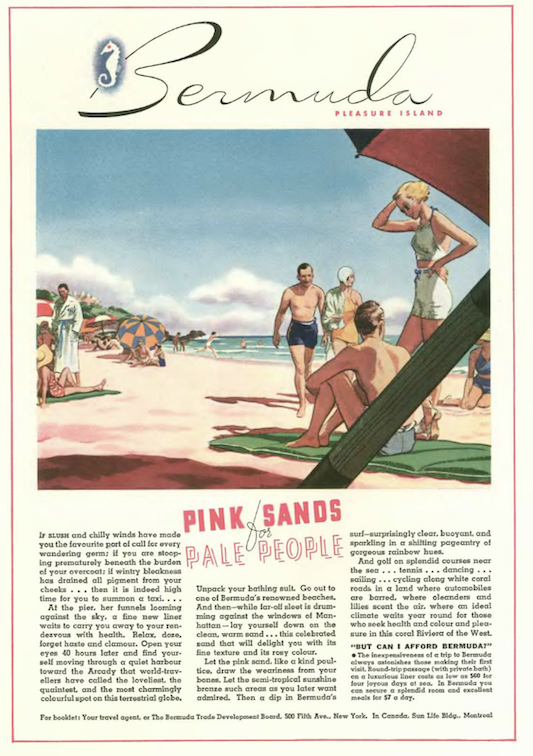
…this colorful ad from the Bermuda Trade Development Board beckoned New Yorkers to trade “slush and chilly winds” for the pink sands of the British island territory…
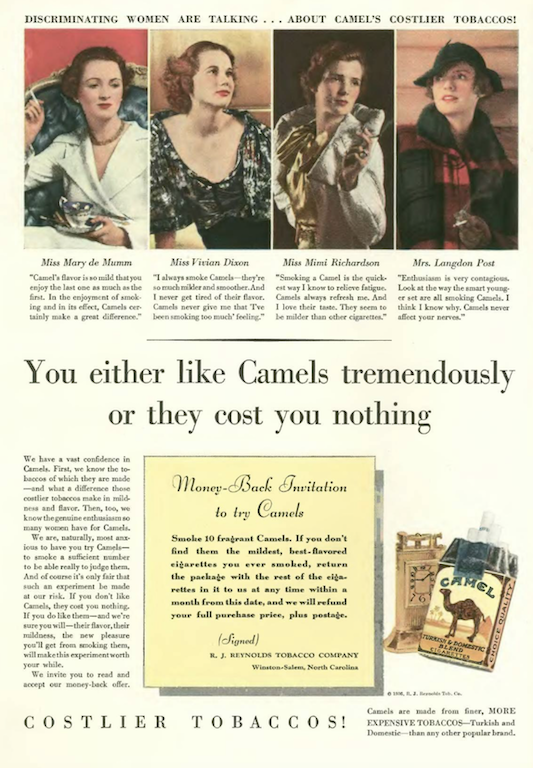
…the back cover cycled back to Camel cigarettes with a lineup of fashionable debs enticing young women to join their ranks…as Camel smokers, at least…
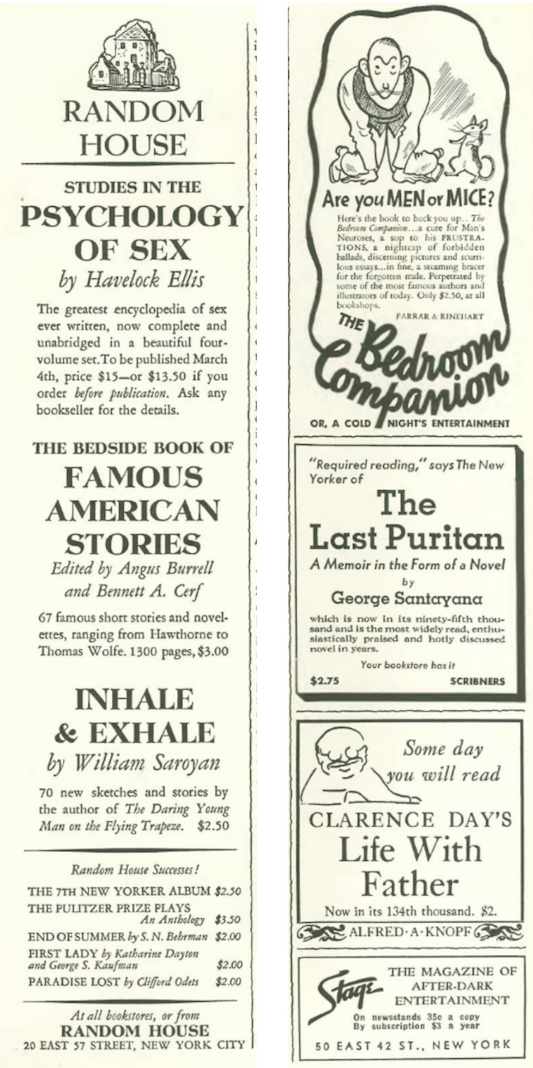
…more one-column ads, featuring the latest in reading material…
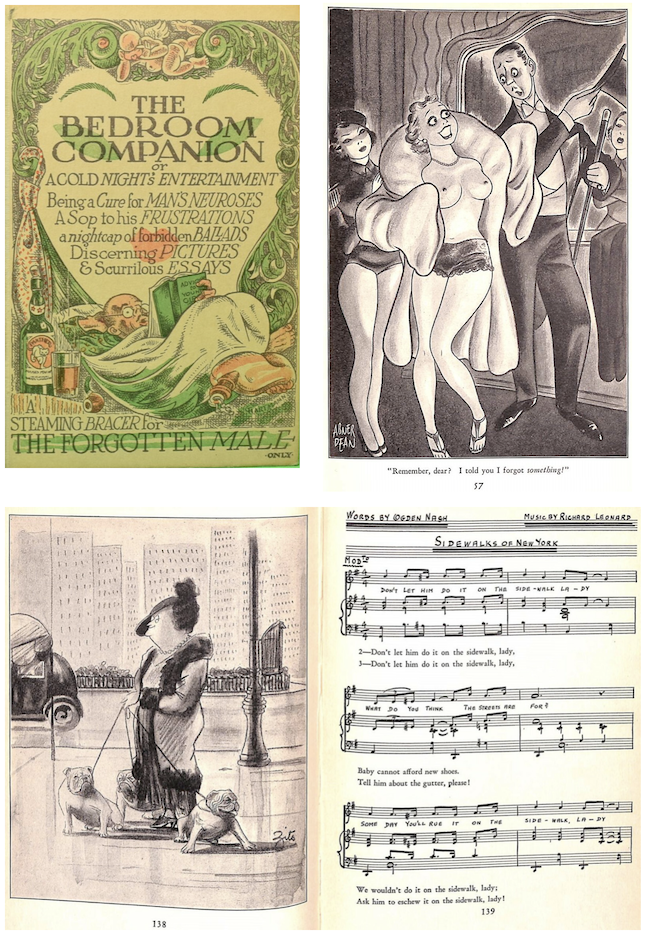
…including the latest edition of The Bedroom Companion…it was one of those “For Men Only” books that compiled some previously published pieces with other contributions…
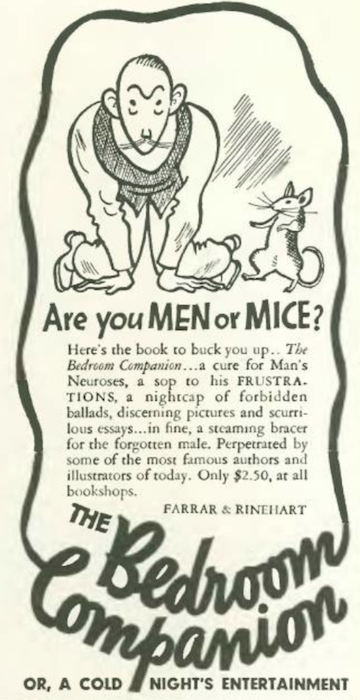
…the index of the 1935 edition included a number of New Yorker regulars…
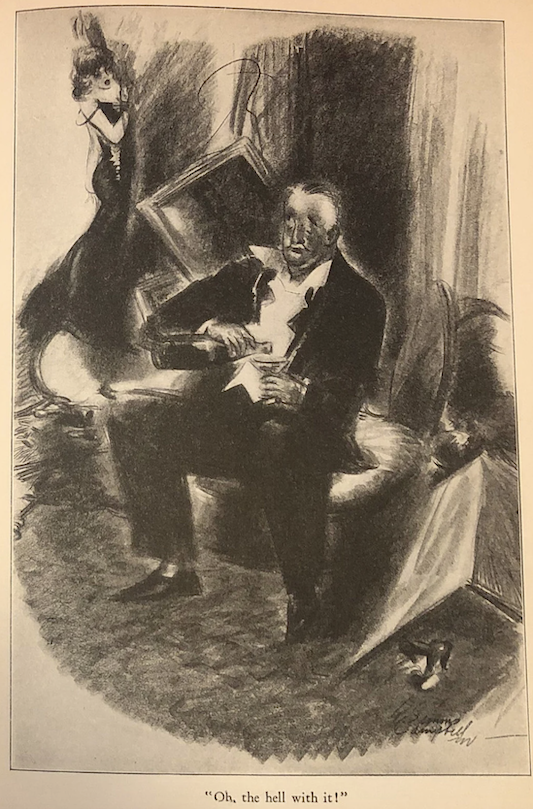
…such as E. Simms Campbell

…and Abner Dean

LATE NIGHT READING…Clockwise, from top left, 1935 edition of The Bedroom Companion; a racy cartoon by Abner Dean; comic lyrics by Ogden Nash; a contribution by Vincenzo Zito, a well-known caricature artist who particularly favored dogs. (etsy.com)

…on to our other cartoonists, we begin with spots by Constantin Alajalov

and Richard Taylor

…Taylor again, a spot in the “Musical Events” section…
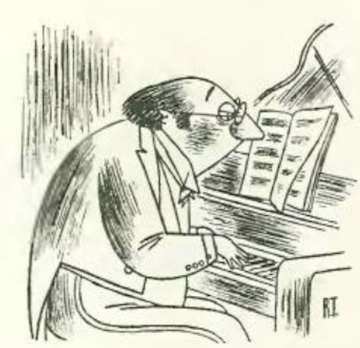
…and a Taylor cartoon…
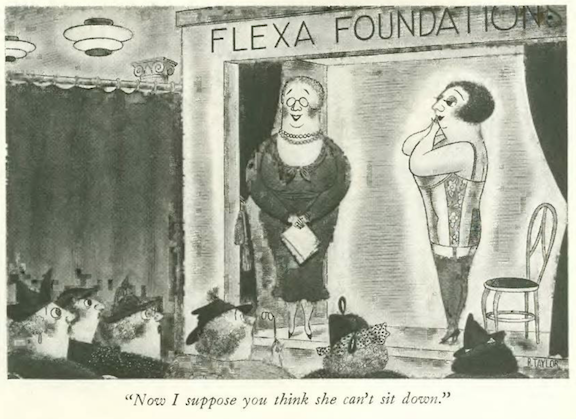
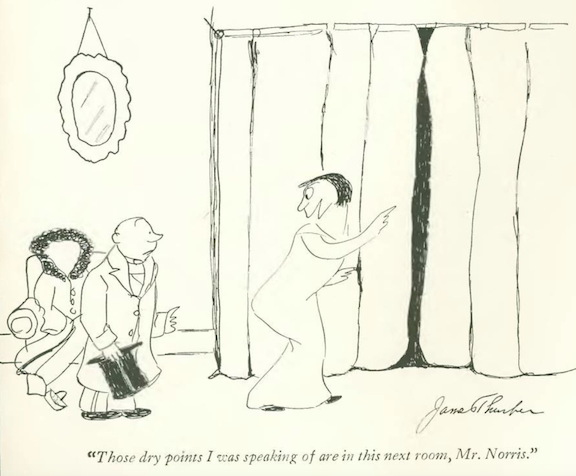
…and we wonder what’s behind the curtain, with James Thurber

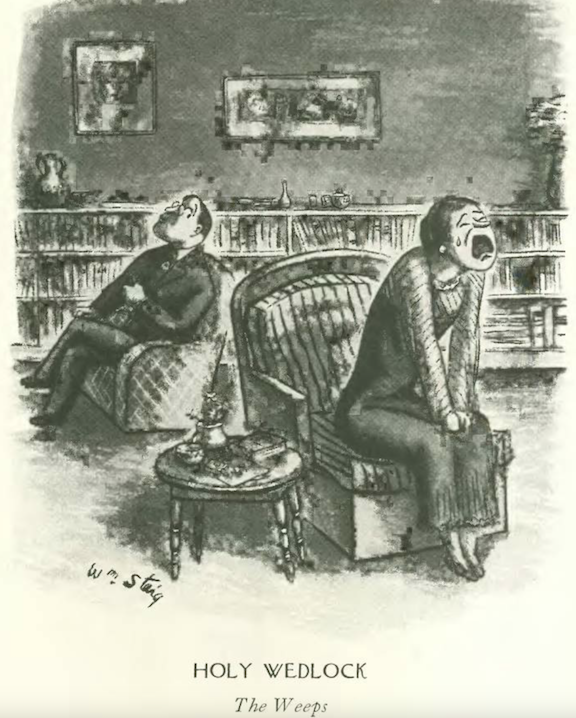
William Steig continued to probe the downsides of matrimony…
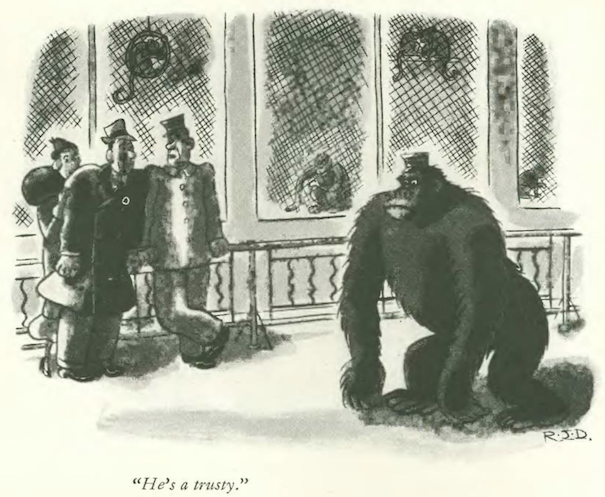
Robert Day showed who’s in charge at the zoo…
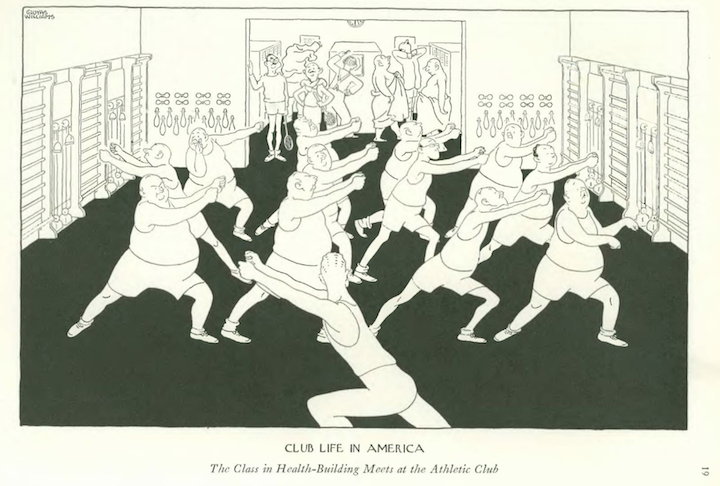
…more club life from Gluyas Williams

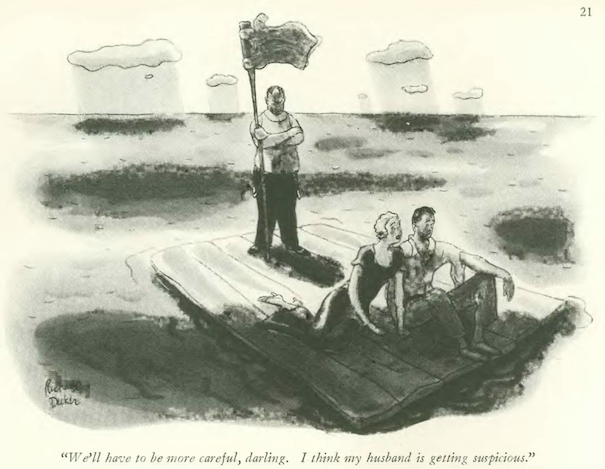
Richard Decker was in a tight situation…
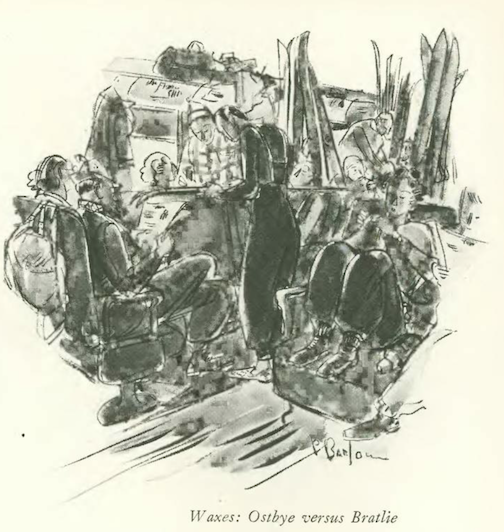
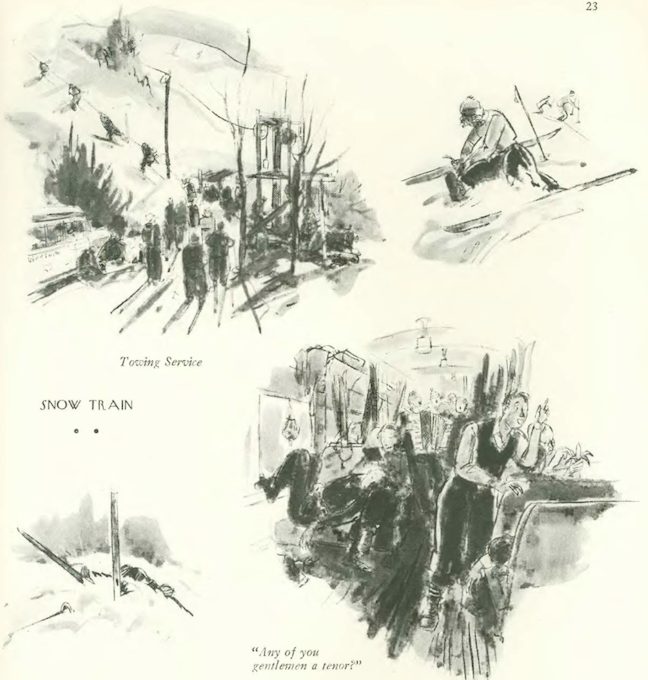
Perry Barlow drew up two pages of scenes from Snow Trains that took thousands of skiers from Grand Central to the Berkshires and Adirondacks…
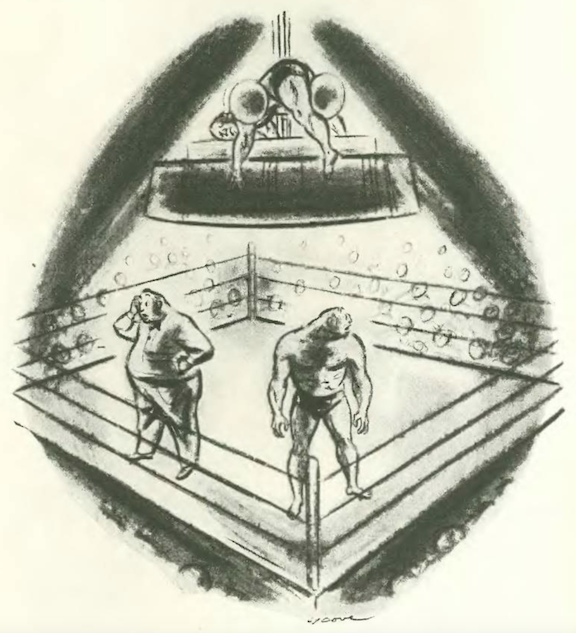
Leonard Dove delivered a knockout punch…
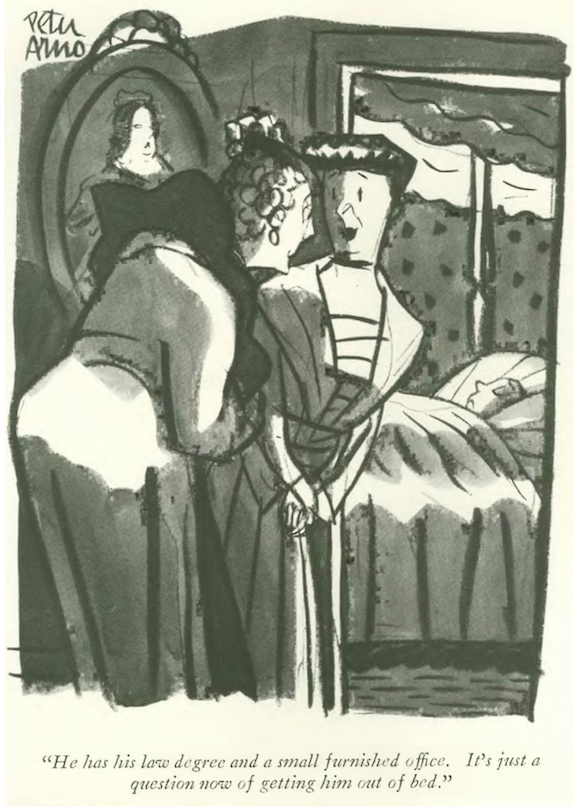
Peter Arno raised a question of initiative…
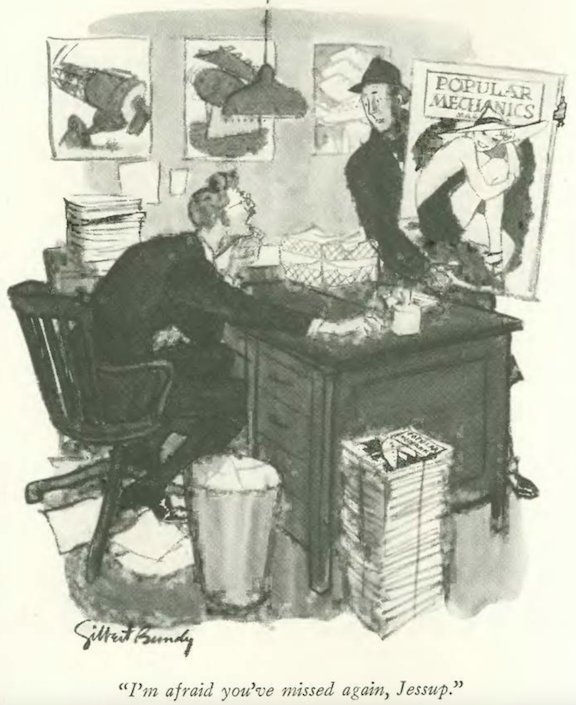
…and Gilbert Bundy sought to spice things up at Popular Mechanics

A final note: Aside from the recurring Rea Irvin cover, this issue made no reference to the eleventh anniversary…except, on the bottom of page 57…
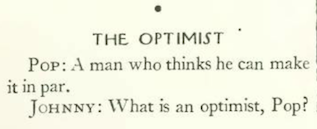
…a recurring column filler, “The Optimist,” appeared in Issue No. 1, and was featured in subsequent issues until Katharine Angell mercifully put an end to it.

Next Time: Führer Furor…
Modern Times

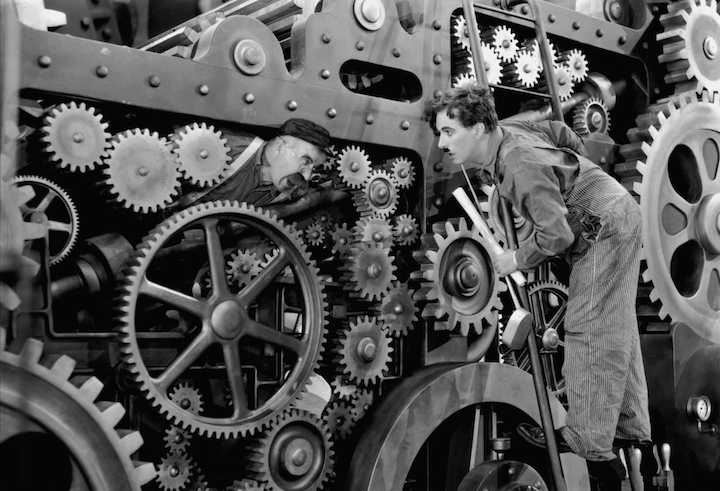
Above: A mechanic (Chester Conklin) gets caught up in his work with the help of the Tramp (Charlie Chaplin) in Modern Times. (festival-entrevues.com)

The film Modern Times was Charlie Chaplin’s last performance as “The Tramp” (or, “The Little Tramp”), a character he created more than twenty years earlier to represent a simple person’s struggle to survive in the modern world. That struggle was no more apparent than in Modern Times, a film in which the Tramp faced the dehumanizing industrial age in all its kooky complexity.

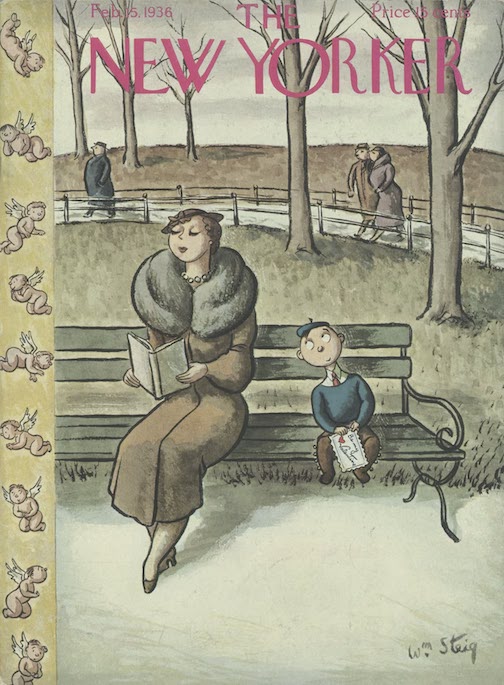
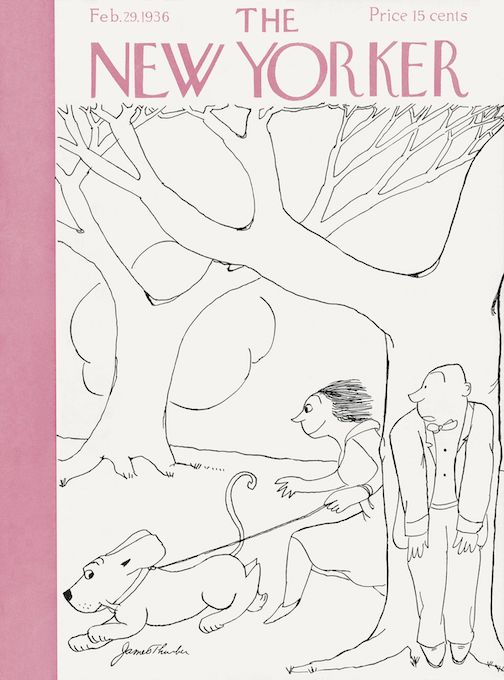
A sweet Valentine’s Day-themed cover by William Steig, February 15, 1936.

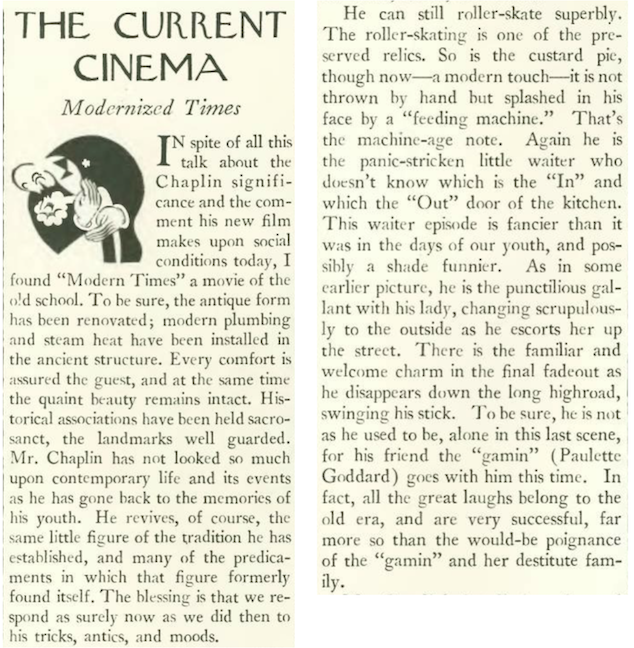
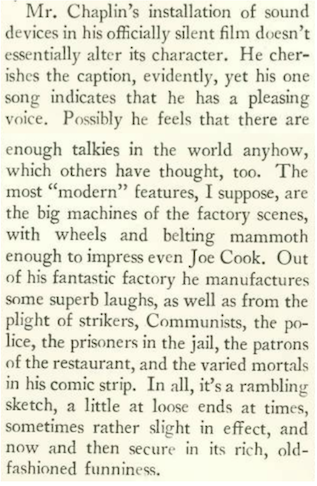
The film is notable for being Chaplin’s first picture to feature sound, and the first in which Chaplin’s voice is heard—singing Léo Daniderff’s comical song “Je cherche après Titine” (although Chaplin replaced the lyrics with gibberish). Modern Times was nevertheless filmed as a silent, with synchronized sound effects and a small amount of dialogue. Critic John Mosher appreciated the movie as being “of the old era,” not anticipating that it would become one of cinema’s most iconic and beloved films.

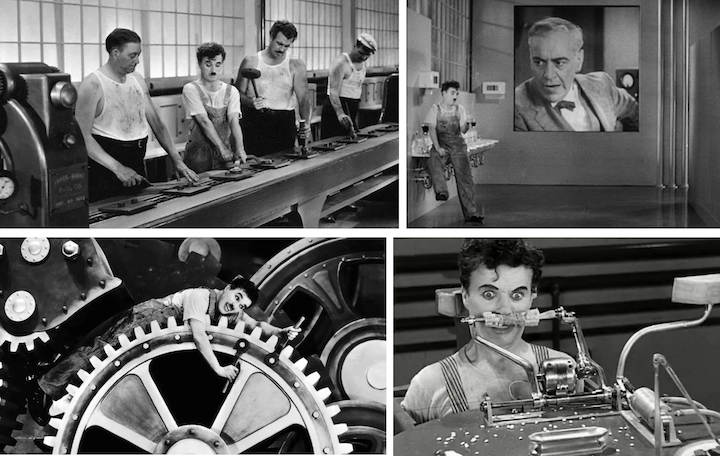
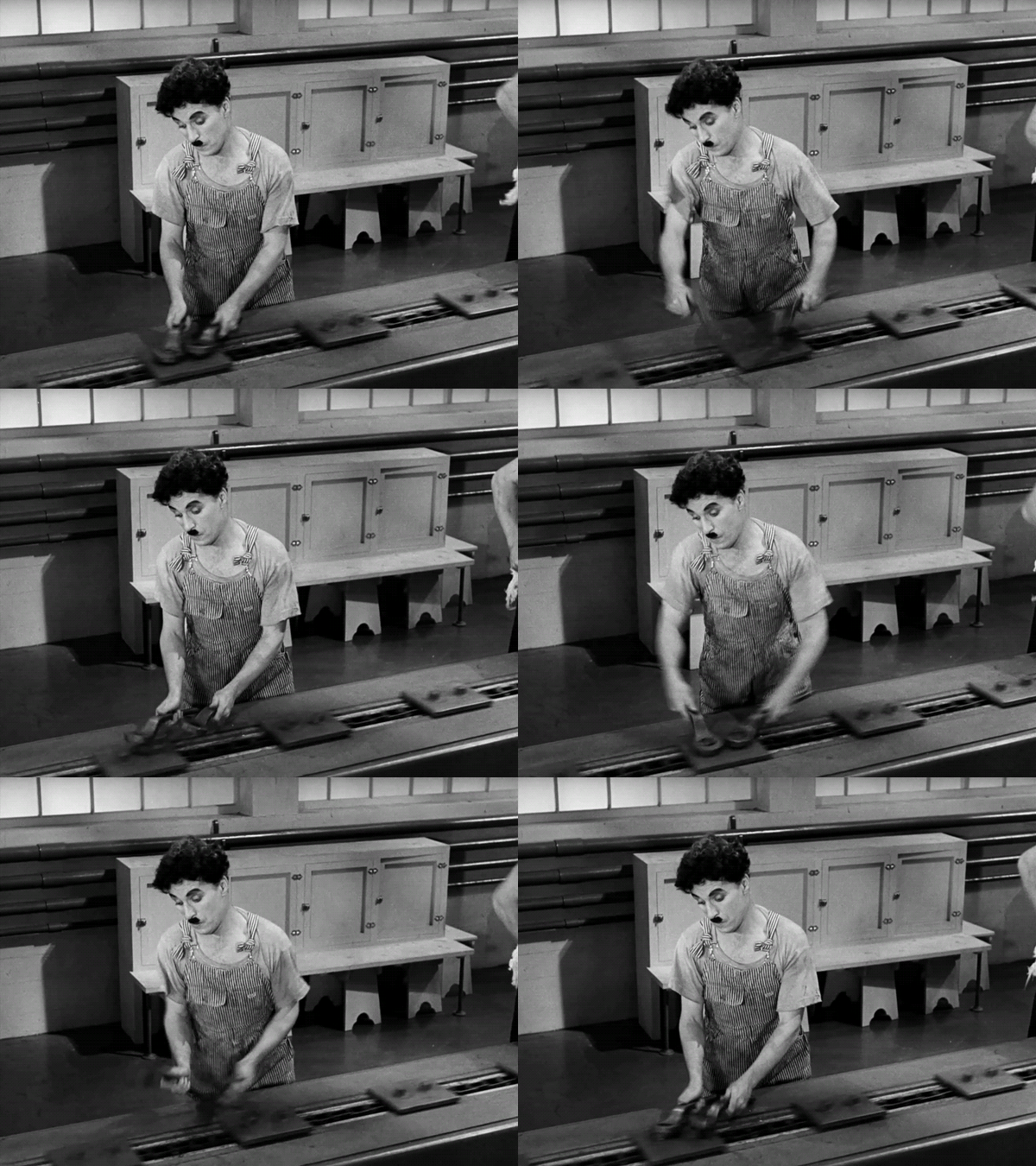
JUST A COG IN THE MACHINE…Clockwise, from top left: Repetitive assembly line work drives the Tramp (Charlie Chaplin) to a nervous breakdown; the steel factory is an Orwellian world where the president (Allan Ernest Garcia) constantly monitors his workers—even in the bathroom where the Tramp is caught taking a break; the company tries out a new lunch efficiency machine on the Tramp, with mixed results; iconic image of the Tramp at work. (medium.com/YouTube.com)
(thetwingeeks.com)

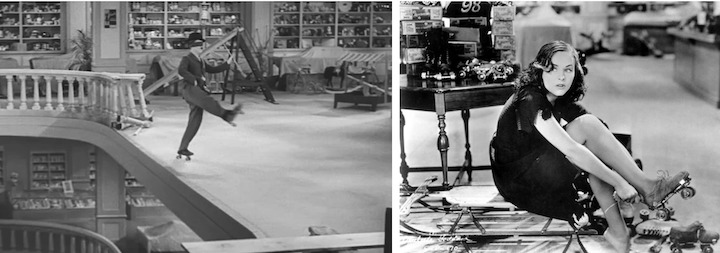
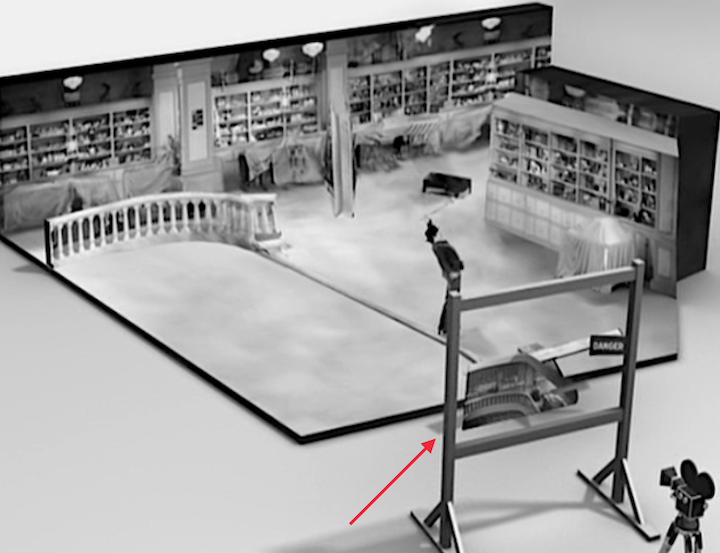
One of the film’s best stunts involved the blindfolded Tramp rollerskating on the fourth floor of an under-construction department store; Chaplin employed a matte painting, perfectly applied on a glass pane in front of a camera, to create the illusion of a sheer drop-off. Even as an illusion, Chaplin’s skating skills were remarkable.

HIGH ANXIETY…The blindfolded Tramp (Charlie Chaplin) skates precariously close to a sheer drop-off on the fourth floor of a department store while his companion, an orphan girl known as “The Gamin” (Paulette Goddard) puts on her skates, unaware of his peril. (YouTube.com)

The model below shows how the effect was achieved, filming next to a glass-mounted matte painting to create the illusion of a sheer drop off…

(reddit.com)

In his conclusion, Mosher found the film to be “secure in its rich, old-fashioned funniness.”

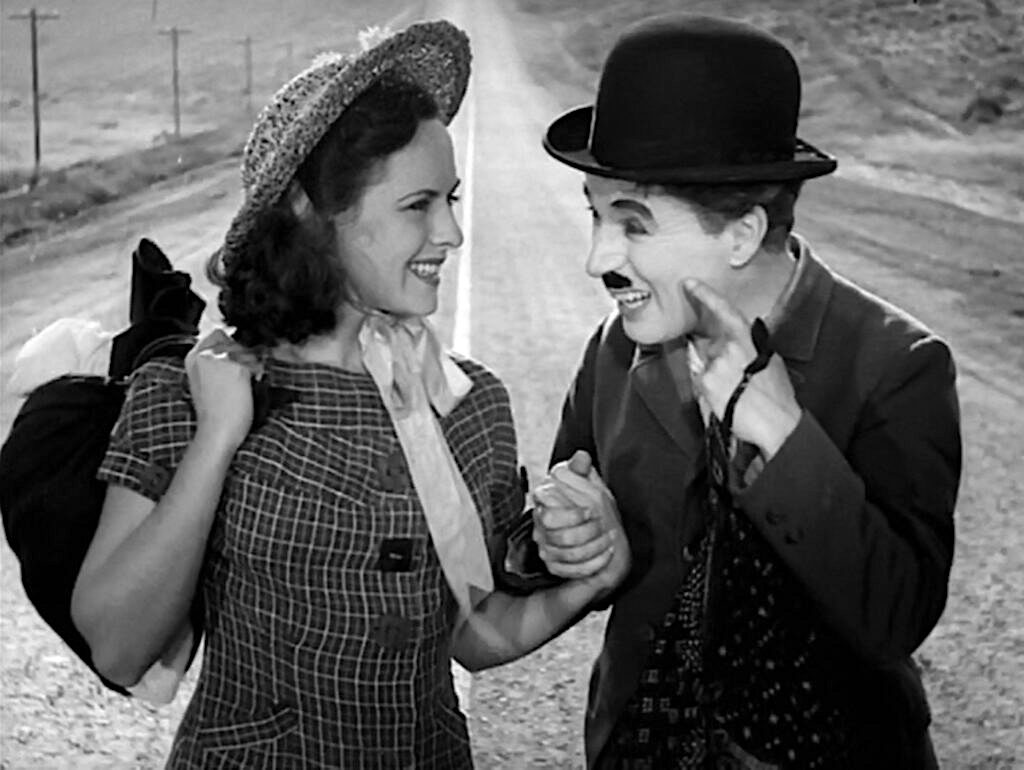
Chaplin gave a happy send-off to the Tramp, who at the end of earlier films walked down the road alone. Modern Times closed with the Tramp and the Gamin walking hand in hand, dreaming of a life together.

FOND FAREWALL…Paulette Goddard joined Charlie Chaplin on the road at the end of Modern Times. Goddard became Chaplin’s third wife in 1936. (the-cinematograph.com)
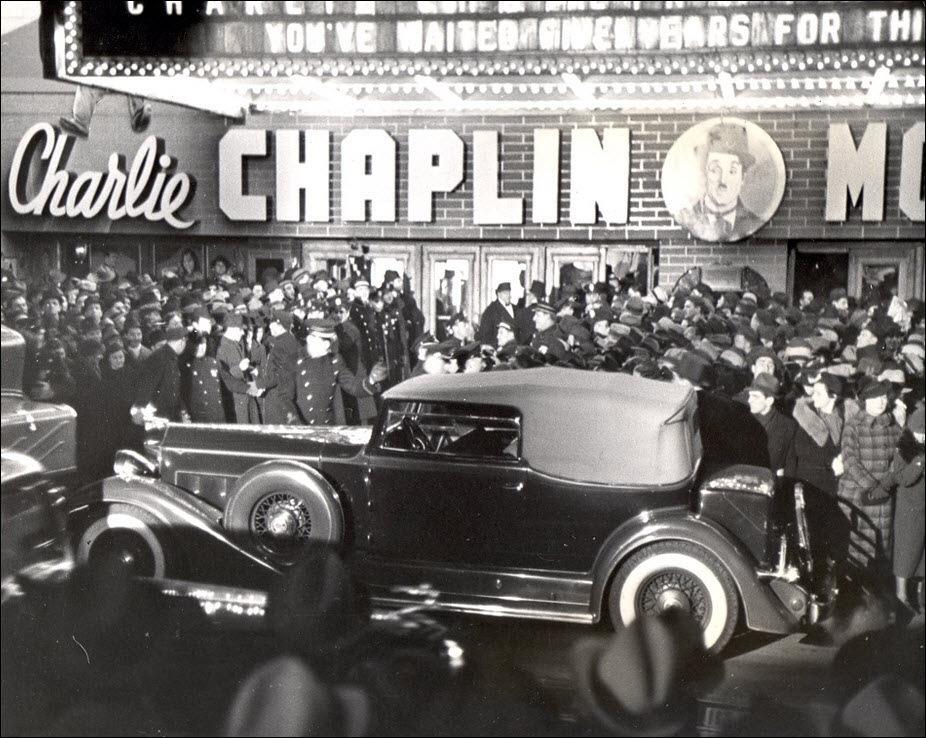
THE TRAMP RETURNS…World premiere of Modern Times, Feb. 5, 1936, at the Rivoli Theatre in New York City. The film was one of the top-grossing films of 1936. (Wikipedia)

A final note: The website The Twin Geeks offers an excellent synopsis and analysis of Modern Times.

 * * *

Bachelor King

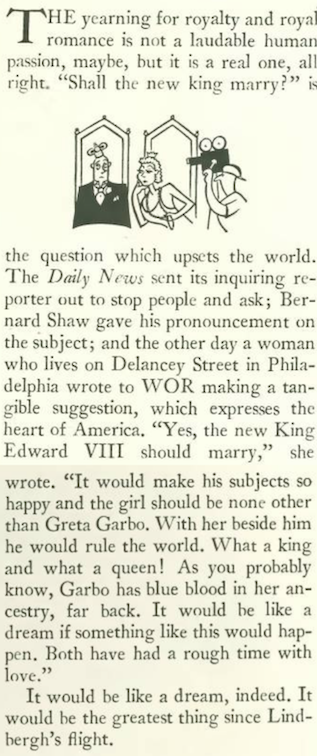
In his “Notes and Comment,” E.B. White wrote about the ascension to the British throne by Edward VIII following the death of his father, George V. In this excerpt, White considered a question raised by the Daily News regarding the king’s plans to marry (a question answered a few months later when Edward announced his plan to wed American divorcee Wallis Simpson, which led to a constitutional crisis and Edward’s subsequent abdication).

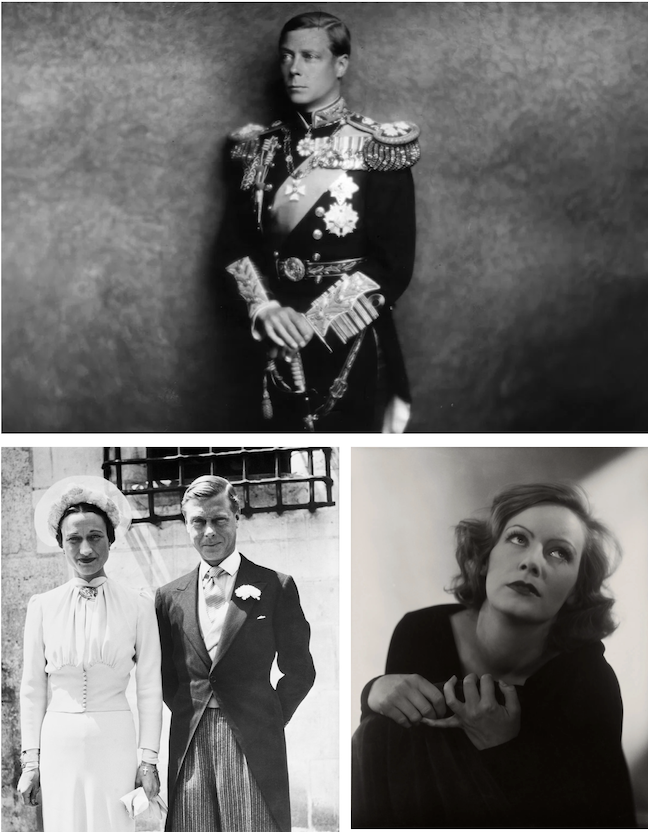
BUT I DON’T WANNA BE KING…The reluctant king Edward VIII would choose love over the crown when he abdicated the throne in December 1936 to marry Wallis Simpson (bottom left); E.B. White noted one woman’s suggestion that the king should marry actress Greta Garbo, since “Both have had a rough time at love.” (highland titles.com/George Eastman Museum)

* * *

By Any Other Name

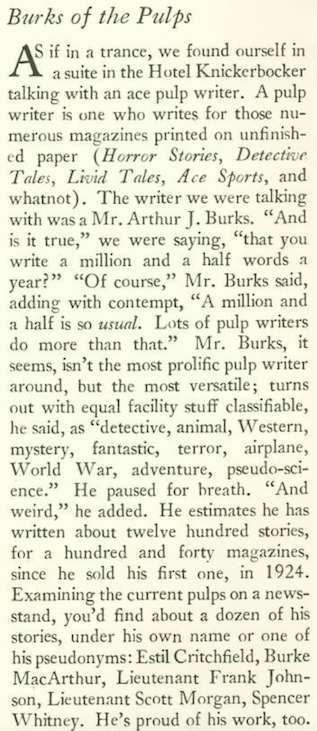
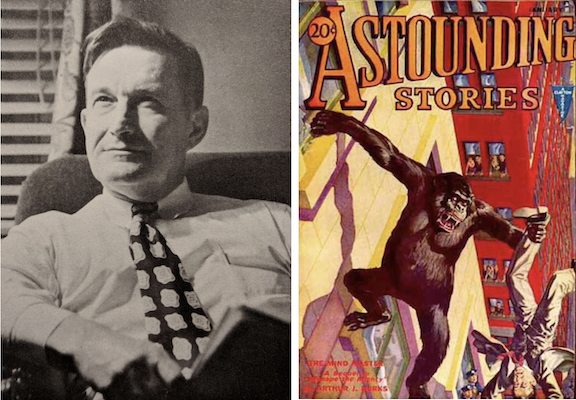
“The Talk of Town” featured a profile of Arthur J. Burks, a prolific writer of pulp fiction who published everything from detective stories to science fiction under a half-dozen pseudonyms. A brief excerpt:

A CURIOUS MIND…Arthur J. Burks (1898–1974) and the cover of Astounding Stories,  January 1932, which featured the first part of his two-part tale, “The Mind Master.” Burks produced around eight hundred stories for the pulps, twenty-nine of which appeared in the magazine Weird Tales. (findagrave.com/gutenberg.org)

* * *

A Day in the Life

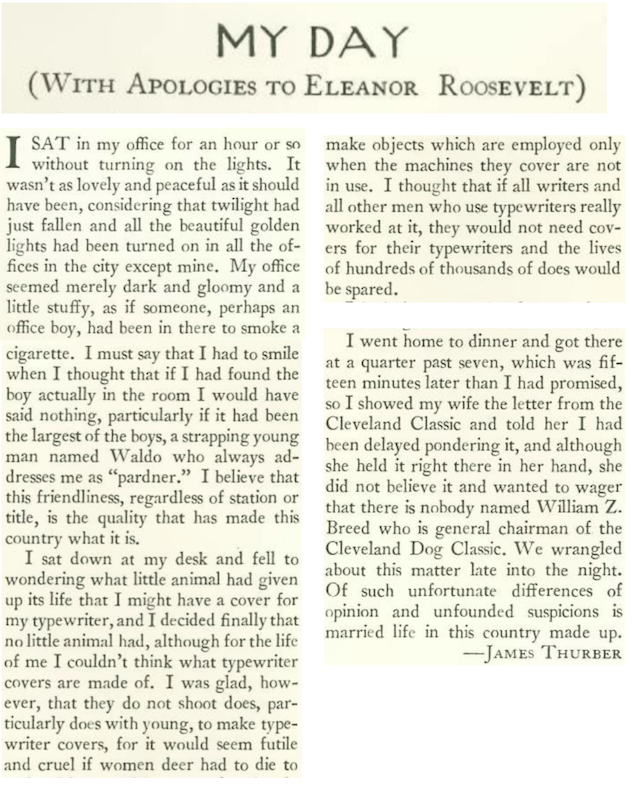
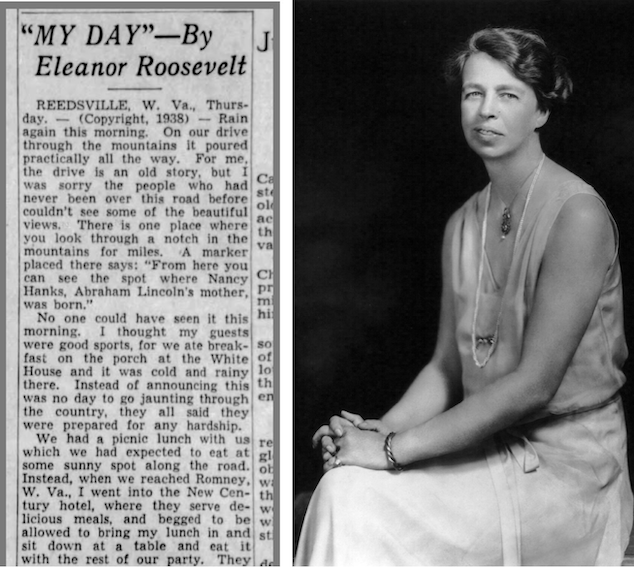
From 1935 to 1962 Eleanor Roosevelt published a daily syndicated newspaper column titled “My Day”—through the column millions of Americans learned her views on politics, society, and events of the day as well as details about her private and public life. James Thurber couldn’t resist writing a parody—here’s an excerpt:

THE REAL DEAL…At left, sample of one of Eleanor Roosevelt’s syndicated “My Day” columns from 1938; photo of the First Lady from 1932. (arthurdaleheritage.org/Library of Congress)

 * * *

At the Movies

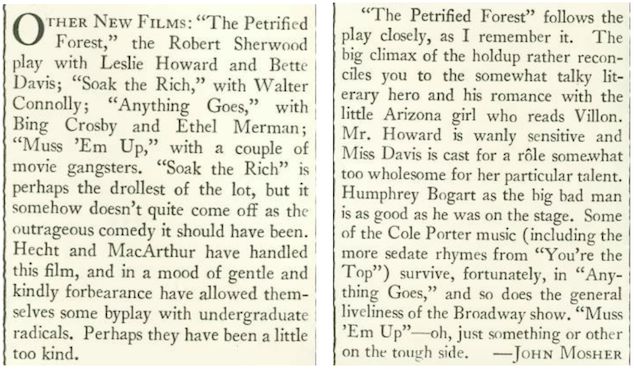
Besides Modern Times, there were other movies of note that were given rather scant attention in Mosher’s column, including the film adaptation of The Petrified Forest starring Humphrey Bogart, Bette Davis and Leslie Howard.

Robert E. Sherwood wrote the 1934 Broadway play of the same name, which was co-produced by Howard and featured both Howard and Bogart. When it was adapted to film, Howard insisted that Bogart appear in the movie, and it made Bogart a star (he remained grateful to Howard for the rest of his life).

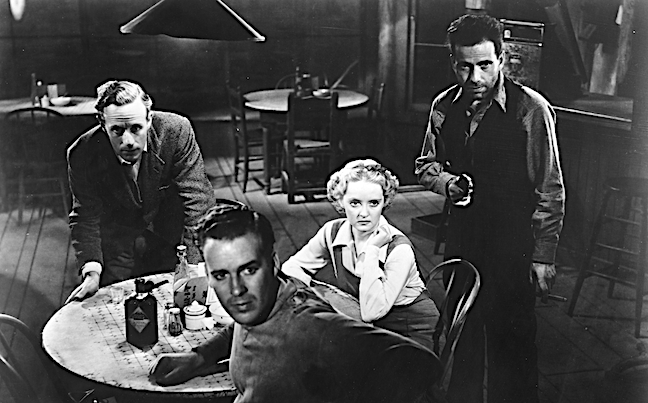
DANGEROUS DINER…An odd mix of patrons at a gas station cafe are taken hostage by desparate criminals in The Petrified Forest. From left are Leslie Howard, Dick Foran, Bette Davis and Humphrey Bogart. Playwright Robert Sherwood based Bogart’s character, Duke Mantee, on the the real-life criminal John Dillinger, the FBI’s first “Public Enemy #1.” (moma.org)

Other cinema diversions included the musical Anything Goes, which included songs by Cole Porter; the comedy Soak the Rich, which featured a radical who falls in love with a rich man’s daughter; and a detective film, Muss ‘Em Up, with the usual movie gangsters.

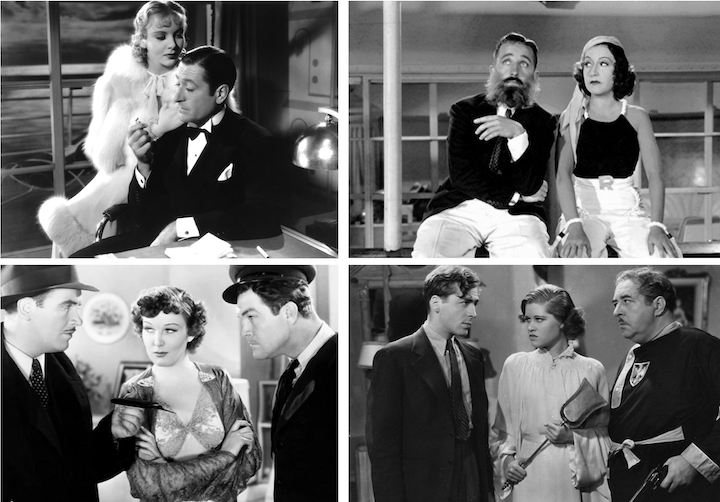
TAKE YOUR PICK…Clockwise, from top left: Ida Lupino and Arthur Treacher in the musical Anything Goes; Bing Crosby (in disguise) and Ethel Merman in Anything Goes; John Howard, Mary Taylor and Walter Connolly in the comedy Soak the Rich; Preston Foster, Maxine Jennings and Guinn “Big Boy” Williams in the detective film Muss ‘Em Up. (imdb.com/torontofilmsociety.com/zeusdvds.com)

 * * *

The Amazing Race

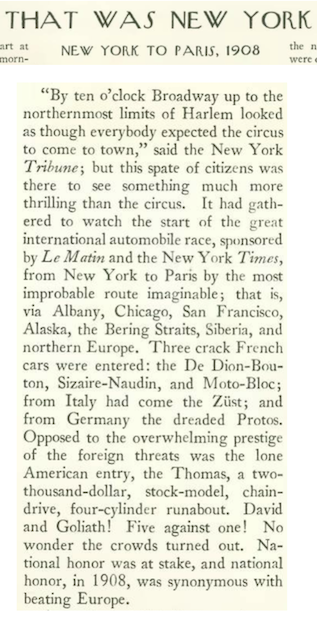
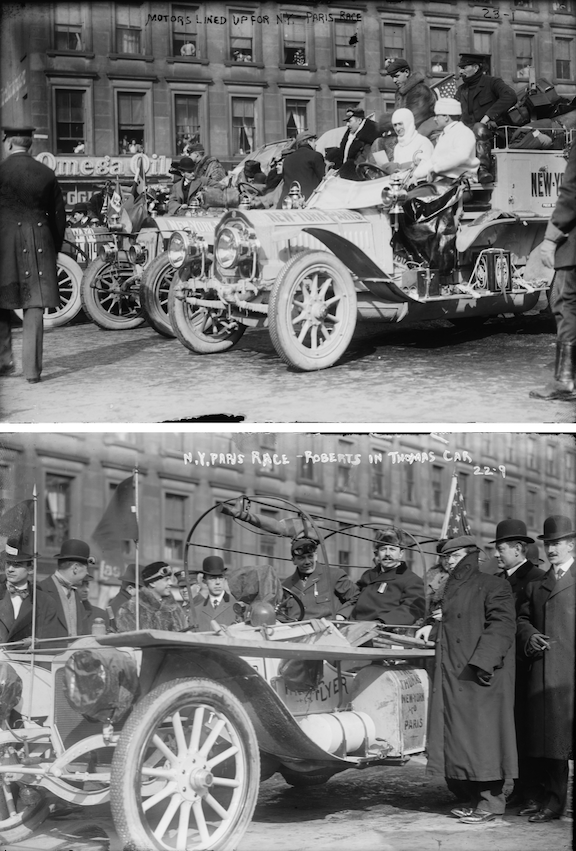
The New Yorker periodically featured “That Was New York,” which took a detailed look at significant events in the city’s history. In this installment, Donald Moffat recalled the 1908 New York to Paris automobile race, which commenced in Times Square on February 12 with six cars representing the U.S., France, Germany and Italy. It was an extraordinary event given that motorcars were a recent invention, and roads were nonexistent in many parts of the world. A brief excerpt:

ON YOUR MARK…Cars lined up in Times Square on Feb 12, 1908 for the start of what would become a 169-day race. American George Schuster was declared the winner when he arrived in Paris on July 30, 1908, after covering approximately 10,377 miles (16,700 km). (Library of Congress)

 * * *

Miscellany

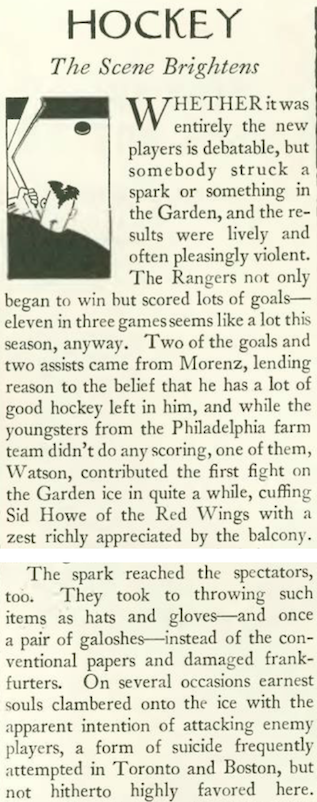
Another regular feature in the early New Yorker was coverage of the New York Rangers, a team founded in 1926 by Tex Rickard after he completed construction of the third incarnation of Madison Square Garden. The Rangers were one of the Original Six NHL teams before the 1967 expansion, the others being the Boston Bruins, Chicago Blackhawks, Detroit Red Wings, Montreal Canadiens and Toronto Maple Leafs.

In this excerpt, the writer “K.B.” described the rough play against rival Detroit, which would win back-to-back Stanley Cups in 1936 and 1937.

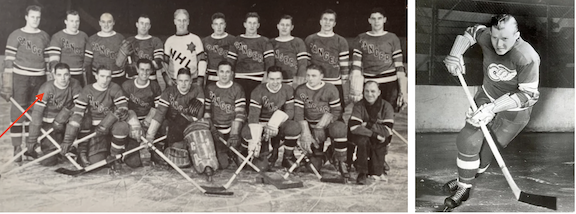
ZESTY…The excerpt above noted that the Rangers’ Phil Watson cuffed the Red Wings’ Syd Howe “with a zest richly appreciated by the balcony.” At left, team photo of the 1935-36 New York Rangers, with star and fight instigator Phil Watson identified with arrow; at right, Syd Howe won three Stanley Cups with Detroit, winning back-to-back in 1936 and 1937, and then again in 1943. (hockeygods.com)

 * * *

From Our Advertisers

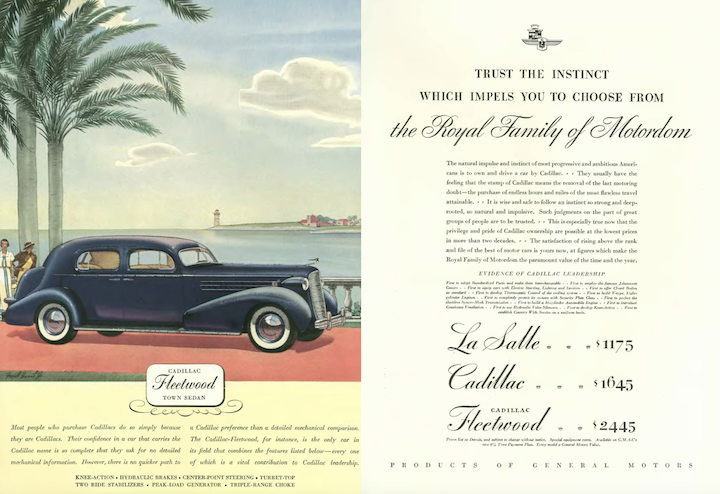
General Motors’ luxury car line offered three price points (and this lovely image) to weather the Depression years, ranging from the relatively affordable La Salle to the Cadillac Fleetwood…

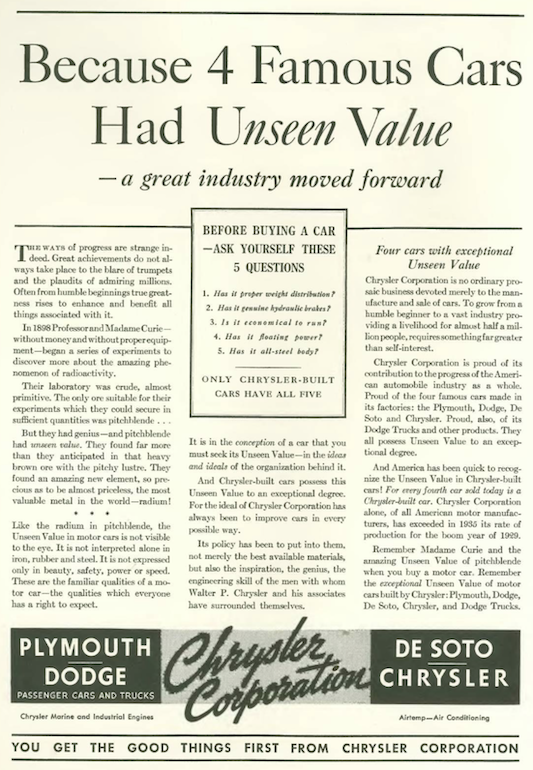
…the Chrysler corporation took a different approach, deploying a very wordy full-page ad that referenced history (a Madame Curie analogy) and something called “Unseen Value” to move its line of autos…

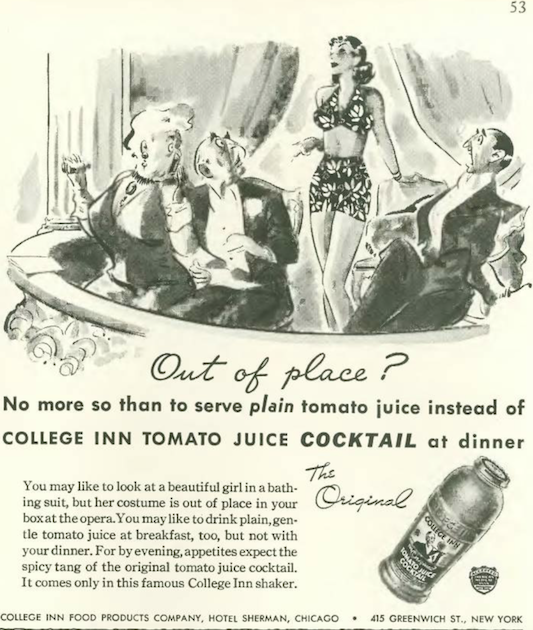
…the makers of College Inn Tomato Juice Cocktail brought back the “Duchess” with this shocking scene at the opera…

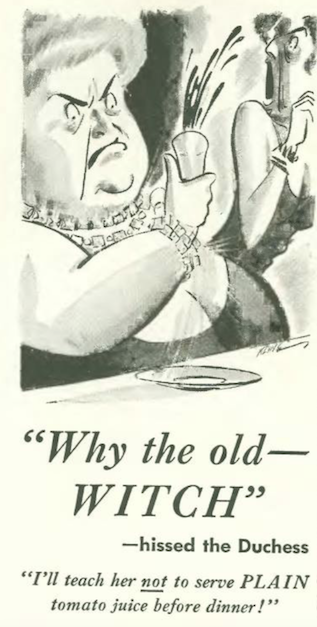
…recall last summer when College Inn featured the Duchess in a series of ads that illustrated her increasing fury over plain tomato juice…one wonders what sort of sadistic torment she had in mind for her hostess, “the old WITCH”…

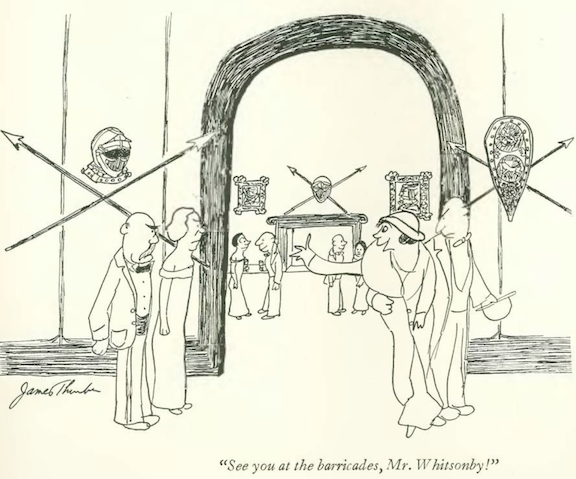
…on to our cartoonists, beginning with this spot by James Thurber

…and Thurber again, with an unwanted call to solidarity…

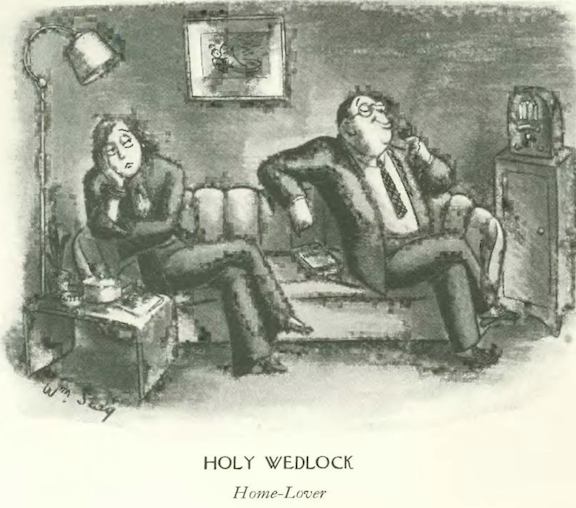
William Steig explored marital bliss…

George Price gave us a Three Stooges moment…

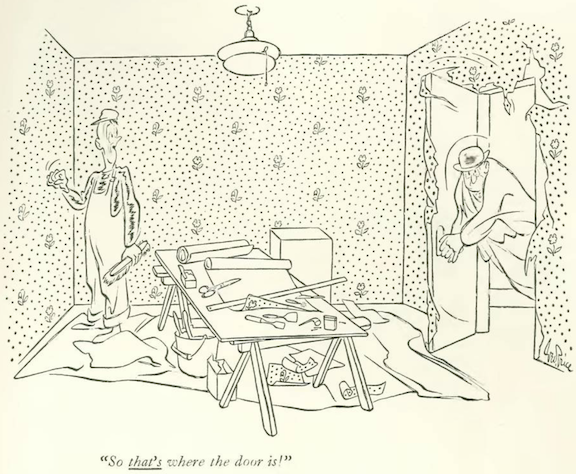
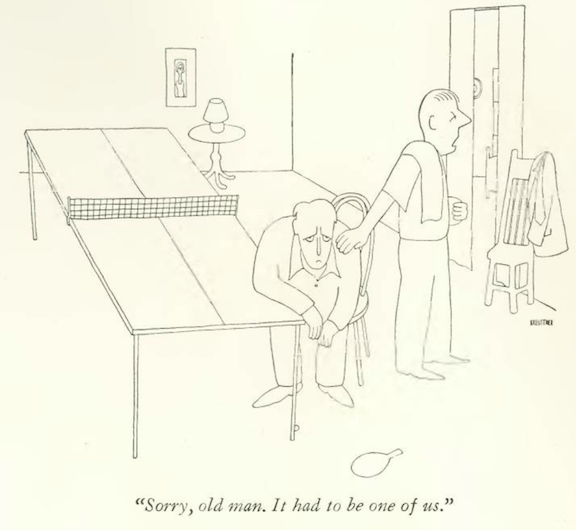
…I do not have the identity of this cartoonist…I will keep looking, but would love suggestions in the meantime…*update*…thanks to Frank Wilhoit for identifying the cartoonist below as John Kreuttner, also confirmed through Michael Maslin’s Ink Spill

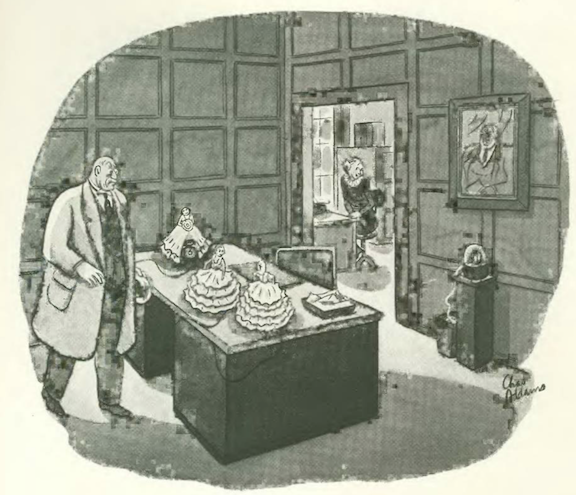
Charles Addams added some frills to an executive suite…

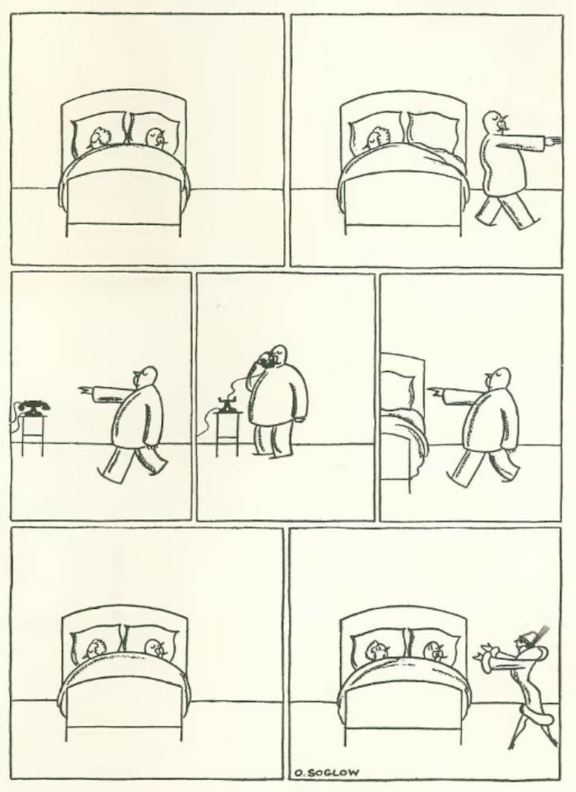
Otto Soglow illustrated the hazards of sleepwalking…

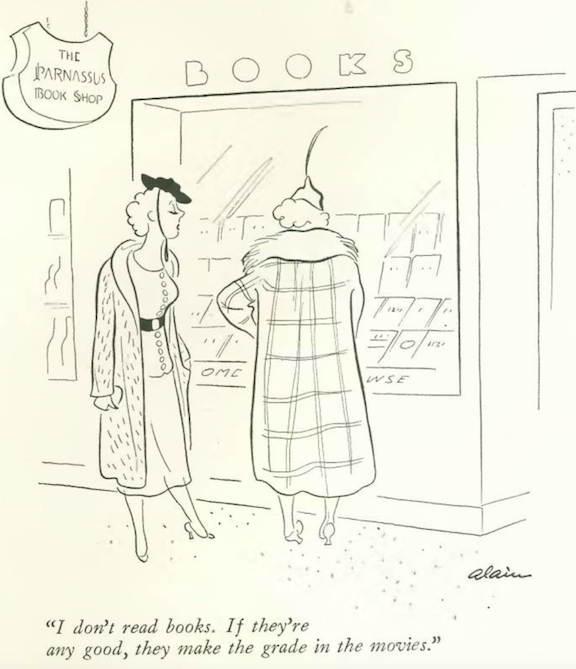
Alain revealed a challenge to the publishing industry…

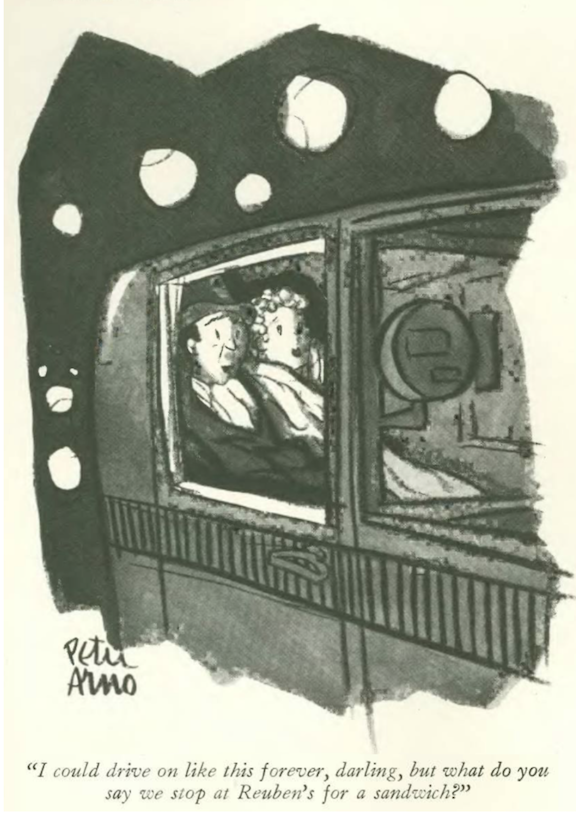
Peter Arno possibly craved some sauerkraut and corned beef…

William Crawford Galbraith was in familiar sugar daddy territory…

Whitney Darrow Jr gave a nod to some homey surrealism…

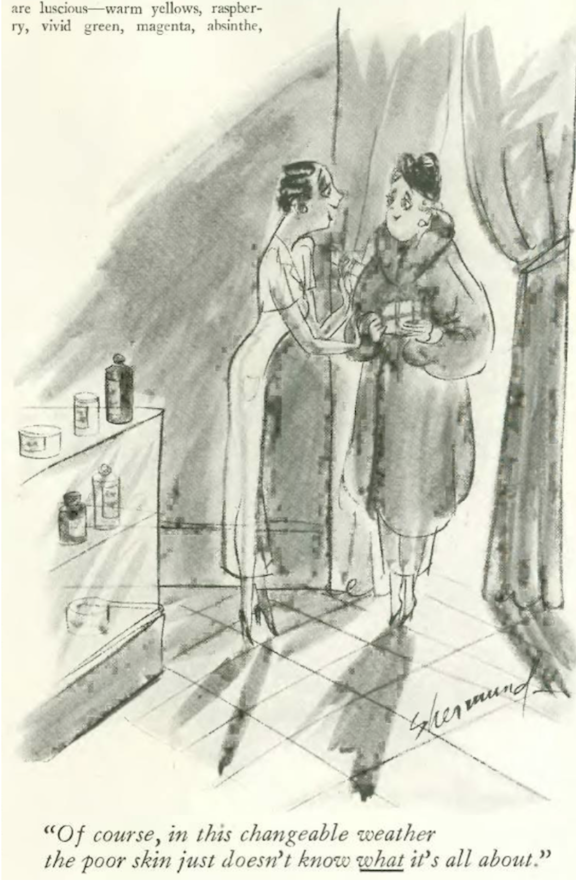
Barbara Shermund offered some well-weathered advice…

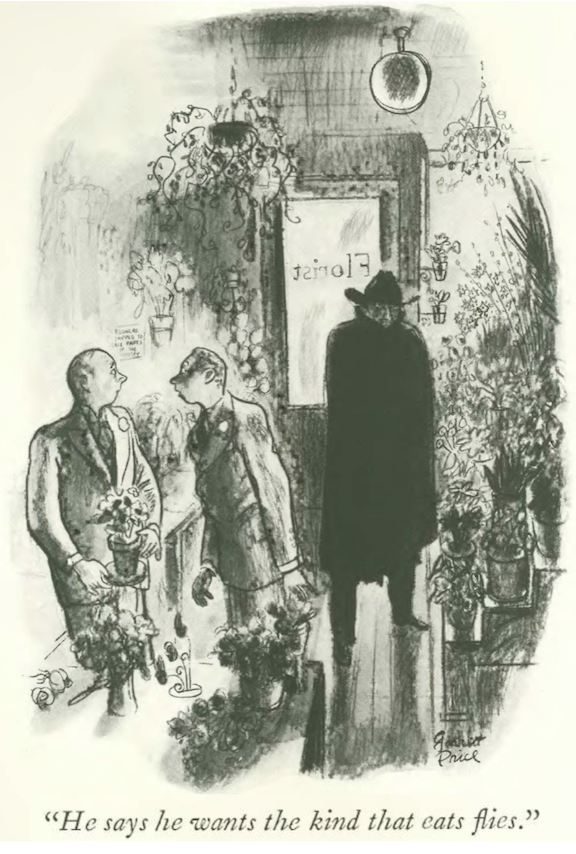
…and we close with Garrett Price, and a visitor more suited to Charles Addams…

Next Time: Comfort Food…

The New Ziegfeld

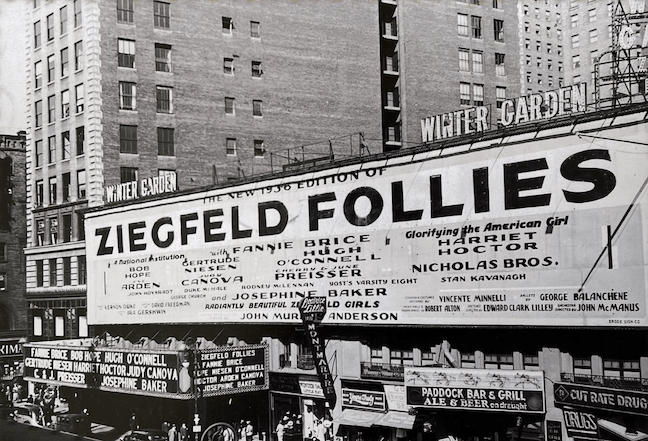
Above: The 1936 Ziegfeld Follies premiered on Broadway at the Winter Garden Theatre on January 30, 1936 and closed on May 9, 1936 after 115 performances. (Hulton Archive)

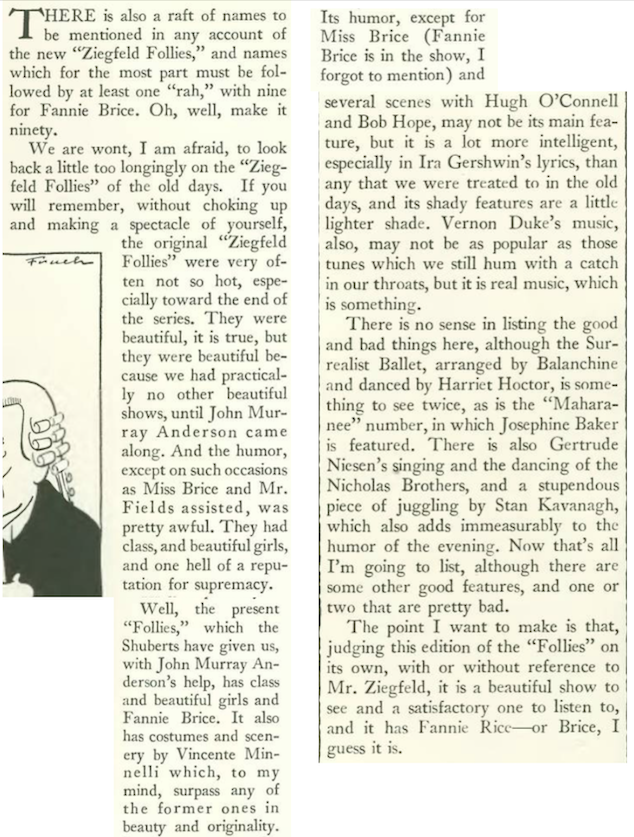
Broadway impresario Florenz Ziegfeld Jr died in 1932, but his famous theatrical revue lived on for years with revivals including one in 1936 that Robert Benchley praised for being better than the originals.

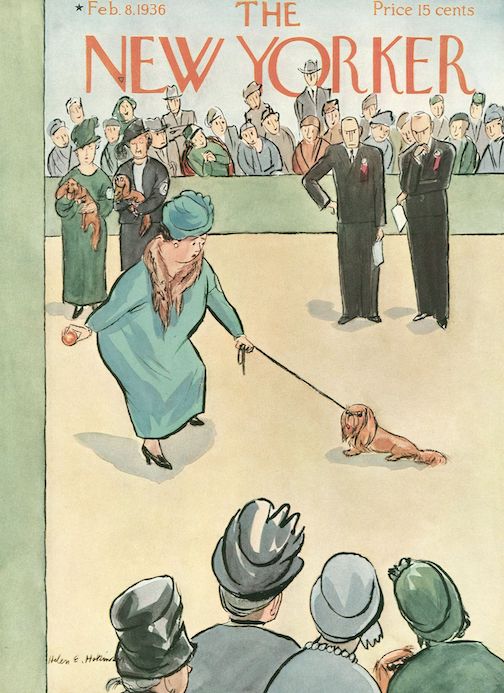
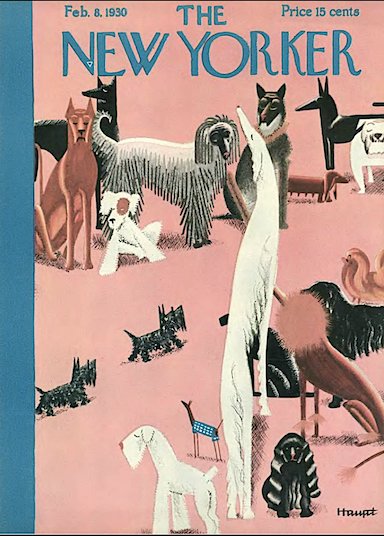
February 8, 1936 cover by Helen Hokinson, marking the opening of the Westminster Kennel Club Dog Show at Madison Square Garden. According to Michael Maslin’s always enlightening Ink Spill, the first dog-themed New Yorker cover was Feb. 8, 1930, by Theodore Haupt (below).

Now on with the show. Brought back to life by Ziegfeld’s widow Billie Burke and theatre operators Lee and J. J. Shubert, The Ziegfeld Follies of 1936 was loaded with talent, with lyrics by Ira Gershwin, choreography by George Balanchine, and sets and costumes by Vincente Minnelli. What really brought people in was the star of the show, Fannie Brice, who was supported by cast members Bob Hope, Eve Arden, Josephine Baker, and the Nicholas Brothers, among others. Benchley wrote:

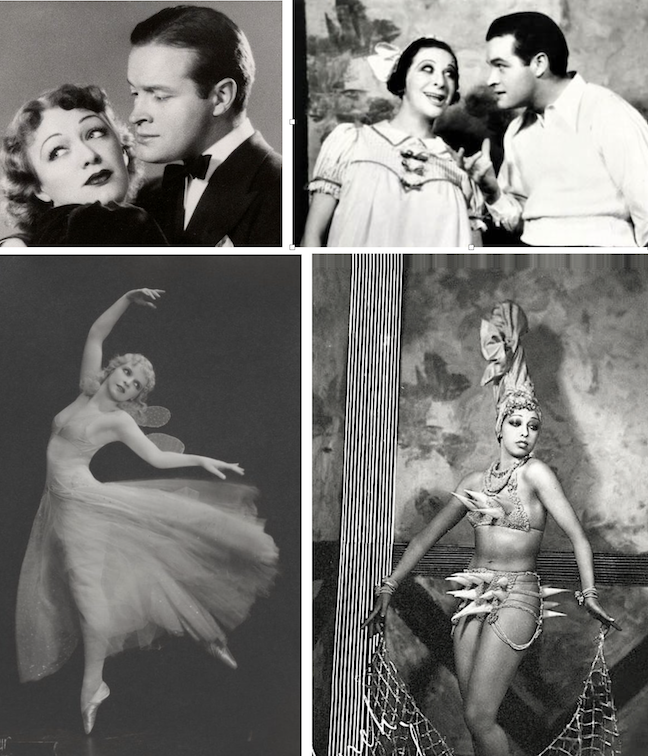
FANNIE AND THE REST…Clockwise, from top left: Bob Hope and Eve Arden performed the popular tune “I Can’t Get Started With You”; Hope with Fannie Brice in the sketch “Baby Snooks Goes Hollywood”; Josephine Baker premiered “The Conga” at the Follies, and Harriet Hoctor performed her “Night Flight.” (gershwin.com/uneicone-josephinebaker.webador.fr/libraryofcongress,org)

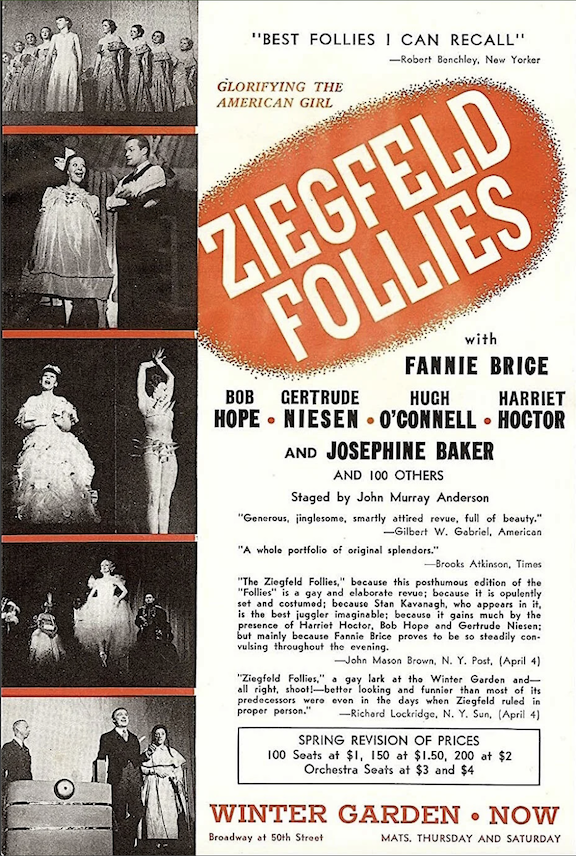
This ad for the 1936 Follies prominently featured Benchley’s endorsement:

(uneicone-josephinebaker.webador.fr)

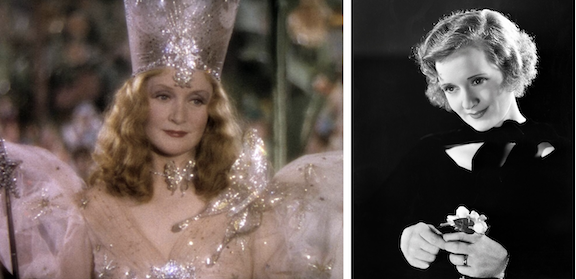
Billie Burke (1884–1970) authorized Follies revivals with the Shuberts in 1934, 1936 and 1943, with the Shubert family producing a final revival in 1957. In 1936 MGM also filmed a Ziegfeld biopic, The Great Ziegfeld (which won two Academy Awards), casting William Powell as Ziegfeld and Myrna Loy as Burke. Burke wanted to play herself in the film, but at age 51 she was deemed too old for the part.

ZIEGFELD MAGIC…Florenz Ziegfeld’s widow Billie Burke kept the Follies going after her husband’s death in 1932. She is best known today for her portrayal of Glinda the Good Witch of the North in 1939’s The Wizard of Oz. (oscars.org/Wikipedia)

Fannie Brice (1891–1951) was the biggest star of the Follies and so dominated the show that when she became ill in May 1936 the production closed. Brice returned to the Winter Garden that September for 112 more performances.

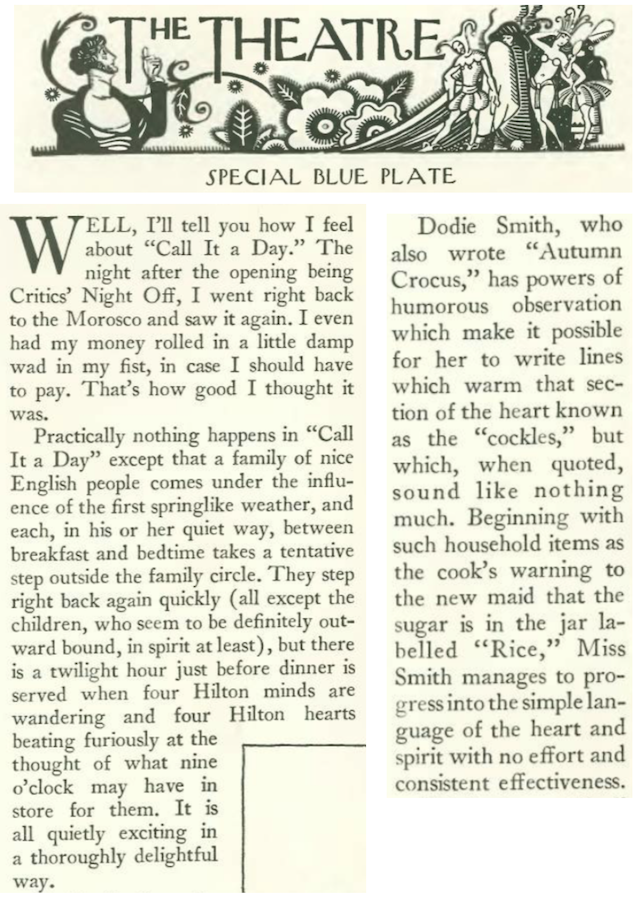
Benchley also praised Call it a Day, a 1935 play by British writer Dodie Smith that ran for 194 performances at the Morosco Theatre. Benchley thought it was so good he saw it twice.

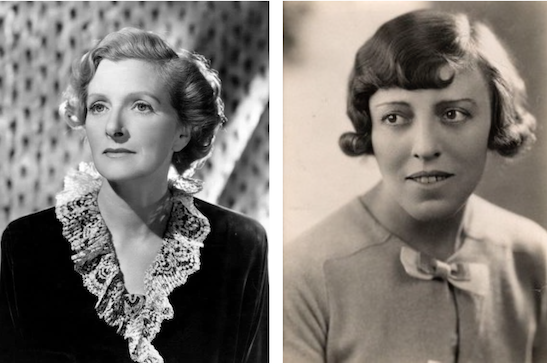
SPRING FEVER drove the action in Dodie Smith’s (right) hit comedy Call it a Day. The play chronicles a single spring day in the lives of the Hilton family, during which each member encounters unexpected romantic temptations and complications. Gladys Cooper, left, starred as Dorothy Hilton. The play was adapted to a Hollywood film in 1937. (vocal.media/Wikipedia)

 * * *

At the Movies

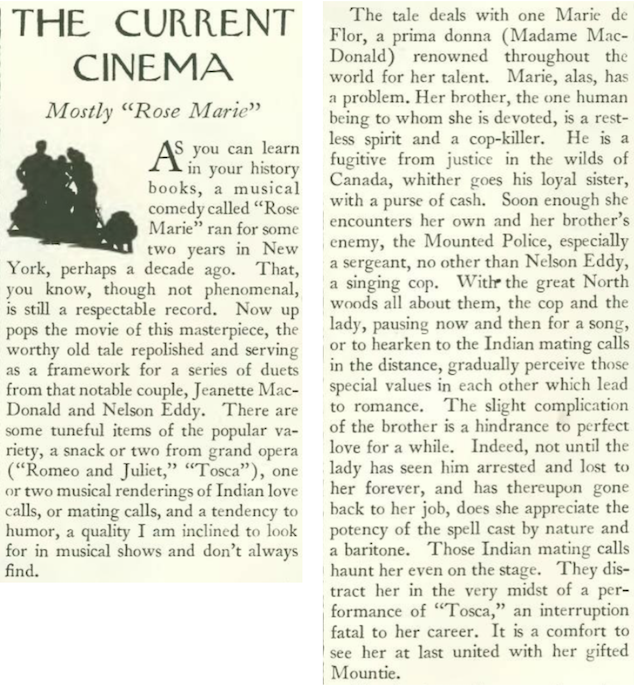
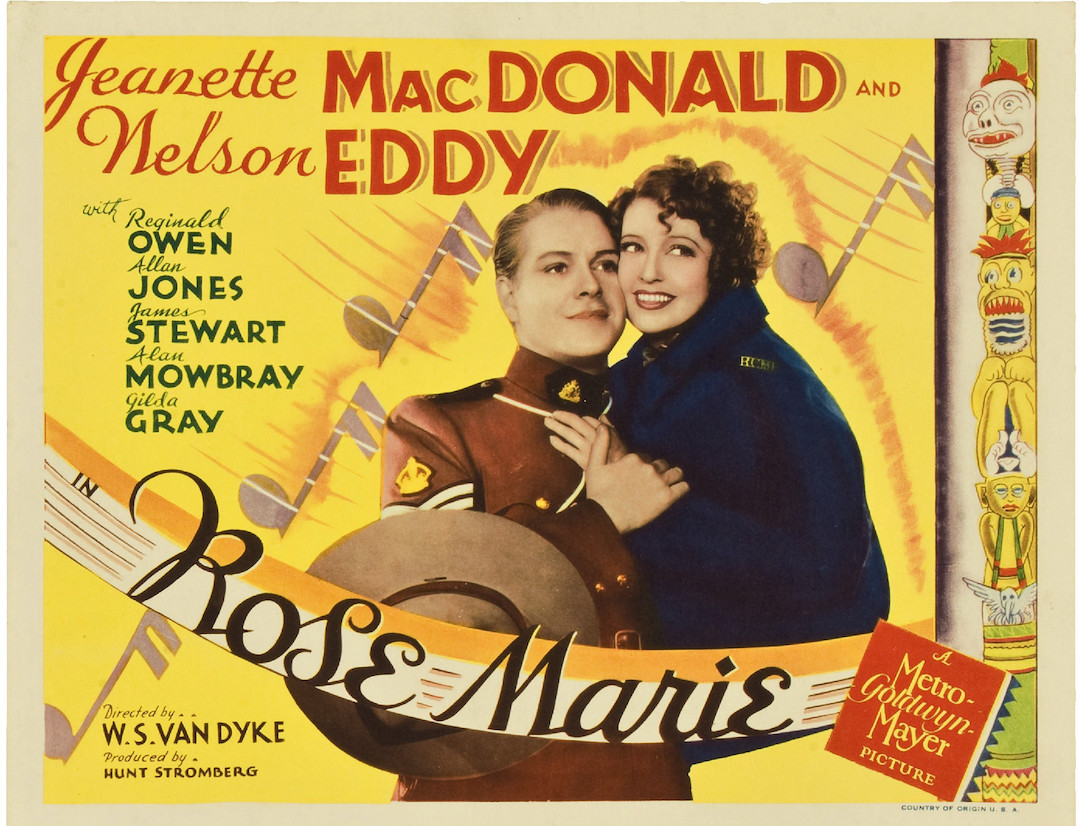
We go from the stage to the screen, where John Mosher took in Rose Marie, a musical comedy based on a popular 1924 Broadway play. The film “repolished” the old play and used it as a framework for a series of duets between Jeanette MacDonald and Nelson Eddy.

MELODIOUS MOUNTIE…Lobby card for Rose Marie, a musical romcom about a singing Mountie and a world-renowned prima donna, joined in love by a haunting “Indian mating call.” (Wikipedia)

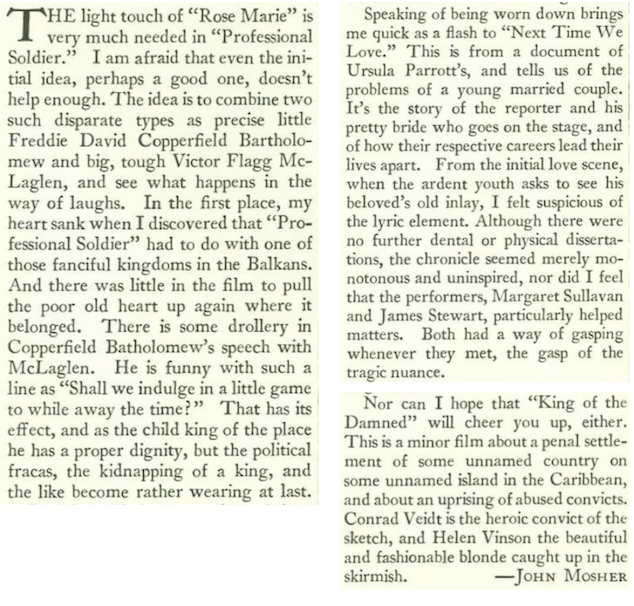
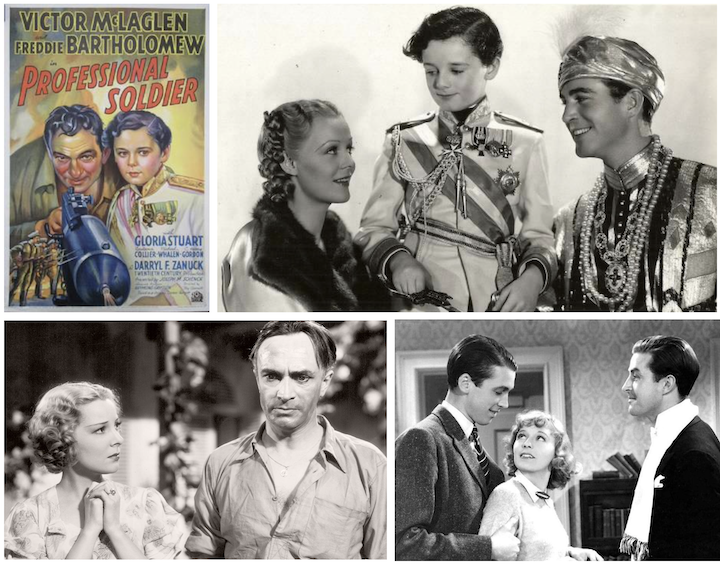
Mosher reviewed three other films that could have used some of Rose Marie’s cheer:

CHEERLESS FARE…Clockwise, from top: Gloria Stuart, Freddie Bartholomew, and Michael Whalen in Professional Soldier; James Stewart, Margaret Sullavan and Ray Milland in Next Time We Love; Helen Vinson and Conrad Veidt in King of the Damned. (Wikipedia/imdb.com/letterboxd.com/silversirens.co.uk)

 * * *

Miscellany

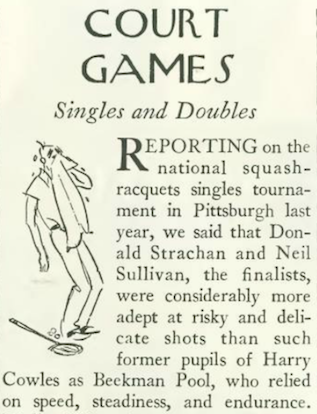
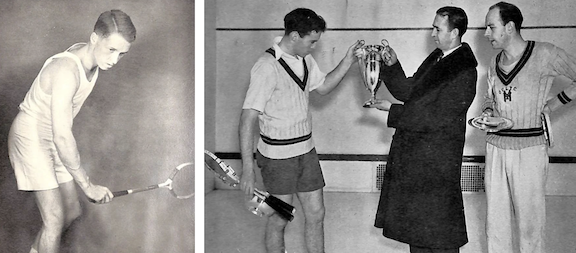
I strive to keep these posts at a readable length, and (hopefully) lively and enjoyable to read, which means that I cannot include absolutely everything that appears in each issue. For example, there are a number of regular features from the sports world—ranging from major attractions like hockey and college football (no coverage yet of baseball—which for some reason Harold Ross hated—or basketball) to more niche pursuits, such as squash (below) or indoor polo. From time to time I will include these under “Miscellany” as a way to give readers a more complete picture, and to assuage my fear that I am leaving something important out. Here is a very brief snippet of a regular feature, “Court Games,” by staff writer Geoffrey T. Hellman.

RACKETEERS…At left, Beekman Pool of the Harvard Club was the 1936 singles champion of the Metropolitan Squash Racquets Association; at right, Edwin Bigelow of the U.S. Squash Racquets Association presents the National Trophy to Germain Glidden. To the far right is runner-up Andrew Ingraham, who looks a bit miffed about getting a plate rather than a trophy cup. (thecarycollection.com)

 * * *

From Our Advertisers

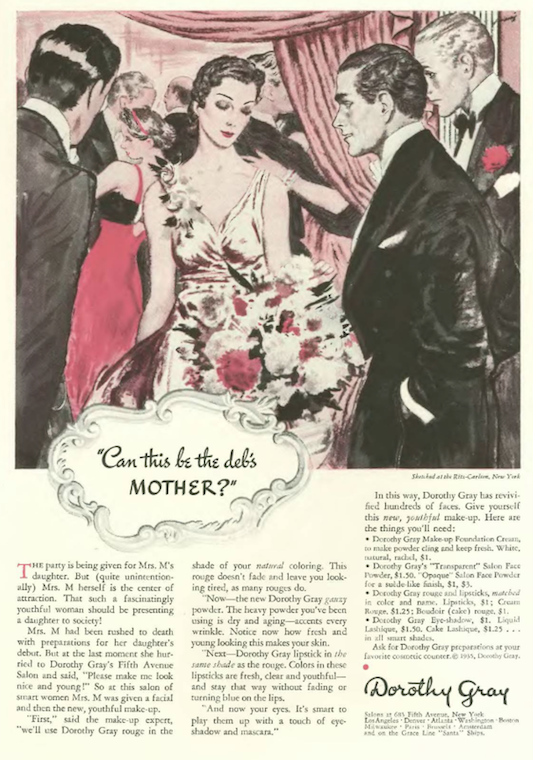
Let’s start with the inside front cover…advertisements from Dorothy Gray salons were all about the restoration of youth in older women…apparently the treatments were so successful that “Mrs. M” was a bigger attraction at a Ritz-Carlton debutante party than her society-bound daughter…note the young gents at right checking out mom, and not the deb…

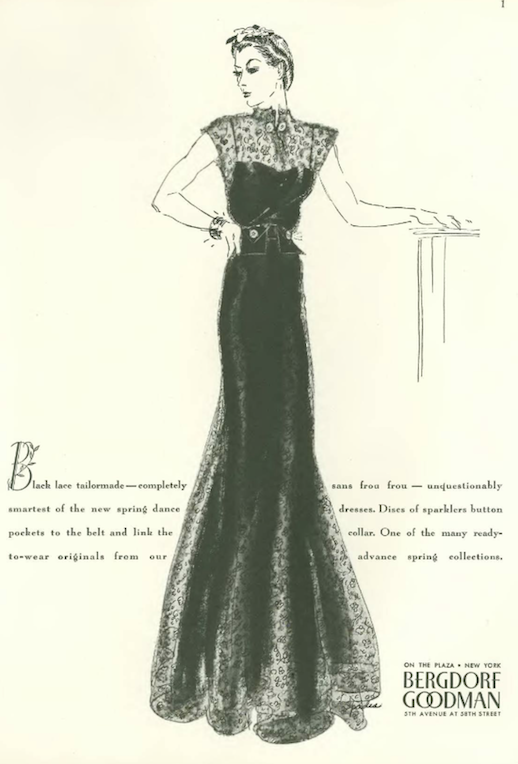
…opposite Dorothy Gray was this elegant appeal from Bergdorf Goodman…ads aimed at more refined tastes almost always featured these attenuated figures (whether they were people or luxury automobiles)…I guess I would hold onto something too with stilts like those…

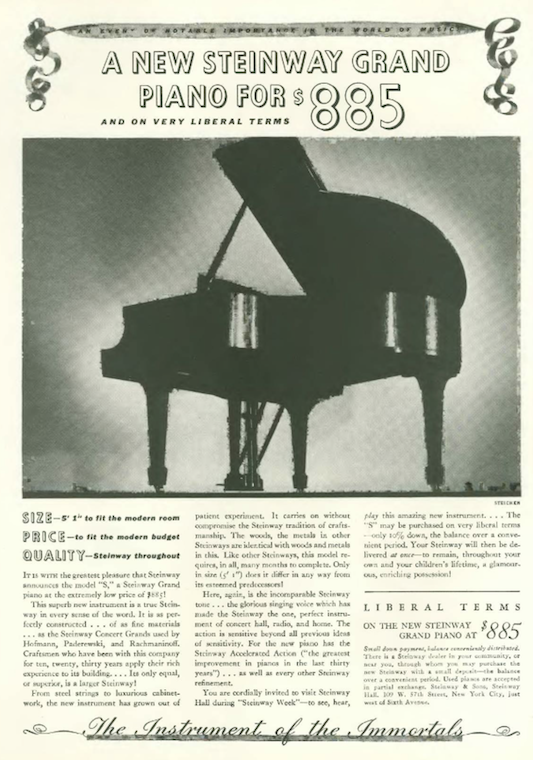
…here’s a Steinway grand for less than a grand…$885 in 1936 is roughly equivalent to $20,000 or so today, but that’s still a bargain—Steinway grand pianos currently start at around $85,000…

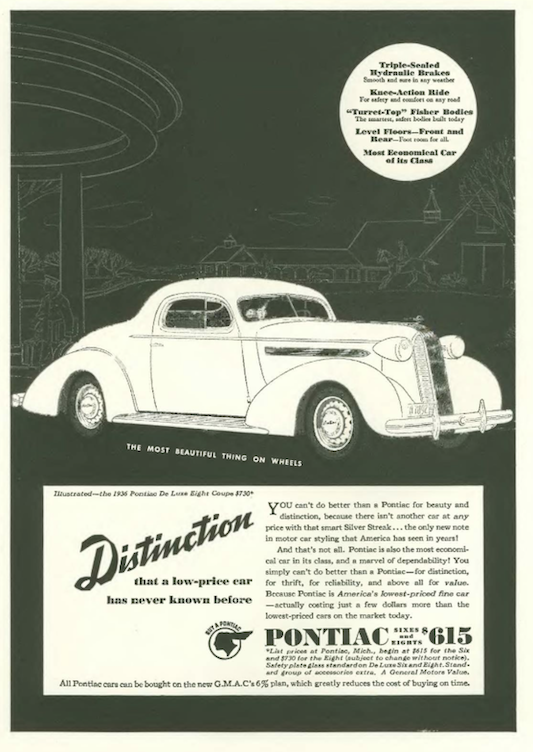
…speaking of bargains, you could own “The Most Beautiful Thing on Wheels” (according to this ad) for a mere $615…

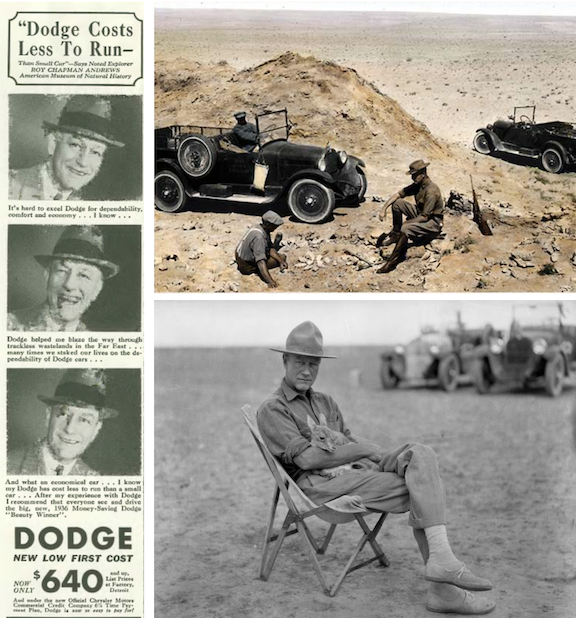
…and for an extra twenty-five bucks you could own a durable Dodge like the one endorsed by Roy Chapman Andrews (1884–1960), a globetrotting explorer who discovered fossilized dinosaur eggs in the Gobi Desert in the 1920s…
(amnh.org/roychapmanandrewssociety.org)
THE REAL INDY…Roy Chapman Andrews gained national fame as an explorer for New York’s American Museum of Natural History (AMNH). The discovery of a nest of complete dinosaur eggs in Mongolia in 1923 (above) provided the first proof that the critters hatched out of eggs. Named AMNH’s director in 1934, Andrews is thought to be an inspiration for the film hero Indiana Jones. (amnh.org/roychapmanandrewssociety.org)

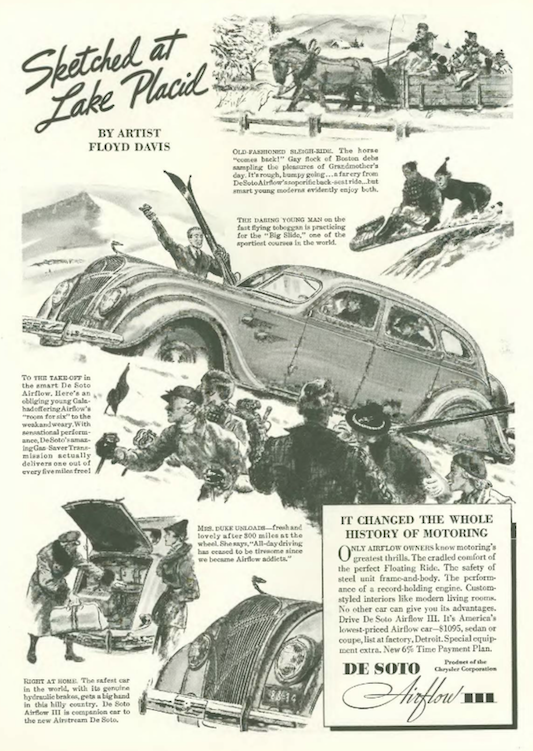
…the folks at Chrysler were doing everything they could to get people interested in buying their Airflows—despite its technological advances, the car’s streamlined design (toned down in later models) was just too radical for mass market tastes…note how the ad draws attention to the work of “Artist Floyd Davis”…

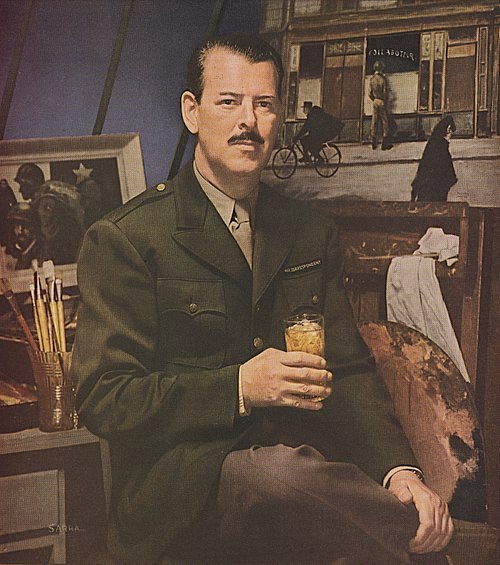
…here’s a photo of Floyd Davis

CHEERS…Illustrator Floyd Davis (1896–1966) poses in an ad for Lord Calvert whiskey, 1946. In 1943 Life magazine called him the “#1 Illustrator in America.” (Wikipedia)

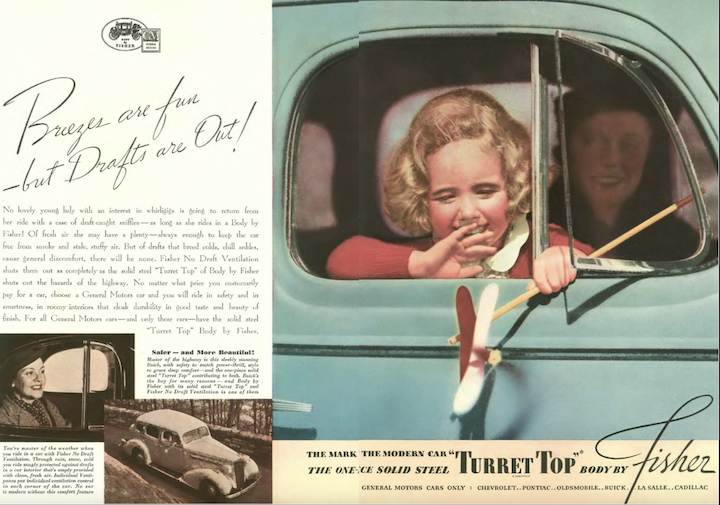
…the Fisher company, makers of car bodies for General Motors, liked to emphasize the safety of their “Turret Top,” although it didn’t seem to occur to anyone that a child dangling from a car window was problematic…

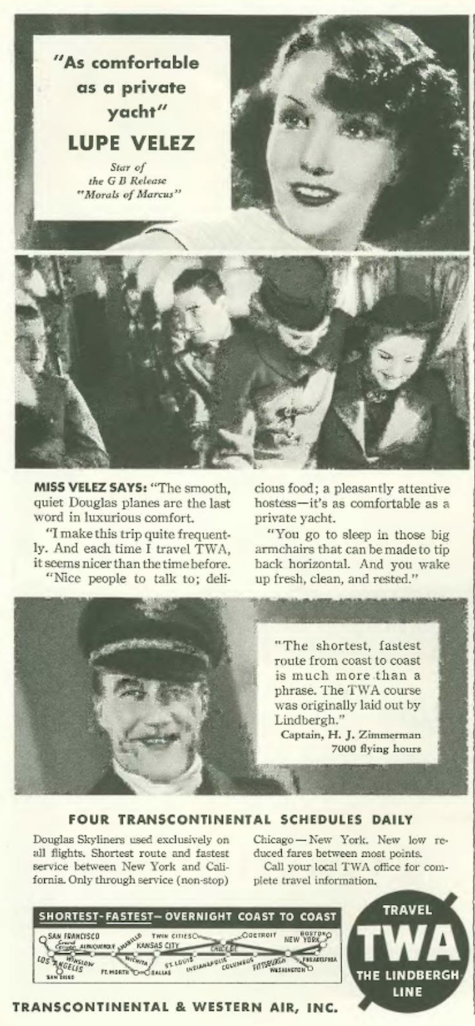
…actress Lupe Vélez made the unlikely claim that flying on a 1930s airliner was “as comfortable as a private yacht”…

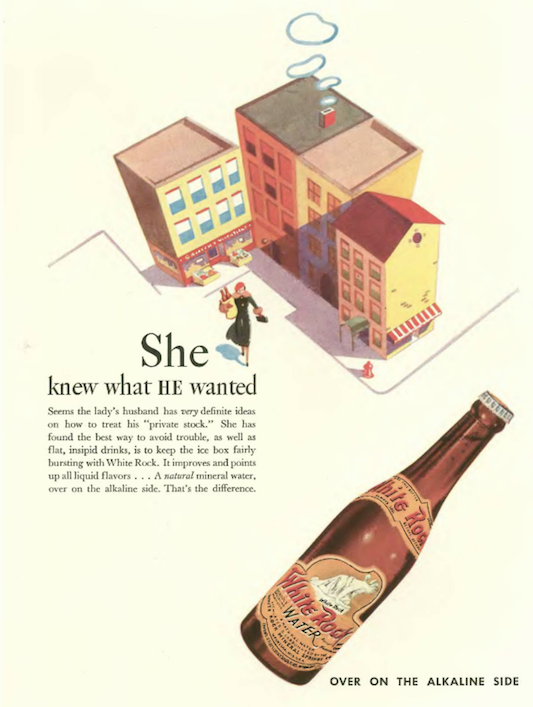
…ads for White Rock were among the more colorful found in the early New Yorker…
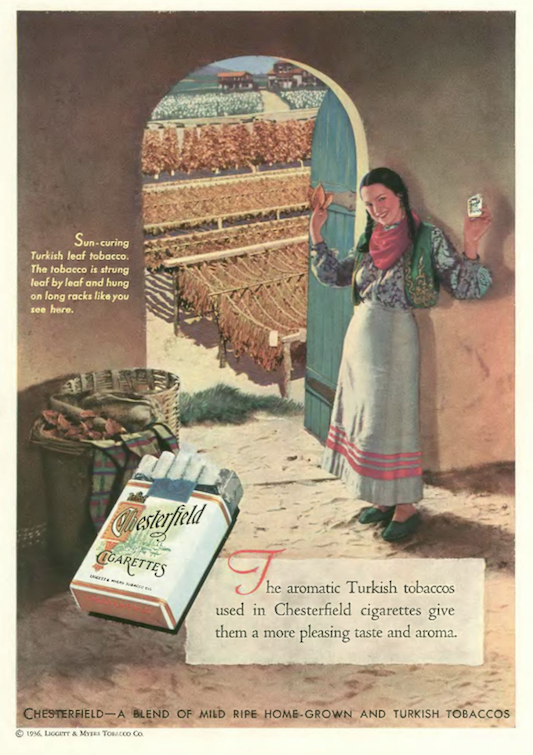
…on the back cover, Liggett & Myers tobacco company shifted gears from elegant to homespun with an ad that emphasized the high quality of Turkish leaf tobacco…
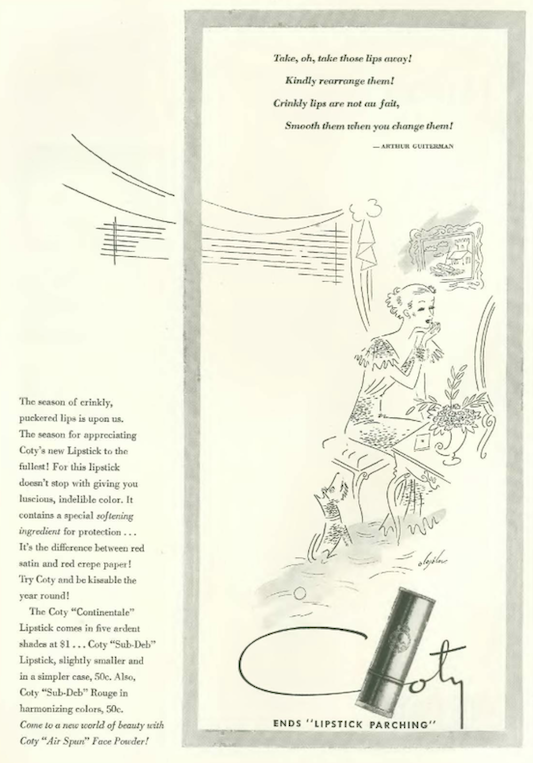
…the folks at Coty hired two New Yorker contributors, poet Arthur Guiterman and illustrator Constantin Alajalov, to promote their line of lipsticks…

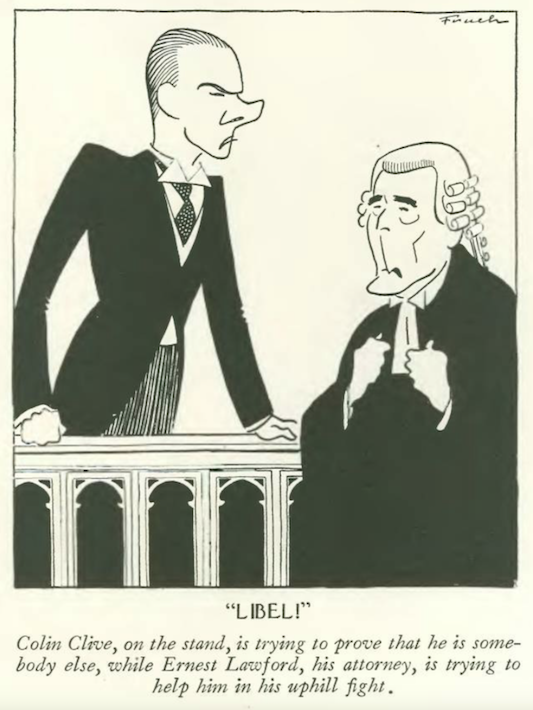
…which brings us to the cartoonists, beginning with Al Frueh

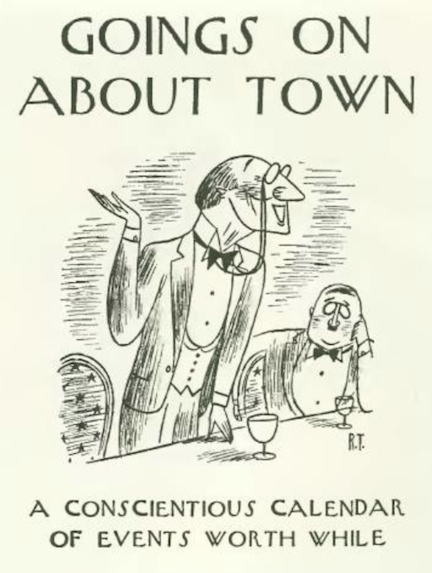
Richard Taylor opened things up in “Goings On”…

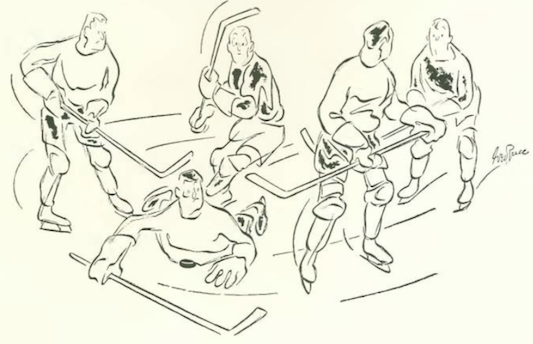
…and George Price added this bit of action to the calendar section…

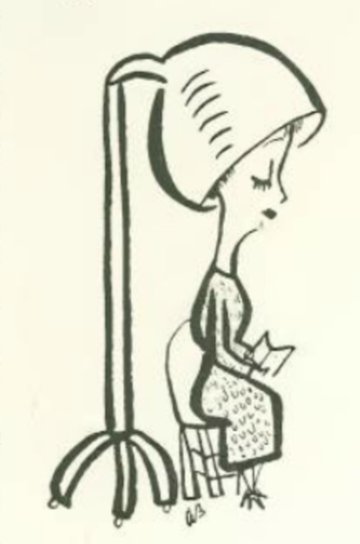
Abe Birnbaum contributed this delightful spot drawing…

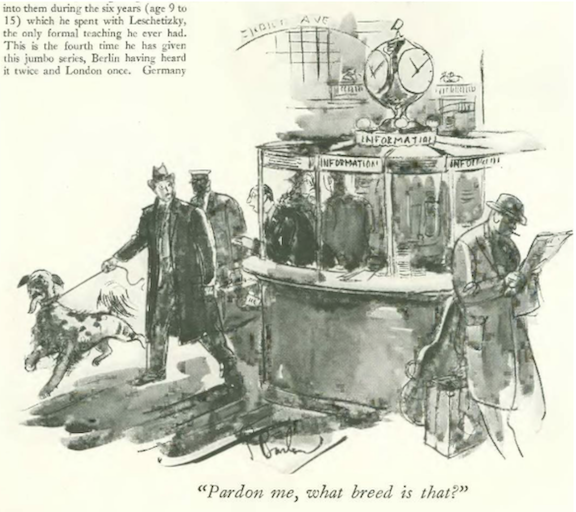
…the Westminster dog show was the talk of the town, and at Grand Central, per Perry Barlow

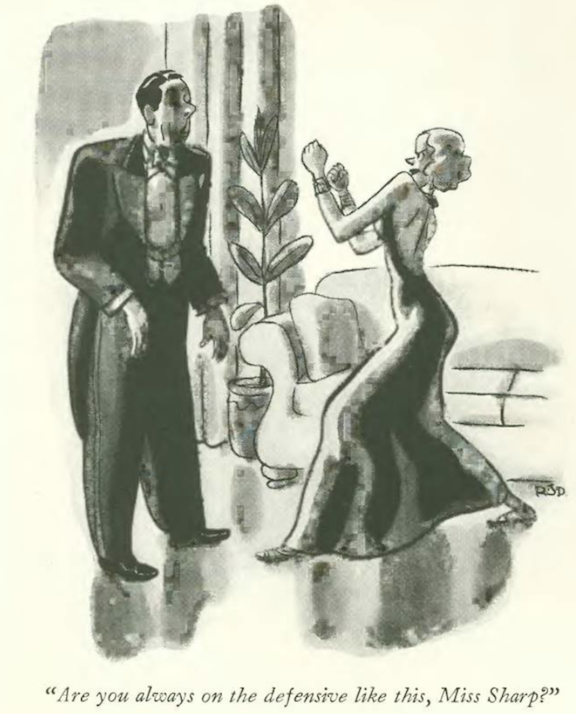
Robert Day had a fight on his hands…

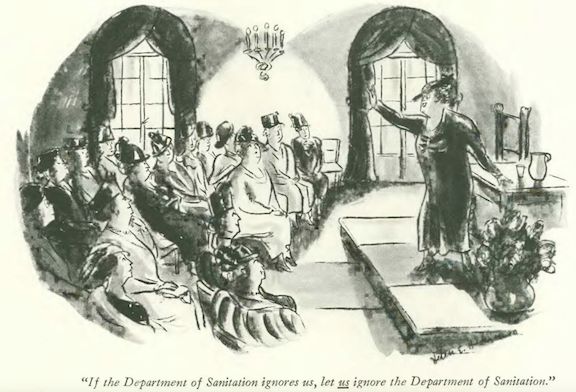
Helen Hokinson’s “girls” were out to snub the sanitation department…

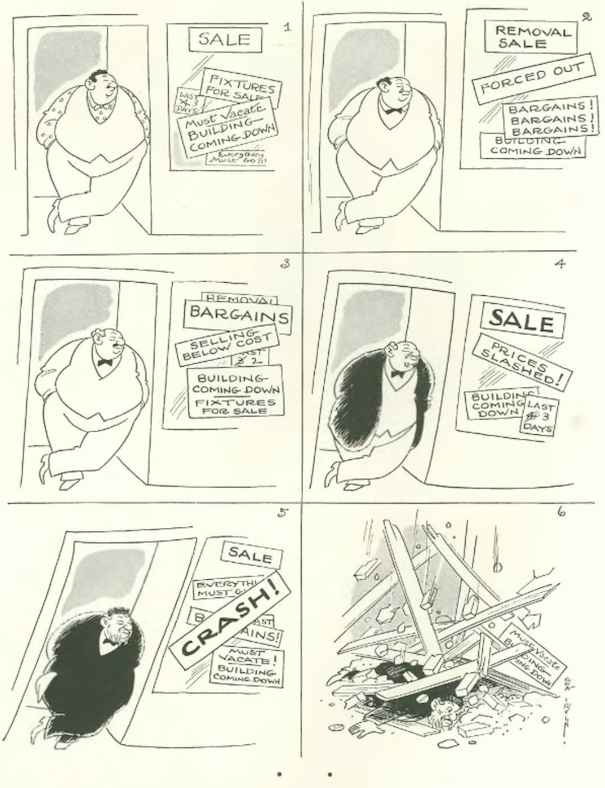
Rea Irvin drew up the literal downfall of one business…

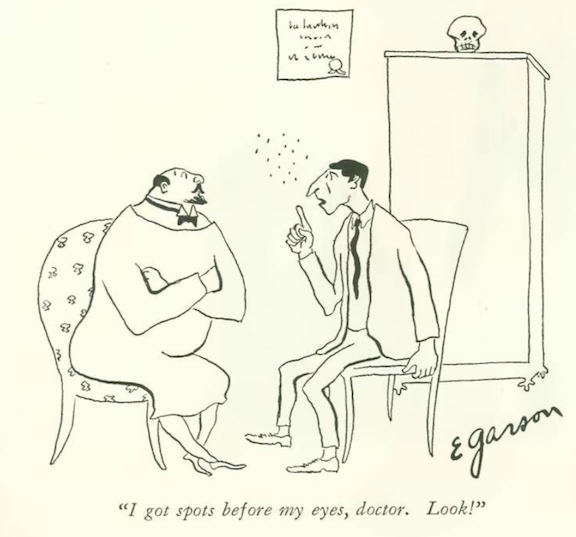
Eli Garson had us seeing spots…

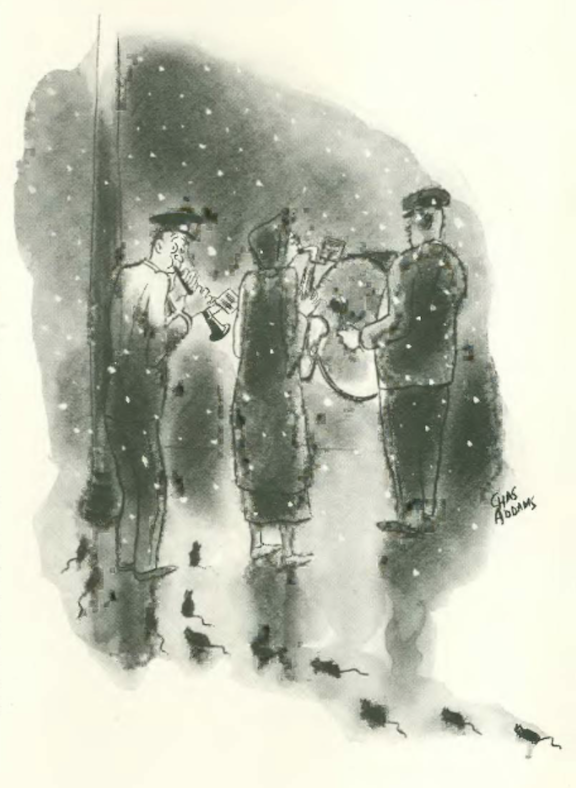
Charles Addams found the Pied Piper in a Salvation Army band…

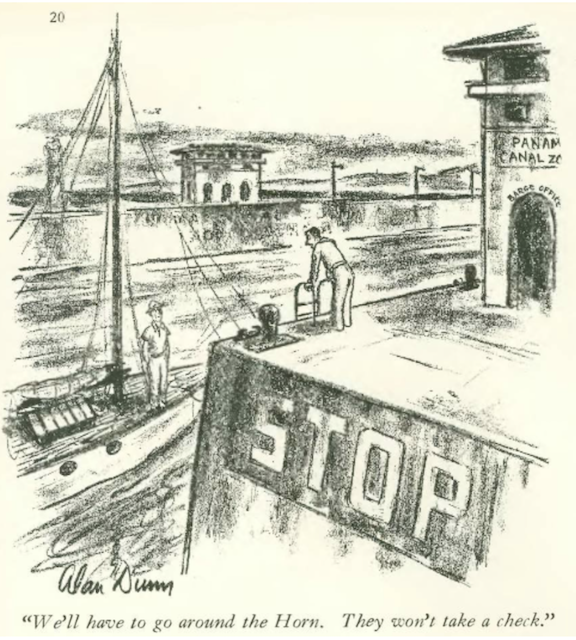
Alan Dunn gave new meaning to “taking a detour”…

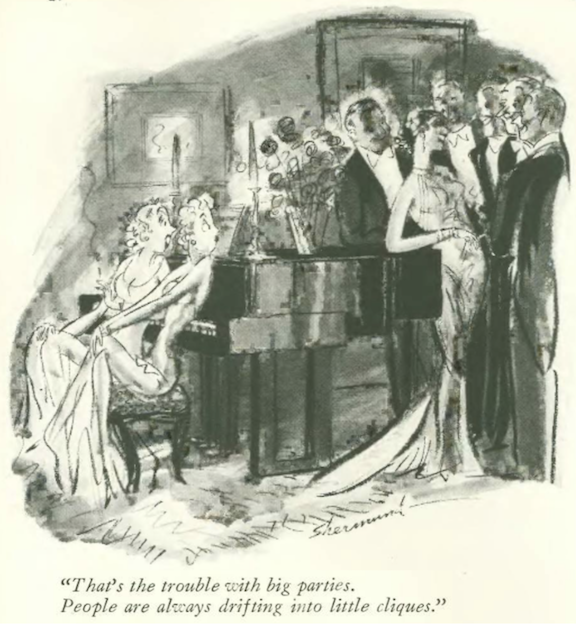
Barbara Shermund illustrated one of the perils of cocktail parties…

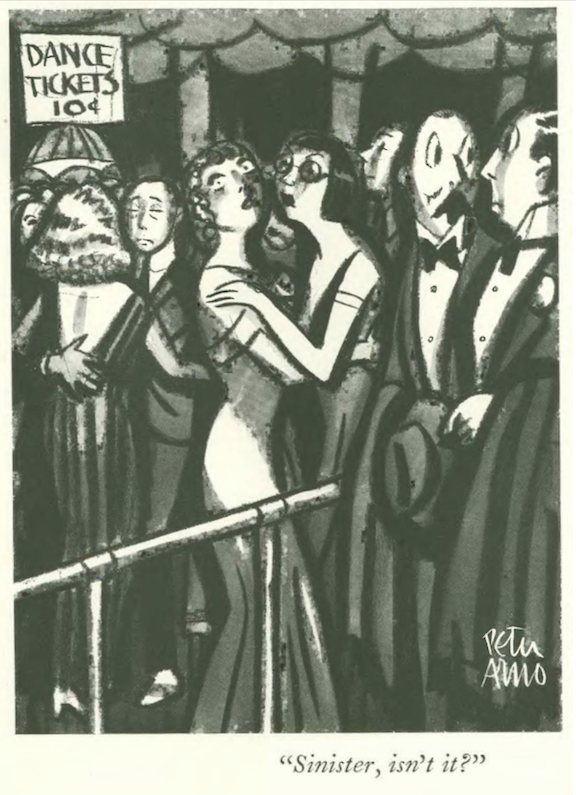
…and we close with Peter Arno, and the sinister world of taxi dancers…

Next Time: Modern Times…