During the roughly thirteen years of Prohibition, many Americans had forgotten how to mix a decent cocktail; the concoctions they devised during those dry years were often created to mask the taste of bootleg liquor—sales of Coca-Cola steadily increased throughout the 1920s in part because it made ardent spirits such as rum and whisky a bit more palatable.
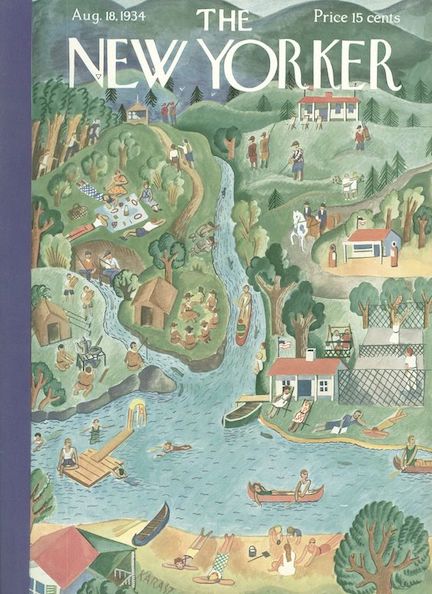
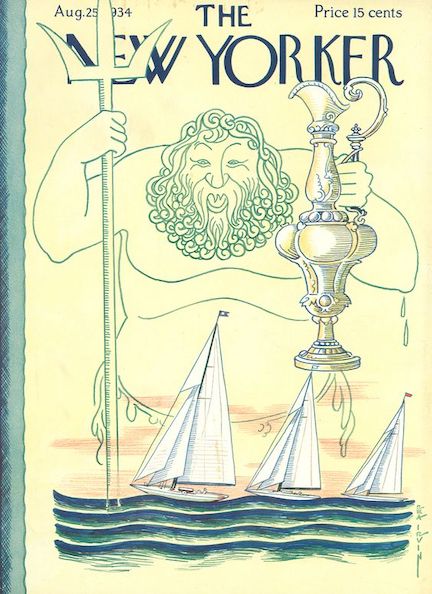
August 18, 1934 cover by Ilonka Karasz.
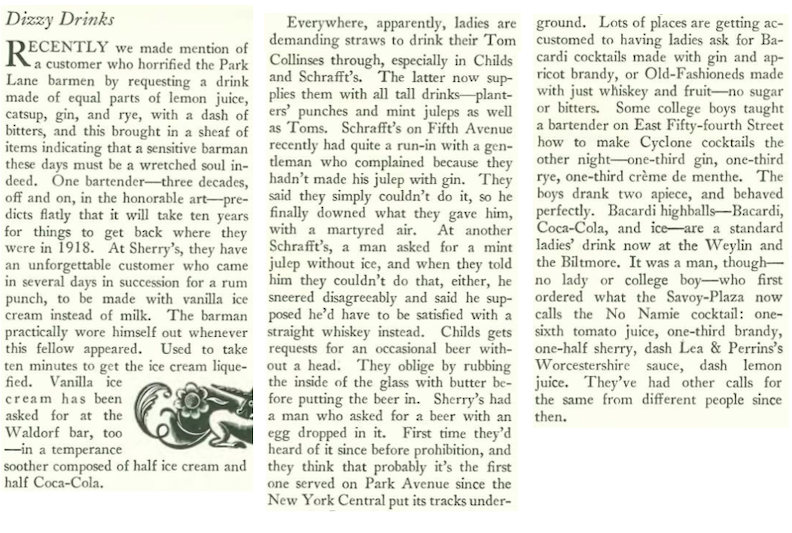
Donald Barr Chidsey examined the phenomenon in “The Talk of the Town,” visiting with traumatized bartenders around Manhattan:
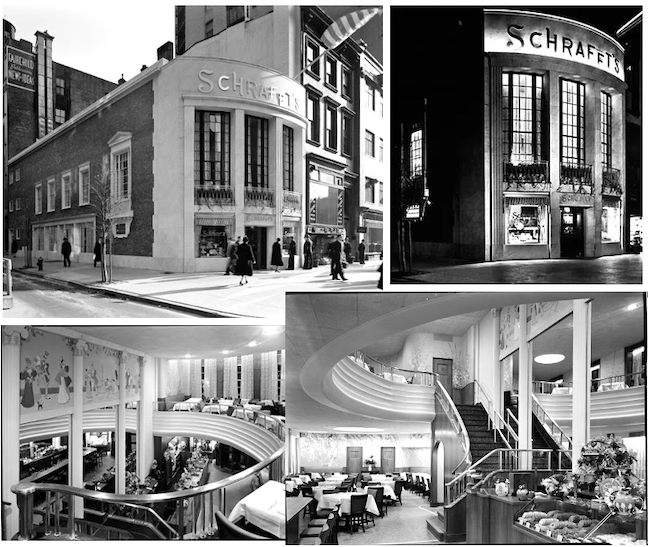
LOST ART…Donald Barr Chidsey relayed the horror of a customer at Sherry’s (top left, photo of the 300 Park Avenue entrance, c. 1925) who asked for ice cream in his rum punch; directly across the street from Sherry’s was the Waldorf Astoria (top right), where a customer asked for a drink of half ice cream, half Coca-Cola; bottom images are from Albert Crockett’sThe Old Waldorf-Astoria Bar Book—as to what one gathers from Chidsey’s account, more than a few people needed to check the “Glossarial” to get reacquainted with the spirit world. (Museum of the City of New York/kitchenartsandletters.com)CUBA LIBRE…According to Chidsey, the go-to for women patrons at the Hotel Weylin was a Barcardi and Coke; at left, Hotel Weylin in 1935; at right, lobby card featuring entertainment at the Weylin Bar, circa 1930s. (Museum of the City of New York/ebay)THE LAST STRAW…Chidsey wrote of an alarming trend among patrons at Schrafft’s who demanded straws in their Tom Collinses. The sleek, art moderne Schrafft’s at 61 Fifth Avenue was among more than two-dozen Schrafft’s locations in New York City in the 1930s. Known for cleanliness and home-style cooking, target clientele were middle-class women. (Architectural Record photos via daytoninmanhattan.blogspot.com)
* * *
From Our Advertisers
Speaking of Schrafft’s, here is their advertisement from the Aug. 18 issue, offering breakfasts ranging from 35 to 75 cents that apparently were the stuff of O. Henry’s dreams…
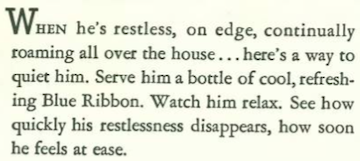
…what is a woman to do with a restless husband?…drawing on the wisdom of the ages, she hands him a beer and coaxes him into his easy chair…this ad encouraged women to “always keep a few bottles in your refrigerator”…in other words, keep ’em coming until he settles into a manageable stupor…
…and see just how easily he slips away, leaving you with a few moments to yourself…
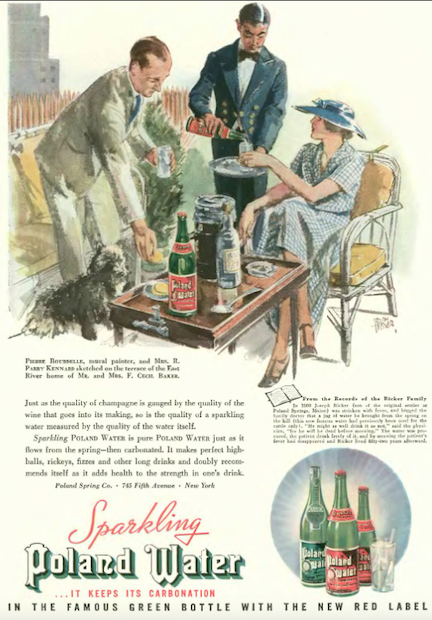
…if highballs were more to your taste, the folks at Poland Water stood ready to help…
…R.J. Reynolds claimed their Camels could solve all sorts of life challenges…we’ve seen ads claiming that Camels soothed “jangled nerves” and helped one relax, but apparently they also could give you energy and pep, at least that is what tennis star Ellsworth Vines, Jr claimed…
…lots of color in the ads for the Aug. 18 issue…here the folks at Buick featured a woman in a red dress serving as an exclamation point to their automobile, which was no ordinary motorcar, but rather a “congenial companion, alive with good-natured personality”…
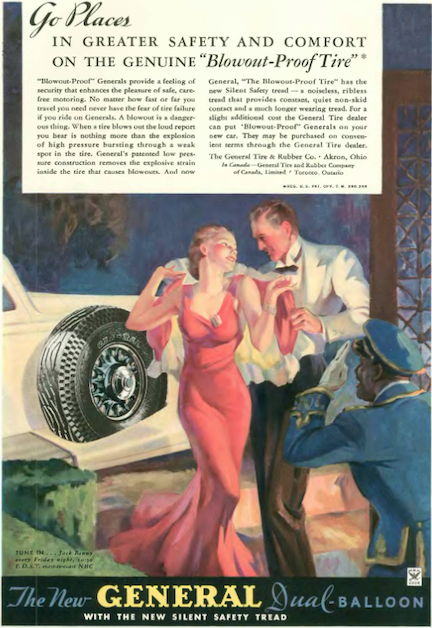
…the folks at General Tire went one better, making their tires the star attraction…those tires look so attractive it seems almost a shame to dirty them on the road…
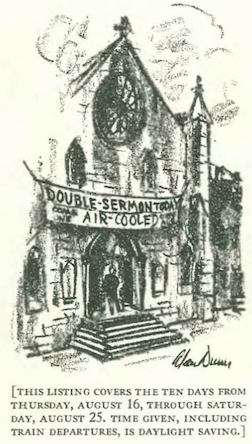
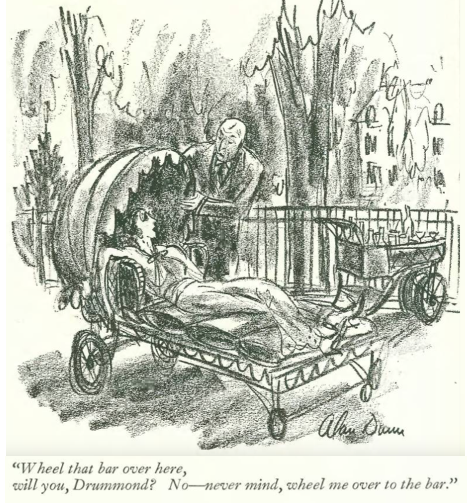
…on to our cartoons, we cool off with this spot in the opening pages by Alan Dunn…
…William Cotton contributed this caricature of New Deal Administrator Hugh Samuel Johnson that accompanied a three-part profile…
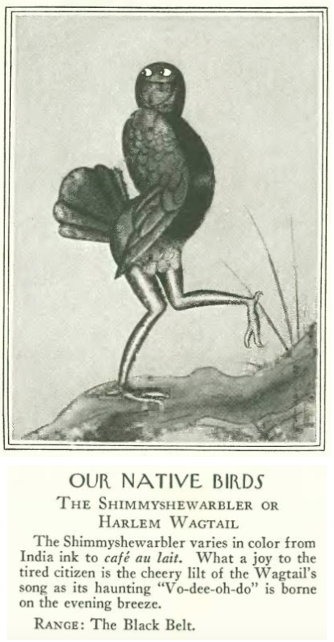
…Rea Irvin offered up a bird of a different feather…
…Robert Day gave us this master of understatement…
…Alan Dunn again, examining the trials and tribulations of the leisure classes…
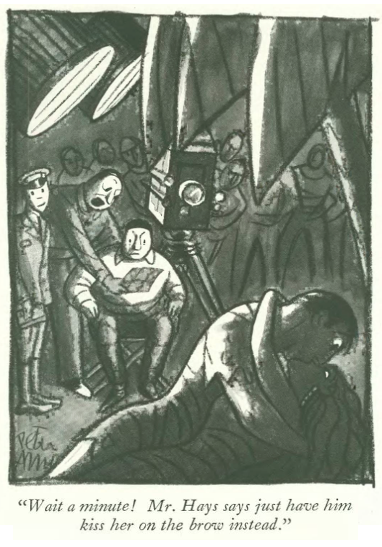
…Peter Arno offered this take on the Hays Code (after politician Will Hays), which was going into effect after the brief “Pre-Code” period (roughly 1930 to 1934) during which filmmakers felt freer to explore themes featuring sex and violence…
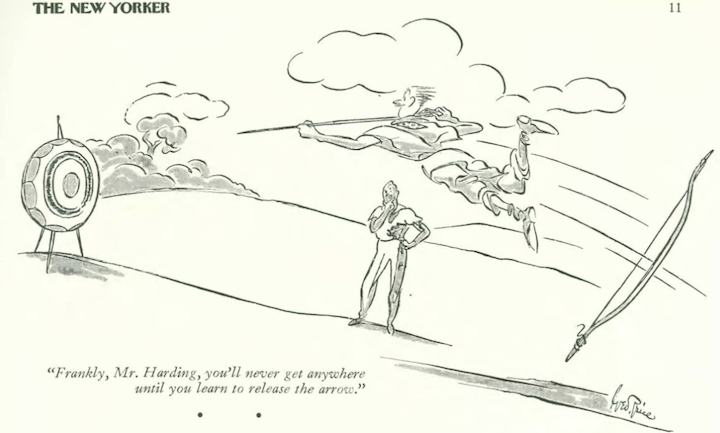
…George Price gave us a man have trouble hitting his mark…
…Alain (Daniel Brustlein) contributed a cartoon with a talking animal, common today but rare in the early New Yorker…
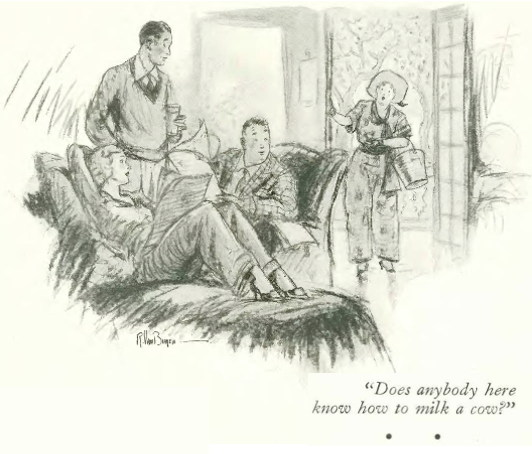
…Raeburn Van Buren was also down on the farm…I think we know the answer to this woman’s query…
…and we close with James Thurber, where mixed doubles were naturally fraught with peril…
Construction workers line up for pay beside the first Rockefeller Center Christmas tree in New York in 1931. (ASSOCIATED PRESS)
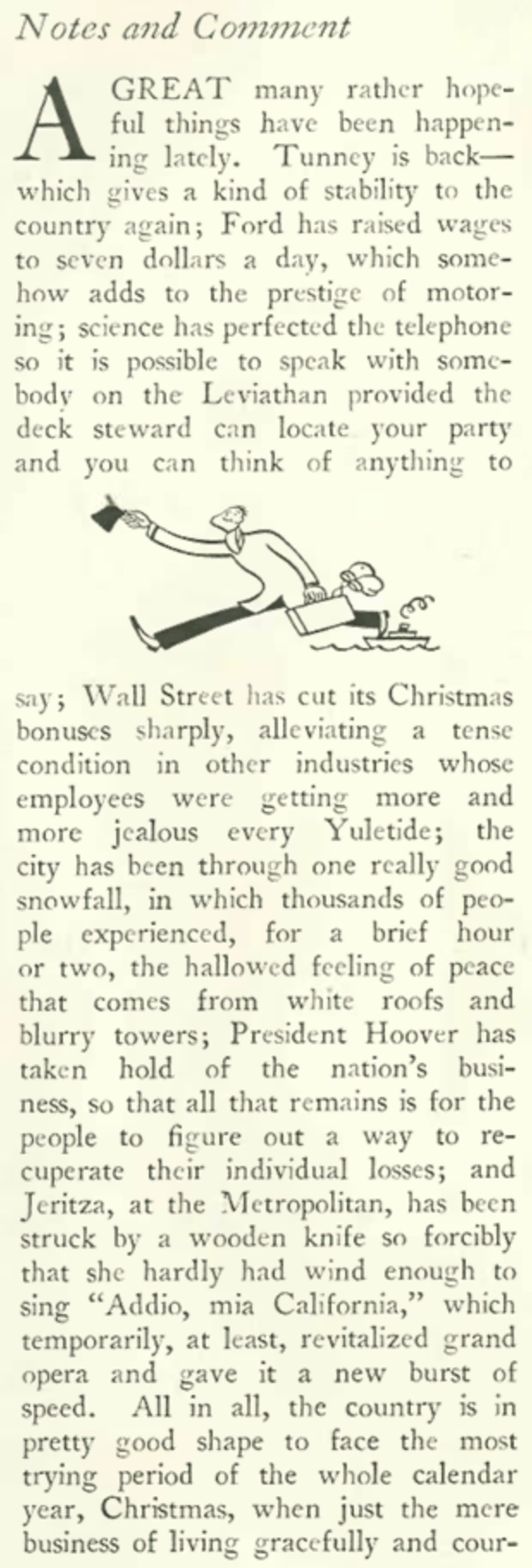
E.B. White’s “Notes and Comment” column led off The New Yorker’s “Talk of the Town,” and as such helped set the tone for what was to follow in the magazine.
Dec. 14, 1929 cover by Theodore Haupt. Opening image: Construction workers line up for pay beside the first Rockefeller Center Christmas tree in New York in 1931. (NY Daily News)
For the Dec. 14 issue White attempted to strike a positive note in the aftermath of the stock market crash, offering a few nuggets of hope for the holiday season:
HEAVYWEIGHTS…Both President Herbert Hoover and retired prizefighter Gene Tunney offered signs of stability to a nation reeling from economic collapse. At right, Gene and Mary Tunney return to New York on the ocean liner Vulcania after 14 months in Europe. (Wikipedia/AP)
Alexander Woollcott, however, described his financial woes in his “Shouts and Murmurs” column, where he parodied newspapers that listed charity cases during the Christmas season:
BOOK-END POOR…Alexander Woollcott, in a 1939 portrait by Carl Van Vechten. (Wikipedia)
Paris correspondent Janet Flanner noted how the ripples of the market crash were being felt in Paris: Americans no longer had wads of cash to lavish on booze, jewelry, antiques and real estate:
DON’T RAIN ON OUR PARADE…The Place de la Nation, Paris, 1930. (thevintagenews.com)
Flanner added that despite the past boorish behavior of American tourists, the level of schaudenfreude among the French was remarkably low…
* * *
Sinful Diversions
For yet another sign that the Roaring Twenties were decidedly over, it appeared that even “Sex” had run its course. Theater critic Robert Benchley noted that Mae West’s scandalous 1926 play inspired a spate of shows that had little new to offer, save for amping up the salacious content: A Primer for Lovers, The Amorous Antic, and Young Sinners. Audiences were unimpressed. A Primer for Lovers closed after just 24 performances, The Amorous Antic after just eight. Only Young Sinners would survive into the spring season.
JUST LOOK WHAT YOU STARTED…”Sex” was panned by critics as vulgar, but Broadway audiences in 1926 loved it. After 375 performances police arrested Mae West on obscenity charges, which landed her in a prison workhouse for ten days. (boweryboyshistory.com)Actress Phoebe Foster (left) found success on Broadway, but not so much in The Amorous Antic, which closed after just eight performances. Dorothy Appleby (right) had better success with Young Sinners, which ran for 289 performances through August 1930. (IMDB)
* * *
Final Bows
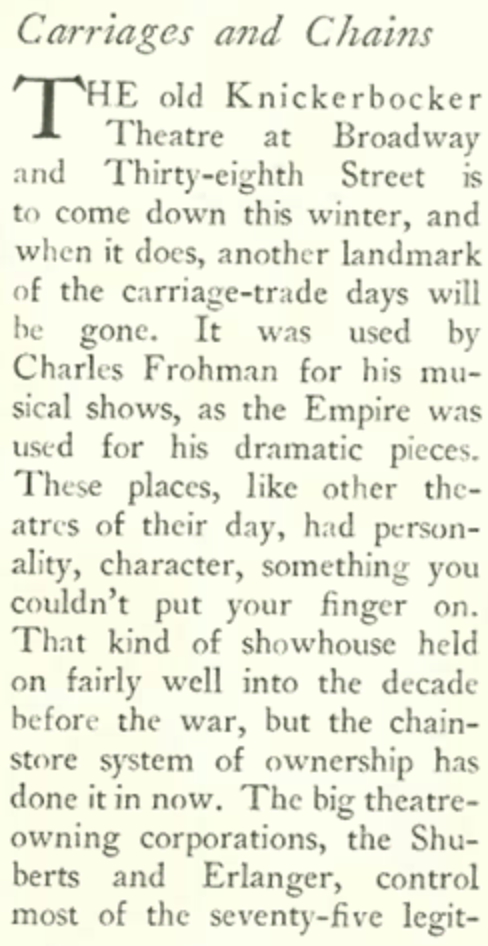
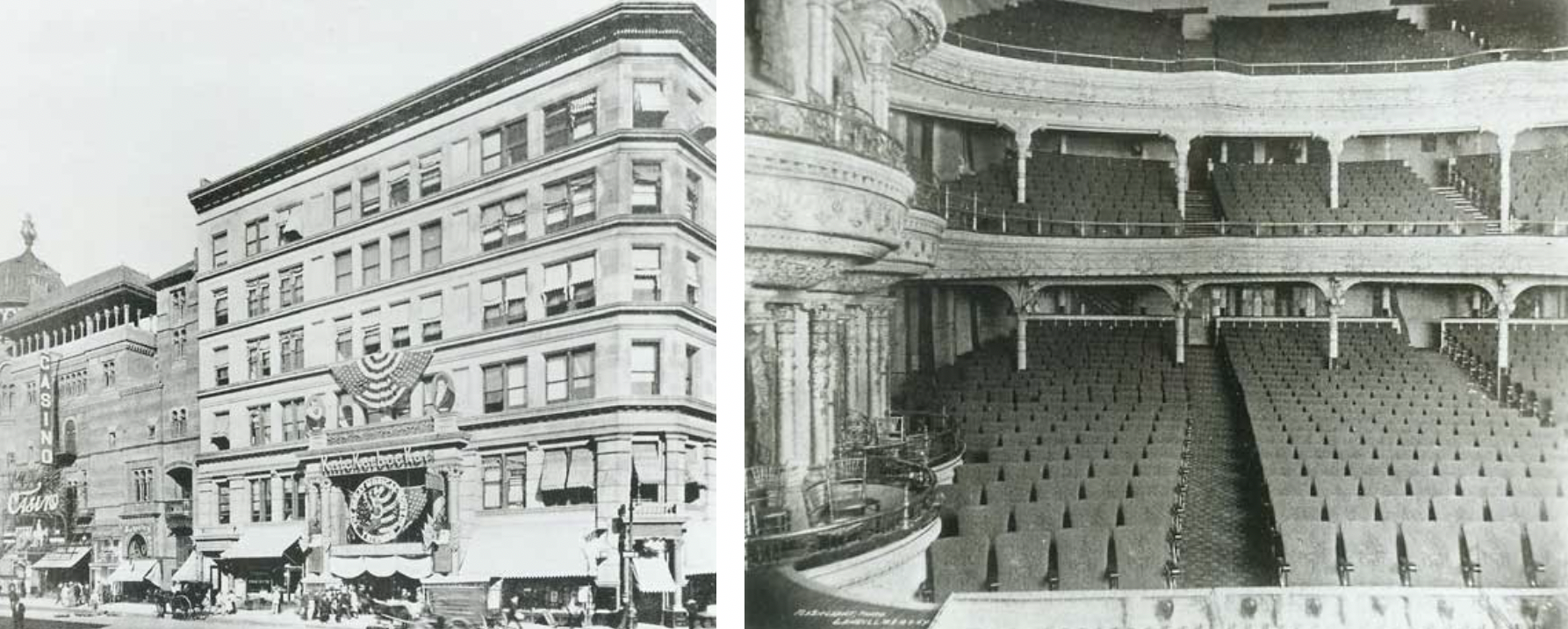
Theater was changing in other ways too. In the late 19th and early 20th century audiences patronized various playhouses based more on their reputation and tradition than on a particular play. E.B. White, in the “Talk of the Town” noted the imminent passing of one such house, the Knickerbocker Theatre, slated for demolition in 1930. The 33-year-old theater was Broadway’s first to display a moving electric sign (1906).
A HOUSE OF GOOD REPUTE…The Knickerbocker Theatre at 1396 Broadway was built in 1896 and demolished in 1930. (Internet Broadway Database)
White noted that smaller venues like the Knickerbocker, with their own distinct character and clientele, were falling victim to big theater-owning corporations that introduced more homogeneity into the play-going scene. In White’s estimation just two old-timers remained:
Both buildings still stand. The New Amsterdam, constructed in 1902–03, is now the oldest theater on Broadway. In the 1910s and 1920s it hosted the Ziegfeld Follies on its main stage and the racier Ziegfeld Midnight Frolics on the building’s rooftop. The Music Box was constructed in 1921 by composer Irving Berlin and producer Sam H. Harris to house Berlin’s Music Box Revues.
DISNEYFIED…The New Amsterdam, constructed in 1902–03, still stands today, now operated by the Disney Company, which signed a 99-year lease with the city in 1993. When it was built it was the largest theater in New York, with a seating capacity of 1,702. (Wikipedia)IRVING’S PLACE…The Music Box Theatre at 239 West 45th Street was constructed in 1921 by composer Irving Berlin and producer Sam H. Harris to house Berlin’s Music Box Revues. It was later co-owned by Berlin’s estate and the Shubert Organization until Shubert assumed full ownership in 2007. (Wikipedia)
* * *
Stocks Down, Arno Up
Peter Arno could be found all over the Dec. 14 issue: an ad promoting his new book Peter Arno’s Parade, a blurb in the book section touting the same…this ad for Peck & Peck featuring his handiwork…
…in the cartoons, a full page with the economy as a theme…
…and this submission that was doubtless inspired by Arno’s own home life and his brief, tempestuous marriage to New Yorker colleague Lois Long…
…here’s a couple of comics featuring Milquetoast characters…this one by Garrett Price…
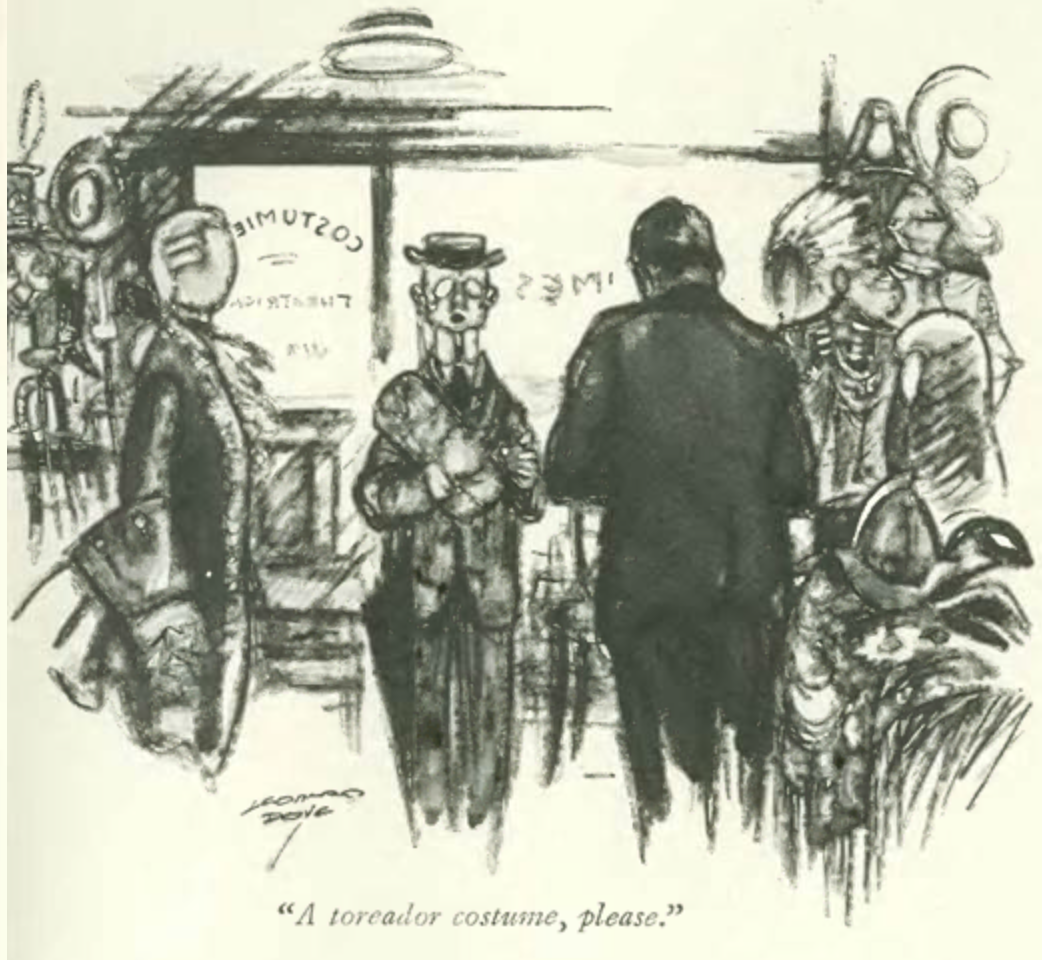
…and another by Leonard Dove…
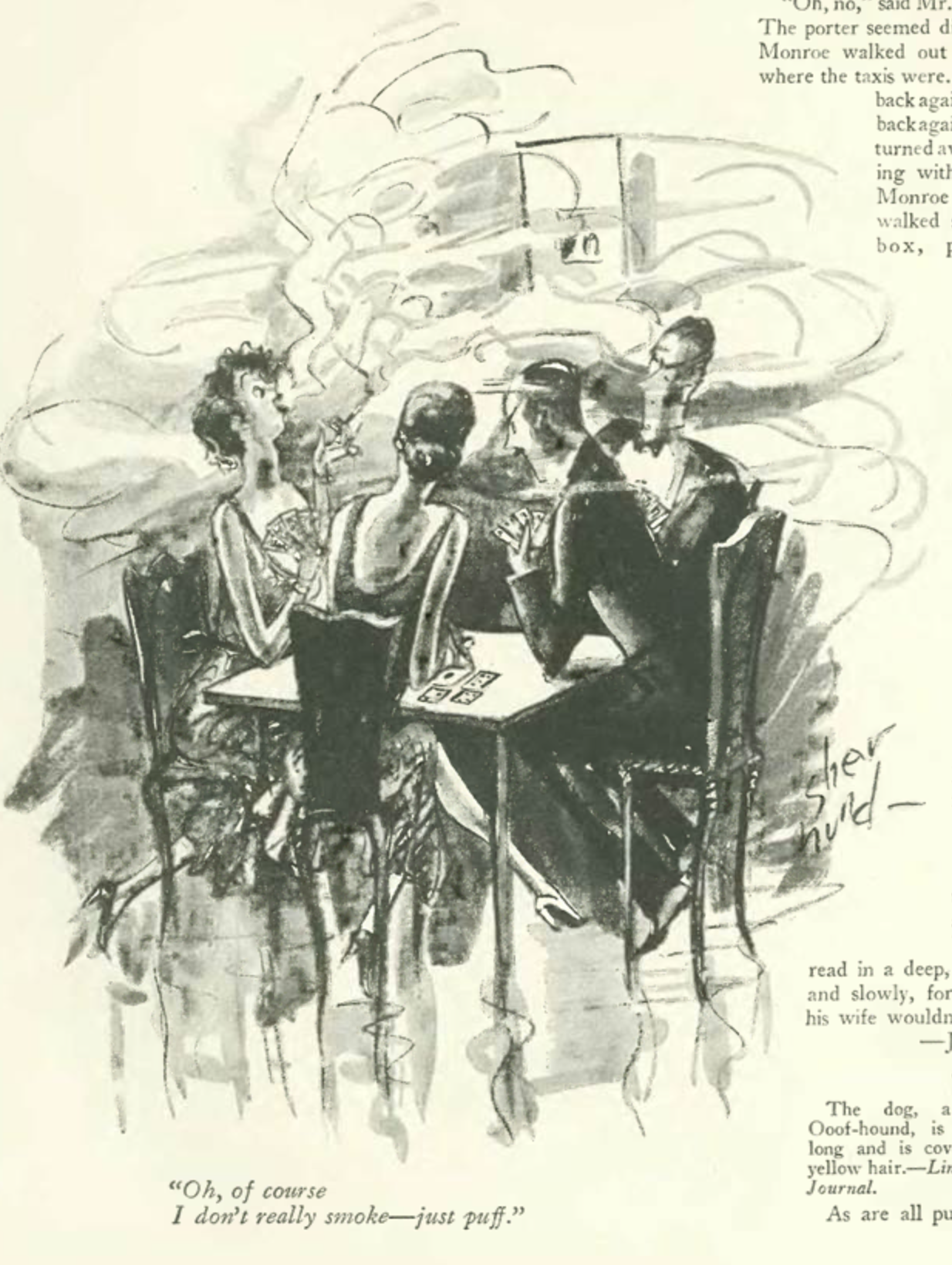
…and two submissions from one of my favorite cartoonists, Barbara Shermund, so ahead of her time…
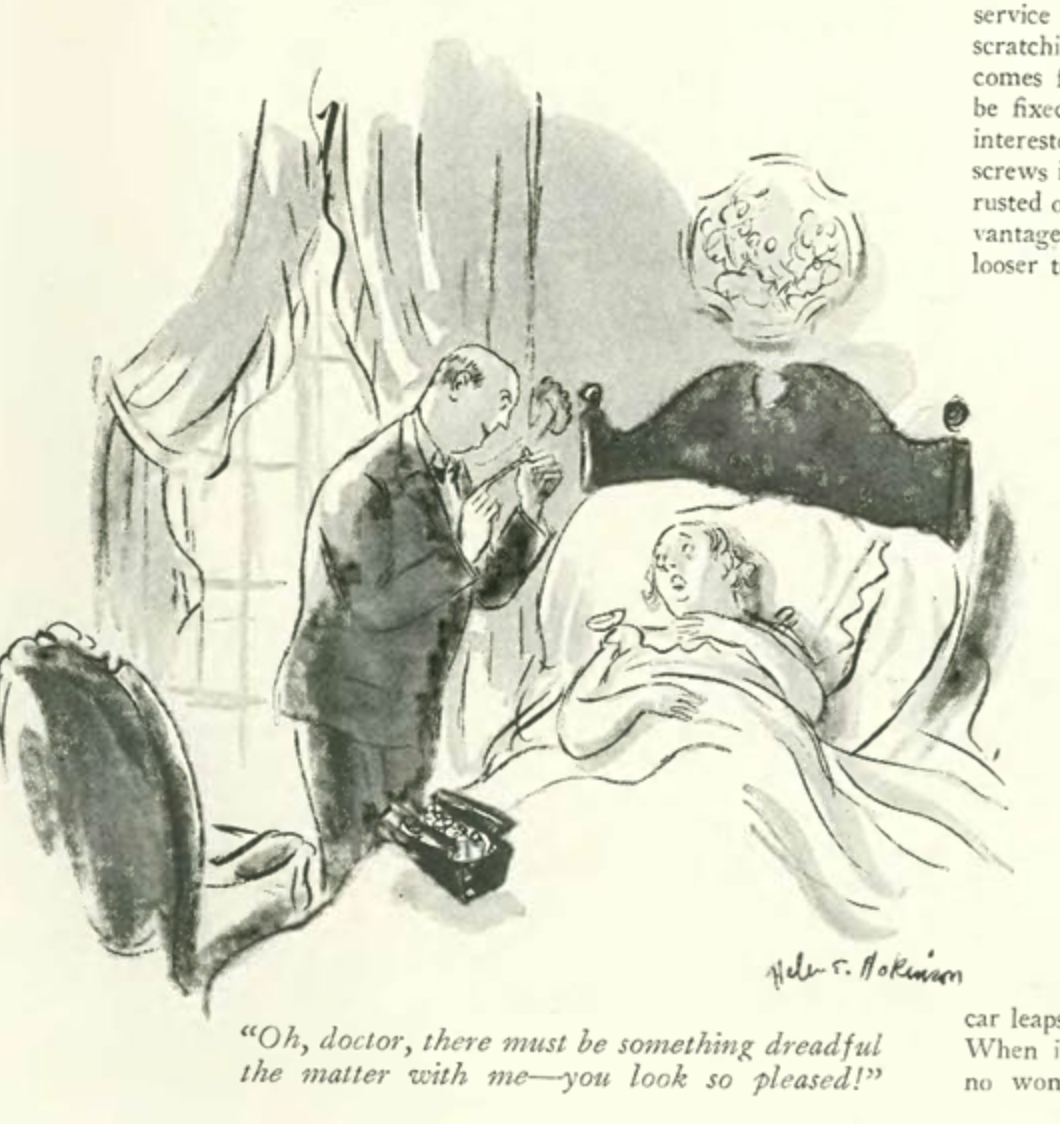
…Helen Hokinson examined a physician’s bedside manner…
…and I. Klein offered his take on the new economy…
* * *
We move right along to the Dec. 21, 1929 issue, where things seemed to turn a bit more sour…
Dec. 21, 1929 cover by Rea Irvin.
…Elmer Rice’s serialized novel, A Voyage to Purilia, finally concluded in its 11th installment in the New Yorker…and E.B. White took on a more choleric disposition in his “Notes and Comment”…
Lois Long contributed a “Tables for Two” column, a feature that had become infrequent as she turned her full attentions to her fashion column “On and Off the Avenue.” In this installment of “Tables” we get her first mention of the market calamity…
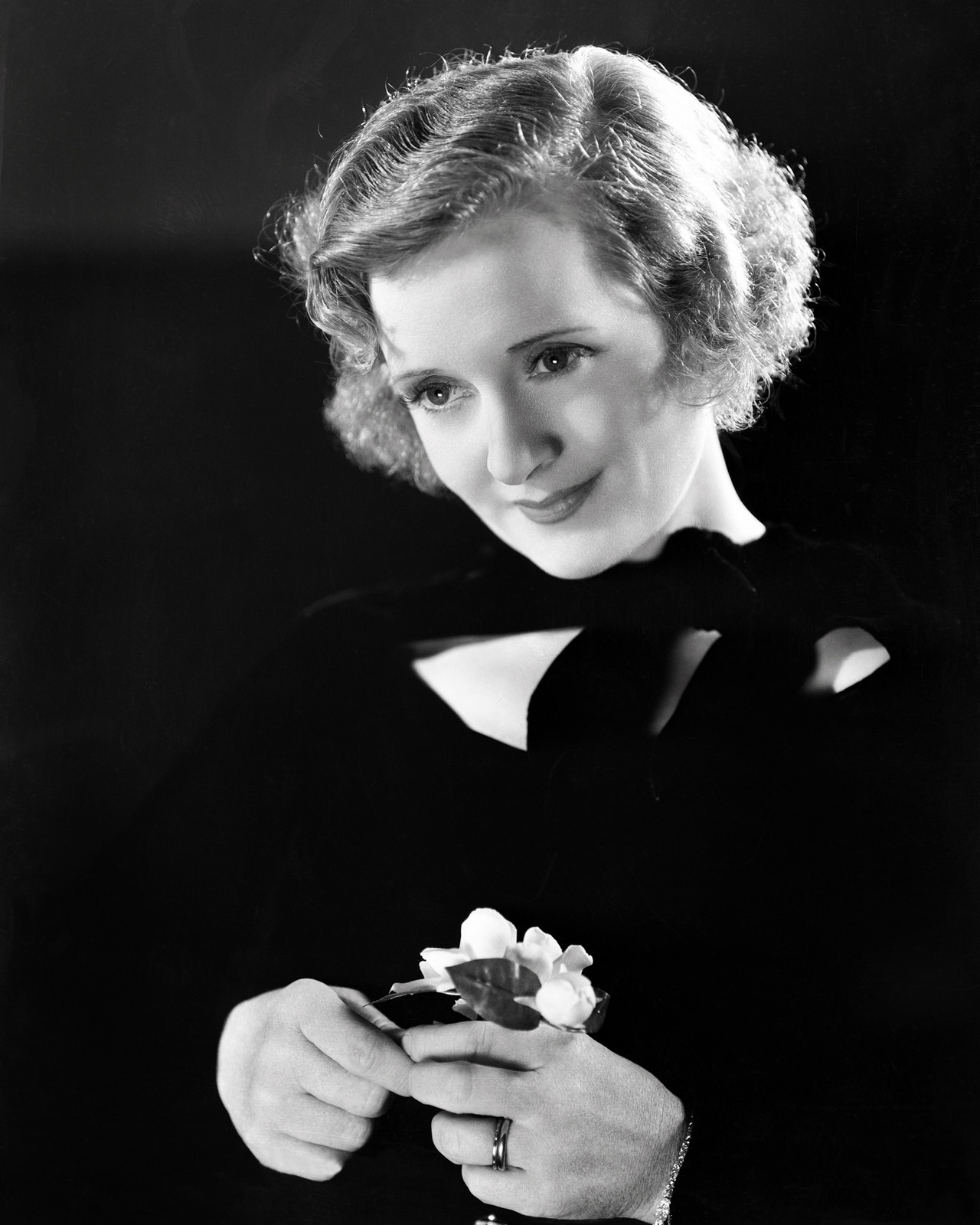
…Robert Benchley finally found something to like on Broadway, because Billie Burke was the star attraction…
SHE”S THE GOOD ONE…Billie Burke in 1933. Most of us know her today for her performance as Glinda the Good Witch of the North in the 1939 film The Wizard of Oz. (Wikipedia)
* * *
Violin Prodigy 2.0
The New Yorker raved about the twelve-year-old violinist Yehudi Menuhin when he wowed audiences at the Berlin Philharmonic earlier in the year. So when the ten-year-old Ruggiero Ricci expertly fiddled with the Manhattan Symphony, well…
YEAH, I GOT THIS…Ruggiero Ricci, about 1930, by then a touring professional. At age six Ricci began lessons with Louis Persinger, who also taught another San Francisco prodigy, Yehudi Menuhin. (Text and image, The New York Times)
* * *
Namesake
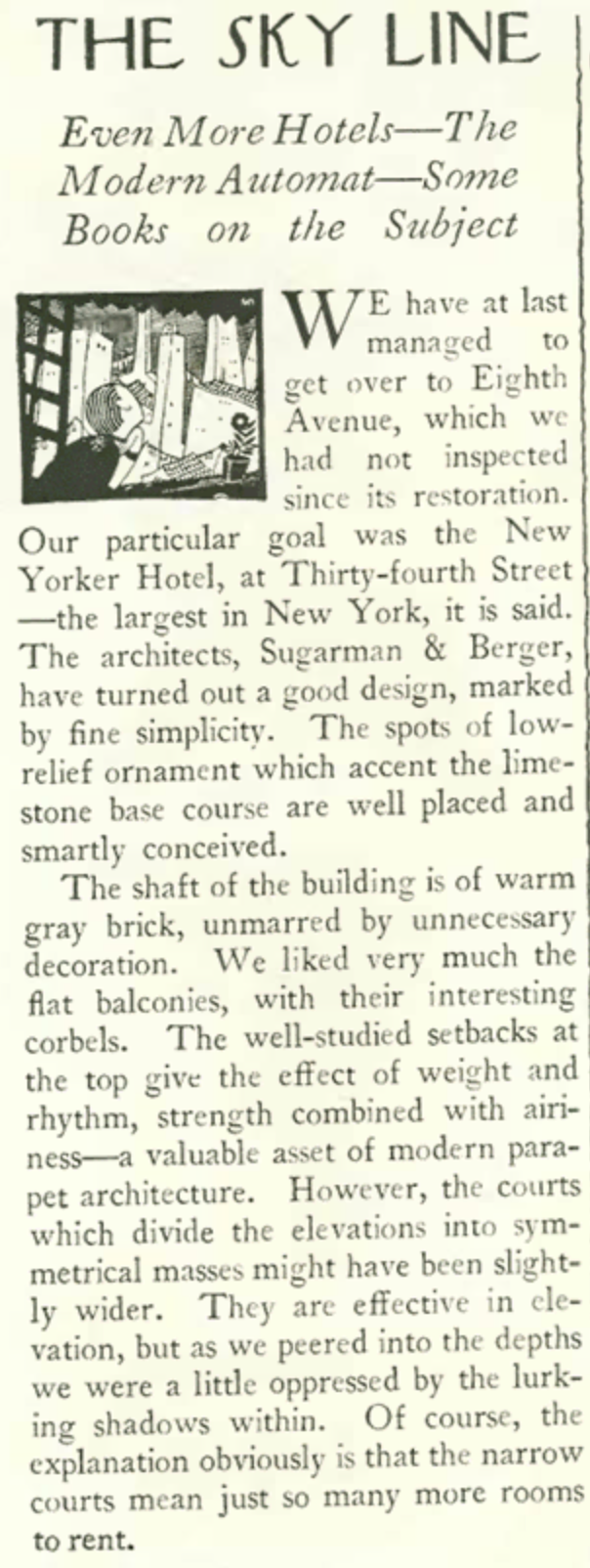
Despite the market crash, the skyline continued to change at a rapid pace, and as we enter the 1930s the city would add some of its most iconic buildings to the skyline. George Chappell, The New Yorker’s architecture critic, had this to say about the magazine’s “namesake”…
ROOMY…The New Yorker Hotel, at 481 Eighth Avenue. When the 43-story Art Deco hotel opened 1930, it contained 2,500 rooms, making it the city’s largest for many years. (Wikipedia)
* * *
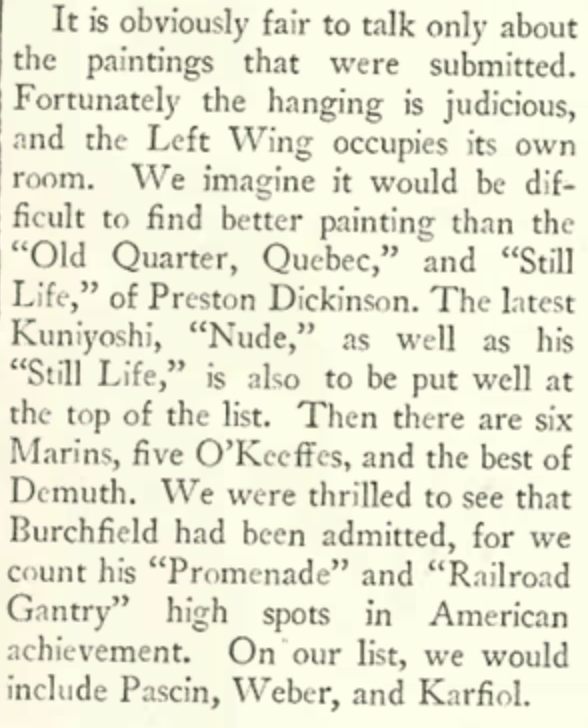
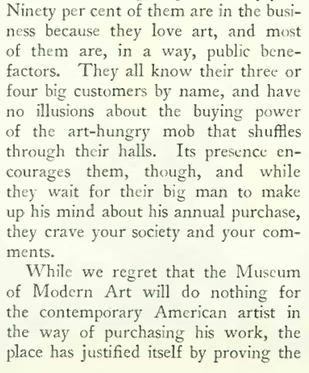
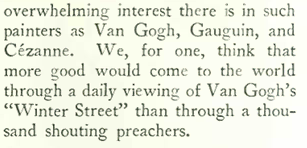
Art critic Murdock Pemberton continued his quest to make sense of the upstart Museum of Modern Art…
…and the American artists showcased there…
…I would add Edward Hopper, John Sloan, Lyonel Feininger, and Rockwell Kent (also displayed at the exhibition) but then again, I have the advantage of hindsight…
* * *
From Our Advertisers
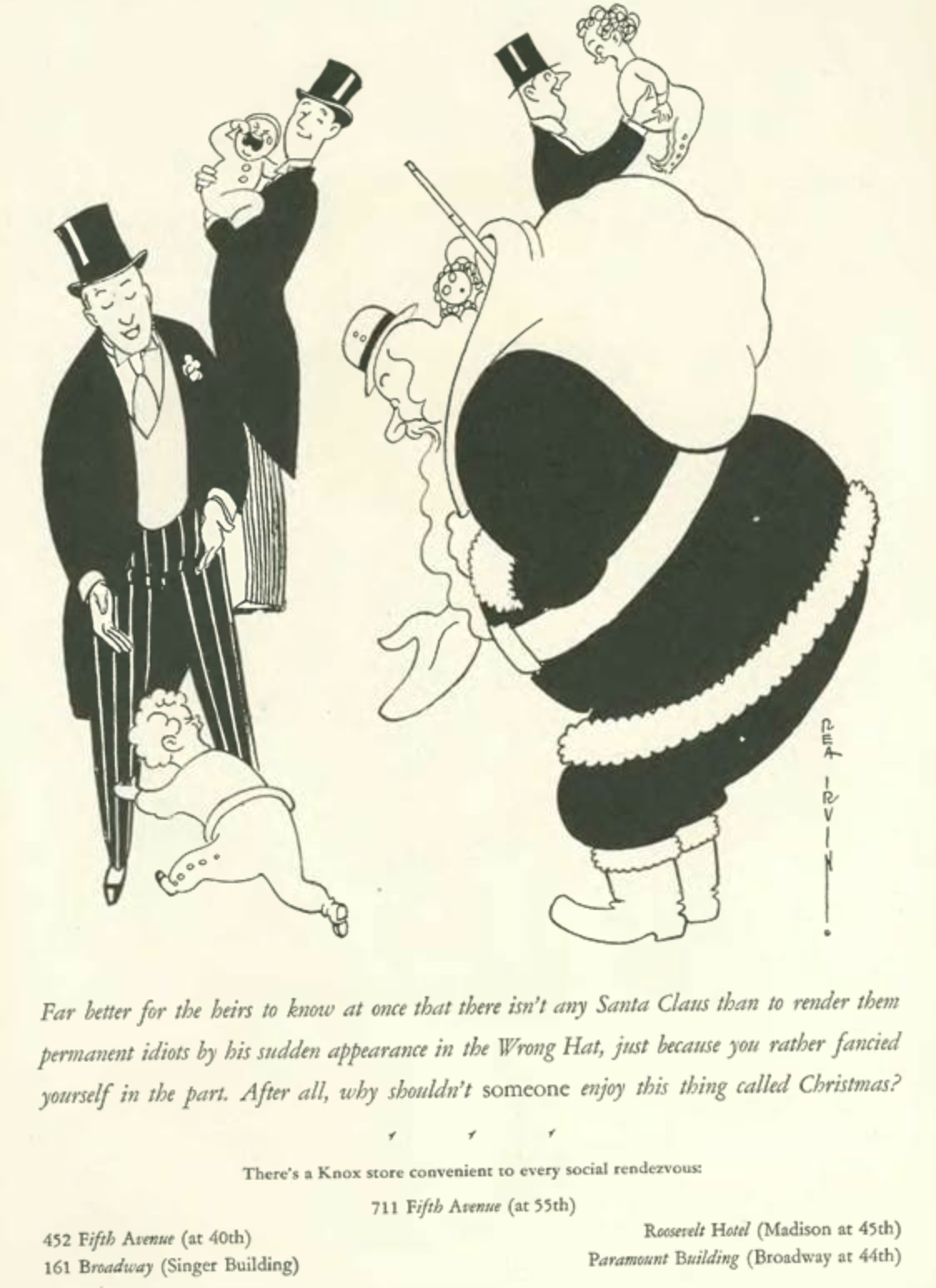
We have more New Yorker cartoonists augmenting their income through advertising, including (once again) Rea Irvin for Knox Hatters…
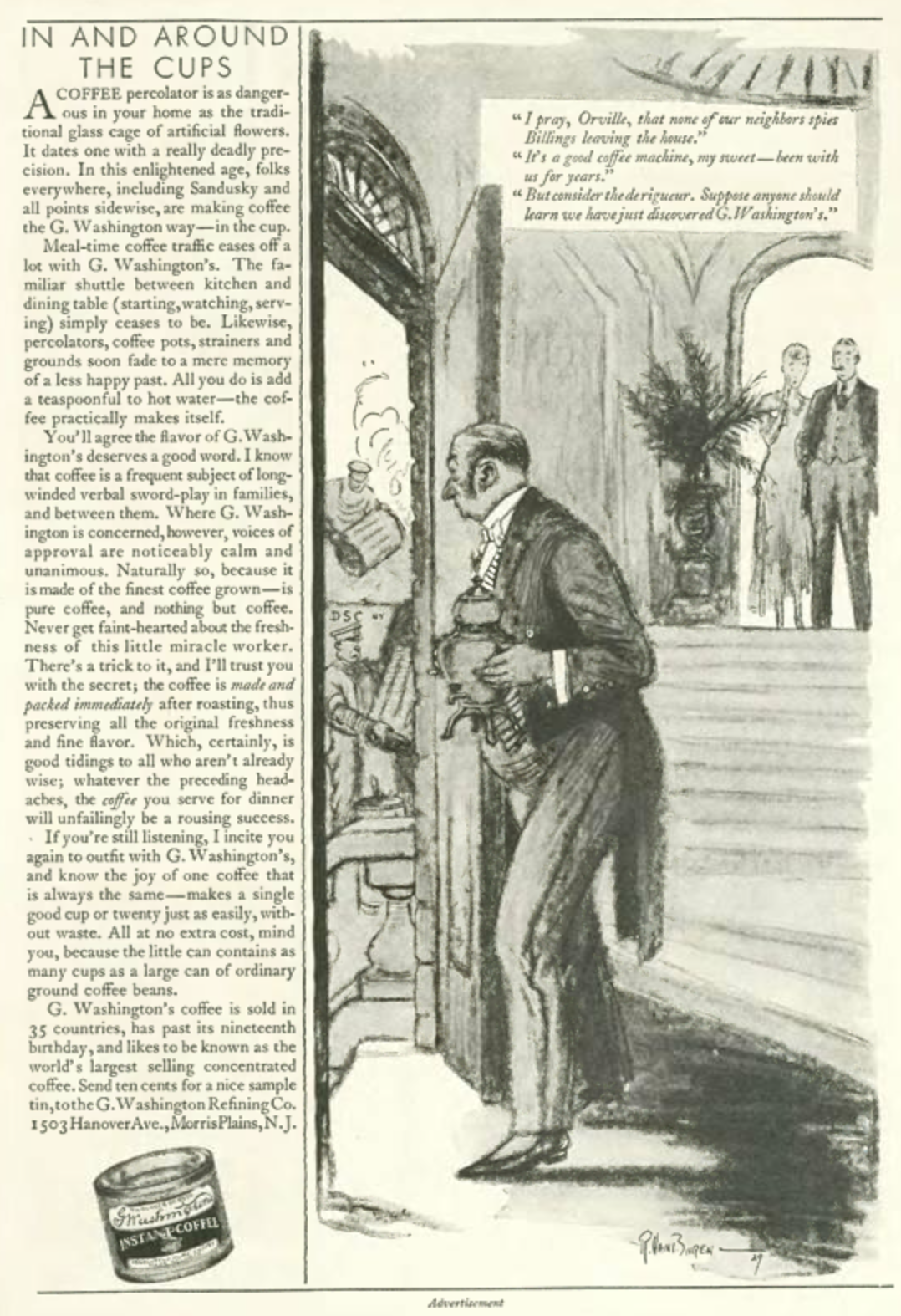
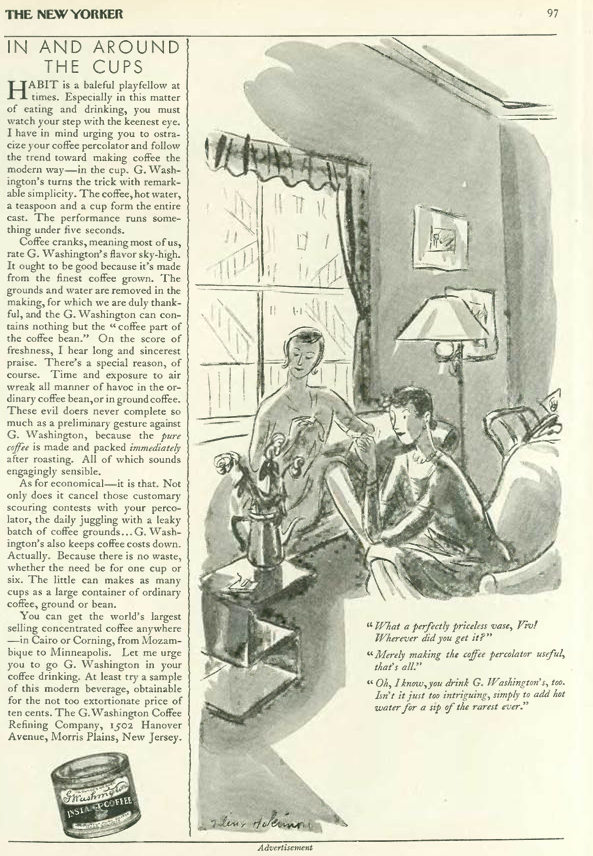
…Raeburn Van Buren for G. Washington’s instant coffee (also a client of Helen Hokinson’s)…
…and Helen Hokinson for Frigidaire…
…and on to cartoons for Dec. 21, Hokinson again…
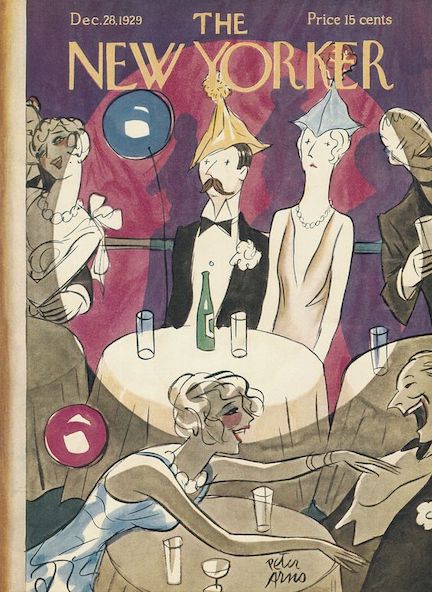
…and we end with Peter Arno, and another peek into marital bliss…
The effects of the October stock market crash were finally beginning to show in the pages of the New Yorker in the last month of the 1920s.
Dec. 7, 1929 cover by Julien De Miskey.
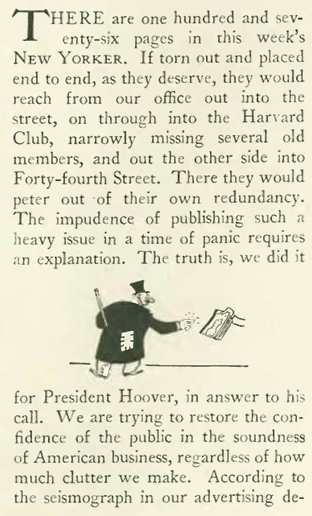
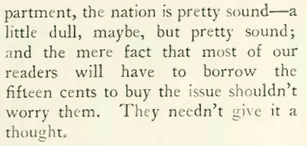
E. B. White was doing his best to keep things light, stating in his “Notes and Comment” column that despite the “time of panic,” the ad-packed Dec. 7 issue contained a whopping 176 pages…
Advertising income for The New Yorker would drop a bit in 1930 (from $1,929,000 to $1,922,000) and would continue to decline through 1932 (down to $1,448,000) before recovering slightly in 1933 and then really taking off again in 1934. And as White noted, even if they had to borrow the 15 cents, folks would still buy the magazine: circulation would top 100,000 in 1930, and except for a dip in 1932 would steadily grow past 150,000 by decade’s end.
KEEP CALM AND CARRY ON…E.B. White in 1946. (National Endowment for the Humanities)
The magazine was stuffed with ads as well as an extended “On and Off the Avenue” —which offered advice to holiday shoppers — and the continued serialization of Elmer Rice’s novel A Voyage to Purilia (installment No. 9).
But not all was sweetness and light. The biggest economic collapse in U.S. history was simply too pervasive to ignore, and even a feeling of hopelessness was creeping into magazine — here’s an observation by Howard Brubaker in his “Of All Things” column…
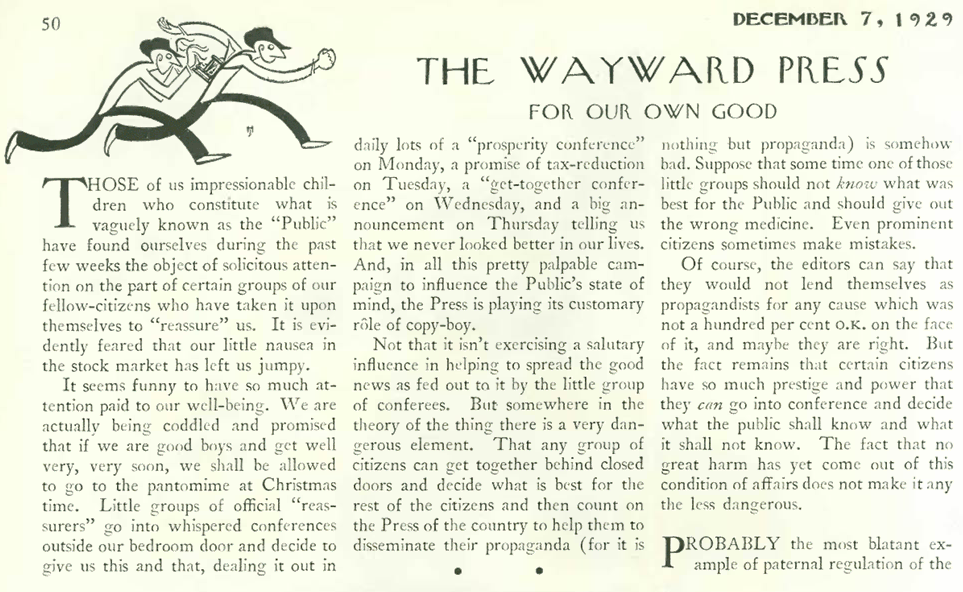
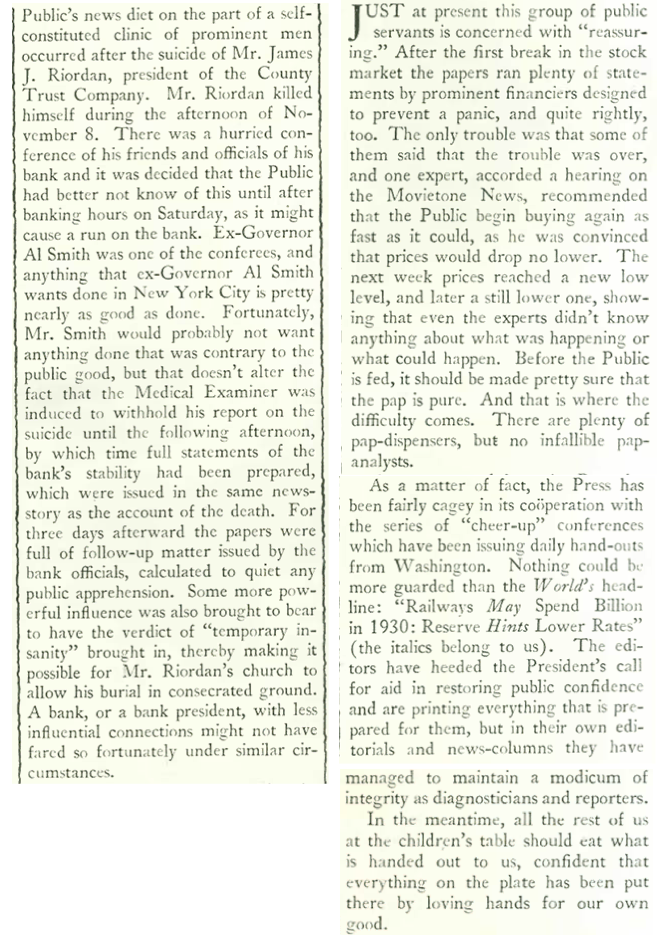
…and writing under the pseudonym “Guy Fawkes,” humorist Robert Benchley found little to laugh about in his “The Wayward Press” column. He chided the media for giving the public false hopes (which he labeled “propaganda”) regarding the state of the economy, and for concealing the suicide of prominent New York banker James J. Riordan, whosedeath announcement was postponed until Riordan’s bank closed for the weekend…
MARKET CASULTY…News of the suicide of prominent New York banker James J. Riordan (left) was suppressed to avoid a run on his County Trust Company. Robert Benchley (right) criticized the newspapers for working with power brokers to feed positive economic news to the masses. (NY Daily News/amsaw.org)
The following account excerpted from the Nov. 10, 1929 New York Times reveals how a nervous banking community responded to the market crash-related suicide of Riordan:
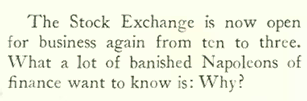
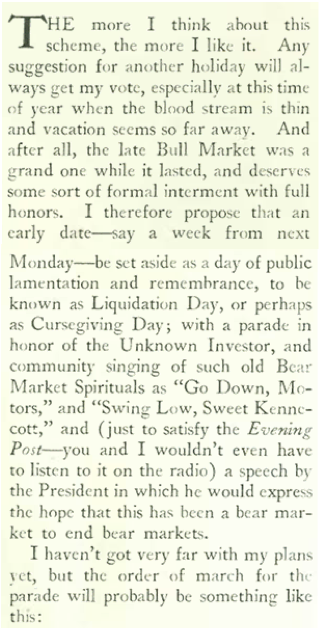
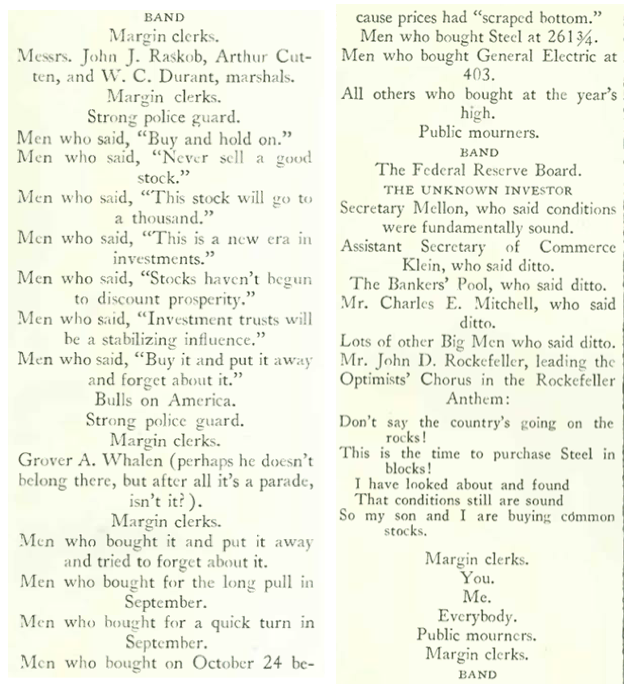
The popular historian Frederick Lewis Allen (1890 – 1954) offered a more lighthearted take on the events surrounding the market crash in his tongue-in-cheek casual, “Liquidation Day Parade,” in which he proposed a holiday to commemorate the end of the Big Bull Market.
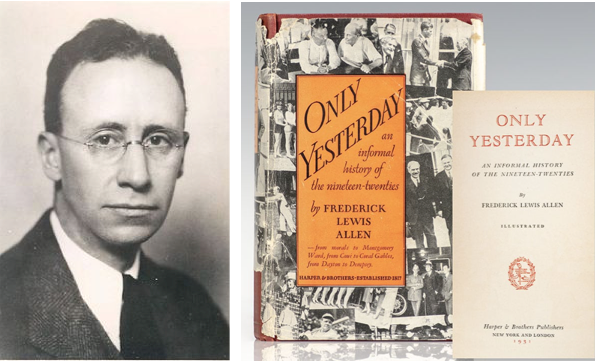
Allen, who also served as editor of Harper’s Magazine, would go on to write Only Yesterday, which chronicled American life in the Roaring Twenties. The 1931 book was a huge bestseller at the dawn of the Depression, and critically acclaimed, both then and now. Writing for the WashingtonPost (Nov. 28, 2007), book critic Jonathan Yardley observed: “It is testimony to both the popularity and the staying power of Only Yesterday that for more than three-quarters of a century it has remained steadily in print, and to this day enjoys sales that would please plenty of 21st-century writers.”
I CAN SEE CLEARLY NOW…in a little more than year after the Roaring Twenties came to a close, historian Frederick Lewis Allen would chronicle that decade in Only Yesterday, his most famous book. (Wikipedia/raptisrarebooks.com)
* * *
Clipped Wings
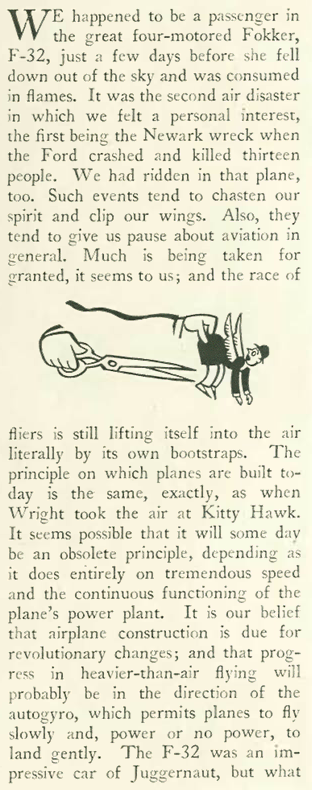
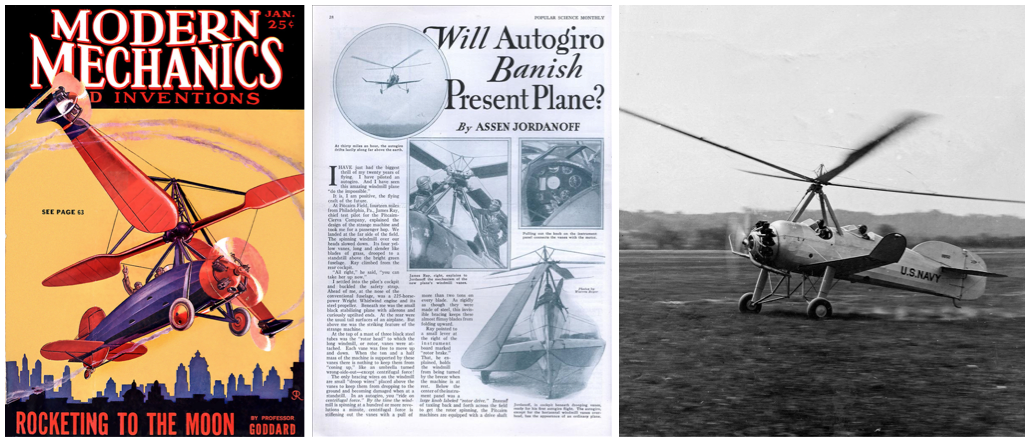
We turn back to E.B. White, The New Yorker’s most enthusiastic proponent of the aviation age. In the previous issue (Nov. 30) White had rhapsodized about a flight he took on a huge, new Fokker F-32. In the Dec. 7 “Talk of the Town” White reported that the very same plane had crashed and burned (and also noted that another plane on which he had been a passenger, a Ford Trimotor, had crashed earlier that year in Newark). White speculated that aviation would soon head in a different, safer, direction along the lines of the autogyro, a flying contraption that was widely favored by futurists of the day:
IT’S A BIRD, IT’S A PLANE…In the 1920s and 30s the autogyro — part airplane, part helicopter — was seen as the future of air transportation. From left, cover of ModernMechanics magazine from January 1930; an article on the autogyro from the March 1931 issue of Popular Science; an XOP-1 autogiro at the Naval Air Station Anacostia in Washington D.C., 1931. (modernmechanix.com/navalaviationmuseum.org) Click image to enlarge
* * *
Wonders Never Cease
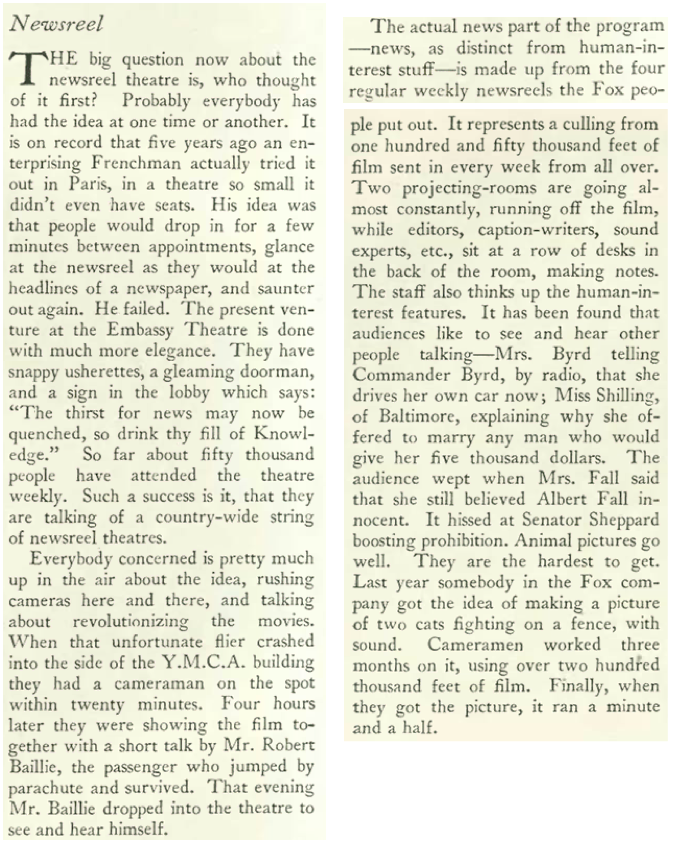
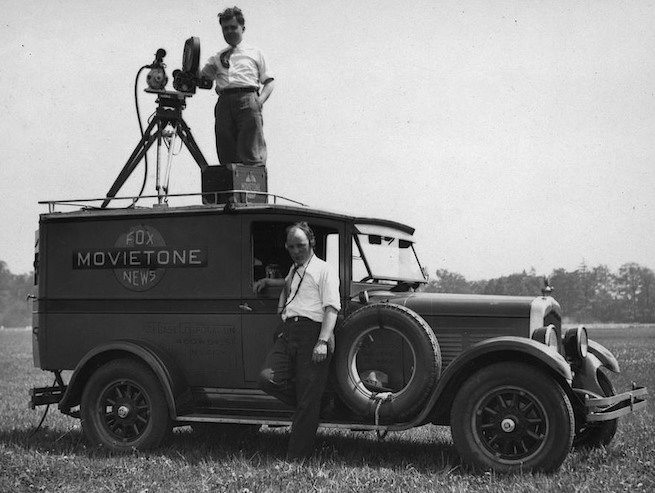
“Talk” also reported the growing popularity of newsreel theaters, and marveled at the speed with which camera crews could deliver their finished product to movie screens. An example was the crash of a small plane onto the side of a YMCA (an incident also noted by White in the previous issue); a newsreel crew was able to go from scene to screen in about four hours:
BEFORE GERALDO…Fox Movietone news crew in 1930. (City of Toronto archives)
* * *
High Wire Act
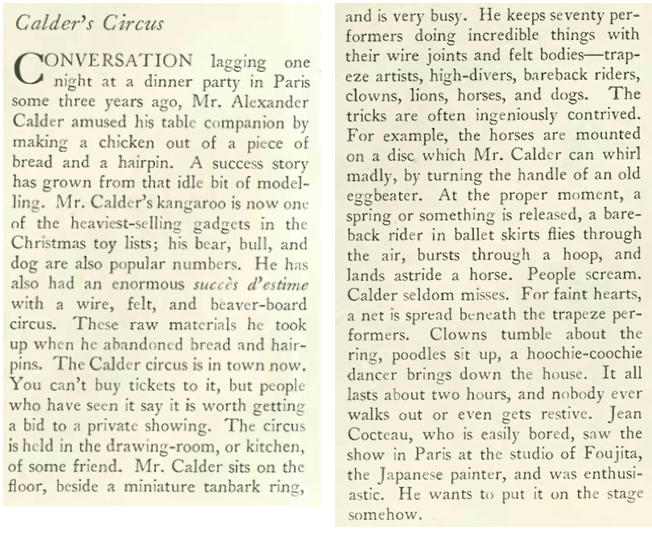
The artist Alexander Calder was already well known for his wire sculptures (his colorful mobiles would come later) when he embarked on his Cirque Calder in Paris in 1926. He brought “the show” to New York in 1929, where he used everything from eggbeaters to balloons to bring his wiry performers to life. Presumably art critic Murdock Pemberton wrote this account for “Talk of the Town”…
UNDER THE TINY TOP…Invitation to a performance of Cirque Calder (1926–31) at the Hawes-Harden apartment, August 28, 1929; AlexanderCalder with Cirque Calder (1926–31), 1929; Lion Tamer and Lion from Cirque Calder (1926–31). (calder.org)
And we also have Pemberton over at his art column, where once again he tried to make sense of the new upstart Museum of Modern Art. He seemed to be surprised by the large crowds drawn to the new museum as he pondered its next show…
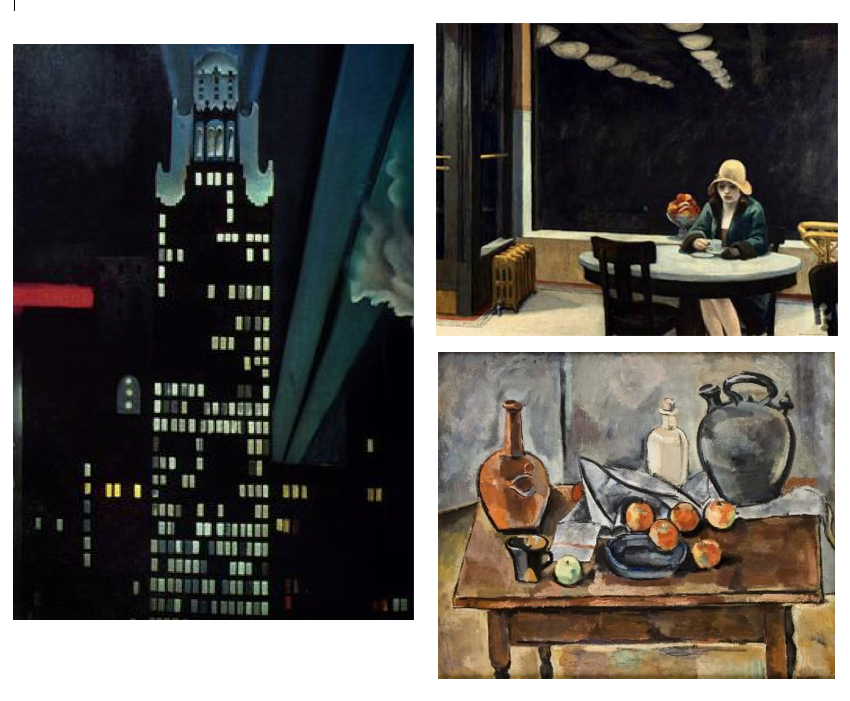
AMERICAN MODERN…Among works featured at MoMA’s second exhibition, Paintings by Nineteen Living Americans, were, at left, Georgia O’Keefe’sRadiator Building (1927); top right, Edward Hopper’sAutomat (1927); and Max Weber’sThree Jugs (1929). (Wikipedia/theartstack.com)
Pemberton had yet to see MoMA’s stunning second exhibition, Paintings by Nineteen Living Americans, but had to (grudgingly) conclude that the museum was filling a need…
* * *
The Toy Bazaar
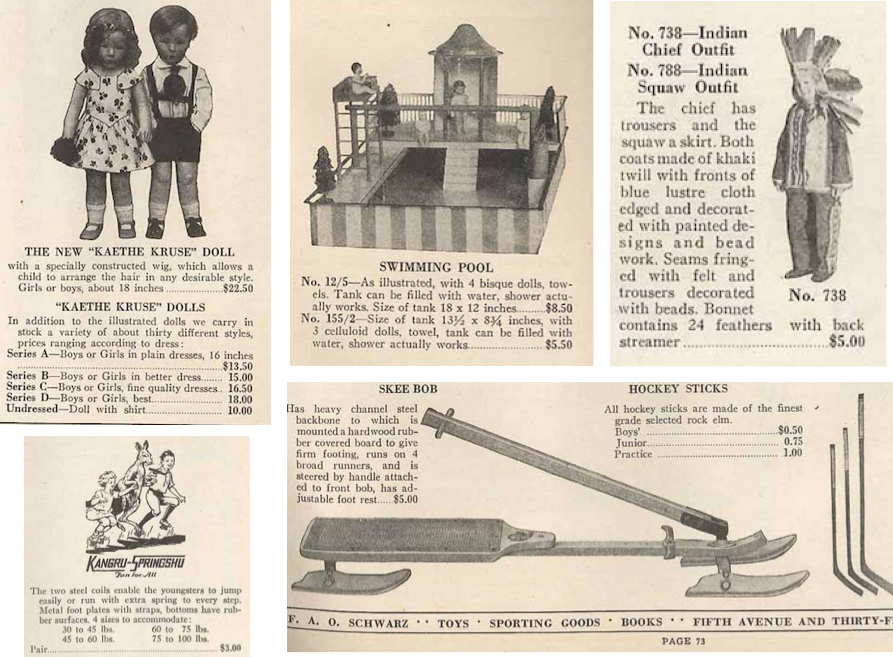
From its beginnings in 1862 until the end of the 19th century, the F.A.O. Schwarz toy store was known to New Yorkers as the “Toy Bazaar,” and by 1929 was something of an institution. As part of a lengthy column featuring ideas for Christmas shoppers, The New Yorker offered some tips on what shoppers might find at the famed toy store:
FUNLAND…Left, the cover the 1929 F.A.O. Schwarz Christmas catalog; at right, the store’s location in 1929, 303 Fifth Avenue. (oldwoodtoys.com)
Some of the toys mentioned in The New Yorker article, from the 1929 F.A.O. Schwarz Christmas catalog. There’s nothing plastic here — plastics as we know them, such as polypropylene, would be developed in the 1950s:
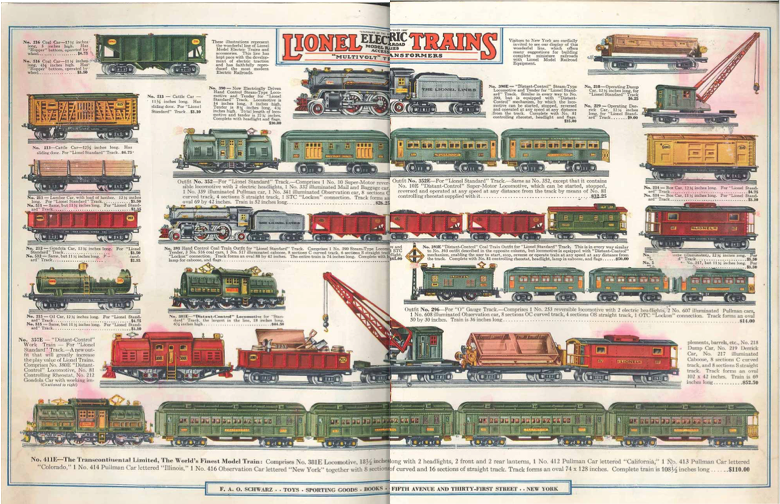
The 1929 F.A.O. Schwarz Christmas catalog also featured a color spread of its stock of Lionel Electric Trains:
If you want to look at the entire 1929 F.A.O. Schwarz Christmas catalog, you can find it at this terrific site.
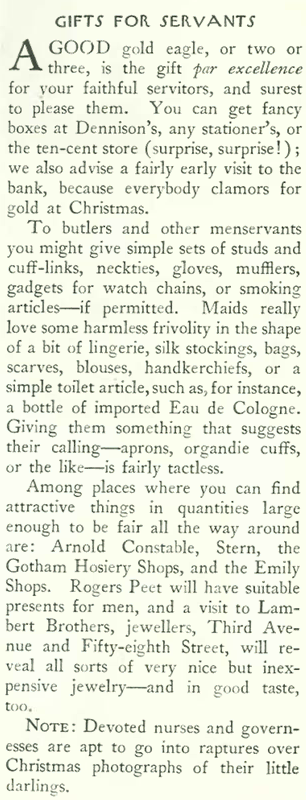
The column also offered advice on “gifts for servants,” at least for those who weren’t getting laid off due to the market crash. Note the somewhat patronizing tone, especially the final paragraph regarding nurses and governesses:
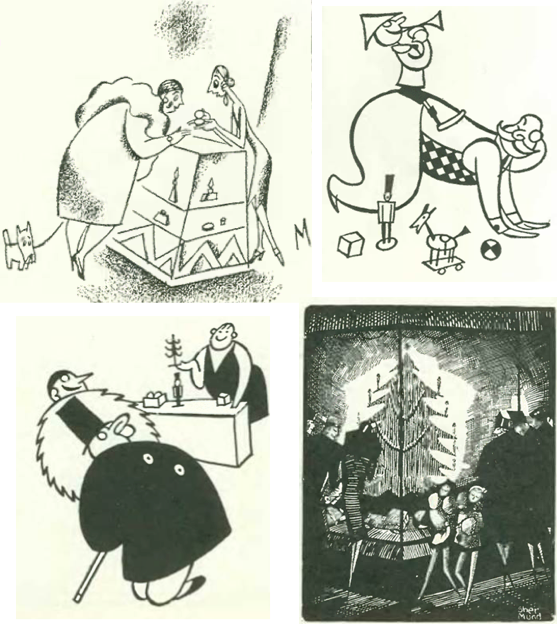
As usual, the shopping column was sprinkled with spot drawings celebrating the season: here are three from Julian De Miskey and one from Barbara Shermund:
* * *
The Bard Does the Talkies
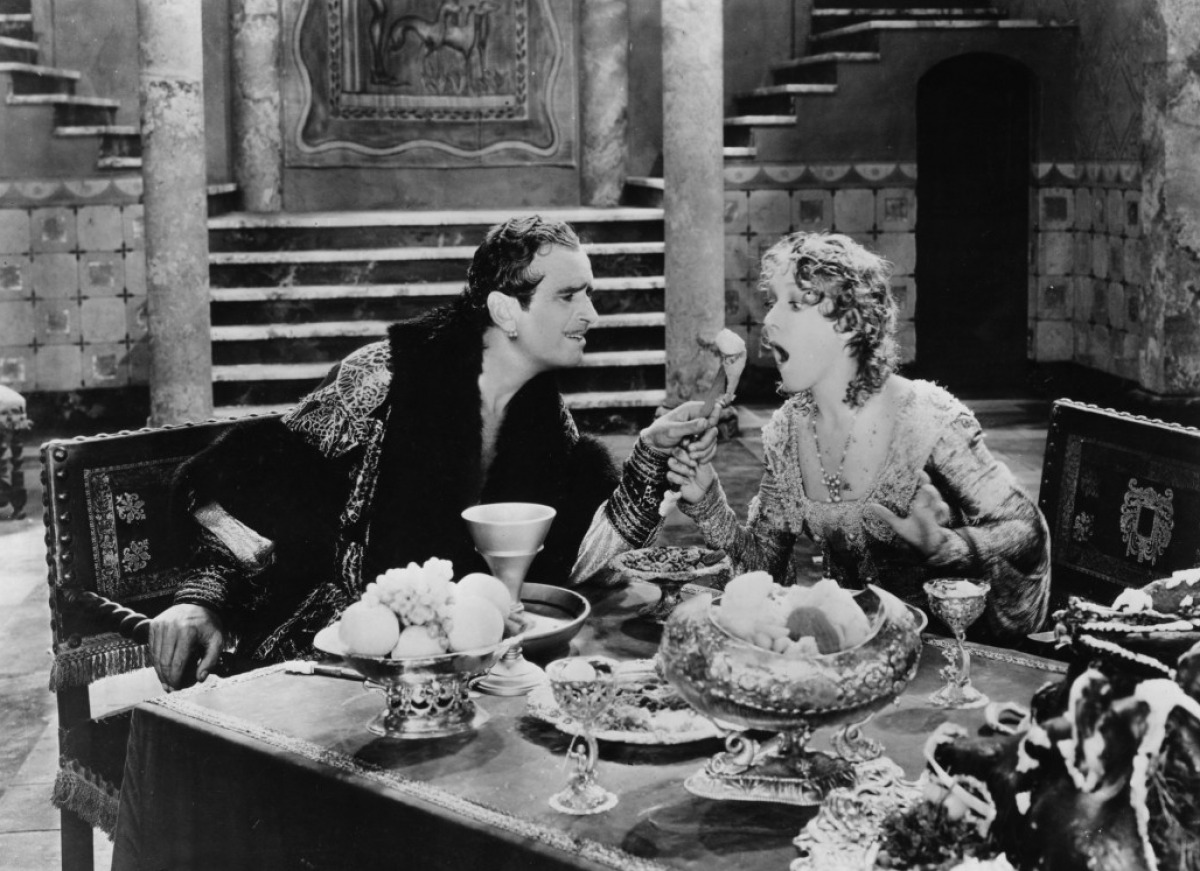
At the movies, critic John Mosher found much to like at the Rivoli, which was screening The Taming of the Shrew featuring the husband/wife team of Douglas Fairbanks and Mary Pickford:
WILD AT HEART…Douglas Fairbanks and Mary Pickford in 1929’s The Taming of the Shrew. (IMDB)
* * *
Somerset Saga
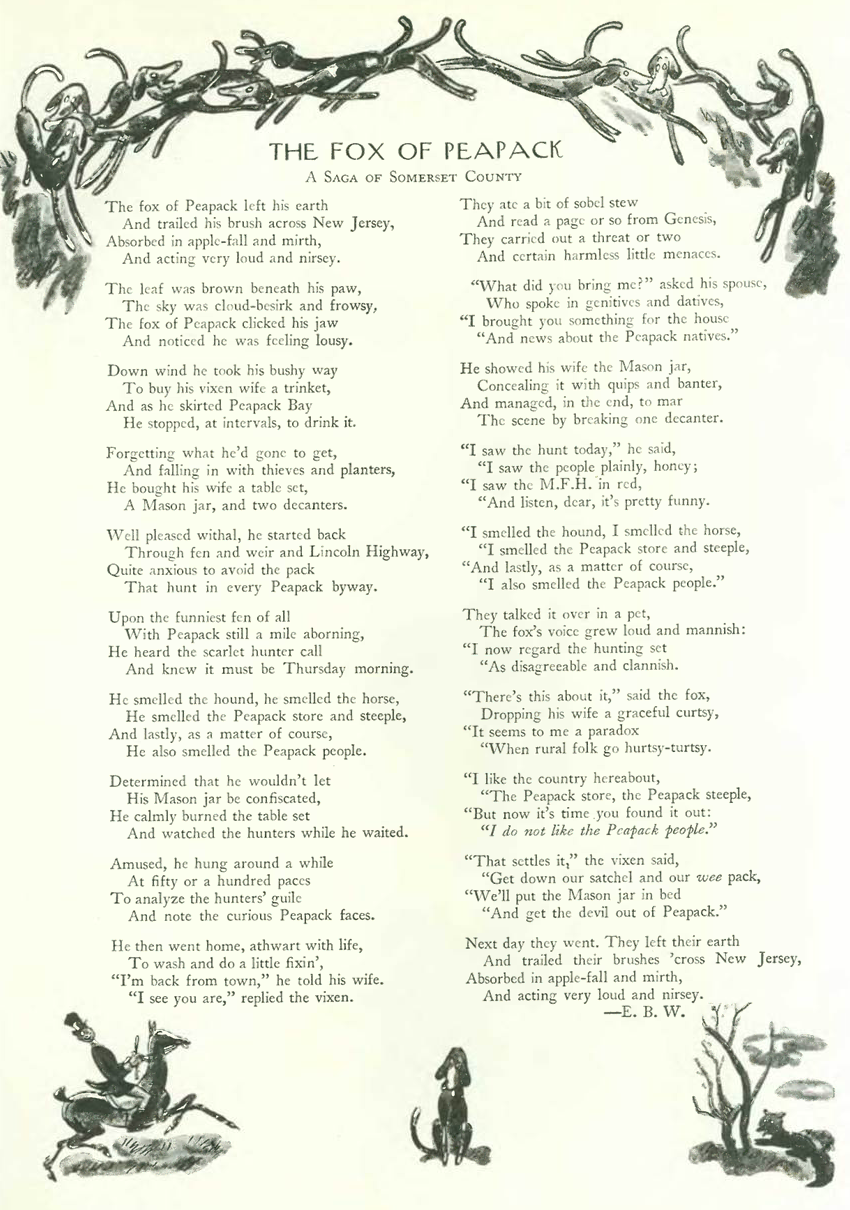
When I first spotted this I thought it was an early edition of The New Yorker’s famed Christmas poem, but those were started by Frank Sullivan in 1932. Nevertheless, here is a clever “Saga of Somerset County” from our dear E.B. White:
* * *
From Our Advertisers
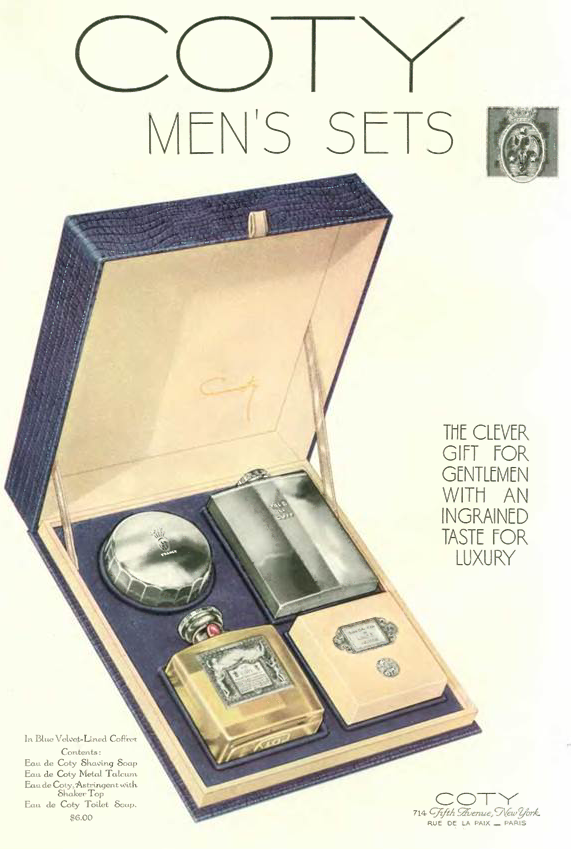
For men who hadn’t lost their shirts and had an “ingrained taste for luxury,” here was a men’s toilet set from Coty featuring a talcum shaker that would have doubled as a fine whiskey flask…
…did the folks at Bergdorf Goodman miss the news of the market crash? Read the fine print about the coming “revolution in fur fashion”…
…Helen Hokinson illustrated another ad for G. Washington instant coffee…
…Atwater Kent offered up this sumptuous appeal to holiday shoppers…
…at first glance I thought this was an ad for a luxury apartment…the copy is almost identical, save for a couple of words like “death” and “crypt”…
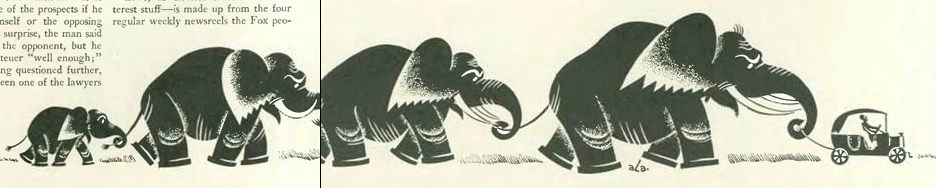
…on to our artists, here is a spot by Constantin Alajalov that ran along the bottom of “Talk of the Town”…
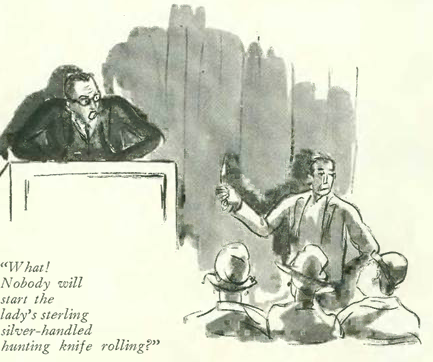
…and a sight that would become more familiar as the Depression deepened, a look at an estate sale, courtesy Helen Hokinson…
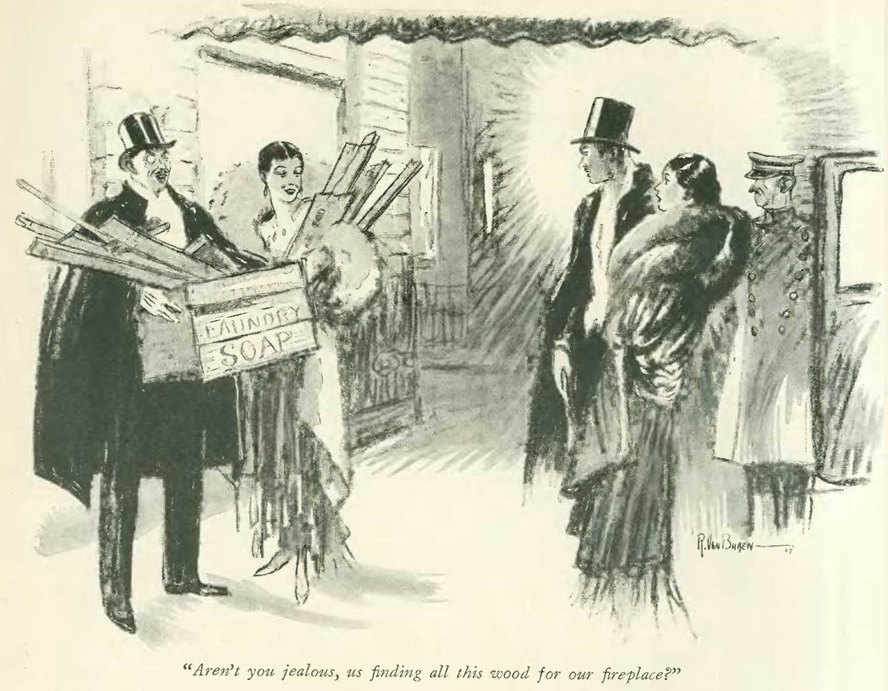
…signs of the economic collapse were starting to creep into the cartoons, including offerings by Raeburn Van Buren…
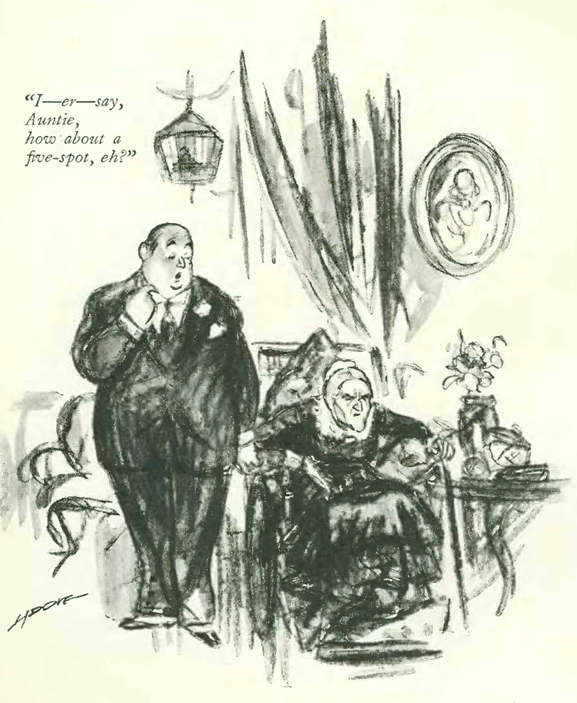
…Leonard Dove…
…and Paul Webb…
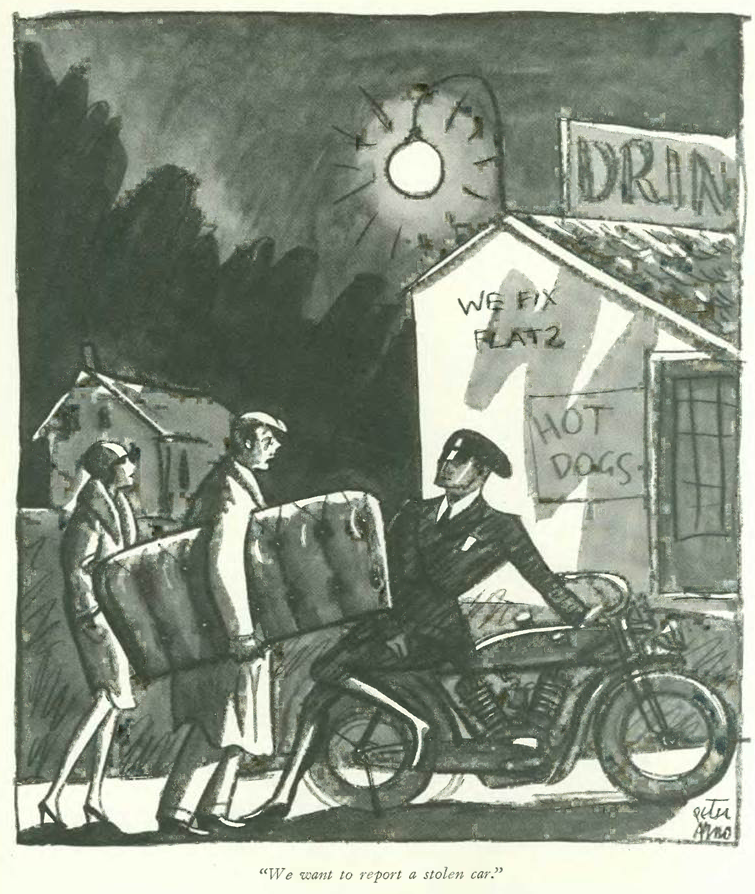
…while the economy was headed into the pits, cartoonist Peter Arno saw his fortunes soaring as he headed into a new decade. In his excellent 2016 biography, Peter Arno: The Mad Mad World of The New Yorker’s Greatest Cartoonist,Michael Maslin writes, “By the time The New Yorker’s December 7, 1929 issue hit the newsstands, its readership had, within the year, seen three Arno covers and fifty-seven of his drawings.” Maslin notes that drawing number fifty-eight, which appears below, “ended the 1920s with a bang (so to speak).” The drawing, writes Maslin, “became a lightning rod for two New Yorker camps: the (James) Thurber camp, who chose to believe Harold Ross (the magazine’s founding editor, who forbade sex as a subject) was naive in sexual matters, and the (E.B.) White camp, convinced Ross would never have let the drawing appear in the magazine if he hadn’t understood its meaning.” If you enjoy Arno’s work, or are a fan of The New Yorker, Maslin’s book is a must-read…











































 A New Yorker State of Mind