The Dinosaurs of Upper West Side

New York’s American Museum of National History unveiled its new Hall of Dinosaurs, and it was so impressive that even The New Yorker set aside its usual blasé tone toward popular attractions…

deb15aac127a5a9b06b890362c4878a1
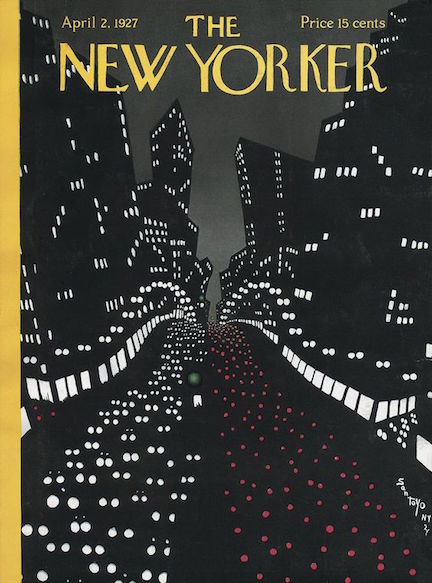
April 2, 1927 cover by Toyo San.

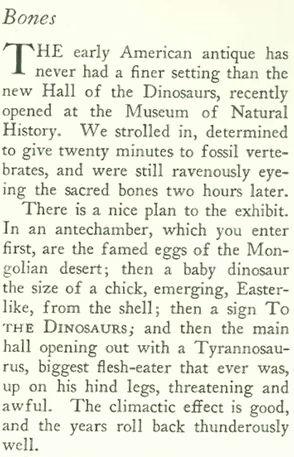
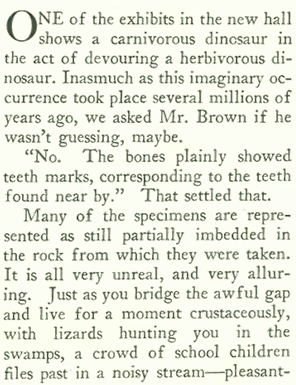
…and found its “Talk of the Town” editors to be quite taken with “sacred bones:”dinosaurs

2007 METRO Project | ImageDigitizationSpecifications v1.0 | Epson Perfection V750 Pro
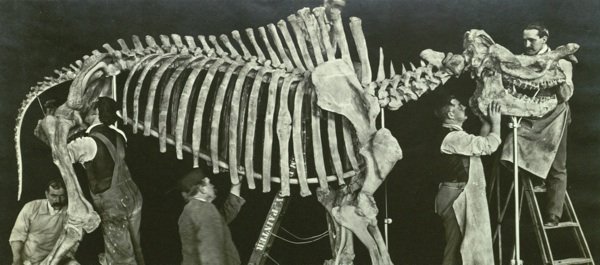
NEW DIGS…Children studying a Brontosaurus skeleton in the American Museum of National History’s Hall of Dinosaurs, 1927. (AMNH Research Library)

Screen Shot 2016-08-12 at 5.05.45 PM

Screen Shot 2016-08-12 at 5.06.04 PM

2007 METRO Project | ImageDigitizationSpecifications v1.0 | Epson Perfection V750 Pro
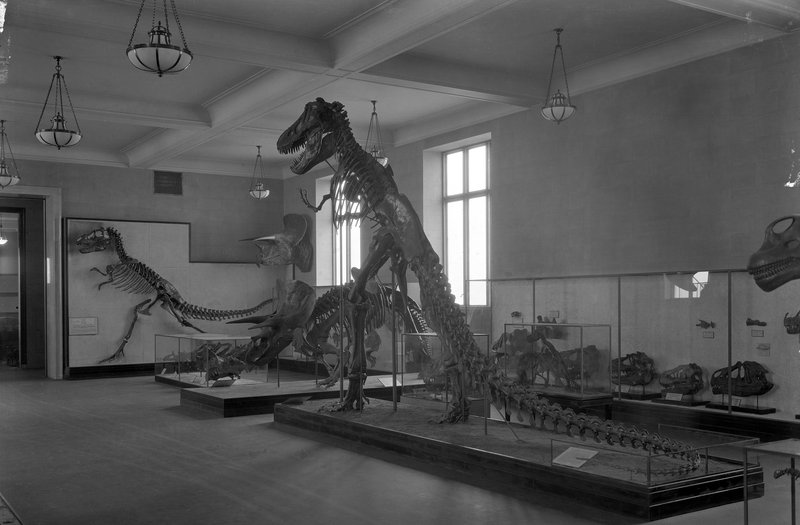
Tyrannosaurus and Triceratops in the Hall of Dinosaurs, 1927. (AMNH Research Library)

 *  *  *

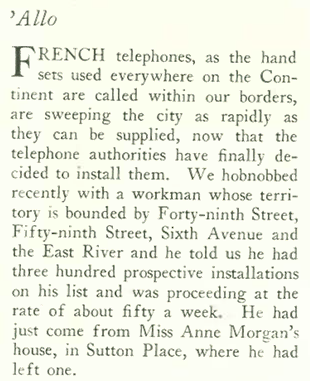
The April 2, 1927 issue also found New Yorkers to be agog over “French-style” telephones:
French phone II

Screen Shot 2016-08-22 at 12.39.27 PM
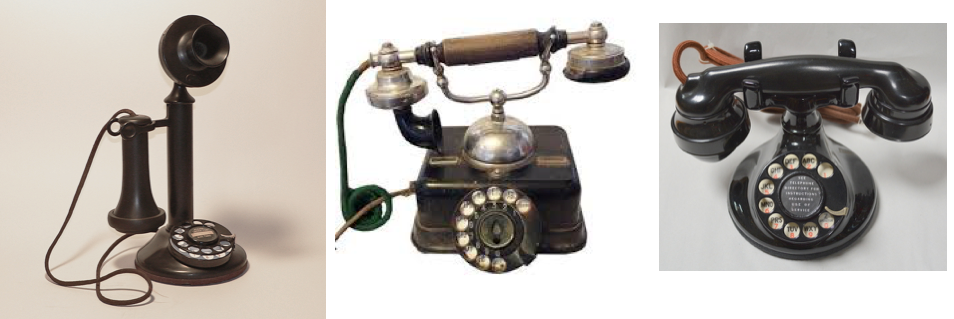
FRANCOPHONE…Trendy New Yorkers were switching from their old reliable candlestick telephones (left) to “French-style” phones (center) that were common throughout Europe. Western Electric answered their call with a sleek American version in 1928, right.

 *  *  *

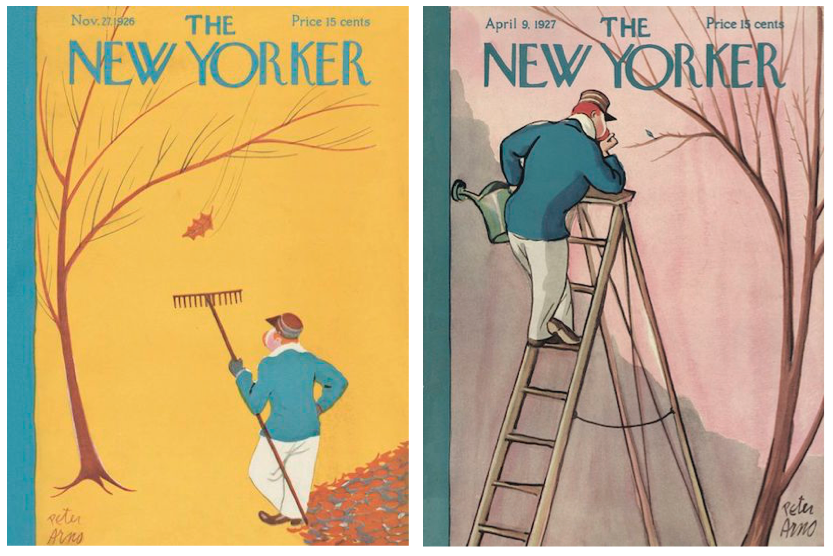
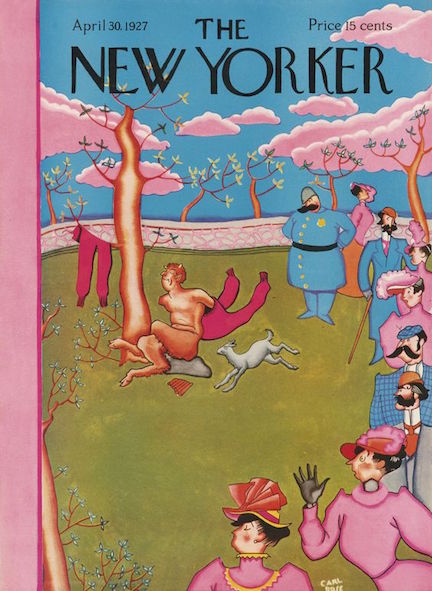
The April 9, 1927 issue featured the second of Peter Arno’s 99 covers for the New Yorker. His first cover appeared eighteen issues earlier (Nov. 22, 1926) and featured the same gardener, but this time he was inspecting a newly budded leaf rather than the last one to fall:

Screen Shot 2016-08-22 at 4.20.14 PM

Note the difference in style between the two covers–the April 9 cover is rendered with more detail, depth and texture. These would be Arno’s only covers with rather sedate subjects. Subsequent covers would have more action and humor, such as this one from 1954, one of my favorites:

Screen Shot 2013-06-01 at 5.17.30 PM

 *  *  *

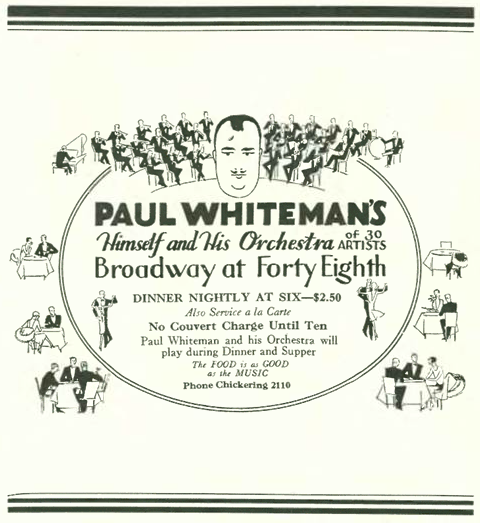
And now for a note about Paul Whiteman. One cannot write about the Jazz Age without mentioning the Paul Whiteman Orchestra. It was Whiteman who in 1924 commissioned George Gershwin’s Rhapsody in Blue, which premiered with Whiteman’s orchestra (and with Gershwin himself at the piano).

Whitemasn feb 26
This ad in the Feb. 26, 1927 New Yorker announced the much-anticipated return of Paul Whiteman and his orchestra. The caricature of Whiteman was his trademark.

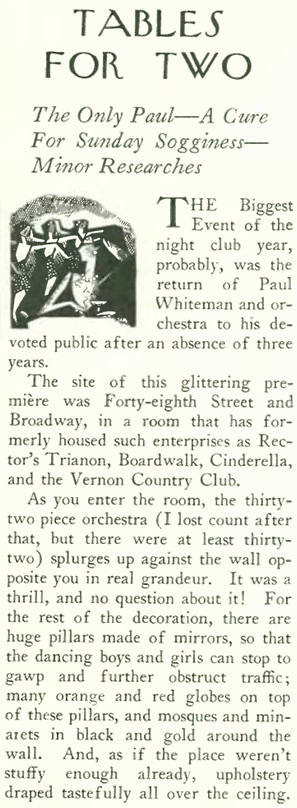
Even Lois Long, who seemed to be growing bored with New York nightlife, found reason to celebrate Whiteman in this column that appeared alongside the ad:

Feb. 26

Whiteman had 28 number one records during the 1920s and dominated sheet music sales. He provided music for six Broadway shows and produced more than 600 recordings. Dubbed “King of Jazz” his style was actually a blending of jazz and symphonic music.

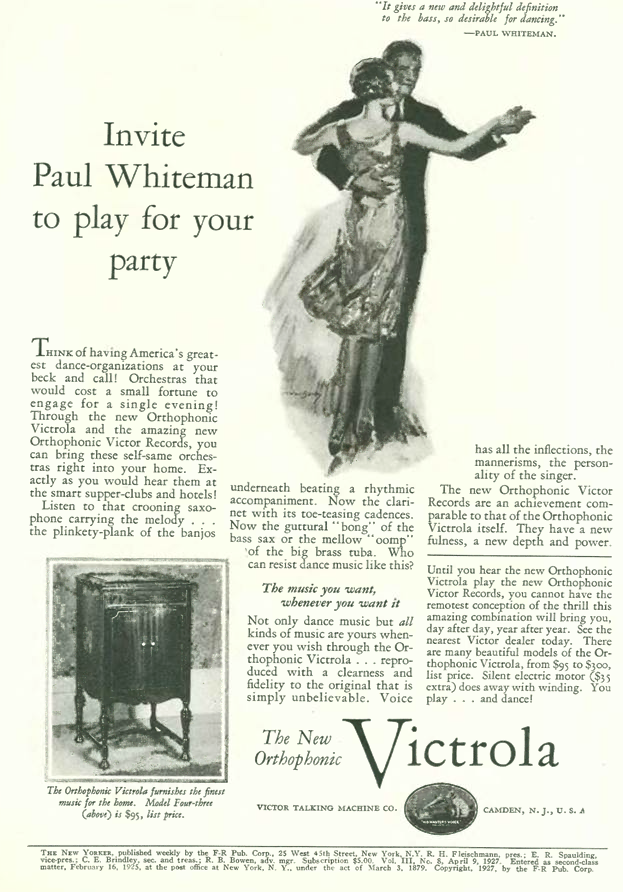
The folks at Victor Talking Machines played on Whiteman’s fame with this advertisement for their latest “Orthophonic” Victrola. Although it was the first consumer phonograph designed specifically to play “electrically” recorded discs and was recognized as a major step forward in sound reproduction, the claim that the machine would reproduce sounds “exactly as you would hear them at the smart supper clubs” seemed a little far-fetched.

Screen Shot 2016-08-23 at 12.27.26 PM

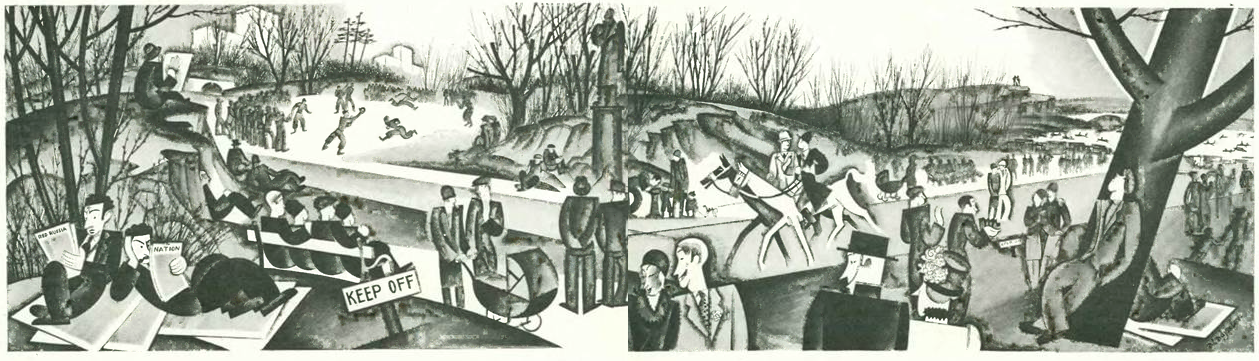
And finally, in celebration of spring, Constantin Alajalov illustrated an April day in Central Park, which was featured in a two-page spread in “Talk of the Town.”

Screen Shot 2016-08-23 at 12.26.22 PM
(click to enlarge)

Next Time: The Enchanting Modernist…

1eeb12ad3b9cff3f5e529a466432adbe

Upstairs, Downstairs

As the New Yorker was a magazine of the city’s new money smart set, it poked fun at their faddish tastes and patronizing attitudes while at the same time feeding their Anglophilia and WASPish sense of superiority.

015737c92d9c339b44b3805c311dd478
January 22, 1927 cover by Andre De Schaub.

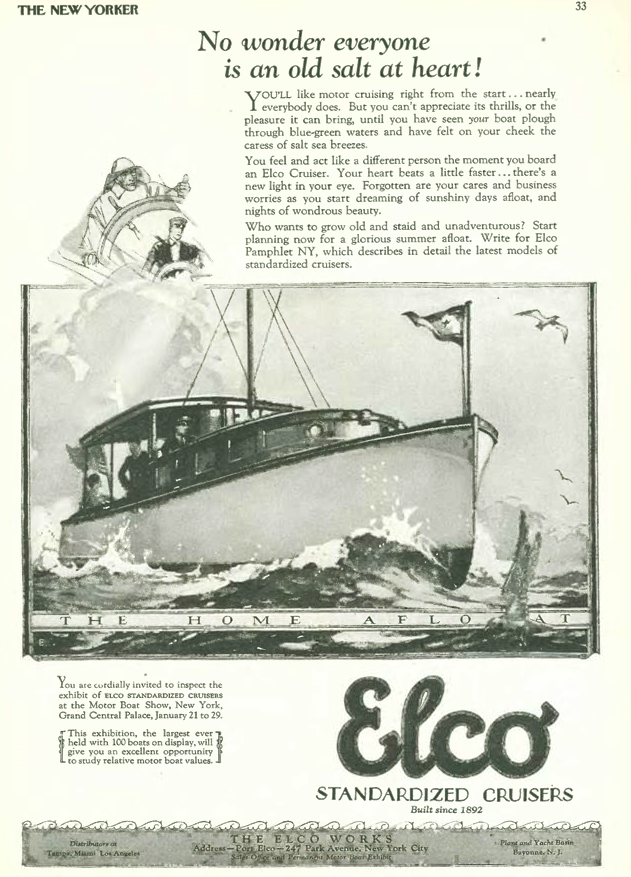
The magazine’s pages were filled with ads for English-style clothes, French perfumes and expensive cars. And in the Jan. 22 issue there were many ads for the motorboats that had displaced the automobile show at Grand Central Palace:

Screen Shot 2016-06-14 at 9.25.59 AM

It is important to note that this ad is an appeal to new money; old money would have found this motorized vessel quite vulgar.

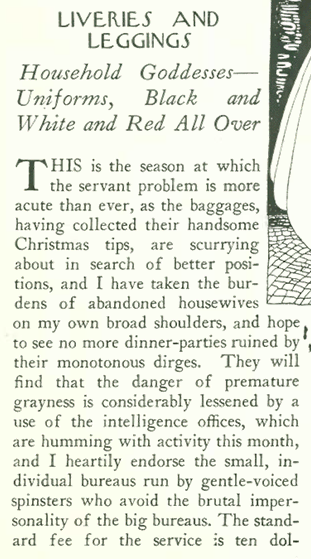
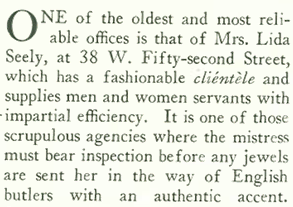
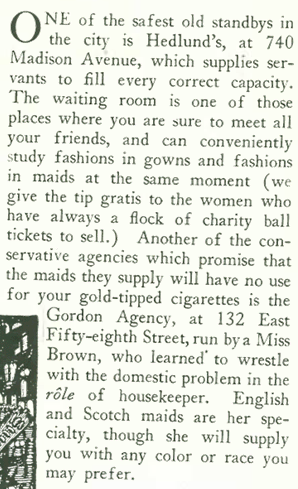
As it were, the new money needed some guidance if they hoped to live a lifestyle of ease and sophistication. And thus the issue’s “On and Off the Avenue” column, guest-written by Gretta Palmer (Lois Long took the week off), offered advice on how to hire and clothe the help:

Screen Shot 2016-06-14 at 9.27.59 AMScreen Shot 2016-06-14 at 9.28.35 AM

Perhaps you wanted a proper English butler. Lida Seely had your man:

Screen Shot 2016-06-14 at 9.28.53 AM

Or a Scotch maid, or choose from a selection of “any color or race”…

Screen Shot 2016-06-14 at 9.30.18 AM

In case you found that last sentence a bit callous, Gretta reassured:

Screen Shot 2016-06-14 at 9.30.55 AM

Screen Shot 2016-06-14 at 9.31.27 AM

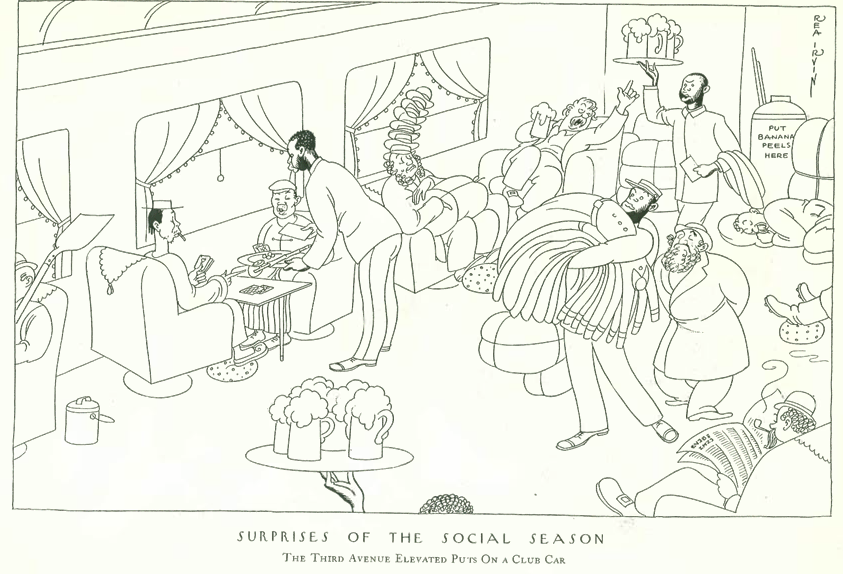
The issue also featured a cartoon by Rea Irvin (displayed full-page, sideways in the original magazine) depicting the “lower orders” aping the lifestyle of the upper classes. Note that of all the racial and ethnic types shown here, only Blacks remain in the servant class.

Screen Shot 2016-06-14 at 9.18.03 AM

As I noted in a previous post, “Race Matters,” the New Yorker of the 1920s was decidedly mainstream in engaging in casual bigotry common in those days, including treating blacks as racial “others.” There is, perhaps, a subtle jab here by Irvin at the pretensions of the uppers, but he’s not around anymore to clarify this.

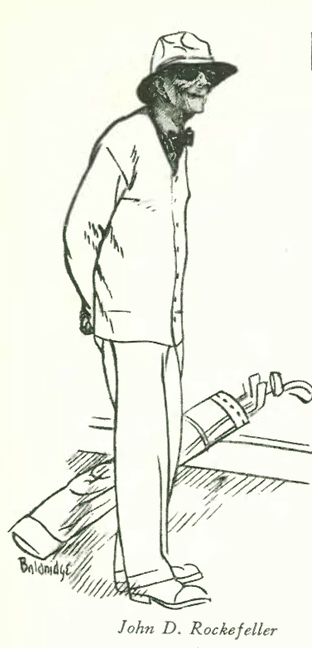
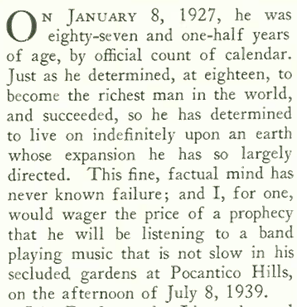
The issue also featured the first of a series of articles (“Profiles”) on the 87-year-old John D. Rockefeller. A brief excerpt, with illustration by Cyrus Baldridge:

Screen Shot 2016-06-14 at 9.19.18 AM

Rockefeller

The writer’s prediction wasn’t too far off: Rockefeller would live another ten years, and die at age 97 in 1937. His grandson, David Rockefeller, apparently inherited both his money and his genes: he recently celebrated his 101st birthday (update: David Rockefeller died in 2017 at age 101).

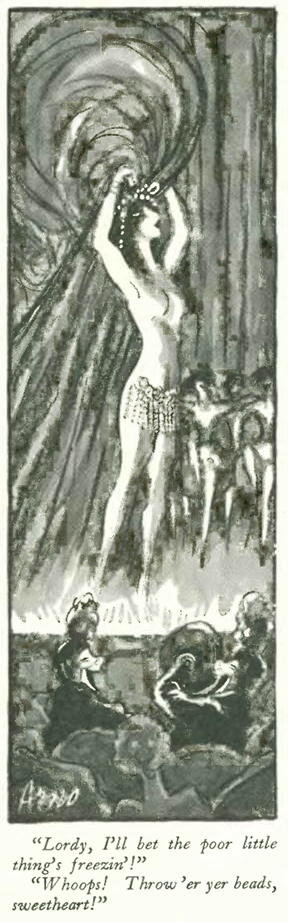
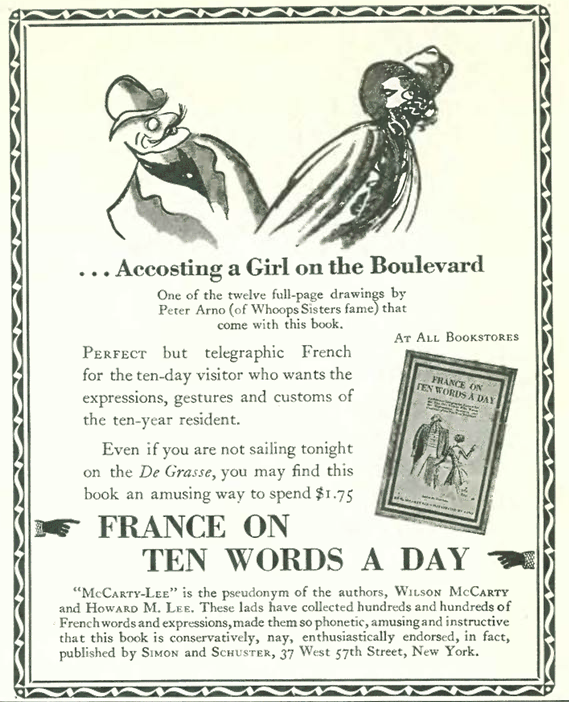
Finally, a cartoon by Peter Arno, famed for his drawings of women, usually scantily clad. Here we see an early example in one of his “Whoops Sisters” panels:

Screen Shot 2016-06-14 at 9.22.05 AM

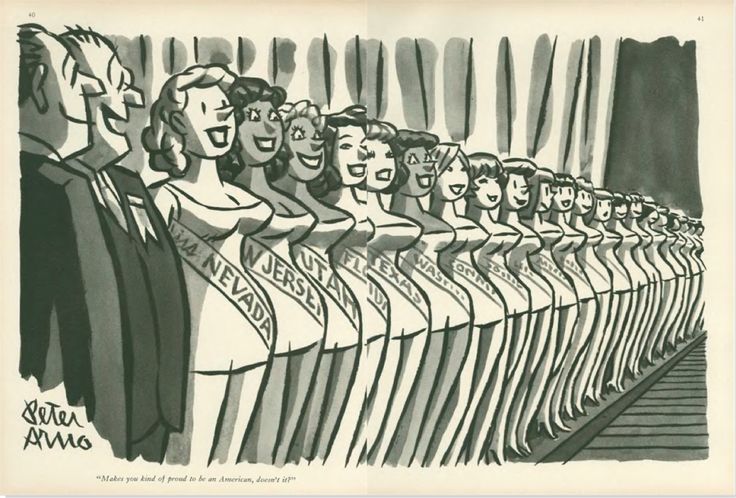
By comparison, here is a cartoon by Arno 33 years later, from the September 10, 1960 issue of the New Yorker:

869a0a6de1edde2e7479b79d285bd73a
Caption: “Makes you kind of proud to be an American, doesn’t it?”

Next Time: All That Jazz…

b8a47deb10bba89d024899c9500bba81

Race Matters

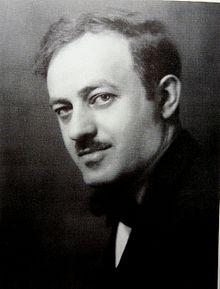
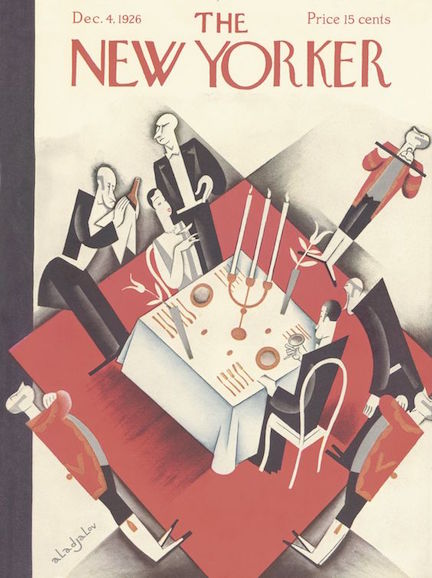
Ben Hecht was a well-known screenwriter, director, producer, playwright (notably, The Front Page) and journalist who contributed a number of comic essays to The New Yorker, including “The Caliph Complex” featured on Page 30 of the Dec. 4, 1926 issue.

e0fa6079facd04a1d0611e2da7cd2519
December 4, 1926 cover by Constantin Alajalov.

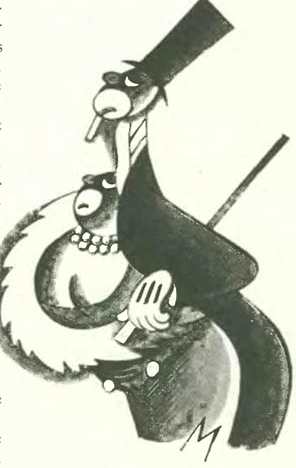
The magazine consistently rejected “uptown slumming” by New Yorkers seeking exotic thrills in Harlem nightclubs (see my recent post on nightlife correspondent Lois Long’s ho-hum attitude toward the Cotton Club), and Ben Hecht was no exception to this stance.

Screen Shot 2016-05-17 at 9.19.24 AM
A drawing by Julian De Miskey that accompanied Hecht’s article.

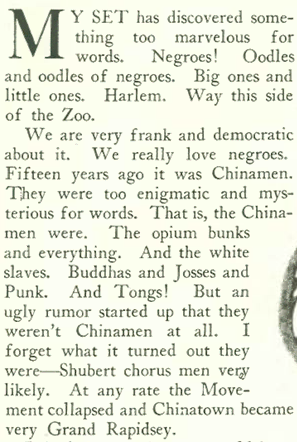
In her book Defining New Yorker Humor, Judith Yaross Lee suggests that Hecht’s criticism of “slummers” was not an act of political liberalism, but rather was in line with the magazine’s habit of poking fun at the faddish. Hence the opening lines of Hecht’s essay:

Screen Shot 2016-05-17 at 9.39.05 AM

Screen Shot 2016-05-17 at 9.39.20 AM

As I’ve previously noted, for all its sophistication The New Yorker of the 1920s was decidedly mainstream in treating blacks as racial “others.”

Lee notes that only a few illustrations in the magazine’s first five years depicted Asians, and the servant class was mostly represented by European types (butlers with a Jeeves-like air, or comely chamber-maids).

Ben Hecht (Wikipedia)

When it came to depictions of black and brown faces, Lee notes that the magazine featured “conventional” types of the day—minstrel figures in blackface (see illustration above) or exotic African dancers.

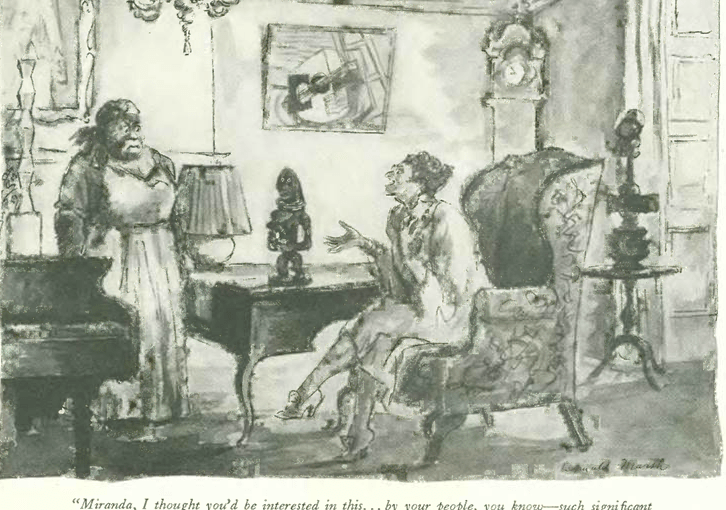
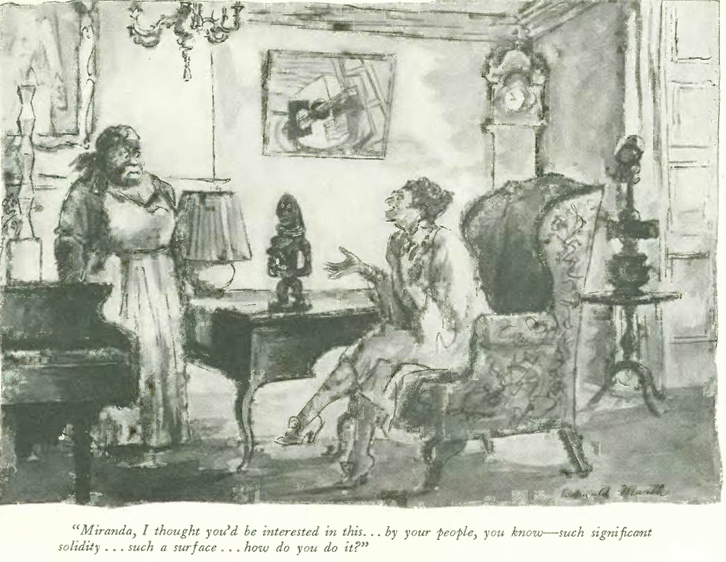
When blacks were depicted as servants, they were rendered as “mammies,” such as in this cartoon by Reginald Marsh in the Dec. 4 issue:

Screen Shot 2016-05-17 at 5.01.48 PM

On the facing page, Peter Arno offered a depiction of a servant more typical for the magazine:

Screen Shot 2016-05-17 at 9.57.11 AM

But lest we feel smug in looking down at our literary forebears, the current discourse in our country seems to indicate that we still have a long way to go on issues of race.

Although there is much to dislike about The New Yorker’s views on race 90 years ago, its criticism of faddish “slumming” did call into question 1920s notions of race. Lee notes that the cartoon by Reginald Marsh (above) is actually a sneer aimed at the white woman for her patronizing comment. She represented the “fashionable Afrophilia” that Hecht and his fellow New Yorker writers detested.

“The Caliph Complex,” according to Lee, “suggested that The New Yorker did not so much ignore Africanist movements as suspect their white supporters.” The following October, Dorothy Parker would pen the essay “Arrangement in Black and White”–the story of a party in honor of a famous gospel singer–that would echo Hecht’s attack on false liberalism.

Next Time: What Price Glory…

9ce9dbbb683b23ca1336748460e4d7ac


Holiday Shopping

Photo above via themindcircle.com

With Christmas fast approaching, The New Yorker was getting into the spirit of holidays, especially with all of the advertising revenue it gained from merchants who targeted its well-heeled readership.

8912823cfdc5626785b13a431ae590de
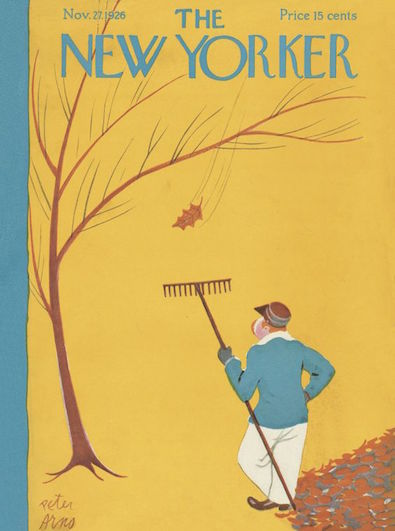
November 27, 1926—Peter Arno’s first cover for the New Yorker. He would do 98 more.

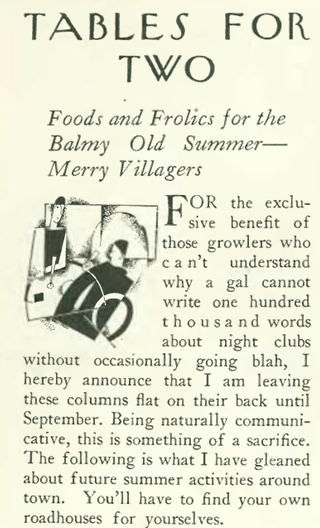
Lois Long continued to write both of her weekly columns for the magazine–her observations on fashion along with ideas for Christmas shoppers in “On and Off the Avenue” (“Saks’ toy department has some of the loveliest French notepaper for tiny children…”) and her musings on nightlife in “Tables for Two.”

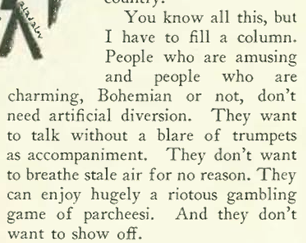
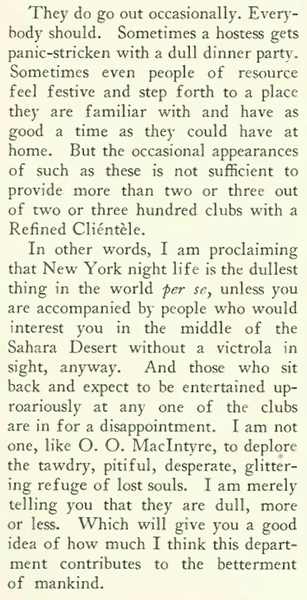
In contrast to her rather light mood expressed in the fashion column, Long was feeling far from jolly in her “Tables” observations of New York’s nightlife:

Screen Shot 2016-04-25 at 5.01.46 PM

Screen Shot 2016-04-25 at 5.02.43 PM

As you might recall, in a previous column Long tossed a “ho-hum” in the direction of the famed Cotton Club. Perhaps Prohibition was taking its toll on the hard-partying columnist.

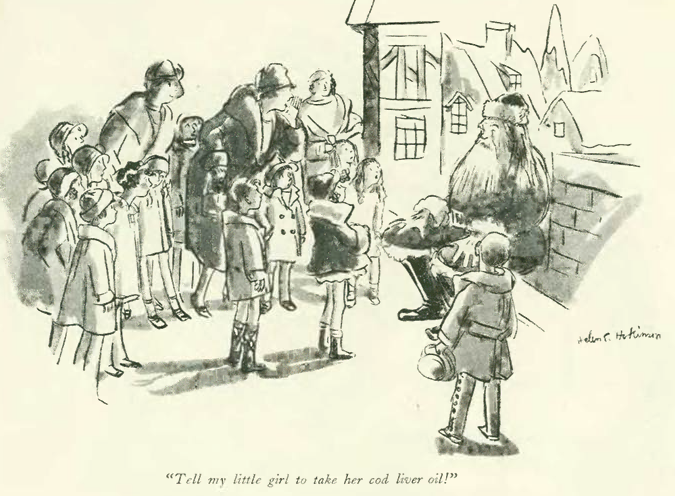
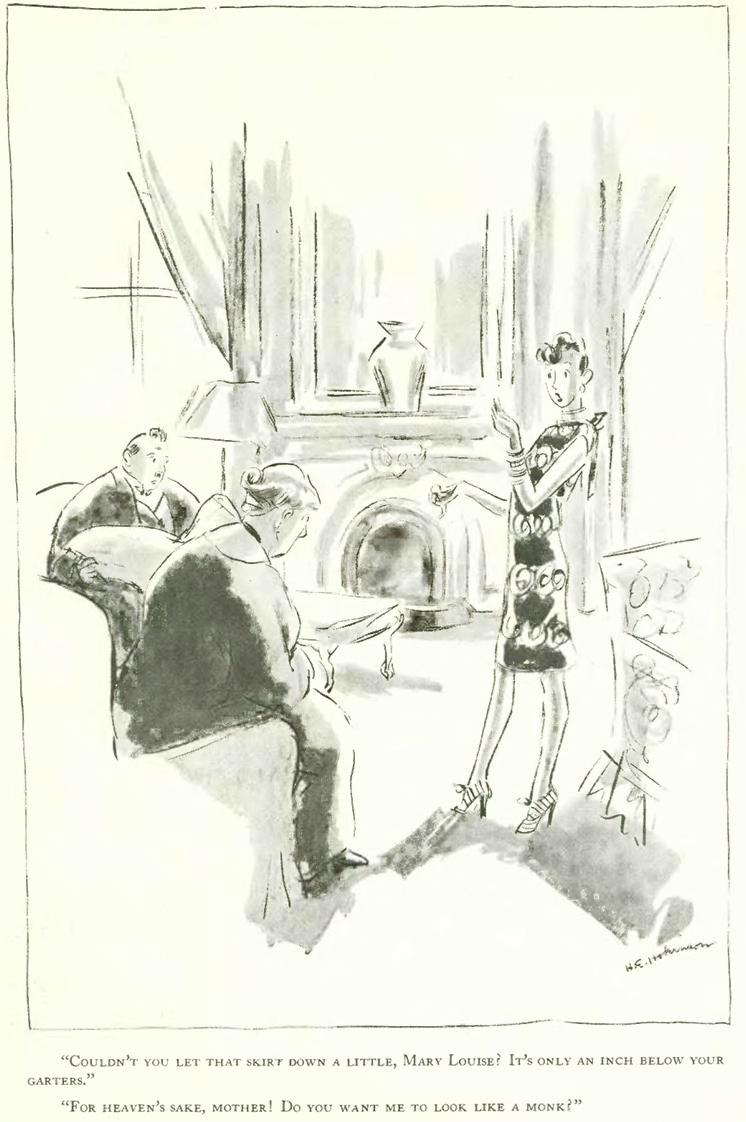
Nevertheless, the holiday spirit was upon with The New Yorker, in the cartoons (this one by Helen Hokinson)…

Screen Shot 2016-04-25 at 4.54.16 PM

…and in various advertisements.

Screen Shot 2016-04-25 at 4.50.49 PM

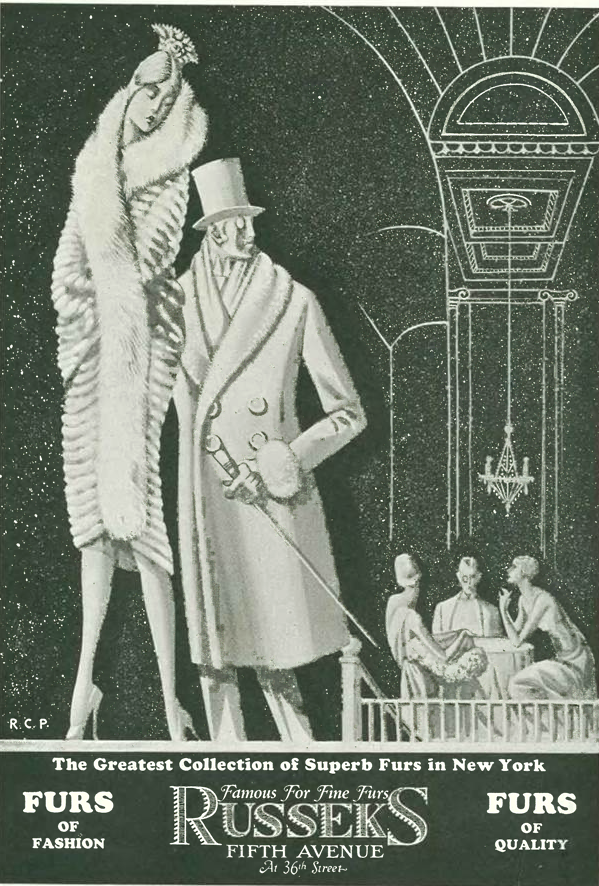
Note this advertisement (below) from Russeks. The comics in The New Yorker famously poked fun at the comic pairings of rich old men and their young mistresses, but this ad seemed to glorify such a pairing while suggesting that an older man of means must invest in fine furs if he is going to hang on to his trophy wife or mistress, in this case a young woman who appears to be nearly eight feet tall…

Screen Shot 2016-04-25 at 4.51.10 PM

I liked this ad from Nat Lewis for the simple line drawing…
Screen Shot 2016-04-25 at 4.57.27 PM

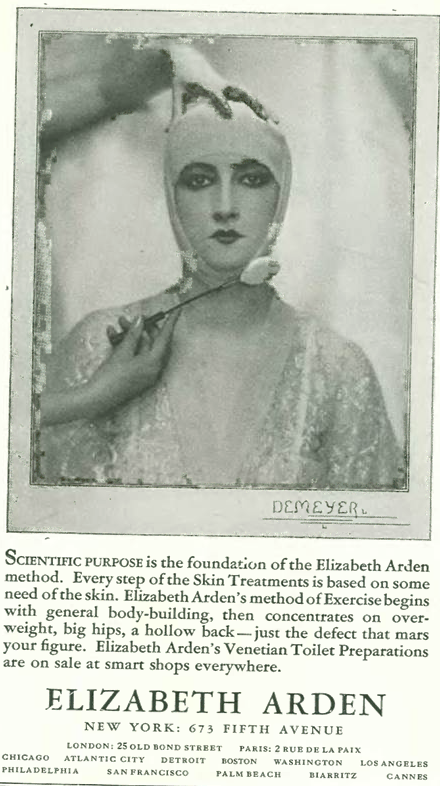
…but the ads for Elizabeth Arden, which for years featured this “Vienna Youth Mask” image, always creep me out.

Screen Shot 2016-04-25 at 4.56.41 PM

The mask was made of papier-mâché lined with tinfoil. Although not pictured in the ad, it was also fitted to the client’s face. The Vienna Youth Mask used diathermy to warm up the facial tissues and stimulate blood circulation.

1937-arden-vienna
SLEEP TIGHT…The full “Youth Mask” applied to an Elizabeth Arden client in the mid 1930s. (cosmeticsandskin.com)

In a 1930 advertisement, Elizabeth Arden claimed that “The Vienna Youth Mask stimulates the circulation, producing health as Nature herself does, through a constantly renewed blood supply. The amazing value of this treatment lies in the depth to which it penetrates, causing the blood to flow in a rich purifying stream to underlying tissues and muscles…charging them with new youth and vigor. It stirs the circulation as no external friction or massage can possible do.”

I don’t believe this claim was backed up by medical research, but as we all know, Elizabeth Arden made a bundle from these treatments and the various creams and potions that came with it.

Next Time: Race Matters…
e0fa6079facd04a1d0611e2da7cd2519

Time for a Facelift

It’s the dog days of summer, and the editors of The New Yorker are seeking various distractions to take their minds off of the broiling late season heat.

db2311e2a9fcb89fc253615846207b55
August 21, 1926 cover by H.O. Hofman.

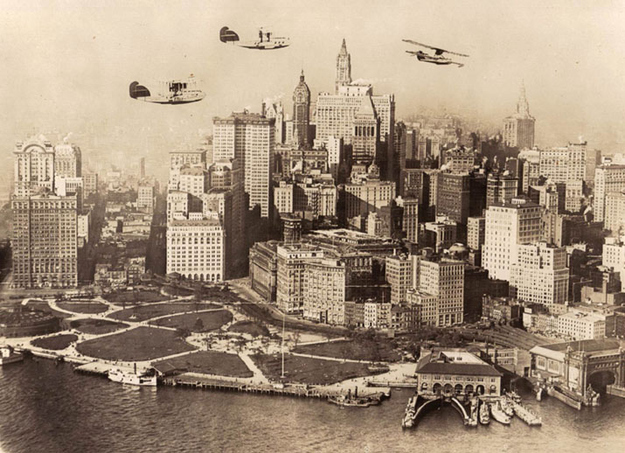
In the Aug. 21, 1926 issue (bearing an appropriate cover image by H.O. Hofman of bathers taking a refreshing dip), “The Talk of the Town” suggested that it was a good time for even the natives to take a boat tour of their beloved island:

Screen Shot 2016-02-09 at 12.35.36 PM

Screen Shot 2016-02-09 at 12.35.46 PM

enhanced-buzz-27796-1367872781-0
Aerial view of Battery Park Wharf in the early 1920s (Buzzfeed)

In the following Aug. 28 issue, the “Talk” editors ducked out of the sun to visit the American Museum of Natural History.

b3166409b2ab1ea1369e857d009d9b30
Aug. 28, 1926 cover by H.O. Hofman.

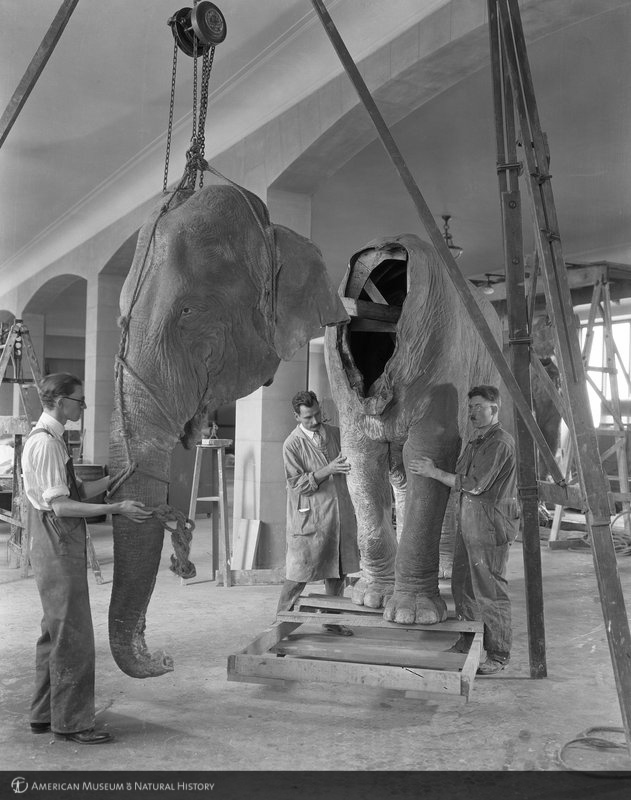
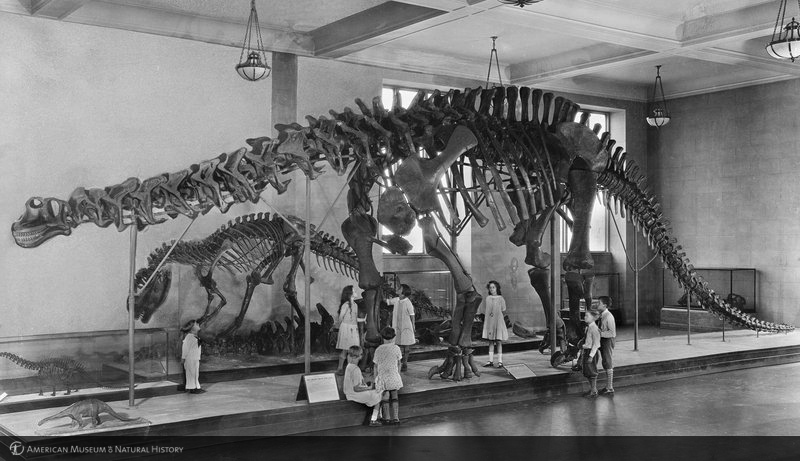
There they found curators busy reorganizing displays of dinosaurs and various stuffed beasts of the wild:

Screen Shot 2016-02-09 at 12.14.22 PM

Screen Shot 2016-02-09 at 12.14.28 PM

311585.tif
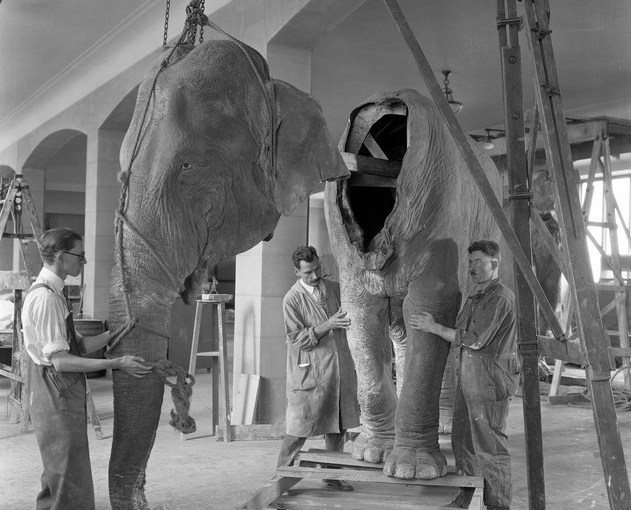
AMNH staff joining head to body of female elephant in Indian Elephant Group, 1926. (AMNH Digital Special Collections)
2007 METRO Project | ImageDigitizationSpecifications v1.0 | Epson Perfection V750 Pro
The end result of the 1926 reorganization of displays at the AMNH—children viewing Brontosaurus exhibit in 1927. (AMNH Digital Special Collections)

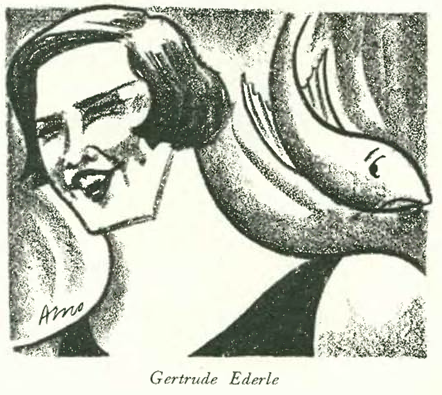
The magazine also profiled New York City native Gertrude Ederle, who became the first woman to swim across the English Channel in August of 1926:

Screen Shot 2016-02-09 at 12.16.16 PM
Gertrude Ederle, as rendered by Peter Arno for the “Profile.”

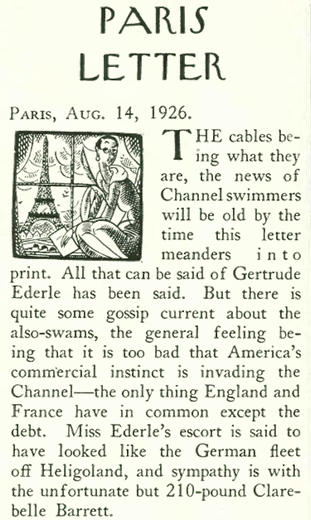
Even Janet Flanner, the magazine’s Paris correspondent, commented on the event, noting Europe’s jealous reaction to an American’s seizing of the record:

Screen Shot 2016-02-09 at 12.28.51 PM

Ederle would return home to a ticker tape parade along the Canyon of Heroes in the Financial District, and would also be feted by 5,000 people who turned out on West 65th Street for a block party in her honor.

getrudeedlerlecrown
WHAT FOLKS DID BEFORE TELEVISION…Block party celebrates Gertrude Ederle as “Queen of the Waves.” (Ephemeral New York)

According to the excellent blog Ephemeral New York, Ederle received offers from Hollywood and Broadway and was deluged by marriage proposals. But she returned to a quiet life, moving to Queens and working as a swimming instructor for deaf children–Ederle’s hearing was seriously damaged in the water of the Channel, but otherwise swimming must have been good for her health. She died at age 98 in 2003.

Keeping with the summertime theme, the magazine covered the Gold Cup Regatta, complete with illustrations by Johan Bull:

Screen Shot 2016-02-09 at 12.19.14 PM

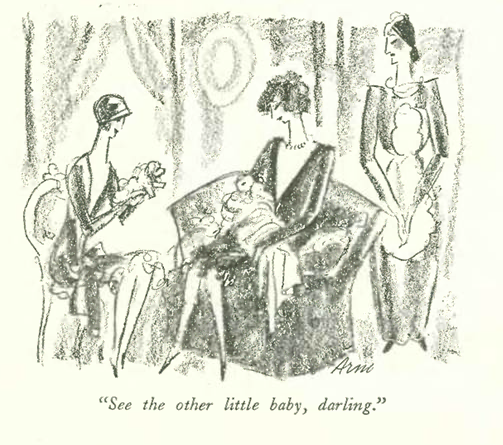
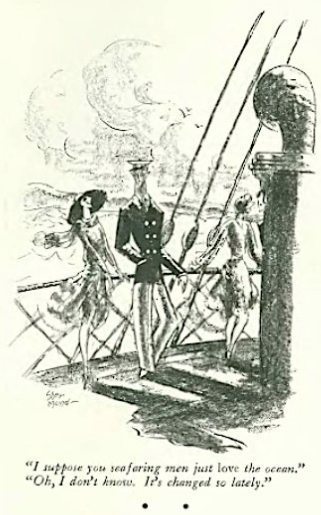
An early Barbara Shermund cartoon, always a delight…
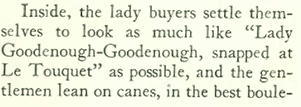
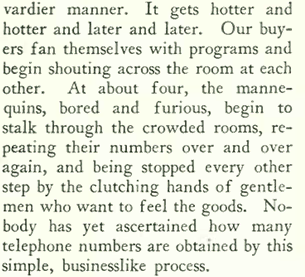
Lois Long took her “On and Off the Avenue” column to Paris, where she cast a jaded eye at the behavior of American buyers of French fashion:

Screen Shot 2016-02-09 at 12.26.32 PM

Screen Shot 2016-02-09 at 12.26.50 PM

Screen Shot 2016-02-09 at 12.27.00 PM

chanel-LBD
Coco Chanel’s “Little Black Dress” debuted in 1926. (homeecologist.com)

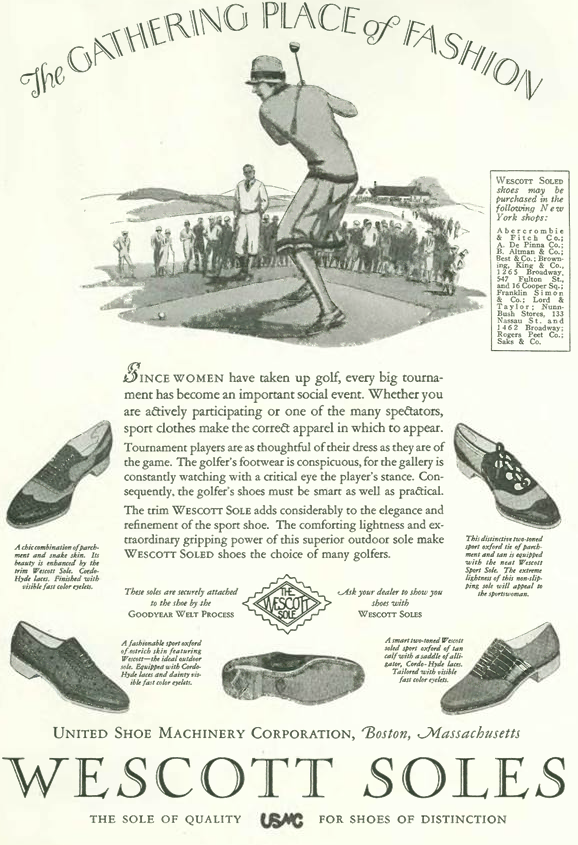
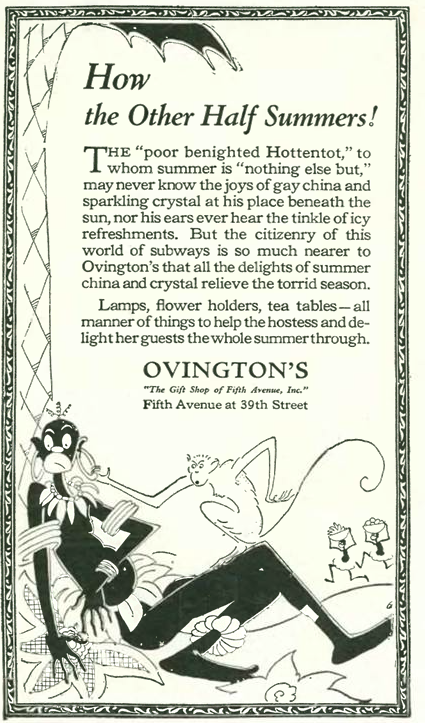
And finally, from the advertising department, this strange ad from Ovington’s, which seemed to be more concerned with promoting racial stereotypes than in selling dinnerware:

Screen Shot 2016-02-09 at 12.27.16 PM

Next Time: Come Fly With Me…

60050ce935d82b28520c52109cd715ce


The Circus Comes to Town

The Ringling Brothers Circus was in town, and The New Yorker marked the occasion with a profile of the surviving Ringlings, John and Charles. Writer Helena Huntington Smith noted that the brothers used a lowbrow profession to become multimillionaires, real estate kings (“They own “most of the west coast of Florida”) and even occasional patrons of the arts.

May 1, 1926 cover by Ottar Gaul.

Speaking of lowbrow, circus freaks remained a big attraction in 1920s New York. Here is an image of the Ringling Brothers “Congress of Freaks” lineup from two years earlier, in 1924:

Congress of Freaks 1924
Photograph by Edward Kelty, who took photos of the “Congress of Freaks” every year from 1924 to the mid 1930s. (artblart.com)

The 1926 show at Madison Square Garden also featured elephants “dancing” the Charleston. One wonders how much these poor beasts were abused:

7341-1 Dansende olifant 1926
(Vintage Everyday)

And from the “Remember it’s 1926 Department,” we have this New Yorker obituary for famed Ringling circus freak Zip the Pinhead. Note that Zip was “owned” by a Captain O.K. White:

Screen Shot 2015-12-10 at 4.41.53 PM

Screen Shot 2015-12-10 at 4.42.13 PM

Zip’s real name was William Henry Johnson. Thought to have been born with microcephaly (those with the condition were commonly called “pinheads), he might have merely possessed an oddly shaped head.

Zip_the_pinhead
William Henry Johnson. (Wikipedia)

Audiences were often told that he was a wild man, or a missing link, and although it was assumed he was mentally deficient (the New Yorker article above suggested he had the mentality of a two-year-old child), Johnson’s sister said he could “converse like the average person, and with fair reasoning power.” She claimed his last words (he died at age 83) were, “Well, we fooled ’em for a long time, didn’t we?”

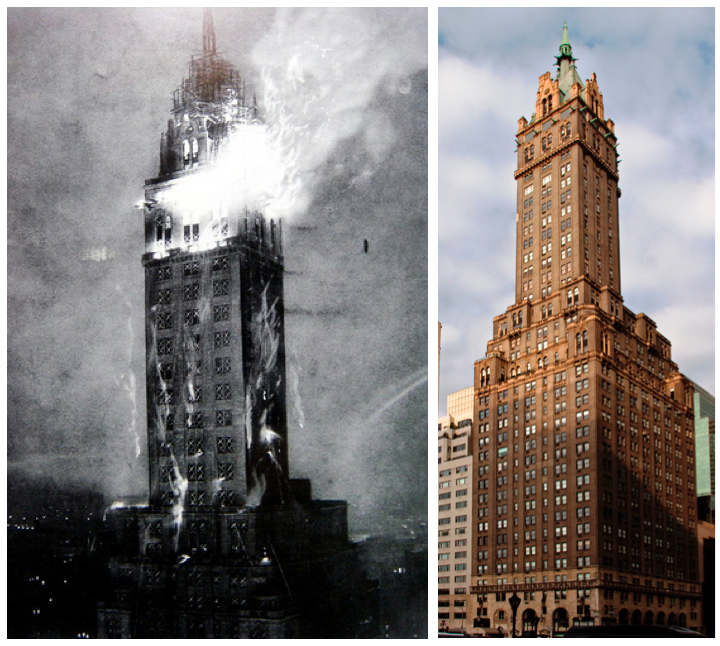
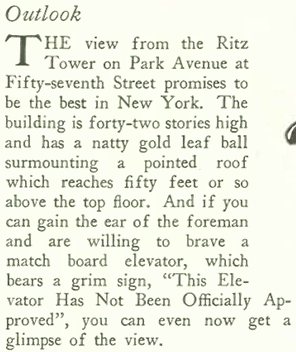
The New Yorker editors continued to marvel at the heights of new buildings, the latest being the Ritz Tower, which was to be the tallest residential building in the city:

Screen Shot 2015-12-10 at 4.40.43 PM

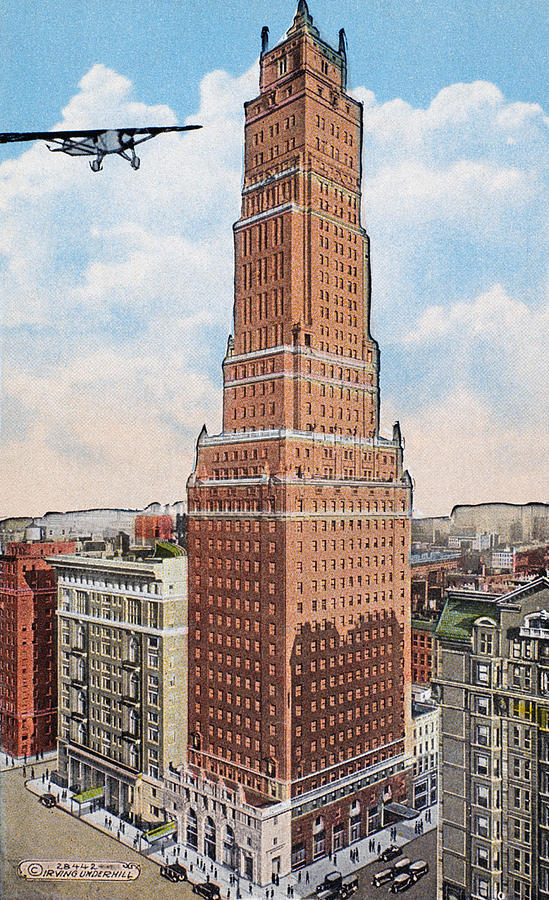
Here’s a postcard image of the Ritz Tower from the late 1920s. Note the airplane at left, added to emphasize the building’s height:

new-york-ritz-tower-granger
(geographicguide.com)

At 41 stories and 541 feet, the Ritz was city’s tallest residential tower at the time. The tallest residential tower in NYC today is 432 Park Avenue. The 96-story tower is just shy of 1,400 feet:

432PA_NW-View_copyright-dbox-for-CIM-Group-Macklowe-Properties-1024x682
(Forbes)

Even taller residential towers are in the works.

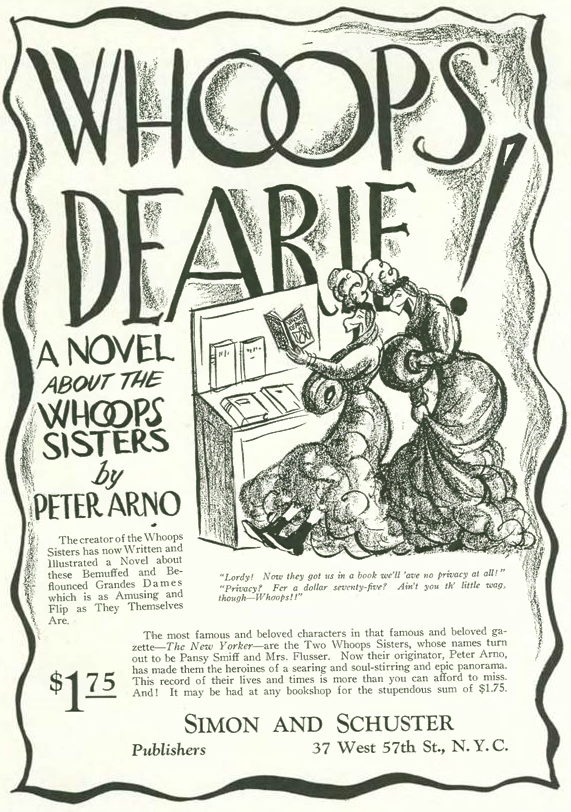
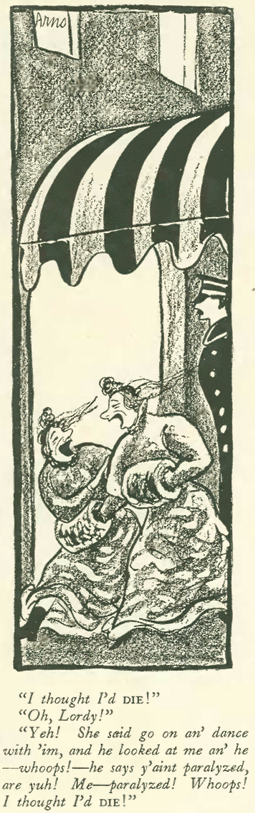
Now, to end on a lighter note, a Whoops Sisters cartoon by Peter Arno—this is the first in which their trademark “Whoops” is uttered.

Screen Shot 2015-12-10 at 4.49.34 PM

and this “generation gap” observation by Helen Hokinson:

Screen Shot 2015-12-10 at 4.45.46 PM

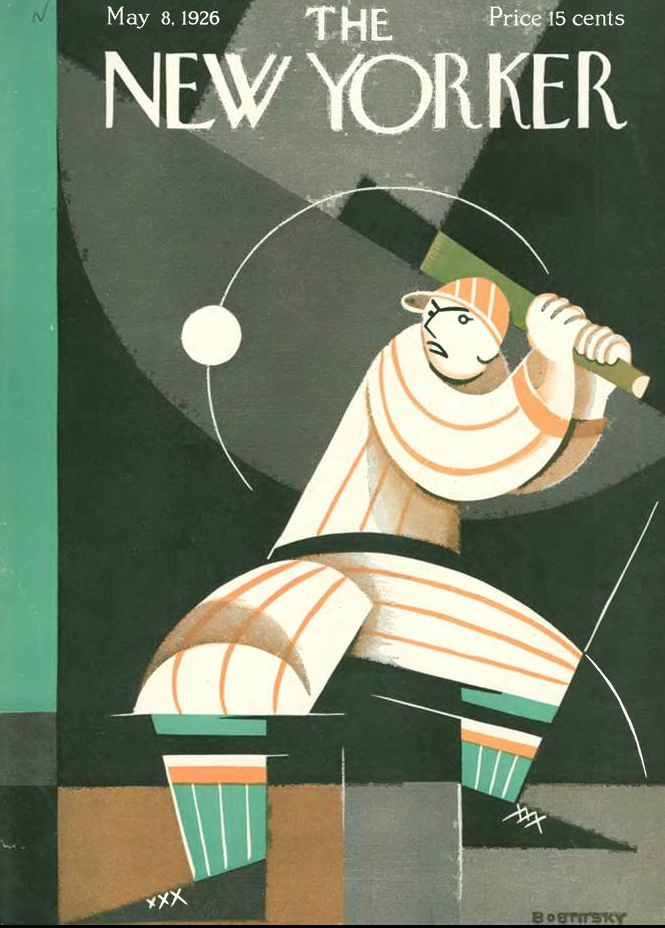
Next Time: Batter Up

Screen Shot 2015-12-11 at 9.24.00 AM

That Sad Young Man

The “sad young man” in question was none other than F. Scott Fitzgerald, who was profiled by John Mosher (who would succeed Theodore Shane as film critic) in the April 17, 1926 issue of The New Yorker.

Screen Shot 2015-12-01 at 12.12.47 PM
April 17, 1926 cover by Clayton Knight.

Mosher wrote that Scott believed he was “getting on in years,” even though he was only 29 years old and had recently published The Great Gatsby (which had received a brief, lukewarm review from The New Yorker in 1925). Mosher observed that the novelist and his wife, Zelda, famous on two continents and with money pouring in from the publication of This Side of Paradise, nevertheless complained of being broke:

Screen Shot 2015-12-10 at 9.16.00 AM

It was noted however that the couple had little financial sense:

Screen Shot 2015-12-10 at 9.16.24 AM

Mosher found Fitzgerald to be a grave, hardworking man, and seemed to sense the melancholy that would lead to madness (in Zelda’s case), alcoholism and an early grave (Fitzgerald would be dead in 14 years).

Screen Shot 2015-12-10 at 9.57.34 AM
Illustration of Fitzgerald by Victor De Pauw for the April 17 “Profile.”

In this issue we were also introduced to Peter Arno’s “Whoops Sisters,” although they are not yet identified here by that title:

Screen Shot 2015-12-10 at 9.22.43 AMAccording to New Yorker cartoonist Michael Maslin, “in 1925, The New Yorker published nine Arno drawings. In 1926, it ran seventy-two. The enormous jump was due to the wild success of two cartoon sisters Arno created: Pansy Smiff and Mrs. Abagail Flusser, otherwise known as The Whoops Sisters. The Sisters were not sweet little old ladies — they were naughty boisterous grinning “wink wink, nudge nudge” sweet little old ladies, their language laced with double entendres.”

Screen Shot 2015-12-10 at 9.27.23 AM
April 24, 1926 cover by Ilonka Karasz.

In the April 24, 1926 issue, the dyspeptic film critic Theodore Shane took aim at Cecil B. DeMille’s The Volga Boatman:

Screen Shot 2015-12-10 at 9.35.21 AM

00250
VOLGA HOKUM…Elinor Fair and Victor Varconi in The Volga Boatman. (Virtual History)

Also in this issue, Al Frueh’s interpretation of New York’s social strata via the city’s Madison Avenue train stops:

Screen Shot 2015-12-10 at 9.30.53 AM

Near the theatre section, this illustration of famed Spanish singer and actress Raquel Meller, as rendered by Miguel Covarrubias:

Screen Shot 2015-12-10 at 9.32.18 AM

And a photo of Meller from the 1920s that looks like it could have been taken yesterday:

8635eeb0
(rameller.tripod.com)

An international star in the 1920s and 1930s, Meller appeared in several films and sang the original version of the well known song La Violetera.

Next Time: The Circus Comes to Town…

Screen Shot 2015-12-10 at 9.36.31 AM

Times Square’s Freaks and Fleas

Screen Shot 2015-10-07 at 2.40.38 PM
Feb. 6, 1926 cover by Victor Bobritsky.

Coney Island was famous for its side-show freak exhibits, but from 1925 to 1969 Hubert’s Dime Museum and Flea Circus in Times Square brought the show to the heart of Manhattan.

In addition to sword swallowers, tattooed ladies and other human oddities (the famous Zip the Pinhead did a short stint there), there was also Professor Heckler’s Flea Circus, which operated in the basement. It indeed featured real fleas attached by very thin wires to miniature chariots, merry-go-rounds and the like.

The New Yorker mentioned Hubert’s in this brief “Talk of the Town” item:

Screen Shot 2015-10-15 at 10.14.16 AM

These days it seems a bit strange that women covered in tattoos were once considered sideshow oddities. Among the more famous was Stella Grassman, who worked as a “Tattooed Lady” in the late 1920’s in the Ringling Bros. Barnum & Bailey Circus and also appeared at Hubert’s. Stella and her husband, Deafy (pictured below) owned a tattoo shop on the Bowery.

stella-grassman
Stella Grassman and her husband, Deafy (Tattoo Archive)

And then there was Professor Heckler’s Flea Circus, depicted below (the “fleas” enlarged 700 times, and obviously embellished) in a feature on Prof. Heckler in the March 1930 issue of Modern Mechanics:

SA-Flea-6
(Sideshow World)

The entrance to Hubert’s, photo undated, but probably from the early 1950’s:

hubertsfleacircus
Entrance to Hubert’s Museum (Ephemeral New York)

After Hubert’s closed it became just another porno peep show, a ubiquitous sight on Times Square until the city began a “clean up” of the area in the 1990s.

* * *

Profiles examined the life and work of playwright Eugene O’Neill, and in the “Critique” section Gilbert W. Gabriel (who sometimes wrote under the pseudonym Golly-Wogg) gave a strong review of O’Neill’s The Great God Brown, writing that the play represented “some of the finest writing of his lifetime.”

Screen Shot 2015-10-15 at 10.16.06 AM
Peter Arno’s rendering of Eugene O’Neill for “Profile.”

I should note here that Gabriel had replaced Herman J. Mankiewicz as drama critic following HJM’s firing by editor Harold Ross in January of 1926. Ross, miffed by Mankiewicz’s interest in Hollywood, famously fired “Mank” by telegram (Mankiewicz would go on to a successful career as a screenwriter on such films as Citizen Kane and The Wizard of Oz).

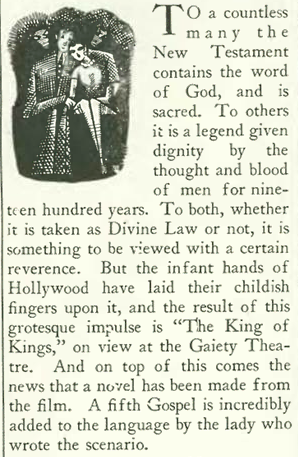
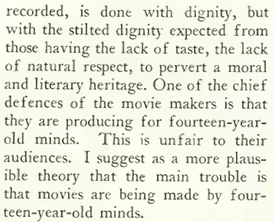
Finally, an interesting take in “Talk of the Town” on book censorship of the day:

Screen Shot 2015-10-15 at 10.02.39 AM

Screen Shot 2015-10-15 at 10.03.30 AM

“Talk” ended with this helpful advice on current cocktail recipes (remember we are in the midst of Prohibition). The “Titantic,” with six parts gin, seems deadly indeed:

Screen Shot 2015-10-15 at 10.14.41 AM

What is “Nuxated Iron” you ask? It was sold as a performing enhancing iron supplement in the early 20th century, endorsed by such athletes as boxer Jack Dempsey and baseball’s Ty Cobb. The blog Peterboriana explains it thus:

“Nuxated Iron” pills, as endorsed by Dempsey, were, obviously, iron supplements.  As for the “nuxated” part of it, that refers to nux vomica, a deadly substance better known as strychnine (i.e. rat poison).  Fortunately, the stuff being hawked…actually contained very little strychnine, and not much iron either.  It was comparatively useless as a performance-enhancing drug, but would not kill you unless you took a lot of it.

So if the Titanic’s six parts gin don’t get you first, maybe the Nuxated Iron will.

Next Time: Stop and Go…

Screen Shot 2015-10-15 at 9.54.27 AM


Car Talk: 1926

Screen Shot 2015-09-28 at 4.36.32 PM
Jan. 23, 1926 cover by James Daugherty.

As if covering the nightclub scene and the fashion set wasn’t enough, Lois Long found the time to attend the National Automobile Show at the Grand Central Palace and offer her insights and criticisms on the latest in automotive design.

The show featured more than 500 new models, bigger and more powerful cars mounted on new-fangled balloon tires. There were also cheaper cars available–GM introduced the Pontiac line to appeal to the mass market, and other manufacturers lowered their prices in an effort to lure customers. Visitors packed the show despite the fact that the city streets were already hopelessly clogged with traffic and navigating them was difficult and often perilous. Al Frueh offered his take on the traffic situation with a little doodle in “The Talk of the Town” section (featured above).

Long gave readers her usual straightforward assessment of the show (her Danish pastry metaphor in the first paragraph is spot on). Note her list of American car companies, many of which are long gone:

Screen Shot 2015-10-05 at 10.05.54 AM

EB01d259_PREVIEW
LOOK AT ME…No doubt Lois Long walked by this Packard special sport phaeton, prominently displayed at the 26th National Automobile show. (Wayne State University)
20121219PalaceEmbed3-blog480
GRAND INDEED…The 26th National Automobile Show was at the Grand Central Palace, which occupied the block of Lexington Avenue between 46th and 47th Streets. It was razed in 1963. A 44-story office tower, 245 Park Avenue, took its place. (New York Times)
Screen Shot 2015-10-02 at 10.28.49 AM
A Cleveland auto manufacturer, Chandler, took advantage of the moment by placing this ad in the Jan. 23 issue of The New Yorker.

***

“The Talk of Town” editors were bemused over the news that artist Maxfield Parrish had received “a check in six figures” following his first-ever exhibition. It was reported that Parrish received $80,000 (roughly equivalent to $1 million today) for a single painting, which the editors suggested made him “the highest paid artist living.” They also wondered “if he gets amusement out of being the highest paid painter,” since Parrish was known for wanting to be left alone, and until recently was “not well off” because no one “could persuade him to the sell the pictures with which he lined his house.”

Screen Shot 2015-10-05 at 11.56.06 AM
A 1926 Edison MAZDA calendar featuring artwork by Maxfield Parrish. (icollector.com)

In a previous issue (Dec. 12, 1925), New Yorker art critic Murdock Pemberton wrote a dismissive critique of the young Parrish’s work and noted that the artist was largely glorified in American advertising and not in serious art circles. This was followed by another “Talk” item in which the editors sneered at the trade calendar market that fed the popularity of artists like Parrish:

Screen Shot 2015-10-02 at 10.18.03 AM

Screen Shot 2015-10-02 at 10.18.15 AM

Screen Shot 2015-10-02 at 10.18.26 AM

And to close, this message (illustrated by Peter Arno) from Miltiades Egyptian cigarettes. Apparently they empower you to call your non-smoking friend “fatso.”

Screen Shot 2015-10-05 at 10.10.09 AM

On the subject of Arno, there was only one drawing with a caption…by Arno…

Next Time: Cuban Idyll…

Screen Shot 2015-10-05 at 5.07.09 PM

Ben Hur Bric-à-brac

Screen Shot 2015-09-25 at 9.48.36 AM
Jan. 9, 1925 cover by Hans Stengel.

MGM spent nearly $5 million (about $70 million today) to make the silent epic Ben-Hur, filming the movie on location in Egypt, Italy and the United States. The New Yorker’s film critic Theodore Shane was not impressed.

Shane wrote that $4,999,999.95 had been spent “on massive effects and the remaining $.05 on drama.”

He noted, however, that the original story, an 1880 novel by Lew Wallace (who was a Union general in the Civil War, among other things), was pretty lacking in drama to begin with, just a “piece of bric-à-brac romance (that was) nothing more than a super Rover Boys story touched up with a Biblical background.” Here’s Shane’s entire review of the film, which was released by MGM on December 30, 1925:

Screen Shot 2015-09-28 at 3.49.54 PM

00239
A Nickel’s Worth of Drama…Ramon Novarro (left) and Francis X. Bushman mix it up in Ben-Hur (1925) (Virtual History)

This was actually the second Ben Hur film. The first was made in 1907, a 15-minute silent costing $500 (and it really was made on the cheap; the producers stole some shots of a mock chariot race at a fireworks show at Sheepshead Bay, Brooklyn, and then added some interior shots to complete the picture).

For the 1925 Ben Hur, filming on location proved difficult from the start. Italy’s new leader, Benito Mussolini, was in an anti-American mood when production began, and labor disputes often delayed filming. By all accounts, conditions were miserable. Kevin Hagopian, in an essay for the New York State Writers Institute, observed “The worst agonies were reserved for the film’s climax, the chariot race. Legendary second unit director B. Reeves Eason’s nickname “Breezy” was certainly not earned by his work on the Ben-Hur set, for his merciless pace cost the lives of over a hundred horses. As [actor Francis X.] Bushman said sadly, “If it limped, they shot it.” A stunt man was killed in a chariot crash, and [actor Ramon] Navarro himself only narrowly escaped death.”

The troubled Italian set was eventually torn down and a new one built in Culver City, California. The crowd scenes and master shots for the race were done in a single day, with forty-two cameras covering the action.

The famed chariot race staged in Culver City, California, was shot with 42 cameras.

In “Profiles” Esther Carples looked at the life of Sergei Rachmaninoff, who was widely considered one of the great pianists of his day, and as a composer represented the last vestiges of Romanticism in Russian classical music. Carples painted a portrait of a brooding genius, a man with aristocratic bearing who lived in lonely exile from his native Russia.

Sergei_Rachmaninoff_cph.3a40575
Sergei Rachmaninoff in 1921. (Library of Congress)

In 1921, Rachmaninoff bought a house on 33 Riverside Drive in New York City, where he lived until 1925. There he consciously recreated the atmosphere of Ivanovka (his beloved Russian summer house) entertaining Russian guests, employing Russian servants, and observing old Russian customs.

*****

Screen Shot 2015-09-28 at 4.33.35 PM
Jan. 16, 1926 cover by S.W. Reynolds.

Let’s move on to the next issue, Jan. 16, 1926. “The Talk of the Town” noted another loss of a Fifth Avenue landmark with the Savoy Hotel was falling to the wrecking ball.

The Savoy, built in 1891-92, was slated to be replaced by The Savoy Plaza Hotel, which itself would be demolished in 1965-66 (amid significant public outcry and protest) to make way for the eastern headquarters building of General Motors.

It was observed that the new year would see a boon in construction of huge new buildings along the Avenue, and buildings only five years old (such as Heckscher Building) would be dwarfed by the new towers.

Hotel-Savoy-hres
Another One Bites The Dust…The Savoy Hotel (stuffnobodycaresabout.com)

The New Yorker continued to have fun with actress Gloria Swanson‘s pretensions to royalty (she was married to the Marquis de La Coudraye at the time). This time it came from the pen of Jimmie the Ink (James Daugherty), part of his series of drawings that coupled famous people of the day in comic situations:

Screen Shot 2015-09-29 at 9.32.55 AM

The issue also featured Helen Hokinson with a cartoon that seemed more in Barbara Shermund’s wheelhouse…

…a Julian de Miskey drawing for the theatre section…

…and a Peter Arno illustration…

To close, two ads from the Jan. 16 issue, this one appealing to Anglophilic, aristocratic aspirations of certain readers…

Screen Shot 2015-09-29 at 9.34.08 AM

And this one from Elizabeth Arden, who will become a mainstay in the magazine with these ads featuring women with ghostly stares, usually with their heads wrapped tightly to combat sagging skin. Thanks to Hollywood, it was the age of the close-up, so wrinkles and blemishes be gone!

Screen Shot 2015-09-29 at 9.36.19 AM

Next Time: Lois Long Talks Cars…

Screen Shot 2015-09-28 at 4.36.32 PM