Above: New Year’s Eve at the “El Morocco” Night Club at 154 E. 54th Street, New York, 1935. (Posted on Reddit)
Lois Long took her nightlife seriously, and when it didn’t live up to her standards—defined by the wild speakeasy nights she wrote about after joining The New Yorker in 1925 —she was crestfallen, to say the least.
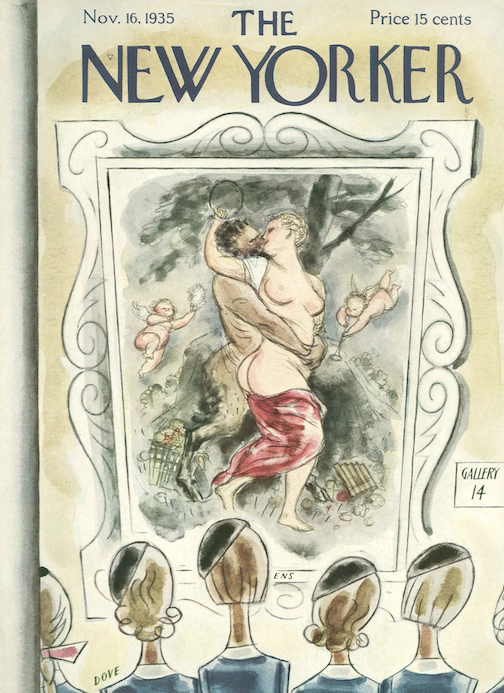
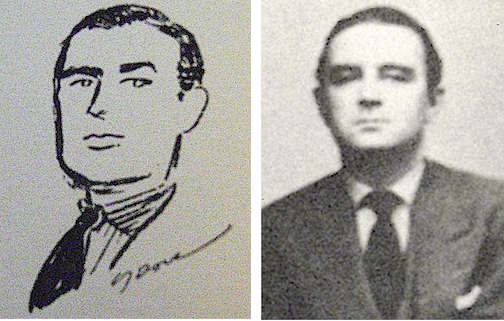
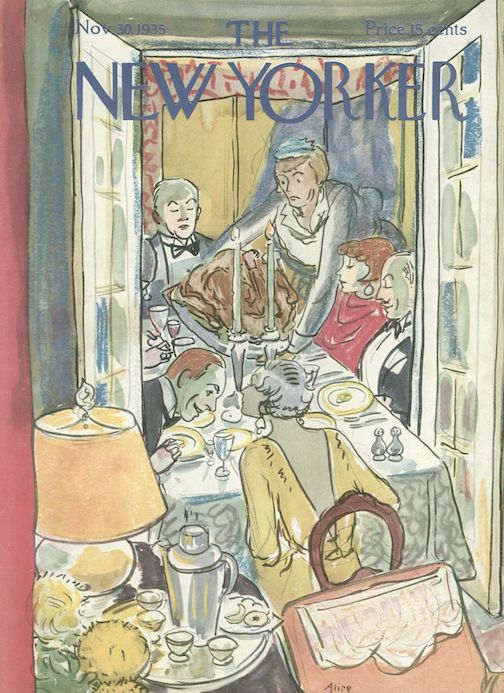
November 16, 1935 cover by Leonard Dove. This is one of Dove’s fifty-seven New Yorker covers; he also contributed 717 cartoons to the magazine.Above: Leonard Dove’s self portrait, 1941; photo: 1947. Born 1906, Great Yarmouth, England. Died, Gramercy Hotel, New York City, 1972. (Thanks to Michael Maslin’s indispensable Ink Spill)
*
When Long joined The New Yorker she was a 23-year-old Vassar graduate, and at age 34 she was not expecting to re-live those heady days; but nightlife in 1935 made her wonder where all the interesting people had gone. Instead of the smart and beautiful speakeasy set, she found people who couldn’t hold a conversation, who cared more about being mentioned in the newspapers by “Cholly Knickerbocker” (a pseudonym used by society columnists)—they simply lacked the “sparkle” she so craved. In this excerpt from her column, “Tables for Two,” she explained:
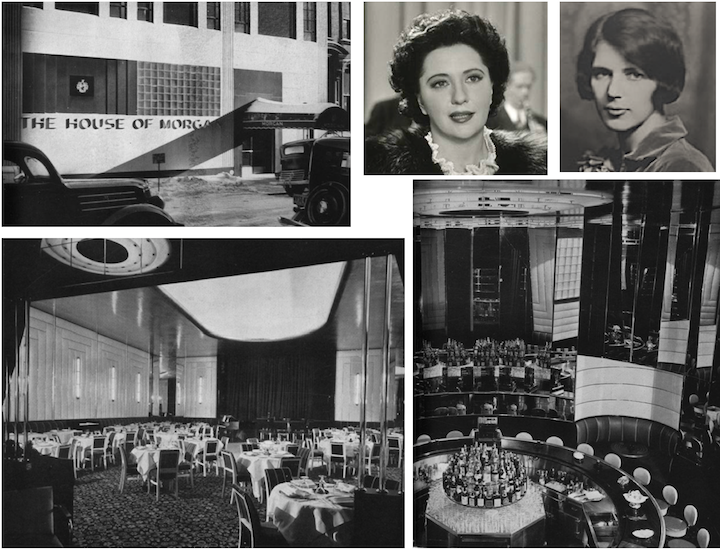
ALL SHOW, NO GO…Lois Long recalled the heady days of the original torch singer Helen Morgan, but her new club, The House of Morgan, offered up tired vaudeville instead of the singer herself. Above, images of the club from Christopher Connelly’sThe Helen Morgan Page. Top, center, detail of Morgan from the 1935 film Sweet Music. Next to Morgan is a photo of Long from the PBS documentary Prohibition. (helen-morgan.net/PBS.org)
* * *
At the Movies
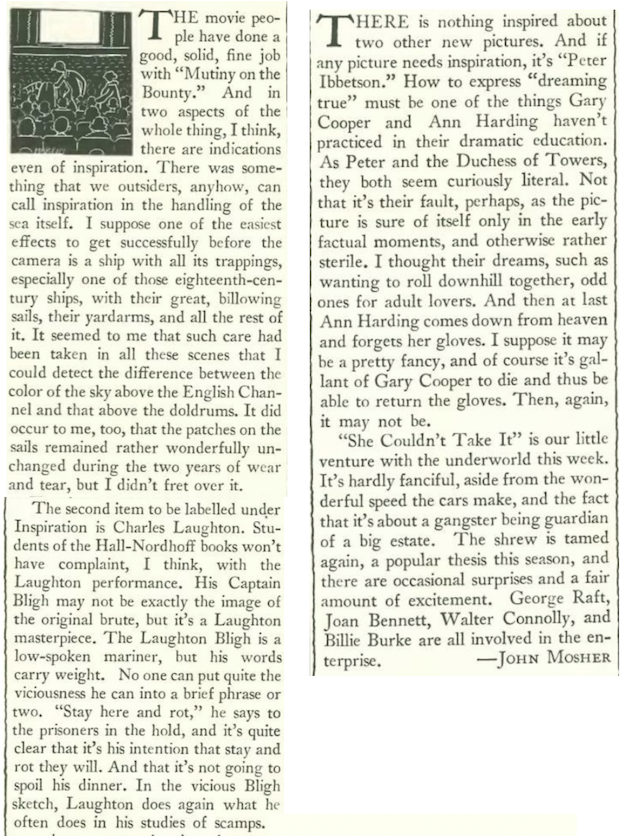
Our film critic John Mosher was in good spirits after taking in MGM’s Mutiny on the Bounty, and especially the inspired performance by Charles Laughton as the cruel, tyrannical Captain Bligh…
LET’S HAVE A STARING CONTEST…Clark Gable (left) portrayed Fletcher Christian, the Bounty’s executive officer, who disapproved of the cruel leadership of Captain Bligh, portrayed by Charles Laughton (right) in Mutiny on the Bounty. (theoscarbuzz.com)
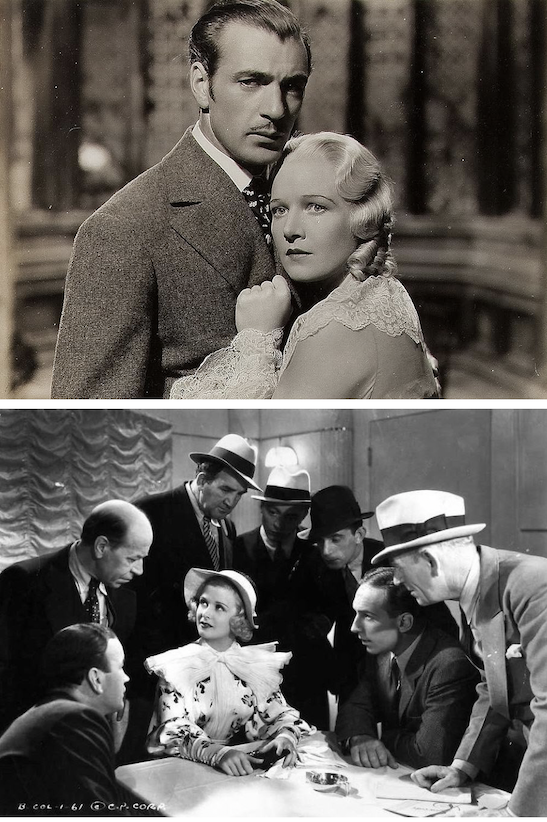
…two other pictures reviewed by Mosher were less than inspired, but at least the George Raft/Joan Bennett gangster film, She Couldn’t Take It, offered a car chase, and the occasional surprise.
STERILITY ISSUES…Top, Gary Cooper and Ann Harding needed a bit more life in Peter Ibbetson; at least Joan Bennett (bottom photo) found some action in She Couldn’t Take It. (IMDB)
* * *
From Our Advertisers
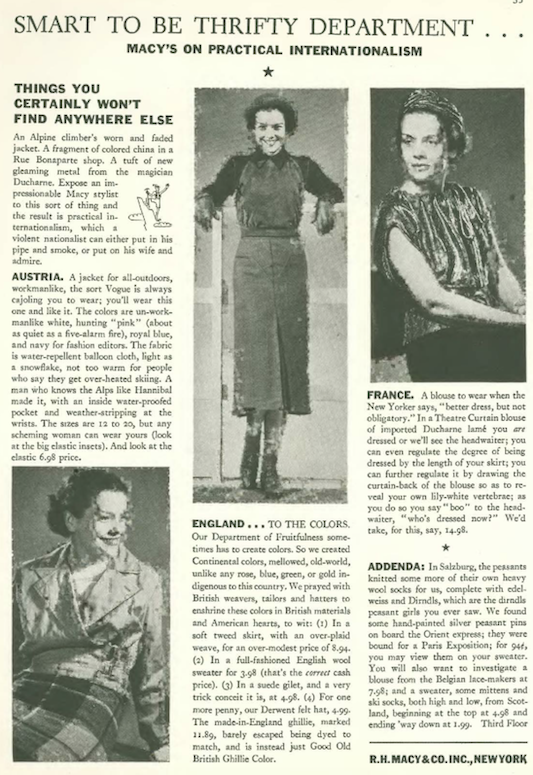
Not all fashion advertisements in The New Yorker were aimed at the posh set…Macy’s offered some thrifty selections, including a French-inspired “Theatre Curtain Blouse” that could be opened in the back “so as to reveal your own lily-white vertebrae”…
…I am puzzled by the “Duchess” types that appeared in food and beverage ads in the back of the magazine…we’ve seen some angry duchesses in ads for tomato and pineapple juice, and here we have one who has stooped so low as to shell her own peas…
…a side note, the Duchess’s peas came in a can bearing the old Green Giant logo, a savage, bearskin-clad figure…he was redesigned by ad executive Leo Burnett in 1935 to become the friendlier “Jolly Green Giant”…
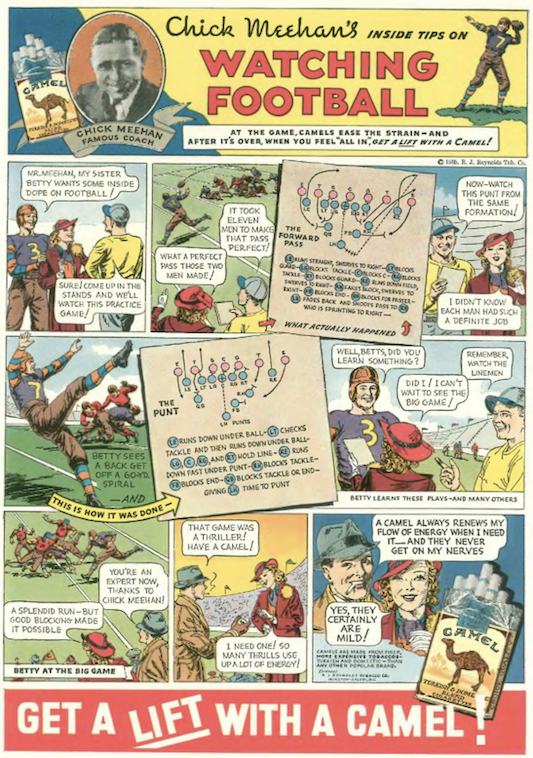
…the makers of Camels presented football coach Chick Meehan in cartoon form to extol the wonders of football and smoking to a young woman…Meehan coached football at Syracuse, NYU and Manhattan College…
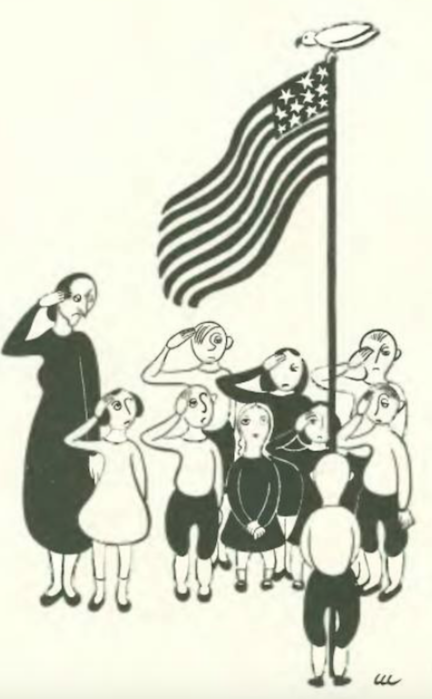
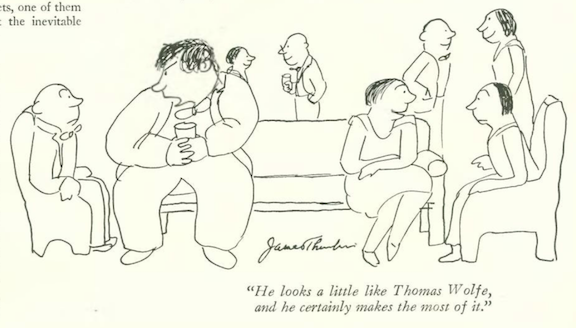
…the football theme segues to our cartoon section, beginning with this spot art by James Thurber…
…Christina Malman’s spot drawings could now be found in every issue, and usually more than one…
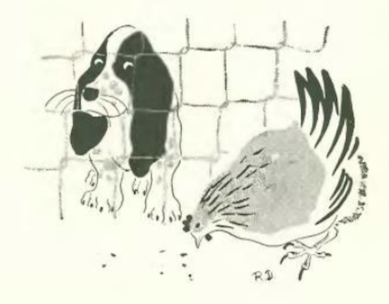
…this one by Robert Day also caught my eye, maybe because I like chickens, and dogs too…
…Day again, on the streets of Manhattan…
…Barbara Shermund showed us a wolf in wolf’s clothing…
…Alan Dunn seemed to be channelling Barbara Shermund here…or maybe Dunn’s wife Mary Petty had some influence…
…William Crawford Galbraith eavesdropped on some wagering waiters…
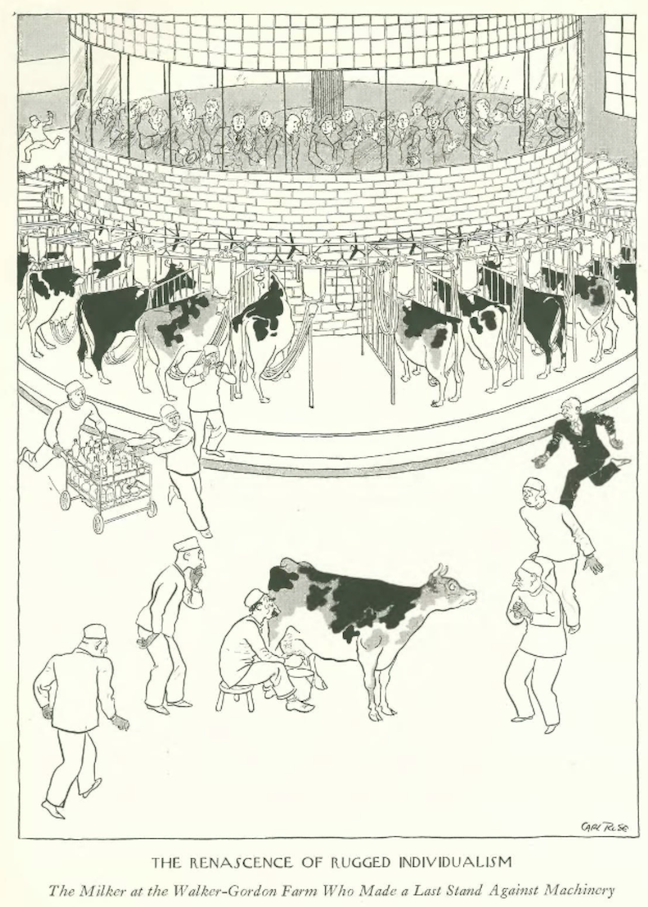
…Carl Rose found an outlier at the modern Walker-Gordon Dairy Farm…
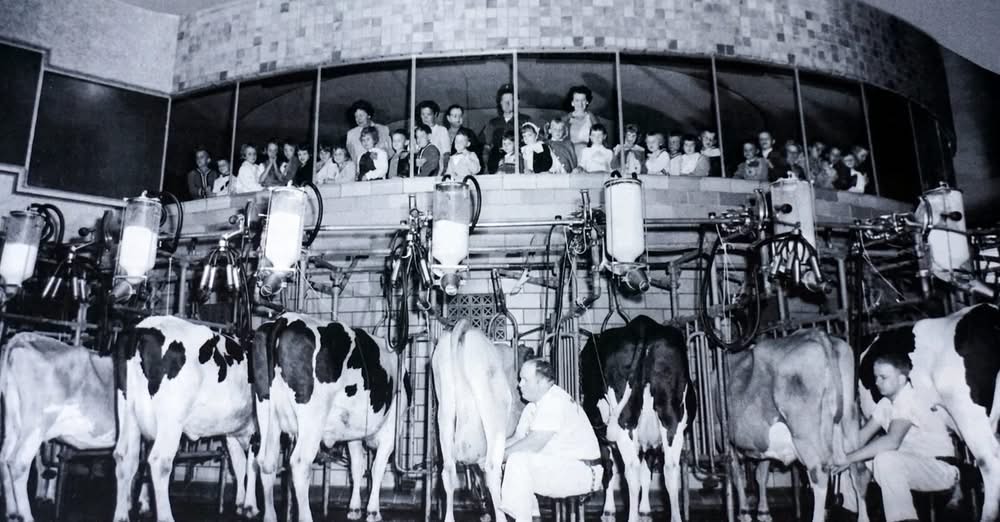
…The Rotolactor featured in Rose’s cartoon was a mostly automatic machine used for milking a large number of cows successively on a rotating platform…first used at the Walker-Gordon Laboratories and Dairy in Plainsboro, New Jersey (pictured below), the Rotolactor held fifty cows at a time, and hosted about 250,000 visitors annually…
(rawmilkinstitute.org)
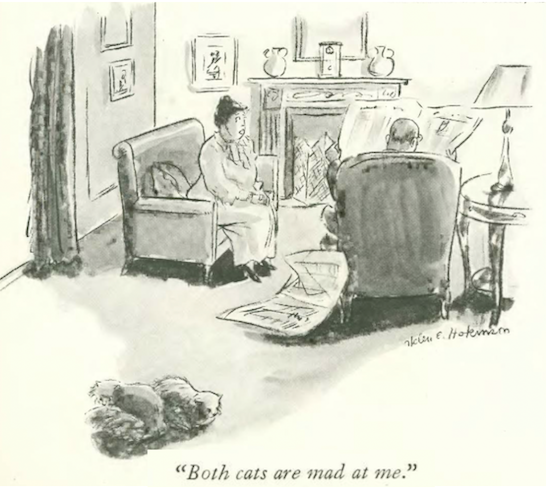
…and we go from cows to cats, courtesy Helen Hokinson…
…and Charles Addams booked an unusual perp…
…on to the November 23 issue…
November 23, 1935 cover by Antonio Petruccelli. Petruccelli (1907-1994) began his career as a textile designer, becoming a freelance illustrator in 1932 after winning several House Beautiful cover contests. This is one of four covers he produced for The New Yorker.Antonio Petruccelli. Here are samples of Petruccelli’s remarkable work.(Helicline Fine Art)
*
Worth the Wait
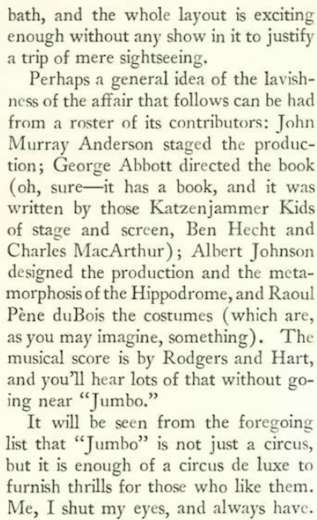
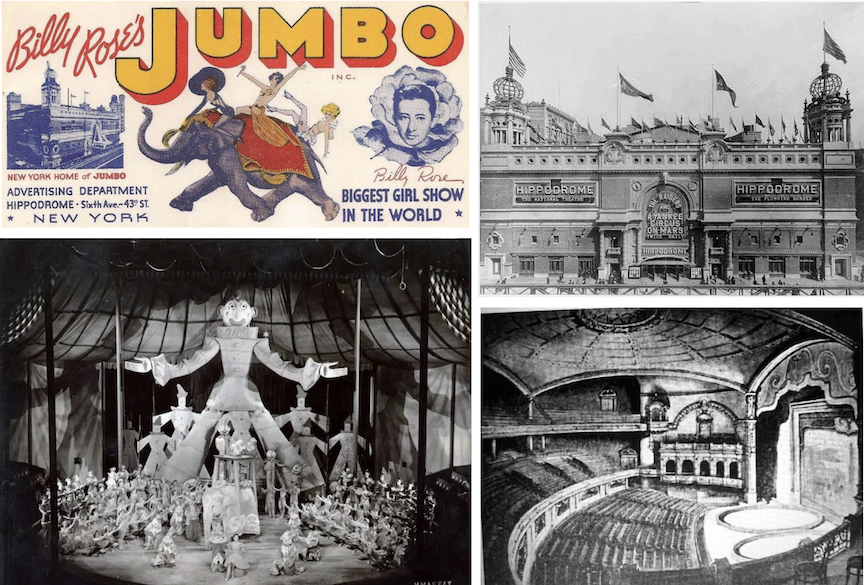
The highly-anticipated circus-themed spectacle Jumbo finally opened at the Hippodrome. In his That’s Entertainment! blog, Jackson Upperco observes that Billy’s Rose’sJumbo was “more circus than musical comedy,” a production that “was largely an excuse for Mr. Rose to present a circus.” It was headlined by comedian Jimmy Durante and bandleader Paul Whiteman, with a score by Rodgers & Hart. Here are excerpts from a review by Wolcott Gibbs:
JUMB0-SIZED ENTERTAINMENT…Clockwise, from top left, Hippodrome billboard promoting Jumbo; built in 1905, the Hippodrome provided entertainment to thousands who couldn’t afford a Broadway ticket; a circus tent was erected inside the 5,300-seat theatre for the spectacle; Jumbo was one of the most expensive theatrical events of the first half of the 20th century. (Facebook/Library of Congress/Broadway Magazine/jacksonupperco.com)
* * *
At the Movies
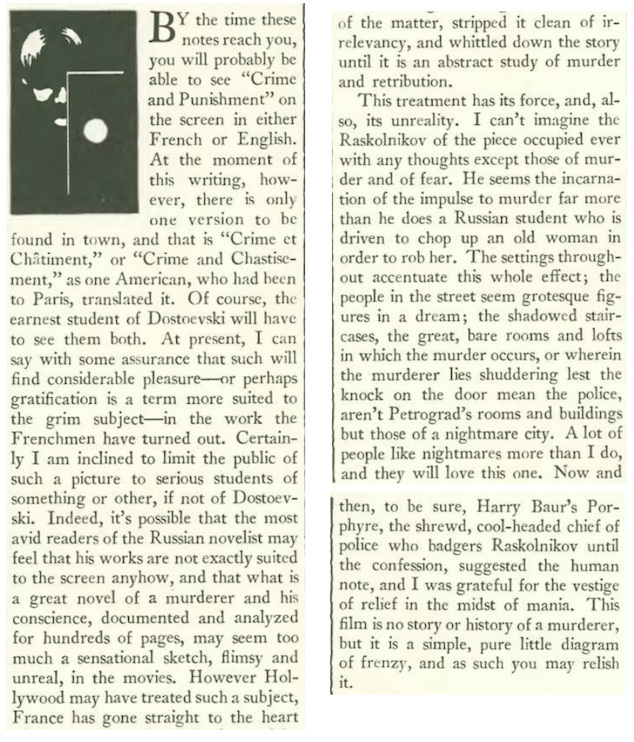
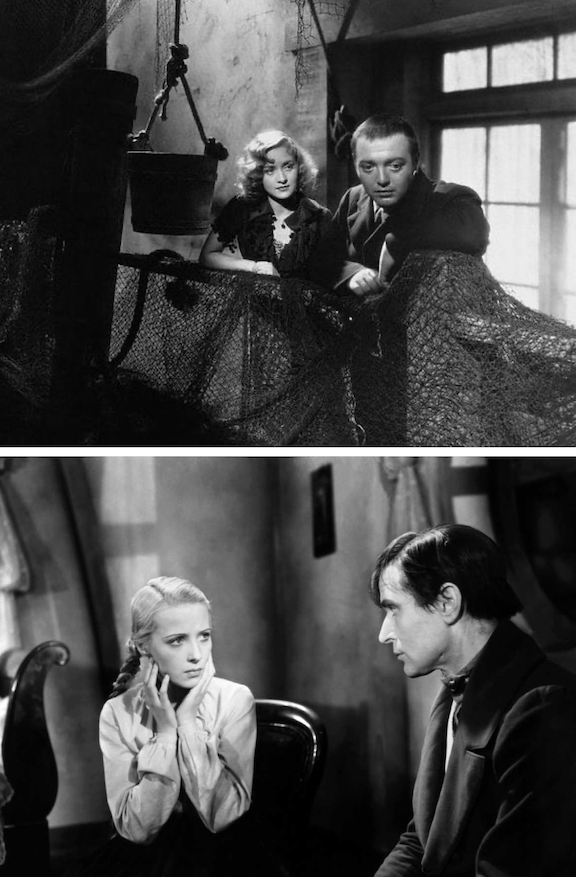
Fyodor Dostoevsky’s 1866 novel Crime and Punishment was adapted to film by both French and American producers in 1935, but critics including The New Yorker’sJohn Mosher mostly preferred the French version, titled Crime et châtiment.
DOUBLE FEATURE…American and French producers each turned out a film adaption of Fyodor Dostoevsky’s novel Crime and Punishment. Top photo, Marian Marsh as Sonya and Peter Lorre as Roderick Raskolnikov in Columbia’s Crime and Punishment; bottom photo, Madeleine Ozeray as Sonia and Pierre Blanchar as Rodion Raskolnikov in Crime et châtiment.(silverscreenmodes.com/SensCritique.com)
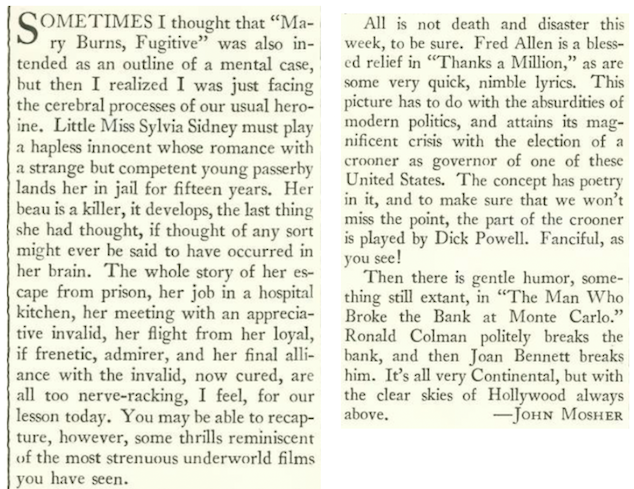
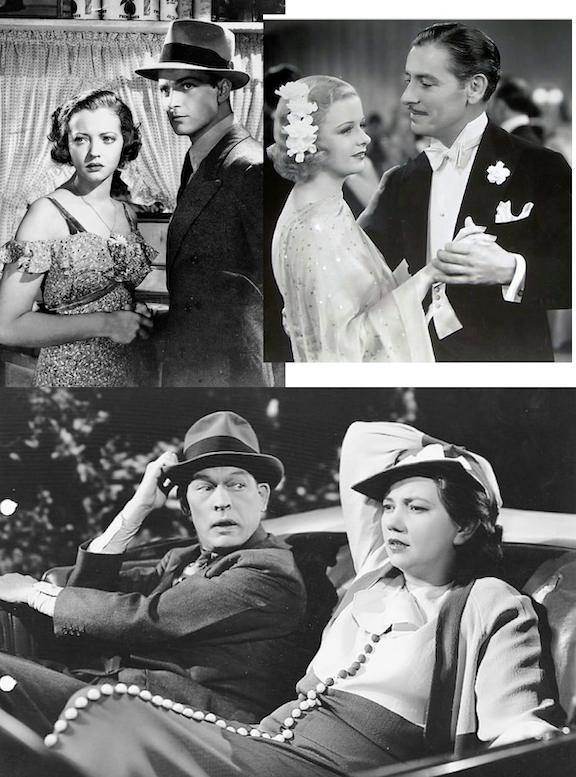
…Mosher reviewed another crime thriller, Mary Burns, Fugitive, but found some comic relief in two other films…
BAD CHOICE IN BOYFRIENDS was the theme of Mary Burns, Fugitive, starring (top left) Sylvia Sidney and Alan Baxter; top right, Joan Bennett and Ronald Colman in the romcom The Man Who Broke the Bank at Monte Carlo; bottom, Fred Allen and Patsy Kelly provided some laughs in musical comedy Thanks a Million. (IMDB)
* * *
From Our Advertisers
Readers of the Nov. 23 issue opened to this lovely image…
…which sharply contrasted with the clunky Plymouth ad on the opposite page…
…not so clunky was this colorful illustration promoting Cadillac’s economy model, the La Salle…
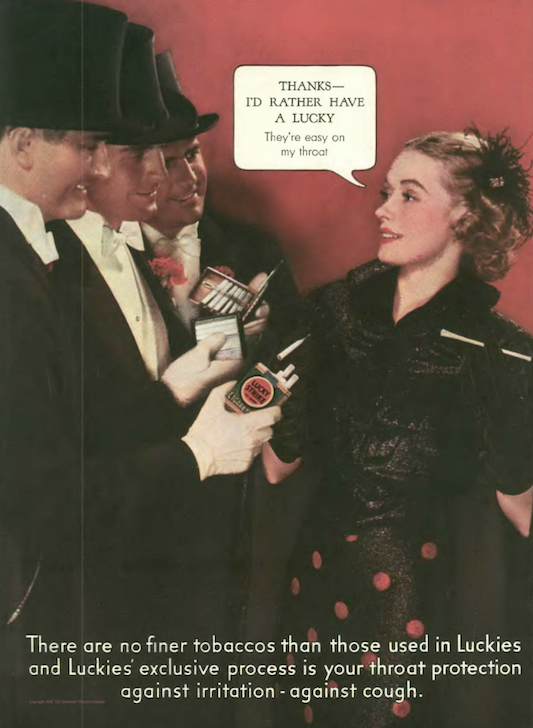
…the back cover was no surprise, with yet another glamorous cigarette ad…
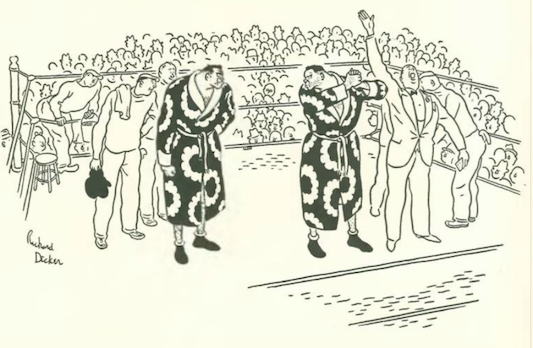
…our cartoonists included Richard Decker, and a fashion faux pas to open a boxing match…
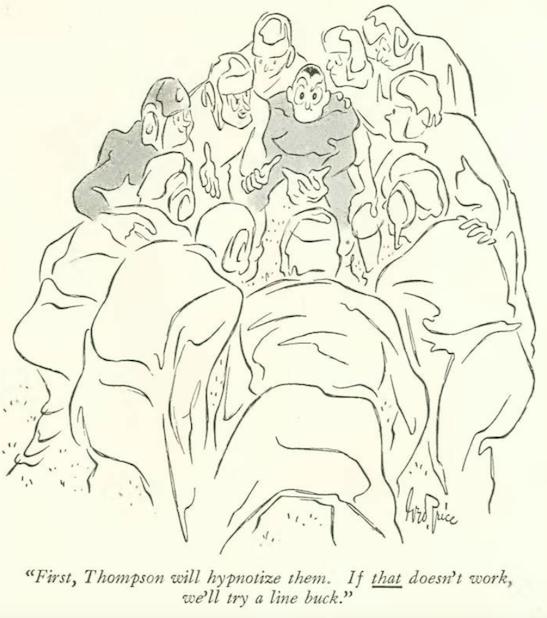
…George Price eavesdropped into some football strategy…
…Carl Rose spotted a canine unbeliever…
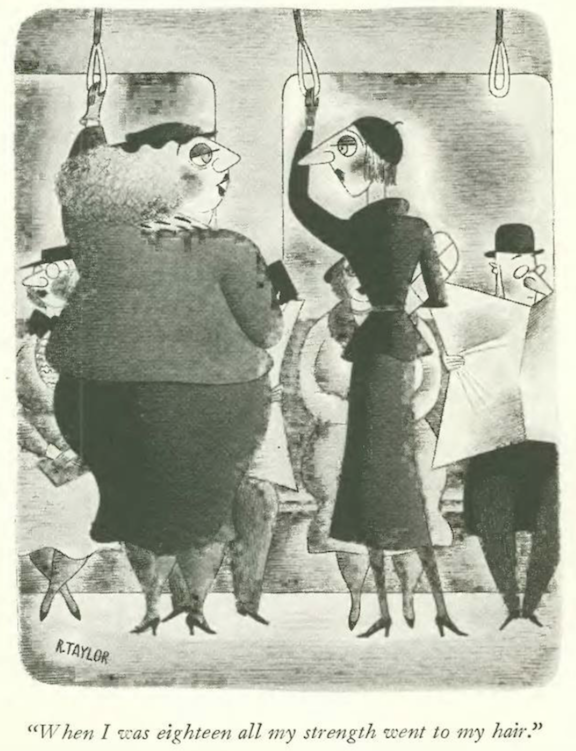
…Richard Taylor was back with his distinctive style…
…Al Frueh continued to illustrate the latest fare on Broadway…
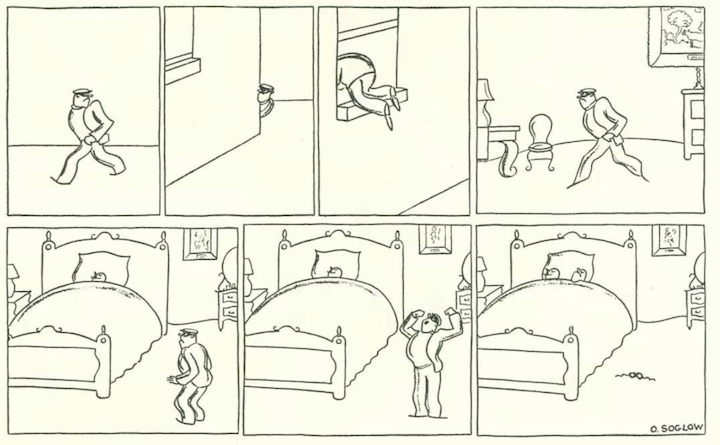
…Otto Soglow crept in for a snooze…
…and we close with James Thurber, and some literary cosplay…
Our sense of what is old and what it is new becomes skewed during periods of rapid change, and such was the case in 1920s New York when large swaths of the old city were swept away and replaced by massive towers that seemingly rose overnight. Places like the Hippodrome Theatre, a 1905 Beaux-Arts confection barely 24 years old, seemed positively ancient in those heady times.
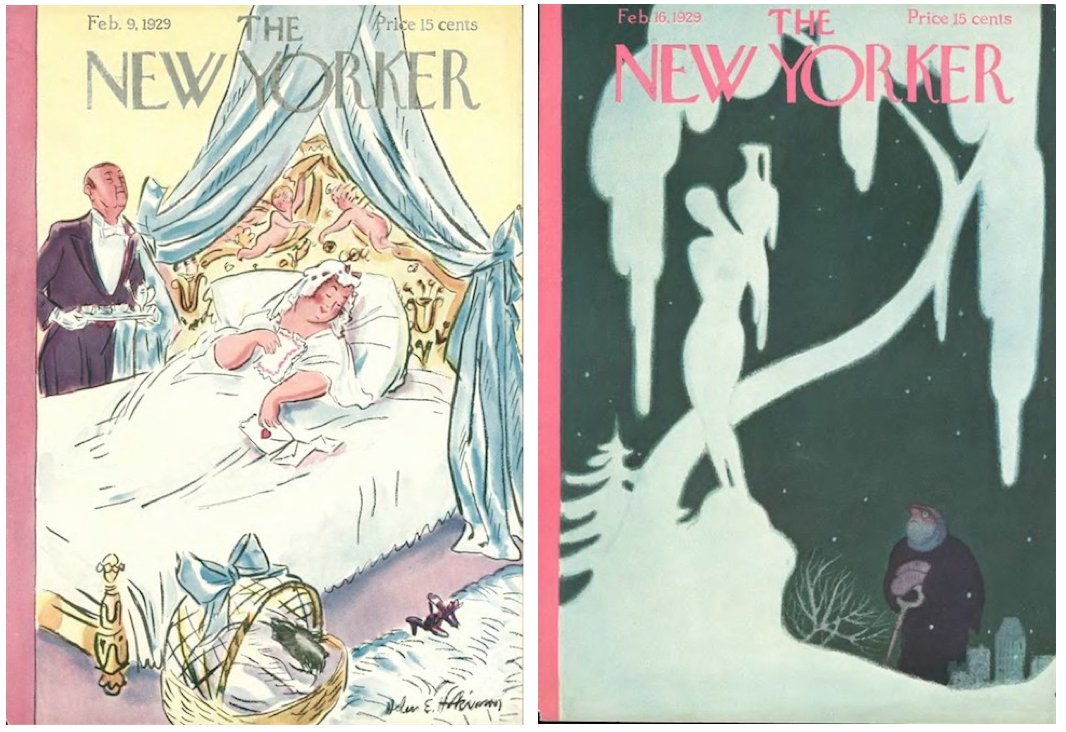
Feb. 9, 1929 cover by Helen Hokinson. Feb. 16, 1929 cover by Rea Irvin.
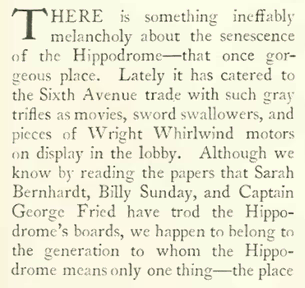
For the most part the New Yorker was enthusiastic about the changing skyline, as its namesake was claiming the crown as America’s premier city; but occasionally a melancholy note would be struck when a familiar institution appeared in decline or fated for the wrecking ball. In the Feb. 9, 1929 “Talk of the Town,” E.B. White wistfully recalled the old days of the Hippodrome, once the largest theatre in the world and the pride of turn-of-the-century New York:
FOR THE MASSES…The Hippodrome, built in 1905, provided entertainment to millions of New Yorkers who couldn’t afford a ticket to a Broadway play. The brainchild of Frederick Thompson and Elmer S. Dundy, entrepreneurs of Coney Island’s Luna Park, the Hippodrome was torn down in 1939 after more than a decade of decline. (1905 photo courtesy Library of Congress)A REALLY BIG SHOOO…One of the first performances at the Hippodrome was a four-hour spectacle: A Yankee Circus on Mars (advertised on the theatre’s marquee in photo above). The 1905 production included 280 chorus girls, 480 soldiers, a parade of cars driven by elephants, an equestrienne ballet, acrobats, and a cavalry charge through a lake. (Image from Harper’s Weekly via daytoninmanhattan.blogspot.com)The Hippodrome’s main theatre could accommodate 5,300 patrons in seats that were four inches wider than normal theatre seats. The dome over the “Roman style” auditorium encompassed an acre. (Broadway Magazine 1905 via daytoninmanhattan.blogspot.com)
The Hippodrome held such a place in the heart of the New Yorker that the magazine offered further reminiscences in the Feb. 16 issue, this time penned by managing editor Harold Ross:
For demonstrations of diving and “mermaid spectacles,” the Hippodrome stage featured an eight-foot high steel tank in four sections, with a front of plate glass. Manned diving bells were also used to raise and lower “mermaids” during performances.
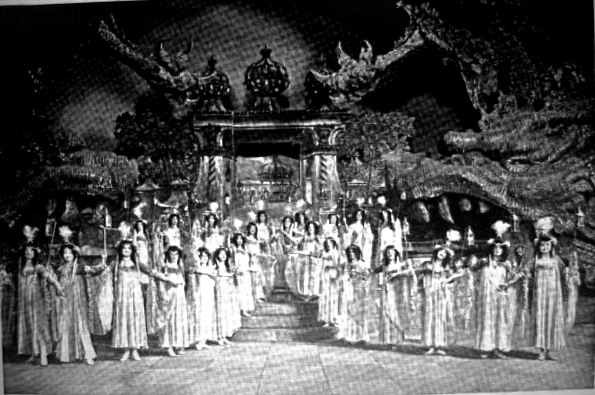
OLD TIMEY FX…Illustration from Nature magazine (left) depicts a diving bell used in the Hippodrome’s swimming and diving tank to raise and lower performers. At top, circa 1910 advertisement; at bottom, the “Court of the Golden Fountain” in the the theatre’s 1905-06 presentation of A Society Circus. (les-sources-du-nil.tumblr.com/flickr/NYC Architecture)
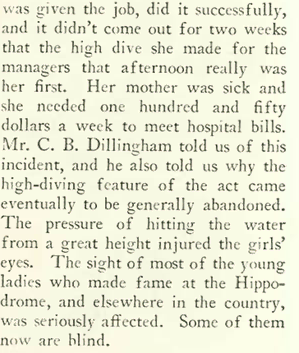
Ross wrote about the Hippodrome’s “diving girls,” who would dive into a tank of water from a height of 90 feet, sometimes at a serious cost to their health:
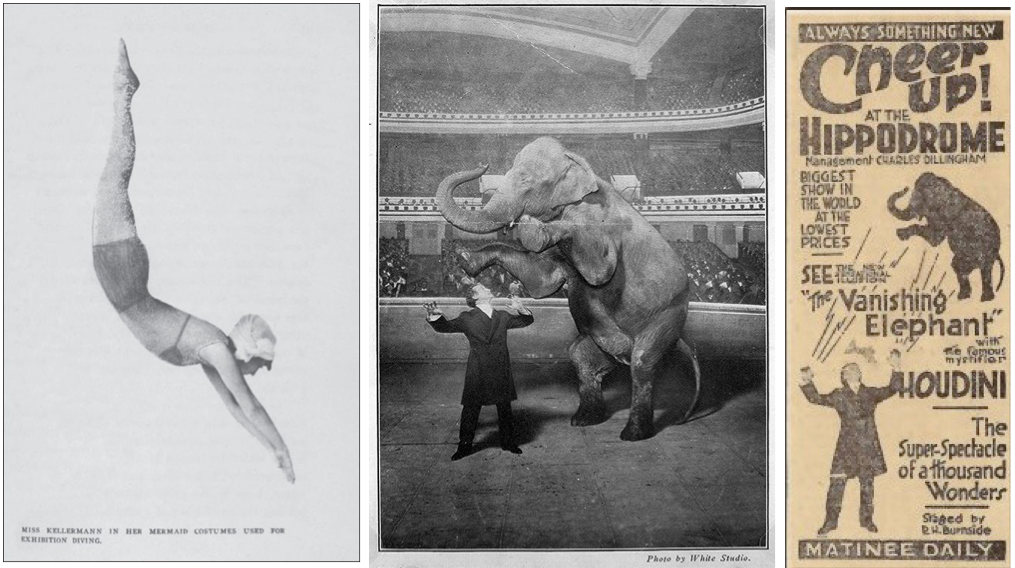
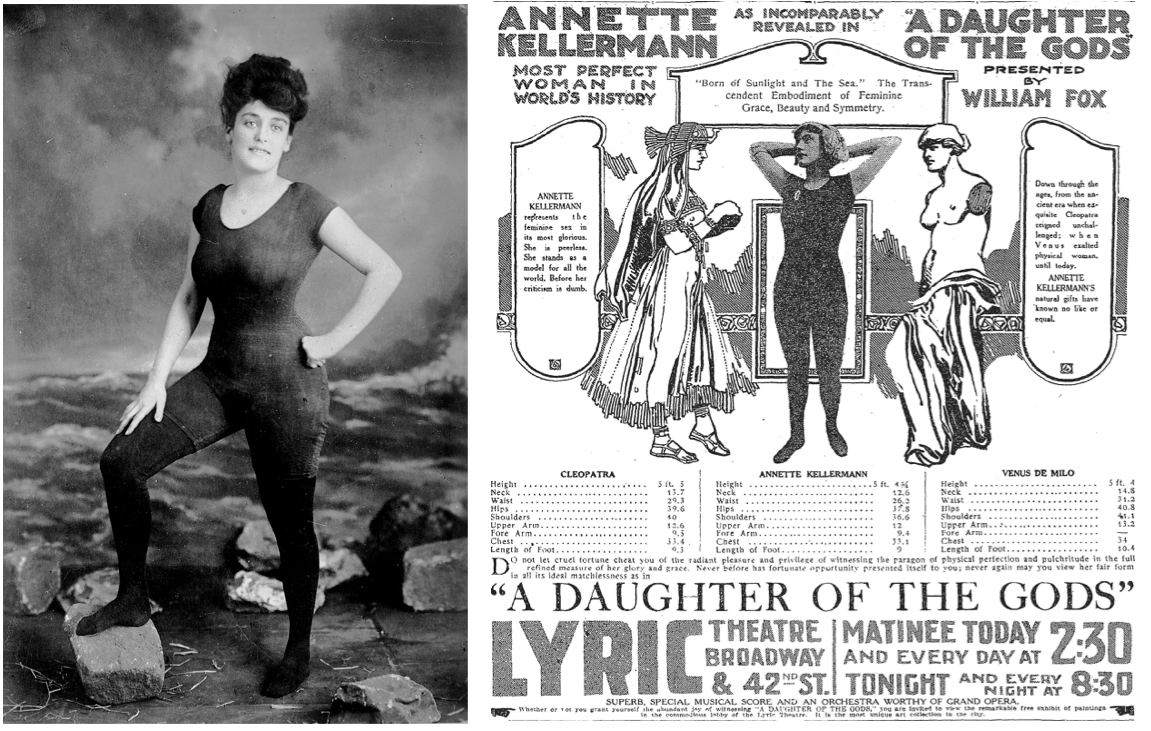
HIPPODROME’S HEYDAYS…In the early 1900s Australian swimmer and diver Annette Kellerman (left, in an image from her 1918 book, How to Swim) was a famed performer at the Hippodrome, as was illusionist and stunt performer Harry Houdini, shown here in 1918 with Jennie the Elephant in a performance of the vanishing elephant trick. (Monash University/americaslibrary.gov/wildabouthoudini.com)MILLION DOLLAR MERMAID…famed around the world by that moniker, swimmer and later actress Annette Kellerman is considered the originator of the one‐piece bathing suit, which she models at left in a photo taken around 1907. At right, advertisement for Kellerman’s 1916 film A Daughter of the Gods (now lost), in which Kellerman achieved another first: the first complete nude scene by a major star. The William Fox Studio made much of Kellerman’s figure, promoting her as the perfect woman by “comparing” her measurements to the likes of Cleopatra and Venus de Milo. (Wikipedia/consumingcultures.net)
Australian swimmer Annette Kellerman was a big draw at the Hippodrome, and helped popularize the sport of synchronised swimming after her 1907 performance of the first water ballet in theatre’s giant plate glass tank. In that same year she shocked Bostonians by appearing on a local beach in a “daring” one‐piece bathing suit (shown above), and was arrested for indecency. This was at a time when a woman’s standard bathing apparel consisted of a blouse, skirt, stockings and swimming shoes.
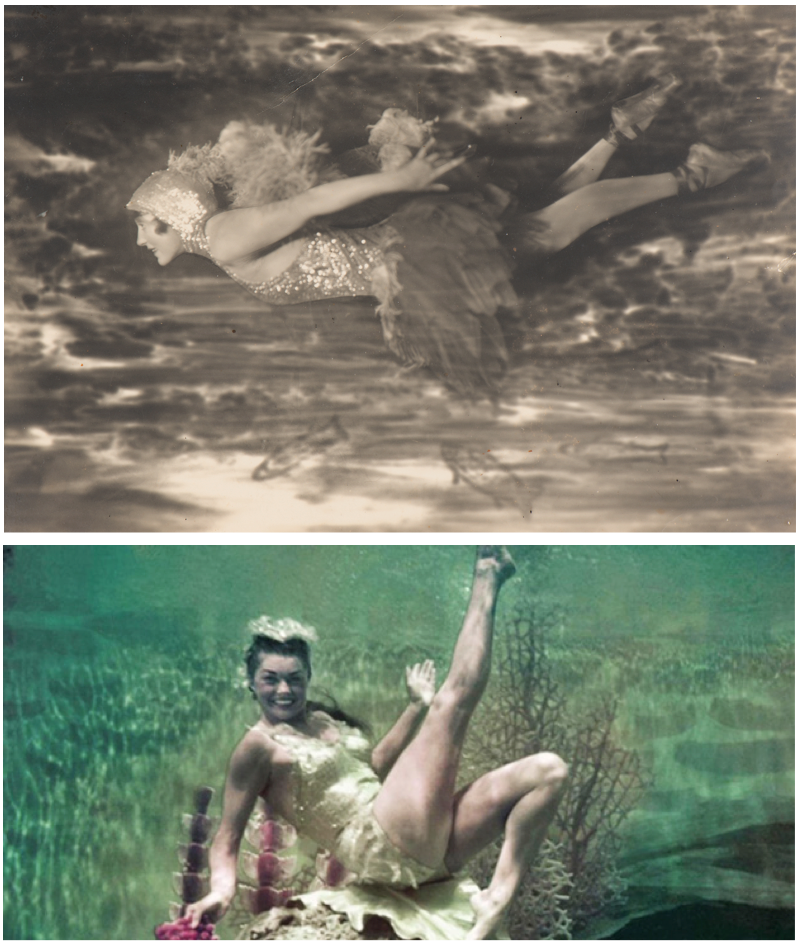
Unlike some of the unfortunate Hippodrome divers who later lost their eyesight due to cranial pressure from high dives, Kellerman went on to a long and active life (she died in 1975, at age 88). Known throughout the world as Australia’s “Million Dollar Mermaid” (and portrayed by Esther Williams in a 1952 movie by the same name), Kellerman appeared in more than a dozen films between 1909 and 1924. She also launched her own line of swimwear and wrote several books on swimming, beauty and fitness.
ALL WET…At top, Annette Kellerman swimming underwater in a gold sequined dress, possibly from Queen of the Sea (1918, now lost). Thirty-four years later Esther Williams (below) would portray Kellerman in Million Dollar Mermaid. (historycouncilnsw.org.au/gsgs/movieactors.com)
* * *
City of Lights
While E.B. White got misty-eyed about the old Hippodrome in the Feb. 9 issue, his fellow New Yorker writer and friend James Thurber was thrilling on the new skyscrapers lighting the city’s skyline:
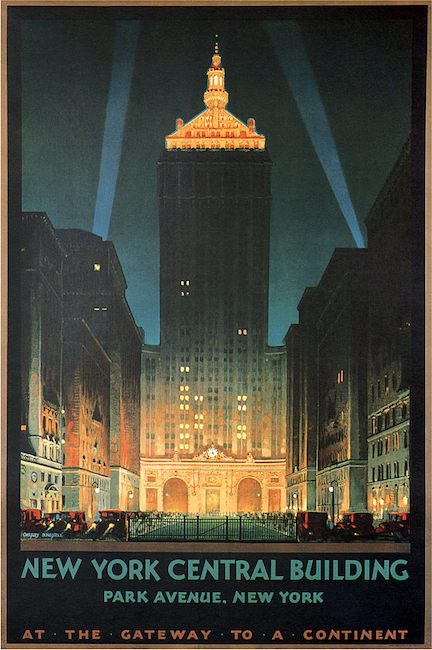
BEJEWELED CROWN…The New York Central Building depicted in a 1929 promotional painting by Chesley Bonestell. (albanyinstitute.org)
Thurber noted that “100,000 candlepower” would light the golden crown of the New York Central Building, the tallest structure in the Grand Central complex. Over at the new Chanin Building, a whopping 25 million candle-power would be trained on its art deco crown.
YOU CAN’T MISS IT…At left, the nearly 700-foot-tall Chanin Building joined the race for the sky in 1928-29. At right, a 1929 drypoint etching by Australian-born artist Martin Lewis depicted the magical glow of the Chanin Building from the viewpoint of a tenement dweller on a fire escape. (NYPL/ephemeralnewyork.wordpress.com)
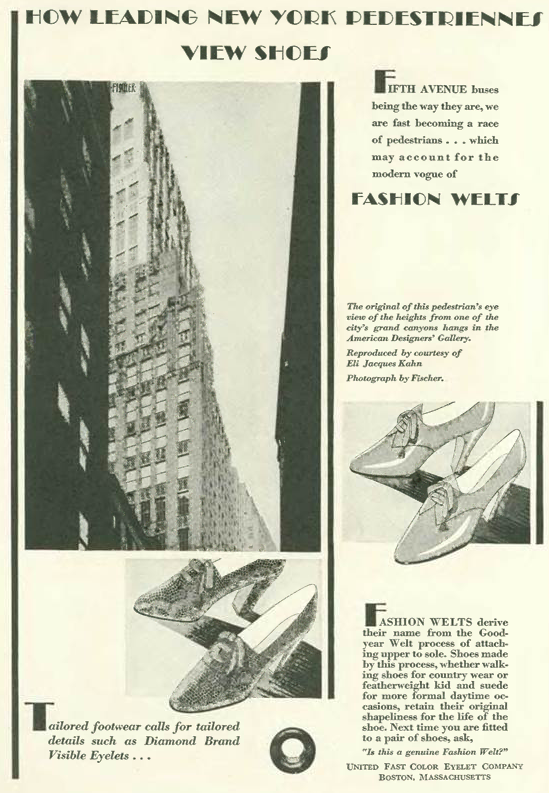
Advertisers in the New Yorker reflected the mood of this new city of skyscraper canyons. From the Feb. 16 issue:
Ralph Ingersoll and Thurber also wrote in the Feb. 16 “Talk” about plans for “Rockefeller City…”
…and as we know, this was to become the famed Rockefeller Center, a complex of 19 buildings covering 22 acres between 48th and 51st streets. Led by by John D. Rockefeller Jr., the complex was conceived as an urban renewal project to revitalize Midtown (hard to imagine today). The land was originally envisioned as a site for a new Metropolitan Opera house, but when financing fell through the land’s owner, Columbia University, leased it to Rockefeller. Of the anticipated effect of the project, Ingersoll and Thurber wrote:
And for the record, the Feb. 9 issue featured another name that would shape the future of the city—J. Pierpont Morgan was the subject of a lengthy two-part profile penned by John K. Winkler.
* * *
Shouts & Murmurs
The Feb. 16 marks a significant date on the New Yorker calendar—the first appearance of Alexander Woollcott’s famed “Shouts & Murmurs” column:
Writing in the “Double Take” section in the July 18, 2012 issue of the New Yorker, Jon Michaud notes that “Shouts & Murmurs” was Woollcott’s personal column, appearing weekly in the magazine for five years. Perhaps no person other Harold Ross himself could be more associated with the earliest origins of the magazine — Woollcott was a colleague of Ross’s at Stars and Stripes during the First World War, and introduced Ross to his first wife, Jane Grant, who was also a considerable influence on the early magazine.
Michaud writes that Woollcott used the column “to opine on, lampoon, and attack the culture and society of the day. In his distinct and at times excessive style, he reviewed books, wrote spoofs, distributed gossip, and generally rankled as many people as he could.” Woollcott ended the column in December 1934, but it was revived in 1992 as a regular venue for many notable humorists, and continues to this day.
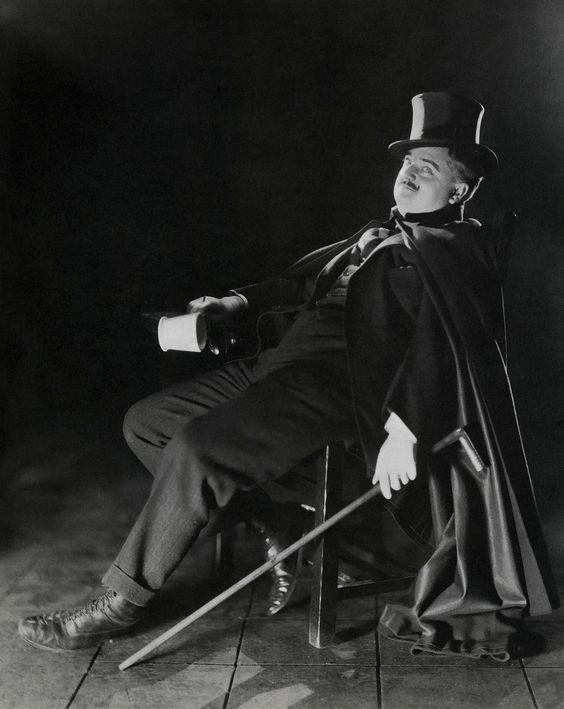
A REAL CHARACTER…Alexander Woollcott, in his idea of casual wear. He once informed his friend and New Yorker colleague Corey Ford: “Ford, I plan to spend three days at your house in New Hampshire next week.” Not overly pleased to be hosting such a demanding guest, Ford uttered a meek “That will be swell.” “I’ll be the judge of that,” Woolcott warned him. (From Elizabeth Olliff, “An Evening at the Algonquin.”)
* * *
Up In Smoke
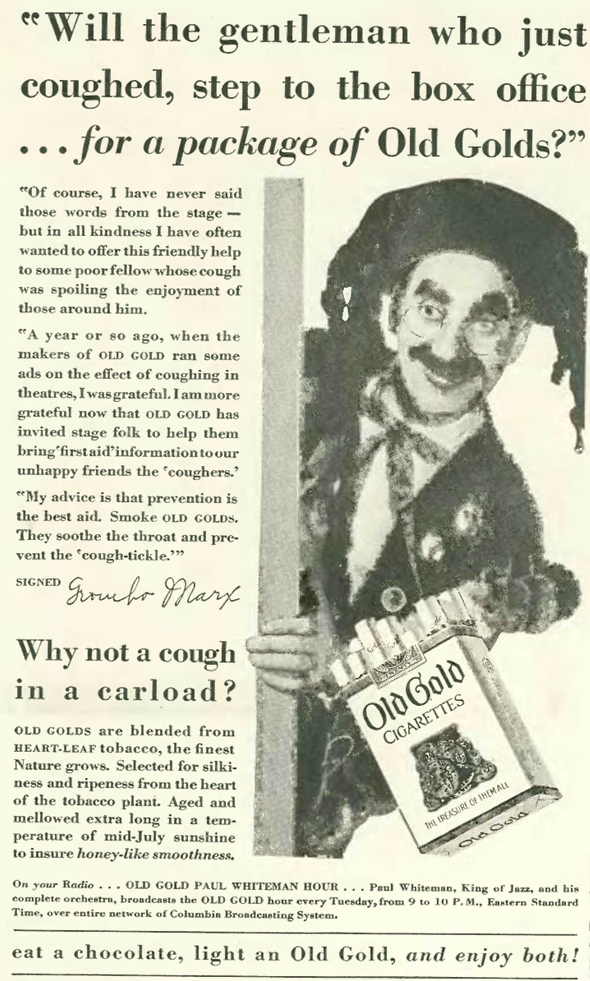
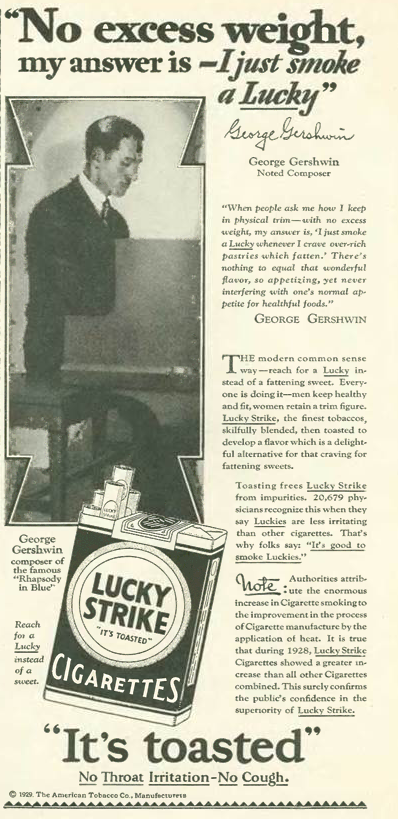
Jumping back to the Feb. 9 “Talk of the Town,” we have this complaint from the magazine regarding celebrity cigarette endorsements. Although the magazine derived a lot of revenue from cigarette ads, Harold Ross insisted on a strict separation between editorial and advertising, allowing his writers free reign to bite the hands that fed them, if they so wished:
Here’s the offending ad, which was featured in the Feb. 23 issue:
In the Feb. 9 issue, Groucho Marx couldn’t resist getting in on the endorsement action…
…nor could Ross’s old friend George Gershwin, who touted the health benefits of Lucky Strikes in the Feb. 16 issue…
In other ads from the Feb. 16 issue, we find that for all of the technological advances in the 1920s, a decent car heater still eluded automakers. Hence…
…on the other hand, we also have this very up-to-date product—the forerunner of today’s rolling airplane luggage…
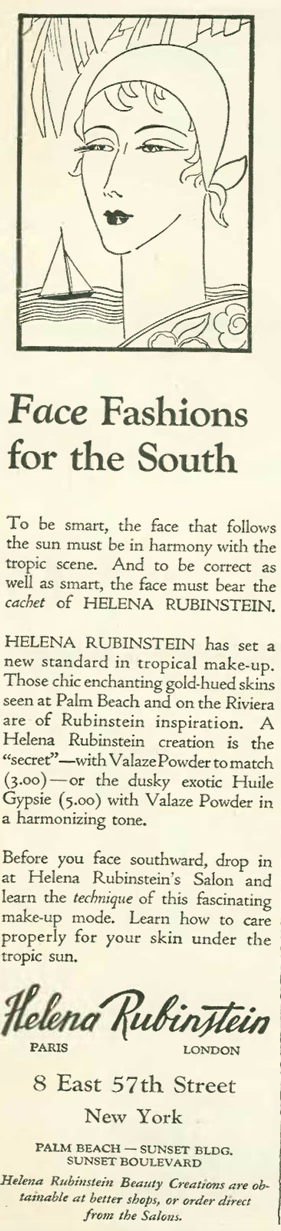
…and if you happened to be flying south, you might have first checked in with Helena Rubinstein to make sure you had the right “face fashions”…
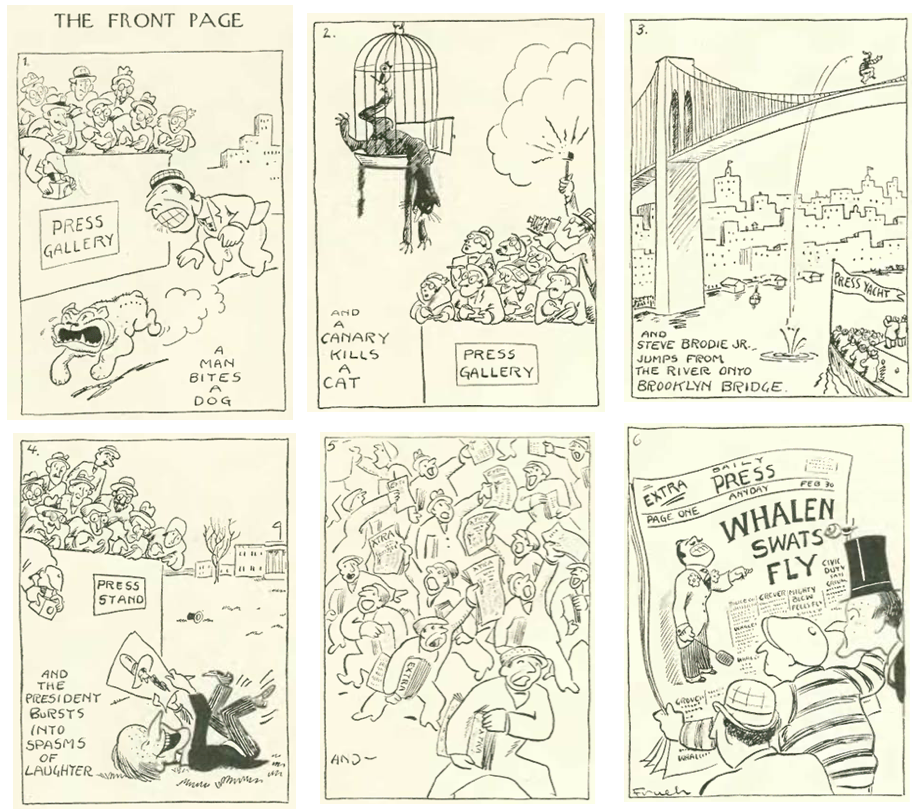
And finally our cartoons, all from the Feb. 9 issue. This first is a six-panel series by Al Frueh that originally ran diagonally, top to bottom, across a two-page spread. It took a shot at the self-promoting police commissioner, Grover Whalen, who was not a friend to the New Yorker due to his ham-fisted approach to Prohibition enforcement…
…and Leonard Dove took a shot at some posh folks outside of their urban element…
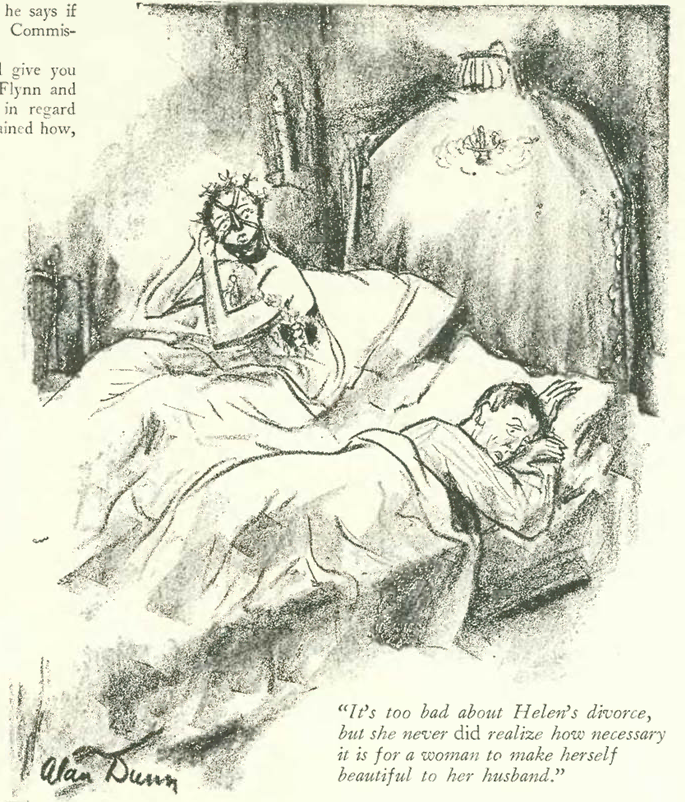
…and finally, Alan Dunn examined the wages of beauty…

































 A New Yorker State of Mind