The Tragic Pose

In an age of toe-tapping musicals and screwball comedies — which served to distract from the grim realities of the Great Depression—one playwright was content to continue mining the deep veins of tragedy and pessimism than ran through the 1930s.

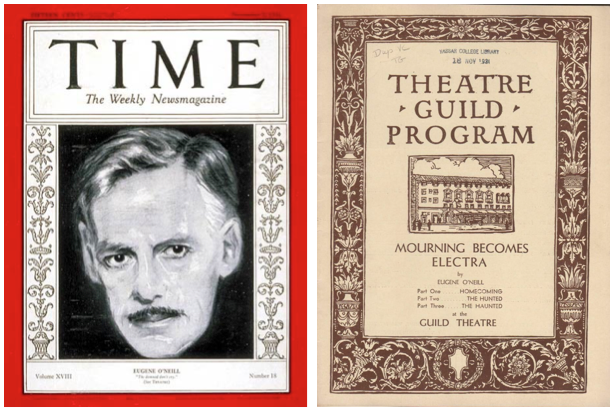
Nov. 7, 1931 cover by Margaret Schloeman.

A Chekhovian realistEugene O’Neill (1888–1953) had yet to write his masterpiece, Long Day’s Journey into Night, but in 1931 he was already well established as America’s preeminent playwright. When his naturalistic Mourning Becomes Electra hit the Guild Theatre stage, New Yorker theatre critic Robert Benchley had little doubt about O’Neill’s greatness as a playwright, even if he wasn’t so sure about the play itself:

O’Neill’s tragic pose was borne from childhood, the son of an alcoholic father and a mother who became addicted to morphine after his difficult birth. His older brother, Jamie, would drink himself to death. It doesn’t end there. O’Neill’s own  two sons would commit suicide, and he would disown his remaining daughter, Oona O’Neill, when at age 18 she married silent film star Charlie Chaplin, 36 years her senior. An odd footnote: Chaplin was best friends with Ralph Barton, a cartoonist for the early New Yorker who took his own life after Eugene O’Neill married Barton’s ex, Carlotta Monterey. To close the loop, O’Neill and Monterey had a mess of a marriage between his alcoholism and her addiction to sedatives. No wonder the man rarely smiled.
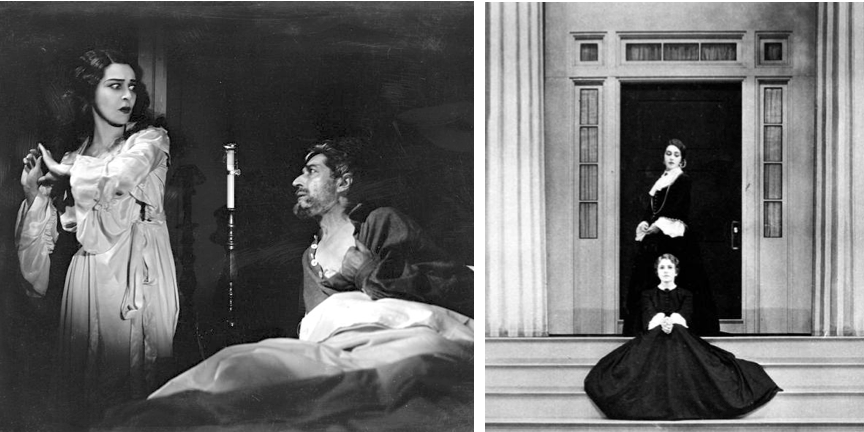
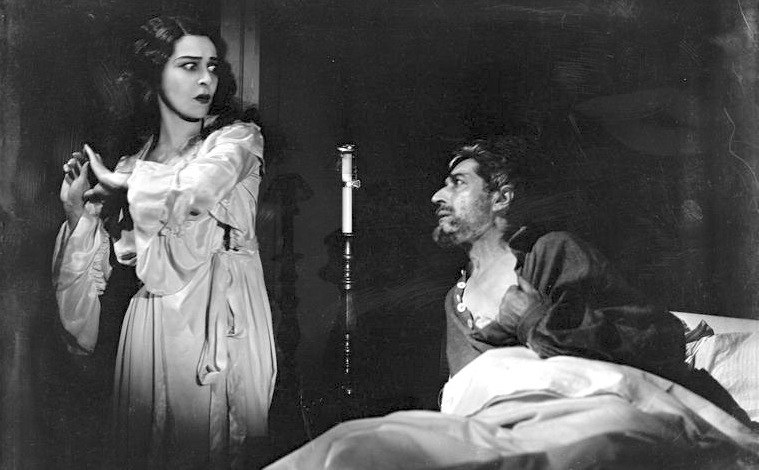
WRONG MEDS, MY DEAR…Christine Mannon (Alla Nazimova) recoils from her husband, Ezra (Lee Baker) after giving him a poison that he mistakes for his heart medicine. At right, Christine and her daughter, Lavinia (Alice Brady), await the return of Ezra from battle. All three actors were part of the original cast of Eugene O’Neill’s Mourning Becomes Electra, which was a retelling of Oresteia by Aeschylus. (allanazimova.com)
FAMILIAR FACE…Eugene O’Neill made his third appearance on the cover of Time magazine for the Nov. 2, 1931 issue. He made a total of four appearances on the magazine’s cover (1924, 1928, 1931 and 1946). At right, cover of Guild Theatre program. (Time/Pinterest)
SAY CHEESE…Eugene O’Neill wore his familiar scowl in this undated portrait with his third (and final) wife, stage and film actress Carlotta Monterey. (famousfix.com)

 *  *  *

Go West, William

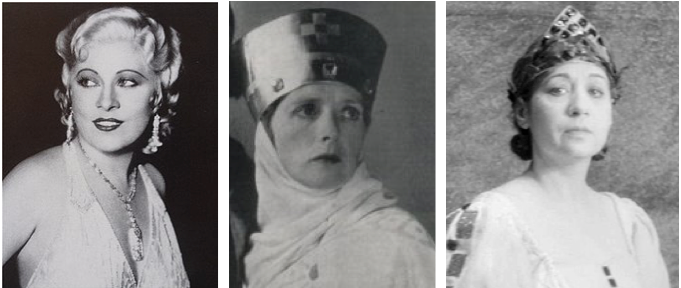
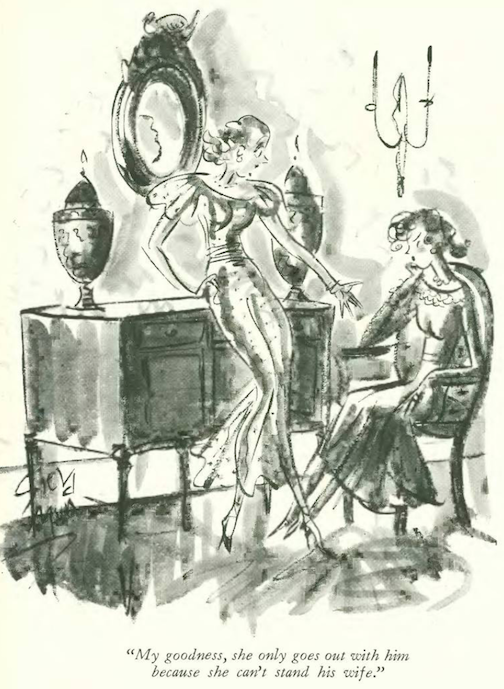
When Mae West announced she was going to present a modern version of William Shakespeare’s Macbeth and play the part of Lady Macbeth, Wolcott Gibbs went to work on possible scenarios for such a production. Here is one of them:

LADIES MACBETH?…Actually, only two of these women made the cut to play Lady Macbeth. Gladys Cooper (center) appeared as Lady Macbeth in a 1935 production at the Ethel Barrymore Theatre that lasted barely a month. The following year Edna Thomas (right) portrayed Lady Macbeth in a Federal Theatre Project production of Macbeth with an all-Black cast. Orson Welles adapted and directed the production, which was staged at Harlem’s Lafayette Theatre. It became a box office and critical sensation.

 *  *  *

Those Hats Again

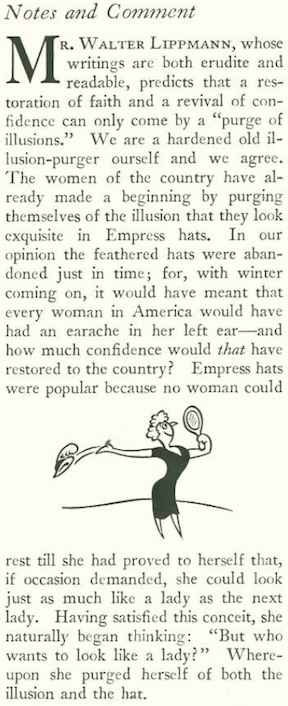
And now to E.B. White, who once again explored the mysteries of the Empress hat:
TAKE THIS, MR. LIPPMANN…Thelma Todd wearing an Empress Eugénie hat in the 1932 comedy Speak Easily. (Wikipedia)

  *  *  *

Rah, Rah, Sis Boom Bah

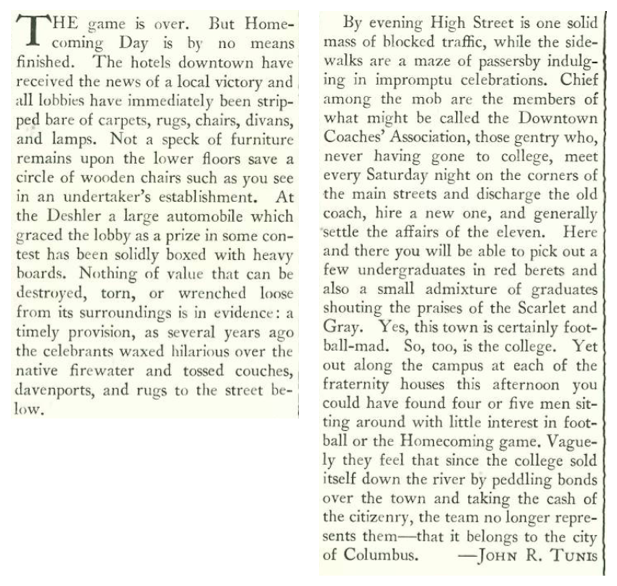
And so, in a city with one of the most storied teams in Major League Baseball, The New Yorker continued to ignore that sport as it gushed over college football, John Tunis even going the extra mile to check out homecoming at Ohio State.
HOMECOMING ROYALTY…THE Ohio State football team went 6-3 in 1931, but they blanked Navy 20-0 in their homecoming game. (elevenwarriors.com)

*  *  *

Boxing Brainiac

Several times before in this blog we have encountered boxing great Gene Tunney and his taste for the literary life. E.B. White gave us the latest on the Champ in “The Talk of the Town”…

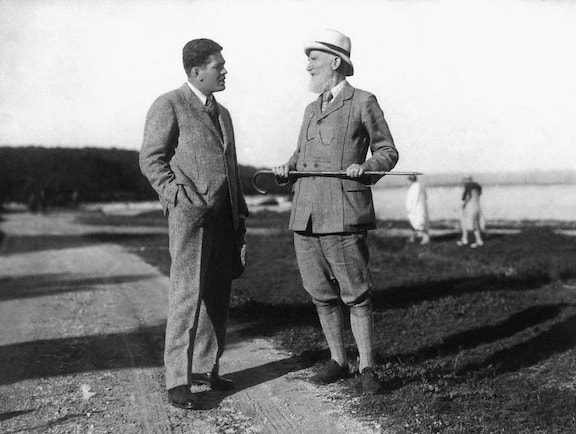
THE FINER THINGS…Heavyweight Boxing Champion Gene Tunney, left, discusses things that don’t involve hitting people with writer George Bernard Shaw during a 1929 vacation to Brioni. (Associated Press)

 *  *  *

From Our Advertisers

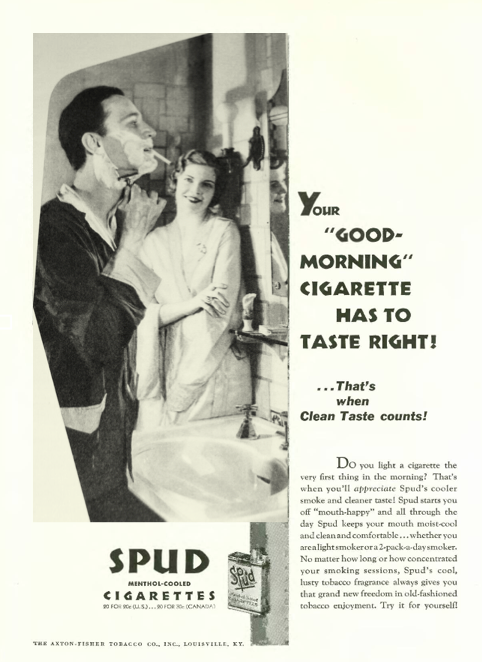
It’s the Depression, Prohibition is still in force (kind of), so what’s a body to do to blow off some steam? Well, you could take up smoking, every waking moment, at least when it came to this guy…
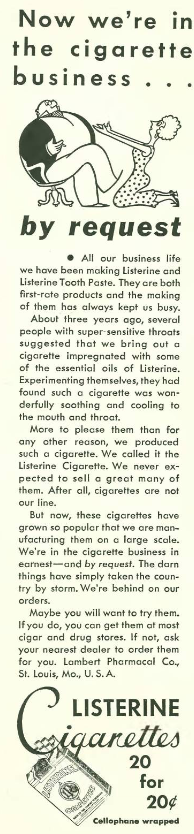
…and these were the days when tobacco companies offered competing claims about the health benefits of their cigarettes (weight loss, calmer nerves etc.). So the folks at Listerine, who were all about keeping you safe from nasty mouth germs, launched a cigarette of their own, which was “taking the country by storm,” at least in their estimation…
…and I throw this in to give you an idea of how far cigarette companies would go, and how folks would respond in the early 1930s…at left is a 1932 advertisement from the back cover of Popular Mechanics, telling us that “Everybody” is deeply inhaling their product…of course people became addicted, including this young woman (right) featured in a 1931 Popular Science news item who managed to smoke and read a book while reducing her figure…

…back to the ads from the Nov. 7 issue, here is one that offered a “scientific” way to remove nicotine from cigarettes, allowing only “pure tobacco” to enter your pink lungs…

…and now a couple of lovely color ads for Houbigant cosmetics…

…and our friends at Alcoa, diligently working to convince Americans that aluminum furniture was the modern way to keep your house “in step” with the times…

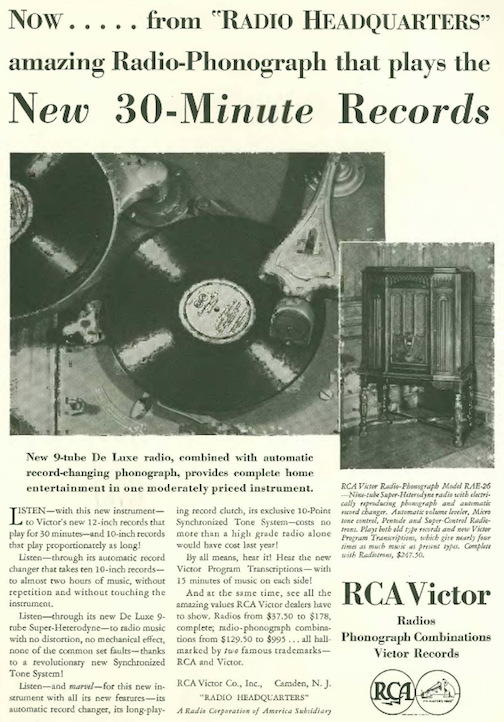
…and finally, RCA Victor was offering an early version of the LP record, so you wouldn’t have to stop necking to turn the damn record…
…on to our cartoons, we begin with Gardner Rea

…John Reehill gave us a lover who probably watched too many romance movies…

…contrasting with this fellow illustrated by Carl Rose, who doesn’t lift a finger to find some romance…
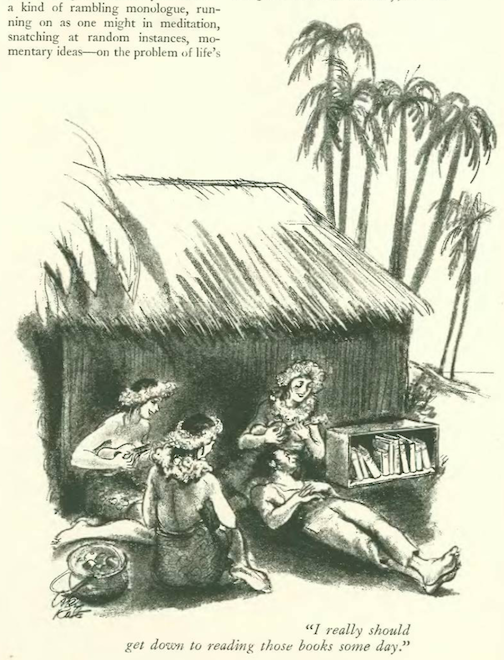
…and while we are on the subject of love, here is a modern twist offered by Barbara Shermund

William Crawford Galbraith gave us a far more detached view of the game of love…

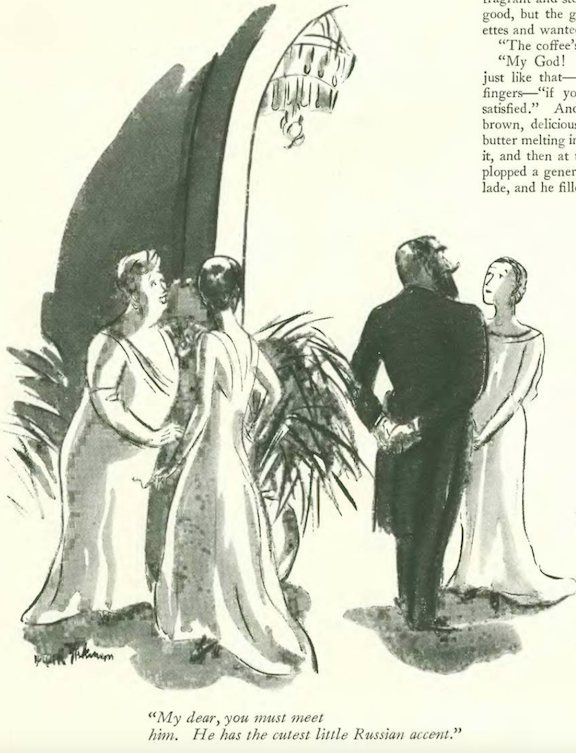
…while Helen Hokinson found an attraction of a different sort with one of her “girls”…
Alan Dunn looked in on the baking business, industrial-sized…

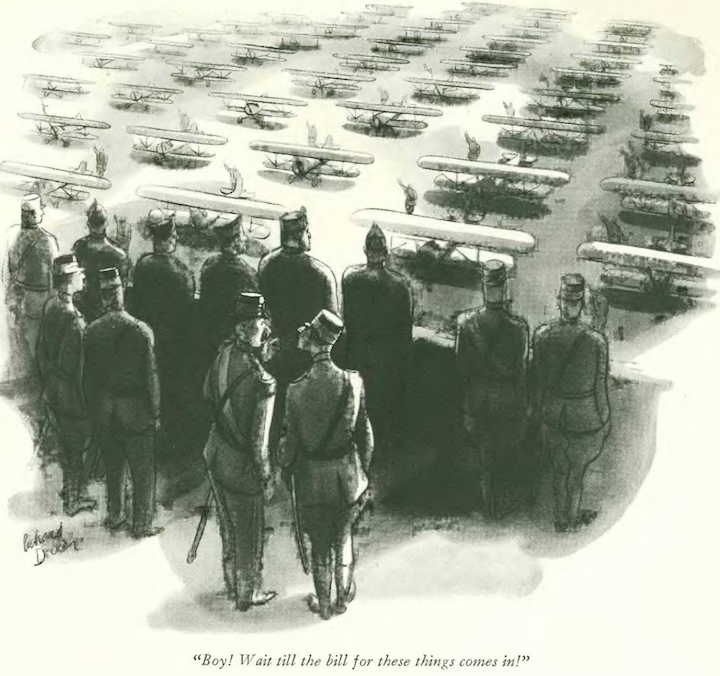
…and we end with Richard Decker, and the price of war…
Next Time: All That Glitters Is Not Gold…

Knickerbocker Junction

In the last post we briefly looked at changes that were coming to Fifth Avenue as it made a transition from a place of high society residences to high society commercial interests.

The May 2, 1925 “Talk of the Town” noted that “New York is no longer the beginning and ending of all things social,” as Fifth Avenue town houses were rapidly disappearing as more of the wealthy elite were building country estates in Tuxedo, Newport or Long Island.

Screenshot 2015-04-03 11.32.16
May 2, 1925 cover by Margaret Schloeman (New Yorker Digital Archive)
images
One Sutton Place (city realty.com)

For those remaining in the city, the trend was toward smaller dwellings that didn’t require large staffs, including apartments in locations such as the new Sutton Place.

There were some hold-outs, including Charles Schwab. Although he kept a suite at the Ritz and his wife lived in a “palatial” residence in Loretta, Penn., he nevertheless employed “a full staff of servants” at the “great gray pile with the quaint statue of a steel puddler on the lawn.” This 75-room “pile,” constructed 1902-1906, occupied an entire block between West End Avenue and the Riverside Drive, Seventy-third and Seventy-fourth streets.

Aerial View of Charles M. Schwab Mansion
Charles Schwab’s “great gray pile…” (nycago.com)
115384264
…replaced by the Schwab House apartments in 1948. 

Schwab made his fortune in steel, and was the first president of the U.S. Steel Corporation (He was not related to Charles R. Schwab, founder of the Charles Schwab Corporation, but was the grandfather of Charles R. Schwab the discount broker). After Schwab died in 1939, New York mayor Fiorello La Guardia turned down a proposal to make the mansion the official mayoral residence, considering it too grandiose. It was torn down in 1948 and replaced by the Schwab House, an 18-story apartment building.

photlo
The Astor Ballroom could hold 1,200 people. (thegildedageera.blogspot)

“Talk” also reported that one of old society’s grand gathering places, the Astor mansion at 840 Fifth Avenue, was being made available for various charity events that charged ten dollars for a peek at the Astor ballroom, although it was reported most of the visitors were more interested in the dining room than “in the scene of so many brilliant cotillions, of Ward McAllister’s arrogance toward dowagers and of Mrs. William Astor’s imperial rule of a society arbitrarily exclusive.”

The death of famed portrait painter John Singer Sargent was noted in both the “Talk” and “Art” sections, while a feature titled “The New Conquistadors” poked fun at the Babbitt-like promoters of the Florida real-estate boom:

Screenshot 2015-04-08 10.40.10
(New Yorker Digital Archive)

“Profiles” noted the passing of Sam Drebin, referred to as the “Fighting Jew.” Written by screenwriter William Slavens McNutt, the piece noted the pat irony of Drebin’s death—that a man who braved untold hazards and fought with more than a dozen armies should die “in the stuffy quiet of a doctor’s office when an assistant gave him medicine from the wrong bottle.”

Screenshot 2015-04-08 10.44.00
A Charles Baskerville drawing of Johnny Hudgins (New Yorker Digital Archive)

For all the sophistication of the early New Yorker magazine, attitudes toward various racial groups, especially blacks, was sadly in concert with the times. The section “When Nights Are Bold” mentions a minstrel performance at the Club Alabam by Johnny Hudgins, noting that the entertainer is “as funny as ever, but the rest of the outfit automatically catalogues itself under ‘fast moving brown skin.’ If you are interested in gold teeth, you’ll find some dressy sets there.”

Hudgins was both a vaudeville performer and part of the Harlem Renaissance. He developed blackface pantomime routines with a jazz trumpet soloist who played vocal-sounding “wah-wah” effects with a plunger mute while Hudgins mouthed the words and performed a comic dance. Fans called him “The Wah-Wah Man.” The French hailed him as the “colored Charlie Chaplin” when he performed in the Parisian Revue Negre that also featured Josephine Baker. Hudgins died in 1990 at age 94.

hudgins
Johnny Hudgins and Florence Mills Rehearsing on the Pavilion Theatre Roof in 1926 (elvirabarney.wordpress.com)

African-Americans, however, were not the only ethnic group to singled out for stereotypical depictions, as this title art from Arthur Guiterman’s recurring poetry feature “Lyrics from the Pekinese” suggests:

Screenshot 2015-04-08 12.24.27
(New Yorker Digital Archive)

From the very first issues The New Yorker kept an eye on the city’s dramatically changing skyline as old landmarks fell and skyscrapers soared. R. W. Sexton was the magazine’s early architecture critic (to be followed by notables included Lewis Mumford and Paul Goldberger).

In the section “The Sky-Line,” Sexton wrote about the planned demolition of Madison Square Garden (it was the second facility to bear the name; today’s MSG is the fourth) and how critics, including foreign visitors, often taunted New Yorkers about their “rabid commercialism.”

madison square garden 4th ave
Stanford White’s Madison Square Garden. (daytoninmanhattan.blogspot.com)
Screenshot 2015-04-08 13.55.34
(Left, Museum of the City of New York; right, Wikipedia)

Sexton wrote that the criticism is deserved to an extent, but noted that a structure can only be fine from an architectural standpoint if its value is both artistic and practical.

Unknown
Shelton Hotel at 49th and Lexington, which opened in 1924. (New York Times)

Such an attitude would see the erasure of many landmarks, and in some cases whole neighborhoods when Robert Moses entered the picture.

It was also the attitude that led to the destruction in 1963 of one of the world’s architectural wonders—Penn Station—an act that finally prompted New Yorkers to push for preservation laws.

Sexton suggested that “the finest building in New York” was the Shelton Hotel, a building “designed for modern New York, and looks neither to Italy nor to France for it inspiration and example.”

NYC057
Hood’s Radiator Building (Copyright friendsofsdarch)

He said the same applied to Raymond Hood’s American Radiator building (opened in 1924). When the Gothic style is employed, Shelton suggested that Bush building on 42nd Street is the finest adaption of the style to a skyscraper.

Shelton concludes that the “set-back laws” for buildings (which prevented tall buildings from blocking all of the light from the street) actually helped to further develop a unique architectural style for the city.

BushBuilding
Bush Building (Real Estate Weekly)

Still standing at 130-132 West 42nd Street, the Bush building, designed by architect Harvey Wiley Corbett and constructed from 1916-18, was notable for its role in the evolution of Times Square and of New York skyscrapers after the 1916 Zoning Resolution.

Advertising was picking up a bit, as we see on the final page of the issue.

It will be a while until we see beer and liquor ads. However, the spate of sparkling water ads in the early, prohibition-era issues suggests that readers were not being encouraged to drink more water, but rather to use it as a mixer for bathtub gin or whatever they could get their hands on in those so called dry years.

Screenshot 2015-04-08 10.49.09
(New Yorker Digital Archive)