Vive La Normandie

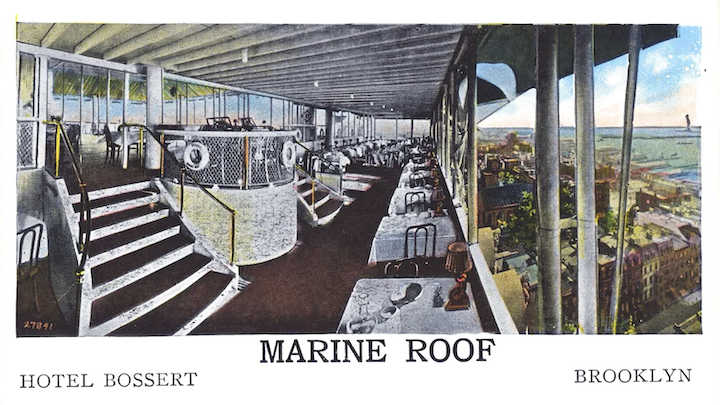
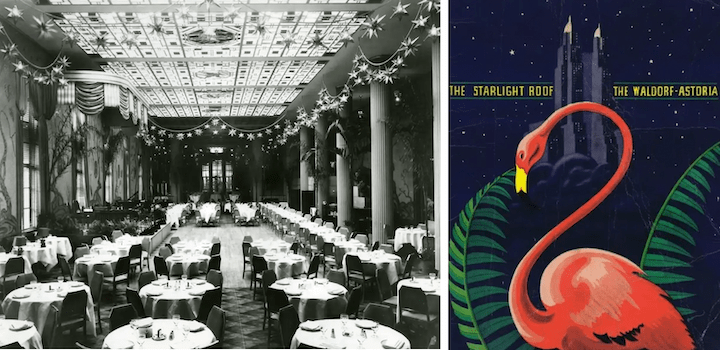
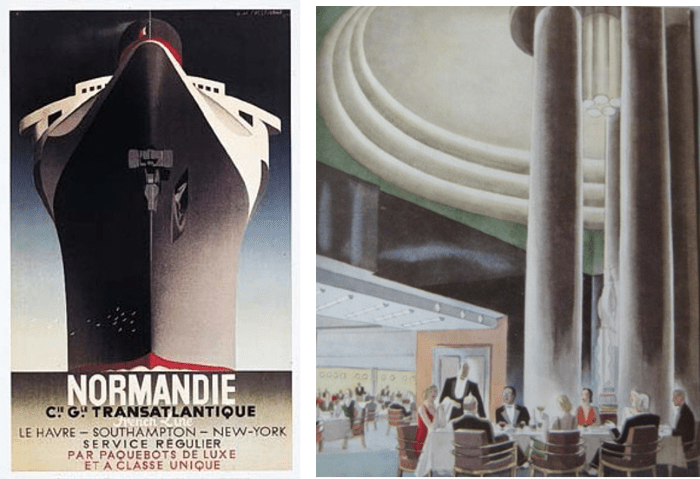
Above: At left, Adolphe Cassandre's famed 1935 depiction of the S.S. Normandie; right, image from a 1935 promotional booklet published by the French Line.

When the S.S. Normandie entered service in 1935, she was the largest and fastest passenger ship afloat, crossing the Atlantic in a little over four days. The ship was so impressive that even the imperturbable Janet Flanner expressed enthusiasm over its launch.

May 25, 1935 cover by Constantin Alajalov.

As Paris correspondent, Flanner was giving New Yorker readers a preview of Normandies May 29 maiden voyage from Le Havre to New York City.

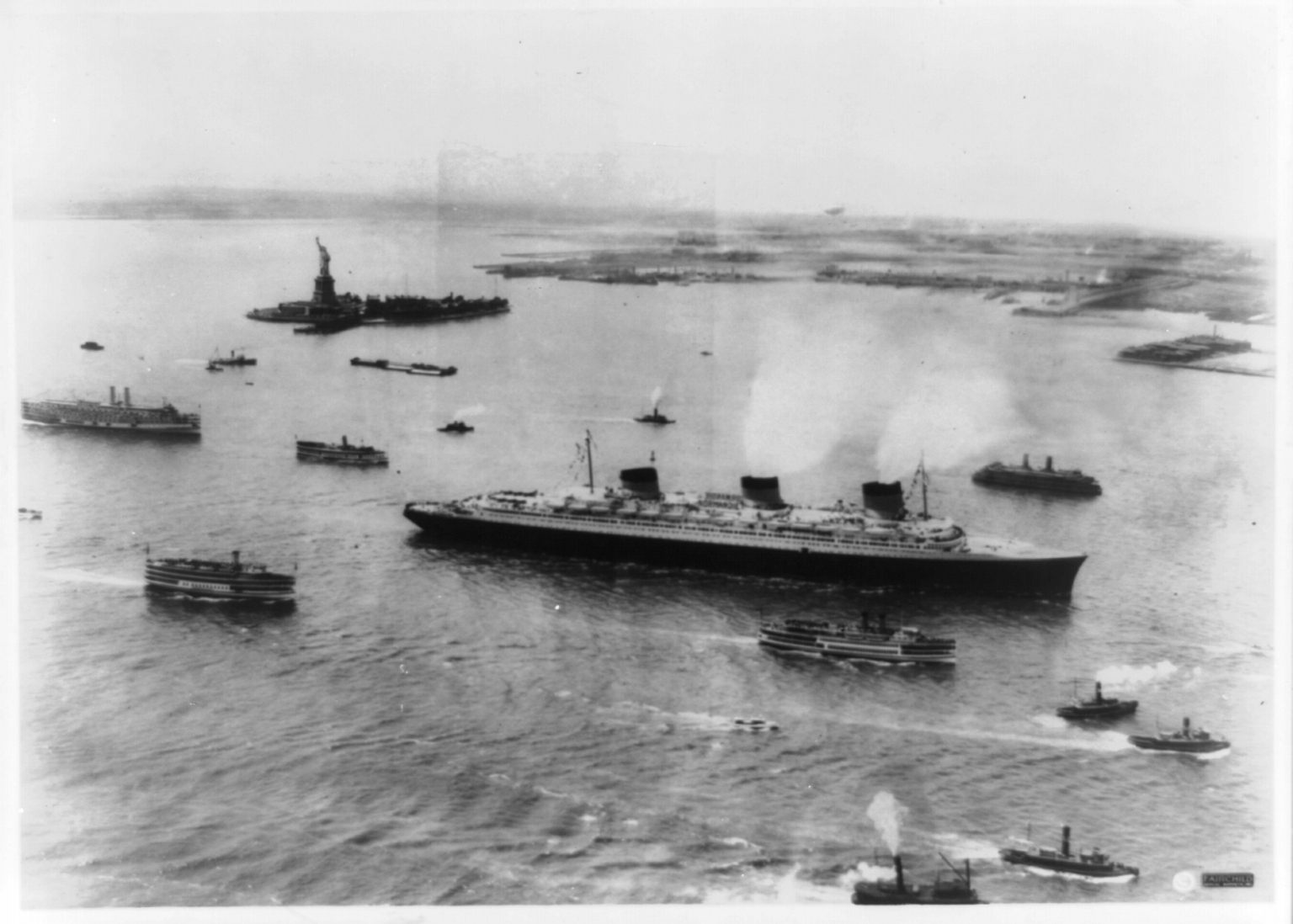
HER ENTOURAGE…The S.S. Normandie was welcomed into New York Harbor on June 3, 1935. (Wikipedia)
IMAGINE THAT…An S.S. Normandie promotional poster from 1935 depicts the ocean liner making an unlikely entrance into Manhattan. The sleek ship measured 1,029 feet (313.6m) in length and carried nearly 2,000 passengers plus 1,345 crew. It was the first ocean liner to exceed 1,000 feet in length. (Museum of the City of New York–MCNY)

To give New Yorkers some idea of the liner’s size, Flanner noted that the Normandie would stretch from 43rd to 47th Street, and if stood on her stern, would stand nearly 180 feet above the RCA Building at Rockefeller Center.

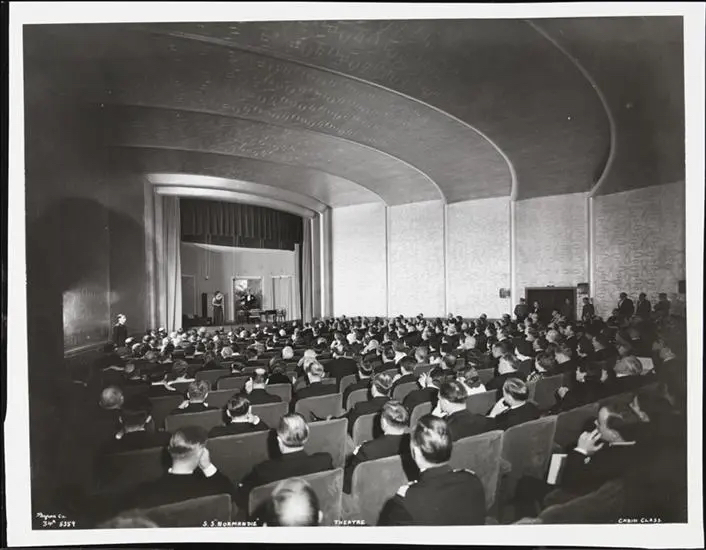
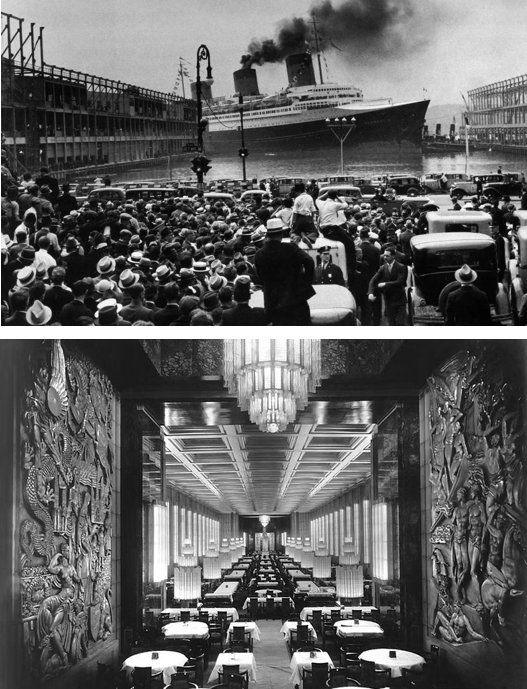
FRENCH TOAST…Top, a crowd cheers the S.S. Normandie as it arrives at New York’s Pier 88 on June 3, 1935; below, the first class dining hall was 305 feet long, 46 feet wide and three decks high. (drivingfordeco.com/MCNY)
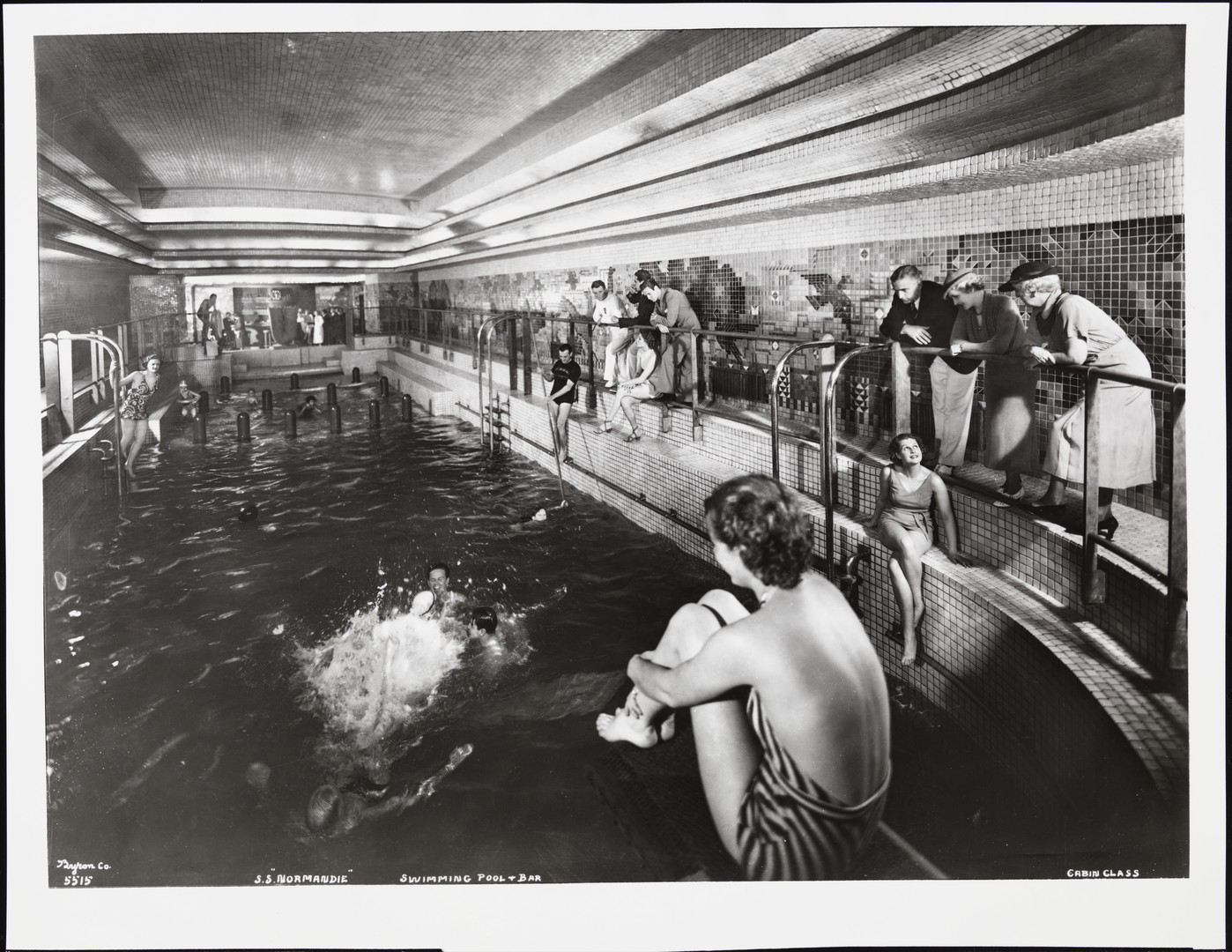
IN, AND ON THE WATER…Passengers take a plunge in the Normandie’s swimming pool, which included a bar at the far end. (MCNY)
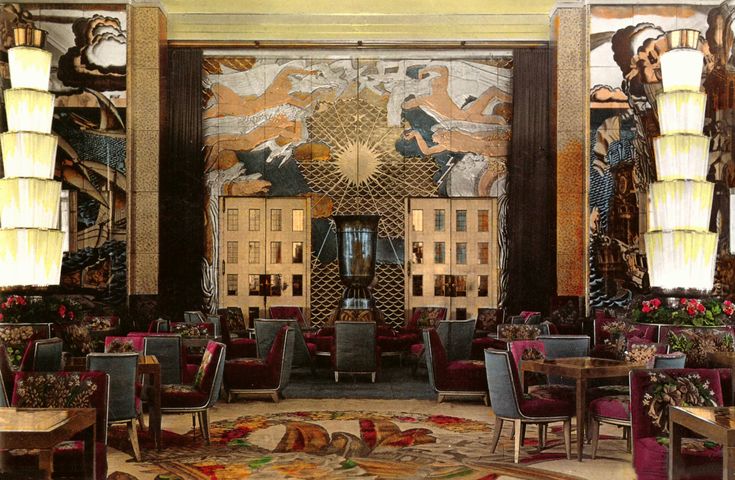
EYE-POPPING…Colorized image of the first-class lounge. (Pinterest)
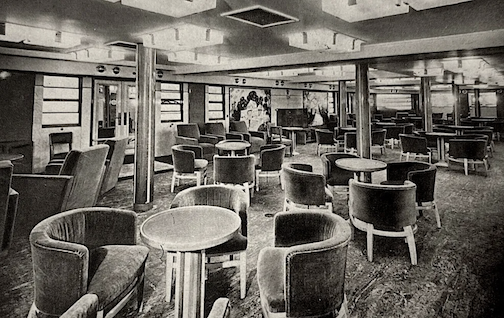
BARGAIN…Accommodations for weren’t too bad, either, for the other classes. Here is the 3rd class salon. (drivingfordeco.com)
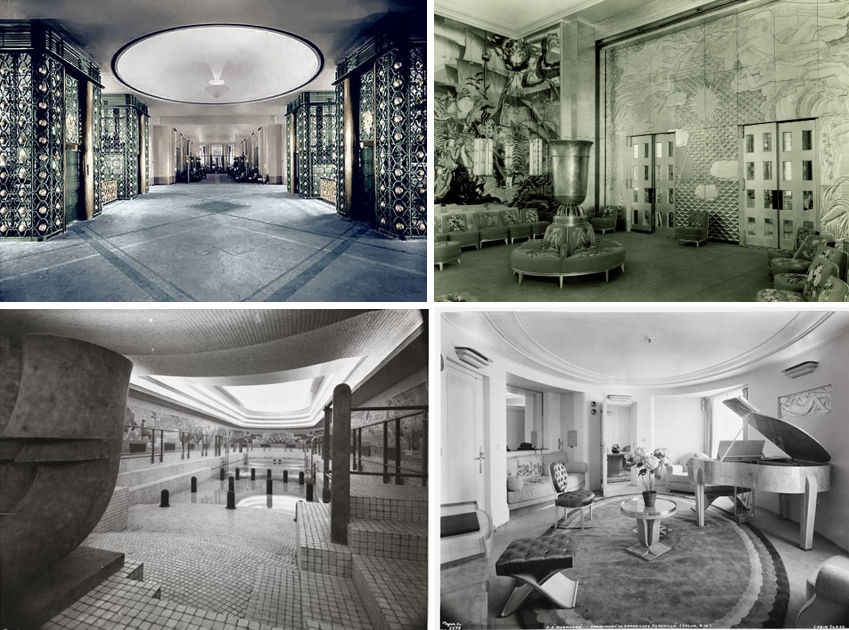
TAKE YOUR PICK…Clockwise from top left, elevators decorated in sea shells; the rear of the Grand Salon; a first class suite; view of the swimming pool. An incredible scale model of the S.S. Normandie is displayed on the Queen Mary, which is permanently docked at Long Beach, CA. (MCNY)

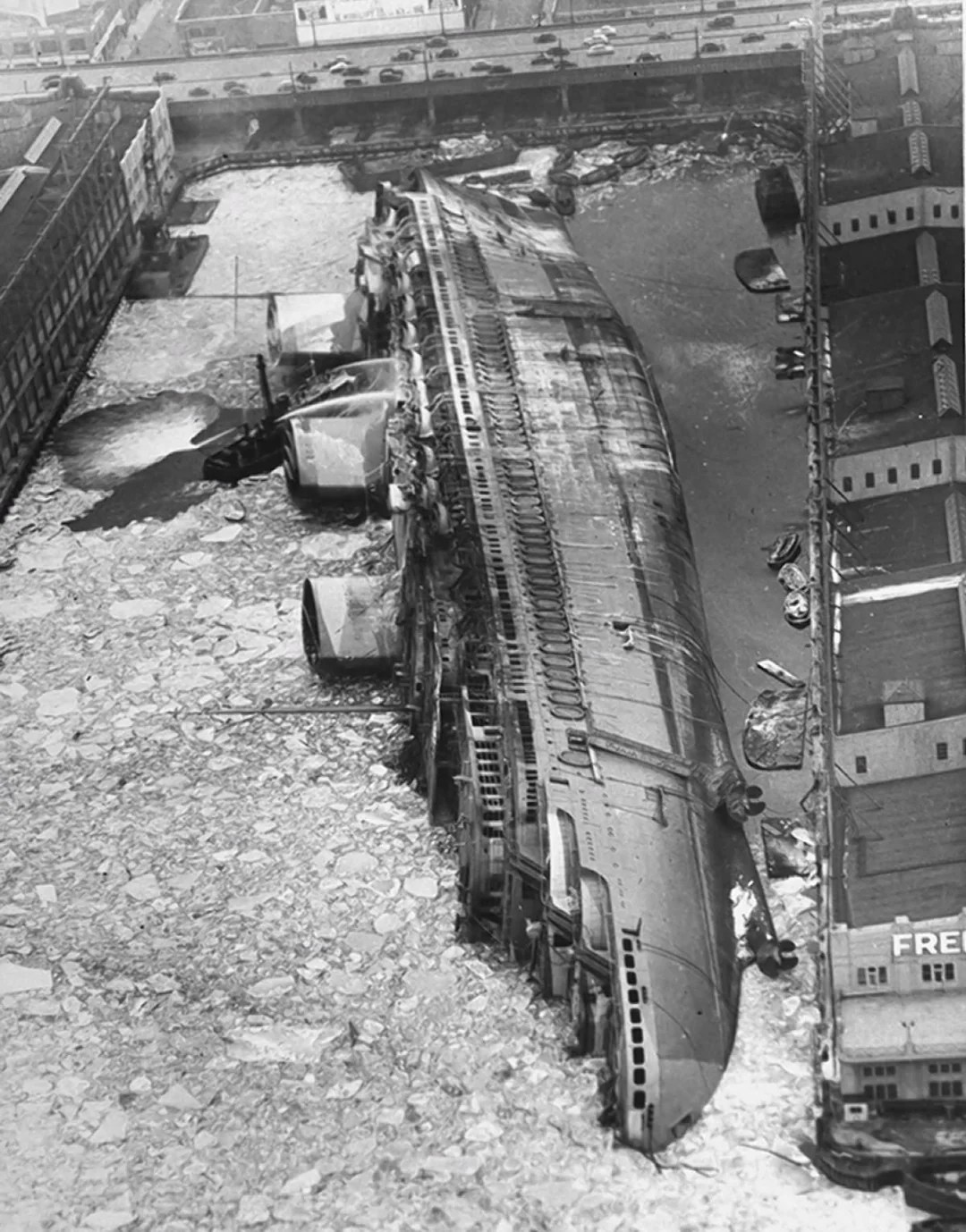
World War II would cut short the Normandie’s life. Seized in New York and renamed USS Lafayette in 1942, she was being converted to a troopship when she caught fire, capsized onto the port side, and came to rest half submerged on the bottom of the Hudson at Pier 88, the same pier where she was welcomed in 1935. She was scrapped in 1946.

THE WAGES OF STUPIDITY…The Normandie after a fire brought her glory days to an end. (Reddit)

 * * *

A Critic Is Born

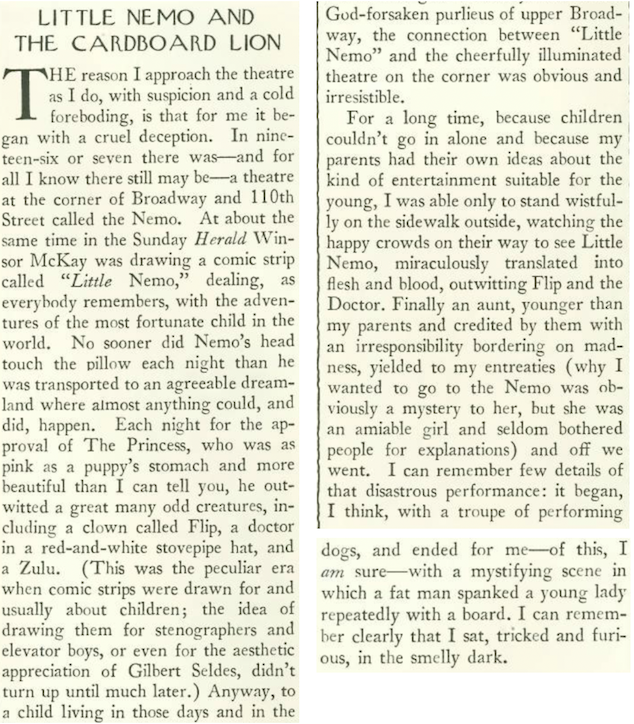
It turns out that Wolcott Gibbs (1902–1958) cut his teeth as The New Yorker’s theatre critic while he was still in short pants. Gibbs recalled his five-year-old self in an essay that described his first experience with the theatre—a play based on the New York Herald’s popular comic strip, Little Nemo in Slumberland, by Winsor McCay. In parallel with Gibbs’ childhood, the strip ran from 1905 to 1911.

As a child, Gibbs was wild about Little Nemo’s adventures, but the stage adaptation left the child disillusioned (and feeling “tricked and furious”). The New York Public Library’s Douglas Reside wrote (in 2015) that the producers, seeking to draw as wide an audience as possible, presented Little Nemo “as a bloated mixture of theatrical styles, including the minstrel show, pantomime, operetta, farce-comedy, vaudeville, revue, and ballet,” featuring three comedians “mostly superfluous to Nemo’s story.” The part of Nemo was played by a 25-year-old actor with dwarfism.

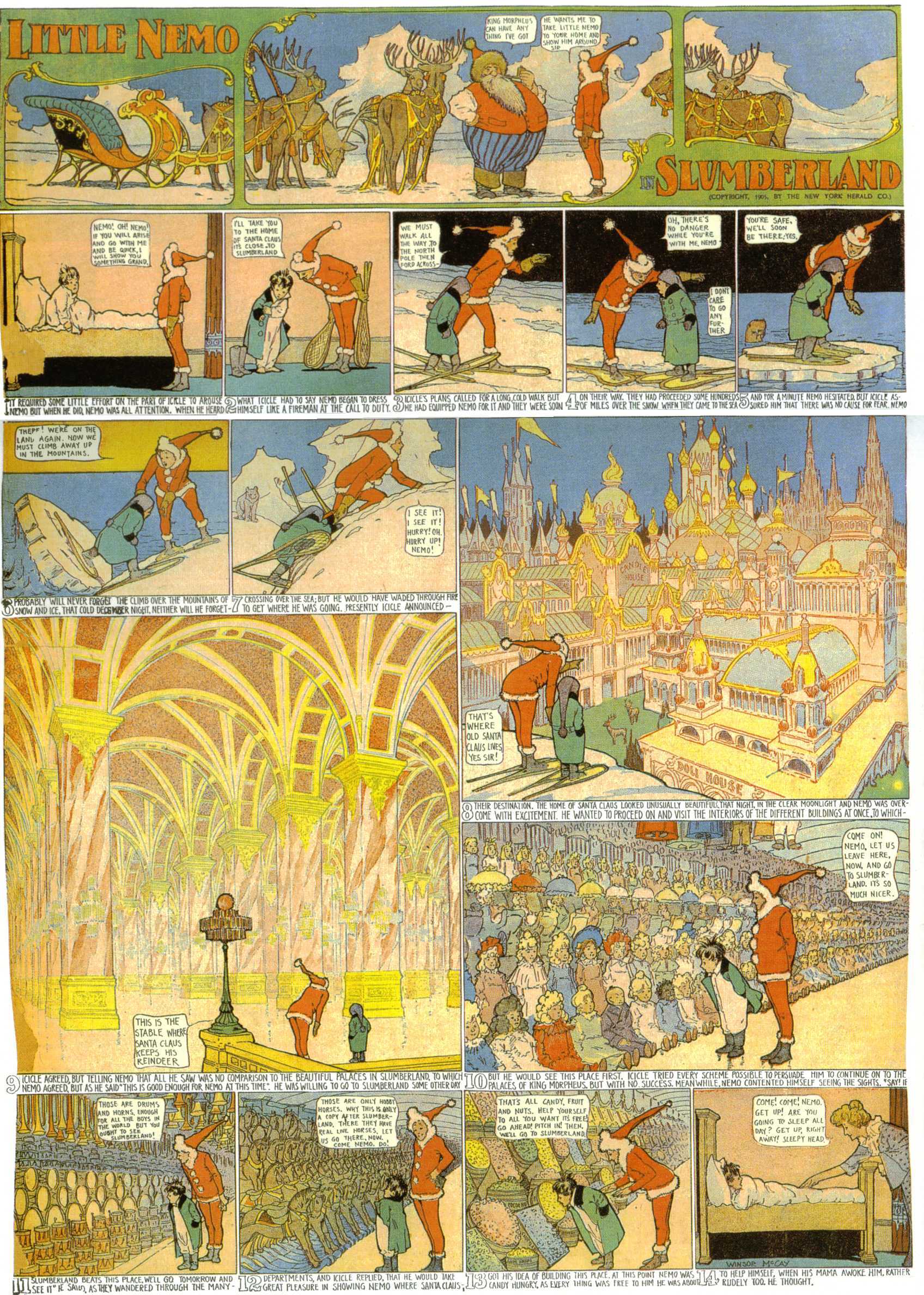
DREAMLAND…The Little Nemo strip from Dec. 17, 1905 depicted the boy’s dream of a visit to Santa’s magical city at the North Pole. (Wikipedia)
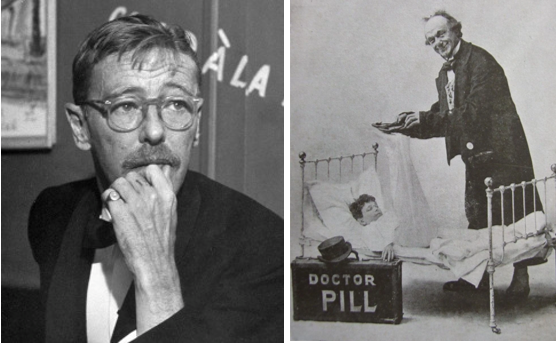
THAT’S SHOWBIZ…As a boy, Wolcott Gibbs (left) was disillusioned by a 1907 theatre adaptation of his favorite comic strip, Little Nemo in Slumberland. The play was dominated by three comedians including Joseph Cawthorn, right, who burlesqued German linguistic and cultural mannerisms for comic effect. He played Dr. Pill, the quack doctor of Slumberland’s royal court. The “boy” in the bed portraying Nemo was 25-year-old “Master” Gabriel Weigel. (Wikipedia/New York Public Library)

 * * *

Humorous Humors

Clarence Day, best known for his Life with Father stories, wrote humorously about his physical ailments and contributed a number of cartoons to The New Yorker that were accompanied by satirical poems. Day would be dead by December—after a bout with pneumonia—however, despite his ailments he would spend his last months arranging publication of his Life with Father book, which was published posthumously.

 * * *

Frankie Got Hitched

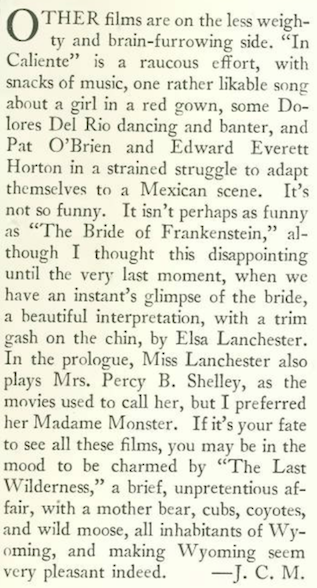
Film critic John Mosher still wasn’t finding much to rave about at the cinema, getting more chuckles from the monster mash-up of Boris Karloff and Elsa Lanchester in The Bride of Frankenstein than he did from the Dolores Del Rio vehicle Caliente.

DATE NIGHT…Top, Elsa Lanchester and Boris Karloff let the sparks fly in The Bride of Frankenstein, while Dolores Del Rio danced and chatted her way through the unfunny musical comedy Caliente. (Wikipedia/TCM)

* * *

Other features in the May 25 issue included H. L. Mencken’s continuing exploration into the origins of American names…

…and The New Yorker published its first John Cheever story, “Brooklyn Rooming House.” Of Cheever’s 180 short stories, the magazine would publish 121 of them.

A NEW FACE…In spring 1935 The New Yorker bought two John Cheever stories, paying $90 for “The Brooklyn Rooming House” and $45 for “Buffalo.” Fiction editor Katharine White urged the purchase of the stories. Above, Walker Evan’s photo of Cheever, circa 1940s. (metmuseum.org)

 * * *

From Our Advertisers

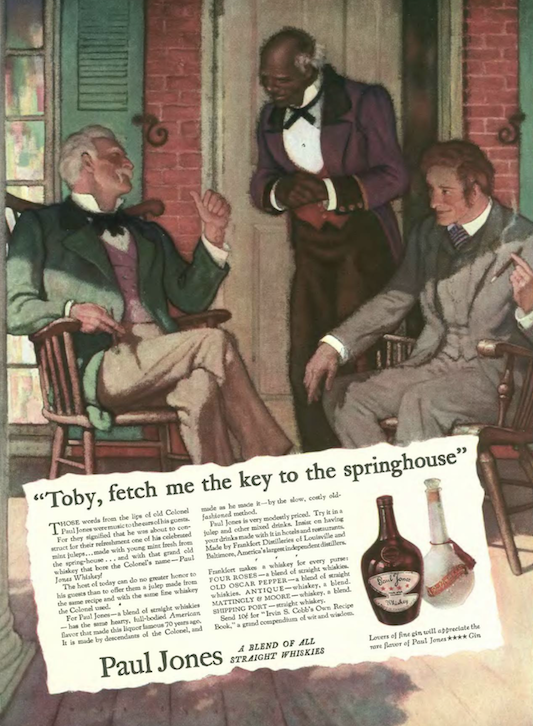
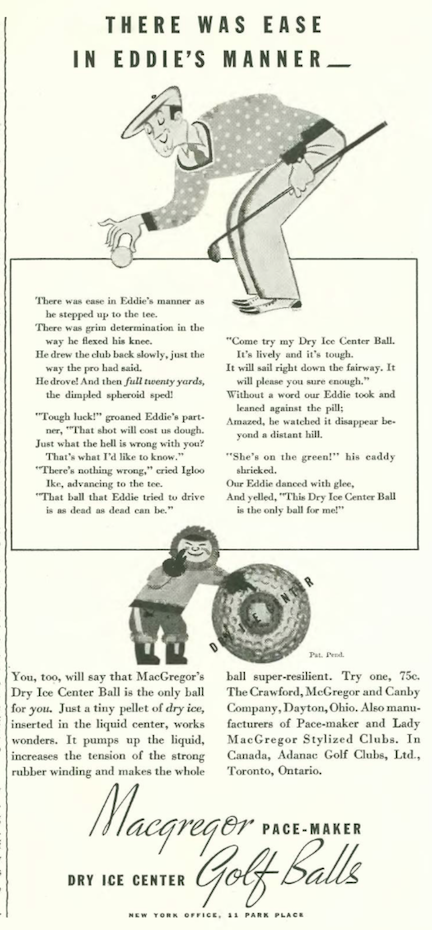
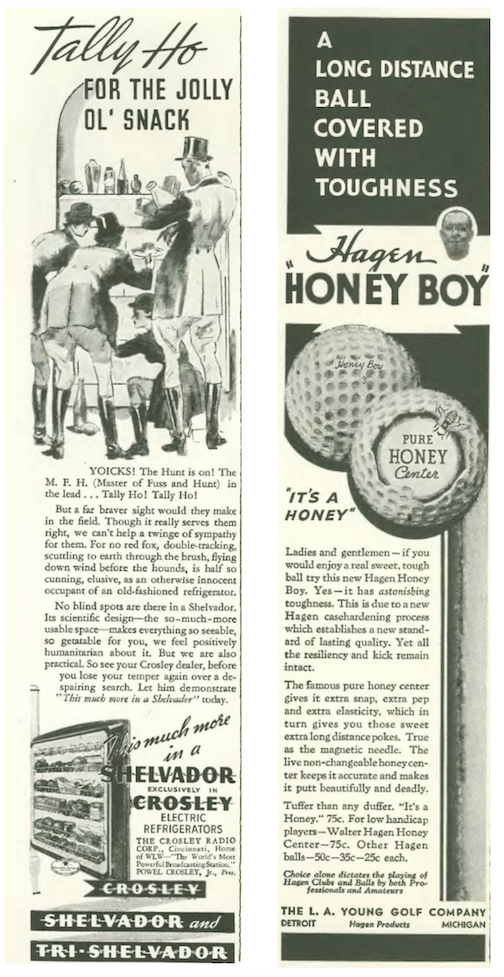
We start with some one-column gems from the back of the book including the latest innovation in electric refrigerators…a shelf in the door!…apparently Crosley was the first to invent this “Shelvador”…the ad to the right is interesting in that it advertises honey-filled golf balls…in the early 20th century some golf balls did contain real honey…apparently it was chosen for its consistent viscosity (or maybe for a quick snack on the ninth hole)…

…and from General Tire, we have another ominous warning from Dad as the teens head out for another night of crooning, or whatever they are dressed for…

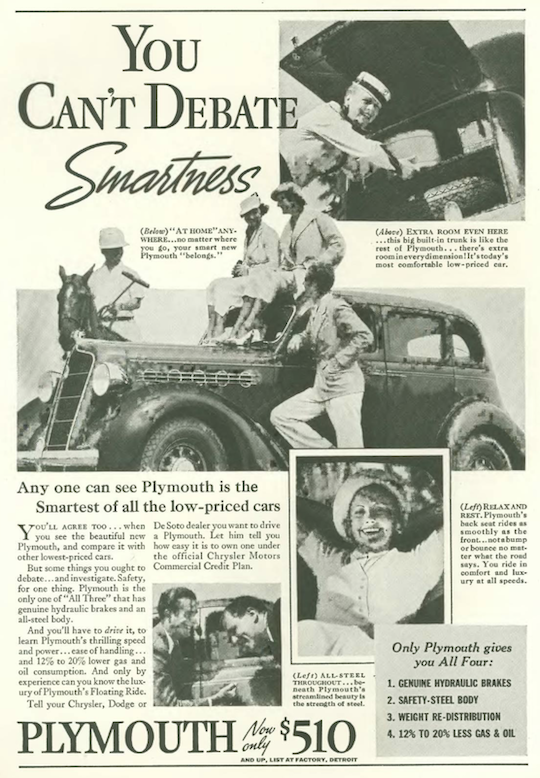
…last week Chrysler was offering its sedans for $745, and this week you could have one of their Plymouths for just 510 bucks…the message: you would be admired by your polo buddies for your smart, thrifty choice…

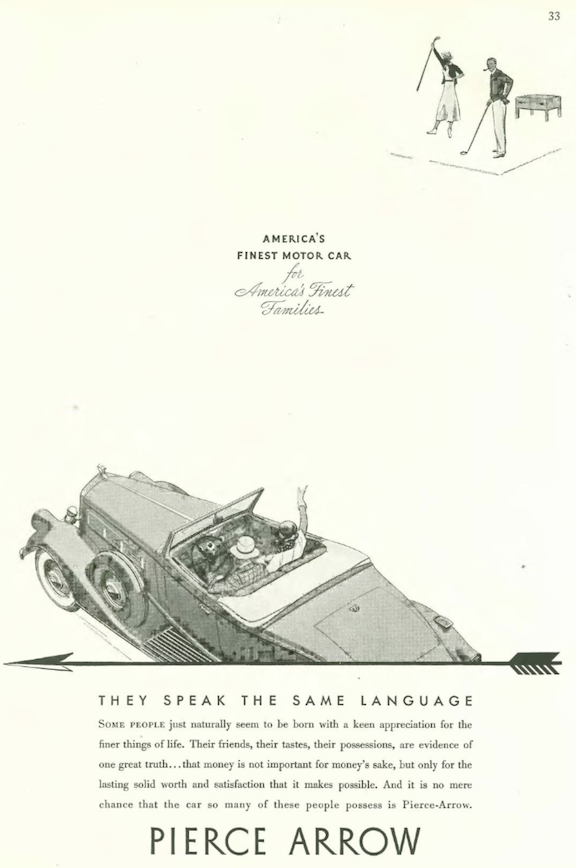
…where the above ad crammed every square inch with information, the folks at Pierce Arrow offered a restrained, minimal message (suggesting “we can afford to buy a full-page ad and leave much of it blank”)…another class signifier was the absence of a price tag (about $150k in today’s dollars)…but Chrysler-Plymouth would survive the Depression because it sold affordable cars, while Pierce Arrow was on its last legs…

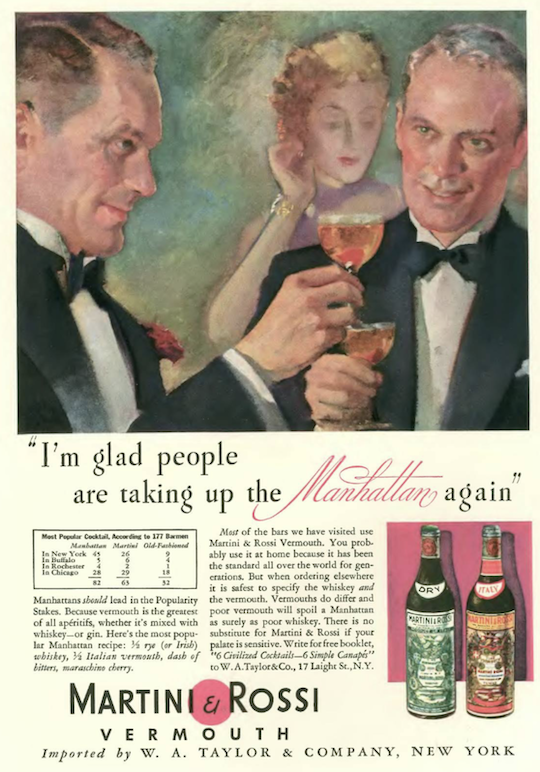
…here’s a couple of Pierce Arrow owners toasting the return of the Manhattan…

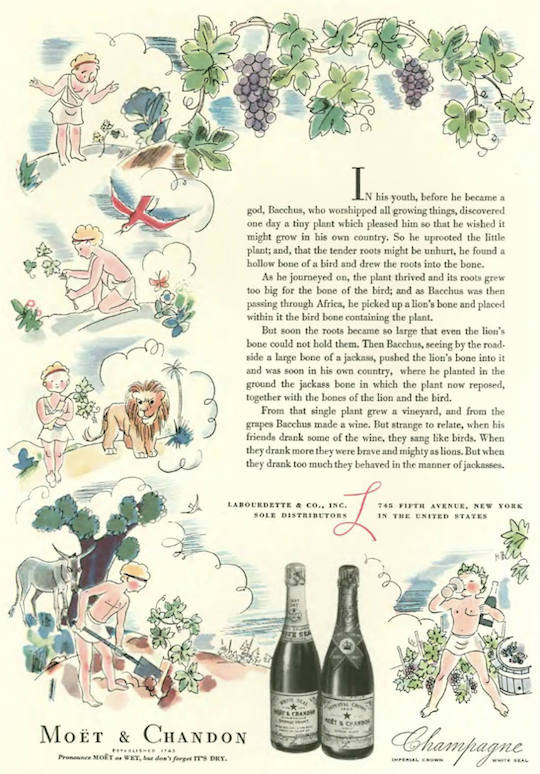
…Moët & Chandon offered up this whimsical tableau from the youth of Bacchus…

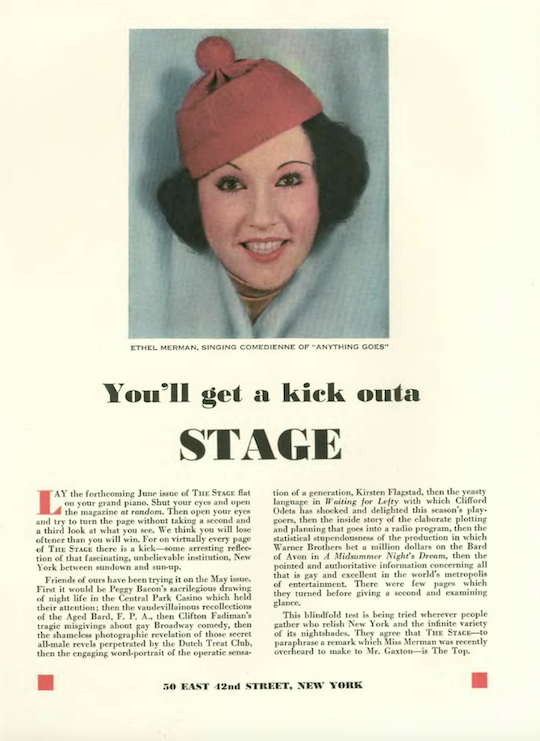
Ethel Merman popped through a curtain on the inside back cover to invite readers to subscribe to The Stage magazine…

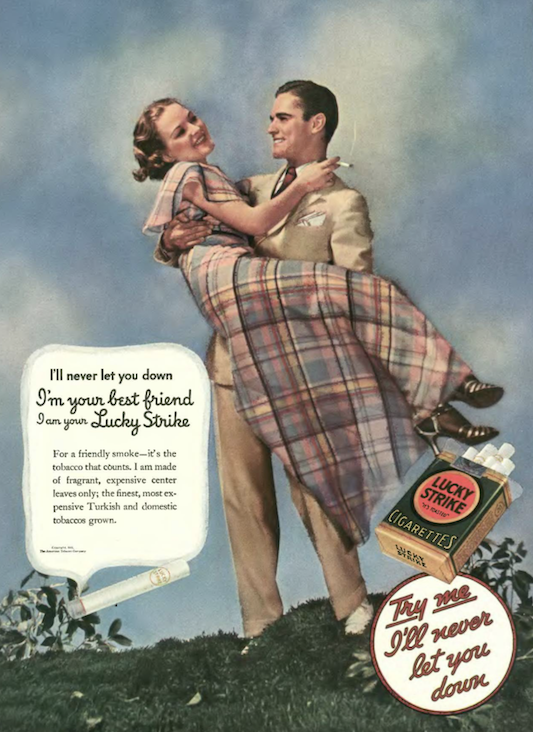
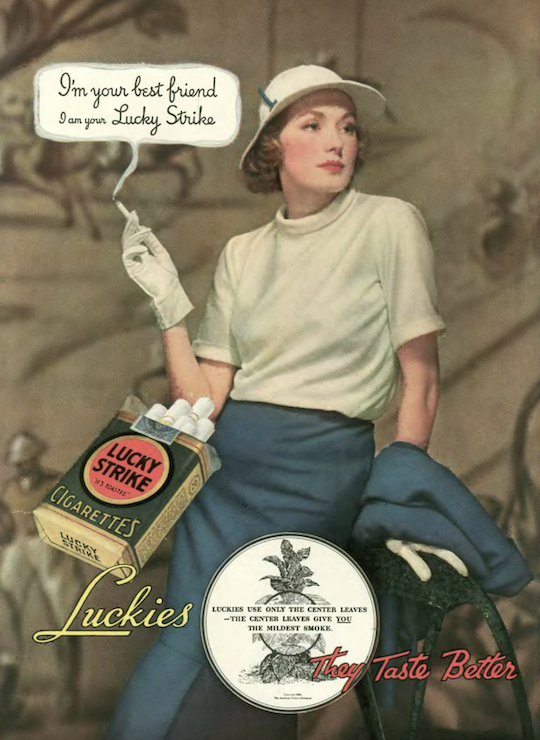
…and Lucky Strike claimed the back cover with another stylish woman and a talking cigarette bent on mind control…

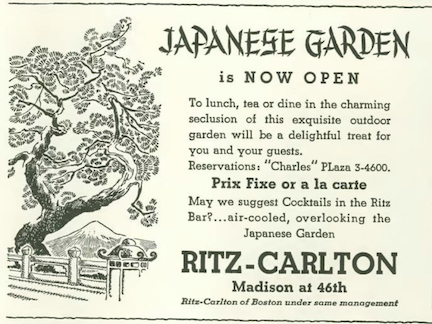
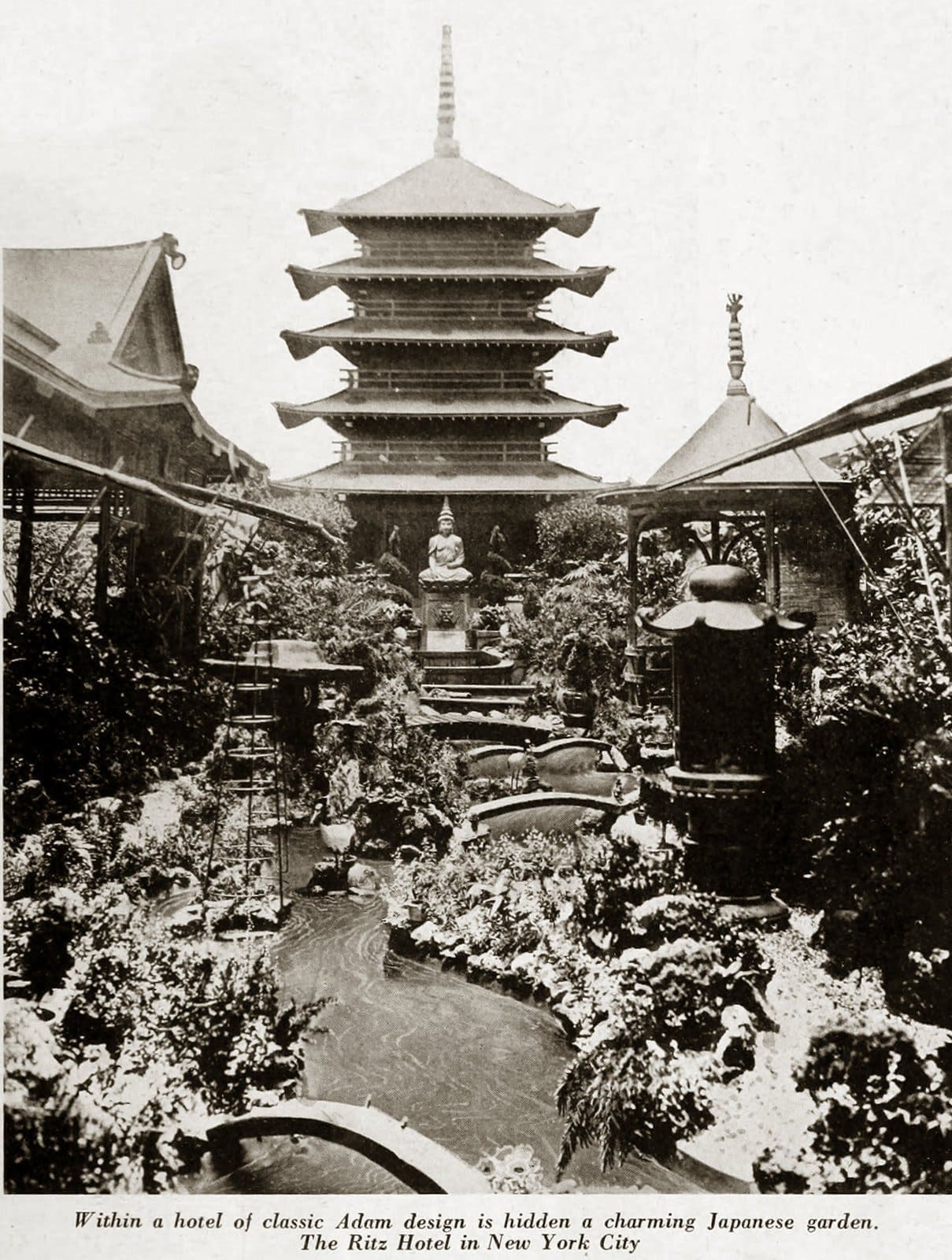
…the Ritz-Carlton announced the spring re-opening of its famed Japanese Garden…

The Japanese Garden in 1924. (clickamericana)

…and we kick off our cartoonists with this “Goings On” topper by D. Krán

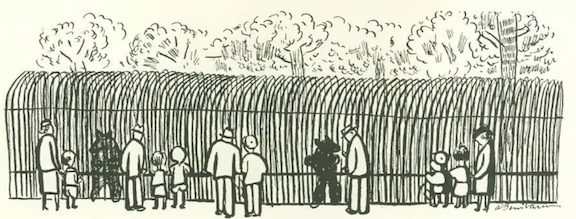
…followed by this visit to the zoo by Abe Birnbaum

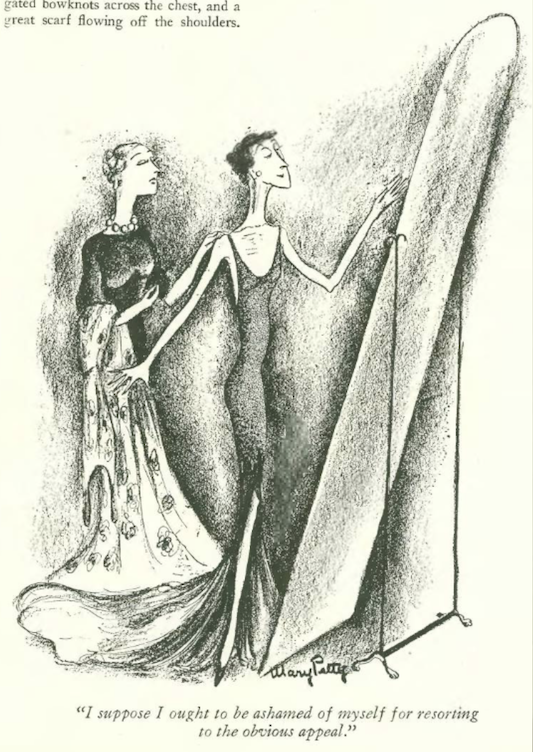
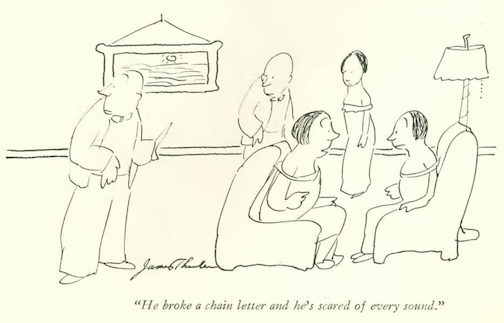
James Thurber was up for some fashion criticism…

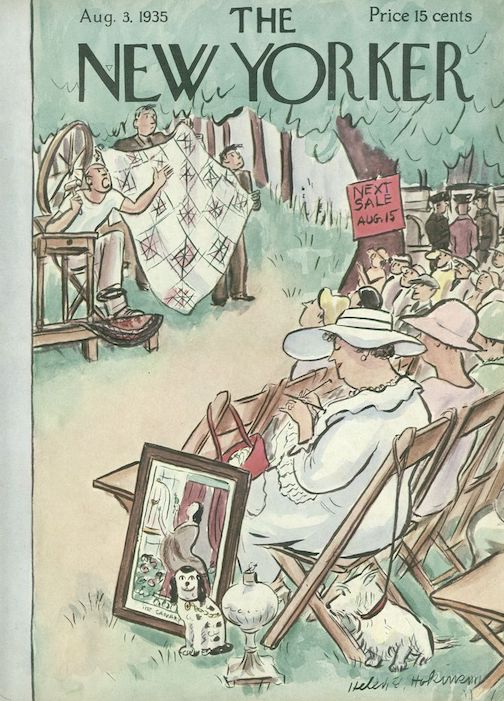
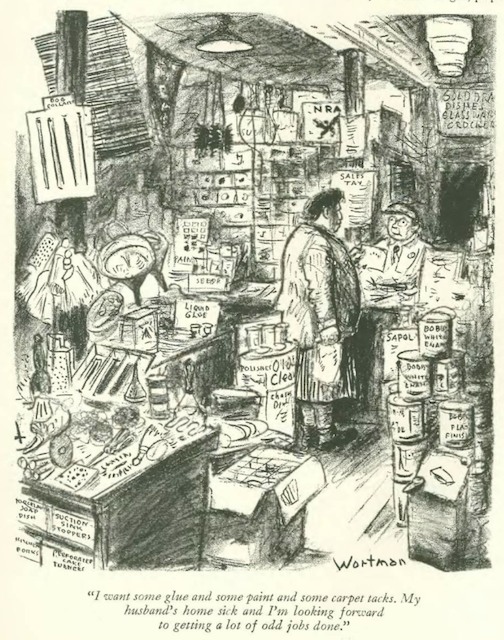
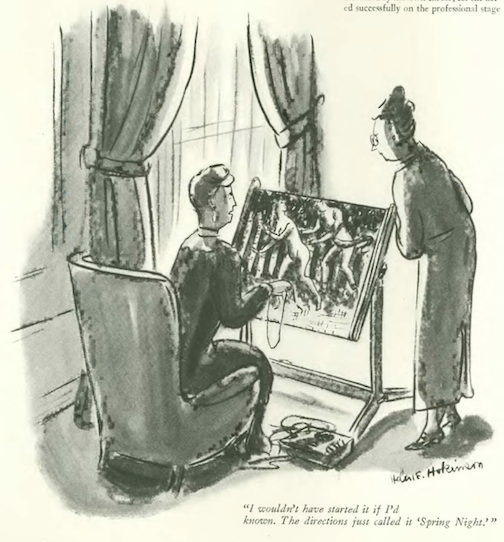
Helen Hokinson found a surprise in a paint-by-numbers kit..

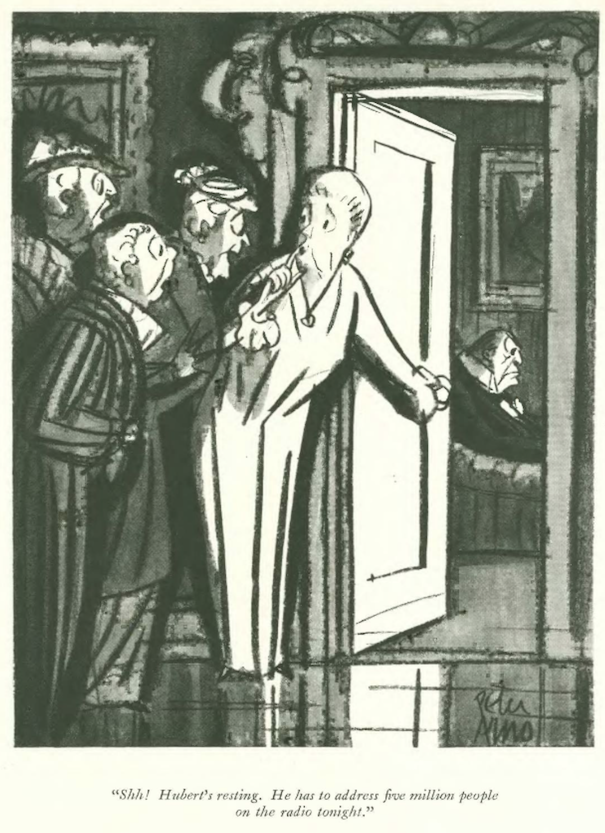
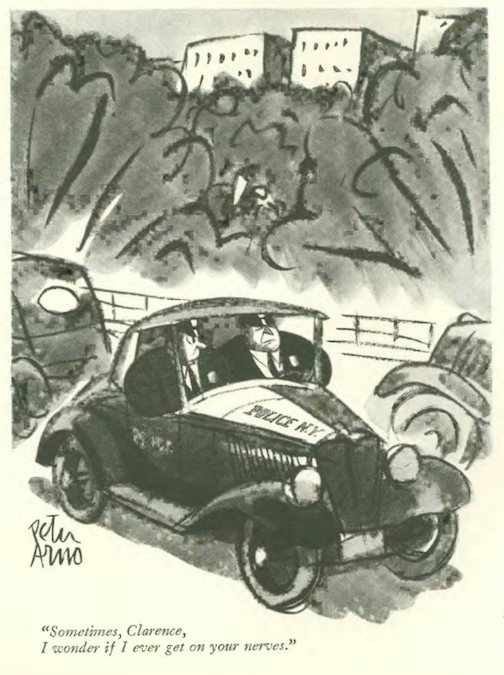
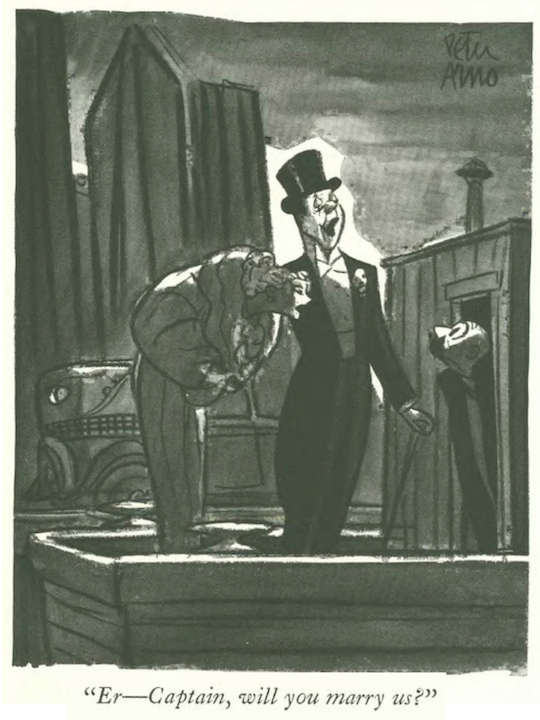
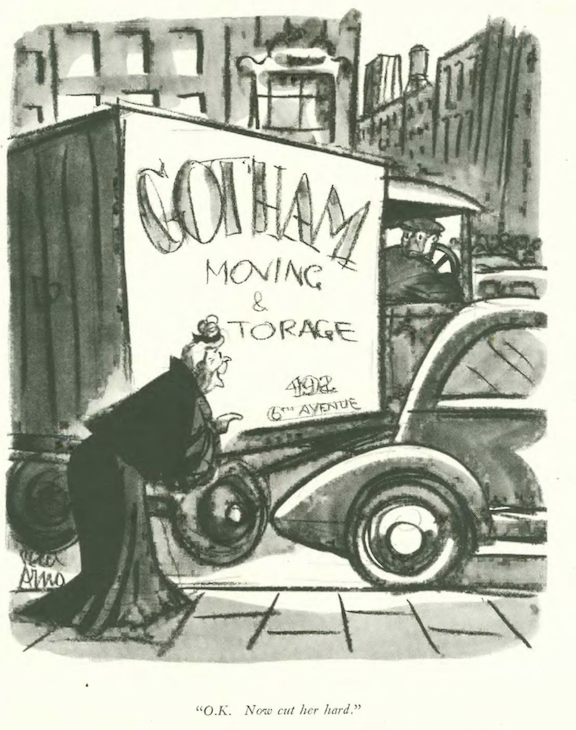
Peter Arno was up for some late night nuptials…

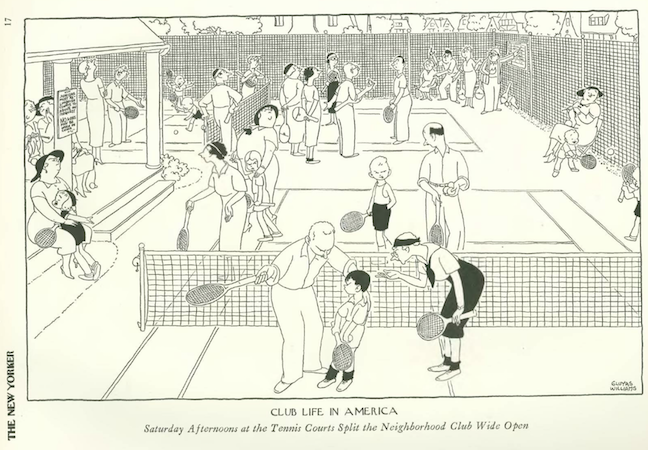
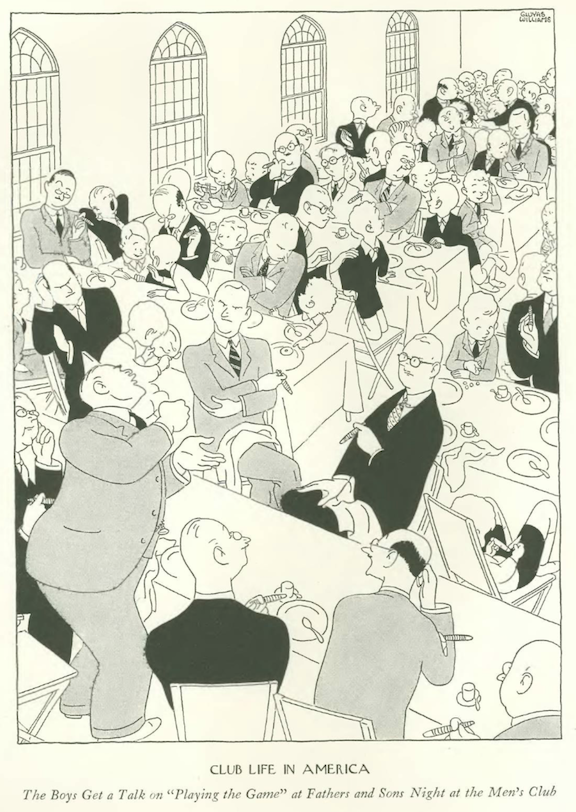
Gluyas Williams continued to examine club life…

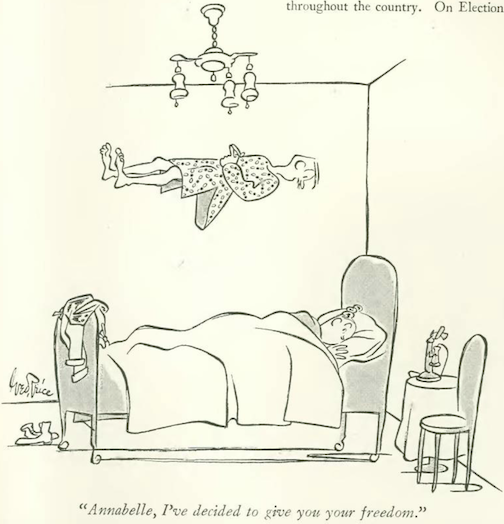
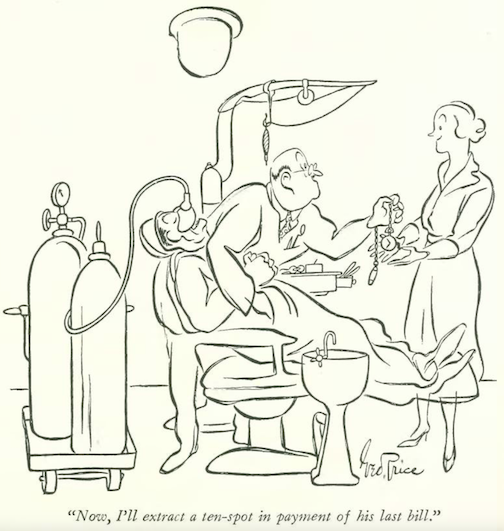
...George Price was back in the air…

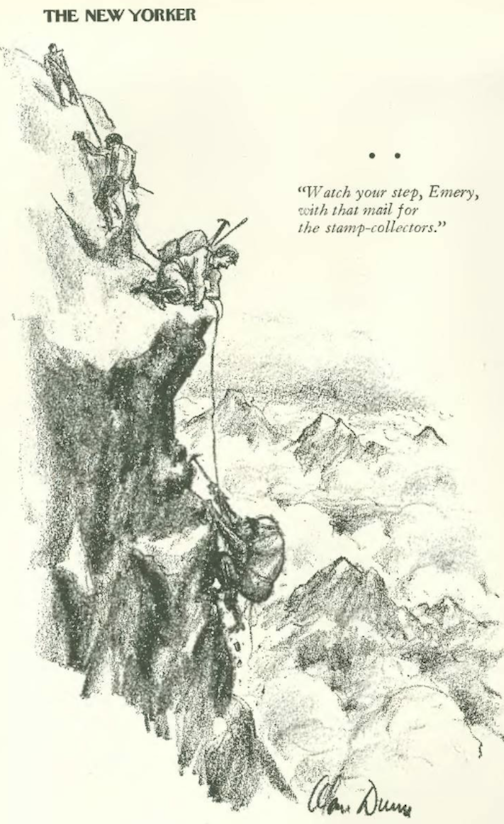
Alan Dunn gave us some men on a mission…

…and we close with Charles Addams, and some dam trouble…

Next Time: Wining and Dining…


What’s in a Name?

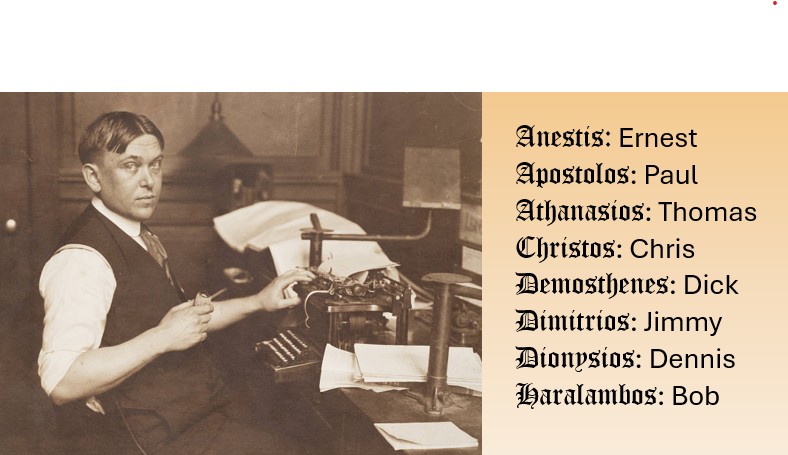
Above: H.L. Mencken at the Baltimore Sun, circa 1930. From April 1934 to September 1949, Mencken contributed more than fifty articles to The New Yorker.

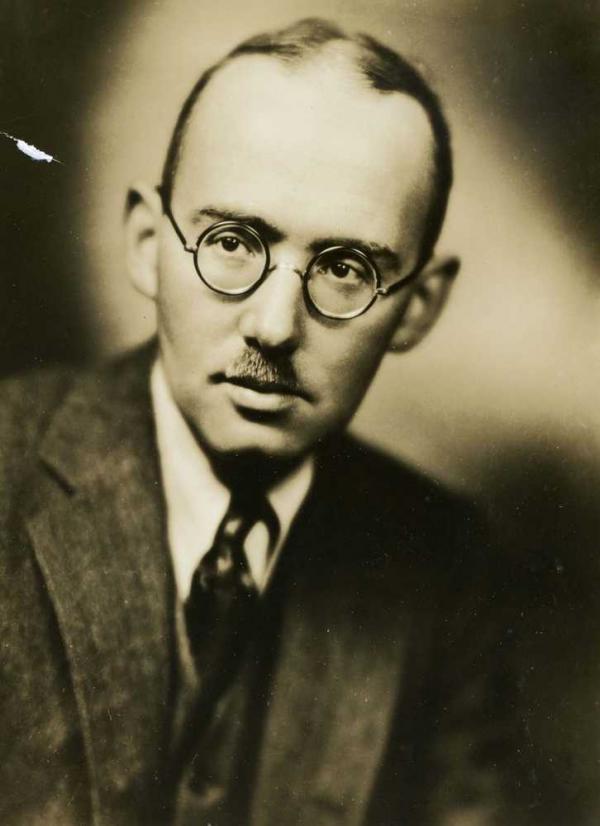
The American journalist Henry Louis Mencken (1880–1956) was well-known as a biting satirist and cultural critic, but he was also a noted scholar of the English language and its various quirks.

May 11, 1935, Mother’s Day cover by William Cotton.

One of those quirks was explored in Mencken’s essay, “The Advance of Nomenclatural Eugenics In the Republic,” for the column “Onward & Upward With The Arts.” Broadly defined, eugenics refers to the discredited belief that selective breeding could be used to improve the human race. Mencken used the term satirically to describe the anglicization of immigrant names, either to conform to English spellings or, in many cases, to avoid racial and ethnic discrimination. An excerpt:

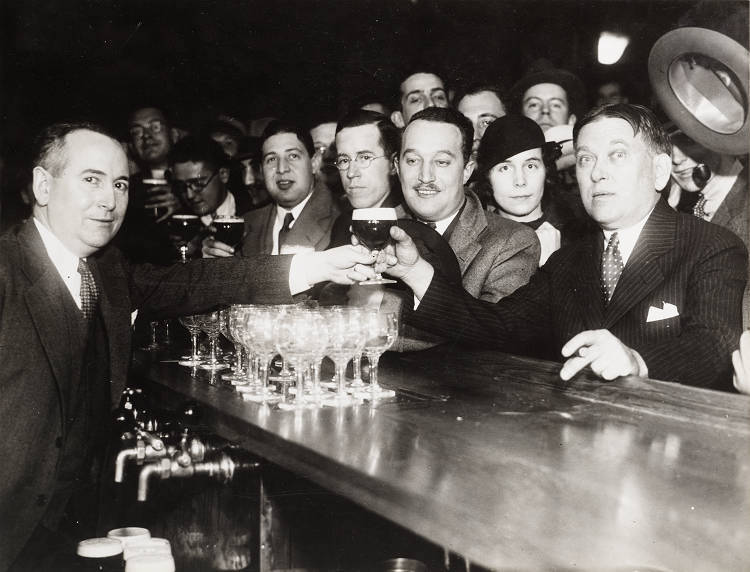
A PERFECT PAIRING, for H. L. Mencken, was a beer and a cigar. Here he is accepting “his first public glass of post-Prohibition beer” at the Rennert Hotel in Baltimore on April 7, 1933. In 1924 Mencken wrote: “Five years of Prohibition have had, at least, this one benign effect: they have completely disposed of all the favorite arguments of the Prohibitionists.” (digitalmaryland.org)

Many Jewish immigrants also abandoned their surnames, seeking to blend in and avoid discrimination. Historian and author Kirsten Fermaglich (A Rosenberg by Any Other Name, 2016) found that persons with Jewish-sounding last names made up 65 percent of all name change requests in New York in the first quarter of the 20th century. Mencken observed:

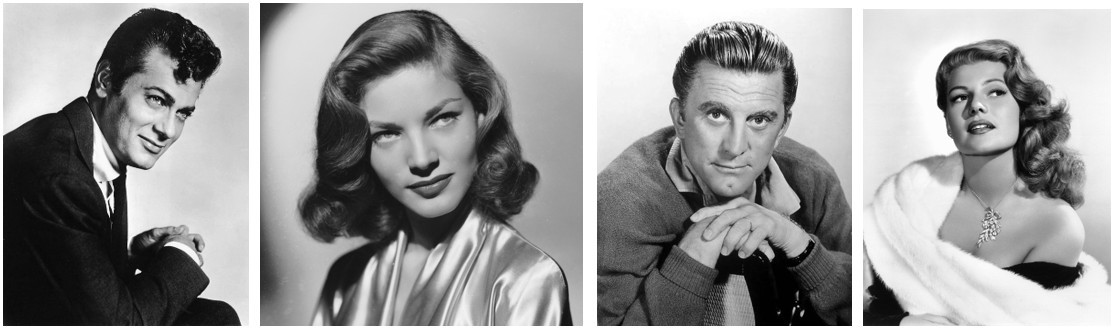
MEET BERNARD, BETTY, ISSUR AND MARGARITA…Some more famous examples of name changes in the first half of the 20th century. From left, actors (and New Yorkers) Tony Curtis (Bernard Schwartz), Lauren Bacall (Betty Joan Perske), Kirk Douglas (Issur Danielovitch Demsky), and Rita Hayworth (Margarita Carmen Cansino). (Wikipedia)

 * * *

Canada Dry

In his column, “Of All Things,” Howard Brubaker noted the “well-merited spanking” FDR gave to military leaders who were talking about fortifying the border with Canada. Brubaker agreed with FDR’s action, observing how Canadians came to the aid of thirsty Americans during Prohibition.

 * * *

Air France

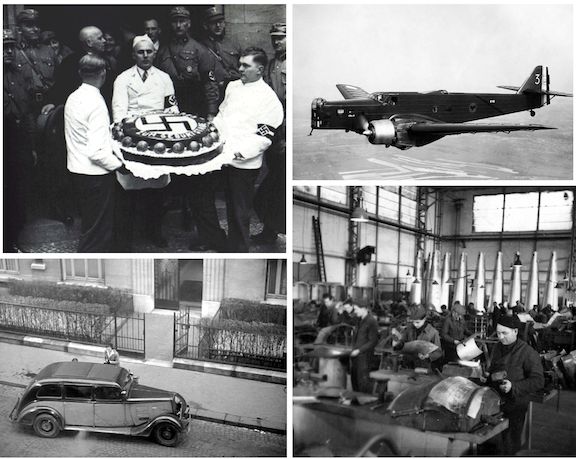
Paris correspondent Janet Flanner considered the state of French aviation as well as signs of war preparation. She also noted the birthday of German dictator Adolf Hitler, the birth of French television, and the streamlined taxis that had suddenly appeared on the streets of Paris. Excerpts:

SOME ICE CREAM WITH YOUR SLICE OF HATE?…Clockwise, from top left, bakers carefully carry Adolf Hitler’s birthday cake in April 1935; the French, meanwhile, were ramping up war production including the manufacture of the M210 bomber; airplane factory workers fashion sheet metal in a factory in Châteauroux-Déols; streamlined Peugeot 401 taxis hit the Paris streets in 1935. (reddit.com/dassault-aviation.com/imcdc.org)

 * * *

Vamps and Vampires

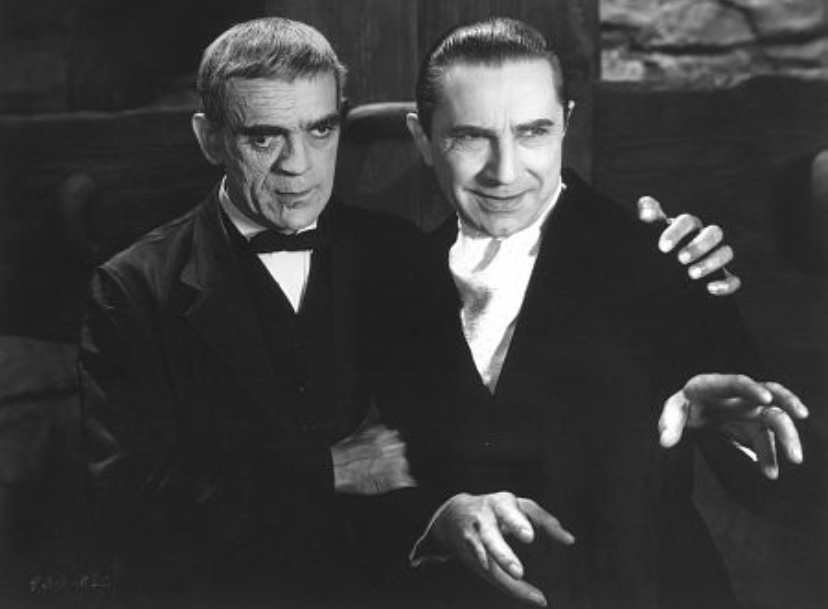
John Mosher offered mixed reviews of Hollywood’s latest fare, finding Marlene Dietrich’s latest vehicle “fun,” and the singing and dancing of husband/wife Al Jolson and Ruby Keeler “uninspired,” a term he also applied to Bela Lugosi’s latest vampire flick.

TAKE YOUR PICK…Critic John Mosher sampled some very different films including, left, Marlene Dietrich and Lionel Atwill in The Devil Is a Woman; top, Ruby Keeler with her then-husband Al Jolson in Go Into Your Dance; and Bela Lugosi did his vampire schtick with the help of Carroll Borland (who played Dracula’s daughter) in Mark of the Vampire. (MoMA/Pinterest/Instagram)

 * * *

From Our Advertisers

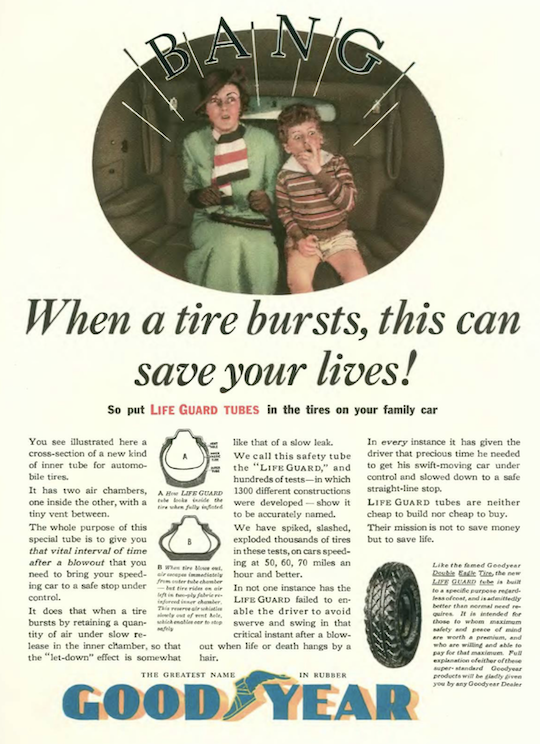
We start off with a bang from Goodyear…tire blowouts were common in the 1930s as tire technology could not keep pace with the increasing speed of automobiles, nor the poor condition of many roads…

…after many weeks, the back cover went to something other than cigarette manufacturers…

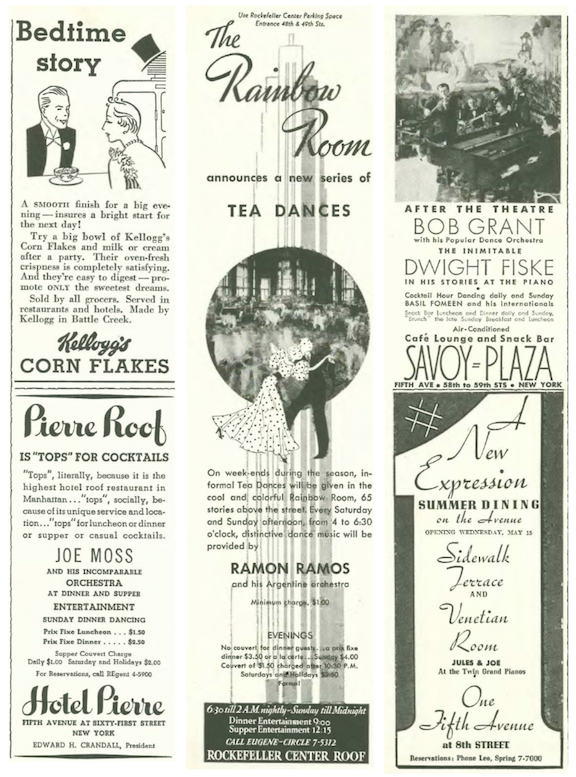
…let’s take a look at some of the one-column ads from the back pages…many of them highlighted the various nighttime entertainments, from the rooftop of Hotel Pierre to the air-conditioned lounge at the Savoy-Plaza (plus that weird ad that suggested Corn Flakes as a nightcap)…

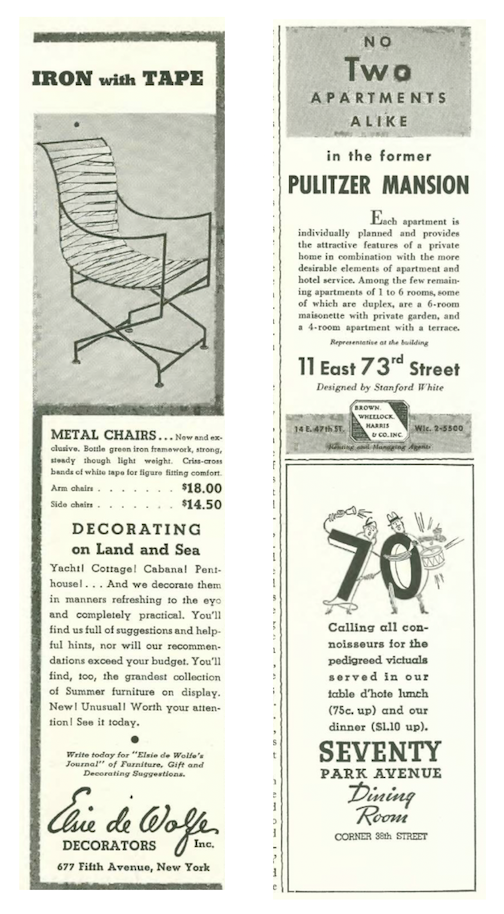
…interior designer Elsie de Wolfe rolled out “Iron with Tape” chairs, which might be the first example of what would become the ubiquitous webbed lawn chair…also advertised were apartments in the former Pulitzer mansion…

…the Pulitzer apartments were one happy outcome of the Great Depression, which foiled the plans of investors to demolish the house in 1934 and erect an apartment building…

The Pulitzer mansion still stands today, now divided into high-class coops. (daytoninmanhattan.blogspot.com)

…here’s something new from the Jay Thorpe shop, “noted for unusual sportswear”…

…perhaps inspired by Hollywood…

Ruby Keeler in 1935’s Shipmates Forever. (Reddit)

…illustrator Lyse Darcy created many of these distinctive ads for Guerlain products from the 1930s through the 1950s…

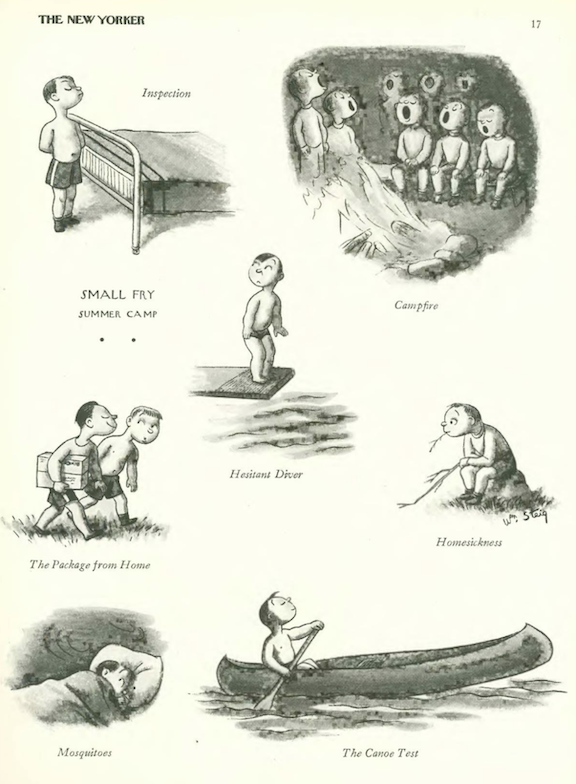
…on to our cartoonists, we begin with spot art from James Thurber

…and Thurber again…

…and we have two from George Price

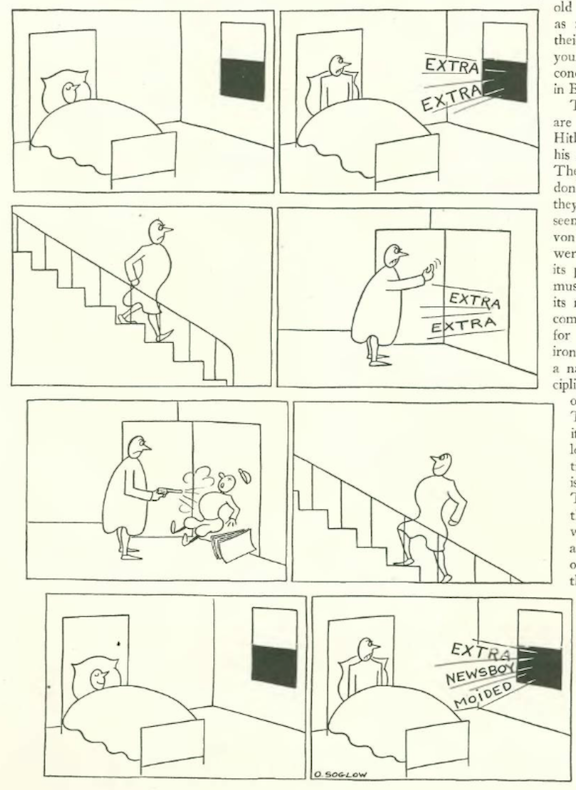
Otto Soglow continued with his multi-panel tricks…

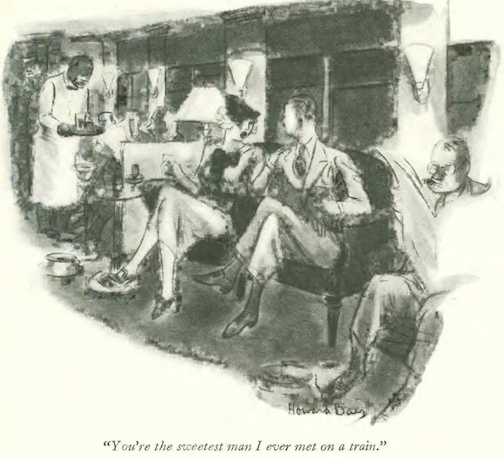
Howard Baer did some eavesdropping on the rails…

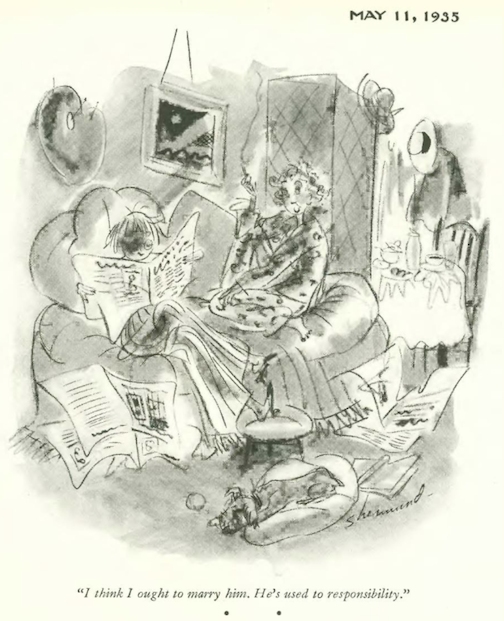
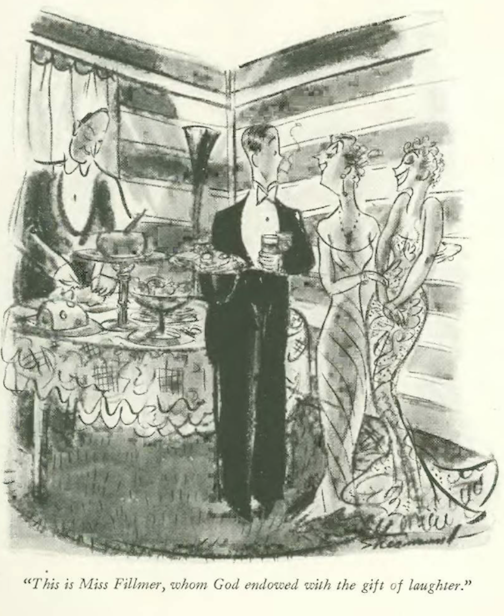
…while Barbara Shermund checked in on her modern women…

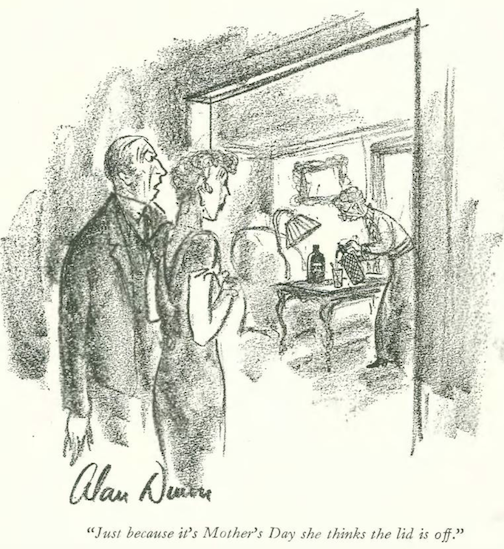
Alan Dunn gave us a mother who took care of herself on Mother’s Day…

Peter Arno found some kindly advice in the crowded city…

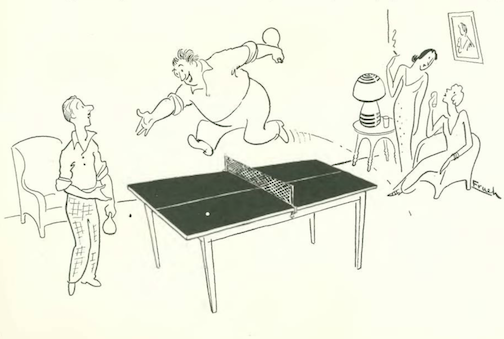
Al Frueh put the “tennis” back into table tennis…

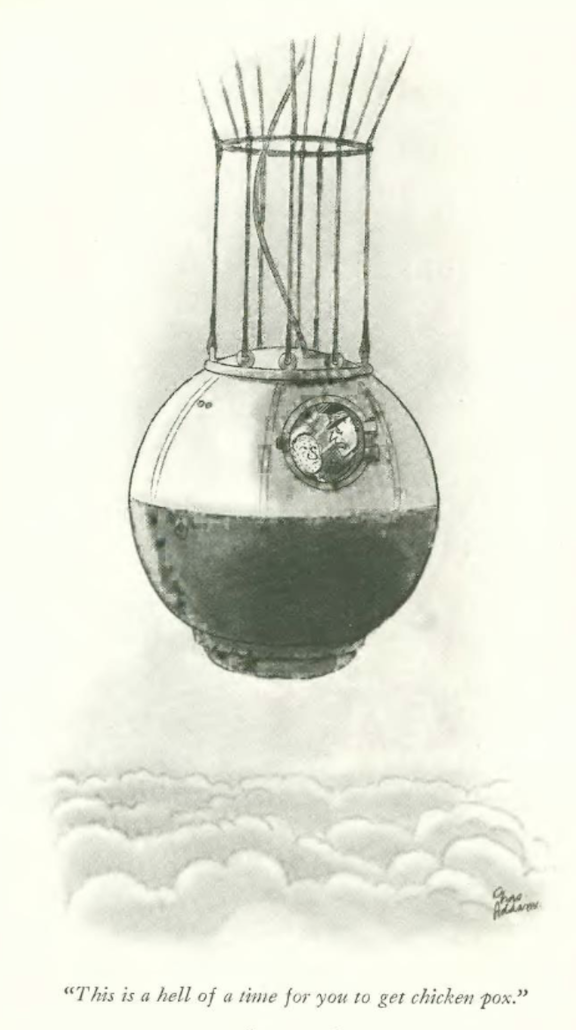
…and we close with Charles Addams, who had become a regular contributor but was still more than three years away from launching his “Addams Family” cartoons…

Next Time: Settling Down, In a Way…


The Cowboy Philosopher

William Penn Adair Rogers, aka Will Rogers (1879–1935), was a man of many talents. Today he is mostly referred to as a humorist, but he was also an actor, a social and political commentator, a trick roper and a vaudeville performer. To Americans he was a national icon.

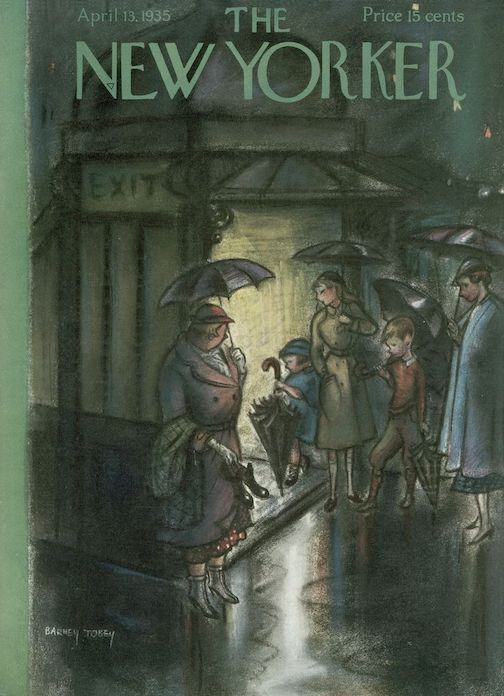
April 13, 1935 cover by Barney Tobey.

Rogers was also internationally famous, having traveled around the world three times and appearing in 71 films (50 of those silent). He also wrote more than 4,000 newspaper columns—nationally syndicated by The New York Times—that reached 40 million readers, and there were also magazine articles, radio broadcasts and personal appearances. He seemed to be everywhere.

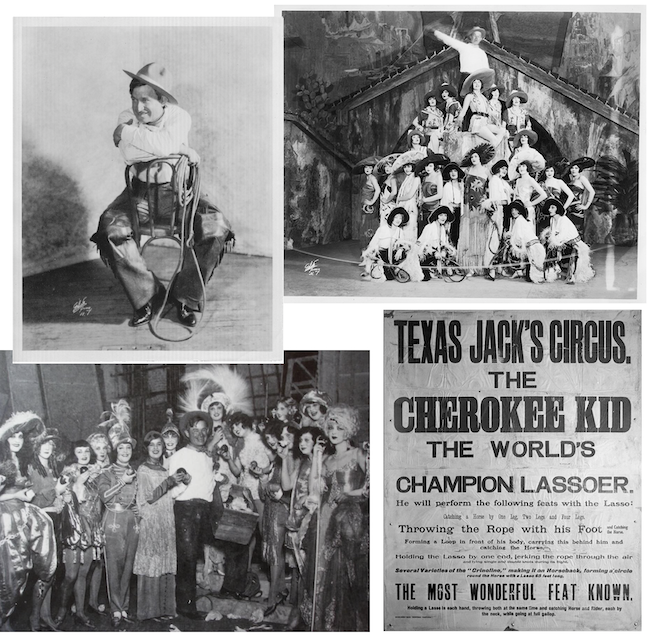
ROPING THEM IN…In 1902, Will Rogers joined Texas Jack’s Wild West Show & Circus in South Africa as the “Cherokee Kid”—he was born as a citizen of the Cherokee Nation, in the Indian Territory that is now part of Oklahoma. By 1910, he had created a sensational vaudeville act by mixing trick roping with witty monologues. Clockwise, from top left, Rogers in a publicity photo from 1916, the year he joined the Ziegfeld Follies; on stage with the Follies in 1924; poster from his circus days; backstage with the 1924 Follies cast. (National Portrait Gallery)
MULTIMEDIA MULTI-TALENT…Left, Rogers catches a few moments to write one of his 4,000 nationally syndicated newspaper columns; from 1929 to 1935 he used the exciting new medium of radio to broadcast his newspaper pieces. His weekly Sunday evening show, The Gulf Headliners, sponsored by Gulf Oil, ranked among the top radio programs in the country. (National Portrait Gallery)

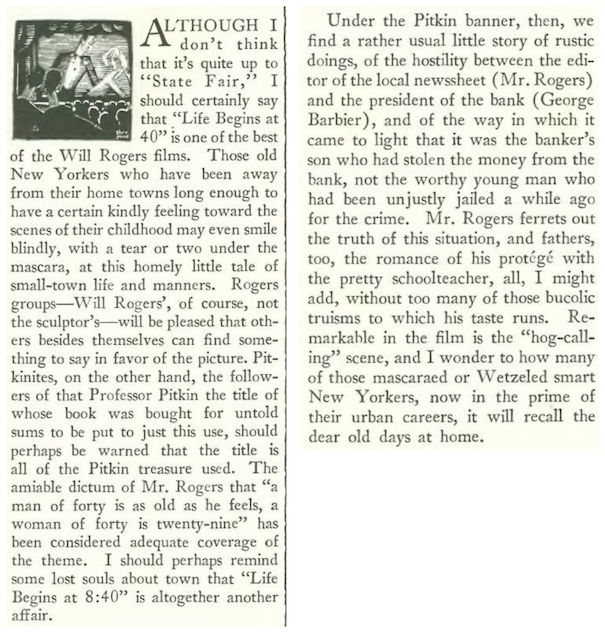
When John Mosher reviewed Rogers’ latest film, Life Begins At Forty, he found it to be one of Rogers’ best. It would also prove to be one of his last. On August 15, 1935, a small airplane carrying Rogers and aviator Wiley Post would crash on takeoff near Point Barrow, Alaska, claiming the lives of both men. Rogers would appear in three more films in 1935, the last two posthumously.

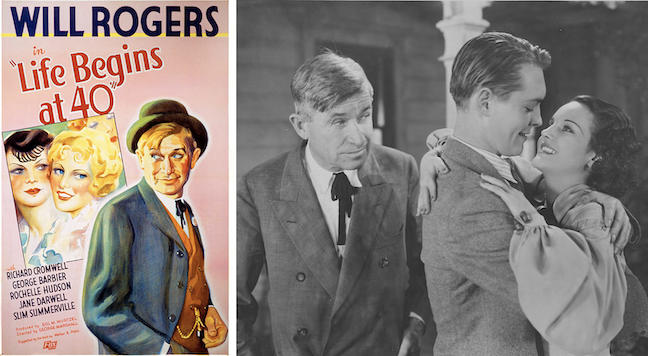
THAT’S LIFE…Will Rogers with Richard Cromwell and Rochelle Hudson in Life Begins at 40. Rogers’ film took its title from a 1932 self-help book by Walter B. Pitkin. Pitkin maintained that keeping a positive attitude toward life could give a person many fulfilling years after age 40. By the time of his death in 1935, the 55-year-old Rogers was Hollywood’s highest paid actor. (Wikipedia/IMDB)

 * * *

Not Toying Around

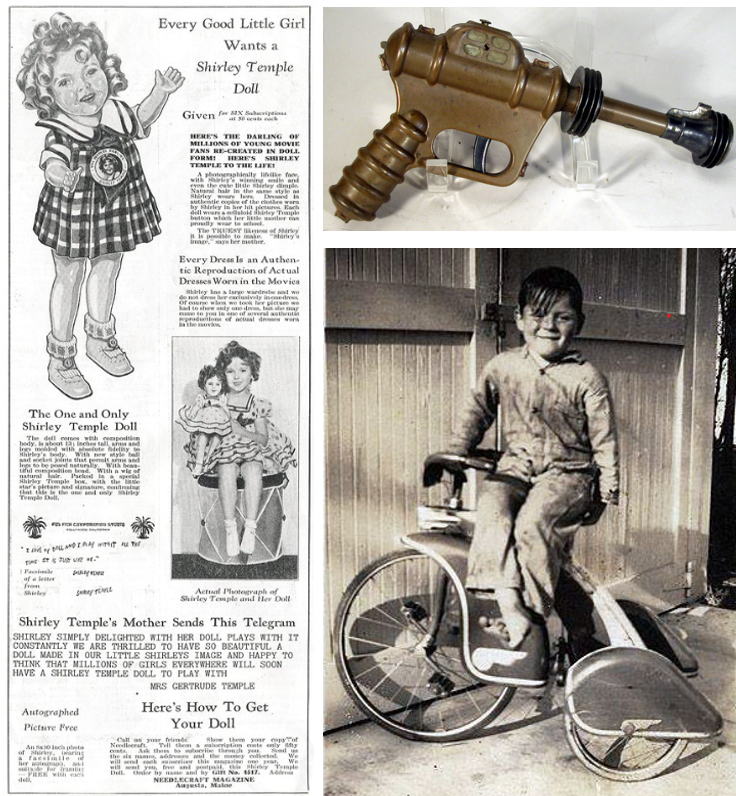
“The Talk of the Town” looked in on the serious business of toymakers, with 1935 being the year of streamlined tricycles, Buck Rogers disintegrator pistols, and, of course, Shirley Temple dolls.

RIVALED ONLY BY MICKEY MOUSE, Shirley Temple was the most popular celebrity to endorse merchandise for children and adults, including the “one and only” Shirley Temple Doll (left, ad from 1935); the Buck Rogers XZ-38 Disintegrator Pistol (top) was produced in 1935 by Daisy, and was available in both copper and nickel finishes–it was also offered as a premium from Cream of Wheat cereal; at bottom, the American National Streamline Velocipede Tricycle (1935), just one example of the hundreds of products receiving the streamlining treatment in the 1930s. (flickr/airandspace.si.edu/onlinebicyclemuseum.co.uk)

 * * *

Literary Spirits

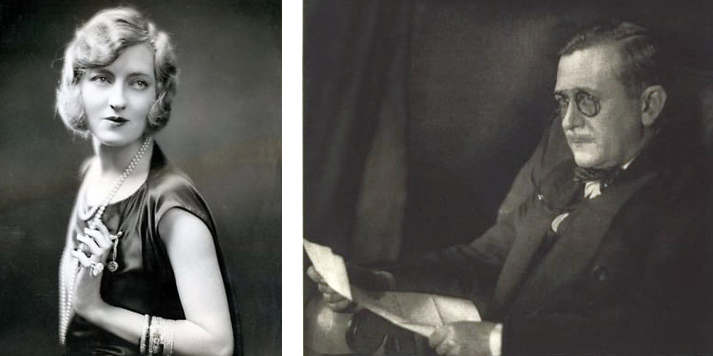
E.B. White welcomed the return of literary tea party, which thanks to the repeal of the 18th Amendment had been re-dubbed the “literary cocktail party.” He shared his thoughts in “Notes and Comment”…

AMUSING MUSES…Actress, writer and socialite Peggy Hopkins Joyce hosted literary “teas” in the 1920s, while former Cosmopolitan editor Ray Long inspired a book on adventures in the South Seas shortly before his death; from left, Joyce in 1923; photogravure of Long, 1925. (Wikipedia/photogravure.com)

 * * *

Proto Feminist

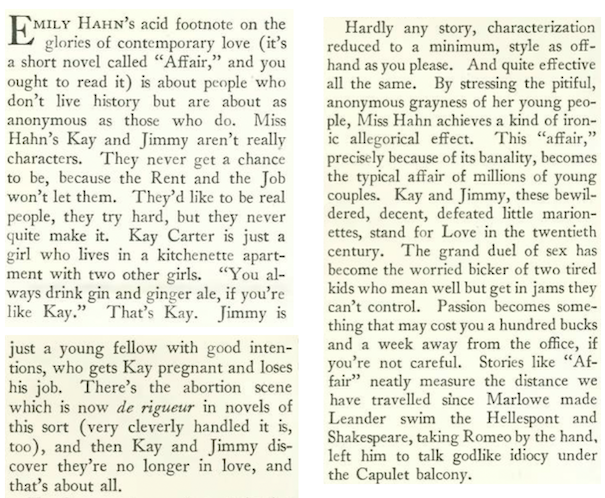
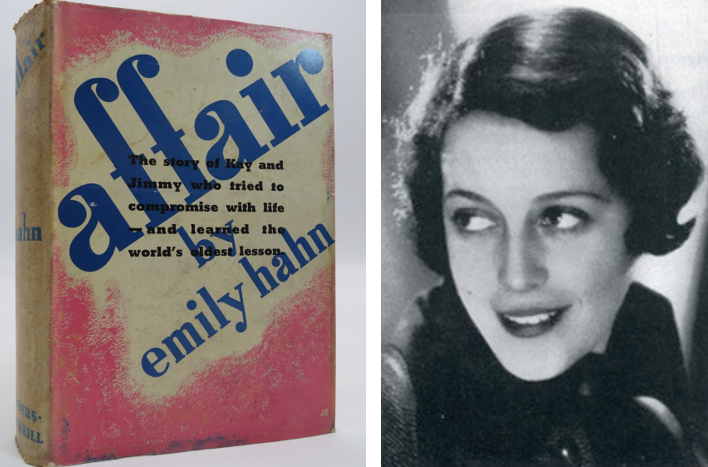
Emily Hahn was one of the more lively figures in The New Yorker’s stable of journalists and writers, leading an adventurous life that included a hike across Central Africa in the 1930s and getting into all kinds of trouble during the Japanese invasion of China. According to Roger Angell, Hahn was, “in truth, something rare: a woman deeply, almost domestically, at home in the world. Driven by curiosity and energy, she went there and did that, and then wrote about it without fuss.” It is no surprise that Hahn’s latest novel, Affair, didn’t shy away from topics like abortion. According to reviewer Clifton Fadiman, the novel’s “anonymous grayness” exposed the banality of love in the twentieth century.

If Hollywood is looking for a new biopic, Hahn would make a fascinating subject (Kristen Stewart would be perfect for the part). According to IMDB, there is an “Untitled Emily ‘Mickey’ Hahn Project”—a TV series—that has been in development since 2022, but so far nothing has come of it.

DOWN ON LOVE?…Emily Hahn’s 1935 novel Affair exposed the banality of love in the twentieth century. (abebooks.com/susanbkason.com)

 * * *

From Our Advertisers

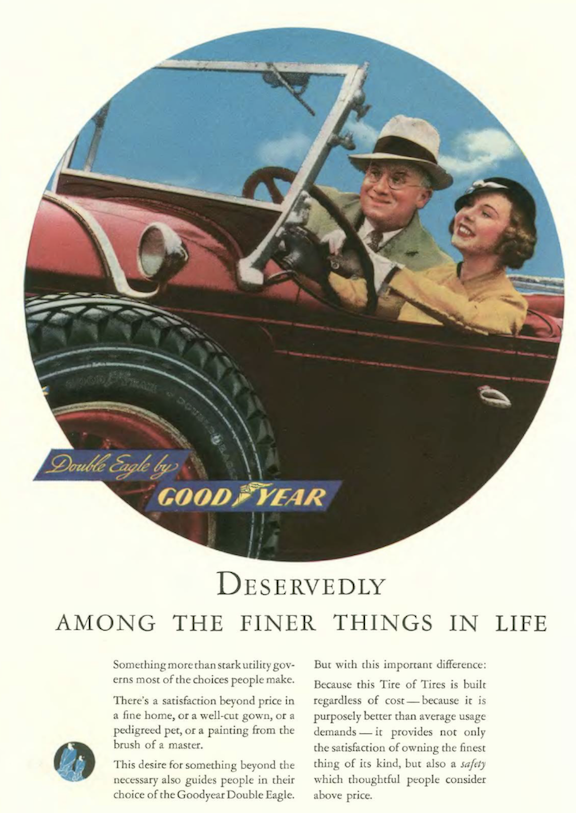
We begin with this advertisement from Goodyear, featuring what appears to be a father teaching his daughter how to drive, or in this case, fly, just like Chitty Chitty Bang Bang…

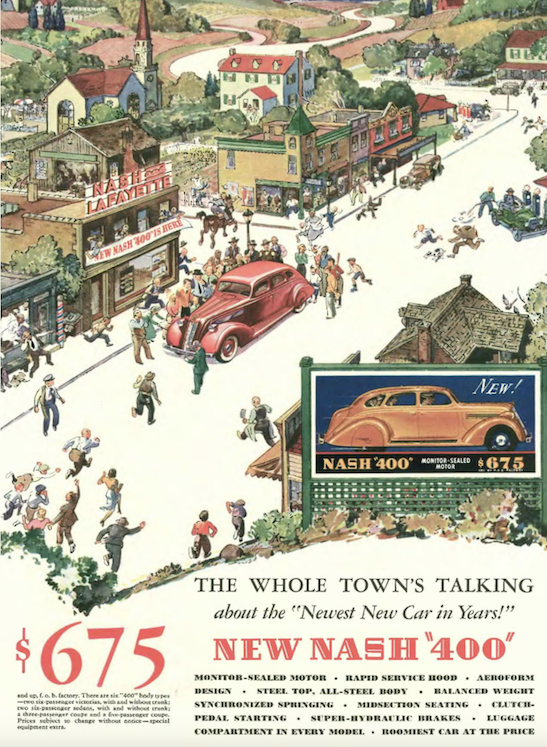
…and we stay airborne with the makers of the streamlined Nash, who claimed their automobile had “flying power”…

…and we return to earth with Cadillac’s budget model, the LaSalle, which featured “flashing performance”…

…by contrast, Pierce Arrow took a minimalist approach, gimmicks and splashy colors being reserved for the lower orders…

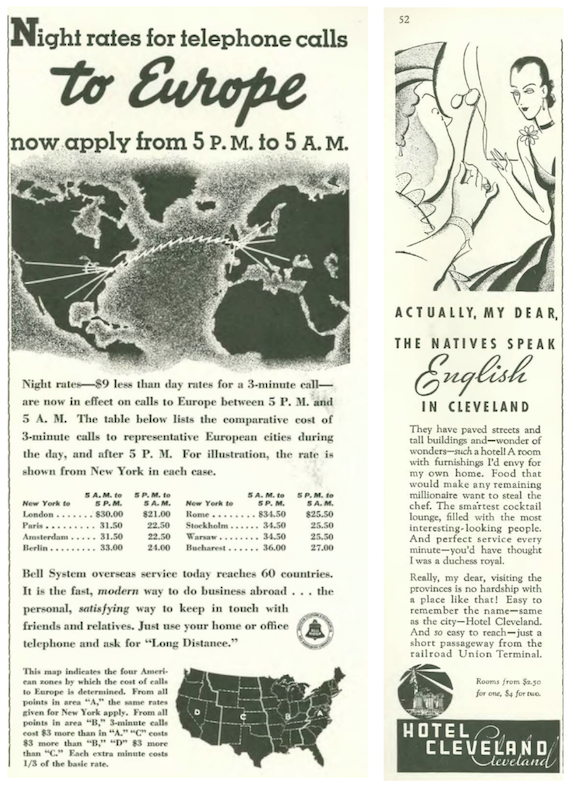
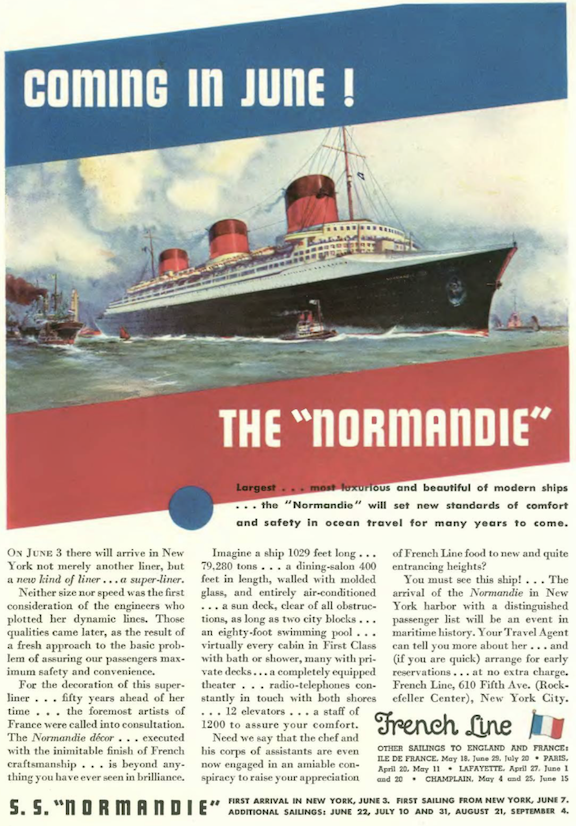
…one of the world’s most iconic ocean liners took to the sea with much fanfare in 1935. The SS Normandie was the largest and fastest passenger ship afloat; it remains the most powerful steam turbo-electric-propelled passenger ship ever built…

…if you happened to smoke Webster cigars, it could have been a sign that you were favored by the heavens…

…the “20-year rule” in fashion suggests that trends have a tendency to re-emerge every two decades, and that seems to be the case here…

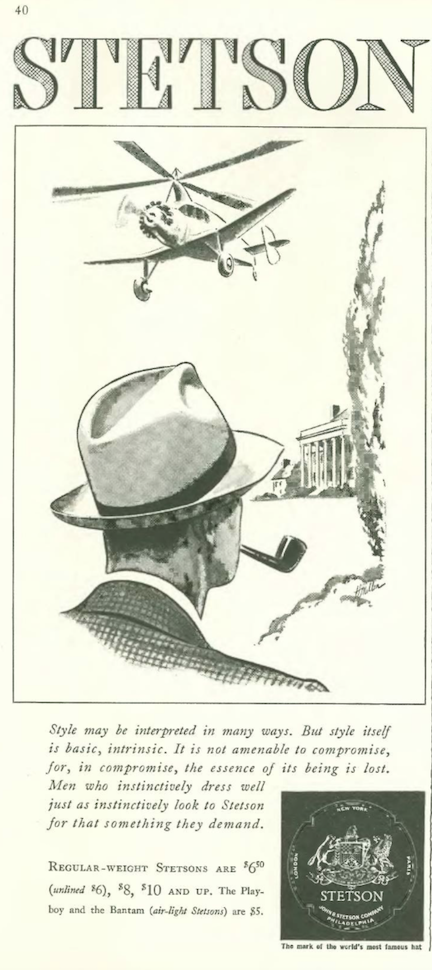
…this next ad tells us everything we need to know about the Stetson wearer: he is a wealthy country gentleman who values tradition but who is also a man of the future…from the 1920s to midcentury the autogyro was thought to be the answer to the long-dreamed of flying car…

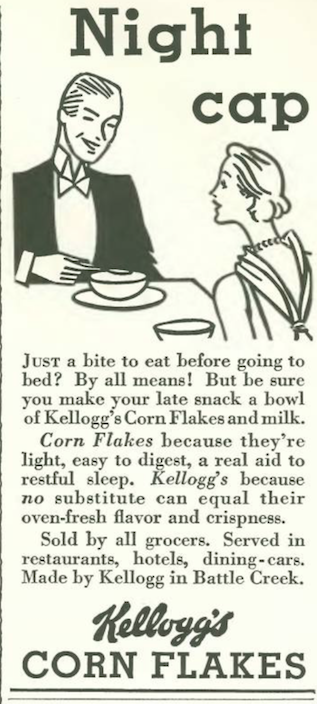
…whoever coined the term “night cap” probably wasn’t thinking about cold cereal…

…although Harold Ross’s old high school friend, John Held Jr., contributed many woodcut-style cartoons and faux maps to The New Yorker from 1925 to 1932, Held was more famous for his shingle-bobbed flappers and their slick-haired boyfriends in puffy pants, a style more apparent in this ad for Peychaud’s Bitters (the original was a one-column ad, split here for clarity)…

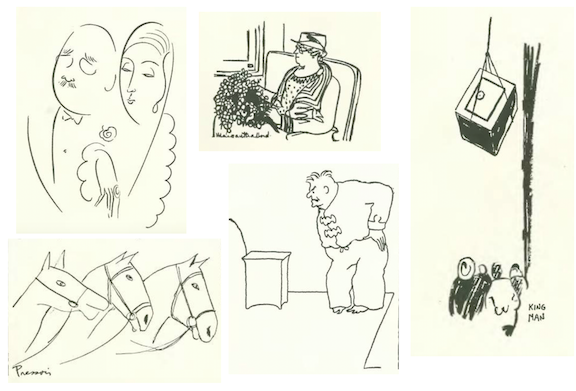
…Held provides a segue to our illustrators and cartoonists, beginning with a sampling of spot art from the April 13 issue…

James Thurber got things going on page 2…

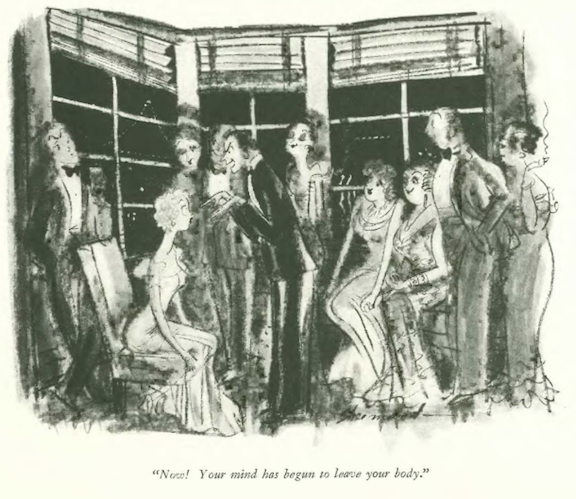
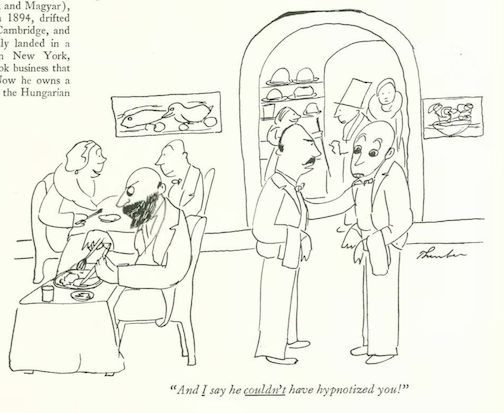
…and also contributed this observation of the hypnotic arts…

Otto Soglow did some careful surveying (this originally appeared across two pages)…

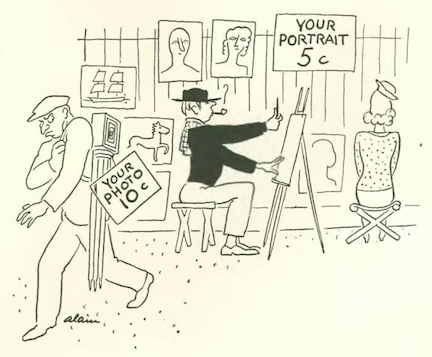
Alain looked in on some Vatican gossip…

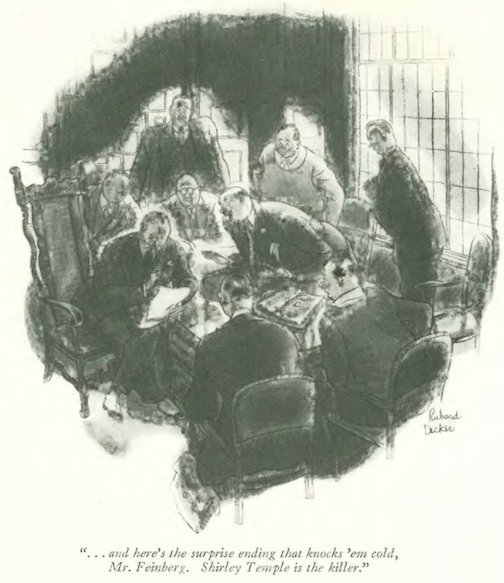
Richard Decker pitched a Shirley Temple murder caper…

Carl Rose gave us a sweet send-off…

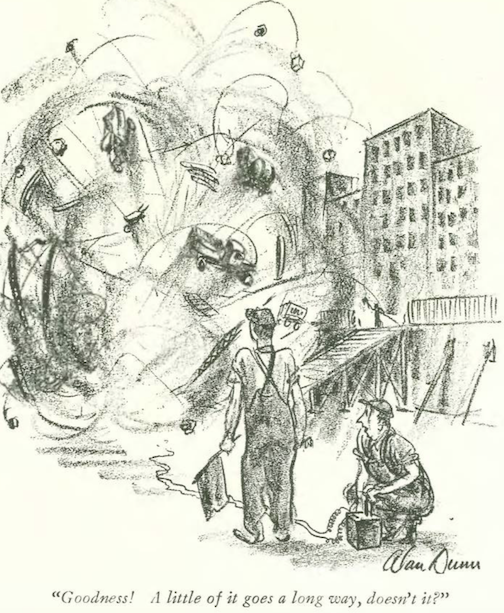
…and we close out with a big bang, courtesy of Alan Dunn

Next Time: Terse Verse…
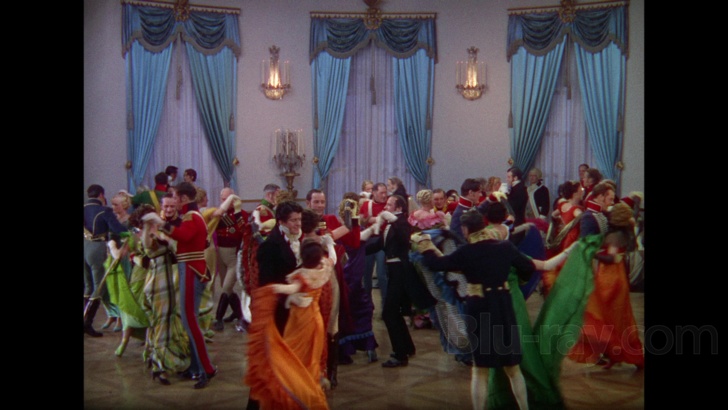


Keep Calm and Carry On

If you lived in Germany in 1935, or in Italy or Spain for that matter, the world would have looked very different from the one most Americans were experiencing, clawing their way out of the Great Depression and hoping to improve their domestic lives. War was not big on their worry list.

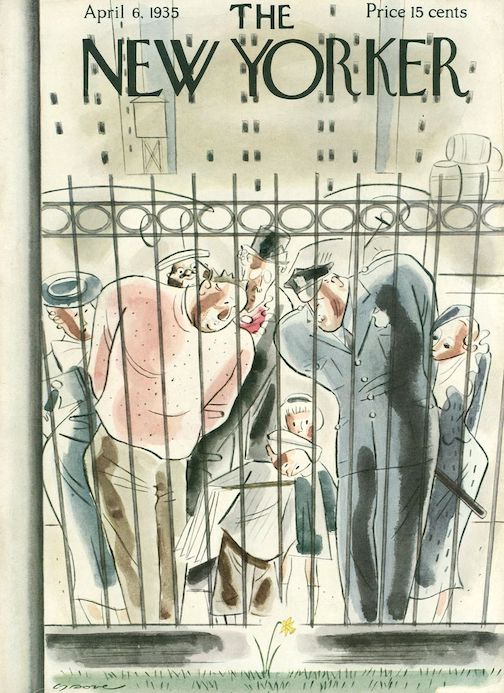
April 6, 1935 cover by Leonard Dove.

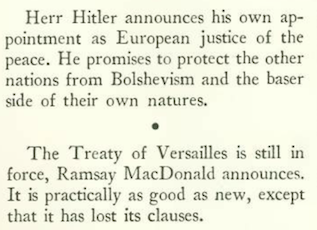
In his “Notes and Comment,” E.B. White satirized the talk about war that was filling more column inches in the nation’s newspapers. He was particularly scornful of journalists such as Arthur Brisbane—the influential editor of William Randolph Hearst’s media empire—who was fond of giant headlines warning of impending war.

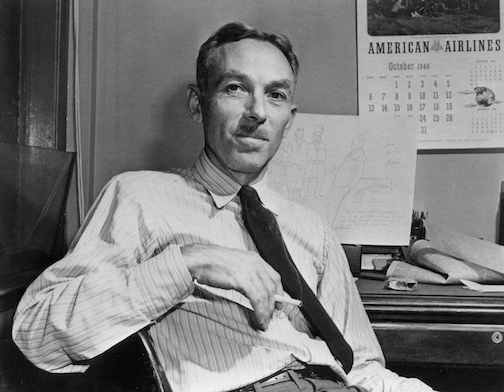
TEND YOUR OWN GARDEN...E.B. White in 1946. (Britannica)

White wasn’t naive about the possibilities of war; however, he believed obsessing about things over which we have little control did little to help the human condition. Helping one’s neighbor, on the other hand, would do the world more good. In 1939, just six months before Germany invaded Poland, White wrote a piece titled “Education” for his Harper’s Magazine column, One Man’s Meat. This excerpt helps define his worldview:

“I find that keeping abreast of my neighbors’ affairs has increased, not diminished, my human sympathies…in New York I rise and scan Europe in the Times; in the country I get up and look at the thermometer—a thoroughly set-contained point of view which, if it could infect everybody everywhere, would I am sure be the most salutary thing that could happen to the world.”

With that, here is a selection from the April 6 “Notes and Comment”…

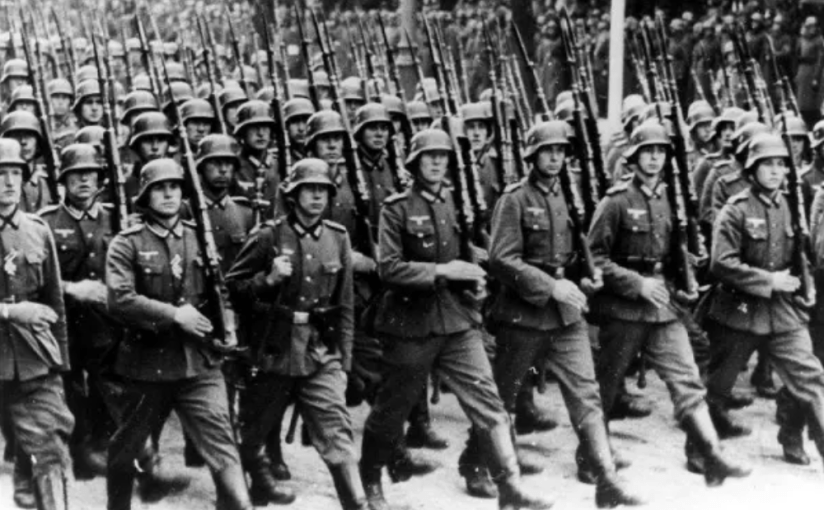
TANKS A LOT…Clockwise, from top left, German war production in the 1930s—by increasing the size of the army by 500,000 and establishing the Luftwaffe in early 1935, Germany broke international law and the Treaty of Versailles; the 1935 Anglo-German Naval Agreement was the first sign of British and European appeasement—photo shows the launch of the Admiral Graf Spee; a display of force at Nuremberg, mid 1930s; cartoon by Bernard Partridge from Punch (September 1932) foresaw the inevitable. (parisology.net/theholocaustexplained.org/Punch Limited)

In March 1973, a “Mr. Nadeau” wrote a letter to E. B. White expressing fears about humanity’s bleak future. Here are the first and last lines of White’s reply:

As long as there is one upright man, as long as there is one compassionate woman, the contagion may spread and the scene is not desolate. Hope is the thing that is left to us, in a bad time. I shall get up Sunday morning and wind the clock, as a contribution to order and steadfastness…Hang on to your hat. Hang on to your hope. And wind the clock, for tomorrow is another day.

 * * *

Another Viewpoint

Ever the observer of the passing scene, Howard Brubaker made these relevant observations in “Of All Things”…

…and back to White’s “Notes,” and the imminent passing of the beloved organ grinder…

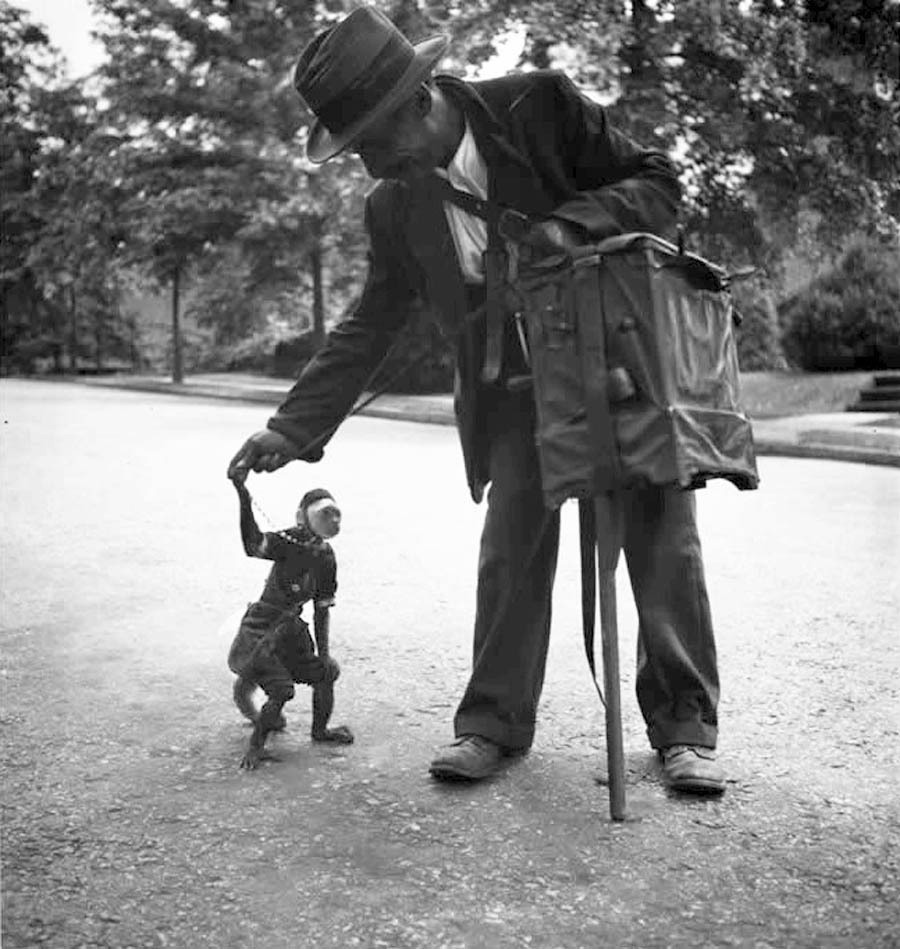
THE OLD GRIND…Above, one of New York City’s last organ grinders in Washington Heights, ca. 1935. Organ grinders had been fixtures in Manhattan since the 1850s, and by 1880 roughly five percent of Italian men living in Five Points were organ grinders, often accompanied by monkeys who entertained and collected coins. Organ grinders were outlawed in 1936 by Mayor Fiorello La Guardia. It is thought the mayor disliked the Italian immigrant stereotype. (Library of Congress)

 * * *

Give Him More Mickey Mouse

John Mosher expressed his displeasure with movies that failed to deliver some escape from life’s mundane realities or offered little more than tepid storylines.

IN SEARCH OF A CREDIBLE PLOT…Critic John Mosher found Claudette Colbert (top left) both unbelievable and unqualified to be a psychiatrist in Private Worlds; at top right, Joan Blondell and Glenda Farrell offered some mindless distractions in Traveling Saleslady (from 1933 to 1936 Blondell and Farrell appeared together in seven films); bottom, Mosher called The Woman in Red an “anemic” tale. Barbara Stanwyck seems to be wondering why she took the part. (rottentomatoes.com/TCM)

 * * *

Odds and Ends

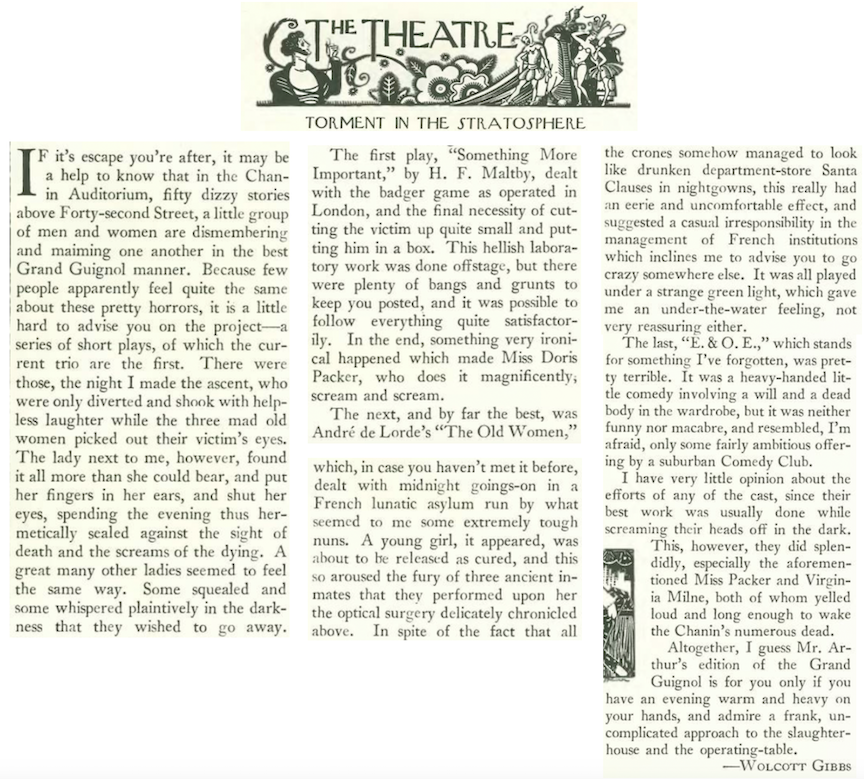
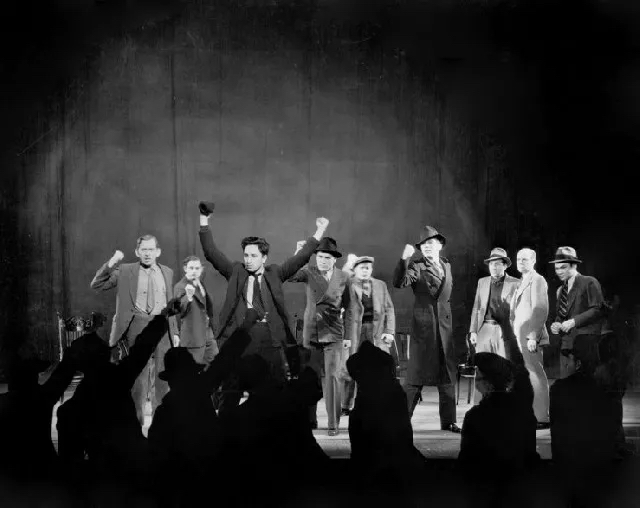
Also in the issue, John O’Hara kicked off the short fiction with “I Could Have Had A Yacht,” Margaret Case Harriman penned a profile of Elizabeth Arden (of cosmetics empire fame), and theatre critic Wolcott Gibbs enjoyed the “bitterly effective performances” in Clifford Odets’ Waiting For Lefty, which was being produced at the Longacre Theatre.

ENOUGH IS ENOUGH...Elia Kazan led the cast in the original production of Clifford Odets’ iconic 1935 play Waiting for Lefty. Centered around a taxi drivers’ strike, Lefty was produced by The Group Theatre, which sought to perform plays that functioned as social commentaries on the inequality and poverty of 1930s America. Some referred to Kazan as the “Proletarian Thunderbolt.” (Creative Commons)

 * * *

From Our Advertisers

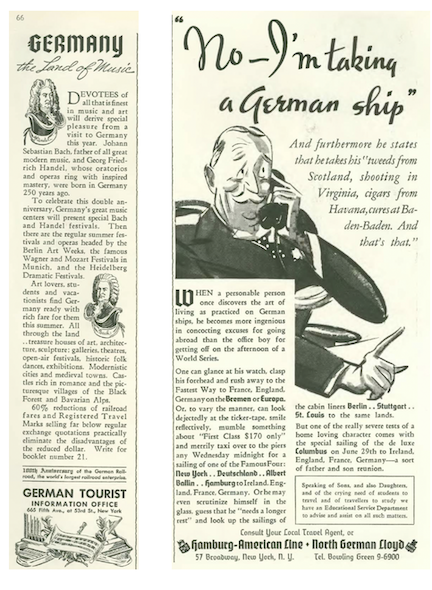
While Hitler ramped up weapons production and prepared to enact the Nuremberg Race Laws, the German Tourist Office touted their country as “The Land of Music” in this one-column advertisement on page 66 (left)…a couple of pages later we have an old chap looking forward to a German cruise and a quiet soak at Baden-Baden in the midst of madness…

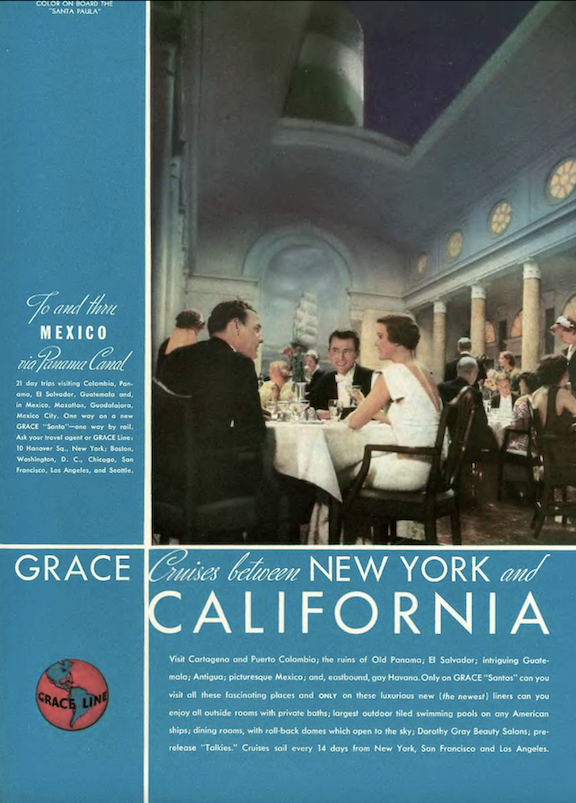
…now this is more like it, fine dining under the stars aboard the Santa Paula, far from the maddening crowds…

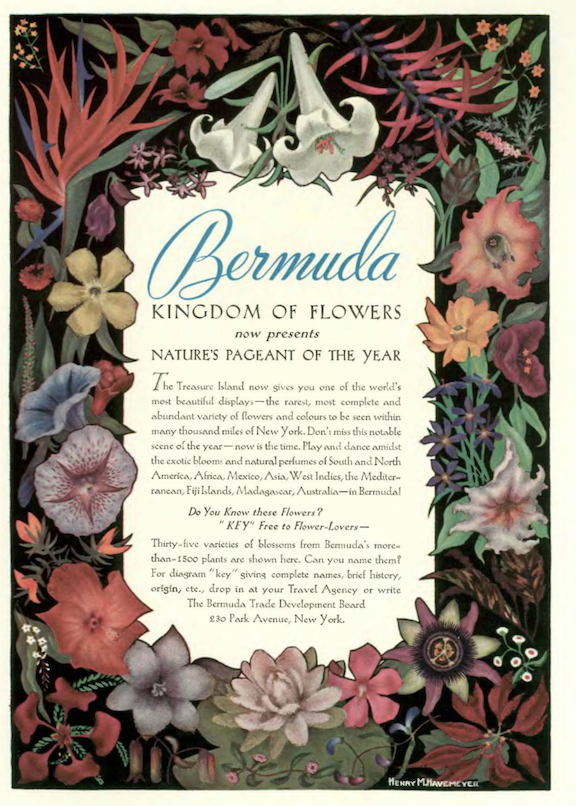
…there were several colorful full-page ads in the issue, including this splashy display from the very un-splashy-sounding Bermuda Trade Development Board…

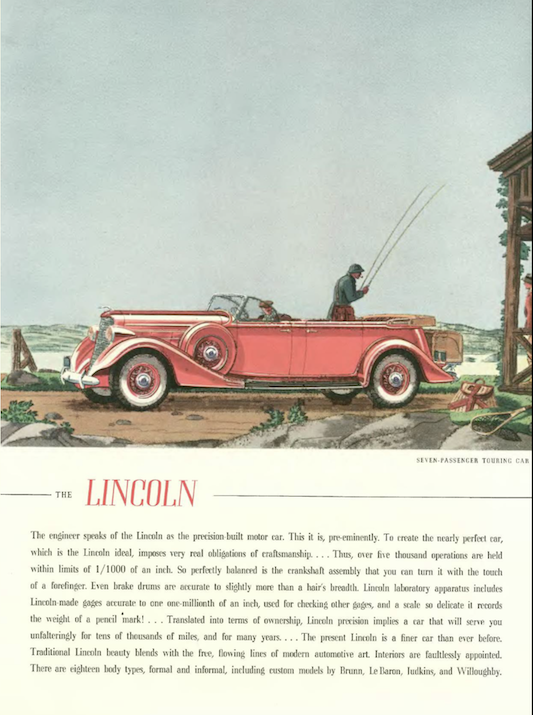
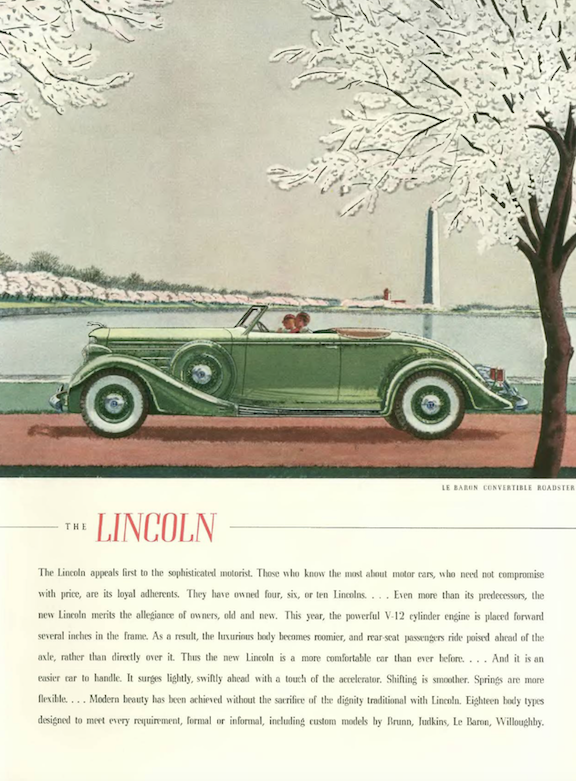
…cherry blossoms lined the path of Lincoln’s Le Baron Roadster…

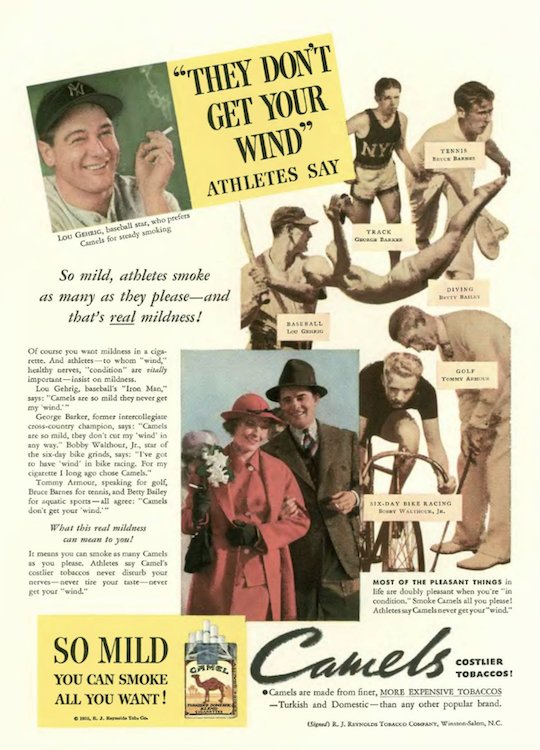
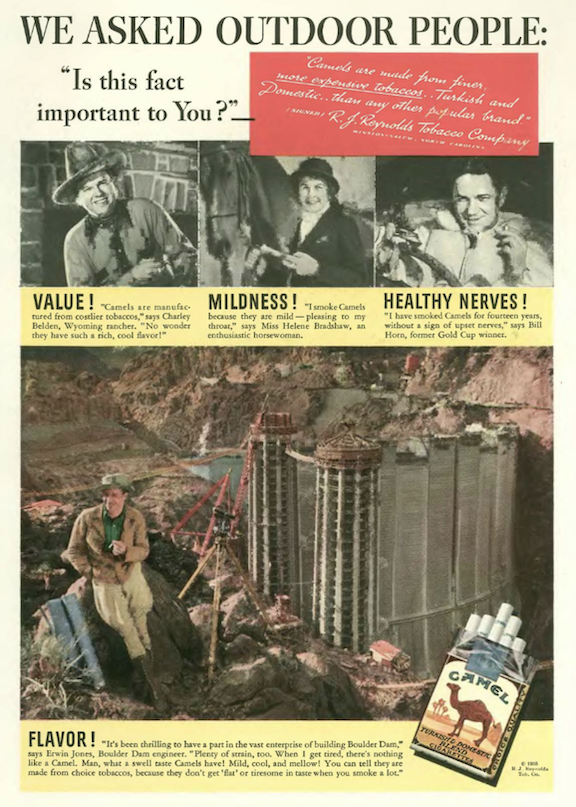
…Camel played to a wide demographic, from ads featuring stylish young women to ads like this that roped in everyone from an “enthusiastic horsewoman” to an engineer working on the Boulder (now Hoover) Dam…

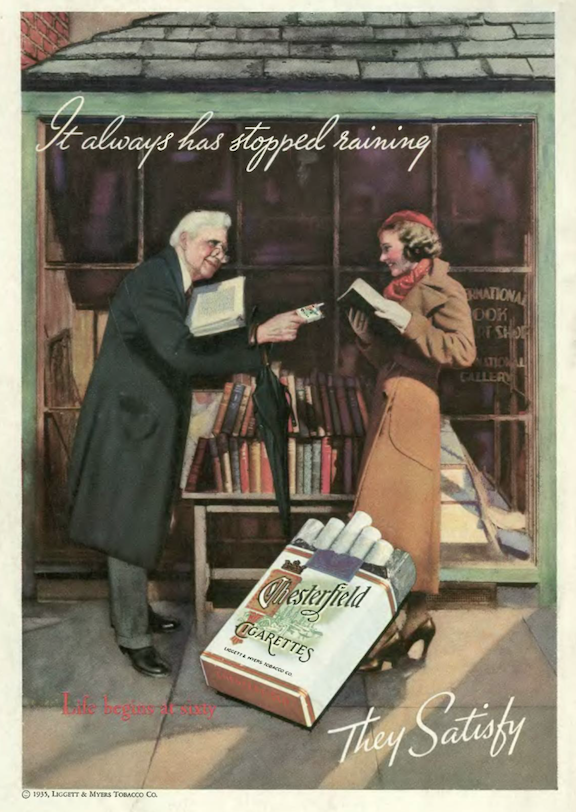
…I’m not sure what “Life begins at sixty” is supposed to mean, unless it’s about tempting young women with your bad habit…

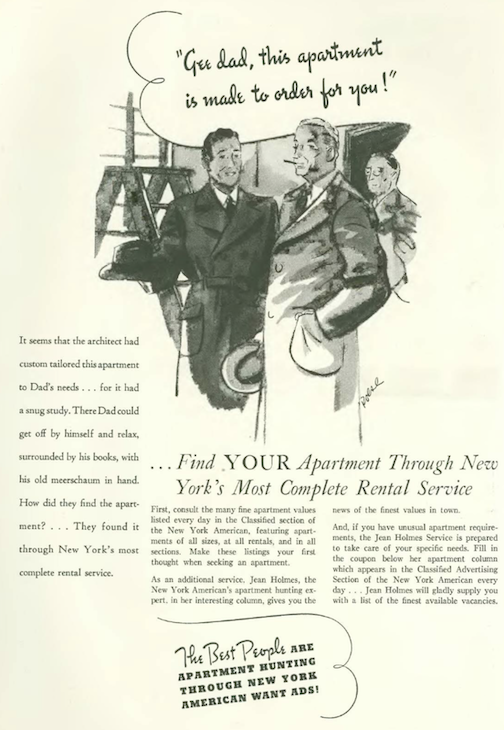
…the New York American was hoping that some of the “Best People” who read The New Yorker would also want to read their apartment rental want ads…

…spring was in the air at Richard Hudnut’s Fifth Avenue salon…if you had dry skin, it was recommended you try a product with the unfortunate name “Du Barry Special Skin Food”…

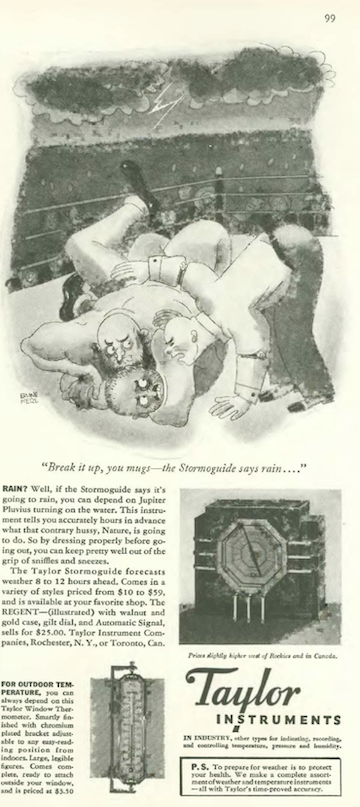
…Taylor Instruments hoped readers would monitor the spring weather with one of their stylish thermometers…American graphic artist and illustrator Ervine Metzl provided the artwork…he was best known for his posters and postage stamp designs…

…which brings us to our illustrators and cartoonists, beginning with this small woodcut on page 6 signed “Martin”…

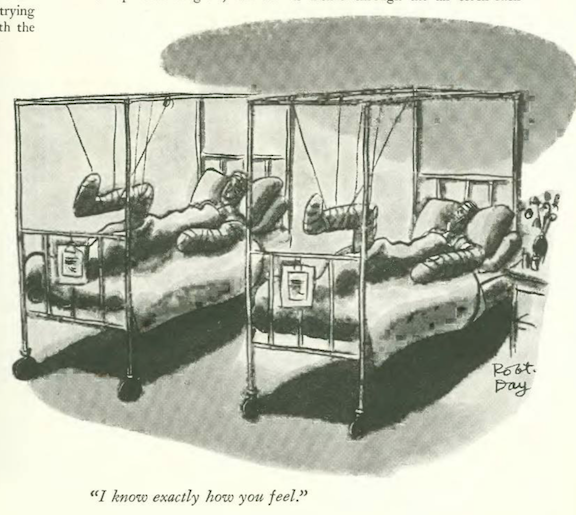
…empathy gained some traction in this Robert Day cartoon…

Alan Dunn demonstrated the effect of the Depression on the building trades…

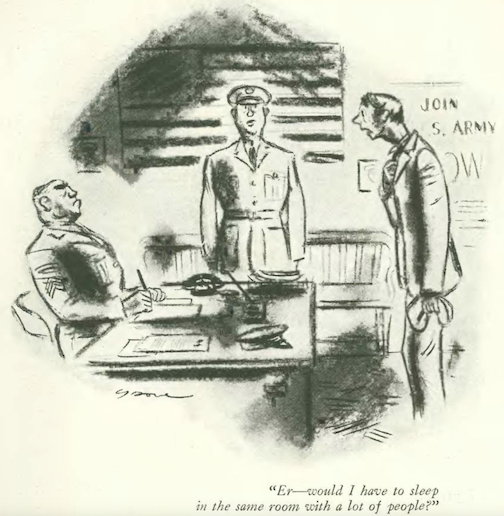
Leonard Dove found one enlistee not ready for basic training…

Syd Hoff showed us all the right moves…

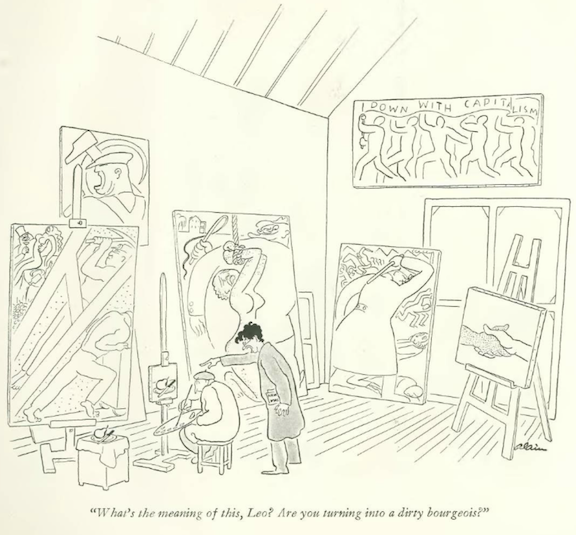
Alain was up in the garret with an artist in need of some peace…
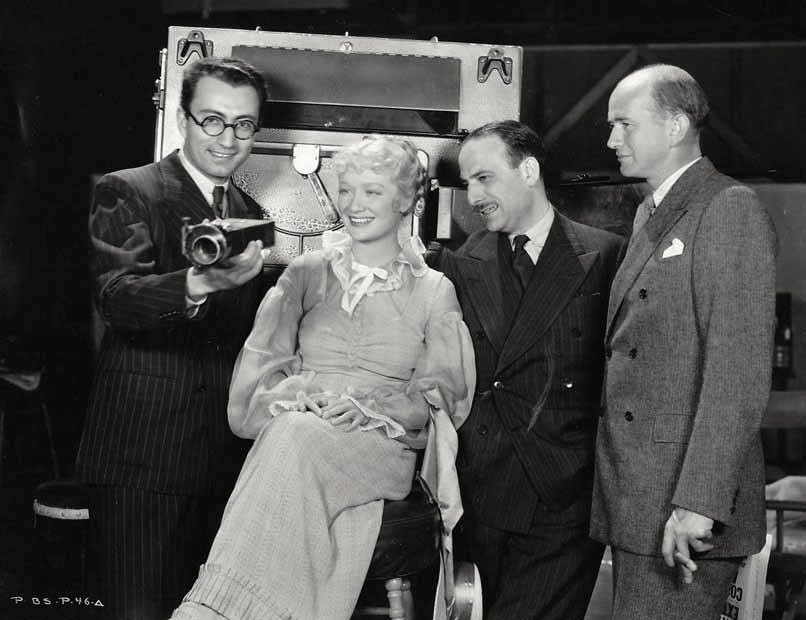
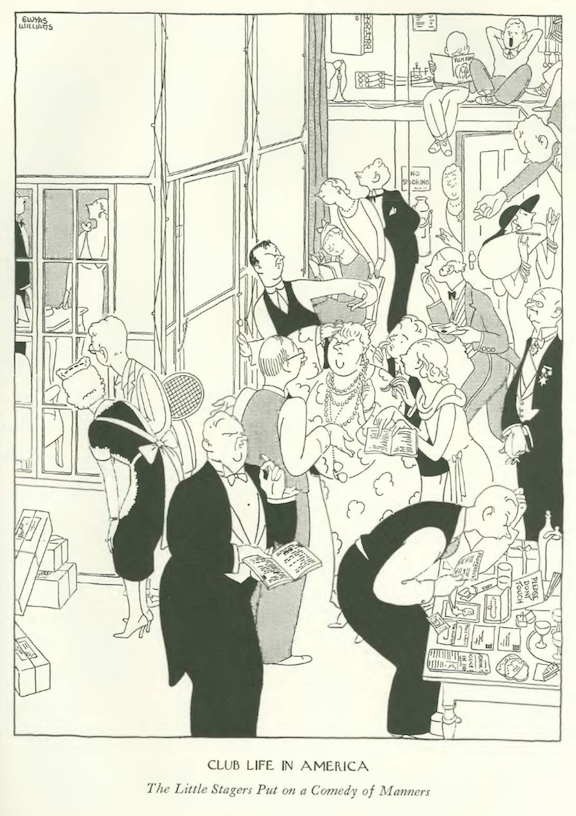
Gluyas Williams took a glimpse backstage…

William Crawford Galbraith was still exploring the world of sugar daddies and golddiggers…

Barbara Shermund introduced a few giggles…

…and we close with another James Thurber classic…

Next Time: The Cowboy Philosopher…

The Lighter Side of George Grosz

Above: Landscape in Bayside, 1935, by George Grosz (Phillips Collection)

Knowing that the Nazis would not look kindly on his art, George Grosz took a job teaching drawing in New York in 1932, and by 1933 he had become a permanent resident of the city.

March 30, 1935 cover by Garrett Price celebrated the traditional “Bock” beer of spring.

Grosz (1893–1959) was overwhelmed by the size and pace of his adopted city, and for the most part he left behind his bitter caricatures and paintings of Berlin’s Weimar years and turned to other subjects, including landscapes and New York’s urban life. Critic Lewis Mumford took in a show of Grosz’s new water colors at An American Place, a small gallery run by photographer and art dealer Alfred Stieglitz. 

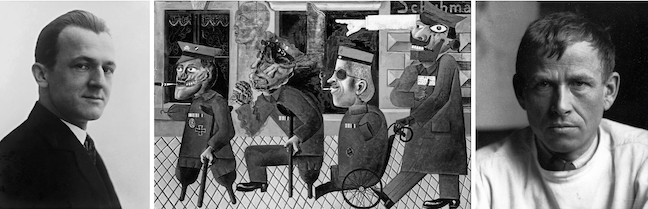
THE NEW OBJECTIVITY…George Grosz (left, circa 1921), was not alone in his harsh depictions of war and of German society during the Weimar Republic. Other key figures in the New Objectivity (Neue Sachlichkeit) movement included Max Beckmann and Otto Dix (right, circa 1929). Dix’s oil on canvas War Cripples (Kriegskrüppel), 1920, which is pictured above, was exhibited at the First International Dada Fair in Berlin in 1920. Only black and white images exist of the painting, which is believed to have been destroyed by Nazis who condemned it as degenerate art. (Wikimedia Commons/CUNY)

OH THE HUMANITY…Three selections from the “Ecco Homo” series by George Grosz. From left, Gruß aus Sachsen (Greetings from Saxony) 1920; Nachts, (At Night) 1919; and Schwere Zeiten (Hard Times) 1919. Grosz took a dim view of the corruption and moral decline he found in Weimar Berlin. (MoMA)
SEEING RED…Detail from George Grosz’s Metropolis, Oil on Canvas, 1916-1917. A blood-like shade of red could be seen in many of the artist’s paintings during World War I and the Weimar Republic. In this painting and in others, death is omnipresent. (Thyssen-Bornemisza Museum, Madrid)
A SOFTER SIDE could be found in George Grosz’s later watercolors, although he hadn’t entirely lost his sense of the satirical, or his taste for red paint. From left, Street in Harlem, circa mid-1930s; Ehepaar (A Married Couple), 1930; Central Park at Night, 1936. (Phillips Collection/Tate Gallery/Art Institute Chicago)
 * * *
Not the Bee’s Knees
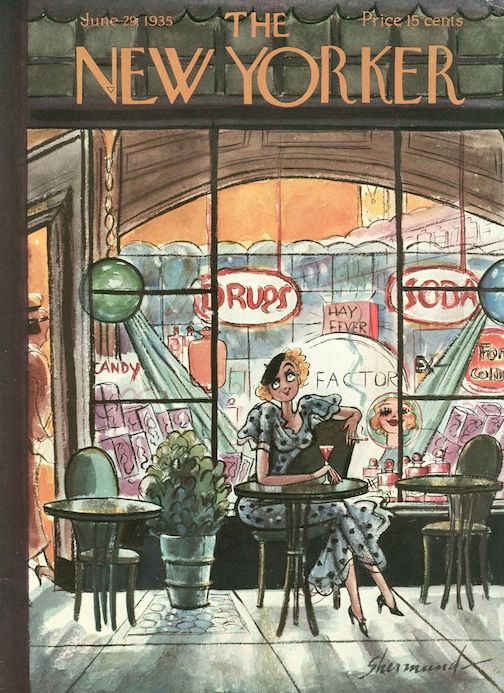
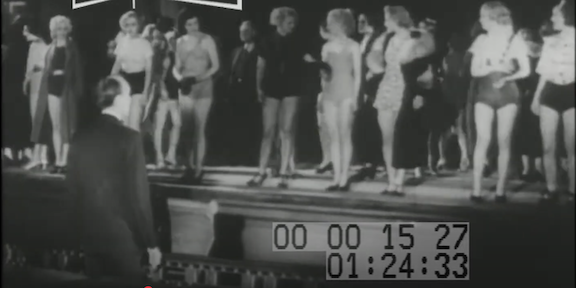
For all the progressive thinking that was on display in the early New Yorker, we also reminded that it was also a creature of its time in 1935. Here are excerpts from a lengthy “Talk of the Town” entry that described the sad winnowing process of Broadway revue producer Earl Carroll

JUDGEMENT DAY…Here is a screenshot from a short film featuring the 1935 audition described in the “Talk” segment. At left is Earl Carroll. You can watch the film here. (YouTube)

 * * *

Too Little For Too Much

Film critic John Mosher gave Alfred Hitchcock’s 1934 version of The Man Who Knew Too Much just five lines in his review. He described it as “one of those preposterous adventure stories which Englishmen are always writing…” The film, however, was an international success, and it would define the rest of Hitchcock’s career as a director of thrillers with a unique sense of humor.

A HAPPY, CAREFREE HOUR is how critic John Mosher described his experience watching 1934’s The Man Who Knew Too Much. Clockwise, from top right, director Alfred Hitchcock with the film’s German star, Peter Lorre, who learned his part phonetically; Lorre and Cicely Oates; Edna Best did her best at playing a grieving mother. The film was remade by Paramount in 1956, starring James Stewart and Doris Day. (Wikipedia/aurorasginjoint.com/IMDB)

 * * *

Dizzy Nor Dazzled

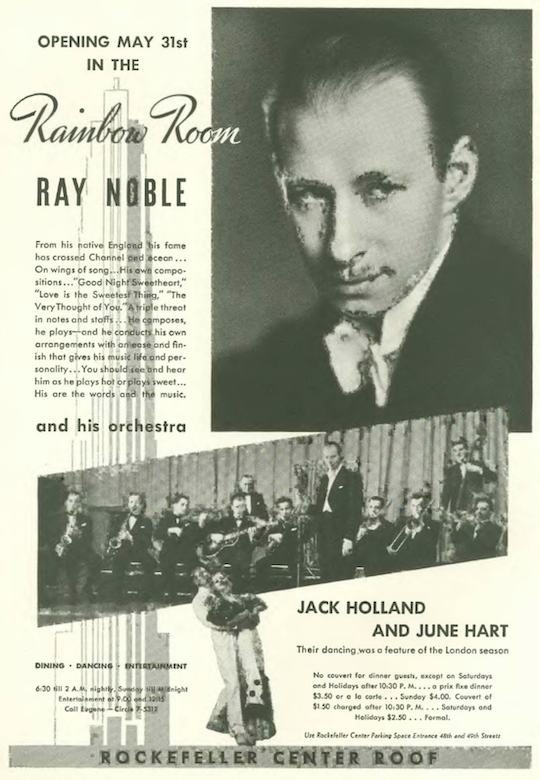
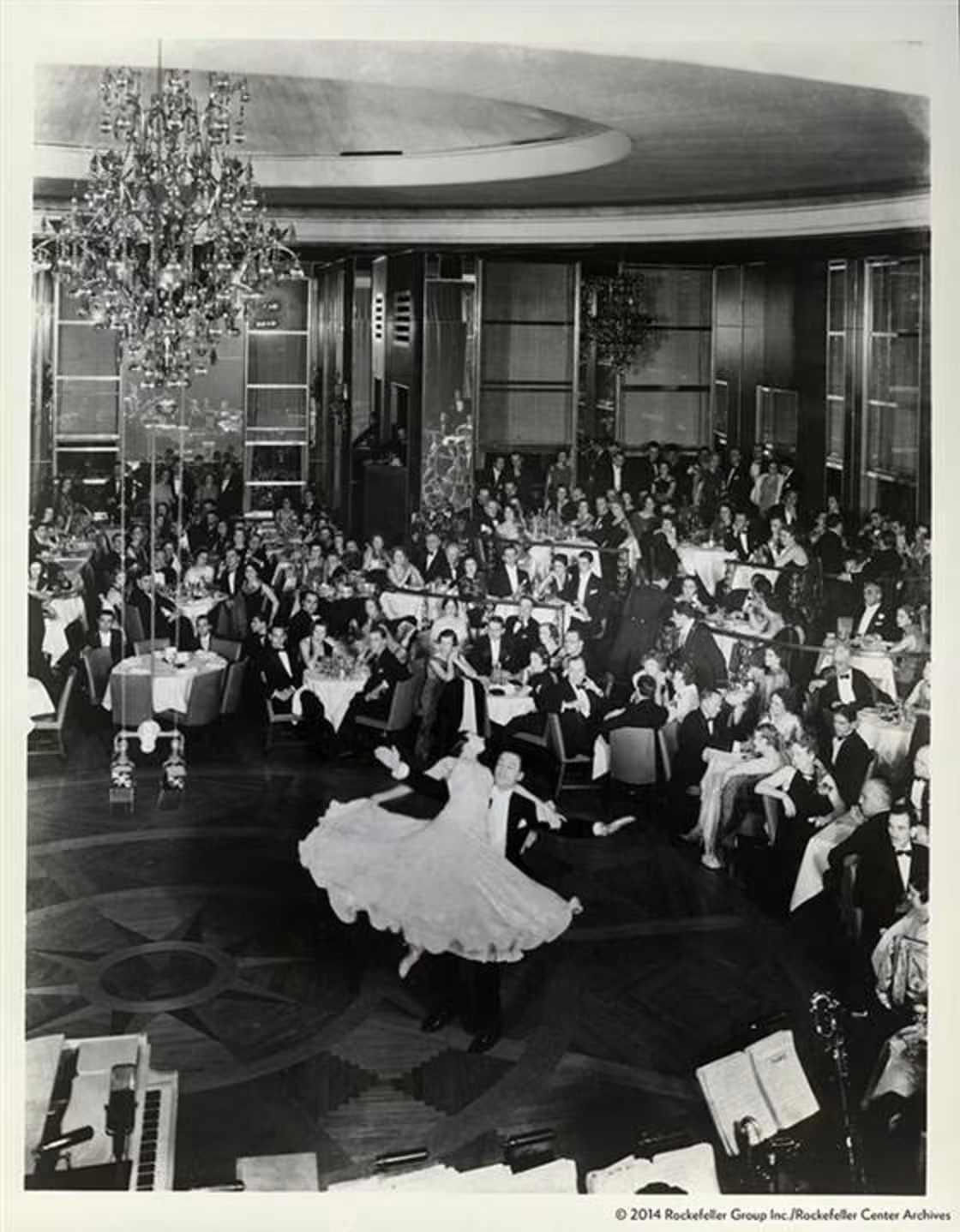
In 1935 Lois Long had been divorced from cartoonist Peter Arno for about four years, and she was the mother of six-year-old daughter from that marriage. That didn’t keep her from sampling the city’s night life, but the days of speakeasies and drinking sessions that lasted into the wee hours were over for the 34-year-old Long. For her “Tables for Two” column she took the elevator up to the 65th floor of 30 Rockefeller Plaza to take in the entertainment at the Rainbow Room…as well as the pedestrian crowd…

WHAT A WHIRL…Above, diners watch a performance by ballroom dancers Lydia and Joresco in the then newly opened Rainbow Room in 1934. Lois Long enjoyed the Rainbow Room in its 1930s heyday, but she missed her old speakeasy crowd, noting that the Rainbow Room’s customers weren’t “dizzy enough” to suit her tastes. (Rockefeller Center Archives)

…her speakeasy days were over, but it appears Long still enjoyed a bit of indulgence…here is how she concluded her column:

 * * *

From Our Advertisers

Step into a crowded mid-century elevator and you were bound to catch a whiff of the menthol-tinged scent of Aqua Velva, not objectionable if properly applied…

…speaking of menthol, the makers of Spud cigarettes were now competing with upstart menthol cigarette makers including Kool…this ad has all kinds of problems, including the suggestion that the occasional Spud not only inspires one’s nuptials, but also ensures marital bliss, as well as a lifetime of chain-smoking…

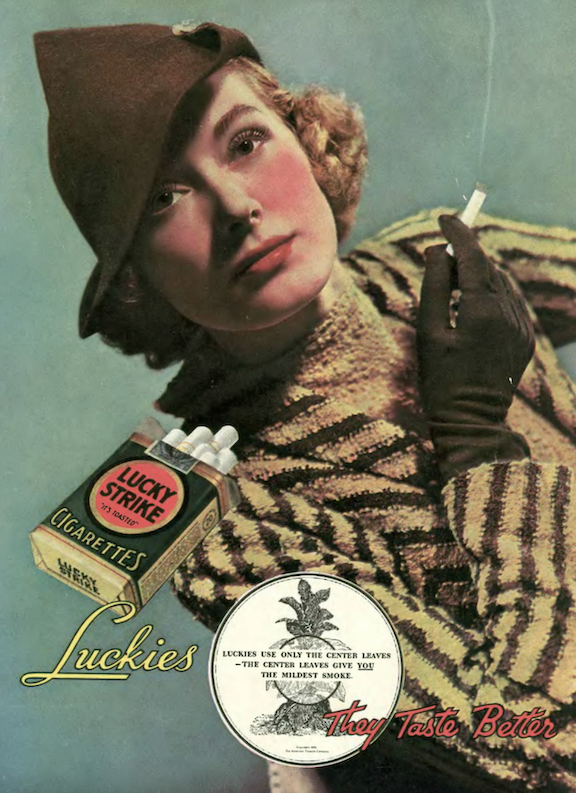
…Luckies, on the other hand, continued to appeal to the modern woman, and what impressionable young woman wouldn’t be inclined to pick up the habit to complete her ensemble?…

…the makers of College Inn tomato juice gave their raving Duchess the week off, but we get another old sourpuss in the form of a “Dowager” who demands that her servant remove a glass of what very well could have been tomato juice…enter the old bat’s niece, Dorothea, who suggests that the cook, Clementina, serve some Libby’s pineapple juice instead, probably spiked with vodka given the Dowager’s sudden change of demeanor…

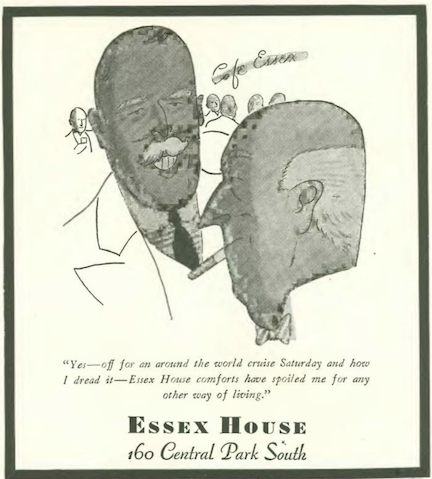
…Essex House continued their class-ridden ad campaign, this time with some stuff-shirt dreading his world cruise

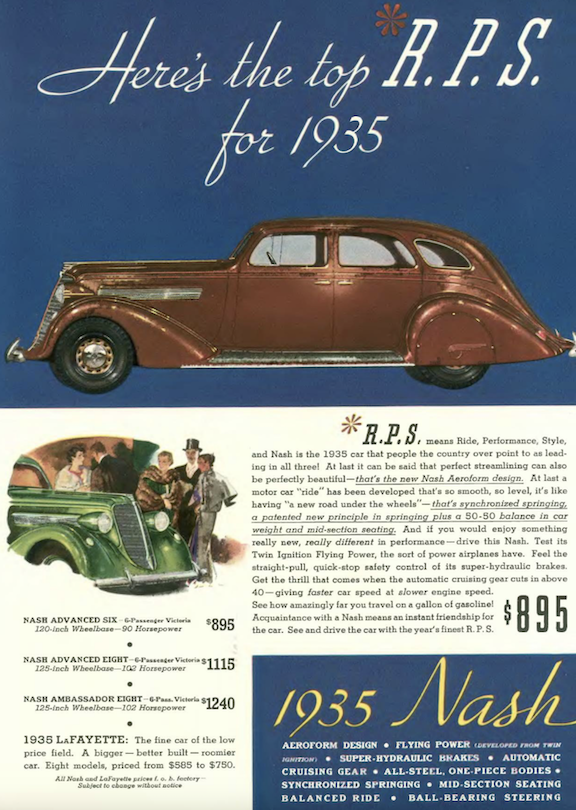
…carmakers continued to emphasize economy and price to move their latest models, including the 1935 Nash with “Aeroform Design”…

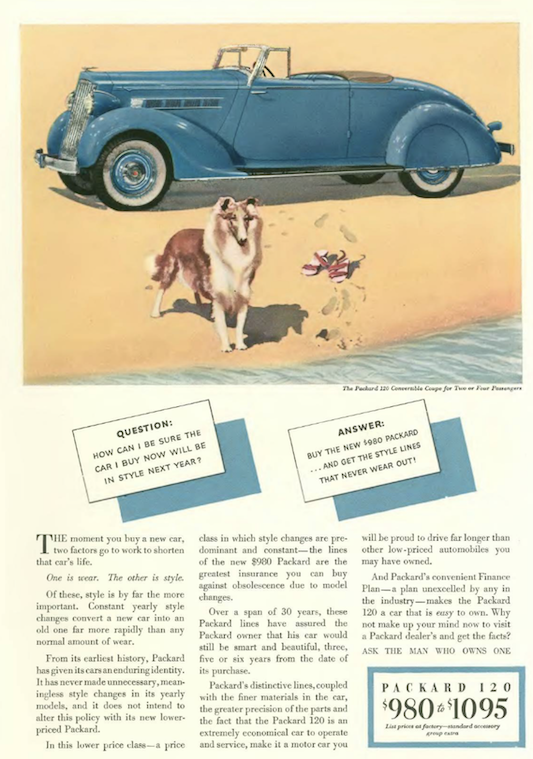
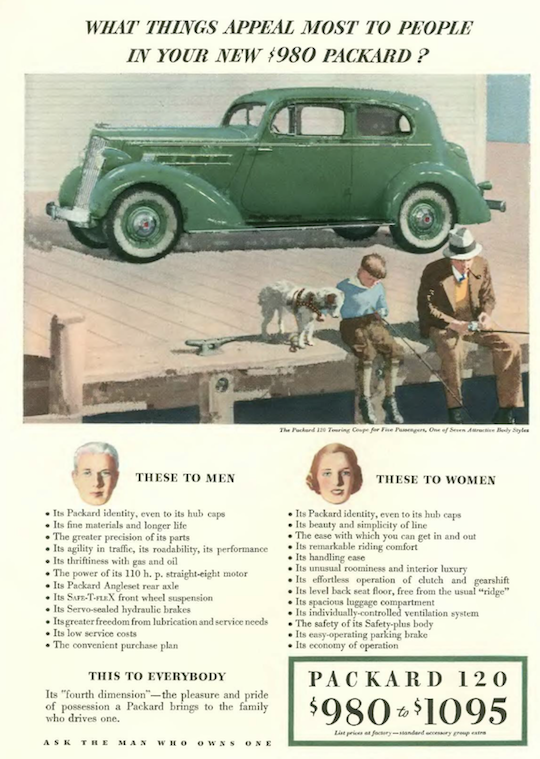
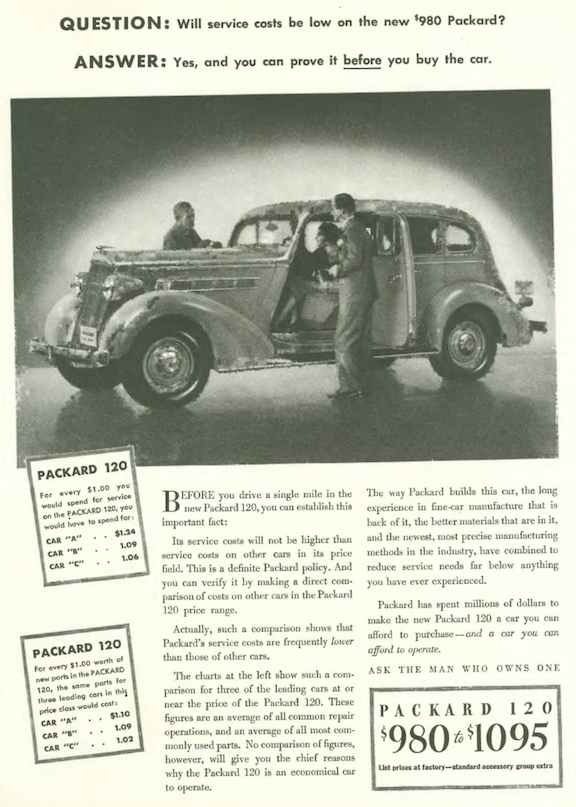
…last week I noted that Packard was doubling down on promoting the elite status of its premium automobile; however, the carmaker did introduce a “120” that cost a fraction of its luxury models and helped the company’s bottom line…

 

…Packard’s competition was Lincoln and Cadillac, among other luxury brands, but Pierce Arrow represented the pinnacle of luxury and craftsmanship, the American equivalent of Rolls Royce…unlike the other luxury brands, Pierce Arrow did not offer a lower-priced car, and the company folded it 1938…
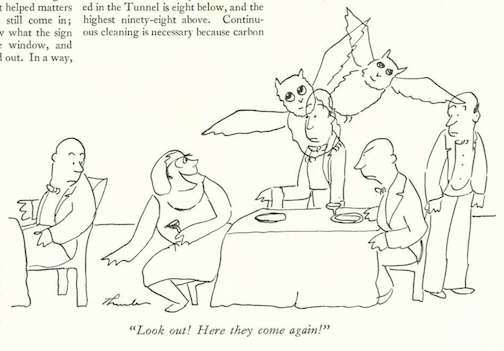
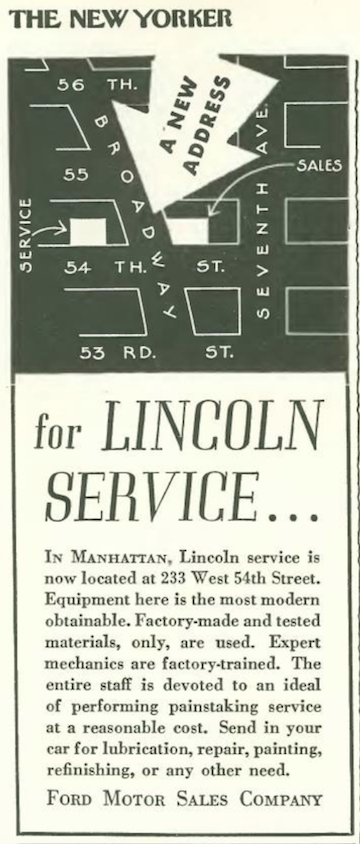
…speaking of luxury cars, if you owned a Lincoln, this little ad tucked into the top corner of page 55 showed you were to go to get a tune-up…

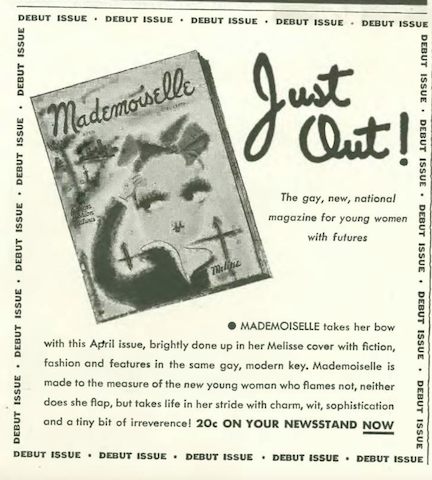
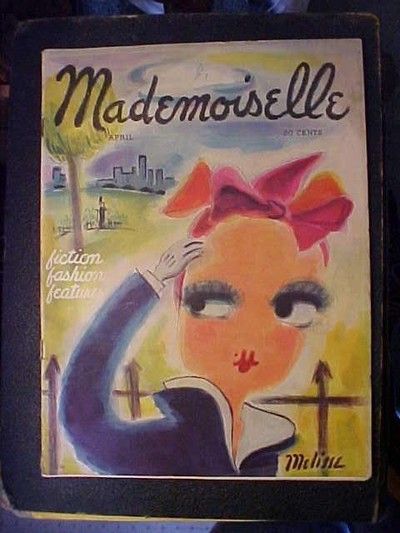
…the publishers at Street & Smith announced the launch of a new fashion magazine, Mademoiselle, a seemingly daring move in Depression America…the cover featured an illustration by Melisse (aka Mildred Oppenheim Melisse)…the magazine was later acquired by Condé Nast, and folded in November 2001…

Mildred Oppenheim Melisse’s cover for the debut issue of Mademoiselle, April 1935. Melisse also supplied the cover art for the May and June issues that year. (Pinterest)

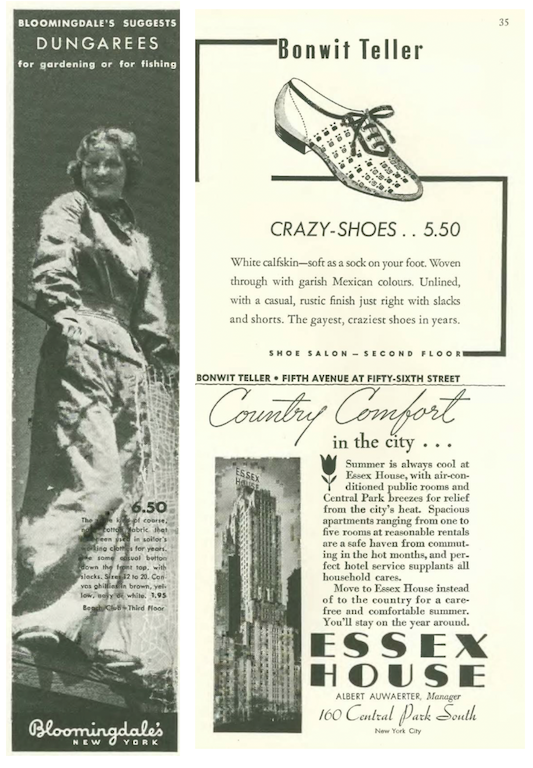
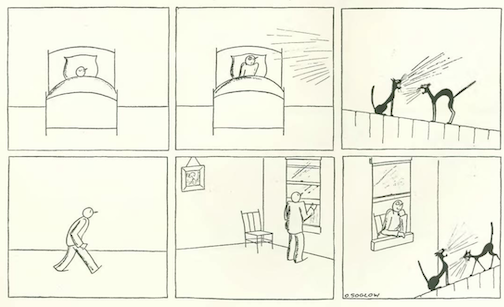
Otto Soglow was on his way to becoming a wealthy man thanks to his “Little King” cartoon…William Randolph Hearst lured Soglow and the cartoon away from The New Yorker in 1934, so the only way the wee potentate could appear in the magazine was in an ad, like this one for Bloomingdale’s…

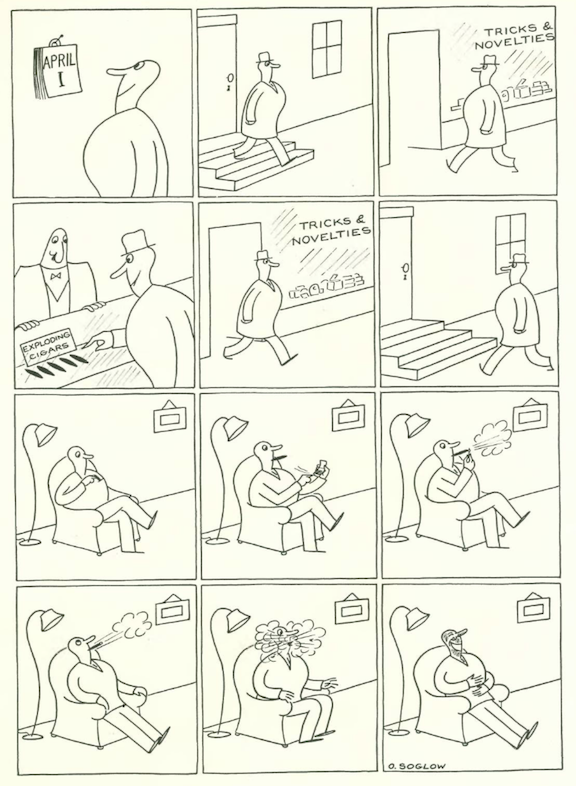
…Soglow continued to contribute to The New Yorker, and we kick off our cartoons with an April Fool’s joke…

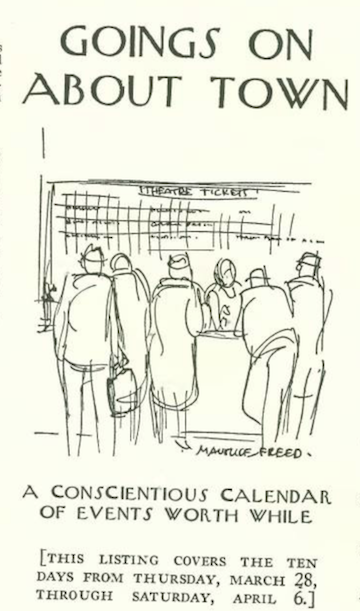
…for the second week in a row Maurice Freed supplied the opening spot art for “Goings On About Town”…

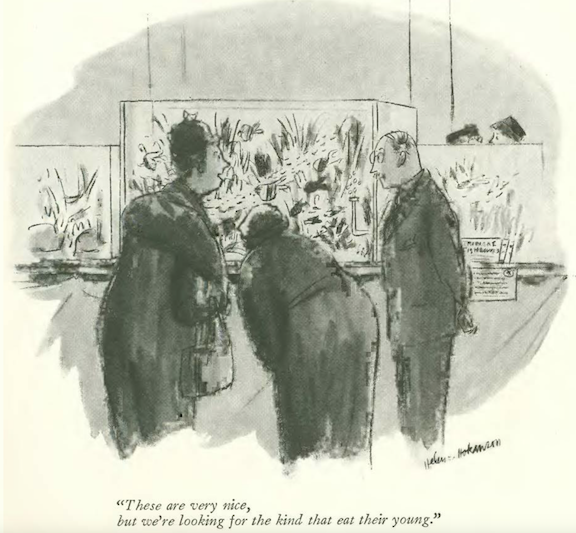
Helen Hokinson was on the hunt for some predatory fish…

James Thurber looked in on the nudist fad that emerged in the 1930s…

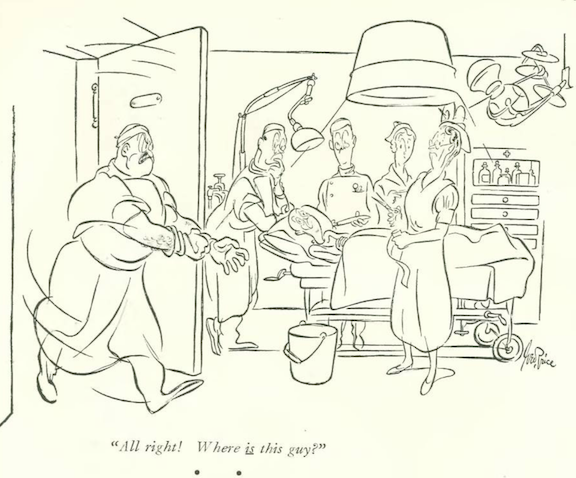
…and we close with George Price, an some alarming bedside manners…

Next Time: Keep Calm and Carry On…

Something Frivolous

And what can be more frivolous than a Busby Berkeley musical, with scores of leggy showgirls tap-dancing in perfect rhythm, or dressed in identical white gowns while playing flying pianos. Make sense? No, and that was the whole point.

March 23, 1935 cover by Peter Arno. The color, contrast and composition are striking; it looks more like a cover from the 50s or 60s.

“In an era of breadlines, depression and wars, I tried to help people get away from all the misery…” Berkeley once remarked. “I wanted to make people happy, if only for an hour.” Gold Diggers of 1935 was Berkeley’s second “Gold Digger” picture (he choreographed or directed four; there were six in all, including one silent), and it was the first in which he served as sole director. Critic John Mosher didn’t know what to make of the film, likening it more to an earthquake than an entertainment.

SOMEONE HAS TO DO IT…Busby Berkeley (1895-1976) works with dancers (left) during the production of 1933’s 42nd Street; right, at work on one of his lavish sets, circa 1930s. (IMDB)

The “harmless jingle” Mosher referred to, Harry Warren and Al Dubin’s “Lullaby of Broadway,” received an Oscar for Best Original Song (it also gave me an earworm for a week).

GOLDEN GIRLS…Clockwise, from top left, Alice Brady as the parsimonious Matilda Prentiss and Adolphe Menjou as the conniving Russian dance director Nicolai Nicoleff in Gold Diggers of 1935; a scene from the dancing pianos sequence; Dick Powell and Gloria Stuart as the film’s sweethearts. (Wikipedia/YouTube/IMDB)

Amid the frivolity, Mosher noted the juxtaposition of the jingly “Lullaby of Broadway” with the haunting, two-minute sequence of Wini Shaw singing “Lullaby” as her disembodied face emerges from the blackness toward the viewer.

The scene continues as the woman (Shaw) turns onto her back, her head slowly dissolving into the nighttime city…after a raucous, mass tap-dancing scene, she falls to her death, and the sequence is reversed, her face disappearing into the blackness. The blog Acidemic gives an interesting take on this part of the film, which is more reminiscent of a German avant-garde film than Berkeley’s usual fare…

(YouTube)

…Mosher found the scene “terrifying.” Perhaps Shirley Temple helped calm his nerves with her precocious antics in The Little Colonel

NO FLOATING HEADS HERE…Shirley Temple and Bill Robinson doing the famous staircase dance in The Little Colonel (1935). (TCM)

 * * *

Up In Smoke

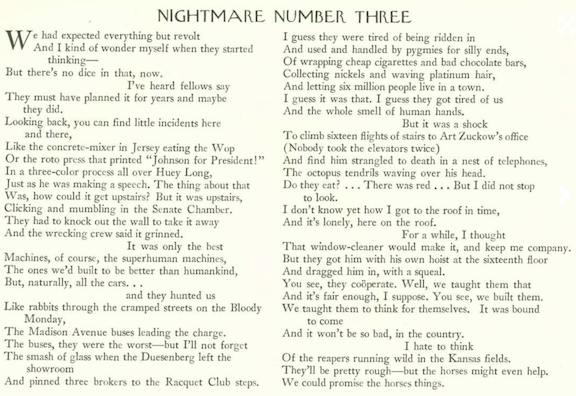
In “Notes and Comment” E.B. White considered the possibility that cigarette smoking might be harmful to unborn babies, and wryly suggested that embryos could replace grandmothers as a new growth market for big tobacco:

…White referred to the advertisement below, which appeared in the Feb. 9, 1935 issue of The New Yorker:

…White also commented on his recent visit to Madison Square Garden’s winter skating carnival…

THE DOUBLE AXEL was still thirteen years in the future when Swedish skaters Gillis Emanuel Grafström (left) and Vivi-Anne Hultén delighted E.B. White at Madison Square Garden. Photos are from 1924 and 1932, respectively. (Wikipedia)

 * * *

Prescience of Mind

We have more from E.B. White, this time in a humorous piece titled “The Dove’s Nest,” in which White took a poke at the most influential newspaper editor in the country, Arthur Brisbane. A close friend of William Randolph Hearst, Brisbane essentially ran Hearst’s newspaper empire. The New Yorker often ridiculed Hearst’s (and Brisbane’s) jingoistic approach to the news that included giant headlines warning of war. Excerpts:

William A. Swanberg, author of the 1961 biography Citizen Hearst, described Brisbane as “a one-time socialist who had drifted pleasantly into the profit system…in some respects a vest-pocket Hearst–a personal enigma, a workhorse, a madman for circulation, a liberal who had grown conservative, an investor.”

DAMN THOSE TORPEDOES…Arthur Brisbane in 1933. His grandson, Arthur S. Brisbane, now retired, served as public editor of The New York Times from 2010 to 2012. (credo.library.umass.edu)

The New Yorker continued to take jabs at Brisbane in the following issue (March 30). Brisbane owned a large estate (including a horse farm) in New Jersey that he made available to New Deal work programs during the Depression. I suppose this Al Frueh cartoon was some kind of reference to that…

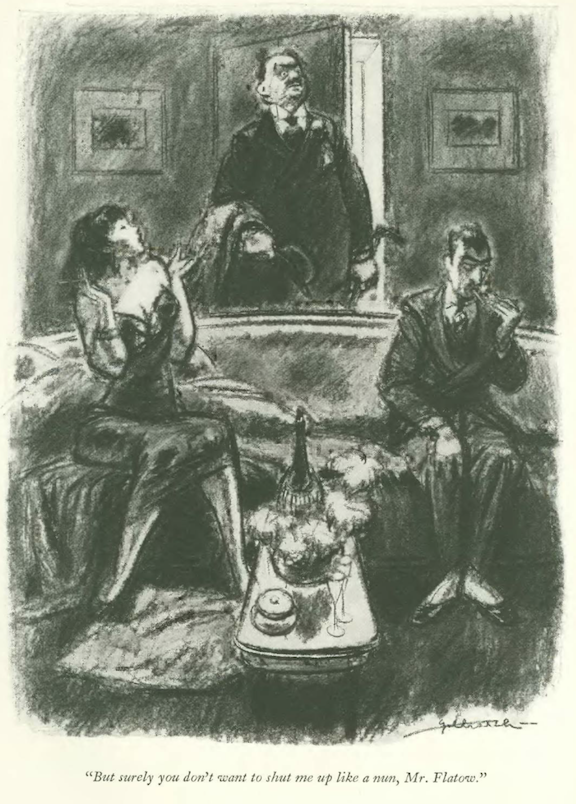
…also in the March 30 issue was this ad from World Peaceways, which raised alarms about possible war and bombs raining down from the sky…

…back to the March 23 issue, where we find the calming strains of a Brahms concerto at Carnegie Hall, conducted by Arturo Toscanini with some support from his son-in-law, Vladimir Horowitz

MAY I CALL YOU DAD?…Not likely something said by young Vladimir Horowitz, left, to father-in-law Arturo Toscanini. (WQXR/Britannica)

 * * *

From Our Advertisers

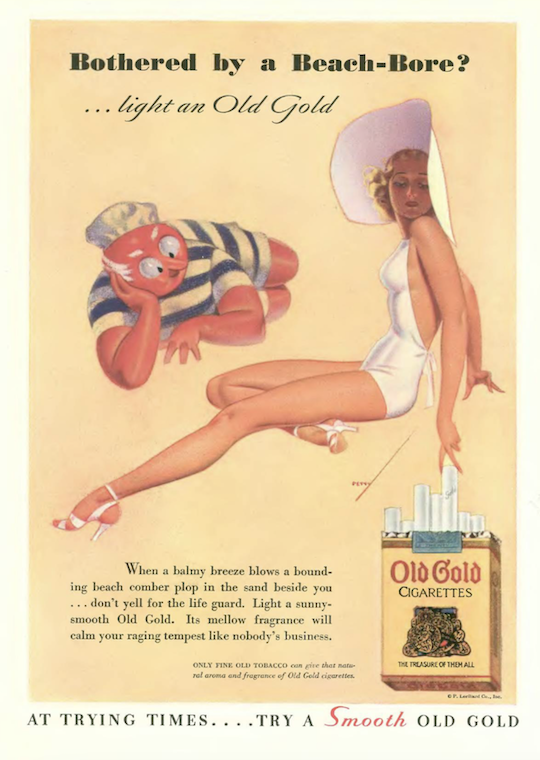
Beginning in 1934 the makers of Old Gold cigarettes hired pin-up artist George Petty to create a series of ads featuring a homely, clueless sugar daddy and his leggy mistress…here he turns the tables, introducing a “Pudgy Wudgy” matron putting the moves on a handsome hosiery salesman…

…this Petty ad appeared in the Feb. 9, 1935 issue of The New Yorker

…the makers of Camels continued their campaign of “distinguished women” who enjoyed their product…here we have a former debutante, Dorothy Paine, an “alert young member of New York’s inner circle.” Not much of a record of Dorothy, who married a man named Walter H. Sterling in 1935…apparently they moved to Phoenix and bought up property in the Southwest…

…the makers of General Tire offered this grim assessment of tire safety…the lad seems to be a mere investment of time…

…although prestige brands suffered mightily during the Depression, the folks at Packard were doubling down on the elite status of their automobile…

…we’ve seen the work of fashion illustrator Ruth Sigrid Grafstrom before in ads for Spud cigarettes…here she contributes some elegant lines to a spot for Bergdorf Goodman (is the woman on the right smoking a Spud?)…

…here’s the Duchess again, still blowing her top over College Inn tomato juice…just look at her clenched fists…that fop with a monocle looks like he just took a left hook to the chops…

…on to our illustrators, William Cotton created this caricature of Rexford Guy Tugwell for Russell Lord’s two-part profile…Tugwell and President Franklin D. Roosevelt created the Resettlement Administration, which relocated rural unemployed to “Greenbelt Cities” near urban job markets. Critics called him “Rex the Red” for his social engineering experiments, and after he was forced out of federal government, Tugwell was appointed in 1938 as the first director of the NYC Planning Commission. Naturally, he would butt heads with Robert Moses…

…illustrator and painter Maurice Freed kicked off the calendar section…

…bookended on the bottom of page 4 by one of James Thurber’s most recognized drawings…

…Thurber again, and more woes between the sexes…

…we continue with our cartoonists by looking in on Barbara Shermund

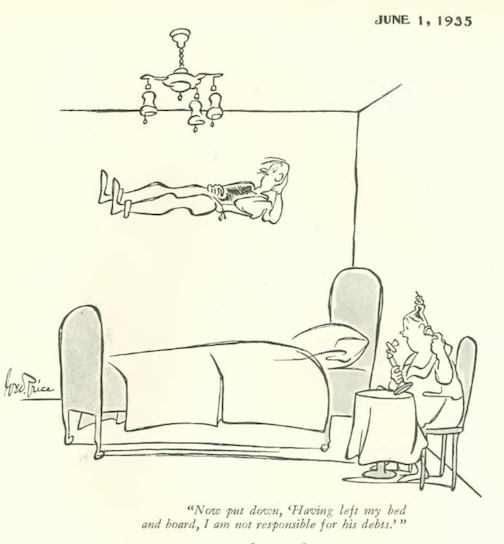
George Price found a new wrinkle for his recurring floating man cartoon…

Helen Hokinson graced page 19 with scenes from the opera…

…leaving an extra drawing stranded on page 18…

Alain offered a new twist on the promotion of physical fitness…

Gluyas Williams brought us to the stuffy confines of club life (the cartoon was originally featured vertically)…

…and we close with Richard Decker, and a lucky draw at the IRS…

Next Time: The Lighter Side of George Grosz…

The Mouse That Roared, In Color

John Chapin Mosher was the first regularly assigned film critic for The New Yorker, writing reviews for the magazine from 1928 to 1942. He was also a fan of Disney animated shorts, and one particular mouse.

March 2, 1935 cover by Robert Day.

Mosher, who also contributed short stories to the magazine, displayed a lively, witty style in his reviews, and in the early years of Walt Disney animation he was quite partial to Mickey Mouse, who from his sound debut in 1928’s Steamboat Willie had quickly grown into an international star—when the cartoon mouse first appeared in color in The Band Concert, it was a sensation. Mosher’s other review was not so enthusiastic, even though Sweet Music featured another major star of the 1930s, Rudy Vallée.

The 73rd short film in Disney’s Mickey Mouse series, The Band Concert was acclaimed by no less than conductor Arturo Toscanini, who saw it six times. Esquire’s culture critic Gilbert Seldes wrote that “[none of] dozens of works produced in America at the same time in all the other arts can stand comparison with this one.”

BEDAZZLED…Along with New Yorker film critic John Mosher, both the great Italian conductor Arturo Toscanini and culture critic Gilbert Seldes praised Mickey Mouse’s debut in color. Even later critics revered the nine-and-a-half minute short. In 1984 Leonard Maltin said that The Band Concert is “one of the best cartoons ever made anywhere… There are nuances of expression in Mickey’s character throughout this film that had seldom been explored in earlier shorts…” (Wikipedia/YouTube)
PASSING THE TORCH…Bandleader Rudy Vallée and famed torch singer Helen Morgan in Sweet Music. Years of heavy drinking had taken a toll on Morgan by this time; she appeared for a “scant moment” in the film, and would leave movies altogether in 1936. (cinemasojourns.com)

 * * *

Rudy Was Here, Too

Rudy Vallée was among the celebrities gathered at Jack Dempsey’s Restaurant, a placed visited in the previous issue by Lois Long. This time Russell Maloney and Charles Cook took a look inside for “The Talk of the Town”…

JACK DEMPSEY LOOMS over his restaurant at 50th Street and Eighth Avenue in this odd postcard image (top), where the backdrop of the city has been replaced with an open sky (Terry Gilliam’s Monty Python animation comes to mind). The restaurant would relocate to 1619 Broadway in 1937-38. (Courtesy eBay)

 * * *

Keeping It to Themselves

New Yorkers typically don’t boast about their city because they often consider it a natural part of their lives and identity. Indeed, overt displays of civic boosterism are found to be embarrassing, if not distasteful. E.B. White, in his “Notes and Comment,” explained:

BEING NUMBER TWO, WE TRY HARDER…Although not mentioned in White’s note, The New Yorker enjoyed taking shots at boosterism, and especially the Chicago Tribune and its publisher, Robert R. McCormick, a leading booster of the Second City. (Michigan State University)

White observed, however, that New Yorkers weren’t so thrilled about the cost of living in their fair city…

 * * *

Those Excitable French

In her “Letter from Paris,” Janet Flanner recalled the previous year’s “Bloody Sixth” riot that resulted in the police fatally shooting seventeen people. She noted that things were more peaceful on the riot’s anniversary.

AN UGLY TURN…On Feb.6, 1934, thousands of extreme right-wing activists and war veterans gathered in Paris to protest against the alleged corruption of the left-wing government. When protests turned violent, police responded by fatally shooting seventeen people, only nine of whom were far-right protesters. (Wikipedia/wienerholocaustlibrary.org)

* * *

From Our Advertisers

Auburn made some of America’s most beautiful and technologically advanced automobiles, but the Depression was too much for luxury brands like Auburn, which would sadly fold in 1937…

…while luxury brands struggled, Americans turned to less expensive cars that touted safety and economy…in the 1930’s safety meant strong body construction, although this didn’t address the problem of unharnessed riders rattling around inside the “TurretTop” shell, or being launched through the windshield…

…the bargain brand Plymouth, however, employed snob appeal, and safety, to move their “Floating Ride” autos…

…Feel classy driving that Plymouth? Well apparently beer drinking is classy too…just ask this chap, who is apparently toasting a successful fox hunt…

…Speaking of class, the folks at Essex House played on class anxieties to fill their rooms at Central Park South…

…a common theme in  upscale fashion ads was aviation; that is, the suggestion that the smart set took to the air when they traveled–they were the only ones who could afford it…

…in stark contrast is this ad from the pacifist/antiwar organization World Peaceways…their bold and unflinching ads described soldiers as pawns in the corrupt games of the rich and powerful…

…Radio City Music Hall was originally opened in December 1932 as a live performance venue, but the cavernous hall wasn’t particularly suited to theatrical performances, and just two weeks after opening, managers announced that the theatre would switch to showing feature films. This modest one-column ad tried to stir up interest in a comedy featuring none other than Edward G. Robinson, who was known for his tough guy, gangster roles…

CRACKING SMILES INSTEAD OF HEADS…Jean Arthur and Edward G. Robinson in The Whole Town’s Talking. (postmodernpelican.com)

…beautifully photographed, stylish women smoking cigarettes were common in 1930s advertising as tobacco companies continued to tap the growth potential of this demographic…

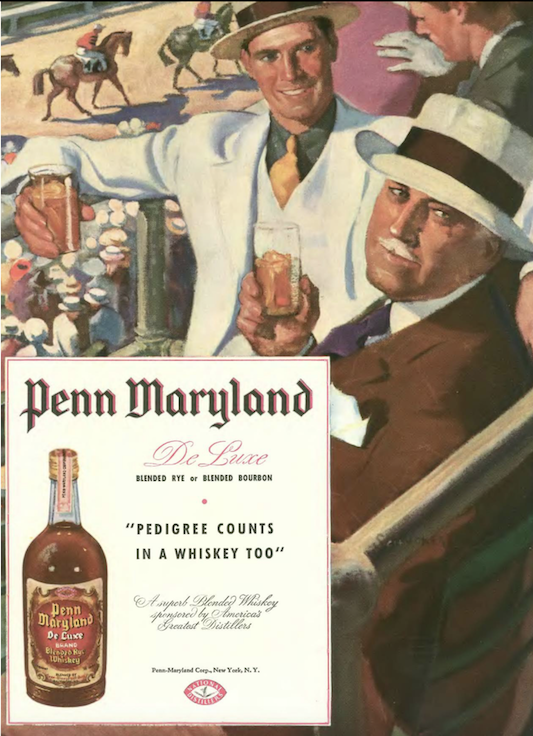
…this next spot employs of the talents of Otto Soglow to promote blended Penn Maryland whiskey…

…which segues to our cartoonists, and Soglow again…his popular Little King stopped running in The New Yorker when it was acquired by Hearst in 1934, but Soglow simply created other King-like characters to run the gags…

…”Profiles” featured socialist cartoonist Art Young, with an illustration by Al Frueh

James Thurber contributed this illustration/cartoon at bottom of page 12 in “The Talk of the Town” section…not sure what this means…fear of being attacked by giant Puritan women?…

Jaro Fabry contributed only one cartoon to The New Yorker…the meaning is lost on me…

…I was also baffled by this Gilbert Bundy cartoon, until I consulted this excerpt from a Paris Review article (“Trading Places” by Sadie Stein 3/19/14): Time was, the passing on of compliments was so ritualized a part of life that the practice had a name: trade-last. Merriam-Webster’s defines it as “a complimentary remark by a third person that a hearer offers to repeat to the person complimented if he or she will first report a compliment made about the hearer,” and dates the first recorded use of the term to 1891…

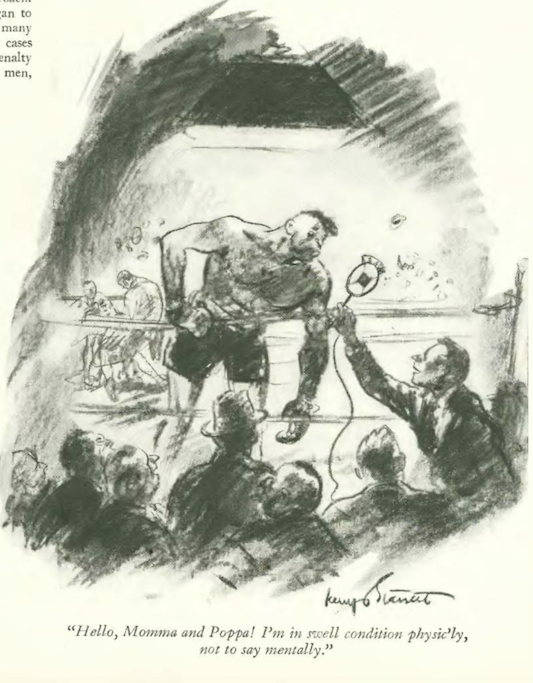
Kemp Starrett offered up a uniquely honest sales pitch…

Alan Dunn advised against eating your vegetables…

Leonard Dove, and where old-timey music met an old-timey feud…

…and we close with William Crawford Galbraith, and a bartender trying to class up his joint…

Next Time: Snapshot of a Dog…

A Decade of Delights

With this post (No. 413), we mark the tenth anniversary of The New Yorker. Since I began A New Yorker State of Mind in March 2015, I’ve attempted to give you at least a sense of what the magazine was like in those first years, as well as the historical events that often informed its editorial content as well as its famed cartoons. Those times also informed the advertisements; indeed, in some cases the ads give us a better idea of who was reading the magazine, as well as their changing tastes and buying power as we moved from the Roaring Twenties to the Depression, and from Prohibition into Repeal.

I have also chosen this time to go on hiatus, and hopefully resume this blog when The New Yorker celebrates its centennial next February (this site will remain active and available, and I will continue to monitor comments and messages). Let us hope that the editors use the original Rea Irvin cover for that occasion, and restore his masthead above “The Talk of the Town” section. Perhaps some enterprising soul could start a petition.

Feb. 16, 1935 cover by Rea Irvin.

Moving on to the tenth anniversary issue, we find E.B. White recalling the world of The New Yorker’s first days. Given the massive economic and societal shifts that occurred from 1925 to 1935, those first days seemed distant to White, who felt old, “not in years but events.”

DAYS OF YORE…E.B. White noted the many changes that had taken place during The New Yorker’s first ten years, including, clockwise from top left, the passing of 1920s notables such as President Calvin Coolidge and two very different theatre impresarios—David Belasco and Flo Ziegfeld; White also recalled the much-publicized 1925 wedding of Abby Rockefeller to David Milton, the throngs of women who took to smoking in public in the 1920s and the drinkers who took their activities behind closed doors; and one of the early magazine’s beloved contributors, Ralph Barton, who offered his whimsical take on the news in “The Graphic Section” as well as in other illustrated features. (Wikipedia/Wikitree/Ephemeral New York)

White also noted a new craze that had originated around the same time as the birth of The New Yorker…

TWO ACROSS…Max Schuster and Richard Simon of Simon & Schuster, with their first crossword book, 1924. (americanbusinesshistory.org)

White concluded with these parting words, tinged with world-weariness, writing “More seems likely to happen.” One wonders if he imagined The New Yorker at 100, which in our day is just around the corner. Like White, many us have grown weary of this angry world, where indeed more seems likely to happen. Let us hope it is for the best.

Now, some unfinished business. We need to look at the previous issue, Feb. 9, 1935, before we close out the decade.

Feb. 9, 1935 cover by William Cotton.

We stay on the lighter side, joining critic John Mosher at the local cinema to appreciate Leslie Howard’s dashing performance in The Scarlet Pimpernel…

WORKING OVERTIME…Leslie Howard and Merle Oberon in The Scarlet Pimpernel. Howard portrayed an aristocrat who leads a double life, publicly appearing as a dandy while secretly rescuing French nobles from Robespierre’s Reign of Terror. (PBS)

 * * *

From Our Advertisers

Cigarette manufacturers employed every angle from sex to health claims to move their product…not to be left out of any niche market, Chesterfield even went after the little old ladies…

…by contrast, the makers of Old Gold cigarettes featured a clueless sugar daddy and his leggy mistress in a series of ads drawn by famed pin-up artist George Petty

Otto Soglow would do well with advertisers during his career, promoting everything from whiskey to Pepsi and Shredded Wheat to department stores…in this case Bloomingdale’s…after William Randolph Hearst’s King Features Syndicate wrested The Little King away from The New Yorker in September 1934, this was the only way you would see the harmless potentate in the magazine…

…another New Yorker artist earning some ad dollars on the side was Constantin Alajalov, here adding a stylish flair for Coty…

…and then there’s James Thurber, who continued to contribute his talents on behalf of the Theatre Guild…

…and we move along to the Feb. 9 cartoons, with Thurber again…

…the issue also featured two by George Price

…and Howard Baer supplied some life to this little party…

…now let’s return to the Feb. 15, 1935 issue…

…where John Mosher was back at the cinema, this time enjoying the story of a “beautiful stenographer”…

POPCORNY…Fred MacMurray and Claudette Colbert meet cute over popcorn in the romantic comedy The Gilded Lily. It was MacMurray’s second credited screen role, and it was the first of seven films in which Colbert and MacMurray would star together. (Wikipedia)

 * * *

More From Our Advertisers

In its bid for survival during the Depression, the luxury brand Packard introduced its first car under $1000, the 120. Sales more than tripled in 1935 and doubled again in 1936…

…meanwhile, Hudson was hanging in there with innovations such as the “Electric Hand”…it was not a true automatic transmission, but it did allow drivers to shift gears near the steering wheel…

…as demonstrated here…

…whatever you were driving, Goodyear claimed it would keep you the safest with their “Double Eagles”…

…I include this ad for Taylor Instruments because it features an illustration by Ervine Metzl, who would become known for his posters and postage stamp designs…

…Metzl’s design of a three-cent stamp commemorating the 1957–1958 International Geophysical Year…

…on to our cartoonists, we begin with this Deco-inspired artwork by an unidentified illustrator…

…one of Helen Hokinson’s “girls” was going about her daily rounds…

Garrett Price gave us a gatekeeper not quite up to his task…

Gilbert Bundy was seeing stripes rather than stars…

…while James Thurber’s medium was getting in touch with an equine spirit…

…scientific inquiry knew no bounds in Robert Day’s world….

…and in the world of Alain (aka Daniel Brustlein), old habits died hard…

…and we close with Peter Arno, at his risqué best…

Thanks for reading The New Yorker State of Mind!


It’s a Gift

Above: Charles Sellen as Mr. Muckle and W.C. Fields as shopkeeper Harold Bissonette in the 1934 film It's a Gift.

Rea Irvin featured the New York Auto Show on the cover of Jan. 12, 1935 issue—the extravaganza of cars at the Grand Central Palace was one place New Yorkers could go to chase away the winter blues. The other was at one of the city’s RKO theatres, where a classic W.C. Fields comedy was gracing the silver screen.

Jan. 12, 1935 cover by Rea Irvin.

It’s a Gift was a showcase of Fields’ vaudevillian talents, tied together in a story about grocer Harold Bissonette (Fields) whose various tribulations included a pompous wife (who insisted on pronouncing the surname “biss-on-ay”), bratty children, and challenging customers (the hilarious Charles Sellen as Mr. Muckle). Writing for BFI Film Classics, Simon Louvish calls the film a chronicle of the “many titanic struggles between Harold Bissonnette and the universe. There will be battle of wills between father and daughter, between male and female, between man and a variety of uncontrollable objects.” Here is John Mosher’s review for The New Yorker.

HAROLD VS. THE WORLD…Clockwise, from top left, W.C. Fields as grocer Harold Bissonette; Fields with Kathleen Howard as wife Amelia Bissonette; Bissonette is relegated to the back porch in search of some rest; Charles Sellon as one of Bissonette’s more challenging customers, Mr. Muckle. (IMDB/TCM/filmfanatic.org/YouTube)
BABY BLUES…Two-year old Baby LeRoy (Ronald Le Roy Overacker) played the annoying foil to W.C. Fields in three films, including It’s a Gift (left, with Fields and Tammany Young). James Curtis’s W.C. Fields: A Biography (2003) quotes director Norman McLeod: “[Fields] used to swear at the baby so much in front of the camera that I sometimes had to cut off the ends of the scenes in which they appeared.” Fields’ popular persona was a man who hated dogs and kids, but a studio photo taken during the filming of It’s a Gift (right) seems to show another side. Perhaps. (Pinterest/citizenscreen.com)

 * * *

By Another Name

E.B. White led off his column with a note about Persia, which had officially changed its name to Iran. To mark the new year, Reza Shah had officially asked foreign delegates to use the new term, which referred to the native name of the people who inhabited the region.

 * * *

Hot Rods

The New Yorker was back at the auto show, where correspondent “Speed” noted the appeal of the Auburn Speedster to a college-age crowd. The $2,500 price tag (equivalent to about $55k today) was apparently within reach for some of the lads at Columbia and other Ivies. Speed also admired the limousine version of the Chrysler Airflow, but the real car of his desires was a bottle-shaped milk truck.

INSTANT CLASSIC…The New Yorker predicted that the Auburn Speedster 851, which came to be known as the “Hollywood Car,” would be popular among lads on college campuses. Despite its technical advancement (it could do 100 mph) and beautiful lines, it would prove to be Auburn’s final production model. (Wikipedia)
RARITIES…Clockwise, from top left: Boattail version of the Auburn Speedster 851, of which only 143 were built; REO milk bottle truck, circa 1930; 1935 Chrysler CW Airflow Limousine—only fifteen of these massive cars were built. (Wikipedia/Pinterest/Donald Pittenger@carstylecritic.blogspot.com)

 * * *

From Our Advertisers

The proprietors of Essex House tapped into the popularity of the Auto Show to market their economical, yet deluxe accommodations…

…the anti-war group World Peaceways continued its ad campaign with this image of the “most powerful man in America,” that is, the average citizen who should not be tricked into “the absurd business of war”…

…United Airlines used the endorsement of journalist and radio commentator Edwin C. Hill to tout the safety and comfort of its airliners…

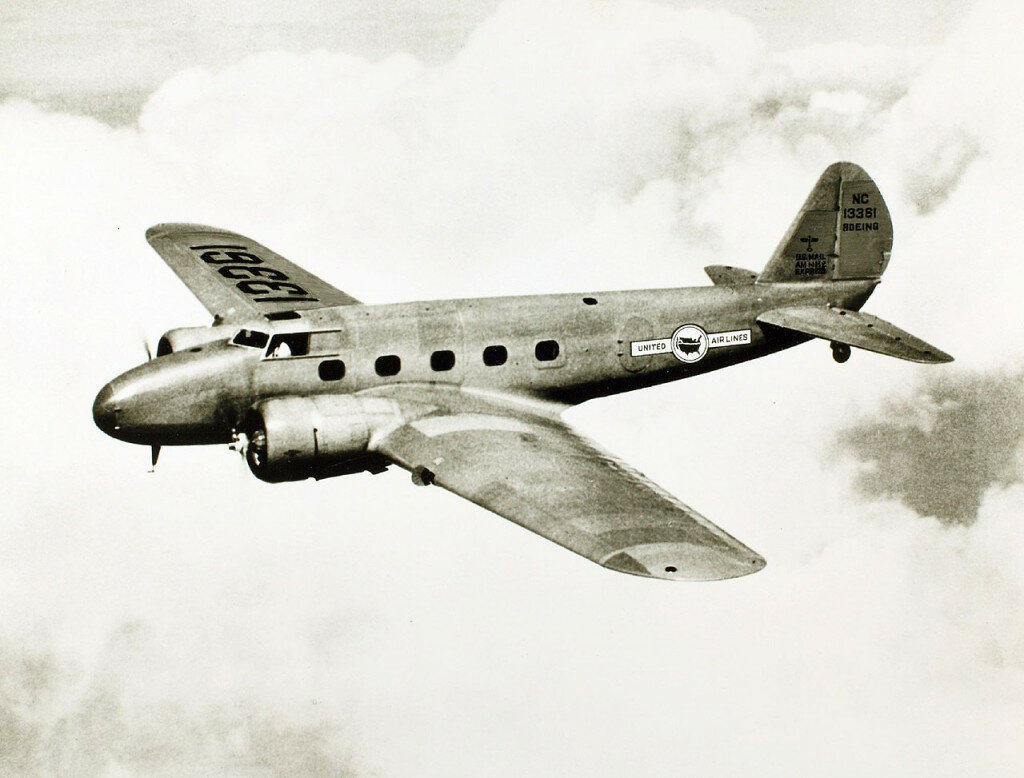
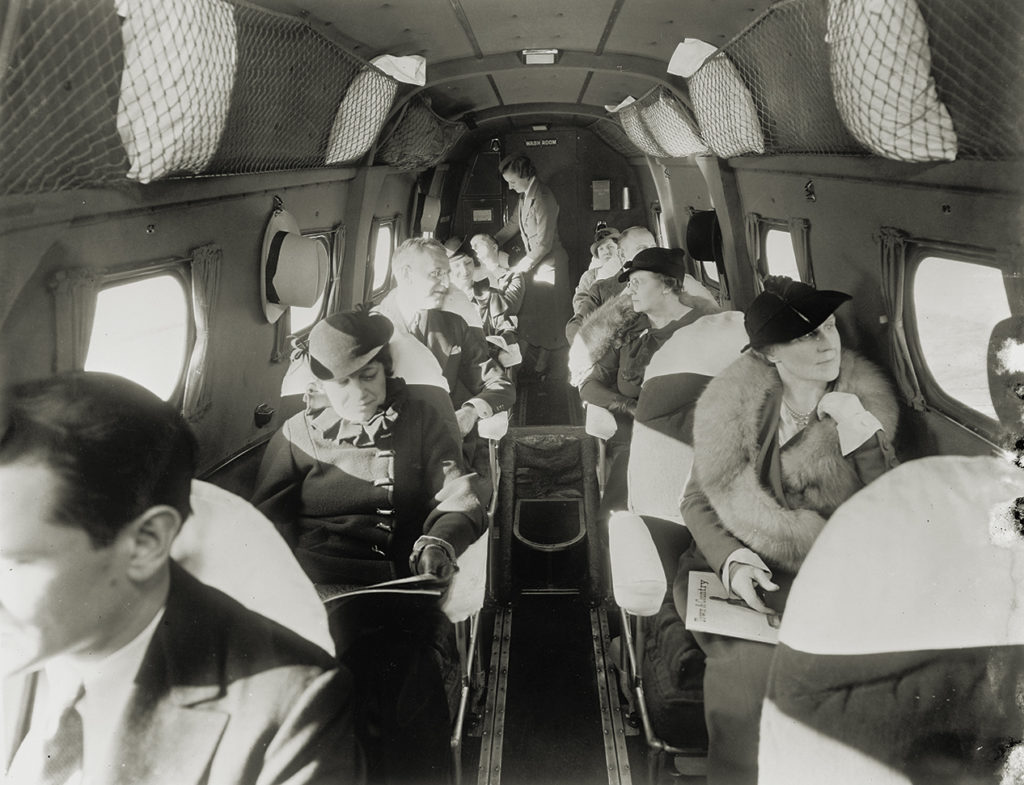
…at the time, United’s flagship airplane was the Boeing 247…

Interior and exterior of the Boeing 247. (Library of Congress/Wikipedia)

…”Mrs. William LaVarre” (Alice Lucille Elliott) was the latest adventurous soul to endorse the energizing effects of Camel cigarettes…

…it was no coincidence that the Camel and Chesterfield ads both featured women, the tobacco companies’ biggest growth market in the 1930s…

…on to our cartoons, we go bowling in this spot by George Shellhase

…a doctor’s bedside manner, in James Thurber’s world of the battling sexes…

…two of Helen Hokinson’s “Girls” were left breathless by the exploits of Elias Burton Holmes, an American photographer and filmmaker who apparently coined the term “travelogue”…

…for this next cartoon by Robert Day, a snippet from the Auto Show will shed some light…

…and we close with Carl Rose, and some hijinks among the statuary…

Next Time: Everything’s Jake…

Farewell to 1934

Above: Ringing in the New Year at Times Square, 1934.

We bid adieu to 1934 with some odds and ends, beginning with E.B. White’s observations for the upcoming year, which if anyone had noticed the uptick in Ascot tie purchases, just might be a bit rosier than previous years of the decade.

Dec. 29, 1934 cover by S. Liam Dunn.

White was also hopeful for a new year with a less dreadful press, particularly the pandering type promulgated by William Randolph Hearst.

GOOD RIDDANCE…E.B. White wryly noted the positive signs heading into 1935. While actresses Billie Seward and Lucille Ball rang in the New Year, Erroll Flynn was sporting an ascot tie and Henry Ford was proclaiming that the Depression was over. (Pinterest)

 * * *

Dr. Peeper

“The Talk of the Town” noted that Dr. Allan Dafoe, the country doctor who gained fame for delivering the Dionne Quintuplets, expressed a desire to see Sally Rand perform her bubble dance during his visit to Gotham. “Talk” also looked in on the some of the technical aspects of the burlesque dancer’s signature act:

DON’T BURST MY BUBBLE…Dr. Allan Dafoe of Dionne Quintuplet fame looked forward to taking in the sights of New York, including Sally Rand’s famed bubble dance. (Image from the 1936 book The Country Doctor/Sally Rand via stuffnobodycaresabout.com)

 * * *

Leading Ladies

Film Critic John Mosher noted the continued rise of two leading female stars, twenty-seven-year-old Katharine Hepburn and six-year-old Shirley Temple. Mosher recalled Hepburn’s recent performance in Little Women, and proclaimed that she “succeeds again” in The Little Minister.

OPPORTUNITY KNOCKS...Katharine Hepburn and John Beal in The Little Minister. Hepburn portrayed Babbie, a member of the nobility who disguises herself as a gypsy to protect villagers from a tyrannical lord. In the process she falls in love with the good Rev. Gavin Dishart (Beal). (IMDB)

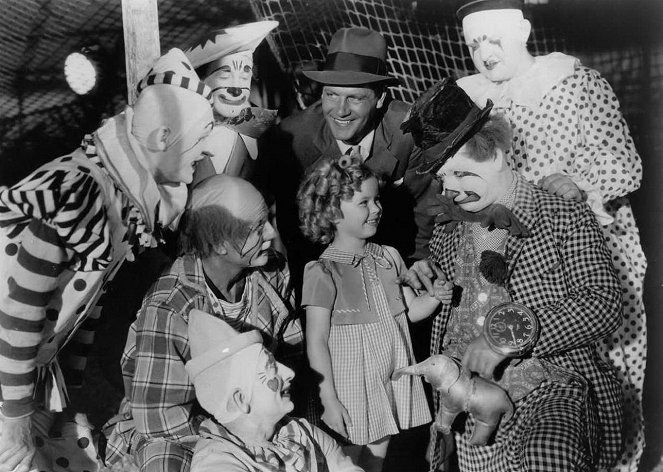
Although Mosher admitted he was a “disagreeable adult” who doesn’t enjoy seeing children on the screen “more than necessary,” he acknowledged Shirley Temple’s talents as well as those of child actor Jane Withers in Bright Eyes.

BRIGHT EYES, BRIGHT STARS…Jane Withers, Shirley Temple, and Terry in Bright Eyes. (IMDB)

 * * *

That Youthful Feeling

Given that William Shakespeare’s star-crossed lovers Romeo and Juliet were mere teenagers (the ages 13 and 16 were given to Juliet and Romeo, respectively), many productions featured actors more than twice that age. That was the case in 1933 when the play was revived by actress Katharine Cornell and her director husband Guthrie McClintic, who took the play on a seven-month nationwide tour before it was revised and opened on Broadway in December 1934. Critics dubbed the 41-year-old Cornell “the greatest Juliet of her time,” and it seems Robert Benchley heartily agreed in this excerpt from his stage review:

AGE IS JUST A NUMBER…The 41-year-old Katharine Cornell and 42-year-old Basil Rathbone in a promotional photo for Romeo and Juliet. Cornell was the first performer to receive the Drama League’s Distinguished Performance Award, which became the oldest and most exclusive theatrical honor in North America. (Vandamm photo, Museum of the City of New York)

 * * *

The New Yorkiest Place 

In 1930 gossip columnist Walter Winchell called the new Stork Club “New York’s New Yorkiest place on W. 58th,” and when it relocated to 3 East 53rd Street in 1934 it further defined itself as the ultimate New York night club. In her “Tables for Two” column, Lois Long found the new location much to her liking. An excerpt:

THE STORK DELIVERS…The Stork Club truly became the New Yorkiest nightclub when it relocated to 3 East 53rd Street in 1934. Clockwise, from top left: the club entrance in the 1930s; Cary Grant was one of the many celebrities who favored the nightclub, circa 1935; a 1930’s club menu; Lita Grey, the former teen bride of actor Charlie Chaplin, was a featured singer at the club during Lois Long’s visit. (Gibbes Museum of Art/Pinterest/vintagemenuart.com/IMDB)

 * * *

So Long?

Clarence Day, best known for his Life with Father stories, also contributed a number of cartoons to the magazine, accompanied by satirical poems and humorous shorts. Day would die at the tender age of 61—after a bout with pneumonia—in December 1935, about a year after this  cartoon was published in The New Yorker. I assume he was signing off from the magazine in order to arrange publication of his Life with Father book, which was published shortly after his death.

 * * *

From Our Advertisers

Sunny California beckoned those who had the means and leisure to head to warmer climes during the New York winter…

…for those who stayed behind, they could wrap themselves in a chic winter coat such as this one sported by Camel endorser Mrs. Langdon Post (Janet Kirby)…

…another colorful ad with a not-so-colorful message from World Peaceways, a 1930s anti-war organization that characterized soldiers (and future soldiers, seen here) as pawns in the corrupt games of the rich and powerful…

…the distributors of French champagne rang in the New Year by suggesting that Doyen was worth your very last cent…

…we kick off our cartoons by welcoming the New Year with George Price

Robert Day contributed a spot drawing that offered a new twist to ice hockey…

…I should know this artist, but it escapes me for the moment…nevertheless, a great illustration to stretch across the bottom of an opening page…

…a closeup of the signature…

…another from George Price, still up in the air in the final issue of 1934…

Garner Rea introduced us to the life of the party…

…”Miss Otis Regrets” is a 1934 Cole Porter song about the lynching of a society woman after she murders her unfaithful lover. Porter wrote the song as a parody of a sad cowboy song he heard on the radio. The song was further workshopped for fun at “smart set” cocktail parties…on to our next cartoon, and a moment of keen insight from James Thurber

Garrett Price went on the town with some students of anatomy…

…and we say Happy New Year with the help of Helen Hokinson

Next Time: Easy Riders…