The Last Dance?

Before there was Fred and Ginger, there was Fred and Adele, and during the 1920s and early 30s Fred and Adele Astaire were brother-sister dancing royalty and the toast of Broadway.

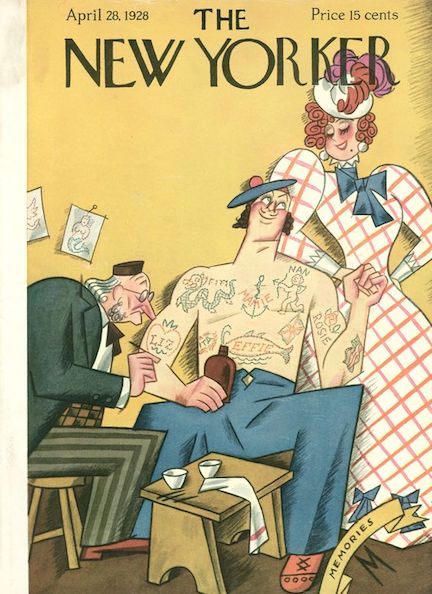
April 21, 1928 cover by Ilonka Karasz.


Fred and Adele Astaire were born a year apart in Omaha (she the eldest, born in 1898). Their mother wanted the siblings to learn professional dance at an early age, so in 1903 she moved with the children to New York City, leaving their Austrian-born father in Nebraska to work at the Storz brewery. By 1905 the brother-sister act were already popular on the vaudeville circuit, making their way to the Broadway stage by 1917.

EARLY BLOOMERS…Left, Fred and Adele Astaire in a photo taken around 1906, three years after they left Omaha and began their vaudeville career. At right, Fred and Adele in 1911. (dailytelegraph.com.au/Courtesy Antoine Dutot Museum & Gallery)

Fred became friends with composer George Gershwin, and in December 1924 the Astaires headlined George and Ira Gershwin’s first full-length New York musical, Lady, Be Good!, in which Fred and Adele played a brother-and-sister dance team down on their luck. In real life, however, their star soared above Jazz Age New York. So when rumor had it that the duo was on the verge of a break-up, “The Talk of the Town” weighed in:

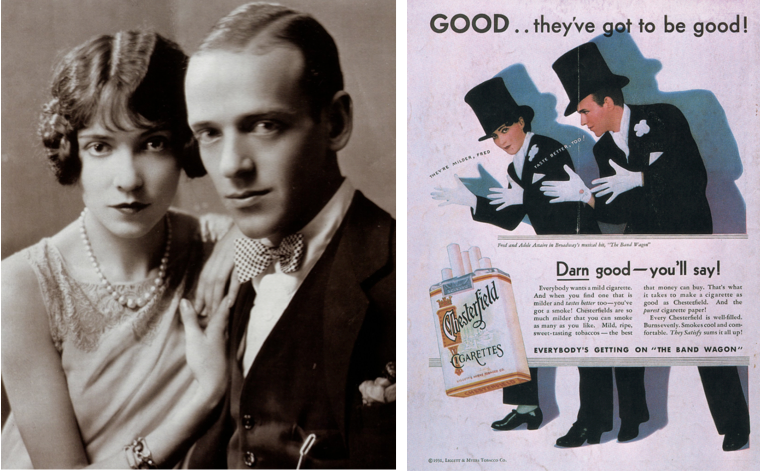
NO, THE OTHER ASTAIRE…At left, Adele and Fred Astaire in the 1920s. At the time the gamine Adele was considered the undisputed star of the duo. At right, the pair in a 1931 ad for Chesterfield cigarettes that also promoted The Band Wagon, their last Broadway revue together. (From The Astaires by historian Kathleen Riley/atticpaper.com)

Today you would be hard pressed to find anyone young or old who hasn’t heard of Fred Astaire, his legend so firmly attached to our cultural memory. But at the time it was Adele’s fun-loving ways and mischievous charm that captured the hearts of reviewers and fans alike. Brother Fred, on the other hand, was more interested in devising the duo’s clever routines.

The April 21, 1928 New Yorker was correct in noting that Adele had plans to marry and leave the country, but happily the magazine was wrong on the timing; Adele and Fred would perform together nearly four more years, capping their 27-year partnership with the successful run of The Band Wagon on Broadway.

In 1932 Adele would marry Lord Charles Cavendish and move to Ireland, not England. Home would be Lismore Castle in County Waterford. The end of the partnership with Adele was traumatic for Fred, who was indeed interested in producing and race horses, but that was not his immediate future as The New Yorker suggested. Instead, his movie career would take off like a rocket in 1933 in a string of hits with Ginger Rodgers including The Gay Divorcee (1934), Top Hat (1935) and Swing Time (1936).

Fred Astaire briefly turned his focus to horse-racing when he announced his early retirement in 1946, but he would soon return to the screen with Easter Parade in 1948 and enjoy another string of hits in the 1950s. Though separated by an ocean, the brother and sister remained close through the years.
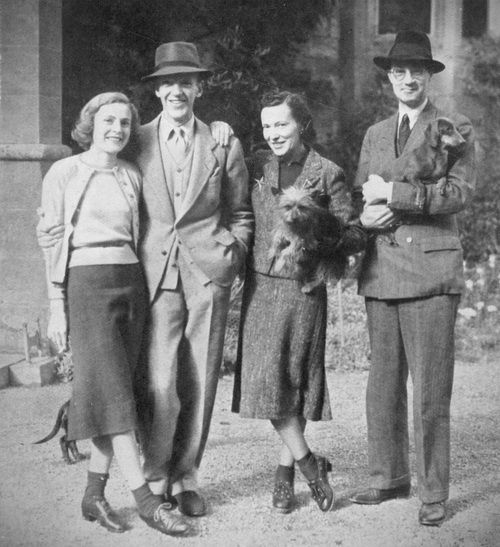
MY SIS IS A LADY…A reunion of Astaires in Ireland, 1939. Fred Astaire and his wife, Phyllis Livingston Potter, with Lord and Lady Charles Cavendish photographed on the day brother Fred and wife arrived at Lismore Castle from America to stay with sister Adele and her husband at their home in County Waterford. (Press image via Pinterest)
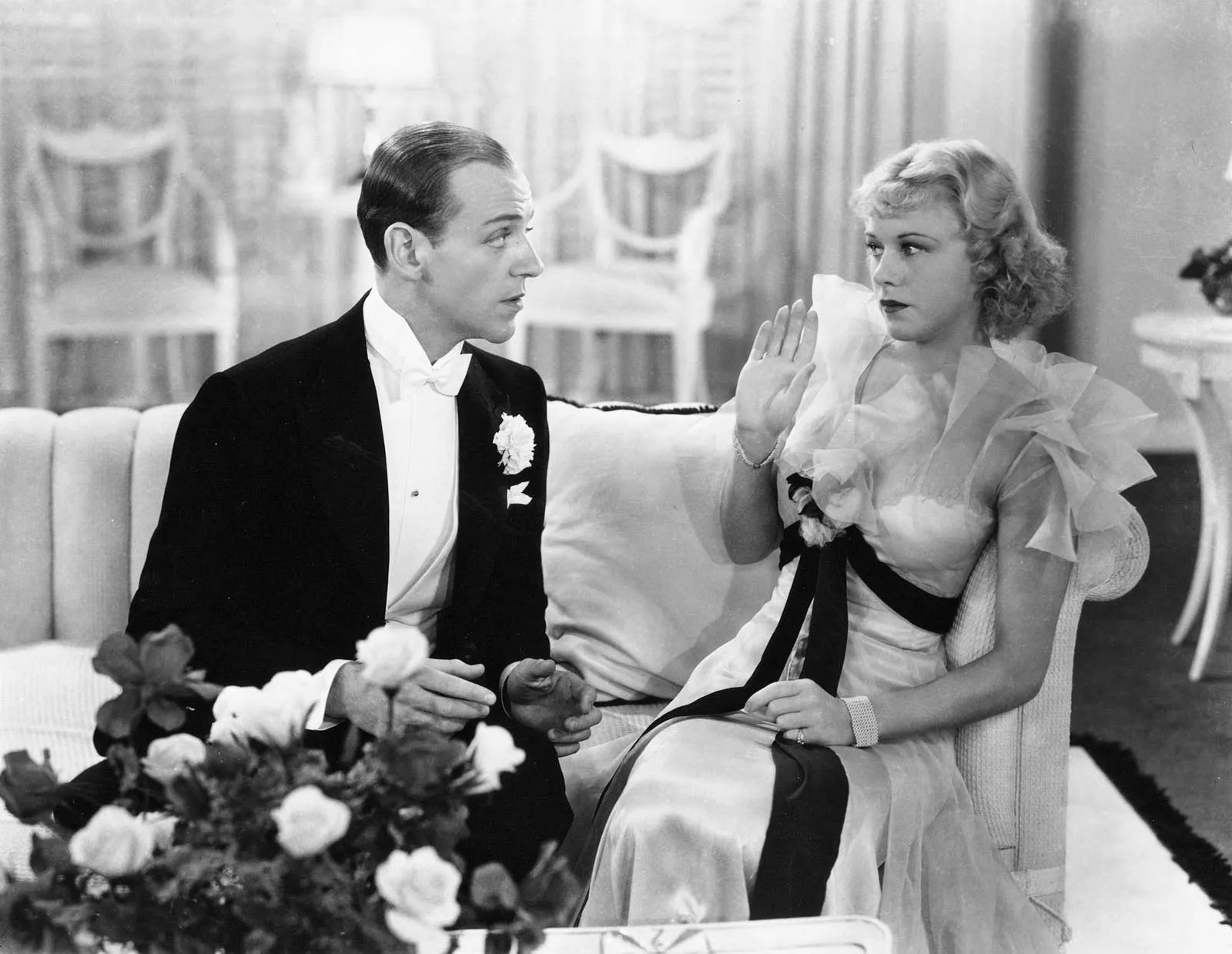
Fred Astaire and Ginger Rogers in The Gay Divorcee (1934). (RKO Radio Pictures via Encyclopedia Britannica)
TOGETHER AFTER ALL THESE YEARS…Left, Fred and Adele honored by the American Theater Hall of Fame in 1972 (celebrity promotor Earl Blackwell is in the center). Right, Fred and Adele at Chatsworth House in Derbyshire, England, circa 1980. Chatsworth had been in the Cavendish family since the 17th century, so Adele, as Lady Cavendish, was a frequent visitor. In a recent article in The Cheshire Magazine (April 11, 2017) Duchess Mary recalled the family’s first meeting with Adele in 1932: “All gathered, like stone pillars, in the library… the heavy doors opened and there stood this tiny girl, beautifully dressed. We waited for her to approach us, but instead of walking, she suddenly began turning cartwheels. Everyone loved it.”(American Theater Hall of Fame/thecheshiremagazine.co.uk)

 *  *  *

Not So Happy Feet

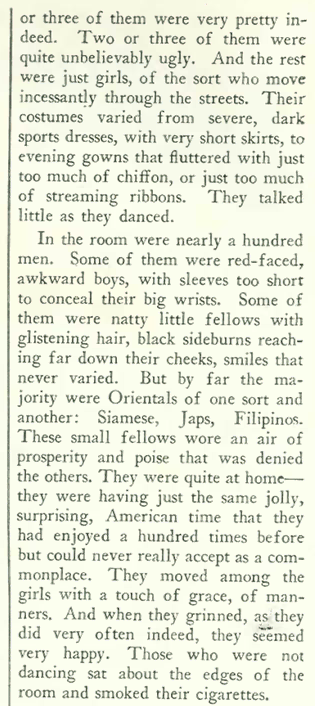
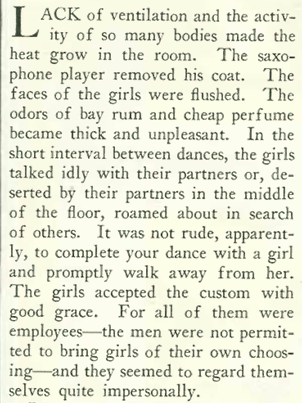
Morris Markey wrote several articles under the heading, “New York Interiors” (the last post featured his look at radio broadcasting). In the April 21 issue Markey took a look at the sad world of the “taxi dancers” in the ironically named “Happiness Hall.” This was the second time The New Yorker delved into the taxi-dancing world—Maxwell Bodenheim visited a Broadway dance hall in the June 12, 1926 edition of the magazine.

In both cases, the writers described a pathetic ritual for dancers and patrons alike, and both underscored a cruel illusion we still have today that the Roaring Twenties was an age of prosperity and good times for all. Excerpts:
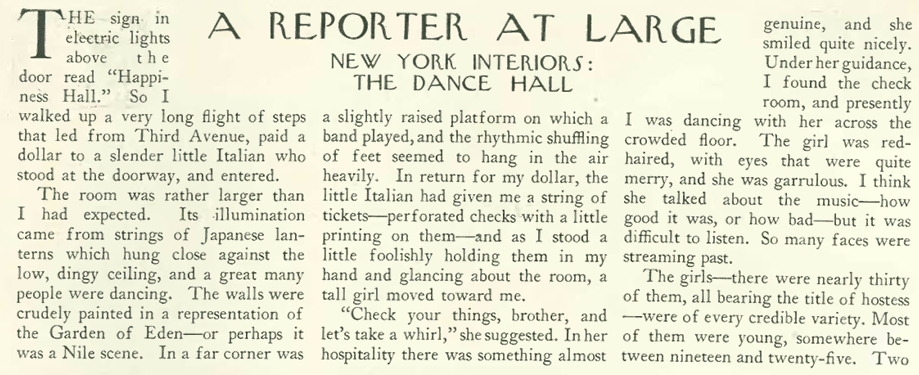
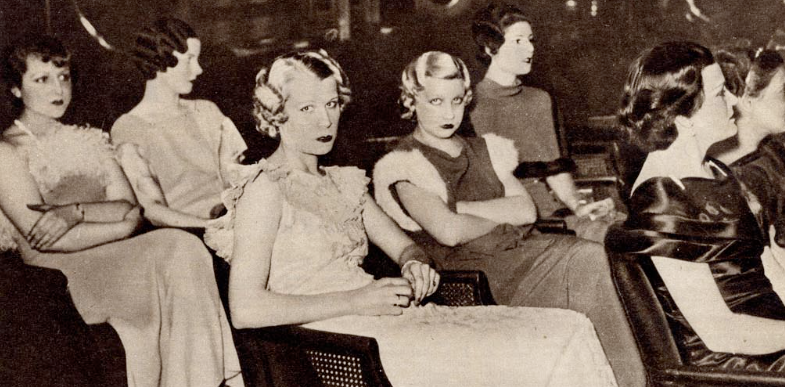
NO FREDS OR GINGERS HERE…Taxi-dancers awaiting customers at a Broadway dance hall in the early 1930s. The image was scanned from an article in Weekly Illustrated (Oct. 6, 1934) that described new regulations banning the vocation.

Later in the article, Markey described a dance with a red-haired girl who showed him the ropes…

…and described the less than elegant environment of “Happiness Hall”…
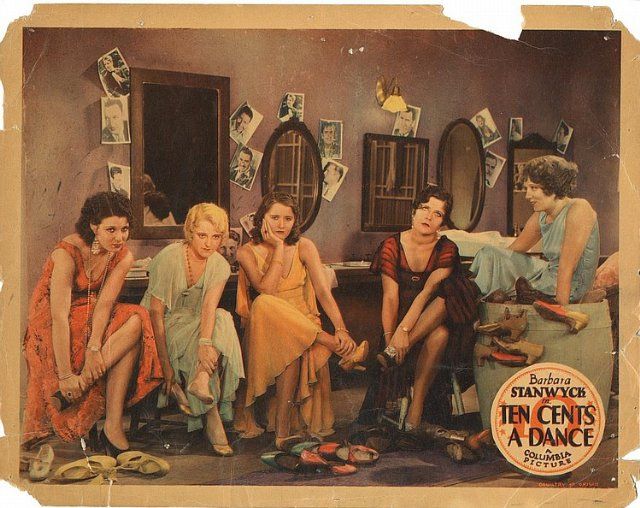
NO FUN IN THE MOVIES EITHER…Footsore taxi-dancers including Barbara Stanwyck, third from left, in 1931’s Ten Cents a Dance. (IMDB)

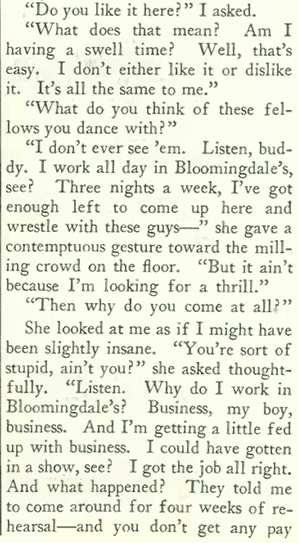
Markey concluded his visit by attempting to talk, rather than dance, with a graceful, yet hardboiled dancer:

In the 1920s Americans in general were poorer than they are today (money-wise) and lacked the safety nets that we have come to depend on in modern life. In 1929 economists considered $2,500 the income necessary to support a family. In that year, more than 60 percent of the nation’s families earned less than $2,000 a year—an income necessary for basic necessities—and more than 40 percent earned less than $1,500 annually.

For single women, such as the taxi dancers, the situation was just as bad or worse. Retail workers in U.S. faced long hours, poor working conditions and low pay, especially before the passage of the Fair Labor Standards Act in 1938. A clerk selling those beautiful clothes at Bloomingdale’s couldn’t afford those clothes herself, let alone make a living wage from the job. As Markey’s article made clear, taxi dancing was nothing but additional toil, 10 cents a pop.

From Our Advertisers…

We’ve seen cigarette advertisements featuring celebrity endorsements, but how about this one for Marlboro that suggested Christopher Columbus would have preferred their smokes…

…and then there were the ads for Fleischmann Yeast featured in nearly every issue of the early New Yorker magazine. According to Thomas Kunkel’s book, Genius in Disguise, Raoul Fleischmann was the wealthy scion of a New York yeast and baking family and a frequent guest of the Algonquin Round Table. He hated the baking business, so when founding editor Harold Ross pitched the idea of investing in his new magazine, Fleischmann obliged with $25,000. Ross and his wife, Jane Grant, together put up the other $25,000 (which included some IOU’s), but after the magazine was launched and struggled during its first months, Fleischmann was further obliged to pour in many hundreds of thousands of dollars to keep the magazine afloat (and in spite teasing from his friends that he might as well dump the money in the river).

The magazine was actually killed as early as May 8, 1925, when Fleischmann called Ross and other magazine directors together after Ross lost a large amount of money in a poker game (money he’d plan to invest in the magazine). Fortunately, the following day was fellow Round Tabler Franklin P. Adams’ wedding, and in the convivial atmosphere Ross and Fleischmann agreed to give the magazine another go. If Fleischmann was going to pour money into the magazine, he might as well get a little “free” advertising for his product. Hence the ads in The New Yorker promoting the generous consumption of fresh yeast cakes as a laxative and health tonic…

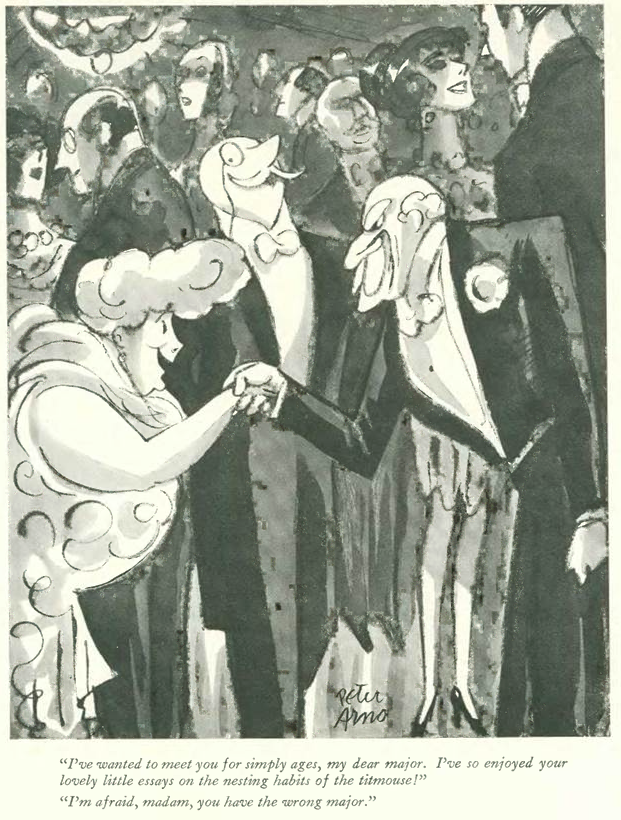
…and with that background information, this cartoon in the April 21 issue by Peter Arno makes a lot more sense

And finally, Leonard Dove takes a look at life in a growing metropolis…

Next Time: Back to Broadway…


Will Wonders Never Cease?

The early New Yorker was known for its fashionably blasé tone, but its writers were often giddy when it came to reporting on technological advances.

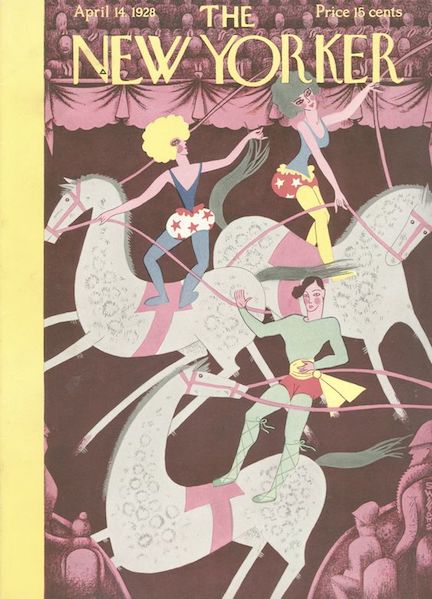
April 14, 1928 cover by Sue Williams.

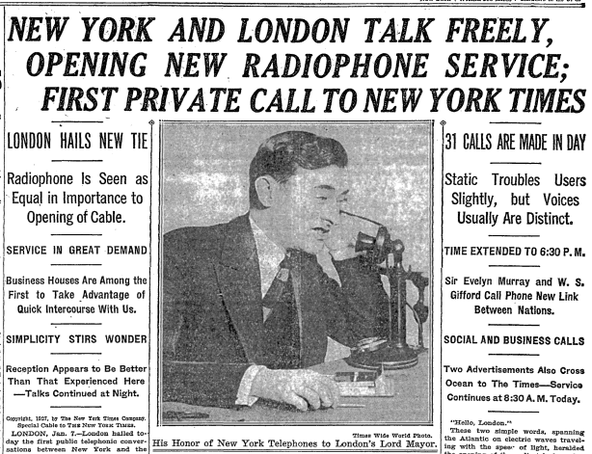
Such was the case with transatlantic telephone service, which before 1927 was the stuff of fantasy. By 1928, The New Yorker marveled at this service by suggesting in “The Talk of the Town” that the invention had become matter-of-fact:

The New Yorker correctly prophesied that the telephone’s primary use would be for mundane communications—not much different from how we use smartphones today for selfies, texting and chitchat.

WHAT HO! New York Mayor Jimmy Walker visits with London’s Lord Mayor in a 1927 transatlantic telephone call. The calls were made possible through radio transmission from station to station across the ocean. (The New York Times)

Even the first “unofficial” transatlantic conversation, between two unknown American and British engineers, was a fairly routine conversation about the weather and distances between various cities. At one point, however, the American makes this prophetic remark: “Distance doesn’t mean anything anymore. We are on the verge of a very high- speed world….people will use up their lives in a much shorter time, they won’t have to live so long.”

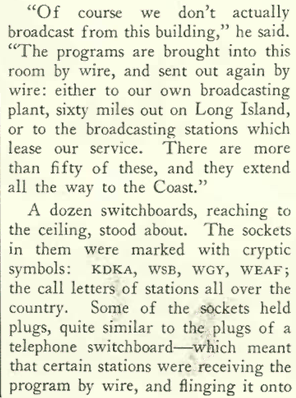
In the same issue, writer Morris Markey gushed about his tour of a radio broadcast facility…

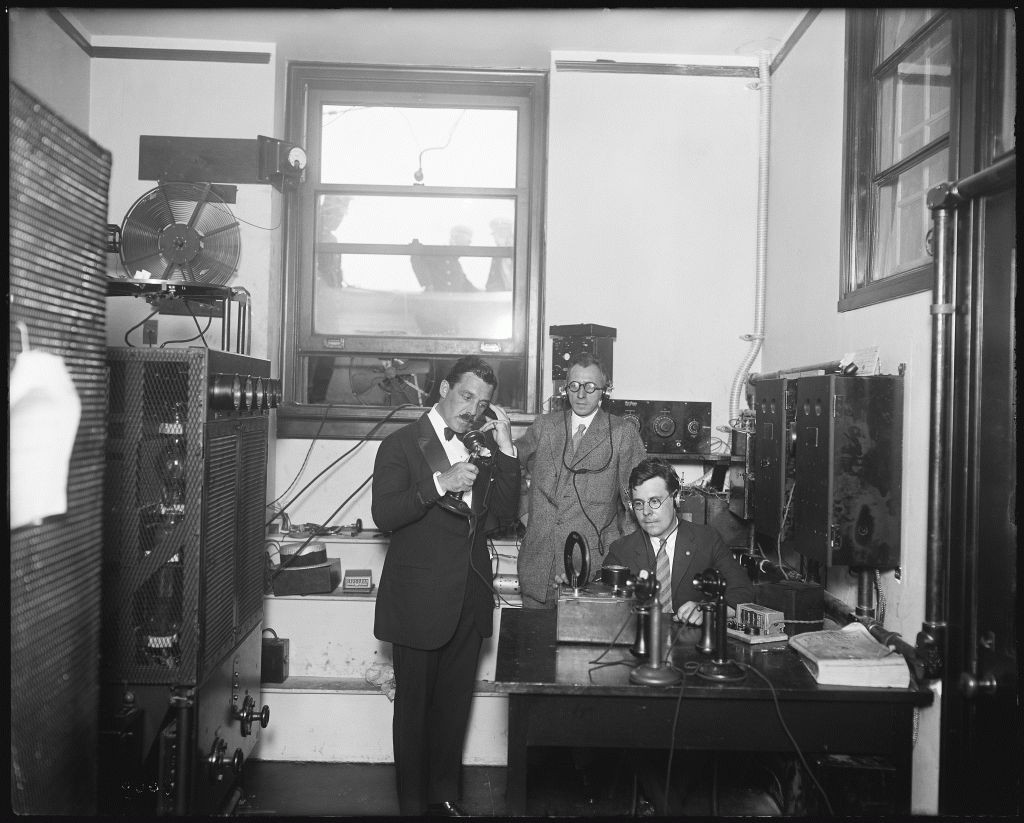
ON  THE AIR WITH MR. NEW YORK…A photo of WNYC’s transmitter room on the 25th floor of New York City’s Municipal Building. At left is the founder of the station, Grover A. Whalen, on the phone prior to the station’s opening night ceremonies on July 8, 1924. Whalen described himself as “Mr. New York,” often serving as the city’s official and unofficial greeter of politicians, royalty and celebrities. He served as police commissioner in the 1920s, and later as president of the 1939 World’s Fair. (WNYC)
IN REAL TIME…A live radio play being broadcast at NBC studios in New York. (Wikiwand)

Awed by this technical marvel, Markey described how the station could broadcast its show across the country…

More Evidence Lindy Was Made of Wood

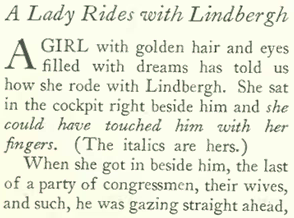
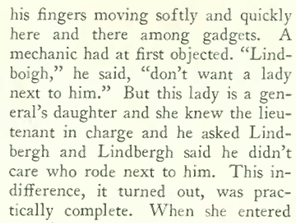
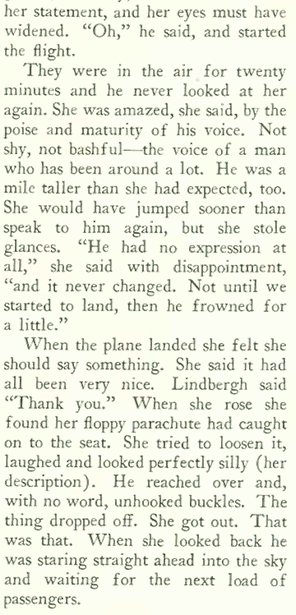
The New Yorker’s reporting on Charles Lindbergh continued with this item in “The Talk of the Town” that described a young woman’s dream to fly with the famous pilot. And fly was all she did…

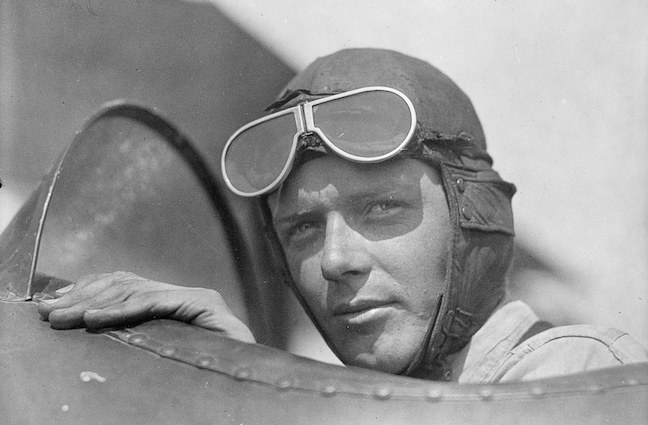
SIT DOWN AND SHUT UP…Charles Lindbergh at home in his cockpit, circa late 1920s. (Wikimedia Commons)

*  *  *

From the World of Advertising…

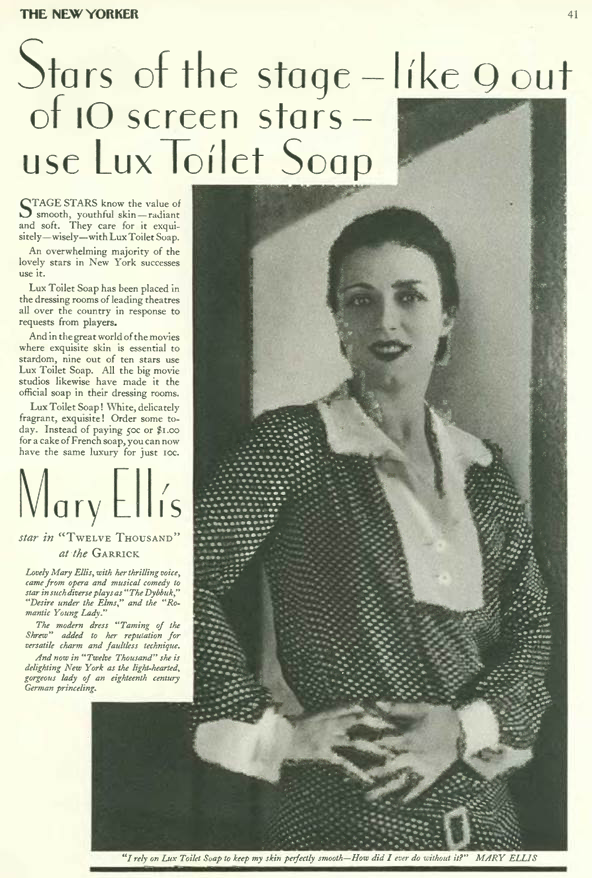
Lux Soap continued its string of advertisements in The New Yorker featuring Broadway stars of the day. Among them was actress Mary Ellis

Ellis was an American star of stage, radio, television, film and opera, best known for her roles in musical theatre. She appeared at the Metropolitan Opera beginning in 1918, later appearing opposite famed tenor Enrico Caruso. On Broadway she was known for creating the title role in Rose-Marie.

Born in 1897, she died in 2003 at the age of 105. She had the distinction of being the last surviving star to perform in a Puccini opera (while Puccini was still alive) and the last star to perform opposite Caruso.

SEASONED PERFORMER…1930s photograph of actress Mary Ellis. (National Portrait Gallery-npg.org.uk)

Lux soap wasn’t the only company exploiting celebrities for sales. Cigarette companies also sought endorsements from prominent women to exploit the new and rapidly growing market of female smokers. This ad below from the April 14 issue featured Gloria Morgan Vanderbilt, a Swiss-born American socialite best known as the mother of fashion designer Gloria Vanderbilt and grandmother of CNN journalist Anderson Cooper:

SHE ALSO SHILLED FOR COLD CREAM…Edward Steichen photograph of Gloria Morgan Vanderbilt for a Pond’s Cold Cream testimonial campaign, 1925. (library.duke.edu)

In a famous custody battle in 1934, Vanderbilt lost custody of her daughter to her sister-in-law Gertrude Vanderbilt Whitney and the court also removed Vanderbilt as administrator of her daughter’s trust fund, her only means of support. From the 1940s until her death at age 60 in 1965 she lived with her identical twin sister, Thelma, also known as the Viscountess Furness.

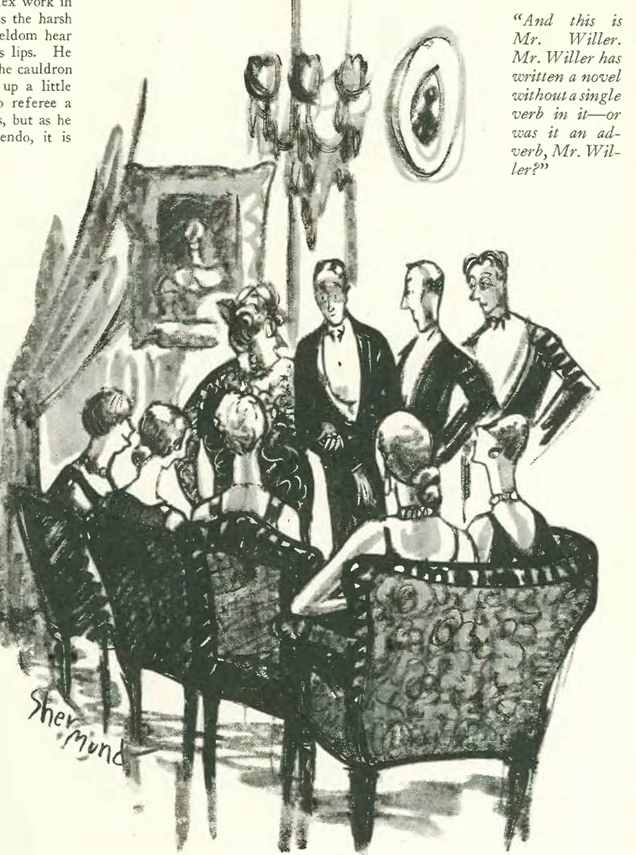
In another portrait of the upper classes, Barbara Shermund took a peek into the drawing room of a less than cerebral hostess…

Next Time: The Last Dance…


We Americans

One of the challenges in researching old New Yorker magazines is the frequent use of pseudonyms or simple initials at the end of columns and reviews. With enough digging one can usually determine the nom behind the plume.

April 7, 1928 cover by Rea Irvin.

Such is not the case with The New Yorker’s film critic of the late 1920s, who signed reviews “O.C.” It would be good to know a little about this person, since he or she held strong opinions about the condition of American cinema. I will continue to dig.

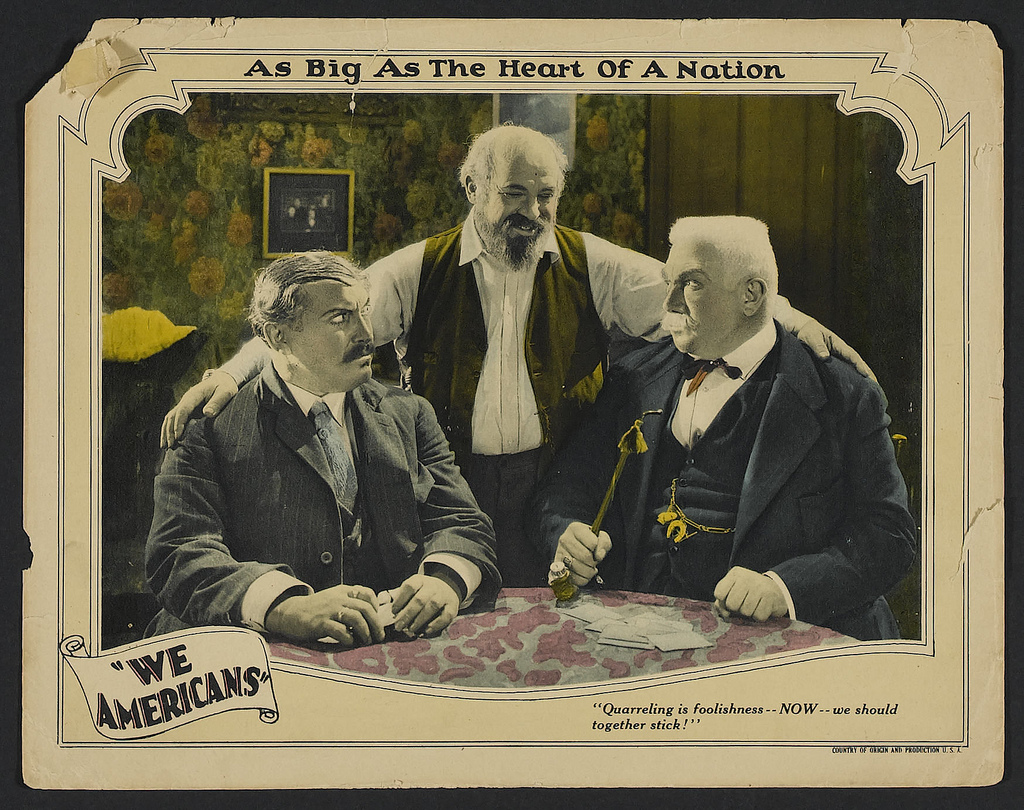
O.C.’s review in the April 7, 1928 issue concerned the release of We Americans, a film based on a Broadway play of the same name. Directed by Edward Sloman, it focused on the trials and tribulations of three first-generation American families: The Jewish Levines, the German Schmidts and the Italian Albertinis. The film followed each family through trial, tribulation and sacrifice as they left behind the Old World and joined the great “Melting Pot.”

In one of the storylines, the Levines lose a son, Phil, to the wartime trenches of France. In losing his life, Phil saves the life of the socially prominent Hugh Bradleigh, who in the end falls in love with Phil’s sister, Beth. In the film’s sentimental ending, the Levines and the Bradleighs meet one another for the first time at the wedding of Hugh and Beth.

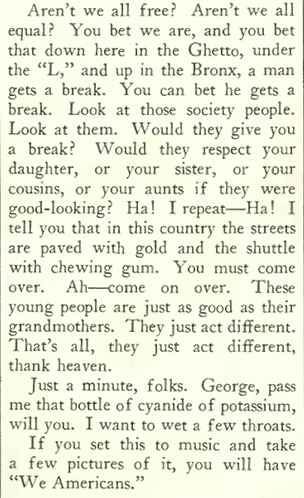
O.C. would have none of it:

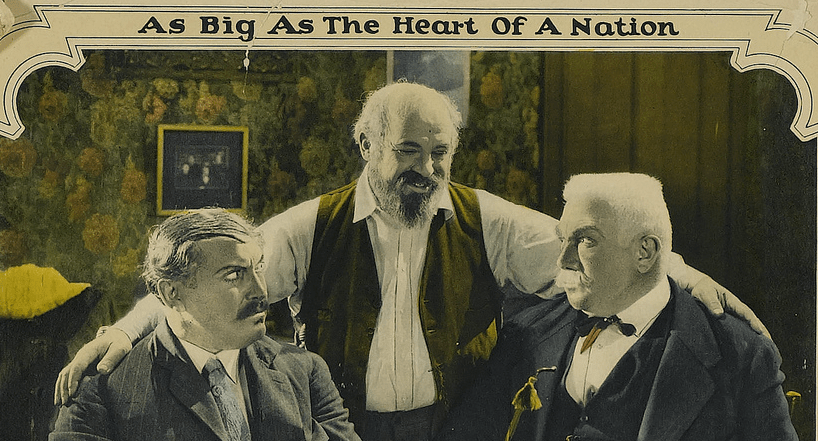
MELTED CHEESE…Lobby card for We Americans (1928). (flickr.com)

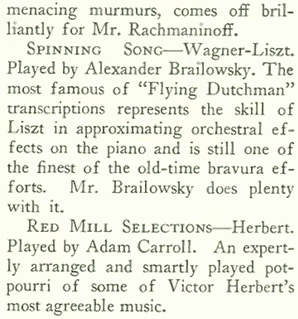
Yes, this picture got under the reviewer’s skin. Now for the coup de grace:

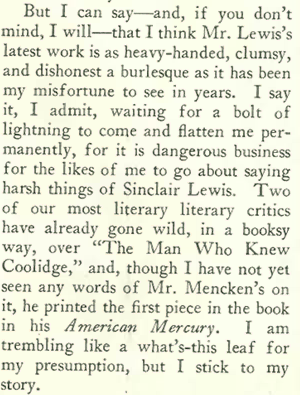
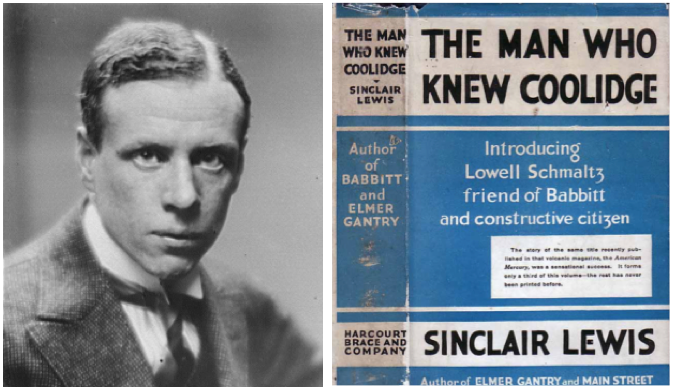
Over in the book review section, Dorothy Parker was also experiencing heartburn over the latest work of that all-American man of letters, Sinclair Lewis.

BABBITT BABBLE…Sinclair Lewis in the 1920s. At right, dust jacket from The Man Who Knew Coolidge. (Wikipedia/yesterdaysgallery.com)

Now that Parker had our attention regarding her misgivings of the future Nobel Laureate, she abandoned the polite prose and went in for the kill:

Wooden as the plaque itself

The New Yorker’s Charles Lindbergh watch continued, this time at a ceremony during which the Woodrow Wilson Foundation presented its medal and $25,000 prize to Lindbergh for his “contributions to international friendship” (in retrospect an ironic award, since Lindbergh would later become the spokesman for isolationism during the fascist terrors of the 1930s). The ceremony was a dull affair, but thanks to the magic of media it no doubt looked like a jolly time…

Better than iTunes

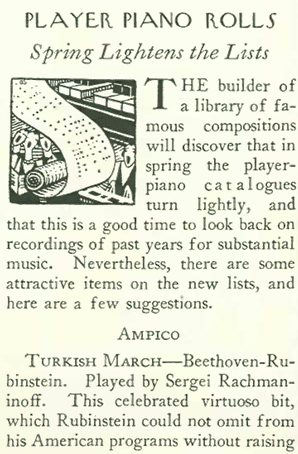
An invention from the late 1890s, piano rolls proved to be a popular diversion in the 1920s, so popular in fact that they warranted a regular review in The New Yorker, along with records and sheet music:

LET THE GOOD TIMES ROLL…Top and center: Ampico player-piano rolls from the late 1920s. Bottom, a 1928 Irvington Player Piano. (Ebay/YouTube)

 *  *  *

Our Advertisers

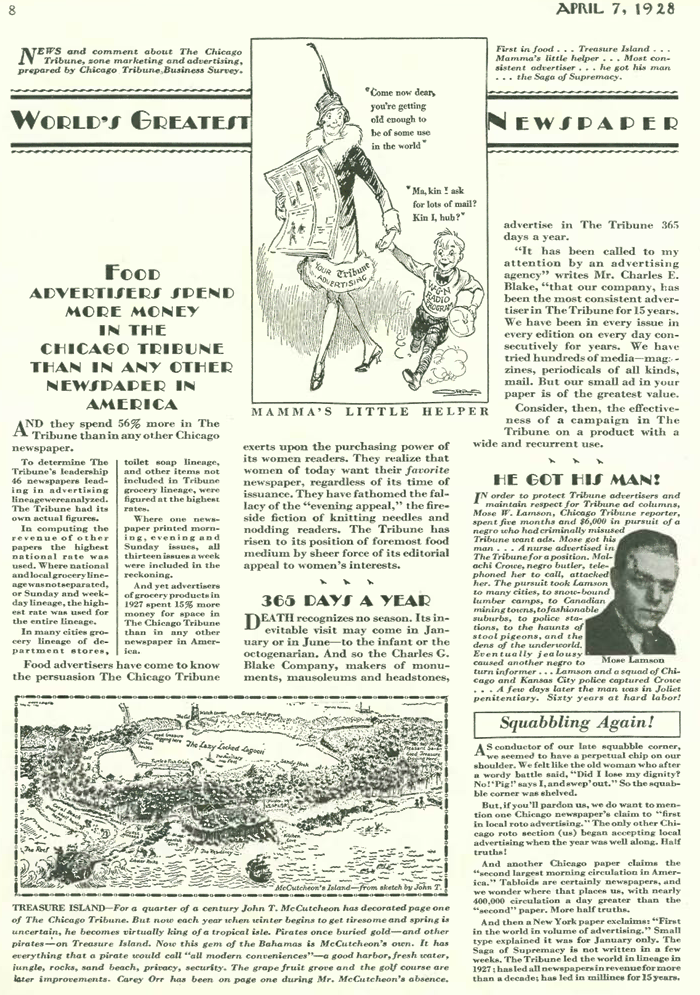
One of the more curious series of advertisements to appear in the early New Yorker were these from the Chicago Tribune. Shameless in their boosterism, these ran during the editorship of Col. Robert R. McCormick, who was strongly associated with old right-wing politics and isolationist movements. The Tribune’s motto at this time was “The American Paper for Americans.”

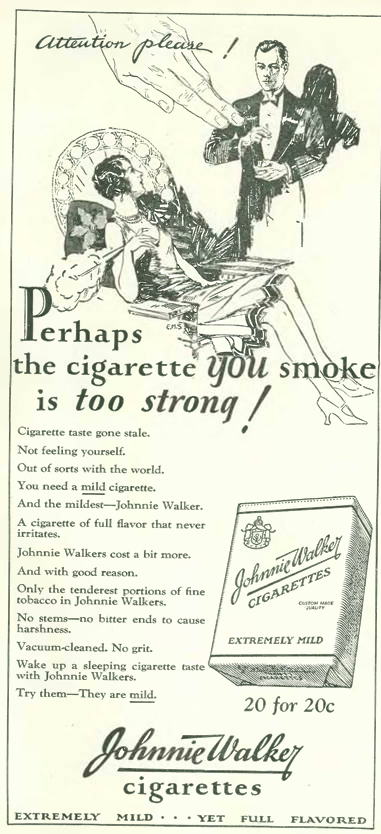
Another ad that caught my eye was this one for Johnnie Walker cigarettes…I guess you’d better listen when a giant hand reaches down from the heavens and taps you on the shoulder. I love the resigned look on the face of his companion: “Oh dear, it’s that dreadful hand again…”

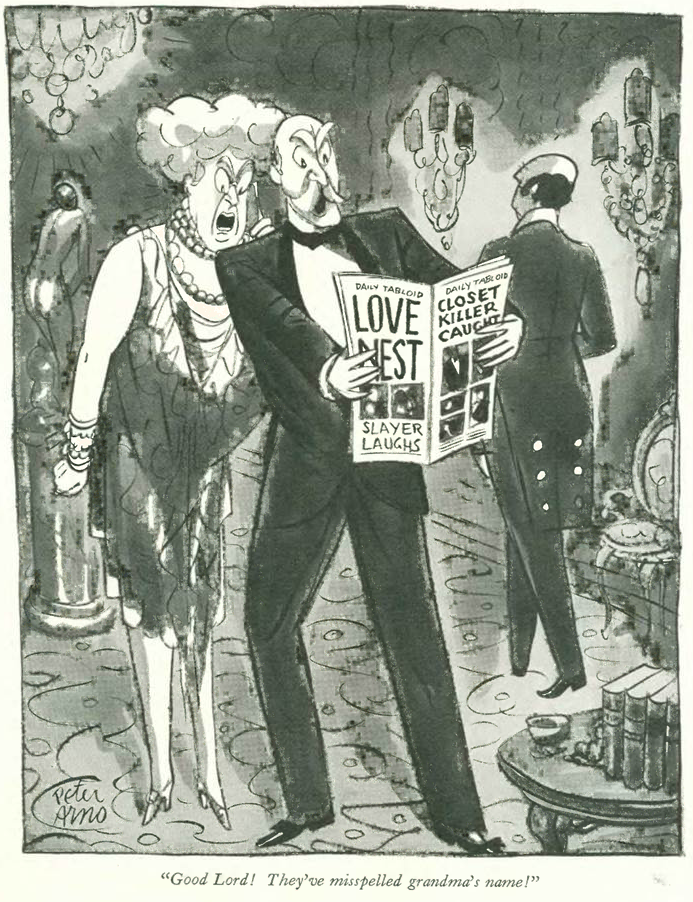
And finally, our cartoon, courtesy Peter Arno

Next Time: Will Wonders Never Cease?


Conventional Follies of ’28

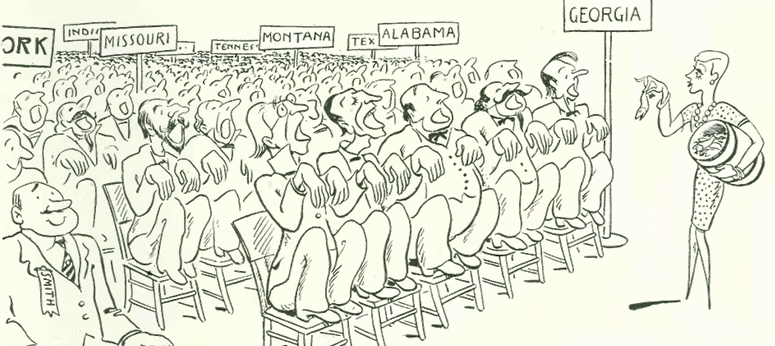
U.S. presidential elections have long provided fodder for the nation’s humorists, and the 1928 contest between Herbert Hoover and Al Smith was no exception.

March 31, 1928 cover by Theodore G. Haupt.

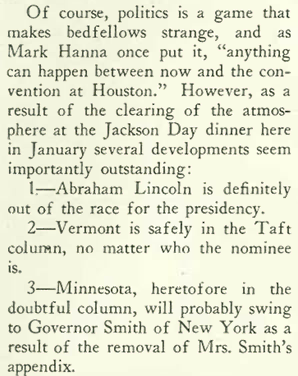
In the March 31, 1928 issue of the New Yorker writer Frank Sullivan and cartoonist Al Frueh took particular delight in skewering the party nominating conventions. As Sullivan observed:

Regarding item No. 3, Sullivan was referring to Minnesota’s famed Mayo Clinic, and the related pride that was doubtless associated with the removal of an appendix from Catherine Dunn, the wife of Al Smith, four-term governor of New York and nominee to lead the Democratic ticket.

The candidates could not have been more different. The first Catholic to be nominated for president, Smith was a crowd-loving, charismatic personality, a Tammany Hall politician and a committed “wet” who opposed Prohibition. He attracted strong support from Catholics, women, drinkers and those who were tired of the crime and corruption associated with dry America.

WET VS. WET BLANKET…The staid, “dry” Republican candidate Herbert Hoover (right) easily defeated the charismatic “wet” Democratic candidate Al Smith in the 1928 U.S. Presidential Election. (Wikipedia)

Hoover, on the other hand, was deliberately dull and humorless, as stiff as his heavily starched collars and committed to keeping the country dry. But the economy under fellow Republican Calvin Coolidge was booming, and it didn’t hurt that many Protestants believed the Catholic Church would dictate Al Smith’s policies if he were elected. Sullivan had some fun with this perceived religious prejudice:

In light of the recent 2016 elections and the prominence of “Islamophobia” in the political rhetoric, Sullivan’s joke regarding the role of “Mohammedans” in the 1928 election is noteworthy:

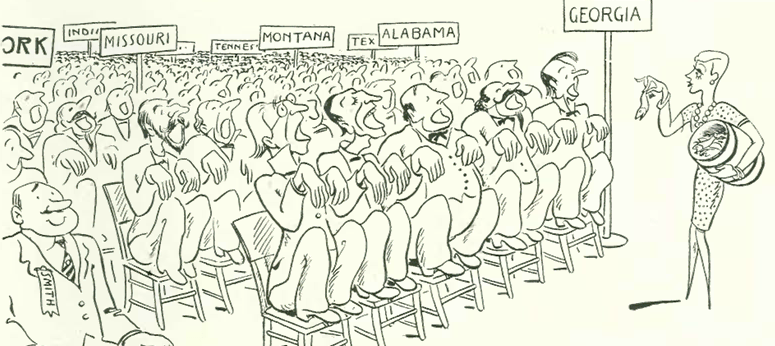
Illustrations by Al Frueh, both top and bottom, aptly captured the picture Sullivan painted of the nominating process:

Smith would lose in a landslide. Journalists at the time attributed his defeat to the three P’s: Prohibition, Prejudice and Prosperity. Rural voters, who favored Hoover, also had a bigger say than their urban brethren: Republicans would benefit from a failure to reapportion Congress and the electoral college following the 1920 census, which had registered a 15 percent increase in the urban population. After the election, Smith became the president of Empire State Inc., the corporation that would build the the Empire State Building in 1930-31.

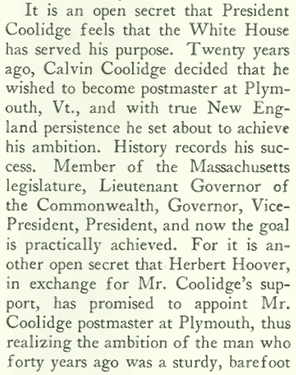
In his piece Sullivan also took at parting shot at President Coolidge…

…as did cartoonist John Price in the same issue…

For reference, the image that inspired Price:

BIG CHIEF… Calvin Coolidge donned a headdress while being named an honorary Sioux chief (“Leading Eagle”) in Deadwood, South Dakota in the summer of 1927. (Associated Press)

 *  *  *

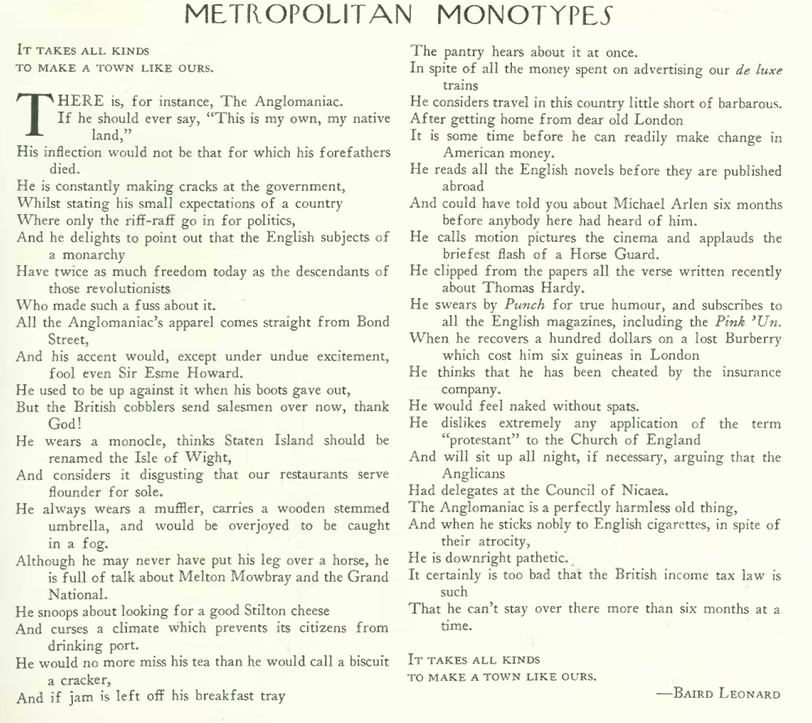
New Yorker Monotypes

Another humorist who regularly contributed to The New Yorker was Baird Leonard, who beginning with the second issue of the magazine (Feb. 28, 1925) wrote a series titled “Metropolitan Monotypes.” Over five years and 36 installments Leonard wrote free-verse characterizations of various New York “types,” from debutantes to aesthetes to “The Anglomaniac” as described below in this installment from March 31, 1928:

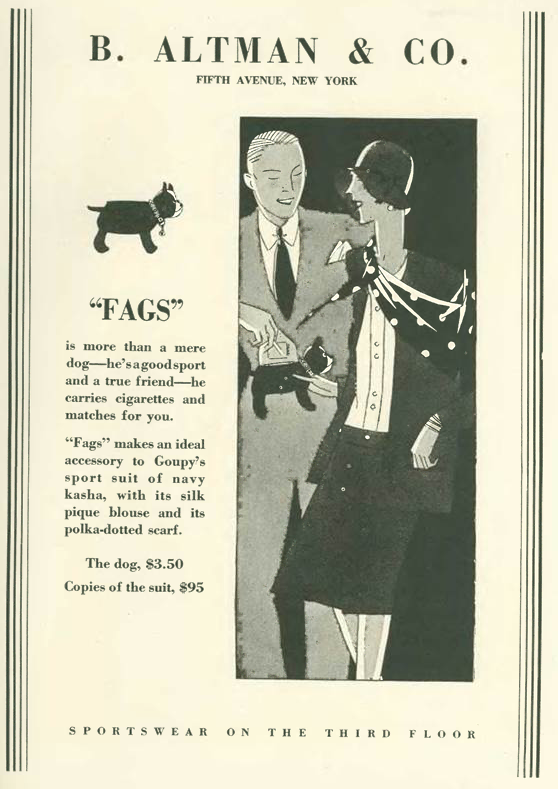
As noted before, Anglophilia oozed from The New Yorker ads, particularly those directed at the male reader (France was a common lure in ads for women). Every issue from the 1920s is rife with examples, but sticking to the March 31 issue we find this ad employing the British slang for cigarettes to market a silly, dog-shaped cigarette case to fashionable women:

In the same issue this ad from Macy’s appealed to participants of a famous cultural event for the posh set—the annual Easter Parade on Fifth Avenue. A tradition dating back to the 1870s, in its first decades the “parade” was a display of wealth and beauty, as the well-to-do strolled from church to church to check out various floral displays.

In 1928, the poor and middle classes were merely observers of the passing parade, perhaps hoping to learn something about the latest fashions. The April 14 “Talk of the Town” suggested as much:

And finally, our cartoon comes courtesy of Leonard Dove, who explores the lighter side of boxing…

Next Time: We Americans…

Broadway Soap Stars

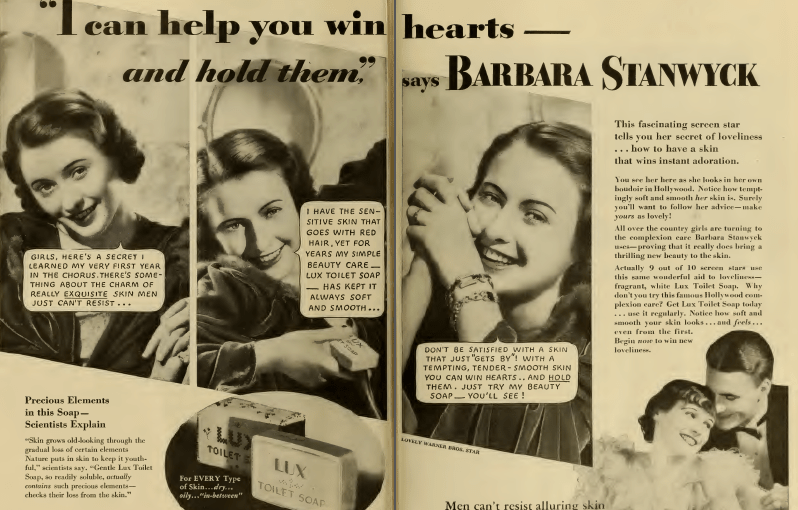
Lux Toilet Soap was launched in the United States in 1925 by its British parent company, Lever Brothers, which had been making soap since 1899. To capture the hearts and pocketbooks of American women, the company launched an advertising blitz that featured advertisements in a number of magazines including The New Yorker.

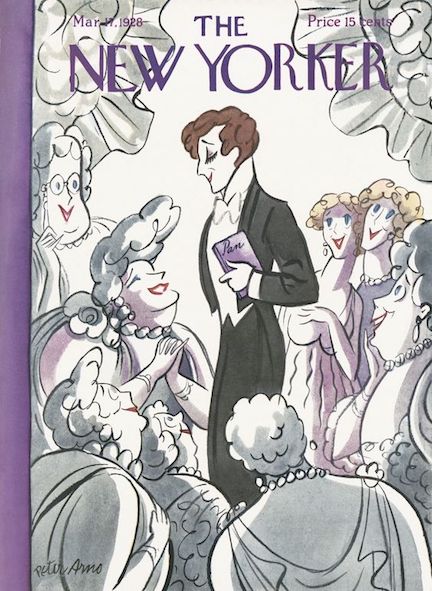
We look at two issues this week: March 17, 1928 cover by Peter Arno / March 24, 1928 cover unsigned, probably by Ilonka Karasz.

The earliest ads appealed to upscale women who saw the French as arbiters of taste and style. In the following Lux ad (from the Feb. 5, 1927 New Yorker), note that every paragraph and headline includes the words France or French:

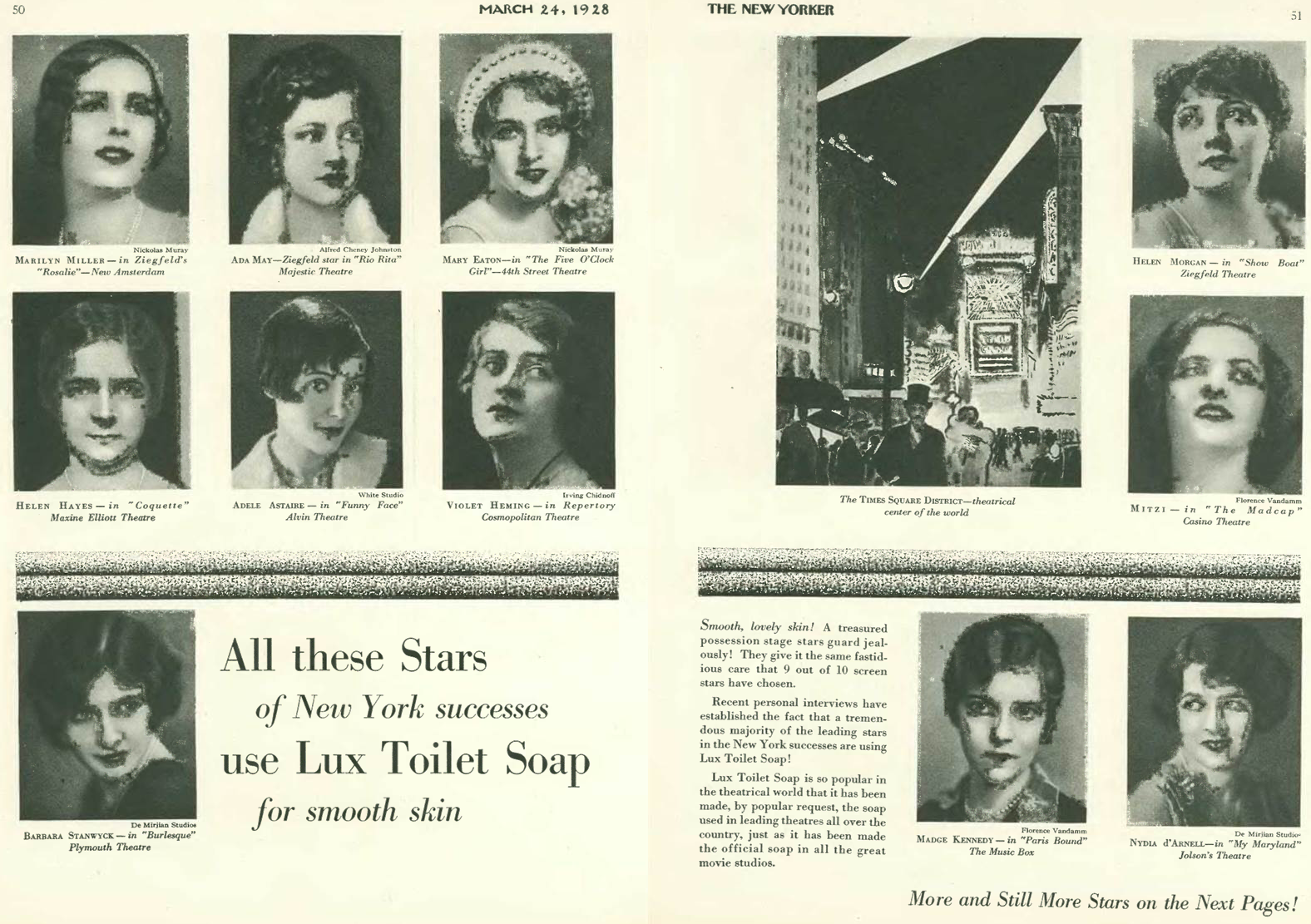
The big blitz came in 1928, when Lux pioneered the use of female celebrity endorsements on a mass scale. The campaign focused more on the roles played by Broadway and movie stars than on the product itself. The March 24, 1928 issue of The New Yorker featured these ads splashed across two center spreads.

The captions I have provided below the ads give brief information on each actress. Note that many of these actresses did stints with Broadway’s popular Ziegfeld Follies. Most also had long lives, including Mary Ellis, who lived in three centuries, sang with Enrico Caruso, and died at age 105.

Click Images to Enlarge

LEFT TO RIGHT, TOP TO BOTTOM: Marilyn Miller (1898-1936) was one of Flo Ziegfeld’s top talents and one of the most popular Broadway musical stars of the 1920s and 30s; Ada May (1896-1978), a theater actress most of her career, in 1927 played a lead role in Ziegfeld’s Rio Rita; Mary Eaton (1901-1948) was a leading stage actress, singer and dancer in the 1910s and 20s. She was featured in three editions of the Ziegfeld Follies; Helen Morgan (1900-1941) was considered the quintessential torch singer. A draped-over-the-piano look became her signature while performing at Billy Rose’s Backstage Club in 1925. She performed with Ziegfeld Follies in 1931; Helen Hayes (1900-1993) was called “the First Lady of American Theater.” Her awards included the EGOT– an Emmy, Grammy, Oscar and a Tony; Adele Astaire (1896-1981) was part of popular act with her brother, Fred. After the 1931 Broadway revue The Band Wagon she retired to marry Lord Charles Cavendish and moved to Ireland’s Lismore Castle; Violet Heming (1895-1981) was a dependable Broadway star with many theatrical credits; Hungarian-born Mitzi Hajos (1889-1970) specialized in musical comedy but faded from acting in midlife; Barbara Stanwyck (1907-1990) got her start as a model and “Ziegfeld Girl” before going on to become one of Hollywood’s biggest stars. She made 85 films in 38 years before turning to TV; Madge Kennedy (1891-1987) appeared in dozens of films from Baby Mine (1917) to Marathon Man (1976). She had a recurring role on TV’s Leave it to Beaver as Aunt Martha; Nydia d’Arnell was a musical comedy actress. Almost no record of her after 1928. She died in 1970.
FROM LEFT TO RIGHT, TOP TO BOTTOM: June Walker (1900-1966) was the first actress to portray Lorelei Lee in 1926’s Gentlemen Prefer Blondes. Mostly stuck to the stage; Mary Lawlor, (1907-1977) was active on Broadway 1922-32; Judith Anderson (1897-1992), later awarded British title of Dame, was considered one of the world’s greatest classical stage actors; Mary Ellis (1897-2003) was star of the stage (including opera with Caruso) as well as radio, TV and film. Best known for musical theater, she performed into the 1990s and died at age 105; Wilda Bennett (1894-1967) was a Broadway musical comedy star in the 1920s whose career quickly faded. Appeared in 9 films between 1914 and 1941, mostly uncredited; Polly Walker (1904-1983) also faded quickly from the stage in the early 1930s, appearing in just 2 films; Mary Nash, (1884-1976) was a noted stage actress best known for two Shirley Temple films. Played Katharine Hepburn’s mother in 1940’s The Philadelphia Story; Norma Terris (1904-1989) had a long career as a performer and musical theater supporter. Last surviving adult actor from original 1927 production of Show Boat; Vivienne Segal’s (1897-1992) career was mostly in musical theater, including the 1924-25 Ziegfeld Follies. She appeared in a few films in the 1930s, as well as on TV in the 50s and 60s. Claudette Colbert (1903-1996) was a Hollywood leading lady for more than two decades. Won an Oscar for 1934’s It Happened One Night; Vivian Martin (1893-1987) appeared in 44 silent films in the teens and twenties before returning to the stage; Dorothy Peterson (1897-1979) made her screen debut in Mothers Cry (1930), a drama that required the 29-year-old to age three decades. She was typecast in careworn maternal roles for the rest of her career; Sylvia Field (1901-1998) enjoyed a long career on stage, screen, and TV. Best known for playing Martha Wilson on TV’s Dennis the Menace; Jeanette MacDonald (1903-1965), an influential soprano best remembered for 1930s musical films with Maurice Chevalier and Nelson Eddy.
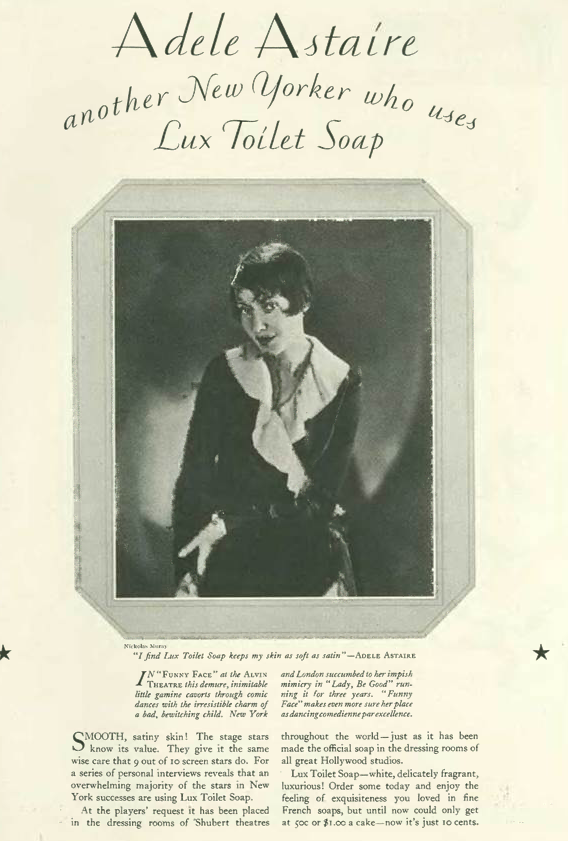
ADELE AGAIN…In the March 31 issue of The New Yorker Lux followed up with this ad featuring Adele Astaire all by herself.

Over the years dozens of famous actresses would appear in colorful ads singing the praises of Lux soap…

STAR POWER…Lux ads from 1954, 1956 and 1959 featuring, respectively, Audrey Hepburn, Debbie Reynolds and Sophia Loren. (Pinterest)

A final note. Lever Brothers began selling Lux soap in India in 1909, years before it was introduced in the U.S., and through the decades Bollywood actresses were prominently featured in their advertising…

NEW AGE…Bollywood Star Katrina Kaif in a 2010 Lux advertisement. (afaqs.com)

*  *  *

Meanwhile, back on earth…

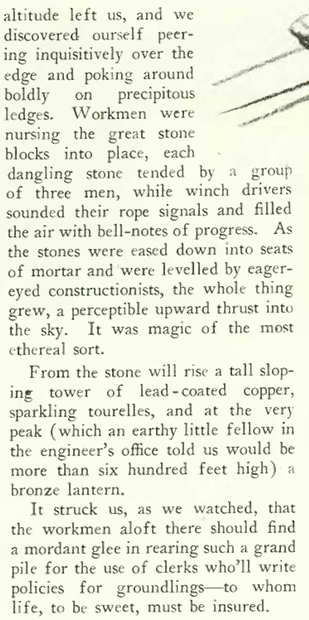
The March 17, 1928 “Talk of the Town” marveled at the rising structure between Madison and Park avenues that would become the New York Life Building. Designed by Cass Gilbert, who also designed the Woolworth Building, its gilded roof, consisting of 25,000 gold-leaf tiles, remains an iconic Manhattan landmark.

From 1837–1889, the site was occupied by the Union Depot, a concert garden, and P.T Barnum’s Hippodrome. Until 1925, the site housed the first two Madison Square Gardens, a memory that lingered amidst the city’s rapidly changing skyline…

ETHEREAL…The New York Life Building shortly after its completion in 1928. (Museum of the City of New York)

 *  *  *

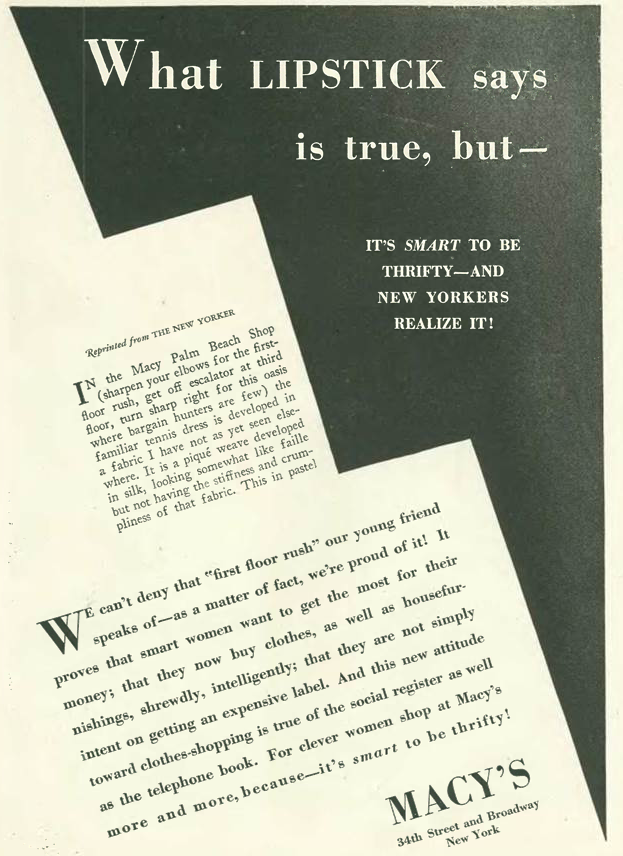
Following the lead of a Roosevelt Hotel advertisement in a previous issue, Macy’s Department Store also called out The New Yorker’s popular nightlife columnist “Lipstick” (Lois Long) in this ad featured in the March 17 issue…

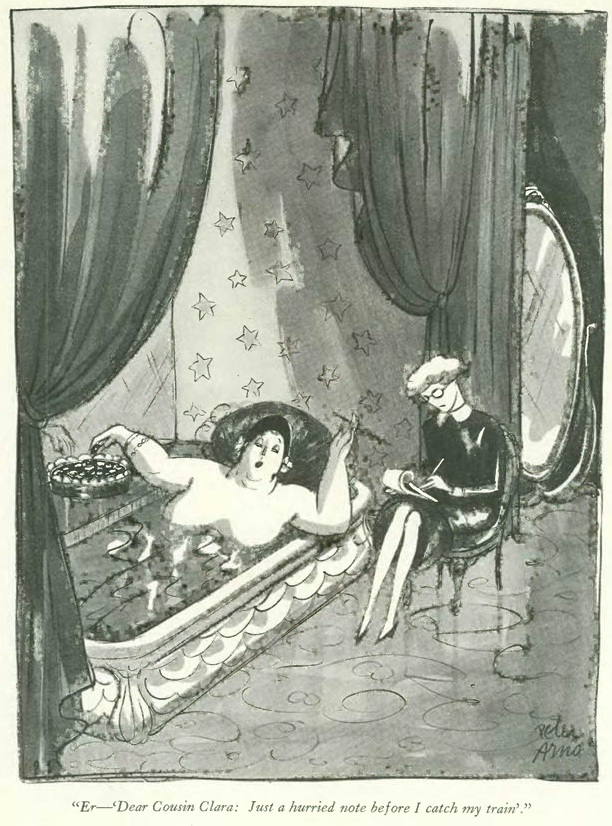
Our cartoon from the March 17 issue explored the hurried life of the idle rich, as depicted by Long’s husband, Peter Arno

Landmark in Name Only

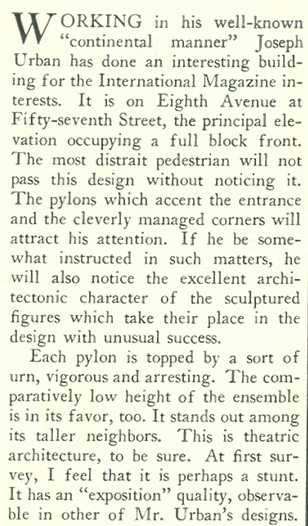
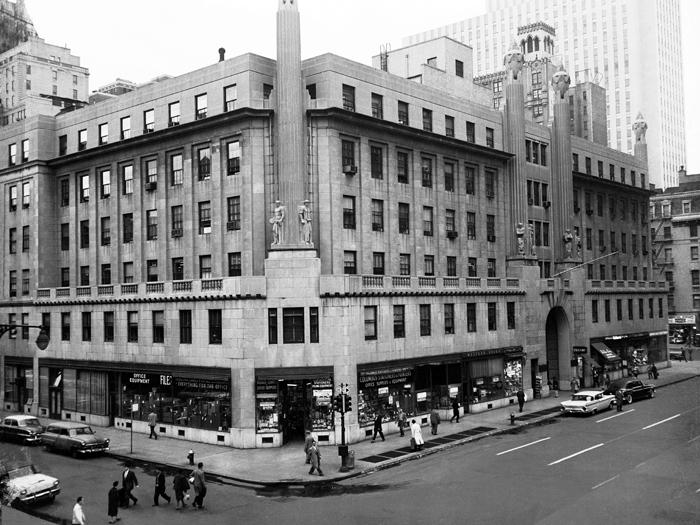
In the March 24, 1928 issue another building caught the attention of the magazine–a six-story structure designed by theatrical scenic artist and architect Joseph Urban for William Randolph Hearst. The International Magazine Building was completed in 1928 to house the twelve magazines Hearst owned at the time.

An important monument in the architectural heritage of New York, the building was designated as a Landmark Site by the Landmarks Preservation Commission in 1988. The six-story International Magazine Building was originally built to serve as the base for a proposed skyscraper, but the construction of the tower was postponed due to the Great Depression. The new tower addition by Norman Foster was finally completed nearly eighty years later, in 2006. It is probably not what either Hearst or Urban had in mind in 1928:

START OF A BIG IDEA…The International Magazine Building circa 1960. (Hearst)
ALIEN INVASION…The 2006 Norman Foster tower rises from the hollowed-out shell of the International Magazine Building. (Benjamin Waldman / Wikipedia)

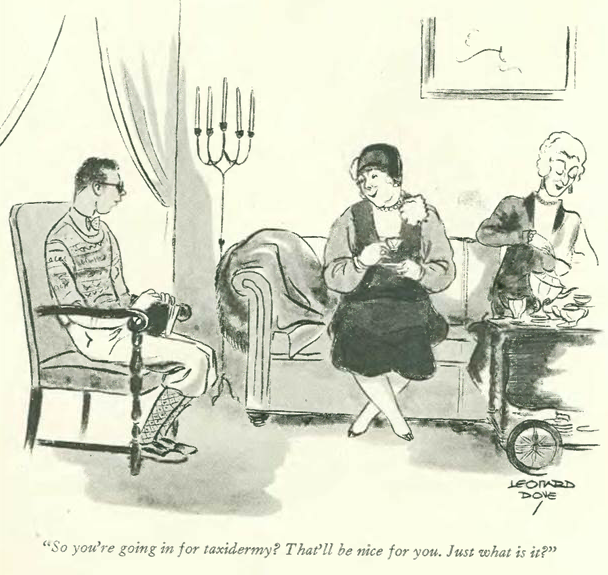
And finally, cartoonist Leonard Dove listens in on some tea time chatter…

Next Time: Conventional Follies of ’28…


To Bob, or Not to Bob

Perhaps no other hairstyle has a stronger link to a historical period than the “bob cut,” associated not only with the flapper lifestyle in the 1920s but with women in general who wished to signal their independence from old cultural norms that defined femininity.

March 10, 1928 cover by Ilonka Karasz.

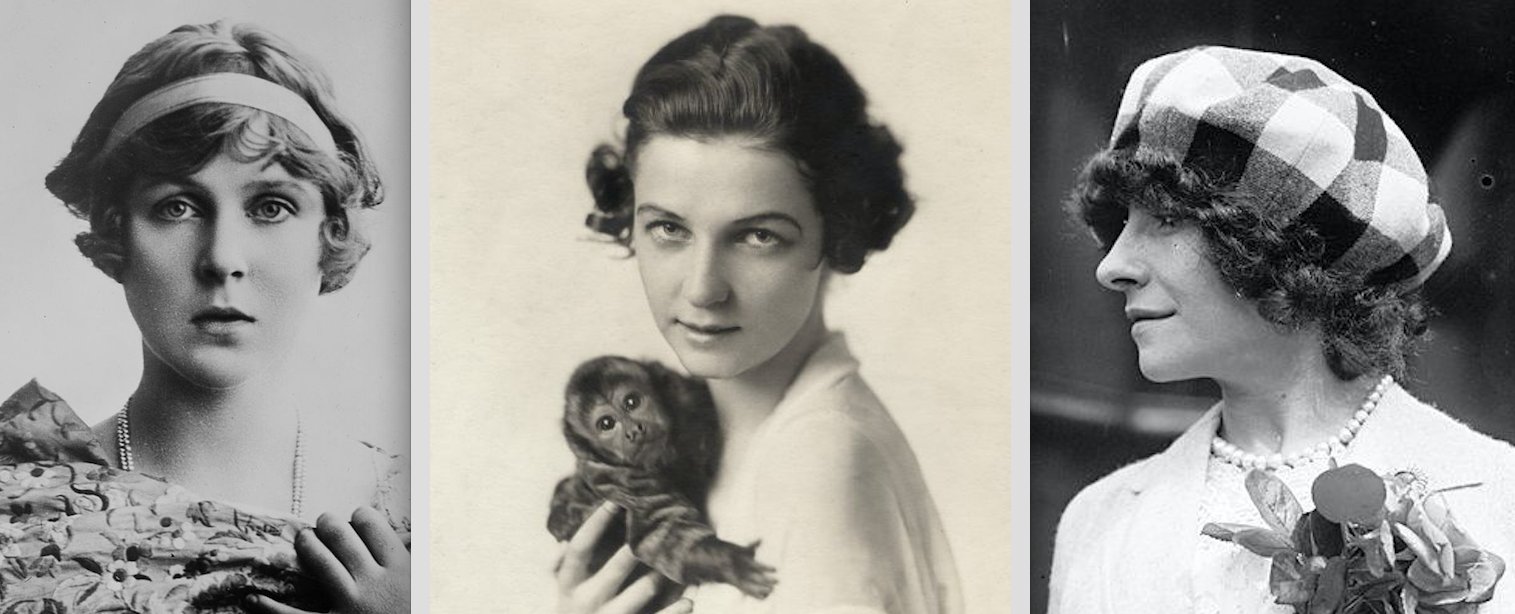
Women in Western cultures typically wore their hair long, but in the early years of the 20th century a few women of prominence began to flout convention and wear their hair in a bobbed style, including French actress Polaire, who began wearing her hair short in the 1890s; English socialite Lady Diana Cooper, who wore her hair short as a child and continued to do so as an adult; and dancer Irene Castle, who unveiled her “Castle Bob” to Americans in 1915. By 1920 the style was all the rage.

EARLY TRENDSETTERS…From left, Lady Diana Cooper in the mid 1920s; dancer Irene Castle with her pet monkey, Rastus, in 1915; and French actress Polaire in 1910. (Cooper & Polaire photos from Library of Congress; Castle photo courtesy Wisconsin Historical Society)
AMERICAN BOBS…Perhaps the most famous bob belonged to 1920s silent film star Louise Brooks (at right, wearing the “King Tut” bob, circa 1925), who was considered the very definition of a Roaring Twenties flapper. At left, another version of the bob as worn by Anita Loos, circa 1930. Loos was a screenwriter and author who achieved great fame in the 1920s with her blockbuster comic novel Gentleman Prefer Blondes. (fashion1930s.tumblr.com / Smithsonian)

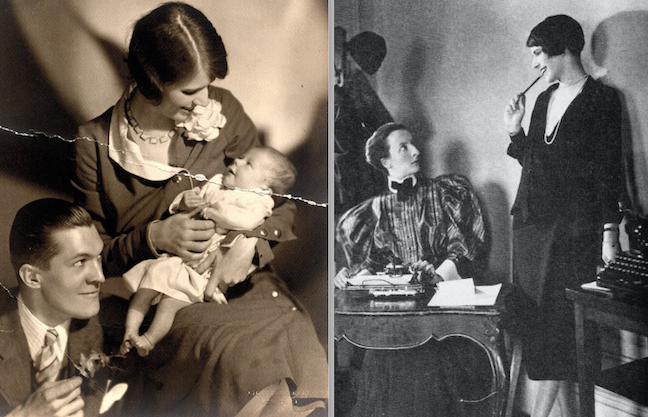
Another famous bobbed flapper of the 1920s was The New Yorker‘s own Lois Long, who wrote under the pseudonym “Lipstick” for her nightlife column “Tables For Two,” but signed her fashion column (“On and Off the Avenue”) with a simple “L.L.” Long was also a regular unsigned contributor to “The Talk of the Town,” and is credited as one The New Yorker’s early writers who gave the magazine its voice.

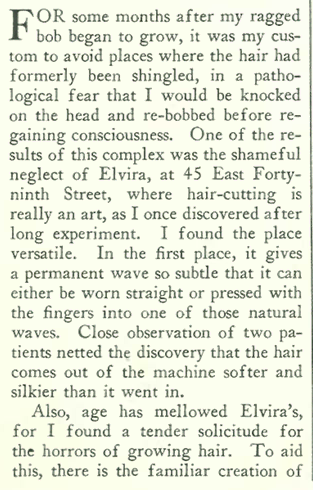
In the March 10, 1928 issue Long wrote in “On and Off the Avenue” about the challenges in maintaining her bobbed hairstyle:

LIFESTYLE CHANGES…Lois Long helped define the flapper lifestyle of the Jazz Age in her writing for The New Yorker. Long’s own bob evolved during the decade, from the straight boyish cut at right, circa 1925, to a “shingle style” bob at left in 1929, where she is pictured with her husband, New Yorker cartoonist Peter Arno, and their newborn daughter, Patricia. (Patricia Arno / Wikipedia)

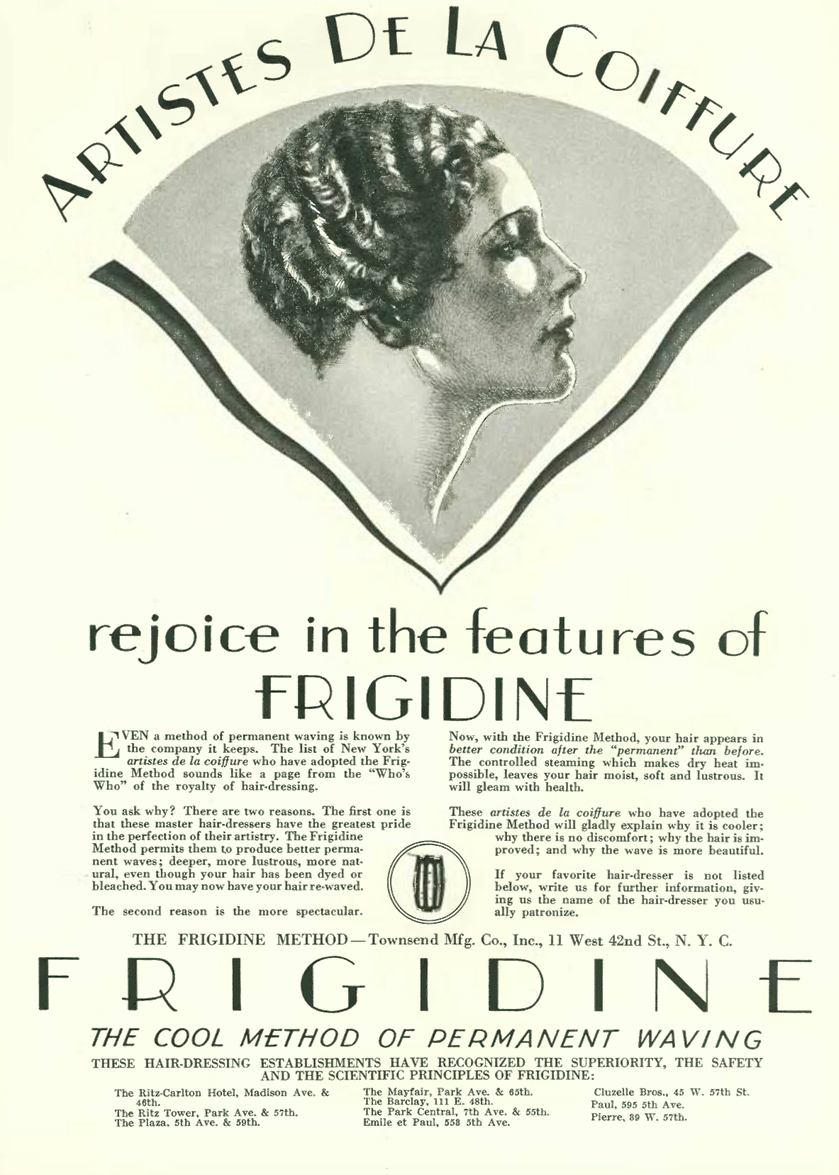
Many women in the 1920s preferred to have a permanent wave treatment applied to their bob, which usually involved the application of high heat via a complex array of wires and hot rollers. In the March 10 issue, this ad promoted an alternative “cool method”…

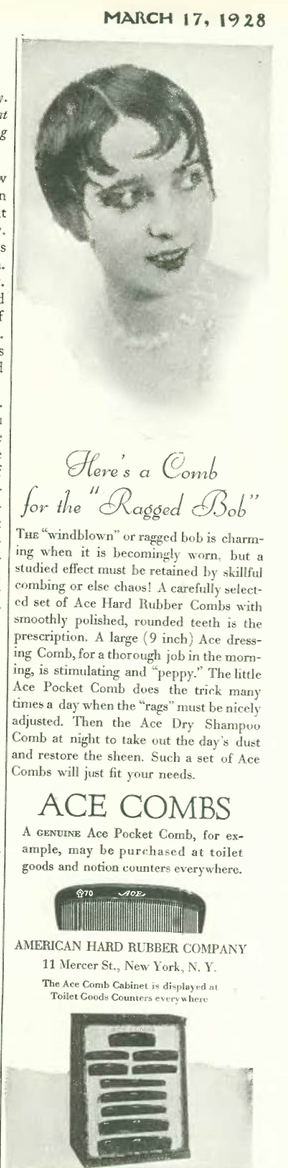
…and in the March 17, 1928 issue, the Ace Comb company made a pitch to improve its market share by touting their hard rubber combs as ideal for the “ragged bob”…

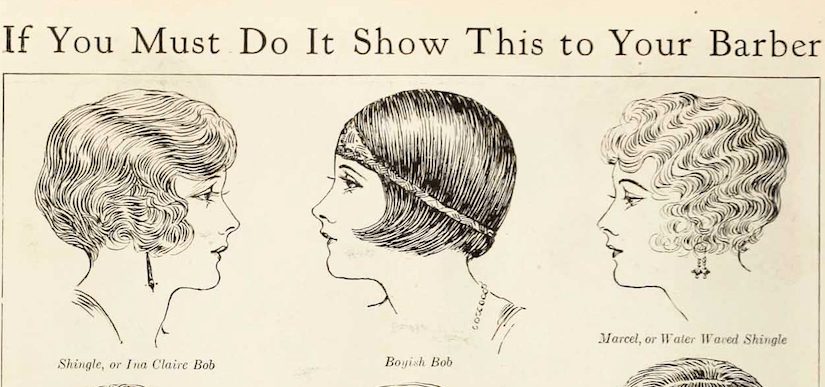
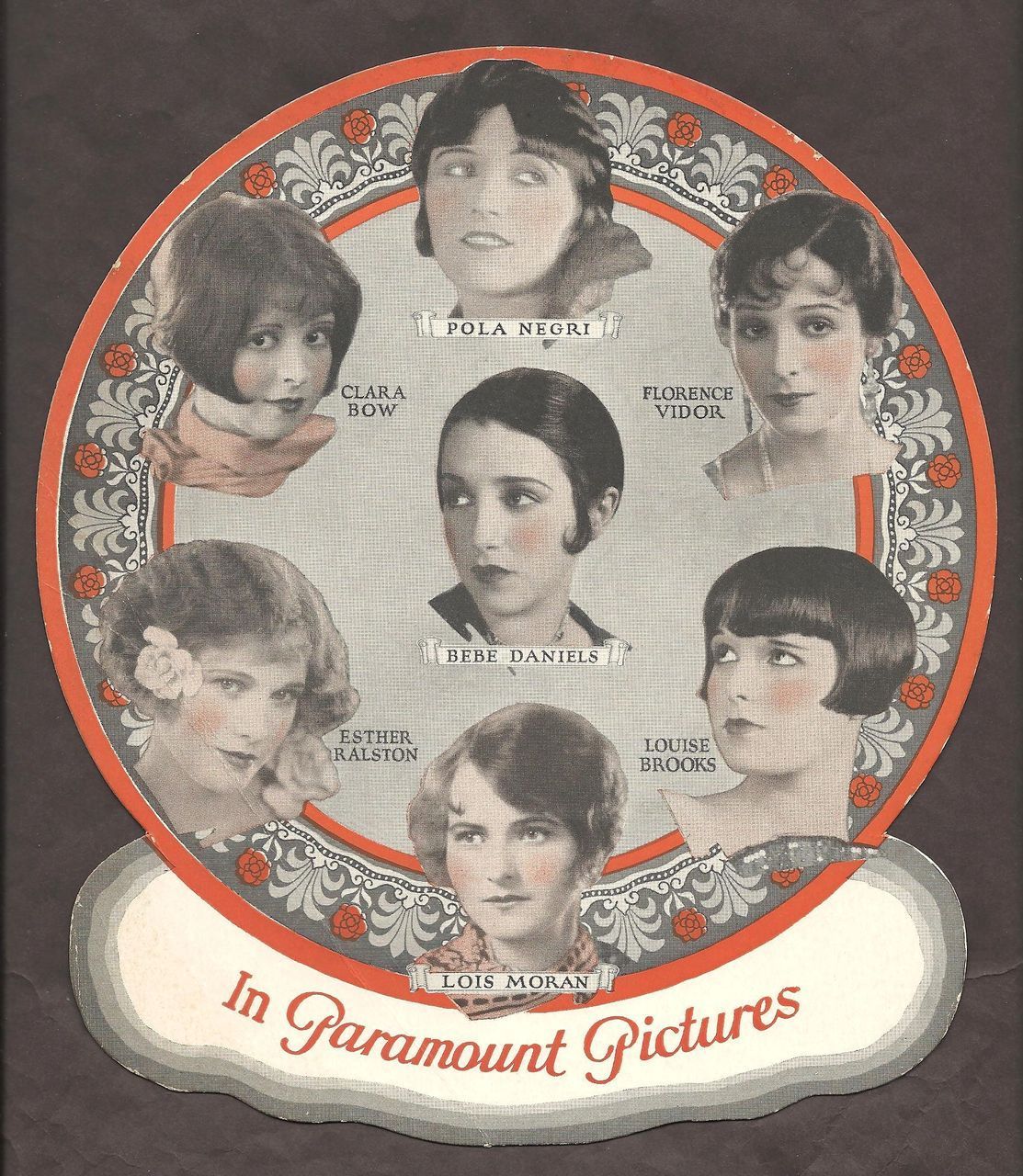
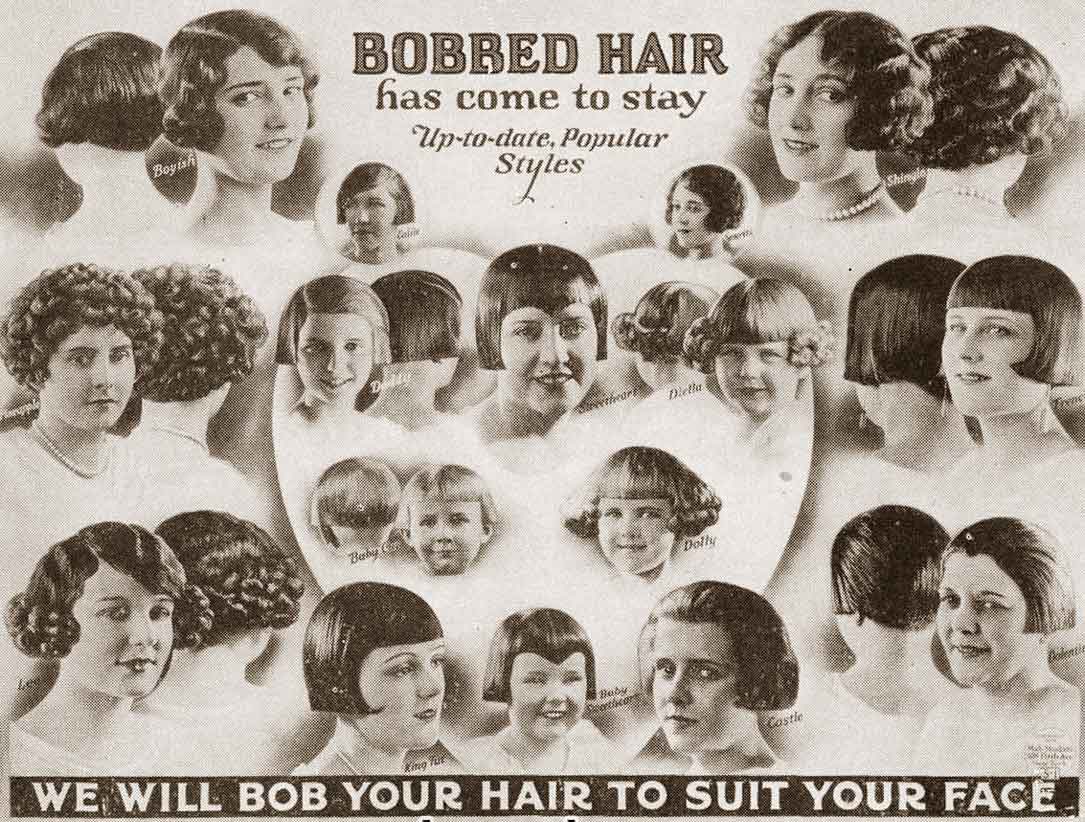
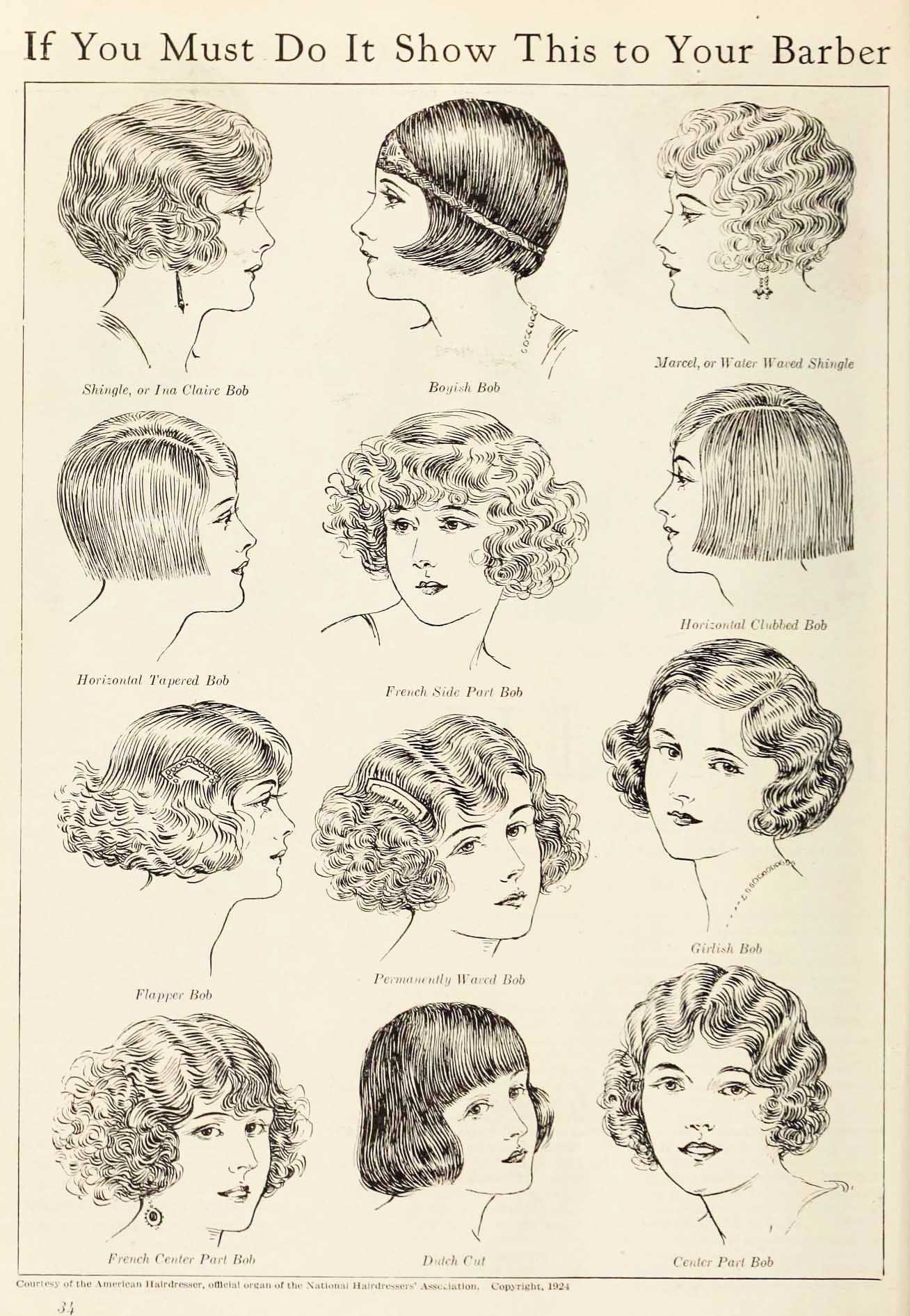
…and for some further context on all things bobbed, following are some images gleaned from glamourdaze.com, including a page from a 1920s movie magazine featuring Paramount’s bobbed stars; a 1920s salon advertisement promoting bobs for all ages; and finally, a helpful reference card from the American Hairdresser, circa 1924…

 *  *  *

A New Plot for Billy Haines

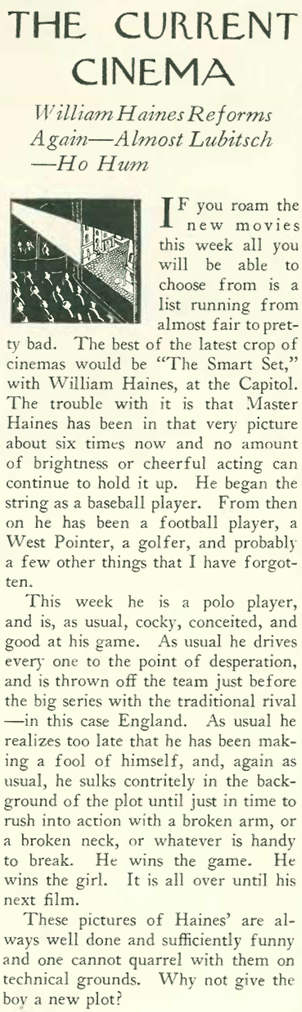
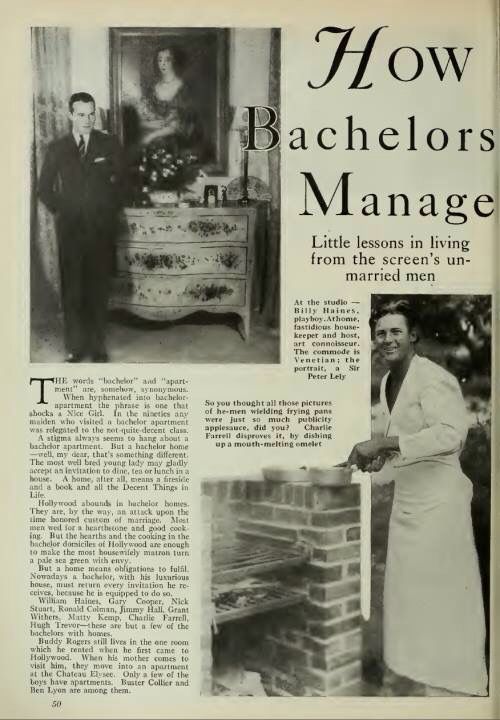
William “Billy” Haines was a top male box office draw in the 1920s, and throughout the decade was typecast in a number of comic roles as a conceited baseball player (Slide, Kelly, Slide), conceited cadet (West Point), conceited football star (Brown of Harvard), conceited golfer (Spring Fever), and conceited polo player (The Smart Set). It was that last picture that left The New Yorker wanting Haines to consider taking a different approach in his next picture:

Haines would eventually escape being typecast as a wisecracking, arrogant leading man, not by choosing different roles but by quitting acting altogether in 1935. The head of MGM, Louis B. Mayer, had demanded Haines deny his gay lifestyle (which he had lived quite openly despite the times) and marry a woman for appearances. Haines went on to become a successful interior designer, with clients ranging from Joan Crawford and Gloria Swanson to Ronald and Nancy Reagan.

TYPECAST…Billy Haines (left), Eleanor Boardman and Ben Lyon in Wine of Youth, 1924. (whenwewerecool.tumblr.com)
FAN FICTION…Movie fan magazines until mid-century were tools of the major studios with portrayals of the “real lives” of stars that were nearly as fictional as their film roles. Billy Haines (upper left) was one of the Hollywood “bachelors” featured in this article from an unidentified fan magazine. (Unknown/Pinterest)

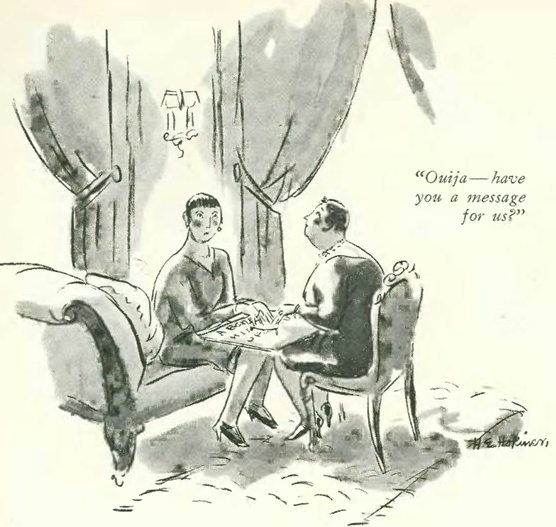
In our featured cartoon from March 10, 1928, Helen Hokinson spied on her famous spinsters passing the time with a Ouija board:

Next Time: Broadway’s Soap Stars…


Amen Aimee

It what would become a longstanding tradition, The New Yorker marked its third anniversary by featuring the original Rea Irvin cover illustration from Issue No. 1. The New Yorker was a very different magazine by its third year, fat with advertising and its editorial content bolstered by such talents as Peter Arno, E.B. White and Dorothy Parker.

Feb. 25, 1928 cover by Rea Irvin.

Parker livened up the magazine’s books section, mincing few words as she took on writers both great and not so great.

In the latter category was Aimee Semple McPherson, a 1920s forerunner of today’s glitzy televangelists. In her column “Reading and Writing,” Parker took aim at McPherson — “Our Lady of the Loud-speaker” — who had just published a book titled In the Service of the King.

READY FOR MY CLOSEUP…Although she was an evangelical preacher, Aimee Temple McPherson was also considered one of the most glamorous women in 1920s America. (Foursquare Church)

McPherson (1890–1944) was a Pentecostal-style preacher who practiced “speaking in tongues” and faith healing in her services, which drew huge crowds at revival events between 1919 and 1922. She took to the radio in the early 1920s and in 1923 she based her ministry in Los Angeles at her newly completed Angelus Temple, which served as the center of the International Church of the Foursquare Gospel.

McPherson’s book detailed her conversion and her various hardships, including her mysterious “kidnapping” in 1926. Parker was having none of it:

Parker was referring to events beginning on May 18, 1926, when the evangelist visited Venice Beach for a swim and went missing. Some thought she had drown, others claimed they saw a “sea monster” in the area. McPherson reemerged in June on the Mexico-Arizona border, claiming she had been kidnapped and held captive by three strangers.

Numerous allegations of illicit love affairs targeted McPherson during her years of fame, so some were inclined to believe she went missing in order to engage in a love affair with her sound engineer.

Upon her return to Los Angeles she was greeted by a huge crowd (est. 30,000 to 50,000) that paraded her back to the Angelus Temple. However many others in the city found McPherson’s homecoming gaudy and annoying. A grand jury was subsequently convened to determine if evidence of a kidnapping could be found, but the court soon turned its focus to McPherson herself to determine if she had faked the kidnapping. Parker thought the condition of the preacher’s shoes, after a long trek through the desert, were evidence enough of a sham:

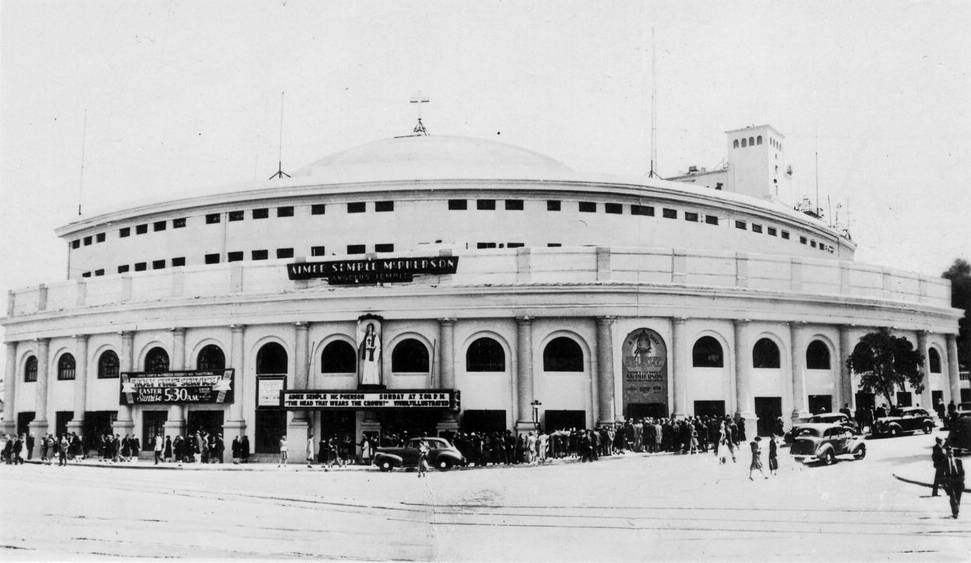
THE MEGACHURCH IS BORN…Angelus Temple, completed in 1923, is the center of the International Church of the Foursquare Gospel founded by McPherson. It is still in active use. (Loyola Marymount University)
SPECTACLE…Aimee Semple McPherson surrounded by massed choirs at Angelus Temple for a musical requiem in 1929. (Los Angeles Public Library/Herald Examiner)
Aimee Semple McPherson (second from left) joins tambourine players in a service at Angelus Temple. McPherson produced weekly dramas, often major spectacles, illustrating various religious themes. (Los Angeles Public Library/Herald Examiner)

McPherson, who was married three times and twice divorced, died in September 1944 from an apparent overdose of sleeping pills. She was 53. Her son Rolf took over the ministry after her death. Today McPherson’s Foursquare Church has a worldwide membership of about 8 million, and is still based in Los Angeles.

But How Do I Look?

The Feb. 25 issue profiled the young Jascha Heifetz, a Russian-born violin prodigy who seemed more interested in how he looked than in how he performed. An excerpt:

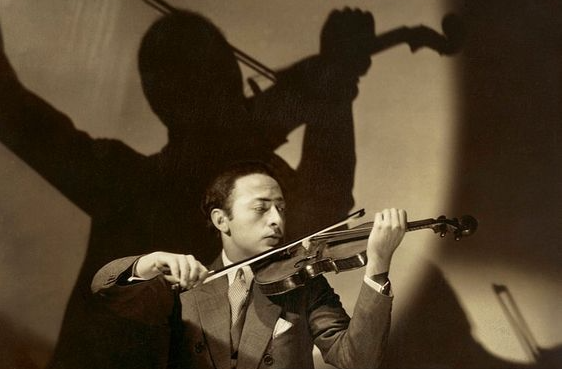
SARTORIAL PERFECTION…Detail of a 1928 photo of 27-year-old Jascha Heifetz, taken by Edward Steichen. (Condé Nast)

 *  *  *

Speaking of fashion, one of the world’s greatest fashion designers, Paul Poiret, was seeing hard times in the late 1920s with his designs losing popularity in his native France and his formidable fashion empire on the brink of collapse. But Francophile New Yorkers, always hungry for French fashion, greeted Poiret with open arms when he arrived in the city in the fall of 1927.

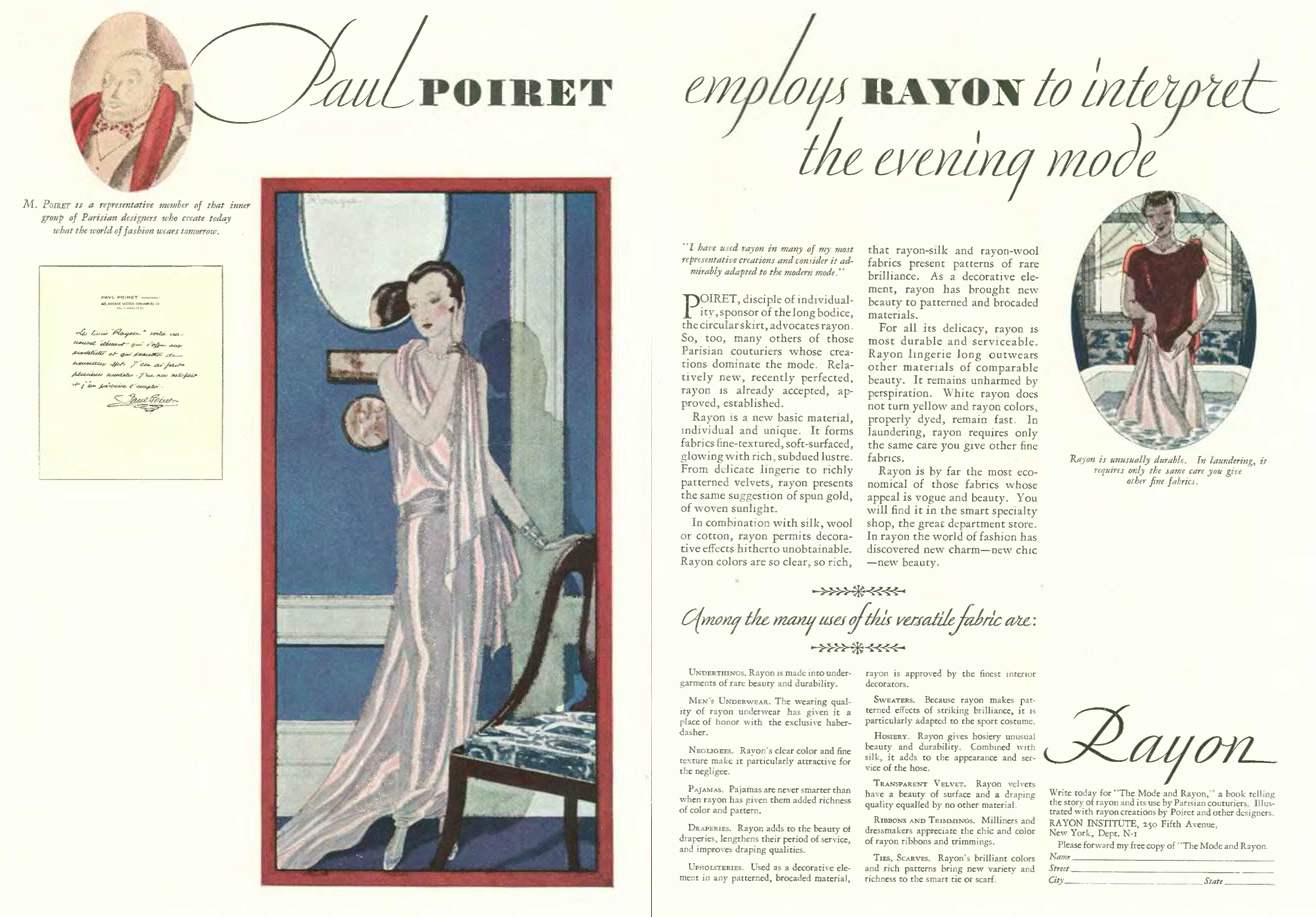
It is something of a surprise, however, to find this advertisement in the Feb. 25 issue in which Poiret endorses Rayon, a man-made substitute for silk. We don’t usually associate synthetics with haute couture, but then again maybe Poiret just needed the money. Better living through chemistry, as they say…
(click to enlarge)

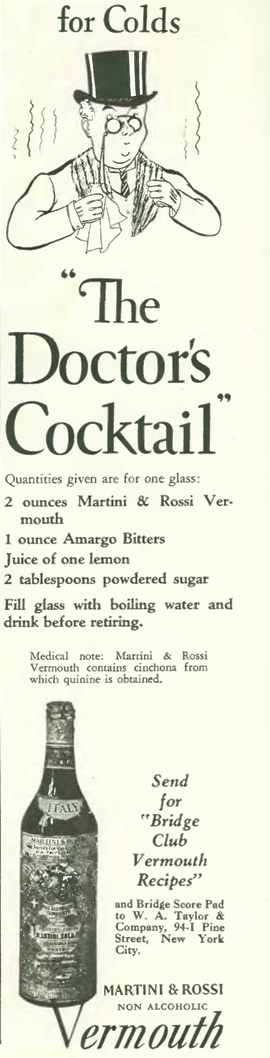
Also in the issue was a sad, Prohibition-era advertisement that extolled the virtues of an oxymoronic “non-alcoholic vermouth”…
And finally from the Feb. 25 issue, a cartoon by Carl Rose

 *  *  *

One-eyed Monster

In the March 3 issue “The Talk of the Town” discovered the miracle of television during a visit to the Bell Telephone laboratories.

March 3, 1928 cover by Peter Arno.

Lab researchers demonstrated a “receiving grid” with a tiny screen that displayed images broadcast across the expanse of an auditorium:

WE’LL CALL IT THE BOOB TUBE…Engineer and inventor Ernst Alexanderson (right) and the TV projector he used for early public demonstrations of television, circa 1928. (edisontechcenter.org)

Another glimpse into the future in the March 3 issue came courtesy illustrator Al Frueh, who offered this fanciful look at the skyscraper of tomorrow:

(click to enlarge)

 *  *  *

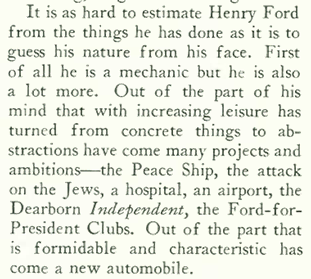
“Profile” featured the first installment of a four-part article (by Niven Busch Jr.) on a man who put America on wheels and into traffic jams. Excerpts:

Profile illustration by Al Frueh.

And finally, from W.P. Trent, an analogy that would take on new meaning after the market crash…
Next Time: To Bob, Or Not to Bob…


Speakeasy Nights

Before screenwriter Niven Busch Jr. headed to Hollywood in 1931, he cut his teeth as writer for The New Yorker, contributing a series of profiles (later compiled in Twenty-one Americans) as well as an intermittent series from May 1927 to Feb. 1930 on New York’s Prohibition-era speakeasies.

February 18, 1928 cover by Theodore G. Haupt.

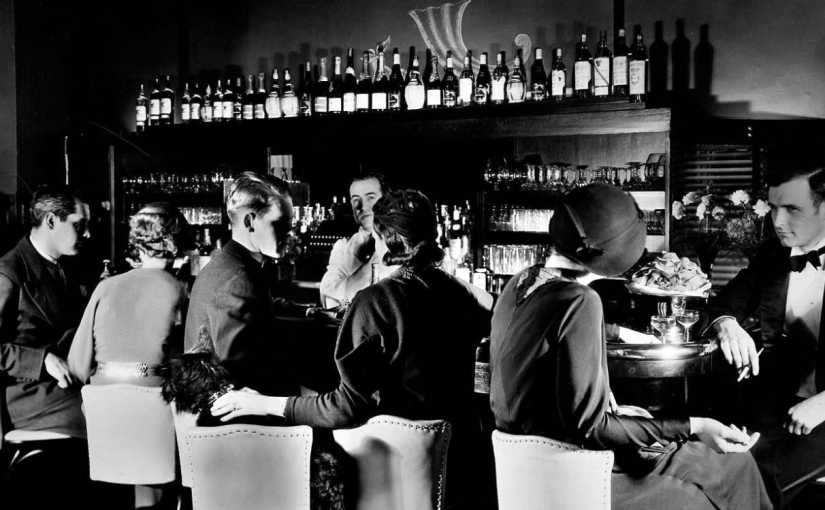
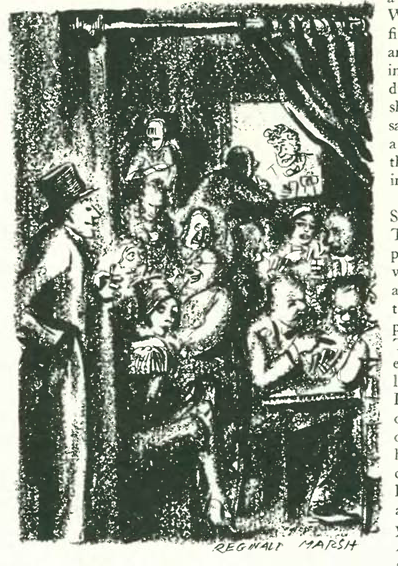
Always careful to shield the identity of speakeasy owners and patrons, Busch described the often less-than-glamorous digs of New York’s illegal watering holes. In a speakeasy called “The No Trump,” two Irish brothers took turns mixing drinks “on a kitchen table in a cubbyhole” while Busch sat in a darkened bar and listened in on a conversation coming from the adjoining “bridge room”…

This illustration by Reginald Marsh accompanied Niven Busch’s article.

LAST CALL…Images taken by photographer Margaret Bourke-White for Life magazine during the last days of Prohibition. (Time.com)
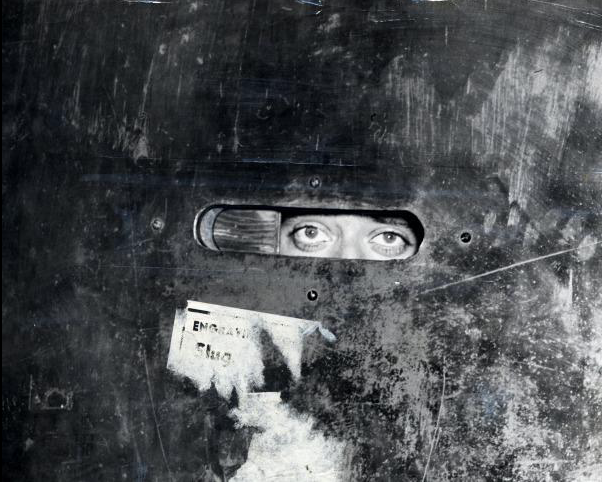
WHO GOES THERE?…The familiar slot in the door came in handy for speakeasy owners wishing to screen clients before allowing entry into their illegal lairs. (Chicago Tribune)
BETTER SWILL…The Marlborough House, an East Side speakeasy for socialites during Prohibition, 1933. Photo by Margaret Bourke-White for Fortune. (Time.com)

Busch also described his visit to the “Circus Speakeasy,” operated by a man who “travelled for 21 years with the Ringling Circus”…

A young Niven Busch Jr., circa 1930. (enetpress.com)
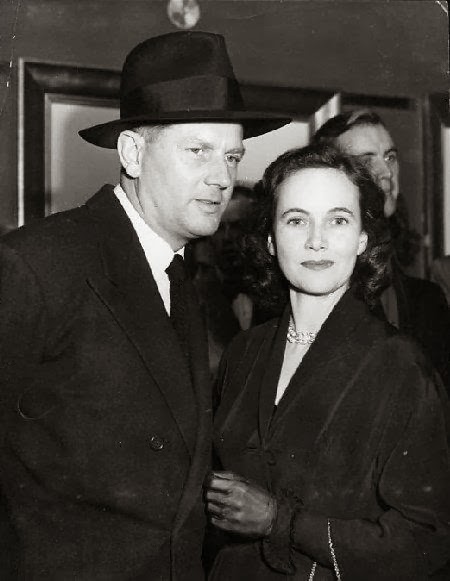
Busch and the third of his five wives, the actress Teresa Wright, in the 1940s. (danielmartineckhart.com)

In his later years as a producer and screenwriter in Hollywood, Busch would script movies ranging from The Man With Two Faces (1934) starring Edward G. Robinson, to The Postman Always Rings Twice (1946), with Lana Turner.

All Aboard

One of the prominent voices of the unsigned “Talk of the Town,” E.B. White was also a regular contributor of short pieces in The New Yorker, such as the following which described a mistaken encounter on an overnight train:

 *  *  *

Another way to calm the jitters

If you couldn’t legally (or illegally) buy Johnny Walker Scotch whisky in 1928, you had to settle for their brand of “vacuumed-cleaned, extremely mild” cigarettes, which were apparently sold as late as the 1950s…

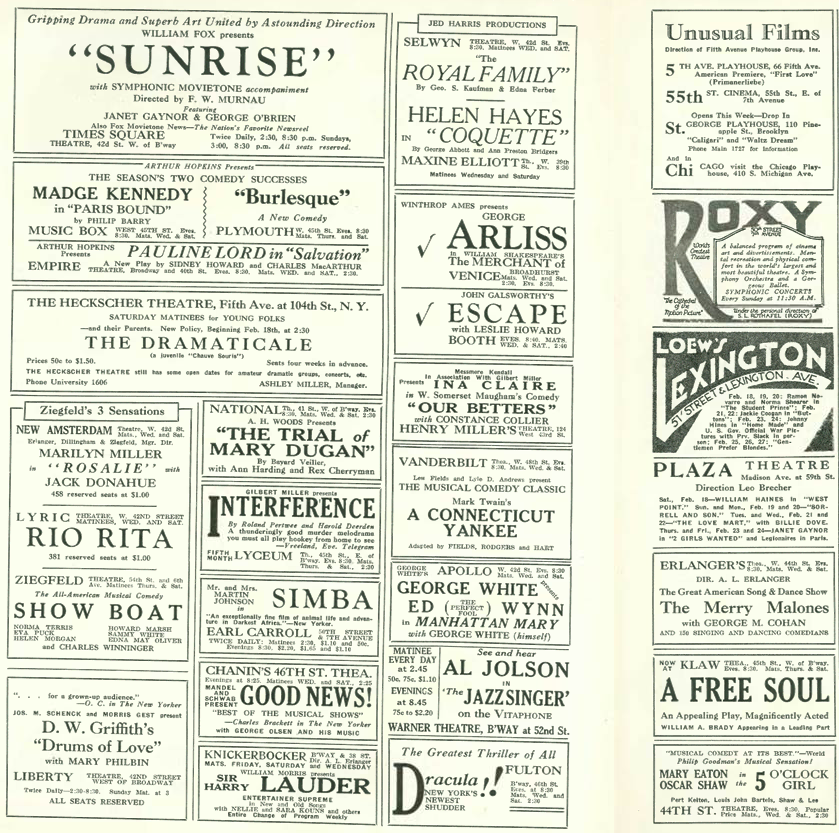
And to get a taste of what was showing at the local cinemas, I’ve included this page-and-third spread of movie and theatre ads from the back pages. Note the film Sunrise featured prominently at the top left-hand corner.

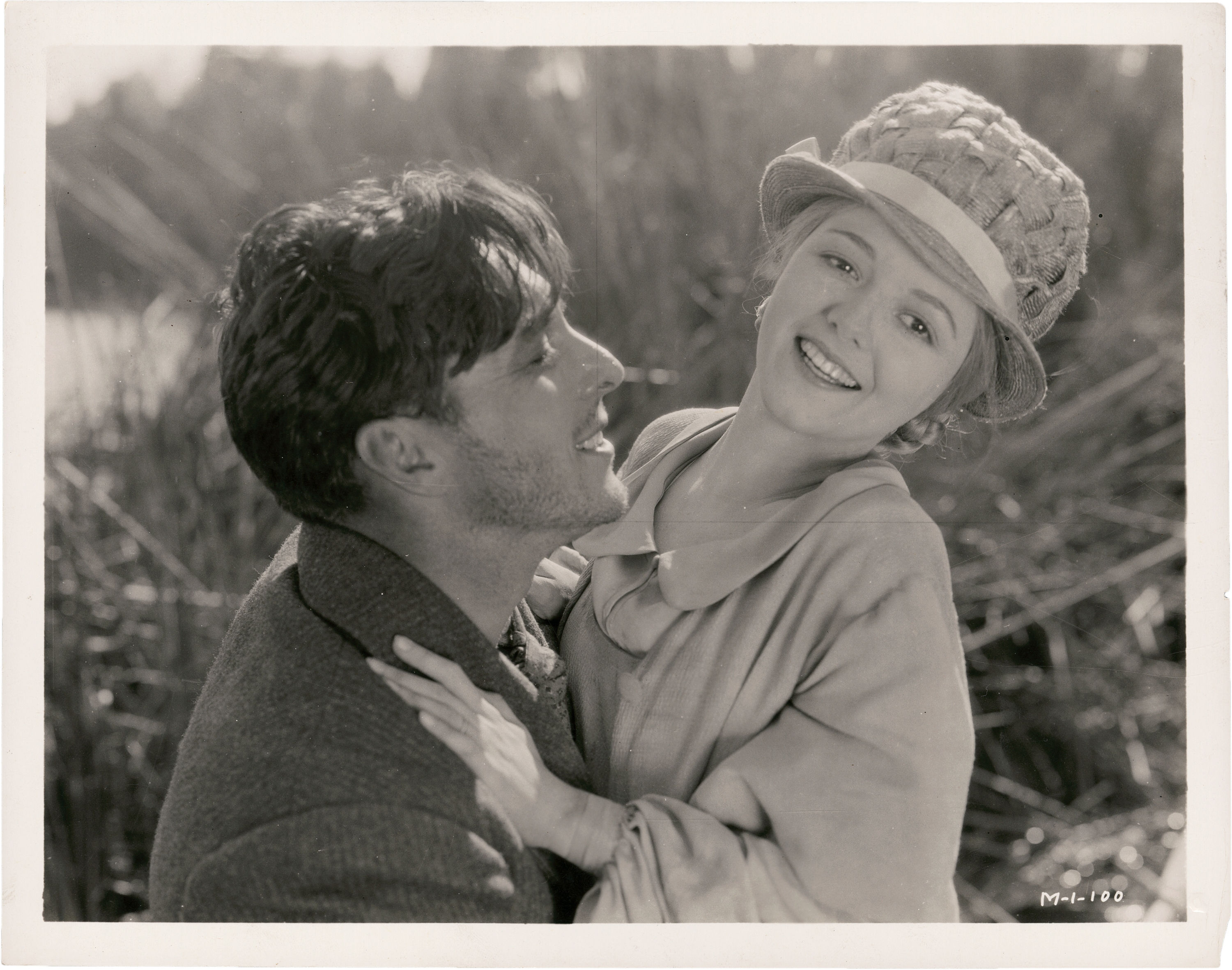
Starring George O’Brien, Janet Gaynor, and Margaret Livingston, this 1927 silent romantic drama, directed by F.W. Murnau, used the new Fox Movietone sound-on-film system, making it one of the first feature films with a synchronized musical score and sound effects soundtrack. Sunrise (full title: The Sunrise: A Song of Two Humans) won the Academy Award in the category “Unique and Artistic Picture” at the 1st Academy Awards in 1929, and Gaynor won the first Academy Award for “Best Actress in a Leading Role.” Sunrise is considered one of the greatest films of the silent era and even today is widely considered a masterpiece.

AWARD-WINNING SMILES…George O’Brien and Janet Gaynor in 1927’s acclaimed The Sunrise: A Song of Two Humans. (The Red List)

 *  *  *

And finally, more hijinks from the moneyed classes, courtesy of Peter Arno:

Next Time: Amen Aimee…

Good Vibrations

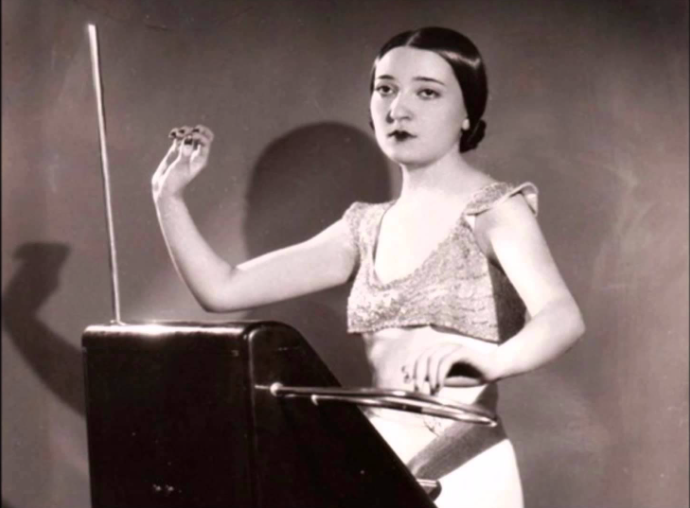
A decidedly new sound reverberated in the ears of New Yorkers who attended a Feb. 1928 performance of the New York Philharmonic that featured guest artist Leon Theremin, a Russian inventor who played music by moving his hands through the air, or more accurately, a magnetic field.

February 4, 1928 cover by Gardner Rea.

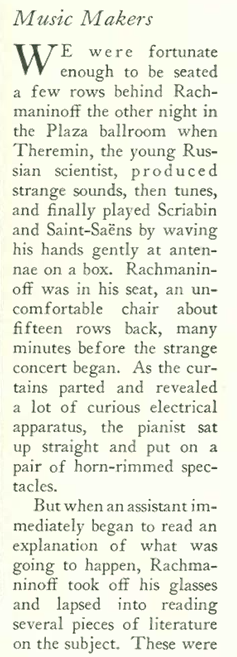
Theremin’s eponymous instrument had neither keys nor strings, but rather two metal antennas attached to an electronic oscillator. Music was produced by moving one’s hands between the antennas, which sensed the relative position of the players hands—one antenna controlled for pitch while the other adjusted the instrument’s volume. The sound produced is best described as “otherworldly.” James Thurber, writing for the “Talk of the Town” (in a piece titled “Music Makers”), found Theremin’s performance intriguing, but of even greater interest was the great Russian pianist and composer Sergei Rachmaninoff—who was in attendance—and his reaction to the strange instrument:

HMMMM…At left, Sergei Rachmaninoff in 1921, as photographed by Kubey Rembrandt. At right, Leon Theremin plays his eponymous instrument at a demonstration concert in Paris on December 8, 1927. (Wikimedia)

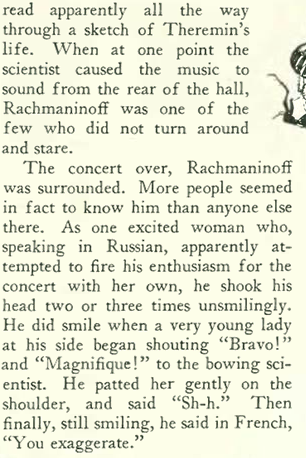
The New Yorker’s voyeuristic account of Rachmaninoff continued, with the great man now becoming more engaged in the performance…

The Theremin would grow in popularity, however more as a novelty than a serious instrument:

ON THE AIR…Alexandra Stepanoff playing the Theremin on NBC Radio in 1930. A Russian immigrant to the U.S., the former concert singer was Theremin’s first student in the United States. (Wikimedia)
VIRTUOSO…The Russian-born Clara (Reisenberg) Rockmore holds a unique place in music history as the virtuoso performer of the Theremin. Leon Theremin built a custom version of his instrument for Rockmore, which added greater range and sensitivity. Rockmore would sometimes perform concerts with her sister, accomplished pianist Nadia Reisenberg. Photo circa 1930. (PHOTO BY RENATO TOPPO, COURTESY OF THE NADIA REISENBERG – CLARA ROCKMORE FOUNDATION)

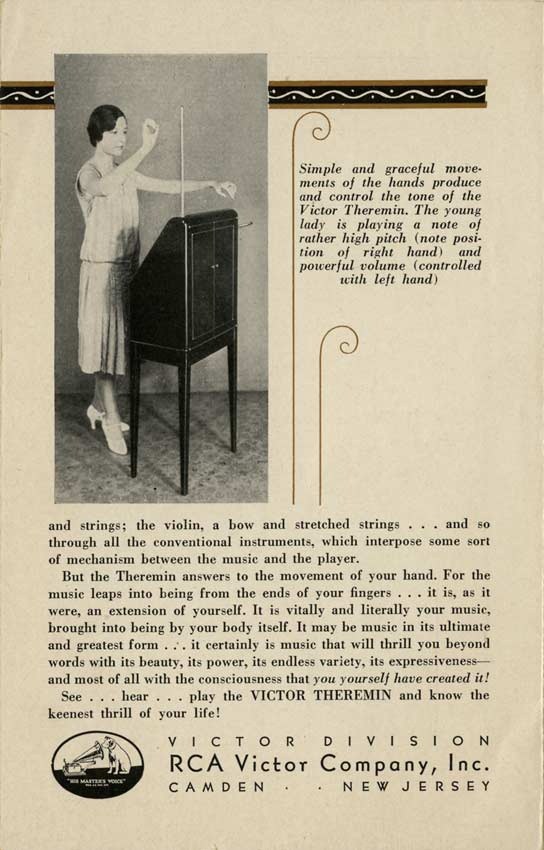
Theremin would be granted a U.S. patent for the instrument in 1928, which was marketed and distributed in the U.S. by RCA during the 1930’s in either DIY kit form or as a finished instrument:

(120years.net)

Interest in the instrument as a novelty continued into the 40’s and 50’s in the DIY market…

(120years.net)

Robert Moog, pioneer of modern electronic music and inventor of the Moog synthesizer, made and sold a transistorized version of the Theremin in the 1950s.

The Theremin would become best known to mass culture through its use in producing “eerie” sound effects in 1940s and 50s films, including Bernard Herrmann’s use of the instrument for the soundtrack to the 1951 sci-fi thriller, The Day The Earth Stood Still. And nearly everyone on the planet has heard the Theremin-inspired sound of the Beach Boy’s song Good Vibrations, created by an electro-Theremin that was developed in the late 1950s to mimic the sound of the original Theremin.

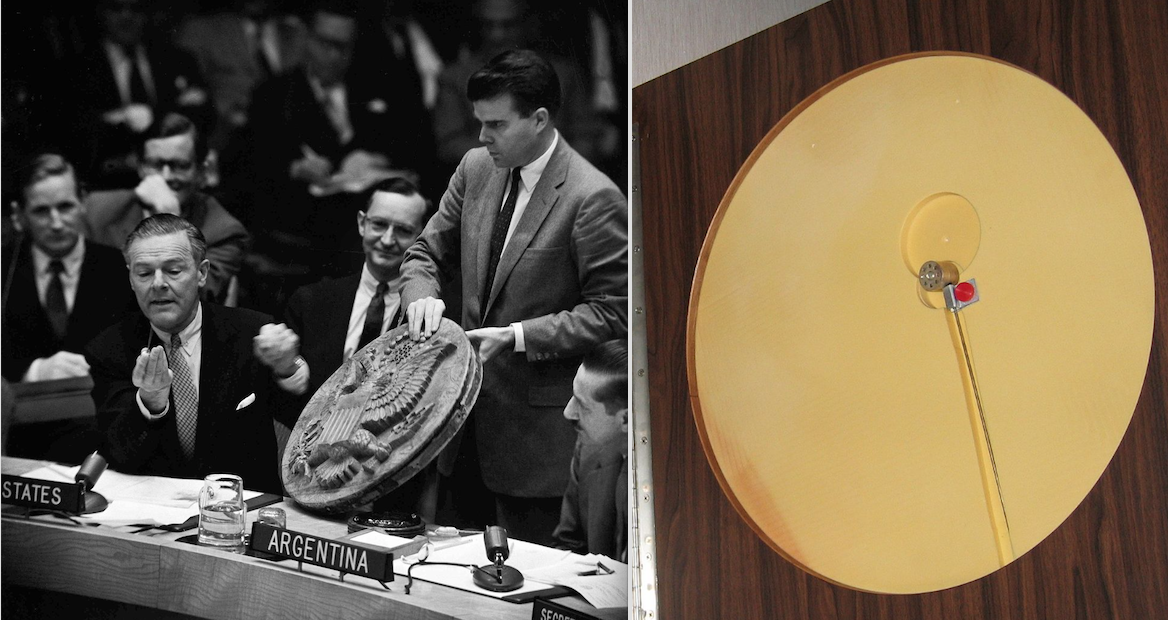
As for Leon Theremin himself, he would also gain notoriety as the inventor of The Thing, a listening device most famously used by the Soviets to bug the U.S. Embassy in Moscow. The device was hidden behind a wood carving of the U.S. Great Seal, which in 1945 was presented by Soviet schoolchildren to the U.S. ambassador, who subsequently hung it in his office.

GOTCHA…American Ambassador to the UN Henry Cabot Lodge displays The Thing before the UN Security Council in 1960. At right, the device which was hidden behind the seal. The Americans discovered the bug in 1952, but didn’t reveal its existence until 1960 in the wake of the U-2 spy plane incident. The Soviet Union had convened the meeting of the United Nations Security Council to accuse the Americans of spying with the U2; in response Cabot displayed The Thing as proof spying between the two countries was a mutual endeavor. (crytomuseum.com/Wikimedia)

The reasons why Theremin developed The Thing for the KGB are a mystery. When he suddenly disappeared from New York in 1938 it was rumored that he had been kidnapped and possibly executed by the KGB. What we do know is that Soviet spooks put him to work in a secret laboratory in the Gulag camp system, where he developed The Thing.

In 1991, filmmaker Steven Martin brought Leon Theremin back to New York to film a documentary about his life. Theremin gave one last performance in 1993, and died that year at age 97.

Wild Kingdom

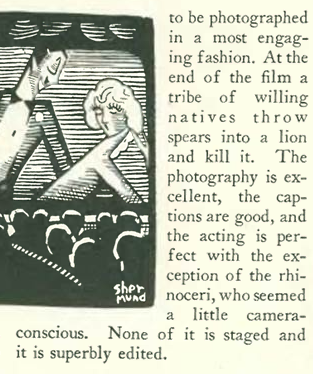
The New Yorker’s review of the hit film Simba revealed a very different approach to the natural world 89 years ago, when the wilds of Africa were exploited purely for adventure and thrills rather than for any real understanding of natural systems and the animals and humans that inhabited them. Martin and Osa Johnson were celebrated for their filmed exploits in the wilds, including Simba; they touted their movie—shot in Kenya—as being made under the auspices of the American Museum of Natural History, although much of the film was staged or edited in ways to maximize the thrills.

The New Yorker found the film to be “darn good fun”…

Despite its flaws, the film does offer us a glimpse of Africa when wildlife hadn’t been hunted to near extinction, although the Johnsons didn’t hesitate to gun down animals left and right in the course of their movie-making.

According to a 2011 review from Wild Film History, “in stark contrast to the conservation-themed wildlife films of today, the Johnsons approached their subjects armed with both camera and rifle, with the production including provoked behavior, staged confrontations and animals shot to death on film. Relying heavily on cutting in kills from professional marksmen, numerous hunting scenes culminate in a heart-stopping sequence where, with the use of clever editing, the adventurous Mrs Johnson appears to bring down a charging rhinoceros with one well-aimed shot.

A FUN-LOVING NATURE…Osa Johnson saddles up a hapless zebra. (Daily Mail)

 *  *  *

From the Advertising Department

There were three automobile ads in the Feb. 4 issue, all from long-gone companies—Pierce-Arrow, Hudson-Essex, and Nash, which featured this endorsement by the brother-sister dancing duo Fred and Adele Astaire:

This ad for Dynamique showcased the art deco stylings of its furniture line…

And finally, a Peter Arno cartoon of an upper class faux pas

Next Time: Literary Rotarians…

Distant Rumblings

As I’ve previously noted, reading back issues of periodicals often gives one a feeling of omniscience; as I thumb through week after week of late 1920s New Yorkers, I realize that for all their cleverness and worldly wisdom, even that magazine’s writers and editors could not see with any clarity into the future. But neither can any of us…one wonders what readers 89 years hence will surmise from today’s magazines, that is, if our civilization lasts that long.

January 28, 1928 cover by Theodore G. Haupt.

Howard Brubaker (in his column “Of All Things”) might have spotted something brewing on the horizon, even if it wouldn’t become perfectly clear until Dec. 7, 1941. Here is a clip from his Jan. 28, 1928 column in The New Yorker:

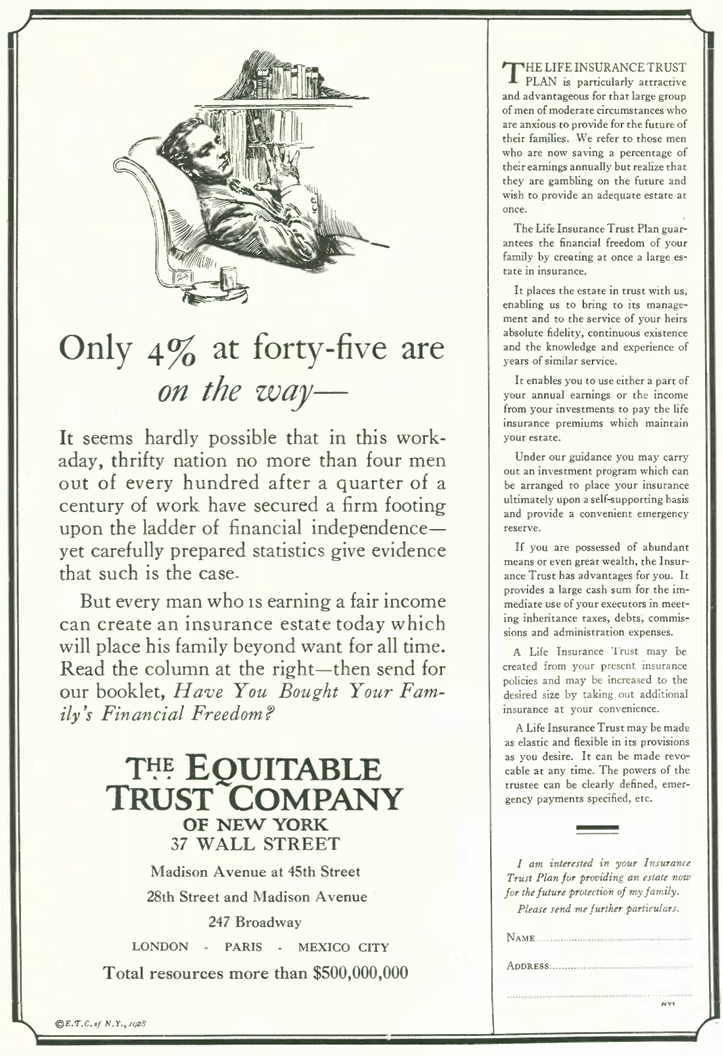
Two other major events in U.S. history, the Stock Market Crash of 1929 and the Great Depression that would follow, were less than two years away. But this was the Roaring Twenties, and some thought the fun would never end…except perhaps Equitable Trust, which placed this advertisement in the Jan. 28 issue:

Apparently the folks at Equitable Trust weren’t assured of their own financial freedom—after the Crash they would be acquired by Chase National Bank, making Chase the largest bank in the world at that time.

Despite the overheated economy of the 1920s, there still were plenty of poor and unemployed people in the city. One man, Urbain Ledoux (known as Mr. Zero in order to hide his identity), often arranged protests and demonstrations to bring attention to the poor and unemployed, and opened a number of bread lines and soup kitchens to feed the hungry, including the “Tub,” depicted in this two-page illustration by Constantin Alajalov along the bottom of the “Talk” section of the Jan. 28 issue (click image to enlarge).

 *  *  *

Not All Gloom and Doom

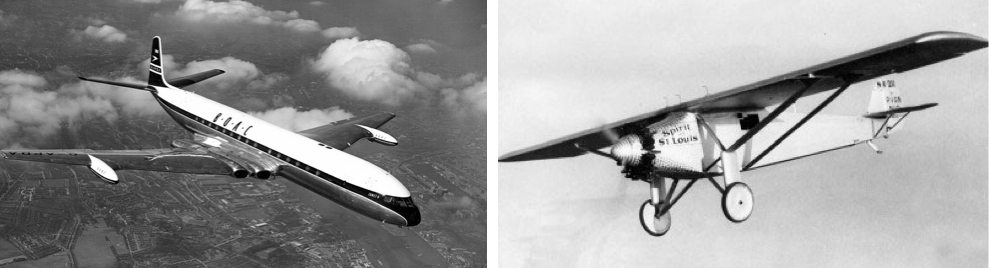
Hindsight also reveals the trajectory of the 20th century’s great accomplishments. Charles Lindbergh’s transatlantic flight in 1927, for example, fueled the imaginations of those who would usher in the jet age and space travel. Just 31 years after Lindbergh’s flight, the British Overseas Airways Corporation (BOAC) would begin operation of its first transatlantic passenger jet service. And only 42 years would separate Lindbergh’s flight from Neil Armstrong’s moonwalk.

JUST 31 YEARS would separate Lindbergh’s flight from the first transatlantic jet service. At left, the DeHavilland Comet 4 (1958), and at right, Lindbergh’s Spirit of St. Louis (1927). (warthunder.com/howstuffworks.com)

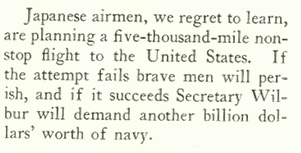
Like the rest of America, The New Yorker was an enthusiastic follower of developments in aviation after Lindbergh (the “aerial ambassador” referred to below). The January 28 “Talk of the Town” led with this item about pilots soaring to ever greater heights.

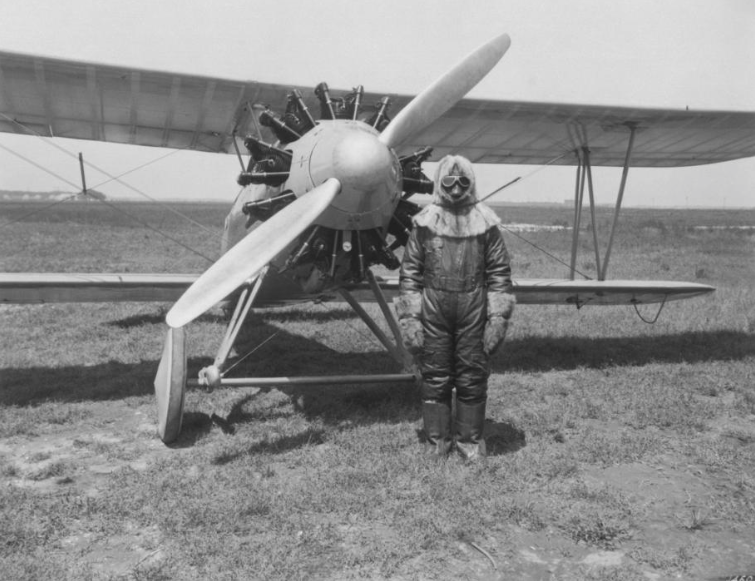
Consider that a mere 41 years separated this…

YETI, SET, GO!…A pilot in high altitude flying gear next to a Wright Apache biplane, January 1, 1928. In September 1926 the Apache set the world altitude record for seaplanes (38,500 ft) and in April 1930 it set the land-plane altitude record of 43,166 ft. (NASA)

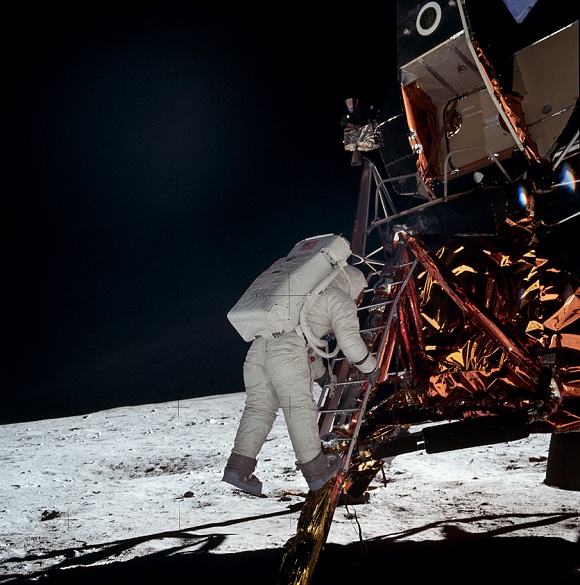
…from this…

LEAVE THE FUR COAT AT HOME…The second man on the moon, Buzz Aldrin, prepares to step onto the lunar surface, July 20, 1969. (Neil Armstrong/NASA)

 *  *  *

While Back on Earth…

Big events in America always seem to involve the appearance of showgirls, whether it is the introduction of a new car or some techno gadget. As this “Talk” item indicates, much was the same 89 years ago…

 *  *  *

Silent Giant

German film actor Emil Jannings was lauded for his performances on the screen in both Germany and America in films, and he was particularly adept at portraying of the pathos of middle-aged men. The New Yorker disliked most of Hollywood’s output (and usually praised the much-artier German films), so when Jannings landed on these shores he was lauded by the magazine, which dedicated a profile (written by Elsie McCormick) to him in the Jan. 28 issue, accompanied by a Hugo Gellert illustration. Some excerpts:

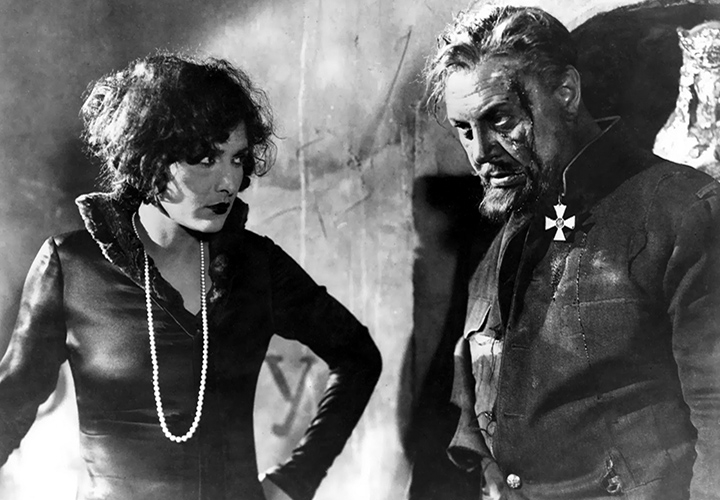
LIFE IS HARD…Evelyn Brent and Emil Jannings star in The Last Command. In the first Academy Awards, Jannings would win best actor for two films, The Last Command and The Way of All Flesh. (silentfilm.org)

At the first Academy Awards in 1929, Jannings would win a Best Actor Oscar for two of his 1928 films, The Last Command and The Way of All Flesh. An interesting side note from writer Susan Orlean: In her 2011 book, Rin Tin Tin: The Life and The Legend, Jannings was not actually the winner of the first best actor vote, but the runner-up. The famous dog actor Rin Tin Tin actually won the vote. The Academy, worried about not being taken seriously, gave the award to the human instead.

Janning’s thick German accent would bring his Hollywood career to an end with sound pictures. He would return to Germany, and during the Third Reich he would star in several films that promoted the Nazis. According to Wikipedia, the shooting of his last film, Wo ist Herr Belling? was aborted when Allied troops entered Germany in Spring 1945. Jannings reportedly carried his Oscar statuette with him as proof of his former association with Hollywood.

From the Advertising Department

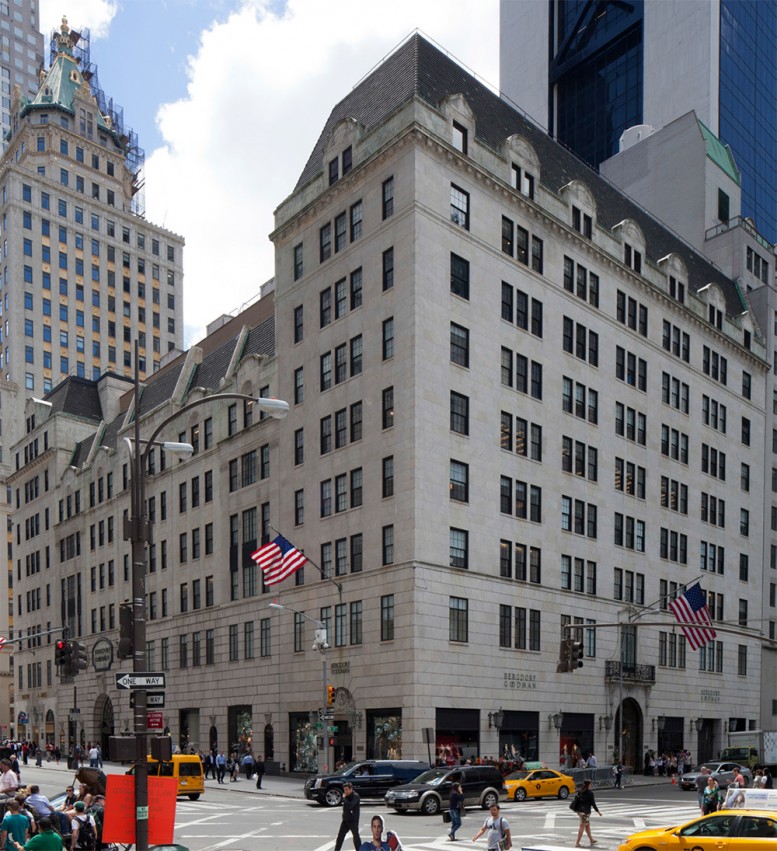
This advertisement from the Jan. 28 issue caught my eye because Bergdorf Goodman is one of the few stores in Manhattan still operating at its original site:

Bergdorf Goodman today. (Photo courtesy LPC)

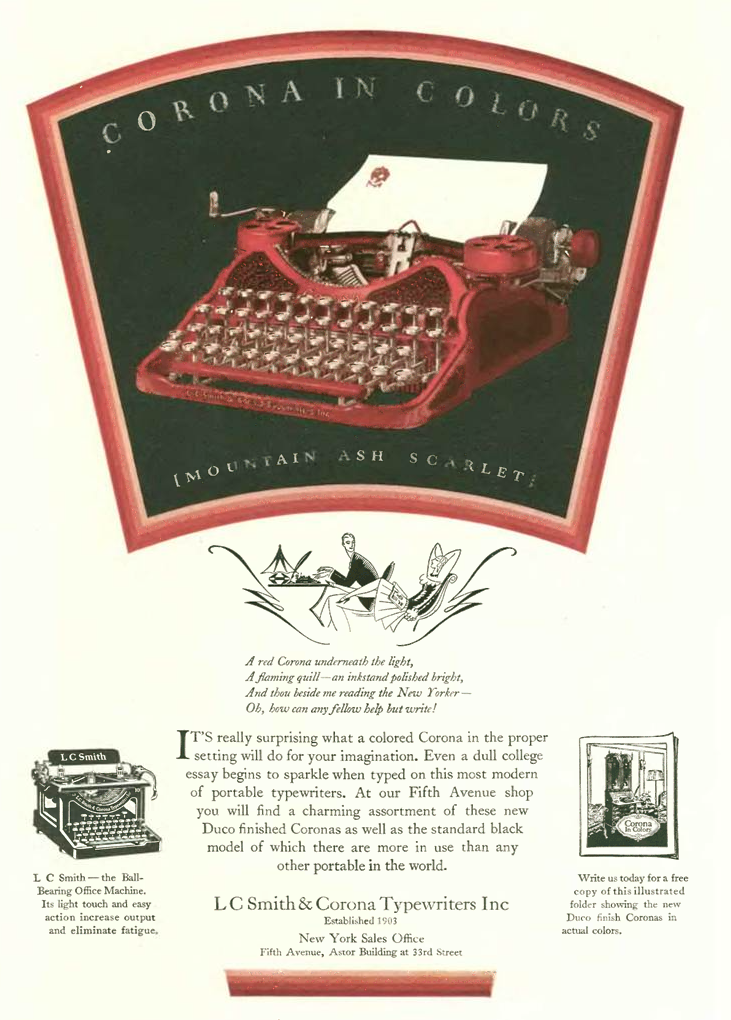
And here we have perhaps the iMac of its day, standing  apart from the competition with its colorful, bold new look…

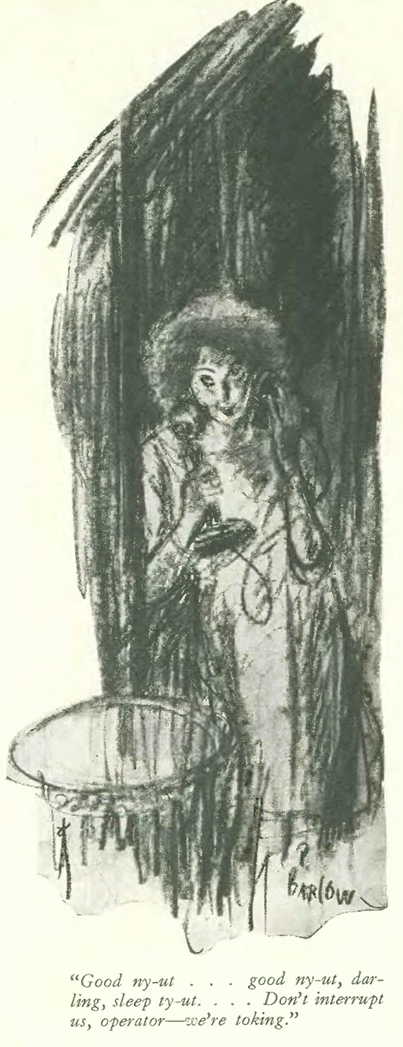
And finally, this early cartoon from longtime New Yorker cartoonist Perry Barlow having some fun at the expense of New York’s working class…

Next Time: Good Vibrations…