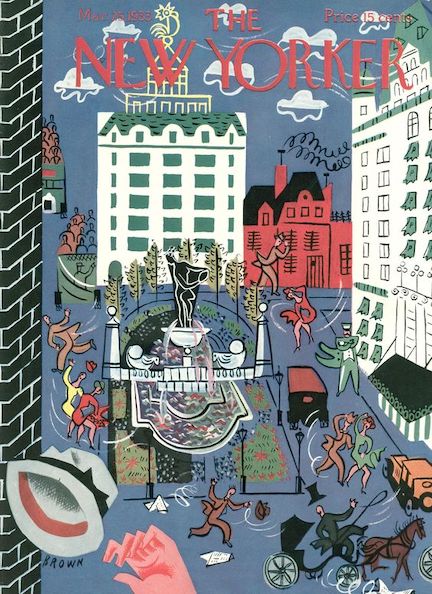
Something Frivolous

And what can be more frivolous than a Busby Berkeley musical, with scores of leggy showgirls tap-dancing in perfect rhythm, or dressed in identical white gowns while playing flying pianos. Make sense? No, and that was the whole point.

March 23, 1935 cover by Peter Arno. The color, contrast and composition are striking; it looks more like a cover from the 50s or 60s.

“In an era of breadlines, depression and wars, I tried to help people get away from all the misery…” Berkeley once remarked. “I wanted to make people happy, if only for an hour.” Gold Diggers of 1935 was Berkeley’s second “Gold Digger” picture (he choreographed or directed four; there were six in all, including one silent), and it was the first in which he served as sole director. Critic John Mosher didn’t know what to make of the film, likening it more to an earthquake than an entertainment.

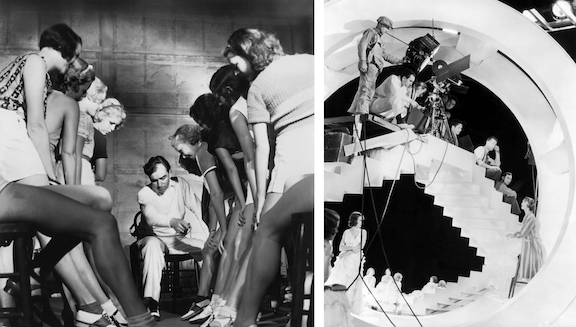
SOMEONE HAS TO DO IT…Busby Berkeley (1895-1976) works with dancers (left) during the production of 1933’s 42nd Street; right, at work on one of his lavish sets, circa 1930s. (IMDB)

The “harmless jingle” Mosher referred to, Harry Warren and Al Dubin’s “Lullaby of Broadway,” received an Oscar for Best Original Song (it also gave me an earworm for a week).
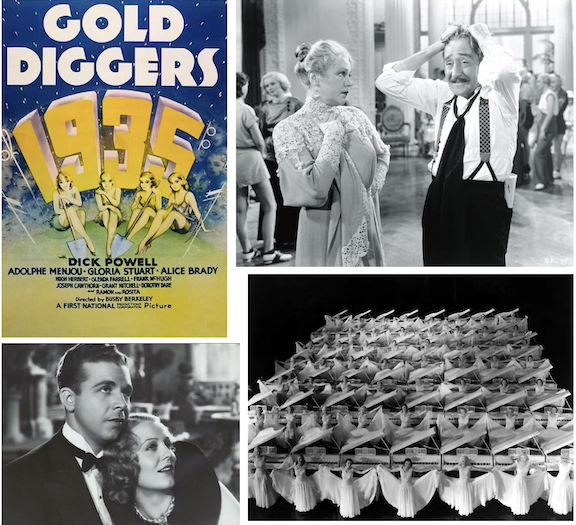
GOLDEN GIRLS…Clockwise, from top left, Alice Brady as the parsimonious Matilda Prentiss and Adolphe Menjou as the conniving Russian dance director Nicolai Nicoleff in Gold Diggers of 1935; a scene from the dancing pianos sequence; Dick Powell and Gloria Stuart as the film’s sweethearts. (Wikipedia/YouTube/IMDB)

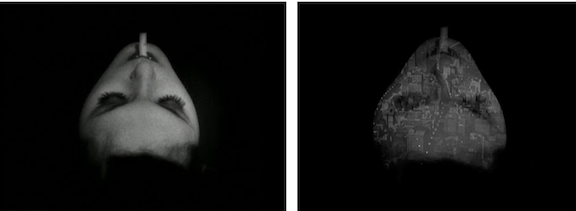
Amid the frivolity, Mosher noted the juxtaposition of the jingly “Lullaby of Broadway” with the haunting, two-minute sequence of Wini Shaw singing “Lullaby” as her disembodied face emerges from the blackness toward the viewer.

The scene continues as the woman (Shaw) turns onto her back, her head slowly dissolving into the nighttime city…after a raucous, mass tap-dancing scene, she falls to her death, and the sequence is reversed, her face disappearing into the blackness. The blog Acidemic gives an interesting take on this part of the film, which is more reminiscent of a German avant-garde film than Berkeley’s usual fare…
(YouTube)

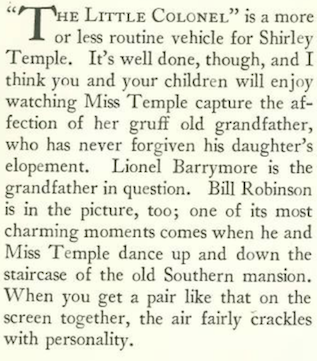
…Mosher found the scene “terrifying.” Perhaps Shirley Temple helped calm his nerves with her precocious antics in The Little Colonel

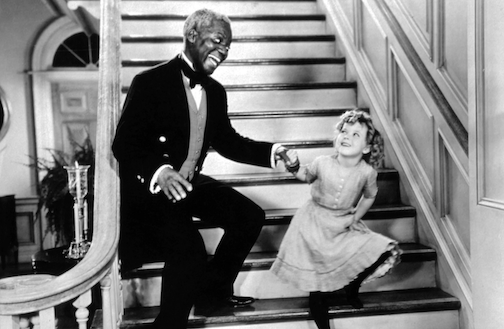
NO FLOATING HEADS HERE…Shirley Temple and Bill Robinson doing the famous staircase dance in The Little Colonel (1935). (TCM)

 * * *

Up In Smoke

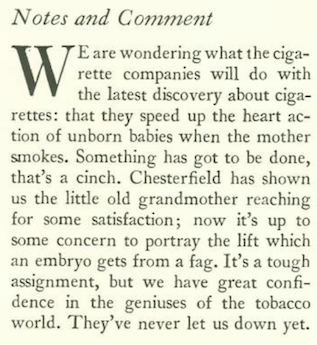
In “Notes and Comment” E.B. White considered the possibility that cigarette smoking might be harmful to unborn babies, and wryly suggested that embryos could replace grandmothers as a new growth market for big tobacco:
…White referred to the advertisement below, which appeared in the Feb. 9, 1935 issue of The New Yorker:

…White also commented on his recent visit to Madison Square Garden’s winter skating carnival…
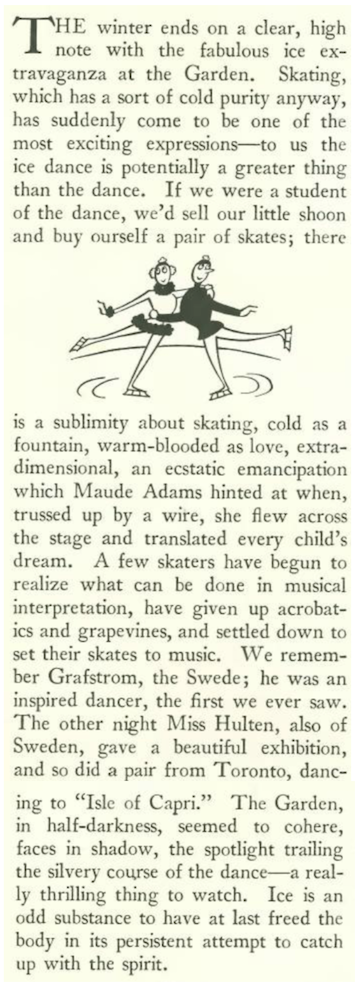

THE DOUBLE AXEL was still thirteen years in the future when Swedish skaters Gillis Emanuel Grafström (left) and Vivi-Anne Hultén delighted E.B. White at Madison Square Garden. Photos are from 1924 and 1932, respectively. (Wikipedia)

 * * *

Prescience of Mind

We have more from E.B. White, this time in a humorous piece titled “The Dove’s Nest,” in which White took a poke at the most influential newspaper editor in the country, Arthur Brisbane. A close friend of William Randolph Hearst, Brisbane essentially ran Hearst’s newspaper empire. The New Yorker often ridiculed Hearst’s (and Brisbane’s) jingoistic approach to the news that included giant headlines warning of war. Excerpts:

William A. Swanberg, author of the 1961 biography Citizen Hearst, described Brisbane as “a one-time socialist who had drifted pleasantly into the profit system…in some respects a vest-pocket Hearst–a personal enigma, a workhorse, a madman for circulation, a liberal who had grown conservative, an investor.”
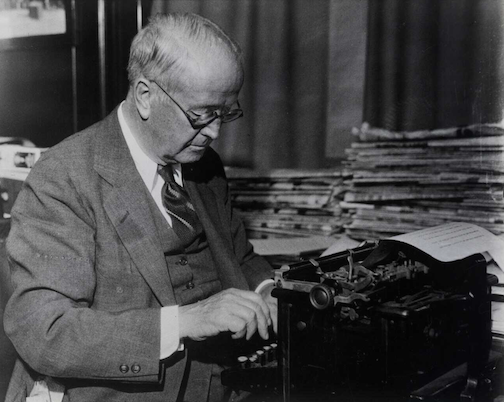
DAMN THOSE TORPEDOES…Arthur Brisbane in 1933. His grandson, Arthur S. Brisbane, now retired, served as public editor of The New York Times from 2010 to 2012. (credo.library.umass.edu)

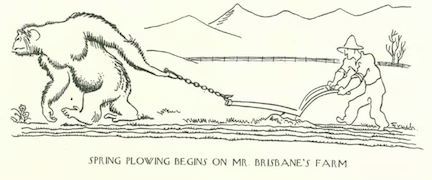
The New Yorker continued to take jabs at Brisbane in the following issue (March 30). Brisbane owned a large estate (including a horse farm) in New Jersey that he made available to New Deal work programs during the Depression. I suppose this Al Frueh cartoon was some kind of reference to that…
…also in the March 30 issue was this ad from World Peaceways, which raised alarms about possible war and bombs raining down from the sky…

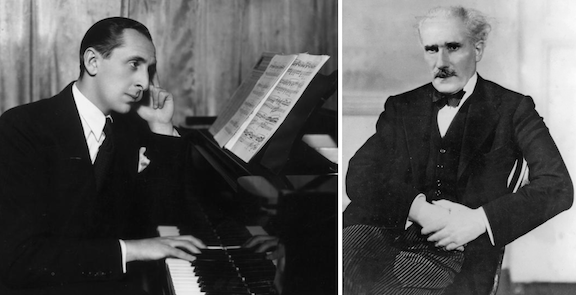
…back to the March 23 issue, where we find the calming strains of a Brahms concerto at Carnegie Hall, conducted by Arturo Toscanini with some support from his son-in-law, Vladimir Horowitz

MAY I CALL YOU DAD?…Not likely something said by young Vladimir Horowitz, left, to father-in-law Arturo Toscanini. (WQXR/Britannica)

 * * *

From Our Advertisers

Beginning in 1934 the makers of Old Gold cigarettes hired pin-up artist George Petty to create a series of ads featuring a homely, clueless sugar daddy and his leggy mistress…here he turns the tables, introducing a “Pudgy Wudgy” matron putting the moves on a handsome hosiery salesman…
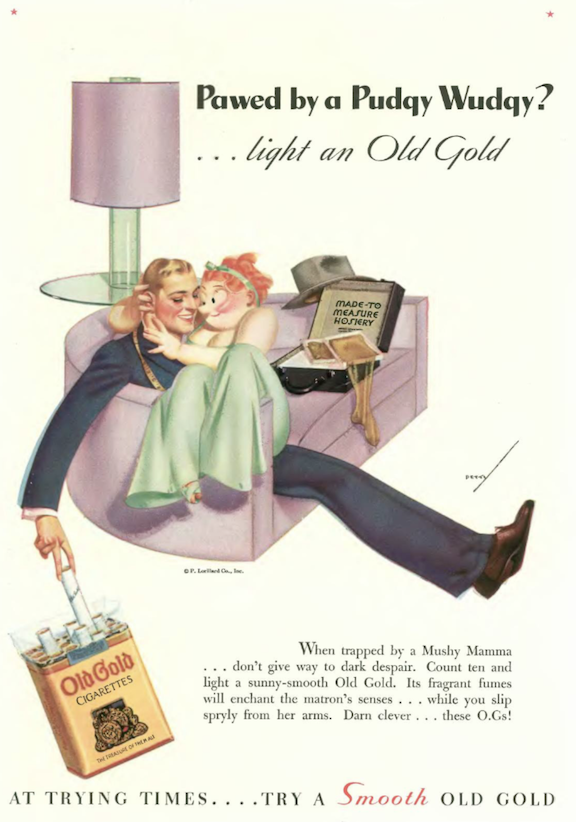
…this Petty ad appeared in the Feb. 9, 1935 issue of The New Yorker

…the makers of Camels continued their campaign of “distinguished women” who enjoyed their product…here we have a former debutante, Dorothy Paine, an “alert young member of New York’s inner circle.” Not much of a record of Dorothy, who married a man named Walter H. Sterling in 1935…apparently they moved to Phoenix and bought up property in the Southwest…
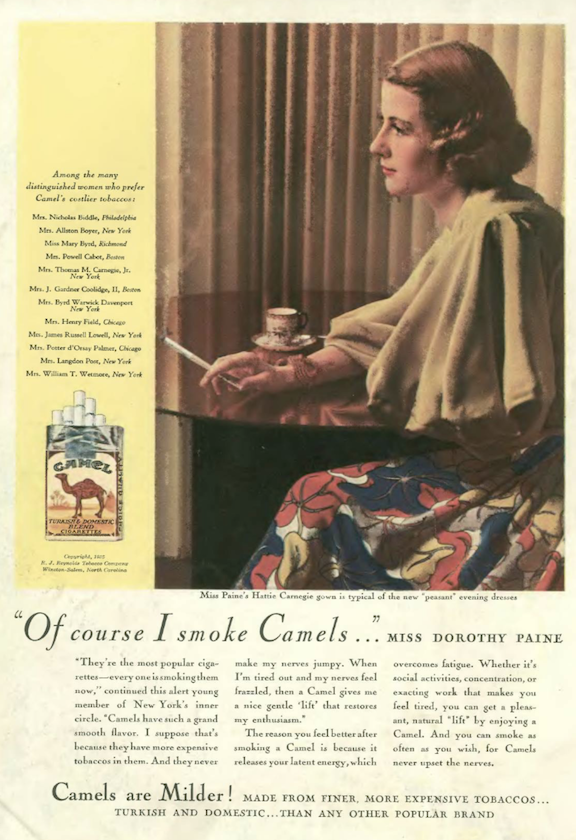
…the makers of General Tire offered this grim assessment of tire safety…the lad seems to be a mere investment of time…

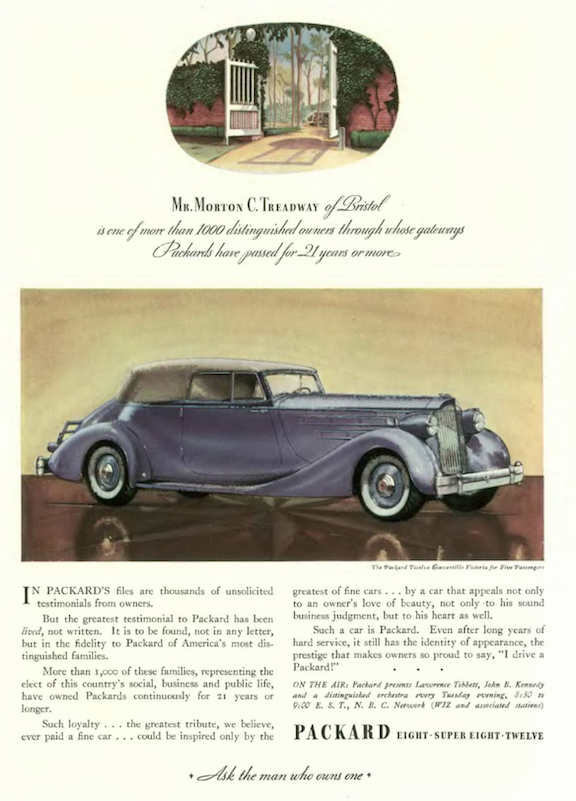
…although prestige brands suffered mightily during the Depression, the folks at Packard were doubling down on the elite status of their automobile…
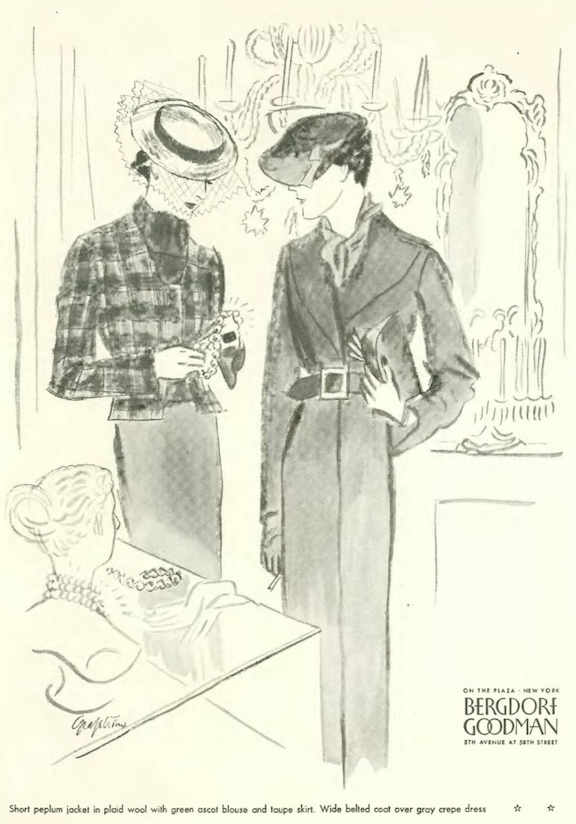
…we’ve seen the work of fashion illustrator Ruth Sigrid Grafstrom before in ads for Spud cigarettes…here she contributes some elegant lines to a spot for Bergdorf Goodman (is the woman on the right smoking a Spud?)…
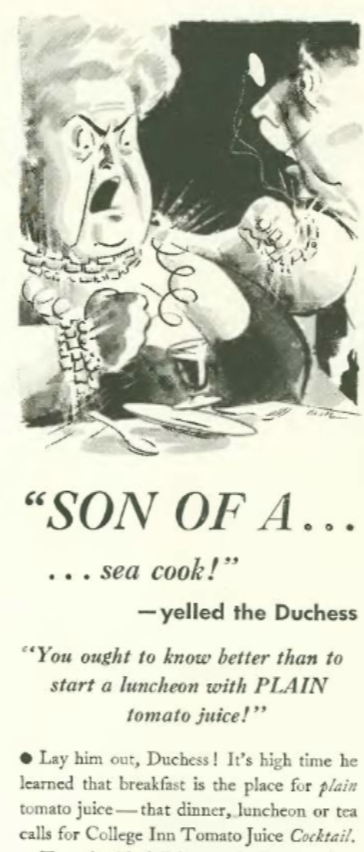
…here’s the Duchess again, still blowing her top over College Inn tomato juice…just look at her clenched fists…that fop with a monocle looks like he just took a left hook to the chops…
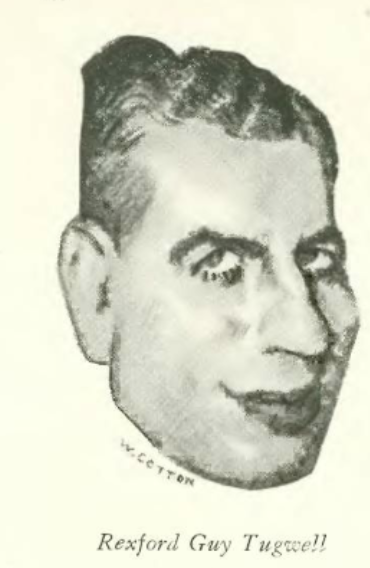
…on to our illustrators, William Cotton created this caricature of Rexford Guy Tugwell for Russell Lord’s two-part profile…Tugwell and President Franklin D. Roosevelt created the Resettlement Administration, which relocated rural unemployed to “Greenbelt Cities” near urban job markets. Critics called him “Rex the Red” for his social engineering experiments, and after he was forced out of federal government, Tugwell was appointed in 1938 as the first director of the NYC Planning Commission. Naturally, he would butt heads with Robert Moses…
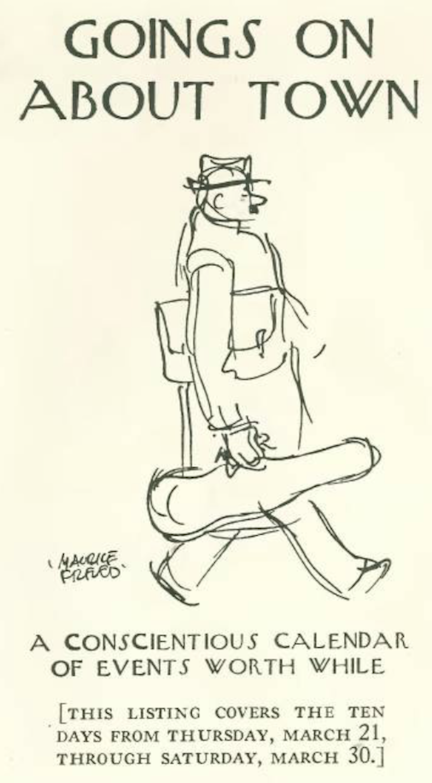
…illustrator and painter Maurice Freed kicked off the calendar section…
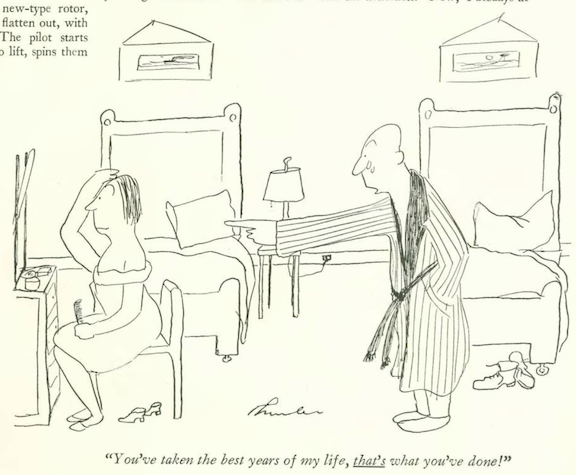
…bookended on the bottom of page 4 by one of James Thurber’s most recognized drawings…

…Thurber again, and more woes between the sexes…
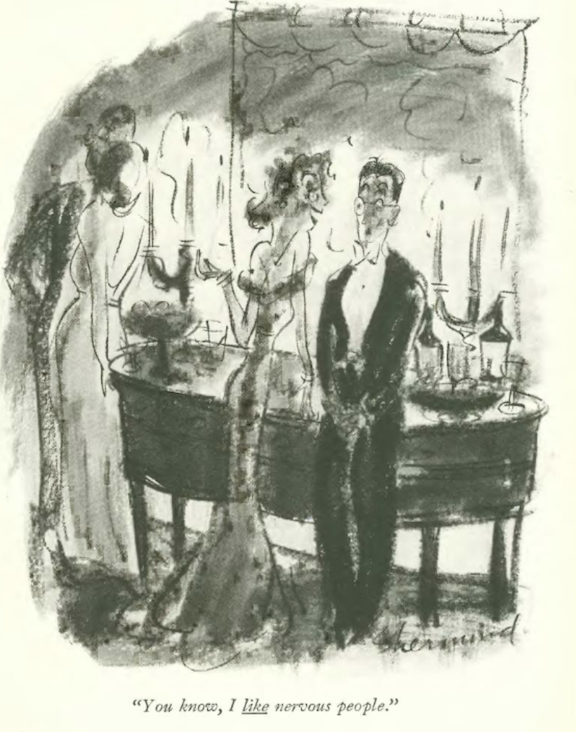
…we continue with our cartoonists by looking in on Barbara Shermund

George Price found a new wrinkle for his recurring floating man cartoon…

Helen Hokinson graced page 19 with scenes from the opera…
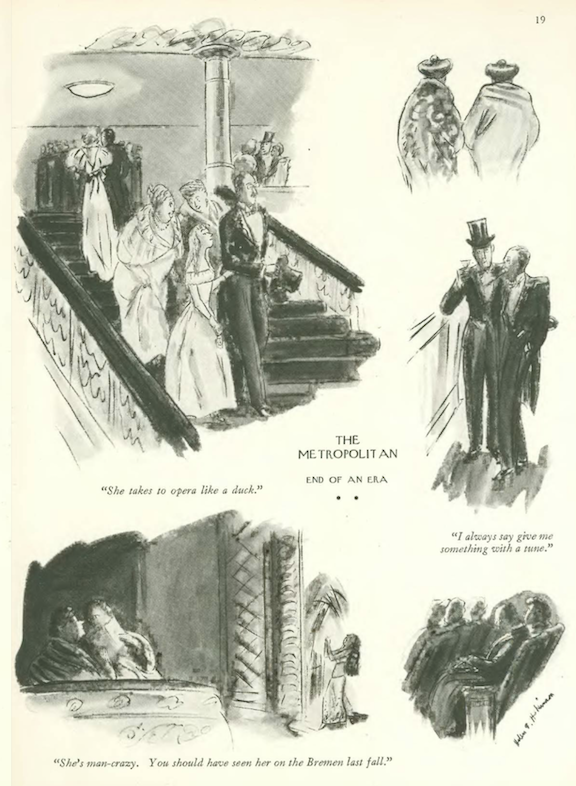
…leaving an extra drawing stranded on page 18…
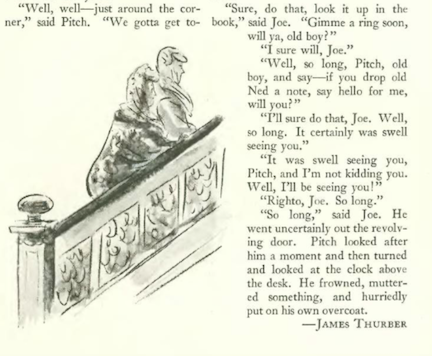
Alain offered a new twist on the promotion of physical fitness…
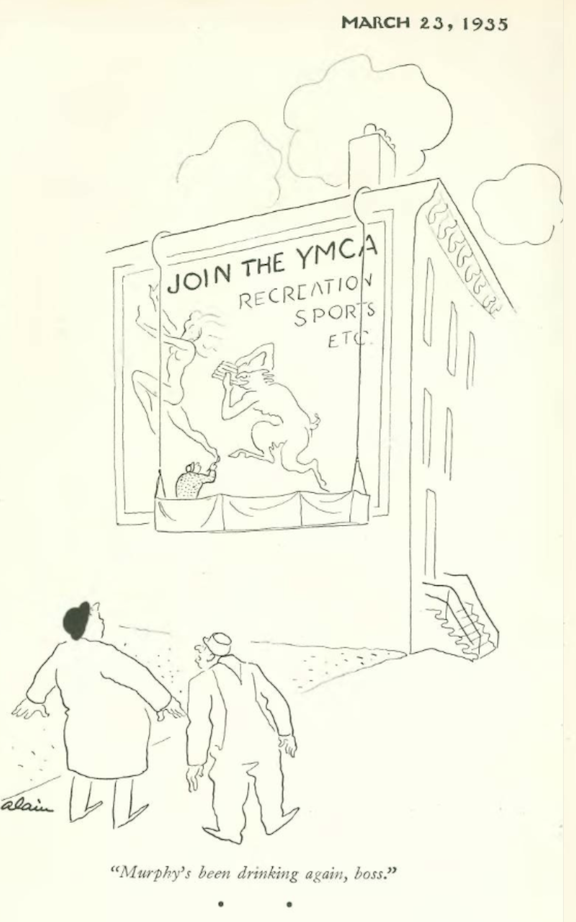
Gluyas Williams brought us to the stuffy confines of club life (the cartoon was originally featured vertically)…
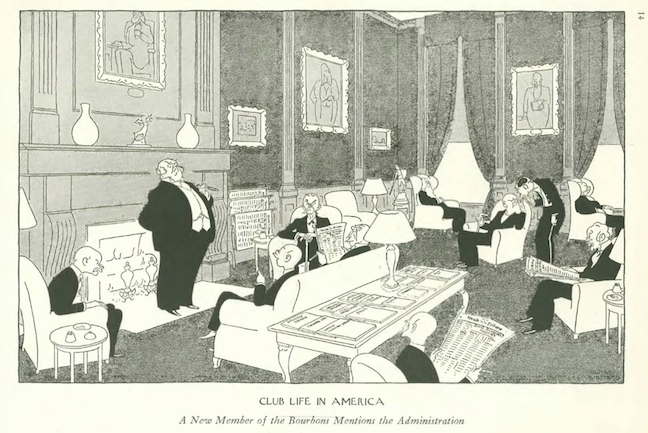
…and we close with Richard Decker, and a lucky draw at the IRS…

Next Time: The Lighter Side of George Grosz…

Not Even Funny

There were a number of people Dorothy Parker couldn’t abide. That included gifted writers who not only eschewed serious literature, but who instead chose to crank out a lot of mass-market trash.

March 18, 1933 cover by William Steig.

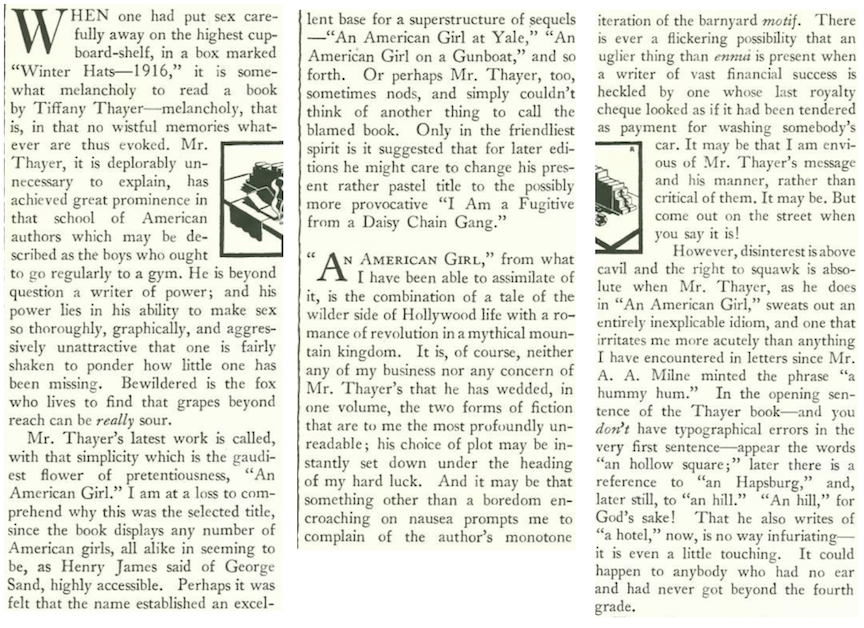
Parker was well acquainted with Tiffany Ellsworth Thayer (1902–1959), and for a time she even associated with the Fortean Society, which Thayer founded in 1931. Inspired by writer Charles Fort, the Forteans promoted the use of scientific methods to evaluate unexplained phenomena such as UFOs, spontaneous human combustion, and other oddities. Parker and fellow New Yorker writers Ben Hecht and Alexander Woollcott were among founding members, doubtless drawn to Fort’s reputation as a skeptic; however one famous skeptic, journalist H.L. Mencken, called Fort’s ideas “Bohemian mush.” It’s hard to say how long Parker stayed connected to the Society, but by 1933 she was fed up with Thayer’s novels, including his latest, An American Girl, which she found to be “the gaudiest flower of pretentiousness.” Here is an excerpt from Parker’s sometime column, “Reading and Writing,” subtitled Not Even Funny…

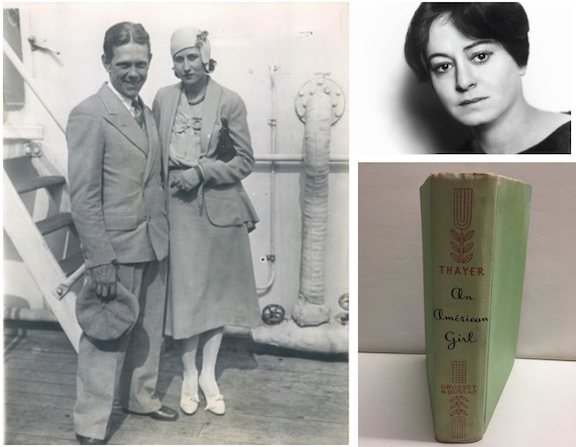
TIFF WITH TIFFANY…At left, Tiffany Thayer aboard a cruise ship with an unidentified woman, most likely his first wife, a dancer named Tanagra, early 1930s; at right, Dorothy Parker and a first edition of the offending volume. In her review, Parker observed that Taylor “is beyond question a writer of power; and his power lies in his ability to make sex so thoroughly, graphically, and aggressively unattractive that one is fairly shaken to ponder how little one has been missing.” (IMDB/Worthpoint)

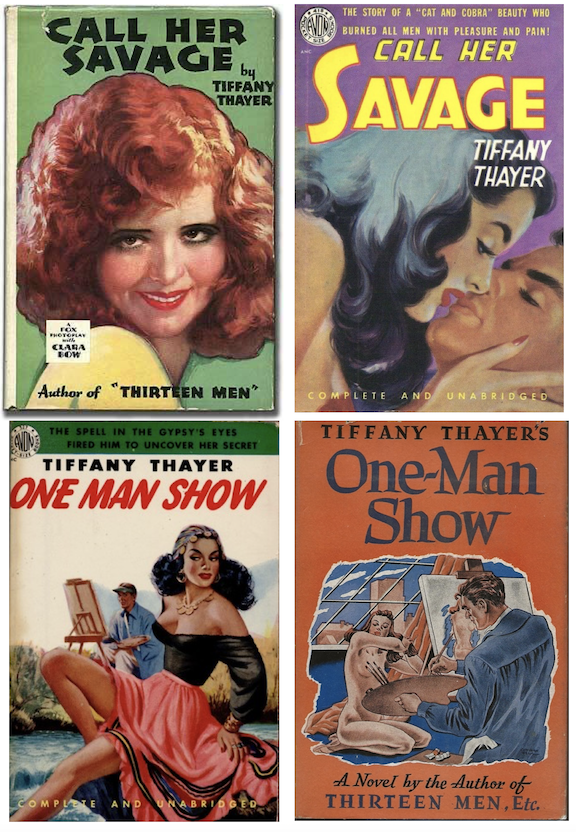
Although Thayer founded a society based on scientific reason, his pulp novels were filled with fantasy and prurient imagery. F. Scott Fitzgerald once observed that “curious children nosed at the slime of Mr. Tiffany Thayer in the drug-store libraries.”

BELIED LETTRES…Clockwise from top left, Thayer’s 1931 novel Call Her Savage was made into a 1932 film starring Clara Bow, here featured on the book’s dustcover; the same novel repackaged in 1952 for the pulp trade; a 1943 edition of Thayer’s One-Man Show, and a 1951 Avon reprint that toned down the nudity but upped the creep factor. (facebook.com/biblio.com)

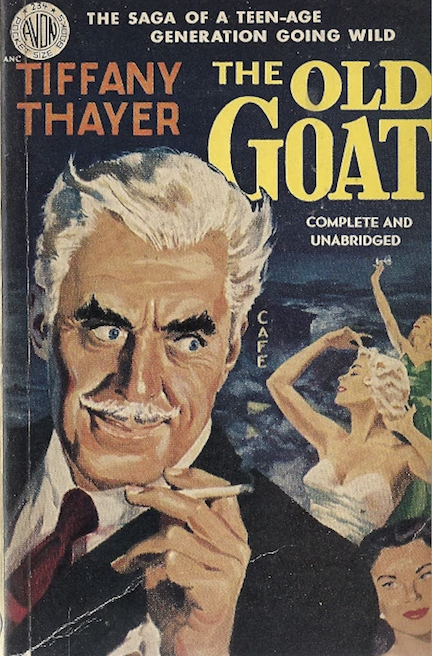
…and speaking of creep factor, check out Avon’s 1950 re-issue of Thayer’s 1937 novel The Old Goat, illustration attributed to Edgar Lyle Justis

(biblio.com)

Artists like Justis must have had a ball doing these illustrations, creating images to lure the unsuspecting into purchasing these old titles. Note how the coked-up old man sports not-so-subtle devil horns.

*  *  *

They Called It a Holiday

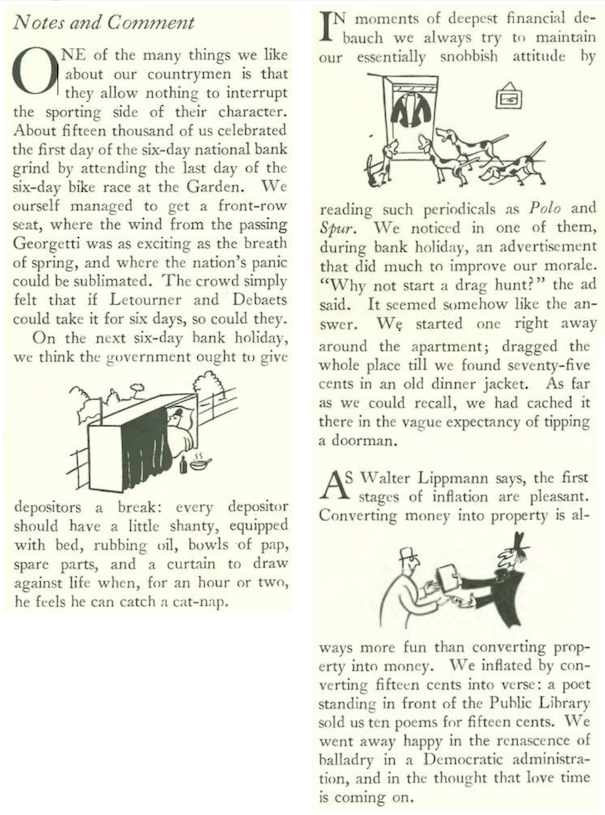
E.B. White, James Thurber (see below) and others in the March 18 issue commented on the national banking “holiday” declared by President Franklin D. Roosevelt in an effort to stabilize America’s banking system and rebuild public confidence. This led to the Glass-Steagall Act, signed three months later by FDR. Some observations in “Notes and Comment” by E.B. White, with the usual great spot illustrations by Otto Soglow

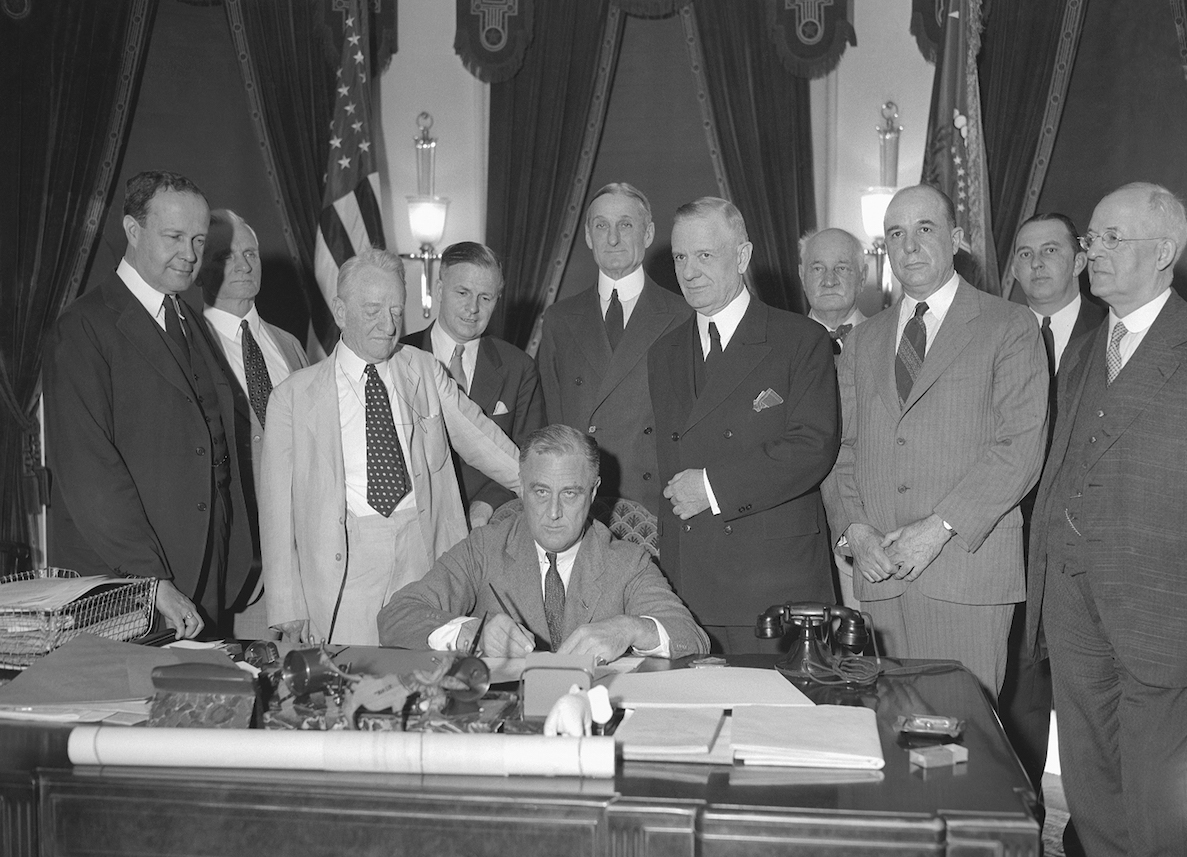
SAY CHEESE!…President Franklin D. Roosevelt signs the Glass-Steagall Act on June 16, 1933, effectively separating commercial banking from investment banking and creating the Federal Deposit Insurance Corporation (FDIC), among other things. (Associated Press)

…meanwhile, Germany’s new chancellor, Adolf Hitler, was busy abolishing civil liberties while pretending to be distressed by the behavior of his brownshirt thugs…an excerpt from Howard Brubaker’s “Of All Things”…

*  *  *

A Familiar Ring

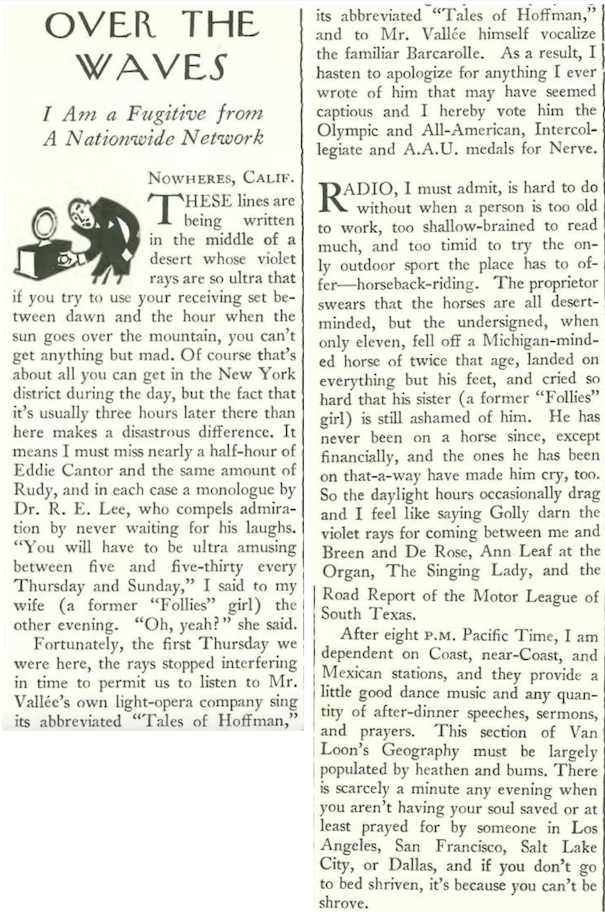
For the second week in a row Ring Lardner lent his wit to The New Yorker’s “Over the Waves,” column, which typically reviewed the latest news and entertainment beamed from the radio tower atop the Empire State Building. Lardner, however, was in California, lamenting the challenges of the time lag. An excerpt:

AND NO WI-FI, EITHER…Ring Lardner (center) detailed the frustrations of listening to New York-based radio entertainers like Eddie Cantor (left) and Rudy Vallée during his stay in California. (Pinterest/The Classic Archives/The New York Times)

 *  *  *

Dance Away Those Blues

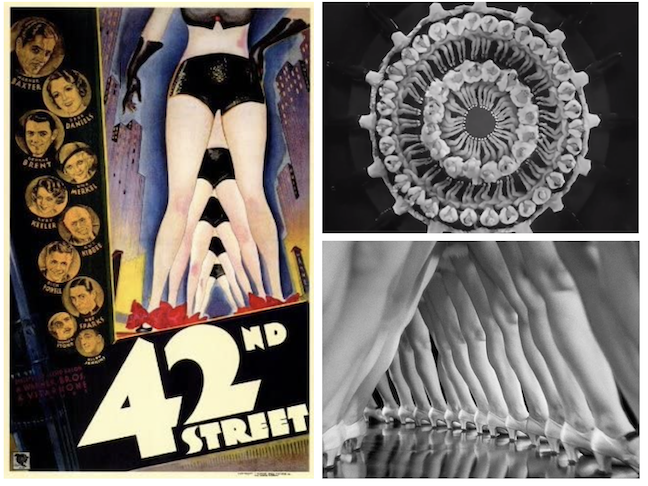
The pre-Code musical 42nd Street received a brief, albeit mostly positive review from critic John Mosher, who along with the producers of the film knew Depression-weary Americans needed such distractions. Nearly 90 years later (April 10, 2020), another New Yorker film critic, Richard Brody, suggested 42nd Street as one of the best films to stream during the Covid-19 pandemic: “Modern musicals start here, and Busby Berkeley’s genius bursts into full flower,” he wrote.

DANCE ‘TIL YOU DROP…Under pressure to produce a hit after losing his lead dancer (Bebe Daniels) to a broken ankle, Broadway musical director Julian Marsh (Warner Baxter, center) mercilessly rehearses her replacement, Peggy Sawyer (Ruby Keeler, in her film debut) before the premiere, vowing “I’ll either have a live leading lady or a dead chorus girl.” Looking on (to the right of Baxter) is Ginger Rogers, who portrayed “Anytime Annie.” (tcm.com)
A LEG UP ON HIS CAREER…42nd Street was a breakthrough film for choreographer Busby Berkeley, who would direct and choreograph a long string of musicals until the 1960s. The film is now considered a classic, preserved in the United States National Film Registry. (IMDB)

…and for trivia buffs, during an opening scene Bebe Daniels is shown reading the February 20, 1932 (anniversary) issue of The New Yorker…

*  *  *

From Our Advertisers

A convertible LaSalle (a downscale Cadillac brand) looks like a great way to enjoy a drive along the beach…let’s hope it has enough acceleration to outrun the tsunami apparently heading its way…

Walter Chrysler continued to dig into his deep pockets for two-page color spreads, including this one that placed his humble DeSoto in St. Moritz, of all places…

…not to be outdone, the folks at Nash found another exotic locale for their budget-priced sedan…Chicago, that is, at the 1933 Century of Progress Exhibition…and for an extra touch of class, we have what appears to be a chauffeur attending to this modest motorcar…

…America’s top luxury car maker, Pierce Arrow — a regular advertiser in The New Yorker — decided a quarter-page ad was sufficient to keep their name before the eyes of the well-heeled…at right, an ad from another back page featured cartoonist Don Herold shilling for the makers of imitation liquor flavors…according to the ad, one bottle, obtainable from your druggist, “flavors a gallon” of whatever forsaken hootch you are consuming…

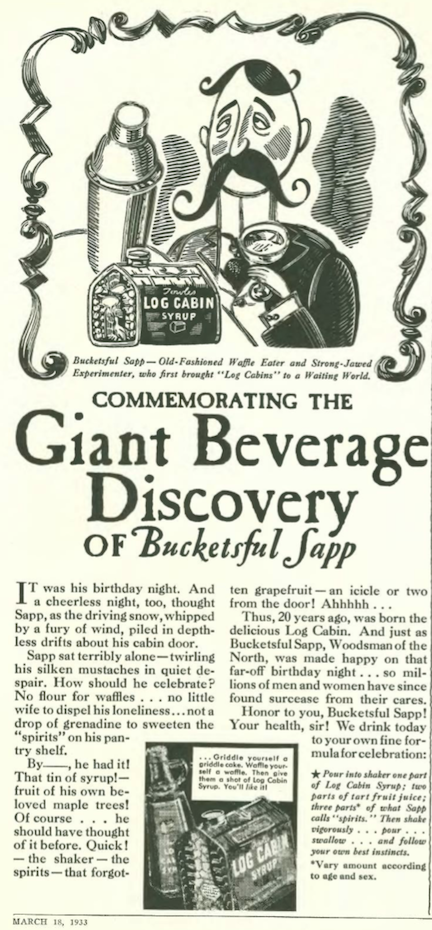
…the folks at Log Cabin relied on the talents of another New Yorker cartoonist, John Held Jr., to make both their product and a signature cocktail a more palatable experience…

…I have to hand it to the folks at Heinz for signing off on an advertisement only a vampire would find appealing…

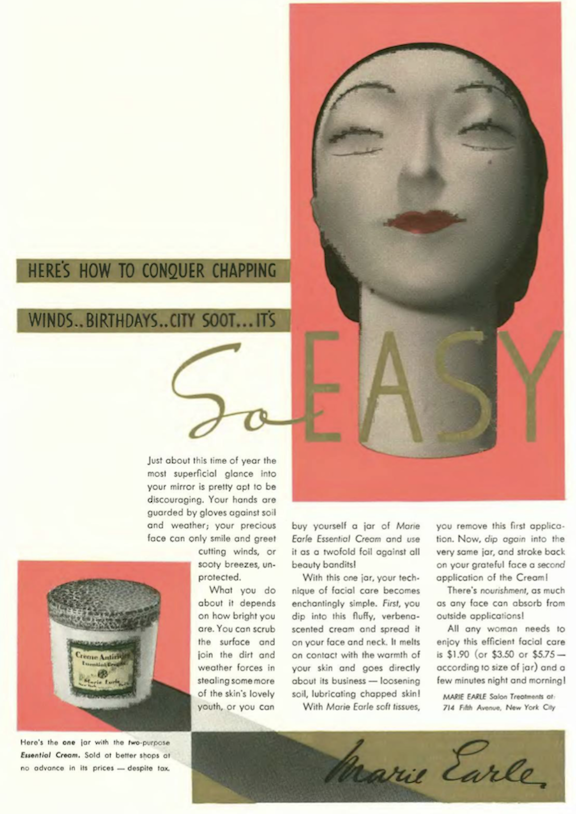
…the purveyors of Marie Earle beauty products rolled out this modern ad to promote their “Essential Cream”…

…while staid Brooks Brothers remained true to form — no flashy colors or advertising jargon — just straight talk about price increases….

…and then there’s the upmarket Fortnum & Mason, appealing to America’s Anglophiles with one of their famed wicker hampers filled with various goodies selected for “charming and greedy people”…

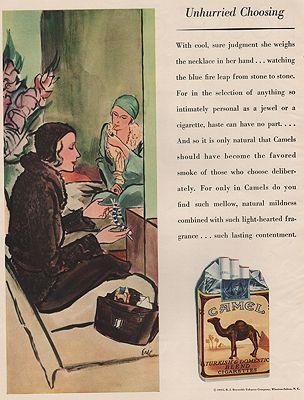
….for several years R.J. Reynolds employed the services of Carl “Eric” Erickson (1891–1958) to illustrate a series of ads featuring classy, disinterested, continental types smoking their Camel brand cigarettes…despite their less-than-exotic name, the makers of Spud menthol cigarettes hired Ruth Sigrid Grafstrom (1905–1986) to create their own smart set of smokers…

…ads that bore a striking resemblance to Erickson’s Camel work (this example from 1931)…

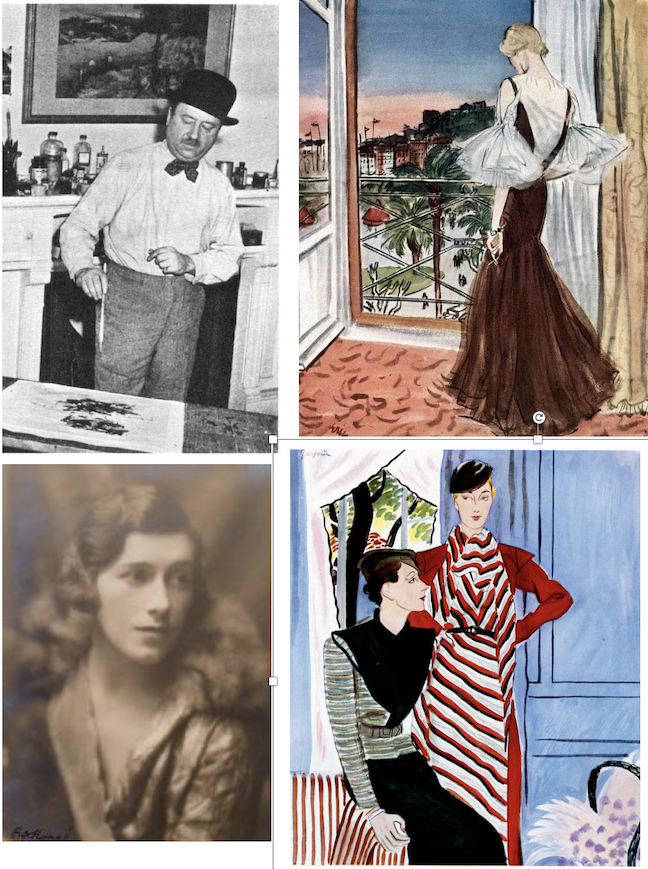
…and for your consideration, works from 1933 by Carl Erickson and Ruth Sigrid Grafstrom…both were noted fashion illustrators…

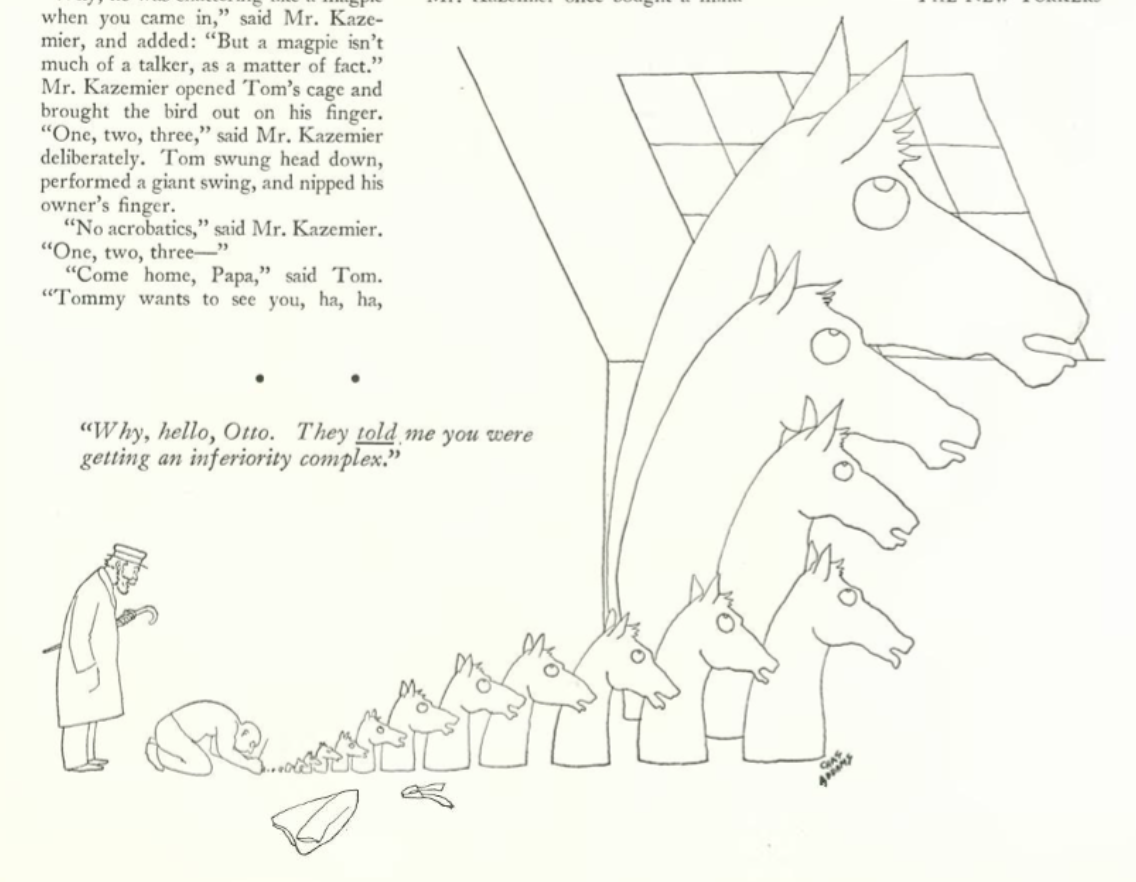
…on to our cartoonists, we begin with Charles Addams, who’d just published his first New Yorker cartoon the previous month, in the Feb. 4, 1933 issue

…that first cartoon was simply signed “Addams”…here he used the familiar “Chas Addams”…a close-up of the signature…

…we continue with a great caricature by Al Frueh to accompany a profile of Rudolf Kommer (as told by Alexander Woollcott)…

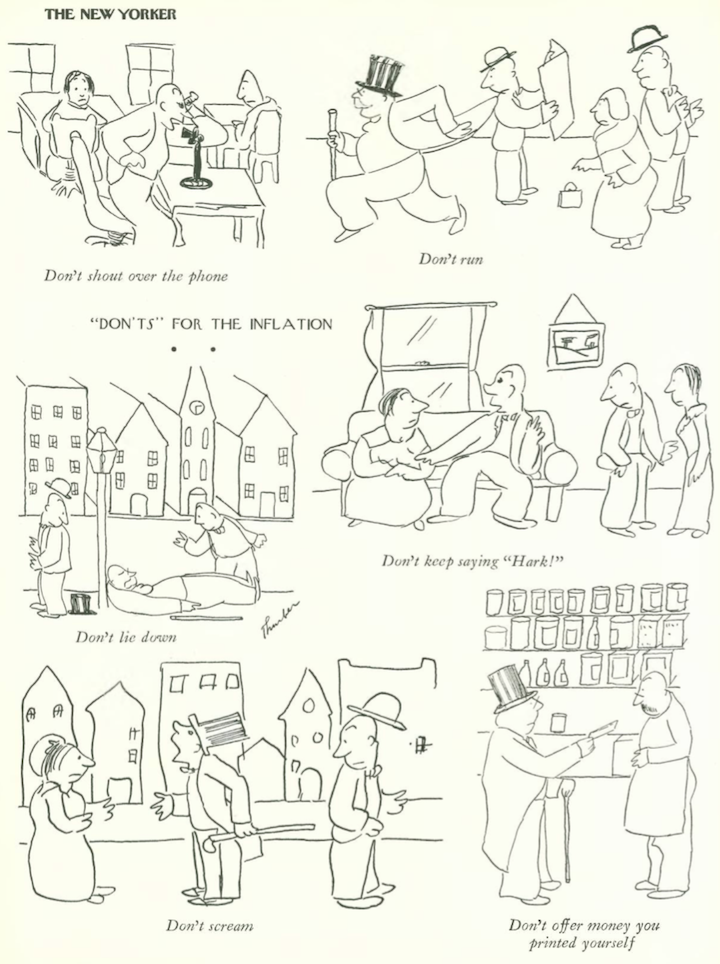
…a delightful full page of bank holiday-themed cartoons by James Thurber

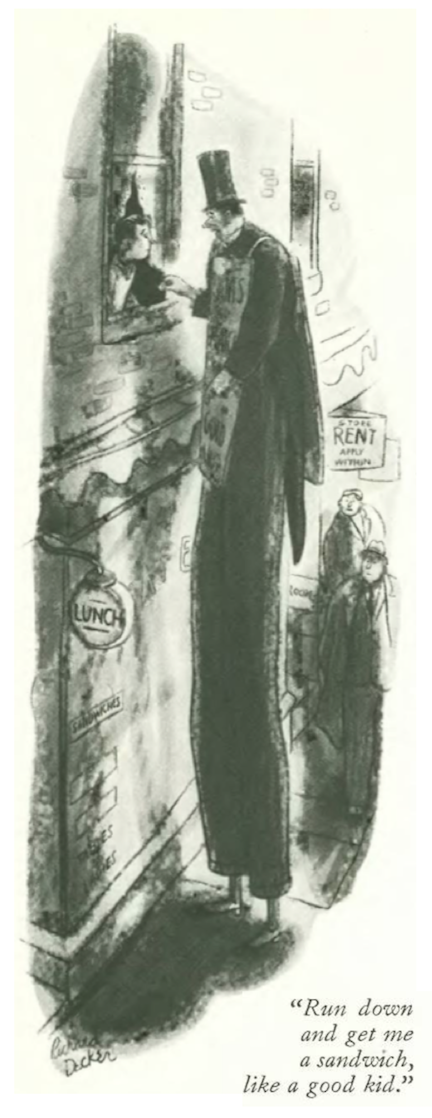
Richard Decker offered up a tall tale…

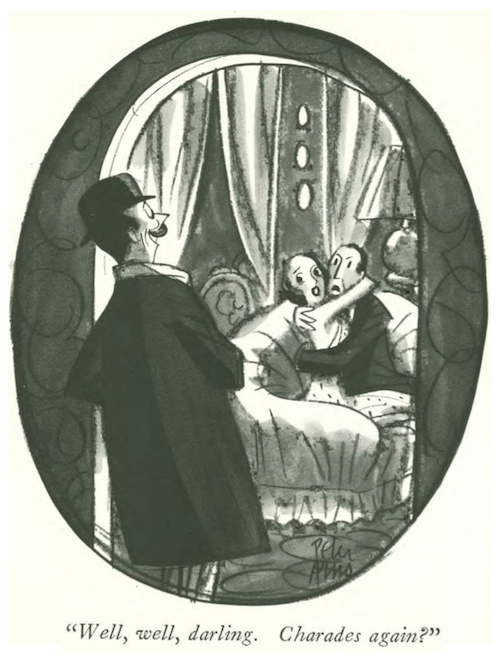
…and we close with Peter Arno, who served up one of his clueless cuckolds…

Next Time: Diary of a Lady…