Fifteen Minutes is Quite Enough

Above image courtesy NASA History Office.

Charles Lindbergh was all over the July 2, 1927 issue of The New Yorker, which reported that Lindy was a better a flier than a writer, and as a celebrity the press had to be inventive with a subject who would rather be alone in a cockpit with a ham sandwich than be feted at countless banquets.

7b096a824e274d6b7b7c5e0f1a3e85e7
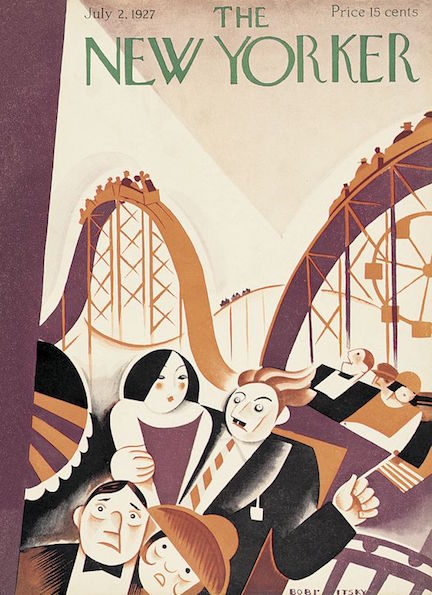
July 2, 1927 cover by Victor Bobritsky.

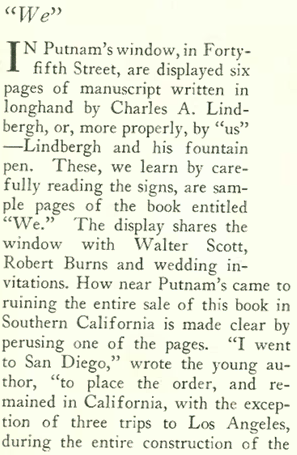
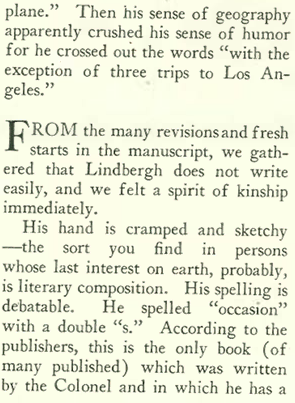
“The Talk of the Town” commented on the display at Putnam Publishing of a few manuscript pages penned by Lindbergh himself for his upcoming book, WE.

A draft of the autobiography had already been ghostwritten by New York Times reporter Carlyle MacDonald, but Lindbergh disliked MacDonald’s “false, fawning tone” and completely rewrote the manuscript himself–in longhand–using MacDonald’s manuscript as a template. Those early results were displayed in Putnam’s 45th Street window to whet the appetites of eager readers:

screen-shot-2016-10-14-at-10-13-58-am

screen-shot-2016-10-14-at-10-14-09-am

screen-shot-2016-10-14-at-10-14-26-am

dustjacket_for_the_book_%22we%22_by_charles_a-_lindbergh_first_edition_published_july_1927
FLYING THE ATLANTIC WAS EASIER…The dust jacket (left) for Charles Lindbergh’s WE. The ghostwritten first draft was disliked by Lindbergh, who in less than three weeks re-wrote the book in longhand. About a week later the book was published (July 27, 1927) and quickly became a bestseller. (Wikipedia)
lindberghs-ticker-tape-parade-1927-science-photo-library
YEAH WHATEVER…Lindbergh appears less than thrilled during his ticker-tape parade in Manhattan on June 13, 1927. (Science Photo Library )

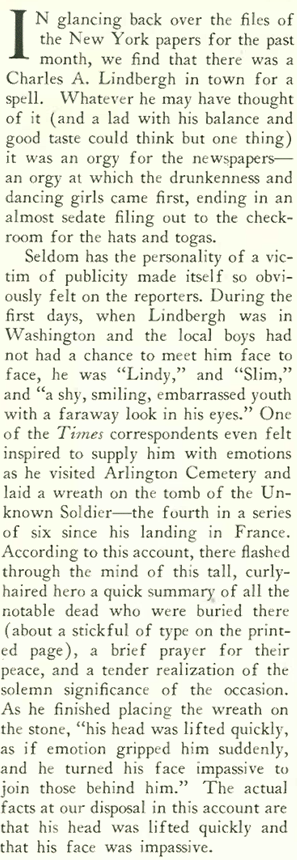
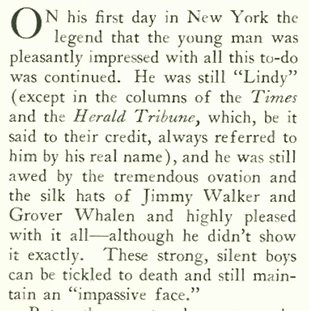
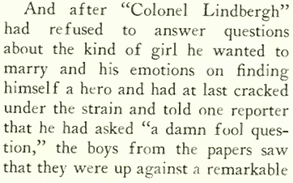
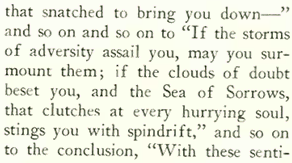
Nonplussed and often annoyed by all of the attention, Lindbergh was less than a colorful subject for the media. Philip Wylie (writing under the pseudonym “Horace Greeley Jr.”) in The New Yorker’s “Press in Review” column observed that reporters, seeking a more conventional image of a sentimental hero, decided to “supply him with emotions” he apparently lacked:

the-press-in-review

screen-shot-2016-10-14-at-10-26-11-am

screen-shot-2016-10-14-at-10-26-24-am

screen-shot-2016-10-14-at-10-26-30-am

Other reporters resorted to treacly tributes…

screen-shot-2016-10-14-at-10-26-38-am

screen-shot-2016-10-27-at-2-56-10-pm

screen-shot-2016-10-14-at-10-27-45-am

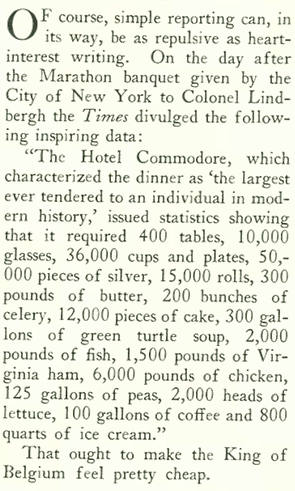
…and if the subject himself wasn’t very interesting, you could always resort to listing quantities of food and drink as a measure of the spectacle…

screen-shot-2016-10-14-at-10-27-57-am

cal_banquet
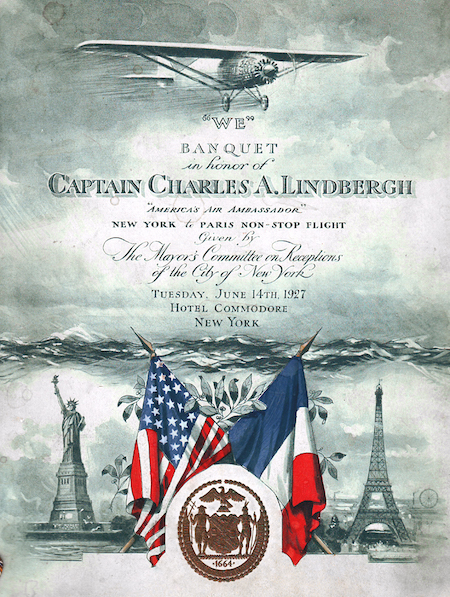
WHERE’S MY HAM SAMMICH?…Invitation to the WE banquet at the Hotel Commodore (Wikipedia).

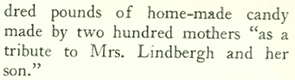
And if the reception at the Hotel Commodore wasn’t to your liking, you could go to the new Roxy Theatre and put in a bid for 300 pounds of home-made candy:

screen-shot-2016-10-14-at-10-28-17-am

screen-shot-2016-10-14-at-10-28-23-am

screen-shot-2016-10-14-at-10-28-57-am

 *  *  *

We’ll give Lindy a break and move on to excerpts from Upton Sinclair’s “How to be Obscene,” in which he tweaks the Boston bluenoses:

how-to-be-obscene

upton-sionclair

screen-shot-2016-10-14-at-10-21-29-am

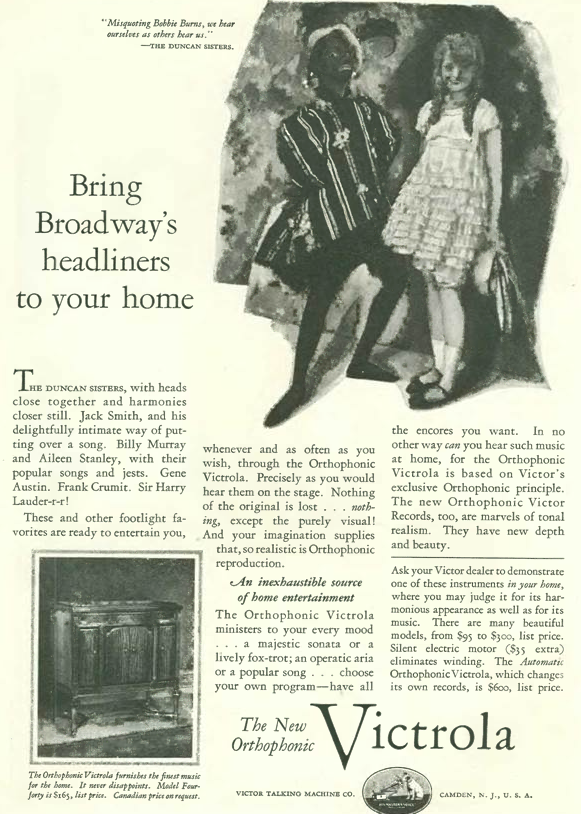
And then we have this advertisement for the Orthophonic Victrola, promising to bring the clear tones of racism into your home courtesy of the Duncan Sisters:

duncan-sisters

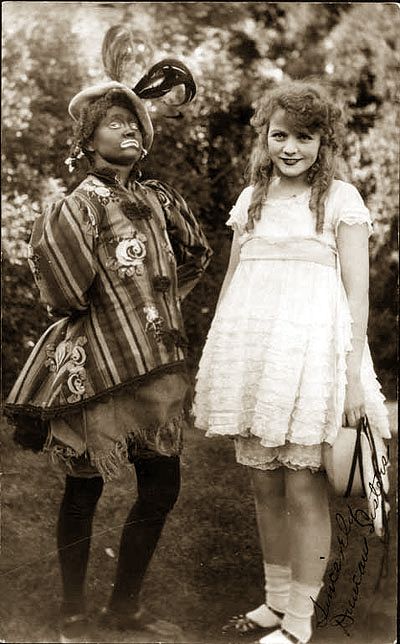
The Duncan Sisters were a vaudeville duo who created their stage identities in the 1923 musical comedy Topsy and Eva, derived from the novel Uncle Tom’s Cabin by Harriet Beecher Stowe. The musical was a big hit.

18bcd1e588bb3456db02bd7de94cba31
THAT WAS ENTERTAINMENT…Sisters Rosetta (left) and Vivian Duncan as Topsy and Eva. (silenceisplatinum.blogspot.com)
9a89aa65126941d43da14c086ed0f22c
Rosetta and Vivian Duncan in a promo photo. (silenceisplatinum.blogspot.com)

After a brief foray into movies in the early 1930s, the duo mostly entertained at night clubs and for many years continued to perform their Topsy and Eva routine even though appearing in blackface was considered impolite or offensive by later audiences. One of their final performances was on Liberace’s television show in 1956. The act ended in 1959 when Rosetta died in a car accident.

screen-shot-2016-10-27-at-4-22-32-pm
STILL TOGETHER…Vivian (left) and Rose Duncan on Liberace’s television show in 1956. They performed their Topsy and Eva routine, without the blackface. (YouTube)

 *  *  *

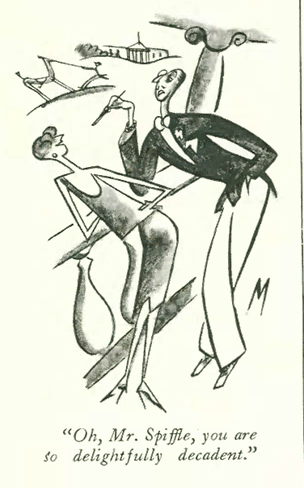
And to close, a cartoon from the July 2 issue, courtesy of Julian de Miskey:

screen-shot-2016-10-24-at-11-32-18-am

Next Time: Summer in the City…

21b6fac0e9233b827d578cf6175dd79d


Île-de-France

On June 22, 1927, the legendary French ocean-liner, the Île-de-France, traveled from Le Havre to New York on its maiden voyage, soon to be greeted by the American media and the thousands who would crowd the docks at New York Harbor to see the great ship.

80c5240bf5ffaaff418de94b7e176525
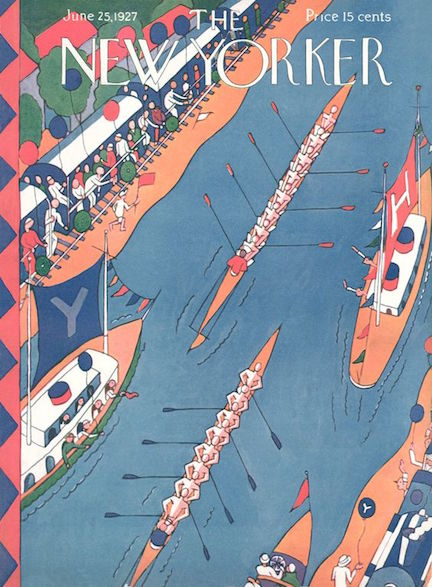
June 25, 1927 cover by Ilonka Karasz.

Among those anticipating the visit was The New Yorker, which offered this account in “The Talk of the Town” for the June 25, 1927 issue:

screen-shot-2016-10-14-at-9-46-05-am

screen-shot-2016-10-14-at-9-46-18-am

screen-shot-2016-10-14-at-9-46-27-am

ss_ile_de_france_c1935
PRIDE OF FRANCE…Postcard image of the Île-de-France from 1935. During a post-war refurbishment, the three funnels were replaced with a pair of stockier, more stylish funnels. (Wikipedia)

The Île-de-France was unique in that it was the first ocean-liner to have an interior design that didn’t imitate “shore-style” interiors that resembled rooms in manor houses or grand hotels. The trend-setting ship sported a modern, art deco look that celebrated the present and the future.

mainfoyer
IN WITH THE NEW…The Main Foyer & Grand Staircase of the Île-de-France,(newyorksocialdiary.com)
c1fe5bedcb3cb40a005ca4aa6672195c
LEAVE YOUR FLIP-FLOPS AT HOME…The first-class dining room in the Île-de-France. (newyorksocialdiary.com)

Note that these photos do not contain images of water slides or all-you-can eat buffets. An ocean voyage, if you could afford it, was an elegant affair. The Île-de-France was especially popular among wealthy Americans who liked its stylish, youthful vibe.

The Île-de-France served as a troop ship during World War II, and in 1956 played a major role in rescuing passengers from the sinking Andrea Doria off the coast of Nantucket.

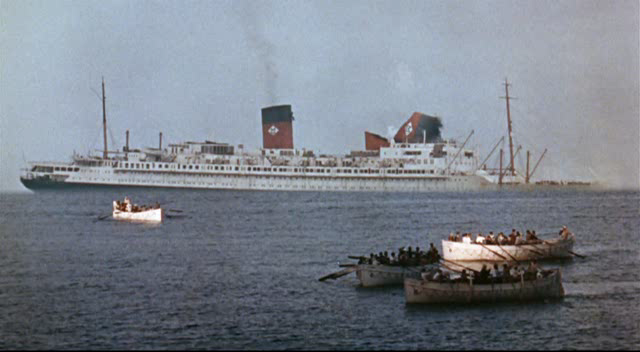
Unfortunately, anything that is youthful soon grows old, and as we all know, style is an ephemeral thing. With the advent of transatlantic jet transport, ships like the Île-de-France fell out of favor, and by 1960 the grand ocean liner was reduced to serving as a floating prop for a disaster movie titled The Last Voyage. The filmmakers partially sunk the poor ship, set fires and detonated explosions in the interior, and in a final act of desecration dropped one for the ship’s smoke stacks onto its deck house.

oceanlinersmagazine
(IMDB)
the-last-votage
NOT A BUFFET IN SIGHT…Still from the 1960 movie, The Last Voyage, shot on board the soon-to-be-scrapped Île-de-France. (Screen shot from movie trailer)
screen-shot-2016-10-20-at-2-20-28-pm
FIERY END…Fires were set in the interior of the Île-de-France during the filming of The Last Voyage. (Screen shot from movie trailer)
the-last-voyage-1960-ship-sinking
BROUGHT TO ITS KNEES…The Île-de-France (named the SS Clarion in the movie) is partially sunk with its forward funnel collapsed in a still from the film, The Last Voyage.

 *  *  *

The Ruth Snyder–Judd Gray murder trial and sentencing captivated Americans in 1927, but another trial and sentencing in the 1920s would bring worldwide attention and spark mass protests.

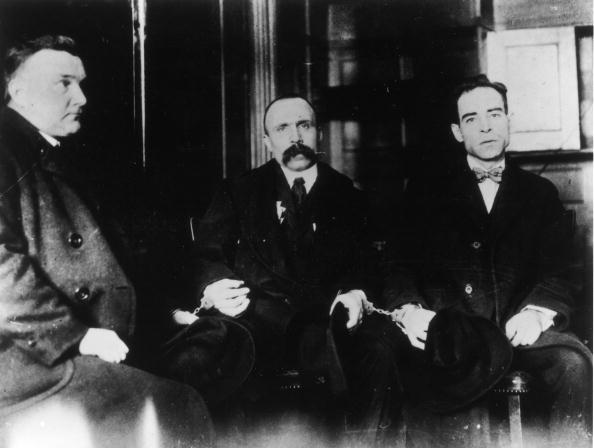
Nicola Sacco and Bartolomeo Vanzetti were Italian-born Americans who were convicted of murdering a paymaster and guard during a robbery of a Boston-area shoe company in 1920. Although convicted of murder the following year, many critics of trial believed Sacco and Vanzetti, who held anarchist views, were innocent of the charges, and the case became one of largest causes célèbres in modern history with protests held on their behalf in major cities across the U.S. and around the world.

Ferdinando Nicola Sacco and Bartolomeo Vanzetti in handcuffs, circa 1920s. (Photo by Fotosearch/Getty Images).
Cause Célèbre…Nicola Sacco and Bartolomeo Vanzetti handcuffed together at the Dedham, Massachusetts Superior Court, 1923. (Boston Public Library).

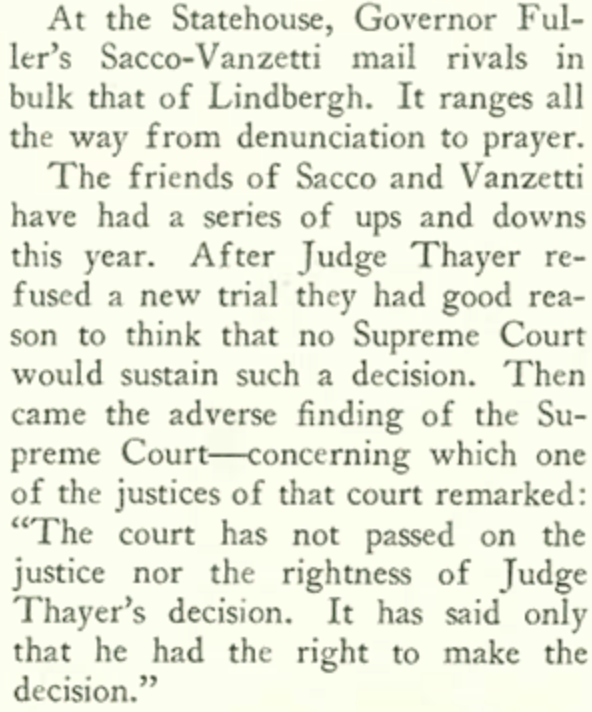
Sentenced to death in April 1927, they would be executed the following August. The New Yorker, predisposed to look down on Boston as something of a backwater, had this to say about the trial in an article by Gerald Day for the “Reporter at Large” column:

screen-shot-2016-10-22-at-10-18-49-am

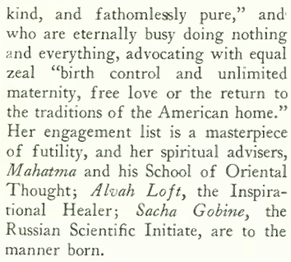
The case also rekindled memories of other notorious trials:

screen-shot-2016-10-22-at-10-19-05-am

The governor did appoint a commission to review the case, but the final decision was in his hands…

screen-shot-2016-10-22-at-10-19-49-am

And so the only option left for Sacco and Vanzetti was clemency from the governor.

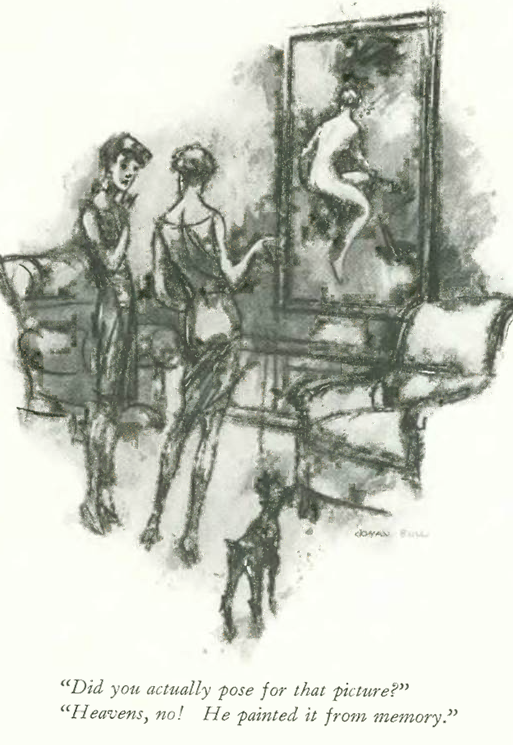
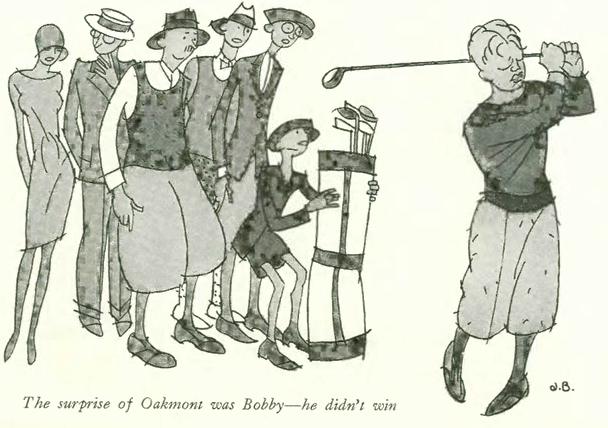
To close, a few illustrations from some of the magazine’s mainstay artists…this one from Johan Bull used to illustrate an article on the U.S. Open featuring amateur Bobby Jones

screen-shot-2016-10-14-at-9-49-23-am

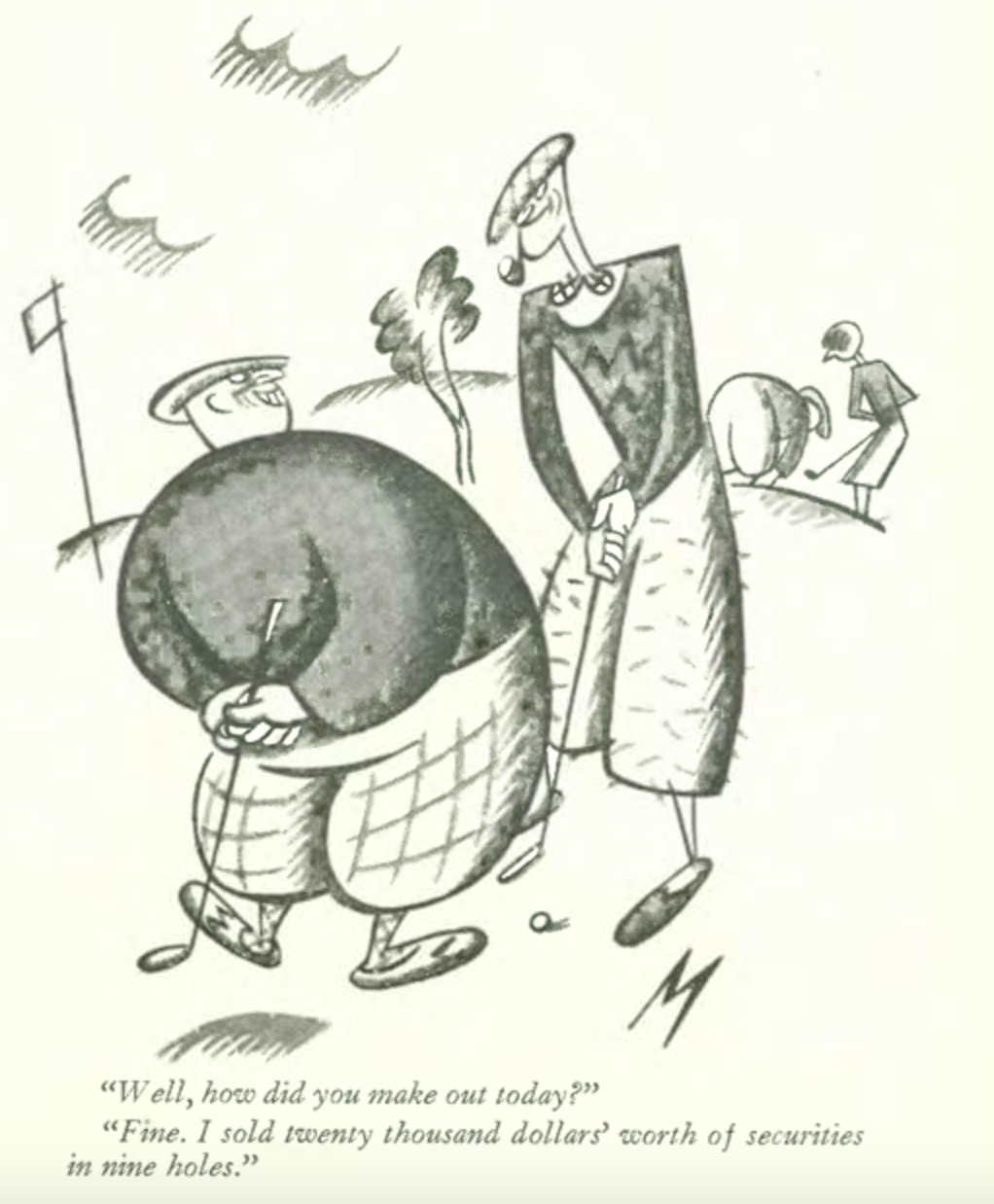
…and keeping with the golf theme, this cartoon by Julian de Miskey

screen-shot-2016-10-22-at-9-36-35-am

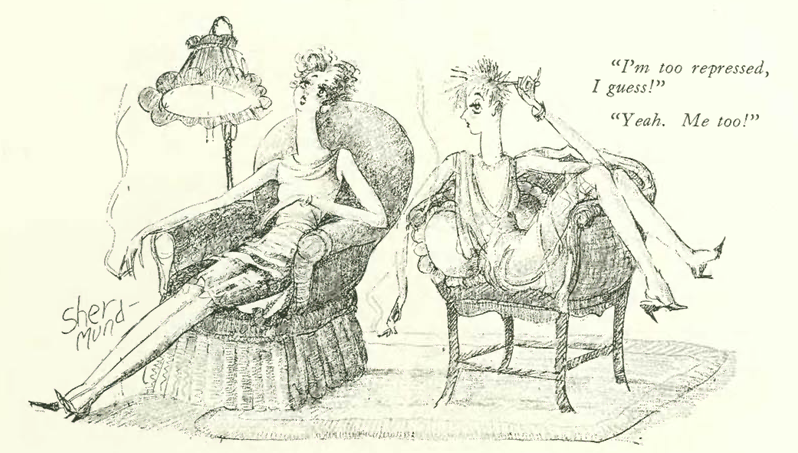
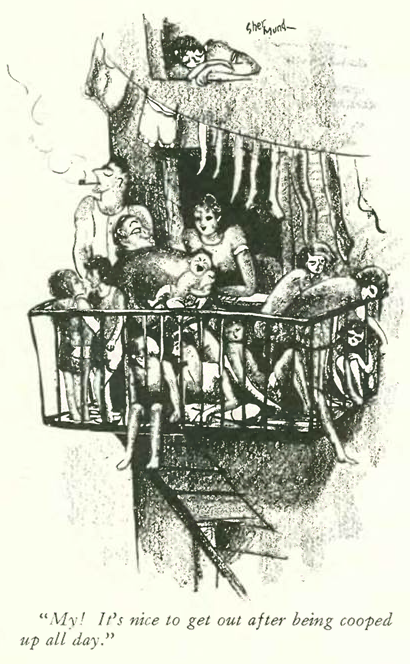
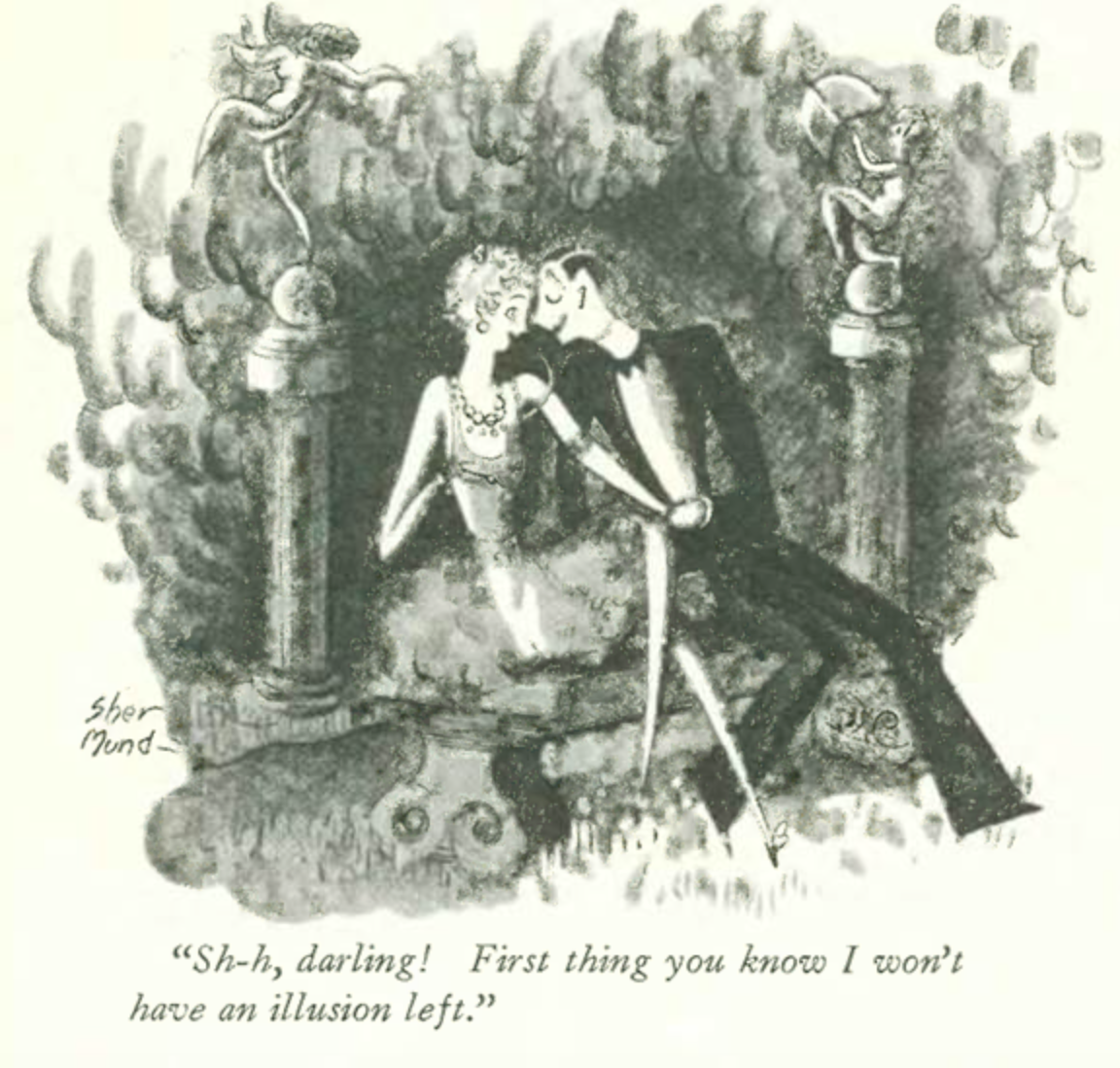
…and finally, a little fun with Barbara Shermund and her comment on social mores of the day:

screen-shot-2016-10-22-at-9-37-14-am

Next Time: Fifteen Minutes is Quite Enough…

7b096a824e274d6b7b7c5e0f1a3e85e7


Coney Island, 1927

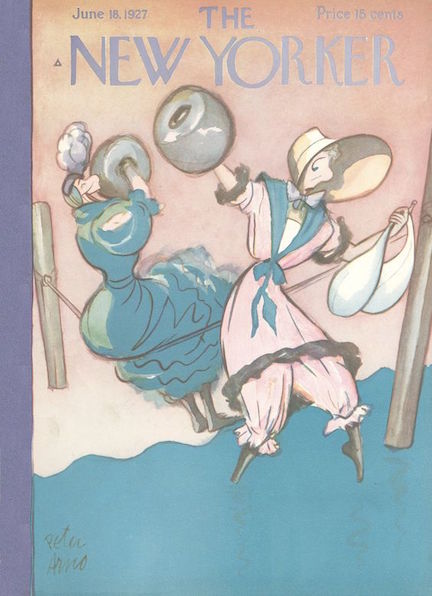
The New Yorker welcomed spring with a cover featuring Peter Arno’s popular Whoops Sisters testing the waters at the beach…

37723304ec91b372ae19e57e36b4d4b9
June 18, 1927 cover by Peter Arno, featuring his popular Whoops Sisters.

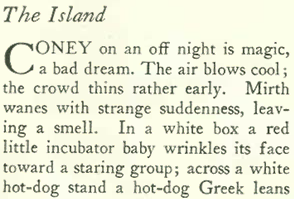
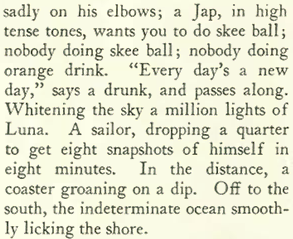
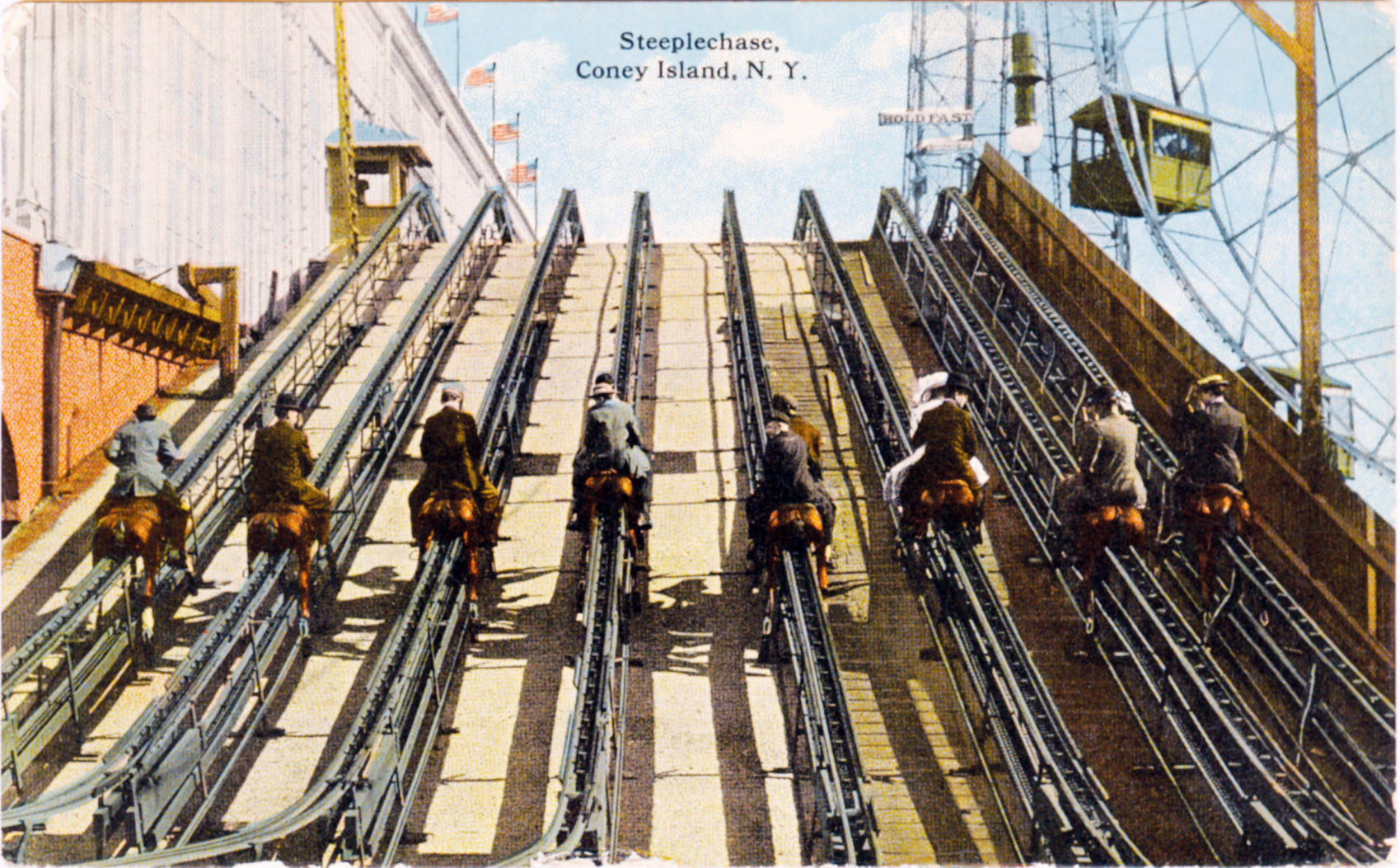
…and so was The New Yorker, on the south shores of Brooklyn to check out attractions old and new at Coney Island, paying a visit on an “off-day” to check out attractions ranging from incubating babies to the mechanical horse-race at the old Steeplechase:

screen-shot-2016-10-14-at-9-06-43-am

screen-shot-2016-10-14-at-9-06-52-am

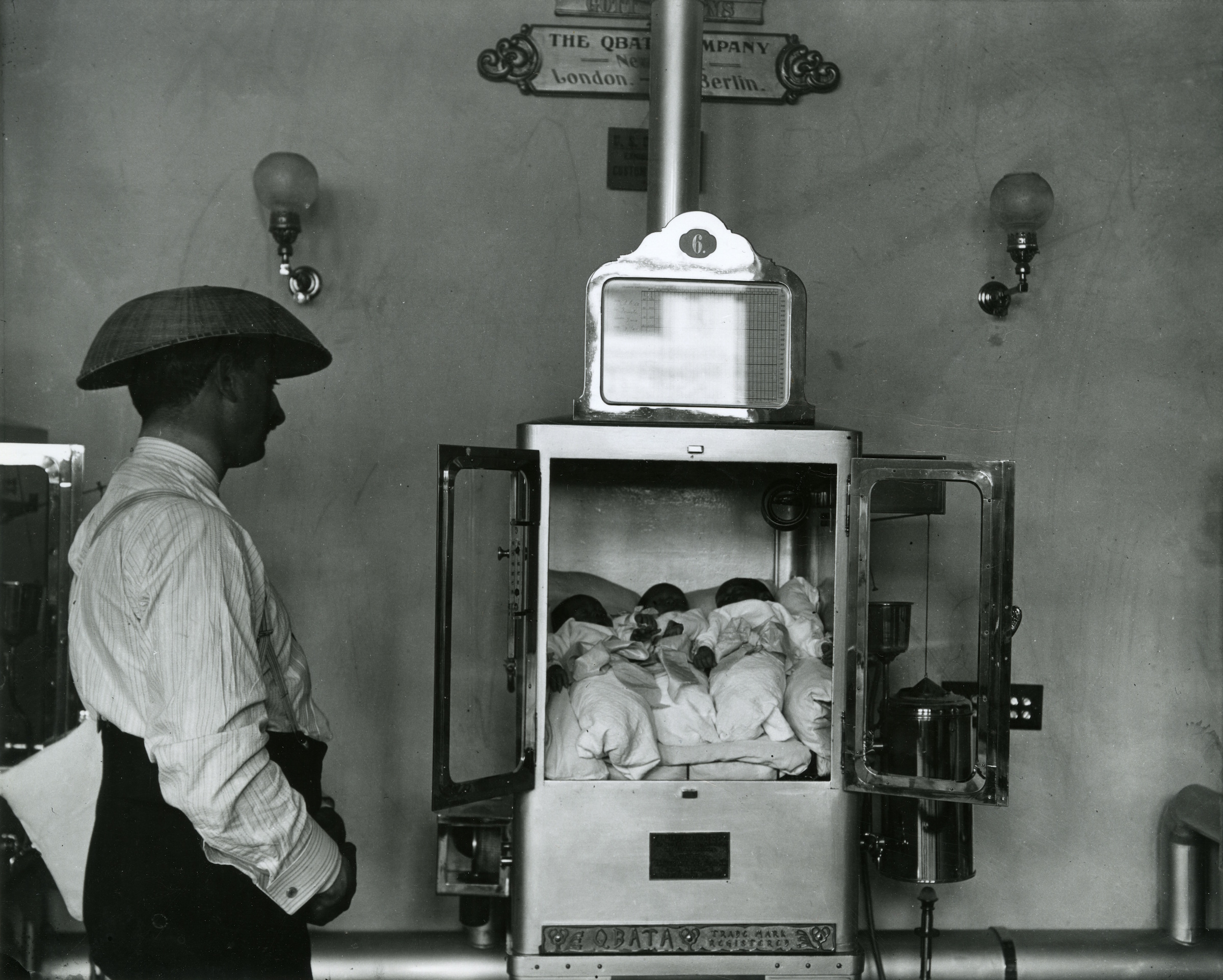
78215d_incubatorbabies_alland2502
WEIRD BUT WORTH IT…Incubating babies on display at Coney Island in the early 1900s. At the time, most babies were born at home, so hospitals did not have incubators–considered to be untested (and expensive) equipment. Dr. Martin Couney featured the device in “incubator shows” at various World’s Fairs and as a permanent exhibit at Coney Island from 1903 to 1943. Although he found the public spectacle somewhat distasteful, Couney hoped the exhibits would prove that the new technology actually worked. Paying for staff and machinery through ticket sales, he saved the lives of perhaps 8,000 premature infants at Coney Island. (NY Historical Society)
feltmans_coney_island-3
BEFORE THERE WAS NATHAN’S…Feltmans hot dog stand, circa 1930s. Feltman’s began as a pushcart business on the sand dunes of Coney Island in 1867, operated by German immigrant Charles Feltman, considered the inventor of the hot dog on a bun. By 1920 Feltman’s Ocean Pavilion covered a whole city block and served more than five million customers a year. (digital commonwealth.org)
coney-island-steeplechase-postcard-ca-19152
OFF TO THE RACES…Riders astride mechanical horses prepare to compete in the popular Coney Island Steeplechase in this postcard image circa 1915. (carouselhistory.com)
cyclone-britanica
LANDMARK…Coney Island’s famed Cyclone roller coaster opened in 1927. (Encyclopedia Britannica)
romantic-luna-park-evening-coney-island-1920s
ONE MILLION lights brightened Coney Island’s Luna Park on a summer evening in the 1920s. (carouselhistory.com)

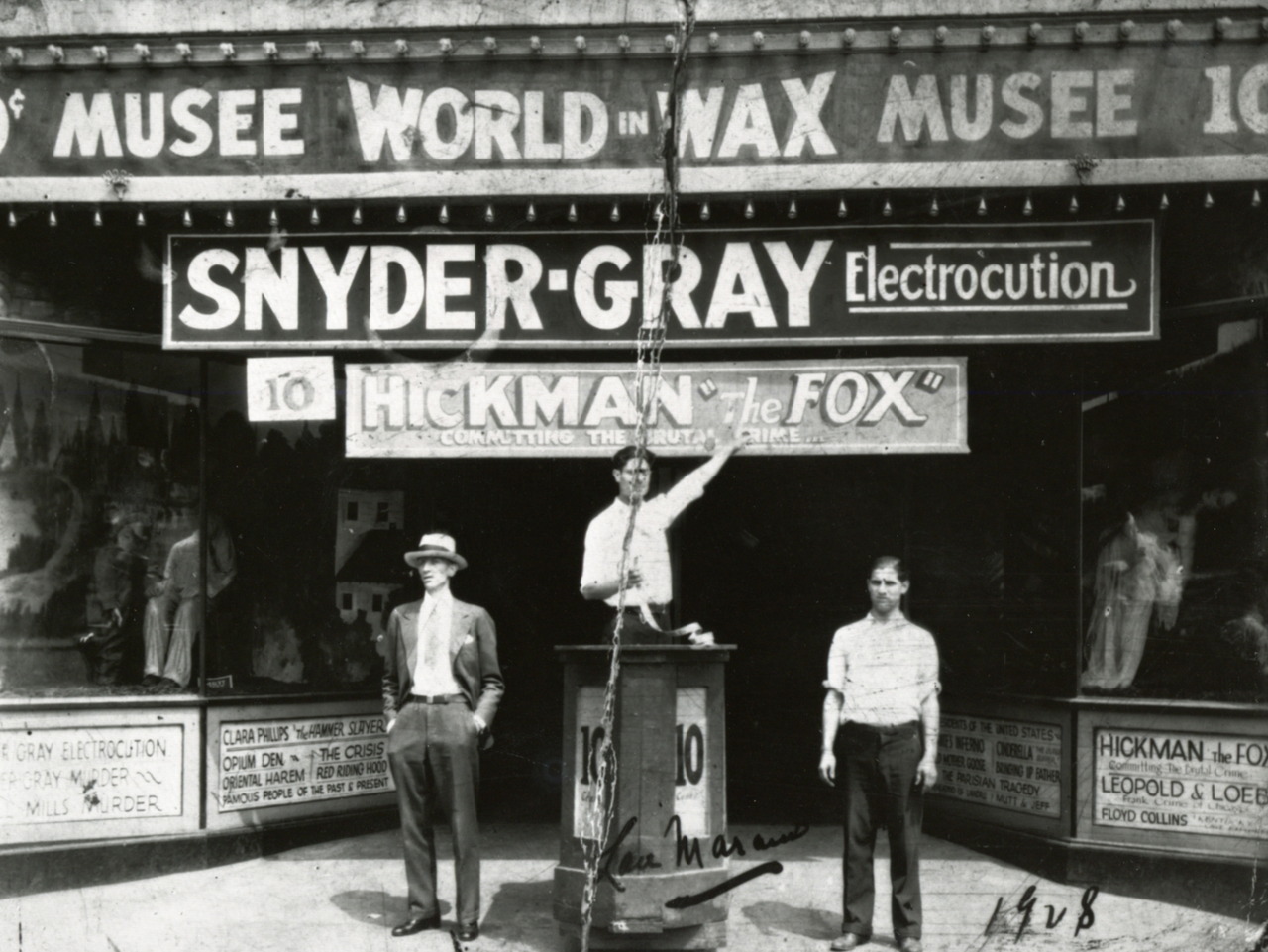
Of course not everything was as dazzling as Luna Park at night. Like any carnival, Coney Island had its share of barkers announcing everything from games of “chance” to freak shows and a wax museum that depicted–among other grisly sights–the murder of Albert Snyder by his wife, Ruth Snyder, and her lover, Judd Gray, and the subsequent execution of the notorious pair.

tumblr_m7qi19kprf1rpfjrbo1_1280
GET YOUR DIME’S WORTH…Barkers at Coney Island’s Eden Musee wax museum advertise the wax dummy recreation of the Ruth Snyder and Judd Gray executions, circa 1928. The Snyder-Gray murder trial of 1927 was a national media sensation. (houseoftoomuchtrouble.tumblr.com)

screen-shot-2016-10-14-at-9-07-16-am

screen-shot-2016-10-14-at-9-07-37-am

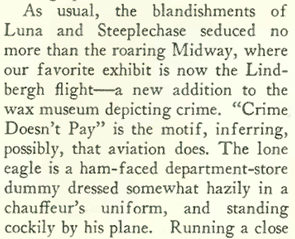
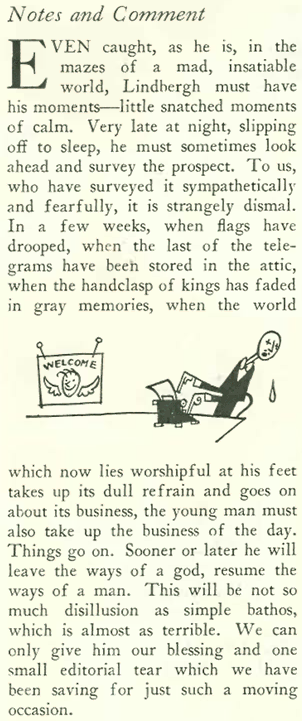
Charles Lindbergh, feted with his own wax image at Coney Island, was beginning to appear on the verge of a meltdown thanks to the relentless attention he was getting in the aftermath of his historic flight:

screen-shot-2016-10-14-at-9-02-29-am

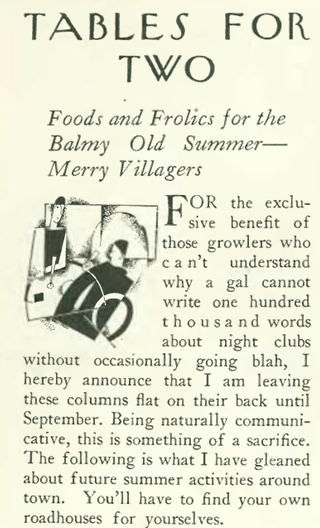
Lois Long also seemed at her wit’s end, abruptly announcing to readers that her nightlife column, “Tables for Two,” would go on hiatus for the summer. No doubt this was a relief to Long, who seemed to be growing weary of the nightclub scene and was doing double duty as fashion writer (“On and Off the Avenue”) for The New Yorker:

screen-shot-2016-10-14-at-12-25-49-pm

And perhaps there was another reason Long was taking a break–she would marry fellow New Yorker contributor and cartoonist Peter Arno on Aug. 13, 1927.

 *  *  *

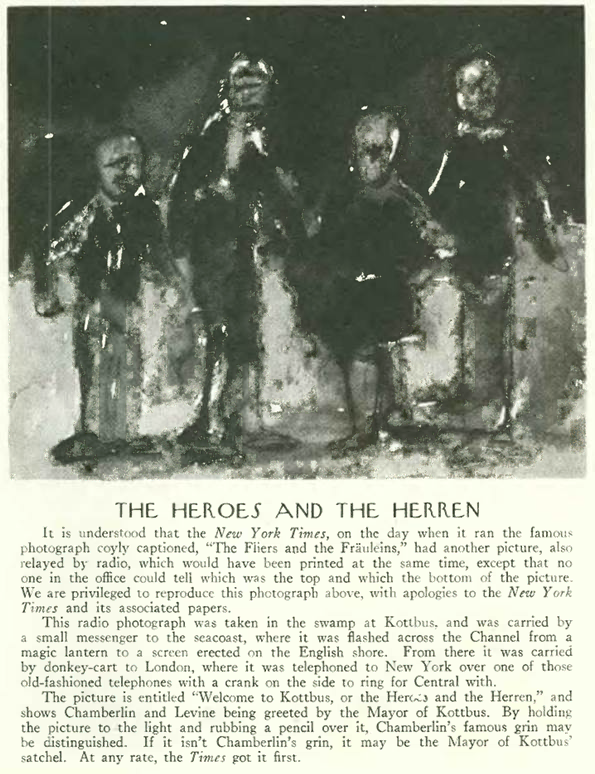
Always poised to take a poke at the newspaper media, The New Yorker had some fun with the New York Times’ attempt to reproduce an early wirephoto of Clarence Chamberlin, the second man to pilot a fixed-wing aircraft across the Atlantic from New York to Europe, while carrying the first transatlantic passenger, Charles Levine. The original photo apparently showed Chamberlain and Levine being greeted by the mayor of Kottbus, Germany:

screen-shot-2016-10-14-at-9-05-29-am

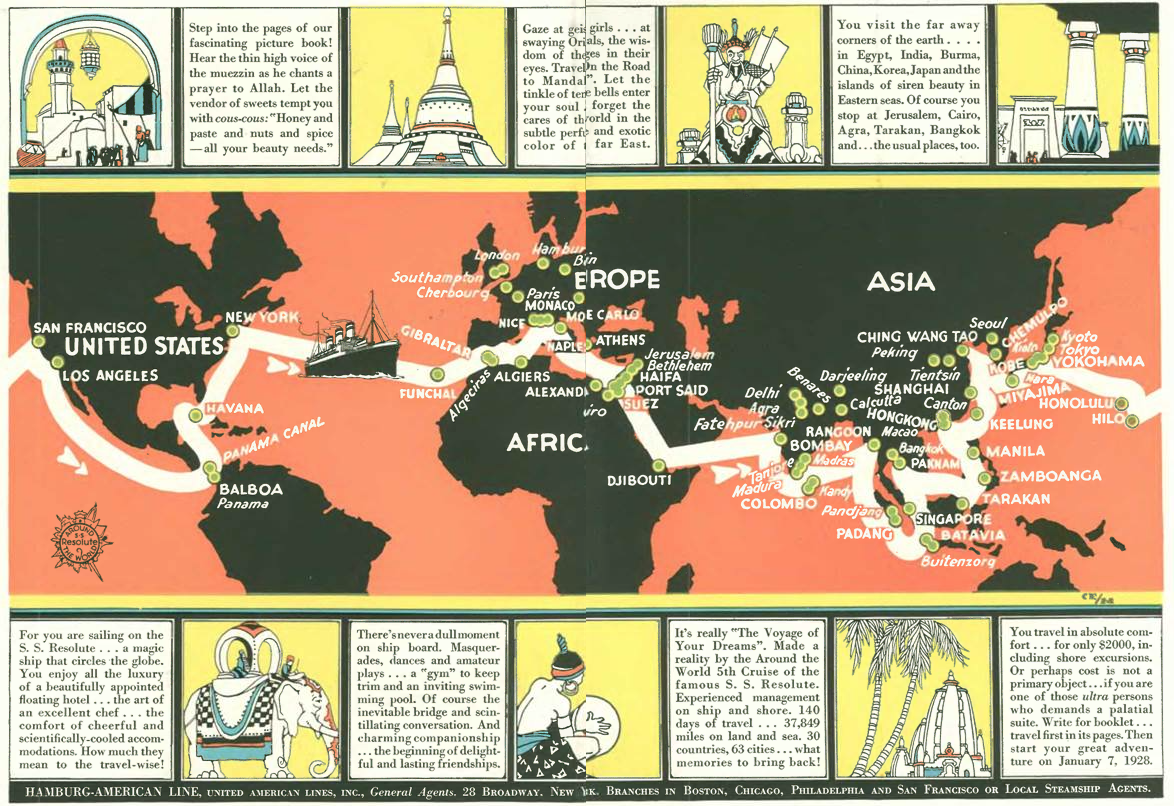
Charles Levine took a plane to Europe, but most still had to settle for the more leisurely pace of a steamship. Below is a two-page advertisement featured in the center of the June 18 issue for an around the world excursion on the Hamburg-American Line (click to enlarge):

screen-shot-2016-10-14-at-9-40-04-am

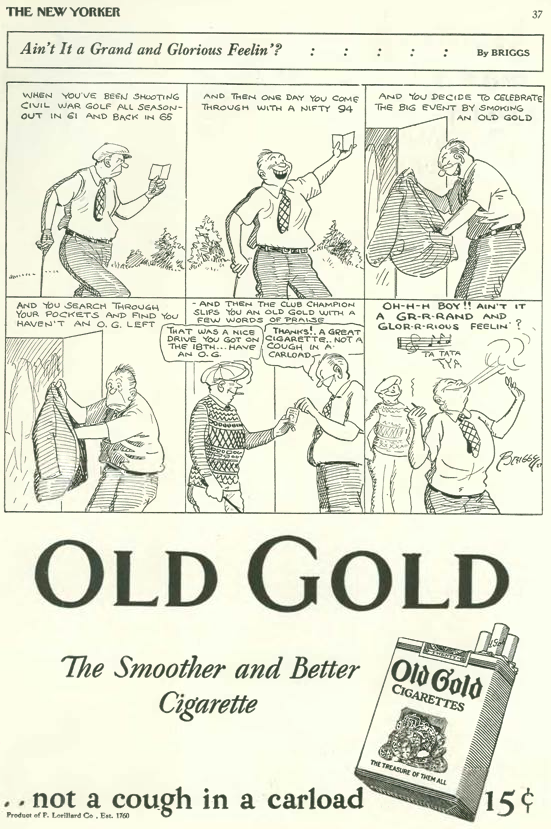
And finally, this advertisement in the back pages for Old Gold cigarettes, which claimed to be “coughless”….

screen-shot-2016-10-14-at-9-39-28-am

The artist for these Old Gold ads was Clare Briggs, an early American comic strip artist who rose to fame in 1904 with his strip A. Piker Clerk. Growing up in Lincoln, Nebraska gave Briggs the material he needed to depict Midwestern Americana, a style that would influence later cartoonists such as Frank King (Gasoline Alley).

Next Time: Île-de-France…

80c5240bf5ffaaff418de94b7e176525

The Age of Innocence

Above: Film stars Dorothy Sebastian (left) and Joan Crawford square off for a game of ping pong in 1925. The umpire is actor Eddie Nugent. (Film Noir Photos)

After studying every page of the first 120 issues of the New Yorker, and after researching the lives of its writers and their subjects, the world as described by the New Yorker — 89 years distant — can seep into one’s imagination, not unlike a world created by a fiction writer, whose characters are very much alive in his or her mind even when the pen is idle. You become accustomed to their voices, their likes and dislikes, and begin to see their world as a contemporary of sorts.

fe856464214bef0718e3c838d3a54ab2
June 4, 1927 cover by H.O. Hofman.

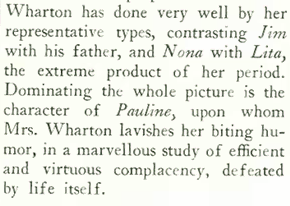
And so I find myself reading a review of Edith Wharton’s “latest” novel, Twilight Sleep, and think not of some author I haven’t read since college, but rather see her work as it was seen at its unveiling, albeit through the eyes of New Yorker book critic Ernest Boyd, who wrote under the pen name “Alceste”:

screen-shot-2016-10-12-at-12-20-20-pm

screen-shot-2016-10-12-at-12-20-45-pm

screen-shot-2016-10-12-at-12-20-56-pm

edith-wharton
NOT DEFEATED BY LIFE…Edith Wharton with her Pekes, circa 1920. (lib guides.com)

Wharton won the Pulitzer Prize for fiction in 1921 for The Age of Innocence, making her first woman to receive the prize. Indeed, Wharton kicked off a great decade for women fiction writers — Willa Cather would win the Pulitzer for One of Ours in 1923, Margaret Wilson for The Able McLaughlins in 1924, Edna Ferber for So Big in 1925, and Julia Peterkin for Scarlet Sister Mary in 1929.

*  *  *

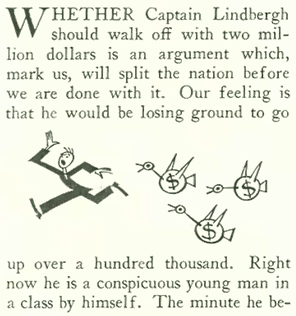
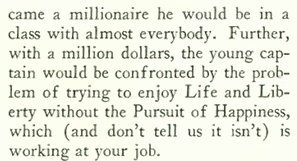
The June 4 issue offered some follow-up items on Charles Lindbergh, this from “The Talk of the Town” regarding Lindbergh’s potential to claim perhaps more than the $25,000 Orteig Prize (about $350,000 today) for being the first to fly nonstop across the Atlantic — endorsements, book and movie deals, offers to serve on company boards, and so on…

screen-shot-2016-10-13-at-9-18-42-am

screen-shot-2016-10-13-at-9-18-48-am

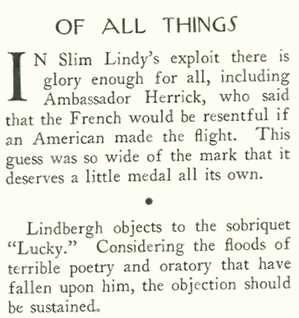
…and from Howard Brubaker’s “Of All Things” column, we learn that the aviation hero doesn’t like to be called “Lucky”…

screen-shot-2016-10-13-at-9-19-10-am

*  *  *

Baseball was still inexplicably shut out from the pages of The New Yorker, even as the Yankees (and Babe Ruth) were having one of their best-ever seasons. Instead, the June 4 issue covered horse racing (pgs. 63-65), rowing (pgs. 66-68), and lawn games (pgs. 69-72).

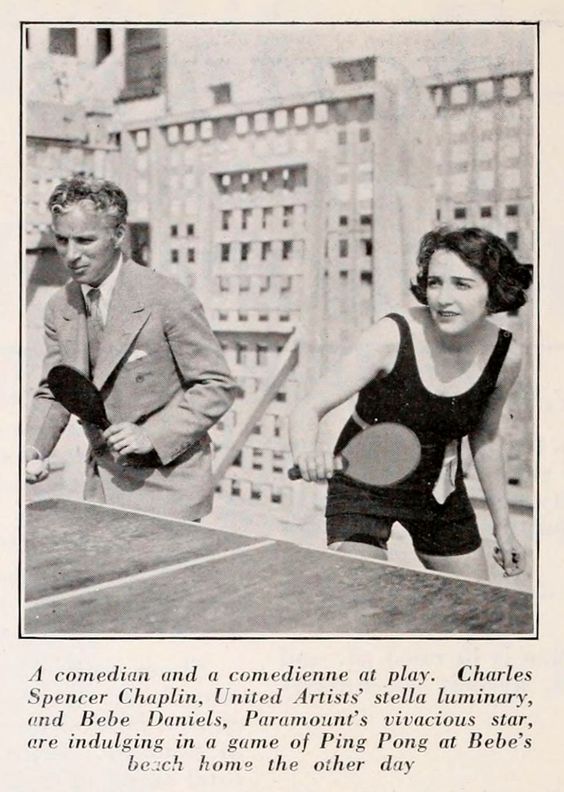
Among the “lawn games” reviewed, the New Yorker had this to say about the revival of ping-pong and the “spirited matches played between the sexes”…

screen-shot-2016-10-13-at-9-11-38-am

More celebrity action from the 1920s. (Clip from Pinterest)

 *  *  *

82b1f6e20ffd1e39a8e9d0f9da216917
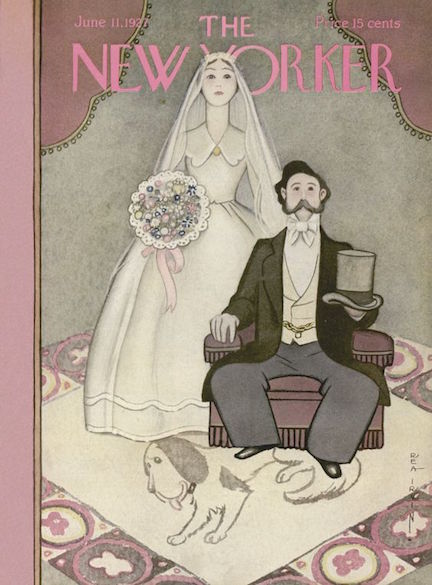
June 11, 1927 cover by Rea Irvin.

In the following week’s issue, June 11, 1927, there was a bit more to say about Lindy’s future economic prospects…

screen-shot-2016-10-13-at-9-35-14-am

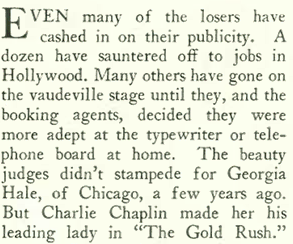
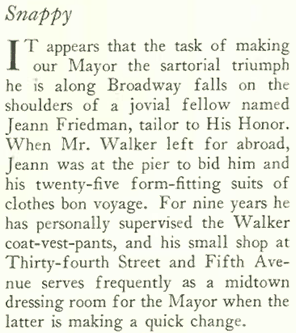
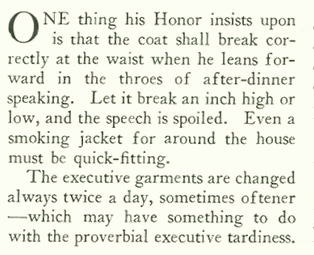
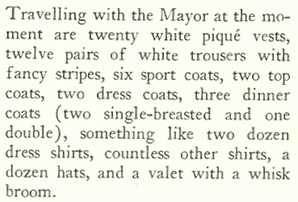
…and there is this item about New York Mayor Jimmy Walker. Given his love of late-night parties, speakeasies and chorus girls, it was no wonder that The New Yorker’s editors found him an attractive subject for “Talk of the Town”…

screen-shot-2016-10-13-at-9-33-36-am

Jimmy Walker and Betty Compton after their wedding in Cannes, 1933. (www.isle-of-wight-fhs.co.uk)

screen-shot-2016-10-13-at-9-33-44-am

Of course Walker’s aloofness would have consequences later when scandal and corruption would knock him and his cronies from office.

 *  *  *

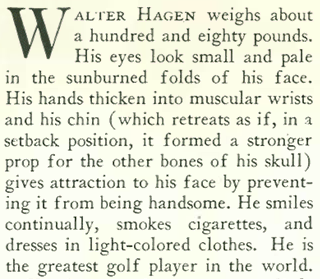
The issue also included a profile of golfer Walter Hagen, written by Niven Busch Jr. In his “Portrait of a Dutchman,” Busch begins:

screen-shot-2016-10-13-at-9-38-10-am

The profile included this portrait of Hagen by Miguel Covarrubias:

screen-shot-2016-10-13-at-9-37-53-am

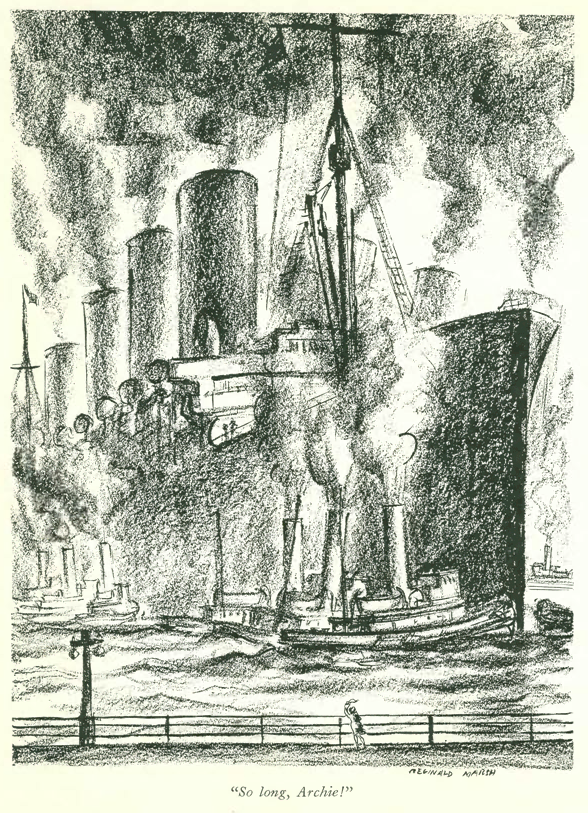
We end with this full-page cartoon, beautifully rendered in Conté crayon by Reginald Marsh

screen-shot-2016-10-13-at-9-37-31-am

Next Time: Coney Island, 1927…

37723304ec91b372ae19e57e36b4d4b9

Unfit to Print

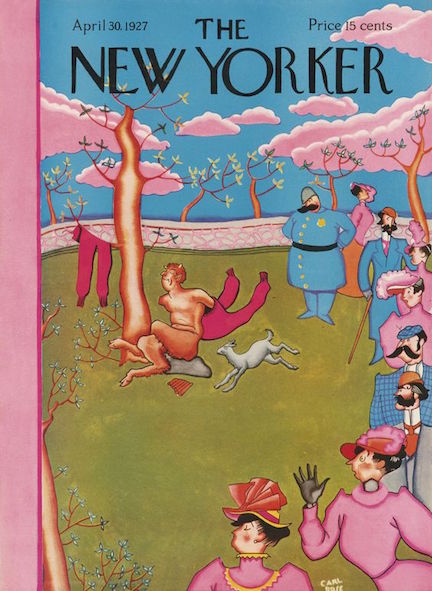
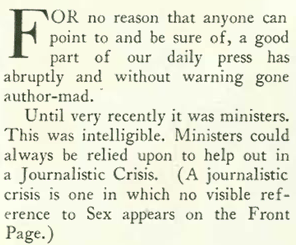
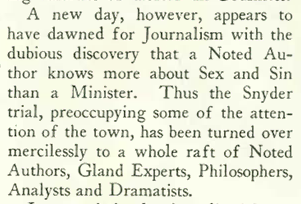
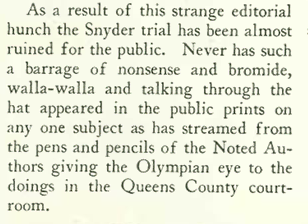
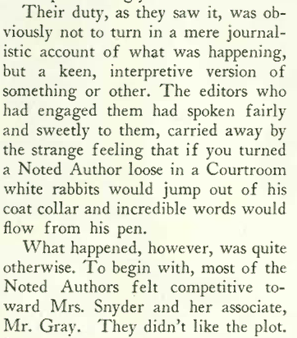
The journalist and screenwriter Ben Hecht wrote the “Reporter at Large” column for the early New Yorker, and for the April 30, 1927 issue took aim at the shoddy coverage of the Ruth Snyder murder trial at the Long Island City Courthouse.

e83e83f37e5b2787e23dd4ee7a85c62d
April 30, 1927 cover by Carl Rose.

Hecht was appalled by the media’s use of celebrity “experts” to cover the trial, which only served to sensationalize and trivialize the proceedings:

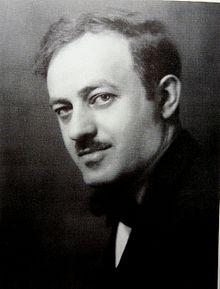
Ben Hecht (Wikipedia)

hecht-1

hecht-2

The Ruth Snyder trial dominated headlines in 1927. A housewife from Queens, Snyder began an affair in 1925 with Henry Judd Gray, a married corset salesman. After she persuaded her husband, Albert Snyder, to purchase life insurance, she enlisted Gray’s help to murder him. On March 20, 1927 the couple garrotted Albert (after bludgeoning him with a sash weight) and then staged the murder scene to look like a burglary.

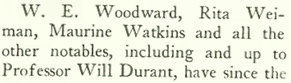
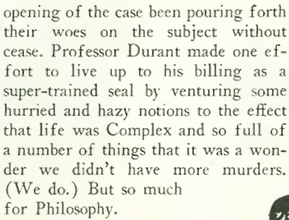
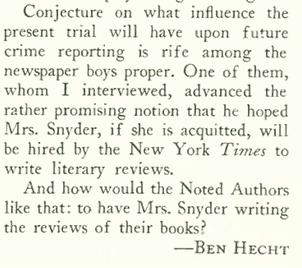
The trial was covered by such figures as former Ziegfeld Follies showgirl Peggy Hopkins Joyce, the radio evangelist Aimee Semple McPherson, movie director D. W. Griffith, author Damon Runyon, popular philosopher Will Durant, and James M. Cain, a crime reporter who went on to write Double Indemnity, which was later made into a major Hollywood movie. Hecht (who would go on to co-write a hugely successful play about newspaper reporters, The Front Page) would have none of this celebrity circus. Some excerpts:

hecht-3

hecht-4

hecht-5

hecht-6

hecht-8

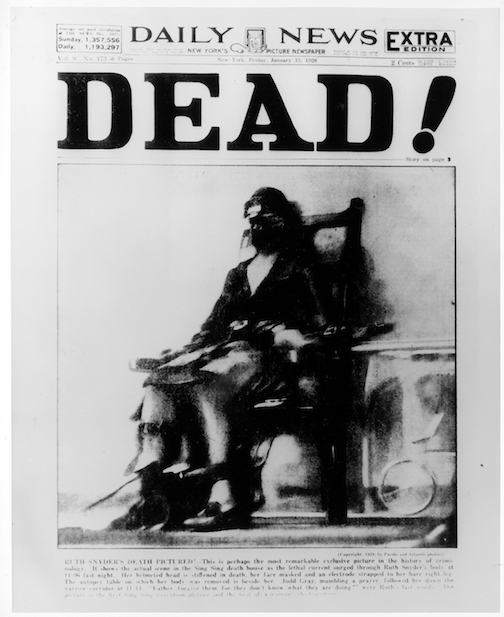
Ruth Snyder would not be acquitted (or live to write reviews), but instead would go to Sing Sing’s electric chair on Jan. 12, 1928. The 32-year-old Snyder would go to the chair first, followed shortly thereafter by her former lover and accomplice, 35-year-old Henry Judd Gray. The pair had sealed each other’s fate: During the trial, Snyder and Gray had turned on each other, contending the other was responsible for killing Albert Snyder.

screen-shot-2016-09-08-at-12-22-48-pm
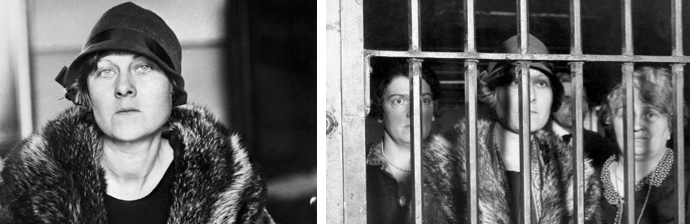
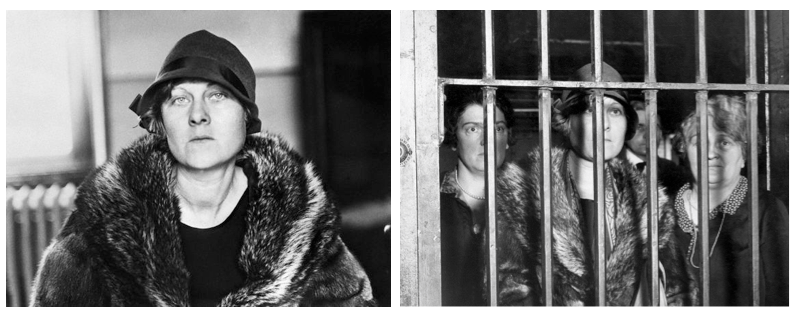
BUSTED…Ruth Snyder in custody and behind bars at the Queens County Jail. (Criminal Encyclopedia/NY Daily News)
snyder-and-gray
END OF THE LINE…Mugshots of Ruth Snyder and Henry Judd Gray taken at Sing Sing Prison following their conviction. (Lloyd Sealy Library, CUNY)
connect_blog_ruth-snyder
NATIONAL SENSATION…The cover of Jan. 13, 1928, issue of the New York Daily News. Although photographs of the execution were not allowed, photographer Tom Howard took this now-famous photo of Snyder at the moment of her execution with the aid of a miniature camera strapped to his ankle. (newseum.org)

 *  *  *

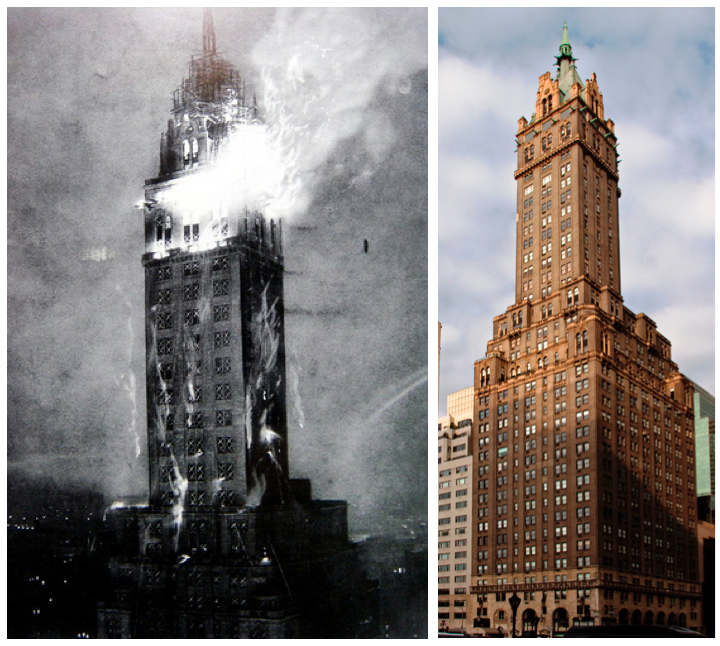
On to a lighter topic…The Sherry-Netherland Hotel has graced the corner of Fifth Avenue and East 59th Street since 1927, and when it was built it was the tallest apartment-hotel in New York City.

The building was nearing completion when around 8 pm on April 12, 1927, fire broke out on wood plank scaffolding surrounding the top floors. Firefighters responded only to find they lacked water pressure to fight the blaze.

According to the New York Times (“The Night a Hotel Turned Into a Torch,” Nov. 15, 2012), the fire was watched by hundreds of thousands, and “the windows of the Plaza Hotel across the street were ‘black with people’; every front room was engaged, either by news organizations or for spontaneous parties to watch the fire.”

Planks tumbled to the street for hours, and The Times said one “sailed in a crazy parabola” and crashed against the Savoy-Plaza, also nearly finished; occasionally minor collapses of the scaffolding turned the picturesque top into a “lofty Roman candle.” The crowds on the street could feel the heat on their faces, and the roar and crackle of the fire could be heard for blocks around. The fire burned itself out around midnight.

Oddly, the New Yorker had little to say about the fire, mentioning it only in passing in this “Talk of the Town” item:

screen-shot-2016-09-06-at-12-48-11-pm

screen-shot-2016-09-08-at-1-14-21-pm
HOT TIME IN THE CITY…In 1927 the Sherry-Netherland caught on fire, creating what The New York Times called “the best show of the season.” The newspaper ran this photo (left), retouching it for contrast (New York Times). At right, the hotel as it appears today (Wikipedia)

An interesting side note…at the time of the Sherry-Netherland’s construction, the nearby Vanderbilt mansion was being demolished. Carved limestone panels from the mansion’s porte-cochere as well as ornamental frieze roundels were salvaged and installed in the Sherry-Netherland’s lobby.

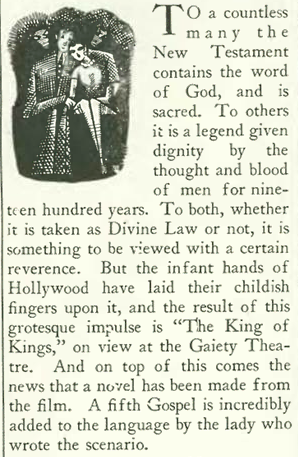
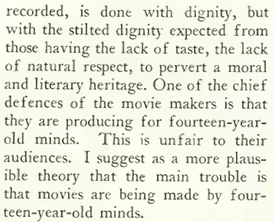
Hollywood movies continued to disappoint New Yorker critics, including Cecil B. DeMille’s silent epic The King of Kings.

screen-shot-2016-09-06-at-12-58-11-pm

screen-shot-2016-09-06-at-12-58-48-pm

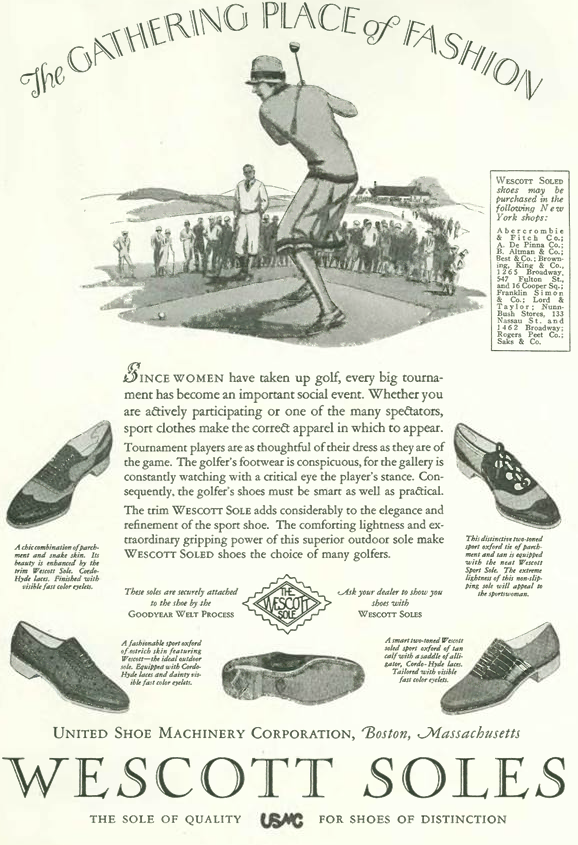
screen-shot-2016-09-06-at-12-59-22-pmFinally, a couple of advertisements from the April 30 issue. It was spring, and time to hit the links…

screen-shot-2016-09-06-at-12-44-22-pm

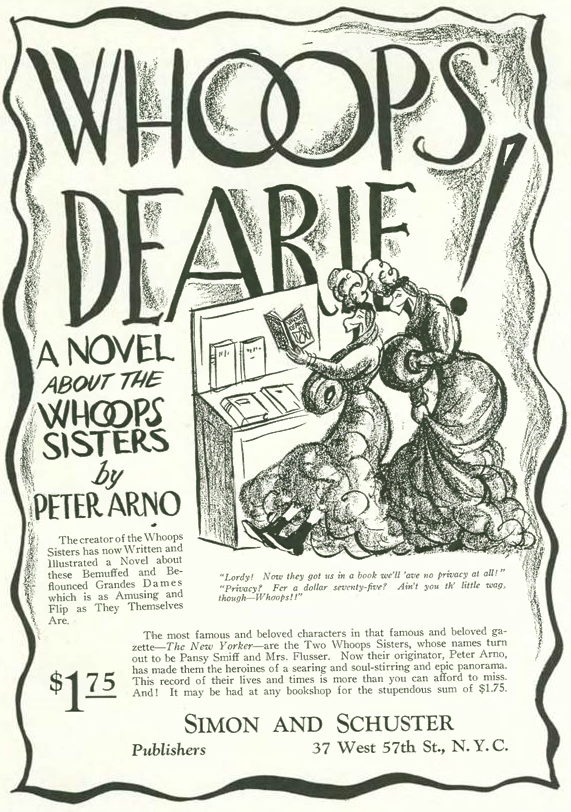
…and New Yorker cartoonist Peter Arno plugged his new book featuring the Whoops Sisters:

screen-shot-2016-09-06-at-12-51-37-pm

Next time: Those Restless Natives…

43b9e74a7197a3d27d520d251a303549

World of Tomorrow

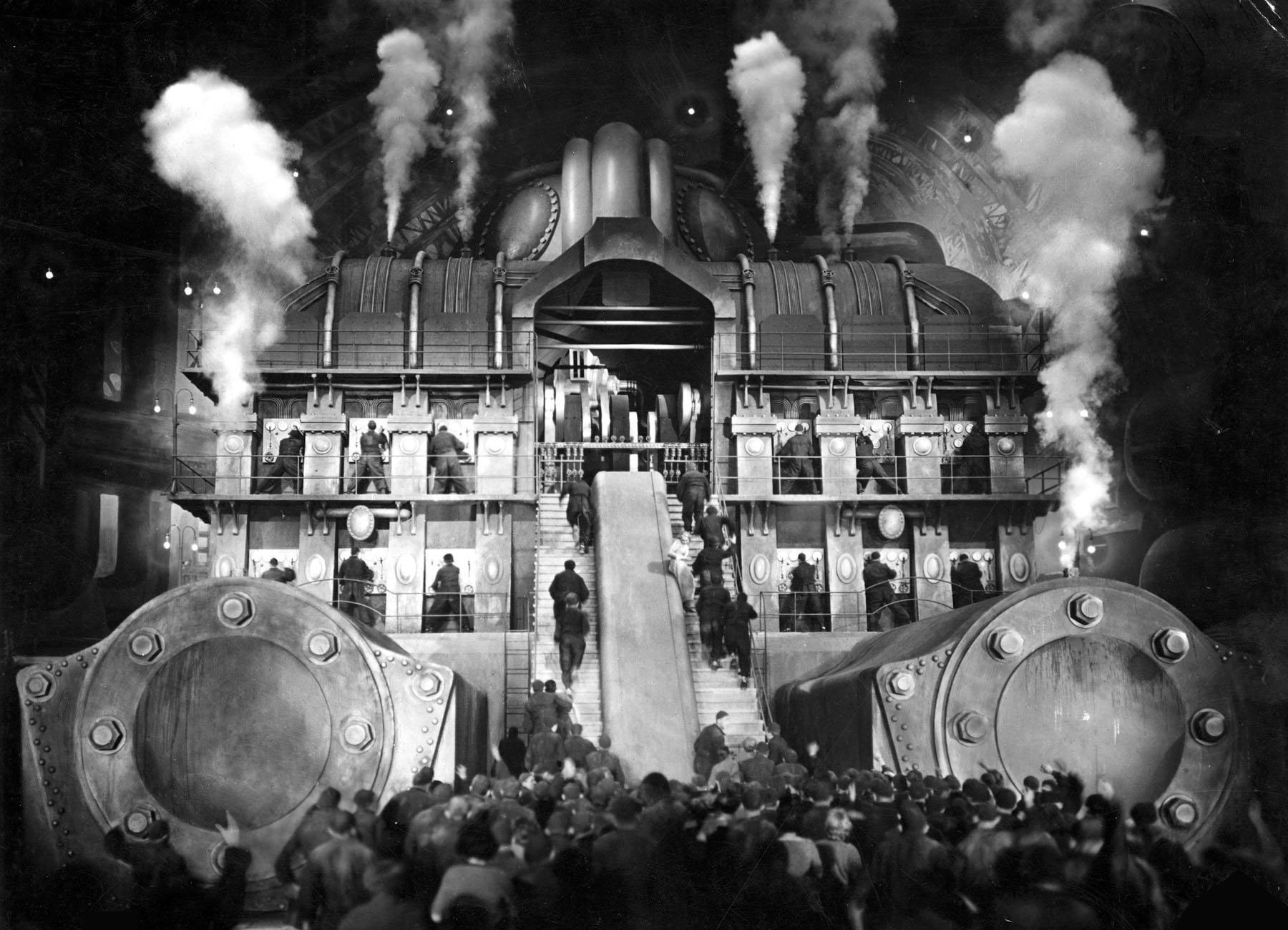
The much-anticipated German expressionist film, Metropolis, opened at Manhattan’s Rialto Theatre. Although considered today to be a classic of the silent era, the March 12, 1927 New Yorker found Fritz Lang’s film to be overlong and preachy despite its fantastic setting and complex special effects.

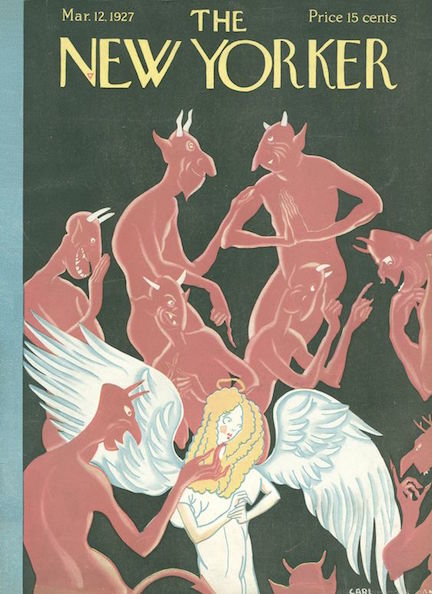
2ab7711b486573bd3d0e3be1880afe36
March 12, 1927 cover by Carl Rose.

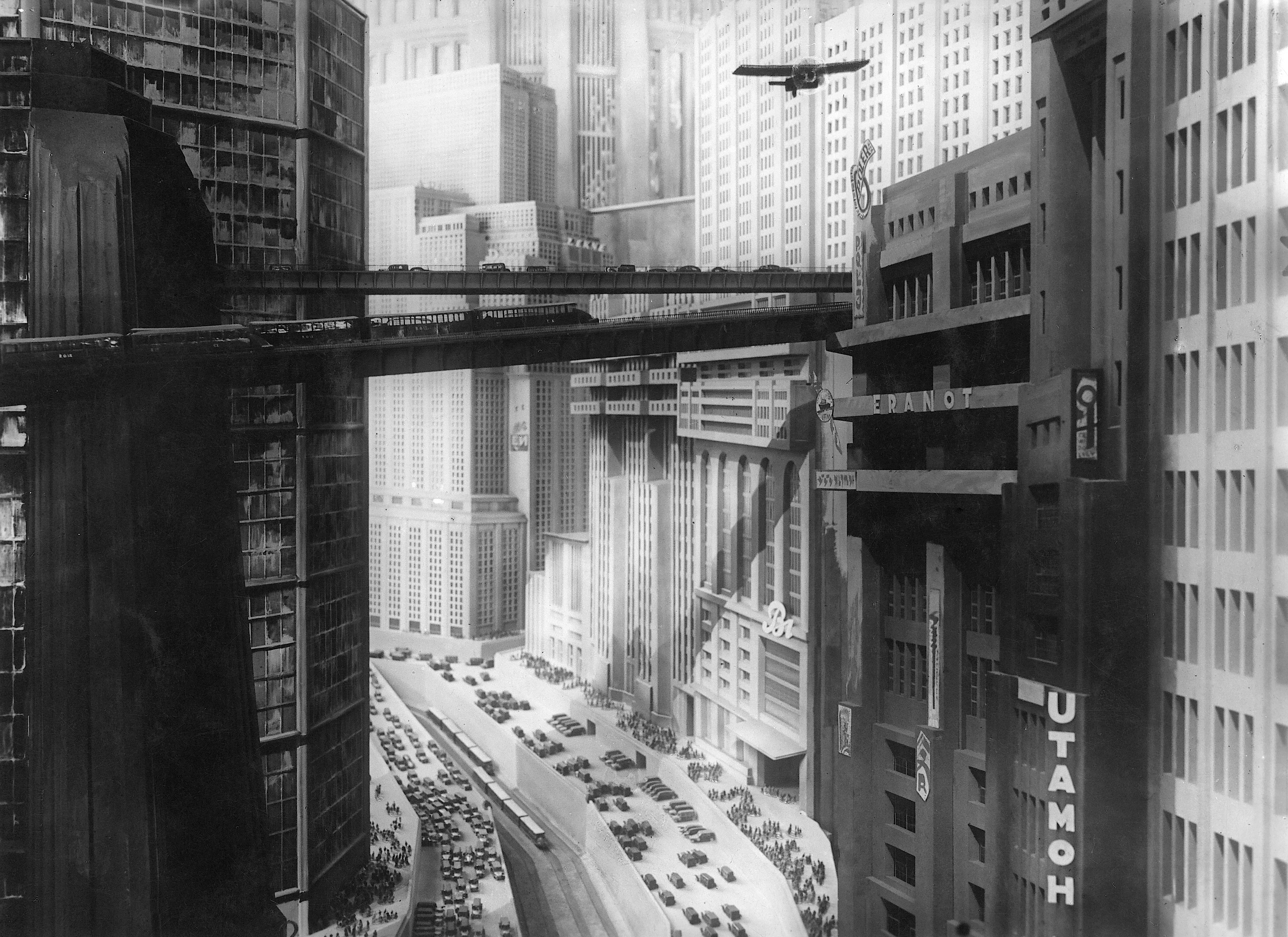
Set in a futuristic dystopia in which the wealthy ruling classes lived high above the toiling masses, the film followed the attempts of a wealthy son of the city’s ruler and a poor working woman named Mary to overcome the city’s gaping class divisions.

b6d411dd22f66f0a43e8f2dbf076f470
The city of tomorrow as portrayed in the opening scenes of Fritz Lang’s Metropolis. The New Yorker encouraged readers to see the film mostly for the special effects, but lamented its “Teutonic heaviness” and uninspired acting. (archhistdaily)

An excerpt from the New Yorker review:

Screen Shot 2016-08-04 at 9.20.57 AM

metro_41
The working masses toil in the dank world beneath the city in Metropolis. (myfilmviews.com)
Screen Shot 2016-08-05 at 12.20.33 PM
Brigette Helm’s duo portrayal of the noble Mary and her robotic double (here being created through cinematic magic) in Metropolis was praised by The New Yorker, which otherwise found the film’s acting subpar. (cinemagraphe.com)

Considered one of the most expensive movies of its time, Metropolis cost $5 million to film in 1925 (roughly about $70 million today).

*  *  *

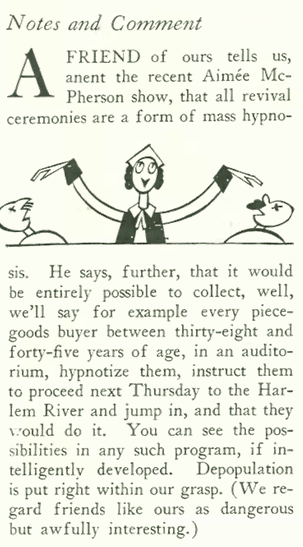
The famous 1920s evangelist Aimee Semple McPherson had been holding a series of revival meetings in New York, which were often (and derisively) noted by the New Yorker editors. In the previous issue “Talk of the Town” observed:

Screen Shot 2016-07-26 at 8.55.01 AM

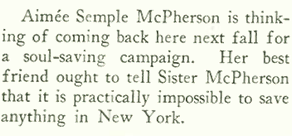
And in the March 12 issue they offered this parting note in “Of All Things”….

Screen Shot 2016-08-04 at 8.56.43 AM

Aimee Semple McPherson (left) leading a service at her Angelus Temple in Los Angeles in the 1920s. (Los Angeles Public Library Photo Collection)

A pioneer in the use of modern media, McPherson was in New York on a “vindication tour,” taking advantage of the publicity from her alleged kidnapping  a year earlier that led to investigations that she had staged her disappearance to bolster her flagging ministry.

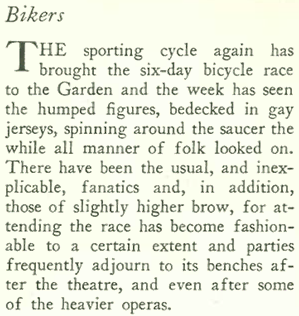
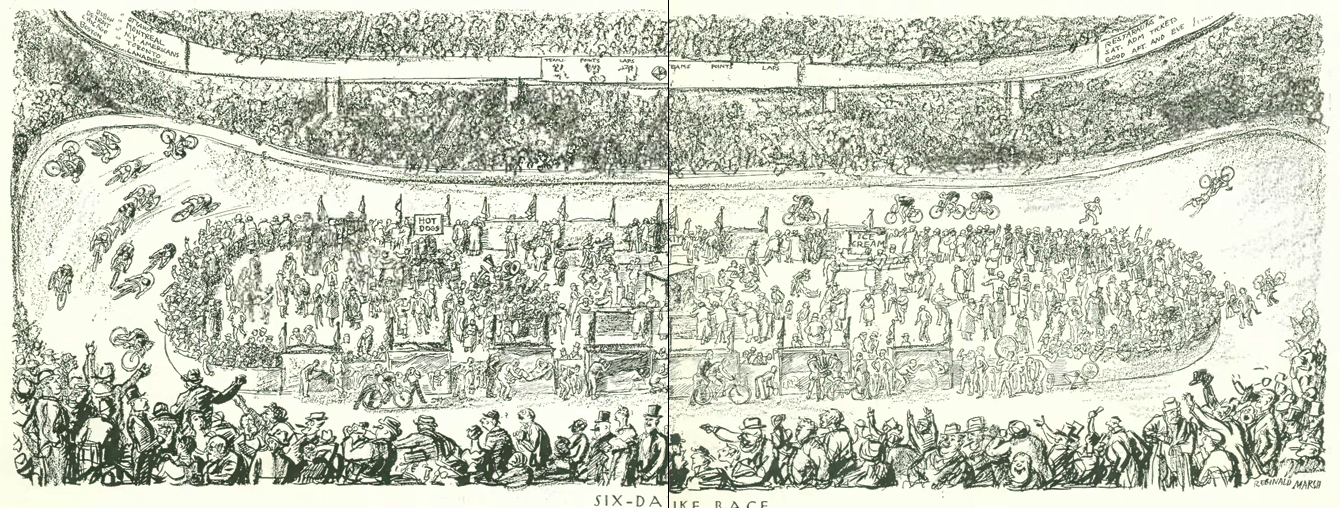
In other diversions, bicycle racing had come to Madison Square Garden, as noted in “Talk of the Town” with an illustration by Reginald Marsh:

Screen Shot 2016-08-04 at 8.56.01 AM

Screen Shot 2016-08-04 at 8.56.11 AM
click to enlarge

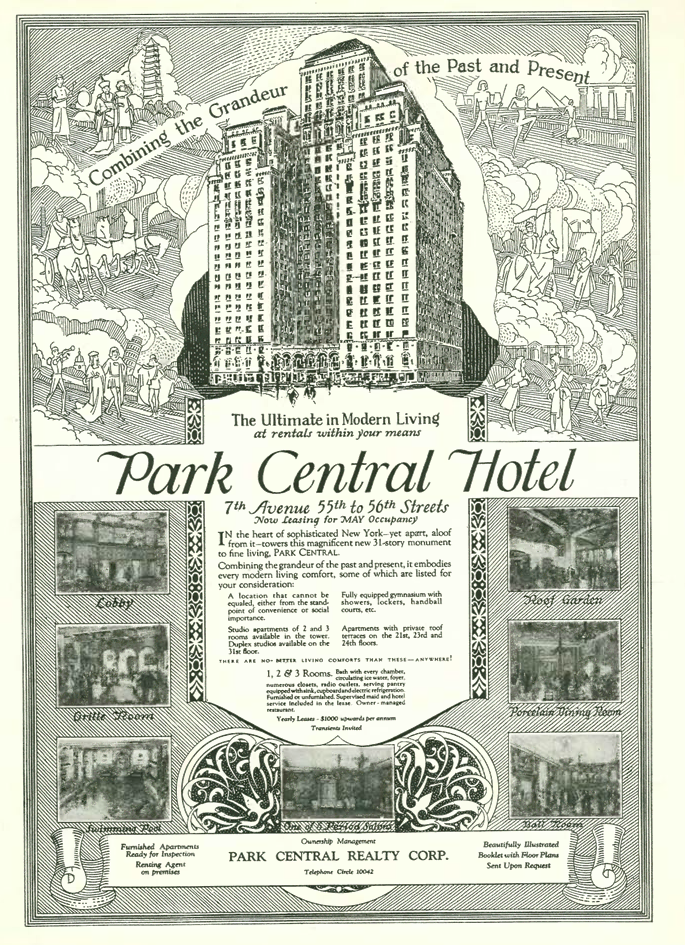
Advertisements in this issue included this announcement for the opening of the Park Central Hotel, still a grand landmark on 7th Avenue…

Screen Shot 2016-08-04 at 8.58.15 AM

…and this ad from Nestle touting the latest method for achieving success in the latest hair style…

Screen Shot 2016-08-04 at 8.53.24 AM

Next Time: Nothing Like the Roxy…

ef3893e952639f635327190b41ee6ea3

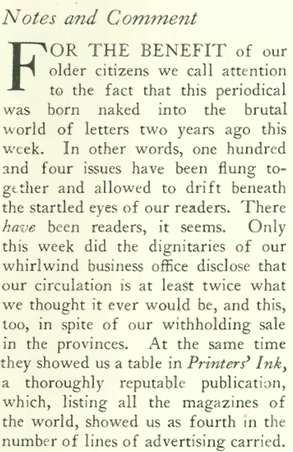
Two Years Young

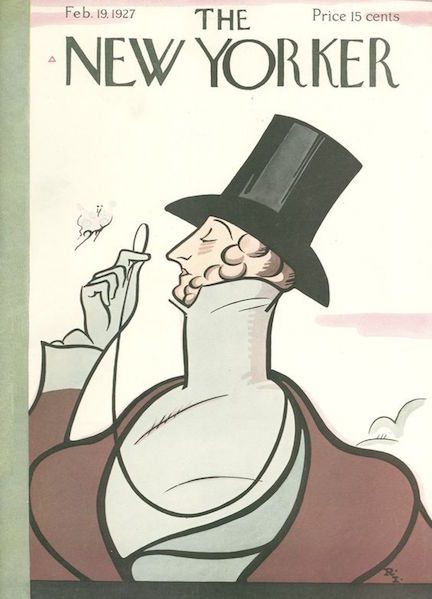
The New Yorker celebrated its 2nd anniversary by once again using the Rea Irvin cover from its first issue, which depicted a dandified character–soon to be dubbed “Eustace Tilley”–that would become a mascot of sorts for the magazine.

e5c3fabc5f1612a71442c78a3c71d654
February 19, 1927: 2nd anniversary issue cover by Rea Irvin.

For more than 90 years it has been a tradition to feature the original cover every year on the issue closest to the anniversary date of February 21, although on several occasions a newly drawn variation has been substituted, including several “alternative” covers for last year’s 90th anniversary issue. This one in particular, by Carter Goodrich, is appropriate for our times:

CV1_TNY_02_23_15Goodrich.indd

The magazine included this embellishment on the opening page of “The Talk of the Town” (also repeated from the previous year)…

Screen Shot 2016-07-21 at 4.54.08 PM

…and the editors opened with a somewhat tongue-in-cheek boast of the young magazine’s improving fortunes:

Screen Shot 2016-07-21 at 4.55.17 PM

Screen Shot 2016-07-21 at 4.56.04 PM

The boasts about advertising were legitimate. Apparently the people at Rolls Royce felt that the magazine was worth a full-page, weekly advertisement. Note the third paragraph of the ad, third to to the last line: How many car makers today, or any at time for that matter, would tout that their car “meets every traveling situation blandly?”

Screen Shot 2016-07-22 at 9.02.21 AM

While on the topic of ads, this one from the back pages caught my eye:

Screen Shot 2016-07-22 at 9.24.12 AM

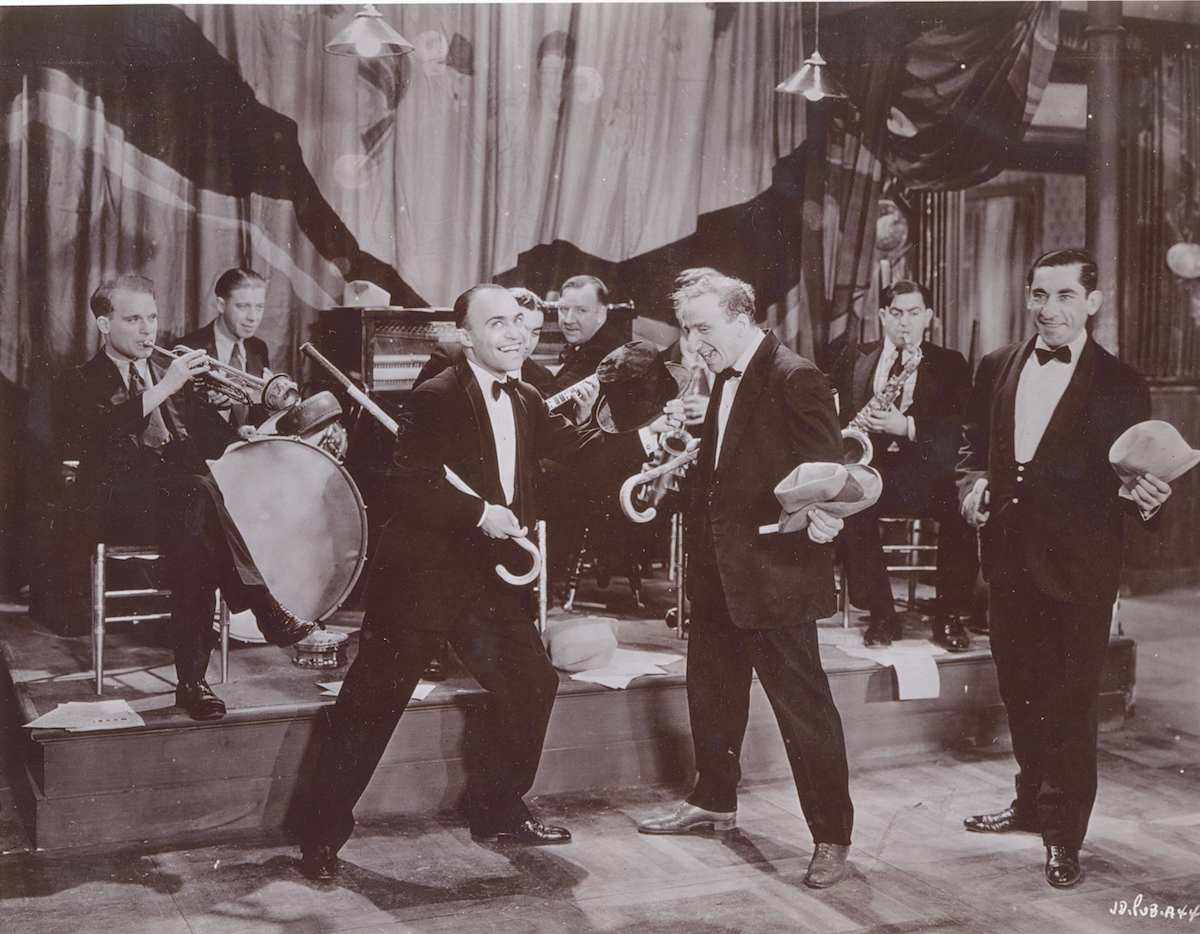
Most of us have heard of vaudeville teams like the Marx Brothers and Laurel & Hardy, but there were many others who drew big audiences but who are mostly forgotten today, including the trio of Clayton, Jackson and Durante.

clayton-jackson-and-durante0001
Jimmy Durante (center) performing with his vaudeville partners Eddie Jackson (right) and Lou Clayton. (New York Public Library)

Of the three, Jimmy Durante would go on to the greatest fame. Known for his gravelly voice, clever wordplay and his prominent nose (which he dubbed “the Schnozzola”), Durante would find great success in radio, film, and in early television. The singer, pianist and comedian would appear on many variety shows in the 1950s and 60s. Although he died in 1980, today he is still known to audiences young and old alike thanks to his appearance as the narrator in the animated Frosty the Snowman (1969), which is still broadcast every year during the Christmas season and is distributed through countless DVDs and streaming services.

Screen Shot 2016-07-22 at 1.26.10 PM
GOOD NIGHT, Mrs. Calabash, wherever you are…the animated Jimmy Durante in Frosty the Snowman (1969), and in a 1964 publicity photo. (YouTube/Wikipedia)

*  *  *  *  *

On to more advertising, and a less savory topic. Beginning in the 1920s, Lysol was advertised for use in feminine hygiene as a guard against “odors,” a term that was widely understood as a euphemism for contraception. According to Andrea Tone (Devices and Desires) by 1940 it had become the most popular birth control method in the country. Unfortunately for many women, Lysol contained cresol (derived from coal tar) which could cause severe inflammation and even death:

Screen Shot 2016-07-22 at 9.03.33 AM

Also popular (and a lot less harmful) in the 1920s was sheet music featuring the latest songs. So sidle up to the piano with your guy or gal and belt out one of these favorites:

Screen Shot 2016-07-22 at 9.26.21 AM

And to close, a cartoon by the famed Peter Arno, who was well-acquained with New York nightlife:

Screen Shot 2016-07-22 at 9.00.34 AM

Next Time: Clark’s Folly…

a4866ba5e836b04dce69f13fb06cf5df


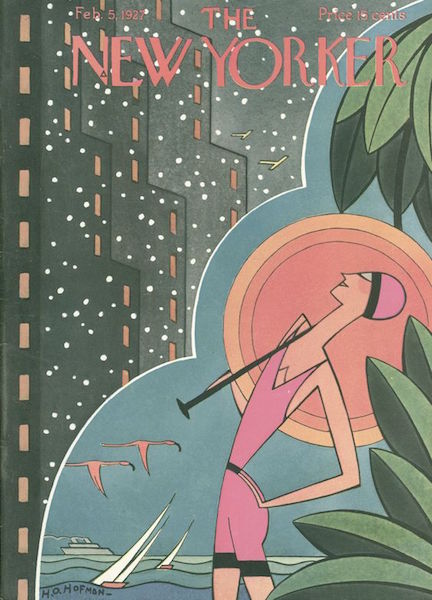
Spring Fever

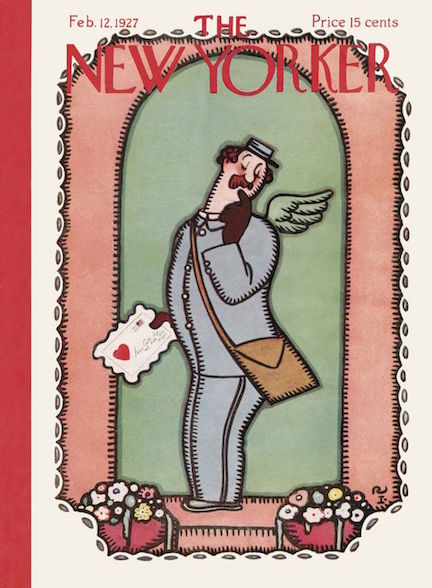
Piles of snow and slushy streets had many New Yorkers dreaming of spring, including H.O. Hofman, who illustrated the cover for the Feb. 5, 1927 issue.

e4051b8c99ab27eb2272f12bb1634373
Feb. 5, 1927 cover by H.O. Hofman.

Another New Yorker illustrator and cartoonist, Barbara Shermund, offered a different take on the idea in this drawing for the “On and Off the Avenue” column on page 56:

Screen Shot 2016-06-29 at 9.44.41 AM

At least New Yorkers had plenty of activities to take their minds off of the weather, including two important balls:

Screen Shot 2016-06-29 at 8.38.15 AM

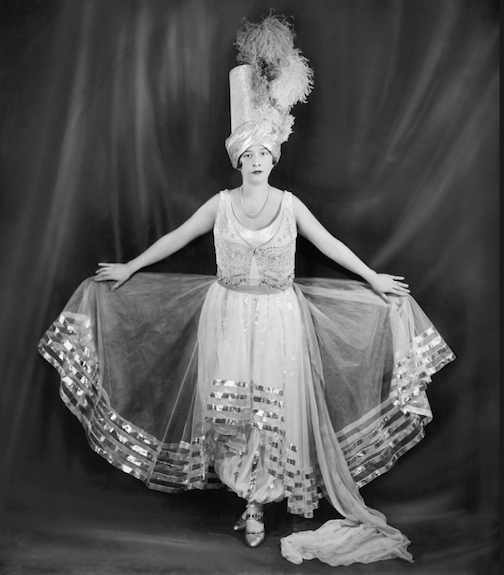
Inspired by the annual springtime costume ball given by the students of the École nationale supérieure des Beaux-Arts in Paris, American students held an annual ball to raise funds for their Beaux-Arts Institute of Design. The balls featured elaborate costumes and performances that were extensively reported in the city’s society pages.

Beuax arts 1928 NYT
LOOK AT ME…Margaret Thaw dressed as a “White Sultana” for the 1928 Beaux Arts Ball held at the Astor Hotel. The theme was “The French Occupation of Northern Africa — 1847.” A doyenne of international high society perennially named to best-dressed lists, Margaret and her husband, Lawrence Copley Thaw, were world-famous explorers of Africa and Asia and correspondents for National Geographic magazine. (New York Times)

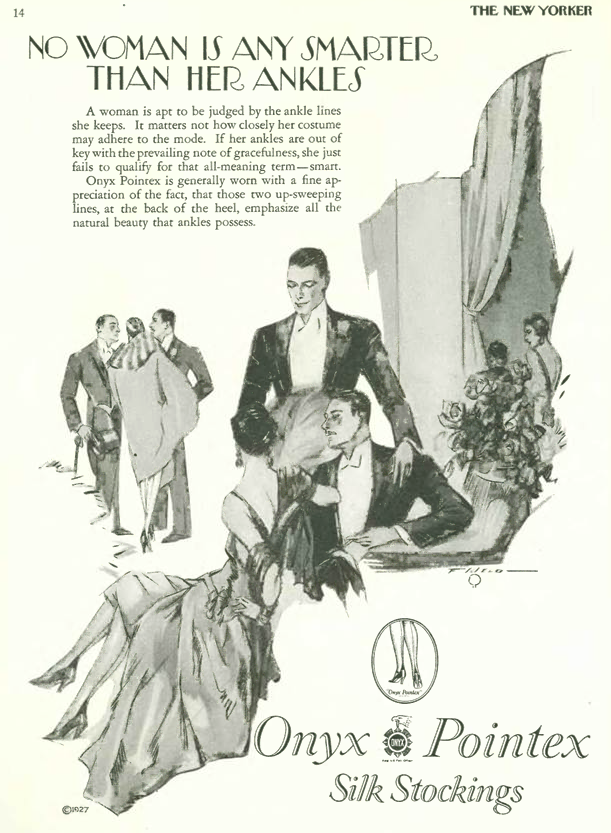
Contrary to the ad pictured below, fashion plate Margaret Thaw was doubtless smarter than her ankles…

Screen Shot 2016-06-29 at 8.36.57 AM

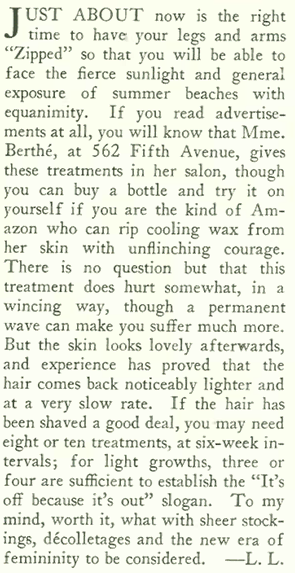
If you were investing in fine Onyx Pointex silk stockings, you probably wanted to get your legs “Zipped” in a new method described by fashion correspondent Lois Long:

Screen Shot 2016-06-29 at 9.46.13 AM

If Lois Long were around today she would have to note that both men and women are getting “Zipped,” waxing everything including their nethers.

And these days few of us are washing our hair with bar soap, as depicted in the ad below for Lux. Like so many other ads in the early New Yorker, this one makes a strong appeal to Francophile readers; if it’s French then it must be good (note that every paragraph and headline in the ad mentions either France or French at least once):

Screen Shot 2016-06-29 at 9.41.22 AM

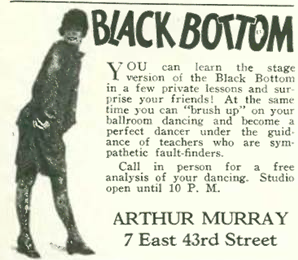
While we are on the topic of advertisements, here is another installment of ads from the back pages of the magazine. Arthur Murray was a frequent advertiser in the magazine, mostly small ads like this that exploited the latest dance craze:

Screen Shot 2016-06-29 at 9.51.23 AM

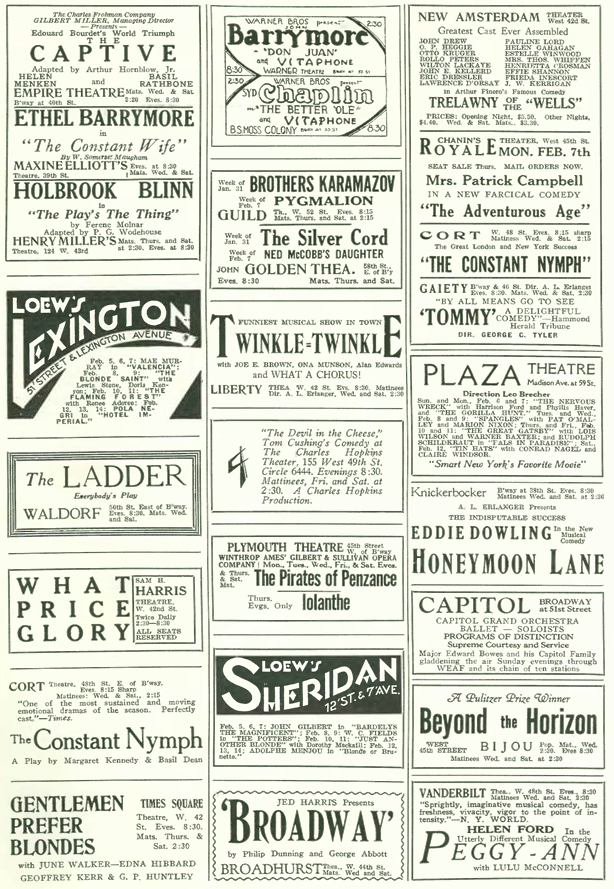
The offerings of the stage and screen were also prominent in the back pages:

Screen Shot 2016-06-29 at 9.48.59 AM

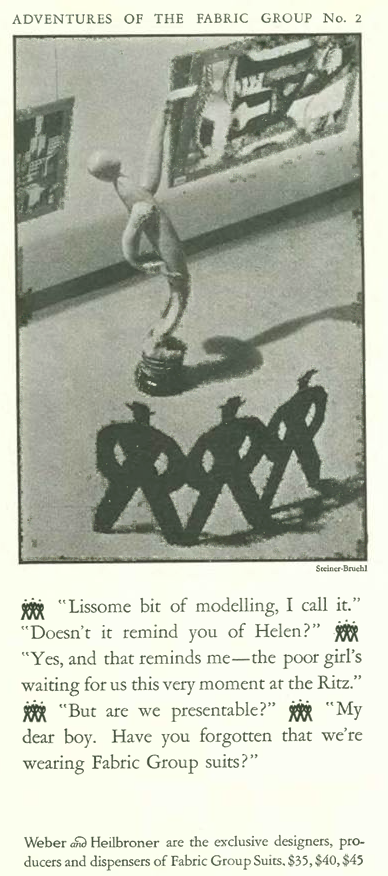
And finally, these strange little ads (run as series) that were designed by photographers Anton Bruehl and Ralph Steiner to promote Weber and Heilbroner suits:

Screen Shot 2016-06-29 at 9.43.00 AM

Specializing in elaborately designed and lit tableaux, Bruehl won top advertising awards throughout the late 1920s and early 1930s. He also co-developed the Bruehl-Bourges color process, which gave publisher Condé Nast a monopoly on color magazine reproduction in the early 1930s.

Next Time: Papa Pens a Parody…

7532b3c65dcb4c041db31d7c0c75b4c4

Holiday Shopping

Photo above via themindcircle.com

With Christmas fast approaching, The New Yorker was getting into the spirit of holidays, especially with all of the advertising revenue it gained from merchants who targeted its well-heeled readership.

8912823cfdc5626785b13a431ae590de
November 27, 1926—Peter Arno’s first cover for the New Yorker. He would do 98 more.

Lois Long continued to write both of her weekly columns for the magazine–her observations on fashion along with ideas for Christmas shoppers in “On and Off the Avenue” (“Saks’ toy department has some of the loveliest French notepaper for tiny children…”) and her musings on nightlife in “Tables for Two.”

In contrast to her rather light mood expressed in the fashion column, Long was feeling far from jolly in her “Tables” observations of New York’s nightlife:

Screen Shot 2016-04-25 at 5.01.46 PM

Screen Shot 2016-04-25 at 5.02.43 PM

As you might recall, in a previous column Long tossed a “ho-hum” in the direction of the famed Cotton Club. Perhaps Prohibition was taking its toll on the hard-partying columnist.

Nevertheless, the holiday spirit was upon with The New Yorker, in the cartoons (this one by Helen Hokinson)…

Screen Shot 2016-04-25 at 4.54.16 PM

…and in various advertisements.

Screen Shot 2016-04-25 at 4.50.49 PM

Note this advertisement (below) from Russeks. The comics in The New Yorker famously poked fun at the comic pairings of rich old men and their young mistresses, but this ad seemed to glorify such a pairing while suggesting that an older man of means must invest in fine furs if he is going to hang on to his trophy wife or mistress, in this case a young woman who appears to be nearly eight feet tall…

Screen Shot 2016-04-25 at 4.51.10 PM

I liked this ad from Nat Lewis for the simple line drawing…
Screen Shot 2016-04-25 at 4.57.27 PM

…but the ads for Elizabeth Arden, which for years featured this “Vienna Youth Mask” image, always creep me out.

Screen Shot 2016-04-25 at 4.56.41 PM

The mask was made of papier-mâché lined with tinfoil. Although not pictured in the ad, it was also fitted to the client’s face. The Vienna Youth Mask used diathermy to warm up the facial tissues and stimulate blood circulation.

1937-arden-vienna
SLEEP TIGHT…The full “Youth Mask” applied to an Elizabeth Arden client in the mid 1930s. (cosmeticsandskin.com)

In a 1930 advertisement, Elizabeth Arden claimed that “The Vienna Youth Mask stimulates the circulation, producing health as Nature herself does, through a constantly renewed blood supply. The amazing value of this treatment lies in the depth to which it penetrates, causing the blood to flow in a rich purifying stream to underlying tissues and muscles…charging them with new youth and vigor. It stirs the circulation as no external friction or massage can possible do.”

I don’t believe this claim was backed up by medical research, but as we all know, Elizabeth Arden made a bundle from these treatments and the various creams and potions that came with it.

Next Time: Race Matters…

e0fa6079facd04a1d0611e2da7cd2519

Fun With Harold

The Nov. 6, 1926 issue of The New Yorker was actually two issues, one for the newsstands and subscribers and the other a rare parody issue privately published and presented to founding editor Harold Ross on his 34th birthday.

Screen Shot 2016-04-01 at 3.03.49 PM
The cover of the “official” issue (left) for November 6, 1926, was illustrated by William Troy, the parody issue by Rea Irvin.

The parody issue’s cover featured a silhouette of Ross (drawn by Rea Irvin, as “Penaninsky”) in the pose of dandy Eustace Tilley, looking at spider bearing a strong resemblance to Alexander Woollcott, critic and commentator for The New Yorker who first met Ross overseas when the two worked on the fledgling Stars and Stripes newspaper.

Screen Shot 2016-04-07 at 3.16.19 PM
OLD PALS…Alexander Woollcott and Harold Ross (Britannica; Jane Grant Collection, University of Oregon)

Ralph Barton’s contribution to the parody issue…

Screen Shot 2016-04-07 at 2.44.38 PM
(From About Town: The New Yorker and the World It Made, By Ben Yagoda)

…and an unsigned contribution that took a poke at Ross’s efforts to create efficient procedures at the magazine’s office:

Screen Shot 2016-04-07 at 3.32.46 PM
Excerpt from Defining New Yorker Humor, by Judith Yaross Lee

In the other Nov. 6 issue, “The Talk of the Town” editors commented on the death of the famed magician Harry Houdini:

Screen Shot 2016-04-07 at 3.43.59 PM

Screen Shot 2016-04-07 at 3.44.26 PM

ONE OF HIS FINAL ACTS…Harry Houdini appearing before a Senate committee to expose fake spiritualists in February 1926. (wildabouthoudini.com)

“Talk” also noted a new book called Elmer Gantry was being penned by Sinclair Lewis:

Screen Shot 2016-04-07 at 3.45.20 PM

The book was a biting satire of the hypocrisy of fanatical preachers during the 1920s. It created a public furor when it was published in 1927. Another “Talk” item mocked the taste of wealthy New Yorkers for the latest exotic gadgets…

Screen Shot 2016-04-07 at 3.40.08 PM

…but the same issue was also filled with the usual advertisements appealing to those very same desires of the Smart Set. Here’s a couple of gems, so to speak…

Screen Shot 2016-04-07 at 3.37.43 PM

Screen Shot 2016-04-07 at 3.38.34 PM

Next Time: The Cotton Club & Other Distractions…

8a3e8956e7cf51e58975801865fdce55